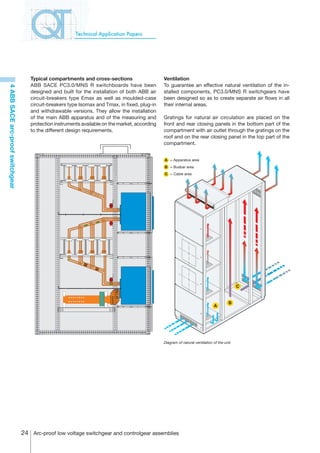
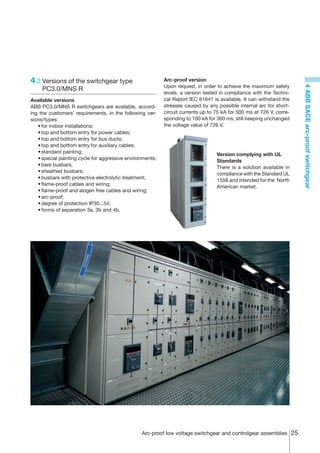
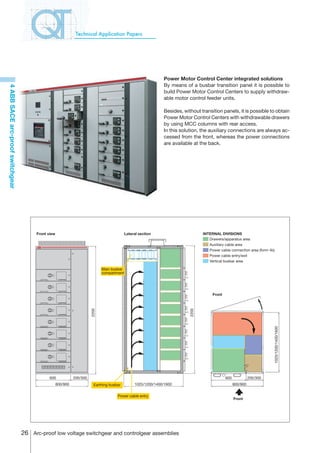
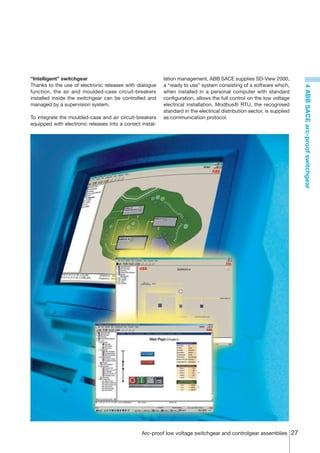
6                   Technical Application Papers
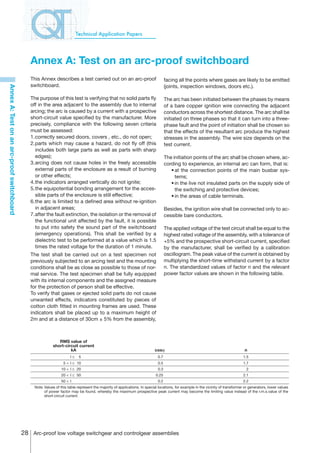
    February 2008


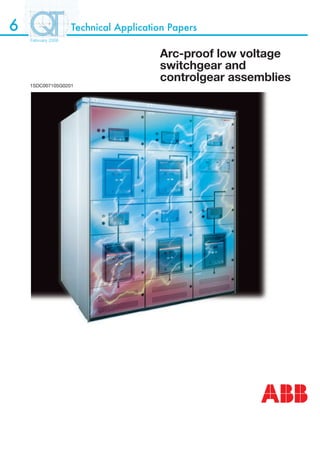
                                       Arc-proof low voltage
                                       switchgear and
                                       controlgear assemblies
    1SDC007105G0201
Technical Application Papers


Arc-proof low voltage switchgear and
controlgear assemblies
Index
1	 Generalities about LV                                                                    2	 The electric arc
   switchgear and controlgear
                                                                                            	     2.1	    Electrical arc phenomenon.................... 13
   assemblies
                                                                                            	     2.2	    Effects of the electric arc inside switchgear 		
	      1.1	     Introduction.. ........................................... 2
                             .                                                                    	       and controlgear assemblies. ................. 13
                                                                                                                                          .

	      1.2	     Standards concerning switchboards and 		                                    	     2
                                                                                               .3	 Effects of the electric arc on human
       	        relevant applicability................................ 3                    		     beings.................................................... 14

	      1.3	     Electrical characteristics of assemblies. . 4
                                                        .
                                                                                            3	 Internal arc-proof switchgear
	      1.4	     Classification of assemblies.................... 4
		 1.4.1 	Constructional types............................................... 4
                                                                                               and controlgear assemblies
		 1.4.2 	Primary distribution switchgear
			              (Power Center)........................................................ 4
                                                                                            	 3.1	        Generalities............................................ 15

	      	 1.4.3 	Secondary distribution switchgear......................... 5
                                                 .                                          	     3
                                                                                               .2	 Characteristics of internal arc-proof
	      	 1.4.4 	Motor Control Center (MCC)................................... 5
                                                                                            		     switchgear and controlgear
                                                                                            		     assemblies............................................. 16
	      	 1.4.5 	Control, measurements and protection boards...... 6
                                                                                            	 	 3.2.1 	Assemblies mechanically capable of withstanding
	      	 1.4.6 	Assemblies for construction sites (ACS)................. 6                  			        the electric arc (passive protection)...................... 16

                                                                                            		 3.2.2 	Assemblies equipped with devices limiting internal                    	
	      1.5	     Degree of protection IP. .......................... 7
                                       .                                                          		      arc effects (active protection)................................ 16

	 	 1.5.1 	Degrees of protection provided by switchgear                                     		 3.2.3 	Switchgear and controlgear assemblies with
			        and controlgear assemblies.................................... 8                 			           current limiting circuit-breakers............................ 18
                                                                                                                                           .


	      1.6	     Degree of protection IK. .......................... 9
                                       .

	      1.7	     Forms of separation. ............................. 10
                                   .
                                                                                            4	 ABB SACE arc-proof
                                                                                               switchgear
	      1.8	     Temperature-rise inside assemblies...... 11
                                                                                            	     4
                                                                                               .1	 Constructional and functional
	      1.9	      Switchgear and controlgear                                                 		     characteristics of the switchgear
    			          assemblies - special executions........... 12                              		     PC3.0/MNS R........................................ 19

		 1.9.1 	Testing under conditions of arcing due
			       to internal fault...................................................... 12        	     4
                                                                                               .2	 Versions of the switchgear type
                                                                                            		     PC3.0/MNS R........................................ 25
		 1.9.2 	Seismic qualification testing................................. 12
	      	 1.9.3 	Testing for shock-proof execution........................ 12
                                                                                            Annex A:
                                                                                            Test on an arc-proof switchboard.......................... 28
Technical Application Papers


                                                                  1	Generalities about LV switchgear and controlgear
                                                                    assemblies
                                                                  1.1 Introduction                                                Besides, the involved materials can generate hot decom-
                                                                                                                                  position products, gases or fumes, which, due to the
1 Generalities about LV switchgear and controlgear assemblies


                                                                  In the last years safety in LV electrical installations has     overpressure, are almost always ejected to the outside
                                                                  taken an increasingly dominant role.                            of the enclosure thus jeopardizing the operator safety.
                                                                  Also from a normative point of view, the panorama has           The European Directive 2006/95/EC states the funda-
                                                                  become more complete and a large number of users                mental safety requirements for low voltage electric ma-
                                                                  consider safety in the first place among the necessary          terials (from 50 V to 1000 V in alternating current, from 75
                                                                  requirements for their own plant.                               V to 1500 V in continuos current) to be put on the market
                                                                  LV switchgear assemblies are undoubtedly the compo-             within the European Community.
                                                                  nents of the electric installation more subject to the direct   Among the essential safety requirements defined by this
                                                                  intervention of personnel (operations, maintenance, etc.)       Directive particular importance is given to the need of
                                                                  and for this reason users demand from them higher and           taking technical measures to prevent “temperature rises,
                                                                  higher safety requirements.                                     electric arcs or radiations which may result in hazards”
                                                                  In the last years a lot of users have underlined the ques-      from occurring.
                                                                  tion of safety in electrical assemblies with reference to       This aspect has always been highly considered for ap-
                                                                  one of the most severe and destructive electrophysical          paratus, but it has been wrongly neglected for electrical
                                                                  phenomenon: the electric arc.                                   switchgear and only in the last 10-15 years it has been
                                                                  Unlike tripping devices, for which arc phenomena rep-           catching on both at Italian as well as at international
                                                                  resents one of the standard operating conditions, in LV         level.
                                                                  switchgear the electrical arc is an absolutely anomalous
                                                                  and rare event.
                                                                  But, if the electric arc occurs inside LV switchgear it
                                                                  generates internal overpressures and results in local
                                                                  overheatings which may cause high mechanical and
                                                                  thermal stresses in the equipment.


                                                                 Arc-proof low voltage switchgear and controlgear assemblies
1.2	Standards concerning switchboards                          TYPE-TESTED AND PARTIALLY TYPE-TESTED


                                                                                                                             1 Generalities about LV switchgear and controlgear assemblies
     and relevant applicability                                ASSEMBLIES
                                                               The Standard IEC 60439-1 differentiates between two
Low voltage switchboards are defined by the Standard           categories of assemblies:
IEC 60439-1 “switchgear and controlgear assemblies”,           	 •	TTA (Type-Tested Assembly)
in short: assemblies.                                          	 •	PTTA (Partially Type-Tested Assembly)
The Standard gives the following definition: “combina-         The term Type-Tested Assembly (TTA) is used to mean an
tion of one or more switching devices together with            assembly “conforming to an established type or system
associated control, measuring, signalling, protective,         without deviations likely to significantly influence the
regulating equipment etc., completely assembled under          performance from the typical assembly verified to be in
the responsibility of the manufacturer with all the internal   accordance with this standard”.
electrical and mechanical interconnections, including          To be declared TTA an assembly shall meet at least one
structural parts”.                                             of the following conditions:
The compliance of an assembly with the state of the art        1.	t is manufactured in a single example and subject to
                                                                 i
and therefore, presumptively, with the relevant techni-          all the type tests required by the Standard;
cal Standard, cannot be based only on the fact that the        2.	t is similar to another assembly which has been sub-
                                                                 i
components which constitute it comply with the state             jected to all the type tests, that is it differs from the
of the art and therefore, at least presumptively, with the       tested one only for details considered irrelevant for
relevant technical standards: this is necessary but not          the results of the same tests and, consequently, for its
sufficient.                                                      performances, that is for its nominal characteristics;
The components shall be assembled according to deter-          3.	t is part of a pre-established structural system sub-
                                                                 i
mined rules which can guarantee short-circuit withstand          jected to type tests in some of the many possible
strength, compliance with the temperature-rise limits,           arrangements chosen among the most significative
insulation, etc.                                                 ones which can be obtained by combining the system
In other words, the whole assembly must be designed,             elements. It is the typical case of assemblies sold as
             built and tested in compliance with the state       loose components.
               of the art.                                     The term Partially Type-Tested Assembly (PTTA) is used
                 Since the assemblies under considera-         to mean an assembly “containing both type-tested and
                   tion are low voltage equipment, their       non-type-tested arrangements, provided that the latter
                      rated voltage shall not exceed 1000      are derived (e.g. by calculation) from type-tested arrange-
                        Va.c. or 1500 Vd.c. As regards         ments which have complied with the relevant tests”.
                          currents, neither upper nor lower
                           limits are provided in the appli-   A PTTA is an assembly which has been subjected to one
                           cation field of this Standard.      part of the type tests, whereas the other ones have been
                     The Standard IEC 60439-1 states the       replaced by some extrapolations (calculations) based on
                 construction, safety and maintenance          the experimental results obtained on assemblies which
                         requirements for low voltage          have already passed the type tests.
                                switchgear and controlgear     The distinction between TTA and PTTA is of no weight
                                    assemblies, without        with respect to the declaration of conformity with the
                                    dealing with the func-     Standard IEC 60439-1, since the assembly must simply
                                    tional aspects which       comply with it apart from its having been subject - totally
                                 remain a competence of        (TTA) or partially (PTTA) - to type tests.
                        the designer of the plant for which
               the assembly is intended.


                                                     Arc-proof low voltage switchgear and controlgear assemblies
Technical Application Papers


                                                                  1.3	Electrical characteristics of assemblies                                           1.4 Classification of assemblies
1 Generalities about LV switchgear and controlgear assemblies


                                                                  The Standard IEC 60439-1 identifies the nominal char-
                                                                  acteristics to be assigned to each assembly, defines the                               1.4.1 Constructional types
                                                                  environmental service conditions, establishes the me-                                  Switchgear and controlgear assemblies often have a cu-
                                                                  chanical requirements and gives prescriptions about:                                   bicle-type structure which generally stands on floor and
                                                                  	 •	insulation                                                                         which can be divided into sections and compartments.
                                                                  	 •	thermal behaviour                                                                  The section is a constructional unit limited between two
                                                                  	 •	short-circuit withstand strength                                                   adjacent vertical planes, whereas the term compartment
                                                                  	 •	protection against electrical shock                                                is used to define a completely enclosed part of a section
                                                                  	 •	degree of protection of the enclosure                                              (sub-section), excepted for the openings necessary for
                                                                  	 •	installed components, internal separation and con-                                 interconnection, control and ventilation (Figure 1).
                                                                        nections inside the assembly
                                                                  	 •	electronic equipment supply circuits.
                                                                  Information specified under items a) and b) shall be given                             Figure 1 – Enclosed assembly, built by three sections; each section is in its
                                                                                                                                                         turn subdivided into more compartments
                                                                  on the nameplate according to the Standard.
                                                                  Information from items c) to t), where applicable, shall
                                                                  be given either on the nameplates or in the technical
                                                                  documentation of the manufacturer:
                                                                  a) manufacturer ’s name or trade mark;
                                                                  b) type designation or identification number, or any other
                                                                     means of identification making it possible to obtain
                                                                     relevant information from the manufacturer;
                                                                  c) IEC 60439-1;
                                                                  d) type of current (and frequency, in the case of a.c.);
                                                                  e) rated operational voltages;
                                                                  f) rated insulation voltages (rated impulse withstand volt-
                                                                     age, when declared by the manufacturer);
                                                                  g) rated voltages of auxiliary circuits, if applicable;
                                                                  h) limits of operation;
                                                                  j) rated current of each circuit, if applicable;
                                                                  k) short-circuit withstand strength;
                                                                  l) degree of protection;
                                                                  m) measures for protection of persons;
                                                                  n) service conditions for indoor use, outdoor use or spe-
                                                                     cial use, if different from the usual service conditions.
                                                                     Pollution degree when declared by the manufacturer;
                                                                  o) types of system earthing (neutral conductor) for which
                                                                     the ASSEMBLY is designed;
                                                                  p) dimensions given preferably in the order of height,
                                                                     width (or length), depth;
                                                                  q) weight;
                                                                  r) form of internal separation;
                                                                  s) types of electrical connections of functional units;
                                                                  t) environment 1 or 2.                                                                 1.4.2	 Primary distribution switchgear
                                                                                                                                                             (Power Centers)
                                                                                                                                                         They are usually installed on the load side of MV/LV trans-
                                                                                                                                                         formers or generators. These assemblies include one or
                                                                                                                                                         more incoming units, bus ties and a relatively reduced
                                                                                                                                                         number of outgoing units.

                                                                  1
                                                                   The manufacturer is deemed to be the organization taking the responsibility for the
                                                                  complete ASSEMBLY.


                                                                 Arc-proof low voltage switchgear and controlgear assemblies
There are also present measuring instruments and other         The constructional models provide for the use of metal or
switching and control equipment (Figure 2).                    insulating material enclosures and can be both floor- or


                                                                                                                             1 Generalities about LV switchgear and controlgear assemblies
                                                               wall-mounted, according to dimensions and weight.
Figure 2 – View of a primary distribution switchgear
                                                               In case the assemblies are used by unskilled persons,
                                                               the Standard IEC 60439-3 is to be applied.
                                                               The distribution boards (ASD) are subject to the additional
                                                               prescriptions of the Standard IEC 60439-3.
                                                               They are intended to be installed in places where un-
                                                               skilled persons have acces for their use, otherwise the
                                                               general rules of the Standard IEC 60439-1 are applied.
                                                               The Standard IEC 60439-3 takes into consideration only
                                                               Type-Tested Assemblies (TTA).
                                                               This means that each manufactured product shall comply
                                                               with a prototype or with a pre-established constructional
                                                               system, that is, it shall not present deviations which can
                                                               remarkably modify its performances with respect to the
                                                               type-tested assembly.


                                                               1.4.4	 Motor Control Centers (MCC)
                                                               Motor Control Centers are intended for the control and
                                                               centralized protection of motors: they include the rel-
These assemblies have a sturdy structure to withstand          evant switching and protection equipment (independent
the electrodynamic stresses and the weight of big sized        functional units) and the control and signalling auxiliary
apparatus. As a matter of fact peculiar characteristics        equipment.
of the power center are high rated currents and short-         They are characterized by drawer-units (outgoing units),
circuit currents.                                              each of them connected to one motor so that it may be
The constructional type is a cubicle structure, with metal     possible to operate in total safety on each single outgoing
enclosure and sections divided into compartments with          unit without disconnecting the loads (Figure 4).
selective access.

1.4.3	 Secondary distribution switchgear
                                                               Figure 4 – View of a Motor Control Center (MCC)
These assemblies are usually provided with one incoming
unit and many outgoing units (Figure 3).
The apparatus housed inside the assembly are mainly
molded-case circuit-breakers and/or miniature circuit-
breakers.
Figure 3 – Secondary distribution switchgear


The rated currents and the short-circuit currents of sec-
ondary distribution switchgear are lower than those of
primary distribution switchgear.

                                                       Arc-proof low voltage switchgear and controlgear assemblies
Technical Application Papers


                                                                  1.4.5	 Control, measurement and protection                 1.4.6	 Assemblies for construction sites (ACS)
                                                                         boards
1 Generalities about LV switchgear and controlgear assemblies


                                                                                                                             Assemblies for construction sites have different dimen-
                                                                  They are usually constituted by banks containing above     sions, ranging from the simple socket-outlet units to proper
                                                                  all apparatus intended for the control, switching and      distribution boards in metal enclosure or insulating mate-
                                                                  measurement of industrial installations and processes.     rial. These assemblies are usually mobile (Figure 6).
                                                                  Usually supported by a metal frame, they have a “desk      The Standard IEC 60439-4 establishes the particular require-
                                                                  form” and allow quick access to the commands and easy      ments for this type of assemblies, making specific reference
                                                                  readability of the instruments (Figure 5).                 to mechanical strength and resistance to corrosion.
                                                                                                                             This Standard states that the ACS shall comply with the
                                                                  Figure 5 – Control boards
                                                                  a) Desk-type
                                                                                                                             requirements of the Standard IEC 60439-1 and that the
                                                                  b) Console-type.                                           clauses of the Standard IEC 60439-4 either complete,
                                                                                       a)                                    modify or replace the relevant clauses of the general
                                                                                                                             reference Standard.
                                                                                                                             ACS must be exclusively type-tested low-voltage switch-
                                                                                                                             gear and controlgear assemblies (TTA) and consequently
                                                                                                                             each manufactured assembly shall comply with a proto-
                                                                                                                             type which has been already subject to all the type tests
                                                                                                                             prescribed by the Standard IEC 60439-4.
                                                                                                                             Figure 6 – Assemblies for contruction sites (ACS)
                                                                                                                             a) ACS supported by feet or legs
                                                                                                                             b) ACS to be mounted on a vertical surface
                                                                        b)                                                   c) ACS - mobile socket-outlet unit


                                                                                                                                 a)


                                                                                                                                      b)


                                                                                                                                              c)


                                                                 Arc-proof low voltage switchgear and controlgear assemblies
1.5	Degree of protection IP                                           If the indications refer exclusively to the safety of persons
                                                                      against direct contact, both characteristic numerals are


                                                                                                                                                 1 Generalities about LV switchgear and controlgear assemblies
The code IP indicates the degrees of protection provided              omitted and replaced by “XX”; in this case the degree of
by an enclosure against access to hazardous parts, in-                protection is indicated by the additional letter.
gress of solid foreign objects and ingress of water.                  Obviously, also the additional letter is not independent
The degree of protection of an enclosure is identified, in            of the two numerals by which it may be preceded, but
compliance with the specifications of the Standard IEC                it is closely connected to them; that is the reason why
60529, by the code letters IP (International Protection)              the additional letter shall be used only if guaranteeing a
followed by two numerals and two additional letters.                  degree of protection against direct contact higher than
The first characteristic numeral indicates the degree of              that guaranteed by the first characteristic numeral.
protection against ingress of solid foreign objects and               The supplementary letter gives supplementary informa-
against contact of persons with hazardous live parts                  tion.
inside the enclosure.                                                 The table below sums up the meaning of the various ele-
The second characteristic numeral indicates the degree                ments which form the code. For further details reference
of protection against ingress of water with harmful ef-               should be made to the Standard IEC 60529.
fects.
It is easy to understand that the two characteristic numer-
als influence each other.                                                                                                     IP 2     3   C H
The additional letter indicates the degree of protection of
persons against access to hazardous parts.                             Code letters
                                                                                                              International
                                                                                                                 protection
The additional letter is used only if the actual protection
against access to hazardous parts is higher than that                  First characteristic            numerals 0 to 6, or
                                                                       numeral                                    letter X
indicated by the first characteristic numeral; if only the
                                                                       Second characteristic           numerals 0 to 8, or
protection against access to hazardous parts is indicated,             numeral                                    letter x
then the first characteristic numeral shall be replaced                Additional letter
                                                                                                         letters A, B, C, D
by the letter X. For example this higher protection could              (optional)

be provided by barriers, openings of suitable shape or                 Supplementary letter
                                                                                                        letters H, M, S, W
distances inside the enclosure.                                        (optional)


                                        Protection of equipment                               Against access to hazardous part with:
First characteristic numeral        0 non-protected                                           non-protected
(access of solid foreign objects)   1 ≥ 50 mm diameter		                                      back of hand
                                    2 ≥ 12.5 mm diameter                                      finger
                                    3 ≥ 2.5 mm diameter                                       tool
                                    4 ≥ 1.0 mm diameter                                       wire
                                    5 dust-protected                                          wire
                                    6 dust-tight                                              wire
Second characteristic numeral       0 non-protected
(ingress of water)                  1 vertically dripping
                                    2 dripping (15° tilted)
                                    3 spraying
                                    4 splashing
                                    5 jetting
                                    6 powerful jetting
                                    7 temporary immersion
                                    8 continuous immersion
Additional letter                   A                                                         back of hand
(optional)                          B                                                         finger
                                    C                                                         tool
                                    D                                                         wire
Supplementary letter                H High-voltage apparatus
(optional)                          M Motion during water test
                                    S Stationary during water test
                                    W Weather conditions


                                                              Arc-proof low voltage switchgear and controlgear assemblies
Technical Application Papers


                                                                  1.5.1	 Degrees of protection provided by                                      As regards enclosed switchboards, the Standard requires
                                                                         switchgear and controlgear assemblies
1 Generalities about LV switchgear and controlgear assemblies


                                                                                                                                                the minimum degree of protection IP 2X or IPXXB for live
                                                                  As regards assemblies, if not otherwise specified by the                      parts which are not to be touched intentionally and IP4X
                                                                  manufacturer, the degree of protection is applicable to                       or IPXXD for readily accessible horizontal surfaces.
                                                                  the whole assembly, mounted and installed as in the or-                       As an example the following table shows the minimum
                                                                  dinary use (closed door). Besides, the manufacturer may                       degrees of protection required for an assembly to be
                                                                  indicate the degrees of protection relevant to particular                     installed in the listed environments, in compliance with
                                                                  arrangements which may occur during operation, such                           the mentioned Standards.
                                                                  as the degree of protection with open doors and that one
                                                                  with removed or withdrawn apparatus.

                                                                  Type of assemblies/Type of environments                               Standards and sub-clause                Minimum degree of protection
                                                                  Switchgear and controlgear assemblies: enclosed switchboards          IEC 60439-1 sub-clause 2.3.3            Not defined
                                                                  Assemblies for outdoor installation                                   IEC 60439-1sub-clause 7.2.1.3           IPX3
                                                                  Assemblies with protection by total insulation                        IEC 60439-1 sub-clause 7.4.3.2.2        IP2XC
                                                                  Installations in normal environments
                                                                  Live parts which are not to be touched intentionally                  IEC60364-4 sub-clause 412.2.1           IPXXB (IP2X)
                                                                  Live parts which are readily accessible (horizontal top)              IEC60364-4 sub-clause 412.2.2           IPXXD (IP4X)
                                                                  Installations in locations containing a bath tube or shower basin
                                                                  Zone 1 and 2                                                          IEC60364-7 sub-clause 701.512.2         IPX4
                                                                  Zone 3                                                                IEC60364-7 sub-clause 701.512.2         IPX1
                                                                  Zone 1-2-3 public baths where water jets are used for cleaning purposes IEC60364-7 sub-clause 701.512.2       IPX5
                                                                  Installations for swimming-pools
                                                                  Zone 0                                                                IEC60364-7 sub-clause 702.512.2         IPX8
                                                                  Zone 1                                                                IEC60364-7 sub-clause 702.512.2         IPX5
                                                                  Zone 2 for indoor locations                                           IEC60364-7 sub-clause 702.512.2         IPX2
                                                                  Zone 2 for outoor locations                                           IEC60364-7 sub-clause 702.512.2         IPX4
                                                                  Zone 2 where water jets are used for cleaning purposes                IEC60364-7 sub-clause 702.512.2         IPX5
                                                                  Installations for rooms and cabins containing sauna heaters           IEC60364-7 sub-clause 703.512.2         IP24
                                                                  Assemblies for construction sites (ACS)                               IEC60439-4 sub-clause 7.2.1.1           IP44


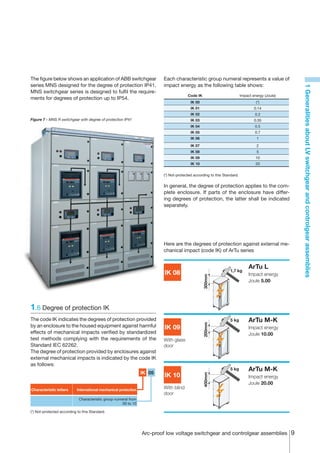
                                                                  The figure below shows the degrees of protection which can be obtained with ABB SACE ArTu series switchgear

                                                                  ArTu L                                                     ArTu M - K
                                                                  IP31                 IP43                                  IP31                IP41 Without door IP41With door               IP65
                                                                  Without door         With door                             Without door        with IP41 kit and          and ventilated     With door and
                                                                                                                                                 ventilated panels          panels (ArTu K     blind panels
                                                                                                                                                 (ArTu K only)              only)


                                                                 Arc-proof low voltage switchgear and controlgear assemblies
The figure below shows an application of ABB switchgear                  Each characteristic group numeral represents a value of
series MNS designed for the degree of protection IP41.                   impact energy as the following table shows:


                                                                                                                                                 1 Generalities about LV switchgear and controlgear assemblies
MNS switchgear series is designed to fulfil the require-
                                                                                       Code IK                           Impact energy (Joule)
ments for degrees of protection up to IP54.
                                                                                         IK 00                                    (*)
                                                                                         IK 01                                   0.14
                                                                                         IK 02                                   0.2
Figure 7 - MNS R switchgear with degree of protection IP41                               IK 03                                   0.35
                                                                                         IK 04                                   0.5
                                                                                         IK 05                                   0.7
                                                                                         IK 06                                    1
                                                                                         IK 07                                    2
                                                                                         IK 08                                    5
                                                                                         IK 09                                    10
                                                                                         IK 10                                    20


                                                                         (*) Not-protected according to this Standard.

                                                                         In general, the degree of protection applies to the com-
                                                                         plete enclosure. If parts of the enclosure have differ-
                                                                         ing degrees of protection, the latter shall be indicated
                                                                         separately.


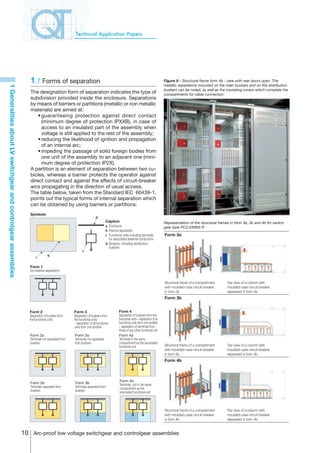
                                                                         Here are the degrees of protection against external me-
                                                                         chanical impact (code IK) of ArTu series


                                                                                                                              ArTu L
                                                                                                                1,7	kg
                                                                          IK 08                                               Impact energy
                                                                                                 300mm


                                                                                                                              Joule 5.00


1.6	Degree of protection IK
The code IK indicates the degrees of protection provided                                                        5	kg          ArTu M-K
                                                                                                 200mm


by an enclosure to the housed equipment against harmful                   IK 09                                               Impact energy
effects of mechanical impacts verified by standardized                                                                        Joule 10.00
test methods complying with the requirements of the                      With glass
Standard IEC 62262.                                                      door
The degree of protection provided by enclosures against
external mechanical impacts is indicated by the code IK
as follows:
                                                                 IK 05
                                                                                                                5	kg          ArTu M-K
                                                                          IK 10
                                                                                                 400mm


                                                                                                                              Impact energy
                                                                                                                              Joule 20.00
Characteristic letters     International mechanical protection           With blind
                                                                         door
                             Characteristic group numeral from
                                                      00 to 10

(*) Not-protected according to this Standard.


                                                                 Arc-proof low voltage switchgear and controlgear assemblies
Technical Application Papers


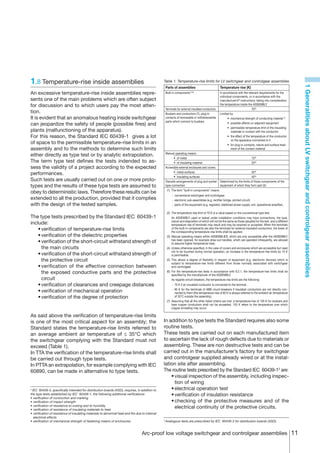
                                                                   1.7	Forms of separation                                                                                    Figure 8 - Structural frame form 4b - view with rear doors open. The
                                                                                                                                                                              metallic separations mounted on the main busbars and on the distribution
1 Generalities about LV switchgear and controlgear assemblies


                                                                                                                                                                              busbars can be noted, as well as the insulating covers which complete the
                                                                   The designation form of separation indicates the type of                                                   compartments for cable connection
                                                                   subdivision provided inside the enclosure. Separations
                                                                   by means of barriers or partitions (metallic or non metallic
                                                                   materials) are aimed at:
                                                                   	 •	guaranteeing protection against direct contact
                                                                        (minimum degree of protection IPXXB), in case of
                                                                        access to an insulated part of the assembly when
                                                                        voltage is still applied to the rest of the assembly;
                                                                   	 •	reducing the likelihood of ignition and propagation
                                                                        of an internal arc;
                                                                   	 •	impeding the passage of solid foreign bodies from
                                                                        one unit of the assembly to an adjacent one (mini-
                                                                        mum degree of protection IP2X).
                                                                   A partition is an element of separation between two cu-
                                                                   bicles, whereas a barrier protects the operator against
                                                                   direct contact and against the effects of circuit-breaker
                                                                   arcs propagating in the direction of usual access.
                                                                   The table below, taken from the Standard IEC 60439-1,
                                                                   points out the typical forms of internal separation which
                                                                   can be obtained by using barriers or partitions:
                                                                   Symbols
                                                                                                                     d
                                                                                                                             Caption                                          Representation of the structural frames in form 3a, 3b and 4b for switch-
                                                                                                                             a Enclosure                                      gear type PC3.0/MNS R
                                                                                                                             b Internal separation
                                                                                                                             c Functional units including terminals           Form 3a
                                                                                                                               for associated external conductors
                                                                                                                             d Busbars, including distribution
                                                                                                                               busbars
                                                                                                         c
                                                                       a         b


                                                                   Form 1
                                                                   (no internal separation)


                                                                                                                                                                              Structural frame of a compartment     Top view of a column with
                                                                                                                                                                              with moulded-case circuit-breaker     moulded-case circuit-breaker
                                                                                                                                                                              in form 3a                            separated in form 3a
                                                                                                                                                                              Form 3b


                                                                   Form 2                         Form 3                               Form 4
                                                                   Separation of busbars from     Separation of busbars from           Separation of busbars from the
                                                                   the functional units           the functional units                 functional units – separation of all
                                                                                                  – separation of all functional       functional units from one another
                                                                                                  units from one another               – separation of terminals from
                                                                                                                                       those of any other functional unit
                                                                   Form 2a                        Form 3a                              Form 4a
                                                                   Terminals not separated from   Terminals not separated              Terminals in the same
                                                                   busbars                        from busbars                         compartment as the associated
                                                                                                                                       functional unit                        Structural frame of a compartment     Top view of a column with
                                                                                                                                                                              with moulded-case circuit-breaker     moulded-case circuit-breaker
                                                                                                                                                                              in form 3b                            separated in form 3b
                                                                                                                                                                              Form 4b


                                                                                                                                        Form 4b
                                                                   Form 2b                        Form 3b                               Terminals not in the same
                                                                   Terminals separated from       Terminals separated from              compartment as the
                                                                   busbars                        busbars                               associated functional unit


                                                                                                                                                                              Structural frame of a compartment     Top view of a column with
                                                                                                                                                                              with moulded-case circuit-breaker     moulded-case circuit-breaker
                                                                                                                                                                              in form 4b                            separated in form 4b


                                                                10 Arc-proof low voltage switchgear and controlgear assemblies
1.8	Temperature-rise inside assemblies                                                           Table 1: Temperature-rise limits for LV switchgear and controlgear assemblies


                                                                                                                                                                                                                  1 Generalities about LV switchgear and controlgear assemblies
                                                                                                     Parts of assemblies                             Temperature rise (K)
An excessive temperature-rise inside assemblies repre-                                               Built in components(1) (6)                      In accordance with the relevant requirements for the
                                                                                                                                                     individual components, or in accordance with the
sents one of the main problems which are often subject                                                                                               manufacturer’s(6) instructions, taking into consideration
for discussion and to which users pay the most atten-                                                                                                the temperature inside the ASSEMBLY
                                                                                                     Terminals for external insulated conductors                                 70(2)
tion.                                                                                                Busbars and conductors (7), plug-in             Limited by:
It is evident that an anomalous heating inside switchgear                                            contacts of remowable or withdrawawble                 • mechanical strength of conducting material (7)
                                                                                                     parts which connect to busbars
can jeopardize the safety of people (possible fires) and                                                                                                    • possible effects on adjacent equipment
                                                                                                                                                            • permissible temperature limit of the insulating
plants (malfunctioning of the apparatus).                                                                                                                     materials in contact with the conductor
For this reason, the Standard IEC 60439-1 gives a lot                                                                                                       • the effect of the temperature of the conductor
                                                                                                                                                              on the apparatus connected to it
of space to the permissible temperature-rise limits in an                                                                                                   • for plug-in contacts, nature and surface treat-
assembly and to the methods to determine such limits                                                                                                          ment of the contact material
                                                                                                     Manual operating means:
either directly as type test or by analytic extrapolation.
                                                                                                            • of metal                                                          15(3)
The term type test defines the tests indended to as-                                                        • of insulating material                                            25(3)
sess the validity of a project according to the expected                                             Accessible external enclosures and covers:

performances.                                                                                               • metal surfaces                                                   30(4)
                                                                                                            • insulating surfaces                                              40(4)
Such tests are usually carried out on one or more proto-                                             Discrete arrangements of plug and socket        Determined by the limits of those components of the
types and the results of these type tests are assumed to                                             type connection                                 equipment of which they form part (5)
                                                                                                      (1) The term “built-in components” means:
obey to deterministic laws. Therefore these results can be
                                                                                                            - conventional switchgear and controlgear;
extended to all the production, provided that it complies                                                   - electronic sub-assemblies (e.g. rectifier bridge, printed circuit)
with the design of the tested samples.                                                                      - parts of the equipment (e.g. regulator, stabilized power supply unit, operational amplifier).

                                                                                                      (2) The temperature-rise limit of 70 K is a value based on the conventional type test.
The type tests prescribed by the Standard IEC 60439-1                                                       An ASSEMBLY used or tested under installation conditions may have connections, the type,
                                                                                                            nature and disposition of which will not be the same as those adopted for the test, and a different
include:                                                                                                    temperature rise of terminals may result and may be required or accepted. When the terminals
	 •	verification of temperature-rise limits                                                                 of the built-in compenents are also the terminals for external insulated conductors, the lower of
                                                                                                            the corresponding temperature-rise limits shall be applied.
	 •	verification of the dielectric properties                                                         (3)   Manual operating means within ASSEMBLIES, which are only accessibile after the ASSEMBLY
                                                                                                            has been opened, for example draw-out handles, which are operated infrequently, are allowed
	 •	verification of the short-circuit withstand strength of                                                 to assume higher temperature rises.
     the main circuits                                                                                (4)   Unless otherwise specified, in the case of covers and enclosures which are accessible but need
                                                                                                            not to be touched during normal operation, an increase in the temperature-rise limits by 10 K
	 •	verification of the short-circuit withstand strength of                                                 is permissible.
     the protective circuit                                                                           (5)   This allows a degree of flexibility in respect of equipment (e.g. electornic devices) which is
                                                                                                            subject to temperature-rise limits different from those normally associated with switchgear
	 •	verification of the effective connection between                                                        and controlgear.
     the exposed conductive parts and the protective                                                  (6)   For the temperature-rise tests in accordance with 8.2.1, the temperature-rise limits shall be
                                                                                                            specified by the manufacturer of the ASSEMBLY.
     circuit                                                                                                As regards circuit-breakers, the temperature-rise limits are the following:
	 •	verification of clearances and creepage distances                                                     - 70 K if an insulated conductor is connected to the terminal.
                                                                                                          - 85 K for the terminals of ABB cirucit-breakers if insulated conductors are not directly con-
	 •	verification of mechanical operation                                                                    nected to them (the temperature-rise of 85 K is always referred to the ambient air temperature
	 •	verification of the degree of protection                                                                of 35°C outside the assembly).
                                                                                                      (7) Assuming that all the other listed criteria are met, a temperature-rise of 105 K for busbars and
                                                                                                          bare copper conductors shall not be exceeded. 105 K refers to the temperature over which
                                                                                                          copper annealing may occur.

As said above the verification of temperature-rise limits
is one of the most critical aspect for an assembly; the                                          In addition to type tests the Standard requires also some
Standard states the temperature-rise limits referred to                                          routine tests.
an average ambient air temperature of ≤ 35°C which                                               These tests are carried out on each manufactured item
the switchgear complying with the Standard must not                                              to ascertain the lack of rough defects due to materials or
exceed (Table 1).                                                                                assembling. These are non destructive tests and can be
In TTA the verification of the temperature-rise limits shall                                     carried out in the manufacturer’s factory for switchgear
be carried out through type tests.                                                               and controlgear supplied already wired or at the instal-
In PTTA an extrapolation, for example complying with IEC                                         lation site after assembling.
60890, can be made in alternative to type tests.                                                 The routine tests prescribed by the Standard IEC 60439-13 are:
                                                                                                 	 •	visual inspection of the assembly, including inspec-
                                                                                                      tion of wiring
2
 IEC 60439-3, specifically intended for distribution boards (ASD), requires, in addition to      	 •	electrical operation test
the type tests established by IEC 60439-1, the following additional verifications:               	 •	verification of insulation resistance
•	verification of contruction and marking
•	verification of impact strength                                                                	 •	checking of the protective measures and of the
•	verification of resistance to rusting and to humidity
•	verification of resistance of insulating materials to heat
                                                                                                      electrical continuity of the protective circuits.
•	verification of resistance of insulating materials to abnormal heat and fire due to internal
  electrical effects
•	verification of mechanical strength of fastening means of enclosures.                          3
                                                                                                     Analogous tests are prescribed by IEC 60439-3 for distribution boards (ASD).


                                                                                   Arc-proof low voltage switchgear and controlgear assemblies 11
Technical Application Papers


                                                                   1.9	Switchgear and controlgear assemblies                          	
                                                                                                                                      	
                                                                                                                                          •	Uniform Building Code 1997
                                                                                                                                          •	Italian Government Decree PCM No. 3274,
1 Generalities about LV switchgear and controlgear assemblies


                                                                              – special executions                                          20/03/2003 “Primi elementi in materia di criteri
                                                                   The term “special execution” is used to define switch-                   generali per la classificazione sismica del territorio
                                                                   boards having characteristics not considered in the                      nazionale e di normative tecniche per le costruzioni
                                                                   Standard 439-1, but often required by users according                    in zona sismica” (“First elements regarding general
                                                                   to the characteristics of the plant.                                     criteria for the seismic classification of the national
                                                                                                                                            territory and technical guidelines for building in
                                                                   Among the most common available special executions                       seismic areas”)
                                                                   there are:                                                         	   •	IEEE 693-1997 “Recommended Practices for Seis-
                                                                   	 •	arc-proof switchboars                                                mic Design of Substations”
                                                                   	 •	anti-seismic switchboards                                      	   •	IEEE 344-1987 “Recommended Practice for Seismic
                                                                   	 •	shock-proof switchboards4                                            Qualification of Class 1E Equipment for Nuclear
                                                                                                                                            Power Generating Stations”
                                                                   The compliance of such switchgear and controlgear as-              	   •	IEC 60980 “Recommended practices for seismic
                                                                   semblies with these requirements is guaranteed by tests                  qualification of electrical equipment of the safety
                                                                   specified by international and/or national Standards and                 system for nuclear generating stations”
                                                                   not included in the Standard 439-1.                                	   •	IEC 60068-3-3 “Guidance Seismic test methods for
                                                                                                                                            equipments”
                                                                    4
                                                                        Obtained through a suitable choice of frames and equipment.
                                                                                                                                      	   •	IEC 60068-2-6 “Tests- Test Fc: Vibration (sinusoidal)”
                                                                                                                                      	   •	IEC 60068-2-57 “Tests- Test Ff: Vibration – Time
                                                                                                                                            history method”
                                                                   1.9.1	 Testing under conditions of arcing due to
                                                                          internal fault
                                                                   The most widespread international Standard is the Tech-
                                                                   nical Report IEC 61641 (see Annex A).
                                                                   This test verifies the capability of the switchboards to           1.9.3	 Testing for shock-proof execution
                                                                   meet some requirements typically linked to the operator
                                                                                                                                      In particular applications, such as for example military
                                                                   safety under conditions of arcing due to internal fault.
                                                                                                                                      ships, LV switchgear and controlgear assemblies are re-
                                                                   It is a special test which is subject to an agreeement
                                                                                                                                      quested to withstand specified vibrations and shocks.
                                                                   between manufacturer and user.
                                                                                                                                      The reference Standards for this type of version are:
                                                                   The results of such test are presented in the form of a
                                                                   test report and are not object of a test certificate. The
                                                                                                                                      	   •	IEC 60068-2-6 / EN 60068-2-6 (vibration)
                                                                   interpretation of the results is subject to an agreeement
                                                                                                                                      	   •	IEC 60068-2-27 / EN 60068-2-27 (shock))
                                                                   between manufacturer and user.
                                                                                                                                      In this case too, since the overview of rules and standards
                                                                                                                                      is very varied (to remain in the naval field, the shipping
                                                                   1.9.2	 Seismic qualification testing
                                                                                                                                      registers are numerous and have different specifications)
                                                                   Seismic qualification testing is intended to demonstrate           the test shall be carried out by pre-defining the testing
                                                                   the capability of an assembly and of the relevant housed           modalities and the performances to be guaranteed by
                                                                   equipment to withstand the stresses resulting from an              the equipment.
                                                                   earthquake keeping the functions required.
                                                                   The overview of the standards and rules regarding
                                                                   seismic qualification is wide and varied; therefore, it is
                                                                   fundamental to define in advance the performances that
                                                                   the testing object must guarantee.
                                                                   Among the applicable Standards (different depending
                                                                   on States, environments and functions for which the
                                                                   equipment is intended) the following ones are to be
                                                                   mentioned:


                                                                12 Arc-proof low voltage switchgear and controlgear assemblies
2 The electric arc
2.1	Electric arc phenomenon                                      The flow of the high fault current causes the overheating
                                                                 of the cables or of the circuit busbars, up to the melting of


                                                                                                                                  2 The electric arc
The electric arc is a phenomenon which takes place as a          the conductors of lower section; as soon as the conduc-
consequence of a discharge which occurs when the volt-           tor melts, analogous conditions to those present during
age between two points exceeds the insulating strength           the circuit opening arise. At that point an arc starts which
limit of the interposed gas; then, in the presence of suit-      lasts either till the protective devices intervene or till the
able conditions, a plasma is generated which carries the         conditions necessary for its stability subsist.
electric current till the opening of the protective device
on the supply side.                                              The electric arc is characterized by an intense ionization
                                                                 of the gaseous means, by reduced drops of the anodic
Gases, which are good insulating means under normal              and cathodic voltage (10 V and 40 V respectively), by high
conditions, may become current conductors in conse-              or very high current density in the middle of the column
quence of a change in their chemical-physical properties         (of the order of 102-103 up to 107 A/cm2), by very high
due to a temperature rise or to other external factors.          temperatures (thousands of °C) always in the middle of
To understand how an electrical arc originates, reference        the current column and – in low voltage - by a distance
can be made to what happens when a circuit opens or              between the ends variable from some microns to some
closes. During the opening phase of an electric circuit          centimeters.
the contacts of the protective device start to separate
thus offering to the current a gradually decresasing
section; therefore the current meets growing resistance
with a consequent rise in the temperature. As soon as
the contacts start to separate, the voltage applied to the
circuit exceeds the dielectric strength of the air, caus-
ing its perforation through a discharge. The high
temperature causes the ionization of
the surrounding air which keeps
the current circulating in the form
of electrical arc. Besides thermal ionization,
there is also an electron emission from the cathode due
to the thermionic effect; the ions formed in the gas due
to the very high temperature are accelerated by the
electric field, strike the cathode, release energy in the
collision thus causing a localized heating which gener-          2.2	Effects of the electric arc inside
ates electron emission.                                               switchgear and controlgear assemblies
The electrical arc lasts till the voltage at its ends supplies   In the proximity of the main boards, i.e. in the proximity
the energy sufficient to compensate for the quantity of          of big electrical machines, such as transformers or gen-
heat dissipated and to maintain the suitable conditions          erators, the short-circuit power is high and consequently
of temperature. If the arc is elongated and cooled, the          also the energy associated with the electrical arc due to
conditions necessary for its maintenance lack and it             a fault is high.
extinguishes.
                                                                 Without going into complex mathematical descriptions
Analogously, an arc can originate also as a consequence          of this phenomenon, the first instants of arc formation
of a short-circuit between phases. A short-circuit is a low      inside a cubicle can be schematized in 4 phases:
impedance connection between two conductors at differ-
ent voltages. The conducting element which constitutes           1.	 ompression phase: in this phase the volume of the
                                                                   c
the low impedance connection (e.g. a metallic tool forgot-         air where the arc develops is overheated owing to the
ten on the busbars inside the enclosure, a wrong wiring            continuous release of energy; due to convection and
or a body of an animal entered inside the enclosure),              radiation the remaining volume of air inside the cubicle
subject to the difference of potential is passed through           warms up; initially there are temperature and pressure
by a current of generally high value, depending on the             values different from one zone to another;
characteristics of the circuit.


                                                      Arc-proof low voltage switchgear and controlgear assemblies 13
Technical Application Papers


                        2.	 xpansion phase: from the first instants of internal
                          e
                          pressure increase a hole is formed through which the
                                                                                     2.3	Effects of the electrical arc on human
2 The electric arc


                          overheated air begins to go out. In this phase the pres-        beings
                          sure reaches its maximum value and starts to decrease      From the above, it is evident that the electrical arc
                          owing to the release of hot air;                           represents a hazard source for people and goods.
                                                                                     The hazards to which a person is exposed due to the
                        3.	 mission phase: in this phase, due to the continuous
                          e                                                          release of energy generated by an arc event are:
                          contribution of energy by the arc, nearly all the air is   	 •	burns;
                          forced out under a soft and almost constant overpres-      	 •	injuries due to ejection of materials;
                          sure;                                                      	 •	damages to hearing;
                                                                                     	 •	inhalation of toxic gases.
                        4.	 hermal phase: after the expulsion of the air, the tem-
                          t
                          perature inside the switchgear reaches almost
                          that of the electrical arc, thus beginning this                 Burns
                          final phase which lasts till the arc is quenched,               The high temperature levels of the gases pro-
                          when all the metals and the insulating materi-                  duced by the electrical arc and the expulsion of
                          als coming into contact undergo erosion with               incandescent metal particles may cause more or less
                          production of gases, fumes and molten material             severe burns to people.
                          particles.                                                 Flames can cause all degrees of burn up to carboniza-
                                                                                     tion: the red-hot solid bodies, such as the metal frag-
                        Should the electrical arc occur in open configurations,      ments of the assembly involved, cause third degree
                        some of the described phases could not be present or         burns, superheated steam causes burns analogous
                        could have less effect; however, there shall be a pres-      to those by hot liquids whereas radiant heat generally
                        sure wave and a rise in the temperature of the zones         causes less severe burns.
                        surrounding the arc.
                                                                                          Injuries due to ejection of materials
                        Being in the proximity of an electrical arc is quite              The ejection of metal particles or other loose
                        dangerous; here are some data to understand how                   items caused by the electrical arc can result in
                        dangerous it is:                                                  severe injuries to the weakest parts of the hu-
                        	 •	pressure: at a distance of 60 cm from an                 man body as, for example, the eyes. The materials
                            electrical arc associated with a 20 kA arcing            expelled owing to the explosion produced by the arc
                            fault a person can be subject to a force of 225 kg;      may penetrate the cornea and hurt it. The extent of
                            moreover, the sudden pressure wave may cause             the lesions depends on the characteristics and on the
                            permanent injuries to the eardrum;                       kinetic energy of these objects.
                        	   •	arc temperatures: about 7000-8000 °C;                  Moreover, the ocular region can sustain injuries to the
                        	   •	sound: electrical arc sound levels can reach 160 db,   mucosa because of the gases released by the arc and
                              a shotgun blast only 130 db.                           the emission of ultraviolet and infrared rays can injure
                                                                                     the cornea and the retina depending on the radiation
                                                                                     wavelengths.

                                                                                           Hearing
                                                                                           As already mentioned, the electrical arc is a real
                                                                                           explosion, whose sound may cause permanent
                                                                                     injuries to hearing.

                                                                                         Inhalation of toxic gases
                                                                                         The fumes produced by burnt insulating materials
                                                                                         and by molten or vaporized metals can be toxic.
                                                                                         The fumes are caused by incomplete burning
                                                                                     and are formed by carbon particles and by other solid
                                                                                     substances suspended in the air.


                     14 Arc-proof low voltage switchgear and controlgear assemblies
3 Internal arc-proof switchgear and controlgear
  assemblies
3.1	Generalities                                               The causes of an arc fault can be both technical as well
                                                               as non technical; among the latter the most frequent are


                                                                                                                             3 Internal arc-proof switchgear and controlgear assemblies
In LV switchgear there are two types of fault to which         the following:
the development of currents of remakable intensity is          	 •	personnel errors, above all during maintenance
associated:                                                           operations;
	 •	bolted fault                                               	 •	installation operations not sufficiently accurate;
	 •	arc fault.                                                 	 •	inadequate maintenance, above all in the case of
With the term “bolted” reference is made to a fault in                severe environmental conditions.
which two or more live parts at different potential get        Among the technical causes of an arc fault in a LV as-
in touch; this is the case of phase-to-phase or phase-         sembly the following ones are to be remembered:
to-earth short-circuits to which the circulation of an         	 •	breakdown of the insulation essentially in the
anomalous current within the ring developed at the fault              proximity of the supports of the busbars and of the
moment is associated.                                                 plug-in contacts of the withdrawable units (75% of
                                                                      cases);
On the contrary, an arc fault occurs when there is a re-       	 •	overvoltages generating disruptive discharges
duction in the dielectric strength of the insulating means            between the points at minimum clearances (15%
(air, in LV switchboards) interposed between two or more              of cases);
conducting elements at different potential.                    	 •	constructional defects of the apparatus (10% of
                                                                      cases).
The arc is generated at the moment when, due to the            It is known that the low voltage Standard (IEC 60439-1)
high ionization of the air, there is a breakdown of the        requires as type test the verification of the short-circuit
dielectric of the medium and the consequent flow of the        withstand strength for the bolted fault, whereas it does
current through it.                                            not give any precise indication as regards arc faults.

In a bolted fault the most harmful effects are prevalently     The only indication as regards this matter given by the
of electrodynamic type, proportional to I2, due to the high    Standard 439-1 is addressed to the manufacturer who
intensity of the current and to the low fault resistance       is obliged to provide all the possible precautions aimed
involved (the medium in which the fault current flows is       at reducing the possibility of arcing inside an assembly.
a conducting material).                                        However, there is a guideline document for the verifica-
                                                               tion of the internal arc withstand of LV assemblies very
On the contrary, in an arc fault the highest stresses are      diffused both at Italian as well as at international level.
of thermal type and proportional to RaI2 owing to the high     It is the document IEC 61641 ”Enclosed low-voltage
value taken by the arc resistance Ra; this because the         switchgear and controlgear assemblies - Guide for test-
fault current flows in a medium which is always insulating,    ing under conditions of arcing due to internal fault” (see
even if extremely ionized.                                     Annex A).

Such stresses manifest themselves essentially in the           Since it is a Technical Report type 3, this document
form of:                                                       has not the validity of a Standard and consequently the
	 •	high thermal gradients caused by the quick and             relevant tests do not represent a mandatory type test to
    intense rise in the air temperature;                       the purpose of obtaining the state of TTA.
	 •	high pressure gradients in the form of pressure
    wave;                                                      Nevertheless, this document represents a solid technical
	 •	high ionization of the air with consequent reduction       reference as regards the testing modalities, defining the
    of its insulating strength.                                main characteristics of an arc-proof assembly and the
                                                               requirements it must meet.
Generally speaking, in a LV assembly designed and              According to the document IEC 616411 a LV switchgear
tested according to the Standard IEC 60439-1 an arc            and controlgear assembly shall:
fault is not very likely to occur; however, should it occur,   	 •	limit the risk of injuries/accidents for the personnel
the consequences would be extremely harmful to both                 in case of internal arc
the equipment as well as the personnel (see Chapters           	 •	limit the damage of the switchboard to the section
2.2 and 2.3).                                                       affected by the fault, thus allowing the not-affected
                                                                    part to be put into safety (emergency operations).

                                                               1
                                                                   New edition to be published.


                                                     Arc-proof low voltage switchgear and controlgear assemblies 15
Technical Application Papers


                                                                3.2	Characteristics of internal arc-proof                      The thermal consequences of arcing (exhausted gases at
                                                                                                                               high temperature) are then limited by designing the inside
3 Internal arc-proof switchgear and controlgear assemblies


                                                                          switchgear and controlgear assemblies
                                                                                                                               of the switchgear so that the outlet of gases takes place
                                                                Safety for the operator and for the installation in case       in the top part (over 2 m) and not at lower heights which
                                                                of arcing inside LV switchgear can be obtained through         might be potentially dangerous for the operator.
                                                                three different design philosophies:
                                                                                                                               It is evident that each opening of significant dimensions
                                                                	1.	 assemblies mechanically capable of withstanding           on the doors might constitute a vent for the gases and
                                                                      the electric arc (passive protection)                    result dangerous for the operator; therefore such open-
                                                                	 2.	 assemblies equipped with devices limiting the ef-        ings are usually avoided in this type of switchgear.
                                                                      fects of internal arcing (active protection)             As already said, in addition to the operator safety, the
                                                                	 3.	 assemblies equipped with current limiting circuit-       Document IEC 61641 prescribes that the switchgear
                                                                      breakers.                                                shall guarantee also safety for the plant in case of an arc
                                                                                                                               event (see Annex A).
                                                                These three solutions (also combined together) have            As a consequence, the manufacturer shall adopt ad-
                                                                found a remakable development in the industrial field and      ditional design measures.
                                                                have been successfully applied by the main manufactur-
                                                                ers of LV switchgear and controlgear assemblies.               Fundamentally, the switchboard shall be manufactured
                                                                As it can be seen hereafter by examining the first two         so as to safeguard its functional part in case of arcing
                                                                solutions, an “active” protection against arc faults is        and then to allow putting into safety of the plant once
                                                                intrinsecally more complex than a “passive” one.               the fault has been eliminated.
                                                                This because of the presence of additional electrome-          A switchboard of this type shall have mainly two design
                                                                chanical/electronic devices5 which limit the arcing effects    characteristics:
                                                                and which, by their nature, may be subject to faults or        	 •	non-propagation of the arc between two adjacent
                                                                not-tripping.                                                       columns;
                                                                                                                               	 •	non-propagation of the arc between the compart-
                                                                3.2.1	 Assemblies mechanically capable of                           ment housing the bars and that where the apparatus
                                                                       withstanding the electric arc (passive                       are installed.
                                                                       protection)                                             The fulfilment of these requirements is the result of the
                                                                                                                               internal division into compartments of the switchboard.
                                                                The switchboards which take constructional precau-
                                                                                                                               As a matter of fact this allows obtaining internal “arc-
                                                                tions suitable to the containment of the arc and to the
                                                                                                                               proof” subdivisions, that is cubicles or compartments
                                                                successive outlet of the exhausted gases belong to this
                                                                                                                               where the arc is confined in its place of occurrence, thus
                                                                type of assemblies.
                                                                                                                               avoiding damages to adjacent areas.
                                                                Two are the peculiar characteristics of these types of
                                                                switchgear:
                                                                	 •	reinforced mechanical frame able to withstand the
                                                                                                                               3.2.2	 Assemblies equipped with devices limiting
                                                                     stresses (overpressures) caused by internal arcing;
                                                                	 •	creation inside the assembly of a preferential path for           internal arc effects (active protection)
                                                                     the discharge of the hot gases generated by arcing.       A design philosophy which is completely different from
                                                                                                                               that just considered consists in guaranteeing the resist-
                                                                Both characteristics are indispensable to satisfy the          ance to internal arcing by installing devices limiting the
                                                                safety requirements for the operator and the installation      arc.
                                                                established by the Document IEC 61641.                         The approaches in that direction can be of two different
                                                                As a consequence, the manufacturers take design meas-          types:
                                                                ures to prevent the accidental opening of the doors (or        	 •	limiting the destructive effects of the arc, once it has
                                                                their perforation) due to the pressure wave generated                occured, by means of arc detectors
                                                                by the arc.                                                    	 •	limiting the destructive effects of the arc, once it has
                                                                Besides, also the instruments which can be positioned                occured, by means of overpressure detectors.
                                                                on the doors must be able to withstand an overpressure         The first possibility consists in installing in the assembly
                                                                of about 1bar (=1kg/cm2) without being ejected and             arc detectors which sense the light flux associated with
                                                                projected outside the switchboard.                             the electric arc phenomenon.
                                                                                                                               Once the arc has been detected, these devices send an
                                                                5
                                                                    Arc and/or overpressure detectors                          opening signal to the incoming circuit-breaker, thus guar-

                                                             16 Arc-proof low voltage switchgear and controlgear assemblies
anteeing tripping times of the order of 1-2 ms, therefore      sociated with the arc enable the system to intervene and


                                                                                                                                3 Internal arc-proof switchgear and controlgear assemblies
shorter than those proper of the circuit-breaker.              allow the consequent opening of the circuit-breaker.
The operating logic of an arc detector is the following: the
occurrence of an arc inside the switchboard is detected        The second possibility consists in installing overpressure
by the arc detector because an intense light radiation         sensors inside the switchboard.
is associated with this phenomenon. The arcing control         As previously described, the overpressure wave is one
system detects the event and sends a tripping signal to        of the other effects occurring inside an assembly in case
the circuit-breaker.                                           of arcing.

All the above with trip times of a few milliseconds and        As a consequence it is possible to install some pressure
supplanting the tripping of the CB overcurrent relay           sensors which are able to signal the pressure peak as-
which, for example, could be delayed due to current            sociated with the arc ignition with a delay of about 10-15
selectivity questions.                                         ms. The signal operates on the supply circuit-breaker
                                                               without waiting for the trip times of the selectivity protec-
Figure 1 shows the possible positions where this device        tions to elapse, which are necessarily longer.
can be installed inside a switchboard.
The ideal solution is that which provides the installa-        Such a system does not need any electronic processing
tion of at least one detector for each column, with the        device, since it acts directly on the tripping coil of the
consequent reduction to a minimum of the length of the         supply circuit-breaker.
optical fibers carrying the signal.
                                                               Obviously it is essential that the device is set at fixed trip
In order to prevent from an unwanted tripping caused by        thresholds. When an established internal overpressure
light sources indepent of the arc (lamps, solar radiation      is reached, the arc detector intervenes.
etc.), an additional current sensor is often positioned at     However, it is not easy to define in advance the value of
the incoming of the main circuit-breaker.                      overpressure generated by an arc fault inside a switch-
Only in the event of an arc, both the incoming sensor -        board.
which detects an “anomalous” current due to the arc fault
- as well as the sensor detecting the light radiation as-


Figure 1 - Possible positions of arc detectors


                                        1.


              2.                                                                                 Current Sensing Unit


   Example showing the position of detectors in:
   1. Horizontal and vertical busbar system
   2. Circuit-breaker cubicle
                                                                  Arc monitor


                                                     Arc-proof low voltage switchgear and controlgear assemblies 17
Technical Application Papers


                                                                3.2.3 Switchgear and controlgear assemblies                        than 65kA, the solutions of type a) or b) shall be with no
                                                                                                                                   doubt fit for guaranteeing safety in case of an internal
                                                                      with current limiting circuit-breakers
3 Internal arc-proof switchgear and controlgear assemblies


                                                                                                                                   arc fault.
                                                                A last possibility to limit the effects of an internal arc fore-
                                                                sees the installation of current limiting circuit-breakers.
                                                                In this case two are the possible solutions:
                                                                	 •	separating the parts of the installation at high short-        Fig. a
                                                                      circuit current (Figure a);
                                                                	 •	limiting - at each incoming section - the short-circuit
                                                                      current and consequently the intensity of a possible
                                                                      arc (Figure b).
                                                                In the case a), the current limiting circuit-breaker sepa-
                                                                rates the right and the left part of the plant thus limiting
                                                                the contribution to the fault (in our case the arc fault) given
                                                                by the sound part of the plant to the affected one.

                                                                Should this be insufficient, the most extreme solution is
                                                                                                                                                               Is
                                                                the b) where each incoming feeder from the transformer
                                                                has a current limiting circuit-breaker which reduces the
                                                                                                                                   Fig. b
                                                                energy supplied by each bus riser in the event of an arc
                                                                fault.

                                                                Both these solutions are frequently used in assemblies
                                                                which are arc-proof from a mechanical point of view (pas-
                                                                sive protection), when the arc resistance performances
                                                                of the switchboard (or of part of it) are insufficient for the              Is                  Is                    Is
                                                                installation requirements.

                                                                For example, if the switchboard under consideration
                                                                has a mechanical resistance of 65kA to an internal arc
                                                                and the short-circuit current of the plant is much higher


                                                             18 Arc-proof low voltage switchgear and controlgear assemblies
4	 ABB SACE arc-proof switchgear
ABB SACE6 low voltage switchboards of MNS series are           4.1	Constructional and functional character-
designed and certified to guarantee a passive-type pro-             istics of the switchgear PC3.0/MNS R


                                                                                                                                 4 ABB SACE arc-proof switchgear
tection against internal arcing by reaching arc withstand
values up to 100kA for 0.3s.                                   Switchgear frame
MNS switchboards are tested and certified in compli-           The PC3.0/MNS R frame is based on modular 2 mm thick
ance with the Standard IEC 61641-2007 fulfilling all the       steel C sections, pre-drilled at a pitch of 25 mm DIN. Each
seven criteria of the internal arc-proof verification test     unit is based on modular elements and consists of:
(see Annex A).                                                 	 •	circuit-breaker compartments;
                                                               	 •	instrument compartments;
Thanks to careful design choices, in MNS switchgear            	 •	busbar compartment;
the arc is confined in the compartment where it ignites,       	 •	cable compartment.
thus guaranteeing not only safety for the operator, but        All compartments are mechanically segregated from the
also safeguarding the switchboard by permitting the put        others. The switchgear is pre-set for easy extensions on
into safety of the installation and the quick removal of the   both sides.
compartment where the arc event has occurred.

6
    Versions MNS3.0, MNS R, MNS iS


Figure 1 Arc-proof switchgear of MNS series


                                                               Earthing
                                                               The switchgear is provided with a continuous electrolytic
                                                               copper earthing busbar, with a cross-section suitable for
                                                               the switchgear short-circuit rating and pre-set on both
The switchboards of MNS series are available in the fol-
                                                               sides for the connection to the earthing network. The fol-
lowing versions, all arc-proof:
                                                               lowing elements are connected to the earthing busbar:
	 •	PC3.0/MNS R, main distribution switchboard (Power
                                                               	 •	the metallic frame structures of the separate compartments;
     Center)
                                                               	 •	the not-live metallic parts of the circuit-breakers;
	 •	MNS3.0, Motor Control Center
                                                               	 •	the CTs and VTs earthing secondary windings.
	 •	MNS iS “intelligent”, Motor Control Center
                                                               The other not-live metallic parts of the apparatus are con-
                                                               nected to the earthing busbar by means of the metallic
The main characteristics of the primary distribution
                                                               frame of the compartment.
switchboard type PC3.0/MNS R are illustrated below.
                                                               The doors with installed apparatus are connected to
                                                               the structure by means of flexible copper braids. All
                                                               the ground connections are made with screws or bolts
                                                               provided with gripping washers.


                                                     Arc-proof low voltage switchgear and controlgear assemblies 19
Technical Application Papers


                                     Circuit-breaker compartment                                     Instrument compartment
                                     The compartment, in the front part of the switchgear,           The instrument compartment as well is positioned in the
4 ABB SACE arc-proof switchgear


                                     is suitable to house both air as well as moulded-case           front part of the switchgear and it can be dedicated to
                                     circuit-breakers. It is accessible through a locked hinged      each functional unit or be common to more functional
                                     door. The circuit-breakers can be installed in all the avail-   units. It is accessible through a locked hinged door.
                                     able versions, fixed, plug-in and withdrawable, in single       The measuring instruments, the protection relays and
                                     or multiple compartments. In order to guarantee the             the control and signalling devices are usually mounted
                                     maximum safety level for the operator, the disconnection        on the compartment door, whereas any other auxiliary
                                     of air and moulded-case circuit-breakers in withdrawable        apparatus, such as circuit-breakers, protection fuses of
                                     version can be carried out also with closed door.               command circuits and auxiliary relays are placed inside
                                                                                                     the compartment.
                                                                                                     Equipment wiring is made of flexible copper cables and
                                                                                                     arranged in dedicated wiring channels.
                                                                                                     The terminal blocks of each circuit-breaker are separated
                                                                                                     and properly identified.


                                  20 Arc-proof low voltage switchgear and controlgear assemblies
Busbar compartment                                           Main busbars
The busbar compartment is located in the middle sec-         PC3.0/MNS R main busbars are available for currents up


                                                                                                                         4 ABB SACE arc-proof switchgear
tion of the switchgear. The main busbars can be located      to 6300 A. Main busbars, as well as distribution busbars,
at the top, in the centre or at the bottom of the panel      can be completely segregated (according to the required
depending on the selected design and they distribute         form of separation).
power to the various switchgear units; in some of the        Each PC3.0/MNS R panel can be fitted with three busbar
existing configurations the main busbars can be directly     systems simultaneously (top-centre-bottom) each one
connected to and supply the circuit-breakers. The distri-    segregated from the others.
bution busbars are positioned vertically in the column and
feed the panel circuit-breakers. The busbar system can
be composed by 1, 2 or 3 busbars per phase, according
to the requested rated current, short-circuit withstand
and environmental conditions in terms of temperature,
altitude and humidity.
Busbars are normally bare copper made, but upon re-
quest they can be suitably treated: tinned, silver-plated
and/or sheathed.


                                                   Arc-proof low voltage switchgear and controlgear assemblies 21
Technical Application Papers


                                     Distribution busbars                                             Cable compartment
                                     PC3.0/MNS R distribution busbars are available for               The cable compartment is located at the rear side of
4 ABB SACE arc-proof switchgear


                                     currents up to 4000 A. Distribution busbars, branched            the panel.
                                     directly from the main busbar system, are vertically in-
                                     stalled either on the right or on the left in the column. They   It is accessible through locked hinged doors or removable
                                     feed the outgoing circuit-breakers and are connected             bolted doors. Its purpose is containing:
                                     to them by means of rigid or flexible copper busbars,            •	 power terminals;
                                     or cables. In any case, all the connections are suitably         •	 outgoing cables;
                                     sized to withstand the thermodynamic stresses of the             •	 current reducers;
                                     fault currents.                                                  •	 auxiliary terminal boxes (if any).


                                                                                                             Distribution busbars


                                                                                                                                     Connection terminals

                                                                               Cable connections


                                                                                Copper busbar
                                                                                 connections


                                                                                                                   Removable sheets for
                                                                                                                       cable entry


                                  22 Arc-proof low voltage switchgear and controlgear assemblies
Forms of internal separation
PC3.0/MNS R switchgear allows to achieve forms of


                                                                                                                   4 ABB SACE arc-proof switchgear
internal separation in compliance with the reference
Standard IEC 60439-1, Annex D.

The use of these separation forms provides safe access
to the internal parts of the switchgear for the operators
and prevents as well any possible fault from propagating
through the circuits and through the adjacent compart-
ments, to the advantage of service continuity for the
installation.


                                                  Arc-proof low voltage switchgear and controlgear assemblies 23
Technical Application Papers


                                     Typical compartments and cross-sections                     Ventilation
                                     ABB SACE PC3.0/MNS R switchboards have been                 To guarantee an effective natural ventilation of the in-
4 ABB SACE arc-proof switchgear


                                     designed and built for the installation of both ABB air     stalled components, PC3.0/MNS R switchgears have
                                     circuit-breakers type Emax as well as moulded-case          been designed so as to create separate air flows in all
                                     circuit-breakers type Isomax and Tmax, in fixed, plug-in    their internal areas.
                                     and withdrawable versions. They allow the installation
                                     of the main ABB apparatus and of the measuring and          Gratings for natural air circulation are placed on the
                                     protection instruments available on the market, according   front and rear closing panels in the bottom part of the
                                     to the different design requirements.                       compartment with air outlet through the gratings on the
                                                                                                 roof and on the rear closing panel in the top part of the
                                                                                                 compartment.


                                                                                                 A	 = Apparatus area
                                                                                                 B	 = Busbar area
                                                                                                 C	 = Cable area


                                                                                                                                              C


                                                                                                                                         B
                                                                                                                                A


                                                                                                 Diagram of natural ventilation of the unit


                                  24 Arc-proof low voltage switchgear and controlgear assemblies
4.2	Versions of the switchgear type                       Arc-proof version
                                                          Upon request, in order to achieve the maximum safety


                                                                                                                     4 ABB SACE arc-proof switchgear
	    PC3.0/MNS R
                                                          levels, a version tested in compliance with the Techni-
Available versions                                        cal Report IEC 61641 is available. It can withstand the
ABB PC3.0/MNS R switchgears are available, accord-        stresses caused by any possible internal arc for short-
ing the customers’ requirements, in the following ver-    circuit currents up to 75 kA for 500 ms at 726 V, corre-
sions/types:                                              sponding to 100 kA for 300 ms, still keeping unchanged
	 •	for indoor installations;                             the voltage value of 726 V.
	 •	top and bottom entry for power cables;
	 •	top and bottom entry for bus ducts;
	 •	top and bottom entry for auxiliary cables;
	 •	standard painting;
                                                                                 Version complying with UL
	 •	special painting cycle for aggressive environments;
                                                                                 Standards
	 •	bare busbars;
                                                                                 There is a solution available in
	 •	sheathed busbars;
                                                                                 compliance with the Standard UL
	 •	busbars with protective electrolytic treatment;
                                                                                 1558 and intended for the North
	 •	flame-proof cables and wiring;
                                                                                 American market.
	 •	flame-proof and alogen free cables and wiring;
	 •	arc-proof;
	 •	degree of protection IP30...54;
	 •	forms of separation 3a, 3b and 4b.


                                                Arc-proof low voltage switchgear and controlgear assemblies 25
Technical Application Papers


                                                                                                                 Power Motor Control Center integrated solutions
                                                                                                                 By means of a busbar transition panel it is possible to
4 ABB SACE arc-proof switchgear


                                                                                                                 build Power Motor Control Centers to supply withdraw-
                                                                                                                 able motor control feeder units.

                                                                                                                 Besides, without transition panels, it is possible to obtain
                                                                                                                 Power Motor Control Centers with withdrawable drawers
                                                                                                                 by using MCC columns with rear access.
                                                                                                                 In this solution, the auxiliary connections are always ac-
                                                                                                                 cessed from the front, whereas the power connections
                                                                                                                 are available at the back.


                                        Front	view                                            Lateral	section                       INTERNAL	DIVISIONS
                                                                                                                                       Drawers/apparatus area
                                                                                                                                       Auxiliary cable area
                                                                                                                                       Power cable connection area (form 4b)
                                                                                                                                       Power cable entry/exit
                                                                                                                                       Vertical busbar area

                                                                                Main busbar
                                                                                compartment


                                                                                                                                         Front
                                                                         2200


                                                                                                                             2200


                                                                                                                                                                           025/200/400/600


                                               600             200/300                                                                           600             200/300
                                                     800/900               Earthing busbar         025/200/400/600                                 800/900


                                                                                        Power cable entry
                                                                                                                                                       Front


                                  26 Arc-proof low voltage switchgear and controlgear assemblies
“Intelligent” switchgear                                   lation management, ABB SACE supplies SD-View 2000,
Thanks to the use of electronic releases with dialogue     a “ready to use” system consisting of a software which,


                                                                                                                         4 ABB SACE arc-proof switchgear
function, the air and moulded-case circuit-breakers        when installed in a personal computer with standard
installed inside the switchgear can be controlled and      configuration, allows the full control on the low voltage
managed by a supervision system.                           electrical installation. Modbus® RTU, the recognised
                                                           standard in the electrical distribution sector, is supplied
To integrate the moulded-case and air circuit-breakers     as communication protocol.
equipped with electronic releases into a correct instal-


                                                 Arc-proof low voltage switchgear and controlgear assemblies 27
Technical Application Papers


                                               Annex A: Test on an arc-proof switchboard
                                               This Annex describes a test carried out on an arc-proof                             facing all the points where gases are likely to be emitted
                                               switchboard.                                                                        (joints, inspection windows, doors etc.).
Annex A: Test on an arc-proof switchboard


                                               The purpose of this test is verifying that no solid parts fly                       The arc has been initiated between the phases by means
                                               off in the area adjacent to the assembly due to internal                            of a bare copper ignition wire connecting the adjacent
                                               arcing; the arc is caused by a current with a prospective                           conductors across the shortest distance. The arc shall be
                                               short-circuit value specified by the manufacturer. More                             initiated on three phases so that it can turn into a three-
                                               precisely, compliance with the following seven criteria                             phase fault and the point of initiation shall be chosen so
                                               must be assessed:                                                                   that the effects of the resultant arc produce the highest
                                               1.	 orrectly secured doors, covers , etc., do not open;
                                                 c                                                                                 stresses in the assembly. The wire size depends on the
                                               2.	 arts which may cause a hazard, do not fly off (this
                                                 p                                                                                 test current.
                                                 includes both large parts as well as parts with sharp
                                                 edges);                                                                           The initiation points of the arc shall be chosen where, ac-
                                               3.	 rcing does not cause holes in the freely accessible
                                                 a                                                                                 cording to experience, an internal arc can form, that is:
                                                 external parts of the enclosure as a result of burning                            	 •	at the connection points of the main busbar sys-
                                                 or other effects;                                                                      tems;
                                               4.	 he indicators arranged vertically do not ignite;
                                                 t                                                                                 	 •	in the live not insulated parts on the supply side of
                                               5.	 he equipotential bonding arrangement for the acces-
                                                 t                                                                                      the switching and protective devices;
                                                 sible parts of the enclosure is still effective;                                  	 •	in the areas of cable terminals.
                                               6.	 he arc is limited to a defined area without re-ignition
                                                 t
                                                 in adjacent areas;                                                                Besides, the ignition wire shall be connected only to ac-
                                               7.	 fter the fault extinction, the isolation or the removal of
                                                 a                                                                                 cessible bare conductors.
                                                 the functional unit affected by the fault, it is possible
                                                 to put into safety the sound part of the switchboard                              The applied voltage of the test circuit shall be equal to the
                                                 (emergency operations). This shall be verified by a                               highest rated voltage of the assembly, with a tolerance of
                                                 dielectric test to be performed at a value which is 1.5                           +5% and the prospective short-circuit current, specified
                                                 times the rated voltage for the duration of 1 minute.                             by the manufacturer, shall be verified by a calibration
                                               The test shall be carried out on a test specimen not                                oscillogram. The peak value of the current is obtained by
                                               previously subjected to an arcing test and the mounting                             multiplying the short-time withstand current by a factor
                                               conditions shall be as close as possible to those of nor-                           n. The standardized values of factor n and the relevant
                                               mal service. The test specimen shall be fully equipped                              power factor values are shown in the following table.
                                               with its internal components and the assigned measure
                                               for the protection of person shall be effective.
                                               To verify that gases or ejected solid parts do not cause
                                               unwanted effects, indicators constituted by pieces of
                                               cotton cloth fitted in mounting frames are used. These
                                               indicators shall be placed up to a maximum height of
                                               2m and at a distance of 30cm ± 5% from the assembly,


                                                               RMS value of
                                                            short-circuit current
                                                                     kA                                                    cosj                                                    n
                                                                       I≤    5                                               0.7                                                   1.5
                                                                  5  I ≤ 10                                                 0.5                                                   1.7
                                                                 10  I ≤ 20                                                 0.3                                                    2
                                                                 20  I ≤ 50                                                0.25                                                   2.1
                                                                 50  I                                                      0.2                                                   2.2
                                                 Note Values of this table represent the majority of applications. In special locations, for example in the vicinity of transformer or generators, lower values
                                                      of power factor may be found, whereby the maximum prospective peak current may become the limiting value instead of the r.m.s.value of the
                                                      short-circuit current.


                                            28 Arc-proof low voltage switchgear and controlgear assemblies
The impedance used to verify the test current shall be                        A. calibration test
    the same used during the test.                                                The current carrying capacity of the circuit is verified with


                                                                                                                                                                   Annex A: Test on an arc-proof switchboard
    The test duration is given by the manufacturer. It is                         65 kA test current at 462 V (440 V+5%) rated voltage.
    chosen according to the time response of the electrical                       The table below shows the values measured during the
    protection devices. If details regarding these devices are                    test.
    not known, a power supply duration of at least 0.1s is
    applied. Normally this duration should not exceed 0.5s.                                                      1_I1          2_I2        3_I3
                                                                                                                                                     Average
                                                                                                                                                      values
                                                                                  Symmetrical current [kA]       65.9          65.0        65.7       65.5
    A positive test result is obtained when the above men-
                                                                                  Peak current [kA]              -129          144         -106
    tioned criteria are fulfilled.                                                Start [ms]                     75.8          76.5        75.9
    Three tests have been carried out:                                            End [ms]                       409.4         408.5       409.4
    A. calibration test;                                                          Cosj                                                                0.16
    B. test with arc ignition at the terminals of an outgoing unit;
                                                                                  Legend:
    C. test with arc ignition between the main busbars.                           	   •	1_I1, 2_I2, 3_I3: currents in the three phases
                                                                                  	   •	Cosj: power factor

                                                                                  The figure below reports the oscillogram showing the
                                                                                  line-to-line voltages (7_Ur1, 8_Ur2, 9_Ur3) and the cur-
                                                                                  rents (1_I1, 2_I2, 3_I3) in the three phases.


4_Ur4     kV
 k/div
           -
          250
           kA
_I
250 k/div
         -250
            
           kV
7_Ur
 k/div
          -
           
5_Ur5     kV
 k/div
           -
          250
2_I2       kA
250 k/div
         -250
             
            kV
8_Ur2
 k/div
           -
            
          kV
6_Ur6
 k/div
            -
          250
           kA
3_I3
250 k/div
         -250
             
            kV
9_Ur3
 k/div
           -
           0
            V
0_Cam
0/div
          -0
                 0       20   40   60   80   00   20   40   60    80   200      220       240   260   280   300     320     340     360   380    400    420
                 20 ms/div                                                                                                                                   ms


                                                                     Arc-proof low voltage switchgear and controlgear assemblies 29
Technical Application Papers


                                               B. test with arc ignition at the terminals of an outgoing unit                The table below shows the values measured during the
                                               After the circuit calibration an arc-proof test shall be                      test.
Annex A: Test on an arc-proof switchboard


                                               carried out applying for 0.3 s a test current of 65 kA at a
                                               voltage of 462 V (440 V+5%).                                                                                    1_I1/4_Ur4       2_I2/5_Ur5       3_I3/6_Ur6
                                               The arc has been initiated between the upper terminals                        Maximum current [kA]                    10.3             19.8            -19.8
                                               of a circuit-breaker of one of the outgoing units: the du-                    Maximum voltage [V]                     786              349              -746
                                               ration of the current has resulted to be only 7.7 ms due                      Arcing energy [kJ]                      1.28             22.7             22.3

                                               to self-extinction of the arc. As a consequence also the                      Total specific energy [A2s]           4.38E+04         1.43E+06         1.52E+06
                                                                                                                             Arcing power [W]                      6.98E+06         5.52E+06         7.55E+06
                                               current value results to be reduced.
                                                                                                                             Arc duration [ms]                       1.1              7.7              7.6
                                               The arc has extinguished within the first half of the full
                                               intended test duration without being ignited again and                        Legend:
                                                                                                                             	 •	1_I1, 2_I2, 3_I3: currents in the three phases
                                               therefore, in compliance with the Technical Report IEC                        	 •	 4_Ur4, 5_Ur5, 6_Ur6: arcing voltages
                                               61641, such test shall be repeated using the same point                       	 •	 Cosj: power factor
                                               of initiation as for the first test.
                                               Since the arc has extinguished within the first half of the                   The figure below reports the oscillogram showing the
                                               full intended duration also during this repetition, a further                 arcing voltages (4_Ur4, 5_Ur5, 6_Ur6), the line-to-line
                                               test is not required.                                                         voltages (7_Ur1, 8_Ur2, 9_Ur3) and the currents (1_I1,
                                                                                                                             2_I2, 3_I3) in the three phases. In the oscillogram the
                                                                                                                             short duration of the currents due to the fast arc extinc-
                                                                                                                             tion can be noticed.


                                              4_Ur4 kV
                                               k/div
                                                        -
                                                       50
                                                       kA
                                              _I
                                              50 k/div
                                                       -50
                                                         
                                                        kV
                                              7_Ur
                                               k/div
                                                       -
                                                        
                                              5_Ur5   kV
                                               k/div
                                                        -
                                                       50
                                              2_I2     kA
                                              50 k/div
                                                       -50
                                                         
                                                        kV
                                              8_Ur2
                                               k/div
                                                       -
                                                        
                                                      kV
                                              6_Ur6
                                               k/div
                                                        -
                                                       50
                                                       kA
                                              3_I3
                                              50 k/div
                                                       -50
                                                         
                                                        kV
                                              9_Ur3
                                               k/div
                                                       -
                                                        2
                                                        V
                                              0_Cam
                                              2/div
                                                       -2
                                                             0       20   40   60   80   00   20   40   60   80   200      220    240       260   280   300      320     340      360     380     400    420
                                                             20 ms/div                                                                                                                                        ms


                                            30 Arc-proof low voltage switchgear and controlgear assemblies
C. test with arc ignition between the main busbars                              The table below shows the values measured in the test.
  A further test, always 65 kA at 462 V, is carried out with arc


                                                                                                                                                                    Annex A: Test on an arc-proof switchboard
  initiation between the main busbars; the actual duration                                                         1_I1           2_I2           3_I3
  of the current has resulted to be 0.3 s, with temporary                         Peak current [kA]                55.7           -62.3          46.6
  self-extinctions of the arc on the phases L1 and L3 and                         Duration [ms]                    301.37         301.37         216.76
  subsequent re-ignition.                                                         Specific energy [A2s]            2.53E+08       2.97E+08       1.12E+08


                                                                                  The figure below reports the oscillogram showing the
                                                                                  arcing voltages (4_Ur4, 5_Ur5, 6_Ur6), the line-to-line
                                                                                  voltages (7_Ur1, 8_Ur2, 9_Ur3) and the currents (1_I1,
                                                                                  2_I2, 3_I3) in the three phases.


4_Ur4 kV
 k/div
           -
         00
          kA
_I
50 k/div
        -00
            
           kV
7_Ur
 k/div
          -
           
5_Ur5    kV
 k/div
           -
         00
2_I2      kA
50 k/div
        -00
            
           kV
8_Ur2
 k/div
          -
           
         kV
6_Ur6
 k/div
           -
         00
          kA
3_I3
50 k/div
        -00
            
           kV
9_Ur3
 k/div
          -
           2
           V
0_Cam
2/div
          -2
                0       20   40   60   80   00   20   40   60     80   200      220    240       260   280   300     320   340      360   380      400   420
                20 ms/div                                                                                                                                     ms


                                                                    Arc-proof low voltage switchgear and controlgear assemblies 31
6


                                                                                                                         1SDC007105G0201 February ’08
                                                                                                                         Printed in Italy
                                                                                                                         0.000 - CAL


                                                       Due to possible developments of standards as well as of
                                                       materials, the characteristics and dimensions specified in this
                                                       document may only be considered binding after confirmation
                                                       by ABB SACE.


ABB SACE
A division of ABB S.p.A.

L.V. Breakers
Via Baioni, 35
24123 Bergamo - Italy
Tel.: +39 035.395.111 - Telefax: +39 035.395.306-433

http://www.abb.com

Arc proof 1 sdc007105g0201

  • 1.
    6 Technical Application Papers February 2008 Arc-proof low voltage switchgear and controlgear assemblies 1SDC007105G0201
  • 2.
    Technical Application Papers Arc-prooflow voltage switchgear and controlgear assemblies Index 1 Generalities about LV 2 The electric arc switchgear and controlgear 2.1 Electrical arc phenomenon.................... 13 assemblies 2.2 Effects of the electric arc inside switchgear 1.1 Introduction.. ........................................... 2 . and controlgear assemblies. ................. 13 . 1.2 Standards concerning switchboards and 2 .3 Effects of the electric arc on human relevant applicability................................ 3 beings.................................................... 14 1.3 Electrical characteristics of assemblies. . 4 . 3 Internal arc-proof switchgear 1.4 Classification of assemblies.................... 4 1.4.1 Constructional types............................................... 4 and controlgear assemblies 1.4.2 Primary distribution switchgear (Power Center)........................................................ 4 3.1 Generalities............................................ 15 1.4.3 Secondary distribution switchgear......................... 5 . 3 .2 Characteristics of internal arc-proof 1.4.4 Motor Control Center (MCC)................................... 5 switchgear and controlgear assemblies............................................. 16 1.4.5 Control, measurements and protection boards...... 6 3.2.1 Assemblies mechanically capable of withstanding 1.4.6 Assemblies for construction sites (ACS)................. 6 the electric arc (passive protection)...................... 16 3.2.2 Assemblies equipped with devices limiting internal 1.5 Degree of protection IP. .......................... 7 . arc effects (active protection)................................ 16 1.5.1 Degrees of protection provided by switchgear 3.2.3 Switchgear and controlgear assemblies with and controlgear assemblies.................................... 8 current limiting circuit-breakers............................ 18 . 1.6 Degree of protection IK. .......................... 9 . 1.7 Forms of separation. ............................. 10 . 4 ABB SACE arc-proof switchgear 1.8 Temperature-rise inside assemblies...... 11 4 .1 Constructional and functional 1.9 Switchgear and controlgear characteristics of the switchgear assemblies - special executions........... 12 PC3.0/MNS R........................................ 19 1.9.1 Testing under conditions of arcing due to internal fault...................................................... 12 4 .2 Versions of the switchgear type PC3.0/MNS R........................................ 25 1.9.2 Seismic qualification testing................................. 12 1.9.3 Testing for shock-proof execution........................ 12 Annex A: Test on an arc-proof switchboard.......................... 28
  • 3.
    Technical Application Papers 1 Generalities about LV switchgear and controlgear assemblies 1.1 Introduction Besides, the involved materials can generate hot decom- position products, gases or fumes, which, due to the 1 Generalities about LV switchgear and controlgear assemblies In the last years safety in LV electrical installations has overpressure, are almost always ejected to the outside taken an increasingly dominant role. of the enclosure thus jeopardizing the operator safety. Also from a normative point of view, the panorama has The European Directive 2006/95/EC states the funda- become more complete and a large number of users mental safety requirements for low voltage electric ma- consider safety in the first place among the necessary terials (from 50 V to 1000 V in alternating current, from 75 requirements for their own plant. V to 1500 V in continuos current) to be put on the market LV switchgear assemblies are undoubtedly the compo- within the European Community. nents of the electric installation more subject to the direct Among the essential safety requirements defined by this intervention of personnel (operations, maintenance, etc.) Directive particular importance is given to the need of and for this reason users demand from them higher and taking technical measures to prevent “temperature rises, higher safety requirements. electric arcs or radiations which may result in hazards” In the last years a lot of users have underlined the ques- from occurring. tion of safety in electrical assemblies with reference to This aspect has always been highly considered for ap- one of the most severe and destructive electrophysical paratus, but it has been wrongly neglected for electrical phenomenon: the electric arc. switchgear and only in the last 10-15 years it has been Unlike tripping devices, for which arc phenomena rep- catching on both at Italian as well as at international resents one of the standard operating conditions, in LV level. switchgear the electrical arc is an absolutely anomalous and rare event. But, if the electric arc occurs inside LV switchgear it generates internal overpressures and results in local overheatings which may cause high mechanical and thermal stresses in the equipment. Arc-proof low voltage switchgear and controlgear assemblies
  • 4.
    1.2 Standards concerning switchboards TYPE-TESTED AND PARTIALLY TYPE-TESTED 1 Generalities about LV switchgear and controlgear assemblies and relevant applicability ASSEMBLIES The Standard IEC 60439-1 differentiates between two Low voltage switchboards are defined by the Standard categories of assemblies: IEC 60439-1 “switchgear and controlgear assemblies”, • TTA (Type-Tested Assembly) in short: assemblies. • PTTA (Partially Type-Tested Assembly) The Standard gives the following definition: “combina- The term Type-Tested Assembly (TTA) is used to mean an tion of one or more switching devices together with assembly “conforming to an established type or system associated control, measuring, signalling, protective, without deviations likely to significantly influence the regulating equipment etc., completely assembled under performance from the typical assembly verified to be in the responsibility of the manufacturer with all the internal accordance with this standard”. electrical and mechanical interconnections, including To be declared TTA an assembly shall meet at least one structural parts”. of the following conditions: The compliance of an assembly with the state of the art 1. t is manufactured in a single example and subject to i and therefore, presumptively, with the relevant techni- all the type tests required by the Standard; cal Standard, cannot be based only on the fact that the 2. t is similar to another assembly which has been sub- i components which constitute it comply with the state jected to all the type tests, that is it differs from the of the art and therefore, at least presumptively, with the tested one only for details considered irrelevant for relevant technical standards: this is necessary but not the results of the same tests and, consequently, for its sufficient. performances, that is for its nominal characteristics; The components shall be assembled according to deter- 3. t is part of a pre-established structural system sub- i mined rules which can guarantee short-circuit withstand jected to type tests in some of the many possible strength, compliance with the temperature-rise limits, arrangements chosen among the most significative insulation, etc. ones which can be obtained by combining the system In other words, the whole assembly must be designed, elements. It is the typical case of assemblies sold as built and tested in compliance with the state loose components. of the art. The term Partially Type-Tested Assembly (PTTA) is used Since the assemblies under considera- to mean an assembly “containing both type-tested and tion are low voltage equipment, their non-type-tested arrangements, provided that the latter rated voltage shall not exceed 1000 are derived (e.g. by calculation) from type-tested arrange- Va.c. or 1500 Vd.c. As regards ments which have complied with the relevant tests”. currents, neither upper nor lower limits are provided in the appli- A PTTA is an assembly which has been subjected to one cation field of this Standard. part of the type tests, whereas the other ones have been The Standard IEC 60439-1 states the replaced by some extrapolations (calculations) based on construction, safety and maintenance the experimental results obtained on assemblies which requirements for low voltage have already passed the type tests. switchgear and controlgear The distinction between TTA and PTTA is of no weight assemblies, without with respect to the declaration of conformity with the dealing with the func- Standard IEC 60439-1, since the assembly must simply tional aspects which comply with it apart from its having been subject - totally remain a competence of (TTA) or partially (PTTA) - to type tests. the designer of the plant for which the assembly is intended. Arc-proof low voltage switchgear and controlgear assemblies
  • 5.
    Technical Application Papers 1.3 Electrical characteristics of assemblies 1.4 Classification of assemblies 1 Generalities about LV switchgear and controlgear assemblies The Standard IEC 60439-1 identifies the nominal char- acteristics to be assigned to each assembly, defines the 1.4.1 Constructional types environmental service conditions, establishes the me- Switchgear and controlgear assemblies often have a cu- chanical requirements and gives prescriptions about: bicle-type structure which generally stands on floor and • insulation which can be divided into sections and compartments. • thermal behaviour The section is a constructional unit limited between two • short-circuit withstand strength adjacent vertical planes, whereas the term compartment • protection against electrical shock is used to define a completely enclosed part of a section • degree of protection of the enclosure (sub-section), excepted for the openings necessary for • installed components, internal separation and con- interconnection, control and ventilation (Figure 1). nections inside the assembly • electronic equipment supply circuits. Information specified under items a) and b) shall be given Figure 1 – Enclosed assembly, built by three sections; each section is in its turn subdivided into more compartments on the nameplate according to the Standard. Information from items c) to t), where applicable, shall be given either on the nameplates or in the technical documentation of the manufacturer: a) manufacturer ’s name or trade mark; b) type designation or identification number, or any other means of identification making it possible to obtain relevant information from the manufacturer; c) IEC 60439-1; d) type of current (and frequency, in the case of a.c.); e) rated operational voltages; f) rated insulation voltages (rated impulse withstand volt- age, when declared by the manufacturer); g) rated voltages of auxiliary circuits, if applicable; h) limits of operation; j) rated current of each circuit, if applicable; k) short-circuit withstand strength; l) degree of protection; m) measures for protection of persons; n) service conditions for indoor use, outdoor use or spe- cial use, if different from the usual service conditions. Pollution degree when declared by the manufacturer; o) types of system earthing (neutral conductor) for which the ASSEMBLY is designed; p) dimensions given preferably in the order of height, width (or length), depth; q) weight; r) form of internal separation; s) types of electrical connections of functional units; t) environment 1 or 2. 1.4.2 Primary distribution switchgear (Power Centers) They are usually installed on the load side of MV/LV trans- formers or generators. These assemblies include one or more incoming units, bus ties and a relatively reduced number of outgoing units. 1 The manufacturer is deemed to be the organization taking the responsibility for the complete ASSEMBLY. Arc-proof low voltage switchgear and controlgear assemblies
  • 6.
    There are alsopresent measuring instruments and other The constructional models provide for the use of metal or switching and control equipment (Figure 2). insulating material enclosures and can be both floor- or 1 Generalities about LV switchgear and controlgear assemblies wall-mounted, according to dimensions and weight. Figure 2 – View of a primary distribution switchgear In case the assemblies are used by unskilled persons, the Standard IEC 60439-3 is to be applied. The distribution boards (ASD) are subject to the additional prescriptions of the Standard IEC 60439-3. They are intended to be installed in places where un- skilled persons have acces for their use, otherwise the general rules of the Standard IEC 60439-1 are applied. The Standard IEC 60439-3 takes into consideration only Type-Tested Assemblies (TTA). This means that each manufactured product shall comply with a prototype or with a pre-established constructional system, that is, it shall not present deviations which can remarkably modify its performances with respect to the type-tested assembly. 1.4.4 Motor Control Centers (MCC) Motor Control Centers are intended for the control and centralized protection of motors: they include the rel- These assemblies have a sturdy structure to withstand evant switching and protection equipment (independent the electrodynamic stresses and the weight of big sized functional units) and the control and signalling auxiliary apparatus. As a matter of fact peculiar characteristics equipment. of the power center are high rated currents and short- They are characterized by drawer-units (outgoing units), circuit currents. each of them connected to one motor so that it may be The constructional type is a cubicle structure, with metal possible to operate in total safety on each single outgoing enclosure and sections divided into compartments with unit without disconnecting the loads (Figure 4). selective access. 1.4.3 Secondary distribution switchgear Figure 4 – View of a Motor Control Center (MCC) These assemblies are usually provided with one incoming unit and many outgoing units (Figure 3). The apparatus housed inside the assembly are mainly molded-case circuit-breakers and/or miniature circuit- breakers. Figure 3 – Secondary distribution switchgear The rated currents and the short-circuit currents of sec- ondary distribution switchgear are lower than those of primary distribution switchgear. Arc-proof low voltage switchgear and controlgear assemblies
  • 7.
    Technical Application Papers 1.4.5 Control, measurement and protection 1.4.6 Assemblies for construction sites (ACS) boards 1 Generalities about LV switchgear and controlgear assemblies Assemblies for construction sites have different dimen- They are usually constituted by banks containing above sions, ranging from the simple socket-outlet units to proper all apparatus intended for the control, switching and distribution boards in metal enclosure or insulating mate- measurement of industrial installations and processes. rial. These assemblies are usually mobile (Figure 6). Usually supported by a metal frame, they have a “desk The Standard IEC 60439-4 establishes the particular require- form” and allow quick access to the commands and easy ments for this type of assemblies, making specific reference readability of the instruments (Figure 5). to mechanical strength and resistance to corrosion. This Standard states that the ACS shall comply with the Figure 5 – Control boards a) Desk-type requirements of the Standard IEC 60439-1 and that the b) Console-type. clauses of the Standard IEC 60439-4 either complete, a) modify or replace the relevant clauses of the general reference Standard. ACS must be exclusively type-tested low-voltage switch- gear and controlgear assemblies (TTA) and consequently each manufactured assembly shall comply with a proto- type which has been already subject to all the type tests prescribed by the Standard IEC 60439-4. Figure 6 – Assemblies for contruction sites (ACS) a) ACS supported by feet or legs b) ACS to be mounted on a vertical surface b) c) ACS - mobile socket-outlet unit a) b) c) Arc-proof low voltage switchgear and controlgear assemblies
  • 8.
    1.5 Degree of protectionIP If the indications refer exclusively to the safety of persons against direct contact, both characteristic numerals are 1 Generalities about LV switchgear and controlgear assemblies The code IP indicates the degrees of protection provided omitted and replaced by “XX”; in this case the degree of by an enclosure against access to hazardous parts, in- protection is indicated by the additional letter. gress of solid foreign objects and ingress of water. Obviously, also the additional letter is not independent The degree of protection of an enclosure is identified, in of the two numerals by which it may be preceded, but compliance with the specifications of the Standard IEC it is closely connected to them; that is the reason why 60529, by the code letters IP (International Protection) the additional letter shall be used only if guaranteeing a followed by two numerals and two additional letters. degree of protection against direct contact higher than The first characteristic numeral indicates the degree of that guaranteed by the first characteristic numeral. protection against ingress of solid foreign objects and The supplementary letter gives supplementary informa- against contact of persons with hazardous live parts tion. inside the enclosure. The table below sums up the meaning of the various ele- The second characteristic numeral indicates the degree ments which form the code. For further details reference of protection against ingress of water with harmful ef- should be made to the Standard IEC 60529. fects. It is easy to understand that the two characteristic numer- als influence each other. IP 2 3 C H The additional letter indicates the degree of protection of persons against access to hazardous parts. Code letters International protection The additional letter is used only if the actual protection against access to hazardous parts is higher than that First characteristic numerals 0 to 6, or numeral letter X indicated by the first characteristic numeral; if only the Second characteristic numerals 0 to 8, or protection against access to hazardous parts is indicated, numeral letter x then the first characteristic numeral shall be replaced Additional letter letters A, B, C, D by the letter X. For example this higher protection could (optional) be provided by barriers, openings of suitable shape or Supplementary letter letters H, M, S, W distances inside the enclosure. (optional) Protection of equipment Against access to hazardous part with: First characteristic numeral 0 non-protected non-protected (access of solid foreign objects) 1 ≥ 50 mm diameter back of hand 2 ≥ 12.5 mm diameter finger 3 ≥ 2.5 mm diameter tool 4 ≥ 1.0 mm diameter wire 5 dust-protected wire 6 dust-tight wire Second characteristic numeral 0 non-protected (ingress of water) 1 vertically dripping 2 dripping (15° tilted) 3 spraying 4 splashing 5 jetting 6 powerful jetting 7 temporary immersion 8 continuous immersion Additional letter A back of hand (optional) B finger C tool D wire Supplementary letter H High-voltage apparatus (optional) M Motion during water test S Stationary during water test W Weather conditions Arc-proof low voltage switchgear and controlgear assemblies
  • 9.
    Technical Application Papers 1.5.1 Degrees of protection provided by As regards enclosed switchboards, the Standard requires switchgear and controlgear assemblies 1 Generalities about LV switchgear and controlgear assemblies the minimum degree of protection IP 2X or IPXXB for live As regards assemblies, if not otherwise specified by the parts which are not to be touched intentionally and IP4X manufacturer, the degree of protection is applicable to or IPXXD for readily accessible horizontal surfaces. the whole assembly, mounted and installed as in the or- As an example the following table shows the minimum dinary use (closed door). Besides, the manufacturer may degrees of protection required for an assembly to be indicate the degrees of protection relevant to particular installed in the listed environments, in compliance with arrangements which may occur during operation, such the mentioned Standards. as the degree of protection with open doors and that one with removed or withdrawn apparatus. Type of assemblies/Type of environments Standards and sub-clause Minimum degree of protection Switchgear and controlgear assemblies: enclosed switchboards IEC 60439-1 sub-clause 2.3.3 Not defined Assemblies for outdoor installation IEC 60439-1sub-clause 7.2.1.3 IPX3 Assemblies with protection by total insulation IEC 60439-1 sub-clause 7.4.3.2.2 IP2XC Installations in normal environments Live parts which are not to be touched intentionally IEC60364-4 sub-clause 412.2.1 IPXXB (IP2X) Live parts which are readily accessible (horizontal top) IEC60364-4 sub-clause 412.2.2 IPXXD (IP4X) Installations in locations containing a bath tube or shower basin Zone 1 and 2 IEC60364-7 sub-clause 701.512.2 IPX4 Zone 3 IEC60364-7 sub-clause 701.512.2 IPX1 Zone 1-2-3 public baths where water jets are used for cleaning purposes IEC60364-7 sub-clause 701.512.2 IPX5 Installations for swimming-pools Zone 0 IEC60364-7 sub-clause 702.512.2 IPX8 Zone 1 IEC60364-7 sub-clause 702.512.2 IPX5 Zone 2 for indoor locations IEC60364-7 sub-clause 702.512.2 IPX2 Zone 2 for outoor locations IEC60364-7 sub-clause 702.512.2 IPX4 Zone 2 where water jets are used for cleaning purposes IEC60364-7 sub-clause 702.512.2 IPX5 Installations for rooms and cabins containing sauna heaters IEC60364-7 sub-clause 703.512.2 IP24 Assemblies for construction sites (ACS) IEC60439-4 sub-clause 7.2.1.1 IP44 The figure below shows the degrees of protection which can be obtained with ABB SACE ArTu series switchgear ArTu L ArTu M - K IP31 IP43 IP31 IP41 Without door IP41With door IP65 Without door With door Without door with IP41 kit and and ventilated With door and ventilated panels panels (ArTu K blind panels (ArTu K only) only) Arc-proof low voltage switchgear and controlgear assemblies
  • 10.
    The figure belowshows an application of ABB switchgear Each characteristic group numeral represents a value of series MNS designed for the degree of protection IP41. impact energy as the following table shows: 1 Generalities about LV switchgear and controlgear assemblies MNS switchgear series is designed to fulfil the require- Code IK Impact energy (Joule) ments for degrees of protection up to IP54. IK 00 (*) IK 01 0.14 IK 02 0.2 Figure 7 - MNS R switchgear with degree of protection IP41 IK 03 0.35 IK 04 0.5 IK 05 0.7 IK 06 1 IK 07 2 IK 08 5 IK 09 10 IK 10 20 (*) Not-protected according to this Standard. In general, the degree of protection applies to the com- plete enclosure. If parts of the enclosure have differ- ing degrees of protection, the latter shall be indicated separately. Here are the degrees of protection against external me- chanical impact (code IK) of ArTu series ArTu L 1,7 kg IK 08 Impact energy 300mm Joule 5.00 1.6 Degree of protection IK The code IK indicates the degrees of protection provided 5 kg ArTu M-K 200mm by an enclosure to the housed equipment against harmful IK 09 Impact energy effects of mechanical impacts verified by standardized Joule 10.00 test methods complying with the requirements of the With glass Standard IEC 62262. door The degree of protection provided by enclosures against external mechanical impacts is indicated by the code IK as follows: IK 05 5 kg ArTu M-K IK 10 400mm Impact energy Joule 20.00 Characteristic letters International mechanical protection With blind door Characteristic group numeral from 00 to 10 (*) Not-protected according to this Standard. Arc-proof low voltage switchgear and controlgear assemblies
  • 11.
    Technical Application Papers 1.7 Forms of separation Figure 8 - Structural frame form 4b - view with rear doors open. The metallic separations mounted on the main busbars and on the distribution 1 Generalities about LV switchgear and controlgear assemblies busbars can be noted, as well as the insulating covers which complete the The designation form of separation indicates the type of compartments for cable connection subdivision provided inside the enclosure. Separations by means of barriers or partitions (metallic or non metallic materials) are aimed at: • guaranteeing protection against direct contact (minimum degree of protection IPXXB), in case of access to an insulated part of the assembly when voltage is still applied to the rest of the assembly; • reducing the likelihood of ignition and propagation of an internal arc; • impeding the passage of solid foreign bodies from one unit of the assembly to an adjacent one (mini- mum degree of protection IP2X). A partition is an element of separation between two cu- bicles, whereas a barrier protects the operator against direct contact and against the effects of circuit-breaker arcs propagating in the direction of usual access. The table below, taken from the Standard IEC 60439-1, points out the typical forms of internal separation which can be obtained by using barriers or partitions: Symbols d Caption Representation of the structural frames in form 3a, 3b and 4b for switch- a Enclosure gear type PC3.0/MNS R b Internal separation c Functional units including terminals Form 3a for associated external conductors d Busbars, including distribution busbars c a b Form 1 (no internal separation) Structural frame of a compartment Top view of a column with with moulded-case circuit-breaker moulded-case circuit-breaker in form 3a separated in form 3a Form 3b Form 2 Form 3 Form 4 Separation of busbars from Separation of busbars from Separation of busbars from the the functional units the functional units functional units – separation of all – separation of all functional functional units from one another units from one another – separation of terminals from those of any other functional unit Form 2a Form 3a Form 4a Terminals not separated from Terminals not separated Terminals in the same busbars from busbars compartment as the associated functional unit Structural frame of a compartment Top view of a column with with moulded-case circuit-breaker moulded-case circuit-breaker in form 3b separated in form 3b Form 4b Form 4b Form 2b Form 3b Terminals not in the same Terminals separated from Terminals separated from compartment as the busbars busbars associated functional unit Structural frame of a compartment Top view of a column with with moulded-case circuit-breaker moulded-case circuit-breaker in form 4b separated in form 4b 10 Arc-proof low voltage switchgear and controlgear assemblies
  • 12.
    1.8 Temperature-rise inside assemblies Table 1: Temperature-rise limits for LV switchgear and controlgear assemblies 1 Generalities about LV switchgear and controlgear assemblies Parts of assemblies Temperature rise (K) An excessive temperature-rise inside assemblies repre- Built in components(1) (6) In accordance with the relevant requirements for the individual components, or in accordance with the sents one of the main problems which are often subject manufacturer’s(6) instructions, taking into consideration for discussion and to which users pay the most atten- the temperature inside the ASSEMBLY Terminals for external insulated conductors 70(2) tion. Busbars and conductors (7), plug-in Limited by: It is evident that an anomalous heating inside switchgear contacts of remowable or withdrawawble • mechanical strength of conducting material (7) parts which connect to busbars can jeopardize the safety of people (possible fires) and • possible effects on adjacent equipment • permissible temperature limit of the insulating plants (malfunctioning of the apparatus). materials in contact with the conductor For this reason, the Standard IEC 60439-1 gives a lot • the effect of the temperature of the conductor on the apparatus connected to it of space to the permissible temperature-rise limits in an • for plug-in contacts, nature and surface treat- assembly and to the methods to determine such limits ment of the contact material Manual operating means: either directly as type test or by analytic extrapolation. • of metal 15(3) The term type test defines the tests indended to as- • of insulating material 25(3) sess the validity of a project according to the expected Accessible external enclosures and covers: performances. • metal surfaces 30(4) • insulating surfaces 40(4) Such tests are usually carried out on one or more proto- Discrete arrangements of plug and socket Determined by the limits of those components of the types and the results of these type tests are assumed to type connection equipment of which they form part (5) (1) The term “built-in components” means: obey to deterministic laws. Therefore these results can be - conventional switchgear and controlgear; extended to all the production, provided that it complies - electronic sub-assemblies (e.g. rectifier bridge, printed circuit) with the design of the tested samples. - parts of the equipment (e.g. regulator, stabilized power supply unit, operational amplifier). (2) The temperature-rise limit of 70 K is a value based on the conventional type test. The type tests prescribed by the Standard IEC 60439-1 An ASSEMBLY used or tested under installation conditions may have connections, the type, nature and disposition of which will not be the same as those adopted for the test, and a different include: temperature rise of terminals may result and may be required or accepted. When the terminals • verification of temperature-rise limits of the built-in compenents are also the terminals for external insulated conductors, the lower of the corresponding temperature-rise limits shall be applied. • verification of the dielectric properties (3) Manual operating means within ASSEMBLIES, which are only accessibile after the ASSEMBLY has been opened, for example draw-out handles, which are operated infrequently, are allowed • verification of the short-circuit withstand strength of to assume higher temperature rises. the main circuits (4) Unless otherwise specified, in the case of covers and enclosures which are accessible but need not to be touched during normal operation, an increase in the temperature-rise limits by 10 K • verification of the short-circuit withstand strength of is permissible. the protective circuit (5) This allows a degree of flexibility in respect of equipment (e.g. electornic devices) which is subject to temperature-rise limits different from those normally associated with switchgear • verification of the effective connection between and controlgear. the exposed conductive parts and the protective (6) For the temperature-rise tests in accordance with 8.2.1, the temperature-rise limits shall be specified by the manufacturer of the ASSEMBLY. circuit As regards circuit-breakers, the temperature-rise limits are the following: • verification of clearances and creepage distances - 70 K if an insulated conductor is connected to the terminal. - 85 K for the terminals of ABB cirucit-breakers if insulated conductors are not directly con- • verification of mechanical operation nected to them (the temperature-rise of 85 K is always referred to the ambient air temperature • verification of the degree of protection of 35°C outside the assembly). (7) Assuming that all the other listed criteria are met, a temperature-rise of 105 K for busbars and bare copper conductors shall not be exceeded. 105 K refers to the temperature over which copper annealing may occur. As said above the verification of temperature-rise limits is one of the most critical aspect for an assembly; the In addition to type tests the Standard requires also some Standard states the temperature-rise limits referred to routine tests. an average ambient air temperature of ≤ 35°C which These tests are carried out on each manufactured item the switchgear complying with the Standard must not to ascertain the lack of rough defects due to materials or exceed (Table 1). assembling. These are non destructive tests and can be In TTA the verification of the temperature-rise limits shall carried out in the manufacturer’s factory for switchgear be carried out through type tests. and controlgear supplied already wired or at the instal- In PTTA an extrapolation, for example complying with IEC lation site after assembling. 60890, can be made in alternative to type tests. The routine tests prescribed by the Standard IEC 60439-13 are: • visual inspection of the assembly, including inspec- tion of wiring 2 IEC 60439-3, specifically intended for distribution boards (ASD), requires, in addition to • electrical operation test the type tests established by IEC 60439-1, the following additional verifications: • verification of insulation resistance • verification of contruction and marking • verification of impact strength • checking of the protective measures and of the • verification of resistance to rusting and to humidity • verification of resistance of insulating materials to heat electrical continuity of the protective circuits. • verification of resistance of insulating materials to abnormal heat and fire due to internal electrical effects • verification of mechanical strength of fastening means of enclosures. 3 Analogous tests are prescribed by IEC 60439-3 for distribution boards (ASD). Arc-proof low voltage switchgear and controlgear assemblies 11
  • 13.
    Technical Application Papers 1.9 Switchgear and controlgear assemblies • Uniform Building Code 1997 • Italian Government Decree PCM No. 3274, 1 Generalities about LV switchgear and controlgear assemblies – special executions 20/03/2003 “Primi elementi in materia di criteri The term “special execution” is used to define switch- generali per la classificazione sismica del territorio boards having characteristics not considered in the nazionale e di normative tecniche per le costruzioni Standard 439-1, but often required by users according in zona sismica” (“First elements regarding general to the characteristics of the plant. criteria for the seismic classification of the national territory and technical guidelines for building in Among the most common available special executions seismic areas”) there are: • IEEE 693-1997 “Recommended Practices for Seis- • arc-proof switchboars mic Design of Substations” • anti-seismic switchboards • IEEE 344-1987 “Recommended Practice for Seismic • shock-proof switchboards4 Qualification of Class 1E Equipment for Nuclear Power Generating Stations” The compliance of such switchgear and controlgear as- • IEC 60980 “Recommended practices for seismic semblies with these requirements is guaranteed by tests qualification of electrical equipment of the safety specified by international and/or national Standards and system for nuclear generating stations” not included in the Standard 439-1. • IEC 60068-3-3 “Guidance Seismic test methods for equipments” 4 Obtained through a suitable choice of frames and equipment. • IEC 60068-2-6 “Tests- Test Fc: Vibration (sinusoidal)” • IEC 60068-2-57 “Tests- Test Ff: Vibration – Time history method” 1.9.1 Testing under conditions of arcing due to internal fault The most widespread international Standard is the Tech- nical Report IEC 61641 (see Annex A). This test verifies the capability of the switchboards to 1.9.3 Testing for shock-proof execution meet some requirements typically linked to the operator In particular applications, such as for example military safety under conditions of arcing due to internal fault. ships, LV switchgear and controlgear assemblies are re- It is a special test which is subject to an agreeement quested to withstand specified vibrations and shocks. between manufacturer and user. The reference Standards for this type of version are: The results of such test are presented in the form of a test report and are not object of a test certificate. The • IEC 60068-2-6 / EN 60068-2-6 (vibration) interpretation of the results is subject to an agreeement • IEC 60068-2-27 / EN 60068-2-27 (shock)) between manufacturer and user. In this case too, since the overview of rules and standards is very varied (to remain in the naval field, the shipping 1.9.2 Seismic qualification testing registers are numerous and have different specifications) Seismic qualification testing is intended to demonstrate the test shall be carried out by pre-defining the testing the capability of an assembly and of the relevant housed modalities and the performances to be guaranteed by equipment to withstand the stresses resulting from an the equipment. earthquake keeping the functions required. The overview of the standards and rules regarding seismic qualification is wide and varied; therefore, it is fundamental to define in advance the performances that the testing object must guarantee. Among the applicable Standards (different depending on States, environments and functions for which the equipment is intended) the following ones are to be mentioned: 12 Arc-proof low voltage switchgear and controlgear assemblies
  • 14.
    2 The electricarc 2.1 Electric arc phenomenon The flow of the high fault current causes the overheating of the cables or of the circuit busbars, up to the melting of 2 The electric arc The electric arc is a phenomenon which takes place as a the conductors of lower section; as soon as the conduc- consequence of a discharge which occurs when the volt- tor melts, analogous conditions to those present during age between two points exceeds the insulating strength the circuit opening arise. At that point an arc starts which limit of the interposed gas; then, in the presence of suit- lasts either till the protective devices intervene or till the able conditions, a plasma is generated which carries the conditions necessary for its stability subsist. electric current till the opening of the protective device on the supply side. The electric arc is characterized by an intense ionization of the gaseous means, by reduced drops of the anodic Gases, which are good insulating means under normal and cathodic voltage (10 V and 40 V respectively), by high conditions, may become current conductors in conse- or very high current density in the middle of the column quence of a change in their chemical-physical properties (of the order of 102-103 up to 107 A/cm2), by very high due to a temperature rise or to other external factors. temperatures (thousands of °C) always in the middle of To understand how an electrical arc originates, reference the current column and – in low voltage - by a distance can be made to what happens when a circuit opens or between the ends variable from some microns to some closes. During the opening phase of an electric circuit centimeters. the contacts of the protective device start to separate thus offering to the current a gradually decresasing section; therefore the current meets growing resistance with a consequent rise in the temperature. As soon as the contacts start to separate, the voltage applied to the circuit exceeds the dielectric strength of the air, caus- ing its perforation through a discharge. The high temperature causes the ionization of the surrounding air which keeps the current circulating in the form of electrical arc. Besides thermal ionization, there is also an electron emission from the cathode due to the thermionic effect; the ions formed in the gas due to the very high temperature are accelerated by the electric field, strike the cathode, release energy in the collision thus causing a localized heating which gener- 2.2 Effects of the electric arc inside ates electron emission. switchgear and controlgear assemblies The electrical arc lasts till the voltage at its ends supplies In the proximity of the main boards, i.e. in the proximity the energy sufficient to compensate for the quantity of of big electrical machines, such as transformers or gen- heat dissipated and to maintain the suitable conditions erators, the short-circuit power is high and consequently of temperature. If the arc is elongated and cooled, the also the energy associated with the electrical arc due to conditions necessary for its maintenance lack and it a fault is high. extinguishes. Without going into complex mathematical descriptions Analogously, an arc can originate also as a consequence of this phenomenon, the first instants of arc formation of a short-circuit between phases. A short-circuit is a low inside a cubicle can be schematized in 4 phases: impedance connection between two conductors at differ- ent voltages. The conducting element which constitutes 1. ompression phase: in this phase the volume of the c the low impedance connection (e.g. a metallic tool forgot- air where the arc develops is overheated owing to the ten on the busbars inside the enclosure, a wrong wiring continuous release of energy; due to convection and or a body of an animal entered inside the enclosure), radiation the remaining volume of air inside the cubicle subject to the difference of potential is passed through warms up; initially there are temperature and pressure by a current of generally high value, depending on the values different from one zone to another; characteristics of the circuit. Arc-proof low voltage switchgear and controlgear assemblies 13
  • 15.
    Technical Application Papers 2. xpansion phase: from the first instants of internal e pressure increase a hole is formed through which the 2.3 Effects of the electrical arc on human 2 The electric arc overheated air begins to go out. In this phase the pres- beings sure reaches its maximum value and starts to decrease From the above, it is evident that the electrical arc owing to the release of hot air; represents a hazard source for people and goods. The hazards to which a person is exposed due to the 3. mission phase: in this phase, due to the continuous e release of energy generated by an arc event are: contribution of energy by the arc, nearly all the air is • burns; forced out under a soft and almost constant overpres- • injuries due to ejection of materials; sure; • damages to hearing; • inhalation of toxic gases. 4. hermal phase: after the expulsion of the air, the tem- t perature inside the switchgear reaches almost that of the electrical arc, thus beginning this Burns final phase which lasts till the arc is quenched, The high temperature levels of the gases pro- when all the metals and the insulating materi- duced by the electrical arc and the expulsion of als coming into contact undergo erosion with incandescent metal particles may cause more or less production of gases, fumes and molten material severe burns to people. particles. Flames can cause all degrees of burn up to carboniza- tion: the red-hot solid bodies, such as the metal frag- Should the electrical arc occur in open configurations, ments of the assembly involved, cause third degree some of the described phases could not be present or burns, superheated steam causes burns analogous could have less effect; however, there shall be a pres- to those by hot liquids whereas radiant heat generally sure wave and a rise in the temperature of the zones causes less severe burns. surrounding the arc. Injuries due to ejection of materials Being in the proximity of an electrical arc is quite The ejection of metal particles or other loose dangerous; here are some data to understand how items caused by the electrical arc can result in dangerous it is: severe injuries to the weakest parts of the hu- • pressure: at a distance of 60 cm from an man body as, for example, the eyes. The materials electrical arc associated with a 20 kA arcing expelled owing to the explosion produced by the arc fault a person can be subject to a force of 225 kg; may penetrate the cornea and hurt it. The extent of moreover, the sudden pressure wave may cause the lesions depends on the characteristics and on the permanent injuries to the eardrum; kinetic energy of these objects. • arc temperatures: about 7000-8000 °C; Moreover, the ocular region can sustain injuries to the • sound: electrical arc sound levels can reach 160 db, mucosa because of the gases released by the arc and a shotgun blast only 130 db. the emission of ultraviolet and infrared rays can injure the cornea and the retina depending on the radiation wavelengths. Hearing As already mentioned, the electrical arc is a real explosion, whose sound may cause permanent injuries to hearing. Inhalation of toxic gases The fumes produced by burnt insulating materials and by molten or vaporized metals can be toxic. The fumes are caused by incomplete burning and are formed by carbon particles and by other solid substances suspended in the air. 14 Arc-proof low voltage switchgear and controlgear assemblies
  • 16.
    3 Internal arc-proofswitchgear and controlgear assemblies 3.1 Generalities The causes of an arc fault can be both technical as well as non technical; among the latter the most frequent are 3 Internal arc-proof switchgear and controlgear assemblies In LV switchgear there are two types of fault to which the following: the development of currents of remakable intensity is • personnel errors, above all during maintenance associated: operations; • bolted fault • installation operations not sufficiently accurate; • arc fault. • inadequate maintenance, above all in the case of With the term “bolted” reference is made to a fault in severe environmental conditions. which two or more live parts at different potential get Among the technical causes of an arc fault in a LV as- in touch; this is the case of phase-to-phase or phase- sembly the following ones are to be remembered: to-earth short-circuits to which the circulation of an • breakdown of the insulation essentially in the anomalous current within the ring developed at the fault proximity of the supports of the busbars and of the moment is associated. plug-in contacts of the withdrawable units (75% of cases); On the contrary, an arc fault occurs when there is a re- • overvoltages generating disruptive discharges duction in the dielectric strength of the insulating means between the points at minimum clearances (15% (air, in LV switchboards) interposed between two or more of cases); conducting elements at different potential. • constructional defects of the apparatus (10% of cases). The arc is generated at the moment when, due to the It is known that the low voltage Standard (IEC 60439-1) high ionization of the air, there is a breakdown of the requires as type test the verification of the short-circuit dielectric of the medium and the consequent flow of the withstand strength for the bolted fault, whereas it does current through it. not give any precise indication as regards arc faults. In a bolted fault the most harmful effects are prevalently The only indication as regards this matter given by the of electrodynamic type, proportional to I2, due to the high Standard 439-1 is addressed to the manufacturer who intensity of the current and to the low fault resistance is obliged to provide all the possible precautions aimed involved (the medium in which the fault current flows is at reducing the possibility of arcing inside an assembly. a conducting material). However, there is a guideline document for the verifica- tion of the internal arc withstand of LV assemblies very On the contrary, in an arc fault the highest stresses are diffused both at Italian as well as at international level. of thermal type and proportional to RaI2 owing to the high It is the document IEC 61641 ”Enclosed low-voltage value taken by the arc resistance Ra; this because the switchgear and controlgear assemblies - Guide for test- fault current flows in a medium which is always insulating, ing under conditions of arcing due to internal fault” (see even if extremely ionized. Annex A). Such stresses manifest themselves essentially in the Since it is a Technical Report type 3, this document form of: has not the validity of a Standard and consequently the • high thermal gradients caused by the quick and relevant tests do not represent a mandatory type test to intense rise in the air temperature; the purpose of obtaining the state of TTA. • high pressure gradients in the form of pressure wave; Nevertheless, this document represents a solid technical • high ionization of the air with consequent reduction reference as regards the testing modalities, defining the of its insulating strength. main characteristics of an arc-proof assembly and the requirements it must meet. Generally speaking, in a LV assembly designed and According to the document IEC 616411 a LV switchgear tested according to the Standard IEC 60439-1 an arc and controlgear assembly shall: fault is not very likely to occur; however, should it occur, • limit the risk of injuries/accidents for the personnel the consequences would be extremely harmful to both in case of internal arc the equipment as well as the personnel (see Chapters • limit the damage of the switchboard to the section 2.2 and 2.3). affected by the fault, thus allowing the not-affected part to be put into safety (emergency operations). 1 New edition to be published. Arc-proof low voltage switchgear and controlgear assemblies 15
  • 17.
    Technical Application Papers 3.2 Characteristics of internal arc-proof The thermal consequences of arcing (exhausted gases at high temperature) are then limited by designing the inside 3 Internal arc-proof switchgear and controlgear assemblies switchgear and controlgear assemblies of the switchgear so that the outlet of gases takes place Safety for the operator and for the installation in case in the top part (over 2 m) and not at lower heights which of arcing inside LV switchgear can be obtained through might be potentially dangerous for the operator. three different design philosophies: It is evident that each opening of significant dimensions 1. assemblies mechanically capable of withstanding on the doors might constitute a vent for the gases and the electric arc (passive protection) result dangerous for the operator; therefore such open- 2. assemblies equipped with devices limiting the ef- ings are usually avoided in this type of switchgear. fects of internal arcing (active protection) As already said, in addition to the operator safety, the 3. assemblies equipped with current limiting circuit- Document IEC 61641 prescribes that the switchgear breakers. shall guarantee also safety for the plant in case of an arc event (see Annex A). These three solutions (also combined together) have As a consequence, the manufacturer shall adopt ad- found a remakable development in the industrial field and ditional design measures. have been successfully applied by the main manufactur- ers of LV switchgear and controlgear assemblies. Fundamentally, the switchboard shall be manufactured As it can be seen hereafter by examining the first two so as to safeguard its functional part in case of arcing solutions, an “active” protection against arc faults is and then to allow putting into safety of the plant once intrinsecally more complex than a “passive” one. the fault has been eliminated. This because of the presence of additional electrome- A switchboard of this type shall have mainly two design chanical/electronic devices5 which limit the arcing effects characteristics: and which, by their nature, may be subject to faults or • non-propagation of the arc between two adjacent not-tripping. columns; • non-propagation of the arc between the compart- 3.2.1 Assemblies mechanically capable of ment housing the bars and that where the apparatus withstanding the electric arc (passive are installed. protection) The fulfilment of these requirements is the result of the internal division into compartments of the switchboard. The switchboards which take constructional precau- As a matter of fact this allows obtaining internal “arc- tions suitable to the containment of the arc and to the proof” subdivisions, that is cubicles or compartments successive outlet of the exhausted gases belong to this where the arc is confined in its place of occurrence, thus type of assemblies. avoiding damages to adjacent areas. Two are the peculiar characteristics of these types of switchgear: • reinforced mechanical frame able to withstand the 3.2.2 Assemblies equipped with devices limiting stresses (overpressures) caused by internal arcing; • creation inside the assembly of a preferential path for internal arc effects (active protection) the discharge of the hot gases generated by arcing. A design philosophy which is completely different from that just considered consists in guaranteeing the resist- Both characteristics are indispensable to satisfy the ance to internal arcing by installing devices limiting the safety requirements for the operator and the installation arc. established by the Document IEC 61641. The approaches in that direction can be of two different As a consequence, the manufacturers take design meas- types: ures to prevent the accidental opening of the doors (or • limiting the destructive effects of the arc, once it has their perforation) due to the pressure wave generated occured, by means of arc detectors by the arc. • limiting the destructive effects of the arc, once it has Besides, also the instruments which can be positioned occured, by means of overpressure detectors. on the doors must be able to withstand an overpressure The first possibility consists in installing in the assembly of about 1bar (=1kg/cm2) without being ejected and arc detectors which sense the light flux associated with projected outside the switchboard. the electric arc phenomenon. Once the arc has been detected, these devices send an 5 Arc and/or overpressure detectors opening signal to the incoming circuit-breaker, thus guar- 16 Arc-proof low voltage switchgear and controlgear assemblies
  • 18.
    anteeing tripping timesof the order of 1-2 ms, therefore sociated with the arc enable the system to intervene and 3 Internal arc-proof switchgear and controlgear assemblies shorter than those proper of the circuit-breaker. allow the consequent opening of the circuit-breaker. The operating logic of an arc detector is the following: the occurrence of an arc inside the switchboard is detected The second possibility consists in installing overpressure by the arc detector because an intense light radiation sensors inside the switchboard. is associated with this phenomenon. The arcing control As previously described, the overpressure wave is one system detects the event and sends a tripping signal to of the other effects occurring inside an assembly in case the circuit-breaker. of arcing. All the above with trip times of a few milliseconds and As a consequence it is possible to install some pressure supplanting the tripping of the CB overcurrent relay sensors which are able to signal the pressure peak as- which, for example, could be delayed due to current sociated with the arc ignition with a delay of about 10-15 selectivity questions. ms. The signal operates on the supply circuit-breaker without waiting for the trip times of the selectivity protec- Figure 1 shows the possible positions where this device tions to elapse, which are necessarily longer. can be installed inside a switchboard. The ideal solution is that which provides the installa- Such a system does not need any electronic processing tion of at least one detector for each column, with the device, since it acts directly on the tripping coil of the consequent reduction to a minimum of the length of the supply circuit-breaker. optical fibers carrying the signal. Obviously it is essential that the device is set at fixed trip In order to prevent from an unwanted tripping caused by thresholds. When an established internal overpressure light sources indepent of the arc (lamps, solar radiation is reached, the arc detector intervenes. etc.), an additional current sensor is often positioned at However, it is not easy to define in advance the value of the incoming of the main circuit-breaker. overpressure generated by an arc fault inside a switch- Only in the event of an arc, both the incoming sensor - board. which detects an “anomalous” current due to the arc fault - as well as the sensor detecting the light radiation as- Figure 1 - Possible positions of arc detectors 1. 2. Current Sensing Unit Example showing the position of detectors in: 1. Horizontal and vertical busbar system 2. Circuit-breaker cubicle Arc monitor Arc-proof low voltage switchgear and controlgear assemblies 17
  • 19.
    Technical Application Papers 3.2.3 Switchgear and controlgear assemblies than 65kA, the solutions of type a) or b) shall be with no doubt fit for guaranteeing safety in case of an internal with current limiting circuit-breakers 3 Internal arc-proof switchgear and controlgear assemblies arc fault. A last possibility to limit the effects of an internal arc fore- sees the installation of current limiting circuit-breakers. In this case two are the possible solutions: • separating the parts of the installation at high short- Fig. a circuit current (Figure a); • limiting - at each incoming section - the short-circuit current and consequently the intensity of a possible arc (Figure b). In the case a), the current limiting circuit-breaker sepa- rates the right and the left part of the plant thus limiting the contribution to the fault (in our case the arc fault) given by the sound part of the plant to the affected one. Should this be insufficient, the most extreme solution is Is the b) where each incoming feeder from the transformer has a current limiting circuit-breaker which reduces the Fig. b energy supplied by each bus riser in the event of an arc fault. Both these solutions are frequently used in assemblies which are arc-proof from a mechanical point of view (pas- sive protection), when the arc resistance performances of the switchboard (or of part of it) are insufficient for the Is Is Is installation requirements. For example, if the switchboard under consideration has a mechanical resistance of 65kA to an internal arc and the short-circuit current of the plant is much higher 18 Arc-proof low voltage switchgear and controlgear assemblies
  • 20.
    4 ABB SACEarc-proof switchgear ABB SACE6 low voltage switchboards of MNS series are 4.1 Constructional and functional character- designed and certified to guarantee a passive-type pro- istics of the switchgear PC3.0/MNS R 4 ABB SACE arc-proof switchgear tection against internal arcing by reaching arc withstand values up to 100kA for 0.3s. Switchgear frame MNS switchboards are tested and certified in compli- The PC3.0/MNS R frame is based on modular 2 mm thick ance with the Standard IEC 61641-2007 fulfilling all the steel C sections, pre-drilled at a pitch of 25 mm DIN. Each seven criteria of the internal arc-proof verification test unit is based on modular elements and consists of: (see Annex A). • circuit-breaker compartments; • instrument compartments; Thanks to careful design choices, in MNS switchgear • busbar compartment; the arc is confined in the compartment where it ignites, • cable compartment. thus guaranteeing not only safety for the operator, but All compartments are mechanically segregated from the also safeguarding the switchboard by permitting the put others. The switchgear is pre-set for easy extensions on into safety of the installation and the quick removal of the both sides. compartment where the arc event has occurred. 6 Versions MNS3.0, MNS R, MNS iS Figure 1 Arc-proof switchgear of MNS series Earthing The switchgear is provided with a continuous electrolytic copper earthing busbar, with a cross-section suitable for the switchgear short-circuit rating and pre-set on both The switchboards of MNS series are available in the fol- sides for the connection to the earthing network. The fol- lowing versions, all arc-proof: lowing elements are connected to the earthing busbar: • PC3.0/MNS R, main distribution switchboard (Power • the metallic frame structures of the separate compartments; Center) • the not-live metallic parts of the circuit-breakers; • MNS3.0, Motor Control Center • the CTs and VTs earthing secondary windings. • MNS iS “intelligent”, Motor Control Center The other not-live metallic parts of the apparatus are con- nected to the earthing busbar by means of the metallic The main characteristics of the primary distribution frame of the compartment. switchboard type PC3.0/MNS R are illustrated below. The doors with installed apparatus are connected to the structure by means of flexible copper braids. All the ground connections are made with screws or bolts provided with gripping washers. Arc-proof low voltage switchgear and controlgear assemblies 19
  • 21.
    Technical Application Papers Circuit-breaker compartment Instrument compartment The compartment, in the front part of the switchgear, The instrument compartment as well is positioned in the 4 ABB SACE arc-proof switchgear is suitable to house both air as well as moulded-case front part of the switchgear and it can be dedicated to circuit-breakers. It is accessible through a locked hinged each functional unit or be common to more functional door. The circuit-breakers can be installed in all the avail- units. It is accessible through a locked hinged door. able versions, fixed, plug-in and withdrawable, in single The measuring instruments, the protection relays and or multiple compartments. In order to guarantee the the control and signalling devices are usually mounted maximum safety level for the operator, the disconnection on the compartment door, whereas any other auxiliary of air and moulded-case circuit-breakers in withdrawable apparatus, such as circuit-breakers, protection fuses of version can be carried out also with closed door. command circuits and auxiliary relays are placed inside the compartment. Equipment wiring is made of flexible copper cables and arranged in dedicated wiring channels. The terminal blocks of each circuit-breaker are separated and properly identified. 20 Arc-proof low voltage switchgear and controlgear assemblies
  • 22.
    Busbar compartment Main busbars The busbar compartment is located in the middle sec- PC3.0/MNS R main busbars are available for currents up 4 ABB SACE arc-proof switchgear tion of the switchgear. The main busbars can be located to 6300 A. Main busbars, as well as distribution busbars, at the top, in the centre or at the bottom of the panel can be completely segregated (according to the required depending on the selected design and they distribute form of separation). power to the various switchgear units; in some of the Each PC3.0/MNS R panel can be fitted with three busbar existing configurations the main busbars can be directly systems simultaneously (top-centre-bottom) each one connected to and supply the circuit-breakers. The distri- segregated from the others. bution busbars are positioned vertically in the column and feed the panel circuit-breakers. The busbar system can be composed by 1, 2 or 3 busbars per phase, according to the requested rated current, short-circuit withstand and environmental conditions in terms of temperature, altitude and humidity. Busbars are normally bare copper made, but upon re- quest they can be suitably treated: tinned, silver-plated and/or sheathed. Arc-proof low voltage switchgear and controlgear assemblies 21
  • 23.
    Technical Application Papers Distribution busbars Cable compartment PC3.0/MNS R distribution busbars are available for The cable compartment is located at the rear side of 4 ABB SACE arc-proof switchgear currents up to 4000 A. Distribution busbars, branched the panel. directly from the main busbar system, are vertically in- stalled either on the right or on the left in the column. They It is accessible through locked hinged doors or removable feed the outgoing circuit-breakers and are connected bolted doors. Its purpose is containing: to them by means of rigid or flexible copper busbars, • power terminals; or cables. In any case, all the connections are suitably • outgoing cables; sized to withstand the thermodynamic stresses of the • current reducers; fault currents. • auxiliary terminal boxes (if any). Distribution busbars Connection terminals Cable connections Copper busbar connections Removable sheets for cable entry 22 Arc-proof low voltage switchgear and controlgear assemblies
  • 24.
    Forms of internalseparation PC3.0/MNS R switchgear allows to achieve forms of 4 ABB SACE arc-proof switchgear internal separation in compliance with the reference Standard IEC 60439-1, Annex D. The use of these separation forms provides safe access to the internal parts of the switchgear for the operators and prevents as well any possible fault from propagating through the circuits and through the adjacent compart- ments, to the advantage of service continuity for the installation. Arc-proof low voltage switchgear and controlgear assemblies 23
  • 25.
    Technical Application Papers Typical compartments and cross-sections Ventilation ABB SACE PC3.0/MNS R switchboards have been To guarantee an effective natural ventilation of the in- 4 ABB SACE arc-proof switchgear designed and built for the installation of both ABB air stalled components, PC3.0/MNS R switchgears have circuit-breakers type Emax as well as moulded-case been designed so as to create separate air flows in all circuit-breakers type Isomax and Tmax, in fixed, plug-in their internal areas. and withdrawable versions. They allow the installation of the main ABB apparatus and of the measuring and Gratings for natural air circulation are placed on the protection instruments available on the market, according front and rear closing panels in the bottom part of the to the different design requirements. compartment with air outlet through the gratings on the roof and on the rear closing panel in the top part of the compartment. A = Apparatus area B = Busbar area C = Cable area C B A Diagram of natural ventilation of the unit 24 Arc-proof low voltage switchgear and controlgear assemblies
  • 26.
    4.2 Versions of theswitchgear type Arc-proof version Upon request, in order to achieve the maximum safety 4 ABB SACE arc-proof switchgear PC3.0/MNS R levels, a version tested in compliance with the Techni- Available versions cal Report IEC 61641 is available. It can withstand the ABB PC3.0/MNS R switchgears are available, accord- stresses caused by any possible internal arc for short- ing the customers’ requirements, in the following ver- circuit currents up to 75 kA for 500 ms at 726 V, corre- sions/types: sponding to 100 kA for 300 ms, still keeping unchanged • for indoor installations; the voltage value of 726 V. • top and bottom entry for power cables; • top and bottom entry for bus ducts; • top and bottom entry for auxiliary cables; • standard painting; Version complying with UL • special painting cycle for aggressive environments; Standards • bare busbars; There is a solution available in • sheathed busbars; compliance with the Standard UL • busbars with protective electrolytic treatment; 1558 and intended for the North • flame-proof cables and wiring; American market. • flame-proof and alogen free cables and wiring; • arc-proof; • degree of protection IP30...54; • forms of separation 3a, 3b and 4b. Arc-proof low voltage switchgear and controlgear assemblies 25
  • 27.
    Technical Application Papers Power Motor Control Center integrated solutions By means of a busbar transition panel it is possible to 4 ABB SACE arc-proof switchgear build Power Motor Control Centers to supply withdraw- able motor control feeder units. Besides, without transition panels, it is possible to obtain Power Motor Control Centers with withdrawable drawers by using MCC columns with rear access. In this solution, the auxiliary connections are always ac- cessed from the front, whereas the power connections are available at the back. Front view Lateral section INTERNAL DIVISIONS Drawers/apparatus area Auxiliary cable area Power cable connection area (form 4b) Power cable entry/exit Vertical busbar area Main busbar compartment Front 2200 2200 025/200/400/600 600 200/300 600 200/300 800/900 Earthing busbar 025/200/400/600 800/900 Power cable entry Front 26 Arc-proof low voltage switchgear and controlgear assemblies
  • 28.
    “Intelligent” switchgear lation management, ABB SACE supplies SD-View 2000, Thanks to the use of electronic releases with dialogue a “ready to use” system consisting of a software which, 4 ABB SACE arc-proof switchgear function, the air and moulded-case circuit-breakers when installed in a personal computer with standard installed inside the switchgear can be controlled and configuration, allows the full control on the low voltage managed by a supervision system. electrical installation. Modbus® RTU, the recognised standard in the electrical distribution sector, is supplied To integrate the moulded-case and air circuit-breakers as communication protocol. equipped with electronic releases into a correct instal- Arc-proof low voltage switchgear and controlgear assemblies 27
  • 29.
    Technical Application Papers Annex A: Test on an arc-proof switchboard This Annex describes a test carried out on an arc-proof facing all the points where gases are likely to be emitted switchboard. (joints, inspection windows, doors etc.). Annex A: Test on an arc-proof switchboard The purpose of this test is verifying that no solid parts fly The arc has been initiated between the phases by means off in the area adjacent to the assembly due to internal of a bare copper ignition wire connecting the adjacent arcing; the arc is caused by a current with a prospective conductors across the shortest distance. The arc shall be short-circuit value specified by the manufacturer. More initiated on three phases so that it can turn into a three- precisely, compliance with the following seven criteria phase fault and the point of initiation shall be chosen so must be assessed: that the effects of the resultant arc produce the highest 1. orrectly secured doors, covers , etc., do not open; c stresses in the assembly. The wire size depends on the 2. arts which may cause a hazard, do not fly off (this p test current. includes both large parts as well as parts with sharp edges); The initiation points of the arc shall be chosen where, ac- 3. rcing does not cause holes in the freely accessible a cording to experience, an internal arc can form, that is: external parts of the enclosure as a result of burning • at the connection points of the main busbar sys- or other effects; tems; 4. he indicators arranged vertically do not ignite; t • in the live not insulated parts on the supply side of 5. he equipotential bonding arrangement for the acces- t the switching and protective devices; sible parts of the enclosure is still effective; • in the areas of cable terminals. 6. he arc is limited to a defined area without re-ignition t in adjacent areas; Besides, the ignition wire shall be connected only to ac- 7. fter the fault extinction, the isolation or the removal of a cessible bare conductors. the functional unit affected by the fault, it is possible to put into safety the sound part of the switchboard The applied voltage of the test circuit shall be equal to the (emergency operations). This shall be verified by a highest rated voltage of the assembly, with a tolerance of dielectric test to be performed at a value which is 1.5 +5% and the prospective short-circuit current, specified times the rated voltage for the duration of 1 minute. by the manufacturer, shall be verified by a calibration The test shall be carried out on a test specimen not oscillogram. The peak value of the current is obtained by previously subjected to an arcing test and the mounting multiplying the short-time withstand current by a factor conditions shall be as close as possible to those of nor- n. The standardized values of factor n and the relevant mal service. The test specimen shall be fully equipped power factor values are shown in the following table. with its internal components and the assigned measure for the protection of person shall be effective. To verify that gases or ejected solid parts do not cause unwanted effects, indicators constituted by pieces of cotton cloth fitted in mounting frames are used. These indicators shall be placed up to a maximum height of 2m and at a distance of 30cm ± 5% from the assembly, RMS value of short-circuit current kA cosj n I≤ 5 0.7 1.5 5 I ≤ 10 0.5 1.7 10 I ≤ 20 0.3 2 20 I ≤ 50 0.25 2.1 50 I 0.2 2.2 Note Values of this table represent the majority of applications. In special locations, for example in the vicinity of transformer or generators, lower values of power factor may be found, whereby the maximum prospective peak current may become the limiting value instead of the r.m.s.value of the short-circuit current. 28 Arc-proof low voltage switchgear and controlgear assemblies
  • 30.
    The impedance usedto verify the test current shall be A. calibration test the same used during the test. The current carrying capacity of the circuit is verified with Annex A: Test on an arc-proof switchboard The test duration is given by the manufacturer. It is 65 kA test current at 462 V (440 V+5%) rated voltage. chosen according to the time response of the electrical The table below shows the values measured during the protection devices. If details regarding these devices are test. not known, a power supply duration of at least 0.1s is applied. Normally this duration should not exceed 0.5s. 1_I1 2_I2 3_I3 Average values Symmetrical current [kA] 65.9 65.0 65.7 65.5 A positive test result is obtained when the above men- Peak current [kA] -129 144 -106 tioned criteria are fulfilled. Start [ms] 75.8 76.5 75.9 Three tests have been carried out: End [ms] 409.4 408.5 409.4 A. calibration test; Cosj 0.16 B. test with arc ignition at the terminals of an outgoing unit; Legend: C. test with arc ignition between the main busbars. • 1_I1, 2_I2, 3_I3: currents in the three phases • Cosj: power factor The figure below reports the oscillogram showing the line-to-line voltages (7_Ur1, 8_Ur2, 9_Ur3) and the cur- rents (1_I1, 2_I2, 3_I3) in the three phases. 4_Ur4 kV k/div - 250 kA _I 250 k/div -250 kV 7_Ur k/div - 5_Ur5 kV k/div - 250 2_I2 kA 250 k/div -250 kV 8_Ur2 k/div - kV 6_Ur6 k/div - 250 kA 3_I3 250 k/div -250 kV 9_Ur3 k/div - 0 V 0_Cam 0/div -0 0 20 40 60 80 00 20 40 60 80 200 220 240 260 280 300 320 340 360 380 400 420 20 ms/div ms Arc-proof low voltage switchgear and controlgear assemblies 29
  • 31.
    Technical Application Papers B. test with arc ignition at the terminals of an outgoing unit The table below shows the values measured during the After the circuit calibration an arc-proof test shall be test. Annex A: Test on an arc-proof switchboard carried out applying for 0.3 s a test current of 65 kA at a voltage of 462 V (440 V+5%). 1_I1/4_Ur4 2_I2/5_Ur5 3_I3/6_Ur6 The arc has been initiated between the upper terminals Maximum current [kA] 10.3 19.8 -19.8 of a circuit-breaker of one of the outgoing units: the du- Maximum voltage [V] 786 349 -746 ration of the current has resulted to be only 7.7 ms due Arcing energy [kJ] 1.28 22.7 22.3 to self-extinction of the arc. As a consequence also the Total specific energy [A2s] 4.38E+04 1.43E+06 1.52E+06 Arcing power [W] 6.98E+06 5.52E+06 7.55E+06 current value results to be reduced. Arc duration [ms] 1.1 7.7 7.6 The arc has extinguished within the first half of the full intended test duration without being ignited again and Legend: • 1_I1, 2_I2, 3_I3: currents in the three phases therefore, in compliance with the Technical Report IEC • 4_Ur4, 5_Ur5, 6_Ur6: arcing voltages 61641, such test shall be repeated using the same point • Cosj: power factor of initiation as for the first test. Since the arc has extinguished within the first half of the The figure below reports the oscillogram showing the full intended duration also during this repetition, a further arcing voltages (4_Ur4, 5_Ur5, 6_Ur6), the line-to-line test is not required. voltages (7_Ur1, 8_Ur2, 9_Ur3) and the currents (1_I1, 2_I2, 3_I3) in the three phases. In the oscillogram the short duration of the currents due to the fast arc extinc- tion can be noticed. 4_Ur4 kV k/div - 50 kA _I 50 k/div -50 kV 7_Ur k/div - 5_Ur5 kV k/div - 50 2_I2 kA 50 k/div -50 kV 8_Ur2 k/div - kV 6_Ur6 k/div - 50 kA 3_I3 50 k/div -50 kV 9_Ur3 k/div - 2 V 0_Cam 2/div -2 0 20 40 60 80 00 20 40 60 80 200 220 240 260 280 300 320 340 360 380 400 420 20 ms/div ms 30 Arc-proof low voltage switchgear and controlgear assemblies
  • 32.
    C. test witharc ignition between the main busbars The table below shows the values measured in the test. A further test, always 65 kA at 462 V, is carried out with arc Annex A: Test on an arc-proof switchboard initiation between the main busbars; the actual duration 1_I1 2_I2 3_I3 of the current has resulted to be 0.3 s, with temporary Peak current [kA] 55.7 -62.3 46.6 self-extinctions of the arc on the phases L1 and L3 and Duration [ms] 301.37 301.37 216.76 subsequent re-ignition. Specific energy [A2s] 2.53E+08 2.97E+08 1.12E+08 The figure below reports the oscillogram showing the arcing voltages (4_Ur4, 5_Ur5, 6_Ur6), the line-to-line voltages (7_Ur1, 8_Ur2, 9_Ur3) and the currents (1_I1, 2_I2, 3_I3) in the three phases. 4_Ur4 kV k/div - 00 kA _I 50 k/div -00 kV 7_Ur k/div - 5_Ur5 kV k/div - 00 2_I2 kA 50 k/div -00 kV 8_Ur2 k/div - kV 6_Ur6 k/div - 00 kA 3_I3 50 k/div -00 kV 9_Ur3 k/div - 2 V 0_Cam 2/div -2 0 20 40 60 80 00 20 40 60 80 200 220 240 260 280 300 320 340 360 380 400 420 20 ms/div ms Arc-proof low voltage switchgear and controlgear assemblies 31
  • 34.
    6 1SDC007105G0201 February ’08 Printed in Italy 0.000 - CAL Due to possible developments of standards as well as of materials, the characteristics and dimensions specified in this document may only be considered binding after confirmation by ABB SACE. ABB SACE A division of ABB S.p.A. L.V. Breakers Via Baioni, 35 24123 Bergamo - Italy Tel.: +39 035.395.111 - Telefax: +39 035.395.306-433 http://www.abb.com