RM0008
                                                                    Reference manual
       STM32F101xx, STM32F102xx, STM32F103xx, STM32F105xx
            and STM32F107xx advanced ARM-based 32-bit MCUs

             Introduction
             This reference manual targets application developers. It provides complete information on
             how to use the STM32F101xx, STM32F102xx, STM32F103xx and
             STM32F105xx/STM32F107xx microcontroller memory and peripherals. The STM32F101xx,
             STM32F102xx, STM32F103xx and STM32F105xx/STM32F107xx will be referred to as
             STM32F10xxx throughout the document, unless otherwise specified.
             The STM32F10xxx is a family of microcontrollers with different memory sizes, packages and
             peripherals.
             For ordering information, mechanical and electrical device characteristics please refer to the
             low-, medium-, high- and XL-density STM32F101xx and STM32F103xx datasheets, to the
             low- and medium-density STM32F102xx datasheets and to the
             STM32F105xx/STM32F107xx connectivity line datasheet.
             For information on programming, erasing and protection of the internal Flash memory
             please refer to:
             ●    RM0042, the Flash programming manual for low-, medium- high-density and
                  connectivity line STM32F10xxx devices
             ●    PM0068, the Flash programming manual for XL-density STM32F10xxx devices.
             For information on the ARM Cortex™-M3 core, please refer to the STM32F10xxx Cortex™-
             M3 programming manual (PM0056).

             Related documents
             Available from www.st.com:
             ■ STM32F101xx, STM32F102xx, STM32F103xx, STM32F105xx/STM32F107xx and
                 datasheets
             ■ STM32F10xxx Cortex™-M3 programming manual (PM0056)
             ■ STM32F10xxx Flash programming manual (PM0042)
             ■ STM32F10xxx XL-density Flash programming manual (PM0068)


April 2010                                 Doc ID 13902 Rev 11                                       1/1072
                                                                                                  www.st.com
Contents                                                                                                                       RM0008


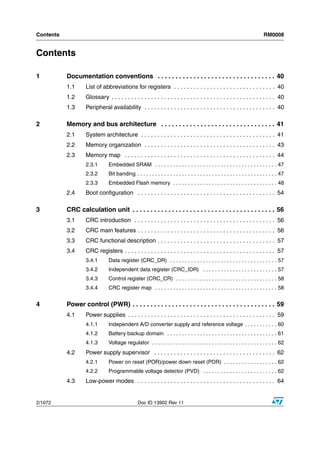
Contents

1          Documentation conventions . . . . . . . . . . . . . . . . . . . . . . . . . . . . . . . . . 40
           1.1      List of abbreviations for registers . . . . . . . . . . . . . . . . . . . . . . . . . . . . . . . 40
           1.2      Glossary . . . . . . . . . . . . . . . . . . . . . . . . . . . . . . . . . . . . . . . . . . . . . . . . . . 40
           1.3      Peripheral availability . . . . . . . . . . . . . . . . . . . . . . . . . . . . . . . . . . . . . . . . 40

2          Memory and bus architecture . . . . . . . . . . . . . . . . . . . . . . . . . . . . . . . . 41
           2.1      System architecture . . . . . . . . . . . . . . . . . . . . . . . . . . . . . . . . . . . . . . . . . 41
           2.2      Memory organization . . . . . . . . . . . . . . . . . . . . . . . . . . . . . . . . . . . . . . . . 43
           2.3      Memory map . . . . . . . . . . . . . . . . . . . . . . . . . . . . . . . . . . . . . . . . . . . . . . 44
                    2.3.1       Embedded SRAM . . . . . . . . . . . . . . . . . . . . . . . . . . . . . . . . . . . . . . . . . 47
                    2.3.2       Bit banding . . . . . . . . . . . . . . . . . . . . . . . . . . . . . . . . . . . . . . . . . . . . . . . 47
                    2.3.3       Embedded Flash memory . . . . . . . . . . . . . . . . . . . . . . . . . . . . . . . . . . . 48
           2.4      Boot configuration . . . . . . . . . . . . . . . . . . . . . . . . . . . . . . . . . . . . . . . . . . 54

3          CRC calculation unit . . . . . . . . . . . . . . . . . . . . . . . . . . . . . . . . . . . . . . . . 56
           3.1      CRC introduction . . . . . . . . . . . . . . . . . . . . . . . . . . . . . . . . . . . . . . . . . . . 56
           3.2      CRC main features . . . . . . . . . . . . . . . . . . . . . . . . . . . . . . . . . . . . . . . . . . 56
           3.3      CRC functional description . . . . . . . . . . . . . . . . . . . . . . . . . . . . . . . . . . . . 57
           3.4      CRC registers . . . . . . . . . . . . . . . . . . . . . . . . . . . . . . . . . . . . . . . . . . . . . . 57
                    3.4.1       Data register (CRC_DR) . . . . . . . . . . . . . . . . . . . . . . . . . . . . . . . . . . . . 57
                    3.4.2       Independent data register (CRC_IDR) . . . . . . . . . . . . . . . . . . . . . . . . . 57
                    3.4.3       Control register (CRC_CR) . . . . . . . . . . . . . . . . . . . . . . . . . . . . . . . . . . 58
                    3.4.4       CRC register map . . . . . . . . . . . . . . . . . . . . . . . . . . . . . . . . . . . . . . . . . 58


4          Power control (PWR) . . . . . . . . . . . . . . . . . . . . . . . . . . . . . . . . . . . . . . . . 59
           4.1      Power supplies . . . . . . . . . . . . . . . . . . . . . . . . . . . . . . . . . . . . . . . . . . . . . 59
                    4.1.1       Independent A/D converter supply and reference voltage . . . . . . . . . . . 60
                    4.1.2       Battery backup domain . . . . . . . . . . . . . . . . . . . . . . . . . . . . . . . . . . . . . 61
                    4.1.3       Voltage regulator . . . . . . . . . . . . . . . . . . . . . . . . . . . . . . . . . . . . . . . . . . 62
           4.2      Power supply supervisor . . . . . . . . . . . . . . . . . . . . . . . . . . . . . . . . . . . . . 62
                    4.2.1       Power on reset (POR)/power down reset (PDR) . . . . . . . . . . . . . . . . . . 62
                    4.2.2       Programmable voltage detector (PVD) . . . . . . . . . . . . . . . . . . . . . . . . . 62
           4.3      Low-power modes . . . . . . . . . . . . . . . . . . . . . . . . . . . . . . . . . . . . . . . . . . 64


2/1072                                           Doc ID 13902 Rev 11
RM0008                                                                                                                        Contents


                  4.3.1        Slowing down system clocks . . . . . . . . . . . . . . . . . . . . . . . . . . . . . . . . . 64
                  4.3.2        Peripheral clock gating . . . . . . . . . . . . . . . . . . . . . . . . . . . . . . . . . . . . . . 65
                  4.3.3        Sleep mode . . . . . . . . . . . . . . . . . . . . . . . . . . . . . . . . . . . . . . . . . . . . . . 65
                  4.3.4        Stop mode . . . . . . . . . . . . . . . . . . . . . . . . . . . . . . . . . . . . . . . . . . . . . . . 66
                  4.3.5        Standby mode . . . . . . . . . . . . . . . . . . . . . . . . . . . . . . . . . . . . . . . . . . . . 67
                  4.3.6        Auto-wakeup (AWU) from low-power mode . . . . . . . . . . . . . . . . . . . . . . 69
         4.4      Power control registers . . . . . . . . . . . . . . . . . . . . . . . . . . . . . . . . . . . . . . . 69
                  4.4.1        Power control register (PWR_CR) . . . . . . . . . . . . . . . . . . . . . . . . . . . . . 69
                  4.4.2        Power control/status register (PWR_CSR) . . . . . . . . . . . . . . . . . . . . . . 71
                  4.4.3        PWR register map . . . . . . . . . . . . . . . . . . . . . . . . . . . . . . . . . . . . . . . . . 72


5        Backup registers (BKP) . . . . . . . . . . . . . . . . . . . . . . . . . . . . . . . . . . . . . 73
         5.1      BKP introduction . . . . . . . . . . . . . . . . . . . . . . . . . . . . . . . . . . . . . . . . . . . . 73
         5.2      BKP main features . . . . . . . . . . . . . . . . . . . . . . . . . . . . . . . . . . . . . . . . . . 73
         5.3      BKP functional description . . . . . . . . . . . . . . . . . . . . . . . . . . . . . . . . . . . . 74
                  5.3.1        Tamper detection . . . . . . . . . . . . . . . . . . . . . . . . . . . . . . . . . . . . . . . . . . 74
                  5.3.2        RTC calibration . . . . . . . . . . . . . . . . . . . . . . . . . . . . . . . . . . . . . . . . . . . 74
         5.4      BKP registers . . . . . . . . . . . . . . . . . . . . . . . . . . . . . . . . . . . . . . . . . . . . . . 75
                  5.4.1        Backup data register x (BKP_DRx) (x = 1 ..42) . . . . . . . . . . . . . . . . . . . 75
                  5.4.2        RTC clock calibration register (BKP_RTCCR) . . . . . . . . . . . . . . . . . . . . 75
                  5.4.3        Backup control register (BKP_CR) . . . . . . . . . . . . . . . . . . . . . . . . . . . . 76
                  5.4.4        Backup control/status register (BKP_CSR) . . . . . . . . . . . . . . . . . . . . . . 76
                  5.4.5        BKP register map . . . . . . . . . . . . . . . . . . . . . . . . . . . . . . . . . . . . . . . . . . 77


6        Low-, medium-, high- and XL-density reset and clock
         control (RCC) . . . . . . . . . . . . . . . . . . . . . . . . . . . . . . . . . . . . . . . . . . . . . . 81
         6.1      Reset . . . . . . . . . . . . . . . . . . . . . . . . . . . . . . . . . . . . . . . . . . . . . . . . . . . . 81
                  6.1.1        System reset . . . . . . . . . . . . . . . . . . . . . . . . . . . . . . . . . . . . . . . . . . . . . 81
                  6.1.2        Power reset . . . . . . . . . . . . . . . . . . . . . . . . . . . . . . . . . . . . . . . . . . . . . . 82
                  6.1.3        Backup domain reset . . . . . . . . . . . . . . . . . . . . . . . . . . . . . . . . . . . . . . . 82
         6.2      Clocks . . . . . . . . . . . . . . . . . . . . . . . . . . . . . . . . . . . . . . . . . . . . . . . . . . . . 83
                  6.2.1        HSE clock . . . . . . . . . . . . . . . . . . . . . . . . . . . . . . . . . . . . . . . . . . . . . . . 85
                  6.2.2        HSI clock . . . . . . . . . . . . . . . . . . . . . . . . . . . . . . . . . . . . . . . . . . . . . . . . 86
                  6.2.3        PLL . . . . . . . . . . . . . . . . . . . . . . . . . . . . . . . . . . . . . . . . . . . . . . . . . . . . 86
                  6.2.4        LSE clock . . . . . . . . . . . . . . . . . . . . . . . . . . . . . . . . . . . . . . . . . . . . . . . . 87
                  6.2.5        LSI clock . . . . . . . . . . . . . . . . . . . . . . . . . . . . . . . . . . . . . . . . . . . . . . . . 87
                  6.2.6        System clock (SYSCLK) selection . . . . . . . . . . . . . . . . . . . . . . . . . . . . . 88


                                                Doc ID 13902 Rev 11                                                                3/1072
Contents                                                                                                                      RM0008


                 6.2.7       Clock security system (CSS) . . . . . . . . . . . . . . . . . . . . . . . . . . . . . . . . . 88
                 6.2.8       RTC clock . . . . . . . . . . . . . . . . . . . . . . . . . . . . . . . . . . . . . . . . . . . . . . . 88
                 6.2.9       Watchdog clock . . . . . . . . . . . . . . . . . . . . . . . . . . . . . . . . . . . . . . . . . . . 89
                 6.2.10      Clock-out capability . . . . . . . . . . . . . . . . . . . . . . . . . . . . . . . . . . . . . . . . 89
           6.3   RCC registers . . . . . . . . . . . . . . . . . . . . . . . . . . . . . . . . . . . . . . . . . . . . . . 89
                 6.3.1       Clock control register (RCC_CR) . . . . . . . . . . . . . . . . . . . . . . . . . . . . . . 90
                 6.3.2       Clock configuration register (RCC_CFGR) . . . . . . . . . . . . . . . . . . . . . . 92
                 6.3.3       Clock interrupt register (RCC_CIR) . . . . . . . . . . . . . . . . . . . . . . . . . . . . 95
                 6.3.4       APB2 peripheral reset register (RCC_APB2RSTR) . . . . . . . . . . . . . . . 97
                 6.3.5       APB1 peripheral reset register (RCC_APB1RSTR) . . . . . . . . . . . . . . . 99
                 6.3.6       AHB peripheral clock enable register (RCC_AHBENR) . . . . . . . . . . . 102
                 6.3.7       APB2 peripheral clock enable register (RCC_APB2ENR) . . . . . . . . . . 103
                 6.3.8       APB1 peripheral clock enable register (RCC_APB1ENR) . . . . . . . . . . 105
                 6.3.9       Backup domain control register (RCC_BDCR) . . . . . . . . . . . . . . . . . . 108
                 6.3.10      Control/status register (RCC_CSR) . . . . . . . . . . . . . . . . . . . . . . . . . . . 109
                 6.3.11      RCC register map . . . . . . . . . . . . . . . . . . . . . . . . . . . . . . . . . . . . . . . . 111


7          Connectivity line devices: reset and clock control (RCC) . . . . . . . . . 112
           7.1   Reset . . . . . . . . . . . . . . . . . . . . . . . . . . . . . . . . . . . . . . . . . . . . . . . . . . . 112
                 7.1.1       System reset . . . . . . . . . . . . . . . . . . . . . . . . . . . . . . . . . . . . . . . . . . . . 112
                 7.1.2       Power reset . . . . . . . . . . . . . . . . . . . . . . . . . . . . . . . . . . . . . . . . . . . . . 113
                 7.1.3       Backup domain reset . . . . . . . . . . . . . . . . . . . . . . . . . . . . . . . . . . . . . . 114
           7.2   Clocks . . . . . . . . . . . . . . . . . . . . . . . . . . . . . . . . . . . . . . . . . . . . . . . . . . . 114
                 7.2.1       HSE clock . . . . . . . . . . . . . . . . . . . . . . . . . . . . . . . . . . . . . . . . . . . . . . 116
                 7.2.2       HSI clock . . . . . . . . . . . . . . . . . . . . . . . . . . . . . . . . . . . . . . . . . . . . . . . 117
                 7.2.3       PLLs . . . . . . . . . . . . . . . . . . . . . . . . . . . . . . . . . . . . . . . . . . . . . . . . . . . 118
                 7.2.4       LSE clock . . . . . . . . . . . . . . . . . . . . . . . . . . . . . . . . . . . . . . . . . . . . . . . 118
                 7.2.5       LSI clock . . . . . . . . . . . . . . . . . . . . . . . . . . . . . . . . . . . . . . . . . . . . . . . 119
                 7.2.6       System clock (SYSCLK) selection . . . . . . . . . . . . . . . . . . . . . . . . . . . . 119
                 7.2.7       Clock security system (CSS) . . . . . . . . . . . . . . . . . . . . . . . . . . . . . . . . 120
                 7.2.8       RTC clock . . . . . . . . . . . . . . . . . . . . . . . . . . . . . . . . . . . . . . . . . . . . . . 120
                 7.2.9       Watchdog clock . . . . . . . . . . . . . . . . . . . . . . . . . . . . . . . . . . . . . . . . . . 120
                 7.2.10      Clock-out capability . . . . . . . . . . . . . . . . . . . . . . . . . . . . . . . . . . . . . . . 121
           7.3   RCC registers . . . . . . . . . . . . . . . . . . . . . . . . . . . . . . . . . . . . . . . . . . . . . 121
                 7.3.1       Clock control register (RCC_CR) . . . . . . . . . . . . . . . . . . . . . . . . . . . . . 121
                 7.3.2       Clock configuration register (RCC_CFGR) . . . . . . . . . . . . . . . . . . . . . 123
                 7.3.3       Clock interrupt register (RCC_CIR) . . . . . . . . . . . . . . . . . . . . . . . . . . . 126


4/1072                                         Doc ID 13902 Rev 11
RM0008                                                                                                              Contents


               7.3.4       APB2 peripheral reset register (RCC_APB2RSTR) . . . . . . . . . . . . . . 129
               7.3.5       APB1 peripheral reset register (RCC_APB1RSTR) . . . . . . . . . . . . . . 130
               7.3.6       AHB Peripheral Clock enable register (RCC_AHBENR) . . . . . . . . . . . 133
               7.3.7       APB2 peripheral clock enable register (RCC_APB2ENR) . . . . . . . . . . 134
               7.3.8       APB1 peripheral clock enable register (RCC_APB1ENR) . . . . . . . . . . 136
               7.3.9       Backup domain control register (RCC_BDCR) . . . . . . . . . . . . . . . . . . 138
               7.3.10      Control/status register (RCC_CSR) . . . . . . . . . . . . . . . . . . . . . . . . . . . 140
               7.3.11      AHB peripheral clock reset register (RCC_AHBRSTR) . . . . . . . . . . . . 141
               7.3.12      Clock configuration register2 (RCC_CFGR2) . . . . . . . . . . . . . . . . . . . 142
               7.3.13      RCC register map . . . . . . . . . . . . . . . . . . . . . . . . . . . . . . . . . . . . . . . . 144


8        General-purpose and alternate-function I/Os (GPIOs and AFIOs) . . 146
         8.1   GPIO functional description . . . . . . . . . . . . . . . . . . . . . . . . . . . . . . . . . . 146
               8.1.1       General-purpose I/O (GPIO) . . . . . . . . . . . . . . . . . . . . . . . . . . . . . . . . 148
               8.1.2       Atomic bit set or reset . . . . . . . . . . . . . . . . . . . . . . . . . . . . . . . . . . . . . 148
               8.1.3       External interrupt/wakeup lines . . . . . . . . . . . . . . . . . . . . . . . . . . . . . . 149
               8.1.4       Alternate functions (AF) . . . . . . . . . . . . . . . . . . . . . . . . . . . . . . . . . . . . 149
               8.1.5       Software remapping of I/O alternate functions . . . . . . . . . . . . . . . . . . 149
               8.1.6       GPIO locking mechanism . . . . . . . . . . . . . . . . . . . . . . . . . . . . . . . . . . 149
               8.1.7       Input configuration . . . . . . . . . . . . . . . . . . . . . . . . . . . . . . . . . . . . . . . . 150
               8.1.8       Output configuration . . . . . . . . . . . . . . . . . . . . . . . . . . . . . . . . . . . . . . 150
               8.1.9       Alternate function configuration . . . . . . . . . . . . . . . . . . . . . . . . . . . . . . 151
               8.1.10      Analog configuration . . . . . . . . . . . . . . . . . . . . . . . . . . . . . . . . . . . . . . 152
               8.1.11      Peripherals’ GPIO configurations . . . . . . . . . . . . . . . . . . . . . . . . . . . . . 153
         8.2   GPIO registers . . . . . . . . . . . . . . . . . . . . . . . . . . . . . . . . . . . . . . . . . . . . 157
               8.2.1       Port configuration register low (GPIOx_CRL) (x=A..G) . . . . . . . . . . . . 157
               8.2.2       Port configuration register high (GPIOx_CRH) (x=A..G) . . . . . . . . . . . 158
               8.2.3       Port input data register (GPIOx_IDR) (x=A..G) . . . . . . . . . . . . . . . . . . 158
               8.2.4       Port output data register (GPIOx_ODR) (x=A..G) . . . . . . . . . . . . . . . . 159
               8.2.5       Port bit set/reset register (GPIOx_BSRR) (x=A..G) . . . . . . . . . . . . . . . 159
               8.2.6       Port bit reset register (GPIOx_BRR) (x=A..G) . . . . . . . . . . . . . . . . . . . 160
               8.2.7       Port configuration lock register (GPIOx_LCKR) (x=A..G) . . . . . . . . . . 160
         8.3   Alternate function I/O and debug configuration (AFIO) . . . . . . . . . . . . . 161
               8.3.1       Using OSC32_IN/OSC32_OUT pins as GPIO ports PC14/PC15 . . . . 161
               8.3.2       Using OSC_IN/OSC_OUT pins as GPIO ports PD0/PD1 . . . . . . . . . . 161
               8.3.3       CAN1 alternate function remapping . . . . . . . . . . . . . . . . . . . . . . . . . . . 162
               8.3.4       CAN2 alternate function remapping . . . . . . . . . . . . . . . . . . . . . . . . . . . 162


                                           Doc ID 13902 Rev 11                                                           5/1072
Contents                                                                                                                   RM0008


                   8.3.5       JTAG/SWD alternate function remapping . . . . . . . . . . . . . . . . . . . . . . 162
                   8.3.6       ADC alternate function remapping . . . . . . . . . . . . . . . . . . . . . . . . . . . . 163
                   8.3.7       Timer alternate function remapping . . . . . . . . . . . . . . . . . . . . . . . . . . . 164
                   8.3.8       USART alternate function remapping . . . . . . . . . . . . . . . . . . . . . . . . . 166
                   8.3.9       I2C1 alternate function remapping . . . . . . . . . . . . . . . . . . . . . . . . . . . . 167
                   8.3.10      SPI1 alternate function remapping . . . . . . . . . . . . . . . . . . . . . . . . . . . 167
                   8.3.11      SPI3/I2S3 alternate function remapping . . . . . . . . . . . . . . . . . . . . . . . 167
                   8.3.12      Ethernet alternate function remapping . . . . . . . . . . . . . . . . . . . . . . . . 167
           8.4     AFIO registers . . . . . . . . . . . . . . . . . . . . . . . . . . . . . . . . . . . . . . . . . . . . 168
                   8.4.1       Event control register (AFIO_EVCR) . . . . . . . . . . . . . . . . . . . . . . . . . . 169
                   8.4.2       AF remap and debug I/O configuration register (AFIO_MAPR) . . . . . . 170
                   8.4.3       External interrupt configuration register 1 (AFIO_EXTICR1) . . . . . . . . 176
                   8.4.4       External interrupt configuration register 2 (AFIO_EXTICR2) . . . . . . . . 176
                   8.4.5       External interrupt configuration register 3 (AFIO_EXTICR3) . . . . . . . . 177
                   8.4.6       External interrupt configuration register 4 (AFIO_EXTICR4) . . . . . . . . 177
                   8.4.7       AF remap and debug I/O configuration register2 (AFIO_MAPR2) . . . . 178
           8.5     GPIO and AFIO register maps . . . . . . . . . . . . . . . . . . . . . . . . . . . . . . . . 179

9          Interrupts and events . . . . . . . . . . . . . . . . . . . . . . . . . . . . . . . . . . . . . . 181
           9.1     Nested vectored interrupt controller (NVIC) . . . . . . . . . . . . . . . . . . . . . . 181
                   9.1.1       SysTick calibration value register . . . . . . . . . . . . . . . . . . . . . . . . . . . . 181
                   9.1.2       Interrupt and exception vectors . . . . . . . . . . . . . . . . . . . . . . . . . . . . . . 181
           9.2     External interrupt/event controller (EXTI) . . . . . . . . . . . . . . . . . . . . . . . . 189
                   9.2.1       Main features . . . . . . . . . . . . . . . . . . . . . . . . . . . . . . . . . . . . . . . . . . . . 189
                   9.2.2       Block diagram . . . . . . . . . . . . . . . . . . . . . . . . . . . . . . . . . . . . . . . . . . . 189
                   9.2.3       Wakeup event management . . . . . . . . . . . . . . . . . . . . . . . . . . . . . . . . 190
                   9.2.4       Functional description . . . . . . . . . . . . . . . . . . . . . . . . . . . . . . . . . . . . . 190
                   9.2.5       External interrupt/event line mapping . . . . . . . . . . . . . . . . . . . . . . . . . 191
           9.3     EXTI registers . . . . . . . . . . . . . . . . . . . . . . . . . . . . . . . . . . . . . . . . . . . . . 193
                   9.3.1       Interrupt mask register (EXTI_IMR) . . . . . . . . . . . . . . . . . . . . . . . . . . . 193
                   9.3.2       Event mask register (EXTI_EMR) . . . . . . . . . . . . . . . . . . . . . . . . . . . . 193
                   9.3.3       Rising trigger selection register (EXTI_RTSR) . . . . . . . . . . . . . . . . . . 194
                   9.3.4       Falling trigger selection register (EXTI_FTSR) . . . . . . . . . . . . . . . . . . 194
                   9.3.5       Software interrupt event register (EXTI_SWIER) . . . . . . . . . . . . . . . . . 195
                   9.3.6       Pending register (EXTI_PR) . . . . . . . . . . . . . . . . . . . . . . . . . . . . . . . . 195
                   9.3.7       EXTI register map . . . . . . . . . . . . . . . . . . . . . . . . . . . . . . . . . . . . . . . . 196


6/1072                                          Doc ID 13902 Rev 11
RM0008                                                                                                                     Contents


10       DMA controller (DMA) . . . . . . . . . . . . . . . . . . . . . . . . . . . . . . . . . . . . . . 197
         10.1    DMA introduction . . . . . . . . . . . . . . . . . . . . . . . . . . . . . . . . . . . . . . . . . . 197
         10.2    DMA main features . . . . . . . . . . . . . . . . . . . . . . . . . . . . . . . . . . . . . . . . . 197
         10.3    DMA functional description . . . . . . . . . . . . . . . . . . . . . . . . . . . . . . . . . . 199
                 10.3.1      DMA transactions . . . . . . . . . . . . . . . . . . . . . . . . . . . . . . . . . . . . . . . . 199
                 10.3.2      Arbiter . . . . . . . . . . . . . . . . . . . . . . . . . . . . . . . . . . . . . . . . . . . . . . . . . 200
                 10.3.3      DMA channels . . . . . . . . . . . . . . . . . . . . . . . . . . . . . . . . . . . . . . . . . . . 200
                 10.3.4      Programmable data width, data alignment and endians . . . . . . . . . . . 202
                 10.3.5      Error management . . . . . . . . . . . . . . . . . . . . . . . . . . . . . . . . . . . . . . . . 203
                 10.3.6      Interrupts . . . . . . . . . . . . . . . . . . . . . . . . . . . . . . . . . . . . . . . . . . . . . . . 203
                 10.3.7      DMA request mapping . . . . . . . . . . . . . . . . . . . . . . . . . . . . . . . . . . . . . 204
         10.4    DMA registers . . . . . . . . . . . . . . . . . . . . . . . . . . . . . . . . . . . . . . . . . . . . . 207
                 10.4.1      DMA interrupt status register (DMA_ISR) . . . . . . . . . . . . . . . . . . . . . . 207
                 10.4.2      DMA interrupt flag clear register (DMA_IFCR) . . . . . . . . . . . . . . . . . . 208
                 10.4.3      DMA channel x configuration register (DMA_CCRx) (x = 1..7,
                             where x = channel number) . . . . . . . . . . . . . . . . . . . . . . . . . . . . . . . . . 209
                 10.4.4      DMA channel x number of data register (DMA_CNDTRx) (x = 1..7),
                             where x = channel number) . . . . . . . . . . . . . . . . . . . . . . . . . . . . . . . . . 210
                 10.4.5      DMA channel x peripheral address register (DMA_CPARx) (x = 1..7),
                             where x = channel number) . . . . . . . . . . . . . . . . . . . . . . . . . . . . . . . . . 211
                 10.4.6      DMA channel x memory address register (DMA_CMARx) (x = 1..7),
                             where x = channel number) . . . . . . . . . . . . . . . . . . . . . . . . . . . . . . . . . 211
                 10.4.7      DMA register map . . . . . . . . . . . . . . . . . . . . . . . . . . . . . . . . . . . . . . . . 212


11       Analog-to-digital converter (ADC) . . . . . . . . . . . . . . . . . . . . . . . . . . . . 214
         11.1    ADC introduction . . . . . . . . . . . . . . . . . . . . . . . . . . . . . . . . . . . . . . . . . . 214
         11.2    ADC main features . . . . . . . . . . . . . . . . . . . . . . . . . . . . . . . . . . . . . . . . . 215
         11.3    ADC functional description . . . . . . . . . . . . . . . . . . . . . . . . . . . . . . . . . . . 215
                 11.3.1      ADC on-off control . . . . . . . . . . . . . . . . . . . . . . . . . . . . . . . . . . . . . . . . 217
                 11.3.2      ADC clock . . . . . . . . . . . . . . . . . . . . . . . . . . . . . . . . . . . . . . . . . . . . . . 217
                 11.3.3      Channel selection . . . . . . . . . . . . . . . . . . . . . . . . . . . . . . . . . . . . . . . . 217
                 11.3.4      Single conversion mode . . . . . . . . . . . . . . . . . . . . . . . . . . . . . . . . . . . . 218
                 11.3.5      Continuous conversion mode . . . . . . . . . . . . . . . . . . . . . . . . . . . . . . . 218
                 11.3.6      Timing diagram . . . . . . . . . . . . . . . . . . . . . . . . . . . . . . . . . . . . . . . . . . 218
                 11.3.7      Analog watchdog . . . . . . . . . . . . . . . . . . . . . . . . . . . . . . . . . . . . . . . . . 219
                 11.3.8      Scan mode . . . . . . . . . . . . . . . . . . . . . . . . . . . . . . . . . . . . . . . . . . . . . . 220
                 11.3.9      Injected channel management . . . . . . . . . . . . . . . . . . . . . . . . . . . . . . . 220


                                              Doc ID 13902 Rev 11                                                               7/1072
Contents                                                                                                                RM0008


                    11.3.10 Discontinuous mode . . . . . . . . . . . . . . . . . . . . . . . . . . . . . . . . . . . . . . 221
           11.4     Calibration . . . . . . . . . . . . . . . . . . . . . . . . . . . . . . . . . . . . . . . . . . . . . . . 222
           11.5     Data alignment . . . . . . . . . . . . . . . . . . . . . . . . . . . . . . . . . . . . . . . . . . . . 222
           11.6     Channel-by-channel programmable sample time . . . . . . . . . . . . . . . . . . 223
           11.7     Conversion on external trigger . . . . . . . . . . . . . . . . . . . . . . . . . . . . . . . . 223
           11.8     DMA request . . . . . . . . . . . . . . . . . . . . . . . . . . . . . . . . . . . . . . . . . . . . . 225
           11.9     Dual ADC mode . . . . . . . . . . . . . . . . . . . . . . . . . . . . . . . . . . . . . . . . . . . 226
                    11.9.1      Injected simultaneous mode . . . . . . . . . . . . . . . . . . . . . . . . . . . . . . . . 228
                    11.9.2      Regular simultaneous mode . . . . . . . . . . . . . . . . . . . . . . . . . . . . . . . . 228
                    11.9.3      Fast interleaved mode . . . . . . . . . . . . . . . . . . . . . . . . . . . . . . . . . . . . . 229
                    11.9.4      Slow interleaved mode . . . . . . . . . . . . . . . . . . . . . . . . . . . . . . . . . . . . . 229
                    11.9.5      Alternate trigger mode . . . . . . . . . . . . . . . . . . . . . . . . . . . . . . . . . . . . . 230
                    11.9.6      Independent mode . . . . . . . . . . . . . . . . . . . . . . . . . . . . . . . . . . . . . . . . 231
                    11.9.7      Combined regular/injected simultaneous mode . . . . . . . . . . . . . . . . . . 231
                    11.9.8      Combined regular simultaneous + alternate trigger mode . . . . . . . . . . 231
                    11.9.9      Combined injected simultaneous + interleaved . . . . . . . . . . . . . . . . . . 232
           11.10 Temperature sensor . . . . . . . . . . . . . . . . . . . . . . . . . . . . . . . . . . . . . . . . 233
           11.11 ADC interrupts . . . . . . . . . . . . . . . . . . . . . . . . . . . . . . . . . . . . . . . . . . . . 234
           11.12 ADC registers . . . . . . . . . . . . . . . . . . . . . . . . . . . . . . . . . . . . . . . . . . . . . 235
                    11.12.1 ADC status register (ADC_SR) . . . . . . . . . . . . . . . . . . . . . . . . . . . . . . 235
                    11.12.2 ADC control register 1 (ADC_CR1) . . . . . . . . . . . . . . . . . . . . . . . . . . . 236
                    11.12.3 ADC control register 2 (ADC_CR2) . . . . . . . . . . . . . . . . . . . . . . . . . . . 238
                    11.12.4 ADC sample time register 1 (ADC_SMPR1) . . . . . . . . . . . . . . . . . . . . 241
                    11.12.5 ADC sample time register 2 (ADC_SMPR2) . . . . . . . . . . . . . . . . . . . . 242
                    11.12.6 ADC injected channel data offset register x (ADC_JOFRx)(x=1..4) . . 242
                    11.12.7 ADC watchdog high threshold register (ADC_HTR) . . . . . . . . . . . . . . 243
                    11.12.8 ADC watchdog low threshold register (ADC_LTR) . . . . . . . . . . . . . . . 243
                    11.12.9 ADC regular sequence register 1 (ADC_SQR1) . . . . . . . . . . . . . . . . . 244
                    11.12.10 ADC regular sequence register 2 (ADC_SQR2) . . . . . . . . . . . . . . . . . 244
                    11.12.11 ADC regular sequence register 3 (ADC_SQR3) . . . . . . . . . . . . . . . . . 245
                    11.12.12 ADC injected sequence register (ADC_JSQR) . . . . . . . . . . . . . . . . . . 246
                    11.12.13 ADC injected data register x (ADC_JDRx) (x= 1..4) . . . . . . . . . . . . . . 246
                    11.12.14 ADC regular data register (ADC_DR) . . . . . . . . . . . . . . . . . . . . . . . . . 247
                    11.12.15 ADC register map . . . . . . . . . . . . . . . . . . . . . . . . . . . . . . . . . . . . . . . . 247


12         Digital-to-analog converter (DAC) . . . . . . . . . . . . . . . . . . . . . . . . . . . . 249


8/1072                                          Doc ID 13902 Rev 11
RM0008                                                                                                               Contents


         12.1   DAC introduction . . . . . . . . . . . . . . . . . . . . . . . . . . . . . . . . . . . . . . . . . . 249
         12.2   DAC main features . . . . . . . . . . . . . . . . . . . . . . . . . . . . . . . . . . . . . . . . . 249
         12.3   DAC functional description . . . . . . . . . . . . . . . . . . . . . . . . . . . . . . . . . . . 251
                12.3.1      DAC channel enable . . . . . . . . . . . . . . . . . . . . . . . . . . . . . . . . . . . . . . 251
                12.3.2      DAC output buffer enable . . . . . . . . . . . . . . . . . . . . . . . . . . . . . . . . . . . 251
                12.3.3      DAC data format . . . . . . . . . . . . . . . . . . . . . . . . . . . . . . . . . . . . . . . . . 251
                12.3.4      DAC conversion . . . . . . . . . . . . . . . . . . . . . . . . . . . . . . . . . . . . . . . . . . 252
                12.3.5      DAC output voltage . . . . . . . . . . . . . . . . . . . . . . . . . . . . . . . . . . . . . . . 253
                12.3.6      DAC trigger selection . . . . . . . . . . . . . . . . . . . . . . . . . . . . . . . . . . . . . . 253
                12.3.7      DMA request . . . . . . . . . . . . . . . . . . . . . . . . . . . . . . . . . . . . . . . . . . . . 254
                12.3.8      Noise generation . . . . . . . . . . . . . . . . . . . . . . . . . . . . . . . . . . . . . . . . . 254
                12.3.9      Triangle-wave generation . . . . . . . . . . . . . . . . . . . . . . . . . . . . . . . . . . . 255
         12.4   Dual DAC channel conversion . . . . . . . . . . . . . . . . . . . . . . . . . . . . . . . . 256
                12.4.1      Independent trigger without wave generation . . . . . . . . . . . . . . . . . . . 256
                12.4.2      Independent trigger with same LFSR generation . . . . . . . . . . . . . . . . 257
                12.4.3      Independent trigger with different LFSR generation . . . . . . . . . . . . . . 257
                12.4.4      Independent trigger with same triangle generation . . . . . . . . . . . . . . . 257
                12.4.5      Independent trigger with different triangle generation . . . . . . . . . . . . . 258
                12.4.6      Simultaneous software start . . . . . . . . . . . . . . . . . . . . . . . . . . . . . . . . 258
                12.4.7      Simultaneous trigger without wave generation . . . . . . . . . . . . . . . . . . 258
                12.4.8      Simultaneous trigger with same LFSR generation . . . . . . . . . . . . . . . 259
                12.4.9      Simultaneous trigger with different LFSR generation . . . . . . . . . . . . . 259
                12.4.10 Simultaneous trigger with same triangle generation . . . . . . . . . . . . . . 259
                12.4.11 Simultaneous trigger with different triangle generation . . . . . . . . . . . . 260
         12.5   DAC registers . . . . . . . . . . . . . . . . . . . . . . . . . . . . . . . . . . . . . . . . . . . . . 260
                12.5.1      DAC control register (DAC_CR) . . . . . . . . . . . . . . . . . . . . . . . . . . . . . . 260
                12.5.2      DAC software trigger register (DAC_SWTRIGR) . . . . . . . . . . . . . . . . . 263
                12.5.3      DAC channel1 12-bit right-aligned data holding register
                            (DAC_DHR12R1) . . . . . . . . . . . . . . . . . . . . . . . . . . . . . . . . . . . . . . . . . 264
                12.5.4      DAC channel1 12-bit left aligned data holding register
                            (DAC_DHR12L1) . . . . . . . . . . . . . . . . . . . . . . . . . . . . . . . . . . . . . . . . . 264
                12.5.5      DAC channel1 8-bit right aligned data holding register
                            (DAC_DHR8R1) . . . . . . . . . . . . . . . . . . . . . . . . . . . . . . . . . . . . . . . . . . 264
                12.5.6      DAC channel2 12-bit right aligned data holding register
                            (DAC_DHR12R2) . . . . . . . . . . . . . . . . . . . . . . . . . . . . . . . . . . . . . . . . . 265
                12.5.7      DAC channel2 12-bit left aligned data holding register
                            (DAC_DHR12L2) . . . . . . . . . . . . . . . . . . . . . . . . . . . . . . . . . . . . . . . . . 265


                                            Doc ID 13902 Rev 11                                                           9/1072
Contents                                                                                                                  RM0008


                  12.5.8      DAC channel2 8-bit right-aligned data holding register
                              (DAC_DHR8R2) . . . . . . . . . . . . . . . . . . . . . . . . . . . . . . . . . . . . . . . . . . 265
                  12.5.9      Dual DAC 12-bit right-aligned data holding register
                              (DAC_DHR12RD) . . . . . . . . . . . . . . . . . . . . . . . . . . . . . . . . . . . . . . . . 266
                  12.5.10 DUAL DAC 12-bit left aligned data holding register
                          (DAC_DHR12LD) . . . . . . . . . . . . . . . . . . . . . . . . . . . . . . . . . . . . . . . . . 266
                  12.5.11 DUAL DAC 8-bit right aligned data holding register
                          (DAC_DHR8RD) . . . . . . . . . . . . . . . . . . . . . . . . . . . . . . . . . . . . . . . . . 267
                  12.5.12 DAC channel1 data output register (DAC_DOR1) . . . . . . . . . . . . . . . . 267
                  12.5.13 DAC channel2 data output register (DAC_DOR2) . . . . . . . . . . . . . . . . 267
                  12.5.14 DAC register map . . . . . . . . . . . . . . . . . . . . . . . . . . . . . . . . . . . . . . . . 268


13         Advanced-control timers (TIM1&TIM8) . . . . . . . . . . . . . . . . . . . . . . . . 269
           13.1   TIM1&TIM8 introduction . . . . . . . . . . . . . . . . . . . . . . . . . . . . . . . . . . . . . 269
           13.2   TIM1&TIM8 main features . . . . . . . . . . . . . . . . . . . . . . . . . . . . . . . . . . . 270
           13.3   TIM1&TIM8 functional description . . . . . . . . . . . . . . . . . . . . . . . . . . . . . 272
                  13.3.1      Time-base unit . . . . . . . . . . . . . . . . . . . . . . . . . . . . . . . . . . . . . . . . . . . 272
                  13.3.2      Counter modes . . . . . . . . . . . . . . . . . . . . . . . . . . . . . . . . . . . . . . . . . . 273
                  13.3.3      Repetition counter . . . . . . . . . . . . . . . . . . . . . . . . . . . . . . . . . . . . . . . . 281
                  13.3.4      Clock selection . . . . . . . . . . . . . . . . . . . . . . . . . . . . . . . . . . . . . . . . . . . 283
                  13.3.5      Capture/compare channels . . . . . . . . . . . . . . . . . . . . . . . . . . . . . . . . . 285
                  13.3.6      Input capture mode . . . . . . . . . . . . . . . . . . . . . . . . . . . . . . . . . . . . . . . 287
                  13.3.7      PWM input mode . . . . . . . . . . . . . . . . . . . . . . . . . . . . . . . . . . . . . . . . . 288
                  13.3.8      Forced output mode . . . . . . . . . . . . . . . . . . . . . . . . . . . . . . . . . . . . . . . 289
                  13.3.9      Output compare mode . . . . . . . . . . . . . . . . . . . . . . . . . . . . . . . . . . . . . 290
                  13.3.10 PWM mode . . . . . . . . . . . . . . . . . . . . . . . . . . . . . . . . . . . . . . . . . . . . . 291
                  13.3.11 Complementary outputs and dead-time insertion . . . . . . . . . . . . . . . . 294
                  13.3.12 Using the break function . . . . . . . . . . . . . . . . . . . . . . . . . . . . . . . . . . . 295
                  13.3.13 Clearing the OCxREF signal on an external event . . . . . . . . . . . . . . . 298
                  13.3.14 6-step PWM generation . . . . . . . . . . . . . . . . . . . . . . . . . . . . . . . . . . . . 299
                  13.3.15 One-pulse mode . . . . . . . . . . . . . . . . . . . . . . . . . . . . . . . . . . . . . . . . . 300
                  13.3.16 Encoder interface mode . . . . . . . . . . . . . . . . . . . . . . . . . . . . . . . . . . . . 301
                  13.3.17 Timer input XOR function . . . . . . . . . . . . . . . . . . . . . . . . . . . . . . . . . . 304
                  13.3.18 Interfacing with Hall sensors . . . . . . . . . . . . . . . . . . . . . . . . . . . . . . . . 304
                  13.3.19 TIMx and external trigger synchronization . . . . . . . . . . . . . . . . . . . . . . 306
                  13.3.20 Timer synchronization . . . . . . . . . . . . . . . . . . . . . . . . . . . . . . . . . . . . . 309
                  13.3.21 Debug mode . . . . . . . . . . . . . . . . . . . . . . . . . . . . . . . . . . . . . . . . . . . . 309
           13.4   TIM1&TIM8 registers . . . . . . . . . . . . . . . . . . . . . . . . . . . . . . . . . . . . . . . 310


10/1072                                        Doc ID 13902 Rev 11
RM0008                                                                                                                 Contents


                13.4.1      TIM1&TIM8 control register 1 (TIMx_CR1) . . . . . . . . . . . . . . . . . . . . . 310
                13.4.2      TIM1&TIM8 control register 2 (TIMx_CR2) . . . . . . . . . . . . . . . . . . . . . 311
                13.4.3      TIM1&TIM8 slave mode control register (TIMx_SMCR) . . . . . . . . . . . 313
                13.4.4      TIM1&TIM8 DMA/interrupt enable register (TIMx_DIER) . . . . . . . . . . 315
                13.4.5      TIM1&TIM8 status register (TIMx_SR) . . . . . . . . . . . . . . . . . . . . . . . . 317
                13.4.6      TIM1&TIM8 event generation register (TIMx_EGR) . . . . . . . . . . . . . . 318
                13.4.7      TIM1&TIM8 capture/compare mode register 1 (TIMx_CCMR1) . . . . . 320
                13.4.8      TIM1&TIM8 capture/compare mode register 2 (TIMx_CCMR2) . . . . . 323
                13.4.9      TIM1&TIM8 capture/compare enable register (TIMx_CCER) . . . . . . . 324
                13.4.10 TIM1&TIM8 counter (TIMx_CNT) . . . . . . . . . . . . . . . . . . . . . . . . . . . . 327
                13.4.11 TIM1&TIM8 prescaler (TIMx_PSC) . . . . . . . . . . . . . . . . . . . . . . . . . . . 327
                13.4.12 TIM1&TIM8 auto-reload register (TIMx_ARR) . . . . . . . . . . . . . . . . . . . 327
                13.4.13 TIM1&TIM8 repetition counter register (TIMx_RCR) . . . . . . . . . . . . . . 328
                13.4.14 TIM1&TIM8 capture/compare register 1 (TIMx_CCR1) . . . . . . . . . . . . 328
                13.4.15 TIM1&TIM8 capture/compare register 2 (TIMx_CCR2) . . . . . . . . . . . . 329
                13.4.16 TIM1&TIM8 capture/compare register 3 (TIMx_CCR3) . . . . . . . . . . . . 329
                13.4.17 TIM1&TIM8 capture/compare register 4 (TIMx_CCR4) . . . . . . . . . . . . 330
                13.4.18 TIM1&TIM8 break and dead-time register (TIMx_BDTR) . . . . . . . . . . 330
                13.4.19 TIM1&TIM8 DMA control register (TIMx_DCR) . . . . . . . . . . . . . . . . . . 332
                13.4.20 TIM1&TIM8 DMA address for full transfer (TIMx_DMAR) . . . . . . . . . . 333
                13.4.21 TIM1&TIM8 register map . . . . . . . . . . . . . . . . . . . . . . . . . . . . . . . . . . . 333


14       General-purpose timer (TIM2 to TIM5) . . . . . . . . . . . . . . . . . . . . . . . . . 335
         14.1   TIM2 to TIM5 introduction . . . . . . . . . . . . . . . . . . . . . . . . . . . . . . . . . . . 335
         14.2   TIMx main features . . . . . . . . . . . . . . . . . . . . . . . . . . . . . . . . . . . . . . . . . 336
         14.3   TIMx functional description . . . . . . . . . . . . . . . . . . . . . . . . . . . . . . . . . . 337
                14.3.1      Time-base unit . . . . . . . . . . . . . . . . . . . . . . . . . . . . . . . . . . . . . . . . . . . 337
                14.3.2      Counter modes . . . . . . . . . . . . . . . . . . . . . . . . . . . . . . . . . . . . . . . . . . 339
                14.3.3      Clock selection . . . . . . . . . . . . . . . . . . . . . . . . . . . . . . . . . . . . . . . . . . . 347
                14.3.4      Capture/compare channels . . . . . . . . . . . . . . . . . . . . . . . . . . . . . . . . . 350
                14.3.5      Input capture mode . . . . . . . . . . . . . . . . . . . . . . . . . . . . . . . . . . . . . . . 352
                14.3.6      PWM input mode . . . . . . . . . . . . . . . . . . . . . . . . . . . . . . . . . . . . . . . . . 353
                14.3.7      Forced output mode . . . . . . . . . . . . . . . . . . . . . . . . . . . . . . . . . . . . . . . 354
                14.3.8      Output compare mode . . . . . . . . . . . . . . . . . . . . . . . . . . . . . . . . . . . . . 354
                14.3.9      PWM mode . . . . . . . . . . . . . . . . . . . . . . . . . . . . . . . . . . . . . . . . . . . . . 355
                14.3.10 One-pulse mode . . . . . . . . . . . . . . . . . . . . . . . . . . . . . . . . . . . . . . . . . 358
                14.3.11 Clearing the OCxREF signal on an external event . . . . . . . . . . . . . . . 359


                                             Doc ID 13902 Rev 11                                                          11/1072
Contents                                                                                                                  RM0008


                  14.3.12 Encoder interface mode . . . . . . . . . . . . . . . . . . . . . . . . . . . . . . . . . . . . 360
                  14.3.13 Timer input XOR function . . . . . . . . . . . . . . . . . . . . . . . . . . . . . . . . . . 362
                  14.3.14 Timers and external trigger synchronization . . . . . . . . . . . . . . . . . . . . 362
                  14.3.15 Timer synchronization . . . . . . . . . . . . . . . . . . . . . . . . . . . . . . . . . . . . . 365
                  14.3.16 Debug mode . . . . . . . . . . . . . . . . . . . . . . . . . . . . . . . . . . . . . . . . . . . . 370
           14.4   TIMx2 to TIM5 registers . . . . . . . . . . . . . . . . . . . . . . . . . . . . . . . . . . . . . 371
                  14.4.1      TIMx control register 1 (TIMx_CR1) . . . . . . . . . . . . . . . . . . . . . . . . . . 371
                  14.4.2      TIMx control register 2 (TIMx_CR2) . . . . . . . . . . . . . . . . . . . . . . . . . . 372
                  14.4.3      TIMx slave mode control register (TIMx_SMCR) . . . . . . . . . . . . . . . . . 373
                  14.4.4      TIMx DMA/Interrupt enable register (TIMx_DIER) . . . . . . . . . . . . . . . . 376
                  14.4.5      TIMx status register (TIMx_SR) . . . . . . . . . . . . . . . . . . . . . . . . . . . . . . 377
                  14.4.6      TIMx event generation register (TIMx_EGR) . . . . . . . . . . . . . . . . . . . . 378
                  14.4.7      TIMx capture/compare mode register 1 (TIMx_CCMR1) . . . . . . . . . . . 379
                  14.4.8      Capture/compare mode register 2 (TIMx_CCMR2) . . . . . . . . . . . . . . . 383
                  14.4.9      TIMx capture/compare enable register (TIMx_CCER) . . . . . . . . . . . . . 384
                  14.4.10 TIMx counter (TIMx_CNT) . . . . . . . . . . . . . . . . . . . . . . . . . . . . . . . . . . 385
                  14.4.11 TIMx prescaler (TIMx_PSC) . . . . . . . . . . . . . . . . . . . . . . . . . . . . . . . . 386
                  14.4.12 TIMx auto-reload register (TIMx_ARR) . . . . . . . . . . . . . . . . . . . . . . . . 386
                  14.4.13 TIMx capture/compare register 1 (TIMx_CCR1) . . . . . . . . . . . . . . . . . 386
                  14.4.14 TIMx capture/compare register 2 (TIMx_CCR2) . . . . . . . . . . . . . . . . . 387
                  14.4.15 TIMx capture/compare register 3 (TIMx_CCR3) . . . . . . . . . . . . . . . . . 387
                  14.4.16 TIMx capture/compare register 4 (TIMx_CCR4) . . . . . . . . . . . . . . . . . 388
                  14.4.17 TIMx DMA control register (TIMx_DCR) . . . . . . . . . . . . . . . . . . . . . . . 388
                  14.4.18 TIMx DMA address for full transfer (TIMx_DMAR) . . . . . . . . . . . . . . . 389
                  14.4.19 TIMx register map . . . . . . . . . . . . . . . . . . . . . . . . . . . . . . . . . . . . . . . . 389


15         General-purpose timers (TIM9 to TIM14) . . . . . . . . . . . . . . . . . . . . . . . 391
           15.1   TIMx introduction . . . . . . . . . . . . . . . . . . . . . . . . . . . . . . . . . . . . . . . . . . 391
           15.2   General-purpose timers TIM9 and TIM12 . . . . . . . . . . . . . . . . . . . . . . . 392
           15.3   General-purpose timers TIM10/TIM11 and TIM13/TIM14 . . . . . . . . . . . 393
           15.4   TIMx functional description . . . . . . . . . . . . . . . . . . . . . . . . . . . . . . . . . . 394
                  15.4.1      Time-base unit . . . . . . . . . . . . . . . . . . . . . . . . . . . . . . . . . . . . . . . . . . . 394
                  15.4.2      Counter modes . . . . . . . . . . . . . . . . . . . . . . . . . . . . . . . . . . . . . . . . . . 395
                  15.4.3      Clock selection . . . . . . . . . . . . . . . . . . . . . . . . . . . . . . . . . . . . . . . . . . . 398
                  15.4.4      Capture/compare channels . . . . . . . . . . . . . . . . . . . . . . . . . . . . . . . . . 400
                  15.4.5      Input capture mode . . . . . . . . . . . . . . . . . . . . . . . . . . . . . . . . . . . . . . . 401
                  15.4.6      PWM input mode (only for TIM9/12) . . . . . . . . . . . . . . . . . . . . . . . . . . 402


12/1072                                        Doc ID 13902 Rev 11
RM0008                                                                                                              Contents


                15.4.7      Forced output mode . . . . . . . . . . . . . . . . . . . . . . . . . . . . . . . . . . . . . . . 403
                15.4.8      Output compare mode . . . . . . . . . . . . . . . . . . . . . . . . . . . . . . . . . . . . . 404
                15.4.9      PWM mode . . . . . . . . . . . . . . . . . . . . . . . . . . . . . . . . . . . . . . . . . . . . . 405
                15.4.10 One-pulse mode (only for TIM9/12) . . . . . . . . . . . . . . . . . . . . . . . . . . . 407
                15.4.11 TIM9/12 and external trigger synchronization . . . . . . . . . . . . . . . . . . . 409
                15.4.12 Timer synchronization (TIM9/12) . . . . . . . . . . . . . . . . . . . . . . . . . . . . . 411
                15.4.13 Debug mode . . . . . . . . . . . . . . . . . . . . . . . . . . . . . . . . . . . . . . . . . . . . 411
         15.5   TIM9 and TIM12 registers . . . . . . . . . . . . . . . . . . . . . . . . . . . . . . . . . . . 412
                15.5.1      TIM9/12 control register 1 (TIMx_CR1) . . . . . . . . . . . . . . . . . . . . . . . . 412
                15.5.2      TIM9/12 control register 2 (TIMx_CR2) . . . . . . . . . . . . . . . . . . . . . . . . 413
                15.5.3      TIM9/12 slave mode control register (TIMx_SMCR) . . . . . . . . . . . . . . 414
                15.5.4      TIM9/12 Interrupt enable register (TIMx_DIER) . . . . . . . . . . . . . . . . . 415
                15.5.5      TIM9/12 status register (TIMx_SR) . . . . . . . . . . . . . . . . . . . . . . . . . . . 416
                15.5.6      TIM9/12 event generation register (TIMx_EGR) . . . . . . . . . . . . . . . . . 417
                15.5.7      TIM9/12 capture/compare mode register 1 (TIMx_CCMR1) . . . . . . . . 418
                15.5.8      TIM9/12 capture/compare enable register (TIMx_CCER) . . . . . . . . . . 421
                15.5.9      TIM9/12 counter (TIMx_CNT) . . . . . . . . . . . . . . . . . . . . . . . . . . . . . . . 422
                15.5.10 TIM9/12 prescaler (TIMx_PSC) . . . . . . . . . . . . . . . . . . . . . . . . . . . . . . 422
                15.5.11 TIM9/12 auto-reload register (TIMx_ARR) . . . . . . . . . . . . . . . . . . . . . 422
                15.5.12 TIM9/12 capture/compare register 1 (TIMx_CCR1) . . . . . . . . . . . . . . 423
                15.5.13 TIM9/12 capture/compare register 2 (TIMx_CCR2) . . . . . . . . . . . . . . 423
                15.5.14 TIM9/12 register map . . . . . . . . . . . . . . . . . . . . . . . . . . . . . . . . . . . . . . 424
         15.6   TIM10/11 and TIM13/14 registers . . . . . . . . . . . . . . . . . . . . . . . . . . . . . 424
                15.6.1      TIM10/11 and TIM13/14 control register 1 (TIMx_CR1) . . . . . . . . . . . 424
                15.6.2      TIMx control register 2 (TIMx_CR2) . . . . . . . . . . . . . . . . . . . . . . . . . . 425
                15.6.3      TIM10/11 and TIM13/14 DMA/Interrupt enable register (TIMx_DIER) 426
                15.6.4      TIM10/11 and TIM13/14 status register (TIMx_SR) . . . . . . . . . . . . . . 426
                15.6.5      TIM10/11 and TIM13/14 event generation register (TIMx_EGR) . . . . . 427
                15.6.6      TIM10/11 and TIM13/14 capture/compare mode register 1
                            (TIMx_CCMR1) . . . . . . . . . . . . . . . . . . . . . . . . . . . . . . . . . . . . . . . . . . 428
                15.6.7      TIM10/11 and TIM13/14 capture/compare enable register
                            (TIMx_CCER) . . . . . . . . . . . . . . . . . . . . . . . . . . . . . . . . . . . . . . . . . . . 431
                15.6.8      TIM10/11 and TIM13/14 counter (TIMx_CNT) . . . . . . . . . . . . . . . . . . . 432
                15.6.9      TIM10/11 and TIM13/14 prescaler (TIMx_PSC) . . . . . . . . . . . . . . . . . 432
                15.6.10 TIM10/11 and TIM13/14 auto-reload register (TIMx_ARR) . . . . . . . . . 432
                15.6.11 TIM10/11 and TIM13/14 capture/compare register 1 (TIMx_CCR1) . . 433
                15.6.12 TIM10/11/13/14 register map . . . . . . . . . . . . . . . . . . . . . . . . . . . . . . . . 433


                                            Doc ID 13902 Rev 11                                                        13/1072
Contents                                                                                                                    RM0008


16         Basic timers (TIM6&TIM7) . . . . . . . . . . . . . . . . . . . . . . . . . . . . . . . . . . . 435
           16.1    TIM6&TIM7 introduction . . . . . . . . . . . . . . . . . . . . . . . . . . . . . . . . . . . . . 435
           16.2    TIM6&TIM7 main features . . . . . . . . . . . . . . . . . . . . . . . . . . . . . . . . . . . 435
           16.3    TIM6&TIM7 functional description . . . . . . . . . . . . . . . . . . . . . . . . . . . . . 436
                   16.3.1      Time-base unit . . . . . . . . . . . . . . . . . . . . . . . . . . . . . . . . . . . . . . . . . . . 436
                   16.3.2      Counting mode . . . . . . . . . . . . . . . . . . . . . . . . . . . . . . . . . . . . . . . . . . 438
                   16.3.3      Clock source . . . . . . . . . . . . . . . . . . . . . . . . . . . . . . . . . . . . . . . . . . . . 440
                   16.3.4      Debug mode . . . . . . . . . . . . . . . . . . . . . . . . . . . . . . . . . . . . . . . . . . . . 441
           16.4    TIM6&TIM7 registers . . . . . . . . . . . . . . . . . . . . . . . . . . . . . . . . . . . . . . . 441
                   16.4.1      TIM6&TIM7 control register 1 (TIMx_CR1) . . . . . . . . . . . . . . . . . . . . . 441
                   16.4.2      TIM6&TIM7 control register 2 (TIMx_CR2) . . . . . . . . . . . . . . . . . . . . . 443
                   16.4.3      TIM6&TIM7 DMA/Interrupt enable register (TIMx_DIER) . . . . . . . . . . 443
                   16.4.4      TIM6&TIM7 status register (TIMx_SR) . . . . . . . . . . . . . . . . . . . . . . . . 444
                   16.4.5      TIM6&TIM7 event generation register (TIMx_EGR) . . . . . . . . . . . . . . 444
                   16.4.6      TIM6&TIM7 counter (TIMx_CNT) . . . . . . . . . . . . . . . . . . . . . . . . . . . . 444
                   16.4.7      TIM6&TIM7 prescaler (TIMx_PSC) . . . . . . . . . . . . . . . . . . . . . . . . . . . 445
                   16.4.8      TIM6&TIM7 auto-reload register (TIMx_ARR) . . . . . . . . . . . . . . . . . . . 445
                   16.4.9      TIM6&TIM7 register map . . . . . . . . . . . . . . . . . . . . . . . . . . . . . . . . . . . 446


17         Real-time clock (RTC) . . . . . . . . . . . . . . . . . . . . . . . . . . . . . . . . . . . . . . 447
           17.1    RTC introduction . . . . . . . . . . . . . . . . . . . . . . . . . . . . . . . . . . . . . . . . . . 447
           17.2    RTC main features . . . . . . . . . . . . . . . . . . . . . . . . . . . . . . . . . . . . . . . . . 448
           17.3    RTC functional description . . . . . . . . . . . . . . . . . . . . . . . . . . . . . . . . . . . 448
                   17.3.1      Overview . . . . . . . . . . . . . . . . . . . . . . . . . . . . . . . . . . . . . . . . . . . . . . . 448
                   17.3.2      Resetting RTC registers . . . . . . . . . . . . . . . . . . . . . . . . . . . . . . . . . . . . 449
                   17.3.3      Reading RTC registers . . . . . . . . . . . . . . . . . . . . . . . . . . . . . . . . . . . . 449
                   17.3.4      Configuring RTC registers . . . . . . . . . . . . . . . . . . . . . . . . . . . . . . . . . . 450
                   17.3.5      RTC flag assertion . . . . . . . . . . . . . . . . . . . . . . . . . . . . . . . . . . . . . . . . 450
           17.4    RTC registers . . . . . . . . . . . . . . . . . . . . . . . . . . . . . . . . . . . . . . . . . . . . . 451
                   17.4.1      RTC control register high (RTC_CRH) . . . . . . . . . . . . . . . . . . . . . . . . 452
                   17.4.2      RTC control register low (RTC_CRL) . . . . . . . . . . . . . . . . . . . . . . . . . . 452
                   17.4.3      RTC prescaler load register (RTC_PRLH / RTC_PRLL) . . . . . . . . . . . 454
                   17.4.4      RTC prescaler divider register (RTC_DIVH / RTC_DIVL) . . . . . . . . . . 454
                   17.4.5      RTC counter register (RTC_CNTH / RTC_CNTL) . . . . . . . . . . . . . . . . 455
                   17.4.6      RTC alarm register high (RTC_ALRH / RTC_ALRL) . . . . . . . . . . . . . . 456
                   17.4.7      RTC register map . . . . . . . . . . . . . . . . . . . . . . . . . . . . . . . . . . . . . . . . . 457


14/1072                                         Doc ID 13902 Rev 11
RM0008                                                                                                               Contents


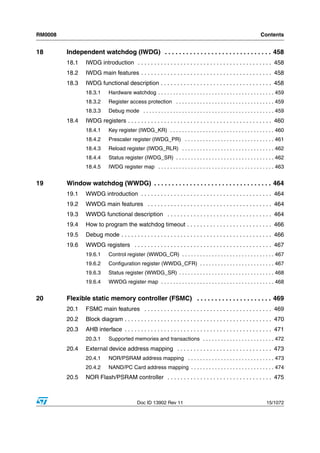
18       Independent watchdog (IWDG) . . . . . . . . . . . . . . . . . . . . . . . . . . . . . . 458
         18.1    IWDG introduction . . . . . . . . . . . . . . . . . . . . . . . . . . . . . . . . . . . . . . . . . 458
         18.2    IWDG main features . . . . . . . . . . . . . . . . . . . . . . . . . . . . . . . . . . . . . . . . 458
         18.3    IWDG functional description . . . . . . . . . . . . . . . . . . . . . . . . . . . . . . . . . . 458
                 18.3.1      Hardware watchdog . . . . . . . . . . . . . . . . . . . . . . . . . . . . . . . . . . . . . . . 459
                 18.3.2      Register access protection . . . . . . . . . . . . . . . . . . . . . . . . . . . . . . . . . 459
                 18.3.3      Debug mode . . . . . . . . . . . . . . . . . . . . . . . . . . . . . . . . . . . . . . . . . . . . 459
         18.4    IWDG registers . . . . . . . . . . . . . . . . . . . . . . . . . . . . . . . . . . . . . . . . . . . . 460
                 18.4.1      Key register (IWDG_KR) . . . . . . . . . . . . . . . . . . . . . . . . . . . . . . . . . . . 460
                 18.4.2      Prescaler register (IWDG_PR) . . . . . . . . . . . . . . . . . . . . . . . . . . . . . . 461
                 18.4.3      Reload register (IWDG_RLR) . . . . . . . . . . . . . . . . . . . . . . . . . . . . . . . 462
                 18.4.4      Status register (IWDG_SR) . . . . . . . . . . . . . . . . . . . . . . . . . . . . . . . . . 462
                 18.4.5      IWDG register map . . . . . . . . . . . . . . . . . . . . . . . . . . . . . . . . . . . . . . . 463


19       Window watchdog (WWDG) . . . . . . . . . . . . . . . . . . . . . . . . . . . . . . . . . 464
         19.1    WWDG introduction . . . . . . . . . . . . . . . . . . . . . . . . . . . . . . . . . . . . . . . . 464
         19.2    WWDG main features . . . . . . . . . . . . . . . . . . . . . . . . . . . . . . . . . . . . . . 464
         19.3    WWDG functional description . . . . . . . . . . . . . . . . . . . . . . . . . . . . . . . . 464
         19.4    How to program the watchdog timeout . . . . . . . . . . . . . . . . . . . . . . . . . . 466
         19.5    Debug mode . . . . . . . . . . . . . . . . . . . . . . . . . . . . . . . . . . . . . . . . . . . . . . 466
         19.6    WWDG registers . . . . . . . . . . . . . . . . . . . . . . . . . . . . . . . . . . . . . . . . . . 467
                 19.6.1      Control register (WWDG_CR) . . . . . . . . . . . . . . . . . . . . . . . . . . . . . . . 467
                 19.6.2      Configuration register (WWDG_CFR) . . . . . . . . . . . . . . . . . . . . . . . . . 467
                 19.6.3      Status register (WWDG_SR) . . . . . . . . . . . . . . . . . . . . . . . . . . . . . . . . 468
                 19.6.4      WWDG register map . . . . . . . . . . . . . . . . . . . . . . . . . . . . . . . . . . . . . . 468


20       Flexible static memory controller (FSMC) . . . . . . . . . . . . . . . . . . . . . 469
         20.1    FSMC main features . . . . . . . . . . . . . . . . . . . . . . . . . . . . . . . . . . . . . . . 469
         20.2    Block diagram . . . . . . . . . . . . . . . . . . . . . . . . . . . . . . . . . . . . . . . . . . . . . 470
         20.3    AHB interface . . . . . . . . . . . . . . . . . . . . . . . . . . . . . . . . . . . . . . . . . . . . . 471
                 20.3.1      Supported memories and transactions . . . . . . . . . . . . . . . . . . . . . . . . 472
         20.4    External device address mapping . . . . . . . . . . . . . . . . . . . . . . . . . . . . . 473
                 20.4.1      NOR/PSRAM address mapping . . . . . . . . . . . . . . . . . . . . . . . . . . . . . 473
                 20.4.2      NAND/PC Card address mapping . . . . . . . . . . . . . . . . . . . . . . . . . . . . 474
         20.5    NOR Flash/PSRAM controller . . . . . . . . . . . . . . . . . . . . . . . . . . . . . . . . 475


                                             Doc ID 13902 Rev 11                                                        15/1072
Contents                                                                                                                    RM0008


                  20.5.1      External memory interface signals . . . . . . . . . . . . . . . . . . . . . . . . . . . . 476
                  20.5.2      Supported memories and transactions . . . . . . . . . . . . . . . . . . . . . . . . 477
                  20.5.3      General timing rules . . . . . . . . . . . . . . . . . . . . . . . . . . . . . . . . . . . . . . . 479
                  20.5.4      NOR Flash/PSRAM controller asynchronous transactions . . . . . . . . . 480
                  20.5.5      Synchronous burst transactions . . . . . . . . . . . . . . . . . . . . . . . . . . . . . . 495
                  20.5.6      NOR/PSRAM controller registers . . . . . . . . . . . . . . . . . . . . . . . . . . . . 502
           20.6   NAND Flash/PC Card controller . . . . . . . . . . . . . . . . . . . . . . . . . . . . . . . 507
                  20.6.1      External memory interface signals . . . . . . . . . . . . . . . . . . . . . . . . . . . . 508
                  20.6.2      NAND Flash / PC Card supported memories and transactions . . . . . . 510
                  20.6.3      Timing diagrams for NAND and PC Card . . . . . . . . . . . . . . . . . . . . . . 510
                  20.6.4      NAND Flash operations . . . . . . . . . . . . . . . . . . . . . . . . . . . . . . . . . . . . 511
                  20.6.5      NAND Flash pre-wait functionality . . . . . . . . . . . . . . . . . . . . . . . . . . . . 512
                  20.6.6      Error correction code computation ECC (NAND Flash) . . . . . . . . . . . . 513
                  20.6.7      PC Card/CompactFlash operations . . . . . . . . . . . . . . . . . . . . . . . . . . . 513
                  20.6.8      NAND Flash/PC Card controller registers . . . . . . . . . . . . . . . . . . . . . . 516
                  20.6.9      FSMC register map . . . . . . . . . . . . . . . . . . . . . . . . . . . . . . . . . . . . . . . 522


21         Secure digital input/output interface (SDIO) . . . . . . . . . . . . . . . . . . . . 524
           21.1   SDIO main features . . . . . . . . . . . . . . . . . . . . . . . . . . . . . . . . . . . . . . . . 524
           21.2   SDIO bus topology . . . . . . . . . . . . . . . . . . . . . . . . . . . . . . . . . . . . . . . . . 525
           21.3   SDIO functional description . . . . . . . . . . . . . . . . . . . . . . . . . . . . . . . . . . 527
                  21.3.1      SDIO adapter . . . . . . . . . . . . . . . . . . . . . . . . . . . . . . . . . . . . . . . . . . . . 528
                  21.3.2      SDIO AHB interface . . . . . . . . . . . . . . . . . . . . . . . . . . . . . . . . . . . . . . . 538
           21.4   Card functional description . . . . . . . . . . . . . . . . . . . . . . . . . . . . . . . . . . . 539
                  21.4.1      Card identification mode . . . . . . . . . . . . . . . . . . . . . . . . . . . . . . . . . . . 539
                  21.4.2      Card reset . . . . . . . . . . . . . . . . . . . . . . . . . . . . . . . . . . . . . . . . . . . . . . 539
                  21.4.3      Operating voltage range validation . . . . . . . . . . . . . . . . . . . . . . . . . . . 539
                  21.4.4      Card identification process . . . . . . . . . . . . . . . . . . . . . . . . . . . . . . . . . 540
                  21.4.5      Block write . . . . . . . . . . . . . . . . . . . . . . . . . . . . . . . . . . . . . . . . . . . . . . 541
                  21.4.6      Block read . . . . . . . . . . . . . . . . . . . . . . . . . . . . . . . . . . . . . . . . . . . . . . 541
                  21.4.7      Stream access, stream write and stream read (MultiMediaCard only) 542
                  21.4.8      Erase: group erase and sector erase . . . . . . . . . . . . . . . . . . . . . . . . . . 543
                  21.4.9      Wide bus selection or deselection . . . . . . . . . . . . . . . . . . . . . . . . . . . . 544
                  21.4.10 Protection management . . . . . . . . . . . . . . . . . . . . . . . . . . . . . . . . . . . . 544
                  21.4.11 Card status register . . . . . . . . . . . . . . . . . . . . . . . . . . . . . . . . . . . . . . . 547
                  21.4.12 SD status register . . . . . . . . . . . . . . . . . . . . . . . . . . . . . . . . . . . . . . . . 550
                  21.4.13 SD I/O mode . . . . . . . . . . . . . . . . . . . . . . . . . . . . . . . . . . . . . . . . . . . . 554


16/1072                                        Doc ID 13902 Rev 11
RM0008                                                                                                                     Contents


                21.4.14 Commands and responses . . . . . . . . . . . . . . . . . . . . . . . . . . . . . . . . . 555
         21.5   Response formats . . . . . . . . . . . . . . . . . . . . . . . . . . . . . . . . . . . . . . . . . 558
                21.5.1      R1 (normal response command) . . . . . . . . . . . . . . . . . . . . . . . . . . . . . 559
                21.5.2      R1b . . . . . . . . . . . . . . . . . . . . . . . . . . . . . . . . . . . . . . . . . . . . . . . . . . . 559
                21.5.3      R2 (CID, CSD register) . . . . . . . . . . . . . . . . . . . . . . . . . . . . . . . . . . . . 559
                21.5.4      R3 (OCR register) . . . . . . . . . . . . . . . . . . . . . . . . . . . . . . . . . . . . . . . . 559
                21.5.5      R4 (Fast I/O) . . . . . . . . . . . . . . . . . . . . . . . . . . . . . . . . . . . . . . . . . . . . 560
                21.5.6      R4b . . . . . . . . . . . . . . . . . . . . . . . . . . . . . . . . . . . . . . . . . . . . . . . . . . . 560
                21.5.7      R5 (interrupt request) . . . . . . . . . . . . . . . . . . . . . . . . . . . . . . . . . . . . . . 561
                21.5.8      R6 . . . . . . . . . . . . . . . . . . . . . . . . . . . . . . . . . . . . . . . . . . . . . . . . . . . . 561
         21.6   SDIO I/O card-specific operations . . . . . . . . . . . . . . . . . . . . . . . . . . . . . 562
                21.6.1      SDIO I/O read wait operation by SDIO_D2 signalling . . . . . . . . . . . . . 562
                21.6.2      SDIO read wait operation by stopping SDIO_CK . . . . . . . . . . . . . . . . 562
                21.6.3      SDIO suspend/resume operation . . . . . . . . . . . . . . . . . . . . . . . . . . . . 563
                21.6.4      SDIO interrupts . . . . . . . . . . . . . . . . . . . . . . . . . . . . . . . . . . . . . . . . . . 563
         21.7   CE-ATA specific operations . . . . . . . . . . . . . . . . . . . . . . . . . . . . . . . . . . 563
                21.7.1      Command completion signal disable . . . . . . . . . . . . . . . . . . . . . . . . . . 563
                21.7.2      Command completion signal enable . . . . . . . . . . . . . . . . . . . . . . . . . . 563
                21.7.3      CE-ATA interrupt . . . . . . . . . . . . . . . . . . . . . . . . . . . . . . . . . . . . . . . . . 564
                21.7.4      Aborting CMD61 . . . . . . . . . . . . . . . . . . . . . . . . . . . . . . . . . . . . . . . . . 564
         21.8   HW flow control . . . . . . . . . . . . . . . . . . . . . . . . . . . . . . . . . . . . . . . . . . . 564
         21.9   SDIO registers . . . . . . . . . . . . . . . . . . . . . . . . . . . . . . . . . . . . . . . . . . . . 564
                21.9.1      SDIO power control register (SDIO_POWER) . . . . . . . . . . . . . . . . . . . 565
                21.9.2      SDI clock control register (SDIO_CLKCR) . . . . . . . . . . . . . . . . . . . . . . 565
                21.9.3      SDIO argument register (SDIO_ARG) . . . . . . . . . . . . . . . . . . . . . . . . . 566
                21.9.4      SDIO command register (SDIO_CMD) . . . . . . . . . . . . . . . . . . . . . . . . 567
                21.9.5      SDIO command response register (SDIO_RESPCMD) . . . . . . . . . . . 568
                21.9.6      SDIO response 1..4 register (SDIO_RESPx) . . . . . . . . . . . . . . . . . . . 568
                21.9.7      SDIO data timer register (SDIO_DTIMER) . . . . . . . . . . . . . . . . . . . . . 569
                21.9.8      SDIO data length register (SDIO_DLEN) . . . . . . . . . . . . . . . . . . . . . . 569
                21.9.9      SDIO data control register (SDIO_DCTRL) . . . . . . . . . . . . . . . . . . . . . 570
                21.9.10 SDIO data counter register (SDIO_DCOUNT) . . . . . . . . . . . . . . . . . . 571
                21.9.11 SDIO status register (SDIO_STA) . . . . . . . . . . . . . . . . . . . . . . . . . . . . 572
                21.9.12 SDIO interrupt clear register (SDIO_ICR) . . . . . . . . . . . . . . . . . . . . . . 573
                21.9.13 SDIO mask register (SDIO_MASK) . . . . . . . . . . . . . . . . . . . . . . . . . . . 575
                21.9.14 SDIO FIFO counter register (SDIO_FIFOCNT) . . . . . . . . . . . . . . . . . . 577


                                             Doc ID 13902 Rev 11                                                               17/1072
Contents                                                                                                                   RM0008


                   21.9.15 SDIO data FIFO register (SDIO_FIFO) . . . . . . . . . . . . . . . . . . . . . . . . 578
                   21.9.16 SDIO register map . . . . . . . . . . . . . . . . . . . . . . . . . . . . . . . . . . . . . . . . 578


22         Universal serial bus full-speed device interface (USB) . . . . . . . . . . . 580
           22.1    USB introduction . . . . . . . . . . . . . . . . . . . . . . . . . . . . . . . . . . . . . . . . . . 580
           22.2    USB main features . . . . . . . . . . . . . . . . . . . . . . . . . . . . . . . . . . . . . . . . . 580
           22.3    USB functional description . . . . . . . . . . . . . . . . . . . . . . . . . . . . . . . . . . . 580
                   22.3.1      Description of USB blocks . . . . . . . . . . . . . . . . . . . . . . . . . . . . . . . . . . 582
           22.4    Programming considerations . . . . . . . . . . . . . . . . . . . . . . . . . . . . . . . . . 583
                   22.4.1      Generic USB device programming . . . . . . . . . . . . . . . . . . . . . . . . . . . 583
                   22.4.2      System and power-on reset . . . . . . . . . . . . . . . . . . . . . . . . . . . . . . . . . 584
                   22.4.3      Double-buffered endpoints . . . . . . . . . . . . . . . . . . . . . . . . . . . . . . . . . . 589
                   22.4.4      Isochronous transfers . . . . . . . . . . . . . . . . . . . . . . . . . . . . . . . . . . . . . 591
                   22.4.5      Suspend/Resume events . . . . . . . . . . . . . . . . . . . . . . . . . . . . . . . . . . . 592
           22.5    USB registers . . . . . . . . . . . . . . . . . . . . . . . . . . . . . . . . . . . . . . . . . . . . . 594
                   22.5.1      Common registers . . . . . . . . . . . . . . . . . . . . . . . . . . . . . . . . . . . . . . . . 594
                   22.5.2      Endpoint-specific registers . . . . . . . . . . . . . . . . . . . . . . . . . . . . . . . . . . 600
                   22.5.3      Buffer descriptor table . . . . . . . . . . . . . . . . . . . . . . . . . . . . . . . . . . . . . 604
                   22.5.4      USB register map . . . . . . . . . . . . . . . . . . . . . . . . . . . . . . . . . . . . . . . . 608


23         Controller area network (bxCAN) . . . . . . . . . . . . . . . . . . . . . . . . . . . . . 610
           23.1    bxCAN introduction . . . . . . . . . . . . . . . . . . . . . . . . . . . . . . . . . . . . . . . . 610
           23.2    bxCAN main features . . . . . . . . . . . . . . . . . . . . . . . . . . . . . . . . . . . . . . . 610
           23.3    bxCAN general description . . . . . . . . . . . . . . . . . . . . . . . . . . . . . . . . . . 611
                   23.3.1      CAN 2.0B active core . . . . . . . . . . . . . . . . . . . . . . . . . . . . . . . . . . . . . . 612
                   23.3.2      Control, status and configuration registers . . . . . . . . . . . . . . . . . . . . . 612
                   23.3.3      Tx mailboxes . . . . . . . . . . . . . . . . . . . . . . . . . . . . . . . . . . . . . . . . . . . . 612
                   23.3.4      Acceptance filters . . . . . . . . . . . . . . . . . . . . . . . . . . . . . . . . . . . . . . . . 612
           23.4    bxCAN operating modes . . . . . . . . . . . . . . . . . . . . . . . . . . . . . . . . . . . . 613
                   23.4.1      Initialization mode . . . . . . . . . . . . . . . . . . . . . . . . . . . . . . . . . . . . . . . . 614
                   23.4.2      Normal mode . . . . . . . . . . . . . . . . . . . . . . . . . . . . . . . . . . . . . . . . . . . . 614
                   23.4.3      Sleep mode (low power) . . . . . . . . . . . . . . . . . . . . . . . . . . . . . . . . . . . 614
           23.5    Test mode . . . . . . . . . . . . . . . . . . . . . . . . . . . . . . . . . . . . . . . . . . . . . . . . 615
                   23.5.1      Silent mode . . . . . . . . . . . . . . . . . . . . . . . . . . . . . . . . . . . . . . . . . . . . . 615
                   23.5.2      Loop back mode . . . . . . . . . . . . . . . . . . . . . . . . . . . . . . . . . . . . . . . . . 616
                   23.5.3      Loop back combined with silent mode . . . . . . . . . . . . . . . . . . . . . . . . . 616


18/1072                                         Doc ID 13902 Rev 11
RM0008                                                                                                                     Contents


         23.6    STM32F10xxx in Debug mode . . . . . . . . . . . . . . . . . . . . . . . . . . . . . . . . 617
         23.7    bxCAN functional description . . . . . . . . . . . . . . . . . . . . . . . . . . . . . . . . . 617
                 23.7.1       Transmission handling . . . . . . . . . . . . . . . . . . . . . . . . . . . . . . . . . . . . . 617
                 23.7.2       Time triggered communication mode . . . . . . . . . . . . . . . . . . . . . . . . . 619
                 23.7.3       Reception handling . . . . . . . . . . . . . . . . . . . . . . . . . . . . . . . . . . . . . . . 619
                 23.7.4       Identifier filtering . . . . . . . . . . . . . . . . . . . . . . . . . . . . . . . . . . . . . . . . . 620
                 23.7.5       Message storage . . . . . . . . . . . . . . . . . . . . . . . . . . . . . . . . . . . . . . . . . 624
                 23.7.6       Error management . . . . . . . . . . . . . . . . . . . . . . . . . . . . . . . . . . . . . . . . 626
                 23.7.7       Bit timing . . . . . . . . . . . . . . . . . . . . . . . . . . . . . . . . . . . . . . . . . . . . . . . 626
         23.8    bxCAN interrupts . . . . . . . . . . . . . . . . . . . . . . . . . . . . . . . . . . . . . . . . . . 628
         23.9    CAN registers . . . . . . . . . . . . . . . . . . . . . . . . . . . . . . . . . . . . . . . . . . . . . 630
                 23.9.1       Register access protection . . . . . . . . . . . . . . . . . . . . . . . . . . . . . . . . . 630
                 23.9.2       CAN control and status registers . . . . . . . . . . . . . . . . . . . . . . . . . . . . . 630
                 23.9.3       CAN mailbox registers . . . . . . . . . . . . . . . . . . . . . . . . . . . . . . . . . . . . . 640
                 23.9.4       CAN filter registers . . . . . . . . . . . . . . . . . . . . . . . . . . . . . . . . . . . . . . . . 647
                 23.9.5       bxCAN register map . . . . . . . . . . . . . . . . . . . . . . . . . . . . . . . . . . . . . . 651


24       Serial peripheral interface (SPI) . . . . . . . . . . . . . . . . . . . . . . . . . . . . . . 654
         24.1    SPI introduction . . . . . . . . . . . . . . . . . . . . . . . . . . . . . . . . . . . . . . . . . . . 654
         24.2    SPI and I2S main features . . . . . . . . . . . . . . . . . . . . . . . . . . . . . . . . . . . 655
                 24.2.1       SPI features . . . . . . . . . . . . . . . . . . . . . . . . . . . . . . . . . . . . . . . . . . . . . 655
                 24.2.2       I2S features . . . . . . . . . . . . . . . . . . . . . . . . . . . . . . . . . . . . . . . . . . . . . 656
         24.3    SPI functional description . . . . . . . . . . . . . . . . . . . . . . . . . . . . . . . . . . . . 657
                 24.3.1       General description . . . . . . . . . . . . . . . . . . . . . . . . . . . . . . . . . . . . . . . 657
                 24.3.2       Configuring the SPI in slave mode . . . . . . . . . . . . . . . . . . . . . . . . . . . . 660
                 24.3.3       Configuring the SPI in master mode . . . . . . . . . . . . . . . . . . . . . . . . . . 661
                 24.3.4       Configuring the SPI for Simplex communication . . . . . . . . . . . . . . . . . 662
                 24.3.5       Data transmission and reception procedures . . . . . . . . . . . . . . . . . . . 663
                 24.3.6       CRC calculation . . . . . . . . . . . . . . . . . . . . . . . . . . . . . . . . . . . . . . . . . . 669
                 24.3.7       Status flags . . . . . . . . . . . . . . . . . . . . . . . . . . . . . . . . . . . . . . . . . . . . . 670
                 24.3.8       Disabling the SPI . . . . . . . . . . . . . . . . . . . . . . . . . . . . . . . . . . . . . . . . . 671
                 24.3.9       SPI communication using DMA (direct memory addressing) . . . . . . . 672
                 24.3.10 Error flags . . . . . . . . . . . . . . . . . . . . . . . . . . . . . . . . . . . . . . . . . . . . . . 674
                 24.3.11 SPI interrupts . . . . . . . . . . . . . . . . . . . . . . . . . . . . . . . . . . . . . . . . . . . . 675
         24.4    I2S functional description . . . . . . . . . . . . . . . . . . . . . . . . . . . . . . . . . . . . 675
                 24.4.1       I2S general description . . . . . . . . . . . . . . . . . . . . . . . . . . . . . . . . . . . . 675


                                               Doc ID 13902 Rev 11                                                             19/1072
Contents                                                                                                                       RM0008


                   24.4.2      Supported audio protocols . . . . . . . . . . . . . . . . . . . . . . . . . . . . . . . . . . 677
                   24.4.3      Clock generator . . . . . . . . . . . . . . . . . . . . . . . . . . . . . . . . . . . . . . . . . . 684
                   24.4.4      I2S master mode . . . . . . . . . . . . . . . . . . . . . . . . . . . . . . . . . . . . . . . . . 687
                   24.4.5      I2S slave mode . . . . . . . . . . . . . . . . . . . . . . . . . . . . . . . . . . . . . . . . . . . 689
                   24.4.6      Status flags . . . . . . . . . . . . . . . . . . . . . . . . . . . . . . . . . . . . . . . . . . . . . 691
                   24.4.7      Error flags . . . . . . . . . . . . . . . . . . . . . . . . . . . . . . . . . . . . . . . . . . . . . . 692
                   24.4.8      I2S interrupts . . . . . . . . . . . . . . . . . . . . . . . . . . . . . . . . . . . . . . . . . . . . 692
                   24.4.9      DMA features . . . . . . . . . . . . . . . . . . . . . . . . . . . . . . . . . . . . . . . . . . . . 692
           24.5    SPI and I2S registers . . . . . . . . . . . . . . . . . . . . . . . . . . . . . . . . . . . . . . . 692
                   24.5.1      SPI control register 1 (SPI_CR1) (not used in I2S mode) . . . . . . . . . . 693
                   24.5.2      SPI control register 2 (SPI_CR2) . . . . . . . . . . . . . . . . . . . . . . . . . . . . . 695
                   24.5.3      SPI status register (SPI_SR) . . . . . . . . . . . . . . . . . . . . . . . . . . . . . . . . 695
                   24.5.4      SPI data register (SPI_DR) . . . . . . . . . . . . . . . . . . . . . . . . . . . . . . . . . 697
                   24.5.5      SPI CRC polynomial register (SPI_CRCPR) (not used in I2S
                               mode) . . . . . . . . . . . . . . . . . . . . . . . . . . . . . . . . . . . . . . . . . . . . . . . . . . 697
                   24.5.6      SPI Rx CRC register (SPI_RXCRCR) (not used in I2S mode) . . . . . . 698
                   24.5.7      SPI Tx CRC register (SPI_TXCRCR) (not used in I2S mode) . . . . . . . 698
                   24.5.8      SPI_I2S configuration register (SPI_I2SCFGR) . . . . . . . . . . . . . . . . . . 699
                   24.5.9      SPI_I2S prescaler register (SPI_I2SPR) . . . . . . . . . . . . . . . . . . . . . . . 700
                   24.5.10 SPI register map . . . . . . . . . . . . . . . . . . . . . . . . . . . . . . . . . . . . . . . . . 701


25         Inter-integrated circuit (I2C) interface . . . . . . . . . . . . . . . . . . . . . . . . . 702
           25.1    I2C introduction . . . . . . . . . . . . . . . . . . . . . . . . . . . . . . . . . . . . . . . . . . . . 702
           25.2    I2C main features . . . . . . . . . . . . . . . . . . . . . . . . . . . . . . . . . . . . . . . . . . 702
           25.3    I2C functional description . . . . . . . . . . . . . . . . . . . . . . . . . . . . . . . . . . . . 703
                   25.3.1      Mode selection . . . . . . . . . . . . . . . . . . . . . . . . . . . . . . . . . . . . . . . . . . . 703
                   25.3.2      I2C slave mode . . . . . . . . . . . . . . . . . . . . . . . . . . . . . . . . . . . . . . . . . . 705
                   25.3.3      I2C master mode . . . . . . . . . . . . . . . . . . . . . . . . . . . . . . . . . . . . . . . . . 707
                   25.3.4      Error conditions . . . . . . . . . . . . . . . . . . . . . . . . . . . . . . . . . . . . . . . . . . 714
                   25.3.5      SDA/SCL line control . . . . . . . . . . . . . . . . . . . . . . . . . . . . . . . . . . . . . . 715
                   25.3.6      SMBus . . . . . . . . . . . . . . . . . . . . . . . . . . . . . . . . . . . . . . . . . . . . . . . . . 716
                   25.3.7      DMA requests . . . . . . . . . . . . . . . . . . . . . . . . . . . . . . . . . . . . . . . . . . . 718
                   25.3.8      Packet error checking . . . . . . . . . . . . . . . . . . . . . . . . . . . . . . . . . . . . . 719
                   2
           25.4    I C interrupts . . . . . . . . . . . . . . . . . . . . . . . . . . . . . . . . . . . . . . . . . . . . . 720
           25.5    I2C debug mode . . . . . . . . . . . . . . . . . . . . . . . . . . . . . . . . . . . . . . . . . . . 722
           25.6    I2C registers . . . . . . . . . . . . . . . . . . . . . . . . . . . . . . . . . . . . . . . . . . . . . . 722
                   25.6.1      Control register 1 (I2C_CR1) . . . . . . . . . . . . . . . . . . . . . . . . . . . . . . . . 722


20/1072                                          Doc ID 13902 Rev 11
RM0008                                                                                                                     Contents


                 25.6.2       Control register 2 (I2C_CR2) . . . . . . . . . . . . . . . . . . . . . . . . . . . . . . . . 724
                 25.6.3       Own address register 1 (I2C_OAR1) . . . . . . . . . . . . . . . . . . . . . . . . . . 725
                 25.6.4       Own address register 2 (I2C_OAR2) . . . . . . . . . . . . . . . . . . . . . . . . . . 726
                 25.6.5       Data register (I2C_DR) . . . . . . . . . . . . . . . . . . . . . . . . . . . . . . . . . . . . 726
                 25.6.6       Status register 1 (I2C_SR1) . . . . . . . . . . . . . . . . . . . . . . . . . . . . . . . . . 727
                 25.6.7       Status register 2 (I2C_SR2) . . . . . . . . . . . . . . . . . . . . . . . . . . . . . . . . . 730
                 25.6.8       Clock control register (I2C_CCR) . . . . . . . . . . . . . . . . . . . . . . . . . . . . 731
                 25.6.9       TRISE register (I2C_TRISE) . . . . . . . . . . . . . . . . . . . . . . . . . . . . . . . . 732
                 25.6.10 I2C register map . . . . . . . . . . . . . . . . . . . . . . . . . . . . . . . . . . . . . . . . . 733


26       Universal synchronous asynchronous receiver
         transmitter (USART) . . . . . . . . . . . . . . . . . . . . . . . . . . . . . . . . . . . . . . . 734
         26.1    USART introduction . . . . . . . . . . . . . . . . . . . . . . . . . . . . . . . . . . . . . . . . 734
         26.2    USART main features . . . . . . . . . . . . . . . . . . . . . . . . . . . . . . . . . . . . . . . 735
         26.3    USART functional description . . . . . . . . . . . . . . . . . . . . . . . . . . . . . . . . 736
                 26.3.1       USART character description . . . . . . . . . . . . . . . . . . . . . . . . . . . . . . . 739
                 26.3.2       Transmitter . . . . . . . . . . . . . . . . . . . . . . . . . . . . . . . . . . . . . . . . . . . . . . 740
                 26.3.3       Receiver . . . . . . . . . . . . . . . . . . . . . . . . . . . . . . . . . . . . . . . . . . . . . . . . 743
                 26.3.4       Fractional baud rate generation . . . . . . . . . . . . . . . . . . . . . . . . . . . . . . 747
                 26.3.5       USART receiver’s tolerance to clock deviation . . . . . . . . . . . . . . . . . . 748
                 26.3.6       Multiprocessor communication . . . . . . . . . . . . . . . . . . . . . . . . . . . . . . 749
                 26.3.7       Parity control . . . . . . . . . . . . . . . . . . . . . . . . . . . . . . . . . . . . . . . . . . . . 750
                 26.3.8       LIN (local interconnection network) mode . . . . . . . . . . . . . . . . . . . . . . 751
                 26.3.9       USART synchronous mode . . . . . . . . . . . . . . . . . . . . . . . . . . . . . . . . . 754
                 26.3.10 Single-wire half-duplex communication . . . . . . . . . . . . . . . . . . . . . . . . 756
                 26.3.11 Smartcard . . . . . . . . . . . . . . . . . . . . . . . . . . . . . . . . . . . . . . . . . . . . . . 757
                 26.3.12 IrDA SIR ENDEC block . . . . . . . . . . . . . . . . . . . . . . . . . . . . . . . . . . . . 759
                 26.3.13 Continuous communication using DMA . . . . . . . . . . . . . . . . . . . . . . . . 761
                 26.3.14 Hardware flow control . . . . . . . . . . . . . . . . . . . . . . . . . . . . . . . . . . . . . 763
         26.4    USART interrupts . . . . . . . . . . . . . . . . . . . . . . . . . . . . . . . . . . . . . . . . . . 765
         26.5    USART mode configuration . . . . . . . . . . . . . . . . . . . . . . . . . . . . . . . . . . 766
         26.6    USART registers . . . . . . . . . . . . . . . . . . . . . . . . . . . . . . . . . . . . . . . . . . 766
                 26.6.1       Status register (USART_SR) . . . . . . . . . . . . . . . . . . . . . . . . . . . . . . . . 766
                 26.6.2       Data register (USART_DR) . . . . . . . . . . . . . . . . . . . . . . . . . . . . . . . . . 768
                 26.6.3       Baud rate register (USART_BRR) . . . . . . . . . . . . . . . . . . . . . . . . . . . . 769
                 26.6.4       Control register 1 (USART_CR1) . . . . . . . . . . . . . . . . . . . . . . . . . . . . . 770
                 26.6.5       Control register 2 (USART_CR2) . . . . . . . . . . . . . . . . . . . . . . . . . . . . . 772


                                               Doc ID 13902 Rev 11                                                             21/1072
Contents                                                                                                                    RM0008


                    26.6.6      Control register 3 (USART_CR3) . . . . . . . . . . . . . . . . . . . . . . . . . . . . . 773
                    26.6.7      Guard time and prescaler register (USART_GTPR) . . . . . . . . . . . . . . 775
                    26.6.8      USART register map . . . . . . . . . . . . . . . . . . . . . . . . . . . . . . . . . . . . . . 776


27         USB on-the-go full-speed (OTG_FS) . . . . . . . . . . . . . . . . . . . . . . . . . . 777
           27.1     OTG_FS introduction . . . . . . . . . . . . . . . . . . . . . . . . . . . . . . . . . . . . . . . 777
           27.2     OTG_FS main features . . . . . . . . . . . . . . . . . . . . . . . . . . . . . . . . . . . . . 778
                    27.2.1      General features . . . . . . . . . . . . . . . . . . . . . . . . . . . . . . . . . . . . . . . . . 778
                    27.2.2      Host-mode features . . . . . . . . . . . . . . . . . . . . . . . . . . . . . . . . . . . . . . . 779
                    27.2.3      Peripheral-mode features . . . . . . . . . . . . . . . . . . . . . . . . . . . . . . . . . . 779
           27.3     OTG_FS functional description . . . . . . . . . . . . . . . . . . . . . . . . . . . . . . . 780
                    27.3.1      OTG full-speed core . . . . . . . . . . . . . . . . . . . . . . . . . . . . . . . . . . . . . . . 780
                    27.3.2      Full-speed OTG PHY . . . . . . . . . . . . . . . . . . . . . . . . . . . . . . . . . . . . . . 780
           27.4     OTG dual role device (DRD) . . . . . . . . . . . . . . . . . . . . . . . . . . . . . . . . . 781
                    27.4.1      ID line detection . . . . . . . . . . . . . . . . . . . . . . . . . . . . . . . . . . . . . . . . . . 782
                    27.4.2      HNP dual role device . . . . . . . . . . . . . . . . . . . . . . . . . . . . . . . . . . . . . . 782
                    27.4.3      SRP dual role device . . . . . . . . . . . . . . . . . . . . . . . . . . . . . . . . . . . . . . 782
           27.5     USB peripheral . . . . . . . . . . . . . . . . . . . . . . . . . . . . . . . . . . . . . . . . . . . . 783
                    27.5.1      SRP-capable peripheral . . . . . . . . . . . . . . . . . . . . . . . . . . . . . . . . . . . . 783
                    27.5.2      Peripheral states . . . . . . . . . . . . . . . . . . . . . . . . . . . . . . . . . . . . . . . . . 784
                    27.5.3      Peripheral endpoints . . . . . . . . . . . . . . . . . . . . . . . . . . . . . . . . . . . . . . 785
           27.6     USB host . . . . . . . . . . . . . . . . . . . . . . . . . . . . . . . . . . . . . . . . . . . . . . . . 787
                    27.6.1      SRP-capable host . . . . . . . . . . . . . . . . . . . . . . . . . . . . . . . . . . . . . . . . 788
                    27.6.2      USB host states . . . . . . . . . . . . . . . . . . . . . . . . . . . . . . . . . . . . . . . . . . 788
                    27.6.3      Host channels . . . . . . . . . . . . . . . . . . . . . . . . . . . . . . . . . . . . . . . . . . . 789
                    27.6.4      Host scheduler . . . . . . . . . . . . . . . . . . . . . . . . . . . . . . . . . . . . . . . . . . . 791
           27.7     SOF trigger . . . . . . . . . . . . . . . . . . . . . . . . . . . . . . . . . . . . . . . . . . . . . . . 792
                    27.7.1      Host SOFs . . . . . . . . . . . . . . . . . . . . . . . . . . . . . . . . . . . . . . . . . . . . . . 793
                    27.7.2      Peripheral SOFs . . . . . . . . . . . . . . . . . . . . . . . . . . . . . . . . . . . . . . . . . 793
           27.8     Power options . . . . . . . . . . . . . . . . . . . . . . . . . . . . . . . . . . . . . . . . . . . . . 794
           27.9     USB data FIFOs . . . . . . . . . . . . . . . . . . . . . . . . . . . . . . . . . . . . . . . . . . . 794
           27.10 Peripheral FIFO architecture . . . . . . . . . . . . . . . . . . . . . . . . . . . . . . . . . 795
                    27.10.1 Peripheral Rx FIFO . . . . . . . . . . . . . . . . . . . . . . . . . . . . . . . . . . . . . . . 795
                    27.10.2 Peripheral Tx FIFOs . . . . . . . . . . . . . . . . . . . . . . . . . . . . . . . . . . . . . . . 796
           27.11 Host FIFO architecture . . . . . . . . . . . . . . . . . . . . . . . . . . . . . . . . . . . . . . 796
                    27.11.1 Host Rx FIFO . . . . . . . . . . . . . . . . . . . . . . . . . . . . . . . . . . . . . . . . . . . . 796


22/1072                                          Doc ID 13902 Rev 11
RM0008                                                                                                                   Contents


                  27.11.2 Host Tx FIFOs . . . . . . . . . . . . . . . . . . . . . . . . . . . . . . . . . . . . . . . . . . . 797
         27.12 FIFO RAM allocation . . . . . . . . . . . . . . . . . . . . . . . . . . . . . . . . . . . . . . . 797
                  27.12.1 Device mode . . . . . . . . . . . . . . . . . . . . . . . . . . . . . . . . . . . . . . . . . . . . 797
                  27.12.2 Host mode . . . . . . . . . . . . . . . . . . . . . . . . . . . . . . . . . . . . . . . . . . . . . . 798
         27.13 USB system performance . . . . . . . . . . . . . . . . . . . . . . . . . . . . . . . . . . . 798
         27.14 OTG_FS interrupts . . . . . . . . . . . . . . . . . . . . . . . . . . . . . . . . . . . . . . . . . 799
         27.15 OTG_FS control and status registers . . . . . . . . . . . . . . . . . . . . . . . . . . . 801
                  27.15.1 CSR memory map . . . . . . . . . . . . . . . . . . . . . . . . . . . . . . . . . . . . . . . . 801
                  27.15.2 OTG_FS global registers . . . . . . . . . . . . . . . . . . . . . . . . . . . . . . . . . . . 806
                  27.15.3 Host-mode registers . . . . . . . . . . . . . . . . . . . . . . . . . . . . . . . . . . . . . . 827
                  27.15.4 Device-mode registers . . . . . . . . . . . . . . . . . . . . . . . . . . . . . . . . . . . . . 838
                  27.15.5 OTG_FS power and clock gating control register
                          (OTG_FS_PCGCCTL) . . . . . . . . . . . . . . . . . . . . . . . . . . . . . . . . . . . . . 860
                  27.15.6 OTG_FS register map . . . . . . . . . . . . . . . . . . . . . . . . . . . . . . . . . . . . . 861
         27.16 OTG_FS programming model . . . . . . . . . . . . . . . . . . . . . . . . . . . . . . . . 867
                  27.16.1 Core initialization . . . . . . . . . . . . . . . . . . . . . . . . . . . . . . . . . . . . . . . . . 867
                  27.16.2 Host initialization . . . . . . . . . . . . . . . . . . . . . . . . . . . . . . . . . . . . . . . . . 869
                  27.16.3 Device initialization . . . . . . . . . . . . . . . . . . . . . . . . . . . . . . . . . . . . . . . 869
                  27.16.4 Host programming model . . . . . . . . . . . . . . . . . . . . . . . . . . . . . . . . . . . 870
                  27.16.5 Device programming model . . . . . . . . . . . . . . . . . . . . . . . . . . . . . . . . . 886
                  27.16.6 Operational model . . . . . . . . . . . . . . . . . . . . . . . . . . . . . . . . . . . . . . . . 888
                  27.16.7 Worst case response time . . . . . . . . . . . . . . . . . . . . . . . . . . . . . . . . . . 905
                  27.16.8 OTG programming model . . . . . . . . . . . . . . . . . . . . . . . . . . . . . . . . . . 906


28       Ethernet (ETH): media access control (MAC) with
         DMA controller . . . . . . . . . . . . . . . . . . . . . . . . . . . . . . . . . . . . . . . . . . . . 912
         28.1     Ethernet introduction . . . . . . . . . . . . . . . . . . . . . . . . . . . . . . . . . . . . . . . 912
         28.2     Ethernet main features . . . . . . . . . . . . . . . . . . . . . . . . . . . . . . . . . . . . . . 912
                  28.2.1       MAC core features . . . . . . . . . . . . . . . . . . . . . . . . . . . . . . . . . . . . . . . . 913
                  28.2.2       DMA features . . . . . . . . . . . . . . . . . . . . . . . . . . . . . . . . . . . . . . . . . . . . 914
                  28.2.3       PTP features . . . . . . . . . . . . . . . . . . . . . . . . . . . . . . . . . . . . . . . . . . . . 914
         28.3     Ethernet pins . . . . . . . . . . . . . . . . . . . . . . . . . . . . . . . . . . . . . . . . . . . . . 915
         28.4     Ethernet functional description: SMI, MII and RMII . . . . . . . . . . . . . . . . 916
                  28.4.1       Station management interface: SMI . . . . . . . . . . . . . . . . . . . . . . . . . . . 916
                  28.4.2       Media-independent interface: MII . . . . . . . . . . . . . . . . . . . . . . . . . . . . 919
                  28.4.3       Reduced media-independent interface: RMII . . . . . . . . . . . . . . . . . . . 922
                  28.4.4       MII/RMII selection . . . . . . . . . . . . . . . . . . . . . . . . . . . . . . . . . . . . . . . . 923


                                               Doc ID 13902 Rev 11                                                          23/1072
Contents                                                                                                                   RM0008


           28.5    Ethernet functional description: MAC 802.3 . . . . . . . . . . . . . . . . . . . . . . 924
                   28.5.1      MAC 802.3 frame format . . . . . . . . . . . . . . . . . . . . . . . . . . . . . . . . . . . 924
                   28.5.2      MAC frame transmission . . . . . . . . . . . . . . . . . . . . . . . . . . . . . . . . . . . 928
                   28.5.3      MAC frame reception . . . . . . . . . . . . . . . . . . . . . . . . . . . . . . . . . . . . . . 935
                   28.5.4      MAC interrupts . . . . . . . . . . . . . . . . . . . . . . . . . . . . . . . . . . . . . . . . . . . 940
                   28.5.5      MAC filtering . . . . . . . . . . . . . . . . . . . . . . . . . . . . . . . . . . . . . . . . . . . . 940
                   28.5.6      MAC loopback mode . . . . . . . . . . . . . . . . . . . . . . . . . . . . . . . . . . . . . . 943
                   28.5.7      MAC management counters: MMC . . . . . . . . . . . . . . . . . . . . . . . . . . . 943
                   28.5.8      Power management: PMT . . . . . . . . . . . . . . . . . . . . . . . . . . . . . . . . . . 944
                   28.5.9      Precision time protocol (IEEE1588 PTP) . . . . . . . . . . . . . . . . . . . . . . . 947
           28.6    Ethernet functional description: DMA controller operation . . . . . . . . . . . 953
                   28.6.1      Initialization of a transfer using DMA . . . . . . . . . . . . . . . . . . . . . . . . . . 954
                   28.6.2      Host bus burst access . . . . . . . . . . . . . . . . . . . . . . . . . . . . . . . . . . . . . 954
                   28.6.3      Host data buffer alignment . . . . . . . . . . . . . . . . . . . . . . . . . . . . . . . . . . 955
                   28.6.4      Buffer size calculations . . . . . . . . . . . . . . . . . . . . . . . . . . . . . . . . . . . . 955
                   28.6.5      DMA arbiter . . . . . . . . . . . . . . . . . . . . . . . . . . . . . . . . . . . . . . . . . . . . . 956
                   28.6.6      Error response to DMA . . . . . . . . . . . . . . . . . . . . . . . . . . . . . . . . . . . 956
                   28.6.7      Tx DMA configuration . . . . . . . . . . . . . . . . . . . . . . . . . . . . . . . . . . . . . 956
                   28.6.8      Rx DMA configuration . . . . . . . . . . . . . . . . . . . . . . . . . . . . . . . . . . . . . 970
                   28.6.9      DMA interrupts . . . . . . . . . . . . . . . . . . . . . . . . . . . . . . . . . . . . . . . . . . . 979
           28.7    Ethernet interrupts . . . . . . . . . . . . . . . . . . . . . . . . . . . . . . . . . . . . . . . . . 980
           28.8    Ethernet register descriptions . . . . . . . . . . . . . . . . . . . . . . . . . . . . . . . . 981
                   28.8.1      MAC register description . . . . . . . . . . . . . . . . . . . . . . . . . . . . . . . . . . . 981
                   28.8.2      MMC register description . . . . . . . . . . . . . . . . . . . . . . . . . . . . . . . . . . . 998
                   28.8.3      IEEE 1588 time stamp registers . . . . . . . . . . . . . . . . . . . . . . . . . . . . 1003
                   28.8.4      DMA register description . . . . . . . . . . . . . . . . . . . . . . . . . . . . . . . . . . 1007
                   28.8.5      Ethernet register maps . . . . . . . . . . . . . . . . . . . . . . . . . . . . . . . . . . . 1021


29         Device electronic signature . . . . . . . . . . . . . . . . . . . . . . . . . . . . . . . . 1024
           29.1    Memory size registers . . . . . . . . . . . . . . . . . . . . . . . . . . . . . . . . . . . . . 1024
                   29.1.1      Flash size register . . . . . . . . . . . . . . . . . . . . . . . . . . . . . . . . . . . . . . . 1024
           29.2    Unique device ID register (96 bits) . . . . . . . . . . . . . . . . . . . . . . . . . . . . 1025

30         Debug support (DBG) . . . . . . . . . . . . . . . . . . . . . . . . . . . . . . . . . . . . . 1027
           30.1    Overview . . . . . . . . . . . . . . . . . . . . . . . . . . . . . . . . . . . . . . . . . . . . . . . 1027
           30.2    Reference ARM documentation . . . . . . . . . . . . . . . . . . . . . . . . . . . . . . 1029


24/1072                                         Doc ID 13902 Rev 11
RM0008                                                                                                              Contents


         30.3     SWJ debug port (serial wire and JTAG) . . . . . . . . . . . . . . . . . . . . . . . . 1029
                  30.3.1      Mechanism to select the JTAG-DP or the SW-DP . . . . . . . . . . . . . . . 1029
         30.4     Pinout and debug port pins . . . . . . . . . . . . . . . . . . . . . . . . . . . . . . . . . 1030
                  30.4.1      SWJ debug port pins . . . . . . . . . . . . . . . . . . . . . . . . . . . . . . . . . . . . . 1030
                  30.4.2      Flexible SWJ-DP pin assignment . . . . . . . . . . . . . . . . . . . . . . . . . . . . 1030
                  30.4.3      Internal pull-up and pull-down on JTAG pins . . . . . . . . . . . . . . . . . . . 1031
                  30.4.4      Using serial wire and releasing the unused debug pins as GPIOs . . 1032
         30.5     STM32F10xxx JTAG TAP connection . . . . . . . . . . . . . . . . . . . . . . . . . 1032
         30.6     ID codes and locking mechanism . . . . . . . . . . . . . . . . . . . . . . . . . . . . . 1033
                  30.6.1      MCU device ID code . . . . . . . . . . . . . . . . . . . . . . . . . . . . . . . . . . . . . 1033
                  30.6.2      Boundary scan TAP . . . . . . . . . . . . . . . . . . . . . . . . . . . . . . . . . . . . . . 1035
                  30.6.3      Cortex-M3 TAP . . . . . . . . . . . . . . . . . . . . . . . . . . . . . . . . . . . . . . . . . 1035
                  30.6.4      Cortex-M3 JEDEC-106 ID code . . . . . . . . . . . . . . . . . . . . . . . . . . . . . 1035
         30.7     JTAG debug port . . . . . . . . . . . . . . . . . . . . . . . . . . . . . . . . . . . . . . . . . 1035
         30.8     SW debug port . . . . . . . . . . . . . . . . . . . . . . . . . . . . . . . . . . . . . . . . . . . 1037
                  30.8.1      SW protocol introduction . . . . . . . . . . . . . . . . . . . . . . . . . . . . . . . . . . 1037
                  30.8.2      SW protocol sequence . . . . . . . . . . . . . . . . . . . . . . . . . . . . . . . . . . . . 1037
                  30.8.3      SW-DP state machine (Reset, idle states, ID code) . . . . . . . . . . . . . 1038
                  30.8.4      DP and AP read/write accesses . . . . . . . . . . . . . . . . . . . . . . . . . . . . 1039
                  30.8.5      SW-DP registers . . . . . . . . . . . . . . . . . . . . . . . . . . . . . . . . . . . . . . . . 1039
                  30.8.6      SW-AP registers . . . . . . . . . . . . . . . . . . . . . . . . . . . . . . . . . . . . . . . . 1040
         30.9     AHB-AP (AHB access port) - valid for both JTAG-DP or SW-DP . . . . . 1040
         30.10 Core debug . . . . . . . . . . . . . . . . . . . . . . . . . . . . . . . . . . . . . . . . . . . . . . 1041
         30.11 Capability of the debugger host to connect under system reset . . . . . 1042
         30.12 FPB (Flash patch breakpoint) . . . . . . . . . . . . . . . . . . . . . . . . . . . . . . . . 1042
         30.13 DWT (data watchpoint trigger) . . . . . . . . . . . . . . . . . . . . . . . . . . . . . . . 1043
         30.14 ITM (instrumentation trace macrocell) . . . . . . . . . . . . . . . . . . . . . . . . . 1043
                  30.14.1 General description . . . . . . . . . . . . . . . . . . . . . . . . . . . . . . . . . . . . . . 1043
                  30.14.2 Time stamp packets, synchronization and overflow packets . . . . . . . 1043
         30.15 ETM (Embedded Trace Macrocell) . . . . . . . . . . . . . . . . . . . . . . . . . . . . 1045
                  30.15.1 General description . . . . . . . . . . . . . . . . . . . . . . . . . . . . . . . . . . . . . . 1045
                  30.15.2 Signal protocol, packet types . . . . . . . . . . . . . . . . . . . . . . . . . . . . . . . 1045
                  30.15.3 Main ETM registers . . . . . . . . . . . . . . . . . . . . . . . . . . . . . . . . . . . . . . 1045
                  30.15.4 Configuration example . . . . . . . . . . . . . . . . . . . . . . . . . . . . . . . . . . . . 1046
         30.16 MCU debug component (DBGMCU) . . . . . . . . . . . . . . . . . . . . . . . . . . 1046


                                              Doc ID 13902 Rev 11                                                       25/1072
Contents                                                                                                                 RM0008


                    30.16.1 Debug support for low-power modes . . . . . . . . . . . . . . . . . . . . . . . . . 1046
                    30.16.2 Debug support for timers, watchdog, bxCAN and I2C . . . . . . . . . . . . 1047
                    30.16.3 Debug MCU configuration register . . . . . . . . . . . . . . . . . . . . . . . . . . . 1047
           30.17 TPIU (trace port interface unit) . . . . . . . . . . . . . . . . . . . . . . . . . . . . . . . 1049
                    30.17.1 Introduction . . . . . . . . . . . . . . . . . . . . . . . . . . . . . . . . . . . . . . . . . . . . 1049
                    30.17.2 TRACE pin assignment . . . . . . . . . . . . . . . . . . . . . . . . . . . . . . . . . . . 1050
                    30.17.3 TPUI formatter . . . . . . . . . . . . . . . . . . . . . . . . . . . . . . . . . . . . . . . . . . 1052
                    30.17.4 TPUI frame synchronization packets . . . . . . . . . . . . . . . . . . . . . . . . . 1052
                    30.17.5 Transmission of the synchronization frame packet . . . . . . . . . . . . . . 1052
                    30.17.6 Synchronous mode . . . . . . . . . . . . . . . . . . . . . . . . . . . . . . . . . . . . . . 1053
                    30.17.7 Asynchronous mode . . . . . . . . . . . . . . . . . . . . . . . . . . . . . . . . . . . . . 1053
                    30.17.8 TRACECLKIN connection inside the STM32F10xxx . . . . . . . . . . . . . 1053
                    30.17.9 TPIU registers . . . . . . . . . . . . . . . . . . . . . . . . . . . . . . . . . . . . . . . . . . 1053
                    30.17.10 Example of configuration . . . . . . . . . . . . . . . . . . . . . . . . . . . . . . . . . . 1054
           30.18 DBG register map . . . . . . . . . . . . . . . . . . . . . . . . . . . . . . . . . . . . . . . . . 1055

31         Revision history . . . . . . . . . . . . . . . . . . . . . . . . . . . . . . . . . . . . . . . . . 1056


26/1072                                          Doc ID 13902 Rev 11
RM0008                                                                                                                           List of tables


List of tables

Table 1.    Register boundary addresses . . . . . . . . . . . . . . . . . . . . . . . . . . . . . . . . . . . . . . . . . . . . . . . 44
Table 2.    Flash module organization (low-density devices) . . . . . . . . . . . . . . . . . . . . . . . . . . . . . . . . 48
Table 3.    Flash module organization (medium-density devices) . . . . . . . . . . . . . . . . . . . . . . . . . . . . 49
Table 4.    Flash module organization (high-density devices) . . . . . . . . . . . . . . . . . . . . . . . . . . . . . . . 50
Table 5.    Flash module organization (connectivity line devices) . . . . . . . . . . . . . . . . . . . . . . . . . . . . 51
Table 6.    XL-density Flash module organization . . . . . . . . . . . . . . . . . . . . . . . . . . . . . . . . . . . . . . . . 51
Table 7.    Boot modes. . . . . . . . . . . . . . . . . . . . . . . . . . . . . . . . . . . . . . . . . . . . . . . . . . . . . . . . . . . . . 54
Table 8.    CRC calculation unit register map and reset values . . . . . . . . . . . . . . . . . . . . . . . . . . . . . . 58
Table 9.    Low-power mode summary . . . . . . . . . . . . . . . . . . . . . . . . . . . . . . . . . . . . . . . . . . . . . . . . 64
Table 10.   Sleep-now . . . . . . . . . . . . . . . . . . . . . . . . . . . . . . . . . . . . . . . . . . . . . . . . . . . . . . . . . . . . . . 66
Table 11.   Sleep-on-exit. . . . . . . . . . . . . . . . . . . . . . . . . . . . . . . . . . . . . . . . . . . . . . . . . . . . . . . . . . . . 66
Table 12.   Stop mode . . . . . . . . . . . . . . . . . . . . . . . . . . . . . . . . . . . . . . . . . . . . . . . . . . . . . . . . . . . . . 67
Table 13.   Standby mode. . . . . . . . . . . . . . . . . . . . . . . . . . . . . . . . . . . . . . . . . . . . . . . . . . . . . . . . . . . 68
Table 14.   PWR register map and reset values . . . . . . . . . . . . . . . . . . . . . . . . . . . . . . . . . . . . . . . . . . 72
Table 15.   BKP register map and reset values . . . . . . . . . . . . . . . . . . . . . . . . . . . . . . . . . . . . . . . . . . 77
Table 16.   RCC register map and reset values . . . . . . . . . . . . . . . . . . . . . . . . . . . . . . . . . . . . . . . . . 111
Table 17.   RCC register map and reset values . . . . . . . . . . . . . . . . . . . . . . . . . . . . . . . . . . . . . . . . . 144
Table 18.   Port bit configuration table . . . . . . . . . . . . . . . . . . . . . . . . . . . . . . . . . . . . . . . . . . . . . . . . 148
Table 19.   Output MODE bits. . . . . . . . . . . . . . . . . . . . . . . . . . . . . . . . . . . . . . . . . . . . . . . . . . . . . . . 148
Table 20.   Advanced timers TIM1/TIM8. . . . . . . . . . . . . . . . . . . . . . . . . . . . . . . . . . . . . . . . . . . . . . . 153
Table 21.   General-purpose timers TIM2/3/4/5 . . . . . . . . . . . . . . . . . . . . . . . . . . . . . . . . . . . . . . . . . 153
Table 22.   USARTs . . . . . . . . . . . . . . . . . . . . . . . . . . . . . . . . . . . . . . . . . . . . . . . . . . . . . . . . . . . . . . 153
Table 23.   SPI . . . . . . . . . . . . . . . . . . . . . . . . . . . . . . . . . . . . . . . . . . . . . . . . . . . . . . . . . . . . . . . . . . 153
Table 24.   I2S . . . . . . . . . . . . . . . . . . . . . . . . . . . . . . . . . . . . . . . . . . . . . . . . . . . . . . . . . . . . . . . . . . 154
Table 25.   I2C . . . . . . . . . . . . . . . . . . . . . . . . . . . . . . . . . . . . . . . . . . . . . . . . . . . . . . . . . . . . . . . . . . 154
Table 26.   BxCAN . . . . . . . . . . . . . . . . . . . . . . . . . . . . . . . . . . . . . . . . . . . . . . . . . . . . . . . . . . . . . . . 154
Table 27.   USB . . . . . . . . . . . . . . . . . . . . . . . . . . . . . . . . . . . . . . . . . . . . . . . . . . . . . . . . . . . . . . . . . 154
Table 28.   OTG_FS pin configuration . . . . . . . . . . . . . . . . . . . . . . . . . . . . . . . . . . . . . . . . . . . . . . . . 155
Table 29.   SDIO . . . . . . . . . . . . . . . . . . . . . . . . . . . . . . . . . . . . . . . . . . . . . . . . . . . . . . . . . . . . . . . . . 155
Table 30.   FSMC . . . . . . . . . . . . . . . . . . . . . . . . . . . . . . . . . . . . . . . . . . . . . . . . . . . . . . . . . . . . . . . . 156
Table 31.   Other IOs . . . . . . . . . . . . . . . . . . . . . . . . . . . . . . . . . . . . . . . . . . . . . . . . . . . . . . . . . . . . . 156
Table 32.   CAN1 alternate function remapping . . . . . . . . . . . . . . . . . . . . . . . . . . . . . . . . . . . . . . . . . 162
Table 33.   CAN2 alternate function remapping . . . . . . . . . . . . . . . . . . . . . . . . . . . . . . . . . . . . . . . . . 162
Table 34.   Debug interface signals . . . . . . . . . . . . . . . . . . . . . . . . . . . . . . . . . . . . . . . . . . . . . . . . . . 162
Table 35.   Debug port mapping . . . . . . . . . . . . . . . . . . . . . . . . . . . . . . . . . . . . . . . . . . . . . . . . . . . . . 163
Table 36.   ADC1 external trigger injected conversion alternate function remapping . . . . . . . . . . . . . 163
Table 37.   ADC1 external trigger regular conversion alternate function remapping . . . . . . . . . . . . . 163
Table 38.   ADC2 external trigger injected conversion alternate function remapping . . . . . . . . . . . . . 163
Table 39.   ADC2 external trigger regular conversion alternate function remapping . . . . . . . . . . . . . 164
Table 40.   TIM5 alternate function remapping . . . . . . . . . . . . . . . . . . . . . . . . . . . . . . . . . . . . . . . . . . 164
Table 41.   TIM4 alternate function remapping . . . . . . . . . . . . . . . . . . . . . . . . . . . . . . . . . . . . . . . . . . 164
Table 42.   TIM3 alternate function remapping . . . . . . . . . . . . . . . . . . . . . . . . . . . . . . . . . . . . . . . . . . 164
Table 43.   TIM2 alternate function remapping . . . . . . . . . . . . . . . . . . . . . . . . . . . . . . . . . . . . . . . . . . 165
Table 44.   TIM1 alternate function remapping . . . . . . . . . . . . . . . . . . . . . . . . . . . . . . . . . . . . . . . . . . 165
Table 45.   TIM9 remapping . . . . . . . . . . . . . . . . . . . . . . . . . . . . . . . . . . . . . . . . . . . . . . . . . . . . . . . . 165
Table 46.   TIM10 remapping . . . . . . . . . . . . . . . . . . . . . . . . . . . . . . . . . . . . . . . . . . . . . . . . . . . . . . . 165
Table 47.   TIM11 remapping . . . . . . . . . . . . . . . . . . . . . . . . . . . . . . . . . . . . . . . . . . . . . . . . . . . . . . . 166
Table 48.   TIM13 remapping . . . . . . . . . . . . . . . . . . . . . . . . . . . . . . . . . . . . . . . . . . . . . . . . . . . . . . . 166


                                                         Doc ID 13902 Rev 11                                                               27/1072
List of tables                                                                                                                        RM0008


Table 49.   TIM14 remapping . . . . . . . . . . . . . . . . . . . . . . . . . . . . . . . . . . . . . . . . . . . . . . . . . . . . . . . 166
Table 50.   USART3 remapping . . . . . . . . . . . . . . . . . . . . . . . . . . . . . . . . . . . . . . . . . . . . . . . . . . . . . 166
Table 51.   USART2 remapping . . . . . . . . . . . . . . . . . . . . . . . . . . . . . . . . . . . . . . . . . . . . . . . . . . . . . 166
Table 52.   USART1 remapping . . . . . . . . . . . . . . . . . . . . . . . . . . . . . . . . . . . . . . . . . . . . . . . . . . . . . 167
Table 53.   I2C1 remapping . . . . . . . . . . . . . . . . . . . . . . . . . . . . . . . . . . . . . . . . . . . . . . . . . . . . . . . . 167
Table 54.   SPI1 remapping . . . . . . . . . . . . . . . . . . . . . . . . . . . . . . . . . . . . . . . . . . . . . . . . . . . . . . . . 167
Table 55.   SPI3/I2S3 remapping . . . . . . . . . . . . . . . . . . . . . . . . . . . . . . . . . . . . . . . . . . . . . . . . . . . . 167
Table 56.   ETH remapping. . . . . . . . . . . . . . . . . . . . . . . . . . . . . . . . . . . . . . . . . . . . . . . . . . . . . . . . . 168
Table 57.   GPIO register map and reset values . . . . . . . . . . . . . . . . . . . . . . . . . . . . . . . . . . . . . . . . 179
Table 58.   AFIO register map and reset values . . . . . . . . . . . . . . . . . . . . . . . . . . . . . . . . . . . . . . . . . 179
Table 59.   Vector table for connectivity line devices . . . . . . . . . . . . . . . . . . . . . . . . . . . . . . . . . . . . . 181
Table 60.   Vector table for XL-density devices . . . . . . . . . . . . . . . . . . . . . . . . . . . . . . . . . . . . . . . . . 184
Table 61.   Vector table for other STM32F10xxx devices . . . . . . . . . . . . . . . . . . . . . . . . . . . . . . . . . . 187
Table 62.   External interrupt/event controller register map and reset values. . . . . . . . . . . . . . . . . . . 196
Table 63.   Programmable data width & endian behavior (when bits PINC = MINC = 1) . . . . . . . . . . 202
Table 64.   DMA interrupt requests . . . . . . . . . . . . . . . . . . . . . . . . . . . . . . . . . . . . . . . . . . . . . . . . . . . 203
Table 65.   Summary of DMA1 requests for each channel . . . . . . . . . . . . . . . . . . . . . . . . . . . . . . . . . 205
Table 66.   Summary of DMA2 requests for each channel . . . . . . . . . . . . . . . . . . . . . . . . . . . . . . . . . 206
Table 67.   DMA register map and reset values . . . . . . . . . . . . . . . . . . . . . . . . . . . . . . . . . . . . . . . . . 212
Table 68.   ADC pins. . . . . . . . . . . . . . . . . . . . . . . . . . . . . . . . . . . . . . . . . . . . . . . . . . . . . . . . . . . . . . 217
Table 69.   Analog watchdog channel selection . . . . . . . . . . . . . . . . . . . . . . . . . . . . . . . . . . . . . . . . . 219
Table 70.   External trigger for regular channels for ADC1 and ADC2 . . . . . . . . . . . . . . . . . . . . . . . . 224
Table 71.   External trigger for injected channels for ADC1 and ADC2 . . . . . . . . . . . . . . . . . . . . . . . 224
Table 72.   External trigger for regular channels for ADC3 . . . . . . . . . . . . . . . . . . . . . . . . . . . . . . . . . 225
Table 73.   External trigger for injected channels for ADC3 . . . . . . . . . . . . . . . . . . . . . . . . . . . . . . . . 225
Table 74.   ADC interrupts . . . . . . . . . . . . . . . . . . . . . . . . . . . . . . . . . . . . . . . . . . . . . . . . . . . . . . . . . 234
Table 75.   ADC register map and reset values . . . . . . . . . . . . . . . . . . . . . . . . . . . . . . . . . . . . . . . . . 247
Table 76.   DAC pins. . . . . . . . . . . . . . . . . . . . . . . . . . . . . . . . . . . . . . . . . . . . . . . . . . . . . . . . . . . . . . 250
Table 77.   External triggers . . . . . . . . . . . . . . . . . . . . . . . . . . . . . . . . . . . . . . . . . . . . . . . . . . . . . . . . 253
Table 78.   DAC register map . . . . . . . . . . . . . . . . . . . . . . . . . . . . . . . . . . . . . . . . . . . . . . . . . . . . . . . 268
Table 79.   Counting direction versus encoder signals . . . . . . . . . . . . . . . . . . . . . . . . . . . . . . . . . . . . 302
Table 80.   TIMx Internal trigger connection . . . . . . . . . . . . . . . . . . . . . . . . . . . . . . . . . . . . . . . . . . . . 315
Table 81.   Output control bits for complementary OCx and OCxN channels with
            break feature. . . . . . . . . . . . . . . . . . . . . . . . . . . . . . . . . . . . . . . . . . . . . . . . . . . . . . . . . . . 326
Table 82.   TIM1&TIM8 register map and reset values. . . . . . . . . . . . . . . . . . . . . . . . . . . . . . . . . . . . 333
Table 83.   Counting direction versus encoder signals . . . . . . . . . . . . . . . . . . . . . . . . . . . . . . . . . . . . 361
Table 84.   TIMx Internal trigger connection . . . . . . . . . . . . . . . . . . . . . . . . . . . . . . . . . . . . . . . . . . . . 375
Table 85.   Output control bit for standard OCx channels. . . . . . . . . . . . . . . . . . . . . . . . . . . . . . . . . . 385
Table 86.   TIMx register map and reset values . . . . . . . . . . . . . . . . . . . . . . . . . . . . . . . . . . . . . . . . . 389
Table 87.   TIMx internal trigger connection . . . . . . . . . . . . . . . . . . . . . . . . . . . . . . . . . . . . . . . . . . . . 415
Table 88.   Output control bit for standard OCx channels. . . . . . . . . . . . . . . . . . . . . . . . . . . . . . . . . . 422
Table 89.   TIM9/12 register map and reset values . . . . . . . . . . . . . . . . . . . . . . . . . . . . . . . . . . . . . . 424
Table 90.   Output control bit for standard OCx channels. . . . . . . . . . . . . . . . . . . . . . . . . . . . . . . . . . 431
Table 91.   TIM10/11/13/14 register map and reset values . . . . . . . . . . . . . . . . . . . . . . . . . . . . . . . . 433
Table 92.   TIM6&TIM7 register map and reset values. . . . . . . . . . . . . . . . . . . . . . . . . . . . . . . . . . . . 446
Table 93.   RTC register map and reset values . . . . . . . . . . . . . . . . . . . . . . . . . . . . . . . . . . . . . . . . . 457
Table 94.   Min/max IWDG timeout period at 40 kHz (LSI) . . . . . . . . . . . . . . . . . . . . . . . . . . . . . . . . 459
Table 95.   IWDG register map and reset values . . . . . . . . . . . . . . . . . . . . . . . . . . . . . . . . . . . . . . . . 463
Table 96.   WWDG register map and reset values . . . . . . . . . . . . . . . . . . . . . . . . . . . . . . . . . . . . . . . 468
Table 97.   NOR/PSRAM bank selection . . . . . . . . . . . . . . . . . . . . . . . . . . . . . . . . . . . . . . . . . . . . . . 473
Table 98.   External memory address . . . . . . . . . . . . . . . . . . . . . . . . . . . . . . . . . . . . . . . . . . . . . . . . . 474
Table 99.   Memory mapping and timing registers . . . . . . . . . . . . . . . . . . . . . . . . . . . . . . . . . . . . . . . 474


28/1072                                                 Doc ID 13902 Rev 11
RM0008                                                                                                                         List of tables


Table 100.   NAND bank selections . . . . . . . . . . . . . . . . . . . . . . . . . . . . . . . . . . . . . . . . . . . . . . . . . . . 474
Table 101.   Programmable NOR/PSRAM access parameters . . . . . . . . . . . . . . . . . . . . . . . . . . . . . . 475
Table 102.   Nonmuxed I/O NOR Flash . . . . . . . . . . . . . . . . . . . . . . . . . . . . . . . . . . . . . . . . . . . . . . . . 476
Table 103.   Muxed I/O NOR Flash . . . . . . . . . . . . . . . . . . . . . . . . . . . . . . . . . . . . . . . . . . . . . . . . . . . 476
Table 104.   Non muxed I/Os PSRAM/SRAM. . . . . . . . . . . . . . . . . . . . . . . . . . . . . . . . . . . . . . . . . . . . 477
Table 105.   NOR Flash/PSRAM supported memories and transactions . . . . . . . . . . . . . . . . . . . . . . . 478
Table 106.   FSMC_BCRx bit fields . . . . . . . . . . . . . . . . . . . . . . . . . . . . . . . . . . . . . . . . . . . . . . . . . . . 481
Table 107.   FSMC_BTRx bit fields . . . . . . . . . . . . . . . . . . . . . . . . . . . . . . . . . . . . . . . . . . . . . . . . . . . 482
Table 108.   FSMC_BCRx bit fields . . . . . . . . . . . . . . . . . . . . . . . . . . . . . . . . . . . . . . . . . . . . . . . . . . . 483
Table 109.   FSMC_BTRx bit fields . . . . . . . . . . . . . . . . . . . . . . . . . . . . . . . . . . . . . . . . . . . . . . . . . . . 484
Table 110.   FSMC_BWTRx bit fields . . . . . . . . . . . . . . . . . . . . . . . . . . . . . . . . . . . . . . . . . . . . . . . . . . 484
Table 111.   FSMC_BCRx bit fields . . . . . . . . . . . . . . . . . . . . . . . . . . . . . . . . . . . . . . . . . . . . . . . . . . . 486
Table 112.   FSMC_BTRx bit fields . . . . . . . . . . . . . . . . . . . . . . . . . . . . . . . . . . . . . . . . . . . . . . . . . . . 487
Table 113.   FSMC_BWTRx bit fields . . . . . . . . . . . . . . . . . . . . . . . . . . . . . . . . . . . . . . . . . . . . . . . . . . 487
Table 114.   FSMC_BCRx bit fields . . . . . . . . . . . . . . . . . . . . . . . . . . . . . . . . . . . . . . . . . . . . . . . . . . . 489
Table 115.   FSMC_BTRx bit fields . . . . . . . . . . . . . . . . . . . . . . . . . . . . . . . . . . . . . . . . . . . . . . . . . . . 489
Table 116.   FSMC_BWTRx bit fields . . . . . . . . . . . . . . . . . . . . . . . . . . . . . . . . . . . . . . . . . . . . . . . . . . 489
Table 117.   FSMC_BCRx bit fields . . . . . . . . . . . . . . . . . . . . . . . . . . . . . . . . . . . . . . . . . . . . . . . . . . . 491
Table 118.   FSMC_BTRx bit fields . . . . . . . . . . . . . . . . . . . . . . . . . . . . . . . . . . . . . . . . . . . . . . . . . . . 491
Table 119.   FSMC_BWTRx bit fields . . . . . . . . . . . . . . . . . . . . . . . . . . . . . . . . . . . . . . . . . . . . . . . . . . 491
Table 120.   FSMC_BCRx bit fields . . . . . . . . . . . . . . . . . . . . . . . . . . . . . . . . . . . . . . . . . . . . . . . . . . . 493
Table 121.   FSMC_BTRx bit fields . . . . . . . . . . . . . . . . . . . . . . . . . . . . . . . . . . . . . . . . . . . . . . . . . . . 493
Table 122.   FSMC_BCRx bit fields . . . . . . . . . . . . . . . . . . . . . . . . . . . . . . . . . . . . . . . . . . . . . . . . . . . 498
Table 123.   FSMC_BTRx bit fields . . . . . . . . . . . . . . . . . . . . . . . . . . . . . . . . . . . . . . . . . . . . . . . . . . . 499
Table 124.   FSMC_BCRx bit fields . . . . . . . . . . . . . . . . . . . . . . . . . . . . . . . . . . . . . . . . . . . . . . . . . . . 501
Table 125.   FSMC_BTRx bit fields . . . . . . . . . . . . . . . . . . . . . . . . . . . . . . . . . . . . . . . . . . . . . . . . . . . 501
Table 126.   Programmable NAND/PC Card access parameters . . . . . . . . . . . . . . . . . . . . . . . . . . . . . 508
Table 127.   8-bit NAND Flash . . . . . . . . . . . . . . . . . . . . . . . . . . . . . . . . . . . . . . . . . . . . . . . . . . . . . . . 508
Table 128.   16-bit NAND Flash . . . . . . . . . . . . . . . . . . . . . . . . . . . . . . . . . . . . . . . . . . . . . . . . . . . . . . 509
Table 129.   16-bit PC Card . . . . . . . . . . . . . . . . . . . . . . . . . . . . . . . . . . . . . . . . . . . . . . . . . . . . . . . . . 509
Table 130.   Supported memories and transactions . . . . . . . . . . . . . . . . . . . . . . . . . . . . . . . . . . . . . . . 510
Table 131.   16-bit PC-Card signals and access type. . . . . . . . . . . . . . . . . . . . . . . . . . . . . . . . . . . . . . 514
Table 132.   ECC result relevant bits . . . . . . . . . . . . . . . . . . . . . . . . . . . . . . . . . . . . . . . . . . . . . . . . . . 521
Table 133.   FSMC register map. . . . . . . . . . . . . . . . . . . . . . . . . . . . . . . . . . . . . . . . . . . . . . . . . . . . . . 522
Table 134.   SDIO I/O definitions . . . . . . . . . . . . . . . . . . . . . . . . . . . . . . . . . . . . . . . . . . . . . . . . . . . . . 528
Table 135.   Command format . . . . . . . . . . . . . . . . . . . . . . . . . . . . . . . . . . . . . . . . . . . . . . . . . . . . . . . 532
Table 136.   Short response format . . . . . . . . . . . . . . . . . . . . . . . . . . . . . . . . . . . . . . . . . . . . . . . . . . . 533
Table 137.   Long response format . . . . . . . . . . . . . . . . . . . . . . . . . . . . . . . . . . . . . . . . . . . . . . . . . . . . 533
Table 138.   Command path status flags . . . . . . . . . . . . . . . . . . . . . . . . . . . . . . . . . . . . . . . . . . . . . . . 533
Table 139.   Data token format . . . . . . . . . . . . . . . . . . . . . . . . . . . . . . . . . . . . . . . . . . . . . . . . . . . . . . . 536
Table 140.   Transmit FIFO status flags . . . . . . . . . . . . . . . . . . . . . . . . . . . . . . . . . . . . . . . . . . . . . . . . 537
Table 141.   Receive FIFO status flags . . . . . . . . . . . . . . . . . . . . . . . . . . . . . . . . . . . . . . . . . . . . . . . . 538
Table 142.   Card status . . . . . . . . . . . . . . . . . . . . . . . . . . . . . . . . . . . . . . . . . . . . . . . . . . . . . . . . . . . . 548
Table 143.   SD status . . . . . . . . . . . . . . . . . . . . . . . . . . . . . . . . . . . . . . . . . . . . . . . . . . . . . . . . . . . . . 550
Table 144.   Speed class code field . . . . . . . . . . . . . . . . . . . . . . . . . . . . . . . . . . . . . . . . . . . . . . . . . . . 552
Table 145.   Performance move field . . . . . . . . . . . . . . . . . . . . . . . . . . . . . . . . . . . . . . . . . . . . . . . . . . 552
Table 146.   AU_SIZE field . . . . . . . . . . . . . . . . . . . . . . . . . . . . . . . . . . . . . . . . . . . . . . . . . . . . . . . . . . 552
Table 147.   Maximum AU size . . . . . . . . . . . . . . . . . . . . . . . . . . . . . . . . . . . . . . . . . . . . . . . . . . . . . . . 553
Table 148.   Erase size field . . . . . . . . . . . . . . . . . . . . . . . . . . . . . . . . . . . . . . . . . . . . . . . . . . . . . . . . . 553
Table 149.   Erase timeout field . . . . . . . . . . . . . . . . . . . . . . . . . . . . . . . . . . . . . . . . . . . . . . . . . . . . . . 553
Table 150.   Erase offset field . . . . . . . . . . . . . . . . . . . . . . . . . . . . . . . . . . . . . . . . . . . . . . . . . . . . . . . . 554
Table 151.   Block-oriented write commands . . . . . . . . . . . . . . . . . . . . . . . . . . . . . . . . . . . . . . . . . . . . 556


                                                        Doc ID 13902 Rev 11                                                              29/1072
List of tables                                                                                                                         RM0008


Table 152.   Block-oriented write protection commands . . . . . . . . . . . . . . . . . . . . . . . . . . . . . . . . . . . . 557
Table 153.   Erase commands . . . . . . . . . . . . . . . . . . . . . . . . . . . . . . . . . . . . . . . . . . . . . . . . . . . . . . . 557
Table 154.   I/O mode commands . . . . . . . . . . . . . . . . . . . . . . . . . . . . . . . . . . . . . . . . . . . . . . . . . . . . 557
Table 155.   Lock card . . . . . . . . . . . . . . . . . . . . . . . . . . . . . . . . . . . . . . . . . . . . . . . . . . . . . . . . . . . . . 558
Table 156.   Application-specific commands . . . . . . . . . . . . . . . . . . . . . . . . . . . . . . . . . . . . . . . . . . . . 558
Table 157.   R1 response . . . . . . . . . . . . . . . . . . . . . . . . . . . . . . . . . . . . . . . . . . . . . . . . . . . . . . . . . . . 559
Table 158.   R2 response . . . . . . . . . . . . . . . . . . . . . . . . . . . . . . . . . . . . . . . . . . . . . . . . . . . . . . . . . . . 559
Table 159.   R3 response . . . . . . . . . . . . . . . . . . . . . . . . . . . . . . . . . . . . . . . . . . . . . . . . . . . . . . . . . . . 560
Table 160.   R4 response . . . . . . . . . . . . . . . . . . . . . . . . . . . . . . . . . . . . . . . . . . . . . . . . . . . . . . . . . . . 560
Table 161.   R4b response . . . . . . . . . . . . . . . . . . . . . . . . . . . . . . . . . . . . . . . . . . . . . . . . . . . . . . . . . . 560
Table 162.   R5 response . . . . . . . . . . . . . . . . . . . . . . . . . . . . . . . . . . . . . . . . . . . . . . . . . . . . . . . . . . . 561
Table 163.   R6 response . . . . . . . . . . . . . . . . . . . . . . . . . . . . . . . . . . . . . . . . . . . . . . . . . . . . . . . . . . . 561
Table 164.   Response type and SDIO_RESPx registers. . . . . . . . . . . . . . . . . . . . . . . . . . . . . . . . . . . 568
Table 165.   SDIO register map . . . . . . . . . . . . . . . . . . . . . . . . . . . . . . . . . . . . . . . . . . . . . . . . . . . . . . 578
Table 166.   Double-buffering buffer flag definition . . . . . . . . . . . . . . . . . . . . . . . . . . . . . . . . . . . . . . . . 590
Table 167.   Bulk double-buffering memory buffers usage . . . . . . . . . . . . . . . . . . . . . . . . . . . . . . . . . . 590
Table 168.   Isochronous memory buffers usage . . . . . . . . . . . . . . . . . . . . . . . . . . . . . . . . . . . . . . . . . 592
Table 169.   Resume event detection . . . . . . . . . . . . . . . . . . . . . . . . . . . . . . . . . . . . . . . . . . . . . . . . . . 593
Table 170.   Reception status encoding . . . . . . . . . . . . . . . . . . . . . . . . . . . . . . . . . . . . . . . . . . . . . . . . 603
Table 171.   Endpoint type encoding . . . . . . . . . . . . . . . . . . . . . . . . . . . . . . . . . . . . . . . . . . . . . . . . . . 603
Table 172.   Endpoint kind meaning . . . . . . . . . . . . . . . . . . . . . . . . . . . . . . . . . . . . . . . . . . . . . . . . . . . 604
Table 173.   Transmission status encoding . . . . . . . . . . . . . . . . . . . . . . . . . . . . . . . . . . . . . . . . . . . . . 604
Table 174.   Definition of allocated buffer memory . . . . . . . . . . . . . . . . . . . . . . . . . . . . . . . . . . . . . . . . 607
Table 175.   USB register map and reset values . . . . . . . . . . . . . . . . . . . . . . . . . . . . . . . . . . . . . . . . . 608
Table 176.   Transmit mailbox mapping . . . . . . . . . . . . . . . . . . . . . . . . . . . . . . . . . . . . . . . . . . . . . . . . 625
Table 177.   Receive mailbox mapping. . . . . . . . . . . . . . . . . . . . . . . . . . . . . . . . . . . . . . . . . . . . . . . . . 625
Table 178.   bxCAN register map and reset values . . . . . . . . . . . . . . . . . . . . . . . . . . . . . . . . . . . . . . . 651
Table 179.   SPI interrupt requests . . . . . . . . . . . . . . . . . . . . . . . . . . . . . . . . . . . . . . . . . . . . . . . . . . . . 675
Table 180.   Audio-frequency precision using standard 8 MHz HSE (high-density and XL-density
              devices only) . . . . . . . . . . . . . . . . . . . . . . . . . . . . . . . . . . . . . . . . . . . . . . . . . . . . . . . . . . 685
Table 181.   Audio-frequency precision using standard 25 MHz and PLL3 (connectivity line
             devices only) . . . . . . . . . . . . . . . . . . . . . . . . . . . . . . . . . . . . . . . . . . . . . . . . . . . . . . . . . . . 686
Table 182.   Audio-frequency precision using standard 14.7456 MHz and PLL3 (connectivity line
             devices only) . . . . . . . . . . . . . . . . . . . . . . . . . . . . . . . . . . . . . . . . . . . . . . . . . . . . . . . . . . . 686
Table 183.   I2S interrupt requests . . . . . . . . . . . . . . . . . . . . . . . . . . . . . . . . . . . . . . . . . . . . . . . . . . . . 692
Table 184.   SPI register map and reset values . . . . . . . . . . . . . . . . . . . . . . . . . . . . . . . . . . . . . . . . . . 701
Table 185.   SMBus vs. I2C . . . . . . . . . . . . . . . . . . . . . . . . . . . . . . . . . . . . . . . . . . . . . . . . . . . . . . . . . 716
Table 186.   I2C Interrupt requests . . . . . . . . . . . . . . . . . . . . . . . . . . . . . . . . . . . . . . . . . . . . . . . . . . . . 720
Table 187.   I2C register map and reset values . . . . . . . . . . . . . . . . . . . . . . . . . . . . . . . . . . . . . . . . . . 733
Table 188.   Noise detection from sampled data . . . . . . . . . . . . . . . . . . . . . . . . . . . . . . . . . . . . . . . . . 745
Table 189.   Error calculation for programmed baud rates . . . . . . . . . . . . . . . . . . . . . . . . . . . . . . . . . . 748
Table 190.   USART receiver ‘s tolerance when DIV_Fraction is 0 . . . . . . . . . . . . . . . . . . . . . . . . . . . 749
Table 191.   USART receiver’s tolerance when DIV_Fraction is different from 0 . . . . . . . . . . . . . . . . . 749
Table 192.   Frame formats . . . . . . . . . . . . . . . . . . . . . . . . . . . . . . . . . . . . . . . . . . . . . . . . . . . . . . . . . 751
Table 193.   USART interrupt requests. . . . . . . . . . . . . . . . . . . . . . . . . . . . . . . . . . . . . . . . . . . . . . . . . 765
Table 194.   USART mode configuration . . . . . . . . . . . . . . . . . . . . . . . . . . . . . . . . . . . . . . . . . . . . . . . 766
Table 195.   USART register map and reset values . . . . . . . . . . . . . . . . . . . . . . . . . . . . . . . . . . . . . . . 776
Table 196.   Core global control and status registers (CSRs). . . . . . . . . . . . . . . . . . . . . . . . . . . . . . . . 802
Table 197.   Host-mode control and status registers (CSRs) . . . . . . . . . . . . . . . . . . . . . . . . . . . . . . . . 803
Table 198.   Device-mode control and status registers . . . . . . . . . . . . . . . . . . . . . . . . . . . . . . . . . . . . 804
Table 199.   Data FIFO (DFIFO) access register map . . . . . . . . . . . . . . . . . . . . . . . . . . . . . . . . . . . . . 806
Table 200.   Power and clock gating control and status registers . . . . . . . . . . . . . . . . . . . . . . . . . . . . 806


30/1072                                                  Doc ID 13902 Rev 11
RM0008                                                                                                                        List of tables


Table 201.   Minimum duration for soft disconnect . . . . . . . . . . . . . . . . . . . . . . . . . . . . . . . . . . . . . . . . 840
Table 202.   OTG_FS register map and reset values . . . . . . . . . . . . . . . . . . . . . . . . . . . . . . . . . . . . . . 861
Table 203.   Ethernet pin configuration . . . . . . . . . . . . . . . . . . . . . . . . . . . . . . . . . . . . . . . . . . . . . . . . . 915
Table 204.   Management frame format . . . . . . . . . . . . . . . . . . . . . . . . . . . . . . . . . . . . . . . . . . . . . . . . 917
Table 205.   Clock range. . . . . . . . . . . . . . . . . . . . . . . . . . . . . . . . . . . . . . . . . . . . . . . . . . . . . . . . . . . . 919
Table 206.   TX interface signal encoding . . . . . . . . . . . . . . . . . . . . . . . . . . . . . . . . . . . . . . . . . . . . . . 921
Table 207.   RX interface signal encoding . . . . . . . . . . . . . . . . . . . . . . . . . . . . . . . . . . . . . . . . . . . . . . 921
Table 208.   Frame statuses . . . . . . . . . . . . . . . . . . . . . . . . . . . . . . . . . . . . . . . . . . . . . . . . . . . . . . . . . 937
Table 209.   Destination address filtering table. . . . . . . . . . . . . . . . . . . . . . . . . . . . . . . . . . . . . . . . . . . 942
Table 210.   Source address filtering table . . . . . . . . . . . . . . . . . . . . . . . . . . . . . . . . . . . . . . . . . . . . . . 943
Table 211.   Receive descriptor 0 . . . . . . . . . . . . . . . . . . . . . . . . . . . . . . . . . . . . . . . . . . . . . . . . . . . . . 975
Table 212.   Ethernet register map and reset values . . . . . . . . . . . . . . . . . . . . . . . . . . . . . . . . . . . . . 1021
Table 213.   SWJ debug port pins . . . . . . . . . . . . . . . . . . . . . . . . . . . . . . . . . . . . . . . . . . . . . . . . . . . 1030
Table 214.   Flexible SWJ-DP pin assignment . . . . . . . . . . . . . . . . . . . . . . . . . . . . . . . . . . . . . . . . . . 1031
Table 215.   JTAG debug port data registers . . . . . . . . . . . . . . . . . . . . . . . . . . . . . . . . . . . . . . . . . . . 1035
Table 216.   32-bit debug port registers addressed through the shifted value A[3:2] . . . . . . . . . . . . . 1037
Table 217.   Packet request (8-bits) . . . . . . . . . . . . . . . . . . . . . . . . . . . . . . . . . . . . . . . . . . . . . . . . . . 1038
Table 218.   ACK response (3 bits). . . . . . . . . . . . . . . . . . . . . . . . . . . . . . . . . . . . . . . . . . . . . . . . . . . 1038
Table 219.   DATA transfer (33 bits) . . . . . . . . . . . . . . . . . . . . . . . . . . . . . . . . . . . . . . . . . . . . . . . . . . 1038
Table 220.   SW-DP registers . . . . . . . . . . . . . . . . . . . . . . . . . . . . . . . . . . . . . . . . . . . . . . . . . . . . . . . 1039
Table 221.   Cortex-M3 AHB-AP registers . . . . . . . . . . . . . . . . . . . . . . . . . . . . . . . . . . . . . . . . . . . . . 1041
Table 222.   Core debug registers . . . . . . . . . . . . . . . . . . . . . . . . . . . . . . . . . . . . . . . . . . . . . . . . . . . 1041
Table 223.   Main ITM registers . . . . . . . . . . . . . . . . . . . . . . . . . . . . . . . . . . . . . . . . . . . . . . . . . . . . . 1044
Table 224.   Main ETM registers. . . . . . . . . . . . . . . . . . . . . . . . . . . . . . . . . . . . . . . . . . . . . . . . . . . . . 1046
Table 225.   Asynchronous TRACE pin assignment. . . . . . . . . . . . . . . . . . . . . . . . . . . . . . . . . . . . . . 1050
Table 226.   Synchronous TRACE pin assignment . . . . . . . . . . . . . . . . . . . . . . . . . . . . . . . . . . . . . . 1050
Table 227.   Flexible TRACE pin assignment . . . . . . . . . . . . . . . . . . . . . . . . . . . . . . . . . . . . . . . . . . . 1051
Table 228.   Important TPIU registers. . . . . . . . . . . . . . . . . . . . . . . . . . . . . . . . . . . . . . . . . . . . . . . . . 1054
Table 229.   DBG register map and reset values . . . . . . . . . . . . . . . . . . . . . . . . . . . . . . . . . . . . . . . . 1055
Table 230.   Document revision history . . . . . . . . . . . . . . . . . . . . . . . . . . . . . . . . . . . . . . . . . . . . . . . 1056


                                                        Doc ID 13902 Rev 11                                                             31/1072
List of figures                                                                                                                          RM0008


List of figures

Figure 1.    System architecture . . . . . . . . . . . . . . . . . . . . . . . . . . . . . . . . . . . . . . . . . . . . . . . . . . . . . . 41
Figure 2.    System architecture in connectivity line devices. . . . . . . . . . . . . . . . . . . . . . . . . . . . . . . . . 42
Figure 3.    CRC calculation unit block diagram . . . . . . . . . . . . . . . . . . . . . . . . . . . . . . . . . . . . . . . . . . 56
Figure 4.    Power supply overview . . . . . . . . . . . . . . . . . . . . . . . . . . . . . . . . . . . . . . . . . . . . . . . . . . . . 60
Figure 5.    Power on reset/power down reset waveform . . . . . . . . . . . . . . . . . . . . . . . . . . . . . . . . . . . 62
Figure 6.    PVD thresholds . . . . . . . . . . . . . . . . . . . . . . . . . . . . . . . . . . . . . . . . . . . . . . . . . . . . . . . . . . 63
Figure 7.    Simplified diagram of the reset circuit . . . . . . . . . . . . . . . . . . . . . . . . . . . . . . . . . . . . . . . . . 82
Figure 8.    Clock tree . . . . . . . . . . . . . . . . . . . . . . . . . . . . . . . . . . . . . . . . . . . . . . . . . . . . . . . . . . . . . . 84
Figure 9.    HSE/ LSE clock sources . . . . . . . . . . . . . . . . . . . . . . . . . . . . . . . . . . . . . . . . . . . . . . . . . . . 85
Figure 10.   Simplified diagram of the reset circuit . . . . . . . . . . . . . . . . . . . . . . . . . . . . . . . . . . . . . . . . 113
Figure 11.   Clock tree . . . . . . . . . . . . . . . . . . . . . . . . . . . . . . . . . . . . . . . . . . . . . . . . . . . . . . . . . . . . . 115
Figure 12.   HSE/ LSE clock sources . . . . . . . . . . . . . . . . . . . . . . . . . . . . . . . . . . . . . . . . . . . . . . . . . . 117
Figure 13.   Basic structure of a standard I/O port bit . . . . . . . . . . . . . . . . . . . . . . . . . . . . . . . . . . . . . 147
Figure 14.   Basic structure of a five-volt tolerant I/O port bit . . . . . . . . . . . . . . . . . . . . . . . . . . . . . . . . 147
Figure 15.   Input floating/pull up/pull down configurations . . . . . . . . . . . . . . . . . . . . . . . . . . . . . . . . . 150
Figure 16.   Output configuration . . . . . . . . . . . . . . . . . . . . . . . . . . . . . . . . . . . . . . . . . . . . . . . . . . . . . 151
Figure 17.   Alternate function configuration . . . . . . . . . . . . . . . . . . . . . . . . . . . . . . . . . . . . . . . . . . . . 152
Figure 18.   High impedance-analog configuration . . . . . . . . . . . . . . . . . . . . . . . . . . . . . . . . . . . . . . . 152
Figure 19.   ADC / DAC . . . . . . . . . . . . . . . . . . . . . . . . . . . . . . . . . . . . . . . . . . . . . . . . . . . . . . . . . . . . 155
Figure 20.   External interrupt/event controller block diagram . . . . . . . . . . . . . . . . . . . . . . . . . . . . . . . 190
Figure 21.   External interrupt/event GPIO mapping . . . . . . . . . . . . . . . . . . . . . . . . . . . . . . . . . . . . . . 192
Figure 22.   DMA block diagram in connectivity line devices . . . . . . . . . . . . . . . . . . . . . . . . . . . . . . . . 198
Figure 23.   DMA block diagram in low-, medium- high- and XL-density devices . . . . . . . . . . . . . . . . 199
Figure 24.   DMA1 request mapping . . . . . . . . . . . . . . . . . . . . . . . . . . . . . . . . . . . . . . . . . . . . . . . . . . 204
Figure 25.   DMA2 request mapping . . . . . . . . . . . . . . . . . . . . . . . . . . . . . . . . . . . . . . . . . . . . . . . . . . 206
Figure 26.   Single ADC block diagram . . . . . . . . . . . . . . . . . . . . . . . . . . . . . . . . . . . . . . . . . . . . . . . 216
Figure 27.   Timing diagram . . . . . . . . . . . . . . . . . . . . . . . . . . . . . . . . . . . . . . . . . . . . . . . . . . . . . . . . 219
Figure 28.   Analog watchdog guarded area . . . . . . . . . . . . . . . . . . . . . . . . . . . . . . . . . . . . . . . . . . . . 219
Figure 29.   Injected conversion latency . . . . . . . . . . . . . . . . . . . . . . . . . . . . . . . . . . . . . . . . . . . . . . . 221
Figure 30.   Calibration timing diagram . . . . . . . . . . . . . . . . . . . . . . . . . . . . . . . . . . . . . . . . . . . . . . . . 222
Figure 31.   Right alignment of data . . . . . . . . . . . . . . . . . . . . . . . . . . . . . . . . . . . . . . . . . . . . . . . . . . 223
Figure 32.   Left alignment of data . . . . . . . . . . . . . . . . . . . . . . . . . . . . . . . . . . . . . . . . . . . . . . . . . . . . 223
Figure 33.   Dual ADC block diagram(1) . . . . . . . . . . . . . . . . . . . . . . . . . . . . . . . . . . . . . . . . . . . . . . . . 227
Figure 34.   Injected simultaneous mode on 4 channels . . . . . . . . . . . . . . . . . . . . . . . . . . . . . . . . . . . 228
Figure 35.   Regular simultaneous mode on 16 channels . . . . . . . . . . . . . . . . . . . . . . . . . . . . . . . . . . 229
Figure 36.   Fast interleaved mode on 1 channel in continuous conversion mode . . . . . . . . . . . . . . . 229
Figure 37.   Slow interleaved mode on 1 channel . . . . . . . . . . . . . . . . . . . . . . . . . . . . . . . . . . . . . . . . 230
Figure 38.   Alternate trigger: injected channel group of each ADC. . . . . . . . . . . . . . . . . . . . . . . . . . . 230
Figure 39.   Alternate trigger: 4 injected channels (each ADC) in discontinuous model . . . . . . . . . . . 231
Figure 40.   Alternate + Regular simultaneous. . . . . . . . . . . . . . . . . . . . . . . . . . . . . . . . . . . . . . . . . . . 232
Figure 41.   Case of trigger occurring during injected conversion . . . . . . . . . . . . . . . . . . . . . . . . . . . . 232
Figure 42.   Interleaved single channel with injected sequence CH11, CH12 . . . . . . . . . . . . . . . . . . . 232
Figure 43.   Temperature sensor and VREFINT channel block diagram . . . . . . . . . . . . . . . . . . . . . . 233
Figure 44.   DAC channel block diagram . . . . . . . . . . . . . . . . . . . . . . . . . . . . . . . . . . . . . . . . . . . . . . 250
Figure 45.   Data registers in single DAC channel mode . . . . . . . . . . . . . . . . . . . . . . . . . . . . . . . . . . . 252
Figure 46.   Data registers in dual DAC channel mode . . . . . . . . . . . . . . . . . . . . . . . . . . . . . . . . . . . . 252
Figure 47.   Timing diagram for conversion with trigger disabled TEN = 0 . . . . . . . . . . . . . . . . . . . . . 253
Figure 48.   DAC LFSR register calculation algorithm . . . . . . . . . . . . . . . . . . . . . . . . . . . . . . . . . . . . . 254


32/1072                                                  Doc ID 13902 Rev 11
RM0008                                                                                                                   List of figures


Figure 49.    DAC conversion (SW trigger enabled) with LFSR wave generation. . . . . . . . . . . . . . . . . 255
Figure 50.    DAC triangle wave generation . . . . . . . . . . . . . . . . . . . . . . . . . . . . . . . . . . . . . . . . . . . . . 255
Figure 51.    DAC conversion (SW trigger enabled) with triangle wave generation . . . . . . . . . . . . . . . 256
Figure 52.    Advanced-control timer block diagram . . . . . . . . . . . . . . . . . . . . . . . . . . . . . . . . . . . . . . . 271
Figure 53.    Counter timing diagram with prescaler division change from 1 to 2 . . . . . . . . . . . . . . . . . 273
Figure 54.    Counter timing diagram with prescaler division change from 1 to 4 . . . . . . . . . . . . . . . . . 273
Figure 55.    Counter timing diagram, internal clock divided by 1 . . . . . . . . . . . . . . . . . . . . . . . . . . . . . 274
Figure 56.    Counter timing diagram, internal clock divided by 2 . . . . . . . . . . . . . . . . . . . . . . . . . . . . . 274
Figure 57.    Counter timing diagram, internal clock divided by 4 . . . . . . . . . . . . . . . . . . . . . . . . . . . . . 275
Figure 58.    Counter timing diagram, internal clock divided by N. . . . . . . . . . . . . . . . . . . . . . . . . . . . . 275
Figure 59.    Counter timing diagram, update event when ARPE=0 (TIMx_ARR not preloaded) . . . . . 275
Figure 60.    Counter timing diagram, update event when ARPE=1 (TIMx_ARR preloaded) . . . . . . . . 276
Figure 61.    Counter timing diagram, internal clock divided by 1 . . . . . . . . . . . . . . . . . . . . . . . . . . . . . 277
Figure 62.    Counter timing diagram, internal clock divided by 2 . . . . . . . . . . . . . . . . . . . . . . . . . . . . . 277
Figure 63.    Counter timing diagram, internal clock divided by 4 . . . . . . . . . . . . . . . . . . . . . . . . . . . . . 277
Figure 64.    Counter timing diagram, internal clock divided by N. . . . . . . . . . . . . . . . . . . . . . . . . . . . . 278
Figure 65.    Counter timing diagram, update event when repetition counter is not used . . . . . . . . . . . 278
Figure 66.    Counter timing diagram, internal clock divided by 1, TIMx_ARR = 0x6 . . . . . . . . . . . . . . 279
Figure 67.    Counter timing diagram, internal clock divided by 2 . . . . . . . . . . . . . . . . . . . . . . . . . . . . . 280
Figure 68.    Counter timing diagram, internal clock divided by 4, TIMx_ARR=0x36 . . . . . . . . . . . . . . 280
Figure 69.    Counter timing diagram, internal clock divided by N. . . . . . . . . . . . . . . . . . . . . . . . . . . . . 280
Figure 70.    Counter timing diagram, update event with ARPE=1 (counter underflow) . . . . . . . . . . . . 281
Figure 71.    Counter timing diagram, Update event with ARPE=1 (counter overflow) . . . . . . . . . . . . . 281
Figure 72.    Update rate examples depending on mode and TIMx_RCR register settings . . . . . . . . . 282
Figure 73.    Control circuit in normal mode, internal clock divided by 1 . . . . . . . . . . . . . . . . . . . . . . . . 283
Figure 74.    TI2 external clock connection example. . . . . . . . . . . . . . . . . . . . . . . . . . . . . . . . . . . . . . . 283
Figure 75.    Control circuit in external clock mode 1 . . . . . . . . . . . . . . . . . . . . . . . . . . . . . . . . . . . . . . 284
Figure 76.    External trigger input block . . . . . . . . . . . . . . . . . . . . . . . . . . . . . . . . . . . . . . . . . . . . . . . . 284
Figure 77.    Control circuit in external clock mode 2 . . . . . . . . . . . . . . . . . . . . . . . . . . . . . . . . . . . . . . 285
Figure 78.    Capture/compare channel (example: channel 1 input stage) . . . . . . . . . . . . . . . . . . . . . . 286
Figure 79.    Capture/compare channel 1 main circuit . . . . . . . . . . . . . . . . . . . . . . . . . . . . . . . . . . . . . 286
Figure 80.    Output stage of capture/compare channel (channel 1 to 3) . . . . . . . . . . . . . . . . . . . . . . . 287
Figure 81.    Output stage of capture/compare channel (channel 4). . . . . . . . . . . . . . . . . . . . . . . . . . . 287
Figure 82.    PWM input mode timing . . . . . . . . . . . . . . . . . . . . . . . . . . . . . . . . . . . . . . . . . . . . . . . . . . 289
Figure 83.    Output compare mode, toggle on OC1. . . . . . . . . . . . . . . . . . . . . . . . . . . . . . . . . . . . . . . 291
Figure 84.    Edge-aligned PWM waveforms (ARR=8) . . . . . . . . . . . . . . . . . . . . . . . . . . . . . . . . . . . . . 292
Figure 85.    Center-aligned PWM waveforms (ARR=8) . . . . . . . . . . . . . . . . . . . . . . . . . . . . . . . . . . . . 293
Figure 86.    Complementary output with dead-time insertion. . . . . . . . . . . . . . . . . . . . . . . . . . . . . . . . 294
Figure 87.    Dead-time waveforms with delay greater than the negative pulse. . . . . . . . . . . . . . . . . . 294
Figure 88.    Dead-time waveforms with delay greater than the positive pulse. . . . . . . . . . . . . . . . . . . 295
Figure 89.    Output behavior in response to a break.. . . . . . . . . . . . . . . . . . . . . . . . . . . . . . . . . . . . . . 297
Figure 90.    Clearing TIMx OCxREF . . . . . . . . . . . . . . . . . . . . . . . . . . . . . . . . . . . . . . . . . . . . . . . . . . 298
Figure 91.    6-step generation, COM example (OSSR=1) . . . . . . . . . . . . . . . . . . . . . . . . . . . . . . . . . . 299
Figure 92.    Example of one pulse mode. . . . . . . . . . . . . . . . . . . . . . . . . . . . . . . . . . . . . . . . . . . . . . . 300
Figure 93.    Example of counter operation in encoder interface mode. . . . . . . . . . . . . . . . . . . . . . . . . 303
Figure 94.    Example of encoder interface mode with TI1FP1 polarity inverted. . . . . . . . . . . . . . . . . . 303
Figure 95.    Example of hall sensor interface. . . . . . . . . . . . . . . . . . . . . . . . . . . . . . . . . . . . . . . . . . . . 305
Figure 96.    Control circuit in reset mode . . . . . . . . . . . . . . . . . . . . . . . . . . . . . . . . . . . . . . . . . . . . . . . 306
Figure 97.    Control circuit in gated mode . . . . . . . . . . . . . . . . . . . . . . . . . . . . . . . . . . . . . . . . . . . . . . 307
Figure 98.    Control circuit in trigger mode . . . . . . . . . . . . . . . . . . . . . . . . . . . . . . . . . . . . . . . . . . . . . . 308
Figure 99.    Control circuit in external clock mode 2 + trigger mode . . . . . . . . . . . . . . . . . . . . . . . . . . 309
Figure 100.   General-purpose timer block diagram . . . . . . . . . . . . . . . . . . . . . . . . . . . . . . . . . . . . . . . 337


                                                       Doc ID 13902 Rev 11                                                         33/1072
List of figures                                                                                                                  RM0008


Figure 101.   Counter timing diagram with prescaler division change from 1 to 2 . . . . . . . . . . . . . . . . . 338
Figure 102.   Counter timing diagram with prescaler division change from 1 to 4 . . . . . . . . . . . . . . . . . 339
Figure 103.   Counter timing diagram, internal clock divided by 1 . . . . . . . . . . . . . . . . . . . . . . . . . . . . . 340
Figure 104.   Counter timing diagram, internal clock divided by 2 . . . . . . . . . . . . . . . . . . . . . . . . . . . . . 340
Figure 105.   Counter timing diagram, internal clock divided by 4 . . . . . . . . . . . . . . . . . . . . . . . . . . . . . 340
Figure 106.   Counter timing diagram, internal clock divided by N. . . . . . . . . . . . . . . . . . . . . . . . . . . . . 341
Figure 107.   Counter timing diagram, Update event when ARPE=0 (TIMx_ARR not preloaded). . . . . 341
Figure 108.   Counter timing diagram, Update event when ARPE=1 (TIMx_ARR preloaded). . . . . . . . 342
Figure 109.   Counter timing diagram, internal clock divided by 1 . . . . . . . . . . . . . . . . . . . . . . . . . . . . . 343
Figure 110.   Counter timing diagram, internal clock divided by 2 . . . . . . . . . . . . . . . . . . . . . . . . . . . . . 343
Figure 111.   Counter timing diagram, internal clock divided by 4 . . . . . . . . . . . . . . . . . . . . . . . . . . . . . 343
Figure 112.   Counter timing diagram, internal clock divided by N. . . . . . . . . . . . . . . . . . . . . . . . . . . . . 344
Figure 113.   Counter timing diagram, Update event when repetition counter is not used . . . . . . . . . . 344
Figure 114.   Counter timing diagram, internal clock divided by 1, TIMx_ARR=0x6 . . . . . . . . . . . . . . . 345
Figure 115.   Counter timing diagram, internal clock divided by 2 . . . . . . . . . . . . . . . . . . . . . . . . . . . . . 346
Figure 116.   Counter timing diagram, internal clock divided by 4, TIMx_ARR=0x36 . . . . . . . . . . . . . . 346
Figure 117.   Counter timing diagram, internal clock divided by N. . . . . . . . . . . . . . . . . . . . . . . . . . . . . 346
Figure 118.   Counter timing diagram, Update event with ARPE=1 (counter underflow). . . . . . . . . . . . 347
Figure 119.   Counter timing diagram, Update event with ARPE=1 (counter overflow) . . . . . . . . . . . . . 347
Figure 120.   Control circuit in normal mode, internal clock divided by 1 . . . . . . . . . . . . . . . . . . . . . . . . 348
Figure 121.   TI2 external clock connection example. . . . . . . . . . . . . . . . . . . . . . . . . . . . . . . . . . . . . . . 348
Figure 122.   Control circuit in external clock mode 1 . . . . . . . . . . . . . . . . . . . . . . . . . . . . . . . . . . . . . . 349
Figure 123.   External trigger input block . . . . . . . . . . . . . . . . . . . . . . . . . . . . . . . . . . . . . . . . . . . . . . . . 349
Figure 124.   Control circuit in external clock mode 2 . . . . . . . . . . . . . . . . . . . . . . . . . . . . . . . . . . . . . . 350
Figure 125.   Capture/compare channel (example: channel 1 input stage) . . . . . . . . . . . . . . . . . . . . . . 350
Figure 126.   Capture/compare channel 1 main circuit . . . . . . . . . . . . . . . . . . . . . . . . . . . . . . . . . . . . . 351
Figure 127.   Output stage of capture/compare channel (channel 1). . . . . . . . . . . . . . . . . . . . . . . . . . . 351
Figure 128.   PWM input mode timing . . . . . . . . . . . . . . . . . . . . . . . . . . . . . . . . . . . . . . . . . . . . . . . . . . 353
Figure 129.   Output compare mode, toggle on OC1. . . . . . . . . . . . . . . . . . . . . . . . . . . . . . . . . . . . . . . 355
Figure 130.   Edge-aligned PWM waveforms (ARR=8) . . . . . . . . . . . . . . . . . . . . . . . . . . . . . . . . . . . . . 356
Figure 131.   Center-aligned PWM waveforms (ARR=8) . . . . . . . . . . . . . . . . . . . . . . . . . . . . . . . . . . . . 357
Figure 132.   Example of one-pulse mode. . . . . . . . . . . . . . . . . . . . . . . . . . . . . . . . . . . . . . . . . . . . . . . 358
Figure 133.   Clearing TIMx OCxREF . . . . . . . . . . . . . . . . . . . . . . . . . . . . . . . . . . . . . . . . . . . . . . . . . . 360
Figure 134.   Example of counter operation in encoder interface mode. . . . . . . . . . . . . . . . . . . . . . . . . 361
Figure 135.   Example of encoder interface mode with IC1FP1 polarity inverted. . . . . . . . . . . . . . . . . . 362
Figure 136.   Control circuit in reset mode . . . . . . . . . . . . . . . . . . . . . . . . . . . . . . . . . . . . . . . . . . . . . . . 363
Figure 137.   Control circuit in gated mode . . . . . . . . . . . . . . . . . . . . . . . . . . . . . . . . . . . . . . . . . . . . . . 364
Figure 138.   Control circuit in trigger mode . . . . . . . . . . . . . . . . . . . . . . . . . . . . . . . . . . . . . . . . . . . . . . 364
Figure 139.   Control circuit in external clock mode 2 + trigger mode . . . . . . . . . . . . . . . . . . . . . . . . . . 365
Figure 140.   Master/Slave timer example . . . . . . . . . . . . . . . . . . . . . . . . . . . . . . . . . . . . . . . . . . . . . . . 366
Figure 141.   Gating timer 2 with OC1REF of timer 1 . . . . . . . . . . . . . . . . . . . . . . . . . . . . . . . . . . . . . . 367
Figure 142.   Gating timer 2 with Enable of timer 1 . . . . . . . . . . . . . . . . . . . . . . . . . . . . . . . . . . . . . . . . 368
Figure 143.   Triggering timer 2 with update of timer 1 . . . . . . . . . . . . . . . . . . . . . . . . . . . . . . . . . . . . . 368
Figure 144.   Triggering timer 2 with Enable of timer 1 . . . . . . . . . . . . . . . . . . . . . . . . . . . . . . . . . . . . . 369
Figure 145.   Triggering timer 1 and 2 with timer 1 TI1 input . . . . . . . . . . . . . . . . . . . . . . . . . . . . . . . . . 370
Figure 146.   General-purpose timer block diagram (TIM9 and TIM12). . . . . . . . . . . . . . . . . . . . . . . . . 392
Figure 147.   General-purpose timer block diagram (TIM10/11/13/14) . . . . . . . . . . . . . . . . . . . . . . . . . 393
Figure 148.   Counter timing diagram with prescaler division change from 1 to 2 . . . . . . . . . . . . . . . . . 395
Figure 149.   Counter timing diagram with prescaler division change from 1 to 4 . . . . . . . . . . . . . . . . . 395
Figure 150.   Counter timing diagram, internal clock divided by 1 . . . . . . . . . . . . . . . . . . . . . . . . . . . . . 396
Figure 151.   Counter timing diagram, internal clock divided by 2 . . . . . . . . . . . . . . . . . . . . . . . . . . . . . 396
Figure 152.   Counter timing diagram, internal clock divided by 4 . . . . . . . . . . . . . . . . . . . . . . . . . . . . . 397


34/1072                                                Doc ID 13902 Rev 11
RM0008                                                                                                                       List of figures


Figure 153. Counter timing diagram, internal clock divided by N. . . . . . . . . . . . . . . . . . . . . . . . . . . . . 397
Figure 154. Counter timing diagram, update event when ARPE=0 (TIMx_ARR not
            preloaded). . . . . . . . . . . . . . . . . . . . . . . . . . . . . . . . . . . . . . . . . . . . . . . . . . . . . . . . . . . . . 397
Figure 155. Counter timing diagram, update event when ARPE=1 (TIMx_ARR
            preloaded). . . . . . . . . . . . . . . . . . . . . . . . . . . . . . . . . . . . . . . . . . . . . . . . . . . . . . . . . . . . . 398
Figure 156. Control circuit in normal mode, internal clock divided by 1 . . . . . . . . . . . . . . . . . . . . . . . . 399
Figure 157. TI2 external clock connection example. . . . . . . . . . . . . . . . . . . . . . . . . . . . . . . . . . . . . . . 399
Figure 158. Control circuit in external clock mode 1 . . . . . . . . . . . . . . . . . . . . . . . . . . . . . . . . . . . . . . 400
Figure 159. Capture/compare channel (example: channel 1 input stage) . . . . . . . . . . . . . . . . . . . . . . 400
Figure 160. Capture/compare channel 1 main circuit . . . . . . . . . . . . . . . . . . . . . . . . . . . . . . . . . . . . . 401
Figure 161. Output stage of capture/compare channel (channel 1). . . . . . . . . . . . . . . . . . . . . . . . . . . 401
Figure 162. PWM input mode timing . . . . . . . . . . . . . . . . . . . . . . . . . . . . . . . . . . . . . . . . . . . . . . . . . . 403
Figure 163. Output compare mode, toggle on OC1. . . . . . . . . . . . . . . . . . . . . . . . . . . . . . . . . . . . . . . 405
Figure 164. Edge-aligned PWM waveforms (ARR=8) . . . . . . . . . . . . . . . . . . . . . . . . . . . . . . . . . . . . . 406
Figure 165. Example of one pulse mode. . . . . . . . . . . . . . . . . . . . . . . . . . . . . . . . . . . . . . . . . . . . . . . 407
Figure 166. Control circuit in reset mode . . . . . . . . . . . . . . . . . . . . . . . . . . . . . . . . . . . . . . . . . . . . . . . 409
Figure 167. Control circuit in gated mode . . . . . . . . . . . . . . . . . . . . . . . . . . . . . . . . . . . . . . . . . . . . . . 410
Figure 168. Control circuit in trigger mode . . . . . . . . . . . . . . . . . . . . . . . . . . . . . . . . . . . . . . . . . . . . . . 411
Figure 169. Basic timer block diagram. . . . . . . . . . . . . . . . . . . . . . . . . . . . . . . . . . . . . . . . . . . . . . . . . 436
Figure 170. Counter timing diagram with prescaler division change from 1 to 2 . . . . . . . . . . . . . . . . . 437
Figure 171. Counter timing diagram with prescaler division change from 1 to 4 . . . . . . . . . . . . . . . . . 437
Figure 172. Counter timing diagram, internal clock divided by 1 . . . . . . . . . . . . . . . . . . . . . . . . . . . . . 438
Figure 173. Counter timing diagram, internal clock divided by 2 . . . . . . . . . . . . . . . . . . . . . . . . . . . . . 439
Figure 174. Counter timing diagram, internal clock divided by 4 . . . . . . . . . . . . . . . . . . . . . . . . . . . . . 439
Figure 175. Counter timing diagram, internal clock divided by N. . . . . . . . . . . . . . . . . . . . . . . . . . . . . 439
Figure 176. Counter timing diagram, update event when ARPE = 0 (TIMx_ARR not
            preloaded). . . . . . . . . . . . . . . . . . . . . . . . . . . . . . . . . . . . . . . . . . . . . . . . . . . . . . . . . . . . . 440
Figure 177. Counter timing diagram, update event when ARPE=1 (TIMx_ARR
            preloaded). . . . . . . . . . . . . . . . . . . . . . . . . . . . . . . . . . . . . . . . . . . . . . . . . . . . . . . . . . . . . 440
Figure 178. Control circuit in normal mode, internal clock divided by 1 . . . . . . . . . . . . . . . . . . . . . . . . 441
Figure 179. RTC simplified block diagram . . . . . . . . . . . . . . . . . . . . . . . . . . . . . . . . . . . . . . . . . . . . . . 449
Figure 180. RTC second and alarm waveform example with PR=0003, ALARM=00004 . . . . . . . . . . 451
Figure 181. RTC Overflow waveform example with PR=0003. . . . . . . . . . . . . . . . . . . . . . . . . . . . . . . 451
Figure 182. Independent watchdog block diagram . . . . . . . . . . . . . . . . . . . . . . . . . . . . . . . . . . . . . . . 459
Figure 183. Watchdog block diagram . . . . . . . . . . . . . . . . . . . . . . . . . . . . . . . . . . . . . . . . . . . . . . . . . 465
Figure 184. Window watchdog timing diagram . . . . . . . . . . . . . . . . . . . . . . . . . . . . . . . . . . . . . . . . . . 466
Figure 185. FSMC block diagram . . . . . . . . . . . . . . . . . . . . . . . . . . . . . . . . . . . . . . . . . . . . . . . . . . . . 471
Figure 186. FSMC memory banks . . . . . . . . . . . . . . . . . . . . . . . . . . . . . . . . . . . . . . . . . . . . . . . . . . . . 473
Figure 187. Mode1 read accesses . . . . . . . . . . . . . . . . . . . . . . . . . . . . . . . . . . . . . . . . . . . . . . . . . . . 480
Figure 188. Mode1 write accesses . . . . . . . . . . . . . . . . . . . . . . . . . . . . . . . . . . . . . . . . . . . . . . . . . . . 481
Figure 189. ModeA read accesses . . . . . . . . . . . . . . . . . . . . . . . . . . . . . . . . . . . . . . . . . . . . . . . . . . . 482
Figure 190. ModeA write accesses . . . . . . . . . . . . . . . . . . . . . . . . . . . . . . . . . . . . . . . . . . . . . . . . . . . 483
Figure 191. Mode2/B read accesses . . . . . . . . . . . . . . . . . . . . . . . . . . . . . . . . . . . . . . . . . . . . . . . . . 485
Figure 192. Mode2 write accesses . . . . . . . . . . . . . . . . . . . . . . . . . . . . . . . . . . . . . . . . . . . . . . . . . . . 485
Figure 193. ModeB write accesses . . . . . . . . . . . . . . . . . . . . . . . . . . . . . . . . . . . . . . . . . . . . . . . . . . . 486
Figure 194. ModeC read accesses . . . . . . . . . . . . . . . . . . . . . . . . . . . . . . . . . . . . . . . . . . . . . . . . . . . 488
Figure 195. ModeC write accesses . . . . . . . . . . . . . . . . . . . . . . . . . . . . . . . . . . . . . . . . . . . . . . . . . . . 488
Figure 196. ModeD read accesses . . . . . . . . . . . . . . . . . . . . . . . . . . . . . . . . . . . . . . . . . . . . . . . . . . . 490
Figure 197. Muxed read accesses . . . . . . . . . . . . . . . . . . . . . . . . . . . . . . . . . . . . . . . . . . . . . . . . . . . 492
Figure 198. Muxed write accesses . . . . . . . . . . . . . . . . . . . . . . . . . . . . . . . . . . . . . . . . . . . . . . . . . . . 492
Figure 199. Asynchronous wait during a read access . . . . . . . . . . . . . . . . . . . . . . . . . . . . . . . . . . . . . 494
Figure 200. Asynchronous wait during a write access . . . . . . . . . . . . . . . . . . . . . . . . . . . . . . . . . . . . . 495


                                                           Doc ID 13902 Rev 11                                                          35/1072
List of figures                                                                                                                            RM0008


Figure 201.   Wait configurations . . . . . . . . . . . . . . . . . . . . . . . . . . . . . . . . . . . . . . . . . . . . . . . . . . . . . . 497
Figure 202.   Synchronous multiplexed read mode - NOR, PSRAM (CRAM) . . . . . . . . . . . . . . . . . . . . 498
Figure 203.   Synchronous multiplexed write mode - PSRAM (CRAM) . . . . . . . . . . . . . . . . . . . . . . . . . 500
Figure 204.   NAND/PC Card controller timing for common memory access . . . . . . . . . . . . . . . . . . . . 511
Figure 205.   Access to non ‘CE don’t care’ NAND-Flash . . . . . . . . . . . . . . . . . . . . . . . . . . . . . . . . . . . 512
Figure 206.   SDIO “no response” and “no data” operations . . . . . . . . . . . . . . . . . . . . . . . . . . . . . . . . . 525
Figure 207.   SDIO (multiple) block read operation . . . . . . . . . . . . . . . . . . . . . . . . . . . . . . . . . . . . . . . . 525
Figure 208.   SDIO (multiple) block write operation . . . . . . . . . . . . . . . . . . . . . . . . . . . . . . . . . . . . . . . . 526
Figure 209.   SDIO sequential read operation . . . . . . . . . . . . . . . . . . . . . . . . . . . . . . . . . . . . . . . . . . . . 526
Figure 210.   SDIO sequential write operation . . . . . . . . . . . . . . . . . . . . . . . . . . . . . . . . . . . . . . . . . . . . 526
Figure 211.   SDIO block diagram . . . . . . . . . . . . . . . . . . . . . . . . . . . . . . . . . . . . . . . . . . . . . . . . . . . . . 527
Figure 212.   SDIO adapter . . . . . . . . . . . . . . . . . . . . . . . . . . . . . . . . . . . . . . . . . . . . . . . . . . . . . . . . . . 528
Figure 213.   Control unit . . . . . . . . . . . . . . . . . . . . . . . . . . . . . . . . . . . . . . . . . . . . . . . . . . . . . . . . . . . . 529
Figure 214.   SDIO adapter command path . . . . . . . . . . . . . . . . . . . . . . . . . . . . . . . . . . . . . . . . . . . . . . 530
Figure 215.   Command path state machine (CPSM) . . . . . . . . . . . . . . . . . . . . . . . . . . . . . . . . . . . . . . 531
Figure 216.   SDIO command transfer . . . . . . . . . . . . . . . . . . . . . . . . . . . . . . . . . . . . . . . . . . . . . . . . . . 532
Figure 217.   Data path . . . . . . . . . . . . . . . . . . . . . . . . . . . . . . . . . . . . . . . . . . . . . . . . . . . . . . . . . . . . . 534
Figure 218.   Data path state machine (DPSM) . . . . . . . . . . . . . . . . . . . . . . . . . . . . . . . . . . . . . . . . . . . 535
Figure 219.   USB peripheral block diagram . . . . . . . . . . . . . . . . . . . . . . . . . . . . . . . . . . . . . . . . . . . . . 581
Figure 220.   Packet buffer areas with examples of buffer description table locations . . . . . . . . . . . . . 585
Figure 221.   CAN network topology . . . . . . . . . . . . . . . . . . . . . . . . . . . . . . . . . . . . . . . . . . . . . . . . . . . 611
Figure 222.   Dual CAN block diagram (connectivity devices) . . . . . . . . . . . . . . . . . . . . . . . . . . . . . . . . 613
Figure 223.   bxCAN operating modes. . . . . . . . . . . . . . . . . . . . . . . . . . . . . . . . . . . . . . . . . . . . . . . . . . 615
Figure 224.   bxCAN in silent mode . . . . . . . . . . . . . . . . . . . . . . . . . . . . . . . . . . . . . . . . . . . . . . . . . . . . 616
Figure 225.   bxCAN in loop back mode . . . . . . . . . . . . . . . . . . . . . . . . . . . . . . . . . . . . . . . . . . . . . . . . 616
Figure 226.   bxCAN in combined mode . . . . . . . . . . . . . . . . . . . . . . . . . . . . . . . . . . . . . . . . . . . . . . . . 617
Figure 227.   Transmit mailbox states . . . . . . . . . . . . . . . . . . . . . . . . . . . . . . . . . . . . . . . . . . . . . . . . . . 618
Figure 228.   Receive FIFO states . . . . . . . . . . . . . . . . . . . . . . . . . . . . . . . . . . . . . . . . . . . . . . . . . . . . . 619
Figure 229.   Filter bank scale configuration - register organization . . . . . . . . . . . . . . . . . . . . . . . . . . . 622
Figure 230.   Example of filter numbering . . . . . . . . . . . . . . . . . . . . . . . . . . . . . . . . . . . . . . . . . . . . . . . 623
Figure 231.   Filtering mechanism - example . . . . . . . . . . . . . . . . . . . . . . . . . . . . . . . . . . . . . . . . . . . . . 624
Figure 232.   CAN error state diagram . . . . . . . . . . . . . . . . . . . . . . . . . . . . . . . . . . . . . . . . . . . . . . . . . . 625
Figure 233.   Bit timing . . . . . . . . . . . . . . . . . . . . . . . . . . . . . . . . . . . . . . . . . . . . . . . . . . . . . . . . . . . . . . 627
Figure 234.   CAN frames . . . . . . . . . . . . . . . . . . . . . . . . . . . . . . . . . . . . . . . . . . . . . . . . . . . . . . . . . . . 628
Figure 235.   Event flags and interrupt generation . . . . . . . . . . . . . . . . . . . . . . . . . . . . . . . . . . . . . . . . . 629
Figure 236.   SPI block diagram. . . . . . . . . . . . . . . . . . . . . . . . . . . . . . . . . . . . . . . . . . . . . . . . . . . . . . . 657
Figure 237.   Single master/ single slave application . . . . . . . . . . . . . . . . . . . . . . . . . . . . . . . . . . . . . . . 658
Figure 238.   Hardware/software slave select management . . . . . . . . . . . . . . . . . . . . . . . . . . . . . . . . . 659
Figure 239.   Data clock timing diagram . . . . . . . . . . . . . . . . . . . . . . . . . . . . . . . . . . . . . . . . . . . . . . . . 660
Figure 240.   TXE/RXNE/BSY behavior in Master / full-duplex mode (BIDIMODE=0 and RXONLY=0)
              in the case of continuous transfers . . . . . . . . . . . . . . . . . . . . . . . . . . . . . . . . . . . . . . . . . . 665
Figure 241.   TXE/RXNE/BSY behavior in Slave / full-duplex mode (BIDIMODE=0, RXONLY=0) in the
              case of continuous transfers . . . . . . . . . . . . . . . . . . . . . . . . . . . . . . . . . . . . . . . . . . . . . . . 666
Figure 242.   TXE/BSY behavior in Master transmit-only mode (BIDIMODE=0 and RXONLY=0) in the
              case of continuous transfers . . . . . . . . . . . . . . . . . . . . . . . . . . . . . . . . . . . . . . . . . . . . . . . 667
Figure 243.   TXE/BSY in Slave transmit-only mode (BIDIMODE=0 and RXONLY=0) in the case of
              continuous transfers . . . . . . . . . . . . . . . . . . . . . . . . . . . . . . . . . . . . . . . . . . . . . . . . . . . . . 667
Figure 244.   RXNE behavior in receive-only mode (BIDIRMODE=0 and RXONLY=1) in the case of
              continuous transfers . . . . . . . . . . . . . . . . . . . . . . . . . . . . . . . . . . . . . . . . . . . . . . . . . . . . . 668
Figure 245.   TXE/BSY behavior when transmitting (BIDIRMODE=0 and RXONLY=0) in the case of
              discontinuous transfers . . . . . . . . . . . . . . . . . . . . . . . . . . . . . . . . . . . . . . . . . . . . . . . . . . . 669
Figure 246.   Transmission using DMA . . . . . . . . . . . . . . . . . . . . . . . . . . . . . . . . . . . . . . . . . . . . . . . . . 673


36/1072                                                    Doc ID 13902 Rev 11
RM0008                                                                                                                        List of figures


Figure 247.   Reception using DMA . . . . . . . . . . . . . . . . . . . . . . . . . . . . . . . . . . . . . . . . . . . . . . . . . . . . 674
Figure 248.   I2S block diagram . . . . . . . . . . . . . . . . . . . . . . . . . . . . . . . . . . . . . . . . . . . . . . . . . . . . . . . 676
Figure 249.   I2S Phillips protocol waveforms (16/32-bit full accuracy, CPOL = 0) . . . . . . . . . . . . . . . . 678
Figure 250.   I2S Phillips standard waveforms (24-bit frame with CPOL = 0) . . . . . . . . . . . . . . . . . . . . 678
Figure 251.   Transmitting 0x8EAA33 . . . . . . . . . . . . . . . . . . . . . . . . . . . . . . . . . . . . . . . . . . . . . . . . . . 678
Figure 252.   Receiving 0x8EAA33 . . . . . . . . . . . . . . . . . . . . . . . . . . . . . . . . . . . . . . . . . . . . . . . . . . . . 679
Figure 253.   I2S Phillips standard (16-bit extended to 32-bit packet frame with CPOL = 0) . . . . . . . . . 679
Figure 254.   Example . . . . . . . . . . . . . . . . . . . . . . . . . . . . . . . . . . . . . . . . . . . . . . . . . . . . . . . . . . . . . . 679
Figure 255.   MSB Justified 16-bit or 32-bit full-accuracy length with CPOL = 0 . . . . . . . . . . . . . . . . . . 680
Figure 256.   MSB Justified 24-bit frame length with CPOL = 0. . . . . . . . . . . . . . . . . . . . . . . . . . . . . . . 680
Figure 257.   MSB Justified 16-bit extended to 32-bit packet frame with CPOL = 0 . . . . . . . . . . . . . . . 680
Figure 258.   LSB justified 16-bit or 32-bit full-accuracy with CPOL = 0 . . . . . . . . . . . . . . . . . . . . . . . . 681
Figure 259.   LSB Justified 24-bit frame length with CPOL = 0 . . . . . . . . . . . . . . . . . . . . . . . . . . . . . . . 681
Figure 260.   Operations required to transmit 0x3478AE. . . . . . . . . . . . . . . . . . . . . . . . . . . . . . . . . . . . 681
Figure 261.   Operations required to receive 0x3478AE . . . . . . . . . . . . . . . . . . . . . . . . . . . . . . . . . . . . 682
Figure 262.   LSB Justified 16-bit extended to 32-bit packet frame with CPOL = 0 . . . . . . . . . . . . . . . . 682
Figure 263.   Example . . . . . . . . . . . . . . . . . . . . . . . . . . . . . . . . . . . . . . . . . . . . . . . . . . . . . . . . . . . . . . 682
Figure 264.   PCM standard waveforms (16-bit) . . . . . . . . . . . . . . . . . . . . . . . . . . . . . . . . . . . . . . . . . . 683
Figure 265.   PCM standard waveforms (16-bit extended to 32-bit packet frame). . . . . . . . . . . . . . . . . 683
Figure 266.   Audio sampling frequency definition . . . . . . . . . . . . . . . . . . . . . . . . . . . . . . . . . . . . . . . . . 684
Figure 267.   I2S clock generator architecture . . . . . . . . . . . . . . . . . . . . . . . . . . . . . . . . . . . . . . . . . . . . 684
Figure 268.   I2C bus protocol . . . . . . . . . . . . . . . . . . . . . . . . . . . . . . . . . . . . . . . . . . . . . . . . . . . . . . . . 704
Figure 269.   I2C block diagram . . . . . . . . . . . . . . . . . . . . . . . . . . . . . . . . . . . . . . . . . . . . . . . . . . . . . . . 705
Figure 270.   Transfer sequence diagram for slave transmitter . . . . . . . . . . . . . . . . . . . . . . . . . . . . . . . 706
Figure 271.   Transfer sequence diagram for slave receiver . . . . . . . . . . . . . . . . . . . . . . . . . . . . . . . . . 707
Figure 272.   Transfer sequence diagram for master transmitter. . . . . . . . . . . . . . . . . . . . . . . . . . . . . . 710
Figure 273.   Method 1: transfer sequence diagram for master receiver . . . . . . . . . . . . . . . . . . . . . . . . 711
Figure 274.   Method 2: transfer sequence diagram for master receiver when N>2 . . . . . . . . . . . . . . . 712
Figure 275.   Method 2: transfer sequence diagram for master receiver when N=2 . . . . . . . . . . . . . . . 713
Figure 276.   Method 2: transfer sequence diagram for master receiver when N=1 . . . . . . . . . . . . . . . 714
Figure 277.   I2C interrupt mapping diagram . . . . . . . . . . . . . . . . . . . . . . . . . . . . . . . . . . . . . . . . . . . . 721
Figure 278.   USART block diagram . . . . . . . . . . . . . . . . . . . . . . . . . . . . . . . . . . . . . . . . . . . . . . . . . . . 738
Figure 279.   Word length programming . . . . . . . . . . . . . . . . . . . . . . . . . . . . . . . . . . . . . . . . . . . . . . . . 739
Figure 280.   Configurable stop bits . . . . . . . . . . . . . . . . . . . . . . . . . . . . . . . . . . . . . . . . . . . . . . . . . . . . 741
Figure 281.   TC/TXE behavior when transmitting . . . . . . . . . . . . . . . . . . . . . . . . . . . . . . . . . . . . . . . . . 742
Figure 282.   Start bit detection . . . . . . . . . . . . . . . . . . . . . . . . . . . . . . . . . . . . . . . . . . . . . . . . . . . . . . . 743
Figure 283.   Data sampling for noise detection . . . . . . . . . . . . . . . . . . . . . . . . . . . . . . . . . . . . . . . . . . 745
Figure 284.   Mute mode using Idle line detection . . . . . . . . . . . . . . . . . . . . . . . . . . . . . . . . . . . . . . . . . 750
Figure 285.   Mute mode using Address mark detection . . . . . . . . . . . . . . . . . . . . . . . . . . . . . . . . . . . . 750
Figure 286.   Break detection in LIN mode (11-bit break length - LBDL bit is set) . . . . . . . . . . . . . . . . . 753
Figure 287.   Break detection in LIN mode vs. Framing error detection. . . . . . . . . . . . . . . . . . . . . . . . . 754
Figure 288.   USART example of synchronous transmission. . . . . . . . . . . . . . . . . . . . . . . . . . . . . . . . . 755
Figure 289.   USART data clock timing diagram (M=0) . . . . . . . . . . . . . . . . . . . . . . . . . . . . . . . . . . . . . 755
Figure 290.   USART data clock timing diagram (M=1) . . . . . . . . . . . . . . . . . . . . . . . . . . . . . . . . . . . . . 756
Figure 291.   RX data setup/hold time . . . . . . . . . . . . . . . . . . . . . . . . . . . . . . . . . . . . . . . . . . . . . . . . . . 756
Figure 292.   ISO 7816-3 asynchronous protocol . . . . . . . . . . . . . . . . . . . . . . . . . . . . . . . . . . . . . . . . . 757
Figure 293.   Parity error detection using the 1.5 stop bits . . . . . . . . . . . . . . . . . . . . . . . . . . . . . . . . . . 758
Figure 294.   IrDA SIR ENDEC- block diagram . . . . . . . . . . . . . . . . . . . . . . . . . . . . . . . . . . . . . . . . . . . 760
Figure 295.   IrDA data modulation (3/16) -normal mode . . . . . . . . . . . . . . . . . . . . . . . . . . . . . . . . . . . 760
Figure 296.   Transmission using DMA . . . . . . . . . . . . . . . . . . . . . . . . . . . . . . . . . . . . . . . . . . . . . . . . . 762
Figure 297.   Reception using DMA . . . . . . . . . . . . . . . . . . . . . . . . . . . . . . . . . . . . . . . . . . . . . . . . . . . . 763
Figure 298.   Hardware flow control between 2 USART . . . . . . . . . . . . . . . . . . . . . . . . . . . . . . . . . . . . 763


                                                         Doc ID 13902 Rev 11                                                              37/1072
List of figures                                                                                                                        RM0008


Figure 299.   RTS flow control . . . . . . . . . . . . . . . . . . . . . . . . . . . . . . . . . . . . . . . . . . . . . . . . . . . . . . . . 764
Figure 300.   CTS flow control . . . . . . . . . . . . . . . . . . . . . . . . . . . . . . . . . . . . . . . . . . . . . . . . . . . . . . . . 764
Figure 301.   USART interrupt mapping diagram . . . . . . . . . . . . . . . . . . . . . . . . . . . . . . . . . . . . . . . . . 765
Figure 302.   Block diagram . . . . . . . . . . . . . . . . . . . . . . . . . . . . . . . . . . . . . . . . . . . . . . . . . . . . . . . . . . 780
Figure 303.   OTG A-B device connection . . . . . . . . . . . . . . . . . . . . . . . . . . . . . . . . . . . . . . . . . . . . . . . 781
Figure 304.   USB peripheral-only connection . . . . . . . . . . . . . . . . . . . . . . . . . . . . . . . . . . . . . . . . . . . . 783
Figure 305.   USB host-only connection . . . . . . . . . . . . . . . . . . . . . . . . . . . . . . . . . . . . . . . . . . . . . . . . 788
Figure 306.   SOF connectivity. . . . . . . . . . . . . . . . . . . . . . . . . . . . . . . . . . . . . . . . . . . . . . . . . . . . . . . . 792
Figure 307.   Device-mode FIFO address mapping and AHB FIFO access mapping . . . . . . . . . . . . . . 795
Figure 308.   Host-mode FIFO address mapping and AHB FIFO access mapping . . . . . . . . . . . . . . . . 796
Figure 309.   Interrupt hierarchy. . . . . . . . . . . . . . . . . . . . . . . . . . . . . . . . . . . . . . . . . . . . . . . . . . . . . . . 800
Figure 310.   CSR memory map . . . . . . . . . . . . . . . . . . . . . . . . . . . . . . . . . . . . . . . . . . . . . . . . . . . . . . 802
Figure 311.   Transmit FIFO write task . . . . . . . . . . . . . . . . . . . . . . . . . . . . . . . . . . . . . . . . . . . . . . . . . 871
Figure 312.   Receive FIFO read task . . . . . . . . . . . . . . . . . . . . . . . . . . . . . . . . . . . . . . . . . . . . . . . . . . 872
Figure 313.   Normal bulk/control OUT/SETUP and bulk/control IN transactions . . . . . . . . . . . . . . . . . 873
Figure 314.   Bulk/control IN transactions . . . . . . . . . . . . . . . . . . . . . . . . . . . . . . . . . . . . . . . . . . . . . . . 876
Figure 315.   Normal interrupt OUT/IN transactions . . . . . . . . . . . . . . . . . . . . . . . . . . . . . . . . . . . . . . . 878
Figure 316.   Normal isochronous OUT/IN transactions . . . . . . . . . . . . . . . . . . . . . . . . . . . . . . . . . . . . 883
Figure 317.   Receive FIFO packet read . . . . . . . . . . . . . . . . . . . . . . . . . . . . . . . . . . . . . . . . . . . . . . . . 889
Figure 318.   Processing a SETUP packet . . . . . . . . . . . . . . . . . . . . . . . . . . . . . . . . . . . . . . . . . . . . . . 891
Figure 319.   Bulk OUT transaction . . . . . . . . . . . . . . . . . . . . . . . . . . . . . . . . . . . . . . . . . . . . . . . . . . . . 897
Figure 320.   TRDT max timing case . . . . . . . . . . . . . . . . . . . . . . . . . . . . . . . . . . . . . . . . . . . . . . . . . . . 906
Figure 321.   A-Device SRP . . . . . . . . . . . . . . . . . . . . . . . . . . . . . . . . . . . . . . . . . . . . . . . . . . . . . . . . . . 907
Figure 322.   B-device SRP . . . . . . . . . . . . . . . . . . . . . . . . . . . . . . . . . . . . . . . . . . . . . . . . . . . . . . . . . . 908
Figure 323.   A-device HNP . . . . . . . . . . . . . . . . . . . . . . . . . . . . . . . . . . . . . . . . . . . . . . . . . . . . . . . . . . 909
Figure 324.   B-device HNP . . . . . . . . . . . . . . . . . . . . . . . . . . . . . . . . . . . . . . . . . . . . . . . . . . . . . . . . . . 910
Figure 325.   ETH block diagram . . . . . . . . . . . . . . . . . . . . . . . . . . . . . . . . . . . . . . . . . . . . . . . . . . . . . . 916
Figure 326.   SMI interface signals . . . . . . . . . . . . . . . . . . . . . . . . . . . . . . . . . . . . . . . . . . . . . . . . . . . . 917
Figure 327.   MDIO timing and frame structure - Write cycle . . . . . . . . . . . . . . . . . . . . . . . . . . . . . . . . . 918
Figure 328.   MDIO timing and frame structure - Read cycle. . . . . . . . . . . . . . . . . . . . . . . . . . . . . . . . . 919
Figure 329.   Media independent interface signals . . . . . . . . . . . . . . . . . . . . . . . . . . . . . . . . . . . . . . . . 920
Figure 330.   MII clock sources . . . . . . . . . . . . . . . . . . . . . . . . . . . . . . . . . . . . . . . . . . . . . . . . . . . . . . . 922
Figure 331.   Reduced media-independent interface signals. . . . . . . . . . . . . . . . . . . . . . . . . . . . . . . . . 922
Figure 332.   RMII clock sources . . . . . . . . . . . . . . . . . . . . . . . . . . . . . . . . . . . . . . . . . . . . . . . . . . . . . . 923
Figure 333.   Clock scheme . . . . . . . . . . . . . . . . . . . . . . . . . . . . . . . . . . . . . . . . . . . . . . . . . . . . . . . . . . 923
Figure 334.   Address field format . . . . . . . . . . . . . . . . . . . . . . . . . . . . . . . . . . . . . . . . . . . . . . . . . . . . . 925
Figure 335.   MAC frame format . . . . . . . . . . . . . . . . . . . . . . . . . . . . . . . . . . . . . . . . . . . . . . . . . . . . . . 927
Figure 336.   Tagged MAC frame format . . . . . . . . . . . . . . . . . . . . . . . . . . . . . . . . . . . . . . . . . . . . . . . . 927
Figure 337.   Transmission bit order . . . . . . . . . . . . . . . . . . . . . . . . . . . . . . . . . . . . . . . . . . . . . . . . . . . 933
Figure 338.   Transmission with no collision . . . . . . . . . . . . . . . . . . . . . . . . . . . . . . . . . . . . . . . . . . . . . 934
Figure 339.   Transmission with collision . . . . . . . . . . . . . . . . . . . . . . . . . . . . . . . . . . . . . . . . . . . . . . . . 934
Figure 340.   Frame transmission in MMI and RMII modes . . . . . . . . . . . . . . . . . . . . . . . . . . . . . . . . . . 935
Figure 341.   Receive bit order. . . . . . . . . . . . . . . . . . . . . . . . . . . . . . . . . . . . . . . . . . . . . . . . . . . . . . . . 939
Figure 342.   Reception with no error. . . . . . . . . . . . . . . . . . . . . . . . . . . . . . . . . . . . . . . . . . . . . . . . . . . 939
Figure 343.   Reception with errors . . . . . . . . . . . . . . . . . . . . . . . . . . . . . . . . . . . . . . . . . . . . . . . . . . . . 939
Figure 344.   Reception with false carrier indication . . . . . . . . . . . . . . . . . . . . . . . . . . . . . . . . . . . . . . . 940
Figure 345.   MAC core interrupt masking scheme . . . . . . . . . . . . . . . . . . . . . . . . . . . . . . . . . . . . . . . . 940
Figure 346.   Wakeup frame filter register . . . . . . . . . . . . . . . . . . . . . . . . . . . . . . . . . . . . . . . . . . . . . . . 945
Figure 347.   Networked time synchronization . . . . . . . . . . . . . . . . . . . . . . . . . . . . . . . . . . . . . . . . . . . . 948
Figure 348.   System time update using the Fine correction method. . . . . . . . . . . . . . . . . . . . . . . . . . . 950
Figure 349.   PTP trigger output to TIM2 ITR1 connection . . . . . . . . . . . . . . . . . . . . . . . . . . . . . . . . . . 952
Figure 350.   PPS output . . . . . . . . . . . . . . . . . . . . . . . . . . . . . . . . . . . . . . . . . . . . . . . . . . . . . . . . . . . . 953


38/1072                                                  Doc ID 13902 Rev 11
RM0008                                                                                                                      List of figures


Figure 351.   Descriptor ring and chain structure . . . . . . . . . . . . . . . . . . . . . . . . . . . . . . . . . . . . . . . . . . 954
Figure 352.   TxDMA operation in Default mode . . . . . . . . . . . . . . . . . . . . . . . . . . . . . . . . . . . . . . . . . . 958
Figure 353.   TxDMA operation in OSF mode . . . . . . . . . . . . . . . . . . . . . . . . . . . . . . . . . . . . . . . . . . . . 960
Figure 354.   Transmit descriptor . . . . . . . . . . . . . . . . . . . . . . . . . . . . . . . . . . . . . . . . . . . . . . . . . . . . . . 961
Figure 355.   Transmit descriptor field format with IEEE1588 time stamp enabled . . . . . . . . . . . . . . . . 966
Figure 356.   Receive DMA operation . . . . . . . . . . . . . . . . . . . . . . . . . . . . . . . . . . . . . . . . . . . . . . . . . . 971
Figure 357.   Rx DMA descriptor structure. . . . . . . . . . . . . . . . . . . . . . . . . . . . . . . . . . . . . . . . . . . . . . . 973
Figure 358.   Receive descriptor fields format with IEEE1588 time stamp enabled. . . . . . . . . . . . . . . . 978
Figure 359.   Interrupt scheme . . . . . . . . . . . . . . . . . . . . . . . . . . . . . . . . . . . . . . . . . . . . . . . . . . . . . . . . 980
Figure 360.   Ethernet MAC remote wakeup frame filter register (ETH_MACRWUFFR). . . . . . . . . . . . 990
Figure 361.   Block diagram of STM32F10xxx-level and Cortex-M3-level debug support . . . . . . . . . . 1028
Figure 362.   SWJ debug port . . . . . . . . . . . . . . . . . . . . . . . . . . . . . . . . . . . . . . . . . . . . . . . . . . . . . . . 1029
Figure 363.   JTAG TAP connections . . . . . . . . . . . . . . . . . . . . . . . . . . . . . . . . . . . . . . . . . . . . . . . . . 1033
Figure 364.   TPIU block diagram . . . . . . . . . . . . . . . . . . . . . . . . . . . . . . . . . . . . . . . . . . . . . . . . . . . . 1050


                                                        Doc ID 13902 Rev 11                                                            39/1072
Documentation conventions                                                                                RM0008


1               Documentation conventions

1.1             List of abbreviations for registers
                The following abbreviations are used in register descriptions:


read/write (rw)          Software can read and write to these bits.
read-only (r)            Software can only read these bits.
write-only (w)           Software can only write to this bit. Reading the bit returns the reset value.
read/clear (rc_w1)       Software can read as well as clear this bit by writing 1. Writing ‘0’ has no effect on
                         the bit value.
read/clear (rc_w0)       Software can read as well as clear this bit by writing 0. Writing ‘1’ has no effect on
                         the bit value.
read/clear by read       Software can read this bit. Reading this bit automatically clears it to ‘0’. Writing ‘0’
(rc_r)                   has no effect on the bit value.
read/set (rs)            Software can read as well as set this bit. Writing ‘0’ has no effect on the bit value.
read-only write          Software can read this bit. Writing ‘0’ or ‘1’ triggers an event but has no effect on
trigger (rt_w)           the bit value.
toggle (t)               Software can only toggle this bit by writing ‘1’. Writing ‘0’ has no effect.
Reserved (Res.)          Reserved bit, must be kept at reset value.


1.2             Glossary
                ●   Low-density devices are STM32F101xx, STM32F102xx and STM32F103xx
                    microcontrollers where the Flash memory density ranges between 16 and 32 Kbytes.
                ●   Medium-density devices are STM32F101xx, STM32F102xx and STM32F103xx
                    microcontrollers where the Flash memory density ranges between 64 and 128 Kbytes.
                ●   High-density devices are STM32F101xx and STM32F103xx microcontrollers where
                    the Flash memory density ranges between 256 and 512 Kbytes.
                ●   XL-density devices are STM32F101xx and STM32F103xx microcontrollers where the
                    Flash memory density ranges between 768 Kbytes and 1 Mbyte.
                ●   Connectivity line devices are STM32F105xx and STM32F107xx microcontrollers.
                ●   Word: data of 32-bit length.
                ●   Half-word: data of 16-bit length.
                ●   Byte: data of 8-bit length.


1.3             Peripheral availability
                For peripheral availability and number across all STM32F10xxx sales types, please refer to
                the low-, medium-, high- and XL-density STM32F101xx and STM32F103xx datasheets, to
                the low- and medium-density STM32F102xx datasheets and to the connectivity line devices,
                STM32F105xx/STM32F107xx.


40/1072                                        Doc ID 13902 Rev 11
RM0008                                                                                     Memory and bus architecture


2        Memory and bus architecture

2.1      System architecture
         In low-, medium-, high- and XL-density devices, the main system consists of:
         ●     Four masters:
               –       Cortex™-M3 core DCode bus (D-bus) and System bus (S-bus)
               –       GP-DMA1 & 2 (general-purpose DMA)
         ●     Four slaves:
               –       Internal SRAM
               –       Internal Flash memory
               –       FSMC
               –       AHB to APBx (APB1 or APB2), which connect all the APB peripherals
         These are interconnected using a multilayer AHB bus architecture as shown in Figure 1:

         Figure 1.       System architecture
                                              ICode
                                                                           FLITF                   Flash
                                    DCode
               Cortex-M3
                                    Sys tem

                                                                                                 SRAM
                                                 Bus matrix


             DMA1                   DMA
                                                                         FSMC

                                                                        SDIO
                Ch.1
                                                              AHB system bus    Bridge 2
                Ch.2
                                                                                Bridge 1                      APB 1
                                                                                                 APB2
                                    DMA


                                                               Reset & clock
                Ch.7                                           control (RCC)
                                                                                        ADC1   GPIOC    DAC SPI3/I2S
                                                                                        ADC2   GPIOD    PWR SPI2/I2S
                                                                  DMA Request           ADC3   GPIOE    BKP    IWDG
                                                                                        USART1 GPIOF    bxCAN WWDG
                                                                                        SPI1   GPIOG    USB      RTC
                                                                                        TIM1    EXTI    I2C2    TIM7
             DMA2                                                                       TIM8    AFIO    I2C1    TIM6
                                                                                        GPIOA           UART5   TIM5
                                                                                        GPIOB           UART4   TIM4
                                                                                                        USART3 TIM3
               Ch.1                                                                                     USART2 TIM2

               Ch.2


               Ch.5                                                                DMA request


                                                                                                                 ai14800c


                                            Doc ID 13902 Rev 11                                                        41/1072
Memory and bus architecture                                                                                       RM0008


          In connectivity line devices the main system consists of:
          ●    Five masters:
               –      Cortex™-M3 core DCode bus (D-bus) and System bus (S-bus)
               –      GP-DMA1 & 2 (general-purpose DMA)
               –      Ethernet DMA
          ●    Three slaves:
               –      Internal SRAM
               –      Internal Flash memory
               –      AHB to APB bridges (AHB to APBx), which connect all the APB peripherals
          These are interconnected using a multilayer AHB bus architecture as shown in Figure 2:

          Figure 2.      System architecture in connectivity line devices
                                                  ICode
                                                                               FLITF                Flash
                                       DCode
                      Cortex-M3
                                       Sys tem

                                                                                                  SRAM
                                                     Bus matrix


                DMA1                   DMA
                                                                   Reset & clock
                                                                   control (RCC)

                      Ch.1
                                                                  AHB system bus   Bridge 2
                      Ch.2
                                      DMA


                                                                                   Bridge 1                     APB 1
                                                                                                  APB2
                      Ch.7
                                                                                         ADC1     GPIOC   DAC SPI3/I2S
                                                                                         ADC2     GPIOD   PWR SPI2/I2S
                                                    DMA request                          USART1   GPIOE   BKP    IWDG
                                                                                         SPI1      EXTI   CAN1 WWDG
                                                                                         TIM1      AFIO   CAN2     RTC
                                                                                         GPIOA            I2C2    TIM7
                DMA2                                                                     GPIOB            I2C1    TIM6
                                                                                                          UART5   TIM5
                                                                                                          UART4   TIM4
                                            DMA


                                                                                                          USART3 TIM3
                   Ch.1                                                                                   USART2 TIM2
                   Ch.2
                                                                                          DMA request
                   Ch.5


                   Ethernet MAC

                   USB OTG FS
                                                                                                                    ai15810


          ICode bus
          This bus connects the Instruction bus of the Cortex™-M3 core to the Flash memory
          instruction interface. Prefetching is performed on this bus.


42/1072                                     Doc ID 13902 Rev 11
RM0008                                                                Memory and bus architecture


         DCode bus
         This bus connects the DCode bus (literal load and debug access) of the Cortex™-M3 core
         to the Flash memory Data interface.

         System bus
         This bus connects the system bus of the Cortex™-M3 core (peripherals bus) to a BusMatrix
         which manages the arbitration between the core and the DMA.

         DMA bus
         This bus connects the AHB master interface of the DMA to the BusMatrix which manages
         the access of CPU DCode and DMA to SRAM, Flash memory and peripherals.

         BusMatrix
         The BusMatrix manages the access arbitration between the core system bus and the DMA
         master bus. The arbitration uses a Round Robin algorithm. In connectivity line devices, the
         BusMatrix is composed of five masters (CPU DCode, System bus, Ethernet DMA, DMA1
         and DMA2 bus) and three slaves (FLITF, SRAM and AHB2APB bridges). In other devices,
         the BusMatrix is composed of four masters (CPU DCode, System bus, DMA1 bus and
         DMA2 bus) and four slaves (FLITF, SRAM, FSMC and AHB2APB bridges).
         AHB peripherals are connected on system bus through a BusMatrix to allow DMA access.

         AHB/APB bridges (APB)
         The two AHB/APB bridges provide full synchronous connections between the AHB and the
         2 APB buses. APB1 is limited to 36 MHz, APB2 operates at full speed (up to 72 MHz
         depending on the device).
         Refer to Table 1 on page 44 for the address mapping of the peripherals connected to each
         bridge.
         After each device reset, all peripheral clocks are disabled (except for the SRAM and FLITF).
         Before using a peripheral you have to enable its clock in the RCC_AHBENR,
         RCC_APB2ENR or RCC_APB1ENR register.
Note:    When a 16- or 8-bit access is performed on an APB register, the access is transformed into
         a 32-bit access: the bridge duplicates the 16- or 8-bit data to feed the 32-bit vector.


2.2      Memory organization
         Program memory, data memory, registers and I/O ports are organized within the same linear
         4-Gbyte address space.
         The bytes are coded in memory in Little Endian format. The lowest numbered byte in a word
         is considered the word’s least significant byte and the highest numbered byte the most
         significant.
         For the detailed mapping of peripheral registers, please refer to the related chapters.
         The addressable memory space is divided into 8 main blocks, each of 512 MB.
         All the memory areas that are not allocated to on-chip memories and peripherals are
         considered “Reserved”). Refer to the Memory map figure in the corresponding product
         datasheet.


                                       Doc ID 13902 Rev 11                                     43/1072
Memory and bus architecture                                                                       RM0008


2.3         Memory map
            See the datasheet corresponding to your device for a comprehensive diagram of the
            memory map. Table 1 gives the boundary addresses of the peripherals available in all
            STM32F10xxx devices.

Table 1.    Register boundary addresses
      Boundary address                   Peripheral              Bus            Register map

0x5000 0000 - 0x5003 FFFF    USB OTG FS                                Section 27.15.6 on page 861
0x4003 0000 - 0x4FFF FFFF    Reserved
0x4002 8000 - 0x4002 9FFF    Ethernet                                  Section 28.8.5 on page 1021
0x4002 3400 - 0x4002 7FFF    Reserved
0x4002 3000 - 0x4002 33FF    CRC                                       Section 3.4.4 on page 58
0x4002 2000 - 0x4002 23FF    Flash memory interface
0x4002 1400 - 0x4002 1FFF    Reserved                           AHB
0x4002 1000 - 0x4002 13FF    Reset and clock control RCC               Section 6.3.11 on page 111
0x4002 0800 - 0x4002 0FFF    Reserved
0x4002 0400 - 0x4002 07FF    DMA2                                      Section 10.4.7 on page 212
0x4002 0000 - 0x4002 03FF    DMA1                                      Section 10.4.7 on page 212
0x4001 8400 - 0x4001 7FFF    Reserved
0x4001 8000 - 0x4001 83FF    SDIO                                      Section 21.9.16 on page 578


44/1072                                   Doc ID 13902 Rev 11
RM0008                                                                 Memory and bus architecture


Table 1.   Register boundary addresses (continued)
     Boundary address                     Peripheral            Bus             Register map

0x4001 5800 - 0x4001 7FFF   Reserved
0x4001 5400 - 0x4001 57FF   TIM11 timer                                Section 15.5.14 on page 424
0x4001 5000 - 0x4001 53FF   TIM10 timer                                Section 15.5.14 on page 424
0x4001 4C00 - 0x4001 4FFF   TIM9 timer                                 Section 15.5.14 on page 424
0x4001 4000 - 0x4001 4BFF   Reserved
0x4001 3C00 - 0x4001 3FFF   ADC3                                       Section 11.12.15 on page 247
0x4001 3800 - 0x4001 3BFF   USART1                                     Section 26.6.8 on page 776
0x4001 3400 - 0x4001 37FF   TIM8 timer                                 Section 13.4.21 on page 333
0x4001 3000 - 0x4001 33FF   SPI1                                       Section 24.5 on page 692
0x4001 2C00 - 0x4001 2FFF   TIM1 timer                                 Section 13.4.21 on page 333
0x4001 2800 - 0x4001 2BFF   ADC2                                APB2   Section 11.12.15 on page 247
0x4001 2400 - 0x4001 27FF   ADC1                                       Section 11.12.15 on page 247
0x4001 2000 - 0x4001 23FF   GPIO Port G                                Section 8.5 on page 179
0x4001 1C00 - 0x4001 1FFF   GPIO Port F                                Section 8.5 on page 179
0x4001 1800 - 0x4001 1BFF   GPIO Port E                                Section 8.5 on page 179
0x4001 1400 - 0x4001 17FF   GPIO Port D                                Section 8.5 on page 179
0x4001 1000 - 0x4001 13FF   GPIO Port C                                Section 8.5 on page 179
0x4001 0C00 - 0x4001 0FFF   GPIO Port B                                Section 8.5 on page 179
0x4001 0800 - 0x4001 0BFF   GPIO Port A                                Section 8.5 on page 179
0x4001 0400 - 0x4001 07FF   EXTI                                       Section 9.3.7 on page 196
0x4001 0000 - 0x4001 03FF   AFIO                                       Section 8.5 on page 179


                                          Doc ID 13902 Rev 11                                      45/1072
Memory and bus architecture                                                                                          RM0008


Table 1.       Register boundary addresses (continued)
       Boundary address                            Peripheral                    Bus                Register map

0x4000 7800 - 0x4000 FFFF            Reserved
0x4000 7400 - 0x4000 77FF            DAC                                                 Section 12.5.14 on page 268
0x4000 7000 - 0x4000 73FF            Power control PWR                                   Section 4.4.3 on page 72
0x4000 6C00 - 0x4000 6FFF            Backup registers (BKP)                              Section 5.4.5 on page 77
0x4000 6800 - 0x4000 6BFF            Reserved
0x4000 6400 - 0x4000 67FF            bxCAN1                                              Section 23.9.5 on page 651
0x4000 6800 - 0x4000 6BFF            bxCAN2                                              Section 23.9.5 on page 651
               (1)
0x4000 6000          - 0x4000 63FF Shared USB/CAN SRAM 512 bytes
0x4000 5C00 - 0x4000 5FFF            USB device FS registers                             Section 22.5.4 on page 608
0x4000 5800 - 0x4000 5BFF            I2C2                                                Section 25.6.10 on page 733
0x4000 5400 - 0x4000 57FF            I2C1                                                Section 25.6.10 on page 733
0x4000 5000 - 0x4000 53FF            UART5                                               Section 26.6.8 on page 776
0x4000 4C00 - 0x4000 4FFF            UART4                                               Section 26.6.8 on page 776
0x4000 4800 - 0x4000 4BFF            USART3                                              Section 26.6.8 on page 776
0x4000 4400 - 0x4000 47FF            USART2                                              Section 26.6.8 on page 776
0x4000 4000 - 0x4000 3FFF            Reserved
                                                                                APB1
0x4000 3C00 - 0x4000 3FFF            SPI3/I2S                                            Section 24.5 on page 692
0x4000 3800 - 0x4000 3BFF            SPI2/I2S                                            Section 24.5 on page 692
0x4000 3400 - 0x4000 37FF            Reserved
0x4000 3000 - 0x4000 33FF            Independent watchdog (IWDG)                         Section 18.4.5 on page 463
0x4000 2C00 - 0x4000 2FFF            Window watchdog (WWDG)                              Section 19.6.4 on page 468
0x4000 2800 - 0x4000 2BFF            RTC                                                 Section 17.4.7 on page 457
0x4000 2400 - 0x4000 27FF            Reserved
0x4000 2000 - 0x4000 23FF            TIM14 timer                                         Section 15.6.12 on page 433
0x4000 1C00 - 0x4000 1FFF            TIM13 timer                                         Section 15.6.12 on page 433
0x4000 1800 - 0x4000 1BFF            TIM12 timer                                         Section 15.6.12 on page 433
0x4000 1400 - 0x4000 17FF            TIM7 timer                                          Section 16.4.9 on page 446
0x4000 1000 - 0x4000 13FF            TIM6 timer                                          Section 16.4.9 on page 446
0x4000 0C00 - 0x4000 0FFF            TIM5 timer                                          Section 14.4.19 on page 389
0x4000 0800 - 0x4000 0BFF            TIM4 timer                                          Section 14.4.19 on page 389
0x4000 0400 - 0x4000 07FF            TIM3 timer                                          Section 14.4.19 on page 389
0x4000 0000 - 0x4000 03FF            TIM2 timer                                          Section 14.4.19 on page 389
1. This shared SRAM can be fully accessed only in low-, medium-, high- and XL-density devices, not in connectivity line
   devices.


46/1072                                             Doc ID 13902 Rev 11
RM0008                                                                    Memory and bus architecture


2.3.1    Embedded SRAM
         The STM32F10xxx features up to 96 Kbytes of static SRAM. It can be accessed as bytes,
         half-words (16 bits) or full words (32 bits). The SRAM start address is 0x2000 0000.

2.3.2    Bit banding
         The Cortex™-M3 memory map includes two bit-band regions. These regions map each
         word in an alias region of memory to a bit in a bit-band region of memory. Writing to a word
         in the alias region has the same effect as a read-modify-write operation on the targeted bit in
         the bit-band region.
         In the STM32F10xxx both peripheral registers and SRAM are mapped in a bit-band region.
         This allows single bit-band write and read operations to be performed. The operations are
         only available for Cortex-M3 accesses, not from other bus masters (e.g. DMA).
         A mapping formula shows how to reference each word in the alias region to a corresponding
         bit in the bit-band region. The mapping formula is:
              bit_word_addr = bit_band_base + (byte_offset x 32) + (bit_number × 4)
         where:
              bit_word_addr is the address of the word in the alias memory region that maps to the
              targeted bit.
              bit_band_base is the starting address of the alias region
              byte_offset is the number of the byte in the bit-band region that contains the targeted bit
              bit_number is the bit position (0-7) of the targeted bit.
         Example:
         The following example shows how to map bit 2 of the byte located at SRAM address
         0x20000300 in the alias region:
              0x22006008 = 0x22000000 + (0x300*32) + (2*4).
         Writing to address 0x22006008 has the same effect as a read-modify-write operation on bit
         2 of the byte at SRAM address 0x20000300.
         Reading address 0x22006008 returns the value (0x01 or 0x00) of bit 2 of the byte at SRAM
         address 0x20000300 (0x01: bit set; 0x00: bit reset).
         For more information on Bit-Banding, please refer to the Cortex™-M3 Technical Reference
         Manual.


                                        Doc ID 13902 Rev 11                                      47/1072
Memory and bus architecture                                                                     RM0008


2.3.3     Embedded Flash memory
          The high-performance Flash memory module has the following key features:
          ●     For XL-density devices: density of up to 1 Mbyte with dual bank architecture for read-
                while-write (RWW) capability:
                –    bank 1: fixed size of 512 Kbytes
                –    bank 2: up to 512 Kbytes
          ●     For other devices: density of up to 512 Kbytes
          ●     Memory organization: the Flash memory is organized as a main block and an
                information block:
                –    Main memory block of size:
                     up to 128 Kbytes × 64 bits divided into 512 pages of 2 Kbytes each (see Table 6)
                     for XL-density devices
                     up to 4 Kb × 64 bits divided into 32 pages of 1 Kbyte each for low-density devices
                     (see Table 2)
                     up to 16 Kb × 64 bits divided into 128 pages of 1 Kbyte each for medium-density
                     devices (see Table 3)
                     up to 64 Kb × 64 bits divided into 256 pages of 2 Kbytes each (see Table 4) for
                     high-density devices
                     up to 32 Kbit × 64 bits divided into 128 pages of 2 Kbytes each (see Table 5) for
                     connectivity line devices
                –    Information block of size:
                     770 × 64 bits for XL-density devices (see Table 6)
                     2360 × 64 bits for connectivity line devices (see Table 5)
                     258 × 64 bits for other devices (see Table 2, Table 3 and Table 4)
          The Flash memory interface (FLITF) features:
          ●     Read interface with prefetch buffer (2x64-bit words)
          ●     Option byte Loader
          ●     Flash Program / Erase operation
          ●     Read / Write protection

          Table 2.       Flash module organization (low-density devices)
                 Block                    Name                       Base addresses         Size (bytes)

                                          Page 0                0x0800 0000 - 0x0800 03FF     1 Kbyte
                                          Page 1                0x0800 0400 - 0x0800 07FF     1 Kbyte
                                          Page 2                0x0800 0800 - 0x0800 0BFF     1 Kbyte
                                          Page 3                0x0800 0C00 - 0x0800 0FFF     1 Kbyte
              Main memory
                                          Page 4                0x0800 1000 - 0x0800 13FF     1 Kbyte
                                             .                              .                    .
                                             .                              .                    .
                                             .                              .                    .
                                          Page 31               0x0800 7C00 - 0x0800 7FFF     1 Kbyte


48/1072                                   Doc ID 13902 Rev 11
RM0008                                                               Memory and bus architecture


         Table 2.     Flash module organization (low-density devices) (continued)
              Block                  Name                       Base addresses         Size (bytes)

                                 System memory             0x1FFF F000 - 0x1FFF F7FF    2 Kbytes
         Information block
                                  Option Bytes             0x1FFF F800 - 0x1FFF F80F       16
                                  FLASH_ACR                0x4002 2000 - 0x4002 2003        4
                                 FLASH_KEYR                0x4002 2004 - 0x4002 2007        4
                                FLASH_OPTKEYR              0x4002 2008 - 0x4002 200B        4
                                   FLASH_SR                0x4002 200C - 0x4002 200F        4
          Flash memory
             interface             FLASH_CR                0x4002 2010 - 0x4002 2013        4
             registers
                                   FLASH_AR                0x4002 2014 - 0x4002 2017        4
                                    Reserved               0x4002 2018 - 0x4002 201B        4
                                  FLASH_OBR                0x4002 201C - 0x4002 201F        4
                                 FLASH_WRPR                0x4002 2020 - 0x4002 2023        4


         Table 3.     Flash module organization (medium-density devices)
              Block                  Name                       Base addresses         Size (bytes)

                                     Page 0                0x0800 0000 - 0x0800 03FF     1 Kbyte
                                     Page 1                0x0800 0400 - 0x0800 07FF     1 Kbyte
                                     Page 2                0x0800 0800 - 0x0800 0BFF     1 Kbyte
                                     Page 3                0x0800 0C00 - 0x0800 0FFF     1 Kbyte
           Main memory
                                     Page 4                0x0800 1000 - 0x0800 13FF     1 Kbyte
                                       .                               .                    .
                                       .                               .                    .
                                       .                               .                    .
                                    Page 127               0x0801 FC00 - 0x0801 FFFF     1 Kbyte
                                 System memory             0x1FFF F000 - 0x1FFF F7FF    2 Kbytes
         Information block
                                  Option Bytes             0x1FFF F800 - 0x1FFF F80F       16
                                  FLASH_ACR                0x4002 2000 - 0x4002 2003        4
                                 FLASH_KEYR                0x4002 2004 - 0x4002 2007        4
                                FLASH_OPTKEYR              0x4002 2008 - 0x4002 200B        4
                                   FLASH_SR                0x4002 200C - 0x4002 200F        4
          Flash memory
             interface             FLASH_CR                0x4002 2010 - 0x4002 2013        4
             registers
                                   FLASH_AR                0x4002 2014 - 0x4002 2017        4
                                    Reserved               0x4002 2018 - 0x4002 201B        4
                                  FLASH_OBR                0x4002 201C - 0x4002 201F        4
                                 FLASH_WRPR                0x4002 2020 - 0x4002 2023        4


                                     Doc ID 13902 Rev 11                                     49/1072
Memory and bus architecture                                                                  RM0008


          Table 4.      Flash module organization (high-density devices)
                Block                  Name                       Base addresses         Size (bytes)

                                       Page 0                0x0800 0000 - 0x0800 07FF    2 Kbytes
                                       Page 1                0x0800 0800 - 0x0800 0FFF    2 Kbytes
                                       Page 2                0x0800 1000 - 0x0800 17FF    2 Kbytes

            Main memory                Page 3                0x0800 1800 - 0x0800 1FFF    2 Kbytes
                                         .                               .                    .
                                         .                               .                    .
                                         .                               .                    .
                                     Page 255                0x0807 F800 - 0x0807 FFFF    2 Kbytes
                                   System memory         0x1FFF F000 - 0x1FFF F7FF        2 Kbytes
           Information block
                                    Option Bytes         0x1FFF F800 - 0x1FFF F80F           16
                                    FLASH_ACR                0x4002 2000 - 0x4002 2003        4
                                   FLASH_KEYR                0x4002 2004 - 0x4002 2007        4
                                  FLASH_OPTKEYR              0x4002 2008 - 0x4002 200B        4
                                     FLASH_SR                0x4002 200C - 0x4002 200F        4
            Flash memory
               interface             FLASH_CR                0x4002 2010 - 0x4002 2013        4
               registers
                                     FLASH_AR                0x4002 2014 - 0x4002 2017        4
                                     Reserved                0x4002 2018 - 0x4002 201B        4
                                    FLASH_OBR                0x4002 201C - 0x4002 201F        4
                                   FLASH_WRPR                0x4002 2020 - 0x4002 2023        4


50/1072                                Doc ID 13902 Rev 11
RM0008                                                                   Memory and bus architecture


         Table 5.      Flash module organization (connectivity line devices)
              Block                       Name                      Base addresses         Size (bytes)

                                         Page 0                0x0800 0000 - 0x0800 07FF    2 Kbytes
                                         Page 1                0x0800 0800 - 0x0800 0FFF    2 Kbytes
                                         Page 2                0x0800 1000 - 0x0800 17FF    2 Kbytes

           Main memory                   Page 3                0x0800 1800 - 0x0800 1FFF    2 Kbytes
                                            .                              .                    .
                                            .                              .                    .
                                            .                              .                    .
                                        Page 127               0x0803 F800 - 0x0803 FFFF    2 Kbytes
                                     System memory             0x1FFF B000 - 0x1FFF F7FF    18 Kbytes
         Information block
                                       Option Bytes            0x1FFF F800 - 0x1FFF F80F       16
                                       FLASH_ACR               0x4002 2000 - 0x4002 2003        4
                                      FLASH_KEYR               0x4002 2004 - 0x4002 2007        4
                                     FLASH_OPTKEYR             0x4002 2008 - 0x4002 200B        4
                                       FLASH_SR                0x4002 200C - 0x4002 200F        4
          Flash memory
             interface                 FLASH_CR                0x4002 2010 - 0x4002 2013        4
             registers
                                       FLASH_AR                0x4002 2014 - 0x4002 2017        4
                                        Reserved               0x4002 2018 - 0x4002 201B        4
                                      FLASH_OBR                0x4002 201C - 0x4002 201F        4
                                      FLASH_WRPR               0x4002 2020 - 0x4002 2023        4


         Table 6.      XL-density Flash module organization
                    Block                   Name                    Base addresses         Size (bytes)

                                           Page 0              0x0800 0000 - 0x0800 07FF     2 Kbytes
                                           Page 1              0x0800 0800 - 0x0800 0FFF     2 Kbytes
                            Bank 1
                                                ...                       ...                   ...
                                          Page 255             0x0807 F800 - 0x0807 FFFF     2 Kbytes
         Main memory                      Page 256             0x0808 0000 - 0x0808 07FF     2 Kbytes
                                          Page 257             0x0808 0800 - 0x0808 0FFF     2 Kbytes
                            Bank 2               .                         .                     .
                                                 .                         .                     .
                                                 .                         .                     .

                                          Page 511         0x080F F800 - 0x080F FFFF         2 Kbytes
                                       System memory       0x1FFF E000 - 0x1FFF F7FF         6 Kbytes
            Information block
                                         Option bytes      0x1FFF F800 - 0x1FFF F80F            16


                                         Doc ID 13902 Rev 11                                     51/1072
Memory and bus architecture                                                                    RM0008


          Table 6.      XL-density Flash module organization (continued)
                     Block                Name                    Base addresses           Size (bytes)

                                       FLASH_ACR            0x4002 2000 - 0x4002 2003             4
                                      FLASH_KEYR            0x4002 2004 - 0x4002 2007             4
                                    FLASH_OPTKEYR           0x4002 2008 - 0x4002 200B             4
                                        FLASH_SR            0x4002 200C - 0x4002 200F             4
                                        FLASH_CR            0x4002 2010 - 0x4002 2013             4
                                        FLASH_AR            0x4002 2014 - 0x4002 2017             4
                                         Reserved           0x4002 2018 - 0x4002 201B             4
           Flash memory interface
                                       FLASH_OBR            0x4002 201C - 0x4002 201F             4
                  registers
                                      FLASH_WRPR            0x4002 2020 - 0x4002 2023             4
                                         Reserved           0x4002 2024 - 0x4002 2043             32
                                      FLASH_KEYR2             0x4002 2044 - 0x4002 2047           4
                                         Reserved           0x4002 2048 - 0x4002 204B             4
                                       FLASH_SR2            0x4002 204C - 0x4002 204F             4
                                       FLASH_CR2              0x4002 2050 - 0x4002 2053           4
                                       FLASH_AR2            0x4002 2054 - 0x4002 2057             4


Note:     For further information on the Flash memory interface registers, please refer to the:
          ●    “STM32F10xxx XL-density Flash programming manual” (PM0068) for XL-density
               devices
          ●    “STM32F10xxx Flash programming manual” (PM0042) for other devices

          Reading the Flash memory
          Flash memory instructions and data access are performed through the AHB bus. The
          prefetch block is used for instruction fetches through the ICode bus. Arbitration is performed
          in the Flash memory interface, and priority is given to data access on the DCode bus.
          Read accesses can be performed with the following configuration options:
          ●    Latency: number of wait states for a read operation programmed on-the-fly
          ●    Prefetch buffer (2 x 64-bit blocks): it is enabled after reset; a whole block can be
               replaced with a single read from the Flash memory as the size of the block matches the
               bandwidth of the Flash memory. Thanks to the prefetch buffer, faster CPU execution is
               possible as the CPU fetches one word at a time with the next word readily available in
               the prefetch buffer
          ●    Half cycle: for power optimization


52/1072                                 Doc ID 13902 Rev 11
RM0008                                                                      Memory and bus architecture


Note:   1   These options should be used in accordance with the Flash memory access time. The wait
            states represent the ratio of the SYSCLK (system clock) period to the Flash memory access
            time:
                    zero wait state, if 0 < SYSCLK  24 MHz
                    one wait state, if 24 MHz < SYSCLK  48 MHz
                    two wait states, if 48 MHz < SYSCLK  72 MHz
        2   Half cycle configuration is not available in combination with a prescaler on the AHB. The
            system clock (SYSCLK) should be equal to the HCLK clock. This feature can therefore be
            used only with a low-frequency clock of 8 MHz or less. It can be generated from the HSI or
            the HSE but not from the PLL.
        3   The prefetch buffer must be kept on when using a prescaler different from 1 on the AHB
            clock.
        4   The prefetch buffer must be switched on/off only when SYSCLK is lower than 24 MHz and
            no prescaler is applied on the AHB clock (SYSCLK must be equal to HCLK). The prefetch
            buffer is usually switched on/off during the initialization routine, while the microcontroller is
            running on the internal 8 MHz RC (HSI) oscillator.
        5   Using DMA: DMA accesses Flash memory on the DCode bus and has priority over ICode
            instructions. The DMA provides one free cycle after each transfer. Some instructions can be
            performed together with DMA transfer.

            Programming and erasing the Flash memory
            The Flash memory can be programmed 16 bits (half words) at a time.
            The Flash memory erase operation can be performed at page level or on the whole Flash
            area (mass-erase). The mass-erase does not affect the information blocks.
            To ensure that there is no over-programming, the Flash Programming and Erase Controller
            blocks are clocked by a fixed clock.
            The End of write operation (programming or erasing) can trigger an interrupt. This interrupt
            can be used to exit from WFI mode, only if the FLITF clock is enabled. Otherwise, the
            interrupt is served only after an exit from WFI.
            The FLASH_ACR register is used to enable/disable prefetch and half cycle access, and to
            control the Flash memory access time according to the CPU frequency. The tables below
            provide the bit map and bit descriptions for this register.
            For complete information on Flash memory operations and register configurations, please
            refer to the STM32F10xxx Flash programming manual (PM0042) or to the XL
            STM32F10xxx Flash programming manual (PM0068).


                                            Doc ID 13902 Rev 11                                       53/1072
Memory and bus architecture                                                                                            RM0008


                 Flash access control register (FLASH_ACR)
                 Address offset: 0x00
                 Reset value: 0x0000 0030
  31      30       29       28    27     26      25       24        23    22        21     20      19      18     17      16
                                                               Reserved
  15      14       13       12    11     10      9        8         7     6         5       4      3       2       1      0
                                                                                 PRFTBS PRFTBE HLFCYA           LATENCY
                                   Reserved
                                                                                    r      rw      rw      rw     rw      rw


               Bits 31:6 Reserved, must be kept cleared.
                   Bit 5 PRFTBS: Prefetch buffer status
                          This bit provides the status of the prefetch buffer.
                          0: Prefetch buffer is disabled
                          1: Prefetch buffer is enabled
                   Bit 4 PRFTBE: Prefetch buffer enable
                          0: Prefetch is disabled
                          1: Prefetch is enabled
                   Bit 3 HLFCYA: Flash half cycle access enable
                          0: Half cycle is disabled
                          1: Half cycle is enabled
                Bits 2:0 LATENCY: Latency
                           These bits represent the ratio of the SYSCLK (system clock) period to the Flash access
                           time.
                           000 Zero wait state, if 0 < SYSCLK 24 MHz
                           001 One wait state, if 24 MHz < SYSCLK  48 MHz
                           010 Two wait states, if 48 MHz < SYSCLK  72 MHz


2.4              Boot configuration
                 In the STM32F10xxx, 3 different boot modes can be selected through BOOT[1:0] pins as
                 shown in Table 7.

                 Table 7.        Boot modes
                   Boot mode selection pins
                                                        Boot mode                               Aliasing
                     BOOT1             BOOT0

                        x                0        Main Flash memory            Main Flash memory is selected as boot space
                        0                1        System memory                System memory is selected as boot space
                        1                1        Embedded SRAM                Embedded SRAM is selected as boot space


                 The values on the BOOT pins are latched on the 4th rising edge of SYSCLK after a reset. It
                 is up to the user to set the BOOT1 and BOOT0 pins after Reset to select the required boot
                 mode.
                 The BOOT pins are also re-sampled when exiting from Standby mode. Consequently they
                 must be kept in the required Boot mode configuration in Standby mode. After this startup


54/1072                                               Doc ID 13902 Rev 11
RM0008                                                               Memory and bus architecture


         delay has elapsed, the CPU fetches the top-of-stack value from address 0x0000 0000, then
         starts code execution from the boot memory starting from 0x0000 0004.
         Due to its fixed memory map, the code area starts from address 0x0000 0000 (accessed
         through the ICode/DCode buses) while the data area (SRAM) starts from address
         0x2000 0000 (accessed through the system bus). The Cortex-M3 CPU always fetches the
         reset vector on the ICode bus, which implies to have the boot space available only in the
         code area (typically, Flash memory). STM32F10xxx microcontrollers implement a special
         mechanism to be able to boot also from SRAM and not only from main Flash memory and
         System memory.
         Depending on the selected boot mode, main Flash memory, system memory or SRAM is
         accessible as follows:
         ●   Boot from main Flash memory: the main Flash memory is aliased in the boot memory
             space (0x0000 0000), but still accessible from its original memory space (0x800 0000).
             In other words, the Flash memory contents can be accessed starting from address
             0x0000 0000 or 0x800 0000.
         ●   Boot from system memory: the system memory is aliased in the boot memory space
             (0x0000 0000), but still accessible from its original memory space (0x1FFF B000 in
             connectivity line devices, 0x1FFF F000 in other devices).
         ●   Boot from the embedded SRAM: SRAM is accessible only at address 0x2000 0000.
Note:    When booting from SRAM, in the application initialization code, you have to relocate the
         vector table in SRAM using the NVIC exception table and offset register.
         For XL-density devices, when booting from the main Flash memory, you have an option to
         boot from any of two memory banks. By default, boot from Flash memory bank 1 is selected.
         You can choose to boot from Flash memory bank 2 by clearing the BFB2 bit in the user
         option bytes. When this bit is cleared and the boot pins are in the boot from main Flash
         memory configuration, the device boots from system memory, and the boot loader jumps to
         execute the user application programmed in Flash memory bank 2. For further details,
         please refer to AN2606.
Note:    When booting from Bank2, in the applications initialization code, you have to relocate the
         vector table to the Bank2 base address. (0x0808 0000) using the NVIC exception table and
         offset register.

         Embedded boot loader
         The embedded boot loader is located in the System memory, programmed by ST during
         production. It is used to reprogram the Flash memory with one of the available serial
         interfaces:
         ●   In low-, medium- and high-density devices the bootoader is activated through the
             USART1 interface.
         ●   In XL-density devices the boot loader is activated through the following interfaces:
             USART1 or USART2 (remapped).
         ●   In connectivity line devices the boot loader can be activated through one of the
             following interfaces: USART1, USART2 (remapped), CAN2 (remapped) or USB OTG
             FS in Device mode (DFU: device firmware upgrade).
             The USART peripheral operates with the internal 8 MHz oscillator (HSI). The CAN and
             USB OTG FS, however, can only function if an external 8 MHz, 14.7456 MHz or
             25 MHz clock (HSE) is present.
Note:    For further details, please refer to AN2606.


                                       Doc ID 13902 Rev 11                                    55/1072
CRC calculation unit                                                                                             RM0008


3          CRC calculation unit

           Low-density devices are STM32F101xx, STM32F102xx and STM32F103xx
           microcontrollers where the Flash memory density ranges between 16 and 32 Kbytes.
           Medium-density devices are STM32F101xx, STM32F102xx and STM32F103xx
           microcontrollers where the Flash memory density ranges between 64 and 128 Kbytes.
           High-density devices are STM32F101xx and STM32F103xx microcontrollers where the
           Flash memory density ranges between 256 and 512 Kbytes.
           XL-density devices are STM32F101xx and STM32F103xx microcontrollers where the
           Flash memory density ranges between 768 Kbytes and 1 Mbyte.
           Connectivity line devices are STM32F105xx and STM32F107xx microcontrollers.
           This section applies to the whole STM32F10xxx family, unless otherwise specified.


3.1        CRC introduction
           The CRC (cyclic redundancy check) calculation unit is used to get a CRC code from a 32-bit
           data word and a fixed generator polynomial.
           Among other applications, CRC-based techniques are used to verify data transmission or
           storage integrity. In the scope of the EN/IEC 60335-1 standard, they offer a means of
           verifying the Flash memory integrity. The CRC calculation unit helps compute a signature of
           the software during runtime, to be compared with a reference signature generated at link-
           time and stored at a given memory location.


3.2        CRC main features
           ●   Uses CRC-32 (Ethernet) polynomial: 0x4C11DB7
               –       X32 + X26 + X23 + X22 + X16 + X12 + X11 + X10 +X8 + X7 + X5 + X4 + X2+ X +1
           ●   Single input/output 32-bit data register
           ●   CRC computation done in 4 AHB clock cycles (HCLK)
           ●   General-purpose 8-bit register (can be used for temporary storage)
           The block diagram is shown in Figure 3.

           Figure 3.      CRC calculation unit block diagram

                                                             AHB bus

                                                                                32-bit (read access)

                                                         Data register (output)


                                              CRC computation (polynomial: 0x4C11DB7)

                                32-bit (write access)

                                                        Data register (input)
                                                                                                       ai14968


56/1072                                       Doc ID 13902 Rev 11
RM0008                                                                                      CRC calculation unit


3.3           CRC functional description
              The CRC calculation unit mainly consists of a single 32-bit data register, which:
              ●        is used as an input register to enter new data in the CRC calculator (when writing into
                       the register)
              ●        holds the result of the previous CRC calculation (when reading the register)
              Each write operation into the data register creates a combination of the previous CRC value
              and the new one (CRC computation is done on the whole 32-bit data word, and not byte per
              byte).
              The write operation is stalled until the end of the CRC computation, thus allowing back-to-
              back write accesses or consecutive write and read accesses.
              The CRC calculator can be reset to FFFF FFFFh with the RESET control bit in the CRC_CR
              register. This operation does not affect the contents of the CRC_IDR register.


3.4           CRC registers
              The CRC calculation unit contains two data registers and a control register.

3.4.1         Data register (CRC_DR)
              Address offset: 0x00
              Reset value: 0xFFFF FFFF
 31      30       29       28     27    26     25    24       23   22    21     20      19      18    17      16

                                                      DR [31:16]

  rw     rw       rw       rw     rw    rw     rw     rw      rw   rw    rw     rw      rw      rw    rw      rw

 15      14       13       12     11    10     9      8       7    6      5     4       3       2     1       0

                                                      DR [15:0]

  rw     rw       rw       rw     rw    rw     rw    rw       rw   rw    rw     rw      rw      rw    rw     rw


          Bits 31:0 Data register bits
                     Used as an input register when writing new data into the CRC calculator.
                     Holds the previous CRC calculation result when it is read.


3.4.2         Independent data register (CRC_IDR)
              Address offset: 0x04
              Reset value: 0x0000 0000
 15      14       13       12     11    10     9      8       7    6      5     4       3       2     1       0

                                                                                 IDR[7:0]
                            Reserved
                                                              rw   rw    rw     rw      rw      rw    rw     rw


          Bits 31:8 Reserved


                                                Doc ID 13902 Rev 11                                        57/1072
CRC calculation unit                                                                                                       RM0008


               Bits 7:0 General-purpose 8-bit data register bits
                         Can be used as a temporary storage location for one byte.
                         This register is not affected by CRC resets generated by the RESET bit in the CRC_CR
                         register.


3.4.3           Control register (CRC_CR)
                Address offset: 0x08
                Reset value: 0x0000 0000
  31      30       29      28     27      26       25       24     23       22       21         20      19      18    17      16

                                                            Reserved

  15      14       13      12     11      10       9        8      7        6         5         4       3       2     1       0

                                                                                                                            RESET
                                                        Reserved
                                                                                                                              w


           Bits 31:1 Reserved
                 Bit 0 RESET bit
                        Resets the CRC calculation unit and sets the data register to FFFF FFFFh.
                        This bit can only be set, it is automatically cleared by hardware.


3.4.4           CRC register map
                The following table provides the CRC register map and reset values.

                Table 8.        CRC calculation unit register map and reset values
                 Offset    Register      31-24    23-16     15-8        7        6        5      4      3      2      1       0

                           CRC_DR                                               Data register
                  0x00
                           Reset value                                          0xFFFF FFFF

                           CRC_IDR                                                        Independent data register
                  0x04                           Reserved
                           Reset value                                                             0x00

                           CRC_CR                                                                              Reserved     RESET
                  0x08                                             Reserved
                           Reset value                                                                            0           0


58/1072                                             Doc ID 13902 Rev 11
RM0008                                                                      Power control (PWR)


4        Power control (PWR)

         Low-density devices are STM32F101xx, STM32F102xx and STM32F103xx
         microcontrollers where the Flash memory density ranges between 16 and 32 Kbytes.
         Medium-density devices are STM32F101xx, STM32F102xx and STM32F103xx
         microcontrollers where the Flash memory density ranges between 64 and 128 Kbytes.
         High-density devices are STM32F101xx and STM32F103xx microcontrollers where the
         Flash memory density ranges between 256 and 512 Kbytes.
         XL-density devices are STM32F101xx and STM32F103xx microcontrollers where the
         Flash memory density ranges between 768 Kbytes and 1 Mbyte.
         Connectivity line devices are STM32F105xx and STM32F107xx microcontrollers.
         This section applies to the whole STM32F10xxx family, unless otherwise specified.


4.1      Power supplies
         The device requires a 2.0-to-3.6 V operating voltage supply (VDD). An embedded regulator
         is used to supply the internal 1.8 V digital power.
         The real-time clock (RTC) and backup registers can be powered from the VBAT voltage when
         the main VDD supply is powered off.


                                      Doc ID 13902 Rev 11                                    59/1072
Power control (PWR)                                                                              RM0008


              Figure 4.   Power supply overview

                                                                  VDDA domain
                                    (VSSA) VREF-
                    (from 2.4 V up to VDDA)VREF+                  A/D converter
                                                                  Temp. sensor
                                    (VDD) VDDA                    Reset block
                                                                  PLL
                                    (VSS) VSSA


                                                             VDD domain           1.8 V domain

                                                             I/O Ring
                                            VSS                                      Core
                                                             Standby circuitry     Memories
                                            VDD              (Wakeup logic,          digital
                                                             IWDG)                 peripherals

                                                            Voltage Regulator

                                                    Low voltage detector

                                                           Backup domain
                                                           LSE crystal 32K osc
                                           VBAT
                                                           BKP registers
                                                           RCC BDCR register
                                                           RTC


Note:     1   VDDA and VSSA must be connected to VDD and VSS, respectively.

4.1.1         Independent A/D converter supply and reference voltage
              To improve conversion accuracy, the ADC has an independent power supply which can be
              separately filtered and shielded from noise on the PCB.
              ●   The ADC voltage supply input is available on a separate VDDA pin.
              ●   An isolated supply ground connection is provided on pin VSSA.
              When available (according to package), VREF- must be tied to VSSA.

              On 100-pin and 144-pin packages
              To ensure a better accuracy on low voltage inputs, the user can connect a separate external
              reference voltage ADC input on VREF+ and VREF-. The voltage on VREF+ can range from
              2.4 V to VDDA.

              On 64-pin packages and packages with less pins
              The VREF+ and VREF- pins are not available, they are internally connected to the ADC
              voltage supply (VDDA) and ground (VSSA).


60/1072                                     Doc ID 13902 Rev 11
RM0008                                                                         Power control (PWR)


4.1.2    Battery backup domain
         To retain the content of the Backup registers and supply the RTC function when VDD is
         turned off, VBAT pin can be connected to an optional standby voltage supplied by a battery or
         by another source.
         The VBAT pin powers the RTC unit, the LSE oscillator and the PC13 to PC15 IOs, allowing
         the RTC to operate even when the main digital supply (VDD) is turned off. The switch to the
         VBAT supply is controlled by the Power Down Reset embedded in the Reset block.


               Warning:     During tRSTTEMPO (temporization at VDD startup) or after a PDR
                            is detected, the power switch between VBAT and VDD remains
                            connected to VBAT.
                            During the startup phase, if VDD is established in less than
                            tRSTTEMPO (Refer to the datasheet for the value of tRSTTEMPO)
                            and VDD > VBAT + 0.6 V, a current may be injected into VBAT
                            through an internal diode connected between VDD and the
                            power switch (VBAT).
                            If the power supply/battery connected to the VBAT pin cannot
                            support this current injection, it is strongly recommended to
                            connect an external low-drop diode between this power
                            supply and the VBAT pin.


         If no external battery is used in the application, it is recommended to connect VBAT
         externally to VDD with a 100 nF external ceramic decoupling capacitor (for more details refer
         to AN2586).
         When the backup domain is supplied by VDD (analog switch connected to VDD), the
         following functions are available:
         ●   PC14 and PC15 can be used as either GPIO or LSE pins
         ●   PC13 can be used as GPIO, TAMPER pin, RTC Calibration Clock, RTC Alarm or
             second output (refer to Section 5: Backup registers (BKP) on page 73)
Note:    Due to the fact that the switch only sinks a limited amount of current (3 mA), the use of
         GPIOs PC13 to PC15 in output mode is restricted: the speed has to be limited to 2 MHz with
         a maximum load of 30 pF and these IOs must not be used as a current source (e.g. to drive
         an LED).
         When the backup domain is supplied by VBAT (analog switch connected to VBAT because
         VDD is not present), the following functions are available:
         ●   PC14 and PC15 can be used as LSE pins only
         ●   PC13 can be used as TAMPER pin, RTC Alarm or Second output (refer to section
             Section 5.4.2: RTC clock calibration register (BKP_RTCCR) on page 75).


                                       Doc ID 13902 Rev 11                                     61/1072
Power control (PWR)                                                                            RM0008


4.1.3     Voltage regulator
          The voltage regulator is always enabled after Reset. It works in three different modes
          depending on the application modes.
          ●   In Run mode, the regulator supplies full power to the 1.8 V domain (core, memories
              and digital peripherals).
          ●   In Stop mode the regulator supplies low-power to the 1.8 V domain, preserving
              contents of registers and SRAM
          ●   In Standby Mode, the regulator is powered off. The contents of the registers and SRAM
              are lost except for the Standby circuitry and the Backup Domain.


4.2       Power supply supervisor

4.2.1     Power on reset (POR)/power down reset (PDR)
          The device has an integrated POR/PDR circuitry that allows proper operation starting
          from/down to 2 V.
          The device remains in Reset mode when VDD/VDDA is below a specified threshold,
          VPOR/PDR, without the need for an external reset circuit. For more details concerning the
          power on/power down reset threshold, refer to the electrical characteristics of the datasheet.

          Figure 5.     Power on reset/power down reset waveform

                         VDD/VDDA

                                       POR

                                                     40 mV
                                                    hysteresis
                                                                                         PDR


                                                  Temporization
                                                  tRSTTEMPO


                Reset


4.2.2     Programmable voltage detector (PVD)
          You can use the PVD to monitor the VDD/VDDA power supply by comparing it to a threshold
          selected by the PLS[2:0] bits in the Power control register (PWR_CR).
          The PVD is enabled by setting the PVDE bit.
          A PVDO flag is available, in the Power control/status register (PWR_CSR), to indicate if
          VDD/VDDA is higher or lower than the PVD threshold. This event is internally connected to
          the EXTI line16 and can generate an interrupt if enabled through the EXTI registers. The


62/1072                                 Doc ID 13902 Rev 11
RM0008                                                                   Power control (PWR)


         PVD output interrupt can be generated when VDD/VDDA drops below the PVD threshold
         and/or when VDD/VDDA rises above the PVD threshold depending on EXTI line16
         rising/falling edge configuration. As an example the service routine could perform
         emergency shutdown tasks.

         Figure 6.     PVD thresholds
                        VDD/VDDA


                                                                                     100 mV
                                                  PVD threshold                      hysteresis


          PVD output


                                    Doc ID 13902 Rev 11                                 63/1072
Power control (PWR)                                                                                    RM0008


4.3       Low-power modes
          By default, the microcontroller is in Run mode after a system or a power Reset. Several low-
          power modes are available to save power when the CPU does not need to be kept running,
          for example when waiting for an external event. It is up to the user to select the mode that
          gives the best compromise between low-power consumption, short startup time and
          available wakeup sources.
          The STM32F10xxx devices feature three low-power modes:
          ●     Sleep mode (CPU clock off, all peripherals including Cortex-M3 core peripherals like
                NVIC, SysTick, etc. are kept running)
          ●     Stop mode (all clocks are stopped)
          ●     Standby mode (1.8V domain powered-off)
          In addition, the power consumption in Run mode can be reduce by one of the following
          means:
          ●     Slowing down the system clocks
          ●     Gating the clocks to the APB and AHB peripherals when they are unused.

          Table 9.        Low-power mode summary
                                                                                   Effect on
                                                                  Effect on 1.8V      VDD           Voltage
              Mode name         Entry            wakeup
                                                                  domain clocks     domain         regulator
                                                                                    clocks

           Sleep         WFI                Any interrupt        CPU clock OFF
           (Sleep now or                                         no effect on other None         ON
           Sleep-on -    WFE                Wakeup event         clocks or analog
           exit)                                                 clock sources
                                                                                                 ON or in low-
                           PDDS and LPDS                                                         power mode
                                         Any EXTI line
                           bits +                                                                (depends on
           Stop                          (configured in the
                           SLEEPDEEP bit                                                         Power control
                                         EXTI registers)                           HSI and
                           + WFI or WFE                                                          register
                                                                 All 1.8V domain   HSE           (PWR_CR))
                                                                 clocks OFF        oscillators
                                            WKUP pin rising                        OFF
                           PDDS bit +       edge, RTC alarm,
           Standby         SLEEPDEEP bit    external reset in                                    OFF
                           + WFI or WFE     NRST pin,
                                            IWDG reset


4.3.1     Slowing down system clocks
          In Run mode the speed of the system clocks (SYSCLK, HCLK, PCLK1, PCLK2) can be
          reduced by programming the prescaler registers. These prescalers can also be used to slow
          down peripherals before entering Sleep mode.
          For more details refer to Section 6.3.2: Clock configuration register (RCC_CFGR).


64/1072                                    Doc ID 13902 Rev 11
RM0008                                                                          Power control (PWR)


4.3.2    Peripheral clock gating
         In Run mode, the HCLK and PCLKx for individual peripherals and memories can be stopped
         at any time to reduce power consumption.
         To further reduce power consumption in Sleep mode the peripheral clocks can be disabled
         prior to executing the WFI or WFE instructions.
         Peripheral clock gating is controlled by the AHB peripheral clock enable register
         (RCC_AHBENR), APB1 peripheral clock enable register (RCC_APB1ENR) and APB2
         peripheral clock enable register (RCC_APB2ENR).

4.3.3    Sleep mode
         Entering Sleep mode
         The Sleep mode is entered by executing the WFI (Wait For Interrupt) or WFE (Wait for
         Event) instructions. Two options are available to select the Sleep mode entry mechanism,
         depending on the SLEEPONEXIT bit in the Cortex-M3 System Control register:
         ●   Sleep-now: if the SLEEPONEXIT bit is cleared, the MCU enters Sleep mode as soon
             as WFI or WFE instruction is executed.
         ●   Sleep-on-exit: if the SLEEPONEXIT bit is set, the MCU enters Sleep mode as soon as
             it exits the lowest priority ISR.
         In the Sleep mode, all I/O pins keep the same state as in the Run mode.
         Refer to Table 10 and Table 11 for details on how to enter Sleep mode.

         Exiting Sleep mode
         If the WFI instruction is used to enter Sleep mode, any peripheral interrupt acknowledged by
         the nested vectored interrupt controller (NVIC) can wake up the device from Sleep mode.
         If the WFE instruction is used to enter Sleep mode, the MCU exits Sleep mode as soon as
         an event occurs. The wakeup event can be generated either by:
         ●   enabling an interrupt in the peripheral control register but not in the NVIC, and enabling
             the SEVONPEND bit in the Cortex-M3 System Control register. When the MCU
             resumes from WFE, the peripheral interrupt pending bit and the peripheral NVIC IRQ
             channel pending bit (in the NVIC interrupt clear pending register) have to be cleared.
         ●   or configuring an external or internal EXTI line in event mode. When the CPU resumes
             from WFE, it is not necessary to clear the peripheral interrupt pending bit or the NVIC
             IRQ channel pending bit as the pending bit corresponding to the event line is not set.
         This mode offers the lowest wakeup time as no time is wasted in interrupt entry/exit.
         Refer to Table 10 and Table 11 for more details on how to exit Sleep mode.


                                       Doc ID 13902 Rev 11                                       65/1072
Power control (PWR)                                                                                RM0008


          Table 10.     Sleep-now
              Sleep-now mode                                    Description

                                 WFI (Wait for Interrupt) or WFE (Wait for Event) while:
                                 – SLEEPDEEP = 0 and
           Mode entry
                                 – SLEEPONEXIT = 0
                                 Refer to the Cortex™-M3 System Control register.
                                 If WFI was used for entry:
                                    Interrupt: Refer to Table 61: Vector table for other STM32F10xxx devices
           Mode exit
                                 If WFE was used for entry
                                    Wakeup event: Refer to Section 9.2.3: Wakeup event management
           Wakeup latency        None


          Table 11.     Sleep-on-exit
               Sleep-on-exit                                    Description

                                 WFI (wait for interrupt) while:
                                 – SLEEPDEEP = 0 and
           Mode entry
                                 – SLEEPONEXIT = 1
                                 Refer to the Cortex™-M3 System Control register.
           Mode exit             Interrupt: refer to Table 61: Vector table for other STM32F10xxx devices.
           Wakeup latency        None


4.3.4     Stop mode
          The Stop mode is based on the Cortex-M3 deepsleep mode combined with peripheral clock
          gating. The voltage regulator can be configured either in normal or low-power mode. In Stop
          mode, all clocks in the 1.8 V domain are stopped, the PLL, the HSI and the HSE RC
          oscillators are disabled. SRAM and register contents are preserved.
          In the Stop mode, all I/O pins keep the same state as in the Run mode.

          Entering Stop mode
          Refer to Table 12 for details on how to enter the Stop mode.
          To further reduce power consumption in Stop mode, the internal voltage regulator can be
          put in low-power mode. This is configured by the LPDS bit of the Power control register
          (PWR_CR).
          If Flash memory programming is ongoing, the Stop mode entry is delayed until the memory
          access is finished.
          If an access to the APB domain is ongoing, The Stop mode entry is delayed until the APB
          access is finished.
          In Stop mode, the following features can be selected by programming individual control bits:
          ●    Independent watchdog (IWDG): the IWDG is started by writing to its Key register or by
               hardware option. Once started it cannot be stopped except by a Reset. See
               Section 18.3: IWDG functional description in Section 18: Independent watchdog
               (IWDG).


66/1072                                 Doc ID 13902 Rev 11
RM0008                                                                             Power control (PWR)


         ●   real-time clock (RTC): this is configured by the RTCEN bit in the Backup domain control
             register (RCC_BDCR)
         ●   Internal RC oscillator (LSI RC): this is configured by the LSION bit in the Control/status
             register (RCC_CSR).
         ●   External 32.768 kHz oscillator (LSE OSC): this is configured by the LSEON bit in the
             Backup domain control register (RCC_BDCR).
         The ADC or DAC can also consume power during the Stop mode, unless they are disabled
         before entering it. To disable them, the ADON bit in the ADC_CR2 register and the ENx bit
         in the DAC_CR register must both be written to 0.
         Exiting Stop mode
         Refer to Table 12 for more details on how to exit Stop mode.
         When exiting Stop mode by issuing an interrupt or a wakeup event, the HSI RC oscillator is
         selected as system clock.
         When the voltage regulator operates in low-power mode, an additional startup delay is
         incurred when waking up from Stop mode. By keeping the internal regulator ON during Stop
         mode, the consumption is higher although the startup time is reduced.

         Table 12.    Stop mode
               Stop mode                                       Description

                                WFI (Wait for Interrupt) or WFE (Wait for Event) while:
                                – Set SLEEPDEEP bit in Cortex™-M3 System Control register
                                – Clear PDDS bit in Power Control register (PWR_CR)
         Mode entry             – Select the voltage regulator mode by configuring LPDS bit in PWR_CR

                                Note: To enter Stop mode, all EXTI Line pending bits (in Pending register
                                (EXTI_PR)) and RTC Alarm flag must be reset. Otherwise, the Stop mode
                                entry procedure is ignored and program execution continues.
                                If WFI was used for entry:
                                   Any EXTI Line configured in Interrupt mode (the corresponding EXTI
                                   Interrupt vector must be enabled in the NVIC). Refer to Table 61: Vector
         Mode exit                 table for other STM32F10xxx devices on page 187.
                                If WFE was used for entry:
                                   Any EXTI Line configured in event mode. Refer to Section 9.2.3: Wakeup
                                   event management on page 190
         Wakeup latency         HSI RC wakeup time + regulator wakeup time from Low-power mode


4.3.5    Standby mode
         The Standby mode allows to achieve the lowest power consumption. It is based on the
         Cortex-M3 deepsleep mode, with the voltage regulator disabled. The 1.8 V domain is
         consequently powered off. The PLL, the HSI oscillator and the HSE oscillator are also
         switched off. SRAM and register contents are lost except for registers in the Backup domain
         and Standby circuitry (see Figure 4).


                                      Doc ID 13902 Rev 11                                           67/1072
Power control (PWR)                                                                               RM0008


          Entering Standby mode
          Refer to Table 13 for more details on how to enter Standby mode.
          In Standby mode, the following features can be selected by programming individual control
          bits:
          ●   Independent watchdog (IWDG): the IWDG is started by writing to its Key register or by
              hardware option. Once started it cannot be stopped except by a reset. See
              Section 18.3: IWDG functional description in Section 18: Independent watchdog
              (IWDG).
          ●   real-time clock (RTC): this is configured by the RTCEN bit in the Backup domain control
              register (RCC_BDCR)
          ●   Internal RC oscillator (LSI RC): this is configured by the LSION bit in the Control/status
              register (RCC_CSR).
          ●   External 32.768 kHz oscillator (LSE OSC): this is configured by the LSEON bit in the
              Backup domain control register (RCC_BDCR)

          Exiting Standby mode
          The microcontroller exits the Standby mode when an external reset (NRST pin), an IWDG
          reset, a rising edge on the WKUP pin or the rising edge of an RTC alarm occurs (see
          Figure 179: RTC simplified block diagram). All registers are reset after wakeup from
          Standby except for Power control/status register (PWR_CSR).
          After waking up from Standby mode, program execution restarts in the same way as after a
          Reset (boot pins sampling, vector reset is fetched, etc.). The SBF status flag in the Power
          control/status register (PWR_CSR) indicates that the MCU was in Standby mode.
          Refer to Table 13 for more details on how to exit Standby mode.

          Table 13.     Standby mode
              Standby mode                                      Description

                                  WFI (Wait for Interrupt) or WFE (Wait for Event) while:
                                  – Set SLEEPDEEP in Cortex™-M3 System Control register
           Mode entry
                                  – Set PDDS bit in Power Control register (PWR_CR)
                                  – Clear WUF bit in Power Control/Status register (PWR_CSR)
                                  WKUP pin rising edge, RTC alarm event’s rising edge, external Reset in
           Mode exit
                                  NRST pin, IWDG Reset.
           Wakeup latency         Regulator startup. Reset phase


          I/O states in Standby mode
          In Standby mode, all I/O pins are high impedance except:
          ●   Reset pad (still available)
          ●   TAMPER pin if configured for tamper or calibration out
          ●   WKUP pin, if enabled


68/1072                                 Doc ID 13902 Rev 11
RM0008                                                                                       Power control (PWR)


              Debug mode
              By default, the debug connection is lost if the application puts the MCU in Stop or Standby
              mode while the debug features are used. This is due to the fact that the Cortex™-M3 core is
              no longer clocked.
              However, by setting some configuration bits in the DBGMCU_CR register, the software can
              be debugged even when using the low-power modes extensively. For more details, refer to
              Section 30.16.1: Debug support for low-power modes.

4.3.6         Auto-wakeup (AWU) from low-power mode
              The RTC can be used to wakeup the MCU from low-power mode without depending on an
              external interrupt (Auto-wakeup mode). The RTC provides a programmable time base for
              waking up from Stop or Standby mode at regular intervals. For this purpose, two of the three
              alternative RTC clock sources can be selected by programming the RTCSEL[1:0] bits in the
              Backup domain control register (RCC_BDCR):
              ●        Low-power 32.768 kHz external crystal oscillator (LSE OSC).
                       This clock source provides a precise time base with very low-power consumption (less
                       than 1µA added consumption in typical conditions)
              ●        Low-power internal RC Oscillator (LSI RC)
                       This clock source has the advantage of saving the cost of the 32.768 kHz crystal. This
                       internal RC Oscillator is designed to add minimum power consumption.
              To wakeup from Stop mode with an RTC alarm event, it is necessary to:
              ●        Configure the EXTI Line 17 to be sensitive to rising edge
              ●        Configure the RTC to generate the RTC alarm
              To wakeup from Standby mode, there is no need to configure the EXTI Line 17.


4.4           Power control registers
              The peripheral registers can be accessed by half-words (16-bit) or words (32-bit).

4.4.1         Power control register (PWR_CR)
              Address offset: 0x00
              Reset value: 0x0000 0000 (reset by wakeup from Standby mode)

 31      30       29       28      27   26     25       24     23     22       21    20     19      18      17       16

                                                         Reserved

 15      14       13       12      11   10     9         8      7      6       5     4      3       2       1        0

                                                        DBP         PLS[2:0]        PVDE   CSBF    CWUF    PDDS    LPDS
                        Reserved
                                                        rw     rw     rw       rw    rw    rc_w1   rc_w1    rw       rw


          Bits 31:9       Reserved, always read as 0.


                                                Doc ID 13902 Rev 11                                               69/1072
Power control (PWR)                                                                                     RM0008


             Bit 8 DBP: Disable backup domain write protection.
                    In reset state, the RTC and backup registers are protected against parasitic write access.
                    This bit must be set to enable write access to these registers.
                    0: Access to RTC and Backup registers disabled
                    1: Access to RTC and Backup registers enabled
                   Note: If the HSE divided by 128 is used as the RTC clock, this bit must remain set to 1.
          Bits 7:5 PLS[2:0]: PVD level selection.
                   These bits are written by software to select the voltage threshold detected by the Power
                   Voltage Detector
                     000: 2.2V
                     001: 2.3V
                     010: 2.4V
                     011: 2.5V
                     100: 2.6V
                     101: 2.7V
                     110: 2.8V
                     111: 2.9V
                   Note: Refer to the electrical characteristics of the datasheet for more details.
             Bit 4 PVDE: Power voltage detector enable.
                   This bit is set and cleared by software.
                     0: PVD disabled
                     1: PVD enabled
             Bit 3 CSBF: Clear standby flag.
                   This bit is always read as 0.
                     0: No effect
                     1: Clear the SBF Standby Flag (write).
             Bit 2 CWUF: Clear wakeup flag.
                   This bit is always read as 0.
                     0: No effect
                     1: Clear the WUF Wakeup Flag after 2 System clock cycles. (write)
             Bit 1 PDDS: Power down deepsleep.
                   This bit is set and cleared by software. It works together with the LPDS bit.
                     0: Enter Stop mode when the CPU enters Deepsleep. The regulator status depends on the
                     LPDS bit.
                     1: Enter Standby mode when the CPU enters Deepsleep.
             Bit 0 LPDS: Low-power deepsleep.
                   This bit is set and cleared by software. It works together with the PDDS bit.
                     0: Voltage regulator on during Stop mode
                     1: Voltage regulator in low-power mode during Stop mode


70/1072                                       Doc ID 13902 Rev 11
RM0008                                                                                        Power control (PWR)


4.4.2          Power control/status register (PWR_CSR)
               Address offset: 0x04
               Reset value: 0x0000 0000 (not reset by wakeup from Standby mode)
               Additional APB cycles are needed to read this register versus a standard APB read.

 31      30       29     28       27    26     25      24     23      22     21       20    19      18     17        16

                                                        Reserved

 15      14       13     12       11    10      9      8       7      6       5       4      3      2       1         0

                                                     EWUP                                         PVDO     SBF       WUF
                       Reserved                                            Reserved
                                                       rw                                            r      r         r


          Bits 31:9 Reserved, always read as 0.
                Bit 8 EWUP: Enable WKUP pin
                      This bit is set and cleared by software.
                        0: WKUP pin is used for general purpose I/O. An event on the WKUP pin does not wakeup
                        the device from Standby mode.
                        1: WKUP pin is used for wakeup from Standby mode and forced in input pull down
                        configuration (rising edge on WKUP pin wakes-up the system from Standby mode).
                      Note: This bit is reset by a system Reset.
              Bits 7:3 Reserved, always read as 0.
                Bit 2 PVDO: PVD output
                      This bit is set and cleared by hardware. It is valid only if PVD is enabled by the PVDE bit.
                        0: VDD/VDDA is higher than the PVD threshold selected with the PLS[2:0] bits.
                        1: VDD/VDDA is lower than the PVD threshold selected with the PLS[2:0] bits.
                      Note: The PVD is stopped by Standby mode. For this reason, this bit is equal to 0 after
                              Standby or reset until the PVDE bit is set.
                Bit 1 SBF: Standby flag
                      This bit is set by hardware and cleared only by a POR/PDR (power on reset/power down reset)
                      or by setting the CSBF bit in the Power control register (PWR_CR)
                        0: Device has not been in Standby mode
                        1: Device has been in Standby mode
                Bit 0 WUF: Wakeup flag
                       This bit is set by hardware and cleared only by a POR/PDR (power on reset/power down
                       reset) or by setting the CWUF bit in the Power control register (PWR_CR)
                       0: No wakeup event occurred
                       1: A wakeup event was received from the WKUP pin or from the RTC alarm
                      Note: An additional wakeup event is detected if the WKUP pin is enabled (by setting the
                            EWUP bit) when the WKUP pin level is already high.


                                                Doc ID 13902 Rev 11                                              71/1072
Power control (PWR)                                                                                                RM0008


4.4.3          PWR register map
               The following table summarizes the PWR registers.

Table 14.      PWR register map and reset values
                          31
                          30
                          29
                          28
                          27
                          26
                          25
                          24
                          23
                          22
                          21
                          20
                          19
                          18
                          17
                          16
                          15
                          14
                          13
                          12
                          11
                          10
 Offset     Register


                          9
                          8
                          7
                          6
                          5
                          4
                          3
                          2
                          1
                          0
                                                                                                                   CWUF
                                                                                                                          PDDS
                                                                                                     PVDE
                                                                                                            CSBF


                                                                                                                                 LPDS
                                                                                  DBP
            PWR_CR                                                                       PLS[2:0]
  0x000                                         Reserved
            Reset value                                                            0     0   0   0    0      0      0      0      0


                                                                                  EWUP


                                                                                                                   PVDO


                                                                                                                                 WUF
                                                                                                                          SBF
            PWR_CSR
  0x004                                         Reserved                                     Reserved
            Reset value                                                            0                                0      0      0


               Refer to Table 1 on page 44 for the register boundary addresses.


72/1072                                     Doc ID 13902 Rev 11
RM0008                                                                      Backup registers (BKP)


5        Backup registers (BKP)

         Low-density devices are STM32F101xx, STM32F102xx and STM32F103xx
         microcontrollers where the Flash memory density ranges between 16 and 32 Kbytes.
         Medium-density devices are STM32F101xx, STM32F102xx and STM32F103xx
         microcontrollers where the Flash memory density ranges between 64 and 128 Kbytes.
         High-density devices are STM32F101xx and STM32F103xx microcontrollers where the
         Flash memory density ranges between 256 and 512 Kbytes.
         XL-density devices are STM32F101xx and STM32F103xx microcontrollers where the
         Flash memory density ranges between 768 Kbytes and 1 Mbyte.
         Connectivity line devices are STM32F105xx and STM32F107xx microcontrollers.
         This section applies to the whole STM32F10xxx family, unless otherwise specified.


5.1      BKP introduction
         The backup registers are forty two 16-bit registers for storing 84 bytes of user application
         data. They are implemented in the backup domain that remains powered on by VBAT when
         the VDD power is switched off. They are not reset when the device wakes up from Standby
         mode or by a system reset or power reset.
         In addition, the BKP control registers are used to manage the Tamper detection feature and
         RTC calibration.
         After reset, access to the Backup registers and RTC is disabled and the Backup domain
         (BKP) is protected against possible parasitic write access. To enable access to the Backup
         registers and the RTC, proceed as follows:
         ●   enable the power and backup interface clocks by setting the PWREN and BKPEN bits
             in the RCC_APB1ENR register
         ●   set the DBP bit the Power Control Register (PWR_CR) to enable access to the Backup
             registers and RTC.


5.2      BKP main features
         ●   20-byte data registers (in medium-density and low-density devices) or 84-byte data
             registers (in high-density, XL-density and connectivity line devices)
         ●   Status/control register for managing tamper detection with interrupt capability
         ●   Calibration register for storing the RTC calibration value
         ●   Possibility to output the RTC Calibration Clock, RTC Alarm pulse or Second pulse on
             TAMPER pin PC13 (when this pin is not used for tamper detection)


                                       Doc ID 13902 Rev 11                                     73/1072
Backup registers (BKP)                                                                        RM0008


5.3        BKP functional description

5.3.1      Tamper detection
           The TAMPER pin generates a Tamper detection event when the pin changes from 0 to 1 or
           from 1 to 0 depending on the TPAL bit in the Backup control register (BKP_CR). A tamper
           detection event resets all data backup registers.
           However to avoid losing Tamper events, the signal used for edge detection is logically
           ANDed with the Tamper enable in order to detect a Tamper event in case it occurs before
           the TAMPER pin is enabled.
           ●   When TPAL=0: If the TAMPER pin is already high before it is enabled (by setting TPE
               bit), an extra Tamper event is detected as soon as the TAMPER pin is enabled (while
               there was no rising edge on the TAMPER pin after TPE was set)
           ●   When TPAL=1: If the TAMPER pin is already low before it is enabled (by setting the
               TPE bit), an extra Tamper event is detected as soon as the TAMPER pin is enabled
               (while there was no falling edge on the TAMPER pin after TPE was set)
           By setting the TPIE bit in the BKP_CSR register, an interrupt is generated when a Tamper
           detection event occurs.
           After a Tamper event has been detected and cleared, the TAMPER pin should be disabled
           and then re-enabled with TPE before writing to the backup data registers (BKP_DRx) again.
           This prevents software from writing to the backup data registers (BKP_DRx), while the
           TAMPER pin value still indicates a Tamper detection. This is equivalent to a level detection
           on the TAMPER pin.
Note:      Tamper detection is still active when VDD power is switched off. To avoid unwanted resetting
           of the data backup registers, the TAMPER pin should be externally tied to the correct level.

5.3.2      RTC calibration
           For measurement purposes, the RTC clock with a frequency divided by 64 can be output on
           the TAMPER pin. This is enabled by setting the CCO bit in the RTC clock calibration register
           (BKP_RTCCR).
           The clock can be slowed down by up to 121 ppm by configuring CAL[6:0] bits.
           For more details about RTC calibration and how to use it to improve timekeeping accuracy,
           please refer to AN2604 "STM32F101xx and STM32F103xx RTC calibration”.


74/1072                                  Doc ID 13902 Rev 11
RM0008                                                                                 Backup registers (BKP)


5.4           BKP registers
              Refer to Section 1.1 on page 40 for a list of abbreviations used in register descriptions.
              The peripheral registers can be accessed by half-words (16-bit) or words (32-bit).

5.4.1         Backup data register x (BKP_DRx) (x = 1 ..42)
              Address offset: 0x04 to 0x28, 0x40 to 0xBC
              Reset value: 0x0000 0000
 15      14     13     12      11     10      9      8             7    6    5    4       3       2     1      0
                                                         D[15:0]
  rw     rw     rw     rw      rw     rw     rw     rw         rw       rw   rw   rw     rw       rw   rw      rw


          Bits 15:0 D[15:0] Backup data
                      These bits can be written with user data.
                    Note: The BKP_DRx registers are not reset by a System reset or Power reset or when the
                          device wakes up from Standby mode.
                          They are reset by a Backup Domain reset or by a TAMPER pin event (if the TAMPER
                          pin function is activated).

5.4.2         RTC clock calibration register (BKP_RTCCR)
              Address offset: 0x2C
              Reset value: 0x0000 0000
 15      14     13     12      11     10      9      8             7    6    5    4       3       2     1      0
                                            ASOS   ASOE       CCO                      CAL[6:0]
                 Reserved
                                             rw      rw            rw   rw   rw   rw     rw       rw   rw      rw


         Bits 15:10 Reserved, always read as 0.
               Bit 9 ASOS: Alarm or second output selection
                      When the ASOE bit is set, the ASOS bit can be used to select whether the signal output on
                      the TAMPER pin is the RTC Second pulse signal or the Alarm pulse signal:
                      0: RTC Alarm pulse output selected
                      1: RTC Second pulse output selected
                     Note: This bit is reset only by a Backup domain reset.
               Bit 8 ASOE: Alarm or second output enable
                      Setting this bit outputs either the RTC Alarm pulse signal or the Second pulse signal on the
                      TAMPER pin depending on the ASOS bit.
                      The output pulse duration is one RTC clock period. The TAMPER pin must not be enabled
                      while the ASOE bit is set.
                     Note: This bit is reset only by a Backup domain reset.
               Bit 7 CCO: Calibration clock output
                      0: No effect
                      1: Setting this bit outputs the RTC clock with a frequency divided by 64 on the TAMPER pin.
                      The TAMPER pin must not be enabled while the CCO bit is set in order to avoid unwanted
                      Tamper detection.
                     Note: This bit is reset when the VDD supply is powered off.


                                              Doc ID 13902 Rev 11                                           75/1072
Backup registers (BKP)                                                                                                RM0008


               Bit 6:0 CAL[6:0]: Calibration value
                        This value indicates the number of clock pulses that will be ignored every 2^20 clock pulses.
                        This allows the calibration of the RTC, slowing down the clock by steps of 1000000/2^20
                        PPM.
                        The clock of the RTC can be slowed down from 0 to 121PPM.


5.4.3          Backup control register (BKP_CR)
               Address offset: 0x30
               Reset value: 0x0000 0000
  15      14      13     12      11      10       9        8      7       6       5       4       3       2       1       0
                                                                                                                TPAL    TPE
                                                  Reserved
                                                                                                                 rw      rw


           Bits 15:2 Reserved, always read as 0.
                Bit 1 TPAL: TAMPER pin active level
                      0: A high level on the TAMPER pin resets all data backup registers (if TPE bit is set).
                      1: A low level on the TAMPER pin resets all data backup registers (if TPE bit is set).
                Bit 0 TPE: TAMPER pin enable
                      0: The TAMPER pin is free for general purpose I/O
                      1: Tamper alternate I/O function is activated.

Note:          Setting the TPAL and TPE bits at the same time is always safe, however resetting both at
               the same time can generate a spurious Tamper event. For this reason it is recommended to
               change the TPAL bit only when the TPE bit is reset.

5.4.4          Backup control/status register (BKP_CSR)
               Address offset: 0x34
               Reset value: 0x0000 0000
  15      14      13     12      11      10       9        8      7       6       5       4       3       2       1       0
                                                 TIF      TEF                                           TPIE     CTI    CTE
                   Reserved                                                   Reserved
                                                  r        r                                             rw       w       w


          Bits 15:10 Reserved, always read as 0.
                Bit 9 TIF: Tamper interrupt flag
                        This bit is set by hardware when a Tamper event is detected and the TPIE bit is set. It is
                        cleared by writing 1 to the CTI bit (also clears the interrupt). It is also cleared if the TPIE bit is
                        reset.
                        0: No Tamper interrupt
                        1: A Tamper interrupt occurred
                      Note: This bit is reset only by a system reset and wakeup from Standby mode.


76/1072                                               Doc ID 13902 Rev 11
RM0008                                                                                          Backup registers (BKP)


                Bit 8 TEF: Tamper event flag
                       This bit is set by hardware when a Tamper event is detected. It is cleared by writing 1 to the
                       CTE bit.
                       0: No Tamper event
                       1: A Tamper event occurred
                      Note: A Tamper event resets all the BKP_DRx registers. They are held in reset as long as the
                            TEF bit is set. If a write to the BKP_DRx registers is performed while this bit is set, the
                            value will not be stored.
             Bits 7:3 Reserved, always read as 0.
                Bit 2 TPIE: TAMPER pin interrupt enable
                       0: Tamper interrupt disabled
                       1: Tamper interrupt enabled (the TPE bit must also be set in the BKP_CR register
                      Note: 1: A Tamper interrupt does not wake up the core from low-power modes.
                             2: This bit is reset only by a system reset and wakeup from Standby mode.
                Bit 1 CTI: Clear tamper interrupt
                       This bit is write only, and is always read as 0.
                       0: No effect
                       1: Clear the Tamper interrupt and the TIF Tamper interrupt flag.
                Bit 0 CTE: Clear tamper event
                       This bit is write only, and is always read as 0.
                       0: No effect
                       1: Reset the TEF Tamper event flag (and the Tamper detector)


5.4.5         BKP register map
              BKP registers are mapped as 16-bit addressable registers as described in the table below:

Table 15.     BKP register map and reset values
                       31
                       30
                       29
                       28
                       27
                       26
                       25
                       24
                       23
                       22
                       21
                       20
                       19
                       18
                       17
                       16
                       15
                       14
                       13
                       12
                       11
                       10


Offset   Register
                       9
                       8
                       7
                       6
                       5
                       4
                       3
                       2
                       1
                       0
 0x00                                                      Reserved


            BKP_DR1                                                                                 D[15:0]
 0x04                                      Reserved
         Reset value                                                    0   0   0   0   0   0   0    0   0    0   0   0   0   0   0   0

            BKP_DR2                                                                                 D[15:0]
 0x08                                      Reserved
         Reset value                                                    0   0   0   0   0   0   0    0   0    0   0   0   0   0   0   0

            BKP_DR3                                                                                 D[15:0]
 0x0C                                      Reserved
         Reset value                                                    0   0   0   0   0   0   0    0   0    0   0   0   0   0   0   0

            BKP_DR4                                                                                 D[15:0]
 0x10                                      Reserved
         Reset value                                                    0   0   0   0   0   0   0    0   0    0   0   0   0   0   0   0

            BKP_DR5                                                                                 D[15:0]
 0x14                                      Reserved
         Reset value                                                    0   0   0   0   0   0   0    0   0    0   0   0   0   0   0   0

            BKP_DR6                                                                                 D[15:0]
 0x18                                      Reserved
         Reset value                                                    0   0   0   0   0   0   0    0   0    0   0   0   0   0   0   0


                                                Doc ID 13902 Rev 11                                                           77/1072
Backup registers (BKP)                                                                                                       RM0008


Table 15.     BKP register map and reset values (continued)


                        31
                        30
                        29
                        28
                        27
                        26
                        25
                        24
                        23
                        22
                        21
                        20
                        19
                        18
                        17
                        16
                        15
                        14
                        13
                        12
                        11
                        10
Offset    Register


                        9
                        8
                        7
                        6
                        5
                        4
                        3
                        2
                        1
                        0
            BKP_DR7                                                                                 D[15:0]
 0x1C                               Reserved
          Reset value                                                0   0   0   0   0   0    0      0     0     0   0   0   0    0      0     0

            BKP_DR8                                                                                 D[15:0]
 0x20                               Reserved
          Reset value                                                0   0   0   0   0   0    0      0     0     0   0   0   0    0      0     0

            BKP_DR9                                                                                 D[15:0]
 0x24                               Reserved
          Reset value                                                0   0   0   0   0   0    0      0     0     0   0   0   0    0      0     0

          BKP_DR10                                                                                  D[15:0]
 0x28                               Reserved
          Reset value                                                0   0   0   0   0   0    0      0     0     0   0   0   0    0      0     0


                                                                                             ASOS
                                                                                                    ASOE
                                                                                                           CCO
          BKP_RTCCR                                                                                                      CAL[6:0]
 0x2                                           Reserved
          Reset value                                                                         0      0     0     0   0   0   0    0      0     0


                                                                                                                                        TPAL
                                                                                                                                               TPE
            BKP_CR
 0x30                                                     Reserved
          Reset value                                                                                                                    0     0


                                                                                                                                 TPIE


                                                                                                                                               CTE
                                                                                                    TEF


                                                                                                                                        CTI
                                                                                             TIF
            BKP_CSR
 0x34                                          Reserved                                                          Reserved
          Reset value                                                                         0      0                            0      0     0

 0x38                                                 Reserved


 0x3C                                                 Reserved


          BKP_DR11                                                                                  D[15:0]
 0x40                               Reserved
          Reset value                                                0   0   0   0   0   0    0      0     0     0   0   0   0    0      0     0

          BKP_DR12                                                                                  D[15:0]
 0x44                               Reserved
          Reset value                                                0   0   0   0   0   0    0      0     0     0   0   0   0    0      0     0

          BKP_DR13                                                                                  D[15:0]
 0x48                               Reserved
          Reset value                                                0   0   0   0   0   0    0      0     0     0   0   0   0    0      0     0

          BKP_DR14                                                                                  D[15:0]
 0x4C                               Reserved
          Reset value                                                0   0   0   0   0   0    0      0     0     0   0   0   0    0      0     0

          BKP_DR15                                                                                  D[15:0]
 0x50                               Reserved
          Reset value                                                0   0   0   0   0   0    0      0     0     0   0   0   0    0      0     0

          BKP_DR16                                                                                  D[15:0]
 0x54                               Reserved
          Reset value                                                0   0   0   0   0   0    0      0     0     0   0   0   0    0      0     0

          BKP_DR17                                                                                  D[15:0]
 0x58                               Reserved
          Reset value                                                0   0   0   0   0   0    0      0     0     0   0   0   0    0      0     0

          BKP_DR18                                                                                  D[15:0]
 0x5C                               Reserved
          Reset value                                                0   0   0   0   0   0    0      0     0     0   0   0   0    0      0     0

 0x60     BKP_DR19                                                                                  D[15:0]
                                    Reserved
          Reset value                                                0   0   0   0   0   0    0      0     0     0   0   0   0    0      0     0


78/1072                                  Doc ID 13902 Rev 11
RM0008                                                                                Backup registers (BKP)


Table 15.    BKP register map and reset values (continued)


                       31
                       30
                       29
                       28
                       27
                       26
                       25
                       24
                       23
                       22
                       21
                       20
                       19
                       18
                       17
                       16
                       15
                       14
                       13
                       12
                       11
                       10
Offset   Register


                       9
                       8
                       7
                       6
                       5
                       4
                       3
                       2
                       1
                       0
         BKP_DR20                                                                         D[15:0]
 0x64                              Reserved
         Reset value                                          0   0   0   0   0   0   0    0   0    0   0   0   0   0   0   0

         BKP_DR21                                                                         D[15:0]
 0x68                              Reserved
         Reset value                                          0   0   0   0   0   0   0    0   0    0   0   0   0   0   0   0

         BKP_DR22                                                                         D[15:0]
 0x6C                              Reserved
         Reset value                                          0   0   0   0   0   0   0    0   0    0   0   0   0   0   0   0

         BKP_DR23                                                                         D[15:0]
 0x70                              Reserved
         Reset value                                          0   0   0   0   0   0   0    0   0    0   0   0   0   0   0   0

         BKP_DR24                                                                         D[15:0]
 0x74                              Reserved
         Reset value                                          0   0   0   0   0   0   0    0   0    0   0   0   0   0   0   0

         BKP_DR25                                                                         D[15:0]
 0x78                              Reserved
         Reset value                                          0   0   0   0   0   0   0    0   0    0   0   0   0   0   0   0

         BKP_DR26                                                                         D[15:0]
 0x7C                              Reserved
         Reset value                                          0   0   0   0   0   0   0    0   0    0   0   0   0   0   0   0

         BKP_DR27                                                                         D[15:0]
 0x80                              Reserved
         Reset value                                          0   0   0   0   0   0   0    0   0    0   0   0   0   0   0   0

         BKP_DR28                                                                         D[15:0]
 0x84                              Reserved
         Reset value                                          0   0   0   0   0   0   0    0   0    0   0   0   0   0   0   0

 0x88    BKP_DR29                                                                         D[15:0]
                                   Reserved
         Reset value                                          0   0   0   0   0   0   0    0   0    0   0   0   0   0   0   0

         BKP_DR30                                                                         D[15:0]
 0x8C                              Reserved
         Reset value                                          0   0   0   0   0   0   0    0   0    0   0   0   0   0   0   0

         BKP_DR31                                                                         D[15:0]
 0x90                              Reserved
         Reset value                                          0   0   0   0   0   0   0    0   0    0   0   0   0   0   0   0

         BKP_DR32                                                                         D[15:0]
 0x94                              Reserved
         Reset value                                          0   0   0   0   0   0   0    0   0    0   0   0   0   0   0   0

         BKP_DR33                                                                         D[15:0]
 0x98                              Reserved
         Reset value                                          0   0   0   0   0   0   0    0   0    0   0   0   0   0   0   0

         BKP_DR34                                                                         D[15:0]
 0x9C                              Reserved
         Reset value                                          0   0   0   0   0   0   0    0   0    0   0   0   0   0   0   0

         BKP_DR35                                                                         D[15:0]
 0xA0                              Reserved
         Reset value                                          0   0   0   0   0   0   0    0   0    0   0   0   0   0   0   0

         BKP_DR36                                                                         D[15:0]
 0xA4                              Reserved
         Reset value                                          0   0   0   0   0   0   0    0   0    0   0   0   0   0   0   0


                                        Doc ID 13902 Rev 11                                                         79/1072
Backup registers (BKP)                                                                                             RM0008


Table 15.     BKP register map and reset values (continued)


                        31
                        30
                        29
                        28
                        27
                        26
                        25
                        24
                        23
                        22
                        21
                        20
                        19
                        18
                        17
                        16
                        15
                        14
                        13
                        12
                        11
                        10
Offset    Register


                        9
                        8
                        7
                        6
                        5
                        4
                        3
                        2
                        1
                        0
          BKP_DR37                                                                           D[15:0]
 0xA8                                 Reserved
          Reset value                                            0   0   0   0   0   0   0    0   0    0   0   0   0   0   0   0

          BKP_DR38                                                                           D[15:0]
 0xAC                                 Reserved
          Reset value                                            0   0   0   0   0   0   0    0   0    0   0   0   0   0   0   0

 0xB0     BKP_DR39                                                                           D[15:0]
                                      Reserved
          Reset value                                            0   0   0   0   0   0   0    0   0    0   0   0   0   0   0   0

          BKP_DR40                                                                           D[15:0]
 0xB4                                 Reserved
          Reset value                                            0   0   0   0   0   0   0    0   0    0   0   0   0   0   0   0

 0xB8     BKP_DR41                                                                           D[15:0]
                                      Reserved
          Reset value                                            0   0   0   0   0   0   0    0   0    0   0   0   0   0   0   0

          BKP_DR42                                                                           D[15:0]
 0xBC                                 Reserved
          Reset value                                            0   0   0   0   0   0   0    0   0    0   0   0   0   0   0   0


              Refer to Table 1 on page 44 for the register boundary addresses.


80/1072                                    Doc ID 13902 Rev 11
RM0008                      Low-, medium-, high- and XL-density reset and clock control (RCC)


6        Low-, medium-, high- and XL-density reset and clock
         control (RCC)

         Low-density devices are STM32F101xx, STM32F102xx and STM32F103xx
         microcontrollers where the Flash memory density ranges between 16 and 32 Kbytes.
         Medium-density devices are STM32F101xx, STM32F102xx and STM32F103xx
         microcontrollers where the Flash memory density ranges between 64 and 128 Kbytes.
         High-density devices are STM32F101xx and STM32F103xx microcontrollers where the
         Flash memory density ranges between 256 and 512 Kbytes.
         XL-density devices are STM32F101xx and STM32F103xx microcontrollers where the
         Flash memory density ranges between 768 Kbytes and 1 Mbyte.
         Connectivity line devices are STM32F105xx and STM32F107xx microcontrollers.
         This Section applies to low-, medium-, high- and XL-density STM32F10xxx devices.
         Connectivity line devices are discussed in a separate section (refer to Connectivity line
         devices: reset and clock control (RCC) on page 112).


6.1      Reset
         There are three types of reset, defined as system reset, power reset and backup domain
         reset.

6.1.1    System reset
         A system reset sets all registers to their reset values except the reset flags in the clock
         controller CSR register and the registers in the Backup domain (see Figure 4).
         A system reset is generated when one of the following events occurs:
         1.   A low level on the NRST pin (external reset)
         2.   Window watchdog end of count condition (WWDG reset)
         3.   Independent watchdog end of count condition (IWDG reset)
         4.   A software reset (SW reset) (see Software reset)
         5.   Low-power management reset (see Low-power management reset)
         The reset source can be identified by checking the reset flags in the Control/Status register,
         RCC_CSR (see Section 6.3.10: Control/status register (RCC_CSR)).

         Software reset
         The SYSRESETREQ bit in Cortex™-M3 Application Interrupt and Reset Control Register
         must be set to force a software reset on the device. Refer to the STM32F10xxx Cortex-M3
         programming manual (see Related documents on page 1) for more details.

         Low-power management reset
         There are two ways to generate a low-power management reset:


                                        Doc ID 13902 Rev 11                                      81/1072
Low-, medium-, high- and XL-density reset and clock control (RCC)                                 RM0008


           1.   Reset generated when entering Standby mode:
                This type of reset is enabled by resetting nRST_STDBY bit in User Option Bytes. In this
                case, whenever a Standby mode entry sequence is successfully executed, the device
                is reset instead of entering Standby mode.
           2.   Reset when entering Stop mode:
                This type of reset is enabled by resetting nRST_STOP bit in User Option Bytes. In this
                case, whenever a Stop mode entry sequence is successfully executed, the device is
                reset instead of entering Stop mode.
           For further information on the User Option Bytes, refer to the STM32F10xxx Flash
           programming manual.

6.1.2      Power reset
           A power reset is generated when one of the following events occurs:
           1.   Power-on/power-down reset (POR/PDR reset)
           2.   When exiting Standby mode
           A power reset sets all registers to their reset values except the Backup domain (see
           Figure 4)
           These sources act on the NRST pin and it is always kept low during the delay phase. The
           RESET service routine vector is fixed at address 0x0000_0004 in the memory map.
           The system reset signal provided to the device is output on the NRST pin. The pulse
           generator guarantees a minimum reset pulse duration of 20 µs for each reset source
           (external or internal reset). In case of an external reset, the reset pulse is generated while
           the NRST pin is asserted low.

           Figure 7.    Simplified diagram of the reset circuit


6.1.3      Backup domain reset
           The backup domain has two specific resets that affect only the backup domain (see
           Figure 4).
           A backup domain reset is generated when one of the following events occurs:
           1.   Software reset, triggered by setting the BDRST bit in the Backup domain control
                register (RCC_BDCR).
           2.   VDD or VBAT power on, if both supplies have previously been powered off.


82/1072                                   Doc ID 13902 Rev 11
RM0008                     Low-, medium-, high- and XL-density reset and clock control (RCC)


6.2      Clocks
         Three different clock sources can be used to drive the system clock (SYSCLK):
         ●   HSI oscillator clock
         ●   HSE oscillator clock
         ●   PLL clock
         The devices have the following two secondary clock sources:
         ●   40 kHz low speed internal RC (LSI RC) which drives the independent watchdog and
             optionally the RTC used for Auto-wakeup from Stop/Standby mode.
         ●   32.768 kHz low speed external crystal (LSE crystal) which optionally drives the real-
             time clock (RTCCLK)
         Each clock source can be switched on or off independently when it is not used, to optimize
         power consumption.


                                      Doc ID 13902 Rev 11                                    83/1072
Low-, medium-, high- and XL-density reset and clock control (RCC)                                                      RM0008


           Figure 8.       Clock tree


           1. When the HSI is used as a PLL clock input, the maximum system clock frequency that can be achieved is
              64 MHz.
           2. For full details about the internal and external clock source characteristics, please refer to the “Electrical
              characteristics” section in your device datasheet.
           Several prescalers allow the configuration of the AHB frequency, the high speed APB
           (APB2) and the low speed APB (APB1) domains. The maximum frequency of the AHB and
           the APB2 domains is 72 MHz. The maximum allowed frequency of the APB1 domain is
           36 MHz. The SDIO AHB interface is clocked with a fixed frequency equal to HCLK/2
           The RCC feeds the Cortex System Timer (SysTick) external clock with the AHB clock
           (HCLK) divided by 8. The SysTick can work either with this clock or with the Cortex clock
           (HCLK), configurable in the SysTick Control and Status Register. The ADCs areclocked by
           the clock of the High Speed domain (APB2) divided by 2, 4, 6 or 8.
           The timer clock frequencies are automatically fixed by hardware. There are two cases:


84/1072                                           Doc ID 13902 Rev 11
RM0008                          Low-, medium-, high- and XL-density reset and clock control (RCC)


         1.     if the APB prescaler is 1, the timer clock frequencies are set to the same frequency as
                that of the APB domain to which the timers are connected.
         2.     otherwise, they are set to twice (×2) the frequency of the APB domain to which the
                timers are connected.
         FCLK acts as Cortex™-M3’s free-running clock. For more details refer to the ARM Cortex™-
         M3 r1p1 Technical Reference Manual (TRM).

6.2.1    HSE clock
         The high speed external clock signal (HSE) can be generated from two possible clock
         sources:
         ●      HSE external crystal/ceramic resonator
         ●      HSE user external clock
         The resonator and the load capacitors have to be placed as close as possible to the
         oscillator pins in order to minimize output distortion and startup stabilization time. The
         loading capacitance values must be adjusted according to the selected oscillator.

         Figure 9.      HSE/ LSE clock sources
               Clock source                              Hardware configuration


                                                                       OSC_OUT
              External clock
                                                                           (HiZ)

                                                       External
                                                       source


                                                            OSC_IN OSC_OUT
              Crystal/Ceramic
                resonators

                                                      CL1                          CL2
                                                                    Load
                                                                  capacitors


         External source (HSE bypass)
         In this mode, an external clock source must be provided. It can have a frequency of up to
         25 MHz. You select this mode by setting the HSEBYP and HSEON bits in the Clock control
         register (RCC_CR). The external clock signal (square, sinus or triangle) with ~50% duty
         cycle has to drive the OSC_IN pin while the OSC_OUT pin should be left hi-Z. See Figure 9.


                                          Doc ID 13902 Rev 11                                    85/1072
Low-, medium-, high- and XL-density reset and clock control (RCC)                                     RM0008


           External crystal/ceramic resonator (HSE crystal)
           The 4 to 16 MHz external oscillator has the advantage of producing a very accurate rate on
           the main clock.
           The associated hardware configuration is shown in Figure 9. Refer to the electrical
           characteristics section of the datasheet for more details.
           The HSERDY flag in the Clock control register (RCC_CR) indicates if the high-speed
           external oscillator is stable or not. At startup, the clock is not released until this bit is set by
           hardware. An interrupt can be generated if enabled in the Clock interrupt register
           (RCC_CIR).
           The HSE Crystal can be switched on and off using the HSEON bit in the Clock control
           register (RCC_CR).

6.2.2      HSI clock
           The HSI clock signal is generated from an internal 8 MHz RC Oscillator and can be used
           directly as a system clock or divided by 2 to be used as PLL input.
           The HSI RC oscillator has the advantage of providing a clock source at low cost (no external
           components). It also has a faster startup time than the HSE crystal oscillator however, even
           with calibration the frequency is less accurate than an external crystal oscillator or ceramic
           resonator.

           Calibration
           RC oscillator frequencies can vary from one chip to another due to manufacturing process
           variations, this is why each device is factory calibrated by ST for 1% accuracy at TA=25°C.
           After reset, the factory calibration value is loaded in the HSICAL[7:0] bits in the Clock control
           register (RCC_CR).
           If the application is subject to voltage or temperature variations this may affect the RC
           oscillator speed. You can trim the HSI frequency in the application using the HSITRIM[4:0]
           bits in the Clock control register (RCC_CR).
           The HSIRDY flag in the Clock control register (RCC_CR) indicates if the HSI RC is stable or
           not. At startup, the HSI RC output clock is not released until this bit is set by hardware.
           The HSI RC can be switched on and off using the HSION bit in the Clock control register
           (RCC_CR).
           The HSI signal can also be used as a backup source (Auxiliary clock) if the HSE crystal
           oscillator fails. Refer to Section 6.2.7: Clock security system (CSS) on page 88.

6.2.3      PLL
           The internal PLL can be used to multiply the HSI RC output or HSE crystal output clock
           frequency. Refer to Figure 8 and Clock control register (RCC_CR).
           The PLL configuration (selection of HSI oscillator divided by 2 or HSE oscillator for PLL
           input clock, and multiplication factor) must be done before enabling the PLL. Once the PLL
           enabled, these parameters cannot be changed.
           An interrupt can be generated when the PLL is ready if enabled in the Clock interrupt
           register (RCC_CIR).


86/1072                                     Doc ID 13902 Rev 11
RM0008                       Low-, medium-, high- and XL-density reset and clock control (RCC)


         If the USB interface is used in the application, the PLL must be programmed to output 48 or
         72 MHz. This is needed to provide a 48 MHz USBCLK.

6.2.4    LSE clock
         The LSE crystal is a 32.768 kHz Low Speed External crystal or ceramic resonator. It has the
         advantage providing a low-power but highly accurate clock source to the real-time clock
         peripheral (RTC) for clock/calendar or other timing functions.
         The LSE crystal is switched on and off using the LSEON bit in Backup domain control
         register (RCC_BDCR).
         The LSERDY flag in the Backup domain control register (RCC_BDCR) indicates if the LSE
         crystal is stable or not. At startup, the LSE crystal output clock signal is not released until
         this bit is set by hardware. An interrupt can be generated if enabled in the Clock interrupt
         register (RCC_CIR).

         External source (LSE bypass)
         In this mode, an external clock source must be provided. It can have a frequency of up to
         1 MHz. You select this mode by setting the LSEBYP and LSEON bits in the Backup domain
         control register (RCC_BDCR). The external clock signal (square, sinus or triangle) with
         ~50% duty cycle has to drive the OSC32_IN pin while the OSC32_OUT pin should be left
         Hi-Z. See Figure 9.

6.2.5    LSI clock
         The LSI RC acts as an low-power clock source that can be kept running in Stop and
         Standby mode for the independent watchdog (IWDG) and Auto-wakeup unit (AWU). The
         clock frequency is around 40 kHz (between 30 kHz and 60 kHz). For more details, refer to
         the electrical characteristics section of the datasheets.
         The LSI RC can be switched on and off using the LSION bit in the Control/status register
         (RCC_CSR).
         The LSIRDY flag in the Control/status register (RCC_CSR) indicates if the low-speed
         internal oscillator is stable or not. At startup, the clock is not released until this bit is set by
         hardware. An interrupt can be generated if enabled in the Clock interrupt register
         (RCC_CIR).
Note:    LSI calibration is only available on high-density, XL-density and connectivity line devices.

         LSI calibration
         The frequency dispersion of the Low Speed Internal RC (LSI) oscillator can be calibrated to
         have accurate RTC time base and/or IWDG timeout (when LSI is used as clock source for
         these peripherals) with an acceptable accuracy.
         This calibration is performed by measuring the LSI clock frequency with respect to TIM5
         input clock (TIM5CLK). According to this measurement done at the precision of the HSE
         oscillator, the software can adjust the programmable 20-bit prescaler of the RTC to get an
         accurate time base or can compute accurate IWDG timeout.


                                          Doc ID 13902 Rev 11                                         87/1072
Low-, medium-, high- and XL-density reset and clock control (RCC)                                   RM0008


           Use the following procedure to calibrate the LSI:
           1.   Enable TIM5 timer and configure channel4 in input capture mode
           2.   Set the TIM5CH4_IREMAP bit in the AFIO_MAPR register to connect the LSI clock
                internally to TIM5 channel4 input capture for calibration purpose.
           3.   Measure the frequency of LSI clock using the TIM5 Capture/compare 4 event or
                interrupt.
           4.   Use the measured LSI frequency to update the 20-bit prescaler of the RTC depending
                on the desired time base and/or to compute the IWDG timeout.

6.2.6      System clock (SYSCLK) selection
           After a system reset, the HSI oscillator is selected as system clock. When a clock source is
           used directly or through the PLL as system clock, it is not possible to stop it.
           A switch from one clock source to another occurs only if the target clock source is ready
           (clock stable after startup delay or PLL locked). If a clock source which is not yet ready is
           selected, the switch will occur when the clock source will be ready. Status bits in the Clock
           control register (RCC_CR) indicate which clock(s) is (are) ready and which clock is currently
           used as system clock.

6.2.7      Clock security system (CSS)
           Clock Security System can be activated by software. In this case, the clock detector is
           enabled after the HSE oscillator startup delay, and disabled when this oscillator is stopped.
           If a failure is detected on the HSE oscillator clock, this oscillator is automatically disabled, a
           clock failure event is sent to the break input of the advanced-control timers (TIM1 and TIM8)
           and an interrupt is generated to inform the software about the failure (Clock Security System
           Interrupt CSSI), allowing the MCU to perform rescue operations. The CSSI is linked to the
           Cortex™-M3 NMI (Non-Maskable Interrupt) exception vector.
Note:      Once the CSS is enabled and if the HSE clock fails, the CSS interrupt occurs and an NMI is
           automatically generated. The NMI will be executed indefinitely unless the CSS interrupt
           pending bit is cleared. As a consequence, in the NMI ISR user must clear the CSS interrupt
           by setting the CSSC bit in the Clock interrupt register (RCC_CIR).
           If the HSE oscillator is used directly or indirectly as the system clock (indirectly means: it is
           used as PLL input clock, and the PLL clock is used as system clock), a detected failure
           causes a switch of the system clock to the HSI oscillator and the disabling of the external
           HSE oscillator. If the HSE oscillator clock (divided or not) is the clock entry of the PLL used
           as system clock when the failure occurs, the PLL is disabled too.

6.2.8      RTC clock
           The RTCCLK clock source can be either the HSE/128, LSE or LSI clocks. This is selected
           by programming the RTCSEL[1:0] bits in the Backup domain control register (RCC_BDCR).
           This selection cannot be modified without resetting the Backup domain.


88/1072                                    Doc ID 13902 Rev 11
RM0008                       Low-, medium-, high- and XL-density reset and clock control (RCC)


         The LSE clock is in the Backup domain, whereas the HSE and LSI clocks are not.
         Consequently:
         ●    If LSE is selected as RTC clock:
              –     The RTC continues to work even if the VDD supply is switched off, provided the
                    VBAT supply is maintained.
         ●    If LSI is selected as Auto-Wakeup unit (AWU) clock:
              –     The AWU state is not guaranteed if the VDD supply is powered off. Refer to
                    Section 6.2.5: LSI clock on page 87 for more details on LSI calibration.
         ●    If the HSE clock divided by 128 is used as the RTC clock:
              –     The RTC state is not guaranteed if the VDD supply is powered off or if the internal
                    voltage regulator is powered off (removing power from the 1.8 V domain).
              –     The DPB bit (Disable backup domain write protection) in the Power controller
                    register must be set to 1 (refer to Section 4.4.1: Power control register
                    (PWR_CR)).

6.2.9    Watchdog clock
         If the Independent watchdog (IWDG) is started by either hardware option or software
         access, the LSI oscillator is forced ON and cannot be disabled. After the LSI oscillator
         temporization, the clock is provided to the IWDG.

6.2.10   Clock-out capability
         The microcontroller clock output (MCO) capability allows the clock to be output onto the
         external MCO pin. The configuration registers of the corresponding GPIO port must be
         programmed in alternate function mode. One of 4 clock signals can be selected as the MCO
         clock.
         ●    SYSCLK
         ●    HSI
         ●    HSE
         ●    PLL clock divided by 2
         The selection is controlled by the MCO[2:0] bits of the Clock configuration register
         (RCC_CFGR).


6.3      RCC registers
         Refer to Section 1.1 on page 40 for a list of abbreviations used in register descriptions.


                                        Doc ID 13902 Rev 11                                     89/1072
Low-, medium-, high- and XL-density reset and clock control (RCC)                                                RM0008


6.3.1          Clock control register (RCC_CR)
               Address offset: 0x00
               Reset value: 0x0000 XX83 where X is undefined.
               Access: no wait state, word, half-word and byte access

  31      30     29      28     27     26     25        24    23     22       21         20   19    18     17      16

                                              PLL                                             CSS   HSE    HSE     HSE
                                                      PLLON
                                              RDY                                             ON    BYP    RDY     ON
                  Reserved                                            Reserved
                                               r        rw                                    rw    rw      r       rw

  15      14     13      12     11     10      9        8     7      6         5         4     3     2      1       0

                                                                                                           HSI
                         HSICAL[7:0]                                      HSITRIM[4:0]                            HSION
                                                                                                    Res.   RDY

  r       r       r      r       r      r      r        r     rw     rw       rw         rw   rw            r       rw


          Bits 31:26    Reserved, always read as 0.
               Bit 25 PLLRDY: PLL clock ready flag
                       Set by hardware to indicate that the PLL is locked.
                       0: PLL unlocked
                       1: PLL locked
               Bit 24 PLLON: PLL enable
                       Set and cleared by software to enable PLL.
                       Cleared by hardware when entering Stop or Standby mode. This bit can not be reset if the
                       PLL clock is used as system clock or is selected to become the system clock.
                       0: PLL OFF
                       1: PLL ON
          Bits 23:20    Reserved, always read as 0.
               Bit 19 CSSON: Clock security system enable
                       Set and cleared by software to enable clock detector.
                       0: Clock detector OFF
                       1: Clock detector ON if external 4-16 MHz oscillator is ready.
               Bit 18 HSEBYP: External high-speed clock bypass
                       Set and cleared by software for bypassing the oscillator with an external clock. This bit can
                       be written only if the external 4-16 MHz oscillator is disabled.
                       0: external 4-16 MHz oscillator not bypassed
                       1: external 4-16 MHz oscillator bypassed with external clock
               Bit 17 HSERDY: External high-speed clock ready flag
                       Set by hardware to indicate that the external 4-16 MHz oscillator is stable. This bit needs 6
                       cycles of external 4-16 MHz oscillator clock to fall down after HSEON reset.
                       0: external 4-16 MHz oscillator not ready
                       1: external 4-16 MHz oscillator ready


90/1072                                            Doc ID 13902 Rev 11
RM0008                           Low-, medium-, high- and XL-density reset and clock control (RCC)


            Bit 16 HSEON: External high-speed clock enable
                    Set and cleared by software.
                    Cleared by hardware to stop the external 1-25MHz oscillator when entering in Stop or
                    Standby mode. This bit cannot be reset if the external 4-16 MHz oscillator is used directly or
                    indirectly as the system clock or is selected to become the system clock.
                    0: HSE oscillator OFF
                    1: HSE oscillator ON
         Bits 15:8 HSICAL[7:0]: Internal high-speed clock calibration
                    These bits are initialized automatically at startup.
          Bits 7:3 HSITRIM[4:0]: Internal high-speed clock trimming
                    These bits provide an additional user-programmable trimming value that is added to the
                    HSICAL[7:0] bits. It can be programmed to adjust to variations in voltage and temperature
                    that influence the frequency of the internal HSI RC.
                    The default value is 16, which, when added to the HSICAL value, should trim the HSI to 8
                    MHz ± 1%. The trimming step (Fhsitrim) is around 40 kHz between two consecutive HSICAL
                    steps.
             Bit 2   Reserved, always read as 0.
             Bit 1 HSIRDY: Internal high-speed clock ready flag
                    Set by hardware to indicate that internal 8 MHz RC oscillator is stable. After the HSION bit is
                    cleared, HSIRDY goes low after 6 internal 8 MHz RC oscillator clock cycles.
                    0: internal 8 MHz RC oscillator not ready
                    1: internal 8 MHz RC oscillator ready
             Bit 0 HSION: Internal high-speed clock enable
                    Set and cleared by software.
                    Set by hardware to force the internal 8 MHz RC oscillator ON when leaving Stop or Standby
                    mode or in case of failure of the external 4-16 MHz oscillator used directly or indirectly as
                    system clock. This bit cannot be reset if the internal 8 MHz RC is used directly or indirectly
                    as system clock or is selected to become the system clock.
                    0: internal 8 MHz RC oscillator OFF
                    1: internal 8 MHz RC oscillator ON


                                              Doc ID 13902 Rev 11                                          91/1072
Low-, medium-, high- and XL-density reset and clock control (RCC)                                               RM0008


6.3.2           Clock configuration register (RCC_CFGR)
                Address offset: 0x04
                Reset value: 0x0000 0000
                Access: 0  wait state  2, word, half-word and byte access
                1 or 2 wait states inserted only if the access occurs during clock source switch.

  31      30      29       28        27   26      25        24    23    22      21   20      19     18    17         16

                                                                        USB                               PLL       PLL
                                               MCO[2:0]                              PLLMUL[3:0]
                Reserved                                         Res.   PRE                              XTPRE      SRC

                                          rw      rw        rw          rw      rw   rw      rw     rw    rw         rw

  15      14      13       12        11   10       9        8     7      6      5     4      3       2     1             0

 ADC PRE[1:0]           PPRE2[2:0]             PPRE1[2:0]                HPRE[3:0]            SWS[1:0]         SW[1:0]

  rw      rw       rw      rw        rw   rw      rw        rw    rw    rw      rw   rw       r      r    rw         rw


          Bits 31:27 Reserved, always read as 0.
          Bits 26:24 MCO: Microcontroller clock output
                      Set and cleared by software.
                      0xx: No clock
                      100: System clock (SYSCLK) selected
                      101: HSI clock selected
                      110: HSE clock selected
                      111: PLL clock divided by 2 selected
                     Note: This clock output may have some truncated cycles at startup or during MCO clock
                           source switching.
                           When the System Clock is selected to output to the MCO pin, make sure that this clock
                           does not exceed 50 MHz (the maximum IO speed).
                Bit 22 USBPRE: USB prescaler
                        Set and cleared by software to generate 48 MHz USB clock. This bit must be valid before
                        enabling the USB clock in the RCC_APB1ENR register. This bit can’t be reset if the USB
                        clock is enabled.
                        0: PLL clock is divided by 1.5
                        1: PLL clock is not divided


92/1072                                                Doc ID 13902 Rev 11
RM0008                            Low-, medium-, high- and XL-density reset and clock control (RCC)


         Bits 21:18 PLLMUL: PLL multiplication factor
                     These bits are written by software to define the PLL multiplication factor. These bits can be
                     written only when PLL is disabled.
                     Caution: The PLL output frequency must not exceed 72 MHz.
                     0000: PLL input clock x 2
                     0001: PLL input clock x 3
                     0010: PLL input clock x 4
                     0011: PLL input clock x 5
                     0100: PLL input clock x 6
                     0101: PLL input clock x 7
                     0110: PLL input clock x 8
                     0111: PLL input clock x 9
                     1000: PLL input clock x 10
                     1001: PLL input clock x 11
                     1010: PLL input clock x 12
                     1011: PLL input clock x 13
                     1100: PLL input clock x 14
                     1101: PLL input clock x 15
                     1110: PLL input clock x 16
                     1111: PLL input clock x 16
             Bit 17 PLLXTPRE: HSE divider for PLL entry
                     Set and cleared by software to divide HSE before PLL entry. This bit can be written only
                     when PLL is disabled.
                     0: HSE clock not divided
                     1: HSE clock divided by 2
             Bit 16 PLLSRC: PLL entry clock source
                     Set and cleared by software to select PLL clock source. This bit can be written only when
                     PLL is disabled.
                     0: HSI oscillator clock / 2 selected as PLL input clock
                     1: HSE oscillator clock selected as PLL input clock
         Bits 15:14 ADCPRE: ADC prescaler
                     Set and cleared by software to select the frequency of the clock to the ADCs.
                     00: PCLK2 divided by 2
                     01: PCLK2 divided by 4
                     10: PCLK2 divided by 6
                     11: PCLK2 divided by 8
         Bits 13:11 PPRE2: APB high-speed prescaler (APB2)
                     Set and cleared by software to control the division factor of the APB high-speed clock
                     (PCLK2).
                     0xx: HCLK not divided
                     100: HCLK divided by 2
                     101: HCLK divided by 4
                     110: HCLK divided by 8
                     111: HCLK divided by 16


                                              Doc ID 13902 Rev 11                                          93/1072
Low-, medium-, high- and XL-density reset and clock control (RCC)                                           RM0008


          Bits 10:8 PPRE1: APB low-speed prescaler (APB1)
                     Set and cleared by software to control the division factor of the APB low-speed clock
                     (PCLK1).
                     Warning: the software has to set correctly these bits to not exceed 36 MHz on this domain.
                     0xx: HCLK not divided
                     100: HCLK divided by 2
                     101: HCLK divided by 4
                     110: HCLK divided by 8
                     111: HCLK divided by 16
           Bits 7:4 HPRE: AHB prescaler
                     Set and cleared by software to control the division factor of the AHB clock.
                     0xxx: SYSCLK not divided
                     1000: SYSCLK divided by 2
                     1001: SYSCLK divided by 4
                     1010: SYSCLK divided by 8
                     1011: SYSCLK divided by 16
                     1100: SYSCLK divided by 64
                     1101: SYSCLK divided by 128
                     1110: SYSCLK divided by 256
                     1111: SYSCLK divided by 512
                    Note: The prefetch buffer must be kept on when using a prescaler different from 1 on the
                          AHB clock. Refer to Reading the Flash memory on page 52 section for more details.
           Bits 3:2 SWS: System clock switch status
                     Set and cleared by hardware to indicate which clock source is used as system clock.
                     00: HSI oscillator used as system clock
                     01: HSE oscillator used as system clock
                     10: PLL used as system clock
                     11: not applicable
           Bits 1:0 SW: System clock switch
                     Set and cleared by software to select SYSCLK source.
                     Set by hardware to force HSI selection when leaving Stop and Standby mode or in case of
                     failure of the HSE oscillator used directly or indirectly as system clock (if the Clock Security
                     System is enabled).
                     00: HSI selected as system clock
                     01: HSE selected as system clock
                     10: PLL selected as system clock
                     11: not allowed


94/1072                                        Doc ID 13902 Rev 11
RM0008                                    Low-, medium-, high- and XL-density reset and clock control (RCC)


6.3.3          Clock interrupt register (RCC_CIR)
               Address offset: 0x08
               Reset value: 0x0000 0000
               Access: no wait state, word, half-word and byte access

 31       30         29     28     27       26      25        24     23    22    21    20     19     18     17      16

                                                                                       PLL   HSE     HSI    LSE     LSI
                                                                    CSSC
                                                                                      RDYC   RDYC   RDYC   RDYC    RDYC
                             Reserved                                      Reserved
                                                                     w                 w      w      w      w        w

 15       14         13     12     11       10       9        8      7     6      5    4      3      2      1        0

                           PLL     HSE      HSI     LSE      LSI                       PLL   HSE     HSI    LSE     LSI
                                                                    CSSF
        Reserved          RDYIE   RDYIE    RDYIE   RDYIE    RDYIE          Reserved   RDYF   RDYF   RDYF   RDYF    RDYF

                            rw     rw       rw      rw        rw     r                 r      r      r      r        r


           Bits 31:24 Reserved, always read as 0.
                   Bit 23 CSSC: Clock security system interrupt clear
                           This bit is set by software to clear the CSSF flag.
                           0: No effect
                           1: Clear CSSF flag
           Bits 22:21       Reserved, always read as 0.
                   Bit 20 PLLRDYC: PLL ready interrupt clear
                           This bit is set by software to clear the PLLRDYF flag.
                           0: No effect
                           1: PLLRDYF cleared
                   Bit 19 HSERDYC: HSE ready interrupt clear
                           This bit is set by software to clear the HSERDYF flag.
                           0: No effect
                           1: HSERDYF cleared
                   Bit 18 HSIRDYC: HSI ready interrupt clear
                           This bit is set software to clear the HSIRDYF flag.
                           0: No effect
                           1: HSIRDYF cleared
                   Bit 17 LSERDYC: LSE ready interrupt clear
                            This bit is set by software to clear the LSERDYF flag.
                            0: No effect
                            1: LSERDYF cleared
                   Bit 16 LSIRDYC: LSI ready interrupt clear
                            This bit is set by software to clear the LSIRDYF flag.
                            0: No effect
                            1: LSIRDYF cleared
           Bits 15:13       Reserved, always read as 0.


                                                         Doc ID 13902 Rev 11                                      95/1072
Low-, medium-, high- and XL-density reset and clock control (RCC)                                     RM0008


           Bit 12 PLLRDYIE: PLL ready interrupt enable
                   Set and cleared by software to enable/disable interrupt caused by PLL lock.
                   0: PLL lock interrupt disabled
                   1: PLL lock interrupt enabled
           Bit 11 HSERDYIE: HSE ready interrupt enable
                   Set and cleared by software to enable/disable interrupt caused by the external 4-16 MHz
                   oscillator stabilization.
                   0: HSE ready interrupt disabled
                   1: HSE ready interrupt enabled
           Bit 10 HSIRDYIE: HSI ready interrupt enable
                   Set and cleared by software to enable/disable interrupt caused by the internal 8 MHz RC
                   oscillator stabilization.
                   0: HSI ready interrupt disabled
                   1: HSI ready interrupt enabled
             Bit 9 LSERDYIE: LSE ready interrupt enable
                     Set and cleared by software to enable/disable interrupt caused by the external 32 kHz
                     oscillator stabilization.
                     0: LSE ready interrupt disabled
                     1: LSE ready interrupt enabled
             Bit 8 LSIRDYIE: LSI ready interrupt enable
                     Set and cleared by software to enable/disable interrupt caused by internal RC 40 kHz
                     oscillator stabilization.
                     0: LSI ready interrupt disabled
                     1: LSI ready interrupt enabled
             Bit 7 CSSF: Clock security system interrupt flag
                    Set by hardware when a failure is detected in the external 4-16 MHz oscillator.
                    Cleared by software setting the CSSC bit.
                    0: No clock security interrupt caused by HSE clock failure
                    1: Clock security interrupt caused by HSE clock failure
          Bits 6:5   Reserved, always read as 0.
             Bit 4 PLLRDYF: PLL ready interrupt flag
                    Set by hardware when the PLL locks and PLLRDYDIE is set.
                    Cleared by software setting the PLLRDYC bit.
                    0: No clock ready interrupt caused by PLL lock
                    1: Clock ready interrupt caused by PLL lock
             Bit3 HSERDYF: HSE ready interrupt flag
                   Set by hardware when External Low Speed clock becomes stable and HSERDYDIE is set.
                   Cleared by software setting the HSERDYC bit.
                   0: No clock ready interrupt caused by the external 4-16 MHz oscillator
                   1: Clock ready interrupt caused by the external 4-16 MHz oscillator
             Bit 2 HSIRDYF: HSI ready interrupt flag
                    Set by hardware when the Internal High Speed clock becomes stable and HSIRDYDIE is
                    set.
                    Cleared by software setting the HSIRDYC bit.
                    0: No clock ready interrupt caused by the internal 8 MHz RC oscillator
                    1: Clock ready interrupt caused by the internal 8 MHz RC oscillator


96/1072                                     Doc ID 13902 Rev 11
RM0008                                Low-, medium-, high- and XL-density reset and clock control (RCC)


                 Bit 1 LSERDYF: LSE ready interrupt flag
                         Set by hardware when the External Low Speed clock becomes stable and LSERDYDIE is
                         set.
                         Cleared by software setting the LSERDYC bit.
                         0: No clock ready interrupt caused by the external 32 kHz oscillator
                         1: Clock ready interrupt caused by the external 32 kHz oscillator
                 Bit 0 LSIRDYF: LSI ready interrupt flag
                         Set by hardware when the internal low speed clock becomes stable and LSIRDYDIE is set.
                         Cleared by software setting the LSIRDYC bit.
                         0: No clock ready interrupt caused by the internal RC 40 kHz oscillator
                         1: Clock ready interrupt caused by the internal RC 40 kHz oscillator


6.3.4          APB2 peripheral reset register (RCC_APB2RSTR)
               Address offset: 0x0C
               Reset value: 0x00000 0000
               Access: no wait state, word, half-word and byte access

 31       30       29     28     27      26     25      24     23     22     21      20      19     18       17       16

                                                                            TIM11   TIM10   TIM9
                                 Reserved                                    RST     RST    RST           Reserved
                                                                             rw      rw      rw

 15       14       13     12     11      10     9       8      7      6       5       4      3      2        1        0

ADC3    USART1    TIM8   SPI1   TIM1    ADC2   ADC1    IOPG   IOPF   IOPE   IOPD    IOPC    IOPB   IOPA              AFIO
                                                                                                            Res.
 RST     RST      RST    RST    RST     RST     RST     RST    RST    RST    RST     RST     RST   RST               RST

 rw       rw       rw     rw     rw      rw     rw      rw     rw     rw     rw      rw      rw     rw      Res.      rw


         Bits 31:22      Reserved, always read as 0.
               Bit 21 TIM11RST: TIM11 timer reset
                        Set and cleared by software.
                        0: No effect
                        1: Reset TIM11 timer
               Bit 20 TIM10RST: TIM10 timer reset
                        Set and cleared by software.
                        0: No effect
                        1: Reset TIM10 timer
               Bit 19 TIM9RST: TIM9 timer reset
                        Set and cleared by software.
                        0: No effect
                        1: Reset TIM9 timer
         Bits 18:16      Reserved, always read as 0.
               Bit 15 ADC3RST: ADC3 interface reset
                       Set and cleared by software.
                       0: No effect
                       1: Reset ADC3 interface


                                                Doc ID 13902 Rev 11                                                97/1072
Low-, medium-, high- and XL-density reset and clock control (RCC)   RM0008


           Bit 14 USART1RST: USART1 reset
                   Set and cleared by software.
                   0: No effect
                   1: Reset USART1
                  ADC1RST: ADC1 interface reset
                   Set and cleared by software.
                   0: No effect
                   1: Reset ADC1 interface
           Bit 13 TIM8RST: TIM8 timer reset
                    Set and cleared by software.
                    0: No effect
                    1: Reset TIM8 timer
           Bit 12 SPI1RST: SPI1 reset
                   Set and cleared by software.
                   0: No effect
                   1: Reset SPI1
           Bit 11 TIM1RST: TIM1 timer reset
                    Set and cleared by software.
                    0: No effect
                    1: Reset TIM1 timer
           Bit 10 ADC2RST: ADC 2 interface reset
                   Set and cleared by software.
                   0: No effect
                   1: Reset ADC 2 interface
            Bit 9 ADC1RST: ADC 1 interface reset
                   Set and cleared by software.
                   0: No effect
                   1: Reset ADC 1 interface
            Bit 8 IOPGRST: IO port G reset
                    Set and cleared by software.
                    0: No effect
                    1: Reset IO port G
            Bit 7 IOPFRST: IO port F reset
                    Set and cleared by software.
                    0: No effect
                    1: Reset IO port F
            Bit 6 IOPERST: IO port E reset
                    Set and cleared by software.
                    0: No effect
                    1: Reset IO port E
            Bit 5 IOPDRST: IO port D reset
                    Set and cleared by software.
                    0: No effect
                    1: Reset IO port D


98/1072                                    Doc ID 13902 Rev 11
RM0008                               Low-, medium-, high- and XL-density reset and clock control (RCC)


                Bit 4 IOPCRST: IO port C reset
                        Set and cleared by software.
                        0: No effect
                        1: Reset IO port C
                Bit 3 IOPBRST: IO port B reset
                        Set and cleared by software.
                        0: No effect
                        1: Reset IO port B
                Bit 2 IOPARST: IO port A reset
                        Set and cleared by software.
                        0: No effect
                        1: Reset IO port A
                Bit 1   Reserved, always read as 0.
                Bit 0 AFIORST: Alternate function IO reset
                       Set and cleared by software.
                       0: No effect
                       1: Reset Alternate Function


6.3.5          APB1 peripheral reset register (RCC_APB1RSTR)
               Address offset: 0x10
               Reset value: 0x0000 0000
               Access: no wait state, word, half-word and byte access

 31      30      29     28     27      26     25        24     23      22      21     20     19     18      17       16

                                                                                     UART   UART   USART   USART
                DAC     PWR   BKP            CAN              USB     I2C2    I2C1
                                                                                       5      4      3       2
  Reserved      RST     RST   RST     Res.   RST       Res.   RST     RST     RST                                   Res.
                                                                                     RST    RST     RST     RST

                 rw     rw     rw             rw               rw      rw      rw     rw     rw     rw      rw

 15      14      13     12     11      10      9        8       7       6      5      4      3       2       1       0

 SPI3   SPI2                  WWD                     TIM14   TIM13   TIM12   TIM7   TIM6   TIM5   TIM4    TIM3     TIM2
 RST    RST                   GRST                     RST     RST     RST    RST    RST    RST    RST     RST      RST
                  Reserved              Reserved
  rw     rw                    rw                       rw     rw      rw      rw     rw     rw     rw      rw       rw


         Bits 31:30 Reserved, always read as 0.
               Bit 29 DACRST: DAC interface reset
                       Set and cleared by software.
                       0: No effect
                       1: Reset DAC interface
               Bit 28 PWRRST: Power interface reset
                       Set and cleared by software.
                       0: No effect
                       1: Reset power interface


                                                   Doc ID 13902 Rev 11                                            99/1072
Low-, medium-, high- and XL-density reset and clock control (RCC)   RM0008


           Bit 27 BKPRST: Backup interface reset
                   Set and cleared by software.
                   0: No effect
                   1: Reset backup interface
           Bit 26 Reserved, always read as 0.
           Bit 25 CANRST: CAN reset
                   Set and cleared by software.
                   0: No effect
                   1: Reset CAN
           Bit 24 Reserved, always read as 0.
           Bit 23 USBRST: USB reset
                   Set and cleared by software.
                   0: No effect
                   1: Reset USB
           Bit 22 I2C2RST: I2C 2 reset
                    Set and cleared by software.
                    0: No effect
                    1: Reset I2C 2
           Bit 21 I2C1RST: I2C 1 reset
                    Set and cleared by software.
                    0: No effect
                    1: Reset I2C 1
           Bit 20 UART5RST: USART 5 reset
                   Set and cleared by software.
                   0: No effect
                   1: Reset USART 5
           Bit 19 UART4RST: USART 4 reset
                   Set and cleared by software.
                   0: No effect
                   1: Reset USART 4
           Bit 18 USART3RST: USART 3 reset
                   Set and cleared by software.
                   0: No effect
                   1: Reset USART 3
           Bit 17 USART2RST: USART 2 reset
                   Set and cleared by software.
                   0: No effect
                   1: Reset USART 2
           Bit 16 Reserved, always read as 0.
           Bit 15 SPI3RST: SPI 3 reset
                   Set and cleared by software.
                   0: No effect
                   1: Reset SPI 3


100/1072                                   Doc ID 13902 Rev 11
RM0008                           Low-, medium-, high- and XL-density reset and clock control (RCC)


             Bit 14 SPI2RST: SPI 2 reset
                     Set and cleared by software.
                     0: No effect
                     1: Reset SPI 2
         Bits 13:12 Reserved, always read as 0.
             Bit 11 WWDGRST: Window watchdog reset
                     Set and cleared by software.
                     0: No effect
                     1: Reset window watchdog
          Bits 10:9 Reserved, always read as 0.
              Bit 8 TIM14RST: TIM14 timer reset
                      Set and cleared by software.
                      0: No effect
                      1: Reset TIM14
              Bit 7 TIM13RST: TIM13 timer reset
                      Set and cleared by software.
                      0: No effect
                      1: Reset TIM13
              Bit 6 TIM12RST: TIM12 timer reset
                      Set and cleared by software.
                      0: No effect
                      1: Reset TIM12
              Bit 5 TIM7RST: TIM7 timer reset
                      Set and cleared by software.
                      0: No effect
                      1: Reset TIM7
              Bit 4 TIM6RST: TIM6 timer reset
                      Set and cleared by software.
                      0: No effect
                      1: Reset TIM6
              Bit 3 TIM5RST: TIM5 timer reset
                      Set and cleared by software.
                      0: No effect
                      1: Reset TIM5
              Bit 2 TIM4RST: TIM4 timer reset
                      Set and cleared by software.
                      0: No effect
                      1: Reset TIM4
              Bit 1 TIM3RST: TIM3 timer reset
                      Set and cleared by software.
                      0: No effect
                      1: Reset TIM3
              Bit 0 TIM2RST: TIM3 timer reset
                      Set and cleared by software.
                      0: No effect
                      1: Reset TIM2


                                            Doc ID 13902 Rev 11                           101/1072
Low-, medium-, high- and XL-density reset and clock control (RCC)                                               RM0008


6.3.6           AHB peripheral clock enable register (RCC_AHBENR)
                Address offset: 0x14
                Reset value: 0x0000 0014
                Access: no wait state, word, half-word and byte access
Note:           When the peripheral clock is not active, the peripheral register values may not be readable
                by software and the returned value is always 0x0.

  31       30     29       28     27    26     25        24     23     22    21      20     19      18     17      16

                                                          Reserved

  15       14     13       12     11    10      9        8       7     6      5      4       3      2      1       0

                                       SDIO            FSMC           CRCE          FLITF          SRAM   DMA2    DMA1
                                        EN              EN             N             EN             EN     EN      EN
                Reserved                       Res.            Res.          Res.           Res.
                                        rw               rw            rw            rw             rw     rw      rw


           Bits 31:11 Reserved, always read as 0.
                Bit 10 SDIOEN: SDIO clock enable
                        Set and cleared by software.
                        0: SDIO clock disabled
                        1: SDIO clock enabled
                Bits 9     Reserved, always read as 0.
                 Bit 8 FSMCEN: FSMC clock enable
                         Set and cleared by software.
                         0: FSMC clock disabled
                         1: FSMC clock enabled
                 Bit 7     Reserved, always read as 0.
                 Bit 6 CRCEN: CRC clock enable
                        Set and cleared by software.
                        0: CRC clock disabled
                        1: CRC clock enabled
                 Bit 5 Reserved, always read as 0.
                 Bit 4 FLITFEN: FLITF clock enable
                         Set and cleared by software to disable/enable FLITF clock during Sleep mode.
                         0: FLITF clock disabled during Sleep mode
                         1: FLITF clock enabled during Sleep mode
                 Bit 3 Reserved, always read as 0.
                 Bit 2 SRAMEN: SRAM interface clock enable
                        Set and cleared by software to disable/enable SRAM interface clock during Sleep mode.
                        0: SRAM interface clock disabled during Sleep mode.
                        1: SRAM interface clock enabled during Sleep mode
                 Bit 1 DMA2EN: DMA2 clock enable
                        Set and cleared by software.
                        0: DMA2 clock disabled
                        1: DMA2 clock enabled


102/1072                                            Doc ID 13902 Rev 11
RM0008                               Low-, medium-, high- and XL-density reset and clock control (RCC)


                Bit 0 DMA1EN: DMA1 clock enable
                       Set and cleared by software.
                       0: DMA1 clock disabled
                       1: DMA1 clock enabled


6.3.7          APB2 peripheral clock enable register (RCC_APB2ENR)
               Address: 0x18
               Reset value: 0x0000 0000
               Access: word, half-word and byte access
               No wait states, except if the access occurs while an access to a peripheral in the APB2
               domain is on going. In this case, wait states are inserted until the access to APB2 peripheral
               is finished.
Note:          When the peripheral clock is not active, the peripheral register values may not be readable
               by software and the returned value is always 0x0.

  31     30      29     28     27      26     25       24     23     22     21      20      19     18      17        16

                                                                           TIM11   TIM10   TIM9
                                Reserved                                    EN      EN      EN           Reserved
                                                                            rw      rw      rw

  15     14      13     12     11      10     9        8      7      6       5      4       3      2        1        0

 ADC3   USAR    TIM8   SPI1   TIM1    ADC2   ADC1     IOPG   IOPF   IOPE   IOPD    IOPC    IOPB   IOPA              AFIO
  EN    T1EN     EN     EN     EN      EN     EN       EN     EN     EN     EN      EN      EN     EN                EN
                                                                                                          Res.
  rw     rw      rw     rw     rw      rw     rw       rw     rw     rw     rw      rw      rw     rw                rw


         Bits 31:22 Reserved, always read as 0.
               Bit 21 TIM11EN: TIM11 timer clock enable
                        Set and cleared by software.
                        0: TIM11 timer clock disabled
                        1: TIM11 timer clock enabled
               Bit 20 TIM10EN: TIM10 timer clock enable
                        Set and cleared by software.
                        0: TIM10 timer clock disabled
                        1: TIM10 timer clock enabled
               Bit 19 TIM9EN: TIM9 timer clock enable
                        Set and cleared by software.
                        0: TIM9 timer clock disabled
                        1: TIM9 timer clock enabled
         Bits 18:16 Reserved, always read as 0.
               Bit 15 ADC3EN: ADC 3 interface clock enable
                       Set and cleared by software.
                       0: ADC 3 interface clock disabled
                       1: ADC 3 interface clock enabled


                                                  Doc ID 13902 Rev 11                                            103/1072
Low-, medium-, high- and XL-density reset and clock control (RCC)   RM0008


           Bit 14 USART1EN: USART1 clock enable
                   Set and cleared by software.
                   0: USART1 clock disabled
                   1: USART1 clock enabled
           Bit 13 TIM8EN: TIM8 Timer clock enable
                    Set and cleared by software.
                    0: TIM8 timer clock disabled
                    1: TIM8 timer clock enabled
           Bit 12 SPI1EN: SPI 1 clock enable
                   Set and cleared by software.
                   0: SPI 1 clock disabled
                   1: SPI 1 clock enabled
           Bit 11 TIM1EN: TIM1 timer clock enable
                    Set and cleared by software.
                    0: TIM1 timer clock disabled
                    1: TIM1 timer clock enabled
           Bit 10 ADC2EN: ADC 2 interface clock enable
                   Set and cleared by software.
                   0: ADC 2 interface clock disabled
                   1: ADC 2 interface clock enabled
            Bit 9 ADC1EN: ADC 1 interface clock enable
                   Set and cleared by software.
                   0: ADC 1 interface disabled
                   1: ADC 1 interface clock enabled
            Bit 8 IOPGEN: IO port G clock enable
                    Set and cleared by software.
                    0: IO port G clock disabled
                    1: IO port G clock enabled
            Bit 7 IOPFEN: IO port F clock enable
                    Set and cleared by software.
                    0: IO port F clock disabled
                    1: IO port F clock enabled
            Bit 6 IOPEEN: IO port E clock enable
                    Set and cleared by software.
                    0: IO port E clock disabled
                    1: IO port E clock enabled
            Bit 5 IOPDEN: IO port D clock enable
                    Set and cleared by software.
                    0: IO port D clock disabled
                    1: IO port D clock enabled
            Bit 4 IOPCEN: IO port C clock enable
                    Set and cleared by software.
                    0: IO port C clock disabled
                    1: IO port C clock enabled


104/1072                                  Doc ID 13902 Rev 11
RM0008                             Low-, medium-, high- and XL-density reset and clock control (RCC)


                Bit 3 IOPBEN: IO port B clock enable
                        Set and cleared by software.
                        0: IO port B clock disabled
                        1: IO port B clock enabled
                Bit 2 IOPAEN: IO port A clock enable
                        Set and cleared by software.
                        0: IO port A clock disabled
                        1: IO port A clock enabled
                Bit 1 Reserved, always read as 0.
                Bit 0 AFIOEN: Alternate function IO clock enable
                       Set and cleared by software.
                       0: Alternate Function IO clock disabled
                       1: Alternate Function IO clock enabled


6.3.8          APB1 peripheral clock enable register (RCC_APB1ENR)
               Address: 0x1C
               Reset value: 0x0000 0000
               Access: word, half-word and byte access
               No wait state, except if the access occurs while an access to a peripheral on APB1 domain
               is on going. In this case, wait states are inserted until this access to APB1 peripheral is
               finished.
Note:          When the peripheral clock is not active, the peripheral register values may not be readable
               by software and the returned value is always 0x0.

  31    30      29     28    27     26    25        24    23      22      21      20      19      18      17       16

               DAC    PWR   BKP           CAN            USB     I2C2    I2C1   UART5E   UART4   USART   USART
               EN      EN   EN             EN            EN       EN      EN      N       EN      3EN     2EN
  Reserved                         Res.           Res.                                                            Res.
                rw     rw    rw            rw             rw      rw      rw      rw      rw      rw      rw

  15    14      13     12    11     10     9        8      7       6      5       4        3       2       1       0

 SPI3   SPI2                WWD                  TIM14   TIM13   TIM12   TIM7    TIM6    TIM5    TIM4    TIM3     TIM2
  EN     EN                 GEN                   EN      EN      EN      EN      EN      EN      EN      EN       EN
                 Reserved           Reserved
  rw     rw                  rw                     rw    rw      rw      rw      rw      rw      rw      rw       rw


          Bits 31:30 Reserved, always read as 0.
               Bit 29 DACEN: DAC interface clock enable
                       Set and cleared by software.
                       0: DAC interface clock disabled
                       1: DAC interface clock enable
               Bit 28 PWREN: Power interface clock enable
                       Set and cleared by software.
                       0: Power interface clock disabled
                       1: Power interface clock enable


                                                Doc ID 13902 Rev 11                                            105/1072
Low-, medium-, high- and XL-density reset and clock control (RCC)   RM0008


            Bit 27 BKPEN: Backup interface clock enable
                    Set and cleared by software.
                    0: Backup interface clock disabled
                    1: Backup interface clock enabled
            Bit 26 Reserved, always read as 0.
            Bit 25 CANEN: CAN clock enable
                    Set and cleared by software.
                    0: CAN clock disabled
                    1: CAN clock enabled
            Bit 24 Reserved, always read as 0.
            Bit 23 USBEN: USB clock enable
                    Set and cleared by software.
                    0: USB clock disabled
                    1: USB clock enabled
            Bit 22 I2C2EN: I2C 2 clock enable
                     Set and cleared by software.
                     0: I2C 2 clock disabled
                     1: I2C 2 clock enabled
            Bit 21 I2C1EN: I2C 1 clock enable
                     Set and cleared by software.
                     0: I2C 1 clock disabled
                     1: I2C 1 clock enabled
            Bit 20 UART5EN: USART 5 clock enable
                    Set and cleared by software.
                    0: USART 5 clock disabled
                    1: USART 5 clock enabled
            Bit 19 UART4EN: USART 4 clock enable
                    Set and cleared by software.
                    0: USART 4 clock disabled
                    1: USART 4 clock enabled
            Bit 18 USART3EN: USART 3 clock enable
                    Set and cleared by software.
                    0: USART 3 clock disabled
                    1: USART 3 clock enabled
            Bit 17 USART2EN: USART 2 clock enable
                    Set and cleared by software.
                    0: USART 2 clock disabled
                    1: USART 2 clock enabled
           Bits 16 Reserved, always read as 0.
            Bit 15 SPI3EN: SPI 3 clock enable
                    Set and cleared by software.
                    0: SPI 3 clock disabled
                    1: SPI 3 clock enabled


106/1072                                    Doc ID 13902 Rev 11
RM0008                          Low-, medium-, high- and XL-density reset and clock control (RCC)


             Bit 14 SPI2EN: SPI 2 clock enable
                     Set and cleared by software.
                     0: SPI 2 clock disabled
                     1: SPI 2 clock enabled
         Bits 13:12 Reserved, always read as 0.
             Bit 11 WWDGEN: Window watchdog clock enable
                     Set and cleared by software.
                     0: Window watchdog clock disabled
                     1: Window watchdog clock enabled
          Bits 10:9 Reserved, always read as 0.
              Bit 8 TIM14EN: TIM14 timer clock enable
                      Set and cleared by software.
                      0: TIM14 clock disabled
                      1: TIM14 clock enabled
              Bit 7 TIM13EN: TIM13 timer clock enable
                      Set and cleared by software.
                      0: TIM13 clock disabled
                      1: TIM13 clock enabled
              Bit 6 TIM12EN: TIM12 timer clock enable
                      Set and cleared by software.
                      0: TIM12 clock disabled
                      1: TIM12 clock enabled
              Bit 5 TIM7EN: TIM7 timer clock enable
                      Set and cleared by software.
                      0: TIM7 clock disabled
                      1: TIM7 clock enabled
              Bit 4 TIM6EN: TIM6 timer clock enable
                      Set and cleared by software.
                      0: TIM6 clock disabled
                      1: TIM6 clock enabled
              Bit 3 TIM5EN: TIM5 timer clock enable
                      Set and cleared by software.
                      0: TIM5 clock disabled
                      1: TIM5 clock enabled
              Bit 2 TIM4EN: TIM4 timer clock enable
                      Set and cleared by software.
                      0: TIM4 clock disabled
                      1: TIM4 clock enabled
              Bit 1 TIM3EN: TIM3 timer clock enable
                      Set and cleared by software.
                      0: TIM3 clock disabled
                      1: TIM3 clock enabled
              Bit 0 TIM2EN: TIM2 timer clock enable
                      Set and cleared by software.
                      0: TIM2 clock disabled
                      1: TIM2 clock enabled


                                            Doc ID 13902 Rev 11                          107/1072
Low-, medium-, high- and XL-density reset and clock control (RCC)                                              RM0008


6.3.9            Backup domain control register (RCC_BDCR)
                 Address offset: 0x20
                 Reset value: 0x0000 0000, reset by Backup domain Reset.
                 Access: 0  wait state  3, word, half-word and byte access
                 Wait states are inserted in case of successive accesses to this register.
Note:            The LSEON, LSEBYP, RTCSEL and RTCEN bits of the Backup domain control register
                 (RCC_BDCR) are in the Backup domain. As a result, after Reset, these bits are write-
                 protected and the DBP bit in the Power control register (PWR_CR) has to be set before
                 these can be modified. Refer to Section 5 on page 73 for further information. These bits are
                 only reset after a Backup domain Reset (see Section 6.1.3: Backup domain reset). Any
                 internal or external Reset will not have any effect on these bits.

  31       30       29     28       27   26     25       24       23   22     21       20   19     18     17      16

                                                                                                                BDRST
                                                       Reserved
                                                                                                                  rw

  15       14       13     12       11   10     9         8       7    6       5       4    3      2       1      0

 RTC                                                                                              LSE    LSE
                                               RTCSEL[1:0]                                                      LSEON
 EN                                                                                               BYP    RDY
                         Reserved                                           Reserved
  rw                                            rw        rw                                       rw      r      rw


           Bits 31:17 Reserved, always read as 0.
                 Bit 16 BDRST: Backup domain software reset
                         Set and cleared by software.
                         0: Reset not activated
                         1: Resets the entire Backup domain
                 Bit 15 RTCEN: RTC clock enable
                         Set and cleared by software.
                         0: RTC clock disabled
                         1: RTC clock enabled
           Bits 14:10      Reserved, always read as 0.
                Bits 9:8 RTCSEL[1:0]: RTC clock source selection
                          Set by software to select the clock source for the RTC. Once the RTC clock source has been
                          selected, it cannot be changed anymore unless the Backup domain is reset. The BDRST bit
                          can be used to reset them.
                          00: No clock
                          01: LSE oscillator clock used as RTC clock10: LSI oscillator clock used as RTC clock
                          11: HSE oscillator clock divided by 128 used as RTC clock
                Bits 7:3 Reserved, always read as 0.
                  Bit 2 LSEBYP: External low-speed oscillator bypass
                          Set and cleared by software to bypass oscillator in debug mode. This bit can be written only
                          when the external 32 kHz oscillator is disabled.
                          0: LSE oscillator not bypassed
                          1: LSE oscillator bypassed


108/1072                                            Doc ID 13902 Rev 11
RM0008                              Low-, medium-, high- and XL-density reset and clock control (RCC)


               Bit 1 LSERDY: External low-speed oscillator ready
                       Set and cleared by hardware to indicate when the external 32 kHz oscillator is stable. After
                       the LSEON bit is cleared, LSERDY goes low after 6 external low-speed oscillator clock
                       cycles.
                       0: External 32 kHz oscillator not ready
                       1: External 32 kHz oscillator ready
               Bit 0 LSEON: External low-speed oscillator enable
                       Set and cleared by software.
                       0: External 32 kHz oscillator OFF
                       1: External 32 kHz oscillator ON


6.3.10        Control/status register (RCC_CSR)
              Address: 0x24
              Reset value: 0x0C00 0000, reset by system Reset, except reset flags by power Reset only.
              Access: 0  wait state  3, word, half-word and byte access
              Wait states are inserted in case of successive accesses to this register.

 31      30      29     28     27      26     25      24     23     22     21      20     19     18      17       16

LPWR   WWDG    IWDG     SFT   POR      PIN
                                                    RMVF
RSTF   RSTF    RSTF    RSTF   RSTF    RSTF   Res.                                   Reserved
 rw      rw      rw     rw     rw      rw             rw

 15      14      13     12     11      10     9       8      7       6      5      4      3       2      1         0

                                                                                                        LSI
                                                                                                                 LSION
                                                                                                        RDY
                                              Reserved
                                                                                                         r        rw


              Bit 31 LPWRRSTF: Low-power reset flag
                       Set by hardware when a Low-power management reset occurs.
                       Cleared by writing to the RMVF bit.
                       0: No Low-power management reset occurred
                       1: Low-power management reset occurred
                       For further information on Low-power management reset, refer to Low-power management
                       reset.
              Bit 30 WWDGRSTF: Window watchdog reset flag
                      Set by hardware when a window watchdog reset occurs.
                      Cleared by writing to the RMVF bit.
                      0: No window watchdog reset occurred
                      1: Window watchdog reset occurred
              Bit 29 IWDGRSTF: Independent watchdog reset flag
                       Set by hardware when an independent watchdog reset from VDD domain occurs.
                       Cleared by writing to the RMVF bit.
                       0: No watchdog reset occurred
                       1: Watchdog reset occurred


                                               Doc ID 13902 Rev 11                                            109/1072
Low-, medium-, high- and XL-density reset and clock control (RCC)                                         RM0008


              Bit 28 SFTRSTF: Software reset flag
                      Set by hardware when a software reset occurs.
                      Cleared by writing to the RMVF bit.
                      0: No software reset occurred
                      1: Software reset occurred
              Bit 27 PORRSTF: POR/PDR reset flag
                      Set by hardware when a POR/PDR reset occurs.
                      Cleared by writing to the RMVF bit.
                      0: No POR/PDR reset occurred
                      1: POR/PDR reset occurred
              Bit 26 PINRSTF: PIN reset flag
                       Set by hardware when a reset from the NRST pin occurs.
                       Cleared by writing to the RMVF bit.
                       0: No reset from NRST pin occurred
                       1: Reset from NRST pin occurred
              Bit 25   Reserved, always read as 0.
              Bit 24 RMVF: Remove reset flag
                      Set by software to clear the reset flags.
                      0: No effect
                      1: Clear the reset flags
           Bits 23:2   Reserved, always read as 0.
               Bit 1 LSIRDY: Internal low-speed oscillator ready
                       Set and cleared by hardware to indicate when the internal RC 40 kHz oscillator is stable.
                       After the LSION bit is cleared, LSIRDY goes low after 3 internal RC 40 kHz oscillator clock
                       cycles.
                       0: Internal RC 40 kHz oscillator not ready
                       1: Internal RC 40 kHz oscillator ready
               Bit 0 LSION: Internal low-speed oscillator enable
                       Set and cleared by software.
                       0: Internal RC 40 kHz oscillator OFF
                       1: Internal RC 40 kHz oscillator ON


110/1072                                       Doc ID 13902 Rev 11
0x024
                                                                                                                                        0x020
                                                                                                                                                                                                           0x018
                                                                                                                                                                                                                                              0x014
                                                                                                                                                                                                                                                                                 0x010
                                                                                                                                                                                                                                                                                                                                                         0x008
                                                                                                                                                                                                                                                                                                                                                                                         0x004
                                                                                                                                                                                                                                                                                                                                                                                                                           0x000


                                                                                                                                                                         0x01C
                                                                                                                                                                                                                                                                                                                    0x00C
                                                                                                                                                                                                                                                                                                                                                                                                                                               Offset
                                                                                                                                                                                                                                                                                                                                                                                                                                                                                                                                                                     6.3.11
                                                                                                                                                                                                                                                                                                                                                                                                                                                                                                                                                                                        RM0008


                                                                                                                                                                                                                                                                                                                                                                                                                                                          Table 16.


                                                                                                                                                                                                                                                                                                                                                                                                                                RCC_CR


                                                                                                                                                                                                                                                                                                                                                              RCC_CIR


                                                                                                               RCC_CSR
                                                                                                                                                                                                                                                                                                                                                                                                                                               Register


                                                                                                                                                                                                                              Reset value


                                                                                         Reset value
                                                                                                                         Reset value
                                                                                                                                                        Reset value
                                                                                                                                                                                          Reset value
                                                                                                                                                                                                                                                                Reset value
                                                                                                                                                                                                                                                                                                   Reset value
                                                                                                                                                                                                                                                                                                                                        Reset value
                                                                                                                                                                                                                                                                                                                                                                        Reset value
                                                                                                                                                                                                                                                                                                                                                                                                            Reset value


                                                                                                                                                                                                                                                                                                                                                                                              RCC_CFGR


                                                                                                                                             RCC_BDCR
                                                                                                                                                                                                                                                   RCC_AHBENR


                                                                                                                                                                            RCC_APB1ENR
                                                                                                                                                                                                                RCC_APB2ENR
                                                                                                                                                                                                                                                                                    RCC_APB1RSTR
                                                                                                                                                                                                                                                                                                                         RCC_APB2RSTR


                                                                                         0
                                                                                                       LPWRSTF                                                                                                                                                                                                                                                                                                                                 31
                                                                                                                                                                      Reserved                                                                                                Reserved


                                                                                         0
                                                                                                       WWDGRSTF                                                                                                                                                                                                                                                                                                                                30


                                                                                         0
                                                                                                                                                        0
                                                                                                                                                                                                                                                                0
                                                                                                       IWDGRSTF                                                         DACEN                                                                                                  DACRST                                                                                                                                                          29


                                                                                         0
                                                                                                                                                        0
                                                                                                                                                                                                                                                                0
                                                                                                       SFTRSTF                                                         PWREN                                                                                                   PWRRST


                                                                                                                                                                                                                                                                                                                                                                                         Reserved
                                                                                                                                                                                                                                                                                                                                                                                                                                               28
                                                                                                                                                                                                                                                                                                                                                                                                                           Reserved


                                                                                         1
                                                                                                                                                        0
                                                                                                                                                                                                                                                                0
                                                                                                       PORRSTF                                                          BKPEN                                                                                                  BKPRST                                                                                                                                                          27


                                                                                                                                                                                                                                                                                                                                                         Reserved


                                                                                         1
                                                                                                                                                                                                                                                                                                                                                                        0
                                                                                                        PINRSTF                                                       Reserved                                                                                                Reserved
                                                                                                                                                                                                                                                                                                                                                                                                                                                                                                                                                                     RCC register map


                                                                                                                                                                                                                                                                                                                                                                                                                                               26


                                                                                                                                                                                                           Reserved
                                                                                                                                                                                                                                                                                                                    Reserved


                                                                                                                                                        0
                                                                                                                                                                                                                                                                0
                                                                                                                                                                                                                                                                                                                                                                        0
                                                                                                                                                                                                                                                                                                                                                                                                            0


                                                                                                       Reserved                                                        CANEN                                                                                                   CANRST                                                                                                                                     PLL RDY              25


                                                                                         0
                                                                                                                                                                                                                                                                                                                                                                        0
                                                                                                                                                                                                                                                                                                                                                                                                            0


                                                                                                         RMVF                                                         Reserved                                                                                                Reserved                                                                                                                                    PLL ON
                                                                                                                                                                                                                                                                                                                                                                                              MCO [2:0]


                                                                                                                                                                                                                                                                                                                                                                                                                                               24


                                                                                                                                                        0
                                                                                                                                                                                                                                                                0
                                                                                                                                                                                                                                                                                                                                        0
                                                                                                                                                                       USBEN                                                                                                   USBRST                                                                   CSSC                          Reserved


                                                                                                                                        Reserved
                                                                                                                                                                                                                                                                                                                                                                                                                                               23


                                                                                                                                                        0
                                                                                                                                                                                                                                                                0
                                                                                                                                                                                                                                                                                                                                                                        0


                                                                                                                                                                       I2C2EN                                                                                                  I2C2RST                                                                                                 USBPRE                                                  22
                                                                                                                                                                                                                                                                                                                                                      Reserved


                                                                                                                                                        0
                                                                                                                                                                                          0
                                                                                                                                                                                                                                                                0
                                                                                                                                                                                                                                                                                                   0
                                                                                                                                                                                                                                                                                                                                                                        0


                                                                                                                                                                       I2C1EN                           TIM11 EN                                                               I2C1RST                           TIM11RST                                                                                                                      21
                                                                                                                                                                                                                                                                                                                                                                                                                           Reserved
                                                                                                                                                                                                                                                                                                                                                                                                                                                          RCC register map and reset values


                                                                                                                                                        0
                                                                                                                                                                                          0
                                                                                                                                                                                                                                                                0
                                                                                                                                                                                                                                                                                                   0
                                                                                                                                                                                                                                                                                                                                        0
                                                                                                                                                                                                                                                                                                                                                                        0


                                                                                                                                                                      UART5EN                           TIM10 EN                                                              UART5RST                           TIM10RST                             PLLRDYC


                                                                                                                                                                                                                                              Reserved
                                                                                                                                                                                                                                                                                                                                                                                                                                               20


                                                                                                                                                        0
                                                                                                                                                                                          0
                                                                                                                                                                                                                                                                0
                                                                                                                                                                                                                                                                                                   0
                                                                                                                                                                                                                                                                                                                                        0
                                                                                                                                                                                                                                                                                                                                                                        0
                                                                                                                                                                                                                                                                                                                                                                                                            0


                                                                                                                                                                      UART4EN                            TIM9 EN                                                              UART4RST                            TIM9RST                             HSERDYC                                                             CSSON                19


                                                                                                                                                        0
                                                                                                                                                                                                                                                                0
                                                                                                                                                                                                                                                                                                                                        0
                                                                                                                                                                                                                                                                                                                                                                        0
                                                                                                                                                                                                                                                                                                                                                                                                            0


                                                                                                                                                                      USART3EN                                                                                                USART3RST                                                                HSIRDYC                                                            HSEBYP
                                                                                                                                                                                                                                                                                                                                                                                              PLLMUL[3:0]


                                                                                                                                                                                                                                                                                                                                                                                                                                               18


                                                                                                                                                        0
                                                                                                                                                                                                                                                                0
                                                                                                                                                                                                                                                                                                                                        0
                                                                                                                                                                                                                                                                                                                                                                        0
                                                                                                                                                                                                                                                                                                                                                                                                            0


                                                                                                                                                                      USART2EN                                                                                                USART2RST                          Reserved                             LSERDYC                         PLLXTPRE                            HSERDY               17


                                                                                                                         0
                                                                                                                                                                                                                                                                                                                                        0
                                                                                                                                                                                                                                                                                                                                                                        0
                                                                                                                                                                                                                                                                                                                                                                                                            0


                                                                                                                                       BDRST                          Reserved                                                                                                Reserved                                                                 LSIRDYC                         PLLSRC                             HSEON


                                                                                                                                                                                                           Reserved


Doc ID 13902 Rev 11
                                                                                                                                                                                                                                                                                                                                                                                                                                               16


                                                                                                                         0
                                                                                                                                                        0
                                                                                                                                                                                          0
                                                                                                                                                                                                                                                                0
                                                                                                                                                                                                                                                                                                   0
                                                                                                                                                                                                                                                                                                                                                                        0
                                                                                                                                                                                                                                                                                                                                                                                                            0


                                                                                                                                       RTCEN                           SPI3EN                            ADC3EN                                                                SPI3RST                           ADC3RST                                                                                                                       15
                                                                                                                                                                                                                                                                                                                                                                                        [1:0]
                                                                                                                                                                                                                                                                                                                                                                                        PRE
                                                                                                                                                                                                                                                                                                                                                                                        ADC


                                                                                                                                                        0
                                                                                                                                                                                          0
                                                                                                                                                                                                                                                                0
                                                                                                                                                                                                                                                                                                   0
                                                                                                                                                                                                                                                                                                                                                                        0
                                                                                                                                                                                                                                                                                                                                                                                                            0


                                                                                                                                                                       SPI2EN                           USART1EN                                                               SPI2RST                           USART1RST                            Reserved                                                                                 14


                                                                                                                                                                                          0
                                                                                                                                                                                                                                                                                                   0
                                                                                                                                                                                                                                                                                                                                                                        0
                                                                                                                                                                                                                                                                                                                                                                                                            0


                                                                                                                                                                                                         TIM8EN                                                                                                   TIM8RST                                                                                                                      13
                                                                                                                                                                      Reserved                                                                                                Reserved


                                                                                                                                                                                          0
                                                                                                                                                                                                                                                                                                   0
                                                                                                                                                                                                                                                                                                                                        0
                                                                                                                                                                                                                                                                                                                                                                        0
                                                                                                                                                                                                                                                                                                                                                                                                            0


                                                                                                                                                                                                         SPI1EN                                                                                                   SPI1RST                             PLLRDYIE                                                                                 12
                                                                                                                                                                                                                                                                                                                                                                                          [2:0]


                                                                                                          Reserved
                                                                                                                                                                                                                                                                                                                                                                                         PPRE2


                                                                                                                                                        0
                                                                                                                                                                                          0
                                                                                                                                                                                                                                                                0
                                                                                                                                                                                                                                                                                                   0
                                                                                                                                                                                                                                                                                                                                        0
                                                                                                                                                                                                                                                                                                                                                                        0
                                                                                                                                                                                                                                                                                                                                                                                                            0


                                                                                                                                                                      WWDGEN                             TIM1EN                                                               WWDGRST                             TIM1RST                             HSERDYIE


                                                                                                                                        Reserved
                                                                                                                                                                                                                                                                                                                                                                                                                                               11
                                                                                                                                                                                                                                                                                                                                                                                                                                HSICAL[7:0]


                                                                                                                                                                                          0
                                                                                                                                                                                                                              0
                                                                                                                                                                                                                                                                                                   0
                                                                                                                                                                                                                                                                                                                                        0
                                                                                                                                                                                                                                                                                                                                                                        0
                                                                                                                                                                                                                                                                                                                                                                                                            0


                                                                                                                                                                                                         ADC2EN                             SDIOEN                                                               ADC2RST                              HSIRDYIE


                      Refer to Table 1 on page 44 for the register boundary addresses.
                                                                                                                                                                      Reserved
                                                                                                                                                                                                                                                                                                                                                                                                                                               10
                                                                                                                                                                                                                                                                                 ved


                                                                                                                         0
                                                                                                                                                                                          0
                                                                                                                                                                                                                                                                                                   0
                                                                                                                                                                                                                                                                                                                                        0
                                                                                                                                                                                                                                                                                                                                                                        0
                                                                                                                                                                                                                                                                                                                                                                                                            0


                                                                                                                                                                                                         ADC1EN                     Reserved                                                                     ADC1RST                              LSERDYIE
                                                                                                                                                                                                                                                                                Reser


                                                                                                                                                                                                                                                                                                                                                                                                                                               9
                                                                                                                                                                                                                                                                                                                                                                                          [2:0]
                                                                                                                                                                                                                                                                                                                                                                                                                                                                                              The following table gives the RCC register map and the reset values.


                                                                                                                                                                                                                                                                                                                                                                                         PPRE1


                                                                                                                                       SEL
                                                                                                                                       [1:0]
                                                                                                                                       RTC


                                                                                                                         0
                                                                                                                                                        0
                                                                                                                                                                                          0
                                                                                                                                                                                                                              0
                                                                                                                                                                                                                                                                0
                                                                                                                                                                                                                                                                                                   0
                                                                                                                                                                                                                                                                                                                                        0
                                                                                                                                                                                                                                                                                                                                                                        0
                                                                                                                                                                                                                                                                                                                                                                                                            0


                                                                                                                                                                       TIM14EN                           IOPGEN                             FSMCEN                            TIM14RST                            IOPGRST                              LSIRDYIE                                                                                8


                                                                                                                                                        0
                                                                                                                                                                                          0
                                                                                                                                                                                                                                                                0
                                                                                                                                                                                                                                                                                                   0
                                                                                                                                                                                                                                                                                                                                        0
                                                                                                                                                                                                                                                                                                                                                                        0
                                                                                                                                                                                                                                                                                                                                                                                                            1


                                                                                                                                                                       TIM13EN                           IOPFEN                             Reserved                          TIM13RST                            IOPFRST                               CSSF                                                                                   7


                                                                                                                                                        0
                                                                                                                                                                                          0
                                                                                                                                                                                                                              0
                                                                                                                                                                                                                                                                0
                                                                                                                                                                                                                                                                                                   0
                                                                                                                                                                                                                                                                                                                                                                        0
                                                                                                                                                                                                                                                                                                                                                                                                            0


                                                                                                                                                                       TIM12EN                           IOPEEN                             CRCEN                             TIM12RST                            IOPERST                                                                                                                      6
                                                                                                                                                                                                                                                                                                                                                      Reserved


                                                                                                                                                        0
                                                                                                                                                                                          0
                                                                                                                                                                                                                                                                0
                                                                                                                                                                                                                                                                                                   0
                                                                                                                                                                                                                                                                                                                                                                        0
                                                                                                                                                                                                                                                                                                                                                                                                            0


                                                                                                                                                                       TIM7EN                            IOPDEN                             Reserved                           TM7RST                             IOPDRST                                                                                                                      5
                                                                                                                                                                                                                                                                                                                                                                                              HPRE[3:0]


                                                                                                                                                        0
                                                                                                                                                                                          0
                                                                                                                                                                                                                              1
                                                                                                                                                                                                                                                                0
                                                                                                                                                                                                                                                                                                   0
                                                                                                                                                                                                                                                                                                                                        0
                                                                                                                                                                                                                                                                                                                                                                        0
                                                                                                                                                                                                                                                                                                                                                                                                            0


                                                                                                                                                                       TIM6EN                            IOPCEN                             FLITFEN                            TM6RST                             IOPCRST                              PLLRDYF


                                                                                                                                        Reserved
                                                                                                                                                                                                                                                                                                                                                                                                                                               4
                                                                                                                                                                                                                                                                                                                                                                                                                                HSITRIM[4:0]


                                                                                                                                                        0
                                                                                                                                                                                          0
                                                                                                                                                                                                                                                                0
                                                                                                                                                                                                                                                                                                   0
                                                                                                                                                                                                                                                                                                                                        0
                                                                                                                                                                                                                                                                                                                                                                        0
                                                                                                                                                                                                                                                                                                                                                                                                            0


                                                                                                                                                                       TIM5EN                            IOPBEN                             Reserved                           TM5RST                             IOPBRST                             HSERDYF                                                                                  3
                                                                                                                                                                                                                                                                                                                                                                                         [1:0]


                                                                                                                         0
                                                                                                                                                        0
                                                                                                                                                                                          0
                                                                                                                                                                                                                              1
                                                                                                                                                                                                                                                                0
                                                                                                                                                                                                                                                                                                   0
                                                                                                                                                                                                                                                                                                                                        0
                                                                                                                                                                                                                                                                                                                                                                        0
                                                                                                                                                                                                                                                                                                                                                                                         SWS


                                                                                                                                       LSEBYP                          TIM4EN                            IOPAEN                             SRAMEN                             TIM4RST                            IOPARST                              HSIRDYF                                                   Reserved                      2


                                                                                         0
                                                                                                                         0
                                                                                                                                                        0
                                                                                                                                                                                                                              0
                                                                                                                                                                                                                                                                0
                                                                                                                                                                                                                                                                                                                                        0
                                                                                                                                                                                                                                                                                                                                                                        0
                                                                                                                                                                                                                                                                                                                                                                                                            1


                                                                                                        LSIRDY                         LSERDY                          TIM3EN                           Reserved                            DM2AEN                             TIM3RST                           Reserved                             LSERDYF                                                             HSIRDY               1
                                                                                                                                                                                                                                                                                                                                                                                          SW
                                                                                                                                                                                                                                                                                                                                                                                         [1:0]


                                                                                         0
                                                                                                                         0
                                                                                                                                                        0
                                                                                                                                                                                          0
                                                                                                                                                                                                                              0
                                                                                                                                                                                                                                                                0
                                                                                                                                                                                                                                                                                                   0
                                                                                                                                                                                                                                                                                                                                        0
                                                                                                                                                                                                                                                                                                                                                                        0
                                                                                                                                                                                                                                                                                                                                                                                                            1


                                                                                                         LSION                         LSEON                           TIM2EN                            AFIOEN                             DM1AEN                             TIM2RST                            AFIORST                              LSIRDYF                                                            HSION
                                                                                                                                                                                                                                                                                                                                                                                                                                                                                                                                                                                        Low-, medium-, high- and XL-density reset and clock control (RCC)


111/1072
                                                                                                                                                                                                                                                                                                                                                                                                                                               0
Connectivity line devices: reset and clock control (RCC)                                          RM0008


7          Connectivity line devices: reset and clock control
           (RCC)

           Low-density devices are STM32F101xx, STM32F102xx and STM32F103xx
           microcontrollers where the Flash memory density ranges between 16 and 32 Kbytes.
           Medium-density devices are STM32F101xx, STM32F102xx and STM32F103xx
           microcontrollers where the Flash memory density ranges between 64 and 128 Kbytes.
           High-density devices are STM32F101xx and STM32F103xx microcontrollers where the
           Flash memory density ranges between 256 and 512 Kbytes.
           XL-density devices are STM32F101xx and STM32F103xx microcontrollers where the
           Flash memory density ranges between 768 Kbytes and 1 Mbyte.
           Connectivity line devices are STM32F105xx and STM32F107xx microcontrollers.
           This Section applies to all connectivity line devices, unless otherwise specified.


7.1        Reset
           There are three types of reset, defined as system reset, power reset and backup domain
           reset.

7.1.1      System reset
           A system reset sets all registers to their reset values except the reset flags in the clock
           controller CSR register and the registers in the Backup domain (see Figure 4).
           A system reset is generated when one of the following events occurs:
           1.   A low level on the NRST pin (external reset)
           2.   Window watchdog end of count condition (WWDG reset)
           3.   Independent watchdog end of count condition (IWDG reset)
           4.   A software reset (SW reset) (see Software reset)
           5.   Low-power management reset (see Low-power management reset)
           The reset source can be identified by checking the reset flags in the Control/Status register,
           RCC_CSR (see Section 7.3.10: Control/status register (RCC_CSR)).

           Software reset
           The SYSRESETREQ bit in Cortex™-M3 Application Interrupt and Reset Control Register
           must be set to force a software reset on the device. Refer to the STM32F10xxx Cortex-M3
           programming manual (see Related documents on page 1) for more details.


112/1072                                  Doc ID 13902 Rev 11
RM0008                                   Connectivity line devices: reset and clock control (RCC)


         Low-power management reset
         There are two ways to generate a low-power management reset:
         1.   Reset generated when entering Standby mode:
              This type of reset is enabled by resetting nRST_STDBY bit in User Option Bytes. In this
              case, whenever a Standby mode entry sequence is successfully executed, the device
              is reset instead of entering Standby mode.
         2.   Reset when entering Stop mode:
              This type of reset is enabled by resetting nRST_STOP bit in User Option Bytes. In this
              case, whenever a Stop mode entry sequence is successfully executed, the device is
              reset instead of entering Stop mode.
         For further information on the User Option Bytes, refer to the STM32F10xxx Flash
         programming manual.

7.1.2    Power reset
         A power reset is generated when one of the following events occurs:
         1.   Power-on/power-down reset (POR/PDR reset)
         2.   When exiting Standby mode
         A power reset sets all registers to their reset values except the Backup domain (see
         Figure 4)
         These sources act on the NRST pin and it is always kept low during the delay phase. The
         RESET service routine vector is fixed at address 0x0000_0004 in the memory map. For more
         details, refer to Table 61: Vector table for other STM32F10xxx devices on page 187.
         The system reset signal provided to the device is output on the NRST pin. The pulse
         generator guarantees a minimum reset pulse duration of 20 µs for each reset source
         (external or internal reset). In case of an external reset, the reset pulse is generated while
         the NRST pin is asserted low.

         Figure 10. Simplified diagram of the reset circuit


                                        Doc ID 13902 Rev 11                                     113/1072
Connectivity line devices: reset and clock control (RCC)                                       RM0008


7.1.3      Backup domain reset
           The backup domain has two specific resets that affect only the backup domain (see
           Figure 4).
           A backup domain reset is generated when one of the following events occurs:
           1.   Software reset, triggered by setting the BDRST bit in the Backup domain control
                register (RCC_BDCR).
           2.   VDD or VBAT power on, if both supplies have previously been powered off.


7.2        Clocks
           Three different clock sources can be used to drive the system clock (SYSCLK):
           ●    HSI oscillator clock
           ●    HSE oscillator clock
           ●    PLL clock
           The devices have the following two secondary clock sources:
           ●    40 kHz low speed internal RC (LSI RC) which drives the independent watchdog and
                optionally the RTC used for Auto-wakeup from Stop/Standby mode.
           ●    32.768 kHz low speed external crystal (LSE crystal) which optionally drives the real-
                time clock (RTCCLK)
           Each clock source can be switched on or off independently when it is not used, to optimize
           power consumption.


114/1072                                 Doc ID 13902 Rev 11
RM0008                                                                    Connectivity line devices: reset and clock control (RCC)


         Figure 11. Clock tree

                                      40 kHz
                                        LSI                                         to independent watchdog
                                        RC                                          IWDGCLK

                                                               LSI
                       OSC32_IN      32.768 kHz                                  to RTC
                                        LSE                    LSE
                                                                               RTCCLK
                      OSC32_OUT        OSC
                                                            /128
                                                                                                                         CSS
                                                                   RTCSEL[1:0]
                                                                                                                 HSE

                                                             to Flash prog. IF        FLITFCLK
                                    XT1 to MCO              8 MHz                                                HSI                             SYSCLK
                                                            HSI RC                              PLLMUL                                           system clock
                                                                         /2
                         OSC_IN      3-25 MHz                                                   x4, x5,... x9, PLLCLK
                                      HSE                            /1,2,3....                 x6.5
                      OSC_OUT         OSC                                                                           SW
                                                                     ..../15, /16
                                                                                                      PLLVCO (2 × PLLCLK)
                                                                                    PLLSCR              USB prescaler
                                                             PREDIV1
                                                       PREDIV1SCR                                         /2,3
                                                                                                                   OTGFSCLK
                                                                               PLL2MUL                               48 MHz
                                                                                                                 to USB OTG FS
                                                                              x8, x9,... x14,
                                                                              x16, x20
                                                     PREDIV2                                                                 to I2S2 interface
                                                      /1,2,3....               PLL3MUL PLL2CLK
                                                      ..../15, /16                      to MCO
                                                                                                                             to I2S3 interface
                                                                              x8, x9,... x14, PLL3VCO
                                                                                              (2 × PLL3CLK)
                                                                              x16, x20
                                                                                                           PLL3CLK to MCO


                                               MCO[3:0]
                                                                                                                                           HCLK to AHB bus, core memory and DMA
                                                             HSE
                                                             HSI                                                                 /8                      to Cortex System timer
                             MCO                             PLLCLK/2                                                                                  FCLK Cortex free running clock
                                                             PLL2CLK                                                                             36 MHz max
                                                             PLL3CLK/2                                              APB1 prescaler                                         PCLK1
                                                             PLL3CLK                                                /1, 2, 4, 8, 16    Peripheral clock enable             to APB1 peripherals
                                                             XT1

                                                                                                                                                                             to TIM2,3,4,5,
                                                                                                                                           TIM2,3,4,5,6,7                          6&7
                                                                                                                                           If(APB1 prescaler =1) x1
                                                                   SYSCLK                 AHB prescaler
                                                                   72 MHz max.                                                             else x2                              TIMxCLK
                                                                                           /1,/2 ../512
                                                                   (see note1)                                                                   Peripheral clock enable


                                                                                                                                                 72 MHz max
                                                                                                                   APB2 prescaler                                          PCLK2
                                                                                                                    /1, 2, 4, 8, 16     Peripheral clock enable            to APB2 peripherals

                       Ethernet
                       PHY
                                                                                                                                           TIM1
                                                                                                                                                                                 to TIM1
                                                                                                                                           If(APB2 prescaler =1) x1
                                                                                                                                           else x2                               TIMxCLK
                   ETH_MII_TX_CLK                                                   MACTXCLK                                                        Peripheral clock enable
                                                                        MII_RMII_SEL
                                                  /2, /20
                                                                        in AFIO_MAPR
                                                                                                     to Ethernet MAC
                   ETH_MII_RX_CLK                                              MACRXCLK                                                    ADC prescaler          ADCCLK           to ADC1,2
                                                                                                                                           /2, 4, 6, 8          14 MHz max

                                                                                 MACRMIICLK

                                                                                                                                                                                                 ai15699d


         1. When the HSI is used as a PLL clock input, the maximum system clock frequency that can be achieved is
            36 MHz.
         2. For full details about the internal and external clock source characteristics, please refer to the “Electrical
            characteristics” section in your device datasheet.
         The advanced clock controller features 3 PLLs to provide a high degree of flexibility to the
         application in the choice of the external crystal or oscillator to run the core and peripherals
         at the highest frequency and guarantee the appropriate frequency for the Ethernet and USB
         OTG FS.
         A single 25 MHz crystal can clock the entire system and all peripherals including the
         Ethernet and USB OTG FS peripherals. In order to achieve high-quality audio performance,
         an audio crystal can be used. In this case, the I2S master clock can generate all standard
         sampling frequencies from 8 kHz to 96 kHz with less than 0.5% accuracy.
         For more details about clock configuration for applications requiring Ethernet, USB OTG FS
         and/or I2S (audio), please refer to "Appendix A Applicative block diagrams" in your
         connectivity line device datasheet.


                                                                      Doc ID 13902 Rev 11                                                                                                         115/1072
Connectivity line devices: reset and clock control (RCC)                                          RM0008


           Several prescalers allow the configuration of the AHB frequency, the high speed APB
           (APB2) and the low speed APB (APB1) domains. The maximum frequency of the AHB and
           the APB2 domains is 72 MHz. The maximum allowed frequency of the APB1 domain is
           36 MHz.
           All peripheral clocks are derived from the system clock (SYSCLK) except:
           ●    The Flash memory programming interface clock which is always the HSI clock
           ●    The USB OTG FS 48 MHz clock which is derived from the PLL VCO clock (2 ×
                PLLCLK), followed by a programmable prescaler (divide by 3 or 2). This selection is
                made through the OTGFSPRE bit in the RCC_CFGR register. For proper USB OTG FS
                operation, the PLL should be configured to output 72 MHz or 48 MHz.
           ●    The I2S2 and I2S3 clocks which can be derived from the system clock (SYSCLK) or the
                PLL3 VCO clock (2 × PLL3CLK). This selection is made through the I2SxSRC bit in the
                RCC_CFGR2 register. For more information on PLL3 and how to configure the I2S
                clock to achieve high-quality audio performance, please refer to Section 24.4.3: Clock
                generator.
           ●    The Ethernet MAC clocks (TX, RX and RMII) which are provided from the external
                PHY. For further information on the Ethernet configuration, please refer to
                Section 28.4.4: MII/RMII selection.
                When the Ethernet is used, the AHB clock frequency must be at least 25 MHz.
           The RCC feeds the Cortex System Timer (SysTick) external clock with the AHB clock
           (HCLK) divided by 8. The SysTick can work either with this clock or with the Cortex clock
           (HCLK), configurable in the SysTick Control and Status Register. The ADCs are clocked by
           the clock of the High Speed domain (APB2) divided by 2, 4, 6 or 8.
           The timer clock frequencies are automatically fixed by hardware. There are two cases:
           1.   if the APB prescaler is 1, the timer clock frequencies are set to the same frequency as
                that of the APB domain to which the timers are connected.
           2.   otherwise, they are set to twice (×2) the frequency of the APB domain to which the
                timers are connected.
           FCLK acts as Cortex™-M3’s free-running clock. For more details refer to the ARM Cortex™-
           M3 r1p1 Technical Reference Manual (TRM).

7.2.1      HSE clock
           The high speed external clock signal (HSE) can be generated from two possible clock
           sources:
           ●    HSE external crystal/ceramic resonator
           ●    HSE user external clock
           The resonator and the load capacitors have to be placed as close as possible to the
           oscillator pins in order to minimize output distortion and startup stabilization time. The
           loading capacitance values must be adjusted according to the selected oscillator.


116/1072                                  Doc ID 13902 Rev 11
RM0008                                     Connectivity line devices: reset and clock control (RCC)


         Figure 12. HSE/ LSE clock sources
           Clock source                                 Hardware configuration


                                                                     OSC_OUT

          External clock
                                                                         (HiZ)

                                                       External
                                                       source


                                                               OSC_IN OSC_OUT

         Crystal/ceramic
           resonators

                                                         CL1                        CL2
                                                                     Load
                                                                   capacitors

         External source (HSE bypass)
         In this mode, an external clock source must be provided. It can have a frequency of up to
         50 MHz. You select this mode by setting the HSEBYP and HSEON bits in the Clock control
         register (RCC_CR). The external clock signal (square, sinus or triangle) with ~50% duty
         cycle has to drive the OSC_IN pin while the OSC_OUT pin should be left hi-Z. See
         Figure 12.

         External crystal/ceramic resonator (HSE crystal)
         The 3 to 25 MHz external oscillator has the advantage of producing a very accurate rate on
         the main clock.
         The associated hardware configuration is shown in Figure 12. Refer to the electrical
         characteristics section of the datasheet for more details.
         The HSERDY flag in the Clock control register (RCC_CR) indicates if the high-speed
         external oscillator is stable or not. At startup, the clock is not released until this bit is set by
         hardware. An interrupt can be generated if enabled in the Clock interrupt register
         (RCC_CIR).
         The HSE crystal can be switched on and off using the HSEON bit in the Clock control
         register (RCC_CR).

7.2.2    HSI clock
         The HSI clock signal is generated from an internal 8 MHz RC Oscillator and can be used
         directly as a system clock or divided by 2 to be used as PLL input.
         The HSI RC oscillator has the advantage of providing a clock source at low cost (no external
         components). It also has a faster startup time than the HSE crystal oscillator however, even
         with calibration the frequency is less accurate than an external crystal oscillator or ceramic
         resonator.


                                         Doc ID 13902 Rev 11                                         117/1072
Connectivity line devices: reset and clock control (RCC)                                           RM0008


           Calibration
           RC oscillator frequencies can vary from one chip to another due to manufacturing process
           variations, this is why each device is factory calibrated by ST for 1% accuracy at TA= 25 °C.
           After reset, the factory calibration value is loaded in the HSICAL[7:0] bits in the Clock control
           register (RCC_CR).
           If the application is subject to voltage or temperature variations this may affect the RC
           oscillator speed. You can trim the HSI frequency in the application using the HSITRIM[4:0]
           bits in the Clock control register (RCC_CR).
           The HSIRDY flag in the Clock control register (RCC_CR) indicates if the HSI RC is stable or
           not. At startup, the HSI RC output clock is not released until this bit is set by hardware.
           The HSI RC can be switched on and off using the HSION bit in the Clock control register
           (RCC_CR).
           The HSI signal can also be used as a backup source (Auxiliary clock) if the HSE crystal
           oscillator fails. Refer to Section 7.2.7: Clock security system (CSS) on page 120.

7.2.3      PLLs
           The main PLL provides a frequency multiplier starting from one of the following clock
           sources:
           ●    HSI clock divided by 2
           ●    HSE or PLL2 clock through a configurable divider
           Refer to Figure 11 and Clock control register (RCC_CR).
           PLL2 and PLL3 are clocked by HSE through a specific configurable divider. Refer to
           Figure 11 and Clock configuration register2 (RCC_CFGR2)
           The configuration of each PLL (selection of clock source, predivision factor and
           multiplication factor) must be done before enabling the PLL. Each PLL should be enabled
           after its input clock becomes stable (ready flag). Once the PLL is enabled, these parameters
           can not be changed.
           When changing the entry clock source of the main PLL, the original clock source must be
           switched off only after the selection of the new clock source (done through bit PLLSRC in
           the Clock configuration register (RCC_CFGR)).
           An interrupt can be generated when the PLL is ready if enabled in the Clock interrupt
           register (RCC_CIR).

7.2.4      LSE clock
           The LSE crystal is a 32.768 kHz Low Speed External crystal or ceramic resonator. It has the
           advantage providing a low-power but highly accurate clock source to the real-time clock
           peripheral (RTC) for clock/calendar or other timing functions.
           The LSE crystal is switched on and off using the LSEON bit in Backup domain control
           register (RCC_BDCR).
           The LSERDY flag in the Backup domain control register (RCC_BDCR) indicates if the LSE
           crystal is stable or not. At startup, the LSE crystal output clock signal is not released until
           this bit is set by hardware. An interrupt can be generated if enabled in the Clock interrupt
           register (RCC_CIR).


118/1072                                  Doc ID 13902 Rev 11
RM0008                                     Connectivity line devices: reset and clock control (RCC)


         External source (LSE bypass)
         In this mode, an external clock source must be provided. It can have a frequency of up to
         1 MHz. You select this mode by setting the LSEBYP and LSEON bits in the Backup domain
         control register (RCC_BDCR). The external clock signal (square, sinus or triangle) with
         ~50% duty cycle has to drive the OSC32_IN pin while the OSC32_OUT pin should be left
         Hi-Z. See Figure 12.

7.2.5    LSI clock
         The LSI RC acts as an low-power clock source that can be kept running in Stop and
         Standby mode for the independent watchdog (IWDG) and Auto-wakeup unit (AWU). The
         clock frequency is around 40 kHz (between 30 kHz and 60 kHz). For more details, refer to
         the electrical characteristics section of the datasheets.
         The LSI RC can be switched on and off using the LSION bit in the Control/status register
         (RCC_CSR).
         The LSIRDY flag in the Control/status register (RCC_CSR) indicates if the low-speed
         internal oscillator is stable or not. At startup, the clock is not released until this bit is set by
         hardware. An interrupt can be generated if enabled in the Clock interrupt register
         (RCC_CIR).

         LSI calibration
         The frequency dispersion of the Low Speed Internal RC (LSI) oscillator can be calibrated to
         have accurate RTC time base and/or IWDG timeout (when LSI is used as clock source for
         these peripherals) with an acceptable accuracy.
         This calibration is performed by measuring the LSI clock frequency with respect to TIM5
         input clock (TIM5CLK). According to this measurement done at the precision of the HSE
         oscillator, the software can adjust the programmable 20-bit prescaler of the RTC to get an
         accurate time base or can compute accurate IWDG timeout.
         Use the following procedure to calibrate the LSI:
         1.   Enable TIM5 timer and configure channel4 in input capture mode
         2.   Set the TIM5CH4_IREMAP bit in the AFIO_MAPR register to connect the LSI clock
              internally to TIM5 channel4 input capture for calibration purpose.
         3.   Measure the frequency of LSI clock using the TIM5 Capture/compare 4 event or
              interrupt.
         4.   Use the measured LSI frequency to update the 20-bit prescaler of the RTC depending
              on the desired time base and/or to compute the IWDG timeout.

7.2.6    System clock (SYSCLK) selection
         After a system reset, the HSI oscillator is selected as system clock. When a clock source is
         used directly or through the PLL as the system clock, it is not possible to stop it.
         A switch from one clock source to another occurs only if the target clock source is ready
         (clock stable after startup delay or PLL locked). If a clock source which is not yet ready is
         selected, the switch will occur when the clock source will be ready. Status bits in the Clock
         control register (RCC_CR) indicate which clock(s) is (are) ready and which clock is currently
         used as system clock.


                                          Doc ID 13902 Rev 11                                        119/1072
Connectivity line devices: reset and clock control (RCC)                                            RM0008


7.2.7      Clock security system (CSS)
           Clock Security System can be activated by software. In this case, the clock detector is
           enabled after the HSE oscillator startup delay, and disabled when this oscillator is stopped.
           If a failure is detected on the HSE oscillator clock, this oscillator is automatically disabled, a
           clock failure event is sent to the break input of the TIM1 Advanced control timer and an
           interrupt is generated to inform the software about the failure (Clock Security System
           Interrupt CSSI), allowing the MCU to perform rescue operations. The CSSI is linked to the
           Cortex™-M3 NMI (Non-Maskable Interrupt) exception vector.
Note:      Once the CSS is enabled and if the HSE clock fails, the CSS interrupt occurs and an NMI is
           automatically generated. The NMI will be executed indefinitely unless the CSS interrupt
           pending bit is cleared. As a consequence, in the NMI ISR user must clear the CSS interrupt
           by setting the CSSC bit in the Clock interrupt register (RCC_CIR).
           If the HSE oscillator is used directly or indirectly as the system clock (indirectly means: it is
           used as PLL input clock directly or through PLL2, and the PLL clock is used as system
           clock), a detected failure causes a switch of the system clock to the HSI oscillator and the
           disabling of the external HSE oscillator. If the HSE oscillator clock is the clock entry of the
           PLL (directly or through PLL2) used as system clock when the failure occurs, the PLL is
           disabled too.

7.2.8      RTC clock
           The RTCCLK clock source can be either the HSE/128, LSE or LSI clocks. This is selected
           by programming the RTCSEL[1:0] bits in the Backup domain control register (RCC_BDCR).
           This selection cannot be modified without resetting the Backup domain.
           The LSE clock is in the Backup domain, whereas the HSE and LSI clocks are not.
           Consequently:
           ●    If LSE is selected as RTC clock:
                –    The RTC continues to work even if the VDD supply is switched off, provided the
                     VBAT supply is maintained.
           ●    If LSI is selected as Auto-Wakeup unit (AWU) clock:
                –    The AWU state is not guaranteed if the VDD supply is powered off. Refer to
                     Section 7.2.5: LSI clock on page 119 for more details on LSI calibration.
           ●    If the HSE clock divided by 128 is used as RTC clock:
                –    The RTC state is not guaranteed if the VDD supply is powered off or if the internal
                     voltage regulator is powered off (removing power from the 1.8 V domain).
                –    The DPB bit (Disable backup domain write protection) in the Power controller
                     register must be set to 1 (refer to Section 4.4.1: Power control register
                     (PWR_CR)).

7.2.9      Watchdog clock
           If the Independent watchdog (IWDG) is started by either hardware option or software
           access, the LSI oscillator is forced ON and cannot be disabled. After the LSI oscillator
           temporization, the clock is provided to the IWDG.


120/1072                                   Doc ID 13902 Rev 11
RM0008                                                  Connectivity line devices: reset and clock control (RCC)


7.2.10        Clock-out capability
              The microcontroller clock output (MCO) capability allows the clock to be output onto the
              external MCO pin. The configuration registers of the corresponding GPIO port must be
              programmed in alternate function mode. One of 8 clock signals can be selected as the MCO
              clock.
              ●        SYSCLK
              ●        HSI
              ●        HSE
              ●        PLL clock divided by 2 selected
              ●        PLL2 clock selected
              ●        PLL3 clock divided by 2 selected
              ●        XT1 external 3-25 MHz oscillator clock selected (for Ethernet)
              ●        PLL3 clock selected (for Ethernet)
              The selected clock to output onto MCO must not exceed 50 MHz (the maximum I/O speed).
              The selection is controlled by the MCO[3:0] bits of the Clock configuration register
              (RCC_CFGR).


7.3           RCC registers
              Refer to Section 1.1 on page 40 for a list of abbreviations used in register descriptions.

7.3.1         Clock control register (RCC_CR)
              Address offset: 0x00
              Reset value: 0x0000 XX83 where X is undefined.
              Access: no wait state, word, half-word and byte access

 31      30       29      28       27     26      25       24     23   22        21     20       19     18      17      16
              PLL3       PLL3     PLL2   PLL2
                                                PLLRDY PLLON                                    CSSON HSEBYP HSERDY HSEON
  Reserved    RDY         ON      RDY     ON                            Reserved
                  r       rw       r      rw      r        rw                                    rw     rw      r       rw
 15      14       13      12       11     10      9         8     7     6        5          4     3     2       1        0
                          HSICAL[7:0]                                        HSITRIM[4:0]                     HSIRDY   HSION
                                                                                                       Res.
  r      r        r          r     r      r       r         r     rw    rw       rw     rw       rw             r       rw


          Bits 31:30         Reserved, always read as 0.
              Bit 29 PLL3RDY: PLL3 clock ready flag
                      Set by hardware to indicate that the PLL3 is locked.
                      0: PLL3 unlocked
                      1: PLL3 locked
              Bit 28 PLL3ON: PLL3 enable
                      Set and cleared by software to enable PLL3.
                      Cleared by hardware when entering Stop or Standby mode.
                      0: PLL3 OFF
                      1: PLL3 ON


                                                       Doc ID 13902 Rev 11                                           121/1072
Connectivity line devices: reset and clock control (RCC)                                                     RM0008


               Bit 27 PLL2RDY: PLL2 clock ready flag
                       Set by hardware to indicate that the PLL2 is locked.
                       0: PLL2 unlocked
                       1: PLL2 locked
               Bit 26 PLL2ON: PLL2 enable
                       Set and cleared by software to enable PLL2.
                       Cleared by hardware when entering Stop or Standby mode. This bit can not be cleared if
                       the PLL2 clock is used indirectly as system clock (i.e. it is used as PLL clock entry that is
                       used as system clock).
                       0: PLL2 OFF
                       1: PLL2 ON
               Bit 25 PLLRDY: PLL clock ready flag
                       Set by hardware to indicate that the PLL is locked.
                       0: PLL unlocked
                       1: PLL locked
               Bit 24 PLLON: PLL enable
                       Set and cleared by software to enable PLL.
                       Cleared by hardware when entering Stop or Standby mode. This bit can not be reset if the
                       PLL clock is used as system clock or is selected to become the system clock. Software
                       must disable the USB OTG FS clock before clearing this bit.
                       0: PLL OFF
                       1: PLL ON
           Bits 23:20   Reserved, always read as 0.
               Bit 19 CSSON: Clock security system enable
                       Set and cleared by software to enable clock detector.
                       0: Clock detector OFF
                       1: Clock detector ON if external 3-25 MHz oscillator is ready.
               Bit 18 HSEBYP: External high-speed clock bypass
                       Set and cleared by software for bypassing the oscillator with an external clock. This bit can
                       be written only if the external 3-25 MHz oscillator is disabled.
                       0: external 3-25 MHz oscillator not bypassed
                       1: external 3-25 MHz oscillator bypassed with external clock
               Bit 17 HSERDY: External high-speed clock ready flag
                       Set by hardware to indicate that the external 3-25 MHz oscillator is stable. This bit needs 6
                       cycles of external 3-25 MHz oscillator clock to fall down after HSEON reset.
                       0: external 3-25 MHz oscillator not ready
                       1: external 3-25 MHz oscillator ready
               Bit 16 HSEON: External high-speed clock enable
                       Set and cleared by software.
                       Cleared by hardware to stop the external 3-25MHz oscillator when entering Stop or Standby
                       mode. This bit can not be reset if the external 3-25 MHz oscillator is used directly or
                       indirectly as system clock or is selected to become the system clock.
                       0: HSE oscillator OFF
                       1: HSE oscillator ON
            Bits 15:8 HSICAL[7:0]: Internal high-speed clock calibration
                       These bits are initialized automatically at startup.


122/1072                                        Doc ID 13902 Rev 11
RM0008                                                  Connectivity line devices: reset and clock control (RCC)


                Bits 7:3 HSITRIM[4:0]: Internal high-speed clock trimming
                          These bits provide an additional user-programmable trimming value that is added to the
                          HSICAL[7:0] bits. It can be programmed to adjust to variations in voltage and temperature
                          that influence the frequency of the internal HSI RC.
                          The default value is 16, which, when added to the HSICAL value, should trim the HSI to 8
                          MHz ± 1%. The trimming step (Fhsitrim) is around 40 kHz between two consecutive HSICAL
                          steps.
                  Bit 2    Reserved, always read as 0.
                  Bit 1 HSIRDY: Internal high-speed clock ready flag
                         Set by hardware to indicate that internal 8 MHz RC oscillator is stable. After the HSION bit is
                         cleared, HSIRDY goes low after 6 internal 8 MHz RC oscillator clock cycles.
                         0: Internal 8 MHz RC oscillator not ready
                         1: Internal 8 MHz RC oscillator ready
                  Bit 0 HSION: Internal high-speed clock enable
                         Set and cleared by software.
                         Set by hardware to force the internal 8 MHz RC oscillator ON when leaving Stop or Standby
                         mode or in case of failure of the external 3-25 MHz oscillator used directly or indirectly as
                         system clock. This bit can not be cleared if the internal 8 MHz RC is used directly or
                         indirectly as system clock or is selected to become the system clock.
                         0: Internal 8 MHz RC oscillator OFF
                         1: Internal 8 MHz RC oscillator ON


7.3.2            Clock configuration register (RCC_CFGR)
                 Address offset: 0x04
                 Reset value: 0x0000 0000
                 Access: 0  wait state  2, word, half-word and byte access
                 1 or 2 wait states inserted only if the access occurs during a clock source switch.

  31     30        29      28        27   26      25        24    23      22      21   20      19     18    17         16
                                                                         OTGFS                              PLL       PLL
                                           MCO[3:0]                                    PLLMUL[3:0]
          Reserved                                                Res.    PRE                              XTPRE      SRC
                                     rw   rw      rw        rw            rw      rw   rw      rw     rw    rw         rw
  15     14        13      12        11   10       9        8      7       6      5     4      3       2     1             0
 ADC PRE[1:0]           PPRE2[2:0]             PPRE1[2:0]                  HPRE[3:0]            SWS[1:0]         SW[1:0]
  rw     rw        rw      rw        rw   rw      rw        rw    rw      rw      rw   rw       r      r    rw         rw


  Bits 31:27       Reserved, always read as 0.


                                                       Doc ID 13902 Rev 11                                        123/1072
Connectivity line devices: reset and clock control (RCC)                                                     RM0008


  Bits 26:24 MCO[3:0]: Microcontroller clock output
              Set and cleared by software.
              00xx: No clock
              0100: System clock (SYSCLK) selected
              0101: HSI clock selected
              0110: HSE clock selected
              0111: PLL clock divided by 2 selected
              1000: PLL2 clock selected
              1001: PLL3 clock divided by 2 selected
              1010: XT1 external 3-25 MHz oscillator clock selected (for Ethernet)
              1011: PLL3 clock selected (for Ethernet)
             Note: This clock output may have some truncated cycles at startup or during MCO clock source
                   switching.
                   The selected clock to output onto the MCO pin must not exceed 50 MHz (the maximum I/O
                   speed).
      Bit 22 OTGFSPRE: USB OTG FS prescaler
              Set and cleared by software to generate the 48 MHz USB OTG FS clock. This bit must be valid
              before enabling the OTG FS clock in the RCC_APB1ENR register. This bit can not be cleared if the
              OTG FS clock is enabled.
              0: PLL VCO (2 × PLLCLK) clock is divided by 3 (PLL must be configured to output 72 MHz)
              1: PLL VCO (2 × PLLCLK) clock is divided by 2 (PLL must be configured to output 48 MHz)
  Bits 21:18 PLLMUL[3:0]: PLL multiplication factor
              These bits are written by software to define the PLL multiplication factor. They can be written only
              when PLL is disabled.
              000x: Reserved
              0010: PLL input clock x 4
              0011: PLL input clock x 5
              0100: PLL input clock x 6
              0101: PLL input clock x 7
              0110: PLL input clock x 8
              0111: PLL input clock x 9
              10xx: Reserved
              1100: Reserved
              1101: PLL input clock x 6.5
              111x: Reserved
             Caution: The PLL output frequency must not exceed 72 MHz.
      Bit 17 PLLXTPRE: LSB of division factor PREDIV1
              Set and cleared by software to select the least significant bit of the PREDIV1 division factor. It is the
              same bit as bit(0) in the RCC_CFGR2 register, so modifying bit(0) in the RCC_CFGR2 register
              changes this bit accordingly.
              If bits[3:1] in register RCC_CFGR2 are not set, this bit controls if PREDIV1 divides its input clock by
              2 (PLLXTPRE=1) or not (PLLXTPRE=0).
              This bit can be written only when PLL is disabled.
      Bit 16 PLLSRC: PLL entry clock source
              Set and cleared by software to select PLL clock source. This bit can be written only when PLL is
              disabled.
              0: HSI oscillator clock / 2 selected as PLL input clock
              1: Clock from PREDIV1 selected as PLL input clock
             Note: When changing the main PLL’s entry clock source, the original clock source must be switched
                   off only after the selection of the new clock source.


124/1072                                        Doc ID 13902 Rev 11
RM0008                                        Connectivity line devices: reset and clock control (RCC)


 Bits 14:14 ADCPRE[1:0]: ADC prescaler
             Set and cleared by software to select the frequency of the clock to the ADCs.
             00: PCLK2 divided by 2
             01: PCLK2 divided by 4
             10: PCLK2 divided by 6
             11: PCLK2 divided by 8
 Bits 13:11 PPRE2[2:0]: APB high-speed prescaler (APB2)
             Set and cleared by software to control the division factor of the APB High speed clock (PCLK2).
             0xx: HCLK not divided
             100: HCLK divided by 2
             101: HCLK divided by 4
             110: HCLK divided by 8
             111: HCLK divided by 16
  Bits 10:8 PPRE1[2:0]: APB Low-speed prescaler (APB1)
             Set and cleared by software to control the division factor of the APB Low speed clock (PCLK1).
             0xx: HCLK not divided
             100: HCLK divided by 2
             101: HCLK divided by 4
             110: HCLK divided by 8
             111: HCLK divided by 16
            Caution: Software must configure these bits ensure that the frequency in this domain does not
                     exceed 36 MHz.
   Bits 7:4 HPRE[3:0]: AHB prescaler
             Set and cleared by software to control AHB clock division factor.
             0xxx: SYSCLK not divided
             1000: SYSCLK divided by 2
             1001: SYSCLK divided by 4
             1010: SYSCLK divided by 8
             1011: SYSCLK divided by 16
             1100: SYSCLK divided by 64
             1101: SYSCLK divided by 128
             1110: SYSCLK divided by 256
             1111: SYSCLK divided by 512
            Note: The prefetch buffer must be kept on when using a prescaler different from 1 on the AHB clock.
                  Refer to the section Reading the Flash memory on page 52 for more details.
            Caution: The AHB clock frequency must be at least 25 MHz when the Ethernet is used.
   Bits 3:2 SWS[1:0]: System clock switch status
             Set and cleared by hardware to indicate which clock source is used as system clock.
             00: HSI oscillator used as system clock
             01: HSE oscillator used as system clock
             10: PLL used as system clock
             11: Not applicable


                                            Doc ID 13902 Rev 11                                       125/1072
Connectivity line devices: reset and clock control (RCC)                                                           RM0008


        Bits 1:0 SW[1:0]: System clock Switch
                  Set and cleared by software to select SYSCLK source.
                  Set by hardware to force HSI selection when leaving Stop and Standby mode or in case of failure of
                  the HSE oscillator used directly or indirectly as system clock (if the Clock Security System is
                  enabled).
                  00: HSI selected as system clock
                  01: HSE selected as system clock
                  10: PLL selected as system clock
                  11: Not allowed


7.3.3             Clock interrupt register (RCC_CIR)
                  Address offset: 0x08
                  Reset value: 0x0000 0000
                  Access: no wait state, word, half-word and byte access

  31        30      29     28      27      26      25        24     23     22     21     20     19     18     17      16

                                                                          PLL3   PLL2    PLL   HSE     HSI    LSE     LSI
                                                                   CSSC
                                                                          RDYC   RDYC   RDYC   RDYC   RDYC   RDYC    RDYC
                            Reserved
                                                                    w      w      w      w      w      w      w       w

  15        14      13     12      11      10       9        8      7      6      5      4      3      2      1       0

          PLL3    PLL2     PLL     HSE     HSI     LSE      LSI           PLL3   PLL2    PLL   HSE     HSI    LSE     LSI
                                                                   CSSF
          RDYIE   RDYIE   RDYIE   RDYIE   RDYIE   RDYIE    RDYIE          RDYF   RDYF   RDYF   RDYF   RDYF   RDYF    RDYF
 Res.
            rw      rw     rw      rw      rw      rw        rw     r      r      r      r      r      r      r       r


            Bits 31:24 Reserved, always read as 0.
                  Bit 23 CSSC: Clock security system interrupt clear
                          This bit is set by software to clear the CSSF flag.
                          0: No effect
                          1: Clear CSSF flag
                  Bit 22 PLL3RDYC: PLL3 Ready Interrupt Clear
                          This bit is set by software to clear the PLL3RDYF flag.
                          0: No effect
                          1: Clear PLL3RDYF flag
                  Bit 21 PLL2RDYC: PLL2 Ready Interrupt Clear
                          This bit is set by software to clear the PLL2RDYF flag.
                          0: No effect
                          1: Clear PLL2RDYF flag
                  Bit 20 PLLRDYC: PLL ready interrupt clear
                          This bit is set by software to clear the PLLRDYF flag.
                          0: No effect
                          1: Clear PLLRDYF flag
                  Bit 19 HSERDYC: HSE ready interrupt clear
                          This bit is set by software to clear the HSERDYF flag.
                          0: No effect
                          1: Clear HSERDYF flag


126/1072                                                Doc ID 13902 Rev 11
RM0008                                      Connectivity line devices: reset and clock control (RCC)


         Bit 18 HSIRDYC: HSI ready interrupt clear
                 This bit is set by software to clear the HSIRDYF flag.
                 0: No effect
                 1: Clear HSIRDYF flag
         Bit 17 LSERDYC: LSE ready interrupt clear
                  This bit is set by software to clear the LSERDYF flag.
                  0: No effect
                  1: Clear LSERDYF flag
         Bit 16 LSIRDYC: LSI ready interrupt clear
                  This bit is set by software to clear the LSIRDYF flag.
                  0: No effect
                  1: Clear LSIRDYF flag
         Bit 15 Reserved, always read as 0.
         Bit 14 PLL3RDYIE: PLL3 Ready Interrupt Enable
                 Set and cleared by software to enable/disable interrupt caused by PLL3 lock.
                 0: PLL3 lock interrupt disabled
                 1: PLL3 lock interrupt enabled
         Bit 13 PLL2RDYIE: PLL2 Ready Interrupt Enable
                 Set and cleared by software to enable/disable interrupt caused by PLL2 lock.
                 0: PLL2 lock interrupt disabled
                 1: PLL2 lock interrupt enabled
         Bit 12 PLLRDYIE: PLL ready interrupt enable
                 Set and cleared by software to enable/disable interrupt caused by PLL lock.
                 0: PLL lock interrupt disabled
                 1: PLL lock interrupt enabled
         Bit 11 HSERDYIE: HSE ready interrupt enable
                 Set and cleared by software to enable/disable interrupt caused by the external 3-25 MHz
                 oscillator stabilization.
                 0: HSE ready interrupt disabled
                 1: HSE ready interrupt enabled
         Bit 10 HSIRDYIE: HSI ready interrupt enable
                 Set and cleared by software to enable/disable interrupt caused by the internal 8 MHz RC
                 oscillator stabilization.
                 0: HSI ready interrupt disabled
                 1: HSI ready interrupt enabled
          Bit 9 LSERDYIE: LSE ready interrupt enable
                  Set and cleared by software to enable/disable interrupt caused by the external 32 kHz
                  oscillator stabilization.
                  0: LSE ready interrupt disabled
                  1: LSE ready interrupt enabled
          Bit 8 LSIRDYIE: LSI ready interrupt enable
                  Set and cleared by software to enable/disable interrupt caused by internal RC 40 kHz
                  oscillator stabilization.
                  0: LSI ready interrupt disabled
                  1: LSI ready interrupt enabled


                                          Doc ID 13902 Rev 11                                       127/1072
Connectivity line devices: reset and clock control (RCC)                                                 RM0008


             Bit 7 CSSF: Clock security system interrupt flag
                    Set by hardware when a failure is detected in the external 3-25 MHz oscillator. It is cleared
                    by software setting the CSSC bit.
                    0: No clock security interrupt caused by HSE clock failure
                    1: Clock security interrupt caused by HSE clock failure
             Bit 6 PLL3RDYF: PLL3 Ready Interrupt flag
                    Set by hardware when the PLL3 locks and PLL3RDYIE is set. It is cleared by software
                    setting the PLL3RDYC bit.
                    0: No clock ready interrupt caused by PLL3 lock
                    1: Clock ready interrupt caused by PLL3 lock
             Bit 5 PLL2RDYF: PLL2 Ready Interrupt flag
                    Set by hardware when the PLL2 locks and PLL2RDYDIE is set. It is cleared by software
                    setting the PLL2RDYC bit.
                    0: No clock ready interrupt caused by PLL2 lock
                    1: Clock ready interrupt caused by PLL2 lock
             Bit 4 PLLRDYF: PLL ready interrupt flag
                    Set by hardware when the PLL locks and PLLRDYDIE is set. It is cleared by software setting
                    the PLLRDYC bit.
                    0: No clock ready interrupt caused by PLL lock
                    1: Clock ready interrupt caused by PLL lock
             Bit3 HSERDYF: HSE ready interrupt flag
                   Set by hardware when External Low Speed clock becomes stable and HSERDYIE is set. It
                   is cleared by software setting the HSERDYC bit.
                   0: No clock ready interrupt caused by the external 3-25 MHz oscillator
                   1: Clock ready interrupt caused by the external 3-25 MHz oscillator
             Bit 2 HSIRDYF: HSI ready interrupt flag
                    Set by hardware when the Internal High Speed clock becomes stable and HSIRDYIE is set.
                    It is cleared by software setting the HSIRDYC bit.
                    0: No clock ready interrupt caused by the internal 8 MHz RC oscillator
                    1: Clock ready interrupt caused by the internal 8 MHz RC oscillator
             Bit 1 LSERDYF: LSE ready interrupt flag
                     Set by hardware when the External Low Speed clock becomes stable and LSERDYIE is set.
                     It is cleared by software setting the LSERDYC bit.
                     0: No clock ready interrupt caused by the external 32 kHz oscillator
                     1: Clock ready interrupt caused by the external 32 kHz oscillator
             Bit 0 LSIRDYF: LSI ready interrupt flag
                     Set by hardware when Internal Low Speed clock becomes stable and LSIRDYIE is set. It is
                     cleared by software setting the LSIRDYC bit.
                     0: No clock ready interrupt caused by the internal RC 40 kHz oscillator
                     1: Clock ready interrupt caused by the internal RC 40 kHz oscillator


128/1072                                     Doc ID 13902 Rev 11
RM0008                                               Connectivity line devices: reset and clock control (RCC)


7.3.4           APB2 peripheral reset register (RCC_APB2RSTR)
                Address offset: 0x0C
                Reset value: 0x00000 0000
                Access: no wait state, word, half-word and byte access

 31       30        29    28      27     26     25      24      23    22     21     20     19     18    17      16

                                                         Reserved

 15       14        13    12      11     10     9        8      7     6      5      4      3      2      1       0

        USART1            SPI1   TIM1   ADC2   ADC1                  IOPE   IOPD   IOPC   IOPB   IOPA          AFIO
 Res.    RST       Res.   RST    RST     RST    RST      Reserved     RST    RST    RST    RST   RST    Res.   RST

          rw               rw     rw     rw     rw                    rw     rw     rw     rw     rw            rw


         Bits 31:15       Reserved, always read as 0.
                Bit 14 USART1RST: USART1 reset
                        Set and cleared by software.
                        0: No effect
                        1: Reset USART1
                Bit 13 Reserved, always read as 0.
                Bit 12 SPI1RST: SPI 1 reset
                        Set and cleared by software.
                        0: No effect
                        1: Reset SPI 1
                Bit 11 TIM1RST: TIM1 timer reset
                         Set and cleared by software.
                         0: No effect
                         1: Reset TIM1 timer
                Bit 10 ADC2RST: ADC 2 interface reset
                        Set and cleared by software.
                        0: No effect
                        1: Reset ADC 2 interface
                 Bit 9 ADC1RST: ADC 1 interface reset
                        Set and cleared by software.
                        0: No effect
                        1: Reset ADC 1 interface
               Bits 8:7 Reserved, always read as 0.
                 Bit 6 IOPERST: I/O port E reset
                         Set and cleared by software.
                         0: No effect
                         1: Reset I:O port E
                 Bit 5 IOPDRST: I/O port D reset
                         Set and cleared by software.
                         0: No effect
                         1: Reset I/O port D


                                                 Doc ID 13902 Rev 11                                         129/1072
Connectivity line devices: reset and clock control (RCC)                                                       RM0008


                 Bit 4 IOPCRST: IO port C reset
                         Set and cleared by software.
                         0: No effect
                         1: Reset I/O port C
                 Bit 3 IOPBRST: IO port B reset
                         Set and cleared by software.
                         0: No effect
                         1: Reset I/O port B
                 Bit 2 IOPARST: I/O port A reset
                         Set and cleared by software.
                         0: No effect
                         1: Reset I/O port A
                 Bit 1 Reserved, always read as 0.
                 Bit 0 AFIORST: Alternate function I/O reset
                        Set and cleared by software.
                        0: No effect
                        1: Reset Alternate Function


7.3.5           APB1 peripheral reset register (RCC_APB1RSTR)
                Address offset: 0x10
                Reset value: 0x0000 0000
                Access: no wait state, word, half-word and byte access

  31       30     29     28     27     26     25        24      23   22      21     20     19     18      17      16

                                                                                   UART   UART   USART   USART
                 DAC    PWR    BKP   CAN2    CAN1                    I2C2   I2C1
                                                                                     5      4      3       2     Res.
  Reserved       RST    RST    RST   RST     RST         Reserved    RST    RST
                                                                                   RST    RST     RST     RST

                  rw     rw     rw     rw     rw                      rw     rw     rw     rw     rw      rw

  15       14     13     12     11     10     9         8       7     6      5      4      3       2       1      0

 SPI3   SPI2                  WWD                                           TIM7   TIM6   TIM5   TIM4    TIM3    TIM2
 RST    RST                   GRST                                          RST    RST    RST    RST     RST     RST
                  Reserved                           Reserved
  rw       rw                   rw                                           rw     rw     rw     rw      rw      rw


           Bits 31:30 Reserved, always read as 0.
                Bit 29 DACRST: DAC interface reset
                        Set and cleared by software.
                        0: No effect
                        1: Reset DAC interface
                Bit 28 PWRRST: Power interface reset
                        Set and cleared by software.
                        0: No effect
                        1: Reset power interface


130/1072                                          Doc ID 13902 Rev 11
RM0008                                        Connectivity line devices: reset and clock control (RCC)


             Bit 27 BKPRST: Backup interface reset
                     Set and cleared by software.
                     0: No effect
                     1: Reset backup interface
             Bit 26 CAN2RST: CAN2 reset
                     Set and cleared by software.
                     0: No effect
                     1: Reset CAN2
             Bit 25 CAN1RST: CAN1 reset
                     Set and cleared by software.
                     0: No effect
                     1: Reset CAN1
         Bits 24:23   Reserved, always read as 0.
             Bit 22 I2C2RST: I2C 2 reset
                      Set and cleared by software.
                      0: No effect
                      1: Reset I2C 2
             Bit 21 I2C1RST: I2C1 reset
                      Set and cleared by software.
                      0: No effect
                      1: Reset I2C 1
             Bit 20 UART5RST: USART 5 reset
                     Set and cleared by software.
                     0: No effect
                     1: Reset USART 5
             Bit 19 UART4RST: USART 4 reset
                     Set and cleared by software.
                     0: No effect
                     1: Reset USART 4
             Bit 18 USART3RST: USART 3 reset
                     Set and cleared by software.
                     0: No effect
                     1: Reset USART 3
             Bit 17 USART2RST: USART 2 reset
                     Set and cleared by software.
                     0: No effect
                     1: Reset USART 2
            Bits 16   Reserved, always read as 0.
             Bit 15 SPI3RST: SPI3 reset
                     Set and cleared by software.
                     0: No effect
                     1: Reset SPI 3
             Bit 14 SPI2RST: SPI2 reset
                     Set and cleared by software.
                     0: No effect
                     1: Reset SPI2


                                            Doc ID 13902 Rev 11                               131/1072
Connectivity line devices: reset and clock control (RCC)             RM0008


           Bits 13:12   Reserved, always read as 0.
               Bit 11 WWDGRST: Window watchdog reset
                       Set and cleared by software.
                       0: No effect
                       1: Reset window watchdog
            Bits 10:6 Reserved, always read as 0.
                Bit 5 TIM7RST: Timer 7 reset
                        Set and cleared by software.
                        0: No effect
                        1: Reset timer 7
                Bit 4 TIM6RST: Timer 6 reset
                        Set and cleared by software.
                        0: No effect
                        1: Reset timer 6
                Bit 3 TIM5RST: Timer 5 reset
                        Set and cleared by software.
                        0: No effect
                        1: Reset timer 5
                Bit 2 TIM4RST: Timer 4 reset
                        Set and cleared by software.
                        0: No effect
                        1: Reset timer 4
                Bit 1 TIM3RST: Timer 3 reset
                        Set and cleared by software.
                        0: No effect
                        1: Reset timer 3
                Bit 0 TIM2RST: Timer 2 reset
                        Set and cleared by software.
                        0: No effect
                        1: Reset timer 2


132/1072                                       Doc ID 13902 Rev 11
RM0008                                             Connectivity line devices: reset and clock control (RCC)


7.3.6          AHB Peripheral Clock enable register (RCC_AHBENR)
               Address offset: 0x14
               Reset value: 0x0000 0014
               Access: no wait state, word, half-word and byte access

 31      30      29     28     27     26     25        24        23    22     21      20      19      18     17      16

                                                                                                                     ETH
                                                                                                                    MACR
                                                      Reserved                                                       XEN

                                                                                                                     rw

 15      14      13     12     11     10      9         8        7      6      5       4       3      2      1        0

ETHM
        ETHM           OTGF                                                          FLITFE          SRAM   DMA2    DMA1
ACTX                                                                  CRCEN
        ACEN           SEN                                                             N              EN     EN      EN
 EN             Res.                       Reserved                           Res.            Res.

 rw      rw             rw                                             rw              rw             rw     rw      rw


         Bits 31:17 Reserved, always read as 0.
               Bit 16 ETHMACRXEN: Ethernet MAC RX clock enable
                       Set and cleared by software.
                       0: Ethernet MAC RX clock disabled
                       1: Ethernet MAC RX clock enabled
                      Note: In the RMII mode, if this clock is enabled, the RMII clock of the MAC is also enabled.
               Bit 15 ETHMACTXEN: Ethernet MAC TX clock enable
                       Set and cleared by software.
                       0: Ethernet MAC TX clock disabled
                       1: Ethernet MAC TX clock enabled
                      Note: In the RMII mode, if this clock is enabled, the RMII clock of the MAC is also enabled.
               Bit 14 ETHMACEN: Ethernet MAC clock enable
                       Set and cleared by software. Selection of PHY interface (MII/RMII) must be done before
                       enabling the MAC clock.
                       0: Ethernet MAC clock disabled
                       1: Ethernet MAC clock enabled
               Bit 13 Reserved, always read as 0.
               Bit 12 OTGFSEN: USB OTG FS clock enable
                       Set and cleared by software.
                       0: USB OTG FS clock disabled
                       1: USB OTG FS clock enabled
          Bits 11:7 Reserved, always read as 0.
                Bit 6 CRCEN: CRC clock enable
                       Set and cleared by software.
                       0: CRC clock disabled
                       1: CRC clock enabled
                Bit 5 Reserved, always read as 0.


                                                  Doc ID 13902 Rev 11                                             133/1072
Connectivity line devices: reset and clock control (RCC)                                                       RM0008


                 Bit 4 FLITFEN: FLITF clock enable
                         Set and cleared by software to disable/enable FLITF clock during sleep mode.
                         0: FLITF clock disabled during Sleep mode
                         1: FLITF clock enabled during Sleep mode
                 Bit 3 Reserved, always read as 0.
                 Bit 2 SRAMEN: SRAM interface clock enable
                        Set and cleared by software to disable/enable SRAM interface clock during Sleep mode.
                        0: SRAM interface clock disabled during Sleep mode
                        1: SRAM interface clock enabled during Sleep mode
                 Bit 1 DMA2EN: DMA2 clock enable
                        Set and cleared by software.
                        0: DMA2 clock disabled
                        1: DMA2 clock enabled
                 Bit 0 DMA1EN: DMA1 clock enable
                        Set and cleared by software.
                        0: DMA1 clock disabled
                        1: DMA1 clock enabled


7.3.7           APB2 peripheral clock enable register (RCC_APB2ENR)
                Address: 0x18
                Reset value: 0x0000 0000
                Access: word, half-word and byte access
                No wait states, except if the access occurs while an access to a peripheral in the APB2
                domain is on going. In this case, wait states are inserted until the access to APB2 peripheral
                is finished.

  31       30     29     28     27     26     25       24     23    22     21     20     19     18      17        16

                                                        Reserved

  15       14     13     12     11     10     9        8       7    6      5      4      3      2        1        0

        USAR            SPI1   TIM1   ADC2   ADC1                  IOPE   IOPD   IOPC   IOPB   IOPA              AFIO
        T1EN             EN     EN     EN     EN                    EN     EN     EN     EN     EN                EN
 Res.            Res.                                  Reserved                                         Res.
           rw            rw     rw     rw     rw                    rw     rw     rw     rw     rw                rw


           Bits 31:15   Reserved, always read as 0.
                Bit 14 USART1EN: USART1 clock enable
                        Set and cleared by software.
                        0: USART1 clock disabled
                        1: USART1 clock enabled
                Bit 13 Reserved, always read as 0.
                Bit 12 SPI1EN: SPI 1 clock enable
                        Set and cleared by software.
                        0: SPI 1 clock disabled
                        1: SPI 1 clock enabled


134/1072                                          Doc ID 13902 Rev 11
RM0008                                      Connectivity line devices: reset and clock control (RCC)


          Bit 11 TIM1EN: TIM1 Timer clock enable
                   Set and cleared by software.
                   0: TIM1 timer clock disabled
                   1: TIM1 timer clock enabled
          Bit 10 ADC2EN: ADC 2 interface clock enable
                  Set and cleared by software.
                  0: ADC 2 interface clock disabled
                  1: ADC 2 interface clock enabled
           Bit 9 ADC1EN: ADC 1 interface clock enable
                  Set and cleared by software.
                  0: ADC 1 interface disabled
                  1: ADC 1 interface clock enabled
         Bits 8:7 Reserved, always read as 0.
           Bit 6 IOPEEN: I/O port E clock enable
                   Set and cleared by software.
                   0: I/O port E clock disabled
                   1: I/O port E clock enabled
           Bit 5 IOPDEN: I/O port D clock enable
                   Set and cleared by software.
                   0: I/O port D clock disabled
                   1: I/O port D clock enabled
           Bit 4 IOPCEN: I/O port C clock enable
                   Set and cleared by software.
                   0: I/O port C clock disabled
                   1:I/O port C clock enabled
           Bit 3 IOPBEN: I/O port B clock enable
                   Set and cleared by software.
                   0: I/O port B clock disabled
                   1:I/O port B clock enabled
           Bit 2 IOPAEN: I/O port A clock enable
                   Set and cleared by software.
                   0: I/O port A clock disabled
                   1:I/O port A clock enabled
           Bit 1   Reserved, always read as 0.
           Bit 0 AFIOEN: Alternate function I/O clock enable
                  Set and cleared by software.
                  0: Alternate Function I/O clock disabled
                  1:Alternate Function I/O clock enabled


                                          Doc ID 13902 Rev 11                               135/1072
Connectivity line devices: reset and clock control (RCC)                                                       RM0008


7.3.8          APB1 peripheral clock enable register (RCC_APB1ENR)
               Address: 0x1C
               Reset value: 0x0000 0000
               Access: word, half-word and byte access
               No wait state, except if the access occurs while an access to a peripheral on APB1 domain
               is on going. In this case, wait states are inserted until this access to APB1 peripheral is
               finished.

  31    30      29      28    27     26     25       24      23   22      21      20      19      18      17      16

               DAC      PWR   BKP   CAN2   CAN1                   I2C2   I2C1   UART5E   UART4   USART   USART
  Reserved     EN        EN   EN     EN     EN                     EN     EN      N       EN      3EN     2EN
                                                     Reserved                                                    Res.
                rw      rw    rw     rw     rw                     rw     rw      rw      rw      rw      rw

  15    14      13      12    11     10     9        8       7     6      5       4        3       2       1      0

 SPI3   SPI2                  WWD                                        TIM7    TIM6    TIM5    TIM4    TIM3    TIM2
  EN     EN                   GEN                                         EN      EN      EN      EN      EN      EN
                 Reserved                         Reserved
  rw     rw                   rw                                          rw      rw      rw      rw      rw      rw


           Bits 31:30    Reserved, always read as 0.
               Bit 29 DACEN: DAC interface clock enable
                       Set and cleared by software.
                       0: DAC interface clock disabled
                       1: DAC interface clock enable
               Bit 28 PWREN: Power interface clock enable
                       Set and cleared by software.
                       0: Power interface clock disabled
                       1: Power interface clock enable
               Bit 27 BKPEN: Backup interface clock enable
                       Set and cleared by software.
                       0: Backup interface clock disabled
                       1: Backup interface clock enabled
               Bit 26 CAN2EN: CAN2 clock enable
                       Set and cleared by software.
                       0: CAN2 clock disabled
                       1: CAN2 clock enabled
               Bit 25 CAN1EN: CAN1 clock enable
                       Set and cleared by software.
                       0: CAN1 clock disabled
                       1: CAN1 clock enabled
           Bits 24:23    Reserved, always read as 0.
               Bit 22 I2C2EN: I2C 2 clock enable
                        Set and cleared by software.
                        0: I2C 2 clock disabled
                        1: I2C 2 clock enabled


136/1072                                          Doc ID 13902 Rev 11
RM0008                                        Connectivity line devices: reset and clock control (RCC)


             Bit 21 I2C1EN: I2C 1 clock enable
                      Set and cleared by software.
                      0: I2C 1 clock disabled
                      1: I2C 1 clock enabled
             Bit 20 UART5EN: USART 5 clock enable
                     Set and cleared by software.
                     0: USART 5 clock disabled
                     1: USART 5 clock enabled
             Bit 19 UART4EN: USART 4 clock enable
                     Set and cleared by software.
                     0: USART 4 clock disabled
                     1: USART 4 clock enabled
             Bit 18 USART3EN: USART 3 clock enable
                     Set and cleared by software.
                     0: USART 3 clock disabled
                     1: USART 3 clock enabled
             Bit 17 USART2EN: USART 2 clock enable
                     Set and cleared by software.
                     0: USART 2 clock disabled
                     1: USART 2 clock enabled
            Bits 16   Reserved, always read as 0.
             Bit 15 SPI3EN: SPI 3 clock enable
                     Set and cleared by software.
                     0: SPI 3 clock disabled
                     1: SPI 3 clock enabled
             Bit 14 SPI2EN: SPI 2 clock enable
                     Set and cleared by software.
                     0: SPI 2 clock disabled
                     1: SPI 2 clock enabled
         Bits 13:12   Reserved, always read as 0.
             Bit 11 WWDGEN: Window watchdog clock enable
                     Set and cleared by software.
                     0: Window watchdog clock disabled
                     1: Window watchdog clock enabled
          Bits 10:6 Reserved, always read as 0.
              Bit 5 TIM7EN: Timer 7 clock enable
                      Set and cleared by software.
                      0: Timer 7 clock disabled
                      1: Timer 7 clock enabled
              Bit 4 TIM6EN: Timer 6 clock enable
                      Set and cleared by software.
                      0: Timer 6 clock disabled
                      1: Timer 6 clock enabled


                                            Doc ID 13902 Rev 11                               137/1072
Connectivity line devices: reset and clock control (RCC)                                                  RM0008


                 Bit 3 TIM5EN: Timer 5 clock enable
                         Set and cleared by software.
                         0: Timer 5 clock disabled
                         1: Timer 5 clock enabled
                 Bit 2 TIM4EN: Timer 4 clock enable
                         Set and cleared by software.
                         0: Timer 4 clock disabled
                         1: Timer 4 clock enabled
                 Bit 1 TIM3EN: Timer 3 clock enable
                         Set and cleared by software.
                         0: Timer 3 clock disabled
                         1: Timer 3 clock enabled
                 Bit 0 TIM2EN: Timer 2 clock enable
                         Set and cleared by software.
                         0: Timer 2 clock disabled
                         1: Timer 2 clock enabled


7.3.9           Backup domain control register (RCC_BDCR)
                Address: 0x20
                Reset value: 0x0000 0000, reset by Backup domain Reset.
                Access: 0  wait state  3, word, half-word and byte access
                Wait states are inserted in the case of successive accesses to this register.
Note:           LSEON, LSEBYP, RTCSEL and RTCEN bits of the Backup domain control register
                (RCC_BDCR) are in the Backup domain. As a result, after Reset, these bits are write-
                protected and the DBP bit in the Power control register (PWR_CR) has to be set before
                these can be modified. Refer to Section 5 on page 73 for further information. These bits are
                only reset after a Backup domain Reset (see Section 7.1.3: Backup domain reset). Any
                internal or external Reset will not have any effect on these bits.

  31       30     29     28       27   26     25        24     23   22     21       20   19   18    17      16

                                                                                                           BDRST
                                                    Reserved
                                                                                                             rw

  15       14     13     12       11   10     9         8      7    6       5       4    3     2     1       0

 RTC                                                                                          LSE   LSE
                                             RTCSEL[1:0]                                                   LSEON
 EN                                                                                           BYP   RDY
                       Reserved                                          Reserved
  rw                                          rw        rw                                    rw     r       rw


           Bits 31:17 Reserved, always read as 0.
                Bit 16 BDRST: Backup domain software reset
                        Set and cleared by software.
                        0: Reset not activated
                        1: Resets the entire Backup domain


138/1072                                          Doc ID 13902 Rev 11
RM0008                                         Connectivity line devices: reset and clock control (RCC)


             Bit 15 RTCEN: RTC clock enable
                     Set and cleared by software.
                     0: RTC clock disabled
                     1: RTC clock enabled
         Bits 14:10 Reserved, always read as 0.
           Bits 9:8 RTCSEL[1:0]: RTC clock source selection
                     Set by software to select the clock source for the RTC. Once the RTC clock source has been
                     selected, it cannot be changed anymore unless the Backup domain is reset. The BDRST bit
                     can be used to reset the RTCSEL[1:0] bits.
                     00: No clock
                     01: LSE oscillator clock used as RTC clock
                     10: LSI oscillator clock used as RTC clock
                     11: HSE oscillator clock divided by 128 used as RTC clock
           Bits 7:3 Reserved, always read as 0.
              Bit 2 LSEBYP: External Low Speed oscillator bypass
                     Set and cleared by software to bypass oscillator in debug mode. This bit can be written only
                     when the external 32 kHz oscillator is disabled.
                     0: LSE oscillator not bypassed
                     1: LSE oscillator bypassed
              Bit 1 LSERDY: External Low Speed oscillator ready
                     Set and cleared by hardware to indicate when the external 32 kHz oscillator is stable. After
                     the LSEON bit is cleared, LSERDY goes low after 6 external low speed oscillator clock
                     cycles
                     0: External 32 kHz oscillator not ready
                     1: External 32 kHz oscillator ready
              Bit 0 LSEON: External Low Speed oscillator enable
                     Set and cleared by software.
                     0: External 32 kHz oscillator OFF
                     1: External 32 kHz oscillator ON


                                             Doc ID 13902 Rev 11                                         139/1072
Connectivity line devices: reset and clock control (RCC)                                                      RM0008


7.3.10          Control/status register (RCC_CSR)
                Address: 0x24
                Reset value: 0x0C00 0000, reset by system Reset, except reset flags by power Reset only.
                Access: 0  wait state  3, word, half-word and byte access
                Wait states are inserted in the case of successive accesses to this register.

  31       30      29     28     27     26      25     24      23     22     21     20     19     18     17        16

LPWR   WWDG       IWDG    SFT   POR     PIN
                                                      RMVF
RSTF   RSTF       RSTF   RSTF   RSTF   RSTF    Res.                                  Reserved
  rw       rw      rw     rw     rw     rw             rw

  15       14      13     12     11     10      9       8      7      6      5      4      3       2      1         0

                                                                                                         LSI
                                                                                                                  LSION
                                                                                                         RDY
                                                Reserved
                                                                                                          r        rw


                Bit 31 LPWRRSTF: Low-power reset flag
                         Set by hardware when a Low-power management reset occurs. It is cleared by writing to the
                         RMVF bit.
                         0: No Low-power management reset occurred
                         1: Low-power management reset occurred
                         For further information on Low-power management reset, refer to Section : Low-power
                         management reset.
                Bit 30 WWDGRSTF: Window watchdog reset flag
                        Set by hardware when a window watchdog reset occurs. It is cleared by writing to the RMVF
                        bit.
                        0: No window watchdog reset occurred
                        1: Window watchdog reset occurred
                Bit 29 IWDGRSTF: Independent watchdog reset flag
                         Set by hardware when an independent watchdog reset from VDD domain occurs. It is cleared
                         by writing to the RMVF bit.
                         0: No watchdog reset occurred
                         1: Watchdog reset occurred
                Bit 28 SFTRSTF: Software reset flag
                        Set by hardware when a software reset occurs. It is cleared by writing to the RMVF bit.
                        0: No software reset occurred
                        1: Software reset occurred
                Bit 27 PORRSTF: POR/PDR reset flag
                        Set by hardware when a POR/PDR reset occurs. It is cleared by writing to the RMVF bit.
                        0: No POR/PDR reset occurred
                        1: POR/PDR reset occurred
                Bit 26 PINRSTF: PIN reset flag
                         Set by hardware when a reset from the NRST pin occurs. It is cleared by writing to the
                         RMVF bit.
                         0: No reset from NRST pin occurred
                         1: Reset from NRST pin occurred
                Bit 25 Reserved, always read as 0.


140/1072                                         Doc ID 13902 Rev 11
RM0008                                            Connectivity line devices: reset and clock control (RCC)


               Bit 24 RMVF: Remove reset flag
                       Set by software to clear the reset flags.
                       0: No effect
                       1: Clear the reset flags
          Bits 23:2 Reserved, always read as 0.
                Bit 1 LSIRDY: Internal low speed oscillator ready
                        Set and cleared by hardware to indicate when the internal RC 40 kHz oscillator is stable.
                        After the LSION bit is cleared, LSIRDY goes low after 3 internal 40 kHz RC oscillator clock
                        cycles.
                        0: Internal RC 40 kHz oscillator not ready
                        1: Internal RC 40 kHz oscillator ready
                Bit 0 LSION: Internal low speed oscillator enable
                        Set and cleared by software.
                        0: Internal RC 40 kHz oscillator OFF
                        1: Internal RC 40 kHz oscillator ON


7.3.11         AHB peripheral clock reset register (RCC_AHBRSTR)
               Address offset: 0x28
               Reset value: 0x0000 0000
               Access: no wait state, word, half-word and byte access

 31       30        29       28     27    26     25      24        23   22    21    20     19     18     17      16

                                                        Reserved

 15       14        13       12     11    10      9       8        7    6      5    4      3      2      1        0

        ETHMAC             OTGFS
          RST               RST
 Res.              Res.                                                 Reserved
          rw                 rw


         Bits 31:15 Reserved, always read as 0.
               Bit 14 ETHMACRST Ethernet MAC reset
                       Set and cleared by software.
                       0: No effect
                       1: Reset ETHERNET MAC
               Bit 13     Reserved, always read as 0.
               Bit 12 OTGFSRST USB OTG FS reset
                       Set and cleared by software.
                       0: No effect
                       1: Reset USB OTG FS
          Bits 11:0 Reserved, always read as 0.


                                                Doc ID 13902 Rev 11                                           141/1072
Connectivity line devices: reset and clock control (RCC)                                                       RM0008


7.3.12          Clock configuration register2 (RCC_CFGR2)
                Address offset: 0x2C
                Reset value: 0x0000 0000
                Access: no wait state, word, half-word and byte access

  31       30        29   28    27      26     25        24    23    22      21     20     19     18      17       16

                                                                                                 I2S3S   I2S2S    PREDI
                                                                                                   RC      RC     V1SRC
                                             Reserved
                                                                                                  rw      rw       rw

  15       14        13   12    11      10      9        8     7      6      5      4      3       2       1        0

         PLL3MUL[3:0]                  PLL2MUL[3:0]                 PREDIV2[3:0]                  PREDIV1[3:0]

  rw       rw        rw   rw     rw     rw     rw        rw    rw    rw      rw     rw     rw     rw      rw       rw

                 7


           Bits 31:19 Reserved, always read as 0.
                Bit 18 I2S3SRC: I2S3 clock source
                         Set and cleared by software to select I2S3 clock source. This bit must be valid before
                         enabling I2S3 clock.
                         0: System clock (SYSCLK) selected as I2S3 clock entry
                         1: PLL3 VCO clock selected as I2S3 clock entry
                Bit 17 I2S2SRC: I2S2 clock source
                         Set and cleared by software to select I2S2 clock source. This bit must be valid before
                         enabling I2S2 clock.
                         0: System clock (SYSCLK) selected as I2S2 clock entry
                         1: PLL3 VCO clock selected as I2S2 clock entry
                Bit 16 PREDIV1SRC: PREDIV1 entry clock source
                        Set and cleared by software to select PREDIV1 clock source. This bit can be written only
                        when PLL is disabled.
                        0: HSE oscillator clock selected as PREDIV1 clock entry
                        1: PLL2 selected as PREDIV1 clock entry
           Bits 15:12 PLL3MUL[3:0]: PLL3 Multiplication Factor
                       Set and cleared by software to control PLL3 multiplication factor. These bits can be written
                       only when PLL3 is disabled.
                       00xx: Reserved
                       010x: Reserved
                       0110: PLL3 clock entry x 8
                       0111: PLL3 clock entry x 9
                       1000: PLL3 clock entry x 10
                       1001: PLL3 clock entry x 11
                       1010: PLL3 clock entry x 12
                       1011: PLL3 clock entry x 13
                       1100: PLL3 clock entry x 14
                       1101: Reserved
                       1110: PLL3 clock entry x 16
                       1111: PLL3 clock entry x 20


142/1072                                            Doc ID 13902 Rev 11
RM0008                                        Connectivity line devices: reset and clock control (RCC)


         Bits 11:8 PLL2MUL[3:0]: PLL2 Multiplication Factor
                    Set and cleared by software to control PLL2 multiplication factor. These bits can be written
                    only when PLL2 is disabled.
                    00xx: Reserved
                    010x: Reserved
                    0110: PLL2 clock entry x 8
                    0111: PLL2 clock entry x 9
                    1000: PLL2 clock entry x 10
                    1001: PLL2 clock entry x 11
                    1010: PLL2 clock entry x 12
                    1011: PLL2 clock entry x 13
                    1100: PLL2 clock entry x 14
                    1101: Reserved
                    1110: PLL2 clock entry x 16
                    1111: PLL2 clock entry x 20
          Bits 7:4 PREDIV2[3:0]: PREDIV2 division factor
                    Set and cleared by software to select PREDIV2 division factor. These bits can be written only
                    when both PLL2 and PLL3 are disabled.
                    0000: PREDIV2 input clock not divided
                    0001: PREDIV2 input clock divided by 2
                    0010: PREDIV2 input clock divided by 3
                    0011: PREDIV2 input clock divided by 4
                    0100: PREDIV2 input clock divided by 5
                    0101: PREDIV2 input clock divided by 6
                    0110: PREDIV2 input clock divided by 7
                    0111: PREDIV2 input clock divided by 8
                    1000: PREDIV2 input clock divided by 9
                    1001: PREDIV2 input clock divided by 10
                    1010: PREDIV2 input clock divided by 11
                    1011: PREDIV2 input clock divided by 12
                    1100: PREDIV2 input clock divided by 13
                    1101: PREDIV2 input clock divided by 14
                    1110: PREDIV2 input clock divided by 15
                    1111: PREDIV2 input clock divided by 16


                                             Doc ID 13902 Rev 11                                        143/1072
Connectivity line devices: reset and clock control (RCC)                                                                                                                                                                                                                                                                               RM0008


             Bits 3:0 PREDIV1[3:0]: PREDIV1 division factor
                       Set and cleared by software to select PREDIV1 division factor. These bits can be written only
                       when PLL is disabled.
                      Note: Bit(0) is the same as bit(17) in the RCC_CFGR register, so modifying bit(17) in the
                            RCC_CFGR register changes Bit(0) accordingly.
                       0000: PREDIV1 input clock not divided
                       0001: PREDIV1 input clock divided by 2
                       0010: PREDIV1 input clock divided by 3
                       0011: PREDIV1 input clock divided by 4
                       0100: PREDIV1 input clock divided by 5
                       0101: PREDIV1 input clock divided by 6
                       0110: PREDIV1 input clock divided by 7
                       0111: PREDIV1 input clock divided by 8
                       1000: PREDIV1 input clock divided by 9
                       1001: PREDIV1 input clock divided by 10
                       1010: PREDIV1 input clock divided by 11
                       1011: PREDIV1 input clock divided by 12
                       1100: PREDIV1 input clock divided by 13
                       1101: PREDIV1 input clock divided by 14
                       1110: PREDIV1 input clock divided by 15
                       1111: PREDIV1 input clock divided by 16


7.3.13         RCC register map
               The following table gives the RCC register map and the reset values.

Table 17.      RCC register map and reset values
                         31
                         30
                         29
                         28
                         27
                         26
                         25
                         24
                         23
                         22
                         21
                         20
                         19
                         18
                         17
                         16
                         15
                         14
                         13
                         12
                         11
                         10

Offset     Register
                          9
                          8
                          7
                          6
                          5
                          4
                          3
                          2
                          1
                          0
                                 PLL3 RDY


                                                       PLL2 RDY
                                             PLL3 ON


                                                                   PLL2 ON
                                                                              PLL RDY


                                                                                                                                                                      HSERDY
                                                                                                                                                          HSEBYP


                                                                                                                                                                                                                                                                                                                                                       HSIRDY
                                                                                                                                               CSSON


                                                                                                                                                                                  HSEON
                                                                               PLLON


                                                                                                                                                                                                                                                                                                                                                                  HSION
                                                                                                                                                                                                                                                                                                                                            Reserved
            RCC_CR       Reser                                                                                                                                                                                        HSICAL[7:0]                                                                HSITRIM[4:0]
 0x000                                                                                                     Reserved
                          ved
           Reset value               0          0          0          0         0       0                                                        0          0           0           0          x          x           x                x        x          x          x       x              1      0          0          0         0                    1          1
                                                                                                              OTGFSPRE


                                                                                                                                                                      PLLXTPRE
                                                                                                                                                                                  PLLSRC


                                                                                                                                                                                               ADC
                                                                                                   Reserved


                                                                                                                                                                                                                         PPRE2                                PPRE1                                                                SWS                     SW
           RCC_CFGR                                               MCO [3:0]                                              PLLMUL [3:0]                                                          PRE                                                                                           HPRE[3:0]
 0x004                    Reserved                                                                                                                                                                                        [2:0]                                [2:0]                                                               [1:0]                  [1:0]
                                                                                                                                                                                               [1:0]

           Reset value                                     0          0         0       0                       0          0          0          0          0           0           0          0          0           0                0        0          0          0       0              0      0          0          0         0         0          0          0
                                                                                                                                                                                                        PLL3RDYIE
                                                                                                                                                                                                                    PLL2RDYIE
                                                                                                              PLL3RDYC
                                                                                                                         PLL2RDYC


                                                                                                                                                                                                                                              HSERDYIE


                                                                                                                                                                                                                                                                                                  PLL3RDYF
                                                                                                                                                                                                                                                                                                             PLL2RDYF
                                                                                                                                                                                                                                                                    LSERDYIE
                                                                                                                                               HSERDYC


                                                                                                                                                                                                                                   PLLRDYIE


                                                                                                                                                                                                                                                                                                                                  HSERDYF
                                                                                                                                                                      LSERDYC


                                                                                                                                                                                                                                                         HSIRDYIE
                                                                                                                                    PLLRDYC


                                                                                                                                                                                                                                                                                                                                                       LSERDYF
                                                                                                                                                                                                                                                                    LSIRDYIE
                                                                                                                                                          HSIRDYC


                                                                                                                                                                                                                                                                                                                        PLLRDYF


                                                                                                                                                                                                                                                                                                                                            HSIRDYF
                                                                                                                                                                                             Reserved
                                                                                                                                                                                  LSIRDYC


                                                                                                                                                                                                                                                                                                                                                       LSIRDYF
                                                                                                   CSSC


                                                                                                                                                                                                                                                                                         CSSF


            RCC_CIR
 0x008                                      Reserved

           Reset value                                                                                 0        0          0          0          0          0           0           0                     0           0                0        0          0          0       0              0      0          0          0         0         0          0          0
                                                                                                                                                                                                        USART1RST


                                                                                                                                                                                                                                                         ADC2RST
                                                                                                                                                                                                                                                                    ADC1RST


                                                                                                                                                                                                                                                                                                             IOPDRST
                                                                                                                                                                                                                                                                                                                        IOPCRST
                                                                                                                                                                                                                                                                                                  IOPERST


                                                                                                                                                                                                                                                                                                                                  IOPBRST


                                                                                                                                                                                                                                                                                                                                                                  AFIORST
                                                                                                                                                                                             Reserved


                                                                                                                                                                                                                    Reserved


                                                                                                                                                                                                                                                                                                                                                       Reserved
                                                                                                                                                                                                                                              TIM1RST


                                                                                                                                                                                                                                                                                                                                            IOPARST
                                                                                                                                                                                                                                   SPI1RST


                                                                                                                                                                                                                                                                                  Reserved


         RCC_APB2RSTR
 0x00C                                                                              Reserved


           Reset value                                                                                                                                                                                    0                            0        0          0          0                             0          0          0         0         0                     0
                                                                                                                                                          USART3RST
                                                                                                                                                                      USART2RST


                                                                                                                                                                                                                                              WWDGRST
                                                                                                                                    UART5RST
                                                                                                                                               UART4RST
                                                                    CAN2RST
                                                                              CAN1RST
                                              PWRRST


                                                                                                                                                                                                                                                                                                                                            TIM4RST
                                                                                                                                                                                                                                                                                                                                                       TIM3RST
                                                                                                                                                                                                                                                                                                                                                                  TIM2RST
                                                                                                                                                                                             SPI3RST
                                                                                                                                                                                                        SPI2RST
                                                                                                              I2C2RST
                                                                                                                         I2C1RST
                                  DACRST


                                                        BKPRST


                                                                                                                                                                                                                                                                                                             TM7RST
                                                                                                                                                                                                                                                                                                                        TM6RST
                                                                                                                                                                                                                                                                                                                                  TM5RST
                                                                                            Reserved


                                                                                                                                                                                  Reserved


                                                                                                                                                                                                                            Reserved


         RCC_APB1RSTR Reser
 0x010                                                                                                                                                                                                                                                              Reserved
                       ved

           Reset value               0          0          0          0         0                               0          0          0          0          0           0                      0          0                                     0                                                              0          0         0         0          0          0


144/1072                                                                                                Doc ID 13902 Rev 11
RM0008                                                                                                            Connectivity line devices: reset and clock control (RCC)


Table 17.     RCC register map and reset values (continued)


                        31
                        30
                        29
                        28
                        27
                        26
                        25
                        24
                        23
                        22
                        21
                        20
                        19
                        18
                        17
                        16
                        15
                        14
                        13
                        12
                        11
                        10
Offset    Register


                        9
                        8
                        7
                        6
                        5
                        4
                        3
                        2
                        1
                        0
                                                                                                                                                                              ETHMACRXEN
                                                                                                                                                                              ETHMACTXEN
                                                                                                                                                                                                      ETHMACEN


                                                                                                                                                                                                                                OTGFSEN
                                                                                                                                                                                                                  Reserved


                                                                                                                                                                                                                                                                                                   Reserved


                                                                                                                                                                                                                                                                                                                        Reserved
                                                                                                                                                                                                                                                                                                                                   SRAMEN
                                                                                                                                                                                                                                                                                                                                            DM2AEN
                                                                                                                                                                                                                                                                                                                                                       DM1AEN
                                                                                                                                                                                                                                                                                                              FLITFEN
                                                                                                                                                                                                                                                                                          CRCEN
         RCC_AHBENR
 0x014                                                                                Reserved                                                                                                                                                      Reserved


          Reset value                                                                                                                                                           0            0          0                           0                                                      0                    1                   1         0         0


                                                                                                                                                                                                      USART1EN
                                                                                                                                                                                           Reserved


                                                                                                                                                                                                                  Reserved


                                                                                                                                                                                                                                                    ADC2EN
                                                                                                                                                                                                                                                             ADC1EN


                                                                                                                                                                                                                                                                                                   IOPDEN
                                                                                                                                                                                                                                                                                                              IOPCEN
                                                                                                                                                                                                                                                                                          IOPEEN


                                                                                                                                                                                                                                                                                                                        IOPBEN


                                                                                                                                                                                                                                                                                                                                                       AFIOEN
                                                                                                                                                                                                                                           TIM1EN


                                                                                                                                                                                                                                                                                                                                   IOPAEN
                                                                                                                                                                                                                                SPI1EN


                                                                                                                                                                                                                                                                          Reserved


                                                                                                                                                                                                                                                                                                                                            Reserved
 0x018   RCC_APB2ENR
                                                                                             Reserved

          Reset value                                                                                                                                                                                   0                           0       0        0        0                            0         0          0         0         0                   0


                                                                                                                                                        USART3EN
                                                                                                                                                                   USART2EN


                                                                                                                                                                                                                                           WWDGEN
                                                                                                                                    UART5EN
                                                                                                                                              UART4EN
                                                                            CAN2EN
                                                                                      CAN1EN
                                                        PWREN


                                                                                                                                                                                                                                                                                                   TIM7EN
                                                                                                                                                                                                                                                                                                              TIM6EN
                                                                                                                                                                                                                                                                                                                        TIM5EN
                                                                                                                                                                                                                                                                                                                                   TIM4EN
                                                                                                                                                                                                                                                                                                                                            TIM3EN
                                                                                                                                                                                                                                                                                                                                                       TIM2EN
                                                                                                                                                                                           SPI3EN
                                                                                                                                                                                                      SPI2EN
                                                                                                                  I2C2EN
                                                                                                                           I2C1EN
                                             DACEN


                                                                  BKPEN


                                                                                                      Reserved


                                                                                                                                                                              Reserved


                                                                                                                                                                                                                         Reserved
         RCC_APB1ENR Reser
 0x01C                                                                                                                                                                                                                                                       Reserved
                      ved

          Reset value                          0          0         0         0         0                          0        0         0         0         0          0                       0          0                                   0                                                        0          0         0         0         0         0


                                                                                                                                                                                                                                                                                                                                            LSERDY
                                                                                                                                                                                                                                                                                                                                   LSEBYP
                                                                                                                                                                                           RTCEN
                                                                                                                                                                              BDRST


                                                                                                                                                                                                                                                                                                                                                       LSEON
                                                                                                                                                                                                                                                               RTC
          RCC_BDCR                                                                                                                                                                                                                                             SEL
 0x020                                                                                Reserved                                                                                                                    Reserved                                                                Reserved
                                                                                                                                                                                                                                                               [1:0]
          Reset value                                                                                                                                                           0            0                                                                0       0                                                             0         0         0
                                  WWDGRSTF
                                             IWDGRSTF
                        LPWRSTF


                                                                  PORRSTF
                                                        SFTRSTF


                                                                            PINRSTF


                                                                                                                                                                                                                                                                                                                                            LSIRDY
                                                                                      Reserved


                                                                                                                                                                                                                                                                                                                                                       LSION
                                                                                                 RMVF


            RCC_CSR
 0x024                                                                                                                                                                                                        Reserved


          Reset value     0         0          0          0         1         1                   0                                                                                                                                                                                                                                           0         0
                                                                                                                                                                                                      ETHMACRST


                                                                                                                                                                                                                                OTGFSRST
                                                                                                                                                                                                                  Reserved

         RCC_AHBSTR
 0x028                                                                                           Reserved                                                                                                                                                                                Reserved


          Reset value                                                                                                                                                                                   0                           0
                                                                                                                                                                              PREDIV1SRC
                                                                                                                                                        I2S3SRC
                                                                                                                                                                   I2S2SRC


                                                                                                                                                                                                  PLL3MUL                                       PLL2MUL
          RCC_CFGR2                                                                                                                                                                                                                                                             PREDIV2[3:0] PREDIV1[3:0]
 0x02C                                                                      Reserved                                                                                                                [3:0]                                         [3:0]


          Reset value                                                                                                                                     0          0          0            0          0           0               0       0        0        0       0              0     0         0          0         0         0         0         0

              Refer to Table 1 on page 44 for the register boundary addresses.


                                                                                                                 Doc ID 13902 Rev 11                                                                                                                                                                                          145/1072
General-purpose and alternate-function I/Os (GPIOs and AFIOs)                                    RM0008


8          General-purpose and alternate-function I/Os (GPIOs
           and AFIOs)

           Low-density devices are STM32F101xx, STM32F102xx and STM32F103xx
           microcontrollers where the Flash memory density ranges between 16 and 32 Kbytes.
           Medium-density devices are STM32F101xx, STM32F102xx and STM32F103xx
           microcontrollers where the Flash memory density ranges between 64 and 128 Kbytes.
           High-density devices are STM32F101xx and STM32F103xx microcontrollers where the
           Flash memory density ranges between 256 and 512 Kbytes.
           XL-density devices are STM32F101xx and STM32F103xx microcontrollers where the
           Flash memory density ranges between 768 Kbytes and 1 Mbyte.
           Connectivity line devices are STM32F105xx and STM32F107xx microcontrollers.
           This section applies to the whole STM32F10xxx family, unless otherwise specified.


8.1        GPIO functional description
           Each of the general-purpose I/O ports has two 32-bit configuration registers (GPIOx_CRL,
           GPIOx_CRH), two 32-bit data registers (GPIOx_IDR, GPIOx_ODR), a 32-bit set/reset
           register (GPIOx_BSRR), a 16-bit reset register (GPIOx_BRR) and a 32-bit locking register
           (GPIOx_LCKR).
           Subject to the specific hardware characteristics of each I/O port listed in the datasheet, each
           port bit of the General Purpose IO (GPIO) Ports, can be individually configured by software
           in several modes:
           ●    Input floating
           ●    Input pull-up
           ●    Input-pull-down
           ●    Analog
           ●    Output open-drain
           ●    Output push-pull
           ●    Alternate function push-pull
           ●    Alternate function open-drain
           Each I/O port bit is freely programmable, however the I/O port registers have to be accessed
           as 32-bit words (half-word or byte accesses are not allowed). The purpose of the
           GPIOx_BSRR and GPIOx_BRR registers is to allow atomic read/modify accesses to any of
           the GPIO registers. This way, there is no risk that an IRQ occurs between the read and the
           modify access.
           Figure 13 shows the basic structure of an I/O Port bit.


146/1072                                  Doc ID 13902 Rev 11
RM0008                                                                            General-purpose and alternate-function I/Os (GPIOs and AFIOs)


         Figure 13. Basic structure of a standard I/O port bit


                                                      Analog Input                                                                                 VDD
               To on-chip
               peripheral                             Alternate Function Input                                                            on/off


                                                                                   Input data register
                                                                                                                                on/off

                   Read                                                                                                                                          VDD

                                                                                                                         TTL Schmitt
                            Bit set/reset registers

                                                                                                                                                                       Protection
                                                                                                                        trigger           on/off                       diode

                                                                                                               Input driver                        VSS                        I/O pin
                                                           Output data register
               Write

                                                                                                               Output driver              VDD
                                                                                                                                                                       Protection
                                                                                                                                                                       diode
                                                                                                                                               P-MOS
                                                                                                                               Output                           VSS
                                                                                                                               control
                                                                                                                                               N-MOS
                Read/write
                                                                                                                                         VSS
                                                                                                                                                Push-pull,
                From on-chip                                                                                                                    open-drain or
                peripheral                             Alternate Function Output
                                                                                                                                                disabled

                                                                                                                                                                            ai14781


         Figure 14. Basic structure of a five-volt tolerant I/O port bit


                                                      Analog Input                                                                                 VDD
               To on-chip
               peripheral                             Alternate Function Input                                                            on/off
                                                                                   Input data register


                                                                                                                                on/off

                   Read
                                                                                                                                                                VDD_FT(1)

                                                                                                                         TTL Schmitt
                            Bit set/reset registers


                                                                                                                        trigger           on/off

                                                                                                               Input driver                        VSS                        I/O pin
                                                           Output data register


               Write

                                                                                                               Output driver              VDD
                                                                                                                                                                       Protection
                                                                                                                                                                       diode
                                                                                                                                               P-MOS
                                                                                                                               Output                           VSS
                                                                                                                               control
                                                                                                                                               N-MOS
                Read/write
                                                                                                                                         VSS
                                                                                                                                                Push-pull,
                From on-chip                                                                                                                    open-drain or
                peripheral                             Alternate Function Output
                                                                                                                                                disabled

                                                                                                                                                                            ai14782


         1. VDD_FT is a potential specific to five-volt tolerant I/Os and different from VDD.


                                                                                                         Doc ID 13902 Rev 11                                                147/1072
General-purpose and alternate-function I/Os (GPIOs and AFIOs)                                        RM0008


           Table 18.     Port bit configuration table
                                                                                                   PxODR
                        Configuration mode                 CNF1    CNF0     MODE1        MODE0
                                                                                                   register

            General purpose         Push-pull                       0                                0 or 1
                                                             0                      01
            output                  Open-drain                      1                                0 or 1
                                                                                    10
                                    Push-pull                       0               11             don’t care
            Alternate Function
                                                             1                 see Table 19
            output                  Open-drain                      1                              don’t care
                                    Analog                          0                              don’t care
                                                             0
                                    Input floating                  1                              don’t care
            Input                                                                   00
                                    Input pull-down                                                    0
                                                             1      0
                                    Input pull-up                                                      1


           Table 19.     Output MODE bits
                                 MODE[1:0]                                     Meaning

                                    00                                         Reserved
                                    01                                  Max. output speed 10 MHz
                                    10                                  Max. output speed 2 MHz
                                    11                                  Max. output speed 50 MHz


8.1.1      General-purpose I/O (GPIO)
           During and just after reset, the alternate functions are not active and the I/O ports are
           configured in Input Floating mode (CNFx[1:0]=01b, MODEx[1:0]=00b).
           The JTAG pins are in input PU/PD after reset:
                PA15: JTDI in PU
                PA14: JTCK in PD
                PA13: JTMS in PU
                PB4: NJTRST in PU
           When configured as output, the value written to the Output Data register (GPIOx_ODR) is
           output on the I/O pin. It is possible to use the output driver in Push-Pull mode or Open-Drain
           mode (only the N-MOS is activated when outputting 0).
           The Input Data register (GPIOx_IDR) captures the data present on the I/O pin at every
           APB2 clock cycle.
           All GPIO pins have an internal weak pull-up and weak pull-down which can be activated or
           not when configured as input.

8.1.2      Atomic bit set or reset
           There is no need for the software to disable interrupts when programming the GPIOx_ODR
           at bit level: it is possible to modify only one or several bits in a single atomic APB2 write
           access. This is achieved by programming to ‘1’ the Bit Set/Reset Register (GPIOx_BSRR,


148/1072                                     Doc ID 13902 Rev 11
RM0008                            General-purpose and alternate-function I/Os (GPIOs and AFIOs)


         or for reset only GPIOx_BRR) to select the bits you want to modify. The unselected bits will
         not be modified.

8.1.3    External interrupt/wakeup lines
         All ports have external interrupt capability. To use external interrupt lines, the port must be
         configured in input mode. For more information on external interrupts, refer to:
         ●    Section 9.2: External interrupt/event controller (EXTI) on page 189 and
         ●    Section 9.2.3: Wakeup event management on page 190


8.1.4    Alternate functions (AF)
         It is necessary to program the Port Bit Configuration Register before using a default
         alternate function.
         ●    For alternate function inputs, the port must be configured in Input mode (floating, pull-
              up or pull-down) and the input pin must be driven externally.
Note:    It is also possible to emulate the AFI input pin by software by programming the GPIO
         controller. In this case, the port should be configured in Alternate Function Output mode.
         And obviously, the corresponding port should not be driven externally as it will be driven by
         the software using the GPIO controller.
         ●    For alternate function outputs, the port must be configured in Alternate Function Output
              mode (Push-Pull or Open-Drain).
         ●    For bidirectional Alternate Functions, the port bit must be configured in Alternate
              Function Output mode (Push-Pull or Open-Drain). In this case the input driver is
              configured in input floating mode
         If you configure a port bit as Alternate Function Output, this disconnects the output register
         and connects the pin to the output signal of an on-chip peripheral.
         If software configures a GPIO pin as Alternate Function Output, but peripheral is not
         activated, its output is not specified.

8.1.5    Software remapping of I/O alternate functions
         To optimize the number of peripheral I/O functions for different device packages, it is
         possible to remap some alternate functions to some other pins. This is achieved by
         software, by programming the corresponding registers (refer to AFIO registers on page 168.
         In that case, the alternate functions are no longer mapped to their original assignations.

8.1.6    GPIO locking mechanism
         The locking mechanism allows the IO configuration to be frozen. When the LOCK sequence
         has been applied on a port bit, it is no longer possible to modify the value of the port bit until
         the next reset.


                                         Doc ID 13902 Rev 11                                      149/1072
General-purpose and alternate-function I/Os (GPIOs and AFIOs)                                                                                                  RM0008


8.1.7      Input configuration
           When the I/O Port is programmed as Input:
           ●     The Output Buffer is disabled
           ●     The Schmitt Trigger Input is activated
           ●     The weak pull-up and pull-down resistors are activated or not depending on input
                 configuration (pull-up, pull-down or floating):
           ●     The data present on the I/O pin is sampled into the Input Data Register every APB2
                 clock cycle
           ●     A read access to the Input Data Register obtains the I/O State.
           The Figure 15 on page 150 shows the Input Configuration of the I/O Port bit.

           Figure 15. Input floating/pull up/pull down configurations

                                                                                                                                           VDD
                                                                                                                                  on/off
                                                                             Input data register


                                                                                                                          on
                     Read
                                                                                                                                                 VDD or VDD_FT(1)
                            Bit set/reset registers


                                                                                                                    TTL Schmitt
                                                                                                                   trigger                             protection
                                                                                                                                  on/off               diode
               Write
                                                      Output data register


                                                                                                   input driver                            VSS                I/O pin

                                                                                                   output driver
                                                                                                                                                       protection
                                                                                                                                                       diode

                                                                                                                                                 VSS
                 Read/write


                                                                                                                                                                    ai14783


           1. VDD_FT is a potential specific to five-volt tolerant I/Os and different from VDD.


8.1.8      Output configuration
           When the I/O Port is programmed as Output:
           ●     The Output Buffer is enabled:
                 –      Open Drain Mode: A “0” in the Output register activates the N-MOS while a “1” in
                        the Output register leaves the port in Hi-Z. (the P-MOS is never activated)
                 –      Push-Pull Mode: A “0” in the Output register activates the N-MOS while a “1” in the
                        Output register activates the P-MOS.
           ●     The Schmitt Trigger Input is activated.
           ●     The weak pull-up and pull-down resistors are disabled.
           ●     The data present on the I/O pin is sampled into the Input Data Register every APB2
                 clock cycle
           ●     A read access to the Input Data Register gets the I/O state in open drain mode
           ●     A read access to the Output Data register gets the last written value in Push-Pull mode
           The Figure 16 on page 151 shows the Output configuration of the I/O Port bit.


150/1072                                                                                           Doc ID 13902 Rev 11
RM0008                                                                                   General-purpose and alternate-function I/Os (GPIOs and AFIOs)


         Figure 16. Output configuration


                                                                       Input data register
                                                                                                                    on
               Read
                                                                                                                                                  VDD or VDD_FT(1)

                      Bit set/reset registers                                                                 TTL Schmitt
                                                                                                             trigger                                    Protection
                                                                                                                                                        diode
         Write
                                                Output data register                          Input driver                                                     I/O pin

                                                                                             Output driver                   VDD
                                                                                                                                                        Protection
                                                                                                                                                        diode
                                                                                                                               P-MOS
                                                                                                                Output                            VSS
             Read/write                                                                                        control
                                                                                                                                N-MOS
                                                                                                                                   Push-pull or
                                                                                                                            VSS    Open-drain

                                                                                                                                                              ai14784


         1. VDD_FT is a potential specific to five-volt tolerant I/Os and different from VDD.


8.1.9    Alternate function configuration
         When the I/O Port is programmed as Alternate Function:
         ●       The Output Buffer is turned on in Open Drain or Push-Pull configuration
         ●       The Output Buffer is driven by the signal coming from the peripheral (alternate function
                 out)
         ●       The Schmitt Trigger Input is activated
         ●       The weak pull-up and pull-down resistors are disabled.
         ●       The data present on the I/O pin is sampled into the Input Data Register every APB2
                 clock cycle
         ●       A read access to the Input Data Register gets the I/O state in open drain mode
         ●       A read access to the Output Data register gets the last written value in Push-Pull mode
         The Figure 17 on page 152 shows the Alternate Function Configuration of the I/O Port bit.
         Also, refer to Section 8.4: AFIO registers on page 168 for further information.
         A set of Alternate Function I/O registers allow you to remap some alternate functions to
         different pins. Refer to


                                                                                               Doc ID 13902 Rev 11                                         151/1072
General-purpose and alternate-function I/Os (GPIOs and AFIOs)                                                                                                                         RM0008


           Figure 17. Alternate function configuration

               To on-chip                                  Alternate Function Input
               peripheral
                                                                                                                                                on


                                                                                            Input data register
                   Read                                                                                                                                                      VDD or VDD_FT(1)

                                                                                                                                      TTL Schmitt
                                                                                                                                                                                   Protection
                            Bit set/reset registers

                                                                                                                                      trigger
                                                                                                                                                                                   diode
                                                                                                                             Input driver                                                 I/O pin
               Write
                                                                 Output data register

                                                                                                                            Output driver             VDD
                                                                                                                                                                                   Protection
                                                                                                                                                                                   diode
                                                                                                                                                            P-MOS
                                                                                                                                        Output                               VSS
                                                                                                                                        control
                                                                                                                                                            N-MOS
                Read/write
                                                                                                                                                      VSS     push-pull or
                                                                                                                                                              open-drain
                From on-chip
                peripheral                                     Alternate Function Output

                                                                                                                                                                                      ai14785

           1. VDD_FT is a potential specific to five-volt tolerant I/Os and different from VDD.


8.1.10     Analog configuration
           When the I/O Port is programmed as Analog configuration:
           ●       The Output Buffer is disabled.
           ●       The Schmitt Trigger Input is de-activated providing zero consumption for every analog
                   value of the I/O pin. The output of the Schmitt Trigger is forced to a constant value (0).
           ●       The weak pull-up and pull-down resistors are disabled.
           ●       Read access to the Input Data Register gets the value “0”.
           The Figure 18 on page 152 shows the high impedance-analog configuration of the I/O Port
           bit.

           Figure 18. High impedance-analog configuration

                                                            Analog Input
               To on-chip
               peripheral
                                                                                                Input data register


                   Read                                                                                                                         off
                                                                                                                                            0                                VDD or VDD_FT(1)
                                 Bit set/reset registers


                                                                                                                                      TTL Schmitt
                                                                                                                                                                                   Protection
                                                                                                                                      trigger
                                                                                                                                                                                   diode
               Write
                                                                     Output data register


                                                                                                                       Input driver                                                       I/O pin


                                                                                                                                                                                   Protection
                                                                                                                                                                                   diode

                                                                                                                                                                             VSS
                 Read/write


                From on-chip
                peripheral
                                                                                                                                                                                        ai14786


152/1072                                                                                                              Doc ID 13902 Rev 11
RM0008                             General-purpose and alternate-function I/Os (GPIOs and AFIOs)


8.1.11   Peripherals’ GPIO configurations
         Table 20 to Table 31 give the GPIO configurations of the device peripherals.

         Table 20.     Advanced timers TIM1/TIM8
              TIM1/8 pinout                       configuration                       GPIO configuration

                                      Input capture channel x                 Input floating
         TIM1/8_CHx
                                      Output compare channel x                Alternate function push-pull
         TIM1/8_CHxN                  Complementary output channel x          Alternate function push-pull
         TIM1/8_BKIN                  Break input                             Input floating
         TIM1/8_ETR                   External trigger timer input            Input floating


         Table 21.     General-purpose timers TIM2/3/4/5
            TIM2/3/4/5 pinout                    Configuration                        GPIO configuration

                                      Input capture channel x               Input floating
         TIM2/3/4/5_CHx
                                      Output compare channel x              Alternate function push-pull
         TIM2/3/4/5_ETR              External trigger timer input           Input floating


         Table 22.     USARTs
           USART pinout                  Configuration                            GPIO configuration

                               Full duplex                           Alternate function push-pull
         USARTx_TX
                               Half duplex synchronous mode          Alternate function push-pull
                               Full duplex                           Input floating / Input pull-up
         USARTx_RX
                               Half duplex synchronous mode          Not used. Can be used as a general IO
         USARTx_CK             Synchronous mode                      Alternate function push-pull
         USARTx_RTS            Hardware flow control                 Alternate function push-pull
         USARTx_CTS            Hardware flow control                 Input floating/ Input pull-up


         Table 23.     SPI
          SPI pinout                 Configuration                               GPIO configuration

                       Master                                        Alternate function push-pull
         SPIx_SCK
                       Slave                                         Input floating
                       Full duplex / Master                          Alternate function push-pull
                       Full duplex / slave                           Input floating / Input pull-up
         SPIx_MOSI
                       Simplex bidirectional data wire / Master      Alternate function push-pull
                       Simplex bidirectional data wire/ Slave        Not used. Can be used as a GPIO


                                             Doc ID 13902 Rev 11                                           153/1072
General-purpose and alternate-function I/Os (GPIOs and AFIOs)                                                  RM0008


           Table 23.      SPI (continued)
            SPI pinout                   Configuration                                  GPIO configuration

                           Full duplex / Master                          Input floating / Input pull-up
                           Full Duplex / slave                           Alternate function push-pull
            SPIx_MISO
                           Simplex bidirectional data wire / Master      Not used. Can be used as a GPIO
                           Simplex bidirectional data wire/ Slave        Alternate function push-pull
                           Hardware Master /Slave                        Input floating/ Input pull-up / Input pull-down
            SPIx_NSS       Hardware Master/ NSS output enabled           Alternate function push-pull
                           Software                                      Not used. Can be used as a GPIO


           Table 24.      I2S
                I2S pinout                 Configuration                            GPIO configuration

                                   Master                          Alternate function push-pull
            I2Sx_ WS
                                   Slave                           Input floating
                                   Master                          Alternate function push-pull
            I2Sx_CK
                                   Slave                           Input floating
                                   Transmitter                     Alternate function push-pull
            I2Sx_SD
                                   Receiver                        Input floating/ Input pull-up/ Input pull-down
                                   Master                          Alternate function push-pull
            I2Sx_MCK
                                   Slave                           Not used. Can be used as a GPIO


           Table 25.      I2C
                  I2C pinout                      Configuration                           GPIO configuration

            I2Cx_SCL                    I2C clock                           Alternate function open drain
            I2Cx_SDA                    I2C Data I/O                        Alternate function open drain


           Table 26.      BxCAN
                              BxCAN pinout                                             GPIO configuration

            CAN_TX (Transmit data line)                             Alternate function push-pull
            CAN_RX (Receive data line)                              Input floating / Input pull-up


           Table 27.      USB(1)
                    USB pinout                                         GPIO configuration

                                            As soon as the USB is enabled, these pins are connected to the USB
            USB_DM / USB_DP
                                            internal transceiver automatically.
           1. This table applies to low-, medium-, high and XL-density devices only.


154/1072                                       Doc ID 13902 Rev 11
RM0008                                 General-purpose and alternate-function I/Os (GPIOs and AFIOs)


         Table 28.       OTG_FS pin configuration(1)
          OTG_FS pinout         Configuration                               GPIO configuration

                                Host                AF push-pull, if used
         OTG_FS_SOF             Device              AF push-pull, if used
                                OTG                 AF push-pull, if used
                                Host                Input floating
         OTG_FS_VBUS
         (2)                    Device              Input floating
                                OTG                 Input floating
                                                    No need if the Force host mode is selected by software
                                Host
                                                    (FHMOD set in the OTG_FS_GUSBCFG register)
         OTG_FS_ID                                  No need if the Force device mode is selected by software
                                Device
                                                    (FDMOD set in the OTG_FS_GUSBCFG register)
                                OTG                 Input pull-up
                                Host                Controlled automatically by the USB power-down
         OTG_FS_DM              Device              Controlled automatically by the USB power-down
                                OTG                 Controlled automatically by the USB power-down
                                Host                Controlled automatically by the USB power-down
         OTG_FS_DP              Device              Controlled automatically by the USB power-down
                                OTG                 Controlled automatically by the USB power-down
         1. This table applies to connectivity line devices only.
         2. For the OTG_FS_VBUS pin (PA9) to be used by another shared peripheral or as a general-purpose IO,
            the PHY Power-down mode has to be active (clear bit 16 in the OTG_FS_GCCFG register).


         Table 29.       SDIO
                        SDIO pinout                                           GPIO configuration

         SDIO_CK                                        Alternate function push-pull
         SDIO_CMD                                       Alternate function push-pull
         SDIO[D7:D0]                                    Alternate function push-pull


         The GPIO configuration of the ADC inputs should be analog.

         Figure 19. ADC / DAC
                              ADC/DAC pin                                         GPIO configuration

         ADC/DAC                                                     Analog


                                               Doc ID 13902 Rev 11                                       155/1072
General-purpose and alternate-function I/Os (GPIOs and AFIOs)                                               RM0008


           Table 30.     FSMC
                               FSMC pinout                                        GPIO configuration

            FSMC_A[25:0]
                                                                 Alternate function push-pull
            FSMC_D[15:0]

            FSMC_CK                                              Alternate function push-pull

            FSMC_NOE
                                                                 Alternate function push-pull
            FSMC_NWE
            FSMC_NE[4:1]
            FSMC_NCE[3:2]
                                                                 Alternate function push-pull
            FSMC_NCE4_1
            FSMC_NCE4_2
            FSMC_NWAIT
                                                                 Input floating/ Input pull-up
            FSMC_CD
            FSMC_NIOS16,
            FSMC_INTR                                            Input floating
            FSMC_INT[3:2]
            FSMC_NL
                                                                 Alternate function push-pull
            FSMC_NBL[1:0]
            FSMC_NIORD, FSMC_NIOWR
                                                                 Alternate function push-pull
            FSMC_NREG


           Table 31.     Other IOs
                       Pins             Alternate function                         GPIO configuration

                                     RTC output                     Forced by hardware when configuring the
            TAMPER-RTC pin
                                     Tamper event input             BKP_CR and BKP_RTCCR registers

            MCO                      Clock output                    Alternate function push-pull
            EXTI input lines         External input interrupts      Input floating / input pull-up / input pull-down


156/1072                                     Doc ID 13902 Rev 11
RM0008                                    General-purpose and alternate-function I/Os (GPIOs and AFIOs)


8.2           GPIO registers
              Refer to Section 1.1 on page 40 for a list of abbreviations used in register descriptions.
              The peripheral registers have to be accessed by words (32-bit).

8.2.1         Port configuration register low (GPIOx_CRL) (x=A..G)
              Address offset: 0x00
              Reset value: 0x4444 4444

  31     30     29     28     27     26      25       24    23      22    21     20     19      18   17       16
  CNF7[1:0]    MODE7[1:0]     CNF6[1:0]      MODE6[1:0]      CNF5[1:0]   MODE5[1:0]      CNF4[1:0]   MODE4[1:0]
  rw     rw     rw     rw     rw     rw      rw       rw     rw     rw    rw     rw     rw      rw   rw       rw
  15     14     13     12     11     10       9       8      7       6    5      4       3       2   1        0
  CNF3[1:0]    MODE3[1:0]     CNF2[1:0]      MODE2[1:0]      CNF1[1:0]   MODE1[1:0]      CNF0[1:0]   MODE0[1:0]
  rw     rw     rw     rw     rw     rw      rw       rw     rw     rw    rw     rw     rw      rw   rw       rw


  Bits 31:30, 27:26, CNFy[1:0]: Port x configuration bits (y= 0 .. 7)
23:22, 19:18, 15:14,  These bits are written by software to configure the corresponding I/O port.
     11:10, 7:6, 3:2  Refer to Table 18: Port bit configuration table on page 148.
                      In input mode (MODE[1:0]=00):
                      00: Analog mode
                      01: Floating input (reset state)
                      10: Input with pull-up / pull-down
                      11: Reserved
                      In output mode (MODE[1:0] >00):
                      00: General purpose output push-pull
                      01: General purpose output Open-drain
                      10: Alternate function output Push-pull
                      11: Alternate function output Open-drain
  Bits 29:28, 25:24, MODEy[1:0]: Port x mode bits (y= 0 .. 7)
21:20, 17:16, 13:12,  These bits are written by software to configure the corresponding I/O port.
        9:8, 5:4, 1:0 Refer to Table 18: Port bit configuration table on page 148.
                      00: Input mode (reset state)
                      01: Output mode, max speed 10 MHz.
                      10: Output mode, max speed 2 MHz.
                      11: Output mode, max speed 50 MHz.


                                                  Doc ID 13902 Rev 11                                     157/1072
General-purpose and alternate-function I/Os (GPIOs and AFIOs)                                                         RM0008


8.2.2            Port configuration register high (GPIOx_CRH) (x=A..G)
                 Address offset: 0x04
                 Reset value: 0x4444 4444

  31     30        29      28      27      26      25       24        23      22     21     20     19      18   17       16
  CNF15[1:0]      MODE15[1:0]      CNF14[1:0]     MODE14[1:0]         CNF13[1:0]    MODE13[1:0]    CNF12[1:0]   MODE12[1:0]
  rw     rw        rw      rw      rw      rw      rw       rw        rw      rw     rw     rw     rw      rw    rw      rw
  15     14        13      12      11      10      9        8          7       6     5      4      3       2     1       0
  CNF11[1:0]      MODE11[1:0]      CNF10[1:0]     MODE10[1:0]          CNF9[1:0]    MODE9[1:0]     CNF8[1:0]    MODE8[1:0]
  rw     rw        rw      rw      rw      rw      rw       rw        rw      rw     rw     rw     rw      rw    rw      rw


  Bits 31:30, 27:26, CNFy[1:0]: Port x configuration bits (y= 8 .. 15)
23:22, 19:18, 15:14,  These bits are written by software to configure the corresponding I/O port.
     11:10, 7:6, 3:2  Refer to Table 18: Port bit configuration table on page 148.
                      In input mode (MODE[1:0]=00):
                      00: Analog mode
                      01: Floating input (reset state)
                      10: Input with pull-up / pull-down
                      11: Reserved
                      In output mode (MODE[1:0] >00):
                      00: General purpose output push-pull
                      01: General purpose output Open-drain
                      10: Alternate function output Push-pull
                      11: Alternate function output Open-drain
  Bits 29:28, 25:24, MODEy[1:0]: Port x mode bits (y= 8 .. 15)
21:20, 17:16, 13:12,  These bits are written by software to configure the corresponding I/O port.
        9:8, 5:4, 1:0 Refer to Table 18: Port bit configuration table on page 148.
                      00: Input mode (reset state)
                      01: Output mode, max speed 10 MHz.
                      10: Output mode, max speed 2 MHz.
                      11: Output mode, max speed 50 MHz.


8.2.3            Port input data register (GPIOx_IDR) (x=A..G)
                 Address offset: 0x08h
                 Reset value: 0x0000 XXXX

  31     30        29      28      27      26      25       24        23      22     21     20     19      18   17       16
                                                                 Reserved
  15     14        13      12      11      10      9        8          7       6     5      4      3       2     1       0
IDR15   IDR14     IDR13   IDR12   IDR11   IDR10   IDR9     IDR8      IDR7    IDR6   IDR5   IDR4   IDR3   IDR2   IDR1    IDR0
  r        r        r       r       r       r      r        r          r       r     r      r      r       r     r       r


           Bits 31:16      Reserved, always read as 0.
               Bits 15:0 IDRy[15:0]: Port input data (y= 0 .. 15)
                           These bits are read only and can be accessed in Word mode only. They contain the input
                           value of the corresponding I/O port.


158/1072                                                Doc ID 13902 Rev 11
RM0008                                 General-purpose and alternate-function I/Os (GPIOs and AFIOs)


8.2.4          Port output data register (GPIOx_ODR) (x=A..G)
               Address offset: 0x0C
               Reset value: 0x0000 0000

  31     30      29     28     27      26     25      24     23       22     21     20     19     18     17       16
                                                      Reserved
  15     14      13     12     11      10      9      8          7    6      5      4      3      2      1        0
ODR15 ODR14 ODR13 ODR12 ODR11 ODR10          ODR9    ODR8   ODR7     ODR6   ODR5   ODR4   ODR3   ODR2   ODR1    ODR0
  rw     rw      rw     rw     rw      rw     rw      rw     rw       rw     rw     rw     rw     rw     rw       rw


         Bits 31:16    Reserved, always read as 0.
          Bits 15:0 ODRy[15:0]: Port output data (y= 0 .. 15)
                     These bits can be read and written by software and can be accessed in Word mode only.
                    Note: For atomic bit set/reset, the ODR bits can be individually set and cleared by writing to
                          the GPIOx_BSRR register (x = A .. G).

8.2.5          Port bit set/reset register (GPIOx_BSRR) (x=A..G)
               Address offset: 0x10
               Reset value: 0x0000 0000

  31     30      29     28     27      26     25      24     23       22     21     20     19     18     17       16
 BR15   BR14    BR13   BR12   BR11    BR10   BR9     BR8    BR7      BR6    BR5    BR4    BR3    BR2    BR1      BR0
  w      w        w     w       w      w      w       w      w        w      w      w      w      w      w        w
  15     14      13     12     11      10      9      8          7    6      5      4      3      2      1        0
 BS15   BS14    BS13   BS12   BS11    BS10   BS9     BS8    BS7      BS6    BS5    BS4    BS3    BS2    BS1      BS0
  w      w        w     w       w      w      w       w      w        w      w      w      w      w      w        w


         Bits 31:16 BRy: Port x Reset bit y (y= 0 .. 15)
                     These bits are write-only and can be accessed in Word mode only.
                     0: No action on the corresponding ODRx bit
                     1: Reset the corresponding ODRx bit
                    Note: If both BSx and BRx are set, BSx has priority.
          Bits 15:0 BSy: Port x Set bit y (y= 0 .. 15)
                     These bits are write-only and can be accessed in Word mode only.
                     0: No action on the corresponding ODRx bit
                     1: Set the corresponding ODRx bit


                                              Doc ID 13902 Rev 11                                             159/1072
General-purpose and alternate-function I/Os (GPIOs and AFIOs)                                                      RM0008


8.2.6           Port bit reset register (GPIOx_BRR) (x=A..G)
                Address offset: 0x14
                Reset value: 0x0000 0000

  31       30     29      28      27      26      25       24       23     22     21     20     19     18     17      16
                                                           Reserved
  15       14     13      12      11      10      9         8         7    6      5      4      3      2      1       0
 BR15   BR14     BR13    BR12    BR11    BR10    BR9      BR8      BR7    BR6    BR5    BR4    BR3    BR2    BR1     BR0
  w        w       w      w       w       w       w         w       w      w      w      w      w      w      w       w


           Bits 31:16    Reserved
            Bits 15:0 BRy: Port x Reset bit y (y= 0 .. 15)
                       These bits are write-only and can be accessed in Word mode only.
                       0: No action on the corresponding ODRx bit
                       1: Reset the corresponding ODRx bit


8.2.7           Port configuration lock register (GPIOx_LCKR) (x=A..G)
                This register is used to lock the configuration of the port bits when a correct write sequence
                is applied to bit 16 (LCKK). The value of bits [15:0] is used to lock the configuration of the
                GPIO. During the write sequence, the value of LCKR[15:0] must not change. When the
                LOCK sequence has been applied on a port bit it is no longer possible to modify the value of
                the port bit until the next reset.
                Each lock bit freezes the corresponding 4 bits of the control register (CRL, CRH).
                Address offset: 0x18
                Reset value: 0x0000 0000

  31       30     29      28      27      26      25       24       23     22     21     20     19     18     17      16
                                                                                                                     LCKK
                                                        Reserved
                                                                                                                      rw
  15       14     13      12      11      10      9         8         7    6      5      4      3      2      1       0
LCK15   LCK14    LCK13   LCK12   LCK11   LCK10   LCK9     LCK8     LCK7   LCK6   LCK5   LCK4   LCK3   LCK2   LCK1    LCK0
  rw       rw      rw     rw      rw      rw      rw       rw       rw     rw     rw     rw     rw     rw     rw      rw


           Bits 31:17    Reserved


160/1072                                          Doc ID 13902 Rev 11
RM0008                                  General-purpose and alternate-function I/Os (GPIOs and AFIOs)


              Bit 16 LCKK[16]: Lock key
                      This bit can be read anytime. It can only be modified using the Lock Key Writing Sequence.
                      0: Port configuration lock key not active
                      1: Port configuration lock key active. GPIOx_LCKR register is locked until an MCU reset
                      occurs.

                        LOCK key writing sequence:
                        Write 1
                        Write 0
                        Write 1
                        Read 0
                        Read 1 (this read is optional but confirms that the lock is active)
                      Note: During the LOCK Key Writing sequence, the value of LCK[15:0] must not change.
                      Any error in the lock sequence will abort the lock.
            Bits 15:0 LCKy: Port x Lock bit y (y= 0 .. 15)
                       These bits are read write but can only be written when the LCKK bit is 0.
                       0: Port configuration not locked
                       1: Port configuration locked.


8.3           Alternate function I/O and debug configuration (AFIO)
              To optimize the number of peripherals available for the 64-pin or the 100-pin or the 144-pin
              package, it is possible to remap some alternate functions to some other pins. This is
              achieved by software, by programming the AF remap and debug I/O configuration register
              (AFIO_MAPR) on page 170. In this case, the alternate functions are no longer mapped to
              their original assignations.

8.3.1         Using OSC32_IN/OSC32_OUT pins as GPIO ports PC14/PC15
              The LSE oscillator pins OSC32_IN and OSC32_OUT can be used as general-purpose I/O
              PC14 and PC15, respectively, when the LSE oscillator is off. The LSE has priority over the
              GP IOs function.
Note:   1     The PC14/PC15 GPIO functionality is lost when the 1.8 V domain is powered off (by
              entering standby mode) or when the backup domain is supplied by VBAT (VDD no more
              supplied). In this case the IOs are set in analog mode.
        2     Refer to the note on IO usage restrictions in Section 4.1.2 on page 61.

8.3.2         Using OSC_IN/OSC_OUT pins as GPIO ports PD0/PD1
              The HSE oscillator pins OSC_IN/OSC_OUT can be used as general-purpose I/O PD0/PD1
              by programming the PD01_REMAP bit in the AF remap and debug I/O configuration register
              (AFIO_MAPR).
              This remap is available only on 36-, 48- and 64-pin packages (PD0 and PD1 are available
              on 100-pin and 144-pin packages, no need for remapping).
Note:         The external interrupt/event function is not remapped. PD0 and PD1 cannot be used for
              external interrupt/event generation on 36-, 48- and 64-pin packages.


                                               Doc ID 13902 Rev 11                                      161/1072
General-purpose and alternate-function I/Os (GPIOs and AFIOs)                                               RM0008


8.3.3      CAN1 alternate function remapping
           The CAN signals can be mapped on Port A, Port B or Port D as shown in Table 32. For port
           D, remapping is not possible in devices delivered in 36-, 48- and 64-pin packages.

           Table 32.     CAN1 alternate function remapping
                                       CAN_REMAP[1:0] =          CAN_REMAP[1:0] =           CAN_REMAP[1:0] =
            Alternate function(1)
                                            “00”                     “10” (2)                    “11”(3)

            CAN1_RX or CAN_RX                  PA11                       PB8                         PD0
            CAN1_TX or CAN_RX                  PA12                       PB9                         PD1
           1. CAN1_RX and CAN1_TX in connectivity line devices; CAN_RX and CAN_TX in other devices with a single
              CAN interface.
           2. Remap not available on 36-pin package
           3. This remapping is available only on 100-pin and 144-pin packages, when PD0 and PD1 are not remapped
              on OSC-IN and OSC-OUT.


8.3.4      CAN2 alternate function remapping
           CAN2 is available in connectivity line devices. The external signal can be remapped as
           shown in Chapter Table 33.

           Table 33.     CAN2 alternate function remapping
                  Alternate function                  CAN2_REMAP = “0”                   CAN2_REMAP = “1”

                       CAN2_RX                              PB12                                PB5
                       CAN2_TX                              PB13                                PB6


8.3.5      JTAG/SWD alternate function remapping
           The debug interface signals are mapped on the GPIO ports as shown in Table 34.

           Table 34.     Debug interface signals
                       Alternate function                                       GPIO port

                        JTMS / SWDIO                                              PA13
                        JTCK / SWCLK                                              PA14
                              JTDI                                                PA15
                       JTDO / TRACESWO                                            PB3
                            NJTRST                                                PB4
                           TRACECK                                                PE2
                           TRACED0                                                PE3
                           TRACED1                                                PE4
                           TRACED2                                                PE5
                           TRACED3                                                PE6


162/1072                                     Doc ID 13902 Rev 11
RM0008                              General-purpose and alternate-function I/Os (GPIOs and AFIOs)


         To optimize the number of free GPIOs during debugging, this mapping can be configured in
         different ways by programming the SWJ_CFG[1:0] bits in the AF remap and debug I/O
         configuration register (AFIO_MAPR). Refer to Table 35

         Table 35.      Debug port mapping
                                                                             SWJ I/O pin assigned
         SWJ _CFG
                           Available debug ports             PA13 /     PA14 /              PB3 / JTDO/
           [2:0]                                                                   PA15 /                PB4/
                                                             JTMS/     JTCK/S                 TRACE
                                                                                    JTDI                NJTRST
                                                             SWDIO     WCLK                    SWO

                        Full SWJ (JTAG-DP + SW-DP)
              000                                              X             X       X           X           X
                        (Reset state)
                        Full SWJ (JTAG-DP + SW-DP)
              001                                              X             X       X           x          free
                        but without NJTRST
                        JTAG-DP Disabled and
              010                                              X             X      free       free(1)      free
                        SW-DP Enabled
                        JTAG-DP Disabled and
              100                                             free          free    free        free        free
                        SW-DP Disabled
             Other      Forbidden
         1. Released only if not using asynchronous trace.


8.3.6    ADC alternate function remapping
         Refer to AF remap and debug I/O configuration register (AFIO_MAPR).

         Table 36.      ADC1 external trigger injected conversion alternate function remapping(1)
                Alternate function             ADC1_ETRGINJ_REMAP = 0               ADC1_ETRGINJ_REMAP = 1

                                              ADC1 external trigger injected       ADC1 external trigger injected
         ADC1 external trigger injected
                                              conversion is connected to           conversion is connected to
         conversion
                                              EXTI15                               TIM8_CH4
         1. Remap available only for high-density and XL-density devices.


         Table 37.      ADC1 external trigger regular conversion alternate function remapping(1)
                 Alternate function            ADC1_ETRGREG_REMAP = 0 ADC1_ETRGREG_REMAP = 1

                                               ADC1 external trigger regular       ADC1 external trigger regular
         ADC1 external trigger regular
                                               conversion is connected to          conversion is connected to
         conversion
                                               EXTI11                              TIM8_TRGO
         1. Remap available only for high-density and XL-density devices.


         Table 38.      ADC2 external trigger injected conversion alternate function remapping(1)
                Alternate function             ADC2_ETRGINJ_REMAP = 0              ADC2_ETRGINJ_REMAP = 1

                                              ADC2 external trigger injected       ADC2 external trigger injected
         ADC2 external trigger injected
                                              conversion is connected to           conversion is connected to
         conversion
                                              EXTI 15                              TIM8_CH4
         1. Remap available only for high-density and XL-density devices.


                                            Doc ID 13902 Rev 11                                           163/1072
General-purpose and alternate-function I/Os (GPIOs and AFIOs)                                                  RM0008


           Table 39.      ADC2 external trigger regular conversion alternate function remapping(1)
                   Alternate function              ADC2_ETRGREG_REG = 0                  ADC2_ETRGREG_REG = 1

                                                  ADC2 external trigger regular        ADC2 external trigger regular
            ADC2 external trigger regular
                                                  conversion is connected to           conversion is connected to
            conversion
                                                  EXTI11                               TIM8_TRGO
           1. Remap available only for high-density and XL-density devices.


8.3.7      Timer alternate function remapping
           Timer 4 channels 1 to 4 can be remapped from Port B to Port D. Other timer remapping
           possibilities are listed in Table 42 to Table 44. Refer to AF remap and debug I/O
           configuration register (AFIO_MAPR).

           Table 40.      TIM5 alternate function remapping(1)
             Alternate function          TIM5CH4_IREMAP = 0                        TIM5CH4_IREMAP = 1

                                       TIM5 Channel4 is               LSI internal clock is connected to TIM5_CH4
                  TIM5_CH4
                                       connected to PA3               input for calibration purpose.
           1. Remap available only for high-density, XL-density and connectivity line devices.


           Table 41.      TIM4 alternate function remapping
                      Alternate function                      TIM4_REMAP = 0                     TIM4_REMAP = 1(1)

                           TIM4_CH1                                   PB6                              PD12
                           TIM4_CH2                                   PB7                              PD13
                           TIM4_CH3                                   PB8                              PD14
                           TIM4_CH4                                   PB9                              PD15
           1. Remap available only for 100-pin and for 144-pin package.


           Table 42.      TIM3 alternate function remapping
                                              TIM3_REMAP[1:0] = TIM3_REMAP[1:0] = TIM3_REMAP[1:0] =
                 Alternate function
                                                “00” (no remap) “10” (partial remap) “11” (full remap) (1)

                      TIM3_CH1                          PA6                      PB4                     PC6
                      TIM3_CH2                          PA7                      PB5                     PC7
                      TIM3_CH3                                      PB0                                  PC8
                      TIM3_CH4                                      PB1                                  PC9
           1. Remap available only for 64-pin, 100-pin and 144-pin packages.


164/1072                                        Doc ID 13902 Rev 11
RM0008                              General-purpose and alternate-function I/Os (GPIOs and AFIOs)


         Table 43.      TIM2 alternate function remapping
                                  TIM2_REMAP[1: TIM2_REMAP[1: TIM2_REMAP[1:                      TIM2_REMAP[1:
          Alternate function        0] = “00” (no 0] = “01” (partial 0] = “10” (partial           0] = “11” (full
                                       remap)           remap)           remap) (1)                 remap) (1)

          TIM2_CH1_ETR(2)                PA0                     PA15              PA0                  PA15
               TIM2_CH2                  PA1                     PB3               PA1                  PB3
               TIM2_CH3                              PA2                                     PB10
               TIM2_CH4                              PA3                                     PB11
         1. Remap not available on 36-pin package.
         2. TIM_CH1 and TIM_ETR share the same pin but cannot be used at the same time (which is why we have
            this notation: TIM2_CH1_ETR).


         Table 44.      TIM1 alternate function remapping
              Alternate functions          TIM1_REMAP[1:0] = TIM1_REMAP[1:0] = TIM1_REMAP[1:0] =
                   mapping                   “00” (no remap) “01” (partial remap) “11” (full remap) (1)

                   TIM1_ETR                                       PA12                                PE7
                   TIM1_CH1                                        PA8                                PE9
                   TIM1_CH2                                        PA9                               PE11
                   TIM1_CH3                                       PA10                               PE13
                   TIM1_CH4                                       PA11                               PE14
                                                           (2)
                   TIM1_BKIN                      PB12                       PA6                     PE15
                  TIM1_CH1N                          PB13                    PA7                      PE8
                  TIM1_CH2N                       PB14 (2)                   PB0                     PE10
                  TIM1_CH3N                       PB15 (2)                   PB1                     PE12
         1. Remap available only for 100-pin and 144-pin packages.
         2. Remap not available on 36-pin package.


         Table 45.      TIM9 remapping(1)
                Alternate function                    TIM9_REMAP = 0                     TIM9_REMAP = 1

         TIM9_CH1                              PA2                                 PE5
         TIM9_CH1                              PA3                                 PE6
         1. Refer to the AF remap and debug I/O configuration registerSection 8.4.7: AF remap and debug I/O
            configuration register2 (AFIO_MAPR2).


         Table 46.      TIM10 remapping(1)
                Alternate function                   TIM10_REMAP = 0                     TIM10_REMAP = 1

         TIM10_CH1                             PB8                                 PF6
         1. Refer to the AF remap and debug I/O configuration registerSection 8.4.7: AF remap and debug I/O
            configuration register2 (AFIO_MAPR2).


                                            Doc ID 13902 Rev 11                                               165/1072
General-purpose and alternate-function I/Os (GPIOs and AFIOs)                                                   RM0008


           Table 47.      TIM11 remapping(1)
                  Alternate function                  TIM11_REMAP = 0                      TIM11_REMAP = 1

            TIM11_CH1                           PB9                                 PF7
           1. Refer to the AF remap and debug I/O configuration registerSection 8.4.7: AF remap and debug I/O
              configuration register2 (AFIO_MAPR2).


           Table 48.      TIM13 remapping(1)
                  Alternate function                  TIM13_REMAP = 0                      TIM13_REMAP = 1

            TIM13_CH1                           PA6                                 PF8
           1. Refer to the AF remap and debug I/O configuration registerSection 8.4.7: AF remap and debug I/O
              configuration register2 (AFIO_MAPR2).


           Table 49.      TIM14 remapping(1)
                  Alternate function                  TIM14_REMAP = 0                      TIM14_REMAP = 1

            TIM14_CH1                           PA7                                 PF9
           1. Refer to the AF remap and debug I/O configuration registerSection 8.4.7: AF remap and debug I/O
              configuration register2 (AFIO_MAPR2).


8.3.8      USART alternate function remapping
           Refer to AF remap and debug I/O configuration register (AFIO_MAPR).

           Table 50.      USART3 remapping
                                    USART3_REMAP[1:0]           USART3_REMAP[1:0] =          USART3_REMAP[1:0]
            Alternate function
                                     = “00” (no remap)          “01” (partial remap) (1)     = “11” (full remap) (2)

                USART3_TX                     PB10                        PC10                         PD8
               USART3_RX                      PB11                        PC11                         PD9
               USART3_CK                      PB12                        PC12                         PD10
               USART3_CTS                                   PB13                                       PD11
               USART3_RTS                                   PB14                                       PD12
           1. Remap available only for 64-pin, 100-pin and 144-pin packages
           2. Remap available only for 100-pin and 144-pin packages.


           Table 51.      USART2 remapping
                     Alternate functions                  USART2_REMAP = 0                USART2_REMAP = 1(1)

                        USART2_CTS                                  PA0                              PD3
                        USART2_RTS                                  PA1                              PD4
                         USART2_TX                                  PA2                              PD5
                         USART2_RX                                  PA3                              PD6
                         USART2_CK                                  PA4                              PD7
           1. Remap available only for 100-pin and 144-pin packages.


166/1072                                      Doc ID 13902 Rev 11
RM0008                             General-purpose and alternate-function I/Os (GPIOs and AFIOs)


         Table 52.     USART1 remapping
                     Alternate function                USART1_REMAP = 0    USART1_REMAP = 1

                        USART1_TX                                PA9               PB6
                        USART1_RX                                PA10              PB7


8.3.9    I2C1 alternate function remapping
         Refer to AF remap and debug I/O configuration register (AFIO_MAPR)

         Table 53.     I2C1 remapping
                     Alternate function                I2C1_REMAP = 0      I2C1_REMAP = 1(1)

                         I2C1_SCL                            PB6                  PB8
                         I2C1_SDA                            PB7                  PB9
         1. Remap not available on 36-pin package.


8.3.10   SPI1 alternate function remapping
         Refer to AF remap and debug I/O configuration register (AFIO_MAPR)

         Table 54.     SPI1 remapping
                     Alternate function                 SPI1_REMAP = 0       SPI1_REMAP = 1

                         SPI1_NSS                                PA4               PA15
                         SPI1_SCK                                PA5               PB3
                         SPI1_MISO                               PA6               PB4
                         SPI1_MOSI                               PA7               PB5


8.3.11   SPI3/I2S3 alternate function remapping
         Refer to AF remap and debug I/O configuration register (AFIO_MAPR). This remap is
         available only in connectivity line devices.

         Table 55.     SPI3/I2S3 remapping
                     Alternate function                 SPI3_REMAP = 0       SPI3_REMAP = 1

                   SPI3_NSS / I2S3_WS                            PA15              PA4
                     SPI3_SCK / I2S3_CK                          PB3               PC10
                         SPI3_MISO                               PB4               PC11
                   SPI3_MOSI / I2S3_SD                           PB5               PC12


8.3.12   Ethernet alternate function remapping
         Refer to AF remap and debug I/O configuration register (AFIO_MAPR). Ethernet is available
         only in connectivity line devices.


                                           Doc ID 13902 Rev 11                            167/1072
General-purpose and alternate-function I/Os (GPIOs and AFIOs)                                    RM0008


           Table 56.     ETH remapping
                       Alternate function                ETH_REMAP = 0              ETH_REMAP = 1

                        RX_DV-CRS_DV                              PA7                     PD8
                             RXD0                                 PC4                     PD9
                             RXD1                                 PC5                    PD10
                             RXD2                                 PB0                    PD11
                             RXD3                                 PB1                    PD12


8.4        AFIO registers
           Refer to Section 1.1 on page 40 for a list of abbreviations used in register descriptions.
Note:      To read/write the AFIO_EVCR, AFIO_MAPR and AFIO_EXTICRX registers, the AFIO clock
           should first be enabled. Refer to Section 6.3.7: APB2 peripheral clock enable register
           (RCC_APB2ENR).
           The peripheral registers have to be accessed by words (32-bit).


168/1072                                    Doc ID 13902 Rev 11
RM0008                                  General-purpose and alternate-function I/Os (GPIOs and AFIOs)


8.4.1          Event control register (AFIO_EVCR)
               Address offset: 0x00
               Reset value: 0x0000 0000
  31     30       29     28     27     26     25     24     23     22      21       20   19    18      17       16
                                                      Reserved
  15     14       13     12     11     10     9      8       7     6       5        4    3     2       1        0
                                                           EVOE         PORT[2:0]               PIN[3:0]
                          Reserved
                                                            rw     rw      rw       rw   rw    rw      rw       rw


          Bits 31:8 Reserved
                Bit 7 EVOE: Event output enable
                       Set and cleared by software. When set the EVENTOUT Cortex output is connected to the
                       I/O selected by the PORT[2:0] and PIN[3:0] bits.
              Bits 6:4 PORT[2:0]: Port selection
                        Set and cleared by software. Select the port used to output the Cortex EVENTOUT signal.
                       Note: The EVENTOUT signal output capability is not extended to ports PF and PG.
                        000: PA selected
                        001: PB selected
                        010: PC selected
                        011: PD selected
                        100: PE selected
              Bits 3:0 PIN[3:0]: Pin selection (x = A .. E)
                         Set and cleared by software. Select the pin used to output the Cortex EVENTOUT signal.
                         0000: Px0 selected
                         0001: Px1 selected
                         0010: Px2 selected
                         0011: Px3 selected
                         ...
                         1111: Px15 selected


                                               Doc ID 13902 Rev 11                                          169/1072
General-purpose and alternate-function I/Os (GPIOs and AFIOs)                                                       RM0008


8.4.2            AF remap and debug I/O configuration register (AFIO_MAPR)
                 Address offset: 0x04
                 Reset value: 0x0000 0000

                 Memory map and bit definitions for low-, medium- high- and XL-density
                 devices:

  31       30      29       28      27    26      25       24    23     22       21     20      19      18     17     16
                                                                                      ADC2_                 ADC1_
                                                                                            ADC2_ET ADC1_ET        TIM5CH
                                                 SWJ_                                 ETRGR                 ETRGIN
                                                                                            RGINJ_R RGREG_         4_IREM
                Reserved                        CFG[2:0]              Reserved        EG_RE                 J_REM
                                                                                             EMAP    REMAP           AP
                                                                                       MAP                    AP
                                          w        w       w                            rw      rw      rw     rw      rw
  15       14      13       12      11    10       9       8     7       6       5       4       3      2      1       0
PD01_   CAN_REMAP          TIM4_   TIM3_REMAP    TIM2_REMAP     TIM1_REMAP        USART3_     USART2_ USART1_ I2C1_ SPI1_
REMAP      [1:0]           REMAP       [1:0]         [1:0]          [1:0]        REMAP[1:0]    REMAP REMAP REMAP REMAP
  rw       rw      rw       rw      rw    rw      rw       rw    rw     rw       rw     rw      rw      rw     rw      rw


           Bits 31:27       Reserved
           Bits 26:24 SWJ_CFG[2:0]: Serial wire JTAG configuration
                       These bits are write-only (when read, the value is undefined). They are used to configure the
                       SWJ and trace alternate function I/Os. The SWJ (Serial Wire JTAG) supports JTAG or SWD
                       access to the Cortex debug port. The default state after reset is SWJ ON without trace. This
                       allows JTAG or SW mode to be enabled by sending a specific sequence on the JTMS /
                       JTCK pin.
                       000: Full SWJ (JTAG-DP + SW-DP): Reset State
                       001: Full SWJ (JTAG-DP + SW-DP) but without NJTRST
                       010: JTAG-DP Disabled and SW-DP Enabled
                       100: JTAG-DP Disabled and SW-DP Disabled
                       Other combinations: no effect
           Bits 23:21       Reserved.
                Bits 20 ADC2_ETRGREG_REMAP: ADC 2 external trigger regular conversion remapping
                         Set and cleared by software. This bit controls the trigger input connected to ADC2 external
                         trigger regular conversion. When this bit is reset, the ADC2 external trigger regular
                         conversion is connected to EXTI11. When this bit is set, the ADC2 external event regular
                         conversion is connected to TIM8_TRGO.
                Bits 19 ADC2_ETRGINJ_REMAP: ADC 2 external trigger injected conversion remapping
                         Set and cleared by software. This bit controls the trigger input connected to ADC2 external
                         trigger injected conversion. When this bit is reset, the ADC2 external trigger injected
                         conversion is connected to EXTI15. When this bit is set, the ADC2 external event injected
                         conversion is connected to TIM8_Channel4.
                Bits 18 ADC1_ETRGREG_REMAP: ADC 1 external trigger regular conversion remapping
                         Set and cleared by software. This bit controls the trigger input connected to ADC1
                         External trigger regular conversion. When reset the ADC1 External trigger regular
                         conversion is connected to EXTI11. When set the ADC1 External Event regular conversion
                         is connected to TIM8 TRGO.


170/1072                                               Doc ID 13902 Rev 11
RM0008                                General-purpose and alternate-function I/Os (GPIOs and AFIOs)


            Bits 17 ADC1_ETRGINJ_REMAP: ADC 1 External trigger injected conversion remapping
                     Set and cleared by software. This bit controls the trigger input connected to ADC1
                     External trigger injected conversion. When reset the ADC1 External trigger injected
                     conversion is connected to EXTI15. When set the ADC1 External Event injected conversion
                     is connected to TIM8 Channel4.
            Bits 16 TIM5CH4_IREMAP: TIM5 channel4 internal remap
                      Set and cleared by software. This bit controls the TIM5_CH4 internal mapping. When reset
                      the timer TIM5_CH4 is connected to PA3. When set the LSI internal clock is connected to
                      TIM5_CH4 input for calibration purpose.
             Bit 15 PD01_REMAP: Port D0/Port D1 mapping on OSC_IN/OSC_OUT
                     This bit is set and cleared by software. It controls the mapping of PD0 and PD1 GPIO
                     functionality. When the HSE oscillator is not used (application running on internal 8 MHz RC)
                     PD0 and PD1 can be mapped on OSC_IN and OSC_OUT. This is available only on 36-, 48-
                     and 64-pin packages (PD0 and PD1 are available on 100-pin and 144-pin packages, no
                     need for remapping).
                     0: No remapping of PD0 and PD1
                     1: PD0 remapped on OSC_IN, PD1 remapped on OSC_OUT,
         Bits 14:13 CAN_REMAP[1:0]: CAN alternate function remapping
                     These bits are set and cleared by software. They control the mapping of alternate functions
                     CAN_RX and CAN_TX in devices with a single CAN interface.
                     00: CAN_RX mapped to PA11, CAN_TX mapped to PA12
                     01: Not used
                     10: CAN_RX mapped to PB8, CAN_TX mapped to PB9 (not available on 36-pin package)
                     11: CAN_RX mapped to PD0, CAN_TX mapped to PD1
             Bit 12 TIM4_REMAP: TIM4 remapping
                      This bit is set and cleared by software. It controls the mapping of TIM4 channels 1 to 4 onto
                      the GPIO ports.
                      0: No remap (TIM4_CH1/PB6, TIM4_CH2/PB7, TIM4_CH3/PB8, TIM4_CH4/PB9)
                      1: Full remap (TIM4_CH1/PD12, TIM4_CH2/PD13, TIM4_CH3/PD14, TIM4_CH4/PD15)
                    Note: TIM4_ETR on PE0 is not re-mapped.
         Bits 11:10 TIM3_REMAP[1:0]: TIM3 remapping
                      These bits are set and cleared by software. They control the mapping of TIM3 channels 1 to
                      4 on the GPIO ports.
                      00: No remap (CH1/PA6, CH2/PA7, CH3/PB0, CH4/PB1)
                      01: Not used
                      10: Partial remap (CH1/PB4, CH2/PB5, CH3/PB0, CH4/PB1)
                      11: Full remap (CH1/PC6, CH2/PC7, CH3/PC8, CH4/PC9)
                    Note: TIM3_ETR on PE0 is not re-mapped.
           Bits 9:8 TIM2_REMAP[1:0]: TIM2 remapping
                      These bits are set and cleared by software. They control the mapping of TIM2 channels 1 to
                      4 and external trigger (ETR) on the GPIO ports.
                      00: No remap (CH1/ETR/PA0, CH2/PA1, CH3/PA2, CH4/PA3)
                      01: Partial remap (CH1/ETR/PA15, CH2/PB3, CH3/PA2, CH4/PA3)
                      10: Partial remap (CH1/ETR/PA0, CH2/PA1, CH3/PB10, CH4/PB11)
                      11: Full remap (CH1/ETR/PA15, CH2/PB3, CH3/PB10, CH4/PB11)


                                              Doc ID 13902 Rev 11                                         171/1072
General-purpose and alternate-function I/Os (GPIOs and AFIOs)                                          RM0008


           Bits 7:6 TIM1_REMAP[1:0]: TIM1 remapping
                      These bits are set and cleared by software. They control the mapping of TIM2 channels 1 to
                      4, 1N to 3N, external trigger (ETR) and Break input (BKIN) on the GPIO ports.
                      00: No remap (ETR/PA12, CH1/PA8, CH2/PA9, CH3/PA10, CH4/PA11, BKIN/PB12,
                      CH1N/PB13, CH2N/PB14, CH3N/PB15)
                      01: Partial remap (ETR/PA12, CH1/PA8, CH2/PA9, CH3/PA10, CH4/PA11, BKIN/PA6,
                      CH1N/PA7, CH2N/PB0, CH3N/PB1)
                      10: not used
                      11: Full remap (ETR/PE7, CH1/PE9, CH2/PE11, CH3/PE13, CH4/PE14, BKIN/PE15,
                      CH1N/PE8, CH2N/PE10, CH3N/PE12)
           Bits 5:4 USART3_REMAP[1:0]: USART3 remapping
                     These bits are set and cleared by software. They control the mapping of USART3 CTS,
                     RTS,CK,TX and RX alternate functions on the GPIO ports.
                     00: No remap (TX/PB10, RX/PB11, CK/PB12, CTS/PB13, RTS/PB14)
                     01: Partial remap (TX/PC10, RX/PC11, CK/PC12, CTS/PB13, RTS/PB14)
                     10: not used
                     11: Full remap (TX/PD8, RX/PD9, CK/PD10, CTS/PD11, RTS/PD12)
             Bit 3 USART2_REMAP: USART2 remapping
                    This bit is set and cleared by software. It controls the mapping of USART2 CTS, RTS,CK,TX
                    and RX alternate functions on the GPIO ports.
                    0: No remap (CTS/PA0, RTS/PA1, TX/PA2, RX/PA3, CK/PA4)
                    1: Remap (CTS/PD3, RTS/PD4, TX/PD5, RX/PD6, CK/PD7)
             Bit 2 USART1_REMAP: USART1 remapping
                    This bit is set and cleared by software. It controls the mapping of USART1 TX and RX
                    alternate functions on the GPIO ports.
                    0: No remap (TX/PA9, RX/PA10)
                    1: Remap (TX/PB6, RX/PB7)
             Bit 1 I2C1_REMAP: I2C1 remapping
                     This bit is set and cleared by software. It controls the mapping of I2C1 SCL and SDA
                     alternate functions on the GPIO ports.
                     0: No remap (SCL/PB6, SDA/PB7)
                     1: Remap (SCL/PB8, SDA/PB9)
             Bit 0 SPI1_REMAP: SPI1 remapping
                    This bit is set and cleared by software. It controls the mapping of SPI1 NSS, SCK, MISO,
                    MOSI alternate functions on the GPIO ports.
                    0: No remap (NSS/PA4, SCK/PA5, MISO/PA6, MOSI/PA7)
                    1: Remap (NSS/PA15, SCK/PB3, MISO/PB4, MOSI/PB5)


172/1072                                     Doc ID 13902 Rev 11
RM0008                                  General-purpose and alternate-function I/Os (GPIOs and AFIOs)


              Memory map and bit definitions for connectivity line devices:
 31      30      29     28     27     26     25       24     23    22     21     20      19          18      17       16
        PTP_P TIM2ITR                                                                                               TIM5CH
                       SPI3_                SWJ_           MII_RMI CAN2_ ETH_R
        PS_RE    1_                                                                                                 4_IREM
 Res.                 REMAP    Res.        CFG[2:0]         I_SEL REMAP EMAP                  Reserved
         MAP IREMAP                                                                                                   AP
         rw      rw     rw             w      w       w      rw    rw     rw                                          rw
 15      14      13     12     11     10      9       8      7      6     5       4       3              2   1        0
PD01_   CAN1_REMAP     TIM4_ TIM3_REMAP     TIM2_REMAP      TIM1_REMAP     USART3_     USART2_ USART1_ I2C1_ SPI1_
REMAP       [1:0]      REMAP     [1:0]          [1:0]           [1:0]     REMAP[1:0]    REMAP REMAP REMAP REMAP
 rw      rw      rw     rw     rw     rw     rw       rw     rw    rw     rw     rw      rw          rw      rw       rw


              Bit 31    Reserved
              Bit 30 PTP_PPS_REMAP: Ethernet PTP PPS remapping
                      This bit is set and cleared by software. It enables the Ethernet MAC PPS_PTS to be output
                      on the PB5 pin.
                      0: PTP_PPS not output on PB5 pin.
                      1: PTP_PPS is output on PB5 pin.
                     Note: This bit is available only in connectivity line devices and is reserved otherwise.
              Bit 29 TIM2ITR1_IREMAP: TIM2 internal trigger 1 remapping
                       This bit is set and cleared by software. It controls the TIM2_ITR1 internal mapping.
                       0: Connect TIM2_ITR1 internally to the Ethernet PTP output for calibration purposes.
                       1: Connect USB OTG SOF (Start of Frame) output to TIM2_ITR1 for calibration purposes.
                     Note: This bit is available only in connectivity line devices and is reserved otherwise.
              Bit 28 SPI3_REMAP: SPI3/I2S3 remapping
                      This bit is set and cleared by software. It controls the mapping of SPI3_NSS/I2S3_WS,
                      SPI3_SCK/I2S3_CK, SPI3_MISO, SPI3_MOSI/I2S3_SD alternate functions on the GPIO
                      ports.
                      0: No remap (SPI_NSS-I2S3_WS/PA15, SPI3_SCK-I2S3_CK/PB3, SPI3_MISO/PB4,
                      SPI3_MOSI-I2S3_SD/PB5)
                      1: Remap (SPI3_NSS-I2S3_WS/PA4, SPI3_SCK-I2S3_CK/PC10, SPI3_MISO/PC11,
                      SPI3_MOSI-I2S3_SD/PC12)
                     Note: This bit is available only in connectivity line devices and is reserved otherwise.
              Bit 27    Reserved
          Bits 26:24 SWJ_CFG[2:0]: Serial wire JTAG configuration
                      These bits are write-only (when read, the value is undefined). They are used to configure the
                      SWJ and trace alternate function I/Os. The SWJ (Serial Wire JTAG) supports JTAG or SWD
                      access to the Cortex debug port. The default state after reset is SWJ ON without trace. This
                      allows JTAG or SW mode to be enabled by sending a specific sequence on the JTMS /
                      JTCK pin.
                      000: Full SWJ (JTAG-DP + SW-DP): Reset State
                      001: Full SWJ (JTAG-DP + SW-DP) but without NJTRST
                      010: JTAG-DP Disabled and SW-DP Enabled
                      100: JTAG-DP Disabled and SW-DP Disabled
                      Other combinations: no effect
              Bit 23 MII_RMII_SEL: MII or RMII selection
                      This bit is set and cleared by software. It configures the Ethernet MAC internally for use with
                      an external MII or RMII PHY.
                      0: Configure Ethernet MAC for connection with an MII PHY
                      1: Configure Ethernet MAC for connection with an RMII PHY
                     Note: This bit is available only in connectivity line devices and is reserved otherwise.


                                                  Doc ID 13902 Rev 11                                             173/1072
General-purpose and alternate-function I/Os (GPIOs and AFIOs)                                               RM0008


               Bit 22 CAN2_REMAP: CAN2 I/O remapping
                       This bit is set and cleared by software. It controls the CAN2_TX and CAN2_RX pins.
                       0: No remap (CAN2_RX/PB12, CAN2_TX/PB13)
                       1: Remap (CAN2_RX/PB5, CAN2_TX/PB6)
                      Note: This bit is available only in connectivity line devices and is reserved otherwise.
               Bit 21 ETH_REMAP: Ethernet MAC I/O remapping
                       This bit is set and cleared by software. It controls the Ethernet MAC connections with the
                       PHY.
                       0: No remap (RX_DV-CRS_DV/PA7, RXD0/PC4, RXD1/PC5, RXD2/PB0, RXD3/PB1)
                       1: Remap (RX_DV-CRS_DV/PD8, RXD0/PD9, RXD1/PD10, RXD2/PD11, RXD3/PD12)
                      Note: This bit is available only in connectivity line devices and is reserved otherwise.
           Bits 20:17 Reserved
              Bits 16 TIM5CH4_IREMAP: TIM5 channel4 internal remap
                        Set and cleared by software. This bit controls the TIM5_CH4 internal mapping. When reset
                        the timer TIM5_CH4 is connected to PA3. When set the LSI internal clock is connected to
                        TIM5_CH4 input for calibration purpose.
               Bit 15 PD01_REMAP: Port D0/Port D1 mapping on OSC_IN/OSC_OUT
                       This bit is set and cleared by software. It controls the mapping of PD0 and PD1 GPIO
                       functionality. When the HSE oscillator is not used (application running on internal 8 MHz RC)
                       PD0 and PD1 can be mapped on OSC_IN and OSC_OUT. This is available only on 36-, 48-
                       and 64-pin packages (PD0 and PD1 are available on 100-pin and 144-pin packages, no
                       need for remapping).
                       0: No remapping of PD0 and PD1
                       1: PD0 remapped on OSC_IN, PD1 remapped on OSC_OUT,
           Bits 14:13 CAN1_REMAP[1:0]: CAN1 alternate function remapping
                       These bits are set and cleared by software. They control the mapping of alternate functions
                       CAN1_RX and CAN1_TX.
                       00: CAN1_RX mapped to PA11, CAN1_TX mapped to PA12
                       01: Not used
                       10: CAN1_RX mapped to PB8, CAN1_TX mapped to PB9 (not available on 36-pin package)
                       11: CAN1_RX mapped to PD0, CAN1_TX mapped to PD1
               Bit 12 TIM4_REMAP: TIM4 remapping
                        This bit is set and cleared by software. It controls the mapping of TIM4 channels 1 to 4 onto
                        the GPIO ports.
                        0: No remap (TIM4_CH1/PB6, TIM4_CH2/PB7, TIM4_CH3/PB8, TIM4_CH4/PB9)
                        1: Full remap (TIM4_CH1/PD12, TIM4_CH2/PD13, TIM4_CH3/PD14, TIM4_CH4/PD15)
                      Note: TIM4_ETR on PE0 is not re-mapped.
           Bits 11:10 TIM3_REMAP[1:0]: TIM3 remapping
                        These bits are set and cleared by software. They control the mapping of TIM3 channels 1 to
                        4 on the GPIO ports.
                        00: No remap (CH1/PA6, CH2/PA7, CH3/PB0, CH4/PB1)
                        01: Not used
                        10: Partial remap (CH1/PB4, CH2/PB5, CH3/PB0, CH4/PB1)
                        11: Full remap (CH1/PC6, CH2/PC7, CH3/PC8, CH4/PC9)
                      Note: TIM3_ETR on PE0 is not re-mapped.


174/1072                                        Doc ID 13902 Rev 11
RM0008                             General-purpose and alternate-function I/Os (GPIOs and AFIOs)


         Bits 9:8 TIM2_REMAP[1:0]: TIM2 remapping
                    These bits are set and cleared by software. They control the mapping of TIM2 channels 1 to
                    4 and external trigger (ETR) on the GPIO ports.
                    00: No remap (CH1/ETR/PA0, CH2/PA1, CH3/PA2, CH4/PA3)
                    01: Partial remap (CH1/ETR/PA15, CH2/PB3, CH3/PA2, CH4/PA3)
                    10: Partial remap (CH1/ETR/PA0, CH2/PA1, CH3/PB10, CH4/PB11)
                    11: Full remap (CH1/ETR/PA15, CH2/PB3, CH3/PB10, CH4/PB11)
         Bits 7:6 TIM1_REMAP[1:0]: TIM1 remapping
                    These bits are set and cleared by software. They control the mapping of TIM2 channels 1 to
                    4, 1N to 3N, external trigger (ETR) and Break input (BKIN) on the GPIO ports.
                    00: No remap (ETR/PA12, CH1/PA8, CH2/PA9, CH3/PA10, CH4/PA11, BKIN/PB12,
                    CH1N/PB13, CH2N/PB14, CH3N/PB15)
                    01: Partial remap (ETR/PA12, CH1/PA8, CH2/PA9, CH3/PA10, CH4/PA11, BKIN/PA6,
                    CH1N/PA7, CH2N/PB0, CH3N/PB1)
                    10: not used
                    11: Full remap (ETR/PE7, CH1/PE9, CH2/PE11, CH3/PE13, CH4/PE14, BKIN/PE15,
                    CH1N/PE8, CH2N/PE10, CH3N/PE12)
         Bits 5:4 USART3_REMAP[1:0]: USART3 remapping
                   These bits are set and cleared by software. They control the mapping of USART3 CTS,
                   RTS,CK,TX and RX alternate functions on the GPIO ports.
                   00: No remap (TX/PB10, RX/PB11, CK/PB12, CTS/PB13, RTS/PB14)
                   01: Partial remap (TX/PC10, RX/PC11, CK/PC12, CTS/PB13, RTS/PB14)
                   10: not used
                   11: Full remap (TX/PD8, RX/PD9, CK/PD10, CTS/PD11, RTS/PD12)
           Bit 3 USART2_REMAP: USART2 remapping
                  This bit is set and cleared by software. It controls the mapping of USART2 CTS, RTS,CK,TX
                  and RX alternate functions on the GPIO ports.
                  0: No remap (CTS/PA0, RTS/PA1, TX/PA2, RX/PA3, CK/PA4)
                  1: Remap (CTS/PD3, RTS/PD4, TX/PD5, RX/PD6, CK/PD7)
           Bit 2 USART1_REMAP: USART1 remapping
                  This bit is set and cleared by software. It controls the mapping of USART1 TX and RX
                  alternate functions on the GPIO ports.
                  0: No remap (TX/PA9, RX/PA10)
                  1: Remap (TX/PB6, RX/PB7)
           Bit 1 I2C1_REMAP: I2C1 remapping
                   This bit is set and cleared by software. It controls the mapping of I2C1 SCL and SDA
                   alternate functions on the GPIO ports.
                   0: No remap (SCL/PB6, SDA/PB7)
                   1: Remap (SCL/PB8, SDA/PB9)
           Bit 0 SPI1_REMAP: SPI1 remapping
                  This bit is set and cleared by software. It controls the mapping of SPI1 NSS, SCK, MISO,
                  MOSI alternate functions on the GPIO ports.
                  0: No remap (NSS/PA4, SCK/PA5, MISO/PA6, MOSI/PA7)
                  1: Remap (NSS/PA15, SCK/PB3, MISO/PB4, MOSI/PB5)


                                           Doc ID 13902 Rev 11                                       175/1072
General-purpose and alternate-function I/Os (GPIOs and AFIOs)                                                   RM0008


8.4.3           External interrupt configuration register 1 (AFIO_EXTICR1)
                Address offset: 0x08
                Reset value: 0x0000
  31       30      29    28     27      26      25     24     23     22       21    20     19      18      17        16
                                                       Reserved
  15       14      13    12     11      10      9      8      7       6       5      4      3      2       1         0
           EXTI3[3:0]                   EXTI2[3:0]                    EXTI1[3:0]                   EXTI0[3:0]
  rw       rw      rw    rw     rw      rw      rw     rw     rw     rw       rw    rw     rw      rw      rw        rw


           Bits 31:16    Reserved
            Bits 15:0 EXTIx[3:0]: EXTI x configuration (x= 0 to 3)
                       These bits are written by software to select the source input for EXTIx external interrupt.
                       Refer to Section 9.2.5: External interrupt/event line mapping on page 191
                       0000: PA[x] pin
                       0001: PB[x] pin
                       0010: PC[x] pin
                       0011: PD[x] pin
                       0100: PE[x] pin
                       0101: PF[x] pin
                       0110: PG[x] pin

8.4.4           External interrupt configuration register 2 (AFIO_EXTICR2)
                Address offset: 0x0C
                Reset value: 0x0000
  31       30      29    28     27      26      25     24     23     22       21    20     19      18      17        16
                                                       Reserved
  15       14      13    12     11      10      9      8      7       6       5      4      3      2       1         0
           EXTI7[3:0]                   EXTI6[3:0]                    EXTI5[3:0]                   EXTI4[3:0]
  rw       rw      rw    rw     rw      rw      rw     rw     rw     rw       rw    rw     rw      rw      rw        rw


           Bits 31:16   Reserved
            Bits 15:0 EXTIx[3:0]: EXTI x configuration (x= 4 to 7)
                       These bits are written by software to select the source input for EXTIx external interrupt.
                       0000: PA[x] pin
                       0001: PB[x] pin
                       0010: PC[x] pin
                       0011: PD[x] pin
                       0100: PE[x] pin
                       0101: PF[x] pin
                       0110: PG[x] pin


176/1072                                         Doc ID 13902 Rev 11
RM0008                                    General-purpose and alternate-function I/Os (GPIOs and AFIOs)


8.4.5            External interrupt configuration register 3 (AFIO_EXTICR3)
                 Address offset: 0x10
                 Reset value: 0x0000
  31       30      29     28      27     26      25     24     23     22       21    20      19     18      17        16
                                                         Reserved
  15       14      13     12      11     10       9     8       7      6       5      4      3      2        1        0
           EXTI11[3:0]                   EXTI10[3:0]                   EXTI9[3:0]                   EXTI8[3:0]
  rw        rw     rw     rw      rw     rw      rw     rw     rw     rw       rw    rw      rw     rw      rw        rw


           Bits 31:16    Reserved
             Bits 15:0 EXTIx[3:0]: EXTI x configuration (x= 8 to 11)
                        These bits are written by software to select the source input for EXTIx external interrupt.
                        0000: PA[x] pin
                        0001: PB[x] pin
                        0010: PC[x] pin
                        0011: PD[x] pin
                        0100: PE[x] pin
                        0101: PF[x] pin
                        0110: PG[x] pin

8.4.6            External interrupt configuration register 4 (AFIO_EXTICR4)
                 Address offset: 0x14
                 Reset value: 0x0000
  31       30      29     28      27     26      25     24     23     22       21    20      19     18      17        16
                                                         Reserved
  15       14      13     12      11     10       9     8       7      6       5      4      3      2        1        0
           EXTI15[3:0]                   EXTI14[3:0]                  EXTI13[3:0]                   EXTI12[3:0]
  rw        rw     rw     rw      rw     rw      rw     rw     rw     rw       rw    rw      rw     rw      rw        rw


   Bits 31:16      Reserved
       Bits 15:0 EXTIx[3:0]: EXTI x configuration (x= 12 to 15)
                  These bits are written by software to select the source input for EXTIx external interrupt.
                  0000: PA[x] pin
                  0001: PB[x] pin
                  0010: PC[x] pin
                  0011: PD[x] pin
                  0100: PE[x] pin
                  0101: PF[x] pin
                  0110: PG[x] pin


                                                  Doc ID 13902 Rev 11                                             177/1072
General-purpose and alternate-function I/Os (GPIOs and AFIOs)                                                     RM0008


8.4.7            AF remap and debug I/O configuration register2 (AFIO_MAPR2)
                 Address offset: 0x1C
                 Reset value: 0x0000 0000
  31       30       29      28    27     26      25      24     23    22      21     20      19      18      17      16
                                                          Reserved
  15       14       13      12    11     10      9        8     7      6      5       4      3       2       1       0
                                        FSMC_ TIM14_ TIM13_ TIM11_ TIM10_ TIM9_R
                 Reserved                NADV REMAP REMAP REMAP REMAP EMAP                        Reserved
                                         rw      rw      rw     rw    rw      rw


           Bits 31:11       Reserved.
                 Bit 10 FSMC_NADV: NADV connect/disconnect
                         This bit is set and cleared by software. It controls the use of the optional FSMC_NADV
                         signal.
                         0: The NADV signal is connected to the output (default)
                         1: The NADV signal is not connected. The I/O pin can be used by another peripheral.
                   Bit 9 TIM14_REMAP: TIM14 remapping
                           This bit is set and cleared by software. It controls the mapping of the TIM14_CH1 alternate
                           function onto the GPIO ports.
                           0: No remap (PA7)
                           1: Remap (PF9)
                   Bit 8 TIM13_REMAP: TIM13 remapping
                           This bit is set and cleared by software. It controls the mapping of the TIM13_CH1 alternate
                           function onto the GPIO ports.
                           0: No remap (PA6)
                           1: Remap (PF8)
                   Bit 7 TIM11_REMAP: TIM11 remapping
                           This bit is set and cleared by software. It controls the mapping of the TIM11_CH1 alternate
                           function onto the GPIO ports.
                           0: No remap (PB9)
                           1: Remap (PF7)
                   Bit 6 TIM10_REMAP: TIM10 remapping
                           This bit is set and cleared by software. It controls the mapping of the TIM10_CH1 alternate
                           function onto the GPIO ports.
                           0: No remap (PB8)
                           1: Remap (PF6)
                   Bit 5 TIM9_REMAP: TIM9 remapping
                           This bit is set and cleared by software. It controls the mapping of the TIM9_CH1 and
                           TIM9_CH2 alternate functions onto the GPIO ports.
                           0: No remap (TIM9_CH1 on PA2 and TIM9_CH2 on PA3)
                           1: Remap (TIM9_CH1 on PE5 and TIM9_CH2 on PE6)
                Bits 4:0    Reserved.


178/1072                                             Doc ID 13902 Rev 11
RM0008                                                                                                         General-purpose and alternate-function I/Os (GPIOs and AFIOs)


8.5             GPIO and AFIO register maps
                Refer to Table 1 on page 44 for the register boundary addresses. The following tables give
                the GPIO and AFIO register map and the reset values.

Table 57.       GPIO register map and reset values
                         31
                         30
                         29
                                                        28
                                                                           27
                                                                           26
                                                                           25
                                                                                                               24
                                                                                                               23
                                                                                                               22
                                                                                                               21
                                                                                                                                                        20
                                                                                                                                                        19
                                                                                                                                                        18
                                                                                                                                                        17
                                                                                                                                                                                                                                            16
                                                                                                                                                                                                                                            15
                                                                                                                                                                                                                                            14
                                                                                                                                                                                                                                            13
                                                                                                                                                                                                                                                                                                               12
                                                                                                                                                                                                                                                                                                                                      11
                                                                                                                                                                                                                                                                                                                                      10
Offset Register


                                                                                                                                                                                                                                                                                                                                       9
                                                                                                                                                                                                                                                                                                                                                                                             8
                                                                                                                                                                                                                                                                                                                                                                                                                  7
                                                                                                                                                                                                                                                                                                                                                                                                                  6
                                                                                                                                                                                                                                                                                                                                                                                                                  5
                                                                                                                                                                                                                                                                                                                                                                                                                  4
                                                                                                                                                                                                                                                                                                                                                                                                                                                                                        3
                                                                                                                                                                                                                                                                                                                                                                                                                                                                                        2
                                                                                                                                                                                                                                                                                                                                                                                                                                                                                        1
                                                                                                                                                                                                                                                                                                                                                                                                                                                                                                                                   0
                       CNF7 MODE7 CNF6 MODE6 CNF5 MODE5 CNF4 MODE4 CNF3 MODE3 CNF2 MODE2 CNF1 MODE1 CNF0 MODE0
         GPIOx_CRL
 0x00                  [1:0] [1:0] [1:0] [1:0] [1:0] [1:0] [1:0] [1:0] [1:0] [1:0] [1:0] [1:0] [1:0] [1:0] [1:0] [1:0]

         Reset value 0 1 0 0 0 1 0 0 0 1 0 0 0 1 0 0 0 1 0 0 0 1 0 0 0 1 0 0 0 1 0 0
                     CNF MODE1 CNF MODE1 CNF MODE1 CNF MODE1 CNF MODE1 CNF MODE1 CNF                      CNF
                                                                                                   MODE9        MODE8
         GPIOx_CRH 15        5    14     4    13     3    12     2    11     1    10     0     9            8
 0x04                                                                                               [1:0]        [1:0]
                     [1:0] [1:0] [1:0] [1:0] [1:0] [1:0] [1:0] [1:0] [1:0] [1:0] [1:0] [1:0] [1:0]        [1:0]
         Reset value 0 1 0 0 0 1 0 0 0 1 0 0 0 1 0 0 0 1 0 0 0 1 0 0 0 1 0 0 0 1 0 0

         GPIOx_IDR                                                                                                                                                                                                                                                                                                                                                                 IDR[15:0]l
 0x08                                                                                                          Reserved
         Reset value                                                                                                                                                                                                                                                 0 0                        0                       0                 0 0                               0                    0                0 0                               0                 0                 0 0                           0            0

         GPIOx_ODR                                                                                                                                                                                                                                                                                                                                                              ODR[15:0]
 0x0C                                                                                                          Reserved
         Reset value                                                                                                                                                                                                                                                 0 0                        0                       0                 0 0                               0                    0                0 0                               0                 0                 0 0                           0            0

         GPIOx_BSRR                                                                                            BR[15:0]                                                                                                                                                                                                                                                           BSR[15:0]
 0x10
         Reset value     0 0            0                 0                 0 0                   0             0      0 0                  0               0                0                  0                        0                         0                 0 0                        0                       0                 0 0                               0                    0                0 0                               0                 0                 0 0                           0            0

         GPIOx_BRR                                                                                                                                                                                                                                                                                                                                                                     BR[15:0]
 0x14                                                                                                          Reserved
         Reset value                                                                                                                                                                                                                                                 0 0                        0                       0                 0 0                               0                    0                0 0                               0                 0                 0 0                           0            0
                                                                                                                                                                                                                                              LCKK


         GPIOx_LCKR                                                                                                                                                                                                                                                                                                                                                               LCK[15:0]
 0x18                                                                                              Reserved
         Reset value                                                                                                                                                                                                                               0                 0 0                        0                       0                 0 0                               0                    0                0 0                               0                 0                 0 0                           0            0


Table 58.       AFIO register map and reset values
Offset     Register
                             31
                             30
                             29
                             28
                             27
                             26
                             25
                             24
                             23
                             22
                             21
                             20
                             19
                             18
                             17
                             16
                             15
                             14
                             13
                             12
                             11
                             10
                             9
                             8
                             7
                             6
                             5
                             4
                             3
                             2
                             1
                             0
           AFIO_EVCR                                                                                                                                                                                                                                                                                                                                                                                                               EVOE             PORT[2:0] PIN[3:0]
 0x00                                                                                                                                                                Reserved
           Reset value                                                                                                                                                                                                                                                                                                                                                                                                                 0                0                 0                0              0               0           0
                                                                                                                                                                    ADC2_ETRGREG_REMAP


                                                                                                                                                                                                                ADC1_ETRGREG_REMAP
                                                                                                                                                                                         ADC2_ETRGINJ_REMAP


                                                                                                                                                                                                                                     ADC1_ETRGINJ_REMAP


                                                                                                                                                                                                                                                                                                                                                                                                                                                    USART3_REMAP[1]
                                                                                                                                                                                                                                                                                                                                                                                                                                                                      USART3_REMAP[0]
                                                                                                                                                                                                                                                          TIM5CH4_IREMAP


                                                                                                                                                                                                                                                                                                                                          TIM3_REMPAP[1]
                                                                                                                                                                                                                                                                                                                                                           TIM3_REMPAP[0]
                                                                                                                                                                                                                                                                                                                                                                                TIM2_REMPAP[1]
                                                                                                                                                                                                                                                                                                                                                                                                 TIM2_REMPAP[0]
                                                                                                                                                                                                                                                                                                                                                                                                                  TIM1_REMPAP[1]
                                                                                                                                                                                                                                                                                                                                                                                                                                   TIM1_REMPAP[0]


                                                                                                                                                                                                                                                                                                                                                                                                                                                                                        USART2_REMAP
                                                                                                                                                                                                                                                                                                                                                                                                                                                                                                       USART1_REMAP
                                                                                                                                                                                                                                                                                        CAN1_REMAP[1]
                                                                                                                                                                                                                                                                                                        CAN1_REMAP[0]
                                                                                                                                                                                                                                                                                                                            TIM4_REMPAP
                                                                                                                                                                                                                                                                           PD01_REMAP


                                                                                                                                                                                                                                                                                                                                                                                                                                                                                                                                   SPI1_REMAP
                                                                                                                                                                                                                                                                                                                                                                                                                                                                                                                      I2C1_REMAP
                                                                                                  SWJ_CFG[2]
                                                                                                               SWJ_CFG[1]
                                                                                                               SWJ_CFG[0]


          AFIO_MAPR
         low-, medium-,
 0x04     high- and XL-                  Reserved                                                                            Reserved
         density devices


           Reset value                                                                               0          0      0                                                 0                    0                      0                    0                   0               0             0               0                  0              0                0                    0                0                0                0                0                 0                0              0               0           0
                                                                                                                                                                                                                                                                                                                                                                                                                                                    USART3_REMAP[1]
                                                                                                                                                                                                                                                                                                                                                                                                                                                                      USART3_REMAP[0]
                                                        TIM2ITR1_IREMAP


                                                                                                                                                                                                                                                          TIM5CH4_IREMAP
                                        PTP_PPS_REMAP


                                                                                                                                                                                                                                                                                                                                          TIM3_REMPAP[1]
                                                                                                                                                                                                                                                                                                                                                           TIM3_REMPAP[0]
                                                                                                                                                                                                                                                                                                                                                                                TIM2_REMPAP[1]
                                                                                                                                                                                                                                                                                                                                                                                                 TIM2_REMPAP[0]
                                                                                                                                                                                                                                                                                                                                                                                                                  TIM1_REMPAP[1]
                                                                                                                                                                                                                                                                                                                                                                                                                                   TIM1_REMPAP[0]


                                                                                                                                                                                                                                                                                                                                                                                                                                                                                        USART2_REMAP
                                                                                                                                                                                                                                                                                                                                                                                                                                                                                                       USART1_REMAP
                                                                                                                                                                                                                                                                                        CAN1_REMAP[1]
                                                                                                                                                                                                                                                                                                        CAN1_REMAP[0]
                                                                                                                                                                                                                                                                                                                            TIM4_REMPAP
                                                                                                                                           CAN2_REMAP


                                                                                                                                                                                                                                                                           PD01_REMAP
                                                                                                                            MII_RMII_SEL
                                                                          SPI3_REMAP


                                                                                                                                                                                                                                                                                                                                                                                                                                                                                                                                   SPI1_REMAP
                                                                                                                                                                                                                                                                                                                                                                                                                                                                                                                      I2C1_REMAP
                                                                                                                                                        ETH_REMAP
                                                                                                  SWJ_CFG[2]
                                                                                                               SWJ_CFG[1]
                                                                                                               SWJ_CFG[0]


           AFIO_MAPR
                             Reserved


                                                                                       Reserved


                                                                                                                                                                                                         Reserved


         connectivity line
 0x04
             devices


           Reset value                     0                0                0                       0          0      0       0              0           0                                                                                                   0               0             0               0                  0              0                0                    0                0                0                0                0                 0                0              0               0           0

          AFIO_EXTICR1                                                                                                                                                                                                                                                            EXTI3[3:0]                                                        EXTI2[3:0]                                                              EXTI1[3:0]                                                           EXTI0[3:0]
 0x08                                                                                                               Reserved
           Reset value                                                                                                                                                                                                                                                        0             0               0                  0              0                0                    0                0                0                0                0                 0                0              0               0           0

          AFIO_EXTICR2                                                                                                                                                                                                                                                            EXTI7[3:0]                                                        EXTI6[3:0]                                                              EXTI5[3:0]                                                           EXTI4[3:0]
 0x0C                                                                                                               Reserved
           Reset value                                                                                                                                                                                                                                                        0             0               0                  0              0                0                    0                0                0                0                0                 0                0              0               0           0


                                                                                                                                  Doc ID 13902 Rev 11                                                                                                                                                                                                                                                                                                                                             179/1072
General-purpose and alternate-function I/Os (GPIOs and AFIOs)                                                                                                               RM0008


Table 58.      AFIO register map and reset values (continued)
Offset     Register


                         31
                         30
                         29
                         28
                         27
                         26
                         25
                         24
                         23
                         22
                         21
                         20
                         19
                         18
                         17
                         16
                         15
                         14
                         13
                         12
                         11
                         10
                          9
                          8
                          7
                          6
                          5
                          4
                          3
                          2
                          1
                          0
         AFIO_EXTICR3                                             EXTI11[3:0]     EXTI10[3:0]                                         EXTI9[3:0]                            EXTI8[3:0]
 0x10                                  Reserved
           Reset value                                            0   0   0   0   0     0            0             0             0             0             0         0   0   0   0   0

         AFIO_EXTICR4                                             EXTI15[3:0]     EXTI14[3:0]                                      EXTI13[3:0]                             EXTI12[3:0]
 0x14                                  Reserved
           Reset value                                            0   0   0   0   0     0            0             0             0             0             0         0   0   0   0   0


                                                                                                  TIM14_REMAP
                                                                                                                TIM13_REMAP
                                                                                                                              TIM11_REMAP
                                                                                                                                            TIM10_REMAP
                                                                                                                                                          TIM9_REMAP
                                                                                      FSMC_NADV
         AFIO_MAPR2
 0x1C                                         Reserved                                                                                                                     Reserved


           Reset value                                                                  0            0             0             0             0             0


               Refer to Table 1 on page 44 for the register boundary addresses.


180/1072                                    Doc ID 13902 Rev 11
RM0008                                                                                     Interrupts and events


9        Interrupts and events

         Low-density devices are STM32F101xx, STM32F102xx and STM32F103xx
         microcontrollers where the Flash memory density ranges between 16 and 32 Kbytes.
         Medium-density devices are STM32F101xx, STM32F102xx and STM32F103xx
         microcontrollers where the Flash memory density ranges between 64 and 128 Kbytes.
         High-density devices are STM32F101xx and STM32F103xx microcontrollers where the
         Flash memory density ranges between 256 and 512 Kbytes.
         XL-density devices are STM32F101xx and STM32F103xx microcontrollers where the
         Flash memory density ranges between 768 Kbytes and 1 Mbyte.
         Connectivity line devices are STM32F105xx and STM32F107xx microcontrollers.
         This Section applies to the whole STM32F10xxx family, unless otherwise specified.


9.1      Nested vectored interrupt controller (NVIC)
         Features
         ●              68 maskable interrupt channels (not including the 16 interrupt lines of Cortex™-M3)
         ●              16 programmable priority levels (4 bits of interrupt priority are used)
         ●              Low-latency exception and interrupt handling
         ●              Power management control
         ●              Implementation of System Control Registers
         The NVIC and the processor core interface are closely coupled, which enables low latency
         interrupt processing and efficient processing of late arriving interrupts.
         All interrupts including the core exceptions are managed by the NVIC. For more information
         on exceptions and NVIC programming, refer to STM32F10xxx Cortex-M3 programming
         manual (see Related documents on page 1).

9.1.1    SysTick calibration value register
         The SysTick calibration value is set to 9000, which gives a reference time base of 1 ms with
         the SysTick clock set to 9 MHz (max HCLK/8).

9.1.2    Interrupt and exception vectors
         Table 59 and Table 61 are the vector tables for connectivity line and other STM32F10xxx
         devices, respectively.

         Table 59.                   Vector table for connectivity line devices
             Position

                         Priority


                                    Type of
                                                   Acronym                   Description           Address
                                    priority

                          -            -       -                Reserved                          0x0000_0000
                         -3          fixed     Reset            Reset                             0x0000_0004


                                                       Doc ID 13902 Rev 11                              181/1072
Interrupts and events                                                                                              RM0008


           Table 59.                Vector table for connectivity line devices (continued)


             Position

                        Priority
                                   Type of
                                                    Acronym                     Description                   Address
                                   priority

                                                                   Non maskable interrupt. The RCC
                        -2          fixed     NMI                  Clock Security System (CSS) is           0x0000_0008
                                                                   linked to the NMI vector.
                        -1          fixed     HardFault            All class of fault                       0x0000_000C
                        0          settable   MemManage            Memory management                        0x0000_0010
                        1          settable   BusFault             Pre-fetch fault, memory access fault     0x0000_0014
                        2          settable   UsageFault           Undefined instruction or illegal state   0x0000_0018
                                                                                                            0x0000_001C -
                         -            -       -                    Reserved
                                                                                                             0x0000_002B
                                                                   System service call via SWI
                        3          settable   SVCall                                                        0x0000_002C
                                                                   instruction
                        4          settable   Debug Monitor        Debug Monitor                            0x0000_0030
                         -            -       -                    Reserved                                 0x0000_0034
                        5          settable   PendSV               Pendable request for system service      0x0000_0038
                        6          settable   SysTick              System tick timer                        0x0000_003C
              0         7          settable   WWDG                 Window Watchdog interrupt                0x0000_0040
                                                                   PVD through EXTI Line detection
              1         8          settable   PVD                                                           0x0000_0044
                                                                   interrupt
              2         9          settable   TAMPER               Tamper interrupt                         0x0000_0048
              3         10         settable   RTC                  RTC global interrupt                     0x0000_004C
              4         11         settable   FLASH                Flash global interrupt                   0x0000_0050
              5         12         settable   RCC                  RCC global interrupt                     0x0000_0054
              6         13         settable   EXTI0                EXTI Line0 interrupt                     0x0000_0058
              7         14         settable   EXTI1                EXTI Line1 interrupt                     0x0000_005C
              8         15         settable   EXTI2                EXTI Line2 interrupt                     0x0000_0060
              9         16         settable   EXTI3                EXTI Line3 interrupt                     0x0000_0064
            10          17         settable   EXTI4                EXTI Line4 interrupt                     0x0000_0068
            11          18         settable   DMA1_Channel1        DMA1 Channel1 global interrupt           0x0000_006C
            12          19         settable   DMA1_Channel2        DMA1 Channel2 global interrupt           0x0000_0070
            13          20         settable   DMA1_Channel3        DMA1 Channel3 global interrupt           0x0000_0074
            14          21         settable   DMA1_Channel4        DMA1 Channel4 global interrupt           0x0000_0078
            15          22         settable   DMA1_Channel5        DMA1 Channel5 global interrupt           0x0000_007C
            16          23         settable   DMA1_Channel6        DMA1 Channel6 global interrupt           0x0000_0080
            17          24         settable   DMA1_Channel7        DMA1 Channel7 global interrupt           0x0000_0084
            18          25         settable   ADC1_2               ADC1 and ADC2 global interrupt           0x0000_0088


182/1072                                                  Doc ID 13902 Rev 11
RM0008                                                                                       Interrupts and events


         Table 59.               Vector table for connectivity line devices (continued)


          Position

                     Priority
                                Type of
                                                  Acronym                   Description              Address
                                priority

          19         26         settable   CAN1_TX            CAN1 TX interrupts                   0x0000_008C
          20         27         settable   CAN1_RX0           CAN1 RX0 interrupts                  0x0000_0090
          21         28         settable   CAN1_RX1           CAN1 RX1 interrupt                   0x0000_0094
          22         29         settable   CAN1_SCE           CAN1 SCE interrupt                   0x0000_0098
          23         30         settable   EXTI9_5            EXTI Line[9:5] interrupts            0x0000_009C
          24         31         settable   TIM1_BRK           TIM1 Break interrupt                 0x0000_00A0
          25         32         settable   TIM1_UP            TIM1 Update interrupt                0x0000_00A4
                                                              TIM1 Trigger and Commutation
          26         33         settable   TIM1_TRG_COM                                            0x0000_00A8
                                                              interrupts
          27         34         settable   TIM1_CC            TIM1 Capture Compare interrupt       0x0000_00AC
          28         35         settable   TIM2               TIM2 global interrupt                0x0000_00B0
          29         36         settable   TIM3               TIM3 global interrupt                0x0000_00B4
          30         37         settable   TIM4               TIM4 global interrupt                0x0000_00B8
                                                               2
          31         38         settable   I2C1_EV            I C1 event interrupt                 0x0000_00BC
          32         39         settable   I2C1_ER            I2C1 error interrupt                 0x0000_00C0
          33         40         settable   I2C2_EV            I2C2   event interrupt               0x0000_00C4
                                                               2
          34         41         settable   I2C2_ER            I C2 error interrupt                 0x0000_00C8
          35         42         settable   SPI1               SPI1 global interrupt                0x0000_00CC
          36         43         settable   SPI2               SPI2 global interrupt                0x0000_00D0
          37         44         settable   USART1             USART1 global interrupt              0x0000_00D4
          38         45         settable   USART2             USART2 global interrupt              0x0000_00D8
          39         46         settable   USART3             USART3 global interrupt              0x0000_00DC
          40         47         settable   EXTI15_10          EXTI Line[15:10] interrupts          0x0000_00E0
                                                              RTC alarm through EXTI line
          41         48         settable   RTCAlarm                                                0x0000_00E4
                                                              interrupt
                                                              USB On-The-Go FS Wakeup
          42         49         settable   OTG_FS_WKUP                                             0x0000_00E8
                                                              through EXTI line interrupt
                                                                                                  0x0000_00EC -
            -         -            -       -                  Reserved
                                                                                                   0x0000_0104
          50         57         settable   TIM5               TIM5 global interrupt                0x0000_0108
          51         58         settable   SPI3               SPI3 global interrupt                0x0000_010C
          52         59         settable   UART4              UART4 global interrupt               0x0000_0110
          53         60         settable   UART5              UART5 global interrupt               0x0000_0114
          54         61         settable   TIM6               TIM6 global interrupt                0x0000_0118
          55         62         settable   TIM7               TIM7 global interrupt                0x0000_011C


                                                     Doc ID 13902 Rev 11                                  183/1072
Interrupts and events                                                                                                        RM0008


           Table 59.                           Vector table for connectivity line devices (continued)


             Position

                               Priority
                                              Type of
                                                               Acronym                   Description                    Address
                                              priority

            56                63              settable   DMA2_Channel1      DMA2 Channel1 global interrupt             0x0000_0120
            57                64              settable   DMA2_Channel2      DMA2 Channel2 global interrupt             0x0000_0124
            58                65              settable   DMA2_Channel3      DMA2 Channel3 global interrupt             0x0000_0128
            59                66              settable   DMA2_Channel4      DMA2 Channel4 global interrupt             0x0000_012C
            60                67              settable   DMA2_Channel5      DMA2 Channel5 global interrupt             0x0000_0130
            61                68              settable   ETH                Ethernet global interrupt                  0x0000_0134
                                                                            Ethernet Wakeup through EXTI line
            62                69              settable   ETH_WKUP                                                      0x0000_0138
                                                                            interrupt
            63                70              settable   CAN2_TX            CAN2 TX interrupts                         0x0000_013C
            64                71              settable   CAN2_RX0           CAN2 RX0 interrupts                        0x0000_0140
            65                72              settable   CAN2_RX1           CAN2 RX1 interrupt                         0x0000_0144
            66                73              settable   CAN2_SCE           CAN2 SCE interrupt                         0x0000_0148
            67                74              settable   OTG_FS             USB On The Go FS global interrupt          0x0000_014C


           Table 60.                           Vector table for XL-density devices
             Position

                            Priority


                                          Type of
                                                             Acronym                        Description                   Address
                                          priority

                        -                 -          -                        Reserved                                 0x0000_0000
                        -3 fixed                     Reset                    Reset                                    0x0000_0004
                                                                              Nonmaskable interrupt. The RCC
                        -2 fixed                     NMI                      Clock Security System (CSS) is           0x0000_0008
                                                                              linked to the NMI vector.
                        -1 fixed                     HardFault                All class of fault                       0x0000_000C
                        0                 settable MemManage                  Memory management                        0x0000_0010
                        1                 settable BusFault                   Prefetch fault, memory access fault      0x0000_0014
                        2                 settable UsageFault                 Undefined instruction or illegal state   0x0000_0018
                                                                                                                       0x0000_001C -
                        -                 -          -                        Reserved
                                                                                                                       0x0000_002B
                                                                              System service call via SWI
                        3                 settable SVCall                                                              0x0000_002C
                                                                              instruction
                        4                 settable Debug Monitor              Debug monitor                            0x0000_0030
                        -                 -          -                        Reserved                                 0x0000_0034
                        5                 settable PendSV                     Pendable request for system service 0x0000_0038
                        6                 settable SysTick                    Systick timer                            0x0000_003C
            0           7                 settable WWDG                       Window watchdog interrupt                0x0000_0040


184/1072                                                           Doc ID 13902 Rev 11
RM0008                                                                                       Interrupts and events


         Table 60.                  Vector table for XL-density devices (continued)


          Position

                     Priority
                                Type of
                                               Acronym                     Description                 Address
                                priority

                                                               PVD through EXTI Line detection
         1           8          settable PVD                                                        0x0000_0044
                                                               interrupt
         2           9          settable TAMPER                Tamper interrupt                     0x0000_0048
         3           10 settable RTC                           RTC global interrupt                 0x0000_004C
         4           11 settable FLASH                         Flash global interrupt               0x0000_0050
         5           12 settable RCC                           RCC global interrupt                 0x0000_0054
         6           13 settable EXTI0                         EXTI Line0 interrupt                 0x0000_0058
         7           14 settable EXTI1                         EXTI Line1 interrupt                 0x0000_005C
         8           15 settable EXTI2                         EXTI Line2 interrupt                 0x0000_0060
         9           16 settable EXTI3                         EXTI Line3 interrupt                 0x0000_0064
         10 17 settable EXTI4                                  EXTI Line4 interrupt                 0x0000_0068
         11 18 settable DMA1_Channel1                          DMA1 Channel1 global interrupt       0x0000_006C
         12 19 settable DMA1_Channel2                          DMA1 Channel2 global interrupt       0x0000_0070
         13 20 settable DMA1_Channel3                          DMA1 Channel3 global interrupt       0x0000_0074
         14 21 settable DMA1_Channel4                          DMA1 Channel4 global interrupt       0x0000_0078
         15 22 settable DMA1_Channel5                          DMA1 Channel5 global interrupt       0x0000_007C
         16 23 settable DMA1_Channel6                          DMA1 Channel6 global interrupt       0x0000_0080
         17 24 settable DMA1_Channel7                          DMA1 Channel7 global interrupt       0x0000_0084
         18 25 settable ADC1_2                                 ADC1 and ADC2 global interrupt       0x0000_0088
                                                               USB high priority or CAN TX
         19 26 settable USB_HP_CAN_TX                                                               0x0000_008C
                                                               interrupts
                                                               USB low priority or CAN RX0
         20 27 settable USB_LP_CAN_RX0                                                              0x0000_0090
                                                               interrupts
         21 28 settable CAN_RX1                                CAN RX1 interrupt                    0x0000_0094
         22 29 settable CAN_SCE                                CAN SCE interrupt                    0x0000_0098
         23 30 settable EXTI9_5                                EXTI Line[9:5] interrupts            0x0000_009C
                                                               TIM1 Break interrupt and TIM9
         24 31 settable TIM1_BRK_TIM9                                                               0x0000_00A0
                                                               global interrupt
                                                               TIM1 Update interrupt and TIM10
         25 32 settable TIM1_UP_TIM10                                                               0x0000_00A4
                                                               global interrupt
                                                               TIM1 Trigger and Commutation
         26 33 settable TIM1_TRG_COM_TIM11                                                           0x0000_00A8
                                                               interrupts and TIM11 global interrupt
         27 34 settable TIM1_CC                                TIM1 Capture Compare interrupt       0x0000_00AC
         28 35 settable TIM2                                   TIM2 global interrupt                0x0000_00B0
         29 36 settable TIM3                                   TIM3 global interrupt                0x0000_00B4
         30 37 settable TIM4                                   TIM4 global interrupt                0x0000_00B8


                                                   Doc ID 13902 Rev 11                                    185/1072
Interrupts and events                                                                                       RM0008


           Table 60.                   Vector table for XL-density devices (continued)


             Position

                        Priority
                                   Type of
                                                 Acronym                      Description                Address
                                   priority

            31 38 settable I2C1_EV                                I2C1 event interrupt                0x0000_00BC
            32 39 settable I2C1_ER                                I2C1 error interrupt                0x0000_00C0
            33 40 settable I2C2_EV                                I2C2 event interrupt                0x0000_00C4
            34 41 settable I2C2_ER                                I2C2 error interrupt                0x0000_00C8
            35 42 settable SPI1                                   SPI1 global interrupt               0x0000_00CC
            36 43 settable SPI2                                   SPI2 global interrupt               0x0000_00D0
            37 44 settable USART1                                 USART1 global interrupt             0x0000_00D4
            38 45 settable USART2                                 USART2 global interrupt             0x0000_00D8
            39 46 settable USART3                                 USART3 global interrupt             0x0000_00DC
            40 47 settable EXTI15_10                              EXTI Line[15:10] interrupts         0x0000_00E0
                                                                  RTC alarm through EXTI line
            41 48 settable RTCAlarm                                                                   0x0000_00E4
                                                                  interrupt
                                                                  USB wakeup from suspend through
            42 49 settable USBWakeUp                                                                  0x0000_00E8
                                                                  EXTI line interrupt
                                                                  TIM8 Break interrupt and TIM12
            43 50 settable TIM8_BRK_TIM12                                                             0x0000_00EC
                                                                  global interrupt
                                                                  TIM8 Update interrupt and TIM13
            44 51 settable TIM8_UP_TIM13                                                              0x0000_00F0
                                                                  global interrupt
                                                                  TIM8 Trigger and Commutation
            45 52 settable TIM8_TRG_COM_TIM14                                                           0x0000_00F4
                                                                  interrupts and TIM14 global interrupt
            46 53 settable TIM8_CC                                TIM8 Capture Compare interrupt      0x0000_00F8
            47 54 settable ADC3                                   ADC3 global interrupt               0x0000_00FC
            48 55 settable FSMC                                   FSMC global interrupt               0x0000_0100
            49 56 settable SDIO                                   SDIO global interrupt               0x0000_0104
            50 57 settable TIM5                                   TIM5 global interrupt               0x0000_0108
            51 58 settable SPI3                                   SPI3 global interrupt               0x0000_010C
            52 59 settable UART4                                  UART4 global interrupt              0x0000_0110
            53 60 settable UART5                                  UART5 global interrupt              0x0000_0114
            54 61 settable TIM6                                   TIM6 global interrupt               0x0000_0118
            55 62 settable TIM7                                   TIM7 global interrupt               0x0000_011C
            56 63 settable DMA2_Channel1                          DMA2 Channel1 global interrupt      0x0000_0120
            57 64 settable DMA2_Channel2                          DMA2 Channel2 global interrupt      0x0000_0124
            58 65 settable DMA2_Channel3                          DMA2 Channel3 global interrupt      0x0000_0128
                                                                  DMA2 Channel4 and DMA2
            59 66 settable DMA2_Channel4_5                                                            0x0000_012C
                                                                  Channel5 global interrupts


186/1072                                              Doc ID 13902 Rev 11
RM0008                                                                                           Interrupts and events


         Table 61.               Vector table for other STM32F10xxx devices


          Position

                     Priority
                                Type of
                                                 Acronym                     Description                   Address
                                priority

                      -            -       -                    Reserved                                 0x0000_0000
                     -3          fixed     Reset                Reset                                    0x0000_0004
                                                                Non maskable interrupt. The RCC
                     -2          fixed     NMI                  Clock Security System (CSS) is           0x0000_0008
                                                                linked to the NMI vector.
                     -1          fixed     HardFault            All class of fault                       0x0000_000C
                     0          settable   MemManage            Memory management                        0x0000_0010
                     1          settable   BusFault             Prefetch fault, memory access fault      0x0000_0014
                     2          settable   UsageFault           Undefined instruction or illegal state   0x0000_0018
                                                                                                         0x0000_001C -
                      -            -       -                    Reserved
                                                                                                          0x0000_002B
                                                                System service call via SWI
                     3          settable   SVCall                                                        0x0000_002C
                                                                instruction
                     4          settable   Debug Monitor        Debug Monitor                            0x0000_0030
                      -            -       -                    Reserved                                 0x0000_0034
                     5          settable   PendSV               Pendable request for system service      0x0000_0038
                     6          settable   SysTick              System tick timer                        0x0000_003C
           0         7          settable   WWDG                 Window watchdog interrupt                0x0000_0040
                                                                PVD through EXTI Line detection
           1         8          settable   PVD                                                           0x0000_0044
                                                                interrupt
           2         9          settable   TAMPER               Tamper interrupt                         0x0000_0048
           3         10         settable   RTC                  RTC global interrupt                     0x0000_004C
           4         11         settable   FLASH                Flash global interrupt                   0x0000_0050
           5         12         settable   RCC                  RCC global interrupt                     0x0000_0054
           6         13         settable   EXTI0                EXTI Line0 interrupt                     0x0000_0058
           7         14         settable   EXTI1                EXTI Line1 interrupt                     0x0000_005C
           8         15         settable   EXTI2                EXTI Line2 interrupt                     0x0000_0060
           9         16         settable   EXTI3                EXTI Line3 interrupt                     0x0000_0064
          10         17         settable   EXTI4                EXTI Line4 interrupt                     0x0000_0068
          11         18         settable   DMA1_Channel1        DMA1 Channel1 global interrupt           0x0000_006C
          12         19         settable   DMA1_Channel2        DMA1 Channel2 global interrupt           0x0000_0070
          13         20         settable   DMA1_Channel3        DMA1 Channel3 global interrupt           0x0000_0074
          14         21         settable   DMA1_Channel4        DMA1 Channel4 global interrupt           0x0000_0078
          15         22         settable   DMA1_Channel5        DMA1 Channel5 global interrupt           0x0000_007C
          16         23         settable   DMA1_Channel6        DMA1 Channel6 global interrupt           0x0000_0080


                                                       Doc ID 13902 Rev 11                                      187/1072
Interrupts and events                                                                                    RM0008


           Table 61.                Vector table for other STM32F10xxx devices (continued)


             Position

                        Priority
                                   Type of
                                                     Acronym                  Description            Address
                                   priority

            17          24         settable   DMA1_Channel7      DMA1 Channel7 global interrupt    0x0000_0084
            18          25         settable   ADC1_2             ADC1 and ADC2 global interrupt    0x0000_0088
                                              USB_HP_CAN_        USB High Priority or CAN TX
            19          26         settable                                                        0x0000_008C
                                              TX                 interrupts
                                              USB_LP_CAN_        USB Low Priority or CAN RX0
            20          27         settable                                                        0x0000_0090
                                              RX0                interrupts
            21          28         settable   CAN_RX1            CAN RX1 interrupt                 0x0000_0094
            22          29         settable   CAN_SCE            CAN SCE interrupt                 0x0000_0098
            23          30         settable   EXTI9_5            EXTI Line[9:5] interrupts         0x0000_009C
            24          31         settable   TIM1_BRK           TIM1 Break interrupt              0x0000_00A0
            25          32         settable   TIM1_UP            TIM1 Update interrupt             0x0000_00A4
                                                                 TIM1 Trigger and Commutation
            26          33         settable   TIM1_TRG_COM                                         0x0000_00A8
                                                                 interrupts
            27          34         settable   TIM1_CC            TIM1 Capture Compare interrupt    0x0000_00AC
            28          35         settable   TIM2               TIM2 global interrupt             0x0000_00B0
            29          36         settable   TIM3               TIM3 global interrupt             0x0000_00B4
            30          37         settable   TIM4               TIM4 global interrupt             0x0000_00B8
                                                                  2
            31          38         settable   I2C1_EV            I C1 event interrupt              0x0000_00BC
            32          39         settable   I2C1_ER            I2C1 error interrupt              0x0000_00C0
                                                                  2
            33          40         settable   I2C2_EV            I C2 event interrupt              0x0000_00C4
                                                                  2
            34          41         settable   I2C2_ER            I C2 error interrupt              0x0000_00C8
            35          42         settable   SPI1               SPI1 global interrupt             0x0000_00CC
            36          43         settable   SPI2               SPI2 global interrupt             0x0000_00D0
            37          44         settable   USART1             USART1 global interrupt           0x0000_00D4
            38          45         settable   USART2             USART2 global interrupt           0x0000_00D8
            39          46         settable   USART3             USART3 global interrupt           0x0000_00DC
            40          47         settable   EXTI15_10          EXTI Line[15:10] interrupts       0x0000_00E0
                                                                 RTC alarm through EXTI line
            41          48         settable   RTCAlarm                                             0x0000_00E4
                                                                 interrupt
                                                                 USB wakeup from suspend through
            42          49         settable   USBWakeup                                            0x0000_00E8
                                                                 EXTI line interrupt
            43          50         settable   TIM8_BRK           TIM8 Break interrupt              0x0000_00EC
            44          51         settable   TIM8_UP            TIM8 Update interrupt             0x0000_00F0
                                                                 TIM8 Trigger and Commutation
            45          52         settable   TIM8_TRG_COM                                         0x0000_00F4
                                                                 interrupts
            46          53         settable   TIM8_CC            TIM8 Capture Compare interrupt    0x0000_00F8


188/1072                                                Doc ID 13902 Rev 11
RM0008                                                                                         Interrupts and events


         Table 61.                   Vector table for other STM32F10xxx devices (continued)


             Position

                         Priority
                                    Type of
                                                      Acronym                  Description             Address
                                    priority

          47             54         settable   ADC3               ADC3 global interrupt              0x0000_00FC
          48             55         settable   FSMC               FSMC global interrupt              0x0000_0100
          49             56         settable   SDIO               SDIO global interrupt              0x0000_0104
          50             57         settable   TIM5               TIM5 global interrupt              0x0000_0108
          51             58         settable   SPI3               SPI3 global interrupt              0x0000_010C
          52             59         settable   UART4              UART4 global interrupt             0x0000_0110
          53             60         settable   UART5              UART5 global interrupt             0x0000_0114
          54             61         settable   TIM6               TIM6 global interrupt              0x0000_0118
          55             62         settable   TIM7               TIM7 global interrupt              0x0000_011C
          56             63         settable   DMA2_Channel1      DMA2 Channel1 global interrupt     0x0000_0120
          57             64         settable   DMA2_Channel2      DMA2 Channel2 global interrupt     0x0000_0124
          58             65         settable   DMA2_Channel3      DMA2 Channel3 global interrupt     0x0000_0128
                                                                  DMA2 Channel4 and DMA2
          59             66         settable   DMA2_Channel4_5                                       0x0000_012C
                                                                  Channel5 global interrupts


9.2      External interrupt/event controller (EXTI)
         The external interrupt/event controller consists of up to 20 edge detectors in connectivity line
         devices, or 19 edge detectors in other devices for generating event/interrupt requests. Each
         input line can be independently configured to select the type (pulse or pending) and the
         corresponding trigger event (rising or falling or both). Each line can also masked
         independently. A pending register maintains the status line of the interrupt requests

9.2.1    Main features
         The EXTI controller main features are the following:
         ●              Independent trigger and mask on each interrupt/event line
         ●              Dedicated status bit for each interrupt line
         ●              Generation of up to 20 software event/interrupt requests
         ●              Detection of external signal with pulse width lower than APB2 clock period. Refer to the
                        electrical characteristics section of the datasheet for details on this parameter.

9.2.2    Block diagram
         The block diagram is shown in Figure 20.


                                                         Doc ID 13902 Rev 11                                189/1072
Interrupts and events                                                                                                             RM0008


           Figure 20. External interrupt/event controller block diagram

                                                                     AMBA APB bus


                        PCLK2                                             Peripheral interface


                                                  19                19                19              19                   19


                                             Interrupt        Pending          Software            Rising            Falling
                                               mask            request         interrupt           trigger           trigger
                                             register          register          event           selection         selection
                                                                                register          register          register


                        To NVIC Interrupt    19          19                        19                        19            19
                        Controller
                                       .


                         19


                                   Pulse                                                                     Edge detect
                                                                                                                                Input
                        19       generator   19                                  19                            circuit          Line


                                                          Event
                                                          mask
                                                         register

                                                                                                                                  ai15801


9.2.3      Wakeup event management
           The STM32F10xxx is able to handle external or internal events in order to wake up the core
           (WFE). The wakeup event can be generated either by:
           ●    enabling an interrupt in the peripheral control register but not in the NVIC, and enabling
                the SEVONPEND bit in the Cortex-M3 System Control register. When the MCU
                resumes from WFE, the peripheral interrupt pending bit and the peripheral NVIC IRQ
                channel pending bit (in the NVIC interrupt clear pending register) have to be cleared.
           ●    or configuring an external or internal EXTI line in event mode. When the CPU resumes
                from WFE, it is not necessary to clear the peripheral interrupt pending bit or the NVIC
                IRQ channel pending bit as the pending bit corresponding to the event line is not set.
           In connectivity line devices, Ethernet wakeup events also have the WFE wakeup capability.
           To use an external line as a wakeup event, refer to Section 9.2.4: Functional description.

9.2.4      Functional description
           To generate the interrupt, the interrupt line should be configured and enabled. This is done
           by programming the two trigger registers with the desired edge detection and by enabling
           the interrupt request by writing a ‘1’ to the corresponding bit in the interrupt mask register.
           When the selected edge occurs on the external interrupt line, an interrupt request is
           generated. The pending bit corresponding to the interrupt line is also set. This request is
           reset by writing a ‘1’ in the pending register.
           To generate the event, the event line should be configured and enabled. This is done by
           programming the two trigger registers with the desired edge detection and by enabling the


190/1072                                           Doc ID 13902 Rev 11
RM0008                                                                         Interrupts and events


         event request by writing a ‘1’ to the corresponding bit in the event mask register. When the
         selected edge occurs on the event line, an event pulse is generated. The pending bit
         corresponding to the event line is not set
         An interrupt/event request can also be generated by software by writing a ‘1’ in the software
         interrupt/event register.

         Hardware interrupt selection
         To configure the 20 lines as interrupt sources, use the following procedure:
         ●   Configure the mask bits of the 20 Interrupt lines (EXTI_IMR)
         ●   Configure the Trigger Selection bits of the Interrupt lines (EXTI_RTSR and
             EXTI_FTSR)
         ●   Configure the enable and mask bits that control the NVIC IRQ channel mapped to the
             External Interrupt Controller (EXTI) so that an interrupt coming from one of the 20 lines
             can be correctly acknowledged.

         Hardware event selection
         To configure the 20 lines as event sources, use the following procedure:
         ●   Configure the mask bits of the 20 Event lines (EXTI_EMR)
         ●   Configure the Trigger Selection bits of the Event lines (EXTI_RTSR and EXTI_FTSR)

         Software interrupt/event selection
         The 20 lines can be configured as software interrupt/event lines. The following is the
         procedure to generate a software interrupt.
         ●   Configure the mask bits of the 20 Interrupt/Event lines (EXTI_IMR, EXTI_EMR)
         ●   Set the required bit of the software interrupt register (EXTI_SWIER)

9.2.5    External interrupt/event line mapping
         The 112 GPIOs are connected to the 16 external interrupt/event lines in the following
         manner:


                                       Doc ID 13902 Rev 11                                    191/1072
Interrupts and events                                                                                       RM0008


           Figure 21. External interrupt/event GPIO mapping
                                             EXTI0[3:0] bits in AFIO_EXTICR1 register


                                          PA0
                                          PB0
                                          PC0
                                                                           EXTI0
                                          PD0
                                          PE0
                                          PF0
                                          PG0

                                                EXTI1[3:0] bits in AFIO_EXTICR1 register


                                          PA1
                                          PB1
                                          PC1
                                                                           EXTI1
                                          PD1
                                          PE1
                                          PF1
                                          PG1


                                             EXTI15[3:0] bits in AFIO_EXTICR4 register


                                         PA15
                                         PB15
                                         PC15
                                                                           EXTI15
                                         PD15
                                         PE15
                                         PF15
                                         PG15


           1. To configure the AFIO_EXTICRx for the mapping of external interrupt/event lines onto GPIOs, the AFIO
              clock should first be enabled. Refer to Section 6.3.7: APB2 peripheral clock enable register
              (RCC_APB2ENR) for low-, medium-, high- and XL-density devices and, to Section 7.3.7: APB2 peripheral
              clock enable register (RCC_APB2ENR) for connectivity line devices.
           The four other EXTI lines are connected as follows:
           ●    EXTI line 16 is connected to the PVD output
           ●    EXTI line 17 is connected to the RTC Alarm event
           ●    EXTI line 18 is connected to the USB Wakeup event
           ●    EXTI line 19 is connected to the Ethernet Wakeup event (available only in connectivity
                line devices)


192/1072                                        Doc ID 13902 Rev 11
RM0008                                                                                    Interrupts and events


9.3            EXTI registers
               Refer to Section 1.1 on page 40 for a list of abbreviations used in register descriptions.
               The peripheral registers have to be accessed by words (32-bit).

9.3.1          Interrupt mask register (EXTI_IMR)
               Address offset: 0x00
               Reset value: 0x0000 0000

 31      30      29     28     27     26     25        24    23     22    21     20     19      18       17      16
                                                                                       MR19   MR18      MR17    MR16
                                       Reserved
                                                                                         rw     rw       rw      rw
 15      14      13     12     11     10      9        8      7     6      5      4      3      2        1        0

MR15    MR14    MR13   MR12   MR11   MR10   MR9       MR8    MR7   MR6   MR5    MR4     MR3    MR2      MR1      MR0

  rw     rw      rw     rw     rw     rw     rw        rw    rw     rw    rw     rw      rw     rw       rw      rw


         Bits 31:20 Reserved, must be kept at reset value (0).
          Bits 19:0 MRx: Interrupt Mask on line x
                     0: Interrupt request from Line x is masked
                     1: Interrupt request from Line x is not masked
                    Note: Bit 19 is used in connectivity line devices only and is reserved otherwise.

9.3.2          Event mask register (EXTI_EMR)
               Address offset: 0x04
               Reset value: 0x0000 0000

 31      30      29     28     27     26     25        24    23     22    21     20     19      18       17      16
                                                                                       MR19   MR18      MR17    MR16
                                       Reserved
                                                                                         rw     rw       rw      rw
 15      14      13     12     11     10      9        8      7     6      5      4      3      2        1        0

MR15    MR14    MR13   MR12   MR11   MR10   MR9       MR8    MR7   MR6   MR5    MR4     MR3    MR2      MR1      MR0

  rw     rw      rw     rw     rw     rw     rw        rw    rw     rw    rw     rw      rw     rw       rw      rw


         Bits 31:20 Reserved, must be kept at reset value (0).
          Bits 19:0 MRx: Event mask on line x
                     0: Event request from Line x is masked
                     1: Event request from Line x is not masked
                    Note: Bit 19 is used in connectivity line devices only and is reserved otherwise.


                                                  Doc ID 13902 Rev 11                                         193/1072
Interrupts and events                                                                                           RM0008


9.3.3           Rising trigger selection register (EXTI_RTSR)
                Address offset: 0x08
                Reset value: 0x0000 0000

  31       30     29     28     27     26     25        24    23     22     21     20     19       18      17      16
                                                                                         TR19     TR18    TR17    TR16
                                        Reserved
                                                                                          rw       rw      rw      rw
  15       14     13     12     11     10      9        8     7       6     5      4       3       2       1       0

 TR15   TR14     TR13   TR12   TR11   TR10   TR9       TR8   TR7     TR6   TR5    TR4     TR3     TR2     TR1     TR0

  rw       rw     rw     rw     rw     rw     rw        rw    rw     rw     rw     rw     rw       rw      rw      rw


           Bits 31:20   Reserved, must be kept at reset value (0).
            Bits 19:0 TRx: Rising trigger event configuration bit of line x
                       0: Rising trigger disabled (for Event and Interrupt) for input line
                       1: Rising trigger enabled (for Event and Interrupt) for input line.
                      Note: Bit 19 is used in connectivity line devices only and is reserved otherwise.

Note:           The external wakeup lines are edge triggered, no glitches must be generated on these lines.
                If a rising edge on external interrupt line occurs during writing of EXTI_RTSR register, the
                pending bit will not be set.
                Rising and Falling edge triggers can be set for the same interrupt line. In this configuration,
                both generate a trigger condition.

9.3.4           Falling trigger selection register (EXTI_FTSR)
                Address offset: 0x0C
                Reset value: 0x0000 0000

  31       30     29     28     27     26     25        24    23     22     21     20     19       18      17      16
                                                                                         TR19     TR18    TR17    TR16
                                        Reserved
                                                                                          rw       rw      rw      rw
  15       14     13     12     11     10      9        8     7       6     5      4       3       2       1       0

 TR15   TR14     TR13   TR12   TR11   TR10   TR9       TR8   TR7     TR6   TR5    TR4     TR3     TR2     TR1     TR0

  rw       rw     rw     rw     rw     rw     rw        rw    rw     rw     rw     rw     rw       rw      rw      rw


           Bits 31:20   Reserved, must be kept at reset value (0).
            Bits 19:0 TRx: Falling trigger event configuration bit of line x
                       0: Falling trigger disabled (for Event and Interrupt) for input line
                       1: Falling trigger enabled (for Event and Interrupt) for input line.
                      Note: Bit 19 used in connectivity line devices and is reserved otherwise.

Note:           The external wakeup lines are edge triggered, no glitches must be generated on these lines.
                If a falling edge on external interrupt line occurs during writing of EXTI_FTSR register, the
                pending bit will not be set.
                Rising and Falling edge triggers can be set for the same interrupt line. In this configuration,
                both generate a trigger condition.


194/1072                                           Doc ID 13902 Rev 11
RM0008                                                                                             Interrupts and events


9.3.5           Software interrupt event register (EXTI_SWIER)
                Address offset: 0x10
                Reset value: 0x0000 0000

 31      30       29     28      27      26      25       24      23      22      21      20      19      18      17       16
                                                                                                 SWIER SWIER SWIER SWIER
                                          Reserved                                                19    18    17    16
                                                                                                  rw      rw      rw       rw
 15      14       13     12      11      10       9        8       7       6       5       4       3       2       1       0
SWIER SWIER SWIER SWIER SWIER SWIER SWIER               SWIER SWIER SWIER SWIER SWIER SWIER SWIER SWIER SWIER
 15    14    13    12    11    10     9                   8     7     6     5     4     3     2     1     0
 rw      rw       rw     rw      rw      rw      rw       rw      rw      rw      rw      rw      rw      rw      rw       rw


         Bits 31:20      Reserved, must be kept at reset value (0).
           Bits 19:0 SWIERx: Software interrupt on line x
                      Writing a 1 to this bit when it is at 0 sets the corresponding pending bit in EXTI_PR. If the
                      interrupt is enabled on this line on the EXTI_IMR and EXTI_EMR, an interrupt request is
                      generated.
                      This bit is cleared by clearing the corresponding bit of EXTI_PR (by writing a 1 into the bit).
                     Note: Bit 19 used in connectivity line devices and is reserved otherwise.


9.3.6           Pending register (EXTI_PR)
                Address offset: 0x14
                Reset value: undefined

 31      30       29     28      27      26      25       24      23      22      21      20      19      18      17       16
                                                                                                 PR19    PR18    PR17     PR16
                                          Reserved
                                                                                                 rc_w1   rc_w1   rc_w1   rc_w1
 15      14       13     12      11      10      9        8       7       6       5       4       3       2       1        0

PR15    PR14     PR13   PR12    PR11    PR10    PR9      PR8     PR7     PR6     PR5     PR4     PR3     PR2     PR1      PR0

rc_w1   rc_w1   rc_w1   rc_w1   rc_w1   rc_w1   rc_w1    rc_w1   rc_w1   rc_w1   rc_w1   rc_w1   rc_w1   rc_w1   rc_w1   rc_w1


         Bits 31:20      Reserved, must be kept at reset value (0).
           Bits 19:0 PRx: Pending bit
                      0: No trigger request occurred
                      1: selected trigger request occurred
                      This bit is set when the selected edge event arrives on the external interrupt line. This bit is
                      cleared by writing a 1 into the bit or by changing the sensitivity of the edge detector.
                     Note: Bit 19 is used in connectivity line devices only and is reserved otherwise.


                                                     Doc ID 13902 Rev 11                                               195/1072
Interrupts and events                                                                                                      RM0008


9.3.7          EXTI register map
               The following table gives the EXTI register map and the reset values. Bits 19 in all registers,
               are used in connectivity line devices and is reserved otherwise.

Table 62.      External interrupt/event controller register map and reset values
                         31
                         30
                         29
                         28
                         27
                         26
                         25
                         24
                         23
                         22
                         21
                         20
                         19
                         18
                         17
                         16
                         15
                         14
                         13
                         12
                         11
                         10
Offset     Register


                         9
                         8
                         7
                         6
                         5
                         4
                         3
                         2
                         1
                         0
            EXTI_IMR                                                                        MR[19:0]
 0x00                              Reserved

           Reset value                                  0   0   0   0   0   0   0   0   0    0   0     0   0   0   0   0   0   0   0   0

            EXTI_EMR                                                                        MR[19:0]
 0x04                              Reserved

           Reset value                                  0   0   0   0   0   0   0   0   0    0   0     0   0   0   0   0   0   0   0   0

           EXTI_RTSR                                                                        TR[19:0]
 0x08                              Reserved

           Reset value                                  0   0   0   0   0   0   0   0   0    0   0     0   0   0   0   0   0   0   0   0

           EXTI_FTSR                                                                        TR[19:0]
 0x0C                              Reserved

           Reset value                                  0   0   0   0   0   0   0   0   0    0   0     0   0   0   0   0   0   0   0   0

           EXTI_SWIER                                                                   SWIER[19:0]
 0x10                              Reserved

           Reset value                                  0   0   0   0   0   0   0   0   0    0   0     0   0   0   0   0   0   0   0   0

            EXTI_PR                                                                         PR[19:0]
 0x14                              Reserved

           Reset value                                  0   0   0   0   0   0   0   0   0    0   0     0   0   0   0   0   0   0   0   0


               Refer to Table 1 on page 44 for the register boundary addresses.


196/1072                                      Doc ID 13902 Rev 11
RM0008                                                                      DMA controller (DMA)


10       DMA controller (DMA)

         Low-density devices are STM32F101xx, STM32F102xx and STM32F103xx
         microcontrollers where the Flash memory density ranges between 16 and 32 Kbytes.
         Medium-density devices are STM32F101xx, STM32F102xx and STM32F103xx
         microcontrollers where the Flash memory density ranges between 64 and 128 Kbytes.
         High-density devices are STM32F101xx and STM32F103xx microcontrollers where the
         Flash memory density ranges between 256 and 512 Kbytes.
         XL-density devices are STM32F101xx and STM32F103xx microcontrollers where the
         Flash memory density ranges between 768 Kbytes and 1 Mbyte.
         Connectivity line devices are STM32F105xx and STM32F107xx microcontrollers.
         This section applies to the whole STM32F10xxx family, unless otherwise specified.


10.1     DMA introduction
         Direct memory access (DMA) is used in order to provide high-speed data transfer between
         peripherals and memory as well as memory to memory. Data can be quickly moved by DMA
         without any CPU actions. This keeps CPU resources free for other operations.
         The two DMA controllers have 12 channels in total (7 for DMA1 and 5 for DMA2), each
         dedicated to managing memory access requests from one or more peripherals. It has an
         arbiter for handling the priority between DMA requests.


10.2     DMA main features
         ●   12 independently configurable channels (requests): 7 for DMA1 and 5 for DMA2
         ●   Each of the 12 channels is connected to dedicated hardware DMA requests, software
             trigger is also supported on each channel. This configuration is done by software.
         ●   Priorities between requests from channels of one DMA are software programmable (4
             levels consisting of very high, high, medium, low) or hardware in case of equality
             (request 1 has priority over request 2, etc.)
         ●   Independent source and destination transfer size (byte, half word, word), emulating
             packing and unpacking. Source/destination addresses must be aligned on the data
             size.
         ●   Support for circular buffer management
         ●   3 event flags (DMA Half Transfer, DMA Transfer complete and DMA Transfer Error)
             logically ORed together in a single interrupt request for each channel
         ●   Memory-to-memory transfer
         ●   Peripheral-to-memory and memory-to-peripheral, and peripheral-to-peripheral
             transfers
         ●   Access to Flash, SRAM, APB1, APB2 and AHB peripherals as source and destination
         ●   Programmable number of data to be transferred: up to 65536
         The block diagram is shown in Figure 22.


                                      Doc ID 13902 Rev 11                                    197/1072
DMA controller (DMA)                                                   RM0008


           Figure 22. DMA block diagram in connectivity line devices


198/1072                             Doc ID 13902 Rev 11
RM0008                                                                                                DMA controller (DMA)


         Figure 23. DMA block diagram in low-, medium- high- and XL-density devices
                                                   ICode
                                                                                FLITF                   Flash
                                         DCode
                    Cortex-M3
                                         Sys tem
                                                                                                      SRAM


                                                      Bus matrix
            DMA1         Ch.1             DMA                                FSMC
                         Ch.2                                               SDIO

                         Ch.7                                      AHB System        Bridge 2
                                                                                     Bridge 1                   APB2
                                                                                                      APB1
              Arbiter                     DMA

                                                                       DMA request          USART2 TIM2 USART1
                                                                                            USART3 TIM3 SPI1
                  AHB Slave                                                                 UART4    TIM 4 ADC1
                                                                                            SPI/I2S2 TIM5 ADC3
                                                                                            SPI/I2S3 TIM6 TIM1
            DMA2         Ch.1                                                               I2C1     TIM7 TIM8
                                                                       DMA request          I2C2
                         Ch.2


                         Ch.5

               Arbiter                                                                  DMA request


                   AHB Slave


              Reset & clock control
                     (RCC)
                                                                                                                       ai14801b


         1. The DMA2 controller is available only in high-density and XL-density devices.
         1. ADC3, SPI/I2S3, UART4, SDIO, TIM5, TIM6, DAC, TIM7, TIM8 DMA requests are available only in high-
            density devices


10.3     DMA functional description
         The DMA controller performs direct memory transfer by sharing the system bus with the
         Cortex™-M3 core. The DMA request may stop the CPU access to the system bus for some
         bus cycles, when the CPU and DMA are targeting the same destination (memory or
         peripheral). The bus matrix implements round-robin scheduling, thus ensuring at least half
         of the system bus bandwidth (both to memory and peripheral) for the CPU.

10.3.1   DMA transactions
         After an event, the peripheral sends a request signal to the DMA Controller. The DMA
         controller serves the request depending on the channel priorities. As soon as the DMA
         Controller accesses the peripheral, an Acknowledge is sent to the peripheral by the DMA
         Controller. The peripheral releases its request as soon as it gets the Acknowledge from the
         DMA Controller. Once the request is deasserted by the peripheral, the DMA Controller
         release the Acknowledge. If there are more requests, the peripheral can initiate the next
         transaction.


                                                Doc ID 13902 Rev 11                                               199/1072
DMA controller (DMA)                                                                            RM0008


           In summary, each DMA transfer consists of three operations:
           ●   The loading of data from the peripheral data register or a location in memory
               addressed through an internal current peripheral/memory address register. The start
               address used for the first transfer is the base peripheral/memory address programmed
               in the DMA_CPARx or DMA_CMARx register
           ●   The storage of the data loaded to the peripheral data register or a location in memory
               addressed through an internal current peripheral/memory address register. The start
               address used for the first transfer is the base peripheral/memory address programmed
               in the DMA_CPARx or DMA_CMARx register
           ●   The post-decrementing of the DMA_CNDTRx register, which contains the number of
               transactions that have still to be performed.

10.3.2     Arbiter
           The arbiter manages the channel requests based on their priority and launches the
           peripheral/memory access sequences.
           The priorities are managed in two stages:
           ●   Software: each channel priority can be configured in the DMA_CCRx register. There
               are four levels:
               –     Very high priority
               –     High priority
               –     Medium priority
               –     Low priority
           ●   Hardware: if 2 requests have the same software priority level, the channel with the
               lowest number will get priority versus the channel with the highest number. For
               example, channel 2 gets priority over channel 4.
Note:      In high-density, XL-density and connectivity line devices, the DMA1 controller has priority
           over the DMA2 controller.

10.3.3     DMA channels
           Each channel can handle DMA transfer between a peripheral register located at a fixed
           address and a memory address. The amount of data to be transferred (up to 65535) is
           programmable. The register which contains the amount of data items to be transferred is
           decremented after each transaction.

           Programmable data sizes
           Transfer data sizes of the peripheral and memory are fully programmable through the PSIZE
           and MSIZE bits in the DMA_CCRx register.

           Pointer incrementation
           Peripheral and memory pointers can optionally be automatically post-incremented after
           each transaction depending on the PINC and MINC bits in the DMA_CCRx register. If
           incremented mode is enabled, the address of the next transfer will be the address of the
           previous one incremented by 1, 2 or 4 depending on the chosen data size. The first transfer
           address is the one programmed in the DMA_CPARx/DMA_CMARx registers. During
           transfer operations, these registers keep the initially programmed value. The current transfer


200/1072                                  Doc ID 13902 Rev 11
RM0008                                                                           DMA controller (DMA)


         addresses (in the current internal peripheral/memory address register) are not accessible by
         software.
         If the channel is configured in noncircular mode, no DMA request is served after the last
         transfer (that is once the number of data items to be transferred has reached zero). In order
         to reload a new number of data items to be transferred into the DMA_CNDTRx register, the
         DMA channel must be disabled.
Note:    If a DMA channel is disabled, the DMA registers are not reset. The DMA channel registers
         (DMA_CCRx, DMA_CPARx and DMA_CMARx) retain the initial values programmed during
         the channel configuration phase.
         In circular mode, after the last transfer, the DMA_CNDTRx register is automatically reloaded
         with the initially programmed value. The current internal address registers are reloaded with
         the base address values from the DMA_CPARx/DMA_CMARx registers.

         Channel configuration procedure
         The following sequence should be followed to configure a DMA channelx (where x is the
         channel number).
         1.   Set the peripheral register address in the DMA_CPARx register. The data will be
              moved from/ to this address to/ from the memory after the peripheral event.
         2.   Set the memory address in the DMA_CMARx register. The data will be written to or
              read from this memory after the peripheral event.
         3.   Configure the total number of data to be transferred in the DMA_CNDTRx register.
              After each peripheral event, this value will be decremented.
         4.   Configure the channel priority using the PL[1:0] bits in the DMA_CCRx register
         5.   Configure data transfer direction, circular mode, peripheral & memory incremented
              mode, peripheral & memory data size, and interrupt after half and/or full transfer in the
              DMA_CCRx register
         6.   Activate the channel by setting the ENABLE bit in the DMA_CCRx register.
         As soon as the channel is enabled, it can serve any DMA request from the peripheral
         connected on the channel.
         Once half of the bytes are transferred, the half-transfer flag (HTIF) is set and an interrupt is
         generated if the Half-Transfer Interrupt Enable bit (HTIE) is set. At the end of the transfer,
         the Transfer Complete Flag (TCIF) is set and an interrupt is generated if the Transfer
         Complete Interrupt Enable bit (TCIE) is set.

         Circular mode
         Circular mode is available to handle circular buffers and continuous data flows (e.g. ADC
         scan mode). This feature can be enabled using the CIRC bit in the DMA_CCRx register.
         When circular mode is activated, the number of data to be transferred is automatically
         reloaded with the initial value programmed during the channel configuration phase, and the
         DMA requests continue to be served.

         Memory-to-memory mode
         The DMA channels can also work without being triggered by a request from a peripheral.
         This mode is called Memory to Memory mode.
         If the MEM2MEM bit in the DMA_CCRx register is set, then the channel initiates transfers as
         soon as it is enabled by software by setting the Enable bit (EN) in the DMA_CCRx register.


                                        Doc ID 13902 Rev 11                                      201/1072
DMA controller (DMA)                                                                                                  RM0008


                 The transfer stops once the DMA_CNDTRx register reaches zero. Memory to Memory
                 mode may not be used at the same time as Circular mode.

10.3.4           Programmable data width, data alignment and endians
                 When PSIZE and MSIZE are not equal, the DMA performs some data alignments as
                 described in Table 63: Programmable data width & endian behavior (when bits PINC =
                 MINC = 1).

Table 63.        Programmable data width & endian behavior (when bits PINC = MINC = 1)
                   Number
Source             of data                                                                                       Destination
       Destination             Source content:
port               items to                                            Transfer operations                        content:
       port width               address / data
width              transfer                                                                                     address / data
                   (NDT)

                              @0x0 / B0          1: READ B0[7:0] @0x0 then WRITE B0[7:0] @0x0                 @0x0 / B0
                              @0x1 / B1          2: READ B1[7:0] @0x1 then WRITE B1[7:0] @0x1                 @0x1 / B1
  8         8         4
                              @0x2 / B2          3: READ B2[7:0] @0x2 then WRITE B2[7:0] @0x2                 @0x2 / B2
                              @0x3 / B3          4: READ B3[7:0] @0x3 then WRITE B3[7:0] @0x3                 @0x3 / B3

                              @0x0 / B0          1: READ B0[7:0] @0x0 then WRITE 00B0[15:0] @0x0              @0x0 / 00B0
                              @0x1 / B1          2: READ B1[7:0] @0x1 then WRITE 00B1[15:0] @0x2              @0x2 / 00B1
  8         16        4
                              @0x2 / B2          3: READ B3[7:0] @0x2 then WRITE 00B2[15:0] @0x4              @0x4 / 00B2
                              @0x3 / B3          4: READ B4[7:0] @0x3 then WRITE 00B3[15:0] @0x6              @0x6 / 00B3

                              @0x0 / B0          1: READ B0[7:0] @0x0 then WRITE 000000B0[31:0] @0x0          @0x0 / 000000B0
                              @0x1 / B1          2: READ B1[7:0] @0x1 then WRITE 000000B1[31:0] @0x4          @0x4 / 000000B1
  8         32        4
                              @0x2 / B2          3: READ B3[7:0] @0x2 then WRITE 000000B2[31:0] @0x8          @0x8 / 000000B2
                              @0x3 / B3          4: READ B4[7:0] @0x3 then WRITE 000000B3[31:0] @0xC          @0xC / 000000B3

                              @0x0 / B1B0        1: READ B1B0[15:0] @0x0 then WRITE B0[7:0] @0x0              @0x0 / B0
                              @0x2 / B3B2        2: READ B3B2[15:0] @0x2 then WRITE B2[7:0] @0x1              @0x1 / B2
  16        8         4
                              @0x4 / B5B4        3: READ B5B4[15:0] @0x4 then WRITE B4[7:0] @0x2              @0x2 / B4
                              @0x6 / B7B6        4: READ B7B6[15:0] @0x6 then WRITE B6[7:0] @0x3              @0x3 / B6

                              @0x0 / B1B0        1: READ B1B0[15:0] @0x0 then WRITE B1B0[15:0] @0x0           @0x0 / B1B0
                              @0x2 / B3B2        2: READ B3B2[15:0] @0x2 then WRITE B3B2[15:0] @0x2           @0x2 / B3B2
  16        16        4
                              @0x4 / B5B4        3: READ B5B4[15:0] @0x4 then WRITE B5B4[15:0] @0x4           @0x4 / B5B4
                              @0x6 / B7B6        4: READ B7B6[15:0] @0x6 then WRITE B7B6[15:0] @0x6           @0x6 / B7B6

                              @0x0 / B1B0        1: READ B1B0[15:0] @0x0 then WRITE 0000B1B0[31:0] @0x0       @0x0 / 0000B1B0
                              @0x2 / B3B2        2: READ B3B2[15:0] @0x2 then WRITE 0000B3B2[31:0] @0x4       @0x4 / 0000B3B2
  16        32        4
                              @0x4 / B5B4        3: READ B5B4[15:0] @0x4 then WRITE 0000B5B4[31:0] @0x8       @0x8 / 0000B5B4
                              @0x6 / B7B6        4: READ B7B6[15:0] @0x6 then WRITE 0000B7B6[31:0] @0xC       @0xC / 0000B7B6

                              @0x0 / B3B2B1B0    1: READ B3B2B1B0[31:0] @0x0 then WRITE B0[7:0] @0x0          @0x0 / B0
                              @0x4 / B7B6B5B4    2: READ B7B6B5B4[31:0] @0x4 then WRITE B4[7:0] @0x1          @0x1 / B4
  32        8         4
                              @0x8 / BBBAB9B8    3: READ BBBAB9B8[31:0] @0x8 then WRITE B8[7:0] @0x2          @0x2 / B8
                              @0xC / BFBEBDBC    4: READ BFBEBDBC[31:0] @0xC then WRITE BC[7:0] @0x3          @0x3 / BC

                              @0x0 / B3B2B1B0    1: READ B3B2B1B0[31:0] @0x0 then WRITE B1B0[7:0] @0x0        @0x0 / B1B0
                              @0x4 / B7B6B5B4    2: READ B7B6B5B4[31:0] @0x4 then WRITE B5B4[7:0] @0x1        @0x2 / B5B4
  32        16        4
                              @0x8 / BBBAB9B8    3: READ BBBAB9B8[31:0] @0x8 then WRITE B9B8[7:0] @0x2        @0x4 / B9B8
                              @0xC / BFBEBDBC    4: READ BFBEBDBC[31:0] @0xC then WRITE BDBC[7:0] @0x3        @0x6 / BDBC

                              @0x0 / B3B2B1B0    1: READ B3B2B1B0[31:0] @0x0 then WRITE B3B2B1B0[31:0] @0x0   @0x0 / B3B2B1B0
                              @0x4 / B7B6B5B4    2: READ B7B6B5B4[31:0] @0x4 then WRITE B7B6B5B4[31:0] @0x4   @0x4 / B7B6B5B4
  32        32        4
                              @0x8 / BBBAB9B8    3: READ BBBAB9B8[31:0] @0x8 then WRITE BBBAB9B8[31:0] @0x8   @0x8 / BBBAB9B8
                              @0xC / BFBEBDBC    4: READ BFBEBDBC[31:0] @0xC then WRITE BFBEBDBC[31:0] @0xC   @0xC / BFBEBDBC


                 Addressing an AHB peripheral that does not support byte or halfword write
                 operations
                 When the DMA initiates an AHB byte or halfword write operation, the data are duplicated on
                 the unused lanes of the HWDATA[31:0] bus. So when the used AHB slave peripheral does
                 not support byte or halfword write operations (when HSIZE is not used by the peripheral)


202/1072                                               Doc ID 13902 Rev 11
RM0008                                                                         DMA controller (DMA)


         and does not generate any error, the DMA writes the 32 HWDATA bits as shown in the two
         examples below:
         ●   To write the halfword “0xABCD”, the DMA sets the HWDATA bus to “0xABCDABCD”
             with HSIZE = HalfWord
         ●   To write the byte “0xAB”, the DMA sets the HWDATA bus to “0xABABABAB” with
             HSIZE = Byte
         Assuming that the AHB/APB bridge is an AHB 32-bit slave peripheral that does not take the
         HSIZE data into account, it will transform any AHB byte or halfword operation into a 32-bit
         APB operation in the following manner:
         ●   an AHB byte write operation of the data “0xB0” to 0x0 (or to 0x1, 0x2 or 0x3) will be
             converted to an APB word write operation of the data “0xB0B0B0B0” to 0x0
         ●   an AHB halfword write operation of the data “0xB1B0” to 0x0 (or to 0x2) will be
             converted to an APB word write operation of the data “0xB1B0B1B0” to 0x0
         For instance, if you want to write the APB backup registers (16-bit registers aligned to a 32-
         bit address boundary), you must configure the memory source size (MSIZE) to “16-bit” and
         the peripheral destination size (PSIZE) to “32-bit”.

10.3.5   Error management
         A DMA transfer error can be generated by reading from or writing to a reserved address
         space. When a DMA transfer error occurs during a DMA read or a write access, the faulty
         channel is automatically disabled through a hardware clear of its EN bit in the corresponding
         Channel configuration register (DMA_CCRx). The channel's transfer error interrupt flag
         (TEIF) in the DMA_IFR register is set and an interrupt is generated if the transfer error
         interrupt enable bit (TEIE) in the DMA_CCRx register is set.

10.3.6   Interrupts
         An interrupt can be produced on a Half-transfer, Transfer complete or Transfer error for each
         DMA channel. Separate interrupt enable bits are available for flexibility.

         Table 64.        DMA interrupt requests
                            Interrupt event                     Event flag        Enable Control bit

         Half-transfer                                            HTIF                   HTIE
         Transfer complete                                        TCIF                   TCIE
         Transfer error                                           TEIF                   TEIE


Note:    In high-density and XL-density devices, DMA2 Channel4 and DMA2 Channel5 interrupts are
         mapped onto the same interrupt vector. In connectivity line devices, DMA2 Channel4 and
         DMA2 Channel5 interrupts have separate interrupt vectors. All other DMA1 and DMA2
         Channel interrupts have their own interrupt vector.


                                          Doc ID 13902 Rev 11                                   203/1072
DMA controller (DMA)                                                                                            RM0008


10.3.7     DMA request mapping
           DMA1 controller
           The 7 requests from the peripherals (TIMx[1,2,3,4], ADC1, SPI1, SPI/I2S2, I2Cx[1,2] and
           USARTx[1,2,3]) are simply logically ORed before entering the DMA1, this means that only
           one request must be enabled at a time. Refer to Figure 24: DMA1 request mapping.
           The peripheral DMA requests can be independently activated/de-activated by programming
           the DMA control bit in the registers of the corresponding peripheral.

           Figure 24. DMA1 request mapping

                        Peripheral                                                    Fixed hardware priority
                   request signals
                                                                                            High priority
                           ADC1                    HW request 1
                                                                               Channel 1
                       TIM2_CH3
                       TIM4_CH1
                                       SW trigger (MEM2MEM bit)

                                                            Channel 1 EN bit
                     USART3_TX
                      TIM1_CH1                    HW request 2
                                                                               Channel 2
                       TIM2_UP
                      TIM3_CH3          SW trigger (MEM2MEM bit)
                       SPI1_RX

                                                             Channel 2 EN bit
                     USART3_RX
                      TIM1_CH2                    HW request 3
                                                                               Channel 3
                      TIM3_CH4
                       TIM3_UP
                                       SW trigger (MEM2MEM bit)
                        SPI1_TX
                                                                                                            internal
                     USART1_TX                              Channel 3 EN bit
                       TIM1_CH4                                                                                 DMA1
                      TIM1_TRIG                   HW request 4                                                  request
                                                                               Channel 4
                      TIM1_COM
                       TIM4_CH2
                                        SW trigger (MEM2MEM bit)
                     SPI/I2S2_RX
                         I2C2_TX
                                                            Channel 4 EN bit
                     USART1_RX
                        TIM1_UP
                                                  HW request 5
                     SPI/I2S2_TX                                               Channel 5
                      TIM2_CH1
                      TIM4_CH3          SW trigger (MEM2MEM bit)
                       I2C2_RX
                                                            Channel 5 EN bit
                     USART2_RX
                       TIM1_CH3                 HW REQUEST 6
                                                                               Channel 6
                       TIM3_CH1
                      TIM3_TRIG       SW TRIGGER (MEM2MEM bit)
                         I2C1_TX

                                                            Channel 6 EN bit

                     USART2_TX                    HW request 7
                      TIM2_CH2                                                 Channel 7
                      TIM2_CH4                                                              Low priority
                                        SW trigger (MEM2MEM bit)
                       TIM4_UP
                        I2C1_RX
                                                            Channel 7 EN bit


           Table 65 lists the DMA requests for each channel.


204/1072                                Doc ID 13902 Rev 11
RM0008                                                                           DMA controller (DMA)


Table 65.   Summary of DMA1 requests for each channel
Peripherals Channel 1    Channel 2    Channel 3     Channel 4     Channel 5    Channel 6     Channel 7

   ADC1       ADC1
                                                   SPI2/I2S2_R SPI2/I2S2_T
  SPI/I2S                SPI1_RX       SPI1_TX
                                                        X           X
  USART                 USART3_TX USART3_RX USART1_TX USART1_RX USART2_RX USART2_TX
     2
    I C                                              I2C2_TX      I2C2_RX       I2C1_TX       I2C1_RX
                                                   TIM1_CH4
   TIM1                  TIM1_CH1     TIM1_CH2     TIM1_TRIG      TIM1_UP      TIM1_CH3
                                                   TIM1_COM
                                                                                             TIM2_CH2
   TIM2     TIM2_CH3     TIM2_UP                                  TIM2_CH1
                                                                                             TIM2_CH4
                                      TIM3_CH4                                 TIM3_CH1
   TIM3                  TIM3_CH3
                                       TIM3_UP                                 TIM3_TRIG
   TIM4     TIM4_CH1                                TIM4_CH2      TIM4_CH3                   TIM4_UP


            DMA2 controller
            The 5 requests from the peripherals (TIMx[5,6,7,8], ADC3, SPI/I2S3, UART4,
            DAC_Channel[1,2]and SDIO) are simply logically ORed before entering the DMA2, this
            means that only one request must be enabled at a time. Refer to Figure 25: DMA2 request
            mapping.
            The peripheral DMA requests can be independently activated/de-activated by programming
            the DMA control bit in the registers of the corresponding peripheral.
Note:       The DMA2 controller and its relative requests are available only in high-density, XL-density
            and connectivity line devices.


                                          Doc ID 13902 Rev 11                                   205/1072
DMA controller (DMA)                                                                                                      RM0008


           Figure 25. DMA2 request mapping
                    Peripheral request signals                                                  Fixed hardware priority

                         TIM5_CH4                                                                    HIGH PRIORITY
                        TIM5_TRIG                           HW request 1
                                                                                         Channel 1
                         TIM8_CH3
                          TIM8_UP                SW trigger (MEM2MEM bit)
                       SPI/I2S3_RX
                                                                     Channel 1 EN bit
                         TIM8_CH4
                        TIM8_TRIG                          HW request 2
                                                                                         Channel 2
                        TIM8_COM
                         TIM5_CH3                SW trigger (MEM2MEM bit)
                          TIM5_UP
                       SPI/I2S3_TX                                    Channel 2 EN bit

                       TIM8_CH1                            HW request 3
                                                                                         Channel 3
                       UART4_RX
            TIM6_UP/DAC_Channel1
                                                 SW trigger (MEM2MEM bit)
                                                                                                                      internal
                                                                      Channel 3 EN bit
                                                                                                                          DMA2
                       TIM5_CH2                            HW request 4                                                   request
                           SDIO                                                          Channel 4
            TIM7_UP/DAC_Channel2
                                                 SW trigger (MEM2MEM bit)


                                                                     Channel 4 EN bit

                             ADC3
                                                           HW request 5
                         TIM8_CH2                                                        Channel 5
                         TIM5_CH1                                                                     LOW PRIORITY
                         UART4_TX                SW trigger (MEM2MEM bit)


                                                                      Channel 5 EN bit


           Table 66 lists the DMA2 requests for each channel.

           Table 66.         Summary of DMA2 requests for each channel
              Peripherals           Channel 1         Channel 2             Channel 3           Channel 4          Channel 5

                ADC3(1)                                                                                               ADC3
                SPI/I2S3         SPI/I2S3_RX         SPI/I2S3_TX
                UART4                                                      UART4_RX                               UART4_TX
                       (1)
                SDIO                                                                                 SDIO
                                  TIM5_CH4            TIM5_CH3
                  TIM5                                                                          TIM5_CH2           TIM5_CH1
                                  TIM5_TRIG            TIM5_UP
               TIM6/                                                    TIM6_UP/
            DAC_Channel1                                              DAC_Channel1
               TIM7/                                                                           TIM7_UP/
            DAC_Channel2                                                                     DAC_Channel2
                                                     TIM8_CH4
                                    TIM8_CH3
                TIM8(1)                              TIM8_TRIG              TIM8_CH1                               TIM8_CH2
                                     TIM8_UP
                                                     TIM8_COM
           1. ADC3, SDIO and TIM8 DMA requests are available only in high-density and XL-density devices.


206/1072                                         Doc ID 13902 Rev 11
RM0008                                                                                          DMA controller (DMA)


10.4            DMA registers
                Refer to Section 1.1 on page 40 for a list of abbreviations used in the register descriptions.
Note:           In the following registers, all bits relative to channel6 and channel7 are not relevant for
                DMA2 since it has only 5 channels.
                The peripheral registers can be accessed by bytes (8-bit), half-words (16-bit) or words (32-
                bit).

10.4.1          DMA interrupt status register (DMA_ISR)
                Address offset: 0x00
                Reset value: 0x0000 0000

  31     30       29     28     27      26      25       24     23      22      21      20     19      18      17       16
                               TEIF7   HTIF7   TCIF7    GIF7   TEIF6   HTIF6   TCIF6   GIF6   TEIF5   HTIF5   TCIF5    GIF5
          Reserved
                                 r       r       r        r      r       r       r      r       r       r       r       r
  15     14       13     12     11      10       9       8       7       6       5      4      3        2       1       0
TEIF4   HTIF4   TCIF4   GIF4   TEIF3   HTIF3   TCIF3    GIF3   TEIF2   HTIF2   TCIF2   GIF2   TEIF1   HTIF1   TCIF1    GIF1
  r       r       r      r       r       r       r        r      r       r       r      r       r       r       r       r


          Bits 31:28     Reserved, always read as 0.
 Bits 27, 23, 19, 15, TEIFx: Channel x transfer error flag (x = 1 ..7)
             11, 7, 3   This bit is set by hardware. It is cleared by software writing 1 to the corresponding bit in the
                        DMA_IFCR register.
                        0: No transfer error (TE) on channel x
                        1: A transfer error (TE) occurred on channel x
 Bits 26, 22, 18, 14, HTIFx: Channel x half transfer flag (x = 1 ..7)
             10, 6, 2  This bit is set by hardware. It is cleared by software writing 1 to the corresponding bit in the
                       DMA_IFCR register.
                       0: No half transfer (HT) event on channel x
                       1: A half transfer (HT) event occurred on channel x
 Bits 25, 21, 17, 13, TCIFx: Channel x transfer complete flag (x = 1 ..7)
              9, 5, 1  This bit is set by hardware. It is cleared by software writing 1 to the corresponding bit in the
                       DMA_IFCR register.
                       0: No transfer complete (TC) event on channel x
                       1: A transfer complete (TC) event occurred on channel x
 Bits 24, 20, 16, 12, GIFx: Channel x global interrupt flag (x = 1 ..7)
              8, 4, 0   This bit is set by hardware. It is cleared by software writing 1 to the corresponding bit in the
                        DMA_IFCR register.
                        0: No TE, HT or TC event on channel x
                        1: A TE, HT or TC event occurred on channel x


                                                     Doc ID 13902 Rev 11                                            207/1072
DMA controller (DMA)                                                                                          RM0008


10.4.2         DMA interrupt flag clear register (DMA_IFCR)
               Address offset: 0x04
               Reset value: 0x0000 0000

 31      30      29     28     27     26     25       24     23     22     21     20      19      18     17      16

                             CTEIF7 CHTIF7 CTCIF7   CGIF7   CTEIF6 CHTIF6 CTCIF6 CGIF6   CTEIF5 CHTIF5 CTCIF5   CGIF5
           Reserved
                               w      w      w        w       w      w      w     w        w      w      w       w
 15      14      13     12     11     10     9        8       7      6      5      4       3      2      1        0

CTEIF4 CHTIF4 CTCIF4 CGIF4 CTEIF3 CHTIF3 CTCIF3     CGIF3   CTEIF2 CHTIF2 CTCIF2 CGIF2   CTEIF1 CHTIF1 CTCIF1   CGIF1

  w        w      w     w      w      w      w        w       w      w      w     w        w      w      w       w


           Bits 31:28   Reserved, always read as 0.
 Bits 27, 23, 19, 15, CTEIFx: Channel x transfer error clear (x = 1 ..7)
             11, 7, 3  This bit is set and cleared by software.
                       0: No effect
                       1: Clears the corresponding TEIF flag in the DMA_ISR register
 Bits 26, 22, 18, 14, CHTIFx: Channel x half transfer clear (x = 1 ..7)
             10, 6, 2  This bit is set and cleared by software.
                       0: No effect
                       1: Clears the corresponding HTIF flag in the DMA_ISR register
 Bits 25, 21, 17, 13, CTCIFx: Channel x transfer complete clear (x = 1 ..7)
              9, 5, 1  This bit is set and cleared by software.
                       0: No effect
                       1: Clears the corresponding TCIF flag in the DMA_ISR register
 Bits 24, 20, 16, 12, CGIFx: Channel x global interrupt clear (x = 1 ..7)
              8, 4, 0  This bit is set and cleared by software.
                       0: No effect
                       1: Clears the GIF, TEIF, HTIF and TCIF flags in the DMA_ISR register


208/1072                                          Doc ID 13902 Rev 11
RM0008                                                                                      DMA controller (DMA)


10.4.3         DMA channel x configuration register (DMA_CCRx) (x = 1..7,
               where x = channel number)
               Address offset: 0x08 + 0d20 × (channel number – 1)
               Reset value: 0x0000 0000

 31      30      29      28    27     26      25       24        23     22     21    20     19     18     17       16
                                                            Reserved
 15      14      13      12    11     10      9        8          7     6      5      4     3      2      1        0
        MEM2
                   PL[1:0]     MSIZE[1:0]     PSIZE[1:0]        MINC   PINC   CIRC   DIR   TEIE   HTIE   TCIE     EN
 Res.   MEM
         rw      rw      rw    rw     rw      rw       rw        rw     rw     rw    rw     rw     rw     rw       rw


         Bits 31:15      Reserved, always read as 0.
               Bit 14 MEM2MEM: Memory to memory mode
                       This bit is set and cleared by software.
                       0: Memory to memory mode disabled
                       1: Memory to memory mode enabled
         Bits 13:12 PL[1:0]: Channel priority level
                     These bits are set and cleared by software.
                     00: Low
                     01: Medium
                     10: High
                     11: Very high
         Bits 11:10 MSIZE[1:0]: Memory size
                     These bits are set and cleared by software.
                     00: 8-bits
                     01: 16-bits
                     10: 32-bits
                     11: Reserved
              Bits 9:8 PSIZE[1:0]: Peripheral size
                        These bits are set and cleared by software.
                        00: 8-bits
                        01: 16-bits
                        10: 32-bits
                        11: Reserved
                Bit 7 MINC: Memory increment mode
                       This bit is set and cleared by software.
                       0: Memory increment mode disabled
                       1: Memory increment mode enabled
                Bit 6 PINC: Peripheral increment mode
                        This bit is set and cleared by software.
                        0: Peripheral increment mode disabled
                        1: Peripheral increment mode enabled
                Bit 5 CIRC: Circular mode
                        This bit is set and cleared by software.
                        0: Circular mode disabled
                        1: Circular mode enabled


                                                   Doc ID 13902 Rev 11                                         209/1072
DMA controller (DMA)                                                                                             RM0008


                  Bit 4 DIR: Data transfer direction
                          This bit is set and cleared by software.
                          0: Read from peripheral
                          1: Read from memory
                  Bit 3 TEIE: Transfer error interrupt enable
                          This bit is set and cleared by software.
                          0: TE interrupt disabled
                          1: TE interrupt enabled
                  Bit 2 HTIE: Half transfer interrupt enable
                         This bit is set and cleared by software.
                         0: HT interrupt disabled
                         1: HT interrupt enabled
                  Bit 1 TCIE: Transfer complete interrupt enable
                         This bit is set and cleared by software.
                         0: TC interrupt disabled
                         1: TC interrupt enabled
                  Bit 0 EN: Channel enable
                         This bit is set and cleared by software.
                         0: Channel disabled
                         1: Channel enabled


10.4.4          DMA channel x number of data register (DMA_CNDTRx) (x = 1..7),
                where x = channel number)
                Address offset: 0x0C + 0d20 × (channel number – 1)
                Reset value: 0x0000 0000

 31      30       29      28     27     26      25       24        23     22   21    20      19      18     17      16
                                                              Reserved
 15      14       13      12     11     10      9        8            7   6    5      4       3      2       1       0
                                                                NDT
  rw     rw       rw      rw     rw     rw      rw       rw        rw     rw   rw     rw     rw      rw     rw      rw


           Bits 31:16     Reserved, always read as 0.
              Bits 15:0 NDT[15:0]: Number of data to transfer
                          Number of data to be transferred (0 up to 65535). This register can only be written when the
                          channel is disabled. Once the channel is enabled, this register is read-only, indicating the
                          remaining bytes to be transmitted. This register decrements after each DMA transfer.
                          Once the transfer is completed, this register can either stay at zero or be reloaded
                          automatically by the value previously programmed if the channel is configured in auto-reload
                          mode.
                          If this register is zero, no transaction can be served whether the channel is enabled or not.


210/1072                                             Doc ID 13902 Rev 11
RM0008                                                                                                                       DMA controller (DMA)


10.4.5              DMA channel x peripheral address register (DMA_CPARx) (x = 1..7),
                    where x = channel number)
                    Address offset: 0x10 + 0d20 × (channel number – 1)
                    Reset value: 0x0000 0000
                    This register must not be written when the channel is enabled.

31 30 29 28 27 26 25 24 23 22 21 20 19 18 17 16 15 14 13 12 11 10                                             9    8    7     6    5    4    3    2    1    0
                                                                            PA
rw   rw   rw   rw   rw   rw   rw   rw   rw   rw   rw   rw   rw   rw   rw   rw   rw   rw   rw   rw   rw   rw   rw   rw   rw    rw   rw   rw   rw   rw   rw   rw


               Bits 31:0 PA[31:0]: Peripheral address
                               Base address of the peripheral data register from/to which the data will be read/written.
                               When PSIZE is 01 (16-bit), the PA[0] bit is ignored. Access is automatically aligned to a half-
                               word address.
                               When PSIZE is 10 (32-bit), PA[1:0] are ignored. Access is automatically aligned to a word
                               address.


10.4.6              DMA channel x memory address register (DMA_CMARx) (x = 1..7),
                    where x = channel number)
                    Address offset: 0x14 + 0d20 × (channel number – 1)
                    Reset value: 0x0000 0000
                    This register must not be written when the channel is enabled.

31 30 29 28 27 26 25 24 23 22 21 20 19 18 17 16 15 14 13 12 11 10                                             9    8    7     6    5    4    3    2    1    0
                                                                            MA
rw   rw   rw   rw   rw   rw   rw   rw   rw   rw   rw   rw   rw   rw   rw   rw   rw   rw   rw   rw   rw   rw   rw   rw   rw    rw   rw   rw   rw   rw   rw   rw


               Bits 31:0 MA[31:0]: Memory address
                               Base address of the memory area from/to which the data will be read/written.
                               When MSIZE is 01 (16-bit), the MA[0] bit is ignored. Access is automatically aligned to a
                               half-word address.
                               When MSIZE is 10 (32-bit), MA[1:0] are ignored. Access is automatically aligned to a word
                               address.


                                                                 Doc ID 13902 Rev 11                                                              211/1072
DMA controller (DMA)                                                                                                                                                                                                                                                             RM0008


10.4.7         DMA register map
               The following table gives the DMA register map and the reset values.

Table 67.      DMA register map and reset values

                         31
                         30
                         29
                         28
                         27
                         26
                         25
                         24
                         23
                         22
                         21
                         20
                         19
                         18
                         17
                         16
                         15
                         14
                         13
                         12
                         11
                         10
Offset     Register


                          9
                          8
                          7
                          6
                          5
                          4
                          3
                          2
                          1
                          0
                                                     HTIF7


                                                                                        HTIF6


                                                                                                                           HTIF5


                                                                                                                                                               HTIF4


                                                                                                                                                                                                         HTIF3


                                                                                                                                                                                                                                                  HTIF2


                                                                                                                                                                                                                                                                                     HTIF1
                                                              TCIF7


                                                                                                 TCIF6


                                                                                                                                    TCIF5


                                                                                                                                                                         TCIF4


                                                                                                                                                                                                                  TCIF3


                                                                                                                                                                                                                                                           TCIF2


                                                                                                                                                                                                                                                                                              TCIF1
                                            TEIF7


                                                                               TEIF6


                                                                                                                  TEIF5


                                                                                                                                                      TEIF4


                                                                                                                                                                                          TEIF3


                                                                                                                                                                                                                                         TEIF2


                                                                                                                                                                                                                                                                            TEIF1
                                                                       GIF7


                                                                                                          GIF6


                                                                                                                                              GIF5


                                                                                                                                                                                  GIF4


                                                                                                                                                                                                                                GIF3


                                                                                                                                                                                                                                                                    GIF2


                                                                                                                                                                                                                                                                                                       GIF1
            DMA_ISR
 0x000                       Reserved
           Reset value                       0        0        0        0       0        0        0        0       0        0        0         0       0         0        0        0       0                  0    0                 0    0        0        0        0       0        0        0        0


                                                              CTCIF7


                                                                                                 CTCIF6


                                                                                                                                    CTCIF5


                                                                                                                                                                         CTCIF4


                                                                                                                                                                                                                  CTCIF3


                                                                                                                                                                                                                                                           CTCIF2


                                                                                                                                                                                                                                                                                              CTCIF1
                                                     CHTIF7


                                                                                        CHTIF6


                                                                                                                           CHTIF5


                                                                                                                                                               CHTIF4


                                                                                                                                                                                                         CHTIF3


                                                                                                                                                                                                                                                  CHTIF2


                                                                                                                                                                                                                                                                                     CHTIF1
                                            CTEIF7


                                                                               CTEIF6


                                                                                                                  CTEIF5


                                                                                                                                                      CTEIF4


                                                                                                                                                                                          CTEIF3


                                                                                                                                                                                                                                         CTEIF2


                                                                                                                                                                                                                                                                            CTEIF1
                                                                       CGIF7


                                                                                                          CGIF6


                                                                                                                                              CGIF5


                                                                                                                                                                                  CGIF4


                                                                                                                                                                                                                                CGIF3


                                                                                                                                                                                                                                                                    CGIF2


                                                                                                                                                                                                                                                                                                       CGIF1
           DMA_IFCR
 0x004                       Reserved

           Reset value                       0        0        0        0       0        0        0        0       0        0        0         0       0         0        0        0       0                  0    0                 0    0        0        0        0       0        0        0        0


                                                                                                                                                                                               M SIZE [1:0]
                                                                                                                                                               MEM2MEM


                                                                                                                                                                                                                       PSIZE [1:0]

                                                                                                                                                                                                                                         MINC


                                                                                                                                                                                                                                                           CIRC
                                                                                                                                                                                                                                                  PINC


                                                                                                                                                                                                                                                                                     HTIE
                                                                                                                                                                                                                                                                                              TCIE
                                                                                                                                                                            PL


                                                                                                                                                                                                                                                                            TEIE
                                                                                                                                                                                                                                                                    DIR


                                                                                                                                                                                                                                                                                                       EN
           DMA_CCR1
 0x008                                                                 Reserved                                                                                            [1:0]


           Reset value                                                                                                                                           0        0        0       0                  0    0                 0    0        0        0        0       0        0        0        0
         DMA_CNDTR1                                                                                                                                                                                                    NDT[15:0]
 0x00C                                                             Reserved
           Reset value                                                                                                                                 0         0        0        0       0                  0    0                 0    0        0        0        0       0        0        0        0
           DMA_CPAR1                                                                                                                         PA[31:0]
 0x010
           Reset value   0    0   0     0    0        0        0        0       0        0        0        0       0        0        0         0       0         0        0        0       0                  0    0                 0    0        0        0        0       0        0        0        0
         DMA_CMAR1                                                                                                                           MA[31:0]
 0x014
           Reset value   0    0   0     0    0        0        0        0       0        0        0        0       0        0        0         0       0         0        0        0       0                  0    0                 0    0        0        0        0       0        0        0        0
 0x018                                                                                                            Reserved


                                                                                                                                                                                               M SIZE [1:0]
                                                                                                                                                               MEM2MEM


                                                                                                                                                                                                                       PSIZE [1:0]

                                                                                                                                                                                                                                         MINC


                                                                                                                                                                                                                                                           CIRC
                                                                                                                                                                                                                                                  PINC


                                                                                                                                                                                                                                                                                     HTIE
                                                                                                                                                                                                                                                                                              TCIE
                                                                                                                                                                            PL


                                                                                                                                                                                                                                                                            TEIE
                                                                                                                                                                                                                                                                    DIR


                                                                                                                                                                                                                                                                                                       EN
           DMA_CCR2
 0x01C                                                                 Reserved                                                                                            [1:0]


           Reset value                                                                                                                                           0        0        0       0                  0    0                 0    0        0        0        0       0        0        0        0
         DMA_CNDTR2                                                                                                                                                                                                    NDT[15:0]
 0x020                                                             Reserved
           Reset value                                                                                                                                 0         0        0        0       0                  0    0                 0    0        0        0        0       0        0        0        0
           DMA_CPAR2                                                                                                                         PA[31:0]
 0x024
           Reset value   0    0   0     0    0        0        0        0       0        0        0        0       0        0        0         0       0         0        0        0       0                  0    0                 0    0        0        0        0       0        0        0        0
         DMA_CMAR2                                                                                                                           MA[31:0]
 0x028
           Reset value   0    0   0     0    0        0        0        0       0        0        0        0       0        0        0         0       0         0        0        0       0                  0    0                 0    0        0        0        0       0        0        0        0
 0x02C                                                                                                            Reserved
                                                                                                                                                                                               M SIZE [1:0]
                                                                                                                                                               MEM2MEM


                                                                                                                                                                                                                       PSIZE [1:0]

                                                                                                                                                                                                                                         MINC


                                                                                                                                                                                                                                                           CIRC
                                                                                                                                                                                                                                                  PINC


                                                                                                                                                                                                                                                                                     HTIE
                                                                                                                                                                                                                                                                                              TCIE
                                                                                                                                                                            PL
                                                                                                                                                                                                                                                                            TEIE
                                                                                                                                                                                                                                                                    DIR


                                                                                                                                                                                                                                                                                                       EN
           DMA_CCR3
 0x030                                                                 Reserved                                                                                            [1:0]


           Reset value                                                                                                                                           0        0        0       0                  0    0                 0    0        0        0        0       0        0        0        0
         DMA_CNDTR3                                                                                                                                                                                                    NDT[15:0]
 0x034                                                             Reserved
           Reset value                                                                                                                                 0         0        0        0       0                  0    0                 0    0        0        0        0       0        0        0        0
           DMA_CPAR3                                                                                                                         PA[31:0]
 0x038
           Reset value   0    0   0     0    0        0        0        0       0        0        0        0       0        0        0         0       0         0        0        0       0                  0    0                 0    0        0        0        0       0        0        0        0
         DMA_CMAR3                                                                                                                           MA[31:0]
 0x03C
           Reset value   0    0   0     0    0        0        0        0       0        0        0        0       0        0        0         0       0         0        0        0       0                  0    0                 0    0        0        0        0       0        0        0        0
 0x040                                                                                                            Reserved
                                                                                                                                                                                               M SIZE [1:0]
                                                                                                                                                               MEM2MEM


                                                                                                                                                                                                                       PSIZE [1:0]

                                                                                                                                                                                                                                         MINC


                                                                                                                                                                                                                                                           CIRC
                                                                                                                                                                                                                                                  PINC


                                                                                                                                                                                                                                                                                     HTIE
                                                                                                                                                                                                                                                                                              TCIE


                                                                                                                                                                            PL
                                                                                                                                                                                                                                                                            TEIE
                                                                                                                                                                                                                                                                    DIR


                                                                                                                                                                                                                                                                                                       EN


           DMA_CCR4
 0x044                                                                 Reserved                                                                                            [1:0]


           Reset value                                                                                                                                           0        0        0       0                  0    0                 0    0        0        0        0       0        0        0        0
         DMA_CNDTR4                                                                                                                                                                                                    NDT[15:0]
 0x048                                                             Reserved
           Reset value                                                                                                                                 0         0        0        0       0                  0    0                 0    0        0        0        0       0        0        0        0


212/1072                                                                           Doc ID 13902 Rev 11
RM0008                                                                                                                                               DMA controller (DMA)


Table 67.     DMA register map and reset values (continued)


                        31
                        30
                        29
                        28
                        27
                        26
                        25
                        24
                        23
                        22
                        21
                        20
                        19
                        18
                        17
                        16
                        15
                        14
                        13
                        12
                        11
                        10
Offset    Register


                         9
                         8
                         7
                         6
                         5
                         4
                         3
                         2
                         1
                         0
         DMA_CPAR4                                                                     PA[31:0]
 0x04C
          Reset value   0   0   0   0   0   0   0    0   0     0   0   0   0   0   0    0   0       0       0   0   0                  0   0                 0    0      0      0     0      0      0      0     0
         DMA_CMAR4                                                                     MA[31:0]
 0x050
          Reset value   0   0   0   0   0   0   0    0   0     0   0   0   0   0   0    0   0       0       0   0   0                  0   0                 0    0      0      0     0      0      0      0     0
 0x054                                                                     Reserved


                                                                                                                        M SIZE [1:0]
                                                                                                  MEM2MEM


                                                                                                                                               PSIZE [1:0]

                                                                                                                                                                 MINC


                                                                                                                                                                               CIRC
                                                                                                                                                                        PINC


                                                                                                                                                                                                   HTIE
                                                                                                                                                                                                          TCIE
                                                                                                             PL


                                                                                                                                                                                            TEIE
                                                                                                                                                                                      DIR


                                                                                                                                                                                                                 EN
         DMA_CCR5
 0x058                                               Reserved                                               [1:0]


          Reset value                                                                               0       0   0   0                  0   0                 0    0      0      0     0      0      0      0     0
         DMA_CNDTR5                                                                                                                        NDT[15:0]
 0x05C                                              Reserved
          Reset value                                                                       0       0       0   0   0                  0   0                 0    0      0      0     0      0      0      0     0
         DMA_CPAR5                                                                     PA[31:0]
 0x060
          Reset value   0   0   0   0   0   0   0    0   0     0   0   0   0   0   0    0   0       0       0   0   0                  0   0                 0    0      0      0     0      0      0      0     0
         DMA_CMAR5                                                                     MA[31:0]
 0x064
          Reset value   0   0   0   0   0   0   0    0   0     0   0   0   0   0   0    0   0       0       0   0   0                  0   0                 0    0      0      0     0      0      0      0     0
 0x068                                                                     Reserved


                                                                                                                        M SIZE [1:0]
                                                                                                  MEM2MEM


                                                                                                                                               PSIZE [1:0]

                                                                                                                                                                 MINC


                                                                                                                                                                               CIRC
                                                                                                                                                                        PINC


                                                                                                                                                                                                   HTIE
                                                                                                                                                                                                          TCIE
                                                                                                             PL


                                                                                                                                                                                            TEIE
                                                                                                                                                                                      DIR


                                                                                                                                                                                                                 EN
         DMA_CCR6
 0x06C                                               Reserved                                               [1:0]


          Reset value                                                                               0       0   0   0                  0   0                 0    0      0      0     0      0      0      0     0
         DMA_CNDTR6                                                                                                                        NDT[15:0]
 0x070                                              Reserved
          Reset value                                                                       0       0       0   0   0                  0   0                 0    0      0      0     0      0      0      0     0
         DMA_CPAR6                                                                     PA[31:0]
 0x074
          Reset value   0   0   0   0   0   0   0    0   0     0   0   0   0   0   0    0   0       0       0   0   0                  0   0                 0    0      0      0     0      0      0      0     0
         DMA_CMAR6                                                                     MA[31:0]
 0x078
          Reset value   0   0   0   0   0   0   0    0   0     0   0   0   0   0   0    0   0       0       0   0   0                  0   0                 0    0      0      0     0      0      0      0     0
 0x07C                                                                     Reserved
                                                                                                                        M SIZE [1:0]
                                                                                                  MEM2MEM


                                                                                                                                               PSIZE [1:0]

                                                                                                                                                                 MINC


                                                                                                                                                                               CIRC
                                                                                                                                                                        PINC


                                                                                                                                                                                                   HTIE
                                                                                                                                                                                                          TCIE
                                                                                                             PL


                                                                                                                                                                                            TEIE
                                                                                                                                                                                      DIR


                                                                                                                                                                                                                 EN
          DMA_CCR7
 0x080                                               Reserved                                               [1:0]


          Reset value                                                                               0       0   0   0                  0   0                 0    0      0      0     0      0      0      0     0
         DMA_CNDTR7                                                                                                                        NDT[15:0]
 0x084                                              Reserved
          Reset value                                                                       0       0       0   0   0                  0   0                 0    0      0      0     0      0      0      0     0
         DMA_CPAR7                                                                     PA[31:0]
 0x088
          Reset value   0   0   0   0   0   0   0    0   0     0   0   0   0   0   0    0   0       0       0   0   0                  0   0                 0    0      0      0     0      0      0      0     0
         DMA_CMAR7                                                                     MA[31:0]
 0x08C
          Reset value   0   0   0   0   0   0   0    0   0     0   0   0   0   0   0    0   0       0       0   0   0                  0   0                 0    0      0      0     0      0      0      0     0
 0x090                                                                     Reserved


              Refer to Register boundary addresses table.


                                                         Doc ID 13902 Rev 11                                                                                                                     213/1072
Analog-to-digital converter (ADC)                                                              RM0008


11         Analog-to-digital converter (ADC)

           Low-density devices are STM32F101xx, STM32F102xx and STM32F103xx
           microcontrollers where the Flash memory density ranges between 16 and 32 Kbytes.
           Medium-density devices are STM32F101xx, STM32F102xx and STM32F103xx
           microcontrollers where the Flash memory density ranges between 64 and 128 Kbytes.
           High-density devices are STM32F101xx and STM32F103xx microcontrollers where the
           Flash memory density ranges between 256 and 512 Kbytes.
           XL-density devices are STM32F101xx and STM32F103xx microcontrollers where the
           Flash memory density ranges between 768 Kbytes and 1 Mbyte.
           Connectivity line devices are STM32F105xx and STM32F107xx microcontrollers.
           This Section applies to the whole STM32F10xxx family, unless otherwise specified.


11.1       ADC introduction
           The 12-bit ADC is a successive approximation analog-to-digital converter. It has up to 18
           multiplexed channels allowing it measure signals from 16 external and two internal sources.
           A/D conversion of the various channels can be performed in single, continuous, scan or
           discontinuous mode. The result of the ADC is stored in a left-aligned or right-aligned 16-bit
           data register.
           The analog watchdog feature allows the application to detect if the input voltage goes
           outside the user-defined high or low thresholds.
           The ADC input clock is generated from the PCLK2 clock divided by a prescaler and it must
           not exceed 14 MHz, refer to Figure 8: Clock tree for low-, medium-, high- and XL-density
           devices, and to Figure 11: Clock tree for connectivity line devices.


214/1072                                 Doc ID 13902 Rev 11
RM0008                                                          Analog-to-digital converter (ADC)


11.2     ADC main features
         ●   12-bit resolution
         ●   Interrupt generation at End of Conversion, End of Injected conversion and Analog
             watchdog event
         ●   Single and continuous conversion modes
         ●   Scan mode for automatic conversion of channel 0 to channel ‘n’
         ●   Self-calibration
         ●   Data alignment with in-built data coherency
         ●   Channel by channel programmable sampling time
         ●   External trigger option for both regular and injected conversion
         ●   Discontinuous mode
         ●   Dual mode (on devices with 2 ADCs or more)
         ●   ADC conversion time:
             –    STM32F103xx performance line devices: 1 µs at 56 MHz (1.17 µs at 72 MHz)
             –    STM32F101xx access line devices: 1 µs at 28 MHz (1.55 µs at 36 MHz)
             –    STM32F102xx USB access line devices: 1.2 µs at 48 MHz
             –    STM32F105xx and STM32F107xx devices: 1 µs at 56 MHz (1.17 µs at 72 MHz)
         ●   ADC supply requirement: 2.4 V to 3.6 V
         ●   ADC input range: VREF-  VIN  VREF+
         ●   DMA request generation during regular channel conversion
         The block diagram of the ADC is shown in Figure 26.
Note:    VREF-,if available (depending on package), must be tied to VSSA.


11.3     ADC functional description
         Figure 26 shows a single ADC block diagramand Table 68 gives the ADC pin description.


                                      Doc ID 13902 Rev 11                                215/1072
Analog-to-digital converter (ADC)                                                                                                                       RM0008


           Figure 26. Single ADC block diagram

                                                                                          Interrupt
                                                                                 Flags   enable bits
                                                 End of conversion
                                                                                 EOC      EOCIE
                                                  End of injected conversion                                               ADC Interrupt to NVIC
                                                                                 JEOC     JEOCIE
                                                     Analog watchdog event
                                                                                 AWD      AWDIE


                                                                                                Analog     watchdog
                                                                                         Compare Result
                                                                                           High Threshold (12 bits)
                                                                                           Low Threshold (12 bits)


                                                                                                                                                Address/data bus
                                                                                           Injected data registers
                      VREF+                                                                       (4 x 16 bits)
                      VREF-
                                                                                                       Regular data register
                      VDDA                                                                                   (16 bits)
                      VSSA
                                                Analog                                                                  DMA request
                                                 MUX
               ADCx_IN0

               ADCx_IN1
                                  GPIO               up to 4          Injected
                                                                                                                        ADCCLK
                                  Ports                              channels                Analog to digital

                                                    up to 16                                    converter
                                                                               Regular
              ADCx_IN15                                                       channels

                              Temp. sensor
                                 VREFINT


                                             JEXTSEL[2:0] bits                                                                 From ADC prescaler

                                TIM1_TRGO
                                TIM1_CH4                  JEXTRIG
                                TIM2_TRGO                      bit
                                TIM2_CH1
                                                         Start trigger
                                TIM3_CH4
                                TIM4_TRGO                (injected group)

                   EXTI_15
                              TIM8_CH4(2)
                                                                                                                          JEXTSEL[2:0] bits
                                                                                  EXTRIG                         TIM1_TRGO
                                ADCx-ETRGINJ_REMAP bit                                                                                JEXTRIG
                                                                                  bit                            TIM1_CH4
                                                                                                                                           bit
                                                                                                                 TIM4_CH3
                                                                                                                 TIM8_CH2           Start trigger
                                                                                                                 TIM8_CH4           (injected group)
                                                EXTSEL[2:0] bits                                                 TIM5_TRGO
                                    TIM1_CH1                                                                     TIM5_CH4
                                    TIM1_CH2                Start trigger
                                    TIM1_CH3                                                                               EXTSEL[2:0] bits
                                                            (regular group)
                                    TIM2_CH2
                                    TIM3_TRGO                                                                    TIM3_CH1
                                                                                                                 TIM2_CH3              EXTRIG
                                    TIM4_CH4                                                                                                bit
                                                                                                                 TIM1_CH3
                                                                                                                 TIM8_CH1             Start trigger
                   EXTI_11                                                                                       TIM8_TRGO            (regular group)
                                          (2)
                              TIM8_TRGO                                                                          TIM5_CH1
                                                                                                                 TIM5_CH3

                                   ADCx_ETRGREG_REMAP bit
                                                                                                                 Triggers for ADC3(1)

                                                                                                                                             ai14802d

           1. ADC3 has regular and injected conversion triggers different from those of ADC1 and ADC2.
           2. TIM8_CH4 and TIM8_TRGO with their corresponding remap bits exist only in High-density and XL-density
              products.


216/1072                                               Doc ID 13902 Rev 11
RM0008                                                                   Analog-to-digital converter (ADC)


         Table 68.     ADC pins
               Name                  Signal type                                Remarks

                             Input, analog reference       The higher/positive reference voltage for the ADC,
         VREF+
                             positive                      2.4 V  VREF+  VDDA
                                                           Analog power supply equal to VDD and
         VDDA(1)             Input, analog supply
                                                           2.4 V VDDA 3.6 V
                             Input, analog reference       The lower/negative reference voltage for the ADC,
         VREF-
                             negative                      VREF- = VSSA
                             Input, analog supply
         VSSA(1)                                           Ground for analog power supply equal to VSS
                             ground
         ADCx_IN[15:0]       Analog signals                16 analog channels
         1. VDDA and VSSA have to be connected to VDD and VSS, respectively.


11.3.1   ADC on-off control
         The ADC can be powered-on by setting the ADON bit in the ADC_CR2 register. When the
         ADON bit is set for the first time, it wakes up the ADC from Power Down mode.
         Conversion starts when ADON bit is set for a second time by software after ADC power-up
         time (tSTAB).
         You can stop conversion and put the ADC in power down mode by resetting the ADON bit. In
         this mode the ADC consumes almost no power (only a few µA).

11.3.2   ADC clock
         The ADCCLK clock provided by the Clock Controller is synchronous with the PCLK2 (APB2
         clock). The RCC controller has a dedicated programmable prescaler for the ADC clock, refer
         to Low-, medium-, high- and XL-density reset and clock control (RCC) on page 81for more
         details.

11.3.3   Channel selection
         There are 16 multiplexed channels. It is possible to organize the conversions in two groups:
         regular and injected. A group consists of a sequence of conversions which can be done on
         any channel and in any order. For instance, it is possible to do the conversion in the
         following order: Ch3, Ch8, Ch2, Ch2, Ch0, Ch2, Ch2, Ch15.
         ●    The regular group is composed of up to 16 conversions. The regular channels and
              their order in the conversion sequence must be selected in the ADC_SQRx registers.
              The total number of conversions in the regular group must be written in the L[3:0] bits in
              the ADC_SQR1 register.
         ●    The injected group is composed of up to 4 conversions. The injected channels and
              their order in the conversion sequence must be selected in the ADC_JSQR register.
              The total number of conversions in the injected group must be written in the L[1:0] bits
              in the ADC_JSQR register.
         If the ADC_SQRx or ADC_JSQR registers are modified during a conversion, the current
         conversion is reset and a new start pulse is sent to the ADC to convert the new chosen
         group.


                                           Doc ID 13902 Rev 11                                         217/1072
Analog-to-digital converter (ADC)                                                             RM0008


           Temperature sensor/VREFINT internal channels
           The Temperature sensor is connected to channel ADCx_IN16 and the internal reference
           voltage VREFINT is connected to ADCx_IN17. These two internal channels can be selected
           and converted as injected or regular channels.
Note:      The sensor and VREFINT are only available on the master ADC1 peripheral.

11.3.4     Single conversion mode
           In Single conversion mode the ADC does one conversion. This mode is started either by
           setting the ADON bit in the ADC_CR2 register (for a regular channel only) or by external
           trigger (for a regular or injected channel), while the CONT bit is 0.
           Once the conversion of the selected channel is complete:
           ●    If a regular channel was converted:
                –   The converted data is stored in the 16-bit ADC_DR register
                –   The EOC (End Of Conversion) flag is set
                –   and an interrupt is generated if the EOCIE is set.
           ●    If an injected channel was converted:
                –   The converted data is stored in the 16-bit ADC_DRJ1 register
                –   The JEOC (End Of Conversion Injected) flag is set
                –   and an interrupt is generated if the JEOCIE bit is set.
           The ADC is then stopped.

11.3.5     Continuous conversion mode
           In continuous conversion mode ADC starts another conversion as soon as it finishes one.
           This mode is started either by external trigger or by setting the ADON bit in the ADC_CR2
           register, while the CONT bit is 1.
           After each conversion:
           ●    If a regular channel was converted:
                –   The converted data is stored in the 16-bit ADC_DR register
                –   The EOC (End Of Conversion) flag is set
                –   An interrupt is generated if the EOCIE is set.
           ●    If an injected channel was converted:
                –   The converted data is stored in the 16-bit ADC_DRJ1 register
                –   The JEOC (End Of Conversion Injected) flag is set
                –   An interrupt is generated if the JEOCIE bit is set.

11.3.6     Timing diagram
           As shown in Figure 27, the ADC needs a stabilization time of tSTAB before it starts
           converting accurately. After the start of ADC conversion and after 14 clock cycles, the EOC
           flag is set and the 16-bit ADC Data register contains the result of the conversion.


218/1072                                 Doc ID 13902 Rev 11
RM0008                                                                              Analog-to-digital converter (ADC)


         Figure 27. Timing diagram

         ADC_CLK

         SET ADON


             ADC power on                     Start 1st conversion                         Start next conversion


                                                          ADC Conversion                               Next ADC Conversion
           ADC
                              tSTAB
                                                          Conversion Time
                                                          (total conv time)
           EOC


                                                                                      Software resets EOC bit


11.3.7   Analog watchdog
         The AWD analog watchdog status bit is set if the analog voltage converted by the ADC is
         below a low threshold or above a high threshold. These thresholds are programmed in the
         12 least significant bits of the ADC_HTR and ADC_LTR 16-bit registers. An interrupt can be
         enabled by using the AWDIE bit in the ADC_CR1 register.
         The threshold value is independent of the alignment selected by the ALIGN bit in the
         ADC_CR2 register. The comparison is done before the alignment (see Section 11.5).
         The analog watchdog can be enabled on one or more channels by configuring the
         ADC_CR1 register as shown in Table 69.

         Figure 28. Analog watchdog guarded area
                                       Analog voltage

                                      High threshold                                   HTR
                                                                     Guarded area
                                      Low threshold                                    LTR


         Table 69.         Analog watchdog channel selection
                                                                ADC_CR1 register control bits (x = don’t care)
          Channels to be guarded by analog
                     watchdog
                                                             AWDSGL bit               AWDEN bit                    JAWDEN bit

         None                                                         x                      0                         0
         All injected channels                                        0                      0                         1
         All regular channels                                         0                      1                         0
         All regular and injected channels                            0                      1                         1
         Single(1) injected channel                                   1                      0                         1
         Single(1) regular channel                                    1                      1                         0
         Single   (1)   regular or injected channel                   1                      1                         1
         1. Selected by AWDCH[4:0] bits


                                               Doc ID 13902 Rev 11                                                         219/1072
Analog-to-digital converter (ADC)                                                                RM0008


11.3.8     Scan mode
           This mode is used to scan a group of analog channels.
           Scan mode can be selected by setting the SCAN bit in the ADC_CR1 register. Once this bit
           is set, ADC scans all the channels selected in the ADC_SQRx registers (for regular
           channels) or in the ADC_JSQR (for injected channels). A single conversion is performed for
           each channel of the group. After each end of conversion the next channel of the group is
           converted automatically. If the CONT bit is set, conversion does not stop at the last selected
           group channel but continues again from the first selected group channel.
           If the DMA bit is set, the direct memory access controller is used to transfer the converted
           data of regular group channels to SRAM after each EOC.
           The injected channel converted data is always stored in the ADC_JDRx registers.

11.3.9     Injected channel management
           Triggered injection
           To use triggered injection, the JAUTO bit must be cleared and SCAN bit must be set in the
           ADC_CR1 register.
           1.   Start conversion of a group of regular channels either by external trigger or by setting
                the ADON bit in the ADC_CR2 register.
           2.   If an external injected trigger occurs during the regular group channel conversion, the
                current conversion is reset and the injected channel sequence is converted in Scan
                once mode.
           3.   Then, the regular group channel conversion is resumed from the last interrupted
                regular conversion. If a regular event occurs during an injected conversion, it doesn’t
                interrupt it but the regular sequence is executed at the end of the injected sequence.
                Figure 29 shows the timing diagram.
Note:      When using triggered injection, one must ensure that the interval between trigger events is
           longer than the injection sequence. For instance, if the sequence length is 28 ADC clock
           cycles (that is two conversions with a 1.5 clock-period sampling time), the minimum interval
           between triggers must be 29 ADC clock cycles.

           Auto-injection
           If the JAUTO bit is set, then the injected group channels are automatically converted after
           the regular group channels. This can be used to convert a sequence of up to 20 conversions
           programmed in the ADC_SQRx and ADC_JSQR registers.
           In this mode, external trigger on injected channels must be disabled.
           If the CONT bit is also set in addition to the JAUTO bit, regular channels followed by injected
           channels are continuously converted.
           For ADC clock prescalers ranging from 4 to 8, a delay of 1 ADC clock period is automatically
           inserted when switching from regular to injected sequence (respectively injected to regular).
           When the ADC clock prescaler is set to 2, the delay is 2 ADC clock periods.
Note:      It is not possible to use both auto-injected and discontinuous modes simultaneously.


220/1072                                  Doc ID 13902 Rev 11
RM0008                                                                      Analog-to-digital converter (ADC)


          Figure 29. Injected conversion latency


             ADC clock


             Inj. event


             Reset ADC

             SOC
                                                    max latency(1)


          1. The maximum latency value can be found in the electrical characteristics of the STM32F101xx and
             STM32F103xx datasheets.


11.3.10   Discontinuous mode
          Regular group
          This mode is enabled by setting the DISCEN bit in the ADC_CR1 register. It can be used to
          convert a short sequence of n conversions (n <=8) which is a part of the sequence of
          conversions selected in the ADC_SQRx registers. The value of n is specified by writing to
          the DISCNUM[2:0] bits in the ADC_CR1 register.
          When an external trigger occurs, it starts the next n conversions selected in the ADC_SQRx
          registers until all the conversions in the sequence are done. The total sequence length is
          defined by the L[3:0] bits in the ADC_SQR1 register.
          Example:
               n = 3, channels to be converted = 0, 1, 2, 3, 6, 7, 9, 10
               1st trigger: sequence converted 0, 1, 2
               2nd trigger: sequence converted 3, 6, 7
               3rd trigger: sequence converted 9, 10 and an EOC event generated
               4th trigger: sequence converted 0, 1, 2
Note:     When a regular group is converted in discontinuous mode, no rollover will occur.
          When all sub groups are converted, the next trigger starts conversion of the first sub-group.
          In the example above, the 4th trigger reconverts the 1st sub-group channels 0, 1 and 2.

          Injected group
          This mode is enabled by setting the JDISCEN bit in the ADC_CR1 register. It can be used to
          convert the sequence selected in the ADC_JSQR register, channel by channel, after an
          external trigger event.
          When an external trigger occurs, it starts the next channel conversions selected in the
          ADC_JSQR registers until all the conversions in the sequence are done. The total sequence
          length is defined by the JL[1:0] bits in the ADC_JSQR register.


                                             Doc ID 13902 Rev 11                                               221/1072
Analog-to-digital converter (ADC)                                                                             RM0008


            Example:
                   n = 1, channels to be converted = 1, 2, 3
                   1st trigger: channel 1 converted
                   2nd trigger: channel 2 converted
                   3rd trigger: channel 3 converted and EOC and JEOC events generated
                   4th trigger: channel 1
Note:   1   When all injected channels are converted, the next trigger starts the conversion of the first
            injected channel. In the example above, the 4th trigger reconverts the 1st injected channel
            1.
        2   It is not possible to use both auto-injected and discontinuous modes simultaneously.
        3   The user must avoid setting discontinuous mode for both regular and injected groups
            together. Discontinuous mode must be enabled only for one group conversion.


11.4        Calibration
            The ADC has an built-in self calibration mode. Calibration significantly reduces accuracy
            errors due to internal capacitor bank variations. During calibration, an error-correction code
            (digital word) is calculated for each capacitor, and during all subsequent conversions, the
            error contribution of each capacitor is removed using this code.
            Calibration is started by setting the CAL bit in the ADC_CR2 register. Once calibration is
            over, the CAL bit is reset by hardware and normal conversion can be performed. It is
            recommended to calibrate the ADC once at power-on. The calibration codes are stored in
            the ADC_DR as soon as the calibration phase ends.
Note:   1   It is recommended to perform a calibration after each power-up.
        2   Before starting a calibration the ADC must have been in power-off state (ADON bit = ‘0’) for
            at least two ADC clock cycles.

            Figure 30. Calibration timing diagram


             CLK

                                                              Calibration Reset by Hardware
                                   Calibration ongoing
              CAL                         tCAL


                                                                                      Normal ADC Conversion
              ADC
              Conversion


11.5        Data alignment
            ALIGN bit in the ADC_CR2 register selects the alignment of data stored after conversion.
            Data can be left or right aligned as shown in Figure 31. and Figure 32.
            The injected group channels converted data value is decreased by the user-defined offset
            written in the ADC_JOFRx registers so the result can be a negative value. The SEXT bit is
            the extended sign value.
            For regular group channels no offset is subtracted so only twelve bits are significant.


222/1072                                     Doc ID 13902 Rev 11
RM0008                                                                   Analog-to-digital converter (ADC)


         Figure 31. Right alignment of data
          Injected group

            SEXT SEXT SEXT SEXT        D11     D10   D9   D8       D7   D6    D5   D4   D3   D2   D1     D0


          Regular group

             0      0       0     0    D11    D10    D9   D8       D7   D6    D5   D4   D3   D2   D1     D0


         Figure 32. Left alignment of data
           Injected group

             SEXT   D11     D10   D9    D8      D7   D6   D5       D4    D3   D2   D1   D0    0    0      0


           Regular group

             D11    D10     D9    D8    D7     D6    D5   D4       D3   D2    D1   D0    0    0    0      0


11.6     Channel-by-channel programmable sample time
         ADC samples the input voltage for a number of ADC_CLK cycles which can be modified us-
         ing the SMP[2:0] bits in the ADC_SMPR1 and ADC_SMPR2 registers. Each channel can be
         sampled with a different sample time.
         The total conversion time is calculated as follows:
              Tconv = Sampling time + 12.5 cycles
         Example:
              With an ADCCLK = 14 MHz and a sampling time of 1.5 cycles:
              Tconv = 1.5 + 12.5 = 14 cycles = 1 µs


11.7     Conversion on external trigger
         Conversion can be triggered by an external event (e.g. timer capture, EXTI line). If the EXT-
         TRIG control bit is set then external events are able to trigger a conversion. The EXT-
         SEL[2:0] and JEXTSEL[2:0] control bits allow the application to select decide which out of 8
         possible events can trigger conversion for the regular and injected groups.
Note:    When an external trigger is selected for ADC regular or injected conversion, only the rising
         edge of the signal can start the conversion.


                                             Doc ID 13902 Rev 11                                       223/1072
Analog-to-digital converter (ADC)                                                                                RM0008


           Table 70.      External trigger for regular channels for ADC1 and ADC2
                         Source                                 Type                             EXTSEL[2:0]

            TIM1_CC1 event                                                             000
            TIM1_CC2 event                                                             001
            TIM1_CC3 event                       Internal signal from on-chip          010
            TIM2_CC2 event                       timers                                011
            TIM3_TRGO event                                                            100
            TIM4_CC4 event                                                             101
            EXTI line11/TIM8_TRGO                External pin/Internal signal from
                                                                                   110
            event(1)(2)                          on-chip timers
            SWSTART                              Software control bit                  111
           1. The TIM8_TRGO event exists only in high-density and XL-density devices.
           2. The selection of the external trigger EXTI line11 or TIM8_TRGO event for regular channels is done through
              configuration bits ADC1_ETRGREG_REMAP and ADC2_ETRGREG_REMAP for ADC1 and ADC2,
              respectively.


           Table 71.      External trigger for injected channels for ADC1 and ADC2
                         Source                          Connection type                        JEXTSEL[2:0]

            TIM1_TRGO event                                                            000
            TIM1_CC4 event                                                             001
            TIM2_TRGO event                      Internal signal from on-chip          010
            TIM2_CC1 event                       timers                                011
            TIM3_CC4 event                                                             100
            TIM4_TRGO event                                                            101
            EXTI line15/TIM8_CC4                 External pin/Internal signal from
                                                                                   110
            event(1)(2)                          on-chip timers
            JSWSTART                             Software control bit                  111
           1. The TIM8_CC4 event exists only in high-density and XL-density devices.
           2. The selection of the external trigger EXTI line15 or TIM8_CC4 event for injected channels is done through
              configuration bits ADC1_ETRGINJ_REMAP and ADC2_ETRGINJ_REMAP for ADC1 and ADC2,
              respectively.


224/1072                                       Doc ID 13902 Rev 11
RM0008                                                             Analog-to-digital converter (ADC)


         Table 72.    External trigger for regular channels for ADC3
                     Source                    Connection type                   EXTSEL[2:0]

         TIM3_CC1 event                                                 000
         TIM2_CC3 event                                                 001
         TIM1_CC3 event                                                 010
                                        Internal signal from on-chip
         TIM8_CC1 event                                                 011
                                        timers
         TIM8_TRGO event                                                100
         TIM5_CC1 event                                                 101
         TIM5_CC3 event                                                 110
         SWSTART                        Software control bit            111


         Table 73.    External trigger for injected channels for ADC3
                     Source                    Connection type                   JEXTSEL[2:0]

         TIM1_TRGO event                                                000
         TIM1_CC4 event                                                 001
         TIM4_CC3 event                                                 010
                                        Internal signal from on-chip
         TIM8_CC2 event                                                 011
                                        timers
         TIM8_CC4 event                                                 100
         TIM5_TRGO event                                                101
         TIM5_CC4 event                                                 110
         JSWSTART                       Software control bit            111


         The software source trigger events can be generated by setting a bit in a register
         (SWSTART and JSWSTART in ADC_CR2).
         A regular group conversion can be interrupted by an injected trigger.


11.8     DMA request
         Since converted regular channels value are stored in a unique data register, it is necessary
         to use DMA for conversion of more than one regular channel. This avoids the loss of data
         already stored in the ADC_DR register.
         Only the end of conversion of a regular channel generates a DMA request, which allows the
         transfer of its converted data from the ADC_DR register to the destination location selected
         by the user.
Note:    Only ADC1 and ADC3 have this DMA capability. ADC2-converted data can be transferred in
         dual ADC mode using DMA thanks to master ADC1.


                                       Doc ID 13902 Rev 11                                      225/1072
Analog-to-digital converter (ADC)                                                                RM0008


11.9       Dual ADC mode
           In devices with two ADCs or more, dual ADC mode can be used (see Figure 33).
           In dual ADC mode the start of conversion is triggered alternately or simultaneously by the
           ADC1 master to the ADC2 slave, depending on the mode selected by the DUALMOD[2:0]
           bits in the ADC1_CR1 register.
Note:      In dual mode, when configuring conversion to be triggered by an external event, the user
           must set the trigger for the master only and set a software trigger for the slave to prevent
           spurious triggers to start unwanted slave conversion. However, external triggers must be
           enabled on both master and slave ADCs.
           The following six possible modes are implemented:
                –    Injected simultaneous mode
                –    Regular simultaneous mode
                –    Fast interleaved mode
                –    Slow interleaved mode
                –    Alternate trigger mode
                –    Independent mode
           It is also possible to use the previous modes combined in the following ways:
                –    Injected simultaneous mode + Regular simultaneous mode
                –    Regular simultaneous mode + Alternate trigger mode
                –    Injected simultaneous mode + Interleaved mode
Note:      In dual ADC mode, to read the slave converted data on the master data register, the DMA
           bit must be enabled even if it is not used to transfer converted regular channel data.


226/1072                                  Doc ID 13902 Rev 11
RM0008                                                                                    Analog-to-digital converter (ADC)


         Figure 33. Dual ADC block diagram(1)


                                                                                           Regular data register
                                                                                                 (12 bits)
                                                                                                   (16 bits)

                                                                                                     Injected data registers
                                                                                                         (4 x 16 bits)


                                                                      Regular
                                                                      channels                        ADC2 (Slave)
                                                                             injected
                                                                              channels


                                                                internal triggers


                                                                                                                                   Address/data bus
                                                                                           Regular data register
                                                                                                (16 bits)(2)

                                                                                                     Injected data registers
                                                                                                           (4 x 16 bits)


               ADCx_IN0
                                                                       Regular
              ADCx_IN1                                                 channels
                                     GPIO
                                     Ports
                                                                              Injected
                                                                               channels
              ADCx_IN15

                                  Temp. sensor
                                     VREFINT                                          Dual mode
                                                                                      control


                    EXTI_11                                                                   ADC1 (Master)
                                           Start trigger mux
                                          (regular group)


                    EXTI_15
                                          Start trigger mux
                                         (injected group)


         1.   External triggers are present on ADC2 but are not shown for the purposes of this diagram.
         2.   In some dual ADC modes, the ADC1 data register (ADC1_DR) contains both ADC1 and ADC2 regular converted data over
              the entire 32 bits.


                                                    Doc ID 13902 Rev 11                                                        227/1072
Analog-to-digital converter (ADC)                                                                         RM0008


11.9.1     Injected simultaneous mode
           This mode converts an injected channel group. The source of external trigger comes from
           the injected group mux of ADC1 (selected by the JEXTSEL[2:0] bits in the ADC1_CR2
           register). A simultaneous trigger is provided to ADC2.
Note:      Do not convert the same channel on the two ADCs (no overlapping sampling times for the
           two ADCs when converting the same channel).
           At the end of conversion event on ADC1 or ADC2:
           ●    The converted data is stored in the ADC_JDRx registers of each ADC interface.
           ●    An JEOC interrupt is generated (if enabled on one of the two ADC interfaces) when the
                ADC1/ADC2 injected channels are all converted.
Note:      In simultaneous mode, one must convert sequences with the same length or ensure that the
           interval between triggers is longer than the longest of the 2 sequences. Otherwise, the ADC
           with the shortest sequence may restart while the ADC with the longest sequence is
           completing the previous conversions.

           Figure 34. Injected simultaneous mode on 4 channels

                                                                                                   Sampling
                                                                                                   Conversion
                        ADC2       CH0   CH1   CH2    CH3
                        ADC1       CH3   CH2   CH1    CH0


                         Trigger                            End of injected conversion on ADC1 and ADC2


11.9.2     Regular simultaneous mode
           This mode is performed on a regular channel group. The source of the external trigger
           comes from the regular group mux of ADC1 (selected by the EXTSEL[2:0] bits in the
           ADC1_CR2 register). A simultaneous trigger is provided to the ADC2.
Note:      Do not convert the same channel on the two ADCs (no overlapping sampling times for the
           two ADCs when converting the same channel).
           At the end of conversion event on ADC1 or ADC2:
           ●    A 32-bit DMA transfer request is generated (if DMA bit is set) which transfers to SRAM
                the ADC1_DR 32-bit register containing the ADC2 converted data in the upper
                halfword and the ADC1 converted data in the lower halfword.
           ●    An EOC interrupt is generated (if enabled on one of the two ADC interfaces) when
                ADC1/ADC2 regular channels are all converted.
Note:      In regular simultaneous mode, one must convert sequences with the same length or ensure
           that the interval between triggers is longer than the longest of the 2 sequences. Otherwise,
           the ADC with the shortest sequence may restart while the ADC with the longest sequence is
           completing the previous conversions.


228/1072                                  Doc ID 13902 Rev 11
RM0008                                                                           Analog-to-digital converter (ADC)


         Figure 35. Regular simultaneous mode on 16 channels

                                                                                                             Sampling
                                                                                                             Conversion
                     ADC1         CH0         CH1       CH2        CH3    ...   CH15
                     ADC2         CH15        CH14      CH13       CH12   ...   CH0

                        Trigger                                                        End of conversion on ADC1 and ADC2


11.9.3   Fast interleaved mode
         This mode can be started only on a regular channel group (usually one channel). The
         source of external trigger comes from the regular channel mux of ADC1. After an external
         trigger occurs:
         ●   ADC2 starts immediately and
         ●   ADC1 starts after a delay of 7 ADC clock cycles.
         If CONT bit is set on both ADC1 and ADC2 the selected regular channels of both ADCs are
         continuously converted.
         After an EOC interrupt is generated by ADC1 (if enabled through the EOCIE bit) a 32-bit
         DMA transfer request is generated (if the DMA bit is set) which transfers to SRAM the
         ADC1_DR 32-bit register containing the ADC2 converted data in the upper halfword and the
         ADC1 converted data in the lower halfword.
Note:    The maximum sampling time allowed is <7 ADCCLK cycles to avoid the overlap between
         ADC1 and ADC2 sampling phases in the event that they convert the same channel.

         Figure 36. Fast interleaved mode on 1 channel in continuous conversion mode

                                                                                                             Sampling
                                              End of conversion on ADC2
                                                                                                             Conversion
                     ADC2         CH0     ...          CH0
                     ADC1               CH0      ...         CH0

                    Trigger
                                               End of conversion on ADC1

                              7 ADCCLK
                              cycles


11.9.4   Slow interleaved mode
         This mode can be started only on a regular channel group (only one channel). The source of
         external trigger comes from regular channel mux of ADC1. After external trigger occurs:
         ●   ADC2 starts immediately and
         ●   ADC1 starts after a delay of 14 ADC clock cycles.
         ●   ADC2 starts after a second delay of 14 ADC cycles, and so on.
Note:    The maximum sampling time allowed is <14 ADCCLK cycles to avoid an overlap with the
         next conversion.


                                               Doc ID 13902 Rev 11                                                   229/1072
Analog-to-digital converter (ADC)                                                                                     RM0008


           After an EOC interrupt is generated by ADC1 (if enabled through the EOCIE bit) a 32-bit
           DMA transfer request is generated (if the DMA bit is set) which transfers to SRAM the
           ADC1_DR 32-bit register containing the ADC2 converted data in the upper halfword and the
           ADC1 converted data in the lower halfword.
           A new ADC2 start is automatically generated after 28 ADC clock cycles
           CONT bit can not be set in the mode since it continuously converts the selected regular
           channel.
Note:      The application must ensure that no external trigger for injected channel occurs when
           interleaved mode is enabled.

           Figure 37. Slow interleaved mode on 1 channel

                                                          End of conversion on ADC2                            Sampling
                                                                                                               Conversion
                              ADC2          CH0                   CH0
                              ADC1                    CH0                CH0

                          Trigger                                End of conversion on ADC1

                                     14 ADCCLK
                                     cycles

                                          28 ADCCLK
                                          cycles


11.9.5     Alternate trigger mode
           This mode can be started only on an injected channel group. The source of external trigger
           comes from the injected group mux of ADC1.
           ●    When the 1st trigger occurs, all injected group channels in ADC1 are converted.
           ●    When the 2nd trigger arrives, all injected group channels in ADC2 are converted
           ●    and so on.
           A JEOC interrupt, if enabled, is generated after all injected group channels of ADC1 are
           converted.
           A JEOC interrupt, if enabled, is generated after all injected group channels of ADC2 are
           converted.
           If another external trigger occurs after all injected group channels have been converted then
           the alternate trigger process restarts by converting ADC1 injected group channels.

           Figure 38. Alternate trigger: injected channel group of each ADC
                1st trigger                 3rd trigger                     (n)th trigger                              Sampling
                              EOC, JEOC                   EOC, JEOC
                              on ADC1                     on ADC1                                                      Conversion


               ADC1                                                       ...
               ADC2

                                     EOC, JEOC                  EOC, JEOC
                                     on ADC2                    on ADC2
                      2nd trigger                 4th trigger                                (n+1)th trigger


230/1072                                             Doc ID 13902 Rev 11
RM0008                                                                            Analog-to-digital converter (ADC)


         If the injected discontinuous mode is enabled for both ADC1 and ADC2:
         ●    When the 1st trigger occurs, the first injected channel in ADC1 is converted.
         ●    When the 2nd trigger arrives, the first injected channel in ADC2 are converted
         ●    and so on....
         A JEOC interrupt, if enabled, is generated after all injected group channels of ADC1 are
         converted.
         A JEOC interrupt, if enabled, is generated after all injected group channels of ADC2 are
         converted.
         If another external trigger occurs after all injected group channels have been converted then
         the alternate trigger process restarts.

         Figure 39. Alternate trigger: 4 injected channels (each ADC) in discontinuous model
                1st trigger        3rd trigger        5th trigger        7th trigger                                 Sampling
                                                                                       JEOC on ADC1                  Conversion


              ADC1
              ADC2

                                                                                                      JEOC on ADC2

                     2nd trigger        4th trigger        6th trigger                  8th trigger


11.9.6   Independent mode
         In this mode the dual ADC synchronization is bypassed and each ADC interfaces works
         independently.

11.9.7   Combined regular/injected simultaneous mode
         It is possible to interrupt simultaneous conversion of a regular group to start simultaneous
         conversion of an injected group.
Note:    In combined regular/injected simultaneous mode, one must convert sequences with the
         same length or ensure that the interval between triggers is longer than the longest of the 2
         sequences. Otherwise, the ADC with the shortest sequence may restart while the ADC with
         the longest sequence is completing the previous conversions.

11.9.8   Combined regular simultaneous + alternate trigger mode
         It is possible to interrupt regular group simultaneous conversion to start alternate trigger
         conversion of an injected group. Figure 40 shows the behavior of an alternate trigger
         interrupting a regular simultaneous conversion.
         The injected alternate conversion is immediately started after the injected event arrives. If
         regular conversion is already running, in order to ensure synchronization after the injected
         conversion, the regular conversion of both (master/slave) ADCs is stopped and resumed
         synchronously at the end of the injected conversion.
Note:    In combined regular simultaneous + alternate trigger mode, one must convert sequences
         with the same length or ensure that the interval between triggers is longer than the longest
         of the 2 sequences. Otherwise, the ADC with the shortest sequence may restart while the
         ADC with the longest sequence is completing the previous conversions.


                                                 Doc ID 13902 Rev 11                                                  231/1072
Analog-to-digital converter (ADC)                                                                                      RM0008


           Figure 40. Alternate + Regular simultaneous
                                             1st trig


             ADC1 reg      CH0     CH1          CH2                  CH2      CH3             CH3           CH4

             ADC1 inj
                                                        CH0

             ADC2 reg      CH3     CH5          CH6                  CH6      CH7             CH7           CH8

             ADC2 inj                                                                 CH0
                                                                                                  synchro not lost


                                                                           2nd trig


           If a trigger occurs during an injected conversion that has interrupted a regular conversion, it
           will be ignored. Figure 41 shows the behavior in this case (2nd trig is ignored).

           Figure 41. Case of trigger occurring during injected conversion
                                             1st trig                      3rd trig


             ADC1 reg      CH0         CH1      CH2                  CH2      CH3             CH3           CH4
                                                        CH0                                                  CH0
             ADC1 inj

             ADC2 reg      CH3         CH5      CH6                  CH6      CH7             CH7           CH8
                                                                                      CH0
             ADC2 inj


                                                   2nd trig                                           4th trig


11.9.9     Combined injected simultaneous + interleaved
           It is possible to interrupt an interleaved conversion with an injected event. In this case the
           interleaved conversion is interrupted and the injected conversion starts, at the end of the
           injected sequence the interleaved conversion is resumed. Figure 42 shows the behavior
           using an example.
Note:      When the ADC clock prescaler is set to 4, the interleaved mode does not recover with
           evenly spaced sampling periods: the sampling interval is 8 ADC clock periods followed by 6
           ADC clock periods, instead of 7 clock periods followed by 7 clock periods.

           Figure 42. Interleaved single channel with injected sequence CH11, CH12
                                                                                                      Sampling
                    ADC1               CH0          CH0             CH0                               Conversion
                    ADC2         CH0         CH0              CH0

                                                                    CH11       CH12
                                                  Trigger
                                                                    CH12       CH11
                                                                                                   CH0           CH0

                                                                                            CH0          CH0


232/1072                                       Doc ID 13902 Rev 11
RM0008                                                              Analog-to-digital converter (ADC)


11.10    Temperature sensor
         The temperature sensor can be used to measure the ambient temperature (TA) of the
         device.
         The temperature sensor is internally connected to the ADCx_IN16 input channel which is
         used to convert the sensor output voltage into a digital value. The recommended sampling
         time for the temperature sensor is 17.1 µs.
         The block diagram of the temperature sensor is shown in Figure 43.
         When not in use, this sensor can be put in power down mode.
Note:    The TSVREFE bit must be set to enable both internal channels: ADCx_IN16 (temperature
         sensor) and ADCx_IN17 (VREFINT) conversion.
         The temperature sensor output voltage changes linearly with temperature. The offset of this
         line varies from chip to chip due to process variation (up to 45 °C from one chip to another).
         The internal temperature sensor is more suited to applications that detect temperature
         variations instead of absolute temperatures. If accurate temperature readings are needed,
         an external temperature sensor part should be used.

         Figure 43. Temperature sensor and VREFINT channel block diagram


                                TSVREFE control bit


                   TEMPERATURE                        VSENSE
                     SENSOR                                      ADCx_IN16


                                                                                                Address/data bus
                                                                               converted data

                                                                      ADC1

                                                      VREFINT
                     INTERNAL
                                                                 ADCx_IN17
                       POWER
                       BLOCK


                                           Doc ID 13902 Rev 11                                                     233/1072
Analog-to-digital converter (ADC)                                                                  RM0008


           Reading the temperature
           To use the sensor:
           1.   Select the ADCx_IN16 input channel.
           2.   Select a sample time of 17.1 µs
           3.   Set the TSVREFE bit in the ADC control register 2 (ADC_CR2) to wake up the
                temperature sensor from power down mode.
           4.   Start the ADC conversion by setting the ADON bit (or by external trigger).
           5.   Read the resulting VSENSE data in the ADC data register
           6.   Obtain the temperature using the following formula:
                Temperature (in °C) = {(V25 - VSENSE) / Avg_Slope} + 25.
                Where,
                V25 = VSENSE value for 25° C and
                Avg_Slope = Average Slope for curve between Temperature vs. VSENSE (given in
                mV/° C or µV/ °C).
                Refer to the Electrical characteristics section for the actual values of V25 and
                Avg_Slope.
Note:      The sensor has a startup time after waking from power down mode before it can output
           VSENSE at the correct level. The ADC also has a startup time after power-on, so to minimize
           the delay, the ADON and TSVREFE bits should be set at the same time.


11.11      ADC interrupts
           An interrupt can be produced on end of conversion for regular and injected groups and
           when the analog watchdog status bit is set. Separate interrupt enable bits are available for
           flexibility.
Note:      ADC1 and ADC2 interrupts are mapped onto the same interrupt vector. ADC3 interrupts are
           mapped onto a separate interrupt vector.
           Two other flags are present in the ADC_SR register, but there is no interrupt associated with
           them:
           ●    JSTRT (Start of conversion for injected group channels)
           ●    STRT (Start of conversion for regular group channels)

           Table 74.     ADC interrupts
                                  Interrupt event                       Event flag    Enable Control bit

            End of conversion regular group                                EOC              EOCIE
            End of conversion injected group                              JEOC              JEOCIE
            Analog watchdog status bit is set                              AWD              AWDIE


234/1072                                      Doc ID 13902 Rev 11
RM0008                                                                        Analog-to-digital converter (ADC)


11.12         ADC registers
              Refer to Section 1.1 on page 40 for a list of abbreviations used in register descriptions.
              The peripheral registers have to be accessed by words (32-bit).

11.12.1       ADC status register (ADC_SR)
              Address offset: 0x00
              Reset value: 0x0000 0000

 31      30     29     28      27     26       25       24        23    22   21      20      19     18      17       16

                                                             Reserved

 15      14     13     12      11     10       9         8         7    6     5      4       3       2       1       0

                                                                                    STRT   JSTRT   JEOC    EOC      AWD
                                    Reserved
                                                                                   rc_w0   rc_w0   rc_w0   rc_w0    rc_w0


          Bits 31:5    Reserved, must be kept cleared.
               Bit 4 STRT: Regular channel Start flag
                      This bit is set by hardware when regular channel conversion starts. It is cleared by software.
                      0: No regular channel conversion started
                      1: Regular channel conversion has started
               Bit 3 JSTRT: Injected channel Start flag
                       This bit is set by hardware when injected channel group conversion starts. It is cleared by
                       software.
                       0: No injected group conversion started
                       1: Injected group conversion has started
               Bit 2 JEOC: Injected channel end of conversion
                       This bit is set by hardware at the end of all injected group channel conversion. It is cleared by
                       software.
                       0: Conversion is not complete
                       1: Conversion complete
               Bit 1 EOC: End of conversion
                      This bit is set by hardware at the end of a group channel conversion (regular or injected). It is
                      cleared by software or by reading the ADC_DR.
                      0: Conversion is not complete
                      1: Conversion complete
               Bit 0 AWD: Analog watchdog flag
                      This bit is set by hardware when the converted voltage crosses the values programmed in
                      the ADC_LTR and ADC_HTR registers. It is cleared by software.
                      0: No Analog watchdog event occurred
                      1: Analog watchdog event occurred


                                                    Doc ID 13902 Rev 11                                          235/1072
Analog-to-digital converter (ADC)                                                                                           RM0008


11.12.2          ADC control register 1 (ADC_CR1)
                 Address offset: 0x04
                 Reset value: 0x0000 0000

  31       30     29         28          27    26     25       24    23     22      21          20   19      18        17      16

                              Reserved                              AWDEN JAWDEN     Reserved               DUALMOD[3:0]

                                  Res.                               rw     rw           Res.        rw       rw       rw      rw

  15       14     13         12          11    10      9       8      7     6        5          4    3        2        1       0

                           JDISCE   DISC              AWD
       DISCNUM[2:0]                           JAUTO          SCAN JEOC IE AWDIE    EOCIE                  AWDCH[4:0]
                              N      EN               SGL

  rw        rw        rw     rw          rw    rw     rw       rw    rw     rw      rw          rw   rw       rw       rw      rw


            Bits 31:24 Reserved, must be kept cleared.
                 Bit 23 AWDEN: Analog watchdog enable on regular channels
                         This bit is set/reset by software.
                         0: Analog watchdog disabled on regular channels
                         1: Analog watchdog enabled on regular channels
                 Bit 22 JAWDEN: Analog watchdog enable on injected channels
                          This bit is set/reset by software.
                          0: Analog watchdog disabled on injected channels
                          1: Analog watchdog enabled on injected channels
            Bits 21:20       Reserved, must be kept cleared.
            Bits 19:16 DUALMOD[3:0]: Dual mode selection
                        These bits are written by software to select the operating mode.
                        0000: Independent mode.
                        0001: Combined regular simultaneous + injected simultaneous mode
                        0010: Combined regular simultaneous + alternate trigger mode
                        0011: Combined injected simultaneous + fast interleaved mode
                        0100: Combined injected simultaneous + slow Interleaved mode
                        0101: Injected simultaneous mode only
                        0110: Regular simultaneous mode only
                        0111: Fast interleaved mode only
                        1000: Slow interleaved mode only
                        1001: Alternate trigger mode only
                       Note: These bits are reserved in ADC2 and ADC3.
                             In dual mode, a change of channel configuration generates a restart that can produce a
                             loss of synchronization. It is recommended to disable dual mode before any
                             configuration change.
            Bits 15:13 DISCNUM[2:0]: Discontinuous mode channel count
                        These bits are written by software to define the number of regular channels to be converted
                        in discontinuous mode, after receiving an external trigger.
                        000: 1 channel
                        001: 2 channels
                        .......
                        111: 8 channels


236/1072                                                   Doc ID 13902 Rev 11
RM0008                                                                  Analog-to-digital converter (ADC)


         Bit 12 JDISCEN: Discontinuous mode on injected channels
                  This bit set and cleared by software to enable/disable discontinuous mode on injected group
                  channels
                  0: Discontinuous mode on injected channels disabled
                  1: Discontinuous mode on injected channels enabled
         Bit 11 DISCEN: Discontinuous mode on regular channels
                  This bit set and cleared by software to enable/disable Discontinuous mode on regular
                  channels.
                  0: Discontinuous mode on regular channels disabled
                  1: Discontinuous mode on regular channels enabled
         Bit 10 JAUTO: Automatic Injected Group conversion
                  This bit set and cleared by software to enable/disable automatic injected group conversion
                  after regular group conversion.
                  0: Automatic injected group conversion disabled
                  1: Automatic injected group conversion enabled
          Bit 9 AWDSGL: Enable the watchdog on a single channel in scan mode
                 This bit set and cleared by software to enable/disable the analog watchdog on the channel
                 identified by the AWDCH[4:0] bits.
                 0: Analog watchdog enabled on all channels
                 1: Analog watchdog enabled on a single channel
          Bit 8 SCAN: Scan mode
                 This bit is set and cleared by software to enable/disable Scan mode. In Scan mode, the
                 inputs selected through the ADC_SQRx or ADC_JSQRx registers are converted.
                 0: Scan mode disabled
                 1: Scan mode enabled
                Note: An EOC or JEOC interrupt is generated only on the end of conversion of the last
                      channel if the corresponding EOCIE or JEOCIE bit is set
          Bit 7 JEOCIE: Interrupt enable for injected channels
                  This bit is set and cleared by software to enable/disable the end of conversion interrupt for
                  injected channels.
                  0: JEOC interrupt disabled
                  1: JEOC interrupt enabled. An interrupt is generated when the JEOC bit is set.
          Bit 6 AWDIE: Analog watchdog interrupt enable
                 This bit is set and cleared by software to enable/disable the analog watchdog interrupt. In
                 Scan mode if the watchdog thresholds are crossed, scan is aborted only if this bit is enabled.
                 0: Analog watchdog interrupt disabled
                 1: Analog watchdog interrupt enabled
          Bit 5 EOCIE: Interrupt enable for EOC
                 This bit is set and cleared by software to enable/disable the End of Conversion interrupt.
                 0: EOC interrupt disabled
                 1: EOC interrupt enabled. An interrupt is generated when the EOC bit is set.


                                          Doc ID 13902 Rev 11                                           237/1072
Analog-to-digital converter (ADC)                                                                                             RM0008


             Bits 4:0 AWDCH[4:0]: Analog watchdog channel select bits
                       These bits are set and cleared by software. They select the input channel to be guarded by
                       the Analog watchdog.
                       00000: ADC analog Channel0
                       00001: ADC analog Channel1
                       ....
                       01111: ADC analog Channel15
                       10000: ADC analog Channel16
                       10001: ADC analog Channel17
                       Other values reserved.
                      Note: ADC1 analog Channel16 and Channel17 are internally connected to the temperature
                            sensor and to VREFINT, respectively.
                            ADC2 analog inputs Channel16 and Channel17 are internally connected to VSS.
                            ADC3 analog inputs Channel9, Channel14, Channel15, Channel16 and Channel17 are
                            connected to VSS.

11.12.3        ADC control register 2 (ADC_CR2)
               Address offset: 0x08
               Reset value: 0x0000 0000

 31     30       29         28          27   26          25       24    23     22          21   20   19        18        17      16
                                                                       TSVRE SWSTA JSWST EXTTR
                             Reserved                                                                      EXTSEL[2:0]          Res.
                                                                         FE   RT    ART    IG
                                 Res.                                   rw     rw          rw   rw   rw        rw        rw
 15     14       13         12          11   10          9        8      7     6           5    4     3        2         1       0
JEXTT                                                                                                RST
             JEXTSEL[2:0]          ALIGN     Reserved            DMA            Reserved                      CAL    CONT       ADON
 RIG                                                                                                 CAL
  rw    rw        rw        rw          rw        Res.            rw                Res.             rw        rw        rw      rw


           Bits 31:24       Reserved, must be kept cleared.
               Bit 23 TSVREFE: Temperature sensor and VREFINT enable
                       This bit is set and cleared by software to enable/disable the temperature sensor and VREFINT
                       channel. In devices with dual ADCs this bit is present only in ADC1.
                       0: Temperature sensor and VREFINT channel disabled
                       1: Temperature sensor and VREFINT channel enabled
               Bit 22 SWSTART: Start conversion of regular channels
                       This bit is set by software to start conversion and cleared by hardware as soon as conversion
                       starts. It starts a conversion of a group of regular channels if SWSTART is selected as trigger
                       event by the EXTSEL[2:0] bits.
                       0: Reset state
                       1: Starts conversion of regular channels
               Bit 21 JSWSTART: Start conversion of injected channels
                        This bit is set by software and cleared by software or by hardware as soon as the conversion
                        starts. It starts a conversion of a group of injected channels (if JSWSTART is selected as
                        trigger event by the JEXTSEL[2:0] bits.
                        0: Reset state
                        1: Starts conversion of injected channels


238/1072                                                      Doc ID 13902 Rev 11
RM0008                                                                       Analog-to-digital converter (ADC)


             Bit 20 EXTTRIG: External trigger conversion mode for regular channels
                     This bit is set and cleared by software to enable/disable the external trigger used to start
                     conversion of a regular channel group.
                     0: Conversion on external event disabled
                     1: Conversion on external event enabled
         Bits 19:17 EXTSEL[2:0]: External event select for regular group
                     These bits select the external event used to trigger the start of conversion of a regular group:
                     For ADC1 and ADC2, the assigned triggers are:
                     000: Timer 1 CC1 event
                     001: Timer 1 CC2 event
                     010: Timer 1 CC3 event
                     011: Timer 2 CC2 event
                     100: Timer 3 TRGO event
                     101: Timer 4 CC4 event
                     110: EXTI line11/TIM8_TRGO event (TIM8_TRGO is available only in high-density and XL-
                     density devices)
                     111: SWSTART

                      For ADC3, the assigned triggers are:
                      000: Timer 3 CC1 event
                      001: Timer 2 CC3 event
                      010: Timer 1 CC3 event
                      011: Timer 8 CC1 event
                      100: Timer 8 TRGO event
                      101: Timer 5 CC1 event
                      110: Timer 5 CC3 event
                      111: SWSTART
             Bit 16   Reserved, must be kept cleared.
             Bit 15 JEXTTRIG: External trigger conversion mode for injected channels
                      This bit is set and cleared by software to enable/disable the external trigger used to start
                      conversion of an injected channel group.
                      0: Conversion on external event disabled
                      1: Conversion on external event enabled


                                               Doc ID 13902 Rev 11                                          239/1072
Analog-to-digital converter (ADC)                                                                                 RM0008


           Bits 14:12 JEXTSEL[2:0]: External event select for injected group
                        These bits select the external event used to trigger the start of conversion of an injected
                        group:
                        For ADC1 and ADC2 the assigned triggers are:
                        000: Timer 1 TRGO event
                        001: Timer 1 CC4 event
                        010: Timer 2 TRGO event
                        011: Timer 2 CC1 event
                        100: Timer 3 CC4 event
                        101: Timer 4 TRGO event
                        110: EXTI line15/TIM8_CC4 event (TIM8_CC4 is available only in high-density and XL-
                        density devices)
                        111: JSWSTART

                         For ADC3 the assigned triggers are:
                         000: Timer 1 TRGO event
                         001: Timer 1 CC4 event
                         010: Timer 4 CC3 event
                         011: Timer 8 CC2 event
                         100: Timer 8 CC4 event
                         101: Timer 5 TRGO event
                         110: Timer 5 CC4 event
                         111: JSWSTART
               Bit 11 ALIGN: Data alignment
                       This bit is set and cleared by software. Refer to Figure 31.and Figure 32.
                       0: Right Alignment
                       1: Left Alignment
            Bits 10:9   Reserved, must be kept cleared.
                Bit 8 DMA: Direct memory access mode
                       This bit is set and cleared by software. Refer to the DMA controller chapter for more details.
                       0: DMA mode disabled
                       1: DMA mode enabled
                       Only ADC1 and ADC3 can generate a DMA request.
             Bits 7:4    Reserved, must be kept cleared.
                Bit 3 RSTCAL: Reset calibration
                       This bit is set by software and cleared by hardware. It is cleared after the calibration registers
                       are initialized.
                       0: Calibration register initialized.
                       1: Initialize calibration register.
                      Note: If RSTCAL is set when conversion is ongoing, additional cycles are required to clear the
                             calibration registers.
                Bit 2 CAL: A/D Calibration
                       This bit is set by software to start the calibration. It is reset by hardware after calibration is
                       complete.
                       0: Calibration completed
                       1: Enable calibration


240/1072                                          Doc ID 13902 Rev 11
RM0008                                                                                         Analog-to-digital converter (ADC)


              Bit 1 CONT: Continuous conversion
                     This bit is set and cleared by software. If set conversion takes place continuously till this bit is
                     reset.
                     0: Single conversion mode
                     1: Continuous conversion mode
              Bit 0 ADON: A/D converter ON / OFF
                     This bit is set and cleared by software. If this bit holds a value of zero and a 1 is written to it
                     then it wakes up the ADC from Power Down state.
                     Conversion starts when this bit holds a value of 1 and a 1 is written to it. The application
                     should allow a delay of tSTAB between power up and start of conversion. Refer to Figure 27.
                     0: Disable ADC conversion/calibration and go to power down mode.
                     1: Enable ADC and to start conversion
                    Note: If any other bit in this register apart from ADON is changed at the same time, then
                          conversion is not triggered. This is to prevent triggering an erroneous conversion.


11.12.4      ADC sample time register 1 (ADC_SMPR1)
             Address offset: 0x0C
             Reset value: 0x0000 0000
 31    30      29        28          27      26        25       24      23        22       21      20        19       18      17        16
                          Reserved                                            SMP17[2:0]                 SMP16[2:0]            SMP15[2:1]
                              Res.                                       rw       rw       rw       rw       rw       rw      rw        rw
 15    14      13        12          11      10        9        8        7        6        5        4        3        2        1        0
SMP
            SMP14[2:0]                    SMP13[2:0]                 SMP12[2:0]                 SMP11[2:0]                 SMP10[2:0]
15_0
 rw    rw      rw        rw          rw      rw        rw       rw       rw       rw       rw       rw       rw       rw      rw        rw


         Bits 31:24 Reserved, must be kept cleared.
          Bits 23:0 SMPx[2:0]: Channel x Sample time selection
                     These bits are written by software to select the sample time individually for each channel.
                     During sample cycles channel selection bits must remain unchanged.
                     000: 1.5 cycles
                     001: 7.5 cycles
                     010: 13.5 cycles
                     011: 28.5 cycles
                     100: 41.5 cycles
                     101: 55.5 cycles
                     110: 71.5 cycles
                     111: 239.5 cycles
                    Note: ADC1 analog Channel16 and Channel 17 are internally connected to the temperature
                          sensor and to VREFINT, respectively.
                          ADC2 analog input Channel16 and Channel17 are internally connected to VSS.
                          ADC3 analog inputs Channel14, Channel15, Channel16 and Channel17 are connected
                          to VSS.


                                                            Doc ID 13902 Rev 11                                                    241/1072
Analog-to-digital converter (ADC)                                                                                                         RM0008


11.12.5              ADC sample time register 2 (ADC_SMPR2)
                     Address offset: 0x10
                     Reset value: 0x0000 0000
  31          30          29      28       27      26       25       24        23        22      21         20       19      18      17       16

  Reserved                     SMP9[2:0]                SMP8[2:0]                    SMP7[2:0]                   SMP6[2:0]            SMP5[2:1]

       Res.               rw      rw       rw      rw       rw       rw        rw        rw      rw         rw       rw      rw      rw       rw

  15          14          13      12       11      10       9        8          7         6       5         4        3       2       1        0

 SMP
                    SMP4[2:0]                   SMP3[2:0]                   SMP2[2:0]                    SMP1[2:0]                SMP0[2:0]
 5_0

  rw          rw          rw      rw       rw      rw       rw       rw        rw        rw      rw         rw       rw      rw      rw       rw


              Bits 31:30 Reserved, must be kept cleared.
               Bits 29:0 SMPx[2:0]: Channel x Sample time selection
                          These bits are written by software to select the sample time individually for each channel.
                          During sample cycles channel selection bits must remain unchanged.
                          000: 1.5 cycles
                          001: 7.5 cycles
                          010: 13.5 cycles
                          011: 28.5 cycles
                          100: 41.5 cycles
                          101: 55.5 cycles
                          110: 71.5 cycles
                          111: 239.5 cycles
                         Note: ADC3 analog input Channel9 is connected to VSS.


11.12.6              ADC injected channel data offset register x (ADC_JOFRx)(x=1..4)
                     Address offset: 0x14-0x20
                     Reset value: 0x0000 0000
  31          30          29      28       27      26       25       24        23        22      21         20       19      18      17       16

                                                                          Reserved

  15          14          13      12       11      10       9        8          7         6       5         4        3       2       1        0

              Reserved                                                                  JOFFSETx[11:0]

                   Res.                    rw      rw       rw       rw        rw        rw      rw         rw       rw      rw      rw       rw


              Bits 31:12           Reserved, must be kept cleared.
               Bits 11:0 JOFFSETx[11:0]: Data offset for injected channel x
                           These bits are written by software to define the offset to be subtracted from the raw
                           converted data when converting injected channels. The conversion result can be read from
                           in the ADC_JDRx registers.


242/1072                                                         Doc ID 13902 Rev 11
RM0008                                                                               Analog-to-digital converter (ADC)


11.12.7        ADC watchdog high threshold register (ADC_HTR)
               Address offset: 0x24
               Reset value: 0x0000 0FFF
 31      30         29   28   27      26    25       24        23    22          21      20     19    18    17       16

                                                          Reserved

 15      14         13   12   11      10     9        8         7    6           5        4     3     2     1        0

                                                                         HT[11:0]
          Reserved
                              rw      rw    rw       rw        rw    rw          rw       rw    rw    rw    rw       rw


          Bits 31:12     Reserved, must be kept cleared.
           Bits 11:0 HT[11:0]: Analog watchdog high threshold
                      These bits are written by software to define the high threshold for the analog watchdog.


11.12.8        ADC watchdog low threshold register (ADC_LTR)
               Address offset: 0x28
               Reset value: 0x0000 0000
 31      30         29   28   27      26    25       24        23    22          21      20     19    18    17       16

                                                          Reserved

 15      14         13   12   11      10     9        8         7    6           5        4     3     2     1        0

          Reserved                                                        LT[11:0]

              Res             rw      rw    rw       rw        rw    rw          rw       rw    rw    rw    rw       rw


          Bits 31:12     Reserved, must be kept cleared.
           Bits 11:0 LT[11:0]: Analog watchdog low threshold
                       These bits are written by software to define the low threshold for the analog watchdog.


                                                 Doc ID 13902 Rev 11                                             243/1072
Analog-to-digital converter (ADC)                                                                                          RM0008


11.12.9          ADC regular sequence register 1 (ADC_SQR1)
                 Address offset: 0x2C
                 Reset value: 0x0000 0000
  31       30       29      28          27    26   25       24      23       22            21   20   19      18       17      16

                             Reserved                                             L[3:0]                      SQ16[4:1]

                                 Res.                               rw       rw            rw   rw   rw      rw       rw      rw

  15       14       13      12          11    10   9         8       7       6             5    4    3       2        1       0

SQ16_0                   SQ15[4:0]                               SQ14[4:0]                                SQ13[4:0]

  rw       rw       rw      rw          rw    rw   rw       rw      rw       rw            rw   rw   rw      rw       rw      rw


           Bits 31:24       Reserved, must be kept cleared.
           Bits 23:20 L[3:0]: Regular channel sequence length
                        These bits are written by software to define the total number of conversions in the regular
                        channel conversion sequence.
                        0000: 1 conversion
                        0001: 2 conversions
                        .....
                        1111: 16 conversions
           Bits 19:15 SQ16[4:0]: 16th conversion in regular sequence
                       These bits are written by software with the channel number (0..17) assigned as the 16th in
                       the conversion sequence.
           Bits 14:10 SQ15[4:0]: 15th conversion in regular sequence
                Bits 9:5 SQ14[4:0]: 14th conversion in regular sequence
                Bits 4:0 SQ13[4:0]: 13th conversion in regular sequence


11.12.10 ADC regular sequence register 2 (ADC_SQR2)
                 Address offset: 0x30
                 Reset value: 0x0000 0000
  31       30      29      28           27    26   25       24      23       22            21   20   19      18       17      16

                                  SQ12[4:0]                              SQ11[4:0]                            SQ10[4:1]
  Reserved
                   rw      rw           rw    rw   rw       rw      rw       rw            rw   rw   rw      rw       rw      rw

  15       14      13      12           11    10   9        8       7        6             5    4    3        2       1       0

SQ10_
                         SQ9[4:0]                                SQ8[4:0]                                 SQ7[4:0]
  0

  rw       rw      rw      rw           rw    rw   rw       rw      rw       rw            rw   rw   rw      rw       rw      rw


           Bits 31:30       Reserved, must be kept cleared.
           Bits 29:26 SQ12[4:0]: 12th conversion in regular sequence
                      These bits are written by software with the channel number (0..17) assigned as the 12th in the
                      sequence to be converted.
           Bits 24:20 SQ11[4:0]: 11th conversion in regular sequence


244/1072                                                Doc ID 13902 Rev 11
RM0008                                                                                Analog-to-digital converter (ADC)


         Bits 19:15 SQ10[4:0]: 10th conversion in regular sequence
         Bits 14:10 SQ9[4:0]: 9th conversion in regular sequence
              Bits 9:5 SQ8[4:0]: 8th conversion in regular sequence
              Bits 4:0 SQ7[4:0]: 7th conversion in regular sequence

11.12.11 ADC regular sequence register 3 (ADC_SQR3)
               Address offset: 0x34
               Reset value: 0x0000 0000
 31      30      29     28         27       26   25       24     23         22       21   20     19     18       17       16

                                 SQ6[4:0]                                 SQ5[4:0]                        SQ4[4:1]
  Reserved
                 rw     rw         rw       rw   rw       rw      rw        rw       rw    rw    rw     rw       rw       rw

 15      14      13     12         11       10   9         8      7          6       5     4     3       2       1        0

SQ4_0                 SQ3[4:0]                                 SQ2[4:0]                               SQ1[4:0]

 rw      rw      rw     rw         rw       rw   rw       rw      rw        rw       rw    rw    rw     rw       rw       rw


         Bits 31:30      Reserved, must be kept cleared.
         Bits 29:25 SQ6[4:0]: 6th conversion in regular sequence
                     These bits are written by software with the channel number (0..17) assigned as the 6th in the
                     sequence to be converted.
         Bits 24:20 SQ5[4:0]: 5th conversion in regular sequence
         Bits 19:15 SQ4[4:0]: 4th conversion in regular sequence
         Bits 14:10 SQ3[4:0]: 3rd conversion in regular sequence
              Bits 9:5 SQ2[4:0]: 2nd conversion in regular sequence
              Bits 4:0 SQ1[4:0]: 1st conversion in regular sequence


                                                      Doc ID 13902 Rev 11                                             245/1072
Analog-to-digital converter (ADC)                                                                                               RM0008


11.12.12 ADC injected sequence register (ADC_JSQR)
                  Address offset: 0x38
                  Reset value: 0x0000 0000
  31        30       29      28       27        26   25       24         23      22   21             20   19      18       17      16

                                                                                           JL[1:0]                 JSQ4[4:1]
                                          Reserved
                                                                                      rw             rw   rw      rw       rw      rw

  15        14       13      12       11        10    9        8         7       6    5              4    3       2        1       0

JSQ4_0                    JSQ3[4:0]                                  JSQ2[4:0]                                 JSQ1[4:0]

  rw        rw       rw      rw       rw        rw   rw       rw         rw      rw   rw             rw   rw      rw       rw      rw


           Bits 31:22        Reserved, must be kept cleared.
           Bits 21:20 JL[1:0]: Injected sequence length
                        These bits are written by software to define the total number of conversions in the injected
                        channel conversion sequence.
                        00: 1 conversion
                        01: 2 conversions
                        10: 3 conversions
                        11: 4 conversions
           Bits 19:15 JSQ4[4:0]: 4th conversion in injected sequence
                        These bits are written by software with the channel number (0..17) assigned as the 4th in
                        the sequence to be converted.
                      Note: Unlike a regular conversion sequence, if JL[1:0] length is less than four, the channels
                             are converted in a sequence starting from (4-JL). Example: ADC_JSQR[21:0] = 10
                             00011 00011 00111 00010 means that a scan conversion will convert the following
                             channel sequence: 7, 3, 3. (not 2, 7, 3)
           Bits 14:10 JSQ3[4:0]: 3rd conversion in injected sequence
                 Bits 9:5 JSQ2[4:0]: 2nd conversion in injected sequence
                 Bits 4:0 JSQ1[4:0]: 1st conversion in injected sequence

11.12.13 ADC injected data register x (ADC_JDRx) (x= 1..4)
                  Address offset: 0x3C - 0x48
                  Reset value: 0x0000 0000
  31       30       29      28        27       26    25       24        23       22   21             20   19      18       17      16

                                                                   Reserved

  15       14       13      12        11       10    9        8          7       6    5              4    3        2       1       0

                                                               JDATA[15:0]

  r        r         r       r        r         r    r        r          r       r    r              r    r        r        r       r


           Bits 31:16        Reserved, must be kept cleared.
               Bits 15:0 JDATA[15:0]: Injected data
                           These bits are read only. They contain the conversion result from injected channel x. The
                           data is left or right-aligned as shown in Figure 31 and Figure 32.


246/1072                                                  Doc ID 13902 Rev 11
RM0008                                                                                                                                                         Analog-to-digital converter (ADC)


11.12.14 ADC regular data register (ADC_DR)
               Address offset: 0x4C
               Reset value: 0x0000 0000
  31     30       29     28           27           26           25                      24                           23           22                       21                 20                            19                  18                    17                16

                                                                                        ADC2DATA[15:0]

  r      r        r      r             r           r            r                           r                        r               r                     r                     r                          r                     r                   r                   r

  15     14       13     12           11           10           9                          8                         7              6                      5                    4                           3                     2                   1                  0

                                                                                                DATA[15:0]

  r      r        r      r             r           r            r                           r                        r               r                     r                     r                          r                     r                   r                   r


         Bits 31:16 ADC2DATA[15:0]: ADC2 data
                    In ADC1: In dual mode, these bits contain the regular data of ADC2. Refer to Section 11.9:
                    Dual ADC mode.
                    In ADC2 and ADC3: these bits are not used.
             Bits 15:0 DATA[15:0]: Regular data
                        These bits are read only. They contain the conversion result from the regular channels. The
                        data is left or right-aligned as shown in Figure 31 and Figure 32.

11.12.15 ADC register map
               The following table summarizes the ADC registers.

Table 75.      ADC register map and reset values
                        31
                        30
                        29
                        28
                        27
                        26
                        25
                        24
                        23
                        22
                        21
                        20
                        19
                        18
                        17
                        16
                        15
                        14
                        13
                        12
                        11
                        10

Offset   Register
                         9
                         8
                         7
                         6
                         5
                         4
                         3
                         2
                         1
                         0
                                                                                                                                                                                                                                                       JSTRT
                                                                                                                                                                                                                                                                JEOC
                                                                                                                                                                                                                                               STRT


                                                                                                                                                                                                                                                                              AWD
                                                                                                                                                                                                                                                                       EOC
             ADC_SR
 0x00                                                                                                            Reserved
         Reset value                                                                                                                                                                                                                            0         0      0      0      0
                                                                                                                                                                                                  AWD SGL
                                                                                                                                                                   JDISCEN
                                                                              JAWDEN


                                                                                                                                                                                                                     JEOC IE
                                                                                                                                                                             DISCEN
                                                                    AWDEN


                                                                                                                                                                                                                               AWDIE
                                                                                                                                                                                      JAUTO


                                                                                                                                                                                                                                       EOCIE
                                                                                                Reserved


                                                                                                                                                                                                             SCAN


                                                                                                                 DUALMOD                     DISC
            ADC_CR1                                                                                                                                                                                                                                   AWDCH[4:0]
 0x04                                 Reserved                                                                     [3:0]                    NUM [2:0]

         Reset value                                                  0         0                                0       0   0     0          0        0       0     0        0        0              0         0      0        0       0       0         0      0      0      0
                                                                                        JSWSTART


                                                                                                                                            JEXTTRIG
                                                                              SWSTART
                                                                    TSVREFE


                                                                                                       EXTTRIG


                                                                                                                                                                                                                                                       RSTCAL
                                                                                                                                                                             ALIGN
                                                                                                                                 Reserved


                                                                                                                                                                                           Reserved


                                                                                                                                                                                                                                                                              ADON
                                                                                                                                                                                                                                                                       CONT

                                                                                                                 EXTSEL                                JEXTSEL
                                                                                                                                                                                                             DMA


                                                                                                                                                                                                                                                                CAL


            ADC_CR2
 0x08                                 Reserved                                                                    [2:0]                                  [2:0]                                                             Reserved

         Reset value                                                  0         0         0                0     0       0   0                0        0       0     0        0                                 0                                         0      0      0      0

         ADC_SMPR1                                                                                                Sample time bits SMPx_x
 0x0C
         Reset value    0     0   0        0   0   0    0   0         0         0         0                0     0       0   0     0          0        0       0     0        0        0              0         0      0        0       0       0         0      0      0      0

         ADC_SMPR2                                                                                                Sample time bits SMPx_x
 0x10
         Reset value    0     0   0        0   0   0    0   0         0         0         0                0     0       0   0     0          0        0       0     0        0        0              0         0      0        0       0       0         0      0      0      0

         ADC_JOFR1                                                                                                                                                                                                  JOFFSET1[11:0]
 0x14                                                                     Reserved
         Reset value                                                                                                                                                          0        0              0         0      0        0       0       0         0      0      0      0

         ADC_JOFR2                                                                                                                                                                                                  JOFFSET2[11:0]
 0x18                                                                     Reserved
         Reset value                                                                                                                                                          0        0              0         0      0        0       0       0         0      0      0      0


                                                                       Doc ID 13902 Rev 11                                                                                                                                                                  247/1072
Analog-to-digital converter (ADC)                                                                                                                                    RM0008


Table 75.      ADC register map and reset values (continued)


                         31
                         30
                         29
                         28
                         27
                         26
                         25
                         24
                         23
                         22
                         21
                         20
                         19
                         18
                         17
                         16
                         15
                         14
                         13
                         12
                         11
                         10
Offset     Register


                         9
                         8
                         7
                         6
                         5
                         4
                         3
                         2
                         1
                         0
           ADC_JOFR3                                                                                                                             JOFFSET3[11:0]
 0x1C                                                                         Reserved
           Reset value                                                                                                           0   0   0   0    0    0   0     0   0   0   0   0

           ADC_JOFR4                                                                                                                             JOFFSET4[11:0]
 0x20                                                                         Reserved
           Reset value                                                                                                           0   0   0   0    0    0   0     0   0   0   0   0

            ADC_HTR                                                                                                                                   HT[11:0]
 0x24                                                                         Reserved
           Reset value                                                                                                           0   0   0   0    0    0   0     0   0   0   0   0

            ADC_LTR                                                                                                                                   LT[11:0]
 0x28                                                                         Reserved
           Reset value                                                                                                           0   0   0   0    0    0   0     0   0   0   0   0

           ADC_SQR1                                                            L[3:0]                              Regular channel sequence SQx_x bits
 0x2C                                            Reserved
           Reset value                                                    0     0   0    0     0   0   0   0   0     0   0   0   0   0   0   0    0    0   0     0   0   0   0   0
                         Reserved Reserved


           ADC_SQR2                                                                           Regular channel sequence SQx_x bits
 0x30
           Reset value                       0    0    0    0    0    0   0     0   0    0     0   0   0   0   0     0   0   0   0   0   0   0    0    0   0     0   0   0   0   0

           ADC_SQR3                                                                           Regular channel sequence SQx_x bits
 0x34
           Reset value                       0    0    0    0    0    0   0     0   0    0     0   0   0   0   0     0   0   0   0   0   0   0    0    0   0     0   0   0   0   0

           ADC_JSQR                                                                 JL[1:0]                        Injected channel sequence JSQx_x bits
 0x38                                                 Reserved
           Reset value                                                              0    0     0   0   0   0   0     0   0   0   0   0   0   0    0    0   0     0   0   0   0   0

           ADC_JDR1                                                                                                                      JDATA[15:0]
 0x3C                                                                Reserved
           Reset value                                                                                         0     0   0   0   0   0   0   0    0    0   0     0   0   0   0   0

           ADC_JDR2                                                                                                                      JDATA[15:0]
 0x40                                                                Reserved
           Reset value                                                                                         0     0   0   0   0   0   0   0    0    0   0     0   0   0   0   0

           ADC_JDR3                                                                                                                      JDATA[15:0]
 0x44                                                                Reserved
           Reset value                                                                                         0     0   0   0   0   0   0   0    0    0   0     0   0   0   0   0

           ADC_JDR4                                                                                                                      JDATA[15:0]
 0x48                                                                Reserved
           Reset value                                                                                         0     0   0   0   0   0   0   0    0    0   0     0   0   0   0   0

            ADC_DR                                                                                                                   Regular DATA[15:0]
 0x4C                                                                Reserved
           Reset value                                                                                         0     0   0   0   0   0   0   0    0    0   0     0   0   0   0   0


               Refer to Table 1 on page 44 for the register boundary addresses.


248/1072                                                                  Doc ID 13902 Rev 11
RM0008                                                           Digital-to-analog converter (DAC)


12       Digital-to-analog converter (DAC)

         Low-density devices are STM32F101xx, STM32F102xx and STM32F103xx
         microcontrollers where the Flash memory density ranges between 16 and 32 Kbytes.
         Medium-density devices are STM32F101xx, STM32F102xx and STM32F103xx
         microcontrollers where the Flash memory density ranges between 64 and 128 Kbytes.
         High-density devices are STM32F101xx and STM32F103xx microcontrollers where the
         Flash memory density ranges between 256 and 512 Kbytes.
         XL-density devices are STM32F101xx and STM32F103xx microcontrollers where the
         Flash memory density ranges between 768 Kbytes and 1 Mbyte.
         Connectivity line devices are STM32F105xx and STM32F107xx microcontrollers.
         This section applies to connectivity line, high-density and XL-density STM32F101xx and
         STM32F103xx devices only.


12.1     DAC introduction
         The DAC module is a 12-bit, voltage output digital-to-analog converter. The DAC can be
         configured in 8- or 12-bit mode and may be used in conjunction with the DMA controller. In
         12-bit mode, the data could be left- or right-aligned. The DAC has two output channels, each
         with its own converter. In dual DAC channel mode, conversions could be done
         independently or simultaneously when both channels are grouped together for synchronous
         update operation. An input reference pin VREF+ is available for better resolution.


12.2     DAC main features
         ●   Two DAC converters: one output channel each
         ●   Left or right data alignment in 12-bit mode
         ●   Synchronized update capability
         ●   Noise-wave generation
         ●   Triangular-wave generation
         ●   Dual DAC channel independent or simultaneous conversions
         ●   DMA capability for each channel
         ●   External triggers for conversion
         ●   Input voltage reference VREF+
         The block diagram of a DAC channel is shown in Figure 44 and the pin description is given
         in Table 76.


                                      Doc ID 13902 Rev 11                                   249/1072
Digital-to-analog converter (DAC)                                                                                             RM0008


           Figure 44. DAC channel block diagram


                                                                                                     DAC control register
                                                TSELx[2:0] bits
                             SWTR IGx


                                          Trigger selectorx
                           TIM2_T RGO
                           TIM4_T RGO                                                           DMAENx
                           TIM5_T RGO
                           TIM6_T RGO
                           TIM7_T RGO
                         TIM8_T RGO(1)
            EXTI_9

                                                                                                  DM A req ue stx
                                                                              Control logicx           TENx
                                                                12-bit
                                  DHRx
                                                                            LFSRx    trianglex         MAMPx[3:0] bits

                                                                                                       WAVENx[1:0] bits

                                                                                      12-bit


                                                                                  DORx

                                                                                      12-bit


               VDDA
                                                                            Digital-to-analog                               DAC_ OU Tx
               VSSA
                                                                               converterx
              VR EF+


                                                                                                                            ai14708c


           1. In connectivity line devices, the TIM8_TRGO trigger is replaced by TIM3_TRGO .

           Table 76.      DAC pins
               Name               Signal type                                                            Remarks

                            Input, analog reference The higher/positive reference voltage for the DAC,
            VREF+
                            positive                2.4 V  VREF+  VDDA (3.3 V)
            VDDA            Input, analog supply                         Analog power supply
                            Input, analog supply
            VSSA                                                         Ground for analog power supply
                            ground
            DAC_OUTx        Analog output signal                         DAC channelx analog output


Note:      Once the DAC channelx is enabled, the corresponding GPIO pin (PA4 or PA5) is
           automatically connected to the analog converter output (DAC_OUTx). In order to avoid
           parasitic consumption, the PA4 or PA5 pin should first be configured to analog (AIN).


250/1072                                                      Doc ID 13902 Rev 11
RM0008                                                              Digital-to-analog converter (DAC)


12.3     DAC functional description

12.3.1   DAC channel enable
         Each DAC channel can be powered on by setting its corresponding ENx bit in the DAC_CR
         register. The DAC channel is then enabled after a startup time tWAKEUP.
Note:    The ENx bit enables the analog DAC Channelx macrocell only. The DAC Channelx digital
         interface is enabled even if the ENx bit is reset.

12.3.2   DAC output buffer enable
         The DAC integrates two output buffers that can be used to reduce the output impedance,
         and to drive external loads directly without having to add an external operational amplifier.
         Each DAC channel output buffer can be enabled and disabled using the corresponding
         BOFFx bit in the DAC_CR register.

12.3.3   DAC data format
         Depending on the selected configuration mode, the data has to be written in the specified
         register as described below:
         ●    Single DAC channelx, there are three possibilities:
              –   8-bit right alignment: user has to load data into DAC_DHR8Rx [7:0] bits (stored
                  into DHRx[11:4] bits)
              –   12-bit left alignment: user has to load data into DAC_DHR12Lx [15:4] bits (stored
                  into DHRx[11:0] bits)
              –   12-bit right alignment: user has to load data into DAC_DHR12Rx [11:0] bits
                  (stored into DHRx[11:0] bits)
         Depending on the loaded DAC_DHRyyyx register, the data written by the user will be shifted
         and stored into the DHRx (Data Holding Registerx, that are internal non-memory-mapped
         registers). The DHRx register will then be loaded into the DORx register either
         automatically, by software trigger or by an external event trigger.


                                       Doc ID 13902 Rev 11                                     251/1072
Digital-to-analog converter (DAC)                                                                   RM0008


           Figure 45. Data registers in single DAC channel mode
                                    31      24       15         7       0
                                                                            8-bit right aligned

                                                                            12-bit left aligned

                                                                            12-bit right aligned

                                                                                          ai14710

           ●    Dual DAC channels, there are three possibilities:
                –    8-bit right alignment: data for DAC channel1 to be loaded into DAC_DHR8RD [7:0]
                     bits (stored into DHR1[11:4] bits) and data for DAC channel2 to be loaded into
                     DAC_DHR8RD [15:8] bits (stored into DHR2[11:4] bits)
                –    12-bit left alignment: data for DAC channel1 to be loaded into DAC_DHR12LD
                     [15:4] bits (stored into DHR1[11:0] bits) and data for DAC channel2 to be loaded
                     into DAC_DHR12LD [31:20] bits (stored into DHR2[11:0] bits)
                –    12-bit right alignment: data for DAC channel1 to be loaded into DAC_DHR12RD
                     [11:0] bits (stored into DHR1[11:0] bits) and data for DAC channel2 to be loaded
                     into DAC_DHR12LD [27:16] bits (stored into DHR2[11:0] bits)
           Depending on the loaded DAC_DHRyyyD register, the data written by the user will be
           shifted and stored into the DHR1 and DHR2 (Data Holding Registers, that are internal non-
           memory-mapped registers). The DHR1 and DHR2 registers will then be loaded into the
           DOR1 and DOR2 registers, respectively, either automatically, by software trigger or by an
           external event trigger.

           Figure 46. Data registers in dual DAC channel mode
                                    31     24        15         7       0
                                                                            8-bit right aligned

                                                                            12-bit left aligned

                                                                            12-bit right aligned

                                                                                          ai14709


12.3.4     DAC conversion
           The DAC_DORx cannot be written directly and any data transfer to the DAC channelx must
           be performed by loading the DAC_DHRx register (write on DAC_DHR8Rx, DAC_DHR12Lx,
           DAC_DHR12Rx, DAC_DHR8RD, DAC_DHR12LD or DAC_DHR12LD).
           Data stored into the DAC_DHRx register are automatically transferred to the DAC_DORx
           register after one APB1 clock cycle, if no hardware trigger is selected (TENx bit in DAC_CR
           register is reset). However, when a hardware trigger is selected (TENx bit in DAC_CR
           register is set) and a trigger occurs, the transfer is performed three APB1 clock cycles later.
           When DAC_DORx is loaded with the DAC_DHRx contents, the analog output voltage
           becomes available after a time of tSETTLING that depends on the power supply voltage and
           the analog output load.


252/1072                                  Doc ID 13902 Rev 11
RM0008                                                                   Digital-to-analog converter (DAC)


         Figure 47. Timing diagram for conversion with trigger disabled TEN = 0


                   APB1_CLK


                         DHR                   0x1AC


                                                                                Output voltage
                         DOR                           0x1AC                    available on DAC_OUT pin
                                                             tSETTLING
                                                                                                  ai14711b


12.3.5   DAC output voltage
         Digital inputs are converted to output voltages on a linear conversion between 0 and VREF+.
         The analog output voltages on each DAC channel pin are determined by the following
         equation:
                             DOR
         DACoutput = V REF  -------------
                                         -
                             4095

12.3.6   DAC trigger selection
         If the TENx control bit is set, conversion can then be triggered by an external event (timer
         counter, external interrupt line). The TSELx[2:0] control bits determine which out of 8 possi-
         ble events will trigger conversion as shown in Table 77.

         Table 77.       External triggers
                       Source                                  Type                     TSEL[2:0]

         Timer 6 TRGO event                                                                 000
         Timer 3 TRGO event in
         connectivity line devices or
                                                                                            001
         Timer 8 TRGO in high-density
         and XL-density devices               Internal signal from on-chip
         Timer 7 TRGO event                   timers                                        010
         Timer 5 TRGO event                                                                 011
         Timer 2 TRGO event                                                                 100
         Timer 4 TRGO event                                                                 101
         EXTI line9                           External pin                                  110
         SWTRIG                               Software control bit                          111


         Each time a DAC interface detects a rising edge on the selected timer TRGO output, or on
         the selected external interrupt line 9, the last data stored into the DAC_DHRx register is
         transferred into the DAC_DORx register. The DAC_DORx register is updated three APB1
         cycles after the trigger occurs.
         If the software trigger is selected, the conversion starts once the SWTRIG bit is set.
         SWTRIG is reset by hardware once the DAC_DORx register has been loaded with the
         DAC_DHRx register contents.


                                             Doc ID 13902 Rev 11                                         253/1072
Digital-to-analog converter (DAC)                                                                             RM0008


Note:    1   TSELx[2:0] bit cannot be changed when the ENx bit is set.
         2   When software trigger is selected, it takes only one APB1 clock cycle for DAC_DHRx-to-
             DAC_DORx register transfer.

12.3.7       DMA request
             Each DAC channel has a DMA capability. Two DMA channels are used to service DAC
             channel DMA requests.
             A DAC DMA request is generated when an external trigger (but not a software trigger)
             occurs while the DMAENx bit is set. The value of the DAC_DHRx register is then transferred
             to the DAC_DORx register.
             In dual mode, if both DMAENx bits are set, two DMA requests are generated. If only one
             DMA request is needed, you should set only the corresponding DMAENx bit. In this way, the
             application can manage both DAC channels in dual mode by using one DMA request and a
             unique DMA channel.
             The DAC DMA request is not queued so that if a second external trigger arrives before the
             acknowledgement of the last request, then the new request will not be serviced and no error
             is reported

12.3.8       Noise generation
             In order to generate a variable-amplitude pseudonoise, a Linear Feedback Shift Register is
             available. The DAC noise generation is selected by setting WAVEx[1:0] to “01”. The
             preloaded value in the LFSR is 0xAAA. This register is updated, three APB1 clock cycles
             after each trigger event, following a specific calculation algorithm.

             Figure 48. DAC LFSR register calculation algorithm


                                XOR

                                                                X6       X4           X       X0
                                    12
                                X
                                         11   10   9   8    7   6    5   4    3   2   1   0


                                                       12

                                                       NOR


                                                                                                   ai14713b


             The LFSR value, that may be masked partially or totally by means of the MAMPx[3:0] bits in
             the DAC_CR register, is added up to the DAC_DHRx contents without overflow and this
             value is then stored into the DAC_DORx register.
             If LFSR is 0x0000, a ‘1’ is injected into it (antilock-up mechanism).
             It is possible to reset LFSR wave generation by resetting the WAVEx[1:0] bits.


254/1072                                      Doc ID 13902 Rev 11
RM0008                                                            Digital-to-analog converter (DAC)


         Figure 49. DAC conversion (SW trigger enabled) with LFSR wave generation


         APB1_CLK


              DHR                 0x00


              DOR                               0xAAA                 0xD55


           SWTRIG

                                                                                               ai14714


Note:    DAC trigger must be enabled for noise generation, by setting the TENx bit in the DAC_CR
         register.

12.3.9   Triangle-wave generation
         It is possible to add a small-amplitude triangular waveform on a DC or slowly varying signal.
         DAC triangle-wave generation is selected by setting WAVEx[1:0] to “10”. The amplitude is
         configured through the MAMPx[3:0] bits in the DAC_CR register. An internal triangle counter
         is incremented three APB1 clock cycles after each trigger event. The value of this counter is
         then added to the DAC_DHRx register without overflow and the sum is stored into the
         DAC_DORx register. The triangle counter is incremented while it is less than the maximum
         amplitude defined by the MAMPx[3:0] bits. Once the configured amplitude is reached, the
         counter is decremented down to 0, then incremented again and so on.
         It is possible to reset triangle wave generation by resetting WAVEx[1:0] bits.

         Figure 50. DAC triangle wave generation


                                         Doc ID 13902 Rev 11                                 255/1072
Digital-to-analog converter (DAC)                                                                   RM0008


             Figure 51. DAC conversion (SW trigger enabled) with triangle wave generation


             APB1_CLK


                   DHR            0xABE


                   DOR                               0xABE                 0xABF            0xAC0


                 SWTRIG

                                                                                                     ai14714


Note:    1   DAC trigger must be enabled for noise generation, by setting the TENx bit in the DAC_CR
             register.
         2   MAMPx[3:0] bits must be configured before enabling the DAC, otherwise they cannot be
             changed.


12.4         Dual DAC channel conversion
             To efficiently use the bus bandwidth in applications that require the two DAC channels at the
             same time, three dual registers are implemented: DHR8RD, DHR12RD and DHR12LD. A
             unique register access is then required to drive both DAC channels at the same time.
             Eleven possible conversion modes are possible using the two DAC channels and these dual
             registers. All the conversion modes can nevertheless be obtained using separate DHRx
             registers if needed.
             All modes are described in the paragraphs below.

12.4.1       Independent trigger without wave generation
             To configure the DAC in this conversion mode, the following sequence is required:
             ●     Set the two DAC channel trigger enable bits TEN1 and TEN2
             ●     Configure different trigger sources by setting different values in the TSEL1[2:0] and
                   TSEL2[2:0] bits
             ●     Load the dual DAC channel data into the desired DHR register (DAC_DHR12RD,
                   DAC_DHR12LD or DAC_DHR8RD)
             When a DAC channel1 trigger arrives, the DHR1 register is transferred into DAC_DOR1
             (three APB1 clock cycles later).
             When a DAC channel2 trigger arrives, the DHR2 register is transferred into DAC_DOR2
             (three APB1 clock cycles later).


256/1072                                    Doc ID 13902 Rev 11
RM0008                                                           Digital-to-analog converter (DAC)


12.4.2   Independent trigger with same LFSR generation
         To configure the DAC in this conversion mode, the following sequence is required:
         ●   Set the two DAC channel trigger enable bits TEN1 and TEN2
         ●   Configure different trigger sources by setting different values in the TSEL1[2:0] and
             TSEL2[2:0] bits
         ●   Configure the two DAC channel WAVEx[1:0] bits as “01” and the same LFSR mask
             value in the MAMPx[3:0] bits
         ●   Load the dual DAC channel data into the desired DHR register (DHR12RD, DHR12LD
             or DHR8RD)
         When a DAC channel1 trigger arrives, the LFSR1 counter, with the same mask, is added to
         the DHR1 register and the sum is transferred into DAC_DOR1 (three APB1 clock cycles
         later). Then the LFSR1 counter is updated.
         When a DAC channel2 trigger arrives, the LFSR2 counter, with the same mask, is added to
         the DHR2 register and the sum is transferred into DAC_DOR2 (three APB1 clock cycles
         later). Then the LFSR2 counter is updated.

12.4.3   Independent trigger with different LFSR generation
         To configure the DAC in this conversion mode, the following sequence is required:
         ●   Set the two DAC channel trigger enable bits TEN1 and TEN2
         ●   Configure different trigger sources by setting different values in the TSEL1[2:0] and
             TSEL2[2:0] bits
         ●   Configure the two DAC channel WAVEx[1:0] bits as “01” and set different LFSR masks
             values in the MAMP1[3:0] and MAMP2[3:0] bits
         ●   Load the dual DAC channel data into the desired DHR register (DAC_DHR12RD,
             DAC_DHR12LD or DAC_DHR8RD)
         When a DAC channel1 trigger arrives, the LFSR1 counter, with the mask configured by
         MAMP1[3:0], is added to the DHR1 register and the sum is transferred into DAC_DOR1
         (three APB1 clock cycles later). Then the LFSR1 counter is updated.
         When a DAC channel2 trigger arrives, the LFSR2 counter, with the mask configured by
         MAMP2[3:0], is added to the DHR2 register and the sum is transferred into DAC_DOR2
         (three APB1 clock cycles later). Then the LFSR2 counter is updated.

12.4.4   Independent trigger with same triangle generation
         To configure the DAC in this conversion mode, the following sequence is required:
         ●   Set the two DAC channel trigger enable bits TEN1 and TEN2
         ●   Configure different trigger sources by setting different values in the TSEL1[2:0] and
             TSEL2[2:0] bits
         ●   Configure the two DAC channel WAVEx[1:0] bits as “1x” and the same maximum
             amplitude value in the MAMPx[3:0] bits
         ●   Load the dual DAC channel data into the desired DHR register (DAC_DHR12RD,
             DAC_DHR12LD or DAC_DHR8RD)
         When a DAC channel1 trigger arrives, the DAC channel1 triangle counter, with the same
         triangle amplitude, is added to the DHR1 register and the sum is transferred into


                                      Doc ID 13902 Rev 11                                    257/1072
Digital-to-analog converter (DAC)                                                               RM0008


           DAC_DOR1 (three APB1 clock cycles later). The DAC channel1 triangle counter is then
           updated.
           When a DAC channel2 trigger arrives, the DAC channel2 triangle counter, with the same
           triangle amplitude, is added to the DHR2 register and the sum is transferred into
           DAC_DOR2 (three APB1 clock cycles later). The DAC channel2 triangle counter is then
           updated.

12.4.5     Independent trigger with different triangle generation
           To configure the DAC in this conversion mode, the following sequence is required:
           ●    Set the two DAC channel trigger enable bits TEN1 and TEN2
           ●    Configure different trigger sources by setting different values in the TSEL1[2:0] and
                TSEL2[2:0] bits
           ●    Configure the two DAC channel WAVEx[1:0] bits as “1x” and set different maximum
                amplitude values in the MAMP1[3:0] and MAMP2[3:0] bits
           ●    Load the dual DAC channel data into the desired DHR register (DAC_DHR12RD,
                DAC_DHR12LD or DAC_DHR8RD)
           When a DAC channel1 trigger arrives, the DAC channel1 triangle counter, with a triangle
           amplitude configured by MAMP1[3:0], is added to the DHR1 register and the sum is
           transferred into DAC_DOR1 (three APB1 clock cycles later). The DAC channel1 triangle
           counter is then updated.
           When a DAC channel2 trigger arrives, the DAC channel2 triangle counter, with a triangle
           amplitude configured by MAMP2[3:0], is added to the DHR2 register part and the sum is
           transferred into DAC_DOR2 (three APB1 clock cycles later). The DAC channel2 triangle
           counter is then updated.

12.4.6     Simultaneous software start
           To configure the DAC in this conversion mode, the following sequence is required:
           ●    Load the dual DAC channel data to the desired DHR register (DAC_DHR12RD,
                DAC_DHR12LD or DAC_DHR8RD)
           In this configuration, one APB1 clock cycle later, the DHR1 and DHR2 registers are
           transferred into DAC_DOR1 and DAC_DOR2, respectively.

12.4.7     Simultaneous trigger without wave generation
           To configure the DAC in this conversion mode, the following sequence is required:
           ●    Set the two DAC channel trigger enable bits TEN1 and TEN2
           ●    Configure the same trigger source for both DAC channels by setting the same value in
                the TSEL1[2:0] and TSEL2[2:0] bits
           ●    Load the dual DAC channel data to the desired DHR register (DAC_DHR12RD,
                DAC_DHR12LD or DAC_DHR8RD)
           When a trigger arrives, the DHR1 and DHR2 registers are transferred into DAC_DOR1 and
           DAC_DOR2, respectively (after three APB1 clock cycles).


258/1072                                 Doc ID 13902 Rev 11
RM0008                                                            Digital-to-analog converter (DAC)


12.4.8    Simultaneous trigger with same LFSR generation
          To configure the DAC in this conversion mode, the following sequence is required:
          ●   Set the two DAC channel trigger enable bits TEN1 and TEN2
          ●   Configure the same trigger source for both DAC channels by setting the same value in
              the TSEL1[2:0] and TSEL2[2:0] bits
          ●   Configure the two DAC channel WAVEx[1:0] bits as “01” and the same LFSR mask
              value in the MAMPx[3:0] bits
          ●   Load the dual DAC channel data to the desired DHR register (DHR12RD, DHR12LD or
              DHR8RD)
          When a trigger arrives, the LFSR1 counter, with the same mask, is added to the DHR1
          register and the sum is transferred into DAC_DOR1 (three APB1 clock cycles later). The
          LFSR1 counter is then updated. At the same time, the LFSR2 counter, with the same mask,
          is added to the DHR2 register and the sum is transferred into DAC_DOR2 (three APB1 clock
          cycles later). The LFSR2 counter is then updated.

12.4.9    Simultaneous trigger with different LFSR generation
          To configure the DAC in this conversion mode, the following sequence is required:
          ●   Set the two DAC channel trigger enable bits TEN1 and TEN2
          ●   Configure the same trigger source for both DAC channels by setting the same value in
              the TSEL1[2:0] and TSEL2[2:0] bits
          ●   Configure the two DAC channel WAVEx[1:0] bits as “01” and set different LFSR masks
              values using the MAMP1[3:0] and MAMP2[3:0] bits
          ●   Load the dual DAC channel data into the desired DHR register (DAC_DHR12RD,
              DAC_DHR12LD or DAC_DHR8RD)
          When a trigger arrives, the LFSR1 counter, with the mask configured by MAMP1[3:0], is
          added to the DHR1 register and the sum is transferred into DAC_DOR1 (three APB1 clock
          cycles later). The LFSR1 counter is then updated.
          At the same time, the LFSR2 counter, with the mask configured by MAMP2[3:0], is added to
          the DHR2 register and the sum is transferred into DAC_DOR2 (three APB1 clock cycles
          later). The LFSR2 counter is then updated.

12.4.10   Simultaneous trigger with same triangle generation
          To configure the DAC in this conversion mode, the following sequence is required:
          ●   Set the two DAC channel trigger enable bits TEN1 and TEN2
          ●   Configure the same trigger source for both DAC channels by setting the same value in
              the TSEL1[2:0] and TSEL2[2:0] bits
          ●   Configure the two DAC channel WAVEx[1:0] bits as “1x” and the same maximum
              amplitude value using the MAMPx[3:0] bits
          ●   Load the dual DAC channel data into the desired DHR register (DAC_DHR12RD,
              DAC_DHR12LD or DAC_DHR8RD)
          When a trigger arrives, the DAC channel1 triangle counter, with the same triangle amplitude,
          is added to the DHR1 register and the sum is transferred into DAC_DOR1 (three APB1 clock
          cycles later). The DAC channel1 triangle counter is then updated.
          At the same time, the DAC channel2 triangle counter, with the same triangle amplitude, is


                                       Doc ID 13902 Rev 11                                    259/1072
Digital-to-analog converter (DAC)                                                                                RM0008


                 added to the DHR2 register and the sum is transferred into DAC_DOR2 (three APB1 clock
                 cycles later). The DAC channel2 triangle counter is then updated.

12.4.11          Simultaneous trigger with different triangle generation
                 To configure the DAC in this conversion mode, the following sequence is required:
                 ●        Set the two DAC channel trigger enable bits TEN1 and TEN2
                 ●        Configure the same trigger source for both DAC channels by setting the same value in
                          the TSEL1[2:0] and TSEL2[2:0] bits
                 ●        Configure the two DAC channel WAVEx[1:0] bits as “1x” and set different maximum
                          amplitude values in the MAMP1[3:0] and MAMP2[3:0] bits
                 ●        Load the dual DAC channel data into the desired DHR register (DAC_DHR12RD,
                          DAC_DHR12LD or DAC_DHR8RD)
                 When a trigger arrives, the DAC channel1 triangle counter, with a triangle amplitude
                 configured by MAMP1[3:0], is added to the DHR1 register and the sum is transferred into
                 DAC_DOR1 (three APB1 clock cycles later). Then the DAC channel1 triangle counter is
                 updated.
                 At the same time, the DAC channel2 triangle counter, with a triangle amplitude configured
                 by MAMP2[3:0], is added to the DHR2 register and the sum is transferred into DAC_DOR2
                 (three APB1 clock cycles later). Then the DAC channel2 triangle counter is updated.


12.5             DAC registers
                 The peripheral registers have to be accessed by words (32-bit).

12.5.1           DAC control register (DAC_CR)
                 Address offset: 0x00
                 Reset value: 0x0000 0000
 31      30          29      28    27    26     25        24    23     22    21      20        19    18     17      16
                            DMA
                                         MAMP2[3:0]             WAVE2[1:0]        TSEL2[2:0]        TEN2   BOFF2   EN2
      Reserved              EN2
                             rw    rw    rw     rw        rw    rw     rw    rw      rw        rw    rw     rw      rw
 15      14          13      12    11    10     9         8      7      6    5        4        3     2       1      0
                            DMA
                                         MAMP1[3:0]             WAVE1[1:0]        TSEL1[2:0]        TEN1   BOFF1   EN1
      Reserved              EN1
                             rw    rw    rw     rw        rw    rw     rw    rw      rw        rw    rw     rw      rw


           Bits 31:29 Reserved.
                 Bit 28 DMAEN2: DAC channel2 DMA enable
                         This bit is set and cleared by software.
                         0: DAC channel2 DMA mode disabled
                         1: DAC channel2 DMA mode enabled


260/1072                                              Doc ID 13902 Rev 11
RM0008                                                                   Digital-to-analog converter (DAC)


          Bit 27:24 MAMP2[3:0]: DAC channel2 mask/amplitude selector
                     These bits are written by software to select mask in wave generation mode or amplitude in
                     triangle generation mode.
                     0000: Unmask bit0 of LFSR/ Triangle Amplitude equal to 1
                     0001: Unmask bits[1:0] of LFSR/ Triangle Amplitude equal to 3
                     0010: Unmask bits[2:0] of LFSR/ Triangle Amplitude equal to 7
                     0011: Unmask bits[3:0] of LFSR/ Triangle Amplitude equal to 15
                     0100: Unmask bits[4:0] of LFSR/ Triangle Amplitude equal to 31
                     0101: Unmask bits[5:0] of LFSR/ Triangle Amplitude equal to 63
                     0110: Unmask bits[6:0] of LFSR/ Triangle Amplitude equal to 127
                     0111: Unmask bits[7:0] of LFSR/ Triangle Amplitude equal to 255
                     1000: Unmask bits[8:0] of LFSR/ Triangle Amplitude equal to 511
                     1001: Unmask bits[9:0] of LFSR/ Triangle Amplitude equal to 1023
                     1010: Unmask bits[10:0] of LFSR/ Triangle Amplitude equal to 2047
                      1011: Unmask bits[11:0] of LFSR/ Triangle Amplitude equal to 4095
          Bit 23:22 WAVE2[1:0]: DAC channel2 noise/triangle wave generation enable
                     These bits are set/reset by software.
                     00: wave generation disabled
                     01: Noise wave generation enabled
                     1x: Triangle wave generation enabled
                    Note: only used if bit TEN2 = 1 (DAC channel2 trigger enabled)
         Bits 21:19 TSEL2[2:0]: DAC channel2 trigger selection
                      These bits select the external event used to trigger DAC channel2
                      000: Timer 6 TRGO event
                      001: Timer 3 TRGO event in connectivity line devices, Timer 8 TRGO in high-density and
                      XL-density devices
                      010: Timer 7 TRGO event
                      011: Timer 5 TRGO event
                      100: Timer 2 TRGO event
                      101: Timer 4 TRGO event
                      110: External line9
                      111: Software trigger
                    Note: only used if bit TEN2 = 1 (DAC channel2 trigger enabled)
             Bit 18 TEN2: DAC channel2 trigger enable
                      This bit set and cleared by software to enable/disable DAC channel2 trigger
                      0: DAC channel2 trigger disabled and data written into DAC_DHRx register is transferred
                      one APB1 clock cycle later to the DAC_DOR2 register.
                      1: DAC channel2 trigger enabled and data transfer from DAC_DHRx register is transferred
                      three APB1 clock cycles later to the DAC_DOR2 register.
                    Note: When software trigger is selected, it takes only one APB1 clock cycle for DAC_DHRx to
                           DAC_DOR2 register transfer.
             Bit 17 BOFF2: DAC channel2 output buffer disable
                     This bit set and cleared by software to enable/disable DAC channel2 output buffer.
                     0: DAC channel2 output buffer enabled
                     1: DAC channel2 output buffer disabled
             Bit 16 EN2: DAC channel2 enable
                     This bit set and cleared by software to enable/disable DAC channel2.
                     0: DAC channel2 disabled
                     1: DAC channel2 enabled


                                             Doc ID 13902 Rev 11                                          261/1072
Digital-to-analog converter (DAC)                                                                       RM0008


           Bits 15:13 Reserved.
              Bit 12 DMAEN1: DAC channel1 DMA enable
                      This bit is set and cleared by software.
                      0: DAC channel1 DMA mode disabled
                      1: DAC channel1 DMA mode enabled
            Bits 11:8 MAMP1[3:0]: DAC channel1 mask/amplitude selector
                       These bits are written by software to select mask in wave generation mode or amplitude in
                       triangle generation mode.
                       0000: Unmask bit0 of LFSR/ Triangle Amplitude equal to 1
                       0001: Unmask bits[1:0] of LFSR/ Triangle Amplitude equal to 3
                       0010: Unmask bits[2:0] of LFSR/ Triangle Amplitude equal to 7
                       0011: Unmask bits[3:0] of LFSR/ Triangle Amplitude equal to 15
                       0100: Unmask bits[4:0] of LFSR/ Triangle Amplitude equal to 31
                       0101: Unmask bits[5:0] of LFSR/ Triangle Amplitude equal to 63
                       0110: Unmask bits[6:0] of LFSR/ Triangle Amplitude equal to 127
                       0111: Unmask bits[7:0] of LFSR/ Triangle Amplitude equal to 255
                       1000: Unmask bits[8:0] of LFSR/ Triangle Amplitude equal to 511
                       1001: Unmask bits[9:0] of LFSR/ Triangle Amplitude equal to 1023
                       1010: Unmask bits[10:0] of LFSR/ Triangle Amplitude equal to 2047
                        1011: Unmask bits[11:0] of LFSR/ Triangle Amplitude equal to 4095
             Bits 7:6 WAVE1[1:0]: DAC channel1 noise/triangle wave generation enable
                       These bits are set/reset by software.
                       00: wave generation disabled
                       01: Noise wave generation enabled
                       1x: Triangle wave generation enabled
                       Note: only used if bit TEN1 = 1 (DAC channel1 trigger enabled)
             Bits 5:3 TSEL1[2:0]: DAC channel1 trigger selection
                        These bits select the external event used to trigger DAC channel1
                        000: Timer 6 TRGO event
                        001: Timer 3 TRGO event in connectivity line devices, Timer 8 TRGO in high-density and
                        XL-density devices
                        010: Timer 7 TRGO event
                        011: Timer 5 TRGO event
                        100: Timer 2 TRGO event
                        101: Timer 4 TRGO event
                        110: External line9
                        111: Software trigger
                      Note: only used if bit TEN1 = 1 (DAC channel1 trigger enabled)
                Bit 2 TEN1: DAC channel1 trigger enable
                        This bit set and cleared by software to enable/disable DAC channel1 trigger
                        0: DAC channel1 trigger disabled and data written into DAC_DHRx register is transferred
                        one APB1 clock cycle later to the DAC_DOR1 register.
                        1: DAC channel1 trigger enabled and data transfer from DAC_DHRx register is transferred
                        three APB1 clock cycles later to the DAC_DOR1 register.
                      Note: When software trigger is selected, it takes only one APB1 clock cycle for DAC_DHRx to
                             DAC_DOR1 register transfer.


262/1072                                       Doc ID 13902 Rev 11
RM0008                                                                          Digital-to-analog converter (DAC)


                 Bit 1 BOFF1: DAC channel1 output buffer disable
                        This bit set and cleared by software to enable/disable DAC channel1 output buffer.
                        0: DAC channel1 output buffer enabled
                        1: DAC channel1 output buffer disabled
                 Bit 0 EN1: DAC channel1 enable
                        This bit set and cleared by software to enable/disable DAC channel1.
                        0: DAC channel1 disabled
                        1: DAC channel1 enabled


12.5.2          DAC software trigger register (DAC_SWTRIGR)
                Address offset: 0x04
                Reset value: 0x0000 0000
 31      30       29    28     27      26    25        24        23    22   21      20    19     18     17       16
                                                            Reserved
 15      14       13    12     11      10     9         8         7    6    5        4     3     2      1        0
                                                                                                      SWTRI    SWTRI
                                                  Reserved                                             G2       G1
                                                                                                        w        w


              Bits 31:2 Reserved.
                 Bit 1 SWTRIG2: DAC channel2 software trigger
                        This bit is set and cleared by software to enable/disable the software trigger.
                        0: Software trigger disabled
                        1: Software trigger enabled
                       Note: This bit is reset by hardware (one APB1 clock cycle later) once the DAC_DHR2 register
                             value is loaded to the DAC_DOR2 register.
                 Bit 0 SWTRIG1: DAC channel1 software trigger
                        This bit is set and cleared by software to enable/disable the software trigger.
                        0: Software trigger disabled
                        1: Software trigger enabled
                       Note: This bit is reset by hardware (one APB1 clock cycle later) once the DAC_DHR1 register
                             value is loaded to the DAC_DOR1 register.


                                                  Doc ID 13902 Rev 11                                        263/1072
Digital-to-analog converter (DAC)                                                                                RM0008


12.5.3           DAC channel1 12-bit right-aligned data holding register
                 (DAC_DHR12R1)
                 Address offset: 0x08
                 Reset value: 0x0000 0000
  31       30       29     28     27     26      25      24     23     22     21       20      19     18    17      16
                                                          Reserved
  15       14       13     12     11     10      9        8      7      6      5        4      3      2      1      0
                                                                     DACC1DHR[11:0]
           Reserved
                                  rw     rw      rw      rw     rw     rw     rw       rw      rw     rw    rw      rw


           Bits 31:12 Reserved.
                Bit 11:0 DACC1DHR[11:0]: DAC channel1 12-bit right-aligned data
                         These bits are written by software which specify 12-bit data for DAC channel1.


12.5.4           DAC channel1 12-bit left aligned data holding register
                 (DAC_DHR12L1)
                 Address offset: 0x0C
                 Reset value: 0x0000 0000
  31       30       29     28     27     26      25      24     23     22     21       20      19     18    17      16
                                                          Reserved
  15       14       13     12     11     10      9        8      7      6      5        4      3      2      1      0
                                       DACC1DHR[11:0]
                                                                                                      Reserved
  rw       rw       rw     rw     rw     rw      rw      rw     rw     rw     rw       rw


   Bits 31:16 Reserved.
       Bit 15:4 DACC1DHR[11:0]: DAC channel1 12-bit left-aligned data
                These bits are written by software which specify 12-bit data for DAC channel1.
       Bits 3:0 Reserved.

12.5.5           DAC channel1 8-bit right aligned data holding register
                 (DAC_DHR8R1)
                 Address offset: 0x10
                 Reset value: 0x0000 0000
  31       30       29     28     27     26      25      24     23     22     21       20      19     18    17      16
                                                          Reserved
  15       14       13     12     11     10      9        8      7      6      5        4      3      2      1      0
                                                                                      DACC1DHR[7:0]
                            Reserved
                                                                rw     rw     rw       rw      rw     rw    rw      rw


            Bits 31:8 Reserved.
                Bits 7:0 DACC1DHR[7:0]: DAC channel1 8-bit right-aligned data
                         These bits are written by software which specify 8-bit data for DAC channel1.


264/1072                                             Doc ID 13902 Rev 11
RM0008                                                                       Digital-to-analog converter (DAC)


12.5.6         DAC channel2 12-bit right aligned data holding register
               (DAC_DHR12R2)
               Address offset: 0x14
               Reset value: 0x0000 0000
 31      30       29     28     27     26      25     24     23      22     21      20      19     18    17       16
                                                       Reserved
 15      14       13     12     11     10      9       8      7      6      5        4      3      2      1       0
                                                                  DACC2DHR[11:0]
         Reserved
                                rw     rw      rw     rw     rw      rw     rw      rw      rw     rw    rw       rw


         Bits 31:12 Reserved.
          Bits 11:0 DACC2DHR[11:0]: DAC channel2 12-bit right-aligned data
                    These bits are written by software which specify 12-bit data for DAC channel2.


12.5.7         DAC channel2 12-bit left aligned data holding register
               (DAC_DHR12L2)
               Address offset: 0x18
               Reset value: 0x0000 0000
 31      30       29     28     27     26      25     24     23      22     21      20      19     18    17       16
                                                       Reserved
 15      14       13     12     11     10      9       8      7      6      5        4      3      2      1       0
                                     DACC2DHR[11:0]
                                                                                                   Reserved
 rw      rw       rw     rw     rw     rw      rw     rw     rw      rw     rw      rw


         Bits 31:16 Reserved.
          Bits 15:4 DACC2DHR[11:0]: DAC channel2 12-bit left-aligned data
                    These bits are written by software which specify 12-bit data for DAC channel2.
              Bits 3:0 Reserved.

12.5.8         DAC channel2 8-bit right-aligned data holding register
               (DAC_DHR8R2)
               Address offset: 0x1C
               Reset value: 0x0000 0000
 31      30       29     28     27     26      25     24     23      22     21      20      19     18    17       16
                                                       Reserved
 15      14       13     12     11     10      9       8      7      6      5        4      3      2      1       0
                                                                                   DACC2DHR[7:0]
                          Reserved
                                                             rw      rw     rw      rw      rw     rw    rw       rw


          Bits 31:8 Reserved.
              Bits 7:0 DACC2DHR[7:0]: DAC channel2 8-bit right-aligned data
                       These bits are written by software which specify 8-bit data for DAC channel2.


                                                Doc ID 13902 Rev 11                                           265/1072
Digital-to-analog converter (DAC)                                                                           RM0008


12.5.9           Dual DAC 12-bit right-aligned data holding register
                 (DAC_DHR12RD)
                 Address offset: 0x20
                 Reset value: 0x0000 0000
  31       30      29     28    27      26    25      24     23     22     21      20    19     18     17      16
                                                                  DACC2DHR[11:0]
           Reserved
                                rw      rw    rw      rw     rw     rw     rw      rw    rw     rw     rw      rw
  15       14      13     12    11      10    9        8     7       6      5      4      3      2      1      0
                                                                  DACC1DHR[11:0]
           Reserved
                                rw      rw    rw      rw     rw     rw     rw      rw    rw     rw     rw      rw


           Bits 31:28 Reserved.
           Bits 27:16 DACC2DHR[11:0]: DAC channel2 12-bit right-aligned data
                      These bits are written by software which specify 12-bit data for DAC channel2.
           Bits 15:12 Reserved.
            Bits 11:0 DACC1DHR[11:0]: DAC channel1 12-bit right-aligned data
                      These bits are written by software which specify 12-bit data for DAC channel1.

12.5.10          DUAL DAC 12-bit left aligned data holding register
                 (DAC_DHR12LD)
                 Address offset: 0x24
                 Reset value: 0x0000 0000
  31       30      29     28    27      26    25      24     23     22     21      20    19     18     17      16
                                     DACC2DHR[11:0]
                                                                                                 Reserved
  rw       rw      rw     rw    rw      rw    rw      rw     rw     rw     rw      rw
  15       14      13     12    11      10    9        8     7       6      5      4      3      2      1      0
                                     DACC1DHR[11:0]
                                                                                                 Reserved
  rw       rw      rw     rw    rw      rw    rw      rw     rw     rw     rw      rw


           Bits 31:20 DACC2DHR[11:0]: DAC channel2 12-bit left-aligned data
                      These bits are written by software which specify 12-bit data for DAC channel2.
           Bits 19:16 Reserved.
            Bits 15:4 DACC1DHR[11:0]: DAC channel1 12-bit left-aligned data
                      These bits are written by software which specify 12-bit data for DAC channel1.
                Bits 3:0 Reserved.


266/1072                                          Doc ID 13902 Rev 11
RM0008                                                                         Digital-to-analog converter (DAC)


12.5.11        DUAL DAC 8-bit right aligned data holding register
               (DAC_DHR8RD)
               Address offset: 0x28
               Reset value: 0x0000 0000
 31      30       29     28     27     26      25       24     23     22     21       20      19     18   17       16
                                                         Reserved
 15      14       13     12     11     10      9        8       7      6      5        4      3      2    1        0
                       DACC2DHR[7:0]                                                 DACC1DHR[7:0]
 rw      rw       rw     rw     rw     rw      rw       rw     rw     rw     rw       rw      rw     rw   rw       rw


         Bits 31:16 Reserved.
           Bits 15:8 DACC2DHR[7:0]: DAC channel2 8-bit right-aligned data
                     These bits are written by software which specify 8-bit data for DAC channel2.
              Bits 7:0 DACC1DHR[7:0]: DAC channel1 8-bit right-aligned data
                       These bits are written by software which specify 8-bit data for DAC channel1.


12.5.12        DAC channel1 data output register (DAC_DOR1)
               Address offset: 0x2C
               Reset value: 0x0000 0000
 31      30       29     28     27     26      25       24     23     22     21       20      19     18   17       16
                                                         Reserved
 15      14       13     12     11     10      9        8       7      6      5        4      3      2    1        0
                                                                    DACC1DOR[11:0]
          Reserved
                                 r      r      r        r       r      r      r        r      r      r    r        r


         Bits 31:12 Reserved.
              Bit 11:0 DACC1DOR[11:0]: DAC channel1 data output
                       These bits are read only, they contain data output for DAC channel1.

12.5.13        DAC channel2 data output register (DAC_DOR2)
               Address offset: 0x30
               Reset value: 0x0000 0000
 31      30       29     28     27     26      25       24     23     22     21       20      19     18   17       16

                                                         Reserved

 15      14       13     12     11     10      9        8       7      6      5        4      3      2    1        0

                                                                    DACC2DOR[11:0]
          Reserved
                                 r      r      r        r       r      r      r        r      r      r    r        r


          Bits 31:12 Reserved.
              Bit 11:0 DACC2DOR[11:0]: DAC channel2 data output
                       These bits are read only, they contain data output for DAC channel2.


                                                   Doc ID 13902 Rev 11                                         267/1072
Digital-to-analog converter (DAC)                                                                                                                                       RM0008


12.5.14       DAC register map
              The following table summarizes the DAC registers.

Table 78.     DAC register map
                       31
                       30
                       29
                       28
                       27
                       26
                       25
                       24
                       23
                       22
                       21
                       20
                       19
                       18
                       17
                       16
                       15
                       14
                       13
                       12
                       11
                       10
Offset    Register


                        9
                        8
                        7
                        6
                        5
                        4
                        3
                        2
                        1
                        0
                                    DMAEN2


                                                                                                                          DMAEN1
                                                                                              BOFF2


                                                                                                                                                                                BOFF1
                                                                                       TEN2


                                                                                                                                                                         TEN1
                                                               WAVE                                                                                WAVE      TSEL1


                                                                                                      EN2


                                                                                                                                                                                          EN1
           DAC_CR                            MAMP2[3:0]               TSEL2[2:0]                                                   MAMP1[3:0]
 0x00                  Reserved                                2[2:0]                                       Reserved                               1[2:0]     [2:0]

         Reset value                  0      0   0   0    0    0    0   0     0   0     0      0      0                    0       0   0   0   0   0   0    0   0   0     0       0         0


                                                                                                                                                                                SWTRIG2
                                                                                                                                                                                          SWTRIG1
         DAC_SWTRIG
 0x04        R                                                                            Reserved

         Reset value                                                                                                                                                              0         0
         DAC_DHR12R
                                                                                                                                               DACC1DHR[11:0]
 0x08         1                                                    Reserved
         Reset value                                                                                                               0   0   0   0   0   0    0   0   0     0       0         0
         DAC_DHR12L
                                                                                                                               DACC1DHR[11:0]
 0x0C        1                                           Reserved                                                                                                       Reserved
         Reset value                                                                                        0    0    0    0       0   0   0   0   0   0    0   0
         DAC_DHR8R1                                                                                                                                        DACC1DHR[7:0]
 0x10                                                                       Reserved
         Reset value                                                                                                                               0   0    0   0   0     0       0         0
         DAC_DHR12R
                                                                                                                                               DACC2DHR[11:0]
 0x14         2                                                    Reserved
         Reset value                                                                                                               0   0   0   0   0   0    0   0   0     0       0         0
         DAC_DHR12L
                                                                                                                               DACC2DHR[11:0]
 0x18        2                                           Reserved                                                                                                       Reserved
         Reset value                                                                                        0    0    0    0       0   0   0   0   0   0    0   0
         DAC_DHR8R2                                                                                                                                        DACC2DHR[7:0]
 0x1C                                                                       Reserved

         DAC_DHR12R
                                                              DACC2DHR[11:0]                                                                   DACC1DHR[11:0]
 0x20        D             Reserved                                                                             Reserved
         Reset value                         0   0   0    0    0    0   0     0   0     0      0      0                            0   0   0   0   0   0    0   0   0     0       0         0
         DAC_DHR12L
                                          DACC2DHR[11:0]                                                                       DACC1DHR[11:0]
 0x24        D                                                                        Reserved                                                                          Reserved
         Reset value   0    0   0     0      0   0   0    0    0    0   0     0                             0    0    0    0       0   0   0   0   0   0    0   0
         DAC_DHR8RD                                                                                                  DACC2DHR[7:0]                         DACC1DHR[7:0]
 0x28                                                    Reserved
         Reset value                                                                                        0    0    0    0       0   0   0   0   0   0    0   0   0     0       0         0
          DAC_DOR1                                                                                                                             DACC1DOR[11:0]
 0x2C                                                              Reserved
         Reset value                                                                                                               0   0   0   0   0   0    0   0   0     0       0         0
          DAC_DOR2                                                                                                                             DACC2DOR[11:0]
 0x30                                                              Reserved
         Reset value                                                                                                               0   0   0   0   0   0    0   0   0     0       0         0


Note:         Refer to Table 1 on page 44 for the register boundary addresses.


268/1072                                                           Doc ID 13902 Rev 11
RM0008                                                       Advanced-control timers (TIM1&TIM8)


13       Advanced-control timers (TIM1&TIM8)

         Low-density devices are STM32F101xx, STM32F102xx and STM32F103xx
         microcontrollers where the Flash memory density ranges between 16 and 32 Kbytes.
         Medium-density devices are STM32F101xx, STM32F102xx and STM32F103xx
         microcontrollers where the Flash memory density ranges between 64 and 128 Kbytes.
         High-density devices are STM32F101xx and STM32F103xx microcontrollers where the
         Flash memory density ranges between 256 and 512 Kbytes.
         XL-density devices are STM32F101xx and STM32F103xx microcontrollers where the
         Flash memory density ranges between 768 Kbytes and 1 Mbyte.
         Connectivity line devices are STM32F105xx and STM32F107xx microcontrollers.
         Low- and medium-density STM32F103xx devices, and the STM32F105xx/STM32F107xx
         connectivity line devices, contain one advanced-control timer (TIM1) whereas high-density
         and XL-density STM32F103xx devices feature two advance-control timers (TIM1 and TIM8).


13.1     TIM1&TIM8 introduction
         The advanced-control timers (TIM1&TIM8) consist of a 16-bit auto-reload counter driven by
         a programmable prescaler.
         It may be used for a variety of purposes, including measuring the pulse lengths of input
         signals (input capture) or generating output waveforms (output compare, PWM,
         complementary PWM with dead-time insertion).
         Pulse lengths and waveform periods can be modulated from a few microseconds to several
         milliseconds using the timer prescaler and the RCC clock controller prescalers.
         The advanced-control (TIM1&TIM8) and general-purpose (TIMx) timers are completely
         independent, and do not share any resources. They can be synchronized together as
         described in Section 13.3.20.


                                       Doc ID 13902 Rev 11                                   269/1072
Advanced-control timers (TIM1&TIM8)                                                                RM0008


13.2       TIM1&TIM8 main features
           TIM1&TIM8 timer features include:
           ●   16-bit up, down, up/down auto-reload counter.
           ●   16-bit programmable prescaler allowing dividing (also “on the fly”) the counter clock
               frequency either by any factor between 1 and 65535.
           ●   Up to 4 independent channels for:
               –    Input Capture
               –    Output Compare
               –    PWM generation (Edge and Center-aligned Mode)
               –    One-pulse mode output
           ●   Complementary outputs with programmable dead-time
           ●   Synchronization circuit to control the timer with external signals and to interconnect
               several timers together.
           ●   Repetition counter to update the timer registers only after a given number of cycles of
               the counter.
           ●   Break input to put the timer’s output signals in reset state or in a known state.
           ●   Interrupt/DMA generation on the following events:
               –    Update: counter overflow/underflow, counter initialization (by software or
                    internal/external trigger)
               –    Trigger event (counter start, stop, initialization or count by internal/external trigger)
               –    Input capture
               –    Output compare
               –    Break input
           ●   Supports incremental (quadrature) encoder and hall-sensor cicuitry for positioning
               purposes
           ●   Trigger input for external clock or cycle-by-cycle current management


270/1072                                  Doc ID 13902 Rev 11
RM0008                                                                                                                     Advanced-control timers (TIM1&TIM8)


Figure 52. Advanced-control timer block diagram

                                                    Internal Clock (CK_INT)
                          CK_TIM18 from RCC                                                                            ETRF
                                                                                                                                        Trigger
                                                                                           ETRP                                        Controller
                                             ETR                   Polarity Selection & Edge
      TIMx_ETR                                                                                    Input Filter                                                       TRGO
                                                                     Detector & Prescaler
                                                                                                                                                                                    to other timers
                                            ITR0                                                                                                                                    to DAC/ADC
                                                                                                                                TGI
                                            ITR1                                    ITR
                                                                                                                                          Slave
                                            ITR2                                                    TRC                                  Mode          Reset, Enable, Up/Down, Count
                                                                                                                          TRGI
                                            ITR3                                                                                        Controller

                                                                               TI1F_ED


                                                                                                  TI1FP1                                Encoder
                                                                                                  TI2FP2                                Interface


                                                                                                                                                                      REP Register
                                                                                                                                                                                          UI
                                                                                                        U               AutoReload Register
                                                                                                                                                                       Repetition
                                                                                                                                                                        counter            U
                                                                                                            Stop, Clear or Up/Down

                                                                   CK_PSC           PSC         CK_CNT           +/-           CNT
                                                                                  Prescaler                                   COUNTER
                                                                                                                                                                   DTG registers
                                                                                                     CC1I                                                  CC1I                                        TIMx_CH1
                                                          TI1FP1
                                                                                                IC1PS U
                 XOR     TI1                                                IC1
                                      Input Filter &                                                                                                       OC1REF
                                                          TI1FP2                    Prescaler                      Capture/Compare 1 Register                           DTG           output OC1
                                      Edge detector
                                                                                                                                                                                      control          TIMx_CH1N
      TIMx_CH1                                            TRC                                                                                                                                   OC1N
                                                                                                     CC2I
                                                                                                                                                            CC2I                                       TIMx_CH2
                       TI2                                TI2FP1            IC2                 IC2PS U
      TIMx_CH2                        Input Filter &                                Prescaler                                                              OC2REF                     output OC2
                                      Edge detector       TI2FP2                                                   Capture/Compare 2 Register                           DTG
                                                                                                                                                                                      control          TIMx_CH2N
                                                          TRC                                                                                                                                   OC2N
                                                                                                     CC3I
                                                                                                                                                           CC3I                                        TIMx_CH3
                                                          TI3FP3            IC3                         U
      TIMx_CH3
                       TI3
                                      Input Filter &                                            IC3PS                                                      OC3REF                     output OC3
                                      Edge detector
                                                          TI3FP4                    Prescaler                      Capture/Compare 3 Register                           DTG
                                                                                                                                                                                      control          TIMx_CH3N
                                                          TRC                                                                                                                                   OC3N
                                                                                                     CC4I
                                                                                                                                                            CC4I
                                                                                                        U                                                                                              TIMx_CH4
                                                          TI4FP3            IC4                 IC4PS
                       TI4            Input Filter &                                                                                                       OC4REF                     output
      TIMx_CH4                                            TI4FP4                    Prescaler                      Capture/Compare 4 Register
                                      Edge detector                                                                                                                                   control OC4
                                                          TRC

                                                                                                                   ETRF


                         BRK                                                       BI
     TIMx_BKIN                      Polarity Selection


                       Clock failure event from clock controller
                            CSS (Clock Security system


                                                                                                                 Notes:
                                                                                                                 Reg      Preload registers transferred
                                                                                                                          to active registers on U event
                                                                                                                          according to control bit

                                                                                                                          event


                                                                                                                          interrupt & DMA output


                                                                          Doc ID 13902 Rev 11                                                                                                           271/1072
Advanced-control timers (TIM1&TIM8)                                                            RM0008


13.3       TIM1&TIM8 functional description

13.3.1     Time-base unit
           The main block of the programmable advanced-control timer is a 16-bit counter with its
           related auto-reload register. The counter can count up, down or both up and down. The
           counter clock can be divided by a prescaler.
           The counter, the auto-reload register and the prescaler register can be written or read by
           software. This is true even when the counter is running.
           The time-base unit includes:
           ●   Counter register (TIMx_CNT)
           ●   Prescaler register (TIMx_PSC)
           ●   Auto-reload register (TIMx_ARR)
           ●   Repetition counter register (TIMx_RCR)
           The auto-reload register is preloaded. Writing to or reading from the auto-reload register
           accesses the preload register. The content of the preload register are transferred into the
           shadow register permanently or at each update event (UEV), depending on the auto-reload
           preload enable bit (ARPE) in TIMx_CR1 register. The update event is sent when the counter
           reaches the overflow (or underflow when downcounting) and if the UDIS bit equals 0 in the
           TIMx_CR1 register. It can also be generated by software. The generation of the update
           event is described in detailed for each configuration.
           The counter is clocked by the prescaler output CK_CNT, which is enabled only when the
           counter enable bit (CEN) in TIMx_CR1 register is set (refer also to the slave mode controller
           description to get more details on counter enabling).
           Note that the counter starts counting 1 clock cycle after setting the CEN bit in the TIMx_CR1
           register.

           Prescaler description
           The prescaler can divide the counter clock frequency by any factor between 1 and 65536. It
           is based on a 16-bit counter controlled through a 16-bit register (in the TIMx_PSC register).
           It can be changed on the fly as this control register is buffered. The new prescaler ratio is
           taken into account at the next update event.
           Figure 54 and Figure 55 give some examples of the counter behavior when the prescaler
           ratio is changed on the fly:


272/1072                                  Doc ID 13902 Rev 11
RM0008                                                                  Advanced-control timers (TIM1&TIM8)


         Figure 53. Counter timing diagram with prescaler division change from 1 to 2

                                              CK_PSC

                                                  CEN

                               Timer clock = CK_CNT

                                      Counter register    F7    F8 F9 FA FB FC   00            01       02        03


                                  Update event (UEV)


                            Prescaler control register      0                                       1

                                        Write a new value in TIMx_PSC

                                     Prescaler buffer       0                                       1


                                   Prescaler counter        0                    0   1     0    1   0    1    0    1


         Figure 54. Counter timing diagram with prescaler division change from 1 to 4

                                              CK_PSC

                                                  CEN

                               Timer clock = CK_CNT

                                      Counter register    F7    F8 F9 FA FB FC        00                     01


                                  Update event (UEV)


                            Prescaler control register      0                                       3

                                        Write a new value in TIMx_PSC

                                     Prescaler buffer       0                                       3


                                   Prescaler counter        0                    0   1     2    3   0    1    2    3


13.3.2   Counter modes
         Upcounting mode
         In upcounting mode, the counter counts from 0 to the auto-reload value (content of the
         TIMx_ARR register), then restarts from 0 and generates a counter overflow event.
         If the repetition counter is used, the update event (UEV) is generated after upcounting is
         repeated for the number of times programmed in the repetition counter register
         (TIMx_RCR). Else the update event is generated at each counter overflow.
         Setting the UG bit in the TIMx_EGR register (by software or by using the slave mode
         controller) also generates an update event.
         The UEV event can be disabled by software by setting the UDIS bit in the TIMx_CR1
         register. This is to avoid updating the shadow registers while writing new values in the


                                            Doc ID 13902 Rev 11                                                        273/1072
Advanced-control timers (TIM1&TIM8)                                                                           RM0008


           preload registers. Then no update event occurs until the UDIS bit has been written to 0.
           However, the counter restarts from 0, as well as the counter of the prescaler (but the
           prescale rate does not change). In addition, if the URS bit (update request selection) in
           TIMx_CR1 register is set, setting the UG bit generates an update event UEV but without
           setting the UIF flag (thus no interrupt or DMA request is sent). This is to avoid generating
           both update and capture interrupts when clearing the counter on the capture event.
           When an update event occurs, all the registers are updated and the update flag (UIF bit in
           TIMx_SR register) is set (depending on the URS bit):
           ●    The repetition counter is reloaded with the content of TIMx_RCR register,
           ●    The auto-reload shadow register is updated with the preload value (TIMx_ARR),
           ●    The buffer of the prescaler is reloaded with the preload value (content of the TIMx_PSC
                register).
           The following figures show some examples of the counter behavior for different clock
           frequencies when TIMx_ARR=0x36.

           Figure 55. Counter timing diagram, internal clock divided by 1

                                               CK_PSC

                                               CNT_EN

                                 Timer clock = CK_CNT

                                        Counter register    31     32 33 34 35 36 00 01 02 03 04 05 06 07


                                       Counter overflow

                                    Update event (UEV)


                              Update interrupt flag (UIF)


           Figure 56. Counter timing diagram, internal clock divided by 2

                                               CK_PSC

                                               CNT_EN

                                 Timer clock = CK_CNT

                                        Counter register    0034      0035 0036   0000   0001   0002   0003


                                       Counter overflow

                                    Update event (UEV)


                              Update interrupt flag (UIF)


274/1072                                      Doc ID 13902 Rev 11
RM0008                                                               Advanced-control timers (TIM1&TIM8)


         Figure 57. Counter timing diagram, internal clock divided by 4

                                           CK_PSC

                                           CNT_EN

                             Timer clock = CK_CNT

                                    Counter register         0035         0036         0000     0001


                                   Counter overflow

                                Update event (UEV)


                          Update interrupt flag (UIF)


         Figure 58. Counter timing diagram, internal clock divided by N

                                            CK_PSC


                             Timer clock = CK_CNT


                                    Counter register    1F          20                   00


                                   Counter overflow

                                Update event (UEV)


                          Update interrupt flag (UIF)


         Figure 59. Counter timing diagram, update event when ARPE=0 (TIMx_ARR not
                    preloaded)

                                           CK_PSC

                                                CEN

                             Timer clock = CK_CNT

                                    Counter register    31    32 33 34 35 36 00 01 02 03 04 05 06 07


                                   Counter overflow

                                Update event (UEV)


                          Update interrupt flag (UIF)


                               Auto-reload register     FF                        36

                                     Write a new value in TIMx_ARR


                                         Doc ID 13902 Rev 11                                           275/1072
Advanced-control timers (TIM1&TIM8)                                                                        RM0008


           Figure 60. Counter timing diagram, update event when ARPE=1 (TIMx_ARR
                      preloaded)

                                                CK_PSC

                                                     CEN

                                  Timer clock = CK_CNT

                                         Counter register    F0   F1 F2 F3 F4 F5 00 01 02 03 04 05 06 07


                                        Counter overflow

                                     Update event (UEV)


                               Update interrupt flag (UIF)


                            Auto-reload preload register     F5                       36


                            Auto-reload shadow register      F5                       36


                                          Write a new value in TIMx_ARR


           Downcounting mode
           In downcounting mode, the counter counts from the auto-reload value (content of the
           TIMx_ARR register) down to 0, then restarts from the auto-reload value and generates a
           counter underflow event.
           If the repetition counter is used, the update event (UEV) is generated after downcounting is
           repeated for the number of times programmed in the repetition counter register
           (TIMx_RCR). Else the update event is generated at each counter underflow.
           Setting the UG bit in the TIMx_EGR register (by software or by using the slave mode
           controller) also generates an update event.
           The UEV update event can be disabled by software by setting the UDIS bit in TIMx_CR1
           register. This is to avoid updating the shadow registers while writing new values in the
           preload registers. Then no update event occurs until UDIS bit has been written to 0.
           However, the counter restarts from the current auto-reload value, whereas the counter of the
           prescaler restarts from 0 (but the prescale rate doesn’t change).
           In addition, if the URS bit (update request selection) in TIMx_CR1 register is set, setting the
           UG bit generates an update event UEV but without setting the UIF flag (thus no interrupt or
           DMA request is sent). This is to avoid generating both update and capture interrupts when
           clearing the counter on the capture event.
           When an update event occurs, all the registers are updated and the update flag (UIF bit in
           TIMx_SR register) is set (depending on the URS bit):
           ●    The repetition counter is reloaded with the content of TIMx_RCR register
           ●    The buffer of the prescaler is reloaded with the preload value (content of the TIMx_PSC
                register)
           ●    The auto-reload active register is updated with the preload value (content of the
                TIMx_ARR register). Note that the auto-reload is updated before the counter is
                reloaded, so that the next period is the expected one


276/1072                                       Doc ID 13902 Rev 11
RM0008                                                                Advanced-control timers (TIM1&TIM8)


         The following figures show some examples of the counter behavior for different clock
         frequencies when TIMx_ARR=0x36.

         Figure 61. Counter timing diagram, internal clock divided by 1

                                            CK_PSC

                                            CNT_EN

                              Timer clock = CK_CNT

                                     Counter register    05     04 03 02 01 00 36 35 34 33 32 31 30 2F


                          Counter underflow (cnt_udf)

                                 Update event (UEV)


                           Update interrupt flag (UIF)


         Figure 62. Counter timing diagram, internal clock divided by 2

                                            CK_PSC

                                            CNT_EN

                              Timer clock = CK_CNT

                                     Counter register    0002        0001 0000   0036   0035   0034   0033


                                   Counter underflow

                                 Update event (UEV)


                           Update interrupt flag (UIF)


         Figure 63. Counter timing diagram, internal clock divided by 4

                                            CK_PSC

                                            CNT_EN

                              Timer clock = CK_CNT

                                     Counter register         0001           0000          0036        0035


                                   Counter underflow

                                 Update event (UEV)


                           Update interrupt flag (UIF)


                                          Doc ID 13902 Rev 11                                                 277/1072
Advanced-control timers (TIM1&TIM8)                                                                       RM0008


           Figure 64. Counter timing diagram, internal clock divided by N

                                                CK_PSC


                                 Timer clock = CK_CNT


                                        Counter register    20       1F         00           36


                                     Counter underflow

                                    Update event (UEV)


                              Update interrupt flag (UIF)


           Figure 65. Counter timing diagram, update event when repetition counter is not
                      used

                                               CK_PSC

                                                    CEN

                                 Timer clock = CK_CNT

                                        Counter register    05   04 03 02 01 00 36 35 34 33 32 31 30 2F


                                     Counter underflow

                                    Update event (UEV)


                              Update interrupt flag (UIF)


                                   Auto-reload register     FF                       36

                                         Write a new value in TIMx_ARR


           Center-aligned mode (up/down counting)
           In center-aligned mode, the counter counts from 0 to the auto-reload value (content of the
           TIMx_ARR register) – 1, generates a counter overflow event, then counts from the auto-
           reload value down to 1 and generates a counter underflow event. Then it restarts counting
           from 0.
           Center-aligned mode is active when the CMS bits in TIMx_CR1 register arenot equal to '00'.
           The Output compare interrupt flag of channels configured in output is set when: the counter
           counts down (Center aligned mode 1, CMS = "01"), the counter counts up (Center aligned
           mode 2, CMS = "10") the counter counts up and down (Center aligned mode 3, CMS =
           "11").
           In this mode, the DIR direction bit in the TIMx_CR1 register cannot be written. It is updated
           by hardware and gives the current direction of the counter.
           The update event can be generated at each counter overflow and at each counter underflow
           or by setting the UG bit in the TIMx_EGR register (by software or by using the slave mode
           controller) also generates an update event. In this case, the counter restarts counting from
           0, as well as the counter of the prescaler.


278/1072                                      Doc ID 13902 Rev 11
RM0008                                                                     Advanced-control timers (TIM1&TIM8)


         The UEV update event can be disabled by software by setting the UDIS bit in the TIMx_CR1
         register. This is to avoid updating the shadow registers while writing new values in the
         preload registers. Then no update event occurs until UDIS bit has been written to 0.
         However, the counter continues counting up and down, based on the current auto-reload
         value.
         In addition, if the URS bit (update request selection) in TIMx_CR1 register is set, setting the
         UG bit generates an UEV update event but without setting the UIF flag (thus no interrupt or
         DMA request is sent). This is to avoid generating both update and capture interrupts when
         clearing the counter on the capture event.
         When an update event occurs, all the registers are updated and the update flag (UIF bit in
         TIMx_SR register) is set (depending on the URS bit):
         ●     The repetition counter is reloaded with the content of TIMx_RCR register
         ●     The buffer of the prescaler is reloaded with the preload value (content of the TIMx_PSC
               register)
         ●     The auto-reload active register is updated with the preload value (content of the
               TIMx_ARR register). Note that if the update source is a counter overflow, the auto-
               reload is updated before the counter is reloaded, so that the next period is the expected
               one (the counter is loaded with the new value).
         The following figures show some examples of the counter behavior for different clock
         frequencies.

         Figure 66. Counter timing diagram, internal clock divided by 1, TIMx_ARR = 0x6

                                                  CK_PSC

                                                  CNT_EN

                                    Timer clock = CK_CNT

                                           Counter register    04    03 02 01 00 01 02 03 04 05 06 05 04 03


                                        Counter underflow

                                           Counter overflow

                                       Update event (UEV)


                                 Update interrupt flag (UIF)


         1. Here, center-aligned mode 1 is used (for more details refer to Section 13.4: TIM1&TIM8 registers on page 310).


                                                Doc ID 13902 Rev 11                                                   279/1072
Advanced-control timers (TIM1&TIM8)                                                                                     RM0008


           Figure 67. Counter timing diagram, internal clock divided by 2

                                                     CK_PSC

                                                     CNT_EN

                                       Timer clock = CK_CNT

                                              Counter register      0003       0002 0001   0000   0001   0002   0003


                                            Counter underflow

                                          Update event (UEV)


                                    Update interrupt flag (UIF)


           Figure 68. Counter timing diagram, internal clock divided by 4, TIMx_ARR=0x36

                                                     CK_PSC

                                                     CNT_EN

                                       Timer clock = CK_CNT

                                              Counter register          0034           0035          0036        0035


                                             Counter overflow

                                          Update event (UEV)


                                    Update interrupt flag (UIF)
            Note: Here, center-aligned mode 2 or 3 is used with an UIF on overflow


           Figure 69. Counter timing diagram, internal clock divided by N

                                                      CK_PSC


                                       Timer clock = CK_CNT


                                              Counter register    20           1F          01            00


                                            Counter underflow

                                          Update event (UEV)


                                    Update interrupt flag (UIF)


280/1072                                            Doc ID 13902 Rev 11
RM0008                                                                  Advanced-control timers (TIM1&TIM8)


         Figure 70. Counter timing diagram, update event with ARPE=1 (counter underflow)

                                              CK_PSC

                                                   CEN

                                Timer clock = CK_CNT

                                       Counter register    06   05 04 03 02 01 00 01 02 03 04 05 06 07


                                     Counter underflow

                                   Update event (UEV)


                             Update interrupt flag (UIF)


                          Auto-reload preload register     FD                       36

                                        Write a new value in TIMx_ARR

                           Auto-reload active register     FD                       36


         Figure 71. Counter timing diagram, Update event with ARPE=1 (counter overflow)

                                                  CK_PSC

                                                   CEN

                                Timer clock = CK_CNT

                                       Counter register    F7   F8 F9 FA FB FC 36 35 34 33 32 31 30 2F


                                      Counter overflow

                                   Update event (UEV)


                             Update interrupt flag (UIF)


                          Auto-reload preload register     FD                       36

                                        Write a new value in TIMx_ARR

                           Auto-reload active register     FD                       36


13.3.3   Repetition counter
         Section 13.3.1: Time-base unit describes how the update event (UEV) is generated with
         respect to the counter overflows/underflows. It is actually generated only when the repetition
         counter has reached zero. This can be useful when generating PWM signals.
         This means that data are transferred from the preload registers to the shadow registers
         (TIMx_ARR auto-reload register, TIMx_PSC prescaler register, but also TIMx_CCRx
         capture/compare registers in compare mode) every N counter overflows or underflows,
         where N is the value in the TIMx_RCR repetition counter register.


                                            Doc ID 13902 Rev 11                                          281/1072
Advanced-control timers (TIM1&TIM8)                                                                                                  RM0008


           The repetition counter is decremented:
           ●      At each counter overflow in upcounting mode,
           ●      At each counter underflow in downcounting mode,
           ●      At each counter overflow and at each counter underflow in center-aligned mode.
                  Although this limits the maximum number of repetition to 128 PWM cycles, it makes it
                  possible to update the duty cycle twice per PWM period. When refreshing compare
                  registers only once per PWM period in center-aligned mode, maximum resolution is
                  2xTck, due to the symmetry of the pattern.
           The repetition counter is an auto-reload type; the repetition rate is maintained as defined by
           the TIMx_RCR register value (refer to Figure 72). When the update event is generated by
           software (by setting the UG bit in TIMx_EGR register) or by hardware through the slave
           mode controller, it occurs immediately whatever the value of the repetition counter is and the
           repetition counter is reloaded with the content of the TIMx_RCR register.

           Figure 72. Update rate examples depending on mode and TIMx_RCR register
                      settings


                                            Center-aligned mode                                  Edge-aligned mode

                                                                                     Upcounting                       Downcounting
                   Counter
                  TIMx_CNT


           TIMx_RCR = 0         UEV


           TIMx_RCR = 1         UEV


           TIMx_RCR = 2         UEV


           TIMx_RCR = 3         UEV


               TIMx_RCR = 3
                  and
           re-synchronization
                                UEV
                                             (by SW)                              (by SW)                            (by SW)

                                UEV Update Event: Preload registers transferred to active registers and update interrupt generated
                                         Update Event if the repetition counter underflow occurs when the counter is equal to
                                                   to the auto-reload value.


282/1072                                               Doc ID 13902 Rev 11
RM0008                                                                           Advanced-control timers (TIM1&TIM8)


13.3.4   Clock selection
         The counter clock can be provided by the following clock sources:
         ●   Internal clock (CK_INT)
         ●   External clock mode1: external input pin
         ●   External clock mode2: external trigger input ETR
         ●   Internal trigger inputs (ITRx): using one timer as prescaler for another timer, for
             example, you can configure Timer 1 to act as a prescaler for Timer 2. Refer to Using
             one timer as prescaler for another for more details.

         Internal clock source (CK_INT)
         If the slave mode controller is disabled (SMS=000), then the CEN, DIR (in the TIMx_CR1
         register) and UG bits (in the TIMx_EGR register) are actual control bits and can be changed
         only by software (except UG which remains cleared automatically). As soon as the CEN bit
         is written to 1, the prescaler is clocked by the internal clock CK_INT.
         Figure 73 shows the behavior of the control circuit and the upcounter in normal mode,
         without prescaler.

         Figure 73. Control circuit in normal mode, internal clock divided by 1

                                            Internal clock

                                          CEN=CNT_EN

                                                     UG

                                             CNT_INIT


                       Counter clock = CK_CNT = CK_PSC

                                          Counter register        31      32 33 34 35 36 00 01 02 03 04 05 06 07


         External clock source mode 1
         This mode is selected when SMS=111 in the TIMx_SMCR register. The counter can count
         at each rising or falling edge on a selected input.

         Figure 74. TI2 external clock connection example
                                                                              TIMx_SMCR
                                                                               TS[2:0]


                                                                                          TI2F    or
                                                                                     or
                                                                                          TI1F    or   encoder
                                                                       ITRx    0xx                     mode
                                                                   TI1_ED 100
                                                                   TI1FP1 101              TRGI        external clock
                                             TI2F_Rising
                                                                                                       mode 1         CK_PSC
                                                             0
                 TI2       Filter    Edge                          TI2FP2 110
                                    Detector TI2F_Falling                                  ETRF        external clock
                                                             1     ETRF 111                            mode 2
                         ICF[3:0]                          CC2P                       CK_INT           internal clock
                       TIMx_CCMR1                     TIMx_CCER                                        mode
                                                                                      (internal clock)

                                                                                                       ECE SMS[2:0]
                                                                                                        TIMx_SMCR


                                              Doc ID 13902 Rev 11                                                              283/1072
Advanced-control timers (TIM1&TIM8)                                                                                        RM0008


           For example, to configure the upcounter to count in response to a rising edge on the TI2
           input, use the following procedure:
           1.   Configure channel 2 to detect rising edges on the TI2 input by writing CC2S = ‘01’ in
                the TIMx_CCMR1 register.
           2.   Configure the input filter duration by writing the IC2F[3:0] bits in the TIMx_CCMR1
                register (if no filter is needed, keep IC2F=0000).
           3.   Select rising edge polarity by writing CC2P=0 in the TIMx_CCER register.
           4.   Configure the timer in external clock mode 1 by writing SMS=111 in the TIMx_SMCR
                register.
           5.   Select TI2 as the trigger input source by writing TS=110 in the TIMx_SMCR register.
           6.   Enable the counter by writing CEN=1 in the TIMx_CR1 register.
Note:      The capture prescaler is not used for triggering, so you don’t need to configure it.
           When a rising edge occurs on TI2, the counter counts once and the TIF flag is set.
           The delay between the rising edge on TI2 and the actual clock of the counter is due to the
           resynchronization circuit on TI2 input.

           Figure 75. Control circuit in external clock mode 1

                                                   TI2

                                            CNT_EN

                      Counter clock = CK_CNT = CK_PSC

                                        Counter register    34                       35                       36

                                                  TIF


                                                                    Write TIF=0


           External clock source mode 2
           This mode is selected by writing ECE=1 in the TIMx_SMCR register.
           The counter can count at each rising or falling edge on the external trigger input ETR.
           The Figure 76 gives an overview of the external trigger input block.

           Figure 76. External trigger input block

                                                                                               TI2F   or
                                                                                          or
                                                                                               TI1F   or      encoder
                                                                                                              mode

                                                                                               TRGI           external clock
                                                                                                              mode 1         CK_PSC
                       ETR
            ETR pin           0                             ETRP
                                              divider                     filter               ETRF           external clock
                                                                       downcounter                            mode 2
                                           /1, /2, /4, /8    fDTS
                              1
                                                                                               CK_INT         internal clock
                                                                                                              mode
                                                                                           (internal clock)
                             ETP            ETPS[1:0]                  ETF[3:0]
                          TIMx_SMCR         TIMx_SMCR                   TIMx_SMCR                          ECE SMS[2:0]
                                                                                                            TIMx_SMCR


284/1072                                    Doc ID 13902 Rev 11
RM0008                                                          Advanced-control timers (TIM1&TIM8)


         For example, to configure the upcounter to count each 2 rising edges on ETR, use the
         following procedure:
         1.   As no filter is needed in this example, write ETF[3:0]=0000 in the TIMx_SMCR register.
         2.   Set the prescaler by writing ETPS[1:0]=01 in the TIMx_SMCR register
         3.   Select rising edge detection on the ETR pin by writing ETP=0 in the TIMx_SMCR
              register
         4.   Enable external clock mode 2 by writing ECE=1 in the TIMx_SMCR register.
         5.   Enable the counter by writing CEN=1 in the TIMx_CR1 register.
         The counter counts once each 2 ETR rising edges.
         The delay between the rising edge on ETR and the actual clock of the counter is due to the
         resynchronization circuit on the ETRP signal.

         Figure 77. Control circuit in external clock mode 2

                                             fCK_INT

                                           CNT_EN

                                                ETR

                                              ETRP

                                              ETRF

                     Counter clock = CK_CNT = CK_PSC

                                       Counter register   34                  35            36


13.3.5   Capture/compare channels
         Each Capture/Compare channel is built around a capture/compare register (including a
         shadow register), a input stage for capture (with digital filter, multiplexing and prescaler) and
         an output stage (with comparator and output control).
         Figure 78 to Figure 81 give an overview of one Capture/Compare channel.
         The input stage samples the corresponding TIx input to generate a filtered signal TIxF.
         Then, an edge detector with polarity selection generates a signal (TIxFPx) which can be
         used as trigger input by the slave mode controller or as the capture command. It is
         prescaled before the capture register (ICxPS).


                                          Doc ID 13902 Rev 11                                    285/1072
Advanced-control timers (TIM1&TIM8)                                                                                                                      RM0008


           Figure 78. Capture/compare channel (example: channel 1 input stage)


                                                                                                       TI1F_ED
                                                                                                                   to the slave mode controller


                                                                                 TI1F_Rising    0
                        TI1                      TI1F
                                     filter                Edge                                     TI1FP1
                                                                                                                          01
                        fDTS      downcounter             Detector               TI1F_Falling
                                                                                                1
                                                                                                       TI2FP1                  IC1         divider       IC1PS
                                                                                                                          10
                                                                                                                                        /1, /2, /4, /8
                                   ICF[3:0]                                            CC1P             TRC
                                                                                                                        11
                                 TIMx_CCMR1                                     TIMx_CCER              (from slave mode
                                                                                                       controller)
                                                                       TI2F_rising              0
                                                                 (from channel 2)
                                                                                                                    CC1S[1:0] ICPS[1:0]             CC1E
                                                                       TI2F_falling
                                                                                                1
                                                                 (from channel 2)                                         TIMx_CCMR1              TIMx_CCER


           The output stage generates an intermediate waveform which is then used for reference:
           OCxRef (active high). The polarity acts at the end of the chain.

           Figure 79. Capture/compare channel 1 main circuit

                                                                        APB Bus


                                                           MCU-peripheral interface
                                                                         (if 16-bit)


                                                                 8                        8
                                                                 high


                                                                                          low


                                                                                                                                  S write CCR1H
           read CCR1H S                                                                                 write_in_progress
                               read_in_progress
                                                     Capture/compare preload register                                                  write CCR1L
           read CCR1L                                                                                                              R
                        R                                                                                                                   CC1S[1]
                                                                                                                      output
                                              capture_transfer                            compare_transfer            mode
                                                                                                                                            CC1S[0]
            CC1S[1]            input
                               mode                                                                                                          OC1PE
                                                     Capture/compare shadow register                                                                 OC1PE
            CC1S[0]                                                                                                                        UEV
                                                                                                                                                  TIM1_CCMR1
                                                                                                             comparator                (from time
            IC1PS                                          capture                                                                     base unit)
            CC1E                                                                                                    CNT>CCR1
                                                                        Counter
                                                                                                                    CNT=CCR1
            CC1G
           TIM1_EGR


286/1072                                                Doc ID 13902 Rev 11
RM0008                                                               Advanced-control timers (TIM1&TIM8)


         Figure 80. Output stage of capture/compare channel (channel 1 to 3)


               ETR                                                                      0
                                                                                                  Output      OC1
                                                                    ‘0’                           enable
                                                                          x0            1         circuit
                                                                          10
                                                          OC1_DT                     CC1P
            CNT>CCR1                                                      11
                     Output mode OC1REF       Dead-time                            TIM1_CCER
            CNT=CCR1  controller              generator
                                                          OC1N_DT
                                                                          11
                                                                          10            0                    OC1N
                                                                                                  Output
                                                                    ‘0’   0x                      enable
                                                                                        1         circuit


                                                                                               CC1NE CC1E TIM1_CCER

                        OC1CE OC1M[2:0]       DTG[7:0]              CC1NE CC1E      CC1NP MOE OSSI OSSR TIM1_BDTR
                          TIM1_CCMR1          TIM1_BDTR             TIM1_CCER      TIM1_CCER


         Figure 81. Output stage of capture/compare channel (channel 4)

              ETR                              To the master mode                   0
                                               controller                                      Output       OC4
                                                                                               enable
                                                                                    1          circuit

                                                                                  CC4P
           CNT > CCR4
                     Output mode OC4 REF                                         TIM1_CCER
           CNT = CCR4 controller


                                                                                                CC4E TIM1_CCER

                        OC2M[2:0]                                                              MOE OSSI TIM1_BDTR
                        TIM1_CCMR2
                                                                                                OIS4 TIM1_CR2


         The capture/compare block is made of one preload register and one shadow register. Write
         and read always access the preload register.
         In capture mode, captures are actually done in the shadow register, which is copied into the
         preload register.
         In compare mode, the content of the preload register is copied into the shadow register
         which is compared to the counter.

13.3.6   Input capture mode
         In Input capture mode, the Capture/Compare Registers (TIMx_CCRx) are used to latch the
         value of the counter after a transition detected by the corresponding ICx signal. When a
         capture occurs, the corresponding CCXIF flag (TIMx_SR register) is set and an interrupt or
         a DMA request can be sent if they are enabled. If a capture occurs while the CCxIF flag was
         already high, then the over-capture flag CCxOF (TIMx_SR register) is set. CCxIF can be
         cleared by software by writing it to ‘0’ or by reading the captured data stored in the
         TIMx_CCRx register. CCxOF is cleared when you write it to ‘0’.


                                          Doc ID 13902 Rev 11                                                 287/1072
Advanced-control timers (TIM1&TIM8)                                                              RM0008


           The following example shows how to capture the counter value in TIMx_CCR1 when TI1
           input rises. To do this, use the following procedure:
           ●   Select the active input: TIMx_CCR1 must be linked to the TI1 input, so write the CC1S
               bits to 01 in the TIMx_CCMR1 register. As soon as CC1S becomes different from 00,
               the channel is configured in input and the TIMx_CCR1 register becomes read-only.
           ●   Program the input filter duration you need with respect to the signal you connect to the
               timer (when the input is one of the TIx (ICxF bits in the TIMx_CCMRx register). Let’s
               imagine that, when toggling, the input signal is not stable during at must 5 internal clock
               cycles. We must program a filter duration longer than these 5 clock cycles. We can
               validate a transition on TI1 when 8 consecutive samples with the new level have been
               detected (sampled at fDTS frequency). Then write IC1F bits to 0011 in the
               TIMx_CCMR1 register.
           ●   Select the edge of the active transition on the TI1 channel by writing CC1P bit to 0 in
               the TIMx_CCER register (rising edge in this case).
           ●   Program the input prescaler. In our example, we wish the capture to be performed at
               each valid transition, so the prescaler is disabled (write IC1PS bits to ‘00’ in the
               TIMx_CCMR1 register).
           ●   Enable capture from the counter into the capture register by setting the CC1E bit in the
               TIMx_CCER register.
           ●   If needed, enable the related interrupt request by setting the CC1IE bit in the
               TIMx_DIER register, and/or the DMA request by setting the CC1DE bit in the
               TIMx_DIER register.
           When an input capture occurs:
           ●   The TIMx_CCR1 register gets the value of the counter on the active transition.
           ●   CC1IF flag is set (interrupt flag). CC1OF is also set if at least two consecutive captures
               occurred whereas the flag was not cleared.
           ●   An interrupt is generated depending on the CC1IE bit.
           ●   A DMA request is generated depending on the CC1DE bit.
           In order to handle the overcapture, it is recommended to read the data before the
           overcapture flag. This is to avoid missing an overcapture which could happen after reading
           the flag and before reading the data.
Note:      IC interrupt and/or DMA requests can be generated by software by setting the
           corresponding CCxG bit in the TIMx_EGR register.

13.3.7     PWM input mode
           This mode is a particular case of input capture mode. The procedure is the same except:
           ●   Two ICx signals are mapped on the same TIx input.
           ●   These 2 ICx signals are active on edges with opposite polarity.
           ●   One of the two TIxFP signals is selected as trigger input and the slave mode controller
               is configured in reset mode.


288/1072                                 Doc ID 13902 Rev 11
RM0008                                                             Advanced-control timers (TIM1&TIM8)


         For example, you can measure the period (in TIMx_CCR1 register) and the duty cycle (in
         TIMx_CCR2 register) of the PWM applied on TI1 using the following procedure (depending
         on CK_INT frequency and prescaler value):
         ●    Select the active input for TIMx_CCR1: write the CC1S bits to 01 in the TIMx_CCMR1
              register (TI1 selected).
         ●    Select the active polarity for TI1FP1 (used both for capture in TIMx_CCR1 and counter
              clear): write the CC1P bit to ‘0’ (active on rising edge).
         ●    Select the active input for TIMx_CCR2: write the CC2S bits to 10 in the TIMx_CCMR1
              register (TI1 selected).
         ●    Select the active polarity for TI1FP2 (used for capture in TIMx_CCR2): write the CC2P
              bit to ‘1’ (active on falling edge).
         ●    Select the valid trigger input: write the TS bits to 101 in the TIMx_SMCR register
              (TI1FP1 selected).
         ●    Configure the slave mode controller in reset mode: write the SMS bits to 100 in the
              TIMx_SMCR register.
         ●    Enable the captures: write the CC1E and CC2E bits to ‘1’ in the TIMx_CCER register.

         Figure 82. PWM input mode timing

                     TI1


              TIMx_CNT      0004       0000            0001     0002       0003        0004        0000


             TIMx_CCR1                                          0004


             TIMx_CCR2                                         0002


                                       IC1 capture                           IC2 capture           IC1 capture
                                                                             pulse width           period
                                       IC2 capture
                                                                             measurement           measurement
                                       reset counter
                                                                                                          ai15413

         1. The PWM input mode can be used only with the TIMx_CH1/TIMx_CH2 signals due to the fact that only
            TI1FP1 and TI2FP2 are connected to the slave mode controller.


13.3.8   Forced output mode
         In output mode (CCxS bits = 00 in the TIMx_CCMRx register), each output compare signal
         (OCxREF and then OCx/OCxN) can be forced to active or inactive level directly by software,
         independently of any comparison between the output compare register and the counter.
         To force an output compare signal (OCXREF/OCx) to its active level, you just need to write
         101 in the OCxM bits in the corresponding TIMx_CCMRx register. Thus OCXREF is forced
         high (OCxREF is always active high) and OCx get opposite value to CCxP polarity bit.
         For example: CCxP=0 (OCx active high) => OCx is forced to high level.
         The OCxREF signal can be forced low by writing the OCxM bits to 100 in the TIMx_CCMRx
         register.


                                           Doc ID 13902 Rev 11                                            289/1072
Advanced-control timers (TIM1&TIM8)                                                                 RM0008


           Anyway, the comparison between the TIMx_CCRx shadow register and the counter is still
           performed and allows the flag to be set. Interrupt and DMA requests can be sent
           accordingly. This is described in the output compare mode section below.

13.3.9     Output compare mode
           This function is used to control an output waveform or indicating when a period of time has
           elapsed.
           When a match is found between the capture/compare register and the counter, the output
           compare function:
           ●    Assigns the corresponding output pin to a programmable value defined by the output
                compare mode (OCxM bits in the TIMx_CCMRx register) and the output polarity (CCxP
                bit in the TIMx_CCER register). The output pin can keep its level (OCXM=000), be set
                active (OCxM=001), be set inactive (OCxM=010) or can toggle (OCxM=011) on match.
           ●    Sets a flag in the interrupt status register (CCxIF bit in the TIMx_SR register).
           ●    Generates an interrupt if the corresponding interrupt mask is set (CCXIE bit in the
                TIMx_DIER register).
           ●    Sends a DMA request if the corresponding enable bit is set (CCxDE bit in the
                TIMx_DIER register, CCDS bit in the TIMx_CR2 register for the DMA request
                selection).
           The TIMx_CCRx registers can be programmed with or without preload registers using the
           OCxPE bit in the TIMx_CCMRx register.
           In output compare mode, the update event UEV has no effect on OCxREF and OCx output.
           The timing resolution is one count of the counter. Output compare mode can also be used to
           output a single pulse (in One Pulse mode).
           Procedure:
           1.   Select the counter clock (internal, external, prescaler).
           2.   Write the desired data in the TIMx_ARR and TIMx_CCRx registers.
           3.   Set the CCxIE bit if an interrupt request is to be generated.
           4.   Select the output mode. For example:
                –    Write OCxM = 011 to toggle OCx output pin when CNT matches CCRx
                –    Write OCxPE = 0 to disable preload register
                –    Write CCxP = 0 to select active high polarity
                –    Write CCxE = 1 to enable the output
           5.   Enable the counter by setting the CEN bit in the TIMx_CR1 register.
           The TIMx_CCRx register can be updated at any time by software to control the output
           waveform, provided that the preload register is not enabled (OCxPE=’0’, else TIMx_CCRx
           shadow register is updated only at the next update event UEV). An example is given in
           Figure 83.


290/1072                                  Doc ID 13902 Rev 11
RM0008                                                            Advanced-control timers (TIM1&TIM8)


          Figure 83. Output compare mode, toggle on OC1.
                                                   Write B201h in the CC1R register


             TIM1_CNT      0039      003A          003B                               B200    B201


           TIM1_CCR1                        003A                                       B201


            oc1ref=OC1


                                                     Match detected on CCR1
                                                     Interrupt generated if enabled


13.3.10   PWM mode
          Pulse Width Modulation mode allows you to generate a signal with a frequency determined
          by the value of the TIMx_ARR register and a duty cycle determined by the value of the
          TIMx_CCRx register.
          The PWM mode can be selected independently on each channel (one PWM per OCx
          output) by writing ‘110’ (PWM mode 1) or ‘111’ (PWM mode 2) in the OCxM bits in the
          TIMx_CCMRx register. You must enable the corresponding preload register by setting the
          OCxPE bit in the TIMx_CCMRx register, and eventually the auto-reload preload register (in
          upcounting or center-aligned modes) by setting the ARPE bit in the TIMx_CR1 register.
          As the preload registers are transferred to the shadow registers only when an update event
          occurs, before starting the counter, you have to initialize all the registers by setting the UG
          bit in the TIMx_EGR register.
          OCx polarity is software programmable using the CCxP bit in the TIMx_CCER register. It
          can be programmed as active high or active low. OCx output is enabled by a combination of
          the CCxE, CCxNE, MOE, OSSI and OSSR bits (TIMx_CCER and TIMx_BDTR registers).
          Refer to the TIMx_CCER register description for more details.
          In PWM mode (1 or 2), TIMx_CNT and TIMx_CCRx are always compared to determine
          whether TIMx_CCRx  TIMx_CNT or TIMx_CNT  TIMx_CCRx (depending on the direction
          of the counter).
          The timer is able to generate PWM in edge-aligned mode or center-aligned mode
          depending on the CMS bits in the TIMx_CR1 register.


                                        Doc ID 13902 Rev 11                                     291/1072
Advanced-control timers (TIM1&TIM8)                                                                  RM0008


           PWM edge-aligned mode
           ●   Upcounting configuration
               Upcounting is active when the DIR bit in the TIMx_CR1 register is low. Refer to the
               Upcounting mode on page 273.
               In the following example, we consider PWM mode 1. The reference PWM signal
               OCxREF is high as long as TIMx_CNT < TIMx_CCRx else it becomes low. If the
               compare value in TIMx_CCRx is greater than the auto-reload value (in TIMx_ARR)
               then OCxREF is held at ‘1’. If the compare value is 0 then OCxRef is held at ‘0’.
               Figure 84 shows some edge-aligned PWM waveforms in an example where
               TIMx_ARR=8.

           Figure 84. Edge-aligned PWM waveforms (ARR=8)


                                     Counter register    0   1   2   3   4   5   6   7   8   0   1

                                            OCXREF
                                   CCRx=4
                                              CCxIF


                                            OCXREF
                                   CCRx=8
                                              CCxIF


                                            OCXREF ‘1’
                                   CCRx>8
                                              CCxIF


                                            OCXREF ‘0’
                                   CCRx=0
                                              CCxIF


           ●   Downcounting configuration
               Downcounting is active when DIR bit in TIMx_CR1 register is high. Refer to the
               Downcounting mode on page 276
               In PWM mode 1, the reference signal OCxRef is low as long as
               TIMx_CNT > TIMx_CCRx else it becomes high. If the compare value in TIMx_CCRx is
               greater than the auto-reload value in TIMx_ARR, then OCxREF is held at ‘1’. 0% PWM
               is not possible in this mode.

           PWM center-aligned mode
           Center-aligned mode is active when the CMS bits in TIMx_CR1 register are different from
           ‘00’ (all the remaining configurations having the same effect on the OCxRef/OCx signals).
           The compare flag is set when the counter counts up, when it counts down or both when it
           counts up and down depending on the CMS bits configuration. The direction bit (DIR) in the
           TIMx_CR1 register is updated by hardware and must not be changed by software. Refer to
           the Center-aligned mode (up/down counting) on page 278.
           Figure 85 shows some center-aligned PWM waveforms in an example where:
           ●   TIMx_ARR=8,
           ●   PWM mode is the PWM mode 1,
           ●   The flag is set when the counter counts down corresponding to the center-aligned
               mode 1 selected for CMS=01 in TIMx_CR1 register.


292/1072                                  Doc ID 13902 Rev 11
RM0008                                                      Advanced-control timers (TIM1&TIM8)


         Figure 85. Center-aligned PWM waveforms (ARR=8)


         Hints on using center-aligned mode:
         ●   When starting in center-aligned mode, the current up-down configuration is used. It
             means that the counter counts up or down depending on the value written in the DIR bit
             in the TIMx_CR1 register. Moreover, the DIR and CMS bits must not be changed at the
             same time by the software.
         ●   Writing to the counter while running in center-aligned mode is not recommended as it
             can lead to unexpected results. In particular:
             –   The direction is not updated if you write a value in the counter that is greater than
                 the auto-reload value (TIMx_CNT>TIMx_ARR). For example, if the counter was
                 counting up, it continues to count up.
             –   The direction is updated if you write 0 or write the TIMx_ARR value in the counter
                 but no Update Event UEV is generated.
         ●   The safest way to use center-aligned mode is to generate an update by software
             (setting the UG bit in the TIMx_EGR register) just before starting the counter and not to
             write the counter while it is running.


                                      Doc ID 13902 Rev 11                                    293/1072
Advanced-control timers (TIM1&TIM8)                                                              RM0008


13.3.11    Complementary outputs and dead-time insertion
           The advanced-control timers (TIM1&TIM8) can output two complementary signals and
           manage the switching-off and the switching-on instants of the outputs.
           This time is generally known as dead-time and you have to adjust it depending on the
           devices you have connected to the outputs and their characteristics (intrinsic delays of level-
           shifters, delays due to power switches...)
           You can select the polarity of the outputs (main output OCx or complementary OCxN)
           independently for each output. This is done by writing to the CCxP and CCxNP bits in the
           TIMx_CCER register.
           The complementary signals OCx and OCxN are activated by a combination of several
           control bits: the CCxE and CCxNE bits in the TIMx_CCER register and the MOE, OISx,
           OISxN, OSSI and OSSR bits in the TIMx_BDTR and TIMx_CR2 registers. Refer to Table 81:
           Output control bits for complementary OCx and OCxN channels with break feature on
           page 326 for more details. In particular, the dead-time is activated when switching to the
           IDLE state (MOE falling down to 0).
           Dead-time insertion is enabled by setting both CCxE and CCxNE bits, and the MOE bit if the
           break circuit is present. There is one 10-bit dead-time generator for each channel. From a
           reference waveform OCxREF, it generates 2 outputs OCx and OCxN. If OCx and OCxN are
           active high:
           ●    The OCx output signal is the same as the reference signal except for the rising edge,
                which is delayed relative to the reference rising edge.
           ●    The OCxN output signal is the opposite of the reference signal except for the rising
                edge, which is delayed relative to the reference falling edge.
           If the delay is greater than the width of the active output (OCx or OCxN) then the
           corresponding pulse is not generated.
           The following figures show the relationships between the output signals of the dead-time
           generator and the reference signal OCxREF. (we suppose CCxP=0, CCxNP=0, MOE=1,
           CCxE=1 and CCxNE=1 in these examples)

           Figure 86. Complementary output with dead-time insertion.

                   OCxREF


                     OCx
                                                                                delay
                     OCxN
                                                             delay


           Figure 87. Dead-time waveforms with delay greater than the negative pulse.

                  OCxREF


                    OCx
                                                                              delay
                    OCxN


294/1072                                  Doc ID 13902 Rev 11
RM0008                                                         Advanced-control timers (TIM1&TIM8)


          Figure 88. Dead-time waveforms with delay greater than the positive pulse.


                  OCxREF


                   OCx


                   OCxN

                                                                              delay


          The dead-time delay is the same for each of the channels and is programmable with the
          DTG bits in the TIMx_BDTR register. Refer to Section 13.4.18: TIM1&TIM8 break and dead-
          time register (TIMx_BDTR) on page 330 for delay calculation.

          Re-directing OCxREF to OCx or OCxN
          In output mode (forced, output compare or PWM), OCxREF can be re-directed to the OCx
          output or to OCxN output by configuring the CCxE and CCxNE bits in the TIMx_CCER
          register.
          This allows you to send a specific waveform (such as PWM or static active level) on one
          output while the complementary remains at its inactive level. Other alternative possibilities
          are to have both outputs at inactive level or both outputs active and complementary with
          dead-time.
Note:     When only OCxN is enabled (CCxE=0, CCxNE=1), it is not complemented and becomes
          active as soon as OCxREF is high. For example, if CCxNP=0 then OCxN=OCxRef. On the
          other hand, when both OCx and OCxN are enabled (CCxE=CCxNE=1) OCx becomes
          active when OCxREF is high whereas OCxN is complemented and becomes active when
          OCxREF is low.

13.3.12   Using the break function
          When using the break function, the output enable signals and inactive levels are modified
          according to additional control bits (MOE, OSSI and OSSR bits in the TIMx_BDTR register,
          OISx and OISxN bits in the TIMx_CR2 register). In any case, the OCx and OCxN outputs
          cannot be set both to active level at a given time. Refer to Table 81: Output control bits for
          complementary OCx and OCxN channels with break feature on page 326 for more details.
          The break source can be either the break input pin or a clock failure event, generated by the
          Clock Security System (CSS), from the Reset Clock Controller. For further information on
          the Clock Security System, refer to Section 6.2.7: Clock security system (CSS) on page 88.
          When exiting from reset, the break circuit is disabled and the MOE bit is low. You can enable
          the break function by setting the BKE bit in the TIMx_BDTR register. The break input
          polarity can be selected by configuring the BKP bit in the same register. BKE and BKP can
          be modified at the same time. When the BKE and BKP bits are written, a delay of 1 APB
          clock cycle is applied before the writing is effective. Consequently, it is necessary to wait 1
          APB clock period to correctly read back the bit after the write operation.
          Because MOE falling edge can be asynchronous, a resynchronization circuit has been
          inserted between the actual signal (acting on the outputs) and the synchronous control bit
          (accessed in the TIMx_BDTR register). It results in some delays between the asynchronous
          and the synchronous signals. In particular, if you write MOE to 1 whereas it was low, you


                                        Doc ID 13902 Rev 11                                     295/1072
Advanced-control timers (TIM1&TIM8)                                                              RM0008


           must insert a delay (dummy instruction) before reading it correctly. This is because you write
           the asynchronous signal and read the synchronous signal.
           When a break occurs (selected level on the break input):
           ●   The MOE bit is cleared asynchronously, putting the outputs in inactive state, idle state
               or in reset state (selected by the OSSI bit). This feature functions even if the MCU
               oscillator is off.
           ●   Each output channel is driven with the level programmed in the OISx bit in the
               TIMx_CR2 register as soon as MOE=0. If OSSI=0 then the timer releases the enable
               output else the enable output remains high.
           ●   When complementary outputs are used:
               –    The outputs are first put in reset state inactive state (depending on the polarity).
                    This is done asynchronously so that it works even if no clock is provided to the
                    timer.
               –    If the timer clock is still present, then the dead-time generator is reactivated in
                    order to drive the outputs with the level programmed in the OISx and OISxN bits
                    after a dead-time. Even in this case, OCx and OCxN cannot be driven to their
                    active level together. Note that because of the resynchronization on MOE, the
                    dead-time duration is a bit longer than usual (around 2 ck_tim clock cycles).
               –    If OSSI=0 then the timer releases the enable outputs else the enable outputs
                    remain or become high as soon as one of the CCxE or CCxNE bits is high.
           ●   The break status flag (BIF bit in the TIMx_SR register) is set. An interrupt can be
               generated if the BIE bit in the TIMx_DIER register is set. A DMA request can be sent if
               the BDE bit in the TIMx_DIER register is set.
           ●   If the AOE bit in the TIMx_BDTR register is set, the MOE bit is automatically set again
               at the next update event UEV. This can be used to perform a regulation, for instance.
               Else, MOE remains low until you write it to ‘1’ again. In this case, it can be used for
               security and you can connect the break input to an alarm from power drivers, thermal
               sensors or any security components.
Note:      The break inputs is acting on level. Thus, the MOE cannot be set while the break input is
           active (neither automatically nor by software). In the meantime, the status flag BIF cannot be
           cleared.
           The break can be generated by the BRK input which has a programmable polarity and an
           enable bit BKE in the TIMx_BDTR Register.
           In addition to the break input and the output management, a write protection has been
           implemented inside the break circuit to safeguard the application. It allows you to freeze the
           configuration of several parameters (dead-time duration, OCx/OCxN polarities and state
           when disabled, OCxM configurations, break enable and polarity). You can choose from 3
           levels of protection selected by the LOCK bits in the TIMx_BDTR register. Refer to
           Section 13.4.18: TIM1&TIM8 break and dead-time register (TIMx_BDTR) on page 330. The
           LOCK bits can be written only once after an MCU reset.
           The Figure 89 shows an example of behavior of the outputs in response to a break.


296/1072                                 Doc ID 13902 Rev 11
RM0008                                                               Advanced-control timers (TIM1&TIM8)


         Figure 89. Output behavior in response to a break.
                                                            BREAK (MOE       )


               OCxREF


               OCx
               (OCxN not implemented, CCxP=0, OISx=1)


               OCx
               (OCxN not implemented, CCxP=0, OISx=0)


               OCx
               (OCxN not implemented, CCxP=1, OISx=1)


               OCx
               (OCxN not implemented, CCxP=1, OISx=0)


               OCx

               OCxN                         delay      delay         delay
               (CCxE=1, CCxP=0, OISx=0, CCxNE=1, CCxNP=0, OISxN=1)


               OCx

               OCxN                         delay      delay         delay
               (CCxE=1, CCxP=0, OISx=1, CCxNE=1, CCxNP=1, OISxN=1)


               OCx

               OCxN                                                  delay
               (CCxE=1, CCxP=0, OISx=0, CCxNE=0, CCxNP=0, OISxN=1)


               OCx

               OCxN                                                  delay
               (CCxE=1, CCxP=0, OISx=1, CCxNE=0, CCxNP=0, OISxN=0)


               OCx

               OCxN
               (CCxE=1, CCxP=0, CCxNE=0, CCxNP=0, OISx=OISxN=0 or OISx=OISxN=1)


                                           Doc ID 13902 Rev 11                                  297/1072
Advanced-control timers (TIM1&TIM8)                                                           RM0008


13.3.13    Clearing the OCxREF signal on an external event
           The OCxREF signal for a given channel can be driven Low by applying a High level to the
           ETRF input (OCxCE enable bit of the corresponding TIMx_CCMRx register set to ‘1’). The
           OCxREF signal remains Low until the next update event, UEV, occurs.
           This function can only be used in output compare and PWM modes, and does not work in
           forced mode.
           For example, the OCxREF signal) can be connected to the output of a comparator to be
           used for current handling. In this case, the ETR must be configured as follow:
           1.   The External Trigger Prescaler should be kept off: bits ETPS[1:0] of the TIMx_SMCR
                register set to ‘00’.
           2.   The external clock mode 2 must be disabled: bit ECE of the TIMx_SMCR register set to
                ‘0’.
           3.   The External Trigger Polarity (ETP) and the External Trigger Filter (ETF) can be
                configured according to the user needs.
           Figure 90 shows the behavior of the OCxREF signal when the ETRF Input becomes High,
           for both values of the enable bit OCxCE. In this example, the timer TIMx is programmed in
           PWM mode.

           Figure 90. Clearing TIMx OCxREF


                                     (CCRx)
                  counter (CNT)


                  ETRF


                    OCxREF
                  (OCxCE=’0’)

                    OCxREF
                  (OCxCE=’1’)

                                                  OCREF_CLR      OCREF_CLR
                                                  becomes high    still high


298/1072                                 Doc ID 13902 Rev 11
RM0008                                                                  Advanced-control timers (TIM1&TIM8)


13.3.14   6-step PWM generation
          When complementary outputs are used on a channel, preload bits are available on the
          OCxM, CCxE and CCxNE bits. The preload bits are transferred to the shadow bits at the
          COM commutation event. Thus you can program in advance the configuration for the next
          step and change the configuration of all the channels at the same time. COM can be
          generated by software by setting the COM bit in the TIMx_EGR register or by hardware (on
          TRGI rising edge).
          A flag is set when the COM event occurs (COMIF bit in the TIMx_SR register), which can
          generate an interrupt (if the COMIE bit is set in the TIMx_DIER register) or a DMA request
          (if the COMDE bit is set in the TIMx_DIER register).
          The Figure 91 describes the behavior of the OCx and OCxN outputs when a COM event
          occurs, in 3 different examples of programmed configurations.

          Figure 91. 6-step generation, COM example (OSSR=1)


                    counter (CNT)    (CCRx)


                       OCxREF
                                                                             Write COM to 1


                       COM event
                                      CCxE=1              write OCxM to 100                   CCxE=1
                                      CCxNE=0                                                 CCxNE=0
                                      OCxM=100 (forced inactive)                              OCxM=100
                              OCx
                  Example 1
                              OCxN

                                                            Write CCxNE to 1
                                                            and OCxM to 101                   CCxE=0
                                      CCxE=1                                                  CCxNE=1
                                      CCxNE=0                                                 OCxM=101
                              OCx     OCxM=100 (forced inactive)
                  Example 2
                              OCxN
                                                          write CCxNE to 0
                                      CCxE=1
                                                          and OCxM to 100                     CCxE=1
                                      CCxNE=0                                                 CCxNE=0
                                      OCxM=100 (forced inactive)                              OCxM=100
                              OCx
                  Example 3
                              OCxN

                                                                                                         ai14910


                                          Doc ID 13902 Rev 11                                                      299/1072
Advanced-control timers (TIM1&TIM8)                                                                 RM0008


13.3.15    One-pulse mode
           One-pulse mode (OPM) is a particular case of the previous modes. It allows the counter to
           be started in response to a stimulus and to generate a pulse with a programmable length
           after a programmable delay.
           Starting the counter can be controlled through the slave mode controller. Generating the
           waveform can be done in output compare mode or PWM mode. You select One-pulse mode
           by setting the OPM bit in the TIMx_CR1 register. This makes the counter stop automatically
           at the next update event UEV.
           A pulse can be correctly generated only if the compare value is different from the counter
           initial value. Before starting (when the timer is waiting for the trigger), the configuration must
           be:
           ●    In upcounting: CNT < CCRx  ARR (in particular, 0 < CCRx)
           ●    In downcounting: CNT > CCRx

           Figure 92. Example of one pulse mode.

                                         TI2

                                      OC1REF

                                        OC1


                                      TIM1_ARR
                            Counter


                                      TIM1_CCR1


                                              0
                                                    tDELAY                               t
                                                             tPULSE


           For example you may want to generate a positive pulse on OC1 with a length of tPULSE and
           after a delay of tDELAY as soon as a positive edge is detected on the TI2 input pin.
           Let’s use TI2FP2 as trigger 1:
           ●    Map TI2FP2 to TI2 by writing CC2S=’01’ in the TIMx_CCMR1 register.
           ●    TI2FP2 must detect a rising edge, write CC2P=’0’ in the TIMx_CCER register.
           ●    Configure TI2FP2 as trigger for the slave mode controller (TRGI) by writing TS=’110’ in
                the TIMx_SMCR register.
           ●    TI2FP2 is used to start the counter by writing SMS to ‘110’ in the TIMx_SMCR register
                (trigger mode).


300/1072                                          Doc ID 13902 Rev 11
RM0008                                                        Advanced-control timers (TIM1&TIM8)


          The OPM waveform is defined by writing the compare registers (taking into account the
          clock frequency and the counter prescaler).
          ●   The tDELAY is defined by the value written in the TIMx_CCR1 register.
          ●   The tPULSE is defined by the difference between the auto-reload value and the compare
              value (TIMx_ARR - TIMx_CCR1).
          ●   Let’s say you want to build a waveform with a transition from ‘0’ to ‘1’ when a compare
              match occurs and a transition from ‘1’ to ‘0’ when the counter reaches the auto-reload
              value. To do this you enable PWM mode 2 by writing OC1M=111 in the TIMx_CCMR1
              register. You can optionally enable the preload registers by writing OC1PE=’1’ in the
              TIMx_CCMR1 register and ARPE in the TIMx_CR1 register. In this case you have to
              write the compare value in the TIMx_CCR1 register, the auto-reload value in the
              TIMx_ARR register, generate an update by setting the UG bit and wait for external
              trigger event on TI2. CC1P is written to ‘0’ in this example.
          In our example, the DIR and CMS bits in the TIMx_CR1 register should be low.
          You only want 1 pulse(Single mode), so you write '1 in the OPM bit in the TIMx_CR1 register
          to stop the counter at the next update event (when the counter rolls over from the auto-
          reload value back to 0). When OPM bit in the TIMx_CR1 register is set to '0', so the
          Repetitive Mode is selected.
          Particular case: OCx fast enable:
          In One-pulse mode, the edge detection on TIx input set the CEN bit which enables the
          counter. Then the comparison between the counter and the compare value makes the
          output toggle. But several clock cycles are needed for these operations and it limits the
          minimum delay tDELAY min we can get.
          If you want to output a waveform with the minimum delay, you can set the OCxFE bit in the
          TIMx_CCMRx register. Then OCxRef (and OCx) are forced in response to the stimulus,
          without taking in account the comparison. Its new level is the same as if a compare match
          had occurred. OCxFE acts only if the channel is configured in PWM1 or PWM2 mode.

13.3.16   Encoder interface mode
          To select Encoder Interface mode write SMS=‘001’ in the TIMx_SMCR register if the
          counter is counting on TI2 edges only, SMS=’010’ if it is counting on TI1 edges only and
          SMS=’011’ if it is counting on both TI1 and TI2 edges.
          Select the TI1 and TI2 polarity by programming the CC1P and CC2P bits in the TIMx_CCER
          register. When needed, you can program the input filter as well.
          The two inputs TI1 and TI2 are used to interface to an incremental encoder. Refer to
          Table 79. The counter is clocked by each valid transition on TI1FP1 or TI2FP2 (TI1 and TI2
          after input filter and polarity selection, TI1FP1=TI1 if not filtered and not inverted,
          TI2FP2=TI2 if not filtered and not inverted) assuming that it is enabled (CEN bit in
          TIMx_CR1 register written to ‘1’). The sequence of transitions of the two inputs is evaluated
          and generates count pulses as well as the direction signal. Depending on the sequence the
          counter counts up or down, the DIR bit in the TIMx_CR1 register is modified by hardware
          accordingly. The DIR bit is calculated at each transition on any input (TI1 or TI2), whatever
          the counter is counting on TI1 only, TI2 only or both TI1 and TI2.
          Encoder interface mode acts simply as an external clock with direction selection. This
          means that the counter just counts continuously between 0 and the auto-reload value in the
          TIMx_ARR register (0 to ARR or ARR down to 0 depending on the direction). So you must
          configure TIMx_ARR before starting. in the same way, the capture, compare, prescaler,


                                        Doc ID 13902 Rev 11                                    301/1072
Advanced-control timers (TIM1&TIM8)                                                                 RM0008


           repetition counter, trigger output features continue to work as normal. Encoder mode and
           External clock mode 2 are not compatible and must not be selected together.
           In this mode, the counter is modified automatically following the speed and the direction of
           the incremental encoder and its content, therefore, always represents the encoder’s
           position. The count direction correspond to the rotation direction of the connected sensor.
           The table summarizes the possible combinations, assuming TI1 and TI2 don’t switch at the
           same time.

           Table 79.     Counting direction versus encoder signals
                                Level on                TI1FP1 signal               TI2FP2 signal
                                opposite
               Active edge   signal (TI1FP1
                             for TI2, TI2FP2       Rising            Falling    Rising         Falling
                                 for TI1)

               Counting on        High              Down               Up      No Count       No Count
                TI1 only          Low                Up              Down      No Count       No Count

               Counting on        High            No Count       No Count        Up            Down
                TI2 only          Low             No Count       No Count       Down             Up

               Counting on        High              Down               Up        Up            Down
               TI1 and TI2        Low                Up              Down       Down             Up


           An external incremental encoder can be connected directly to the MCU without external
           interface logic. However, comparators are normally be used to convert the encoder’s
           differential outputs to digital signals. This greatly increases noise immunity. The third
           encoder output which indicate the mechanical zero position, may be connected to an
           external interrupt input and trigger a counter reset.
           The Figure 93 gives an example of counter operation, showing count signal generation and
           direction control. It also shows how input jitter is compensated where both edges are
           selected. This might occur if the sensor is positioned near to one of the switching points. For
           this example we assume that the configuration is the following:
           ●     CC1S=’01’ (TIMx_CCMR1 register, TI1FP1 mapped on TI1).
           ●     CC2S=’01’ (TIMx_CCMR2 register, TI1FP2 mapped on TI2).
           ●     CC1P=’0’ (TIMx_CCER register, TI1FP1 non-inverted, TI1FP1=TI1).
           ●     CC2P=’0’ (TIMx_CCER register, TI1FP2 non-inverted, TI1FP2= TI2).
           ●     SMS=’011’ (TIMx_SMCR register, both inputs are active on both rising and falling
                 edges).
           ●     CEN=’1’ (TIMx_CR1 register, Counter enabled).


302/1072                                       Doc ID 13902 Rev 11
RM0008                                                        Advanced-control timers (TIM1&TIM8)


         Figure 93. Example of counter operation in encoder interface mode.
                             forward     jitter    backward        jitter     forward


                    TI1

                    TI2


                 Counter


                                  up              down                           up


         Figure 94 gives an example of counter behavior when TI1FP1 polarity is inverted (same
         configuration as above except CC1P=’1’).

         Figure 94. Example of encoder interface mode with TI1FP1 polarity inverted.
                             forward    jitter     backward        jitter     forward


                    TI1

                    TI2


                Counter


                                down                     up                   down


         The timer, when configured in Encoder Interface mode provides information on the sensor’s
         current position. You can obtain dynamic information (speed, acceleration, deceleration) by
         measuring the period between two encoder events using a second timer configured in
         capture mode. The output of the encoder which indicates the mechanical zero can be used
         for this purpose. Depending on the time between two events, the counter can also be read
         at regular times. You can do this by latching the counter value into a third input capture
         register if available (then the capture signal must be periodic and can be generated by
         another timer). when available, it is also possible to read its value through a DMA request
         generated by a real-time clock.


                                       Doc ID 13902 Rev 11                                  303/1072
Advanced-control timers (TIM1&TIM8)                                                              RM0008


13.3.17    Timer input XOR function
           The TI1S bit in the TIMx_CR2 register, allows the input filter of channel 1 to be connected to
           the output of a XOR gate, combining the three input pins TIMx_CH1, TIMx_CH2 and
           TIMx_CH3.
           The XOR output can be used with all the timer input functions such as trigger or input
           capture. An example of this feature used to interface Hall sensors is given in Section 13.3.18
           below.

13.3.18    Interfacing with Hall sensors
           This is done using the advanced-control timers (TIM1 or TIM8) to generate PWM signals to
           drive the motor and another timer TIMx (TIM2, TIM3, TIM4 or TIM5) referred to as
           “interfacing timer” in Figure 95. The “interfacing timer” captures the 3 timer input pins (CC1,
           CC2, CC3) connected through a XOR to the TI1 input channel (selected by setting the TI1S
           bit in the TIMx_CR2 register).
           The slave mode controller is configured in reset mode; the slave input is TI1F_ED. Thus,
           each time one of the 3 inputs toggles, the counter restarts counting from 0. This creates a
           time base triggered by any change on the Hall inputs.
           On the “interfacing timer”, capture/compare channel 1 is configured in capture mode,
           capture signal is TRC (See Figure 78: Capture/compare channel (example: channel 1 input
           stage) on page 286). The captured value, which corresponds to the time elapsed between 2
           changes on the inputs, gives information about motor speed.
           The “interfacing timer” can be used in output mode to generate a pulse which changes the
           configuration of the channels of the advanced-control timer (TIM1 or TIM8) (by triggering a
           COM event). The TIM1 timer is used to generate PWM signals to drive the motor. To do this,
           the interfacing timer channel must be programmed so that a positive pulse is generated after
           a programmed delay (in output compare or PWM mode). This pulse is sent to the advanced-
           control timer (TIM1 or TIM8) through the TRGO output.
           Example: you want to change the PWM configuration of your advanced-control timer TIM1
           after a programmed delay each time a change occurs on the Hall inputs connected to one of
           the TIMx timers.
           ●    Configure 3 timer inputs ORed to the TI1 input channel by writing the TI1S bit in the
                TIMx_CR2 register to ‘1’,
           ●    Program the time base: write the TIMx_ARR to the max value (the counter must be
                cleared by the TI1 change. Set the prescaler to get a maximum counter period longer
                than the time between 2 changes on the sensors,
           ●    Program the channel 1 in capture mode (TRC selected): write the CC1S bits in the
                TIMx_CCMR1 register to ‘01’. You can also program the digital filter if needed,
           ●    Program the channel 2 in PWM 2 mode with the desired delay: write the OC2M bits to
                ‘111’ and the CC2S bits to ‘00’ in the TIMx_CCMR1 register,
           ●    Select OC2REF as trigger output on TRGO: write the MMS bits in the TIMx_CR2
                register to ‘101’,
           In the advanced-control timer TIM1, the right ITR input must be selected as trigger input, the
           timer is programmed to generate PWM signals, the capture/compare control signals are
           preloaded (CCPC=1 in the TIMx_CR2 register) and the COM event is controlled by the
           trigger input (CCUS=1 in the TIMx_CR2 register). The PWM control bits (CCxE, OCxM) are


304/1072                                  Doc ID 13902 Rev 11
RM0008                                                                                                     Advanced-control timers (TIM1&TIM8)


         written after a COM event for the next step (this can be done in an interrupt subroutine
         generated by the rising edge of OC2REF).
         The Figure 95 describes this example.

         Figure 95. Example of hall sensor interface


                                                              TIH1

                                                              TIH2

                                                              TIH3
                Interfacing timer


                                                      counter (CNT)

                                                                 (CCR2)


                                                              CCR1                  C7A3    C7A8    C794      C7A5    C7AB   C796

                                TRGO=OC2REF
                     advanced-control timers (TIM1&TIM8)


                                                             COM


                                                               OC1


                                                             OC1N


                                                               OC2


                                                             OC2N


                                                               OC3


                                                             OC3N


                                                            Write CCxE, CCxNE
                                                           and OCxM for next step
                                                                                                                                       ai17335


                                                                                    Doc ID 13902 Rev 11                               305/1072
Advanced-control timers (TIM1&TIM8)                                                                     RM0008


13.3.19    TIMx and external trigger synchronization
           The TIMx timer can be synchronized with an external trigger in several modes: Reset mode,
           Gated mode and Trigger mode.

           Slave mode: Reset mode
           The counter and its prescaler can be reinitialized in response to an event on a trigger input.
           Moreover, if the URS bit from the TIMx_CR1 register is low, an update event UEV is
           generated. Then all the preloaded registers (TIMx_ARR, TIMx_CCRx) are updated.
           In the following example, the upcounter is cleared in response to a rising edge on TI1 input:
           ●   Configure the channel 1 to detect rising edges on TI1. Configure the input filter duration
               (in this example, we don’t need any filter, so we keep IC1F=0000). The capture
               prescaler is not used for triggering, so you don’t need to configure it. The CC1S bits
               select the input capture source only, CC1S = 01 in the TIMx_CCMR1 register. Write
               CC1P=0 in TIMx_CCER register to validate the polarity (and detect rising edges only).
           ●   Configure the timer in reset mode by writing SMS=100 in TIMx_SMCR register. Select
               TI1 as the input source by writing TS=101 in TIMx_SMCR register.
           ●   Start the counter by writing CEN=1 in the TIMx_CR1 register.
           The counter starts counting on the internal clock, then behaves normally until TI1 rising
           edge. When TI1 rises, the counter is cleared and restarts from 0. In the meantime, the
           trigger flag is set (TIF bit in the TIMx_SR register) and an interrupt request, or a DMA
           request can be sent if enabled (depending on the TIE and TDE bits in TIMx_DIER register).
           The following figure shows this behavior when the auto-reload register TIMx_ARR=0x36.
           The delay between the rising edge on TI1 and the actual reset of the counter is due to the
           resynchronization circuit on TI1 input.

           Figure 96. Control circuit in reset mode

                                                TI1

                                                UG


                      Counter clock = ck_cnt = ck_psc

                                      Counter register   30 31 32 33 34 35 36 00 01 02 03 00 01 02 03

                                                TIF


306/1072                                       Doc ID 13902 Rev 11
RM0008                                                                 Advanced-control timers (TIM1&TIM8)


         Slave mode: Gated mode
         The counter can be enabled depending on the level of a selected input.
         In the following example, the upcounter counts only when TI1 input is low:
         ●   Configure the channel 1 to detect low levels on TI1. Configure the input filter duration
             (in this example, we don’t need any filter, so we keep IC1F=0000). The capture
             prescaler is not used for triggering, so you don’t need to configure it. The CC1S bits
             select the input capture source only, CC1S=01 in TIMx_CCMR1 register. Write
             CC1P=1 in TIMx_CCER register to validate the polarity (and detect low level only).
         ●   Configure the timer in gated mode by writing SMS=101 in TIMx_SMCR register. Select
             TI1 as the input source by writing TS=101 in TIMx_SMCR register.
         ●   Enable the counter by writing CEN=1 in the TIMx_CR1 register (in gated mode, the
             counter doesn’t start if CEN=0, whatever is the trigger input level).
         The counter starts counting on the internal clock as long as TI1 is low and stops as soon as
         TI1 becomes high. The TIF flag in the TIMx_SR register is set both when the counter starts
         or stops.
         The delay between the rising edge on TI1 and the actual stop of the counter is due to the
         resynchronization circuit on TI1 input.

         Figure 97. Control circuit in gated mode

                                              TI1

                                           cnt_en

                    Counter clock = ck_cnt = ck_psc

                                    Counter register   30 31 32 33         34      35 36 37 38

                                              TIF


                                                             Write TIF=0


                                             Doc ID 13902 Rev 11                                  307/1072
Advanced-control timers (TIM1&TIM8)                                                              RM0008


           Slave mode: Trigger mode
           The counter can start in response to an event on a selected input.
           In the following example, the upcounter starts in response to a rising edge on TI2 input:
           ●    Configure the channel 2 to detect rising edges on TI2. Configure the input filter duration
                (in this example, we don’t need any filter, so we keep IC2F=0000). The capture
                prescaler is not used for triggering, so you don’t need to configure it. The CC2S bits are
                configured to select the input capture source only, CC2S=01 in TIMx_CCMR1 register.
                Write CC2P=1 in TIMx_CCER register to validate the polarity (and detect low level
                only).
           ●    Configure the timer in trigger mode by writing SMS=110 in TIMx_SMCR register. Select
                TI2 as the input source by writing TS=110 in TIMx_SMCR register.
           When a rising edge occurs on TI2, the counter starts counting on the internal clock and the
           TIF flag is set.
           The delay between the rising edge on TI2 and the actual start of the counter is due to the
           resynchronization circuit on TI2 input.

           Figure 98. Control circuit in trigger mode

                                                TI2

                                             cnt_en

                      Counter clock = ck_cnt = ck_psc

                                      Counter register            34           35 36 37 38


                                                TIF


           Slave mode: external clock mode 2 + trigger mode
           The external clock mode 2 can be used in addition to another slave mode (except external
           clock mode 1 and encoder mode). In this case, the ETR signal is used as external clock
           input, and another input can be selected as trigger input (in reset mode, gated mode or
           trigger mode). It is recommended not to select ETR as TRGI through the TS bits of
           TIMx_SMCR register.
           In the following example, the upcounter is incremented at each rising edge of the ETR signal
           as soon as a rising edge of TI1 occurs:
           1.   Configure the external trigger input circuit by programming the TIMx_SMCR register as
                follows:
                –    ETF = 0000: no filter
                –    ETPS=00: prescaler disabled
                –    ETP=0: detection of rising edges on ETR and ECE=1 to enable the external clock
                     mode 2.


308/1072                                        Doc ID 13902 Rev 11
RM0008                                                             Advanced-control timers (TIM1&TIM8)


          2.   Configure the channel 1 as follows, to detect rising edges on TI:
               –     IC1F=0000: no filter.
               –     The capture prescaler is not used for triggering and does not need to be
                     configured.
               –     CC1S=01in TIMx_CCMR1 register to select only the input capture source
               –     CC1P=0 in TIMx_CCER register to validate the polarity (and detect rising edge
                     only).
          3.   Configure the timer in trigger mode by writing SMS=110 in TIMx_SMCR register. Select
               TI1 as the input source by writing TS=101 in TIMx_SMCR register.
          A rising edge on TI1 enables the counter and sets the TIF flag. The counter then counts on
          ETR rising edges.
          The delay between the rising edge of the ETR signal and the actual reset of the counter is
          due to the resynchronization circuit on ETRP input.

          Figure 99. Control circuit in external clock mode 2 + trigger mode

                                               TI1

                                    CEN/CNT_EN

                                              ETR


                   Counter clock = CK_CNT = CK_PSC

                                     Counter register        34                35      36

                                              TIF


13.3.20   Timer synchronization
          The TIM timers are linked together internally for timer synchronization or chaining. Refer to
          Section 14.3.15: Timer synchronization on page 365 for details.

13.3.21   Debug mode
          When the microcontroller enters debug mode (Cortex-M3 core halted), the TIMx counter
          either continues to work normally or stops, depending on DBG_TIMx_STOP configuration
          bit in DBG module. For more details, refer to Section 30.16.2: Debug support for timers,
          watchdog, bxCAN and I2C.


                                             Doc ID 13902 Rev 11                                309/1072
Advanced-control timers (TIM1&TIM8)                                                                               RM0008


13.4             TIM1&TIM8 registers
                 Refer to Section 1.1 on page 40 for a list of abbreviations used in register descriptions.
                 The peripheral registers can be accessed by half-words (16-bit) or words (32-bit).

13.4.1           TIM1&TIM8 control register 1 (TIMx_CR1)
                 Address offset: 0x00
                 Reset value: 0x0000
  15       14       13     12      11     10        9      8      7     6       5      4       3       2      1      0
                                                    CKD[1:0]    ARPE     CMS[1:0]     DIR    OPM     URS    UDIS    CEN
                     Reserved
                                                  rw       rw     rw    rw      rw     rw     rw       rw    rw      rw


           Bits 15:10 Reserved, always read as 0
                Bits 9:8 CKD[1:0]: Clock division
                           This bit-field indicates the division ratio between the timer clock (CK_INT) frequency and the
                           dead-time and sampling clock (tDTS)used by the dead-time generators and the digital filters
                           (ETR, TIx),
                           00: tDTS=tCK_INT
                           01: tDTS=2*tCK_INT
                           10: tDTS=4*tCK_INT
                           11: Reserved, do not program this value
                  Bit 7 ARPE: Auto-reload preload enable
                           0: TIMx_ARR register is not buffered
                           1: TIMx_ARR register is buffered
                Bits 6:5 CMS[1:0]: Center-aligned mode selection
                          00: Edge-aligned mode. The counter counts up or down depending on the direction bit
                          (DIR).
                          01: Center-aligned mode 1. The counter counts up and down alternatively. Output compare
                          interrupt flags of channels configured in output (CCxS=00 in TIMx_CCMRx register) are set
                          only when the counter is counting down.
                          10: Center-aligned mode 2. The counter counts up and down alternatively. Output compare
                          interrupt flags of channels configured in output (CCxS=00 in TIMx_CCMRx register) are set
                          only when the counter is counting up.
                          11: Center-aligned mode 3. The counter counts up and down alternatively. Output compare
                          interrupt flags of channels configured in output (CCxS=00 in TIMx_CCMRx register) are set
                          both when the counter is counting up or down.
                         Note: It is not allowed to switch from edge-aligned mode to center-aligned mode as long as
                                the counter is enabled (CEN=1)
                  Bit 4 DIR: Direction
                          0: Counter used as upcounter
                          1: Counter used as downcounter
                         Note: This bit is read only when the timer is configured in Center-aligned mode or Encoder
                               mode.
                  Bit 3 OPM: One pulse mode
                           0: Counter is not stopped at update event
                           1: Counter stops counting at the next update event (clearing the bit CEN)


310/1072                                            Doc ID 13902 Rev 11
RM0008                                                                       Advanced-control timers (TIM1&TIM8)


                 Bit 2 URS: Update request source
                           This bit is set and cleared by software to select the UEV event sources.
                           0: Any of the following events generate an update interrupt or DMA request if enabled.
                           These events can be:
                              –    Counter overflow/underflow
                              –    Setting the UG bit
                              –    Update generation through the slave mode controller
                           1: Only counter overflow/underflow generates an update interrupt or DMA request if
                           enabled.
                 Bit 1 UDIS: Update disable
                           This bit is set and cleared by software to enable/disable UEV event generation.
                           0: UEV enabled. The Update (UEV) event is generated by one of the following events:
                              –    Counter overflow/underflow
                              –    Setting the UG bit
                              –    Update generation through the slave mode controller
                           Buffered registers are then loaded with their preload values.
                           1: UEV disabled. The Update event is not generated, shadow registers keep their value
                           (ARR, PSC, CCRx). However the counter and the prescaler are reinitialized if the UG bit is
                           set or if a hardware reset is received from the slave mode controller.
                 Bit 0 CEN: Counter enable
                          0: Counter disabled
                          1: Counter enabled
                         Note: External clock, gated mode and encoder mode can work only if the CEN bit has been
                               previously set by software. However trigger mode can set the CEN bit automatically by
                               hardware.


13.4.2          TIM1&TIM8 control register 2 (TIMx_CR2)
                Address offset: 0x04
                Reset value: 0x0000
 15       14      13       12     11      10      9      8       7      6        5       4     3       2      1       0
         OIS4    OIS3N    OIS3   OIS2N   OIS2   OIS1N   OIS1   TI1S           MMS[2:0]        CCDS    CCUS          CCPC
 Res.                                                                                                        Res.
          rw      rw       rw      rw     rw     rw      rw     rw      rw       rw      rw    rw      rw             rw


                Bit 15 Reserved, always read as 0
                Bit 14 OIS4: Output Idle state 4 (OC4 output)
                          refer to OIS1 bit
                Bit 13 OIS3N: Output Idle state 3 (OC3N output)
                          refer to OIS1N bit
                Bit 12 OIS3: Output Idle state 3 (OC3 output)
                          refer to OIS1 bit
                Bit 11 OIS2N: Output Idle state 2 (OC2N output)
                          refer to OIS1N bit
                Bit 10 OIS2: Output Idle state 2 (OC2 output)
                          refer to OIS1 bit


                                                  Doc ID 13902 Rev 11                                             311/1072
Advanced-control timers (TIM1&TIM8)                                                                         RM0008


             Bit 9 OIS1N: Output Idle state 1 (OC1N output)
                    0: OC1N=0 after a dead-time when MOE=0
                    1: OC1N=1 after a dead-time when MOE=0
                   Note: This bit can not be modified as long as LOCK level 1, 2 or 3 has been programmed
                         (LOCK bits in TIMx_BDTR register).
             Bit 8 OIS1: Output Idle state 1 (OC1 output)
                    0: OC1=0 (after a dead-time if OC1N is implemented) when MOE=0
                    1: OC1=1 (after a dead-time if OC1N is implemented) when MOE=0
                   Note: This bit can not be modified as long as LOCK level 1, 2 or 3 has been programmed
                         (LOCK bits in TIMx_BDTR register).
             Bit 7 TI1S: TI1 selection
                     0: The TIMx_CH1 pin is connected to TI1 input
                     1: The TIMx_CH1, CH2 and CH3 pins are connected to the TI1 input (XOR combination)
           Bits 6:4 MMS[1:0]: Master mode selection
                     These bits allow to select the information to be sent in master mode to slave timers for
                     synchronization (TRGO). The combination is as follows:
                     000: Reset - the UG bit from the TIMx_EGR register is used as trigger output (TRGO). If the
                     reset is generated by the trigger input (slave mode controller configured in reset mode) then
                     the signal on TRGO is delayed compared to the actual reset.
                     001: Enable - the Counter Enable signal CNT_EN is used as trigger output (TRGO). It is
                     useful to start several timers at the same time or to control a window in which a slave timer is
                     enable. The Counter Enable signal is generated by a logic OR between CEN control bit and
                     the trigger input when configured in gated mode. When the Counter Enable signal is
                     controlled by the trigger input, there is a delay on TRGO, except if the master/slave mode is
                     selected (see the MSM bit description in TIMx_SMCR register).
                     010: Update - The update event is selected as trigger output (TRGO). For instance a master
                     timer can then be used as a prescaler for a slave timer.
                     011: Compare Pulse - The trigger output send a positive pulse when the CC1IF flag is to be
                     set (even if it was already high), as soon as a capture or a compare match occurred.
                     (TRGO).
                     100: Compare - OC1REF signal is used as trigger output (TRGO)
                     101: Compare - OC2REF signal is used as trigger output (TRGO)
                     110: Compare - OC3REF signal is used as trigger output (TRGO)
                     111: Compare - OC4REF signal is used as trigger output (TRGO)
             Bit 3 CCDS: Capture/compare DMA selection
                     0: CCx DMA request sent when CCx event occurs
                     1: CCx DMA requests sent when update event occurs
             Bit 2 CCUS: Capture/compare control update selection
                    0: When capture/compare control bits are preloaded (CCPC=1), they are updated by setting
                    the COMG bit only
                    1: When capture/compare control bits are preloaded (CCPC=1), they are updated by setting
                    the COMG bit or when an rising edge occurs on TRGI
                   Note: This bit acts only on channels that have a complementary output.
             Bit 1 Reserved, always read as 0
             Bit 0 CCPC: Capture/compare preloaded control
                    0: CCxE, CCxNE and OCxM bits are not preloaded
                    1: CCxE, CCxNE and OCxM bits are preloaded, after having been written, they are updated
                    only when COM bit is set.
                   Note: This bit acts only on channels that have a complementary output.


312/1072                                      Doc ID 13902 Rev 11
RM0008                                                                     Advanced-control timers (TIM1&TIM8)


13.4.3         TIM1&TIM8 slave mode control register (TIMx_SMCR)
               Address offset: 0x08
               Reset value: 0x0000
 15      14      13      12      11     10      9        8      7     6        5       4      3    2       1       0
 ETP     ECE      ETPS[1:0]              ETF[3:0]             MSM            TS[2:0]        Res.        SMS[2:0]
 rw      rw       rw     rw      rw     rw      rw       rw    rw     rw       rw      rw   Res.   rw     rw       rw


               Bit 15 ETP: External trigger polarity
                         This bit selects whether ETR or ETR is used for trigger operations
                         0: ETR is non-inverted, active at high level or rising edge.
                         1: ETR is inverted, active at low level or falling edge.
               Bit 14 ECE: External clock enable
                        This bit enables External clock mode 2.
                        0: External clock mode 2 disabled
                        1: External clock mode 2 enabled. The counter is clocked by any active edge on the ETRF
                        signal.
                       Note: 1: Setting the ECE bit has the same effect as selecting external clock mode 1 with
                             TRGI connected to ETRF (SMS=111 and TS=111).
                             2: It is possible to simultaneously use external clock mode 2 with the following slave
                             modes: reset mode, gated mode and trigger mode. Nevertheless, TRGI must not be
                             connected to ETRF in this case (TS bits must not be 111).
                             3: If external clock mode 1 and external clock mode 2 are enabled at the same time,
                             the external clock input is ETRF.
         Bits 13:12 ETPS[1:0]: External trigger prescaler
                         External trigger signal ETRP frequency must be at most 1/4 of TIMxCLK frequency. A
                         prescaler can be enabled to reduce ETRP frequency. It is useful when inputting fast external
                         clocks.
                         00: Prescaler OFF
                         01: ETRP frequency divided by 2
                         10: ETRP frequency divided by 4
                         11: ETRP frequency divided by 8


                                                    Doc ID 13902 Rev 11                                        313/1072
Advanced-control timers (TIM1&TIM8)                                                                            RM0008


           Bits 11:8 ETF[3:0]: External trigger filter
                        This bit-field then defines the frequency used to sample ETRP signal and the length of the
                        digital filter applied to ETRP. The digital filter is made of an event counter in which N events
                        are needed to validate a transition on the output:
                        0000: No filter, sampling is done at fDTS
                        0001: fSAMPLING=fCK_INT, N=2
                        0010: fSAMPLING=fCK_INT, N=4
                        0011: fSAMPLING=fCK_INT, N=8
                        0100: fSAMPLING=fDTS/2, N=6
                        0101: fSAMPLING=fDTS/2, N=8
                        0110: fSAMPLING=fDTS/4, N=6
                        0111: fSAMPLING=fDTS/4, N=8
                        1000: fSAMPLING=fDTS/8, N=6
                        1001: fSAMPLING=fDTS/8, N=8
                        1010: fSAMPLING=fDTS/16, N=5
                        1011: fSAMPLING=fDTS/16, N=6
                        1100: fSAMPLING=fDTS/16, N=8
                        1101: fSAMPLING=fDTS/32, N=5
                        1110: fSAMPLING=fDTS/32, N=6
                        1111: fSAMPLING=fDTS/32, N=8

               Bit 7 MSM: Master/slave mode
                        0: No action
                        1: The effect of an event on the trigger input (TRGI) is delayed to allow a perfect
                        synchronization between the current timer and its slaves (through TRGO). It is useful if we
                        want to synchronize several timers on a single external event.
            Bits 6:4 TS[2:0]: Trigger selection
                        This bit-field selects the trigger input to be used to synchronize the counter.
                        000: Internal Trigger 0 (ITR0)
                        001: Internal Trigger 1 (ITR1)
                        010: Internal Trigger 2 (ITR2)
                        011: Internal Trigger 3 (ITR3)
                        100: TI1 Edge Detector (TI1F_ED)
                        101: Filtered Timer Input 1 (TI1FP1)
                        110: Filtered Timer Input 2 (TI2FP2)
                        111: External Trigger input (ETRF)
                     See Table 80: TIMx Internal trigger connection on page 315 for more details on ITRx meaning
                     for each Timer.
                     Note: These bits must be changed only when they are not used (e.g. when SMS=000) to
                            avoid wrong edge detections at the transition.
               Bit 3 Reserved, always read as 0.


314/1072                                          Doc ID 13902 Rev 11
RM0008                                                                            Advanced-control timers (TIM1&TIM8)


              Bits 2:0 SMS: Slave mode selection
                        When external signals are selected the active edge of the trigger signal (TRGI) is linked to
                        the polarity selected on the external input (see Input Control register and Control Register
                        description.
                        000: Slave mode disabled - if CEN = ‘1’ then the prescaler is clocked directly by the internal
                        clock.
                        001: Encoder mode 1 - Counter counts up/down on TI2FP2 edge depending on TI1FP1
                        level.
                        010: Encoder mode 2 - Counter counts up/down on TI1FP1 edge depending on TI2FP2
                        level.
                        011: Encoder mode 3 - Counter counts up/down on both TI1FP1 and TI2FP2 edges
                        depending on the level of the other input.
                        100: Reset Mode - Rising edge of the selected trigger input (TRGI) reinitializes the counter
                        and generates an update of the registers.
                        101: Gated Mode - The counter clock is enabled when the trigger input (TRGI) is high. The
                        counter stops (but is not reset) as soon as the trigger becomes low. Both start and stop of
                        the counter are controlled.
                        110: Trigger Mode - The counter starts at a rising edge of the trigger TRGI (but it is not
                        reset). Only the start of the counter is controlled.
                        111: External Clock Mode 1 - Rising edges of the selected trigger (TRGI) clock the counter.
                       Note: The gated mode must not be used if TI1F_ED is selected as the trigger input
                              (TS=’100’). Indeed, TI1F_ED outputs 1 pulse for each transition on TI1F, whereas the
                              gated mode checks the level of the trigger signal.


               Table 80.       TIMx Internal trigger connection(1)
                  Slave TIM            ITR0 (TS = 000)          ITR1 (TS = 001)          ITR2 (TS = 010)       ITR3 (TS = 011)

                       TIM1                 TIM5                     TIM2                     TIM3                   TIM4
                       TIM8                 TIM1                     TIM2                     TIM4                   TIM5
               1. When a timer is not present in the product, the corresponding trigger ITRx is not available.


13.4.4         TIM1&TIM8 DMA/interrupt enable register (TIMx_DIER)
               Address offset: 0x0C
               Reset value: 0x0000
 15      14       13      12      11       10      9       8         7      6        5        4        3       2       1       0
         TDE    COMDE CC4DE CC3DE CC2DE CC1DE             UDE       BIE     TIE    COMIE    CC4IE    CC3IE   CC2IE   CC1IE    UIE
 Res.
         rw       rw      rw      rw       rw      rw      rw       rw      rw       rw       rw      rw      rw      rw       rw


               Bit 15 Reserved, always read as 0.
               Bit 14 TDE: Trigger DMA request enable
                         0: Trigger DMA request disabled
                         1: Trigger DMA request enabled
               Bit 13 COMDE: COM DMA request enable
                         0: COM DMA request disabled
                         1: COM DMA request enabled


                                                    Doc ID 13902 Rev 11                                                    315/1072
Advanced-control timers (TIM1&TIM8)                                RM0008


           Bit 12 CC4DE: Capture/Compare 4 DMA request enable
                    0: CC4 DMA request disabled
                    1: CC4 DMA request enabled
           Bit 11 CC3DE: Capture/Compare 3 DMA request enable
                    0: CC3 DMA request disabled
                    1: CC3 DMA request enabled
           Bit 10 CC2DE: Capture/Compare 2 DMA request enable
                    0: CC2 DMA request disabled
                    1: CC2 DMA request enabled
            Bit 9 CC1DE: Capture/Compare 1 DMA request enable
                    0: CC1 DMA request disabled
                    1: CC1 DMA request enabled
            Bit 8 UDE: Update DMA request enable
                    0: Update DMA request disabled
                    1: Update DMA request enabled
            Bit 7 BIE: Break interrupt enable
                    0: Break interrupt disabled
                    1: Break interrupt enabled
            Bit 6 TIE: Trigger interrupt enable
                    0: Trigger interrupt disabled
                    1: Trigger interrupt enabled
            Bit 5 COMIE: COM interrupt enable
                    0: COM interrupt disabled
                    1: COM interrupt enabled
            Bit 4 CC4IE: Capture/Compare 4 interrupt enable
                    0: CC4 interrupt disabled
                    1: CC4 interrupt enabled
            Bit 3 CC3IE: Capture/Compare 3 interrupt enable
                    0: CC3 interrupt disabled
                    1: CC3 interrupt enabled
            Bit 2 CC2IE: Capture/Compare 2 interrupt enable
                    0: CC2 interrupt disabled
                    1: CC2 interrupt enabled
            Bit 1 CC1IE: Capture/Compare 1 interrupt enable
                    0: CC1 interrupt disabled
                    1: CC1 interrupt enabled
            Bit 0 UIE: Update interrupt enable
                    0: Update interrupt disabled
                    1: Update interrupt enabled


316/1072                                     Doc ID 13902 Rev 11
RM0008                                                                         Advanced-control timers (TIM1&TIM8)


13.4.5        TIM1&TIM8 status register (TIMx_SR)
              Address offset: 0x10
              Reset value: 0x0000
 15      14       13      12      11     10          9    8      7       6        5        4       3       2       1       0
                        CC4OF CC3OF CC2OF CC1OF          Res.    BIF     TIF    COMIF    CC4IF   CC3IF   CC2IF   CC1IF    UIF
      Reserved
                        rc_w0   rc_w0   rc_w0   rc_w0    Res.   rc_w0   rc_w0    rc_w0   rc_w0   rc_w0   rc_w0   rc_w0   rc_w0


         Bits 15:13 Reserved, always read as 0.
              Bit 12 CC4OF: Capture/Compare 4 overcapture flag
                         refer to CC1OF description
              Bit 11 CC3OF: Capture/Compare 3 overcapture flag
                         refer to CC1OF description
              Bit 10 CC2OF: Capture/Compare 2 overcapture flag
                         refer to CC1OF description
                 Bit 9 CC1OF: Capture/Compare 1 overcapture flag
                         This flag is set by hardware only when the corresponding channel is configured in input
                         capture mode. It is cleared by software by writing it to ‘0’.
                         0: No overcapture has been detected.
                         1: The counter value has been captured in TIMx_CCR1 register while CC1IF flag was
                         already set
                 Bit 8 Reserved, always read as 0.
                 Bit 7 BIF: Break interrupt flag
                         This flag is set by hardware as soon as the break input goes active. It can be cleared by
                         software if the break input is not active.
                         0: No break event occurred.
                         1: An active level has been detected on the break input.
                 Bit 6 TIF: Trigger interrupt flag
                         This flag is set by hardware on trigger event (active edge detected on TRGI input when the
                         slave mode controller is enabled in all modes but gated mode, both edges in case gated
                         mode is selected). It is cleared by software.
                         0: No trigger event occurred.
                         1: Trigger interrupt pending.
                 Bit 5 COMIF: COM interrupt flag
                         This flag is set by hardware on COM event (when Capture/compare Control bits - CCxE,
                         CCxNE, OCxM - have been updated). It is cleared by software.
                         0: No COM event occurred.
                         1: COM interrupt pending.
                 Bit 4 CC4IF: Capture/Compare 4 interrupt flag
                         refer to CC1IF description
                 Bit 3 CC3IF: Capture/Compare 3 interrupt flag
                         refer to CC1IF description


                                                     Doc ID 13902 Rev 11                                               317/1072
Advanced-control timers (TIM1&TIM8)                                                                             RM0008


                 Bit 2 CC2IF: Capture/Compare 2 interrupt flag
                         refer to CC1IF description
                 Bit 1 CC1IF: Capture/Compare 1 interrupt flag
                         If channel CC1 is configured as output:
                         This flag is set by hardware when the counter matches the compare value, with some
                         exception in center-aligned mode (refer to the CMS bits in the TIMx_CR1 register
                         description). It is cleared by software.
                         0: No match.
                         1: The content of the counter TIMx_CNT matches the content of the TIMx_CCR1 register.
                         When the contents of TIMx_CCR1 are greater than the contents of TIMx_ARR, the CC1IF
                         bit goes high on the counter overflow (in upcounting and up/down-counting modes) or
                         underflow (in downcounting mode)
                         If channel CC1 is configured as input:
                         This bit is set by hardware on a capture. It is cleared by software or by reading the
                         TIMx_CCR1 register.
                         0: No input capture occurred
                         1: The counter value has been captured in TIMx_CCR1 register (An edge has been
                         detected on IC1 which matches the selected polarity)
                 Bit 0 UIF: Update interrupt flag
                         This bit is set by hardware on an update event. It is cleared by software.
                         0: No update occurred.
                         1: Update interrupt pending. This bit is set by hardware when the registers are updated:
                           –At overflow or underflow regarding the repetition counter value (update if repetition
                            counter = 0) and if the UDIS=0 in the TIMx_CR1 register.
                           –When CNT is reinitialized by software using the UG bit in TIMx_EGR register, if URS=0
                            and UDIS=0 in the TIMx_CR1 register.
                           –When CNT is reinitialized by a trigger event (refer to Section 13.4.3: TIM1&TIM8 slave
                            mode control register (TIMx_SMCR)), if URS=0 and UDIS=0 in the TIMx_CR1 register.


13.4.6          TIM1&TIM8 event generation register (TIMx_EGR)
                Address offset: 0x14
                Reset value: 0x0000
  15       14     13     12      11     10      9        8     7      6       5      4       3      2       1      0
                                                               BG     TG    COMG   CC4G    CC3G   CC2G    CC1G    UG
                          Reserved
                                                               w      w       w      w       w      w       w      w


            Bits 15:8 Reserved, always read as 0.
                 Bit 7 BG: Break generation
                         This bit is set by software in order to generate an event, it is automatically cleared by
                         hardware.
                         0: No action
                         1: A break event is generated. MOE bit is cleared and BIF flag is set. Related interrupt or
                         DMA transfer can occur if enabled.


318/1072                                            Doc ID 13902 Rev 11
RM0008                                                          Advanced-control timers (TIM1&TIM8)


         Bit 6 TG: Trigger generation
                This bit is set by software in order to generate an event, it is automatically cleared by
                hardware.
                0: No action
                1: The TIF flag is set in TIMx_SR register. Related interrupt or DMA transfer can occur if
                enabled.
         Bit 5 COMG: Capture/Compare control update generation
               This bit can be set by software, it is automatically cleared by hardware
               0: No action
               1: When CCPC bit is set, it allows to update CCxE, CCxNE and OCxM bits
              Note: This bit acts only on channels having a complementary output.
         Bit 4 CC4G: Capture/Compare 4 generation
                refer to CC1G description
         Bit 3 CC3G: Capture/Compare 3 generation
                refer to CC1G description
         Bit 2 CC2G: Capture/Compare 2 generation
                refer to CC1G description
         Bit 1 CC1G: Capture/Compare 1 generation
                This bit is set by software in order to generate an event, it is automatically cleared by
                hardware.
                0: No action
                1: A capture/compare event is generated on channel 1:
                If channel CC1 is configured as output:
                CC1IF flag is set, Corresponding interrupt or DMA request is sent if enabled.
                If channel CC1 is configured as input:
                The current value of the counter is captured in TIMx_CCR1 register. The CC1IF flag is set,
                the corresponding interrupt or DMA request is sent if enabled. The CC1OF flag is set if the
                CC1IF flag was already high.
         Bit 0 UG: Update generation
                This bit can be set by software, it is automatically cleared by hardware.
                0: No action
                1: Reinitialize the counter and generates an update of the registers. Note that the prescaler
                counter is cleared too (anyway the prescaler ratio is not affected). The counter is cleared if
                the center-aligned mode is selected or if DIR=0 (upcounting), else it takes the auto-reload
                value (TIMx_ARR) if DIR=1 (downcounting).


                                        Doc ID 13902 Rev 11                                          319/1072
Advanced-control timers (TIM1&TIM8)                                                                              RM0008


13.4.7           TIM1&TIM8 capture/compare mode register 1 (TIMx_CCMR1)
                 Address offset: 0x18
                 Reset value: 0x0000
                 The channels can be used in input (capture mode) or in output (compare mode). The
                 direction of a channel is defined by configuring the corresponding CCxS bits. All the other
                 bits of this register have a different function in input and in output mode. For a given bit,
                 OCxx describes its function when the channel is configured in output, ICxx describes its
                 function when the channel is configured in input. So you must take care that the same bit
                 can have a different meaning for the input stage and for the output stage.

  15       14       13      12    11      10      9      8      7       6       5       4     3       2     1       0
 OC2                              OC2    OC2                   OC1                           OC1    OC1
                OC2M[2:0]                                                   OC1M[2:0]
 CE                               PE     FE       CC2S[1:0]    CE                            PE      FE     CC1S[1:0]
            IC2F[3:0]             IC2PSC[1:0]                           IC1F[3:0]            IC1PSC[1:0]
  rw       rw       rw      rw     rw     rw     rw      rw     rw     rw      rw       rw   rw      rw     rw      rw


                 Output compare mode:

                 Bit 15 OC2CE: Output Compare 2 clear enable
           Bits 14:12 OC2M[2:0]: Output Compare 2 mode
                 Bit 11 OC2PE: Output Compare 2 preload enable
                 Bit 10 OC2FE: Output Compare 2 fast enable
                Bits 9:8 CC2S[1:0]: Capture/Compare 2 selection
                          This bit-field defines the direction of the channel (input/output) as well as the used input.
                          00: CC2 channel is configured as output
                          01: CC2 channel is configured as input, IC2 is mapped on TI2
                          10: CC2 channel is configured as input, IC2 is mapped on TI1
                          11: CC2 channel is configured as input, IC2 is mapped on TRC. This mode is working only if
                          an internal trigger input is selected through the TS bit (TIMx_SMCR register)
                         Note: CC2S bits are writable only when the channel is OFF (CC2E = ‘0’ in TIMx_CCER).
                  Bit 7 OC1CE: Output Compare 1 clear enable
                         OC1CE: Output Compare 1 Clear Enable
                         0: OC1Ref is not affected by the ETRF Input
                         1: OC1Ref is cleared as soon as a High level is detected on ETRF input


320/1072                                           Doc ID 13902 Rev 11
RM0008                                                            Advanced-control timers (TIM1&TIM8)


         Bits 6:4 OC1M: Output Compare 1 mode
                 These bits define the behavior of the output reference signal OC1REF from which OC1 and
                 OC1N are derived. OC1REF is active high whereas OC1 and OC1N active level depends on
                 CC1P and CC1NP bits.
                 000: Frozen - The comparison between the output compare register TIMx_CCR1 and the
                 counter TIMx_CNT has no effect on the outputs.(this mode is used to generate a timing
                 base).
                 001: Set channel 1 to active level on match. OC1REF signal is forced high when the counter
                 TIMx_CNT matches the capture/compare register 1 (TIMx_CCR1).
                 010: Set channel 1 to inactive level on match. OC1REF signal is forced low when the
                 counter TIMx_CNT matches the capture/compare register 1 (TIMx_CCR1).
                 011: Toggle - OC1REF toggles when TIMx_CNT=TIMx_CCR1.
                 100: Force inactive level - OC1REF is forced low.
                 101: Force active level - OC1REF is forced high.
                 110: PWM mode 1 - In upcounting, channel 1 is active as long as TIMx_CNT<TIMx_CCR1
                 else inactive. In downcounting, channel 1 is inactive (OC1REF=‘0’) as long as
                 TIMx_CNT>TIMx_CCR1 else active (OC1REF=’1’).
                 111: PWM mode 2 - In upcounting, channel 1 is inactive as long as TIMx_CNT<TIMx_CCR1
                 else active. In downcounting, channel 1 is active as long as TIMx_CNT>TIMx_CCR1 else
                 inactive.
                Note: 1: These bits can not be modified as long as LOCK level 3 has been programmed
                      (LOCK bits in TIMx_BDTR register) and CC1S=’00’ (the channel is configured in
                      output).
                       2: In PWM mode 1 or 2, the OCREF level changes only when the result of the
                       comparison changes or when the output compare mode switches from “frozen” mode
                       to “PWM” mode.
           Bit 3 OC1PE: Output Compare 1 preload enable
                 0: Preload register on TIMx_CCR1 disabled. TIMx_CCR1 can be written at anytime, the
                 new value is taken in account immediately.
                 1: Preload register on TIMx_CCR1 enabled. Read/Write operations access the preload
                 register. TIMx_CCR1 preload value is loaded in the active register at each update event.
                Note: 1: These bits can not be modified as long as LOCK level 3 has been programmed
                      (LOCK bits in TIMx_BDTR register) and CC1S=’00’ (the channel is configured in
                      output).
                      2: The PWM mode can be used without validating the preload register only in one
                      pulse mode (OPM bit set in TIMx_CR1 register). Else the behavior is not guaranteed.
           Bit 2 OC1FE: Output Compare 1 fast enable
                  This bit is used to accelerate the effect of an event on the trigger in input on the CC output.
                  0: CC1 behaves normally depending on counter and CCR1 values even when the trigger is
                  ON. The minimum delay to activate CC1 output when an edge occurs on the trigger input is
                  5 clock cycles.
                  1: An active edge on the trigger input acts like a compare match on CC1 output. Then, OC is
                  set to the compare level independently from the result of the comparison. Delay to sample
                  the trigger input and to activate CC1 output is reduced to 3 clock cycles. OCFE acts only if
                  the channel is configured in PWM1 or PWM2 mode.


                                          Doc ID 13902 Rev 11                                           321/1072
Advanced-control timers (TIM1&TIM8)                                                                            RM0008


            Bits 1:0 CC1S: Capture/Compare 1 selection
                      This bit-field defines the direction of the channel (input/output) as well as the used input.
                      00: CC1 channel is configured as output
                      01: CC1 channel is configured as input, IC1 is mapped on TI1
                      10: CC1 channel is configured as input, IC1 is mapped on TI2
                      11: CC1 channel is configured as input, IC1 is mapped on TRC. This mode is working only if
                      an internal trigger input is selected through TS bit (TIMx_SMCR register)
                     Note: CC1S bits are writable only when the channel is OFF (CC1E = ‘0’ in TIMx_CCER).


             Input capture mode

 Bits 15:12 IC2F: Input capture 2 filter
 Bits 11:10 IC2PSC[1:0]: Input capture 2 prescaler
   Bits 9:8 CC2S: Capture/Compare 2 selection
             This bit-field defines the direction of the channel (input/output) as well as the used input.
             00: CC2 channel is configured as output
             01: CC2 channel is configured as input, IC2 is mapped on TI2
             10: CC2 channel is configured as input, IC2 is mapped on TI1
             11: CC2 channel is configured as input, IC2 is mapped on TRC. This mode is working only if an
             internal trigger input is selected through TS bit (TIMx_SMCR register)
            Note: CC2S bits are writable only when the channel is OFF (CC2E = ‘0’ in TIMx_CCER).
   Bits 7:4 IC1F[3:0]: Input capture 1 filter
               This bit-field defines the frequency used to sample TI1 input and the length of the digital filter applied
               to TI1. The digital filter is made of an event counter in which N events are needed to validate a
               transition on the output:
               0000: No filter, sampling is done at fDTS
               0001: fSAMPLING=fCK_INT, N=2
               0010: fSAMPLING=fCK_INT, N=4
               0011: fSAMPLING=fCK_INT, N=8
               0100: fSAMPLING=fDTS/2, N=6
               0101: fSAMPLING=fDTS/2, N=8
               0110: fSAMPLING=fDTS/4, N=6
               0111: fSAMPLING=fDTS/4, N=8
               1000: fSAMPLING=fDTS/8, N=6
               1001: fSAMPLING=fDTS/8, N=8
               1010: fSAMPLING=fDTS/16, N=5
               1011: fSAMPLING=fDTS/16, N=6
               1100: fSAMPLING=fDTS/16, N=8
               1101: fSAMPLING=fDTS/32, N=5
               1110: fSAMPLING=fDTS/32, N=6
               1111: fSAMPLING=fDTS/32, N=8

   Bits 3:2 IC1PSC: Input capture 1 prescaler
               This bit-field defines the ratio of the prescaler acting on CC1 input (IC1).
               The prescaler is reset as soon as CC1E=’0’ (TIMx_CCER register).
               00: no prescaler, capture is done each time an edge is detected on the capture input
               01: capture is done once every 2 events
               10: capture is done once every 4 events
               11: capture is done once every 8 events


322/1072                                         Doc ID 13902 Rev 11
RM0008                                                                    Advanced-control timers (TIM1&TIM8)


   Bits 1:0 CC1S: Capture/Compare 1 Selection
               This bit-field defines the direction of the channel (input/output) as well as the used input.
               00: CC1 channel is configured as output
               01: CC1 channel is configured as input, IC1 is mapped on TI1
               10: CC1 channel is configured as input, IC1 is mapped on TI2
               11: CC1 channel is configured as input, IC1 is mapped on TRC. This mode is working only if an
               internal trigger input is selected through TS bit (TIMx_SMCR register)
              Note: CC1S bits are writable only when the channel is OFF (CC1E = ‘0’ in TIMx_CCER).


13.4.8         TIM1&TIM8 capture/compare mode register 2 (TIMx_CCMR2)
               Address offset: 0x1C
               Reset value: 0x0000
               Refer to the above CCMR1 register description.
 15      14       13       12    11     10      9      8      7       6       5       4     3       2     1        0
 OC4                            OC4    OC4                   OC3                           OC3    OC3
               OC4M[2:0]                                                  OC3M[2:0]
 CE                             PE     FE       CC4S[1:0]    CE.                           PE      FE     CC3S[1:0]
          IC4F[3:0]             IC4PSC[1:0]                           IC3F[3:0]            IC3PSC[1:0]
 rw      rw       rw       rw    rw     rw     rw      rw     rw     rw      rw       rw   rw      rw     rw       rw


               Output compare mode

               Bit 15 OC4CE: Output compare 4 clear enable
         Bits 14:12 OC4M: Output compare 4 mode
               Bit 11 OC4PE: Output compare 4 preload enable
               Bit 10 OC4FE: Output compare 4 fast enable
              Bits 9:8 CC4S: Capture/Compare 4 selection
                        This bit-field defines the direction of the channel (input/output) as well as the used input.
                        00: CC4 channel is configured as output
                        01: CC4 channel is configured as input, IC4 is mapped on TI4
                        10: CC4 channel is configured as input, IC4 is mapped on TI3
                        11: CC4 channel is configured as input, IC4 is mapped on TRC. This mode is working only if
                        an internal trigger input is selected through TS bit (TIMx_SMCR register)
                       Note: CC4S bits are writable only when the channel is OFF (CC4E = ‘0’ in TIMx_CCER).
                Bit 7 OC3CE: Output compare 3 clear enable
              Bits 6:4 OC3M: Output compare 3 mode
                Bit 3 OC3PE: Output compare 3 preload enable
                Bit 2 OC3FE: Output compare 3 fast enable
              Bits 1:0 CC3S: Capture/Compare 3 selection
                        This bit-field defines the direction of the channel (input/output) as well as the used input.
                        00: CC3 channel is configured as output
                        01: CC3 channel is configured as input, IC3 is mapped on TI3
                        10: CC3 channel is configured as input, IC3 is mapped on TI4
                        11: CC3 channel is configured as input, IC3 is mapped on TRC. This mode is working only if
                        an internal trigger input is selected through TS bit (TIMx_SMCR register)
                       Note: CC3S bits are writable only when the channel is OFF (CC3E = ‘0’ in TIMx_CCER).


                                                Doc ID 13902 Rev 11                                            323/1072
Advanced-control timers (TIM1&TIM8)                                                                               RM0008


                 Input capture mode

           Bits 15:12 IC4F: Input capture 4 filter
           Bits 11:10 IC4PSC: Input capture 4 prescaler
                Bits 9:8 CC4S: Capture/Compare 4 selection
                           This bit-field defines the direction of the channel (input/output) as well as the used input.
                           00: CC4 channel is configured as output
                           01: CC4 channel is configured as input, IC4 is mapped on TI4
                           10: CC4 channel is configured as input, IC4 is mapped on TI3
                           11: CC4 channel is configured as input, IC4 is mapped on TRC. This mode is working only
                           if an internal trigger input is selected through TS bit (TIMx_SMCR register)
                          Note: CC4S bits are writable only when the channel is OFF (CC4E = ‘0’ in TIMx_CCER).
                Bits 7:4 IC3F: Input capture 3 filter
                Bits 3:2 IC3PSC: Input capture 3 prescaler
                Bits 1:0 CC3S: Capture/compare 3 selection
                           This bit-field defines the direction of the channel (input/output) as well as the used input.
                           00: CC3 channel is configured as output
                           01: CC3 channel is configured as input, IC3 is mapped on TI3
                           10: CC3 channel is configured as input, IC3 is mapped on TI4
                           11: CC3 channel is configured as input, IC3 is mapped on TRC. This mode is working only
                           if an internal trigger input is selected through TS bit (TIMx_SMCR register)
                          Note: CC3S bits are writable only when the channel is OFF (CC3E = ‘0’ in TIMx_CCER).


13.4.9           TIM1&TIM8 capture/compare enable register (TIMx_CCER)
                 Address offset: 0x20
                 Reset value: 0x0000
  15       14       13      12     11      10      9      8       7      6      5       4      3      2       1      0
                   CC4P    CC4E   CC3NP CC3NE    CC3P    CC3E   CC2NP CC2NE   CC2P    CC2E   CC1NP CC1NE    CC1P    CC1E
  Reserved
                    rw      rw      rw     rw      rw     rw     rw     rw      rw     rw     rw      rw     rw      rw


           Bits 15:14 Reserved, always read as 0.
                 Bit 13 CC4P: Capture/Compare 4 output polarity
                            refer to CC1P description
                 Bit 12 CC4E: Capture/Compare 4 output enable
                            refer to CC1E description
                 Bit 11 CC3NP: Capture/Compare 3 complementary output polarity
                            refer to CC1NP description
                 Bit 10 CC3NE: Capture/Compare 3 complementary output enable
                            refer to CC1NE description
                   Bit 9 CC3P: Capture/Compare 3 output polarity
                            refer to CC1P description
                   Bit 8 CC3E: Capture/Compare 3 output enable
                            refer to CC1E description


324/1072                                            Doc ID 13902 Rev 11
RM0008                                                          Advanced-control timers (TIM1&TIM8)


         Bit 7 CC2NP: Capture/Compare 2 complementary output polarity
                refer to CC1NP description
         Bit 6 CC2NE: Capture/Compare 2 complementary output enable
                refer to CC1NE description
         Bit 5 CC2P: Capture/Compare 2 output polarity
                refer to CC1P description
         Bit 4 CC2E: Capture/Compare 2 output enable
                refer to CC1E description
         Bit 3 CC1NP: Capture/Compare 1 complementary output polarity
               0: OC1N active high.
               1: OC1N active low.
              Note: This bit is not writable as soon as LOCK level 2 or 3 has been programmed (LOCK bits
                    in TIMx_BDTR register) and CC1S=”00” (the channel is configured in output).
         Bit 2 CC1NE: Capture/Compare 1 complementary output enable
                0: Off - OC1N is not active. OC1N level is then function of MOE, OSSI, OSSR, OIS1, OIS1N
                and CC1E bits.
                1: On - OC1N signal is output on the corresponding output pin depending on MOE, OSSI,
                OSSR, OIS1, OIS1N and CC1E bits.
         Bit 1 CC1P: Capture/Compare 1 output polarity
               CC1 channel configured as output:
               0: OC1 active high
               1: OC1 active low
               CC1 channel configured as input:
               This bit selects whether IC1 or IC1 is used for trigger or capture operations.
               0: non-inverted: capture is done on a rising edge of IC1. When used as external trigger, IC1
               is non-inverted.
               1: inverted: capture is done on a falling edge of IC1. When used as external trigger, IC1 is
               inverted.
              Note: This bit is not writable as soon as LOCK level 2 or 3 has been programmed (LOCK bits
                     in TIMx_BDTR register).
         Bit 0 CC1E: Capture/Compare 1 output enable
                CC1 channel configured as output:
                0: Off - OC1 is not active. OC1 level is then function of MOE, OSSI, OSSR, OIS1, OIS1N
                and CC1NE bits.
                1: On - OC1 signal is output on the corresponding output pin depending on MOE, OSSI,
                OSSR, OIS1, OIS1N and CC1NE bits.
                CC1 channel configured as input:
                This bit determines if a capture of the counter value can actually be done into the input
                capture/compare register 1 (TIMx_CCR1) or not.
                0: Capture disabled.
                1: Capture enabled.


                                       Doc ID 13902 Rev 11                                           325/1072
Advanced-control timers (TIM1&TIM8)                                                                     RM0008


           Table 81.     Output control bits for complementary OCx and OCxN channels with
                         break feature
                        Control bits                                      Output states(1)
           MOE OSSI OSSR CCxE CCxNE
                                    OCx output state                            OCxN output state
            bit bit  bit  bit   bit
                                                   Output Disabled (not         Output Disabled (not driven by
                            0       0        0     driven by the timer)         the timer)
                                                   OCx=0, OCx_EN=0              OCxN=0, OCxN_EN=0
                                                   Output Disabled (not         OCxREF + Polarity
                            0       0        1     driven by the timer)         OCxN=OCxREF xor CCxNP,
                                                   OCx=0, OCx_EN=0              OCxN_EN=1
                                                   OCxREF + Polarity            Output Disabled (not driven by
                            0       1        0     OCx=OCxREF xor CCxP,         the timer)
                                                   OCx_EN=1                     OCxN=0, OCxN_EN=0
                                                   OCREF + Polarity + dead- Complementary to OCREF (not
                            0       1        1     time                     OCREF) + Polarity + dead-time
                                                   OCx_EN=1                 OCxN_EN=1
             1      X
                                                   Output Disabled (not         Output Disabled (not driven by
                            1       0        0     driven by the timer)         the timer)
                                                   OCx=CCxP, OCx_EN=0           OCxN=CCxNP, OCxN_EN=0
                                                   Off-State (output enabled    OCxREF + Polarity
                            1       0        1     with inactive state)         OCxN=OCxREF xor CCxNP,
                                                   OCx=CCxP, OCx_EN=1           OCxN_EN=1
                                                   OCxREF + Polarity            Off-State (output enabled with
                            1       1        0     OCx=OCxREF xor CCxP,         inactive state)
                                                   OCx_EN=1                     OCxN=CCxNP, OCxN_EN=1
                                                   OCREF + Polarity + dead- Complementary to OCREF (not
                            1       1        1     time                     OCREF) + Polarity + dead-time
                                                   OCx_EN=1                 OCxN_EN=1
                    0               0        0     Output Disabled (not driven by the timer)
                    0               0        1     Asynchronously: OCx=CCxP, OCx_EN=0, OCxN=CCxNP,
                                                   OCxN_EN=0
                    0               1        0
                                                   Then if the clock is present: OCx=OISx and OCxN=OISxN
                    0               1        1     after a dead-time, assuming that OISx and OISxN do not
                    1               0        0     correspond to OCX and OCxN both in active state.
             0              X
                    1               0        1     Off-State (output enabled with inactive state)
                    1               1        0     Asynchronously: OCx=CCxP, OCx_EN=1, OCxN=CCxNP,
                                                   OCxN_EN=1
                                                   Then if the clock is present: OCx=OISx and OCxN=OISxN
                    1               1        1     after a dead-time, assuming that OISx and OISxN do not
                                                   correspond to OCX and OCxN both in active state
           1. When both outputs of a channel are not used (CCxE = CCxNE = 0), the OISx, OISxN, CCxP and CCxNP
              bits must be kept cleared.


Note:      The state of the external I/O pins connected to the complementary OCx and OCxN
           channels depends on the OCx and OCxN channel state and the GPIO and AFIO registers.


326/1072                                    Doc ID 13902 Rev 11
RM0008                                                                    Advanced-control timers (TIM1&TIM8)


13.4.10       TIM1&TIM8 counter (TIMx_CNT)
              Address offset: 0x24
              Reset value: 0x0000
 15      14       13     12     11      10     9       8       7     6       5      4      3      2      1        0
                                                       CNT[15:0]
 rw      rw       rw     rw     rw      rw     rw     rw      rw     rw      rw    rw     rw      rw     rw       rw


      Bits 15:0        CNT[15:0]: Counter value


13.4.11       TIM1&TIM8 prescaler (TIMx_PSC)
              Address offset: 0x28
              Reset value: 0x0000
 15      14       13     12     11      10     9       8       7     6       5      4      3      2      1        0
                                                       PSC[15:0]
 rw      rw       rw     rw     rw      rw     rw     rw      rw     rw      rw    rw     rw      rw     rw       rw


           Bits 15:0 PSC[15:0]: Prescaler value
                     The counter clock frequency (CK_CNT) is equal to fCK_PSC / (PSC[15:0] + 1).
                       PSC contains the value to be loaded in the active prescaler register at each update event
                       (including when the counter is cleared through UG bit of TIMx_EGR register or through trigger
                       controller when configured in “reset mode”).


13.4.12       TIM1&TIM8 auto-reload register (TIMx_ARR)
              Address offset: 0x2C
              Reset value: 0x0000
 15      14       13     12     11      10     9       8       7     6       5      4      3      2      1        0
                                                       ARR[15:0]
 rw      rw       rw     rw     rw      rw     rw     rw      rw     rw      rw    rw     rw      rw     rw       rw


           Bits 15:0 ARR[15:0]: Prescaler value
                     ARR is the value to be loaded in the actual auto-reload register.
                     Refer to the Section 13.3.1: Time-base unit on page 272 for more details about ARR update
                     and behavior.
                     The counter is blocked while the auto-reload value is null.


                                                Doc ID 13902 Rev 11                                           327/1072
Advanced-control timers (TIM1&TIM8)                                                                              RM0008


13.4.13          TIM1&TIM8 repetition counter register (TIMx_RCR)
                 Address offset: 0x30
                 Reset value: 0x0000
  15       14       13     12      11     10      9      8       7      6      5       4      3      2      1       0
                                                                                       REP[7:0]
                            Reserved
                                                                rw     rw      rw     rw      rw     rw     rw      rw


            Bits 15:8 Reserved, always read as 0.
                Bits 7:0 REP[7:0]: Repetition counter value
                         These bits allow the user to set-up the update rate of the compare registers (i.e. periodic
                         transfers from preload to active registers) when preload registers are enable, as well as the
                         update interrupt generation rate, if this interrupt is enable.
                         Each time the REP_CNT related downcounter reaches zero, an update event is generated and
                         it restarts counting from REP value. As REP_CNT is reloaded with REP value only at the
                         repetition update event U_RC, any write to the TIMx_RCR register is not taken in account until
                         the next repetition update event.
                         It means in PWM mode (REP+1) corresponds to:
                         – the number of PWM periods in edge-aligned mode
                         – the number of half PWM period in center-aligned mode.


13.4.14          TIM1&TIM8 capture/compare register 1 (TIMx_CCR1)
                 Address offset: 0x34
                 Reset value: 0x0000
  15       14       13     12      11     10      9      8       7      6      5       4      3      2      1       0
                                                         CCR1[15:0]
  rw       rw       rw     rw      rw     rw     rw      rw     rw     rw      rw     rw      rw     rw     rw      rw


            Bits 15:0 CCR1[15:0]: Capture/Compare 1 value
                      If channel CC1 is configured as output:
                      CCR1 is the value to be loaded in the actual capture/compare 1 register (preload value).
                      It is loaded permanently if the preload feature is not selected in the TIMx_CCMR1 register (bit
                      OC1PE). Else the preload value is copied in the active capture/compare 1 register when an
                      update event occurs.
                      The active capture/compare register contains the value to be compared to the counter
                      TIMx_CNT and signaled on OC1 output.

                         If channel CC1 is configured as input:
                         CCR1 is the counter value transferred by the last input capture 1 event (IC1).


328/1072                                           Doc ID 13902 Rev 11
RM0008                                                                   Advanced-control timers (TIM1&TIM8)


13.4.15       TIM1&TIM8 capture/compare register 2 (TIMx_CCR2)
              Address offset: 0x38
              Reset value: 0x0000
 15      14     13      12     11     10      9       8      7      6       5      4      3       2     1        0
                                                     CCR2[15:0]
 rw      rw     rw      rw     rw     rw      rw     rw     rw      rw      rw     rw     rw     rw     rw       rw


          Bits 15:0 CCR2[15:0]: Capture/Compare 2 value
                    If channel CC2 is configured as output:
                    CCR2 is the value to be loaded in the actual capture/compare 2 register (preload value).
                    It is loaded permanently if the preload feature is not selected in the TIMx_CCMR2 register (bit
                    OC2PE). Else the preload value is copied in the active capture/compare 2 register when an
                    update event occurs.
                    The active capture/compare register contains the value to be compared to the counter
                    TIMx_CNT and signalled on OC2 output.
                    If channel CC2 is configured as input:
                    CCR2 is the counter value transferred by the last input capture 2 event (IC2).


13.4.16       TIM1&TIM8 capture/compare register 3 (TIMx_CCR3)
              Address offset: 0x3C
              Reset value: 0x0000
 15      14     13      12     11     10      9       8      7      6       5      4      3       2     1        0
                                                     CCR3[15:0]
 rw      rw     rw      rw     rw     rw      rw     rw     rw      rw      rw     rw     rw     rw     rw       rw


          Bits 15:0 CCR3[15:0]: Capture/Compare value
                    If channel CC3 is configured as output:
                    CCR3 is the value to be loaded in the actual capture/compare 3 register (preload value).
                    It is loaded permanently if the preload feature is not selected in the TIMx_CCMR3 register (bit
                    OC3PE). Else the preload value is copied in the active capture/compare 3 register when an
                    update event occurs.
                    The active capture/compare register contains the value to be compared to the counter
                    TIMx_CNT and signalled on OC3 output.

                     If channel CC3 is configured as input:
                     CCR3 is the counter value transferred by the last input capture 3 event (IC3).


                                               Doc ID 13902 Rev 11                                           329/1072
Advanced-control timers (TIM1&TIM8)                                                                              RM0008


13.4.17         TIM1&TIM8 capture/compare register 4 (TIMx_CCR4)
                Address offset: 0x40
                Reset value: 0x0000
  15       14     13       12     11     10      9       8      7       6      5      4       3      2       1      0
                                                        CCR4[15:0]
  rw       rw     rw       rw     rw     rw      rw     rw      rw     rw     rw      rw      rw     rw     rw      rw


            Bits 15:0 CCR4[15:0]: Capture/Compare value
                      If channel CC4 is configured as output:
                      CCR4 is the value to be loaded in the actual capture/compare 4 register (preload value).
                      It is loaded permanently if the preload feature is not selected in the TIMx_CCMR4 register (bit
                      OC4PE). Else the preload value is copied in the active capture/compare 4 register when an
                      update event occurs.
                      The active capture/compare register contains the value to be compared to the counter
                      TIMx_CNT and signalled on OC4 output.
                      If channel CC4 is configured as input:
                      CCR4 is the counter value transferred by the last input capture 4 event (IC4).


13.4.18         TIM1&TIM8 break and dead-time register (TIMx_BDTR)
                Address offset: 0x44
                Reset value: 0x0000
  15       14     13       12     11     10      9       8      7       6      5      4       3      2       1      0
 MOE    AOE       BKP     BKE   OSSR    OSSI     LOCK[1:0]                             DTG[7:0]
  rw       rw     rw       rw     rw     rw      rw     rw      rw     rw     rw      rw      rw     rw     rw      rw


Note:           As the bits AOE, BKP, BKE, OSSI, OSSR and DTG[7:0] can be write-locked depending on
                the LOCK configuration, it can be necessary to configure all of them during the first write
                access to the TIMx_BDTR register.

                Bit 15 MOE: Main output enable
                          This bit is cleared asynchronously by hardware as soon as the break input is active. It is set
                          by software or automatically depending on the AOE bit. It is acting only on the channels
                          which are configured in output.
                          0: OC and OCN outputs are disabled or forced to idle state.
                          1: OC and OCN outputs are enabled if their respective enable bits are set (CCxE, CCxNE in
                          TIMx_CCER register).
                          See OC/OCN enable description for more details (Section 13.4.9: TIM1&TIM8
                          capture/compare enable register (TIMx_CCER) on page 324).
                Bit 14 AOE: Automatic output enable
                         0: MOE can be set only by software
                         1: MOE can be set by software or automatically at the next update event (if the break input is
                         not be active)
                        Note: This bit can not be modified as long as LOCK level 1 has been programmed (LOCK bits
                              in TIMx_BDTR register).


330/1072                                          Doc ID 13902 Rev 11
RM0008                                                             Advanced-control timers (TIM1&TIM8)


          Bit 13 BKP: Break polarity
                  0: Break input BRK is active low
                  1: Break input BRK is active high
                 Note: This bit can not be modified as long as LOCK level 1 has been programmed (LOCK bits
                       in TIMx_BDTR register).
                 Note: Any write operation to this bit takes a delay of 1 APB clock cycle to become effective.
          Bit 12 BKE: Break enable
                  0: Break inputs (BRK and CCS clock failure event) disabled
                  1; Break inputs (BRK and CCS clock failure event) enabled
                 Note: This bit cannot be modified when LOCK level 1 has been programmed (LOCK bits in
                       TIMx_BDTR register).
                 Note: Any write operation to this bit takes a delay of 1 APB clock cycle to become effective.
          Bit 11 OSSR: Off-state selection for Run mode
                  This bit is used when MOE=1 on channels having a complementary output which are
                  configured as outputs. OSSR is not implemented if no complementary output is implemented
                  in the timer.
                  See OC/OCN enable description for more details (Section 13.4.9: TIM1&TIM8
                  capture/compare enable register (TIMx_CCER) on page 324).
                  0: When inactive, OC/OCN outputs are disabled (OC/OCN enable output signal=0).
                  1: When inactive, OC/OCN outputs are enabled with their inactive level as soon as CCxE=1
                  or CCxNE=1. Then, OC/OCN enable output signal=1
                 Note: This bit can not be modified as soon as the LOCK level 2 has been programmed (LOCK
                        bits in TIMx_BDTR register).
          Bit 10 OSSI: Off-state selection for Idle mode
                  This bit is used when MOE=0 on channels configured as outputs.
                  See OC/OCN enable description for more details (Section 13.4.9: TIM1&TIM8
                  capture/compare enable register (TIMx_CCER) on page 324).
                  0: When inactive, OC/OCN outputs are disabled (OC/OCN enable output signal=0).
                  1: When inactive, OC/OCN outputs are forced first with their idle level as soon as CCxE=1 or
                  CCxNE=1. OC/OCN enable output signal=1)
                 Note: This bit can not be modified as soon as the LOCK level 2 has been programmed (LOCK
                       bits in TIMx_BDTR register).
         Bits 9:8 LOCK[1:0]: Lock configuration
                  These bits offer a write protection against software errors.
                  00: LOCK OFF - No bit is write protected.
                  01: LOCK Level 1 = DTG bits in TIMx_BDTR register, OISx and OISxN bits in TIMx_CR2
                  register and BKE/BKP/AOE bits in TIMx_BDTR register can no longer be written.
                  10: LOCK Level 2 = LOCK Level 1 + CC Polarity bits (CCxP/CCxNP bits in TIMx_CCER
                  register, as long as the related channel is configured in output through the CCxS bits) as well
                  as OSSR and OSSI bits can no longer be written.
                  11: LOCK Level 3 = LOCK Level 2 + CC Control bits (OCxM and OCxPE bits in
                  TIMx_CCMRx registers, as long as the related channel is configured in output through the
                  CCxS bits) can no longer be written.
                 Note: The LOCK bits can be written only once after the reset. Once the TIMx_BDTR register
                       has been written, their content is frozen until the next reset.


                                           Doc ID 13902 Rev 11                                          331/1072
Advanced-control timers (TIM1&TIM8)                                                                                 RM0008


                Bits 7:0 DTG[7:0]: Dead-time generator setup
                          This bit-field defines the duration of the dead-time inserted between the complementary
                          outputs. DT correspond to this duration.
                          DTG[7:5]=0xx => DT=DTG[7:0]x tdtg with tdtg=tDTS.
                          DTG[7:5]=10x => DT=(64+DTG[5:0])xtdtg with Tdtg=2xtDTS.
                          DTG[7:5]=110 => DT=(32+DTG[4:0])xtdtg with Tdtg=8xtDTS.
                          DTG[7:5]=111 => DT=(32+DTG[4:0])xtdtg with Tdtg=16xtDTS.
                          Example if TDTS=125ns (8MHz), dead-time possible values are:
                          0 to 15875 ns by 125 ns steps,
                          16 us to 31750 ns by 250 ns steps,
                          32 us to 63us by 1 us steps,
                          64 us to 126 us by 2 us steps
                         Note: This bit-field can not be modified as long as LOCK level 1, 2 or 3 has been programmed
                               (LOCK bits in TIMx_BDTR register).


13.4.19          TIM1&TIM8 DMA control register (TIMx_DCR)
                 Address offset: 0x48
                 Reset value: 0x0000
  15       14       13     12      11     10       9     8       7       6      5       4       3       2      1       0
                                        DBL[4:0]                                                    DBA[4:0]
       Reserved                                                      Reserved
                           rw      rw     rw       rw    rw                             rw     rw      rw      rw      rw


           Bits 15:13 Reserved, always read as 0
            Bits 12:8 DBL[4:0]: DMA burst length
                         This 5-bit vector defines the length of DMA transfers (the timer recognizes a burst transfer
                         when a read or a write access is done to the TIMx_DMAR address), i.e. the number of
                         transfers. Transfers can be in half-words or in bytes (see example below).
                         00000: 1 transfer
                         00001: 2 transfers
                         00010: 3 transfers
                         ...
                         10001: 18 transfers
                      Example: Let us consider the following transfer: DBL = 7 bytes & DBA = TIM2_CR1.
                      – If DBL = 7 bytes and DBA = TIM2_CR1 represents the address of the byte to be transferred,
                         the address of the transfer should be given by the following equation:
                         (TIMx_CR1 address) + DBA + (DMA index), where DMA index = DBL
                      In this example, 7 bytes are added to (TIMx_CR1 address) + DBA, which gives us the address
                      from/to which the data will be copied. In this case, the transfer is done to 7 registers starting
                      from the following address: (TIMx_CR1 address) + DBA
                      According to the configuration of the DMA Data Size, several cases may occur:
                      – If you configure the DMA Data Size in half-words, 16-bit data will be transferred to each of
                         the 7 registers.
                      – If you configure the DMA Data Size in bytes, the data will aslo be transferred to 7 registers:
                         the first register will contain the first MSB byte, the second register, the first LSB byte and so
                         on. So with the transfer Timer, you also have to specify the size of data transferred by DMA.
                Bits 7:5 Reserved, always read as 0


332/1072                                            Doc ID 13902 Rev 11
RM0008                                                                            Advanced-control timers (TIM1&TIM8)


              Bits 4:0 DBA[4:0]: DMA base address
                        This 5-bits vector defines the base-address for DMA transfers (when read/write access are
                        done through the TIMx_DMAR address). DBA is defined as an offset starting from the
                        address of the TIMx_CR1 register.
                        Example:
                        00000: TIMx_CR1,
                        00001: TIMx_CR2,
                        00010: TIMx_SMCR,
                        ...


13.4.20        TIM1&TIM8 DMA address for full transfer (TIMx_DMAR)
               Address offset: 0x4C
               Reset value: 0x0000
  15     14       13    12      11     10        9         8         7    6                5                      4                  3                     2                    1                              0
                                                          DMAB[15:0]
  rw     rw       rw    rw      rw     rw        rw        rw        rw   rw              rw                   rw                  rw                  rw                      rw                            rw


            Bits 15:0 DMAB[15:0]: DMA register for burst accesses
                      A read or write access to the DMAR register accesses the register located at the address:
                      “(TIMx_CR1 address) + DBA + (DMA index)” in which:
                        TIMx_CR1 address is the address of the control register 1, DBA is the DMA base address
                        configured in TIMx_DCR register, DMA index is the offset automatically controlled by the
                        DMA transfer, depending on the length of the transfer DBL in the TIMx_DCR register.


13.4.21        TIM1&TIM8 register map
               TIM1&TIM8 registers are mapped as 16-bit addressable registers as described in the table
               below:

Table 82.      TIM1&TIM8 register map and reset values
                       31
                       30
                       29
                       28
                       27
                       26
                       25
                       24
                       23
                       22
                       21
                       20
                       19
                       18
                       17
                       16
                       15
                       14
                       13
                       12
                       11
                       10


Offset   Register
                        9
                        8
                        7
                        6
                        5
                        4
                        3
                        2
                        1
                        0
                                                                                                                                              ARPE


                                                                                                                                                                                                        UDIS
                                                                                                                                                                               OPM


                                                                                                                            CKD                      CMS
                                                                                                                                                                                                                   CEN
                                                                                                                                                                                                URS
                                                                                                                                                                       DIR


          TIMx_CR1
 0x00                                                  Reserved                                                             [1:0]                    [1:0]
         Reset value                                                                                                        0        0         0     0          0       0          0             0        0         0
                                                                                          OIS3N


                                                                                                          OIS2N


                                                                                                                           OIS1N


                                                                                                                                                                                                        Reserved
                                                                                                                                                                               CCDS
                                                                                                                                                                                                CCUS


                                                                                                                                                                                                                   CCPC
                                                                                   OIS4


                                                                                                  OIS3


                                                                                                                   OIS2


                                                                                                                                   OIS1
                                                                                                                                              TI1S


          TIMx_CR2                                                                                                                                   MMS[2:0]
 0x04                                        Reserved
         Reset value                                                                0      0       0       0          0     0        0         0     0          0       0          0             0                  0
                                                                                                                                                                               CC3IE Reserved
                                                                                                                                              MSM


                                                                                          ETPS
                                                                                   ECE
                                                                           ETP


         TIMx_SMCR                                                                                                ETF[3:0]                            TS[2:0]                                   SMS[2:0]
 0x08                                       Reserved                                       [1:0]
         Reset value                                                          0     0      0       0       0          0     0        0         0     0          0       0                        0        0         0
                                                                                          COMDE
                                                                                                  CC4DE
                                                                                                          CC3DE
                                                                                                                   CC2DE
                                                                                                                           CC1DE


                                                                                                                                                               COMIE
                                                                                                                                                                       CC4IE


                                                                                                                                                                                                CC2IE
                                                                                                                                                                                                        CC1IE
                                                                                                                                   UDE
                                                                                   TDE


                                                                                                                                                                                                                   UIE
                                                                                                                                              BIE
                                                                                                                                                     TIE


         TIMx_DIER
 0x0C                                        Reserved

         Reset value                                                                0      0       0       0          0     0        0         0     0          0       0          0             0        0         0
                                                                                                  CC4OF
                                                                                                          CC3OF
                                                                                                                   CC2OF
                                                                                                                           CC1OF


                                                                                                                                                               COMIF
                                                                                                                                   Reserved


                                                                                                                                                                       CC4IF
                                                                                                                                                                               CC3IF
                                                                                                                                                                                                CC2IF
                                                                                                                                                                                                        CC1IF
                                                                                                                                                                                                                   UIF
                                                                                                                                              BIF
                                                                                                                                                     TIF


            TIMx_SR
 0x10                                           Reserved
         Reset value                                                                               0       0          0     0                  0     0          0       0          0             0        0         0
                                                                                                                                                                       CC4G
                                                                                                                                                                               CC3G
                                                                                                                                                                                                CC2G
                                                                                                                                                                                                        CC1G
                                                                                                                                                               COM


                                                                                                                                                                                                                   UG
                                                                                                                                              BG
                                                                                                                                                     TG


          TIMx_EGR
 0x14                                                     Reserved
         Reset value                                                                                                                           0     0          0       0          0             0        0         0


                                                  Doc ID 13902 Rev 11                                                                                                                           333/1072
Advanced-control timers (TIM1&TIM8)                                                                                                                                   RM0008


Table 82.       TIM1&TIM8 register map and reset values (continued)


                          31
                          30
                          29
                          28
                          27
                          26
                          25
                          24
                          23
                          22
                          21
                          20
                          19
                          18
                          17
                          16
                          15
                          14
                          13
                          12
                          11
                          10
Offset     Register


                          9
                          8
                          7
                          6
                          5
                          4
                          3
                          2
                          1
                          0
          TIMx_CCMR1


                                                                    OC2CE


                                                                                                                               OC1CE
                                                                                                 OC2PE


                                                                                                                                                              OC1PE
                                                                                                         OC2FE


                                                                                                                                                                      OC1FE
                                                                               OC2M                              CC2S                      OC1M                               CC1S
         Output Compare
                                        Reserved                                [2:0]                             [1:0]                     [2:0]                              [1:0]
              mode
           Reset value                                               0        0     0      0      0 0 0 0 0 0 0 0                                              0 0 0 0
 0x18
          TIMx_CCMR1                                                                               IC2                                                          IC1
                                                                                                        CC2S                                                         CC1S
          Input Capture                                                     IC2F[3:0]             PSC          IC1F[3:0]                                       PSC
                                        Reserved                                                         [1:0]                                                        [1:0]
              mode                                                                                [1:0]                                                        [1:0]
           Reset value                                               0        0     0      0      0 0 0 0 0 0 0 0                                              0 0 0 0
          TIMx_CCMR2


                                                                                                                               OC3CE
                                                                                                 OC4PE


                                                                                                                                                              OC3PE
                                                                                                         OC4FE


                                                                                                                                                                      OC3FE
                                                                    O24CE
                                                                               OC4M                              CC4S                      OC3M                               CC3S
         Output Compare
                                        Reserved                                [2:0]                             [1:0]                     [2:0]                              [1:0]
              mode
           Reset value                                               0        0     0      0      0 0 0 0 0 0 0 0                                              0 0 0 0
 0x1C
          TIMx_CCMR2                                                                               IC4                                                          IC3
                                                                                                        CC4S                                                         CC3S
          Input Capture                                                     IC4F[3:0]             PSC          IC3F[3:0]                                       PSC
                                        Reserved                                                         [1:0]                                                        [1:0]
              mode                                                                                [1:0]                                                        [1:0]
           Reset value                                               0        0     0      0      0 0 0 0 0 0 0 0                                              0 0 0 0


                                                                                                 CC3NP
                                                                                                         CC3NE


                                                                                                                               CC2NP
                                                                                                                                       CC2NE


                                                                                                                                                              CC1NP
                                                                                                                                                                      CC1NE
                                                                                   CC4P
                                                                                          CC4E


                                                                                                                 CC3P
                                                                                                                        CC3E


                                                                                                                                               CC2P
                                                                                                                                                       CC2E


                                                                                                                                                                              CC1P
                                                                                                                                                                                     CC1E
           TIMx_CCER
 0x20                                      Reserved
           Reset value                                                              0      0      0       0       0      0      0       0       0       0      0       0       0      0

           TIMx_CNT                                                                                                 CNT[15:0]
 0x24                                   Reserved
           Reset value                                               0        0     0      0      0       0       0      0      0       0       0       0      0       0       0      0

           TIMx_PSC                                                                                                 PSC[15:0]
 0x28                                   Reserved
           Reset value                                               0        0     0      0      0       0       0      0      0       0       0       0      0       0       0      0

           TIMx_ARR                                                                                                 ARR[15:0]
 0x2C                                   Reserved
           Reset value                                               0        0     0      0      0       0       0      0      0       0       0       0      0       0       0      0

           TIMx_RCR                                                                                                                                   REP[7:0]
 0x30                                                 Reserved
           Reset value                                                                                                          0       0       0       0      0       0       0      0

           TIMx_CCR1                                                                                              CCR1[15:0]
 0x34                                   Reserved
           Reset value                                               0        0     0      0      0       0       0      0      0       0       0       0      0       0       0      0

           TIMx_CCR2                                                                                              CCR2[15:0]
 0x38                                   Reserved
           Reset value                                               0        0     0      0      0       0       0      0      0       0       0       0      0       0       0      0

           TIMx_CCR3                                                                                              CCR3[15:0]
 0x3C                                   Reserved
           Reset value                                               0        0     0      0      0       0       0      0      0       0       0       0      0       0       0      0

           TIMx_CCR4                                                                                              CCR4[15:0]
 0x40                                   Reserved
           Reset value                                               0        0     0      0      0       0       0      0      0       0       0       0      0       0       0      0
                                                                                                 OSSR
                                                                                                         OSSI
                                                                    MOE


                                                                                                                 LOCK
                                                                             AOE
                                                                                   BKP
                                                                                          BKE


           TIMx_BDTR                                                                                                                                  DT[7:0]
 0x44                                   Reserved                                                                  [1:0]
           Reset value                                               0        0     0      0      0       0       0      0      0       0       0       0      0       0       0      0

           TIMx_DCR                                                                               DBL[4:0]                                                     DBA[4:0]
 0x48                                       Reserved                                                                           Reserved
           Reset value                                                                     0      0       0       0      0                              0      0       0       0      0

           TIMx_DMAR                                                                                              DMAB[15:0]
 0x4C                                   Reserved
           Reset value                                               0        0     0      0      0       0       0      0      0       0       0       0      0       0       0      0


                Refer to Table 1 on page 44 for the register boundary addresses.


334/1072                                      Doc ID 13902 Rev 11
RM0008                                                      General-purpose timer (TIM2 to TIM5)


14       General-purpose timer (TIM2 to TIM5)

         Low-density devices are STM32F101xx, STM32F102xx and STM32F103xx
         microcontrollers where the Flash memory density ranges between 16 and 32 Kbytes.
         Medium-density devices are STM32F101xx, STM32F102xx and STM32F103xx
         microcontrollers where the Flash memory density ranges between 64 and 128 Kbytes.
         High-density devices are STM32F101xx and STM32F103xx microcontrollers where the
         Flash memory density ranges between 256 and 512 Kbytes.
         XL-density devices are STM32F101xx and STM32F103xx microcontrollers where the
         Flash memory density ranges between 768 Kbytes and 1 Mbyte.
         Connectivity line devices are STM32F105xx and STM32F107xx microcontrollers.
         This Section applies to the whole STM32F10xxx family, unless otherwise specified.


14.1     TIM2 to TIM5 introduction
         The general-purpose timers consist of a 16-bit auto-reload counter driven by a
         programmable prescaler.
         They may be used for a variety of purposes, including measuring the pulse lengths of input
         signals (input capture) or generating output waveforms (output compare and PWM).
         Pulse lengths and waveform periods can be modulated from a few microseconds to several
         milliseconds using the timer prescaler and the RCC clock controller prescalers.
         The timers are completely independent, and do not share any resources. They can be
         synchronized together as described in Section 14.3.15.


                                      Doc ID 13902 Rev 11                                    335/1072
General-purpose timer (TIM2 to TIM5)                                                               RM0008


14.2       TIMx main features
           General-purpose TIMx timer features include:
           ●   16-bit up, down, up/down auto-reload counter.
           ●   16-bit programmable prescaler used to divide (also “on the fly”) the counter clock
               frequency by any factor between 1 and 65535.
           ●   Up to 4 independent channels for:
               –    Input capture
               –    Output compare
               –    PWM generation (Edge- and Center-aligned modes)
               –    One-pulse mode output
           ●   Synchronization circuit to control the timer with external signals and to interconnect
               several timers.
           ●   Interrupt/DMA generation on the following events:
               –    Update: counter overflow/underflow, counter initialization (by software or
                    internal/external trigger)
               –    Trigger event (counter start, stop, initialization or count by internal/external trigger)
               –    Input capture
               –    Output compare
           ●   Supports incremental (quadrature) encoder and hall-sensor circuitry for positioning
               purposes
           ●   Trigger input for external clock or cycle-by-cycle current management


336/1072                                  Doc ID 13902 Rev 11
RM0008                                                                                                                        General-purpose timer (TIM2 to TIM5)


         Figure 100. General-purpose timer block diagram
                                                                 Internal Clock (CK_INT)
                                     TIMxCLK from RCC                                                                                   ETRF
                                                                                                           ETRP
                                                          ETR                  Polarity selection & edge
         TIMx_ETR                                                                detector & prescaler
                                                                                                                   Input filter
                                                                                                                                                                         TRGO
                                                          ITR0
                                                                                                                                                            Trigger
                                                          ITR1                                  ITR
                                                                                                                                                   TGI     controller              to other timers
                                                                                                                                                                                   to DAC/ADC
                                                          ITR2                                                       TRC                      TRGI
                                                          ITR3                                                                                               Slave
                                                                                                                                                                        Reset, enable, up/down, count,
                                                                                                                                                             mode
                                                                                           TI1F_ED                                                         controller


                                                                                                                   TI1FP1                                  Encoder
                                                                                                                  TI2FP2                                   Interface


                                                                                                                          U                 Autoreload register               UI

                                                                                                                              Stop, clear or up/down
                                                                                                                                                                        U
                                                                              CK_PSC             PSC              CK_CNT          +/-            CNT
                                                                                               Prescaler                                         counter
                                                                                                                      CC1I                                                  CC1I
                                     TI1                               TI1FP1
                       XOR
                                                    Input filter &
                                                                                        IC1                  IC1PS U                                                     OC1REF          output      OC1
                                                                       TI1FP2                   Prescaler                               Capture/compare 1 register                                           TIMx_CH1
                                                   edge detector                                                                                                                         control
         TIMx_CH1                                                      TRC
                                                                                                                      CC2I
                                                                                                                                                                            CC2I
                                                                       TI2FP1           IC2                  IC2PS U
         TIMx_CH2
                                  TI2               Input filter &                                                                                                       OC2REF          output      OC2
                                                                                                                                                                                                             TIMx_CH2
                                                                       TI2FP2                   Prescaler                               Capture/compare 2 register
                                                   edge detector                                                                                                                         control
                                                                       TRC
                                                                                                                      CC3I
                                                                                                                                                                          CC3I
                                                                       TI3FP3           IC3                              U                                                                           OC3
                                  TI3               Input filter &                                           IC3PS                                                       OC3REF          output
         TIMx_CH3                                                      TI3FP4                    Prescaler                              Capture/compare 3 register                                           TIMx_CH3
                                                   edge detector                                                                                                                         control
                                                                       TRC
                                                                                                                      CC4I
                                                                                                                                                                            CC4I
                                                                       TI4FP3           IC4                              U                                                                           OC4
                                  TI4                                                                        IC4PS                                                       OC4REF          output
         TIMx_CH4                                   Input filter &                              Prescaler                               Capture/compare 4 register                                           TIMx_CH4
                                                   edge detector       TI4FP4                                                                                                            control
                                                                       TRC
                                                                                                                                         ETRF


                    Notes:
                    Reg      Preload registers transferred
                             to active registers on U event
                             according to control bit


                             event


                             interrupt & DMA output


14.3     TIMx functional description

14.3.1   Time-base unit
         The main block of the programmable timer is a 16-bit counter with its related auto-reload
         register. The counter can count up, down or both up and down. The counter clock can be
         divided by a prescaler.
         The counter, the auto-reload register and the prescaler register can be written or read by
         software. This is true even when the counter is running.
         The time-base unit includes:
         ●    Counter Register (TIMx_CNT)
         ●    Prescaler Register (TIMx_PSC):
         ●    Auto-Reload Register (TIMx_ARR)


                                                                        Doc ID 13902 Rev 11                                                                                                                337/1072
General-purpose timer (TIM2 to TIM5)                                                                              RM0008


           The auto-reload register is preloaded. Writing to or reading from the auto-reload register
           accesses the preload register. The content of the preload register are transferred into the
           shadow register permanently or at each update event (UEV), depending on the auto-reload
           preload enable bit (ARPE) in TIMx_CR1 register. The update event is sent when the counter
           reaches the overflow (or underflow when downcounting) and if the UDIS bit equals 0 in the
           TIMx_CR1 register. It can also be generated by software. The generation of the update
           event is described in detail for each configuration.
           The counter is clocked by the prescaler output CK_CNT, which is enabled only when the
           counter enable bit (CEN) in TIMx_CR1 register is set (refer also to the slave mode controller
           description to get more details on counter enabling).
           Note that the actual counter enable signal CNT_EN is set 1 clock cycle after CEN.

           Prescaler description
           The prescaler can divide the counter clock frequency by any factor between 1 and 65536. It
           is based on a 16-bit counter controlled through a 16-bit register (in the TIMx_PSC register).
           It can be changed on the fly as this control register is buffered. The new prescaler ratio is
           taken into account at the next update event.
           Figure 101 and Figure 102 give some examples of the counter behavior when the prescaler
           ratio is changed on the fly:

           Figure 101. Counter timing diagram with prescaler division change from 1 to 2

                                            CK_PSC

                                            CNT_EN

                             Timer clock = CK_CNT

                                    Counter register    F7    F8 F9 FA FB FC   00          01       02       03


                                Update event (UEV)


                          Prescaler control register      0                                     1

                                         Write a new value in TIMx_PSC

                                   Prescaler buffer       0                                     1


                                 Prescaler counter        0                    0   1   0    1   0    1   0    1


338/1072                                        Doc ID 13902 Rev 11
RM0008                                                                 General-purpose timer (TIM2 to TIM5)


         Figure 102. Counter timing diagram with prescaler division change from 1 to 4

                                              CK_PSC

                                              CNT_EN

                               Timer clock = CK_CNT

                                      Counter register    F7    F8 F9 FA FB FC       00                   01


                                  Update event (UEV)


                            Prescaler control register      0                                     3

                                           Write a new value in TIMx_PSC

                                     Prescaler buffer       0                                     3


                                   Prescaler counter        0                    0   1    2   3   0   1    2   3


14.3.2   Counter modes
         Upcounting mode
         In upcounting mode, the counter counts from 0 to the auto-reload value (content of the
         TIMx_ARR register), then restarts from 0 and generates a counter overflow event.
         An Update event can be generated at each counter overflow or by setting the UG bit in the
         TIMx_EGR register (by software or by using the slave mode controller).
         The UEV event can be disabled by software by setting the UDIS bit in TIMx_CR1 register.
         This is to avoid updating the shadow registers while writing new values in the preload
         registers. Then no update event occurs until the UDIS bit has been written to 0. However,
         the counter restarts from 0, as well as the counter of the prescaler (but the prescale rate
         does not change). In addition, if the URS bit (update request selection) in TIMx_CR1
         register is set, setting the UG bit generates an update event UEV but without setting the UIF
         flag (thus no interrupt or DMA request is sent). This is to avoid generating both update and
         capture interrupts when clearing the counter on the capture event.
         When an update event occurs, all the registers are updated and the update flag (UIF bit in
         TIMx_SR register) is set (depending on the URS bit):
         ●   The buffer of the prescaler is reloaded with the preload value (content of the TIMx_PSC
             register)
         ●   The auto-reload shadow register is updated with the preload value (TIMx_ARR)
         The following figures show some examples of the counter behavior for different clock
         frequencies when TIMx_ARR=0x36.


                                            Doc ID 13902 Rev 11                                                    339/1072
General-purpose timer (TIM2 to TIM5)                                                                           RM0008


           Figure 103. Counter timing diagram, internal clock divided by 1

                                              CK_INT

                                             CNT_EN

                               Timer clock = CK_CNT

                                      Counter register    31     32 33 34 35 36 00 01 02 03 04 05 06 07


                                     Counter overflow

                                  Update event (UEV)


                            Update interrupt flag (UIF)


           Figure 104. Counter timing diagram, internal clock divided by 2

                                              CK_INT

                                             CNT_EN

                               Timer clock = CK_CNT

                                      Counter register    0034        0035 0036   0000   0001   0002   0003


                                     Counter overflow

                                  Update event (UEV)


                            Update interrupt flag (UIF)


           Figure 105. Counter timing diagram, internal clock divided by 4

                                              CK_INT

                                             CNT_EN

                               TImer clock = CK_CNT

                                      Counter register         0035           0036          0000        0001


                                     Counter overflow

                                  Update event (UEV)


                            Update interrupt flag (UIF)


340/1072                                    Doc ID 13902 Rev 11
RM0008                                                                General-purpose timer (TIM2 to TIM5)


         Figure 106. Counter timing diagram, internal clock divided by N

                                             CK_INT


                             Timer clock = CK_CNT


                                    Counter register    1F       20                     00


                                   Counter overflow

                                Update event (UEV)


                          Update interrupt flag (UIF)


         Figure 107. Counter timing diagram, Update event when ARPE=0 (TIMx_ARR not
                     preloaded)

                                             CK_INT

                                           CNT_EN

                             Timer clock = CK_CNT

                                    Counter register    31   32 33 34 35 36 00 01 02 03 04 05 06 07


                                   Counter overflow

                                Update event (UEV)


                          Update interrupt flag (UIF)


                               Auto-reload register     FF                       36

                                     Write a new value in TIMx_ARR


                                         Doc ID 13902 Rev 11                                          341/1072
General-purpose timer (TIM2 to TIM5)                                                                       RM0008


           Figure 108. Counter timing diagram, Update event when ARPE=1 (TIMx_ARR
                       preloaded)

                                                CK_PSC


                                                CNT_EN

                                  Timer clock = CK_CNT

                                         Counter register    F0   F1 F2 F3 F4 F5 00 01 02 03 04 05 06 07


                                        Counter overflow

                                     Update event (UEV)


                               Update interrupt flag (UIF)


                            Auto-reload preload register     F5                       36


                            Auto-reload shadow register      F5                       36


                                          Write a new value in TIMx_ARR


           Downcounting mode
           In downcounting mode, the counter counts from the auto-reload value (content of the
           TIMx_ARR register) down to 0, then restarts from the auto-reload value and generates a
           counter underflow event.
           An Update event can be generate at each counter underflow or by setting the UG bit in the
           TIMx_EGR register (by software or by using the slave mode controller)
           The UEV update event can be disabled by software by setting the UDIS bit in TIMx_CR1
           register. This is to avoid updating the shadow registers while writing new values in the
           preload registers. Then no update event occurs until UDIS bit has been written to 0.
           However, the counter restarts from the current auto-reload value, whereas the counter of the
           prescaler restarts from 0 (but the prescale rate doesn’t change).
           In addition, if the URS bit (update request selection) in TIMx_CR1 register is set, setting the
           UG bit generates an update event UEV but without setting the UIF flag (thus no interrupt or
           DMA request is sent). This is to avoid generating both update and capture interrupts when
           clearing the counter on the capture event.
           When an update event occurs, all the registers are updated and the update flag (UIF bit in
           TIMx_SR register) is set (depending on the URS bit):
           ●    The buffer of the prescaler is reloaded with the preload value (content of the TIMx_PSC
                register).
           ●    The auto-reload active register is updated with the preload value (content of the
                TIMx_ARR register). Note that the auto-reload is updated before the counter is
                reloaded, so that the next period is the expected one.
           The following figures show some examples of the counter behavior for different clock
           frequencies when TIMx_ARR=0x36.


342/1072                                       Doc ID 13902 Rev 11
RM0008                                                                General-purpose timer (TIM2 to TIM5)


         Figure 109. Counter timing diagram, internal clock divided by 1

                                            CK_INT

                                           CNT_EN

                             Timer clock = CK_CNT

                                    Counter register    05     04 03 02 01 00 36 35 34 33 32 31 30 2F


                         Counter underflow (cnt_udf)

                                Update event (UEV)


                          Update interrupt flag (UIF)


         Figure 110. Counter timing diagram, internal clock divided by 2

                                            CK_INT

                                           CNT_EN

                             Timer clock = CK_CNT

                                    Counter register    0002        0001 0000   0036   0035   0034   0033


                                  Counter underflow

                                Update event (UEV)


                          Update interrupt flag (UIF)


         Figure 111. Counter timing diagram, internal clock divided by 4

                                            CK_INT

                                           CNT_EN

                             Timer clock = CK_CNT

                                    Counter register         0001           0000          0036        0035


                                  Counter underflow

                                Update event (UEV)


                          Update interrupt flag (UIF)


                                         Doc ID 13902 Rev 11                                                 343/1072
General-purpose timer (TIM2 to TIM5)                                                                      RM0008


           Figure 112. Counter timing diagram, internal clock divided by N

                                                 CK_INT


                                 Timer clock = CK_CNT


                                        Counter register    20        1F        00           36


                                     Counter underflow

                                    Update event (UEV)


                              Update interrupt flag (UIF)


           Figure 113. Counter timing diagram, Update event when repetition counter is not
                       used

                                                CK_INT


                                               CNT_EN

                                 Timer clock = CK_CNT

                                        Counter register    05   04 03 02 01 00 36 35 34 33 32 31 30 2F


                                     Counter underflow

                                    Update event (UEV)


                              Update interrupt flag (UIF)


                                   Auto-reload register     FF                       36

                                            Write a new value in TIMx_ARR


           Center-aligned mode (up/down counting)
           In center-aligned mode, the counter counts from 0 to the auto-reload value (content of the
           TIMx_ARR register) – 1, generates a counter overflow event, then counts from the auto-
           reload value down to 1 and generates a counter underflow event. Then it restarts counting
           from 0.
           Center-aligned mode is active when the CMS bits in TIMx_CR1 register arenot equal to '00'.
           The Output compare interrupt flag of channels configured in output is set when: the counter
           counts down (Center aligned mode 1, CMS = "01"), the counter counts up (Center aligned
           mode 2, CMS = "10") the counter counts up and down (Center aligned mode 3, CMS =
           "11").
           In this mode, the direction bit (DIR from TIMx_CR1 register) cannot be written. It is updated
           by hardware and gives the current direction of the counter.
           The update event can be generated at each counter overflow and at each counter underflow
           or by setting the UG bit in the TIMx_EGR register (by software or by using the slave mode
           controller) also generates an update event. In this case, the counter restarts counting from
           0, as well as the counter of the prescaler.


344/1072                                      Doc ID 13902 Rev 11
RM0008                                                                            General-purpose timer (TIM2 to TIM5)


         The UEV update event can be disabled by software by setting the UDIS bit in TIMx_CR1
         register. This is to avoid updating the shadow registers while writing new values in the
         preload registers. Then no update event occurs until the UDIS bit has been written to 0.
         However, the counter continues counting up and down, based on the current auto-reload
         value.
         In addition, if the URS bit (update request selection) in TIMx_CR1 register is set, setting the
         UG bit generates an update event UEV but without setting the UIF flag (thus no interrupt or
         DMA request is sent). This is to avoid generating both update and capture interrupt when
         clearing the counter on the capture event.
         When an update event occurs, all the registers are updated and the update flag (UIF bit in
         TIMx_SR register) is set (depending on the URS bit):
         ●      The buffer of the prescaler is reloaded with the preload value (content of the TIMx_PSC
                register).
         ●      The auto-reload active register is updated with the preload value (content of the
                TIMx_ARR register). Note that if the update source is a counter overflow, the auto-
                reload is updated before the counter is reloaded, so that the next period is the expected
                one (the counter is loaded with the new value).
         The following figures show some examples of the counter behavior for different clock
         frequencies.

         Figure 114. Counter timing diagram, internal clock divided by 1, TIMx_ARR=0x6

                                                      CK_INT

                                                     CNT_EN

                                       Timer clock = CK_CNT

                                              Counter register      04     03 02 01 00 01 02 03 04 05 06 05 04 03


                                            Counter underflow

                                             Counter overflow

                                          Update event (UEV)


                                    Update interrupt flag (UIF)


         1.   Here, center-aligned mode 1 is used (for more details refer to Section 14.4.1: TIMx control register 1 (TIMx_CR1) on
              page 371).


                                                   Doc ID 13902 Rev 11                                                          345/1072
General-purpose timer (TIM2 to TIM5)                                                                                    RM0008


           Figure 115. Counter timing diagram, internal clock divided by 2

                                                      CK_INT


                                                     CNT_EN

                                       TImer clock = CK_CNT

                                              Counter register      0003       0002 0001   0000   0001   0002   0003


                                            Counter underflow

                                          Update event (UEV)


                                    Update interrupt flag (UIF)


           Figure 116. Counter timing diagram, internal clock divided by 4, TIMx_ARR=0x36

                                                      CK_INT

                                                     CNT_EN

                                       Timer clock = CK_CNT

                                              Counter register          0034           0035          0036        0035


                                    Counter overflow (cnt_ovf)

                                          Update event (UEV)


                                     Update interrupt flag (UIF)
              Note: Here, center-aligned mode 2 or 3 is used with an UIF on overflow


           Figure 117. Counter timing diagram, internal clock divided by N

                                                       CK_INT


                                       Timer clock = CK_CNT


                                              Counter register    20           1F          01            00


                                            Counter underflow

                                          Update event (UEV)


                                    Update interrupt flag (UIF)


346/1072                                            Doc ID 13902 Rev 11
RM0008                                                                 General-purpose timer (TIM2 to TIM5)


         Figure 118. Counter timing diagram, Update event with ARPE=1 (counter underflow)

                                               CK_INT


                                             CNT_EN

                               Timer clock = CK_CNT

                                      Counter register    06   05 04 03 02 01 00 01 02 03 04 05 06 07


                                    Counter underflow

                                  Update event (UEV)


                            Update interrupt flag (UIF)


                         Auto-reload preload register     FD                       36

                                       Write a new value in TIMx_ARR

                          Auto-reload active register     FD                       36


         Figure 119. Counter timing diagram, Update event with ARPE=1 (counter overflow)

                                               CK_INT

                                             CNT_EN

                               Timer clock = CK_CNT

                                      Counter register    F7   F8 F9 FA FB FC 36 35 34 33 32 31 30 2F


                                     Counter overflow

                                  Update event (UEV)


                            Update interrupt flag (UIF)


                         Auto-reload preload register     FD                       36

                                       Write a new value in TIMx_ARR

                          Auto-reload active register     FD                       36


14.3.3   Clock selection
         The counter clock can be provided by the following clock sources:
         ●   Internal clock (CK_INT)
         ●   External clock mode1: external input pin (TIx)
         ●   External clock mode2: external trigger input (ETR)
         ●   Internal trigger inputs (ITRx): using one timer as prescaler for another timer, for
             example, you can configure Timer 1 to act as a prescaler for Timer 2. Refer to : Using
             one timer as prescaler for another on page 366 for more details.


                                           Doc ID 13902 Rev 11                                          347/1072
General-purpose timer (TIM2 to TIM5)                                                                                                RM0008


           Internal clock source (CK_INT)
           If the slave mode controller is disabled (SMS=000 in the TIMx_SMCR register), then the
           CEN, DIR (in the TIMx_CR1 register) and UG bits (in the TIMx_EGR register) are actual
           control bits and can be changed only by software (except UG which remains cleared
           automatically). As soon as the CEN bit is written to 1, the prescaler is clocked by the internal
           clock CK_INT.
           Figure 120 shows the behavior of the control circuit and the upcounter in normal mode,
           without prescaler.

           Figure 120. Control circuit in normal mode, internal clock divided by 1

                                                 CK_INT

                                          CEN=CNT_EN

                                                     UG

                                              CNT_INIT


                   Counter clock = CK_CNT = CK_PSC

                                      COUNTER REGISTER          31   32 33 34 35 36 00 01 02 03 04 05 06 07


           External clock source mode 1
           This mode is selected when SMS=111 in the TIMx_SMCR register. The counter can count
           at each rising or falling edge on a selected input.

           Figure 121. TI2 external clock connection example
                                                                              TIMx_SMCR
                                                                               TS[2:0]


                                                                                           TI2F   or
                                                                                      or
                                                                                           TI1F   or      encoder
                                                                       ITRx    001                        mode
                                                                       TI1F_ED 100
                                                                       TI1FP1 101      TRGI               external clock
                                                     TI2F_Rising
                                                                                                          mode 1           CK_PSC
                                                               0
                    TI2      Filter        Edge                        TI2FP2 110
                                          Detector   TI2F_Falling                      ETRF               external clock
                                                                1      ETRF 111                           mode 2
                           ICF[3:0]                           CC2P                   CK_INT               internal clock
                          TIMx_CCMR1                       TIMx_CCER                                      mode
                                                                                       (internal clock)

                                                                                                       ECE SMS[2:0]
                                                                                                        TIMx_SMCR


           For example, to configure the upcounter to count in response to a rising edge on the TI2
           input, use the following procedure:
           For example, to configure the upcounter to count in response to a rising edge on the TI2
           input, use the following procedure:
           1.   Configure channel 2 to detect rising edges on the TI2 input by writing CC2S= ‘01 in the
                TIMx_CCMR1 register.
           2.   Configure the input filter duration by writing the IC2F[3:0] bits in the TIMx_CCMR1
                register (if no filter is needed, keep IC2F=0000).


348/1072                                             Doc ID 13902 Rev 11
RM0008                                                                    General-purpose timer (TIM2 to TIM5)


Note:    The capture prescaler is not used for triggering, so you don’t need to configure it.
         3.   Select rising edge polarity by writing CC2P=0 in the TIMx_CCER register.
         4.   Configure the timer in external clock mode 1 by writing SMS=111 in the TIMx_SMCR
              register.
         5.   Select TI2 as the input source by writing TS=110 in the TIMx_SMCR register.
         6.   Enable the counter by writing CEN=1 in the TIMx_CR1 register.
         When a rising edge occurs on TI2, the counter counts once and the TIF flag is set.
         The delay between the rising edge on TI2 and the actual clock of the counter is due to the
         resynchronization circuit on TI2 input.

         Figure 122. Control circuit in external clock mode 1

                                                 TI2

                                          CNT_EN

                    Counter clock = CK_CNT = CK_PSC

                                      Counter register       34                    35                       36

                                                TIF


                                                                   Write TIF=0


         External clock source mode 2
         This mode is selected by writing ECE=1 in the TIMx_SMCR register.
         The counter can count at each rising or falling edge on the external trigger input ETR.
         The Figure 123 gives an overview of the external trigger input block.

         Figure 123. External trigger input block

                                                                                             TI2F   or
                                                                                        or
                                                                                             TI1F   or      encoder
                                                                                                            mode

                                                                                             TRGI           external clock
                                                                                                            mode 1           CK_PSC
                     ETR
          ETR pin           0                               ETRP
                                            divider                     filter               ETRF           external clock
                                                                     downcounter                            mode 2
                                         /1, /2, /4, /8
                            1                             CK_INT
                                                                                         CK_INT             internal clock
                                                                                                            mode
                                                                                         (internal clock)
                           ETP            ETPS[1:0]                   ETF[3:0]
                        TIMx_SMCR         TIMx_SMCR                    TIMx_SMCR                         ECE SMS[2:0]
                                                                                                          TIMx_SMCR


         For example, to configure the upcounter to count each 2 rising edges on ETR, use the
         following procedure:


                                         Doc ID 13902 Rev 11                                                             349/1072
General-purpose timer (TIM2 to TIM5)                                                                                                   RM0008


           1.   As no filter is needed in this example, write ETF[3:0]=0000 in the TIMx_SMCR register.
           2.   Set the prescaler by writing ETPS[1:0]=01 in the TIMx_SMCR register
           3.   Select rising edge detection on the ETR pin by writing ETP=0 in the TIMx_SMCR
                register
           4.   Enable external clock mode 2 by writing ECE=1 in the TIMx_SMCR register.
           5.   Enable the counter by writing CEN=1 in the TIMx_CR1 register.
           The counter counts once each 2 ETR rising edges.
           The delay between the rising edge on ETR and the actual clock of the counter is due to the
           resynchronization circuit on the ETRP signal.

           Figure 124. Control circuit in external clock mode 2

                                                  fMASTER

                                                  CNT_EN

                                                     ETR

                                                    ETRP

                                                    ETRF

                       Counter clock = CK_CNT = CK_PSC

                                           Counter register                34                          35                        36


14.3.4     Capture/compare channels
           Each Capture/Compare channel is built around a capture/compare register (including a
           shadow register), a input stage for capture (with digital filter, multiplexing and prescaler) and
           an output stage (with comparator and output control).
           The following figure gives an overview of one Capture/Compare channel.
           The input stage samples the corresponding TIx input to generate a filtered signal TIxF.
           Then, an edge detector with polarity selection generates a signal (TIxFPx) which can be
           used as trigger input by the slave mode controller or as the capture command. It is
           prescaled before the capture register (ICxPS).

           Figure 125. Capture/compare channel (example: channel 1 input stage)


                                                                                        TI1F_ED
                                                                                                  to the slave mode controller


                                                                  TI1F_Rising    0
                      TI1                  TI1F
                                filter               Edge                            TI1FP1
                                                                                                         01
                      fDTS   downcounter            Detector      TI1F_Falling
                                                                                 1
                                                                                        TI2FP1                IC1        divider       IC1PS
                                                                                                         10
                                                                                                                      /1, /2, /4, /8
                              ICF[3:0]                               CC1P                TRC
                                                                                                         11
                             TIMx_CCMR1                          TIMx_CCER              (from slave mode
                                                                                        controller)
                                                                  TI2F_rising    0
                                                            (from channel 2)
                                                                                                   CC1S[1:0] ICPS[1:0]            CC1E
                                                                  TI2F_falling
                                                                                 1
                                                            (from channel 2)                             TIMx_CCMR1              TIMx_CCER


350/1072                                          Doc ID 13902 Rev 11
RM0008                                                                                   General-purpose timer (TIM2 to TIM5)


         The output stage generates an intermediate waveform which is then used for reference:
         OCxRef (active high). The polarity acts at the end of the chain.

         Figure 126. Capture/compare channel 1 main circuit

                                                                    APB Bus


                                                      MCU-peripheral interface


                                                                     (if 16-bit)
                                                             8                     8


                                                             high


                                                                                   low
                                                                                                                   S write CCR1H
          read CCR1H S                                                                        write_in_progress
                              read_in_progress
                                                 Capture/Compare Preload Register                                       write CCR1L
          read CCR1L                                                                                               R
                        R                                                                                                 CC1S[1]
                                                                                                          output
                                          capture_transfer                         compare_transfer       mode
                                                                                                                          CC1S[0]
          CC1S[1]            input
                             mode                                                                                           OC1PE
                                                 Capture/Compare Shadow Register                                                      OC1PE
          CC1S[0]                                                                                                          UEV
                                                                                                                                  TIMx_CCMR1
                                                                                                comparator             (from time
          IC1PS                                       capture                                                          base unit)
          CC1E                                                                                          CNT>CCR1
                                                                    Counter
                                                                                                        CNT=CCR1
          CC1G
         TIMx_EGR


         Figure 127. Output stage of capture/compare channel (channel 1)

                 ETRF                                    To the master mode                              0
                                                         controller                                                 Output      OC1
                                                                                                                    Enable
                                                                                                         1          Circuit

                                                                                                       CC1P
           CNT > CCR1
                     Output mode oc1ref                                                               TIMx_CCER
           CNT = CCR1 controller


                                                                                                                       CC1E TIMx_CCER

                            OC1M[2:0]
                            TIMx_CCMR1


         The capture/compare block is made of one preload register and one shadow register. Write
         and read always access the preload register.
         In capture mode, captures are actually done in the shadow register, which is copied into the
         preload register.
         In compare mode, the content of the preload register is copied into the shadow register
         which is compared to the counter.


                                                 Doc ID 13902 Rev 11                                                                  351/1072
General-purpose timer (TIM2 to TIM5)                                                             RM0008


14.3.5     Input capture mode
           In Input capture mode, the Capture/Compare Registers (TIMx_CCRx) are used to latch the
           value of the counter after a transition detected by the corresponding ICx signal. When a
           capture occurs, the corresponding CCXIF flag (TIMx_SR register) is set and an interrupt or
           a DMA request can be sent if they are enabled. If a capture occurs while the CCxIF flag was
           already high, then the over-capture flag CCxOF (TIMx_SR register) is set. CCxIF can be
           cleared by software by writing it to 0 or by reading the captured data stored in the
           TIMx_CCRx register. CCxOF is cleared when you write it to 0.
           The following example shows how to capture the counter value in TIMx_CCR1 when TI1
           input rises. To do this, use the following procedure:
           ●   Select the active input: TIMx_CCR1 must be linked to the TI1 input, so write the CC1S
               bits to 01 in the TIMx_CCMR1 register. As soon as CC1S becomes different from 00,
               the channel is configured in input and the TIMx_CCR1 register becomes read-only.
           ●   Program the input filter duration you need with respect to the signal you connect to the
               timer (when the input is one of the TIx (ICxF bits in the TIMx_CCMRx register). Let’s
               imagine that, when toggling, the input signal is not stable during at must 5 internal clock
               cycles. We must program a filter duration longer than these 5 clock cycles. We can
               validate a transition on TI1 when 8 consecutive samples with the new level have been
               detected (sampled at fDTS frequency). Then write IC1F bits to 0011 in the
               TIMx_CCMR1 register.
           ●   Select the edge of the active transition on the TI1 channel by writing CC1P bit to 0 in
               the TIMx_CCER register (rising edge in this case).
           ●   Program the input prescaler. In our example, we wish the capture to be performed at
               each valid transition, so the prescaler is disabled (write IC1PS bits to 00 in the
               TIMx_CCMR1 register).
           ●   Enable capture from the counter into the capture register by setting the CC1E bit in the
               TIMx_CCER register.
           ●   If needed, enable the related interrupt request by setting the CC1IE bit in the
               TIMx_DIER register, and/or the DMA request by setting the CC1DE bit in the
               TIMx_DIER register.
           When an input capture occurs:
           ●   The TIMx_CCR1 register gets the value of the counter on the active transition.
           ●   CC1IF flag is set (interrupt flag). CC1OF is also set if at least two consecutive captures
               occurred whereas the flag was not cleared.
           ●   An interrupt is generated depending on the CC1IE bit.
           ●   A DMA request is generated depending on the CC1DE bit.
           In order to handle the overcapture, it is recommended to read the data before the
           overcapture flag. This is to avoid missing an overcapture which could happen after reading
           the flag and before reading the data.
Note:      IC interrupt and/or DMA requests can be generated by software by setting the
           corresponding CCxG bit in the TIMx_EGR register.


352/1072                                 Doc ID 13902 Rev 11
RM0008                                                                General-purpose timer (TIM2 to TIM5)


14.3.6   PWM input mode
         This mode is a particular case of input capture mode. The procedure is the same except:
         ●    Two ICx signals are mapped on the same TIx input.
         ●    These 2 ICx signals are active on edges with opposite polarity.
         ●    One of the two TIxFP signals is selected as trigger input and the slave mode controller
              is configured in reset mode.
         For example, you can measure the period (in TIMx_CCR1 register) and the duty cycle (in
         TIMx_CCR2 register) of the PWM applied on TI1 using the following procedure (depending
         on CK_INT frequency and prescaler value):
         ●    Select the active input for TIMx_CCR1: write the CC1S bits to 01 in the TIMx_CCMR1
              register (TI1 selected).
         ●    Select the active polarity for TI1FP1 (used both for capture in TIMx_CCR1 and counter
              clear): write the CC1P bit to 0 (active on rising edge).
         ●    Select the active input for TIMx_CCR2: write the CC2S bits to 10 in the TIMx_CCMR1
              register (TI1 selected).
         ●    Select the active polarity for TI1FP2 (used for capture in TIMx_CCR2): write the CC2P
              bit to ‘1 (active on falling edge).
         ●    Select the valid trigger input: write the TS bits to 101 in the TIMx_SMCR register
              (TI1FP1 selected).
         ●    Configure the slave mode controller in reset mode: write the SMS bits to 100 in the
              TIMx_SMCR register.
         ●    Enable the captures: write the CC1E and CC2E bits to ‘1 in the TIMx_CCER register.

         Figure 128. PWM input mode timing

                     TI1


              TIMx_CNT      0004       0000            0001     0002       0003        0004        0000


             TIMx_CCR1                                          0004


             TIMx_CCR2                                         0002


                                       IC1 capture                           IC2 capture           IC1 capture
                                                                             pulse width           period
                                       IC2 capture
                                                                             measurement           measurement
                                       reset counter
                                                                                                          ai15413

         1. The PWM input mode can be used only with the TIMx_CH1/TIMx_CH2 signals due to the fact that only
            TI1FP1 and TI2FP2 are connected to the slave mode controller.


                                           Doc ID 13902 Rev 11                                            353/1072
General-purpose timer (TIM2 to TIM5)                                                                RM0008


14.3.7     Forced output mode
           In output mode (CCxS bits = 00 in the TIMx_CCMRx register), each output compare signal
           (OCxREF and then OCx) can be forced to active or inactive level directly by software,
           independently of any comparison between the output compare register and the counter.
           To force an output compare signal (ocxref/OCx) to its active level, you just need to write 101
           in the OCxM bits in the corresponding TIMx_CCMRx register. Thus ocxref is forced high
           (OCxREF is always active high) and OCx get opposite value to CCxP polarity bit.
           e.g.: CCxP=0 (OCx active high) => OCx is forced to high level.
           ocxref signal can be forced low by writing the OCxM bits to 100 in the TIMx_CCMRx
           register.
           Anyway, the comparison between the TIMx_CCRx shadow register and the counter is still
           performed and allows the flag to be set. Interrupt and DMA requests can be sent
           accordingly. This is described in the Output Compare Mode section.

14.3.8     Output compare mode
           This function is used to control an output waveform or indicating when a period of time has
           elapsed.
           When a match is found between the capture/compare register and the counter, the output
           compare function:
           ●    Assigns the corresponding output pin to a programmable value defined by the output
                compare mode (OCxM bits in the TIMx_CCMRx register) and the output polarity (CCxP
                bit in the TIMx_CCER register). The output pin can keep its level (OCXM=000), be set
                active (OCxM=001), be set inactive (OCxM=010) or can toggle (OCxM=011) on match.
           ●    Sets a flag in the interrupt status register (CCxIF bit in the TIMx_SR register).
           ●    Generates an interrupt if the corresponding interrupt mask is set (CCXIE bit in the
                TIMx_DIER register).
           ●    Sends a DMA request if the corresponding enable bit is set (CCxDE bit in the
                TIMx_DIER register, CCDS bit in the TIMx_CR2 register for the DMA request
                selection).
           The TIMx_CCRx registers can be programmed with or without preload registers using the
           OCxPE bit in the TIMx_CCMRx register.
           In output compare mode, the update event UEV has no effect on ocxref and OCx output.
           The timing resolution is one count of the counter. Output compare mode can also be used to
           output a single pulse (in One-pulse mode).
           Procedure:
           1.   Select the counter clock (internal, external, prescaler).
           2.   Write the desired data in the TIMx_ARR and TIMx_CCRx registers.
           3.   Set the CCxIE and/or CCxDE bits if an interrupt and/or a DMA request is to be
                generated.
           4.   Select the output mode. For example, you must write OCxM=011, OCxPE=0, CCxP=0
                and CCxE=1 to toggle OCx output pin when CNT matches CCRx, CCRx preload is not
                used, OCx is enabled and active high.
           5.   Enable the counter by setting the CEN bit in the TIMx_CR1 register.


354/1072                                  Doc ID 13902 Rev 11
RM0008                                                           General-purpose timer (TIM2 to TIM5)


         The TIMx_CCRx register can be updated at any time by software to control the output
         waveform, provided that the preload register is not enabled (OCxPE=0, else TIMx_CCRx
         shadow register is updated only at the next update event UEV). An example is given in
         Figure 129.

         Figure 129. Output compare mode, toggle on OC1.
                                                  Write B201h in the CC1R register


              TIMx_CNT    0039      003A          003B                               B200    B201


             TIMx_CCR1                     003A                                       B201


         OC1REF=OC1


                                                    Match detected on CCR1
                                                    Interrupt generated if enabled


14.3.9   PWM mode
         Pulse width modulation mode allows you to generate a signal with a frequency determined
         by the value of the TIMx_ARR register and a duty cycle determined by the value of the
         TIMx_CCRx register.
         The PWM mode can be selected independently on each channel (one PWM per OCx
         output) by writing 110 (PWM mode 1) or ‘111 (PWM mode 2) in the OCxM bits in the
         TIMx_CCMRx register. You must enable the corresponding preload register by setting the
         OCxPE bit in the TIMx_CCMRx register, and eventually the auto-reload preload register (in
         upcounting or center-aligned modes) by setting the ARPE bit in the TIMx_CR1 register.
         As the preload registers are transferred to the shadow registers only when an update event
         occurs, before starting the counter, you have to initialize all the registers by setting the UG
         bit in the TIMx_EGR register.
         OCx polarity is software programmable using the CCxP bit in the TIMx_CCER register. It
         can be programmed as active high or active low. OCx output is enabled by the CCxE bit in
         the TIMx_CCER register. Refer to the TIMx_CCERx register description for more details.
         In PWM mode (1 or 2), TIMx_CNT and TIMx_CCRx are always compared to determine
         whether TIMx_CCRx TIMx_CNT or TIMx_CNT TIMx_CCRx (depending on the direction
         of the counter). However, to comply with the OCREF_CLR functionality (OCREF can be
         cleared by an external event through the ETR signal until the next PWM period), the OCREF
         signal is asserted only:
         ●     When the result of the comparison changes, or
         ●     When the output compare mode (OCxM bits in TIMx_CCMRx register) switches from
               the “frozen” configuration (no comparison, OCxM=‘000) to one of the PWM modes
               (OCxM=‘110 or ‘111).


                                       Doc ID 13902 Rev 11                                     355/1072
General-purpose timer (TIM2 to TIM5)                                                                  RM0008


           This forces the PWM by software while the timer is running.
           The timer is able to generate PWM in edge-aligned mode or center-aligned mode
           depending on the CMS bits in the TIMx_CR1 register.

           PWM edge-aligned mode
           Upcounting configuration
           Upcounting is active when the DIR bit in the TIMx_CR1 register is low. Refer to the Section :
           Upcounting mode on page 339.
           In the following example, we consider PWM mode 1. The reference PWM signal OCxREF is
           high as long as TIMx_CNT <TIMx_CCRx else it becomes low. If the compare value in
           TIMx_CCRx is greater than the auto-reload value (in TIMx_ARR) then OCxREF is held at ‘1.
           If the compare value is 0 then OCxREF is held at ‘0. Figure 130 shows some edge-aligned
           PWM waveforms in an example where TIMx_ARR=8.

           Figure 130. Edge-aligned PWM waveforms (ARR=8)


                                  Counter register        0   1   2   3   4   5   6   7   8   0   1

                                         OCxREF
                                CCRx=4
                                          CCxIF


                                         OCxREF
                                CCRx=8
                                          CCxIF


                                         OCxREF      ‘1
                                CCRx>8
                                          CCxIF


                                         OCxREF      ‘0
                                CCRx=0
                                          CCxIF


           Downcounting configuration
           Downcounting is active when DIR bit in TIMx_CR1 register is high. Refer to Downcounting
           mode on page 342
           In PWM mode 1, the reference signal ocxref is low as long as TIMx_CNT>TIMx_CCRx else
           it becomes high. If the compare value in TIMx_CCRx is greater than the auto-reload value in
           TIMx_ARR, then ocxref is held at ‘1. 0% PWM is not possible in this mode.

           PWM center-aligned mode
           Center-aligned mode is active when the CMS bits in TIMx_CR1 register are different from
           ‘00 (all the remaining configurations having the same effect on the ocxref/OCx signals). The
           compare flag is set when the counter counts up, when it counts down or both when it counts
           up and down depending on the CMS bits configuration. The direction bit (DIR) in the
           TIMx_CR1 register is updated by hardware and must not be changed by software. Refer to
           the Center-aligned mode (up/down counting) on page 344.


356/1072                                   Doc ID 13902 Rev 11
RM0008                                                       General-purpose timer (TIM2 to TIM5)


         Figure 131 shows some center-aligned PWM waveforms in an example where:
         ●   TIMx_ARR=8,
         ●   PWM mode is the PWM mode 1,
         ●   The flag is set when the counter counts down corresponding to the center-aligned
             mode 1 selected for CMS=01 in TIMx_CR1 register.

         Figure 131. Center-aligned PWM waveforms (ARR=8)


         Hints on using center-aligned mode:
         ●   When starting in center-aligned mode, the current up-down configuration is used. It
             means that the counter counts up or down depending on the value written in the DIR bit
             in the TIMx_CR1 register. Moreover, the DIR and CMS bits must not be changed at the
             same time by the software.
         ●   Writing to the counter while running in center-aligned mode is not recommended as it
             can lead to unexpected results. In particular:
             –    The direction is not updated if you write a value in the counter that is greater than
                  the auto-reload value (TIMx_CNT>TIMx_ARR). For example, if the counter was
                  counting up, it continues to count up.


                                      Doc ID 13902 Rev 11                                     357/1072
General-purpose timer (TIM2 to TIM5)                                                                RM0008


                –    The direction is updated if you write 0 or write the TIMx_ARR value in the counter
                     but no Update Event UEV is generated.
           ●    The safest way to use center-aligned mode is to generate an update by software
                (setting the UG bit in the TIMx_EGR register) just before starting the counter and not to
                write the counter while it is running.

14.3.10    One-pulse mode
           One-pulse mode (OPM) is a particular case of the previous modes. It allows the counter to
           be started in response to a stimulus and to generate a pulse with a programmable length
           after a programmable delay.
           Starting the counter can be controlled through the slave mode controller. Generating the
           waveform can be done in output compare mode or PWM mode. You select One-pulse mode
           by setting the OPM bit in the TIMx_CR1 register. This makes the counter stop automatically
           at the next update event UEV.
           A pulse can be correctly generated only if the compare value is different from the counter
           initial value. Before starting (when the timer is waiting for the trigger), the configuration must
           be:
           In upcounting: CNT<CCRx ARR (in particular, 0<CCRx),
           In downcounting: CNT>CCRx.

           Figure 132. Example of one-pulse mode.
                                         TI2

                                      OC1REF

                                        OC1


                                      TIM1_ARR
                            Counter


                                      TIM1_CCR1


                                              0
                                                    tDELAY                               t
                                                             tPULSE


           For example you may want to generate a positive pulse on OC1 with a length of tPULSE and
           after a delay of tDELAY as soon as a positive edge is detected on the TI2 input pin.
           Let’s use TI2FP2 as trigger 1:
           ●    Map TI2FP2 on TI2 by writing IC2S=01 in the TIMx_CCMR1 register.
           ●    TI2FP2 must detect a rising edge, write CC2P=0 in the TIMx_CCER register.
           ●    Configure TI2FP2 as trigger for the slave mode controller (TRGI) by writing TS=110 in
                the TIMx_SMCR register.
           ●    TI2FP2 is used to start the counter by writing SMS to ‘110 in the TIMx_SMCR register
                (trigger mode).


358/1072                                          Doc ID 13902 Rev 11
RM0008                                                         General-purpose timer (TIM2 to TIM5)


          The OPM waveform is defined by writing the compare registers (taking into account the
          clock frequency and the counter prescaler).
          ●    The tDELAY is defined by the value written in the TIMx_CCR1 register.
          ●    The tPULSE is defined by the difference between the auto-reload value and the compare
               value (TIMx_ARR - TIMx_CCR1).
          ●    Let’s say you want to build a waveform with a transition from ‘0 to ‘1 when a compare
               match occurs and a transition from ‘1 to ‘0 when the counter reaches the auto-reload
               value. To do this you enable PWM mode 2 by writing OC1M=111 in the TIMx_CCMR1
               register. You can optionally enable the preload registers by writing OC1PE=1 in the
               TIMx_CCMR1 register and ARPE in the TIMx_CR1 register. In this case you have to
               write the compare value in the TIMx_CCR1 register, the auto-reload value in the
               TIMx_ARR register, generate an update by setting the UG bit and wait for external
               trigger event on TI2. CC1P is written to ‘0 in this example.
          In our example, the DIR and CMS bits in the TIMx_CR1 register should be low.
          You only want 1 pulse(Single mode), so you write '1 in the OPM bit in the TIMx_CR1 register
          to stop the counter at the next update event (when the counter rolls over from the auto-
          reload value back to 0). When OPM bit in the TIMx_CR1 register is set to '0', so the
          Repetitive Mode is selected.

          Particular case: OCx fast enable:
          In One-pulse mode, the edge detection on TIx input set the CEN bit which enables the
          counter. Then the comparison between the counter and the compare value makes the
          output toggle. But several clock cycles are needed for these operations and it limits the
          minimum delay tDELAY min we can get.
          If you want to output a waveform with the minimum delay, you can set the OCxFE bit in the
          TIMx_CCMRx register. Then OCxRef (and OCx) is forced in response to the stimulus,
          without taking in account the comparison. Its new level is the same as if a compare match
          had occurred. OCxFE acts only if the channel is configured in PWM1 or PWM2 mode.

14.3.11   Clearing the OCxREF signal on an external event
          The OCxREF signal for a given channel can be reset by applying a high level on the ETRF
          input (OCxCE enable bit set to 1 in the corresponding TIMx_CCMRx register). OCxREF
          remains low until the next update event (UEV) occurs.
          This function can be used only in the output compare and PWM modes. It does not work in
          forced mode.
          For example, the OCxREF signal can be connected to the output of a comparator to be used
          for current handling. In this case, ETR must be configured as follows:
          1.   The external trigger prescaler should be kept off: bits ETPS[1:0] in the TIMx_SMCR
               register are cleared to 00.
          2.   The external clock mode 2 must be disabled: bit ECE in the TIM1_SMCR register is
               cleared to 0.
          3.   The external trigger polarity (ETP) and the external trigger filter (ETF) can be
               configured according to the application’s needs.
          Figure 133 shows the behavior of the OCxREF signal when the ETRF input becomes high,
          for both values of the OCxCE enable bit. In this example, the timer TIMx is programmed in
          PWM mode.


                                        Doc ID 13902 Rev 11                                       359/1072
General-purpose timer (TIM2 to TIM5)                                                           RM0008


           Figure 133. Clearing TIMx OCxREF


                                     (CCRx)
                  counter (CNT)


                  ETRF


                    OCxREF
                  (OCxCE=0)

                    OCxREF
                  (OCxCE=1)

                                                  OCREF_CLR      OCREF_CLR
                                                  becomes high    still high


14.3.12    Encoder interface mode
           To select Encoder Interface mode write SMS=‘001 in the TIMx_SMCR register if the counter
           is counting on TI2 edges only, SMS=010 if it is counting on TI1 edges only and SMS=011 if
           it is counting on both TI1 and TI2 edges.
           Select the TI1 and TI2 polarity by programming the CC1P and CC2P bits in the TIMx_CCER
           register. When needed, you can program the input filter as well.
           The two inputs TI1 and TI2 are used to interface to an incremental encoder. Refer to
           Table 83. The counter is clocked by each valid transition on TI1FP1 or TI2FP2 (TI1 and TI2
           after input filter and polarity selection, TI1FP1=TI1 if not filtered and not inverted,
           TI2FP2=TI2 if not filtered and not inverted) assuming that it is enabled (CEN bit in
           TIMx_CR1 register written to ‘1). The sequence of transitions of the two inputs is evaluated
           and generates count pulses as well as the direction signal. Depending on the sequence the
           counter counts up or down, the DIR bit in the TIMx_CR1 register is modified by hardware
           accordingly. The DIR bit is calculated at each transition on any input (TI1 or TI2), whatever
           the counter is counting on TI1 only, TI2 only or both TI1 and TI2.
           Encoder interface mode acts simply as an external clock with direction selection. This
           means that the counter just counts continuously between 0 and the auto-reload value in the
           TIMx_ARR register (0 to ARR or ARR down to 0 depending on the direction). So you must
           configure TIMx_ARR before starting. In the same way, the capture, compare, prescaler,
           trigger output features continue to work as normal.
           In this mode, the counter is modified automatically following the speed and the direction of
           the incremental encoder and its content, therefore, always represents the encoder’s
           position. The count direction correspond to the rotation direction of the connected sensor.
           The table summarizes the possible combinations, assuming TI1 and TI2 don’t switch at the
           same time.


360/1072                                 Doc ID 13902 Rev 11
RM0008                                                               General-purpose timer (TIM2 to TIM5)


         Table 83.      Counting direction versus encoder signals
                            Level on opposite             TI1FP1 signal                TI2FP2 signal
             Active edge    signal (TI1FP1 for
                            TI2, TI2FP2 for TI1)       Rising         Falling       Rising       Falling

             Counting on           High                Down             Up         No Count     No Count
              TI1 only             Low                  Up             Down        No Count     No Count

             Counting on           High               No Count       No Count        Up          Down
              TI2 only             Low                No Count       No Count       Down           Up

             Counting on           High                Down             Up           Up          Down
             TI1 and TI2           Low                  Up             Down         Down           Up


         An external incremental encoder can be connected directly to the MCU without external
         interface logic. However, comparators are normally be used to convert the encoder’s
         differential outputs to digital signals. This greatly increases noise immunity. The third
         encoder output which indicate the mechanical zero position, may be connected to an
         external interrupt input and trigger a counter reset.
         The Figure 134 gives an example of counter operation, showing count signal generation and
         direction control. It also shows how input jitter is compensated where both edges are
         selected. This might occur if the sensor is positioned near to one of the switching points. For
         this example we assume that the configuration is the following:
         ●     CC1S= 01 (TIMx_CCMR1 register, IC1FP1 mapped on TI1).
         ●     CC2S= 01 (TIMx_CCMR2 register, IC2FP2 mapped on TI2).
         ●     CC1P=0 (TIMx_CCER register, IC1FP1 non-inverted, IC1FP1=TI1).
         ●     CC2P=0 (TIMx_CCER register, IC2FP2 non-inverted, IC2FP2=TI2).
         ●     SMS= 011 (TIMx_SMCR register, both inputs are active on both rising and falling
               edges).
         ●     CEN= 1 (TIMx_CR1 register, Counter is enabled).

         Figure 134. Example of counter operation in encoder interface mode.
                                forward      jitter       backward        jitter      forward


                     TI1

                     TI2


                  Counter


                                    up                  down                              up


         Figure 135 gives an example of counter behavior when IC1FP1 polarity is inverted (same
         configuration as above except CC1P=1).


                                          Doc ID 13902 Rev 11                                      361/1072
General-purpose timer (TIM2 to TIM5)                                                            RM0008


           Figure 135. Example of encoder interface mode with IC1FP1 polarity inverted.
                               forward     jitter     backward       jitter       forward


                     TI1

                     TI2


                  Counter


                                  down                   up                       down


           The timer, when configured in Encoder Interface mode provides information on the sensor’s
           current position. You can obtain dynamic information (speed, acceleration, deceleration) by
           measuring the period between two encoder events using a second timer configured in
           capture mode. The output of the encoder which indicates the mechanical zero can be used
           for this purpose. Depending on the time between two events, the counter can also be read
           at regular times. You can do this by latching the counter value into a third input capture
           register if available (then the capture signal must be periodic and can be generated by
           another timer). when available, it is also possible to read its value through a DMA request
           generated by a Real-Time clock.

14.3.13    Timer input XOR function
           The TI1S bit in the TIM1_CR2 register, allows the input filter of channel 1 to be connected to
           the output of a XOR gate, combining the three input pins TIMx_CH1 to TIMx_CH3.
           The XOR output can be used with all the timer input functions such as trigger or input
           capture.
           An example of this feature used to interface Hall sensors is given in Section 13.3.18 on page
           304.

14.3.14    Timers and external trigger synchronization
           The TIMx Timers can be synchronized with an external trigger in several modes: Reset
           mode, Gated mode and Trigger mode.

           Slave mode: Reset mode
           The counter and its prescaler can be reinitialized in response to an event on a trigger input.
           Moreover, if the URS bit from the TIMx_CR1 register is low, an update event UEV is
           generated. Then all the preloaded registers (TIMx_ARR, TIMx_CCRx) are updated.
           In the following example, the upcounter is cleared in response to a rising edge on TI1 input:
           ●   Configure the channel 1 to detect rising edges on TI1. Configure the input filter duration
               (in this example, we don’t need any filter, so we keep IC1F=0000). The capture
               prescaler is not used for triggering, so you don’t need to configure it. The CC1S bits
               select the input capture source only, CC1S = 01 in the TIMx_CCMR1 register. Write
               CC1P=0 in TIMx_CCER register to validate the polarity (and detect rising edges only).


362/1072                                 Doc ID 13902 Rev 11
RM0008                                                               General-purpose timer (TIM2 to TIM5)


         ●   Configure the timer in reset mode by writing SMS=100 in TIMx_SMCR register. Select
             TI1 as the input source by writing TS=101 in TIMx_SMCR register.
         ●   Start the counter by writing CEN=1 in the TIMx_CR1 register.
         The counter starts counting on the internal clock, then behaves normally until TI1 rising
         edge. When TI1 rises, the counter is cleared and restarts from 0. In the meantime, the
         trigger flag is set (TIF bit in the TIMx_SR register) and an interrupt request, or a DMA
         request can be sent if enabled (depending on the TIE and TDE bits in TIMx_DIER register).
         The following figure shows this behavior when the auto-reload register TIMx_ARR=0x36.
         The delay between the rising edge on TI1 and the actual reset of the counter is due to the
         resynchronization circuit on TI1 input.

         Figure 136. Control circuit in reset mode

                                            TI1

                                            UG


                Counter clock = CK_CNT = CK_PSC

                                  Counter register   30 31 32 33 34 35 36 00 01 02 03 00 01 02 03

                                            TIF


         Slave mode: Gated mode
         The counter can be enabled depending on the level of a selected input.
         In the following example, the upcounter counts only when TI1 input is low:
         ●   Configure the channel 1 to detect low levels on TI1. Configure the input filter duration
             (in this example, we don’t need any filter, so we keep IC1F=0000). The capture
             prescaler is not used for triggering, so you don’t need to configure it. The CC1S bits
             select the input capture source only, CC1S=01 in TIMx_CCMR1 register. Write
             CC1P=1 in TIMx_CCER register to validate the polarity (and detect low level only).
         ●   Configure the timer in gated mode by writing SMS=101 in TIMx_SMCR register. Select
             TI1 as the input source by writing TS=101 in TIMx_SMCR register.
         ●   Enable the counter by writing CEN=1 in the TIMx_CR1 register (in gated mode, the
             counter doesn’t start if CEN=0, whatever is the trigger input level).
         The counter starts counting on the internal clock as long as TI1 is low and stops as soon as
         TI1 becomes high. The TIF flag in the TIMx_SR register is set both when the counter starts
         or stops.
         The delay between the rising edge on TI1 and the actual stop of the counter is due to the
         resynchronization circuit on TI1 input.


                                           Doc ID 13902 Rev 11                                      363/1072
General-purpose timer (TIM2 to TIM5)                                                            RM0008


           Figure 137. Control circuit in gated mode


                                              TI1

                                        CNT_EN

                  Counter clock = CK_CNT = CK_PSC

                                    Counter register   30 31 32 33         34   35 36 37 38

                                              TIF


                                                             Write TIF=0


           Slave mode: Trigger mode
           The counter can start in response to an event on a selected input.
           In the following example, the upcounter starts in response to a rising edge on TI2 input:
           ●   Configure the channel 2 to detect rising edges on TI2. Configure the input filter duration
               (in this example, we don’t need any filter, so we keep IC2F=0000). The capture
               prescaler is not used for triggering, so you don’t need to configure it. CC2S bits are
               selecting the input capture source only, CC2S=01 in TIMx_CCMR1 register. Write
               CC2P=1 in TIMx_CCER register to validate the polarity (and detect low level only).
           ●   Configure the timer in trigger mode by writing SMS=110 in TIMx_SMCR register. Select
               TI2 as the input source by writing TS=110 in TIMx_SMCR register.
           When a rising edge occurs on TI2, the counter starts counting on the internal clock and the
           TIF flag is set.
           The delay between the rising edge on TI2 and the actual start of the counter is due to the
           resynchronization circuit on TI2 input.

           Figure 138. Control circuit in trigger mode

                                              TI2

                                        CNT_EN

                  Counter clock = CK_CNT = CK_PSC

                                    Counter register                 34         35 36 37 38


                                              TIF


           Slave mode: External Clock mode 2 + trigger mode
           The external clock mode 2 can be used in addition to another slave mode (except external
           clock mode 1 and encoder mode). In this case, the ETR signal is used as external clock
           input, and another input can be selected as trigger input when operating in reset mode,
           gated mode or trigger mode. It is recommended not to select ETR as TRGI through the TS
           bits of TIMx_SMCR register.


364/1072                                     Doc ID 13902 Rev 11
RM0008                                                             General-purpose timer (TIM2 to TIM5)


          In the following example, the upcounter is incremented at each rising edge of the ETR signal
          as soon as a rising edge of TI1 occurs:
          1.   Configure the external trigger input circuit by programming the TIMx_SMCR register as
               follows:
               –     ETF = 0000: no filter
               –     ETPS=00: prescaler disabled
               –     ETP=0: detection of rising edges on ETR and ECE=1 to enable the external clock
                     mode 2.
          2.   Configure the channel 1 as follows, to detect rising edges on TI:
               –     IC1F=0000: no filter.
               –     The capture prescaler is not used for triggering and does not need to be
                     configured.
               –     CC1S=01in TIMx_CCMR1 register to select only the input capture source
               –     CC1P=0 in TIMx_CCER register to validate the polarity (and detect rising edge
                     only).
          3.   Configure the timer in trigger mode by writing SMS=110 in TIMx_SMCR register. Select
               TI1 as the input source by writing TS=101 in TIMx_SMCR register.
          A rising edge on TI1 enables the counter and sets the TIF flag. The counter then counts on
          ETR rising edges.
          The delay between the rising edge of the ETR signal and the actual reset of the counter is
          due to the resynchronization circuit on ETRP input.

          Figure 139. Control circuit in external clock mode 2 + trigger mode

                                               TI1

                                    CEN/CNT_EN

                                              ETR


                   Counter clock = CK_CNT = CK_PSC

                                     Counter register        34                35      36

                                              TIF


14.3.15   Timer synchronization
          The TIMx timers are linked together internally for timer synchronization or chaining. When
          one Timer is configured in Master Mode, it can reset, start, stop or clock the counter of
          another Timer configured in Slave Mode.
          The following figure presents an overview of the trigger selection and the master mode
          selection blocks.


                                             Doc ID 13902 Rev 11                                365/1072
General-purpose timer (TIM2 to TIM5)                                                                            RM0008


           Using one timer as prescaler for another

           Figure 140. Master/Slave timer example

                                 TIM1                                              TIM2

                 Clock                     MMS                   TS     SMS

                                    UEV   Master                        Slave     CK_PSC
                                                    TRGO1 ITR1
                                          mode                          mode
                   Prescaler   Counter    control                       control           Prescaler   Counter

                                                              Input
                                                             trigger
                                                            selection


           For example, you can configure Timer 1 to act as a prescaler for Timer 2. Refer to
           Figure 140. To do this:
           ●   Configure Timer 1 in master mode so that it outputs a periodic trigger signal on each
               update event UEV. If you write MMS=010 in the TIM1_CR2 register, a rising edge is
               output on TRGO1 each time an update event is generated.
           ●   To connect the TRGO1 output of Timer 1 to Timer 2, Timer 2 must be configured in
               slave mode using ITR1 as internal trigger. You select this through the TS bits in the
               TIM2_SMCR register (writing TS=000).
           ●   Then you put the slave mode controller in external clock mode 1 (write SMS=111 in the
               TIM2_SMCR register). This causes Timer 2 to be clocked by the rising edge of the
               periodic Timer 1 trigger signal (which correspond to the timer 1 counter overflow).
           ●   Finally both timers must be enabled by setting their respective CEN bits (TIMx_CR1
               register).
Note:      If OCx is selected on Timer 1 as trigger output (MMS=1xx), its rising edge is used to clock
           the counter of timer 2.

           Using one timer to enable another timer
           In this example, we control the enable of Timer 2 with the output compare 1 of Timer 1.
           Refer to Figure 140 for connections. Timer 2 counts on the divided internal clock only when
           OC1REF of Timer 1 is high. Both counter clock frequencies are divided by 3 by the
           prescaler compared to CK_INT (fCK_CNT = fCK_INT/3).
           ●   Configure Timer 1 master mode to send its Output Compare 1 Reference (OC1REF)
               signal as trigger output (MMS=100 in the TIM1_CR2 register).
           ●   Configure the Timer 1 OC1REF waveform (TIM1_CCMR1 register).
           ●   Configure Timer 2 to get the input trigger from Timer 1 (TS=000 in the TIM2_SMCR
               register).
           ●   Configure Timer 2 in gated mode (SMS=101 in TIM2_SMCR register).
           ●   Enable Timer 2 by writing ‘1 in the CEN bit (TIM2_CR1 register).
           ●   Start Timer 1 by writing ‘1 in the CEN bit (TIM1_CR1 register).
Note:      The counter 2 clock is not synchronized with counter 1, this mode only affects the Timer 2
           counter enable signal.


366/1072                                  Doc ID 13902 Rev 11
RM0008                                                                   General-purpose timer (TIM2 to TIM5)


         Figure 141. Gating timer 2 with OC1REF of timer 1

                       CK_INT


                TIMER1-OC1REF


                   TIMER1-CNT            FC         FD             FE          FF   00          01


                   TIMER2-CNT     3045                      3046        3047             3048

                    TIMER 2-TIF


                                              Write TIF=0


         In the example in Figure 141, the Timer 2 counter and prescaler are not initialized before
         being started. So they start counting from their current value. It is possible to start from a
         given value by resetting both timers before starting Timer 1. You can then write any value
         you want in the timer counters. The timers can easily be reset by software using the UG bit
         in the TIMx_EGR registers.
         In the next example, we synchronize Timer 1 and Timer 2. Timer 1 is the master and starts
         from 0. Timer 2 is the slave and starts from 0xE7. The prescaler ratio is the same for both
         timers. Timer 2 stops when Timer 1 is disabled by writing ‘0 to the CEN bit in the TIM1_CR1
         register:
         ●    Configure Timer 1 master mode to send its Output Compare 1 Reference (OC1REF)
              signal as trigger output (MMS=100 in the TIM1_CR2 register).
         ●    Configure the Timer 1 OC1REF waveform (TIM1_CCMR1 register).
         ●    Configure Timer 2 to get the input trigger from Timer 1 (TS=000 in the TIM2_SMCR
              register).
         ●    Configure Timer 2 in gated mode (SMS=101 in TIM2_SMCR register).
         ●    Reset Timer 1 by writing ‘1 in UG bit (TIM1_EGR register).
         ●    Reset Timer 2 by writing ‘1 in UG bit (TIM2_EGR register).
         ●    Initialize Timer 2 to 0xE7 by writing ‘0xE7’ in the timer 2 counter (TIM2_CNTL).
         ●    Enable Timer 2 by writing ‘1 in the CEN bit (TIM2_CR1 register).
         ●    Start Timer 1 by writing ‘1 in the CEN bit (TIM1_CR1 register).
         ●    Stop Timer 1 by writing ‘0 in the CEN bit (TIM1_CR1 register).


                                         Doc ID 13902 Rev 11                                         367/1072
General-purpose timer (TIM2 to TIM5)                                                                             RM0008


           Figure 142. Gating timer 2 with Enable of timer 1

                           CK_INT


               TIMER1-CEN=CNT_EN

                  TIMER1-CNT_INIT


                      TIMER1-CNT     75                        00                  01                  02


                      TIMER2-CNT          AB         00                  E7        E8                  E9

                  TIMER2-CNT_INIT

                          TIMER2
                         write CNT

                       TIMER 2-TIF


                                                                     Write TIF=0


           Using one timer to start another timer
           In this example, we set the enable of Timer 2 with the update event of Timer 1. Refer to
           Figure 140 for connections. Timer 2 starts counting from its current value (which can be
           non-zero) on the divided internal clock as soon as the update event is generated by Timer 1.
           When Timer 2 receives the trigger signal its CEN bit is automatically set and the counter
           counts until we write ‘0 to the CEN bit in the TIM2_CR1 register. Both counter clock
           frequencies are divided by 3 by the prescaler compared to CK_INT (fCK_CNT = fCK_INT/3).
           ●     Configure Timer 1 master mode to send its Update Event (UEV) as trigger output
                 (MMS=010 in the TIM1_CR2 register).
           ●     Configure the Timer 1 period (TIM1_ARR registers).
           ●     Configure Timer 2 to get the input trigger from Timer 1 (TS=000 in the TIM2_SMCR
                 register).
           ●     Configure Timer 2 in trigger mode (SMS=110 in TIM2_SMCR register).
           ●     Start Timer 1 by writing ‘1 in the CEN bit (TIM1_CR1 register).

           Figure 143. Triggering timer 2 with update of timer 1

                          CK_INT


                      TIMER1-UEV


                      TIMER1-CNT               FD    FE             FF        00        01        02


                      TIMER2-CNT                          45                       46        47             48


               TIMER2-CEN=CNT_EN


                      TIMER 2-TIF


                                                               Write TIF=0


368/1072                                       Doc ID 13902 Rev 11
RM0008                                                                  General-purpose timer (TIM2 to TIM5)


         As in the previous example, you can initialize both counters before starting counting.
         Figure 144 shows the behavior with the same configuration as in Figure 143 but in trigger
         mode instead of gated mode (SMS=110 in the TIM2_SMCR register).

         Figure 144. Triggering timer 2 with Enable of timer 1

                        CK_INT


             TIMER1-CEN=CNT_EN

                TIMER1-CNT_INIT


                    TIMER1-CNT     75                     00                      01         02


                    TIMER2-CNT          CD         00           E7                E8    E9        EA

                TIMER2-CNT_INIT

                        TIMER2
                       write CNT

                    TIMER 2-TIF


                                                          Write TIF=0


         Using one timer as prescaler for another timer
         For example, you can configure Timer 1 to act as a prescaler for Timer 2. Refer to
         Figure 140 for connections. To do this:
         ●    Configure Timer 1 master mode to send its Update Event (UEV) as trigger output
              (MMS=010 in the TIM1_CR2 register). then it outputs a periodic signal on each counter
              overflow.
         ●    Configure the Timer 1 period (TIM1_ARR registers).
         ●    Configure Timer 2 to get the input trigger from Timer 1 (TS=000 in the TIM2_SMCR
              register).
         ●    Configure Timer 2 in external clock mode 1 (SMS=111 in TIM2_SMCR register).
         ●    Start Timer 2 by writing ‘1 in the CEN bit (TIM2_CR1 register).
         ●    Start Timer 1 by writing ‘1 in the CEN bit (TIM1_CR1 register).

         Starting 2 timers synchronously in response to an external trigger
         In this example, we set the enable of timer 1 when its TI1 input rises, and the enable of
         Timer 2 with the enable of Timer 1. Refer to Figure 140 for connections. To ensure the


                                             Doc ID 13902 Rev 11                                       369/1072
General-purpose timer (TIM2 to TIM5)                                                            RM0008


           counters are aligned, Timer 1 must be configured in Master/Slave mode (slave with respect
           to TI1, master with respect to Timer 2):
           ●    Configure Timer 1 master mode to send its Enable as trigger output (MMS=001 in the
                TIM1_CR2 register).
           ●    Configure Timer 1 slave mode to get the input trigger from TI1 (TS=100 in the
                TIM1_SMCR register).
           ●    Configure Timer 1 in trigger mode (SMS=110 in the TIM1_SMCR register).
           ●    Configure the Timer 1 in Master/Slave mode by writing MSM=1 (TIM1_SMCR register).
           ●    Configure Timer 2 to get the input trigger from Timer 1 (TS=000 in the TIM2_SMCR
                register).
           ●    Configure Timer 2 in trigger mode (SMS=110 in the TIM2_SMCR register).
           When a rising edge occurs on TI1 (Timer 1), both counters starts counting synchronously on
           the internal clock and both TIF flags are set.
Note:      In this example both timers are initialized before starting (by setting their respective UG
           bits). Both counters starts from 0, but you can easily insert an offset between them by
           writing any of the counter registers (TIMx_CNT). You can see that the master/slave mode
           insert a delay between CNT_EN and CK_PSC on timer 1.

           Figure 145. Triggering timer 1 and 2 with timer 1 TI1 input

                          CK_INT


                      TIMER 1-TI1

               TIMER1-CEN=CNT_EN

                  TIMER 1-CK_PSC

                      TIMER1-CNT                 00               01 02 03 04 05 06 07 08 09

                       TIMER1-TIF

               TIMER2-CEN=CNT_EN

                  TIMER 2-CK_PSC

                      TIMER2-CNT                 00               01 02 03 04 05 06 07 08 09

                       TIMER2-TIF


14.3.16    Debug mode
           When the microcontroller enters debug mode (Cortex-M3 core - halted), the TIMx counter
           either continues to work normally or stops, depending on DBG_TIMx_STOP configuration
           bit in DBGMCU module. For more details, refer to Section 30.16.2: Debug support for
           timers, watchdog, bxCAN and I2C.


370/1072                                 Doc ID 13902 Rev 11
RM0008                                                                    General-purpose timer (TIM2 to TIM5)


14.4           TIMx2 to TIM5 registers
               Refer to Section 1.1 on page 40 for a list of abbreviations used in register descriptions.
               The peripheral registers can be accessed by half-words (16-bit) or words (32-bit).

14.4.1         TIMx control register 1 (TIMx_CR1)
               Address offset: 0x00
               Reset value: 0x0000
 15      14       13     12      11     10      9      8       7      6         5     4     3       2     1        0
                                                CKD[1:0]    ARPE          CMS        DIR   OPM   URS     UDIS     CEN
                   Reserved
                                               rw      rw      rw    rw         rw   rw    rw       rw    rw       rw


         Bits 15:10 Reserved, always read as 0
              Bits 9:8 CKD: Clock division
                        This bit-field indicates the division ratio between the timer clock (CK_INT) frequency and
                        sampling clock used by the digital filters (ETR, TIx),
                        00: tDTS = tCK_INT
                        01: tDTS = 2 × tCK_INT
                        10: tDTS = 4 × tCK_INT
                        11: Reserved
                 Bit 7 ARPE: Auto-reload preload enable
                        0: TIMx_ARR register is not buffered
                        1: TIMx_ARR register is buffered
              Bits 6:5 CMS: Center-aligned mode selection
                        00: Edge-aligned mode. The counter counts up or down depending on the direction bit
                        (DIR).
                        01: Center-aligned mode 1. The counter counts up and down alternatively. Output compare
                        interrupt flags of channels configured in output (CCxS=00 in TIMx_CCMRx register) are set
                        only when the counter is counting down.
                        10: Center-aligned mode 2. The counter counts up and down alternatively. Output compare
                        interrupt flags of channels configured in output (CCxS=00 in TIMx_CCMRx register) are set
                        only when the counter is counting up.
                        11: Center-aligned mode 3. The counter counts up and down alternatively. Output compare
                        interrupt flags of channels configured in output (CCxS=00 in TIMx_CCMRx register) are set
                        both when the counter is counting up or down.
                       Note: It is not allowed to switch from edge-aligned mode to center-aligned mode as long as
                              the counter is enabled (CEN=1)
                 Bit 4 DIR: Direction
                         0: Counter used as upcounter
                         1: Counter used as downcounter
                       Note: This bit is read only when the timer is configured in Center-aligned mode or Encoder
                              mode.
                 Bit 3 OPM: One-pulse mode
                        0: Counter is not stopped at update event
                        1: Counter stops counting at the next update event (clearing the bit CEN)


                                                Doc ID 13902 Rev 11                                            371/1072
General-purpose timer (TIM2 to TIM5)                                                                        RM0008


                 Bit 2 URS: Update request source
                        This bit is set and cleared by software to select the UEV event sources.
                        0: Any of the following events generate an update interrupt or DMA request if enabled.
                        These events can be:
                           –      Counter overflow/underflow
                           –      Setting the UG bit
                           –      Update generation through the slave mode controller
                        1: Only counter overflow/underflow generates an update interrupt or DMA request if enabled.
                 Bit 1 UDIS: Update disable
                        This bit is set and cleared by software to enable/disable UEV event generation.
                        0: UEV enabled. The Update (UEV) event is generated by one of the following events:
                           –      Counter overflow/underflow
                           –      Setting the UG bit
                           –      Update generation through the slave mode controller
                        Buffered registers are then loaded with their preload values.
                        1: UEV disabled. The Update event is not generated, shadow registers keep their value
                        (ARR, PSC, CCRx). However the counter and the prescaler are reinitialized if the UG bit is
                        set or if a hardware reset is received from the slave mode controller.
                 Bit 0 CEN: Counter enable
                        0: Counter disabled
                        1: Counter enabled
                       Note: External clock, gated mode and encoder mode can work only if the CEN bit has been
                             previously set by software. However trigger mode can set the CEN bit automatically by
                             hardware.
                       CEN is cleared automatically in one-pulse mode, when an update event occurs.


14.4.2          TIMx control register 2 (TIMx_CR2)
                Address offset: 0x04
                Reset value: 0x0000
  15       14     13     12     11     10      9      8      7      6       5       4     3      2      1       0
                                                            TI1S         MMS[2:0]        CCDS
                          Reserved                                                                   Reserved
                                                             rw     rw      rw      rw    rw


            Bits 15:8 Reserved, always read as 0.
                 Bit 7 TI1S: TI1 selection
                         0: The TIMx_CH1 pin is connected to TI1 input
                         1: The TIMx_CH1, CH2 and CH3 pins are connected to the TI1 input (XOR combination)
                         See also Section 13.3.18: Interfacing with Hall sensors on page 304


372/1072                                        Doc ID 13902 Rev 11
RM0008                                                                      General-purpose timer (TIM2 to TIM5)


              Bits 6:4 MMS: Master mode selection
                        These bits allow to select the information to be sent in master mode to slave timers for
                        synchronization (TRGO). The combination is as follows:
                        000: Reset - the UG bit from the TIMx_EGR register is used as trigger output (TRGO). If the
                        reset is generated by the trigger input (slave mode controller configured in reset mode) then
                        the signal on TRGO is delayed compared to the actual reset.
                        001: Enable - the Counter enable signal, CNT_EN, is used as trigger output (TRGO). It is
                        useful to start several timers at the same time or to control a window in which a slave timer is
                        enabled. The Counter Enable signal is generated by a logic OR between CEN control bit and
                        the trigger input when configured in gated mode.
                        When the Counter Enable signal is controlled by the trigger input, there is a delay on TRGO,
                        except if the master/slave mode is selected (see the MSM bit description in TIMx_SMCR
                        register).
                        010: Update - The update event is selected as trigger output (TRGO). For instance a master
                        timer can then be used as a prescaler for a slave timer.
                        011: Compare Pulse - The trigger output send a positive pulse when the CC1IF flag is to be
                        set (even if it was already high), as soon as a capture or a compare match occurred. (TRGO)
                        100: Compare - OC1REF signal is used as trigger output (TRGO)
                        101: Compare - OC2REF signal is used as trigger output (TRGO)
                        110: Compare - OC3REF signal is used as trigger output (TRGO)
                        111: Compare - OC4REF signal is used as trigger output (TRGO)
                 Bit 3 CCDS: Capture/compare DMA selection
                        0: CCx DMA request sent when CCx event occurs
                        1: CCx DMA requests sent when update event occurs
              Bits 2:0 Reserved, always read as 0


14.4.3         TIMx slave mode control register (TIMx_SMCR)
               Address offset: 0x08
               Reset value: 0x0000
 15      14       13      12     11      10      9        8      7     6       5       4     3       2      1        0
 ETP     ECE       ETPS[1:0]              ETF[3:0]             MSM           TS[2:0]                     SMS[2:0]
                                                                                            Res.
 rw      rw       rw      rw     rw      rw      rw       rw    rw     rw      rw      rw           rw      rw       rw


                Bit 15 ETP: External trigger polarity
                        This bit selects whether ETR or ETR is used for trigger operations
                        0: ETR is non-inverted, active at high level or rising edge
                        1: ETR is inverted, active at low level or falling edge
                Bit 14 ECE: External clock enable
                        This bit enables External clock mode 2.
                        0: External clock mode 2 disabled
                        1: External clock mode 2 enabled. The counter is clocked by any active edge on the ETRF
                        signal.
                        1: Setting the ECE bit has the same effect as selecting external clock mode 1 with TRGI
                        connected to ETRF (SMS=111 and TS=111).
                        2: It is possible to simultaneously use external clock mode 2 with the following slave modes:
                        reset mode, gated mode and trigger mode. Nevertheless, TRGI must not be connected to
                        ETRF in this case (TS bits must not be 111).
                        3: If external clock mode 1 and external clock mode 2 are enabled at the same time, the
                        external clock input is ETRF.


                                                     Doc ID 13902 Rev 11                                         373/1072
General-purpose timer (TIM2 to TIM5)                                                                          RM0008


           Bits 13:12 ETPS: External trigger prescaler
                       External trigger signal ETRP frequency must be at most 1/4 of CK_INT frequency. A
                       prescaler can be enabled to reduce ETRP frequency. It is useful when inputting fast external
                       clocks.
                       00: Prescaler OFF
                       01: ETRP frequency divided by 2
                       10: ETRP frequency divided by 4
                       11: ETRP frequency divided by 8
            Bits 11:8 ETF[3:0]: External trigger filter
                       This bit-field then defines the frequency used to sample ETRP signal and the length of the
                       digital filter applied to ETRP. The digital filter is made of an event counter in which N events
                       are needed to validate a transition on the output:
                       0000: No filter, sampling is done at fDTS
                       0001: fSAMPLING=fCK_INT, N=2
                       0010: fSAMPLING=fCK_INT, N=4
                       0011: fSAMPLING=fCK_INT, N=8
                       0100: fSAMPLING=fDTS/2, N=6
                       0101: fSAMPLING=fDTS/2, N=8
                       0110: fSAMPLING=fDTS/4, N=6
                       0111: fSAMPLING=fDTS/4, N=8
                       1000: fSAMPLING=fDTS/8, N=6
                       1001: fSAMPLING=fDTS/8, N=8
                       1010: fSAMPLING=fDTS/16, N=5
                       1011: fSAMPLING=fDTS/16, N=6
                       1100: fSAMPLING=fDTS/16, N=8
                       1101: fSAMPLING=fDTS/32, N=5
                       1110: fSAMPLING=fDTS/32, N=6
                       1111: fSAMPLING=fDTS/32, N=8
                Bit 7 MSM: Master/Slave mode
                       0: No action
                       1: The effect of an event on the trigger input (TRGI) is delayed to allow a perfect
                       synchronization between the current timer and its slaves (through TRGO). It is useful if we
                       want to synchronize several timers on a single external event.
             Bits 6:4 TS: Trigger selection
                       This bit-field selects the trigger input to be used to synchronize the counter.
                       000: Internal Trigger 0 (ITR0).
                       001: Internal Trigger 1 (ITR1).
                       010: Internal Trigger 2 (ITR2).
                       011: Internal Trigger 3 (ITR3).
                       100: TI1 Edge Detector (TI1F_ED)
                       101: Filtered Timer Input 1 (TI1FP1)
                       110: Filtered Timer Input 2 (TI2FP2)
                       111: External Trigger input (ETRF)
                       See Table 84: TIMx Internal trigger connection on page 375 for more details on ITRx
                       meaning for each Timer.
                      Note: These bits must be changed only when they are not used (e.g. when SMS=000) to
                             avoid wrong edge detections at the transition.
                Bit 3 Reserved, always read as 0.


374/1072                                         Doc ID 13902 Rev 11
RM0008                                                                    General-purpose timer (TIM2 to TIM5)


         Bits 2:0 SMS: Slave mode selection
                   When external signals are selected the active edge of the trigger signal (TRGI) is linked to
                   the polarity selected on the external input (see Input Control register and Control Register
                   description.
                   000: Slave mode disabled - if CEN = ‘1 then the prescaler is clocked directly by the internal
                   clock.
                   001: Encoder mode 1 - Counter counts up/down on TI2FP2 edge depending on TI1FP1
                   level.
                   010: Encoder mode 2 - Counter counts up/down on TI1FP1 edge depending on TI2FP2
                   level.
                   011: Encoder mode 3 - Counter counts up/down on both TI1FP1 and TI2FP2 edges
                   depending on the level of the other input.
                   100: Reset Mode - Rising edge of the selected trigger input (TRGI) reinitializes the counter
                   and generates an update of the registers.
                   101: Gated Mode - The counter clock is enabled when the trigger input (TRGI) is high. The
                   counter stops (but is not reset) as soon as the trigger becomes low. Both start and stop of
                   the counter are controlled.
                   110: Trigger Mode - The counter starts at a rising edge of the trigger TRGI (but it is not
                   reset). Only the start of the counter is controlled.
                   111: External Clock Mode 1 - Rising edges of the selected trigger (TRGI) clock the counter.
                  Note: The gated mode must not be used if TI1F_ED is selected as the trigger input (TS=100).
                         Indeed, TI1F_ED outputs 1 pulse for each transition on TI1F, whereas the gated mode
                         checks the level of the trigger signal.


          Table 84.       TIMx Internal trigger connection(1)
              Slave TIM          ITR0 (TS = 000)         ITR1 (TS = 001)         ITR2 (TS = 010)        ITR3 (TS = 011)

                 TIM2                  TIM1                    TIM8                    TIM3                  TIM4
                 TIM3                  TIM1                    TIM2                    TIM5                  TIM4
                 TIM4                  TIM1                    TIM2                    TIM3                  TIM8
                 TIM5                  TIM2                    TIM3                    TIM4                  TIM8
          1. When a timer is not present in the product, the corresponding trigger ITRx is not available.


                                               Doc ID 13902 Rev 11                                              375/1072
General-purpose timer (TIM2 to TIM5)                                                                             RM0008


14.4.4          TIMx DMA/Interrupt enable register (TIMx_DIER)
                Address offset: 0x0C
                Reset value: 0x0000
  15       14     13      12     11      10      9         8     7     6      5      4       3       2       1      0
         TDE             CC4DE CC3DE CC2DE CC1DE          UDE          TIE         CC4IE   CC3IE   CC2IE   CC1IE   UIE
 Res.             Res                                           Res.         Res
           rw             rw     rw      rw     rw        rw           rw           rw      rw      rw      rw      rw


                Bit 15    Reserved, always read as 0.
                Bit 14 TDE: Trigger DMA request enable
                        0: Trigger DMA request disabled.
                        1: Trigger DMA request enabled.
                Bit 13    Reserved, always read as 0
                Bit 12 CC4DE: Capture/Compare 4 DMA request enable
                        0: CC4 DMA request disabled.
                        1: CC4 DMA request enabled.
                Bit 11 CC3DE: Capture/Compare 3 DMA request enable
                        0: CC3 DMA request disabled.
                        1: CC3 DMA request enabled.
                Bit 10 CC2DE: Capture/Compare 2 DMA request enable
                        0: CC2 DMA request disabled.
                        1: CC2 DMA request enabled.
                 Bit 9 CC1DE: Capture/Compare 1 DMA request enable
                        0: CC1 DMA request disabled.
                        1: CC1 DMA request enabled.
                 Bit 8 UDE: Update DMA request enable
                        0: Update DMA request disabled.
                        1: Update DMA request enabled.
                 Bit 7    Reserved, always read as 0.
                 Bit 6 TIE: Trigger interrupt enable
                         0: Trigger interrupt disabled.
                         1: Trigger interrupt enabled.
                 Bit 5    Reserved, always read as 0.
                 Bit 4 CC4IE: Capture/Compare 4 interrupt enable
                        0: CC4 interrupt disabled.
                        1: CC4 interrupt enabled.
                 Bit 3 CC3IE: Capture/Compare 3 interrupt enable
                        0: CC3 interrupt disabled.
                        1: CC3 interrupt enabled.


376/1072                                          Doc ID 13902 Rev 11
RM0008                                                                      General-purpose timer (TIM2 to TIM5)


                 Bit 2 CC2IE: Capture/Compare 2 interrupt enable
                        0: CC2 interrupt disabled.
                        1: CC2 interrupt enabled.
                 Bit 1 CC1IE: Capture/Compare 1 interrupt enable
                        0: CC1 interrupt disabled.
                        1: CC1 interrupt enabled.
                 Bit 0 UIE: Update interrupt enable
                         0: Update interrupt disabled.
                         1: Update interrupt enabled.


14.4.5         TIMx status register (TIMx_SR)
               Address offset: 0x10
               Reset value: 0x0000
 15      14       13      12      11      10      9      8      7    6         5      4       3       2       1       0
                         CC4OF CC3OF CC2OF CC1OF                     TIF            CC4IF   CC3IF   CC2IF   CC1IF    UIF
      Reserved                                           Reserved             Res
                         rc_w0   rc_w0   rc_w0   rc_w0              rc_w0           rc_w0   rc_w0   rc_w0   rc_w0   rc_w0


          Bit 15:13       Reserved, always read as 0.
               Bit 12 CC4OF: Capture/Compare 4 overcapture flag
                       refer to CC1OF description
               Bit 11 CC3OF: Capture/Compare 3 overcapture flag
                       refer to CC1OF description
               Bit 10 CC2OF: Capture/compare 2 overcapture flag
                       refer to CC1OF description
                 Bit 9 CC1OF: Capture/Compare 1 overcapture flag
                        This flag is set by hardware only when the corresponding channel is configured in input
                        capture mode. It is cleared by software by writing it to ‘0’.
                        0: No overcapture has been detected.
                        1: The counter value has been captured in TIMx_CCR1 register while CC1IF flag was
                        already set
              Bits 8:7    Reserved, always read as 0.
                 Bit 6 TIF: Trigger interrupt flag
                         This flag is set by hardware on trigger event (active edge detected on TRGI input when the
                         slave mode controller is enabled in all modes but gated mode, both edges in case gated
                         mode is selected). It is cleared by software.
                         0: No trigger event occurred.
                         1: Trigger interrupt pending.
                 Bit 5    Reserved, always read as 0
                 Bit 4 CC4IF: Capture/Compare 4 interrupt flag
                        refer to CC1IF description
                 Bit 3 CC3IF: Capture/Compare 3 interrupt flag
                        refer to CC1IF description
                 Bit 2 CC2IF: Capture/Compare 2 interrupt flag
                        refer to CC1IF description


                                                   Doc ID 13902 Rev 11                                            377/1072
General-purpose timer (TIM2 to TIM5)                                                                          RM0008


                 Bit 1 CC1IF: Capture/compare 1 interrupt flag
                        If channel CC1 is configured as output:
                        This flag is set by hardware when the counter matches the compare value, with some
                        exception in center-aligned mode (refer to the CMS bits in the TIMx_CR1 register
                        description). It is cleared by software.
                        0: No match.
                        1: The content of the counter TIMx_CNT has matched the content of the TIMx_CCR1
                        register.
                        If channel CC1 is configured as input:
                        This bit is set by hardware on a capture. It is cleared by software or by reading the
                        TIMx_CCR1 register.
                        0: No input capture occurred.
                        1: The counter value has been captured in TIMx_CCR1 register (An edge has been detected
                        on IC1 which matches the selected polarity).
                 Bit 0 UIF: Update interrupt flag
                          –This bit is set by hardware on an update event. It is cleared by software.
                            0: No update occurred.
                            1: Update interrupt pending. This bit is set by hardware when the registers are updated:
                          –At overflow or underflow regarding the repetition counter value (update if repetition
                            counter = 0) and if the UDIS=0 in the TIMx_CR1 register.
                          –When CNT is reinitialized by software using the UG bit in TIMx_EGR register, if URS=0
                            and UDIS=0 in the TIMx_CR1 register.
                          –When CNT is reinitialized by a trigger event (refer to the synchro control register
                            description), if URS=0 and UDIS=0 in the TIMx_CR1 register.


14.4.6          TIMx event generation register (TIMx_EGR)
                Address offset: 0x14
                Reset value: 0x0000
  15       14     13     12      11      10     9      8      7       6      5      4       3      2      1          0
                                                                     TG            CC4G   CC3G   CC2G   CC1G     UG
                              Reserved                                      Res.
                                                                      w             w       w      w      w          w


            Bits 15:7 Reserved, always read as 0.
                 Bit 6 TG: Trigger generation
                        This bit is set by software in order to generate an event, it is automatically cleared by
                        hardware.
                        0: No action
                        1: The TIF flag is set in TIMx_SR register. Related interrupt or DMA transfer can occur if
                        enabled.
                 Bit 5 Reserved, always read as 0.
                 Bit 4 CC4G: Capture/compare 4 generation
                        refer to CC1G description
                 Bit 3 CC3G: Capture/compare 3 generation
                        refer to CC1G description


378/1072                                         Doc ID 13902 Rev 11
RM0008                                                                   General-purpose timer (TIM2 to TIM5)


                Bit 2 CC2G: Capture/compare 2 generation
                       refer to CC1G description
                Bit 1 CC1G: Capture/compare 1 generation
                       This bit is set by software in order to generate an event, it is automatically cleared by
                       hardware.
                       0: No action
                       1: A capture/compare event is generated on channel 1:
                       If channel CC1 is configured as output:
                       CC1IF flag is set, Corresponding interrupt or DMA request is sent if enabled.
                       If channel CC1 is configured as input:
                       The current value of the counter is captured in TIMx_CCR1 register. The CC1IF flag is set,
                       the corresponding interrupt or DMA request is sent if enabled. The CC1OF flag is set if the
                       CC1IF flag was already high.
                Bit 0 UG: Update generation
                       This bit can be set by software, it is automatically cleared by hardware.
                       0: No action
                       1: Re-initialize the counter and generates an update of the registers. Note that the prescaler
                       counter is cleared too (anyway the prescaler ratio is not affected). The counter is cleared if
                       the center-aligned mode is selected or if DIR=0 (upcounting), else it takes the auto-reload
                       value (TIMx_ARR) if DIR=1 (downcounting).


14.4.7        TIMx capture/compare mode register 1 (TIMx_CCMR1)
              Address offset: 0x18
              Reset value: 0x0000
              The channels can be used in input (capture mode) or in output (compare mode). The
              direction of a channel is defined by configuring the corresponding CCxS bits. All the other
              bits of this register have a different function in input and in output mode. For a given bit,
              OCxx describes its function when the channel is configured in output, ICxx describes its
              function when the channel is configured in input. So you must take care that the same bit
              can have a different meaning for the input stage and for the output stage.
 15      14      13       12    11      10     9      8       7      6       5       4      3       2     1       0
OC2CE         OC2M[2:0]        OC2PE OC2FE                 OC1CE         OC1M[2:0]        OC1PE OC1FE
                                               CC2S[1:0]                                                  CC1S[1:0]
          IC2F[3:0]             IC2PSC[1:0]                          IC1F[3:0]             IC1PSC[1:0]
 rw      rw      rw       rw    rw      rw    rw      rw     rw     rw      rw       rw    rw      rw    rw       rw


Output compare mode

              Bit 15 OC2CE: Output compare 2 clear enable
         Bits 14:12 OC2M[2:0]: Output compare 2 mode
              Bit 11 OC2PE: Output compare 2 preload enable
              Bit 10 OC2FE: Output compare 2 fast enable


                                               Doc ID 13902 Rev 11                                            379/1072
General-purpose timer (TIM2 to TIM5)                                                                      RM0008


           Bits 9:8 CC2S[1:0]: Capture/Compare 2 selection
                     This bit-field defines the direction of the channel (input/output) as well as the used input.
                     00: CC2 channel is configured as output
                     01: CC2 channel is configured as input, IC2 is mapped on TI2
                     10: CC2 channel is configured as input, IC2 is mapped on TI1
                     11: CC2 channel is configured as input, IC2 is mapped on TRC. This mode is working only
                     if an internal trigger input is selected through the TS bit (TIMx_SMCR register)
                    Note: CC2S bits are writable only when the channel is OFF (CC2E = 0 in TIMx_CCER).
              Bit 7 OC1CE: Output compare 1 clear enable
                     OC1CE: Output Compare 1 Clear Enable
                     0: OC1Ref is not affected by the ETRF input
                     1: OC1Ref is cleared as soon as a High level is detected on ETRF input
           Bits 6:4 OC1M: Output compare 1 mode
                     These bits define the behavior of the output reference signal OC1REF from which OC1 and
                     OC1N are derived. OC1REF is active high whereas OC1 and OC1N active level depends
                     on CC1P and CC1NP bits.
                     000: Frozen - The comparison between the output compare register TIMx_CCR1 and the
                     counter TIMx_CNT has no effect on the outputs.(this mode is used to generate a timing
                     base).
                     001: Set channel 1 to active level on match. OC1REF signal is forced high when the counter
                     TIMx_CNT matches the capture/compare register 1 (TIMx_CCR1).
                     010: Set channel 1 to inactive level on match. OC1REF signal is forced low when the
                     counter TIMx_CNT matches the capture/compare register 1 (TIMx_CCR1).
                     011: Toggle - OC1REF toggles when TIMx_CNT=TIMx_CCR1.
                     100: Force inactive level - OC1REF is forced low.
                     101: Force active level - OC1REF is forced high.
                     110: PWM mode 1 - In upcounting, channel 1 is active as long as TIMx_CNT<TIMx_CCR1
                     else inactive. In downcounting, channel 1 is inactive (OC1REF=‘0) as long as
                     TIMx_CNT>TIMx_CCR1 else active (OC1REF=1).
                     111: PWM mode 2 - In upcounting, channel 1 is inactive as long as
                     TIMx_CNT<TIMx_CCR1 else active. In downcounting, channel 1 is active as long as
                     TIMx_CNT>TIMx_CCR1 else inactive.
                    Note: 1: These bits can not be modified as long as LOCK level 3 has been programmed
                          (LOCK bits in TIMx_BDTR register) and CC1S=00 (the channel is configured in
                          output).
                          2: In PWM mode 1 or 2, the OCREF level changes only when the result of the
                          comparison changes or when the output compare mode switches from “frozen” mode
                          to “PWM” mode.
              Bit 3 OC1PE: Output compare 1 preload enable
                     0: Preload register on TIMx_CCR1 disabled. TIMx_CCR1 can be written at anytime, the
                     new value is taken in account immediately.
                     1: Preload register on TIMx_CCR1 enabled. Read/Write operations access the preload
                     register. TIMx_CCR1 preload value is loaded in the active register at each update event.
                    Note: 1: These bits can not be modified as long as LOCK level 3 has been programmed
                          (LOCK bits in TIMx_BDTR register) and CC1S=00 (the channel is configured in
                          output).
                          2: The PWM mode can be used without validating the preload register only in one-
                          pulse mode (OPM bit set in TIMx_CR1 register). Else the behavior is not guaranteed.


380/1072                                      Doc ID 13902 Rev 11
RM0008                                                                 General-purpose timer (TIM2 to TIM5)


              Bit 2 OC1FE: Output compare 1 fast enable
                     This bit is used to accelerate the effect of an event on the trigger in input on the CC output.
                     0: CC1 behaves normally depending on counter and CCR1 values even when the trigger is
                     ON. The minimum delay to activate CC1 output when an edge occurs on the trigger input is
                     5 clock cycles.
                     1: An active edge on the trigger input acts like a compare match on CC1 output. Then, OC
                     is set to the compare level independently from the result of the comparison. Delay to sample
                     the trigger input and to activate CC1 output is reduced to 3 clock cycles. OCFE acts only if
                     the channel is configured in PWM1 or PWM2 mode.
           Bits 1:0 CC1S: Capture/Compare 1 selection
                     This bit-field defines the direction of the channel (input/output) as well as the used input.
                     00: CC1 channel is configured as output.
                     01: CC1 channel is configured as input, IC1 is mapped on TI1.
                     10: CC1 channel is configured as input, IC1 is mapped on TI2.
                     11: CC1 channel is configured as input, IC1 is mapped on TRC. This mode is working only
                     if an internal trigger input is selected through TS bit (TIMx_SMCR register)
                    Note: CC1S bits are writable only when the channel is OFF (CC1E = 0 in TIMx_CCER).


             Input capture mode

         Bits 15:12 IC2F: Input capture 2 filter
         Bits 11:10 IC2PSC[1:0]: Input capture 2 prescaler
           Bits 9:8 CC2S: Capture/compare 2 selection
                     This bit-field defines the direction of the channel (input/output) as well as the used input.
                     00: CC2 channel is configured as output.
                     01: CC2 channel is configured as input, IC2 is mapped on TI2.
                     10: CC2 channel is configured as input, IC2 is mapped on TI1.
                     11: CC2 channel is configured as input, IC2 is mapped on TRC. This mode is working only if
                     an internal trigger input is selected through TS bit (TIMx_SMCR register)
                    Note: CC2S bits are writable only when the channel is OFF (CC2E = 0 in TIMx_CCER).


                                               Doc ID 13902 Rev 11                                         381/1072
General-purpose timer (TIM2 to TIM5)                                                                          RM0008


           Bits 7:4 IC1F: Input capture 1 filter
                      This bit-field defines the frequency used to sample TI1 input and the length of the digital filter
                      applied to TI1. The digital filter is made of an event counter in which N events are needed to
                      validate a transition on the output:
                      0000: No filter, sampling is done at fDTS
                      0001: fSAMPLING=fCK_INT, N=2
                      0010: fSAMPLING=fCK_INT, N=4
                      0011: fSAMPLING=fCK_INT, N=8
                      0100: fSAMPLING=fDTS/2, N=6
                      0101: fSAMPLING=fDTS/2, N=8
                      0110: fSAMPLING=fDTS/4, N=6
                      0111: fSAMPLING=fDTS/4, N=8
                      1000: fSAMPLING=fDTS/8, N=6
                      1001: fSAMPLING=fDTS/8, N=8
                      1010: fSAMPLING=fDTS/16, N=5
                      1011: fSAMPLING=fDTS/16, N=6
                      1100: fSAMPLING=fDTS/16, N=8
                      1101: fSAMPLING=fDTS/32, N=5
                      1110: fSAMPLING=fDTS/32, N=6
                      1111: fSAMPLING=fDTS/32, N=8
                    Note: In current silicon revision, fDTS is replaced in the formula by CK_INT when ICxF[3:0]= 1,
                           2 or 3.
           Bits 3:2 IC1PSC: Input capture 1 prescaler
                      This bit-field defines the ratio of the prescaler acting on CC1 input (IC1).
                      The prescaler is reset as soon as CC1E=0 (TIMx_CCER register).
                      00: no prescaler, capture is done each time an edge is detected on the capture input
                      01: capture is done once every 2 events
                      10: capture is done once every 4 events
                      11: capture is done once every 8 events
           Bits 1:0 CC1S: Capture/Compare 1 selection
                     This bit-field defines the direction of the channel (input/output) as well as the used input.
                     00: CC1 channel is configured as output
                     01: CC1 channel is configured as input, IC1 is mapped on TI1
                     10: CC1 channel is configured as input, IC1 is mapped on TI2
                     11: CC1 channel is configured as input, IC1 is mapped on TRC. This mode is working only if
                     an internal trigger input is selected through TS bit (TIMx_SMCR register)
                    Note: CC1S bits are writable only when the channel is OFF (CC1E = 0 in TIMx_CCER).


382/1072                                        Doc ID 13902 Rev 11
RM0008                                                                    General-purpose timer (TIM2 to TIM5)


14.4.8         Capture/compare mode register 2 (TIMx_CCMR2)
               Address offset: 0x1C
               Reset value: 0x0000
               Refer to the above CCMR1 register description.
 15      14       13       12    11      10    9       8      7      6        5       4      3       2    1        0
OC4CE          OC4M[2:0]        OC4PE OC4FE                OC3CE          OC3M[2:0]        OC3PE OC3FE
                                               CC4S[1:0]                                                  CC3S[1:0]
          IC4F[3:0]              IC4PSC[1:0]                          IC3F[3:0]             IC3PSC[1:0]
 rw      rw       rw       rw    rw      rw    rw     rw      rw     rw      rw       rw    rw      rw    rw       rw


Output compare mode

               Bit 15 OC4CE: Output compare 4 clear enable
         Bits 14:12 OC4M: Output compare 4 mode
               Bit 11 OC4PE: Output compare 4 preload enable
               Bit 10 OC4FE: Output compare 4 fast enable
              Bits 9:8 CC4S: Capture/Compare 4 selection
                        This bit-field defines the direction of the channel (input/output) as well as the used input.
                        00: CC4 channel is configured as output
                        01: CC4 channel is configured as input, IC4 is mapped on TI4
                        10: CC4 channel is configured as input, IC4 is mapped on TI3
                        11: CC4 channel is configured as input, IC4 is mapped on TRC. This mode is working only if
                        an internal trigger input is selected through TS bit (TIMx_SMCR register)
                       Note: CC4S bits are writable only when the channel is OFF (CC4E = 0 in TIMx_CCER).
                 Bit 7 OC3CE: Output compare 3 clear enable
              Bits 6:4 OC3M: Output compare 3 mode
                 Bit 3 OC3PE: Output compare 3 preload enable
                 Bit 2 OC3FE: Output compare 3 fast enable
              Bits 1:0 CC3S: Capture/Compare 3 selection
                        This bit-field defines the direction of the channel (input/output) as well as the used input.
                        00: CC3 channel is configured as output
                        01: CC3 channel is configured as input, IC3 is mapped on TI3
                        10: CC3 channel is configured as input, IC3 is mapped on TI4
                        11: CC3 channel is configured as input, IC3 is mapped on TRC. This mode is working only if
                        an internal trigger input is selected through TS bit (TIMx_SMCR register)
                       Note: CC3S bits are writable only when the channel is OFF (CC3E = 0 in TIMx_CCER).


                                                Doc ID 13902 Rev 11                                            383/1072
General-purpose timer (TIM2 to TIM5)                                                                            RM0008


Input capture mode

           Bits 15:12 IC4F: Input capture 4 filter
           Bits 11:10 IC4PSC: Input capture 4 prescaler
                Bits 9:8 CC4S: Capture/Compare 4 selection
                          This bit-field defines the direction of the channel (input/output) as well as the used input.
                          00: CC4 channel is configured as output
                          01: CC4 channel is configured as input, IC4 is mapped on TI4
                          10: CC4 channel is configured as input, IC4 is mapped on TI3
                          11: CC4 channel is configured as input, IC4 is mapped on TRC. This mode is working only if
                          an internal trigger input is selected through TS bit (TIMx_SMCR register)
                         Note: CC4S bits are writable only when the channel is OFF (CC4E = 0 in TIMx_CCER).
                Bits 7:4 IC3F: Input capture 3 filter
                Bits 3:2 IC3PSC: Input capture 3 prescaler
                Bits 1:0 CC3S: Capture/Compare 3 selection
                          This bit-field defines the direction of the channel (input/output) as well as the used input.
                          00: CC3 channel is configured as output
                          01: CC3 channel is configured as input, IC3 is mapped on TI3
                          10: CC3 channel is configured as input, IC3 is mapped on TI4
                          11: CC3 channel is configured as input, IC3 is mapped on TRC. This mode is working only if
                          an internal trigger input is selected through TS bit (TIMx_SMCR register)
                         Note: CC3S bits are writable only when the channel is OFF (CC3E = 0 in TIMx_CCER).


14.4.9           TIMx capture/compare enable register (TIMx_CCER)
                 Address offset: 0x20
                 Reset value: 0x0000
  15       14       13     12      11      10      9     8      7      6      5       4      3      2       1      0
                  CC4P    CC4E                   CC3P   CC3E                 CC2P   CC2E                  CC1P    CC1E
  Reserved                          Reserved                    Reserved                     Reserved
                    rw     rw                     rw     rw                   rw     rw                    rw      rw


           Bits 15:14 Reserved, always read as 0.
                 Bit 13 CC4P: Capture/Compare 4 output polarity
                         refer to CC1P description
                 Bit 12 CC4E: Capture/Compare 4 output enable
                         refer to CC1E description
           Bits 11:10 Reserved, always read as 0.
                  Bit 9 CC3P: Capture/Compare 3 output polarity
                         refer to CC1P description
                  Bit 8 CC3E: Capture/Compare 3 output enable
                         refer to CC1E description
                Bits 7:6 Reserved, always read as 0.
                  Bit 5 CC2P: Capture/Compare 2 output polarity
                         refer to CC1P description


384/1072                                            Doc ID 13902 Rev 11
RM0008                                                                    General-purpose timer (TIM2 to TIM5)


                Bit 4 CC2E: Capture/Compare 2 output enable
                       refer to CC1E description
              Bits 3:2 Reserved, always read as 0.
                Bit 1 CC1P: Capture/Compare 1 output polarity
                       CC1 channel configured as output:
                       0: OC1 active high.
                       1: OC1 active low.
                       CC1 channel configured as input:
                       This bit selects whether IC1 or IC1 is used for trigger or capture operations.
                       0: non-inverted: capture is done on a rising edge of IC1. When used as external trigger, IC1
                       is non-inverted.
                       1: inverted: capture is done on a falling edge of IC1. When used as external trigger, IC1 is
                       inverted.
                Bit 0 CC1E: Capture/Compare 1 output enable
                       CC1 channel configured as output:
                       0: Off - OC1 is not active.
                       1: On - OC1 signal is output on the corresponding output pin.
                       CC1 channel configured as input:
                       This bit determines if a capture of the counter value can actually be done into the input
                       capture/compare register 1 (TIMx_CCR1) or not.
                       0: Capture disabled.
                       1: Capture enabled.


               Table 85.        Output control bit for standard OCx channels
                   CCxE bit        OCx output state
                       0               Output Disabled (OCx=0, OCx_EN=0)
                       1               OCx=OCxREF + Polarity, OCx_EN=1


Note:          The state of the external IO pins connected to the standard OCx channels depends on the
               OCx channel state and the GPIO and AFIO registers.

14.4.10        TIMx counter (TIMx_CNT)
               Address offset: 0x24
               Reset value: 0x0000
  15     14       13       12     11      10    9      8       7     6       5      4      3      2       1        0
                                                       CNT[15:0]
  rw     rw       rw       rw     rw      rw    rw    rw      rw     rw      rw    rw      rw     rw     rw        rw


          Bits 15:0 CNT[15:0]: Counter value


                                                 Doc ID 13902 Rev 11                                          385/1072
General-purpose timer (TIM2 to TIM5)                                                                          RM0008


14.4.11         TIMx prescaler (TIMx_PSC)
                Address offset: 0x28
                Reset value: 0x0000
  15       14     13     12      11     10      9      8       7      6      5       4      3      2      1         0
                                                       PSC[15:0]
  rw       rw     rw     rw      rw     rw     rw      rw     rw      rw     rw     rw      rw     rw    rw         rw


            Bits 15:0 PSC[15:0]: Prescaler value
                      The counter clock frequency CK_CNT is equal to fCK_PSC / (PSC[15:0] + 1).
                       PSC contains the value to be loaded in the active prescaler register at each update event.


14.4.12         TIMx auto-reload register (TIMx_ARR)
                Address offset: 0x2C
                Reset value: 0x0000
  15       14     13     12      11     10      9      8       7      6      5       4      3      2      1         0
                                                       ARR[15:0]
  rw       rw     rw     rw      rw     rw     rw      rw     rw      rw     rw     rw      rw     rw    rw         rw


            Bits 15:0 ARR[15:0]: Prescaler value
                      ARR is the value to be loaded in the actual auto-reload register.
                      Refer to the Section 14.3.1: Time-base unit on page 337 for more details about ARR update
                      and behavior.
                      The counter is blocked while the auto-reload value is null.


14.4.13         TIMx capture/compare register 1 (TIMx_CCR1)
                Address offset: 0x34
                Reset value: 0x0000
  15       14     13     12      11     10      9      8       7      6      5       4      3      2      1         0
                                                       CCR1[15:0]
  rw       rw     rw     rw      rw     rw     rw      rw     rw      rw     rw     rw      rw     rw    rw         rw


            Bits 15:0 CCR1[15:0]: Capture/Compare 1 value
                      If channel CC1 is configured as output:
                      CCR1 is the value to be loaded in the actual capture/compare 1 register (preload value).
                      It is loaded permanently if the preload feature is not selected in the TIMx_CCMR1 register (bit
                      OC1PE). Else the preload value is copied in the active capture/compare 1 register when an
                      update event occurs.
                      The active capture/compare register contains the value to be compared to the counter
                      TIMx_CNT and signaled on OC1 output.

                       If channel CC1is configured as input:
                       CCR1 is the counter value transferred by the last input capture 1 event (IC1).


386/1072                                         Doc ID 13902 Rev 11
RM0008                                                                    General-purpose timer (TIM2 to TIM5)


14.4.14         TIMx capture/compare register 2 (TIMx_CCR2)
                Address offset: 0x38
                Reset value: 0x0000
 15      14        13     12     11     10      9      8      7      6       5     4       3      2      1       0
                                                      CCR2[15:0]
 rw      rw        rw     rw     rw     rw     rw     rw      rw     rw      rw    rw     rw     rw     rw       rw


              Bits 15:0 CCR2[15:0]: Capture/Compare 2 value
                         If channel CC2 is configured as output:
                         CCR2 is the value to be loaded in the actual capture/compare 2 register (preload value).
                         It is loaded permanently if the preload feature is not selected in the TIMx_CCMR2 register
                         (bit OC2PE). Else the preload value is copied in the active capture/compare 2 register when
                         an update event occurs.
                         The active capture/compare register contains the value to be compared to the counter
                         TIMx_CNT and signalled on OC2 output.
                         If channel CC2 is configured as input:
                         CCR2 is the counter value transferred by the last input capture 2 event (IC2).


14.4.15         TIMx capture/compare register 3 (TIMx_CCR3)
                Address offset: 0x3C
                Reset value: 0x0000
 15      14        13     12     11     10      9      8      7      6       5     4       3      2      1       0
                                                      CCR3[15:0]
 rw      rw        rw     rw     rw     rw     rw     rw      rw     rw      rw    rw     rw     rw     rw       rw


              Bits 15:0 CCR3[15:0]: Capture/Compare value
                         If channel CC3 is configured as output:
                         CCR3 is the value to be loaded in the actual capture/compare 3 register (preload value).
                         It is loaded permanently if the preload feature is not selected in the TIMx_CCMR3 register
                         (bit OC3PE). Else the preload value is copied in the active capture/compare 3 register when
                         an update event occurs.
                         The active capture/compare register contains the value to be compared to the counter
                         TIMx_CNT and signalled on OC3 output.
                         If channel CC3is configured as input:
                         CCR3 is the counter value transferred by the last input capture 3 event (IC3).


                                                Doc ID 13902 Rev 11                                          387/1072
General-purpose timer (TIM2 to TIM5)                                                                              RM0008


14.4.16          TIMx capture/compare register 4 (TIMx_CCR4)
                 Address offset: 0x40
                 Reset value: 0x0000
  15       14       13     12     11      10      9      8      7       6       5     4      3       2       1       0
                                                        CCR4[15:0]
  rw       rw       rw     rw     rw      rw      rw    rw     rw       rw      rw   rw      rw     rw       rw      rw


            Bits 15:0 CCR4[15:0]: Capture/Compare value
                      1/ if CC4 channel is configured as output (CC4S bits):
                      CCR4 is the value to be loaded in the actual capture/compare 4 register (preload value).
                      It is loaded permanently if the preload feature is not selected in the TIMx_CCMR4 register (bit
                      OC4PE). Else the preload value is copied in the active capture/compare 4 register when an
                      update event occurs.
                      The active capture/compare register contains the value to be compared to the counter
                      TIMx_CNT and signalled on OC4 output.

                         2/ if CC4 channel is configured as input (CC4S bits in TIMx_CCMR4 register):
                         CCR4 is the counter value transferred by the last input capture 4 event (IC4).


14.4.17          TIMx DMA control register (TIMx_DCR)
                 Address offset: 0x48
                 Reset value: 0x0000
  15       14       13     12     11      10      9      8      7       6       5     4      3       2       1       0
                                       DBL[4:0]                                                   DBA[4:0]
       Reserved                                                      Reserved
                           rw     rw      rw      rw    rw                           rw      rw     rw       rw      rw


           Bits 15:13 Reserved, always read as 0
            Bits 12:8 DBL[4:0]: DMA burst length
                      This 5-bits vector defines the length of DMA transfers (the timer recognizes a burst transfer
                      when a read or a write access is done to the TIMx_DMAR address), i.e. the number of bytes to
                      be transferred.
                      00000: 1 byte,
                      00001: 2 bytes,
                      00010: 3 bytes,
                      ...
                      10001: 18 bytes.
                Bits 7:5 Reserved, always read as 0
                Bits 4:0 DBA[4:0]: DMA base address
                          This 5-bit vector defines the base-address for DMA transfers (when read/write access are
                          done through the TIMx_DMAR address). DBA is defined as an offset starting from the
                          address of the TIMx_CR1 register.
                          Example:
                          00000: TIMx_CR1,
                          00001: TIMx_CR2,
                          00010: TIMx_SMCR,
                          ...


388/1072                                           Doc ID 13902 Rev 11
RM0008                                                                             General-purpose timer (TIM2 to TIM5)


14.4.18        TIMx DMA address for full transfer (TIMx_DMAR)
               Address offset: 0x4C
               Reset value: 0x0000
  15      14       13     12   11      10       9         8         7    6                   5                  4                     3                       2                                         1                           0
                                                         DMAB[15:0]
  rw      rw       rw     rw   rw      rw       rw       rw        rw    rw                  rw                rw                     rw                      rw                                        rw                         rw


            Bits 15:0 DMAB[15:0]: DMA register for burst accesses
                      A read or write access to the DMAR register accesses the register located at the address:
                      “(TIMx_CR1 address) + DBA + (DMA index)” in which:
                        TIMx_CR1 address is the address of the control register 1,
                        DBA is the DMA base address configured in the TIMx_DCR register,
                        DMA index is the offset automatically controlled by the DMA transfer, depending on the
                        length of the transfer DBL in the TIMx_DCR register.


14.4.19        TIMx register map
               TIMx registers are mapped as 16-bit addressable registers as described in the table below:

Table 86.      TIMx register map and reset values
                          31
                          30
                          29
                          28
                          27
                          26
                          25
                          24
                          23
                          22
                          21
                          20
                          19
                          18
                          17
                          16
                          15
                          14
                          13
                          12
                          11
                          10
Offset     Register


                          9
                          8
                          7
                          6
                          5
                          4
                          3
                          2
                          1
                          0
                                                                                                                                                  ARPE


                                                                                                                                                                                                                                  UDIS
                                                                                                                                                                                                         OPM
                                                                                                                               CKD                           CMS


                                                                                                                                                                                                                                          CEN
                                                                                                                                                                                                                          URS
                                                                                                                                                                                                DIR
            TIMx_CR1
 0x00                                                  Reserved                                                                [1:0]                         [1:0]
           Reset value                                                                                                         0       0              0      0            0                      0           0             0       0      0


                                                                                                                                                                                                         CCDS
                                                                                                                                                  TI1S
            TIMx_CR2                                                                                                                                         MMS[2:0]
 0x04                                                     Reserved                                                                                                                                                        Reserved
           Reset value                                                                                                                                0      0            0                      0           0


                                                                                                                                                                                                         CC3IE Reserved
                                                                                                                                                  MSM
                                                                                             ETPS
                                                                                       ECE
                                                                              ETP


          TIMx_SMCR                                                                                                  ETF[3:0]                                 TS[2:0]                                                     SMS[2:0]
 0x08                                       Reserved                                          [1:0]
           Reset value                                                         0        0     0       0       0        0       0       0              0      0            0                      0                         0       0      0
                                                                                             COMDE
                                                                                                     CC4DE
                                                                                                             CC3DE
                                                                                                                      CC2DE
                                                                                                                              CC1DE


                                                                                                                                                  Reserved


                                                                                                                                                                   Reserved Reserved Reserved
                                                                                                                                                                                                CC4IE


                                                                                                                                                                                                                          CC2IE
                                                                                                                                                                                                                                  CC1IE
                                                                                                                                      UDE
                                                                                       TDE


                                                                                                                                                                                                                                          UIE
                                                                                                                                                             TIE


           TIMx_DIER
 0x0C                                        Reserved

           Reset value                                                                  0     0       0       0        0       0       0                     0                                   0           0             0       0      0
                                                                                                     CC4OF
                                                                                                             CC3OF
                                                                                                                      CC2OF
                                                                                                                              CC1OF

                                                                                                                                           Reserved


                                                                                                                                                                                                CC4IF
                                                                                                                                                                                                         CC3IF
                                                                                                                                                                                                                          CC2IF
                                                                                                                                                                                                                                  CC1IF
                                                                                                                                                                                                                                          UIF
                                                                                                                                                             TIF


            TIMx_SR
 0x10                                           Reserved
           Reset value                                                                                0       0        0       0                             0                                   0           0             0       0      0
                                                                                                                                                                                                CC4G
                                                                                                                                                                                                         CC3G
                                                                                                                                                                                                                          CC2G
                                                                                                                                                                                                                                  CC1G
                                                                                                                                                                                                                                          UG
                                                                                                                                                             TG


            TIMx_EGR
 0x14                                                         Reserved
           Reset value                                                                                                                                       0                                   0           0             0       0      0
          TIMx_CCMR1
                                                                              OC2CE


                                                                                                                                                  OC1CE
                                                                                                             OC2PE


                                                                                                                                                                                                         OC1PE
                                                                                                                      OC2FE


                                                                                                                                                                                                                          OC1FE


                                                                                         OC2M                                 CC2S                             OC1M                                                               CC1S
         Output Compare                                                                   [2:0]                                [1:0]                            [2:0]                                                              [1:0]
                                            Reserved
              mode
           Reset value                                                         0        0     0       0       0 0 0 0 0 0 0 0                                                                                0 0 0 0
 0x18
          TIMx_CCMR1                                                                                           IC2                                                                                            IC1
                                                                                                                    CC2S                                                                                           CC1S
          Input Capture                                                               IC2F[3:0]               PSC          IC1F[3:0]                                                                         PSC
                                            Reserved                                                                 [1:0]                                                                                          [1:0]
              mode                                                                                            [1:0]                                                                                          [1:0]
           Reset value                                                         0        0     0       0       0 0 0 0 0 0 0 0                                                                                0 0 0 0


                                                 Doc ID 13902 Rev 11                                                                                                                                                389/1072
General-purpose timer (TIM2 to TIM5)                                                                                                                                  RM0008


Table 86.      TIMx register map and reset values (continued)


                          31
                          30
                          29
                          28
                          27
                          26
                          25
                          24
                          23
                          22
                          21
                          20
                          19
                          18
                          17
                          16
                          15
                          14
                          13
                          12
                          11
                          10
Offset     Register


                          9
                          8
                          7
                          6
                          5
                          4
                          3
                          2
                          1
                          0
          TIMx_CCMR2


                                                                                                                                OC3CE
                                                                                              OC4PE


                                                                                                                                                                  OC3PE
                                                                                                          OC4FE


                                                                                                                                                                              OC3FE
                                                                  O24CE
                                                                             OC4M                                 CC4S                          OC3M                                  CC3S
         Output Compare
                                       Reserved                               [2:0]                                [1:0]                         [2:0]                                 [1:0]
              mode
           Reset value                                             0        0    0      0      0 0 0 0 0 0 0 0                                                     0 0 0 0
 0x1C
          TIMx_CCMR2                                                                            IC4                                                                 IC3
                                                                                                     CC4S                                                                CC3S
          Input Capture                                                   IC4F[3:0]            PSC          IC3F[3:0]                                              PSC
                                       Reserved                                                       [1:0]                                                               [1:0]
              mode                                                                             [1:0]                                                               [1:0]
           Reset value                                             0        0    0      0      0 0 0 0 0 0 0 0                                                     0 0 0 0


                                                                                                   Reserved


                                                                                                                                     Reserved


                                                                                                                                                                       Reserved
                                                                                CC4P
                                                                                       CC4E


                                                                                                                  CC3P
                                                                                                                         CC3E


                                                                                                                                                    CC2P
                                                                                                                                                           CC2E


                                                                                                                                                                                      CC1P
                                                                                                                                                                                             CC1E
           TIMx_CCER
 0x20                                     Reserved
           Reset value                                                           0      0                          0      0                          0      0                          0      0

            TIMx_CNT                                                                                                 CNT[15:0]
 0x24                                  Reserved
           Reset value                                             0        0    0      0      0              0    0      0      0              0    0      0      0              0    0      0

            TIMx_PSC                                                                                                 PSC[15:0]
 0x28                                  Reserved
           Reset value                                             0        0    0      0      0              0    0      0      0              0    0      0      0              0    0      0

            TIMx_ARR                                                                                                 ARR[15:0]
 0x2C                                  Reserved
           Reset value                                             0        0    0      0      0              0    0      0      0              0    0      0      0              0    0      0

 0x30                                                 Reserved


           TIMx_CCR1                                                                                               CCR1[15:0]
 0x34                                  Reserved
           Reset value                                             0        0    0      0      0              0    0      0      0              0    0      0      0              0    0      0

           TIMx_CCR2                                                                                               CCR2[15:0]
 0x38                                  Reserved
           Reset value                                             0        0    0      0      0              0    0      0      0              0    0      0      0              0    0      0

           TIMx_CCR3                                                                                               CCR3[15:0]
 0x3C                                  Reserved
           Reset value                                             0        0    0      0      0              0    0      0      0              0    0      0      0              0    0      0

           TIMx_CCR4                                                                                               CCR4[15:0]
 0x40                                  Reserved
           Reset value                                             0        0    0      0      0              0    0      0      0              0    0      0      0              0    0      0

 0x44                                                 Reserved


            TIMx_DCR                                                                           DBL[4:0]                                                            DBA[4:0]
 0x48                                      Reserved                                                                             Reserved
           Reset value                                                                  0      0              0    0      0                                 0      0              0    0      0

           TIMx_DMAR                                                                                               DMAB[15:0]
 0x4C                                  Reserved
           Reset value                                             0        0    0      0      0              0    0      0      0              0    0      0      0              0    0      0


               Refer to Table 1 on page 44 for the register boundary addresses.


390/1072                                    Doc ID 13902 Rev 11
RM0008                                                      General-purpose timers (TIM9 to TIM14)


15       General-purpose timers (TIM9 to TIM14)

         Low-density devices are STM32F101xx, STM32F102xx and STM32F103xx
         microcontrollers where the Flash memory density ranges between 16 and 32 Kbytes.
         Medium-density devices are STM32F101xx, STM32F102xx and STM32F103xx
         microcontrollers where the Flash memory density ranges between 64 and 128 Kbytes.
         High-density devices are STM32F101xx and STM32F103xx microcontrollers where the
         Flash memory density ranges between 256 and 512 Kbytes.
         XL-density devices are STM32F101xx and STM32F103xx microcontrollers where the
         Flash memory density ranges between 768 Kbytes and 1 Mbyte.
         Connectivity line devices are STM32F105xx and STM32F107xx microcontrollers.
         This section applies to XL-density devices only.


15.1     TIMx introduction
         The general-purpose timers consist of a 16-bit auto-reload counter driven by a
         programmable prescaler.
         TIM9 to TIM14 may be used for a variety of purposes, including measuring the pulse lengths
         of input signals (input capture) or generating output waveforms (output compare, PWM).
         Pulse lengths and waveform periods can be modulated from a few microseconds to several
         milliseconds using the timer prescaler and the RCC clock controller prescalers.
         General-purpose TIM9 to TIM14 timers on the one hand and general-purpose TIM2, TIM3,
         TIM4 and TIM5 timers on the second hand are completely independent, and do not share
         any resources. They can be synchronized together as described in Section 15.4.12.


                                       Doc ID 13902 Rev 11                                 391/1072
General-purpose timers (TIM9 to TIM14)                                                                                                                                      RM0008


15.2       General-purpose timers TIM9 and TIM12
           The features of general-purpose timers TIM9/TIM12 include:
           ●       16-bit auto-reload upcounter
           ●       16-bit programmable prescaler used to divide (also “on the fly”) the counter clock
                   frequency by any factor between 1 and 65535
           ●       Up to 2 independent channels for:
                   –      Input capture
                   –      Output compare
                   –      PWM generation (edge-aligned mode)
                   –      One-pulse mode output
           ●       Synchronization circuit to control the timer with external signals and to interconnect
                   several timers together
           ●       Interrupt generation on the following events:
                   –      Update: counter overflow, counter initialization (by software or internal trigger)
                   –      Trigger event (counter start, stop, initialization or count by internal trigger)
                   –      Input capture
                   –      Output compare

           Figure 146. General-purpose timer block diagram (TIM9 and TIM12)
                                                        Internal clock (CK_INT)


                                                 ITR0
                                                                                                                                   Trigger
                                                 ITR1                                                                      TGI    controller
                                                                                      ITR
                                                 ITR2                                                TRC             TRGI
                                                 ITR3                                                                               Slave
                                                                                                                                               Reset, Enable, Count
                                                                                                                                    mode
                                                                                  TI1F_ED                                         controller


                                                                                                    TI1FP1
                                                                                                   TI2FP2


                                                                                                        U          Auto-reload register              UI

                                                                                                                    Stop, Clear
                                                                                                                                               U
                                                                      CK_PSC          PSC          CK_CNT                CNT
                                                                                                             +/-
                                                                                     Prescaler                         COUNTER
                                                                                                      CC1I                                         CC1I
                                   TI1                          TI1FP1
                                             Input filter &
                                                                              IC1                 IC1PS U                                       OC1REF     output     OC1
               TIMx_CH1                                         TI1FP2                Prescaler                Capture/Compare 1 register                                   TIMx_CH1
                                            Edge detector                                                                                                  control
                                                                TRC
                                                                                                      CC2I
                                                                                                                                                   CC2I
                                                                TI2FP1        IC2                 IC2PS U
                                TI2          Input filter &                                                                                     OC2REF     output     OC2
                                                                                                                                                                            TIMx_CH2
               TIMx_CH2                                         TI2FP2                Prescaler                Capture/Compare 2 register
                                            Edge detector                                                                                                  control
                                                                TRC


                          Notes:
                          Reg      Preload registers transferred
                                   to active registers on U event
                                   according to control bit


                                   event


                                   interrupt & DMA output

                                                                                                                                                                             ai17190


392/1072                                                                 Doc ID 13902 Rev 11
RM0008                                                                                      General-purpose timers (TIM9 to TIM14)


15.3     General-purpose timers TIM10/TIM11 and TIM13/TIM14
         The features of general-purpose timers TIM10/TIM11 and TIM13/TIM14 include:
         ●   16-bit auto-reload upcounter
         ●   16-bit programmable prescaler used to divid (also “on the fly”) the counter clock
             frequency by any factor between 1 and 65535
         ●   independent channel for:
             –    Input capture
             –    Output compare
             –    PWM generation (edge-aligned mode)
         ●   Interrupt generation on the following events:
             –    Update: counter overflow, counter initialization (by software or internal trigger)
             –    Input capture
             –    Output compare

         Figure 147. General-purpose timer block diagram (TIM10/11/13/14)

                                                                                                                                                    TRGO

                                   Internal clock (CK_INT)
                                                                                                                            Enable
                                                                                                     Trigger                counter
                                                                                                    Controller


                                                                                  U            Autoreload register                   UI

                                                                                                  Stop, Clear
                                                                                                                              U
                                            CK_PSC             PSC         CK_CNT                           CNT
                                                                                            +/-
                                                             prescaler                                     counter
                                                                           CC1I                                                    CC1I
                 TI1                    TI1FP1 IC1                          U
                       Input filter &                              IC1PS                                                                  output
                                                      Prescaler                   Capture/Compare 1 register OC1REF                                  OC1
                                                                                                                                                           TIMx_CH1
                       edge detector                                                                                                      control


                                                                                      Notes:

                                                                                      Reg         Preload registers transferred
                                                                                                  to active registers on U event
                                                                                                  according to control bit


                                                                                                   event

                                                                                                   interrupt & DMA output

                                                                                                                                                           ai17725b


                                                Doc ID 13902 Rev 11                                                                                          393/1072
General-purpose timers (TIM9 to TIM14)                                                         RM0008


15.4       TIMx functional description

15.4.1     Time-base unit
           The main block of the programmable advanced-control timer is a 16-bit counter with its
           related auto-reload register. The counter can count up. The counter clock can be divided by
           a prescaler.
           The counter, the auto-reload register and the prescaler register can be written or read by
           software. This is true even when the counter is running.
           The time-base unit includes:
           ●   Counter register (TIMx_CNT)
           ●   Prescaler register (TIMx_PSC)
           ●   Auto-reload register (TIMx_ARR)
           The auto-reload register is preloaded. Writing to or reading from the auto-reload register
           accesses the preload register. The content of the preload register are transferred into the
           shadow register permanently or at each update event (UEV), depending on the auto-reload
           preload enable bit (ARPE) in TIMx_CR1 register. The update event is sent when the counter
           reaches the overflow and if the UDIS bit equals 0 in the TIMx_CR1 register. It can also be
           generated by software. The generation of the update event is described in detailed for each
           configuration.
           The counter is clocked by the prescaler output CK_CNT, which is enabled only when the
           counter enable bit (CEN) in TIMx_CR1 register is set (refer also to the slave mode controller
           description to get more details on counter enabling).
           Note that the counter starts counting 1 clock cycle after setting the CEN bit in the TIMx_CR1
           register.

           Prescaler description
           The prescaler can divide the counter clock frequency by any factor between 1 and 65536. It
           is based on a 16-bit counter controlled through a 16-bit register (in the TIMx_PSC register).
           It can be changed on the fly as this control register is buffered. The new prescaler ratio is
           taken into account at the next update event.
           Figure 149 and Figure 150 give some examples of the counter behavior when the prescaler
           ratio is changed on the fly:


394/1072                                  Doc ID 13902 Rev 11
RM0008                                                              General-purpose timers (TIM9 to TIM14)


         Figure 148. Counter timing diagram with prescaler division change from 1 to 2

                                              CK_PSC

                                                  CEN

                               Timer clock = CK_CNT

                                      Counter register    F7    F8 F9 FA FB FC   00            01       02        03


                                  Update event (UEV)


                            Prescaler control register      0                                       1

                                        Write a new value in TIMx_PSC

                                     Prescaler buffer       0                                       1


                                   Prescaler counter        0                    0   1     0    1   0    1    0    1


         Figure 149. Counter timing diagram with prescaler division change from 1 to 4

                                              CK_PSC

                                                  CEN

                               Timer clock = CK_CNT

                                      Counter register    F7    F8 F9 FA FB FC        00                     01


                                  Update event (UEV)


                            Prescaler control register      0                                       3

                                        Write a new value in TIMx_PSC

                                     Prescaler buffer       0                                       3


                                   Prescaler counter        0                    0   1     2    3   0    1    2    3


15.4.2   Counter modes
         Upcounting mode
         In upcounting mode, the counter counts from 0 to the auto-reload value (content of the
         TIMx_ARR register), then restarts from 0 and generates a counter overflow event.
         Setting the UG bit in the TIMx_EGR register (by software or by using the slave mode
         controller) also generates an update event.
         The UEV event can be disabled by software by setting the UDIS bit in the TIMx_CR1
         register. This is to avoid updating the shadow registers while writing new values in the
         preload registers. Then no update event occurs until the UDIS bit has been written to 0.
         However, the counter restarts from 0, as well as the counter of the prescaler (but the
         prescale rate does not change). In addition, if the URS bit (update request selection) in
         TIMx_CR1 register is set, setting the UG bit generates an update event UEV but without


                                            Doc ID 13902 Rev 11                                                        395/1072
General-purpose timers (TIM9 to TIM14)                                                                        RM0008


           setting the UIF flag (thus no interrupt is sent). This is to avoid generating both update and
           capture interrupts when clearing the counter on the capture event.
           When an update event occurs, all the registers are updated and the update flag (UIF bit in
           TIMx_SR register) is set (depending on the URS bit):
           ●    The auto-reload shadow register is updated with the preload value (TIMx_ARR),
           ●    The buffer of the prescaler is reloaded with the preload value (content of the TIMx_PSC
                register).
           The following figures show some examples of the counter behavior for different clock
           frequencies when TIMx_ARR=0x36.

           Figure 150. Counter timing diagram, internal clock divided by 1

                                               CK_PSC

                                               CNT_EN

                                 Timer clock = CK_CNT

                                        Counter register    31     32 33 34 35 36 00 01 02 03 04 05 06 07


                                       Counter overflow

                                    Update event (UEV)


                              Update interrupt flag (UIF)


           Figure 151. Counter timing diagram, internal clock divided by 2

                                               CK_PSC

                                               CNT_EN

                                 Timer clock = CK_CNT

                                        Counter register    0034      0035 0036   0000   0001   0002   0003


                                       Counter overflow

                                    Update event (UEV)


                              Update interrupt flag (UIF)


396/1072                                      Doc ID 13902 Rev 11
RM0008                                                              General-purpose timers (TIM9 to TIM14)


         Figure 152. Counter timing diagram, internal clock divided by 4

                                           CK_PSC

                                           CNT_EN

                             Timer clock = CK_CNT

                                    Counter register         0035         0036         0000     0001


                                   Counter overflow

                                Update event (UEV)


                          Update interrupt flag (UIF)


         Figure 153. Counter timing diagram, internal clock divided by N

                                            CK_PSC


                             Timer clock = CK_CNT


                                    Counter register    1F          20                   00


                                   Counter overflow

                                Update event (UEV)


                          Update interrupt flag (UIF)


         Figure 154. Counter timing diagram, update event when ARPE=0 (TIMx_ARR not
                     preloaded)

                                           CK_PSC

                                                CEN

                             Timer clock = CK_CNT

                                    Counter register    31    32 33 34 35 36 00 01 02 03 04 05 06 07


                                   Counter overflow

                                Update event (UEV)


                          Update interrupt flag (UIF)


                               Auto-reload register     FF                        36

                                     Write a new value in TIMx_ARR


                                         Doc ID 13902 Rev 11                                           397/1072
General-purpose timers (TIM9 to TIM14)                                                                    RM0008


           Figure 155. Counter timing diagram, update event when ARPE=1 (TIMx_ARR
                       preloaded)

                                               CK_PSC

                                                    CEN

                                 Timer clock = CK_CNT

                                        Counter register    F0   F1 F2 F3 F4 F5 00 01 02 03 04 05 06 07


                                       Counter overflow

                                    Update event (UEV)


                              Update interrupt flag (UIF)


                           Auto-reload preload register     F5                       36


                           Auto-reload shadow register      F5                       36


                                         Write a new value in TIMx_ARR


15.4.3     Clock selection
           The counter clock can be provided by the following clock sources:
           ●   Internal clock (CK_INT)
           ●   External clock mode1: external input pin (TIx)
           ●   Internal trigger inputs (ITRx) (for TIM9 and TIM12): using one timer as the prescaler for
               another timer, for example, you can configure TIM2 to act as a prescaler for TIM9.
               Refer to Using one timer as prescaler for another for more details.

           Internal clock source (CK_INT)
           If the slave mode controller is disabled (SMS=000), then the CEN, DIR (in the TIMx_CR1
           register) and UG bits (in the TIMx_EGR register) are actual control bits and can be changed
           only by software (except UG which remains cleared automatically). As soon as the CEN bit
           is written to 1, the prescaler is clocked by the internal clock CK_INT.
           Figure 156 shows the behavior of the control circuit and the upcounter in normal mode,
           without prescaler.


398/1072                                      Doc ID 13902 Rev 11
RM0008                                                                          General-purpose timers (TIM9 to TIM14)


         Figure 156. Control circuit in normal mode, internal clock divided by 1

                                             Internal clock

                                           CEN=CNT_EN

                                                      UG

                                              CNT_INIT


                        Counter clock = CK_CNT = CK_PSC

                                           Counter register        31      32 33 34 35 36 00 01 02 03 04 05 06 07


         External clock source mode 1
         This mode is selected when SMS=111 in the TIMx_SMCR register. The counter can count
         at each rising or falling edge on a selected input.

         Figure 157. TI2 external clock connection example
                                                                               TIMx_SMCR
                                                                                TS[2:0]


                                                                                           TI2F    or
                                                                                      or
                                                                                           TI1F    or   encoder
                                                                        ITRx    0xx                     mode
                                                                    TI1_ED
                                                                           100
                                                                    TI1FP1 101              TRGI        external clock
                                              TI2F_Rising
                                                                                                        mode 1         CK_PSC
                                                              0
                  TI2       Filter    Edge                          TI2FP2 110
                                     Detector TI2F_Falling
                                                              1
                                                                                       CK_INT           internal clock
                                                                                                        mode
                          ICF[3:0]                          CC2P                       (internal clock)
                        TIMx_CCMR1                     TIMx_CCER


                                                                                                         SMS[2:0]
                                                                                                        TIMx_SMCR


         For example, to configure the upcounter to count in response to a rising edge on the TI2
         input, use the following procedure:
         1.   Configure channel 2 to detect rising edges on the TI2 input by writing CC2S = ‘01’ in
              the TIMx_CCMR1 register.
         2.   Configure the input filter duration by writing the IC2F[3:0] bits in the TIMx_CCMR1
              register (if no filter is needed, keep IC2F=0000).
         3.   Select rising edge polarity by writing CC2P=0 in the TIMx_CCER register.
         4.   Configure the timer in external clock mode 1 by writing SMS=111 in the TIMx_SMCR
              register.
         5.   Select TI2 as the trigger input source by writing TS=110 in the TIMx_SMCR register.
         6.   Enable the counter by writing CEN=1 in the TIMx_CR1 register.
Note:    The capture prescaler is not used for triggering, so you don’t need to configure it.
         When a rising edge occurs on TI2, the counter counts once and the TIF flag is set.
         The delay between the rising edge on TI2 and the actual clock of the counter is due to the
         resynchronization circuit on TI2 input.


                                               Doc ID 13902 Rev 11                                                              399/1072
General-purpose timers (TIM9 to TIM14)                                                                                                   RM0008


           Figure 158. Control circuit in external clock mode 1

                                                      TI2

                                                  CNT_EN

                       Counter clock = CK_CNT = CK_PSC

                                           Counter register          34                        35                        36

                                                     TIF


                                                                           Write TIF=0


15.4.4     Capture/compare channels
           Each Capture/Compare channel is built around a capture/compare register (including a
           shadow register), a input stage for capture (with digital filter, multiplexing and prescaler) and
           an output stage (with comparator and output control).
           Figure 159 to Figure 161 give an overview of one Capture/Compare channel.
           The input stage samples the corresponding TIx input to generate a filtered signal TIxF.
           Then, an edge detector with polarity selection generates a signal (TIxFPx) which can be
           used as trigger input by the slave mode controller or as the capture command. It is
           prescaled before the capture register (ICxPS).

           Figure 159. Capture/compare channel (example: channel 1 input stage)


                                                                                        TI1F_ED
                                                                                                    to the slave mode controller


                                                                  TI1F_Rising    0
                      TI1                  TI1F
                                filter               Edge                            TI1FP1
                                                                                                           01
                      fDTS   downcounter            Detector      TI1F_Falling
                                                                                 1
                                                                                         TI2FP1                 IC1        divider       IC1PS
                                                                                                           10
                                                                                                                        /1, /2, /4, /8
                              ICF[3:0]                      CC1P/CC1NP                    TRC
                                                                                                          11
                             TIMx_CCMR1                          TIMx_CCER               (from slave mode
                                                                                         controller)
                                                                  TI2F_rising    0
                                                            (from channel 2)
                                                                                                     CC1S[1:0] ICPS[1:0]            CC1E
                                                                  TI2F_falling
                                                                                 1
                                                            (from channel 2)                               TIMx_CCMR1              TIMx_CCER


           The output stage generates an intermediate waveform which is then used for reference:
           OCxRef (active high). The polarity acts at the end of the chain.


400/1072                                          Doc ID 13902 Rev 11
RM0008                                                                                General-purpose timers (TIM9 to TIM14)


         Figure 160. Capture/compare channel 1 main circuit

                                                                 APB Bus


                                                   MCU-peripheral interface


                                                                  (if 16-bit)
                                                          8                     8


                                                          high


                                                                                low
                                                                                                               S write CCR1H
          read CCR1H S                                                                     write_in_progress
                           read_in_progress
                                              Capture/compare preload register                                     write CCR1L
          read CCR1L                                                                                           R
                       R                                                                                              CC1S[1]
                                                                                                      output
                                       capture_transfer                         compare_transfer      mode
                                                                                                                      CC1S[0]
          CC1S[1]          input
                           mode                                                                                         OC1PE
                                              Capture/compare shadow register                                                    OC1PE
          CC1S[0]                                                                                                      UEV
                                                                                                                              TIM1_CCMR1
                                                                                             comparator            (from time
          IC1PS                                    capture                                                         base unit)
          CC1E                                                                                      CNT>CCR1
                                                                 Counter
                                                                                                    CNT=CCR1
          CC1G
         TIM1_EGR


         Figure 161. Output stage of capture/compare channel (channel 1)


         The capture/compare block is made of one preload register and one shadow register. Write
         and read always access the preload register.
         In capture mode, captures are actually done in the shadow register, which is copied into the
         preload register.
         In compare mode, the content of the preload register is copied into the shadow register
         which is compared to the counter.

15.4.5   Input capture mode
         In Input capture mode, the Capture/Compare Registers (TIMx_CCRx) are used to latch the
         value of the counter after a transition detected by the corresponding ICx signal. When a
         capture occurs, the corresponding CCXIF flag (TIMx_SR register) is set and an interrupt or
         a DMA request can be sent if they are enabled. If a capture occurs while the CCxIF flag was
         already high, then the over-capture flag CCxOF (TIMx_SR register) is set. CCxIF can be


                                              Doc ID 13902 Rev 11                                                                401/1072
General-purpose timers (TIM9 to TIM14)                                                              RM0008


           cleared by software by writing it to ‘0’ or by reading the captured data stored in the
           TIMx_CCRx register. CCxOF is cleared when you write it to ‘0’.
           The following example shows how to capture the counter value in TIMx_CCR1 when TI1
           input rises. To do this, use the following procedure:
           ●    Select the active input: TIMx_CCR1 must be linked to the TI1 input, so write the CC1S
                bits to 01 in the TIMx_CCMR1 register. As soon as CC1S becomes different from 00,
                the channel is configured in input and the TIMx_CCR1 register becomes read-only.
           ●    Program the input filter duration you need with respect to the signal you connect to the
                timer (when the input is one of the TIx (ICxF bits in the TIMx_CCMRx register). Let’s
                imagine that, when toggling, the input signal is not stable during at must 5 internal clock
                cycles. We must program a filter duration longer than these 5 clock cycles. We can
                validate a transition on TI1 when 8 consecutive samples with the new level have been
                detected (sampled at fDTS frequency). Then write IC1F bits to 0011 in the
                TIMx_CCMR1 register.
           ●    Select the edge of the active transition on the TI1 channel by writing CC1P bit to 0 in
                the TIMx_CCER register (rising edge in this case).
           ●    Program the input prescaler. In our example, we wish the capture to be performed at
                each valid transition, so the prescaler is disabled (write IC1PS bits to ‘00’ in the
                TIMx_CCMR1 register).
           ●    Enable capture from the counter into the capture register by setting the CC1E bit in the
                TIMx_CCER register.
           ●    If needed, enable the related interrupt request by setting the CC1IE bit in the
                TIMx_DIER register.
           When an input capture occurs:
           ●    The TIMx_CCR1 register gets the value of the counter on the active transition.
           ●    CC1IF flag is set (interrupt flag). CC1OF is also set if at least two consecutive captures
                occurred whereas the flag was not cleared.
           ●    An interrupt is generated depending on the CC1IE bit.
           In order to handle the overcapture, it is recommended to read the data before the
           overcapture flag. This is to avoid missing an overcapture which could happen after reading
           the flag and before reading the data.
Note:      IC interrupt requests can be generated by software by setting the corresponding CCxG bit in
           the TIMx_EGR register.

15.4.6     PWM input mode (only for TIM9/12)
           This mode is a particular case of input capture mode. The procedure is the same except:
           ●    Two ICx signals are mapped on the same TIx input.
           ●    These 2 ICx signals are active on edges with opposite polarity.
           ●    One of the two TIxFP signals is selected as trigger input and the slave mode controller
                is configured in reset mode.


402/1072                                  Doc ID 13902 Rev 11
RM0008                                                           General-purpose timers (TIM9 to TIM14)


         For example, you can measure the period (in TIMx_CCR1 register) and the duty cycle (in
         TIMx_CCR2 register) of the PWM applied on TI1 using the following procedure (depending
         on CK_INT frequency and prescaler value):
         ●    Select the active input for TIMx_CCR1: write the CC1S bits to 01 in the TIMx_CCMR1
              register (TI1 selected).
         ●    Select the active polarity for TI1FP1 (used both for capture in TIMx_CCR1 and counter
              clear): write the CC1P bit to ‘0’ (active on rising edge).
         ●    Select the active input for TIMx_CCR2: write the CC2S bits to 10 in the TIMx_CCMR1
              register (TI1 selected).
         ●    Select the active polarity for TI1FP2 (used for capture in TIMx_CCR2): write the CC2P
              bit to ‘1’ (active on falling edge).
         ●    Select the valid trigger input: write the TS bits to 101 in the TIMx_SMCR register
              (TI1FP1 selected).
         ●    Configure the slave mode controller in reset mode: write the SMS bits to 100 in the
              TIMx_SMCR register.
         ●    Enable the captures: write the CC1E and CC2E bits to ‘1’ in the TIMx_CCER register.

         Figure 162. PWM input mode timing

                     TI1


              TIMx_CNT      0004       0000            0001     0002       0003        0004        0000


             TIMx_CCR1                                          0004


             TIMx_CCR2                                         0002


                                       IC1 capture                           IC2 capture           IC1 capture
                                                                             pulse width           period
                                       IC2 capture
                                                                             measurement           measurement
                                       reset counter
                                                                                                          ai15413

         1. The PWM input mode can be used only with the TIMx_CH1/TIMx_CH2 signals due to the fact that only
            TI1FP1 and TI2FP2 are connected to the slave mode controller.


15.4.7   Forced output mode
         In output mode (CCxS bits = 00 in the TIMx_CCMRx register), each output compare signal
         (OCxREF and then OCx/OCxN) can be forced to active or inactive level directly by software,
         independently of any comparison between the output compare register and the counter.
         To force an output compare signal (OCXREF/OCx) to its active level, you just need to write
         101 in the OCxM bits in the corresponding TIMx_CCMRx register. Thus OCXREF is forced
         high (OCxREF is always active high) and OCx get opposite value to CCxP polarity bit.
         For example: CCxP=0 (OCx active high) => OCx is forced to high level.
         The OCxREF signal can be forced low by writing the OCxM bits to 100 in the TIMx_CCMRx
         register.


                                           Doc ID 13902 Rev 11                                            403/1072
General-purpose timers (TIM9 to TIM14)                                                              RM0008


           Anyway, the comparison between the TIMx_CCRx shadow register and the counter is still
           performed and allows the flag to be set. Interrupt requests can be sent accordingly. This is
           described in the output compare mode section below.

15.4.8     Output compare mode
           This function is used to control an output waveform or indicating when a period of time has
           elapsed.
           When a match is found between the capture/compare register and the counter, the output
           compare function:
           ●    Assigns the corresponding output pin to a programmable value defined by the output
                compare mode (OCxM bits in the TIMx_CCMRx register) and the output polarity (CCxP
                bit in the TIMx_CCER register). The output pin can keep its level (OCXM=000), be set
                active (OCxM=001), be set inactive (OCxM=010) or can toggle (OCxM=011) on match.
           ●    Sets a flag in the interrupt status register (CCxIF bit in the TIMx_SR register).
           ●    Generates an interrupt if the corresponding interrupt mask is set (CCXIE bit in the
                TIMx_DIER register).
           The TIMx_CCRx registers can be programmed with or without preload registers using the
           OCxPE bit in the TIMx_CCMRx register.
           In output compare mode, the update event UEV has no effect on OCxREF and OCx output.
           The timing resolution is one count of the counter. Output compare mode can also be used to
           output a single pulse (in One-pulse mode).
           Procedure:
           1.   Select the counter clock (internal, external, prescaler).
           2.   Write the desired data in the TIMx_ARR and TIMx_CCRx registers.
           3.   Set the CCxIE bit if an interrupt request is to be generated.
           4.   Select the output mode. For example:
                –    Write OCxM = 011 to toggle OCx output pin when CNT matches CCRx
                –    Write OCxPE = 0 to disable preload register
                –    Write CCxP = 0 to select active high polarity
                –    Write CCxE = 1 to enable the output
           5.   Enable the counter by setting the CEN bit in the TIMx_CR1 register.
           The TIMx_CCRx register can be updated at any time by software to control the output
           waveform, provided that the preload register is not enabled (OCxPE=’0’, else TIMx_CCRx
           shadow register is updated only at the next update event UEV). An example is given in
           Figure 163.


404/1072                                  Doc ID 13902 Rev 11
RM0008                                                         General-purpose timers (TIM9 to TIM14)


         Figure 163. Output compare mode, toggle on OC1.
                                                  Write B201h in the CC1R register


            TIM1_CNT      0039      003A          003B                               B200    B201


          TIM1_CCR1                        003A                                       B201


           oc1ref=OC1


                                                    Match detected on CCR1
                                                    Interrupt generated if enabled


15.4.9   PWM mode
         Pulse Width Modulation mode allows you to generate a signal with a frequency determined
         by the value of the TIMx_ARR register and a duty cycle determined by the value of the
         TIMx_CCRx register.
         The PWM mode can be selected independently on each channel (one PWM per OCx
         output) by writing ‘110’ (PWM mode 1) or ‘111’ (PWM mode 2) in the OCxM bits in the
         TIMx_CCMRx register. You must enable the corresponding preload register by setting the
         OCxPE bit in the TIMx_CCMRx register, and eventually the auto-reload preload register (in
         upcounting or center-aligned modes) by setting the ARPE bit in the TIMx_CR1 register.
         As the preload registers are transferred to the shadow registers only when an update event
         occurs, before starting the counter, you have to initialize all the registers by setting the UG
         bit in the TIMx_EGR register.
         The OCx polarity is software programmable using the CCxP bit in the TIMx_CCER register.
         It can be programmed as active high or active low. The OCx output is enabled by the CCxE
         bit in the TIMx_CCER register. Refer to the TIMx_CCERx register description for more
         details.
         In PWM mode (1 or 2), TIMx_CNT and TIMx_CCRx are always compared to determine
         whether TIMx_CNT  TIMx_CCRx.
         The timer is able to generate PWM in edge-aligned mode only since the counter is
         upcounting.

         PWM edge-aligned mode
         In the following example, we consider PWM mode 1. The reference PWM signal OCxREF is
         high as long as TIMx_CNT < TIMx_CCRx else it becomes low. If the compare value in
         TIMx_CCRx is greater than the auto-reload value (in TIMx_ARR) then OCxREF is held at
         ‘1’. If the compare value is 0 then OCxRef is held at ‘0’. Figure 164 shows some edge-
         aligned PWM waveforms in an example where TIMx_ARR=8.


                                       Doc ID 13902 Rev 11                                     405/1072
General-purpose timers (TIM9 to TIM14)                                                             RM0008


           Figure 164. Edge-aligned PWM waveforms (ARR=8)


                                   Counter register    0   1   2   3   4   5   6   7   8   0   1

                                          OCXREF
                                 CCRx=4
                                            CCxIF


                                          OCXREF
                                 CCRx=8
                                            CCxIF


                                          OCXREF ‘
                                 CCRx>8
                                            CCxIF


                                          OCXREF ‘
                                 CCRx=0
                                            CCxIF


406/1072                                 Doc ID 13902 Rev 11
RM0008                                                                General-purpose timers (TIM9 to TIM14)


15.4.10   One-pulse mode (only for TIM9/12)
          One-pulse mode (OPM) is a particular case of the previous modes. It allows the counter to
          be started in response to a stimulus and to generate a pulse with a programmable length
          after a programmable delay.
          Starting the counter can be controlled through the slave mode controller. Generating the
          waveform can be done in output compare mode or PWM mode. You select One-pulse mode
          by setting the OPM bit in the TIMx_CR1 register. This makes the counter stop automatically
          at the next update event UEV.
          A pulse can be correctly generated only if the compare value is different from the counter
          initial value. Before starting (when the timer is waiting for the trigger), the configuration must
          be:
          ●    In upcounting: CNT < CCRx  ARR (in particular, 0 < CCRx)
          ●    In downcounting: CNT > CCRx

          Figure 165. Example of one pulse mode.

                                        TI2

                                     OC1REF

                                       OC1


                                     TIM1_ARR
                           Counter


                                     TIM1_CCR1


                                             0
                                                    tDELAY                                 t
                                                             tPULSE


          For example you may want to generate a positive pulse on OC1 with a length of tPULSE and
          after a delay of tDELAY as soon as a positive edge is detected on the TI2 input pin.
          Let’s use TI2FP2 as trigger 1:
          ●    Map TI2FP2 to TI2 by writing CC2S=’01’ in the TIMx_CCMR1 register.
          ●    TI2FP2 must detect a rising edge, write CC2P=’0’ in the TIMx_CCER register.
          ●    Configure TI2FP2 as trigger for the slave mode controller (TRGI) by writing TS=’110’ in
               the TIMx_SMCR register.
          ●    TI2FP2 is used to start the counter by writing SMS to ‘110’ in the TIMx_SMCR register
               (trigger mode).


                                                 Doc ID 13902 Rev 11                                407/1072
General-purpose timers (TIM9 to TIM14)                                                          RM0008


           The OPM waveform is defined by writing the compare registers (taking into account the
           clock frequency and the counter prescaler).
           ●   The tDELAY is defined by the value written in the TIMx_CCR1 register.
           ●   The tPULSE is defined by the difference between the auto-reload value and the compare
               value (TIMx_ARR - TIMx_CCR1).
           ●   Let’s say you want to build a waveform with a transition from ‘0’ to ‘1’ when a compare
               match occurs and a transition from ‘1’ to ‘0’ when the counter reaches the auto-reload
               value. To do this you enable PWM mode 2 by writing OC1M=111 in the TIMx_CCMR1
               register. You can optionally enable the preload registers by writing OC1PE=’1’ in the
               TIMx_CCMR1 register and ARPE in the TIMx_CR1 register. In this case you have to
               write the compare value in the TIMx_CCR1 register, the auto-reload value in the
               TIMx_ARR register, generate an update by setting the UG bit and wait for external
               trigger event on TI2. CC1P is written to ‘0’ in this example.
           In our example, the DIR and CMS bits in the TIMx_CR1 register should be low.
           You only want 1 pulse(Single mode), so you write '1 in the OPM bit in the TIMx_CR1 register
           to stop the counter at the next update event (when the counter rolls over from the auto-
           reload value back to 0). When OPM bit in the TIMx_CR1 register is set to '0', so the
           Repetitive Mode is selected.
           Particular case: OCx fast enable
           In One-pulse mode, the edge detection on TIx input set the CEN bit which enables the
           counter. Then the comparison between the counter and the compare value makes the
           output toggle. But several clock cycles are needed for these operations and it limits the
           minimum delay tDELAY min we can get.
           If you want to output a waveform with the minimum delay, you can set the OCxFE bit in the
           TIMx_CCMRx register. Then OCxRef (and OCx) are forced in response to the stimulus,
           without taking in account the comparison. Its new level is the same as if a compare match
           had occurred. OCxFE acts only if the channel is configured in PWM1 or PWM2 mode.


408/1072                                 Doc ID 13902 Rev 11
RM0008                                                               General-purpose timers (TIM9 to TIM14)


15.4.11   TIM9/12 and external trigger synchronization
          The TIM9/12 timers can be synchronized with an external trigger in several modes: Reset
          mode, Gated mode and Trigger mode.

          Slave mode: Reset mode
          The counter and its prescaler can be reinitialized in response to an event on a trigger input.
          Moreover, if the URS bit from the TIMx_CR1 register is low, an update event UEV is
          generated. Then all the preloaded registers (TIMx_ARR, TIMx_CCRx) are updated.
          In the following example, the upcounter is cleared in response to a rising edge on TI1 input:
          ●   Configure the channel 1 to detect rising edges on TI1. Configure the input filter duration
              (in this example, we don’t need any filter, so we keep IC1F=0000). The capture
              prescaler is not used for triggering, so you don’t need to configure it. The CC1S bits
              select the input capture source only, CC1S = 01 in the TIMx_CCMR1 register. Write
              CC1P=0 in TIMx_CCER register to validate the polarity (and detect rising edges only).
          ●   Configure the timer in reset mode by writing SMS=100 in TIMx_SMCR register. Select
              TI1 as the input source by writing TS=101 in TIMx_SMCR register.
          ●   Start the counter by writing CEN=1 in the TIMx_CR1 register.
          The counter starts counting on the internal clock, then behaves normally until TI1 rising
          edge. When TI1 rises, the counter is cleared and restarts from 0. In the meantime, the
          trigger flag is set (TIF bit in the TIMx_SR register) and an interrupt request, or a DMA
          request can be sent if enabled (depending on the TIE and TDE bits in TIMx_DIER register).
          The following figure shows this behavior when the auto-reload register TIMx_ARR=0x36.
          The delay between the rising edge on TI1 and the actual reset of the counter is due to the
          resynchronization circuit on TI1 input.

          Figure 166. Control circuit in reset mode

                                               TI1

                                               UG


                     Counter clock = ck_cnt = ck_psc

                                     Counter register   30 31 32 33 34 35 36 00 01 02 03 00 01 02 03

                                               TIF


                                              Doc ID 13902 Rev 11                                      409/1072
General-purpose timers (TIM9 to TIM14)                                                          RM0008


           Slave mode: Gated mode
           The counter can be enabled depending on the level of a selected input.
           In the following example, the upcounter counts only when TI1 input is low:
           ●   Configure the channel 1 to detect low levels on TI1. Configure the input filter duration
               (in this example, we don’t need any filter, so we keep IC1F=0000). The capture
               prescaler is not used for triggering, so you don’t need to configure it. The CC1S bits
               select the input capture source only, CC1S=01 in TIMx_CCMR1 register. Write
               CC1P=1 in TIMx_CCER register to validate the polarity (and detect low level only).
           ●   Configure the timer in gated mode by writing SMS=101 in TIMx_SMCR register. Select
               TI1 as the input source by writing TS=101 in TIMx_SMCR register.
           ●   Enable the counter by writing CEN=1 in the TIMx_CR1 register (in gated mode, the
               counter doesn’t start if CEN=0, whatever is the trigger input level).
           The counter starts counting on the internal clock as long as TI1 is low and stops as soon as
           TI1 becomes high. The TIF flag in the TIMx_SR register is set both when the counter starts
           or stops.
           The delay between the rising edge on TI1 and the actual stop of the counter is due to the
           resynchronization circuit on TI1 input.

           Figure 167. Control circuit in gated mode

                                                TI1

                                             cnt_en

                      Counter clock = ck_cnt = ck_psc

                                      Counter register   30 31 32 33         34   35 36 37 38

                                                TIF


                                                               Write TIF=0


410/1072                                       Doc ID 13902 Rev 11
RM0008                                                          General-purpose timers (TIM9 to TIM14)


          Slave mode: Trigger mode
          The counter can start in response to an event on a selected input.
          In the following example, the upcounter starts in response to a rising edge on TI2 input:
          ●   Configure the channel 2 to detect rising edges on TI2. Configure the input filter duration
              (in this example, we don’t need any filter, so we keep IC2F=0000). The capture
              prescaler is not used for triggering, so you don’t need to configure it. The CC2S bits are
              configured to select the input capture source only, CC2S=01 in TIMx_CCMR1 register.
              Write CC2P=1 in TIMx_CCER register to validate the polarity (and detect low level
              only).
          ●   Configure the timer in trigger mode by writing SMS=110 in TIMx_SMCR register. Select
              TI2 as the input source by writing TS=110 in TIMx_SMCR register.
          When a rising edge occurs on TI2, the counter starts counting on the internal clock and the
          TIF flag is set.
          The delay between the rising edge on TI2 and the actual start of the counter is due to the
          resynchronization circuit on TI2 input.

          Figure 168. Control circuit in trigger mode

                                               TI2

                                            cnt_en

                     Counter clock = ck_cnt = ck_psc

                                     Counter register           34            35 36 37 38


                                               TIF


15.4.12   Timer synchronization (TIM9/12)
          The TIM timers are linked together internally for timer synchronization or chaining. Refer to
          Section 14.3.15: Timer synchronization on page 365 for details.

15.4.13   Debug mode
          When the microcontroller enters debug mode (Cortex-M3 core halted), the TIMx counter
          either continues to work normally or stops, depending on DBG_TIMx_STOP configuration
          bit in DBG module. For more details, refer to Section 30.16.2: Debug support for timers,
          watchdog, bxCAN and I2C.


                                              Doc ID 13902 Rev 11                              411/1072
General-purpose timers (TIM9 to TIM14)                                                                           RM0008


15.5             TIM9 and TIM12 registers
                 Refer to Section 1.1 for a list of abbreviations used in register descriptions.

15.5.1           TIM9/12 control register 1 (TIMx_CR1)
                 Address offset: 0x00
                 Reset value: 0x0000
  15       14       13     12       11    10      9      8        7     6      5       4     3       2      1       0
                                                  CKD[1:0]    ARPE                          OPM    URS    UDIS     CEN
                     Reserved                                               reserved
                                                 rw      rw     rw                           rw     rw      rw      rw


           Bits 15:10 Reserved, always read as 0
                Bits 9:8 CKD: Clock division
                          This bit-field indicates the division ratio between the timer clock (CK_INT) frequency and
                          sampling clock used by the digital filters (TIx),
                          00: tDTS = tCK_INT
                          01: tDTS = 2 × tCK_INT
                          10: tDTS = 4 × tCK_INT
                          11: Reserved
                   Bit 7 ARPE: Auto-reload preload enable
                          0: TIMx_ARR register is not buffered.
                          1: TIMx_ARR register is buffered.
                Bits 6:4 Reserved
                   Bit 3 OPM: One-pulse mode
                          0: Counter is not stopped on the update event
                          1: Counter stops counting on the next update event (clearing the CEN bit).
                         Note: This bit is not available for the TIM10/11 timers.
                   Bit 2 URS: Update request source
                          This bit is set and cleared by software to select the UEV event sources.
                          0: Any of the following events generates an update interrupt or DMA request if enabled.
                          These events are:
                             –      Counter overflow/underflow
                             –      Setting the UG bit
                             –      Update generation through the slave mode controller
                          1: Only counter overflow/underflow generates an update interrupt request if enabled.
                   Bit 1 UDIS: Update disable
                          This bit is set and cleared by software to enable/disable the update event (UEV) generation.
                          0: UEV enabled. The UEV event is generated by one of the following events:
                             –      Counter overflow/underflow
                             –      Setting the UG bit
                             –      Update generation through the slave mode controller
                          Buffered registers are then loaded with their preload values.
                          1: UEV disabled. The UEV is not generated, shadow registers keep their value (ARR, PSC,
                          CCRx). However the counter and the prescaler are reinitialized if the UG bit is set or if a
                          hardware reset is received from the slave mode controller.


412/1072                                           Doc ID 13902 Rev 11
RM0008                                                                  General-purpose timers (TIM9 to TIM14)


                 Bit 0 CEN: Counter enable
                        0: Counter disabled
                        1: Counter enabled
                       CEN is cleared automatically in one-pulse mode, when an update event occurs.


15.5.2         TIM9/12 control register 2 (TIMx_CR2)
               Address offset: 0x04
               Reset value: 0x0000
 15      14       13      12     11       10     9      8       7      6       5       4      3      2       1       0
                                                                            MMS[2:0]
                               Reserved                                                               Reserved
                                                                       rw      rw      rw


          Bits 15:7 Reserved, always read as 0.
              Bits 6:4 MMS: Master mode selection
                        These bits are used to select the information to be sent in Master mode to slave timers for
                        synchronization (TRGO). The combination is as follows:
                        000: Reset - the UG bit in the TIMx_EGR register is used as the trigger output (TRGO). If
                        the reset is generated by the trigger input (slave mode controller configured in reset mode)
                        then the signal on TRGO is delayed compared to the actual reset.
                        001: Enable - the Counter enable signal, CNT_EN, is used as the trigger output (TRGO). It
                        is useful to start several timers at the same time or to control a window in which a slave timer
                        is enabled. The Counter Enable signal is generated by a logic OR between the CEN control
                        bit and the trigger input when configured in Gated mode.
                        When the Counter Enable signal is controlled by the trigger input, there is a delay on TRGO,
                        except if the master/slave mode is selected (see the MSM bit description in the TIMx_SMCR
                        register).
                        010: Update - The update event is selected as the trigger output (TRGO). For instance a
                        master timer can be used as a prescaler for a slave timer.
                        011: Compare pulse - The trigger output sends a positive pulse when the CC1IF flag is to
                        be set (even if it was already high), as soon as a capture or a compare match occurs.
                        (TRGO).
                        100: Compare - OC1REF signal is used as the trigger output (TRGO).
                        101: Compare - OC2REF signal is used as the trigger output (TRGO).
                        110: Reserved
                        111: Reserved
              Bits 3:0 Reserved, always read as 0.


                                                 Doc ID 13902 Rev 11                                             413/1072
General-purpose timers (TIM9 to TIM14)                                                                           RM0008


15.5.3           TIM9/12 slave mode control register (TIMx_SMCR)
                 Address offset: 0x08
                 Reset value: 0x0000

  15       14       13     12      11     10      9      8       7      6      5       4      3      2       1       0
                                                               MSM           TS[2:0]                      SMS[2:0]
                            Reserved                                                         Res.
                                                                rw     rw      rw      rw            rw     rw       rw


            Bits 15:8 Reserved.
                   Bit 7 MSM: Master/Slave mode
                          0: No action
                          1: The effect of an event on the trigger input (TRGI) is delayed to allow a perfect
                          synchronization between the current timer and its slaves (through TRGO). It is useful in
                          order to synchronize several timers on a single external event.
                Bits 6:4 TS: Trigger selection
                          This bitfield selects the trigger input to be used to synchronize the counter.
                          000: Internal Trigger 0 (ITR0)
                          001: Internal Trigger 1 (ITR1)
                          010: Internal Trigger 2 (ITR2)
                          011: Internal Trigger 3 (ITR3)
                          100: TI1 Edge Detector (TI1F_ED)
                          101: Filtered Timer Input 1 (TI1FP1)
                          110: Filtered Timer Input 2 (TI2FP2)
                          111: Reserved.
                          See for more details on the meaning of ITRx for each timer.
                         Note: These bits must be changed only when they are not used (e.g. when SMS=000) to
                                avoid wrong edge detections at the transition.
                   Bit 3 Reserved, always read as 0.
                Bits 2:0 SMS: Slave mode selection
                          When external signals are selected, the active edge of the trigger signal (TRGI) is linked to
                          the polarity selected on the external input (see Input control register and Control register
                          descriptions.
                          000: Slave mode disabled - if CEN = 1 then the prescaler is clocked directly by the internal
                          clock
                          001: Reserved
                          010: Reserved
                          011: Reserved
                          100: Reset mode - Rising edge of the selected trigger input (TRGI) reinitializes the counter
                          and generates an update of the registers
                          101: Gated mode - The counter clock is enabled when the trigger input (TRGI) is high. The
                          counter stops (but is not reset) as soon as the trigger becomes low. Counter starts and
                          stops are both controlled
                          110: Trigger mode - The counter starts on a rising edge of the trigger TRGI (but it is not
                          reset). Only the start of the counter is controlled
                          111: External clock mode 1 - Rising edges of the selected trigger (TRGI) clock the counter
                         Note: The Gated mode must not be used if TI1F_ED is selected as the trigger input
                               (TS=100). Indeed, TI1F_ED outputs 1 pulse for each transition on TI1F, whereas the
                               Gated mode checks the level of the trigger signal.


414/1072                                           Doc ID 13902 Rev 11
RM0008                                                                     General-purpose timers (TIM9 to TIM14)


               Table 87.        TIMx internal trigger connection
                   Slave TIM           ITR0 (TS = 000)        ITR1 (TS = 001)       ITR2 (TS = 010)     ITR3 (TS = 011)

                         TIM2               TIM1                   TIM8                  TIM3                 TIM4
                         TIM3               TIM1                   TIM2                  TIM5                 TIM4
                         TIM4               TIM1                   TIM2                  TIM3                 TIM8
                         TIM5               TIM2                   TIM3                  TIM4                 TIM8
                         TIM9               TIM2                   TIM3                 TIM10                 TIM11
                       TIM12                TIM4                   TIM5                 TIM13                 TIM14


15.5.4         TIM9/12 Interrupt enable register (TIMx_DIER)
               Address offset: 0x0C
               Reset value: 0x0000
 15      14       13       12     11       10      9      8       7       6     5        4      3       2       1       0
                                                                          TIE                         CC2IE   CC1IE    UIE
                                Reserved                                                Res
                                                                          rw                           rw      rw       rw


              Bit 15:7     Reserved, always read as 0.
                 Bit 6 TIE: Trigger interrupt enable
                         0: Trigger interrupt disabled.
                         1: Trigger interrupt enabled.
               Bit 5:3     Reserved, always read as 0.
                 Bit 2 CC2IE: Capture/Compare 2 interrupt enable
                        0: CC2 interrupt disabled.
                        1: CC2 interrupt enabled.
                       Note: This bit is not available on TIM10/TIM11 and TIM13/TIM14 timers.
                 Bit 1 CC1IE: Capture/Compare 1 interrupt enable
                        0: CC1 interrupt disabled.
                        1: CC1 interrupt enabled.
                 Bit 0 UIE: Update interrupt enable
                         0: Update interrupt disabled.
                         1: Update interrupt enabled.


                                                   Doc ID 13902 Rev 11                                              415/1072
General-purpose timers (TIM9 to TIM14)                                                                          RM0008


15.5.5           TIM9/12 status register (TIMx_SR)
                 Address offset: 0x10
                 Reset value: 0x0000
  15       14       13       12     11     10      9       8      7    6      5       4      3      2       1       0
                                         CC2OF CC1OF                   TIF                        CC2IF   CC1IF     UIF
                  Reserved                                 Reserved               Reserved
                                          rc_w0   rc_w0               rc_w0                       rc_w0   rc_w0   rc_w0


            Bit 15:11        Reserved, always read as 0.
                 Bit 10 CC2OF: Capture/compare 2 overcapture flag
                         refer to CC1OF description
                   Bit 9 CC1OF: Capture/Compare 1 overcapture flag
                          This flag is set by hardware only when the corresponding channel is configured in input
                          capture mode. It is cleared by software by writing it to ‘0’.
                          0: No overcapture has been detected.
                          1: The counter value has been captured in TIMx_CCR1 register while CC1IF flag was
                          already set
                Bits 8:7     Reserved, always read as 0.
                   Bit 6 TIF: Trigger interrupt flag
                           This flag is set by hardware on trigger event (active edge detected on TRGI input when the
                           slave mode controller is enabled in all modes but gated mode. It is set when the counter
                           starts or stops when gated mode is selected. It is cleared by software.
                           0: No trigger event occurred.
                           1: Trigger interrupt pending.
                 Bit 5:3     Reserved, always read as 0
                   Bit 2 CC2IF: Capture/Compare 2 interrupt flag
                          refer to CC1IF description
                   Bit 1 CC1IF: Capture/compare 1 interrupt flag
                          If channel CC1 is configured as output:
                          This flag is set by hardware when the counter matches the compare value, with some
                          exception in center-aligned mode (refer to the CMS bits in the TIMx_CR1 register
                          description). It is cleared by software.
                          0: No match.
                          1: The content of the counter TIMx_CNT matches the content of the TIMx_CCR1 register.
                          When the contents of TIMx_CCR1 are greater than the contents of TIMx_ARR, the CC1IF
                          bit goes high on the counter overflow (in upcounting and up/down-counting modes) or
                          underflow (in downcounting mode)
                          If channel CC1 is configured as input:
                          This bit is set by hardware on a capture. It is cleared by software or by reading the
                          TIMx_CCR1 register.
                          0: No input capture occurred.
                          1: The counter value has been captured in TIMx_CCR1 register (An edge has been
                          detected on IC1 which matches the selected polarity).


416/1072                                            Doc ID 13902 Rev 11
RM0008                                                                 General-purpose timers (TIM9 to TIM14)


                Bit 0 UIF: Update interrupt flag
                         –This bit is set by hardware on an update event. It is cleared by software.
                           0: No update occurred.
                           1: Update interrupt pending. This bit is set by hardware when the registers are updated:
                         –At overflow or underflow (for TIM2 to TIM5) and if UDIS=0 in the TIMx_CR1 register.
                         –When CNT is reinitialized by software using the UG bit in TIMx_EGR register, if URS=0
                           and UDIS=0 in the TIMx_CR1 register.
                        When CNT is reinitialized by a trigger event (refer to the synchro control register
                        description), if URS=0 and UDIS=0 in the TIMx_CR1 register.


15.5.6         TIM9/12 event generation register (TIMx_EGR)
               Address offset: 0x14
               Reset value: 0x0000
 15      14       13     12     11       10     9       8      7       6      5       4       3      2       1       0
                                                                      TG                           CC2G    CC1G     UG
                              Reserved                                             Reserved
                                                                       w                             w       w       w


          Bits 15:7 Reserved, always read as 0.
                Bit 6 TG: Trigger generation
                       This bit is set by software in order to generate an event, it is automatically cleared by
                       hardware.
                       0: No action
                       1: The TIF flag is set in the TIMx_SR register. Related interrupt or DMA transfer can occur if
                       enabled
              Bits 5:3 Reserved, always read as 0.
                Bit 2 CC2G: Capture/compare 2 generation
                       refer to CC1G description
                Bit 1 CC1G: Capture/compare 1 generation
                       This bit is set by software in order to generate an event, it is automatically cleared by
                       hardware.
                       0: No action
                       1: A capture/compare event is generated on channel 1:
                       If channel CC1 is configured as output:
                       the CC1IF flag is set, the corresponding interrupt or DMA request is sent if enabled.
                       If channel CC1 is configured as input:
                       The current counter value is captured in the TIMx_CCR1 register. The CC1IF flag is set, the
                       corresponding interrupt or DMA request is sent if enabled. The CC1OF flag is set if the
                       CC1IF flag was already high.
                Bit 0 UG: Update generation
                       This bit can be set by software, it is automatically cleared by hardware.
                       0: No action
                       1: Re-initializes the counter and generates an update of the registers. Note that the
                       prescaler counter is cleared too (the prescaler ratio is not affected). The counter is cleared if
                       DIR=0 (upcounting)


                                                 Doc ID 13902 Rev 11                                             417/1072
General-purpose timers (TIM9 to TIM14)                                                                          RM0008


15.5.7           TIM9/12 capture/compare mode register 1 (TIMx_CCMR1)
                 Address offset: 0x18
                 Reset value: 0x0000
                 The channels can be used in input (capture mode) or in output (compare mode). The
                 direction of a channel is defined by configuring the corresponding CCxS bits. All the other
                 bits in this register have different functions in input and output modes. For a given bit, OCxx
                 describes its function when the channel is configured in output mode, ICxx describes its
                 function when the channel is configured in input mode. So you must take care that the same
                 bit can have different meanings for the input stage and the output stage.
  15       14       13     12     11      10     9       8      7      6      5       4      3      2      1       0
  rw       rw       rw     rw     rw      rw     rw     rw     rw      rw     rw     rw     rw      rw     rw      rw


Output compare mode

           Bits 14:12 OC2M[2:0]: Output compare 2 mode
                 Bit 11 OC2PE: Output compare 2 preload enable
                 Bit 10 OC2FE: Output compare 2 fast enable
                Bits 9:8 CC2S[1:0]: Capture/Compare 2 selection
                          This bitfield defines the direction of the channel (input/output) as well as the used input.
                          00: CC2 channel is configured as output
                          01: CC2 channel is configured as input, IC2 is mapped on TI2
                          10: CC2 channel is configured as input, IC2 is mapped on TI1
                          11: CC2 channel is configured as input, IC2 is mapped on TRC. This mode works only if an
                          internal trigger input is selected through the TS bit (TIMx_SMCR register
                         Note: The CC2S bits are writable only when the channel is OFF (CC2E = 0 in TIMx_CCER).
                Bits 6:4 OC1M: Output compare 1 mode
                          These bits define the behavior of the output reference signal OC1REF from which OC1 and
                          OC1N are derived. OC1REF is active high whereas the active levels of OC1 and OC1N
                          depend on the CC1P and CC1NP bits, respectively.
                          000: Frozen - The comparison between the output compare register TIMx_CCR1 and the
                          counter TIMx_CNT has no effect on the outputs.(this mode is used to generate a timing
                          base).
                          001: Set channel 1 to active level on match. The OC1REF signal is forced high when the
                          TIMx_CNT counter matches the capture/compare register 1 (TIMx_CCR1).
                          010: Set channel 1 to inactive level on match. The OC1REF signal is forced low when the
                          TIMx_CNT counter matches the capture/compare register 1 (TIMx_CCR1).
                          011: Toggle - OC1REF toggles when TIMx_CNT=TIMx_CCR1
                          100: Force inactive level - OC1REF is forced low
                          101: Force active level - OC1REF is forced high
                          110: PWM mode 1 - In upcounting, channel 1 is active as long as TIMx_CNT<TIMx_CCR1
                          else it is inactive. In downcounting, channel 1 is inactive (OC1REF=‘0) as long as
                          TIMx_CNT>TIMx_CCR1, else it is active (OC1REF=1)
                          111: PWM mode 2 - In upcounting, channel 1 is inactive as long as
                          TIMx_CNT<TIMx_CCR1 else it is active. In downcounting, channel 1 is active as long as
                          TIMx_CNT>TIMx_CCR1 else it is inactive.
                         Note: In PWM mode 1 or 2, the OCREF level changes only when the result of the
                               comparison changes or when the output compare mode switches from “frozen” mode
                               to “PWM” mode.


418/1072                                          Doc ID 13902 Rev 11
RM0008                                                            General-purpose timers (TIM9 to TIM14)


            Bit 3 OC1PE: Output compare 1 preload enable
                   0: Preload register on TIMx_CCR1 disabled. TIMx_CCR1 can be written at anytime, the
                   new value is taken into account immediately
                   1: Preload register on TIMx_CCR1 enabled. Read/Write operations access the preload
                   register. TIMx_CCR1 preload value is loaded into the active register at each update event
                  Note: The PWM mode can be used without validating the preload register only in one-pulse
                        mode (OPM bit set in the TIMx_CR1 register). Else the behavior is not guaranteed.
            Bit 2 OC1FE: Output compare 1 fast enable
                   This bit is used to accelerate the effect of an event on the trigger in input on the CC output.
                   0: CC1 behaves normally depending on the counter and CCR1 values even when the
                   trigger is ON. The minimum delay to activate the CC1 output when an edge occurs on the
                   trigger input is 5 clock cycles
                   1: An active edge on the trigger input acts like a compare match on the CC1 output. Then,
                   OC is set to the compare level independently of the result of the comparison. Delay to
                   sample the trigger input and to activate CC1 output is reduced to 3 clock cycles. OCFE acts
                   only if the channel is configured in PWM1 or PWM2 mode.
         Bits 1:0 CC1S: Capture/Compare 1 selection
                   This bitfield defines the direction of the channel (input/output) as well as the used input.
                   00: CC1 channel is configured as output
                   01: CC1 channel is configured as input, IC1 is mapped on TI1
                   10: CC1 channel is configured as input, IC1 is mapped on TI2
                   11: CC1 channel is configured as input, IC1 is mapped on TRC. This mode works only if an
                   internal trigger input is selected through the TS bit (TIMx_SMCR register)
                  Note: The CC1S bits are writable only when the channel is OFF (CC1E = 0 in TIMx_CCER).


                                            Doc ID 13902 Rev 11                                          419/1072
General-purpose timers (TIM9 to TIM14)                                                                       RM0008


               Input capture mode

           Bits 15:12 IC2F: Input capture 2 filter
           Bits 11:10 IC2PSC[1:0]: Input capture 2 prescaler
             Bits 9:8 CC2S: Capture/compare 2 selection
                       This bitfield defines the direction of the channel (input/output) as well as the used input.
                       00: CC2 channel is configured as output
                       01: CC2 channel is configured as input, IC2 is mapped on TI2
                       10: CC2 channel is configured as input, IC2 is mapped on TI1
                       11: CC2 channel is configured as input, IC2 is mapped on TRC. This mode works only if an
                       internal trigger input is selected through the TS bit (TIMx_SMCR register)
                      Note: The CC2S bits are writable only when the channel is OFF (CC2E = 0 in TIMx_CCER).
             Bits 7:4 IC1F: Input capture 1 filter
                        This bitfield defines the frequency used to sample the TI1 input and the length of the digital
                        filter applied to TI1. The digital filter is made of an event counter in which N events are
                        needed to validate a transition on the output:
                        0000: No filter, sampling is done at fDTS
                        0001: fSAMPLING=fCK_INT, N=2.
                        0010: fSAMPLING=fCK_INT, N=4
                        0011: fSAMPLING=fCK_INT, N=8
                        0100: fSAMPLING=fDTS/2, N=6
                        0101: fSAMPLING=fDTS/2, N=8
                        0110: fSAMPLING=fDTS/4, N=6
                        0111: fSAMPLING=fDTS/4, N=8
                        1000: fSAMPLING=fDTS/8, N=6
                        1001: fSAMPLING=fDTS/8, N=8
                        1010: fSAMPLING=fDTS/16, N=5
                        1011: fSAMPLING=fDTS/16, N=6
                        1100: fSAMPLING=fDTS/16, N=8
                        1101: fSAMPLING=fDTS/32, N=5
                        1110: fSAMPLING=fDTS/32, N=6
                        1111: fSAMPLING=fDTS/32, N=8
             Bits 3:2 IC1PSC: Input capture 1 prescaler
                        This bitfield defines the ratio of the prescaler acting on the CC1 input (IC1).
                        The prescaler is reset as soon as CC1E=0 (TIMx_CCER register).
                        00: no prescaler, capture is done each time an edge is detected on the capture input
                        01: capture is done once every 2 events
                        10: capture is done once every 4 events
                        11: capture is done once every 8 events
             Bits 1:0 CC1S: Capture/Compare 1 selection
                       This bitfield defines the direction of the channel (input/output) as well as the used input.
                       00: CC1 channel is configured as output
                       01: CC1 channel is configured as input, IC1 is mapped on TI1
                       10: CC1 channel is configured as input, IC1 is mapped on TI2
                       11: CC1 channel is configured as input, IC1 is mapped on TRC. This mode is working only if
                       an internal trigger input is selected through TS bit (TIMx_SMCR register)
                      Note: The CC1S bits are writable only when the channel is OFF (CC1E = 0 in TIMx_CCER).


420/1072                                         Doc ID 13902 Rev 11
RM0008                                                                  General-purpose timers (TIM9 to TIM14)


15.5.8        TIM9/12 capture/compare enable register (TIMx_CCER)
              Address offset: 0x20
              Reset value: 0x0000
 15      14     13      12      11      10      9       8       7      6       5       4       3       2       1       0

                                                             CC2NP           CC2P    CC2E   CC1NP            CC1P    CC1E
                         Reserved                                     Res.                           Res.
                                                               rw              rw      rw     rw              rw       rw


          Bits 15:8 Reserved, always read as 0.
               Bit 7 CC2NP: Capture/Compare 2 output Polarity.
                      refer to CC1NP description.
               Bit 6 Reserved, always read as 0.
               Bit 5 CC2P: Capture/Compare 2 output Polarity.
                      refer to CC1P description
               Bit 4 CC2E: Capture/Compare 2 output enable.
                      refer to CC1E description
               Bit 3 CC1NP: Capture/Compare 1 output Polarity.
                      CC1 channel configured as output:
                      CC1NP must be kept cleared in this case.
                      CC1 channel configured as input:
                      This bit is used in conjunction with CC1P to define TI1FP1/TI2FP1 polarity. refer to CC1P
                      description.
               Bit 2 Reserved, always read as 0.
               Bit 1 CC1P: Capture/Compare 1 output Polarity.
                      CC1 channel configured as output:
                      0: OC1 active high.
                      1: OC1 active low.
                      CC1 channel configured as input:
                      CC1NP/CC1P bits select TI1FP1 and TI2FP1 polarity for trigger or capture operations.
                      00 : non-inverted/rising edge : circuit is sensitive to TIxFP1 rising edge (capture, trigger in
                      reset, external clock or trigger mode), TIxFP1 is not inverted (trigger in gated mode, encoder
                      mode).
                      01 : inverted/falling edge : circuit is sensitive to TIxFP1 falling edge (capture, trigger in reset,
                      external clock or trigger mode), TIxFP1 is inverted (trigger in gated mode, encoder mode).
                      10 : reserved, do not use this configuration.
                      11: non-inverted/both edges : circuit is sensitive to both TIxFP1 rising and falling edges
                      (capture, trigger in reset, external clock or trigger mode), TIxFP1 is not inverted (trigger in
                      gated mode). This configuration must not be used for encoder mode.
               Bit 0 CC1E: Capture/Compare 1 output enable.
                      CC1 channel configured as output:
                      0: Off - OC1 is not active.
                      1: On - OC1 signal is output on the corresponding output pin.
                      CC1 channel configured as input:
                      This bit determines if a capture of the counter value can actually be done into the input
                      capture/compare register 1 (TIMx_CCR1) or not.
                      0: Capture disabled.
                      1: Capture enabled.


                                                 Doc ID 13902 Rev 11                                               421/1072
General-purpose timers (TIM9 to TIM14)                                                                       RM0008


                Table 88.       Output control bit for standard OCx channels
                   CCxE bit                                        OCx output state

                       0               Output disabled (OCx=0, OCx_EN=0)
                       1               OCx=OCxREF + Polarity, OCx_EN=1


Note:           The states of the external I/O pins connected to the standard OCx channels depend on the
                state of the OCx channel and on the GPIO registers.

15.5.9          TIM9/12 counter (TIMx_CNT)
                Address offset: 0x24
                Reset value: 0x0000 0000
  15       14     13       12     11      10    9      8       7     6      5     4       3      2      1       0
                                                       CNT[15:0]
  rw       rw     rw       rw     rw      rw    rw    rw      rw     rw    rw     rw     rw     rw      rw      rw


            Bits 15:0 CNT[15:0]: Counter value


15.5.10         TIM9/12 prescaler (TIMx_PSC)
                Address offset: 0x28
                Reset value: 0x0000
  15       14     13       12     11      10    9      8       7     6      5     4       3      2      1       0
                                                       PSC[15:0]
  rw       rw     rw       rw     rw      rw    rw    rw      rw     rw    rw     rw     rw     rw      rw      rw


            Bits 15:0 PSC[15:0]: Prescaler value
                       The counter clock frequency CK_CNT is equal to fCK_PSC / (PSC[15:0] + 1).
                       PSC contains the value to be loaded into the active prescaler register at each update event.


15.5.11         TIM9/12 auto-reload register (TIMx_ARR)
                Address offset: 0x2C
                Reset value: 0x0000 0000
  15       14     13       12     11      10    9      8       7     6      5     4       3      2      1       0
                                                       ARR[15:0]
  rw       rw     rw       rw     rw      rw    rw    rw      rw     rw    rw     rw     rw     rw      rw      rw


            Bits 15:0 ARR[15:0]: Auto-reload value
                      ARR is the value to be loaded into the actual auto-reload register.
                      Refer to the Section 15.4.1: Time-base unit on page 394 for more details about ARR update
                      and behavior.
                      The counter is blocked while the auto-reload value is null.


422/1072                                         Doc ID 13902 Rev 11
RM0008                                                             General-purpose timers (TIM9 to TIM14)


15.5.12       TIM9/12 capture/compare register 1 (TIMx_CCR1)
              Address offset: 0x34
              Reset value: 0x0000 0000
 15      14     13     12     11     10      9      8      7      6       5      4      3      2       1       0
                                                   CCR1[15:0]
 rw      rw     rw     rw     rw     rw     rw     rw      rw     rw     rw     rw      rw     rw     rw       rw


          Bits 15:0 CCR1[15:0]: Capture/Compare 1 value
                    If channel CC1 is configured as output:
                    CCR1 is the value to be loaded into the actual capture/compare 1 register (preload value).
                    It is loaded permanently if the preload feature is not selected in the TIMx_CCMR1 register
                    (OC1PE bit). Else the preload value is copied into the active capture/compare 1 register when
                    an update event occurs.
                    The active capture/compare register contains the value to be compared to the TIMx_CNT
                    counter and signaled on the OC1 output.
                    If channel CC1is configured as input:
                    CCR1 is the counter value transferred by the last input capture 1 event (IC1).


15.5.13       TIM9/12 capture/compare register 2 (TIMx_CCR2)
              Address offset: 0x38
              Reset value: 0x0000 0000
 15      14     13     12     11     10      9      8      7      6       5      4      3      2       1       0
                                                   CCR2[15:0]
 rw      rw     rw     rw     rw     rw     rw     rw      rw     rw     rw     rw      rw     rw     rw       rw


          Bits 15:0 CCR2[15:0]: Capture/Compare 2 value
                    If channel CC2 is configured as output:
                    CCR2 is the value to be loaded into the actual capture/compare 2 register (preload value).
                    It is loaded permanently if the preload feature is not selected in the TIMx_CCMR2 register
                    (OC2PE bit). Else the preload value is copied into the active capture/compare 2 register when
                    an update event occurs.
                    The active capture/compare register contains the value to be compared to the TIMx_CNT
                    counter and signalled on the OC2 output.
                    If channel CC2 is configured as input:
                    CCR2 is the counter value transferred by the last input capture 2 event (IC2).


                                             Doc ID 13902 Rev 11                                           423/1072
General-purpose timers (TIM9 to TIM14)                                                                           RM0008


15.5.14          TIM9/12 register map
                 TIMx registers are mapped as 16-bit addressable registers as described in the tables below:


15.6             TIM10/11 and TIM13/14 registers

15.6.1           TIM10/11 and TIM13/14 control register 1 (TIMx_CR1)
                 Address offset: 0x00
                 Reset value: 0x0000
  15       14       13     12      11     10      9      8       7      6      5      4      3       2      1       0
                                                  CKD[1:0]    ARPE                                 URS    UDIS     CEN
                     Reserved                                                  Reserved
                                                 rw      rw      rw                                 rw      rw      rw


           Bits 15:10 Reserved, always read as 0.
                Bits 9:8 CKD: Clock division
                          This bit-field indicates the division ratio between the timer clock (CK_INT) frequency and
                          sampling clock used by the digital filters (ETR, TIx),
                          00: tDTS = tCK_INT
                          01: tDTS = 2 × tCK_INT
                          10: tDTS = 4 × tCK_INT
                          11: Reserved
                   Bit 7 ARPE: Auto-reload preload enable
                          0: TIMx_ARR register is not buffered
                          1: TIMx_ARR register is buffered
                Bits 6:3 Reserved, always read as 0.
                   Bit 2 URS: Update request source
                          This bit is set and cleared by software to select the UEV event sources.
                          0: Any of the following events generate an update interrupt or DMA request if enabled.
                          These events can be:
                             –      Counter overflow/underflow
                             –      Setting the UG bit
                             –      Update generation through the slave mode controller
                          1: Only counter overflow/underflow generates an update interrupt or DMA request if enabled.
                   Bit 1 UDIS: Update disable
                          This bit is set and cleared by software to enable/disable UEV event generation.
                          0: UEV enabled. The Update (UEV) event is generated by one of the following events:
                             –      Counter overflow/underflow
                             –      Setting the UG bit
                             –      Update generation through the slave mode controller
                          Buffered registers are then loaded with their preload values.
                          1: UEV disabled. The Update event is not generated, shadow registers keep their value
                          (ARR, PSC, CCRx). However the counter and the prescaler are reinitialized if the UG bit is
                          set or if a hardware reset is received from the slave mode controller.


424/1072                                           Doc ID 13902 Rev 11
RM0008                                                                 General-purpose timers (TIM9 to TIM14)


                 Bit 0 CEN: Counter enable
                        0: Counter disabled
                        1: Counter enabled
                       Note: External clock, gated mode and encoder mode can work only if the CEN bit has been
                             previously set by software. However trigger mode can set the CEN bit automatically by
                             hardware.
                       CEN is cleared automatically in one-pulse mode, when an update event occurs.


15.6.2         TIMx control register 2 (TIMx_CR2)
               Address offset: 0x04
               Reset value: 0x0000
 15      14       13      12     11       10     9      8       7      6       5       4     3       2      1       0
                                                                            MMS[2:0]
                               Reserved                                                              Reserved
                                                                       rw      rw      rw


          Bits 15:7 Reserved, always read as 0.
              Bits 6:4 MMS: Master mode selection
                        These bits allow to select the information to be sent in master mode to slave timers for
                        synchronization (TRGO). The combination is as follows:
                        000: Reset - the UG bit from the TIMx_EGR register is used as trigger output (TRGO). If the
                        reset is generated by the trigger input (slave mode controller configured in reset mode) then
                        the signal on TRGO is delayed compared to the actual reset.
                        001: Enable - the Counter enable signal, CNT_EN, is used as trigger output (TRGO). It is
                        useful to start several timers at the same time or to control a window in which a slave timer is
                        enabled. The Counter Enable signal is generated by a logic OR between CEN control bit and
                        the trigger input when configured in gated mode.
                        When the Counter Enable signal is controlled by the trigger input, there is a delay on TRGO,
                        except if the master/slave mode is selected (see the MSM bit description in TIMx_SMCR
                        register).
                        010: Update - The update event is selected as trigger output (TRGO). For instance a master
                        timer can then be used as a prescaler for a slave timer.
                        011: Compare Pulse - The trigger output send a positive pulse when the CC1IF flag is to be
                        set (even if it was already high), as soon as a capture or a compare match occurred. (TRGO)
                        100: Compare - OC1REF signal is used as trigger output (TRGO)
                        101: Compare - OC2REF signal is used as trigger output (TRGO)
                        110: Compare - OC3REF signal is used as trigger output (TRGO)
                        111: Compare - OC4REF signal is used as trigger output (TRGO)
              Bits 3:0 Reserved, always read as 0


                                                 Doc ID 13902 Rev 11                                            425/1072
General-purpose timers (TIM9 to TIM14)                                                                         RM0008


15.6.3           TIM10/11 and TIM13/14 DMA/Interrupt enable register (TIMx_DIER)
                 Address offset: 0x0C
                 Reset value: 0x0000
  15       14       13     12     11      10     9        8     7      6      5       4     3      2       1        0
                                                                                                        CC1IE       UIE
                                                  Reserved
                                                                                                          rw        rw


            Bits 15:2      Reserved, always read as 0.
                   Bit 1 CC1IE: Capture/Compare 1 interrupt enable
                          0: CC1 interrupt disabled
                          1: CC1 interrupt enabled
                   Bit 0 UIE: Update interrupt enable
                           0: Update interrupt disabled
                           1: Update interrupt enabled


15.6.4           TIM10/11 and TIM13/14 status register (TIMx_SR)
                 Address offset: 0x10
                 Reset value: 0x0000
  15       14       13     12     11      10     9        8     7      6      5       4     3      2       1        0
                                               CC1OF                                                     CC1IF      UIF
                     Reserved                                              Reserved
                                                rc_w0                                                    rc_w0   rc_w0


            Bit 15:10      Reserved, always read as 0.
                   Bit 9 CC1OF: Capture/Compare 1 overcapture flag
                          This flag is set by hardware only when the corresponding channel is configured in input
                          capture mode. It is cleared by software by writing it to ‘0’.
                          0: No overcapture has been detected.
                          1: The counter value has been captured in TIMx_CCR1 register while CC1IF flag was
                          already set
                Bits 8:2   Reserved, always read as 0.
                   Bit 1 CC1IF: Capture/compare 1 interrupt flag
                          If channel CC1 is configured as output:
                          This flag is set by hardware when the counter matches the compare value, with some
                          exception in center-aligned mode (refer to the CMS bits in the TIMx_CR1 register
                          description). It is cleared by software.
                          0: No match.
                          1: The content of the counter TIMx_CNT matches the content of the TIMx_CCR1 register.
                          When the contents of TIMx_CCR1 are greater than the contents of TIMx_ARR, the CC1IF bit
                          goes high on the counter overflow (in upcounting and up/down-counting modes) or underflow
                          (in downcounting mode)
                          If channel CC1 is configured as input:
                          This bit is set by hardware on a capture. It is cleared by software or by reading the
                          TIMx_CCR1 register.
                          0: No input capture occurred.
                          1: The counter value has been captured in TIMx_CCR1 register (An edge has been detected
                          on IC1 which matches the selected polarity).


426/1072                                          Doc ID 13902 Rev 11
RM0008                                                                General-purpose timers (TIM9 to TIM14)


               Bit 0 UIF: Update interrupt flag
                     ●     This bit is set by hardware on an update event. It is cleared by software.
                           0: No update occurred.
                           1: Update interrupt pending. This bit is set by hardware when the registers are updated:
                     ●     At overflow or underflow (for TIM2 to TIM5) and if UDIS=0 in the TIMx_CR1 register.
                     ●     When CNT is reinitialized by software using the UG bit in TIMx_EGR register, if URS=0
                           and UDIS=0 in the TIMx_CR1 register.
                       When CNT is reinitialized by a trigger event (refer to the synchro control register description),
                       if URS=0 and UDIS=0 in the TIMx_CR1 register.


15.6.5        TIM10/11 and TIM13/14 event generation register (TIMx_EGR)
              Address offset: 0x14
              Reset value: 0x0000
 15      14     13      12     11      10      9       8      7       6       5      4       3       2      1       0
                                                                                                          CC1G     UG
                                                Reserved
                                                                                                            w       w


          Bits 15:2 Reserved, always read as 0.
               Bit 1 CC1G: Capture/compare 1 generation
                      This bit is set by software in order to generate an event, it is automatically cleared by
                      hardware.
                      0: No action
                      1: A capture/compare event is generated on channel 1:
                      If channel CC1 is configured as output:
                      CC1IF flag is set, Corresponding interrupt or DMA request is sent if enabled.
                      If channel CC1 is configured as input:
                      The current value of the counter is captured in TIMx_CCR1 register. The CC1IF flag is set,
                      the corresponding interrupt or DMA request is sent if enabled. The CC1OF flag is set if the
                      CC1IF flag was already high.
               Bit 0 UG: Update generation
                      This bit can be set by software, it is automatically cleared by hardware.
                      0: No action
                      1: Re-initialize the counter and generates an update of the registers. Note that the prescaler
                      counter is cleared too (anyway the prescaler ratio is not affected). The counter is cleared if
                      the center-aligned mode is selected or if DIR=0 (upcounting), else it takes the auto-reload
                      value (TIMx_ARR) if DIR=1 (downcounting).


                                                Doc ID 13902 Rev 11                                             427/1072
General-purpose timers (TIM9 to TIM14)                                                                          RM0008


15.6.6           TIM10/11 and TIM13/14 capture/compare mode register 1
                 (TIMx_CCMR1)
                 Address offset: 0x18
                 Reset value: 0x0000
                 The channels can be used in input (capture mode) or in output (compare mode). The
                 direction of a channel is defined by configuring the corresponding CCxS bits. All the other
                 bits of this register have a different function in input and in output mode. For a given bit,
                 OCxx describes its function when the channel is configured in output, ICxx describes its
                 function when the channel is configured in input. So you must take care that the same bit
                 can have a different meaning for the input stage and for the output stage.
  15       14       13     12     11       10    9      8      7      6        5       4      3       2    1       0
                                Reserved                                   OC1M[2:0]        OC1PE   Res.
                                                                                                           CC1S[1:0]
                            Reserved                                   IC1F[3:0]             IC1PSC[1:0]
  rw       rw       rw     rw      rw      rw   rw     rw      rw     rw      rw       rw    rw      rw    rw      rw


Output compare mode

            Bits 15:7 Reserved
                Bits 6:4 OC1M: Output compare 1 mode
                          These bits define the behavior of the output reference signal OC1REF from which OC1 and
                          OC1N are derived. OC1REF is active high whereas OC1 and OC1N active level depends
                          on CC1P and CC1NP bits.
                          000: Frozen - The comparison between the output compare register TIMx_CCR1 and the
                          counter TIMx_CNT has no effect on the outputs.
                          001: Set channel 1 to active level on match. OC1REF signal is forced high when the counter
                          TIMx_CNT matches the capture/compare register 1 (TIMx_CCR1).
                          010: Set channel 1 to inactive level on match. OC1REF signal is forced low when the
                          counter TIMx_CNT matches the capture/compare register 1 (TIMx_CCR1).
                          011: Toggle - OC1REF toggles when TIMx_CNT=TIMx_CCR1.
                          100: Force inactive level - OC1REF is forced low.
                          101: Force active level - OC1REF is forced high.
                          110: PWM mode 1 - In upcounting, channel 1 is active as long as TIMx_CNT<TIMx_CCR1
                          else inactive. In downcounting, channel 1 is inactive (OC1REF=‘0) as long as
                          TIMx_CNT>TIMx_CCR1 else active (OC1REF=1).
                          111: PWM mode 2 - In upcounting, channel 1 is inactive as long as
                          TIMx_CNT<TIMx_CCR1 else active. In downcounting, channel 1 is active as long as
                          TIMx_CNT>TIMx_CCR1 else inactive.
                         Note: 1: These bits can not be modified as long as LOCK level 3 has been programmed
                               (LOCK bits in TIMx_BDTR register) and CC1S=00 (the channel is configured in
                               output).
                               2: In PWM mode 1 or 2, the OCREF level changes only when the result of the
                               comparison changes or when the output compare mode switches from “frozen” mode
                               to “PWM” mode.


428/1072                                          Doc ID 13902 Rev 11
RM0008                                                           General-purpose timers (TIM9 to TIM14)


            Bit 3 OC1PE: Output compare 1 preload enable
                   0: Preload register on TIMx_CCR1 disabled. TIMx_CCR1 can be written at anytime, the
                   new value is taken in account immediately.
                   1: Preload register on TIMx_CCR1 enabled. Read/Write operations access the preload
                   register. TIMx_CCR1 preload value is loaded in the active register at each update event.
                  Note: 1: These bits can not be modified as long as LOCK level 3 has been programmed
                        (LOCK bits in TIMx_BDTR register) and CC1S=00 (the channel is configured in
                        output).
                        2: The PWM mode can be used without validating the preload register only in one-
                        pulse mode (OPM bit set in TIMx_CR1 register). Else the behavior is not guaranteed.
            Bit 2 Reserved
         Bits 1:0 CC1S: Capture/Compare 1 selection
                   This bit-field defines the direction of the channel (input/output) as well as the used input.
                   00: CC1 channel is configured as output.
                   01: CC1 channel is configured as input, IC1 is mapped on TI1.
                   10: CC1 channel is configured as input, IC1 is mapped on TI2
                   11: CC1 channel is configured as input, IC1 is mapped on TRC. This mode is working only
                   if an internal trigger input is selected through TS bit (TIMx_SMCR register)
                  Note: CC1S bits are writable only when the channel is OFF (CC1E = 0 in TIMx_CCER).


                                           Doc ID 13902 Rev 11                                          429/1072
General-purpose timers (TIM9 to TIM14)                                                                         RM0008


             Input capture mode

           Bits 15:8 Reserved
            Bits 7:4 IC1F: Input capture 1 filter
                       This bit-field defines the frequency used to sample TI1 input and the length of the digital filter
                       applied to TI1. The digital filter is made of an event counter in which N events are needed to
                       validate a transition on the output:
                       0000: No filter, sampling is done at fDTS
                       0001: fSAMPLING=fCK_INT, N=2
                       0010: fSAMPLING=fCK_INT, N=4
                       0011: fSAMPLING=fCK_INT, N=8
                       0100: fSAMPLING=fDTS/2, N=6
                       0101: fSAMPLING=fDTS/2, N=8
                       0110: fSAMPLING=fDTS/4, N=6
                       0111: fSAMPLING=fDTS/4, N=8
                       1000: fSAMPLING=fDTS/8, N=6
                       1001: fSAMPLING=fDTS/8, N=8
                       1010: fSAMPLING=fDTS/16, N=5
                       1011: fSAMPLING=fDTS/16, N=6
                       1100: fSAMPLING=fDTS/16, N=8
                       1101: fSAMPLING=fDTS/32, N=5
                       1110: fSAMPLING=fDTS/32, N=6
                       1111: fSAMPLING=fDTS/32, N=8
                     Note: In current silicon revision, fDTS is replaced in the formula by CK_INT when ICxF[3:0]= 1,
                            2 or 3.
            Bits 3:2 IC1PSC: Input capture 1 prescaler
                       This bit-field defines the ratio of the prescaler acting on CC1 input (IC1).
                       The prescaler is reset as soon as CC1E=0 (TIMx_CCER register).
                       00: no prescaler, capture is done each time an edge is detected on the capture input
                       01: capture is done once every 2 events
                       10: capture is done once every 4 events
                       11: capture is done once every 8 events
            Bits 1:0 CC1S: Capture/Compare 1 selection
                      This bit-field defines the direction of the channel (input/output) as well as the used input.
                      00: CC1 channel is configured as output
                      01: CC1 channel is configured as input, IC1 is mapped on TI1
                      10: CC1 channel is configured as input, IC1 is mapped on TI2
                      11: CC1 channel is configured as input, IC1 is mapped on TRC. This mode is working only if
                      an internal trigger input is selected through TS bit (TIMx_SMCR register)
                     Note: CC1S bits are writable only when the channel is OFF (CC1E = 0 in TIMx_CCER).


430/1072                                         Doc ID 13902 Rev 11
RM0008                                                                 General-purpose timers (TIM9 to TIM14)


15.6.7        TIM10/11 and TIM13/14 capture/compare enable register
              (TIMx_CCER)
              Address offset: 0x20
              Reset value: 0x0000
  15     14     13        12     11      10     9      8       7       6       5       4      3       2       1       0
                                                                                            CC1NP           CC1P    CC1E
                                         Reserved                                                    Res.
                                                                                              rw             rw       rw


          Bits 15:4 Reserved, always read as 0.
               Bit 3 CC1NP: Capture/Compare 1 output Polarity.
                      CC1 channel configured as output:
                      CC1NP must be kept cleared in this case.
                      CC1 channel configured as input:
                      This bit is used in conjunction with CC1P to define TI1FP1/TI2FP1 polarity. refer to CC1P
                      description.
               Bit 2 Reserved, always read as 0.
               Bit 1 CC1P: Capture/Compare 1 output Polarity.
                      CC1 channel configured as output:
                      0: OC1 active high
                      1: OC1 active low
                      CC1 channel configured as input:
                      CC1NP/CC1P bits select TI1FP1 and TI2FP1 polarity for trigger or capture operations.
                      00 : non-inverted/rising edge : circuit is sensitive to TIxFP1 rising edge (capture, trigger in
                      reset, external clock or trigger mode), TIxFP1 is not inverted (trigger in gated mode, encoder
                      mode).
                      01 : inverted/falling edge : circuit is sensitive to TIxFP1 falling edge (capture, trigger in reset,
                      external clock or trigger mode), TIxFP1 is inverted (trigger in gated mode, encoder mode)
                      10 : reserved, do not use this configuration.
                      11: non-inverted/both edges : circuit is sensitive to both TIxFP1 rising and falling edges
                      (capture, trigger in reset, external clock or trigger mode), TIxFP1 is not inverted (trigger in
                      gated mode). This configuration must not be used for encoder mode.
               Bit 0 CC1E: Capture/Compare 1 output enable.
                      CC1 channel configured as output:
                      0: Off - OC1 is not active
                      1: On - OC1 signal is output on the corresponding output pin
                      CC1 channel configured as input:
                      This bit determines if a capture of the counter value can actually be done into the input
                      capture/compare register 1 (TIMx_CCR1) or not.
                      0: Capture disabled
                      1: Capture enabled


              Table 90.        Output control bit for standard OCx channels
                  CCxE bit        OCx output state
                      0               Output Disabled (OCx=0, OCx_EN=0)
                      1               OCx=OCxREF + Polarity, OCx_EN=1


Note:         The state of the external I/O pins connected to the standard OCx channels depends on the
              OCx channel state and the GPIO registers.


                                                Doc ID 13902 Rev 11                                               431/1072
General-purpose timers (TIM9 to TIM14)                                                                        RM0008


15.6.8          TIM10/11 and TIM13/14 counter (TIMx_CNT)
                Address offset: 0x24
                Reset value: 0x0000
  15       14     13     12     11      10     9       8       7     6       5      4      3      2       1         0
                                                       CNT[15:0]
  rw       rw     rw     rw     rw      rw     rw     rw      rw     rw     rw     rw      rw     rw     rw         rw


            Bits 15:0 CNT[15:0]: Counter value


15.6.9          TIM10/11 and TIM13/14 prescaler (TIMx_PSC)
                Address offset: 0x28
                Reset value: 0x0000
  15       14     13     12     11      10     9       8       7     6       5      4      3      2       1         0
                                                       PSC[15:0]
  rw       rw     rw     rw     rw      rw     rw     rw      rw     rw     rw     rw      rw     rw     rw         rw


            Bits 15:0 PSC[15:0]: Prescaler value
                      The counter clock frequency CK_CNT is equal to fCK_PSC / (PSC[15:0] + 1).
                       PSC contains the value to be loaded in the active prescaler register at each update event.


15.6.10         TIM10/11 and TIM13/14 auto-reload register (TIMx_ARR)
                Address offset: 0x2C
                Reset value: 0x0000
  15       14     13     12     11      10     9       8       7     6       5      4      3      2       1         0
                                                       ARR[15:0]
  rw       rw     rw     rw     rw      rw     rw     rw      rw     rw     rw     rw      rw     rw     rw         rw


            Bits 15:0 ARR[15:0]: Auto-reload value
                      ARR is the value to be loaded in the actual auto-reload register.
                      Refer to the Section 15.4.1: Time-base unit on page 394 for more details about ARR update
                      and behavior.
                      The counter is blocked while the auto-reload value is null.


432/1072                                        Doc ID 13902 Rev 11
RM0008                                                                         General-purpose timers (TIM9 to TIM14)


15.6.11        TIM10/11 and TIM13/14 capture/compare register 1 (TIMx_CCR1)
               Address offset: 0x34
               Reset value: 0x0000
  15     14       13      12      11     10       9         8        7         6            5        4                          3                          2                           1                        0
                                                           CCR1[15:0]
  rw     rw       rw      rw      rw     rw       rw       rw       rw        rw            rw       rw                         rw                       rw                            rw                      rw


            Bits 15:0 CCR1[15:0]: Capture/Compare 1 value
                      If channel CC1 is configured as output:
                      CCR1 is the value to be loaded in the actual capture/compare 1 register (preload value).
                      It is loaded permanently if the preload feature is not selected in the TIMx_CCMR1 register (bit
                      OC1PE). Else the preload value is copied in the active capture/compare 1 register when an
                      update event occurs.
                      The active capture/compare register contains the value to be compared to the counter
                      TIMx_CNT and signaled on OC1 output.

                        If channel CC1is configured as input:
                        CCR1 is the counter value transferred by the last input capture 1 event (IC1).


15.6.12        TIM10/11/13/14 register map
               TIMx registers are mapped as 16-bit addressable registers as described in the tables below:

Table 91.      TIM10/11/13/14 register map and reset values
                         31
                         30
                         29
                         28
                         27
                         26
                         25
                         24
                         23
                         22
                         21
                         20
                         19
                         18
                         17
                         16
                         15
                         14
                         13
                         12
                         11
Offset    Register       10
                         9
                         8
                         7
                         6
                         5
                         4
                         3
                         2
                         1
                         0
                                                                                                                                                      Reserved
                                                                                                                                                                 Reserved
                                                                                                                                                                            Reserved
                                                                                                                                                                                        Reserved
                                                                                                                                           ARPE


                                                                                                                                                                                                              UDIS
                                                                                                                       CKD


                                                                                                                                                                                                                      CEN
                                                                                                                                                                                                   URS
            TIMx_CR1
 0x00                                                    Reserved                                                      [1:0]
          Reset value                                                                                                  0          0          0                                                       0         0       0

 0x04       TIMx_CR2                                                        Reserved


         TIMx_SMCR
 0x08                                                                     Not Available
          Reset value
                                                                                                                                                                                                              CC1IE
          TIMx_DIER                                                                                                                                                                                                   UIE
 0x0C                                                                    Reserved
          Reset value                                                                                                                                                                                          0       0
                                                                                                                     CC1OF


                                                                                                                                                                                                              CC1IF
                                                                                                                                                                                                                      UIF


            TIMx_SR
 0x10                                                    Reserved                                                                                     Reserved
          Reset value                                                                                                  0                                                                                       0       0
                                                                                                                                                                                                              CC1G
                                                                                                                                                                                                                      UG


            TIMx_EGR
 0x14                                                                    Reserved
          Reset value                                                                                                                                                                                          0       0
 0x1C                                                             Reserved
                                                                                                                                                                                        CC1NP
                                                                                                          Reserved
                                                                                                                     Reserved
                                                                                                                                Reserved
                                                                                                                                           Reserved
                                                                                                                                                      Reserved
                                                                                                                                                                 Reserved
                                                                                                                                                                            Reserved


                                                                                                                                                                                                   Reserved
                                                                                                                                                                                                              CC1P
                                                                                                                                                                                                                      CC1E


         TIMx_CCER
 0x20                                                  Reserved
          Reset value                                                                                                                                                                      0                   0       0

            TIMx_CNT                                                                                                       CNT[15:0]
 0x24                                         Reserved
          Reset value                                                               0   0    0   0   0      0          0          0          0          0          0          0            0         0         0       0


                                                   Doc ID 13902 Rev 11                                                                                                                        433/1072
General-purpose timers (TIM9 to TIM14)                                                                           RM0008


Table 91.      TIM10/11/13/14 register map and reset values (continued)


                         31
                         30
                         29
                         28
                         27
                         26
                         25
                         24
                         23
                         22
                         21
                         20
                         19
                         18
                         17
                         16
                         15
                         14
                         13
                         12
                         11
                         10
Offset     Register


                         9
                         8
                         7
                         6
                         5
                         4
                         3
                         2
                         1
                         0
            TIMx_PSC                                                                     PSC[15:0]
 0x28                                Reserved
           Reset value                                          0   0    0   0   0   0   0   0   0   0   0   0   0   0   0   0

           TIMx_ARR                                                                      ARR[15:0]
 0x2C                                Reserved
           Reset value                                          0   0    0   0   0   0   0   0   0   0   0   0   0   0   0   0

 0x30                                              Reserved


           TIMx_CCR1                                                                     CCR1[15:0]
 0x34                                Reserved
           Reset value                                          0   0    0   0   0   0   0   0   0   0   0   0   0   0   0   0
0x38 to
                                                   Reserved
 0x4C
            TIMx_OR
 0x50                                                    Not available
           Reset value


434/1072                                  Doc ID 13902 Rev 11
RM0008                                                                   Basic timers (TIM6&TIM7)


16       Basic timers (TIM6&TIM7)

         Low-density devices are STM32F101xx, STM32F102xx and STM32F103xx
         microcontrollers where the Flash memory density ranges between 16 and 32 Kbytes.
         Medium-density devices are STM32F101xx, STM32F102xx and STM32F103xx
         microcontrollers where the Flash memory density ranges between 64 and 128 Kbytes.
         High-density devices are STM32F101xx and STM32F103xx microcontrollers where the
         Flash memory density ranges between 256 and 512 Kbytes.
         XL-density devices are STM32F101xx and STM32F103xx microcontrollers where the
         Flash memory density ranges between 768 Kbytes and 1 Mbyte.
         Connectivity line devices are STM32F105xx and STM32F107xx microcontrollers.
         This section applies to high-density and XL-density STM32F101xx and STM32F103xx
         devices, and to connectivity line devices only.


16.1     TIM6&TIM7 introduction
         The basic timers TIM6 and TIM7 consist of a 16-bit auto-reload counter driven by a
         programmable prescaler.
         They may be used as generic timers for time-base generation but they are also specifically
         used to drive the digital-to-analog converter (DAC). In fact, the timers are internally
         connected to the DAC and are able to drive it through their trigger outputs.
         The timers are completely independent, and do not share any resources.


16.2     TIM6&TIM7 main features
         Basic timer (TIM6&TIM7) features include:
         ●   16-bit auto-reload upcounter
         ●   16-bit programmable prescaler used to divide (also “on the fly”) the counter clock
             frequency by any factor between 1 and 65535
         ●   Synchronization circuit to trigger the DAC
         ●   Interrupt/DMA generation on the update event: counter overflow


                                      Doc ID 13902 Rev 11                                     435/1072
Basic timers (TIM6&TIM7)                                                                                                   RM0008


           Figure 169. Basic timer block diagram


                                                       Internal clock (CK_INT)         Trigger TRGO          to DAC
                                  TIMxCLK from RCC                                    controller


                                                                                                   Reset, Enable, Count,
                                                                                  Controller


                                                           U
                                                                       Auto-reload Register             UI

                                                           Stop, Clear or up
                                                                                               U
                                     CK_PSC       PSC     CK_CNT            CNT
                                                                 ±
                                                Prescaler                  COUNTER


                   Flag     Preload registers transferred
                            to active registers on U event according to control bit
                          event
                          interrupt & DMA output                                                                           ai14749b


16.3       TIM6&TIM7 functional description

16.3.1     Time-base unit
           The main block of the programmable timer is a 16-bit upcounter with its related auto-reload
           register. The counter clock can be divided by a prescaler.
           The counter, the auto-reload register and the prescaler register can be written or read by
           software. This is true even when the counter is running.
           The time-base unit includes:
           ●   Counter Register (TIMx_CNT)
           ●   Prescaler Register (TIMx_PSC)
           ●   Auto-Reload Register (TIMx_ARR)
           The auto-reload register is preloaded. The preload register is accessed each time an
           attempt is made to write or read the auto-reload register. The contents of the preload
           register are transferred into the shadow register permanently or at each update event UEV,
           depending on the auto-reload preload enable bit (ARPE) in the TIMx_CR1 register. The
           update event is sent when the counter reaches the overflow value and if the UDIS bit equals
           0 in the TIMx_CR1 register. It can also be generated by software. The generation of the
           update event is described in detail for each configuration.
           The counter is clocked by the prescaler output CK_CNT, which is enabled only when the
           counter enable bit (CEN) in the TIMx_CR1 register is set.
           Note that the actual counter enable signal CNT_EN is set 1 clock cycle after CEN.


436/1072                                           Doc ID 13902 Rev 11
RM0008                                                                                                Basic timers (TIM6&TIM7)


         Prescaler description
         The prescaler can divide the counter clock frequency by any factor between 1 and 65536. It
         is based on a 16-bit counter controlled through a 16-bit register (in the TIMx_PSC register).
         It can be changed on the fly as the TIMx_PSC control register is buffered. The new
         prescaler ratio is taken into account at the next update event.
         Figure 170 and Figure 171 give some examples of the counter behavior when the prescaler
         ratio is changed on the fly.

         Figure 170. Counter timing diagram with prescaler division change from 1 to 2


                                         CK_PSC

                                          CNT_EN

                           Timer clock = CK_CNT

                                  Counter register        F7    F8 F9 FA FB FC   00              01              02              03


                              Update event (UEV)


                        Prescaler control register         0                                             1

                                       Write a new value in TIMx_PSC

                                 Prescaler buffer          0                                             1


                               Prescaler counter           0                     0   1       0       1       0       1       0       1


         Figure 171. Counter timing diagram with prescaler division change from 1 to 4


                                               CK_PSC

                                               CNT_EN

                                Timer clock = CK_CNT

                                       Counter register        F7   F8 F9 FA FB FC               00                                  01


                                   Update event (UEV)


                             Prescaler control register         0                                                     3

                                            Write a new value in TIMx_PSC

                                      Prescaler buffer          0                                                     3


                                     Prescaler counter          0                        0       1       2       3       0       1       2   3


                                             Doc ID 13902 Rev 11                                                                                 437/1072
Basic timers (TIM6&TIM7)                                                                                  RM0008


16.3.2     Counting mode
           The counter counts from 0 to the auto-reload value (contents of the TIMx_ARR register),
           then restarts from 0 and generates a counter overflow event.
           An update event can be generate at each counter overflow or by setting the UG bit in the
           TIMx_EGR register (by software or by using the slave mode controller).
           The UEV event can be disabled by software by setting the UDIS bit in the TIMx_CR1
           register. This avoids updating the shadow registers while writing new values into the preload
           registers. In this way, no update event occurs until the UDIS bit has been written to 0,
           however, the counter and the prescaler counter both restart from 0 (but the prescale rate
           does not change). In addition, if the URS (update request selection) bit in the TIMx_CR1
           register is set, setting the UG bit generates an update event UEV, but the UIF flag is not set
           (so no interrupt or DMA request is sent).
           When an update event occurs, all the registers are updated and the update flag (UIF bit in
           the TIMx_SR register) is set (depending on the URS bit):
           ●   The buffer of the prescaler is reloaded with the preload value (contents of the
               TIMx_PSC register)
           ●   The auto-reload shadow register is updated with the preload value (TIMx_ARR)
           The following figures show some examples of the counter behavior for different clock
           frequencies when TIMx_ARR = 0x36.

           Figure 172. Counter timing diagram, internal clock divided by 1

                                                CK_INT

                                               CNT_EN

                                 Timer clock = CK_CNT

                                        Counter register    31   32 33 34 35 36 00 01 02 03 04 05 06 07


                                       Counter overflow

                                    Update event (UEV)


                              Update interrupt flag (UIF)


438/1072                                      Doc ID 13902 Rev 11
RM0008                                                                                 Basic timers (TIM6&TIM7)


         Figure 173. Counter timing diagram, internal clock divided by 2

                                            CK_INT

                                           CNT_EN

                             Timer clock = CK_CNT

                                    Counter register     0034       0035 0036   0000   0001   0002   0003


                                   Counter overflow

                                Update event (UEV)


                          Update interrupt flag (UIF)


         Figure 174. Counter timing diagram, internal clock divided by 4

                                            CK_INT

                                           CNT_EN

                             TImer clock = CK_CNT

                                    Counter register         0035           0036          0000        0001


                                   Counter overflow

                                Update event (UEV)


                          Update interrupt flag (UIF)


         Figure 175. Counter timing diagram, internal clock divided by N

                                             CK_INT


                             Timer clock = CK_CNT


                                    Counter register    1F          20                        00


                                   Counter overflow

                                Update event (UEV)


                          Update interrupt flag (UIF)


                                         Doc ID 13902 Rev 11                                                 439/1072
Basic timers (TIM6&TIM7)                                                                                    RM0008


           Figure 176. Counter timing diagram, update event when ARPE = 0 (TIMx_ARR not
                       preloaded)

                                                  CK_INT

                                                CNT_EN

                                  Timer clock = CK_CNT

                                         Counter register    31    32 33 34 35 36 00 01 02 03 04 05 06 07


                                        Counter overflow

                                     Update event (UEV)


                               Update interrupt flag (UIF)


                                    Auto-reload register     FF                        36

                                             Write a new value in TIMx_ARR


           Figure 177. Counter timing diagram, update event when ARPE=1 (TIMx_ARR
                       preloaded)

                                                CK_PSC


                                                CNT_EN

                                  Timer clock = CK_CNT

                                         Counter register    F0    F1 F2 F3 F4 F5 00 01 02 03 04 05 06 07


                                        Counter overflow

                                     Update event (UEV)


                               Update interrupt flag (UIF)


                            Auto-reload preload register     F5                        36


                            Auto-reload shadow register      F5                        36


                                          Write a new value in TIMx_ARR


16.3.3     Clock source
           The counter clock is provided by the Internal clock (CK_INT) source.
           The CEN (in the TIMx_CR1 register) and UG bits (in the TIMx_EGR register) are actual
           control bits and can be changed only by software (except for UG that remains cleared
           automatically). As soon as the CEN bit is written to 1, the prescaler is clocked by the internal
           clock CK_INT.
           Figure 178 shows the behavior of the control circuit and the upcounter in normal mode,
           without prescaler.


440/1072                                       Doc ID 13902 Rev 11
RM0008                                                                                          Basic timers (TIM6&TIM7)


               Figure 178. Control circuit in normal mode, internal clock divided by 1

                                               CK_INT

                                         CEN=CNT_EN

                                                     UG

                                             CNT_INIT


                       Counter clock = CK_CNT = CK_PSC

                                         Counter register       31    32 33 34 35 36 00 01 02 03 04 05 06 07


16.3.4         Debug mode
               When the microcontroller enters the debug mode (Cortex-M3 core - halted), the TIMx
               counter either continues to work normally or stops, depending on the DBG_TIMx_STOP
               configuration bit in the DBG module. For more details, refer to Section 30.16.2: Debug
               support for timers, watchdog, bxCAN and I2C.


16.4           TIM6&TIM7 registers
               Refer to Section 1.1 on page 40 for a list of abbreviations used in register descriptions.
               The peripheral registers can be accessed by half-words (16-bit) or words (32-bit).

16.4.1         TIM6&TIM7 control register 1 (TIMx_CR1)
               Address offset: 0x00
               Reset value: 0x0000
 15      14       13     12     11      10       9          8         7      6      5       4      3       2    1        0
                                                                     ARPE                         OPM    URS   UDIS     CEN
                         Reserved                                                Reserved
                                                                      rw                           rw     rw    rw       rw


          Bits 15:8 Reserved, always read as 0
                Bit 7 ARPE: Auto-reload preload enable
                        0: TIMx_ARR register is not buffered.
                        1: TIMx_ARR register is buffered.
              Bits 6:4 Reserved, always read as 0
                Bit 3 OPM: One-pulse mode
                        0: Counter is not stopped at update event
                        1: Counter stops counting at the next update event (clearing the CEN bit).


                                                  Doc ID 13902 Rev 11                                                441/1072
Basic timers (TIM6&TIM7)                                                                                RM0008


            Bit 2 URS: Update request source
                   This bit is set and cleared by software to select the UEV event sources.
                   0: Any of the following events generates an update interrupt or DMA request if enabled.
                   These events can be:
                      –    Counter overflow/underflow
                      –    Setting the UG bit
                      –    Update generation through the slave mode controller
                   1: Only counter overflow/underflow generates an update interrupt or DMA request if
                   enabled.
            Bit 1 UDIS: Update disable
                   This bit is set and cleared by software to enable/disable UEV event generation.
                   0: UEV enabled. The Update (UEV) event is generated by one of the following events:
                      –    Counter overflow/underflow
                      –    Setting the UG bit
                      –    Update generation through the slave mode controller
                   Buffered registers are then loaded with their preload values.
                   1: UEV disabled. The Update event is not generated, shadow registers keep their value
                   (ARR, PSC). However the counter and the prescaler are reinitialized if the UG bit is set or if
                   a hardware reset is received from the slave mode controller.
            Bit 0 CEN: Counter enable
                   0: Counter disabled
                   1: Counter enabled
                  Note: Gated mode can work only if the CEN bit has been previously set by software. However
                        trigger mode can set the CEN bit automatically by hardware.
                  CEN is cleared automatically in one-pulse mode, when an update event occurs.


442/1072                                   Doc ID 13902 Rev 11
RM0008                                                                                    Basic timers (TIM6&TIM7)


16.4.2         TIM6&TIM7 control register 2 (TIMx_CR2)
               Address offset: 0x04
               Reset value: 0x0000
 15      14       13     12       11     10     9         8    7      6      5       4       3      2      1       0
                                                                          MMS[2:0]
                              Reserved                                                              Reserved
                                                                     rw      rw      rw


          Bits 15:7 Reserved, always read as 0.
              Bits 6:4 MMS: Master mode selection
                         These bits are used to select the information to be sent in master mode to slave timers for
                         synchronization (TRGO). The combination is as follows:
                         000: Reset - the UG bit from the TIMx_EGR register is used as a trigger output (TRGO). If
                         reset is generated by the trigger input (slave mode controller configured in reset mode) then
                         the signal on TRGO is delayed compared to the actual reset.
                         001: Enable - the Counter enable signal, CNT_EN, is used as a trigger output (TRGO). It is
                         useful to start several timers at the same time or to control a window in which a slave timer
                         is enabled. The Counter Enable signal is generated by a logic OR between CEN control bit
                         and the trigger input when configured in gated mode.
                         When the Counter Enable signal is controlled by the trigger input, there is a delay on TRGO,
                         except if the master/slave mode is selected (see the MSM bit description in the TIMx_SMCR
                         register).
                         010: Update - The update event is selected as a trigger output (TRGO). For instance a
                         master timer can then be used as a prescaler for a slave timer.
              Bits 3:0 Reserved, always read as 0


16.4.3         TIM6&TIM7 DMA/Interrupt enable register (TIMx_DIER)
               Address offset: 0x0C
               Reset value: 0x0000
 15      14       13     12       11     10     9         8    7      6      5       4       3      2      1       0
                                                         UDE                                                      UIE
                       Reserved                                                   Reserved
                                                         rw                                                        rw


              Bit 15:9 Reserved, always read as 0.
                 Bit 8 UDE: Update DMA request enable
                         0: Update DMA request disabled.
                         1: Update DMA request enabled.
               Bit 7:1 Reserved, always read as 0.
                 Bit 0 UIE: Update interrupt enable
                         0: Update interrupt disabled.
                         1: Update interrupt enabled.


                                                 Doc ID 13902 Rev 11                                           443/1072
Basic timers (TIM6&TIM7)                                                                                         RM0008


16.4.4          TIM6&TIM7 status register (TIMx_SR)
                Address offset: 0x10
                Reset value: 0x0000
  15       14       13     12      11     10      9        8       7    6      5       4      3      2       1         0
                                                                                                                   UIF
                                                        Reserved
                                                                                                                   rc_w0


            Bits 15:1 Reserved, always read as 0.
                   Bit 0 UIF: Update interrupt flag
                           This bit is set by hardware on an update event. It is cleared by software.
                           0: No update occurred.
                           1: Update interrupt pending. This bit is set by hardware when the registers are updated:
                             –At overflow or underflow regarding the repetition counter value and if UDIS = 0 in the
                              TIMx_CR1 register.
                             –When CNT is reinitialized by software using the UG bit in the TIMx_EGR register, if
                              URS = 0 and UDIS = 0 in the TIMx_CR1 register.


16.4.5          TIM6&TIM7 event generation register (TIMx_EGR)
                Address offset: 0x14
                Reset value: 0x0000
  15       14       13     12      11     10      9        8       7    6      5       4      3      2       1         0
                                                                                                                    UG
                                                        Reserved
                                                                                                                       w


            Bits 15:1 Reserved, always read as 0.
                   Bit 0 UG: Update generation
                          This bit can be set by software, it is automatically cleared by hardware.
                          0: No action.
                          1: Re-initializes the timer counter and generates an update of the registers. Note that the
                          prescaler counter is cleared too (but the prescaler ratio is not affected).


16.4.6          TIM6&TIM7 counter (TIMx_CNT)
                Address offset: 0x24
                Reset value: 0x0000
  15       14       13     12      11     10      9        8       7    6      5       4      3      2       1         0
                                                           CNT[15:0]
  rw       rw       rw     rw      rw     rw     rw        rw      rw   rw     rw     rw      rw     rw     rw         rw


       Bits 15:0         CNT[15:0]: Counter value


444/1072                                              Doc ID 13902 Rev 11
RM0008                                                                                 Basic timers (TIM6&TIM7)


16.4.7        TIM6&TIM7 prescaler (TIMx_PSC)
              Address offset: 0x28
              Reset value: 0x0000
 15      14     13     12      11     10      9      8       7      6      5      4       3      2      1        0
                                                     PSC[15:0]
 rw      rw     rw     rw      rw     rw     rw      rw     rw     rw     rw      rw      rw    rw      rw       rw


          Bits 15:0 PSC[15:0]: Prescaler value
                    The counter clock frequency CK_CNT is equal to fCK_PSC / (PSC[15:0] + 1).
                     PSC contains the value to be loaded into the active prescaler register at each update event.


16.4.8        TIM6&TIM7 auto-reload register (TIMx_ARR)
              Address offset: 0x2C
              Reset value: 0x0000
 15      14     13     12      11     10      9      8       7      6      5      4       3      2      1        0
                                                     ARR[15:0]
 rw      rw     rw     rw      rw     rw     rw      rw     rw     rw     rw      rw      rw    rw      rw       rw


          Bits 15:0 ARR[15:0]: Prescaler value
                     ARR is the value to be loaded into the actual auto-reload register.
                     Refer to Section 16.3.1: Time-base unit on page 436 for more details about ARR update and
                     behavior.
                     The counter is blocked while the auto-reload value is null.


                                              Doc ID 13902 Rev 11                                            445/1072
Basic timers (TIM6&TIM7)                                                                                                                    RM0008


16.4.9         TIM6&TIM7 register map
               TIMx registers are mapped as 16-bit addressable registers as described in the table below:

Table 92.      TIM6&TIM7 register map and reset values

                         31
                         30
                         29
                         28
                         27
                         26
                         25
                         24
                         23
                         22
                         21
                         20
                         19
                         18
                         17
                         16
                         15
                         14
                         13
                         12
                         11
                         10
Offset     Register


                         9
                         8
                         7
                         6
                         5
                         4
                         3
                         2
                         1
                         0
                                                                                                                    Reserved
                                                                                                         ARPE


                                                                                                                                                           UDIS
                                                                                                                                          OPM
                                                                                                                                                URS


                                                                                                                                                                   CEN
            TIMx_CR1
 0x00                                              Reserved
           Reset value                                                                                    0                               0     0              0   0


                                                                                                                                                    Reserved
            TIMx_CR2                                                                                            MMS[2:0]
 0x04                                                Reserved
           Reset value                                                                                          0     0          0

 0x08                                                   Reserved


                                                                                                                               Reserved
                                                                                                   UDE


                                                                                                                                                                   UIE
           TIMx_DIER
 0x0C                                             Reserved
           Reset value                                                                             0                                                               0


                                                                                                                                                                   UIF
            TIMx_SR
 0x10                                                           Reserved
           Reset value                                                                                                                                             0


                                                                                                                                                                   UG
           TIMx_EGR
 0x14                                                           Reserved
           Reset value                                                                                                                                             0

 0x18                                                   Reserved


 0x1C                                                   Reserved


 0x20                                                   Reserved


            TIMx_CNT                                                                           CNT[15:0]
 0x24                                  Reserved
           Reset value                                                0    0   0   0   0   0   0   0      0     0     0          0        0     0              0   0

            TIMx_PSC                                                                           PSC[15:0]
 0x28                                  Reserved
           Reset value                                                0    0   0   0   0   0   0   0      0     0     0          0        0     0              0   0

           TIMx_ARR                                                                            ARR[15:0]
 0x2C                                  Reserved
           Reset value                                                0    0   0   0   0   0   0   0      0     0     0          0        0     0              0   0


               Refer toRegister boundary addresses table.


446/1072                                    Doc ID 13902 Rev 11
RM0008                                                                       Real-time clock (RTC)


17       Real-time clock (RTC)

         Low-density devices are STM32F101xx, STM32F102xx and STM32F103xx
         microcontrollers where the Flash memory density ranges between 16 and 32 Kbytes.
         Medium-density devices are STM32F101xx, STM32F102xx and STM32F103xx
         microcontrollers where the Flash memory density ranges between 64 and 128 Kbytes.
         High-density devices are STM32F101xx and STM32F103xx microcontrollers where the
         Flash memory density ranges between 256 and 512 Kbytes.
         XL-density devices are STM32F101xx and STM32F103xx microcontrollers where the
         Flash memory density ranges between 768 Kbytes and 1 Mbyte.
         Connectivity line devices are STM32F105xx and STM32F107xx microcontrollers.
         This section applies to the whole STM32F10xxx family, unless otherwise specified.


17.1     RTC introduction
         The real-time clock is an independent timer. The RTC provides a set of continuously running
         counters which can be used, with suitable software, to provide a clock-calendar function.
         The counter values can be written to set the current time/date of the system.
         The RTC core and clock configuration (RCC_BDCR register) are in the Backup domain,
         which means that RTC setting and time are kept after reset or wakeup from Standby mode.
         After reset, access to the Backup registers and RTC is disabled and the Backup domain
         (BKP) is protected against possible parasitic write access. To enable access to the Backup
         registers and the RTC, proceed as follows:
         ●   enable the power and backup interface clocks by setting the PWREN and BKPEN bits
             in the RCC_APB1ENR register
         ●   set the DBP bit the Power Control Register (PWR_CR) to enable access to the Backup
             registers and RTC.


                                      Doc ID 13902 Rev 11                                    447/1072
Real-time clock (RTC)                                                                          RM0008


17.2       RTC main features
           ●   Programmable prescaler: division factor up to 220
           ●   32-bit programmable counter for long-term measurement
           ●   Two separate clocks: PCLK1 for the APB1 interface and RTC clock (must be at least
               four times slower than the PCLK1 clock)
           ●   The RTC clock source could be any of the following three:
               –    HSE clock divided by 128
               –    LSE oscillator clock
               –    LSI oscillator clock (refer to Section 6.2.8: RTC clock for details)
           ●   Two separate reset types:
               –    The APB1 interface is reset by system reset
               –    The RTC Core (Prescaler, Alarm, Counter and Divider) is reset only by a Backup
                    domain reset (see Section 6.1.3: Backup domain reset on page 82).
           ●   Three dedicated maskable interrupt lines:
               –    Alarm interrupt, for generating a software programmable alarm interrupt.
               –    Seconds interrupt, for generating a periodic interrupt signal with a programmable
                    period length (up to 1 second).
               –    Overflow interrupt, to detect when the internal programmable counter rolls over to
                    zero.


17.3       RTC functional description

17.3.1     Overview
           The RTC consists of two main units (see Figure 179 on page 449). The first one (APB1
           Interface) is used to interface with the APB1 bus. This unit also contains a set of 16-bit
           registers accessible from the APB1 bus in read or write mode (for more information refer to
           Section 17.4: RTC registers on page 451). The APB1 interface is clocked by the APB1 bus
           clock in order to interface with the APB1 bus.
           The other unit (RTC Core) consists of a chain of programmable counters made of two main
           blocks. The first block is the RTC prescaler block, which generates the RTC time base
           TR_CLK that can be programmed to have a period of up to 1 second. It includes a 20-bit
           programmable divider (RTC Prescaler). Every TR_CLK period, the RTC generates an
           interrupt (Second Interrupt) if it is enabled in the RTC_CR register. The second block is a
           32-bit programmable counter that can be initialized to the current system time. The system
           time is incremented at the TR_CLK rate and compared with a programmable date (stored in
           the RTC_ALR register) in order to generate an alarm interrupt, if enabled in the RTC_CR
           control register.


448/1072                                   Doc ID 13902 Rev 11
RM0008                                                                                           Real-time clock (RTC)


         Figure 179. RTC simplified block diagram

                                                                      APB1 bus
                 PCLK1

                                                                      APB1 interface          not powered in Standby


                 RTCCLK                  Backup domain

                                                                                                RTC_CR
                            RTC_PRL
                                                                           RTC_Second
                                                                                               SECF
                            Reload                  32-bit programmable
                                                           counter                             SECIE
                                           TR_CLK                          RTC_Overflow
                            RTC_DIV                    RTC_CNT                                 OWF
                           rising                                                              OWIE
                           edge                                            RTC_Alarm
                                                              =                                ALRF
                             RTC prescaler
                                                                                               ALRIE
                                                        RTC_ALR                           not powered in Standby
                                                     powered in Standby


                                                                                             NVIC interrupt
                          powered in Standby                                                  controller


                                                                                           not powered in Standby

                                                                             RTC_Alarm        exit
                         WKUP pin                                                             Standby mode
                                                                          WKP_STDBY
                                                                                             powered in Standby


                                                                                                                        ai14969b


17.3.2   Resetting RTC registers
         All system registers are asynchronously reset by a System Reset or Power Reset, except for
         RTC_PRL, RTC_ALR, RTC_CNT, and RTC_DIV.
         The RTC_PRL, RTC_ALR, RTC_CNT, and RTC_DIV registers are reset only by a Backup
         Domain reset. Refer to Section 6.1.3 on page 82.

17.3.3   Reading RTC registers
         The RTC core is completely independent from the RTC APB1 interface.
         Software accesses the RTC prescaler, counter and alarm values through the APB1 interface
         but the associated readable registers are internally updated at each rising edge of the RTC
         clock resynchronized by the RTC APB1 clock. This is also true for the RTC flags.
         This means that the first read to the RTC APB1 registers may be corrupted (generally read
         as 0) if the APB1 interface has previously been disabled and the read occurs immediately
         after the APB1 interface is enabled but before the first internal update of the registers. This
         can occur if:
         ●    A system reset or power reset has occurred
         ●    The MCU has just woken up from Standby mode (see Section 4.3: Low-power modes)
         ●    The MCU has just woken up from Stop mode (see Section 4.3: Low-power modes)
         In all the above cases, the RTC core has been kept running while the APB1 interface was
         disabled (reset, not clocked or unpowered).


                                               Doc ID 13902 Rev 11                                                     449/1072
Real-time clock (RTC)                                                                             RM0008


           Consequently when reading the RTC registers, after having disabled the RTC APB1
           interface, the software must first wait for the RSF bit (Register Synchronized Flag) in the
           RTC_CRL register to be set by hardware.
           Note that the RTC APB1 interface is not affected by WFI and WFE low-power modes.

17.3.4     Configuring RTC registers
           To write in the RTC_PRL, RTC_CNT, RTC_ALR registers, the peripheral must enter
           Configuration Mode. This is done by setting the CNF bit in the RTC_CRL register.
           In addition, writing to any RTC register is only enabled if the previous write operation is
           finished. To enable the software to detect this situation, the RTOFF status bit is provided in
           the RTC_CR register to indicate that an update of the registers is in progress. A new value
           can be written to the RTC registers only when the RTOFF status bit value is ’1’.

           Configuration procedure:
           1.   Poll RTOFF, wait until its value goes to ‘1’
           2.   Set the CNF bit to enter configuration mode
           3.   Write to one or more RTC registers
           4.   Clear the CNF bit to exit configuration mode
           5.   Poll RTOFF, wait until its value goes to ‘1’ to check the end of the write operation.
           The write operation only executes when the CNF bit is cleared; it takes at least three
           RTCCLK cycles to complete.

17.3.5     RTC flag assertion
           The RTC Second flag (SECF) is asserted on each RTC Core clock cycle before the update
           of the RTC Counter.
           The RTC Overflow flag (OWF) is asserted on the last RTC Core clock cycle before the
           counter reaches 0x0000.
           The RTC_Alarm and RTC Alarm flag (ALRF) (see Figure 180) are asserted on the last RTC
           Core clock cycle before the counter reaches the RTC Alarm value stored in the Alarm
           register increased by one (RTC_ALR + 1). The write operation in the RTC Alarm and RTC
           Second flag must be synchronized by using one of the following sequences:
           ●    Use the RTC Alarm interrupt and inside the RTC interrupt routine, the RTC Alarm
                and/or RTC Counter registers are updated.
           ●    Wait for SECF bit to be set in the RTC Control register. Update the RTC Alarm and/or
                the RTC Counter register.


450/1072                                  Doc ID 13902 Rev 11
RM0008                                                                                                                                          Real-time clock (RTC)


Figure 180. RTC second and alarm waveform example with PR=0003, ALARM=00004
                      RTCCLK


RTC_PR         0002    0001    0000   0003   0002   0001   0000   0003   0002   0001   0000   0003   0002   0001   0000   0003   0002   0001   0000   0003   0002   0001   0000    0003


RTC_Second


RTC_CNT         0000                            0001                        0002                        0003                        0004                        0005


RTC_ALARM
                                                                                                                                                 1 RTCCLK

       ALRF                                                                                                                                                   can be cleared by software
(not powered
in Standby)


Figure 181. RTC Overflow waveform example with PR=0003
                      RTCCLK


RTC_PR         0002    0001    0000   0003   0002   0001   0000   0003   0002   0001   0000   0003   0002   0001   0000   0003   0002   0001   0000   0003   0002   0001   0000    0003


RTC_Second


RTC_CNT         FFFFFFFB                        FFFFFFFC                    FFFFFFFD                    FFFFFFFE                    FFFFFFFF                    0000


RTC_Overflow
                                                                                                                                                 1 RTCCLK

       OWF                                                                                                                                                    can be cleared by software
(not powered
in Standby)


17.4                  RTC registers
                      Refer to Section 1.1 on page 40 for a list of abbreviations used in register descriptions.
                      The peripheral registers can be accessed by half-words (16-bit) or words (32-bit).


                                                                           Doc ID 13902 Rev 11                                                                              451/1072
Real-time clock (RTC)                                                                                                    RM0008


17.4.1            RTC control register high (RTC_CRH)
                  Address offset: 0x00
                  Reset value: 0x0000

  15       14        13     12      11      10       9       8       7       6       5       4       3       2       1       0
                                                                                                           OWIE    ALRIE   SECIE
                                                 Reserved
                                                                                                            rw      rw      rw


                Bits 15:3 Reserved, forced by hardware to 0.
                    Bit 2 OWIE: Overflow interrupt enable
                           0: Overflow interrupt is masked.
                           1: Overflow interrupt is enabled.
                    Bit 1 ALRIE: Alarm interrupt enable
                           0: Alarm interrupt is masked.
                           1: Alarm interrupt is enabled.
                    Bit 0 SECIE: Second interrupt enable
                           0: Second interrupt is masked.
                           1: Second interrupt is enabled.

                  These bits are used to mask interrupt requests. Note that at reset all interrupts are disabled,
                  so it is possible to write to the RTC registers to ensure that no interrupt requests are pending
                  after initialization. It is not possible to write to the RTC_CRH register when the peripheral is
                  completing a previous write operation (flagged by RTOFF=0, see Section 17.3.4 on page
                  450).
                  The RTC functions are controlled by this control register. Some bits must be written using a
                  specific configuration procedure (see Configuration procedure:).

17.4.2            RTC control register low (RTC_CRL)
                  Address offset: 0x04
                  Reset value: 0x0020

  15       14       13      12      11      10      9        8      7       6        5       4       3       2       1       0

                                                                                  RTOFF    CNF      RSF    OWF     ALRF    SECF
                                     Reserved
                                                                                     r      rw     rc_w0   rc_w0   rc_w0   rc_w0


            Bits 15:6 Reserved, forced by hardware to 0.
                   Bit 5 RTOFF: RTC operation OFF
                          With this bit the RTC reports the status of the last write operation performed on its registers,
                          indicating if it has been completed or not. If its value is ‘0’ then it is not possible to write to any
                          of the RTC registers. This bit is read only.
                          0: Last write operation on RTC registers is still ongoing.
                          1: Last write operation on RTC registers terminated.


452/1072                                                Doc ID 13902 Rev 11
RM0008                                                                                    Real-time clock (RTC)


             Bit 4 CNF: Configuration flag
                    This bit must be set by software to enter in configuration mode so as to allow new values to
                    be written in the RTC_CNT, RTC_ALR or RTC_PRL registers. The write operation is only
                    executed when the CNF bit is reset by software after has been set.
                    0: Exit configuration mode (start update of RTC registers).
                    1: Enter configuration mode.
             Bit 3 RSF: Registers synchronized flag
                    This bit is set by hardware at each time the RTC_CNT and RTC_DIV registers are updated
                    and cleared by software. Before any read operation after an APB1 reset or an APB1 clock
                    stop, this bit must be cleared by software, and the user application must wait until it is set to
                    be sure that the RTC_CNT, RTC_ALR or RTC_PRL registers are synchronized.
                    0: Registers not yet synchronized.
                    1: Registers synchronized.
             Bit 2 OWF: Overflow flag
                    This bit is set by hardware when the 32-bit programmable counter overflows. An interrupt is
                    generated if OWIE=1 in the RTC_CRH register. It can be cleared only by software. Writing ‘1’
                    has no effect.
                    0: Overflow not detected
                    1: 32-bit programmable counter overflow occurred.
             Bit 1 ALRF: Alarm flag
                    This bit is set by hardware when the 32-bit programmable counter reaches the threshold set
                    in the RTC_ALR register. An interrupt is generated if ALRIE=1 in the RTC_CRH register. It
                    can be cleared only by software. Writing ‘1’ has no effect.
                    0: Alarm not detected
                    1: Alarm detected
             Bit 0 SECF: Second flag
                    This bit is set by hardware when the 32-bit programmable prescaler overflows, thus
                    incrementing the RTC counter. Hence this flag provides a periodic signal with a period
                    corresponding to the resolution programmed for the RTC counter (usually one second). An
                    interrupt is generated if SECIE=1 in the RTC_CRH register. It can be cleared only by
                    software. Writing ‘1’ has no effect.
                    0: Second flag condition not met.
                    1: Second flag condition met.

            The functions of the RTC are controlled by this control register. It is not possible to write to
            the RTC_CR register while the peripheral is completing a previous write operation (flagged
            by RTOFF=0, see Section 17.3.4 on page 450).
Note:   1   Any flag remains pending until the appropriate RTC_CR request bit is reset by software,
            indicating that the interrupt request has been granted.
        2   At reset the interrupts are disabled, no interrupt requests are pending and it is possible to
            write to the RTC registers.
        3   The OWF, ALRF, SECF and RSF bits are not updated when the APB1 clock is not running.
        4   The OWF, ALRF, SECF and RSF bits can only be set by hardware and only cleared by
            software.
        5   If ALRF = 1 and ALRIE = 1, the RTC global interrupt is enabled. If EXTI Line 17 is also
            enabled through the EXTI Controller, both the RTC global interrupt and the RTC Alarm
            interrupt are enabled.
        6   If ALRF = 1, the RTC Alarm interrupt is enabled if EXTI Line 17 is enabled through the EXTI
            Controller in interrupt mode. When the EXTI Line 17 is enabled in event mode, a pulse is
            generated on this line (no RTC Alarm interrupt generation).


                                              Doc ID 13902 Rev 11                                           453/1072
Real-time clock (RTC)                                                                                             RM0008


17.4.3           RTC prescaler load register (RTC_PRLH / RTC_PRLL)
                 The Prescaler Load registers keep the period counting value of the RTC prescaler. They are
                 write-protected by the RTOFF bit in the RTC_CR register, and a write operation is allowed if
                 the RTOFF value is ‘1’.

                 RTC prescaler load register high (RTC_PRLH)
                 Address offset: 0x08
                 Write only (see Section 17.3.4 on page 450)
                 Reset value: 0x0000

  15       14       13     12     11     10      9         8      7    6       5      4       3      2       1       0
                                                                                                     PRL[19:16]
                                           Reserved
                                                                                             w       w       w       w


               Bits 15:4 Reserved, forced by hardware to 0.
                Bits 3:0 PRL[19:16]: RTC prescaler reload value high
                         These bits are used to define the counter clock frequency according to the following formula:
                         fTR_CLK = fRTCCLK/(PRL[19:0]+1)
                         Caution: The zero value is not recommended. RTC interrupts and flags cannot be asserted
                                  correctly.

                 RTC prescaler load register low (RTC_PRLL)
                 Address offset: 0x0C
                 Write only (see Section 17.3.4 on page 450)
                 Reset value: 0x8000

  15       14       13     12     11     10      9         8      7    6       5      4       3      2       1       0
                                                           PRL[15:0]
  w        w        w      w       w      w      w         w      w    w      w       w      w       w       w       w


            Bits 15:0 PRL[15:0]: RTC prescaler reload value low
                      These bits are used to define the counter clock frequency according to the following formula:
                         fTR_CLK = fRTCCLK/(PRL[19:0]+1)

Note:            If the input clock frequency (fRTCCLK) is 32.768 kHz, write 7FFFh in this register to get a
                 signal period of 1 second.

17.4.4           RTC prescaler divider register (RTC_DIVH / RTC_DIVL)
                 During each period of TR_CLK, the counter inside the RTC prescaler is reloaded with the
                 value stored in the RTC_PRL register. To get an accurate time measurement it is possible to
                 read the current value of the prescaler counter, stored in the RTC_DIV register, without
                 stopping it. This register is read-only and it is reloaded by hardware after any change in the
                 RTC_PRL or RTC_CNT registers.


454/1072                                              Doc ID 13902 Rev 11
RM0008                                                                                        Real-time clock (RTC)


               RTC prescaler divider register high (RTC_DIVH)
               Address offset: 0x10
               Reset value: 0x0000

 15      14       13      12     11      10     9         8       7      6     5       4      3       2      1        0
                                                                                                   RTC_DIV[19:16]
                                          Reserved
                                                                                              r       r      r        r


             Bits 15:4 Reserved
              Bits 3:0 RTC_DIV[19:16]: RTC clock divider high

               RTC prescaler divider register low (RTC_DIVL)
               Address offset: 0x14
               Reset value: 0x8000

 15      14       13      12     11      10     9         8       7      6     5       4      3       2      1        0
                                                         RTC_DIV[15:0]
  r      r         r      r       r      r       r        r       r      r     r       r      r       r      r        r


             Bits 15:0 RTC_DIV[15:0]: RTC clock divider low


17.4.5         RTC counter register (RTC_CNTH / RTC_CNTL)
               The RTC core has one 32-bit programmable counter, accessed through two 16-bit registers;
               the count rate is based on the TR_CLK time reference, generated by the prescaler.
               RTC_CNT registers keep the counting value of this counter. They are write-protected by bit
               RTOFF in the RTC_CR register, and a write operation is allowed if the RTOFF value is ‘1’. A
               write operation on the upper (RTC_CNTH) or lower (RTC_CNTL) registers directly loads the
               corresponding programmable counter and reloads the RTC Prescaler. When reading, the
               current value in the counter (system date) is returned.

               RTC counter register high (RTC_CNTH)
               Address offset: 0x18
               Reset value: 0x0000

 15      14       13      12     11      10     9         8       7      6     5       4      3       2      1        0
                                                        RTC_CNT[31:16]
 rw      rw       rw      rw     rw      rw     rw        rw     rw      rw   rw      rw      rw     rw      rw       rw


             Bits 15:0 RTC_CNT[31:16]: RTC counter high
                        Reading the RTC_CNTH register, the current value of the high part of the RTC Counter
                        register is returned. To write to this register it is necessary to enter configuration mode (see
                        Section 17.3.4: Configuring RTC registers on page 450).


                                                     Doc ID 13902 Rev 11                                          455/1072
Real-time clock (RTC)                                                                                                 RM0008


                  RTC counter register low (RTC_CNTL)
                  Address offset: 0x1C
                  Reset value: 0x0000

  15       14        13      12     11      10      9        8      7       6      5       4       3      2       1       0
                                                           RTC_CNT[15:0]
  rw       rw        rw      rw     rw      rw      rw      rw      rw      rw    rw      rw      rw      rw     rw      rw


               Bits 15:0 RTC_CNT[15:0]: RTC counter low
                          Reading the RTC_CNTL register, the current value of the lower part of the RTC Counter
                          register is returned. To write to this register it is necessary to enter configuration mode (see
                          Section 17.3.4: Configuring RTC registers on page 450).

17.4.6            RTC alarm register high (RTC_ALRH / RTC_ALRL)
                  When the programmable counter reaches the 32-bit value stored in the RTC_ALR register,
                  an alarm is triggered and the RTC_alarmIT interrupt request is generated. This register is
                  write-protected by the RTOFF bit in the RTC_CR register, and a write operation is allowed if
                  the RTOFF value is ‘1’.

                  RTC alarm register high (RTC_ALRH)
                  Address offset: 0x20
                  Write only (see Section 17.3.4 on page 450)
                  Reset value: 0xFFFF

  15       14        13      12     11      10      9        8      7       6      5       4       3      2       1       0
                                                           RTC_ALR[31:16]
  w        w         w       w       w      w       w        w      w       w      w       w      w       w       w      w


                Bits 15:0 RTC_ALR[31:16]: RTC alarm high
                           The high part of the alarm time is written by software in this register. To write to this register
                           it is necessary to enter configuration mode (see Section 17.3.4: Configuring RTC registers
                           on page 450).

                  RTC alarm register low (RTC_ALRL)
                  Address offset: 0x24
                  Write only (see Section 17.3.4 on page 450)
                  Reset value: 0xFFFF

  15       14        13      12     11      10      9        8      7       6      5       4       3      2       1       0
                                                           RTC_ALR[15:0]
  w        w         w       w       w      w       w        w      w       w      w       w      w       w       w      w


            Bits 15:0 RTC_ALR[15:0]: RTC alarm low
                       The low part of the alarm time is written by software in this register. To write to this register it
                       is necessary to enter configuration mode (see Section 17.3.4: Configuring RTC registers on
                       page 450).


456/1072                                                Doc ID 13902 Rev 11
RM0008                                                                                          Real-time clock (RTC)


17.4.7         RTC register map
               RTC registers are mapped as 16-bit addressable registers as described in the table below:

Table 93.      RTC register map and reset values
                       31
                       30
                       29
                       28
                       27
                       26
                       25
                       24
                       23
                       22
                       21
                       20
                       19
                       18
                       17
                       16
                       15
                       14
                       13
                       12
                       11
                       10
Offset   Register


                       9
                       8
                       7
                       6
                       5
                       4
                       3
                       2
                       1
                       0                                                                                                                          SECIE
                                                                                                                                          ALRIE
                                                                                                                                   OWIE
            RTC_CRH
 0x000                                                  Reserved
         Reset value                                                                                                                0      0       0


                                                                                                               RTOFF


                                                                                                                                                  SECF
                                                                                                                                          ALRF
                                                                                                                                   OWF
                                                                                                                       CNF
                                                                                                                             RSF
            RTC_CRL
 0x004                                              Reserved
         Reset value                                                                                            1      0     0      0      0       0

         RTC_PRLH                                                                                                             PRL[19:16]
 0x008                                                 Reserved
         Reset value                                                                                                         0      0      0       0

         RTC_PRLL                                                                              PRL[15:0]
 0x00C                                 Reserved
         Reset value                                               1   0   0   0   0   0   0     0   0     0    0      0     0      0      0       0

            RTC_DIVH                                                                       DIV[31:16]
 0x010                                 Reserved
         Reset value                                               0   0   0   0   0   0   0     0   0     0    0      0     0      0      0       0

            RTC_DIVL                                                                           DIV[15:0]
 0x014                                 Reserved
         Reset value                                               1   0   0   0   0   0   0     0   0     0    0      0     0      0      0       0

 0x018   RTC_CNTH                                                                          CNT[13:16]
                                       Reserved
         Reset value                                               0   0   0   0   0   0   0     0   0     0    0      0     0      0      0       0

         RTC_CNTL                                                                          CNT[15:0]
 0x01C                                 Reserved
         Reset value                                               0   0   0   0   0   0   0     0   0     0    0      0     0      0      0       0

         RTC_ALRH                                                                          ALR[31:16]
 0x020                                 Reserved
         Reset value                                               1   1   1   1   1   1   1     1   1     1    1      1     1      1      1       1

         RTC_ALRL                                                                              ALR[15:0]
 0x024                                 Reserved
         Reset value                                               1   1   1   1   1   1   1     1   1     1    1      1     1      1      1       1


               Refer to Table 1 on page 44 for the register boundary addresses.


                                            Doc ID 13902 Rev 11                                                                457/1072
Independent watchdog (IWDG)                                                                    RM0008


18         Independent watchdog (IWDG)

           Low-density devices are STM32F101xx, STM32F102xx and STM32F103xx
           microcontrollers where the Flash memory density ranges between 16 and 32 Kbytes.
           Medium-density devices are STM32F101xx, STM32F102xx and STM32F103xx
           microcontrollers where the Flash memory density ranges between 64 and 128 Kbytes.
           High-density devices are STM32F101xx and STM32F103xx microcontrollers where the
           Flash memory density ranges between 256 and 512 Kbytes.
           XL-density devices are STM32F101xx and STM32F103xx microcontrollers where the
           Flash memory density ranges between 768 Kbytes and 1 Mbyte.
           Connectivity line devices are STM32F105xx and STM32F107xx microcontrollers.
           This section applies to the whole STM32F10xxx family, unless otherwise specified.


18.1       IWDG introduction
           The STM32F10xxx have two embedded watchdog peripherals which offer a combination of
           high safety level, timing accuracy and flexibility of use. Both watchdog peripherals
           (Independent and Window) serve to detect and resolve malfunctions due to software failure,
           and to trigger system reset or an interrupt (window watchdog only) when the counter
           reaches a given timeout value.
           The independent watchdog (IWDG) is clocked by its own dedicated low-speed clock (LSI)
           and thus stays active even if the main clock fails. The window watchdog (WWDG) clock is
           prescaled from the APB1 clock and has a configurable time-window that can be
           programmed to detect abnormally late or early application behavior.
           The IWDG is best suited to applications which require the watchdog to run as a totally
           independent process outside the main application, but have lower timing accuracy
           constraints. The WWDG is best suited to applications which require the watchdog to react
           within an accurate timing window. For further information on the window watchdog, refer to
           Section 19 on page 464.


18.2       IWDG main features
           ●   Free-running downcounter
           ●   clocked from an independent RC oscillator (can operate in Standby and Stop modes)
           ●   Reset (if watchdog activated) when the downcounter value of 0x000 is reached


18.3       IWDG functional description
           Figure 182 shows the functional blocks of the independent watchdog module.
           When the independent watchdog is started by writing the value 0xCCCC in the Key register
           (IWDG_KR), the counter starts counting down from the reset value of 0xFFF. When it
           reaches the end of count value (0x000) a reset signal is generated (IWDG reset).


458/1072                                Doc ID 13902 Rev 11
RM0008                                                                       Independent watchdog (IWDG)


         Whenever the key value 0xAAAA is written in the IWDG_KR register, the IWDG_RLR value
         is reloaded in the counter and the watchdog reset is prevented.

18.3.1   Hardware watchdog
         If the “Hardware watchdog” feature is enabled through the device option bits, the watchdog
         is automatically enabled at power-on, and will generate a reset unless the Key register is
         written by the software before the counter reaches end of count.

18.3.2   Register access protection
         Write access to the IWDG_PR and IWDG_RLR registers is protected. To modify them, you
         must first write the code 0x5555 in the IWDG_KR register. A write access to this register
         with a different value will break the sequence and register access will be protected again.
         This implies that it is the case of the reload operation (writing 0xAAAA).
         A status register is available to indicate that an update of the prescaler or the down-counter
         reload value is on going.

18.3.3   Debug mode
         When the microcontroller enters debug mode (Cortex-M3 core halted), the IWDG counter
         either continues to work normally or stops, depending on DBG_IWDG_STOP configuration
         bit in DBG module. For more details, refer to Section 30.16.2: Debug support for timers,
         watchdog, bxCAN and I2C.

         Figure 182. Independent watchdog block diagram
                 1.8 V voltage domain
             Prescaler register     Status register     Reload register              Key register
                 IWDG_PR              IWDG_SR            IWDG_RLR                    IWDG_KR


                         8-bit                         12-bit reload value
           LSI
         (40 kHz) prescaler                                                        IWDG RESET
                                                      12-bit downcounter
                 VDD voltage domain

Note:    The watchdog function is implemented in the VDD voltage domain that is still functional in
         Stop and Standby modes.

         Table 94.         Min/max IWDG timeout period at 40 kHz (LSI) (1)
                                                  Min timeout (ms) RL[11:0]=    Max timeout (ms) RL[11:0]=
          Prescaler divider       PR[2:0] bits
                                                            0x000                        0xFFF

                    /4                 0                      0.1                          409.6
                    /8                 1                      0.2                          819.2
                   /16                 2                      0.4                          1638.4
                   /32                 3                      0.8                          3276.8
                   /64                 4                      1.6                          6553.6


                                             Doc ID 13902 Rev 11                                    459/1072
Independent watchdog (IWDG)                                                                                                       RM0008


              Table 94.        Min/max IWDG timeout period at 40 kHz (LSI) (continued)(1)
                                                                Min timeout (ms) RL[11:0]=             Max timeout (ms) RL[11:0]=
                Prescaler divider         PR[2:0] bits
                                                                          0x000                                 0xFFF

                       /128                         5                           3.2                                   13107.2
                       /256                   6 (or 7)                          6.4                                   26214.4
              1. These timings are given for a 40 kHz clock but the microcontroller’s internal RC frequency can vary from 30
                 to 60 kHz. Moreover, given an exact RC oscillator frequency, the exact timings still depend on the phasing
                 of the APB interface clock versus the LSI clock so that there is always a full RC period of uncertainty.


              The LSI can be calibrated so as to compute the IWDG timeout with an acceptable accuracy.
              For more details refer to LSI calibration on page 87.


18.4          IWDG registers
              Refer to Section 1.1 on page 40 for a list of abbreviations used in register descriptions.
              The peripheral registers can be accessed by half-words (16-bit) or words (32-bit).

18.4.1        Key register (IWDG_KR)
              Address offset: 0x00
              Reset value: 0x0000 0000 (reset by Standby mode)
31 30 29 28 27 26 25       24 23 22 21 20 19 18 17 16 15 14 13 12 11 10                           9    8   7      6   5   4   3   2   1   0
                           Reserved                                                                   KEY[15:0]
15 14 13 12 11 10      9   8    7     6   5     4       3   2   1   0   w   w   w     w   w   w   w    w   w      w   w   w   w   w   w   w


           Bits 31:16 Reserved, read as 0.
            Bits 15:0 KEY[15:0]: Key value (write only, read 0000h)
                       These bits must be written by software at regular intervals with the key value AAAAh,
                       otherwise the watchdog generates a reset when the counter reaches 0.
                       Writing the key value 5555h to enables access to the IWDG_PR and IWDG_RLR registers
                       (see Section 18.3.2)
                       Writing the key value CCCCh starts the watchdog (except if the hardware watchdog option is
                       selected)


460/1072                                                    Doc ID 13902 Rev 11
RM0008                                                                         Independent watchdog (IWDG)


18.4.2     Prescaler register (IWDG_PR)
           Address offset: 0x04
           Reset value: 0x0000 0000
 31 30 29 28 27 26 25 24 23 22 21 20 19 18 17 16 15 14 13 12 11 10              9   8   7   6   5   4   3   2     1       0
                                                                                                                PR[2:0]
                       Reserved                                              Reserved
                                                                                                            rw    rw   rw


         Bits 31:3 Reserved, read as 0.
          Bits 2:0 PR[2:0]: Prescaler divider
                    These bits are write access protected seeSection 18.3.2. They are written by software to
                    select the prescaler divider feeding the counter clock. PVU bit of IWDG_SR must be reset in
                    order to be able to change the prescaler divider.
                    000: divider /4
                    001: divider /8
                    010: divider /16
                    011: divider /32
                    100: divider /64
                    101: divider /128
                    110: divider /256
                    111: divider /256
                   Note: Reading this register returns the prescaler value from the VDD voltage domain. This
                         value may not be up to date/valid if a write operation to this register is ongoing. For this
                         reason the value read from this register is valid only when the PVU bit in the IWDG_SR
                         register is reset.


                                             Doc ID 13902 Rev 11                                                461/1072
Independent watchdog (IWDG)                                                                                                                             RM0008


18.4.3        Reload register (IWDG_RLR)
              Address offset: 0x08
              Reset value: 0x0000 0FFF (reset by Standby mode)
31 30 29 28 27 26 25        24 23 22 21 20 19 18 17 16 15 14 13 12 11 10                 9        8        7        6        5        4        3        2        1    0
                           Reserved                                                                             RL[11:0]
                                                                  Reserved
15 14 13 12 11 10      9    8   7     6   5   4   3   2   1   0              rw rw       rw       rw       rw       rw       rw       rw       rw       rw       rw   rw


           Bits 31:12 Reserved, read as 0.
            Bits11:0 RL[11:0]: Watchdog counter reload value
                      These bits are write access protected see Section 18.3.2. They are written by software to
                      define the value to be loaded in the watchdog counter each time the value AAAAh is written
                      in the IWDG_KR register. The watchdog counter counts down from this value. The timeout
                      period is a function of this value and the clock prescaler. Refer to Table 94.
                      The RVU bit in the IWDG_SR register must be reset in order to be able to change the reload
                      value.
                     Note: Reading this register returns the reload value from the VDD voltage domain. This value
                            may not be up to date/valid if a write operation to this register is ongoing on this register.
                            For this reason the value read from this register is valid only when the RVU bit in the
                            IWDG_SR register is reset.


18.4.4        Status register (IWDG_SR)
              Address offset: 0x0C
              Reset value: 0x0000 0000 (not reset by Standby mode)

31 30 29 28 27 26 25 24 23 22 21 20 19 18 17 16 15 14 13 12 11 10                    9        8        7        6        5        4        3        2        1        0
                                                                                                                                                         RVU PVU
                           Reserved                                               Reserved
                                                                                                                                                             r        r


            Bits 31:2 Reserved
                Bit 1 RVU: Watchdog counter reload value update
                      This bit is set by hardware to indicate that an update of the reload value is ongoing. It is reset
                      by hardware when the reload value update operation is completed in the VDD voltage domain
                      (takes up to 5 RC 40 kHz cycles).
                      Reload value can be updated only when RVU bit is reset.
                Bit 0 PVU: Watchdog prescaler value update
                      This bit is set by hardware to indicate that an update of the prescaler value is ongoing. It is
                      reset by hardware when the prescaler update operation is completed in the VDD voltage
                      domain (takes up to 5 RC 40 kHz cycles).
                      Prescaler value can be updated only when PVU bit is reset.


Note:         If several reload values or prescaler values are used by application, it is mandatory to wait
              until RVU bit is reset before changing the reload value and to wait until PVU bit is reset
              before changing the prescaler value. However, after updating the prescaler and/or the
              reload value it is not necessary to wait until RVU or PVU is reset before continuing code
              execution (even in case of low-power mode entry, the write operation is taken into account
              and will complete)


462/1072                                              Doc ID 13902 Rev 11
RM0008                                                                          Independent watchdog (IWDG)


18.4.5         IWDG register map
               The following table gives the IWDG register map and reset values.

Table 95.      IWDG register map and reset values
 Offset     Register
                          31
                          30
                          29
                          28
                          27
                          26
                          25
                          24
                          23
                          22
                          21
                          20
                          19
                          18
                          17
                          16
                          15
                          14
                          13
                          12
                          11
                          10
                          9
                          8
                          7
                          6
                          5
                          4
                          3
                          2
                          1
                          0
            IWDG_KR                                                                         KEY[15:0]
  0x00                                 Reserved
            Reset value                                             0   0   0   0   0   0   0   0   0    0   0     0   0    0    0     0
            IWDG_PR                                                                                                         PR[2:0]
  0x04                                                  Reserved
            Reset value                                                                                                     0    0     0
            IWDG_RLR                                                                                    RL[11:0]
  0x08                                       Reserved
            Reset value                                                             1   1   1   1   1    1   1     1   1    1    1     1


                                                                                                                                RVU
                                                                                                                                      PVU
            IWDG_SR
  0x0C                                                   Reserved
            Reset value                                                                                                          0     0


               Refer to Register boundary addresses table.


                                            Doc ID 13902 Rev 11                                                            463/1072
Window watchdog (WWDG)                                                                           RM0008


19         Window watchdog (WWDG)

           Low-density devices are STM32F101xx, STM32F102xx and STM32F103xx
           microcontrollers where the Flash memory density ranges between 16 and 32 Kbytes.
           Medium-density devices are STM32F101xx, STM32F102xx and STM32F103xx
           microcontrollers where the Flash memory density ranges between 64 and 128 Kbytes.
           High-density devices are STM32F101xx and STM32F103xx microcontrollers where the
           Flash memory density ranges between 256 and 512 Kbytes.
           XL-density devices are STM32F101xx and STM32F103xx microcontrollers where the
           Flash memory density ranges between 768 Kbytes and 1 Mbyte.
           Connectivity line devices are STM32F105xx and STM32F107xx microcontrollers.
           This section applies to the whole STM32F10xxx family, unless otherwise specified.


19.1       WWDG introduction
           The window watchdog is used to detect the occurrence of a software fault, usually
           generated by external interference or by unforeseen logical conditions, which causes the
           application program to abandon its normal sequence. The watchdog circuit generates an
           MCU reset on expiry of a programmed time period, unless the program refreshes the
           contents of the downcounter before the T6 bit becomes cleared. An MCU reset is also
           generated if the 7-bit downcounter value (in the control register) is refreshed before the
           downcounter has reached the window register value. This implies that the counter must be
           refreshed in a limited window.


19.2       WWDG main features
           ●    Programmable free-running downcounter
           ●    Conditional reset
                –    Reset (if watchdog activated) when the downcounter value becomes less than 40h
                –    Reset (if watchdog activated) if the downcounter is reloaded outside the window
                     (see Figure 184)
           ●    Early wakeup interrupt (EWI): triggered (if enabled and the watchdog activated) when
                the downcounter is equal to 40h. Can be used to reload the counter and prevent
                WWDG reset


19.3       WWDG functional description
           If the watchdog is activated (the WDGA bit is set in the WWDG_CR register) and when the
           7-bit downcounter (T[6:0] bits) rolls over from 0x40 to 0x3F (T6 becomes cleared), it initiates
           a reset. If the software reloads the counter while the counter is greater than the value stored
           in the window register, then a reset is generated.


464/1072                                  Doc ID 13902 Rev 11
RM0008                                                                           Window watchdog (WWDG)


         Figure 183. Watchdog block diagram

                  RESET                          Watchdog configuration register (WWDG_CFR)

                                                      -     W6     W5     W4     W3    W2   W1     W0

                                        comparator
                                         = 1 when
                                        T6:0 > W6:0       CMP

                                   Write WWDG_CR
                                                                 Watchdog control register (WWDG_CR)

                                                  WDGA T6           T5      T4    T3   T2     T1   T0
                                                                        6-bit downcounter (CNT)
                            PCLK1
                            (from RCC clock controller)
                                                                           WDG prescaler
                                                                             (WDGTB)


         The application program must write in the WWDG_CR register at regular intervals during
         normal operation to prevent an MCU reset. This operation must occur only when the counter
         value is lower than the window register value. The value to be stored in the WWDG_CR
         register must be between 0xFF and 0xC0:
         ●   Enabling the watchdog:
             The watchdog is always disabled after a reset. It is enabled by setting the WDGA bit in
             the WWDG_CR register, then it cannot be disabled again except by a reset.
         ●   Controlling the downcounter:
             This downcounter is free-running: It counts down even if the watchdog is disabled.
             When the watchdog is enabled, the T6 bit must be set to prevent generating an
             immediate reset.
             The T[5:0] bits contain the number of increments which represents the time delay
             before the watchdog produces a reset. The timing varies between a minimum and a
             maximum value due to the unknown status of the prescaler when writing to the
             WWDG_CR register (see Figure 184).
             The Configuration register (WWDG_CFR) contains the high limit of the window: To
             prevent a reset, the downcounter must be reloaded when its value is lower than the
             window register value and greater than 0x3F. Figure 184 describes the window
             watchdog process.
             Another way to reload the counter is to use the early wakeup interrupt (EWI). This
             interrupt is enabled by setting the EWI bit in the WWDG_CFR register. When the
             downcounter reaches the value 40h, this interrupt is generated and the corresponding
             interrupt service routine (ISR) can be used to reload the counter to prevent WWDG
             reset.
             This interrupt is cleared by writing '0' to the EWIF bit in the WWDG_SR register.
Note:    The T6 bit can be used to generate a software reset (the WDGA bit is set and the T6 bit is
         cleared).


                                       Doc ID 13902 Rev 11                                              465/1072
Window watchdog (WWDG)                                                                              RM0008


19.4       How to program the watchdog timeout
           You can use the formula in Figure 184 to calculate the WWDG timeout.


                 Warning:      When writing to the WWDG_CR register, always write 1 in the
                               T6 bit to avoid generating an immediate reset.


           Figure 184. Window watchdog timing diagram
                                      T[6:0] CNT downcounter


                                    W[6:0]


                                      0x3F


                                                                                  time
                                       Refresh not allowed   Refresh window

                                      T6 bit

                                      Reset


            The formula to calculate the timeout value is given by:
                                                          WDGTB
                       T          = T PCLK1  4096  2               T  5:0  + 1       ms 
                         WWDG

            where:
                 TWWDG: WWDG timeout
                TPCLK1: APB1 clock period measured in ms
            Min-max timeout value @36 MHz (PCLK1)
                     WDGTB                     Min timeout value                Max timeout value

                       0                            113 µs                           7.28 ms
                       1                            227 µs                           14.56 ms
                       2                            455 µs                           29.12 ms
                       3                            910 µs                           58.25 ms


19.5       Debug mode
           When the microcontroller enters debug mode (Cortex-M3 core halted), the WWDG counter
           either continues to work normally or stops, depending on DBG_WWDG_STOP configuration
           bit in DBG module. For more details, refer to Section 30.16.2: Debug support for timers,
           watchdog, bxCAN and I2C.


466/1072                                     Doc ID 13902 Rev 11
RM0008                                                                            Window watchdog (WWDG)


19.6           WWDG registers
               Refer to Section 1.1 on page 40 for a list of abbreviations used in register descriptions.
               The peripheral registers can be accessed by half-words (16-bit) or words (32-bit).

19.6.1         Control register (WWDG_CR)
               Address offset: 0x00
               Reset value: 0x7F

 31      30      29     28     27     26     25       24        23    22   21    20     19     18      17       16

                                                           Reserved

 15      14      13     12     11     10     9         8         7    6    5     4       3      2      1        0

                                                              WDGA    T6   T5    T4     T3     T2      T1       T0
                         Reserved
                                                                 rs   rw   rw    rw     rw     rw      rw       rw


          Bits 31:8 Reserved
                Bit 7 WDGA: Activation bit
                       This bit is set by software and only cleared by hardware after a reset. When WDGA = 1, the
                       watchdog can generate a reset.
                       0: Watchdog disabled
                       1: Watchdog enabled
              Bits 6:0 T[6:0]: 7-bit counter (MSB to LSB)
                         These bits contain the value of the watchdog counter. It is decremented every (4096 x
                         2WDGTB) PCLK1 cycles. A reset is produced when it rolls over from 40h to 3Fh (T6 becomes
                         cleared).


19.6.2         Configuration register (WWDG_CFR)
               Address offset: 0x04
               Reset value: 0x7F

 31      30      29     28     27     26     25       24        23    22   21    20     19     18      17       16

                                                           Reserved

 15      14      13     12     11     10     9         8         7    6    5     4       3      2      1        0

                                                     WDG       WDG
                                            EWI                       W6   W5    W4     W3     W2     W1        W0
                                                     TB1       TB0
                  Reserved
                                             rs       rw        rw    rw   rw    rw     rw     rw      rw       rw


          Bit 31:10 Reserved
                Bit 9 EWI: Early wakeup interrupt
                       When set, an interrupt occurs whenever the counter reaches the value 40h. This interrupt is
                       only cleared by hardware after a reset.


                                                  Doc ID 13902 Rev 11                                       467/1072
Window watchdog (WWDG)                                                                                                                    RM0008


                Bits 8:7 WDGTB[1:0]: Timer base
                          The time base of the prescaler can be modified as follows:
                          00: CK Counter Clock (PCLK1 div 4096) div 1
                          01: CK Counter Clock (PCLK1 div 4096) div 2
                          10: CK Counter Clock (PCLK1 div 4096) div 4
                          11: CK Counter Clock (PCLK1 div 4096) div 8
                Bits 6:0 W[6:0]: 7-bit window value
                          These bits contain the window value to be compared to the downcounter.


19.6.3           Status register (WWDG_SR)
                 Address offset: 0x08
                 Reset value: 0x00

  31       30      29     28      27     26      25       24        23       22      21   20         19                18            17           16

                                                               Reserved

  15       14      13     12      11     10       9       8          7        6      5    4          3                 2             1               0

                                                                                                                                                 EWIF
                                                        Reserved
                                                                                                                                                 rc_w0


                 Bit 31:1Reserved
                  Bit 0 EWIF: Early wakeup interrupt flag
                         This bit is set by hardware when the counter has reached the value 40h. It must be cleared
                         by software by writing ‘0. A write of ‘1 has no effect. This bit is also set if the interrupt is not
                         enabled.


19.6.4           WWDG register map
                 The following table gives the WWDG register map and reset values.

Table 96.        WWDG register map and reset values
                          31
                          30
                          29
                          28
                          27
                          26
                          25
                          24
                          23
                          22
                          21
                          20
                          19
                          18
                          17
                          16
                          15
                          14
                          13
                          12
                          11
                          10


 Offset     Register
                           9
                           8
                           7
                           6
                           5
                           4
                           3
                           2
                           1
                           0
                                                                                                              WDGA


            WWDG_CR                                                                                                                 T[6:0]
  0x00                                                     Reserved

            Reset value                                                                                        0       1    1   1     1      1   1        1
                                                                                                     WDGTB1
                                                                                                              WDGTB0
                                                                                               EWI


           WWDG_CFR                                                                                                             W[6:0]
  0x04                                                  Reserved

            Reset value                                                                        0      0        0       1    1   1     1      1   1        1
                                                                                                                                                         EWIF


            WWDG_SR
  0x08                                                                    Reserved

            Reset value                                                                                                                                   0


                 Refer to the Register boundary addresses table.


468/1072                                              Doc ID 13902 Rev 11
RM0008                                                  Flexible static memory controller (FSMC)


20       Flexible static memory controller (FSMC)

         Low-density devices are STM32F101xx, STM32F102xx and STM32F103xx
         microcontrollers where the Flash memory density ranges between 16 and 32 Kbytes.
         Medium-density devices are STM32F101xx and STM32F103xx microcontrollers where
         the Flash memory density ranges between 32 and 128 Kbytes.
         High-density devices are STM32F101xx and STM32F103xx microcontrollers where the
         Flash memory density ranges between 256 and 512 Kbytes.
         XL-density devices are STM32F101xx and STM32F103xx microcontrollers where the
         Flash memory density ranges between 768 Kbytes and 1 Mbyte.
         Connectivity line devices are STM32F105xx and STM32F107xx microcontrollers.
         This section applies to high-density and XL-density devices only.


20.1     FSMC main features
         The FSMC block is able to interface with synchronous and asynchronous memories and 16-
         bit PC memory cards. Its main purpose is to:
         ●   Translate the AHB transactions into the appropriate external device protocol
         ●   Meet the access timing requirements of the external devices
         All external memories share the addresses, data and control signals with the controller.
         Each external device is accessed by means of a unique chip select. The FSMC performs
         only one access at a time to an external device.
         The FSMC has the following main features:
         ●   Interfaces with static memory-mapped devices including:
             –    Static random access memory (SRAM)
             –    Read-only memory (ROM)
             –    NOR Flash memory
             –    PSRAM (4 memory banks)
         ●   Two banks of NAND Flash with ECC hardware that checks up to 8 Kbytes of data
         ●   16-bit PC Card compatible devices
         ●   Supports burst mode access to synchronous devices (NOR Flash and PSRAM)
         ●   8- or 16-bit wide databus
         ●   Independent chip select control for each memory bank
         ●   Independent configuration for each memory bank
         ●   Programmable timings to support a wide range of devices, in particular:
             –    Programmable wait states (up to 15)
             –    Programmable bus turnaround cycles (up to 15)
             –    Programmable output enable and write enable delays (up to 15)
             –    Independent read and write timings and protocol, so as to support the widest
                  variety of memories and timings


                                      Doc ID 13902 Rev 11                                   469/1072
Flexible static memory controller (FSMC)                                                           RM0008


           ●    Write enable and byte lane select outputs for use with PSRAM and SRAM devices
           ●    Translation of 32-bit wide AHB transactions into consecutive 16-bit or 8-bit accesses to
                external 16-bit or 8-bit devices
           ●    A Write FIFO, 2 words long, each word is 32 bits wide, only stores data and not the
                address. Therefore, this FIFO only buffers AHB write burst transactions. This makes it
                possible to write to slow memories and free the AHB quickly for other operations. Only
                one burst at a time is buffered: if a new AHB burst or single transaction occurs while an
                operation is in progress, first the FIFO is drained ( The FSMC will insert wait states until
                the current memory access is complete).
           ●    External asynchronous wait control
           The FSMC registers that define the external device type and associated characteristics are
           usually set at boot time and do not change until the next reset or power-up. However, it is
           possible to change the settings at any time.


20.2       Block diagram
           The FSMC consists of four main blocks:
           ●    The AHB interface (including the FSMC configuration registers)
           ●    The NOR Flash/PSRAM controller
           ●    The NAND Flash/PC Card controller
           ●    The external device interface
           The block diagram is shown in Figure 185.


470/1072                                  Doc ID 13902 Rev 11
RM0008                                                              Flexible static memory controller (FSMC)


         Figure 185. FSMC block diagram

                    FSMC interrupt to NVIC


                                                                            FSMC_NE[4:1]
                                                                            FSMC_NL (or NADV)   NOR/PSRAM
                                                                            FSMC_NBL[1:0]        signals
             From clock                                  NOR                FSMC_CLK
             controller                                 memory
                    HCLK                               controller


                                                                            FSMC_A[25:0]
                                                                            FSMC_D[15:0]           Shared
                           AHB bus


                                     Configuration                          FSMC_NOE               signals
                                                                            FSMC_NWE
                                                                            FSMC_NWAIT
                                      Registers


                                                                            FSMC_NCE[3:2]          NAND
                                                                            FSMC_INT[3:2]          signals
                                                     NAND/PC Card
                                                        memory              FSMC_INTR
                                                       controller           FSMC_NCE4_1
                                                                            FSMC_NCE4_2
                                                                            FSMC_NIORD
                                                                            FSMC_NIOWR             PC Card
                                                                            FSMC_NIOS16             signals
                                                                            FSMC_NREG
                                                                            FSMC_CD


                                                                                                   ai14718c


20.3     AHB interface
         The AHB slave interface enables internal CPUs and other bus master peripherals to access
         the external static memories.
         AHB transactions are translated into the external device protocol. In particular, if the
         selected external memory is 16 or 8 bits wide, 32-bit wide transactions on the AHB are split
         into consecutive 16- or 8-bit accesses.
         The FSMC generates an AHB error in the following conditions:
         ●    When reading or writing to an FSMC bank which is not enabled
         ●    When reading or writing to the NOR Flash bank while the FACCEN bit is reset in the
              FSMC_BCRx register.
         ●    When reading or writing to the PC Card banks while the input pin FSMC_CD (Card
              Presence Detection) is low.


                                              Doc ID 13902 Rev 11                                   471/1072
Flexible static memory controller (FSMC)                                                      RM0008


           The effect of this AHB error depends on the AHB master which has attempted the R/W
           access:
           ●    If it is the Cortex™-M3 CPU, a hard fault inetrrupt is generated
           ●    If is is a DMA, a DMA transfer error is generated and the corresponding DMA channel
                is automatically disabled.
           The AHB clock (HCLK) is the reference clock for the FSMC.

20.3.1     Supported memories and transactions
           General transaction rules
           The requested AHB transaction data size can be 8-, 16- or 32-bit wide whereas the
           accessed external device has a fixed data width. This may lead to inconsistent transfers.
           Therefore, some simple transaction rules must be followed:
           ●    AHB transaction size and memory data size are equal
                There is no issue in this case.
           ●    AHB transaction size is greater than the memory size
                In this case, the FSMC splits the AHB transaction into smaller consecutive memory
                accesses in order to meet the external data width.
           ●    AHB transaction size is smaller than the memory size
                Asynchronous transfers may or not be consistent depending on the type of external
                device.
                –    Asynchronous accesses to devices that have the byte select feature (SRAM,
                     ROM, PSRAM).
                     In this case, the FSMC allows read/write transactions and accesses the right data
                     through its byte lanes BL[1:0]
                –    Asynchronous accesses to devices that do not have the byte select feature (NOR
                     and NAND Flash 16-bit).
                     This situation occurs when a byte access is requested to a 16-bit wide Flash
                     memory. Clearly, the device cannot be accessed in byte mode (only 16-bit words
                     can be read from/written to the Flash memory) therefore:
                a)   Write transactions are not allowed
                b)   Read transactions are allowed (the controller reads the entire 16-bit memory word
                     and uses the needed byte only).

           Configuration registers
           The FSMC can be configured using a register set. See Section 20.5.6, for a detailed
           description of the NOR Flash/PSRAM controller registers. See Section 20.6.8, for a detailed
           description of the NAND Flash/PC Card registers.


472/1072                                 Doc ID 13902 Rev 11
RM0008                                                           Flexible static memory controller (FSMC)


20.4     External device address mapping
         From the FSMC point of view, the external memory is divided into 4 fixed-size banks of 256
         Mbytes each (Refer to Figure 186):
         ●    Bank 1 used to address up to 4 NOR Flash or PSRAM memory devices. This bank is
              split into 4 NOR/PSRAM regions with 4 dedicated Chip Select.
         ●    Banks 2 and 3 used to address NAND Flash devices (1 device per bank)
         ●    Bank 4 used to address a PC Card device
         For each bank the type of memory to be used is user-defined in the Configuration register.

         Figure 186. FSMC memory banks
                               Address              Banks               Supported memory type


                              6000 0000h
                                                    Bank 1
                                                                           NOR / PSRAM
                                                  4 × 64 MB
                             6FF F FFF Fh


                              7000 0000h
                                                    Bank 2

                                                  4 × 64 MB
                             7FF F FFF Fh
                                                                          NAND Flash
                              8000 0000h
                                                    Bank 3

                                                  4 × 64 MB
                             8FF F FFF Fh

                              9000 0000h
                                                    Bank 4
                                                                           PC Card
                                                  4 × 64 MB
                             9FF F FFF Fh

                                                                                           ai14719


20.4.1   NOR/PSRAM address mapping
         HADDR[27:26] bits are used to select one of the four memory banks as shown in Table 97.

         Table 97.      NOR/PSRAM bank selection
                      HADDR[27:26](1)                                        Selected bank

         00                                            Bank 1 NOR/PSRAM 1
         01                                            Bank 1 NOR/PSRAM 2
         10                                            Bank 1 NOR/PSRAM 3
         11                                            Bank 1 NOR/PSRAM 4
         1. HADDR are internal AHB address lines that are translated to external memory.


                                            Doc ID 13902 Rev 11                                      473/1072
Flexible static memory controller (FSMC)                                                                      RM0008


           HADDR[25:0] contain the external memory address. Since HADDR is a byte address
           whereas the memory is addressed in words, the address actually issued to the memory
           varies according to the memory data width, as shown in the following table.

           Table 98.       External memory address
               Memory width(1)        Data address issued to the memory          Maximum memory capacity (bits)

            8-bit                    HADDR[25:0]                                 64 Mbytes x 8 = 512 Mbit
            16-bit                   HADDR[25:1] >> 1                            64 Mbytes/2 x 16 = 512 Mbit
           1. In case of a 16-bit external memory width, the FSMC will internally use HADDR[25:1] to generate the
              address for external memory FSMC_A[24:0].
              Whatever the external memory width (16-bit or 8-bit), FSMC_A[0] should be connected to external memory
              address A[0].


           Wrap support for NOR Flash/PSRAM
           Wrap burst mode for synchronous memories is not supported The memories must be
           configured in linear burst mode of undefined length.

20.4.2     NAND/PC Card address mapping
           In this case, three banks are available, each of them divided into memory spaces as
           indicated in Table 99.

           Table 99.       Memory mapping and timing registers
            Start address      End address          FSMC Bank           Memory space            Timing register

               0x9C00 0000     0x9FFF FFFF                                     I/O            FSMC_PIO4 (0xB0)
            0x9800 0000       0x9BFF FFFF Bank 4 - PC card              Attribute            FSMC_PATT4 (0xAC)
            0x9000 0000       0x93FF FFFF                               Common               FSMC_PMEM4 (0xA8)
            0x8800 0000       0x8BFF FFFF                               Attribute             FSMC_PATT3 (0x8C)
                                                 Bank 3 - NAND Flash
            0x8000 0000       0x83FF FFFF                               Common               FSMC_PMEM3 (0x88)
            0x7800 0000       0x7BFF FFFF                               Attribute            FSMC_PATT2 (0x6C)
                                                 Bank 2- NAND Flash
            0x7000 0000       0x73FF FFFF                               Common               FSMC_PMEM2 (0x68)


           For NAND Flash memory, the common and attribute memory spaces are subdivided into
           three sections (see in Table 100 below) located in the lower 256 Kbytes:
           ●        Data section (first 64 Kbytes in the common/attribute memory space)
           ●        Command section (second 64 Kbytes in the common / attribute memory space)
           ●        Address section (next 128 Kbytes in the common / attribute memory space)

           Table 100. NAND bank selections
                      Section name                 HADDR[17:16]                          Address range

            Address section                 1X                             0x020000-0x03FFFF
            Command section                 01                             0x010000-0x01FFFF
            Data section                    00                             0x000000-0x0FFFF


474/1072                                      Doc ID 13902 Rev 11
RM0008                                                      Flexible static memory controller (FSMC)


         The application software uses the 3 sections to access the NAND Flash memory:
         ●     To send a command to NAND Flash memory: the software must write the command
               value to any memory location in the command section.
         ●     To specify the NAND Flash address that must be read or written: the software must
               write the address value to any memory location in the address section. Since an
               address can be 4 or 5 bytes long (depending on the actual memory size), several
               consecutive writes to the address section are needed to specify the full address.
         ●     To read or write data: the software reads or writes the data value from or to any
               memory location in the data section.
         Since the NAND Flash memory automatically increments addresses, there is no need to
         increment the address of the data section to access consecutive memory locations.


20.5     NOR Flash/PSRAM controller
         The FSMC generates the appropriate signal timings to drive the following types of
         memories:
         ●     Asynchronous SRAM and ROM
               –   8-bit
               –   16-bit
               –   32-bit
         ●     PSRAM (Cellular RAM)
               –   Asynchronous mode
               –   Burst mode
         ●     NOR Flash
               –   Asynchronous mode or burst mode
               –   Multiplexed or nonmultiplexed
         The FSMC outputs a unique chip select signal NE[4:1] per bank. All the other signals
         (addresses, data and control) are shared.
         For synchronous accesses, the FSMC issues the clock (CLK) to the selected external
         device. This clock is a submultiple of the HCLK clock. The size of each bank is fixed and
         equal to 64 Mbytes.
         Each bank is configured by means of dedicated registers (see Section 20.6.8).
         The programmable memory parameters include access timings (see Table 101) and support
         for wait management (for PSRAM and NOR Flash accessed in burst mode).

         Table 101. Programmable NOR/PSRAM access parameters
             Parameter              Function             Access mode         Unit         Min.     Max.

         Address           Duration of the address                      AHB clock cycle
                                                        Asynchronous                       1        16
         setup             setup phase                                  (HCLK)
                           Duration of the address hold Asynchronous,   AHB clock cycle
         Address hold                                                                      2        16
                           phase                        muxed I/Os      (HCLK)
                           Duration of the data setup                   AHB clock cycle
         Data setup                                     Asynchronous                       2       256
                           phase                                        (HCLK)


                                           Doc ID 13902 Rev 11                                   475/1072
Flexible static memory controller (FSMC)                                                                    RM0008


           Table 101. Programmable NOR/PSRAM access parameters (continued)
             Parameter                Function                   Access mode           Unit          Min.    Max.

                             Duration of the bus            Asynchronous and AHB clock cycle
            Bust turn                                                                                 1       16
                             turnaround phase               synchronous read (HCLK)
                             Number of AHB clock cycles
            Clock divide                                                         AHB clock cycle
                             (HCLK) to build one memory Synchronous                                   1       16
            ratio                                                                (HCLK)
                             clock cycle (CLK)
                             Number of clock cycles to
                                                                                 Memory clock
            Data latency     issue to the memory before     Synchronous                               2       17
                                                                                 cycle (CLK)
                             the first data of the burst


20.5.1     External memory interface signals
           Table 102, Table 103 and Table 104 list the signals that are typically used to interface NOR
           Flash, SRAM and PSRAM.
Note:      Prefix “N”. specifies the associated signal as active low.

           NOR Flash, nonmultiplexed I/Os

           Table 102. Nonmuxed I/O NOR Flash
                        FSMC signal name                   I/O                         Function

            CLK                                      O               Clock (for synchronous burst)
            A[25:0]                                  O               Address bus
            D[15:0]                                  I/O             Bidirectional data bus
            NE[x]                                    O               Chip select, x = 1..4
            NOE                                      O               Output enable
            NWE                                      O               Write enable
                                                                     Latch enable (this signal is called address
            NL(=NADV)                                      O
                                                                     valid, NADV, by some NOR Flash devices)
            NWAIT                                    I               NOR Flash wait input signal to the FSMC


           NOR Flash memories are addressed in 16-bit words. The maximum capacity is 512 Mbit (26
           address lines).

           NOR Flash, multiplexed I/Os

           Table 103. Muxed I/O NOR Flash
            FSMC signal name         I/O                                   Function

            CLK                      O     Clock (for synchronous burst)
            A[25:16]                 O     Address bus
            AD[15:0]                 I/O   16-bit multiplexed, bidirectional address/data bus
            NE[x]                    O     Chip select, x = 1..4
            NOE                      O     Output enable


476/1072                                     Doc ID 13902 Rev 11
RM0008                                                         Flexible static memory controller (FSMC)


         Table 103. Muxed I/O NOR Flash (continued)
         FSMC signal name     I/O                                     Function

         NWE                   O       Write enable
                                       Latch enable (this signal is called address valid, NADV, by some NOR
         NL(=NADV)             O
                                       Flash devices)
         NWAIT                    I    NOR Flash wait input signal to the FSMC


         NOR-Flash memories are addressed in 16-bit words. The maximum capacity is 512 Mbit
         (26 address lines).

         PSRAM/SRAM

         Table 104. Non muxed I/Os PSRAM/SRAM
         FSMC signal name    I/O                                     Function

         CLK                  O       Clock (only for PSRAM synchronous burst)
         A[25:0]              O       Address bus
         D[15:0]             I/O      Data bidirectional bus
         NE[x]                O       Chip select, x = 1..4 (called NCE by PSRAM (Cellular RAM i.e. CRAM))
         NOE                  O       Output enable
         NWE                  O       Write enable
         NL(= NADV)           O       Address valid only for PSRAM input (memory signal name: NADV)
         NWAIT                I       PSRAM wait input signal to the FSMC
         NBL[1]               O       Upper byte enable (memory signal name: NUB)
         NBL[0]               O       Lowed byte enable (memory signal name: NLB)


         PSRAM memories are addressed in 16-bit words. The maximum capacity is 512 Mbit (26
         address lines).

20.5.2   Supported memories and transactions
         Table 105 below displays the supported devices, access modes and transactions.
         Transactions not allowed (or not supported) by the FSMC appear in gray.


                                         Doc ID 13902 Rev 11                                       477/1072
Flexible static memory controller (FSMC)                                                               RM0008


           Table 105. NOR Flash/PSRAM supported memories and transactions
                                                  AHB                   Allowed/
                                                            Memory
               Device         Mode         R/W    data                     not            Comments
                                                            data size
                                                  size                  allowed

                           Asynchronous     R       8          16       Y
                           Asynchronous     W       8          16       N
                           Asynchronous     R      16          16       Y
                           Asynchronous     W      16          16       Y
                                                                                   Split into 2 FSMC
              NOR Flash  Asynchronous       R      32          16       Y
                                                                                   accesses
             (muxed I/Os
            and nonmuxed Asynchronous                                              Split into 2 FSMC
                                            W      32          16       Y
                 I/Os)                                                             accesses
                           Asynchronous
                                            R       -          16       N          Mode is not supported
                           page
                           Synchronous      R       8          16       N
                           Synchronous      R      16          16       Y
                           Synchronous      R      32          16       Y
                           Asynchronous     R       8          16       Y
                           Asynchronous     W       8          16       Y          Use of byte lanes NBL[1:0]
                           Asynchronous     R      16          16       Y
                           Asynchronous     W      16          16       Y
                                                                                   Split into 2 FSMC
                           Asynchronous     R      32          16       Y
                                                                                   accesses
            PSRAM                                                                  Split into 2 FSMC
            (muxed I/Os    Asynchronous     W      32          16       Y
                                                                                   accesses
            and nonmuxed
            I/Os)          Asynchronous
                                            R       -          16       N          Mode is not supported
                           page
                           Synchronous      R       8          16       N
                           Synchronous      R      16          16       Y
                           Synchronous      R      32          16       Y
                           Synchronous      W       8          16       Y          Use of byte lanes NBL[1:0]
                           Synchronous      W    16/32         16       Y
                                                 8 / 16 /
                           Asynchronous     R                8 / 16     Y          Use of byte lanes NBL[1:0]
            SRAM and                               32
            ROM                                  8 / 16 /
                           Asynchronous     W                8 / 16     Y          Use of byte lanes NBL[1:0]
                                                   32


478/1072                                  Doc ID 13902 Rev 11
RM0008                                                  Flexible static memory controller (FSMC)


20.5.3   General timing rules
         Signals synchronization
         ●   All controller output signals change on the rising edge of the internal clock (HCLK)
         ●   In synchronous write mode (PSRAM devices), the output data changes on the falling
             edge of the memory clock (CLK)


                                      Doc ID 13902 Rev 11                                   479/1072
Flexible static memory controller (FSMC)                                                           RM0008


20.5.4     NOR Flash/PSRAM controller asynchronous transactions
           Asynchronous static memories (NOR Flash, SRAM)
           ●    Signals are synchronized by the internal clock HCLK. This clock is not issued to the
                memory
           ●    The FSMC always samples the data before de-asserting the chip select signal NE. This
                guarantees that the memory data-hold timing constraint is met (chip enable high to
                data transition, usually 0 ns min.)
           ●    When extended mode is set, it is possible to mix modes A, B, C and D in read and write
                (it is for instance possible to read in mode A and write in mode B).

           Mode 1 - SRAM/CRAM

           Figure 187. Mode1 read accesses

                                                   Memory transaction


                     A[25:0]


                    NBL[1:0]


                      NEx


                       NOE


                       NWE
                               High


                     D[15:0]                                               data driven
                                                                           by memory

                                          (ADDSET +1)           (DATAST + 1)    2 HCLK
                                           HCLK cycles           HCLK cycles    cycles
                                                                        Data sampled Data strobe
                                                                                                   ai14720c


480/1072                                 Doc ID 13902 Rev 11
RM0008                                                      Flexible static memory controller (FSMC)


         Figure 188. Mode1 write accesses
                                                     Memory transaction


                       A[25:0]


                      NBL[1:0]


                        NEx


                         NOE

                                                                           1HCLK
                         NWE


                       D[15:0]                                         data driven by FSMC

                                            (ADDSET +1)                   (DATAST + 1)
                                             HCLK cycles                  HCLK cycles
                                                                                             ai14721c


         The one HCLK cycle at the end of the write transaction helps guarantee the address and
         data hold time after the NWE rising edge. Due to the presence of this one HCLK cycle, the
         DATAST value must be greater than zero (DATAST > 0).

         Table 106. FSMC_BCRx bit fields
               Bit
                           Bit name                                 Value to set
             number

         31-16                        0x0000
         15           ASYNCWAIT       Set to 1 if the memory supports this feature. Otherwise keep at 0.
         14-10                        0x0
         9                WAITPOL     Meaningful only if bit 15 is 1
         8                BURSTEN     0x0
         7                            -
         6                 FACCEN     -
         5-4                  MWID    As needed
         3-2                  MTYP    As needed, exclude 10 (NOR Flash)
         1                 MUXEN      0x0
         0                  MBKEN     0x1


                                      Doc ID 13902 Rev 11                                          481/1072
Flexible static memory controller (FSMC)                                                                  RM0008


           Table 107. FSMC_BTRx bit fields
               Bit
                           Bit name                                    Value to set
             number

            31-16                       0x0000
                                        Duration of the second access phase (DATAST+1 HCLK cycles for
            15-8      DATAST            write accesses, DATAST+3 HCLK cycles for read accesses).
                                        This value cannot be 0 (minimum is 1).
            7-4                         0x0
            3-0       ADDSET            Duration of the first access phase (ADDSET+1 HCLK cycles) .


           Mode A - SRAM/PSRAM (CRAM) OE toggling

           Figure 189. ModeA read accesses
                                                       Memory transaction


                       A[25:0]


                      NBL[1:0]


                        NEx


                         NOE


                         NWE
                                 High


                       D[15:0]                                                  data driven
                                                                                by memory

                                              (ADDSET +1)            (DATAST + 1) 2 HCLK
                                               HCLK cycles            HCLK cycles cycles
                                                                            Data sampled   Data strobe
                                                                                                         ai14722c


482/1072                                Doc ID 13902 Rev 11
RM0008                                                     Flexible static memory controller (FSMC)


         Figure 190. ModeA write accesses
                                                   Memory transaction


                       A[25:0]


                      NBL[1:0]


                        NEx


                         NOE

                                                                          1HCLK
                         NWE


                       D[15:0]                                         data driven by FSMC

                                          (ADDSET +1)                    (DATAST + 1)
                                           HCLK cycles                   HCLK cycles
                                                                                             ai14721c


         The differences compared with mode1 are the toggling of NOE and the independent read
         and write timings.

         Table 108. FSMC_BCRx bit fields
               Bit
                           Bit name                                Value to set
             number

         31-16                        0x0000
         15            ASYNCWAIT      Set to 1 if the memory supports this feature. Otherwise keep at 0.
         14            EXTMOD         0x1
         13-10                        0x0
         9             WAITPOL        Meaningful only if bit 15 is 1
         8             BURSTEN        0x0
         7                            -
         6             FACCEN         -
         5-4           MWID           As needed
         3-2           MTYP           As needed, exclude 10 (NOR Flash)
         1             MUXEN          0x0
         0             MBKEN          0x1


                                      Doc ID 13902 Rev 11                                           483/1072
Flexible static memory controller (FSMC)                                                       RM0008


           Table 109. FSMC_BTRx bit fields
               Bit
                        Bit name                               Value to set
             number

            31-30                   0x0
            29-28     ACCMOD        0x0
            27-16                   0x000
                                    Duration of the second access phase (DATAST+3 HCLK cycles) in
            15-8      DATAST
                                    read. This value cannot be 0 (minimum is 1)
            7-4                     0x0
            3-0       ADDSET        Duration of the first access phase (ADDSET+1 HCLK cycles) in read.


           Table 110. FSMC_BWTRx bit fields
               Bit
                        Bit name                               Value to set
             number

            31-30                  0x0
            29-28     ACCMOD       0x0
            27-16                  0x000
                                   Duration of the second access phase (DATAST+1 HCLK cycles) in
            15-8      DATAST
                                   write. This value cannot be 0 (minimum is 1).
            7-4                    0x0
                                   Duration of the first access phase (ADDSET+1 HCLK cycles) in write
            3-0       ADDSET


484/1072                               Doc ID 13902 Rev 11
RM0008                                                  Flexible static memory controller (FSMC)


         Mode 2/B - NOR Flash

         Figure 191. Mode2/B read accesses
                                                 Memory transaction


                    A[25:0]


                    NADV


                      NEx


                      NOE


                     NWE
                              High


                    D[15:0]                                                data driven
                                                                           by memory

                                        (ADDSET +1)             (DATAST + 1) 2 HCLK
                                         HCLK cycles            HCLK cycles cycles
                                                                       Data sampled Data strobe
                                                                                                      ai14724c


         Figure 192. Mode2 write accesses
                                                 Memory transaction


                    A[25:0]


                     NADV


                      NEx


                      NOE

                                                                       1HCLK
                     NWE


                   D[15:0]                                       data driven by FSMC

                                        (ADDSET +1)                   (DATAST + 1)
                                         HCLK cycles                  HCLK cycles
                                                                                                  ai14723b


                                     Doc ID 13902 Rev 11                                                485/1072
Flexible static memory controller (FSMC)                                                             RM0008


           Figure 193. ModeB write accesses

                                                       Memory transaction


                         A[25:0]


                          NADV


                           NEx


                           NOE

                                                                             1HCLK
                          NWE


                         D[15:0]                                         data driven by FSMC

                                              (ADDSET +1)                   (DATAST + 1)
                                               HCLK cycles                  HCLK cycles
                                                                                               ai15110b


           The differences with mode1 are the toggling of NADV and the independent read and write
           timings when extended mode is set (Mode B).

           Table 111. FSMC_BCRx bit fields
                  Bit
                             Bit name                                 Value to set
                number

            31-16                       0x0000
            15           ASYNCWAIT      Set to 1 if the memory supports this feature. Otherwise keep at 0.
            14           EXTMOD         0x1 for mode B, 0x0 for mode 2
            13-10                       0x0
            9            WAITPOL        Meaningful only if bit 15 is 1
            8            BURSTEN        0x0
            7                           -
            6            FACCEN         0x1
            5-4          MWID           As needed
            3-2          MTYP           10 (NOR Flash)
            1            MUXEN          0x0
            0            MBKEN          0x1


486/1072                                Doc ID 13902 Rev 11
RM0008                                                  Flexible static memory controller (FSMC)


         Table 112. FSMC_BTRx bit fields
          Bit number     Bit name                                  Value to set

         31-30                       0x0
         29-28         ACCMOD        0x1 if extended mode is set
         27-16                       0x000
                                     Duration of the access second phase (DATAST+3 HCLK cycles) in
         15-8          DATAST
                                     read. This value can not be 0 (minimum is 1)
         7-4                         0x0
                                     Duration of the access first phase (ADDSET+1 HCLK cycles) in
         3-0           ADDSET
                                     read.


         Table 113. FSMC_BWTRx bit fields
             Bit
                        Bit name                                   Value to set
           number

         31-30                       0x0
         29-28      ACCMOD           0x1 if extended mode is set
         27-16                       0x000
                                     Duration of the access second phase (DATAST+1 HCLK cycles) in
         15-8       DATAST
                                     write. This value can not be 0 (minimum is 1).
         7-4                         0x0
                                     Duration of the access first phase (ADDSET+1 HCLK cycles) in
         3-0        ADDSET
                                     write.


Note:    The FSMC_BWTRx register is valid only if extended mode is set (mode B), otherwise all its
         content is don’t care.


                                      Doc ID 13902 Rev 11                                    487/1072
Flexible static memory controller (FSMC)                                                                  RM0008


           Mode C - NOR Flash - OE toggling

           Figure 194. ModeC read accesses
                                                     Memory transaction


                       A[25:0]


                       NADV


                         NEx


                         NOE


                        NWE
                                  High


                       D[15:0]                                                 data driven
                                                                               by memory

                                           (ADDSET +1)             (DATAST + 1) 2 HCLK
                                            HCLK cycles             HCLK cycles cycles
                                                                           Data sampled Data strobe
                                                                                                        ai14725c


           Figure 195. ModeC write accesses
                                                      Memory transaction


                        A[25:0]


                         NADV


                           NEx


                          NOE

                                                                            1HCLK
                          NWE


                        D[15:0]                                       data driven by FSMC

                                             (ADDSET +1)                   (DATAST + 1)
                                              HCLK cycles                  HCLK cycles
                                                                                                      ai14723b


           The differences compared with mode1 are the toggling of NOE and NADV and the
           independent read and write timings.


488/1072                                 Doc ID 13902 Rev 11
RM0008                                                   Flexible static memory controller (FSMC)


         Table 114. FSMC_BCRx bit fields
             Bit No.     Bit name                                Value to set

         31-16                      0x0000
         15            ASYNCWAIT    Set to 1 if the memory supports this feature. Otherwise keep at 0.
         14            EXTMOD       0x1
         13-10                      0x0
         9             WAITPOL      Meaningful only if bit 15 is 1
         8             BURSTEN      0x0
         7                          -
         6             FACCEN       1
         5-4           MWID         As needed
         3-2           MTYP         0x02 (NOR Flash)
         1             MUXEN        0x0
         0             MBKEN        0x1


         Table 115. FSMC_BTRx bit fields
             Bit No.     Bit name                                Value to set

         31-30                      0x0
         29-28         ACCMOD       0x2
         27-16                      0x000
                                    Duration of the second access phase (DATAST+3 HCLK cycles) in
         15-8          DATAST
                                    read. This value cannot be 0 (minimum is 1)
         7-4                        0x0
                                    Duration of the first access phase (ADDSET+1 HCLK cycles) in
         3-0           ADDSET
                                    read.


         Table 116. FSMC_BWTRx bit fields
             Bit No.     Bit name                                Value to set

         31-30                      0x0
         29-28         ACCMOD       0x2
         27-16                      0x000
                                    Duration of the second access phase (DATAST+1 HCLK cycles) in
         15-8          DATAST
                                    write. This value cannot be 0 (minimum is 1)
         7-4                        0x0
                                    Duration of the first access phase (ADDSET+1 HCLK cycles) in
         3-0           ADDSET
                                    write.


                                    Doc ID 13902 Rev 11                                         489/1072
Flexible static memory controller (FSMC)                                                                       RM0008


           Mode D - asynchronous access with extended address

           Figure 196. ModeD read accesses
                                                        Memory transaction


                       A[25:0]


                        NADV


                          NEx


                         NOE


                         NWE
                                 High


                       D[15:0]                                                    data driven
                                                                                  by memory

                                        (ADDSET +1)                     (DATAST + 1) 2 HCLK
                                         HCLK cycles                    HCLK cycles cycles
                                                         (ADDHLD + 1)
                                                         HCLK cycles          Data sampled Data strobe
                                                                                                           ai14726c


           ModeD write accessesThe differences with mode1 are the toggling of NADV, NOE that
                                                        Memory transaction


                       A[25:0]


                       NADV


                         NEx


                         NOE

                                                                              1HCLK
                        NWE


                       D[15:0]                                           data driven by FSMC

                                         (ADDSET +1)                         (DATAST + 1)
                                          HCLK cycles                        HCLK cycles
                                                         (ADDHLD + 1)
                                                         HCLK cycles
                                                                                                         ai14727c


           goes on toggling after NADV changes and the independent read and write timings.


490/1072                                 Doc ID 13902 Rev 11
RM0008                                                    Flexible static memory controller (FSMC)


         Table 117. FSMC_BCRx bit fields
             Bit No.     Bit name                                 Value to set

         31-16                       0x0000
         15            ASYNCWAIT     Set to 1 if the memory supports this feature. Otherwise keep at 0.
         14            EXTMOD        0x1
         13-10                       0x0
         9             WAITPOL       Meaningful only if bit 15 is 1
         8             BURSTEN       0x0
         7                           -
         6             FACCEN        Set according to memory support
         5-4           MWID          As needed
         3-2           MTYP          As needed
         1             MUXEN         0x0
         0             MBKEN         0x1


         Table 118. FSMC_BTRx bit fields
             Bit No.     Bit name                                     Value to set

         31-30                       0x0
         29-28         ACCMOD        0x2
         27-16                       0x000
                                     Duration of the second access phase (DATAST+3 HCLK cycles) in
         15-8          DATAST
                                     read. This value cannot be 0 (minimum is 1)
                                     Duration of the middle phase of the read access (ADDHLD+1 HCLK
         7-4           ADDHLD
                                     cycles)
                                     Duration of the first access phase (ADDSET+1 HCLK cycles) in
         3-0           ADDSET
                                     read.


         Table 119. FSMC_BWTRx bit fields
             Bit No.     Bit name                                 Value to set

         31-30                      0x0
         29-28         ACCMOD       0x2
         27-16                      0x000
                                    Duration of the second access phase (DATAST+1 HCLK cycles) in
         15-8          DATAST
                                    write. This value cannot be 0 (minimum is 1)
                                    Duration of the middle phase of the write access (ADDHLD+1 HCLK
         7-4           ADDHLD
                                    cycles)
         3-0           ADDSET       Duration of the first access phase (ADDSET+1 HCLK cycles) in write.


                                     Doc ID 13902 Rev 11                                         491/1072
Flexible static memory controller (FSMC)                                                                                 RM0008


           Mode muxed - asynchronous access muxed NOR Flash

           Figure 197. Muxed read accesses
                                                         Memory transaction


                     A[25:16]


                       NADV


                         NEx


                        NOE


                        NWE
                                 High


                     AD[15:0]                                                     data driven
                                            Lower address                         by memory
                                                                1HCLK cycle

                                          (ADDSET +1)                (DATAST + 1)     2 HCLK    (BUSTURN + 1)(1)
                                           HCLK cycles                  HCLK cycles   cycles    HCLK cycles
                                                         (ADDHLD + 1)
                                                         HCLK cycles
                                                                          Data sampled Data strobe
                                                                                                                       ai14728c

           1. The bus turnaround delay (BUSTURN + 1) and the delay between side-by-side transactions overlap, so
              BUSTURN  5 has not impact.

           Figure 198. Muxed write accesses
                                                              Memory transaction


                        A[25:16]


                          NADV


                            NEx


                            NOE

                                                                                       1HCLK
                           NWE


                        AD[15:0]                   Lower address                  data driven by FSMC

                                               (ADDSET +1)      ADDHLD                (DATAST + 2)
                                                HCLK cycles     HCLK cycles           HCLK cycles
                                                                                                                   ai14729c


           The difference with mode D is the drive of the lower address byte(s) on the databus.


492/1072                                      Doc ID 13902 Rev 11
RM0008                                                     Flexible static memory controller (FSMC)


         Table 120. FSMC_BCRx bit fields
             Bit No.     Bit name                                  Value to set

         31-16                        0x0000
         15            ASYNCWAIT      Set to 1 if the memory supports this feature. Otherwise keep at 0.
         14            EXTMOD         0x0
         13-10                        0x0
         9             WAITPOL        Meaningful only if bit 15 is 1
         8             BURSTEN        0x0
         7                            -
         6             FACCEN         0x1
         5-4           MWID           As needed
         3-2           MTYP           0x2 (NOR)
         1             MUXEN          0x1
         0             MBKEN          0x1


         Table 121. FSMC_BTRx bit fields
             Bit No.     Bit name                                  Value to set

         31-20                        0x0000
                                      Duration of the last phase of the access (BUSTURN+1 HCLK)
         19-16         BUSTURN

                                      Duration of the second access phase (DATAST+3 HCLK cycles for
         15-8          DATAST         read accesses and DATAST+1 HCLK cycles for write accesses).
                                      This value cannot be 0 (minimum is 1)
                                      Duration of the middle phase of the access (ADDHLD+1 HCLK
         7-4           ADDHLD
                                      cycles).This value cannot be 0 (minimum is 1).
         3-0           ADDSET         Duration of the first access phase (ADDSET+1 HCLK cycles).


         WAIT management in asynchronous accesses
         If the asynchronous memory asserts a WAIT signal to advise that it's not yet ready to accept
         or to provide data, the ASYNCWAIT bit has to be set in FSMC_BCRx register.
         If the WAIT signal is active (high or low depending on the WAITPOL bit), the second access
         phase (Data setup phase) programmed by the DATAST bits, is extended until WAIT
         becomes inactive. Unlike the data setup phase, the first access phases (Address setup and
         Address hold phases), programmed by the ADDSET and ADDHLD bits, are not WAIT
         sensitive and so they are not prolonged.
         The data phase must be programmed so that WAIT can be detected 4 HCLK cycles before
         the end of the memory access. The following cases must be considered:


                                      Doc ID 13902 Rev 11                                         493/1072
Flexible static memory controller (FSMC)                                                     RM0008


           1.   Memory asserts the WAIT signal aligned to NOE/NWE which toggles:
                      data_phase >= 4 * HCLK + max_wait_assertion_time
           2.   Memory asserts the WAIT signal aligned to NEx (or NOE/NWE not toggling) :
                if max_wait_assertion_time > (address_phase + hold_phase)
                      data_phase >= 4 * HCLK + (max_wait_assertion_time - address_phase -
                      hold_phase)
                otherwise
                      data_phase >= 4 * HCLK
           Where max_wait_assertion_time is the maximum time taken by the memory to assert the
           WAIT signal once NEx/NOE/NWE is low.
           The Figure 199 and Figure 200 show the number of HCLK clock cycles that memory
           access is extended after WAIT is removed by the asynchronous memory (independently of
           the above cases).

           Figure 199. Asynchronous wait during a read access

                                                  Memory transaction


                  A[25:0]

                                  address phase              data phase
                NEx


                   NWAIT             don’t care


                    NOE


                 D[15:0]                                          data driven by memory

                                                                       4HCLK    2HCLK

                                                                          Data sampled    ai15796


494/1072                                 Doc ID 13902 Rev 11
RM0008                                                    Flexible static memory controller (FSMC)


         Figure 200. Asynchronous wait during a write access

                                                Memory transaction


              A[25:0]

                                address phase             data phase

              NEx


              NWAIT               don’t care
                                                                               1HCLK

              NWE


              D[15:0]                                   data driven by FSMC

                                                                       3HCLK

                                                                                        ai15797


20.5.5   Synchronous burst transactions
         The memory clock, CLK, is a submultiple of HCLK according to the value of parameter
         CLKDIV.
         NOR Flash memories specify a minimum time from NADV assertion to CLK high. To meet
         this constraint, the FSMC does not issue the clock to the memory during the first internal
         clock cycle of the synchronous access (before NADV assertion). This guarantees that the
         rising edge of the memory clock occurs in the middle of the NADV low pulse.


                                      Doc ID 13902 Rev 11                                    495/1072
Flexible static memory controller (FSMC)                                                          RM0008


           Data latency versus NOR Flash latency
           The data latency is the number of cycles to wait before sampling the data. The DATLAT
           value must be consistent with the latency value specified in the NOR Flash configuration
           register. The FSMC does not include the clock cycle when NADV is low in the data latency
           count.
Caution:   Some NOR Flash memories include the NADV Low cycle in the data latency count, so the
           exact relation between the NOR Flash latency and the FMSC DATLAT parameter can be
           either of:
           ●    NOR Flash latency = DATLAT + 2
           ●    NOR Flash latency = DATLAT + 3
           Some recent memories assert NWAIT during the latency phase. In such cases DATLAT can
           be set to its minimum value. As a result, the FSMC samples the data and waits long enough
           to evaluate if the data are valid. Thus the FSMC detects when the memory exits latency and
           real data are taken.
           Other memories do not assert NWAIT during latency. In this case the latency must be set
           correctly for both the FSMC and the memory, otherwise invalid data are mistaken for good
           data, or valid data are lost in the initial phase of the memory access.

           Single-burst transfer
           When the selected bank is configured in synchronous burst mode, if an AHB single-burst
           transaction is requested, the FSMC performs a burst transaction of length 1 (if the AHB
           transfer is 16-bit), or length 2 (if the AHB transfer is 32-bit) and de-assert the chip select
           signal when the last data is strobed.
           Clearly, such a transfer is not the most efficient in terms of cycles (compared to an
           asynchronous read). Nevertheless, a random asynchronous access would first require to re-
           program the memory access mode, which would altogether last longer.

           Wait management
           For synchronous burst NOR Flash, NWAIT is evaluated after the programmed latency
           period, (DATALAT+2) CLK clock cycles.
           If NWAIT is sensed active (low level when WAITPOL = 0, high level when WAITPOL = 1),
           wait states are inserted until NWAIT is sensed inactive (high level when WAITPOL = 0, low
           level when WAITPOL = 1).
           When NWAIT is inactive, the data is considered valid either immediately (bit WAITCFG = 1)
           or on the next clock edge (bit WAITCFG = 0).
           During wait-state insertion via the NWAIT signal, the controller continues to send clock
           pulses to the memory, keeping the chip select and output enable signals valid, and does not
           consider the data valid.
           There are two timing configurations for the NOR Flash NWAIT signal in burst mode:
           ●    Flash memory asserts the NWAIT signal one data cycle before the wait state (default
                after reset)
           ●    Flash memory asserts the NWAIT signal during the wait state
           These two NOR Flash wait state configurations are supported by the FSMC, individually for
           each chip select, thanks to the WAITCFG bit in the FSMC_BCRx registers (x = 0..3).


496/1072                                  Doc ID 13902 Rev 11
RM0008                                                            Flexible static memory controller (FSMC)


Figure 201. Wait configurations


                                  Memory transaction = burst of 4 half words


   HCLK


   CLK


   A[25:16]        addr[25:16]


   NADV


   NWAIT
   (WAITCFG = 0)


   NWAIT
   (WAITCFG = 1)

                                                                     inserted wait state

   A/D[15:0]        Addr[15:0]                        data        data                     data


                                                                                                  ai15798


                                           Doc ID 13902 Rev 11                                         497/1072
Flexible static memory controller (FSMC)                                                                         RM0008


Figure 202. Synchronous multiplexed read mode - NOR, PSRAM (CRAM)


1. Byte lane outputs BL are not shown; for NOR access, they are held high, and, for PSRAM (CRAM) access, they are held
   low.

               Table 122. FSMC_BCRx bit fields
                    Bit No.      Bit name                                      Value to set

                31-20                            0x0000
                19            CBURSTRW           No effect on synchronous read
                18-15                            0x0
                14            EXTMOD             0x0
                                                 When high, the first data after latency period is taken as always
                13            WAITEN
                                                 valid, regardless of the wait from memory value
                12            WREN               no effect on synchronous read
                11            WAITCFG            to be set according to memory
                10            WRAPMOD            no effect
                9             WAITPOL            to be set according to memory


498/1072                                          Doc ID 13902 Rev 11
RM0008                                                 Flexible static memory controller (FSMC)


         Table 122. FSMC_BCRx bit fields (continued)
             Bit No.     Bit name                             Value to set

         8             BURSTEN      0x1
         7             FWPRLVL      Set to protect memory from accidental write access
         6             FACCEN       Set according to memory support
         5-4           MWID         As needed
         3-2           MTYP         0x1 or 0x2
         1             MUXEN        As needed
         0             MBKEN        0x1


         Table 123. FSMC_BTRx bit fields
             Bit No.     Bit name                              Value to set

         27-24         DATLAT       Data latency
                                    0x0 to get CLK = HCLK (not supported)
         23-20         CLKDIV       0x1 to get CLK = 2 × HCLK


         19-16         BUSTURN      no effect
         15-8          DATAST       no effect
         7-4           ADDHLD       no effect
         3-0           ADDSET       no effect


                                    Doc ID 13902 Rev 11                                  499/1072
Flexible static memory controller (FSMC)                                                                       RM0008


Figure 203. Synchronous multiplexed write mode - PSRAM (CRAM)

                                               Memory transaction = burst of 2 half words


    HCLK


    CLK


    A[25:16]                   addr[25:16]


    NEx


                Hi-Z
    NOE


    NWE


    NADV


    NWAIT
    (WAITCFG = 0)

                                             (DATALAT + 2)                        inserted wait state
                                               CLK cycles
    A/D[15:0]                  Addr[15:0]                                data                           data


                       1 clock 1 clock                                                                            ai1473
                       cycle   cycle


1. Memory must issue NWAIT signal one cycle in advance, accordingly WAITCFG must be programmed to 0.
2. Byte Lane (NBL) outputs are not shown, they are held low while NEx is active.


500/1072                                               Doc ID 13902 Rev 11
RM0008                                                    Flexible static memory controller (FSMC)


         Table 124. FSMC_BCRx bit fields
             Bit No.       Bit name                               Value to set

         31-20                        0x0000
         19            CBURSTRW       0x1
         18-15                        0x0
         14            EXTMOD         0x0
                                      When high, the first data after latency period is taken as always
         13            WAITEN
                                      valid, regardless of the wait from memory value
         12            WREN           no effect on synchronous read
         11            WAITCFG        0x0
         10            WRAPMOD        no effect
         9             WAITPOL        to be set according to memory
         8             BURSTEN        no effect on synchronous write
         7             FWPRLVL        Set to protect memory from accidental writes
         6             FACCEN         Set according to memory support
         5-4           MWID           As needed
         3-2           MTYP           0x1
         1             MUXEN          As needed
         0             MBKEN          0x1


         Table 125. FSMC_BTRx bit fields
             Bit No.       Bit name                               Value to set

         31-30         -              0x0
         27-24         DATLAT         Data latency
                                      0 to get CLK = HCLK (not supported)
         23-20         CLKDIV
                                      1 to get CLK = 2 × HCLK
         19-16         BUSTURN        No effect
         15-8          DATAST         No effect
         7-4           ADDHLD         No effect
         3-0           ADDSET         No effect


                                      Doc ID 13902 Rev 11                                          501/1072
Flexible static memory controller (FSMC)                                                                                                                                                     RM0008


20.5.6      NOR/PSRAM controller registers
            The peripheral registers have to be accessed by words (32-bit).

            SRAM/NOR-Flash chip-select control registers 1..4 (FSMC_BCR1..4)
            Address offset: 0xA000 0000 + 8 * (x – 1), x = 1...4
            Reset value: 0x0000 30DX
            This register contains the control information of each memory bank, used for SRAMs, ROMs
            and asynchronous or burst NOR Flash memories.

31 30 29 28 27 26 25 24 23 22 21 20 19 18 17 16                 15          14 13 12 11 10                               9         8          7         6        5           4   3           2   1       0


                                                                ASCYCWAIT
                                          CBURSTRW


                                                                                                               WRAPMOD


                                                                                                                                   BURSTEN
                                                                                                     WAITCFG


                                                                                                                         WAITPOL
                                                                            EXTMOD


                                                                                                                                                        FACCEN
                                                                                     WAITEN


                                                                                                                                                                                                 MUXEN

                                                                                                                                                                                                         MBKEN
                                                                                              WREN


                                                                                                                                                                      MWID


                                                                                                                                                                                      MTYP
                                                                                                                                             Reserved
                                                     Reserved
               Reserved


                                         rw                     rw          rw       rw       rw     rw        rw        rw        rw                   rw       rw      rw      rw      rw      rw      rw


      Bit 19 CBURSTRW: Write burst enable.
              For Cellular RAM, the bit enables synchronous burst protocol during write operations. For Flash
              memory access in burst mode, this bit enables/disables the wait state insertion via the NWAIT
              signal. The enable bit for the synchronous burst protocol during read access is the BURSTEN bit in
              the FSMC_BCRx register.
              0: Write operations are always performed in asynchronous mode
              1: Write operations are performed in synchronous mode.
      Bit 15 ASYNCWAIT: Wait signal during asynchronous transfers
             This bit enables the FSMC to use the wait signal even during an asynchronous protocol.
             0: NWAIT signal is not taken in to account when running an asynchronous protocol (default after
             reset)
             1: NWAIT signal is taken in to account when running an asynchronous protocol
      Bit 14 EXTMOD: Extended mode enable.
              This bit enables the FSMC to program inside the FSMC_BWTR register, so it allows different
              timings for read and write.
              0: values inside FSMC_BWTR register are not taken into account (default after reset)
              1: values inside FSMC_BWTR register are taken into account
      Bit 13 WAITEN: Wait enable bit.
              For Flash memory access in burst mode, this bit enables/disables wait-state insertion via the
              NWAIT signal:
              0: NWAIT signal is disabled (its level not taken into account, no wait state inserted after the
              programmed Flash latency period)
              1: NWAIT signal is enabled (its level is taken into account after the programmed Flash latency
              period to insert wait states if asserted) (default after reset)
      Bit 12 WREN: Write enable bit.
              This bit indicates whether write operations are enabled/disabled in the bank by the FSMC:
              0: Write operations are disabled in the bank by the FSMC, an AHB error is reported,
              1: Write operations are enabled for the bank by the FSMC (default after reset).


502/1072                                             Doc ID 13902 Rev 11
RM0008                                                          Flexible static memory controller (FSMC)


    Bit 11 WAITCFG: Wait timing configuration.
            For memory access in burst mode, the NWAIT signal indicates whether the data from the memory
            are valid or if a wait state must be inserted. This configuration bit determines if NWAIT is asserted
            by the memory one clock cycle before the wait state or during the wait state:
            0: NWAIT signal is active one data cycle before wait state (default after reset),
            1: NWAIT signal is active during wait state (not for Cellular RAM).
    Bit 10 WRAPMOD: Wrapped burst mode support.
            Defines whether the controller will or not split an AHB burst wrap access into two linear accesses.
            Valid only when accessing memories in burst mode
            0: Direct wrapped burst is not enabled (default after reset),
            1: Direct wrapped burst is enabled.
           Note: This bit has no effect as the CPU and DMA cannot generate wrapping burst transfers.
     Bit 9 WAITPOL: Wait signal polarity bit.
            Defines the polarity of the wait signal from memory. Valid only when accessing the memory in burst
            mode:
            0: NWAIT active low (default after reset),
            1: NWAIT active high.
     Bit 8 BURSTEN: Burst enable bit.
            Enables the burst access mode for the memory. Valid only with synchronous burst memories:
            0: Burst access mode disabled (default after reset)
            1: Burst access mode enable
     Bit 7    Reserved.
     Bit 6 FACCEN: Flash access enable
             Enables NOR Flash memory access operations.
             0: Corresponding NOR Flash memory access is disabled
             1: Corresponding NOR Flash memory access is enabled (default after reset)
   Bits 5:4 MWID: Memory databus width.
             Defines the external memory device width, valid for all type of memories.
             00: 8 bits,
             01: 16 bits (default after reset),
             10: reserved, do not use,
             11: reserved, do not use.
   Bits 3:2 MTYP: Memory type.
             Defines the type of external memory attached to the corresponding memory bank:
             00: SRAM, ROM (default after reset for Bank 2...4)
             01: PSRAM (Cellular RAM: CRAM)
             10: NOR Flash(default after reset for Bank 1)
             11: reserved
     Bit 1 MUXEN: Address/data multiplexing enable bit.
            When this bit is set, the address and data values are multiplexed on the databus, valid only with
            NOR and PSRAM memories:
            0: Address/Data nonmultiplexed
            1: Address/Data multiplexed on databus (default after reset)
     Bit 0 MBKEN: Memory bank enable bit.
            Enables the memory bank. After reset Bank1 is enabled, all others are disabled. Accessing a
            disabled bank causes an ERROR on AHB bus.
            0: Corresponding memory bank is disabled
            1: Corresponding memory bank is enabled


                                            Doc ID 13902 Rev 11                                         503/1072
Flexible static memory controller (FSMC)                                                                                                                                               RM0008


                            SRAM/NOR-Flash chip-select timing registers 1..4 (FSMC_BTR1..4)
                            Address offset: 0xA000 0000 + 0x04 + 8 * (x – 1), x = 1..4
                            Reset value: 0x0FFF FFFF
                            This register contains the control information of each memory bank, used for SRAMs, ROMs
                            and NOR Flash memories. If the EXTMOD bit is set in the FSMC_BCRx register, then this
                            register is partitioned for write and read access, that is, 2 registers are available: one to
                            configure read accesses (this register) and one to configure write accesses (FSMC_BWTRx
                            registers).

31 30 29 28 27 26 25 24 23 22 21 20 19 18 17 16 15 14 13 12 11 10                                                                           9    8    7    6             5   4    3    2             1   0


                                                                                         BUSTURN
                  ACCMOD


                                                                                                                                                                ADDHLD


                                                                                                                                                                                            ADDSET
                                                                                                                             DATAST
                                                                CLKDIV
                                       DATLAT
  Reserved


             rw        rw    rw   rw        rw   rw   rw   rw        rw   rw   rw   rw         rw   rw   rw   rw   rw   rw        rw   rw   rw   rw   rw   rw        rw      rw   rw   rw        rw      rw


              Bits 29:28 ACCMOD: Access mode
                          Specifies the asynchronous access modes as shown in the timing diagrams. These bits are
                          taken into account only when the EXTMOD bit in the FSMC_BCRx register is 1.
                          00: access mode A
                          01: access mode B
                          10: access mode C
                          11: access mode D
              Bits 27:24 DATLAT (see note below bit descriptions): Data latency (for synchronous burst NOR Flash)
                          For NOR Flash with synchronous burst mode enabled, defines the number of memory clock
                          cycles (+2) to issue to the memory before getting the first data:
                          This timing parameter is not expressed in HCLK periods, but in Flash clock (CLK) periods. In
                          asynchronous NOR Flash, SRAM or ROM accesses, this value is don’t care. In case of
                          CRAM, this field must be set to 0
                          0000: Data latency of 2 CLK clock cycles for first burst access
                          1111: Data latency of 17 CLK clock cycles for first burst access (default value after reset)
              Bits 23:20 CLKDIV: Clock divide ratio (for CLK signal)
                          Defines the period of CLK clock output signal, expressed in number of HCLK cycles:
                          0000: Reserved
                          0001: CLK period = 2 × HCLK periods
                          0010: CLK period = 3 × HCLK periods
                          1111: CLK period = 16 × HCLK periods (default value after reset)
                          In asynchronous NOR Flash, SRAM or ROM accesses, this value is don’t care.
              Bits 19:16 BUSTURN: Bus turnaround phase duration
                          These bits are written by software to introduce the bus turnaround delay after a read access
                          (only from multiplexed NOR Flash memory) to avoid bus contention if the controller needs to
                          drive addresses on the databus for the next side-by-side transaction. BUSTURN can be set
                          to the minimum if the memory system does not include multiplexed memories or if the
                          slowest memory does not take more than 6 HCLK clock cycles to put the databus in Hi-Z
                          state:
                          0000: BUSTURN phase duration = 1 × HCLK clock cycle
                          ...
                          1111: BUSTURN phase duration = 16 × HCLK clock cycles (default value after reset)


504/1072                                                                            Doc ID 13902 Rev 11
RM0008                                                           Flexible static memory controller (FSMC)


         Bits 15:8 DATAST: Data-phase duration
                    These bits are written by software to define the duration of the data phase (refer to
                    Figure 187 to Figure 198), used in SRAMs, ROMs and asynchronous multiplexed NOR Flash
                    accesses:
                    0000 0000: Reserved
                    0000 0001: DATAST phase duration = 2 × HCLK clock cycles
                    0000 0010: DATAST phase duration = 3 × HCLK clock cycles
                    ...
                    1111 1111: DATAST phase duration = 256 × HCLK clock cycles (default value after reset)
                    For each memory type and access mode data-phase duration, please refer to the respective
                    figure (Figure 187 to Figure 198).
                    Example: Mode1, read access, DATAST=1: Data-phase duration= DATAST+3 = 4 HCLK
                    clock cycles.
          Bits 7:4 ADDHLD: Address-hold phase duration
                    These bits are written by software to define the duration of the address hold phase (refer to
                    Figure 196 to Figure 198), used in mode D and multiplexed accesses:
                    0000: Reserved
                    0001: ADDHLD phase duration = 2 × HCLK clock cycle
                    0010: ADDHLD phase duration = 3 × HCLK clock cycle
                    ...
                    1111: ADDHLD phase duration = 16 × HCLK clock cycles (default value after reset)
                    For each access mode address-hold phase duration, please refer to the respective figure
                    (Figure 196 to Figure 198).
                    Example: ModeD, read access, ADDHLD=1: Address-hold phase duration = ADDHLD + 1 =2
                    HCLK clock cycles.
                   Note: In synchronous accesses, this value is not used, the address hold phase is always 1
                         memory clock period duration.
          Bits 3:0 ADDSET: Address setup phase duration
                    These bits are written by software to define the duration of the address setup phase (refer to
                    Figure 187 to Figure 198), used in SRAMs, ROMs and asynchronous NOR Flash:
                    0000: ADDSET phase duration = 1 × HCLK clock cycle
                    ...
                    1111: ADDSET phase duration = 16 × HCLK clock cycles (default value after reset)
                    For each access mode address setup phase duration, please refer to the respective figure
                    (refer to Figure 187 to Figure 198).
                    Example: Mode2, read access, ADDSET=1: Address setup phase duration = ADDSET + 1 =
                    2 HCLK clock cycles.
                   Note: In synchronous accesses, this value is not used, the address hold phase is always 1
                          memory clock period duration.


Note:       PSRAMs (CRAMs) have a variable latency due to internal refresh. Therefore these
            memories issue the NWAIT signal during the whole latency phase to prolong the latency as
            needed.
            With PSRAMs (CRAMs) the filed DATLAT must be set to 0, so that the FSMC exits its
            latency phase soon and starts sampling NWAIT from memory, then starts to read or write
            when the memory is ready.
            This method can be used also with the latest generation of synchronous Flash memories
            that issue the NWAIT signal, unlike older Flash memories (check the datasheet of the
            specific Flash memory being used).


                                             Doc ID 13902 Rev 11                                         505/1072
Flexible static memory controller (FSMC)                                                                                               RM0008


                  SRAM/NOR-Flash write timing registers 1..4 (FSMC_BWTR1..4)
                  Address offset: 0xA000 0000 + 0x104 + 8 * (x – 1), x = 1...4
                  Reset value: 0x0FFF FFFF
                  This register contains the control information of each memory bank, used for SRAMs, ROMs
                  and NOR Flash memories. When the EXTMOD bit is set in the FSMC_BCRx register, then
                  this register is active for write access.

31 30 29 28 27 26 25 24 23 22 21 20 19 18 17 16 15 14 13 12 11 10                                  9    8    7     6   5    4    3     2   1    0
        ACCM
                       DATLAT              CLKDIV                                   DATAST                        ADDHLD              ADDSET
 Res.    OD                                               Reserved
        rw   rw   rw   rw   rw   rw   rw   rw   rw   rw              rw   rw   rw   rw   rw   rw   rw   rw   rw   rw   rw   rw   rw   rw   rw   rw


   Bits 29:28 ACCMOD: Access mode.
               Specifies the asynchronous access modes as shown in the next timing diagrams.These bits are
               taken into account only when the EXTMOD bit in the FSMC_BCRx register is 1.
               00: access mode A
               01: access mode B
               10: access mode C
               11: access mode D
   Bits 27:24 DATLAT: Data latency (for synchronous burst NOR Flash).
               For NOR Flash with Synchronous burst mode enabled, defines the number of memory clock cycles
               (+2) to issue to the memory before getting the first data:
               0000: (0x0) Data latency of 2 CLK clock cycles for first burst access
               ...
               1111: (0xF) Data latency of 17 CLK clock cycles for first burst access (default value after reset)
              Note: This timing parameter is not expressed in HCLK periods, but in Flash clock (CLK) periods
              Note: In asynchronous NOR Flash, SRAM or ROM accesses, this value is don’t care.
              Note: In case of CRAM, this field must be set to 0
   Bits 23:20 CLKDIV: Clock divide ratio (for CLK signal).
               Defines the period of CLK clock output signal, expressed in number of HCLK cycles:
               0000: Reserved
               0001 CLK period = 2 × HCLK periods
               0010 CLK period = 3 × HCLK periods
               1111: CLK period = 16 × HCLK periods (default value after reset)
               In asynchronous NOR Flash, SRAM or ROM accesses, this value is don’t care.
   Bits 19:16       Reserved
    Bits 15:8 DATAST: Data-phase duration.
               These bits are written by software to define the duration of the data phase (refer to Figure 187 to
               Figure 198), used in SRAMs, ROMs and asynchronous multiplexed NOR Flash accesses:
               0000 0000: Reserved
               0000 0001: DATAST phase duration = 2 × HCLK clock cycles
               0000 0010: DATAST phase duration = 3 × HCLK clock cycles
               ...
               1111 1111: DATAST phase duration = 16 × HCLK clock cycles (default value after reset)


506/1072                                                  Doc ID 13902 Rev 11
RM0008                                                        Flexible static memory controller (FSMC)


   Bits 7:4 ADDHLD: Address-hold phase duration.
              These bits are written by software to define the duration of the address hold phase (refer to
              Figure 196 to Figure 198), used in SRAMs, ROMs and asynchronous multiplexed NOR Flash
              accesses:
              0000: Reserved
              0001: ADDHLD phase duration = 2 × HCLK clock cycle
              0010: ADDHLD phase duration = 3 × HCLK clock cycle
              ...
              1111: ADDHLD phase duration = 16 × HCLK clock cycles (default value after reset)
            Note: In synchronous NOR Flash accesses, this value is not used, the address hold phase is always
            1 Flash clock period duration.
   Bits 3:0 ADDSET: Address setup phase duration.
              These bits are written by software to define the duration of the address setup phase in HCLK
              cycles (refer to Figure 196 to Figure 198), used in SRAMs, ROMs and asynchronous multiplexed
              NOR Flash:
              0000: ADDSET phase duration = 1 × HCLK clock cycle
              ...
              1111: ADDSET phase duration = 16 × HCLK clock cycles (default value after reset)
            Note: In synchronous NOR Flash accesses, this value is not used, the address hold phase is always
            1 Flash clock period duration.


20.6      NAND Flash/PC Card controller
          The FSMC generates the appropriate signal timings to drive the following types of device:
          ●     NAND Flash
                –    8-bit
                –    16-bit
          ●     16-bit PC Card compatible devices
          The NAND/PC Card controller can control three external banks. Bank 2 and bank 3 support
          NAND Flash devices. Bank 4 supports PC Card devices.
          Each bank is configured by means of dedicated registers (Section 20.6.8). The
          programmable memory parameters include access timings (shown in Table 126) and ECC
          configuration.


                                           Doc ID 13902 Rev 11                                      507/1072
Flexible static memory controller (FSMC)                                                                 RM0008


           Table 126. Programmable NAND/PC Card access parameters
                Parameter                 Function                  Access mode          Unit        Min. Max.

                             Number of clock cycles (HCLK)
            Memory setup                                                           AHB clock cycle
                             to set up the address before the       Read/Write                       1    256
            time                                                                   (HCLK)
                             command assertion
                             Minimum duration (HCLK clock                          AHB clock cycle
            Memory wait                                       Read/Write                             2    256
                             cycles) of the command assertion                      (HCLK)
                             Number of clock cycles (HCLK)
                             to hold the address (and the data                     AHB clock cycle
            Memory hold                                        Read/Write                            1    255
                             in case of a write access) after                      (HCLK)
                             the command de-assertion
                             Number of clock cycles (HCLK)
            Memory           during which the databus is kept                      AHB clock cycle
                                                                    Write                            0    255
            databus high-Z   in high-Z state after the start of a                  (HCLK)
                             write access


20.6.1     External memory interface signals
           The following tables list the signals that are typically used to interface NAND Flash and PC
           Card.
Caution:   When using a PC Card or a CompactFlash in I/O mode, the NIOS16 input pin must remain
           at ground level during the whole operation, otherwise the FSMC may not operate properly.
           This means that the NIOS16 input pin must not be connected to the card, but directly to
           ground (only 16-bit accesses are allowed).
Note:      Prefix “N”. specifies the associated signal as active low.

           8-bit NAND Flash
            t


           Table 127. 8-bit NAND Flash
                FSMC signal name         I/O                                Function

            A[17]                         O      NAND Flash address latch enable (ALE) signal
            A[16]                         O      NAND Flash command latch enable (CLE) signal
            D[7:0]                       I/O     8-bit multiplexed, bidirectional address/data bus
            NCE[x]                        O      Chip select, x = 2, 3
            NOE(= NRE)                    O      Output enable (memory signal name: read enable, NRE)
            NWE                           O      Write enable
            NWAIT/INT[3:2]                I      NAND Flash ready/busy input signal to the FSMC


           There is no theoretical capacity limitation as the FSMC can manage as many address
           cycles as needed.


508/1072                                      Doc ID 13902 Rev 11
RM0008                                                          Flexible static memory controller (FSMC)


         16-bit NAND Flash

         Table 128. 16-bit NAND Flash
            FSMC signal name         I/O                                    Function

         A[17]                       O        NAND Flash address latch enable (ALE) signal
         A[16]                       O        NAND Flash command latch enable (CLE) signal
         D[15:0]                     I/O      16-bit multiplexed, bidirectional address/data bus
         NCE[x]                      O        Chip select, x = 2, 3
         NOE(= NRE)                  O        Output enable (memory signal name: read enable, NRE)
         NWE                         O        Write enable
         NWAIT/INT[3:2]               I       NAND Flash ready/busy input signal to the FSMC


         There is no theoretical capacity limitation as the FSMC can manage as many address
         cycles as needed.

         Table 129. 16-bit PC Card
          FSMC signal name     I/O                                       Function

                  A[10:0]      O          Address bus
                                          Data transfer in I/O space. It must be shorted to GND (16-bit tranfer
                 NIOS16         I
                                          only)
                  NIORD        O          Output enable for I/O space
                 NIOWR         O          Write enable for I/O space
                   NREG        O          Register signal indicating if access is in Common or Attribute space
                  D[15:0]      I/O        Bidirectional databus
                 NCE4_1        O          Chip select 1
                 NCE4_2        O          Chip select 2 (indicates if access is 16-bit or 8-bit)
                   NOE         O          Output enable in Common and in Attribute space
                   NWE         O          Write enable in Common and in Attribute space
                                          PC Card wait input signal to the FSMC (memory signal name
                  NWAIT         I
                                          IORDY)
                                          PC Card interrupt to the FSMC (only for PC Cards that can generate
                   INTR         I
                                          an interrupt)
                                          PC Card presence detection. Active high. If an access is performed
                   CD           I         to the PC Card banks while CD is low, an AHB error is generated.
                                          Refer to Section 20.3: AHB interface


                                          Doc ID 13902 Rev 11                                          509/1072
Flexible static memory controller (FSMC)                                                           RM0008


20.6.2     NAND Flash / PC Card supported memories and transactions
           Table 130 below shows the supported devices, access modes and transactions.
           Transactions not allowed (or not supported) by the NAND Flash / PC Card controller appear
           in gray.

           Table 130. Supported memories and transactions
                                                 AHB     Memory     Allowed/
               Device        Mode        R/W                                            Comments
                                               data size data size not allowed

                          Asynchronous   R        8         8          Y
                          Asynchronous   W        8         8          Y
                          Asynchronous   R        16        8          Y         Split into 2 FSMC accesses
            NAND 8-bit
                          Asynchronous   W        16        8          Y         Split into 2 FSMC accesses
                          Asynchronous   R        32        8          Y         Split into 4 FSMC accesses
                          Asynchronous   W        32        8          Y         Split into 4 FSMC accesses
                          Asynchronous   R        8         16         Y
                          Asynchronous   W        8         16         N
                          Asynchronous   R        16        16         Y
            NAND 16-bit
                          Asynchronous   W        16        16         Y
                          Asynchronous   R        32        16         Y         Split into 2 FSMC accesses
                          Asynchronous   W        32        16         Y         Split into 2 FSMC accesses


20.6.3     Timing diagrams for NAND and PC Card
           Each PC Card/CompactFlash and NAND Flash memory bank is managed through a set of
           registers:
           ●    Control register: FSMC_PCRx
           ●    Interrupt status register: FSMC_SRx
           ●    ECC register: FSMC_ECCRx
           ●    Timing register for Common memory space: FSMC_PMEMx
           ●    Timing register for Attribute memory space: FSMC_PATTx
           ●    Timing register for I/O space: FSMC_PIOx
           Each timing configuration register contains three parameters used to define number of
           HCLK cycles for the three phases of any PC Card/CompactFlash or NAND Flash access,
           plus one parameter that defines the timing for starting driving the databus in the case of a
           write. Figure 204 shows the timing parameter definitions for common memory accesses,
           knowing that Attribute and I/O (only for PC Card) memory space access timings are similar.


510/1072                                  Doc ID 13902 Rev 11
RM0008                                                                  Flexible static memory controller (FSMC)


Figure 204. NAND/PC Card controller timing for common memory access

       HCLK


      Address


      NCEx(2)


      NREG, High
      NIOW,
      NIOR
                               MEMxSET + 1                      MEMxWAIT + 1                    MEMxHOLD + 1
      NWE,
      NOE(1)
                                    MEMxHIZ + 1

   write_data


   read_data                                                                            Valid


                                                                                                               ai14732c


1. NOE remains high (inactive) during write access. NWE remains high (inactive) during read access.
2. NCEx goes low as soon as NAND access is requested and remains low until a different memory bank is accessed.


20.6.4          NAND Flash operations
                The command latch enable (CLE) and address latch enable (ALE) signals of the NAND
                Flash device are driven by some address signals of the FSMC controller. This means that to
                send a command or an address to the NAND Flash memory, the CPU has to perform a write
                to a certain address in its memory space.
                A typical page read operation from the NAND Flash device is as follows:
                1.   Program and enable the corresponding memory bank by configuring the FSMC_PCRx
                     and FSMC_PMEMx (and for some devices, FSMC_PATTx, see Section 20.6.5: NAND
                     Flash pre-wait functionality on page 512) registers according to the characteristics of
                     the NAND Flash (PWID bits for the databus width of the NAND Flash, PTYP = 1,
                     PWAITEN = 1, PBKEN = 1, see section Common memory space timing register 2..4
                     (FSMC_PMEM2..4) on page 518 for timing configuration).
                2.   The CPU performs a byte write in the common memory space, with data byte equal to
                     one Flash command byte (for example 0x00 for Samsung NAND Flash devices). The
                     CLE input of the NAND Flash is active during the write strobe (low pulse on NWE), thus
                     the written byte is interpreted as a command by the NAND Flash. Once the command
                     is latched by the NAND Flash device, it does not need to be written for the following
                     page read operations.
                3.   The CPU can send the start address (STARTAD) for a read operation by writing four
                     bytes (or three for smaller capacity devices), STARTAD[7:0], then STARTAD[16:9],
                     STARTAD[24:17] and finally STARTAD[25] for 64 Mb x 8 bit NAND Flash) in the
                     common memory or attribute space. The ALE input of the NAND Flash device is active
                     during the write strobe (low pulse on NWE), thus the written bytes are interpreted as


                                                   Doc ID 13902 Rev 11                                            511/1072
Flexible static memory controller (FSMC)                                                                    RM0008


                  the start address for read operations. Using the attribute memory space makes it
                  possible to use a different timing configuration of the FSMC, which can be used to
                  implement the prewait functionality needed by some NAND Flash memories (see
                  details in Section 20.6.5: NAND Flash pre-wait functionality on page 512).
           4.     The controller waits for the NAND Flash to be ready (R/NB signal high) to become
                  active, before starting a new access (to same or another memory bank). While waiting,
                  the controller maintains the NCE signal active (low).
           5.     The CPU can then perform byte read operations in the common memory space to read
                  the NAND Flash page (data field + Spare field) byte by byte.
           6.     The next NAND Flash page can be read without any CPU command or address write
                  operation, in three different ways:
                  –    by simply performing the operation described in step 5
                  –    a new random address can be accessed by restarting the operation at step 3
                  –    a new command can be sent to the NAND Flash device by restarting at step 2

20.6.5     NAND Flash pre-wait functionality
           Some NAND Flash devices require that, after writing the last part of the address, the
           controller wait for the R/NB signal to go low as shown in Figure 205.

           Figure 205. Access to non ‘CE don’t care’ NAND-Flash
                                                                              NCE must stay low

                NCE


                CLE


                ALE


                NWE

                       High
                NOE

                                                                                      tR
            I/O[7:0]          0x00    A7-A0   A16-A9 A24-A17 A25

                                                                       tWB

                R/NB
                                (1)     (2)      (3)    (4)             (5)

                                                                                                              ai14733

           1. CPU wrote byte 0x00 at address 0x7001 0000.
           2. CPU wrote byte A7~A0 at address 0x7002 0000.
           3. CPU wrote byte A16~A9 at address 0x7002 0000.
           4. CPU wrote byte A24~A17 at address 0x7002 0000.
           5. CPU wrote byte A25 at address 0x7802 0000: FSMC performs a write access using FSMC_PATT2 timing
              definition, where ATTHOLD  7 (providing that (7+1) × HCLK = 112 ns > tWB max). This guarantees that
              NCE remains low until R/NB goes low and high again (only requested for NAND Flash memories where
              NCE is not don’t care).


512/1072                                        Doc ID 13902 Rev 11
RM0008                                                  Flexible static memory controller (FSMC)


         When this functionality is needed, it can be guaranteed by programming the MEMHOLD
         value to meet the tWB timing, however any CPU read or write access to the NAND Flash
         then has the hold delay of (MEMHOLD + 1) HCLK cycles inserted from the rising edge of
         the NWE signal to the next access.
         To overcome this timing constraint, the attribute memory space can be used by
         programming its timing register with an ATTHOLD value that meets the tWB timing, and
         leaving the MEMHOLD value at its minimum. Then, the CPU must use the common memory
         space for all NAND Flash read and write accesses, except when writing the last address
         byte to the NAND Flash device, where the CPU must write to the attribute memory space.

20.6.6   Error correction code computation ECC (NAND Flash)
         The FSMC PC-Card controller includes two error correction code computation hardware
         blocks, one per memory bank. They are used to reduce the host CPU workload when
         processing the error correction code by software in the system.
         These two registers are identical and associated with bank 2 and bank 3, respectively. As a
         consequence, no hardware ECC computation is available for memories connected to bank
         4.
         The error correction code (ECC) algorithm implemented in the FSMC can perform 1-bit error
         correction and 2-bit error detection per 256, 512, 1 024, 2 048, 4 096 or 8 192 bytes read
         from or written to NAND Flash.
         The ECC modules monitor the NAND Flash databus and read/write signals (NCE and NWE)
         each time the NAND Flash memory bank is active.
         The functional operations are:
         ●   When access to NAND Flash is made to bank 2 or bank 3, the data present on the
             D[15:0] bus is latched and used for ECC computation.
         ●   When access to NAND Flash occurs at any other address, the ECC logic is idle, and
             does not perform any operation. Thus, write operations for defining commands or
             addresses to NAND Flash are not taken into account for ECC computation.
         Once the desired number of bytes has been read from/written to the NAND Flash by the
         host CPU, the FSMC_ECCR2/3 registers must be read in order to retrieve the computed
         value. Once read, they should be cleared by resetting the ECCEN bit to zero. To compute a
         new data block, the ECCEN bit must be set to one in the FSMC_PCR2/3 registers.

20.6.7   PC Card/CompactFlash operations
         Address spaces & memory accesses
         The FSMC supports Compact Flash storage or PC Cards in Memory Mode and I/O Mode
         (True IDE mode is not supported).
         The Compact Flash storage and PC Cards are made of 3 memory spaces :
         ●   Common Memory Space
         ●   Attribute Space
         ●   I/O Memory Space
         The nCE2 and nCE1 pins ( FSMC_NCE4_2 and FSMC_NCE4_1 respectively) select the
         card and indicate whether a byte or a word operation is being performed: nCE2 accesses


                                      Doc ID 13902 Rev 11                                   513/1072
Flexible static memory controller (FSMC)                                                                                  RM0008


                 the odd byte on D15-8 and nCE1 accesses the even byte on D7-0 if A0=0 or the odd byte on
                 D7-0 if A0=1. The full word is accessed on D15-0 if both nCE2 and nCE1 are low.
                 The memory space is selected by asserting low nOE for read accesses or nWE for write
                 accesses, combined with the low assertion of nCE2/nCE1 and nREG.
                 ●        If pin nREG=1 during the memory access, the common memory space is selected
                 ●        If pin nREG=0 during the memory access, the attribute memory space is selected
                 The I/O Space is selected by asserting low nIORD for read accesses or nIOWR for write
                 accesses [instead of nOE/nWE for memory Space], combined with nCE2/nCE1. Note that
                 nREG must also be asserted low during accesses to I/O Space.
                 Three type of accesses are allowed for a 16-bit PC Card:
                 ●        Accesses to Common Memory Space for data storage can be either 8-bit accesses at
                          even addresses or 16 bit AHB accesses.
                          Note that 8-bit accesses at odd addresses are not supported and will not lead to the
                          low assertion of nCE2. A 32-bit AHB request is translated into two 16-bit memory
                          accesses.
                 ●        Accesses to Attribute Memory Space where the PC Card stores configuration
                          information are limited to 8-bit AHB accesses at even addresses.
                           Note that a 16-bit AHB access will be converted into a single 8-bit memory transfer:
                          nCE1 will be asserted low, NCE2 will be asserted high and only the even Byte on D7-
                          D0 will be valid. Instead a 32-bit AHB access will be converted into two 8-bit memory
                          transfers at even addresses: nCE1 will be asserted low, NCE2 will be asserted high
                          and only the even bytes will be valid.
                 ●        Accesses to I/O Space must be limited to AHB 16 bit accesses.

Table 131. 16-bit PC-Card signals and access type
                                nIORD /nIOWR
                      nOE/nWE
               nREG
 nCE2

        nCE1


                                                          A7-1


                                                                                                                   Allowed/not
                                               A10

                                                     A9


                                                                 A0


                                                                          Space             Access Type
                                                                                                                     Allowed


 1       0     1       0          1            X     X    X-X    X                                                     YES
                                                                                     Read/Write byte on D7-D0
        YES                                                              Common                                        YES
                                                                         Memory
 0       1     1       0          1            X     X    X-X    X        Space      Read/Write byte on D15-D8     Not supported
 0       0     1       0          1            X     X    X-X    0                   Read/Write word on D15-D0         YES
                                                                                     Read or Write Configuration
 X       0     0       0          1            0     1    X-X    0                                                     YES
                                                                         Attribute   Registers
                                                                          Space      Read or Write CIS (Card
 X       0     0       0          1            0     0    X-X    0                                                     YES
                                                                                     Information Structure)
 1       0     0       0          1            X     X    X-X    1        Invalid    Read or Write (odd address)       YES
                                                                         Attribute
 0       1     0       0          1            X     X    X-X    x        Space      Read or Write (odd address)       YES


514/1072                                                              Doc ID 13902 Rev 11
RM0008                                                                                  Flexible static memory controller (FSMC)


Table 131. 16-bit PC-Card signals and access type (continued)


                                nIORD /nIOWR
                      nOE/nWE
               nREG
 nCE2

        nCE1


                                                           A7-1
                                                                                                                 Allowed/not


                                               A10

                                                     A9


                                                                  A0
                                                                           Space             Access Type
                                                                                                                   Allowed


 1      0      0       1          0            X     X    X-X     0                   Read Even Byte on D7-0     Not supported
 1      0      0       1          0            X     X    X-X     1                   Read Odd Byte on D7-0      Not supported
 1      0      0       1          0            X     X    X-X     0                   Write Even Byte on D7-0    Not supported
 1      0      0       1          0            X     X    X-X     1                   Write Odd Byte on D7-0     Not supported
                                                                          I/O space
 0      0      0       1          0            X     X    X-X     0                   Read Word on D15-0             YES
 0      0      0       1          0            X     X    X-X     0                   Write word on D15-0            YES
 0      1      0       1          0            X     X    X-X     X                   Read Odd Byte on D15-8     Not supported
 0      1      0       1          0            X     X    X-X     X                   Write Odd Byte on D15-8    Not supported


                 The FSMC Bank 4 gives access to those 3 memory spaces as described in Section 20.4.2:
                 NAND/PC Card address mapping - Table 99: Memory mapping and timing registers

                 Wait Feature
                 The CompactFlash Storage or PC Card may request the FSMC to extend the length of the
                 access phase programmed by MEMWAITx/ATTWAITx/IOWAITx bits, asserting the nWAIT
                 signal after nOE/nWE or nIORD/nIOWR activation if the wait feature is enabled through the
                 PWAITEN bit in the FSMC_PCRx register. In order to detect the nWAIT assertion correctly,
                 the MEMWAITx/ATTWAITx/IOWAITx bits must be programmed as follows:
                                                          xxWAITx >= 4 + max_wait_assertion_time/HCLK
                 Where max_wait_assertion_time is the maximum time taken by NWAIT to go low once
                 nOE/nWE or nIORD/nIOWR is low.
                 After the de-assertion of nWAIT, the FSMC extends the WAIT phase for 4 HCLK clock
                 cycles.


                                                                       Doc ID 13902 Rev 11                              515/1072
Flexible static memory controller (FSMC)                                                                                               RM0008


20.6.8        NAND Flash/PC Card controller registers
              The peripheral registers have to be accessed by words (32-bit).

              PC Card/NAND Flash control registers 2..4 (FSMC_PCR2..4)
              Address offset: 0xA0000000 + 0x40 + 0x20 * (x – 1), x = 2..4
              Reset value: 0x0000 0018

31 30 29 28 27 26 25 24 23 22 21 20 19 18 17 16 15 14 13 12 11 10                              9    8   7   6       5    4    3      2       1          0


                                                                                                                                             PWAITEN
                                                                                                            ECCEN


                                                                                                                                     PBKEN
                                                                                                                              PTYP


                                                                                                                                                       Reserved
                                              ECCPS               TAR                TCLR                           PWID
                  Reserved                                                                          Res.

                                             rw   rw   rw   rw   rw   rw   rw   rw   rw   rw   rw           rw      rw   rw   rw     rw      rw


           Bits 19:17 ECCPS: ECC page size.
                       Defines the page size for the extended ECC:
                       000: 256 bytes
                       001: 512 bytes
                       010: 1024 bytes
                       011: 2048 bytes
                       100: 4096 bytes
                       101: 8192 bytes
           Bits 16:13 TAR: ALE to RE delay.
                        Sets time from ALE low to RE low in number of AHB clock cycles (HCLK).
                        Time is: t_ar = (TAR + SET + 4) × THCLK where THCLK is the HCLK clock period
                        0000: 1 HCLK cycle (default)
                        1111: 16 HCLK cycles
                      Note: SET is MEMSET or ATTSET according to the addressed space.
            Bits 12:9 TCLR: CLE to RE delay.
                       Sets time from CLE low to RE low in number of AHB clock cycles (HCLK).
                       Time is t_clr = (TCLR + SET + 4) × THCLK where THCLK is the HCLK clock period
                       0000: 1 HCLK cycle (default)
                       1111: 16 HCLK cycles
                      Note: SET is MEMSET or ATTSET according to the addressed space.
             Bits 8:7   Reserved.
               Bits 6 ECCEN: ECC computation logic enable bit
                       0: ECC logic is disabled and reset (default after reset),
                       1: ECC logic is enabled.
             Bits 5:4 PWID: Databus width.
                       Defines the external memory device width.
                       00: 8 bits (default after reset)
                       01: 16 bits (mandatory for PC Card)
                       10: reserved, do not use
                       11: reserved, do not use
                Bit 3 PTYP: Memory type.
                       Defines the type of device attached to the corresponding memory bank:
                       0: PC Card, CompactFlash, CF+ or PCMCIA
                       1: NAND Flash (default after reset)


516/1072                                          Doc ID 13902 Rev 11
RM0008                                                               Flexible static memory controller (FSMC)


            Bit 2 PBKEN: PC Card/NAND Flash memory bank enable bit.
                   Enables the memory bank. Accessing a disabled memory bank causes an ERROR on AHB
                   bus
                   0: Corresponding memory bank is disabled (default after reset)
                   1: Corresponding memory bank is enabled
            Bit 1 PWAITEN: Wait feature enable bit.
                   Enables the Wait feature for the PC Card/NAND Flash memory bank:
                   0: disabled
                   1: enabled
                  Note: For a PC Card, when the wait feature is enabled, the MEMWAITx/ATTWAITx/IOWAITx
                         bits must be programmed to a value as follows:
                         xxWAITx  4 + max_wait_assertion_time/HCLK
                         Where max_wait_assertion_time is the maximum time taken by NWAIT to go low once
                         nOE/nWE or nIORD/nIOWR is low.
            Bit 0   Reserved.


           FIFO status and interrupt register 2..4 (FSMC_SR2..4)
           Address offset: 0xA000 0000 + 0x44 + 0x20 * (x-1), x = 2..4
           Reset value: 0x0000 0040
           This register contains information about FIFO status and interrupt. The FSMC has a FIFO
           that is used when writing to memories to store up to16 words of data from the AHB.
           This is used to quickly write to the AHB and free it for transactions to peripherals other than
           the FSMC, while the FSMC is draining its FIFO into the memory. This register has one of its
           bits that indicates the status of the FIFO, for ECC purposes.
           The ECC is calculated while the data are written to the memory, so in order to read the
           correct ECC the software must wait until the FIFO is empty.

31 30 29 28 27 26 25 24 23 22 21 20 19 18 17 16 15 14 13 12 11 10               9   8   7   6       5      4      3      2     1     0
                                                                                            FEMPT
                                         Reserved


                                                                                                                  IREN
                                                                                                    IFEN

                                                                                                           ILEN


                                                                                                                                     IRS
                                                                                                                         IFS
                                                                                             r      rw     rw     rw     rw    ILS
                                                                                                                               rw    rw


            Bit 6 FEMPT: FIFO empty.
                    Read-only bit that provides the status of the FIFO
                    0: FIFO not empty
                    1: FIFO empty
            Bit 5 IFEN: Interrupt falling edge detection enable bit
                    0: Interrupt falling edge detection request disabled
                    1: Interrupt falling edge detection request enabled
            Bit 4 ILEN: Interrupt high-level detection enable bit
                    0: Interrupt high-level detection request disabled
                    1: Interrupt high-level detection request enabled
            Bit 3 IREN: Interrupt rising edge detection enable bit
                    0: Interrupt rising edge detection request disabled
                    1: Interrupt rising edge detection request enabled


                                                    Doc ID 13902 Rev 11                                                  517/1072
Flexible static memory controller (FSMC)                                                                                                           RM0008


                      Bit 2 IFS: Interrupt falling edge status
                              The flag is set by hardware and reset by software.
                              0: No interrupt falling edge occurred
                              1: Interrupt falling edge occurred
                      Bit 1 ILS: Interrupt high-level status
                              The flag is set by hardware and reset by software.
                              0: No Interrupt high-level occurred
                              1: Interrupt high-level occurred
                      Bit 0 IRS: Interrupt rising edge status
                              The flag is set by hardware and reset by software.
                              0: No interrupt rising edge occurred
                              1: Interrupt rising edge occurred


                     Common memory space timing register 2..4 (FSMC_PMEM2..4)
                     Address offset: Address: 0xA000 0000 + 0x48 + 0x20 * (x – 1), x = 2..4
                     Reset value: 0xFCFC FCFC
                     Each FSMC_PMEMx (x = 2..4) read/write register contains the timing information for PC
                     Card or NAND Flash memory bank x, used for access to the common memory space of the
                     16-bit PC Card/CompactFlash, or to access the NAND Flash for command, address write
                     access and data read/write access.

31 30 29 28 27 26 25 24 23 22 21 20 19 18 17 16 15 14 13 12 11 10                                              9    8    7    6    5     4    3    2    1    0
               MEMHIZx                              MEMHOLDx                                MEMWAITx                                    MEMSETx
rw   rw   rw    rw   rw   rw   rw   rw   rw   rw   rw   rw   rw   rw   rw   rw   rw   rw   rw   rw   rw   rw   rw   rw   rw   rw   rw    rw   rw   rw   rw   rw


               Bits 31:24 MEMHIZx: Common memory x databus HiZ time
                           Defines the number of HCLK (+1 only for NAND) clock cycles during which the databus is
                           kept in HiZ after the start of a PC Card/NAND Flash write access to common memory space
                           on socket x. Only valid for write transaction:
                           0000 0000: (0x00) 0 HCLK cycle (for PC Card) / 1 HCLK cycle (for NAND Flash)
                           1111 1111: (0xFF) 255 HCLK cycles (for PC Card) / 256 HCLK cycles (for NAND Flash) -
                           (default value after reset)
               Bits 23:16 MEMHOLDx: Common memory x hold time
                           Defines the number of HCLK clock cycles to hold address (and data for write access) after
                           the command deassertion (NWE, NOE), for PC Card/NAND Flash read or write access to
                           common memory space on socket x:
                           0000 0000: reserved
                           0000 0001: 1 HCLK cycle
                           1111 1111: 255 HCLK cycles (default value after reset)
                Bits 15:8 MEMWAITx: Common memory x wait time
                           Defines the minimum number of HCLK (+1) clock cycles to assert the command (NWE,
                           NOE), for PC Card/NAND Flash read or write access to common memory space on socket
                           x. The duration for command assertion is extended if the wait signal (NWAIT) is active (low)
                           at the end of the programmed value of HCLK:
                           0000 0000: reserved
                           0000 0001: 2HCLK cycles (+ wait cycle introduced by deasserting NWAIT)
                           1111 1111: 256 HCLK cycles (+ wait cycle introduced by the Card deasserting NWAIT)
                           (default value after reset)


518/1072                                                          Doc ID 13902 Rev 11
RM0008                                                                                      Flexible static memory controller (FSMC)


                 Bits 7:0 MEMSETx: Common memory x setup time
                           Defines the number of HCLK (+1 for PC Card, +2 for NAND) clock cycles to set up the
                           address before the command assertion (NWE, NOE), for PC Card/NAND Flash read or write
                           access to common memory space on socket x:
                           0000 0000: 1 HCLK cycle (for PC Card) / HCLK cycles (for NAND Flash)
                           1111 1111: 256 HCLK cycles (for PC Card) / 257 HCLK cycles (for NAND Flash) - (default
                           value after reset)


                     Attribute memory space timing registers 2..4 (FSMC_PATT2..4)
                     Address offset: 0xA000 0000 + 0x4C + 0x20 * (x – 1), x = 2..4
                     Reset value: 0xFCFC FCFC
                     Each FSMC_PATTx (x = 2..4) read/write register contains the timing information for PC
                     Card/CompactFlash or NAND Flash memory bank x. It is used for 8-bit accesses to the
                     attribute memory space of the PC Card/CompactFlash or to access the NAND Flash for the
                     last address write access if the timing must differ from that of previous accesses (for
                     Ready/Busy management, refer to Section 20.6.5: NAND Flash pre-wait functionality).

31 30 29 28 27 26 25 24 23 22 21 20 19 18 17 16 15 14 13 12 11 10                                                9    8    7    6    5     4   3    2    1    0
                ATTHIZx                                 ATTHOLDx                                 ATTWAITx                                 ATTSETx
rw   rw   rw    rw   rw   rw   rw   rw   rw   rw   rw    rw   rw   rw   rw   rw   rw   rw   rw    rw   rw   rw   rw   rw   rw   rw   rw   rw   rw   rw   rw   rw


               Bits 31:24 ATTHIZx: Attribute memory x databus HiZ time
                            Defines the number of HCLK clock cycles during which the databus is kept in HiZ after the
                            start of a PC CARD/NAND Flash write access to attribute memory space on socket x. Only
                            valid for write transaction:
                            0000 0000: 0 HCLK cycle
                            1111 1111: 255 HCLK cycles (default value after reset)
               Bits 23:16 ATTHOLDx: Attribute memory x hold time
                            Defines the number of HCLK clock cycles to hold address (and data for write access) after
                            the command deassertion (NWE, NOE), for PC Card/NAND Flash read or write access to
                            attribute memory space on socket x
                            0000 0000: reserved
                            0000 0001: 1 HCLK cycle
                            1111 1111: 255 HCLK cycles (default value after reset)
                Bits 15:8 ATTWAITx: Attribute memory x wait time
                            Defines the minimum number of HCLK (+1) clock cycles to assert the command (NWE,
                            NOE), for PC Card/NAND Flash read or write access to attribute memory space on socket x.
                            The duration for command assertion is extended if the wait signal (NWAIT) is active (low) at
                            the end of the programmed value of HCLK:
                            0000 0000: reserved
                            0000 0001: 2 HCLK cycles (+ wait cycle introduced by deassertion of NWAIT)
                            1111 1111: 256 HCLK cycles (+ wait cycle introduced by the card deasserting NWAIT)
                            (default value after reset)


                                                                   Doc ID 13902 Rev 11                                                              519/1072
Flexible static memory controller (FSMC)                                                                                                         RM0008


                Bits 7:0 ATTSETx: Attribute memory x setup time
                           Defines the number of HCLK (+1) clock cycles to set up address before the command
                           assertion (NWE, NOE), for PC CARD/NAND Flash read or write access to attribute memory
                           space on socket x:
                           0000 0000: 1 HCLK cycle
                           1111 1111: 256 HCLK cycles (default value after reset)


                    I/O space timing register 4 (FSMC_PIO4)
                    Address offset: 0xA000 0000 + 0xB0
                    Reset value: 0xFCFCFCFC
                    The FSMC_PIO4 read/write registers contain the timing information used to gain access to
                    the I/O space of the 16-bit PC Card/CompactFlash.

31 30 29 28 27 26 25 24 23 22 21 20 19 18 17 16 15 14 13 12 11 10                                             9    8    7    6    5    4    3    2    1    0
               IOHIZx                                  IOHOLDx                                 IOWAITx                                 IOSETx
rw   rw   rw   rw   rw   rw   rw   rw   rw   rw   rw   rw   rw   rw   rw   rw   rw   rw   rw   rw   rw   rw   rw   rw   rw   rw   rw   rw   rw   rw   rw   rw


           Bits 31:24 IOHIZx: I/O x databus HiZ time
                        Defines the number of HCLK clock cycles during which the databus is kept in HiZ after the
                        start of a PC Card write access to I/O space on socket x. Only valid for write transaction:
                        0000 0000: 0 HCLK cycle
                        1111 1111: 255 HCLK cycles (default value after reset)
           Bits 23:16 IOHOLDx: I/O x hold time
                        Defines the number of HCLK clock cycles to hold address (and data for write access) after
                        the command deassertion (NWE, NOE), for PC Card read or write access to I/O space on
                        socket x:
                        0000 0000: reserved
                        0000 0001: 1 HCLK cycle
                        1111 1111: 255 HCLK cycles (default value after reset)
               Bits 15:8 IOWAITx: I/O x wait time
                           Defines the minimum number of HCLK (+1) clock cycles to assert the command (SMNWE,
                           SMNOE), for PC Card read or write access to I/O space on socket x. The duration for
                           command assertion is extended if the wait signal (NWAIT) is active (low) at the end of the
                           programmed value of HCLK:
                           0000 0000: reserved, do not use this value
                           0000 0001: 2 HCLK cycles (+ wait cycle introduced by deassertion of NWAIT)
                           1111 1111: 256 HCLK cycles (+ wait cycle introduced by the Card deasserting NWAIT)
                           (default value after reset)
                Bits 7:0 IOSETx: I/O x setup time
                           Defines the number of HCLK (+1) clock cycles to set up the address before the command
                           assertion (NWE, NOE), for PC Card read or write access to I/O space on socket x:
                           0000 0000: 1 HCLK cycle
                           1111 1111: 256 HCLK cycles (default value after reset)


520/1072                                                         Doc ID 13902 Rev 11
RM0008                                                        Flexible static memory controller (FSMC)


           ECC result registers 2/3 (FSMC_ECCR2/3)
           Address offset: 0xA000 0000 + 0x54 + 0x20 * (x – 1), x = 2 or 3
           Reset value: 0x0000 0000
           These registers contain the current error correction code value computed by the ECC
           computation modules of the FSMC controller (one module per NAND Flash memory bank).
           When the CPU reads the data from a NAND Flash memory page at the correct address
           (refer to Section 20.6.6: Error correction code computation ECC (NAND Flash)), the data
           read from or written to the NAND Flash are processed automatically by ECC computation
           module. At the end of X bytes read (according to the ECCPS field in the FSMC_PCRx
           registers), the CPU must read the computed ECC value from the FSMC_ECCx registers,
           and then verify whether these computed parity data are the same as the parity value
           recorded in the spare area, to determine whether a page is valid, and, to correct it if
           applicable. The FSMC_ECCRx registers should be cleared after being read by setting the
           ECCEN bit to zero. For computing a new data block, the ECCEN bit must be set to one.

31 30 29 28 27 26 25 24 23 22 21 20 19 18 17 16 15 14 13 12 11 10           9   8   7   6   5    4   3   2   1   0
                                                   ECCx
                                                     r


         Bits 31:0 ECCx: ECC result
                    This field provides the value computed by the ECC computation logic. Table 132 hereafter
                    describes the contents of these bit fields.


           Table 132. ECC result relevant bits
                    ECCPS[2:0]                      Page size in bytes                          ECC bits

            000                          256                                        ECC[21:0]
            001                          512                                        ECC[23:0]
            010                          1024                                       ECC[25:0]
            011                          2048                                       ECC[27:0]
            100                          4096                                       ECC[29:0]
            101                          8192                                       ECC[31:0]


                                           Doc ID 13902 Rev 11                                             521/1072
Flexible static memory controller (FSMC)                                                                                                                                                                                                                                       RM0008


20.6.9         FSMC register map
               The following table summarizes the FSMC registers.

Table 133. FSMC register map
                       31
                       30
                       29
                       28
                       27
                       26
                       25
                       24
                       23
                       22
                       21
                       20
                       19
                       18
                       17
                       16
                       15
                       14
                       13
                       12
                       11
                       10
Offset     Register


                        9
                        8
                        7
                        6
                        5
                        4
                        3
                        2
                        1
                        0
                                                                                                    ASYNCWAIT
                                                           CBURSTRW


                                                                                                                                                                                                           BURSTEN
                                                                                                                                                             WAITCFG


                                                                                                                                                                                                 WAITPOL


                                                                                                                                                                                                                     Reserved
                                                                                                                                    EXTMOD


                                                                                                                                                                                                                                FACCEN
                                                                                                                                             WAITEN


                                                                                                                                                                                                                                                                                       MUXEN
                                                                                                                                                                                                                                                                                                                 MBKEN
                                                                                                                                                      WREN


                                                                                                                                                                                                                                                             MWID


                                                                                                                                                                                                                                                                           MTYP
0xA000   FSMC_BCR1                   Reserved                                            Reserved
 0000

         Reset value


                                                                                                    ASYNCWAIT ASYNCWAIT ASYNCWAIT
                                                           CBURSTRW CBURSTRW CBURSTRW


                                                                                                                                                                       WRAPMOD WRAPMOD WRAPMOD


                                                                                                                                                                                                           BURSTEN
                                                                                                                                                             WAITCFG


                                                                                                                                                                                                 WAITPOL


                                                                                                                                                                                                                     Reserved
                                                                                                                                    EXTMOD


                                                                                                                                                                                                                                FACCEN
                                                                                                                                             WAITEN


                                                                                                                                                                                                                                                                                       MUXEN
                                                                                                                                                                                                                                                                                                                 MBKEN
                                                                                                                                                      WREN


                                                                                                                                                                                                                                                             MWID


                                                                                                                                                                                                                                                                           MTYP
0xA000
         FSMC_BCR2                   Reserved                                            Reserved
 0008


                                                                                                                                                                                                           BURSTEN
                                                                                                                                                             WAITCFG


                                                                                                                                                                                                 WAITPOL


                                                                                                                                                                                                                     Reserved
                                                                                                                                    EXTMOD


                                                                                                                                                                                                                                FACCEN
                                                                                                                                             WAITEN


                                                                                                                                                                                                                                                                                       MUXEN
                                                                                                                                                                                                                                                                                                                 MBKEN
                                                                                                                                                      WREN


                                                                                                                                                                                                                                                                           MTYP
                                                                                                                                                                                                                                                             MWID
0xA000
         FSMC_BCR3                   Reserved                                            Reserved
 0010


                                                                                                                                                                                                           BURSTEN
                                                                                                                                                             WAITCFG


                                                                                                                                                                                                 WAITPOL
                                                                                                                                    EXTMOD


                                                                                                                                                                                                                     Reserved
                                                                                                                                                                                                                                FACCEN
                                                                                                                                             WAITEN


                                                                                                                                                                                                                                                                                       MUXEN
                                                                                                                                                                                                                                                                                                                 MBKEN
                                                                                                                                                      WREN


                                                                                                                                                                                                                                                                           MTYP
                                                                                                                                                                                                                                                             MWID
0xA000
         FSMC_BCR4                   Reserved                                            Reserved
 0018


0xA000                        ACCM
         FSMC_BTR1     Res.          DATLAT     CLKDIV                        BUSTURN                                                                 DATAST                                                                    ADDHLD                                         ADDSET
 0004                          OD
0xA000                        ACCM
         FSMC_BTR2     Res.          DATLAT     CLKDIV                        BUSTURN                                                                 DATAST                                                                    ADDHLD                                         ADDSET
 000C                          OD
0xA000                        ACCM
         FSMC_BTR3     Res.          DATLAT     CLKDIV                        BUSTURN                                                                 DATAST                                                                    ADDHLD                                         ADDSET
 0014                          OD
0xA000                        ACCM
         FSMC_BTR4     Res.          DATLAT     CLKDIV                        BUSTURN                                                                 DATAST                                                                    ADDHLD                                         ADDSET
 001C                          OD
0xA000                 ACCM
       FSMC_BWTR1 Res.               DATLAT     CLKDIV                                  Reserved                                                      DATAST                                                                    ADDHLD                                         ADDSET
 0104                   OD
0xA000                 ACCM
       FSMC_BWTR2 Res.               DATLAT     CLKDIV                                  Reserved                                                      DATAST                                                                    ADDHLD                                         ADDSET
 010C                   OD
0xA000                 ACCM
       FSMC_BWTR3 Res.               DATLAT     CLKDIV                                  Reserved                                                      DATAST                                                                    ADDHLD                                         ADDSET
 0114                   OD
0xA000                 ACCM
       FSMC_BWTR4 Res.               DATLAT     CLKDIV                                  Reserved                                                      DATAST                                                                    ADDHLD                                         ADDSET
 011C                   OD
                                                                                                                                                                                                                                                                                       PWAITEN PWAITEN PWAITEN
                                                                                                                                                                                                                                                                                                                 Reserved Reserved Reserved
                                                                                                                                                                                                                                ECCEN


                                                                                                                                                                                                                                                                               PBKEN
                                                                                                                                                                                                                                                                        PTYP


0xA000
         FSMC_PCR2                   Reserved                            ECCPS                                    TAR                                        TCLR                                            Res.                                         PWID
 0060
                                                                                                                                                                                                                                ECCEN


                                                                                                                                                                                                                                                                               PBKEN
                                                                                                                                                                                                                                                                        PTYP


0xA000
         FSMC_PCR3                   Reserved                            ECCPS                                    TAR                                        TCLR                                            Res.                                         PWID
 0080
                                                                                                                                                                                                                                FEMPT FEMPT FEMPT ECCEN


                                                                                                                                                                                                                                                                               PBKEN
                                                                                                                                                                                                                                                                        PTYP


0xA000
         FSMC_PCR4                   Reserved                            ECCPS                                    TAR                                        TCLR                                            Res.                                         PWID
 00A0
                                                                                                                                                                                                                                                                        IREN
                                                                                                                                                                                                                                                          IFEN


0xA000
                                                                                                                                                                                                                                                                 ILEN


                                                                                                                                                                                                                                                                                                                 IRS
                                                                                                                                                                                                                                                                               IFS
                                                                                                                                                                                                                                                                                       ILS


         FSMC_SR2                                        Reserved
 0064
                                                                                                                                                                                                                                                                        IREN
                                                                                                                                                                                                                                                          IFEN


0xA000
                                                                                                                                                                                                                                                                 ILEN


                                                                                                                                                                                                                                                                                                                 IRS
                                                                                                                                                                                                                                                                               IFS
                                                                                                                                                                                                                                                                                       ILS


         FSMC_SR3                                        Reserved
 0084
                                                                                                                                                                                                                                                                        IREN
                                                                                                                                                                                                                                                          IFEN


0xA000
                                                                                                                                                                                                                                                                 ILEN


                                                                                                                                                                                                                                                                                                                 IRS
                                                                                                                                                                                                                                                                               IFS
                                                                                                                                                                                                                                                                                       ILS


         FSMC_SR4                                        Reserved
 00A4

0xA000
       FSMC_PMEM2              MEMHIZx              MEMHOLDx                                                                                   MEMWAITx                                                                                                      MEMSETx
 0068
0xA000
       FSMC_PMEM3              MEMHIZx              MEMHOLDx                                                                                   MEMWAITx                                                                                                      MEMSETx
 0088


522/1072                                        Doc ID 13902 Rev 11
RM0008                                                     Flexible static memory controller (FSMC)


Table 133. FSMC register map (continued)


                     31
                     30
                     29
                     28
                     27
                     26
                     25
                     24
                     23
                     22
                     21
                     20
                     19
                     18
                     17
                     16
                     15
                     14
                     13
                     12
                     11
                     10
Offset   Register


                      9
                      8
                      7
                      6
                      5
                      4
                      3
                      2
                      1
                      0
0xA000
       FSMC_PMEM4        MEMHIZx             MEMHOLDx              MEMWAITx          MEMSETx
 00A8
0xA000
       FSMC_PATT2        ATTHIZx              ATTHOLDx             ATTWAITx           ATTSETx
 006C
0xA000
       FSMC_PATT3        ATTHIZx              ATTHOLDx             ATTWAITx           ATTSETx
 008C
0xA000
       FSMC_PATT4        ATTHIZx              ATTHOLDx             ATTWAITx           ATTSETx
 00AC
0xA000
         FSMC_PIO4        IOHIZx              IOHOLDx               IOWAITx           IOSETx
 00B0
0xA000
       FSMC_ECCR2                                         ECCx
 0074
0xA000
       FSMC_ECCR3                                         ECCx
 0094


Note:        Refer to Table 1 on page 44 for the register boundary addresses.


                                          Doc ID 13902 Rev 11                              523/1072
Secure digital input/output interface (SDIO)                                                     RM0008


21          Secure digital input/output interface (SDIO)

            Low-density devices are STM32F101xx, STM32F102xx and STM32F103xx
            microcontrollers where the Flash memory density ranges between 16 and 32 Kbytes.
            Medium-density devices are STM32F101xx, STM32F102xx and STM32F103xx
            microcontrollers where the Flash memory density ranges between 64 and 128 Kbytes.
            High-density devices are STM32F101xx and STM32F103xx microcontrollers where the
            Flash memory density ranges between 256 and 512 Kbytes.
            XL-density devices are STM32F101xx and STM32F103xx microcontrollers where the
            Flash memory density ranges between 768 Kbytes and 1 Mbyte.
            Connectivity line devices are STM32F105xx and STM32F107xx microcontrollers.
            This section applies to high-density and XL-density performance line devices only.


21.1        SDIO main features
            The SD/SDIO MMC card host interface (SDIO) provides an interface between the AHB
            peripheral bus and MultiMediaCards (MMCs), SD memory cards, SDIO cards and CE-ATA
            devices.
            The MultiMediaCard system specifications are available through the MultiMediaCard
            Association website at www.mmca.org, published by the MMCA technical committee.
            SD memory card and SD I/O card system specifications are available through the SD card
            Association website at www.sdcard.org.
            CE-ATA system specifications are available through the CE-ATA workgroup website at
            www.ce-ata.org.
            The SDIO features include the following:
            ●   Full compliance with MultiMediaCard System Specification Version 4.2. Card support
                for three different databus modes: 1-bit (default), 4-bit and 8-bit
            ●   Full compatibility with previous versions of MultiMediaCards (forward compatibility)
            ●   Full compliance with SD Memory Card Specifications Version 2.0
            ●   Full compliance with SD I/O Card Specification Version 2.0: card support for two
                different databus modes: 1-bit (default) and 4-bit
            ●   Full support of the CE-ATA features (full compliance with CE-ATA digital protocol
                Rev1.1)
            ●   Data transfer up to 48 MHz for the 8 bit mode
            ●   Data and command output enable signals to control external bidirectional drivers.
Note:   1   The SDIO does not have an SPI-compatible communication mode.
        2   The SD memory card protocol is a superset of the MultiMediaCard protocol as defined in the
            MultiMediaCard system specification V2.11. Several commands required for SD memory
            devices are not supported by either SD I/O-only cards or the I/O portion of combo cards.
            Some of these commands have no use in SD I/O devices, such as erase commands, and
            thus are not supported in the SDIO. In addition, several commands are different between SD
            memory cards and SD I/O cards and thus are not supported in the SDIO. For details refer to
            SD I/O card Specification Version 1.0. CE-ATA is supported over the MMC electrical


524/1072                                 Doc ID 13902 Rev 11
RM0008                                                           Secure digital input/output interface (SDIO)


         interface using a protocol that utilizes the existing MMC access primitives. The interface
         electrical and signaling definition is as defined in the MMC reference.
         The MultiMediaCard/SD bus connects cards to the controller.
         The current version of the SDIO supports only one SD/SDIO/MMC4.2 card at any one time
         and a stack of MMC4.1 or previous.


21.2     SDIO bus topology
         Communication over the bus is based on command and data transfers.
         The basic transaction on the MultiMediaCard/SD/SD I/O bus is the command/response
         transaction. These types of bus transaction transfer their information directly within the
         command or response structure. In addition, some operations have a data token.
         Data transfers to/from SD/SDIO memory cards are done in data blocks. Data transfers
         to/from MMC are done data blocks or streams. Data transfers to/from the CE-ATA Devices
         are done in data blocks.

         Figure 206. SDIO “no response” and “no data” operations

                                   From host to card(s)              From host to card     From card to host


                     SDIO_CMD           Command                          Command              Response


                        SDIO_D


                                           Operation (no response)              Operation (no data)

                                                                                                            ai14734


         Figure 207. SDIO (multiple) block read operation

                     From host to card From card to host
                                                data from card to host                          Stop command
                                                                                                stops data transfer

         SDIO_CMD       Command      Response                                              Command        Response


            SDIO_D                      Data block crc         Data block crc            Data block crc


                              Block read operation
                                                                                             Data stop operation
                                            Multiple block read operation

                                                                                                                        ai14735


                                             Doc ID 13902 Rev 11                                                      525/1072
Secure digital input/output interface (SDIO)                                                                                       RM0008


            Figure 208. SDIO (multiple) block write operation

                          From host to card        From card to host                                       Stop command
                                                                                                           stops data transfer
                                                               Data from host to card

                                     Command      Response                                            Command        Response
                   SDIO_CMD


                      SDIO_D                           Busy     Data block crc      Busy            Data block crc     Busy

              Optional cards Busy.                                                                       Data stop operation
              Needed for CE-ATA                      Block write operation

                                                                   Multiple block write operation

                                                                                                                               ai14737


Note:       The SDIO will not send any data as long as the Busy signal is asserted (SDIO_D0 pulled
            low).

            Figure 209. SDIO sequential read operation

                              From host to
                                 card(s)       From card to host                                          Stop command
                                                                                                          stops data transfer
                                                              Data from card to host

                               Command         Response                                              Command         Response
               SDIO_CMD


                  SDIO_D                                                  Data stream


                                                     Data transfer operation                            Data stop operation


                                                                                                                               ai14738


            Figure 210. SDIO sequential write operation

                              From host to
                                 card(s)       From card to host                                          Stop command
                                                                                                          stops data transfer
                                                              Data from host to card

               SDIO_CMD        Command         Response                                             Command          Response


                  SDIO_D                                                  Data stream


                                                     Data transfer operation                            Data stop operation


                                                                                                                               ai14739


526/1072                                           Doc ID 13902 Rev 11
RM0008                                                 Secure digital input/output interface (SDIO)


21.3     SDIO functional description
         The SDIO consists of two parts:
         ●   The SDIO adapter block provides all functions specific to the MMC/SD/SD I/O card
             such as the clock generation unit, command and data transfer.
         ●   The AHB interface accesses the SDIO adapter registers, and generates interrupt and
             DMA request signals.

         Figure 211. SDIO block diagram


                                                     SDIO                        SDIO_CK
                    Interrupts and
                    DMA request                                                  SDIO_CMD

                                           AHB                SDIO               SDIO_D[7:0]
                                         interface           adapter
                       AHB bus


                                           HCLK/2             SDIOCLK
                                                                                               ai14740


         By default SDIO_D0 is used for data transfer. After initialization, the host can change the
         databus width.
         If a MultiMediaCard is connected to the bus, SDIO_D0, SDIO_D[3:0] or SDIO_D[7:0] can be
         used for data transfer. MMC V3.31 or previous, supports only 1 bit of data so only SDIO_D0
         can be used.
         If an SD or SD I/O card is connected to the bus, data transfer can be configured by the host
         to use SDIO_D0 or SDIO_D[3:0]. All data lines are operating in push-pull mode.
         SDIO_CMD has two operational modes:
         ●   Open-drain for initialization (only for MMCV3.31 or previous)
         ●   Push-pull for command transfer (SD/SD I/O card MMC4.2 use push-pull drivers also for
             initialization)
         SDIO_CK is the clock to the card: one bit is transferred on both command and data lines
         with each clock cycle. The clock frequency can vary between 0 MHz and 20 MHz (for a
         MultiMediaCard V3.31), between 0 and 48 MHz for a MultiMediaCard V4.0/4.2, or between
         0 and 25 MHz (for an SD/SD I/O card).
         The SDIO uses two clock signals:
         ●   SDIO adapter clock (SDIOCLK = HCLK)
         ●   AHB bus clock (HCLK/2)
         The signals shown in Table 134 are used on the MultiMediaCard/SD/SD I/O card bus.


                                       Doc ID 13902 Rev 11                                        527/1072
Secure digital input/output interface (SDIO)                                                                 RM0008


            Table 134. SDIO I/O definitions
                  Pin            Direction                                    Description

                                                  MultiMediaCard/SD/SDIO card clock. This pin is the clock from
            SDIO_CK            Output
                                                  host to card.
                                                  MultiMediaCard/SD/SDIO card command. This pin is the
            SDIO_CMD           Bidirectional
                                                  bidirectional command/response signal.
                                                  MultiMediaCard/SD/SDIO card data. These pins are the
            SDIO_D[7:0]        Bidirectional
                                                  bidirectional databus.


21.3.1      SDIO adapter
            Figure 212 shows a simplified block diagram of an SDIO adapter.

            Figure 212. SDIO adapter

                              SDIO adapter


                                                                   Control unit              SDIO_CK


                                                                        Command


                                                                                                            Card bus
                                                                                             SDIO_CMD
                                                                          path
                                     Adapter
                                     registers

                  To AHB
                  interface                                              Data path
                                                                                             SDIO_D[7:0]
                                        FIFO


                                     HCLK/2                              SDIOCLK
                                                                                                           ai14740


            The SDIO adapter is a multimedia/secure digital memory card bus master that provides an
            interface to a multimedia card stack or to a secure digital memory card. It consists of five
            subunits:
            ●   Adapter register block
            ●   Control unit
            ●   Command path
            ●   Data path
            ●   Data FIFO
Note:       The adapter registers and FIFO use the AHB bus clock domain (HCLK/2). The control unit,
            command path and data path use the SDIO adapter clock domain (SDIOCLK).

            Adapter register block
            The adapter register block contains all system registers. This block also generates the
            signals that clear the static flags in the multimedia card. The clear signals are generated
            when 1 is written into the corresponding bit location in the SDIO Clear register.


528/1072                                         Doc ID 13902 Rev 11
RM0008                                                     Secure digital input/output interface (SDIO)


         Control unit
         The control unit contains the power management functions and the clock divider for the
         memory card clock.
         There are three power phases:
         ●   power-off
         ●   power-up
         ●   power-on

         Figure 213. Control unit

                                            Control unit


                                                Power management


                           Adapter                            Clock           SDIO_CK
                           registers                       management


                                                To command and data path

                                                                                        ai14804


         The control unit is illustrated in Figure 213. It consists of a power management subunit and
         a clock management subunit.
         The power management subunit disables the card bus output signals during the power-off
         and power-up phases.
         The clock management subunit generates and controls the SDIO_CK signal. The SDIO_CK
         output can use either the clock divide or the clock bypass mode. The clock output is inactive:
         ●   after reset
         ●   during the power-off or power-up phases
         ●   if the power saving mode is enabled and the card bus is in the Idle state (eight clock
             periods after both the command and data path subunits enter the Idle phase)

         Command path
         The command path unit sends commands to and receives responses from the cards.


                                       Doc ID 13902 Rev 11                                        529/1072
Secure digital input/output interface (SDIO)                                                     RM0008


            Figure 214. SDIO adapter command path


                         To control unit          Status     Control   Command
                                                   flag       logic      timer


                         Adapter registers
                                                                                  SDIO_CMDin
                               CMD

                             Argument
                                                                            CRC   SDIO_CMDout
                                                             Shift
                                               CMD         register


                       To AHB interface      Response
                                             registers


                                                                                       ai14805

            ●   Command path state machine (CPSM)
                –    When the command register is written to and the enable bit is set, command
                     transfer starts. When the command has been sent, the command path state
                     machine (CPSM) sets the status flags and enters the Idle state if a response is not
                     required. If a response is required, it waits for the response (see Figure 215 on
                     page 531). When the response is received, the received CRC code and the
                     internally generated code are compared, and the appropriate status flags are set.


530/1072                                     Doc ID 13902 Rev 11
RM0008                                                                      Secure digital input/output interface (SDIO)


         Figure 215. Command path state machine (CPSM)

                                                                            CE-ATA Command
                                                     On reset               Completion signal
                                                                            received or                 Wait_CPL
                                                                            CPSM disabled or
                                                                            Command CRC failed

                           CPSM Enabled and                   Idle                   Response received or      Response Received in CE-ATA
                           pending command
                                                                                     disabled or command       mode and no interrupt and
                                    CPSM                                             CRC failed                wait for CE-ATA Command
                                    disabled                                                                   Completion signal enabled


                    Pend

                               Enabled and
                                                                         CPSM Disabled or
                               command start                                                                Receive
                                                     CPSM disabled or    command timeout
                                                     no response
               Last Data


                                                                                                    Response
                                                                                                    started
                             Send


                                               Wait for response              Wait


                                                   Response Received in CE-ATA mode and
                                                   no interrupt and wait for CE-ATA
                                                   Command Completion signal disabled                                              ai14806b


         When the Wait state is entered, the command timer starts running. If the timeout is reached
         before the CPSM moves to the Receive state, the timeout flag is set and the Idle state is
         entered.
Note:    The command timeout has a fixed value of 64 SDIO_CK clock periods.
         If the interrupt bit is set in the command register, the timer is disabled and the CPSM waits
         for an interrupt request from one of the cards. If a pending bit is set in the command register,
         the CPSM enters the Pend state, and waits for a CmdPend signal from the data path
         subunit. When CmdPend is detected, the CPSM moves to the Send state. This enables the
         data counter to trigger the stop command transmission.
Note:    The CPSM remains in the Idle state for at least eight SDIO_CK periods to meet the NCC and
         NRC timing constraints. NCC is the minimum delay between two host commands, and NRC is
         the minimum delay between the host command and the card response.


                                                       Doc ID 13902 Rev 11                                                           531/1072
Secure digital input/output interface (SDIO)                                                                            RM0008


            Figure 216. SDIO command transfer

                                                                                                   at least 8 SDIO_CK cycles


                        SDIO_CK                  Command                    Response                   Command

                           State    Idle             Send           Wait     Receive        Idle         Send

                    SDIO_CMD        Hi-Z        Controller drives   Hi-Z     Card drives    Hi-Z   Controller drives

                                                                                                                          ai14707


            ●       Command format
                    –     Command: a command is a token that starts an operation. Command are sent
                          from the host either to a single card (addressed command) or to all connected
                          cards (broadcast command are available for MMC V3.31 or previous). Commands
                          are transferred serially on the CMD line. All commands have a fixed length of 48
                          bits. The general format for a command token for MultiMediaCards, SD-Memory
                          cards and SDIO-Cards is shown in Table 135. CE-ATA commands are an
                          extension of MMC commands V4.2, and so have the same format.
                          The command path operates in a half-duplex mode, so that commands and
                          responses can either be sent or received. If the CPSM is not in the Send state, the
                          SDIO_CMD output is in the Hi-Z state, as shown in Figure 216 on page 532. Data
                          on SDIO_CMD are synchronous with the rising edge of SDIO_CK. Table shows
                          the command format.

            Table 135. Command format
                     Bit position                 Width                    Value                       Description

            47                             1                        0                      Start bit
            46                             1                        1                      Transmission bit
            [45:40]                        6                        -                      Command index
            [39:8]                         32                       -                      Argument
            [7:1]                          7                        -                      CRC7
            0                              1                        1                      End bit


                    –     Response: a response is a token that is sent from an addressed card (or
                          synchronously from all connected cards for MMC V3.31 or previous), to the host
                          as an answer to a previously received command. Responses are transferred
                          serially on the CMD line.
            The SDIO supports two response types. Both use CRC error checking:
            ●       48 bit short response
            ●       136 bit long response
Note:       If the response does not contain a CRC (CMD1 response), the device driver must ignore the
            CRC failed status.


532/1072                                          Doc ID 13902 Rev 11
RM0008                                                            Secure digital input/output interface (SDIO)


         Table 136. Short response format
                  Bit position                 Width                  Value                      Description

         47                           1                       0                      Start bit
         46                           1                       0                      Transmission bit
         [45:40]                      6                       -                      Command index
         [39:8]                       32                      -                      Argument
         [7:1]                        7                       -                      CRC7(or 1111111)
         0                            1                       1                      End bit


         Table 137. Long response format
                  Bit position              Width                 Value                     Description

         135                          1                  0                    Start bit
         134                          1                  0                    Transmission bit
         [133:128]                    6                  111111               Reserved
         [127:1]                      127                -                    CID or CSD (including internal CRC7)
         0                            1                  1                    End bit


         The command register contains the command index (six bits sent to a card) and the
         command type. These determine whether the command requires a response, and whether
         the response is 48 or 136 bits long (see Section 21.9.4 on page 567). The command path
         implements the status flags shown in Table 138:

         Table 138. Command path status flags
         Flag                    Description
         CMDREND                 Set if response CRC is OK.
         CCRCFAIL                Set if response CRC fails.
         CMDSENT                 Set when command (that does not require response) is sent
         CTIMEOUT                Response timeout.
         CMDACT                  Command transfer in progress.


         The CRC generator calculates the CRC checksum for all bits before the CRC code. This
         includes the start bit, transmitter bit, command index, and command argument (or card
         status). The CRC checksum is calculated for the first 120 bits of CID or CSD for the long
         response format. Note that the start bit, transmitter bit and the six reserved bits are not used
         in the CRC calculation.
         The CRC checksum is a 7-bit value:
                 CRC[6:0] = Remainder [(M(x) * x7) / G(x)]
                 G(x) = x7 + x3 + 1
                 M(x) = (start bit) * x39 + ... + (last bit before CRC) * x0, or
                 M(x) = (start bit) * x119 + ... + (last bit before CRC) * x0


                                               Doc ID 13902 Rev 11                                             533/1072
Secure digital input/output interface (SDIO)                                                              RM0008


            Data path
            The data path subunit transfers data to and from cards. Figure 217 shows a block diagram
            of the data path.

            Figure 217. Data path
                                         Data path


                       To control unit           Status     Control   Data
                                                  flag       logic    timer


                           Data FIFO
                                                                                    SDIO_Din[7:0]


                            Transmit
                                                                              CRC   SDIO_Dout[7:0]
                                                            Shift
                                                          register
                            Receive


                                                                                                    ai14808


            The card databus width can be programmed using the clock control register. If the 4-bit wide
            bus mode is enabled, data is transferred at four bits per clock cycle over all four data signals
            (SDIO_D[3:0]). If the 8-bit wide bus mode is enabled, data is transferred at eight bits per
            clock cycle over all eight data signals (SDIO_D[7:0]). If the wide bus mode is not enabled,
            only one bit per clock cycle is transferred over SDIO_D0.
            Depending on the transfer direction (send or receive), the data path state machine (DPSM)
            moves to the Wait_S or Wait_R state when it is enabled:
            ●    Send: the DPSM moves to the Wait_S state. If there is data in the transmit FIFO, the
                 DPSM moves to the Send state, and the data path subunit starts sending data to a
                 card.
            ●    Receive: the DPSM moves to the Wait_R state and waits for a start bit. When it
                 receives a start bit, the DPSM moves to the Receive state, and the data path subunit
                 starts receiving data from a card.
            Data path state machine (DPSM)
            The DPSM operates at SDIO_CK frequency. Data on the card bus signals is synchronous to
            the rising edge of SDIO_CK. The DPSM has six states, as shown in Figure 218: Data path
            state machine (DPSM).


534/1072                                      Doc ID 13902 Rev 11
RM0008                                                                                     Secure digital input/output interface (SDIO)


Figure 218. Data path state machine (DPSM)

                                                                     On reset                       DPSM disabled

                                                                                                    DPSM enabled and                        Read Wait
                                                                                                    Read Wait Started
                                                                                                    and SD I/O mode enabled
    Disabled or FIFO underrun or
    end of data or CRC fail                                        Idle
                                   Disabled or CRC fail
                                   or timeout                                                             Enable and not send

                                                                                                                                          ReadWait Stop
                                                           Disabled or
                                                           end of data
                                                                                       Disabled or
                        Busy                                                           Rx FIFO empty or timeout or
                                                                                       start bit error
                                                Not busy
                                                                 Enable and send                                                             Data received and
                                                                                                                          Wait_R             Read Wait Started and
                                                                                                                                             SD I/O mode enabled

                End of packet

                                                             Wait_S                                                             End of packet or
                                                                                                                                end of data or
                                                                                                                                FIFO overrun
                                                                                   Disabled or CRC fail


                                                  Data ready                                                      Start bit

                       Send


                                                                                                                         Receive

                                                                                                                                                          ai14809b

               ●       Idle: the data path is inactive, and the SDIO_D[7:0] outputs are in Hi-Z. When the data
                       control register is written and the enable bit is set, the DPSM loads the data counter
                       with a new value and, depending on the data direction bit, moves to either the Wait_S
                       or the Wait_R state.
               ●       Wait_R: if the data counter equals zero, the DPSM moves to the Idle state when the
                       receive FIFO is empty. If the data counter is not zero, the DPSM waits for a start bit on
                       SDIO_D. The DPSM moves to the Receive state if it receives a start bit before a
                       timeout, and loads the data block counter. If it reaches a timeout before it detects a
                       start bit, or a start bit error occurs, it moves to the Idle state and sets the timeout status
                       flag.
               ●       Receive: serial data received from a card is packed in bytes and written to the data
                       FIFO. Depending on the transfer mode bit in the data control register, the data transfer
                       mode can be either block or stream:
                       –        In block mode, when the data block counter reaches zero, the DPSM waits until it
                                receives the CRC code. If the received code matches the internally generated
                                CRC code, the DPSM moves to the Wait_R state. If not, the CRC fail status flag is
                                set and the DPSM moves to the Idle state.
                       –        In stream mode, the DPSM receives data while the data counter is not zero. When
                                the counter is zero, the remaining data in the shift register is written to the data
                                FIFO, and the DPSM moves to the Wait_R state.
                       If a FIFO overrun error occurs, the DPSM sets the FIFO error flag and moves to the Idle
                       state:
               ●       Wait_S: the DPSM moves to the Idle state if the data counter is zero. If not, it waits until
                       the data FIFO empty flag is deasserted, and moves to the Send state.


                                                                 Doc ID 13902 Rev 11                                                                      535/1072
Secure digital input/output interface (SDIO)                                                        RM0008


Note:       The DPSM remains in the Wait_S state for at least two clock periods to meet the NWR timing
            requirements, where NWR is the number of clock cycles between the reception of the card
            response and the start of the data transfer from the host.
            ●    Send: the DPSM starts sending data to a card. Depending on the transfer mode bit in
                 the data control register, the data transfer mode can be either block or stream:
                 –    In block mode, when the data block counter reaches zero, the DPSM sends an
                      internally generated CRC code and end bit, and moves to the Busy state.
                 –    In stream mode, the DPSM sends data to a card while the enable bit is high and
                      the data counter is not zero. It then moves to the Idle state.
                 If a FIFO underrun error occurs, the DPSM sets the FIFO error flag and moves to the
                 Idle state.
            ●    Busy: the DPSM waits for the CRC status flag:
                 –    If it does not receive a positive CRC status, it moves to the Idle state and sets the
                      CRC fail status flag.
                 –    If it receives a positive CRC status, it moves to the Wait_S state if SDIO_D0 is not
                      low (the card is not busy).
                 If a timeout occurs while the DPSM is in the Busy state, it sets the data timeout flag and
                 moves to the Idle state.
                 The data timer is enabled when the DPSM is in the Wait_R or Busy state, and
                 generates the data timeout error:
                 –    When transmitting data, the timeout occurs if the DPSM stays in the Busy state for
                      longer than the programmed timeout period
                 –    When receiving data, the timeout occurs if the end of the data is not true, and if the
                      DPSM stays in the Wait_R state for longer than the programmed timeout period.
            ●    Data: data can be transferred from the card to the host or vice versa. Data is
                 transferred via the data lines. They are stored in a FIFO of 32 words, each word is 32
                 bits wide.

            Table 139. Data token format
                 Description           Start bit           Data               CRC16             End bit

            Block Data            0                  -                  yes                1
            Stream Data           0                  -                  no                 1


            Data FIFO
            The data FIFO (first-in-first-out) subunit is a data buffer with a transmit and receive unit.
            The FIFO contains a 32-bit wide, 32-word deep data buffer, and transmit and receive logic.
            Because the data FIFO operates in the AHB clock domain (HCLK/2), all signals from the
            subunits in the SDIO clock domain (SDIOCLK) are resynchronized.


536/1072                                    Doc ID 13902 Rev 11
RM0008                                                    Secure digital input/output interface (SDIO)


         Depending on the TXACT and RXACT flags, the FIFO can be disabled, transmit enabled, or
         receive enabled. TXACT and RXACT are driven by the data path subunit and are mutually
         exclusive:
             –      The transmit FIFO refers to the transmit logic and data buffer when TXACT is
                    asserted
             –      The receive FIFO refers to the receive logic and data buffer when RXACT is
                    asserted
         ●   Transmit FIFO:
             Data can be written to the transmit FIFO through the AHB interface when the SDIO is
             enabled for transmission.
             The transmit FIFO is accessible via 32 sequential addresses. The transmit FIFO
             contains a data output register that holds the data word pointed to by the read pointer.
             When the data path subunit has loaded its shift register, it increments the read pointer
             and drives new data out.
             If the transmit FIFO is disabled, all status flags are deasserted. The data path subunit
             asserts TXACT when it transmits data.

         Table 140. Transmit FIFO status flags
                 Flag                                         Description

         TXFIFOF           Set to high when all 32 transmit FIFO words contain valid data.
         TXFIFOE           Set to high when the transmit FIFO does not contain valid data.
                           Set to high when 8 or more transmit FIFO words are empty. This flag can be used
         TXFIFOHE
                           as a DMA request.
                           Set to high when the transmit FIFO contains valid data. This flag is the inverse of
         TXDAVL
                           the TXFIFOE flag.
                           Set to high when an underrun error occurs. This flag is cleared by writing to the
         TXUNDERR
                           SDIO Clear register.


         ●   Receive FIFO
             When the data path subunit receives a word of data, it drives the data on the write
             databus. The write pointer is incremented after the write operation completes. On the
             read side, the contents of the FIFO word pointed to by the current value of the read
             pointer is driven onto the read databus. If the receive FIFO is disabled, all status flags
             are deasserted, and the read and write pointers are reset. The data path subunit
             asserts RXACT when it receives data. Table 141 lists the receive FIFO status flags.
             The receive FIFO is accessible via 32 sequential addresses.


                                         Doc ID 13902 Rev 11                                          537/1072
Secure digital input/output interface (SDIO)                                                            RM0008


            Table 141. Receive FIFO status flags
                 Flag                                           Description

            RXFIFOF         Set to high when all 32 receive FIFO words contain valid data
            RXFIFOE         Set to high when the receive FIFO does not contain valid data.
                            Set to high when 8 or more receive FIFO words contain valid data. This flag can be
            RXFIFOHF
                            used as a DMA request.
                            Set to high when the receive FIFO is not empty. This flag is the inverse of the
            RXDAVL
                            RXFIFOE flag.
                            Set to high when an overrun error occurs. This flag is cleared by writing to the SDIO
            RXOVERR
                            Clear register.


21.3.2      SDIO AHB interface
            The AHB interface generates the interrupt and DMA requests, and accesses the SDIO
            adapter registers and the data FIFO. It consists of a data path, register decoder, and
            interrupt/DMA logic.

            SDIO interrupts
            The interrupt logic generates an interrupt request signal that is asserted when at least one
            of the selected status flags is high. A mask register is provided to allow selection of the
            conditions that will generate an interrupt. A status flag generates the interrupt request if a
            corresponding mask flag is set.

            SDIO/DMA interface: procedure for data transfers between the SDIO and
            memory
            In the example shown, the transfer is from the SDIO host controller to an MMC (512 bytes
            using CMD24 (WRITE_BLOCK). The SDIO FIFO is filled by data stored in a memory using
            the DMA controller.
            1.   Do the card identification process
            2.   Increase the SDIO_CK frequency
            3.   Select the card by sending CMD7
            4.   Configure the DMA2 as follows:
                 a)   Enable DMA2 controller and clear any pending interrupts
                 b)   Program the DMA2_Channel4 source address register with the memory location’s
                      base address and DMA2_Channel4 destination address register with the
                      SDIO_FIFO register address
                 c)   Program DMA2_Channel4 control register (memory increment, not peripheral
                      increment, peripheral and source width is word size)
                 d)   Enable DMA2_Channel4


538/1072                                    Doc ID 13902 Rev 11
RM0008                                                Secure digital input/output interface (SDIO)


         5.   Send CMD24 (WRITE_BLOCK) as follows:
              a)   Program the SDIO data length register (SDIO data timer register should be
                   already programmed before the card identification process)
              b)   Program the SDIO argument register with the address location of the card where
                   data is to be transferred
              c)   Program the SDIO command register: CmdIndex with 24 (WRITE_BLOCK);
                   WaitResp with ‘1’ (SDIO card host waits for a response); CPSMEN with ‘1’ (SDIO
                   card host enabled to send a command). Other fields are at their reset value.
              d)   Wait for SDIO_STA[6] = CMDREND interrupt, then program the SDIO data control
                   register: DTEN with ‘1’ (SDIO card host enabled to send data); DTDIR with ‘0’
                   (from controller to card); DTMODE with ‘0’ (block data transfer); DMAEN with ‘1’
                   (DMA enabled); DBLOCKSIZE with 0x9 (512 bytes). Other fields are don’t care.
              e)   Wait for SDIO_STA[10] = DBCKEND
         6.   Check that no channels are still enabled by polling the DMA Enabled Channel Status
              register.


21.4     Card functional description

21.4.1   Card identification mode
         While in card identification mode the host resets all cards, validates the operation voltage
         range, identifies cards and sets a relative card address (RCA) for each card on the bus. All
         data communications in the card identification mode use the command line (CMD) only.

21.4.2   Card reset
         The GO_IDLE_STATE command (CMD0) is the software reset command and it puts the
         MultiMediaCard and SD memory in the Idle state. The IO_RW_DIRECT command (CMD52)
         resets the SD I/O card. After power-up or CMD0, all cards output bus drivers are in the high-
         impedance state and the cards are initialized with a default relative card address
         (RCA=0x0001) and with a default driver stage register setting (lowest speed, highest driving
         current capability).

21.4.3   Operating voltage range validation
         All cards can communicate with the SDIO card host using any operating voltage within the
         specification range. The supported minimum and maximum VDD values are defined in the
         operation conditions register (OCR) on the card.
         Cards that store the card identification number (CID) and card specific data (CSD) in the
         payload memory are able to communicate this information only under data-transfer VDD
         conditions. When the SDIO card host module and the card have incompatible VDD ranges,
         the card is not able to complete the identification cycle and cannot send CSD data. For this
         purpose, the special commands, SEND_OP_COND (CMD1), SD_APP_OP_COND (ACMD41
         for SD Memory), and IO_SEND_OP_COND (CMD5 for SD I/O), are designed to provide a
         mechanism to identify and reject cards that do not match the VDD range desired by the
         SDIO card host. The SDIO card host sends the required VDD voltage window as the
         operand of these commands. Cards that cannot perform data transfer in the specified range
         disconnect from the bus and go to the inactive state.


                                       Doc ID 13902 Rev 11                                   539/1072
Secure digital input/output interface (SDIO)                                                     RM0008


            By using these commands without including the voltage range as the operand, the SDIO
            card host can query each card and determine the common voltage range before placing out-
            of-range cards in the inactive state. This query is used when the SDIO card host is able to
            select a common voltage range or when the user requires notification that cards are not
            usable.

21.4.4      Card identification process
            The card identification process differs for MultiMediaCards and SD cards. For
            MultiMediaCard cards, the identification process starts at clock rate Fod. The SDIO_CMD
            line output drivers are open-drain and allow parallel card operation during this process. The
            registration process is accomplished as follows:
            1.   The bus is activated.
            2.   The SDIO card host broadcasts SEND_OP_COND (CMD1) to receive operation
                 conditions.
            3.   The response is the wired AND operation of the operation condition registers from all
                 cards.
            4.   Incompatible cards are placed in the inactive state.
            5.   The SDIO card host broadcasts ALL_SEND_CID (CMD2) to all active cards.
            6.   The active cards simultaneously send their CID numbers serially. Cards with outgoing
                 CID bits that do not match the bits on the command line stop transmitting and must wait
                 for the next identification cycle. One card successfully transmits a full CID to the SDIO
                 card host and enters the Identification state.
            7.   The SDIO card host issues SET_RELATIVE_ADDR (CMD3) to that card. This new
                 address is called the relative card address (RCA); it is shorter than the CID and
                 addresses the card. The assigned card changes to the Standby state, it does not react
                 to further identification cycles, and its output switches from open-drain to push-pull.
            8.   The SDIO card host repeats steps 5 through 7 until it receives a timeout condition.
            For the SD card, the identification process starts at clock rate Fod, and the SDIO_CMD line
            output drives are push-pull drivers instead of open-drain. The registration process is
            accomplished as follows:
            1.   The bus is activated.
            2.   The SDIO card host broadcasts SD_APP_OP_COND (ACMD41).
            3.   The cards respond with the contents of their operation condition registers.
            4.   The incompatible cards are placed in the inactive state.
            5.   The SDIO card host broadcasts ALL_SEND_CID (CMD2) to all active cards.
            6.   The cards send back their unique card identification numbers (CIDs) and enter the
                 Identification state.
            7.   The SDIO card host issues SET_RELATIVE_ADDR (CMD3) to an active card with an
                 address. This new address is called the relative card address (RCA); it is shorter than
                 the CID and addresses the card. The assigned card changes to the Standby state. The
                 SDIO card host can reissue this command to change the RCA. The RCA of the card is
                 the last assigned value.
            8.   The SDIO card host repeats steps 5 through 7 with all active cards.
            For the SD I/O card, the registration process is accomplished as follows:


540/1072                                  Doc ID 13902 Rev 11
RM0008                                                  Secure digital input/output interface (SDIO)


         1.   The bus is activated.
         2.   The SDIO card host sends IO_SEND_OP_COND (CMD5).
         3.   The cards respond with the contents of their operation condition registers.
         4.   The incompatible cards are set to the inactive state.
         5.   The SDIO card host issues SET_RELATIVE_ADDR (CMD3) to an active card with an
              address. This new address is called the relative card address (RCA); it is shorter than
              the CID and addresses the card. The assigned card changes to the Standby state. The
              SDIO card host can reissue this command to change the RCA. The RCA of the card is
              the last assigned value.

21.4.5   Block write
         During block write (CMD24 - 27) one or more blocks of data are transferred from the host to
         the card with a CRC appended to the end of each block by the host. A card supporting block
         write is always able to accept a block of data defined by WRITE_BL_LEN. If the CRC fails,
         the card indicates the failure on the SDIO_D line and the transferred data are discarded and
         not written, and all further transmitted blocks (in multiple block write mode) are ignored.
         If the host uses partial blocks whose accumulated length is not block aligned and, block
         misalignment is not allowed (CSD parameter WRITE_BLK_MISALIGN is not set), the card
         will detect the block misalignment error before the beginning of the first misaligned block.
         (ADDRESS_ERROR error bit is set in the status register). The write operation will also be
         aborted if the host tries to write over a write-protected area. In this case, however, the card
         will set the WP_VIOLATION bit.
         Programming of the CID and CSD registers does not require a previous block length setting.
         The transferred data is also CRC protected. If a part of the CSD or CID register is stored in
         ROM, then this unchangeable part must match the corresponding part of the receive buffer.
         If this match fails, then the card reports an error and does not change any register contents.
         Some cards may require long and unpredictable times to write a block of data. After
         receiving a block of data and completing the CRC check, the card begins writing and holds
         the SDIO_D line low if its write buffer is full and unable to accept new data from a new
         WRITE_BLOCK command. The host may poll the status of the card with a SEND_STATUS
         command (CMD13) at any time, and the card will respond with its status. The
         READY_FOR_DATA status bit indicates whether the card can accept new data or whether
         the write process is still in progress. The host may deselect the card by issuing CMD7 (to
         select a different card), which will place the card in the Disconnect state and release the
         SDIO_D line(s) without interrupting the write operation. When reselecting the card, it will
         reactivate busy indication by pulling SDIO_D to low if programming is still in progress and
         the write buffer is unavailable.

21.4.6   Block read
         In Block read mode the basic unit of data transfer is a block whose maximum size is defined
         in the CSD (READ_BL_LEN). If READ_BL_PARTIAL is set, smaller blocks whose start and
         end addresses are entirely contained within one physical block (as defined by
         READ_BL_LEN) may also be transmitted. A CRC is appended to the end of each block,
         ensuring data transfer integrity. CMD17 (READ_SINGLE_BLOCK) initiates a block read and
         after completing the transfer, the card returns to the Transfer state.
         CMD18 (READ_MULTIPLE_BLOCK) starts a transfer of several consecutive blocks.


                                        Doc ID 13902 Rev 11                                     541/1072
Secure digital input/output interface (SDIO)                                                                                         RM0008


            The host can abort reading at any time, within a multiple block operation, regardless of its
            type. Transaction abort is done by sending the stop transmission command.
            If the card detects an error (for example, out of range, address misalignment or internal
            error) during a multiple block read operation (both types) it stops the data transmission and
            remains in the data state. The host must than abort the operation by sending the stop
            transmission command. The read error is reported in the response to the stop transmission
            command.
            If the host sends a stop transmission command after the card transmits the last block of a
            multiple block operation with a predefined number of blocks, it is responded to as an illegal
            command, since the card is no longer in the data state. If the host uses partial blocks whose
            accumulated length is not block-aligned and block misalignment is not allowed, the card
            detects a block misalignment error condition at the beginning of the first misaligned block
            (ADDRESS_ERROR error bit is set in the status register).

21.4.7      Stream access, stream write and stream read (MultiMediaCard only)
            In stream mode, data is transferred in bytes and no CRC is appended at the end of each
            block.

            Stream write (MultiMediaCard only)
            WRITE_DAT_UNTIL_STOP (CMD20) starts the data transfer from the SDIO card host to the
            card, beginning at the specified address and continuing until the SDIO card host issues a
            stop command. When partial blocks are allowed (CSD parameter WRITE_BL_PARTIAL is
            set), the data stream can start and stop at any address within the card address space,
            otherwise it can only start and stop at block boundaries. Because the amount of data to be
            transferred is not determined in advance, a CRC cannot be used. When the end of the
            memory range is reached while sending data and no stop command is sent by the SD card
            host, any additional transferred data are discarded.
            The maximum clock frequency for a stream write operation is given by the following
            equation fields of the card-specific data register:
                                                                         writebllen   – NSAC 
                           Maximumspeed = MIN (TRANSPEED, 8  2
                                                         ------------------------------------------------------------------------)
                                                             TAAC  R2WFACTOR

            ●    Maximumspeed = maximum write frequency
            ●    TRANSPEED = maximum data transfer rate
            ●    writebllen = maximum write data block length
            ●    NSAC = data read access time 2 in CLK cycles
            ●    TAAC = data read access time 1
            ●    R2WFACTOR = write speed factor
            If the host attempts to use a higher frequency, the card may not be able to process the data
            and stop programming, set the OVERRUN error bit in the status register, and while ignoring
            all further data transfer, wait (in the receive data state) for a stop command. The write
            operation is also aborted if the host tries to write over a write-protected area. In this case,
            however, the card sets the WP_VIOLATION bit.


542/1072                                            Doc ID 13902 Rev 11
RM0008                                                                    Secure digital input/output interface (SDIO)


         Stream read (MultiMediaCard only)
         READ_DAT_UNTIL_STOP (CMD11) controls a stream-oriented data transfer.
         This command instructs the card to send its data, starting at a specified address, until the
         SDIO card host sends STOP_TRANSMISSION (CMD12). The stop command has an
         execution delay due to the serial command transmission and the data transfer stops after
         the end bit of the stop command. When the end of the memory range is reached while
         sending data and no stop command is sent by the SDIO card host, any subsequent data
         sent are considered undefined.
         The maximum clock frequency for a stream read operation is given by the following equation
         and uses fields of the card specific data register.
                                                                      readbllen   – NSAC 
                        Maximumspeed = MIN (TRANSPEED, 8  2
                                                      -----------------------------------------------------------------------)
                                                          TAAC  R2WFACTOR

         ●    Maximumspeed = maximum read frequency
         ●    TRANSPEED = maximum data transfer rate
         ●    readbllen = maximum read data block length
         ●    writebllen = maximum write data block length
         ●    NSAC = data read access time 2 in CLK cycles
         ●    TAAC = data read access time 1
         ●    R2WFACTOR = write speed factor
         If the host attempts to use a higher frequency, the card is not able to sustain data transfer. If
         this happens, the card sets the UNDERRUN error bit in the status register, aborts the
         transmission and waits in the data state for a stop command.

21.4.8   Erase: group erase and sector erase
         The erasable unit of the MultiMediaCard is the erase group. The erase group is measured in
         write blocks, which are the basic writable units of the card. The size of the erase group is a
         card-specific parameter and defined in the CSD.
         The host can erase a contiguous range of Erase Groups. Starting the erase process is a
         three-step sequence.
         First the host defines the start address of the range using the ERASE_GROUP_START
         (CMD35) command, next it defines the last address of the range using the
         ERASE_GROUP_END (CMD36) command and, finally, it starts the erase process by issuing
         the ERASE (CMD38) command. The address field in the erase commands is an Erase
         Group address in byte units. The card ignores all LSBs below the Erase Group size,
         effectively rounding the address down to the Erase Group boundary.
         If an erase command is received out of sequence, the card sets the ERASE_SEQ_ERROR
         bit in the status register and resets the whole sequence.
         If an out-of-sequence (neither of the erase commands, except SEND_STATUS) command
         received, the card sets the ERASE_RESET status bit in the status register, resets the erase
         sequence and executes the last command.
         If the erase range includes write protected blocks, they are left intact and only nonprotected
         blocks are erased. The WP_ERASE_SKIP status bit in the status register is set.


                                                Doc ID 13902 Rev 11                                                              543/1072
Secure digital input/output interface (SDIO)                                                    RM0008


            The card indicates that an erase is in progress by holding SDIO_D low. The actual erase
            time may be quite long, and the host may issue CMD7 to deselect the card.

21.4.9      Wide bus selection or deselection
            Wide bus (4-bit bus width) operation mode is selected or deselected using
            SET_BUS_WIDTH (ACMD6). The default bus width after power-up or GO_IDLE_STATE
            (CMD0) is 1 bit. SET_BUS_WIDTH (ACMD6) is only valid in a transfer state, which means
            that the bus width can be changed only after a card is selected by
            SELECT/DESELECT_CARD (CMD7).

21.4.10     Protection management
            Three write protection methods for the cards are supported in the SDIO card host module:
            1.   internal card write protection (card responsibility)
            2.   mechanical write protection switch (SDIO card host module responsibility only)
            3.   password-protected card lock operation

            Internal card write protection
            Card data can be protected against write and erase. By setting the permanent or temporary
            write-protect bits in the CSD, the entire card can be permanently write-protected by the
            manufacturer or content provider. For cards that support write protection of groups of
            sectors by setting the WP_GRP_ENABLE bit in the CSD, portions of the data can be
            protected, and the write protection can be changed by the application. The write protection
            is in units of WP_GRP_SIZE sectors as specified in the CSD. The SET_WRITE_PROT and
            CLR_WRITE_PROT commands control the protection of the addressed group. The
            SEND_WRITE_PROT command is similar to a single block read command. The card sends a
            data block containing 32 write protection bits (representing 32 write protect groups starting
            at the specified address) followed by 16 CRC bits. The address field in the write protect
            commands is a group address in byte units.
            The card ignores all LSBs below the group size.

            Mechanical write protect switch
            A mechanical sliding tab on the side of the card allows the user to set or clear the write
            protection on a card. When the sliding tab is positioned with the window open, the card is
            write-protected, and when the window is closed, the card contents can be changed. A
            matched switch on the socket side indicates to the SDIO card host module that the card is
            write-protected. The SDIO card host module is responsible for protecting the card. The
            position of the write protect switch is unknown to the internal circuitry of the card.

            Password protect
            The password protection feature enables the SDIO card host module to lock and unlock a
            card with a password. The password is stored in the 128-bit PWD register and its size is set
            in the 8-bit PWD_LEN register. These registers are non-volatile so that a power cycle does
            not erase them. Locked cards respond to and execute certain commands. This means that
            the SDIO card host module is allowed to reset, initialize, select, and query for status,
            however it is not allowed to access data on the card. When the password is set (as indicated
            by a nonzero value of PWD_LEN), the card is locked automatically after power-up. As with
            the CSD and CID register write commands, the lock/unlock commands are available in the
            transfer state only. In this state, the command does not include an address argument and


544/1072                                   Doc ID 13902 Rev 11
RM0008                                                 Secure digital input/output interface (SDIO)


         the card must be selected before using it. The card lock/unlock commands have the
         structure and bus transaction types of a regular single-block write command. The
         transferred data block includes all of the required information for the command (the
         password setting mode, the PWD itself, and card lock/unlock). The command data block
         size is defined by the SDIO card host module before it sends the card lock/unlock command,
         and has the structure shown in Table 155.
         The bit settings are as follows:
         ●    ERASE: setting it forces an erase operation. All other bits must be zero, and only the
              command byte is sent
         ●    LOCK_UNLOCK: setting it locks the card. LOCK_UNLOCK can be set simultaneously
              with SET_PWD, however not with CLR_PWD
         ●    CLR_PWD: setting it clears the password data
         ●    SET_PWD: setting it saves the password data to memory
         ●    PWD_LEN: it defines the length of the password in bytes
         ●    PWD: the password (new or currently used, depending on the command)
         The following sections list the command sequences to set/reset a password, lock/unlock the
         card, and force an erase.

         Setting the password
         1.   Select a card (SELECT/DESELECT_CARD, CMD7), if none is already selected.
         2.   Define the block length (SET_BLOCKLEN, CMD16) to send, given by the 8-bit card
              lock/unlock mode, the 8-bit PWD_LEN, and the number of bytes of the new password.
              When a password replacement is done, the block size must take into account that both
              the old and the new passwords are sent with the command.
         3.   Send LOCK/UNLOCK (CMD42) with the appropriate data block size on the data line
              including the 16-bit CRC. The data block indicates the mode (SET_PWD = 1), the
              length (PWD_LEN), and the password (PWD) itself. When a password replacement is
              done, the length value (PWD_LEN) includes the length of both passwords, the old and
              the new one, and the PWD field includes the old password (currently used) followed by
              the new password.
         4.   When the password is matched, the new password and its size are saved into the PWD
              and PWD_LEN fields, respectively. When the old password sent does not correspond
              (in size and/or content) to the expected password, the LOCK_UNLOCK_FAILED error
              bit is set in the card status register, and the password is not changed.
         The password length field (PWD_LEN) indicates whether a password is currently set. When
         this field is nonzero, there is a password set and the card locks itself after power-up. It is
         possible to lock the card immediately in the current power session by setting the
         LOCK_UNLOCK bit (while setting the password) or sending an additional command for card
         locking.


                                        Doc ID 13902 Rev 11                                   545/1072
Secure digital input/output interface (SDIO)                                                       RM0008


            Resetting the password
            1.   Select a card (SELECT/DESELECT_CARD, CMD7), if none is already selected.
            2.   Define the block length (SET_BLOCKLEN, CMD16) to send, given by the 8-bit card
                 lock/unlock mode, the 8-bit PWD_LEN, and the number of bytes in the currently used
                 password.
            3.   Send LOCK/UNLOCK (CMD42) with the appropriate data block size on the data line
                 including the 16-bit CRC. The data block indicates the mode (CLR_PWD = 1), the
                 length (PWD_LEN) and the password (PWD) itself. The LOCK_UNLOCK bit is ignored.
            4.   When the password is matched, the PWD field is cleared and PWD_LEN is set to 0.
                 When the password sent does not correspond (in size and/or content) to the expected
                 password, the LOCK_UNLOCK_FAILED error bit is set in the card status register, and
                 the password is not changed.

            Locking a card
            1.   Select a card (SELECT/DESELECT_CARD, CMD7), if none is already selected.
            2.   Define the block length (SET_BLOCKLEN, CMD16) to send, given by the 8-bit card
                 lock/unlock mode (byte 0 in Table 155), the 8-bit PWD_LEN, and the number of bytes of
                 the current password.
            3.   Send LOCK/UNLOCK (CMD42) with the appropriate data block size on the data line
                 including the 16-bit CRC. The data block indicates the mode (LOCK_UNLOCK = 1), the
                 length (PWD_LEN), and the password (PWD) itself.
            4.   When the password is matched, the card is locked and the CARD_IS_LOCKED status
                 bit is set in the card status register. When the password sent does not correspond (in
                 size and/or content) to the expected password, the LOCK_UNLOCK_FAILED error bit
                 is set in the card status register, and the lock fails.
            It is possible to set the password and to lock the card in the same sequence. In this case,
            the SDIO card host module performs all the required steps for setting the password (see
            Setting the password on page 545), however it is necessary to set the LOCK_UNLOCK bit
            in Step 3 when the new password command is sent.
            When the password is previously set (PWD_LEN is not 0), the card is locked automatically
            after power on reset. An attempt to lock a locked card or to lock a card that does not have a
            password fails and the LOCK_UNLOCK_FAILED error bit is set in the card status register.

            Unlocking the card
            1.   Select a card (SELECT/DESELECT_CARD, CMD7), if none is already selected.
            2.   Define the block length (SET_BLOCKLEN, CMD16) to send, given by the 8-bit
                 cardlock/unlock mode (byte 0 in Table 155), the 8-bit PWD_LEN, and the number of
                 bytes of the current password.
            3.   Send LOCK/UNLOCK (CMD42) with the appropriate data block size on the data line
                 including the 16-bit CRC. The data block indicates the mode (LOCK_UNLOCK = 0), the
                 length (PWD_LEN), and the password (PWD) itself.
            4.   When the password is matched, the card is unlocked and the CARD_IS_LOCKED
                 status bit is cleared in the card status register. When the password sent is not correct in
                 size and/or content and does not correspond to the expected password, the
                 LOCK_UNLOCK_FAILED error bit is set in the card status register, and the card
                 remains locked.


546/1072                                   Doc ID 13902 Rev 11
RM0008                                                    Secure digital input/output interface (SDIO)


          The unlocking function is only valid for the current power session. When the PWD field is not
          clear, the card is locked automatically on the next power-up.
          An attempt to unlock an unlocked card fails and the LOCK_UNLOCK_FAILED error bit is set
          in the card status register.

          Forcing erase
          If the user has forgotten the password (PWD content), it is possible to access the card after
          clearing all the data on the card. This forced erase operation erases all card data and all
          password data.
          1.   Select a card (SELECT/DESELECT_CARD, CMD7), if none is already selected.
          2.   Set the block length (SET_BLOCKLEN, CMD16) to 1 byte. Only the 8-bit card
               lock/unlock byte (byte 0 in Table 155) is sent.
          3.   Send LOCK/UNLOCK (CMD42) with the appropriate data byte on the data line including
               the 16-bit CRC. The data block indicates the mode (ERASE = 1). All other bits must be
               zero.
          4.   When the ERASE bit is the only bit set in the data field, all card contents are erased,
               including the PWD and PWD_LEN fields, and the card is no longer locked. When any
               other bits are set, the LOCK_UNLOCK_FAILED error bit is set in the card status
               register and the card retains all of its data, and remains locked.
          An attempt to use a force erase on an unlocked card fails and the LOCK_UNLOCK_FAILED
          error bit is set in the card status register.

21.4.11   Card status register
          The response format R1 contains a 32-bit field named card status. This field is intended to
          transmit the card status information (which may be stored in a local status register) to the
          host. If not specified otherwise, the status entries are always related to the previously issued
          command.
          Table 142 defines the different entries of the status. The type and clear condition fields in the
          table are abbreviated as follows:
          Type:
          ●    E: error bit
          ●    S: status bit
          ●    R: detected and set for the actual command response
          ●    X: detected and set during command execution. The SDIO card host must poll the card
               by issuing the status command to read these bits.
          Clear condition:
          ●    A: according to the card current state
          ●    B: always related to the previous command. Reception of a valid command clears it
               (with a delay of one command)
          ●    C: clear by read


                                         Doc ID 13902 Rev 11                                      547/1072
Secure digital input/output interface (SDIO)                                                              RM0008


Table 142. Card status
                                                                                                        Clear
 Bits        Identifier       Type         Value                        Description
                                                                                                      condition

                                                         The command address argument was out
                                                         of the allowed range for this card.
        ADDRESS_                     ’0’= no error       A multiple block or stream read/write
31                           ERX                                                                   C
        OUT_OF_RANGE                 ’1’= error          operation is (although started in a valid
                                                         address) attempting to read or write
                                                         beyond the card capacity.
                                                         The commands address argument (in
                                                         accordance with the currently set block
                                                         length) positions the first data block
                                                         misaligned to the card physical blocks.
                                     ’0’= no error       A multiple block read/write operation
30      ADDRESS_MISALIGN                                                                              C
                                     ’1’= error          (although started with a valid
                                                         address/block-length combination) is
                                                         attempting to read or write a data block
                                                         which is not aligned with the physical
                                                         blocks of the card.
                                                         Either the argument of a
                                                         SET_BLOCKLEN command exceeds the
                                                         maximum value allowed for the card, or
                                     ’0’= no error       the previously defined block length is
29      BLOCK_LEN_ERROR                                  illegal for the current command (e.g. the C
                                     ’1’= error
                                                         host issues a write command, the current
                                                         block length is smaller than the maximum
                                                         allowed value for the card and it is not
                                                         allowed to write partial blocks)
                                     ’0’= no error       An error in the sequence of erase
28      ERASE_SEQ_ERROR                                                                               C
                                     ’1’= error          commands occurred.
                                     ’0’= no error       An invalid selection of erase groups for
27      ERASE_PARAM          EX                                                                       C
                                     ’1’= error          erase occurred.
                                     ’0’= no error       Attempt to program a write-protected
26      WP_VIOLATION         EX
                                     ’1’= error          block.                                       C
                                     ‘0’ = card
                                                         When set, signals that the card is locked
25      CARD_IS_LOCKED       SR      unlocked                                                         A
                                                         by the host
                                     ‘1’ = card locked
                                                         Set when a sequence or password error
        LOCK_UNLOCK_                 ’0’= no error
24                           EX                          has been detected in lock/unlock card        C
        FAILED                       ’1’= error
                                                         command
                                     ’0’= no error       The CRC check of the previous command
23      COM_CRC_ERROR        ER                                                                B
                                     ’1’= error          failed.
                                     ’0’= no error
22      ILLEGAL_COMMAND      ER                          Command not legal for the card state         B
                                     ’1’= error
                                     ’0’= success        Card internal ECC was applied but failed
21      CARD_ECC_FAILED      EX                                                                       C
                                     ’1’= failure        to correct the data.
                                                         (Undefined by the standard) A card error
                                     ’0’= no error
20      CC_ERROR             ER                          occurred, which is not related to the host   C
                                     ’1’= error
                                                         command.


548/1072                                  Doc ID 13902 Rev 11
RM0008                                                            Secure digital input/output interface (SDIO)


Table 142. Card status (continued)
                                                                                                             Clear
 Bits          Identifier          Type         Value                         Description
                                                                                                           condition

                                                               (Undefined by the standard) A generic
                                          ’0’= no error        card error related to the (and detected
19      ERROR                      EX                                                                      C
                                          ’1’= error           during) execution of the last host
                                                               command (e.g. read or write failures).
18      Reserved
17      Reserved
                                                               Can be either of the following errors:
                                                               – The CID register has already been
                                                                 written and cannot be overwritten
                                          ’0’= no error ‘1’=   – The read-only section of the CSD does
16      CID/CSD_OVERWRITE          EX                                                                   C
                                          error                  not match the card contents
                                                               – An attempt to reverse the copy (set as
                                                                 original) or permanent WP
                                                                 (unprotected) bits was made

                                          ’0’= not protected Set when only partial address space
15      WP_ERASE_SKIP              EX                                                                      C
                                          ’1’= protected     was erased due to existing write

                                          ’0’= enabled         The command has been executed without
14      CARD_ECC_DISABLED S X                                                                        A
                                          ’1’= disabled        using the internal ECC.
                                                               An erase sequence was cleared before
                                                               executing because an out of erase
                                          ’0’= cleared
13      ERASE_RESET                                            sequence command was received               C
                                          ’1’= set
                                                               (commands other than CMD35, CMD36,
                                                               CMD38 or CMD13)
                                          0 = Idle
                                          1 = Ready
                                          2 = Ident
                                                               The state of the card when receiving the
                                          3 = Stby
                                                               command. If the command execution
                                          4 = Tran
                                                               causes a state change, it will be visible to
12:9    CURRENT_STATE              SR     5 = Data                                                          B
                                                               the host in the response on the next
                                          6 = Rcv
                                                               command. The four bits are interpreted as
                                          7 = Prg
                                                               a binary number between 0 and 15.
                                          8 = Dis
                                          9 = Btst
                                          10-15 = reserved
                                          ’0’= not ready ‘1’   Corresponds to buffer empty signalling on
8       READY_FOR_DATA             SR
                                          = ready              the bus
                                                               If set, the card did not switch to the
                                          ’0’= no error
7       SWITCH_ERROR               EX                          expected mode as requested by the           B
                                          ’1’= switch error
                                                               SWITCH command
6       Reserved
                                                               The card will expect ACMD, or an
                                          ‘0’ = Disabled
5       APP_CMD                    SR                          indication that the command has been        C
                                          ‘1’ = Enabled
                                                               interpreted as ACMD
4       Reserved for SD I/O Card


                                               Doc ID 13902 Rev 11                                              549/1072
Secure digital input/output interface (SDIO)                                                                        RM0008


Table 142. Card status (continued)
                                                                                                                  Clear
 Bits             Identifier             Type          Value                       Description
                                                                                                                condition

                                                 ’0’= no error       Error in the sequence of the
3          AKE_SEQ_ERROR                 ER                                                                     C
                                                 ’1’= error          authentication process
2          Reserved for application specific commands
1
           Reserved for manufacturer test mode
0


21.4.12          SD status register
                 The SD status contains status bits that are related to the SD memory card proprietary
                 features and may be used for future application-specific usage. The size of the SD Status is
                 one data block of 512 bits. The contents of this register are transmitted to the SDIO card
                 host if ACMD13 is sent (CMD55 followed with CMD13). ACMD13 can be sent to a card in
                 transfer state only (card is selected).
                 Table 143 defines the different entries of the SD status register. The type and clear condition
                 fields in the table are abbreviated as follows:
                 Type:
                 ●      E: error bit
                 ●      S: status bit
                 ●      R: detected and set for the actual command response
                 ●      X: detected and set during command execution. The SDIO card Host must poll the card
                        by issuing the status command to read these bits
                 Clear condition:
                 ●      A: according to the card current state
                 ●      B: always related to the previous command. Reception of a valid command clears it
                        (with a delay of one command)
                 ●      C: clear by read

Table 143. SD status
                                                                                                                  Clear
    Bits             Identifier        Type                  Value                        Description
                                                                                                                condition

                                                                                  Shows the currently defined
                                              ’00’= 1 (default)
                                                                                  databus width that was
                                              ‘01’= reserved
511: 510 DAT_BUS_WIDTH S R                                                        defined by                    A
                                              ‘10’= 4 bit width
                                                                                  SET_BUS_WIDTH
                                              ‘11’= reserved
                                                                                  command
                                                                                  Card is in Secured Mode of
                                              ’0’= Not in the mode
509           SECURED_MODE S R                                                    operation (refer to the “SD   A
                                              ’1’= In Secured Mode
                                                                                  Security Specification”).
508: 496 Reserved


550/1072                                               Doc ID 13902 Rev 11
RM0008                                                          Secure digital input/output interface (SDIO)


Table 143. SD status (continued)
                                                                                                           Clear
  Bits         Identifier     Type                   Value                         Description
                                                                                                         condition

                                                                           In the future, the 8 LSBs will
                                       ’00xxh’= SD Memory Cards as         be used to define different
                                       defined in Physical Spec Ver1.01-   variations of an SD memory
                                       2.00 (’x’= don’t care). The         card (each bit will define
495: 480 SD_CARD_TYPE         SR       following cards are currently       different SD types). The 8     A
                                       defined:                            MSBs will be used to define
                                       ’0000’= Regular SD RD/WR Card.      SD Cards that do not comply
                                       ’0001’= SD ROM Card                 with current SD physical
                                                                           layer specification.
           SIZE_OF_PROTE               Size of protected area (See
479: 448                      SR                                           (See below)                   A
           CT ED_AREA                  below)
                                       Speed Class of the card (See
447: 440 SPEED_CLASS          SR                                           (See below)                   A
                                       below)
                                       Performance of move indicated by
           PERFORMANCE_
439: 432                SR             1 [MB/s] step.                   (See below)                      A
           MOVE
                                       (See below)
                                       Size of AU
431:428    AU_SIZE            SR                                           (See below)                   A
                                       (See below)
427:424    Reserved
                                       Number of AUs to be erased at a
423:408    ERASE_SIZE         SR                                           (See below)                   A
                                       time
                                       Timeout value for erasing areas
407:402    ERASE_TIMEOUT S R           specified by                        (See below)                   A
                                       UNIT_OF_ERASE_AU
                                       Fixed offset value added to erase
401:400    ERASE_OFFSET       SR                                           (See below)                   A
                                       time.
399:312    Reserved
311:0      Reserved for Manufacturer


             SIZE_OF_PROTECTED_AREA
             Setting this field differs between standard- and high-capacity cards. In the case of a
             standard-capacity card, the capacity of protected area is calculated as follows:
                  Protected area = SIZE_OF_PROTECTED_AREA_* MULT * BLOCK_LEN.
                  SIZE_OF_PROTECTED_AREA is specified by the unit in MULT*BLOCK_LEN.
             In the case of a high-capacity card, the capacity of protected area is specified in this field:
                  Protected area = SIZE_OF_PROTECTED_AREA
                  SIZE_OF_PROTECTED_AREA is specified by the unit in bytes.

             SPEED_CLASS
             This 8-bit field indicates the speed class and the value can be calculated by PW/2 (where
             PW is the write performance).


                                               Doc ID 13902 Rev 11                                        551/1072
Secure digital input/output interface (SDIO)                                                    RM0008


            Table 144. Speed class code field
                         SPEED_CLASS                                 Value definition

            00h                                 Class 0
            01h                                 Class 2
            02h                                 Class 4
            03h                                 Class 6
            04h – FFh                           Reserved


            PERFORMANCE_MOVE
            This 8-bit field indicates Pm (performance move) and the value can be set by 1 [MB/sec]
            steps. If the card does not move used RUs (recording units), Pm should be considered as
            infinity. Setting the field to FFh means infinity.

            Table 145. Performance move field
                        PERFORMANCE_MOVE                              Value definition

            00h                                    Not defined
            01h                                    1 [MB/sec]
            02h                                    02h 2 [MB/sec]
            ---------                              ---------
            FEh                                    254 [MB/sec]
            FFh                                     Infinity


            AU_SIZE
            This 4-bit field indicates the AU size and the value can be selected in the power of 2 base
            from 16 KB.

            Table 146. AU_SIZE field
                            AU_SIZE                                   Value definition

            00h                                    Not defined
            01h                                    16 KB
            02h                                    32 KB
            03h                                    64 KB
            04h                                    128 KB
            05h                                    256 KB
            06h                                    512 KB
            07h                                    1 MB
            08h                                    2 MB


552/1072                                  Doc ID 13902 Rev 11
RM0008                                                         Secure digital input/output interface (SDIO)


         Table 146. AU_SIZE field (continued)
                          AU_SIZE                                         Value definition

         09h                                           4 MB
         Ah – Fh                                       Reserved


         The maximum AU size, which depends on the card capacity, is defined in Table 147. The
         card can be set to any AU size between RU size and maximum AU size.

         Table 147. Maximum AU size
                 Capacity           16 MB-64 MB          128 MB-256 MB          512 MB         1 GB-32 GB

         Maximum AU Size        512 KB                  1 MB                 2 MB            4 MB


         ERASE_SIZE
         This 16-bit field indicates NERASE. When NERASE numbers of AUs are erased, the timeout
         value is specified by ERASE_TIMEOUT (Refer to ERASE_TIMEOUT). The host should
         determine the proper number of AUs to be erased in one operation so that the host can
         show the progress of the erase operation. If this field is set to 0, the erase timeout
         calculation is not supported.

         Table 148. Erase size field
                 ERASE_SIZE                                         Value definition

         0000h                       Erase timeout calculation is not supported.
         0001h                       1 AU
         0002h                       2 AU
         0003h                       3 AU
         ---------                   ---------
         FFFFh                       65535 AU


         ERASE_TIMEOUT
         This 6-bit field indicates TERASE and the value indicates the erase timeout from offset when
         multiple AUs are being erased as specified by ERASE_SIZE. The range of
         ERASE_TIMEOUT can be defined as up to 63 seconds and the card manufacturer can
         choose any combination of ERASE_SIZE and ERASE_TIMEOUT depending on the
         implementation. Determining ERASE_TIMEOUT determines the ERASE_SIZE.

         Table 149. Erase timeout field
                     ERASE_TIMEOUT                                     Value definition

         00                                  Erase timeout calculation is not supported.
         01                                  1 [sec]
         02                                  2 [sec]
         03                                  3 [sec]


                                          Doc ID 13902 Rev 11                                       553/1072
Secure digital input/output interface (SDIO)                                                         RM0008


            Table 149. Erase timeout field (continued)
                        ERASE_TIMEOUT                                Value definition

            ---------                         ---------
            63                                63 [sec]


            ERASE_OFFSET
            This 2-bit field indicates TOFFSET and one of four values can be selected. This field is
            meaningless if the ERASE_SIZE and ERASE_TIMEOUT fields are set to 0.

            Table 150. Erase offset field
                          ERASE_OFFSET                                   Value definition

            0h                                            0 [sec]
            1h                                            1 [sec]
            2h                                            2 [sec]
            3h                                            3 [sec]


21.4.13     SD I/O mode
            SD I/O interrupts
            To allow the SD I/O card to interrupt the MultiMediaCard/SD module, an interrupt function is
            available on a pin on the SD interface. Pin 8, used as SDIO_D1 when operating in the 4-bit
            SD mode, signals the cards interrupt to the MultiMediaCard/SD module. The use of the
            interrupt is optional for each card or function within a card. The SD I/O interrupt is level-
            sensitive, which means that the interrupt line must be held active (low) until it is either
            recognized and acted upon by the MultiMediaCard/SD module or deasserted due to the end
            of the interrupt period. After the MultiMediaCard/SD module has serviced the interrupt, the
            interrupt status bit is cleared via an I/O write to the appropriate bit in the SD I/O card’s
            internal registers. The interrupt output of all SD I/O cards is active low and the
            MultiMediaCard/SD module provides pull-up resistors on all data lines (SDIO_D[3:0]). The
            MultiMediaCard/SD module samples the level of pin 8 (SDIO_D/IRQ) into the interrupt
            detector only during the interrupt period. At all other times, the MultiMediaCard/SD module
            ignores this value.
            The interrupt period is applicable for both memory and I/O operations. The definition of the
            interrupt period for operations with single blocks is different from the definition for multiple-
            block data transfers.

            SD I/O suspend and resume
            Within a multifunction SD I/O or a card with both I/O and memory functions, there are
            multiple devices (I/O and memory) that share access to the MMC/SD bus. To share access
            to the MMC/SD module among multiple devices, SD I/O and combo cards optionally
            implement the concept of suspend/resume. When a card supports suspend/resume, the
            MMC/SD module can temporarily halt a data transfer operation to one function or memory
            (suspend) to free the bus for a higher-priority transfer to a different function or memory. After
            this higher-priority transfer is complete, the original transfer is resumed (restarted) where it
            left off. Support of suspend/resume is optional on a per-card basis. To perform the


554/1072                                    Doc ID 13902 Rev 11
RM0008                                                   Secure digital input/output interface (SDIO)


          suspend/resume operation on the MMC/SD bus, the MMC/SD module performs the
          following steps:
          1.   Determines the function currently using the SDIO_D [3:0] line(s)
          2.   Requests the lower-priority or slower transaction to suspend
          3.   Waits for the transaction suspension to complete
          4.   Begins the higher-priority transaction
          5.   Waits for the completion of the higher priority transaction
          6.   Restores the suspended transaction

          SD I/O ReadWait
          The optional ReadWait (RW) operation is defined only for the SD 1-bit and 4-bit modes. The
          ReadWait operation allows the MMC/SD module to signal a card that it is reading multiple
          registers (IO_RW_EXTENDED, CMD53) to temporarily stall the data transfer while allowing
          the MMC/SD module to send commands to any function within the SD I/O device. To
          determine when a card supports the ReadWait protocol, the MMC/SD module must test
          capability bits in the internal card registers. The timing for ReadWait is based on the
          interrupt period.

21.4.14   Commands and responses
          Application-specific and general commands
          The SD card host module system is designed to provide a standard interface for a variety of
          applications types. In this environment, there is a need for specific customer/application
          features. To implement these features, two types of generic commands are defined in the
          standard: application-specific commands (ACMD) and general commands (GEN_CMD).
          When the card receives the APP_CMD (CMD55) command, the card expects the next
          command to be an application-specific command. ACMDs have the same structure as
          regular MultiMediaCard commands and can have the same CMD number. The card
          recognizes it as ACMD because it appears after APP_CMD (CMD55). When the command
          immediately following the APP_CMD (CMD55) is not a defined application-specific
          command, the standard command is used. For example, when the card has a definition for
          SD_STATUS (ACMD13), and receives CMD13 immediately following APP_CMD (CMD55),
          this is interpreted as SD_STATUS (ACMD13). However, when the card receives CMD7
          immediately following APP_CMD (CMD55) and the card does not have a definition for
          ACMD7, this is interpreted as the standard (SELECT/DESELECT_CARD) CMD7.
          To use one of the manufacturer-specific ACMDs the SD card Host must perform the
          following steps:
          1.   Send APP_CMD (CMD55)
               The card responds to the MultiMediaCard/SD module, indicating that the APP_CMD bit
               is set and an ACMD is now expected.
          2.   Send the required ACMD
               The card responds to the MultiMediaCard/SD module, indicating that the APP_CMD bit
               is set and that the accepted command is interpreted as an ACMD. When a non-ACMD
               is sent, it is handled by the card as a normal MultiMediaCard command and the
               APP_CMD bit in the card status register stays clear.
          When an invalid command is sent (neither ACMD nor CMD) it is handled as a standard
          MultiMediaCard illegal command error.


                                        Doc ID 13902 Rev 11                                  555/1072
Secure digital input/output interface (SDIO)                                                        RM0008


             The bus transaction for a GEN_CMD is the same as the single-block read or write
             commands (WRITE_BLOCK, CMD24 or READ_SINGLE_BLOCK,CMD17). In this case, the
             argument denotes the direction of the data transfer rather than the address, and the data
             block has vendor-specific format and meaning.
             The card must be selected (in transfer state) before sending GEN_CMD (CMD56). The data
             block size is defined by SET_BLOCKLEN (CMD16). The response to GEN_CMD (CMD56)
             is in R1b format.

             Command types
             Both application-specific and general commands are divided into the four following types:
             ●     broadcast command (BC): sent to all cards; no responses returned.
             ●     broadcast command with response (BCR): sent to all cards; responses received
                   from all cards simultaneously.
             ●     addressed (point-to-point) command (AC): sent to the card that is selected; does
                   not include a data transfer on the SDIO_D line(s).
             ●     addressed (point-to-point) data transfer command (ADTC): sent to the card that is
                   selected; includes a data transfer on the SDIO_D line(s).

             Command formats
             See Table 135 on page 532 for command formats.

             Commands for the MultiMediaCard/SD module

Table 151. Block-oriented write commands
  CMD                              Response
           Type     Argument                        Abbreviation                   Description
 index                              format

                                                                      Defines the number of blocks which
                  [31:16] set to 0
                                                                      are going to be transferred in the
CMD23 ac          [15:0] number R1            SET_BLOCK_COUNT
                                                                      multiple-block read or write command
                  of blocks
                                                                      that follows.
                  [31:0] data                                         Writes a block of the size selected by
CMD24 adtc                         R1         WRITE_BLOCK
                  address                                             the SET_BLOCKLEN command.
                                                                   Continuously writes blocks of data
                  [31:0] data                                      until a STOP_TRANSMISSION
CMD25 adtc                         R1         WRITE_MULTIPLE_BLOCK
                  address                                          follows or the requested number of
                                                                   blocks has been received.
                                                                      Programming of the card identification
                                                                      register. This command must be
                                                                      issued only once per card. The card
CMD26 adtc        [31:0] stuff bits R1        PROGRAM_CID             contains hardware to prevent this
                                                                      operation after the first programming.
                                                                      Normally this command is reserved
                                                                      for manufacturer.
                                                                      Programming of the programmable
CMD27 adtc        [31:0] stuff bits R1        PROGRAM_CSD
                                                                      bits of the CSD.


556/1072                                      Doc ID 13902 Rev 11
RM0008                                                           Secure digital input/output interface (SDIO)


Table 152. Block-oriented write protection commands
  CMD                                  Response
          Type       Argument                           Abbreviation                      Description
 index                                  format

                                                                            If the card has write protection features,
                                                                            this command sets the write protection bit
                  [31:0] data
CMD28 ac                               R1b          SET_WRITE_PROT          of the addressed group. The properties of
                  address
                                                                            write protection are coded in the card-
                                                                            specific data (WP_GRP_SIZE).
                                                                            If the card provides write protection
                  [31:0] data
CMD29 ac                               R1b          CLR_WRITE_PROT          features, this command clears the write
                  address
                                                                            protection bit of the addressed group.
                                                                            If the card provides write protection
                  [31:0] write
                                                                            features, this command asks the card to
CMD30 adtc        protect data         R1           SEND_WRITE_PROT
                                                                            send the status of the write protection
                  address
                                                                            bits.
CMD31 Reserved


Table 153. Erase commands
  CMD                                       Response
         Type        Argument                              Abbreviation                     Description
 index                                       format

CMD32
      Reserved. These command indexes cannot be used in order to maintain backward compatibility with older
...
      versions of the MultiMediaCard.
CMD34
                                                                         Sets the address of the first erase
CMD35 ac         [31:0] data address R1                ERASE_GROUP_START group within a range to be selected
                                                                         for erase.
                                                                               Sets the address of the last erase
CMD36 ac         [31:0] data address R1                ERASE_GROUP_END         group within a continuous range to be
                                                                               selected for erase.
         Reserved. This command index cannot be used in order to maintain backward compatibility with older
CMD37
         versions of the MultiMediaCards
                                                                               Erases all previously selected write
CMD38 ac         [31:0] stuff bits      R1             ERASE
                                                                               blocks.


Table 154. I/O mode commands
  CMD                                       Response
         Type        Argument                          Abbreviation                     Description
 index                                       format

                                                                        Used to write and read 8-bit (register) data
                 [31:16] RCA                                            fields. The command addresses a card and a
                 [15:15] register                                       register and provides the data for writing if
                 write flag                                             the write flag is set. The R4 response
CMD39 ac                                R4             FAST_IO
                 [14:8] register                                        contains data read from the addressed
                 address                                                register. This command accesses
                 [7:0] register data                                    application-dependent registers that are not
                                                                        defined in the MultiMediaCard standard.


                                                  Doc ID 13902 Rev 11                                        557/1072
Secure digital input/output interface (SDIO)                                                                   RM0008


Table 154. I/O mode commands (continued)
  CMD                                      Response
           Type        Argument                          Abbreviation                     Description
 index                                      format

CMD40 bcr          [31:0] stuff bits       R5          GO_IRQ_STATE Places the system in the interrupt mode.
CMD41 Reserved


Table 155. Lock card
  CMD                                    Response
           Type       Argument                          Abbreviation                       Description
 index                                    format

                                                                           Sets/resets the password or locks/unlocks
CMD42 adtc         [31:0] stuff bits     R1b         LOCK_UNLOCK           the card. The size of the data block is set
                                                                           by the SET_BLOCK_LEN command.
CMD43
...   Reserved
CMD54


Table 156. Application-specific commands
   CMD                                    Response
            Type       Argument                        Abbreviation                      Description
  index                                    format

                     [31:16] RCA                                        Indicates to the card that the next command
CMD55       ac                            R1          APP_CMD           bits is an application specific command rather
                     [15:0] stuff bits                                  than a standard command
                                                                        Used either to transfer a data block to the card
                                                                        or to get a data block from the card for general
                     [31:1] stuff bits
CMD56       adtc                                                        purpose/application-specific commands. The
                     [0]: RD/WR                                         size of the data block shall be set by the
                                                                        SET_BLOCK_LEN command.
CMD57
...         Reserved.
CMD59
CMD60
...         Reserved for manufacturer.
CMD63


21.5         Response formats
             All responses are sent via the MCCMD command line SDIO_CMD. The response
             transmission always starts with the left bit of the bit string corresponding to the response
             code word. The code length depends on the response type.
             A response always starts with a start bit (always 0), followed by the bit indicating the
             direction of transmission (card = 0). A value denoted by x in the tables below indicates a
             variable entry. All responses, except for the R3 response type, are protected by a CRC.
             Every command code word is terminated by the end bit (always 1).
             There are five types of responses. Their formats are defined as follows:


558/1072                                            Doc ID 13902 Rev 11
RM0008                                                  Secure digital input/output interface (SDIO)


21.5.1   R1 (normal response command)
         Code length = 48 bits. The 45:40 bits indicate the index of the command to be responded to,
         this value being interpreted as a binary-coded number (between 0 and 63). The status of the
         card is coded in 32 bits.

         Table 157. R1 response
                  Bit position        Width (bits              Value                   Description

         47                      1                  0                      Start bit
         46                      1                  0                      Transmission bit
         [45:40]                 6                  X                      Command index
         [39:8]                  32                 X                      Card status
         [7:1]                   7                  X                      CRC7
         0                       1                  1                      End bit


21.5.2   R1b
         It is identical to R1 with an optional busy signal transmitted on the data line. The card may
         become busy after receiving these commands based on its state prior to the command
         reception.

21.5.3   R2 (CID, CSD register)
         Code length = 136 bits. The contents of the CID register are sent as a response to the
         CMD2 and CMD10 commands. The contents of the CSD register are sent as a response to
         CMD9. Only the bits [127...1] of the CID and CSD are transferred, the reserved bit [0] of
         these registers is replaced by the end bit of the response. The card indicates that an erase
         is in progress by holding MCDAT low. The actual erase time may be quite long, and the host
         may issue CMD7 to deselect the card.

         Table 158. R2 response
                  Bit position        Width (bits              Value                   Description

         135                     1                  0                      Start bit
         134                     1                  0                      Transmission bit
         [133:128]               6                  ‘111111’               Command index
         [127:1]                 127                X                      Card status
         0                       1                  1                      End bit


21.5.4   R3 (OCR register)
         Code length: 48 bits. The contents of the OCR register are sent as a response to CMD1.
         The level coding is as follows: restricted voltage windows = low, card busy = low.


                                         Doc ID 13902 Rev 11                                     559/1072
Secure digital input/output interface (SDIO)                                                                  RM0008


            Table 159. R3 response
                     Bit position               Width (bits                 Value                   Description

            47                            1                      0                      Start bit
            46                            1                      0                      Transmission bit
            [45:40]                       6                      ‘111111’               Reserved
            [39:8]                        32                     X                      OCR register
            [7:1]                         7                      ‘1111111’              Reserved
            0                             1                      1                      End bit


21.5.5      R4 (Fast I/O)
            Code length: 48 bits. The argument field contains the RCA of the addressed card, the
            register address to be read out or written to, and its content.

            Table 160. R4 response
                         Bit position                     Width (bits           Value                Description

            47                                       1                  0                  Start bit
            46                                       1                  0                  Transmission bit
            [45:40]                                  6                  ‘111111’           Reserved
                                        [31:16]      16                 X                  RCA
            [39:8] Argument field       [15:8]       8                  X                  register address
                                        [7:0]        8                  X                  read register contents
            [7:1]                                    7                  ‘1111111’          CRC7
            0                                        1                  1                  End bit


21.5.6      R4b
            For SD I/O only: an SDIO card receiving the CMD5 will respond with a unique SDIO
            response R4. The format is:

            Table 161. R4b response
                         Bit position                     Width (bits           Value                Description

            47                                       1                  0                  Start bit
            46                                       1                  0                  Transmission bit
            [45:40]                                  6                  x                  Reserved
                                        39           16                 X                  Card is ready
                                        [38:36]      3                  X                  Number of I/O functions
            [39:8] Argument field       35           1                  X                  Present memory
                                        [34:32]      3                  X                  Stuff bits
                                        [31:8]       24                 X                  I/O ORC


560/1072                                           Doc ID 13902 Rev 11
RM0008                                                              Secure digital input/output interface (SDIO)


         Table 161. R4b response (continued)
                    Bit position                      Width (bits            Value                  Description

         [7:1]                                   7                    X                      Reserved
         0                                       1                    1                      End bit


         Once an SD I/O card has received a CMD5, the I/O portion of that card is enabled to
         respond normally to all further commands. This I/O enable of the function within the I/O card
         will remain set until a reset, power cycle or CMD52 with write to I/O reset is received by the
         card. Note that an SD memory-only card may respond to a CMD5. The proper response for
         a memory-only card would be Present memory = 1 and Number of I/O functions = 0. A
         memory-only card built to meet the SD Memory Card specification version 1.0 would detect
         the CMD5 as an illegal command and not respond. The I/O aware host will send CMD5. If
         the card responds with response R4, the host determines the card’s configuration based on
         the data contained within the R4 response.

21.5.7   R5 (interrupt request)
         Only for MultiMediaCard. Code length: 48 bits. If the response is generated by the host, the
         RCA field in the argument will be 0x0.

         Table 162. R5 response
                    Bit position                      Width (bits            Value                  Description

         47                                      1                    0                      Start bit
         46                                      1                    0                      Transmission bit
         [45:40]                                 6                    ‘111111’               CMD40
                                                                                             RCA [31:16] of winning
                                   [31:16]       16                   X
                                                                                             card or of the host
         [39:8] Argument field
                                                                                             Not defined. May be used
                                   [15:0]        16                   X
                                                                                             for IRQ data
         [7:1]                                   7                    X                      CRC7
         0                                       1                    1                      End bit


21.5.8   R6
         Only for SD I/O. The normal response to CMD3 by a memory device. It is shown in
         Table 163.

         Table 163. R6 response
                   Bit position              Width (bits)         Value                  Description

         47                                  1                0           Start bit
         46                                  1                0           Transmission bit
         [45:40]                             6                ‘101000’    CMD40


                                             Doc ID 13902 Rev 11                                                561/1072
Secure digital input/output interface (SDIO)                                                             RM0008


            Table 163. R6 response (continued)
                       Bit position         Width (bits)       Value                  Description

            [39:8] Argument       [31:16]   16             X           RCA [31:16] of winning card or of the host
            field                 [15:0]    16             X           Not defined. May be used for IRQ data
            [7:1]                           7              X           CRC7
            0                               1              1           End bit


            The card [23:8] status bits are changed when CMD3 is sent to an I/O-only card. In this case,
            the 16 bits of response are the SD I/O-only values:
            ●       Bit [15] COM_CRC_ERROR
            ●       Bit [14] ILLEGAL_COMMAND
            ●       Bit [13] ERROR
            ●       Bits [12:0] Reserved


21.6        SDIO I/O card-specific operations
            The following features are SD I/O-specific operations:
            ●       SDIO read wait operation by SDIO_D2 signalling
            ●       SDIO read wait operation by stopping the clock
            ●       SDIO suspend/resume operation (write and read suspend)
            ●       SDIO interrupts
            The SDIO supports these operations only if the SDIO_DCTRL[11] bit is set, except for read
            suspend that does not need specific hardware implementation.

21.6.1      SDIO I/O read wait operation by SDIO_D2 signalling
            It is possible to start the readwait interval before the first block is received: when the data
            path is enabled (SDIO_DCTRL[0] bit set), the SDIO-specific operation is enabled
            (SDIO_DCTRL[11] bit set), read wait starts (SDI0_DCTRL[10] =0 and SDI_DCTRL[8] =1)
            and data direction is from card to SDIO (SDIO_DCTRL[1] = 1), the DPSM directly moves
            from Idle to Readwait. In Readwait the DPSM drives SDIO_D2 to 0 after 2 SDIO_CK clock
            cycles. In this state, when you set the RWSTOP bit (SDIO_DCTRL[9]), the DPSM remains
            in Wait for two more SDIO_CK clock cycles to drive SDIO_D2 to 1 for one clock cycle (in
            accordance with SDIO specification). The DPSM then starts waiting again until it receives
            data from the card. The DPSM will not start a readwait interval while receiving a block even
            if read wait start is set: the readwait interval will start after the CRC is received. The
            RWSTOP bit has to be cleared to start a new read wait operation. During the readwait
            interval, the SDIO can detect SDIO interrupts on SDIO_D1.

21.6.2      SDIO read wait operation by stopping SDIO_CK
            If the SDIO card does not support the previous read wait method, the SDIO can perform a
            read wait by stopping SDIO_CK (SDIO_DCTRL is set just like in the method presented in
            Section 21.6.1, but SDIO_DCTRL[10] =1): DSPM stops the clock two SDIO_CK cycles after
            the end bit of the current received block and starts the clock again after the read wait start
            bit is set.


562/1072                                    Doc ID 13902 Rev 11
RM0008                                                Secure digital input/output interface (SDIO)


         As SDIO_CK is stopped, any command can be issued to the card. During a read/wait
         interval, the SDIO can detect SDIO interrupts on SDIO_D1.

21.6.3   SDIO suspend/resume operation
         While sending data to the card, the SDIO can suspend the write operation. the
         SDIO_CMD[11] bit is set and indicates to the CPSM that the current command is a suspend
         command. The CPSM analyzes the response and when the ACK is received from the card
         (suspend accepted), it acknowledges the DPSM that goes Idle after receiving the CRC
         token of the current block.
         The hardware does not save the number of the remaining block to be sent to complete the
         suspended operation (resume).
         The write operation can be suspended by software, just by disabling the DPSM
         (SDIO_DCTRL[0] =0) when the ACK of the suspend command is received from the card.
         The DPSM enters then the Idle state.
         To suspend a read: the DPSM waits in the Wait_r state as the function to be suspended
         sends a complete packet just before stopping the data transaction. The application
         continues reading RxFIFO until the FIF0 is empty, and the DPSM goes Idle automatically.

21.6.4   SDIO interrupts
         SDIO interrupts are detected on the SDIO_D1 line once the SDIO_DCTRL[11] bit is set.


21.7     CE-ATA specific operations
         The following features are CE-ATA specific operations:
         ●   sending the command completion signal disable to the CE-ATA device
         ●   receiving the command completion signal from the CE-ATA device
         ●   signaling the completion of the CE-ATA command to the CPU, using the status bit
             and/or interrupt.
         The SDIO supports these operations only for the CE-ATA CMD61 command, that is, if
         SDIO_CMD[14] is set.

21.7.1   Command completion signal disable
         Command completion signal disable is sent 8 bit cycles after the reception of a short
         response if the ‘enable CMD completion’ bit, SDIO_CMD[12], is not set and the ‘not interrupt
         Enable’ bit, SDIO_CMD[13], is set.
         The CPSM enters the Pend state, loading the command shift register with the disable
         sequence “00001” and, the command counter with 43. Eight cycles after, a trigger moves
         the CPSM to the Send state. When the command counter reaches 48, the CPSM becomes
         Idle as no response is awaited.

21.7.2   Command completion signal enable
         If the ‘enable CMD completion’ bit SDIO_CMD[12] is set and the ‘not interrupt Enable’ bit
         SDIO_CMD[13] is set, the CPSM waits for the command completion signal in the Waitcpl
         state.


                                      Doc ID 13902 Rev 11                                   563/1072
Secure digital input/output interface (SDIO)                                                         RM0008


            When ‘0’ is received on the CMD line, the CPSM enters the Idle state. No new command
            can be sent for 7 bit cycles. Then, for the last 5 cycles (out of the 7) the CMD line is driven to
            ‘1’ in push-pull mode.

21.7.3      CE-ATA interrupt
            The command completion is signaled to the CPU by the status bit SDIO_STA[23]. This static
            bit can be cleared with the clear bit SDIO_ICR[23].
            The SDIO_STA[23] status bit can generate an interrupt on each interrupt line, depending on
            the mask bit SDIO_MASKx[23].

21.7.4      Aborting CMD61
            If the command completion disable signal has not been sent and CMD61 needs to be
            aborted, the command state machine must be disabled. It then becomes Idle, and the
            CMD12 command can be sent. No command completion disable signal is sent during the
            operation.


21.8        HW flow control
            The HW flow control functionality is used to avoid FIFO underrun (TX mode) and overrun
            (RX mode) errors.
            The behavior is to stop SDIO_CK and freeze SDIO state machines. The data transfer is
            stalled while the FIFO is unable to transmit or receive data. Only state machines clocked by
            SDIOCLK are frozen, the AHB interface is still alive. The FIFO can thus be filled or emptied
            even if flow control is activated.
            To enable HW flow control, the SDIO_CLKCR[14] register bit must be set to 1. After reset
            Flow Control is disabled.


21.9        SDIO registers
            The device communicates to the system via 32-bit-wide control registers accessible via
            AHB.
            The peripheral registers have to be accessed by words (32-bit).


564/1072                                    Doc ID 13902 Rev 11
RM0008                                                                  Secure digital input/output interface (SDIO)


21.9.1       SDIO power control register (SDIO_POWER)
             Address offset: 0x00
             Reset value: 0x0000 0000

31 30 29 28 27 26 25 24 23 22 21 20 19 18 17 16 15 14 13 12 11 10                                      9        8      7    6    5     4   3    2    1    0
                                                                                                                                                     PWRC
                                                 Reserved                                                                                             TRL
                                                                                                                                                     rw   rw


          Bits 31:2   Reserved, always read as 0.
              [1:0] PWRCTRL: Power supply control bits.
                    These bits are used to define the current functional state of the card clock:
                    00: Power-off: the clock to card is stopped.
                    01: Reserved
                    10: Reserved power-up
                    11: Power-on: the card is clocked.


Note:        After a data write, data cannot be written to this register for seven HCLK clock periods.

21.9.2       SDI clock control register (SDIO_CLKCR)
             Address offset: 0x04
             Reset value: 0x0000 0000
             The SDIO_CLKCR register controls the SDIO_CK output clock.

31 30 29 28 27 26 25 24 23 22 21 20 19 18 17 16 15 14 13 12 11 10                                     9        8       7    6    5    4    3    2    1    0
                                                                         NEGEDGE
                                                              HWFC_EN


                                                                                                      PWRSAV
                                                                                             BYPASS


                                                                                                               CLKEN


                                                                                    WID
                                                                                                                                      CLKDIV
                         Reserved                                                   BUS


                                                             rw          rw        rw   rw   rw       rw       rw      rw   rw   rw   rw   rw   rw   rw   rw


         Bits 31:15   Reserved, always read as 0.
             Bit 14 HWFC_EN: HW Flow Control enable
                     0b: HW Flow Control is disabled
                     1b: HW Flow Control is enabled
                     When HW Flow Control is enabled, the meaning of the TXFIFOE and RXFIFOF interrupt
                     signals, please see SDIO Status register definition in Section 21.9.11.
             Bit 13 NEGEDGE:SDIO_CK dephasing selection bit
                     0b: SDIO_CK generated on the rising edge of the master clock SDIOCLK
                     1b: SDIO_CK generated on the falling edge of the master clock SDIOCLK
         Bits 12:11 WIDBUS: Wide bus mode enable bit
                     00: Default bus mode: SDIO_D0 used
                     01: 4-wide bus mode: SDIO_D[3:0] used
                     10: 8-wide bus mode: SDIO_D[7:0] used


                                              Doc ID 13902 Rev 11                                                                               565/1072
Secure digital input/output interface (SDIO)                                                                                                     RM0008


                    Bit 10 BYPASS: Clock divider bypass enable bit
                            0: Disable bypass: SDIOCLK is divided according to the CLKDIV value before driving the
                            SDIO_CK output signal.
                            1: Enable bypass: SDIOCLK directly drives the SDIO_CK output signal.
                     Bit 9 PWRSAV: Power saving configuration bit
                            For power saving, the SDIO_CK clock output can be disabled when the bus is idle by setting
                            PWRSAV:
                            0: SDIO_CK clock is always enabled
                            1: SDIO_CK is only enabled when the bus is active
                     Bit 8 CLKEN: Clock enable bit
                            0: SDIO_CK is disabled
                            1: SDIO_CK is enabled
                Bits 7:0 CLKDIV: Clock divide factor
                          This field defines the divide factor between the input clock (SDIOCLK) and the output clock
                          (SDIO_CK): SDIO_CK frequency = SDIOCLK / [CLKDIV + 2].


Note:      1        While the SD/SDIO card or MultiMediaCard is in identification mode, the SDIO_CK
                    frequency must be less than 400 kHz.
           2        The clock frequency can be changed to the maximum card bus frequency when relative
                    card addresses are assigned to all cards.
           3        After a data write, data cannot be written to this register for seven HCLK clock periods.
                    SDIO_CK can also be stopped during the read wait interval for SD I/O cards: in this case the
                    SDIO_CLKCR register does not control SDIO_CK.

21.9.3              SDIO argument register (SDIO_ARG)
                    Address offset: 0x08
                    Reset value: 0x0000 0000
                    The SDIO_ARG register contains a 32-bit command argument, which is sent to a card as
                    part of a command message.

31 30 29 28 27 26 25 24 23 22 21 20 19 18 17 16 15 14 13 12 11 10                                             9    8    7    6    5    4    3    2    1    0
                                                                           CMDARG
rw   rw   rw   rw   rw   rw   rw   rw   rw   rw   rw   rw   rw   rw   rw   rw   rw   rw   rw   rw   rw   rw   rw   rw   rw   rw   rw   rw   rw   rw   rw   rw


               Bits 31:0 CMDARG: Command argument
                          Command argument sent to a card as part of a command message. If a command contains
                          an argument, it must be loaded into this register before writing a command to the command
                          register.


566/1072                                                         Doc ID 13902 Rev 11
RM0008                                                                       Secure digital input/output interface (SDIO)


21.9.4        SDIO command register (SDIO_CMD)
              Address offset: 0x0C
              Reset value: 0x0000 0000
              The SDIO_CMD register contains the command index and command type bits. The
              command index is sent to a card as part of a command message. The command type bits
              control the command path state machine (CPSM).

31 30 29 28 27 26 25 24 23 22 21 20 19 18 17 16 15 14 13 12 11 10                                                         9         8         7               6   5    4    3               2   1    0


                                                                                                  SDIOSuspend
                                                                                     ENCMDcompl
                                                                 CE-ATACMD


                                                                                                                                                                                 CMDINDEX
                                                                                                                         WAITPEND


                                                                                                                                                   WAITRESP
                                                                                                                CPSMEN


                                                                                                                                    WAITINT
                                                                              nIEN
                           Reserved


                                                                rw            rw     rw           rw            rw       rw         rw        rw          rw      rw   rw   rw          rw      rw   rw


         Bits 31:15    Reserved, always read as 0.
              Bit 14 ATACMD: CE-ATA command
                       If ATACMD is set, the CPSM transfers CMD61.
              Bit 13 nIEN: not Interrupt Enable
                       if this bit is 0, interrupts in the CE-ATA device are enabled.
              Bit 12 ENCMDcompl: Enable CMD completion
                      If this bit is set, the command completion signal is enabled.
              Bit 11 SDIOSuspend: SD I/O suspend command
                      If this bit is set, the command to be sent is a suspend command (to be used only with SDIO
                      card).
              Bit 10 CPSMEN: Command path state machine (CPSM) Enable bit
                      If this bit is set, the CPSM is enabled.
               Bit 9 WAITPEND: CPSM Waits for ends of data transfer (CmdPend internal signal).
                     If this bit is set, the CPSM waits for the end of data transfer before it starts sending a
                     command.
               Bit 8 WAITINT: CPSM waits for interrupt request
                      If this bit is set, the CPSM disables command timeout and waits for an interrupt request.
             Bits 7:6 WAITRESP: Wait for response bits
                       They are used to configure whether the CPSM is to wait for a response, and if yes, which
                       kind of response.
                       00: No response, expect CMDSENT flag
                       01: Short response, expect CMDREND or CCRCFAIL flag
                       10: No response, expect CMDSENT flag
                       11: Long response, expect CMDREND or CCRCFAIL flag
              Bit 5:0 CMDINDEX: Command index
                      The command index is sent to the card as part of a command message.


Note:    1    After a data write, data cannot be written to this register for seven HCLK clock periods.
         2    MultiMediaCards can send two kinds of response: short responses, 48 bits long, or long
              responses,136 bits long. SD card and SD I/O card can send only short responses, the


                                                Doc ID 13902 Rev 11                                                                                                                         567/1072
Secure digital input/output interface (SDIO)                                                                                    RM0008


                  argument can vary according to the type of response: the software will distinguish the type
                  of response according to the sent command. CE-ATA devices send only short responses.

21.9.5            SDIO command response register (SDIO_RESPCMD)
                  Address offset: 0x10
                  Reset value: 0x0000 0000
                  The SDIO_RESPCMD register contains the command index field of the last command
                  response received. If the command response transmission does not contain the command
                  index field (long or OCR response), the RESPCMD field is unknown, although it must
                  contain 111111b (the value of the reserved field from the response).

31 30 29 28 27 26 25 24 23 22 21 20 19 18 17 16 15 14 13 12 11 10                                9   8   7     6   5   4    3   2    1   0
                                                                                                                           RESPCMD
                                                      Reserved
                                                                                                                   r   r    r   r    r   r


             Bits 31:6       Reserved, always read as 0.
              Bits 5:0 RESPCMD: Response command index
                       Read-only bit field. Contains the command index of the last command response received.


21.9.6            SDIO response 1..4 register (SDIO_RESPx)
                  Address offset: (0x10 + (4 × x)); x = 1..4
                  Reset value: 0x0000 0000
                  The SDIO_RESP1/2/3/4 registers contain the status of a card, which is part of the received
                  response.

31 30 29 28 27 26 25 24 23 22 21 20 19 18 17 16 15 14 13 12 11 10                                9   8   7     6   5   4    3   2    1   0
                                                                 CARDSTATUSx
 r   r   r    r    r   r     r   r    r   r   r   r    r   r     r   r   r   r   r   r   r   r   r   r   r     r   r   r    r   r    r   r


             Bits 31:0 CARDSTATUSx: see Table 164.


                  The Card Status size is 32 or 127 bits, depending on the response type.

                  Table 164. Response type and SDIO_RESPx registers
                           Register                            Short response                                Long response

                  SDIO_RESP1                  Card Status[31:0]                                  Card Status [127:96]
                  SDIO_RESP2                  Unused                                             Card Status [95:64]
                  SDIO_RESP3                  Unused                                             Card Status [63:32]
                  SDIO_RESP4                  Unused                                             Card Status [31:1]0b


                  The most significant bit of the card status is received first. The SDIO_RESP3 register LSB is
                  always 0b.


568/1072                                                   Doc ID 13902 Rev 11
RM0008                                                                                       Secure digital input/output interface (SDIO)


21.9.7               SDIO data timer register (SDIO_DTIMER)
                     Address offset: 0x24
                     Reset value: 0x0000 0000
                     The SDIO_DTIMER register contains the data timeout period, in card bus clock periods.
                     A counter loads the value from the SDIO_DTIMER register, and starts decrementing when
                     the data path state machine (DPSM) enters the Wait_R or Busy state. If the timer reaches 0
                     while the DPSM is in either of these states, the timeout status flag is set.

31 30 29 28 27 26 25 24 23 22 21 20 19 18 17 16 15 14 13 12 11 10                                                 9    8    7    6    5    4    3    2    1    0
                                                                             DATATIME
rw   rw   rw    rw    rw   rw   rw   rw   rw   rw   rw   rw   rw   rw   rw    rw   rw   rw    rw   rw   rw   rw   rw   rw   rw   rw   rw   rw   rw   rw   rw   rw


                Bits 31:0 DATATIME: Data timeout period
                           Data timeout period expressed in card bus clock periods.


Note:                A data transfer must be written to the data timer register and the data length register before
                     being written to the data control register.

21.9.8               SDIO data length register (SDIO_DLEN)
                     Address offset: 0x28
                     Reset value: 0x0000 0000
                     The SDIO_DLEN register contains the number of data bytes to be transferred. The value is
                     loaded into the data counter when data transfer starts.

31 30 29 28 27 26 25 24 23 22 21 20 19 18 17 16 15 14 13 12 11 10                                                 9    8    7    6    5    4    3    2    1    0
                                                                                             DATALENGTH
          Reserved
                                     rw   rw   rw   rw   rw   rw   rw   rw    rw   rw   rw    rw   rw   rw   rw   rw   rw   rw   rw   rw   rw   rw   rw   rw   rw


               Bits 31:25        Reserved, always read as 0.
                Bits 24:0 DATALENGTH: Data length value
                           Number of data bytes to be transferred.


Note:                For a block data transfer, the value in the data length register must be a multiple of the block
                     size (see SDIO_DCTRL). A data transfer must be written to the data timer register and the
                     data length register before being written to the data control register.


                                                                   Doc ID 13902 Rev 11                                                               569/1072
Secure digital input/output interface (SDIO)                                                                                                RM0008


21.9.9         SDIO data control register (SDIO_DCTRL)
               Address offset: 0x2C
               Reset value: 0x0000 0000
               The SDIO_DCTRL register control the data path state machine (DPSM).

31 30 29 28 27 26 25 24 23 22 21 20 19 18 17 16 15 14 13 12 11 10                            9        8         7    6    5    4    3       2        1       0


                                                                                                      RWSTART


                                                                                                                                            DTMODE
                                                                                             RWSTOP
                                                                                     RWMOD
                                                                            SDIOEN


                                                                                                                                    DMAEN


                                                                                                                                                     DTDIR

                                                                                                                                                             DTEN
                                                                                                                DBLOCKSIZE
                                  Reserved

                                                                            rw       rw      rw       rw        rw   rw   rw   rw   rw      rw       rw      rw


           Bits 31:12   Reserved, always read as 0.
               Bit 11 SDIOEN: SD I/O enable functions
                       If this bit is set, the DPSM performs an SD I/O-card-specific operation.
               Bit 10 RWMOD: Read wait mode
                       0: Read Wait control stopping SDIO_D2
                       1: Read Wait control using SDIO_CK
                Bit 9 RWSTOP: Read wait stop
                       0: Read wait in progress if RWSTART bit is set
                       1: Enable for read wait stop if RWSTART bit is set
                Bit 8 RWSTART: Read wait start
                       If this bit is set, read wait operation starts.
             Bits 7:4 DBLOCKSIZE: Data block size
                      Define the data block length when the block data transfer mode is selected:
                       0000: (0 decimal) lock length = 20 = 1 byte
                       0001: (1 decimal) lock length = 21 = 2 bytes
                       0010: (2 decimal) lock length = 22 = 4 bytes
                       0011: (3 decimal) lock length = 23 = 8 bytes
                       0100: (4 decimal) lock length = 24 = 16 bytes
                       0101: (5 decimal) lock length = 25 = 32 bytes
                       0110: (6 decimal) lock length = 26 = 64 bytes
                       0111: (7 decimal) lock length = 27 = 128 bytes
                       1000: (8 decimal) lock length = 28 = 256 bytes
                       1001: (9 decimal) lock length = 29 = 512 bytes
                       1010: (10 decimal) lock length = 210 = 1024 bytes
                       1011: (11 decimal) lock length = 211 = 2048 bytes
                       1100: (12 decimal) lock length = 212 = 4096 bytes
                       1101: (13 decimal) lock length = 213 = 8192 bytes
                       1110: (14 decimal) lock length = 214 = 16384 bytes
                       1111: (15 decimal) reserved
                Bit 3 DMAEN: DMA enable bit
                       0: DMA disabled.
                       1: DMA enabled.


570/1072                                          Doc ID 13902 Rev 11
RM0008                                                                   Secure digital input/output interface (SDIO)


               Bit 2 DTMODE: Data transfer mode selection 1: Stream or SDIO multibyte data transfer.
                      0: Block data transfer
                      1: Stream or SDIO multibyte data transfer on STM32F10xxx XL-density devices.
                      Stream data transfer on STM32F10xxx high-density devices.
               Bit 1 DTDIR: Data transfer direction selection
                      0: From controller to card.
                      1: From card to controller.
                   [0] DTEN: Data transfer enabled bit
                        Data transfer starts if 1b is written to the DTEN bit. Depending on the direction bit, DTDIR,
                        the DPSM moves to the Wait_S, Wait_R state or Readwait if RW Start is set immediately at
                        the beginning of the transfer. It is not necessary to clear the enable bit after the end of a data
                        transfer but the SDIO_DCTRL must be updated to enable a new data transfer


Note:         After a data write, data cannot be written to this register for seven HCLK clock periods.

21.9.10       SDIO data counter register (SDIO_DCOUNT)
              Address offset: 0x30
              Reset value: 0x0000 0000
              The SDIO_DCOUNT register loads the value from the data length register (see
              SDIO_DLEN) when the DPSM moves from the Idle state to the Wait_R or Wait_S state. As
              data is transferred, the counter decrements the value until it reaches 0. The DPSM then
              moves to the Idle state and the data status end flag, DATAEND, is set.

31 30 29 28 27 26 25 24 23 22 21 20 19 18 17 16 15 14 13 12 11 10                          9   8   7   6   5   4   3   2   1   0
                                                                         DATACOUNT
        Reserved
                            r   r   r   r   r   r    r   r   r   r   r     r   r   r   r   r   r   r   r   r   r   r   r   r   r


          Bits 31:25     Reserved, always read as 0.
           Bits 24:0 DATACOUNT: Data count value
                     When this bit is read, the number of remaining data bytes to be transferred is returned. Write
                     has no effect.


Note:         This register should be read only when the data transfer is complete.


                                                    Doc ID 13902 Rev 11                                                571/1072
Secure digital input/output interface (SDIO)                                                                                                                                                                                                           RM0008


21.9.11         SDIO status register (SDIO_STA)
                Address offset: 0x34
                Reset value: 0x0000 0000
                The SDIO_STA register is a read-only register. It contains two types of flag:
                ●           Static flags (bits [23:22,10:0]): these bits remain asserted until they are cleared by
                            writing to the SDIO Interrupt Clear register (see SDIO_ICR)
                ●           Dynamic flags (bits [21:11]): these bits change state depending on the state of the
                            underlying logic (for example, FIFO full and empty flags are asserted and deasserted
                            as data while written to the FIFO)

31 30 29 28 27 26 25 24 23 22 21 20 19 18 17 16 15 14 13 12 11 10                                                                                                             9         8         7         6         5          4          3          2          1          0


                                                                                                                                                                                                                                TXUNDERR

                                                                                                                                                                                                                                           DTIMEOUT

                                                                                                                                                                                                                                                      CTIMEOUT
                                      CEATAEND


                                                                                                                                                                                                            CMDREND
                                                                                                                    RXFIFOHF


                                                                                                                                                                             STBITERR


                                                                                                                                                                                                  CMDSENT
                                                                                                                               TXFIFOHE


                                                                                                                                                                                                                                                                 DCRCFAIL

                                                                                                                                                                                                                                                                            CCRCFAIL
                                                                                                                                                                   DBCKEND


                                                                                                                                                                                                                      RXOVERR
                                                                                                                                                                                        DATAEND
                                                                            RXFIFOE
              Reserved


                                                                                                RXFIFOF
                                                                                      TXFIFOE


                                                                                                                                                          CMDACT
                                                                                                          TXFIFOF
                                                          RXDAVL

                                                                   TXDAVL


                                                                                                                                          RXACT
                                                 SDIOIT


                                                                                                                                                  TXACT
             Res.                       r         r        r        r        r         r         r         r          r          r         r       r       r        r          r         r         r         r         r          r          r          r          r          r


           Bits 31:24           Reserved, always read as 0.
                  Bit 23 CEATAEND: CE-ATA command completion signal received for CMD61
                  Bit 22 SDIOIT: SDIO interrupt received
                  Bit 21 RXDAVL: Data available in receive FIFO
                  Bit 20 TXDAVL: Data available in transmit FIFO
                  Bit 19 RXFIFOE: Receive FIFO empty
                  Bit 18 TXFIFOE: Transmit FIFO empty
                          When HW Flow Control is enabled, TXFIFOE signals becomes activated when the FIFO
                          contains 2 words.
                  Bit 17 RXFIFOF: Receive FIFO full
                          When HW Flow Control is enabled, RXFIFOF signals becomes activated 2 words before the
                          FIFO is full.
                  Bit 16 TXFIFOF: Transmit FIFO full
                  Bit 15 RXFIFOHF: Receive FIFO half full: there are at least 8 words in the FIFO
                  Bit 14 TXFIFOHE: Transmit FIFO half empty: at least 8 words can be written into the FIFO
                  Bit 13 RXACT: Data receive in progress
                  Bit 12 TXACT: Data transmit in progress
                  Bit 11 CMDACT: Command transfer in progress
                  Bit 10 DBCKEND: Data block sent/received (CRC check passed)
                         Bit 9 STBITERR: Start bit not detected on all data signals in wide bus mode
                         Bit 8 DATAEND: Data end (data counter, SDIDCOUNT, is zero)
                         Bit 7 CMDSENT: Command sent (no response required)
                         Bit 6 CMDREND: Command response received (CRC check passed)
                         Bit 5 RXOVERR: Received FIFO overrun error


572/1072                                                                              Doc ID 13902 Rev 11
RM0008                                                           Secure digital input/output interface (SDIO)


               Bit 4 TXUNDERR: Transmit FIFO underrun error
               Bit 3 DTIMEOUT: Data timeout
               Bit 2 CTIMEOUT: Command response timeout
                      The Command TimeOut period has a fixed value of 64 SDIO_CK clock periods.
               Bit 1 DCRCFAIL: Data block sent/received (CRC check failed)
               Bit 0 CCRCFAIL: Command response received (CRC check failed)


21.9.12      SDIO interrupt clear register (SDIO_ICR)
             Address offset: 0x38
             Reset value: 0x0000 0000
             The SDIO_ICR register is a write-only register. Writing a bit with 1b clears the
             corresponding bit in the SDIO_STA Status register.

31 30 29 28 27 26 25 24 23 22 21 20 19 18 17 16 15 14 13 12 11 10                      9           8          7          6          5          4           3           2           1           0


                                                                                                                                              TXUNDERRC

                                                                                                                                                          DTIMEOUTC

                                                                                                                                                                      CTIMEOUTC
                            CEATAENDC


                                                                                                                        CMDRENDC
                                                                                      STBITERRC


                                                                                                             CMDSENTC


                                                                                                                                                                                  DCRCFAILC

                                                                                                                                                                                              CCRCFAILC
                                                                                                                                   RXOVERRC
                                                                           DBCKENDC


                                                                                                  DATAENDC
                                        SDIOITC


          Reserved                                    Reserved


                            rw          rw                                 rw         rw          rw         rw         rw         rw         rw          rw          rw          rw          rw


         Bits 31:24   Reserved, always read as 0.
             Bit 23 CEATAENDC: CEATAEND flag clear bit
                     Set by software to clear the CEATAEND flag.
                     0: CEATAEND not cleared
                     1: CEATAEND cleared
             Bit 22 SDIOITC: SDIOIT flag clear bit
                     Set by software to clear the SDIOIT flag.
                     0: SDIOIT not cleared
                     1: SDIOIT cleared
         Bits 21:11   Reserved, always read as 0.
             Bit 10 DBCKENDC: DBCKEND flag clear bit
                     Set by software to clear the DBCKEND flag.
                     0: DBCKEND not cleared
                     1: DBCKEND cleared
               Bit 9 STBITERRC: STBITERR flag clear bit
                      Set by software to clear the STBITERR flag.
                      0: STBITERR not cleared
                      1: STBITERR cleared
               Bit 8 DATAENDC: DATAEND flag clear bit
                      Set by software to clear the DATAEND flag.
                      0: DATAEND not cleared
                      1: DATAEND cleared


                                                  Doc ID 13902 Rev 11                                                                                                  573/1072
Secure digital input/output interface (SDIO)                      RM0008


             Bit 7 CMDSENTC: CMDSENT flag clear bit
                    Set by software to clear the CMDSENT flag.
                    0: CMDSENT not cleared
                    1: CMDSENT cleared
             Bit 6 CMDRENDC: CMDREND flag clear bit
                    Set by software to clear the CMDREND flag.
                    0: CMDREND not cleared
                    1: CMDREND cleared
             Bit 5 RXOVERRC: RXOVERR flag clear bit
                    Set by software to clear the RXOVERR flag.
                    0: RXOVERR not cleared
                    1: RXOVERR cleared
             Bit 4 TXUNDERRC: TXUNDERR flag clear bit
                    Set by software to clear TXUNDERR flag.
                    0: TXUNDERR not cleared
                    1: TXUNDERR cleared
             Bit 3 DTIMEOUTC: DTIMEOUT flag clear bit
                    Set by software to clear the DTIMEOUT flag.
                    0: DTIMEOUT not cleared
                    1: DTIMEOUT cleared
             Bit 2 CTIMEOUTC: CTIMEOUT flag clear bit
                    Set by software to clear the CTIMEOUT flag.
                    0: CTIMEOUT not cleared
                    1: CTIMEOUT cleared
             Bit 1 DCRCFAILC: DCRCFAIL flag clear bit
                    Set by software to clear the DCRCFAIL flag.
                    0: DCRCFAIL not cleared
                    1: DCRCFAIL cleared
             Bit 0 CCRCFAILC: CCRCFAIL flag clear bit
                    Set by software to clear the CCRCFAIL flag.
                    0: CCRCFAIL not cleared
                    1: CCRCFAIL cleared


574/1072                                   Doc ID 13902 Rev 11
RM0008                                                                                                                                               Secure digital input/output interface (SDIO)


21.9.13      SDIO mask register (SDIO_MASK)
             Address offset: 0x3C
             Reset value: 0x0000 0000
             The interrupt mask register determines which status flags generate an interrupt request by
             setting the corresponding bit to 1b.

31 30 29 28 27 26 25 24 23 22 21 20 19 18 17 16 15 14 13 12 11 10                                                                                                                                 9            8           7           6           5           4            3            2            1            0


                                                                                                                                                                                                                                                              TXUNDERRIE

                                                                                                                                                                                                                                                                           DTIMEOUTIE

                                                                                                                                                                                                                                                                                        CTIMEOUTIE
                             CEATAENDIE


                                                                                                                                                                                                                                      CMDRENDIE
                                                                                                                           RXFIFOHFIE


                                                                                                                                                                                                 STBITERRIE


                                                                                                                                                                                                                          CMDSENTIE
                                                                                                                                        TXFIFOHEIE


                                                                                                                                                                                                                                                                                                     DCRCFAILIE

                                                                                                                                                                                                                                                                                                                  CCRCFAILIE
                                                                                                                                                                                     DBCKENDIE


                                                                                                                                                                                                                                                  RXOVERRIE
                                                                                                                                                                                                              DATAENDIE
                                                                           RXFIFOEIE


                                                                                                   RXFIFOFIE
                                                                                       TXFIFOEIE


                                                                                                                                                                          CMDACTIE
                                                                                                               TXFIFOFIE
                                                     RXDAVLIE

                                                                TXDAVLIE


                                                                                                                                                      RXACTIE
                                          SDIOITIE


                                                                                                                                                                TXACTIE
          Reserved


                             rw           rw         rw         rw         rw          rw          rw          rw          rw           rw            rw        rw        rw         rw          rw           rw          rw          rw          rw          rw           rw           rw           rw           rw


          Bits 31:24   Reserved, always read as 0.
              Bit 23 CEATAENDIE: CE-ATA command completion signal received interrupt enable
                      Set and cleared by software to enable/disable the interrupt generated when receiving the
                      CE-ATA command completion signal.
                      0: CE-ATA command completion signal received interrupt disabled
                      1: CE-ATA command completion signal received interrupt enabled
              Bit 22 SDIOITIE: SDIO mode interrupt received interrupt enable
                      Set and cleared by software to enable/disable the interrupt generated when receiving the
                      SDIO mode interrupt.
                      0: SDIO Mode Interrupt Received interrupt disabled
                      1: SDIO Mode Interrupt Received interrupt enabled
              Bit 21 RXDAVLIE: Data available in Rx FIFO interrupt enable
                      Set and cleared by software to enable/disable the interrupt generated by the presence of
                      data available in Rx FIFO.
                      0: Data available in Rx FIFO interrupt disabled
                      1: Data available in Rx FIFO interrupt enabled
              Bit 20 TXDAVLIE: Data available in Tx FIFO interrupt enable
                      Set and cleared by software to enable/disable the interrupt generated by the presence of
                      data available in Tx FIFO.
                      0: Data available in Tx FIFO interrupt disabled
                      1: Data available in Tx FIFO interrupt enabled
              Bit 19 RXFIFOEIE: Rx FIFO empty interrupt enable
                      Set and cleared by software to enable/disable interrupt caused by Rx FIFO empty.
                      0: Rx FIFO empty interrupt disabled
                      1: Rx FIFO empty interrupt enabled
              Bit 18 TXFIFOEIE: Tx FIFO empty interrupt enable
                      Set and cleared by software to enable/disable interrupt caused by Tx FIFO empty.
                      0: Tx FIFO empty interrupt disabled
                      1: Tx FIFO empty interrupt enabled
              Bit 17 RXFIFOFIE: Rx FIFO full interrupt enable
                      Set and cleared by software to enable/disable interrupt caused by Rx FIFO full.
                      0: Rx FIFO full interrupt disabled
                      1: Rx FIFO full interrupt enabled


                                                                                       Doc ID 13902 Rev 11                                                                                                                                                                               575/1072
Secure digital input/output interface (SDIO)                                                             RM0008


            Bit 16 TXFIFOFIE: Tx FIFO full interrupt enable
                    Set and cleared by software to enable/disable interrupt caused by Tx FIFO full.
                    0: Tx FIFO full interrupt disabled
                    1: Tx FIFO full interrupt enabled
            Bit 15 RXFIFOHFIE: Rx FIFO half full interrupt enable
                    Set and cleared by software to enable/disable interrupt caused by Rx FIFO half full.
                    0: Rx FIFO half full interrupt disabled
                    1: Rx FIFO half full interrupt enabled
            Bit 14 TXFIFOHEIE: Tx FIFO half empty interrupt enable
                    Set and cleared by software to enable/disable interrupt caused by Tx FIFO half empty.
                    0: Tx FIFO half empty interrupt disabled
                    1: Tx FIFO half empty interrupt enabled
            Bit 13 RXACTIE: Data receive acting interrupt enable
                    Set and cleared by software to enable/disable interrupt caused by data being received (data
                    receive acting).
                    0: Data receive acting interrupt disabled
                    1: Data receive acting interrupt enabled
            Bit 12 TXACTIE: Data transmit acting interrupt enable
                    Set and cleared by software to enable/disable interrupt caused by data being transferred
                    (data transmit acting).
                    0: Data transmit acting interrupt disabled
                    1: Data transmit acting interrupt enabled
            Bit 11 CMDACTIE: Command acting interrupt enable
                    Set and cleared by software to enable/disable interrupt caused by a command being
                    transferred (command acting).
                    0: Command acting interrupt disabled
                    1: Command acting interrupt enabled
            Bit 10 DBCKENDIE: Data block end interrupt enable
                    Set and cleared by software to enable/disable interrupt caused by data block end.
                    0: Data block end interrupt disabled
                    1: Data block end interrupt enabled
             Bit 9 STBITERRIE: Start bit error interrupt enable
                    Set and cleared by software to enable/disable interrupt caused by start bit error.
                    0: Start bit error interrupt disabled
                    1: Start bit error interrupt enabled
             Bit 8 DATAENDIE: Data end interrupt enable
                    Set and cleared by software to enable/disable interrupt caused by data end.
                    0: Data end interrupt disabled
                    1: Data end interrupt enabled
             Bit 7 CMDSENTIE: Command sent interrupt enable
                    Set and cleared by software to enable/disable interrupt caused by sending command.
                    0: Command sent interrupt disabled
                    1: Command sent interrupt enabled


576/1072                                     Doc ID 13902 Rev 11
RM0008                                                                Secure digital input/output interface (SDIO)


               Bit 6 CMDRENDIE: Command response received interrupt enable
                      Set and cleared by software to enable/disable interrupt caused by receiving command
                      response.
                      0: Command response received interrupt disabled
                      1: command Response Received interrupt enabled
               Bit 5 RXOVERRIE: Rx FIFO overrun error interrupt enable
                      Set and cleared by software to enable/disable interrupt caused by Rx FIFO overrun error.
                      0: Rx FIFO overrun error interrupt disabled
                      1: Rx FIFO overrun error interrupt enabled
               Bit 4 TXUNDERRIE: Tx FIFO underrun error interrupt enable
                      Set and cleared by software to enable/disable interrupt caused by Tx FIFO underrun error.
                      0: Tx FIFO underrun error interrupt disabled
                      1: Tx FIFO underrun error interrupt enabled
               Bit 3 DTIMEOUTIE: Data timeout interrupt enable
                      Set and cleared by software to enable/disable interrupt caused by data timeout.
                      0: Data timeout interrupt disabled
                      1: Data timeout interrupt enabled
               Bit 2 CTIMEOUTIE: Command timeout interrupt enable
                      Set and cleared by software to enable/disable interrupt caused by command timeout.
                      0: Command timeout interrupt disabled
                      1: Command timeout interrupt enabled
               Bit 1 DCRCFAILIE: Data CRC fail interrupt enable
                      Set and cleared by software to enable/disable interrupt caused by data CRC failure.
                      0: Data CRC fail interrupt disabled
                      1: Data CRC fail interrupt enabled
               Bit 0 CCRCFAILIE: Command CRC fail interrupt enable
                      Set and cleared by software to enable/disable interrupt caused by command CRC failure.
                      0: Command CRC fail interrupt disabled
                      1: Command CRC fail interrupt enabled


21.9.14       SDIO FIFO counter register (SDIO_FIFOCNT)
              Address offset: 0x48
              Reset value: 0x0000 0000
              The SDIO_FIFOCNT register contains the remaining number of words to be written to or
              read from the FIFO. The FIFO counter loads the value from the data length register (see
              SDIO_DLEN) when the data transfer enable bit, DTEN, is set in the data control register
              (SDIO_DCTRL register) and the DPSM is at the Idle state. If the data length is not word-
              aligned (multiple of 4), the remaining 1 to 3 bytes are regarded as a word.

31 30 29 28 27 26 25 24 23 22 21 20 19 18 17 16 15 14 13 12 11 10                           9   8   7   6   5   4   3   2   1   0
                                                                            FIFOCOUNT
          Reserved
                             r   r   r   r   r    r   r   r   r   r     r     r   r     r   r   r   r   r   r   r   r   r   r   r


          Bits 31:24   Reserved, always read as 0.
           Bits 23:0   FIFOCOUNT: Remaining number of words to be written to or read from the FIFO.


                                                 Doc ID 13902 Rev 11                                                    577/1072
Secure digital input/output interface (SDIO)                                                                                                                                                                                                                                                                                    RM0008


21.9.15             SDIO data FIFO register (SDIO_FIFO)
                    Address offset: 0x80
                    Reset value: 0x0000 0000
                    The receive and transmit FIFOs can be read or written as 32-bit wide registers. The FIFOs
                    contain 32 entries on 32 sequential addresses. This allows the CPU to use its load and store
                    multiple operands to read from/write to the FIFO.

31 30 29 28 27 26 25 24 23 22 21 20 19 18 17 16 15 14 13 12 11 10                                                                                                                                                    9             8                7             6             5                  4           3                2              1                0
                                                                                                            FIF0Data
rw   rw   rw   rw   rw   rw   rw   rw   rw          rw   rw   rw   rw              rw                rw            rw         rw        rw               rw           rw                rw         rw            rw              rw            rw                 rw          rw                   rw       rw              rw                 rw          rw


               bits 31:0 FIFOData: Receive and transmit FIFO data
                           The FIFO data occupies 32 entries of 32-bit words, from address:
                           SDIO base + 0x080 to SDIO base + 0xFC.


21.9.16             SDIO register map
                    The following table summarizes the SDIO registers.

Table 165. SDIO register map
                              31
                              30
                              29
                              28
                              27
                              26
                              25
                              24
                              23
                              22
                              21
                              20
                              19
                              18
                              17
                              16
                              15
                              14
                              13
                              12
                              11
                              10
Offset     Register


                               9
                               8
                               7
                               6
                               5
                               4
                               3
                               2
                               1
                               0
                                                                                                                                                                                                                                                                                                                                                      PWRCTRL
                                                                                                                                                  Reserved


 0x00     SDIO_POWER
                                                                                                                                                                                         NEGEDGE
                                                                                                                                                                            HWFC_EN
                                                                      Reserved


                                                                                                                                                                                                                                         PWRSAV
                                                                                                                                                                                                            WIDBUS

                                                                                                                                                                                                                               BYPASS


                                                                                                                                                                                                                                                                                                                CLKDIV
                                                                                                                                                                                                                                                        CLKEN
 0x04     SDIO_CLKCR


 0x08      SDIO_ARG                                                                                                                               CMDARG
                                                                                                                                                                                                                 SDIOSuspend
                                                                                                                                                                                                   ENCMDcompl
                                                                                                                                                                            CE-ATACMD


                                                                                                                                                                                                                                                                                                                            CMDINDEX
                                                                                                                                                                                                                                         WAITPEND


                                                                                                                                                                                                                                                                         WAITRESP
                                                                      Reserved


                                                                                                                                                                                                                               CPSMEN


                                                                                                                                                                                                                                                        WAITINT
                                                                                                                                                                                         nIEN


 0x0C      SDIO_CMD


          SDIO_RESPCM
 0x10                                                                                                              Reserved                                                                                                                                                                                   RESPCMD
               D
 0x14     SDIO_RESP1                                                                                                                    CARDSTATUS1
 0x18     SDIO_RESP2                                                                                                                    CARDSTATUS2
 0x1C     SDIO_RESP3                                                                                                                    CARDSTATUS3
 0x20     SDIO_RESP4                                                                                                                    CARDSTATUS4
 0x24     SDIO_DTIMER                                                                                                                             DATATIME
 0x28      SDIO_DLEN                Reserved                                                                                                                                      DATALENGTH
                                                                                                                                                                                                                                                                                      DBLOCKSIZE
                                                                                                                                                                                                                                                        RWSTART


                                                                                                                                                                                                                                                                                                                                    DTMODE
                                                                                                                                                                                                                                         RWSTOP
                                                                                          Reserved


                                                                                                                                                                                                                               RWMOD
                                                                                                                                                                                                                 SDIOEN


                                                                                                                                                                                                                                                                                                                     DMAEN


                                                                                                                                                                                                                                                                                                                                               DTDIR
                                                                                                                                                                                                                                                                                                                                                            DTEN


 0x2C     SDIO_DCTRL


 0x30     SDIO_DCOUNT               Reserved                                                                                                                                            DATACOUNT
                                                                                                                                                                                                                                                                                                         TXUNDERR
                                                                                                                                                                                                                                                                                                                     DTIMEOUT
                                                                                                                                                                                                                                                                                                                                    CTIMEOUT
                                                                   CEATAEND


                                                                                                                                                                                                                                                                                CMDREND
                                                                                                                                                                 RXFIFOHF
                                                                                                                                                                            TXFIFOHE


                                                                                                                                                                                                                                         STBITERR


                                                                                                                                                                                                                                                                   CMDSENT


                                                                                                                                                                                                                                                                                                                                               DCRCFAIL
                                                                                                                                                                                                                                                                                                                                                            CCRCFAIL
                                                                                                                                                                                                                                                                                               RXOVERR
                                                                                                                                                                                                                               DBCKEND


                                                                                                                                                                                                                                                        DATAEND
                                                                                                                    RXFIFOE


                                                                                                                                        RXFIFOF
                                         Reserved


                                                                                                                              TXFIFOE


                                                                                                                                                                                                                 CMDACT
                                                                                                                                                       TXFIFOF
                                                                                              RXDAVL
                                                                                                          TXDAVL


                                                                                                                                                                                         RXACT
                                                                                 SDIOIT


                                                                                                                                                                                                   TXACT


 0x34      SDIO_STA


578/1072                                                                         Doc ID 13902 Rev 11
0x80
                                                                                                     0x48
                                                                                                                                       0x38


                                                                                                                        0x3C


                      Note:
                                                                                                                                                  Offset
                                                                                                                                                                                                        RM0008


                                                                                                                                       SDIO_ICR
                                                                                                                                                  Register


                                                                                         SDIO_FIFO
                                                                                                                        SDIO_MASK


                                                                                                     SDIO_FIFOCNT
                                                                                                                                                  31
                                                                                                                                                  30
                                                                                                                                                  29
                                                                                                                     Reserved       Reserved      28
                                                                                                                                                  27
                                                                                                     Reserved
                                                                                                                                                  26
                                                                                                                                                  25
                                                                                                                                                  24
                                                                                                                    CEATAENDIE CEATAENDC          23
                                                                                                                     SDIOITIE        SDIOITC      22
                                                                                                                                                             Table 165. SDIO register map (continued)


                                                                                                                     RXDAVLIE                     21
                                                                                                                     TXDAVLIE                     20
                                                                                                                    RXFIFOEIE                     19
                                                                                                                     TXFIFOEIE                    18
                                                                                                                    RXFIFOFIE                     17
                                                                                                                     TXFIFOFIE      Reserved
                                                                                                                                                  16


Doc ID 13902 Rev 11
                                                                                                                    RXFIFOHFIE                    15
                                                                                         FIF0Data


                                                                                                                    TXFIFOHEIE                    14
                                                                                                                     RXACTIE                      13
                                                                                                                     TXACTIE                      12
                                                                                                                     CMDACTIE                     11
                                                                                                     FIFOCOUNT


                                                                                                                    DBCKENDIE       DBCKENDC      10
                      Refer to Table 1 on page 44 for the register boundary addresses.


                                                                                                                    STBITERRIE STBITERRC           9
                                                                                                                    DATAENDIE       DATAENDC       8
                                                                                                                    CMDSENTIE CMDSENTC             7
                                                                                                                    CMDRENDIE CMDRENDC             6
                                                                                                                    RXOVERRIE       RXOVERRC       5
                                                                                                                    TXUNDERRIE TXUNDERRC           4
                                                                                                                    DTIMEOUTIE DTIMEOUTC           3
                                                                                                                    CTIMEOUTIE CTIMEOUTC           2
                                                                                                                    DCRCFAILIE DCRCFAILC           1
                                                                                                                    CCRCFAILIE CCRCFAILC


579/1072
                                                                                                                                                                                                        Secure digital input/output interface (SDIO)


                                                                                                                                                   0
Universal serial bus full-speed device interface (USB)                                    RM0008


22          Universal serial bus full-speed device interface (USB)

            Low-density devices are STM32F101xx, STM32F102xx and STM32F103xx
            microcontrollers where the Flash memory density ranges between 16 and 32 Kbytes.
            Medium-density devices are STM32F101xx, STM32F102xx and STM32F103xx
            microcontrollers where the Flash memory density ranges between 64 and 128 Kbytes.
            High-density devices are STM32F101xx and STM32F103xx microcontrollers where the
            Flash memory density ranges between 256 and 512 Kbytes.
            XL-density devices are STM32F101xx and STM32F103xx microcontrollers where the
            Flash memory density ranges between 768 Kbytes and 1 Mbyte.
            Connectivity line devices are STM32F105xx and STM32F107xx microcontrollers.
            This section applies to the STM32F103xx performance line and STM32F102xx USB access
            line families only.


22.1        USB introduction
            The USB peripheral implements an interface between a full-speed USB 2.0 bus and the
            APB1 bus.
            USB suspend/resume are supported which allows to stop the device clocks for low-power
            consumption.


22.2        USB main features
            ●   USB specification version 2.0 full-speed compliant
            ●   Configurable number of endpoints from 1 to 8
            ●   Cyclic redundancy check (CRC) generation/checking, Non-return-to-zero Inverted
                (NRZI) encoding/decoding and bit-stuffing
            ●   Isochronous transfers support
            ●   Double-buffered bulk/isochronous endpoint support
            ●   USB Suspend/Resume operations
            ●   Frame locked clock pulse generation
Note:       The USB uses a dedicated 512-byte SRAM memory for data transmission and reception
            (only the USB accesses this SRAM).


22.3        USB functional description
            Figure 219 shows the block diagram of the USB peripheral.


580/1072                                 Doc ID 13902 Rev 11
RM0008                                       Universal serial bus full-speed device interface (USB)


         Figure 219. USB peripheral block diagram

                                             DP       DM

                                              Analog                      USB clock (48 MHz)
                                            transceiver                   PCLK1


              USB
                                                                         Control
                                  RX-TX            Clock
                                                                         registers & logic
                 Suspend                         recovery
                  timer           Control
                                                 Endpoint                Interrupt
                                                 selection               registers & logic
                                  S.I.E.

                   Packet
                    buffer                        Endpoint         Endpoint
                  interface                       registers        registers


                                       Packet
                                                              Register             Interrupt
                    Arbiter            buffer
                                                              mapper               mapper
                                       memory


                                    APB1 wrapper
               APB1 interface
                       PCLK1                     APB1 bus                IRQs to NVIC


         The USB peripheral provides an USB compliant connection between the host PC and the
         function implemented by the microcontroller. Data transfer between the host PC and the
         system memory occurs through a dedicated packet buffer memory accessed directly by the
         USB peripheral. The size of this dedicated buffer memory must be according to the number
         of endpoints used and the maximum packet size. This dedicated memory is sized to 512
         bytes and up to 16 mono-directional or 8 bidirectional endpoints can be used.The USB
         peripheral interfaces with the USB host, detecting token packets, handling data
         transmission/reception, and processing handshake packets as required by the USB
         standard. Transaction formatting is performed by the hardware, including CRC generation
         and checking.
         Each endpoint is associated with a buffer description block indicating where the endpoint
         related memory area is located, how large it is or how many bytes must be transmitted.
         When a token for a valid function/endpoint pair is recognized by the USB peripheral, the
         related data transfer (if required and if the endpoint is configured) takes place. The data
         buffered by the USB peripheral is loaded in an internal 16 bit register and memory access to
         the dedicated buffer is performed. When all the data has been transferred, if needed, the


                                      Doc ID 13902 Rev 11                                      581/1072
Universal serial bus full-speed device interface (USB)                                             RM0008


            proper handshake packet over the USB is generated or expected according to the direction
            of the transfer.
            At the end of the transaction, an endpoint-specific interrupt is generated, reading status
            registers and/or using different interrupt response routines. The microcontroller can
            determine:
            ●    Which endpoint has to be served
            ●    Which type of transaction took place, if errors occurred (bit stuffing, format, CRC,
                 protocol, missing ACK, over/underrun, etc.)
            Special support is offered to Isochronous transfers and high throughput bulk transfers,
            implementing a double buffer usage, which allows to always have an available buffer for the
            USB peripheral while the microcontroller uses the other one.
            The unit can be placed in low-power mode (SUSPEND mode), by writing in the control
            register, whenever required. At this time, all static power dissipation is avoided, and the USB
            clock can be slowed down or stopped. The detection of activity at the USB inputs, while in
            low-power mode, wakes the device up asynchronously. A special interrupt source can be
            connected directly to a wakeup line to allow the system to immediately restart the normal
            clock generation and/or support direct clock start/stop.

22.3.1      Description of USB blocks
            The USB peripheral implements all the features related to USB interfacing, which include
            the following blocks:
            ●    Serial Interface Engine (SIE): The functions of this block include: synchronization
                 pattern recognition, bit-stuffing, CRC generation and checking, PID
                 verification/generation, and handshake evaluation. It must interface with the USB
                 transceivers and uses the virtual buffers provided by the packet buffer interface for local
                 data storage,. This unit also generates signals according to USB peripheral events,
                 such as Start of Frame (SOF), USB_Reset, Data errors etc. and to Endpoint related
                 events like end of transmission or correct reception of a packet; these signals are then
                 used to generate interrupts.
            ●    Timer: This block generates a start-of-frame locked clock pulse and detects a global
                 suspend (from the host) when no traffic has been received for 3 ms.
            ●    Packet Buffer Interface: This block manages the local memory implementing a set of
                 buffers in a flexible way, both for transmission and reception. It can choose the proper
                 buffer according to requests coming from the SIE and locate them in the memory
                 addresses pointed by the Endpoint registers. It increments the address after each
                 exchanged word until the end of packet, keeping track of the number of exchanged
                 bytes and preventing the buffer to overrun the maximum capacity.
            ●    Endpoint-Related Registers: Each endpoint has an associated register containing the
                 endpoint type and its current status. For mono-directional/single-buffer endpoints, a
                 single register can be used to implement two distinct endpoints. The number of
                 registers is 8, allowing up to 16 mono-directional/single-buffer or up to 7 double-buffer
                 endpoints* in any combination. For example the USB peripheral can be programmed to
                 have 4 double buffer endpoints and 8 single-buffer/mono-directional endpoints.


582/1072                                   Doc ID 13902 Rev 11
RM0008                                      Universal serial bus full-speed device interface (USB)


         ●   Control Registers: These are the registers containing information about the status of
             the whole USB peripheral and used to force some USB events, such as resume and
             power-down.
         ●   Interrupt Registers: These contain the Interrupt masks and a record of the events. They
             can be used to inquire an interrupt reason, the interrupt status or to clear the status of a
             pending interrupt.
Note:    * Endpoint 0 is always used for control transfer in single-buffer mode.
         The USB peripheral is connected to the APB1 bus through an APB1 interface, containing
         the following blocks:
         ●   Packet Memory: This is the local memory that physically contains the Packet Buffers. It
             can be used by the Packet Buffer interface, which creates the data structure and can be
             accessed directly by the application software. The size of the Packet Memory is 512
             bytes, structured as 256 words by 16 bits.
         ●   Arbiter: This block accepts memory requests coming from the APB1 bus and from the
             USB interface. It resolves the conflicts by giving priority to APB1 accesses, while
             always reserving half of the memory bandwidth to complete all USB transfers. This
             time-duplex scheme implements a virtual dual-port SRAM that allows memory access,
             while an USB transaction is happening. Multiword APB1 transfers of any length are
             also allowed by this scheme.
         ●   Register Mapper: This block collects the various byte-wide and bit-wide registers of the
             USB peripheral in a structured 16-bit wide word set addressed by the APB1.
         ●   APB1 Wrapper: This provides an interface to the APB1 for the memory and register. It
             also maps the whole USB peripheral in the APB1 address space.
         ●   Interrupt Mapper: This block is used to select how the possible USB events can
             generate interrupts and map them to three different lines of the NVIC:
             –    USB low-priority interrupt (Channel 20): Triggered by all USB events (Correct
                  transfer, USB reset, etc.). The firmware has to check the interrupt source before
                  serving the interrupt.
             –    USB high-priority interrupt (Channel 19): Triggered only by a correct transfer event
                  for isochronous and double-buffer bulk transfer to reach the highest possible
                  transfer rate.
             –    USB wakeup interrupt (Channel 42): Triggered by the wakeup event from the USB
                  Suspend mode.


22.4     Programming considerations
         In the following sections, the expected interactions between the USB peripheral and the
         application program are described, in order to ease application software development.

22.4.1   Generic USB device programming
         This part describes the main tasks required of the application software in order to obtain
         USB compliant behavior. The actions related to the most general USB events are taken into
         account and paragraphs are dedicated to the special cases of double-buffered endpoints
         and Isochronous transfers. Apart from system reset, action is always initiated by the USB
         peripheral, driven by one of the USB events described below.


                                       Doc ID 13902 Rev 11                                      583/1072
Universal serial bus full-speed device interface (USB)                                            RM0008


22.4.2      System and power-on reset
            Upon system and power-on reset, the first operation the application software should perform
            is to provide all required clock signals to the USB peripheral and subsequently de-assert its
            reset signal so to be able to access its registers. The whole initialization sequence is
            hereafter described.
            As a first step application software needs to activate register macrocell clock and de-assert
            macrocell specific reset signal using related control bits provided by device clock
            management logic.
            After that, the analog part of the device related to the USB transceiver must be switched on
            using the PDWN bit in CNTR register, which requires a special handling. This bit is intended
            to switch on the internal voltage references that supply the port transceiver. This circuit has
            a defined startup time (tSTARTUP specified in the datasheet) during which the behavior of the
            USB transceiver is not defined. It is thus necessary to wait this time, after setting the PDWN
            bit in the CNTR register, before removing the reset condition on the USB part (by clearing
            the FRES bit in the CNTR register). Clearing the ISTR register then removes any spurious
            pending interrupt before any other macrocell operation is enabled.
            At system reset, the microcontroller must initialize all required registers and the packet
            buffer description table, to make the USB peripheral able to properly generate interrupts and
            data transfers. All registers not specific to any endpoint must be initialized according to the
            needs of application software (choice of enabled interrupts, chosen address of packet
            buffers, etc.). Then the process continues as for the USB reset case (see further
            paragraph).

            USB reset (RESET interrupt)
            When this event occurs, the USB peripheral is put in the same conditions it is left by the
            system reset after the initialization described in the previous paragraph: communication is
            disabled in all endpoint registers (the USB peripheral will not respond to any packet). As a
            response to the USB reset event, the USB function must be enabled, having as USB
            address 0, implementing only the default control endpoint (endpoint address is 0 too). This
            is accomplished by setting the Enable Function (EF) bit of the USB_DADDR register and
            initializing the EP0R register and its related packet buffers accordingly. During USB
            enumeration process, the host assigns a unique address to this device, which must be
            written in the ADD[6:0] bits of the USB_DADDR register, and configures any other
            necessary endpoint.
            When a RESET interrupt is received, the application software is responsible to enable again
            the default endpoint of USB function 0 within 10mS from the end of reset sequence which
            triggered the interrupt.

            Structure and usage of packet buffers
            Each bidirectional endpoint may receive or transmit data from/to the host. The received data
            is stored in a dedicated memory buffer reserved for that endpoint, while another memory
            buffer contains the data to be transmitted by the endpoint. Access to this memory is
            performed by the packet buffer interface block, which delivers a memory access request and
            waits for its acknowledgement. Since the packet buffer memory has to be accessed by the
            microcontroller also, an arbitration logic takes care of the access conflicts, using half APB1
            cycle for microcontroller access and the remaining half for the USB peripheral access. In
            this way, both the agents can operate as if the packet memory is a dual-port SRAM, without
            being aware of any conflict even when the microcontroller is performing back-to-back
            accesses. The USB peripheral logic uses a dedicated clock. The frequency of this dedicated


584/1072                                   Doc ID 13902 Rev 11
RM0008                                            Universal serial bus full-speed device interface (USB)


         clock is fixed by the requirements of the USB standard at 48 MHz, and this can be different
         from the clock used for the interface to the APB1 bus. Different clock configurations are
         possible where the APB1 clock frequency can be higher or lower than the USB peripheral
         one.
Note:    Due to USB data rate and packet memory interface requirements, the APB1 clock frequency
         must be greater than 8 MHz to avoid data overrun/underrun problems.
         Each endpoint is associated with two packet buffers (usually one for transmission and the
         other one for reception). Buffers can be placed anywhere inside the packet memory
         because their location and size is specified in a buffer description table, which is also
         located in the packet memory at the address indicated by the USB_BTABLE register. Each
         table entry is associated to an endpoint register and it is composed of four 16-bit words so
         that table start address must always be aligned to an 8-byte boundary (the lowest three bits
         of USB_BTABLE register are always “000”). Buffer descriptor table entries are described in
         the Section 22.5.3: Buffer descriptor table. If an endpoint is unidirectional and it is neither an
         Isochronous nor a double-buffered bulk, only one packet buffer is required (the one related
         to the supported transfer direction). Other table locations related to unsupported transfer
         directions or unused endpoints, are available to the user. isochronous and double-buffered
         bulk endpoints have special handling of packet buffers (Refer to Section 22.4.4: Isochronous
         transfers and Section 22.4.3: Double-buffered endpoints respectively). The relationship
         between buffer description table entries and packet buffer areas is depicted in Figure 220.

         Figure 220. Packet buffer areas with examples of buffer description table locations


                                                                           Buffer for
                                                                        double-buffered
                                                                         IN Endpoint 3


                         0001_1110 (1E) COUNT3_TX_1
                         0001_1100 (1C) ADDR3_TX_1
                         0001_1010 (1A) COUNT3_TX_0                       Buffer for
                          0001_1000 (18) ADDR3_TX_0                     double-buffered
                                                                        OUT Endpoint 2
                          0001_0110 (16) COUNT2_RX_1
                          0001_0100 (14) ADDR2_RX_1
                          0001_0010 (12) COUNT2_RX_0
                          0001_0000 (10) ADDR2_RX_0                      Transmission
                                                                           buffer for
                         0000_1110 (0E) COUNT1_RX
                                                                        single-buffered
                         0000_1100 (0C)     ADDR1_RX                      Endpoint 1
                         0000_1010 (0A)    COUNT1_TX
                          0000_1000 (08)    ADDR1_TX                    Reception buffer
                                                                              for
                          0000_0110 (06)   COUNT0_RX                      Endpoint 0
                          0000_0100 (04)    ADDR0_RX
                                                                         Transmission
                          0000_0010 (02)   COUNT0_TX                       buffer for
                                                                          Endpoint 0
                          0000_0000 (00)    ADDR0_TX

                               Buffer description table locations        Packet buffers
                                                                                           ai17109

         Each packet buffer is used either during reception or transmission starting from the bottom.
         The USB peripheral will never change the contents of memory locations adjacent to the


                                           Doc ID 13902 Rev 11                                       585/1072
Universal serial bus full-speed device interface (USB)                                             RM0008


            allocated memory buffers; if a packet bigger than the allocated buffer length is received
            (buffer overrun condition) the data will be copied to the memory only up to the last available
            location.

            Endpoint initialization
            The first step to initialize an endpoint is to write appropriate values to the
            ADDRn_TX/ADDRn_RX registers so that the USB peripheral finds the data to be
            transmitted already available and the data to be received can be buffered. The EP_TYPE
            bits in the USB_EPnR register must be set according to the endpoint type, eventually using
            the EP_KIND bit to enable any special required feature. On the transmit side, the endpoint
            must be enabled using the STAT_TX bits in the USB_EPnR register and COUNTn_TX must
            be initialized. For reception, STAT_RX bits must be set to enable reception and
            COUNTn_RX must be written with the allocated buffer size using the BL_SIZE and
            NUM_BLOCK fields. Unidirectional endpoints, except Isochronous and double-buffered bulk
            endpoints, need to initialize only bits and registers related to the supported direction. Once
            the transmission and/or reception are enabled, register USB_EPnR and locations
            ADDRn_TX/ADDRn_RX, COUNTn_TX/COUNTn_RX (respectively), should not be modified
            by the application software, as the hardware can change their value on the fly. When the
            data transfer operation is completed, notified by a CTR interrupt event, they can be
            accessed again to re-enable a new operation.

            IN packets (data transmission)
            When receiving an IN token packet, if the received address matches a configured and valid
            endpoint one, the USB peripheral accesses the contents of ADDRn_TX and COUNTn_TX
            locations inside buffer descriptor table entry related to the addressed endpoint. The content
            of these locations is stored in its internal 16 bit registers ADDR and COUNT (not accessible
            by software). The packet memory is accessed again to read the first word to be transmitted
            (Refer to Structure and usage of packet buffers on page 584) and starts sending a DATA0 or
            DATA1 PID according to USB_EPnR bit DTOG_TX. When the PID is completed, the first
            byte from the word, read from buffer memory, is loaded into the output shift register to be
            transmitted on the USB bus. After the last data byte is transmitted, the computed CRC is
            sent. If the addressed endpoint is not valid, a NAK or STALL handshake packet is sent
            instead of the data packet, according to STAT_TX bits in the USB_EPnR register.
            The ADDR internal register is used as a pointer to the current buffer memory location while
            COUNT is used to count the number of remaining bytes to be transmitted. Each word read
            from the packet buffer memory is transmitted over the USB bus starting from the least
            significant byte. Transmission buffer memory is read starting from the address pointed by
            ADDRn_TX for COUNTn_TX/2 words. If a transmitted packet is composed of an odd
            number of bytes, only the lower half of the last word accessed will be used.
            On receiving the ACK receipt by the host, the USB_EPnR register is updated in the following
            way: DTOG_TX bit is toggled, the endpoint is made invalid by setting STAT_TX=10 (NAK)
            and bit CTR_TX is set. The application software must first identify the endpoint, which is
            requesting microcontroller attention by examining the EP_ID and DIR bits in the USB_ISTR
            register. Servicing of the CTR_TX event starts clearing the interrupt bit; the application
            software then prepares another buffer full of data to be sent, updates the COUNTn_TX table
            location with the number of byte to be transmitted during the next transfer, and finally sets
            STAT_TX to ‘11 (VALID) to re-enable transmissions. While the STAT_TX bits are equal to ‘10
            (NAK), any IN request addressed to that endpoint is NAKed, indicating a flow control
            condition: the USB host will retry the transaction until it succeeds. It is mandatory to execute
            the sequence of operations in the above mentioned order to avoid losing the notification of a


586/1072                                   Doc ID 13902 Rev 11
RM0008                                       Universal serial bus full-speed device interface (USB)


         second IN transaction addressed to the same endpoint immediately following the one which
         triggered the CTR interrupt.

         OUT and SETUP packets (data reception)
         These two tokens are handled by the USB peripheral more or less in the same way; the
         differences in the handling of SETUP packets are detailed in the following paragraph about
         control transfers. When receiving an OUT/SETUP PID, if the address matches a valid
         endpoint, the USB peripheral accesses the contents of the ADDRn_RX and COUNTn_RX
         locations inside the buffer descriptor table entry related to the addressed endpoint. The
         content of the ADDRn_RX is stored directly in its internal register ADDR. While COUNT is
         now reset and the values of BL_SIZE and NUM_BLOCK bit fields, which are read within
         COUNTn_RX content are used to initialize BUF_COUNT, an internal 16 bit counter, which is
         used to check the buffer overrun condition (all these internal registers are not accessible by
         software). Data bytes subsequently received by the USB peripheral are packed in words
         (the first byte received is stored as least significant byte) and then transferred to the packet
         buffer starting from the address contained in the internal ADDR register while BUF_COUNT
         is decremented and COUNT is incremented at each byte transfer. When the end of DATA
         packet is detected, the correctness of the received CRC is tested and only if no errors
         occurred during the reception, an ACK handshake packet is sent back to the transmitting
         host. In case of wrong CRC or other kinds of errors (bit-stuff violations, frame errors, etc.),
         data bytes are still copied in the packet memory buffer, at least until the error detection point,
         but ACK packet is not sent and the ERR bit in USB_ISTR register is set. However, there is
         usually no software action required in this case: the USB peripheral recovers from reception
         errors and remains ready for the next transaction to come. If the addressed endpoint is not
         valid, a NAK or STALL handshake packet is sent instead of the ACK, according to bits
         STAT_RX in the USB_EPnR register and no data is written in the reception memory buffers.
         Reception memory buffer locations are written starting from the address contained in the
         ADDRn_RX for a number of bytes corresponding to the received data packet length, CRC
         included (i.e. data payload length + 2), or up to the last allocated memory location, as
         defined by BL_SIZE and NUM_BLOCK, whichever comes first. In this way, the USB
         peripheral never writes beyond the end of the allocated reception memory buffer area. If the
         length of the data packet payload (actual number of bytes used by the application) is greater
         than the allocated buffer, the USB peripheral detects a buffer overrun condition. in this case,
         a STALL handshake is sent instead of the usual ACK to notify the problem to the host, no
         interrupt is generated and the transaction is considered failed.
         When the transaction is completed correctly, by sending the ACK handshake packet, the
         internal COUNT register is copied back in the COUNTn_RX location inside the buffer
         description table entry, leaving unaffected BL_SIZE and NUM_BLOCK fields, which
         normally do not require to be re-written, and the USB_EPnR register is updated in the
         following way: DTOG_RX bit is toggled, the endpoint is made invalid by setting STAT_RX =
         ‘10 (NAK) and bit CTR_RX is set. If the transaction has failed due to errors or buffer overrun
         condition, none of the previously listed actions take place. The application software must
         first identify the endpoint, which is requesting microcontroller attention by examining the
         EP_ID and DIR bits in the USB_ISTR register. The CTR_RX event is serviced by first
         determining the transaction type (SETUP bit in the USB_EPnR register); the application
         software must clear the interrupt flag bit and get the number of received bytes reading the
         COUNTn_RX location inside the buffer description table entry related to the endpoint being
         processed. After the received data is processed, the application software should set the
         STAT_RX bits to ‘11 (Valid) in the USB_EPnR, enabling further transactions. While the
         STAT_RX bits are equal to ‘10 (NAK), any OUT request addressed to that endpoint is
         NAKed, indicating a flow control condition: the USB host will retry the transaction until it


                                        Doc ID 13902 Rev 11                                      587/1072
Universal serial bus full-speed device interface (USB)                                              RM0008


            succeeds. It is mandatory to execute the sequence of operations in the above mentioned
            order to avoid losing the notification of a second OUT transaction addressed to the same
            endpoint following immediately the one which triggered the CTR interrupt.

            Control transfers
            Control transfers are made of a SETUP transaction, followed by zero or more data stages,
            all of the same direction, followed by a status stage (a zero-byte transfer in the opposite
            direction). SETUP transactions are handled by control endpoints only and are very similar to
            OUT ones (data reception) except that the values of DTOG_TX and DTOG_RX bits of the
            addressed endpoint registers are set to 1 and 0 respectively, to initialize the control transfer,
            and both STAT_TX and STAT_RX are set to ‘10 (NAK) to let software decide if subsequent
            transactions must be IN or OUT depending on the SETUP contents. A control endpoint must
            check SETUP bit in the USB_EPnR register at each CTR_RX event to distinguish normal
            OUT transactions from SETUP ones. A USB device can determine the number and direction
            of data stages by interpreting the data transferred in the SETUP stage, and is required to
            STALL the transaction in the case of errors. To do so, at all data stages before the last, the
            unused direction should be set to STALL, so that, if the host reverses the transfer direction
            too soon, it gets a STALL as a status stage. While enabling the last data stage, the opposite
            direction should be set to NAK, so that, if the host reverses the transfer direction (to perform
            the status stage) immediately, it is kept waiting for the completion of the control operation. If
            the control operation completes successfully, the software will change NAK to VALID,
            otherwise to STALL. At the same time, if the status stage will be an OUT, the STATUS_OUT
            (EP_KIND in the USB_EPnR register) bit should be set, so that an error is generated if a
            status transaction is performed with not-zero data. When the status transaction is serviced,
            the application clears the STATUS_OUT bit and sets STAT_RX to VALID (to accept a new
            command) and STAT_TX to NAK (to delay a possible status stage immediately following the
            next setup).
            Since the USB specification states that a SETUP packet cannot be answered with a
            handshake different from ACK, eventually aborting a previously issued command to start the
            new one, the USB logic doesn’t allow a control endpoint to answer with a NAK or STALL
            packet to a SETUP token received from the host.
            When the STAT_RX bits are set to ‘01 (STALL) or ‘10 (NAK) and a SETUP token is received,
            the USB accepts the data, performing the required data transfers and sends back an ACK
            handshake. If that endpoint has a previously issued CTR_RX request not yet acknowledged
            by the application (i.e. CTR_RX bit is still set from a previously completed reception), the
            USB discards the SETUP transaction and does not answer with any handshake packet
            regardless of its state, simulating a reception error and forcing the host to send the SETUP
            token again. This is done to avoid losing the notification of a SETUP transaction addressed
            to the same endpoint immediately following the transaction, which triggered the CTR_RX
            interrupt.


588/1072                                   Doc ID 13902 Rev 11
RM0008                                       Universal serial bus full-speed device interface (USB)


22.4.3   Double-buffered endpoints
         All different endpoint types defined by the USB standard represent different traffic models,
         and describe the typical requirements of different kind of data transfer operations. When
         large portions of data are to be transferred between the host PC and the USB function, the
         bulk endpoint type is the most suited model. This is because the host schedules bulk
         transactions so as to fill all the available bandwidth in the frame, maximizing the actual
         transfer rate as long as the USB function is ready to handle a bulk transaction addressed to
         it. If the USB function is still busy with the previous transaction when the next one arrives, it
         will answer with a NAK handshake and the host PC will issue the same transaction again
         until the USB function is ready to handle it, reducing the actual transfer rate due to the
         bandwidth occupied by re-transmissions. For this reason, a dedicated feature called
         ‘double-buffering’ can be used with bulk endpoints.
         When ‘double-buffering’ is activated, data toggle sequencing is used to select, which buffer
         is to be used by the USB peripheral to perform the required data transfers, using both
         ‘transmission’ and ‘reception’ packet memory areas to manage buffer swapping on each
         successful transaction in order to always have a complete buffer to be used by the
         application, while the USB peripheral fills the other one. For example, during an OUT
         transaction directed to a ‘reception’ double-buffered bulk endpoint, while one buffer is being
         filled with new data coming from the USB host, the other one is available for the
         microcontroller software usage (the same would happen with a ‘transmission’ double-
         buffered bulk endpoint and an IN transaction).
         Since the swapped buffer management requires the usage of all 4 buffer description table
         locations hosting the address pointer and the length of the allocated memory buffers, the
         USB_EPnR registers used to implement double-buffered bulk endpoints are forced to be
         used as unidirectional ones. Therefore, only one STAT bit pair must be set at a value
         different from ‘00 (Disabled): STAT_RX if the double-buffered bulk endpoint is enabled for
         reception, STAT_TX if the double-buffered bulk endpoint is enabled for transmission. In case
         it is required to have double-buffered bulk endpoints enabled both for reception and
         transmission, two USB_EPnR registers must be used.
         To exploit the double-buffering feature and reach the highest possible transfer rate, the
         endpoint flow control structure, described in previous chapters, has to be modified, in order
         to switch the endpoint status to NAK only when a buffer conflict occurs between the USB
         peripheral and application software, instead of doing it at the end of each successful
         transaction. The memory buffer which is currently being used by the USB peripheral is
         defined by the DTOG bit related to the endpoint direction: DTOG_RX (bit 14 of USB_EPnR
         register) for ‘reception’ double-buffered bulk endpoints or DTOG_TX (bit 6 of USB_EPnR
         register) for ‘transmission’ double-buffered bulk endpoints. To implement the new flow
         control scheme, the USB peripheral should know which packet buffer is currently in use by
         the application software, so to be aware of any conflict. Since in the USB_EPnR register,
         there are two DTOG bits but only one is used by USB peripheral for data and buffer
         sequencing (due to the unidirectional constraint required by double-buffering feature) the
         other one can be used by the application software to show which buffer it is currently using.
         This new buffer flag is called SW_BUF. In the following table the correspondence between
         USB_EPnR register bits and DTOG/SW_BUF definition is explained, for the cases of
         ‘transmission’ and ‘reception’ double-buffered bulk endpoints.


                                        Doc ID 13902 Rev 11                                      589/1072
Universal serial bus full-speed device interface (USB)                                                     RM0008


            Table 166. Double-buffering buffer flag definition
                      Buffer flag           ‘Transmission’ endpoint                  ‘Reception’ endpoint

                        DTOG             DTOG_TX (USB_EPnRbit 6)                DTOG_RX (USB_EPnRbit 14)
                      SW_BUF             USB_EPnR bit 14                        USB_EPnR bit 6


            The memory buffer which is currently being used by the USB peripheral is defined by DTOG
            buffer flag, while the buffer currently in use by application software is identified by SW_BUF
            buffer flag. The relationship between the buffer flag value and the used packet buffer is the
            same in both cases, and it is listed in the following table.

            Table 167. Bulk double-buffering memory buffers usage
            Endpoint                         Packet buffer used by USB                Packet buffer used by
                     DTOG SW_BUF
              Type                                   Peripheral                       Application Software

                                           ADDRn_TX_0 / COUNTn_TX_0 ADDRn_TX_1 / COUNTn_TX_1
                            0        1
                                           Buffer description table locations. Buffer description table locations.
                                           ADDRn_TX_1 / COUNTn_TX_1              ADDRn_TX_0 / COUNTn_TX_0
                            1        0
                                           Buffer description table locations    Buffer description table locations.
                IN
                                                                                 ADDRn_TX_0 / COUNTn_TX_0
                            0        0                 None (1)
                                                                                 Buffer description table locations.
                                                                                 ADDRn_TX_0 / COUNTn_TX_0
                            1        1                 None (1)
                                                                                 Buffer description table locations.
                                           ADDRn_RX_0 / COUNTn_RX_0 ADDRn_RX_1 / COUNTn_RX_1
                            0        1
                                           Buffer description table locations. Buffer description table locations.
                                           ADDRn_RX_1 / COUNTn_RX_1 ADDRn_RX_0 / COUNTn_RX_0
                            1        0
                                           Buffer description table locations. Buffer description table locations.
                OUT
                                                                                 ADDRn_RX_0 / COUNTn_RX_0
                            0        0                 None (1)
                                                                                 Buffer description table locations.
                                                                                 ADDRn_RX_1 / COUNTn_RX_1
                            1        1                 None (1)
                                                                                 Buffer description table locations.
            1. Endpoint in NAK Status.


            Double-buffering feature for a bulk endpoint is activated by:
            ●    Writing EP_TYPE bit field at ‘00 in its USB_EPnR register, to define the endpoint as a
                 bulk, and
            ●    Setting EP_KIND bit at ‘1 (DBL_BUF), in the same register.
            The application software is responsible for DTOG and SW_BUF bits initialization according
            to the first buffer to be used; this has to be done considering the special toggle-only property
            that these two bits have. The end of the first transaction occurring after having set
            DBL_BUF, triggers the special flow control of double-buffered bulk endpoints, which is used
            for all other transactions addressed to this endpoint until DBL_BUF remain set. At the end of
            each transaction the CTR_RX or CTR_TX bit of the addressed endpoint USB_EPnR
            register is set, depending on the enabled direction. At the same time, the affected DTOG bit
            in the USB_EPnR register is hardware toggled making the USB peripheral buffer swapping
            completely software independent. Unlike common transactions, and the first one after


590/1072                                    Doc ID 13902 Rev 11
RM0008                                       Universal serial bus full-speed device interface (USB)


         DBL_BUF setting, STAT bit pair is not affected by the transaction termination and its value
         remains ‘11 (Valid). However, as the token packet of a new transaction is received, the
         actual endpoint status will be masked as ‘10 (NAK) when a buffer conflict between the USB
         peripheral and the application software is detected (this condition is identified by DTOG and
         SW_BUF having the same value, see Table 167 on page 590). The application software
         responds to the CTR event notification by clearing the interrupt flag and starting any
         required handling of the completed transaction. When the application packet buffer usage is
         over, the software toggles the SW_BUF bit, writing ‘1 to it, to notify the USB peripheral about
         the availability of that buffer. In this way, the number of NAKed transactions is limited only by
         the application elaboration time of a transaction data: if the elaboration time is shorter than
         the time required to complete a transaction on the USB bus, no re-transmissions due to flow
         control will take place and the actual transfer rate will be limited only by the host PC.
         The application software can always override the special flow control implemented for
         double-buffered bulk endpoints, writing an explicit status different from ‘11 (Valid) into the
         STAT bit pair of the related USB_EPnR register. In this case, the USB peripheral will always
         use the programmed endpoint status, regardless of the buffer usage condition.

22.4.4   Isochronous transfers
         The USB standard supports full speed peripherals requiring a fixed and accurate data
         production/consume frequency, defining this kind of traffic as ‘Isochronous’. Typical
         examples of this data are: audio samples, compressed video streams, and in general any
         sort of sampled data having strict requirements for the accuracy of delivered frequency.
         When an endpoint is defined to be ‘isochronous’ during the enumeration phase, the host
         allocates in the frame the required bandwidth and delivers exactly one IN or OUT packet
         each frame, depending on endpoint direction. To limit the bandwidth requirements, no re-
         transmission of failed transactions is possible for Isochronous traffic; this leads to the fact
         that an isochronous transaction does not have a handshake phase and no ACK packet is
         expected or sent after the data packet. For the same reason, Isochronous transfers do not
         support data toggle sequencing and always use DATA0 PID to start any data packet.
         The Isochronous behavior for an endpoint is selected by setting the EP_TYPE bits at ‘10 in
         its USB_EPnR register; since there is no handshake phase the only legal values for the
         STAT_RX/STAT_TX bit pairs are ‘00 (Disabled) and ‘11 (Valid), any other value will produce
         results not compliant to USB standard. Isochronous endpoints implement double-buffering
         to ease application software development, using both ‘transmission’ and ‘reception’ packet
         memory areas to manage buffer swapping on each successful transaction in order to have
         always a complete buffer to be used by the application, while the USB peripheral fills the
         other.
         The memory buffer which is currently used by the USB peripheral is defined by the DTOG
         bit related to the endpoint direction (DTOG_RX for ‘reception’ isochronous endpoints,
         DTOG_TX for ‘transmission’ isochronous endpoints, both in the related USB_EPnR
         register) according to Table 168.


                                        Doc ID 13902 Rev 11                                      591/1072
Universal serial bus full-speed device interface (USB)                                           RM0008


            Table 168. Isochronous memory buffers usage
             Endpoint    DTOG bit        Packet buffer used by the          Packet buffer used by the
               Type       value              USB peripheral                   application software

                                     ADDRn_TX_0 / COUNTn_TX_0           ADDRn_TX_1 / COUNTn_TX_1
                             0       buffer description table           buffer description table
                                     locations.                         locations.
                IN
                                     ADDRn_TX_1 / COUNTn_TX_1           ADDRn_TX_0 / COUNTn_TX_0
                             1       buffer description table           buffer description table
                                     locations.                         locations.
                                     ADDRn_RX_0 / COUNTn_RX_0           ADDRn_RX_1 / COUNTn_RX_1
                             0       buffer description table           buffer description table
                                     locations.                         locations.
               OUT
                                     ADDRn_RX_1 / COUNTn_RX_1           ADDRn_RX_0 / COUNTn_RX_0
                             1       buffer description table           buffer description table
                                     locations.                         locations.


            As it happens with double-buffered bulk endpoints, the USB_EPnR registers used to
            implement Isochronous endpoints are forced to be used as unidirectional ones. In case it is
            required to have Isochronous endpoints enabled both for reception and transmission, two
            USB_EPnR registers must be used.
            The application software is responsible for the DTOG bit initialization according to the first
            buffer to be used; this has to be done considering the special toggle-only property that these
            two bits have. At the end of each transaction, the CTR_RX or CTR_TX bit of the addressed
            endpoint USB_EPnR register is set, depending on the enabled direction. At the same time,
            the affected DTOG bit in the USB_EPnR register is hardware toggled making buffer
            swapping completely software independent. STAT bit pair is not affected by transaction
            completion; since no flow control is possible for Isochronous transfers due to the lack of
            handshake phase, the endpoint remains always ‘11 (Valid). CRC errors or buffer-overrun
            conditions occurring during Isochronous OUT transfers are anyway considered as correct
            transactions and they always trigger an CTR_RX event. However, CRC errors will anyway
            set the ERR bit in the USB_ISTR register to notify the software of the possible data
            corruption.

22.4.5      Suspend/Resume events
            The USB standard defines a special peripheral state, called SUSPEND, in which the
            average current drawn from the USB bus must not be greater than 500 A. This requirement
            is of fundamental importance for bus-powered devices, while self-powered devices are not
            required to comply to this strict power consumption constraint. In suspend mode, the host
            PC sends the notification to not send any traffic on the USB bus for more than 3mS: since a
            SOF packet must be sent every mS during normal operations, the USB peripheral detects
            the lack of 3 consecutive SOF packets as a suspend request from the host PC and set the
            SUSP bit to ‘1 in USB_ISTR register, causing an interrupt if enabled. Once the device is
            suspended, its normal operation can be restored by a so called RESUME sequence, which
            can be started from the host PC or directly from the peripheral itself, but it is always
            terminated by the host PC. The suspended USB peripheral must be anyway able to detect a
            RESET sequence, reacting to this event as a normal USB reset event.


592/1072                                  Doc ID 13902 Rev 11
RM0008                                       Universal serial bus full-speed device interface (USB)


         The actual procedure used to suspend the USB peripheral is device dependent since
         according to the device composition, different actions may be required to reduce the total
         consumption.
         A brief description of a typical suspend procedure is provided below, focused on the USB-
         related aspects of the application software routine responding to the SUSP notification of
         the USB peripheral:
         1.    Set the FSUSP bit in the USB_CNTR register to 1. This action activates the suspend
               mode within the USB peripheral. As soon as the suspend mode is activated, the check
               on SOF reception is disabled to avoid any further SUSP interrupts being issued while
               the USB is suspended.
         2.    Remove or reduce any static power consumption in blocks different from the USB
               peripheral.
         3.    Set LP_MODE bit in USB_CNTR register to 1 to remove static power consumption in
               the analog USB transceivers but keeping them able to detect resume activity.
         4.    Optionally turn off external oscillator and device PLL to stop any activity inside the
               device.
         When an USB event occurs while the device is in SUSPEND mode, the RESUME procedure
         must be invoked to restore nominal clocks and regain normal USB behavior. Particular care
         must be taken to insure that this process does not take more than 10mS when the wakening
         event is an USB reset sequence (See “Universal Serial Bus Specification” for more details).
         The start of a resume or reset sequence, while the USB peripheral is suspended, clears the
         LP_MODE bit in USB_CNTR register asynchronously. Even if this event can trigger an
         WKUP interrupt if enabled, the use of an interrupt response routine must be carefully
         evaluated because of the long latency due to system clock restart; to have the shorter
         latency before re-activating the nominal clock it is suggested to put the resume procedure
         just after the end of the suspend one, so its code is immediately executed as soon as the
         system clock restarts. To prevent ESD discharges or any other kind of noise from waking-up
         the system (the exit from suspend mode is an asynchronous event), a suitable analog filter
         on data line status is activated during suspend; the filter width is about 70ns.
         The following is a list of actions a resume procedure should address:
         1.    Optionally turn on external oscillator and/or device PLL.
         2.    Clear FSUSP bit of USB_CNTR register.
         3.    If the resume triggering event has to be identified, bits RXDP and RXDM in the
               USB_FNR register can be used according to Table 169, which also lists the intended
               software action in all the cases. If required, the end of resume or reset sequence can
               be detected monitoring the status of the above mentioned bits by checking when they
               reach the “10” configuration, which represent the Idle bus state; moreover at the end of
               a reset sequence the RESET bit in USB_ISTR register is set to 1, issuing an interrupt if
               enabled, which should be handled as usual.

         Table 169. Resume event detection
              [RXDP,RXDM] status           Wakeup event             Required resume software action

                     “00”            Root reset                 None
                     “10”            None (noise on bus)        Go back in Suspend mode
                     “01”            Root resume                None
                     “11”            Not allowed (noise on bus) Go back in Suspend mode


                                         Doc ID 13902 Rev 11                                     593/1072
Universal serial bus full-speed device interface (USB)                                                      RM0008


                A device may require to exit from suspend mode as an answer to particular events not
                directly related to the USB protocol (e.g. a mouse movement wakes up the whole system).
                In this case, the resume sequence can be started by setting the RESUME bit in the
                USB_CNTR register to ‘1 and resetting it to 0 after an interval between 1mS and 15mS (this
                interval can be timed using ESOF interrupts, occurring with a 1mS period when the system
                clock is running at nominal frequency). Once the RESUME bit is clear, the resume
                sequence will be completed by the host PC and its end can be monitored again using the
                RXDP and RXDM bits in the USB_FNR register.
Note:           The RESUME bit must be anyway used only after the USB peripheral has been put in
                suspend mode, setting the FSUSP bit in USB_CNTR register to 1.


22.5            USB registers
                The USB peripheral registers can be divided into the following groups:
                ●    Common Registers: Interrupt and Control registers
                ●    Endpoint Registers: Endpoint configuration and status
                ●    Buffer Descriptor Table: Location of packet memory used to locate data buffers
                All register addresses are expressed as offsets with respect to the USB peripheral registers
                base address 0x4000 5C00, except the buffer descriptor table locations, which starts at the
                address specified by the USB_BTABLE register. Due to the common limitation of APB1
                bridges on word addressability, all register addresses are aligned to 32-bit word boundaries
                although they are 16-bit wide. The same address alignment is used to access packet buffer
                memory locations, which are located starting from 0x4000 6000.
                Refer to Section 1.1 on page 40 for a list of abbreviations used in register descriptions.
                The peripheral registers can be accessed by half-words (16-bit) or words (32-bit).

22.5.1          Common registers
                These registers affect the general behavior of the USB peripheral defining operating mode,
                interrupt handling, device address and giving access to the current frame number updated
                by the host PC.

                USB control register (USB_CNTR)
                Address offset: 0x40
                Reset value: 0x0003

  15       14       13    12     11      10     9      8      7      6       5     4       3       2       1     0
CTRM PMAOVRM ERRM WKUPM SUSPM RESETM SOFM ESOFM                   Reserved       RESUME FSUSP LP_MODE PDWN FRES
  rw       rw       rw    rw     rw      rw     rw     rw           Res.           rw      rw      rw      rw    rw


                Bit 15 CTRM: Correct transfer interrupt mask
                        0: Correct Transfer (CTR) Interrupt disabled.
                        1: CTR Interrupt enabled, an interrupt request is generated when the corresponding bit in the
                        USB_ISTR register is set.


594/1072                                         Doc ID 13902 Rev 11
RM0008                                          Universal serial bus full-speed device interface (USB)


          Bit 14 PMAOVRM: Packet memory area over / underrun interrupt mask
                  0: PMAOVR Interrupt disabled.
                  1: PMAOVR Interrupt enabled, an interrupt request is generated when the corresponding bit
                  in the USB_ISTR register is set.
          Bit 13 ERRM: Error interrupt mask
                  0: ERR Interrupt disabled.
                  1: ERR Interrupt enabled, an interrupt request is generated when the corresponding bit in
                  the USB_ISTR register is set.
          Bit 12 WKUPM: Wakeup interrupt mask
                  0: WKUP Interrupt disabled.
                  1: WKUP Interrupt enabled, an interrupt request is generated when the corresponding bit in
                  the USB_ISTR register is set.
          Bit 11 SUSPM: Suspend mode interrupt mask
                  0: Suspend Mode Request (SUSP) Interrupt disabled.
                  1: SUSP Interrupt enabled, an interrupt request is generated when the corresponding bit in
                  the USB_ISTR register is set.
          Bit 10 RESETM: USB reset interrupt mask
                  0: RESET Interrupt disabled.
                  1: RESET Interrupt enabled, an interrupt request is generated when the corresponding bit in
                  the USB_ISTR register is set.
           Bit 9 SOFM: Start of frame interrupt mask
                  0: SOF Interrupt disabled.
                  1: SOF Interrupt enabled, an interrupt request is generated when the corresponding bit in the
                  USB_ISTR register is set.
           Bit 8 ESOFM: Expected start of frame interrupt mask
                  0: Expected Start of Frame (ESOF) Interrupt disabled.
                  1: ESOF Interrupt enabled, an interrupt request is generated when the corresponding bit in
                  the USB_ISTR register is set.
         Bits 7:5 Reserved.
           Bit 4 RESUME: Resume request
                  The microcontroller can set this bit to send a Resume signal to the host. It must be activated,
                  according to USB specifications, for no less than 1mS and no more than 15mS after which
                  the Host PC is ready to drive the resume sequence up to its end.
           Bit 3 FSUSP: Force suspend
                   Software must set this bit when the SUSP interrupt is received, which is issued when no
                   traffic is received by the USB peripheral for 3 mS.
                   0: No effect.
                   1: Enter suspend mode. Clocks and static power dissipation in the analog transceiver are left
                   unaffected. If suspend power consumption is a requirement (bus-powered device), the
                   application software should set the LP_MODE bit after FSUSP as explained below.
           Bit 2 LP_MODE: Low-power mode
                   This mode is used when the suspend-mode power constraints require that all static power
                   dissipation is avoided, except the one required to supply the external pull-up resistor. This
                   condition should be entered when the application is ready to stop all system clocks, or
                   reduce their frequency in order to meet the power consumption requirements of the USB
                   suspend condition. The USB activity during the suspend mode (WKUP event)
                   asynchronously resets this bit (it can also be reset by software).
                   0: No Low-power mode.
                   1: Enter Low-power mode.


                                           Doc ID 13902 Rev 11                                          595/1072
Universal serial bus full-speed device interface (USB)                                                             RM0008


                 Bit 1 PDWN: Power down
                        This bit is used to completely switch off all USB-related analog parts if it is required to
                        completely disable the USB peripheral for any reason. When this bit is set, the USB
                        peripheral is disconnected from the transceivers and it cannot be used.
                        0: Exit Power Down.
                        1: Enter Power down mode.
                 Bit 0 FRES: Force USB Reset
                        0: Clear USB reset.
                        1: Force a reset of the USB peripheral, exactly like a RESET signalling on the USB. The USB
                        peripheral is held in RESET state until software clears this bit. A “USB-RESET” interrupt is
                        generated, if enabled.

                USB interrupt status register (USB_ISTR)
                Address offset: 0x44
                Reset value: 0x0000 0000

  15       14     13      12      11      10      9       8      7      6       5      4      3       2       1       0

       PMA
 CTR             ERR     WKUP    SUSP    RESET   SOF     ESOF        Reserved         DIR             EP_ID[3:0]
       OVR

  r    rc_w0     rc_w0   rc_w0   rc_w0   rc_w0   rc_w0   rc_w0         Res.            r       r      r       r       r


                This register contains the status of all the interrupt sources allowing application software to
                determine, which events caused an interrupt request.
                The upper part of this register contains single bits, each of them representing a specific
                event. These bits are set by the hardware when the related event occurs; if the
                corresponding bit in the USB_CNTR register is set, a generic interrupt request is generated.
                The interrupt routine, examining each bit, will perform all necessary actions, and finally it will
                clear the serviced bits. If any of them is not cleared, the interrupt is considered to be still
                pending, and the interrupt line will be kept high again. If several bits are set simultaneously,
                only a single interrupt will be generated.
                Endpoint transaction completion can be handled in a different way to reduce interrupt
                response latency. The CTR bit is set by the hardware as soon as an endpoint successfully
                completes a transaction, generating a generic interrupt request if the corresponding bit in
                USB_CNTR is set. An endpoint dedicated interrupt condition is activated independently
                from the CTRM bit in the USB_CNTR register. Both interrupt conditions remain active until
                software clears the pending bit in the corresponding USB_EPnR register (the CTR bit is
                actually a read only bit). For endpoint-related interrupts, the software can use the Direction
                of Transaction (DIR) and EP_ID read-only bits to identify, which endpoint made the last
                interrupt request and called the corresponding interrupt service routine.
                The user can choose the relative priority of simultaneously pending USB_ISTR events by
                specifying the order in which software checks USB_ISTR bits in an interrupt service routine.
                Only the bits related to events, which are serviced, are cleared. At the end of the service
                routine, another interrupt will be requested, to service the remaining conditions.
                To avoid spurious clearing of some bits, it is recommended to clear them with a load
                instruction where all bits which must not be altered are written with 1, and all bits to be
                cleared are written with ‘0 (these bits can only be cleared by software). Read-modify-write
                cycles should be avoided because between the read and the write operations another bit


596/1072                                           Doc ID 13902 Rev 11
RM0008                                         Universal serial bus full-speed device interface (USB)


         could be set by the hardware and the next write will clear it before the microprocessor has
         the time to serve the event.
         The following describes each bit in detail:

         Bit 15 CTR: Correct transfer
                 This bit is set by the hardware to indicate that an endpoint has successfully completed a
                 transaction; using DIR and EP_ID bits software can determine which endpoint requested the
                 interrupt. This bit is read-only.
         Bit 14 PMAOVR: Packet memory area over / underrun
                 This bit is set if the microcontroller has not been able to respond in time to an USB memory
                 request. The USB peripheral handles this event in the following way: During reception an
                 ACK handshake packet is not sent, during transmission a bit-stuff error is forced on the
                 transmitted stream; in both cases the host will retry the transaction. The PMAOVR interrupt
                 should never occur during normal operations. Since the failed transaction is retried by the
                 host, the application software has the chance to speed-up device operations during this
                 interrupt handling, to be ready for the next transaction retry; however this does not happen
                 during Isochronous transfers (no isochronous transaction is anyway retried) leading to a loss
                 of data in this case. This bit is read/write but only ‘0 can be written and writing ‘1 has no
                 effect.
         Bit 13 ERR: Error
                 This flag is set whenever one of the errors listed below has occurred:
                 NANS: No ANSwer. The timeout for a host response has expired.
                 CRC: Cyclic Redundancy Check error. One of the received CRCs, either in the token or in the
                 data, was wrong.
                 BST: Bit Stuffing error. A bit stuffing error was detected anywhere in the PID, data, and/or
                 CRC.
                 FVIO: Framing format Violation. A non-standard frame was received (EOP not in the right
                 place, wrong token sequence, etc.).
                 The USB software can usually ignore errors, since the USB peripheral and the PC host
                 manage retransmission in case of errors in a fully transparent way. This interrupt can be
                 useful during the software development phase, or to monitor the quality of transmission over
                 the USB bus, to flag possible problems to the user (e.g. loose connector, too noisy
                 environment, broken conductor in the USB cable and so on). This bit is read/write but only ‘0
                 can be written and writing ‘1 has no effect.
         Bit 12 WKUP: Wakeup
                 This bit is set to 1 by the hardware when, during suspend mode, activity is detected that
                 wakes up the USB peripheral. This event asynchronously clears the LP_MODE bit in the
                 CTLR register and activates the USB_WAKEUP line, which can be used to notify the rest of
                 the device (e.g. wakeup unit) about the start of the resume process. This bit is read/write but
                 only ‘0 can be written and writing ‘1 has no effect.
         Bit 11 SUSP: Suspend mode request
                 This bit is set by the hardware when no traffic has been received for 3mS, indicating a
                 suspend mode request from the USB bus. The suspend condition check is enabled
                 immediately after any USB reset and it is disabled by the hardware when the suspend mode
                 is active (FSUSP=1) until the end of resume sequence. This bit is read/write but only ‘0 can
                 be written and writing ‘1 has no effect.


                                          Doc ID 13902 Rev 11                                          597/1072
Universal serial bus full-speed device interface (USB)                                                     RM0008


            Bit 10 RESET: USB reset request
                    Set when the USB peripheral detects an active USB RESET signal at its inputs. The USB
                    peripheral, in response to a RESET, just resets its internal protocol state machine, generating
                    an interrupt if RESETM enable bit in the USB_CNTR register is set. Reception and
                    transmission are disabled until the RESET bit is cleared. All configuration registers do not
                    reset: the microcontroller must explicitly clear these registers (this is to ensure that the
                    RESET interrupt can be safely delivered, and any transaction immediately followed by a
                    RESET can be completed). The function address and endpoint registers are reset by an USB
                    reset event.
                    This bit is read/write but only ‘0 can be written and writing ‘1 has no effect.
              Bit 9 SOF: Start of frame
                     This bit signals the beginning of a new USB frame and it is set when a SOF packet arrives
                     through the USB bus. The interrupt service routine may monitor the SOF events to have a
                     1mS synchronization event to the USB host and to safely read the USB_FNR register which
                     is updated at the SOF packet reception (this could be useful for isochronous applications).
                     This bit is read/write but only ‘0 can be written and writing ‘1 has no effect.
              Bit 8 ESOF: Expected start of frame
                     This bit is set by the hardware when an SOF packet is expected but not received. The host
                     sends an SOF packet each mS, but if the hub does not receive it properly, the Suspend Timer
                     issues this interrupt. If three consecutive ESOF interrupts are generated (i.e. three SOF
                     packets are lost) without any traffic occurring in between, a SUSP interrupt is generated. This
                     bit is set even when the missing SOF packets occur while the Suspend Timer is not yet
                     locked. This bit is read/write but only ‘0 can be written and writing ‘1 has no effect.
           Bits 7:5 Reserved.
              Bit 4 DIR: Direction of transaction
                      This bit is written by the hardware according to the direction of the successful transaction,
                      which generated the interrupt request.
                      If DIR bit=0, CTR_TX bit is set in the USB_EPnR register related to the interrupting endpoint.
                      The interrupting transaction is of IN type (data transmitted by the USB peripheral to the host
                      PC).
                      If DIR bit=1, CTR_RX bit or both CTR_TX/CTR_RX are set in the USB_EPnR register
                      related to the interrupting endpoint. The interrupting transaction is of OUT type (data
                      received by the USB peripheral from the host PC) or two pending transactions are waiting to
                      be processed.
                      This information can be used by the application software to access the USB_EPnR bits
                      related to the triggering transaction since it represents the direction having the interrupt
                      pending. This bit is read-only.
           Bits 3:0 EP_ID[3:0]: Endpoint Identifier
                     These bits are written by the hardware according to the endpoint number, which generated
                     the interrupt request. If several endpoint transactions are pending, the hardware writes the
                     endpoint identifier related to the endpoint having the highest priority defined in the following
                     way: Two endpoint sets are defined, in order of priority: Isochronous and double-buffered bulk
                     endpoints are considered first and then the other endpoints are examined. If more than one
                     endpoint from the same set is requesting an interrupt, the EP_ID bits in USB_ISTR register
                     are assigned according to the lowest requesting endpoint register, EP0R having the highest
                     priority followed by EP1R and so on. The application software can assign a register to each
                     endpoint according to this priority scheme, so as to order the concurring endpoint requests in
                     a suitable way. These bits are read only.


598/1072                                       Doc ID 13902 Rev 11
RM0008                                                          Universal serial bus full-speed device interface (USB)


               USB frame number register (USB_FNR)
               Address offset: 0x48
               Reset value: 0x0XXX where X is undefined

 15      14       13     12           11           10       9       8       7    6       5         4     3      2      1       0

RXDP   RXDM      LCK      LSOF[1:0]                                                    FN[10:0]

  r      r        r       r               r        r        r       r       r     r      r         r     r      r      r       r


               Bit 15 RXDP: Receive data + line status
                       This bit can be used to observe the status of received data plus upstream port data line. It
                       can be used during end-of-suspend routines to help determining the wakeup event.
               Bit 14 RXDM: Receive data - line status
                       This bit can be used to observe the status of received data minus upstream port data line. It
                       can be used during end-of-suspend routines to help determining the wakeup event.
               Bit 13 LCK: Locked
                       This bit is set by the hardware when at least two consecutive SOF packets have been
                       received after the end of an USB reset condition or after the end of an USB resume
                       sequence. Once locked, the frame timer remains in this state until an USB reset or USB
                       suspend event occurs.
         Bits 12:11 LSOF[1:0]: Lost SOF
                      These bits are written by the hardware when an ESOF interrupt is generated, counting the
                      number of consecutive SOF packets lost. At the reception of an SOF packet, these bits are
                      cleared.
             Bits 10:0 FN[10:0]: Frame number
                        This bit field contains the 11-bits frame number contained in the last received SOF packet.
                        The frame number is incremented for every frame sent by the host and it is useful for
                        Isochronous transfers. This bit field is updated on the generation of an SOF interrupt.

               USB device address (USB_DADDR)
               Address offset: 0x4C
               Reset value: 0x0000

 15     14       13     12           11       10        9       8       7        6      5         4     3      2      1        0

                         Reserved                                       EF      ADD6   ADD5   ADD4     ADD3   ADD2   ADD1    ADD0

                              Res.                                      rw       rw     rw        rw    rw     rw     rw       rw


             Bits 15:8 Reserved
                 Bit 7 EF: Enable function
                        This bit is set by the software to enable the USB device. The address of this device is
                        contained in the following ADD[6:0] bits. If this bit is at ‘0 no transactions are handled,
                        irrespective of the settings of USB_EPnR registers.


                                                            Doc ID 13902 Rev 11                                             599/1072
Universal serial bus full-speed device interface (USB)                                                                                  RM0008


                Bits 6:0 ADD[6:0]: Device address
                          These bits contain the USB function address assigned by the host PC during the
                          enumeration process. Both this field and the Endpoint Address (EA) field in the associated
                          USB_EPnR register must match with the information contained in a USB token in order to
                          handle a transaction to the required endpoint.

                 Buffer table address (USB_BTABLE)
                 Address offset: 0x50
                 Reset value: 0x0000

  15       14       13     12      11     10        9         8       7       6        5        4        3        2           1           0

                                               BTABLE[15:3]                                                                 Reserved

  rw       rw       rw     rw      rw     rw       rw         rw      rw      rw       rw       rw       rw                   Res.


               Bits 15:3 BTABLE[15:3]: Buffer table
                          These bits contain the start address of the buffer allocation table inside the dedicated packet
                          memory. This table describes each endpoint buffer location and size and it must be aligned
                          to an 8 byte boundary (the 3 least significant bits are always ‘0). At the beginning of every
                          transaction addressed to this device, the USP peripheral reads the element of this table
                          related to the addressed endpoint, to get its buffer start location and the buffer size (Refer to
                          Structure and usage of packet buffers on page 584).
                Bits 2:0 Reserved, forced by hardware to 0.

22.5.2           Endpoint-specific registers
                 The number of these registers varies according to the number of endpoints that the USB
                 peripheral is designed to handle. The USB peripheral supports up to 8 bidirectional
                 endpoints. Each USB device must support a control endpoint whose address (EA bits) must
                 be set to 0. The USB peripheral behaves in an undefined way if multiple endpoints are
                 enabled having the same endpoint number value. For each endpoint, an USB_EPnR
                 register is available to store the endpoint specific information.

                 USB endpoint n register (USB_EPnR), n=[0..7]
                 Address offset: 0x00 to 0x1C
                 Reset value: 0x0000

  15       14       13      12      11     10        9            8       7        6        5        4        3       2             1         0

 CTR_    DTOG                                  EP             EP_     CTR_    DTOG_
                   STAT_RX[1:0]   SETUP                                                STAT_TX[1:0]                       EA[3:0]
  RX      _RX                               TYPE[1:0]         KIND     TX       TX

 rc_w0     t         t       t      r      rw        rw        rw     rc_w0        t        t        t       rw       rw          rw       rw


                 They are also reset when an USB reset is received from the USB bus or forced through bit
                 FRES in the CTLR register, except the CTR_RX and CTR_TX bits, which are kept
                 unchanged to avoid missing a correct packet notification immediately followed by an USB
                 reset event. Each endpoint has its USB_EPnR register where n is the endpoint identifier.


600/1072                                                Doc ID 13902 Rev 11
RM0008                                             Universal serial bus full-speed device interface (USB)


            Read-modify-write cycles on these registers should be avoided because between the read
            and the write operations some bits could be set by the hardware and the next write would
            modify them before the CPU has the time to detect the change. For this purpose, all bits
            affected by this problem have an ‘invariant’ value that must be used whenever their
            modification is not required. It is recommended to modify these registers with a load
            instruction where all the bits, which can be modified only by the hardware, are written with
            their ‘invariant’ value.

             Bit 15 CTR_RX: Correct Transfer for reception
                     This bit is set by the hardware when an OUT/SETUP transaction is successfully completed
                     on this endpoint; the software can only clear this bit. If the CTRM bit in USB_CNTR register
                     is set accordingly, a generic interrupt condition is generated together with the endpoint
                     related interrupt condition, which is always activated. The type of occurred transaction, OUT
                     or SETUP, can be determined from the SETUP bit described below.
                     A transaction ended with a NAK or STALL handshake does not set this bit, since no data is
                     actually transferred, as in the case of protocol errors or data toggle mismatches.
                     This bit is read/write but only ‘0 can be written, writing 1 has no effect.
             Bit 14 DTOG_RX: Data Toggle, for reception transfers
                     If the endpoint is not Isochronous, this bit contains the expected value of the data toggle bit
                     (0=DATA0, 1=DATA1) for the next data packet to be received. Hardware toggles this bit,
                     when the ACK handshake is sent to the USB host, following a data packet reception having
                     a matching data PID value; if the endpoint is defined as a control one, hardware clears this
                     bit at the reception of a SETUP PID addressed to this endpoint.
                     If the endpoint is using the double-buffering feature this bit is used to support packet buffer
                     swapping too (Refer to Section 22.4.3: Double-buffered endpoints).
                     If the endpoint is Isochronous, this bit is used only to support packet buffer swapping since
                     no data toggling is used for this sort of endpoints and only DATA0 packet are transmitted
                     (Refer to Section 22.4.4: Isochronous transfers). Hardware toggles this bit just after the end
                     of data packet reception, since no handshake is used for isochronous transfers.
                     This bit can also be toggled by the software to initialize its value (mandatory when the
                     endpoint is not a control one) or to force specific data toggle/packet buffer usage. When the
                     application software writes ‘0, the value of DTOG_RX remains unchanged, while writing ‘1
                     makes the bit value toggle. This bit is read/write but it can be only toggled by writing 1.
         Bits 13:12 STAT_RX [1:0]: Status bits, for reception transfers
                      These bits contain information about the endpoint status, which are listed in Table 170:
                      Reception status encoding on page 603.These bits can be toggled by software to initialize
                      their value. When the application software writes ‘0, the value remains unchanged, while
                      writing ‘1 makes the bit value toggle. Hardware sets the STAT_RX bits to NAK when a
                      correct transfer has occurred (CTR_RX=1) corresponding to a OUT or SETUP (control only)
                      transaction addressed to this endpoint, so the software has the time to elaborate the
                      received data before it acknowledge a new transaction
                      Double-buffered bulk endpoints implement a special transaction flow control, which control
                      the status based upon buffer availability condition (Refer to Section 22.4.3: Double-buffered
                      endpoints).
                      If the endpoint is defined as Isochronous, its status can be only “VALID” or “DISABLED”, so
                      that the hardware cannot change the status of the endpoint after a successful transaction. If
                      the software sets the STAT_RX bits to ‘STALL’ or ‘NAK’ for an Isochronous endpoint, the
                      USB peripheral behavior is not defined. These bits are read/write but they can be only
                      toggled by writing ‘1.


                                              Doc ID 13902 Rev 11                                         601/1072
Universal serial bus full-speed device interface (USB)                                                     RM0008


              Bit 11 SETUP: Setup transaction completed
                      This bit is read-only and it is set by the hardware when the last completed transaction is a
                      SETUP. This bit changes its value only for control endpoints. It must be examined, in the
                      case of a successful receive transaction (CTR_RX event), to determine the type of
                      transaction occurred. To protect the interrupt service routine from the changes in SETUP
                      bits due to next incoming tokens, this bit is kept frozen while CTR_RX bit is at 1; its state
                      changes when CTR_RX is at 0. This bit is read-only.
           Bits 10:9 EP_TYPE[1:0]: Endpoint type
                      These bits configure the behavior of this endpoint as described in Table 171: Endpoint type
                      encoding on page 603. Endpoint 0 must always be a control endpoint and each USB
                      function must have at least one control endpoint which has address 0, but there may be
                      other control endpoints if required. Only control endpoints handle SETUP transactions,
                      which are ignored by endpoints of other kinds. SETUP transactions cannot be answered
                      with NAK or STALL. If a control endpoint is defined as NAK, the USB peripheral will not
                      answer, simulating a receive error, in the receive direction when a SETUP transaction is
                      received. If the control endpoint is defined as STALL in the receive direction, then the
                      SETUP packet will be accepted anyway, transferring data and issuing the CTR interrupt. The
                      reception of OUT transactions is handled in the normal way, even if the endpoint is a control
                      one.
                      Bulk and interrupt endpoints have very similar behavior and they differ only in the special
                      feature available using the EP_KIND configuration bit.
                      The usage of Isochronous endpoints is explained in Section 22.4.4: Isochronous transfers
               Bit 8 EP_KIND: Endpoint kind
                      The meaning of this bit depends on the endpoint type configured by the EP_TYPE bits.
                      Table 172 summarizes the different meanings.
                      DBL_BUF: This bit is set by the software to enable the double-buffering feature for this bulk
                      endpoint. The usage of double-buffered bulk endpoints is explained in Section 22.4.3:
                      Double-buffered endpoints.
                      STATUS_OUT: This bit is set by the software to indicate that a status out transaction is
                      expected: in this case all OUT transactions containing more than zero data bytes are
                      answered ‘STALL’ instead of ‘ACK’. This bit may be used to improve the robustness of the
                      application to protocol errors during control transfers and its usage is intended for control
                      endpoints only. When STATUS_OUT is reset, OUT transactions can have any number of
                      bytes, as required.
               Bit 7 CTR_TX: Correct Transfer for transmission
                      This bit is set by the hardware when an IN transaction is successfully completed on this
                      endpoint; the software can only clear this bit. If the CTRM bit in the USB_CNTR register is
                      set accordingly, a generic interrupt condition is generated together with the endpoint related
                      interrupt condition, which is always activated.
                      A transaction ended with a NAK or STALL handshake does not set this bit, since no data is
                      actually transferred, as in the case of protocol errors or data toggle mismatches.
                      This bit is read/write but only ‘0 can be written.


602/1072                                       Doc ID 13902 Rev 11
RM0008                                           Universal serial bus full-speed device interface (USB)


            Bit 6 DTOG_TX: Data Toggle, for transmission transfers
                   If the endpoint is non-isochronous, this bit contains the required value of the data toggle bit
                   (0=DATA0, 1=DATA1) for the next data packet to be transmitted. Hardware toggles this bit
                   when the ACK handshake is received from the USB host, following a data packet
                   transmission. If the endpoint is defined as a control one, hardware sets this bit to 1 at the
                   reception of a SETUP PID addressed to this endpoint.
                   If the endpoint is using the double buffer feature, this bit is used to support packet buffer
                   swapping too (Refer to Section 22.4.3: Double-buffered endpoints)
                   If the endpoint is Isochronous, this bit is used to support packet buffer swapping since no
                   data toggling is used for this sort of endpoints and only DATA0 packet are transmitted (Refer
                   to Section 22.4.4: Isochronous transfers). Hardware toggles this bit just after the end of data
                   packet transmission, since no handshake is used for Isochronous transfers.
                   This bit can also be toggled by the software to initialize its value (mandatory when the
                   endpoint is not a control one) or to force a specific data toggle/packet buffer usage. When
                   the application software writes ‘0, the value of DTOG_TX remains unchanged, while writing
                   ‘1 makes the bit value toggle. This bit is read/write but it can only be toggled by writing 1.
         Bits 5:4 STAT_TX [1:0]: Status bits, for transmission transfers
                    These bits contain the information about the endpoint status, listed in Table 173. These bits
                    can be toggled by the software to initialize their value. When the application software writes
                    ‘0, the value remains unchanged, while writing ‘1 makes the bit value toggle. Hardware sets
                    the STAT_TX bits to NAK, when a correct transfer has occurred (CTR_TX=1) corresponding
                    to a IN or SETUP (control only) transaction addressed to this endpoint. It then waits for the
                    software to prepare the next set of data to be transmitted.
                    Double-buffered bulk endpoints implement a special transaction flow control, which controls
                    the status based on buffer availability condition (Refer to Section 22.4.3: Double-buffered
                    endpoints).
                    If the endpoint is defined as Isochronous, its status can only be “VALID” or “DISABLED”.
                    Therefore, the hardware cannot change the status of the endpoint after a successful
                    transaction. If the software sets the STAT_TX bits to ‘STALL’ or ‘NAK’ for an Isochronous
                    endpoint, the USB peripheral behavior is not defined. These bits are read/write but they can
                    be only toggled by writing ‘1.
         Bits 3:0 EA[3:0]: Endpoint address
                   Software must write in this field the 4-bit address used to identify the transactions directed to
                   this endpoint. A value must be written before enabling the corresponding endpoint.

          Table 170. Reception status encoding
          STAT_RX[1:0]                                            Meaning

                00        DISABLED: all reception requests addressed to this endpoint are ignored.
                          STALL: the endpoint is stalled and all reception requests result in a STALL
                01
                          handshake.
                10        NAK: the endpoint is naked and all reception requests result in a NAK handshake.
                11        VALID: this endpoint is enabled for reception.


          Table 171. Endpoint type encoding
            EP_TYPE[1:0]                                            Meaning

                   00          BULK
                   01          CONTROL


                                            Doc ID 13902 Rev 11                                           603/1072
Universal serial bus full-speed device interface (USB)                                               RM0008


            Table 171. Endpoint type encoding (continued)
              EP_TYPE[1:0]                                       Meaning

                   10         ISO
                   11         INTERRUPT


            Table 172. Endpoint kind meaning
                        EP_TYPE[1:0]                                  EP_KIND Meaning

                   00         BULK               DBL_BUF
                   01         CONTROL            STATUS_OUT
                   10         ISO                Not used
                   11         INTERRUPT          Not used


            Table 173. Transmission status encoding
              STAT_TX[1:0]                                       Meaning

                   00        DISABLED: all transmission requests addressed to this endpoint are ignored.
                             STALL: the endpoint is stalled and all transmission requests result in a STALL
                   01
                             handshake.
                             NAK: the endpoint is naked and all transmission requests result in a NAK
                   10
                             handshake.
                   11        VALID: this endpoint is enabled for transmission.


22.5.3      Buffer descriptor table
            Although the buffer descriptor table is located inside the packet buffer memory, its entries
            can be considered as additional registers used to configure the location and size of the
            packet buffers used to exchange data between the USB macro cell and the STM32F10xxx.
            Due to the common APB bridge limitation on word addressability, all packet memory
            locations are accessed by the APB using 32-bit aligned addresses, instead of the actual
            memory location addresses utilized by the USB peripheral for the USB_BTABLE register
            and buffer description table locations.
            In the following pages two location addresses are reported: the one to be used by
            application software while accessing the packet memory, and the local one relative to USB
            Peripheral access. To obtain the correct STM32F10xxx memory address value to be used in
            the application software while accessing the packet memory, the actual memory location
            address must be multiplied by two. The first packet memory location is located at
            0x4000 6000. The buffer descriptor table entry associated with the USB_EPnR registers is
            described below.
            A thorough explanation of packet buffers and the buffer descriptor table usage can be found
            in Structure and usage of packet buffers on page 584.


604/1072                                  Doc ID 13902 Rev 11
RM0008                                                  Universal serial bus full-speed device interface (USB)


               Transmission buffer address n (USB_ADDRn_TX)
               Address offset: [USB_BTABLE] + n*16
               USB local address: [USB_BTABLE] + n*8

  15     14       13       12   11     10      9         8       7   6      5      4         3    2     1        0

                                                ADDRn_TX[15:1]                                                   -

  rw     rw       rw       rw   rw     rw      rw       rw    rw     rw     rw     rw        rw   rw    rw       -


             Bits 15:1 ADDRn_TX[15:1]: Transmission buffer address
                        These bits point to the starting address of the packet buffer containing data to be transmitted
                        by the endpoint associated with the USB_EPnR register at the next IN token addressed to it.
                 Bit 0 Must always be written as ‘0 since packet memory is word-wide and all packet buffers must be
                       word-aligned.

               Transmission byte count n (USB_COUNTn_TX)
               Address offset: [USB_BTABLE] + n*16 + 4
               USB local Address: [USB_BTABLE] + n*8 + 2

 15      14       13       12   11     10      9        8      7     6      5      4         3     2     1       0

                       -                                                  COUNTn_TX[9:0]

                                               rw       rw    rw     rw     rw     rw        rw   rw    rw       rw


         Bits 15:10 These bits are not used since packet size is limited by USB specifications to 1023 bytes. Their
                    value is not considered by the USB peripheral.
              Bits 9:0 COUNTn_TX[9:0]: Transmission byte count
                       These bits contain the number of bytes to be transmitted by the endpoint associated with the
                       USB_EPnR register at the next IN token addressed to it.

Note:          Double-buffered and Isochronous IN Endpoints have two USB_COUNTn_TX
               registers: named USB_COUNTn_TX_1 and USB_COUNTn_TX_0 with the
               following content.

 31      30       29       28   27     26      25       24    23     22     21     20        19   18    17       16

                       -                                                  COUNTn_TX_1[9:0]

  -      -        -        -     -      -      rw       rw    rw     rw     rw     rw        rw   rw    rw       rw

 15      14       13       12   11     10      9        8      7     6      5      4         3     2     1       0

                       -                                                  COUNTn_TX_0[9:0]

  -      -        -        -     -      -      rw       rw    rw     rw     rw     rw        rw   rw    rw       rw


                                                    Doc ID 13902 Rev 11                                      605/1072
Universal serial bus full-speed device interface (USB)                                                                          RM0008


                Reception buffer address n (USB_ADDRn_RX)
                Address offset: [USB_BTABLE] + n*16 + 8
                USB local Address: [USB_BTABLE] + n*8 + 4

  15       14     13     12      11     10         9        8       7       6          5        4        3        2        1          0

                                                   ADDRn_RX[15:1]                                                                     -

  rw       rw     rw     rw      rw     rw     rw        rw     rw          rw         rw       rw       rw       rw       rw         -


            Bits 15:1 ADDRn_RX[15:1]: Reception buffer address
                       These bits point to the starting address of the packet buffer, which will contain the data
                       received by the endpoint associated with the USB_EPnR register at the next OUT/SETUP
                       token addressed to it.
                 Bit 0 This bit must always be written as ‘0 since packet memory is word-wide and all packet buffers
                       must be word-aligned.

                Reception byte count n (USB_COUNTn_RX)
                Address offset: [USB_BTABLE] + n*16 + 12
                USB local Address: [USB_BTABLE] + n*8 + 6

  15       14     13     12     11     10     9         8       7       6         5         4        3        2        1          0

BLSIZE             NUM_BLOCK[4:0]                                                COUNTn_RX[9:0]

  rw       rw     rw     rw     rw     rw      r        r       r       r          r        r        r        r        r          r


                This table location is used to store two different values, both required during packet
                reception. The most significant bits contains the definition of allocated buffer size, to allow
                buffer overflow detection, while the least significant part of this location is written back by the
                USB peripheral at the end of reception to give the actual number of received bytes. Due to
                the restrictions on the number of available bits, buffer size is represented using the number
                of allocated memory blocks, where block size can be selected to choose the trade-off
                between fine-granularity/small-buffer and coarse-granularity/large-buffer. The size of
                allocated buffer is a part of the endpoint descriptor and it is normally defined during the
                enumeration process according to its maxPacketSize parameter value (See “Universal
                Serial Bus Specification”).


606/1072                                           Doc ID 13902 Rev 11
RM0008                                                  Universal serial bus full-speed device interface (USB)


               Bit 15 BL_SIZE: BLock size
                        This bit selects the size of memory block used to define the allocated buffer area.
                      – If BL_SIZE=0, the memory block is 2 byte large, which is the minimum block allowed in a
                        word-wide memory. With this block size the allocated buffer size ranges from 2 to 62 bytes.
                      – If BL_SIZE=1, the memory block is 32 byte large, which allows to reach the maximum
                        packet length defined by USB specifications. With this block size the allocated buffer size
                        ranges from 32 to 1024 bytes, which is the longest packet size allowed by USB standard
                        specifications.
         Bits 14:10 NUM_BLOCK[4:0]: Number of blocks
                     These bits define the number of memory blocks allocated to this packet buffer. The actual
                     amount of allocated memory depends on the BL_SIZE value as illustrated in Table 174.
              Bits 9:0 COUNTn_RX[9:0]: Reception byte count
                        These bits contain the number of bytes received by the endpoint associated with the
                        USB_EPnR register during the last OUT/SETUP transaction addressed to it.

Note:          Double-buffered and Isochronous IN Endpoints have two USB_COUNTn_TX
               registers: named USB_COUNTn_TX_1 and USB_COUNTn_TX_0 with the
               following content.

  31     30       29     28       27       26   25      24     23            22     21     20        19      18         17      16

BLSIZE
                  NUM_BLOCK_1[4:0]                                                COUNTn_RX_1[9:0]
  _1

  rw     rw       rw     rw       rw       rw   r        r      r            r       r      r        r        r         r       r

  15     14       13     12       11       10   9       8       7            6      5      4         3        2         1       0

BLSIZE
                  NUM_BLOCK_0[4:0]                                                COUNTn_RX_0[9:0]
  _0

  rw     rw       rw     rw       rw       rw   r        r      r            r       r      r        r        r         r       r


               Table 174. Definition of allocated buffer memory
                          Value of                           Memory allocated                            Memory allocated
                       NUM_BLOCK[4:0]                        when BL_SIZE=0                              when BL_SIZE=1

                              0 (‘00000)                        Not allowed                                  32 bytes
                              1 (‘00001)                            2 bytes                                  64 bytes
                              2 (‘00010)                            4 bytes                                  96 bytes
                              3 (‘00011)                            6 bytes                                 128 bytes
                                  ...                                  ...                                        ...
                          15 (‘01111)                               30 bytes                                512 bytes
                          16 (‘10000)                               32 bytes                                      N/A
                          17 (‘10001)                               34 bytes                                      N/A
                          18 (‘10010)                               36 bytes                                      N/A
                                  ...                                  ...                                        ...
                          30 (‘11110)                               60 bytes                                      N/A
                          31 (‘11111)                               62 bytes                                      N/A


                                                    Doc ID 13902 Rev 11                                                      607/1072
Universal serial bus full-speed device interface (USB)                                                                                                                    RM0008


22.5.4         USB register map
               The table below provides the USB register map and reset values.

Table 175. USB register map and reset values

                         31
                         30
                         29
                         28
                         27
                         26
                         25
                         24
                         23
                         22
                         21
                         20
                         19
                         18
                         17
                         16
                         15
                         14
                         13
                         12
                         11
                         10
Offset     Register


                         9
                         8
                         7
                         6
                         5
                         4
                         3
                         2
                         1
                         0
                                                                           DTOG_RX


                                                                                                                                               DTOG_TX
                                                                                                                            EP_KIND
                                                                  CTR_RX


                                                                                                                                      CTR_TX
                                                                                     STAT_                    EP                                         STAT_


                                                                                                    SETUP
           USB_EP0R                                                                    RX                   TYPE                                           TX                 EA[3:0]
 0x00                                  Reserved
                                                                                      [1:0]                  [1:0]                                        [1:0]

           Reset value                                             0         0        0      0       0       0        0       0        0         0       0    0        0       0        0      0


                                                                           DTOG_RX


                                                                                                                                               DTOG_TX
                                                                                                                            EP_KIND
                                                                  CTR_RX


                                                                                                                                      CTR_TX
                                                                                     STAT_                    EP                                         STAT_


                                                                                                    SETUP
           USB_EP1R                                                                    RX                   TYPE                                           TX                 EA[3:0]
 0x04                                  Reserved
                                                                                      [1:0]                  [1:0]                                        [1:0]

           Reset value                                             0         0        0      0       0       0        0       0        0         0       0    0        0       0        0      0


                                                                           DTOG_RX


                                                                                                                                               DTOG_TX
                                                                                                                            EP_KIND
                                                                  CTR_RX


                                                                                                                                      CTR_TX
                                                                                     STAT_                    EP                                         STAT_


                                                                                                    SETUP
           USB_EP2R                                                                    RX                   TYPE                                           TX                 EA[3:0]
 0x08                                  Reserved
                                                                                      [1:0]                  [1:0]                                        [1:0]

           Reset value                                             0         0        0      0       0       0        0       0        0         0       0    0        0       0        0      0


                                                                           DTOG_RX


                                                                                                                                               DTOG_TX
                                                                                                                            EP_KIND
                                                                  CTR_RX


                                                                                                                                      CTR_TX
                                                                                     STAT_                    EP                                         STAT_


                                                                                                    SETUP
           USB_EP3R                                                                    RX                   TYPE                                           TX                 EA[3:0]
 0x0C                                  Reserved
                                                                                      [1:0]                  [1:0]                                        [1:0]

           Reset value                                             0         0        0      0       0       0        0       0        0         0       0    0        0       0        0      0


                                                                           DTOG_RX


                                                                                                                                               DTOG_TX
                                                                                                                            EP_KIND
                                                                  CTR_RX


                                                                                                                                      CTR_TX
                                                                                     STAT_                    EP                                         STAT_


                                                                                                    SETUP
           USB_EP4R                                                                    RX                   TYPE                                           TX                 EA[3:0]
 0x10                                  Reserved
                                                                                      [1:0]                  [1:0]                                        [1:0]

           Reset value                                             0         0        0      0       0       0        0       0        0         0       0    0        0       0        0      0
                                                                           DTOG_RX


                                                                                                                                               DTOG_TX
                                                                                                                            EP_KIND
                                                                  CTR_RX


                                                                                                                                      CTR_TX
                                                                                     STAT_          SETUP     EP                                         STAT_
           USB_EP5R                                                                    RX                   TYPE                                           TX                 EA[3:0]
 0x14                                  Reserved
                                                                                      [1:0]                  [1:0]                                        [1:0]

           Reset value                                             0         0        0      0       0       0        0       0        0         0       0    0        0       0        0      0
                                                                           DTOG_RX


                                                                                                                                               DTOG_TX
                                                                                                                            EP_KIND
                                                                  CTR_RX


                                                                                     STAT_                    EP                      CTR_TX             STAT_
                                                                                                    SETUP


           USB_EP6R                                                                    RX                   TYPE                                           TX                 EA[3:0]
 0x18                                  Reserved
                                                                                      [1:0]                  [1:0]                                        [1:0]

           Reset value                                             0         0        0      0       0       0        0       0        0         0       0    0        0       0        0      0
                                                                           DTOG_RX


                                                                                                                                               DTOG_TX
                                                                                                                            EP_KIND
                                                                  CTR_RX


                                                                                                                                      CTR_TX


                                                                                     STAT_                    EP                                         STAT_
                                                                                                    SETUP


           USB_EP7R                                                                    RX                   TYPE                                           TX                 EA[3:0]
 0x1C                                  Reserved
                                                                                      [1:0]                  [1:0]                                        [1:0]

           Reset value                                             0         0        0      0       0       0        0       0        0         0       0    0        0       0        0      0
 0x20-
                                                     Reserved
 0x3F
                                                                           PMAOVRM


                                                                                                                                                             RESUME


                                                                                                                                                                              LPMODE
                                                                                                            RESETM
                                                                                            WKUPM
                                                                                                    SUSPM


                                                                                                                            ESOFM


                                                                                                                                                                      FSUSP


                                                                                                                                                                                       PDWN
                                                                                     ERRM
                                                                  CTRM


                                                                                                                     SOFM


                                                                                                                                                                                              FRES


           USB_CNTR
 0x40                                  Reserved                                                                                       Reserved

           Reset value                                             0         0        0      0       0       0        0       0                               0        0       0        1      1
                                                                           PMAOVR


                                                                                                            RESET
                                                                                            WKUP


                                                                                                                            ESOF
                                                                                                    SUSP
                                                                                     ERR
                                                                  CTR


                                                                                                                     SOF


                                                                                                                                                             DIR


           USB_ISTR                                                                                                                                                      EP_ID[3:0]
 0x44                                  Reserved                                                                                       Reserved

           Reset value                                             0         0        0      0       0       0        0       0                               0        0       0        0      0
                                                                           RXDM
                                                                  RXDP


                                                                                            LSOF
                                                                                     LCK


            USB_FNR                                                                                                                              FN[10:0]
 0x48                                  Reserved                                              [1:0]
           Reset value                                             0         0        0      0       0       x        x       x        x         x       x    x        x       x        x      x

           USB_DADDR                                                                                                                  EF                      ADD[6:0]
 0x4C                                  Reserved                                           Reserved
           Reset value                                                                                                                 0         0       0    0        0       0        0      0


608/1072                                    Doc ID 13902 Rev 11
RM0008                                          Universal serial bus full-speed device interface (USB)


Table 175. USB register map and reset values (continued)


                       31
                       30
                       29
                       28
                       27
                       26
                       25
                       24
                       23
                       22
                       21
                       20
                       19
                       18
                       17
                       16
                       15
                       14
                       13
                       12
                       11
                       10
Offset   Register


                       9
                       8
                       7
                       6
                       5
                       4
                       3
                       2
                       1
                       0
         USB_BTABLE                                                             BTABLE[15:3]
 0x50                                Reserved                                                                       Reserved
         Reset value                                            0   0   0   0   0   0   0   0   0   0   0   0   0


Note:        Refer to Table 1 on page 44 for the register boundary addresses.


                                          Doc ID 13902 Rev 11                                                   609/1072
Controller area network (bxCAN)                                                                  RM0008


23         Controller area network (bxCAN)

           Low-density devices are STM32F101xx, STM32F102xx and STM32F103xx
           microcontrollers where the Flash memory density ranges between 16 and 32 Kbytes.
           Medium-density devices are STM32F101xx, STM32F102xx and STM32F103xx
           microcontrollers where the Flash memory density ranges between 64 and 128 Kbytes.
           High-density devices are STM32F101xx and STM32F103xx microcontrollers where the
           Flash memory density ranges between 256 and 512 Kbytes.
           XL-density devices are STM32F101xx and STM32F103xx microcontrollers where the
           Flash memory density ranges between 768 Kbytes and 1 Mbyte.
           Connectivity line devices are STM32F105xx and STM32F107xx microcontrollers.
           This section applies to the connectivity line and STM32F103xx performance line only.


23.1       bxCAN introduction
           The Basic Extended CAN peripheral, named bxCAN, interfaces the CAN network. It
           supports the CAN protocols version 2.0A and B. It has been designed to manage a high
           number of incoming messages efficiently with a minimum CPU load. It also meets the
           priority requirements for transmit messages.
           For safety-critical applications, the CAN controller provides all hardware functions for
           supporting the CAN Time Triggered Communication option.


23.2       bxCAN main features
           ●    Supports CAN protocol version 2.0 A, B Active
           ●    Bit rates up to 1 Mbit/s
           ●    Supports the Time Triggered Communication option
           Transmission
           ●    Three transmit mailboxes
           ●    Configurable transmit priority
           ●    Time Stamp on SOF transmission
           Reception
           ●    Two receive FIFOs with three stages
           ●    Scalable filter banks:
                –    28 filter banks shared between CAN1 and CAN2 in connectivity line devices
                –    14 filter banks in other STM32F10xxx devices
           ●    Identifier list feature
           ●    Configurable FIFO overrun
           ●    Time Stamp on SOF reception


610/1072                                   Doc ID 13902 Rev 11
RM0008                                                                      Controller area network (bxCAN)


         Time-triggered communication option
         ●   Disable automatic retransmission mode
         ●   16-bit free running timer
         ●   Time Stamp sent in last two data bytes
         Management
         ●   Maskable interrupts
         ●   Software-efficient mailbox mapping at a unique address space
         Dual CAN (connectivity line only)
         ●   CAN1: Master bxCAN for managing the communication between a Slave bxCAN and
             the 512-byte SRAM memory
         ●   CAN2: Slave bxCAN, with no direct access to the SRAM memory.
         ●   The two bxCAN cells share the 512-byte SRAM memory (see Figure 222 on page 613)
Note:    In medium-, high- and XL-density devices the USB and CAN share a dedicated 512-byte
         SRAM memory for data transmission and reception, and so they cannot be used
         concurrently (the shared SRAM is accessed through CAN and USB exclusively). The USB
         and CAN can be used in the same application but not at the same time.


23.3     bxCAN general description
         In today’s CAN applications, the number of nodes in a network is increasing and often
         several networks are linked together via gateways. Typically the number of messages in the
         system (and thus to be handled by each node) has significantly increased. In addition to the
         application messages, Network Management and Diagnostic messages have been
         introduced.
         ●   An enhanced filtering mechanism is required to handle each type of message.
         Furthermore, application tasks require more CPU time, therefore real-time constraints
         caused by message reception have to be reduced.
         ●   A receive FIFO scheme allows the CPU to be dedicated to application tasks for a long
             time period without losing messages.
         The standard HLP (Higher Layer Protocol) based on standard CAN drivers requires an
         efficient interface to the CAN controller.

         Figure 221. CAN network topology
                    CAN node 1


                                                        CAN node 2


                                                                                 CAN node n


                                  MCU
                                  Application


                                   CAN
                                   Controller

                                 CAN            CAN
                                 Rx             Tx

                                  CAN
                                  Transceiver

                                 CAN            CAN
                                 High           Low

                    CAN Bus


                                                      Doc ID 13902 Rev 11                          611/1072
Controller area network (bxCAN)                                                              RM0008


23.3.1     CAN 2.0B active core
           The bxCAN module handles the transmission and the reception of CAN messages fully
           autonomously. Standard identifiers (11-bit) and extended identifiers (29-bit) are fully
           supported by hardware.

23.3.2     Control, status and configuration registers
           The application uses these registers to:
           ●   Configure CAN parameters, e.g. baud rate
           ●   Request transmissions
           ●   Handle receptions
           ●   Manage interrupts
           ●   Get diagnostic information

23.3.3     Tx mailboxes
           Three transmit mailboxes are provided to the software for setting up messages. The
           transmission Scheduler decides which mailbox has to be transmitted first.

23.3.4     Acceptance filters
           In Connectivity line devices the bxCAN provides 28 scalable/configurable identifier filter
           banks for selecting the incoming messages the software needs and discarding the others. In
           other devices there are 14 scalable/configurable identifier filter banks.

           Receive FIFO
           Two receive FIFOs are used by hardware to store the incoming messages. Three complete
           messages can be stored in each FIFO. The FIFOs are managed completely by hardware.


612/1072                                 Doc ID 13902 Rev 11
RM0008                                                                                                             Controller area network (bxCAN)


Figure 222. Dual CAN block diagram (connectivity devices)

                                                                                CAN1 (Master) with 512 bytes SRAM
                                                                                                 Master
                                                                                             Tx Mailboxes                Master                         Master
                                                                                                                       Receive FIFO 0                Receive FIFO 1
                                                                                                               2
                                                                                                           1                            2                                2
                                                                                              Mailbox 0                             1                               1
                                                                                                                        Mailbox 0                    Mailbox 0
                                   Master Control
                                   Master Status
                                   Tx Status
                                   Rx FIFO 0 Status                                           Transmission
                                                                                               Scheduler
    Control/Status/Configuration


                                   Rx FIFO 1 Status
                                                                                                                                Acceptance Filters
                                   Interrupt Enable
                                                                                                                                                                             27
                                                         CAN 2.0B Active Core                                                                          ..      .. 26
                                   Error Status                                               Memory                                         2   3
                                                                                                                                        1
                                                                                               Access              Filter      0
                                   Bit Timing                                                 Controller

                                   Filter Master                                                                            Master Filters                  Slave Filters
                                                                                                                             (0 to n)                         (n to 27)

                                   Filter Mode
                                                                                              Transmission
                                   Filter Scale                                                Scheduler
                                                                                                                           Slave                        Slave
                                                                                                Slave                  Receive FIFO 0                Receive FIFO 1
                                   Filter FIFO Assign                                        Tx Mailboxes                               2                                2
                                   Filter Activation                                                           2                    1                                1
                                                                                                           1            Mailbox 0                     Mailbox 0
                                                                                              Mailbox 0


                                                   CAN2 (Slave)
    Control/Status/Configuration


                                   Master Control
                                   Master Status
                                   Tx Status
                                   Rx FIFO 0 Status
                                                         CAN 2.0B Active Core
                                   Rx FIFO 1 Status
                                   Interrupt Enable
                                   Error Status
                                                                                          Note: CAN 2 start filter bank number n is configurable by writing to
                                   Bit Timing                                                   the CAN2SB[5:0] bits in the CAN_ FMR register.

                                                                                                                                                                         ai16094


23.4                                    bxCAN operating modes
                                        bxCAN has three main operating modes: initialization, normal and Sleep. After a
                                        hardware reset, bxCAN is in Sleep mode to reduce power consumption and an internal pull-
                                        up is active on CANTX. The software requests bxCAN to enter initialization or Sleep mode
                                        by setting the INRQ or SLEEP bits in the CAN_MCR register. Once the mode has been
                                        entered, bxCAN confirms it by setting the INAK or SLAK bits in the CAN_MSR register and
                                        the internal pull-up is disabled. When neither INAK nor SLAK are set, bxCAN is in normal
                                        mode. Before entering normal mode bxCAN always has to synchronize on the CAN bus.


                                                                            Doc ID 13902 Rev 11                                                                      613/1072
Controller area network (bxCAN)                                                                   RM0008


           To synchronize, bxCAN waits until the CAN bus is idle, this means 11 consecutive recessive
           bits have been monitored on CANRX.

23.4.1     Initialization mode
           The software initialization can be done while the hardware is in Initialization mode. To enter
           this mode the software sets the INRQ bit in the CAN_MCR register and waits until the
           hardware has confirmed the request by setting the INAK bit in the CAN_MSR register.
           To leave Initialization mode, the software clears the INQR bit. bxCAN has left Initialization
           mode once the INAK bit has been cleared by hardware.
           While in Initialization Mode, all message transfers to and from the CAN bus are stopped and
           the status of the CAN bus output CANTX is recessive (high).
           Entering Initialization Mode does not change any of the configuration registers.
           To initialize the CAN Controller, software has to set up the Bit Timing (CAN_BTR) and CAN
           options (CAN_MCR) registers.
           To initialize the registers associated with the CAN filter banks (mode, scale, FIFO
           assignment, activation and filter values), software has to set the FINIT bit (CAN_FMR). Filter
           initialization also can be done outside the initialization mode.
Note:      When FINIT=1, CAN reception is deactivated.
           The filter values also can be modified by deactivating the associated filter activation bits (in
           the CAN_FA1R register).
           If a filter bank is not used, it is recommended to leave it non active (leave the corresponding
           FACT bit cleared).

23.4.2     Normal mode
           Once the initialization has been done, the software must request the hardware to enter
           Normal mode, to synchronize on the CAN bus and start reception and transmission.
           Entering Normal mode is done by clearing the INRQ bit in the CAN_MCR register and
           waiting until the hardware has confirmed the request by clearing the INAK bit in the
           CAN_MSR register. Afterwards, the bxCAN synchronizes with the data transfer on the CAN
           bus by waiting for the occurrence of a sequence of 11 consecutive recessive bits (Bus Idle)
           before it can take part in bus activities and start message transfer.
           The initialization of the filter values is independent from Initialization Mode but must be done
           while the filter is not active (corresponding FACTx bit cleared). The filter scale and mode
           configuration must be configured before entering Normal Mode.

23.4.3     Sleep mode (low power)
           To reduce power consumption, bxCAN has a low-power mode called Sleep mode. This
           mode is entered on software request by setting the SLEEP bit in the CAN_MCR register. In
           this mode, the bxCAN clock is stopped, however software can still access the bxCAN
           mailboxes.
           If software requests entry to initialization mode by setting the INRQ bit while bxCAN is in
           Sleep mode, it must also clear the SLEEP bit.
           bxCAN can be woken up (exit Sleep mode) either by software clearing the SLEEP bit or on
           detection of CAN bus activity.


614/1072                                  Doc ID 13902 Rev 11
RM0008                                                                       Controller area network (bxCAN)


         On CAN bus activity detection, hardware automatically performs the wakeup sequence by
         clearing the SLEEP bit if the AWUM bit in the CAN_MCR register is set. If the AWUM bit is
         cleared, software has to clear the SLEEP bit when a wakeup interrupt occurs, in order to exit
         from Sleep mode.
Note:    If the wakeup interrupt is enabled (WKUIE bit set in CAN_IER register) a wakeup interrupt
         will be generated on detection of CAN bus activity, even if the bxCAN automatically performs
         the wakeup sequence.
         After the SLEEP bit has been cleared, Sleep mode is exited once bxCAN has synchronized
         with the CAN bus, refer to Figure 223: bxCAN operating modes. The Sleep mode is exited
         once the SLAK bit has been cleared by hardware.

         Figure 223. bxCAN operating modes


         1. ACK = The wait state during which hardware confirms a request by setting the INAK or SLAK bits in the
            CAN_MSR register
         2. SYNC = The state during which bxCAN waits until the CAN bus is idle, meaning 11 consecutive recessive
            bits have been monitored on CANRX


23.5     Test mode
         Test mode can be selected by the SILM and LBKM bits in the CAN_BTR register. These bits
         must be configured while bxCAN is in Initialization mode. Once test mode has been
         selected, the INRQ bit in the CAN_MCR register must be reset to enter Normal mode.

23.5.1   Silent mode
         The bxCAN can be put in Silent mode by setting the SILM bit in the CAN_BTR register.
         In Silent mode, the bxCAN is able to receive valid data frames and valid remote frames, but
         it sends only recessive bits on the CAN bus and it cannot start a transmission. If the bxCAN
         has to send a dominant bit (ACK bit, overload flag, active error flag), the bit is rerouted
         internally so that the CAN Core monitors this dominant bit, although the CAN bus may
         remain in recessive state. Silent mode can be used to analyze the traffic on a CAN bus
         without affecting it by the transmission of dominant bits (Acknowledge Bits, Error Frames).


                                            Doc ID 13902 Rev 11                                              615/1072
Controller area network (bxCAN)                                                               RM0008


           Figure 224. bxCAN in silent mode

                                            bxCAN
                                                        Tx     Rx


                                                         =1


                                                     CANTX CANRX


23.5.2     Loop back mode
           The bxCAN can be set in Loop Back Mode by setting the LBKM bit in the CAN_BTR
           register. In Loop Back Mode, the bxCAN treats its own transmitted messages as received
           messages and stores them (if they pass acceptance filtering) in a Receive mailbox.

           Figure 225. bxCAN in loop back mode

                                            bxCAN
                                                         Tx    Rx


                                                     CANTX CANRX


           This mode is provided for self-test functions. To be independent of external events, the CAN
           Core ignores acknowledge errors (no dominant bit sampled in the acknowledge slot of a
           data / remote frame) in Loop Back Mode. In this mode, the bxCAN performs an internal
           feedback from its Tx output to its Rx input. The actual value of the CANRX input pin is
           disregarded by the bxCAN. The transmitted messages can be monitored on the CANTX pin.

23.5.3     Loop back combined with silent mode
           It is also possible to combine Loop Back mode and Silent mode by setting the LBKM and
           SILM bits in the CAN_BTR register. This mode can be used for a “Hot Selftest”, meaning the
           bxCAN can be tested like in Loop Back mode but without affecting a running CAN system
           connected to the CANTX and CANRX pins. In this mode, the CANRX pin is disconnected
           from the bxCAN and the CANTX pin is held recessive.


616/1072                                 Doc ID 13902 Rev 11
RM0008                                                            Controller area network (bxCAN)


         Figure 226. bxCAN in combined mode

                                           bxCAN
                                                       Tx    Rx


                                                        =1


                                                    CANTX CANRX


23.6     STM32F10xxx in Debug mode
         When the microcontroller enters the debug mode (Cortex-M3 core halted), the bxCAN
         continues to work normally or stops, depending on:
         ●   the DBG_CAN1_STOP bit for CAN1 or the DBG_CAN2_STOP bit for CAN2 in the DBG
             module. For more details, refer to Section 30.16.2: Debug support for timers, watchdog,
             bxCAN and I2C.
         ●   the DBF bit in CAN_MCR. For more details, refer to Section 23.9.2: CAN control and
             status registers.


23.7     bxCAN functional description

23.7.1   Transmission handling
         In order to transmit a message, the application must select one empty transmit mailbox, set
         up the identifier, the data length code (DLC) and the data before requesting the transmission
         by setting the corresponding TXRQ bit in the CAN_TIxR register. Once the mailbox has left
         empty state, the software no longer has write access to the mailbox registers. Immediately
         after the TXRQ bit has been set, the mailbox enters pending state and waits to become the
         highest priority mailbox, see Transmit Priority. As soon as the mailbox has the highest
         priority it will be scheduled for transmission. The transmission of the message of the
         scheduled mailbox will start (enter transmit state) when the CAN bus becomes idle. Once
         the mailbox has been successfully transmitted, it will become empty again. The hardware
         indicates a successful transmission by setting the RQCP and TXOK bits in the CAN_TSR
         register.
         If the transmission fails, the cause is indicated by the ALST bit in the CAN_TSR register in
         case of an Arbitration Lost, and/or the TERR bit, in case of transmission error detection.

         Transmit priority
         By identifier:
         When more than one transmit mailbox is pending, the transmission order is given by the
         identifier of the message stored in the mailbox. The message with the lowest identifier value
         has the highest priority according to the arbitration of the CAN protocol. If the identifier
         values are equal, the lower mailbox number will be scheduled first.
         By transmit request order:


                                       Doc ID 13902 Rev 11                                   617/1072
Controller area network (bxCAN)                                                                              RM0008


           The transmit mailboxes can be configured as a transmit FIFO by setting the TXFP bit in the
           CAN_MCR register. In this mode the priority order is given by the transmit request order.
           This mode is very useful for segmented transmission.

           Abort
           A transmission request can be aborted by the user setting the ABRQ bit in the CAN_TSR
           register. In pending or scheduled state, the mailbox is aborted immediately. An abort
           request while the mailbox is in transmit state can have two results. If the mailbox is
           transmitted successfully the mailbox becomes empty with the TXOK bit set in the
           CAN_TSR register. If the transmission fails, the mailbox becomes scheduled, the
           transmission is aborted and becomes empty with TXOK cleared. In all cases the mailbox
           will become empty again at least at the end of the current transmission.

           Non-automatic retransmission mode
           This mode has been implemented in order to fulfil the requirement of the Time Triggered
           Communication option of the CAN standard. To configure the hardware in this mode the
           NART bit in the CAN_MCR register must be set.
           In this mode, each transmission is started only once. If the first attempt fails, due to an
           arbitration loss or an error, the hardware will not automatically restart the message
           transmission.
           At the end of the first transmission attempt, the hardware considers the request as
           completed and sets the RQCP bit in the CAN_TSR register. The result of the transmission is
           indicated in the CAN_TSR register by the TXOK, ALST and TERR bits.

           Figure 227. Transmit mailbox states

                           EMPTY
                           RQCP=X
                           TXOK=X
                                          TXRQ=1
                           TME = 1


                                                           PENDING
                                                           RQCP=0                 Mailbox has
                                                           TXOK=0                 highest priority
                                           ABRQ=1
                                                           TME = 0


                                                                 Mailbox does not
                                                                 have highest priority
                          EMPTY                                                             SCHEDULED
                          RQCP=1                         ABRQ=1                              RQCP=0
                          TXOK=0                                                             TXOK=0
                          TME = 1                                                            TME = 0
                                                                CAN Bus = IDLE

                            Transmit failed * NART        TRANSMIT                  Transmit failed * NART
                                                          RQCP=0
                                                          TXOK=0
                                                          TME = 0


                          EMPTY
                                           Transmit succeeded
                          RQCP=1
                          TXOK=1
                          TME = 1


618/1072                                   Doc ID 13902 Rev 11
RM0008                                                                   Controller area network (bxCAN)


23.7.2   Time triggered communication mode
         In this mode, the internal counter of the CAN hardware is activated and used to generate the
         Time Stamp value stored in the CAN_RDTxR/CAN_TDTxR registers, respectively (for Rx
         and Tx mailboxes). The internal counter is incremented each CAN bit time (refer to
         Section 23.7.7: Bit timing). The internal counter is captured on the sample point of the Start
         Of Frame bit in both reception and transmission.

23.7.3   Reception handling
         For the reception of CAN messages, three mailboxes organized as a FIFO are provided. In
         order to save CPU load, simplify the software and guarantee data consistency, the FIFO is
         managed completely by hardware. The application accesses the messages stored in the
         FIFO through the FIFO output mailbox.

         Valid message
         A received message is considered as valid when it has been received correctly according to
         the CAN protocol (no error until the last but one bit of the EOF field) and It passed through
         the identifier filtering successfully, see Section 23.7.4: Identifier filtering.

         Figure 228. Receive FIFO states
                    EMPTY
                    FMP=0x00       Valid Message
                    FOVR=0             Received


                                                   PENDING_1
                                  Release          FMP=0x01
                                  Mailbox          FOVR=0


                                            Release           Valid Message
                                            Mailbox           Received
                                            RFOM=1

                                                   PENDING_2
                                                   FMP=0x10
                                                   FOVR=0


                                            Release           Valid Message
                                            Mailbox           Received
                                            RFOM=1

                                                   PENDING_3
                                                   FMP=0x11          Valid Message
                                                   FOVR=0                 Received


                                                                                     OVERRUN
                                                                     Release         FMP=0x11
                                                                     Mailbox         FOVR=1
                                                                     RFOM=1


                                                                                     Valid Message
                                                                                     Received


                                       Doc ID 13902 Rev 11                                           619/1072
Controller area network (bxCAN)                                                                 RM0008


           FIFO management
           Starting from the empty state, the first valid message received is stored in the FIFO which
           becomes pending_1. The hardware signals the event setting the FMP[1:0] bits in the
           CAN_RFR register to the value 01b. The message is available in the FIFO output mailbox.
           The software reads out the mailbox content and releases it by setting the RFOM bit in the
           CAN_RFR register. The FIFO becomes empty again. If a new valid message has been
           received in the meantime, the FIFO stays in pending_1 state and the new message is
           available in the output mailbox.
           If the application does not release the mailbox, the next valid message will be stored in the
           FIFO which enters pending_2 state (FMP[1:0] = 10b). The storage process is repeated for
           the next valid message putting the FIFO into pending_3 state (FMP[1:0] = 11b). At this
           point, the software must release the output mailbox by setting the RFOM bit, so that a
           mailbox is free to store the next valid message. Otherwise the next valid message received
           will cause a loss of message.
           Refer also to Section 23.7.5: Message storage

           Overrun
           Once the FIFO is in pending_3 state (i.e. the three mailboxes are full) the next valid
           message reception will lead to an overrun and a message will be lost. The hardware
           signals the overrun condition by setting the FOVR bit in the CAN_RFR register. Which
           message is lost depends on the configuration of the FIFO:
           ●   If the FIFO lock function is disabled (RFLM bit in the CAN_MCR register cleared) the
               last message stored in the FIFO will be overwritten by the new incoming message. In
               this case the latest messages will be always available to the application.
           ●   If the FIFO lock function is enabled (RFLM bit in the CAN_MCR register set) the most
               recent message will be discarded and the software will have the three oldest messages
               in the FIFO available.

           Reception related interrupts
           Once a message has been stored in the FIFO, the FMP[1:0] bits are updated and an
           interrupt request is generated if the FMPIE bit in the CAN_IER register is set.
           When the FIFO becomes full (i.e. a third message is stored) the FULL bit in the CAN_RFR
           register is set and an interrupt is generated if the FFIE bit in the CAN_IER register is set.
           On overrun condition, the FOVR bit is set and an interrupt is generated if the FOVIE bit in
           the CAN_IER register is set.

23.7.4     Identifier filtering
           In the CAN protocol the identifier of a message is not associated with the address of a node
           but related to the content of the message. Consequently a transmitter broadcasts its
           message to all receivers. On message reception a receiver node decides - depending on
           the identifier value - whether the software needs the message or not. If the message is
           needed, it is copied into the SRAM. If not, the message must be discarded without
           intervention by the software.
           To fulfill this requirement, in connectivity line devices the bxCAN Controller provides 28
           configurable and scalable filter banks (27-0) to the application. In other devices the bxCAN
           Controller provides 14 configurable and scalable filter banks (13-0) to the application in
           order to receive only the messages the software needs. This hardware filtering saves CPU


620/1072                                 Doc ID 13902 Rev 11
RM0008                                                                Controller area network (bxCAN)


         resources which would be otherwise needed to perform filtering by software. Each filter
         bank x consists of two 32-bit registers, CAN_FxR0 and CAN_FxR1.

         Scalable width
         To optimize and adapt the filters to the application needs, each filter bank can be scaled
         independently. Depending on the filter scale a filter bank provides:
         ●    One 32-bit filter for the STDID[10:0], EXTID[17:0], IDE and RTR bits.
         ●    Two 16-bit filters for the STDID[10:0], RTR, IDE and EXTID[17:15] bits.
         Refer to Figure 229.
         Furthermore, the filters can be configured in mask mode or in identifier list mode.

         Mask mode
         In mask mode the identifier registers are associated with mask registers specifying which
         bits of the identifier are handled as “must match” or as “don’t care”.

         Identifier list mode
         In identifier list mode, the mask registers are used as identifier registers. Thus instead of
         defining an identifier and a mask, two identifiers are specified, doubling the number of single
         identifiers. All bits of the incoming identifier must match the bits specified in the filter
         registers.

         Filter bank scale and mode configuration
         The filter banks are configured by means of the corresponding CAN_FMR register. To
         configure a filter bank it must be deactivated by clearing the FACT bit in the CAN_FAR
         register. The filter scale is configured by means of the corresponding FSCx bit in the
         CAN_FS1R register, refer to Figure 229. The identifier list or identifier mask mode for the
         corresponding Mask/Identifier registers is configured by means of the FBMx bits in the
         CAN_FMR register.
         To filter a group of identifiers, configure the Mask/Identifier registers in mask mode.
         To select single identifiers, configure the Mask/Identifier registers in identifier list mode.
         Filters not used by the application should be left deactivated.
         Each filter within a filter bank is numbered (called the Filter Number) from 0 to a maximum
         dependent on the mode and the scale of each of the filter banks.
         Concerning the filter configuration, refer to Figure 229.


                                         Doc ID 13902 Rev 11                                       621/1072
Controller area network (bxCAN)                                                                                                                                   RM0008


           Figure 229. Filter bank scale configuration - register organization
                                                                                                                                                                      Filter
                                                    One 32-Bit Filter - Identifier Mask                                                                               Num.


                                    FBMx = 0
                                                         ID    CAN_FxR1[31:24]        CAN_FxR1[23:16]                 CAN_FxR1[15:8]           CAN_FxR1[7:0]
                                                                                                                                                                        n
                                                      Mask     CAN_FxR2[31:24]        CAN_FxR2[23:16]                 CAN_FxR2[15:8]           CAN_FxR2[7:0]
                FSCx = 1

                                                    Mapping        STID[10:3]        STID[2:0]    EXID[17:13]            EXID[12:5]         EXID[4:0]   IDE RTR   0


                                                    Two 32-Bit Filters - Identifier List
                                    FBMx = 1


                                                         ID     CAN_FxR1[31:24]       CAN_FxR1[23:16]                 CAN_FxR1[15:8]           CAN_FxR1[7:0]            n
                                                         ID     CAN_FxR2[31:24]       CAN_FxR2[23:16]                 CAN_FxR2[15:8]           CAN_FxR2[7:0]            n+1
                                                    Mapping        STID[10:3]        STID[2:0]   EXID[17:13]             EXID[12:5]         EXID[4:0]   IDE RTR   0


                                                    Two 16-Bit Filters - Identifier Mask
                                                        ID     CAN_FxR1[15:8]          CAN_FxR1[7:0]
                                    FBMx = 0


                                                                                                                                                                        n
                                                      Mask     CAN_FxR1[31:24]         CAN_FxR1[23:16]

                                                         ID    CAN_FxR2[15:8]          CAN_FxR2[7:0]
                                                                                                                                                                        n+1
                                                      Mask     CAN_FxR2[31:24]         CAN_FxR2[23:16]
                FSCx = 0


                                                    Mapping        STID[10:3]      STID[2:0] RTR IDE EXID[17:15]

                                                    Four 16-Bit Filters - Identifier List
                                                         ID    CAN_FxR1[15:8]          CAN_FxR1[7:0]                                                                    n
                                    FBMx = 1


                                                         ID    CAN_FxR1[31:24]         CAN_FxR1[23:16]                                                                  n+1
                                                         ID    CAN_FxR2[15:8]          CAN_FxR2[7:0]                                                                    n+2
                                                         ID    CAN_FxR2[31:24]         CAN_FxR2[23:16]                                                                  n+3
                                                    Mapping        STID[10:3]      STID[2:0] RTR IDE EXID[17:15]
                                Filter Bank Mode2
            Filter Bank Scale
            Config. Bits1


                                                                                                                   x = filter bank number
                                                                                                                   ID=Identifier
                                                                                                               1
                                                                                                                   These bits are located in the CAN_FS1R register
                                                                                                               2
                                                                                                                   These bits are located in the CAN_FM1R register


           Filter match index
           Once a message has been received in the FIFO it is available to the application. Typically,
           application data is copied into SRAM locations. To copy the data to the right location the
           application has to identify the data by means of the identifier. To avoid this, and to ease the
           access to the SRAM locations, the CAN controller provides a Filter Match Index.
           This index is stored in the mailbox together with the message according to the filter priority
           rules. Thus each received message has its associated filter match index.
           The Filter Match index can be used in two ways:
           ●                    Compare the Filter Match index with a list of expected values.
           ●                    Use the Filter Match Index as an index on an array to access the data destination
                                location.
           For non-masked filters, the software no longer has to compare the identifier.
           If the filter is masked the software reduces the comparison to the masked bits only.
           The index value of the filter number does not take into account the activation state of the
           filter banks. In addition, two independent numbering schemes are used, one for each FIFO.
           Refer to Figure 230 for an example.


622/1072                                                                        Doc ID 13902 Rev 11
RM0008                                                                        Controller area network (bxCAN)


         Figure 230. Example of filter numbering
               Filter         FIFO0          Filter                  Filter         FIFO1          Filter
               Bank                          Num.                    Bank                          Num.
                                               0                                                    0
                 0       ID List (32-bit)                             2        ID Mask (16-bit)     1
                                               1


                                                                                                    2
                 1      ID Mask (32-bit)       2                      4         ID List (32-bit)    3

                                               3
                                               4                                 Deactivated        4
                 3       ID List (16-bit)                             7
                                               5                               ID Mask (16-bit)     5
                                               6

                          Deactivated          7                                                    6
                 5                                                    8        ID Mask (16-bit)
                         ID List (32-bit)      8                                                    7

                                                                                                    8
                                               9                                 Deactivated        9
                 6      ID Mask (16-bit)                             10                             10
                                              10                                ID List (16-bit)
                                                                                                    11

                                              11                                                    12
                 9       ID List (32-bit)                            11         ID List (32-bit)
                                              12                                                    13


                13      ID Mask (32-bit)      13                     12        ID Mask (32-bit)     14


                                                                                                        ID=Identifier


         Filter priority rules
         Depending on the filter combination it may occur that an identifier passes successfully
         through several filters. In this case the filter match value stored in the receive mailbox is
         chosen according to the following priority rules:
         ●    A 32-bit filter takes priority over a 16-bit filter.
         ●    For filters of equal scale, priority is given to the Identifier List mode over the Identifier
              Mask mode
         ●    For filters of equal scale and mode, priority is given by the filter number (the lower the
              number, the higher the priority).


                                            Doc ID 13902 Rev 11                                               623/1072
Controller area network (bxCAN)                                                                                                    RM0008


           Figure 231. Filtering mechanism - example
            Example of 3 filter banks in 32-bit Unidentified List mode and
                       the remaining in 32-bit Identifier Mask mode
                                                                        Message Received
                                                      Identifier       Ctrl           Data

                   Filter bank
                   Num                                                                         Receive FIFO
                                                 Identifier        0
                     0
                                                 Identifier        1                           Message
                             Identifier List
                                                 Identifier        4     Identifier #4 Match   Stored
                     2

                     3


                                                 Identifier        5
                             Identifier & Mask


                     1
                                                 Identifier
                                                 Mask              2                                          Filter number stored in the
                                                                                                     FMI
                                                                                                              Filter Match Index field
                                                                                                              within the CAN_RDTxR
                                                 Identifier                                                   register
                     4                                       3
                                                 Mask
                                                    No Match
                                                    Found


                                         Message Discarded

           The example above shows the filtering principle of the bxCAN. On reception of a message,
           the identifier is compared first with the filters configured in identifier list mode. If there is a
           match, the message is stored in the associated FIFO and the index of the matching filter is
           stored in the Filter Match Index. As shown in the example, the identifier matches with
           Identifier #2 thus the message content and FMI 2 is stored in the FIFO.
           If there is no match, the incoming identifier is then compared with the filters configured in
           mask mode.
           If the identifier does not match any of the identifiers configured in the filters, the message is
           discarded by hardware without disturbing the software.

23.7.5     Message storage
           The interface between the software and the hardware for the CAN messages is
           implemented by means of mailboxes. A mailbox contains all information related to a
           message; identifier, data, control, status and time stamp information.

           Transmit mailbox
           The software sets up the message to be transmitted in an empty transmit mailbox. The
           status of the transmission is indicated by hardware in the CAN_TSR register.


624/1072                                                           Doc ID 13902 Rev 11
RM0008                                                            Controller area network (bxCAN)


         Table 176. Transmit mailbox mapping
            Offset to transmit mailbox base address                   Register name

                               0                                         CAN_TIxR
                               4                                        CAN_TDTxR
                               8                                        CAN_TDLxR
                               12                                      CAN_TDHxR


         Receive mailbox
         When a message has been received, it is available to the software in the FIFO output
         mailbox. Once the software has handled the message (e.g. read it) the software must
         release the FIFO output mailbox by means of the RFOM bit in the CAN_RFR register to
         make the next incoming message available. The filter match index is stored in the MFMI field
         of the CAN_RDTxR register. The 16-bit time stamp value is stored in the TIME[15:0] field of
         CAN_RDTxR.

         Table 177. Receive mailbox mapping
            Offset to receive mailbox base
                                                                  Register name
                    address (bytes)

                           0                                        CAN_RIxR
                           4                                       CAN_RDTxR
                           8                                       CAN_RDLxR
                          12                                       CAN_RDHxR


         Figure 232. CAN error state diagram


                                      Doc ID 13902 Rev 11                                   625/1072
Controller area network (bxCAN)                                                               RM0008


23.7.6     Error management
           The error management as described in the CAN protocol is handled entirely by hardware
           using a Transmit Error Counter (TEC value, in CAN_ESR register) and a Receive Error
           Counter (REC value, in the CAN_ESR register), which get incremented or decremented
           according to the error condition. For detailed information about TEC and REC management,
           please refer to the CAN standard.
           Both of them may be read by software to determine the stability of the network.
           Furthermore, the CAN hardware provides detailed information on the current error status in
           CAN_ESR register. By means of the CAN_IER register (ERRIE bit, etc.), the software can
           configure the interrupt generation on error detection in a very flexible way.

           Bus-Off recovery
           The Bus-Off state is reached when TEC is greater than 255, this state is indicated by BOFF
           bit in CAN_ESR register. In Bus-Off state, the bxCAN is no longer able to transmit and
           receive messages.
           Depending on the ABOM bit in the CAN_MCR register bxCAN will recover from Bus-Off
           (become error active again) either automatically or on software request. But in both cases
           the bxCAN has to wait at least for the recovery sequence specified in the CAN standard
           (128 occurrences of 11 consecutive recessive bits monitored on CANRX).
           If ABOM is set, the bxCAN will start the recovering sequence automatically after it has
           entered Bus-Off state.
           If ABOM is cleared, the software must initiate the recovering sequence by requesting
           bxCAN to enter and to leave initialization mode.
Note:      In initialization mode, bxCAN does not monitor the CANRX signal, therefore it cannot
           complete the recovery sequence. To recover, bxCAN must be in normal mode.

23.7.7     Bit timing
           The bit timing logic monitors the serial bus-line and performs sampling and adjustment of
           the sample point by synchronizing on the start-bit edge and resynchronizing on the following
           edges.
           Its operation may be explained simply by splitting nominal bit time into three segments as
           follows:
           ●   Synchronization segment (SYNC_SEG): a bit change is expected to occur within this
               time segment. It has a fixed length of one time quantum (1 x tCAN).
           ●   Bit segment 1 (BS1): defines the location of the sample point. It includes the
               PROP_SEG and PHASE_SEG1 of the CAN standard. Its duration is programmable
               between 1 and 16 time quanta but may be automatically lengthened to compensate for
               positive phase drifts due to differences in the frequency of the various nodes of the
               network.
           ●   Bit segment 2 (BS2): defines the location of the transmit point. It represents the
               PHASE_SEG2 of the CAN standard. Its duration is programmable between 1 and 8
               time quanta but may also be automatically shortened to compensate for negative
               phase drifts.
           The resynchronization Jump Width (SJW) defines an upper bound to the amount of
           lengthening or shortening of the bit segments. It is programmable between 1 and 4 time
           quanta.


626/1072                                 Doc ID 13902 Rev 11
RM0008                                                                                              Controller area network (bxCAN)


         A valid edge is defined as the first transition in a bit time from dominant to recessive bus
         level provided the controller itself does not send a recessive bit.
         If a valid edge is detected in BS1 instead of SYNC_SEG, BS1 is extended by up to SJW so
         that the sample point is delayed.
         Conversely, if a valid edge is detected in BS2 instead of SYNC_SEG, BS2 is shortened by
         up to SJW so that the transmit point is moved earlier.
         As a safeguard against programming errors, the configuration of the Bit Timing Register
         (CAN_BTR) is only possible while the device is in Standby mode.
Note:    For a detailed description of the CAN bit timing and resynchronization mechanism, please
         refer to the ISO 11898 standard.

         Figure 233. Bit timing

                                                                         NOMINAL BIT TIME

                 SYNC_SEG                            BIT SEGMENT 1 (BS1)                            BIT SEGMENT 2 (BS2)


                      1 x tq                                      tBS1                                      tBS2


                                                                                     SAMPLE POINT                         TRANSMIT POINT
                                              1
             BaudRate = ----------------------------------------------
                        NominalBitTime
              NominalBitTime = 1  t q + t BS1 + t BS2
              with:
                   tBS1 = tq x (TS1[3:0] + 1),
                   tBS2 = tq x (TS2[2:0] + 1),
                   tq = (BRP[9:0] + 1) x tPCLK
                       where tq refers to the Time quantum
                   tPCLK = time period of the APB clock,
              BRP[9:0], TS1[3:0] and TS2[2:0] are defined in the CAN_BTR Register.


                                                             Doc ID 13902 Rev 11                                                           627/1072
Controller area network (bxCAN)                                                                                                                         RM0008


           Figure 234. CAN frames

                                                                                                                                Inter-Frame Space
                         Inter-Frame Space                             Data Frame (Standard identifier)                         or Overload Frame
                                                                                  44 + 8 * N
                                         Arbitration Field    Ctrl Field     Data Field            CRC Field          Ack Field
                                                                                                                         2
                                                 32                6            8*N                   16                               7

                                                ID                  DLC                              CRC                          EOF


                                                           IDE
                                                             r0
                                                          RTR
                                  SOF


                                                                                                                        ACK
                                                                                                                                Inter-Frame Space
                         Inter-Frame Space                             Data Frame (Extended Identifier)                         or Overload Frame
                                                                                    64 + 8 * N

                                          Arbitration Field      Arbitration Field Ctrl Field   Data Field      CRC Field Ack Field
                                                                                                                            2
                                                 32                     32              6          8*N            16                7

                                                ID                                       DLC                      CRC                      EOF


                                                                                   r1
                                                                                 RTR
                                                           IDE


                                                                                   r0
                                                          SRR
                                  SOF


                                                                                                                                 ACK
                                                                                                                              Inter-Frame Space
                         Inter-Frame Space                            Remote Frame                                            or Overload Frame
                                                                          44
                                         Arbitration Field    Ctrl Field       CRC Field            Ack Field
                                                                                                        2
                                                 32                6                    16                        7

                                                ID                  DLC               CRC                       EOF
                                                           IDE
                                                             r0
                                                          RTR
                                  SOF


                                                                                                         ACK
                  Data Frame or                                               Inter-Frame Space
                  Remote Frame                   Error Frame                  or Overload Frame                  Notes:
                                        Error   Flag Echo Error Delimiter                                         0 <= N <= 8
                                        Flag
                                         6            6            8                                              SOF = Start Of Frame
                                                                                                                  ID = Identifier
                                                                                                                  RTR = Remote Transmission Request
                                                                             Data Frame or                        IDE = Identifier Extension Bit
                      Any Frame          Inter-Frame Space                   Remote Frame                         r0 = Reserved Bit
                                         Suspend                                                                  DLC = Data Length Code
                          Intermission Transmission Bus Idle
                                    3                                                                             CRC = Cyclic Redundancy Code
                                             8
                                                                                                                  Error flag: 6 dominant bits if node is error

                 End Of Frame or                                                                                  active else 6 recessive bits.
                 Error Delimiter or                                            Inter-Frame Space                  Suspend transmission: applies to error
                Overload Delimiter              Overload Frame                 or Error Frame                     passive nodes only.
                                  Overload Overload           Overload                                            EOF = End of Frame
                                   Flag     Echo              Delimiter
                                     6        6                   8                                               ACK = Acknowledge bit
                                                                                                                  Ctrl = Control


                                                                                                                                                  ai15154


23.8       bxCAN interrupts
           Four interrupt vectors are dedicated to bxCAN. Each interrupt source can be independently
           enabled or disabled by means of the CAN Interrupt Enable Register (CAN_IER).


628/1072                                                  Doc ID 13902 Rev 11
RM0008                                                                    Controller area network (bxCAN)


         Figure 235. Event flags and interrupt generation
                                           CAN_IER
                                                                      TRANSMIT
                                                                     INTERRUPT
                            RQCP0           TMEIE
             CAN_TSR        RQCP1     +               &
                            RQCP2


                                           FMPIE0
                            FMP0
                                                      &                  FIFO 0
                                                                     INTERRUPT
                                            FFIE0
             CAN_RF0R       FULL0
                                                      &          +
                                            FOVIE0
                            FOVR0
                                                      &

                                           FMPIE1
                            FMP1
                                                      &                  FIFO 1
                                                                     INTERRUPT
                                            FFIE1
             CAN_RF1R       FULL1
                                                      &          +
                                            FOVIE1
                            FOVR1
                                                      &


                                            ERRIE

                                           EWGIE
                            EWGF                      &
                                            EPVIE
             CAN_ESR         EPVF                     &                           &
                                            BOFIE
                                                                 +
                                                                       ERRI
                            BOFF                      &              CAN_MSR                STATUS CHANGE
                                                                                                    ERROR
                                            LECIE
                           1LEC6                   &                                          INTERRUPT

                                                                                        +


                                           WKUIE
                            WKUI
                                                                                  &
             CAN_MSR
                                            SLKIE
                            SLAKI
                                                                                  &

         ●     The transmit interrupt can be generated by the following events:
               –        Transmit mailbox 0 becomes empty, RQCP0 bit in the CAN_TSR register set.
               –        Transmit mailbox 1 becomes empty, RQCP1 bit in the CAN_TSR register set.
               –        Transmit mailbox 2 becomes empty, RQCP2 bit in the CAN_TSR register set.
         ●     The FIFO 0 interrupt can be generated by the following events:
               –        Reception of a new message, FMP0 bits in the CAN_RF0R register are not ‘00’.
               –        FIFO0 full condition, FULL0 bit in the CAN_RF0R register set.
               –        FIFO0 overrun condition, FOVR0 bit in the CAN_RF0R register set.
         ●     The FIFO 1 interrupt can be generated by the following events:
               –        Reception of a new message, FMP1 bits in the CAN_RF1R register are not ‘00’.
               –        FIFO1 full condition, FULL1 bit in the CAN_RF1R register set.
               –        FIFO1 overrun condition, FOVR1 bit in the CAN_RF1R register set.


                                           Doc ID 13902 Rev 11                                     629/1072
Controller area network (bxCAN)                                                                                   RM0008


                ●        The error and status change interrupt can be generated by the following events:
                         –    Error condition, for more details on error conditions please refer to the CAN Error
                              Status register (CAN_ESR).
                         –    Wakeup condition, SOF monitored on the CAN Rx signal.
                         –    Entry into Sleep mode.


23.9            CAN registers
                The peripheral registers have to be accessed by words (32-bit).

23.9.1          Register access protection
                Erroneous access to certain configuration registers can cause the hardware to temporarily
                disturb the whole CAN network. Therefore the CAN_BTR register can be modified by
                software only while the CAN hardware is in initialization mode.
                Although the transmission of incorrect data will not cause problems at the CAN network
                level, it can severely disturb the application. A transmit mailbox can be only modified by
                software while it is in empty state, refer to Figure 227: Transmit mailbox states.
                The filter values can be modified either deactivating the associated filter banks or by setting
                the FINIT bit. Moreover, the modification of the filter configuration (scale, mode and FIFO
                assignment) in CAN_FMxR, CAN_FSxR and CAN_FFAR registers can only be done when
                the filter initialization mode is set (FINIT=1) in the CAN_FMR register.

23.9.2          CAN control and status registers
                Refer to Section 1.1 on page 40 for a list of abbreviations used in register descriptions.

                CAN master control register (CAN_MCR)
                Address offset: 0x00
                Reset value: 0x0001 0002

  31       30       29       28     27       26   25     24        23     22     21     20     19     18     17      16

                                                                                                                    DBF
                                                       Reserved
                                                                                                                     rw

  15       14       13       12     11       10    9      8        7      6      5      4      3      2       1      0

RESET                                                             TTCM   ABOM   AWUM   NART   RFLM   TXFP   SLEEP   INRQ
                                  Reserved
  rs                                                               rw     rw     rw     rw     rw     rw     rw      rw


           Bits 31:17        Reserved, forced by hardware to 0.
                Bit 16 DBF: Debug freeze
                        0: CAN working during debug
                        1: CAN reception/transmission frozen during debug. Reception FIFOs can still be
                        accessed/controlled normally.


630/1072                                            Doc ID 13902 Rev 11
RM0008                                                                      Controller area network (bxCAN)


            Bit 15 RESET: bxCAN software master reset
                    0: Normal operation.
                    1: Force a master reset of the bxCAN -> Sleep mode activated after reset (FMP bits and
                    CAN_MCR register are initialized to the reset values). This bit is automatically reset to 0.
         Bits 14:8   Reserved, forced by hardware to 0.
             Bit 7 TTCM: Time triggered communication mode
                     0: Time Triggered Communication mode disabled.
                     1: Time Triggered Communication mode enabled
                   Note: For more information on Time Triggered Communication mode, please refer to
                          Section 23.7.2: Time triggered communication mode.
             Bit 6 ABOM: Automatic bus-off management
                    This bit controls the behavior of the CAN hardware on leaving the Bus-Off state.
                    0: The Bus-Off state is left on software request, once 128 occurrences of 11 recessive bits
                    have been monitored and the software has first set and cleared the INRQ bit of the
                    CAN_MCR register.
                    1: The Bus-Off state is left automatically by hardware once 128 occurrences of 11 recessive
                    bits have been monitored.
                    For detailed information on the Bus-Off state please refer to Section 23.7.6: Error
                    management.
             Bit 5 AWUM: Automatic wakeup mode
                    This bit controls the behavior of the CAN hardware on message reception during Sleep
                    mode.
                    0: The Sleep mode is left on software request by clearing the SLEEP bit of the CAN_MCR
                    register.
                    1: The Sleep mode is left automatically by hardware on CAN message detection.
                    The SLEEP bit of the CAN_MCR register and the SLAK bit of the CAN_MSR register are
                    cleared by hardware.
             Bit 4 NART: No automatic retransmission
                    0: The CAN hardware will automatically retransmit the message until it has been
                    successfully transmitted according to the CAN standard.
                    1: A message will be transmitted only once, independently of the transmission result
                    (successful, error or arbitration lost).
             Bit 3 RFLM: Receive FIFO locked mode
                    0: Receive FIFO not locked on overrun. Once a receive FIFO is full the next incoming
                    message will overwrite the previous one.
                    1: Receive FIFO locked against overrun. Once a receive FIFO is full the next incoming
                    message will be discarded.
             Bit 2 TXFP: Transmit FIFO priority
                    This bit controls the transmission order when several mailboxes are pending at the same
                    time.
                    0: Priority driven by the identifier of the message
                    1: Priority driven by the request order (chronologically)
             Bit 1 SLEEP: Sleep mode request
                    This bit is set by software to request the CAN hardware to enter the Sleep mode. Sleep
                    mode will be entered as soon as the current CAN activity (transmission or reception of a
                    CAN frame) has been completed.
                    This bit is cleared by software to exit Sleep mode.
                    This bit is cleared by hardware when the AWUM bit is set and a SOF bit is detected on the
                    CAN Rx signal.
                    This bit is set after reset - CAN starts in Sleep mode.


                                             Doc ID 13902 Rev 11                                          631/1072
Controller area network (bxCAN)                                                                                    RM0008


                  Bit 0 INRQ: Initialization request
                          The software clears this bit to switch the hardware into normal mode. Once 11 consecutive
                          recessive bits have been monitored on the Rx signal the CAN hardware is synchronized and
                          ready for transmission and reception. Hardware signals this event by clearing the INAK bit in
                          the CAN_MSR register.
                          Software sets this bit to request the CAN hardware to enter initialization mode. Once
                          software has set the INRQ bit, the CAN hardware waits until the current CAN activity
                          (transmission or reception) is completed before entering the initialization mode. Hardware
                          signals this event by setting the INAK bit in the CAN_MSR register.


                 CAN master status register (CAN_MSR)
                 Address offset: 0x04
                 Reset value: 0x0000 0C02
  31       30       29     28     27     26      25       24    23      22      21    20      19      18      17      16

                                                          Reserved

  15       14       13     12     11     10      9        8      7      6       5      4      3       2       1       0

                                  RX    SAMP    RXM      TXM                         SLAKI   WKUI    ERRI    SLAK    INAK
           Reserved.                                                 Reserved
                                   r      r      r        r                          rc_w1   rc_w1   rc_w1    r       r


           Bits 31:12      Reserved, forced by hardware to 0.
                 Bit 11 RX: CAN Rx signal
                         Monitors the actual value of the CAN_RX Pin.
                 Bit 10 SAMP: Last sample point
                         The value of RX on the last sample point (current received bit value).
                   Bit 9 RXM: Receive mode
                          The CAN hardware is currently receiver.
                   Bit 8 TXM: Transmit mode
                           The CAN hardware is currently transmitter.
                Bits 7:5   Reserved, forced by hardware to 0.
                   Bit 4 SLAKI: Sleep acknowledge interrupt
                          When SLKIE=1, this bit is set by hardware to signal that the bxCAN has entered Sleep
                          Mode. When set, this bit generates a status change interrupt if the SLKIE bit in the
                          CAN_IER register is set.
                          This bit is cleared by software or by hardware, when SLAK is cleared.
                         Note: When SLKIE=0, no polling on SLAKI is possible. In this case the SLAK bit can be
                               polled.
                   Bit 3 WKUI: Wakeup interrupt
                          This bit is set by hardware to signal that a SOF bit has been detected while the CAN
                          hardware was in Sleep mode. Setting this bit generates a status change interrupt if the
                          WKUIE bit in the CAN_IER register is set.
                          This bit is cleared by software.


632/1072                                             Doc ID 13902 Rev 11
RM0008                                                                             Controller area network (bxCAN)


               Bit 2 ERRI: Error interrupt
                      This bit is set by hardware when a bit of the CAN_ESR has been set on error detection and
                      the corresponding interrupt in the CAN_IER is enabled. Setting this bit generates a status
                      change interrupt if the ERRIE bit in the CAN_IER register is set.
                      This bit is cleared by software.
               Bit 1 SLAK: Sleep acknowledge
                      This bit is set by hardware and indicates to the software that the CAN hardware is now in
                      Sleep mode. This bit acknowledges the Sleep mode request from the software (set SLEEP
                      bit in CAN_MCR register).
                      This bit is cleared by hardware when the CAN hardware has left Sleep mode (to be
                      synchronized on the CAN bus). To be synchronized the hardware has to monitor a
                      sequence of 11 consecutive recessive bits on the CAN RX signal.
                     Note: The process of leaving Sleep mode is triggered when the SLEEP bit in the CAN_MCR
                            register is cleared. Please refer to the AWUM bit of the CAN_MCR register description
                            for detailed information for clearing SLEEP bit
               Bit 0 INAK: Initialization acknowledge
                       This bit is set by hardware and indicates to the software that the CAN hardware is now in
                       initialization mode. This bit acknowledges the initialization request from the software (set
                       INRQ bit in CAN_MCR register).
                       This bit is cleared by hardware when the CAN hardware has left the initialization mode (to
                       be synchronized on the CAN bus). To be synchronized the hardware has to monitor a
                       sequence of 11 consecutive recessive bits on the CAN RX signal.


              CAN transmit status register (CAN_TSR)
              Address offset: 0x08
              Reset value: 0x1C00 0000
 31      30     29        28     27      26      25      24      23    22     21       20    19      18      17       16

                                                                ABRQ                        TERR            TXOK    RQCP
LOW2   LOW1    LOW0      TME2   TME1    TME0     CODE[1:0]                                          ALST2
                                                                  2         Reserved          2               2       2

  r      r       r        r       r       r       r       r      rs                         rc_w1   rc_w1   rc_w1   rc_w1

 15      14     13        12     11      10      9       8       7     6       5       4     3        2      1        0

ABRQ                            TERR            TXOK    RQCP    ABRQ                        TERR            TXOK    RQCP
              Reserved                  ALST1                                                       ALST0
  1                               1               1       1       0
                                                                            Reserved
                                                                                              0               0       0
                Res.
 rs                             rc_w1   rc_w1   rc_w1   rc_w1    rs                         rc_w1   rc_w1   rc_w1   rc_w1


              Bit 31 LOW2: Lowest priority flag for mailbox 2
                      This bit is set by hardware when more than one mailbox are pending for transmission and
                      mailbox 2 has the lowest priority.
              Bit 30 LOW1: Lowest priority flag for mailbox 1
                      This bit is set by hardware when more than one mailbox are pending for transmission and
                      mailbox 1 has the lowest priority.
              Bit 29 LOW0: Lowest priority flag for mailbox 0
                      This bit is set by hardware when more than one mailbox are pending for transmission and
                      mailbox 0 has the lowest priority.
                     Note: The LOW[2:0] bits are set to zero when only one mailbox is pending.
              Bit 28 TME2: Transmit mailbox 2 empty
                      This bit is set by hardware when no transmit request is pending for mailbox 2.


                                                  Doc ID 13902 Rev 11                                             633/1072
Controller area network (bxCAN)                                                                             RM0008


               Bit 27 TME1: Transmit mailbox 1 empty
                       This bit is set by hardware when no transmit request is pending for mailbox 1.
               Bit 26 TME0: Transmit mailbox 0 empty
                       This bit is set by hardware when no transmit request is pending for mailbox 0.
           Bits 25:24 CODE[1:0]: Mailbox code
                       In case at least one transmit mailbox is free, the code value is equal to the number of the
                       next transmit mailbox free.
                       In case all transmit mailboxes are pending, the code value is equal to the number of the
                       transmit mailbox with the lowest priority.
               Bit 23 ABRQ2: Abort request for mailbox 2
                       Set by software to abort the transmission request for the corresponding mailbox.
                       Cleared by hardware when the mailbox becomes empty.
                       Setting this bit has no effect when the mailbox is not pending for transmission.
           Bits 22:20   Reserved, forced by hardware to 0.
               Bit 19 TERR2: Transmission error of mailbox 2
                        This bit is set when the previous TX failed due to an error.
               Bit 18 ALST2: Arbitration lost for mailbox 2
                       This bit is set when the previous TX failed due to an arbitration lost.
               Bit 17 TXOK2: Transmission OK of mailbox 2
                        The hardware updates this bit after each transmission attempt.
                        0: The previous transmission failed
                        1: The previous transmission was successful
                        This bit is set by hardware when the transmission request on mailbox 2 has been completed
                        successfully. Please refer to Figure 227.
               Bit 16 RQCP2: Request completed mailbox2
                       Set by hardware when the last request (transmit or abort) has been performed.
                       Cleared by software writing a “1” or by hardware on transmission request (TXRQ2 set in
                       CAN_TMID2R register).
                       Clearing this bit clears all the status bits (TXOK2, ALST2 and TERR2) for Mailbox 2.
               Bit 15 ABRQ1: Abort request for mailbox 1
                       Set by software to abort the transmission request for the corresponding mailbox.
                       Cleared by hardware when the mailbox becomes empty.
                       Setting this bit has no effect when the mailbox is not pending for transmission.
           Bits 14:12   Reserved, forced by hardware to 0.
               Bit 11 TERR1: Transmission error of mailbox1
                        This bit is set when the previous TX failed due to an error.
               Bit 10 ALST1: Arbitration lost for mailbox1
                       This bit is set when the previous TX failed due to an arbitration lost.
                Bit 9 TXOK1: Transmission OK of mailbox1
                        The hardware updates this bit after each transmission attempt.
                        0: The previous transmission failed
                        1: The previous transmission was successful
                        This bit is set by hardware when the transmission request on mailbox 1 has been completed
                        successfully. Please refer to Figure 227


634/1072                                         Doc ID 13902 Rev 11
RM0008                                                                             Controller area network (bxCAN)


                 Bit 8 RQCP1: Request completed mailbox1
                        Set by hardware when the last request (transmit or abort) has been performed.
                        Cleared by software writing a “1” or by hardware on transmission request (TXRQ1 set in
                        CAN_TI1R register).
                        Clearing this bit clears all the status bits (TXOK1, ALST1 and TERR1) for Mailbox 1.
                 Bit 7 ABRQ0: Abort request for mailbox0
                        Set by software to abort the transmission request for the corresponding mailbox.
                        Cleared by hardware when the mailbox becomes empty.
                        Setting this bit has no effect when the mailbox is not pending for transmission.
              Bits 6:4   Reserved, forced by hardware to 0.
                 Bit 3 TERR0: Transmission error of mailbox0
                         This bit is set when the previous TX failed due to an error.
                 Bit 2 ALST0: Arbitration lost for mailbox0
                        This bit is set when the previous TX failed due to an arbitration lost.
                 Bit 1 TXOK0: Transmission OK of mailbox0
                         The hardware updates this bit after each transmission attempt.
                         0: The previous transmission failed
                         1: The previous transmission was successful
                         This bit is set by hardware when the transmission request on mailbox 1 has been completed
                         successfully. Please refer to Figure 227
                 Bit 0 RQCP0: Request completed mailbox0
                        Set by hardware when the last request (transmit or abort) has been performed.
                        Cleared by software writing a “1” or by hardware on transmission request (TXRQ0 set in
                        CAN_TI0R register).
                        Clearing this bit clears all the status bits (TXOK0, ALST0 and TERR0) for Mailbox 0.


               CAN receive FIFO 0 register (CAN_RF0R)
               Address offset: 0x0C
               Reset value: 0x00
 31      30       29     28      27     26      25      24      23    22      21        20     19     18     17       16

                                                          Reserved

 15      14       13     12      11     10      9        8      7      6      5         4       3      2     1        0

                                                                            RFOM0 FOVR0       FULL0          FMP0[1:0]
                                  Reserved                                                            Res.
                                                                              rs      rc_w1   rc_w1          r        r


              Bit 31:6   Reserved, forced by hardware to 0.
                 Bit 5 RFOM0: Release FIFO 0 output mailbox
                        Set by software to release the output mailbox of the FIFO. The output mailbox can only be
                        released when at least one message is pending in the FIFO. Setting this bit when the FIFO
                        is empty has no effect. If at least two messages are pending in the FIFO, the software has to
                        release the output mailbox to access the next message.
                        Cleared by hardware when the output mailbox has been released.


                                                    Doc ID 13902 Rev 11                                           635/1072
Controller area network (bxCAN)                                                                                  RM0008


                  Bit 4 FOVR0: FIFO 0 overrun
                         This bit is set by hardware when a new message has been received and passed the filter
                         while the FIFO was full.
                         This bit is cleared by software.
                  Bit 3 FULL0: FIFO 0 full
                         Set by hardware when three messages are stored in the FIFO.
                         This bit is cleared by software.
                  Bit 2    Reserved, forced by hardware to 0.
                Bits 1:0 FMP0[1:0]: FIFO 0 message pending
                          These bits indicate how many messages are pending in the receive FIFO.
                          FMP is increased each time the hardware stores a new message in to the FIFO. FMP is
                          decreased each time the software releases the output mailbox by setting the RFOM0 bit.


                 CAN receive FIFO 1 register (CAN_RF1R)
                 Address offset: 0x10
                 Reset value: 0x00
  31       30       29     28     27      26     25      24     23     22     21      20      19     18     17      16

                                                          Reserved

  15       14       13     12     11      10     9        8     7      6       5      4        3      2     1       0

                                                                            RFOM1 FOVR1      FULL1          FMP1[1:0]
                                   Reserved                                                          Res.
                                                                               rs    rc_w1   rc_w1           r      r


            Bits 31:6      Reserved, forced by hardware to 0.
                   Bit 5 RFOM1: Release FIFO 1 output mailbox
                          Set by software to release the output mailbox of the FIFO. The output mailbox can only be
                          released when at least one message is pending in the FIFO. Setting this bit when the FIFO
                          is empty has no effect. If at least two messages are pending in the FIFO, the software has to
                          release the output mailbox to access the next message.
                          Cleared by hardware when the output mailbox has been released.
                   Bit 4 FOVR1: FIFO 1 overrun
                          This bit is set by hardware when a new message has been received and passed the filter
                          while the FIFO was full.
                          This bit is cleared by software.
                   Bit 3 FULL1: FIFO 1 full
                          Set by hardware when three messages are stored in the FIFO.
                          This bit is cleared by software.
                   Bit 2   Reserved, forced by hardware to 0.
                Bits 1:0 FMP1[1:0]: FIFO 1 message pending
                          These bits indicate how many messages are pending in the receive FIFO1.
                          FMP1 is increased each time the hardware stores a new message in to the FIFO1. FMP is
                          decreased each time the software releases the output mailbox by setting the RFOM1 bit.


636/1072                                             Doc ID 13902 Rev 11
RM0008                                                                           Controller area network (bxCAN)


              CAN interrupt enable register (CAN_IER)
              Address offset: 0x14
              Reset value: 0x00
 31      30     29       28     27     26    25       24      23     22    21       20    19     18     17       16

                                                                                                      SLKIE    WKUIE
                                              Reserved
                                                                                                        rw       rw

 15      14     13       12     11     10     9        8       7      6    5        4     3      2      1        0

                               LEC    BOF    EPV     EWG             FOV   FF      FMP   FOV     FF    FMP      TME
ERRIE
              Reserved          IE     IE     IE      IE      Res.   IE1   IE1     IE1   IE0    IE0     IE0      IE

 rw                             rw     rw     rw      rw             rw    rw       rw    rw     rw     rw       rw


         Bits 31:18      Reserved, forced by hardware to 0.
              Bit 17 SLKIE: Sleep interrupt enable
                      0: No interrupt when SLAKI bit is set.
                      1: Interrupt generated when SLAKI bit is set.
              Bit 16 WKUIE: Wakeup interrupt enable
                      0: No interrupt when WKUI is set.
                      1: Interrupt generated when WKUI bit is set.
              Bit 15 ERRIE: Error interrupt enable
                      0: No interrupt will be generated when an error condition is pending in the CAN_ESR.
                      1: An interrupt will be generation when an error condition is pending in the CAN_ESR.
         Bits 14:12      Reserved, forced by hardware to 0.
              Bit 11 LECIE: Last error code interrupt enable
                       0: ERRI bit will not be set when the error code in LEC[2:0] is set by hardware on error
                       detection.
                       1: ERRI bit will be set when the error code in LEC[2:0] is set by hardware on error detection.
              Bit 10 BOFIE: Bus-off interrupt enable
                      0: ERRI bit will not be set when BOFF is set.
                      1: ERRI bit will be set when BOFF is set.
               Bit 9 EPVIE: Error passive interrupt enable
                      0: ERRI bit will not be set when EPVF is set.
                      1: ERRI bit will be set when EPVF is set.
               Bit 8 EWGIE: Error warning interrupt enable
                      0: ERRI bit will not be set when EWGF is set.
                      1: ERRI bit will be set when EWGF is set.
               Bit 7     Reserved, forced by hardware to 0.
               Bit 6 FOVIE1: FIFO overrun interrupt enable
                      0: No interrupt when FOVR is set.
                      1: Interrupt generation when FOVR is set.
               Bit 5 FFIE1: FIFO full interrupt enable
                       0: No interrupt when FULL bit is set.
                       1: Interrupt generated when FULL bit is set.


                                                  Doc ID 13902 Rev 11                                         637/1072
Controller area network (bxCAN)                                                                                      RM0008


                   Bit 4 FMPIE1: FIFO message pending interrupt enable
                          0: No interrupt generated when state of FMP[1:0] bits are not 00b.
                          1: Interrupt generated when state of FMP[1:0] bits are not 00b.
                   Bit 3 FOVIE0: FIFO overrun interrupt enable
                          0: No interrupt when FOVR bit is set.
                          1: Interrupt generated when FOVR bit is set.
                   Bit 2 FFIE0: FIFO full interrupt enable
                           0: No interrupt when FULL bit is set.
                           1: Interrupt generated when FULL bit is set.
                   Bit 1 FMPIE0: FIFO message pending interrupt enable
                          0: No interrupt generated when state of FMP[1:0] bits are not 00b.
                          1: Interrupt generated when state of FMP[1:0] bits are not 00b.
                   Bit 0 TMEIE: Transmit mailbox empty interrupt enable
                          0: No interrupt when RQCPx bit is set.
                          1: Interrupt generated when RQCPx bit is set.
                         Note: Refer to Section 23.8: bxCAN interrupts.


                 CAN error status register (CAN_ESR)
                 Address offset: 0x18
                 Reset value: 0x00
  31       30       29     28     27       26    25        24    23       22     21       20      19     18     17      16

                            REC[7:0]                                                       TEC[7:0]

  r        r         r      r      r       r      r        r      r       r       r       r       r      r      r       r

  15       14       13     12     11       10     9        8     7        6       5       4       3      2      1       0

                                                                               LEC[2:0]                 BOFF   EPVF    EWGF
                                Reserved                                                         Res.
                                                                          rw     rw       rw             r      r       r


           Bits 31:24 REC[7:0]: Receive error counter
                       The implementing part of the fault confinement mechanism of the CAN protocol. In case of
                       an error during reception, this counter is incremented by 1 or by 8 depending on the error
                       condition as defined by the CAN standard. After every successful reception the counter is
                       decremented by 1 or reset to 120 if its value was higher than 128. When the counter value
                       exceeds 127, the CAN controller enters the error passive state.
           Bits 23:16 TEC[7:0]: Least significant byte of the 9-bit transmit error counter
                        The implementing part of the fault confinement mechanism of the CAN protocol.
               Bits 15:7   Reserved, forced by hardware to 0.


638/1072                                              Doc ID 13902 Rev 11
RM0008                                                                          Controller area network (bxCAN)


              Bits 6:4 LEC[2:0]: Last error code
                         This field is set by hardware and holds a code which indicates the error condition of the last
                         error detected on the CAN bus. If a message has been transferred (reception or
                         transmission) without error, this field will be cleared to ‘0’.
                         Code 7 is unused and may be written by the hardware to check for an update
                         000: No Error
                         001: Stuff Error
                         010: Form Error
                         011: Acknowledgment Error
                         100: Bit recessive Error
                         101: Bit dominant Error
                         110: CRC Error
                         111: Set by software
                 Bit 3   Reserved, forced by hardware to 0.
                 Bit 2 BOFF: Bus-off flag
                        This bit is set by hardware when it enters the bus-off state. The bus-off state is entered on
                        TEC overflow, greater than 255, refer to Section 23.7.6 on page 626.
                 Bit 1 EPVF: Error passive flag
                        This bit is set by hardware when the Error Passive limit has been reached (Receive Error
                        Counter or Transmit Error Counter>127).
                 Bit 0 EWGF: Error warning flag
                        This bit is set by hardware when the warning limit has been reached
                        (Receive Error Counter or Transmit Error Counter96).


               CAN bit timing register (CAN_BTR)
               Address offset: 0x1C
               Reset value: 0x0123 0000
Note:          This register can only be accessed by the software when the CAN hardware is in
               initialization mode.
  31     30        29     28        27   26     25      24     23      22     21       20    19      18      17      16

 SILM   LBKM                                      SJW[1:0]     Res.         TS2[2:0]                  TS1[3:0]
                              Reserved
  rw     rw                                      rw      rw            rw     rw       rw    rw      rw      rw      rw

  15     14        13     12        11   10      9       8      7      6       5       4      3      2       1       0

                                                                                BRP[9:0]
                   Reserved
                                                 rw      rw    rw      rw     rw       rw    rw      rw      rw      rw


               Bit 31 SILM: Silent mode (debug)
                        0: Normal operation
                        1: Silent Mode
               Bit 30 LBKM: Loop back mode (debug)
                       0: Loop Back Mode disabled
                       1: Loop Back Mode enabled
         Bits 29:26      Reserved, forced by hardware to 0.


                                                 Doc ID 13902 Rev 11                                             639/1072
Controller area network (bxCAN)                                                                            RM0008


           Bits 25:24 SJW[1:0]: Resynchronization jump width
                        These bits define the maximum number of time quanta the CAN hardware is allowed to
                        lengthen or shorten a bit to perform the resynchronization.
                        tRJW = tCAN x (SJW[1:0] + 1)
               Bit 23   Reserved, forced by hardware to 0.
           Bits 22:20 TS2[2:0]: Time segment 2
                        These bits define the number of time quanta in Time Segment 2.
                        tBS2 = tCAN x (TS2[2:0] + 1)
           Bits 19:16 TS1[3:0]: Time segment 1
                       These bits define the number of time quanta in Time Segment 1
                       tBS1 = tCAN x (TS1[3:0] + 1)
                       For more information on bit timing, please refer to Section 23.7.7: Bit timing on page 626.
           Bits 15:10   Reserved, forced by hardware to 0.
             Bits 9:0 BRP[9:0]: Baud rate prescaler
                       These bits define the length of a time quanta.
                       tq = (BRP[9:0]+1) x tPCLK


23.9.3         CAN mailbox registers
               This chapter describes the registers of the transmit and receive mailboxes. Refer to
               Section 23.7.5: Message storage on page 624 for detailed register mapping.
               Transmit and receive mailboxes have the same registers except:
               ●    The FMI field in the CAN_RDTxR register.
               ●    A receive mailbox is always write protected.
               ●    A transmit mailbox is write-enabled only while empty, corresponding TME bit in the
                    CAN_TSR register set.
               There are 3 TX Mailboxes and 2 RX Mailboxes. Each RX Mailbox allows access to a 3 level
               depth FIFO, the access being offered only to the oldest received message in the FIFO.
               Each mailbox consist of 4 registers.


                    CAN_RI0R            CAN_RI1R                CAN_TI0R        CAN_TI1R         CAN_TI2R
                    CAN_RDT0R           CAN_RDT1R               CAN_TDT0R       CAN_TDT1R        CAN_TDT2R
                    CAN_RL0R            CAN_RL1R                CAN_TDL0R       CAN_TDL1R        CAN_TDL2R
                    CAN_RH0R            CAN_RH1R                CAN_TDH0R       CAN_TDH1R        CAN_TDH2R

                        FIFO0              FIFO1                           Three Tx Mailboxes


640/1072                                        Doc ID 13902 Rev 11
RM0008                                                                             Controller area network (bxCAN)


               CAN TX mailbox identifier register (CAN_TIxR) (x=0..2)
               Address offsets: 0x180, 0x190, 0x1A0
               Reset value: undefined (except bit 0, TXRQ = 0)
Note:   1      All TX registers are write protected when the mailbox is pending transmission (TMEx reset).
        2      This register also implements the TX request control (bit 0) - reset value 0.

  31     30       29      28     27      26       25       24   23     22     21       20    19       18        17       16

                                STID[10:0]/EXID[28:18]                                            EXID[17:13]

  rw     rw       rw      rw     rw      rw       rw       rw   rw     rw     rw       rw    rw       rw        rw       rw

  15     14       13      12     11      10        9       8    7      6       5       4     3        2          1       0

                                              EXID[12:0]                                             IDE        RTR    TXRQ

  rw     rw       rw      rw     rw      rw       rw       rw   rw     rw     rw       rw    rw       rw        rw       rw


         Bits 31:21 STID[10:0]/EXID[28:18]: Standard identifier or extended identifier
                     The standard identifier or the MSBs of the extended identifier (depending on the IDE bit
                     value).
              Bit 20:3 EXID[17:0]: Extended identifier
                        The LSBs of the extended identifier.
                 Bit 2 IDE: Identifier extension
                         This bit defines the identifier type of message in the mailbox.
                         0: Standard identifier.
                         1: Extended identifier.
                 Bit 1 RTR: Remote transmission request
                        0: Data frame
                        1: Remote frame
                 Bit 0 TXRQ: Transmit mailbox request
                         Set by software to request the transmission for the corresponding mailbox.
                         Cleared by hardware when the mailbox becomes empty.


                                                   Doc ID 13902 Rev 11                                               641/1072
Controller area network (bxCAN)                                                                                 RM0008


                 CAN mailbox data length control and time stamp register (CAN_TDTxR)
                 (x=0..2)
                 All bits of this register are write protected when the mailbox is not in empty state.
                 Address offsets: 0x184, 0x194, 0x1A4
                 Reset value: undefined
  31       30       29       28       27   26    25     24      23    22      21     20     19     18      17      16

                                                        TIME[15:0]

  rw       rw       rw        rw      rw   rw    rw     rw      rw    rw      rw     rw     rw     rw      rw      rw

  15       14       13       12       11   10    9      8       7      6      5      4      3       2      1       0

                                                       TGT                                          DLC[3:0]
                           Reserved                                    Reserved
                                                        rw                                  rw     rw      rw      rw


           Bits 31:16 TIME[15:0]: Message time stamp
                        This field contains the 16-bit timer value captured at the SOF transmission.
            Bits 15:9        Reserved
                   Bit 8 TGT: Transmit global time
                          This bit is active only when the hardware is in the Time Trigger Communication mode, TTCM
                          bit of the CAN_MCR register is set.
                          0: Time stamp TIME[15:0] is not sent.
                          1: Time stamp TIME[15:0] value is sent in the last two data bytes of the 8-byte message:
                          TIME[7:0] in data byte 7 and TIME[15:8] in data byte 6, replacing the data written in
                          CAN_TDHxR[31:16] register (DATA6[7:0] and DATA7[7:0]). DLC must be programmed as 8
                          in order these two bytes to be sent over the CAN bus.
                Bits 7:4     Reserved
                Bits 3:0 DLC[3:0]: Data length code
                          This field defines the number of data bytes a data frame contains or a remote frame request.
                          A message can contain from 0 to 8 data bytes, depending on the value in the DLC field.


642/1072                                          Doc ID 13902 Rev 11
RM0008                                                                         Controller area network (bxCAN)


               CAN mailbox data low register (CAN_TDLxR) (x=0..2)
               All bits of this register are write protected when the mailbox is not in empty state.
               Address offsets: 0x188, 0x198, 0x1A8
               Reset value: undefined
 31      30       29     28      27    26     25     24     23     22     21       20      19   18     17       16

                         DATA3[7:0]                                                DATA2[7:0]

 rw      rw       rw     rw      rw    rw     rw     rw     rw     rw     rw       rw      rw   rw     rw       rw

 15      14       13     12      11    10      9      8      7      6      5       4       3    2      1        0

                         DATA1[7:0]                                                DATA0[7:0]

 rw      rw       rw     rw      rw    rw     rw     rw     rw     rw     rw       rw      rw   rw     rw       rw


         Bits 31:24 DATA3[7:0]: Data byte 3
                     Data byte 3 of the message.
         Bits 23:16 DATA2[7:0]: Data byte 2
                     Data byte 2 of the message.
          Bits 15:8 DATA1[7:0]: Data byte 1
                        Data byte 1 of the message.
              Bits 7:0 DATA0[7:0]: Data byte 0
                        Data byte 0 of the message.
                        A message can contain from 0 to 8 data bytes and starts with byte 0.


               CAN mailbox data high register (CAN_TDHxR) (x=0..2)
               All bits of this register are write protected when the mailbox is not in empty state.
               Address offsets: 0x18C, 0x19C, 0x1AC
               Reset value: undefined
 31      30       29     28      27    26     25     24     23     22     21       20      19   18     17       16

                         DATA7[7:0]                                                DATA6[7:0]

 rw      rw       rw     rw      rw    rw     rw     rw     rw     rw     rw       rw      rw   rw     rw       rw

 15      14       13     12      11    10      9      8      7      6      5       4       3    2      1        0

                         DATA5[7:0]                                                DATA4[7:0]

 rw      rw       rw     rw      rw    rw     rw     rw     rw     rw     rw       rw      rw   rw     rw       rw


         Bits 31:24 DATA7[7:0]: Data byte 7
                    Data byte 7 of the message.
                    Note: If TGT of this message and TTCM are active, DATA7 and DATA6 will be replaced by the
                          TIME stamp value.
         Bits 23:16 DATA6[7:0]: Data byte 6
                     Data byte 6 of the message.
          Bits 15:8 DATA5[7:0]: Data byte 5
                       Data byte 5 of the message.
              Bits 7:0 DATA4[7:0]: Data byte 4
                       Data byte 4 of the message.


                                               Doc ID 13902 Rev 11                                          643/1072
Controller area network (bxCAN)                                                                                      RM0008


                 CAN receive FIFO mailbox identifier register (CAN_RIxR) (x=0..1)
                 Address offsets: 0x1B0, 0x1C0
                 Reset value: undefined
Note:            All RX registers are write protected.

  31       30       29     28      27      26       25        24    23    22    21     20    19       18        17      16

                                  STID[10:0]/EXID[28:18]                                          EXID[17:13]

  r        r         r      r      r        r        r        r      r     r    r       r    r         r         r      r

  15       14       13     12      11      10        9        8     7      6    5       4    3        2          1      0

                                                EXID[12:0]                                           IDE        RTR
                                                                                                                       Res.
  r        r         r      r      r        r        r        r      r     r    r       r    r         r         r


           Bits 31:21 STID[10:0]/EXID[28:18]: Standard identifier or extended identifier
                       The standard identifier or the MSBs of the extended identifier (depending on the IDE bit
                       value).
               Bits 20:3 EXID[17:0]: Extended identifier
                          The LSBs of the extended identifier.
                   Bit 2 IDE: Identifier extension
                           This bit defines the identifier type of message in the mailbox.
                           0: Standard identifier.
                           1: Extended identifier.
                   Bit 1 RTR: Remote transmission request
                          0: Data frame
                          1: Remote frame
                   Bit 0   Reserved


644/1072                                                 Doc ID 13902 Rev 11
RM0008                                                                              Controller area network (bxCAN)


               CAN receive FIFO mailbox data length control and time stamp register
               (CAN_RDTxR) (x=0..1)
               Address offsets: 0x1B4, 0x1C4
               Reset value: undefined
Note:          All RX registers are write protected.

  31     30       29      28          27      26   25    24      23     22     21       20     19     18      17       16

                                                         TIME[15:0]

  r      r         r       r              r   r    r      r      r      r       r       r      r       r      r        r

  15     14       13      12          11      10   9     8       7      6       5       4      3       2      1        0

                               FMI[7:0]                                                                DLC[3:0]
                                                                         Reserved
  r      r         r       r              r   r    r      r                                    r       r      r        r


         Bits 31:16 TIME[15:0]: Message time stamp
                      This field contains the 16-bit timer value captured at the SOF detection.
             Bits 15:8 FMI[7:0]: Filter match index
                        This register contains the index of the filter the message stored in the mailbox passed
                        through. For more details on identifier filtering please refer to Section 23.7.4: Identifier
                        filtering on page 620 - Filter Match Index paragraph.
              Bits 7:4   Reserved, forced by hardware to 0.
              Bits 3:0 DLC[3:0]: Data length code
                        This field defines the number of data bytes a data frame contains (0 to 8). It is 0 in the case
                        of a remote frame request.


                                                    Doc ID 13902 Rev 11                                            645/1072
Controller area network (bxCAN)                                                                               RM0008


                 CAN receive FIFO mailbox data low register (CAN_RDLxR) (x=0..1)
                 All bits of this register are write protected when the mailbox is not in empty state.
                 Address offsets: 0x1B8, 0x1C8
                 Reset value: undefined
Note:            All RX registers are write protected.

  31       30       29     28      27    26     25        24    23    22    21     20       19   18      17      16

                           DATA3[7:0]                                               DATA2[7:0]

  r        r        r      r       r      r      r        r      r     r     r      r       r    r       r       r

  15       14       13     12      11    10     9         8     7      6     5      4       3    2       1       0

                           DATA1[7:0]                                               DATA0[7:0]

  r        r        r      r       r      r      r        r      r     r     r      r       r    r       r       r


           Bits 31:24 DATA3[7:0]: Data Byte 3
                       Data byte 3 of the message.
           Bits 23:16 DATA2[7:0]: Data Byte 2
                       Data byte 2 of the message.
               Bits 15:8 DATA1[7:0]: Data Byte 1
                          Data byte 1 of the message.
                Bits 7:0 DATA0[7:0]: Data Byte 0
                          Data byte 0 of the message.
                          A message can contain from 0 to 8 data bytes and starts with byte 0.


                 CAN receive FIFO mailbox data high register (CAN_RDHxR) (x=0..1)
                 Address offsets: 0x1BC, 0x1CC
                 Reset value: undefined
Note:            All RX registers are write protected.

  31       30       29     28      27    26     25        24    23    22    21     20       19   18      17      16

                           DATA7[7:0]                                               DATA6[7:0]

  r        r        r      r       r      r      r        r      r     r     r      r       r    r       r       r

  15       14       13     12      11    10     9         8     7      6     5      4       3    2       1       0

                           DATA5[7:0]                                               DATA4[7:0]

  r        r        r      r       r      r      r        r      r     r     r      r       r    r       r       r


           Bits 31:24 DATA7[7:0]: Data Byte 7
                       Data byte 3 of the message.
           Bits 23:16 DATA6[7:0]: Data Byte 6
                       Data byte 2 of the message.


646/1072                                             Doc ID 13902 Rev 11
RM0008                                                                           Controller area network (bxCAN)


             Bits 15:8 DATA5[7:0]: Data Byte 5
                         Data byte 1 of the message.
              Bits 7:0 DATA4[7:0]: Data Byte 4
                        Data byte 0 of the message.


23.9.4         CAN filter registers
               CAN filter master register (CAN_FMR)
               Address offset: 0x200
               Reset value: 0x2A1C 0E01
Note:          All bits of this register are set and cleared by software.

  31     30       29      28      27      26      25      24       23   22   21      20       19   18    17       16

                                                           Reserved

  15     14       13      12      11      10       9       8       7    6    5        4       3    2      1       0

                                                                                                                 FINIT
                                                       Reserved
                                                                                                                  rw

                                 CAN2SB[5:0]                                                                     FINIT
  Reserved                                                                         Reserved
                  rw      rw      rw      rw      rw      rw                                                      rw


         Bits 31:14      Reserved, forced to reset value
             Bits 13:8 CAN2SB[5:0]: CAN2 start bank
                       These bits are set and cleared by software. They define the start bank for the CAN2
                       interface (Slave) in the range 1 to 27.
                       Note: These bits are available in connectivity line devices only and are reserved otherwise.
              Bits 7:1   Reserved, forced to reset value
                 Bit 0 FINIT: Filter init mode
                         Initialization mode for filter banks
                         0: Active filters mode.
                         1: Initialization mode for the filters.


                                                   Doc ID 13902 Rev 11                                        647/1072
Controller area network (bxCAN)                                                                                        RM0008


                CAN filter mode register (CAN_FM1R)
                Address offset: 0x204
                Reset value: 0x00
Note:           This register can be written only when the filter initialization mode is set (FINIT=1) in the
                CAN_FMR register.

  31       30     29      28      27      26      25      24      23      22      21      20      19      18      17      16
                                 FBM27 FBM26 FBM25 FBM24 FBM23 FBM22 FBM21 FBM20 FBM19 FBM18 FBM17 FBM16
           Reserved
                                  rw      rw      rw      rw      rw      rw      rw      rw      rw      rw      rw      rw
  15       14     13      12      11      10       9       8       7       6       5       4       3       2       1       0

FBM15 FBM14 FBM13 FBM12 FBM11 FBM10              FBM9    FBM8    FBM7    FBM6    FBM5    FBM4    FBM3    FBM2    FBM1    FBM0

  rw       rw     rw      rw      rw      rw      rw      rw      rw      rw      rw      rw      rw      rw      rw      rw


Note:           Please refer to Figure 229: Filter bank scale configuration - register organization on
                page 622

           Bits 31:28     Reserved. Forced to 0 by hardware.
            Bits 27:0 FBMx: Filter mode
                       Mode of the registers of Filter x.
                       0: Two 32-bit registers of filter bank x are in Identifier Mask mode.
                       1: Two 32-bit registers of filter bank x are in Identifier List mode.
                      Note: Bits 27:14 are available in connectivity line devices only and are reserved otherwise.


                CAN filter scale register (CAN_FS1R)
                Address offset: 0x20C
                Reset value: 0x00
Note:           This register can be written only when the filter initialization mode is set (FINIT=1) in the
                CAN_FMR register.

  31       30     29      28      27      26      25      24      23      22      21      20      19      18      17      16
                                 FSC27   FSC26   FSC25   FSC24   FSC23   FSC22   FSC21   FSC20   FSC19   FSC18   FSC17   FSC16
           Reserved
                                  rw      rw      rw      rw      rw      rw      rw      rw      rw      rw      rw      rw
  15       14     13      12      11      10       9       8       7       6       5       4       3       2       1       0

FSC15   FSC14    FSC13   FSC12   FSC11   FSC10   FSC9    FSC8    FSC7    FSC6    FSC5    FSC4    FSC3    FSC2    FSC1    FSC0

  rw       rw     rw      rw      rw      rw      rw      rw      rw      rw      rw      rw      rw      rw      rw      rw


Note:           Please refer to Figure 229: Filter bank scale configuration - register organization on
                page 622

           Bits 31:28    Reserved, forced by hardware to 0.
            Bits 27:0 FSCx: Filter scale configuration
                        These bits define the scale configuration of Filters 13-0.
                        0: Dual 16-bit scale configuration
                        1: Single 32-bit scale configuration
                      Note: Bits 27:14 are available in connectivity line devices only and are reserved otherwise.


648/1072                                           Doc ID 13902 Rev 11
RM0008                                                                                 Controller area network (bxCAN)


                CAN filter FIFO assignment register (CAN_FFA1R)
                Address offset: 0x214
                Reset value: 0x00
Note:           This register can be written only when the filter initialization mode is set (FINIT=1) in the
                CAN_FMR register.

  31     30       29      28       27     26      25      24      23      22      21       20      19      18      17       16
                                 FFA27   FFA26   FFA25   FFA24   FFA23   FFA22   FFA21    FFA20   FFA19   FFA18   FFA17   FFA16
          Reserved
                                   rw     rw      rw      rw      rw      rw      rw       rw      rw      rw      rw       rw
  15     14       13      12       11     10       9       8       7       6       5        4       3       2       1       0

FFA15   FFA14    FFA13   FFA12   FFA11   FFA10   FFA9    FFA8    FFA7    FFA6    FFA5     FFA4    FFA3    FFA2    FFA1     FFA0

  rw     rw       rw      rw       rw     rw      rw      rw      rw      rw      rw       rw      rw      rw      rw       rw


         Bits 31:28       Reserved, forced by hardware to 0.
           Bits 27:0 FFAx: Filter FIFO assignment for filter x
                       The message passing through this filter will be stored in the specified FIFO.
                       0: Filter assigned to FIFO 0
                       1: Filter assigned to FIFO 1
                     Note: Bits 27:14 are available in connectivity line devices only and are reserved otherwise.


                CAN filter activation register (CAN_FA1R)
                Address offset: 0x21C
                Reset value: 0x00

  31     30       29      28       27     26      25      24      23      22      21       20      19      18      17       16
                                 FACT27 FACT26 FACT25 FACT24 FACT23 FACT22 FACT21 FACT20 FACT19 FACT18 FACT17 FACT16
          Reserved
                                   rw     rw      rw      rw      rw      rw      rw       rw      rw      rw      rw       rw
  15     14       13      12       11     10       9       8       7       6       5        4       3       2       1       0

FACT15 FACT14 FACT13 FACT12 FACT11 FACT10 FACT9          FACT8   FACT7   FACT6   FACT5   FACT4    FACT3   FACT2   FACT1   FACT0

  rw     rw       rw      rw       rw     rw      rw      rw      rw      rw      rw       rw      rw      rw      rw       rw


         Bits 31:28      Reserved, forced by hardware to 0.
          Bits 27:0 FACTx: Filter active
                      The software sets this bit to activate Filter x. To modify the Filter x registers (CAN_FxR[0:7]),
                      the FACTx bit must be cleared or the FINIT bit of the CAN_FMR register must be set.
                      0: Filter x is not active
                      1: Filter x is active
                    Note: Bits 27:14 are available in connectivity line devices only and are reserved otherwise.


                                                   Doc ID 13902 Rev 11                                                  649/1072
Controller area network (bxCAN)                                                                                   RM0008


                Filter bank i register x (CAN_FiRx) (i=0..27 in connectivity line devices,, x=1,
                2)
                Address offsets: 0x240..0x31C
                Reset value: undefined
Note:           In connectivity line devices there are 28 filter banks, i=0 .. 27, in other devices there are 14
                filter banks i = 0 ..13. Each filter bank i is composed of two 32-bit registers, CAN_FiR[2:1].
                This register can only be modified when the FACTx bit of the CAN_FAxR register is cleared
                or when the FINIT bit of the CAN_FMR register is set.
  31       30     29     28      27       26     25     24     23      22     21      20     19      18     17       16

 FB31   FB30     FB29   FB28    FB27     FB26   FB25   FB24   FB23   FB22    FB21    FB20   FB19    FB18   FB17     FB16

  rw       rw     rw      rw     rw       rw     rw     rw     rw      rw     rw      rw     rw      rw      rw      rw

  15       14     13     12      11       10     9      8       7      6       5      4       3      2       1       0

 FB15   FB14     FB13   FB12    FB11     FB10   FB9    FB8    FB7     FB6     FB5    FB4     FB3    FB2     FB1     FB0

  rw       rw     rw      rw     rw       rw     rw     rw     rw      rw     rw      rw     rw      rw      rw      rw


                In all configurations:
            Bits 31:0 FB[31:0]: Filter bits
                       Identifier
                       Each bit of the register specifies the level of the corresponding bit of the expected identifier.
                       0: Dominant bit is expected
                       1: Recessive bit is expected
                       Mask
                       Each bit of the register specifies whether the bit of the associated identifier register must
                       match with the corresponding bit of the expected identifier or not.
                       0: Don’t care, the bit is not used for the comparison
                       1: Must match, the bit of the incoming identifier must have the same level has specified in
                       the corresponding identifier register of the filter.


Note:           Depending on the scale and mode configuration of the filter the function of each register can
                differ. For the filter mapping, functions description and mask registers association, refer to
                Section 23.7.4: Identifier filtering on page 620.
                A Mask/Identifier register in mask mode has the same bit mapping as in identifier list
                mode.
                For the register mapping/addresses of the filter banks please refer to the Table 178 on
                page 651.


650/1072                                          Doc ID 13902 Rev 11
RM0008                                                                                                                                                   Controller area network (bxCAN)


23.9.5       bxCAN register map
             Refer to Table 1 on page 44 for the register boundary addresses. In connectivity line
             devices, the registers from offset 0x200 to 31C are present only in CAN1.

Table 178. bxCAN register map and reset values
                        31
                        30
                        29
                        28
                        27
                        26
                        25
                        24
                        23
                        22
                        21
                        20
                        19
                        18
                        17
                        16
                        15
                        14
                        13
                        12
                        11
                        10
 Offset   Register


                        9
                        8
                        7
                        6
                        5
                        4
                        3
                        2
                        1
                        0
                                                                                                                                        RESET


                                                                                                                                                                                                                                                              SLEEP
                                                                                                                                                                                                                   AWUM
                                                                                                                                                                                                         ABOM
                                                                                                                                                                                              TTCM


                                                                                                                                                                                                                                       RFLM
                                                                                                                                                                                                                              NART


                                                                                                                                                                                                                                                   TXFP


                                                                                                                                                                                                                                                                           INRQ
                                                                                                                                DBF
          CAN_MCR
 0x000                                                    Reserved                                                                                       Reserved

          Reset value                                                                                                            1       0                                                      0         0          0         0         0           0         1               0


                                                                                                                                                                      SAMP


                                                                                                                                                                                                                              SLAKI
                                                                                                                                                                                                                                       WKUI


                                                                                                                                                                                                                                                              SLAK
                                                                                                                                                                                                                                                   ERRI


                                                                                                                                                                                                                                                                           INAK
                                                                                                                                                                              RXM
                                                                                                                                                                                      TXM
                                                                                                                                                              RX
          CAN_MSR
 0x004                                                                               Reserved                                                                                                 Reserved

          Reset value                                                                                                                                          1       1       0       0                                       0         0           0         1               0
                                                              CODE[1:0]


                                                                                                                                RQCP2


                                                                                                                                                                                      RQCP1


                                                                                                                                                                                                                                                                           RQCP0
                                                                              ABRQ2


                                                                                                                                        ABRQ1


                                                                                                                                                                                              ABRQ0
                                                                                                       TERR2


                                                                                                                        TXOK2


                                                                                                                                                              TERR1


                                                                                                                                                                              TXOK1


                                                                                                                                                                                                                                       TERR0


                                                                                                                                                                                                                                                              TXOK0
                                                                                                                ALST2


                                                                                                                                                                      ALST1


                                                                                                                                                                                                                                                   ALST0
          CAN_TSR       LOW[2:0] TME[2:0]
 0x008                                                                                   Reserved                                               Reserved                                                 Reserved

          Reset value    0      0     0    1   1     1    0               0     0                       0        0       0       0       0                     0       0       0       0        0                                        0           0         0               0


                                                                                                                                                                                                                                                                   FMP0[1:0]
                                                                                                                                                                                                                   RFOM0
                                                                                                                                                                                                                              FOVR0
                                                                                                                                                                                                                                       FULL0
                                                                                                                                                                                                                                                   Reserved
          CAN_RF0R
 0x00C                                                                                                Reserved

          Reset value                                                                                                                                                                                                0         0         0                     0               0


                                                                                                                                                                                                                                                                   FMP1[1:0]
                                                                                                                                                                                                                   RFOM1
                                                                                                                                                                                                                              FOVR1
                                                                                                                                                                                                                                       FULL1
                                                                                                                                                                                                                                                   Reserved
          CAN_RF1R
 0x010                                                                                                Reserved

          Reset value                                                                                                                                                                                                0         0         0                     0               0


                                                                                                                                                                                                                              FMPIE1


                                                                                                                                                                                                                                                              FMPIE0
                                                                                                                                                                                                         FOVIE1


                                                                                                                                                                                                                                       FOVIE0
                                                                                                                                                                                      EWGIE
                                                                                                                                WKUIE
                                                                                                                                        ERRIE


                                                                                                                                                                                                                                                                           TMEIE
                                                                                                                                                                                              Reserved
                                                                                                                                                                      BOFIE
                                                                                                                                                                              EPVIE
                                                                                                                                                              LECIE
                                                                                                                        SLKIE


                                                                                                                                                                                                                   FFIE1


                                                                                                                                                                                                                                                   FFIE0
           CAN_IER
 0x014                                                   Reserved                                                                               Reserved

          Reset value                                                                                                    0       0       0                     0       0       0       0                  0          0         0         0           0         0               0


                                                                                                                                                                                                                   LEC[2:0]


                                                                                                                                                                                                                                                                           EWGF
                                                                                                                                                                                                                                       Reserved
                                                                                                                                                                                                                                                   BOFF
                                                                                                                                                                                                                                                              EPVF
          CAN_ESR                         REC[7:0]                                               TEC[7:0]
 0x018                                                                                                                                                   Reserved

          Reset value    0      0     0    0   0     0    0               0     0        0   0    0     0        0       0       0                                                                        0          0         0                     0         0               0
                                                              SJW[1:0]

                                                                              Reserved
                               LBKM
                        SILM


          CAN_BTR                                                                        TS2[2:0]              TS1[3:0]                                                                                           BRP[9:0]
 0x01C                                    Reserved                                                                                                  Reserved

          Reset value    0      0                         0               0              0   1    0     0        0       1       1                                             0       0        0         0          0         0         0           0         0               0

 0x020-
                                                                                                          Reserved
 0x17F                                                                                                                                                                                                                                                                     TXRQ
                                                                                                                                                                                                                                                              RTR
                                                                                                                                                                                                                                                   IDE


          CAN_TI0R                    STID[10:0]/EXID[28:18]                                                                                          EXID[17:0]
 0x180

          Reset value    x      x     x    x   x     x    x               x     x        x   x    x     x        x       x       x       x      x    x    x    x       x       x       x        x         x          x         x         x           x         x               0
                                                                                                                                                                                      TGT


          CAN_TDT0R                                        TIME[15:0]                                                                                                                                                                             DLC[3:0]
 0x184                                                                                                                                               Reserved                                        Reserved

          Reset value    x      x     x    x   x     x    x               x     x        x   x    x     x        x       x       x                                                     x                                                 x           x         x               x

          CAN_TDL0R                   DATA3[7:0]                                             DATA2[7:0]                                               DATA1[7:0]                                                        DATA0[7:0]
 0x188

          Reset value    x      x     x    x   x     x    x               x     x        x   x    x     x        x       x       x       x      x    x    x    x       x       x       x        x         x          x         x         x           x         x               x

          CAN_TDH0R                   DATA7[7:0]                                             DATA6[7:0]                                               DATA5[7:0]                                                        DATA4[7:0]
 0x18C

          Reset value    x      x     x    x   x     x    x               x     x        x   x    x     x        x       x       x       x      x    x    x    x       x       x       x        x         x          x         x         x           x         x               x
                                                                                                                                                                                                                                                                           TXRQ
                                                                                                                                                                                                                                                              RTR
                                                                                                                                                                                                                                                   IDE


          CAN_TI1R                    STID[10:0]/EXID[28:18]                                                                                          EXID[17:0]
 0x190

          Reset value    x      x     x    x   x     x    x               x     x        x   x    x     x        x       x       x       x      x    x    x    x       x       x       x        x         x          x         x         x           x         x               0


                                                                                    Doc ID 13902 Rev 11                                                                                                                                           651/1072
Controller area network (bxCAN)                                                                                                                       RM0008


Table 178. bxCAN register map and reset values (continued)


                         31
                         30
                         29
                         28
                         27
                         26
                         25
                         24
                         23
                         22
                         21
                         20
                         19
                         18
                         17
                         16
                         15
                         14
                         13
                         12
                         11
                         10
 Offset    Register


                         9
                         8
                         7
                         6
                         5
                         4
                         3
                         2
                         1
                         0
                                                                                                                         TGT
           CAN_TDT1R                             TIME[15:0]                                                                                           DLC[3:0]
 0x194                                                                                            Reserved                         Reserved

           Reset value   x   x   x   x   x   x   x   x   x    x   x   x   x   x   x   x                                  x                        x    x     x       x

           CAN_TDL1R             DATA3[7:0]                       DATA2[7:0]                      DATA1[7:0]                            DATA0[7:0]
 0x198

           Reset value   x   x   x   x   x   x   x   x   x    x   x   x   x   x   x   x   x   x   x    x   x     x   x   x     x    x   x     x   x    x     x       x

           CAN_TDH1R             DATA7[7:0]                       DATA6[7:0]                      DATA5[7:0]                            DATA4[7:0]
 0x19C

           Reset value   x   x   x   x   x   x   x   x   x    x   x   x   x   x   x   x   x   x   x    x   x     x   x   x     x    x   x     x   x    x     x       x


                                                                                                                                                                   TXRQ
                                                                                                                                                             RTR
                                                                                                                                                       IDE
           CAN_TI2R              STID[10:0]/EXID[28:18]                                            EXID[17:0]
 0x1A0

           Reset value   x   x   x   x   x   x   x   x   x    x   x   x   x   x   x   x   x   x   x    x   x     x   x   x     x    x   x     x   x    x     x       0


                                                                                                                         TGT
           CAN_TDT2R                             TIME[15:0]                                                                                           DLC[3:0]
 0x1A4                                                                                            Reserved                         Reserved

           Reset value   x   x   x   x   x   x   x   x   x    x   x   x   x   x   x   x                                  x                        x    x     x       x

           CAN_TDL2R             DATA3[7:0]                       DATA2[7:0]                      DATA1[7:0]                            DATA0[7:0]
 0x1A8

           Reset value   x   x   x   x   x   x   x   x   x    x   x   x   x   x   x   x   x   x   x    x   x     x   x   x     x    x   x     x   x    x     x       x

           CAN_TDH2R             DATA7[7:0]                       DATA6[7:0]                      DATA5[7:0]                            DATA4[7:0]
 0x1AC

           Reset value   x   x   x   x   x   x   x   x   x    x   x   x   x   x   x   x   x   x   x    x   x     x   x   x     x    x   x     x   x    x     x       x


                                                                                                                                                                   Reserved
                                                                                                                                                             RTR
                                                                                                                                                       IDE
           CAN_RI0R              STID[10:0]/EXID[28:18]                                            EXID[17:0]
 0x1B0
           Reset value   x   x   x   x   x   x   x   x   x    x   x   x   x   x   x   x   x   x   x    x   x     x   x   x     x    x   x     x   x    x     x


           CAN_RDT0R                             TIME[15:0]                                           FMI[7:0]                                        DLC[3:0]
 0x1B4                                                                                                                             Reserved

           Reset value   x   x   x   x   x   x   x   x   x    x   x   x   x   x   x   x   x   x   x    x   x     x   x   x                        x    x     x       x

           CAN_RDL0R             DATA3[7:0]                       DATA2[7:0]                      DATA1[7:0]                            DATA0[7:0]
 0x1B8

           Reset value   x   x   x   x   x   x   x   x   x    x   x   x   x   x   x   x   x   x   x    x   x     x   x   x     x    x   x     x   x    x     x       x

           CAN_RDH0R             DATA7[7:0]                       DATA6[7:0]                      DATA5[7:0]                            DATA4[7:0]
 0x1BC

           Reset value   x   x   x   x   x   x   x   x   x    x   x   x   x   x   x   x   x   x   x    x   x     x   x   x     x    x   x     x   x    x     x       x
                                                                                                                                                                   Reserved
                                                                                                                                                             RTR
                                                                                                                                                       IDE


           CAN_RI1R              STID[10:0]/EXID[28:18]                                            EXID[17:0]
 0x1C0
           Reset value   x   x   x   x   x   x   x   x   x    x   x   x   x   x   x   x   x   x   x    x   x     x   x   x     x    x   x     x   x    x     x


           CAN_RDT1R                             TIME[15:0]                                           FMI[7:0]                                        DLC[3:0]
 0x1C4                                                                                                                             Reserved

           Reset value   x   x   x   x   x   x   x   x   x    x   x   x   x   x   x   x   x   x   x    x   x     x   x   x                        x    x     x       x

           CAN_RDL1R             DATA3[7:0]                       DATA2[7:0]                      DATA1[7:0]                            DATA0[7:0]
 0x1C8

           Reset value   x   x   x   x   x   x   x   x   x    x   x   x   x   x   x   x   x   x   x    x   x     x   x   x     x    x   x     x   x    x     x       x

           CAN_RDH1R             DATA7[7:0]                       DATA6[7:0]                      DATA5[7:0]                            DATA4[7:0]
 0x1CC

           Reset value   x   x   x   x   x   x   x   x   x    x   x   x   x   x   x   x   x   x   x    x   x     x   x   x     x    x   x     x   x    x     x       x

 0x1D0-
                                                                          Reserved
 0x1FF


652/1072                                                     Doc ID 13902 Rev 11
RM0008                                                                                                           Controller area network (bxCAN)


Table 178. bxCAN register map and reset values (continued)


                        31
                        30
                        29
                        28
                        27
                        26
                        25
                        24
                        23
                        22
                        21
                        20
                        19
                        18
                        17
                        16
                        15
                        14
                        13
                        12
                        11
                        10
 Offset   Register


                        9
                        8
                        7
                        6
                        5
                        4
                        3
                        2
                        1
                        0                                                                                                                                           FINIT
          CAN_FMR                                                                                                CAN2SB[5:0]
 0x200                                                     Reserved                                                                            Reserved
          Reset value                                                                                        0     0   1   1   1   0                                 1

          CAN_FM1R                                                                                 FBM[27:0]
 0x204                      Reserved
          Reset value                      0   0   0   0    0   0     0   0   0   0   0    0       0     0   0     0   0   0   0   0   0   0   0   0   0    0   0    0

 0x208                                                                        Reserved


          CAN_FS1R                                                                                     FSC[27:0]
 0x20C                      Reserved
          Reset value                      0   0   0   0    0   0     0   0   0   0   0    0       0     0   0     0   0   0   0   0   0   0   0   0   0    0   0    0

 0x210                                                                        Reserved


          CAN_FFA1R                                                                                    FFA[27:0]
 0x214                      Reserved
          Reset value                      0   0   0   0    0   0     0   0   0   0   0    0       0     0   0     0   0   0   0   0   0   0   0   0   0    0   0    0

 0x218                                                                        Reserved


          CAN_FA1R                                                                                 FACT[27:0]
 0x21C                      Reserved
          Reset value                      0   0   0   0    0   0     0   0   0   0   0    0       0     0   0     0   0   0   0   0   0   0   0   0   0    0   0    0

 0x220                                                                        Reserved


 0x224-
                                                                              Reserved
 0x23F

          CAN_F0R1                                                                        FB[31:0]
 0x240
          Reset value   x    x   x     x   x   x   x   x    x   x     x   x   x   x   x    x       x     x   x     x   x   x   x   x   x   x   x   x   x    x   x    x

          CAN_F0R2                                                                        FB[31:0]
 0x244
          Reset value   x    x   x     x   x   x   x   x    x   x     x   x   x   x   x    x       x     x   x     x   x   x   x   x   x   x   x   x   x    x   x    x

          CAN_F1R1                                                                        FB[31:0]
 0x248
          Reset value   x    x   x     x   x   x   x   x    x   x     x   x   x   x   x    x       x     x   x     x   x   x   x   x   x   x   x   x   x    x   x    x

          CAN_F1R2                                                                        FB[31:0]
 0x24C
          Reset value   x    x   x     x   x   x   x   x    x   x     x   x   x   x   x    x       x     x   x     x   x   x   x   x   x   x   x   x   x    x   x    x
   .           .                                                                               .
   .           .                                                                               .
   .           .                                                                               .
   .           .                                                                               .

          CAN_F27R1                                                                       FB[31:0]
 0x318
          Reset value   x    x   x     x   x   x   x   x    x   x     x   x   x   x   x    x       x     x   x     x   x   x   x   x   x   x   x   x   x    x   x    x

          CAN_F27R2                                                                       FB[31:0]
 0x31C
          Reset value   x    x   x     x   x   x   x   x    x   x     x   x   x   x   x    x       x     x   x     x   x   x   x   x   x   x   x   x   x    x   x    x


                                                             Doc ID 13902 Rev 11                                                                           653/1072
Serial peripheral interface (SPI)                                                                    RM0008


24          Serial peripheral interface (SPI)

            Low-density devices are STM32F101xx, STM32F102xx and STM32F103xx
            microcontrollers where the Flash memory density ranges between 16 and 32 Kbytes.
            Medium-density devices are STM32F101xx, STM32F102xx and STM32F103xx
            microcontrollers where the Flash memory density ranges between 64 and 128 Kbytes.
            High-density devices are STM32F101xx and STM32F103xx microcontrollers where the
            Flash memory density ranges between 256 and 512 Kbytes.
            XL-density devices are STM32F101xx and STM32F103xx microcontrollers where the
            Flash memory density ranges between 768 Kbytes and 1 Mbyte.
            Connectivity line devices are STM32F105xx and STM32F107xx microcontrollers.
            This section applies to the whole STM32F10xxx family, unless otherwise specified.


24.1        SPI introduction
            In high-density, XL-density and connectivity line devices, the SPI interface gives the
            flexibility to get either the SPI protocol or the I2S audio protocol. By default, it is the SPI
            function that is selected. It is possible to switch the interface from SPI to I2S by software.
            In low- and medium-density devices, the I2S protocol is not available.
            The serial peripheral interface (SPI) allows half/ full-duplex, synchronous, serial
            communication with external devices. The interface can be configured as the master and in
            this case it provides the communication clock (SCK) to the external slave device. The
            interface is also capable of operating in multimaster configuration.
            It may be used for a variety of purposes, including Simplex synchronous transfers on two
            lines with a possible bidirectional data line or reliable communication using CRC checking.
            I2S is also a synchronous, serial communication interface with a 3-pin protocol. It can
            address four different audio standards including the I2S Phillips standard, the MSB- and
            LSB-justified standards and the PCM standard. It can operate in slave or master mode with
            half-duplex communication. Master clock may be provided by the interface to an external
            slave component when the I2S is configured as the communication master.


                  Warning:      Since some SPI3/I2S3 pins are shared with JTAG pins
                                (SPI3_NSS/I2S3_WS with JTDI and SPI3_SCK/I2S3_CK with
                                JTDO), they are not controlled by the IO controller and are
                                reserved for JTAG usage (after each Reset).
                                For this purpose, prior to configure the SPI3/I2S3 pins, the
                                user has to disable the JTAG and use the SWD interface
                                (when debugging the application), or disable both JTAG/SWD
                                interfaces (for standalone applications). For more
                                information on the configuration of JTAG/SWD interface pins,
                                please refer to Section 8.3.5: JTAG/SWD alternate function
                                remapping.


654/1072                                    Doc ID 13902 Rev 11
RM0008                                                             Serial peripheral interface (SPI)


24.2     SPI and I2S main features

24.2.1   SPI features
         ●   Full-duplex synchronous transfers on three lines
         ●   Simplex synchronous transfers on two lines with or without a bidirectional data line
         ●   8- or 16-bit transfer frame format selection
         ●   Master or slave operation
         ●   Multimaster mode capability
         ●   8 master mode baud rate prescalers (fPCLK/2 max.)
         ●   Slave mode frequency (fPCLK/2 max)
         ●   Faster communication for both master and slave
         ●   NSS management by hardware or software for both master and slave: dynamic change
             of master/slave operations
         ●   Programmable clock polarity and phase
         ●   Programmable data order with MSB-first or LSB-first shifting
         ●   Dedicated transmission and reception flags with interrupt capability
         ●   SPI bus busy status flag
         ●   Hardware CRC feature for reliable communication:
             –    CRC value can be transmitted as last byte in Tx mode
             –    Automatic CRC error checking for last received byte
         ●   Master mode fault, overrun and CRC error flags with interrupt capability
         ●   1-byte transmission and reception buffer with DMA capability: Tx and Rx requests


                                        Doc ID 13902 Rev 11                                 655/1072
Serial peripheral interface (SPI)                                                                    RM0008


24.2.2      I2S features
            ●    Simplex communication (only transmitter or receiver)
            ●    Master or slave operations
            ●    8-bit programmable linear prescaler to reach accurate audio sample frequencies (from
                 8 kHz to 96 kHz)
            ●    Data format may be 16-bit, 24-bit or 32-bit
            ●    Packet frame is fixed to 16-bit (16-bit data frame) or 32-bit (16-bit, 24-bit, 32-bit data
                 frame) by audio channel
            ●    Programmable clock polarity (steady state)
            ●    Underrun flag in slave transmission mode and Overrun flag in reception mode (master
                 and slave)
            ●    16-bit register for transmission and reception with one data register for both channel
                 sides
            ●    Supported I2S protocols:
                 –    I2S Phillips standard
                 –    MSB-Justified standard (Left-Justified)
                 –    LSB-Justified standard (Right-Justified)
                 –    PCM standard (with short and long frame synchronization on 16-bit channel frame
                      or 16-bit data frame extended to 32-bit channel frame)
            ●    Data direction is always MSB first
            ●    DMA capability for transmission and reception (16-bit wide)
            ●    Master clock may be output to drive an external audio component. Ratio is fixed at
                 256 × FS (where FS is the audio sampling frequency)
            ●    In connectivity line devices, both I2S (I2S2 and I2S3) have a dedicated PLL (PLL3) to
                 generate an even more accurate clock.


656/1072                                    Doc ID 13902 Rev 11
RM0008                                                                            Serial peripheral interface (SPI)


24.3     SPI functional description

24.3.1   General description
         The block diagram of the SPI is shown in Figure 236.

         Figure 236. SPI block diagram

                                                 Address and data bus


                                        Read

                                 Rx buffer

             MOSI                                                       SPI_CR2
                                                                        TXE   RXNE ERR                  TXDM RXDM
                                                                                         0      0   SSOE AEN AEN
                                                                         IE     IE  IE
                               Shift register
             MISO
                                                    LSB first       SPI_SR
                                                                                    MOD CRC
                                                                        BSY   OVR       ERR     0    0   TXE RXNE
                                 Tx buffer                                           F


                                         Write

                                                                                                         0
                                                                                Communication
                                                                                   control               1
             SCK                                                BR[2:0]
                                  Baud rate generator

                                                                  LSB     SPE BR2    BR1 BR0    MSTR CPOL CPHA
                                                                 FIRST
                                                                                     SPI_CR1
                                  Master control logic             BIDI BIDI      CRC CRC      RX
                                                                  MODE OE         EN  Next DFF ONLY SSM      SSI


             NSS

                                                                                                                   ai14744


         Usually, the SPI is connected to external devices through 4 pins:
         ●   MISO: Master In / Slave Out data. This pin can be used to transmit data in slave mode
             and receive data in master mode.
         ●   MOSI: Master Out / Slave In data. This pin can be used to transmit data in master
             mode and receive data in slave mode.
         ●   SCK: Serial Clock output for SPI masters and input for SPI slaves.
         ●   NSS: Slave select. This is an optional pin to select a slave device. This pin acts as a
             ‘chip select’ to let the SPI master communicate with slaves individually and to avoid
             contention on the data lines. Slave NSS inputs can be driven by standard IO ports on
             the master device. The NSS pin may also be used as an output if enabled (SSOE bit)
             and driven low if the SPI is in master configuration. In this manner, all NSS pins from
             devices connected to the Master NSS pin see a low level and become slaves when
             they are configured in NSS hardware mode. When configured in master mode with
             NSS configured as an input (MSTR=1 and SSOE=0) and if NSS is pulled low, the SPI
             enters the master mode fault state: the MSTR bit is automatically cleared and the
             device is configured in slave mode (refer to Section 24.3.10: Error flags on page 674).


                                         Doc ID 13902 Rev 11                                                       657/1072
Serial peripheral interface (SPI)                                                                              RM0008


            A basic example of interconnections between a single master and a single slave is
            illustrated in Figure 237.

            Figure 237. Single master/ single slave application

                                  Master                                                    Slave
                          MSBit            LSBit                                    MSBit           LSBit
                                                          MISO           MISO
                          8-bit shift register                                      8-bit shift register

                                                          MOSI           MOSI


                            SPI clock                     SCK             SCK
                            generator
                                                         NSS(1)          NSS(1)
                                                                  VDD

                                                                                  Not used if NSS is managed
                                                                                  by software
                                                                                                               ai14745


            1. Here, the NSS pin is configured as an input.
            The MOSI pins are connected together and the MISO pins are connected together. In this
            way data is transferred serially between master and slave (most significant bit first).
            The communication is always initiated by the master. When the master device transmits
            data to a slave device via the MOSI pin, the slave device responds via the MISO pin. This
            implies full-duplex communication with both data out and data in synchronized with the
            same clock signal (which is provided by the master device via the SCK pin).

            Slave select (NSS) pin management
            There are two NSS modes:
            ●    Software NSS mode: this mode is enabled by setting the SSM bit in the SPI_CR1
                 register (see Figure 238). In this mode, the external NSS pin is free for other
                 application uses and the internal NSS signal level is driven by writing to the SSI bit in
                 the SPI_CR1 register.
            ●    Hardware NSS mode: there are two cases:
                 –     NSS output is enabled: when the STM32F10xxx are operating as a Master and
                       the NSS output is enabled through the SSOE bit in the SPI_CR2 register, the NSS
                       pin is driven low and all the NSS pins of devices connected to the Master NSS pin
                       see a low level and become slaves when they are configured in NSS hardware
                       mode. When an SPI wants to broadcast a message, it has to pull NSS low to
                       inform all others that there is now a master for the bus. If it fails to pull NSS low,
                       this means that there is another master communicating, and a Hard Fault error
                       occurs.
                 –     NSS output is disabled: the multimaster capability is allowed.


658/1072                                           Doc ID 13902 Rev 11
RM0008                                                                       Serial peripheral interface (SPI)


            Figure 238. Hardware/software slave select management


                                                        SSM bit


                                              SSI bit    1    NSS Internal

                                    NSS external pin     0

                                                                                            ai14746


            Clock phase and clock polarity
            Four possible timing relationships may be chosen by software, using the CPOL and CPHA
            bits in the SPI_CR1 register. The CPOL (clock polarity) bit controls the steady state value of
            the clock when no data is being transferred. This bit affects both master and slave modes. If
            CPOL is reset, the SCK pin has a low-level idle state. If CPOL is set, the SCK pin has a
            high-level idle state.
            If the CPHA (clock phase) bit is set, the second edge on the SCK pin (falling edge if the
            CPOL bit is reset, rising edge if the CPOL bit is set) is the MSBit capture strobe. Data are
            latched on the occurrence of the second clock transition. If the CPHA bit is reset, the first
            edge on the SCK pin (falling edge if CPOL bit is set, rising edge if CPOL bit is reset) is the
            MSBit capture strobe. Data are latched on the occurrence of the first clock transition.
            The combination of the CPOL (clock polarity) and CPHA (clock phase) bits selects the data
            capture clock edge.
            Figure 239, shows an SPI transfer with the four combinations of the CPHA and CPOL bits.
            The diagram may be interpreted as a master or slave timing diagram where the SCK pin, the
            MISO pin, the MOSI pin are directly connected between the master and the slave device.
Note:   1   Prior to changing the CPOL/CPHA bits the SPI must be disabled by resetting the SPE bit.
        2   Master and slave must be programmed with the same timing mode.
        3   The idle state of SCK must correspond to the polarity selected in the SPI_CR1 register (by
            pulling up SCK if CPOL=1 or pulling down SCK if CPOL=0).
        4   The Data Frame Format (8- or 16-bit) is selected through the DFF bit in SPI_CR1 register,
            and determines the data length during transmission/reception.


                                           Doc ID 13902 Rev 11                                        659/1072
Serial peripheral interface (SPI)                                                                 RM0008


            Figure 239. Data clock timing diagram


            1. These timings are shown with the LSBFIRST bit reset in the SPI_CR1 register.

            Data frame format
            Data can be shifted out either MSB-first or LSB-first depending on the value of the
            LSBFIRST bit in the SPI_CR1 Register.
            Each data frame is 8 or 16 bits long depending on the size of the data programmed using
            the DFF bit in the SPI_CR1 register. The selected data frame format is applicable for
            transmission and/or reception.

24.3.2      Configuring the SPI in slave mode
            In the slave configuration, the serial clock is received on the SCK pin from the master
            device. The value set in the BR[2:0] bits in the SPI_CR1 register, does not affect the data
            transfer rate.
Note:       It is recommended to enable the SPI slave before the master sends the clock. If not,
            undesired data transmission might occur. The data register of the slave needs to be ready
            before the first edge of the communication clock or before the end of the ongoing
            communication. It is mandatory to have the polarity of the communication clock set to the
            steady state value before the slave and the master are enabled.
            Follow the procedure below to configure the SPI in slave mode:


660/1072                                       Doc ID 13902 Rev 11
RM0008                                                               Serial peripheral interface (SPI)


         Procedure
         1.   Set the DFF bit to define 8- or 16-bit data frame format
         2.   Select the CPOL and CPHA bits to define one of the four relationships between the
              data transfer and the serial clock (see Figure 239). For correct data transfer, the CPOL
              and CPHA bits must be configured in the same way in the slave device and the master
              device.
         3.   The frame format (MSB-first or LSB-first depending on the value of the LSBFIRST bit in
              the SPI_CR1 register) must be the same as the master device.
         4.   In Hardware mode (refer to Slave select (NSS) pin management on page 658), the
              NSS pin must be connected to a low level signal during the complete byte transmit
              sequence. In NSS software mode, set the SSM bit and clear the SSI bit in the SPI_CR1
              register.
         5.   Clear the MSTR bit and set the SPE bit (both in the SPI_CR1 register) to assign the
              pins to alternate functions.
         In this configuration the MOSI pin is a data input and the MISO pin is a data output.

         Transmit sequence
         The data byte is parallel-loaded into the Tx buffer during a write cycle.
         The transmit sequence begins when the slave device receives the clock signal and the most
         significant bit of the data on its MOSI pin. The remaining bits (the 7 bits in 8-bit data frame
         format, and the 15 bits in 16-bit data frame format) are loaded into the shift-register. The
         TXE flag in the SPI_SR register is set on the transfer of data from the Tx Buffer to the shift
         register and an interrupt is generated if the TXEIE bit in the SPI_CR2 register is set.

         Receive sequence
         For the receiver, when data transfer is complete:
         ●    The Data in shift register is transferred to Rx Buffer and the RXNE flag (SPI_SR
              register) is set
         ●    An Interrupt is generated if the RXNEIE bit is set in the SPI_CR2 register.
         After the last sampling clock edge the RXNE bit is set, a copy of the data byte received in
         the shift register is moved to the Rx buffer. When the SPI_DR register is read, the SPI
         peripheral returns this buffered value.
         Clearing of the RXNE bit is performed by reading the SPI_DR register.

24.3.3   Configuring the SPI in master mode
         In the master configuration, the serial clock is generated on the SCK pin.

         Procedure
         1.   Select the BR[2:0] bits to define the serial clock baud rate (see SPI_CR1 register).
         2.   Select the CPOL and CPHA bits to define one of the four relationships between the
              data transfer and the serial clock (see Figure 239).
         3.   Set the DFF bit to define 8- or 16-bit data frame format
         4.   Configure the LSBFIRST bit in the SPI_CR1 register to define the frame format
         5.   If the NSS pin is required in input mode, in hardware mode, connect the NSS pin to a
              high-level signal during the complete byte transmit sequence. In NSS software mode,


                                        Doc ID 13902 Rev 11                                    661/1072
Serial peripheral interface (SPI)                                                                    RM0008


                 set the SSM and SSI bits in the SPI_CR1 register.
                 If the NSS pin is required in output mode, the SSOE bit only should be set.
            6.   The MSTR and SPE bits must be set (they remain set only if the NSS pin is connected
                 to a high-level signal).
            In this configuration the MOSI pin is a data output and the MISO pin is a data input.

            Transmit sequence
            The transmit sequence begins when a byte is written in the Tx Buffer.
            The data byte is parallel-loaded into the shift register (from the internal bus) during the first
            bit transmission and then shifted out serially to the MOSI pin MSB first or LSB first
            depending on the LSBFIRST bit in the SPI_CR1 register. The TXE flag is set on the transfer
            of data from the Tx Buffer to the shift register and an interrupt is generated if the TXEIE bit in
            the SPI_CR2 register is set.

            Receive sequence
            For the receiver, when data transfer is complete:
            ●    The data in the shift register is transferred to the RX Buffer and the RXNE flag is set
            ●    An interrupt is generated if the RXNEIE bit is set in the SPI_CR2 register
            At the last sampling clock edge the RXNE bit is set, a copy of the data byte received in the
            shift register is moved to the Rx buffer. When the SPI_DR register is read, the SPI
            peripheral returns this buffered value.
            Clearing the RXNE bit is performed by reading the SPI_DR register.
            A continuous transmit stream can be maintained if the next data to be transmitted is put in
            the Tx buffer once the transmission is started. Note that TXE flag should be ‘1 before any
            attempt to write the Tx buffer is made.
Note:       In the NSS hardware mode, the slave's NSS input is controlled by the NSS pin or another
            GPIO pin that has to be controlled by software.

24.3.4      Configuring the SPI for Simplex communication
            The SPI is capable of operating in simplex mode in 2 configurations.
            ●    1 clock and 1 bidirectional data wire
            ●    1 clock and 1 data wire (receive-only or transmit-only)

            1 clock and 1 bidirectional data wire (BIDIMODE=1)
            This mode is enabled by setting the BIDIMODE bit in the SPI_CR1 register. In this mode
            SCK is used for the clock and MOSI in master or MISO in slave mode is used for data
            communication. The transfer direction (Input/Output) is selected by the BIDIOE bit in the
            SPI_CR1 register. When this bit is 1, the data line is output otherwise it is input.

            1 clock and 1 unidirectional data wire (BIDIMODE=0)
            In this mode, the application can use the SPI either in transmit-only mode or in receive-only
            mode.
            ●    Transmit-only mode is similar to full-duplex mode (BIDIMODE=0, RXONLY=0): the data
                 are transmitted on the transmit pin (MOSI in master mode or MISO in slave mode) and
                 the receive pin (MISO in master mode or MOSI in slave mode) can be used as a


662/1072                                    Doc ID 13902 Rev 11
RM0008                                                                Serial peripheral interface (SPI)


              general-purpose IO. In this case, the application just needs to ignore the Rx buffer (if
              the data register is read, it does not contain the received value).
         ●    In receive-only mode, the application can disable the SPI output function by setting the
              RXONLY bit in the SPI_CR2 register. In this case, it frees the transmit IO pin (MOSI in
              master mode or MISO in slave mode), so it can be used for other purposes.
         To start the communication in receive-only mode, configure and enable the SPI:
         ●    In master mode, the communication starts immediately and stops when the SPE bit is
              cleared and the current reception stops. There is no need to read the BSY flag in this
              mode. It is always set when an SPI communication is ongoing.
         ●    In slave mode, the SPI continues to receive as long as the NSS is pulled down (or the
              SSI bit is cleared in NSS software mode) and the SCK is running.

24.3.5   Data transmission and reception procedures
         Rx and Tx buffers
         In reception, data are received and then stored into an internal Rx buffer while In
         transmission, data are first stored into an internal Tx buffer before being transmitted.
         A read access of the SPI_DR register returns the Rx buffered value whereas a write access
         to the SPI_DR stores the written data into the Tx buffer.
         Start sequence in master mode
         ●    In full-duplex (BIDIMODE=0 and RXONLY=0)
              –    The sequence begins when data are written into the SPI_DR register (Tx buffer).
              –    The data are then parallel loaded from the Tx buffer into the 8-bit shift register
                   during the first bit transmission and then shifted out serially to the MOSI pin.
              –    At the same time, the received data on the MISO pin is shifted in serially to the 8-
                   bit shift register and then parallel loaded into the SPI_DR register (Rx buffer).
         ●    In unidirectional receive-only mode (BIDIMODE=0 and RXONLY=1)
              –    The sequence begins as soon as SPE=1
              –    Only the receiver is activated and the received data on the MISO pin are shifted in
                   serially to the 8-bit shift register and then parallel loaded into the SPI_DR register
                   (Rx buffer).
         ●    In bidirectional mode, when transmitting (BIDIMODE=1 and BIDIOE=1)
              –    The sequence begins when data are written into the SPI_DR register (Tx buffer).
              –    The data are then parallel loaded from the Tx buffer into the 8-bit shift register
                   during the first bit transmission and then shifted out serially to the MOSI pin.
              –    No data are received.
         ●    In bidirectional mode, when receiving (BIDIMODE=1 and BIDIOE=0)
              –    The sequence begins as soon as SPE=1 and BIDIOE=0.
              –    The received data on the MOSI pin are shifted in serially to the 8-bit shift register
                   and then parallel loaded into the SPI_DR register (Rx buffer).
              –    The transmitter is not activated and no data are shifted out serially to the MOSI
                   pin.


                                        Doc ID 13902 Rev 11                                     663/1072
Serial peripheral interface (SPI)                                                                    RM0008


            Start sequence in slave mode
            ●    In full-duplex mode (BIDIMODE=0 and RXONLY=0)
                 –    The sequence begins when the slave device receives the clock signal and the first
                      bit of the data on its MOSI pin. The 7 remaining bits are loaded into the shift
                      register.
                 –    At the same time, the data are parallel loaded from the Tx buffer into the 8-bit shift
                      register during the first bit transmission, and then shifted out serially to the MISO
                      pin. The software must have written the data to be sent before the SPI master
                      device initiates the transfer.
            ●    In unidirectional receive-only mode (BIDIMODE=0 and RXONLY=1)
                 –    The sequence begins when the slave device receives the clock signal and the first
                      bit of the data on its MOSI pin. The 7 remaining bits are loaded into the shift
                      register.
                 –    The transmitter is not activated and no data are shifted out serially to the MISO
                      pin.
            ●    In bidirectionnal mode, when transmitting (BIDIMODE=1 and BIDIOE=1)
                 –    The sequence begins when the slave device receives the clock signal and the first
                      bit in the Tx buffer is transmitted on the MISO pin.
                 –    The data are then parallel loaded from the Tx buffer into the 8-bit shift register
                      during the first bit transmission and then shifted out serially to the MISO pin. The
                      software must have written the data to be sent before the SPI master device
                      initiates the transfer.
                 –    No data are received.
            ●    In bidirectionnal mode, when receiving (BIDIMODE=1 and BIDIOE=0)
                 –    The sequence begins when the slave device receives the clock signal and the first
                      bit of the data on its MISO pin.
                 –    The received data on the MISO pin are shifted in serially to the 8-bit shift register
                      and then parallel loaded into the SPI_DR register (Rx buffer).
                 –    The transmitter is not activated and no data are shifted out serially to the MISO
                      pin.

            Handling data transmission and reception
            The TXE flag (Tx buffer empty) is set when the data are transferred from the Tx buffer to the
            shift register. It indicates that the internal Tx buffer is ready to be loaded with the next data.
            An interrupt can be generated if the TXEIE bit in the SPI_CR2 register is set. Clearing the
            TXE bit is performed by writing to the SPI_DR register.
Note:       The software must ensure that the TXE flag is set to 1 before attempting to write to the Tx
            buffer. Otherwise, it overwrites the data previously written to the Tx buffer.
            The RXNE flag (Rx buffer not empty) is set on the last sampling clock edge, when the data
            are transferred from the shift register to the Rx buffer. It indicates that data are ready to be
            read from the SPI_DR register. An interrupt can be generated if the RXNEIE bit in the
            SPI_CR2 register is set. Clearing the RXNE bit is performed by reading the SPI_DR
            register.
            For some configurations, the BSY flag can be used during the last data transfer to wait until
            the completion of the transfer.


664/1072                                    Doc ID 13902 Rev 11
RM0008                                                                                            Serial peripheral interface (SPI)


                Full-duplex transmit and receive procedure in master or slave mode
                (BIDIMODE=0 and RXONLY=0)
                The software has to follow this procedure to transmit and receive data (see Figure 240 and
                Figure 241):
                1.    Enable the SPI by setting the SPE bit to 1.
                2.    Write the first data item to be transmitted into the SPI_DR register (this clears the TXE
                      flag).
                3.    Wait until TXE=1 and write the second data item to be transmitted. Then wait until
                      RXNE=1 and read the SPI_DR to get the first received data item (this clears the RXNE
                      bit). Repeat this operation for each data item to be transmitted/received until the n–1
                      received data.
                4.    Wait until RXNE=1 and read the last received data.
                5.    Wait until TXE=1 and then wait until BSY=0 before disabling the SPI.
                This procedure can also be implemented using dedicated interrupt subroutines launched at
                each rising edges of the RXNE or TXE flag.

Figure 240. TXE/RXNE/BSY behavior in Master / full-duplex mode (BIDIMODE=0 and RXONLY=0)
            in the case of continuous transfers
  Example in Master mode with CPOL=1, CPHA=1

              SCK
                                         DATA1 = 0xF1                     DATA2 = 0xF2                 DATA3 = 0xF3
   MISO/MOSI (out)                b0 b1 b2 b3 b4 b5 b6 b7 b0 b1 b2 b3 b4 b5 b6 b7 b0 b1 b2 b3 b4 b5 b6 b7

                                        set by hardware                   set by hardware
          TXE flag                      cleared by software               cleared by software           set by hardware


          Tx buffer           0xF1             0xF2                                     0xF3
   (write SPI_DR)


         BSY flag                 set by hardware                                                                           reset by hardware

                                         DATA1 = 0xA1                     DATA 2 = 0xA2                DATA 3 = 0xA3
  MISO/MOSI (in)                  b0 b1 b2 b3 b4 b5 b6 b7 b0 b1 b2 b3 b4 b5 b6 b7 b0 b1 b2 b3 b4 b5 b6 b7

                                              set by hardware     cleared by software
        RXNE flag

        Rx buffer                                                  0xA1                         0xA2                        0xA3
   (read SPI_DR)


     software    software waits        software waits software waits           software waits              software waits
    writes 0xF1 until TXE=1 and        until RXNE=1 until TXE=1 and            until RXNE=1                until RXNE=1
   into SPI_DR writes 0xF2 into       and reads 0xA1 writes 0xF3 into         and reads 0xA2              and reads 0xA3
                     SPI_DR            from SPI_DR       SPI_DR                from SPI_ DR                from SPI_DR
                                                                                                                                      ai17343


                                                              Doc ID 13902 Rev 11                                                   665/1072
Serial peripheral interface (SPI)                                                                                                    RM0008


Figure 241. TXE/RXNE/BSY behavior in Slave / full-duplex mode (BIDIMODE=0, RXONLY=0) in the
            case of continuous transfers
   Example in Slave mode with CPOL=1, CPHA=1

              SCK

                                         DATA 1 = 0xF1                      DATA 2 = 0xF2               DATA 3 = 0xF3
   MISO/MOSI (out)                b0 b1 b2 b3 b4 b5 b6 b7 b0 b1 b2 b3 b4 b5 b6 b7 b0 b1 b2 b3 b4 b5 b6 b7

                                         set by hardware                set by hardware
           TXE flag                      cleared by software            cleared by software       set by hardware


           Tx buffer          0xF1              0xF2                                      0xF3
    (write to SPI_DR)


         BSY flag                  set by cleared by software                                                                reset by hardware

                                         DATA 1 = 0xA1                     DATA 2 = 0xA2                DATA 3 = 0xA3
   MISO/MOSI (in)                 b0 b1 b2 b3 b4 b5 b6 b7 b0 b1 b2 b3 b4 b5 b6 b7 b0 b1 b2 b3 b4 b5 b6 b7


                                               set by hardware      cleared by software
        RXNE flag

          Rx buffer                                                 0xA1                         0xA2                        0xA3
   (read from SPI_DR)


     software    software waits               software waits software waits software waits                  software waits
    writes 0xF1 until TXE=1 and               until RXNE=1 until TXE=1 and until RXNE=1                     until RXNE=1
   into SPI_DR writes 0xF2 into              and reads 0xA1 writes 0xF3 into and reads 0xA2                and reads 0xA3
                     SPI_DR                   from SPI_DR       SPI_DR        from SPI_ DR                  from SPI_DR
                                                                                                                                       ai17344


               Transmit-only procedure (BIDIMODE=0 RXONLY=0)
               In this mode, the procedure can be reduced as described below and the BSY bit can be
               used to wait until the completion of the transmission (see Figure 242 and Figure 243).
               1.       Enable the SPI by setting the SPE bit to 1.
               2.       Write the first data item to send into the SPI_DR register (this clears the TXE bit).
               3.       Wait until TXE=1 and write the next data item to be transmitted. Repeat this step for
                        each data item to be transmitted.
               4.       After writing the last data item into the SPI_DR register, wait until TXE=1, then wait until
                        BSY=0, this indicates that the transmission of the last data is complete.
               This procedure can be also implemented using dedicated interrupt subroutines launched at
               each rising edge of the TXE flag.
Note:    1     During discontinuous communications, there is a 2 APB clock period delay between the
               write operation to SPI_DR and the BSY bit setting. As a consequence, in transmit-only
               mode, it is mandatory to wait first until TXE is set and then until BSY is cleared after writing
               the last data.
         2     After transmitting two data items in transmit-only mode, the OVR flag is set in the SPI_SR
               register since the received data are never read.


666/1072                                                        Doc ID 13902 Rev 11
RM0008                                                                                                      Serial peripheral interface (SPI)


Figure 242. TXE/BSY behavior in Master transmit-only mode (BIDIMODE=0 and RXONLY=0) in the
            case of continuous transfers
    Example in Master mode with CPOL=1, CPHA=1

                SCK

                                           DATA 1 = 0xF1                           DATA 2 = 0xF2                  DATA 3 = 0xF3
    MISO/MOSI (out)                b0 b1 b2 b3 b4 b5 b6 b7 b0 b1 b2 b3 b4 b5 b6 b7 b0 b1 b2 b3 b4 b5 b6 b7

                                              set by hardware                     set by hardware
           TXE flag                           cleared by software                 cleared by software                set by hardware


           Tx buffer              0xF1           0xF2                                          0xF3
    (write to SPI_DR)


           BSY flag                  set by hardware                                                                                     reset by hardware


    software writes    software waits  software waits
       0xF1 into      until TXE=1 and until TXE=1 and
                                                                          software waits until TXE=1               software waits until BSY=0
        SPI_DR        writes 0xF2 into writes 0xF3 into
                           SPI_DR          SPI_DR
                                                                                                                                                    ai17345


Figure 243. TXE/BSY in Slave transmit-only mode (BIDIMODE=0 and RXONLY=0) in the case of
            continuous transfers
   Example in slave mode with CPOL=1, CPHA=1

               SCK

                                          DATA 1 = 0xF1                          DATA 2 = 0xF2                 DATA 3 = 0xF3
    MISO/MOSI (out)               b0 b1 b2 b3 b4 b5 b6 b7 b0 b1 b2 b3 b4 b5 b6 b7 b0 b1 b2 b3 b4 b5 b6 b7

                                         set by hardware                       set by hardware
           TXE flag                      cleared by software                   cleared by software            set by hardware


           Tx buffer             0xF1           0xF2                                         0xF3
    (write to SPI_DR)


          BSY flag                  set by hardware                                                                                    reset by hardware


    software writes    software waits                   software waits
       0xF1 into      until TXE=1 and                  until TXE=1 and
                                                                            software waits until TXE=1   software waits until BSY=0
        SPI_DR        writes 0xF2 into                 writes 0xF3 into
                           SPI_DR                           SPI_DR                                                                              ai17346


               Bidirectional transmit procedure (BIDIMODE=1 and BIDIOE=1)
               In this mode, the procedure is similar to the procedure in Transmit-only mode except that the
               BIDIMODE and BIDIOE bits both have to be set in the SPI_CR2 register before enabling the
               SPI.

               Unidirectional receive-only procedure (BIDIMODE=0 and RXONLY=1)
               In this mode, the procedure can be reduced as described below (see Figure 244):
               1.      Set the RXONLY bit in the SPI_CR2 register.
               2.      Enable the SPI by setting the SPE bit to 1:
                       a)      In master mode, this immediately activates the generation of the SCK clock, and
                               data are serially received until the SPI is disabled (SPE=0).
                       b)      In slave mode, data are received when the SPI master device drives NSS low and
                               generates the SCK clock.


                                                                Doc ID 13902 Rev 11                                                               667/1072
Serial peripheral interface (SPI)                                                                                       RM0008


               3.     Wait until RXNE=1 and read the SPI_DR register to get the received data (this clears
                      the RXNE bit). Repeat this operation for each data item to be received.
               This procedure can also be implemented using dedicated interrupt subroutines launched at
               each rising edge of the RXNE flag.
Note:          If it is required to disable the SPI after the last transfer, follow the recommendation described
               in Section 24.3.8: Disabling the SPI on page 671.

Figure 244. RXNE behavior in receive-only mode (BIDIRMODE=0 and RXONLY=1) in the case of
            continuous transfers
     Example with CPOL=1, CPHA=1, RXONLY=1

                    SCK

                                     DATA 1 = 0xA1                   DATA 2 = 0xA2                DATA 3 = 0xA3
        MISO/MOSI (in)        b0 b1 b2 b3 b4 b5 b6 b7 b0 b1 b2 b3 b4 b5 b6 b7 b0 b1 b2 b3 b4 b5 b6 b7


                                          set by hardware    cleared by software
            RXNE flag

             Rx buffer                                       0xA1                          0xA2                         0xA3
    (read from SPI_DR)

                             software waits until RXNE=1    software waits until RXNE=1   software waits until RXNE=1
                             and reads 0xA1 from SPI_DR     and reads 0xA2 from SPI_DR    and reads 0xA3 from SPI_DR

                                                                                                                        ai17347


               Bidirectional receive procedure (BIDIMODE=1 and BIDIOE=0)
               In this mode, the procedure is similar to the Receive-only mode procedure except that the
               BIDIMODE bit has to be set and the BIDIOE bit cleared in the SPI_CR2 register before
               enabling the SPI.

               Continuous and discontinuous transfers
               When transmitting data in master mode, if the software is fast enough to detect each rising
               edge of TXE (or TXE interrupt) and to immediately write to the SPI_DR register before the
               ongoing data transfer is complete, the communication is said to be continuous. In this case,
               there is no discontinuity in the generation of the SPI clock between each data item and the
               BSY bit is never cleared between each data transfer.
               On the contrary, if the software is not fast enough, this can lead to some discontinuities in
               the communication. In this case, the BSY bit is cleared between each data transmission
               (see Figure 245).
               In Master receive-only mode (RXONLY=1), the communication is always continuous and the
               BSY flag is always read at 1.
               In slave mode, the continuity of the communication is decided by the SPI master device. In
               any case, even if the communication is continuous, the BSY flag goes low between each
               transfer for a minimum duration of one SPI clock cycle (see Figure 243).


668/1072                                             Doc ID 13902 Rev 11
RM0008                                                                                                     Serial peripheral interface (SPI)


Figure 245. TXE/BSY behavior when transmitting (BIDIRMODE=0 and RXONLY=0) in the case of
            discontinuous transfers
           Example with CPOL=1, CPHA=1


               SCK

                                        DATA 1 = 0xF1                             DATA 2 = 0xF2                          DATA 3 = 0xF3
         MOSI (out)              b0 b1 b2 b3 b4 b5 b6 b7                   b0 b1 b2 b3 b4 b5 b6 b7                b0 b1 b2 b3 b4 b5 b6 b7


            TXE flag


           Tx buffer                             0xF1                                       0xF2                              0xF3
  (write to SPI_DR)

            BSY flag


        software writes 0xF1   software waits until TXE=1 but is    software waits until TXE=1 but   software waits   software waits until BSY=0
            into SPI_DR         late to write 0xF2 into SPI_DR         is late to write 0xF3 into     until TXE=1
                                                                                 SPI_DR
                                                                                                                                                   ai17348


24.3.6            CRC calculation
                  A CRC calculator has been implemented for communication reliability. Separate CRC
                  calculators are implemented for transmitted data and received data. The CRC is calculated
                  using a programmable polynomial serially on each bit. It is calculated on the sampling clock
                  edge defined by the CPHA and CPOL bits in the SPI_CR1 register.
Note:             This SPI offers two kinds of CRC calculation standard which depend directly on the data
                  frame format selected for the transmission and/or reception: 8-bit data (CR8) and 16-bit data
                  (CRC16).
                  CRC calculation is enabled by setting the CRCEN bit in the SPI_CR1 register. This action
                  resets the CRC registers (SPI_RXCRCR and SPI_TXCRCR). When the CRCNEXT bit in
                  SPI_CR1 is set, the SPI_TXCRCR value is transmitted at the end of the current byte
                  transmission.
                  The CRCERR flag in the SPI_SR register is set if the value received in the shift register
                  during the SPI_TXCRCR value transmission does not match the SPI_RXCRCR value.
                  If data are present in the TX buffer, the CRC value is transmitted only after the transmission
                  of the data byte. During CRC transmission, the CRC calculator is switched off and the
                  register value remains unchanged.
Note:             Please refer to the product specifications for availability of this feature.


                                                                   Doc ID 13902 Rev 11                                                             669/1072
Serial peripheral interface (SPI)                                                                RM0008


            SPI communication using CRC is possible through the following procedure:
            ●    Program the CPOL, CPHA, LSBFirst, BR, SSM, SSI and MSTR values
            ●    Program the polynomial in the SPI_CRCPR register
            ●    Enable the CRC calculation by setting the CRCEN bit in the SPI_CR1 register. This
                 also clears the SPI_RXCRCR and SPI_TXCRCR registers
            ●    Enable the SPI by setting the SPE bit in the SPI_CR1 register
            ●    Start the communication and sustain the communication until all but one byte or half-
                 word have been transmitted or received.
            ●    On writing the last byte or half-word to the TX buffer, set the CRCNext bit in the
                 SPI_CR1 register to indicate that after transmission of the last byte, the CRC should be
                 transmitted. CRC calculation is frozen during the CRC transmission.
            ●    After transmitting the last byte or half word, the SPI transmits the CRC. The CRCNEXT
                 bit is reset. The CRC is also received and compared against the SPI_RXCRCR value.
                 If the value does not match, the CRCERR flag in SPI_SR is set and an interrupt can be
                 generated when the ERRIE bit in the SPI_CR2 register is set.
Note:       When the SPI is in slave mode, be careful to enable CRC calculation only when the clock is
            stable, that is, when the clock is in the steady state. If not, a wrong CRC calculation may be
            done. In fact, the CRC is sensitive to the SCK slave input clock as soon as CRCEN is set,
            and this, whatever the value of the SPE bit.
            With high bitrate frequencies, be careful when transmitting the CRC. As the number of used
            CPU cycles has to be as low as possible in the CRC transfer phase, it is forbidden to call
            software functions in the CRC transmission sequence to avoid errors in the last data and
            CRC reception. In fact, CRCNEXT bit has to be written before the end of the
            transmission/reception of the last data.
            For high bit rate frequencies, it is advised to use the DMA mode to avoid the degradation of
            the SPI speed performance due to CPU accesses impacting the SPI bandwidth.
            When the STM32F10xxx are configured as slaves and the NSS hardware mode is used, the
            NSS pin needs to be kept low between the data phase and the CRC phase.
            When the SPI is configured in slave mode with the CRC feature enabled, CRC calculation
            takes place even if a high level is applied on the NSS pin. This may happen for example in
            case of a multislave environment where the communication master addresses slaves
            alternately.
            Between a slave deselection (high level on NSS) and a new slave selection (low level on
            NSS), the CRC value should be cleared on both master and slave sides in order to
            resynchronize the master and slave for their respective CRC calculation.
            To clear the CRC, follow the procedure below:
            1.   Disable SPI (SPE = 0)
            2.   Clear the CRCEN bit
            3.   Set the CRCEN bit
            4.   Enable the SPI (SPE = 1)

24.3.7      Status flags
            Three status flags are provided for the application to completely monitor the state of the SPI
            bus.


670/1072                                  Doc ID 13902 Rev 11
RM0008                                                                Serial peripheral interface (SPI)


         Tx buffer empty flag (TXE)
         When it is set, this flag indicates that the Tx buffer is empty and the next data to be
         transmitted can be loaded into the buffer. The TXE flag is cleared when writing to the
         SPI_DR register.

         Rx buffer not empty (RXNE)
         When set, this flag indicates that there are valid received data in the Rx buffer. It is cleared
         when SPI_DR is read.

         BUSY flag
         This BSY flag is set and cleared by hardware (writing to this flag has no effect). The BSY
         flag indicates the state of the communication layer of the SPI.
         When BSY is set, it indicates that the SPI is busy communicating. There is one exception in
         master mode / bidirectional receive mode (MSTR=1 and BDM=1 and BDOE=0) where the
         BSY flag is kept low during reception.
         The BSY flag is useful to detect the end of a transfer if the software wants to disable the SPI
         and enter Halt mode (or disable the peripheral clock). This avoids corrupting the last
         transfer. For this, the procedure described below must be strictly respected.
         The BSY flag is also useful to avoid write collisions in a multimaster system.
         The BSY flag is set when a transfer starts, with the exception of master mode / bidirectional
         receive mode (MSTR=1 and BDM=1 and BDOE=0).
         It is cleared:
         ●    when a transfer is finished (except in master mode if the communication is continuous)
         ●    when the SPI is disabled
         ●    when a master mode fault occurs (MODF=1)
         When communication is not continuous, the BSY flag is low between each communication.
         When communication is continuous:
         ●    in master mode, the BSY flag is kept high during all the transfers
         ●    in slave mode, the BSY flag goes low for one SPI clock cycle between each transfer
Note:    Do not use the BSY flag to handle each data transmission or reception. It is better to use the
         TXE and RXNE flags instead.

24.3.8   Disabling the SPI
         When a transfer is terminated, the application can stop the communication by disabling the
         SPI peripheral. This is done by clearing the SPE bit.
         For some configurations, disabling the SPI and entering the Halt mode while a transfer is
         ongoing can cause the current transfer to be corrupted and/or the BSY flag might become
         unreliable.
         To avoid any of those effects, it is recommended to respect the following procedure when
         disabling the SPI:


                                         Doc ID 13902 Rev 11                                     671/1072
Serial peripheral interface (SPI)                                                                  RM0008


            In master or slave full-duplex mode (BIDIMODE=0, RXONLY=0)
            1.   Wait until RXNE=1 to receive the last data
            2.   Wait until TXE=1
            3.   Then wait until BSY=0
            4.   Disable the SPI (SPE=0) and, eventually, enter the Halt mode (or disable the peripheral
                 clock)

            In master or slave unidirectional transmit-only mode (BIDIMODE=0,
            RXONLY=0) or bidirectional transmit mode (BIDIMODE=1, BIDIOE=1)
            After the last data is written into the SPI_DR register:
            1.   Wait until TXE=1
            2.   Then wait until BSY=0
            3.   Disable the SPI (SPE=0) and, eventually, enter the Halt mode (or disable the peripheral
                 clock)

            In master unidirectional receive-only mode (MSTR=1, BIDIMODE=0,
            RXONLY=1) or bidirectional receive mode (MSTR=1, BIDIMODE=1, BIDIOE=0)
            This case must be managed in a particular way to ensure that the SPI does not initiate a
            new transfer:
            1.   Wait for the second to last occurrence of RXNE=1 (n–1)
            2.   Then wait for one SPI clock cycle (using a software loop) before disabling the SPI
                 (SPE=0)
            3.   Then wait for the last RXNE=1 before entering the Halt mode (or disabling the
                 peripheral clock)
Note:       In master bidirectional receive mode (MSTR=1 and BDM=1 and BDOE=0), the BSY flag is
            kept low during transfers.

            In slave receive-only mode (MSTR=0, BIDIMODE=0, RXONLY=1) or
            bidirectional receive mode (MSTR=0, BIDIMODE=1, BIDOE=0)
            1.   You can disable the SPI (write SPE=1) at any time: the current transfer will complete
                 before the SPI is effectively disabled
            2.   Then, if you want to enter the Halt mode, you must first wait until BSY = 0 before
                 entering the Halt mode (or disabling the peripheral clock)

24.3.9      SPI communication using DMA (direct memory addressing)
            To operate at its maximum speed, the SPI needs to be fed with the data for transmission and
            the data received on the Rx buffer should be read to avoid overrun. To facilitate the transfers,
            the SPI features a DMA capability implementing a simple request/acknowledge protocol.
            A DMA access is requested when the enable bit in the SPI_CR2 register is enabled.
            Separate requests must be issued to the Tx and Rx buffers (see Figure 246 and
            Figure 247):
            ●    In transmission, a DMA request is issued each time TXE is set to 1. The DMA then
                 writes to the SPI_DR register (this clears the TXE flag).
            ●    In reception, a DMA request is issued each time RXNE is set to 1. The DMA then reads
                 the SPI_DR register (this clears the RXNE flag).


672/1072                                   Doc ID 13902 Rev 11
RM0008                                                                                                 Serial peripheral interface (SPI)


                When the SPI is used only to transmit data, it is possible to enable only the SPI Tx DMA
                channel. In this case, the OVR flag is set because the data received are not read.
                When the SPI is used only to receive data, it is possible to enable only the SPI Rx DMA
                channel.
                In transmission mode, when the DMA has written all the data to be transmitted (flag TCIF is
                set in the DMA_ISR register), the BSY flag can be monitored to ensure that the SPI
                communication is complete. This is required to avoid corrupting the last transmission before
                disabling the SPI or entering the Stop mode. The software must first wait until TXE=1 and
                then until BSY=0.
Note:           During discontinuous communications, there is a 2 APB clock period delay between the
                write operation to SPI_DR and the BSY bit setting. As a consequence, it is mandatory to
                wait first until TXE=1 and then until BSY=0 after writing the last data.

Figure 246. Transmission using DMA
  Example with CPOL=1, CPHA=1

                       SCK

                                             DATA 1 = 0xF1            DATA 2 = 0xF2           DATA 3 = 0xF3
         MISO/MOSI (out)               b0 b1 b2 b3 b4 b5 b6 b7 b0 b1 b2 b3 b4 b5 b6 b7 b0 b1 b2 b3 b4 b5 b6 b7

                                               set by hardware      set by hardware
                  TXE flag                     cleared by DMA write             clear by DMA write             set by hardware


                                                                                                                                            reset
                  BSY flag                  set by hardware                                                                                 by hardware


             DMA request                                                                                       ignored by the DMA because
                                                                                                               DMA transfer is complete

                   Tx buffer          0xF1              0xF2                                    0xF3
         (write to SPI_DR)

        DMA writes to SPI_DR

                                                              set by hardware   clear by software
          DMA TCIF flag
  (DMA transfer complete)


   software configures the     DMA writes    DMA writes   DMA writes   DMA transfer is        software waits   software waits until BSY=0
    DMA SPI Tx channel         DATA1 into    DATA2 into   DATA3 into complete (TCIF=1 in       until TXE=1
    to send 3 data items        SPI_DR        SPI_DR       SPI_DR       DMA_ISR)
     and enables the SPI
                                                                                                                                               ai17349


                                                                 Doc ID 13902 Rev 11                                                         673/1072
Serial peripheral interface (SPI)                                                                                             RM0008


Figure 247. Reception using DMA
    Example with CPOL=1, CPHA=1

                      SCK

                                       DATA 1 = 0xA1                 DATA 2 = 0xA2               DATA 3 = 0xA3
        MISO/MOSI (in)           b0 b1 b2 b3 b4 b5 b6 b7 b0 b1 b2 b3 b4 b5 b6 b7 b0 b1 b2 b3 b4 b5 b6 b7


                                            set by hardware   clear by DMA read
               RXNE flag


           DMA request

               Rx buffer
                                                              0xA1                        0xA2                         0xA3
     (read from SPI_DR)


 DMA read from SPI_DR

                                                                                                     set by hardware          clear
        flag DMA TCIF                                                                                                         by software
   (DMA transfer complete)

      software configures the                    DMA reads                   DMA reads           DMA reads       The DMA transfer is
        DMA SPI Rx channel                       DATA1 from                  DATA2 from          DATA3 from      complete (TCIF=1 in
       to receive 3 data items                    SPI_DR                      SPI_DR              SPI_DR             DMA_ISR)
        and enables the SPI
                                                                                                                                  ai17350


               DMA capability with CRC
               When SPI communication is enabled with the CRC communication and the DMA mode, the
               transmission and reception of the CRC bytes at the end of communication are automatic.
               At the end of data and CRC transfers, the CRCERR flag in SPI_SR is set if corruption
               occurs during the transfer.

24.3.10        Error flags
               Master mode fault (MODF)
               Master mode fault occurs when the master device has its NSS pin pulled low (in NSS
               hardware mode) or SSI bit low (in NSS software mode), this automatically sets the MODF
               bit. Master mode fault affects the SPI peripheral in the following ways:
               ●       The MODF bit is set and an SPI interrupt is generated if the ERRIE bit is set.
               ●       The SPE bit is cleared. This blocks all output from the device and disables the SPI
                       interface.
               ●       The MSTR bit is cleared, thus forcing the device into slave mode.
               Use the following software sequence to clear the MODF bit:
               1.      Make a read or write access to the SPI_SR register while the MODF bit is set.
               2.      Then write to the SPI_CR1 register.
               To avoid any multiple slave conflicts in a system comprising several MCUs, the NSS pin
               must be pulled high during the MODF bit clearing sequence. The SPE and MSTR bits can
               be restored to their original state after this clearing sequence.
               As a security, hardware does not allow the setting of the SPE and MSTR bits while the
               MODF bit is set.


674/1072                                                Doc ID 13902 Rev 11
RM0008                                                                Serial peripheral interface (SPI)


          In a slave device the MODF bit cannot be set. However, in a multimaster configuration, the
          device can be in slave mode with this MODF bit set. In this case, the MODF bit indicates that
          there might have been a multimaster conflict for system control. An interrupt routine can be
          used to recover cleanly from this state by performing a reset or returning to a default state.

          Overrun condition
          An overrun condition occurs when the master device has sent data bytes and the slave
          device has not cleared the RXNE bit resulting from the previous data byte transmitted.
          When an overrun condition occurs:
          ●   the OVR bit is set and an interrupt is generated if the ERRIE bit is set.
          In this case, the receiver buffer contents will not be updated with the newly received data
          from the master device. A read from the SPI_DR register returns this byte. All other
          subsequently transmitted bytes are lost.
          Clearing the OVR bit is done by a read from the SPI_DR register followed by a read access
          to the SPI_SR register.

          CRC error
          This flag is used to verify the validity of the value received when the CRCEN bit in the
          SPI_CR1 register is set. The CRCERR flag in the SPI_SR register is set if the value
          received in the shift register (after transmission of the transmitter SPI_TXCRCR value) does
          not match the receiver SPI_RXCRCR value.

24.3.11   SPI interrupts

          Table 179. SPI interrupt requests
                           Interrupt event                      Event flag         Enable Control bit

          Transmit buffer empty flag                              TXE                     TXEIE
          Receive buffer not empty flag                           RXNE                    RXNEIE
          Master Mode fault event                                MODF
          Overrun error                                           OVR                     ERRIE
          CRC error flag                                        CRCERR


24.4      I2S functional description
          The I2S audio protocol is not available in low- and medium-density devices. This section
          concerns only high-density, XL-density and connectivity line devices.


24.4.1    I2S general description
          The block diagram of the I2S is shown in Figure 248.


                                          Doc ID 13902 Rev 11                                     675/1072
Serial peripheral interface (SPI)                                                                                           RM0008


            Figure 248. I2S block diagram


                                                                                 Address and data bus


                                                                  Tx buffer

                                                                                     BSY OVR MODF CRC UDR CH TxE RxNE
                                                                                                  ERR     SIDE
                                                                         16-bit

                MOSI/ SD


                                                                Shift register
                   MISO
                                                                                              LSB first           Communication
                                                                         16-bit                                   control
                                                                   Rx buffer


                NSS/WS


                                                                           I2SCFG         I2SSTD   CKPOL DATLEN   CH
                                                                           [1:0]          [1:0]          [1:0]    LEN


                                                                                                            I2S I2SE
                                                                                                            MOD


                                     Master control logic
                                                                              Bidi Bidi CRCCRC    Rx
                                                                              mode OE EN Next DFF only SSM SSI

                                                 SPI                           LSB
                                                                                     SPE BR2 BR1 BR0 MSTR CPOL CPHA
                                          baud rate generator                  First


                    CK

                                                                     I2S clock generator
                                I2S_CK


                           I2SMOD


                 MCK
                                                            MCKOE ODD               I2SDIV[7:0]
                                                                                                                  I2SxCLK

                                                                                                                             ai14748


            The SPI could function as an audio I2S interface when the I2S capability is enabled (by
            setting the I2SMOD bit in the SPI_I2SCFGR register). This interface uses almost the same
            pins, flags and interrupts as the SPI.
            The I2S shares three common pins with the SPI:
            ●      SD: Serial Data (mapped on the MOSI pin) to transmit or receive the two time-
                   multiplexed data channels (in simplex mode only).
            ●      WS: Word Select (mapped on the NSS pin) is the data control signal output in master
                   mode and input in slave mode.
            ●      CK: Serial Clock (mapped on the SCK pin) is the serial clock output in master mode
                   and serial clock input in slave mode.


676/1072                                     Doc ID 13902 Rev 11
RM0008                                                                Serial peripheral interface (SPI)


         An additional pin could be used when a master clock output is needed for some external
         audio devices:
         ●    MCK: Master Clock (mapped separately) is used, when the I2S is configured in master
              mode (and when the MCKOE bit in the SPI_I2SPR register is set), to output this
              additional clock generated at a preconfigured frequency rate equal to 256 × FS, where
              FS is the audio sampling frequency.
         The I2S uses its own clock generator to produce the communication clock when it is set in
         master mode. This clock generator is also the source of the master clock output. Two
         additional registers are available in I2S mode. One is linked to the clock generator
         configuration SPI_I2SPR and the other one is a generic I2S configuration register
         SPI_I2SCFGR (audio standard, slave/master mode, data format, packet frame, clock
         polarity, etc.).
         The SPI_CR1 register and all CRC registers are not used in the I2S mode. Likewise, the
         SSOE bit in the SPI_CR2 register and the MODF and CRCERR bits in the SPI_SR are not
         used.
         The I2S uses the same SPI register for data transfer (SPI_DR) in 16-bit wide mode.

24.4.2   Supported audio protocols
         The three-line bus has to handle only audio data generally time-multiplexed on two
         channels: the right channel and the left channel. However there is only one 16-bit register for
         the transmission or the reception. So, it is up to the software to write into the data register
         the adequate value corresponding to the considered channel side, or to read the data from
         the data register and to identify the corresponding channel by checking the CHSIDE bit in
         the SPI_SR register. Channel Left is always sent first followed by the channel right (CHSIDE
         has no meaning for the PCM protocol).
         Four data and packet frames are available. Data may be sent with a format of:
         ●    16-bit data packed in 16-bit frame
         ●    16-bit data packed in 32-bit frame
         ●    24-bit data packed in 32-bit frame
         ●    32-bit data packed in 32-bit frame
         When using 16-bit data extended on 32-bit packet, the first 16 bits (MSB) are the significant
         bits, the 16-bit LSB is forced to 0 without any need for software action or DMA request (only
         one read/write operation).
         The 24-bit and 32-bit data frames need two CPU read or write operations to/from the
         SPI_DR or two DMA operations if the DMA is preferred for the application. For 24-bit data
         frame specifically, the 8 non-significant bits are extended to 32 bits with 0-bits (by hardware).
         For all data formats and communication standards, the most significant bit is always sent
         first (MSB first).
         The I2S interface supports four audio standards, configurable using the I2SSTD[1:0] and
         PCMSYNC bits in the SPI_I2SCFGR register.

         I2S Phillips standard
         For this standard, the WS signal is used to indicate which channel is being transmitted. It is
         activated one CK clock cycle before the first bit (MSB) is available.


                                        Doc ID 13902 Rev 11                                     677/1072
Serial peripheral interface (SPI)                                                                                      RM0008


            Figure 249. I2S Phillips protocol waveforms (16/32-bit full accuracy, CPOL = 0)

                    CK


                    WS
                                              Transmission            Reception


                    SD                               May be 16-bit, 32-bit

                                          MSB                                               LSB MSB

                                                       Channel left
                                                                                                       Channel right


            Data are latched on the falling edge of CK (for the transmitter) and are read on the rising
            edge (for the receiver). The WS signal is also latched on the falling edge of CK.

            Figure 250. I2S Phillips standard waveforms (24-bit frame with CPOL = 0)

                    CK


                    WS
                                             Transmission         Reception
                                             24-bit data                 8-bit remaining
                    SD
                                                                             0 forced
                                       MSB                  LSB


                                                       Channel left 32-bit
                                                                                                       Channel right


            This mode needs two write or read operations to/from the SPI_DR.
            ●    In transmission mode:
                 if 0x8EAA33 has to be sent (24-bit):

            Figure 251. Transmitting 0x8EAA33


                   First write to Data register                        Second write to Data register

                             0x8EAA                                                0x33XX
                                                                      Only the 8 MSBs are sent to complete the 24 bits
                                                                      8 LSB bits have no meaning and could be
                                                                      anything


678/1072                                          Doc ID 13902 Rev 11
RM0008                                                                                 Serial peripheral interface (SPI)


         ●    In reception mode:
              if data 0x8EAA33 is received:

         Figure 252. Receiving 0x8EAA33

                       First read from Data register                           Second read from Data register

                                 0x8EAA                                                  0x3300
                                                                              Only the 8MSB are right
                                                                              The 8 LSB will always be 00


         Figure 253. I2S Phillips standard (16-bit extended to 32-bit packet frame with
                     CPOL = 0)

                 CK


                 WS
                                        Transmission Reception
                                        16-bit data                     16-bit remaining
                 SD
                                                                            0 forced
                                  MSB                      LSB


                                                      Channel left 32-bit
                                                                                                    Channel right


         When 16-bit data frame extended to 32-bit channel frame is selected during the I2S
         configuration phase, only one access to SPI_DR is required. The 16 remaining bits are
         forced by hardware to 0x0000 to extend the data to 32-bit format.
         If the data to transmit or the received data are 0x76A3 (0x76A30000 extended to 32-bit), the
         operation shown in Figure 254 is required.

         Figure 254. Example

                                               Only one access to SPI_DR


                                                                 0X76A3


         For transmission, each time an MSB is written to SPI_DR, the TXE flag is set and its
         interrupt, if allowed, is generated to load SPI_DR with the new value to send. This takes
         place even if 0x0000 have not yet been sent because it is done by hardware.
         For reception, the RXNE flag is set and its interrupt, if allowed, is generated when the first
         16 MSB half-word is received.
         In this way, more time is provided between two write or read operations, which prevents
         underrun or overrun conditions (depending on the direction of the data transfer).


                                            Doc ID 13902 Rev 11                                                     679/1072
Serial peripheral interface (SPI)                                                                               RM0008


            MSB justified standard
            For this standard, the WS signal is generated at the same time as the first data bit, which is
            the MSBit.

            Figure 255. MSB Justified 16-bit or 32-bit full-accuracy length with CPOL = 0
                    CK


                    WS
                                     Transmission      Reception

                    SD                       May be 16-bit, 32-bit

                                MSB                                                   LSB MSB

                                                    Channel left
                                                                                                Channel right

            Data are latched on the falling edge of CK (for transmitter) and are read on the rising edge
            (for the receiver).

            Figure 256. MSB Justified 24-bit frame length with CPOL = 0

                    CK


                    WS
                                     Transmission              Reception

                                        24-bit data                   8-bit remaining
                    SD
                                                                      0 forced
                               MSB                       LSB


                                                   Channel left 32-bit
                                                                                                Channel right


            Figure 257. MSB Justified 16-bit extended to 32-bit packet frame with CPOL = 0

                    CK


                    WS
                                     Transmission              Reception

                                         16-bit data                     16-bit remaining
                    SD
                                                                         0 forced
                               MSB                       LSB


                                                    Channel left 32-bit
                                                                                                Channel right


680/1072                                     Doc ID 13902 Rev 11
RM0008                                                                            Serial peripheral interface (SPI)


         LSB justified standard
         This standard is similar to the MSB justified standard (no difference for the 16-bit and 32-bit
         full-accuracy frame formats).

         Figure 258. LSB justified 16-bit or 32-bit full-accuracy with CPOL = 0

                CK


                 WS
                                  Transmission              Reception


                SD                          May be 16-bit, 32-bit

                              MSB                                                  LSB MSB

                                                    Channel left
                                                                                                  Channel right


         Figure 259. LSB Justified 24-bit frame length with CPOL = 0

                 CK


                 WS
                                                                   Transmission            Reception

                                       8-bit data                     24-bit remaining
                 SD
                                       0 forced
                                                             MSB                           LSB


                                                    Channel left 32-bit
                                                                                                  Channel right


         ●    In transmission mode:
              If data 0x3478AE have to be transmitted, two write operations to the SPI_DR register
              are required from software or by DMA. The operations are shown below.

         Figure 260. Operations required to transmit 0x3478AE


                        First write to Data register                         Second write to Data register
                        conditioned by TXE = ‘1’                             conditioned by TXE = ‘1’

                                  0xXX34                                                 0x78AE
                       Only the 8 LSB bits of the half-word
                       are significant. Whatever the 8 MSBs
                       a field of 0x00 is forced instead


         ●    In reception mode:
              If data 0x3478AE are received, two successive read operations from SPI_DR are
              required on each RXNE event.


                                            Doc ID 13902 Rev 11                                                   681/1072
Serial peripheral interface (SPI)                                                                                RM0008


            Figure 261. Operations required to receive 0x3478AE


                           First read from Data register                     Second read from Data register
                           conditioned by RXNE = ‘1’                         conditioned by RXNE = ‘1’

                                     0x0034                                           0x78AE
                          Only the 8 LSB bits of the half-word
                          are significant. Whatever the 8 MSBs,
                          a field of 0x00 is forced instead


            Figure 262. LSB Justified 16-bit extended to 32-bit packet frame with CPOL = 0
                    CK


                    WS
                                                                    Transmission          Reception

                                          16-bit data                  16-bit remaining
                    SD
                                          0 forced
                                                              MSB                         LSB


                                                     Channel left 32-bit
                                                                                                 Channel right


            When 16-bit data frame extended to 32-bit channel frame is selected during the I2S
            configuration phase, Only one access to SPI_DR is required. The 16 remaining bits are
            forced by hardware to 0x0000 to extend the data to 32-bit format. In this case it corresponds
            to the half-word MSB.
            If the data to transmit or the received data are 0x76A3 (0x0000 76A3 extended to 32-bit),
            the operation shown in Figure 263 is required.

            Figure 263. Example

                                                 Only one access to SPI_DR


                                                               0X76A3


            In transmission mode, when TXE is asserted, the application has to write the data to be
            transmitted (in this case 0x76A3). The 0x000 field is transmitted first (extension on 32-bit).
            TXE is asserted again as soon as the effective data (0x76A3) is sent on SD.
            In reception mode, RXNE is asserted as soon as the significant half-word is received (and
            not the 0x0000 field).
            In this way, more time is provided between two write or read operations to prevent underrun
            or overrun conditions.


682/1072                                      Doc ID 13902 Rev 11
RM0008                                                             Serial peripheral interface (SPI)


         PCM standard
         For the PCM standard, there is no need to use channel-side information. The two PCM
         modes (short and long frame) are available and configurable using the PCMSYNC bit in
         SPI_I2SCFGR.

         Figure 264. PCM standard waveforms (16-bit)
                 CK


                 WS
                short
                frame

                                           up to 13-bit
                 WS
                 long
                 frame

                 SD                                       16-bit
                                 MSB                                      LSB MSB


         For long frame synchronization, the WS signal assertion time is fixed 13 bits in master
         mode.
         For short frame synchronization, the WS synchronization signal is only one cycle long.

         Figure 265. PCM standard waveforms (16-bit extended to 32-bit packet frame)
                 CK


                  WS
                 short
                 frame
                                   up to 13-bit
                 WS
                 long
                 frame

                 SD                         16-bit
                                  MSB                       LSB


Note:    For both modes (master and slave) and for both synchronizations (short and long), the
         number of bits between two consecutive pieces of data (and so two synchronization signals)
         needs to be specified (DATLEN and CHLEN bits in the SPI_I2SCFGR register) even in slave
         mode.


                                        Doc ID 13902 Rev 11                                  683/1072
Serial peripheral interface (SPI)                                                                                RM0008


24.4.3      Clock generator
            The I2S bitrate determines the dataflow on the I2S data line and the I2S clock signal
            frequency.
            I2S bitrate = number of bits per channel × number of channels × sampling audio frequency
            For a 16-bit audio, left and right channel, the I2S bitrate is calculated as follows:
                 I2S bitrate = 16 × 2 × FS
            It will be: I2S bitrate = 32 x 2 x FS if the packet length is 32-bit wide.

            Figure 266. Audio sampling frequency definition


                                   16-bit or 32-bit Left channel    16-bit or 32-bit Right channel


                                                        32-bits or 64-bits

                                                              FS
                      sampling point
                                                                                             sampling point

                          FS: Audio sampling frequency


            When the master mode is configured, a specific action needs to be taken to properly
            program the linear divider in order to communicate with the desired audio frequency.

            Figure 267. I2S clock generator architecture


                                                                                                                   MCK


                                                                                                          0        CK
              I2SxCLK        8-bit Linear
                                                              Divider by 4          Div2         0        1
                              Divider +
                           reshaping stage                                                       1
                                                                                                        MCKOE


                          MCKOE ODD            I2SDIV[7:0]               I2SMOD                          CHLEN


            1. Where x could be 2 or 3.
            Figure 266 presents the communication clock architecture. the I2SxCLK source is the
            system clock (provided by the HSI, the HSE or the PLL and sourcing the AHB clock). For
            connectivity line devices, the I2SxCLK source can be either SYSCLK or the PLL3 VCO (2 ×
            PLL3CLK) clock in order to have maximum accuracy. This selection is made using the
            I2S2SRC and I2S3SRC bits in the RCC_CFGR2 register.
            The audio sampling frequency may be 96 kHz, 48 kHz, 44.1 kHz, 32 kHz, 22.05 kHz,
            16 kHz, 11.025 kHz or 8 kHz (or any other value within this range). In order to reach the
            desired frequency, the linear divider needs to be programmed according to the formulas
            below:


684/1072                                        Doc ID 13902 Rev 11
RM0008                                                                      Serial peripheral interface (SPI)


           When the master clock is generated (MCKOE in the SPI_I2SPR register is set):
                   FS = I2SxCLK / [(16*2)*((2*I2SDIV)+ODD)*8)] when the channel frame is 16-bit wide
                   FS = I2SxCLK / [(32*2)*((2*I2SDIV)+ODD)*4)] when the channel frame is 32-bit wide
           When the master clock is disabled (MCKOE bit cleared):
                   FS = I2SxCLK / [(16*2)*((2*I2SDIV)+ODD))] when the channel frame is 16-bit wide
                   FS = I2SxCLK / [(32*2)*((2*I2SDIV)+ODD))] when the channel frame is 32-bit wide
           Table 181 and Table 182 provide example precision values for different clock configurations.
Note:      Other configurations are possible that allow optimum clock precision.

Table 180. Audio-frequency precision using standard 8 MHz HSE (high-density and XL-density
           devices only)
             I2S_DIV            I2S_ODD                                  Real fS (KHz)           Error
 SYSCLK                                                   Target fS
                                                  MCLK
  (MHz)                                                     (Hz)
          16-bit     32-bit   16-bit   32-bit                          16-bit     32-bit    16-bit   32-bit

   72      11          6        1        0         No      96000      97826.09    93750     1.90%    2.34%
   72      23         11        1        1         No      48000      47872.34   48913.04   0.27%    1.90%
   72      25         13        1        0         No      44100      44117.65   43269.23   0.04%    1.88%
   72      35         17        0        1         No      32000      32142.86   32142.86   0.44%    0.44%
   72      51         25        0        1         No      22050      22058.82   22058.82   0.04%    0.04%
   72      70         35        1        0         No      16000      15675.75   16071.43   0.27%    0.45%
   72      102        51        0        0         No      11025      11029.41   11029.41   0.04%    0.04%
   72      140        70        1        1         No       8000      8007.11    7978.72    0.09%    0.27%
   72       2          2        0        0         Yes     96000      70312.15   70312.15   26.76%   26.76%
   72       3          3        0        0         Yes     48000       46875      46875     2.34%    2.34%
   72       3          3        0        0         Yes     44100       46875      46875     6.29%    6.29%
   72       9          9        0        0         Yes     32000       31250      31250     2.34%    2.34%
   72       6          6        1        1         Yes     22050      21634.61   21634.61   1.88%    1.88%
   72       9          9        0        0         Yes     16000       15625      15625     2.34%    2.34%
   72      13         13        0        0         Yes     11025      10817.30   10817.30   1.88%    1.88%
   72      17         17        1        1         Yes      8000      8035.71    8035.71    0.45%    0.45%


                                                Doc ID 13902 Rev 11                                  685/1072
Serial peripheral interface (SPI)                                                                       RM0008


Table 181. Audio-frequency precision using standard 25 MHz and PLL3 (connectivity line
           devices only)
  PREDIV2       PLL3MUL        I2SDIV       I2SODD                           Real fS (kHz)          Error
                                                                 Target
                                                          MCLK
                                                                 fS (Hz)
16-bit 32-bit 16-bit 32-bit 16-bit 32-bit 16-bit 32-bit                     16-bit    32-bit   16-bit    32-bit

  6        6    14    14     19      9      0      1      No     96000     95942.98 95942.98 0.0594% 0.0594%
  7        12   20    14     46      9      1      1      No     48000     48003.07 47971.49 0.0064% 0.0594%
  8        8    14    14     31      15     0      1      No     44100     44102.82 44102.82 0.0064% 0.0064%
  11       4    16    10     35      30     1      1      No     32000     32010.24 32018.44 0.0320% 0.0576%
  8        8    14    14     62      31     0      0      No     22050     22051.41 22051.41 0.0064% 0.0064%
  7        11   20    16     139     35     1      1      No     16000     16001.02 16005.12 0.0064% 0.0320%
  8        8    14    14     124     62     0      0      No     11025     11025.71 11025.71 0.0064% 0.0064%
  9        9    20    20     217    108     0      1      No     8000      8000.512 8000.512 0.0064% 0.0064%
  4        4    8      8      2      2      0      0      Yes    96000     97656.25 97656.25 1.7253% 1.7253%
  13       13   16    16      2      2      1      1      Yes    48000     48076.92 48076.92 0.1603% 0.1603%
  5        5    9      9      4      4      0      0      Yes    44100     43945.31 43945.31 0.3508% 0.3508%
  5        5    9      9      5      5      1      1      Yes    32000     31960.22 31960.22 0.1243% 0.1243%
  5        5    13    13     11      11     1      1      Yes    22050     22078.80 22078.80 0.1306% 0.1306%
  9        9    14    14      9      9      1      1      Yes    16000     15990.49 15990.49 0.0594% 0.0594%
  8        8    14    14     15      15     1      1      Yes    11025     11025.70 11025.70 0.0064% 0.0064%
  4        4    10    10     30      30     1      1      Yes    8000      8004.611 8004.611 0.0576% 0.0576%


Table 182. Audio-frequency precision using standard 14.7456 MHz and PLL3 (connectivity line
           devices only)
  PREDIV2       PLL3MUL        I2SDIV       I2SODD                           Real fS (kHz)          Error
                                                                 Target
                                                          MCLK
                                                                 fS (Hz)
16-bit 32-bit 16-bit 32-bit 16-bit 32-bit 16-bit 32-bit                     16-bit    32-bit   16-bit    32-bit

  3        3    10    10     16      8      0      0      No     96000     96000     96000     0%       0%
  6        6    20    20     32     16      0      0      No     48000     48000     48000     0%       0%
  11       11   20    20     19      9      0      1      No     44100     44095.69 44095.69 0.0098% 0.0098%
  2        2    10    10     72     36      0      0      No     32000     32000     32000     0%       0%
  11       11   10    10     19      9      0      1      No     22050     22047.84 22047.84 0.0098% 0.0098%
  4        4    20    20     144    72      0      0      No     16000     16000     16000     0%       0%
  2        2    10    10     209    104     0      1      No     11025     11023.92 11023.92 0.0098% 0.0098%
  12       12   20    20     96     48      0      0      No     8000      8000      8000      0%       0%
  2        2    10    10      3      3      0      0      Yes    96000     96000     96000     0%       0%
  6        6    20    20      4      4      0      0      Yes    48000     48000     48000     0%       0%
  2        2    10    10      6      6      1      1      Yes    44100     44307.69 44307.69 0.4710     0.4710%
  2        2    10    10      9      9      0      0      Yes    32000     32000     32000     0%       0%


686/1072                                    Doc ID 13902 Rev 11
RM0008                                                                      Serial peripheral interface (SPI)


Table 182. Audio-frequency precision using standard 14.7456 MHz and PLL3 (connectivity line
           devices only) (continued)
  PREDIV2          PLL3MUL      I2SDIV       I2SODD                          Real fS (kHz)          Error
                                                                 Target
                                                          MCLK
                                                                 fS (Hz)
16-bit 32-bit 16-bit 32-bit 16-bit 32-bit 16-bit 32-bit                     16-bit    32-bit   16-bit    32-bit

  4      4         13   13     8      8      1      1     Yes    22050     22023.52 22023.52 0.1200% 0.1200%
  4      4         20   20     18     18     0      0     Yes    16000     16000     16000     0%       0%
 11      11        20   20     9      9      1      1     Yes    11025     11023.92 11023.92 0.0098% 0.0098%
  6      6         20   20     24     24     0      0     Yes    8000      8000      8000      0%       0%


24.4.4        I2S master mode
              The I2S can be configured in master mode. This means that the serial clock is generated on
              the CK pin as well as the Word Select signal WS. Master clock (MCK) may be output or not,
              thanks to the MCKOE bit in the SPI_I2SPR register.

              Procedure
              1.    Select the I2SDIV[7:0] bits in the SPI_I2SPR register to define the serial clock baud
                    rate to reach the proper audio sample frequency. The ODD bit in the SPI_I2SPR
                    register also has to be defined.
              2.    Select the CKPOL bit to define the steady level for the communication clock. Set the
                    MCKOE bit in the SPI_I2SPR register if the master clock MCK needs to be provided to
                    the external DAC/ADC audio component (the I2SDIV and ODD values should be
                    computed depending on the state of the MCK output, for more details refer to
                    Section 24.4.3: Clock generator).
              3.    Set the I2SMOD bit in SPI_I2SCFGR to activate the I2S functionalities and choose the
                    I2S standard through the I2SSTD[1:0] and PCMSYNC bits, the data length through the
                    DATLEN[1:0] bits and the number of bits per channel by configuring the CHLEN bit.
                    Select also the I2S master mode and direction (Transmitter or Receiver) through the
                    I2SCFG[1:0] bits in the SPI_I2SCFGR register.
              4.    If needed, select all the potential interruption sources and the DMA capabilities by
                    writing the SPI_CR2 register.
              5.    The I2SE bit in SPI_I2SCFGR register must be set.
              WS and CK are configured in output mode. MCK is also an output, if the MCKOE bit in
              SPI_I2SPR is set.

              Transmission sequence
              The transmission sequence begins when a half-word is written into the Tx buffer.
              Assumedly, the first data written into the Tx buffer correspond to the channel Left data.
              When data are transferred from the Tx buffer to the shift register, TXE is set and data
              corresponding to the channel Right have to be written into the Tx buffer. The CHSIDE flag
              indicates which channel is to be transmitted. It has a meaning when the TXE flag is set
              because the CHSIDE flag is updated when TXE goes high.
              A full frame has to be considered as a Left channel data transmission followed by a Right
              channel data transmission. It is not possible to have a partial frame where only the left
              channel is sent.


                                             Doc ID 13902 Rev 11                                        687/1072
Serial peripheral interface (SPI)                                                                   RM0008


            The data half-word is parallel loaded into the 16-bit shift register during the first bit
            transmission, and then shifted out, serially, to the MOSI/SD pin, MSB first. The TXE flag is
            set after each transfer from the Tx buffer to the shift register and an interrupt is generated if
            the TXEIE bit in the SPI_CR2 register is set.
            For more details about the write operations depending on the I2S standard mode selected,
            refer to Section 24.4.2: Supported audio protocols).
            To ensure a continuous audio data transmission, it is mandatory to write the SPI_DR with
            the next data to transmit before the end of the current transmission.
            To switch off the I2S, by clearing I2SE, it is mandatory to wait for TXE = 1 and BSY = 0.

            Reception sequence
            The operating mode is the same as for the transmission mode except for the point 3 (refer to
            the procedure described in Section 24.4.4: I2S master mode), where the configuration
            should set the master reception mode through the I2SCFG[1:0] bits.
            Whatever the data or channel length, the audio data are received by 16-bit packets. This
            means that each time the Rx buffer is full, the RXNE flag is set and an interrupt is generated
            if the RXNEIE bit is set in SPI_CR2 register. Depending on the data and channel length
            configuration, the audio value received for a right or left channel may result from one or two
            receptions into the Rx buffer.
            Clearing the RXNE bit is performed by reading the SPI_DR register.
            CHSIDE is updated after each reception. It is sensitive to the WS signal generated by the
            I2S cell.
            For more details about the read operations depending on the I2S standard mode selected,
            refer to Section 24.4.2: Supported audio protocols.
            If data are received while the previously received data have not been read yet, an overrun is
            generated and the OVR flag is set. If the ERRIE bit is set in the SPI_CR2 register, an
            interrupt is generated to indicate the error.
            To switch off the I2S, specific actions are required to ensure that the I2S completes the
            transfer cycle properly without initiating a new data transfer. The sequence depends on the


688/1072                                   Doc ID 13902 Rev 11
RM0008                                                               Serial peripheral interface (SPI)


         configuration of the data and channel lengths, and on the audio protocol mode selected. In
         the case of:
         ●    16-bit data length extended on 32-bit channel length (DATLEN = 00 and CHLEN = 1)
              using the LSB justified mode (I2SSTD = 10)
              a)   Wait for the second to last RXNE = 1 (n – 1)
              b)   Then wait 17 I2S clock cycles (using a software loop)
              c)   Disable the I2S (I2SE = 0)
         ●    16-bit data length extended on 32-bit channel length (DATLEN = 00 and CHLEN = 1) in
              MSB justified, I2S or PCM modes (I2SSTD = 00, I2SSTD = 01 or I2SSTD = 11,
              respectively)
              a)   Wait for the last RXNE
              b)   Then wait 1 I2S clock cycle (using a software loop)
              c)   Disable the I2S (I2SE = 0)
         ●    For all other combinations of DATLEN and CHLEN, whatever the audio mode selected
              through the I2SSTD bits, carry out the following sequence to switch off the I2S:
              a)   Wait for the second to last RXNE = 1 (n – 1)
              b)   Then wait one I2S clock cycle (using a software loop)
              c)   Disable the I2S (I2SE = 0)
Note:    The BSY flag is kept low during transfers.


24.4.5   I2S slave mode
         For the slave configuration, the I2S can be configured in transmission or reception mode.
         The operating mode is following mainly the same rules as described for the I2S master
         configuration. In slave mode, there is no clock to be generated by the I2S interface. The
         clock and WS signals are input from the external master connected to the I2S interface.
         There is then no need, for the user, to configure the clock.
         The configuration steps to follow are listed below:
         1.   Set the I2SMOD bit in the SPI_I2SCFGR register to reach the I2S functionalities and
              choose the I2S standard through the I2SSTD[1:0] bits, the data length through the
              DATLEN[1:0] bits and the number of bits per channel for the frame configuring the
              CHLEN bit. Select also the mode (transmission or reception) for the slave through the
              I2SCFG[1:0] bits in SPI_I2SCFGR register.
         2.   If needed, select all the potential interrupt sources and the DMA capabilities by writing
              the SPI_CR2 register.
         3.   The I2SE bit in SPI_I2SCFGR register must be set.

         Transmission sequence
         The transmission sequence begins when the external master device sends the clock and
         when the NSS_WS signal requests the transfer of data. The slave has to be enabled before
         the external master starts the communication. The I2S data register has to be loaded before
         the master initiates the communication.
         For the I2S, MSB justified and LSB justified modes, the first data item to be written into the
         data register corresponds to the data for the left channel. When the communication starts,
         the data are transferred from the Tx buffer to the shift register. The TXE flag is then set in
         order to request the right channel data to be written into the I2S data register.


                                       Doc ID 13902 Rev 11                                     689/1072
Serial peripheral interface (SPI)                                                                   RM0008


            The CHSIDE flag indicates which channel is to be transmitted. Compared to the master
            transmission mode, in slave mode, CHSIDE is sensitive to the WS signal coming from the
            external master. This means that the slave needs to be ready to transmit the first data before
            the clock is generated by the master. WS assertion corresponds to left channel transmitted
            first.
Note:       The I2SE has to be written at least two PCLK cycles before the first clock of the master
            comes on the CK line.
            The data half-word is parallel-loaded into the 16-bit shift register (from the internal bus)
            during the first bit transmission, and then shifted out serially to the MOSI/SD pin MSB first.
            The TXE flag is set after each transfer from the Tx buffer to the shift register and an interrupt
            is generated if the TXEIE bit in the SPI_CR2 register is set.
            Note that the TXE flag should be checked to be at 1 before attempting to write the Tx buffer.
            For more details about the write operations depending on the I2S standard mode selected,
            refer to Section 24.4.2: Supported audio protocols.
            To secure a continuous audio data transmission, it is mandatory to write the SPI_DR
            register with the next data to transmit before the end of the current transmission. An
            underrun flag is set and an interrupt may be generated if the data are not written into the
            SPI_DR register before the first clock edge of the next data communication. This indicates
            to the software that the transferred data are wrong. If the ERRIE bit is set into the SPI_CR2
            register, an interrupt is generated when the UDR flag in the SPI_SR register goes high. In
            this case, it is mandatory to switch off the I2S and to restart a data transfer starting from the
            left channel.
            To switch off the I2S, by clearing the I2SE bit, it is mandatory to wait for TXE = 1 and BSY =
            0.

            Reception sequence
            The operating mode is the same as for the transmission mode except for the point 1 (refer to
            the procedure described in Section 24.4.5: I2S slave mode), where the configuration should
            set the master reception mode using the I2SCFG[1:0] bits in the SPI_I2SCFGR register.
            Whatever the data length or the channel length, the audio data are received by 16-bit
            packets. This means that each time the RX buffer is full, the RXNE flag in the SPI_SR
            register is set and an interrupt is generated if the RXNEIE bit is set in the SPI_CR2 register.
            Depending on the data length and channel length configuration, the audio value received for
            a right or left channel may result from one or two receptions into the RX buffer.
            The CHSIDE flag is updated each time data are received to be read from SPI_DR. It is
            sensitive to the external WS line managed by the external master component.
            Clearing the RXNE bit is performed by reading the SPI_DR register.
            For more details about the read operations depending the I2S standard mode selected, refer
            to Section 24.4.2: Supported audio protocols.
            If data are received while the precedent received data have not yet been read, an overrun is
            generated and the OVR flag is set. If the bit ERRIE is set in the SPI_CR2 register, an
            interrupt is generated to indicate the error.
            To switch off the I2S in reception mode, I2SE has to be cleared immediately after receiving
            the last RXNE = 1.


690/1072                                   Doc ID 13902 Rev 11
RM0008                                                                Serial peripheral interface (SPI)


Note:    The external master components should have the capability of sending/receiving data in 16-
         bit or 32-bit packets via an audio channel.

24.4.6   Status flags
         Three status flags are provided for the application to fully monitor the state of the I2S bus.

         Busy flag (BSY)
         The BSY flag is set and cleared by hardware (writing to this flag has no effect). It indicates
         the state of the communication layer of the I2S.
         When BSY is set, it indicates that the I2S is busy communicating. There is one exception in
         master receive mode (I2SCFG = 11) where the BSY flag is kept low during reception.
         The BSY flag is useful to detect the end of a transfer if the software needs to disable the I2S.
         This avoids corrupting the last transfer. For this, the procedure described below must be
         strictly respected.
         The BSY flag is set when a transfer starts, except when the I2S is in master receiver mode.
         The BSY flag is cleared:
         ●    when a transfer completes (except in master transmit mode, in which the
              communication is supposed to be continuous)
         ●    when the I2S is disabled
         When communication is continuous:
         ●    In master transmit mode, the BSY flag is kept high during all the transfers
         ●    In slave mode, the BSY flag goes low for one I2S clock cycle between each transfer
Note:    Do not use the BSY flag to handle each data transmission or reception. It is better to use the
         TXE and RXNE flags instead.

         Tx buffer empty flag (TXE)
         When set, this flag indicates that the Tx buffer is empty and the next data to be transmitted
         can then be loaded into it. The TXE flag is reset when the Tx buffer already contains data to
         be transmitted. It is also reset when the I2S is disabled (I2SE bit is reset).

         RX buffer not empty (RXNE)
         When set, this flag indicates that there are valid received data in the RX Buffer. It is reset
         when SPI_DR register is read.

         Channel Side flag (CHSIDE)
         In transmission mode, this flag is refreshed when TXE goes high. It indicates the channel
         side to which the data to transfer on SD has to belong. In case of an underrun error event in
         slave transmission mode, this flag is not reliable and I2S needs to be switched off and
         switched on before resuming the communication.
         In reception mode, this flag is refreshed when data are received into SPI_DR. It indicates
         from which channel side data have been received. Note that in case of error (like OVR) this
         flag becomes meaningless and the I2S should be reset by disabling and then enabling it
         (with configuration if it needs changing).
         This flag has no meaning in the PCM standard (for both Short and Long frame modes).


                                         Doc ID 13902 Rev 11                                     691/1072
Serial peripheral interface (SPI)                                                                 RM0008


            When the OVR or UDR flag in the SPI_SR is set and the ERRIE bit in SPI_CR2 is also set,
            an interrupt is generated. This interrupt can be cleared by reading the SPI_SR status
            register (once the interrupt source has been cleared).

24.4.7      Error flags
            There are two error flags for the I2S cell.

            Underrun flag (UDR)
            In slave transmission mode this flag is set when the first clock for data transmission appears
            while the software has not yet loaded any value into SPI_DR. It is available when the
            I2SMOD bit in SPI_I2SCFGR is set. An interrupt may be generated if the ERRIE bit in
            SPI_CR2 is set.
            The UDR bit is cleared by a read operation on the SPI_SR register.

            Overrun flag (OVR)
            This flag is set when data are received and the previous data have not yet been read from
            SPI_DR. As a result, the incoming data are lost. An interrupt may be generated if the ERRIE
            bit is set in SPI_CR2.
            In this case, the receive buffer contents are not updated with the newly received data from
            the transmitter device. A read operation to the SPI_DR register returns the previous
            correctly received data. All other subsequently transmitted half-words are lost.
            Clearing the OVR bit is done by a read operation on the SPI_DR register followed by a read
            access to the SPI_SR register.


24.4.8      I2S interrupts
            Table 183 provides the list of I2S interrupts.

            Table 183. I2S interrupt requests
                         Interrupt event                     Event flag             Enable Control bit

             Transmit buffer empty flag                            TXE                    TXEIE
             Receive buffer not empty flag                     RXNE                      RXNEIE
             Overrun error                                         OVR
                                                                                          ERRIE
             Underrun error                                        UDR


24.4.9      DMA features
            DMA is working in exactly the same way as for the SPI mode. There is no difference on the
            I2S. Only the CRC feature is not available in I2S mode since there is no data transfer
            protection system.


24.5        SPI and I2S registers
            Refer to Section 1.1 on page 40 for a list of abbreviations used in register descriptions.
            The peripheral registers can be accessed by half-words (16-bit) or words (32-bit).


692/1072                                     Doc ID 13902 Rev 11
RM0008                                                                             Serial peripheral interface (SPI)


24.5.1          SPI control register 1 (SPI_CR1) (not used in I2S mode)
                Address offset: 0x00
                Reset value: 0x0000)
 15      14       13      12     11      10      9      8       7       6      5       4       3     2       1         0

 BIDI    BIDI    CRC    CRC             RX                     LSB
                                 DFF           SSM     SSI             SPE          BR [2:0]        MSTR   CPOL    CPHA
MODE     OE       EN    NEXT           ONLY                   FIRST

 rw      rw       rw      rw     rw      rw     rw      rw     rw      rw     rw      rw       rw    rw     rw         rw


                Bit 15 BIDIMODE: Bidirectional data mode enable
                         0: 2-line unidirectional data mode selected
                         1: 1-line bidirectional data mode selected
                       Note: Not used in I2S mode
                Bit 14 BIDIOE: Output enable in bidirectional mode
                         This bit combined with the BIDImode bit selects the direction of transfer in bidirectional mode
                         0: Output disabled (receive-only mode)
                         1: Output enabled (transmit-only mode)
                       Note: In master mode, the MOSI pin is used and in slave mode, the MISO pin is used.
                              Not used in I2S mode
                Bit 13 CRCEN: Hardware CRC calculation enable
                        0: CRC calculation disabled
                        1: CRC calculation Enabled
                       Note: This bit should be written only when SPI is disabled (SPE = ‘0’) for correct operation
                             Not used in I2S mode
                Bit 12 CRCNEXT: Transmit CRC next
                        0: Next transmit value is from Tx buffer
                        1: Next transmit value is from Tx CRC register
                       Note: This bit has to be written as soon as the last data is written into the SPI_DR register.
                             Not used in I2S mode
                Bit 11 DFF: Data frame format
                        0: 8-bit data frame format is selected for transmission/reception
                        1: 16-bit data frame format is selected for transmission/reception
                       Note: This bit should be written only when SPI is disabled (SPE = ‘0’) for correct operation
                             Not used in I2S mode
                Bit 10 RXONLY: Receive only
                        This bit combined with the BIDImode bit selects the direction of transfer in 2-line
                        unidirectional mode. This bit is also useful in a multislave system in which this particular
                        slave is not accessed, the output from the accessed slave is not corrupted.
                        0: Full duplex (Transmit and receive)
                        1: Output disabled (Receive-only mode)
                       Note: Not used in I2S mode
                 Bit 9 SSM: Software slave management
                        When the SSM bit is set, the NSS pin input is replaced with the value from the SSI bit.
                        0: Software slave management disabled
                        1: Software slave management enabled
                       Note: Not used in I2S mode


                                                 Doc ID 13902 Rev 11                                             693/1072
Serial peripheral interface (SPI)                                                                         RM0008


             Bit 8 SSI: Internal slave select
                    This bit has an effect only when the SSM bit is set. The value of this bit is forced onto the
                    NSS pin and the IO value of the NSS pin is ignored.
                   Note: Not used in I2S mode
             Bit 7 LSBFIRST: Frame format
                    0: MSB transmitted first
                    1: LSB transmitted first
                   Note: This bit should not be changed when communication is ongoing.
                         Not used in I2S mode
             Bit 6 SPE: SPI enable
                    0: Peripheral disabled
                    1: Peripheral enabled
                   Note: 1- Not used in I2S mode.
                   Note: 2- When disabling the SPI, follow the procedure described in Section 24.3.8: Disabling the
                          SPI.

           Bits 5:3 BR[2:0]: Baud rate control
                     000: fPCLK/2
                     001: fPCLK/4
                     010: fPCLK/8
                     011: fPCLK/16
                     100: fPCLK/32
                     101: fPCLK/64
                     110: fPCLK/128
                     111: fPCLK/256
                    Note: These bits should not be changed when communication is ongoing.
                          Not used in I2S mode
             Bit 2 MSTR: Master selection
                    0: Slave configuration
                    1: Master configuration
                   Note: This bit should not be changed when communication is ongoing.
                         Not used in I2S mode
              Bit1 CPOL: Clock polarity
                    0: CK to 0 when idle
                    1: CK to 1 when idle
                   Note: This bit should not be changed when communication is ongoing.
                         Not used in I2S mode
             Bit 0 CPHA: Clock phase
                    0: The first clock transition is the first data capture edge
                    1: The second clock transition is the first data capture edge
                   Note: This bit should not be changed when communication is ongoing.
                   Note: Not used in I2S mode


694/1072                                     Doc ID 13902 Rev 11
RM0008                                                                                               Serial peripheral interface (SPI)


24.5.2          SPI control register 2 (SPI_CR2)
                Address offset: 0x04
                Reset value: 0x0000
 15      14       13    12       11        10        9       8        7          6          5          4        3        2            1           0

                                                                     TXEIE RXNEIE ERRIE                              SSOE      TXDMAEN RXDMAEN
                         Reserved                                                                      Reserved
                                                                      rw         rw         rw                           rw         rw           rw


              Bits 15:8 Reserved. Forced to 0 by hardware.
                  Bit 7 TXEIE: Tx buffer empty interrupt enable
                          0: TXE interrupt masked
                          1: TXE interrupt not masked. Used to generate an interrupt request when the TXE flag is set.
                  Bit 6 RXNEIE: RX buffer not empty interrupt enable
                         0: RXNE interrupt masked
                         1: RXNE interrupt not masked. Used to generate an interrupt request when the RXNE flag is
                         set.
                  Bit 5 ERRIE: Error interrupt enable
                         This bit controls the generation of an interrupt when an error condition occurs (CRCERR,
                         OVR, MODF in SPI mode and UDR, OVR in I2S mode).
                         0: Error interrupt is masked
                         1: Error interrupt is enabled.
               Bits 4:3 Reserved. Forced to 0 by hardware.
                  Bit 2 SSOE: SS output enable
                         0: SS output is disabled in master mode and the cell can work in multimaster configuration
                         1: SS output is enabled in master mode and when the cell is enabled. The cell cannot work
                         in a multimaster environment.
                        Note: Not used in I2S mode
                  Bit 1 TXDMAEN: Tx buffer DMA enable
                          When this bit is set, the DMA request is made whenever the TXE flag is set.
                          0: Tx buffer DMA disabled
                          1: Tx buffer DMA enabled
                  Bit 0 RXDMAEN: Rx buffer DMA enable
                         When this bit is set, the DMA request is made whenever the RXNE flag is set.
                         0: Rx buffer DMA disabled
                         1: Rx buffer DMA enabled


24.5.3          SPI status register (SPI_SR)
                Address offset: 0x08
                Reset value: 0x0002
 15      14        13     12          11        10       9       8          7          6         5          4        3          2          1          0
                                                                                                           CRC                CHSID
                                                                           BSY        OVR       MODF                UDR                   TXE    RXNE
                             Reserved                                                                      ERR                  E
                                                                            r          r         r         rc_w0     r          r          r          r


              Bits 15:8 Reserved. Forced to 0 by hardware.


                                                         Doc ID 13902 Rev 11                                                                   695/1072
Serial peripheral interface (SPI)                                                                        RM0008


             Bit 7 BSY: Busy flag
                    0: SPI (or I2S) not busy
                    1: SPI (or I2S) is busy in communication or Tx buffer is not empty
                    This flag is set and cleared by hardware.
                   Note: BSY flag must be used with caution: refer to Section 24.3.7: Status flags and
                         Section 24.3.8: Disabling the SPI.
             Bit 6 OVR: Overrun flag
                    0: No overrun occurred
                    1: Overrun occurred
                    This flag is set by hardware and reset by a software sequence. Refer to Section 24.4.7 on
                    page 692 for the software sequence.
             Bit 5 MODF: Mode fault
                    0: No mode fault occurred
                    1: Mode fault occurred
                    This flag is set by hardware and reset by a software sequence. Refer to Section 24.3.10 on
                    page 674 for the software sequence.
                   Note: Not used in I2S mode
             Bit 4 CRCERR: CRC error flag
                    0: CRC value received matches the SPI_RXCRCR value
                    1: CRC value received does not match the SPI_RXCRCR value
                    This flag is set by hardware and cleared by software writing 0.
                   Note: Not used in I2S mode
             Bit 3 UDR: Underrun flag
                    0: No underrun occurred
                    1: Underrun occurred
                    This flag is set by hardware and reset by a software sequence. Refer to Section 24.4.7 on
                    page 692 for the software sequence.
                   Note: Not used in SPI mode
             Bit 2 CHSIDE: Channel side
                     0: Channel Left has to be transmitted or has been received
                     1: Channel Right has to be transmitted or has been received
                   Note: Not used for the SPI mode. No meaning in PCM mode
             Bit 1 TXE: Transmit buffer empty
                     0: Tx buffer not empty
                     1: Tx buffer empty
             Bit 0 RXNE: Receive buffer not empty
                    0: Rx buffer empty
                    1: Rx buffer not empty


696/1072                                    Doc ID 13902 Rev 11
RM0008                                                                            Serial peripheral interface (SPI)


24.5.4        SPI data register (SPI_DR)
              Address offset: 0x0C
              Reset value: 0x0000

 15      14     13     12      11      10      9      8       7       6      5       4       3      2       1       0
                                                       DR[15:0]
 rw      rw     rw     rw      rw      rw     rw      rw      rw     rw      rw      rw     rw      rw     rw       rw


          Bits 15:0 DR[15:0]: Data register
                       Data received or to be transmitted.
                      The data register is split into 2 buffers - one for writing (Transmit Buffer) and another one for
                      reading (Receive buffer). A write to the data register will write into the Tx buffer and a read
                      from the data register will return the value held in the Rx buffer.
                     Notes for the SPI mode:
                           Depending on the data frame format selection bit (DFF in SPI_CR1 register), the data
                           sent or received is either 8-bit or 16-bit. This selection has to be made before enabling
                           the SPI to ensure correct operation.
                           For an 8-bit data frame, the buffers are 8-bit and only the LSB of the register
                           (SPI_DR[7:0]) is used for transmission/reception. When in reception mode, the MSB of
                           the register (SPI_DR[15:8]) is forced to 0.
                           For a 16-bit data frame, the buffers are 16-bit and the entire register, SPI_DR[15:0] is
                           used for transmission/reception.


24.5.5        SPI CRC polynomial register (SPI_CRCPR) (not used in I2S
              mode)
              Address offset: 0x10
              Reset value: 0x0007
 15      14     13     12      11      10      9      8       7       6      5       4       3      2       1       0
                                                    CRCPOLY[15:0]
 rw      rw     rw     rw      rw      rw     rw      rw      rw     rw      rw      rw     rw      rw     rw       rw


          Bits 15:0 CRCPOLY[15:0]: CRC polynomial register
                     This register contains the polynomial for the CRC calculation.
                     The CRC polynomial (0007h) is the reset value of this register. Another polynomial can be
                     configured as required.
                    Note: Not used for the I2S mode.


                                               Doc ID 13902 Rev 11                                              697/1072
Serial peripheral interface (SPI)                                                                                 RM0008


24.5.6           SPI Rx CRC register (SPI_RXCRCR) (not used in I2S mode)
                 Address offset: 0x14
                 Reset value: 0x0000
  15       14       13      12     11      10      9        8      7     6      5       4      3       2      1       0
                                                           RxCRC[15:0]
  r        r         r       r      r      r       r        r       r    r       r      r       r      r      r       r


               Bits 15:0 RXCRC[15:0]: Rx CRC register
                          When CRC calculation is enabled, the RxCRC[15:0] bits contain the computed CRC value of
                          the subsequently received bytes. This register is reset when the CRCEN bit in SPI_CR1
                          register is written to 1. The CRC is calculated serially using the polynomial programmed in
                          the SPI_CRCPR register.
                          Only the 8 LSB bits are considered when the data frame format is set to be 8-bit data (DFF
                          bit of SPI_CR1 is cleared). CRC calculation is done based on any CRC8 standard.
                          The entire 16-bits of this register are considered when a 16-bit data frame format is selected
                          (DFF bit of the SPI_CR1 register is set). CRC calculation is done based on any CRC16
                          standard.
                         Note: A read to this register when the BSY Flag is set could return an incorrect value.
                                Not used for the I2S mode.


24.5.7           SPI Tx CRC register (SPI_TXCRCR) (not used in I2S mode)
                 Address offset: 0x18
                 Reset value: 0x0000
  15       14       13      12     11      10      9        8      7     6      5       4      3       2      1       0
                                                           TxCRC[15:0]
  r        r         r       r      r      r       r        r       r    r       r      r       r      r      r       r


               Bits 15:0 TxCRC[15:0]: Tx CRC register
                           When CRC calculation is enabled, the TxCRC[7:0] bits contain the computed CRC value of
                           the subsequently transmitted bytes. This register is reset when the CRCEN bit of SPI_CR1
                           is written to 1. The CRC is calculated serially using the polynomial programmed in the
                           SPI_CRCPR register.
                           Only the 8 LSB bits are considered when the data frame format is set to be 8-bit data (DFF
                           bit of SPI_CR1 is cleared). CRC calculation is done based on any CRC8 standard.
                           The entire 16-bits of this register are considered when a 16-bit data frame format is selected
                           (DFF bit of the SPI_CR1 register is set). CRC calculation is done based on any CRC16
                           standard.
                         Note: A read to this register when the BSY flag is set could return an incorrect value.
                                 Not used for the I2S mode.


698/1072                                               Doc ID 13902 Rev 11
RM0008                                                                               Serial peripheral interface (SPI)


24.5.8        SPI_I2S configuration register (SPI_I2SCFGR)
              Address offset: 0x1C
              Reset value: 0x0000
 15      14     13     12     11      10       9        8      7         6      5        4     3     2      1       0

                                                             PCMSY
                            I2SMOD   I2SE       I2SCFG                           I2SSTD      CKPOL    DATLEN      CHLEN
                                                               NC
          Reserved                                                   Reserved
                              rw      rw       rw       rw    rw                rw      rw     rw    rw    rw       rw


  Bits 15:12 Reserved: Forced to 0 by hardware
      Bit 11 I2SMOD: I2S mode selection
               0: SPI mode is selected
               1: I2S mode is selected
             Note: This bit should be configured when the SPI or I2S is disabled
      Bit 10 I2SE: I2S Enable
               0: I2S peripheral is disabled
               1: I2S peripheral is enabled
             Note: Not used in SPI mode
      Bit 9:8 I2SCFG: I2S configuration mode
                00: Slave - transmit
                01: Slave - receive
                10: Master - transmit
                11: Master - receive
              Note: This bit should be configured when the I2S is disabled.
                     Not used for the SPI mode
         Bit 7 PCMSYNC: PCM frame synchronization
                0: Short frame synchronization
                1: Long frame synchronization
               Note: This bit has a meaning only if I2SSTD = 11 (PCM standard is used)
                     Not used for the SPI mode
         Bit 6 Reserved: forced at 0 by hardware
      Bit 5:4 I2SSTD: I2S standard selection
                00: I2S Phillips standard.
                01: MSB justified standard (left justified)
                10: LSB justified standard (right justified)
                11: PCM standard
              For more details on I2S standards, refer to Section 24.4.2 on page 677
              Note: For correct operation, these bits should be configured when the I2S is disabled.
                      Not used in SPI mode
         Bit 3 CKPOL: Steady state clock polarity
                0: I2S clock steady state is low level
                1: I2S clock steady state is high level
               Note: For correct operation, this bit should be configured when the I2S is disabled.
                      Not used in SPI mode


                                                   Doc ID 13902 Rev 11                                          699/1072
Serial peripheral interface (SPI)                                                                             RM0008


       Bit 2:1 DATLEN: Data length to be transferred
                00: 16-bit data length
                01: 24-bit data length
                10: 32-bit data length
                11: Not allowed
               Note: For correct operation, these bits should be configured when the I2S is disabled.
                     Not used in SPI mode
         Bit 0 CHLEN: Channel length (number of bits per audio channel)
                0: 16-bit wide
                1: 32-bit wide
                The bit write operation has a meaning only if DATLEN = 00 otherwise the channel length is fixed to
                32-bit by hardware whatever the value filled in.
               Note: For correct operation, this bit should be configured when the I2S is disabled.
                     Not used in SPI mode


24.5.9          SPI_I2S prescaler register (SPI_I2SPR)
                Address offset: 0x20
                Reset value: 0000 0010 (0x0002)
  15       14     13     12    11      10      9        8      7      6      5      4            3   2    1       0

                                            MCKOE      ODD                              I2SDIV
                   Reserved
                                               rw       rw                                rw


  Bits 15:10 Reserved: Forced to 0 by hardware
         Bit 9 MCKOE: Master clock output enable
                0: Master clock output is disabled
                1: Master clock output is enabled
               Note: This bit should be configured when the I2S is disabled. It is used only when the I2S is in master
                     mode.
                     Not used in SPI mode.
         Bit 8 ODD: Odd factor for the prescaler
                0: real divider value is = I2SDIV *2
                1: real divider value is = (I2SDIV * 2)+1
               Refer to Section 24.4.3 on page 684
               Note: This bit should be configured when the I2S is disabled. It is used only when the I2S is in master
                      mode.
                      Not used in SPI mode
       Bit 7:0 I2SDIV: I2S Linear prescaler
                 I2SDIV [7:0] = 0 or I2SDIV [7:0] = 1 are forbidden values.
                 Refer to Section 24.4.3 on page 684
               Note: These bits should be configured when the I2S is disabled. It is used only when the I2S is in
                     master mode.
                     Not used in SPI mode.


700/1072                                           Doc ID 13902 Rev 11
RM0008                                                                                     Serial peripheral interface (SPI)


24.5.10      SPI register map
             The table provides shows the SPI register map and reset values.

Table 184. SPI register map and reset values

                         31
                         30
                         29
                         28
                         27
                         26
                         25
                         24
                         23
                         22
                         21
                         20
                         19
                         18
                         17
                         16
                         15
                         14
                         13
                         12
                         11
                         10
Offset     Register


                         9
                         8
                         7
                         6
                         5
                         4
                         3
                         2
                         1
                         0
                                                               BIDIMODE


                                                                                           CRCNEXT


                                                                                                                                        LSBFIRST
                                                                                                              RXONLY
                                                                                   CRCEN
                                                                          BIDIOE


                                                                                                                                                                                            MSTR


                                                                                                                                                                                                                CPHA
                                                                                                                                                                                                      CPOL
                                                                                                                       SSM


                                                                                                                                                   SPE
                                                                                                     DFF


                                                                                                                                SSI
            SPI_CR1                                                                                                                                             BR [2:0]
 0x00                                 Reserved

           Reset value                                           0         0        0        0        0        0        0           0     0          0         0           0           0     0            0       0


                                                                                                                                                                                                                RXDMAEN
                                                                                                                                                                                                      TXDMAEN
                                                                                                                                                   RXNEIE
                                                                                                                                                              ERRIE

                                                                                                                                                                            Reserved
                                                                                                                                        TXEIE


                                                                                                                                                                                            SSOE
            SPI_CR2
 0x04                                               Reserved

           Reset value                                                                                                                    0          0         0                             0            0       0


                                                                                                                                                                       CRCERR


                                                                                                                                                                                            CHSIDE
                                                                                                                                                              MODF


                                                                                                                                                                                                                RXNE
                                                                                                                                                                                   UDR
                                                                                                                                                   OVR
                                                                                                                                        BSY


                                                                                                                                                                                                      TXE
            SPI_SR
 0x08                                               Reserved

           Reset value                                                                                                 0 0 0                                               0           0     0            1       0
             SPI_DR                                                                                                DR[15:0]
 0x0C                                 Reserved
           Reset value                                           0         0        0        0        0        0 0 0 0 0 0                                                 0           0     0            0       0
           SPI_CRCPR                                                                                            CRCPOLY[15:0]
 0x10                                 Reserved
           Reset value                                           0         0        0        0        0        0 0 0 0 0 0                                                 0           0     1            1       1
          SPI_RXCRCR                                                                                             RxCRC[15:0]
 0x14                                 Reserved
           Reset value                                           0         0        0        0        0        0 0 0 0 0 0                                                 0           0     0            0       0
          SPI_TXCRCR                                                                                             TxCRC[15:0]
 0x18                                 Reserved
           Reset value                                           0         0        0        0        0        0 0 0 0 0 0                                                 0           0     0            0       0


                                                                                                                                        PCMSYNC
                                                                                                     I2SMOD


                                                                                                                                                                                                 DATLEN
                                                                                                                           I2SCFG


                                                                                                                                                                  I2SSTD

                                                                                                                                                                                   CKPOL


                                                                                                                                                                                                                CHLEN
                                                                                                                                                   Reserved
                                                                                                              I2SE
          SPI_I2SCFGR
 0x1C                                       Reserved

           Reset value                                                                                0        0        0           0     0                    0           0           0     0            0       0
                                                                                                                       MCKOE
 0x20
           SPI_I2SPR
                                                 Reserved                                                                       ODD                                   I2SDIV

           Reset value                                                                                                  0           0     0          0         0           0           0     0            1       0


Note:        Refer to Register boundary addresses table.


                                         Doc ID 13902 Rev 11                                                                                                                               701/1072
Inter-integrated circuit (I2C) interface                                                           RM0008


25           Inter-integrated circuit (I2C) interface

             Low-density devices are STM32F101xx, STM32F102xx and STM32F103xx
             microcontrollers where the Flash memory density ranges between 16 and 32 Kbytes.
             Medium-density devices are STM32F101xx, STM32F102xx and STM32F103xx
             microcontrollers where the Flash memory density ranges between 64 and 128 Kbytes.
             High-density devices are STM32F101xx and STM32F103xx microcontrollers where the
             Flash memory density ranges between 256 and 512 Kbytes.
             XL-density devices are STM32F101xx and STM32F103xx microcontrollers where the
             Flash memory density ranges between 768 Kbytes and 1 Mbyte.
             Connectivity line devices are STM32F105xx and STM32F107xx microcontrollers.
             This section applies to the whole STM32F10xxx family, unless otherwise specified.


25.1         I2C introduction
             I2C (inter-integrated circuit) bus Interface serves as an interface between the microcontroller
             and the serial I2C bus. It provides multimaster capability, and controls all I2C bus-specific
             sequencing, protocol, arbitration and timing. It supports standard and fast speed modes. It is
             also SMBus 2.0 compatible.
             It may be used for a variety of purposes, including CRC generation and verification, SMBus
             (system management bus) and PMBus (power management bus).
             Depending on specific device implementation DMA capability can be available for reduced
             CPU overload.


25.2         I2C main features
             ●    Parallel-bus/I2C protocol converter
             ●    Multimaster capability: the same interface can act as Master or Slave
             ●    I2C Master features:
                  –    Clock generation
                  –    Start and Stop generation
             ●    I2C Slave features:
                  –    Programmable I2C Address detection
                  –    Dual Addressing Capability to acknowledge 2 slave addresses
                  –    Stop bit detection
             ●    Generation and detection of 7-bit/10-bit addressing and General Call
             ●    Supports different communication speeds:
                  –    Standard Speed (up to 100 kHz),
                  –    Fast Speed (up to 400 kHz)
             ●    Status flags:
                  –    Transmitter/Receiver mode flag
                  –    End-of-Byte transmission flag


702/1072                                    Doc ID 13902 Rev 11
RM0008                                                           Inter-integrated circuit (I2C) interface


              –    I2C busy flag
         ●    Error flags:
              –    Arbitration lost condition for master mode
              –    Acknowledgement failure after address/ data transmission
              –    Detection of misplaced start or stop condition
              –    Overrun/Underrun if clock stretching is disabled
         ●    2 Interrupt vectors:
              –    1 Interrupt for successful address/ data communication
              –    1 Interrupt for error condition
         ●    Optional Clock Stretching
         ●    1-byte buffer with DMA capability
         ●    Configurable PEC (Packet Error Checking) Generation or Verification:
              –    PEC value can be transmitted as last byte in Tx mode
              –    PEC error checking for last received byte
         ●    SMBus 2.0 Compatibility:
              –    25 ms clock low timeout delay
              –    10 ms master cumulative clock low extend time
              –    25 ms slave cumulative clock low extend time
              –    Hardware PEC generation/verification with ACK control
              –    Address Resolution Protocol (ARP) supported
         ●    PMBus Compatibility
Note:    Some of the above features may not be available in certain products. The user should refer
         to the product data sheet, to identify the specific features supported by the I2C interface
         implementation.


25.3     I2C functional description
         In addition to receiving and transmitting data, this interface converts it from serial to parallel
         format and vice versa. The interrupts are enabled or disabled by software. The interface is
         connected to the I2C bus by a data pin (SDA) and by a clock pin (SCL). It can be connected
         with a standard (up to 100 kHz) or fast (up to 400 kHz) I2C bus.

25.3.1   Mode selection
         The interface can operate in one of the four following modes:
         ●    Slave transmitter
         ●    Slave receiver
         ●    Master transmitter
         ●    Master receiver
         By default, it operates in slave mode. The interface automatically switches from slave to
         master, after it generates a START condition and from master to slave, if an arbitration loss
         or a Stop generation occurs, allowing multimaster capability.


                                        Doc ID 13902 Rev 11                                       703/1072
Inter-integrated circuit (I2C) interface                                                           RM0008


             Communication flow
             In Master mode, the I2C interface initiates a data transfer and generates the clock signal. A
             serial data transfer always begins with a start condition and ends with a stop condition. Both
             start and stop conditions are generated in master mode by software.
             In Slave mode, the interface is capable of recognizing its own addresses (7 or 10-bit), and
             the General Call address. The General Call address detection may be enabled or disabled
             by software.
             Data and addresses are transferred as 8-bit bytes, MSB first. The first byte(s) following the
             start condition contain the address (one in 7-bit mode, two in 10-bit mode). The address is
             always transmitted in Master mode.
             A 9th clock pulse follows the 8 clock cycles of a byte transfer, during which the receiver must
             send an acknowledge bit to the transmitter. Refer to the following figure.

             Figure 268. I2C bus protocol

                             SDA
                                                MSB                            ACK


                             SCL
                                                  1      2              8       9


                                     Start                                              Stop
                                   condition                                          condition

             Acknowledge may be enabled or disabled by software. The I2C interface addresses (dual
             addressing 7-bit/ 10-bit and/or general call address) can be selected by software.
             The block diagram of the I2C interface is shown in Figure 269.


704/1072                                       Doc ID 13902 Rev 11
RM0008                                                                    Inter-integrated circuit (I2C) interface


         Figure 269. I2C block diagram

                                                                     Data register


                                          Data
                        SDA                                       Data shift register
                                         control


                                                                 Comparator             PEC calculation


                                                              Own address register
                                                              Dual address register
                                         Clock
                         SCL             control                  PEC register


                                        Clock control
                                        Register (CCR)

                                         Control registers
                                           (CR1&CR2)
                                                                              Control
                                         Status registers                      logic
                                           (SR1&SR2)
                       SMBA


                                                             Interrupts          DMA requests & ACK

                                                                                                            ai17189


         1. SMBA is an optional signal in SMBus mode. This signal is not applicable if SMBus is disabled.


25.3.2   I2C slave mode
         By default the I2C interface operates in Slave mode. To switch from default Slave mode to
         Master mode a Start condition generation is needed.
         The peripheral input clock must be programmed in the I2C_CR2 register in order to
         generate correct timings. The peripheral input clock frequency must be at least:
         ●    2 MHz in Standard mode
         ●    4 MHz in Fast mode
         As soon as a start condition is detected, the address is received from the SDA line and sent
         to the shift register. Then it is compared with the address of the interface (OAR1) and with
         OAR2 (if ENDUAL=1) or the General Call address (if ENGC = 1).
Note:    In 10-bit addressing mode, the comparison includes the header sequence (11110xx0),
         where xx denotes the two most significant bits of the address.
         Header or address not matched: the interface ignores it and waits for another Start
         condition.
         Header matched (10-bit mode only): the interface generates an acknowledge pulse if the
         ACK bit is set and waits for the 8-bit slave address.


                                             Doc ID 13902 Rev 11                                            705/1072
Inter-integrated circuit (I2C) interface                                                                                RM0008


             Address matched: the interface generates in sequence:
             ●     An acknowledge pulse if the ACK bit is set
             ●     The ADDR bit is set by hardware and an interrupt is generated if the ITEVFEN bit is
                   set.
             ●     If ENDUAL=1, the software has to read the DUALF bit to check which slave address
                   has been acknowledged.
             In 10-bit mode, after receiving the address sequence the slave is always in Receiver mode.
             It will enter Transmitter mode on receiving a repeated Start condition followed by the header
             sequence with matching address bits and the least significant bit set (11110xx1).
             The TRA bit indicates whether the slave is in Receiver or Transmitter mode.

             Slave transmitter
             Following the address reception and after clearing ADDR, the slave sends bytes from the
             DR register to the SDA line via the internal shift register.
             The slave stretches SCL low until ADDR is cleared and DR filled with the data to be sent
             (see Figure 270 Transfer sequencing EV1 EV3).
             When the acknowledge pulse is received:
             ●     The TxE bit is set by hardware with an interrupt if the ITEVFEN and the ITBUFEN bits
                   are set.
             If TxE is set and some data were not written in the I2C_DR register before the end of the
             next data transmission, the BTF bit is set and the interface waits until BTF is cleared by a
             read to I2C_SR1 followed by a write to the I2C_DR register, stretching SCL low.

             Figure 270. Transfer sequence diagram for slave transmitter
                 7-bit slave transmitter
                 S Address    A                   Data1     A       Data2    A                   DataN     NA   P
                                                                                         .....
                                  EV1 EV3-1 EV3                   EV3              EV3                          EV3-2

                 10-bit slave transmitter
                 S Header     A   Address   A
                                                EV1

                                             Sr Header A                         Data1    A            .... DataN   NA P
                                                                EV1 EV3_1   EV3                  EV3                    EV3-2


                 Legend: S= Start, Sr = Repeated Start, P= Stop, A= Acknowledge, NA= Non-acknowledge,
                 EVx= Event (with interrupt if ITEVFEN=1)

                 EV1: ADDR=1, cleared by reading SR1 followed by reading SR2
                 EV3-1: TxE=1, shift register empty, data register empty, write Data1 in DR.
                 EV3: TxE=1, shift register not empty, data register empty, cleared by writing DR
                 EV3-2: AF=1; AF is cleared by writing ‘0’ in AF bit of SR1 register.
             Notes: 1- The EV1 and EV3_1 events stretch SCL low until the end of the corresponding software sequence.
                    2- The EV3 software sequence must complete before the end of the current byte transfer. In case
                       the EV3 software sequence can not be managed before the current byte end of transfer,
                       it is recommended to use BTF instead of TXE with the drawback of slowing the communication.
                                                                                                                           ai15883b


706/1072                                         Doc ID 13902 Rev 11
RM0008                                                                    Inter-integrated circuit (I2C) interface


         Slave receiver
         Following the address reception and after clearing ADDR, the slave receives bytes from the
         SDA line into the DR register via the internal shift register. After each byte the interface
         generates in sequence:
         ●      An acknowledge pulse if the ACK bit is set
         ●      The RxNE bit is set by hardware and an interrupt is generated if the ITEVFEN and
                ITBUFEN bit is set.
         If RxNE is set and the data in the DR register is not read before the end of the next data
         reception, the BTF bit is set and the interface waits until BTF is cleared by a read from
         I2C_SR1 followed by a read from the I2C_DR register, stretching SCL low (see Figure 271
         Transfer sequencing).

         Figure 271. Transfer sequence diagram for slave receiver
               7-bit slave receiver
               S Address   A            Data1   A     Data2       A                      DataN   A      P
                                                                                 .....
                                EV1                   EV2               EV2                            EV2    EV4

               10-bit slav e receiver
               S Header    A    Address     A         Data1   A                   DataN      A    P
                                                                         .....
                                                EV1               EV2                            EV2    EV4


              Legend: S= Start, Sr = Repeated Start, P= Stop, A= Acknowledge,
              EVx= Event (with interrupt if ITEVFEN=1)

              EV1: ADDR=1, cleared by reading SR1 followed by reading SR2
              EV2: RxNE=1 cleared by reading DR register.
              EV4: STOPF=1, cleared by reading SR1 register followed by writing to the CR1 register
             Notes: 1- The EV1 event stretches SCL low until the end of the corresponding software sequence.
                    2- The EV2 software sequence must complete before the end of the current byte transfer.
                                                                                                                    ai15884b


         Closing slave communication
         After the last data byte is transferred a Stop Condition is generated by the master. The
         interface detects this condition and sets,
         ●      The STOPF bit and generates an interrupt if the ITEVFEN bit is set.
         Then the interface waits for a read of the SR1 register followed by a write to the CR1 register
         (see Figure 271 Transfer sequencing EV4).


25.3.3   I2C master mode
         In Master mode, the I2C interface initiates a data transfer and generates the clock signal. A
         serial data transfer always begins with a Start condition and ends with a Stop condition.
         Master mode is selected as soon as the Start condition is generated on the bus with a
         START bit.


                                                Doc ID 13902 Rev 11                                                     707/1072
Inter-integrated circuit (I2C) interface                                                         RM0008


             The following is the required sequence in master mode.
             ●    Program the peripheral input clock in I2C_CR2 Register in order to generate correct
                  timings
             ●    Configure the clock control registers
             ●    Configure the rise time register
             ●    Program the I2C_CR1 register to enable the peripheral
             ●    Set the START bit in the I2C_CR1 register to generate a Start condition
             The peripheral input clock frequency must be at least:
             ●    2 MHz in Standard mode
             ●    4 MHz in Fast mode

             Start condition
             Setting the START bit causes the interface to generate a Start condition and to switch to
             Master mode (M/SL bit set) when the BUSY bit is cleared.
Note:        In master mode, setting the START bit causes the interface to generate a ReStart condition
             at the end of the current byte transfer.
             Once the Start condition is sent:
             ●    The SB bit is set by hardware and an interrupt is generated if the ITEVFEN bit is set.
             Then the master waits for a read of the SR1 register followed by a write in the DR register
             with the Slave address (see Figure 272 & Figure 273 Transfer sequencing EV5).

             Slave address transmission
             Then the slave address is sent to the SDA line via the internal shift register.
             ●    In 10-bit addressing mode, sending the header sequence causes the following event:
                  –    The ADD10 bit is set by hardware and an interrupt is generated if the ITEVFEN bit
                       is set.
                  Then the master waits for a read of the SR1 register followed by a write in the DR
                  register with the second address byte (see Figure 272 & Figure 273 Transfer
                  sequencing).
                  –    The ADDR bit is set by hardware and an interrupt is generated if the ITEVFEN bit
                       is set.
                  Then the master waits for a read of the SR1 register followed by a read of the SR2
                  register (see Figure 272 & Figure 273 Transfer sequencing).
             ●    In 7-bit addressing mode, one address byte is sent.
                  As soon as the address byte is sent,
                  –    The ADDR bit is set by hardware and an interrupt is generated if the ITEVFEN bit
                       is set.
                  Then the master waits for a read of the SR1 register followed by a read of the SR2
                  register (see Figure 272 & Figure 273 Transfer sequencing).


708/1072                                    Doc ID 13902 Rev 11
RM0008                                                         Inter-integrated circuit (I2C) interface


         The master can decide to enter Transmitter or Receiver mode depending on the LSB of the
         slave address sent.
         ●    In 7-bit addressing mode,
              –    To enter Transmitter mode, a master sends the slave address with LSB reset.
              –    To enter Receiver mode, a master sends the slave address with LSB set.
         ●    In 10-bit addressing mode,
              –    To enter Transmitter mode, a master sends the header (11110xx0) and then the
                   slave address, (where xx denotes the two most significant bits of the address).
              –    To enter Receiver mode, a master sends the header (11110xx0) and then the
                   slave address. Then it should send a repeated Start condition followed by the
                   header (11110xx1), (where xx denotes the two most significant bits of the
                   address).
              The TRA bit indicates whether the master is in Receiver or Transmitter mode.

         Master transmitter
         Following the address transmission and after clearing ADDR, the master sends bytes from
         the DR register to the SDA line via the internal shift register.
         The master waits until the first data byte is written into I2C_DR (see Figure 272 Transfer
         sequencing EV8_1).
         When the acknowledge pulse is received:
         ●    The TxE bit is set by hardware and an interrupt is generated if the ITEVFEN and
              ITBUFEN bits are set.
         If TxE is set and a data byte was not written in the DR register before the end of the last data
         transmission, BTF is set and the interface waits until BTF is cleared by a read from I2C_SR1
         followed by a write to I2C_DR, stretching SCL low.


                                        Doc ID 13902 Rev 11                                     709/1072
Inter-integrated circuit (I2C) interface                                                                                   RM0008


                Closing the communication
                After the last byte is written to the DR register, the STOP bit is set by software to generate a
                Stop condition (see Figure 272 Transfer sequencing EV8_2). The interface automatically
                goes back to slave mode (M/SL bit cleared).
Note:           Stop condition should be programmed during EV8_2 event, when either TxE or BTF is set.

Figure 272. Transfer sequence diagram for master transmitter
    7-bit master transmitter
     S         Address     A                   Data1     A           Data2      A                  DataN   A           P
                                                                                          .....
         EV5                   EV6 EV8_1       EV8            EV8                   EV8                        EV8_2

    10-bit master transmitter
     S         Header      A         Address   A                        Data1   A                  DataN   A           P
                                                                                           .....
         EV5                   EV9                 EV6       EV8_1       EV8        EV8                        EV8_2


    Legend: S= Start, Sr = Repeated Start, P= Stop, A= Acknowledge,
    EVx= Event (with interrupt if ITEVFEN = 1)

    EV5: SB=1, cleared by reading SR1 register followed by writing DR register with Address.
    EV6: ADDR=1, cleared by reading SR1 register followed by reading SR2.
    EV8_1: TxE=1, shift register empty, data register empty, write Data1 in DR.
    EV8: TxE=1, shift register not empty,.data register empty, cleared by writing DR register
    EV8_2: TxE=1, BTF = 1, Program Stop request. TxE and BTF are cleared by hardware by the Stop condition
    EV9: ADD10=1, cleared by reading SR1 register followed by writing DR register.
 Notes: 1- The EV5, EV6, EV9, EV8_1 and EV8_2 events stretch SCL low until the end of the corresponding software sequence.
        2- The EV8 software sequence must complete before the end of the current byte transfer. In case EV8 software
            sequence can not be managed before the current byte end of transfer, it is recommended to use BTF instead
            of TXE with the drawback of slowing the communication.

                                                                                                                             ai15881b


                Master receiver
                Following the address transmission and after clearing ADDR, the I2C interface enters
                Master Receiver mode. In this mode the interface receives bytes from the SDA line into the
                DR register via the internal shift register. After each byte the interface generates in
                sequence:
                ●        An acknowledge pulse if the ACK bit is set
                ●        The RxNE bit is set and an interrupt is generated if the ITEVFEN and ITBUFEN bits are
                         set (see Figure 273 Transfer sequencing EV7).
                If the RxNE bit is set and the data in the DR register is not read before the end of the last
                data reception, the BTF bit is set by hardware and the interface waits until BTF is cleared by
                a read in the SR1 register followed by a read in the DR register, stretching SCL low.

                Closing the communication
                Method 1: This method is for the case when the I2C is used with interrupts that have the
                highest priority in the application.


710/1072                                                 Doc ID 13902 Rev 11
RM0008                                                                 Inter-integrated circuit (I2C) interface


         The master sends a NACK for the last byte received from the slave. After receiving this
         NACK, the slave releases the control of the SCL and SDA lines. Then the master can send
         a Stop/Re-Start condition.
         ●     In order to generate the non-acknowledge pulse after the last received data byte, the
               ACK bit must be cleared just after reading the second last data byte (after second last
               RxNE event).
         ●     In order to generate the Stop/Re-Start condition, software must set the STOP/START
               bit just after reading the second last data byte (after the second last RxNE event).
         ●     In case a single byte is to be received, the Acknowledge disable and the Stop condition
               generation are made just after EV6 (in EV6_1, just after ADDR is cleared).
         After the Stop condition generation, the interface goes automatically back to slave mode
         (M/SL bit cleared).

         Figure 273. Method 1: transfer sequence diagram for master receiver


         1. If a single byte is received, it is NA.
         2. The EV5, EV6 and EV9 events stretch SCL low until the end of the corresponding software sequence.
         3. The EV7 software sequence must complete before the end of the current byte transfer.In case EV7
            software sequence can not be managed before the current byte end of transfer,it is recommended to use
            BTF instead of RXNE with the drawback of slowing the communication.
         4. The EV6_1 or EV7_1 software sequence must complete before the ACK pulse of the current byte transfer.
         Method 2: This method is for the case when the I2C is used with interrupts that do not have
         the highest priority in the application or when the I2C is used with polling.
         With this method, DataN_2 is not read, so that after DataN_1, the communication is
         stretched (both RxNE and BTF are set). Then, clear the ACK bit before reading DataN-2 in
         DR to ensure it is be cleared before the DataN Acknowledge pulse. After that, just after
         reading DataN_2, set the STOP/ START bit and read DataN_1. After RxNE is set, read
         DataN. This is illustrated below:


                                                Doc ID 13902 Rev 11                                         711/1072
Inter-integrated circuit (I2C) interface                                                                                                               RM0008


             Figure 274. Method 2: transfer sequence diagram for master receiver when N>2


                      7- bit master receiver
                        S         Address       A         Data1       A   Data2         A             DataN-2   A   DataN-1   A           DataN   NA    P
                            EV5                     EV6                   EV7               EV7                                   EV7_2                EV7


                      10- bit master receiver
                        S         Header        A         Address     A
                            EV5                     EV9                   EV6


                            Sr         Header       A         Data1       A     Data2       A            DataN-2    A   DataN-1   A           DataN    NA    P
                                 EV5                    EV6                   EV7               EV7                                   EV7_2                 EV7


                 Legend: S = Start, Sr = Repeated Start, P = Stop, A = Acknowledge, NA = Non-acknowledge,
                 EVx = Event( with interrupt if ITEVFEN = 1)
                 EV5: SB=1, cleared by reading SR1 register followed by writing the DR register.
                 EV6: ADDR1, cleared by reading SR1 register followed by reading SR2.
                 In 10-bit master receiver mode, this sequence should be followed by writing CR2 with START = 1.
                 EV7: RxNE=1, cleared by reading DR register
                 EV7_2: BTF = 1, DataN-2 in DR and DataN-1 in shift register, program ACK = 0, Read DataN-2 in DR.
                 Program STOP = 1, read DataN-1.
                 EV9: ADD10= 1, cleared by reading SR1 register followed by writing DR register.

             1. The EV5, EV6 and EV9 events stretch SCL low until the end of the corresponding software sequence.
             2. The EV7 software sequence must complete before the end of the current byte transfer.In case EV7
                software sequence can not be managed before the current byte end of transfer,it is recommended to use
                BTF instead of RXNE with the drawback of slowing the communication.
             When 3 bytes remain to be read:
             ●    RxNE = 1 => Nothing (DataN-2 not read).
             ●    DataN-1 received
             ●    BTF = 1 because both shift and data registers are full: DataN-2 in DR and DataN-1 in
                  the shift register => SCL tied low: no other data will be received on the bus.
             ●    Clear ACK bit
             ●    Read DataN-2 in DR => This will launch the DataN reception in the shift register
             ●    DataN received (with a NACK)
             ●    Program START/STOP
             ●    Read DataN-1
             ●    RxNE = 1
             ●    Read DataN


712/1072                                                          Doc ID 13902 Rev 11
RM0008                                                                                              Inter-integrated circuit (I2C) interface


         The procedure described above is valid for N>2. The cases where a single byte or two bytes
         are to be received should be handled differently, as described below:
         ●    Case of a single byte to be received:
              –       In the ADDR event, clear the ACK bit.
              –       Clear ADDR
              –       Program the STOP/START bit.
              –       Read the data after the RxNE flag is set.
         ●    Case of two bytes to be received:
              –       Set POS and ACK
              –       Wait for the ADDR flag to be set
              –       Clear ADDR
              –       Clear ACK
              –       Wait for BTF to be set
              –       Program STOP
              –       Read DR twice

         Figure 275. Method 2: transfer sequence diagram for master receiver when N=2


                  7- bit master receiver
                   S          Address   A          Data1          A    Data2       NA           P
                       EV5                  EV6 EV6_1                                   EV7_3


                  10- bit master receiver

                  S          Header     A         Address    A
                       EV5                  EV9                       EV6


                                                      Sr          Header       A         Data1      A   Data2   NA           P
                                                            EV5                    EV6 EV6_1                         EV7_3


               Legend: S = Start, Sr = Repeated Start, P = Stop, A = Acknowledge, NA = Non-acknowledge,
               EVx = Event (with interrupt if ITEVFEN = 1)
               EV5: SB=1, cleared by reading SR1 register followed by writing the DR register.
               EV6: ADDR1, cleared by reading SR1 register followed by reading SR2.
               In 10-bit master receiver mode, this sequence should be followed by writing CR2 with START = 1.
               EV6_1: No associated flag event. The acknowledge disable should be done just after EV6, that is after ADDR is cleared.
               EV7_3: BTF = 1, program STOP = 1, read DR twice (Read Data1 and Data2) just after programming the STOP.
               EV9: ADD10= 1, cleared by reading SR1 register followed by writing DR register.

         1. The EV5, EV6 and EV9 events stretch SCL low until the end of the corresponding software sequence.
         2. The EV6_1 software sequence must complete before the ACK pulse of the current byte transfer.


                                                           Doc ID 13902 Rev 11                                                     713/1072
Inter-integrated circuit (I2C) interface                                                                                    RM0008


             Figure 276. Method 2: transfer sequence diagram for master receiver when N=1

                      7- bit master receiver

                       S          Address   A          Data1      NA   P
                           EV5                  EV6_3                  EV7


                      10- bit master receiver

                      S          Header     A         Address    A
                           EV5                  EV9                  EV6


                                                                             Sr         Header   A       Data1   NA   P
                                                                                  EV5                EV6_3            EV7


                   Legend: S = Start, Sr = Repeated Start, P = Stop, A = Acknowledge, NA = Non-acknowledge,
                   EVx = Event (with interrupt if ITEVFEN = 1)
                   EV5: SB=1, cleared by reading SR1 register followed by writing the DR register.
                   EV6: ADDR =1, cleared by reading SR1 resister followed by reading SR2 register.
                   EV6_3: ADDR = 1, program ACK = 0, clear ADDR by reading SR1 register followed by reading SR2 register, program
                   STOP =1 just after ADDR is cleared.
                   Note: The EV6_3 software sequence must complete before the current byte end of transfer.
                   EV7: RxNE =1, cleared by reading DR register.
                   EV9: ADD10= 1, cleared by reading SR1 register followed by writing DR register.
                   .

             1. The EV5, EV6 and EV9 events stretch SCL low until the end of the corresponding software sequence.


25.3.4       Error conditions
             The following are the error conditions which may cause communication to fail.

             Bus error (BERR)
             This error occurs when the I2C interface detects an external Stop or Start condition during
             an address or a data transfer. In this case:
             ●    the BERR bit is set and an interrupt is generated if the ITERREN bit is set
             ●    in Slave mode: data are discarded and the lines are released by hardware:
                  –       in case of a misplaced Start, the slave considers it is a restart and waits for an
                          address, or a Stop condition
                  –       in case of a misplaced Stop, the slave behaves like for a Stop condition and the
                          lines are released by hardware
             ●    In Master mode: the lines are not released and the state of the current transmission is
                  not affected. It is up to the software to abort or not the current transmission

             Acknowledge failure (AF)
             This error occurs when the interface detects a non-acknowledge bit. In this case:
             ●    the AF bit is set and an interrupt is generated if the ITERREN bit is set
             ●    a transmitter which receives a NACK must reset the communication:
                  –       If Slave: lines are released by hardware
                  –       If Master: a Stop or repeated Start condition must be generated by software


714/1072                                                        Doc ID 13902 Rev 11
RM0008                                                         Inter-integrated circuit (I2C) interface


         Arbitration lost (ARLO)
         This error occurs when the I2C interface detects an arbitration lost condition. In this case,
         ●    the ARLO bit is set by hardware (and an interrupt is generated if the ITERREN bit is
              set)
         ●    the I2C Interface goes automatically back to slave mode (the M/SL bit is cleared). When
              the I2C loses the arbitration, it is not able to acknowledge its slave address in the same
              transfer, but it can acknowledge it after a repeated Start from the winning master.
         ●    lines are released by hardware

         Overrun/underrun error (OVR)
         An overrun error can occur in slave mode when clock stretching is disabled and the I2C
         interface is receiving data. The interface has received a byte (RxNE=1) and the data in DR
         has not been read, before the next byte is received by the interface. In this case,
         ●    The last received byte is lost.
         ●    In case of Overrun error, software should clear the RxNE bit and the transmitter should
              re-transmit the last received byte.
         Underrun error can occur in slave mode when clock stretching is disabled and the I2C
         interface is transmitting data. The interface has not updated the DR with the next byte
         (TxE=1), before the clock comes for the next byte. In this case,
         ●    The same byte in the DR register will be sent again
         ●    The user should make sure that data received on the receiver side during an underrun
              error are discarded and that the next bytes are written within the clock low time
              specified in the I2C bus standard.
         For the first byte to be transmitted, the DR must be written after ADDR is cleared and before
         the first SCL rising edge. If not possible, the receiver must discard the first data.

25.3.5   SDA/SCL line control
         ●    If clock stretching is enabled:
              –    Transmitter mode: If TxE=1 and BTF=1: the interface holds the clock line low
                   before transmission to wait for the microcontroller to read SR1 and then write the
                   byte in the Data Register (both buffer and shift register are empty).
              –    Receiver mode: If RxNE=1 and BTF=1: the interface holds the clock line low after
                   reception to wait for the microcontroller to read SR1 and then read the byte in the
                   Data Register (both buffer and shift register are full).
         ●    If clock stretching is disabled in Slave mode:
              –    Overrun Error in case of RxNE=1 and no read of DR has been done before the
                   next byte is received. The last received byte is lost.
              –    Underrun Error in case TxE=1 and no write into DR has been done before the next
                   byte must be transmitted. The same byte will be sent again.
              –    Write Collision not managed.


                                        Doc ID 13902 Rev 11                                    715/1072
Inter-integrated circuit (I2C) interface                                                                  RM0008


25.3.6       SMBus
             Introduction
             The System Management Bus (SMBus) is a two-wire interface through which various
             devices can communicate with each other and with the rest of the system. It is based on I2C
             principles of operation. SMBus provides a control bus for system and power management
             related tasks. A system may use SMBus to pass messages to and from devices instead of
             toggling individual control lines.
             The System Management Bus Specification refers to three types of devices. A slave is a
             device that is receiving or responding to a command. A master is a device that issues
             commands, generates the clocks, and terminates the transfer. A host is a specialized master
             that provides the main interface to the system's CPU. A host must be a master-slave and
             must support the SMBus host notify protocol. Only one host is allowed in a system.

             Similarities between SMBus and I2C
             ●   2 wire bus protocol (1 Clk, 1 Data) + SMBus Alert line optional
             ●   Master-slave communication, Master provides clock
             ●   Multi master capability
             ●   SMBus data format similar to I2C 7-bit addressing format (Figure 268).

             Differences between SMBus and I2C
             The following table describes the differences between SMBus and I2C.

             Table 185. SMBus vs. I2C
                                  SMBus                                                I2C

             Max. speed 100 kHz                                 Max. speed 400 kHz
             Min. clock speed 10 kHz                            No minimum clock speed
             35 ms clock low timeout                            No timeout
             Logic levels are fixed                             Logic levels are VDD dependent
             Different address types (reserved, dynamic etc.)   7-bit, 10-bit and general call slave address types
             Different bus protocols (quick command, process
                                                             No bus protocols
             call etc.)


             SMBus application usage
             With System Management Bus, a device can provide manufacturer information, tell the
             system what its model/part number is, save its state for a suspend event, report different
             types of errors, accept control parameters, and return its status. SMBus provides a control
             bus for system and power management related tasks.

             Device identification
             Any device that exists on the System Management Bus as a slave has a unique address
             called the Slave Address. For the list of reserved slave addresses, refer to the SMBus
             specification ver. 2.0 (http://smbus.org/specs/).


716/1072                                     Doc ID 13902 Rev 11
RM0008                                                          Inter-integrated circuit (I2C) interface


         Bus protocols
         The SMBus specification supports up to 9 bus protocols. For more details of these protocols
         and SMBus address types, refer to SMBus specification ver. 2.0 (http://smbus.org/specs/).
         These protocols should be implemented by the user software.

         Address resolution protocol (ARP)
         SMBus slave address conflicts can be resolved by dynamically assigning a new unique
         address to each slave device. The Address Resolution Protocol (ARP) has the following
         attributes:
         ●    Address assignment uses the standard SMBus physical layer arbitration mechanism
         ●    Assigned addresses remain constant while device power is applied; address retention
              through device power loss is also allowed
         ●    No additional SMBus packet overhead is incurred after address assignment. (i.e.
              subsequent accesses to assigned slave addresses have the same overhead as
              accesses to fixed address devices.)
         ●    Any SMBus master can enumerate the bus

         Unique device identifier (UDID)
         In order to provide a mechanism to isolate each device for the purpose of address
         assignment, each device must implement a unique device identifier (UDID).
         For the details on 128 bit UDID and more information on ARP, refer to SMBus specification
         ver. 2.0 (http://smbus.org/specs/).

         SMBus alert mode
         SMBus Alert is an optional signal with an interrupt line for devices that want to trade their
         ability to master for a pin. SMBA is a wired-AND signal just as the SCL and SDA signals are.
         SMBA is used in conjunction with the SMBus General Call Address. Messages invoked with
         the SMBus are 2 bytes long.
         A slave-only device can signal the host through SMBA that it wants to talk by setting ALERT
         bit in I2C_CR1 register. The host processes the interrupt and simultaneously accesses all
         SMBA devices through the Alert Response Address (known as ARA having a value 0001
         100X). Only the device(s) which pulled SMBA low will acknowledge the Alert Response
         Address. This status is identified using SMBALERT Status flag in I2C_SR1 register. The
         host performs a modified Receive Byte operation. The 7 bit device address provided by the
         slave transmit device is placed in the 7 most significant bits of the byte. The eighth bit can be
         a zero or one.
         If more than one device pulls SMBA low, the highest priority (lowest address) device will win
         communication rights via standard arbitration during the slave address transfer. After
         acknowledging the slave address the device must disengage its SMBA pull-down. If the host
         still sees SMBA low when the message transfer is complete, it knows to read the ARA
         again.
         A host which does not implement the SMBA signal may periodically access the ARA.
         For more details on SMBus Alert mode, refer to SMBus specification ver. 2.0
         (http://smbus.org/specs/).


                                        Doc ID 13902 Rev 11                                      717/1072
Inter-integrated circuit (I2C) interface                                                          RM0008


             Timeout error
             There are differences in the timing specifications between I2C and SMBus.
             SMBus defines a clock low timeout, TIMEOUT of 35 ms. Also SMBus specifies TLOW:
             SEXT as the cumulative clock low extend time for a slave device. SMBus specifies TLOW:
             MEXT as the cumulative clock low extend time for a master device. For more details on
             these timeouts, refer to SMBus specification ver. 2.0 (http://smbus.org/specs/).
             The status flag Timeout or Tlow Error in I2C_SR1 shows the status of this feature.

             How to use the interface in SMBus mode
             To switch from I2C mode to SMBus mode, the following sequence should be performed.
             ●   Set the SMBus bit in the I2C_CR1 register
             ●   Configure the SMBTYPE and ENARP bits in the I2C_CR1 register as required for the
                 application
             If you want to configure the device as a master, follow the Start condition generation
             procedure in Section 25.3.3: I2C master mode. Otherwise, follow the sequence in
             Section 25.3.2: I2C slave mode.
             The application has to control the various SMBus protocols by software.
             ●   SMB Device Default Address acknowledged if ENARP=1 and SMBTYPE=0
             ●   SMB Host Header acknowledged if ENARP=1 and SMBTYPE=1
             ●   SMB Alert Response Address acknowledged if SMBALERT=1

25.3.7       DMA requests
             DMA requests (when enabled) are generated only for data transfer. DMA requests are
             generated by Data Register becoming empty in transmission and Data Register becoming
             full in reception. The DMA request must be served before the end of the current byte
             transfer. When the number of data transfers which has been programmed for the
             corresponding DMA channel is reached, the DMA controller sends an End of Transfer EOT
             signal to the I2C interface and generates a Transfer Complete interrupt if enabled:
             ●   Master transmitter: In the interrupt routine after the EOT interrupt, disable DMA
                 requests then wait for a BTF event before programming the Stop condition.
             ●   Master receiver: when the number of bytes to be received is equal to or greater than
                 two, the DMA controller sends a hardware signal, EOT_1, corresponding to the last but
                 one data byte (number_of_bytes – 1). If, in the I2C_CR2 register, the LAST bit is set,
                 I2C automatically sends a NACK after the next byte following EOT_1. The user can
                 generate a Stop condition in the DMA Transfer Complete interrupt routine if enabled.

             Transmission using DMA
             DMA mode can be enabled for transmission by setting the DMAEN bit in the I2C_CR2
             register. Data will be loaded from a Memory area configured using the DMA peripheral (refer
             to the DMA specification) to the I2C_DR register whenever the TxE bit is set. To map a DMA
             channel for I2C transmission, perform the following sequence. Here x is the channel number.
                      1.Set the I2C_DR register address in the DMA_CPARx register. The data will be
                          moved to this address from the memory after each TxE event.
                      2. Set the memory address in the DMA_CMARx register. The data will be loaded
                           into I2C_DR from this memory after each TxE event.


718/1072                                   Doc ID 13902 Rev 11
RM0008                                                       Inter-integrated circuit (I2C) interface


                  3. Configure the total number of bytes to be transferred in the DMA_CNDTRx
                       register. After each TxE event, this value will be decremented.
                  4. Configure the channel priority using the PL[0:1] bits in the DMA_CCRx register
                  5. Set the DIR bit and, in the DMA_CCRx register, configure interrupts after half
                       transfer or full transfer depending on application requirements.
                  6. Activate the channel by setting the EN bit in the DMA_CCRx register.
         When the number of data transfers which has been programmed in the DMA Controller
         registers is reached, the DMA controller sends an End of Transfer EOT/ EOT_1 signal to the
         I2C interface and the DMA generates an interrupt, if enabled, on the DMA channel interrupt
         vector.
Note:    Do not enable the ITBUFEN bit in the I2C_CR2 register if DMA is used for transmission.

         Reception using DMA
         DMA mode can be enabled for reception by setting the DMAEN bit in the I2C_CR2 register.
         Data will be loaded from the I2C_DR register to a Memory area configured using the DMA
         peripheral (refer to the DMA specification) whenever a data byte is received. To map a DMA
         channel for I2C reception, perform the following sequence. Here x is the channel number.
         1.   Set the I2C_DR register address in DMA_CPARx register. The data will be moved from
              this address to the memory after each RxNE event.
         2.   Set the memory address in the DMA_CMARx register. The data will be loaded from the
              I2C_DR register to this memory area after each RxNE event.
         3.   Configure the total number of bytes to be transferred in the DMA_CNDTRx register.
              After each RxNE event, this value will be decremented.
         4.   Configure the channel priority using the PL[0:1] bits in the DMA_CCRx register
         5.   Reset the DIR bit and configure interrupts in the DMA_CCRx register after half transfer
              or full transfer depending on application requirements.
         6.   Activate the channel by setting the EN bit in the DMA_CCRx register.
         When the number of data transfers which has been programmed in the DMA Controller
         registers is reached, the DMA controller sends an End of Transfer EOT/ EOT_1 signal to the
         I2C interface and DMA generates an interrupt, if enabled, on the DMA channel interrupt
         vector.
Note:    Do not enable the ITBUFEN bit in the I2C_CR2 register if DMA is used for reception.

25.3.8   Packet error checking
         A PEC calculator has been implemented to improve the reliability of communication. The
         PEC is calculated by using the C(x) = x8 + x2 + x + 1 CRC-8 polynomial serially on each bit.
         ●    PEC calculation is enabled by setting the ENPEC bit in the I2C_CR1 register. PEC is a
              CRC-8 calculated on all message bytes including addresses and R/W bits.
              –   In transmission: set the PEC transfer bit in the I2C_CR1 register after the TxE
                  event corresponding to the last byte. The PEC will be transferred after the last
                  transmitted byte.
              –   In reception: set the PEC bit in the I2C_CR1 register after the RxNE event
                  corresponding to the last byte so that the receiver sends a NACK if the next
                  received byte is not equal to the internally calculated PEC. In case of Master-


                                       Doc ID 13902 Rev 11                                   719/1072
Inter-integrated circuit (I2C) interface                                                              RM0008


                         Receiver, a NACK must follow the PEC whatever the check result. PEC must be
                         set before the ACK pulse of the current byte reception.
             ●    A PECERR error flag/interrupt is also available in the I2C_SR1 register.
             ●    If DMA and PEC calculation are both enabled:-
                  –      In transmission: when the I2C interface receives an EOT signal from the DMA
                         controller, it automatically sends a PEC after the last byte.
                  –      In reception: when the I2C interface receives an EOT_1 signal from the DMA
                         controller, it will automatically consider the next byte as a PEC and will check it. A
                         DMA request is generated after PEC reception.
             ●    To allow intermediate PEC transfers, a control bit is available in the I2C_CR2 register
                  (LAST bit) to determine if it is really the last DMA transfer or not. If it is the last DMA
                  request for a master receiver, a NACK is automatically sent after the last received byte.
             ●    PEC calculation is corrupted by an arbitration loss.


25.4         I2C interrupts
             The table below gives the list of I2C interrupt requests.

             Table 186. I2C Interrupt requests
                                Interrupt event                     Event flag         Enable Control bit

             Start bit sent (Master)                                     SB
             Address sent (Master) or Address matched (Slave)         ADDR
             10-bit header sent (Master)                              ADD10                 ITEVFEN
             Stop received (Slave)                                    STOPF
             Data byte transfer finished                               BTF
             Receive buffer not empty                                  RxNE
                                                                                     ITEVFEN and ITBUFEN
             Transmit buffer empty                                     TxE
             Bus error                                                BERR
             Arbitration loss (Master)                                ARLO
             Acknowledge failure                                         AF
             Overrun/Underrun                                          OVR                  ITERREN
             PEC error                                               PECERR
             Timeout/Tlow error                                     TIMEOUT
             SMBus Alert                                            SMBALERT


Note:   1    SB, ADDR, ADD10, STOPF, BTF, RxNE and TxE are logically ORed on the same interrupt
             channel.
        2    BERR, ARLO, AF, OVR, PECERR, TIMEOUT and SMBALERT are logically ORed on the
             same interrupt channel.


720/1072                                      Doc ID 13902 Rev 11
RM0008                                                         Inter-integrated circuit (I2C) interface


         Figure 277. I2C interrupt mapping diagram


                                                     ITEVFEN
                  SB
                 ADDR
                 ADD10


                 STOPF
                                                                                        it_event
                  BTF


                  TxE


                ITBUFEN


                 RxNE


                                                      ITERREN


                BERR
                ARLO
                                                                                         it_error
                  AF
                 OVR
               PECERR
               TIMEOUT
               SMBALERT


                                   Doc ID 13902 Rev 11                                        721/1072
Inter-integrated circuit (I2C) interface                                                                        RM0008


25.5            I2C debug mode
                When the microcontroller enters the debug mode (Cortex-M3 core halted), the SMBUS
                timeout either continues to work normally or stops, depending on the
                DBG_I2Cx_SMBUS_TIMEOUT configuration bits in the DBG module. For more details,
                refer to Section 30.16.2: Debug support for timers, watchdog, bxCAN and I2C on
                page 1047.


25.6            I2C registers
                Refer to Section 1.1 on page 40 for a list of abbreviations used in register descriptions.
                The peripheral registers can be accessed by half-words (16-bit) or words (32-bit).

25.6.1          Control register 1 (I2C_CR1)
                Address offset: 0x00
                Reset value: 0x0000
  15       14    13      12    11     10      9       8        7       6      5      4      3       2      1       0

                                                              NO                          SMB
SWRST           ALERT   PEC   POS    ACK    STOP    START             ENGC ENPEC ENARP                   SMBUS    PE
                                                            STRETCH                       TYPE
         Res.                                                                                     Res.
  rw             rw      rw    rw     rw     rw      rw       rw       rw    rw     rw      rw             rw      rw


                Bit 15 SWRST: Software reset
                        When set, the I2C is under reset state. Before resetting this bit, make sure the I2C lines are
                        released and the bus is free.
                        0: I2C Peripheral not under reset
                        1: I2C Peripheral under reset state
                       Note: This bit can be used in case the BUSY bit is set to ‘1 when no stop condition has been
                              detected on the bus.
                Bit 14 Reserved, forced by hardware to 0.
                Bit 13 ALERT: SMBus alert
                        This bit is set and cleared by software, and cleared by hardware when PE=0.
                        0: Releases SMBA pin high. Alert Response Address Header followed by NACK.
                        1: Drives SMBA pin low. Alert Response Address Header followed by ACK.
                Bit 12 PEC: Packet error checking
                        This bit is set and cleared by software, and cleared by hardware when PEC is transferred or
                        by a START or Stop condition or when PE=0.
                        0: No PEC transfer
                        1: PEC transfer (in Tx or Rx mode)
                       Note: PEC calculation is corrupted by an arbitration loss.


722/1072                                           Doc ID 13902 Rev 11
RM0008                                                              Inter-integrated circuit (I2C) interface


         Bit 11 POS: Acknowledge/PEC Position (for data reception)
                  This bit is set and cleared by software and cleared by hardware when PE=0.
                 0: ACK bit controls the (N)ACK of the current byte being received in the shift register. The
                 PEC bit indicates that current byte in shift register is a PEC.
                 1: ACK bit controls the (N)ACK of the next byte which will be received in the shift register.
                 The PEC bit indicates that the next byte in the shift register is a PEC
                Note: The POS bit is used when the procedure for reception of 2 bytes (see Method 2:
                      transfer sequence diagram for master receiver when N=2) is followed. It must be
                      configured before data reception starts. In this case, to NACK the 2nd byte, the ACK bit
                      must be cleared just after ADDR is cleared.
         Bit 10 ACK: Acknowledge enable
                  This bit is set and cleared by software and cleared by hardware when PE=0.
                  0: No acknowledge returned
                  1: Acknowledge returned after a byte is received (matched address or data)
          Bit 9 STOP: Stop generation
                 The bit is set and cleared by software, cleared by hardware when a Stop condition is
                 detected, set by hardware when a timeout error is detected.
                 In Master Mode:
                 0: No Stop generation.
                 1: Stop generation after the current byte transfer or after the current Start condition is sent.
                 In Slave mode:
                 0: No Stop generation.
                 1: Release the SCL and SDA lines after the current byte transfer.
                Note: When the STOP, START or PEC bit is set, the software must not perform any write
                      access to I2C_CR1 before this bit is cleared by hardware. Otherwise there is a risk of
                      setting a second STOP, START or PEC request.
          Bit 8 START: Start generation
                  This bit is set and cleared by software and cleared by hardware when start is sent or PE=0.
                  In Master Mode:
                  0: No Start generation
                  1: Repeated start generation
                  In Slave mode:
                  0: No Start generation
                  1: Start generation when the bus is free
          Bit 7 NOSTRETCH: Clock stretching disable (Slave mode)
                 This bit is used to disable clock stretching in slave mode when ADDR or BTF flag is set, until
                 it is reset by software.
                 0: Clock stretching enabled
                 1: Clock stretching disabled
          Bit 6 ENGC: General call enable
                 0: General call disabled. Address 00h is NACKed.
                 1: General call enabled. Address 00h is ACKed.
          Bit 5 ENPEC: PEC enable
                 0: PEC calculation disabled
                 1: PEC calculation enabled


                                          Doc ID 13902 Rev 11                                           723/1072
Inter-integrated circuit (I2C) interface                                                                          RM0008


                  Bit 4 ENARP: ARP enable
                         0: ARP disable
                         1: ARP enable
                         SMBus Device default address recognized if SMBTYPE=0
                         SMBus Host address recognized if SMBTYPE=1
                  Bit 3 SMBTYPE: SMBus type
                         0: SMBus Device
                         1: SMBus Host
                  Bit 2 Reserved, forced by hardware to 0.
                  Bit 1 SMBUS: SMBus mode
                         0: I2C mode
                         1: SMBus mode
                  Bit 0 PE: Peripheral enable
                         0: Peripheral disable
                         1: Peripheral enable: the corresponding IOs are selected as alternate functions depending
                         on SMBus bit.
                        Note: If this bit is reset while a communication is on going, the peripheral is disabled at the
                              end of the current communication, when back to IDLE state.
                              All bit resets due to PE=0 occur at the end of the communication.
                              In master mode, this bit must not be reset before the end of the communication.


25.6.2          Control register 2 (I2C_CR2)
                Address offset: 0x04
                Reset value: 0x0000
  15       14      13     12      11     10       9       8     7       6      5       4      3       2      1       0

                                 DMA    ITBUF   ITEVT   ITERR
                         LAST                                                                 FREQ[5:0]
       Reserved                   EN      EN      EN      EN     Reserved
                          rw      rw     rw      rw      rw                    rw     rw      rw     rw      rw      rw


           Bits 15:13 Reserved, forced by hardware to 0.
                Bit 12 LAST: DMA last transfer
                         0: Next DMA EOT is not the last transfer
                         1: Next DMA EOT is the last transfer
                        Note: This bit is used in master receiver mode to permit the generation of a NACK on the last
                              received data.
                Bit 11 DMAEN: DMA requests enable
                          0: DMA requests disabled
                          1: DMA request enabled when TxE=1 or RxNE =1
                Bit 10 ITBUFEN: Buffer interrupt enable
                          0: TxE = 1 or RxNE = 1 does not generate any interrupt.
                          1:TxE = 1 or RxNE = 1 generates Event Interrupt (whatever the state of DMAEN)


724/1072                                          Doc ID 13902 Rev 11
RM0008                                                                     Inter-integrated circuit (I2C) interface


                Bit 9 ITEVTEN: Event interrupt enable
                           0: Event interrupt disabled
                           1: Event interrupt enabled
                           This interrupt is generated when:
                            –SB = 1 (Master)
                            –ADDR = 1 (Master/Slave)
                            –ADD10= 1 (Master)
                            –STOPF = 1 (Slave)
                            –BTF = 1 with no TxE or RxNE event
                            –TxE event to 1 if ITBUFEN = 1
                            –RxNE event to 1if ITBUFEN = 1
                Bit 8 ITERREN: Error interrupt enable
                           0: Error interrupt disabled
                           1: Error interrupt enabled
                           This interrupt is generated when:
                              –     BERR = 1
                              –     ARLO = 1
                              –     AF = 1
                              –     OVR = 1
                              –     PECERR = 1
                              –     TIMEOUT = 1
                              –     SMBALERT = 1
              Bits 7:6 Reserved, forced by hardware to 0.
              Bits 5:0 FREQ[5:0]: Peripheral clock frequency
                        The peripheral clock frequency must be configured using the input APB clock frequency (I2C
                        peripheral connected to APB). The minimum allowed frequency is 2 MHz, the maximum
                        frequency is limited by the maximum APB frequency (36 MHz) and an intrinsic limitation of
                        46 MHz.
                        0b000000: Not allowed
                        0b000001: Not allowed
                        0b000010: 2 MHz
                        ...
                        0b100100: 36 MHz
                        Higher than 0b100100: Not allowed


25.6.3         Own address register 1 (I2C_OAR1)
               Address offset: 0x08
               Reset value: 0x0000
 15      14      13        12      11   10      9        8     7      6      5       4      3    2     1        0
 ADD
                                                ADD[9:8]                         ADD[7:1]                     ADD0
MODE                    Reserved
 rw                                             rw       rw    rw     rw    rw       rw     rw   rw    rw      rw


               Bit 15 ADDMODE Addressing mode (slave mode)
                       0: 7-bit slave address (10-bit address not acknowledged)
                       1: 10-bit slave address (7-bit address not acknowledged)
               Bit 14      Should always be kept at 1 by software.


                                                     Doc ID 13902 Rev 11                                    725/1072
Inter-integrated circuit (I2C) interface                                                                        RM0008


           Bits 13:10 Reserved, forced by hardware to 0.
                Bits 9:8 ADD[9:8]: Interface address
                          7-bit addressing mode: don’t care
                          10-bit addressing mode: bits9:8 of address
                Bits 7:1 ADD[7:1]: Interface address
                          bits 7:1 of address
                   Bit 0 ADD0: Interface address
                          7-bit addressing mode: don’t care
                          10-bit addressing mode: bit 0 of address


25.6.4            Own address register 2 (I2C_OAR2)
                  Address offset: 0x0C
                  Reset value: 0x0000
  15       14       13     12      11    10      9      8      7      6       5       4         3   2      1        0
                                                                                  ADD2[7:1]                      ENDUAL
                            Reserved
                                                               rw     rw     rw      rw        rw   rw     rw      rw


            Bits 15:8 Reserved, forced by hardware to 0.
                Bits 7:1 ADD2[7:1]: Interface address
                          bits 7:1 of address in dual addressing mode
                   Bit 0 ENDUAL: Dual addressing mode enable
                          0: Only OAR1 is recognized in 7-bit addressing mode
                          1: Both OAR1 and OAR2 are recognized in 7-bit addressing mode


25.6.5            Data register (I2C_DR)
                  Address offset: 0x10
                  Reset value: 0x0000
  15       14       13     12      11    10      9      8      7      6       5       4         3   2      1        0
                                                                                          DR[7:0]
                            Reserved
                                                               rw     rw     rw      rw        rw   rw     rw      rw


                Bits 15:8 Reserved, forced by hardware to 0.
                 Bits 7:0 DR[7:0] 8-bit data register
                           Byte received or to be transmitted to the bus.
                           –Transmitter mode: Byte transmission starts automatically when a byte is written in the DR
                              register. A continuous transmit stream can be maintained if the next data to be transmitted
                              is put in DR once the transmission is started (TxE=1)
                           –Receiver mode: Received byte is copied into DR (RxNE=1). A continuous transmit stream
                              can be maintained if DR is read before the next data byte is received (RxNE=1).
                          Note: In slave mode, the address is not copied into DR.
                          Note: Write collision is not managed (DR can be written if TxE=0).
                          Note: If an ARLO event occurs on ACK pulse, the received byte is not copied into DR and so
                                 cannot be read.


726/1072                                             Doc ID 13902 Rev 11
RM0008                                                                        Inter-integrated circuit (I2C) interface


25.6.6          Status register 1 (I2C_SR1)
                Address offset: 0x14
                Reset value: 0x0000
 15      14      13      12      11      10      9         8      7     6      5       4     3      2     1        0
 SMB    TIME            PEC
                                OVR      AF     ARLO     BERR    TxE   RxNE          STOPF ADD10   BTF   ADDR     SB
ALERT   OUT      Res.   ERR                                                   Res.
rc_w0   rc_w0           rc_w0   rc_w0   rc_w0   rc_w0    rc_w0    r     r              r     r      r     r        r


                Bit 15 SMBALERT: SMBus alert
                         In SMBus host mode:
                         0: no SMBALERT
                         1: SMBALERT event occurred on pin
                         In SMBus slave mode:
                         0: no SMBALERT response address header
                         1: SMBALERT response address header to SMBALERT LOW received
                       – Cleared by software writing 0, or by hardware when PE=0.
                Bit 14 TIMEOUT: Timeout or Tlow error
                         0: No timeout error
                         1: SCL remained LOW for 25 ms (Timeout)
                         or
                         Master cumulative clock low extend time more than 10 ms (Tlow:mext)
                         or
                         Slave cumulative clock low extend time more than 25 ms (Tlow:sext)
                       – When set in slave mode: slave resets the communication and lines are released by hardware
                       – When set in master mode: Stop condition sent by hardware
                       – Cleared by software writing 0, or by hardware when PE=0.
                       Note: This functionality is available only in SMBus mode.
                Bit 13 Reserved, forced by hardware to 0.
                Bit 12 PECERR: PEC Error in reception
                          0: no PEC error: receiver returns ACK after PEC reception (if ACK=1)
                          1: PEC error: receiver returns NACK after PEC reception (whatever ACK)
                          –Cleared by software writing 0, or by hardware when PE=0.
                Bit 11 OVR: Overrun/Underrun
                         0: No overrun/underrun
                         1: Overrun or underrun
                         –Set by hardware in slave mode when NOSTRETCH=1 and:
                         –In reception when a new byte is received (including ACK pulse) and the DR register has not
                            been read yet. New received byte is lost.
                         –In transmission when a new byte should be sent and the DR register has not been written
                            yet. The same byte is sent twice.
                         –Cleared by software writing 0, or by hardware when PE=0.
                        Note: If the DR write occurs very close to SCL rising edge, the sent data is unspecified and a
                               hold timing error occurs
                Bit 10 AF: Acknowledge failure
                          0: No acknowledge failure
                          1: Acknowledge failure
                          –Set by hardware when no acknowledge is returned.
                          –Cleared by software writing 0, or by hardware when PE=0.


                                                        Doc ID 13902 Rev 11                                     727/1072
Inter-integrated circuit (I2C) interface                                                                  RM0008


              Bit 9 ARLO: Arbitration lost (master mode)
                      0: No Arbitration Lost detected
                      1: Arbitration Lost detected
                      Set by hardware when the interface loses the arbitration of the bus to another master
                      –Cleared by software writing 0, or by hardware when PE=0.
                    After an ARLO event the interface switches back automatically to Slave mode (M/SL=0).
                   Note: In SMBUS, the arbitration on the data in slave mode occurs only during the data phase,
                         or the acknowledge transmission (not on the address acknowledge).
              Bit 8 BERR: Bus error
                      0: No misplaced Start or Stop condition
                      1: Misplaced Start or Stop condition
                      –Set by hardware when the interface detects a misplaced Start or Stop condition
                      –Cleared by software writing 0, or by hardware when PE=0.
              Bit 7 TxE: Data register empty (transmitters)
                    0: Data register not empty
                    1: Data register empty
                    –Set when DR is empty in transmission. TxE is not set during address phase.
                    –Cleared by software writing to the DR register or by hardware after a start or a stop
                       condition or when PE=0.
                    TxE is not set if either a NACK is received, or if next byte to be transmitted is PEC (PEC=1)
                   Note: TxE is not cleared by writing the first data being transmitted, or by writing data when
                         BTF is set, as in both cases the data register is still empty.
              Bit 6 RxNE: Data register not empty (receivers)
                    0: Data register empty
                    1: Data register not empty
                    –Set when data register is not empty in receiver mode. RxNE is not set during address
                       phase.
                    –Cleared by software reading or writing the DR register or by hardware when PE=0.
                    RxNE is not set in case of ARLO event.
                   Note: RxNE is not cleared by reading data when BTF is set, as the data register is still full.
              Bit 5 Reserved, forced by hardware to 0.
              Bit 4 STOPF: Stop detection (slave mode)
                    0: No Stop condition detected
                    1: Stop condition detected
                    –Set by hardware when a Stop condition is detected on the bus by the slave after an
                       acknowledge (if ACK=1).
                    –Cleared by software reading the SR1 register followed by a write in the CR1 register, or by
                       hardware when PE=0
                   Note: The STOPF bit is not set after a NACK reception
              Bit 3 ADD10: 10-bit header sent (Master mode)
                    0: No ADD10 event occurred.
                    1: Master has sent first address byte (header).
                    –Set by hardware when the master has sent the first byte in 10-bit address mode.
                    –Cleared by software reading the SR1 register followed by a write in the DR register of the
                       second address byte, or by hardware when PE=0.
                   Note: ADD10 bit is not set after a NACK reception


728/1072                                     Doc ID 13902 Rev 11
RM0008                                                           Inter-integrated circuit (I2C) interface


         Bit 2 BTF: Byte transfer finished
               0: Data byte transfer not done
               1: Data byte transfer succeeded
               –Set by hardware when NOSTRETCH=0 and:
                  –In reception when a new byte is received (including ACK pulse) and DR has not been
                    read yet (RxNE=1).
                  –In transmission when a new byte should be sent and DR has not been written yet
                    (TxE=1).
                  –Cleared by software reading SR1 followed by either a read or write in the DR register or
                    by hardware after a start or a stop condition in transmission or when PE=0.
              Note: The BTF bit is not set after a NACK reception
                     The BTF bit is not set if next byte to be transmitted is the PEC (TRA=1 in I2C_SR2
                     register and PEC=1 in I2C_CR1 register)
         Bit 1 ADDR: Address sent (master mode)/matched (slave mode)
                 This bit is cleared by software reading SR1 register followed reading SR2, or by hardware
                 when PE=0.
                 Address matched (Slave)
                 0: Address mismatched or not received.
                 1: Received address matched.
                 –Set by hardware as soon as the received slave address matched with the OAR registers
                   content or a general call or a SMBus Device Default Address or SMBus Host or SMBus
                   Alert is recognized. (when enabled depending on configuration).
                 Address sent (Master)
               0: No end of address transmission
               1: End of address transmission
               –For 10-bit addressing, the bit is set after the ACK of the 2nd byte.
               –For 7-bit addressing, the bit is set after the ACK of the byte.
              Note: ADDR is not set after a NACK reception
         Bit 0 SB: Start bit (Master mode)
                 0: No Start condition
                 1: Start condition generated.
                 –Set when a Start condition generated.
                 –Cleared by software by reading the SR1 register followed by writing the DR register, or by
                   hardware when PE=0


                                        Doc ID 13902 Rev 11                                         729/1072
Inter-integrated circuit (I2C) interface                                                                        RM0008


25.6.7           Status register 2 (I2C_SR2)
                 Address offset: 0x18
                 Reset value:0x0000
  15       14      13     12      11    10     9       8      7      6       5       4      3       2      1           0
                                                                    SMB    SMBDE    GEN
                           PEC[7:0]                         DUALF                                  TRA   BUSY     MSL
                                                                    HOST   FAULT    CALL   Res.
   r       r        r      r      r      r      r      r      r       r      r       r              r       r          r


               Bits 15:8 PEC[7:0] Packet error checking register
                           This register contains the internal PEC when ENPEC=1.
                   Bit 7 DUALF: Dual flag (Slave mode)
                           0: Received address matched with OAR1
                           1: Received address matched with OAR2
                           –Cleared by hardware after a Stop condition or repeated Start condition, or when PE=0.
                   Bit 6 SMBHOST: SMBus host header (Slave mode)
                           0: No SMBus Host address
                           1: SMBus Host address received when SMBTYPE=1 and ENARP=1.
                           –Cleared by hardware after a Stop condition or repeated Start condition, or when PE=0.
                   Bit 5 SMBDEFAULT: SMBus device default address (Slave mode)
                           0: No SMBus Device Default address
                           1: SMBus Device Default address received when ENARP=1
                           –Cleared by hardware after a Stop condition or repeated Start condition, or when PE=0.
                   Bit 4 GENCALL: General call address (Slave mode)
                           0: No General Call
                           1: General Call Address received when ENGC=1
                           –Cleared by hardware after a Stop condition or repeated Start condition, or when PE=0.
                   Bit 3 Reserved, forced by hardware to 0.
                   Bit 2 TRA: Transmitter/receiver
                           0: Data bytes received
                           1: Data bytes transmitted
                           This bit is set depending on the R/W bit of the address byte, at the end of total address
                           phase.
                           It is also cleared by hardware after detection of Stop condition (STOPF=1), repeated Start
                           condition, loss of bus arbitration (ARLO=1), or when PE=0.
                   Bit 1 BUSY: Bus busy
                           0: No communication on the bus
                           1: Communication ongoing on the bus
                           –Set by hardware on detection of SDA or SCL low
                           –cleared by hardware on detection of a Stop condition.
                           It indicates a communication in progress on the bus. This information is still updated when
                           the interface is disabled (PE=0).


730/1072                                             Doc ID 13902 Rev 11
RM0008                                                                        Inter-integrated circuit (I2C) interface


                  Bit 0 MSL: Master/slave
                          0: Slave Mode
                          1: Master Mode
                          –Set by hardware as soon as the interface is in Master mode (SB=1).
                          –Cleared by hardware after detecting a Stop condition on the bus or a loss of arbitration
                            (ARLO=1), or by hardware when PE=0.


25.6.8          Clock control register (I2C_CCR)
                Address offset: 0x1C
                Reset value: 0x0000
Note:    1      FPCLK1 is the multiple of 10 MHz required to generate the Fast clock at 400 kHz.
         2      The CCR register must be configured only when the I2C is disabled (PE = 0).

  15     14       13     12     11     10     9       8      7       6         5      4     3     2       1          0
 F/S    DUTY                                                              CCR[11:0]
                   Reserved
  rw     rw                     rw     rw     rw     rw     rw       rw        rw     rw   rw     rw     rw          rw


                Bit 15 F/S: I2C master mode selection
                          0: Standard Mode I2C
                          1: Fast Mode I2C
                Bit 14 DUTY: Fast mode duty cycle
                          0: Fast Mode tlow/thigh = 2
                          1: Fast Mode tlow/thigh = 16/9 (see CCR)

         Bits 13:12 Reserved, forced by hardware to 0.
              Bits 11:0 CCR[11:0]: Clock control register in Fast/Standard mode (Master mode)
                          Controls the SCL clock in master mode.
                          Standard mode or SMBus:
                          Thigh = CCR * TPCLK1
                          Tlow = CCR * TPCLK1
                          Fast mode:
                          If DUTY = 0:
                          Thigh = CCR * TPCLK1
                          Tlow = 2 * CCR * TPCLK1
                          If DUTY = 1: (to reach 400 kHz)
                          Thigh = 9 * CCR * TPCLK1
                          Tlow = 16 * CCR * TPCLK1
                          For instance: in standard mode, to generate a 100 kHz SCL frequency:
                        If FREQR = 08, TPCLK1 = 125 ns so CCR must be programmed with 0x28
                        (0x28 <=> 40d x 125 ns = 5000 ns.)
                       Note: 1. The minimum allowed value is 0x04, except in FAST DUTY mode where the
                             minimum allowed value is 0x01
                             2. thigh = tr(SCL) + tw(SCLH). See device datasheet for the definitions of parameters
                             3. tlow = tf(SCL) + tw(SCLL). See device datasheet for the definitions of parameters
                             4. These timings are without filters.
                             5. The CCR register must be configured only when the I2C is disabled (PE = 0).


                                                   Doc ID 13902 Rev 11                                        731/1072
Inter-integrated circuit (I2C) interface                                                                          RM0008


25.6.9            TRISE register (I2C_TRISE)
                  Address offset: 0x20
                  Reset value: 0x0002
  15       14       13     12     11    10     9        8      7      6        5    4       3          2     1      0
                                                                                                TRISE[5:0]
                                  Reserved
                                                                             rw     rw     rw         rw     rw     rw


                Bits 15:6 Reserved, forced by hardware to 0.
                 Bits 5:0 TRISE[5:0]: Maximum rise time in Fast/Standard mode (Master mode)
                           These bits must be programmed with the maximum SCL rise time given in the I2C bus
                           specification, incremented by 1.
                           For instance: in standard mode, the maximum allowed SCL rise time is 1000 ns.
                           If, in the I2C_CR2 register, the value of FREQ[5:0] bits is equal to 0x08 and TPCLK1 = 125 ns
                           therefore the TRISE[5:0] bits must be programmed with 09h.
                           (1000 ns / 125 ns = 8 + 1)
                           The filter value can also be added to TRISE[5:0].
                           If the result is not an integer, TRISE[5:0] must be programmed with the integer part, in order
                           to respect the tHIGH parameter.
                         Note: TRISE[5:0] must be configured only when the I2C is disabled (PE = 0).


732/1072                                           Doc ID 13902 Rev 11
RM0008                                                                             Inter-integrated circuit (I2C) interface


25.6.10     I2C register map
            The table below provides the I2C register map and reset values.

Table 187. I2C register map and reset values

                        31
                        30
                        29
                        28
                        27
                        26
                        25
                        24
                        23
                        22
                        21
                        20
                        19
                        18
                        17
                        16
                        15
                        14
                        13
                        12
                        11
                        10
Offset    Register


                         9
                                                                                                                                          8
                                                                                                                                                    7
                                                                                                                                                    6
                                                                                                                                                    5
                                                                                                                                                    4
                                                                                                                                                    3
                                                                                                                                                    2
                                                                                                                                                    1
                                                                                                                                                    0
                                                                                                                                                    NOSTRETCH


                                                                                                                                                                                                   SMBTYPE
                                                                 SWRST


                                                                                                                                                                                                                         SMBUS
                                                                                                                                                                            ENPEC
                                                                                                                                                                                         ENARP
                                                                                       ALERT


                                                                                                                                          START
                                                                            Reserved


                                                                                                                                                                                                              Reserved
                                                                                                                                                                  ENGC
                                                                                                                                STOP
                                                                                                              POS
                                                                                                     PEC


                                                                                                                      ACK


                                                                                                                                                                                                                                 PE
           I2C_CR1
 0x00                               Reserved


          Reset value                                              0                     0               0     0        0         0         0         0               0       0            0         0                    0       0


                                                                                                                                          ITERREN
                                                                                                                      ITBUFEN
                                                                                                                                ITEVTEN
                                                                                                              DMAEN


                                                                                                                                                           Reserved
                                                                                                     LAST
           I2C_CR2                                                                                                                                                                           FREQ[5:0]
 0x04                                   Reserved

          Reset value                                                                                    0     0        0         0         0                                 0            0         0          0         0       0


                                                                 ADDMODE
                                                                            Reserved


                                                                                                                                                                                                                                 ADD0
          I2C_OAR1                                                                                                              ADD[9:8]                                     ADD[7:1]
 0x08                               Reserved                                                  Reserved

          Reset value                                              0          0                                                   0         0         0               0       0            0         0          0         0       0


                                                                                                                                                                                                                                 ENDUAL
          I2C_OAR2                                                                                                                                                          ADD2[7:1]
 0x0C                                              Reserved

          Reset value                                                                                                                                 0               0       0            0         0          0         0       0

           I2C_DR                                                                                                                                                                        DR[7:0]
 0x10                                              Reserved

          Reset value                                                                                                                                 0               0       0            0         0          0         0       0
                                                                 SMBALERT
                                                                            TIMEOUT


                                                                                                     PECERR


                                                                                                                                                                                         STOPF
                                                                                                                                                                                                   ADD10
                                                                                       Reserved


                                                                                                                                                                            Reserved


                                                                                                                                                                                                                         ADDR
                                                                                                                                          BERR
                                                                                                                                ARLO


                                                                                                                                                                  RxNE
                                                                                                              OVR


                                                                                                                                                                                                              BTF
                                                                                                                                                    TxE


                                                                                                                                                                                                                                 SB
                                                                                                                      AF
           I2C_SR1
 0x14                               Reserved

          Reset value                                              0          0                          0     0        0         0         0         0               0                    0         0          0         0       0


                                                                                                                                                                            SMBDEFAULT
                                                                                                                                                                  SMBHOST


                                                                                                                                                                                         GENCALL
                                                                                                                                                    DUALF


                                                                                                                                                                                                   Reserved


                                                                                                                                                                                                                         BUSY
                                                                                                                                                                                                                                 MSL
                                                                                                                                                                                                              TRA
           I2C_SR2                                                                                   PEC[7:0]
 0x18                               Reserved


          Reset value                                              0          0          0               0     0        0         0         0         0               0       0            0                    0         0       0
                                                                                              Reserved
                                                                            DUTY
                                                                 F/S


           I2C_CCR                                                                                                                                  CCR[11:0]
 0x1C                               Reserved

          Reset value                                              0          0                                0        0         0         0         0               0       0            0         0          0         0       0

          I2C_TRISE                                                                                                                                                                          TRISE[5:0]
 0x20                                                 Reserved

          Reset value                                                                                                                                                         0            0         0          0         1       0


            Refer to Register boundary addresses table.


                                         Doc ID 13902 Rev 11                                                                                                                                                  733/1072
Universal synchronous asynchronous receiver transmitter (USART)                                RM0008


26         Universal synchronous asynchronous receiver
           transmitter (USART)

           Low-density devices are STM32F101xx, STM32F102xx and STM32F103xx
           microcontrollers where the Flash memory density ranges between 16 and 32 Kbytes.
           Medium-density devices are STM32F101xx, STM32F102xx and STM32F103xx
           microcontrollers where the Flash memory density ranges between 64 and 128 Kbytes.
           High-density devices are STM32F101xx and STM32F103xx microcontrollers where the
           Flash memory density ranges between 256 and 512 Kbytes.
           XL-density devices are STM32F101xx and STM32F103xx microcontrollers where the
           Flash memory density ranges between 768 Kbytes and 1 Mbyte.
           Connectivity line devices are STM32F105xx and STM32F107xx microcontrollers.
           This Section applies to the whole STM32F10xxx family, unless otherwise specified.


26.1       USART introduction
           The universal synchronous asynchronous receiver transmitter (USART) offers a flexible
           means of full-duplex data exchange with external equipment requiring an industry standard
           NRZ asynchronous serial data format. The USART offers a very wide range of baud rates
           using a fractional baud rate generator.
           It supports synchronous one-way communication and half-duplex single wire
           communication. It also supports the LIN (local interconnection network), Smartcard Protocol
           and IrDA (infrared data association) SIR ENDEC specifications, and modem operations
           (CTS/RTS). It allows multiprocessor communication.
           High speed data communication is possible by using the DMA for multibuffer configuration.


734/1072                                Doc ID 13902 Rev 11
RM0008                     Universal synchronous asynchronous receiver transmitter (USART)


26.2     USART main features
         ●   Full duplex, asynchronous communications
         ●   NRZ standard format (Mark/Space)
         ●   Fractional baud rate generator systems
             –    A common programmable transmit and receive baud rates up to 4.5 MBits/s
         ●   Programmable data word length (8 or 9 bits)
         ●   Configurable stop bits - support for 1 or 2 stop bits
         ●   LIN Master Synchronous Break send capability and LIN slave break detection
             capability
             –    13-bit break generation and 10/11 bit break detection when USART is hardware
                  configured for LIN
         ●   Transmitter clock output for synchronous transmission
         ●   IrDA SIR Encoder Decoder
             –    Support for 3/16 bit duration for normal mode
         ●   Smartcard Emulation Capability
             –    The Smartcard interface supports the asynchronous protocol Smartcards as
                  defined in ISO 7816-3 standards
             –    0.5, 1.5 Stop Bits for Smartcard operation
         ●   Single wire half duplex communication
         ●   Configurable multibuffer communication using DMA (direct memory access)
             –    Buffering of received/transmitted bytes in reserved SRAM using centralized DMA
         ●   Separate enable bits for Transmitter and Receiver
         ●   Transfer detection flags:
             –    Receive buffer full
             –    Transmit buffer empty
             –    End of Transmission flags


                                         Doc ID 13902 Rev 11                              735/1072
Universal synchronous asynchronous receiver transmitter (USART)                                RM0008


           ●   Parity control:
               –    Transmits parity bit
               –    Checks parity of received data byte
           ●   Four error detection flags:
               –    Overrun error
               –    Noise error
               –    Frame error
               –    Parity error
           ●   Ten interrupt sources with flags:
               –    CTS changes
               –    LIN break detection
               –    Transmit data register empty
               –    Transmission complete
               –    Receive data register full
               –    Idle line received
               –    Overrun error
               –    Framing error
               –    Noise error
               –    Parity error
           ●   Multiprocessor communication - enter into mute mode if address match does not occur
           ●   Wake up from mute mode (by idle line detection or address mark detection)
           ●   Two receiver wakeup modes: Address bit (MSB, 9th bit), Idle line


26.3       USART functional description
           The interface is externally connected to another device by three pins (see Figure 278). Any
           USART bidirectional communication requires a minimum of two pins: Receive Data In (RX)
           and Transmit Data Out (TX):
           RX: Receive Data Input is the serial data input. Oversampling techniques are used for data
           recovery by discriminating between valid incoming data and noise.
           TX: Transmit Data Output. When the transmitter is disabled, the output pin returns to its IO
           port configuration. When the transmitter is enabled and nothing is to be transmitted, the TX
           pin is at high level. In single-wire and smartcard modes, this IO is used to transmit and
           receive the data (at USART level, data are then received on SW_RX).


736/1072                                   Doc ID 13902 Rev 11
RM0008                      Universal synchronous asynchronous receiver transmitter (USART)


         Through these pins, serial data is transmitted and received in normal USART mode as
         frames comprising:
         ●   An Idle Line prior to transmission or reception
         ●   A start bit
         ●   A data word (8 or 9 bits) least significant bit first
         ●   0.5,1, 1.5, 2 Stop bits indicating that the frame is complete
         ●   This interface uses a fractional baud rate generator - with a 12-bit mantissa and 4-bit
             fraction
         ●   A status register (USART_SR)
         ●   Data Register (USART_DR)
         ●   A baud rate register (USART_BRR) - 12-bit mantissa and 4-bit fraction.
         ●   A Guardtime Register (USART_GTPR) in case of Smartcard mode.
         Refer to Section 26.6: USART registers on page 766 for the definitions of each bit.
         The following pin is required to interface in synchronous mode:
         ●   CK: Transmitter clock output. This pin outputs the transmitter data clock for
             synchronous transmission corresponding to SPI master mode (no clock pulses on start
             bit and stop bit, and a software option to send a clock pulse on the last data bit). In
             parallel data can be received synchronously on RX. This can be used to control
             peripherals that have shift registers (e.g. LCD drivers). The clock phase and polarity
             are software programmable. In smartcard mode, CK can provide the clock to the
             smartcard.
         The following pins are required to interface in IrDA mode:
         ●   IrDA_RDI: Receive Data Input is the data input in IrDA mode.
         ●   IrDA_TDO: Transmit Data Output in IrDA mode.
         the following pins are required in Hardware flow control mode:
         ●   nCTS: Clear To Send blocks the data transmission at the end of the current transfer
             when high
         ●   nRTS: Request to send indicates that the USART is ready to receive a data (when
             low).


                                        Doc ID 13902 Rev 11                                    737/1072
Universal synchronous asynchronous receiver transmitter (USART)                                                                         RM0008


Figure 278. USART block diagram

                            PWDATA                                                                                         PRDATA
                                                Write                               Read                (DATA REGISTER) DR

                                     (CPU or DMA)                            (CPU or DMA)

                                        Transmit Data Register (TDR)             Receive Data Register (RDR)
       TX

      RX        IrDA
                SIR
   SW_RX        ENDEC                                                                    Receive Shift Register
                                            Transmit Shift Register
                BLOCK

 IRDA_OUT
  IRDA_IN                                                          GTPR
                                                                        GT            PSC                          CK CONTROL              CK
                                  CR3                                                       CR2
                                  DMAT DMAR SCEN NACK HD IRLP IREN                          LINE   STOP[1:0] CKEN CPOL CPHA LBCL

                                                    CR2                                                             CR1
                                                        USART Address               UE     M   WAKE PCE       PS    PEIE


     nRTS      Hardware
               flow
     nCTS      controller

                                                                   WAKE                                                      RECEIVER
                                          TRANSMIT                  UP                         RECEIVER                       CLOCK
                                          CONTROL                  UNIT                        CONTROL


                                 CR1                                                                                            SR
                                TXEIE TCIE RXNE IDLE TE
                                            IE              RE RWU SBK              CTS LBD     TXE TC RXNE IDLE ORE NE FE PE
                                                  IE


                                        USART
                                     INTERRUPT
                                     CONTROL

                                                                                         USART_BRR

                                                                          TE             TRANSMITTER RATE
                                TRANSMITTER
                                                                                            CONTROL
                                   CLOCK

                                                 /16      /USARTDIV

                                                                                     DIV_Mantissa       DIV_Fraction
                                                                               15                   4               0
                                                   fPCLKx(x=1,2)


                                                                                          RECEIVER RATE
                                                                          RE              CONTROL
                                                                               CONVENTIONAL BAUD RATE GENERATOR

   USARTDIV = DIV_Mantissa + (DIV_Fraction / 16)


738/1072                                           Doc ID 13902 Rev 11
RM0008                               Universal synchronous asynchronous receiver transmitter (USART)


26.3.1   USART character description
         Word length may be selected as being either 8 or 9 bits by programming the M bit in the
         USART_CR1 register (see Figure 279).
         The TX pin is in low state during the start bit. It is in high state during the stop bit.
         An Idle character is interpreted as an entire frame of “1”s followed by the start bit of the next
         frame which contains data (The number of “1” ‘s will include the number of stop bits).
         A Break character is interpreted on receiving “0”s for a frame period. At the end of the
         break frame the transmitter inserts either 1 or 2 stop bits (logic “1” bit) to acknowledge the
         start bit.
         Transmission and reception are driven by a common baud rate generator, the clock for each
         is generated when the enable bit is set respectively for the transmitter and receiver.
         The details of each block is given below.

         Figure 279. Word length programming
                         9-bit word length (M bit is set), 1 stop bit
                                                                                                           Possible             Next data frame
                                                                                                            parity
                                                     Data frame                                              bit           Next
                           Start                                                                                      Stop Start
                            bit      Bit0     Bit1     Bit2     Bit3     Bit4     Bit5     Bit6     Bit7     Bit8          bit
                                                                                                                      bit
                 Clock
                                                                                                               **

                                                                                                                            Start
                                                     Idle frame                                                              bit


                                                     Break frame                                                            Stop        Start
                                                                                                                             bit         bit

                                                                                                       ** LBCL bit controls last data clock pulse
                            8-bit word length (M bit is reset), 1 stop bit
                                                                                                    Possible                Next data frame
                                                     Data frame                                      Parity
                                                                                                      Bit               Next
                             Start                                                                             Stop     Start
                              Bit      Bit0     Bit1     Bit2     Bit3     Bit4     Bit5     Bit6     Bit7              Bit
                                                                                                               Bit
                   Clock                                                                               ****
                                                                                                         **

                                                                                                                        Start
                                                     Idle frame                                                          bit


                                                     Break frame                                                       Stop     Start
                                                                                                                        bit      bit

                                                                                                       ** LBCL bit controls last data clock pulse


                                                        Doc ID 13902 Rev 11                                                                     739/1072
Universal synchronous asynchronous receiver transmitter (USART)                                     RM0008


26.3.2       Transmitter
             The transmitter can send data words of either 8 or 9 bits depending on the M bit status.
             When the transmit enable bit (TE) is set, the data in the transmit shift register is output on
             the TX pin and the corresponding clock pulses are output on the CK pin.

             Character transmission
             During an USART transmission, data shifts out least significant bit first on the TX pin. In this
             mode, the USART_DR register consists of a buffer (TDR) between the internal bus and the
             transmit shift register (see Figure 278).
             Every character is preceded by a start bit which is a logic level low for one bit period. The
             character is terminated by a configurable number of stop bits.
             The following stop bits are supported by USART: 0.5, 1, 1.5 and 2 stop bits.
Note:    1   The TE bit should not be reset during transmission of data. Resetting the TE bit during the
             transmission will corrupt the data on the TX pin as the baud rate counters will get frozen.
             The current data being transmitted will be lost.
         2   An idle frame will be sent after the TE bit is enabled.

             Configurable stop bits
             The number of stop bits to be transmitted with every character can be programmed in
             Control register 2, bits 13,12.
             1.   1 stop bit: This is the default value of number of stop bits.
             2.   2 Stop bits: This will be supported by normal USART, single-wire and modem modes.
             3.   0.5 stop bit: To be used when receiving data in Smartcard mode.
             4.   1.5 stop bits: To be used when transmitting and receiving data in Smartcard mode.
             An idle frame transmission will include the stop bits.
             A break transmission will be 10 low bits followed by the configured number of stop bits
             (when m = 0) and 11 low bits followed by the configured number of stop bits (when m = 1). It
             is not possible to transmit long breaks (break of length greater than 10/11 low bits).


740/1072                                    Doc ID 13902 Rev 11
RM0008                             Universal synchronous asynchronous receiver transmitter (USART)


         Figure 280. Configurable stop bits
                          8-bit Word length (M bit is reset)
                                                                                       Possible                    Next Data Frame
                                             Data Frame                                 Parity
                                                                                         Bit                 Next
                          Start                                                                    Stop      Start
                           Bit      Bit0    Bit1   Bit2    Bit3   Bit4   Bit5   Bit6      Bit7               Bit
                                                                                                   Bit
                  CLOCK                                                                   ****
                                                                                            **
                                                                                          ** LBCL bit controls last data clock pulse

                     a) 1 Stop Bit
                                                                                       Possible                    Next Data Frame
                                                                                        Parity
                                              Data Frame
                                                                                         Bit                      Next
                           Start                                                                                  Start
                            Bit      Bit0   Bit1    Bit2   Bit3   Bit4   Bit5   Bit6      Bit7                    Bit
                                                                                                  1 1/2 stop bits
                     b) 1 1/2 stop Bits
                                                                                       Possible                    Next Data Frame
                                                                                        Parity
                                             Data Frame
                                                                                         Bit                          Next
                          Start                                                                    2 Stop             Start
                           Bit      Bit0    Bit1    Bit2   Bit3   Bit4   Bit5   Bit6      Bit7      Bits              Bit

                                                                                       Possible                    Next Data Frame
                     c) 2 Stop Bits                                                     Parity
                                              Data Frame
                                                                                         Bit              Next
                           Start                                                                          Start
                            Bit      Bit0   Bit1    Bit2   Bit3   Bit4   Bit5   Bit6      Bit7            Bit
                                                                                                  1/2 stop bit
                      d) 1/2 Stop Bit


         Procedure:
         1.   Enable the USART by writing the UE bit in USART_CR1 register to 1.
         2.   Program the M bit in USART_CR1 to define the word length.
         3.   Program the number of stop bits in USART_CR2.
         4.   Select DMA enable (DMAT) in USART_CR3 if Multi buffer Communication is to take
              place. Configure the DMA register as explained in multibuffer communication.
         5.   Select the desired baud rate using the USART_BRR register.
         6.   Set the TE bit in USART_CR1 to send an idle frame as first transmission.
         7.   Write the data to send in the USART_DR register (this clears the TXE bit). Repeat this
              for each data to be transmitted in case of single buffer.
         8.   After writing the last data into the USART_DR register, wait until TC=1. This indicates
              that the transmission of the last frame is complete. This is required for instance when
              the USART is disabled or enters the Halt mode to avoid corrupting the last
              transmission.

         Single byte communication
         The TXE bit is always cleared by a write to the data register.
         The TXE bit is set by hardware and it indicates:
         ●    The data has been moved from TDR to the shift register and the data transmission has
              started.
         ●    The TDR register is empty.
         ●    The next data can be written in the USART_DR register without overwriting the
              previous data.
         This flag generates an interrupt if the TXEIE bit is set.


                                                   Doc ID 13902 Rev 11                                                               741/1072
Universal synchronous asynchronous receiver transmitter (USART)                                                                                             RM0008


                   When a transmission is taking place, a write instruction to the USART_DR register stores
                   the data in the TDR register and which is copied in the shift register at the end of the current
                   transmission.
                   When no transmission is taking place, a write instruction to the USART_DR register places
                   the data directly in the shift register, the data transmission starts, and the TXE bit is
                   immediately set.
                   If a frame is transmitted (after the stop bit) and the TXE bit is set, the TC bit goes high. An
                   interrupt is generated if the TCIE bit is set in the USART_CR1 register.
                   After writing the last data into the USART_DR register, it is mandatory to wait for TC=1
                   before disabling the USART or causing the microcontroller to enter the low power mode (see
                   Figure 281: TC/TXE behavior when transmitting).
                   The TC bit is cleared by the following software sequence:
                   1.      A read from the USART_SR register
                   2.      A write to the USART_DR register
Note:              The TC bit can also be cleared by writing a ‘0’ to it. This clearing sequence is recommended
                   only for Multibuffer communication.

Figure 281. TC/TXE behavior when transmitting
                Idle preamble                   Frame 1                                        Frame 2                                   Frame 3

 TX line

                                         set by hardware                            set by hardware
 TXE flag                                cleared by software                        cleared by software               set by hardware


 USART_DR          F1                          F2                                               F3


 TC flag                                                                                                                                                    set
                                                                                                                                                            by hardware

   software             software waits until TXE=1                             TC is not set                TC is not set               TC is set because
  enables the             and writes F2 into DR                               because TXE=0                because TXE=0                     TXE=1
    USART

   software waits until TXE=1                    software waits until TXE=1                               software waits until TC=1
     and writes F1 into DR                         and writes F3 into DR

                                                                                                                                                              ai17121b


                   Break characters
                   Setting the SBK bit transmits a break character. The break frame length depends on the M
                   bit (see Figure 279).
                   If the SBK bit is set to ‘1’ a break character is sent on the TX line after completing the current
                   character transmission. This bit is reset by hardware when the break character is completed
                   (during the stop bit of the break character). The USART inserts a logic 1 bit at the end of the
                   last break frame to guarantee the recognition of the start bit of the next frame.
Note:              If the software resets the SBK bit before the commencement of break transmission, the
                   break character will not be transmitted. For two consecutive breaks, the SBK bit should be
                   set after the stop bit of the previous break.

                   Idle characters
                   Setting the TE bit drives the USART to send an idle frame before the first data frame.


742/1072                                                              Doc ID 13902 Rev 11
RM0008                         Universal synchronous asynchronous receiver transmitter (USART)


26.3.3   Receiver
         The USART can receive data words of either 8 or 9 bits depending on the M bit in the
         USART_CR1 register.

         Start bit detection
         In the USART, the start bit is detected when a specific sequence of samples is recognized.
         This sequence is: 1 1 1 0 X 0 X 0 X 0 0 0 0.

         Figure 282. Start bit detection

                  RX state                     Idle                                                      Start bit


                  RX line

                  Ideal
                  sample
                  clock                    1    2     3      4   5     6    7      8   9       10       11 12 13 14 15 16
                                                                                sampled values
                  Real
                  sample                   X    X     X      X   X    X     X      X   9       10       11 12 13 14 15 16
                  clock
                                                                                                              6/16

                                                             7/16                                                  7/16

                                                                                 One-bit time

                  Conditions
                  to validate 1 1 1 0          X      0     X    0    X     0     0    0   0        X     X    X      X   X   X
                  the start bit
                                Falling edge              At least 2 bits        At least 2 bits
                                detection                 out of 3 at 0          out of 3 at 0                                    ai15471


Note:    If the sequence is not complete, the start bit detection aborts and the receiver returns to the
         idle state (no flag is set) where it waits for a falling edge.
         The start bit is confirmed (RXNE flag set, interrupt generated if RXNEIE=1) if the 3 sampled
         bits are at 0 (first sampling on the 3rd, 5th and 7th bits finds the 3 bits at 0 and second
         sampling on the 8th, 9th and 10th bits also finds the 3 bits at 0).
         The start bit is validated (RXNE flag set, interrupt generated if RXNEIE=1) but the NE noise
         flag is set if, for both samplings, at least 2 out of the 3 sampled bits are at 0 (sampling on the
         3rd, 5th and 7th bits and sampling on the 8th, 9th and 10th bits). If this condition is not met,
         the start detection aborts and the receiver returns to the idle state (no flag is set).
         If, for one of the samplings (sampling on the 3rd, 5th and 7th bits or sampling on the 8th, 9th
         and 10th bits), 2 out of the 3 bits are found at 0, the start bit is validated but the NE noise
         flag bit is set.

         Character reception
         During an USART reception, data shifts in least significant bit first through the RX pin. In this
         mode, the USART_DR register consists of a buffer (RDR) between the internal bus and the
         received shift register.
         Procedure:


                                               Doc ID 13902 Rev 11                                                                     743/1072
Universal synchronous asynchronous receiver transmitter (USART)                                      RM0008


           1.   Enable the USART by writing the UE bit in USART_CR1 register to 1.
           2.   Program the M bit in USART_CR1 to define the word length.
           3.   Program the number of stop bits in USART_CR2.
           4.   Select DMA enable (DMAR) in USART_CR3 if multibuffer communication is to take
                place. Configure the DMA register as explained in multibuffer communication. STEP 3
           5.   Select the desired baud rate using the baud rate register USART_BRR
           6.   Set the RE bit USART_CR1. This enables the receiver which begins searching for a
                start bit.
           When a character is received
           ●    The RXNE bit is set. It indicates that the content of the shift register is transferred to the
                RDR. In other words, data has been received and can be read (as well as its
                associated error flags).
           ●    An interrupt is generated if the RXNEIE bit is set.
           ●    The error flags can be set if a frame error, noise or an overrun error has been detected
                during reception.
           ●    In multibuffer, RXNE is set after every byte received and is cleared by the DMA read to
                the Data Register.
           ●    In single buffer mode, clearing the RXNE bit is performed by a software read to the
                USART_DR register. The RXNE flag can also be cleared by writing a zero to it. The
                RXNE bit must be cleared before the end of the reception of the next character to avoid
                an overrun error.
Note:      The RE bit should not be reset while receiving data. If the RE bit is disabled during
           reception, the reception of the current byte will be aborted.

           Break character
           When a break character is received, the USART handles it as a framing error.

           Idle character
           When an idle frame is detected, there is the same procedure as a data received character
           plus an interrupt if the IDLEIE bit is set.

           Overrun error
           An overrun error occurs when a character is received when RXNE has not been reset. Data
           can not be transferred from the shift register to the RDR register until the RXNE bit is
           cleared.


744/1072                                   Doc ID 13902 Rev 11
RM0008                           Universal synchronous asynchronous receiver transmitter (USART)


         The RXNE flag is set after every byte received. An overrun error occurs if RXNE flag is set
         when the next data is received or the previous DMA request has not been serviced. When
         an overrun error occurs:
         ●    The ORE bit is set.
         ●    The RDR content will not be lost. The previous data is available when a read to
              USART_DR is performed.
         ●    The shift register will be overwritten. After that point, any data received during overrun
              is lost.
         ●    An interrupt is generated if either the RXNEIE bit is set or both the EIE and DMAR bits
              are set.
         ●    The ORE bit is reset by a read to the USART_SR register followed by a USART_DR
              register read operation.
Note:    The ORE bit, when set, indicates that at least 1 data has been lost. There are two
         possibilities:
         ●    if RXNE=1, then the last valid data is stored in the receive register RDR and can be
              read,
         ●    if RXNE=0, then it means that the last valid data has already been read and thus there
              is nothing to be read in the RDR. This case can occur when the last valid data is read in
              the RDR at the same time as the new (and lost) data is received. It may also occur
              when the new data is received during the reading sequence (between the USART_SR
              register read access and the USART_DR read access).

         Noise error
         Over-sampling techniques are used (except in synchronous mode) for data recovery by
         discriminating between valid incoming data and noise.

         Figure 283. Data sampling for noise detection

             RX LINE

                                                                sampled values
             Sample
             clock           1     2   3   4      5   6     7    8       9   10   11   12   13     14   15     16

                                                                                            6/16

                                           7/16                                             7/16
                                                          One bit time


         Table 188. Noise detection from sampled data
               Sampled value                   NE status                 Received bit value             Data validity
                       000                            0                           0                            Valid
                       001                            1                           0                          Not Valid
                       010                            1                           0                          Not Valid
                       011                            1                           1                          Not Valid
                       100                            1                           0                          Not Valid


                                           Doc ID 13902 Rev 11                                                         745/1072
Universal synchronous asynchronous receiver transmitter (USART)                                    RM0008


           Table 188. Noise detection from sampled data
                Sampled value               NE status          Received bit value      Data validity
                      101                        1                     1                 Not Valid
                      110                        1                     1                 Not Valid
                      111                        0                     1                   Valid


           When noise is detected in a frame:
           ●    The NE is set at the rising edge of the RXNE bit.
           ●    The invalid data is transferred from the Shift register to the USART_DR register.
           ●    No interrupt is generated in case of single byte communication. However this bit rises
                at the same time as the RXNE bit which itself generates an interrupt. In case of
                multibuffer communication an interrupt will be issued if the EIE bit is set in the
                USART_CR3 register.
           The NE bit is reset by a USART_SR register read operation followed by a USART_DR
           register read operation.

           Framing error
           A framing error is detected when:
           The stop bit is not recognized on reception at the expected time, following either a de-
           synchronization or excessive noise.
           When the framing error is detected:
           ●    The FE bit is set by hardware
           ●    The invalid data is transferred from the Shift register to the USART_DR register.
           ●    No interrupt is generated in case of single byte communication. However this bit rises
                at the same time as the RXNE bit which itself generates an interrupt. In case of
                multibuffer communication an interrupt will be issued if the EIE bit is set in the
                USART_CR3 register.
           The FE bit is reset by a USART_SR register read operation followed by a USART_DR
           register read operation.

           Configurable stop bits during reception
           The number of stop bits to be received can be configured through the control bits of Control
           Register 2 - it can be either 1 or 2 in normal mode and 0.5 or 1.5 in Smartcard mode.
           1.   0.5 stop bit (reception in Smartcard mode): No sampling is done for 0.5 stop bit. As
                a consequence, no framing error and no break frame can be detected when 0.5 stop bit
                is selected.
           2.   1 stop bit: Sampling for 1 stop Bit is done on the 8th, 9th and 10th samples.
           3.   1.5 stop bits (Smartcard mode): When transmitting in smartcard mode, the device
                must check that the data is correctly sent. Thus the receiver block must be enabled (RE
                =1 in the USART_CR1 register) and the stop bit is checked to test if the smartcard has
                detected a parity error. In the event of a parity error, the smartcard forces the data
                signal low during the sampling - NACK signal-, which is flagged as a framing error.
                Then, the FE flag is set with the RXNE at the end of the 1.5 stop bit. Sampling for 1.5
                stop bits is done on the 16th, 17th and 18th samples (1 baud clock period after the
                beginning of the stop bit). The 1.5 stop bit can be decomposed into 2 parts: one 0.5


746/1072                                 Doc ID 13902 Rev 11
RM0008                       Universal synchronous asynchronous receiver transmitter (USART)


              baud clock period during which nothing happens, followed by 1 normal stop bit period
              during which sampling occurs halfway through. Refer to Section 26.3.11: Smartcard on
              page 757 for more details.
         4.   2 stop bits: Sampling for 2 stop bits is done on the 8th, 9th and 10th samples of the
              first stop bit. If a framing error is detected during the first stop bit the framing error flag
              will be set. The second stop bit is not checked for framing error. The RXNE flag will be
              set at the end of the first stop bit.

26.3.4   Fractional baud rate generation
         The baud rate for the receiver and transmitter (Rx and Tx) are both set to the same value as
         programmed in the Mantissa and Fraction values of USARTDIV.
                                             fCK
                    Tx/ Rx baud =
                                      (16*USARTDIV)
                    legend: fCK - Input clock to the peripheral (PCLK1 for USART2, 3, 4, 5 or PCLK2 for USART1)

         USARTDIV is an unsigned fixed point number that is coded on the USART_BRR register.
Note:    The baud counters are updated with the new value of the Baud registers after a write to
         USART_BRR. Hence the Baud rate register value should not be changed during
         communication.

         How to derive USARTDIV from USART_BRR register values
         Example 1:
         If DIV_Mantissa = 0d27 and DIV_Fraction = 0d12 (USART_BRR = 0x1BC), then
         Mantissa (USARTDIV) = 0d27
         Fraction (USARTDIV) = 12/16 = 0d0.75
         Therefore USARTDIV = 0d27.75


         Example 2:
         To program USARTDIV = 0d25.62
         This leads to:
         DIV_Fraction = 16*0d0.62 = 0d9.92
         The nearest real number is 0d10 = 0xA
         DIV_Mantissa = mantissa (0d25.620) = 0d25 = 0x19
         Then, USART_BRR = 0x19A hence USARTDIV = 0d25.625


         Example 3:
         To program USARTDIV = 0d50.99
         This leads to:
         DIV_Fraction = 16*0d0.99 = 0d15.84


                                          Doc ID 13902 Rev 11                                              747/1072
Universal synchronous asynchronous receiver transmitter (USART)                                      RM0008


             The nearest real number is 0d16 = 0x10 => overflow of DIV_frac[3:0] => carry must be
             added up to the mantissa
             DIV_Mantissa = mantissa (0d50.990 + carry) = 0d51 = 0x33
             Then, USART_BRR = 0x330 hence USARTDIV = 0d51.000

             Table 189. Error calculation for programmed baud rates
                 Baud rate                  fPCLK = 36 MHz                          fPCLK = 72 MHz

                                            Value           % Error                       Value
                   in                  programmed        =(Calculated -              programmed
             S.No             Actual                                      Actual                     % Error
                  Kbps                  in the Baud     Desired)B.Rate                in the Baud
                                       Rate register    /Desired B.Rate              Rate register

             1.      2.4     2.400     937.5           0%                 2.4       1875             0%
             2.      9.6     9.600     234.375         0%                 9.6       468.75           0%
             3.      19.2    19.2      117.1875        0%                 19.2      234.375          0%
             4.      57.6    57.6      39.0625         0%                 57.6      78.125           0.%
             5.      115.2   115.384   19.5            0.15%              115.2     39.0625          0%
             6.      230.4   230.769   9.75            0.16%              230.769   19.5             0.16%
             7.      460.8   461.538   4.875           0.16%              461.538   9.75             0.16%
             8.      921.6   923.076   2.4375          0.16%              923.076   4.875            0.16%
             9.      2250    2250      1               0%                 2250      2                0%
             10.     4500    NA        NA              NA                 4500      1                0%


Note:    1   The lower the CPU clock the lower will be the accuracy for a particular Baud rate. The upper
             limit of the achievable baud rate can be fixed with this data.
         2   Only USART1 is clocked with PCLK2 (72 MHz Max). Other USARTs are clocked with
             PCLK1 (36 MHz Max).

26.3.5       USART receiver’s tolerance to clock deviation
             The USART’s asynchronous receiver works correctly only if the total clock system deviation
             is smaller than the USART receiver’s tolerance. The causes which contribute to the total
             deviation are:
             ●     DTRA: Deviation due to the transmitter error (which also includes the deviation of the
                   transmitter’s local oscillator)
             ●     DQUANT: Error due to the baud rate quantization of the receiver
             ●     DREC: Deviation of the receiver’s local oscillator
             ●     DTCL: Deviation due to the transmission line (generally due to the transceivers which
                   can introduce an asymmetry between the low-to-high transition timing and the high-to-
                   low transition timing)
             DTRA + DQUANT + DREC + DTCL < USART receiver’s tolerance


748/1072                                       Doc ID 13902 Rev 11
RM0008                         Universal synchronous asynchronous receiver transmitter (USART)


         The USART receiver’s tolerance to properly receive data is equal to the maximum tolerated
         deviation and depends on the following choices:
         ●   10- or 11-bit character length defined by the M bit in the USART_CR1 register
         ●   use of fractional baud rate or not

         Table 190. USART receiver ‘s tolerance when DIV_Fraction is 0
                       M bit                      NF is an error             NF is don’t care
                         0                           3.75%                        4.375%
                         1                           3.41%                        3.97%

         Table 191. USART receiver’s tolerance when DIV_Fraction is different from 0
                 M bit                    NF is an error                   NF is don’t care
                   0                          3.33%                             3.88%
                   1                          3.03%                             3.53%

Note:    The figures specified in Table 190 and Table 191 may slighly differ in the special case when
         the received frames contain some Idle frames of exactly 10-bit times when M=0 (11-bit times
         when M=1).

26.3.6   Multiprocessor communication
         There is a possibility of performing multiprocessor communication with the USART (several
         USARTs connected in a network). For instance one of the USARTs can be the master, its
         TX output is connected to the RX input of the other USART. The others are slaves, their
         respective TX outputs are logically ANDed together and connected to the RX input of the
         master.
         In multiprocessor configurations it is often desirable that only the intended message
         recipient should actively receive the full message contents, thus reducing redundant USART
         service overhead for all non addressed receivers.
         The non addressed devices may be placed in mute mode by means of the muting function.
         In mute mode:
         ●   None of the reception status bits can be set.
         ●   All the receive interrupts are inhibited.
         ●   The RWU bit in USART_CR1 register is set to 1. RWU can be controlled automatically
             by hardware or written by the software under certain conditions.
         The USART can enter or exit from mute mode using one of two methods, depending on the
         WAKE bit in the USART_CR1 register:
         ●   Idle Line detection if the WAKE bit is reset,
         ●   Address Mark detection if the WAKE bit is set.

         Idle line detection (WAKE=0)
         The USART enters mute mode when the RWU bit is written to 1.
         It wakes up when an Idle frame is detected. Then the RWU bit is cleared by hardware but
         the IDLE bit is not set in the USART_SR register. RWU can also be written to 0 by software.
         An example of mute mode behavior using idle line detection is given in Figure 284.


                                        Doc ID 13902 Rev 11                                   749/1072
Universal synchronous asynchronous receiver transmitter (USART)                                                                   RM0008


           Figure 284. Mute mode using Idle line detection

                                                                                                                    RXNE         RXNE


                    RX         Data 1      Data 2      Data 3       Data 4              IDLE               Data 5    Data 6


                  RWU                                Mute Mode                                          Normal Mode


                   RWU written to 1                                          Idle frame detected


           Address mark detection (WAKE=1)
           In this mode, bytes are recognized as addresses if their MSB is a ‘1’ else they are
           considered as data. In an address byte, the address of the targeted receiver is put on the 4
           LSB. This 4-bit word is compared by the receiver with its own address which is programmed
           in the ADD bits in the USART_CR2 register.
           The USART enters mute mode when an address character is received which does not
           match its programmed address. In this case, the RWU bit is set by hardware. The RXNE flag
           is not set for this address byte and no interrupt nor DMA request is issued as the USART
           would have entered mute mode.
           It exits from mute mode when an address character is received which matches the
           programmed address. Then the RWU bit is cleared and subsequent bytes are received
           normally. The RXNE bit is set for the address character since the RWU bit has been cleared.
           The RWU bit can be written to as 0 or 1 when the receiver buffer contains no data (RXNE=0
           in the USART_SR register). Otherwise the write attempt is ignored.
           An example of mute mode behavior using address mark detection is given in Figure 285.

           Figure 285. Mute mode using Address mark detection

                 In this example, the current address of the receiver is 1                          RXNE         RXNE
                 (programmed in the USART_CR2 register)


                    RX         IDLE     Addr=0      Data 1 Data 2       IDLE        Addr=1 Data 3    Data 4 Addr=2      Data 5


                  RWU                                Mute Mode                                     Normal Mode        Mute Mode


                                   Non-matching address                      Matching address          Non-matching address

                 RWU written to 1
                 (RXNE was cleared)


26.3.7     Parity control
           Parity control (generation of parity bit in transmission and parity checking in reception) can
           be enabled by setting the PCE bit in the USART_CR1 register. Depending on the frame
           length defined by the M bit, the possible USART frame formats are as listed in Table 192.


750/1072                                            Doc ID 13902 Rev 11
RM0008                          Universal synchronous asynchronous receiver transmitter (USART)


         Table 192. Frame formats(1)
                 M bit                 PCE bit                              USART frame

                   0                       0                           | SB | 8 bit data | STB |
                   0                       1                         | SB | 7-bit data | PB | STB |
                   1                       0                           | SB | 9-bit data | STB |
                   1                       1                         | SB | 8-bit data PB | STB |
         1. Legends: SB: Start Bit, STB: Stop Bit, PB: Parity Bit


Note:    In case of wake up by an address mark, the MSB bit of the data is taken into account and
         not the parity bit
         Even parity: the parity bit is calculated to obtain an even number of “1s” inside the frame
         made of the 7 or 8 LSB bits (depending on whether M is equal to 0 or 1) and the parity bit.
         Ex: data=00110101; 4 bits set => parity bit will be 0 if even parity is selected (PS bit in
         USART_CR1 = 0).
         Odd parity: the parity bit is calculated to obtain an odd number of “1s” inside the frame
         made of the 7 or 8 LSB bits (depending on whether M is equal to 0 or 1) and the parity bit.
         Ex: data=00110101; 4 bits set => parity bit will be 1 if odd parity is selected (PS bit in
         USART_CR1 = 1).
         Transmission mode: If the PCE bit is set in USART_CR1, then the MSB bit of the data
         written in the data register is transmitted but is changed by the parity bit (even number of
         “1s” if even parity is selected (PS=0) or an odd number of “1s” if odd parity is selected
         (PS=1)). If the parity check fails, the PE flag is set in the USART_SR register and an
         interrupt is generated if PEIE is set in the USART_CR1 register.

26.3.8   LIN (local interconnection network) mode
         The LIN mode is selected by setting the LINEN bit in the USART_CR2 register. In LIN mode,
         the following bits must be kept cleared:
         ●     CLKEN in the USART_CR2 register,
         ●     STOP[1:0], SCEN, HDSEL and IREN in the USART_CR3 register.

         LIN transmission
         The same procedure explained in Section 26.3.2 has to be applied for LIN Master
         transmission than for normal USART transmission with the following differences:
         ●     Clear the M bit to configure 8-bit word length.
         ●     Set the LINEN bit to enter LIN mode. In this case, setting the SBK bit sends 13 ‘0’ bits
               as a break character. Then a bit of value ‘1’ is sent to allow the next start detection.

         LIN reception
         When the LIN mode is enabled, the break detection circuit is activated. The detection is
         totally independent from the normal USART receiver. A break can be detected whenever it
         occurs, during idle state or during a frame.
         When the receiver is enabled (RE=1 in USART_CR1), the circuit looks at the RX input for a
         start signal. The method for detecting start bits is the same when searching break


                                               Doc ID 13902 Rev 11                                    751/1072
Universal synchronous asynchronous receiver transmitter (USART)                                    RM0008


           characters or data. After a start bit has been detected, the circuit samples the next bits
           exactly like for the data (on the 8th, 9th and 10th samples). If 10 (when the LBDL = 0 in
           USART_CR2) or 11 (when LBDL=1 in USART_CR2) consecutive bits are detected as ‘0’,
           and are followed by a delimiter character, the LBD flag is set in USART_SR. If the LBDIE
           bit=1, an interrupt is generated. Before validating the break, the delimiter is checked for as it
           signifies that the RX line has returned to a high level.
           If a ‘1’ is sampled before the 10 or 11 have occurred, the break detection circuit cancels the
           current detection and searches for a start bit again.
           If the LIN mode is disabled (LINEN=0), the receiver continues working as normal USART,
           without taking into account the break detection.
           If the LIN mode is enabled (LINEN=1), as soon as a framing error occurs (i.e. stop bit
           detected at ‘0’, which will be the case for any break frame), the receiver stops until the break
           detection circuit receives either a ‘1’, if the break word was not complete, or a delimiter
           character if a break has been detected.
           The behavior of the break detector state machine and the break flag is shown on the
           Figure 286: Break detection in LIN mode (11-bit break length - LBDL bit is set) on page 753.
           Examples of break frames are given on Figure 287: Break detection in LIN mode vs.
           Framing error detection on page 754.


752/1072                                  Doc ID 13902 Rev 11
RM0008                        Universal synchronous asynchronous receiver transmitter (USART)


         Figure 286. Break detection in LIN mode (11-bit break length - LBDL bit is set)
              Case 1: break signal not long enough => break discarded, LBD is not set

                   RX line                               Break frame

             Capture Strobe

         Break State machine Idle   Bit0   Bit1   Bit2   Bit3   Bit4   Bit5   Bit6   Bit7   Bit8   Bit9   Bit10             Idle

              Read Samples          0       0      0      0      0      0      0      0      0      0       1


              Case 2: break signal just long enough => break detected, LBD is set

                   RX line                               Break frame

             Capture Strobe
                                                                                                   delimiter is immediate
         Break State machine Idle   Bit0   Bit1   Bit2   Bit3   Bit4   Bit5   Bit6   Bit7   Bit8   Bit9 B10               Idle

              Read Samples          0       0      0      0      0      0      0      0      0      0       0


                      LBD


              Case 3: break signal long enough => break detected, LBD is set

                   RX line                               Break frame

             Capture Strobe

         Break State machine Idle   Bit0   Bit1   Bit2   Bit3   Bit4   Bit5   Bit6   Bit7   Bit8   Bit9   Bit10   wait delimiter   Idle

              Read Samples          0       0      0      0      0      0      0      0      0      0       0


                      LBD


                                                Doc ID 13902 Rev 11                                                          753/1072
Universal synchronous asynchronous receiver transmitter (USART)                                              RM0008


             Figure 287. Break detection in LIN mode vs. Framing error detection
                 In these examples, we suppose that LBDL=1 (11-bit break length), M=0 (8-bit data)

                 Case 1: break occurring after an Idle

                      RX line     data 1     IDLE                     BREAK         data2 (0x55)     data 3 (header)

                                                             1 data time             1 data time


                   RXNE / FE


                         LBD


                 Case 1: break occurring while a data is being received

                      RX line     data 1   data 2                BREAK              data2 (0x55)     data 3 (header)

                                               1 data time                           1 data time


                   RXNE / FE


                         LBD


26.3.9       USART synchronous mode
             The synchronous mode is selected by writing the CLKEN bit in the USART_CR2 register to
             1. In synchronous mode, the following bits must be kept cleared:
             ●    LINEN bit in the USART_CR2 register,
             ●    SCEN, HDSEL and IREN bits in the USART_CR3 register.
             The USART allows the user to control a bidirectional synchronous serial communications in
             master mode. The CK pin is the output of the USART transmitter clock. No clock pulses are
             sent to the CK pin during start bit and stop bit. Depending on the state of the LBCL bit in the
             USART_CR2 register clock pulses will or will not be generated during the last valid data bit
             (address mark). The CPOL bit in the USART_CR2 register allows the user to select the
             clock polarity, and the CPHA bit in the USART_CR2 register allows the user to select the
             phase of the external clock (see Figure 288, Figure 289 & Figure 290).
             During idle, preamble and send break, the external CK clock is not activated.
             In synchronous mode the USART transmitter works exactly like in asynchronous mode. But
             as CK is synchronized with TX (according to CPOL and CPHA), the data on TX is
             synchronous.
             In this mode the USART receiver works in a different manner compared to the
             asynchronous mode. If RE=1, the data is sampled on CK (rising or falling edge, depending
             on CPOL and CPHA), without any oversampling. A setup and a hold time must be respected
             (which depends on the baud rate: 1/16 bit time).
Note:    1   The CK pin works in conjunction with the TX pin. Thus, the clock is provided only if the
             transmitter is enabled (TE=1) and a data is being transmitted (the data register USART_DR
             has been written). This means that it is not possible to receive a synchronous data without
             transmitting data.
         2   The LBCL, CPOL and CPHA bits have to be selected when both the transmitter and the
             receiver are disabled (TE=RE=0) to ensure that the clock pulses function correctly. These
             bits should not be changed while the transmitter or the receiver is enabled.


754/1072                                        Doc ID 13902 Rev 11
RM0008                        Universal synchronous asynchronous receiver transmitter (USART)


     3   It is advised that TE and RE are set in the same instruction in order to minimize the setup
         and the hold time of the receiver.
     4   The USART supports master mode only: it cannot receive or send data related to an input
         clock (CK is always an output).

         Figure 288. USART example of synchronous transmission


                                                     RX             Data out
                                                     TX             Data in

                                           USART                       Synchronous device
                                                                          (e.g. slave SPI)

                                                    CK              Clock


         Figure 289. USART data clock timing diagram (M=0)

                          Idle or preceding                                                                      Idle or next
                          transmission      Start             M=0 (8 data bits)                           Stop   transmission

                 Clock (CPOL=0, CPHA=0)
                                                                                                      *

                 Clock (CPOL=0, CPHA=1)
                                                                                                  *


                 Clock (CPOL=1, CPHA=0)                                                                   *


                 Clock (CPOL=1, CPHA=1)                                                          *


                       Data on TX                    0    1        2        3     4   5      6        7
                       (from master)
                                            Start   LSB                                          MSB Stop

                       Data on RX                    0    1        2        3     4   5      6        7
                       (from slave)
                                                    LSB                                          MSB
                                                                                                      *
                   Capture Strobe

                                                                                       * LBCL bit controls last data clock pulse


                                             Doc ID 13902 Rev 11                                                            755/1072
Universal synchronous asynchronous receiver transmitter (USART)                                                                             RM0008


           Figure 290. USART data clock timing diagram (M=1)
                                Idle or preceding
                                transmission      Start              M=1 (9 data bits)                                                  Idle or next
                                                                                                                                 Stop
                                                                                                                                        transmission
                     Clock (CPOL=0, CPHA=0)
                                                                                                                             *

                     Clock (CPOL=0, CPHA=1)
                                                                                                                     *


                     Clock (CPOL=1, CPHA=0)                                                                                  *


                     Clock (CPOL=1, CPHA=1)                                                                          *


                             Data on TX                     0    1        2      3       4       5       6      7        8
                             (from master)
                                                   Start   LSB                                                       MSB Stop

                            Data on RX                      0    1        2      3       4      5        6      7        8
                            (from slave)
                                                           LSB                                                      MSB
                                                                                                                             *
                         Capture Strobe

                                                                                                    * LBCL bit controls last data clock pulse


           Figure 291. RX data setup/hold time

                CK (capture strobe on CK
                rising edge in this example)
                                    Data on RX                                       valid DATA bit
                                    (from slave)


                                                                                tSETUP           tHOLD

               tSETUP = tHOLD 1/16 bit time


Note:      The function of CK is different in Smartcard mode. Refer to the Smartcard mode chapter for
           more details.

26.3.10    Single-wire half-duplex communication
           The single-wire half-duplex mode is selected by setting the HDSEL bit in the USART_CR3
           register. In this mode, the following bits must be kept cleared:
           ●   LINEN and CLKEN bits in the USART_CR2 register,
           ●   SCEN and IREN bits in the USART_CR3 register.
           The USART can be configured to follow a single-wire half-duplex protocol. In single-wire
           half-duplex mode, the TX and RX pins are connected internally. The selection between half-
           and full-duplex communication is made with a control bit ‘HALF DUPLEX SEL’ (HDSEL in
           USART_CR3).
           As soon as HDSEL is written to 1:
           ●   RX is no longer used,
           ●   TX is always released when no data is transmitted. Thus, it acts as a standard IO in idle
               or in reception. It means that the IO must be configured so that TX is configured as
               floating input (or output high open-drain) when not driven by the USART.


756/1072                                             Doc ID 13902 Rev 11
RM0008                          Universal synchronous asynchronous receiver transmitter (USART)


          Apart from this, the communications are similar to what is done in normal USART mode.
          The conflicts on the line must be managed by the software (by the use of a centralized
          arbiter, for instance). In particular, the transmission is never blocked by hardware and
          continue to occur as soon as a data is written in the data register while the TE bit is set.

26.3.11   Smartcard
          The Smartcard mode is selected by setting the SCEN bit in the USART_CR3 register. In
          smartcard mode, the following bits must be kept cleared:
          ●    LINEN bit in the USART_CR2 register,
          ●    HDSEL and IREN bits in the USART_CR3 register.
          Moreover, the CLKEN bit may be set in order to provide a clock to the smartcard.
          The Smartcard interface is designed to support asynchronous protocol Smartcards as
          defined in the ISO 7816-3 standard. The USART should be configured as:
          ●    8 bits plus parity: where M=1 and PCE=1 in the USART_CR1 register
          ●    1.5 stop bits when transmitting and receiving : where STOP=’11’ in the USART_CR2
               register.
Note:     It is also possible to choose 0.5 stop bit for receiving but it is recommended to use 1.5 stop
          bits for both transmitting and receiving to avoid switching between the two configurations.
          Figure 292 shows examples of what can be seen on the data line with and without parity
          error.

          Figure 292. ISO 7816-3 asynchronous protocol


                  Without Parity error
                                                                               Guard time

                         S       0   1   2   3   4   5    6    7   P

                        Start
                        bit

                  With Parity error                                             Guard time

                          S      0   1   2   3   4   5     6   7    P

                                                                              Line pulled low
                        Start                                                 by receiver during stop in
                        bit                                                   case of parity error


          When connected to a smartcard, the TX output of the USART drives a bidirectional line that
          the smartcard also drives into. To do so, SW_RX must be connected on the same IO than
          TX at product level. The Transmitter output enable TX_EN is asserted during the
          transmission of the start bit and the data byte, and is deasserted during the stop bit (weak
          pull up), so that the receive can drive the line in case of a parity error. If TX_EN is not used,
          TX is driven at high level during the stop bit: Thus the receiver can drive the line as long as
          TX is configured in open-drain.
          Smartcard is a single wire half duplex communication protocol.
          ●    Transmission of data from the transmit shift register is guaranteed to be delayed by a
               minimum of 1/2 baud clock. In normal operation a full transmit shift register will start


                                         Doc ID 13902 Rev 11                                         757/1072
Universal synchronous asynchronous receiver transmitter (USART)                                   RM0008


                shifting on the next baud clock edge. In Smartcard mode this transmission is further
                delayed by a guaranteed 1/2 baud clock.
            ●   If a parity error is detected during reception of a frame programmed with a 0.5 or 1.5
                stop bit period, the transmit line is pulled low for a baud clock period after the
                completion of the receive frame. This is to indicate to the Smartcard that the data
                transmitted to USART has not been correctly received. This NACK signal (pulling
                transmit line low for 1 baud clock) will cause a framing error on the transmitter side
                (configured with 1.5 stop bits). The application can handle re-sending of data according
                to the protocol. A parity error is ‘NACK’ed by the receiver if the NACK control bit is set,
                otherwise a NACK is not transmitted.
            ●   The assertion of the TC flag can be delayed by programming the Guard Time register.
                In normal operation, TC is asserted when the transmit shift register is empty and no
                further transmit requests are outstanding. In Smartcard mode an empty transmit shift
                register triggers the guard time counter to count up to the programmed value in the
                Guard Time register. TC is forced low during this time. When the guard time counter
                reaches the programmed value TC is asserted high.
            ●   The de-assertion of TC flag is unaffected by Smartcard mode.
            ●   If a framing error is detected on the transmitter end (due to a NACK from the receiver),
                the NACK will not be detected as a start bit by the receive block of the transmitter.
                According to the ISO protocol, the duration of the received NACK can be 1 or 2 baud
                clock periods.
            ●   On the receiver side, if a parity error is detected and a NACK is transmitted the receiver
                will not detect the NACK as a start bit.
Note:   1   A break character is not significant in Smartcard mode. A 0x00 data with a framing error will
            be treated as data and not as a break.
        2   No IDLE frame is transmitted when toggling the TE bit. The IDLE frame (as defined for the
            other configurations) is not defined by the ISO protocol.
            Figure 293 details how the NACK signal is sampled by the USART. In this example the
            USART is transmitting a data and is configured with 1.5 stop bits. The receiver part of the
            USART is enabled in order to check the integrity of the data and the NACK signal.

            Figure 293. Parity error detection using the 1.5 stop bits

                           Bit 7      Parity Bit               1.5 Stop Bit


                                       1 bit time                    1.5 bit time


                                      sampling at                         sampling at
                                     8th, 9th, 10th                     16th, 17th, 18th

                                                      0.5 bit time          1 bit time


                                      sampling at                          sampling at
                                     8th, 9th, 10th                       8th, 9th, 10th


            The USART can provide a clock to the smartcard through the CK output. In smartcard
            mode, CK is not associated to the communication but is simply derived from the internal


758/1072                                    Doc ID 13902 Rev 11
RM0008                       Universal synchronous asynchronous receiver transmitter (USART)


          peripheral input clock through a 5-bit prescaler. The division ratio is configured in the
          prescaler register USART_GTPR. CK frequency can be programmed from fCK/2 to fCK/62,
          where fCK is the peripheral input clock.

26.3.12   IrDA SIR ENDEC block
          The IrDA mode is selected by setting the IREN bit in the USART_CR3 register. In IrDA
          mode, the following bits must be kept cleared:
          ●    LINEN, STOP and CLKEN bits in the USART_CR2 register,
          ●    SCEN and HDSEL bits in the USART_CR3 register.
          The IrDA SIR physical layer specifies use of a Return to Zero, Inverted (RZI) modulation
          scheme that represents logic 0 as an infrared light pulse (see Figure 294).
          The SIR Transmit encoder modulates the Non Return to Zero (NRZ) transmit bit stream
          output from USART. The output pulse stream is transmitted to an external output driver and
          infrared LED. USART supports only bit rates up to 115.2Kbps for the SIR ENDEC. In normal
          mode the transmitted pulse width is specified as 3/16 of a bit period.
          The SIR receive decoder demodulates the return-to-zero bit stream from the infrared
          detector and outputs the received NRZ serial bit stream to USART. The decoder input is
          normally HIGH (marking state) in the idle state. The transmit encoder output has the
          opposite polarity to the decoder input. A start bit is detected when the decoder input is low.
          ●    IrDA is a half duplex communication protocol. If the Transmitter is busy (i.e. the USART
               is sending data to the IrDA encoder), any data on the IrDA receive line will be ignored
               by the IrDA decoder and if the Receiver is busy (USART is receiving decoded data from
               the USART), data on the TX from the USART to IrDA will not be encoded by IrDA.
               While receiving data, transmission should be avoided as the data to be transmitted
               could be corrupted.
          ●    A ‘0’ is transmitted as a high pulse and a ‘1’ is transmitted as a ‘0’. The width of the
               pulse is specified as 3/16th of the selected bit period in normal mode (see Figure 295).
          ●    The SIR decoder converts the IrDA compliant receive signal into a bit stream for
               USART.
          ●    The SIR receive logic interprets a high state as a logic one and low pulses as logic
               zeros.
          ●    The transmit encoder output has the opposite polarity to the decoder input. The SIR
               output is in low state when idle.
          ●    The IrDA specification requires the acceptance of pulses greater than 1.41 us. The
               acceptable pulse width is programmable. Glitch detection logic on the receiver end
               filters out pulses of width less than 2 PSC periods (PSC is the prescaler value
               programmed in the IrDA low-power Baud Register, USART_GTPR). Pulses of width
               less than 1 PSC period are always rejected, but those of width greater than one and
               less than two periods may be accepted or rejected, those greater than 2 periods will be
               accepted as a pulse. The IrDA encoder/decoder doesn’t work when PSC=0.
          ●    The receiver can communicate with a low-power transmitter.
          ●    In IrDA mode, the STOP bits in the USART_CR2 register must be configured to “1 stop
               bit”.


                                        Doc ID 13902 Rev 11                                     759/1072
Universal synchronous asynchronous receiver transmitter (USART)                                                               RM0008


            IrDA low-power mode
            Transmitter:
            In low-power mode the pulse width is not maintained at 3/16 of the bit period. Instead, the
            width of the pulse is 3 times the low-power baud rate which can be a minimum of 1.42 MHz.
            Generally this value is 1.8432 MHz (1.42 MHz < PSC< 2.12 MHz). A low-power mode
            programmable divisor divides the system clock to achieve this value.
            Receiver:
            Receiving in low-power mode is similar to receiving in normal mode. For glitch detection the
            USART should discard pulses of duration shorter than 1/PSC. A valid low is accepted only if
            its duration is greater than 2 periods of the IrDA low-power Baud clock (PSC value in
            USART_GTPR).
Note:   1   A pulse of width less than two and greater than one PSC period(s) may or may not be
            rejected.
        2   The receiver set up time should be managed by software. The IrDA physical layer
            specification specifies a minimum of 10 ms delay between transmission and reception (IrDA
            is a half duplex protocol).

            Figure 294. IrDA SIR ENDEC- block diagram


                                                TX
                                                                                                 OR            USART_TX


                                                                                  SIR
                                                                                  Transmit                     IrDA_OUT
                                                    SIREN                         Encoder
                        USART


                                                                                  SIR
                                                     RX                           Receive                          IrDA_IN
                                                                                  Decoder


                                                                                                           USART_RX


            Figure 295. IrDA data modulation (3/16) -normal mode

                           Start                                                                                   stop bit
                TX         bit
                                                0         1       0       0          1           1         0        1
                             0          1
                           bit period

             IrDA_OUT
                                                                                                          3/16

             IrDA_IN


               RX                                                                                              0         1
                                   0        1        0        1       0       0              1        1


760/1072                                            Doc ID 13902 Rev 11
RM0008                       Universal synchronous asynchronous receiver transmitter (USART)


26.3.13   Continuous communication using DMA
          The USART is capable to continue communication using the DMA. The DMA requests for
          Rx buffer and Tx buffer are generated independently.
Note:     You should refer to product specs for availability of the DMA controller. If DMA is not
          available in the product, you should use the USART as explained in Section 26.3.2 or
          26.3.3. In the USART_SR register, you can clear the TXE/ RXNE flags to achieve
          continuous communication.

          Transmission using DMA
          DMA mode can be enabled for transmission by setting DMAT bit in the USART_CR3
          register. Data is loaded from a SRAM area configured using the DMA peripheral (refer to the
          DMA specification) to the USART_DR register whenever the TXE bit is set. To map a DMA
          channel for USART transmission, use the following procedure (x denotes the channel
          number):
          1.   Write the USART_DR register address in the DMA control register to configure it as the
               destination of the transfer. The data will be moved to this address from memory after
               each TXE event.
          2.   Write the memory address in the DMA control register to configure it as the source of
               the transfer. The data will be loaded into the USART_DR register from this memory
               area after each TXE event.
          3.   Configure the total number of bytes to be transferred to the DMA control register.
          4.   Configure the channel priority in the DMA register
          5.   Configure DMA interrupt generation after half/ full transfer as required by the
               application.
          6.   Clear the TC bit in the SR register by writing 0 to it.
          7.   Activate the channel in the DMA register.
          When the number of data transfers programmed in the DMA Controller is reached, the DMA
          controller generates an interrupt on the DMA channel interrupt vector.
          In transmission mode, once the DMA has written all the data to be transmitted (the TCIF flag
          is set in the DMA_ISR register), the TC flag can be monitored to make sure that the USART
          communication is complete. This is required to avoid corrupting the last transmission before
          disabling the USART or entering the Stop mode. The software must wait until TC=1. The TC
          flag remains cleared during all data transfers and it is set by hardware at the last frame’s end
          of transmission.


                                         Doc ID 13902 Rev 11                                     761/1072
Universal synchronous asynchronous receiver transmitter (USART)                                                                         RM0008


Figure 296. Transmission using DMA
                Idle preamble                Frame 1                                Frame 2                            Frame 3

  TX line

                                       set by hardware                      set by hardware
  TXE flag                             cleared by DMA read                  cleared by DMA read      set by hardware


  DMA request                                                                                        ignored by the DMA
                                                                                                     because DMA transfer is complete


  USART_DR        F1                         F2                                         F3


                                                                                                                                        set
 TC flag                                                                                                                                by hardware


 DMA writes
  SPI_DR
                                                                             clear
 flag DMA TCIF                                          set by hardware      by software
 (Transfer complete)


  software configures DMA writes F1   DMA writes F2 DMA writes F3    The DMA transfer
  the DMA to send 3       into            into          into           is complete                software waits until TC=1
 data and enables the  USART_DR        USART_DR      USART_DR.          (TCIF=1 in
        USART                                                           DMA_ISR)

                                                                                                                                          ai17192


                 Reception using DMA
                 DMA mode can be enabled for reception by setting the DMAR bit in USART_CR3 register.
                 Data is loaded from the USART_DR register to a SRAM area configured using the DMA
                 peripheral (refer to the DMA specification) whenever a data byte is received. To map a DMA
                 channel for USART reception, use the following procedure:
                 1.      Write the USART_DR register address in the DMA control register to configure it as the
                         source of the transfer. The data will be moved from this address to the memory after
                         each RXNE event.
                 2.      Write the memory address in the DMA control register to configure it as the destination
                         of the transfer. The data will be loaded from USART_DR to this memory area after each
                         RXNE event.
                 3.      Configure the total number of bytes to be transferred in the DMA control register.
                 4.      Configure the channel priority in the DMA control register
                 5.      Configure interrupt generation after half/ full transfer as required by the application.
                 6.      Activate the channel in the DMA control register.
                 When the number of data transfers programmed in the DMA Controller is reached, the DMA
                 controller generates an interrupt on the DMA channel interrupt vector.


762/1072                                                         Doc ID 13902 Rev 11
RM0008                                    Universal synchronous asynchronous receiver transmitter (USART)


Figure 297. Reception using DMA
                                Frame 1                              Frame 2                               Frame 3

TX line

                                                             set by hardware
RXNE flag                                                    cleared by DMA read


DMA request


USART_DR                                                 F1                                 F2                                   F3


DMA reads SPI_DR


                                                                                                                                      cleared
 DMA TCIF flag                                                                                                 set by hardware        by software
 (Transfer complete)


 software configures the                      DMA reads F1                         DMA reads F2          DMA reads F3   The DMA transfer
 DMA to receive 3 data                           from                                 from                  from          is complete
 blocks and enables                            USART_DR                             USART_DR              USART_DR         (TCIF=1 in
 the USART                                                                                                                 DMA_ISR)

                                                                                                                                        ai17193


                  Error flagging and interrupt generation in multibuffer communication
                  In case of multibuffer communication if any error occurs during the transaction the error flag
                  will be asserted after the current byte. An interrupt will be generated if the interrupt enable
                  flag is set. For framing error, overrun error and noise flag which are asserted with RXNE in
                  case of single byte reception, there will be separate error flag interrupt enable bit (EIE bit in
                  the USART_CR3 register), which if set will issue an interrupt after the current byte with
                  either of these errors.

26.3.14           Hardware flow control
                  It is possible to control the serial data flow between 2 devices by using the nCTS input and
                  the nRTS output. The Figure 298 shows how to connect 2 devices in this mode:

                  Figure 298. Hardware flow control between 2 USART

                            USART 1                                                               USART 2
                                             TX                                        RX

                            TX circuit       nCTS                                   nRTS          RX circuit


                                             RX                                        TX

                            RX circuit                                              nCTS          TX circuit
                                             nRTS


                  RTS and CTS flow control can be enabled independently by writing respectively RTSE and
                  CTSE bits to 1 (in the USART_CR3 register).


                                                     Doc ID 13902 Rev 11                                                         763/1072
Universal synchronous asynchronous receiver transmitter (USART)                                                              RM0008


           RTS flow control
           If the RTS flow control is enabled (RTSE=1), then nRTS is asserted (tied low) as long as the
           USART receiver is ready to receive new data. When the receive register is full, nRTS is
           deasserted, indicating that the transmission is expected to stop at the end of the current
           frame. Figure 299 shows an example of communication with RTS flow control enabled.

           Figure 299. RTS flow control

                        Start                                      StopIdle Start                                     Stop
                RX       Bit                   Data 1                                             Data 2
                                                                    Bit      Bit                                       Bit


              nRTS


                                                           RXNE            Data 1 read                         RXNE
                                                                           Data 2 can now be transmitted


           CTS flow control
           If the CTS flow control is enabled (CTSE=1), then the transmitter checks the nCTS input
           before transmitting the next frame. If nCTS is asserted (tied low), then the next data is
           transmitted (assuming that a data is to be transmitted, in other words, if TXE=0), else the
           transmission does not occur. When nCTS is deasserted during a transmission, the current
           transmission is completed before the transmitter stops.
           When CTSE=1, the CTSIF status bit is automatically set by hardware as soon as the nCTS
           input toggles. It indicates when the receiver becomes ready or not ready for communication.
           An interrupt is generated if the CTSIE bit in the USART_CR3 register is set. The figure
           below shows an example of communication with CTS flow control enabled.

           Figure 300. CTS flow control
                                                                        CTS                   CTS


              nCTS

              Transmit data register
               TDR       Data 2               empty                     Data 3                             empty


                       Data 1     StopStart               Data 2               Stop   Idle Start
                TX                 Bit Bit                                      Bit         Bit              Data 3


                                  Writing data 3 in TDR
                                                                        Transmission of Data 3
                                                                      is delayed until nCTS = 0


764/1072                                              Doc ID 13902 Rev 11
RM0008                          Universal synchronous asynchronous receiver transmitter (USART)


26.4     USART interrupts
         Table 193. USART interrupt requests
                                                                                                 Enable
                                      Interrupt event                             Event flag
                                                                                                Control bit

         Transmit data register empty                                        TXE               TXEIE
         CTS flag                                                            CTS               CTSIE
         Transmission complete                                               TC                TCIE
         Received data ready to be read                                      RXNE
                                                                                               RXNEIE
         Overrun error detected                                              ORE
         Idle line detected                                                  IDLE              IDLEIE
         Parity error                                                        PE                PEIE
         Break flag                                                          LBD               LBDIE
         Noise flag, Overrun error and Framing error in multibuffer
                                                                             NE or ORE or FE EIE(1)
         communication
         1. This bit is used only when data reception is performed by DMA.


         The USART interrupt events are connected to the same interrupt vector (see Figure 301).
         ●    During transmission: Transmission Complete, Clear to Send or Transmit Data Register
              empty interrupt.
         ●    While receiving: Idle Line detection, Overrun error, Receive Data register not empty,
              Parity error, LIN break detection, Noise Flag (only in multi buffer communication) and
              Framing Error (only in multi buffer communication).
         These events generate an interrupt if the corresponding Enable Control Bit is set.

         Figure 301. USART interrupt mapping diagram

                               TC
                              TCIE

                             TXE
                            TXEIE

                               CTS
                              CTSIE

                                                                                                       USART
                           IDLE
                         IDLEIE                                                                       interrupt
                         RXNEIE
                           ORE

                         RXNEIE
                          RXNE

                            PE
                           PEIE

                            LBD
                          LBDIE

                            FE
                            NE
                           ORE               EIE
                                            DMAR


                                             Doc ID 13902 Rev 11                                        765/1072
Universal synchronous asynchronous receiver transmitter (USART)                                                           RM0008


26.5            USART mode configuration
                Table 194. USART mode configuration(1)
                                    USART modes                   USART1        USART2      USART3           UART4       UART5

                Asynchronous mode                                   X              X               X          X            X
                Hardware Flow Control                                  X           X               X          NA           NA
                Multibuffer Communication (DMA)                        X           X               X          X            NA
                Multiprocessor Communication                           X           X               X          X            X
                Synchronous                                            X           X               X          NA          NA
                Smartcard                                              X           X               X          NA           NA
                Half-Duplex (Single-Wire mode)                         X           X               X          X            X
                IrDA                                                   X           X               X          X            X
                LIN                                                    X           X               X          X            X
                1. X = supported; NA = not applicable.


26.6            USART registers
                Refer to Section 1.1 on page 40 for a list of abbreviations used in register descriptions.
                The peripheral registers can be accessed by half-words (16-bit) or words (32-bit).

26.6.1          Status register (USART_SR)
                Address offset: 0x00
                Reset value: 0x00C0
  31       30      29          28     27   26      25      24      23       22         21    20        19     18     17         16

                                                            Reserved

  15       14      13          12     11   10      9       8        7       6          5     4          3      2     1          0

                   Reserved                       CTS     LBD      TXE      TC     RXNE     IDLE       ORE    NE     FE        PE

                        Res.                      rc_w0   rc_w0     r      rc_w0   rc_w0     r          r      r     r          r


           Bits 31:10 Reserved, forced by hardware to 0.
                 Bit 9 CTS: CTS flag
                        This bit is set by hardware when the nCTS input toggles, if the CTSE bit is set. It is cleared
                        by software (by writing it to 0). An interrupt is generated if CTSIE=1 in the USART_CR3
                        register.
                        0: No change occurred on the nCTS status line
                        1: A change occurred on the nCTS status line
                        This bit is not available for UART4 & UART5.


766/1072                                            Doc ID 13902 Rev 11
RM0008                       Universal synchronous asynchronous receiver transmitter (USART)


         Bit 8 LBD: LIN break detection flag
                This bit is set by hardware when the LIN break is detected. It is cleared by software (by
                writing it to 0). An interrupt is generated if LBDIE = 1 in the USART_CR2 register.
                0: LIN Break not detected
                1: LIN break detected
               Note: An interrupt is generated when LBD=1 if LBDIE=1
         Bit 7 TXE: Transmit data register empty
                 This bit is set by hardware when the content of the TDR register has been transferred into
                 the shift register. An interrupt is generated if the TXEIE bit =1 in the USART_CR1 register. It
                 is cleared by a write to the USART_DR register.
                 0: Data is not transferred to the shift register
                 1: Data is transferred to the shift register)
               Note: This bit is used during single buffer transmission.
         Bit 6 TC: Transmission complete
                This bit is set by hardware if the transmission of a frame containing data is complete and if
                TXE is set. An interrupt is generated if TCIE=1 in the USART_CR1 register. It is cleared by a
                software sequence (a read from the USART_SR register followed by a write to the
                USART_DR register). The TC bit can also be cleared by writing a '0' to it. This clearing
                sequence is recommended only for multibuffer communication.
                0: Transmission is not complete
                1: Transmission is complete
         Bit 5 RXNE: Read data register not empty
                This bit is set by hardware when the content of the RDR shift register has been transferred to
                the USART_DR register. An interrupt is generated if RXNEIE=1 in the USART_CR1 register.
                It is cleared by a read to the USART_DR register. The RXNE flag can also be cleared by
                writing a zero to it. This clearing sequence is recommended only for multibuffer
                communication.
                0: Data is not received
                1: Received data is ready to be read.
         Bit 4 IDLE: IDLE line detected
                 This bit is set by hardware when an Idle Line is detected. An interrupt is generated if the
                 IDLEIE=1 in the USART_CR1 register. It is cleared by a software sequence (an read to the
                 USART_SR register followed by a read to the USART_DR register).
                 0: No Idle Line is detected
                 1: Idle Line is detected
               Note: The IDLE bit will not be set again until the RXNE bit has been set itself (i.e. a new idle
                       line occurs).
         Bit 3 ORE: Overrun error
                This bit is set by hardware when the word currently being received in the shift register is
                ready to be transferred into the RDR register while RXNE=1. An interrupt is generated if
                RXNEIE=1 in the USART_CR1 register. It is cleared by a software sequence (an read to the
                USART_SR register followed by a read to the USART_DR register).
                0: No Overrun error
                1: Overrun error is detected
               Note: When this bit is set, the RDR register content will not be lost but the shift register will be
                     overwritten. An interrupt is generated on ORE flag in case of Multi Buffer
                     communication if the EIE bit is set.


                                          Doc ID 13902 Rev 11                                            767/1072
Universal synchronous asynchronous receiver transmitter (USART)                                                  RM0008


                 Bit 2 NE: Noise error flag
                        This bit is set by hardware when noise is detected on a received frame. It is cleared by a
                        software sequence (an read to the USART_SR register followed by a read to the
                        USART_DR register).
                        0: No noise is detected
                        1: Noise is detected
                       Note: This bit does not generate interrupt as it appears at the same time as the RXNE bit
                             which itself generates an interrupting interrupt is generated on NE flag in case of Multi
                             Buffer communication if the EIE bit is set.
                 Bit 1 FE: Framing error
                         This bit is set by hardware when a de-synchronization, excessive noise or a break character
                         is detected. It is cleared by a software sequence (an read to the USART_SR register
                         followed by a read to the USART_DR register).
                         0: No Framing error is detected
                         1: Framing error or break character is detected
                       Note: This bit does not generate interrupt as it appears at the same time as the RXNE bit
                               which itself generates an interrupt. If the word currently being transferred causes both
                               frame error and overrun error, it will be transferred and only the ORE bit will be set.
                               An interrupt is generated on FE flag in case of Multi Buffer communication if the EIE bit
                               is set.
                 Bit 0 PE: Parity error
                        This bit is set by hardware when a parity error occurs in receiver mode. It is cleared by a
                        software sequence (a read to the status register followed by a read to the USART_DR data
                        register). The software must wait for the RXNE flag to be set before clearing the PE bit.
                        An interrupt is generated if PEIE = 1 in the USART_CR1 register.
                        0: No parity error
                        1: Parity error


26.6.2          Data register (USART_DR)
                Address offset: 0x04
                Reset value: Undefined
  31       30     29     28       27    26      25     24      23     22      21     20      19     18      17      16

                                                        Reserved

  15       14     13     12       11    10      9       8      7       6      5       4      3       2      1       0

                       Reserved                                                    DR[8:0]

                         Res.                          rw      rw     rw      rw     rw      rw     rw      rw      rw


            Bits 31:9 Reserved, forced by hardware to 0.


768/1072                                         Doc ID 13902 Rev 11
RM0008                               Universal synchronous asynchronous receiver transmitter (USART)


              Bits 8:0 DR[8:0]: Data value
                        Contains the Received or Transmitted data character, depending on whether it is read from
                        or written to.
                        The Data register performs a double function (read and write) since it is composed of two
                        registers, one for transmission (TDR) and one for reception (RDR)
                        The TDR register provides the parallel interface between the internal bus and the output
                        shift register (see Figure 1).
                        The RDR register provides the parallel interface between the input shift register and the
                        internal bus.
                        When transmitting with the parity enabled (PCE bit set to 1 in the USART_CR1 register), the
                        value written in the MSB (bit 7 or bit 8 depending on the data length) has no effect because
                        it is replaced by the parity.
                        When receiving with the parity enabled, the value read in the MSB bit is the received parity
                        bit.


26.6.3         Baud rate register (USART_BRR)
Note:          The baud counters stop counting if the TE or RE bits are disabled respectively.
               Address offset: 0x08
               Reset value: 0x0000
  31     30       29     28     27      26       25       24    23   22     21     20     19      18      17       16

                                                          Reserved

  15     14       13     12     11      10       9        8      7   6      5       4      3      2        1       0

                                     DIV_Mantissa[11:0]                                        DIV_Fraction[3:0]

  rw     rw       rw     rw     rw      rw       rw       rw    rw   rw     rw     rw     rw      rw      rw       rw


         Bits 31:16 Reserved, forced by hardware to 0.
          Bits 15:4 DIV_Mantissa[11:0]: mantissa of USARTDIV
                      These 12 bits define the mantissa of the USART Divider (USARTDIV)
              Bits 3:0 DIV_Fraction[3:0]: fraction of USARTDIV
                         These 4 bits define the fraction of the USART Divider (USARTDIV)


                                                  Doc ID 13902 Rev 11                                          769/1072
Universal synchronous asynchronous receiver transmitter (USART)                                                     RM0008


26.6.4             Control register 1 (USART_CR1)
                   Address offset: 0x0C
                   Reset value: 0x0000
  31          30     29     28      27     26      25       24     23      22      21     20     19     18     17      16

                                                             Reserved

  15          14     13     12      11     10      9         8      7      6       5      4      3      2       1      0

  Reserved           UE      M    WAKE    PCE     PS       PEIE   TXEIE   TCIE   RXNEIE IDLEIE   TE    RE     RWU     SBK

       Res.          rw     rw      rw     rw      rw       rw     rw      rw      rw     rw     rw     rw     rw      rw


              Bits 31:14 Reserved, forced by hardware to 0.
                   Bit 13 UE: USART enable
                           When this bit is cleared the USART prescalers and outputs are stopped and the end of the
                           current
                           byte transfer in order to reduce power consumption. This bit is set and cleared by software.
                           0: USART prescaler and outputs disabled
                           1: USART enabled
                   Bit 12 M: Word length
                           This bit determines the word length. It is set or cleared by software.
                           0: 1 Start bit, 8 Data bits, n Stop bit
                           1: 1 Start bit, 9 Data bits, n Stop bit
                          Note: The M bit must not be modified during a data transfer (both transmission and reception)
                   Bit 11 WAKE: Wakeup method
                           This bit determines the USART wakeup method, it is set or cleared by software.
                           0: Idle Line
                           1: Address Mark
                   Bit 10 PCE: Parity control enable
                           This bit selects the hardware parity control (generation and detection). When the parity
                           control is enabled, the computed parity is inserted at the MSB position (9th bit if M=1; 8th bit
                           if M=0) and parity is checked on the received data. This bit is set and cleared by software.
                           Once it is set, PCE is active after the current byte (in reception and in transmission).
                           0: Parity control disabled
                           1: Parity control enabled
                    Bit 9 PS: Parity selection
                           This bit selects the odd or even parity when the parity generation/detection is enabled (PCE
                           bit set). It is set and cleared by software. The parity will be selected after the current byte.
                           0: Even parity
                           1: Odd parity
                    Bit 8 PEIE: PE interrupt enable
                           This bit is set and cleared by software.
                           0: Interrupt is inhibited
                           1: An USART interrupt is generated whenever PE=1 in the USART_SR register
                    Bit 7 TXEIE: TXE interrupt enable
                            This bit is set and cleared by software.
                            0: Interrupt is inhibited
                            1: An USART interrupt is generated whenever TXE=1 in the USART_SR register


770/1072                                                Doc ID 13902 Rev 11
RM0008                      Universal synchronous asynchronous receiver transmitter (USART)


         Bit 6 TCIE: Transmission complete interrupt enable
                This bit is set and cleared by software.
                0: Interrupt is inhibited
                1: An USART interrupt is generated whenever TC=1 in the USART_SR register
         Bit 5 RXNEIE: RXNE interrupt enable
                This bit is set and cleared by software.
                0: Interrupt is inhibited
                1: An USART interrupt is generated whenever ORE=1 or RXNE=1 in the USART_SR
                register
         Bit 4 IDLEIE: IDLE interrupt enable
                 This bit is set and cleared by software.
                 0: Interrupt is inhibited
                 1: An USART interrupt is generated whenever IDLE=1 in the USART_SR register
         Bit 3 TE: Transmitter enable
                 This bit enables the transmitter. It is set and cleared by software.
                 0: Transmitter is disabled
                 1: Transmitter is enabled
               Note: 1: During transmission, a “0” pulse on the TE bit (“0” followed by “1”) sends a preamble
                      (idle line) after the current word, except in smartcard mode.
                      2: When TE is set there is a 1 bit-time delay before the transmission starts.
         Bit 2 RE: Receiver enable
                This bit enables the receiver. It is set and cleared by software.
                0: Receiver is disabled
                1: Receiver is enabled and begins searching for a start bit
         Bit 1 RWU: Receiver wakeup
                This bit determines if the USART is in mute mode or not. It is set and cleared by software and
                can be cleared by hardware when a wakeup sequence is recognized.
                0: Receiver in active mode
                1: Receiver in mute mode
               Note: 1: Before selecting Mute mode (by setting the RWU bit) the USART must first receive a
                     data byte, otherwise it cannot function in Mute mode with wakeup by Idle line detection.
                     2: In Address Mark Detection wakeup configuration (WAKE bit=1) the RWU bit cannot
                     be modified by software while the RXNE bit is set.
         Bit 0 SBK: Send break
                This bit set is used to send break characters. It can be set and cleared by software. It should
                be set by software, and will be reset by hardware during the stop bit of break.
                0: No break character is transmitted
                1: Break character will be transmitted


                                         Doc ID 13902 Rev 11                                         771/1072
Universal synchronous asynchronous receiver transmitter (USART)                                                  RM0008


26.6.5          Control register 2 (USART_CR2)
                Address offset: 0x10
                Reset value: 0x0000
  31       30     29      28     27      26     25      24     23     22      21     20      19     18      17      16
                                                        Reserved
  15       14     13      12     11      10      9      8       7      6      5       4      3       2      1       0
                                CLK
        LINEN      STOP[1:0]           CPOL    CPHA   LBCL    Res.   LBDIE   LBDL    Res.            ADD[3:0]
 Res.                           EN
           rw     rw      rw     rw      rw     rw      rw             rw     rw     rw      rw     rw      rw      rw


           Bits 31:15 Reserved, forced by hardware to 0.
                Bit 14 LINEN: LIN mode enable
                         This bit is set and cleared by software.
                         0: LIN mode disabled
                         1: LIN mode enabled
                         The LIN mode enables the capability to send LIN Synch Breaks (13 low bits) using the SBK
                         bit in the USART_CR1 register, and to detect LIN Sync breaks.
           Bits 13:12 STOP: STOP bits
                        These bits are used for programming the stop bits.
                        00: 1 Stop bit
                        01: 0.5 Stop bit
                        10: 2 Stop bits
                        11: 1.5 Stop bit
                        The 0.5 Stop bit and 1.5 Stop bit are not available for UART4 & UART5.
                Bit 11 CLKEN: Clock enable
                        This bit allows the user to enable the CK pin.
                        0: CK pin disabled
                        1: CK pin enabled
                        This bit is not available for UART4 & UART5.
                Bit 10 CPOL: Clock polarity
                        This bit allows the user to select the polarity of the clock output on the CK pin in synchronous
                        mode. It works in conjunction with the CPHA bit to produce the desired clock/data
                        relationship
                        0: Steady low value on CK pin outside transmission window.
                        1: Steady high value on CK pin outside transmission window.
                        This bit is not available for UART4 & UART5.
                 Bit 9 CPHA: Clock phase
                        This bit allows the user to select the phase of the clock output on the CK pin in synchronous
                        mode. It works in conjunction with the CPOL bit to produce the desired clock/data
                        relationship (see figures 289 to 290)
                        0: The first clock transition is the first data capture edge.
                        1: The second clock transition is the first data capture edge.
                        This bit is not available for UART4 & UART5.


772/1072                                         Doc ID 13902 Rev 11
RM0008                               Universal synchronous asynchronous receiver transmitter (USART)


                Bit 8 LBCL: Last bit clock pulse
                       This bit allows the user to select whether the clock pulse associated with the last data bit
                       transmitted (MSB) has to be output on the CK pin in synchronous mode.
                       0: The clock pulse of the last data bit is not output to the CK pin
                       1: The clock pulse of the last data bit is output to the CK pin
                       The last bit is the 8th or 9th data bit transmitted depending on the 8 or 9 bit format selected
                       by the M bit in the USART_CR1 register.
                       This bit is not available for UART4 & UART5.
                Bit 7 Reserved, forced by hardware to 0.
                Bit 6 LBDIE: LIN break detection interrupt enable
                       Break interrupt mask (break detection using break delimiter).
                       0: Interrupt is inhibited
                       1: An interrupt is generated whenever LBD=1 in the USART_SR register
                Bit 5 LBDL: lin break detection length
                       This bit is for selection between 11 bit or 10 bit break detection.
                       0: 10 bit break detection
                       1: 11 bit break detection
                Bit 4 Reserved, forced by hardware to 0.
              Bits 3:0 ADD[3:0]: Address of the USART node
                        This bit-field gives the address of the USART node.
                        This is used in multiprocessor communication during mute mode, for wake up with address
                        mark detection.


Note:          These 3 bits (CPOL, CPHA, LBCL) should not be written while the transmitter is enabled.

26.6.6         Control register 3 (USART_CR3)
               Address offset: 0x14
               Reset value: 0x0000
  31     30       29      28    27      26     25     24      23      22     21      20       19     18      17       16
                                                       Reserved
  15     14       13      12    11      10      9      8       7      6       5      4         3      2      1        0
               Reserved               CTSIE   CTSE   RTSE    DMAT   DMAR    SCEN   NACK      HDSEL   IRLP   IREN     EIE
                 Res.                   rw     rw      rw     rw      rw     rw      rw       rw      rw     rw       rw


         Bits 31:11 Reserved, forced by hardware to 0.
               Bit 10 CTSIE: CTS interrupt enable
                       0: Interrupt is inhibited
                       1: An interrupt is generated whenever CTS=1 in the USART_SR register
                       This bit is not available for UART4 & UART5.
                 Bit 9 CTSE: CTS enable
                        0: CTS hardware flow control disabled
                        1: CTS mode enabled, data is only transmitted when the nCTS input is asserted (tied to 0). If
                        the nCTS input is deasserted while a data is being transmitted, then the transmission is
                        completed before stopping. If a data is written into the data register while nCTS is asserted,
                        the transmission is postponed until nCTS is asserted.
                        This bit is not available for UART4 & UART5.


                                                Doc ID 13902 Rev 11                                               773/1072
Universal synchronous asynchronous receiver transmitter (USART)                                            RM0008


            Bit 8 RTSE: RTS enable
                   0: RTS hardware flow control disabled
                   1: RTS interrupt enabled, data is only requested when there is space in the receive buffer.
                   The transmission of data is expected to cease after the current character has been
                   transmitted. The nRTS output is asserted (tied to 0) when a data can be received.
                   This bit is not available for UART4 & UART5.
            Bit 7 DMAT: DMA enable transmitter
                   This bit is set/reset by software
                   1: DMA mode is enabled for transmission
                   0: DMA mode is disabled for transmission
                   This bit is not available for UART5.
            Bit 6 DMAR: DMA enable receiver
                   This bit is set/reset by software
                   1: DMA mode is enabled for reception
                   0: DMA mode is disabled for reception
                   This bit is not available for UART5.
            Bit 5 SCEN: Smartcard mode enable
                   This bit is used for enabling Smartcard mode.
                   0: Smartcard Mode disabled
                   1: Smartcard Mode enabled
                   This bit is not available for UART4 & UART5.
            Bit 4 NACK: Smartcard NACK enable
                   0: NACK transmission in case of parity error is disabled
                   1: NACK transmission during parity error is enabled
                   This bit is not available for UART4 & UART5.
            Bit 3 HDSEL: Half-duplex selection
                   Selection of Single-wire Half-duplex mode
                   0: Half duplex mode is not selected
                   1: Half duplex mode is selected
            Bit 2 IRLP: IrDA low-power
                    This bit is used for selecting between normal and low-power IrDA modes
                    0: Normal mode
                    1: Low-power mode
            Bit 1 IREN: IrDA mode enable
                    This bit is set and cleared by software.
                    0: IrDA disabled
                    1: IrDA enabled
            Bit 0 EIE: Error interrupt enable
                    Error Interrupt Enable Bit is required to enable interrupt generation in case of a framing error,
                    overrun error or noise error (FE=1 or ORE=1 or NE=1 in the USART_SR register) in case of
                    Multi Buffer Communication (DMAR=1 in the USART_CR3 register).
                    0: Interrupt is inhibited
                    1: An interrupt is generated whenever DMAR=1 in the USART_CR3 register and FE=1 or
                    ORE=1 or NE=1 in the USART_SR register.


774/1072                                     Doc ID 13902 Rev 11
RM0008                                 Universal synchronous asynchronous receiver transmitter (USART)


26.6.7         Guard time and prescaler register (USART_GTPR)
               Address offset: 0x18
               Reset value: 0x0000
 31      30       29      28      27      26      25     24      23      22      21      20      19     18      17       16
                                                          Reserved
 15      14       13      12      11      10      9       8       7       6      5       4       3       2       1       0
                            GT[7:0]                                                       PSC[7:0]
 rw      rw       rw      rw      rw      rw      rw     rw      rw      rw      rw      rw      rw     rw      rw       rw


         Bits 31:16 Reserved, forced by hardware to 0.
          Bits 15:8 GT[7:0]: Guard time value
                     This bit-field gives the Guard time value in terms of number of baud clocks.
                     This is used in Smartcard mode. The Transmission Complete flag is set after this guard time
                     value.
                     This bit is not available for UART4 & UART5.
              Bits 7:0 PSC[7:0]: Prescaler value
                       – In IrDA Low-power mode:
                         PSC[7:0] = IrDA Low-Power Baud Rate
                         Used for programming the prescaler for dividing the system clock to achieve the low-power
                         frequency:
                         The source clock is divided by the value given in the register (8 significant bits):
                         00000000: Reserved - do not program this value
                         00000001: divides the source clock by 1
                         00000010: divides the source clock by 2
                         ...
                       – In normal IrDA mode: PSC must be set to 00000001.
                       – In smartcard mode:
                         PSC[4:0]: Prescaler value
                         Used for programming the prescaler for dividing the system clock to provide the smartcard
                         clock.
                         The value given in the register (5 significant bits) is multiplied by 2 to give the division factor
                         of the source clock frequency:
                         00000: Reserved - do not program this value
                         00001: divides the source clock by 2
                         00010: divides the source clock by 4
                         00011: divides the source clock by 6
                         ...
                         Bits [7:5] have no effect if Smartcard mode is used.
                         This bit is not available for UART4 & UART5.


                                                   Doc ID 13902 Rev 11                                               775/1072
Universal synchronous asynchronous receiver transmitter (USART)                                                                                                        RM0008


26.6.8         USART register map
               The table below gives the USART register map and reset values.
Table 195. USART register map and reset values

                         31
                         30
                         29
                         28
                         27
                         26
                         25
                         24
                         23
                         22
                         21
                         20
                         19
                         18
                         17
                         16
                         15
                         14
                         13
                         12
                         11
                         10
Offset     Register


                          9
                          8
                          7
                          6
                          5
                          4
                          3
                          2
                          1
                          0
                                                                                                                                          RXNE
                                                                                                                                                    IDLE
                                                                                                                                                               ORE
                                                                                                         CTS
                                                                                                                LBD
                                                                                                                       TXE


                                                                                                                                                                        NE
                                                                                                                                  TC


                                                                                                                                                                                      PE
                                                                                                                                                                               FE
           USART_SR
 0x00                                             Reserved

           Reset value                                                                                    0      0       1         1       0          0         0        0      0     0

           USART_DR                                                                                                                          DR[8:0]
 0x04                                              Reserved

           Reset value                                                                                           0       0         0       0          0         0        0      0     0

                                                                                                                                                               DIV_Fraction
           USART_BRR                                                                 DIV_Mantissa[15:4]
 0x08                                  Reserved                                                                                                                   [3:0]

           Reset value                                             0    0      0     0    0       0       0      0       0         0       0          0         0        0      0     0


                                                                                                                                          RXNEIE
                                                                                                                                                    IDLEIE
                                                                                         WAKE


                                                                                                                       TXEIE


                                                                                                                                                                               RWU
                                                                                                                PEIE


                                                                                                                                  TCIE
                                                                                                 PCE


                                                                                                                                                                                      SBK
                                                                               UE


                                                                                                                                                                        RE
                                                                                                         PS


                                                                                                                                                               TE
           USART_CR1


                                                                                    M
 0x0C                                     Reserved

           Reset value                                                         0     0    0       0       0      0       0         0       0          0         0        0      0     0


                                                                                         CLKEN


                                                                                                                       Reserved


                                                                                                                                                    Reserved
                                                                       LINEN


                                                                                                                                  LBDIE
                                                                                                         CPHA
                                                                                                 CPOL


                                                                                                                LBCL


                                                                                                                                          LBDL
                                                                               STOP
           USART_CR2                                                                                                                                                   ADD[3:0]
 0x10                                   Reserved                                [1:0]

           Reset value                                                  0      0     0    0       0       0      0                 0       0                    0        0      0     0


                                                                                                                                                               HDSEL
                                                                                                                                  DMAR
                                                                                                 CTSIE


                                                                                                                                          SCEN
                                                                                                                                                    NACK
                                                                                                                       DMAT
                                                                                                         CTSE
                                                                                                                RTSE


                                                                                                                                                                               IREN
                                                                                                                                                                        IRLP


                                                                                                                                                                                      EIE
           USART_CR3
 0x14                                         Reserved

           Reset value                                                                            0       0      0       0         0       0          0         0        0      0     0

         USART_GTPR                                                                 GT[7:0]                                                        PSC[7:0]
 0x18                                  Reserved

           Reset value                                             0    0      0     0    0       0       0      0       0         0       0          0         0        0      0     0


               Refer to Table 1 on page 44 for the register boundary addresses.


776/1072                                     Doc ID 13902 Rev 11
RM0008                                                           USB on-the-go full-speed (OTG_FS)


27       USB on-the-go full-speed (OTG_FS)

         Low-density devices are STM32F101xx, STM32F102xx and STM32F103xx
         microcontrollers where the Flash memory density ranges between 16 and 32 Kbytes.
         Medium-density devices are STM32F101xx, STM32F102xx and STM32F103xx
         microcontrollers where the Flash memory density ranges between 64 and 128 Kbytes.
         High-density devices are STM32F101xx and STM32F103xx microcontrollers where the
         Flash memory density ranges between 256 and 512 Kbytes.
         XL-density devices are STM32F101xx and STM32F103xx microcontrollers where the
         Flash memory density ranges between 768 Kbytes and 1 Mbyte.
         Connectivity line devices are STM32F105xx and STM32F107xx microcontrollers.
         This section applies only to STM32F105xx and STM32F107xx connectivity line devices.


27.1     OTG_FS introduction
         Portions Copyright (c) 2004, 2005 Synopsys, Inc. All rights reserved. Used with permission.
         This section presents the architecture and the programming model of the OTG_FS
         controller.
         The following acronyms are used throughout the section:
         FS                  full-speed
         LS                  Low-speed
         MAC                 Media access controller
         OTG                 On-the-go
         PFC                 Packet FIFO controller
         PHY                 Physical layer
         USB                 Universal serial bus
         UTMI                USB 2.0 transceiver macrocell interface (UTMI)

         References are made to the following documents:
         ●     USB On-The-Go Supplement, Revision 1.3
         ●     Universal Serial Bus Revision 2.0 Specification
         The OTG_FS is a dual-role device (DRD) controller that supports both device and host
         functions and is fully compliant with the On-The-Go Supplement to the USB 2.0
         Specification. It can also be configured as a host-only or device-only controller, fully
         compliant with the USB 2.0 Specification. In host mode, the OTG_FS supports full-speed
         (FS, 12 Mbits/s) and low-speed (LS, 1.5 Mbits/s) transfers whereas in device mode, it only
         supports full-speed (FS, 12 Mbits/s) transfers. The OTG_FS supports both HNP and SRP.
         The only external device required is a charge pump for VBUS in Host mode.


                                          Doc ID 13902 Rev 11                               777/1072
USB on-the-go full-speed (OTG_FS)                                                                RM0008


27.2       OTG_FS main features
           The main features can be divided into three categories: general, host-mode and device-
           mode features.

27.2.1     General features
           The OTG_FS interface:
           ●   is USB-IF certified to the Universal Serial Bus Specification Rev 2.0
           ●   includes full support (PHY) for the optional On-The-Go (OTG) protocol detailed in the
               On-The-Go Supplement Rev 1.3 specification
               –    integrated support for A-B Device Identification (ID line)
               –    integrated support for Host Negotiation Protocol (HNP) and Session Request
                    Protocol (SRP)
               –    allows host to turn VBUS off to conserve battery power in OTG applications
               –    supports OTG monitoring of VBUS levels with internal comparators
               –    supports dynamic Host-Peripheral switch of role
           ●   is software-configurable to operate as:
               –    SRP capable USB FS Peripheral (B-Device)
               –    SRP capable USB FS/LS Host (A-Device)
               –    USB On-The-Go Full-Speed Dual Role Device
           ●   supports FS SOF and LS Keep-alives with
               –    SOF pulse PAD connectivity
               –    SOF pulse internal connection to timer2 (TIM2)
               –    configurable framing period
               –    configurable end of frame interrupt
           ●   includes power saving features such as system stop during USB Suspend, switch-off of
               clock domains internal to the digital core, PHY and DFIFO power management
           ●   features a dedicated RAM of 1.25 Kbytes with advanced FIFO control:
               –    configurable partitioning of RAM space into different FIFOs for flexible and efficient
                    use of RAM
               –    each FIFO can hold multiple packets
               –    dynamic memory allocation
               –    configurable FIFO sizes that are not powers of 2 to allow the use of contiguous
                    memory locations
           ●   guarantees max USB bandwidth for up to one frame (1ms) withouth system
               intervention


778/1072                                 Doc ID 13902 Rev 11
RM0008                                                       USB on-the-go full-speed (OTG_FS)


27.2.2   Host-mode features
         The OTG_FS interface:
         ●   requires an external charge pump to generate the VBUS voltage
         ●   has up to 8 host channels (pipes) and each channel is dynamically reconfigurable to
             allocate any type of USB transfer
         ●   has a built-in HW scheduler holding:
             –   up to 8 interrupt plus isochronous transfer requests in the periodic hardware
                 queue
             –   up to 8 control plus bulk transfer requests in the non-periodic hardware queue
         ●   manages a shared RX FIFO, a periodic TX FIFO and a nonperiodic TX FIFO for
             efficient usage of the USB data RAM

27.2.3   Peripheral-mode features
         The OTG_FS interface:
         ●   has 1 bidirectional control endpoint0
         ●   has 3 IN endpoints (EPs) configurable to support Bulk, Interrupt or Isochronous
             transfers
         ●   has 3 OUT endpoints configurable to support Bulk, Interrupt or Isochronous transfers
         ●   manages a shared Rx FIFO and a Tx-OUT FIFO for efficient usage of the USB data
             RAM
         ●   manages up to 4 dedicated Tx-IN FIFOs (one for each active IN EP) to put less load on
             the application
         ●   supports the soft disconnect feature


                                      Doc ID 13902 Rev 11                                  779/1072
USB on-the-go full-speed (OTG_FS)                                                                                                RM0008


27.3       OTG_FS functional description
           Figure 302. Block diagram

                                                              Cortex-M3


                                      AHB Peripheral
                                                                         USB Interrupt


                                                            USB2.0                                      OTG               DP
                   Power&
                                                            OTG FS                                      FS
                   Clock                                                                                                  DM
                                                            Core                               UTMIFS   PHY
                   CTRL                   USB duspend
                                                                                                                          ID
                                                              System clock         USB clock
                            USB Clock at 48 MHz               domain
                                                               RAM bus             domain                                 VBUS

                                                                                                              Universal serial bus


                                                          1.25 Kbytes
                                                          USB data
                                                          FIFOs
                                                                                                                             ai17106


27.3.1     OTG full-speed core
           The USB OTG FS receives the 48 MHz ±0.25% clock from the reset and clock controller
           (RCC), via an external quartz. The USB clock is used for driving the 48 MHz domain at full-
           speed (12 Mbit/s) and must be enabled prior to configuring the OTG FS Core.
           The CPU reads and writes from/to the OTG FS Core registers through the AHB peripheral
           bus. It is informed of USB events through the single USB OTG interrupt line described in
           Section 27.14: OTG_FS interrupts.
           The CPU submits data over the USB by writing 32-bit words to dedicated OTG_FS locations
           (push registers). The data are then automatically stored into Tx-data FIFOs configured
           within the USB data RAM. There is one Tx-FIFO push register for each in-endpoint
           (peripheral mode) or out-channel (host mode).
           The CPU receives the data from the USB by reading 32-bit words from dedicated OTG_FS
           addresses (pop registers). The data are then automatically retrieved from a shared Rx-FIFO
           configured within the 1.25 KB USB data RAM. There is one Rx-FIFO pop register for each
           out-endpoint or in-channel.
           The USB protocol layer is driven by the serial interface engine (SIE) and serialized over the
           USB by the full-/low-speed transceiver module within the on-chip physical layer (PHY).

27.3.2     Full-speed OTG PHY
           The embedded full-speed OTG PHY is controlled by the OTG FS Core and conveys USB
           control & data signals through the full-speed subset of the UTMI+ Bus (UTMIFS). It provides


780/1072                                               Doc ID 13902 Rev 11
RM0008                                                                 USB on-the-go full-speed (OTG_FS)


         the physical support to USB connectivity.
         The full-speed OTG PHY includes the following components:
         ●    FS/LS transceiver module used by both Host and Device. It directly drives transmission
              and reception on the single-ended USB lines.
         ●    integrated ID pull-up resistor used to sample the ID line for A/B Device identification.
         ●    DP/DM integrated pull-up and pull-down resistors controlled by the OTG_FS Core
              depending on the current role of the device. As a peripheral, it enables the DP pull-up
              resistor to signal full-speed peripheral connections as soon as VBUS is sensed to be at
              a valid level (B-session valid). In Host mode, pull-down resistors are enabled on both
              DP/DM. Pull-up and pull-down resistors are dynamically switched when the device’s
              role is changed via the host negotiation protocol (HNP).
         ●    Pull-up/pull-down resistor ECN circuit. The DP pull-up consists of 2 resistors controlled
              separately from the OTG_FS as per the resistor Enginering Change Notice applied to
              USB Rev2.0. The dynamic trimming of the DP pull-up strength allows for better noise
              rejection and Tx/Rx signal quality.
         ●    VBUS sensing comparators with hysteresis used to detect VBUS Valid, A-B Session
              Valid and session-end voltage thresholds. They are used to drive the session request
              protocol (SRP), detect valid startup and end-of-session conditions, and constantly
              monitor the VBUS supply during USB operations.
         ●    VBUS pulsing method circuit used to charge/discharge VBUS through resistors during
              the SRP (weak drive).


27.4     OTG dual role device (DRD)
         Figure 303. OTG A-B device connection


         1. External voltage regulator only needed when building a VBUS powered device
         2. STMPS2141STR needed only if the application has to support a VBUS powered device. A basic power
            switch can be used if 5 V are available on the application board.


                                            Doc ID 13902 Rev 11                                         781/1072
USB on-the-go full-speed (OTG_FS)                                                                RM0008


27.4.1     ID line detection
           The Host or Peripheral (the default) role is assumed depending on the ID input pin. The ID
           line status is determined on plugging in the USB, depending on which side of the USB cable
           is connected to the micro-AB receptacle.
           ●   If the B-side of the USB cable is connected with a floating ID wire, the integrated pull-up
               resistor detects a high ID level and the default Peripheral role is confirmed. In this
               configuration the OTG_FS complies with the standard FSM described by section 6.8.2:
               On-The-Go B-Device of the On-The-Go Specification Rev1.3 supplement to the
               USB2.0.
           ●   If the A-side of the USB cable is connected with a grounded ID, the OTG_FS issues an
               ID line status change interrupt (CIDSCHG bit in OTG_FS_GINTSTS) for host software
               initialization, and automatically switches to the Host role. In this configuration the
               OTG_FS complies with the standard FSM described by section 6.8.1: On-The-Go A-
               Device of the On-The-Go Specification Rev1.3 supplement to the USB2.0.

27.4.2     HNP dual role device
           The HNP capable bit in the Global USB configuration register (HNPCAP bit in OTG_FS_
           GUSBCFG) enables the OTG_FS Core to dynamically change its role from A-Host to A-
           peripheral and vice-versa, or from B-Peripheral to B-Host and vice-versa according to the
           host negotiation protocol (HNP). The current device status can be read by the combined
           values of the Connector ID Status bit in the Global OTG control and status register (CIDSTS
           bit in OTG_FS_GOTGCTL) and the current mode of operation bit in the global interrupt and
           status register (CMOD bit in OTG_FS_GINTSTS).
           The HNP program model is described in detail in Section 27.16: OTG_FS programming
           model.

27.4.3     SRP dual role device
           The SRP capable bit in the global USB configuration register (SRPCAP bit in
           OTG_FS_GUSBCFG) enables the OTG_FS Core to switch off the generation of VBUS for
           the A-Device to save power. Note that the A-Device is always in charge of driving VBUS
           regardless of the host or peripheral role of the OTG_FS.
           the SRP A/B-Device program model is described in detail in Section 27.16: OTG_FS
           programming model.


782/1072                                 Doc ID 13902 Rev 11
RM0008                                                            USB on-the-go full-speed (OTG_FS)


27.5     USB peripheral
         This section gives the functional description of the OTG_FS in the USB peripheral mode.
         The OTG_FS works as an USB peripheral in the following circumstances:
         ●    OTG B-Peripheral
              –     OTG B-Device default state if B-side of USB cable is plugged in
         ●    OTG A-Peripheral
              –     OTG A-Device state after the HNP switches the OTG_FS to its peripheral role
         ●    B-Device
              –     If the ID line is present, functional and connected to the B-side of the USB cable,
                    and the HNP-capable bit in the Global USB Configuration register (HNPCAP bit in
                    OTG_FS_GUSBCFG) is cleared (see On-The-Go Rev1.3 par. 6.8.3).
         ●    Peripheral only (see Figure 304: USB peripheral-only connection)
              –     The force device mode bit in the Global USB configuration register (FDMOD in
                    OTG_FS_GUSBCFG) is set to 1, forcing the OTG_FS core to work as a USB
                    peripheral-only (see On-The-Go Rev1.3 par. 6.8.3). In this case, the ID line is
                    ignored even if present on the USB connector.
Note:    To build a bus-powered device implementation in case of the B-Device or Peripheral-only
         configuration, an external regulator has to be added that generates the VDD chip-supply
         from VBUS .

         Figure 304. USB peripheral-only connection


         1. Use a regulator to build a bus-powered device.


27.5.1   SRP-capable peripheral
         The SRP capable bit in the Global USB configuration register (SRPCAP bit in
         OTG_FS_GUSBCFG) enables the OTG_FS to support the session request protocol (SRP).
         In this way, it allows the remote A-Device to save power by switching off VBUS while the USB
         session is suspended.
         The SRP peripheral mode program model is described in detail in the B-device session
         request protocol section.


                                            Doc ID 13902 Rev 11                               783/1072
USB on-the-go full-speed (OTG_FS)                                                                RM0008


27.5.2     Peripheral states
           Powered state
           The VBUS input detects the B-Session valid voltage by which the USB peripheral is allowed
           to enter the powered state (see USB2.0 par9.1). The OTG_FS then automatically connects
           the DP pull-up resistor to signal full-speed device connection to the host and generates the
           session request interrupt (SRQINT bit in OTG_FS_GINTSTS) to notify the powered state.
           The VBUS input also ensures that valid VBUS levels are supplied by the host during USB
           operations. If a drop in VBUS below B-session valid happens to be detected (for instance
           because of a power disturbance or if the host port has been switched off), the OTG_FS
           automatically disconnects and the session end detected (SEDET bit in
           OTG_FS_GOTGINT) interrupt is generated to notify that the OTG_FS has exited the
           powered state.
           In the powered state, the OTG_FS expects to receive some reset signaling from the host.
           No other USB operation is possible. When a reset signaling is received the reset detected
           interrupt (USBRST in OTG_FS_GINTSTS) is generated. When the reset signaling is
           complete, the enumeration done interrupt (ENUMDNE bit in OTG_FS_GINTSTS) is
           generated and the OTG_FS enters the Default state.

           Soft disconnect
           The powered state can be exited by software with the soft disconnect feature. The DP pull-
           up resistor is removed by setting the soft disconnect bit in the device control register (SDIS
           bit in OTG_FS_DCTL), causing a device disconnect detection interrupt on the host side
           even though the USB cable was not really removed from the host port.

           Default state
           In the Default state the OTG_FS expects to recieve a SET_ADDRESS command from the
           host. No other USB operation is possible. When a valid SET_ADDRESS command is
           decoded on the USB, the application writes the corresponding number into the device
           address field in the device configuration register (DAD bit in OTG_FS_DCFG). The OTG_FS
           then enters the address state and is ready to answer host transactions at the configured
           USB address.

           Suspended state
           The OTG_FS peripheral constantly monitors the USB activity. After counting 3 ms of USB
           idleness, the early suspend interrupt (ESUSP bit in OTG_FS_GINTSTS) is issued, and
           confirmed 3 ms later, if appropriate, by the suspend interrupt (USBSUSP bit in
           OTG_FS_GINTSTS). The device suspend bit is then automatically set in the device status
           register (SUSPSTS bit in OTG_FS_DSTS) and the OTG_FS enters the suspended state.
           The suspended state may optionally be exited by the device itself. In this case the
           application sets the remote wakeup signaling bit in the device control register (WKUPINT bit
           in OTG_FS_DCTL) and clears it after 1 to 15 ms.
           When a resume signaling is detected from the host, the resume interrupt (RWUSIG bit in
           OTG_FS_GINTSTS) is generated and the device suspend bit is automatically cleared.


784/1072                                  Doc ID 13902 Rev 11
RM0008                                                         USB on-the-go full-speed (OTG_FS)


27.5.3   Peripheral endpoints
         The OTG_FS core instantiates the following USB endpoints:
         ●   Control endpoint 0
             –    is bidirectional and handles control messages only
             –    has a separate set of registers to handle in and out transactions
             –    has proper control (OTG_FS_DIEPCTL0/OTG_FS_DOEPCTL0), transfer
                  configuration (OTG_FS_DIEPTSIZ0/OTG_FS_DIEPTSIZ0), and status-interrupt
                  (OTG_FS_DIEPINTx/)OTG_FS_DOEPINT0) registers. The available set of bits
                  inside the control and transfer size registers slightly differs from that of other
                  endpoints
         ●   3 IN endpoints
             –    each of them can be configured to support the isochronous, bulk or interrupt
                  transfer type
             –    each of them has proper control (OTG_FS_DIEPCTLx), transfer configuration
                  (OTG_FS_DIEPTSIZx), and status-interrupt (OTG_FS_DIEPINTx) registers
             –    the Device IN endpoints common interrupt mask register (OTG_FS_DIEPMSK) is
                  available to enable/disable a single kind of endpoint interrupt source on all of the
                  IN endpoints (EP0 included)
             –    support incomplete isochronous IN transfer interrupt (IISOIXFR bit in
                  OTG_FS_GINTSTS), asserted when there is at least one isochronous IN endpoint
                  on which the transfer is not completed in the current frame. This interrupt is
                  asserted along with the end of periodic frame interrupt
                  (OTG_FS_GINTSTS/EOPF).
         ●   3 OUT endpoints
             –    each of them can be configured to support the isochronous, bulk or interrupt
                  transfer type
             –    each of them has a proper control (OTG_FS_DOEPCTLx), transfer configuration
                  (OTG_FS_DOEPTSIZx) and status-interrupt (OTG_FS_DOEPINTx) register
             –    Device Out endpoints common interrupt mask register (OTG_FS_DOEPMSK) is
                  available to enable/disable a single kind of endpoint interrupt source on all of the
                  OUT endpoints (EP0 included)
             –    support incomplete isochronous OUT transfer interrupt (INCOMPISOOUT bit in
                  OTG_FS_GINTSTS), asserted when there is at least one isochronous OUT
                  endpoint on which the transfer is not completed in the current frame. This interrupt
                  is asserted along with the end of periodic frame interrupt
                  (OTG_FS_GINTSTS/EOPF).


                                      Doc ID 13902 Rev 11                                     785/1072
USB on-the-go full-speed (OTG_FS)                                                               RM0008


           Endpoint control
           ●   The following endpoint controls are available to the application through the device
               endpoint-x IN/OUT control register (DIEPCTLx/DOEPCTLx):
               –    endpoint enable/disable
               –    endpoint activation in current configuration
               –    program the USB transfer type (isochronous, bulk, interrupt)
               –    program the supported packet size
               –    program the Tx-FIFO number associated with the IN endpoint
               –    program the expected or transmitted data0/data1 PID (bulk/interrupt only)
               –    program the even/odd frame during which the transaction is received or
                    transmitted (isochronous only)
               –    optionally program the NAK bit to always negative-acknowledge the host
                    regardless of the FIFO status
               –    optionally program the STALL bit to always stall host tokens to that endpoint
               –    optionally program the SNOOP mode for OUT endpoint not to check the CRC field
                    of received data

           Endpoint transfer
           The device endpoint-x transfer size registers (DIEPTSIZx/DOEPTSIZx) allow the application
           to program the transfer size parameters and read the transfer status. Programming must be
           done before setting the endpoint enable bit in the endpoint control register. Once the
           endpoint is enabled, these fields are read-only as the OTG FS core updates them with the
           current transfer status.
           ●   The following transfer parameters can be programmed:
               –    transfer size in bytes
               –    number of packets constituing the overall transfer size

           Endpoint status/interrupt
           The device endpoint-x interrupt registers (DIEPINTx/DOPEPINTx) indicate the status of an
           endpoint with respect to USB- and AHB-related events. The application must read these
           registers when the OUT endpoint interrupt bit or the IN endpoint interrupt bit in the core
           interrupt register (OEPINT bit in OTG_FS_GINTSTS or IEPINT bit in OTG_FS_GINTSTS,
           respectively) is set. Before the application can read these registers, it must first read the
           device all endpoints interrupt (OTG_FS_DAINT) register to get the exact endpoint number


786/1072                                 Doc ID 13902 Rev 11
RM0008                                                               USB on-the-go full-speed (OTG_FS)


            for the device endpoint-x interrupt register. The application must clear the appropriate bit in
            this register to clear the corresponding bits in the DAINT and GINTSTS registers
            ●    the peripheral core provides the following status checks and interrupt generation:
                 –    transfer completed interrupt, indicating that data transfer was completed on both
                      the application (AHB) and USB sides
                 –    setup stage has been done (control-out only)
                 –    associated transmit FIFO is half or completely empty (in endpoints)
                 –    NAK acknowledge has been transmitted to the host (isochonous-in only)
                 –    IN token received when Tx-FIFO was empty (bulk-in/interrupt-in only)
                 –    out token received when endpoint was not yet enabled
                 –    babble error condition has been detected
                 –    endpoint disable by application is effective
                 –    endpoint NAK by application is effective (isochronous-in only)
                 –    more than 3 back-to-back setup packets were received (control-out only)
                 –    timeout condition detected (control-in only)
                 –    isochronous out packet has been dropped, without generating an interrupt


27.6        USB host
            This section gives the functional description of the OTG_FS in the USB host mode. The
            OTG_FS works as a USB host in the following circumstances:
            ●    OTG A-Host
                 –    OTG A-Device default state when the A-side of the USB cable is plugged in
            ●    OTG B-Host
                 –    OTG B-Device after HNP switching to the host role
            ●    A-Device
                 –    If the ID line is present, functional and connected to the A-side of the USB cable,
                      and the HNP-capable bit is cleared in the Global USB Configuration register
                      (HNPCAP bit in OTG_FS_GUSBCFG). Integrated pull-down resistors are
                      automatically set on the DP/DM lines.
            ●    Host only (see figure Figure 305: USB host-only connection).
                 –    The force host mode bit in the global USB configuration register (FHMOD bit in
                      OTG_FS_GUSBCFG) forces the OTG_FS core to work as a USB Host-only. In
                      this case, the ID line is ignored even if present on the USB connector. Integrated
                      pull-down resistors are automatically set on the DP/DM lines.
Note:   1   On-chip 5 V VBUS generation is not supported. For this reason, a charge pump or, if 5 V are
            available on the application board, a basic power switch must be added externally to drive
            the 5 V VBUS line. The external charge pump can be driven by any GPIO output. This is
            required for the OTG A-Host, A-Device and Host-only configurations.
        2   The VBUS input ensures that valid VBUS levels are supplied by the charge pump during USB
            operations while the charge pump overcurrent output can be input to any GPIO pin
            configured to generate port interrupts. The overcurrent ISR must promptly disable the VBUS
            generation.


                                           Doc ID 13902 Rev 11                                    787/1072
USB on-the-go full-speed (OTG_FS)                                                                         RM0008


           Figure 305. USB host-only connection


           1. STMPS2141STR needed only if the application has to support a VBUS powered device. A basic power
              switch can be used if 5 V are available on the application board.


27.6.1     SRP-capable host
           SRP support is available through the SRP capable bit in the global USB configuration
           register (SRPCAP bit in OTG_FS_GUSBCFG). With the SRP feature enabled, the Host can
           save power by switching off the VBUS power while the USB session is suspended.
           The SRP host mode program model is described in detail in the A-device session request
           protocol) section.

27.6.2     USB host states
           Host port power
           On-chip 5 V VBUS generation is not supported. For this reason, a charge pump or, if 5 V are
           available on the application board, a basic power switch, must be added externally to drive
           the 5 V VBUS line. The external charge pump can be driven by any GPIO output. When the
           application decides to power on VBUS using the chosen GPIO, it must also set the port
           power bit in the host port control and status register (PPWR bit in OTG_FS_HPRT).

           VBUS valid
           The VBUS input ensures that valid VBUS levels are supplied by the charge pump during USB
           operations.
           Any unforeseen VBUS voltage drop below the VBUS valid threshold (4.25 V) leads to an OTG
           interrupt triggered by the session end detected bit (SEDET bit in OTG_FS_GOTGINT). The
           application is then required to remove the VBUS power and clear the port power bit. The
           charge pump overcurrent flag can also be used to prevent electrical damage. Connect the
           overcurrent flag output from the charge pump to any GPIO input and configure it to generate
           a port interrupt on the active level. The overcurrent ISR must promptly disable the VBUS
           generation and clear the port power bit.

           Host detection of a peripheral connection
           Even if USB peripherals or B-devices can be attached at any time, the OTG_FS will not
           detect any bus connection until the end of the VBUS sensing (VBUS over 4.75 V).


788/1072                                     Doc ID 13902 Rev 11
RM0008                                                          USB on-the-go full-speed (OTG_FS)


         When VBUS is at a valid level and a remote B-device is attached, the OTG_FS Core issues a
         host port interrupt triggered by the device connected bit in the host port control and status
         register (PCDET bit in OTG_FS_HPRT).

         Host detection of peripheral a disconnection
         The peripheral disconnection event triggers the disconnect detected interrupt (DISCINT bit
         in OTG_FS_GINTSTS).

         Host enumeration
         After detecting a peripheral connection the host must start the enumeration process by
         sending USB reset and configuration commands to the new peripheral.
         Before starting to drive a USB reset, the application waits for the OTG interrupt triggered by
         the debounce done bit (DBCDNE bit in OTG_FS_GOTGINT), which indicates that the bus is
         stable again after the electrical debounce caused by the attachment of a pull-up resistor on
         DP (FS) or DM (LS).
         The application drives a USB reset signaling (single-ended zero) over the USB by keeping
         the port reset bit set in the host port control and status register (PRST bit in
         OTG_FS_HPRT) for a minimum of 10 ms and a maximum of 20 ms. The application takes
         care of the timing count and then of clearing the port reset bit.
         Once the USB reset sequence has completed, the host port interrupt is triggered by the port
         enable/disable change bit (PENCHNG bit in OTG_FS_HPRT). This informs the application
         that the speed of the enumerated peripheral can be read from the port speed field in the
         host port control and status register (PSPD bit in OTG_FS_HPRT) and that the host is
         starting to drive SOFs (FS) or Keep alives (LS). The Host is now ready to complete the
         peripheral enumeration by sending peripheral configuration commands.

         Host suspend
         The application decides to suspend the USB activity by setting the port suspend bit in the
         host port control and status register (PSUSP bit in OTG_FS_HPRT). The OTG_FS Core
         stops sending SOFs and enters the suspended state.
         The suspended state can be optionally exited on the remote device’s initiative (remote
         wakeup). In this case the remote wakeup interrupt (WKUPINT bit in OTG_FS_GINTSTS) is
         generated upon detection of a remote wakeup signaling, the port resume bit in the host port
         control and status register (PRES bit in OTG_FS_HPRT) self-sets, and resume signaling is
         automatically driven over the USB. The application must time the resume window and then
         clear the port resume bit to exit the suspended state and restart the SOF.
         If the suspended state is exited on the host’s initiative, the application must set the port
         resume bit to start resume signaling on the host port, time the resume window and finally
         clear the port resume bit.

27.6.3   Host channels
         The OTG_FS core instantiates 8 host channels. Each host channel supports an USB host
         transfer (USB pipe). The host is not able to support more than 8 transfer requests at the
         same time. If more than 8 transfer requests are pending from the application, the host
         controller driver (HCD) must re-allocate channels when they become available from
         previous duty, that is, after receiving the transfer completed and channel halted interrupts.


                                       Doc ID 13902 Rev 11                                     789/1072
USB on-the-go full-speed (OTG_FS)                                                               RM0008


           Each host channel can be configured to support in/out and any type of periodic/nonperiodic
           transaction. Each host channel makes us of proper control (HCCHARx), transfer
           configuration (HCTSIZx) and status/interrupt (HCINTx) registers with associated mask
           (HCINTMSKx) registers.

           Host channel control
           ●   The following host channel controls are available to the application through the host
               channel-x characteristics register (HCCHARx):
               –    channel enable/disable
               –    program the FS/LS speed of target USB peripheral
               –    program the address of target USB peripheral
               –    program the endpoint number of target USB peripheral
               –    program the transfer IN/OUT direction
               –    program the USB transfer type (control, bulk, interrupt, isochronous)
               –    program the maximum packet size (MPS)
               –    program the periodic transfer to be executed during odd/even frames

           Host channel transfer
           The host channel transfer size registers (HCTSIZx) allow the application to program the
           transfer size parameters, and read the transfer status. Programming must be done before
           setting the channel enable bit in the host channel characteristics register. Once the endpoint
           is enabled the packet count field is read-only as the OTG FS core updates it according to the
           current transfer status.
           ●   The following transfer parameters can be programmed:
               –    transfer size in bytes
               –    number of packets constituting the overall transfer size
               –    initial data PID

           Host channel status/interrupt
           The host channel-x interrupt register (HCINTx) indicates the status of an endpoint with
           respect to USB- and AHB-related events. The application must read these register when the
           host channels interrupt bit in the core interrupt register (HCINT bit in OTG_FS_GINTSTS) is
           set. Before the application can read these registers, it must first read the host all channels
           interrupt (HCAINT) register to get the exact channel number for the host channel-x interrupt
           register. The application must clear the appropriate bit in this register to clear the


790/1072                                 Doc ID 13902 Rev 11
RM0008                                                           USB on-the-go full-speed (OTG_FS)


         corresponding bits in the HAINT and GINTSTS registers. The mask bits for each interrupt
         source of each channel are also available in the OTG_FS_HCINTMSK-x register.
         ●    The host core provides the following status checks and interrupt generation:
              –    transfer completed interrupt, indicating that the data transfer is complete on both
                   the application (AHB) and USB sides
              –    channel has stopped due to transfer completed, USB transaction error or disable
                   command from the application
              –    associated transmit FIFO is half or completely empty (IN endpoints)
              –    ACK response received
              –    NAK response received
              –    STALL response received
              –    USB transaction error due to CRC failure, timeout, bit stuff error, false EOP
              –    babble error
              –    frame overrun
              –    data toggle error

27.6.4   Host scheduler
         The host core features a built-in hardware scheduler able to autonomously re-order and
         drive over the USB the transaction requests posted by the application. At the beginning of
         each frame the host executes the periodic (isochronous and interrupt) traffic first, followed
         by the nonperiodic (control and bulk) traffic to accomplish the higher level of priority granted
         to the isochronous and interrupt transfer types by the USB specification.
         The host pipes the USB transactions through request queues (one for periodic and one for
         nonperiodic). Each request queue can hold up to 8 entries. Each entry represents a pending
         transaction request from the application. Each entry in the request queue holds the IN or
         OUT channel number along with other information to perform a transaction on the USB. The
         order in which the requests are written into the queue determines the sequence of the
         transactions on the USB. The host processes the periodic request queue first, followed by
         the nonperiodic request queue, at the beginning of each frame. The host issues an
         incomplete periodic transfer interrupt (IPXFR bit in OTG_FS_GINTSTS) if an isochronous or
         interrupt transaction scheduled for the current frame is still pending at the end of the current
         frame.
         The management of the periodic and nonperiodic request queues is completely in the hands
         of the OTG FS Core. A read-only register is available for the application to read the status of
         each request queue:
         ●    Periodic transmit FIFO and queue status register (HPTXSTS) and non periodic transmit
              FIFO and queue status register (HNPTXSTS), containing the:
              –    number of free entries currently available in the periodic (non periodic) request
                   queue (8 max)
              –    free space currently available in the periodic (nonperiodic) Tx-FIFO (out-
                   transactions)
              –    IN/OUT token, host channel number and other status information
         As request queues can hold a maximum of 8 entries each, the application can push to
         schedule host transactions in advance with respect to the moment they physically reach the
         USB for a maximum of 8 pending periodic transactions plus 8 pending nonperiodic
         transactions. For example, for a bulk in/out transfer, up to 64 (max bulk packet size) × 8 (max


                                        Doc ID 13902 Rev 11                                     791/1072
USB on-the-go full-speed (OTG_FS)                                                                                      RM0008


           entries) = 512 bytes of USB bulk traffic can be scheduled by the application and
           autonomously executed by the host at the maximum full-speed data rate without any
           application intervention.
           ●   To post an out periodic (nonperiodic) transaction request to the host scheduler the
               application has to:
               –    configure the transfer parameters on an available host channel
               –    enable the configured channel
               –    check that there is at least 1 entry available in the periodic (nonperiodic) request
                    queue by reading the HPTXSTS bit in the OTG_FS_HNPTXSTS register
               –    check that there is enough FIFO space in the periodic (nonperiodic) Tx FIFO (see
                    Section 27.11.2: Host Tx FIFOs) by reading the HPTXSTS (HNPTXSTS) register.
                    This step may not be necessary if the application submits the host transaction
                    request upon reception of the periodic (nonperiodic) Tx FIFO half or completely
                    empty interrupt
               –    push the data payload to the associated FIFO address (push register). There is
                    one push register for each enabled host channel. The data payload is
                    automatically redirected to the periodic or nonperiodic Tx FIFO according to the
                    host channel EPTYP bitfield in the OTG_FS_HCCHARx register. When the last
                    32-bit word data are written to the FIFO, an active entry is inserted at the bottom of
                    the periodic (nonperiodic) request queue and the transaction request is scheduled
                    for execution
           ●   To post an IN periodic (nonperiodic) transaction request to the host scheduler the
               application has to:
               –    configure the transfer parameters on an available host channel
               –    enable the configured channel with the channel enable bit in the host channel
                    characteristics register (CHENA bit in OTG_FS_HCCHARx). This inserts an active
                    entry at the bottom of the periodic (nonperiodic) request queue and the
                    transaction request is scheduled for execution


27.7       SOF trigger
           Figure 306. SOF connectivity


                      STM32F105xx
                      STM32F107xx

                                                            SOF pulse output, to
                                                 PA8
                                                            external audio control
                                                 PA9                                   VBUS
                                                                                              USB micro-AB connector


                         ITR1      SOF
                                                 PA11                                    D-
                                   pulse
                                                 PA12                                    D+

                       TIM2        SOFgen        PA10                                    ID

                                                                                        VSS


                                                                                                                       ai17120


792/1072                                   Doc ID 13902 Rev 11
RM0008                                                         USB on-the-go full-speed (OTG_FS)


         The OTG FS Core provides:
         ●   means to monitor, track and configure SOF framing in the host and peripheral
         ●   an SOF pulse output connectivity feature
         Such utilities are especially useful for adaptive audio clock generation techniques, where the
         audio peripheral needs to synchronize to the isochronous stream provided by the PC, or the
         Host needs to trim its framing rate according to the requirements of the audio peripheral.

27.7.1   Host SOFs
         In Host mode the number of PHY clocks occurring between the generation of two
         consecutive SOF (FS) or Keep-alive (LS) tokens is programmable in the host frame interval
         register (HFIR), thus providing application control over the SOF framing period. An interrupt
         is generated at any start of frame (SOF bit in OTH_FS_GINTSTS). The current frame
         number and the time remaining until the next SOF are tracked in the host frame number
         register (HFNUM).
         An SOF pulse signal, generated at any SOF starting token and with a width of 12 system
         clock cycles, can be made available externally on the SOF pin using the SOFOUTEN bit in
         the global control and configuration register. The SOF pulse is also internally connected to
         the input trigger of timer 2 (TIM2), so that the input capture feature, the output compare
         feature and the timer can be triggered by the SOF pulse. The TIM2 connection is enabled by
         bit 29 in the AFIO_MAPR register.

27.7.2   Peripheral SOFs
         In Device mode, the start of frame interrupt is generated each time an SOF token is received
         on the USB (SOF bit in OTH_FS_GINTSTS). The corresponding frame number can be read
         from the device status register (FNSOF bit in OTG_FS_DSTS). An SOF pulse signal with a
         width of 12 system clock cycles is also generated and can be made available externally on
         the SOF pin by using the SOF output enable bit in the global control and configuration
         register (SOFOUTEN bit in OTG_FS_GCCFG). The SOF pulse signal is also internally
         connected to the TIM2 input trigger, so that the input capture feature, the output compare
         feature and the timer can be triggered by the SOF pulse. The TIM2 connection is enabled by
         bit 29 in the AFIO_MAPR register.
         The end of periodic frame interrupt (GINTSTS/EOPF) is used to notify the application when
         80%, 85%, 90% or 95% of the time frame interval elapsed depending on the periodic frame
         interval field in the device configuration register (PFIVL bit in OTG_FS_DCFG). This feature
         can be used to determine if all of the isochronous traffic for that frame is complete.


                                       Doc ID 13902 Rev 11                                    793/1072
USB on-the-go full-speed (OTG_FS)                                                               RM0008


27.8       Power options
           The power consumption of the OTG PHY is controlled by three bits in the general core
           configuration register:
           ●   PHY power down (GCCFG/PWRDWN)
               –    switch on/off the full-speed transceiver module of the PHY. Must be preliminarily
                    set to allow any USB operation.
           ●   A-VBUS sensing enable (GCCFG/VBUSASEN)
               –    switch on/off the VBUS comparators associated with A-Device operations. Must be
                    set when in A-Device (USB Host) mode and during HNP.
           ●   B-VBUS sensing enable (GCCFG/VBUSASEN)
               –    switch on/off the VBUS comparators associated with B-Device operations. Must be
                    set when in B-Device (USB peripheral) mode and during HNP.
           Power reduction techniques are available while in the USB suspended state, when the USB
           session is not yet valid or the device is disconnected.
           ●   Stop PHY clock (STPPCLK bit in OTG_FS_PCGCCTL)
               –    when setting the stop PHY clock bit in the clock gating control register, most of the
                    48 MHz clock domain internal to the OTG full-speed core is switched off by clock
                    gating. The dynamic power consumption due to the USB clock switching activity is
                    cut even if the 48 MHz clock input is kept running by the application
               –    most of the transceiver is also disabled, and only the part in charge of detecting
                    the asynchronous resume or remote wakeup event is kept alive.
           ●   Gate HCLK (GATEHCLK bit in OTG_FS_PCGCCTL)
               –    when setting the Gate HCLK bit in the clock gating control register, most of the
                    system clock domain internal to the OTG_FS Core is switched off by clock gating.
                    Only the register read and write interface is kept alive. The dynamic power
                    consumption due to the USB clock switching activity is cut even if the system clock
                    is kept running by the application for other purposes.
           ●   USB system stop
               –    When the OTG_FS is in the USB suspended state, the application may decide to
                    drastically reduce the overall power consumption by a complete shut down of all
                    the clock sources in the system. USB System Stop is activated by first setting the
                    Stop PHY clock bit and then configuring the system deep sleep mode in the power
                    control system module (PWR).
               –    The OTG_FS Core automatically reactivates both system and USB clocks by
                    asynchronous detection of remote wakeup (as an Host) or resume (as a Device)
                    signaling on the USB.
           To save dynamic power, the USB data FIFO is clocked only when accessed by the OTG_FS
           Core.


27.9       USB data FIFOs
           The USB system features 1.25 Kbyte of dedicated RAM with a sophisticated FIFO control
           mechanism. The packet FIFO controller module in the OTG_FS Core organizes RAM space
           into Tx-FIFOs into which the application pushes the data to be temporarily stored before the
           USB transmission, and into a single Rx FIFO where the data received from the USB are
           temporarily stored before retrieval (popped) by the application. The number of instructed


794/1072                                 Doc ID 13902 Rev 11
RM0008                                                              USB on-the-go full-speed (OTG_FS)


          FIFOs and how these are architectured inside the RAM depends on the device’s role. In
          peripheral mode an additional Tx-FIFO is instructed for each active IN endpoint. Any FIFO
          size is software configured to better meet the application requirements.


27.10     Peripheral FIFO architecture
          Figure 307. Device-mode FIFO address mapping and AHB FIFO access mapping
                                                                       Single data
                                                                          FIFO


                IN endpoint Tx FIFO #n                                                  DIEPTXF2[31:16]
                                                  Dedicated Tx         Tx FIFO #n
                    DFIFO push access             FIFO #n control        packet
                             from AHB                                                   DIEPTXFx[15:0]
                                                  (optional)
                                        MAC pop
                                                         .
                                                         .                 .
                                                                           .                  .
                                                                                              .
                                                         .                 .                  .
                                                                                        DIEPTXF2[15:0]
                IN endpoint Tx FIFO #1
                                                  Dedicated Tx
                    DFIFO push access                               Tx FIFO #1 packet
                                                  FIFO #1 control
                             from AHB                                                   DIEPTXF1[31:16]
                                                  (optional)
                                                                                        DIEPTXF1[15:0]
                                        MAC pop

               IN endpoint Tx FIFO #0             Dedicated Tx
                                                                    Tx FIFO #0 packet   GNPTXFSIZ[31:16]
                   DFIFO push access              FIFO #0 control
                            from AHB              (optional)
                                        MAC pop
                                                                                        GNPTXFSIZ[15:0]


           Any OUT endpoint DFIFO pop                                                   GRXFSIZ[31:16]
                     access from AHB              Rx FIFO control      Rx packets


                                    MAC push                                                   (Rx start
                                                                                        A1 = 0 address
                                                                                               fixed to 0)

                                                                                                         ai15611


27.10.1   Peripheral Rx FIFO
          The OTG peripheral uses a single receive FIFO that receives the data directed to all OUT
          endpoints. Received packets are stacked back-to-back until free space is available in the
          Rx-FIFO. The status of the received packet (which contains the OUT endpoint destination
          number, the byte count, the data PID and the validity of the received data) is also stored by
          the core on top of the data payload . When no more space is available, host transactions are
          NACKed and an interrupt is received on the addressed endpoint. The size of the receive
          FIFO is configured in the receive FIFO Size register (GRXFSIZ).
          The single receive FIFO architecture makes it more efficient for the USB peripheral to fill in
          the receive RAM buffer
          ●    all OUT endpoints share the same RAM buffer (shared FIFO)
          ●    the OTG FS Core can fill in the receive FIFO up to the limit for any host sequence of
               OUT tokens
          The application keeps receiving the Rx-FIFO non-empty interrupt (RXFLVL bit in
          OTG_FS_GINTSTS) as long as there is at least one packet available for download. It reads


                                              Doc ID 13902 Rev 11                                   795/1072
USB on-the-go full-speed (OTG_FS)                                                                            RM0008


           the packet information from the receive status read and pop register (GRXSTSP) and finally
           pops data off the receive FIFO by reading from the endpoint-related pop address.

27.10.2    Peripheral Tx FIFOs
           The core has a dedicated FIFO for each IN endpoint. The application configures FIFO sizes
           by writing the non periodic transmit FIFO size register (OTG_FS_TX0FSIZ) for IN endpoint0
           and the device IN endpoint transmit FIFOx registers (DIEPTXFx) for IN endpoint-x.


27.11      Host FIFO architecture
           Figure 308. Host-mode FIFO address mapping and AHB FIFO access mapping
                                                                           Single data
                                                                              FIFO


                 Any periodic channel          Periodic Tx             Periodic Tx packets   HPTXFSIZ[31:16]
                  DFIFO push access            FIFO control
                            from AHB           (optional)
                                    MAC pop                                                  HPTXFSIZ[15:0]


                    Any non-periodic                                   Periodic Tx packets   NPTXFSIZ[31:16]
                 channel DFIFO push           Non-periodic
                    access from AHB           Tx FIFO control
                                                                                             NPTXFSIZ[15:0]
                                    MAC pop


                                                                          Rx packets         RXFSIZ[31:16]
               Any channel DFIFO pop
                     access from AHB          Rx FIFO control
                                                                                             Rx start address
                                                                                             fixed to 0
                                   MAC push                                                  A1 = 0
                                                                                                                ai15610


27.11.1    Host Rx FIFO
           The host uses one receiver FIFO for all periodic and nonperiodic transactions. The FIFO is
           used as a receive buffer to hold the received data (payload of the received packet) from the
           USB until it is transferred to the system memory. Packets received from any remote IN
           endpoint are stacked back-to-back until free space is available. The status of each received
           packet with the host channel destination, byte count, data PID and validity of the received
           data are also stored into the FIFO. The size of the receive FIFO is configured in the receive
           FIFO size register (GRXFSIZ).
           The single receive FIFO architecture makes it highly efficient for the USB host to fill in the
           receive data buffer:
           ●     all IN configured host channels share the same RAM buffer (shared FIFO)
           ●     the OTG FS Core can fill in the receive FIFO up to the limit for any sequence of IN
                 tokens driven by the host software
           The application receives the Rx FIFO not-empty interrupt as long as there is at least one
           packet available for download. It reads the packet information from the receive status read
           and pop register and finally pops the data off the receive FIFO.


796/1072                                         Doc ID 13902 Rev 11
RM0008                                                          USB on-the-go full-speed (OTG_FS)


27.11.2   Host Tx FIFOs
          The host uses one transmit FIFO for all non-periodic (control and bulk) OUT transactions
          and one transmit FIFO for all periodic (isochronous and interrupt) OUT transactions. FIFOs
          are used as transmit buffers to hold the data (payload of the transmit packet) to be
          transmitted over the USB. The size of the periodic (nonperiodic) Tx FIFO is configured in the
          host periodic (nonperiodic) transmit FIFO size (HPTXFSIZ/HNPTXFSIZ) register.
          The two Tx FIFO implementation derives from the higher priority granted to the periodic type
          of traffic over the USB frame. At the beginning of each frame, the built-in host scheduler
          processes the periodic request queue first, followed by the nonperiodic request queue.
          The two transmit FIFO architecture provides the USB host with separate optimization for
          periodic and nonperiodic transmit data buffer management:
          ●   all host channels configured to support periodic (nonperiodic) transactions in the OUT
              direction share the same RAM buffer (shared FIFOs)
          ●   the OTG FS Core can fill in the periodic (nonperiodic) transmit FIFO up to the limit for
              any sequence of OUT tokens driven by the host software
          The OTG_FS Core issues the periodic Tx FIFO empty interrupt (PTXFE bit in
          OTG_FS_GINTSTS) as long as the periodic Tx-FIFO is half or completely empty, depending
          on the value of the periodic Tx-FIFO empty level bit in the AHB configuration register
          (PTXFELVL bit in OTG_FS_GAHBCFG). The application can push the transmission data in
          advance as long as free space is available in both the periodic Tx FIFO and the periodic
          request queue. The host periodic transmit FIFO and queue status register (HPTXSTS) can
          be read to know how much space is available in both.
          OTG_FS Core issues the non periodic Tx FIFO empty interrupt (NPTXFE bit in
          OTG_FS_GINTSTS) as long as the nonperiodic Tx FIFO is half or completely empty
          depending on the non periodic Tx FIFO empty level bit in the AHB configuration register
          (TXFELVL bit in OTG_FS_GAHBCFG). The application can push the transmission data as
          long as free space is available in both the nonperiodic Tx FIFO and nonperiodic request
          queue. The host nonperiodic transmit FIFO and queue status register (HNPTXSTS) can be
          read to know how much space is available in both.


27.12     FIFO RAM allocation

27.12.1   Device mode
          Receive FIFO RAM allocation: the application should allocate RAM for SETUP Packets:
          10 locations must be reserved in the receive FIFO to receive SETUP packets on control
          endpoint. The core does not use these locations, which are reserved for SETUP packets, to
          write any other data. One location is to be allocated for Global OUT NAK. Status
          information is written to the FIFO along with each received packet. Therefore, a minimum
          space of (Largest Packet Size / 4) + 1 must be allocated to receive packets. If multiple
          isochronous endpoints are enabled, then at least two (Largest Packet Size / 4) + 1 spaces
          must be allocated to receive back-to-back packets. Typically, two (Largest Packet Size / 4) +
          1 spaces are recommended so that when the previous packet is being transferred to the
          CPU, the USB can receive the subsequent packet.
          Along with the last packet for each endpoint, transfer complete status information is also
          pushed to the FIFO. Typically, one location for each OUT endpoint is recommended.


                                        Doc ID 13902 Rev 11                                    797/1072
USB on-the-go full-speed (OTG_FS)                                                                 RM0008


           Transmit FIFO RAM allocation: the minimum RAM space required for each IN Endpoint
           Transmit FIFO is the maximum packet size for that particular IN endpoint.
Note:      More space allocated in the transmit IN Endpoint FIFO results in better performance on the
           USB.

27.12.2    Host mode
           Receive FIFO RAM allocation: Status information is written to the FIFO along with each
           received packet. Therefore, a minimum space of (Largest Packet Size / 4) + 1 must be
           allocated to receive packets. If multiple isochronous channels are enabled, then at least two
           (Largest Packet Size / 4) + 1 spaces must be allocated to receive back-to-back packets.
           Typically, two (Largest Packet Size / 4) + 1 spaces are recommended so that when the
           previous packet is being transferred to the CPU, the USB can receive the subsequent
           packet.
           Along with the last packet in the host channel, transfer complete status information is also
           pushed to the FIFO. So one location must be allocated for this.
           Transmit FIFO RAM allocation: the minimum amount of RAM required for the Host Non-
           periodic Transmit FIFO is the largest maximum packet size among all supported non-
           periodic OUT channels.
           Typically, two Largest Packet Sizes worth of space is recommended, so that when the
           current packet is under transfer to the USB, the CPU can get the next packet.
           The minimum amount of RAM required for Host periodic Transmit FIFO is the largest
           maximum packet size out of all the supported periodic OUT channels. If there is at least one
           Isochronous OUT endpoint, then the space must be at least two times the maximum packet
           size of that channel.
Note:      More space allocated in the Transmit Non-periodic FIFO results in better performance on
           the USB.


27.13      USB system performance
           Best USB and system performance is achieved owing to the large RAM buffers, the highly
           configurable FIFO sizes, the quick 32-bit FIFO access through AHB push/pop registers and,
           especially, the advanced FIFO control mechanism. Indeed, this mechanism allows the
           OTG_FS to fill in the available RAM space at best regardless of the current USB sequence.
           With these features:
           ●   The application gains good margins to calibrate its intervention in order to optimize the
               CPU bandwidth usage:
               –    it can accumulate large amounts of transmission data in advance compared to
                    when they are effectively sent over the USB
               –    it benefits of a large time margin to download data from the single receive FIFO
           ●   The USB Core is able to maintain its full operating rate, that is to provide maximum full-
               speed bandwidth with a great margin of autonomy versus application intervention:
               –    it has a large reserve of transmission data at its disposal to autonomously manage
                    the sending of data over the USB
               –    it has a lot of empty space available in the receive buffer to autonomously fill it in
                    with the data coming from the USB


798/1072                                 Doc ID 13902 Rev 11
RM0008                                                        USB on-the-go full-speed (OTG_FS)


         As the OTG_FS Core is able to fill in the 1.25 Kbyte RAM buffer very efficiently, and as
         1.25 Kbyte of transmit/receive data is more than enough to cover a full speed frame, the
         USB system is able to withstand the maximum full-speed data rate for up to one USB frame
         (1 ms) without any CPU intervention.


27.14    OTG_FS interrupts
         When the OTG_FS controller is operating in one mode, either Device or Host, the
         application must not access registers from the other mode. If an illegal access occurs, a
         mode mismatch interrupt is generated and reflected in the Core interrupt register (MMIS bit
         in the OTG_FS_GINTSTS register). When the core switches from one mode to the other,
         the registers in the new mode of operation must be reprogrammed as they would be after a
         power-on reset.
         Figure 309 shows the interrupt hierarchy.


                                      Doc ID 13902 Rev 11                                   799/1072
USB on-the-go full-speed (OTG_FS)                                                                                            RM0008


           Figure 309. Interrupt hierarchy
                                                                                                                               Interrupt


                                                                                                                OR

                                                                                                                      Global interrupt
                                                                                                                      mask (Bit 0)
                                                                                                                      AHB configuration
                                                                                                                      register
                                                                                                                AND


              31 30 29 28 27 26 25 24 23 22 21 20 19 18         17:10           9 8   7:3       2   1 0

               Core interrupt                                                                               Core interrupt mask
               register(1)                                                                                        register


                                                                                              OTG
                                                                                            interrupt
                                                    Device all endpoints                     register
                                                    interrupt register
                                                      16:9           3:0                                   Device all endpoints
                                                  OUT endpoints IN endpoints                              interrupt mask register


                                                   Device IN/OUT endpoint                                     Device IN/OUT
            Interrupt                              interrupt registers 0 to 3                               endpoints common
            sources                                                                                       interrupt mask register


                                     Host port control and status
                                               register


                                      Host all channels interrupt                                            Host all channels
                                                register                                                  interrupt mask register


                                    Host channels interrupt                                               Host channels interrupt
                                       registers 0 to 7                                                    mask registers 0 to 7


                                                                                                                              ai15616b


           1. The core interrupt register bits are shown in OTG_FS core interrupt register (OTG_FS_GINTSTS) on
              page 815.


800/1072                                                  Doc ID 13902 Rev 11
RM0008                                                          USB on-the-go full-speed (OTG_FS)


27.15     OTG_FS control and status registers
          By reading from and writing to the control and status registers (CSRs) through the AHB
          slave interface, the application controls the OTG_FS controller. These registers are 32 bits
          wide, and the addresses are 32-bit block aligned. CSRs are classified as follows:
          ●   Core global registers
          ●   Host-mode registers
          ●   Host global registers
          ●   Host port CSRs
          ●   Host channel-specific registers
          ●   Device-mode registers
          ●   Device global registers
          ●   Device endpoint-specific registers
          ●   Power and clock-gating registers
          ●   Data FIFO (DFIFO) access registers
          Only the Core global, Power and clock-gating, Data FIFO access, and Host port control and
          status registers can be accessed in both Host and Device modes. When the OTG_FS
          controller is operating in one mode, either Device or Host, the application must not access
          registers from the other mode. If an illegal access occurs, a mode mismatch interrupt is
          generated and reflected in the Core interrupt register (MMIS bit in the OTG_FS_GINTSTS
          register). When the core switches from one mode to the other, the registers in the new mode
          of operation must be reprogrammed as they would be after a power-on reset.
          The peripheral registers have to be accessed by words (32-bit).

27.15.1   CSR memory map
          The Host and Device mode registers occupy different addresses. All registers are
          implemented in the AHB clock domain.


                                        Doc ID 13902 Rev 11                                   801/1072
USB on-the-go full-speed (OTG_FS)                                                                                   RM0008


           Figure 310. CSR memory map
                          0000h
                                                  Core global CSRs (1 Kbyte)
                          0400h
                                                   Host mode CSRs (1 Kbyte)
                          0800h
                                                 Device mode CSRs (1.5 Kbyte)
                         0E00h

                                            Power and clock gating CSRs (0.5 Kbyte)
                          1000h
                                           Device EP 0/Host channel 0 FIFO (4 Kbyte)
                          2000h

                                           Device EP1/Host channel 1 FIFO (4 Kbyte)
                          3000h                                                                    DFIFO
                                                                                                   push/pop
                                                                                                   to this region

                                     Device EP (x – 1)(1)/Host channel (x – 1)(1) FIFO (4 Kbyte)


                                         Device EP x(1)/Host channel x(1) FIFO (4 Kbyte)


                                                             Reserved


                        2 0000h
                                                                                                    DFIFO
                                                                                                    debug read/
                                                Direct access to data FIFO RAM
                                                                                                    write to this
                                                for debugging (128 Kbyte)
                                                                                                    region
                        3 FFFFh
                                                                                                             ai15615b


           1. x = 3 in Device mode and x = 7 in Host mode.

           Global CSR map
           These registers are available in both Host and Device modes.

Table 196. Core global control and status registers (CSRs)
                         Address
       Acronym                                                          Register name
                          offset

OTG_FS_GOTGCTL           0x000      OTG_FS control and status register (OTG_FS_GOTGCTL) on page 806

OTG_FS_GOTGINT           0x004      OTG_FS interrupt register (OTG_FS_GOTGINT) on page 808

OTG_FS_GAHBCFG           0x008      OTG_FS AHB configuration register (OTG_FS_GAHBCFG) on page 810

OTG_FS_GUSBCFG           0x00C      OTG_FS USB configuration register (OTG_FS_GUSBCFG) on page 811

OTG_FS_GRSTCTL           0x010      OTG_FS reset register (OTG_FS_GRSTCTL) on page 813

OTG_FS_GINTSTS           0x014      OTG_FS core interrupt register (OTG_FS_GINTSTS) on page 815

OTG_FS_GINTMSK           0x018      OTG_FS interrupt mask register (OTG_FS_GINTMSK) on page 819


802/1072                                      Doc ID 13902 Rev 11
RM0008                                                                 USB on-the-go full-speed (OTG_FS)


Table 196. Core global control and status registers (CSRs) (continued)
                          Address
        Acronym                                                    Register name
                           offset

OTG_FS_GRXSTSR            0x01C      OTG_FS Receive status debug read/OTG status read and pop registers
OTG_FS_GRXSTSP            0x020      (OTG_FS_GRXSTSR/OTG_FS_GRXSTSP) on page 822

OTG_FS_GRXFSIZ            0x024      OTG_FS Receive FIFO size register (OTG_FS_GRXFSIZ) on page 823
                                     OTG_FS Host non-periodic transmit FIFO size register
OTG_FS_HNPTXFSIZ/
                          0x028      (OTG_FS_HNPTXFSIZ)/Endpoint 0 Transmit FIFO size
OTG_FS_DIEPTXF0(1)
                                     (OTG_FS_DIEPTXF0)

                                     OTG_FS non-periodic transmit FIFO/queue status register
OTG_FS_HNPTXSTS           0x02C
                                     (OTG_FS_HNPTXSTS) on page 824

                                     OTG_FS general core configuration register (OTG_FS_GCCFG) on
OTG_FS_GCCFG              0x038
                                     page 825

OTG_FS_CID                0x03C      OTG_FS core ID register (OTG_FS_CID) on page 826

                                     OTG_FS Host periodic transmit FIFO size register (OTG_FS_HPTXFSIZ) on
OTG_FS_HPTXFSIZ           0x100
                                     page 826
                          0x104
                          0x124      OTG_FS device IN endpoint transmit FIFO size register
OTG_FS_DIEPTXFx
                          ...        (OTG_FS_DIEPTXFx) (x = 1..3, where x is the FIFO_number) on page 827
                          0x138
1. The general rule is to use OTG_FS_HNPTXFSIZ for Host mode and OTG_FS_DIEPTXF0 for Device mode.


             Host-mode CSR map
             These registers must be programmed every time the core changes to Host mode.

Table 197. Host-mode control and status registers (CSRs)
                            Offset
       Acronym                                                      Register name
                           address

OTG_FS_HCFG              0x400         OTG_FS host configuration register (OTG_FS_HCFG) on page 827

OTG_FS_HFIR              0x404         OTG_FS Host frame interval register (OTG_FS_HFIR) on page 828

                                       OTG_FS host frame number/frame time remaining register
OTG_FS_HFNUM             0x408
                                       (OTG_FS_HFNUM) on page 829

                                       OTG_FS_Host periodic transmit FIFO/queue status register
OTG_FS_HPTXSTS           0x410
                                       (OTG_FS_HPTXSTS) on page 829

                                       OTG_FS Host all channels interrupt register (OTG_FS_HAINT) on
OTG_FS_HAINT             0x414
                                       page 830
                                       OTG_FS host all channels interrupt mask register (OTG_FS_HAINTMSK)
OTG_FS_HAINTMSK          0x418
                                       on page 831
                                       OTG_FS host port control and status register (OTG_FS_HPRT) on
OTG_FS_HPRT              0x440
                                       page 831


                                              Doc ID 13902 Rev 11                                   803/1072
USB on-the-go full-speed (OTG_FS)                                                              RM0008


Table 197. Host-mode control and status registers (CSRs) (continued)
                       Offset
      Acronym                                                 Register name
                      address

                     0x500
                     0x520        OTG_FS host channel-x characteristics register (OTG_FS_HCCHARx)
OTG_FS_HCCHARx
                     ...          (x = 0..7, where x = Channel_number) on page 834
                     0x6E0h
                                  OTG_FS host channel-x interrupt register (OTG_FS_HCINTx) (x = 0..7,
OTG_FS_HCINTx        508h
                                  where x = Channel_number) on page 835
                                  OTG_FS host channel-x interrupt mask register (OTG_FS_HCINTMSKx)
OTG_FS_HCINTMSKx     50Ch
                                  (x = 0..7, where x = Channel_number) on page 836
                                  OTG_FS host channel-x transfer size register (OTG_FS_HCTSIZx)
OTG_FS_HCTSIZx       510h
                                  (x = 0..7, where x = Channel_number) on page 837


           Device-mode CSR map
           These registers must be programmed every time the core changes to Device mode.

Table 198. Device-mode control and status registers
                         Offset
       Acronym                                                 Register name
                        address

OTG_FS_DCFG           0x800         OTG_FS device configuration register (OTG_FS_DCFG) on page 838

OTG_FS_DCTL           0x804         OTG_FS device control register (OTG_FS_DCTL) on page 839

OTG_FS_DSTS           0x808         OTG_FS device status register (OTG_FS_DSTS) on page 840

                                    OTG_FS device IN endpoint common interrupt mask register
OTG_FS_DIEPMSK        0x810
                                    (OTG_FS_DIEPMSK) on page 841

                                    OTG_FS device OUT endpoint common interrupt mask register
OTG_FS_DOEPMSK        0x814
                                    (OTG_FS_DOEPMSK) on page 842

                                    OTG_FS device all endpoints interrupt register (OTG_FS_DAINT) on
OTG_FS_DAINT          0x818
                                    page 843

                                    OTG_FS all endpoints interrupt mask register (OTG_FS_DAINTMSK)
OTG_FS_DAINTMSK       0x81C
                                    on page 844

                                    OTG_FS device VBUS discharge time register (OTG_FS_DVBUSDIS)
OTG_FS_DVBUSDIS       0x828
                                    on page 844
                                    OTG_FS device VBUS pulsing time register (OTG_FS_DVBUSPULSE)
OTG_FS_DVBUSPULSE 0x82C
                                    on page 845

                                    OTG_FS device IN endpoint FIFO empty interrupt mask register:
OTG_FS_DIEPEMPMSK 0x834
                                    (OTG_FS_DIEPEMPMSK) on page 845

                                    OTG_FS device control IN endpoint 0 control register
OTG_FS_DIEPCTL0       0x900
                                    (OTG_FS_DIEPCTL0) on page 846


804/1072                                Doc ID 13902 Rev 11
RM0008                                                             USB on-the-go full-speed (OTG_FS)


Table 198. Device-mode control and status registers (continued)
                           Offset
      Acronym                                                    Register name
                          address

                       0x920
                       0x940          OTG device endpoint-x control register (OTG_FS_DIEPCTLx) (x = 1..3,
OTG_FS_DIEPCTLx
                       ...            where x = Endpoint_number) on page 847
                       0xAE0

                                      OTG_FS device endpoint-x interrupt register (OTG_FS_DIEPINTx)
OTG_FS_DIEPINTx        0x908
                                      (x = 0..3, where x = Endpoint_number) on page 854

                                      OTG_FS device IN endpoint 0 transfer size register
OTG_FS_DIEPTSIZ0       0x910
                                      (OTG_FS_DIEPTSIZ0) on page 856

                                      OTG_FS device IN endpoint transmit FIFO status register
OTG_FS_DTXFSTSx        0x918          (OTG_FS_DTXFSTSx) (x = 0..3, where x = Endpoint_number) on
                                      page 859
                       0x930
                       0x950          OTG_FS device OUT endpoint-x transfer size register
OTG_FS_DIEPTSIZx                      (OTG_FS_DOEPTSIZx) (x = 1..3, where x = Endpoint_number) on
                       ...
                                      page 859
                       0xAF0

                                      OTG_FS device control OUT endpoint 0 control register
OTG_FS_DOEPCTL0        0xB00
                                      (OTG_FS_DOEPCTL0) on page 850

                       0xB20
                       0xB40
                       ...            OTG device endpoint-x control register (OTG_FS_DIEPCTLx) (x = 1..3,
OTG_FS_DOEPCTLx
                       0xCC0          where x = Endpoint_number) on page 847
                       0xCE0
                       0xCFD

                                      OTG_FS device endpoint-x interrupt register (OTG_FS_DIEPINTx)
OTG_FS_DOEPINTx        0xB08
                                      (x = 0..3, where x = Endpoint_number) on page 854

                                      OTG_FS device OUT endpoint-x transfer size register
OTG_FS_DOEPTSIZx       0xB10          (OTG_FS_DOEPTSIZx) (x = 1..3, where x = Endpoint_number) on
                                      page 859


           Data FIFO (DFIFO) access register map
           These registers, available in both Host and Device modes, are used to read or write the
           FIFO space for a specific endpoint or a channel, in a given direction. If a host channel is of
           type IN, the FIFO can only be read on the channel. Similarly, if a host channel is of type
           OUT, the FIFO can only be written on the channel.


                                         Doc ID 13902 Rev 11                                     805/1072
USB on-the-go full-speed (OTG_FS)                                                                                                                      RM0008


               Table 199. Data FIFO (DFIFO) access register map
                                   FIFO access register section                                                                Address range           Access

               Device IN Endpoint 0/Host OUT Channel 0: DFIFO Write Access                                                                             w
                                                                                                                        0x1000–0x1FFC
               Device OUT Endpoint 0/Host IN Channel 0: DFIFO Read Access                                                                              r

               Device IN Endpoint 1/Host OUT Channel 1: DFIFO Write Access                                                                             w
                                                                                                                        0x2000–0x2FFC
               Device OUT Endpoint 1/Host IN Channel 1: DFIFO Read Access                                                                              r

               ...                                                                                                      ...                            ...

               Device IN Endpoint x(1)/Host OUT Channel x(1): DFIFO Write Access                 w
                                      (1)                (1)                     0xX000h–0xXFFCh
               Device OUT Endpoint x /Host IN Channel x : DFIFO Read Access                      r

               1. Where x is 3 in device mode and 7 in host mode.


               Power and clock gating CSR map
               There is a single register for power and clock gating. It is available in both Host and Device
               modes.

               Table 200. Power and clock gating control and status registers
                                Register name                                       Acronym                          Offset address: 0xE00–0xFFF

               Power and clock gating control register                         PCGCR                             0xE00-0xE04

               Reserved                                                                                          0xE05–0xFFF


27.15.2        OTG_FS global registers
               These registers are available in both Host and Device modes, and do not need to be
               reprogrammed when switching between these modes.
               Bit values in the register descriptions are expressed in binary unless otherwise specified.

               OTG_FS control and status register (OTG_FS_GOTGCTL)
               Address offset: 0x000
               Reset value: 0x0000 0800
               The OTG_FS_GOTGCTL register controls the behavior and reflects the status of the OTG
               function of the core.

31 30 29 28 27 26 25 24 23 22 21 20 19 18 17 16 15 14 13 12 11 10                                            9        8         7   6    5   4     3   2     1     0
                                                                                                   HSHNPEN


                                                                                                                      HNGSCS


                                                                                                                                                                   SRQSCS
                                                                                          DHNPEN
                                                                      CIDSTS


                                                                                                             HNPRQ
                                               BSVLD

                                                       ASVLD

                                                               DBCT


                                                                                                                                                             SRQ


                     Reserved                                                  Reserved                                                 Reserved

                                                r       r       r      r                  rw       rw        rw        r                                     rw     r


           Bits 31:20 Reserved


806/1072                                               Doc ID 13902 Rev 11
RM0008                                                                  USB on-the-go full-speed (OTG_FS)


            Bit 19 BSVLD: B-session valid
                   Indicates the Device mode transceiver status.
                     0: B-session is not valid.
                     1: B-session is valid.
                   In OTG mode, you can use this bit to determine if the device is connected or disconnected.
                   Note: Only accessible in Device mode.
            Bit 18 ASVLD: A-session valid
                   Indicates the Host mode transceiver status.
                     0: A-session is not valid
                     1: A-session is valid
                   Note: Only accessible in Host mode.
            Bit 17 DBCT: Long/short debounce time
                   Indicates the debounce time of a detected connection.
                     0: Long debounce time, used for physical connections (100 ms + 2.5 µs)
                     1: Short debounce time, used for soft connections (2.5 µs)
                   Note: Only accessible in Host mode.
            Bit 16 CIDSTS: Connector ID status
                   Indicates the connector ID status on a connect event.
                     0: The OTG_FS controller is in A-Device mode
                     1: The OTG_FS controller is in B-Device mode
                   Note: Accessible in both Device and Host modes.
         Bits 15:12 Reserved
            Bit 11 DHNPEN: Device HNP enabled
                   The application sets this bit when it successfully receives a SetFeature.SetHNPEnable
                   command from the connected USB host.
                     0: HNP is not enabled in the application
                     1: HNP is enabled in the application
                   Note: Only accessible in Device mode.
            Bit 10 HSHNPEN: Host set HNP enable
                   The application sets this bit when it has successfully enabled HNP (using the
                   SetFeature.SetHNPEnable command) on the connected device.
                     0: Host Set HNP is not enabled
                     1: Host Set HNP is enabled
                   Note: Only accessible in Host mode.
             Bit 9 HNPRQ: HNP request
                   The application sets this bit to initiate an HNP request to the connected USB host. The
                   application can clear this bit by writing a 0 when the host negotiation success status change bit
                   in the OTG_FS_GOTGINT register (HNSSCHG bit in OTG_FS_GOTGINT) is set. The core
                   clears this bit when the HNSSCHG bit is cleared.
                      0: No HNP request
                      1: HNP request
                   Note: Only accessible in Device mode.


                                             Doc ID 13902 Rev 11                                          807/1072
USB on-the-go full-speed (OTG_FS)                                                                                                        RM0008


                Bit 8 HNGSCS: Host negotiation success
                      The core sets this bit when host negotiation is successful. The core clears this bit when the
                      HNP Request (HNPRQ) bit in this register is set.
                        0: Host negotiation failure
                        1: Host negotiation success
                      Note: Only accessible in Device mode.
             Bits 7:2 Reserved
                Bit 1 SRQ: Session request
                      The application sets this bit to initiate a session request on the USB. The application can clear
                      this bit by writing a 0 when the host negotiation success status change bit in the
                      OTG_FS_GOTGINT register (HNSSCHG bit in OTG_FS_GOTGINT) is set. The core clears
                      this bit when the HNSSCHG bit is cleared.
                      If you use the USB 1.1 full-speed serial transceiver interface to initiate the session request, the
                      application must wait until VBUS discharges to 0.2 V, after the B-Session Valid bit in this register
                      (BSVLD bit in OTG_FS_GOTGCTL) is cleared. This discharge time varies between different
                      PHYs and can be obtained from the PHY vendor.
                         0: No session request
                         1: Session request
                      Note: Only accessible in Device mode.
                Bit 0 SRQSCS: Session request success
                      The core sets this bit when a session request initiation is successful.
                        0: Session request failure
                        1: Session request success
                      Note: Only accessible in Device mode.


               OTG_FS interrupt register (OTG_FS_GOTGINT)
               Address offset: 0x04
               Reset value: 0x0000 0000
               The application reads this register whenever there is an OTG interrupt and clears the bits in
               this register to clear the OTG interrupt.

31 30 29 28 27 26 25 24 23 22 21 20          19       18        17       16 15 14 13 12 11 10   9         8         7   6   5   4   3   2       1   0
                                                                                                HNSSCHG
                                                      ADTOCHG


                                                                                                          SRSSCHG
                                                                HNGDET
                                             DBCDNE


                                                                                                                                        SEDET


                  Reserved                                                     Reserved                                 Reserved                Res.

                                             rc_ rc_ rc_                                        rc_ rc_                                 rc_
                                             w1 w1 w1                                           w1 w1                                   w1


           Bits 31:20 Reserved.
              Bit 19 DBCDNE: Debounce done
                     The core sets this bit when the debounce is completed after the device connect. The
                     application can start driving USB reset after seeing this interrupt. This bit is only valid when the
                     HNP Capable or SRP Capable bit is set in the OTG_FS_GUSBCFG register (HNPCAP bit or
                     SRPCAP bit in OTG_FS_GUSBCFG, respectively).
                     Note: Only accessible in Host mode.


808/1072                                               Doc ID 13902 Rev 11
RM0008                                                                     USB on-the-go full-speed (OTG_FS)


            Bit 18 ADTOCHG: A-device timeout change
                   The core sets this bit to indicate that the A-device has timed out while waiting for the B-device
                   to connect.
                   Note: Accessible in both Device and Host modes.
            Bit 17 HNGDET: Host negotiation detected
                   The core sets this bit when it detects a host negotiation request on the USB.
                   Note: Accessible in both Device and Host modes.
         Bits 16:10 Reserved.
              Bit 9 HNSSCHG: Host negotiation success status change
                    The core sets this bit on the success or failure of a USB host negotiation request. The
                    application must read the host negotiation success bit of the OTG_FS_GOTGCTL register
                    (HNGSCS in OTG_FS_GOTGCTL) to check for success or failure.
                    Note: Accessible in both Device and Host modes.
           Bits 7:3 Reserved.
              Bit 8 SRSSCHG: Session request success status change
                    The core sets this bit on the success or failure of a session request. The application must read
                    the session request success bit in the OTG_FS_GOTGCTL register (SRQSCS bit in
                    OTG_FS_GOTGCTL) to check for success or failure.
                    Note: Accessible in both Device and Host modes.
              Bit 2 SEDET: Session end detected
                    The core sets this bit to indicate that the level of the voltage on VBUS is no longer valid for a B-
                    Peripheral session when VBUS < 0.8 V.
           Bits 1:0 Reserved.


                                               Doc ID 13902 Rev 11                                            809/1072
USB on-the-go full-speed (OTG_FS)                                                                                                RM0008


               OTG_FS AHB configuration register (OTG_FS_GAHBCFG)
               Address offset: 0x008
               Reset value: 0x0000 0000
               This register can be used to configure the core after power-on or a change in mode. This
               register mainly contains AHB system-related configuration parameters. Do not change this
               register after the initial programming. The application must program this register before
               starting any transactions on either the AHB or the USB.

31 30 29 28 27 26 25 24 23 22 21 20 19 18 17 16 15 14 13 12 11 10                    9    8         7         6   5    4   3     2   1   0


                                                                                         PTXFELVL


                                                                                                                                         GINTMSK
                                                                                                    TXFELVL
                                       Reserved                                                                       Reserved

                                                                                         rw         rw                                   rw


           Bits 31:20 Reserved.
                Bit 8 PTXFELVL: Periodic TxFIFO empty level
                      Indicates when the periodic TxFIFO empty interrupt bit in the OTG_FS_GINTSTS register
                      (PTXFE bit in OTG_FS_GINTSTS) is triggered.
                        0: PTXFE (in OTG_FS_GINTSTS) interrupt indicates that the Periodic TxFIFO is half empty
                        1: PTXFE (in OTG_FS_GINTSTS) interrupt indicates that the Periodic TxFIFO is completely
                        empty
                      Note: Only accessible in Host mode.
                Bit 7 TXFELVL: TxFIFO empty level
                      In device mode, this bit indicates when IN endpoint Transmit FIFO empty interrupt (TXFE in
                      OTG_FS_DIEPINTx.) is triggered.
                        0: the TXFE (in OTG_FS_DIEPINTx) interrupt indicates that the IN Endpoint TxFIFO is half
                        empty
                        1: the TXFE (in OTG_FS_DIEPINTx) interrupt indicates that the IN Endpoint TxFIFO is
                        completely empty
                      In host mode, this bit indicates when the nonperiodic Tx FIFO empty interrupt (NPTXFE bit in
                      OTG_FS_GINTSTS) is triggered:
                        0: the NPTXFE (in OTG_FS_GINTSTS) interrupt indicates that the nonperiodic Tx FIFO is
                        half empty
                        1: the NPTXFE (in OTG_FS_GINTSTS) interrupt indicates that the nonperiodic Tx FIFO is
                        completely empty
             Bits 6:1 Reserved.
                Bit 0 GINTMSK: Global interrupt mask
                      The application uses this bit to mask or unmask the interrupt line assertion to itself. Irrespective
                      of this bit’s setting, the interrupt status registers are updated by the core.
                        0: Mask the interrupt assertion to the application.
                        1: Unmask the interrupt assertion to the application.
                      Note: Accessible in both Device and Host modes.


810/1072                                          Doc ID 13902 Rev 11
RM0008                                                                                 USB on-the-go full-speed (OTG_FS)


                         OTG_FS USB configuration register (OTG_FS_GUSBCFG)
                         Address offset: 0x00C
                         Reset value: 0x0000 0A00
                         This register can be used to configure the core after power-on or a changing to Host mode
                         or Device mode. It contains USB and USB-PHY related configuration parameters. The
                         application must program this register before starting any transactions on either the AHB or
                         the USB. Do not make changes to this register after the initial programming.

31 30 29 28 27 26 25 24 23 22 21 20 19 18 17 16 15 14 13 12 11 10                                9             8            7        6    5   4     3   2     1     0


                                                                                                r/rw HNPCAP

                                                                                                              r/rw SRPCAP

                                                                                                                            PHYSEL
CTXPKT

         FDMOD

                 FHMOD


                                                                                    TRDT                                                                    TOCAL
                                                                                                                                         Reserved
                                              Reserved

rw       rw      rw                                                                  rw                                     wo                               rw


                     Bits 31:20 Reserved.
                         Bit 31 CTXPKT: Corrupt Tx packet
                                This bit is for debug purposes only. Never set this bit to 1.
                                Note: Accessible in both Device and Host modes.
                         Bit 30 FDMOD: Force device mode
                                Writing a 1 to this bit forces the core to device mode irrespective of the OTG_FS_ID input pin.
                                  0: Normal mode
                                  1: Force device mode
                                After setting the force bit, the application must wait at least 25 ms before the change takes
                                effect.
                                Note: Accessible in both Device and Host modes.
                         Bit 29 FHMOD: Force host mode
                                Writing a 1 to this bit forces the core to host mode irrespective of the OTG_FS_ID input pin.
                                  0: Normal mode
                                  1: Force host mode
                                After setting the force bit, the application must wait at least 25 ms before the change takes
                                effect.
                                Note: Accessible in both Device and Host modes.
                     Bits 28:14 Reserved
                     Bits 13:10 TRDT: USB turnaround time
                                Sets the turnaround time in PHY clocks.
                                 To calculate the value of TRDT, use the following formula:
                                                            TRDT = 4 × AHB clock + 1 PHY clock
                                 Examples:
                                 1. if AHB clock = 72 MHz (PHY Clock is 48), the TRDT is set to 9.
                                 2. if AHB clock = 48 MHz (PHY Clock is 48), the TRDT is set to 5.
                                Note: Only accessible in Device mode.
                          Bit 9 HNPCAP: HNP-capable
                                The application uses this bit to control the OTG_FS controller’s HNP capabilities.
                                  0: HNP capability is not enabled.
                                  1: HNP capability is enabled.
                                Note: Accessible in both Device and Host modes.


                                                           Doc ID 13902 Rev 11                                                                          811/1072
USB on-the-go full-speed (OTG_FS)                                                                           RM0008


               Bit 8 SRPCAP: SRP-capable
                     The application uses this bit to control the OTG_FS controller’s SRP capabilities. If the core
                     operates as a non-SRP-capable
                     B-device, it cannot request the connected A-device (host) to activate VBUS and start a session.
                       0: SRP capability is not enabled.
                       1: SRP capability is enabled.
                     Note: Accessible in both Device and Host modes.
               Bit 7 PHYSEL: Full Speed serial transceiver select
                     This bit is always 1 with write-only access.
           Bits [6:3] Reserved
           Bits [2:0] TOCAL: FS timeout calibration
                      The number of PHY clocks that the application programs in this field is added to the full-speed
                      interpacket timeout duration in the core to account for any additional delays introduced by the
                      PHY. This can be required, because the delay introduced by the PHY in generating the line
                      state condition can vary from one PHY to another.
                      The USB standard timeout value for full-speed operation is 16 to 18 (inclusive) bit times. The
                      application must program this field based on the speed of enumeration. The number of bit
                      times added per PHY clock is 0.25 bit times.


812/1072                                        Doc ID 13902 Rev 11
RM0008                                                                     USB on-the-go full-speed (OTG_FS)


             OTG_FS reset register (OTG_FS_GRSTCTL)
             Address offset: 0x10
             Reset value: 0x2000 0000
             The application uses this register to reset various hardware features inside the core.

31 30 29 28 27 26 25 24 23 22 21 20 19 18 17 16 15 14 13 12 11 10                   9   8    7   6   5         4          3         2       1       0


                                                                                                               RXFFLSH
                                                                                                     TXFFLSH
AHBIDL


                                                                                                                                            HSRST

                                                                                                                                                    CSRST
                                                                                                                                    FCRST
                                                                                                                         Reserved
                                                                                    TXFNUM
                                    Reserved

 r                                                                                      rw           rs        rs                   rs      rs      rs


             Bit 31 AHBIDL: AHB master idle
                    Indicates that the AHB master state machine is in the Idle condition.
                    Note: Accessible in both Device and Host modes.
         Bits 30:11 Reserved
          Bits 10:6 TXFNUM: TxFIFO number
                    This is the FIFO number that must be flushed using the TxFIFO Flush bit. This field must not be
                    changed until the core clears the TxFIFO Flush bit.
                    ●     00000:
                          –     Non-periodic TxFIFO flush in Host mode
                          –     Tx FIFO 0 flush in Device mode
                    ●     00001:
                          –     Periodic TxFIFO flush in Host mode
                          –     TXFIFO 1 flush in device mode
                    ●     00010: TXFIFO 2 flush in device mode
                    ...
                    ●     00101: TXFIFO 15 flush in device mode
                    ●     10000: Flush all the transmit FIFOs in device or host mode.
                    Note: Accessible in both Device and Host modes.
              Bit 5 TXFFLSH: TxFIFO flush
                    This bit selectively flushes a single or all transmit FIFOs, but cannot do so if the core is in the
                    midst of a transaction.
                    The application must write this bit only after checking that the core is neither writing to the
                    TxFIFO nor reading from the TxFIFO. Verify using these registers:
                      Read—NAK Effective Interrupt ensures the core is not reading from the FIFO
                      Write—AHBIDL bit in OTG_FS_GRSTCTL ensures the core is not writing anything to the
                      FIFO.
                    Note: Accessible in both Device and Host modes.
              Bit 4 RXFFLSH: RxFIFO flush
                    The application can flush the entire RxFIFO using this bit, but must first ensure that the core is
                    not in the middle of a transaction.
                    The application must only write to this bit after checking that the core is neither reading from the
                    RxFIFO nor writing to the RxFIFO.
                    The application must wait until the bit is cleared before performing any other operations. This bit
                    requires 8 clocks (slowest of PHY or AHB clock) to clear.
                    Note: Accessible in both Device and Host modes.


                                                Doc ID 13902 Rev 11                                                                 813/1072
USB on-the-go full-speed (OTG_FS)                                                                           RM0008


           Bit 3 Reserved
           Bit 2 FCRST: Host frame counter reset
                 The application writes this bit to reset the frame number counter inside the core. When the
                 frame counter is reset, the subsequent SOF sent out by the core has a frame number of 0.
                 Note: Only accessible in Host mode.
           Bit 1 HSRST: HCLK soft reset
                 The application uses this bit to flush the control logic in the AHB Clock domain. Only AHB Clock
                 Domain pipelines are reset.
                   FIFOs are not flushed with this bit.
                   All state machines in the AHB clock domain are reset to the Idle state after terminating the
                   transactions on the AHB, following the protocol.
                   CSR control bits used by the AHB clock domain state machines are cleared.
                   To clear this interrupt, status mask bits that control the interrupt status and are generated by
                   the AHB clock domain state machine are cleared.
                   Because interrupt status bits are not cleared, the application can get the status of any core
                   events that occurred after it set this bit.
                 This is a self-clearing bit that the core clears after all necessary logic is reset in the core. This
                 can take several clocks, depending on the core’s current state.
                 Note: Accessible in both Device and Host modes.
           Bit 0 CSRST: Core soft reset
                 Resets the HCLK and PCLK domains as follows:
                   Clears the interrupts and all the CSR register bits except for the following bits:
                 – RSTPDMODL bit in OTG_FS_PCGCCTL
                 – GAYEHCLK bit in OTG_FS_PCGCCTL
                 – PWRCLMP bit in OTG_FS_PCGCCTL
                 – STPPCLK bit in OTG_FS_PCGCCTL
                 – FSLSPCS bit in OTG_FS_HCFG
                 – DSPD bit in OTG_FS_DCFG
                   All module state machines (except for the AHB slave unit) are reset to the Idle state, and all
                   the transmit FIFOs and the receive FIFO are flushed.
                   Any transactions on the AHB Master are terminated as soon as possible, after completing the
                   last data phase of an AHB transfer. Any transactions on the USB are terminated immediately.
                 The application can write to this bit any time it wants to reset the core. This is a self-clearing bit
                 and the core clears this bit after all the necessary logic is reset in the core, which can take
                 several clocks, depending on the current state of the core. Once this bit has been cleared, the
                 software must wait at least 3 PHY clocks before accessing the PHY domain (synchronization
                 delay). The software must also check that bit 31 in this register is set to 1 (AHB Master is Idle)
                 before starting any operation.
                 Typically, the software reset is used during software development and also when you
                 dynamically change the PHY selection bits in the above listed USB configuration registers.
                 When you change the PHY, the corresponding clock for the PHY is selected and used in the
                 PHY domain. Once a new clock is selected, the PHY domain has to be reset for proper
                 operation.
                 Note: Accessible in both Device and Host modes.


814/1072                                     Doc ID 13902 Rev 11
RM0008                                                                                                                                                                                   USB on-the-go full-speed (OTG_FS)


                                      OTG_FS core interrupt register (OTG_FS_GINTSTS)
                                      Address offset: 0x014
                                      Reset value: 0x0400 0020
                                      This register interrupts the application for system-level events in the current mode (Device
                                      mode or Host mode).
                                      Some of the bits in this register are valid only in Host mode, while others are valid in Device
                                      mode only. This register also indicates the current mode. To clear the interrupt status bits of
                                      the rc_w1 type, the application must write 1 into the bit.
                                      The FIFO status interrupts are read-only; once software reads from or writes to the FIFO
                                      while servicing these interrupts, FIFO interrupt conditions are cleared automatically.
                                      The application must clear the OTG_FS_GINTSTS register at initialization before
                                      unmasking the interrupt bit to avoid any interrupts generated prior to initialization.

31 30 29 28 27 26 25 24 23 22 21 20 19 18 17 16 15 14 13 12 11 10                                                                                                                                          9              8    7            6         5        4        3       2        1       0
                                                                                        IPXFR/INCOMPISOOUT


                                                                                                                                                                                                                              GOUTNAKEFF
                                                                                                                                                                      ENUMDNE


                                                                                                                                                                                                                                           GINAKEFF
                                                                                                                                                                                         USBSUSP
                                                                                                                                                            ISOODRP
                            CIDSCHG


                                                                  HPRTINT


                                                                             Reserved


                                                                                                             IISOIXFR


                                                                                                                                                                                USBRST
                  DISCINT


                                                                                                                                                                                                                                                      NPTXFE
WKUINT

         SRQINT


                                                                                                                                                                                                                                                                                OTGINT
                                                                                                                        OEPINT


                                                                                                                                                                                                                                                               RXFLVL
                                                                                                                                                                                                   ESUSP
                                                  PTXFE


                                                                                                                                 IEPINT
                                                          HCINT


                                                                                                                                                                                                                                                                                                 CMOD
                                                                                                                                                     EOPF


                                                                                                                                                                                                                                                                                         MMIS
                                                                                                                                                                                                                                                                        SOF
                                       Reserved


                                                                                                                                          Reserved


                                                                                                                                                                                                               Reserved


                                                                                                                                                                                                                                                                        rc_w1


                                                                                                                                                                                                                                                                                         rc_w1
         rc_w1                                     r       r       r        Res.          rc_w1                          r        r                                   rc_w1                                                     r            r         r        r                r                r


                                      Bit 31 WKUPINT: Resume/remote wakeup detected interrupt
                                             In Device mode, this interrupt is asserted when a resume is detected on the USB. In Host
                                             mode, this interrupt is asserted when a remote wakeup is detected on the USB.
                                             Note: Accessible in both Device and Host modes.
                                      Bit 30 SRQINT: Session request/new session detected interrupt
                                             In Host mode, this interrupt is asserted when a session request is detected from the device. In
                                             Device mode, this interrupt is asserted when VBUS is in the valid range for a B-peripheral
                                             device. Accessible in both Device and Host modes.
                                      Bit 29 DISCINT: Disconnect detected interrupt
                                             Asserted when a device disconnect is detected.
                                             Note: Only accessible in Host mode.
                                      Bit 28 CIDSCHG: Connector ID status change
                                             The core sets this bit when there is a change in connector ID status.
                                             Note: Accessible in both Device and Host modes.
                                      Bit 27 Reserved
                                      Bit 26 PTXFE: Periodic TxFIFO empty
                                             Asserted when the periodic transmit FIFO is either half or completely empty and there is space
                                             for at least one entry to be written in the periodic request queue. The half or completely empty
                                             status is determined by the periodic TxFIFO empty level bit in the OTG_FS_GAHBCFG
                                             register (PTXFELVL bit in OTG_FS_GAHBCFG).
                                             Note: Only accessible in Host mode.


                                                                                                                                 Doc ID 13902 Rev 11                                                                                                                             815/1072
USB on-the-go full-speed (OTG_FS)                                                                             RM0008


              Bit 25 HCINT: Host channels interrupt
                     The core sets this bit to indicate that an interrupt is pending on one of the channels of the core
                     (in Host mode). The application must read the OTG_FS_HAINT register to determine the exact
                     number of the channel on which the interrupt occurred, and then read the corresponding
                     OTG_FS_HCINTx register to determine the exact cause of the interrupt. The application must
                     clear the appropriate status bit in the OTG_FS_HCINTx register to clear this bit.
                     Note: Only accessible in Host mode.
              Bit 24 HPRTINT: Host port interrupt
                     The core sets this bit to indicate a change in port status of one of the OTG_FS controller ports
                     in Host mode. The application must read the OTG_FS_HPRT register to determine the exact
                     event that caused this interrupt. The application must clear the appropriate status bit in the
                     OTG_FS_HPRT register to clear this bit.
                     Note: Only accessible in Host mode.
           Bits 23:22 Reserved
              Bit 21 IPXFR: Incomplete periodic transfer
                       In Host mode, the core sets this interrupt bit when there are incomplete periodic transactions
                       still pending, which are scheduled for the current frame.
                     INCOMPISOOUT: Incomplete isochronous OUT transfer
                       In Device mode, the core sets this interrupt to indicate that there is at least one isochronous
                       OUT endpoint on which the transfer is not completed in the current frame. This interrupt is
                       asserted along with the End of periodic frame interrupt (EOPF) bit in this register.
              Bit 20 IISOIXFR: Incomplete isochronous IN transfer
                     The core sets this interrupt to indicate that there is at least one isochronous IN endpoint on
                     which the transfer is not completed in the current frame. This interrupt is asserted along with
                     the End of periodic frame interrupt (EOPF) bit in this register.
                     Note: Only accessible in Device mode.
              Bit 19 OEPINT: OUT endpoint interrupt
                     The core sets this bit to indicate that an interrupt is pending on one of the OUT endpoints of
                     the core (in Device mode). The application must read the OTG_FS_DAINT register to
                     determine the exact number of the OUT endpoint on which the interrupt occurred, and then
                     read the corresponding OTG_FS_DOEPINTx register to determine the exact cause of the
                     interrupt. The application must clear the appropriate status bit in the corresponding
                     OTG_FS_DOEPINTx register to clear this bit.
                     Note: Only accessible in Device mode.
              Bit 18 IEPINT: IN endpoint interrupt
                     The core sets this bit to indicate that an interrupt is pending on one of the IN endpoints of the
                     core (in Device mode). The application must read the OTG_FS_DAINT register to determine
                     the exact number of the IN endpoint on which the interrupt occurred, and then read the
                     corresponding OTG_FS_DIEPINTx register to determine the exact cause of the interrupt. The
                     application must clear the appropriate status bit in the corresponding OTG_FS_DIEPINTx
                     register to clear this bit.
                     Note: Only accessible in Device mode.
           Bits 17:16 Reserved
              Bit 15 EOPF: End of periodic frame interrupt
                     Indicates that the period specified in the periodic frame interval field of the OTG_FS_DCFG
                     register (PFIVL bit in OTG_FS_DCFG) has been reached in the current frame.
                     Note: Only accessible in Device mode.


816/1072                                        Doc ID 13902 Rev 11
RM0008                                                                 USB on-the-go full-speed (OTG_FS)


          Bit 14 ISOODRP: Isochronous OUT packet dropped interrupt
                 The core sets this bit when it fails to write an isochronous OUT packet into the RxFIFO
                 because the RxFIFO does not have enough space to accommodate a maximum size packet
                 for the isochronous OUT endpoint.
                 Note: Only accessible in Device mode.
          Bit 13 ENUMDNE: Enumeration done
                 The core sets this bit to indicate that speed enumeration is complete. The application must
                 read the OTG_FS_DSTS register to obtain the enumerated speed.
                 Note: Only accessible in Device mode.
          Bit 12 USBRST: USB reset
                 The core sets this bit to indicate that a reset is detected on the USB.
                 Note: Only accessible in Device mode.
          Bit 11 USBSUSP: USB suspend
                 The core sets this bit to indicate that a suspend was detected on the USB. The core enters the
                 Suspended state when there is no activity on the data lines for a period of 3 ms.
                 Note: Only accessible in Device mode.
          Bit 10 ESUSP: Early suspend
                 The core sets this bit to indicate that an Idle state has been detected on the USB for 3 ms.
                 Note: Only accessible in Device mode.
         Bits 9:8 Reserved
           Bit 7 GONAKEFF: Global OUT NAK effective
                 Indicates that the Set global OUT NAK bit in the OTG_FS_DCTL register (SGONAK bit in
                 OTG_FS_DCTL), set by the application, has taken effect in the core. This bit can be cleared by
                 writing the Clear global OUT NAK bit in the OTG_FS_DCTL register (CGONAK bit in
                 OTG_FS_DCTL).
                 Note: Only accessible in Device mode.
           Bit 6 GINAKEFF: Global IN non-periodic NAK effective
                 Indicates that the Set global non-periodic IN NAK bit in the OTG_FS_DCTL register (SGINAK
                 bit in OTG_FS_DCTL), set by the application, has taken effect in the core. That is, the core has
                 sampled the Global IN NAK bit set by the application. This bit can be cleared by clearing the
                 Clear global non-periodic IN NAK bit in the OTG_FS_DCTL register (CGINAK bit in
                 OTG_FS_DCTL).
                 This interrupt does not necessarily mean that a NAK handshake is sent out on the USB. The
                 STALL bit takes precedence over the NAK bit.
                 Note: Only accessible in Device mode.
           Bit 5 NPTXFE: Non-periodic TxFIFO empty
                 This interrupt is asserted when the non-periodic TxFIFO is either half or completely empty, and
                 there is space for at least one entry to be written to the non-periodic transmit request queue.
                 The half or completely empty status is determined by the non-periodic TxFIFO empty level bit
                 in the OTG_FS_GAHBCFG register (TXFELVL bit in OTG_FS_GAHBCFG).
                 Note: Accessible in Host mode only.
           Bit 4 RXFLVL: RxFIFO non-empty
                 Indicates that there is at least one packet pending to be read from the RxFIFO.
                 Note: Accessible in both Host and Device modes.


                                            Doc ID 13902 Rev 11                                         817/1072
USB on-the-go full-speed (OTG_FS)                                                                     RM0008


            Bit 3 SOF: Start of frame
                  In Host mode, the core sets this bit to indicate that an SOF (FS), or Keep-Alive (LS) is
                  transmitted on the USB. The application must write a 1 to this bit to clear the interrupt.
                  In Device mode, in the core sets this bit to indicate that an SOF token has been received on
                  the USB. The application can read the Device Status register to get the current frame number.
                  This interrupt is seen only when the core is operating in FS.
                  Note: Accessible in both Host and Device modes.
            Bit 2 OTGINT: OTG interrupt
                  The core sets this bit to indicate an OTG protocol event. The application must read the OTG
                  Interrupt Status (OTG_FS_GOTGINT) register to determine the exact event that caused this
                  interrupt. The application must clear the appropriate status bit in the OTG_FS_GOTGINT
                  register to clear this bit.
                  Note: Accessible in both Host and Device modes.
            Bit 1 MMIS: Mode mismatch interrupt
                  The core sets this bit when the application is trying to access:
                    A Host mode register, when the core is operating in Device mode
                    A Device mode register, when the core is operating in Host mode
                  The register access is completed on the AHB with an OKAY response, but is ignored by the
                  core internally and does not affect the operation of the core.
                  Note: Accessible in both Host and Device modes.
            Bit 0 CMOD: Current mode of operation
                  Indicates the current mode.
                    0: Device mode
                    1: Host mode
                  Note: Accessible in both Host and Device modes.


818/1072                                   Doc ID 13902 Rev 11
RM0008                                                                                                                                                                                         USB on-the-go full-speed (OTG_FS)


                                    OTG_FS interrupt mask register (OTG_FS_GINTMSK)
                                    Address offset: 0x018
                                    Reset value: 0x0000 0000
                                    This register works with the Core interrupt register to interrupt the application. When an
                                    interrupt bit is masked, the interrupt associated with that bit is not generated. However, the
                                    Core Interrupt (OTG_FS_GINTSTS) register bit corresponding to that interrupt is still set.

31 30 29 28 27 26 25 24 23 22 21 20 19 18 17 16 15 14 13 12 11 10                                                                                                                                                  9              8    7           6          5         4         3      2        1        0

                                                                                   IPXFRM/IISOOXFRM


                                                                                                                                                                                                                                      GONAKEFFM
                                                                                                                                                                           ENUMDNEM


                                                                                                                                                                                                                                                  GINAKEFFM
                                                                                                                                                                                               USBSUSPM
                                                                                                                                                                ISOODRPM
                         CIDSCHGM


                                                                                                      IISOIXFRM


                                                                                                                                                                                                                                                              NPTXFEM

                                                                                                                                                                                                                                                                        RXFLVLM
                                                                                                                                                                                                          ESUSPM
                                                                                                                                                                                      USBRST
                                                PTXFEM
               DISCINT


                                                                                                                                    EPMISM


                                                                                                                                                                                                                                                                                         OTGINT
                                                                                                                  OEPINT


                                                                                                                                                        EOPFM


                                                                                                                                                                                                                                                                                                  MMISM
       SRQIM


                                                                                                                           IEPINT
                                                                PRTIM


                                                                                                                                                                                                                                                                                  SOFM
WUIM


                                                         HCIM
                                     Reserved


                                                                        Reserved


                                                                                                                                             Reserved


                                                                                                                                                                                                                       Reserved


                                                                                                                                                                                                                                                                                                          Reserved
rw     rw      rw        rw                     rw       rw      r                 rw                 rw          rw       rw       rw                  rw      rw         rw         rw       rw         rw                          rw          rw          rw        rw        rw     rw       rw


                                    Bit 31 WUIM: Resume/remote wakeup detected interrupt mask
                                            0: Masked interrupt
                                            1: Unmasked interrupt
                                           Note: Accessible in both Host and Device modes.
                                    Bit 30 SRQIM: Session request/new session detected interrupt mask
                                            0: Masked interrupt
                                            1: Unmasked interrupt
                                           Note: Accessible in both Host and Device modes.
                                    Bit 29 DISCINT: Disconnect detected interrupt mask
                                             0: Masked interrupt
                                             1: Unmasked interrupt
                                           Note: Only accessible in Device mode.
                                    Bit 28 CIDSCHGM: Connector ID status change mask
                                             0: Masked interrupt
                                             1: Unmasked interrupt
                                           Note: Accessible in both Host and Device modes.
                                    Bit 27 Reserved
                                    Bit 26 PTXFEM: Periodic TxFIFO empty mask
                                            0: Masked interrupt
                                            1: Unmasked interrupt
                                           Note: Only accessible in Host mode.
                                    Bit 25 HCIM: Host channels interrupt mask
                                            0: Masked interrupt
                                            1: Unmasked interrupt
                                           Note: Only accessible in Host mode.
                                    Bit 24 PRTIM: Host port interrupt mask
                                            0: Masked interrupt
                                            1: Unmasked interrupt
                                           Note: Only accessible in Host mode.


                                                                                                                           Doc ID 13902 Rev 11                                                                                                                                            819/1072
USB on-the-go full-speed (OTG_FS)                                              RM0008


           Bits 23:22 Reserved
              Bit 21 IPXFRM: Incomplete periodic transfer mask
                        0: Masked interrupt
                        1: Unmasked interrupt
                     Note: Only accessible in Host mode.
                     IISOOXFRM: Incomplete isochronous OUT transfer mask
                        0: Masked interrupt
                        1: Unmasked interrupt
                     Note: Only accessible in Device mode.
              Bit 20 IISOIXFRM: Incomplete isochronous IN transfer mask
                        0: Masked interrupt
                        1: Unmasked interrupt
                     Note: Only accessible in Device mode.
              Bit 19 OEPINT: OUT endpoints interrupt mask
                      0: Masked interrupt
                      1: Unmasked interrupt
                     Note: Only accessible in Device mode.
              Bit 18 IEPINT: IN endpoints interrupt mask
                       0: Masked interrupt
                       1: Unmasked interrupt
                     Note: Only accessible in Device mode.
              Bit 17 EPMISM: Endpoint mismatch interrupt mask
                      0: Masked interrupt
                      1: Unmasked interrupt
                     Note: Only accessible in Device mode.
              Bit 16 Reserved
              Bit 15 EOPFM: End of periodic frame interrupt mask
                      0: Masked interrupt
                      1: Unmasked interrupt
                     Note: Only accessible in Device mode.
              Bit 14 ISOODRPM: Isochronous OUT packet dropped interrupt mask
                       0: Masked interrupt
                       1: Unmasked interrupt
                     Note: Only accessible in Device mode.
              Bit 13 ENUMDNEM: Enumeration done mask
                      0: Masked interrupt
                      1: Unmasked interrupt
                     Note: Only accessible in Device mode.
              Bit 12 USBRST: USB reset mask
                      0: Masked interrupt
                      1: Unmasked interrupt
                     Note: Only accessible in Device mode.


820/1072                                     Doc ID 13902 Rev 11
RM0008                                                             USB on-the-go full-speed (OTG_FS)


          Bit 11 USBSUSPM: USB suspend mask
                  0: Masked interrupt
                  1: Unmasked interrupt
                 Note: Only accessible in Device mode.
          Bit 10 ESUSPM: Early suspend mask
                  0: Masked interrupt
                  1: Unmasked interrupt
                 Note: Only accessible in Device mode.
         Bits 9:8 Reserved.
           Bit 7 GONAKEFFM: Global OUT NAK effective mask
                  0: Masked interrupt
                  1: Unmasked interrupt
                 Note: Only accessible in Device mode.
           Bit 6 GINAKEFFM: Global non-periodic IN NAK effective mask
                   0: Masked interrupt
                   1: Unmasked interrupt
                 Note: Only accessible in Device mode.
           Bit 5 NPTXFEM: Non-periodic TxFIFO empty mask
                  0: Masked interrupt
                  1: Unmasked interrupt
                 Note: Accessible in Host mode only.
           Bit 4 RXFLVLM: Receive FIFO non-empty mask
                  0: Masked interrupt
                  1: Unmasked interrupt
                 Note: Accessible in both Device and Host modes.
           Bit 3 SOFM: Start of frame mask
                  0: Masked interrupt
                  1: Unmasked interrupt
                 Note: Accessible in both Device and Host modes.
           Bit 2 OTGINT: OTG interrupt mask
                  0: Masked interrupt
                  1: Unmasked interrupt
                 Note: Accessible in both Device and Host modes.
           Bit 1 MMISM: Mode mismatch interrupt mask
                  0: Masked interrupt
                  1: Unmasked interrupt
                 Note: Accessible in both Device and Host modes.
           Bit 0 Reserved


                                         Doc ID 13902 Rev 11                                821/1072
USB on-the-go full-speed (OTG_FS)                                                                               RM0008


               OTG_FS Receive status debug read/OTG status read and pop registers
               (OTG_FS_GRXSTSR/OTG_FS_GRXSTSP)
               Address offset for Read: 0x01C
               Address offset for Pop: 0x020
               Reset value: 0x0000 0000
               A read to the Receive status debug read register returns the contents of the top of the
               Receive FIFO. A read to the Receive status read and pop register additionally pops the top
               data entry out of the RxFIFO.
               The receive status contents must be interpreted differently in Host and Device modes. The
               core ignores the receive status pop/read when the receive FIFO is empty and returns a
               value of 0x0000 0000. The application must only pop the Receive Status FIFO when the
               Receive FIFO non-empty bit of the Core interrupt register (RXFLVL bit in
               OTG_FS_GINTSTS) is asserted.

Host mode:
31 30 29 28 27 26 25 24 23 22 21 20 19 18 17 16 15 14 13 12 11 10                 9     8   7   6   5   4   3   2       1   0
                                            PKTSTS         DPID                  BCNT                           CHNUM
                 Reserved
                                                r           r                     r                                 r


           Bits 31:21 Reserved
           Bits 20:17 PKTSTS: Packet status
                      Indicates the status of the received packet
                        0010: IN data packet received
                        0011: IN transfer completed (triggers an interrupt)
                        0101: Data toggle error (triggers an interrupt)
                        0111: Channel halted (triggers an interrupt)
                        Others: Reserved
           Bits 16:15 DPID: Data PID
                      Indicates the Data PID of the received packet
                        00: DATA0
                        10: DATA1
                        01: DATA2
                        11: MDATA
            Bits 14:4 BCNT: Byte count
                      Indicates the byte count of the received IN data packet.
             Bits 3:0 CHNUM: Channel number
                      Indicates the channel number to which the current received packet belongs.


822/1072                                            Doc ID 13902 Rev 11
RM0008                                                                   USB on-the-go full-speed (OTG_FS)


Device mode:
31 30 29 28 27 26 25 24 23 22 21 20 19 18 17 16 15 14 13 12 11 10                9    8   7   6   5   4   3   2       1   0

                           FRMNUM          PKTSTS      DPID                    BCNT                           EPNUM
      Reserved
                               r              r          r                       r                                r


         Bits 31:25 Reserved
         Bits 24:21 FRMNUM: Frame number
                    This is the least significant 4 bits of the frame number in which the packet is received on the
                    USB. This field is supported only when isochronous OUT endpoints are supported.
         Bits 20:17 PKTSTS: Packet status
                    Indicates the status of the received packet
                      0001: Global OUT NAK (triggers an interrupt)
                      0010: OUT data packet received
                      0011: OUT transfer completed (triggers an interrupt)
                      0100: SETUP transaction completed (triggers an interrupt)
                      0110: SETUP data packet received
                      Others: Reserved
         Bits 16:15 DPID: Data PID
                    Indicates the Data PID of the received OUT data packet
                      00: DATA0
                      10: DATA1
                      01: DATA2
                      11: MDATA
          Bits 14:4 BCNT: Byte count
                    Indicates the byte count of the received data packet.
           Bits 3:0 EPNUM: Endpoint number
                    Indicates the endpoint number to which the current received packet belongs.


            OTG_FS Receive FIFO size register (OTG_FS_GRXFSIZ)
            Address offset: 0x024
            Reset value: 0x0000 0200
            The application can program the RAM size that must be allocated to the RxFIFO.

31 30 29 28 27 26 25 24 23 22 21 20 19 18 17 16 15 14 13 12 11 10                9    8   7   6   5   4   3   2       1   0
                                                                                      RXFD
                        Reserved
                                                                                      r/rw


         Bits 31:16 Reserved
          Bits 15:0 RXFD: RxFIFO depth
                    This value is in terms of 32-bit words.
                      Minimum value is 16
                      Maximum value is 256
                    The power-on reset value of this register is specified as the largest Rx data FIFO depth.


                                              Doc ID 13902 Rev 11                                             823/1072
USB on-the-go full-speed (OTG_FS)                                                                                RM0008


               OTG_FS Host non-periodic transmit FIFO size register
               (OTG_FS_HNPTXFSIZ)/Endpoint 0 Transmit FIFO size (OTG_FS_DIEPTXF0)
               Address offset: 0x028
               Reset value: 0x0000 0200

31 30 29 28 27 26 25 24 23 22 21 20 19 18 17 16 15 14 13 12 11 10               9    8       7   6   5   4   3   2   1   0

                       NPTXFD/TX0FD                                            NPTXFSA/TX0FSA

                             r/rw                                                     r/rw


               Host mode

           Bits 31:16 NPTXFD: Non-periodic TxFIFO depth
                      This value is in terms of 32-bit words.
                        Minimum value is 16
                        Maximum value is 256
            Bits 15:0 NPTXFSA: Non-periodic transmit RAM start address
                      This field contains the memory start address for non-periodic transmit FIFO RAM.


               Device mode

           Bits 31:16 TX0FD: Endpoint 0 TxFIFO depth
                      This value is in terms of 32-bit words.
                        Minimum value is 16
                        Maximum value is 256
            Bits 15:0 TX0FSA: Endpoint 0 transmit RAM start address
                      This field contains the memory start address for the endpoint 0 transmit FIFO RAM.


               OTG_FS non-periodic transmit FIFO/queue status register
               (OTG_FS_HNPTXSTS)
               Address offset: 0x02C
               Reset value: 0x0008 0200
Note:          In Device mode, this register is not valid.
               This read-only register contains the free space information for the non-periodic TxFIFO and
               the non-periodic transmit request queue.

31 30 29 28 27 26 25 24 23 22 21 20 19 18 17 16 15 14 13 12 11 10               9    8       7   6   5   4   3   2   1   0
Reserved


            NPTXQTOP                    NPTQXSAV                                    NPTXFSAV

                 r                           r                                           r


               Bit 31 Reserved


824/1072                                         Doc ID 13902 Rev 11
RM0008                                                                                       USB on-the-go full-speed (OTG_FS)


         Bits 30:24 NPTXQTOP: Top of the non-periodic transmit request queue
                    Entry in the non-periodic Tx request queue that is currently being processed by the MAC.
                      Bits [30:27]: Channel/endpoint number
                      Bits [26:25]:
                          –     00: IN/OUT token
                          –     01: Zero-length transmit packet (device IN/host OUT)
                          –     11: Channel halt command
                      Bit [24]: Terminate (last entry for selected channel/endpoint)
         Bits 23:16 NPTQXSAV: Non-periodic transmit request queue space available
                    Indicates the amount of free space available in the non-periodic transmit request queue. This
                    queue holds both IN and OUT requests in Host mode. Device mode has only IN requests.
                      00: Non-periodic transmit request queue is full
                      01: dx1 location available
                      10: dx2 locations available
                      bxn: dxn locations available (0  n  dx8)
                      Others: Reserved
          Bits 15:0 NPTXFSAV: Non-periodic TxFIFO space available
                    Indicates the amount of free space available in the non-periodic TxFIFO.
                    Values are in terms of 32-bit words.
                      00: Non-periodic TxFIFO is full
                      01: dx1 word available
                      10: dx2 words available
                      0xn: dxn words available (where 0  n  dx256)
                      Others: Reserved


             OTG_FS general core configuration register (OTG_FS_GCCFG)
             Address offset: 0x038
             Reset value: 0x0000 0000

31 30 29 28 27 26 25 24 23 22 21 20 19 18 17 16 15 14 13 12 11 10                                 9    8   7     6   5   4   3   2   1   0
                                       SOFOUTEN

                                                  VBUSBSEN

                                                             VBUSASEN


                                                                                   .PWRDWN
                                                                        Reserved


              Reserved                                                                                Reserved


                                       rw         rw         rw                    rw


         Bits 31:21 Reserved
             Bit 20 SOFOUTEN: SOF output enable
                     0 = SOF pulse not available on PAD
                     1 = SOF pulse available on PAD
             Bit 19 VBUSBSEN: Enable the VBUS sensing “B” device
                     0 = VBUS sensing “B” disabled
                     1 = VBUS sensing “B” enabled
             Bit 18 VBUSASEN: Enable the VBUS sensing “A” device
                     0 = VBUS sensing “A” disabled
                     1 = VBUS sensing “A” enabled


                                                             Doc ID 13902 Rev 11                                                 825/1072
USB on-the-go full-speed (OTG_FS)                                                                                                                                              RM0008


                        Bit 17 Reserved
                        Bit 16 PWRDWN: Power down
                               Used to activate the transceiver in transmission/reception
                                0 = Power down active
                                1 = Power down deactivated (“Transceiver active”)
                  Bits 15:0 Reserved.


                        OTG_FS core ID register (OTG_FS_CID)
                        Address offset: 0x03C
                        Reset value:0x00001000
                        This is a read only register containing the Product ID.

31 30 29 28 27 26 25 24 23 22 21 20 19 18 17 16 15 14 13 12 11 10                                                                    9     8     7     6     5     4     3     2     1     0
                                                                                      PRODUCT_ID
rw    rw    rw    rw     rw    rw    rw    rw    rw    rw    rw    rw    rw    rw    rw    rw    rw    rw    rw    rw    rw    rw    rw    rw    rw    rw    rw    rw    rw    rw    rw    rw


                  Bits 31:0 PRODUCT_ID: Product ID field
                            Application-programmable ID field.


                        OTG_FS Host periodic transmit FIFO size register (OTG_FS_HPTXFSIZ)
                        Address offset: 0x100
                        Reset value: 0x0200 0600

31 30 29 28 27 26 25 24 23 22 21 20 19 18 17 16 15 14 13 12 11 10                                                                    9     8     7     6     5     4     3     2     1     0
                                           PTXFSIZ                                                                                         PTXSA
r/r   r/r   r/r   r/r    r/r   r/r   r/r   r/r   r/r   r/r   r/r   r/r   r/r   r/r   r/r   r/r   r/r   r/r   r/r   r/r   r/r   r/r   r/r   r/r   r/r   r/r   r/r   r/r   r/r   r/r   r/r   r/r
w     w     w     w      w     w     w     w     w     w     w     w     w     w     w     w     w     w     w     w     w     w     w     w     w     w     w     w     w     w     w     w


              Bits 31:16 PTXFD: Host periodic TxFIFO depth
                         This value is in terms of 32-bit words.
                           Minimum value is 16
                  Bits 15:0 PTXSA: Host periodic TxFIFO start address
                            The power-on reset value of this register is the sum of the largest Rx data FIFO depth and
                            largest non-periodic Tx data FIFO depth.


826/1072                                                                       Doc ID 13902 Rev 11
RM0008                                                                                                                          USB on-the-go full-speed (OTG_FS)


                         OTG_FS device IN endpoint transmit FIFO size register (OTG_FS_DIEPTXFx)
                         (x = 1..3, where x is the FIFO_number)
                         Address offset: 0x104 + (FIFO_number – 1) × 0x04
                         Reset value: 0x02000400

31 30 29 28 27 26 25 24 23 22 21 20 19 18 17 16 15 14 13 12 11 10                                                                           9      8     7     6     5     4     3     2       1               0
                                            INEPTXFD                                                                                              INEPTXSA
r/r   r/r   r/r    r/r    r/r   r/r   r/r    r/r   r/r   r/r   r/r   r/r   r/r   r/r   r/r        r/r   r/r   r/r   r/r   r/r   r/r   r/r   r/r    r/r   r/r   r/r   r/r   r/r   r/r   r/r     r/r             r/r
w     w     w      w      w     w     w      w     w     w     w     w     w     w     w          w     w     w     w     w     w     w     w      w     w     w     w     w     w     w       w               w


                  Bits 31:16 INEPTXFD: IN endpoint TxFIFO depth
                             This value is in terms of 32-bit words.
                               Minimum value is 16
                             The power-on reset value of this register is specified as the largest IN endpoint FIFO number
                             depth.
                   Bits 15:0 INEPTXSA: IN endpoint FIFOx transmit RAM start address
                             This field contains the memory start address for IN endpoint transmit FIFOx.


27.15.3                  Host-mode registers
                         Bit values in the register descriptions are expressed in binary unless otherwise specified.
                         Host-mode registers affect the operation of the core in the Host mode. Host mode registers
                         must not be accessed in Device mode, as the results are undefined. Host Mode registers
                         can be categorized as follows:

                         OTG_FS host configuration register (OTG_FS_HCFG)
                         Address offset: 0x400
                         Reset value: 0x0000 0000
                         This register configures the core after power-on. Do not make changes to this register after
                         initializing the host.

31 30 29 28 27 26 25 24 23 22 21 20 19 18 17 16 15 14 13 12 11 10                                                                           9      8     7     6     5     4     3     2       1               0
                                                                                                                                                                                                     FSLSPCS
                                                                                                                                                                                       FSLSS
                                                                                       Reserved


                                                                                                                                                                                        r      rw          rw


                  Bits 31:3 Reserved
                          Bit 2 FSLSS: FS- and LS-only support
                                The application uses this bit to control the core’s enumeration speed. Using this bit, the
                                application can make the core enumerate as an FS host, even if the connected device
                                supports HS traffic. Do not make changes to this field after initial programming.
                                  1: FS/LS-only, even if the connected device can support HS (read-only)


                                                                                 Doc ID 13902 Rev 11                                                                                   827/1072
USB on-the-go full-speed (OTG_FS)                                                                                             RM0008


             Bits 1:0 FSLSPCS: FS/LS PHY clock select
                      When the core is in FS Host mode
                        01: PHY clock is running at 48 MHz
                        Others: Reserved
                      When the core is in LS Host mode
                        00: Reserved
                        01: Select 48 MHz PHY clock frequency
                        10: Select 6 MHz PHY clock frequency
                        11: Reserved
                      Note: The FSLSPCS must be set on a connection event according to the speed of the
                             connected device (after changing this bit, a software reset must be performed).


               OTG_FS Host frame interval register (OTG_FS_HFIR)
               Address offset: 0x404
               Reset value: 0x0000 EA60
               This register stores the frame interval information for the current speed to which the
               OTG_FS controller has enumerated.

31 30 29 28 27 26 25 24 23 22 21 20 19 18 17 16 15 14 13 12 11 10                          9    8    7    6    5    4    3    2    1    0
                                                                                                FRIVL
                          Reserved
                                                             rw   rw   rw   rw   rw   rw   rw   rw   rw   rw   rw   rw   rw   rw   rw   rw


           Bits 31:16 Reserved
            Bits 15:0 FRIVL: Frame interval
                      The value that the application programs to this field specifies the interval between two
                      consecutive SOFs (FS) or Keep-Alive tokens (LS). This field contains the number of PHY
                      clocks that constitute the required frame interval. The application can write a value to this
                      register only after the Port enable bit of the Host port control and status register (PENA bit in
                      OTG_FS_HPRT) has been set. If no value is programmed, the core calculates the value based
                      on the PHY clock specified in the FS/LS PHY Clock Select field of the Host configuration
                      register (FSLSPCS in OTG_FS_HCFG). Do not change the value of this field after the initial
                      configuration.
                        1 ms × (PHY clock frequency)


828/1072                                         Doc ID 13902 Rev 11
RM0008                                                                                   USB on-the-go full-speed (OTG_FS)


                  OTG_FS host frame number/frame time remaining register (OTG_FS_HFNUM)
                  Address offset: 0x408
                  Reset value: 0x0000 3FFF
                  This register indicates the current frame number. It also indicates the time remaining (in
                  terms of the number of PHY clocks) in the current frame.

31 30 29 28 27 26 25 24 23 22 21 20 19 18 17 16 15 14 13 12 11 10                                  9     8    7    6    5    4    3    2    1    0
                               FTREM                                                                     FRNUM
r   r   r     r    r   r   r   r   r   r   r    r   r    r   r   r   r    r    r    r    r    r    r      r   r    r    r    r    r    r    r    r


            Bits 31:16 FTREM: Frame time remaining
                       Indicates the amount of time remaining in the current frame, in terms of PHY clocks. This field
                       decrements on each PHY clock. When it reaches zero, this field is reloaded with the value in
                       the Frame interval register and a new SOF is transmitted on the USB.
             Bits 15:0 FRNUM: Frame number
                       This field increments when a new SOF is transmitted on the USB, and is cleared to 0 when it
                       reaches 0x3FFF.


                  OTG_FS_Host periodic transmit FIFO/queue status register
                  (OTG_FS_HPTXSTS)
                  Address offset: 0x410
                  Reset value: 0x0008 0100
                  This read-only register contains the free space information for the periodic TxFIFO and the
                  periodic transmit request queue.

31 30 29 28 27 26 25 24 23 22 21 20 19 18 17 16 15 14 13 12 11 10                                  9     8    7    6    5    4    3    2    1    0
            PTXQTOP                            PTXQSAV                                                  PTXFSAVL
r   r   r     r    r   r   r   r   r   r   r    r   r    r   r   r   rw   rw   rw   rw   rw   rw   rw    rw   rw   rw   rw   rw   rw   rw   rw   rw


            Bits 31:24 PTXQTOP: Top of the periodic transmit request queue
                       This indicates the entry in the periodic Tx request queue that is currently being processed by
                       the MAC.
                       This register is used for debugging.
                         Bit [31]: Odd/Even frame
                             –     0: send in even frame
                             –     1: send in odd frame
                         Bits [30:27]: Channel/endpoint number
                         Bits [26:25]: Type
                             –     00: IN/OUT
                             –     01: Zero-length packet
                             –     11: Disable channel command
                         Bit [24]: Terminate (last entry for the selected channel/endpoint)


                                                        Doc ID 13902 Rev 11                                                            829/1072
USB on-the-go full-speed (OTG_FS)                                                                                RM0008


           Bits 23:16 PTXQSAV: Periodic transmit request queue space available
                      Indicates the number of free locations available to be written in the periodic transmit request
                      queue. This queue holds both IN and OUT requests.
                        00: Periodic transmit request queue is full
                        01: dx1 location available
                        10: dx2 locations available
                        bxn: dxn locations available (0  dxn  8)
                        Others: Reserved
            Bits 15:0 PTXFSAVL: Periodic transmit data FIFO space available
                      Indicates the number of free locations available to be written to in the periodic TxFIFO.
                      Values are in terms of 32-bit words
                        0000: Periodic TxFIFO is full
                        0001: dx1 word available
                        0010: dx2 words available
                        bxn: dxn words available (where 0  dxn  PTXFD)
                        Others: Reserved


               OTG_FS Host all channels interrupt register (OTG_FS_HAINT)
               Address offset: 0x414
               Reset value: 0x0000 000
               When a significant event occurs on a channel, the Host all channels interrupt register
               interrupts the application using the Host channels interrupt bit of the Core interrupt register
               (HCINT bit in OTG_FS_GINTSTS). This is shown in Figure 309. There is one interrupt bit
               per channel, up to a maximum of 16 bits. Bits in this register are set and cleared when the
               application sets and clears bits in the corresponding Host channel-x interrupt register.

31 30 29 28 27 26 25 24 23 22 21 20 19 18 17 16 15 14 13 12 11 10                    9   8   7   6   5   4   3   2   1   0
                                                                                         HAINT
                          Reserved
                                                             r   r   r   r   r   r   r   r   r   r   r   r   r   r   r   r


           Bits 31:16 Reserved
            Bits 15:0 HAINT: Channel interrupts
                      One bit per channel: Bit 0 for Channel 0, bit 15 for Channel 15


830/1072                                         Doc ID 13902 Rev 11
RM0008                                                                            USB on-the-go full-speed (OTG_FS)


             OTG_FS host all channels interrupt mask register (OTG_FS_HAINTMSK)
             Address offset: 0x418
             Reset value: 0x0000 0000
             The host all channel interrupt mask register works with the host all channel interrupt register
             to interrupt the application when an event occurs on a channel. There is one interrupt mask
             bit per channel, up to a maximum of 16 bits.

31 30 29 28 27 26 25 24 23 22 21 20 19 18 17 16 15 14 13 12 11 10                                      9        8      7       6      5        4       3        2      1       0
                                                                                                              HAINTM
                        Reserved
                                                            rw   rw   rw    rw    rw          rw     rw        rw     rw      rw     rw       rw     rw        rw     rw      rw


         Bits 31:16 Reserved
          Bits 15:0 HAINTM: Channel interrupt mask
                     0: Masked interrupt
                     1: Unmasked interrupt
                    One bit per channel: Bit 0 for channel 0, bit 15 for channel 15


             OTG_FS host port control and status register (OTG_FS_HPRT)
             Address offset: 0x440
             Reset value: 0x0000 0000
             This register is available only in Host mode. Currently, the OTG Host supports only one port.
             A single register holds USB port-related information such as USB reset, enable, suspend,
             resume, connect status, and test mode for each port. It is shown in Figure 309. The rc_w1
             bits in this register can trigger an interrupt to the application through the Host port interrupt
             bit of the core interrupt register (HPRTINT bit in OTG_FS_GINTSTS). On a Port Interrupt,
             the application must read this register and clear the bit that caused the interrupt. For the
             rc_w1 bits, the application must write a 1 to the bit to clear the interrupt.

31 30 29 28 27 26 25 24 23 22 21 20 19 18 17 16 15 14 13 12 11 10                                   9         8      7       6      5         4      3         2      1       0
                                                                                                                                    POCCHNG


                                                                                                                                                     PENCHNG
                                                                                                                     PSUSP


                                                                                                                                                                      PCDET

                                                                                                                                                                              PCSTS
                                                                                      PLSTS
                                                                           PPWR


                                                                                                                                              POCA
                                                                                                                             PRES


                                                                                                                                                               PENA
                                                                                                              PRST
                                                                                                   Reserved


                                               PSPD         PTCTL
                  Reserved

                                                                                                                                    rc_              rc_ rc_ rc_
                                               r   r   rw   rw   rw   rw   rw     r           r               rw     rs      rw                r                               r
                                                                                                                                    w1               w1 w0 w1


         Bits 31:19 Reserved
         Bits 18:17 PSPD: Port speed
                    Indicates the speed of the device attached to this port.
                      01: Full speed
                      10: Low speed
                      11: Reserved


                                              Doc ID 13902 Rev 11                                                                                               831/1072
USB on-the-go full-speed (OTG_FS)                                                                               RM0008


           Bits 16:13 PTCTL: Port test control
                      The application writes a nonzero value to this field to put the port into a Test mode, and the
                      corresponding pattern is signaled on the port.
                        0000: Test mode disabled
                        0001: Test_J mode
                        0010: Test_K mode
                        0011: Test_SE0_NAK mode
                        0100: Test_Packet mode
                        0101: Test_Force_Enable
                        Others: Reserved
               Bit 12 PPWR: Port power
                      The application uses this field to control power to this port, and the core clears this bit on an
                      overcurrent condition.
                        0: Power off
                        1: Power on
           Bits 11:10 PLSTS: Port line status
                      Indicates the current logic level USB data lines
                        Bit [10]: Logic level of OTG_FS_FS_DP
                        Bit [11]: Logic level of OTG_FS_FS_DM
                Bit 9 Reserved
                Bit 8 PRST: Port reset
                      When the application sets this bit, a reset sequence is started on this port. The application
                      must time the reset period and clear this bit after the reset sequence is complete.
                        0: Port not in reset
                        1: Port in reset
                      The application must leave this bit set for a minimum duration of at least 10 ms to start a reset
                      on the port. The application can leave it set for another 10 ms in addition to the required
                      minimum duration, before clearing the bit, even though there is no maximum limit set by the
                      USB standard.
                Bit 7 PSUSP: Port suspend
                      The application sets this bit to put this port in Suspend mode. The core only stops sending
                      SOFs when this is set. To stop the PHY clock, the application must set the Port clock stop bit,
                      which asserts the suspend input pin of the PHY.
                      The read value of this bit reflects the current suspend status of the port. This bit is cleared by
                      the core after a remote wakeup signal is detected or the application sets the Port reset bit or
                      Port resume bit in this register or the Resume/remote wakeup detected interrupt bit or
                      Disconnect detected interrupt bit in the Core interrupt register (WKUINT or DISCINT in
                      OTG_FS_GINTSTS, respectively).
                        0: Port not in Suspend mode
                        1: Port in Suspend mode


832/1072                                         Doc ID 13902 Rev 11
RM0008                                                                 USB on-the-go full-speed (OTG_FS)


         Bit 6 PRES: Port resume
               The application sets this bit to drive resume signaling on the port. The core continues to drive
               the resume signal until the application clears this bit.
               If the core detects a USB remote wakeup sequence, as indicated by the Port resume/remote
               wakeup detected interrupt bit of the Core interrupt register (WKUINT bit in
               OTG_FS_GINTSTS), the core starts driving resume signaling without application intervention
               and clears this bit when it detects a disconnect condition. The read value of this bit indicates
               whether the core is currently driving resume signaling.
                  0: No resume driven
                  1: Resume driven
         Bit 5 POCCHNG: Port overcurrent change
               The core sets this bit when the status of the Port overcurrent active bit (bit 4) in this register
               changes.
         Bit 4 POCA: Port overcurrent active
               Indicates the overcurrent condition of the port.
                 0: No overcurrent condition
                 1: Overcurrent condition
         Bit 3 PENCHNG: Port enable/disable change
               The core sets this bit when the status of the Port enable bit [2] in this register changes.
         Bit 2 PENA: Port enable
               A port is enabled only by the core after a reset sequence, and is disabled by an overcurrent
               condition, a disconnect condition, or by the application clearing this bit. The application cannot
               set this bit by a register write. It can only clear it to disable the port. This bit does not trigger
               any interrupt to the application.
                 0: Port disabled
                 1: Port enabled
         Bit 1 PCDET: Port connect detected
               The core sets this bit when a device connection is detected to trigger an interrupt to the
               application using the Host port interrupt bit in the Core interrupt register (HPRTINT bit in
               OTG_FS_GINTSTS). The application must write a 1 to this bit to clear the interrupt.
         Bit 0 PCSTS: Port connect status
                0: No device is attached to the port
                1: A device is attached to the port


                                           Doc ID 13902 Rev 11                                             833/1072
USB on-the-go full-speed (OTG_FS)                                                                                                                                               RM0008


                               OTG_FS host channel-x characteristics register (OTG_FS_HCCHARx)
                               (x = 0..7, where x = Channel_number)
                               Address offset: 0x500 + (Channel_number × 0x20)
                               Reset value: 0x0000 0000

31 30 29 28 27 26 25 24 23 22 21 20 19 18 17 16 15 14 13 12 11 10                                                                         9    8    7    6      5     4    3    2    1    0
                ODDFRM
CHENA


                                                                             EPTYP


                                                                                      LSDEV
        CHDIS


                                                                                                         EPDIR
                                                                                              Reserved
                                         DAD                  MCNT                                                    EPNUM                                   MPSIZ


rs      rs      rw        rw   rw   rw   rw    rw   rw   rw   rw   rw   rw       rw   rw                 rw      rw   rw   rw   rw   rw   rw   rw   rw   rw    rw     rw   rw   rw   rw   rw


                               Bit 31 CHENA: Channel enable
                                      This field is set by the application and cleared by the OTG host.
                                        0: Channel disabled
                                        1: Channel enabled
                               Bit 30 CHDIS: Channel disable
                                      The application sets this bit to stop transmitting/receiving data on a channel, even before the
                                      transfer for that channel is complete. The application must wait for the Channel disabled
                                      interrupt before treating the channel as disabled.
                               Bit 29 ODDFRM: Odd frame
                                      This field is set (reset) by the application to indicate that the OTG host must perform a transfer
                                      in an odd frame. This field is applicable for only periodic (isochronous and interrupt)
                                      transactions.
                                         0: Even frame
                                         1: Odd frame
                         Bits 28:22 DAD: Device address
                                    This field selects the specific device serving as the data source or sink.
                         Bits 21:20 MCNT: Multicount
                                    This field indicates to the host the number of transactions that must be executed per frame for
                                    this periodic endpoint. For non-periodic transfers, this field is not used
                                      00: Reserved. This field yields undefined results
                                      01: 1 transaction
                                      10: 2 transactions per frame to be issued for this endpoint
                                      11: 3 transactions per frame to be issued for this endpoint
                                    Note: This field must be set to at least 01.
                         Bits 19:18 EPTYP: Endpoint type
                                    Indicates the transfer type selected.
                                      00: Control
                                      01: Isochronous
                                      10: Bulk
                                      11: Interrupt
                               Bit 17 LSDEV: Low-speed device
                                      This field is set by the application to indicate that this channel is communicating to a low-
                                      speed device.
                               Bit 16 Reserved


834/1072                                                                        Doc ID 13902 Rev 11
RM0008                                                                 USB on-the-go full-speed (OTG_FS)


             Bit 15 EPDIR: Endpoint direction
                    Indicates whether the transaction is IN or OUT.
                      0: OUT
                      1: IN
         Bits 14:11 EPNUM: Endpoint number
                    Indicates the endpoint number on the device serving as the data source or sink.
          Bits 10:0 MPSIZ: Maximum packet size
                    Indicates the maximum packet size of the associated endpoint.


            OTG_FS host channel-x interrupt register (OTG_FS_HCINTx) (x = 0..7, where
            x = Channel_number)
            Address offset: 0x508 + (Channel_number × 0x20)
            Reset value: 0x0000 0000
            This register indicates the status of a channel with respect to USB- and AHB-related events.
            It is shown in Figure 309. The application must read this register when the Host channels
            interrupt bit in the Core interrupt register (HCINT bit in OTG_FS_GINTSTS) is set. Before
            the application can read this register, it must first read the Host all channels interrupt
            (OTG_FS_HAINT) register to get the exact channel number for the Host channel-x interrupt
            register. The application must clear the appropriate bit in this register to clear the
            corresponding bits in the OTG_FS_HAINT and OTG_FS_GINTSTS registers.

31 30 29 28 27 26 25 24 23 22 21 20 19 18 17 16 15 14 13 12 11 10                  9       8       7        6         5     4     3        2         1     0
                                                                                   FRMOR
                                                                           DTERR


                                                                                           BBERR

                                                                                                   TXERR


                                                                                                                                  STALL


                                                                                                                                                           XFRC
                                                                                                                                                     CHH
                                                                                                                            NAK
                                                                                                                      ACK
                                                                                                           Reserved


                                                                                                                                          Reserved
                                Reserved
                                                                           rc_ rc_ rc_ rc_                            rc_ rc_ rc_                    rc_ rc_
                                                                           w1 w1 w1 w1                                w1 w1 w1                       w1 w1


         Bits 31:11 Reserved
             Bit 10 DTERR: Data toggle error
              Bit 9 FRMOR: Frame overrun
              Bit 8 BBERR: Babble error
              Bit 7 TXERR: Transaction error
                    Indicates one of the following errors occurred on the USB.
                      CRC check failure
                      Timeout
                      Bit stuff error
                      False EOP
              Bit 6 Reserved
              Bit 5 ACK: ACK response received/transmitted interrupt
              Bit 4 NAK: NAK response received interrupt
              Bit 3 STALL: STALL response received interrupt


                                             Doc ID 13902 Rev 11                                                                            835/1072
USB on-the-go full-speed (OTG_FS)                                                                                                                RM0008


                Bit 2 Reserved
                Bit 1 CHH: Channel halted
                      Indicates the transfer completed abnormally either because of any USB transaction error or in
                      response to disable request by the application.
                Bit 0 XFRC: Transfer completed
                      Transfer completed normally without any errors.


              OTG_FS host channel-x interrupt mask register (OTG_FS_HCINTMSKx)
              (x = 0..7, where x = Channel_number)
              Address offset: 0x50C + (Channel_number × 0x20)
              Reset value: 0x0000 0000
              This register reflects the mask for each channel status described in the previous section.

31 30 29 28 27 26 25 24 23 22 21 20 19 18 17 16 15 14 13 12 11 10                     9        8        7        6      5      4      3         2         1      0


                                                                                      FRMORM
                                                                             DTERRM


                                                                                               BBERRM

                                                                                                        TXERRM


                                                                                                                                      STALLM


                                                                                                                                                                 XFRCM
                                                                                                                                                          CHHM
                                                                                                                               NAKM
                                                                                                                        ACKM
                                                                                                                 NYET


                                                                                                                                               Reserved
                                  Reserved

                                                                             rw       rw       rw       rw       rw     rw     rw     rw                  rw     rw


           Bits 31:11 Reserved
              Bit 10 DTERRM: Data toggle error mask
                      0: Masked interrupt
                      1: Unmasked interrupt
               Bit 9 FRMORM: Frame overrun mask
                      0: Masked interrupt
                      1: Unmasked interrupt
               Bit 8 BBERRM: Babble error mask
                      0: Masked interrupt
                      1: Unmasked interrupt
               Bit 7 TXERRM: Transaction error mask
                       0: Masked interrupt
                       1: Unmasked interrupt
               Bit 6 NYET: response received interrupt mask
                      0: Masked interrupt
                      1: Unmasked interrupt
               Bit 5 ACKM: ACK response received/transmitted interrupt mask
                      0: Masked interrupt
                      1: Unmasked interrupt
               Bit 4 NAKM: NAK response received interrupt mask
                      0: Masked interrupt
                      1: Unmasked interrupt
               Bit 3 STALLM: STALL response received interrupt mask
                       0: Masked interrupt
                       1: Unmasked interrupt


836/1072                                       Doc ID 13902 Rev 11
RM0008                                                                                                     USB on-the-go full-speed (OTG_FS)


                           Bit 2 Reserved
                           Bit 1 CHHM: Channel halted mask
                                  0: Masked interrupt
                                  1: Unmasked interrupt
                           Bit 0 XFRCM: Transfer completed mask
                                  0: Masked interrupt
                                  1: Unmasked interrupt


                           OTG_FS host channel-x transfer size register (OTG_FS_HCTSIZx) (x = 0..7,
                           where x = Channel_number)
                           Address offset: 0x510 + (Channel_number × 0x20)
                           Reset value: 0x0000 0000

31 30 29 28 27 26 25 24 23 22 21 20 19 18 17 16 15 14 13 12 11 10                                                    9    8    7    6    5    4    3    2    1    0
Reserved


           DPID                           PKTCNT                                                                 XFRSIZ


rw         rw   rw    rw   rw   rw   rw   rw   rw   rw   rw   rw   rw   rw   rw   rw   rw   rw   rw   rw   rw   rw   rw   rw   rw   rw   rw   rw   rw   rw   rw   rw


                           Bit 31 Reserved
                     Bits 30:29 DPID: Data PID
                                The application programs this field with the type of PID to use for the initial transaction. The
                                host maintains this field for the rest of the transfer.
                                  00: DATA0
                                  01: DATA2
                                  10: DATA1
                                  11: MDATA (non-control)/SETUP (control)
                     Bits 28:19 PKTCNT: Packet count
                                This field is programmed by the application with the expected number of packets to be
                                transmitted (OUT) or received (IN).
                                The host decrements this count on every successful transmission or reception of an OUT/IN
                                packet. Once this count reaches zero, the application is interrupted to indicate normal
                                completion.
                      Bits 18:0 XFRSIZ: Transfer size
                                For an OUT, this field is the number of data bytes the host sends during the transfer.
                                For an IN, this field is the buffer size that the application has reserved for the transfer. The
                                application is expected to program this field as an integer multiple of the maximum packet size
                                for IN transactions (periodic and non-periodic).


                                                                        Doc ID 13902 Rev 11                                                             837/1072
USB on-the-go full-speed (OTG_FS)                                                                                                  RM0008


27.15.4        Device-mode registers
               OTG_FS device configuration register (OTG_FS_DCFG)
               Address offset: 0x800
               Reset value: 0x0220 0000
               This register configures the core in Device mode after power-on or after certain control
               commands or enumeration. Do not make changes to this register after initial programming.

31 30 29 28 27 26 25 24 23 22 21 20 19 18 17 16 15 14 13 12 11 10                       9    8    7     6    5    4     3          2         1           0


                                                                                                                                  NZLSOHSK
                                                                           PFIVL


                                                                                                                                                  DSPD
                                                                                                                       Reserved
                                                                                                  DAD
                                Reserved


                                                                           rw      rw   rw   rw   rw    rw   rw   rw              rw         rw      rw


           Bits 31:13 Reserved
           Bits 12:11 PFIVL: Periodic frame interval
                      Indicates the time within a frame at which the application must be notified using the end of
                      periodic frame interrupt. This can be used to determine if all the isochronous traffic for that
                      frame is complete.
                         00: 80% of the frame interval
                         01: 85% of the frame interval
                         10: 90% of the frame interval
                         11: 95% of the frame interval
            Bits 10:4 DAD: Device address
                      The application must program this field after every SetAddress control command.
                Bit 3 Reserved
                Bit 2 NZLSOHSK: Non-zero-length status OUT handshake
                      The application can use this field to select the handshake the core sends on receiving a
                      nonzero-length data packet during the OUT transaction of a control transfer’s Status stage.
                        1: Send a STALL handshake on a nonzero-length status OUT transaction and do not send
                        the received OUT packet to the application.
                        0: Send the received OUT packet to the application (zero-length or nonzero-length) and
                        send a handshake based on the NAK and STALL bits for the endpoint in the Device endpoint
                        control register.
             Bits 1:0 DSPD: Device speed
                      Indicates the speed at which the application requires the core to enumerate, or the maximum
                      speed the application can support. However, the actual bus speed is determined only after the
                      chirp sequence is completed, and is based on the speed of the USB host to which the core is
                      connected.
                        00: Reserved
                        01: Reserved
                        10: Reserved
                        11: Full speed (USB 1.1 transceiver clock is 48 MHz)


838/1072                                         Doc ID 13902 Rev 11
RM0008                                                                   USB on-the-go full-speed (OTG_FS)


            OTG_FS device control register (OTG_FS_DCTL)
            Address offset: 0x804
            Reset value: 0x0000 0000

31 30 29 28 27 26 25 24 23 22 21 20 19 18 17 16 15 14 13 12 11 10                            9        8        7        6    5      4    3        2        1      0


                                                                         POPRGDNE

                                                                                    CGONAK

                                                                                             SGONAK


                                                                                                                                         GONSTS


                                                                                                                                                                  RWUSIG
                                                                                                      CGINAK

                                                                                                               SGINAK


                                                                                                                                                  GINSTS
                                                                                                                             TCTL


                                                                                                                                                           SDIS
                               Reserved


                                                                         rw         w        w        w        w        rw   rw     rw    r        r       rw     rw


         Bits 31:12 Reserved
            Bit 11 POPRGDNE: Power-on programming done
                   The application uses this bit to indicate that register programming is completed after a wakeup
                   from power down mode.
            Bit 10 CGONAK: Clear global OUT NAK
                   A write to this field clears the Global OUT NAK.
             Bit 9 SGONAK: Set global OUT NAK
                   A write to this field sets the Global OUT NAK.
                   The application uses this bit to send a NAK handshake on all OUT endpoints.
                   The application must set the this bit only after making sure that the Global OUT NAK effective
                   bit in the Core interrupt register (GONAKEFF bit in OTG_FS_GINTSTS) is cleared.
             Bit 8 CGINAK: Clear global IN NAK
                   A write to this field clears the Global IN NAK.
             Bit 7 SGINAK: Set global IN NAK
                   A write to this field sets the Global non-periodic IN NAK.The application uses this bit to send a
                   NAK handshake on all non-periodic IN endpoints.
                   The application must set this bit only after making sure that the Global IN NAK effective bit in
                   the Core interrupt register (GINAKEFF bit in OTG_FS_GINTSTS) is cleared.
           Bits 6:4 TCTL: Test control
                     000: Test mode disabled
                     001: Test_J mode
                     010: Test_K mode
                     011: Test_SE0_NAK mode
                     100: Test_Packet mode
                     101: Test_Force_Enable
                     Others: Reserved
             Bit 3 GONSTS: Global OUT NAK status
                    0: A handshake is sent based on the FIFO Status and the NAK and STALL bit settings.
                    1: No data is written to the RxFIFO, irrespective of space availability. Sends a NAK
                    handshake on all packets, except on SETUP transactions. All isochronous OUT packets are
                    dropped.


                                             Doc ID 13902 Rev 11                                                                                   839/1072
USB on-the-go full-speed (OTG_FS)                                                                                              RM0008


                Bit 2 GINSTS: Global IN NAK status
                        0: A handshake is sent out based on the data availability in the transmit FIFO.
                        1: A NAK handshake is sent out on all non-periodic IN endpoints, irrespective of the data
                        availability in the transmit FIFO.
                Bit 1 SDIS: Soft disconnect
                      The application uses this bit to signal the USB OTG core to perform a soft disconnect. As long
                      as this bit is set, the host does not see that the device is connected, and the device does not
                      receive signals on the USB. The core stays in the disconnected state until the application
                      clears this bit.
                        0: Normal operation. When this bit is cleared after a soft disconnect, the core generates a
                        device connect event to the USB host. When the device is reconnected, the USB host
                        restarts device enumeration.
                        1: The core generates a device disconnect event to the USB host.
                Bit 0 RWUSIG: Remote wakeup signaling
                      When the application sets this bit, the core initiates remote signaling to wake up the USB host.
                      The application must set this bit to instruct the core to exit the Suspend state. As specified in
                      the USB 2.0 specification, the application must clear this bit 1 ms to 15 ms after setting it.


              Table 201 contains the minimum duration (according to device state) for which the Soft
              disconnect (SDIS) bit must be set for the USB host to detect a device disconnect. To
              accommodate clock jitter, it is recommended that the application add some extra delay to
              the specified minimum duration.

              Table 201. Minimum duration for soft disconnect
                 Operating speed                                  Device state                              Minimum duration

               Full speed                  Suspended                                                       1 ms + 2.5 µs
               Full speed                  Idle                                                            2.5 µs
               Full speed                  Not Idle or Suspended (Performing transactions)                 2.5 µs


              OTG_FS device status register (OTG_FS_DSTS)
              Address offset: 0x808
              Reset value: 0x0000 0010
              This register indicates the status of the core with respect to USB-related events. It must be
              read on interrupts from the Device all interrupts (OTG_FS_DAINT) register.

31 30 29 28 27 26 25 24 23 22 21 20 19 18 17 16 15 14 13 12 11 10                         9   8   7    6     5      4   3      2             1   0
                                                                                                                                   ENUMSPD


                                                                                                                                                 SUSPSTS
                                                                                                                        EERR


                                                                  FNSOF
              Reserved                                                                                Reserved

                                       r     r    r   r   r   r   r   r   r   r   r   r   r   r                          r     r             r    r


           Bits 31:22 Reserved
            Bits 21:8 FNSOF: Frame number of the received SOF
             Bits 7:4 Reserved


840/1072                                              Doc ID 13902 Rev 11
RM0008                                                                USB on-the-go full-speed (OTG_FS)


            Bit 3 EERR: Erratic error
                  The core sets this bit to report any erratic errors.
                  Due to erratic errors, the OTG_FS controller goes into Suspended state and an interrupt is
                  generated to the application with Early suspend bit of the OTG_FS_GINTSTS register (ESUSP
                  bit in OTG_FS_GINTSTS). If the early suspend is asserted due to an erratic error, the
                  application can only perform a soft disconnect recover.
          Bits 2:1 ENUMSPD: Enumerated speed
                   Indicates the speed at which the OTG_FS controller has come up after speed detection
                   through a chirp sequence.
                     01: Reserved
                     10: Reserved
                     11: Full speed (PHY clock is running at 48 MHz)
                     Others: reserved
            Bit 0 SUSPSTS: Suspend status
                  In Device mode, this bit is set as long as a Suspend condition is detected on the USB. The core
                  enters the Suspended state when there is no activity on the USB data lines for a period of
                  3 ms. The core comes out of the suspend:
                  – When there is an activity on the USB data lines
                  – When the application writes to the Remote wakeup signaling bit in the OTG_FS_DCTL
                    register (RWUSIG bit in OTG_FS_DCTL).


           OTG_FS device IN endpoint common interrupt mask register
           (OTG_FS_DIEPMSK)
           Address offset: 0x810
           Reset value: 0x0000 0000
           This register works with each of the OTG_FS_DIEPINTx registers for all endpoints to
           generate an interrupt per IN endpoint. The IN endpoint interrupt for a specific status in the
           OTG_FS_DIEPINTx register can be masked by writing to the corresponding bit in this
           register. Status bits are masked by default.

31 30 29 28 27 26 25 24 23 22 21 20 19 18 17 16 15 14 13 12 11 10             9   8   7   6         5          4          3      2         1      0
                                                                                                              ITTXFEMSK
                                                                                                    INEPNMM
                                                                                          INEPNEM


                                                                                                                                                  XFRCM
                                                                                                                                           EPDM
                                                                                                                                Reserved
                                                                                                                          TOM


                                      Reserved


                                                                                          rw        rw        rw          rw               rw     rw


         Bits 31:7 Reserved
             Bit 6 INEPNEM: IN endpoint NAK effective mask
                     0: Masked interrupt
                     1: Unmasked interrupt
             Bit 5 INEPNMM: IN token received with EP mismatch mask
                     0: Masked interrupt
                     1: Unmasked interrupt
             Bit 4 ITTXFEMSK: IN token received when TxFIFO empty mask
                     0: Masked interrupt
                     1: Unmasked interrupt


                                            Doc ID 13902 Rev 11                                                                   841/1072
USB on-the-go full-speed (OTG_FS)                                                                                RM0008


              Bit 3 TOM: Timeout condition mask (Non-isochronous endpoints)
                     0: Masked interrupt
                     1: Unmasked interrupt
              Bit 2 Reserved
              Bit 1 EPDM: Endpoint disabled interrupt mask
                     0: Masked interrupt
                     1: Unmasked interrupt
              Bit 0 XFRCM: Transfer completed interrupt mask
                     0: Masked interrupt
                     1: Unmasked interrupt


             OTG_FS device OUT endpoint common interrupt mask register
             (OTG_FS_DOEPMSK)
             Address offset: 0x814
             Reset value: 0x0000 0000
             This register works with each of the OTG_FS_DOEPINTx registers for all endpoints to
             generate an interrupt per OUT endpoint. The OUT endpoint interrupt for a specific status in
             the OTG_FS_DOEPINTx register can be masked by writing into the corresponding bit in this
             register. Status bits are masked by default.

31 30 29 28 27 26 25 24 23 22 21 20 19 18 17 16 15 14 13 12 11 10         9   8   7   6   5   4        3        2         1      0


                                                                                              OTEPDM


                                                                                                                                 XFRCM
                                                                                                       STUPM


                                                                                                                          EPDM
                                                                                                               Reserved
                                          Reserved

                                                                                              rw       rw                 rw     rw


           Bits 31:5 Reserved
              Bit 4 OTEPDM: OUT token received when endpoint disabled mask
                    Applies to control OUT endpoints only.
                      0: Masked interrupt
                      1: Unmasked interrupt
              Bit 3 STUPM: SETUP phase done mask
                    Applies to control endpoints only.
                      0: Masked interrupt
                      1: Unmasked interrupt
              Bit 2 Reserved
              Bit 1 EPDM: Endpoint disabled interrupt mask
                     0: Masked interrupt
                     1: Unmasked interrupt
              Bit 0 XFRCM: Transfer completed interrupt mask
                     0: Masked interrupt
                     1: Unmasked interrupt


842/1072                                    Doc ID 13902 Rev 11
RM0008                                                                               USB on-the-go full-speed (OTG_FS)


                  OTG_FS device all endpoints interrupt register (OTG_FS_DAINT)
                  Address offset: 0x818
                  Reset value: 0x0000 0000
                  When a significant event occurs on an endpoint, a OTG_FS_DAINT register interrupts the
                  application using the Device OUT endpoints interrupt bit or Device IN endpoints interrupt bit
                  of the OTG_FS_GINTSTS register (OEPINT or IEPINT in OTG_FS_GINTSTS,
                  respectively). There is one interrupt bit per endpoint, up to a maximum of 16 bits for OUT
                  endpoints and 16 bits for IN endpoints. For a bidirectional endpoint, the corresponding IN
                  and OUT interrupt bits are used. Bits in this register are set and cleared when the
                  application sets and clears bits in the corresponding Device Endpoint-x interrupt register
                  (OTG_FS_DIEPINTx/OTG_FS_DOEPINTx).

31 30 29 28 27 26 25 24 23 22 21 20 19 18 17 16 15 14 13 12 11 10                            9   8   7    6   5   4   3   2   1   0
                               OEPINT                                                            IEPINT
r   r   r     r    r   r   r    r   r   r   r   r   r    r   r   r   r   r   r   r   r   r   r   r   r    r   r   r   r   r   r   r


            Bits 31:16 OEPINT: OUT endpoint interrupt bits
                       One bit per OUT endpoint:
                       Bit 16 for OUT endpoint 0, bit 18 for OUT endpoint 3.
             Bits 15:0 IEPINT: IN endpoint interrupt bits
                       One bit per IN endpoint:
                       Bit 0 for IN endpoint 0, bit 3 for endpoint 3.


                                                        Doc ID 13902 Rev 11                                               843/1072
USB on-the-go full-speed (OTG_FS)                                                                                                                  RM0008


                     OTG_FS all endpoints interrupt mask register (OTG_FS_DAINTMSK)
                     Address offset: 0x81C
                     Reset value: 0x0000 0000
                     The OTG_FS_DAINTMSK register works with the Device endpoint interrupt register to
                     interrupt the application when an event occurs on a device endpoint. However, the
                     OTG_FS_DAINT register bit corresponding to that interrupt is still set.

31 30 29 28 27 26 25 24 23 22 21 20 19 18 17 16 15 14 13 12 11 10                                               9     8   7    6    5    4    3    2    1    0
                                     OEPM                                                                             IEPM
rw   rw   rw    rw   rw   rw   rw    rw   rw   rw   rw   rw   rw   rw   rw   rw   rw   rw   rw   rw   rw   rw   rw   rw   rw   rw   rw   rw   rw   rw   rw   rw


               Bits 31:16 OEPM: OUT EP interrupt mask bits
                          One per OUT endpoint:
                          Bit 16 for OUT EP 0, bit 18 for OUT EP 3
                            0: Masked interrupt
                            1: Unmasked interrupt
                Bits 15:0 IEPM: IN EP interrupt mask bits
                          One bit per IN endpoint:
                          Bit 0 for IN EP 0, bit 3 for IN EP 3
                            0: Masked interrupt
                            1: Unmasked interrupt


                     OTG_FS device VBUS discharge time register (OTG_FS_DVBUSDIS)
                     Address offset: 0x0828
                     Reset value: 0x0000 17D7
                     This register specifies the VBUS discharge time after VBUS pulsing during SRP.

31 30 29 28 27 26 25 24 23 22 21 20 19 18 17 16 15 14 13 12 11 10                                               9     8   7    6    5    4    3    2    1    0
                                                                                                                     VBUSDT
                                    Reserved
                                                                                  rw   rw   rw   rw   rw   rw   rw   rw   rw   rw   rw   rw   rw   rw   rw   rw


               Bits 31:16 Reserved
                Bits 15:0 VBUSDT: Device VBUS discharge time
                          Specifies the VBUS discharge time after VBUS pulsing during SRP. This value equals:
                            VBUS discharge time in PHY clocks / 1 024
                          Depending on your VBUS load, this value may need adjusting.


844/1072                                                           Doc ID 13902 Rev 11
RM0008                                                                      USB on-the-go full-speed (OTG_FS)


            OTG_FS device VBUS pulsing time register (OTG_FS_DVBUSPULSE)
            Address offset: 0x082C
            Reset value: 0x0000 05B8
            This register specifies the VBUS pulsing time during SRP.

31 30 29 28 27 26 25 24 23 22 21 20 19 18 17 16 15 14 13 12 11 10                     9    8    7     6   5    4    3    2    1    0
                                                                                                     DVBUSP
                               Reserved
                                                                            rw   rw   rw   rw   rw   rw   rw   rw   rw   rw   rw   rw


         Bits 31:12 Reserved
          Bits 11:0 DVBUSP: Device VBUS pulsing time
                    Specifies the VBUS pulsing time during SRP. This value equals:
                      VBUS pulsing time in PHY clocks / 1 024


            OTG_FS device IN endpoint FIFO empty interrupt mask register:
            (OTG_FS_DIEPEMPMSK)
            Address offset: 0x834
            Reset value: 0x0000 0000
            This register is used to control the IN endpoint FIFO empty interrupt generation
            (TXFE_OTG_FS_DIEPINTx).

31 30 29 28 27 26 25 24 23 22 21 20 19 18 17 16 15 14 13 12 11 10                     9    8    7     6   5    4    3    2    1    0
                                                                                       INEPTXFEM
                       Reserved
                                                        rw   rw   rw   rw   rw   rw   rw   rw   rw   rw   rw   rw   rw   rw   rw   rw


         Bits 31:16 Reserved
          Bits 15:0 INEPTXFEM: IN EP Tx FIFO empty interrupt mask bits
                    These bits act as mask bits for OTG_FS_DIEPINTx.
                    TXFE interrupt one bit per IN endpoint:
                    Bit 0 for IN endpoint 0, bit 3 for IN endpoint 3
                      0: Masked interrupt
                      1: Unmasked interrupt


                                             Doc ID 13902 Rev 11                                                         845/1072
USB on-the-go full-speed (OTG_FS)                                                                                                                 RM0008


                           OTG_FS device control IN endpoint 0 control register (OTG_FS_DIEPCTL0)
                           Address offset: 0x900
                           Reset value: 0x0000 0000
                           This section describes the OTG_FS_DIEPCTL0 register. Nonzero control endpoints use
                           registers for endpoints 1–3.

31 30 29 28 27 26 25 24 23 22 21 20 19 18 17 16 15 14 13 12 11 10                                                     9   8   7   6   5   4   3   2   1    0


                                                                                                             USBAEP
                                                                                         NAKSTS
EPENA

        EPDIS


                                                              STALL
                                   CNAK
                            SNAK
                Reserved


                                                                      Reserved


                                                                                                  Reserved
                                               TXFNUM                            EPTYP                                                                MPSIZ
                                                                                                                      Reserved

 r       r                  w      w      rw   rw   rw   rw   rs                 r   r    r                   r                                       rw   rw


                           Bit 31 EPENA: Endpoint enable
                                  The application sets this bit to start transmitting data on the endpoint 0.
                                  The core clears this bit before setting any of the following interrupts on this endpoint:
                                  – Endpoint disabled
                                  – Transfer completed
                           Bit 30 EPDIS: Endpoint disable
                                  The application sets this bit to stop transmitting data on an endpoint, even before the transfer
                                  for that endpoint is complete. The application must wait for the Endpoint disabled interrupt
                                  before treating the endpoint as disabled. The core clears this bit before setting the Endpoint
                                  disabled interrupt. The application must set this bit only if Endpoint enable is already set for
                                  this endpoint.
                Bits 29:28 Reserved
                           Bit 27 SNAK: Set NAK
                                  A write to this bit sets the NAK bit for the endpoint.
                                  Using this bit, the application can control the transmission of NAK handshakes on an endpoint.
                                  The core can also set this bit for an endpoint after a SETUP packet is received on that
                                  endpoint.
                           Bit 26 CNAK: Clear NAK
                                  A write to this bit clears the NAK bit for the endpoint.
                Bits 25:22 TXFNUM: TxFIFO number
                           This value is set to the FIFO number that is assigned to IN endpoint 0.
                           Bit 21 STALL: STALL handshake
                                  The application can only set this bit, and the core clears it when a SETUP token is received for
                                  this endpoint. If a NAK bit, a Global IN NAK or Global OUT NAK is set along with this bit, the
                                  STALL bit takes priority.
                           Bit 20 Reserved
                Bits 19:18 EPTYP: Endpoint type
                           Hardcoded to ‘00’ for control.


846/1072                                                                             Doc ID 13902 Rev 11
RM0008                                                                                                                                                   USB on-the-go full-speed (OTG_FS)


                                           Bit 17 NAKSTS: NAK status
                                                  Indicates the following:
                                                    0: The core is transmitting non-NAK handshakes based on the FIFO status
                                                    1: The core is transmitting NAK handshakes on this endpoint.
                                                  When this bit is set, either by the application or core, the core stops transmitting data, even if
                                                  there are data available in the TxFIFO. Irrespective of this bit’s setting, the core always
                                                  responds to SETUP data packets with an ACK handshake.
                                           Bit 16 Reserved
                                           Bit 15 USBAEP: USB active endpoint
                                                  This bit is always set to 1, indicating that control endpoint 0 is always active in all
                                                  configurations and interfaces.
                          Bits 14:2 Reserved
                                 Bits 1:0 MPSIZ: Maximum packet size
                                          The application must program this field with the maximum packet size for the current logical
                                          endpoint.
                                            00: 64 bytes
                                            01: 32 bytes
                                            10: 16 bytes
                                            11: 8 bytes


                                           OTG device endpoint-x control register (OTG_FS_DIEPCTLx) (x = 1..3, where
                                           x = Endpoint_number)
                                           Address offset: 0x900 + (Endpoint_number × 0x20)
                                           Reset value: 0x0000 0000
                                           The application uses this register to control the behavior of each logical endpoint other than
                                           endpoint 0.

31 30 29 28 27 26 25 24 23 22 21 20 19 18 17 16 15 14 13 12 11 10                                                                                               9    8    7    6      5     4    3    2    1    0
                          SD0PID/SEVNFRM


                                                                                                                        EONUM/DPID
                SODDFRM


                                                                                                                                     USBAEP
                                                                                                               NAKSTS
EPENA


                                                                                                      EPTYP
        EPDIS


                                                   CNAK
                                            SNAK


                                                                              Stall

                                                                                      Reserved


                                                               TXFNUM                                                                                                               MPSIZ
                                                                                                                                              Reserved


                                                                              rw/
rs      rs      w         w                 w      w      rw   rw   rw   rw                      rw       rw    r         r          rw                    rw   rw   rw   rw   rw    rw     rw   rw   rw   rw   rw
                                                                               rs


                                           Bit 31 EPENA: Endpoint enable
                                                  The application sets this bit to start transmitting data on an endpoint.
                                                  The core clears this bit before setting any of the following interrupts on this endpoint:
                                                  – SETUP phase done
                                                  – Endpoint disabled
                                                  – Transfer completed


                                                                                                        Doc ID 13902 Rev 11                                                                           847/1072
USB on-the-go full-speed (OTG_FS)                                                                                RM0008


               Bit 30 EPDIS: Endpoint disable
                      The application sets this bit to stop transmitting/receiving data on an endpoint, even before the
                      transfer for that endpoint is complete. The application must wait for the Endpoint disabled
                      interrupt before treating the endpoint as disabled. The core clears this bit before setting the
                      Endpoint disabled interrupt. The application must set this bit only if Endpoint enable is already
                      set for this endpoint.
               Bit 29 SODDFRM: Set odd frame
                      Applies to isochronous IN and OUT endpoints only.
                      Writing to this field sets the Even/Odd frame (EONUM) field to odd frame.
               Bit 28 SD0PID: Set DATA0 PID
                      Applies to interrupt/bulk IN endpoints only.
                      Writing to this field sets the endpoint data PID (DPID) field in this register to DATA0.
                      SEVNFRM: Set even frame
                      Applies to isochronous IN endpoints only.
                      Writing to this field sets the Even/Odd frame (EONUM) field to even frame.
               Bit 27 SNAK: Set NAK
                      A write to this bit sets the NAK bit for the endpoint.
                      Using this bit, the application can control the transmission of NAK handshakes on an endpoint.
                      The core can also set this bit for OUT endpoints on a Transfer completed interrupt, or after a
                      SETUP is received on the endpoint.
               Bit 26 CNAK: Clear NAK
                      A write to this bit clears the NAK bit for the endpoint.
           Bits 25:22 TXFNUM: TxFIFO number
                      These bits specify the FIFO number associated with this endpoint. Each active IN endpoint
                      must be programmed to a separate FIFO number.
                      This field is valid only for IN endpoints.
               Bit 21 STALL: STALL handshake
                      Applies to non-control, non-isochronous IN endpoints only (access type is rw).
                        The application sets this bit to stall all tokens from the USB host to this endpoint. If a NAK
                        bit, Global IN NAK, or Global OUT NAK is set along with this bit, the STALL bit takes priority.
                        Only the application can clear this bit, never the core.
                      Applies to control endpoints only (access type is rs).
                       The application can only set this bit, and the core clears it, when a SETUP token is received
                       for this endpoint. If a NAK bit, Global IN NAK, or Global OUT NAK is set along with this bit,
                       the STALL bit takes priority. Irrespective of this bit’s setting, the core always responds to
                       SETUP data packets with an ACK handshake.
               Bit 20 Reserved
           Bits 19:18 EPTYP: Endpoint type
                      This is the transfer type supported by this logical endpoint.
                        00: Control
                        01: Isochronous
                        10: Bulk
                        11: Interrupt


848/1072                                         Doc ID 13902 Rev 11
RM0008                                                                    USB on-the-go full-speed (OTG_FS)


             Bit 17 NAKSTS: NAK status
                    It indicates the following:
                        0: The core is transmitting non-NAK handshakes based on the FIFO status.
                        1: The core is transmitting NAK handshakes on this endpoint.
                    When either the application or the core sets this bit:
                        For non-isochronous IN endpoints: The core stops transmitting any data on an IN endpoint,
                        even if there are data available in the TxFIFO.
                        For isochronous IN endpoints: The core sends out a zero-length data packet, even if there
                        are data available in the TxFIFO.
                    Irrespective of this bit’s setting, the core always responds to SETUP data packets with an ACK
                    handshake.
             Bit 16 EONUM: Even/odd frame
                    Applies to isochronous IN endpoints only.
                     Indicates the frame number in which the core transmits/receives isochronous data for this
                     endpoint. The application must program the even/odd frame number in which it intends to
                     transmit/receive isochronous data for this endpoint using the SEVNFRM and SODDFRM
                     fields in this register.
                     0: Even frame
                     1: Odd frame
                    DPID: Endpoint data PID
                    Applies to interrupt/bulk IN endpoints only.
                     Contains the PID of the packet to be received or transmitted on this endpoint. The
                     application must program the PID of the first packet to be received or transmitted on this
                     endpoint, after the endpoint is activated. The application uses the SD0PID register field to
                     program either DATA0 or DATA1 PID.
                     0: DATA0
                     1: DATA1
             Bit 15 USBAEP: USB active endpoint
                    Indicates whether this endpoint is active in the current configuration and interface. The core
                    clears this bit for all endpoints (other than EP 0) after detecting a USB reset. After receiving
                    the SetConfiguration and SetInterface commands, the application must program endpoint
                    registers accordingly and set this bit.
         Bits 14:11 Reserved
          Bits 10:0 MPSIZ: Maximum packet size
                    The application must program this field with the maximum packet size for the current logical
                    endpoint. This value is in bytes.


                                               Doc ID 13902 Rev 11                                           849/1072
USB on-the-go full-speed (OTG_FS)                                                                                                    RM0008


                           OTG_FS device control OUT endpoint 0 control register
                           (OTG_FS_DOEPCTL0)
                           Address offset: 0xB00
                           Reset value: 0x0000 8000
                           This section describes the OTG_FS_DOEPCTL0 register. Nonzero control endpoints use
                           registers for endpoints 1–3.

31 30 29 28 27 26 25 24 23 22 21 20 19 18 17 16 15 14 13 12 11 10                                        9   8   7   6   5   4   3   2   1   0


                                                                                                USBAEP
                                                                            NAKSTS
EPENA

        EPDIS


                                                             SNPM
                                   CNAK
                            SNAK
                Reserved


                                                                                     Reserved
                                                     Stall
                                                                    EPTYP                                                                MPSIZ
                                          Reserved                                                       Reserved

w        r                  w      w                 rs      rw     r   r    r                   r                                       r   r


                           Bit 31 EPENA: Endpoint enable
                                  The application sets this bit to start transmitting data on endpoint 0.
                                  The core clears this bit before setting any of the following interrupts on this endpoint:
                                  – SETUP phase done
                                  – Endpoint disabled
                                  – Transfer completed
                           Bit 30 EPDIS: Endpoint disable
                                  The application cannot disable control OUT endpoint 0.
                Bits 29:28 Reserved
                           Bit 27 SNAK: Set NAK
                                  A write to this bit sets the NAK bit for the endpoint.
                                  Using this bit, the application can control the transmission of NAK handshakes on an endpoint.
                                  The core can also set this bit on a Transfer completed interrupt, or after a SETUP is received
                                  on the endpoint.
                           Bit 26 CNAK: Clear NAK
                                  A write to this bit clears the NAK bit for the endpoint.
                Bits 25:22 Reserved
                           Bit 21 STALL: STALL handshake
                                  The application can only set this bit, and the core clears it, when a SETUP token is received
                                  for this endpoint. If a NAK bit or Global OUT NAK is set along with this bit, the STALL bit takes
                                  priority. Irrespective of this bit’s setting, the core always responds to SETUP data packets with
                                  an ACK handshake.
                           Bit 20 SNPM: Snoop mode
                                  This bit configures the endpoint to Snoop mode. In Snoop mode, the core does not check the
                                  correctness of OUT packets before transferring them to application memory.
                Bits 19:18 EPTYP: Endpoint type
                           Hardcoded to 2’b00 for control.


850/1072                                                                Doc ID 13902 Rev 11
RM0008                                                                                                                                             USB on-the-go full-speed (OTG_FS)


                                                  Bit 17 NAKSTS: NAK status
                                                         Indicates the following:
                                                            0: The core is transmitting non-NAK handshakes based on the FIFO status.
                                                            1: The core is transmitting NAK handshakes on this endpoint.
                                                         When either the application or the core sets this bit, the core stops receiving data, even if there
                                                         is space in the RxFIFO to accommodate the incoming packet. Irrespective of this bit’s setting,
                                                         the core always responds to SETUP data packets with an ACK handshake.
                                                  Bit 16 Reserved
                                                  Bit 15 USBAEP: USB active endpoint
                                                         This bit is always set to 1, indicating that a control endpoint 0 is always active in all
                                                         configurations and interfaces.
                                 Bits 14:2 Reserved
                                      Bits 1:0 MPSIZ: Maximum packet size
                                               The maximum packet size for control OUT endpoint 0 is the same as what is programmed in
                                               control IN endpoint 0.
                                                 00: 64 bytes
                                                 01: 32 bytes
                                                 10: 16 bytes
                                                 11: 8 bytes


                                                  OTG_FS device endpoint-x control register (OTG_FS_DOEPCTLx) (x = 1..3,
                                                  where x = Endpoint_number)
                                                  Address offset for OUT endpoints: 0xB00 + (Endpoint_number × 0x20)
                                                  Reset value: 0x0000 0000
                                                  The application uses this register to control the behavior of each logical endpoint other than
                                                  endpoint 0.

31 30 29 28 27 26 25 24 23 22 21 20 19 18 17 16 15 14 13 12 11 10                                                                                         9    8    7    6      5     4    3    2    1    0
                SODDFRM/SD1PID

                                 SD0PID/SEVNFRM


                                                                                                                  EONUM/DPID

                                                                                                                               USBAEP
                                                                                                         NAKSTS
EPENA


                                                                                                EPTYP
        EPDIS


                                                                                    SNPM
                                                          CNAK
                                                   SNAK


                                                                            Stall


                                                                                                                                                                              MPSIZ
                                                                 Reserved                                                               Reserved


                                                                            rw/
rs      rs      w                w                 w      w                     rw         rw       rw    r         r          rw                    rw   rw   rw   rw   rw    rw     rw   rw   rw   rw   rw
                                                                             rs


                                                  Bit 31 EPENA: Endpoint enable
                                                         Applies to IN and OUT endpoints.
                                                         The application sets this bit to start transmitting data on an endpoint.
                                                         The core clears this bit before setting any of the following interrupts on this endpoint:
                                                         – SETUP phase done
                                                         – Endpoint disabled
                                                         – Transfer completed


                                                                                                  Doc ID 13902 Rev 11                                                                           851/1072
USB on-the-go full-speed (OTG_FS)                                                                             RM0008


               Bit 30 EPDIS: Endpoint disable
                      The application sets this bit to stop transmitting/receiving data on an endpoint, even before
                      the transfer for that endpoint is complete. The application must wait for the Endpoint disabled
                      interrupt before treating the endpoint as disabled. The core clears this bit before setting the
                      Endpoint disabled interrupt. The application must set this bit only if Endpoint enable is already
                      set for this endpoint.
               Bit 29 SD1PID: Set DATA1 PID
                      Applies to interrupt/bulk IN and OUT endpoints only. Writing to this field sets the endpoint
                      data PID (DPID) field in this register to DATA1.
                      SODDFRM: Set odd frame
                      Applies to isochronous IN and OUT endpoints only. Writing to this field sets the Even/Odd
                      frame (EONUM) field to odd frame.
               Bit 28 SD0PID: Set DATA0 PID
                       Applies to interrupt/bulk OUT endpoints only.
                       Writing to this field sets the endpoint data PID (DPID) field in this register to DATA0.
                      SEVNFRM: Set even frame
                       Applies to isochronous OUT endpoints only.
                       Writing to this field sets the Even/Odd frame (EONUM) field to even frame.
               Bit 27 SNAK: Set NAK
                      A write to this bit sets the NAK bit for the endpoint.
                      Using this bit, the application can control the transmission of NAK handshakes on an
                      endpoint. The core can also set this bit for OUT endpoints on a Transfer Completed interrupt,
                      or after a SETUP is received on the endpoint.
               Bit 26 CNAK: Clear NAK
                      A write to this bit clears the NAK bit for the endpoint.
           Bits 25:22 Reserved
               Bit 21 STALL: STALL handshake
                      Applies to non-control, non-isochronous OUT endpoints only (access type is rw).
                        The application sets this bit to stall all tokens from the USB host to this endpoint. If a NAK
                        bit, Global IN NAK, or Global OUT NAK is set along with this bit, the STALL bit takes
                        priority. Only the application can clear this bit, never the core.
                      Applies to control endpoints only (access type is rs).
                       The application can only set this bit, and the core clears it, when a SETUP token is received
                       for this endpoint. If a NAK bit, Global IN NAK, or Global OUT NAK is set along with this bit,
                       the STALL bit takes priority. Irrespective of this bit’s setting, the core always responds to
                       SETUP data packets with an ACK handshake.
               Bit 20 SNPM: Snoop mode
                      This bit configures the endpoint to Snoop mode. In Snoop mode, the core does not check the
                      correctness of OUT packets before transferring them to application memory.
           Bits 19:18 EPTYP: Endpoint type
                      This is the transfer type supported by this logical endpoint.
                        00: Control
                        01: Isochronous
                        10: Bulk
                        11: Interrupt


852/1072                                         Doc ID 13902 Rev 11
RM0008                                                                    USB on-the-go full-speed (OTG_FS)


             Bit 17 NAKSTS: NAK status
                    Indicates the following:
                       0: The core is transmitting non-NAK handshakes based on the FIFO status.
                       1: The core is transmitting NAK handshakes on this endpoint.
                    When either the application or the core sets this bit:
                       The core stops receiving any data on an OUT endpoint, even if there is space in the
                       RxFIFO to accommodate the incoming packet.
                    Irrespective of this bit’s setting, the core always responds to SETUP data packets with an
                    ACK handshake.
             Bit 16 EONUM: Even/odd frame
                    Applies to isochronous IN and OUT endpoints only.
                    Indicates the frame number in which the core transmits/receives isochronous data for this
                    endpoint. The application must program the even/odd frame number in which it intends to
                    transmit/receive isochronous data for this endpoint using the SEVNFRM and SODDFRM
                    fields in this register.
                       0: Even frame
                       1: Odd frame
                    DPID: Endpoint data PID
                    Applies to interrupt/bulk OUT endpoints only.
                    Contains the PID of the packet to be received or transmitted on this endpoint. The application
                    must program the PID of the first packet to be received or transmitted on this endpoint, after
                    the endpoint is activated. The application uses the SD0PID register field to program either
                    DATA0 or DATA1 PID.
                       0: DATA0
                       1: DATA1
             Bit 15 USBAEP: USB active endpoint
                    Indicates whether this endpoint is active in the current configuration and interface. The core
                    clears this bit for all endpoints (other than EP 0) after detecting a USB reset. After receiving
                    the SetConfiguration and SetInterface commands, the application must program endpoint
                    registers accordingly and set this bit.
         Bits 14:11 Reserved
          Bits 10:0 MPSIZ: Maximum packet size
                    The application must program this field with the maximum packet size for the current logical
                    endpoint. This value is in bytes.


                                               Doc ID 13902 Rev 11                                           853/1072
USB on-the-go full-speed (OTG_FS)                                                                                                    RM0008


             OTG_FS device endpoint-x interrupt register (OTG_FS_DIEPINTx) (x = 0..3,
             where x = Endpoint_number)
             Address offset: 0x908 + (Endpoint_number × 0x20)
             Reset value: 0x0000 0080
             This register indicates the status of an endpoint with respect to USB- and AHB-related
             events. It is shown in Figure 309. The application must read this register when the IN
             endpoints interrupt bit of the Core interrupt register (IEPINT in OTG_FS_GINTSTS) is set.
             Before the application can read this register, it must first read the Device all endpoints
             interrupt (OTG_FS_DAINT) register to get the exact endpoint number for the Device
             endpoint-x interrupt register. The application must clear the appropriate bit in this register to
             clear the corresponding bits in the OTG_FS_DAINT and OTG_FS_GINTSTS registers.

31 30 29 28 27 26 25 24 23 22 21 20 19 18 17 16 15 14 13 12 11 10                 9   8   7      6         5         4        3      2         1        0


                                                                                                                                               EPDISD
                                                                                                 INEPNE


                                                                                                                     ITTXFE


                                                                                                                                                        XFRC
                                                                                          TXFE


                                                                                                                              TOC
                                                                                                          Reserved


                                                                                                                                    Reserved
                                       Reserved
                                                                                                 rc_
                                                                                                                     rc_ rc_                   rc_ rc_
                                                                                           r     w1
                                                                                                                     w1 w1                     w1 w1
                                                                                                 /rw


           Bits 31:8 Reserved
              Bit 7 TXFE: Transmit FIFO empty
                    This interrupt is asserted when the TxFIFO for this endpoint is either half or completely empty.
                    The half or completely empty status is determined by the TxFIFO Empty Level bit in the
                    OTG_FS_GAHBCFG register (TXFELVL bit in OTG_FS_GAHBCFG).
              Bit 6 INEPNE: IN endpoint NAK effective
                    This bit can be cleared when the application clears the IN endpoint NAK by writing to the
                    CNAK bit in OTG_FS_DIEPCTLx.
                    This interrupt indicates that the core has sampled the NAK bit set (either by the application or
                    by the core). The interrupt indicates that the IN endpoint NAK bit set by the application has
                    taken effect in the core.
                    This interrupt does not guarantee that a NAK handshake is sent on the USB. A STALL bit
                    takes priority over a NAK bit.
              Bit 5 Reserved
              Bit 4 ITTXFE: IN token received when TxFIFO is empty
                    Applies to non-periodic IN endpoints only.
                    Indicates that an IN token was received when the associated TxFIFO (periodic/non-periodic)
                    was empty. This interrupt is asserted on the endpoint for which the IN token was received.
              Bit 3 TOC: Timeout condition
                    Applies only to Control IN endpoints.
                    Indicates that the core has detected a timeout condition on the USB for the last IN token on
                    this endpoint.
              Bit 2 Reserved.
              Bit 1 EPDISD: Endpoint disabled interrupt
                    This bit indicates that the endpoint is disabled per the application’s request.


854/1072                                          Doc ID 13902 Rev 11
RM0008                                                                  USB on-the-go full-speed (OTG_FS)


            Bit 0 XFRC: Transfer completed interrupt
                  This field indicates that the programmed transfer is complete on the AHB as well as on the
                  USB, for this endpoint.


           OTG_FS device endpoint-x interrupt register (OTG_FS_DOEPINTx) (x = 0..3,
           where x = Endpoint_number)
           Address offset: 0xB08 + (Endpoint_number × 0x20)
           Reset value: 0x0000 0080
           This register indicates the status of an endpoint with respect to USB- and AHB-related
           events. It is shown in Figure 309. The application must read this register when the OUT
           Endpoints Interrupt bit of the OTG_FS_GINTSTS register (OEPINT bit in
           OTG_FS_GINTSTS) is set. Before the application can read this register, it must first read
           the OTG_FS_DAINT register to get the exact endpoint number for the OTG_FS_DOEPINTx
           register. The application must clear the appropriate bit in this register to clear the
           corresponding bits in the OTG_FS_DAINT and OTG_FS_GINTSTS registers.

31 30 29 28 27 26 25 24 23 22 21 20 19 18 17 16 15 14 13 12 11 10               9   8    7         6          5         4         3       2         1        0


                                                                                                   B2BSTUP


                                                                                                                        OTEPDIS


                                                                                                                                                    EPDISD

                                                                                                                                                             XFRC
                                                                                                                                  STUP
                                                                                        Reserved


                                                                                                             Reserved


                                                                                                                                         Reserved
                                     Reserved
                                                                                                   rc_
                                                                                                                        rc_ rc_                     rc_ rc_
                                                                                                   w1
                                                                                                                        w1 w1                       w1 w1
                                                                                                   /rw


         Bits 31:7 Reserved
            Bit 6 B2BSTUP: Back-to-back SETUP packets received
                  Applies to control OUT endpoint only.
                  This bit indicates that the core has received more than three back-to-back SETUP packets for
                  this particular endpoint.
            Bit 5 Reserved
            Bit 4 OTEPDIS: OUT token received when endpoint disabled
                  Applies only to control OUT endpoints.
                  Indicates that an OUT token was received when the endpoint was not yet enabled. This
                  interrupt is asserted on the endpoint for which the OUT token was received.
            Bit 3 STUP: SETUP phase done
                  Applies to control OUT endpoint only.
                  Indicates that the SETUP phase for the control endpoint is complete and no more back-to-
                  back SETUP packets were received for the current control transfer. On this interrupt, the
                  application can decode the received SETUP data packet.
            Bit 2 Reserved
            Bit 1 EPDISD: Endpoint disabled interrupt
                  This bit indicates that the endpoint is disabled per the application’s request.
            Bit 0 XFRC: Transfer completed interrupt
                  This field indicates that the programmed transfer is complete on the AHB as well as on the
                  USB, for this endpoint.


                                            Doc ID 13902 Rev 11                                                                           855/1072
USB on-the-go full-speed (OTG_FS)                                                                                       RM0008


               OTG_FS device IN endpoint 0 transfer size register (OTG_FS_DIEPTSIZ0)
               Address offset: 0x910
               Reset value: 0x0000 0000
               The application must modify this register before enabling endpoint 0. Once endpoint 0 is
               enabled using the endpoint enable bit in the device control endpoint 0 control registers
               (EPENA in OTG_FS_DIEPCTL0), the core modifies this register. The application can only
               read this register once the core has cleared the Endpoint enable bit.
               Nonzero endpoints use the registers for endpoints 1–3.

31 30 29 28 27 26 25 24 23 22 21          20   19   18 17 16 15 14 13 12 11 10       9   8   7   6    5    4     3      2   1    0
                                         PKTCNT                                                                XFRSIZ
                Reserved                                            Reserved
                                          rw   rw                                                rw   rw   rw    rw   rw    rw   rw


           Bits 31:21 Reserved
           Bits 20:19 PKTCNT: Packet count
                      Indicates the total number of USB packets that constitute the Transfer Size amount of data for
                      endpoint 0.
                      This field is decremented every time a packet (maximum size or short packet) is read from the
                      TxFIFO.
            Bits 18:7 Reserved
             Bits 6:0 XFRSIZ: Transfer size
                      Indicates the transfer size in bytes for endpoint 0. The core interrupts the application only after
                      it has exhausted the transfer size amount of data. The transfer size can be set to the maximum
                      packet size of the endpoint, to be interrupted at the end of each packet.
                      The core decrements this field every time a packet from the external memory is written to the
                      TxFIFO.


856/1072                                            Doc ID 13902 Rev 11
RM0008                                                                                     USB on-the-go full-speed (OTG_FS)


                         OTG_FS device OUT endpoint 0 transfer size register (OTG_FS_DOEPTSIZ0)
                         Address offset: 0xB10
                         Reset value: 0x0000 0000
                         The application must modify this register before enabling endpoint 0. Once endpoint 0 is
                         enabled using the Endpoint enable bit in the OTG_FS_DOEPCTL0 registers (EPENA bit in
                         OTG_FS_DOEPCTL0), the core modifies this register. The application can only read this
                         register once the core has cleared the Endpoint enable bit.
                         Nonzero endpoints use the registers for endpoints 1–3.
31 30 29 28 27 26 25 24 23 22 21 20 19 18 17 16 15 14 13 12 11 10                               9   8   7   6    5    4     3    2    1    0


                                                        PKTCNT
Reserved


           STUPC
                                                                                                                          XFRSIZ
             NT                   Reserved                                      Reserved

           rw   rw                                      rw                                                  rw   rw   rw    rw   rw   rw   rw


                         Bit 31 Reserved
                     Bits 30:29 STUPCNT: SETUP packet count
                                This field specifies the number of back-to-back SETUP data packets the endpoint can receive.
                                  01: 1 packet
                                  10: 2 packets
                                  11: 3 packets
                     Bits 28:20 Reserved
                         Bit 19 PKTCNT: Packet count
                                This field is decremented to zero after a packet is written into the RxFIFO.
                      Bits 18:7 Reserved
                       Bits 6:0 XFRSIZ: Transfer size
                                Indicates the transfer size in bytes for endpoint 0. The core interrupts the application only after
                                it has exhausted the transfer size amount of data. The transfer size can be set to the maximum
                                packet size of the endpoint, to be interrupted at the end of each packet.
                                The core decrements this field every time a packet is read from the RxFIFO and written to the
                                external memory.


                                                                 Doc ID 13902 Rev 11                                               857/1072
USB on-the-go full-speed (OTG_FS)                                                                                                                      RM0008


                         OTG_FS device endpoint-x transfer size register (OTG_FS_DIEPTSIZx)
                         (x = 1..3, where x = Endpoint_number)
                         Address offset: 0x910 + (Endpoint_number × 0x20)
                         Reset value: 0x0000 0000
                         The application must modify this register before enabling the endpoint. Once the endpoint is
                         enabled using the Endpoint enable bit in the OTG_FS_DIEPCTLx registers (EPENA bit in
                         OTG_FS_DIEPCTLx), the core modifies this register. The application can only read this
                         register once the core has cleared the Endpoint enable bit.

31 30 29 28 27 26 25 24 23 22 21 20 19 18 17 16 15 14 13 12 11 10                                                   9    8    7    6    5    4    3    2    1    0
           MCNT                          PKTCNT                                                                 XFRSIZ
Reserved


           rw/ rw/
            r/r r/r rw    rw   rw   rw   rw   rw   rw   rw   rw   rw   rw   rw   rw   rw   rw   rw   rw   rw   rw   rw   rw   rw   rw   rw   rw   rw   rw   rw   rw
            w w


                         Bit 31 Reserved
                  Bits 30:29 MCNT: Multi count
                             For periodic IN endpoints, this field indicates the number of packets that must be transmitted
                             per frame on the USB. The core uses this field to calculate the data PID for isochronous IN
                             endpoints.
                               01: 1 packet
                               10: 2 packets
                               11: 3 packets
                   Bit 28:19 PKTCNT: Packet count
                             Indicates the total number of USB packets that constitute the Transfer Size amount of data for
                             this endpoint.
                             This field is decremented every time a packet (maximum size or short packet) is read from the
                             TxFIFO.
                   Bits 18:0 XFRSIZ: Transfer size
                             This field contains the transfer size in bytes for the current endpoint. The core only interrupts
                             the application after it has exhausted the transfer size amount of data. The transfer size can be
                             set to the maximum packet size of the endpoint, to be interrupted at the end of each packet.
                             The core decrements this field every time a packet from the external memory is written to the
                             TxFIFO.


858/1072                                                               Doc ID 13902 Rev 11
RM0008                                                                             USB on-the-go full-speed (OTG_FS)


                      OTG_FS device IN endpoint transmit FIFO status register
                      (OTG_FS_DTXFSTSx) (x = 0..3, where x = Endpoint_number)
                      Address offset for IN endpoints: 0x918 + (Endpoint_number × 0x20) This read-only register
                      contains the free space information for the Device IN endpoint TxFIFO.

31 30 29 28 27 26 25 24 23 22 21 20 19 18 17 16 15 14 13 12 11 10                           9      8   7     6   5   4   3   2   1   0
                                                                                                 INEPTFSAV
                                Reserved
                                                                   r   r   r   r   r   r     r     r   r     r   r   r   r   r   r   r


                      31:16 Reserved
                       15:0 INEPTFSAV: IN endpoint TxFIFO space available
                            Indicates the amount of free space available in the Endpoint TxFIFO.
                            Values are in terms of 32-bit words:
                              0x0: Endpoint TxFIFO is full
                              0x1: 1 word available
                              0x2: 2 words available
                              0xn: n words available
                              Others: Reserved


                      OTG_FS device OUT endpoint-x transfer size register (OTG_FS_DOEPTSIZx)
                      (x = 1..3, where x = Endpoint_number)
                      Address offset: 0xB10 + (Endpoint_number × 0x20)
                      Reset value: 0x0000 0000
                      The application must modify this register before enabling the endpoint. Once the endpoint is
                      enabled using Endpoint Enable bit of the OTG_FS_DOEPCTLx registers (EPENA bit in
                      OTG_FS_DOEPCTLx), the core modifies this register. The application can only read this
                      register once the core has cleared the Endpoint enable bit.

31         30   29    28 27 26 25 24 23 22 21 20 19 18 17 16 15 14 13 12 11 10               9     8   7     6   5   4   3   2   1   0
           RXDPID/S
Reserved


                                  PKTCNT                                                   XFRSIZ
           TUPCNT
           rw/r/ rw/r/
                       rw rw rw rw rw rw rw rw rw rw rw rw rw rw rw rw rw rw rw rw rw rw rw rw rw rw rw rw rw
            rw    rw


                      Bit 31 Reserved
                Bits 30:29 RXDPID: Received data PID
                           Applies to isochronous OUT endpoints only.
                           This is the data PID received in the last packet for this endpoint.
                             00: DATA0
                             01: DATA2
                             10: DATA1
                             11: MDATA


                                                      Doc ID 13902 Rev 11                                                    859/1072
USB on-the-go full-speed (OTG_FS)                                                                                                RM0008


                        STUPCNT: SETUP packet count
                        Applies to control OUT Endpoints only.
                        This field specifies the number of back-to-back SETUP data packets the endpoint can receive.
                          01: 1 packet
                          10: 2 packets
                          11: 3 packets
            Bit 28:19 PKTCNT: Packet count
                      Indicates the total number of USB packets that constitute the Transfer Size amount of data for
                      this endpoint.
                      This field is decremented every time a packet (maximum size or short packet) is written to the
                      RxFIFO.
            Bits 18:0 XFRSIZ: Transfer size
                      This field contains the transfer size in bytes for the current endpoint. The core only interrupts
                      the application after it has exhausted the transfer size amount of data. The transfer size can be
                      set to the maximum packet size of the endpoint, to be interrupted at the end of each packet.
                      The core decrements this field every time a packet is read from the RxFIFO and written to the
                      external memory.


27.15.5          OTG_FS power and clock gating control register
                 (OTG_FS_PCGCCTL)
                 Address offset: 0xE00
                 Reset value: 0x0000 0000
                 This register is available in Host and Device modes.

31   30    29    28 27 26 25 24 23 22 21 20 19 18 17 16 15 14 13 12 11 10           9   8   7   6   5   4         3              2    1         0


                                                                                                                                     GATEHCLK
                                                                                                        PHYSUSP


                                                                                                                                                STPPCLK
                                                                                                                      Reserved
                                               Reserved

                                                                                                        rw                           rw rw


                Bit 31:5 Reserved
                  Bit 4 PHYSUSP: PHY Suspended
                        Indicates that the PHY has been suspended. This bit is updated once the PHY is suspended
                        after the application has set the STPPCLK bit (bit 0).
                Bits 3:2 Reserved
                  Bit 1 GATEHCLK: Gate HCLK
                        The application sets this bit to gate HCLK to modules other than the AHB Slave and Master
                        and wakeup logic when the USB is suspended or the session is not valid. The application
                        clears this bit when the USB is resumed or a new session starts.
                  Bit 0 STPPCLK: Stop PHY clock
                        The application sets this bit to stop the PHY clock when the USB is suspended, the session is
                        not valid, or the device is disconnected. The application clears this bit when the USB is
                        resumed or a new session starts.


860/1072                                         Doc ID 13902 Rev 11
RM0008                                                                                                                                                                                                           USB on-the-go full-speed (OTG_FS)


27.15.6       OTG_FS register map
              The table below gives the USB OTG register map and reset values.
Table 202. OTG_FS register map and reset values

                         31
                         30
                         29
                         28
                         27
                         26
                         25
                         24
                         23
                         22
                         21
                         20
                         19
                         18
                         17
                         16
                         15
                         14
                         13
                         12
                         11
                         10
Offset    Register


                          9
                          8
                          7
                          6
                          5
                          4
                          3
                          2
                          1
                          0
                                                                                                                                                                                                                                                       HSHNPEN


                                                                                                                                                                                                                                                                              HNGSCS


                                                                                                                                                                                                                                                                                                                                                                  SRQSCS
                                                                                                                                                                                                                                            DHNPEN
                                                                                                                                                                                          CIDSTS


                                                                                                                                                                                                                                                                 HNPRQ
                                                                                                                                                           BSVLD
                                                                                                                                                                    ASVLD
                                                                                                                                                                              DBCT
         OTG_FS_GOT


                                                                                                                                                                                                                                                                                                                                                          SRQ
 0x000      GCTL                                                       Reserved                                                                                                                           Reserved                                                                                            Reserved

          Reset value                                                                                                                                       0         0        0              1                                             0          0           0              0                                                                        0        0


                                                                                                                                                                                                                                                                 HNSSCHG
                                                                                                                                                                    ADTOCHG


                                                                                                                                                                                                                                                                              SRSSCHG
                                                                                                                                                           DBCDNE


                                                                                                                                                                              HNGDET


                                                                                                                                                                                                                                                                                                                                                 SEDET
                                                                                                                                                                                                                        Reserved
         OTG_FS_GOT
 0x004      GINT                                                       Reserved                                                                                                                                                                                                                       Reserved                                             Res.

          Reset value                                                                                                                                       0         0        0                                                                                 0                0                                                               0


                                                                                                                                                                                                                                                                              PTXFELVL


                                                                                                                                                                                                                                                                                                                                                                  GINTMSK
                                                                                                                                                                                                                                                                                         TXFELVL
         OTG_FS_GAH
 0x008      BCFG                                                                                                           Reserved                                                                                                                                                                                     Reserved

          Reset value                                                                                                                                                                                                                                                             0        0                                                                        0


                                                                                                                                                                                                                                                                 HNPCAP
                                                                                                                                                                                                                                                                              SRPCAP
                                                                                                                                                                                                                                                                                         PHYSEL
                         CTXPKT
                                  FDMOD
                                           FHMOD


         OTG_FS_GUS
                                                                                                                                                                                                                                   TRDT                                                                                                             TOCAL
 0x00C      BCFG                                                                                                 Reserved                                                                                                                                                                                     Reserved

          Reset value                                                                                                                                                                                                     0         1         0          1         0              0        1                                                      0        0        0


                                                                                                                                                                                                                                                                                                                            RXFFLSH
                                                                                                                                                                                                                                                                                                                  TXFFLSH


                                                                                                                                                                                                                                                                                                                                      Reserved
                         AHBIDL


                                                                                                                                                                                                                                                                                                                                                          HSRST
                                                                                                                                                                                                                                                                                                                                                                  CSRST
                                                                                                                                                                                                                                                                                                                                                 FCRST
         OTG_FS_GRST
                                                                                                                                                                                                                                                                 TXFNUM
 0x010       CTL                                                                                                         Reserved

          Reset value     1                                                                                                                                                                                                                              0         0              0                     0           0         0         0         0        0        0
                                                                                                                          IPXFR/INCOMPISOOUT


                                                                                                                                                                                                                                                                                         GOUTNAKEFF
                                                                                                                                                                                                                        ENUMDNE


                                                                                                                                                                                                                                                                                                      GINAKEFF
                                                                                                                                                                                                                                            USBSUSP
                                                                                                                                                                                                             ISOODRP
                                                     CIDSCHG


                                                                                            HPRTINT


                                                                                                                                               IISOIXFR


                                                                                                                                                                                                                                   USBRST
                                           DISCINT


                                                                                                                                                                                                                                                                                                                  NPTXFE
                         WKUINT
                                  SRQINT


                                                                                                                                                                                                                                                                                                                                                 OTGINT
                                                                                                                                                           OEPINT


                                                                                                                                                                                                                                                                                                                            RXFLVL
                                                                                                                                                                                                                                                       ESUSP
                                                                           PTXFE


                                                                                                                                                                    IEPINT
                                                                                    HCINT


                                                                                                                                                                                                                                                                                                                                                                  CMOD
                                                                Reserved


                                                                                                          Reserved


                                                                                                                                                                                   Reserved


                                                                                                                                                                                                                                                                       Reserved
                                                                                                                                                                                                     EOPF


                                                                                                                                                                                                                                                                                                                                                          MMIS
         OTG_FS_GINT


                                                                                                                                                                                                                                                                                                                                      SOF
 0x014       STS


          Reset value     0        0         0         0                   1         0        0                                0                 0          0         0                               0        0          0         0         0          0                                 0            0           1         0         0         0        0        0
                                                                                                                          IPXFRM/IISOOXFRM


                                                                                                                                                                                                                                                                                         GONAKEFFM
                                                                                                                                                                                                                        ENUMDNEM


                                                                                                                                                                                                                                                                                                      GINAKEFFM
                                                                                                                                                                                                                                            USBSUSPM
                                                     CIDSCHGM


                                                                                                                                                                                                             ISOODRPM
                                                                                                                                               IISOIXFRM


                                                                                                                                                                                                                                                                                                                  NPTXFEM
                                                                                                                                                                                                                                                                                                                            RXFLVLM
                                                                                                                                                                                                                                                       ESUSPM
                                                                           PTXFEM


                                                                                                                                                                                                                                   USBRST
                                           DISCINT


                                                                                                                                                                              EPMISM


                                                                                                                                                                                                                                                                                                                                                 OTGINT
                                                                                                                                                           OEPINT


                                                                                                                                                                                                     EOPFM


                                                                                                                                                                                                                                                                                                                                                          MMISM
                                  SRQIM


                                                                                                                                                                    IEPINT
                                                                                            PRTIM
                                                                Reserved


                                                                                                          Reserved


                                                                                                                                                                                          Reserved


                                                                                                                                                                                                                                                                       Reserved


                                                                                                                                                                                                                                                                                                                                                                  Reserved
                                                                                                                                                                                                                                                                                                                                      SOFM
                         WUIM


                                                                                    HCIM


         OTG_FS_GINT
 0x018      MSK


          Reset value     0        0         0         0                    0        0        0                                0                 0          0         0        0                      0        0          0         0         0          0                                 0            0           0         0         0         0        0
         OTG_FS_GRXS
           TSR (Host                                                                                                                                       PKTSTS                             DPID                                                           BCNT                                                                                CHNUM
                                                                Reserved
            mode)
          Reset value                                                                                                                            0          0         0        0                      0        0          0         0         0          0         0              0        0            0           0         0         0         0        0
 0x01C
         OTG_FS_GRXS
          TSR (Device                                                                             FRMNUM                                                   PKTSTS                             DPID                                                           BCNT                                                                                EPNUM
                                           Reserved
            mode)
          Reset value                                                                         0       0              0         0                 0          0         0        0              0       0        0          0         0         0          0         0              0        0            0           0         0         0         0        0        0
         OTG_FS_GRXS
           TSR (Host                                                                                                                                       PKTSTS                             DPID                                                           BCNT                                                                                CHNUM
                                                                Reserved
            mode)
          Reset value                                                                                                                            0          0         0        0                      0        0          0         0         0          0         0              0        0            0           0         0         0         0        0
 0x020
         OTG_FS_GRXS
          TSPR (Device                                                                            FRMNUM                                                   PKTSTS                             DPID                                                           BCNT                                                                                EPNUM
                                           Reserved
             mode)
          Reset value                                                                         0       0              0         0                 0          0         0        0              0       0        0          0         0         0          0         0              0        0            0           0         0         0         0        0        0
         OTG_FS_GRXF
                                                                                                                                                                                                                                                                              RXFD
 0x024       SIZ                                                                         Reserved
          Reset value                                                                                                                                                                                 0        0          0         0         0          0         1              0        0            0           0         0         0         0        0        0


                                                                                                      Doc ID 13902 Rev 11                                                                                                                                                                                                                        861/1072
USB on-the-go full-speed (OTG_FS)                                                                                                                                                                                                                RM0008


Table 202. OTG_FS register map and reset values (continued)


                         31
                         30
                         29
                         28
                         27
                         26
                         25
                         24
                         23
                         22
                         21
                         20
                         19
                         18
                         17
                         16
                         15
                         14
                         13
                         12
                         11
                         10
Offset     Register


                         9
                         8
                         7
                         6
                         5
                         4
                         3
                         2
                         1
                         0
         OTG_FS_HNPT
            XFSIZ/
                                                               NPTXFD/TX0FD                                                                                                      NPTXFSA/TX0FSA
 0x028   OTG_FS_DIEP
             TXF0
          Reset value 0           0       0        0   0   0    0    0   0     0   0     0          0            0        0          0         0      0   0    0     0           0     1         0      0       0       0        0       0        0       0             0
         OTG_FS_HNPT
                                                  NPTXQTOP                         NPTQXSAV                                                                                             NPTXFSAV
                         Res.
 0x02C      XSTS
          Reset value             0       0        0   0   0    0    0   0     0   0     0          0            1        0          0         0      0   0    0     0           0     1         0      0       0       0        0       0        0       0             0


                                                                                       SOFOUTEN
                                                                                                  VBUSBSEN
                                                                                                             VBUSASEN


                                                                                                                                   .PWRDWN
                                                                                                                        Reserved
         OTG_FS_GCCF
 0x038        G                                        Reserved                                                                                                                             Reserved

           Reset value                                                                   0          0            0    0
          OTG_FS_CID                                                                                               PRODUCT_ID
 0x03C
           Reset value    0       0       0        0   0   0    0    0   0     0   0     0          0            0 0 0 0 0 0                                   1     0           0     0         0      0       0       0        0       0        0       0             0
         OTG_FS_HPTX
                                                                    PTXFSIZ                                                                                                                     PTXSA
 0x100        FSIZ
           Reset value    0       0       0        0   0   1    1    1   0     1   1     0          1            0        0          0         0      0   0    1     0           0     0         0      0       0       1        0       0        1       0             0
         OTG_FS_DIEP
                                                                 INEPTXFD                                                                                                                 INEPTXSA
 0x104       TXF1
           Reset value    0       0       0        0   0   0    1    0   0     0   0     0          0            0        0          0         0      0   0    0     0           1     0         0      0       0       0        0       0        0       0             0
         OTG_FS_DIEP
                                                                 INEPTXFD                                                                                                                 INEPTXSA
 0x108       TXF2
           Reset value    0       0       0        0   0   0    1    0   0     0   0     0          0            0        0          0         0      0   0    0     0           1     0         0      0       0       0        0       0        0       0             0
         OTG_FS_DIEP
                                                                 INEPTXFD                                                                                                                 INEPTXSA
 0x10C       TXF3
           Reset value    0       0       0        0   0   0    1    0   0     0   0     0          0            0        0          0         0      0   0    0     0           1     0         0      0       0       0        0       0        0       0             0


                                                                                                                                                                                                                                                              FSLSPCS
                                                                                                                                                                                                                                                 FSLSS
         OTG_FS_HCFG
 0x400                                                                                                       Reserved

          Reset value                                                                                                                                                                                                                             0       0             0
         OTG_FS_HFIR                                                                                                                                                                     FRIVL
 0x404                                                              Reserved
          Reset value                                                                                                                          1      1   1    0     1           0     1 0 0 1                          1        0       0        0       0             0
         OTG_FS_HFNU
                                                                    FTREM                                                                                                                       FRNUM
 0x408        M
          Reset value 0           0       0        0   0   0    0    0   0     0   0     0          0            0        0          0         0      0   1    1     1           1     1         1      1       1       1        1       1        1       1             1
         OTG_FS_HPTX
                                             PTXQTOP                                PTXQSAV                                                                                              PTXFSAVL
 0x410       STS
          Reset value 0           0       0        0   0   0    0    0   Y     Y   Y    Y          Y             Y       Y          Y          Y      Y   Y   Y      Y           Y    Y          Y      Y      Y       Y        Y       Y         Y       Y             Y
         OTG_FS_HAIN
                                                                                                                                                                                                HAINT
 0x414        T                                                     Reserved
          Reset value                                                                                                                          0      0   0    0     0           0     0         0      0       0       0        0       0        0       0             0
         OTG_FS_HAIN
                                                                                                                                                                                                HAINTM
 0x418      TMSK                                                    Reserved
          Reset value                                                                                                                          0      0   0    0     0           0     0         0      0       0       0        0       0        0       0             0
                                                                                                                                                                                                                      POCCHNG


                                                                                                                                                                                                                                       PENCHNG
                                                                                                                                                                                     Reserved


                                                                                                                                                                                                       PSUSP


                                                                                                                                                                                                                                                         PCDET
                                                                                                                                                                                                                                                                    PCSTS
                                                                                                                                                                         PLSTS
                                                                                                                                                              PPWR


                                                                                                                                                                                                                                POCA
                                                                                                                                                                                                               PRES


                                                                                                                                                                                                                                                 PENA
                                                                                                                                                                                                PRST


         OTG_FS_HPRT                                                                                         PSPD                             PTCTL
 0x440                                                     Reserved

           Reset value                                                                                           0        0          0         0      0   0    0     0           0     0         0      0       0       0        0       0        0       0             0
                                         ODDFRM
                         CHENA


                                                                                                         EPTYP

                                                                                                                        LSDEV
                                 CHDIS


                                                                                                                                              EPDIR
                                                                                                                                   Reserved


         OTG_FS_HCC
                                                               DAD                 MCNT                                                                   EPNUM                                                  MPSIZ
 0x500      HAR0

           Reset value    0       0       0        0   0   0    0    0   0     0   0     0          0            0        0                    0      0   0    0     0           0     0         0      0       0       0        0       0        0       0             0
                                         ODDFRM
                         CHENA


                                                                                                         EPTYP

                                                                                                                        LSDEV
                                 CHDIS


                                                                                                                                              EPDIR
                                                                                                                                   Reserved


         OTG_FS_HCC
                                                               DAD                 MCNT                                                                   EPNUM                                                  MPSIZ
 0x520      HAR1

           Reset value    0       0       0        0   0   0    0    0   0     0   0     0          0            0        0                    0      0   0    0     0           0     0         0      0       0       0        0       0        0       0             0
                                         ODDFRM
                         CHENA


                                                                                                         EPTYP

                                                                                                                        LSDEV
                                 CHDIS


                                                                                                                                              EPDIR
                                                                                                                                   Reserved


         OTG_FS_HCC
                                                               DAD                 MCNT                                                                   EPNUM                                                  MPSIZ
 0x540      HAR2

           Reset value    0       0       0        0   0   0    0    0   0     0   0     0          0            0        0                    0      0   0    0     0           0     0         0      0       0       0        0       0        0       0             0


862/1072                                                                     Doc ID 13902 Rev 11
RM0008                                                                                                                            USB on-the-go full-speed (OTG_FS)


Table 202. OTG_FS register map and reset values (continued)


                        31
                        30
                        29
                        28
                        27
                        26
                        25
                        24
                        23
                        22
                        21
                        20
                        19
                        18
                        17
                        16
                        15
                        14
                        13
                        12
                        11
                        10
Offset    Register


                        9
                        8
                        7
                        6
                        5
                        4
                        3
                        2
                        1
                        0
                                        ODDFRM
                        CHENA


                                                                                           EPTYP

                                                                                                       LSDEV
                                CHDIS


                                                                                                                          EPDIR
                                                                                                               Reserved
         OTG_FS_HCC
                                                             DAD               MCNT                                                   EPNUM                                                MPSIZ
 0x560      HAR3

          Reset value    0       0       0       0   0   0    0    0   0   0   0   0   0           0    0                  0      0   0   0   0    0        0        0        0         0         0      0      0         0         0      0


                                        ODDFRM
                        CHENA


                                                                                           EPTYP

                                                                                                       LSDEV
                                CHDIS


                                                                                                                          EPDIR
                                                                                                               Reserved
         OTG_FS_HCC
                                                             DAD               MCNT                                                   EPNUM                                                MPSIZ
 0x580      HAR4

          Reset value    0       0       0       0   0   0    0    0   0   0   0   0   0           0    0                  0      0   0   0   0    0        0        0        0         0         0      0      0         0         0      0
                                        ODDFRM
                        CHENA


                                                                                           EPTYP

                                                                                                       LSDEV
                                CHDIS


                                                                                                                          EPDIR
                                                                                                               Reserved
         OTG_FS_HCC
                                                             DAD               MCNT                                                   EPNUM                                                MPSIZ
 0x5A0      HAR5

          Reset value    0       0       0       0   0   0    0    0   0   0   0   0   0           0    0                  0      0   0   0   0    0        0        0        0         0         0      0      0         0         0      0
                                        ODDFRM
                        CHENA


                                                                                           EPTYP

                                                                                                       LSDEV
                                CHDIS


                                                                                                                          EPDIR
                                                                                                               Reserved
         OTG_FS_HCC
                                                             DAD               MCNT                                                   EPNUM                                                MPSIZ
 0x5C0      HAR6

          Reset value    0       0       0       0   0   0    0    0   0   0   0   0   0           0    0                  0      0   0   0   0    0        0        0        0         0         0      0      0         0         0      0
                                        ODDFRM
                        CHENA


                                                                                           EPTYP

                                                                                                       LSDEV
                                CHDIS


                                                                                                                          EPDIR
                                                                                                               Reserved
         OTG_FS_HCC
                                                             DAD               MCNT                                                   EPNUM                                                MPSIZ
 0x5E0      HAR7

          Reset value    0       0       0       0   0   0    0    0   0   0   0   0   0           0    0                  0      0   0   0   0    0        0        0        0         0         0      0      0         0         0      0


                                                                                                                                                           FRMOR
                                                                                                                                                  DTERR


                                                                                                                                                                    BBERR
                                                                                                                                                                             TXERR
                                                                                                                                                                                      Reserved


                                                                                                                                                                                                                        Reserved
                                                                                                                                                                                                               STALL


                                                                                                                                                                                                                                          XFRC
         OTG_FS_HCIN


                                                                                                                                                                                                                                   CHH
                                                                                                                                                                                                        NAK
                                                                                                                                                                                                 ACK
 0x508       T0                                                            Reserved

          Reset value                                                                                                                              0        0        0        0                   0      0      0                   0      0


                                                                                                                                                           FRMOR
                                                                                                                                                  DTERR


                                                                                                                                                                    BBERR
                                                                                                                                                                             TXERR
                                                                                                                                                                                      Reserved


                                                                                                                                                                                                                        Reserved
                                                                                                                                                                                                               STALL


                                                                                                                                                                                                                                          XFRC
         OTG_FS_HCIN


                                                                                                                                                                                                                                   CHH
                                                                                                                                                                                                        NAK
                                                                                                                                                                                                 ACK
 0x528       T1                                                            Reserved

          Reset value                                                                                                                              0        0        0        0                   0      0      0                   0      0

                                                                                                                                                           FRMOR
                                                                                                                                                  DTERR


                                                                                                                                                                    BBERR
                                                                                                                                                                             TXERR
                                                                                                                                                                                      Reserved


                                                                                                                                                                                                                        Reserved
                                                                                                                                                                                                               STALL


                                                                                                                                                                                                                                          XFRC
         OTG_FS_HCIN


                                                                                                                                                                                                                                   CHH
                                                                                                                                                                                                        NAK
                                                                                                                                                                                                 ACK
 0x548       T2                                                            Reserved

          Reset value                                                                                                                              0        0        0        0                   0      0      0                   0      0
                                                                                                                                                           FRMOR
                                                                                                                                                  DTERR


                                                                                                                                                                    BBERR
                                                                                                                                                                             TXERR
                                                                                                                                                                                      Reserved


                                                                                                                                                                                                                        Reserved
                                                                                                                                                                                                               STALL


                                                                                                                                                                                                                                          XFRC
         OTG_FS_HCIN


                                                                                                                                                                                                                                   CHH
                                                                                                                                                                                                        NAK
                                                                                                                                                                                                 ACK
 0x568       T3                                                            Reserved

          Reset value                                                                                                                              0        0        0        0                   0      0      0                   0      0
                                                                                                                                                           FRMOR
                                                                                                                                                  DTERR


                                                                                                                                                                    BBERR
                                                                                                                                                                             TXERR
                                                                                                                                                                                      Reserved


                                                                                                                                                                                                                        Reserved
                                                                                                                                                                                                               STALL


                                                                                                                                                                                                                                          XFRC
         OTG_FS_HCIN


                                                                                                                                                                                                                                   CHH
                                                                                                                                                                                                        NAK
                                                                                                                                                                                                 ACK


 0x588       T4                                                            Reserved

          Reset value                                                                                                                              0        0        0        0                   0      0      0                   0      0
                                                                                                                                                           FRMOR
                                                                                                                                                  DTERR


                                                                                                                                                                    BBERR
                                                                                                                                                                             TXERR
                                                                                                                                                                                      Reserved


                                                                                                                                                                                                                        Reserved
                                                                                                                                                                                                               STALL


         OTG_FS_HCIN                                                                                                                                                                                                                      XFRC
                                                                                                                                                                                                                                   CHH
                                                                                                                                                                                                        NAK
                                                                                                                                                                                                 ACK


 0x5A8       T5                                                            Reserved

          Reset value                                                                                                                              0        0        0        0                   0      0      0                   0      0
                                                                                                                                                           FRMOR
                                                                                                                                                  DTERR


                                                                                                                                                                    BBERR
                                                                                                                                                                             TXERR
                                                                                                                                                                                      Reserved


                                                                                                                                                                                                                        Reserved
                                                                                                                                                                                                               STALL


                                                                                                                                                                                                                                          XFRC


         OTG_FS_HCIN
                                                                                                                                                                                                                                   CHH
                                                                                                                                                                                                        NAK
                                                                                                                                                                                                 ACK


 0x5C8       T6                                                            Reserved

          Reset value                                                                                                                              0        0        0        0                   0      0      0                   0      0
                                                                                                                                                           FRMOR
                                                                                                                                                  DTERR


                                                                                                                                                                    BBERR
                                                                                                                                                                             TXERR
                                                                                                                                                                                      Reserved


                                                                                                                                                                                                                        Reserved
                                                                                                                                                                                                               STALL


                                                                                                                                                                                                                                          XFRC


         OTG_FS_HCIN
                                                                                                                                                                                                                                   CHH
                                                                                                                                                                                                        NAK
                                                                                                                                                                                                 ACK


 0x5E8       T7                                                            Reserved

          Reset value                                                                                                                              0        0        0        0                   0      0      0                   0      0
                                                                                                                                                           FRMORM
                                                                                                                                                  DTERRM


                                                                                                                                                                    BBERRM
                                                                                                                                                                             TXERRM


                                                                                                                                                                                                               STALLM


                                                                                                                                                                                                                                          XFRCM
                                                                                                                                                                                                                        Reserved
                                                                                                                                                                                                                                   CHHM
                                                                                                                                                                                                        NAKM
                                                                                                                                                                                                 ACKM
                                                                                                                                                                                      NYET


         OTG_FS_HCIN
 0x50C      TMSK0                                                          Reserved

          Reset value                                                                                                                              0        0        0        0         0         0      0      0                   0      0
                                                                                                                                                           FRMORM
                                                                                                                                                  DTERRM


                                                                                                                                                                    BBERRM
                                                                                                                                                                             TXERRM


                                                                                                                                                                                                               STALLM


                                                                                                                                                                                                                                          XFRCM
                                                                                                                                                                                                                        Reserved
                                                                                                                                                                                                                                   CHHM
                                                                                                                                                                                                        NAKM
                                                                                                                                                                                                 ACKM
                                                                                                                                                                                      NYET


         OTG_FS_HCIN
 0x52C      TMSK1                                                          Reserved

          Reset value                                                                                                                              0        0        0        0         0         0      0      0                   0      0


                                                                       Doc ID 13902 Rev 11                                                                                                                              863/1072
USB on-the-go full-speed (OTG_FS)                                                                                                                                                                                                                                RM0008


Table 202. OTG_FS register map and reset values (continued)


                              31
                              30
                              29
                              28
                              27
                              26
                              25
                              24
                              23
                              22
                              21
                              20
                              19
                              18
                              17
                              16
                              15
                              14
                              13
                              12
                              11
                              10
Offset     Register


                              9
                              8
                              7
                              6
                              5
                              4
                              3
                              2
                              1
                              0
                                                                                                                                                                                                      FRMORM
                                                                                                                                                                                             DTERRM


                                                                                                                                                                                                               BBERRM
                                                                                                                                                                                                                        TXERRM


                                                                                                                                                                                                                                                      STALLM


                                                                                                                                                                                                                                                                                    XFRCM
                                                                                                                                                                                                                                                                 Reserved
                                                                                                                                                                                                                                                                            CHHM
                                                                                                                                                                                                                                               NAKM
                                                                                                                                                                                                                                        ACKM
                                                                                                                                                                                                                                 NYET
         OTG_FS_HCIN
 0x54C      TMSK2                                                                                                                    Reserved

           Reset value                                                                                                                                                                        0        0        0        0        0      0      0       0                    0          0


                                                                                                                                                                                                      FRMORM
                                                                                                                                                                                             DTERRM


                                                                                                                                                                                                               BBERRM
                                                                                                                                                                                                                        TXERRM


                                                                                                                                                                                                                                                      STALLM


                                                                                                                                                                                                                                                                                    XFRCM
                                                                                                                                                                                                                                                                 Reserved
                                                                                                                                                                                                                                                                            CHHM
                                                                                                                                                                                                                                               NAKM
                                                                                                                                                                                                                                        ACKM
                                                                                                                                                                                                                                 NYET
         OTG_FS_HCIN
 0x56C      TMSK3                                                                                                                    Reserved

           Reset value                                                                                                                                                                        0        0        0        0        0      0      0       0                    0          0


                                                                                                                                                                                                      FRMORM
                                                                                                                                                                                             DTERRM


                                                                                                                                                                                                               BBERRM
                                                                                                                                                                                                                        TXERRM


                                                                                                                                                                                                                                                      STALLM


                                                                                                                                                                                                                                                                                    XFRCM
                                                                                                                                                                                                                                                                 Reserved
                                                                                                                                                                                                                                                                            CHHM
                                                                                                                                                                                                                                               NAKM
                                                                                                                                                                                                                                        ACKM
                                                                                                                                                                                                                                 NYET
         OTG_FS_HCIN
 0x58C      TMSK4                                                                                                                    Reserved

           Reset value                                                                                                                                                                        0        0        0        0        0      0      0       0                    0          0


                                                                                                                                                                                                      FRMORM
                                                                                                                                                                                             DTERRM


                                                                                                                                                                                                               BBERRM
                                                                                                                                                                                                                        TXERRM


                                                                                                                                                                                                                                                      STALLM


                                                                                                                                                                                                                                                                                    XFRCM
                                                                                                                                                                                                                                                                 Reserved
                                                                                                                                                                                                                                                                            CHHM
                                                                                                                                                                                                                                               NAKM
                                                                                                                                                                                                                                        ACKM
                                                                                                                                                                                                                                 NYET
         OTG_FS_HCIN
 0x5AC      TMSK5                                                                                                                    Reserved

           Reset value                                                                                                                                                                        0        0        0        0        0      0      0       0                    0          0


                                                                                                                                                                                                      FRMORM
                                                                                                                                                                                             DTERRM


                                                                                                                                                                                                               BBERRM
                                                                                                                                                                                                                        TXERRM


                                                                                                                                                                                                                                                      STALLM


                                                                                                                                                                                                                                                                                    XFRCM
                                                                                                                                                                                                                                                                 Reserved
                                                                                                                                                                                                                                                                            CHHM
                                                                                                                                                                                                                                               NAKM
                                                                                                                                                                                                                                        ACKM
                                                                                                                                                                                                                                 NYET
         OTG_FS_HCIN
 0x5CC      TMSK6                                                                                                                    Reserved

           Reset value                                                                                                                                                                        0        0        0        0        0      0      0       0                    0          0


                                                                                                                                                                                                      FRMORM
                                                                                                                                                                                             DTERRM


                                                                                                                                                                                                               BBERRM
                                                                                                                                                                                                                        TXERRM


                                                                                                                                                                                                                                                      STALLM


                                                                                                                                                                                                                                                                                    XFRCM
                                                                                                                                                                                                                                                                 Reserved
                                                                                                                                                                                                                                                                            CHHM
                                                                                                                                                                                                                                               NAKM
                                                                                                                                                                                                                                        ACKM
                                                                                                                                                                                                                                 NYET
         OTG_FS_HCIN
 0x5EC      TMSK7                                                                                                                    Reserved

          Reset value                                                                                                                                                                         0        0        0        0        0      0      0       0                    0          0
         OTG_FS_HCTS
                         Reserved Reserved Reserved Reserved Reserved Reserved Reserved Reserved


                                                                                                   DPID                    PKTCNT                                                              XFRSIZ
 0x510       IZ0
           Reset value                                                                             0   0   0   0   0   0    0   0    0   0   0   0   0   0   0   0   0   0   0           0    0        0        0        0        0      0      0       0          0         0          0
         OTG_FS_HCTS
                                                                                                   DPID                    PKTCNT                                                              XFRSIZ
             IZ1
 0x530
           Reset value                                                                             0   0   0   0   0   0    0   0    0   0   0   0   0   0   0   0   0   0   0           0    0        0        0        0        0      0      0       0          0         0          0
         OTG_FS_HCTS
                                                                                                   DPID                    PKTCNT                                                              XFRSIZ
 0x550       IZ2
           Reset value                                                                             0   0   0   0   0   0    0   0    0   0   0   0   0   0   0   0   0   0   0           0    0        0        0        0        0      0      0       0          0         0          0
         OTG_FS_HCTS
                                                                                                   DPID                    PKTCNT                                                              XFRSIZ
 0x570       IZ3
           Reset value                                                                             0   0   0   0   0   0    0   0    0   0   0   0   0   0   0   0   0   0   0           0    0        0        0        0        0      0      0       0          0         0          0
         OTG_FS_HCTS
                                                                                                   DPID                    PKTCNT                                                              XFRSIZ
             IZ4
 0x590
           Reset value                                                                             0   0   0   0   0   0    0   0    0   0   0   0   0   0   0   0   0   0   0           0    0        0        0        0        0      0      0       0          0         0          0
         OTG_FS_HCTS
                                                                                                   DPID                    PKTCNT                                                              XFRSIZ
             IZ5
 0x5B0
           Reset value                                                                             0   0   0   0   0   0    0   0    0   0   0   0   0   0   0   0   0   0   0           0    0        0        0        0        0      0      0       0          0         0          0
         OTG_FS_HCTS
                                                                                                   DPID                    PKTCNT                                                              XFRSIZ
             IZ6
 0x5D0
           Reset value                                                                             0   0   0   0   0   0    0   0    0   0   0   0   0   0   0   0   0   0   0           0    0        0        0        0        0      0      0       0          0         0          0
         OTG_FS_HCTS
                                                                                                   DPID                    PKTCNT                                                              XFRSIZ
             IZ7
 0x5F0
           Reset value                                                                             0   0   0   0   0   0    0   0    0   0   0   0   0   0   0   0   0   0   0           0    0        0        0        0        0      0      0       0          0         0          0
                                                                                                                                                                                                                                                                 NZLSOHSK
                                                                                                                                                                                                                                                      Reserved
                                                                                                                                                                                 PFIVL


                                                                                                                                                                                                                                                                                 DSPD
                                                                                                                                                                                                                        DAD


         OTG_FS_DCFG
 0x800                                                                                                                          Reserved

           Reset value                                                                                                                                                       0           0    0        0        0        0        0      0      0                  0         0          0


864/1072                                                                                                                            Doc ID 13902 Rev 11
RM0008                                                                                                                                                                         USB on-the-go full-speed (OTG_FS)


Table 202. OTG_FS register map and reset values (continued)


                        31
                        30
                        29
                        28
                        27
                        26
                        25
                        24
                        23
                        22
                        21
                        20
                        19
                        18
                        17
                        16
                        15
                        14
                        13
                        12
                        11
                        10
Offset    Register


                        9
                        8
                        7
                        6
                        5
                        4
                        3
                        2
                        1
                        0
                                                                                                                                                                                            POPRGDNE
                                                                                                                                                                                                       CGONAK
                                                                                                                                                                                                                SGONAK


                                                                                                                                                                                                                                                                           GONSTS


                                                                                                                                                                                                                                                                                                         RWUSIG
                                                                                                                                                                                                                         CGINAK
                                                                                                                                                                                                                                  SGINAK


                                                                                                                                                                                                                                                                                    GINSTS
                                                                                                                                                                                                                                                     TCTL


                                                                                                                                                                                                                                                                                                 SDIS
         OTG_FS_DCTL
 0x804                                                                                                 Reserved


          Reset value                                                                                                                                                                         0         0        0        0        0         0         0         0          0         0              0     0


                                                                                                                                                                                                                                                                                           ENUMSPD

                                                                                                                                                                                                                                                                                                         SUSPSTS
                                                                                                                                                                                                                                                                           EERR
         OTG_FS_DSTS                                                                                                                                                  FNSOF
 0x808                                                                  Reserved                                                                                                                                                       Reserved

          Reset value                                                                                         0        0        0           0    0         0           0       0    0   0     0         0        0        0                                                 0         0              0     0


                                                                                                                                                                                                                                                               ITTXFEMSK
                                                                                                                                                                                                                                                     INEPNMM
                                                                                                                                                                                                                                           INEPNEM


                                                                                                                                                                                                                                                                                                         XFRCM
                                                                                                                                                                                                                                                                                    Reserved
                                                                                                                                                                                                                                                                                                 EPDM
         OTG_FS_DIEP


                                                                                                                                                                                                                                                                           TOM
 0x810      MSK                                                                                                      Reserved


          Reset value                                                                                                                                                                                                                        0         0         0          0                        0     0


                                                                                                                                                                                                                                                               OTEPDM


                                                                                                                                                                                                                                                                                                         XFRCM
                                                                                                                                                                                                                                                                           STUPM
                                                                                                                                                                                                                                                                                    Reserved
                                                                                                                                                                                                                                                                                                 EPDM
         OTG_FS_DOEP
 0x814       MSK                                                                                                                Reserved

          Reset value                                                                                                                                                                                                                                            0          0                        0     0
         OTG_FS_DAIN
                                                                                              OEPINT                                                                                                                     IEPINT
 0x818        T
          Reset value 0          0          0                  0             0      0     0    0   0     0    0        0        0           0    0         0           0       0    0   0     0         0        0        0        0         0         0         0          0         0              0     0
         OTG_FS_DAIN
                                                                                               OEPM                                                                                                                       IEPM
 0x81C      TMSK
          Reset value 0          0          0                  0             0      0     0    0   0     0    0        0        0           0    0         0           0       0    0   0     0         0        0        0        0         0         0         0          0         0              0     0
         OTG_FS_DVBU
                                                                                                                                                                                                                         VBUSDT
 0x828       SDIS                                                                             Reserved
          Reset value                                                                                                                                                  0       0    0   1     0         1        1        1        1         1         0         1          0         1              1     1
         OTG_FS_DVBU
                                                                                                                                                                                                                                           DVBUSP
 0x82C     SPULSE                                                                                      Reserved
          Reset value                                                                                                                                                                         0         1        0        1        1         0         1         1          1         0              0     0
         OTG_FS_DIEP
                                                                                                                                                                                                                 INEPTXFEM
 0x834     EMPMSK                                                                             Reserved
          Reset value                                                                                                                                                  0       0    0   0     0         0        0        0        0         0         0         0          0         0              0     0
                                                                                                                                                                      USBAEP
                                                                                                                                                NAKSTS
                        EPENA


                                                    Reserved


                                                                                                                     Reserved


                                                                                                                                                         Reserved
                                EPDIS


                                                                                   CNAK
                                                                            SNAK


         OTG_FS_DIEP                                                                                                            EPTY                                                                                                                                                                 MPSI
                                                                                                             Stall


                                                                                              TXFNUM
 0x900      CTL0                                                                                                                 P                                                                              Reserved                                                                              Z

          Reset value 0          0                                           0      0     0    0   0     0    0                 0           0    0                     1                                                                                                                             0     0
         TG_FS_DTXFS
                                                                                                                                                                                                                 INEPTFSAV
 0x918       TS0                                                                              Reserved
          Reset value                                                                                                                                                  0       0    0   0     0         0        1        0        0         0         0         0          0         0              0     0
                                        SODDFRM/SD1PID
                                                           SD0PID/SEVNFRM


                                                                                                                                                         EONUM/DPID
                                                                                                                                                                      USBAEP
                                                                                                                                                NAKSTS
                        EPENA


                                                                                                                                    EPTYP
                                EPDIS


                                                                                                                     Reserved
                                                                                   CNAK
                                                                            SNAK


         OTG_FS_DIEP
                                                                                                             Stall


                                                                                              TXFNUM                                                                                                                                            MPSIZ
 0x920      CTL1                                                                                                                                                                   Reserved


          Reset value 0          0          0                  0             0      0     0    0   0     0    0                 0           0    0         0           0                                0        0        0        0         0         0         0          0         0              0     0
         TG_FS_DTXFS
                                                                                                                                                                                                                 INEPTFSAV
 0x938       TS1                                                                              Reserved
          Reset value                                                                                                                                                  0       0    0   0     0         0        1        0        0         0         0         0          0         0              0     0
                                                           SD0PID/SEVNFRM


                                                                                                                                                         EONUM/DPID
                                        SODDFRM


                                                                                                                                                                      USBAEP
                                                                                                                                                NAKSTS
                        EPENA


                                                                                                                                    EPTYP
                                EPDIS


                                                                                                                     Reserved
                                                                                   CNAK
                                                                            SNAK


         OTG_FS_DIEP
                                                                                                             Stall


                                                                                              TXFNUM                                                                                                                                            MPSIZ
 0x940      CTL2                                                                                                                                                                   Reserved


          Reset value 0          0          0                  0             0      0     0    0   0     0    0                 0           0    0         0           0                                0        0        0        0         0         0         0          0         0              0     0
         TG_FS_DTXFS
                                                                                                                                                                                                                 INEPTFSAV
 0x958       TS2                                                                              Reserved
          Reset value                                                                                                                                                  0       0    0   0     0         0        1        0        0         0         0         0          0         0              0     0


                                                                                                   Doc ID 13902 Rev 11                                                                                                                                                              865/1072
USB on-the-go full-speed (OTG_FS)                                                                                                                                                                                                                         RM0008


Table 202. OTG_FS register map and reset values (continued)


                         31
                         30
                         29
                         28
                         27
                         26
                         25
                         24
                         23
                         22
                         21
                         20
                         19
                         18
                         17
                         16
                         15
                         14
                         13
                         12
                         11
                         10
Offset     Register


                         9
                         8
                         7
                         6
                         5
                         4
                         3
                         2
                         1
                         0
                                                      SD0PID/SEVNFRM


                                                                                                                                                    EONUM/DPID
                                         SODDFRM


                                                                                                                                                                 USBAEP
                                                                                                                                           NAKSTS
                         EPENA


                                                                                                                               EPTYP
                                 EPDIS


                                                                                                                Reserved
                                                                              CNAK
                                                                       SNAK
         OTG_FS_DIEP


                                                                                                        Stall
                                                                                         TXFNUM                                                                                                                          MPSIZ
 0x960      CTL3                                                                                                                                                              Reserved


          Reset value 0           0        0              0             0      0     0    0   0     0    0                 0           0    0         0           0                          0   0   0     0          0         0          0        0       0         0        0
         TG_FS_DTXFS
                                                                                                                                                                                                 INEPTFSAV
 0x978       TS3                                                                         Reserved
          Reset value                                                                                                                                             0       0    0   0     0   0   1   0     0          0         0          0        0       0         0        0


                                                                                                                                                                 USBAEP
                                                                                                                                           NAKSTS
                         EPENA
                                 EPDIS

                                               Reserved


                                                                                                                                                    Reserved
                                                                                                                SNPM
                                                                              CNAK
                                                                       SNAK


         OTG_FS_DOEP                                                                                                       EPTY                                                                                                                                       MPSI


                                                                                                        Stall
 0xB00       CTL0                                                                        Reserved                           P                                                                    Reserved                                                              Z

           Reset value    0       0                                     0      0                         0        0        0           0    0                     1                                                                                                   0        0
                                                      SD0PID/SEVNFRM


                                                                                                                                                    EONUM/DPID
                                         SODDFRM


                                                                                                                                                                 USBAEP
                                                                                                                                           NAKSTS
                         EPENA


                                                                                                                               EPTYP
                                 EPDIS


                                                                                                                SNPM
                                                                              CNAK
                                                                       SNAK


         OTG_FS_DOEP
                                                                                                        Stall
                                                                                                                                                                                                                         MPSIZ
 0xB20       CTL1                                                                        Reserved                                                                             Reserved


           Reset value    0       0        0              0             0      0                         0        0        0           0    0         0           0                          0   0   0     0          0         0          0        0       0         0        0
                                                      SD0PID/SEVNFRM


                                                                                                                                                    EONUM/DPID
                                         SODDFRM


                                                                                                                                                                 USBAEP
                                                                                                                                           NAKSTS
                         EPENA


                                                                                                                               EPTYP
                                 EPDIS


                                                                                                                SNPM
                                                                              CNAK
                                                                       SNAK


         OTG_FS_DOEP
                                                                                                        Stall


                                                                                                                                                                                                                         MPSIZ
 0xB40       CTL2                                                                        Reserved                                                                             Reserved


           Reset value    0       0        0              0             0      0                         0        0        0           0    0         0           0                          0   0   0     0          0         0          0        0       0         0        0
                                                      SD0PID/SEVNFRM


                                                                                                                                                    EONUM/DPID
                                         SODDFRM


                                                                                                                                                                 USBAEP
                                                                                                                                           NAKSTS
                         EPENA


                                                                                                                               EPTYP
                                 EPDIS


                                                                                                                SNPM
                                                                              CNAK
                                                                       SNAK


         OTG_FS_DOEP
                                                                                                        Stall


                                                                                                                                                                                                                         MPSIZ
 0xB60       CTL3                                                                        Reserved                                                                             Reserved


           Reset value    0       0        0              0             0      0                         0        0        0           0    0         0           0                          0   0   0     0          0         0          0        0       0         0        0
                                                                                                                                                                                                                    INEPNE


                                                                                                                                                                                                                                                                     EPDISD
                                                                                                                                                                                                                                         ITTXFE
                                                                                                                                                                                                                              Reserved


                                                                                                                                                                                                                                                          Reserved


                                                                                                                                                                                                                                                                              XFRC
                                                                                                                                                                                                         TXFE


         OTG_FS_DIEPI                                                                                                                                                                                                                              TOC
 0x908       NT0                                                                                             Reserved

           Reset value                                                                                                                                                                                     1          0                    0        0                 0
                                                                                                                                                                                                                                                                     EPDISD    0
                                                                                                                                                                                                                    INEPNE


                                                                                                                                                                                                                                         ITTXFE
                                                                                                                                                                                                                              Reserved


                                                                                                                                                                                                                                                          Reserved


                                                                                                                                                                                                                                                                              XFRC
                                                                                                                                                                                                         TXFE


         OTG_FS_DIEPI
                                                                                                                                                                                                                                                   TOC


 0x928       NT1                                                                                             Reserved

           Reset value                                                                                                                                                                                     1          0                    0        0                 0        0
                                                                                                                                                                                                                    INEPNE


                                                                                                                                                                                                                                                                     EPDISD
                                                                                                                                                                                                                                         ITTXFE
                                                                                                                                                                                                                              Reserved


                                                                                                                                                                                                                                                          Reserved


                                                                                                                                                                                                                                                                              XFRC
                                                                                                                                                                                                         TXFE


         OTG_FS_DIEPI
                                                                                                                                                                                                                                                   TOC


 0x948       NT2                                                                                             Reserved

           Reset value                                                                                                                                                                                     1          0                    0        0                 0        0
                                                                                                                                                                                                                                                                     EPDISD
                                                                                                                                                                                                                    INEPNE


                                                                                                                                                                                                                                         ITTXFE
                                                                                                                                                                                                                              Reserved


                                                                                                                                                                                                                                                          Reserved


                                                                                                                                                                                                                                                                              XFRC
                                                                                                                                                                                                         TXFE


         OTG_FS_DIEPI
                                                                                                                                                                                                                                                   TOC


 0x968       NT3                                                                                             Reserved

           Reset value                                                                                                                                                                                     1          0                    0        0                 0        0
                                                                                                                                                                                                                    B2BSTUP


                                                                                                                                                                                                                                         OTEPDIS


                                                                                                                                                                                                                                                                     EPDISD
                                                                                                                                                                                                         Reserved


                                                                                                                                                                                                                              Reserved


                                                                                                                                                                                                                                                          Reserved


                                                                                                                                                                                                                                                                              XFRC
                                                                                                                                                                                                                                                   STUP


         OTG_FS_DOEP
 0xB08       INT0                                                                                            Reserved

           Reset value                                                                                                                                                                                                0                    0        0                 0        0
                                                                                                                                                                                                                    B2BSTUP


                                                                                                                                                                                                                                         OTEPDIS


                                                                                                                                                                                                                                                                     EPDISD
                                                                                                                                                                                                         Reserved


                                                                                                                                                                                                                              Reserved


                                                                                                                                                                                                                                                          Reserved


                                                                                                                                                                                                                                                                              XFRC
                                                                                                                                                                                                                                                   STUP


         OTG_FS_DOEP
 0xB28       INT1                                                                                            Reserved

           Reset value                                                                                                                                                                                                0                    0        0                 0        0


866/1072                                                                                          Doc ID 13902 Rev 11
RM0008                                                                                                                                  USB on-the-go full-speed (OTG_FS)


Table 202. OTG_FS register map and reset values (continued)


                          31
                          30
                          29
                          28
                          27
                          26
                          25
                          24
                          23
                          22
                          21
                          20
                          19
                          18
                          17
                          16
                          15
                          14
                          13
                          12
                          11
                          10
Offset    Register


                          9
                          8
                          7
                          6
                          5
                          4
                          3
                          2
                          1
                          0
                                                                                                                                                                                  B2BSTUP


                                                                                                                                                                                                       OTEPDIS


                                                                                                                                                                                                                                        EPDISD
                                                                                                                                                                       Reserved


                                                                                                                                                                                            Reserved


                                                                                                                                                                                                                             Reserved


                                                                                                                                                                                                                                                   XFRC
                                                                                                                                                                                                                 STUP
         OTG_FS_DOEP
 0xB48       INT2                                                                                         Reserved

          Reset value                                                                                                                                                               0                    0        0                       0          0


                                                                                                                                                                                  B2BSTUP


                                                                                                                                                                                                       OTEPDIS


                                                                                                                                                                                                                                        EPDISD
                                                                                                                                                                       Reserved


                                                                                                                                                                                            Reserved


                                                                                                                                                                                                                             Reserved


                                                                                                                                                                                                                                                   XFRC
                                                                                                                                                                                                                 STUP
         OTG_FS_DOEP
 0xB68       INT3                                                                                         Reserved

          Reset value                                                                                                                                                               0                    0        0                       0          0
         OTG_FS_DIEP                                                                                       PKTC
                                                                                                                                                                                                          XFRSIZ
 0x910      TSIZ0                                                            Reserved                       NT                              Reserved
          Reset value                                                                                      0 0                                                                      0         0          0        0              0        0          0
         OTG_FS_DIEP
                        Reserved Reserved Reserved Reserved


                                                              MCNT                       PKTCNT                                                            XFRSIZ
            TSIZ1
 0x930
          Reset value                                         0     0    0   0   0   0    0   0   0   0    0    0       0   0   0   0   0    0   0     0   0   0   0     0          0         0          0        0              0        0          0
         OTG_FS_DIEP
                                                              MCNT                       PKTCNT                                                            XFRSIZ
            TSIZ2
 0x950
          Reset value                                         0     0    0   0   0   0    0   0   0   0    0    0       0   0   0   0   0    0   0     0   0   0   0     0          0         0          0        0              0        0          0
         OTG_FS_DIEP
                                                              MCNT                       PKTCNT                                                            XFRSIZ
            TSIZ3
 0x970
          Reset value                                         0     0    0   0   0   0    0   0   0   0    0    0       0   0   0   0   0    0   0     0   0   0   0     0          0         0          0        0              0        0          0
                                                                                                               PKTCNT


         OTG_FS_DOEP                                          STUP
                                                                                                                                                                                                          XFRSIZ
 0xB10      TSIZ0                                             CNT                    Reserved                                               Reserved

          Reset value                                         0     0                                           0                                                                   0         0          0        0              0        0          0
                                                              STUPCNT
                                                               RXDPID/
                        Reserved


         OTG_FS_DOEP
                                                                                         PKTCNT                                                            XFRSIZ
 0xB30      TSIZ1

          Reset value                                         0     0    0   0   0   0    0   0   0   0    0    0       0   0   0   0   0    0   0     0   0   0   0     0          0         0          0        0              0        0          0
                                                              STUPCNT
                                                               RXDPID/
                        Reserved


         OTG_FS_DOEP
                                                                                         PKTCNT                                                            XFRSIZ
 0xB50      TSIZ2

          Reset value                                         0     0    0   0   0   0    0   0   0   0    0    0       0   0   0   0   0    0   0     0   0   0   0     0          0         0          0        0              0        0          0
                                                              STUPCNT
                                                               RXDPID/
                        Reserved


         OTG_FS_DOEP
                                                                                         PKTCNT                                                            XFRSIZ
 0xB70      TSIZ3

          Reset value                                         0     0    0   0   0   0    0   0   0   0    0    0       0   0   0   0   0    0   0     0   0   0   0     0          0         0          0        0              0        0          0

                                                                                                                                                                                                                                        GATEHCLK
                                                                                                                                                                                                       PHYSUSP


                                                                                                                                                                                                                                                   STPPCLK
                                                                                                                                                                                                                      Reserved

         OTG_FS_PCG
 0xE00      CCTL                                                                                               Reserved

          Reset value


              Refer to Table 1 on page 44 for the register boundary addresses.


27.16         OTG_FS programming model

27.16.1       Core initialization
              The application must perform the core initialization sequence. If the cable is connected
              during power-up, the current mode of operation bit in the OTG_FS_GINTSTS (CMOD bit in
              OTG_FS_GINTSTS) reflects the mode. The OTG_FS controller enters Host mode when an
              “A” plug is connected or Device mode when a “B” plug is connected.


                                                                                              Doc ID 13902 Rev 11                                                                                                       867/1072
USB on-the-go full-speed (OTG_FS)                                                                  RM0008


           This section explains the initialization of the OTG_FS controller after power-on. The
           application must follow the initialization sequence irrespective of Host or Device mode
           operation. All core global registers are initialized according to the core’s configuration:
           1.   Program the following fields in the OTG_FS_GAHBCFG register:
                –    Global interrupt mask bit GINTMSK = 1
                –    RxFIFO non-empty (RXFLVL bit in OTG_FS_GINTSTS)
                –    Periodic TxFIFO empty level
           2.   Program the following fields in the OTG_FS_GUSBCFG register:
                –    HNP capable bit
                –    SRP capable bit
                –    FS timeout calibration field
                –    USB turnaround time field
           3.   The software must unmask the following bits in the OTG_FS_GINTMSK register:
                OTG interrupt mask
                Mode mismatch interrupt mask
           4.   The software can read the CMOD bit in OTG_FS_GINTSTS to determine whether the
                OTG_FS controller is operating in Host or Device mode.


868/1072                                  Doc ID 13902 Rev 11
RM0008                                                           USB on-the-go full-speed (OTG_FS)


27.16.2   Host initialization
          To initialize the core as host, the application must perform the following steps:
          1.   Program the HPRTINT in the OTG_FS_GINTMSK register to unmask
          2.   Program the OTG_FS_HCFG register to select full-speed host
          3.   Program the PPWR bit in OTG_FS_HPRT to 1. This drives VBUS on the USB.
          4.   Wait for the PCDET interrupt in OTG_FS_HPRT0. This indicates that a device is
               connecting to the port.
          5.   Program the PRST bit in OTG_FS_HPRT to 1. This starts the reset process.
          6.   Wait at least 10 ms for the reset process to complete.
          7.   Program the PRST bit in OTG_FS_HPRT to 0.
          8.   Wait for the PENCHNG interrupt in OTG_FS_HPRT.
          9.   Read the PSPD bit in OTG_FS_HPRT to get the enumerated speed.
          10. Program the HFIR register with a value corresponding to the selected PHY clock 1
          11. Program the FSLSPCS field in the OTG_FS_HCFG register following the speed of the
              device detected in step 9. If FSLSPCS has been changed a port reset must be
              performed.
          12. Program the OTG_FS_GRXFSIZ register to select the size of the receive FIFO.
          13. Program the OTG_FS_HNPTXFSIZ register to select the size and the start address of
              the Non-periodic transmit FIFO for non-periodic transactions.
          14. Program the OTG_FS_HPTXFSIZ register to select the size and start address of the
              periodic transmit FIFO for periodic transactions.
          To communicate with devices, the system software must initialize and enable at least one
          channel.

27.16.3   Device initialization
          The application must perform the following steps to initialize the core as a device on power-
          up or after a mode change from Host to Device.
          1.   Program the following fields in the OTG_FS_DCFG register:
               –    Device speed
               –    Non-zero-length status OUT handshake
          2.   Program the OTG_FS_GINTMSK register to unmask the following interrupts:
               –    USB reset
               –    Enumeration done
               –    Early suspend
               –    USB suspend
               –    SOF
          3.   Program the VBUSBSEN bit in the OTG_FS_GCCFG register to enable VBUS sensing
               in “B” device mode and supply the 5 volts across the pull-up resistor on the DP line.
          4.   Wait for the USBRST interrupt in OTG_FS_GINTSTS. It indicates that a reset has been
               detected on the USB that lasts for about 10 ms on receiving this interrupt.
          Wait for the ENUMDNE interrupt in OTG_FS_GINTSTS. This interrupt indicates the end of
          reset on the USB. On receiving this interrupt, the application must read the OTG_FS_DSTS


                                         Doc ID 13902 Rev 11                                  869/1072
USB on-the-go full-speed (OTG_FS)                                                                 RM0008


           register to determine the enumeration speed and perform the steps listed in Endpoint
           initialization on enumeration completion on page 886.
           At this point, the device is ready to accept SOF packets and perform control transfers on
           control endpoint 0.

27.16.4    Host programming model
           Channel initialization
           The application must initialize one or more channels before it can communicate with
           connected devices. To initialize and enable a channel, the application must perform the
           following steps:
           1.   Program the OTG_FS_GINTMSK register to unmask the following:
           2.   Channel interrupt
                –   Non-periodic transmit FIFO empty for OUT transactions (applicable when
                    operating in pipelined transaction-level with the packet count field programmed
                    with more than one).
                –   Non-periodic transmit FIFO half-empty for OUT transactions (applicable when
                    operating in pipelined transaction-level with the packet count field programmed
                    with more than one).
           3.   Program the OTG_FS_HAINTMSK register to unmask the selected channels’
                interrupts.
           4.   Program the OTG_FS_HCINTMSK register to unmask the transaction-related
                interrupts of interest given in the host channel interrupt register.
           5.   Program the selected channel’s OTG_FS_HCTSIZx register with the total transfer size,
                in bytes, and the expected number of packets, including short packets. The application
                must program the PID field with the initial data PID (to be used on the first OUT
                transaction or to be expected from the first IN transaction).
           6.   Program the OTG_FS_HCCHARx register of the selected channel with the device’s
                endpoint characteristics, such as type, speed, direction, and so forth. (The channel can
                be enabled by setting the channel enable bit to 1 only when the application is ready to
                transmit or receive any packet).

           Halting a channel
           The application can disable any channel by programming the OTG_FS_HCCHARx register
           with the CHDIS and CHENA bits set to 1. This enables the OTG_FS host to flush the posted
           requests (if any) and generates a channel halted interrupt. The application must wait for the
           CHH interrupt in OTG_FS_HCINTx before reallocating the channel for other transactions.
           The OTG_FS host does not interrupt the transaction that has already been started on the
           USB.
           Before disabling a channel, the application must ensure that there is at least one free space
           available in the non-periodic request queue (when disabling a non-periodic channel) or the
           periodic request queue (when disabling a periodic channel). The application can simply
           flush the posted requests when the Request queue is full (before disabling the channel), by
           programming the OTG_FS_HCCHARx register with the CHDIS bit set to 1, and the CHENA
           bit cleared to 0.
           The application is expected to disable a channel on any of the following conditions:


870/1072                                 Doc ID 13902 Rev 11
RM0008                                                                  USB on-the-go full-speed (OTG_FS)


         1.   When an STALL, TXERR, BBERR or DTERR interrupt in OTG_FS_HCINTx is received
              for an IN or OUT channel. The application must be able to receive other interrupts
              (DTERR, Nak, Data, TXERR) for the same channel before receiving the halt.
         2.   When a DISCINT (Disconnect Device) interrupt in OTG_FS_GINTSTS is received.
              (The application is expected to disable all enabled channels).
         3.   When the application aborts a transfer before normal completion.

         Operational model
         The application must initialize a channel before communicating to the connected device.
         This section explains the sequence of operation to be performed for different types of USB
         transactions.
         ●    Writing the transmit FIFO
              The OTG_FS host automatically writes an entry (OUT request) to the periodic/non-
              periodic request queue, along with the last Word write of a packet. The application must
              ensure that at least one free space is available in the periodic/non-periodic request
              queue before starting to write to the transmit FIFO. The application must always write to
              the transmit FIFO in Words. If the packet size is non-Word aligned, the application must
              use padding. The OTG_FS host determines the actual packet size based on the
              programmed maximum packet size and transfer size.

         Figure 311. Transmit FIFO write task

                                                                  Start
                       Read GNPTXSTS/HPTXFSIZ
                        registers for available FIFO
                             and queue spaces


                          Wait for NPTXFE/PTXFE                 1 MPS or
                                 interrupt in                LPS FIFO space
                                                        No                       Yes
                           OTG_FS_GINTSTS                      available?


                                                                  Yes

                                                             Write 1 packet
                                                                 data to
                                                             transmit FIFO


                                                             More packets
                                                              to send?


                                                                  No

                             MPS: Maximum packet size
                             LPS: Last packet size
                                                                 Done
                                                                                                ai15673b


         ●    Reading the receive FIFO
              The application must ignore all packet statuses other than IN data packet (bx0010).


                                           Doc ID 13902 Rev 11                                    871/1072
USB on-the-go full-speed (OTG_FS)                                                                   RM0008


           Figure 312. Receive FIFO read task

                                                          Start


                                                  No


                                                          RXFLVL
                                                        interrupt ?


                                                           Yes


                             Unmask RXFLVL             Mask RXFLVL     Unmask RXFLVL
                                interrupt               interrupt         interrupt


                            Read the received
                                                       Read
                             packet from the
                              Receive FIFO        OTG_FS_GRXSTSP


                                                        PKTSTS
                                                                      No
                                                        0b0010?

                                                                           No
                                                           Yes

                                   Yes

                                                        BCNT > 0?


                                                                                          ai15674


           ●   Bulk and control OUT/SETUP transactions
               A typical bulk or control OUT/SETUP pipelined transaction-level operation is shown in
               Figure 313. See channel 1 (ch_1). Two bulk OUT packets are transmitted. A control
               SETUP transaction operates in the same way but has only one packet. The
               assumptions are:
               –    The application is attempting to send two maximum-packet-size packets (transfer
                    size = 1, 024 bytes).
               –    The non-periodic transmit FIFO can hold two packets (128 bytes for FS).
               –    The non-periodic request queue depth = 4.
           ●   Normal bulk and control OUT/SETUP operations
               The sequence of operations in (channel 1) is as follows:
               a)   Initialize channel 1
               b)   Write the first packet for channel 1
               c)   Along with the last Word write, the core writes an entry to the non-periodic request
                    queue
               d)   As soon as the non-periodic queue becomes non-empty, the core attempts to
                    send an OUT token in the current frame
               e)   Write the second (last) packet for channel 1
               f)   The core generates the XFRC interrupt as soon as the last transaction is
                    completed successfully
               g)   In response to the XFRC interrupt, de-allocate the channel for other transfers
               h)   Handling non-ACK responses


872/1072                                    Doc ID 13902 Rev 11
RM0008                                                                                     USB on-the-go full-speed (OTG_FS)


         Figure 313. Normal bulk/control OUT/SETUP and bulk/control IN transactions

                                         Application                AHB                     Host              USB               Device
                                    1     init_reg(ch _1)
                  init _reg(ch_2)                                                                      Non-Periodic Request
                                    1                                                                  Queue
                                          write_tx_fifo                                            4   Assume that this queue
                                             (ch_1)                   1                3               can hold 4 entries.
                                                                     MPS
                   set _ch_en       2
                     (ch _2)
                                                                                            ch_1
                                    2     write_tx_fifo
                                             (ch_1)                   1                     ch_2
                                                                     MPS                                       OU T
                   set _ch_en       5                                                       ch_1
                     (ch _2)

                                                                                            ch_2               D AT A0
                                                                                                                MPS

                                                                                              3
                                                                                                               AC K
                   set _ch_en
                     (ch _2)                                                                                    IN


                                                                                        4
                                                                                                               D AT A0
                                    5
                                                                RXFLVL interrupt

                                                                                                               ACK
                                                                      1                     ch_1
                   read_rx_sts
                   read_rx_fifo
                                                                     MPS
                                                                                                               O UT
                                                                                            ch_2
                   set _ch_en
                     (ch _2)                                                                ch_2               D AT A1
                                                                                                                MPS
                                                                                            ch_2


                                    7                                                                           ACK
                                                                XFRC interrupt
                                                                                       6
                                           De-allocate                                                          IN
                                             (ch_1)


                                                                                                               D AT A1
                                                                RXFLVL interrupt

                                                                      1            6                           ACK
                  read_rx_stsre
                                                                     MPS
                    ad_rx_fifo

                                                                RXFLVL interrupt   8        ch_2
                   read_rx_sts
                                    7
                                                                XFRC interrupt

                     Disable
                     (ch _2)        9
                                                                RXFLVL interrupt

                   read_rx_sts      11                                             10
                                                                CHH interrupt
                                                                           r


                   De-allocate                                                     12
                     (ch _2)        13

                                                                                                                                  ai15675


             The channel-specific interrupt service routine for bulk and control OUT/SETUP
             transactions is shown in the following code samples.
         ●   Interrupt service routine for bulk/control OUT/SETUP and bulk/control IN
             transactions
             a)       Bulk/Control OUT/SETUP

         Unmask (NAK/TXERR/STALL/XFRC)
         if (XFRC)
           {
           Reset Error Count
           Mask ACK
           De-allocate Channel


                                                          Doc ID 13902 Rev 11                                                       873/1072
USB on-the-go full-speed (OTG_FS)                                                           RM0008


             }
           else if (STALL)
             {
             Transfer Done = 1
             Unmask CHH
             Disable Channel
             }
           else if (NAK or TXERR )
             {
             Rewind Buffer Pointers
             Unmask CHH
             Disable Channel
             if (TXERR)
                {
                Increment Error Count
                Unmask ACK
                }
             else
                {
                Reset Error Count
                }
                }
           else if (CHH)
             {
             Mask CHH
             if (Transfer Done or (Error_count == 3))
                {
                De-allocate Channel
                }
             else
                {
                Re-initialize Channel
                }
             }
             else if (ACK)
                {
                Reset Error Count
                Mask ACK
                }
               The application is expected to write the data packets into the transmit FIFO as and
               when the space is available in the transmit FIFO and the Request queue. The
               application can make use of the NPTXFE interrupt in OTG_FS_GINTSTS to find the
               transmit FIFO space.
               b)   Bulk/Control IN

           Unmask (TXERR/XFRC/BBERR/STALL/DTERR)
           if (XFRC)
             {
             Reset Error Count
             Unmask CHH
             Disable Channel
             Reset Error Count


874/1072                               Doc ID 13902 Rev 11
RM0008                                                         USB on-the-go full-speed (OTG_FS)


           Mask ACK
           }
         else if (TXERR or BBERR or STALL)
           {
           Unmask CHH
           Disable Channel
           if (TXERR)
              {
              Increment Error Count
              Unmask ACK
              }
           }
         else if (CHH)
           {
           Mask CHH
           if (Transfer Done or (Error_count == 3))
              {
              De-allocate Channel
              }
           else
              {
              Re-initialize Channel
              }
           }
         else if (ACK)
           {
           Reset Error Count
           Mask ACK
           }
         else if (DTERR)
           {
           Reset Error Count
           }
         The application is expected to write the requests as and when the Request queue space is
         available and until the XFRC interrupt is received.
         ●   Bulk and control IN transactions
             A typical bulk or control IN pipelined transaction-level operation is shown in Figure 314.
             See channel 2 (ch_2). The assumptions are:
             –    The application is attempting to receive two maximum-packet-size packets
                  (transfer size = 1 024 bytes).
             –    The receive FIFO can contain at least one maximum-packet-size packet and two
                  status Words per packet (72 bytes for FS).
             –    The non-periodic request queue depth = 4.


                                      Doc ID 13902 Rev 11                                     875/1072
USB on-the-go full-speed (OTG_FS)                                                                                                       RM0008


           Figure 314. Bulk/control IN transactions

                                           Application                  AHB                     Host              USB               Device
                                      1     init_reg(ch _1)
                    init _reg(ch_2)                                                                        Non-Periodic Request
                                      1                                                                    Queue
                                            write_tx_fifo                                              4   Assume that this queue
                                               (ch_1)                     1                3               can hold 4 entries.
                                                                         MPS
                     set _ch_en       2
                       (ch _2)
                                                                                                ch_1
                                      2     write_tx_fifo
                                               (ch_1)                     1                     ch_2
                                                                         MPS                                       OU T
                     set _ch_en       5                                                         ch_1
                       (ch _2)

                                                                                                ch_2               D AT A0
                                                                                                                    MPS

                                                                                                  3
                                                                                                                   AC K
                     set _ch_en
                       (ch _2)                                                                                      IN


                                                                                            4
                                                                                                                   D AT A0
                                      5
                                                                    RXFLVL interrupt

                                                                                                                   ACK
                                                                          1                     ch_1
                     read_rx_sts
                     read_rx_fifo
                                                                         MPS
                                                                                                                   O UT
                                                                                                ch_2
                     set _ch_en
                       (ch _2)                                                                  ch_2               D AT A1
                                                                                                                    MPS
                                                                                                ch_2


                                      7                                                                             ACK
                                                                    XFRC interrupt
                                                                                           6
                                             De-allocate                                                            IN
                                               (ch_1)


                                                                                                                   D AT A1
                                                                    RXFLVL interrupt

                                                                          1            6                           ACK
                    read_rx_stsre
                                                                         MPS
                      ad_rx_fifo

                                                                    RXFLVL interrupt   8        ch_2
                     read_rx_sts
                                      7
                                                                   XFRC interrupt

                       Disable
                       (ch _2)        9
                                                                   RXFLVL interrupt

                     read_rx_sts      11                                               10
                                                                    CHH interrupt
                                                                               r


                     De-allocate                                                       12
                       (ch _2)        13

                                                                                                                                      ai15675


               The sequence of operations is as follows:
               a)       Initialize channel 2.
               b)       Set the CHENA bit in HCCHAR2 to write an IN request to the non-periodic request
                        queue.
               c)       The core attempts to send an IN token after completing the current OUT
                        transaction.
               d)       The core generates an RXFLVL interrupt as soon as the received packet is written
                        to the receive FIFO.
               e)       In response to the RXFLVL interrupt, mask the RXFLVL interrupt and read the
                        received packet status to determine the number of bytes received, then read the
                        receive FIFO accordingly. Following this, unmask the RXFLVL interrupt.


876/1072                                                      Doc ID 13902 Rev 11
RM0008                                                         USB on-the-go full-speed (OTG_FS)


             f)   The core generates the RXFLVL interrupt for the transfer completion status entry
                  in the receive FIFO.
             g)   The application must read and ignore the receive packet status when the receive
                  packet status is not an IN data packet (PKTSTS in GRXSTSR  0b0010).
             h)   The core generates the XFRC interrupt as soon as the receive packet status is
                  read.
             i)   In response to the XFRC interrupt, disable the channel and stop writing the
                  OTG_FS_HCCHAR2 register for further requests. The core writes a channel
                  disable request to the non-periodic request queue as soon as the
                  OTG_FS_HCCHAR2 register is written.
             j)   The core generates the RXFLVL interrupt as soon as the halt status is written to
                  the receive FIFO.
             k)   Read and ignore the receive packet status.
             l)   The core generates a CHH interrupt as soon as the halt status is popped from the
                  receive FIFO.
             m) In response to the CHH interrupt, de-allocate the channel for other transfers.
             n)   Handling non-ACK responses
         ●   Control transactions
             Setup, Data, and Status stages of a control transfer must be performed as three
             separate transfers. Setup-, Data- or Status-stage OUT transactions are performed
             similarly to the bulk OUT transactions explained previously. Data- or Status-stage IN
             transactions are performed similarly to the bulk IN transactions explained previously.
             For all three stages, the application is expected to set the EPTYP field in
             OTG_FS_HCCHAR1 to Control. During the Setup stage, the application is expected to
             set the PID field in OTG_FS_HCTSIZ1 to SETUP.
         ●   Interrupt OUT transactions
             A typical interrupt OUT operation is shown in Figure 315. The assumptions are:
             –    The application is attempting to send one packet in every frame (up to 1 maximum
                  packet size), starting with the odd frame (transfer size = 1 024 bytes)
             –    The periodic transmit FIFO can hold one packet (1 KB)
             –    Periodic request queue depth = 4
             The sequence of operations is as follows:
             a)   Initialize and enable channel 1. The application must set the ODDFRM bit in
                  OTG_FS_HCCHAR1.
             b)   Write the first packet for channel 1.
             c)   Along with the last Word write of each packet, the OTG_FS host writes an entry to
                  the periodic request queue.
             d)   The OTG_FS host attempts to send an OUT token in the next (odd) frame.
             e)   The OTG_FS host generates an XFRC interrupt as soon as the last packet is
                  transmitted successfully.
             f)   In response to the XFRC interrupt, reinitialize the channel for the next transfer.


                                       Doc ID 13902 Rev 11                                     877/1072
USB on-the-go full-speed (OTG_FS)                                                                                                       RM0008


           Figure 315. Normal interrupt OUT/IN transactions

                                       Application                 AHB                    Host                   USB               Device
                                   1    init _reg(ch_1)
                 init_reg(ch _2)                                                                          Periodic Request Queue
                                   1    write_tx_fifo                                 3
                                                                                                          Assume that this queue
                                                                     1                                    can hold 4 entries.
                                           (ch_1)
                                                                    MPS
                  set_ch_en        2
                    (ch_2)                                                                 ch_1       4
                                   2                                                       ch_2
                                                                                  3

                                                                                                                 OU T                Odd
                                                                                                                                   (micro)
                                                                                                                 DATA0
                                                                                                                                    frame
                                                                                                                  M PS

                                                                                  5
                                   6                             XFRC interrupt                                  ACK

                                        init _reg(ch_1)                                           4                IN


                                        write_tx_fifo
                                           (ch_1)                    1                5
                                                                    MPS                                          DATA0


                                                               RXFLVL interrupt
                                                                                                                  ACK
                 read_rx_sts
                 read_rx_fifo
                                                                     1
                                   6                                MPS

                                                               RXFLVL interrupt
                  read_rx_sts                                                              ch_1
                                   7                                              8
                                                               XFRC interrupt
                                                                                           ch_2
                 init_reg(ch _2)
                                   9
                  set_ch_en
                    (ch_2)


                                                                                                                                     Even
                                                                                                                  OU T             (micro)
                                                                 XFRC interrupt                                                     frame
                                                                                                                 DATA1
                                        init _reg(ch_1)
                                                                                                                  MPS


                                        write_tx_fifo                1
                                                                                                                  ACK
                                           (ch_1)                   MPS
                                                                                                                   IN


                                                                                                                 DATA1


                                                                                                                                        ai15676

           ●   Interrupt service routine for interrupt OUT/IN transactions
               a) Interrupt OUT
           Unmask (NAK/TXERR/STALL/XFRC/FRMOR)
           if (XFRC)
             {
             Reset Error Count
             Mask ACK
             De-allocate Channel
             }
           else
             if (STALL or FRMOR)
                {
                Mask ACK
                Unmask CHH


878/1072                                                  Doc ID 13902 Rev 11
RM0008                                                   USB on-the-go full-speed (OTG_FS)


             Disable Channel
             if (STALL)
                {
                Transfer Done = 1
                }
             }
           else
             if (NAK or TXERR)
                {
                Rewind Buffer Pointers
                Reset Error Count
                Mask ACK
                Unmask CHH
                Disable Channel
                }
             else
                if (CHH)
                {
                Mask CHH
                if (Transfer Done or (Error_count == 3))
                  {
                  De-allocate Channel
                  }
                else
                  {
                  Re-initialize Channel (in next b_interval - 1 Frame)
                  }
                }
             else
                if (ACK)
                {
                Reset Error Count
                Mask ACK
                }
            The application uses the NPTXFE interrupt in OTG_FS_GINTSTS to find the transmit
            FIFO space.
             b) Interrupt IN
         Unmask (NAK/TXERR/XFRC/BBERR/STALL/FRMOR/DTERR)
         if (XFRC)
           {
           Reset Error Count
           Mask ACK
           if (OTG_FS_HCTSIZx.PKTCNT == 0)
              {
              De-allocate Channel
              }
           else
              {
              Transfer Done = 1
              Unmask CHH
              Disable Channel
              }


                                   Doc ID 13902 Rev 11                               879/1072
USB on-the-go full-speed (OTG_FS)                                         RM0008


             }
           else
             if (STALL or FRMOR or NAK or DTERR or BBERR)
                {
                Mask ACK
                Unmask CHH
                Disable Channel
                if (STALL or BBERR)
                  {
                  Reset Error Count
                  Transfer Done = 1
                  }
                else
                  if (!FRMOR)
                  {
                  Reset Error Count
                  }
                }
           else
             if (TXERR)
                {
                Increment Error Count
                Unmask ACK
                Unmask CHH
                Disable Channel
                }
           else
             if (CHH)
                {
                Mask CHH
                if (Transfer Done or (Error_count == 3))
                  {
                  De-allocate Channel
                  }
                else
                  Re-initialize Channel (in next b_interval - 1 /Frame)
                }
             }
           else
             if (ACK)
                {
                Reset Error Count
                Mask ACK
                }


880/1072                            Doc ID 13902 Rev 11
RM0008                                                        USB on-the-go full-speed (OTG_FS)


         ●   Interrupt IN transactions
             The assumptions are:
             –    The application is attempting to receive one packet (up to 1 maximum packet size)
                  in every frame, starting with odd (transfer size = 1 024 bytes).
             –    The receive FIFO can hold at least one maximum-packet-size packet and two
                  status Words per packet (1 031 bytes).
             –    Periodic request queue depth = 4.
         ●   Normal interrupt IN operation
             The sequence of operations is as follows:
             a)   Initialize channel 2. The application must set the ODDFRM bit in
                  OTG_FS_HCCHAR2.
             b)   Set the CHENA bit in OTG_FS_HCCHAR2 to write an IN request to the periodic
                  request queue.
             c)   The OTG_FS host writes an IN request to the periodic request queue for each
                  OTG_FS_HCCHAR2 register write with the CHENA bit set.
             d)   The OTG_FS host attempts to send an IN token in the next (odd) frame.
             e)   As soon as the IN packet is received and written to the receive FIFO, the OTG_FS
                  host generates an RXFLVL interrupt.
             f)   In response to the RXFLVL interrupt, read the received packet status to determine
                  the number of bytes received, then read the receive FIFO accordingly. The
                  application must mask the RXFLVL interrupt before reading the receive FIFO, and
                  unmask after reading the entire packet.
             g)   The core generates the RXFLVL interrupt for the transfer completion status entry
                  in the receive FIFO. The application must read and ignore the receive packet
                  status when the receive packet status is not an IN data packet (PKTSTS in
                  GRXSTSR  0b0010).
             h)   The core generates an XFRC interrupt as soon as the receive packet status is
                  read.
             i)   In response to the XFRC interrupt, read the PKTCNT field in OTG_FS_HCTSIZ2.
                  If the PKTCNT bit in OTG_FS_HCTSIZ2 is not equal to 0, disable the channel
                  before re-initializing the channel for the next transfer, if any). If PKTCNT bit in
                  OTG_FS_HCTSIZ2 = 0, reinitialize the channel for the next transfer. This time, the
                  application must reset the ODDFRM bit in OTG_FS_HCCHAR2.


                                      Doc ID 13902 Rev 11                                   881/1072
USB on-the-go full-speed (OTG_FS)                                                                RM0008


           ●   Isochronous OUT transactions
               A typical isochronous OUT operation is shown in Figure 316. The assumptions are:
               –    The application is attempting to send one packet every frame (up to 1 maximum
                    packet size), starting with an odd frame. (transfer size = 1 024 bytes).
               –    The periodic transmit FIFO can hold one packet (1 KB).
               –    Periodic request queue depth = 4.
               The sequence of operations is as follows:
               a)   Initialize and enable channel 1. The application must set the ODDFRM bit in
                    OTG_FS_HCCHAR1.
               b)   Write the first packet for channel 1.
               c)   Along with the last Word write of each packet, the OTG_FS host writes an entry to
                    the periodic request queue.
               d)   The OTG_FS host attempts to send the OUT token in the next frame (odd).
               e)   The OTG_FS host generates the XFRC interrupt as soon as the last packet is
                    transmitted successfully.
               f)   In response to the XFRC interrupt, reinitialize the channel for the next transfer.
               g)   Handling non-ACK responses


882/1072                                 Doc ID 13902 Rev 11
RM0008                                                                                   USB on-the-go full-speed (OTG_FS)


         Figure 316. Normal isochronous OUT/IN transactions

                                     Application                  AHB                    Host                   USB               Device
                                 1    init _reg(ch_1)
               init_reg(ch _2)                                                                           Periodic Request Queue
                                 1    write_tx_fifo                                  3
                                                                                                         Assume that this queue
                                                                    1                                    can hold 4 entries.
                                         (ch_1)
                                                                   MPS
                set_ch_en        2
                  (ch_2)                                                                  ch_1       4
                                 2                                                        ch_2
                                                                                 3

                                                                                                                OU T                Odd
                                                                                                                                  (micro)
                                                                                                                DATA0
                                                                                                                                   frame
                                                                                                                 M PS

                                                                                 5
                                 6                             XFRC interrupt                                   ACK

                                      init _reg(ch_1)                                            4                IN


                                      write_tx_fifo
                                         (ch_1)                     1                5
                                                                   MPS                                          DATA0


                                                              RXFLVL interrupt
                                                                                                                 ACK
               read_rx_sts
               read_rx_fifo
                                                                    1
                                 6                                 MPS

                                                             RXFLVL interrupt
                read_rx_sts                                                               ch_1
                                 7                                               8
                                                              XFRC interrupt
                                                                                          ch_2
               init_reg(ch _2)
                                 9
                set_ch_en
                  (ch_2)


                                                                                                                                    Even
                                                                                                                 OU T             (micro)
                                                               XFRC interrupt                                                      frame
                                                                                                                DATA1
                                      init _reg(ch_1)
                                                                                                                 MPS


                                      write_tx_fifo                 1
                                                                                                                 ACK
                                         (ch_1)                    MPS
                                                                                                                  IN


                                                                                                                DATA1


                                                                                                                                       ai15676


         ●   Interrupt service routine for isochronous OUT/IN transactions
             Code sample: Isochronous OUT
         Unmask (FRMOR/XFRC)
         if (XFRC)
           {
           De-allocate Channel
           }
         else
           if (FRMOR)
              {
              Unmask CHH
              Disable Channel
              }
           else


                                                        Doc ID 13902 Rev 11                                                            883/1072
USB on-the-go full-speed (OTG_FS)                                RM0008


             if (CHH)
               {
               Mask CHH
               De-allocate Channel
               }
               Code sample: Isochronous IN
           Unmask (TXERR/XFRC/FRMOR/BBERR)
           if (XFRC or FRMOR)
             {
             if (XFRC and (OTG_FS_HCTSIZx.PKTCNT == 0))
                {
                Reset Error Count
                De-allocate Channel
                }
             else
                {
                Unmask CHH
                Disable Channel
                }
             }
             else
                if (TXERR or BBERR)
                   {
                   Increment Error Count
                   Unmask CHH
                   Disable Channel
                   }
                else
                   if (CHH)
                      {
                      Mask CHH
                      if (Transfer Done or (Error_count == 3))
                        {
                        De-allocate Channel
                        }
                      else
                        {
                        Re-initialize Channel
                        }
                      }


884/1072                            Doc ID 13902 Rev 11
RM0008                                                           USB on-the-go full-speed (OTG_FS)


         ●   Isochronous IN transactions
             The assumptions are:
             –    The application is attempting to receive one packet (up to 1 maximum packet size)
                  in every frame starting with the next odd frame (transfer size = 1 024 bytes).
             –    The receive FIFO can hold at least one maximum-packet-size packet and two
                  status Word per packet (1 031 bytes).
             –    Periodic request queue depth = 4.
             The sequence of operations is as follows:
             a)   Initialize channel 2. The application must set the ODDFRM bit in
                  OTG_FS_HCCHAR2.
             b)   Set the CHENA bit in OTG_FS_HCCHAR2 to write an IN request to the periodic
                  request queue.
             c)   The OTG_FS host writes an IN request to the periodic request queue for each
                  OTG_FS_HCCHAR2 register write with the CHENA bit set.
             d)   The OTG_FS host attempts to send an IN token in the next odd frame.
             e)   As soon as the IN packet is received and written to the receive FIFO, the OTG_FS
                  host generates an RXFLVL interrupt.
             f)   In response to the RXFLVL interrupt, read the received packet status to determine
                  the number of bytes received, then read the receive FIFO accordingly. The
                  application must mask the RXFLVL interrupt before reading the receive FIFO, and
                  unmask it after reading the entire packet.
             g)   The core generates an RXFLVL interrupt for the transfer completion status entry in
                  the receive FIFO. This time, the application must read and ignore the receive
                  packet status when the receive packet status is not an IN data packet (PKTSTS bit
                  in OTG_FS_GRXSTSR  0b0010).
             h)   The core generates an XFRC interrupt as soon as the receive packet status is
                  read.
             i)   In response to the XFRC interrupt, read the PKTCNT field in OTG_FS_HCTSIZ2.
                  If PKTCNT 0 in OTG_FS_HCTSIZ2, disable the channel before re-initializing the
                  channel for the next transfer, if any. If PKTCNT = 0 in OTG_FS_HCTSIZ2,
                  reinitialize the channel for the next transfer. This time, the application must reset
                  the ODDFRM bit in OTG_FS_HCCHAR2.
         ●   Selecting the queue depth
             Choose the periodic and non-periodic request queue depths carefully to match the
             number of periodic/non-periodic endpoints accessed.
             The non-periodic request queue depth affects the performance of non-periodic
             transfers. The deeper the queue (along with sufficient FIFO size), the more often the
             core is able to pipeline non-periodic transfers. If the queue size is small, the core is able
             to put in new requests only when the queue space is freed up.
             The core’s periodic request queue depth is critical to perform periodic transfers as
             scheduled. Select the periodic queue depth, based on the number of periodic transfers
             scheduled in a microframe. If the periodic request queue depth is smaller than the
             periodic transfers scheduled in a microframe, a frame overrun condition occurs.
         ●   Handling babble conditions
             OTG_FS controller handles two cases of babble: packet babble and port babble.
             Packet babble occurs if the device sends more data than the maximum packet size for


                                       Doc ID 13902 Rev 11                                       885/1072
USB on-the-go full-speed (OTG_FS)                                                              RM0008


                the channel. Port babble occurs if the core continues to receive data from the device at
                EOF2 (the end of frame 2, which is very close to SOF).
                When OTG_FS controller detects a packet babble, it stops writing data into the Rx
                buffer and waits for the end of packet (EOP). When it detects an EOP, it flushes already
                written data in the Rx buffer and generates a Babble interrupt to the application.
                When OTG_FS controller detects a port babble, it flushes the RxFIFO and disables the
                port. The core then generates a Port disabled interrupt (HPRTINT in
                OTG_FS_GINTSTS, PENCHNG in OTG_FS_HPRT). On receiving this interrupt, the
                application must determine that this is not due to an overcurrent condition (another
                cause of the Port Disabled interrupt) by checking POCA in OTG_FS_HPRT, then
                perform a soft reset. The core does not send any more tokens after it has detected a
                port babble condition.

27.16.5    Device programming model
           Endpoint initialization on USB reset
           1.   Set the NAK bit for all OUT endpoints
                –    SNAK = 1 in OTG_FS_DOEPCTLx (for all OUT endpoints)
           2.   Unmask the following interrupt bits
                –    INEP0 = 1 in OTG_FS_DAINTMSK (control 0 IN endpoint)
                –    OUTEP0 = 1 in OTG_FS_DAINTMSK (control 0 OUT endpoint)
                –    STUP = 1 in DOEPMSK
                –    XFRC = 1 in DOEPMSK
                –    XFRC = 1 in DIEPMSK
                –    TOC = 1 in DIEPMSK
           3.   Set up the Data FIFO RAM for each of the FIFOs
                –    Program the OTG_FS_GRXFSIZ register, to be able to receive control OUT data
                     and setup data. If thresholding is not enabled, at a minimum, this must be equal to
                     1 max packet size of control endpoint 0 + 2 Words (for the status of the control
                     OUT data packet) + 10 Words (for setup packets).
                –    Program the OTG_FS_TX0FSIZ register (depending on the FIFO number chosen)
                     to be able to transmit control IN data. At a minimum, this must be equal to 1 max
                     packet size of control endpoint 0.
           4.   Program the following fields in the endpoint-specific registers for control OUT endpoint
                0 to receive a SETUP packet
                –    STUPCNT = 3 in OTG_FS_DOEPTSIZ0 (to receive up to 3 back-to-back SETUP
                     packets)
           At this point, all initialization required to receive SETUP packets is done.

           Endpoint initialization on enumeration completion
           1.   On the Enumeration Done interrupt (ENUMDNE in OTG_FS_GINTSTS), read the
                OTG_FS_DSTS register to determine the enumeration speed.
           2.   Program the MPSIZ field in OTG_FS_DIEPCTL0 to set the maximum packet size. This
                step configures control endpoint 0. The maximum packet size for a control endpoint
                depends on the enumeration speed.


886/1072                                  Doc ID 13902 Rev 11
RM0008                                                          USB on-the-go full-speed (OTG_FS)


         At this point, the device is ready to receive SOF packets and is configured to perform control
         transfers on control endpoint 0.

         Endpoint initialization on SetAddress command
         This section describes what the application must do when it receives a SetAddress
         command in a SETUP packet.
         1.   Program the OTG_FS_DCFG register with the device address received in the
              SetAddress command
         1.   Program the core to send out a status IN packet

         Endpoint initialization on SetConfiguration/SetInterface command
         This section describes what the application must do when it receives a SetConfiguration or
         SetInterface command in a SETUP packet.
         1.   When a SetConfiguration command is received, the application must program the
              endpoint registers to configure them with the characteristics of the valid endpoints in
              the new configuration.
         2.   When a SetInterface command is received, the application must program the endpoint
              registers of the endpoints affected by this command.
         3.   Some endpoints that were active in the prior configuration or alternate setting are not
              valid in the new configuration or alternate setting. These invalid endpoints must be
              deactivated.
         4.   Unmask the interrupt for each active endpoint and mask the interrupts for all inactive
              endpoints in the OTG_FS_DAINTMSK register.
         5.   Set up the Data FIFO RAM for each FIFO.
         6.   After all required endpoints are configured; the application must program the core to
              send a status IN packet.
         At this point, the device core is configured to receive and transmit any type of data packet.

         Endpoint activation
         This section describes the steps required to activate a device endpoint or to configure an
         existing device endpoint to a new type.
         1.   Program the characteristics of the required endpoint into the following fields of the
              OTG_FS_DIEPCTLx register (for IN or bidirectional endpoints) or the
              OTG_FS_DOEPCTLx register (for OUT or bidirectional endpoints).
              –    Maximum packet size
              –    USB active endpoint = 1
              –    Endpoint start data toggle (for interrupt and bulk endpoints)
              –    Endpoint type
              –    TxFIFO number
         2.   Once the endpoint is activated, the core starts decoding the tokens addressed to that
              endpoint and sends out a valid handshake for each valid token received for the
              endpoint.

         Endpoint deactivation
         This section describes the steps required to deactivate an existing endpoint.


                                       Doc ID 13902 Rev 11                                     887/1072
USB on-the-go full-speed (OTG_FS)                                                                 RM0008


            1.   In the endpoint to be deactivated, clear the USB active endpoint bit in the
                 OTG_FS_DIEPCTLx register (for IN or bidirectional endpoints) or the
                 OTG_FS_DOEPCTLx register (for OUT or bidirectional endpoints).
            2.   Once the endpoint is deactivated, the core ignores tokens addressed to that endpoint,
                 which results in a timeout on the USB.
Note:   1   The application must meet the following conditions to set up the device core to handle traffic:
            NPTXFEM and RXFLVLM in the OTG_FS_GINTMSK register must be cleared.

27.16.6     Operational model
            SETUP and OUT data transfers
            This section describes the internal data flow and application-level operations during data
            OUT transfers and SETUP transactions.
            ●    Packet read
            This section describes how to read packets (OUT data and SETUP packets) from the
            receive FIFO.
            1.   On catching an RXFLVL interrupt (OTG_FS_GINTSTS register), the application must
                 read the Receive status pop register (OTG_FS_GRXSTSP).
            2.   The application can mask the RXFLVL interrupt (in OTG_FS_GINTSTS) by writing to
                 RXFLVL = 0 (in OTG_FS_GINTMSK), until it has read the packet from the receive
                 FIFO.
            3.   If the received packet’s byte count is not 0, the byte count amount of data is popped
                 from the receive Data FIFO and stored in memory. If the received packet byte count is
                 0, no data is popped from the receive data FIFO.
            4.   The receive FIFO’s packet status readout indicates one of the following:
                 a)   Global OUT NAK pattern:
                      PKTSTS = Global OUT NAK, BCNT = 0x000, EPNUM = Don’t Care (0x0),
                      DPID = Don’t Care (0b00).
                      These data indicate that the global OUT NAK bit has taken effect.
                 b)   SETUP packet pattern:
                      PKTSTS = SETUP, BCNT = 0x008, EPNUM = Control EP Num, DPID = D0.
                      These data indicate that a SETUP packet for the specified endpoint is now
                      available for reading from the receive FIFO.
                 c)   Setup stage done pattern:
                      PKTSTS = Setup Stage Done, BCNT = 0x0, EPNUM = Control EP Num,
                      DPID = Don’t Care (0b00).
                      These data indicate that the Setup stage for the specified endpoint has completed
                      and the Data stage has started. After this entry is popped from the receive FIFO,
                      the core asserts a Setup interrupt on the specified control OUT endpoint.
                 d)   Data OUT packet pattern:
                      PKTSTS = DataOUT, BCNT = size of the received data OUT packet (0  BCNT
                       1 024), EPNUM = EPNUM on which the packet was received, DPID = Actual
                      Data PID.
                 e)   Data transfer completed pattern:
                      PKTSTS = Data OUT Transfer Done, BCNT = 0x0, EPNUM = OUT EP Num
                      on which the data transfer is complete, DPID = Don’t Care (0b00).
                      These data indicate that an OUT data transfer for the specified OUT endpoint has


888/1072                                   Doc ID 13902 Rev 11
RM0008                                                                  USB on-the-go full-speed (OTG_FS)


                  completed. After this entry is popped from the receive FIFO, the core asserts a
                  Transfer Completed interrupt on the specified OUT endpoint.
         5.   After the data payload is popped from the receive FIFO, the RXFLVL interrupt
              (OTG_FS_GINTSTS) must be unmasked.
         6.   Steps 1–5 are repeated every time the application detects assertion of the interrupt line
              due to RXFLVL in OTG_FS_GINTSTS. Reading an empty receive FIFO can result in
              undefined core behavior.
         Figure 317 provides a flowchart of the above procedure.

         Figure 317. Receive FIFO packet read


                                 wait until RXFLVL in OTG_FS_GINTSTSG


                                  rd_data = rd_reg (OTG_FS_GRXSTSP);


                                    Y      rd_data.BCNT = 0                                    rcv_out_pkt ()


                                                  N

                                                                            word_cnt =
                     packet               mem[0: word_cnt – 1] =            BCNT[11:2] +
                                                                             C
                     store in           rd_rxfifo(rd_data.EPNUM,         (BCNT[1] | BCNT[1])
                     memory                     word_cnt)


                                                                                                      ai15677b


         ●    SETUP transactions
         This section describes how the core handles SETUP packets and the application’s
         sequence for handling SETUP transactions.
         ●    Application requirements
         1.   To receive a SETUP packet, the STUPCNT field (OTG_FS_DOEPTSIZx) in a control
              OUT endpoint must be programmed to a non-zero value. When the application
              programs the STUPCNT field to a non-zero value, the core receives SETUP packets
              and writes them to the receive FIFO, irrespective of the NAK status and EPENA bit
              setting in OTG_FS_DOEPCTLx. The STUPCNT field is decremented every time the
              control endpoint receives a SETUP packet. If the STUPCNT field is not programmed to
              a proper value before receiving a SETUP packet, the core still receives the SETUP
              packet and decrements the STUPCNT field, but the application may not be able to


                                        Doc ID 13902 Rev 11                                                      889/1072
USB on-the-go full-speed (OTG_FS)                                                              RM0008


                determine the correct number of SETUP packets received in the Setup stage of a
                control transfer.
                –   STUPCNT = 3 in OTG_FS_DOEPTSIZx
           2.   The application must always allocate some extra space in the Receive data FIFO, to be
                able to receive up to three SETUP packets on a control endpoint.
                –   The space to be reserved is 10 Words. Three Words are required for the first
                    SETUP packet, 1 Word is required for the Setup stage done Word and 6 Words
                    are required to store two extra SETUP packets among all control endpoints.
                –   3 Words per SETUP packet are required to store 8 bytes of SETUP data and 4
                    bytes of SETUP status (Setup packet pattern). The core reserves this space in the
                    receive data.
                –   FIFO to write SETUP data only, and never uses this space for data packets.
           3.   The application must read the 2 Words of the SETUP packet from the receive FIFO.
           4.   The application must read and discard the Setup stage done Word from the receive
                FIFO.
           ●    Internal data flow
           5.   When a SETUP packet is received, the core writes the received data to the receive
                FIFO, without checking for available space in the receive FIFO and irrespective of the
                endpoint’s NAK and STALL bit settings.
                –   The core internally sets the IN NAK and OUT NAK bits for the control IN/OUT
                    endpoints on which the SETUP packet was received.
           6.   For every SETUP packet received on the USB, 3 Words of data are written to the
                receive FIFO, and the STUPCNT field is decremented by 1.
                –   The first Word contains control information used internally by the core
                –   The second Word contains the first 4 bytes of the SETUP command
                –   The third Word contains the last 4 bytes of the SETUP command
           7.   When the Setup stage changes to a Data IN/OUT stage, the core writes an entry
                (Setup stage done Word) to the receive FIFO, indicating the completion of the Setup
                stage.
           8.   On the AHB side, SETUP packets are emptied by the application.
           9.   When the application pops the Setup stage done Word from the receive FIFO, the core
                interrupts the application with an STUP interrupt (OTG_FS_DOEPINTx), indicating it
                can process the received SETUP packet.
                –   The core clears the endpoint enable bit for control OUT endpoints.
           ●    Application programming sequence
           1.   Program the OTG_FS_DOEPTSIZx register.
                –   STUPCNT = 3
           2.   Wait for the RXFLVL interrupt (OTG_FS_GINTSTS) and empty the data packets from
                the receive FIFO.
           3.   Assertion of the STUP interrupt (OTG_FS_DOEPINTx) marks a successful completion
                of the SETUP Data Transfer.
                –   On this interrupt, the application must read the OTG_FS_DOEPTSIZx register to
                    determine the number of SETUP packets received and process the last received
                    SETUP packet.


890/1072                                 Doc ID 13902 Rev 11
RM0008                                                                         USB on-the-go full-speed (OTG_FS)


         Figure 318. Processing a SETUP packet


                                                  Wait for STUP in OTG_FS_DOEPINTx


                                                            rem_supcnt =
                                                         rd_reg(DOEPTSIZx)


                                             setup_cmd[31:0] = mem[4 – 2 * rem_supcnt]
                                            setup_cmd[63:32] = mem[5 – 2 * rem_supcnt]


                                                         Find setup cmd type


                                                 Read     ctrl-rd/wr/2 stage     Write


                                                               2-stage

                               setup_np_in_pkt             setup_np_in_pkt             rcv_out_pkt
                                Data IN phase              Status IN phase           Data OUT phase

                                                                                                      ai15678

         ●    Handling more than three back-to-back SETUP packets
         Per the USB 2.0 specification, normally, during a SETUP packet error, a host does not send
         more than three back-to-back SETUP packets to the same endpoint. However, the USB 2.0
         specification does not limit the number of back-to-back SETUP packets a host can send to
         the same endpoint. When this condition occurs, the OTG_FS controller generates an
         interrupt (B2BSTUP in OTG_FS_DOEPINTx).
         ●    Setting the global OUT NAK
         Internal data flow:
         1.   When the application sets the Global OUT NAK (SGONAK bit in OTG_FS_DCTL), the
              core stops writing data, except SETUP packets, to the receive FIFO. Irrespective of the
              space availability in the receive FIFO, non-isochronous OUT tokens receive a NAK
              handshake response, and the core ignores isochronous OUT data packets
         2.   The core writes the Global OUT NAK pattern to the receive FIFO. The application must
              reserve enough receive FIFO space to write this data pattern.
         3.   When the application pops the Global OUT NAK pattern Word from the receive FIFO,
              the core sets the GONAKEFF interrupt (OTG_FS_GINTSTS).
         4.   Once the application detects this interrupt, it can assume that the core is in Global OUT
              NAK mode. The application can clear this interrupt by clearing the SGONAK bit in
              OTG_FS_DCTL.
         Application programming sequence


                                           Doc ID 13902 Rev 11                                              891/1072
USB on-the-go full-speed (OTG_FS)                                                               RM0008


           1.   To stop receiving any kind of data in the receive FIFO, the application must set the
                Global OUT NAK bit by programming the following field:
                –   SGONAK = 1 in OTG_FS_DCTL
           2.   Wait for the assertion of the GONAKEFF interrupt in OTG_FS_GINTSTS. When
                asserted, this interrupt indicates that the core has stopped receiving any type of data
                except SETUP packets.
           3.   The application can receive valid OUT packets after it has set SGONAK in
                OTG_FS_DCTL and before the core asserts the GONAKEFF interrupt
                (OTG_FS_GINTSTS).
           4.   The application can temporarily mask this interrupt by writing to the GINAKEFFM bit in
                the OTG_FS_GINTMSK register.
                –   GINAKEFFM = 0 in the OTG_FS_GINTMSK register
           5.   Whenever the application is ready to exit the Global OUT NAK mode, it must clear the
                SGONAK bit in OTG_FS_DCTL. This also clears the GONAKEFF interrupt
                (OTG_FS_GINTSTS).
                –   OTG_FS_DCTL = 1 in CGONAK
           6.   If the application has masked this interrupt earlier, it must be unmasked as follows:
                –   GINAKEFFM = 1 in GINTMSK
           ●    Disabling an OUT endpoint
           The application must use this sequence to disable an OUT endpoint that it has enabled.
           Application programming sequence:
           1.   Before disabling any OUT endpoint, the application must enable Global OUT NAK
                mode in the core.
                –   SGONAK = 1 in OTG_FS_DCTL
           2.   Wait for the GONAKEFF interrupt (OTG_FS_GINTSTS)
           3.   Disable the required OUT endpoint by programming the following fields:
                –   EPDIS = 1 in OTG_FS_DOEPCTLx
                –   SNAK = 1 in OTG_FS_DOEPCTLx
           4.   Wait for the EPDISD interrupt (OTG_FS_DOEPINTx), which indicates that the OUT
                endpoint is completely disabled. When the EPDISD interrupt is asserted, the core also
                clears the following bits:
                –   EPDIS = 0 in OTG_FS_DOEPCTLx
                –   EPENA = 0 in OTG_FS_DOEPCTLx
           5.   The application must clear the Global OUT NAK bit to start receiving data from other
                non-disabled OUT endpoints.
                –   SGONAK = 0 in OTG_FS_DCTL
           ●    Generic non-isochronous OUT data transfers
           This section describes a regular non-isochronous OUT data transfer (control, bulk, or
           interrupt).
           Application requirements:


892/1072                                 Doc ID 13902 Rev 11
RM0008                                                          USB on-the-go full-speed (OTG_FS)


         1.   Before setting up an OUT transfer, the application must allocate a buffer in the memory
              to accommodate all data to be received as part of the OUT transfer.
         2.   For OUT transfers, the transfer size field in the endpoint’s transfer size register must be
              a multiple of the maximum packet size of the endpoint, adjusted to the Word boundary.
              –    transfer size[EPNUM] = n × (MPSIZ[EPNUM] + 4 – (MPSIZ[EPNUM] mod 4))
              –    packet count[EPNUM] = n
              –    n>0
         3.   On any OUT endpoint interrupt, the application must read the endpoint’s transfer size
              register to calculate the size of the payload in the memory. The received payload size
              can be less than the programmed transfer size.
              –    Payload size in memory = application programmed initial transfer size – core
                   updated final transfer size
              –    Number of USB packets in which this payload was received = application
                   programmed initial packet count – core updated final packet count
         Internal data flow:
         1.   The application must set the transfer size and packet count fields in the endpoint-
              specific registers, clear the NAK bit, and enable the endpoint to receive the data.
         2.   Once the NAK bit is cleared, the core starts receiving data and writes it to the receive
              FIFO, as long as there is space in the receive FIFO. For every data packet received on
              the USB, the data packet and its status are written to the receive FIFO. Every packet
              (maximum packet size or short packet) written to the receive FIFO decrements the
              packet count field for that endpoint by 1.
              –    OUT data packets received with bad data CRC are flushed from the receive FIFO
                   automatically.
              –    After sending an ACK for the packet on the USB, the core discards non-
                   isochronous OUT data packets that the host, which cannot detect the ACK, re-
                   sends. The application does not detect multiple back-to-back data OUT packets
                   on the same endpoint with the same data PID. In this case the packet count is not
                   decremented.
              –    If there is no space in the receive FIFO, isochronous or non-isochronous data
                   packets are ignored and not written to the receive FIFO. Additionally, non-
                   isochronous OUT tokens receive a NAK handshake reply.
              –    In all the above three cases, the packet count is not decremented because no data
                   are written to the receive FIFO.
         3.   When the packet count becomes 0 or when a short packet is received on the endpoint,
              the NAK bit for that endpoint is set. Once the NAK bit is set, the isochronous or non-
              isochronous data packets are ignored and not written to the receive FIFO, and non-
              isochronous OUT tokens receive a NAK handshake reply.
         4.   After the data are written to the receive FIFO, the application reads the data from the
              receive FIFO and writes it to external memory, one packet at a time per endpoint.
         5.   At the end of every packet write on the AHB to external memory, the transfer size for
              the endpoint is decremented by the size of the written packet.


                                        Doc ID 13902 Rev 11                                     893/1072
USB on-the-go full-speed (OTG_FS)                                                             RM0008


           6.   The OUT data transfer completed pattern for an OUT endpoint is written to the receive
                FIFO on one of the following conditions:
                –    The transfer size is 0 and the packet count is 0
                –    The last OUT data packet written to the receive FIFO is a short packet
                     (0  packet size < maximum packet size)
           7.   When either the application pops this entry (OUT data transfer completed), a transfer
                completed interrupt is generated for the endpoint and the endpoint enable is cleared.
           Application programming sequence:
           1.   Program the OTG_FS_DOEPTSIZx register for the transfer size and the corresponding
                packet count.
           2.   Program the OTG_FS_DOEPCTLx register with the endpoint characteristics, and set
                the EPENA and CNAK bits.
                –    EPENA = 1 in OTG_FS_DOEPCTLx
                –    CNAK = 1 in OTG_FS_DOEPCTLx
           3.   Wait for the RXFLVL interrupt (in OTG_FS_GINTSTS) and empty the data packets from
                the receive FIFO.
                –    This step can be repeated many times, depending on the transfer size.
           4.   Asserting the XFRC interrupt (OTG_FS_DOEPINTx) marks a successful completion of
                the non-isochronous OUT data transfer.
           5.   Read the OTG_FS_DOEPTSIZx register to determine the size of the received data
                payload.
           ●    Generic isochronous OUT data transfer
           This section describes a regular isochronous OUT data transfer.
           Application requirements:
           1.   All the application requirements for non-isochronous OUT data transfers also apply to
                isochronous OUT data transfers.
           2.   For isochronous OUT data transfers, the transfer size and packet count fields must
                always be set to the number of maximum-packet-size packets that can be received in a
                single frame and no more. Isochronous OUT data transfers cannot span more than 1
                frame.
           3.   The application must read all isochronous OUT data packets from the receive FIFO
                (data and status) before the end of the periodic frame (EOPF interrupt in
                OTG_FS_GINTSTS).
           4.   To receive data in the following frame, an isochronous OUT endpoint must be enabled
                after the EOPF (OTG_FS_GINTSTS) and before the SOF (OTG_FS_GINTSTS).
           Internal data flow:
           1.   The internal data flow for isochronous OUT endpoints is the same as that for non-
                isochronous OUT endpoints, but for a few differences.
           2.   When an isochronous OUT endpoint is enabled by setting the Endpoint Enable and
                clearing the NAK bits, the Even/Odd frame bit must also be set appropriately. The core
                receives data on an isochronous OUT endpoint in a particular frame only if the
                following condition is met:
                –    EONUM (in OTG_FS_DOEPCTLx) = SOFFN[0] (in OTG_FS_DSTS)
           3.   When the application completely reads an isochronous OUT data packet (data and
                status) from the receive FIFO, the core updates the RXDPID field in


894/1072                                 Doc ID 13902 Rev 11
RM0008                                                          USB on-the-go full-speed (OTG_FS)


              OTG_FS_DOEPTSIZx with the data PID of the last isochronous OUT data packet read
              from the receive FIFO.
         Application programming sequence:
         1.   Program the OTG_FS_DOEPTSIZx register for the transfer size and the corresponding
              packet count
         2.   Program the OTG_FS_DOEPCTLx register with the endpoint characteristics and set
              the Endpoint Enable, ClearNAK, and Even/Odd frame bits.
              –    EPENA = 1
              –    CNAK = 1
              –    EONUM = (0: Even/1: Odd)
         3.   Wait for the RXFLVL interrupt (in OTG_FS_GINTSTS) and empty the data packets from
              the receive FIFO
              –    This step can be repeated many times, depending on the transfer size.
         4.   The assertion of the XFRC interrupt (in OTG_FS_DOEPINTx) marks the completion of
              the isochronous OUT data transfer. This interrupt does not necessarily mean that the
              data in memory are good.
         5.   This interrupt cannot always be detected for isochronous OUT transfers. Instead, the
              application can detect the IISOOXFRM interrupt in OTG_FS_GINTSTS.
         6.   Read the OTG_FS_DOEPTSIZx register to determine the size of the received transfer
              and to determine the validity of the data received in the frame. The application must
              treat the data received in memory as valid only if one of the following conditions is met:
              –    RXDPID = D0 (in OTG_FS_DOEPTSIZx) and the number of USB packets in
                   which this payload was received = 1
              –    RXDPID = D1 (in OTG_FS_DOEPTSIZx) and the number of USB packets in
                   which this payload was received = 2
              –    RXDPID = D2 (in OTG_FS_DOEPTSIZx) and the number of USB packets in
                   which this payload was received = 3
                   The number of USB packets in which this payload was received =
                   Application programmed initial packet count – Core updated final packet count
              The application can discard invalid data packets.
         ●    Incomplete isochronous OUT data transfers
         This section describes the application programming sequence when isochronous OUT data
         packets are dropped inside the core.
         Internal data flow:
         1.   For isochronous OUT endpoints, the XFRC interrupt (in OTG_FS_DOEPINTx) may not
              always be asserted. If the core drops isochronous OUT data packets, the application
              could fail to detect the XFRC interrupt (OTG_FS_DOEPINTx) under the following
              circumstances:
              –    When the receive FIFO cannot accommodate the complete ISO OUT data packet,
                   the core drops the received ISO OUT data
              –    When the isochronous OUT data packet is received with CRC errors
              –    When the isochronous OUT token received by the core is corrupted
              –    When the application is very slow in reading the data from the receive FIFO
         2.   When the core detects an end of periodic frame before transfer completion to all
              isochronous OUT endpoints, it asserts the incomplete Isochronous OUT data interrupt


                                       Doc ID 13902 Rev 11                                     895/1072
USB on-the-go full-speed (OTG_FS)                                                               RM0008


                (IISOOXFRM in OTG_FS_GINTSTS), indicating that an XFRC interrupt (in
                OTG_FS_DOEPINTx) is not asserted on at least one of the isochronous OUT
                endpoints. At this point, the endpoint with the incomplete transfer remains enabled, but
                no active transfers remain in progress on this endpoint on the USB.
           Application programming sequence:
           1.   Asserting the IISOOXFRM interrupt (OTG_FS_GINTSTS) indicates that in the current
                frame, at least one isochronous OUT endpoint has an incomplete transfer.
           2.   If this occurs because isochronous OUT data is not completely emptied from the
                endpoint, the application must ensure that the application empties all isochronous OUT
                data (data and status) from the receive FIFO before proceeding.
                –   When all data are emptied from the receive FIFO, the application can detect the
                    XFRC interrupt (OTG_FS_DOEPINTx). In this case, the application must re-
                    enable the endpoint to receive isochronous OUT data in the next frame.
           3.   When it receives an IISOOXFRM interrupt (in OTG_FS_GINTSTS), the application
                must read the control registers of all isochronous OUT endpoints
                (OTG_FS_DOEPCTLx) to determine which endpoints had an incomplete transfer in the
                current microframe. An endpoint transfer is incomplete if both the following conditions
                are met:
                –   EONUM bit (in OTG_FS_DOEPCTLx) = SOFFN[0] (in OTG_FS_DSTS)
                –   EPENA = 1 (in OTG_FS_DOEPCTLx)
           4.   The previous step must be performed before the SOF interrupt (in OTG_FS_GINTSTS)
                is detected, to ensure that the current frame number is not changed.
           5.   For isochronous OUT endpoints with incomplete transfers, the application must discard
                the data in the memory and disable the endpoint by setting the EPDIS bit in
                OTG_FS_DOEPCTLx.
           6.   Wait for the EPDIS interrupt (in OTG_FS_DOEPINTx) and enable the endpoint to
                receive new data in the next frame.
                –   Because the core can take some time to disable the endpoint, the application may
                    not be able to receive the data in the next frame after receiving bad isochronous
                    data.
           ●    Stalling a non-isochronous OUT endpoint
           This section describes how the application can stall a non-isochronous endpoint.
           1.   Put the core in the Global OUT NAK mode.
           2.   Disable the required endpoint
                –   When disabling the endpoint, instead of setting the SNAK bit in
                    OTG_FS_DOEPCTL, set STALL = 1 (in OTG_FS_DOEPCTL).
                    The STALL bit always takes precedence over the NAK bit.
           3.   When the application is ready to end the STALL handshake for the endpoint, the STALL
                bit (in OTG_FS_DOEPCTLx) must be cleared.
           4.   If the application is setting or clearing a STALL for an endpoint due to a
                SetFeature.Endpoint Halt or ClearFeature.Endpoint Halt command, the STALL bit must
                be set or cleared before the application sets up the Status stage transfer on the control
                endpoint.


896/1072                                 Doc ID 13902 Rev 11
RM0008                                                                        USB on-the-go full-speed (OTG_FS)


         Examples
         This section describes and depicts some fundamental transfer types and scenarios.
         ●     Bulk OUT transaction
         Figure 319 depicts the reception of a single Bulk OUT Data packet from the USB to the AHB
         and describes the events involved in the process.

         Figure 319. Bulk OUT transaction

              Host    USB         Device                                  Application


                                                                         init_ out_ ep
                                                                                                XFRSIZ = 64 bytes
                                                     1                                          PKTCNT = 1
                      2                                              wr_reg (DOEPTSIZx)

                      O UT                                                                      EPENA= 1
                                                                                                CNAK = 1
                                 3                                   wr_reg(D OEPCTLx)
                     64 bytes
                                                      4              6
                                     xact _1
                       AC K                          RXFLVL iintr
                                 D OE P C                                idle until intr
                                         T L x.N A
                             5        PKTCN        K =1
                                              T0


                                                     XFRSIZ = 0
                                                       r                 rcv_out _pkt()
                                                                                           On new xfer
                       OU T                                XF                               or RxFIFO
                                                          int r RC                          not empty
                                          7
                          NA K
                                                                         idle until intr
                                                          8


                                                                                                             ai15679b

         After a SetConfiguration/SetInterface command, the application initializes all OUT endpoints
         by setting CNAK = 1 and EPENA = 1 (in OTG_FS_DOEPCTLx), and setting a suitable
         XFRSIZ and PKTCNT in the OTG_FS_DOEPTSIZx register.
         1.    Host attempts to send data (OUT token) to an endpoint.
         2.    When the core receives the OUT token on the USB, it stores the packet in the RxFIFO
               because space is available there.
         3.    After writing the complete packet in the RxFIFO, the core then asserts the RXFLVL
               interrupt (in OTG_FS_GINTSTS).
         4.    On receiving the PKTCNT number of USB packets, the core internally sets the NAK bit
               for this endpoint to prevent it from receiving any more packets.
         5.    The application processes the interrupt and reads the data from the RxFIFO.
         6.    When the application has read all the data (equivalent to XFRSIZ), the core generates
               an XFRC interrupt (in OTG_FS_DOEPINTx).
         7.    The application processes the interrupt and uses the setting of the XFRC interrupt bit
               (in OTG_FS_DOEPINTx) to determine that the intended transfer is complete.


                                               Doc ID 13902 Rev 11                                          897/1072
USB on-the-go full-speed (OTG_FS)                                                                 RM0008


           IN data transfers
           ●    Packet write
           This section describes how the application writes data packets to the endpoint FIFO when
           dedicated transmit FIFOs are enabled.
           1.   The application can either choose the polling or the interrupt mode.
                –    In polling mode, the application monitors the status of the endpoint transmit data
                     FIFO by reading the OTG_FS_DTXFSTSx register, to determine if there is enough
                     space in the data FIFO.
                –    In interrupt mode, the application waits for the TXFE interrupt (in
                     OTG_FS_DIEPINTx) and then reads the OTG_FS_DTXFSTSx register, to
                     determine if there is enough space in the data FIFO.
                –    To write a single non-zero length data packet, there must be space to write the
                     entire packet in the data FIFO.
                –    To write zero length packet, the application must not look at the FIFO space.
           2.   Using one of the above mentioned methods, when the application determines that
                there is enough space to write a transmit packet, the application must first write into the
                endpoint control register, before writing the data into the data FIFO. Typically, the
                application, must do a read modify write on the OTG_FS_DIEPCTLx register to avoid
                modifying the contents of the register, except for setting the Endpoint Enable bit.
           The application can write multiple packets for the same endpoint into the transmit FIFO, if
           space is available. For periodic IN endpoints, the application must write packets only for one
           microframe. It can write packets for the next periodic transaction only after getting transfer
           complete for the previous transaction.
           ●    Setting IN endpoint NAK
           Internal data flow:
           1.   When the application sets the IN NAK for a particular endpoint, the core stops
                transmitting data on the endpoint, irrespective of data availability in the endpoint’s
                transmit FIFO.
           2.   Non-isochronous IN tokens receive a NAK handshake reply
                –    Isochronous IN tokens receive a zero-data-length packet reply
           3.   The core asserts the INEPNE (IN endpoint NAK effective) interrupt in
                OTG_FS_DIEPINTx in response to the SNAK bit in OTG_FS_DIEPCTLx.
           4.   Once this interrupt is seen by the application, the application can assume that the
                endpoint is in IN NAK mode. This interrupt can be cleared by the application by setting
                the CNAK bit in OTG_FS_DIEPCTLx.
           Application programming sequence:


898/1072                                  Doc ID 13902 Rev 11
RM0008                                                          USB on-the-go full-speed (OTG_FS)


         1.   To stop transmitting any data on a particular IN endpoint, the application must set the
              IN NAK bit. To set this bit, the following field must be programmed.
              –   SNAK = 1 in OTG_FS_DIEPCTLx
         2.   Wait for assertion of the INEPNE interrupt in OTG_FS_DIEPINTx. This interrupt
              indicates that the core has stopped transmitting data on the endpoint.
         3.   The core can transmit valid IN data on the endpoint after the application has set the
              NAK bit, but before the assertion of the NAK Effective interrupt.
         4.   The application can mask this interrupt temporarily by writing to the INEPNEM bit in
              DIEPMSK.
              –   INEPNEM = 0 in DIEPMSK
         5.   To exit Endpoint NAK mode, the application must clear the NAK status bit (NAKSTS) in
              OTG_FS_DIEPCTLx. This also clears the INEPNE interrupt (in OTG_FS_DIEPINTx).
              –   CNAK = 1 in OTG_FS_DIEPCTLx
         6.   If the application masked this interrupt earlier, it must be unmasked as follows:
              –   INEPNEM = 1 in DIEPMSK
         ●    IN endpoint disable
         Use the following sequence to disable a specific IN endpoint that has been previously
         enabled.
         Application programming sequence:
         1.   The application must stop writing data on the AHB for the IN endpoint to be disabled.
         2.   The application must set the endpoint in NAK mode.
              –   SNAK = 1 in OTG_FS_DIEPCTLx
         3.   Wait for the INEPNE interrupt in OTG_FS_DIEPINTx.
         4.   Set the following bits in the OTG_FS_DIEPCTLx register for the endpoint that must be
              disabled.
              –   EPDIS = 1 in OTG_FS_DIEPCTLx
              –   SNAK = 1 in OTG_FS_DIEPCTLx
         5.   Assertion of the EPDISD interrupt in OTG_FS_DIEPINTx indicates that the core has
              completely disabled the specified endpoint. Along with the assertion of the interrupt,
              the core also clears the following bits:
              –   EPENA = 0 in OTG_FS_DIEPCTLx
              –   EPDIS = 0 in OTG_FS_DIEPCTLx
         6.   The application must read the OTG_FS_DIEPTSIZx register for the periodic IN EP, to
              calculate how much data on the endpoint were transmitted on the USB.
         7.   The application must flush the data in the Endpoint transmit FIFO, by setting the
              following fields in the OTG_FS_GRSTCTL register:
              –   TXFNUM (in OTG_FS_GRSTCTL) = Endpoint transmit FIFO number
              –   TXFFLSH in (OTG_FS_GRSTCTL) = 1
         The application must poll the OTG_FS_GRSTCTL register, until the TXFFLSH bit is cleared
         by the core, which indicates the end of flush operation. To transmit new data on this
         endpoint, the application can re-enable the endpoint at a later point.


                                       Doc ID 13902 Rev 11                                        899/1072
USB on-the-go full-speed (OTG_FS)                                                                 RM0008


           ●    Generic non-periodic IN data transfers
           Application requirements:
           1.   Before setting up an IN transfer, the application must ensure that all data to be
                transmitted as part of the IN transfer are part of a single buffer.
           2.   For IN transfers, the Transfer Size field in the Endpoint Transfer Size register denotes a
                payload that constitutes multiple maximum-packet-size packets and a single short
                packet. This short packet is transmitted at the end of the transfer.
                –    To transmit a few maximum-packet-size packets and a short packet at the end of
                     the transfer:
                     Transfer size[EPNUM] = x × MPSIZ[EPNUM] + sp
                     If (sp > 0), then packet count[EPNUM] = x + 1.
                     Otherwise, packet count[EPNUM] = x
                –    To transmit a single zero-length data packet:
                     Transfer size[EPNUM] = 0
                     Packet count[EPNUM] = 1
                –    To transmit a few maximum-packet-size packets and a zero-length data packet at
                     the end of the transfer, the application must split the transfer into two parts. The
                     first sends maximum-packet-size data packets and the second sends the zero-
                     length data packet alone.
                     First transfer: transfer size[EPNUM] = x × MPSIZ[epnum]; packet count = n;
                     Second transfer: transfer size[EPNUM] = 0; packet count = 1;
           3.   Once an endpoint is enabled for data transfers, the core updates the Transfer size
                register. At the end of the IN transfer, the application must read the Transfer size
                register to determine how much data posted in the transmit FIFO have already been
                sent on the USB.
           4.   Data fetched into transmit FIFO = Application-programmed initial transfer size – core-
                updated final transfer size
                –    Data transmitted on USB = (application-programmed initial packet count – Core
                     updated final packet count) × MPSIZ[EPNUM]
                –    Data yet to be transmitted on USB = (Application-programmed initial transfer size
                     – data transmitted on USB)
           Internal data flow:
           1.   The application must set the transfer size and packet count fields in the endpoint-
                specific registers and enable the endpoint to transmit the data.
           2.   The application must also write the required data to the transmit FIFO for the endpoint.
           3.   Every time a packet is written into the transmit FIFO by the application, the transfer size
                for that endpoint is decremented by the packet size. The data is fetched from the
                memory by the application, until the transfer size for the endpoint becomes 0. After
                writing the data into the FIFO, the “number of packets in FIFO” count is incremented
                (this is a 3-bit count, internally maintained by the core for each IN endpoint transmit
                FIFO. The maximum number of packets maintained by the core at any time in an IN
                endpoint FIFO is eight). For zero-length packets, a separate flag is set for each FIFO,
                without any data in the FIFO.
           4.   Once the data are written to the transmit FIFO, the core reads them out upon receiving
                an IN token. For every non-isochronous IN data packet transmitted with an ACK


900/1072                                  Doc ID 13902 Rev 11
RM0008                                                          USB on-the-go full-speed (OTG_FS)


              handshake, the packet count for the endpoint is decremented by one, until the packet
              count is zero. The packet count is not decremented on a timeout.
         5.   For zero length packets (indicated by an internal zero length flag), the core sends out a
              zero-length packet for the IN token and decrements the packet count field.
         6.   If there are no data in the FIFO for a received IN token and the packet count field for
              that endpoint is zero, the core generates an “IN token received when TxFIFO is empty”
              (ITTXFE) Interrupt for the endpoint, provided that the endpoint NAK bit is not set. The
              core responds with a NAK handshake for non-isochronous endpoints on the USB.
         7.   The core internally rewinds the FIFO pointers and no timeout interrupt is generated.
         8.   When the transfer size is 0 and the packet count is 0, the transfer complete (XFRC)
              interrupt for the endpoint is generated and the endpoint enable is cleared.
         Application programming sequence:
         1.   Program the OTG_FS_DIEPTSIZx register with the transfer size and corresponding
              packet count.
         2.   Program the OTG_FS_DIEPCTLx register with the endpoint characteristics and set the
              CNAK and EPENA (Endpoint Enable) bits.
         3.   When transmitting non-zero length data packet, the application must poll the
              OTG_FS_DTXFSTSx register (where x is the FIFO number associated with that
              endpoint) to determine whether there is enough space in the data FIFO. The
              application can optionally use TXFE (in OTG_FS_DIEPINTx) before writing the data.
         ●    Generic periodic IN data transfers
         This section describes a typical periodic IN data transfer.
         Application requirements:
         1.   Application requirements 1, 2, 3, and 4 of Generic non-periodic IN data transfers on
              page 900 also apply to periodic IN data transfers, except for a slight modification of
              requirement 2.
              –    The application can only transmit multiples of maximum-packet-size data packets
                   or multiples of maximum-packet-size packets, plus a short packet at the end. To
                   transmit a few maximum-packet-size packets and a short packet at the end of the
                   transfer, the following conditions must be met:
                   transfer size[EPNUM] = x × MPSIZ[EPNUM] + sp
                   (where x is an integer  0, and 0  sp < MPSIZ[EPNUM])
                   If (sp > 0), packet count[EPNUM] = x + 1
                   Otherwise, packet count[EPNUM] = x;
                   MCNT[EPNUM] = packet count[EPNUM]
              –    The application cannot transmit a zero-length data packet at the end of a transfer.
                   It can transmit a single zero-length data packet by itself. To transmit a single zero-
                   length data packet:
              –    transfer size[EPNUM] = 0
                   packet count[EPNUM] = 1
                   MCNT[EPNUM] = packet count[EPNUM]


                                        Doc ID 13902 Rev 11                                     901/1072
USB on-the-go full-speed (OTG_FS)                                                                 RM0008


           2.   The application can only schedule data transfers one frame at a time.
                –    (MCNT – 1) × MPSIZ  XFERSIZ  MCNT × MPSIZ
                –    PKTCNT = MCNT (in OTG_FS_DIEPTSIZx)
                –    If XFERSIZ < MCNT × MPSIZ, the last data packet of the transfer is a short
                     packet.
                –    Note that: MCNT is in OTG_FS_DIEPTSIZx, MPSIZ is in OTG_FS_DIEPCTLx,
                     PKTCNT is in OTG_FS_DIEPTSIZx and XFERSIZ is in OTG_FS_DIEPTSIZx
           3.   The complete data to be transmitted in the frame must be written into the transmit FIFO
                by the application, before the IN token is received. Even when 1 Word of the data to be
                transmitted per frame is missing in the transmit FIFO when the IN token is received, the
                core behaves as when the FIFO is empty. When the transmit FIFO is empty:
                –    A zero data length packet would be transmitted on the USB for isochronous IN
                     endpoints
                –    A NAK handshake would be transmitted on the USB for interrupt IN endpoints
           Internal data flow:
           1.   The application must set the transfer size and packet count fields in the endpoint-
                specific registers and enable the endpoint to transmit the data.
           2.   The application must also write the required data to the associated transmit FIFO for
                the endpoint.
           3.   Every time the application writes a packet to the transmit FIFO, the transfer size for that
                endpoint is decremented by the packet size. The data are fetched from application
                memory until the transfer size for the endpoint becomes 0.
           4.   When an IN token is received for a periodic endpoint, the core transmits the data in the
                FIFO, if available. If the complete data payload (complete packet, in dedicated FIFO
                mode) for the frame is not present in the FIFO, then the core generates an IN token
                received when TxFIFO empty interrupt for the endpoint.
                –    A zero-length data packet is transmitted on the USB for isochronous IN endpoints
                –    A NAK handshake is transmitted on the USB for interrupt IN endpoints
           5.   The packet count for the endpoint is decremented by 1 under the following conditions:
                –    For isochronous endpoints, when a zero- or non-zero-length data packet is
                     transmitted
                –    For interrupt endpoints, when an ACK handshake is transmitted
                –    When the transfer size and packet count are both 0, the transfer completed
                     interrupt for the endpoint is generated and the endpoint enable is cleared.
           6.   At the “Periodic frame Interval” (controlled by PFIVL in OTG_FS_DCFG), when the
                core finds non-empty any of the isochronous IN endpoint FIFOs scheduled for the
                current frame non-empty, the core generates an IISOIXFR interrupt in
                OTG_FS_GINTSTS.


902/1072                                  Doc ID 13902 Rev 11
RM0008                                                           USB on-the-go full-speed (OTG_FS)


         Application programming sequence:
         1.   Program the OTG_FS_DIEPCTLx register with the endpoint characteristics and set the
              CNAK and EPENA bits.
         2.   Write the data to be transmitted in the next frame to the transmit FIFO.
         3.   Asserting the ITTXFE interrupt (in OTG_FS_DIEPINTx) indicates that the application
              has not yet written all data to be transmitted to the transmit FIFO.
         4.   If the interrupt endpoint is already enabled when this interrupt is detected, ignore the
              interrupt. If it is not enabled, enable the endpoint so that the data can be transmitted on
              the next IN token attempt.
         5.   Asserting the XFRC interrupt (in OTG_FS_DIEPINTx) with no ITTXFE interrupt in
              OTG_FS_DIEPINTx indicates the successful completion of an isochronous IN transfer.
              A read to the OTG_FS_DIEPTSIZx register must give transfer size = 0 and packet
              count = 0, indicating all data were transmitted on the USB.
         6.   Asserting the XFRC interrupt (in OTG_FS_DIEPINTx), with or without the ITTXFE
              interrupt (in OTG_FS_DIEPINTx), indicates the successful completion of an interrupt
              IN transfer. A read to the OTG_FS_DIEPTSIZx register must give transfer size = 0 and
              packet count = 0, indicating all data were transmitted on the USB.
         7.   Asserting the incomplete isochronous IN transfer (IISOIXFR) interrupt in
              OTG_FS_GINTSTS with none of the aforementioned interrupts indicates the core did
              not receive at least 1 periodic IN token in the current frame.
         ●    Incomplete isochronous IN data transfers
         This section describes what the application must do on an incomplete isochronous IN data
         transfer.
         Internal data flow:
         1.   An isochronous IN transfer is treated as incomplete in one of the following conditions:
              a)   The core receives a corrupted isochronous IN token on at least one isochronous
                   IN endpoint. In this case, the application detects an incomplete isochronous IN
                   transfer interrupt (IISOIXFR in OTG_FS_GINTSTS).
              b)   The application is slow to write the complete data payload to the transmit FIFO
                   and an IN token is received before the complete data payload is written to the
                   FIFO. In this case, the application detects an IN token received when TxFIFO
                   empty interrupt in OTG_FS_DIEPINTx. The application can ignore this interrupt,
                   as it eventually results in an incomplete isochronous IN transfer interrupt
                   (IISOIXFR in OTG_FS_GINTSTS) at the end of periodic frame.
                   The core transmits a zero-length data packet on the USB in response to the
                   received IN token.
         2.   The application must stop writing the data payload to the transmit FIFO as soon as
              possible.
         3.   The application must set the NAK bit and the disable bit for the endpoint.
         4.   The core disables the endpoint, clears the disable bit, and asserts the Endpoint Disable
              interrupt for the endpoint.


                                        Doc ID 13902 Rev 11                                     903/1072
USB on-the-go full-speed (OTG_FS)                                                                RM0008


           Application programming sequence:
           1.   The application can ignore the IN token received when TxFIFO empty interrupt in
                OTG_FS_DIEPINTx on any isochronous IN endpoint, as it eventually results in an
                incomplete isochronous IN transfer interrupt (in OTG_FS_GINTSTS).
           2.   Assertion of the incomplete isochronous IN transfer interrupt (in OTG_FS_GINTSTS)
                indicates an incomplete isochronous IN transfer on at least one of the isochronous IN
                endpoints.
           3.   The application must read the Endpoint Control register for all isochronous IN
                endpoints to detect endpoints with incomplete IN data transfers.
           4.   The application must stop writing data to the Periodic Transmit FIFOs associated with
                these endpoints on the AHB.
           5.   Program the following fields in the OTG_FS_DIEPCTLx register to disable the
                endpoint:
                –   SNAK = 1 in OTG_FS_DIEPCTLx
                –   EPDIS = 1 in OTG_FS_DIEPCTLx
           6.   The assertion of the Endpoint Disabled interrupt in OTG_FS_DIEPINTx indicates that
                the core has disabled the endpoint.
                –   At this point, the application must flush the data in the associated transmit FIFO or
                    overwrite the existing data in the FIFO by enabling the endpoint for a new transfer
                    in the next microframe. To flush the data, the application must use the
                    OTG_FS_GRSTCTL register.
           ●    Stalling non-isochronous IN endpoints
           This section describes how the application can stall a non-isochronous endpoint.
           Application programming sequence:
           1.   Disable the IN endpoint to be stalled. Set the STALL bit as well.
           2.   EPDIS = 1 in OTG_FS_DIEPCTLx, when the endpoint is already enabled
                –   STALL = 1 in OTG_FS_DIEPCTLx
                –   The STALL bit always takes precedence over the NAK bit
           3.   Assertion of the Endpoint Disabled interrupt (in OTG_FS_DIEPINTx) indicates to the
                application that the core has disabled the specified endpoint.
           4.   The application must flush the non-periodic or periodic transmit FIFO, depending on
                the endpoint type. In case of a non-periodic endpoint, the application must re-enable
                the other non-periodic endpoints that do not need to be stalled, to transmit data.
           5.   Whenever the application is ready to end the STALL handshake for the endpoint, the
                STALL bit must be cleared in OTG_FS_DIEPCTLx.
           6.   If the application sets or clears a STALL bit for an endpoint due to a
                SetFeature.Endpoint Halt command or ClearFeature.Endpoint Halt command, the
                STALL bit must be set or cleared before the application sets up the Status stage
                transfer on the control endpoint.
           Special case: stalling the control OUT endpoint
           The core must stall IN/OUT tokens if, during the data stage of a control transfer, the host
           sends more IN/OUT tokens than are specified in the SETUP packet. In this case, the
           application must enable the ITTXFE interrupt in OTG_FS_DIEPINTx and the OTEPDIS
           interrupt in OTG_FS_DOEPINTx during the data stage of the control transfer, after the core
           has transferred the amount of data specified in the SETUP packet. Then, when the


904/1072                                 Doc ID 13902 Rev 11
RM0008                                                          USB on-the-go full-speed (OTG_FS)


          application receives this interrupt, it must set the STALL bit in the corresponding endpoint
          control register, and clear this interrupt.

27.16.7   Worst case response time
          When the OTG_FS controller acts as a device, there is a worst case response time for any
          tokens that follow an isochronous OUT. This worst case response time depends on the AHB
          clock frequency.
          The core registers are in the AHB domain, and the core does not accept another token
          before updating these register values. The worst case is for any token following an
          isochronous OUT, because for an isochronous transaction, there is no handshake and the
          next token could come sooner. This worst case value is 7 PHY clocks when the AHB clock is
          the same as the PHY clock. When the AHB clock is faster, this value is smaller.
          If this worst case condition occurs, the core responds to bulk/interrupt tokens with a NAK
          and drops isochronous and SETUP tokens. The host interprets this as a timeout condition
          for SETUP and retries the SETUP packet. For isochronous transfers, the Incomplete
          isochronous IN transfer interrupt (IISOIXFR) and Incomplete isochronous OUT transfer
          interrupt (IISOOXFR) inform the application that isochronous IN/OUT packets were
          dropped.

          Choosing the value of TRDT in OTG_FS_GUSBCFG
          The value in TRDT (OTG_FS_GUSBCFG) is the time it takes for the MAC, in terms of PHY
          clocks after it has received an IN token, to get the FIFO status, and thus the first data from
          the PFC block. This time involves the synchronization delay between the PHY and AHB
          clocks. The worst case delay for this is when the AHB clock is the same as the PHY clock. In
          this case, the delay is 5 clocks.
          Once the MAC receives an IN token, this information (token received) is synchronized to the
          AHB clock by the PFC (the PFC runs on the AHB clock). The PFC then reads the data from
          the SPRAM and writes them into the dual clock source buffer. The MAC then reads the data
          out of the source buffer (4 deep).
          If the AHB is running at a higher frequency than the PHY, the application can use a smaller
          value for TRDT (in OTG_FS_GUSBCFG).
          Figure 320 has the following signals:
          ●   tkn_rcvd: Token received information from MAC to PFC
          ●   dynced_tkn_rcvd: Doubled sync tkn_rcvd, from PCLK to HCLK domain
          ●   spr_read: Read to SPRAM
          ●   spr_addr: Address to SPRAM
          ●   spr_rdata: Read data from SPRAM
          ●   srcbuf_push: Push to the source buffer
          ●   srcbuf_rdata: Read data from the source buffer. Data seen by MAC
          The application can use the following formula to calculate the value of TRDT:
              4 × AHB clock + 1 PHY clock = (2 clock sync + 1 clock memory address + 1 clock
              memory data from sync RAM) + (1 PHY clock (next PHY clock MAC can sample the 2
              clock FIFO outputs)


                                        Doc ID 13902 Rev 11                                    905/1072
USB on-the-go full-speed (OTG_FS)                                                               RM0008


           Figure 320. TRDT max timing case
                                  0ns           50ns           100ns         150ns          200ns


                              1          2         3           4       5         6          7          8

                     HCLK


                     PCLK


                   tkn_rcvd


           dsynced_tkn_rcvd


                   spr_read


                   spr_addr                                 A1


                  spr_rdata                                            D1


                srcbuf_push


               srcbuf_rdata                                                      D1


                                                          5 Clocks
                                                                                                    ai15680


27.16.8    OTG programming model
           The OTG_FS controller is an OTG device supporting HNP and SRP. When the core is
           connected to an “A” plug, it is referred to as an A-device. When the core is connected to a
           “B” plug it is referred to as a B-device. In Host mode, the OTG_FS controller turns off VBUS
           to conserve power. SRP is a method by which the B-device signals the A-device to turn on
           VBUS power. A device must perform both data-line pulsing and VBUS pulsing, but a host can
           detect either data-line pulsing or VBUS pulsing for SRP. HNP is a method by which the B-
           device negotiates and switches to host role. In Negotiated mode after HNP, the B-device
           suspends the bus and reverts to the device role.

           A-device session request protocol
           The application must set the SRP-capable bit in the Core USB configuration register. This
           enables the OTG_FS controller to detect SRP as an A-device.


906/1072                                 Doc ID 13902 Rev 11
RM0008                                                                   USB on-the-go full-speed (OTG_FS)


         Figure 321. A-Device SRP

                              Suspend                                                6
                 DRV_VBUS               1

                                            2                                            5
                 VBUS_VALID


                 A_VALID                                                           VBUS pulsing


                                                              4                                   7
                 D+                              3             Data line pulsing                   Connect


                 D-           Low

                                                                                                         ai15681


         1. DRV_VBUS = VBUS drive signal to the PHY
            VBUS_VALID = VBUS valid signal from PHY
            A_VALID = A-peripheral VBUS level signal to PHY
            D+ = Data plus line
            D- = Data minus line
         1.   To save power, the application suspends and turns off port power when the bus is idle
              by writing the port suspend and port power bits in the Host port control and status
              register.
         2.   PHY indicates port power off by deasserting the VBUS_VALID signal.
         3.   The device must detect SE0 for at least 2 ms to start SRP when VBUS power is off.
         4.   To initiate SRP, the device turns on its data line pull-up resistor for 5 to 10 ms. The
              OTG_FS controller detects data-line pulsing.
         5.   The device drives VBUS above the A-device session valid (2.0 V minimum) for VBUS
              pulsing.
              The OTG_FS controller interrupts the application on detecting SRP. The Session
              request detected bit is set in Global interrupt status register (SRQINT set in
              OTG_FS_GINTSTS).
         6.   The application must service the Session request detected interrupt and turn on the
              port power bit by writing the port power bit in the Host port control and status register.
              The PHY indicates port power-on by asserting the VBUS_VALID signal.
         7.   When the USB is powered, the device connects, completing the SRP process.

         B-device session request protocol
         The application must set the SRP-capable bit in the Core USB configuration register. This
         enables the OTG_FS controller to initiate SRP as a B-device. SRP is a means by which the
         OTG_FS controller can request a new session from the host.


                                            Doc ID 13902 Rev 11                                              907/1072
USB on-the-go full-speed (OTG_FS)                                                                                  RM0008


           Figure 322. B-device SRP
                               Suspend                                               6
                     VBUS_VALID          1


                B_VALID                  2

                                             3

                DISCHRG_VBUS


                                                  4
                SESS_END


                                                             5                                           8
                DP
                                                                 Data line pulsing                           Connect


                DM
                               Low

                                                                                         7
                                                                                          VBUS pulsing
                CHRG_VBUS
                                                                                                                       ai15682

           1. VBUS_VALID = VBUS valid signal from PHY
              B_VALID = B-peripheral valid session to PHY
              DISCHRG_VBUS = discharge signal to PHY
              SESS_END = session end signal to PHY
              CHRG_VBUS = charge VBUS signal to PHY
              DP = Data plus line
              DM = Data minus line
           1.        To save power, the host suspends and turns off port power when the bus is idle.
                     The OTG_FS controller sets the early suspend bit in the Core interrupt register after 3
                     ms of bus idleness. Following this, the OTG_FS controller sets the USB suspend bit in
                     the Core interrupt register.
                     The OTG_FS controller informs the PHY to discharge VBUS.
           2.        The PHY indicates the session’s end to the device. This is the initial condition for SRP.
                     The OTG_FS controller requires 2 ms of SE0 before initiating SRP.
                     For a USB 1.1 full-speed serial transceiver, the application must wait until VBUS
                     discharges to 0.2 V after BSVLD (in OTG_FS_GOTGCTL) is deasserted. This
                     discharge time can be obtained from the transceiver vendor and varies from one
                     transceiver to another.
           3.        The application initiates SRP by writing the session request bit in the OTG Control and
                     status register. The OTG_FS controller perform data-line pulsing followed by VBUS
                     pulsing.
           4.        The host detects SRP from either the data-line or VBUS pulsing, and turns on VBUS.
                     The PHY indicates VBUS power-on to the device.
           5.        The OTG_FS controller performs VBUS pulsing.
                     The host starts a new session by turning on VBUS, indicating SRP success. The
                     OTG_FS controller interrupts the application by setting the session request success
                     status change bit in the OTG interrupt status register. The application reads the session
                     request success bit in the OTG control and status register.
           6.        When the USB is powered, the OTG_FS controller connects, completing the SRP
                     process.


908/1072                                         Doc ID 13902 Rev 11
RM0008                                                                USB on-the-go full-speed (OTG_FS)


         A-device host negotiation protocol
         HNP switches the USB host role from the A-device to the B-device. The application must set
         the HNP-capable bit in the Core USB configuration register to enable the OTG_FS controller
         to perform HNP as an A-device.

         Figure 323. A-device HNP
                           1
              OTG core         Host                      Device                             Host

                           Suspend 2       4         5                6                 8

                                                         Reset      Traffic     7             Connect
              DP                       3


              DM                                                    Traffic


              DPPULLDOWN


              DMPULLDOWN

                                                                                                         ai15683

         1. DPPULLDOWN = signal from core to PHY to enable/disable the pull-down on the DP line inside the PHY.
            DMPULLDOWN = signal from core to PHY to enable/disable the pull-down on the DM line inside the PHY.
         1.   The OTG_FS controller sends the B-device a SetFeature b_hnp_enable descriptor to
              enable HNP support. The B-device’s ACK response indicates that the B-device
              supports HNP. The application must set Host Set HNP Enable bit in the OTG Control
              and status register to indicate to the OTG_FS controller that the B-device supports
              HNP.
         2.   When it has finished using the bus, the application suspends by writing the Port
              suspend bit in the Host port control and status register.
         3.   When the B-device observes a USB suspend, it disconnects, indicating the initial
              condition for HNP. The B-device initiates HNP only when it must switch to the host role;
              otherwise, the bus continues to be suspended.
              The OTG_FS controller sets the Host negotiation detected interrupt in the OTG
              interrupt status register, indicating the start of HNP.
              The OTG_FS controller deasserts the DM pull down and DM pull down in the PHY to
              indicate a device role. The PHY enables the OTG_FS_DP pull-up resistor to indicate a
              connect for B-device.
              The application must read the current mode bit in the OTG Control and status register
              to determine Device mode operation.
         4.   The B-device detects the connection, issues a USB reset, and enumerates the
              OTG_FS controller for data traffic.
         5.   The B-device continues the host role, initiating traffic, and suspends the bus when
              done.
              The OTG_FS controller sets the early suspend bit in the Core interrupt register after 3
              ms of bus idleness. Following this, the OTG_FS controller sets the USB Suspend bit in
              the Core interrupt register.


                                           Doc ID 13902 Rev 11                                           909/1072
USB on-the-go full-speed (OTG_FS)                                                                          RM0008


           6.   In Negotiated mode, the OTG_FS controller detects the suspend, disconnects, and
                switches back to the host role. The OTG_FS controller asserts the DM pull down and
                DM pull down in the PHY to indicate its assumption of the host role.
           7.   The OTG_FS controller sets the Connector ID status change interrupt in the OTG
                Interrupt Status register. The application must read the connector ID status in the OTG
                Control and Status register to determine the OTG_FS controller operation as an A-
                device. This indicates the completion of HNP to the application. The application must
                read the Current mode bit in the OTG control and status register to determine Host
                mode operation.
           8.   The B-device connects, completing the HNP process.

           B-device host negotiation protocol
           HNP switches the USB host role from B-device to A-device. The application must set the
           HNP-capable bit in the Core USB configuration register to enable the OTG_FS controller to
           perform HNP as a B-device.

           Figure 324. B-device HNP
                             1
                OTG core     Device                          Host                             Device

                             Suspend 2       4         5                6                 8

                                                           Reset      Traffic     7             Connect
                DP                       3


                DM                                                    Traffic


                DPPULLDOWN


                DMPULLDOWN

                                                                                                           ai15684

           1. DPPULLDOWN = signal from core to PHY to enable/disable the pull-down on the DP line inside the PHY.
              DMPULLDOWN = signal from core to PHY to enable/disable the pull-down on the DM line inside the PHY.
           1.   The A-device sends the SetFeature b_hnp_enable descriptor to enable HNP support.
                The OTG_FS controller’s ACK response indicates that it supports HNP. The application
                must set the Device HNP enable bit in the OTG Control and status register to indicate
                HNP support.
                The application sets the HNP request bit in the OTG Control and status register to
                indicate to the OTG_FS controller to initiate HNP.
           2.   When it has finished using the bus, the A-device suspends by writing the Port suspend
                bit in the Host port control and status register.
                The OTG_FS controller sets the Early suspend bit in the Core interrupt register after 3
                ms of bus idleness. Following this, the OTG_FS controller sets the USB suspend bit in
                the Core interrupt register.
                The OTG_FS controller disconnects and the A-device detects SE0 on the bus,
                indicating HNP. The OTG_FS controller asserts the DP pull down and DM pull down in
                the PHY to indicate its assumption of the host role.


910/1072                                     Doc ID 13902 Rev 11
RM0008                                                        USB on-the-go full-speed (OTG_FS)


              The A-device responds by activating its OTG_FS_DP pull-up resistor within 3 ms of
              detecting SE0. The OTG_FS controller detects this as a connect.
              The OTG_FS controller sets the Host negotiation success status change interrupt in
              the OTG Interrupt status register, indicating the HNP status. The application must read
              the Host negotiation success bit in the OTG Control and status register to determine
              host negotiation success. The application must read the current Mode bit in the Core
              interrupt register (OTG_FS_GINTSTS) to determine Host mode operation.
         3.   The application sets the reset bit (PRST in OTG_FS_HPRT) and the OTG_FS
              controller issues a USB reset and enumerates the A-device for data traffic.
         4.   The OTG_FS controller continues the host role of initiating traffic, and when done,
              suspends the bus by writing the Port suspend bit in the Host port control and status
              register.
         5.   In Negotiated mode, when the A-device detects a suspend, it disconnects and switches
              back to the host role. The OTG_FS controller deasserts the DP pull down and DM pull
              down in the PHY to indicate the assumption of the device role.
         6.   The application must read the current mode bit in the Core interrupt
              (OTG_FS_GINTSTS) register to determine the Host mode operation.
         7.   The OTG_FS controller connects, completing the HNP process.


                                       Doc ID 13902 Rev 11                                   911/1072
Ethernet (ETH): media access control (MAC) with DMA controller                                  RM0008


28         Ethernet (ETH): media access control (MAC) with
           DMA controller

           Low-density devices are STM32F101xx, STM32F102xx and STM32F103xx
           microcontrollers where the Flash memory density ranges between 16 and 32 Kbytes.
           Medium-density devices are STM32F101xx, STM32F102xx and STM32F103xx
           microcontrollers where the Flash memory density ranges between 64 and 128 Kbytes.
           High-density devices are STM32F101xx and STM32F103xx microcontrollers where the
           Flash memory density ranges between 256 and 512 Kbytes.
           XL-density devices are STM32F101xx and STM32F103xx microcontrollers where the
           Flash memory density ranges between 768 Kbytes and 1 Mbyte.
           Connectivity line devices are STM32F105xx and STM32F107xx microcontrollers.
           This section applies only to STM32F107xx connectivity line devices.


28.1       Ethernet introduction
           Portions Copyright (c) 2004, 2005 Synopsys, Inc. All rights reserved. Used with permission.
           The Ethernet peripheral enables the STM32F107xx to transmit and receive data over
           Ethernet in compliance with the IEEE 802.3-2002 standard.
           The Ethernet provides a configurable, flexible peripheral to meet the needs of various
           applications and customers. It supports two industry standard interfaces to the external
           physical layer (PHY): the default media independent interface (MII) defined in the IEEE
           802.3 specifications and the reduced media independent interface (RMII). It can be used in
           number of applications such as switches, network interface cards, etc.
           The Ethernet is compliant with the following standards:
           ●   IEEE 802.3-2002 for Ethernet MAC
           ●   IEEE 1588-2002 standard for precision networked clock synchronization
           ●   AMBA 2.0 for AHB Master/Slave ports
           ●   RMII specification from RMII consortium


28.2       Ethernet main features
           The Ethernet (ETH) peripheral includes the following features, listed by category:


912/1072                                 Doc ID 13902 Rev 11
RM0008                        Ethernet (ETH): media access control (MAC) with DMA controller


28.2.1   MAC core features
         ●   Supports 10/100 Mbit/s data transfer rates with external PHY interfaces
         ●   IEEE 802.3-compliant MII interface to communicate with an external Fast Ethernet
             PHY
         ●   Supports both full-duplex and half-duplex operations
             –   Supports CSMA/CD Protocol for half-duplex operation
             –   Supports IEEE 802.3x flow control for full-duplex operation
             –   Optional forwarding of received pause control frames to the user application in full-
                 duplex operation
             –   Back-pressure support for half-duplex operation
             –   Automatic transmission of zero-quanta pause frame on deassertion of flow control
                 input in full-duplex operation
         ●   Preamble and start-of-frame data (SFD) insertion in Transmit, and deletion in Receive
             paths
         ●   Automatic CRC and pad generation controllable on a per-frame basis
         ●   Options for automatic pad/CRC stripping on receive frames
         ●   Programmable frame length to support Standard frames with sizes up to 16 KB
         ●   Programmable interframe gap (40-96 bit times in steps of 8)
         ●   Supports a variety of flexible address filtering modes:
             –   Up to four 48-bit perfect (DA) address filters with masks for each byte
             –   Up to three 48-bit SA address comparison check with masks for each byte
             –   64-bit Hash filter (optional) for multicast and unicast (DA) addresses
             –   Option to pass all multicast addressed frames
             –   Promiscuous mode support to pass all frames without any filtering for network
                 monitoring
             –   Passes all incoming packets (as per filter) with a status report
         ●   Separate 32-bit status returned for transmission and reception packets
         ●   Supports IEEE 802.1Q VLAN tag detection for reception frames
         ●   Separate transmission, reception, and control interfaces to the Application
         ●   Supports mandatory network statistics with RMON/MIB counters (RFC2819/RFC2665)
         ●   MDIO interface for PHY device configuration and management
         ●   Detection of LAN wakeup frames and AMD Magic Packet™ frames
         ●   Receive feature for checksum off-load for received IPv4 and TCP packets
             encapsulated by the Ethernet frame
         ●   Enhanced receive feature for checking IPv4 header checksum and TCP, UDP, or ICMP
             checksum encapsulated in IPv4 or IPv6 datagrams
         ●   Support Ethernet frame time stamping as described in IEEE 1588-2002. Sixty-four-bit
             time stamps are given in each frame’s transmit or receive status
         ●   Two sets of FIFOs: a 2-KB Transmit FIFO with programmable threshold capability, and
             a 2-KB Receive FIFO with a configurable threshold (default of 64 bytes)
         ●   Receive Status vectors inserted into the Receive FIFO after the EOF transfer enables
             multiple-frame storage in the Receive FIFO without requiring another FIFO to store
             those frames’ Receive Status


                                      Doc ID 13902 Rev 11                                    913/1072
Ethernet (ETH): media access control (MAC) with DMA controller                                  RM0008


           ●   Option to filter all error frames on reception and not forward them to the application in
               Store-and-Forward mode
           ●   Option to forward under-sized good frames
           ●   Supports statistics by generating pulses for frames dropped or corrupted (due to
               overflow) in the Receive FIFO
           ●   Supports Store and Forward mechanism for transmission to the MAC core
           ●   Automatic generation of PAUSE frame control or back pressure signal to the MAC core
               based on Receive FIFO-fill (threshold configurable) level
           ●   Handles automatic retransmission of Collision frames for transmission
           ●   Discards frames on late collision, excessive collisions, excessive deferral and underrun
               conditions
           ●   Software control to flush Tx FIFO
           ●   Calculates and inserts IPv4 header checksum and TCP, UDP, or ICMP checksum in
               frames transmitted in Store-and-Forward mode
           ●   Supports internal loopback on the MII for debugging

28.2.2     DMA features
           ●   Supports all AHB burst types in the AHB Slave Interface
           ●   Software can select the type of AHB burst (fixed or indefinite burst) in the AHB Master
               interface.
           ●   Option to select address-aligned bursts from AHB master port
           ●   Optimization for packet-oriented DMA transfers with frame delimiters
           ●   Byte-aligned addressing for data buffer support
           ●   Dual-buffer (ring) or linked-list (chained) descriptor chaining
           ●   Descriptor architecture, allowing large blocks of data transfer with minimum CPU
               intervention;
           ●   each descriptor can transfer up to 8 KB of data
           ●   Comprehensive status reporting for normal operation and transfers with errors
           ●   Individual programmable burst size for Transmit and Receive DMA Engines for optimal
               host bus utilization
           ●   Programmable interrupt options for different operational conditions
           ●   Per-frame Transmit/Receive complete interrupt control
           ●   Round-robin or fixed-priority arbitration between Receive and Transmit engines
           ●   Start/Stop modes
           ●   Current Tx/Rx Buffer pointer as status registers
           ●   Current Tx/Rx Descriptor pointer as status registers

28.2.3     PTP features
           ●   Received and transmitted frames time stamping
           ●   Coarse and fine correction methods
           ●   Trigger interrupt when system time becomes greater than target time
           ●   Pulse per second output (product alternate function output)


914/1072                                 Doc ID 13902 Rev 11
RM0008                           Ethernet (ETH): media access control (MAC) with DMA controller


28.3       Ethernet pins
           Table 203 shows the MAC signals and the corresponding MII/RMII default or remapped
           signals. It also indicates the pins onto which the signals are input or output, and the pin
           configuration.

Table 203. Ethernet pin configuration
    MAC signals      MII default MII remap RMII default RMII remap        Pin        Pin configuration

                                                                                 AF output push-pull high-
ETH_MDC              MDC         -           MDC           -             PC1
                                                                                 speed (50 MHz)
                                                                                 AF output push-pull high-
ETH_MII_TXD2         TXD2        -           -             -             PC2
                                                                                 speed (50 MHz)
ETH_MII_TX_CLK       TX_CLK       -          -             -             PC3     Floating input (reset state)
ETH_MII_CRS          CRS         -           -             -             PA0     Floating input (reset state)
ETH_MII_RX_CLK
                     RX_CLK      -           REF_CLK       -             PA1     Floating input (reset state)
ETH_RMII_REF_CLK
                                                                                 AF output push-pull high-
ETH_MDIO             MDIO        -           MDIO          -             PA2
                                                                                 speed (50 MHz)
ETH_MII_COL          COL         -           -             -             PA3     Floating input (reset state)
ETH_MII_RX_DV
                     RX_DV       -           CRS_DV        -             PA7     Floating input (reset state)
ETH_RMII_CRS_DV
ETH_MII_RXD0
                     RXD0        -           RXD0          -             PC4     Floating input (reset state)
ETH_RMII_RXD0
ETH_MII_RXD1
                     RXD1        -           RXD1          -             PC5     Floating input (reset state)
ETH_RMII_RXD1
ETH_MII_RXD2         RXD2        -           -             -             PB0     Floating input (reset state)
ETH_MII_RXD3         RXD3        -           -             -             PB1     Floating input (reset state)
ETH_MII_RX_ER        RX_ER       -           -             -             PB10    Floating input (reset state)
ETH_MII_TX_EN                                                                    AF output push-pull high-
                     TX_EN       -            TX_EN        -             PB11
ETH_RMII_TX_EN                                                                   speed (50 MHz)
ETH_MII_TXD0                                                                     AF output push-pull high-
                     TXD0        -           TXD0          -             PB12
ETH_RMII_TXD0                                                                    speed (50 MHz)
ETH_MII_TXD1                                                                     AF output push-pull high-
                     TXD1        -           TXD1          -             PB13
ETH_RMII_TXD1                                                                    speed (50 MHz)
                                                                                 AF output push-pull high-
ETH_PPS_OUT          PPS_OUT     -           PPS_OUT       -             PB5
                                                                                 speed (50 MHz)
                                                                                 AF output push-pull high-
ETH_MII_TXD3         TXD3        -           -             -             PB8
                                                                                 speed (50 MHz)
ETH_RMII_CRS_DV      -           RX_DV       -             CRS_DV        PD8     Floating input (reset state)
ETH_MII_RXD0
                     -           RXD0        -             RXD0          PD9     Floating input (reset state)
ETH_RMII_RXD0
ETH_MII_RXD1
                     -           RXD1        -             RXD1          PD10    Floating input (reset state)
ETH_RMII_RXD1


                                         Doc ID 13902 Rev 11                                        915/1072
Ethernet (ETH): media access control (MAC) with DMA controller                                                             RM0008


Table 203. Ethernet pin configuration (continued)
    MAC signals                       MII default MII remap RMII default RMII remap               Pin        Pin configuration

ETH_MII_RXD2                          -                RXD2          -                 -      PD11       Floating input (reset state)
ETH_MII_RXD3                          -                RXD3          -                 -      PD12       Floating input (reset state)


28.4       Ethernet functional description: SMI, MII and RMII
           The Ethernet peripheral consists of a MAC 802.3 (media access control) with a dedicated
           DMA controller. It supports both default media-independent interface (MII) and reduced
           media-independent interface (RMII) through one selection bit (refer to AFIO_MAPR
           register).
           The DMA controller interfaces with the Core and memories through the AHB Master and
           Slave interfaces. The AHB Master Interface controls data transfers while the AHB Slave
           interface accesses Control and Status Registers (CSR) space.
           The Transmit FIFO (Tx FIFO) buffers data read from system memory by the DMA before
           transmission by the MAC Core. Similarly, the Receive FIFO (Rx FIFO) stores the Ethernet
           frames received from the line until they are transferred to system memory by the DMA.
           The Ethernet peripheral also includes an SMI to communicate with external PHY. A set of
           configuration registers permit the user to select the wanted mode and features for the MAC
           and the DMA controller.
Note:      The AHB clock frequency must be at least 25 MHz when the Ethernet is used.

           Figure 325. ETH block diagram
                AHB Slave interface


                                                                          Media access      RMII
                                            DMA       Operation
                                          control &                         control        Interface
                                                        mode               MAC 802.3
                                           status      register
                                          registers
                                                                                                           Select
                                                                             MAC
                                                                            control
                                                                           registers        MII                        External PHY


                                                       2 Kbit
                                                                     Checksum    PTP               MDC
             Bus matrix


                                                      RX FIFO
                                                                      offload IEEE1588
                                      Ethernet
                                       DMA
                                                       2 Kbit                                     MDIO
                                                      TX FIFO            PMT       MMC

                                                                                                                              ai15620b


           1. For AHB connections please refer to Figure 2: System architecture in connectivity line devices.


28.4.1     Station management interface: SMI
           The station management interface (SMI) allows the application to access any PHY registers
           through a 2-wire clock and data lines. The interface supports accessing up to 32 PHYs.


916/1072                                                          Doc ID 13902 Rev 11
RM0008                            Ethernet (ETH): media access control (MAC) with DMA controller


         The application can select one of the 32 PHYs and one of the 32 registers within any PHY
         and send control data or receive status information. Only one register in one PHY can be
         addressed at any given time.
         Both the MDC clock line and the MDIO data line are implemented as alternate function I/O
         in the microcontroller:
         ●      MDC: a periodic clock that provides the timing reference for the data transfer at the
                maximum frequency of 2.5 MHz. The minimum high and low times for MDC must be
                160 ns each, and the minimum period for MDC must be 400 ns. In idle state the SMI
                management interface drives the MDC clock signal low.
         ●      MDIO: data input/output bitstream to transfer status information to/from the PHY device
                synchronously with the MDC clock signal

         Figure 326. SMI interface signals


                                       STM32
                                                      802.3 MAC
                                                                  MDC
                                                                          External
                                                                  MDIO      PHY

                                                                                           ai15621


         SMI frame format
         The frame structure related to a read or write operation is shown in Table 13, the order of bit
         transmission must be from left to right.

         Table 204. Management frame format
                                                   Management frame fields

                      Preamble
                                    Start     Operation           PADDR   RADDR    TA    Data (16 bits)      Idle
                      (32 bits)

             Read       1... 1       01          10               ppppp    rrrrr   Z0   ddddddddddddddd       Z
             Write      1... 1       01          01               ppppp    rrrrr   10   ddddddddddddddd       Z


         The management frame consists of eight fields:
         ●      Preamble: each transaction (read or write) can be initiated with the preamble field that
                corresponds to 32 contiguous logic one bits on the MDIO line with 32 corresponding
                cycles on MDC. This field is used to establish synchronization with the PHY device.
         ●      Start: the start of frame is defined by a <01> pattern to verify transitions on the line
                from the default logic one state to zero and back to one.
         ●      Operation: defines the type of transaction (read or write) in progress.
         ●      PADDR: the PHY address is 5 bits, allowing 32 unique PHY addresses. The MSB bit of
                the address is the first transmitted and received.
         ●      RADDR: the register address is 5 bits, allowing 32 individual registers to be addressed
                within the selected PHY device. The MSB bit of the address is the first transmitted and
                received.
         ●      TA: the turn-around field defines a 2-bit pattern between the RADDR and DATA fields to
                avoid contention during a read transaction. For a read transaction the MAC controller


                                            Doc ID 13902 Rev 11                                           917/1072
Ethernet (ETH): media access control (MAC) with DMA controller                                                    RM0008


                drives high-impedance on the MDIO line for the 2 bits of TA. The PHY device must
                drive a high-impedance state on the first bit of TA, a zero bit on the second one.
                For a write transaction, the MAC controller drives a <10> pattern during the TA field.
                The PHY device must drive a high-impedance state for the 2 bits of TA.
           ●    Data: the data field is 16-bit. The first bit transmitted and received must be bit 15 of the
                ETH_MIID register.
           ●    Idle: the MDIO line is driven in high-impedance state. All three-state drivers must be
                disabled and the PHY’s pull-up resistor keeps the line at logic one.

           SMI write operation
           When the application sets the MII Write and Busy bits (in Ethernet MAC MII address register
           (ETH_MACMIIAR)), the SMI initiates a write operation into the PHY registers by transferring
           the PHY address, the register address in PHY, and the write data (in Ethernet MAC MII data
           register (ETH_MACMIIDR). The application should not change the MII Address register
           contents or the MII Data register while the transaction is ongoing. Write operations to the MII
           Address register or the MII Data Register during this period are ignored (the Busy bit is
           high), and the transaction is completed without any error. After the Write operation has
           completed, the SMI indicates this by resetting the Busy bit.
           Figure 327 shows the frame format for the write operation.

           Figure 327. MDIO timing and frame structure - Write cycle


                 MDC


                MDIO    32 1's   0 1   0 1    A4 A3 A2 A1 A0 R4 R3    R2 R1 R0           D15 D14          D1 D0

                                Start
                       Preamble of    OP        PHY address    Register address Turn               data
                                      code                                      around
                                frame


                                                              Data to PHY                                          ai15626


           SMI read operation
           When the user sets the MII Busy bit in the Ethernet MAC MII address register
           (ETH_MACMIIAR) with the MII Write bit at 0, the SMI initiates a read operation in the PHY
           registers by transferring the PHY address and the register address in PHY. The application
           should not change the MII Address register contents or the MII Data register while the
           transaction is ongoing. Write operations to the MII Address register or MII Data Register
           during this period are ignored (the Busy bit is high) and the transaction is completed without
           any error. After the read operation has completed, the SMI resets the Busy bit and then
           updates the MII Data register with the data read from the PHY.
           Figure 328 shows the frame format for the read operation.


918/1072                                     Doc ID 13902 Rev 11
RM0008                            Ethernet (ETH): media access control (MAC) with DMA controller


         Figure 328. MDIO timing and frame structure - Read cycle


              MDC


              MDIO     32 1's    0 1 1   0    A4 A3 A2 A1 A0 R4 R3      R2 R1 R0         D15 D14               D1 D0

                               Start
                      Preamble of    OP         PHY address    Register address Turn                data
                                     code                                       around
                               frame


                                             Data to PHY                                     Data from PHY              ai15627


         SMI clock selection
         The MAC initiates the Management Write/Read operation. The SMI clock is a divided clock
         whose source is the application clock (AHB clock). The divide factor depends on the clock
         range setting in the MII Address register.
         Table 205 shows how to set the clock ranges.

         Table 205. Clock range
                     Selection                             HCLK clock                              MDC clock

                       0000                                60-72 MHz                          AHB clock / 42
                       0001                                 Reserved                                       -
                       0010                                20-35 MHz                          AHB clock / 16
                       0011                                35-60 MHz                          AHB clock / 26
            0100, 0101, 0110, 0111                          Reserved                                       -


28.4.2   Media-independent interface: MII
         The media-independent interface (MII) defines the interconnection between the MAC
         sublayer and the PHY for data transfer at 10 Mbit/s and 100 Mbit/s.


                                             Doc ID 13902 Rev 11                                                       919/1072
Ethernet (ETH): media access control (MAC) with DMA controller                                   RM0008


           Figure 329. Media independent interface signals

                                                         TX _CLK
                             STM32                       TXD[3:0]
                                                          TX_ER
                                                          TX_EN


                                             802.3 MAC
                                                         RX_CLK
                                                         RXD[3:0]
                                                         RX_ER          External
                                                          RX_DV          PHY
                                                          CRS
                                                          COL

                                                         MDC
                                                         MDIO

                                                                                                  ai15622

           ●   MII_TX_CLK: continuous clock that provides the timing reference for the TX data
               transfer. The nominal frequency is: 2.5 MHz at 10 Mbit/s speed; 25 MHz at 100 Mbit/s
               speed.
           ●   MII_RX_CLK: continuous clock that provides the timing reference for the RX data
               transfer. The nominal frequency is: 2.5 MHz at 10 Mbit/s speed; 25 MHz at 100 Mbit/s
               speed.
           ●   MII_TX_EN: transmission enable indicates that the MAC is presenting nibbles on the
               MII for transmission. It must be asserted synchronously (MII_TX_CLK) with the first
               nibble of the preamble and must remain asserted while all nibbles to be transmitted are
               presented to the MII.
           ●   MII_TXD[3:0]: transmit data is a bundle of 4 data signals driven synchronously by the
               MAC sublayer and qualified (valid data) on the assertion of the MII_TX_EN signal.
               MII_TXD[0] is the least significant bit, MII_TXD[3] is the most significant bit. While
               MII_TX_EN is deasserted the transmit data must have no effect upon the PHY.
           ●   MII_CRS: carrier sense is asserted by the PHY when either the transmit or receive
               medium is non idle. It shall be deasserted by the PHY when both the transmit and
               receive media are idle. The PHY must ensure that the MII_CS signal remains asserted
               throughout the duration of a collision condition. This signal is not required to transition
               synchronously with respect to the TX and RX clocks. In full duplex mode the state of
               this signal is don’t care for the MAC sublayer.
           ●   MII_COL: collision detection must be asserted by the PHY upon detection of a collision
               on the medium and must remain asserted while the collision condition persists. This
               signal is not required to transition synchronously with respect to the TX and RX clocks.
               In full duplex mode the state of this signal is don’t care for the MAC sublayer.
           ●   MII_RXD[3:0]: reception data is a bundle of 4 data signals driven synchronously by the
               PHY and qualified (valid data) on the assertion of the MII_RX_DV signal. MII_RXD[0] is
               the least significant bit, MII_RXD[3] is the most significant bit. While MII_RX_EN is
               deasserted and MII_RX_ER is asserted, a specific MII_RXD[3:0] value is used to
               transfer specific information from the PHY (see Table 207).
           ●   MII_RX_DV: receive data valid indicates that the PHY is presenting recovered and
               decoded nibbles on the MII for reception. It must be asserted synchronously
               (MII_RX_CLK) with the first recovered nibble of the frame and must remain asserted
               through the final recovered nibble. It must be deasserted prior to the first clock cycle


920/1072                                 Doc ID 13902 Rev 11
RM0008                             Ethernet (ETH): media access control (MAC) with DMA controller


               that follows the final nibble. In order to receive the frame correctly, the MII_RX_DV
               signal must encompass the frame, starting no later than the SFD field.
         ●     MII_RX_ER: receive error must be asserted for one or more clock periods
               (MII_RX_CLK) to indicate to the MAC sublayer that an error was detected somewhere
               in the frame. This error condition must be qualified by MII_RX_DV assertion as
               described in Table 207.

         Table 206. TX interface signal encoding
             MII_TX_EN             MII_TXD[3:0]                              Description

                 0           0000 through 1111          Normal inter-frame
                 1           0000 through 1111          Normal data transmission


         Table 207. RX interface signal encoding
         MII_RX_DV       MII_RX_ERR               MII_RXD[3:0]                     Description

                0              0             0000 through 1111      Normal inter-frame
                0              1                     0000           Normal inter-frame
                0              1             0001 through 1101      Reserved
                0              1                     1110           False carrier indication
                0              1                     1111           Reserved
                1              0             0000 through 1111      Normal data reception
                1              1             0000 through 1111      Data reception with errors


         MII clock sources
         To generate both TX_CLK and RX_CLK clock signals, the external PHY must be clocked
         with an external 25 MHz as shown in Figure 330. Instead of using an external 25 MHz
         quartz to provide this clock, the STM32F107xx microcontroller can output this signal on its
         MCO pin. In this case, the PLL multiplier has to be configured so as to get the desired
         frequency on the MCO pin, from the 25 MHz external quartz.


                                          Doc ID 13902 Rev 11                                    921/1072
Ethernet (ETH): media access control (MAC) with DMA controller                                                RM0008


           Figure 330. MII clock sources


                               STM32


                                                  802.3 MAC
                                                                TX _CLK
                                                                                 External
                                                                                  PHY
                      25 MHz
                                                                RX _CLK
                                   HSE


                                     MCO


                                                                       25 MHz          For 10/100 Mbit/s

                                                                                 25 MHz

                                                                                                           ai15623


28.4.3     Reduced media-independent interface: RMII
           The reduced media-independent interface (RMII) specification reduces the pin count
           between the STM32F100xx Ethernet peripheral and the external Ethernet in 10/100 Mbit/s.
           According to the IEEE 802.3u standard, an MII contains 16 pins for data and control. The
           RMII specification is dedicated to reduce the pin count to 7 pins (a 62.5% decrease in pin
           count).
           The RMII is instantiated between the MAC and the PHY. This helps translation of the MAC’s
           MII into the RMII. The RMII block has the following characteristics:
           ●   It supports 10-Mbit/s and 100-Mbit/s operating rates
           ●   The clock reference must be doubled to 50 MHz
           ●   The same clock reference must be sourced externally to both MAC and external
               Ethernet PHY
           ●   It provides independent 2-bit wide (dibit) transmit and receive data paths

           Figure 331. Reduced media-independent interface signals


                               STM32                           TXD[1:0]
                                                                TX_EN
                                             802.3 MAC


                                                                RXD[1:0]
                                                                                External
                                                                CRS_DV           PHY

                                                                MDC
                                                                MDIO

                                                               REF_CLK

                                                              Clock source
                                                                                                           ai15624


922/1072                                 Doc ID 13902 Rev 11
RM0008                             Ethernet (ETH): media access control (MAC) with DMA controller


         RMII clock sources
         As described in the RMII clock sources section, the STM32F107xx could provide this
         50 MHz clock signal on its MCO output pin and you then have to configure this output value
         through PLL configuration.

         Figure 332. RMII clock sources


                                 STM32


                                                    802.3 MAC
                                                                                            External
                                                                                             PHY
                      25 MHz

                                      PLL
                                                                         REF_CLK

                                         MCO


                                                                50 MHz             For 10/100 Mbit/s

                                                                          50 MHz
                                                                                                              ai15625


28.4.4   MII/RMII selection
         The mode, MII or RMII, is selected using the configuration bit 23, MII_RMII_SEL, in the
         AFIO_MAPR register. The application has to set the MII/RMII mode while the Ethernet
         controller is under reset or before enabling the clocks.

         MII/RMII internal clock scheme
         The clock scheme required to support both the MII and RMII, as well as 10 and 100 Mbit/s
         operations is described in Figure 333.

         Figure 333. Clock scheme

                                                                                                                  MAC

            MII_TX_CLK as AF         GPIO and AF        25 MHz or 2.5 MHz
                                                                                   0       25 MHz      MACTXCLK   TX
           (25 MHz or 2.5 MHz)        controller
                                                                                   1      or 2.5 MHz

                                                                               0 MII
                                               50 MHz Sync. divider
                                                      /2 for 100 Mb/s          1 RMII(1)
                                                      /20 for 10 Mb/s
           MII_RX_CLK as AF                                                        0       25 MHz      MACRXCLK           AHB
           (25 MHz or 2.5 MHz)       GPIO and AF        25 MHz or 2.5 MHz                                         RX
                                                                                   1      or 2.5 MHz
                                      controller
          RMII_REF_CK as AF
          (50 MHz)
                                                                                                                  RMII


                                                                                             HCLK      HCLK
                                                                                       must be greater
                                                                                       than 25 MHz

                                                                                                                          ai15650

         1. The MII/RMII selection is controlled through bit 23, MII_RMII_SEL, in the AFIO_MAPR register.


                                            Doc ID 13902 Rev 11                                                         923/1072
Ethernet (ETH): media access control (MAC) with DMA controller                               RM0008


           To save a pin, the two input clock signals, RMII_REF_CK and MII_RX_CLK, are multiplexed
           on the same GPIO pin.


28.5       Ethernet functional description: MAC 802.3
           The IEEE 802.3 International Standard for local area networks (LANs) employs the
           CSMA/CD (carrier sense multiple access with collision detection) as the access method.
           The Ethernet peripheral consists of a MAC 802.3 (media access control) controller with
           media independent interface (MII) and a dedicated DMA controller.
           The MAC block implements the LAN CSMA/CD sublayer for the following families of
           systems: 10 Mbit/s and 100 Mbit/s of data rates for baseband and broadband systems. Half-
           and full-duplex operation modes are supported. The collision detection access method is
           applied only to the half-duplex operation mode. The MAC control frame sublayer is
           supported.
           The MAC sublayer performs the following functions associated with a data link control
           procedure:
           ●   Data encapsulation (transmit and receive)
               –    Framing (frame boundary delimitation, frame synchronization)
               –    Addressing (handling of source and destination addresses)
               –    Error detection
           ●   Media access management
               –    Medium allocation (collision avoidance)
               –    Contention resolution (collision handling)
           Basically there are two operating modes of the MAC sublayer:
           ●   Half-duplex mode: the stations contend for the use of the physical medium, using the
               CSMA/CD algorithms.
           ●   Full duplex mode: simultaneous transmission and reception without contention
               resolution (CSMA/CD algorithm are unnecessary) when all the following conditions are
               met:
               –    physical medium capability to support simultaneous transmission and reception
               –    exactly 2 stations connected to the LAN
               –    both stations configured for full-duplex operation

28.5.1     MAC 802.3 frame format
           The MAC block implements the MAC sublayer and the optional MAC control sublayer
           (10/100 Mbit/s) as specified by the IEEE 802.3-2002 standard.
           Two frame formats are specified for data communication systems using the CSMA/CD MAC:
           ●   Basic MAC frame format
           ●   Tagged MAC frame format (extension of the basic MAC frame format)


924/1072                                 Doc ID 13902 Rev 11
RM0008                          Ethernet (ETH): media access control (MAC) with DMA controller


         Figure 335 and Figure 336 describe the frame structure (untagged and tagged) that
         includes the following fields:
         ●   Preamble: 7-byte field used for synchronization purposes (PLS circuitry)
             Hexadecimal value: 55-55-55-55-55-55-55
             Bit pattern: 01010101 01010101 01010101 01010101 01010101 01010101 01010101
             (right-to-left bit transmission)
         ●   Start frame delimiter (SFD): 1-byte field used to indicate the start of a frame.
             Hexadecimal value: D5
             Bit pattern: 11010101 (right-to-left bit transmission)
         ●   Destination and Source Address fields: 6-byte fields to indicate the destination and
             source station addresses as follows (see Figure 334):
             –    Each address is 48 bits in length
             –    The first LSB bit (I/G) in the destination address field is used to indicate an
                  individual (I/G = 0) or a group address (I/G = 1). A group address could identify
                  none, one or more, or all the stations connected to the LAN. In the source address
                  the first bit is reserved and reset to 0.
             –    The second bit (U/L) distinguishes between locally (U/L = 1) or globally (U/L = 0)
                  administered addresses. For broadcast addresses this bit is also 1.
             –    Each byte of each address field must be transmitted least significant bit first.
         The address designation is based on the following types:
         ●   Individual address: this is the physical address associated with a particular station on
             the network.
         ●   Group address. A multidestination address associated with one or more stations on a
             given network. There are two kinds of multicast address:
             –    Multicast-group address: an address associated with a group of logically related
                  stations.
             –    Broadcast address: a distinguished, predefined multicast address (all 1’s in the
                  destination address field) that always denotes all the stations on a given LAN.

         Figure 334. Address field format

                                                                          I/G = 0 Individual address
                                                                          I/G = 1 Group address
                     MSB            46-bit address          U/L I/G LSB
                                                                          U/L = 0 Globally administered address
                                                                          U/L = 1 Locally administered address
                           Bit transmission order (right to left)
                                                                                                           ai15628

         ●   QTag Prefix: 4-byte field inserted between the Source address field and the MAC Client
             Length/Type field. This field is an extension of the basic frame (untagged) to obtain the
             tagged MAC frame. The untagged MAC frames do not include this field. The extensions
             for tagging are as follows:
             –    2-byte constant Length/Type field value consistent with the Type interpretation
                  (greater than 0x0600) equal to the value of the 802.1Q Tag Protocol Type (0x8100


                                           Doc ID 13902 Rev 11                                            925/1072
Ethernet (ETH): media access control (MAC) with DMA controller                                                                  RM0008


                    hexadecimal). This constant field is used to distinguish tagged and untagged MAC
                    frames.
               –    2-byte field containing the Tag control information field subdivided as follows: a 3-
                    bit user priority, a canonical format indicator (CFI) bit and a 12-bit VLAN Identifier.
                    The length of the tagged MAC frame is extended by 4 bytes by the QTag Prefix.
           ●   MAC client length/type: 2-byte field with different meaning (mutually exclusive),
               depending on its value:
               –    If the value is less than or equal to maxValidFrame (0d1500) then this field
                    indicates the number of MAC client data bytes contained in the subsequent data
                    field of the 802.3 frame (length interpretation).
               –    If the value is greater than or equal to MinTypeValue (0d1536 decimal, 0x0600)
                    then this field indicates the nature of the MAC client protocol (Type interpretation)
                    related to the Ethernet frame.
               Regardless of the interpretation of the length/type field, if the length of the data field is
               less than the minimum required for proper operation of the protocol, a PAD field is
               added after the data field but prior to the FCS (frame check sequence) field. The
               length/type field is transmitted and received with the higher-order byte first.
               For length/type field values in the range between maxValidLength and minTypeValue
               (boundaries excluded), the behavior of the MAC sublayer is not specified: they may or
               may not be passed by the MAC sublayer.
           ●   Data and PAD fields: n-byte data field. Full data transparency is provided, it means that
               any arbitrary sequence of byte values may appear in the data field. The size of the PAD,
               if any, is determined by the size of the data field. Max and min length of the data and
               PAD field are:
               –    Maximum length = 1500 bytes
               –    Minimum length for untagged MAC frames = 46 bytes
               –    Minimum length for tagged MAC frames = 42 bytes
               When the data field length is less than the minimum required, the PAD field is added to
               match the minimum length (42 bytes for tagged frames, 46 bytes for untagged frames).
           ●   Frame check sequence: 4-byte field that contains the cyclic redundancy check (CRC)
               value. The CRC computation is based on the following fields: source address,
               destination address, QTag prefix, length/type, LLC data and PAD (that is, all fields
               except the preamble, SFD). The generating polynomial is the following:
                               32        26        23        22        16        12        11        10    8   7   5   4   2
                   G x = x        +x        +x        +x        +x        +x        +x        +x        +x +x +x +x +x +x+1


           The CRC value of a frame is computed as follows:
           ●   The first 2 bits of the frame are complemented
           ●   The n-bits of the frame are the coefficients of a polynomial M(x) of degree (n – 1). The
               first bit of the destination address corresponds to the xn – 1 term and the last bit of the
               data field corresponds to the x0 term
           ●   M(x) is multiplied by x32 and divided by G(x), producing a remainder R(x) of degree
                31
           ●   The coefficients of R(x) are considered as a 32-bit sequence
           ●   The bit sequence is complemented and the result is the CRC
           ●   The 32-bits of the CRC value are placed in the frame check sequence. The x32 term is
               the first transmitted, the x0 term is the last one


926/1072                                                Doc ID 13902 Rev 11
RM0008                              Ethernet (ETH): media access control (MAC) with DMA controller


         Figure 335. MAC frame format

                                   7 bytes                      Preamble
                                    1 byte                         SFD

                                   6 bytes                Destination address
                                                                                                  Bytes within
                                   6 bytes                  Source address                     frame transmitted
                                                                                                 top to bottom
                                   2 bytes               MAC client length/type

                                                            MAC client data
                     46-1500 bytes
                                                                   PAD

                                   4 bytes              Frame check sequence


                                   MSB                                                         LSB

                                                 Bit transmission order (right to left)
                                                                                                                              ai15629


         Figure 336. Tagged MAC frame format

                         7 bytes                   Preamble                       bytes within
                                                                               frame transmitted
                          1 byte                      SFD                        top to bottom
                         6 bytes               Destination address
                                                                                          MSB                                LSB
                         6 bytes                Source address
                                                                                           1   0     0   0   0   0   0   0    1
                   QTag Prefix         Length/type = 802.1QTagType
                    4 bytes                                                                0    0    0   0   0   0   0   0    0
                                             Tag control information
                         2 bytes             MAC client length/type
                                                MAC client data
                 42-1500 bytes
                                                      Pad                                  User priority CFI

                         4 bytes             Frame check sequence                          VLAN identifier (VID, 12 bits)


                           MSB                                                  LSB
                                    Bit transmission order (r ight to left)
                                                                                                                              ai15630


         Each byte of the MAC frame, except the FCS field, is transmitted low-order bit first.
         An invalid MAC frame is defined by one of the following conditions:
         ●   The frame length is inconsistent with the expected value as specified by the length/type
             field. If the length/type field contains a type value, then the frame length is assumed to
             be consistent with this field (no invalid frame)
         ●   The frame length is not an integer number of bytes (extra bits)
         ●   The CRC value computed on the incoming frame does not match the included FCS


                                                Doc ID 13902 Rev 11                                                           927/1072
Ethernet (ETH): media access control (MAC) with DMA controller                                      RM0008


28.5.2     MAC frame transmission
           The DMA controls all transactions for the transmit path. Ethernet frames read from the
           system memory are pushed into the FIFO by the DMA. The frames are then popped out and
           transferred to the MAC core. When the end-of-frame is transferred, the status of the
           transmission is taken from the MAC core and transferred back to the DMA. The Transmit
           FIFO has a depth of 2 Kbyte. FIFO-fill level is indicated to the DMA so that it can initiate a
           data fetch in required bursts from the system memory, using the AHB interface. The data
           from the AHB Master interface is pushed into the FIFO.
           When the SOF is detected, the MAC accepts the data and begins transmitting to the MII.
           The time required to transmit the frame data to the MII after the application initiates
           transmission is variable, depending on delay factors like IFG delay, time to transmit
           preamble/SFD, and any back-off delays for Half-duplex mode. After the EOF is transferred to
           the MAC core, the core completes normal transmission and then gives the status of
           transmission back to the DMA. If a normal collision (in Half-duplex mode) occurs during
           transmission, the MAC core makes the transmit status valid, then accepts and drops all
           further data until the next SOF is received. The same frame should be retransmitted from
           SOF on observing a Retry request (in the Status) from the MAC. The MAC issues an
           underflow status if the data are not provided continuously during the transmission. During
           the normal transfer of a frame, if the MAC receives an SOF without getting an EOF for the
           previous frame, then the SOF is ignored and the new frame is considered as the
           continuation of the previous frame.
           There are two modes of operation for popping data towards the MAC core:
           ●    In Threshold mode, as soon as the number of bytes in the FIFO crosses the configured
                threshold level (or when the end-of-frame is written before the threshold is crossed),
                the data is ready to be popped out and forwarded to the MAC core. The threshold level
                is configured using the TTC bits of ETH_DMABMR.
           ●    In Store-and-forward mode, only after a complete frame is stored in the FIFO, the frame
                is popped towards the MAC core. If the Tx FIFO size is smaller than the Ethernet frame
                to be transmitted, then the frame is popped towards the MAC core when the Tx FIFO
                becomes almost full.
           The application can flush the Transmit FIFO of all contents by setting the FTF
           (ETH_DMAOMR register [20]) bit. This bit is self-clearing and initializes the FIFO pointers to
           the default state. If the FTF bit is set during a frame transfer to the MAC core, then transfer is
           stopped as the FIFO is considered to be empty. Hence an underflow event occurs at the
           MAC transmitter and the corresponding Status word is forwarded to the DMA.

           Automatic CRC and pad generation
           When the number of bytes received from the application falls below 60 (DA+SA+LT+Data),
           zeros are appended to the transmitting frame to make the data length exactly 46 bytes to
           meet the minimum data field requirement of IEEE 802.3. The MAC can be programmed not
           to append any padding. The cyclic redundancy check (CRC) for the frame check sequence
           (FCS) field is calculated and appended to the data being transmitted. When the MAC is
           programmed to not append the CRC value to the end of Ethernet frames, the computed
           CRC is not transmitted. An exception to this rule is that when the MAC is programmed to
           append pads for frames (DA+SA+LT+Data) less than 60 bytes, CRC will be appended at the
           end of the padded frames.


928/1072                                   Doc ID 13902 Rev 11
RM0008                              Ethernet (ETH): media access control (MAC) with DMA controller


         The CRC generator calculates the 32-bit CRC for the FCS field of the Ethernet frame. The
         encoding is defined by the following polynomial.
                              32        26        23        22        16        12        11        10    8   7   5   4   2
                  G x = x        +x        +x        +x        +x        +x        +x        +x        +x +x +x +x +x +x+1


         Transmit protocol
         The MAC controls the operation of Ethernet frame transmission. It performs the following
         functions to meet the IEEE 802.3/802.3z specifications. It:
         ●    generates the preamble and SFD
         ●    generates the jam pattern in Half-duplex mode
         ●    controls the Jabber timeout
         ●    controls the flow for Half-duplex mode (back pressure)
         ●    generates the transmit frame status
         ●    contains time stamp snapshot logic in accordance with IEEE 1588
         When a new frame transmission is requested, the MAC sends out the preamble and SFD,
         followed by the data. The preamble is defined as 7 bytes of 0b10101010 pattern, and the
         SFD is defined as 1 byte of 0b10101011 pattern. The collision window is defined as 1 slot
         time (512 bit times for 10/100 Mbit/s Ethernet). The jam pattern generation is applicable only
         to Half-duplex mode, not to Full-duplex mode.
         In MII mode, if a collision occurs at any time from the beginning of the frame to the end of
         the CRC field, the MAC sends a 32-bit jam pattern of 0x5555 5555 on the MII to inform all
         other stations that a collision has occurred. If the collision is seen during the preamble
         transmission phase, the MAC completes the transmission of the preamble and SFD and
         then sends the jam pattern.
         A jabber timer is maintained to cut off the transmission of Ethernet frames if more than 2048
         (default) bytes have to be transferred. The MAC uses the deferral mechanism for flow
         control (back pressure) in Half-duplex mode. When the application requests to stop
         receiving frames, the MAC sends a JAM pattern of 32 bytes whenever it senses the
         reception of a frame, provided that transmit flow control is enabled. This results in a collision
         and the remote station backs off. The application requests flow control by setting the BPA bit
         (bit 0) in the ETH_MACFCR register. If the application requests a frame to be transmitted,
         then it is scheduled and transmitted even when back pressure is activated. Note that if back
         pressure is kept activated for a long time (and more than 16 consecutive collision events
         occur) then the remote stations abort their transmissions due to excessive collisions. If IEEE
         1588 time stamping is enabled for the transmit frame, this block takes a snapshot of the
         system time when the SFD is put onto the transmit MII bus.

         Transmit scheduler
         The MAC is responsible for scheduling the frame transmission on the MII. It maintains the
         interframe gap between two transmitted frames and follows the truncated binary exponential
         backoff algorithm for Half-duplex mode. The MAC enables transmission after satisfying the
         IFG and backoff delays. It maintains an idle period of the configured interframe gap (IFG bits
         in the ETH_MACCR register) between any two transmitted frames. If frames to be
         transmitted arrive sooner than the configured IFG time, the MII waits for the enable signal
         from the MAC before starting the transmission on it. The MAC starts its IFG counter as soon
         as the carrier signal of the MII goes inactive. At the end of the programmed IFG value, the
         MAC enables transmission in Full-duplex mode. In Half-duplex mode and when IFG is


                                                   Doc ID 13902 Rev 11                                                         929/1072
Ethernet (ETH): media access control (MAC) with DMA controller                                      RM0008


           configured for 96 bit times, the MAC follows the rule of deference specified in Section
           4.2.3.2.1 of the IEEE 802.3 specification. The MAC resets its IFG counter if a carrier is
           detected during the first two-thirds (64-bit times for all IFG values) of the IFG interval. If the
           carrier is detected during the final one third of the IFG interval, the MAC continues the IFG
           count and enables the transmitter after the IFG interval. The MAC implements the truncated
           binary exponential backoff algorithm when it operates in Half-duplex mode.

           Transmit flow control
           When the Transmit Flow Control Enable bit (TFE bit in ETH_MACFCR) is set, the MAC
           generates Pause frames and transmits them as necessary, in Full-duplex mode. The Pause
           frame is appended with the calculated CRC, and is sent. Pause frame generation can be
           initiated in two ways.
           A pause frame is sent either when the application sets the FCB bit in the ETH_MACFCR
           register or when the receive FIFO is full (packet buffer).
           ●    If the application has requested flow control by setting the FCB bit in ETH_MACFCR,
                the MAC generates and transmits a single Pause frame. The value of the pause time in
                the generated frame contains the programmed pause time value in ETH_MACFCR. To
                extend the pause or end the pause prior to the time specified in the previously
                transmitted Pause frame, the application must request another Pause frame
                transmission after programming the Pause Time value (PT in ETH_MACFCR register)
                with the appropriate value.
           ●    If the application has requested flow control when the receive FIFO is full, the MAC
                generates and transmits a Pause frame. The value of the pause time in the generated
                frame is the programmed pause time value in ETH_MACFCR. If the receive FIFO
                remains full at a configurable number of slot-times (PLT bits in ETH_MACFCR) before
                this Pause time runs out, a second Pause frame is transmitted. The process is
                repeated as long as the receive FIFO remains full. If this condition is no more satisfied
                prior to the sampling time, the MAC transmits a Pause frame with zero pause time to
                indicate to the remote end that the receive buffer is ready to receive new data frames.
           Single-packet transmit operation
           The general sequence of events for a transmit operation is as follows:
           1.   If the system has data to be transferred, the DMA controller fetches them from the
                memory through the AHB Master interface and starts forwarding them to the FIFO. It
                continues to receive the data until the end of frame is transferred.
           2.   When the threshold level is crossed or a full packet of data is received into the FIFO,
                the frame data are popped and driven to the MAC core. The DMA continues to transfer
                data from the FIFO until a complete packet has been transferred to the MAC. Upon
                completion of the frame, the DMA controller is notified by the status coming from the
                MAC.
           Transmit operation—Two packets in the buffer
           1.   Because the DMA must update the descriptor status before releasing it to the Host,
                there can be at the most two frames inside a transmit FIFO. The second frame is
                fetched by the DMA and put into the FIFO only if the OSF (operate on second frame) bit
                is set. If this bit is not set, the next frame is fetched from the memory only after the MAC
                has completely processed the frame and the DMA has released the descriptors.
           2.   If the OSF bit is set, the DMA starts fetching the second frame immediately after
                completing the transfer of the first frame to the FIFO. It does not wait for the status to be
                updated. In the meantime, the second frame is received into the FIFO while the first


930/1072                                   Doc ID 13902 Rev 11
RM0008                             Ethernet (ETH): media access control (MAC) with DMA controller


                 frame is being transmitted. As soon as the first frame has been transferred and the
                 status is received from the MAC, it is pushed to the DMA. If the DMA has already
                 completed sending the second packet to the FIFO, the second transmission must wait
                 for the status of the first packet before proceeding to the next frame.

            Retransmission during collision
            While a frame is being transferred to the MAC, a collision event may occur on the MAC line
            interface in Half-duplex mode. The MAC would then indicate a retry attempt by giving the
            status even before the end of frame is received. Then the retransmission is enabled and the
            frame is popped out again from the FIFO. After more than 96 bytes have been popped
            towards the MAC core, the FIFO controller frees up that space and makes it available to the
            DMA to push in more data. This means that the retransmission is not possible after this
            threshold is crossed or when the MAC core indicates a late collision event.

            Transmit FIFO flush operation
            The MAC provides a control to the software to flush the Transmit FIFO through the use of Bit
            20 in the Operation mode register. The Flush operation is immediate and the Tx FIFO and
            the corresponding pointers are cleared to the initial state even if the Tx FIFO is in the middle
            of transferring a frame to the MAC Core. This results in an underflow event in the MAC
            transmitter, and the frame transmission is aborted. The status of such a frame is marked
            with both underflow and frame flush events (TDES0 bits 13 and 1). No data are coming to
            the FIFO from the application (DMA) during the Flush operation. Transfer transmit status
            words are transferred to the application for the number of frames that is flushed (including
            partial frames). Frames that are completely flushed have the Frame flush status bit (TDES0
            13) set. The Flush operation is completed when the application (DMA) has accepted all of
            the Status words for the frames that were flushed. The Transmit FIFO Flush control register
            bit is then cleared. At this point, new frames from the application (DMA) are accepted. All
            data presented for transmission after a Flush operation are discarded unless they start with
            an SOF marker.

            Transmit status word
            At the end of the Ethernet frame transfer to the MAC core and after the core has completed
            the transmission of the frame, the transmit status is given to the application. The detailed
            description of the Transmit Status is the same as for bits [23:0] in TDES0. If IEEE 1588 time
            stamping is enabled, a specific frames’ 64-bit time stamp is returned, along with the transmit
            status.

            Transmit checksum offload
            Communication protocols such as TCP and UDP implement checksum fields, which helps
            determine the integrity of data transmitted over a network. Because the most widespread
            use of Ethernet is to encapsulate TCP and UDP over IP datagrams, the Ethernet controller
            has a transmit checksum offload feature that supports checksum calculation and insertion in
            the transmit path, and error detection in the receive path. This section explains the operation
            of the checksum offload feature for transmitted frames.
Note:   1   The checksum for TCP, UDP or ICMP is calculated over a complete frame, then inserted into
            its corresponding header field. Due to this requirement, this function is enabled only when
            the Transmit FIFO is configured for Store-and-forward mode (that is, when the TSF bit is set
            in the ETH_ETH_DMAOMR register). If the core is configured for Threshold (cut-through)
            mode, the Transmit checksum offload is bypassed.


                                           Doc ID 13902 Rev 11                                     931/1072
Ethernet (ETH): media access control (MAC) with DMA controller                                    RM0008


       2   You must make sure the Transmit FIFO is deep enough to store a complete frame before
           that frame is transferred to the MAC Core transmitter. If the FIFO depth is less than the input
           Ethernet frame size, the payload (TCP/UDP/ICMP) checksum insertion function is bypassed
           and only the frame’s IPv4 Header checksum is modified, even in Store-and-forward mode.
           The transmit checksum offload supports two types of checksum calculation and insertion.
           This checksum can be controlled for each frame by setting the CIC bits (Bits 28:27 in
           TDES1, described in TDES1: Transmit descriptor Word1 on page 964).
           See IETF specifications RFC 791, RFC 793, RFC 768, RFC 792, RFC 2460 and RFC 4443
           for IPv4, TCP, UDP, ICMP, IPv6 and ICMPv6 packet header specifications, respectively.
           ●    IP header checksum
                In IPv4 datagrams, the integrity of the header fields is indicated by the 16-bit header
                checksum field (the eleventh and twelfth bytes of the IPv4 datagram). The checksum
                offload detects an IPv4 datagram when the Ethernet frame’s Type field has the value
                0x0800 and the IP datagram’s Version field has the value 0x4. The input frame’s
                checksum field is ignored during calculation and replaced by the calculated value. IPv6
                headers do not have a checksum field; thus, the checksum offload does not modify
                IPv6 header fields. The result of this IP header checksum calculation is indicated by the
                IP Header Error status bit in the Transmit status (Bit 16). This status bit is set whenever
                the values of the Ethernet Type field and the IP header’s Version field are not
                consistent, or when the Ethernet frame does not have enough data, as indicated by the
                IP header Length field. In other words, this bit is set when an IP header error is
                asserted under the following circumstances:
                a)   For IPv4 datagrams:
                –    The received Ethernet type is 0x0800, but the IP header’s Version field does not
                     equal 0x4
                –    The IPv4 Header Length field indicates a value less than 0x5 (20 bytes)
                –    The total frame length is less than the value given in the IPv4 Header Length field
                b)   For IPv6 datagrams:
                –    The Ethernet type is 0x86DD but the IP header Version field does not equal 0x6
                –    The frame ends before the IPv6 header (40 bytes) or extension header (as given
                     in the corresponding Header Length field in an extension header) has been
                     completely received. Even when the checksum offload detects such an IP header
                     error, it inserts an IPv4 header checksum if the Ethernet Type field indicates an
                     IPv4 payload.
           ●    TCP/UDP/ICMP checksum
                The TCP/UDP/ICMP checksum processes the IPv4 or IPv6 header (including
                extension headers) and determines whether the encapsulated payload is TCP, UDP or
                ICMP.
                Note that:
                a)   For non-TCP, -UDP, or -ICMP/ICMPv6 payloads, this checksum is bypassed and
                     nothing further is modified in the frame.
                b)   Fragmented IP frames (IPv4 or IPv6), IP frames with security features (such as an
                     authentication header or encapsulated security payload), and IPv6 frames with
                     routing headers are bypassed and not processed by the checksum.


932/1072                                  Doc ID 13902 Rev 11
RM0008                          Ethernet (ETH): media access control (MAC) with DMA controller


              The checksum is calculated for the TCP, UDP, or ICMP payload and inserted into its
              corresponding field in the header. It can work in the following two modes:
              –    In the first mode, the TCP, UDP, or ICMPv6 pseudo-header is not included in the
                   checksum calculation and is assumed to be present in the input frame’s checksum
                   field. The checksum field is included in the checksum calculation, and then
                   replaced by the final calculated checksum.
              –    In the second mode, the checksum field is ignored, the TCP, UDP, or ICMPv6
                   pseudo-header data are included into the checksum calculation, and the
                   checksum field is overwritten with the final calculated value.
              Note that: for ICMP-over-IPv4 packets, the checksum field in the ICMP packet must
              always be 0x0000 in both modes, because pseudo-headers are not defined for such
              packets. If it does not equal 0x0000, an incorrect checksum may be inserted into the
              packet.
              The result of this operation is indicated by the payload checksum error status bit in the
              Transmit Status vector (bit 12). The payload checksum error status bit is set when
              either of the following is detected:
              –    the frame has been forwarded to the MAC transmitter in Store-and-forward mode
                   without the end of frame being written to the FIFO
              –    the packet ends before the number of bytes indicated by the payload length field in
                   the IP header is received.
              When the packet is longer than the indicated payload length, the bytes are ignored as
              stuff bytes, and no error is reported. When the first type of error is detected, the TCP,
              UDP or ICMP header is not modified. For the second error type, still, the calculated
              checksum is inserted into the corresponding header field.

         MII/RMII transmit bit order
         Each nibble from the MII is transmitted on the RMII a dibit at a time with the order of dibit
         transmission shown in Figure 337. Lower order bits (D1 and D0) are transmitted first
         followed by higher order bits (D2 and D3).

         Figure 337. Transmission bit order
                                                              RMII_TXD[1:0]


                                                        LSB                   MSB


                                                        D0                    D1    Bibit stream


                                  LSB        D0


                                             D1
                            MII_TXD[3:0]
                                             D2


                                 MSB         D3


                                        Nibble stream                                              ai15632


                                           Doc ID 13902 Rev 11                                               933/1072
Ethernet (ETH): media access control (MAC) with DMA controller                                        RM0008


           MII/RMII transmit timing diagrams

           Figure 338. Transmission with no collision


                 MII_TX_CLK


                  MII_TX_EN


                MII_TXD[3:0]              PR     EA     MB     LE


                    MII_CS


                   MII_COL
                               Low

                                                                                                      ai15631


           Figure 339. Transmission with collision

               MII_TX_CLK


               MII_TX_EN


             MII_TXD[3:0]            PR        EAM    BLE    SFD    DA   DA   JAM   JAM   JAM   JAM


                 MII_CS


                MII_COL


                                                                                                      ai15651


           Figure 340 shows a frame transmission in MII and RMII.


934/1072                                       Doc ID 13902 Rev 11
RM0008                         Ethernet (ETH): media access control (MAC) with DMA controller


         Figure 340. Frame transmission in MMI and RMII modes

              MII_RX_CLK


               MII_TX_EN


              MII_TXD[3:0]


            RMII_REF_CLK


              RMII_TX_EN


             RMII_TXD[1:0]


                                                                                                  ai15652


28.5.3   MAC frame reception
         The MAC received frames are pushes into the Rx FIFO. The status (fill level) of this FIFO is
         indicated to the DMA once it crosses the configured receive threshold (RTC in the
         ETH_DMAOMR register) so that the DMA can initiate pre-configured burst transfers towards
         the AHB interface.
         In the default Cut-through mode, when 64 bytes (configured with the RTC bits in the
         ETH_DMAOMR register) or a full packet of data are received into the FIFO, the data are
         popped out and the DMA is notified of its availability. Once the DMA has initiated the transfer
         to the AHB interface, the data transfer continues from the FIFO until a complete packet has
         been transferred. Upon completion of the EOF frame transfer, the status word is popped out
         and sent to the DMA controller.
         In Rx FIFO Store-and-forward mode (configured by the RSF bit in the ETH_DMAOMR
         register), a frame is read out only after being written completely into the Receive FIFO. In
         this mode, all error frames are dropped (if the core is configured to do so) such that only
         valid frames are read out and forwarded to the application. In Cut-through mode, some error
         frames are not dropped, because the error status is received at the end of the frame, by
         which time the start of that frame has already been read out of the FIFO.
         A receive operation is initiated when the MAC detects an SFD on the MII. The core strips the
         preamble and SFD before proceeding to process the frame. The header fields are checked
         for the filtering and the FCS field used to verify the CRC for the frame. The frame is dropped
         in the core if it fails the address filter.

         Receive protocol
         The received frame preamble and SFD are stripped. Once the SFD has been detected, the
         MAC starts sending the Ethernet frame data to the receive FIFO, beginning with the first
         byte following the SFD (destination address). If IEEE 1588 time stamping is enabled, a
         snapshot of the system time is taken when any frame's SFD is detected on the MII. Unless
         the MAC filters out and drops the frame, this time stamp is passed on to the application.


                                       Doc ID 13902 Rev 11                                     935/1072
Ethernet (ETH): media access control (MAC) with DMA controller                                                                   RM0008


           If the received frame length/type field is less than 0x600 and if the MAC is programmed for
           the auto CRC/pad stripping option, the MAC sends the data of the frame to RxFIFO up to
           the count specified in the length/type field, then starts dropping bytes (including the FCS
           field). If the Length/Type field is greater than or equal to 0x600, the MAC sends all received
           Ethernet frame data to Rx FIFO, regardless of the value on the programmed auto-CRC strip
           option. The MAC watchdog timer is enabled by default, that is, frames above 2048 bytes (DA
           + SA + LT + Data + pad + FCS) are cut off. This feature can be disabled by programming the
           watchdog disable (WD) bit in the MAC configuration register. However, even if the watchdog
           timer is disabled, frames greater than 16 KB in size are cut off and a watchdog timeout
           status is given.

           Receive CRC: automatic CRC and pad stripping
           The MAC checks for any CRC error in the receiving frame. It calculates the 32-bit CRC for
           the received frame that includes the Destination address field through the FCS field. The
           encoding is defined by the following polynomial.

                                32        26        23        22        16        12        11        10    8   7   5   4   2
                    G x = x        +x        +x        +x        +x        +x        +x        +x        +x +x +x +x +x +x+1


           Regardless of the auto-pad/CRC strip, the MAC receives the entire frame to compute the
           CRC check for the received frame.

           Receive checksum offload
           Both IPv4 and IPv6 frames in the received Ethernet frames are detected and processed for
           data integrity. You can enable the receive checksum offload by setting the IPCO bit in the
           ETH_MACCR register. The MAC receiver identifies IPv4 or IPv6 frames by checking for
           value 0x0800 or 0x86DD, respectively, in the received Ethernet frame Type field. This
           identification applies to VLAN-tagged frames as well. The receive checksum offload
           calculates IPv4 header checksums and checks that they match the received IPv4 header
           checksums. The IP Header Error bit is set for any mismatch between the indicated payload
           type (Ethernet Type field) and the IP header version, or when the received frame does not
           have enough bytes, as indicated by the IPv4 header’s Length field (or when fewer than 20
           bytes are available in an IPv4 or IPv6 header). The receive checksum offload also identifies
           a TCP, UDP or ICMP payload in the received IP datagrams (IPv4 or IPv6) and calculates the
           checksum of such payloads properly, as defined in the TCP, UDP or ICMP specifications. It
           includes the TCP/UDP/ICMPv6 pseudo-header bytes for checksum calculation and checks
           whether the received checksum field matches the calculated value. The result of this
           operation is given as a Payload Checksum Error bit in the receive status word. This status
           bit is also set if the length of the TCP, UDP or ICMP payload does not match the expected
           payload length given in the IP header. As mentioned in TCP/UDP/ICMP checksum on
           page 932, the receive checksum offload bypasses the payload of fragmented IP datagrams,
           IP datagrams with security features, IPv6 routing headers, and payloads other than TCP,
           UDP or ICMP. This information (whether the checksum is bypassed or not) is given in the
           receive status, as described in the RDES0: Receive descriptor Word0 section. In this
           configuration, the core does not append any payload checksum bytes to the received
           Ethernet frames.
           As mentioned in RDES0: Receive descriptor Word0 on page 973, the meaning of certain
           register bits changes as shown in Table 208.


936/1072                                                 Doc ID 13902 Rev 11
RM0008                          Ethernet (ETH): media access control (MAC) with DMA controller


         Table 208. Frame statuses
             Bit 18:     Bit 27: Header Bit 28: Payload
                                                                             Frame status
         Ethernet frame checksum error checksum error

                                                              The frame is an IEEE 802.3 frame (Length
                0                 0                0
                                                              field value is less than 0x0600).
                                                              IPv4/IPv6 Type frame in which no checksum
                1                 0                0
                                                              error is detected.
                                                              IPv4/IPv6 Type frame in which a payload
                1                 0                1          checksum error (as described for PCE) is
                                                              detected
                                                              IPv4/IPv6 Type frame in which IP header
                1                 1                0          checksum error (as described for IPCO HCE)
                                                              is detected.
                                                              IPv4/IPv6 Type frame in which both PCE and
                1                 1                1
                                                              IPCO HCE are detected.
                                                              IPv4/IPv6 Type frame in which there is no IP
                0                 0                1          HCE and the payload check is bypassed due
                                                              to unsupported payload.
                                                              Type frame which is neither IPv4 or IPv6
                0                 1                1          (checksum offload bypasses the checksum
                                                              check completely)
                0                 1                0          Reserved


         Receive frame controller
         If the RA bit is reset in the MAC CSR frame filter register, the MAC performs frame filtering
         based on the destination/source address (the application still needs to perform another level
         of filtering if it decides not to receive any bad frames like runt, CRC error frames, etc.). On
         detecting a filter-fail, the frame is dropped and not transferred to the application. When the
         filtering parameters are changed dynamically, and in case of (DA-SA) filter-fail, the rest of
         the frame is dropped and the Rx Status Word is immediately updated (with zero frame
         length, CRC error and Runt Error bits set), indicating the filter fail. In Ethernet power down
         mode, all received frames are dropped, and are not forwarded to the application.

         Receive flow control
         The MAC detects the receiving Pause frame and pauses the frame transmission for the
         delay specified within the received Pause frame (only in Full-duplex mode). The Pause
         frame detection function can be enabled or disabled with the RFCE bit in ETH_MACFCR.
         Once receive flow control has been enabled, the received frame destination address begins
         to be monitored for any match with the multicast address of the control frame
         (0x0180 C200 0001). If a match is detected (the destination address of the received frame
         matches the reserved control frame destination address), the MAC then decides whether or
         not to transfer the received control frame to the application, based on the level of the PCF bit
         in ETH_MACFFR.
         The MAC also decodes the type, opcode, and Pause Timer fields of the receiving control
         frame. If the byte count of the status indicates 64 bytes, and if there is no CRC error, the
         MAC transmitter pauses the transmission of any data frame for the duration of the decoded
         Pause time value, multiplied by the slot time (64 byte times for both 10/100 Mbit/s modes).


                                        Doc ID 13902 Rev 11                                       937/1072
Ethernet (ETH): media access control (MAC) with DMA controller                                   RM0008


           Meanwhile, if another Pause frame is detected with a zero Pause time value, the MAC
           resets the Pause time and manages this new pause request.
           If the received control frame matches neither the type field (0x8808), the opcode (0x00001),
           nor the byte length (64 bytes), or if there is a CRC error, the MAC does not generate a
           Pause.
           In the case of a pause frame with a multicast destination address, the MAC filters the frame
           based on the address match.
           For a pause frame with a unicast destination address, the MAC filtering depends on whether
           the DA matched the contents of the MAC address 0 register and whether the UPDF bit in
           ETH_MACFCR is set (detecting a pause frame even with a unicast destination address).
           The PCF register bits (bits [7:6] in ETH_MACFFR) control filtering for control frames in
           addition to address filtering.

           Receive operation multiframe handling
           Since the status is available immediately following the data, the FIFO is capable of storing
           any number of frames into it, as long as it is not full.

           Error handling
           If the Rx FIFO is full before it receives the EOF data from the MAC, an overflow is declared
           and the whole frame is dropped, and the overflow counter in the (ETH_DMAMFBOCR
           register) is incremented. The status indicates a partial frame due to overflow. The Rx FIFO
           can filter error and undersized frames, if enabled (using the FEF and FUGF bits in
           ETH_DMAOMR).
           If the Receive FIFO is configured to operate in Store-and-forward mode, all error frames can
           be filtered and dropped.
           In Cut-through mode, if a frame's status and length are available when that frame's SOF is
           read from the Rx FIFO, then the complete erroneous frame can be dropped. The DMA can
           flush the error frame being read from the FIFO, by enabling the receive frame flash bit. The
           data transfer to the application (DMA) is then stopped and the rest of the frame is internally
           read and dropped. The next frame transfer can then be started, if available.

           Receive status word
           At the end of the Ethernet frame reception, the MAC outputs the receive status to the
           application (DMA). The detailed description of the receive status is the same as for
           bits[31:0] in RDES0, given in RDES0: Receive descriptor Word0 on page 973.

           Frame length interface
           In case of switch applications, data transmission and reception between the application and
           MAC happen as complete frame transfers. The application layer should be aware of the
           length of the frames received from the ingress port in order to transfer the frame to the
           egress port. The MAC core provides the frame length of each received frame inside the
           status at the end of each frame reception.
Note:      A frame length value of 0 is given for partial frames written into the Rx FIFO due to overflow.

           MII/RMII receive bit order
           Each nibble is transmitted to the MII from the dibit received from the RMII in the nibble
           transmission order shown in Figure 341. The lower-order bits (D0 and D1) are received first,
           followed by the higher-order bits (D2 and D3).


938/1072                                  Doc ID 13902 Rev 11
RM0008                         Ethernet (ETH): media access control (MAC) with DMA controller


         Figure 341. Receive bit order


                                                                   RMII_RXD[1:0]
                                                             LSB                   MSB


                                                             D0                    D1    Di-bit stream


                                 LSB        D0


                                            D1
                           MII_RXD[3:0]
                                            D2


                                 MSB        D3


                                       Nibble stream                                                          ai15633


         Figure 342. Reception with no error

            MII_RX_CLK


             MII_RX_DV


            MII_RXD[3:0]               PREAMBLE         SFD                                        FCS


            MII_RX_ERR

                                                                                                                        ai15634


         Figure 343. Reception with errors

          MII_RX_CLK


           MII_RX_DV


          MII_RXD[3:0]              PREAMBLE           SFD        DA                DA   XX       XX     XX


          MII_RX_ERR

                                                                                                                          ai15635


                                          Doc ID 13902 Rev 11                                                           939/1072
Ethernet (ETH): media access control (MAC) with DMA controller                                      RM0008


           Figure 344. Reception with false carrier indication

            MII_RX_CLK


             MII_RX_DV


            MII_RXD[3:0]           XX   XX     XX    XX    0E      XX   XX    XX     XX


            MII_RX_ERR

                                                                                                      ai15636


28.5.4     MAC interrupts
           Interrupts can be generated from the MAC core as a result of various events.
           The ETH_MACSR register describes the events that can cause an interrupt from the MAC
           core. You can prevent each event from asserting the interrupt by setting the corresponding
           mask bits in the Interrupt Mask register.
           The interrupt register bits only indicate the block from which the event is reported. You have
           to read the corresponding status registers and other registers to clear the interrupt. For
           example, bit 3 of the Interrupt register, set high, indicates that the Magic packet or Wake-on-
           LAN frame is received in Power-down mode. You must read the ETH_MACPMTCSR
           Register to clear this interrupt event.

           Figure 345. MAC core interrupt masking scheme

                                             TSTS
                                                            TSTI
                                                    AND
                                           TSTIM

                                                                             Interrupt
                                                                        OR

                                             PMTS
                                                            PMTI
                                                    AND
                                          PMTIM

                                                                                          ai15637


28.5.5     MAC filtering
           Address filtering
           Address filtering checks the destination and source addresses on all received frames and
           the address filtering status is reported accordingly. Address checking is based on different
           parameters (Frame filter register) chosen by the application. The filtered frame can also be
           identified: multicast or broadcast frame.
           Address filtering uses the station's physical (MAC) address and the Multicast Hash table for
           address checking purposes.


940/1072                                  Doc ID 13902 Rev 11
RM0008                                       Ethernet (ETH): media access control (MAC) with DMA controller


            Unicast destination address filter
            The MAC supports up to 4 MAC addresses for unicast perfect filtering. If perfect filtering is
            selected (HU bit in the Frame filter register is reset), the MAC compares all 48 bits of the
            received unicast address with the programmed MAC address for any match. Default
            MacAddr0 is always enabled, other addresses MacAddr1–MacAddr3 are selected with an
            individual enable bit. Each byte of these other addresses (MacAddr1–MacAddr3) can be
            masked during comparison with the corresponding received DA byte by setting the
            corresponding Mask Byte Control bit in the register. This helps group address filtering for the
            DA. In Hash filtering mode (when HU bit is set), the MAC performs imperfect filtering for
            unicast addresses using a 64-bit Hash table. For hash filtering, the MAC uses the 6 upper
            CRC (see note 1 below) bits of the received destination address to index the content of the
            Hash table. A value of 000000 selects bit 0 in the selected register, and a value of 111111
            selects bit 63 in the Hash Table register. If the corresponding bit (indicated by the 6-bit CRC)
            is set to 1, the unicast frame is said to have passed the Hash filter; otherwise, the frame has
            failed the Hash filter.
Note:   1   This CRC is a 32-bit value coded by the following polynomial (for more details refer to
            Section 28.5.3: MAC frame reception):
                         32        26        23        22        16        12        11        10    8   7   5   4   2
              Gx = x        +x        +x        +x        +x        +x        +x        +x        +x +x +x +x +x +x+1


            Multicast destination address filter
            The MAC can be programmed to pass all multicast frames by setting the PAM bit in the
            Frame filter register. If the PAM bit is reset, the MAC performs the filtering for multicast
            addresses based on the HM bit in the Frame filter register. In Perfect filtering mode, the
            multicast address is compared with the programmed MAC destination address registers (1–
            3). Group address filtering is also supported. In Hash filtering mode, the MAC performs
            imperfect filtering using a 64-bit Hash table. For hash filtering, the MAC uses the 6 upper
            CRC (see note 1 below) bits of the received multicast address to index the content of the
            Hash table. A value of 000000 selects bit 0 in the selected register and a value of 111111
            selects bit 63 in the Hash Table register. If the corresponding bit is set to 1, then the
            multicast frame is said to have passed the Hash filter; otherwise, the frame has failed the
            Hash filter.
Note:   1   This CRC is a 32-bit value coded by the following polynomial (for more details refer to
            Section 28.5.3: MAC frame reception):
                         32        26        23        22        16        12        11        10    8   7   5   4   2
              Gx = x        +x        +x        +x        +x        +x        +x        +x        +x +x +x +x +x +x+1


            Hash or perfect address filter
            The DA filter can be configured to pass a frame when its DA matches either the Hash filter
            or the Perfect filter by setting the HPF bit in the Frame filter register and setting the
            corresponding HU or HM bits. This configuration applies to both unicast and multicast
            frames. If the HPF bit is reset, only one of the filters (Hash or Perfect) is applied to the
            received frame.


                                                            Doc ID 13902 Rev 11                                           941/1072
Ethernet (ETH): media access control (MAC) with DMA controller                                            RM0008


           Broadcast address filter
           The MAC does not filter any broadcast frames in the default mode. However, if the MAC is
           programmed to reject all broadcast frames by setting the BFD bit in the Frame filter register,
           any broadcast frames are dropped.

           Unicast source address filter
           The MAC can also perform perfect filtering based on the source address field of the received
           frames. By default, the MAC compares the SA field with the values programmed in the SA
           registers. The MAC address registers [1:3] can be configured to contain SA instead of DA
           for comparison, by setting bit 30 in the corresponding register. Group filtering with SA is also
           supported. The frames that fail the SA filter are dropped by the MAC if the SAF bit in the
           Frame filter register is set. Otherwise, the result of the SA filter is given as a status bit in the
           Receive Status word (see RDES0: Receive descriptor Word0).
           When the SAF bit is set, the result of the SA and DA filters is AND’ed to decide whether the
           frame needs to be forwarded. This means that either of the filter fail result will drop the
           frame. Both filters have to pass the frame for the frame to be forwarded to the application.

           Inverse filtering operation
           For both destination and source address filtering, there is an option to invert the filter-match
           result at the final output. These are controlled by the DAIF and SAIF bits in the Frame filter
           register, respectively. The DAIF bit is applicable for both Unicast and Multicast DA frames.
           The result of the unicast/multicast destination address filter is inverted in this mode.
           Similarly, when the SAIF bit is set, the result of the unicast SA filter is inverted. Table 209
           and Table 210 summarize destination and source address filtering based on the type of
           frame received.

           Table 209. Destination address filtering table
             Frame
                        PM    HPF    HU    DAIF   HM    PAM    DB               DA filter operation
              type

                       1     X      X      X      X     X      X     Pass
            Broadcast 0      X      X      X      X     X      0     Pass
                       0     X      X      X      X     X      1     Fail
                       1     X      X      X      X     X      X     Pass all frames
                       0     X      0      0      X     X      X     Pass on perfect/group filter match
                       0     X      0      1      X     X      X     Fail on perfect/Group filter match
                       0     0      1      0      X     X      X     Pass on hash filter match
            Unicast
                       0     0      1      1      X     X      X     Fail on hash filter match
                                                                     Pass on hash or perfect/Group filter
                       0     1      1      0      X     X      X
                                                                     match
                       0     1      1      1      X     X      X     Fail on hash or perfect/Group filter match


942/1072                                   Doc ID 13902 Rev 11
RM0008                             Ethernet (ETH): media access control (MAC) with DMA controller


         Table 209. Destination address filtering table (continued)
           Frame
                     PM      HPF     HU       DAIF     HM    PAM     DB               DA filter operation
            type

                     1       X       X        X       X      X      X     Pass all frames
                     X       X       X        X       X      1      X     Pass all frames
                                                                          Pass on Perfect/Group filter match and
                     0       X       X        0       0      0      X
                                                                          drop PAUSE control frames if PCF = 0x
                                                                          Pass on hash filter match and drop
                     0       0       X        0       1      0      X
                                                                          PAUSE control frames if PCF = 0x
                                                                          Pass on hash or perfect/Group filter
         Multicast   0       1       X        0       1      0      X     match and drop PAUSE control frames if
                                                                          PCF = 0x
                                                                          Fail on perfect/Group filter match and
                     0       X       X        1       0      0      X
                                                                          drop PAUSE control frames if PCF = 0x
                                                                          Fail on hash filter match and drop PAUSE
                     0       0       X        1       1      0      X
                                                                          control frames if PCF = 0x
                                                                          Fail on hash or perfect/Group filter match
                     0       1       X        1       1      0      X     and drop PAUSE control frames if PCF =
                                                                          0x


         Table 210. Source address filtering table
                          RTP
          Frame type               SAIF   SAF                              SA filter operation
                           R

                         1       X        X          Pass all frames
                                                     Pass status on perfect/Group filter match but do not drop
                         0       0        0
                                                     frames that fail
         Unicast
                         0       1        0          Fail status on perfect/group filter match but do not drop frame
                         0       0        1          Pass on perfect/group filter match and drop frames that fail
                         0       1        1          Fail on perfect/group filter match and drop frames that fail


28.5.6   MAC loopback mode
         The MAC supports loopback of transmitted frames onto its receiver. By default, the MAC
         loopback function is disabled, but this feature can be enabled by programming the Loopback
         bit in the MAC ETH_MACCR register.

28.5.7   MAC management counters: MMC
         The MAC management counters (MMC) maintain a set of registers for gathering statistics
         on the received and transmitted frames. These include a control register for controlling the
         behavior of the registers, two 32-bit registers containing generated interrupts (receive and
         transmit), and two 32-bit registers containing masks for the Interrupt register (receive and
         transmit). These registers are accessible from the application. Each register is 32 bits wide.


                                              Doc ID 13902 Rev 11                                            943/1072
Ethernet (ETH): media access control (MAC) with DMA controller                                  RM0008


           Section 28.8: Ethernet register descriptions describes the various counters and lists the
           addresses of each of the statistics counters. This address is used for read/write accesses to
           the desired transmit/receive counter.
           The Receive MMC counters are updated for frames that pass address filtering. Dropped
           frames statistics are not updated unless the dropped frames are runt frames of less than 6
           bytes (DA bytes are not received fully).

           Good transmitted and received frames
           Transmitted frames are considered “good” if transmitted successfully. In other words, a
           transmitted frame is good if the frame transmission is not aborted due to any of the following
           errors:
               + Jabber Timeout
               + No Carrier/Loss of Carrier
               + Late Collision
               + Frame Underflow
               + Excessive Deferral
               + Excessive Collision
           Received frames are considered “good” if none of the following errors exists:
               + CRC error
               + Runt Frame (shorter than 64 bytes)
               + Alignment error (in 10/ 100 Mbit/s only)
               + Length error (non-Type frames only)
               + Out of Range (non-Type frames only, longer than maximum size)
               + MII_RXER Input error
           The maximum frame size depends on the frame type, as follows:
               + Untagged frame maxsize = 1518
               + VLAN Frame maxsize = 1522

28.5.8     Power management: PMT
           This section describes the power management (PMT) mechanisms supported by the MAC.
           PMT supports the reception of network (remote) wakeup frames and Magic Packet frames.
           PMT generates interrupts for wakeup frames and Magic Packets received by the MAC. The
           PMT block is enabled with remote wakeup frame enable and Magic Packet enable. These
           enable bits (WFE and MPE) are in the ETH_MACPMTCSR register and are programmed by
           the application. When the power down mode is enabled in the PMT, then all received frames
           are dropped by the MAC and they are not forwarded to the application. The MAC comes out
           of the power down mode only when either a Magic Packet or a Remote wakeup frame is
           received and the corresponding detection is enabled.

           Remote wakeup frame filter register
           There are eight wakeup frame filter registers. To write on each of them, load the wakeup
           frame filter register value by value. The wanted values of the wakeup frame filter are loaded
           by sequentially loading eight times the wakeup frame filter register. The read operation is
           identical to the write operation. To read the eight values, you have to read eight times the


944/1072                                 Doc ID 13902 Rev 11
RM0008                                  Ethernet (ETH): media access control (MAC) with DMA controller


         wakeup frame filter register to reach the last register. Each read/write points the wakeup
         frame filter register to the next filter register.

         Figure 346. Wakeup frame filter register


             Wakeup frame filter reg0                                         Filter 0 Byte Mask

             Wakeup frame filter reg1                                         Filter 1 Byte Mask

             Wakeup frame filter reg2                                         Filter 2 Byte Mask

             Wakeup frame filter reg3                                         Filter 3 Byte Mask

                                                     Filter 3                Filter 2                 Filter 1                Filter 0
             Wakeup frame filter reg4     RSVD
                                                    Command
                                                                  RSVD
                                                                            Command
                                                                                          RSVD
                                                                                                     Command
                                                                                                                   RSVD
                                                                                                                             Command

             Wakeup frame filter reg5      Filter 3 Offset         Filter 2 Offset          Filter 1 Offset         Filter 0 Offset

             Wakeup frame filter reg6                 Filter 1 CRC - 16                                Filter 0 CRC - 16

             Wakeup frame filter reg7                 Filter 3 CRC - 16                                Filter 2 CRC - 16

                                                                                                                                  ai15647

         ●     Filter i Byte Mask
               This register defines which bytes of the frame are examined by filter i (0, 1, 2, and 3) in
               order to determine whether or not the frame is a wakeup frame. The MSB (thirty-first
               bit) must be zero. Bit j [30:0] is the Byte Mask. If bit j (byte number) of the Byte Mask is
               set, then Filter i Offset + j of the incoming frame is processed by the CRC block;
               otherwise Filter i Offset + j is ignored.
         ●     Filter i Command
               This 4-bit command controls the filter i operation. Bit 3 specifies the address type,
               defining the pattern’s destination address type. When the bit is set, the pattern applies
               to only multicast frames. When the bit is reset, the pattern applies only to unicast
               frames. Bit 2 and bit 1 are reserved. Bit 0 is the enable bit for filter i; if bit 0 is not set,
               filter i is disabled.
         ●     Filter i Offset
               This register defines the offset (within the frame) from which the frames are examined
               by filter i. This 8-bit pattern offset is the offset for the filter i first byte to be examined.
               The minimum allowed is 12, which refers to the 13th byte of the frame (offset value 0
               refers to the first byte of the frame).
         ●     Filter i CRC-16
               This register contains the CRC_16 value calculated from the pattern, as well as the
               byte mask programmed to the wakeup filter register block.

         Remote wakeup frame detection
         When the MAC is in sleep mode and the remote wakeup bit is enabled in the
         ETH_MACPMTCSR register, normal operation is resumed after receiving a remote wakeup
         frame. The application writes all eight wakeup filter registers, by performing a sequential
         write to the wakeup frame filter register address. The application enables remote wakeup by
         writing a 1 to bit 2 in the ETH_MACPMTCSR register. PMT supports four programmable
         filters that provide different receive frame patterns. If the incoming frame passes the address
         filtering of Filter Command, and if Filter CRC-16 matches the incoming examined pattern,
         then the wakeup frame is received. Filter_offset (minimum value 12, which refers to the 13th
         byte of the frame) determines the offset from which the frame is to be examined. Filter Byte


                                                 Doc ID 13902 Rev 11                                                           945/1072
Ethernet (ETH): media access control (MAC) with DMA controller                                   RM0008


           Mask determines which bytes of the frame must be examined. The thirty-first bit of Byte
           Mask must be set to zero. The wakeup frame is checked only for length error, FCS error,
           dribble bit error, MII error, collision, and to ensure that it is not a runt frame. Even if the
           wakeup frame is more than 512 bytes long, if the frame has a valid CRC value, it is
           considered valid. Wakeup frame detection is updated in the ETH_MACPMTCSR register for
           every remote wakeup frame received. If enabled, a PMT interrupt is generated to indicate
           the reception of a remote wakeup frame.

           Magic packet detection
           The Magic Packet frame is based on a method that uses Advanced Micro Device’s Magic
           Packet technology to power up the sleeping device on the network. The MAC receives a
           specific packet of information, called a Magic Packet, addressed to the node on the network.
           Only Magic Packets that are addressed to the device or a broadcast address are checked to
           determine whether they meet the wakeup requirements. Magic Packets that pass address
           filtering (unicast or broadcast) are checked to determine whether they meet the remote
           Wake-on-LAN data format of 6 bytes of all ones followed by a MAC address appearing 16
           times. The application enables Magic Packet wakeup by writing a 1 to bit 1 in the
           ETH_MACPMTCSR register. The PMT block constantly monitors each frame addressed to
           the node for a specific Magic Packet pattern. Each received frame is checked for a
           0xFFFF FFFF FFFF pattern following the destination and source address field. The PMT
           block then checks the frame for 16 repetitions of the MAC address without any breaks or
           interruptions. In case of a break in the 16 repetitions of the address, the 0xFFFF FFFF FFFF
           pattern is scanned for again in the incoming frame. The 16 repetitions can be anywhere in
           the frame, but must be preceded by the synchronization stream (0xFFFF FFFF FFFF). The
           device also accepts a multicast frame, as long as the 16 duplications of the MAC address
           are detected. If the MAC address of a node is 0x0011 2233 4455, then the MAC scans for
           the data sequence:
                Destination address source address ……………….. FFFF FFFF FFFF
                0011 2233 4455 0011 2233 4455 0011 2233 4455 0011 2233 4455
                0011 2233 4455 0011 2233 4455 0011 2233 4455 0011 2233 4455
                0011 2233 4455 0011 2233 4455 0011 2233 4455 0011 2233 4455
                0011 2233 4455 0011 2233 4455 0011 2233 4455 0011 2233 4455
                …CRC
           Magic Packet detection is updated in the ETH_MACPMTCSR register for received Magic
           Packet. If enabled, a PMT interrupt is generated to indicate the reception of a Magic Packet.

           System consideration during power-down
           The Ethernet PMT block is able to detect frames while the system is in the Stop mode,
           provided that the EXTI line 19 is enabled.
           The MAC receiver state machine should remain enabled during the power-down mode. This
           means that the RE bit has to remain set in the ETH_MACCR register because it is involved
           in magic packet/ wake-on-LAN frame detection. The transmit state machine should however
           be turned off during the power-down mode by clearing the TE bit in the ETH_MACCR
           register. Moreover, the Ethernet DMA should be disabled during the power-down mode,
           because it is not necessary to copy the magic packet/wake-on-LAN frame into the SRAM.
           To disable the Ethernet DMA, clear the ST bit and the SR bit (for the transmit DMA and the
           receive DMA, respectively) in the ETH_DMAOMR register.
           The recommended power-down and wakeup sequences are as follows:


946/1072                                  Doc ID 13902 Rev 11
RM0008                         Ethernet (ETH): media access control (MAC) with DMA controller


         1.   Disable the transmit DMA and wait for any previous frame transmissions to complete.
              These transmissions can be detected when the transmit interrupt ETH_DMASR
              register[0] is received.
         2.   Disable the MAC transmitter and MAC receiver by clearing the RE and TE bits in the
              ETH_MACCR configuration register.
         3.   Wait for the receive DMA to have emptied all the frames in the Rx FIFO.
         4.   Disable the receive DMA.
         5.   Configure and enable the EXTI line 19 to generate either an event or an interrupt.
         6.   If you configure the EXTI line 19 to generate an interrupt, you also have to correctly
              configure the ETH_WKUP_IRQ Handler function, which should clear the pending bit of
              the EXTI line 19.
         7.   Enable Magic packet/Wake-on-LAN frame detection by setting the MFE/ WFE bit in the
              ETH_MACPMTCSR register.
         8.   Enable the MAC power-down mode, by setting the PD bit in the ETH_MACPMTCSR
              register.
         9.   Enable the MAC Receiver by setting the RE bit in the ETH_MACCR register.
         10. Enter the system’s Stop mode (for more details refer to Section 4.3.4: Stop mode):
         11. On receiving a valid wakeup frame, the Ethernet peripheral exits the power-down
             mode.
         12. Read the ETH_MACPMTCSR to clear the power management event flag, enable the
             MAC transmitter state machine, and the receive and transmit DMA.
         13. Configure the system clock: enable the HSE and set the clocks.

28.5.9   Precision time protocol (IEEE1588 PTP)
         The IEEE 1588 standard defines a protocol that allows precise clock synchronization in
         measurement and control systems implemented with technologies such as network
         communication, local computing and distributed objects. The protocol applies to systems
         that communicate by local area networks supporting multicast messaging, including (but not
         limited to) Ethernet. This protocol is used to synchronize heterogeneous systems that
         include clocks of varying inherent precision, resolution and stability. The protocol supports
         system-wide synchronization accuracy in the submicrosecond range with minimum network
         and local clock computing resources. The message-based protocol, known as the precision
         time protocol (PTP), is transported over UDP/IP. The system or network is classified into
         Master and Slave nodes for distributing the timing/clock information. The protocol’s
         technique for synchronizing a slave node to a master node by exchanging PTP messages is
         described in Figure 347.


                                       Doc ID 13902 Rev 11                                   947/1072
Ethernet (ETH): media access control (MAC) with DMA controller                                           RM0008


           Figure 347. Networked time synchronization

                               Master clock time                      Slave clock time


                                   t1              Sync message
                                                                                  Data at
                                                                                  slave clock


                                 t2m                                          t2 t2
                                                   Follow_up message
                                                   containing value of t1


                                                                                  t1, t2

                                 t3m     Delay_Req message                    t3 t1, t2, t3


                                   t4
                                                   Delay_Resp message
                                                   containing value of t4


                                                                                  t1, t2, t3, t4
                                                   time

                                                                                                   ai15669

           1.   The master broadcasts PTP Sync messages to all its nodes. The Sync message
                contains the master’s reference time information. The time at which this message
                leaves the master’s system is t1. For Ethernet ports, this time has to be captured at the
                MII.
           2.   A slave receives the Sync message and also captures the exact time, t2, using its
                timing reference.
           3.   The master then sends the slave a Follow_up message, which contains the t1
                information for later use.
           4.   The slave sends the master a Delay_Req message, noting the exact time, t3, at which
                this frame leaves the MII.
           5.   The master receives this message and captures the exact time, t4, at which it enters its
                system.
           6.   The master sends the t4 information to the slave in the Delay_Resp message.
           7.   The slave uses the four values of t1, t2, t3, and t4 to synchronize its local timing
                reference to the master’s timing reference.
           Most of the protocol implementation occurs in the software, above the UDP layer. As
           described above, however, hardware support is required to capture the exact time when
           specific PTP packets enter or leave the Ethernet port at the MII. This timing information has
           to be captured and returned to the software for a proper, high-accuracy implementation of
           PTP.

           Reference timing source
           To get a snapshot of the time, the core requires a reference time in 64-bit format (split into
           two 32-bit channels, with the upper 32 bits providing time in seconds, and the lower 32 bits
           indicating time in nanoseconds) as defined in the IEEE 1588 specification.
           The PTP reference clock input is used to internally generate the reference time (also called
           the System Time) and to capture time stamps. The frequency of this reference clock must


948/1072                                    Doc ID 13902 Rev 11
RM0008                         Ethernet (ETH): media access control (MAC) with DMA controller


         be greater than or equal to the resolution of time stamp counter. The synchronization
         accuracy target between the master node and the slaves is around 100 ns.
         The generation, update and modification of the System Time are described in the Section :
         System Time correction methods.
         The accuracy depends on the PTP reference clock input period, the characteristics of the
         oscillator (drift) and the frequency of the synchronization procedure.
         Due to the synchronization from the Tx and Rx clock input domain to the PTP reference
         clock domain, the uncertainty on the time stamp latched value is 1 reference clock period. If
         we add the uncertainty due to resolution, we will add half the period for time stamping.

         Transmission of frames with the PTP feature
         When a frame’s SFD is output on the MII, a time stamp is captured. Frames for which time
         stamp capture is required are controllable on a per-frame basis. In other words, each
         transmitted frame can be marked to indicate whether a time stamp must be captured or not
         for that frame. The transmitted frames are not processed to identify PTP frames. Frame
         control is exercised through the control bits in the transmit descriptor (as described in
         Figure 355: Transmit descriptor field format with IEEE1588 time stamp enabled on
         page 966). Captured time stamps are returned to the application in the same way as the
         status is provided for frames. The time stamp is sent back along with the Transmit status of
         the frame, inside the corresponding transmit descriptor, thus connecting the time stamp
         automatically to the specific PTP frame. The 64-bit time stamp information is written back to
         the TDES2 and TDES3 fields, with TDES2 holding the time stamp’s 32 least significant bits
         as described in Tx DMA descriptor format with IEEE1588 time stamp on page 965.

         Reception of frames with the PTP feature
         When the IEEE 1588 time stamping feature is enabled, the Ethernet MAC captures the time
         stamp of all frames received on the MII. The received frames are not processed to identify
         PTP frames. The MAC provides the time stamp as soon as the frame reception is complete.
         Captured time stamps are returned to the application in the same way as the frame status is
         provided. The time stamp is sent back along with the Receive status of the frame, inside the
         corresponding receive descriptor. The 64-bit time stamp information is written back to the
         RDES2 and RDES3 fields, with RDES2 holding the time stamp’s 32 least significant bits as
         described in Rx DMA descriptor format with IEEE1588 time stamp on page 978.

         System Time correction methods
         The 64-bit PTP time is updated using the PTP input reference clock, HCLK. This PTP time is
         used as a source to take snapshots (time stamps) of the Ethernet frames being transmitted
         or received at the MII. The System Time counter can be initialized or corrected using either
         the Coarse or the Fine correction method.
         In the Coarse correction method, the initial value or the offset value is written to the Time
         stamp update register (refer to Section 28.8.3: IEEE 1588 time stamp registers on
         page 1003). For initialization, the System Time counter is written with the value in the Time
         stamp update registers, whereas for system time correction, the offset value (Time stamp
         update register) is added to or subtracted from the system time.
         In the Fine correction method, the slave clock (reference clock) frequency drift with respect
         to the master clock (as defined in IEEE 1588) is corrected over a period of time, unlike in the
         Coarse correction method where it is corrected in a single clock cycle. The longer correction
         time helps maintain linear time and does not introduce drastic changes (or a large jitter) in


                                       Doc ID 13902 Rev 11                                     949/1072
Ethernet (ETH): media access control (MAC) with DMA controller                                     RM0008


           the reference time between PTP Sync message intervals. In this method, an accumulator
           sums up the contents of the Addend register as shown in Figure 348. The arithmetic carry
           that the accumulator generates is used as a pulse to increment the system time counter.
           The accumulator and the addend are 32-bit registers. Here, the accumulator acts as a high-
           precision frequency multiplier or divider. Figure 348 shows this algorithm.

           Figure 348. System time update using the Fine correction method

                                      Addend register

                              Addend update

                                                          +
                                                        Accumulator register


                                                                    Constant value
                                              Increment Subsecond
                                              register
                                                                               +
                                                                Subsecond register

                                                 Increment Second register


                                                                   Second register


                                                                                             ai15670


           The system time update logic requires a 50 MHz clock frequency to achieve 20 ns accuracy.
           The frequency division is the ratio of the reference clock frequency to the required clock
           frequency. Hence, if the reference clock (HCLK) is, let us say, 66 MHz, the ratio is calculated
           as 66 MHz/50 MHz = 1.32. Hence, the default addend value to be set in the register is
           232/1.32, which is equal to 0xC1F0 7C1F.
           If the reference clock drifts lower, to 65 MHz for example, the ratio is 65/50 or 1.3 and the
           value to set in the addend register is 232/1.30 equal to 0xC4EC 4EC4. If the clock drifts
           higher, to 67 MHz for example, the addend register must be set to 0xBF0 B7672. When the
           clock drift is zero, the default addend value of 0xC1F0 7C1F (232/1.32) should be
           programmed.
           In Figure 348, the constant value used to increment the subsecond register is 0d43. This
           makes an accuracy of 20 ns in the system time (in other words, it is incremented by 20 ns
           steps).
           The software has to calculate the drift in frequency based on the Sync messages, and to
           update the Addend register accordingly. Initially, the slave clock is set with
           FreqCompensationValue0 in the Addend register. This value is as follows:
                FreqCompensationValue0 = 232 / FreqDivisionRatio
           If MasterToSlaveDelay is initially assumed to be the same for consecutive Sync messages,
           the algorithm described below must be applied. After a few Sync cycles, frequency lock
           occurs. The slave clock can then determine a precise MasterToSlaveDelay value and re-
           synchronize with the master using the new value.


950/1072                                  Doc ID 13902 Rev 11
RM0008                          Ethernet (ETH): media access control (MAC) with DMA controller


         The algorithm is as follows:
         ●    At time MasterSyncTime (n) the master sends the slave clock a Sync message. The
              slave receives this message when its local clock is SlaveClockTime (n) and computes
              MasterClockTime (n) as:
              MasterClockTime (n) = MasterSyncTime (n) + MasterToSlaveDelay (n)
         ●    The master clock count for current Sync cycle, MasterClockCount (n) is given by:
              MasterClockCount (n) = MasterClockTime (n) – MasterClockTime (n – 1) (assuming
              that MasterToSlaveDelay is the same for Sync cycles n and n – 1)
         ●    The slave clock count for current Sync cycle, SlaveClockCount (n) is given by:
              SlaveClockCount (n) = SlaveClockTime (n) – SlaveClockTime (n – 1)
         ●    The difference between master and slave clock counts for current Sync cycle,
              ClockDiffCount (n) is given by:
              ClockDiffCount (n) = MasterClockCount (n) – SlaveClockCount (n)
         ●    The frequency-scaling factor for slave clock, FreqScaleFactor (n) is given by:
              FreqScaleFactor (n) = (MasterClockCount (n) + ClockDiffCount (n)) /
              SlaveClockCount (n)
         ●    The frequency compensation value for Addend register, FreqCompensationValue (n) is
              given by:
              FreqCompensationValue (n) = FreqScaleFactor (n) × FreqCompensationValue (n – 1)
         In theory, this algorithm achieves lock in one Sync cycle; however, it may take several
         cycles, due to changing network propagation delays and operating conditions.
         This algorithm is self-correcting: if for any reason the slave clock is initially set to a value
         from the master that is incorrect, the algorithm corrects it at the cost of more Sync cycles.

         Programming steps for system time generation initialization
         The time stamping feature can be enabled by setting bit 0 in the Time stamp control register
         (ETH__PTPTSCR). However, it is essential to initialize the time stamp counter after this bit
         is set to start time stamp operation. The proper sequence is the following:
         1.   Mask the Time stamp trigger interrupt by setting bit 9 in the MACIMR register.
         2.   Program Time stamp register bit 0 to enable time stamping.
         3.   Program the Subsecond increment register based on the PTP clock frequency.
         4.   If you are using the Fine correction method, program the Time stamp addend register
              and set Time stamp control register bit 5 (addend register update).
         5.   Poll the Time stamp control register until bit 5 is cleared.
         6.   To select the Fine correction method (if required), program Time stamp control register
              bit 1.
         7.   Program the Time stamp high update and Time stamp low update registers with the
              appropriate time value.
         8.   Set Time stamp control register bit 2 (Time stamp init).
         9.   The Time stamp counter starts operation as soon as it is initialized with the value
              written in the Time stamp update register.
         10. Enable the MAC receiver and transmitter for proper time stamping.
Note:    If time stamp operation is disabled by clearing bit 0 in the ETH_PTPTSCR register, the
         above steps must be repeated to restart the time stamp operation.


                                        Doc ID 13902 Rev 11                                       951/1072
Ethernet (ETH): media access control (MAC) with DMA controller                                        RM0008


           Programming steps for system time update in the Coarse correction method
           To synchronize or update the system time in one process (coarse correction method),
           perform the following steps:
           1.   Write the offset (positive or negative) in the Time stamp update high and low registers.
           2.   Set bit 3 (TSSTU) in the Time stamp control register.
           3.   The value in the Time stamp update registers is added to or subtracted from the system
                time when the TSSTU bit is cleared.

           Programming steps for system time update in the Fine correction method
           To synchronize or update the system time to reduce system-time jitter (fine correction
           method), perform the following steps:
           1.   With the help of the algorithm explained in Section : System Time correction methods,
                calculate the rate by which you want to speed up or slow down the system time
                increments.
           2.   Update the time stamp.
           3.   Wait the time you want the new value of the Addend register to be active. You can do
                this by activating the Time stamp trigger interrupt after the system time reaches the
                target value.
           4.   Program the required target time in the Target time high and low registers. Unmask the
                Time stamp interrupt by clearing bit 9 in the ETH_MACIMR register.
           5.   Set Time stamp control register bit 4 (TSARU).
           6.   When this trigger causes an interrupt, read the ETH_MACSR register.
           7.   Reprogram the Time stamp addend register with the old value and set ETH_TPTSCR
                bit 5 again.

           PTP trigger internal connection with TIM2
           The MAC provides a trigger interrupt when the system time becomes greater than the target
           time. Using an interrupt introduces a known latency plus an uncertainty in the command
           execution time.
           In order to avoid this uncertainty, a PTP trigger output signal is set high when the system
           time is greater than the target time. It is internally connected to the TIM2 input trigger. With
           this signal, the input capture feature, the output compare feature and the waveforms of the
           timer can be used, triggered by the synchronized PTP system time. No uncertainty is
           introduced since the clock of the timer (PCLK1: TIM2 APB1 clock) and PTP reference clock
           (HCLK) are synchronous.
           This PTP trigger signal is connected to the TIM2 ITR1 input selectable by software. The
           connection is enabled through bit 29 in the AFIO_MAPR register. Figure 349 shows the
           connection.

           Figure 349. PTP trigger output to TIM2 ITR1 connection

                                                  PTP trigger   ITR1
                                   Ethernet MAC                         TIM2

                                                                                            ai15671


952/1072                                  Doc ID 13902 Rev 11
RM0008                          Ethernet (ETH): media access control (MAC) with DMA controller


         PTP pulse-per-second output signal
         This PTP pulse output is used to check the synchronization between all nodes in the
         network. To be able to test the difference between the local slave clock and the master
         reference clock, both clocks were given a pulse-per-second (PPS) output signal that may be
         connected to an oscilloscope if necessary. The deviation between the two signals can
         therefore be measured. The pulse width of the PPS output is 125 ms.
         The PPS output is enabled through bit 30 in the AFIO_MAPR register.

         Figure 350. PPS output

                                                PPS output
                                 Ethernet MAC
                                                                                            ai15672


28.6     Ethernet functional description: DMA controller operation
         The DMA has independent transmit and receive engines, and a CSR space. The transmit
         engine transfers data from system memory into the Tx FIFO while the receive engine
         transfers data from the Rx FIFO into system memory. The controller utilizes descriptors to
         efficiently move data from source to destination with minimum CPU intervention. The DMA
         is designed for packet-oriented data transfers such as frames in Ethernet. The controller can
         be programmed to interrupt the CPU in cases such as frame transmit and receive transfer
         completion, and other normal/error conditions. The DMA and the STM32F107xx
         communicate through two data structures:
         ●    Control and status registers (CSR)
         ●    Descriptor lists and data buffers.
         Control and status registers are described in detail in Section 28.8 on page 981. Descriptors
         are described in detail in Section on page 961.
         The DMA transfers the received data frames to the receive buffer in the STM32F107xx
         memory, and transmits data frames from the transmit buffer in the STM32F107xx memory.
         Descriptors that reside in the STM32F107xx memory act as pointers to these buffers. There
         are two descriptor lists: one for reception, and one for transmission. The base address of
         each list is written into DMA Registers 3 and 4, respectively. A descriptor list is forward-
         linked (either implicitly or explicitly). The last descriptor may point back to the first entry to
         create a ring structure. Explicit chaining of descriptors is accomplished by configuring the
         second address chained in both the receive and transmit descriptors (RDES1[14] and
         TDES0[20]). The descriptor lists reside in the Host’s physical memory space. Each
         descriptor can point to a maximum of two buffers. This enables the use of two physically
         addressed buffers, instead of two contiguous buffers in memory. A data buffer resides in the
         Host’s physical memory space, and consists of an entire frame or part of a frame, but cannot
         exceed a single frame. Buffers contain only data. The buffer status is maintained in the
         descriptor. Data chaining refers to frames that span multiple data buffers. However, a single
         descriptor cannot span multiple frames. The DMA skips to the next frame buffer when the
         end of frame is detected. Data chaining can be enabled or disabled. The descriptor ring and
         chain structure is shown in Figure 351.


                                        Doc ID 13902 Rev 11                                           953/1072
Ethernet (ETH): media access control (MAC) with DMA controller                                                RM0008


           Figure 351. Descriptor ring and chain structure

                                     Ring structure                                  Chain structure

                                                      Buffer 1                                     Buffer 1
                           Descriptor 0                               Descriptor 0
                                                      Buffer 2
                                                      Buffer 1
                           Descriptor 1
                                                      Buffer 2                                     Buffer 1
                                                                      Descriptor 1
                                                      Buffer 1
                           Descriptor 2
                                                      Buffer 2

                                                                      Descriptor 2                 Buffer 1
                                                      Buffer 1
                           Descriptor n
                                                      Buffer 2

                                                                    Next descriptor
                                                                                                         ai15638


28.6.1     Initialization of a transfer using DMA
           Initialization for the MAC is as follows:
           1.   Write to ETH_DMABMR to set STM32F107xx bus access parameters.
           2.   Write to the ETH_DMAIER register to mask unnecessary interrupt causes.
           3.   The software driver creates the transmit and receive descriptor lists. Then it writes to
                both the ETH_DMARDLAR and ETH_DMATDLAR registers, providing the DMA with
                the start address of each list.
           4.   Write to MAC Registers 1, 2, and 3 to choose the desired filtering options.
           5.   Write to the MAC ETH_MACCR register to configure and enable the transmit and
                receive operating modes. The PS and DM bits are set based on the auto-negotiation
                result (read from the PHY).
           6.   Write to the ETH_DMAOMR register to set bits 13 and 1 and start transmission and
                reception.
           7.   The transmit and receive engines enter the running state and attempt to acquire
                descriptors from the respective descriptor lists. The receive and transmit engines then
                begin processing receive and transmit operations. The transmit and receive processes
                are independent of each other and can be started or stopped separately.

28.6.2     Host bus burst access
           The DMA attempts to execute fixed-length burst transfers on the AHB master interface if
           configured to do so (FB bit in ETH_DMABMR). The maximum burst length is indicated and
           limited by the PBL field (ETH_DMABMR [13:8]). The receive and transmit descriptors are
           always accessed in the maximum possible burst size (limited by PBL) for the 16 bytes to be
           read.
           The Transmit DMA initiates a data transfer only when there is sufficient space in the
           Transmit FIFO to accommodate the configured burst or the number of bytes until the end of
           frame (when it is less than the configured burst length). The DMA indicates the start address
           and the number of transfers required to the AHB Master Interface. When the AHB Interface
           is configured for fixed-length burst, then it transfers data using the best combination of


954/1072                                      Doc ID 13902 Rev 11
RM0008                          Ethernet (ETH): media access control (MAC) with DMA controller


         INCR4, INCR8, INCR16 and SINGLE transactions. Otherwise (no fixed-length burst), it
         transfers data using INCR (undefined length) and SINGLE transactions.
         The Receive DMA initiates a data transfer only when sufficient data for the configured burst
         is available in Receive FIFO or when the end of frame (when it is less than the configured
         burst length) is detected in the Receive FIFO. The DMA indicates the start address and the
         number of transfers required to the AHB master interface. When the AHB interface is
         configured for fixed-length burst, then it transfers data using the best combination of INCR4,
         INCR8, INCR16 and SINGLE transactions. If the end of frame is reached before the fixed-
         burst ends on the AHB interface, then dummy transfers are performed in order to complete
         the fixed-length burst. Otherwise (FB bit in ETH_DMABMR is reset), it transfers data using
         INCR (undefined length) and SINGLE transactions.
         When the AHB interface is configured for address-aligned beats, both DMA engines ensure
         that the first burst transfer the AHB initiates is less than or equal to the size of the configured
         PBL. Thus, all subsequent beats start at an address that is aligned to the configured PBL.
         The DMA can only align the address for beats up to size 16 (for PBL > 16), because the
         AHB interface does not support more than INCR16.

28.6.3   Host data buffer alignment
         The transmit and receive data buffers do not have any restrictions on start address
         alignment. In our system with 32-bit memory, the start address for the buffers can be aligned
         to any of the four bytes. However, the DMA always initiates transfers with address aligned to
         the bus width with dummy data for the byte lanes not required. This typically happens during
         the transfer of the beginning or end of an Ethernet frame.
         ●    Example of buffer read:
              If the Transmit buffer address is 0x0000 0FF2, and 15 bytes need to be transferred,
              then the DMA will read five full words from address 0x0000 0FF0, but when transferring
              data to the Transmit FIFO, the extra bytes (the first two bytes) will be dropped or
              ignored. Similarly, the last 3 bytes of the last transfer will also be ignored. The DMA
              always ensures it transfers a full 32-bit data items to the Transmit FIFO, unless it is the
              end of frame.
         ●    Example of buffer write:
              If the Receive buffer address is 0x0000 0FF2, and 16 bytes of a received frame need to
              be transferred, then the DMA will write five full 32-bit data items from address
              0x0000 0FF0. But the first 2 bytes of the first transfer and the last 2 bytes of the third
              transfer will have dummy data.

28.6.4   Buffer size calculations
         The DMA does not update the size fields in the transmit and receive descriptors. The DMA
         updates only the status fields (xDES0) of the descriptors. The driver has to calculate the
         sizes. The transmit DMA transfers the exact number of bytes (indicated by buffer size field in
         TDES1) towards the MAC core. If a descriptor is marked as first (FS bit in TDES0 is set),
         then the DMA marks the first transfer from the buffer as the start of frame. If a descriptor is
         marked as last (LS bit in TDES0), then the DMA marks the last transfer from that data buffer
         as the end of frame. The receive DMA transfers data to a buffer until the buffer is full or the
         end of frame is received. If a descriptor is not marked as last (LS bit in RDES0), then the
         buffer(s) that correspond to the descriptor are full and the amount of valid data in a buffer is
         accurately indicated by the buffer size field minus the data buffer pointer offset when the
         descriptor’s FS bit is set. The offset is zero when the data buffer pointer is aligned to the


                                         Doc ID 13902 Rev 11                                       955/1072
Ethernet (ETH): media access control (MAC) with DMA controller                                    RM0008


           databus width. If a descriptor is marked as last, then the buffer may not be full (as indicated
           by the buffer size in RDES1). To compute the amount of valid data in this final buffer, the
           driver must read the frame length (FL bits in RDES0[29:16]) and subtract the sum of the
           buffer sizes of the preceding buffers in this frame. The receive DMA always transfers the
           start of next frame with a new descriptor.
Note:      Even when the start address of a receive buffer is not aligned to the system databus width
           the system should allocate a receive buffer of a size aligned to the system bus width. For
           example, if the system allocates a 1024 byte (1 KB) receive buffer starting from address
           0x1000, the software can program the buffer start address in the receive descriptor to have
           a 0x1002 offset. The receive DMA writes the frame to this buffer with dummy data in the first
           two locations (0x1000 and 0x1001). The actual frame is written from location 0x1002. Thus,
           the actual useful space in this buffer is 1022 bytes, even though the buffer size is
           programmed as 1024 bytes, due to the start address offset.

28.6.5     DMA arbiter
           The arbiter inside the DMA takes care of the arbitration between transmit and receive
           channel accesses to the AHB master interface. Two types of arbitrations are possible:
           round-robin, and fixed-priority. When round-robin arbitration is selected (DA bit in
           ETH_DMABMR is reset), the arbiter allocates the databus in the ratio set by the RTPR bits
           in ETH_DMABMR, when both transmit and receive DMAs request access simultaneously.
           When the DA bit is set, the receive DMA always gets priority over the transmit DMA for data
           access.

28.6.6     Error response to DMA
           For any data transfer initiated by a DMA channel, if the slave replies with an error response,
           that DMA stops all operations and updates the error bits and the fatal bus error bit in the
           Status register (ETH_DMASR register). That DMA controller can resume operation only
           after soft- or hard-resetting the peripheral and re-initializing the DMA.

28.6.7     Tx DMA configuration
           TxDMA operation: default (non-OSF) mode
           The transmit DMA engine in default mode proceeds as follows:
           1.   The user sets up the transmit descriptor (TDES0-TDES3) and sets the OWN bit
                (TDES0[31]) after setting up the corresponding data buffer(s) with Ethernet frame data.
           2.   Once the ST bit (ETH_DMAOMR register[13]) is set, the DMA enters the Run state.
           3.   While in the Run state, the DMA polls the transmit descriptor list for frames requiring
                transmission. After polling starts, it continues in either sequential descriptor ring order
                or chained order. If the DMA detects a descriptor flagged as owned by the CPU, or if an
                error condition occurs, transmission is suspended and both the Transmit Buffer


956/1072                                  Doc ID 13902 Rev 11
RM0008                          Ethernet (ETH): media access control (MAC) with DMA controller


              Unavailable (ETH_DMASR register[2]) and Normal Interrupt Summary (ETH_DMASR
              register[16]) bits are set. The transmit engine proceeds to Step 9.
         4.   If the acquired descriptor is flagged as owned by DMA (TDES0[31] is set), the DMA
              decodes the transmit data buffer address from the acquired descriptor.
         5.   The DMA fetches the transmit data from the STM32F107xx memory and transfers the
              data.
         6.   If an Ethernet frame is stored over data buffers in multiple descriptors, the DMA closes
              the intermediate descriptor and fetches the next descriptor. Steps 3, 4, and 5 are
              repeated until the end of Ethernet frame data is transferred.
         7.   When frame transmission is complete, if IEEE 1588 time stamping was enabled for the
              frame (as indicated in the transmit status) the time stamp value is written to the transmit
              descriptor (TDES2 and TDES3) that contains the end-of-frame buffer. The status
              information is then written to this transmit descriptor (TDES0). Because the OWN bit is
              cleared during this step, the CPU now owns this descriptor. If time stamping was not
              enabled for this frame, the DMA does not alter the contents of TDES2 and TDES3.
         8.   Transmit Interrupt (ETH_DMASR register [0]) is set after completing the transmission of
              a frame that has Interrupt on Completion (TDES1[31]) set in its last descriptor. The
              DMA engine then returns to Step 3.
         9.   In the Suspend state, the DMA tries to re-acquire the descriptor (and thereby returns to
              Step 3) when it receives a transmit poll demand, and the Underflow Interrupt Status bit
              is cleared.
         Figure 352 shows the TxDMA transmission flow in default mode.


                                        Doc ID 13902 Rev 11                                     957/1072
Ethernet (ETH): media access control (MAC) with DMA controller                                                         RM0008


           Figure 352. TxDMA operation in Default mode

                                                              Start TxDMA        Start      Stop TxDMA


                                                             (Re-)fetch next
                                                               descriptor


                                Poll demand                      (AHB)                       Yes
                                                                 error?
                                                                   No


                             TxDMA suspended           No
                                                                  Own
                                                                 bit set?
                                                                   Yes

                                                            Transfer data from
                                                                 buffer(s)


                                                                 (AHB)                       Yes
                                                                 error?
                                                                   No


                                                  No
                                                               Frame xfer
                                                               complete?
                                                                   Yes

                             Close intermediate
                                 descriptor                 Wait for Tx status


                                                               Time stamp        Yes     Write time stamp to
                                                                present?                 TDES2 and TDES3
                                                                   No

                                                            Write status word     No
                                                                                               (AHB)           Yes
                                                                to TDES0                       error?


                                                  No
                                                                 (AHB)                       Yes
                                                                 error?
                                                                                                                     ai15639


           TxDMA operation: OSF mode
           While in the Run state, the transmit process can simultaneously acquire two frames without
           closing the Status descriptor of the first (if the OSF bit is set in ETH_DMAOMR register[2]).
           As the transmit process finishes transferring the first frame, it immediately polls the transmit
           descriptor list for the second frame. If the second frame is valid, the transmit process
           transfers this frame before writing the first frame’s status information. In OSF mode, the
           Run-state transmit DMA operates according to the following sequence:


958/1072                                      Doc ID 13902 Rev 11
RM0008                         Ethernet (ETH): media access control (MAC) with DMA controller


         1.   The DMA operates as described in steps 1–6 of the TxDMA (default mode).
         2.   Without closing the previous frame’s last descriptor, the DMA fetches the next
              descriptor.
         3.   If the DMA owns the acquired descriptor, the DMA decodes the transmit buffer address
              in this descriptor. If the DMA does not own the descriptor, the DMA goes into Suspend
              mode and skips to Step 7.
         4.   The DMA fetches the Transmit frame from the STM32F107xx memory and transfers the
              frame until the end of frame data are transferred, closing the intermediate descriptors if
              this frame is split across multiple descriptors.
         5.   The DMA waits for the transmission status and time stamp of the previous frame. When
              the status is available, the DMA writes the time stamp to TDES2 and TDES3, if such
              time stamp was captured (as indicated by a status bit). The DMA then writes the status,
              with a cleared OWN bit, to the corresponding TDES0, thus closing the descriptor. If
              time stamping was not enabled for the previous frame, the DMA does not alter the
              contents of TDES2 and TDES3.
         6.   If enabled, the Transmit interrupt is set, the DMA fetches the next descriptor, then
              proceeds to Step 3 (when Status is normal). If the previous transmission status shows
              an underflow error, the DMA goes into Suspend mode (Step 7).
         7.   In Suspend mode, if a pending status and time stamp are received by the DMA, it
              writes the time stamp (if enabled for the current frame) to TDES2 and TDES3, then
              writes the status to the corresponding TDES0. It then sets relevant interrupts and
              returns to Suspend mode.
         8.   The DMA can exit Suspend mode and enter the Run state (go to Step 1 or Step 2
              depending on pending status) only after receiving a Transmit Poll demand
              (ETH_DMATPDR register).
         Figure 353 shows the basic flowchart in OSF mode.


                                       Doc ID 13902 Rev 11                                     959/1072
Ethernet (ETH): media access control (MAC) with DMA controller                                                            RM0008


           Figure 353. TxDMA operation in OSF mode


                                                                        Start TxDMA         Start      Stop TxDMA


                                                                       (Re-)fetch next
                                                                         descriptor


                                                                              (AHB)         Yes
                                Poll                                          error?
                              demand
                                                                               No


                        TxDMA suspended                         No          Own
                                                                           bit set?
                                                                               Yes

                           Previous frame
                           status available                           Transfer data from
                                                                           buffer(s)


                            Time stamp                                        (AHB)         Yes
                             present?                                         error?
                                                                               No                           No
                                Yes

                  No                                                     Frame xfer                       Second
                        Write time stamp to                                                 Yes
                                                                         complete?                        frame?
                         TDES2 & TDES3                          No
                        for previous frame                                                                  Yes

                                                         Close intermediate                          Wait for previous
                                                             descriptor                              frame’s Tx status


                              (AHB)           Yes
                                                                                                    Write time stamp to
                              error?                                     Time stamp         Yes      TDES2 & TDES3
                                                                          present?                  for previous frame
                                 No
                                                                               No

                        Write status word to                         Write status word to    No
                                                                                                          (AHB)           Yes
                        prev. frame’s TDES0                          prev. frame’s TDES0                  error?


                               (AHB)                           No             (AHB)
                   No
                               error?                                         error?
                                                                               Yes
                                        Yes
                                                                                                                          ai15640


           Transmit frame processing
           The transmit DMA expects that the data buffers contain complete Ethernet frames,
           excluding preamble, pad bytes, and FCS fields. The DA, SA, and Type/Len fields contain
           valid data. If the transmit descriptor indicates that the MAC core must disable CRC or pad
           insertion, the buffer must have complete Ethernet frames (excluding preamble), including
           the CRC bytes. Frames can be data-chained and span over several buffers. Frames have to
           be delimited by the first descriptor (TDES0[28]) and the last descriptor (TDES0[29]). As the
           transmission starts, TDES0[28] has to be set in the first descriptor. When this occurs, the
           frame data are transferred from the memory buffer to the Transmit FIFO. Concurrently, if the
           last descriptor (TDES0[29]) of the current frame is cleared, the transmit process attempts to
           acquire the next descriptor. The transmit process expects TDES0[28] to be cleared in this
           descriptor. If TDES0[29] is cleared, it indicates an intermediary buffer. If TDES0[29] is set, it


960/1072                                            Doc ID 13902 Rev 11
RM0008                              Ethernet (ETH): media access control (MAC) with DMA controller


         indicates the last buffer of the frame. After the last buffer of the frame has been transmitted,
         the DMA writes back the final status information to the transmit descriptor 0 (TDES0) word
         of the descriptor that has the last segment set in transmit descriptor 0 (TDES0[29]). At this
         time, if Interrupt on Completion (TDES0[30]) is set, Transmit Interrupt (in ETH_DMASR
         register [0]) is set, the next descriptor is fetched, and the process repeats. Actual frame
         transmission begins after the Transmit FIFO has reached either a programmable transmit
         threshold (ETH_DMAOMR register[16:14]), or a full frame is contained in the FIFO. There is
         also an option for the Store and forward mode (ETH_DMAOMR register[21]). Descriptors
         are released (OWN bit TDES0[31] is cleared) when the DMA finishes transferring the frame.

         Transmit polling suspended
         Transmit polling can be suspended by either of the following conditions:
         ●    The DMA detects a descriptor owned by the CPU (TDES0[31]=0) and the Transmit
              buffer unavailable flag is set (ETH_DMASR register[2]). To resume, the driver must give
              descriptor ownership to the DMA and then issue a Poll Demand command.
         ●    A frame transmission is aborted when a transmit error due to underflow is detected.
              The appropriate Transmit Descriptor 0 (TDES0) bit is set. If the second condition
              occurs, both the Abnormal Interrupt Summary (in ETH_DMASR register [15]) and
              Transmit Underflow bits (in ETH_DMASR register[5]) are set, and the information is
              written to Transmit Descriptor 0, causing the suspension. If the DMA goes into Suspend
              state due to the first condition, then both the Normal Interrupt Summary (ETH_DMASR
              register [16]) and Transmit Buffer Unavailable (ETH_DMASR register[2]) bits are set. In
              both cases, the position in the transmit list is retained. The retained position is that of
              the descriptor following the last descriptor closed by the DMA. The driver must explicitly
              issue a Transmit Poll Demand command after rectifying the suspension cause.

         Tx DMA descriptors
         The descriptor structure consists of four 32-bit words as shown in Figure 354. The bit
         descriptions of TDES0, TDES1, TDES2 and TDES3 are given below.

         Figure 354. Transmit descriptor
                         31                                                                                            0

                         O                 T                                T
                                   Ctrl    T Res.        Ctrl      Reserved T
                TDES 0   W                                                                  Status [16:0]
                                 [30:26]   S 24        [23:20]      [19:18] S
                         N
                                           E                                S

                TDES 1    Reserved           Buffer 2 byte count          Reserved          Buffer 1 byte count
                           [31:29]                 [28:16]                 [15:13]                 [12:0]

                TDES 2                          Buffer 1 address [31:0] / Time stamp low [31:0]


                TDES 3        Buffer 2 address [31:0] or Next descriptor address [31:0] / Time stamp high [31:0]

                                                                                                                   ai15642b


                                              Doc ID 13902 Rev 11                                                          961/1072
Ethernet (ETH): media access control (MAC) with DMA controller                                                                         RM0008


                     ●     TDES0: Transmit descriptor Word0
                           The application software has to program the control bits [30:26]+[23:20] plus the OWN
                           bit [31] during descriptor initialization. When the DMA updates the descriptor (or writes
                           it back), it resets all the control bits plus the OWN bit, and reports only the status bits.

 31 30 29 28 27 26 25                24   23 22 21 20 19 18 17 16 15 14 13 12 11 10                      9    8    7   6   5   4   3   2   1    0
 O
                                TT                TE TC          TT IH          IP LC    LC
 W    IC LS FS DC DP                       CIC                         ES JT FF       NC    EC VF                          CC          ED UF DB
                                SE Res            R H     Res.   SS E           E A      O
 N
 rw   rw   rw   rw    rw   rw   rw        rw   rw rw rw          rw   rw   rw   rw   rw   rw   rw   rw   rw   rw   rw rw rw rw rw rw       rw   rw


                     Bit 31 OWN: Own bit
                            When set, this bit indicates that the descriptor is owned by the DMA. When this bit is reset, it
                            indicates that the descriptor is owned by the CPU. The DMA clears this bit either when it
                            completes the frame transmission or when the buffers allocated in the descriptor are read
                            completely. The ownership bit of the frame’s first descriptor must be set after all subsequent
                            descriptors belonging to the same frame have been set.
                     Bit 30 IC: Interrupt on completion
                            When set, this bit sets the Transmit Interrupt (Register 5[0]) after the present frame has been
                            transmitted.
                     Bit 29 LS: Last segment
                            When set, this bit indicates that the buffer contains the last segment of the frame.
                     Bit 28 FS: First segment
                            When set, this bit indicates that the buffer contains the first segment of a frame.
                     Bit 27 DC: Disable CRC
                            When this bit is set, the MAC does not append a cyclic redundancy check (CRC) to the end of
                            the transmitted frame. This is valid only when the first segment (TDES0[28]) is set.
                     Bit 26 DP: Disable pad
                            When set, the MAC does not automatically add padding to a frame shorter than 64 bytes.
                            When this bit is reset, the DMA automatically adds padding and CRC to a frame shorter than
                            64 bytes, and the CRC field is added despite the state of the DC (TDES0[27]) bit. This is valid
                            only when the first segment (TDES0[28]) is set.
                     Bit 25 TTSE: Transmit time stamp enable
                             When TTSE is set and when TSE is set (ETH_PTPTSCR bit 0), IEEE1588 hardware time
                            stamping is activated for the transmit frame described by the descriptor. This field is only valid
                            when the First segment control bit (TDES0[28]) is set.
                     Bit 24 Reserved
            Bits 23:22 CIC: Checksum insertion control
                       These bits control the checksum calculation and insertion. Bit encoding is as shown below:
                         00: Checksum Insertion disabled
                         01: Only IP header checksum calculation and insertion are enabled
                         10: IP header checksum and payload checksum calculation and insertion are enabled, but
                         pseudo-header checksum is not calculated in hardware
                         11: IP Header checksum and payload checksum calculation and insertion are enabled, and
                         pseudo-header checksum is calculated in hardware.
                     Bit 21 TER: Transmit end of ring
                            When set, this bit indicates that the descriptor list reached its final descriptor. The DMA returns
                            to the base address of the list, creating a descriptor ring.


962/1072                                                  Doc ID 13902 Rev 11
RM0008                                Ethernet (ETH): media access control (MAC) with DMA controller


            Bit 20 TCH: Second address chained
                   When set, this bit indicates that the second address in the descriptor is the next descriptor
                   address rather than the second buffer address. When TDES0[20] is set, TBS2 (TDES1[28:16])
                   is a “don’t care” value. TDES0[21] takes precedence over TDES0[20].
         Bits 19:18 Reserved
            Bit 17 TTSS: Transmit time stamp status
                   This field is used as a status bit to indicate that a time stamp was captured for the described
                   transmit frame. When this bit is set, TDES2 and TDES3 have a time stamp value captured for the
                   transmit frame. This field is only valid when the descriptor’s Last segment control bit (TDES0[29]) is
                   set.
            Bit 16 IHE: IP header error
                   When set, this bit indicates that the MAC transmitter detected an error in the IP datagram
                   header. The transmitter checks the header length in the IPv4 packet against the number of
                   header bytes received from the application and indicates an error status if there is a mismatch.
                   For IPv6 frames, a header error is reported if the main header length is not 40 bytes.
                   Furthermore, the Ethernet length/type field value for an IPv4 or IPv6 frame must match the IP
                   header version received with the packet. For IPv4 frames, an error status is also indicated if
                   the Header Length field has a value less than 0x5.
            Bit 15 ES: Error summary
                   Indicates the logical OR of the following bits:
                   – TDES0[14]: Jabber timeout
                   – TDES0[13]: Frame flush
                   – TDES0[11]: Loss of carrier
                   – TDES0[10]: No carrier
                   – TDES0[9]: Late collision
                   – TDES0[8]: Excessive collision
                   – TDES0[2]:Excessive deferral
                   – TDES0[1]: Underflow error
                   – TDES0[16]: IP header error
                   – TDES0[12]: IP payload error
            Bit 14 JT: Jabber timeout
                   When set, this bit indicates the MAC transmitter has experienced a jabber timeout. This bit is
                   only set when the MAC configuration register’s JD bit is not set.
            Bit 13 FF: Frame flushed
                   When set, this bit indicates that the DMA/MTL flushed the frame due to a software Flush
                   command given by the CPU.
            Bit 12 IPE: IP payload error
                   When set, this bit indicates that MAC transmitter detected an error in the TCP, UDP, or ICMP
                   IP datagram payload. The transmitter checks the payload length received in the IPv4 or IPv6
                   header against the actual number of TCP, UDP or ICMP packet bytes received from the
                   application and issues an error status in case of a mismatch.
            Bit 11 LCA: Loss of carrier
                   When set, this bit indicates that a loss of carrier occurred during frame transmission (that is,
                   the MII_CRS signal was inactive for one or more transmit clock periods during frame
                   transmission). This is valid only for the frames transmitted without collision when the MAC
                   operates in Half-duplex mode.


                                               Doc ID 13902 Rev 11                                              963/1072
Ethernet (ETH): media access control (MAC) with DMA controller                                                                     RM0008


                 Bit 10 NC: No carrier
                        When set, this bit indicates that the Carrier Sense signal form the PHY was not asserted
                        during transmission.
                  Bit 9 LCO: Late collision
                        When set, this bit indicates that frame transmission was aborted due to a collision occurring
                        after the collision window (64 byte times, including preamble, in MII mode). This bit is not valid
                        if the Underflow Error bit is set.
                  Bit 8 EC: Excessive collision
                        When set, this bit indicates that the transmission was aborted after 16 successive collisions
                        while attempting to transmit the current frame. If the RD (Disable retry) bit in the MAC
                        Configuration register is set, this bit is set after the first collision, and the transmission of the
                        frame is aborted.
                  Bit 7 VF: VLAN frame
                        When set, this bit indicates that the transmitted frame was a VLAN-type frame.
            Bits 6:3 CC: Collision count
                     This 4-bit counter value indicates the number of collisions occurring before the frame was
                     transmitted. The count is not valid when the Excessive collisions bit (TDES0[8]) is set.
                  Bit 2 ED: Excessive deferral
                        When set, this bit indicates that the transmission has ended because of excessive deferral of
                        over 24 288 bit times if the Deferral check (DC) bit in the MAC Control register is set high.
                  Bit 1 UF: Underflow error
                        When set, this bit indicates that the MAC aborted the frame because data arrived late from the
                        RAM memory. Underflow error indicates that the DMA encountered an empty transmit buffer
                        while transmitting the frame. The transmission process enters the Suspended state and sets
                        both Transmit underflow (Register 5[5]) and Transmit interrupt (Register 5[0]).
                  Bit 0 DB: Deferred bit
                        When set, this bit indicates that the MAC defers before transmission because of the presence
                        of the carrier. This bit is valid only in Half-duplex mode.


                 ●     TDES1: Transmit descriptor Word1

 31 30 29 28 27 26 25            24   23 22 21 20 19 18 17 16 15 14 13 12 11 10                   9    8    7     6    5   4   3   2   1    0
                                       TBS2                                                                     TBS1
 Reserved                                                               Reserved
            rw    rw   rw   rw   rw   rw   rw rw rw rw   rw   rw   rw              rw   rw   rw   rw   rw   rw rw rw rw rw rw          rw   rw


                 31:29 Reserved
                 28:16 TBS2: Transmit buffer 2 size
                       These bits indicate the second data buffer size in bytes. This field is not valid if TDES0[20] is
                       set.
                 15:13 Reserved
                  12:0 TBS1: Transmit buffer 1 size
                       These bits indicate the first data buffer byte size, in bytes. If this field is 0, the DMA ignores this
                       buffer and uses Buffer 2 or the next descriptor, depending on the value of TCH (TDES0[20]).


964/1072                                             Doc ID 13902 Rev 11
RM0008                                Ethernet (ETH): media access control (MAC) with DMA controller


            ●     TDES2: Transmit descriptor Word2
                  TDES2 contains the address pointer to the first buffer of the descriptor or it contains
                  time stamp data.

31 30 29 28 27 26 25      24   23 22 21 20 19 18 17 16 15 14 13 12 11 10            9   8   7   6   5   4   3   2   1   0
                                                    TBAP1/TTSL
                                                         rw


         Bits 31:0 TBAP1 / TTSL: Transmit buffer 1 address pointer / Transmit frame time stamp low
                   These bits take on two different functions: the application uses them to indicate to the DMA the
                   location of data in memory. And then after transferring all these data, the DMA may then use
                   these bits to pass back time stamp data.
                   TBAP: When the software makes this descriptor available to the DMA (at the moment that the
                   OWN bit is set to 1 in TDES0), these bits indicate the physical address of Buffer 1. There is no
                   limitation on the buffer address alignment. See Host data buffer alignment on page 955 for further
                   details on buffer address alignment.
                   TTSL: Before it clears the OWN bt in TDES0, the DMA updates this field with the 32 least
                   significant bits of the time stamp captured for the corresponding transmit frame (overwriting the
                   value for TBAP1). This field has the time stamp only if time stamping is activated for this frame
                   (see TTSE, TDES0 bit 25) and if the Last segment control bit (LS) in the descriptor is set.


            ●     TDES3: Transmit descriptor Word3
                  TDES3 contains the address pointer either to the second buffer of the descriptor or the
                  next descriptor, or it contains time stamp data.

31 30 29 28 27 26 25      24   23 22 21 20 19 18 17 16 15 14 13 12 11 10            9   8   7   6   5   4   3   2   1   0
                                                    TBAP2/TTSH
                                                         rw


         Bits 31:0 TBAP2 / TTSH: Transmit buffer 2 address pointer (Next descriptor address) / Transmit frame
                   time stamp high
                   These bits take on two different functions: the application uses them to indicate to the DMA the
                   location of data in memory. And then after transferring all these data, the DMA may then use
                   these bits to pass back time stamp data.
                   TBAP2: When the software makes this descriptor available to the DMA (at the moment when
                   the OWN bit is set to 1 in TDES0), these bits indicate the physical address of Buffer 2 when a
                   descriptor ring structure is used. If the Second address chained (TDES1 [24]) bit is set, this
                   address contains the pointer to the physical memory where the next descriptor is present. The buffer
                   address pointer must be aligned to the bus width only when TDES1 [24] is set. (LSBs are ignored
                   internally.)
                   TTSH: Before it clears the OWN bit in TDES0, the DMA updates this field with the 32 most
                   significant bits of the time stamp captured for the corresponding transmit frame (overwriting the
                   value for TBAP2). This field has the time stamp only if time stamping is activated for this frame
                   (see TDES0 bit 25, TTSE) and if the Last segment control bit (LS) in the descriptor is set.


            Tx DMA descriptor format with IEEE1588 time stamp
            The descriptor format (as described previously) and field descriptions remain unchanged
            when created by software (OWN bit is set in TDES0). However, if the software has enabled


                                               Doc ID 13902 Rev 11                                              965/1072
Ethernet (ETH): media access control (MAC) with DMA controller                                                              RM0008


           the IEEE 1588 functionality, the TDES2 and TDES3 descriptor fields take on a different
           meaning when the DMA closes the descriptor (OWN bit in TDES0 is cleared).
           The Transmit descriptor has additional control and status bits (TTSE and TTSS,
           respectively) for time stamping, as shown in Figure 355. The software sets the TTSE bit
           (when the OWN bit is set), instructing the core to generate a time stamp for the
           corresponding Ethernet frame being transmitted. The DMA sets the TTSS bit if the time
           stamp has been updated in the TDES2 and TDES3 fields when the descriptor is closed
           (OWN bit is cleared).

           Figure 355. Transmit descriptor field format with IEEE1588 time stamp enabled

                            31                                                                                          0

                             O              T                                 T
                                    Ctrl    T Res.        Ctrl       Reserved T
                   TDES 0    W                                                                Status [16:0]
                                  [30:26]   S 24        [23:20]       [19:18] S
                             N
                                            E                                 S

                   TDES 1     Reserved         Buffer 2 byte count         Reserved           Buffer 1 byte count
                               [31:29]               [28:16]                [15:13]                  [12:0]

                   TDES 2                       Buffer 1 address [31:0] / Time stamp low [31:0](1)


                   TDES 3     Buffer 2 address [31:0] or Next descriptor address [31:0] / Time stamp high [31:0](1)

                                                                                                                      ai15642


           1. The DMA updates TDES2 and TDES3 with the time stamp value before clearing the OWN bit in TDES0:
              TDES2 is updated with the lower 32 time stamp bits (the sub-second field, called TTSL in subsequent
              section TDES2: Transmit descriptor Word2) and TDES3 is updated with the upper 32 time stamp bits (the
              Seconds field, called TTSH in subsequent sections TDES3: Transmit descriptor Word3)


966/1072                                        Doc ID 13902 Rev 11
RM0008                                                Ethernet (ETH): media access control (MAC) with DMA controller


                     ●     TDES0: Transmit descriptor Word0: Transmit time stamp control and status
                           The value of this field should be preserved by the DMA at the time of closing the
                           descriptor.

31 30 29 28 27 26 25                   24     23 22 21 20 19 18 17 16 15 14 13 12 11 10                              9     8    7   6   5   4   3   2   1    0
                                TTSE


                                                                         TTSS
OWN


                                                                                                                     LCO
                                                            TCH
                                                      TER


                                                                                                          LCA
                                                                                IHE
      IC LS FS DC DP                           CIC                                    ES JT FF IPE              NC         EC VF        CC          ED UF DB
                                       Res.                       Res.
rw    rw   rw   rw    rw   rw   rw            rw   rw rw rw              rw     rw    rw   rw   rw   rw   rw    rw   rw    rw   rw rw rw rw rw rw       rw   rw


                     Bit 31 OWN: Own bit
                            When set, this bit indicates that the descriptor is owned by the DMA. When this bit is reset, it
                            indicates that the descriptor is owned by the CPU. The DMA clears this bit either when it
                            completes the frame transmission or when the buffers allocated in the descriptor are read
                            completely. The ownership bit of the frame’s first descriptor must be set after all subsequent
                            descriptors belonging to the same frame have been set.
                     Bit 30 IC: Interrupt on completion
                            When set, this bit sets the Transmit Interrupt (Register 5[0]) after the present frame has been
                            transmitted.
                     Bit 29 LS: Last segment
                            When set, this bit indicates that the buffer contains the last segment of the frame.
                     Bit 28 FS: First segment
                            When set, this bit indicates that the buffer contains the first segment of a frame.
                     Bit 27 DC: Disable CRC
                            When this bit is set, the MAC does not append a cyclic redundancy check (CRC) to the end of
                            the transmitted frame. This is valid only when the first segment (TDES0[28]) is set.
                     Bit 26 DP: Disable pad
                            When set, the MAC does not automatically add padding to a frame shorter than 64 bytes.
                            When this bit is reset, the DMA automatically adds padding and CRC to a frame shorter than
                            64 bytes, and the CRC field is added despite the state of the DC (TDES0[27]) bit. This is valid
                            only when the first segment (TDES0[28]) is set.
                     Bit 25 TTSE: Transmit time stamp enable
                             When set, this field enables IEEE1588 hardware time stamping for the transmit frame described
                            by the descriptor. This field is only valid when the First segment control bit (TDES0[28]) is set.
                     Bit 24 Reserved
            Bits 23:22 CIC: Checksum insertion control
                       These bits control the checksum calculation and insertion. Bit encoding is as shown below:
                         00: Checksum Insertion disabled
                         01: Only IP header checksum calculation and insertion are enabled
                         10: IP header checksum and payload checksum calculation and insertion are enabled, but
                         pseudo-header checksum is not calculated in hardware
                         11: IP Header checksum and payload checksum calculation and insertion are enabled, and
                         pseudo-header checksum is calculated in hardware.
                     Bit 21 TER: Transmit end of ring
                            When set, this bit indicates that the descriptor list reached its final descriptor. The DMA returns
                            to the base address of the list, creating a descriptor ring.


                                                                  Doc ID 13902 Rev 11                                                               967/1072
Ethernet (ETH): media access control (MAC) with DMA controller                                                    RM0008


              Bit 20 TCH: Second address chained
                     When set, this bit indicates that the second address in the descriptor is the next descriptor
                     address rather than the second buffer address. When TDES0[20] is set, TBS2 (TDES1[28:16])
                     is a “don’t care” value. TDES0[21] takes precedence over TDES0[20].
           Bits 19:18 Reserved
             Bits 17 TTSS: Transmit time stamp status
                     This field is used as a status bit to indicate that a time stamp was captured for the described
                     transmit frame. When this bit is set, TDES2 and TDES3 have a time stamp value captured for the
                     transmit frame. This field is only valid when the descriptor’s Last segment control bit (TDES0[29]) is
                     set.
              Bit 16 IHE: IP header error
                     When set, this bit indicates that the MAC transmitter detected an error in the IP datagram
                     header. The transmitter checks the header length in the IPv4 packet against the number of
                     header bytes received from the application and indicates an error status if there is a mismatch.
                     For IPv6 frames, a header error is reported if the main header length is not 40 bytes.
                     Furthermore, the Ethernet length/type field value for an IPv4 or IPv6 frame must match the IP
                     header version received with the packet. For IPv4 frames, an error status is also indicated if
                     the Header Length field has a value less than 0x5.
              Bit 15 ES: Error summary
                     Indicates the logical OR of the following bits:
                     – TDES0[14]: Jabber timeout
                     – TDES0[13]: Frame flush
                     – TDES0[11]: Loss of carrier
                     – TDES0[10]: No carrier
                     – TDES0[9]: Late collision
                     – TDES0[8]: Excessive collision
                     – TDES0[2]:Excessive deferral
                     – TDES0[1]: Underflow error
                     – TDES0[16]: IP header error
                     – TDES0[12]: IP payload error
              Bit 14 JT: Jabber timeout
                     When set, this bit indicates the MAC transmitter has experienced a jabber timeout. This bit is
                     only set when the MAC configuration register’s JD bit is not set.
              Bit 13 FF: Frame flushed
                     When set, this bit indicates that the DMA/MTL flushed the frame due to a software Flush
                     command given by the CPU.
              Bit 12 IPE: IP payload error
                     When set, this bit indicates that MAC transmitter detected an error in the TCP, UDP, or ICMP
                     IP datagram payload. The transmitter checks the payload length received in the IPv4 or IPv6
                     header against the actual number of TCP, UDP or ICMP packet bytes received from the
                     application and issues an error status in case of a mismatch.
              Bit 11 LCA: Loss of carrier
                     When set, this bit indicates that a loss of carrier occurred during frame transmission (that is,
                     the MII_CRS signal was inactive for one or more transmit clock periods during frame
                     transmission). This is valid only for the frames transmitted without collision when the MAC
                     operates in Half-duplex mode.


968/1072                                          Doc ID 13902 Rev 11
RM0008                                Ethernet (ETH): media access control (MAC) with DMA controller


            Bit 10 NC: No carrier
                   When set, this bit indicates that the Carrier Sense signal form the PHY was not asserted
                   during transmission.
             Bit 9 LCO: Late collision
                   When set, this bit indicates that frame transmission was aborted due to a collision occurring
                   after the collision window (64 byte times, including preamble, in MII mode). This bit is not valid
                   if the Underflow Error bit is set.
             Bit 8 EC: Excessive collision
                   When set, this bit indicates that the transmission was aborted after 16 successive collisions
                   while attempting to transmit the current frame. If the RD (Disable retry) bit in the MAC
                   Configuration register is set, this bit is set after the first collision, and the transmission of the
                   frame is aborted.
             Bit 7 VF: VLAN frame
                   When set, this bit indicates that the transmitted frame was a VLAN-type frame.
          Bits 6:3 CC: Collision count
                   This 4-bit counter value indicates the number of collisions occurring before the frame was
                   transmitted. The count is not valid when the Excessive collisions bit (TDES0[8]) is set.
             Bit 2 ED: Excessive deferral
                   When set, this bit indicates that the transmission has ended because of excessive deferral of
                   over 24 288 bit times if the Deferral check (DC) bit in the MAC Control register is set high.
             Bit 1 UF: Underflow error
                   When set, this bit indicates that the MAC aborted the frame because data arrived late from the
                   RAM memory. Underflow error indicates that the DMA encountered an empty transmit buffer
                   while transmitting the frame. The transmission process enters the Suspended state and sets
                   both Transmit underflow (Register 5[5]) and Transmit interrupt (Register 5[0]).
             Bit 0 DB: Deferred bit
                   When set, this bit indicates that the MAC defers before transmission because of the presence
                   of the carrier. This bit is valid only in Half-duplex mode.


            ●    TDES1: Transmit descriptor Word1
            Refer to TDES1: Transmit descriptor Word1 section.
            ●    TDES2: Transmit descriptor Word2

31 30 29 28 27 26 25     24   23 22 21 20 19 18 17 16 15 14 13 12 11 10               9   8   7   6   5   4   3   2   1    0
                                                         TTSL
                                                          rw


         Bits 31:0 TTSL: Transmit frame time stamp low
                   This field is updated by DMA with the 32 least significant bits of the time stamp captured for
                   the corresponding transmit frame. This field has the time stamp only if the Last segment control bit
                   (LS) in the descriptor is set.


                                               Doc ID 13902 Rev 11                                                969/1072
Ethernet (ETH): media access control (MAC) with DMA controller                                                    RM0008


             ●     TDES3: Transmit descriptor Word3

 31 30 29 28 27 26 25      24   23 22 21 20 19 18 17 16 15 14 13 12 11 10             9   8   7   6   5   4   3   2   1   0
                                                         TTSH
                                                           rw


           Bits 31:0 TTSH: Transmit frame time stamp high
                     This field is updated by DMA with the 32 most significant bits of the time stamp captured for
                     the corresponding transmit frame. This field has the time stamp only if the Last segment control bit
                     (LS) in the descriptor is set.


28.6.8       Rx DMA configuration
             The Receive DMA engine’s reception sequence is illustrated in Figure 356 and described
             below:
             1.    The CPU sets up Receive descriptors (RDES0-RDES3) and sets the OWN bit
                   (RDES0[31]).
             2.    Once the SR (ETH_DMAOMR register[1]) bit is set, the DMA enters the Run state.
                   While in the Run state, the DMA polls the receive descriptor list, attempting to acquire
                   free descriptors. If the fetched descriptor is not free (is owned by the CPU), the DMA
                   enters the Suspend state and jumps to Step 9.
             3.    The DMA decodes the receive data buffer address from the acquired descriptors.
             4.    Incoming frames are processed and placed in the acquired descriptor’s data buffers.
             5.    When the buffer is full or the frame transfer is complete, the Receive engine fetches the
                   next descriptor.
             6.    If the current frame transfer is complete, the DMA proceeds to step 7. If the DMA does
                   not own the next fetched descriptor and the frame transfer is not complete (EOF is not
                   yet transferred), the DMA sets the Descriptor error bit in RDES0 (unless flushing is
                   disabled). The DMA closes the current descriptor (clears the OWN bit) and marks it as
                   intermediate by clearing the Last segment (LS) bit in the RDES1 value (marks it as last
                   descriptor if flushing is not disabled), then proceeds to step 8. If the DMA owns the next
                   descriptor but the current frame transfer is not complete, the DMA closes the current
                   descriptor as intermediate and returns to step 4.
             7.    If IEEE 1588 time stamping is enabled, the DMA writes the time stamp (if available) to
                   the current descriptor’s RDES2 and RDES3. It then takes the received frame’s status
                   and writes the status word to the current descriptor’s RDES0, with the OWN bit cleared
                   and the Last segment bit set.
             8.    The Receive engine checks the latest descriptor’s OWN bit. If the CPU owns the
                   descriptor (OWN bit is at 0) the Receive buffer unavailable bit (in ETH_DMASR
                   register[7]) is set and the DMA Receive engine enters the Suspended state (step 9). If
                   the DMA owns the descriptor, the engine returns to step 4 and awaits the next frame.
             9.    Before the Receive engine enters the Suspend state, partial frames are flushed from
                   the Receive FIFO (you can control flushing using bit 24 in the ETH_DMAOMR register).
             10. The Receive DMA exits the Suspend state when a Receive Poll demand is given or the
                 start of next frame is available from the Receive FIFO. The engine proceeds to step 2
                 and re-fetches the next descriptor.
             The DMA does not acknowledge accepting the status until it has completed the time stamp
             write-back and is ready to perform status write-back to the descriptor. If software has


970/1072                                        Doc ID 13902 Rev 11
RM0008                                       Ethernet (ETH): media access control (MAC) with DMA controller


         enabled time stamping through CSR, when a valid time stamp value is not available for the
         frame (for example, because the receive FIFO was full before the time stamp could be
         written to it), the DMA writes all ones to RDES2 and RDES3. Otherwise (that is, if time
         stamping is not enabled), RDES2 and RDES3 remain unchanged.

         Figure 356. Receive DMA operation

                                                                                           Start RxDMA           Start      Stop RxDMA


                                                                   Poll demand /          (Re-)Fetch next
                                                                new frame available         descriptor


                                                                                               (AHB)
                                                       RxDMA suspended                                                         Yes
                                                                                               error?
                                                                                                No
                                                              Yes

                                                        Frame transfer
                                                                                  No       Own bit set?
                                                          complete?

                                                                No                              Yes

                                                                                            Frame data
                                              Yes       Flush disabled ?                                                  No
                                                                                            available ?

                                                                No                              Yes

                                                           Flush the
                                                                                       Write data to buffer(s)           Wait for frame data
                                                        remaining frame

                                                                                               (AHB)
                                                                                                                               Yes
                                                                                               error?
                                                                                                No

                                                                                       Fetch next descriptor


                                                                                               (AHB)
                                                                                                                               Yes
                                                                                               error?
                                                                                                No


                                 Flush                    Own bit set                     Frame transfer
                                                  No                         No
                               disabled ?                for next desc?                     complete?

                      No
                                            Yes         Yes                                     Yes


                                          Close RDES0 as                                    Time stamp                   Write time stamp to
              Set descriptor error                                                                               Yes
                                      intermediate descriptor                                present?                    RDES2 & RDES3

                                                                                                No

                                                                                       Close RDES0 as last                      (AHB)
                                                                                                                   No                          Yes
                                                                                            descriptor                          error?


                                                                                               (AHB)
                                                                                                                   No
                                                                                               error?

                                                                                                     Yes


                                                                                                                                                 ai15643


                                                         Doc ID 13902 Rev 11                                                                         971/1072
Ethernet (ETH): media access control (MAC) with DMA controller                                      RM0008


           Receive descriptor acquisition
           The receive engine always attempts to acquire an extra descriptor in anticipation of an
           incoming frame. Descriptor acquisition is attempted if any of the following conditions is/are
           satisfied:
           ●    The receive Start/Stop bit (ETH_DMAOMR register[1]) has been set immediately after
                the DMA has been placed in the Run state.
           ●    The data buffer of the current descriptor is full before the end of the frame currently
                being transferred
           ●    The controller has completed frame reception, but the current receive descriptor has
                not yet been closed.
           ●    The receive process has been suspended because of a CPU-owned buffer
                (RDES0[31] = 0) and a new frame is received.
           ●    A Receive poll demand has been issued.

           Receive frame processing
           The MAC transfers the received frames to the STM32F107xx memory only when the frame
           passes the address filter and the frame size is greater than or equal to the configurable
           threshold bytes set for the Receive FIFO, or when the complete frame is written to the FIFO
           in Store-and-forward mode. If the frame fails the address filtering, it is dropped in the MAC
           block itself (unless Receive All ETH_MACFFR [31] bit is set). Frames that are shorter than
           64 bytes, because of collision or premature termination, can be purged from the Receive
           FIFO. After 64 (configurable threshold) bytes have been received, the DMA block begins
           transferring the frame data to the receive buffer pointed to by the current descriptor. The
           DMA sets the first descriptor (RDES0[9]) after the DMA AHB Interface becomes ready to
           receive a data transfer (if DMA is not fetching transmit data from the memory), to delimit the
           frame. The descriptors are released when the OWN (RDES0[31]) bit is reset to 0, either as
           the data buffer fills up or as the last segment of the frame is transferred to the receive buffer.
           If the frame is contained in a single descriptor, both the last descriptor (RDES0[8]) and first
           descriptor (RDES0[9]) bits are set. The DMA fetches the next descriptor, sets the last
           descriptor (RDES0[8]) bit, and releases the RDES0 status bits in the previous frame
           descriptor. Then the DMA sets the receive interrupt bit (ETH_DMASR register [6]). The
           same process repeats unless the DMA encounters a descriptor flagged as being owned by
           the CPU. If this occurs, the receive process sets the receive buffer unavailable bit
           (ETH_DMASR register[7]) and then enters the Suspend state. The position in the receive
           list is retained.

           Receive process suspended
           If a new receive frame arrives while the receive process is in Suspend state, the DMA re-
           fetches the current descriptor in the STM32F107xx memory. If the descriptor is now owned
           by the DMA, the receive process re-enters the Run state and starts frame reception. If the
           descriptor is still owned by the host, by default, the DMA discards the current frame at the
           top of the Rx FIFO and increments the missed frame counter. If more than one frame is
           stored in the Rx FIFO, the process repeats. The discarding or flushing of the frame at the
           top of the Rx FIFO can be avoided by setting the DMA Operation mode register bit 24
           (DFRF). In such conditions, the receive process sets the receive buffer unavailable status bit
           and returns to the Suspend state.


972/1072                                   Doc ID 13902 Rev 11
RM0008                                     Ethernet (ETH): media access control (MAC) with DMA controller


                Rx DMA descriptors
                The descriptor structure consists of four 32-bit words (16 bytes). These are shown in
                Figure 357. The bit descriptions of RDES0, RDES1, RDES2 and RDES3 are given below.

                Figure 357. Rx DMA descriptor structure
                                   31                                                                                                          0
                                O
                         RDES 0 W                                          Status [30:0]
                                N

                         RDES 1 CT Reserved        Buffer 2 byte count           CTRL Res.                 Buffer 1 byte count
                                RL [30:29]               [28:16]                [15:14]                           [12:0]

                         RDES 2                                   Buffer 1 address [31:0]


                         RDES 3                 Buffer 2 address [31:0] or Next descriptor address [31:0]


                                                                                                                                          ai15644

                ●     RDES0: Receive descriptor Word0
                      RDES0 contains the received frame status, the frame length and the descriptor
                      ownership information.

31 30 29 28 27 26 25          24   23 22 21 20 19 18 17 16 15 14 13 12 11 10                          9     8    7       6     5    4     3        2   1    0


                                                                                                                 IPHCE
                                                                                               VLAN
OWN


                                                                                                                                    RWT
      AFM


                                                                                                                         LCO


                                                                                                                                                            PCE
                                                                               SAF


                                                                                          OE
                                                                          DE


                                                                                                                                          RE
                                                                                                                                               DE

                                                                                                                                                       CE
                                                                     ES


                                                                                                      FS
                                                                                     LE


                                                                                                            LS


                                                                                                                               FT
                                    FL

                                                                rw


                Bit 31 OWN: Own bit
                       When set, this bit indicates that the descriptor is owned by the DMA of the MAC Subsystem.
                       When this bit is reset, it indicates that the descriptor is owned by the Host. The DMA clears this bit
                       either when it completes the frame reception or when the buffers that are associated with this
                       descriptor are full.
                Bit 30 AFM: Destination address filter fail
                       When set, this bit indicates a frame that failed the DA filter in the MAC Core.
            Bits 29:16 FL: Frame length
                       These bits indicate the byte length of the received frame that was transferred to host memory
                       (including CRC). This field is valid only when last descriptor (RDES0[8]) is set and descriptor error
                       (RDES0[14]) is reset.
                       This field is valid when last descriptor (RDES0[8]) is set. When the last descriptor and error
                       summary bits are not set, this field indicates the accumulated number of bytes that have been
                       transferred for the current frame.


                                                    Doc ID 13902 Rev 11                                                                            973/1072
Ethernet (ETH): media access control (MAC) with DMA controller                                                      RM0008


           Bit 15 ES: Error summary
                  Indicates the logical OR of the following bits:
                  – RDES0[1]: CRC error
                  – RDES0[3]: Receive error
                  – RDES0[4]: Watchdog timeout
                  – RDES0[6]: Late collision
                  – RDES0[7]: Giant frame (This is not applicable when RDES0[7] indicates an IPV4 header
                    checksum error.)
                  – RDES0[11]: Overflow error
                  – RDES0[14]: Descriptor error.
                  This field is valid only when the last descriptor (RDES0[8]) is set.
           Bit 14 DE: Descriptor error
                  When set, this bit indicates a frame truncation caused by a frame that does not fit within the current
                  descriptor buffers, and that the DMA does not own the next descriptor. The frame is truncated. This
                  field is valid only when the last descriptor (RDES0[8]) is set.
           Bit 13 SAF: Source address filter fail
                  When set, this bit indicates that the SA field of frame failed the SA filter in the MAC Core.
           Bit 12 LE: Length error
                  When set, this bit indicates that the actual length of the received frame does not match the value in
                  the Length/ Type field. This bit is valid only when the Frame type (RDES0[5]) bit is reset.
           Bit 11 OE: Overflow error
                  When set, this bit indicates that the received frame was damaged due to buffer overflow.
           Bit 10 VLAN: VLAN tag
                  When set, this bit indicates that the frame pointed to by this descriptor is a VLAN frame tagged by
                  the MAC core.
            Bit 9 FS: First descriptor
                  When set, this bit indicates that this descriptor contains the first buffer of the frame. If the size of the
                  first buffer is 0, the second buffer contains the beginning of the frame. If the size of the second buffer is
                  also 0, the next descriptor contains the beginning of the frame.
            Bit 8 LS: Last descriptor
                  When set, this bit indicates that the buffers pointed to by this descriptor are the last buffers of
                  the frame.
            Bit 7 IPHCE: IPv header checksum error
                  If IPHCE is set, it indicates an error in the IPv4 or IPv6 header. This error can be due to inconsistent
                  Ethernet Type field and IP header Version field values, a header checksum mismatch in IPv4, or an
                  Ethernet frame lacking the expected number of IP header bytes.
            Bit 6 LCO: Late collision
                  When set, this bit indicates that a late collision has occurred while receiving the frame in Half-
                  duplex mode.
            Bit 5 FT: Frame type
                  When set, this bit indicates that the Receive frame is an Ethernet-type frame (the LT field is greater
                  than or equal to 0x0600). When this bit is reset, it indicates that the received frame is an IEEE802.3
                  frame. This bit is not valid for Runt frames less than 14 bytes.
            Bit 4 RWT: Receive watchdog timeout
                  When set, this bit indicates that the Receive watchdog timer has expired while receiving the
                  current frame and the current frame is truncated after the watchdog timeout.


974/1072                                         Doc ID 13902 Rev 11
RM0008                          Ethernet (ETH): media access control (MAC) with DMA controller


         Bit 3 RE: Receive error
               When set, this bit indicates that the RX_ERR signal is asserted while RX_DV is asserted during
               frame reception.
         Bit 2 DE: Dribble bit error
               When set, this bit indicates that the received frame has a non-integer multiple of bytes (odd
               nibbles). This bit is valid only in MII mode.
         Bit 1 CE: CRC error
               When set, this bit indicates that a cyclic redundancy check (CRC) error occurred on the
               received frame. This field is valid only when the last descriptor (RDES0[8]) is set.
         Bit 0 PCE: Payload checksum error
               When set, it indicates that the TCP, UDP or ICMP checksum the core calculated does not
               match the received encapsulated TCP, UDP or ICMP segment’s Checksum field. This bit is also
               set when the received number of payload bytes does not match the value indicated in the
               Length field of the encapsulated IPv4 or IPv6 datagram in the received Ethernet frame.


         Bits 5, 7, and 0 reflect the conditions discussed in Table 211.

         Table 211. Receive descriptor 0
           Bit 5:   Bit 7: IPC Bit 0: payload
           frame    checksum     checksum                                Frame status
            type      error         error

                                                IEEE 802.3 Type frame (Length field value is less than
             0          0             0
                                                0x0600.)
             1          0             0         IPv4/IPv6 Type frame, no checksum error detected
                                                IPv4/IPv6 Type frame with a payload checksum error (as described
             1          0             1
                                                for PCE) detected
                                                IPv4/IPv6 Type frame with an IP header checksum error (as
             1          1             0
                                                described for IPC CE) detected
                                                IPv4/IPv6 Type frame with both IP header and payload checksum
             1          1             1
                                                errors detected
                                                IPv4/IPv6 Type frame with no IP header checksum error and the
             0          0             1
                                                payload check bypassed, due to an unsupported payload
                                                A Type frame that is neither IPv4 or IPv6 (the checksum offload
             0          1             1
                                                engine bypasses checksum completely.)
             0          1             0         Reserved


                                          Doc ID 13902 Rev 11                                             975/1072
Ethernet (ETH): media access control (MAC) with DMA controller                                                                                      RM0008


                       ●     RDES1: Receive descriptor Word1

 31 30 29 28 27 26 25                  24   23 22 21 20 19 18 17 16 15 14 13 12 11 10                               9    8    7    6    5   4   3   2   1    0


                                                                                          Reserved
                                                                                    RCH
                                                                              RER
 DIC


       RBS2                                  RBS2                                                                                 RBS

 rw    rw   rw    rw    rw   rw   rw   rw   rw   rw rw rw rw   rw   rw   rw   rw    rw               rw   rw   rw   rw   rw   rw rw rw rw rw rw         rw   rw


                       Bit 31 DIC: Disable interrupt on completion
                              When set, this bit prevents setting the Status register’s RS bit (CSR5[6]) for the received frame
                              ending in the buffer indicated by this descriptor. This, in turn, disables the assertion of the interrupt to
                              Host due to RS for that frame.
             Bits 30:29 Reserved
             Bits 28:16 RBS2: Receive buffer 2 size
                        These bits indicate the second data buffer size, in bytes. The buffer size must be a multiple of 4, 8,
                        or 16, depending on the bus widths (32, 64 or 128, respectively), even if the value of RDES3
                        (buffer2 address pointer) is not aligned to bus width. If the buffer size is not an appropriate multiple of
                        4, 8 or 16, the resulting behavior is undefined. This field is not valid if RDES1 [14] is set.
                       Bit 15 RER: Receive end of ring
                              When set, this bit indicates that the descriptor list reached its final descriptor. The DMA returns to the
                              base address of the list, creating a descriptor ring.
                       Bit 14 RCH: Second address chained
                              When set, this bit indicates that the second address in the descriptor is the next descriptor address
                              rather than the second buffer address. When this bit is set, RBS2 (RDES1[28:16]) is a “don’t care”
                              value. RDES1[15] takes precedence over RDES1[14].
                       Bit 13 Reserved
                 Bits 12:0 RBS1: Receive buffer 1 size
                           Indicates the first data buffer size in bytes. The buffer size must be a multiple of 4, 8 or 16,
                           depending upon the bus widths (32, 64 or 128), even if the value of RDES2 (buffer1 address pointer)
                           is not aligned. When the buffer size is not a multiple of 4, 8 or 16, the resulting behavior is undefined.
                           If this field is 0, the DMA ignores this buffer and uses Buffer 2 or next descriptor depending on the
                           value of RCH (bit 14).


976/1072                                                     Doc ID 13902 Rev 11
RM0008                                           Ethernet (ETH): media access control (MAC) with DMA controller


                     ●    RDES2: Receive descriptor Word2
                          RDES2 contains the address pointer to the first data buffer in the descriptor, or it
                          contains time stamp data.

31 30 29 28 27 26 25                24   23 22 21 20 19 18 17 16 15 14 13 12 11 10                       9    8    7   6   5   4   3   2   1    0
                                                                 RBP1 / RTSL
rw   rw   rw    rw   rw   rw   rw   rw   rw   rw rw rw rw   rw   rw   rw   rw   rw   rw   rw   rw   rw   rw   rw   rw rw rw rw rw rw       rw   rw


               Bits 31:0 RBAP1 / RTSL: Receive buffer 1 address pointer / Receive frame time stamp low
                         These bits take on two different functions: the application uses them to indicate to the DMA
                         where to store the data in memory, and then after transferring all the data the DMA may use
                         these bits to pass back time stamp data.
                         RBAP1: When the software makes this descriptor available to the DMA (at the moment that the
                         OWN bit is set to 1 in RDES0), these bits indicate the physical address of Buffer 1. There are no
                         limitations on the buffer address alignment except for the following condition: the DMA uses the
                         configured value for its address generation when the RDES2 value is used to store the start of
                         frame. Note that the DMA performs a write operation with the RDES2[3/2/1:0] bits as 0 during the
                         transfer of the start of frame but the frame data is shifted as per the actual Buffer address pointer. The
                         DMA ignores RDES2[3/2/1:0] (corresponding to bus width of 128/64/32) if the address pointer is to a
                         buffer where the middle or last part of the frame is stored.
                         RTSL: Before it clears the OWN bt in RDES0, the DMA updates this field with the 32 least
                         significant bits of the time stamp captured for the corresponding receive frame (overwriting the
                         value for RBAP1). This field has the time stamp only if time stamping is activated for this frame
                         and if the Last segment control bit (LS) in the descriptor is set.


                                                        Doc ID 13902 Rev 11                                                            977/1072
Ethernet (ETH): media access control (MAC) with DMA controller                                                                                    RM0008


                      ●     RDES3: Receive descriptor Word3
                            RDES3 contains the address pointer either to the second data buffer in the descriptor
                            or to the next descriptor, or it contains time stamp data.

 31 30 29 28 27 26 25                 24   23 22 21 20 19 18 17 16 15 14 13 12 11 10                           9     8   7   6   5   4    3       2   1    0
                                                                       RBP2 / RTSH
 rw   rw   rw    rw    rw   rw   rw   rw   rw    rw rw rw rw      rw   rw   rw   rw   rw   rw   rw   rw   rw   rw   rw   rw rw rw rw rw rw            rw   rw


                Bits 31:0 RBAP2 / RTSH: Receive buffer 2 address pointer (next descriptor address) / Receive frame
                          time stamp high
                          These bits take on two different functions: the application uses them to indicate to the DMA the
                          location of where to store the data in memory, and then after transferring all the data the DMA
                          may use these bits to pass back time stamp data.
                          RBAP1: When the software makes this descriptor available to the DMA (at the moment that the
                          OWN bit is set to 1 in RDES0), these bits indicate the physical address of buffer 2 when a
                          descriptor ring structure is used. If the second address chained (RDES1 [24]) bit is set, this address
                          contains the pointer to the physical memory where the next descriptor is present. If RDES1 [24] is
                          set, the buffer (next descriptor) address pointer must be bus width-aligned (RDES3[3, 2, or 1:0]
                          = 0, corresponding to a bus width of 128, 64 or 32. LSBs are ignored internally.) However, when
                          RDES1 [24] is reset, there are no limitations on the RDES3 value, except for the following condition:
                          the DMA uses the configured value for its buffer address generation when the RDES3 value is used to
                          store the start of frame. The DMA ignores RDES3[3, 2, or 1:0] (corresponding to a bus width of 128,
                          64 or 32) if the address pointer is to a buffer where the middle or last part of the frame is stored.
                          RTSH: Before it clears the OWN bt in RDES0, the DMA updates this field with the 32 most
                          significant bits of the time stamp captured for the corresponding receive frame (overwriting the
                          value for RBAP2). This field has the time stamp only if time stamping is activated and if the Last
                          segment control bit (LS) in the descriptor is set.


                      Rx DMA descriptor format with IEEE1588 time stamp

                      Figure 358. Receive descriptor fields format with IEEE1588 time stamp enabled

                                           31                                                                                                 0
                                        O
                                 RDES 0 W                                              Status [30:0]
                                        N

                                 RDES 1 CT Reserved           Buffer 2 byte count           CTRL Res.               Buffer 1 byte count
                                        RL [30:29]                  [28:16]                [15:14]                         [12:0]

                                 RDES 2                         Buffer 1 address [31:0] / Time stamp low [31:0](1)


                                 RDES 3         Buffer 2 address [31:0] or Next descriptor address [31:0] / Time stamp high[31:0](1)


                                                                                                                                          ai15645


                      1. The DMA updates RDES2 and RDES3 with the time stamp value before clearing the OWN bit in RDES0:
                         RDES2 is updated with the lower 32 time stamp bits (the sub-second field, called RTSL in the RDES2:
                         Receive descriptor Word2 section) and RDES3 is updated with the upper 32 time stamp bits (the Seconds
                         field, called RTSH in the RDES3: Receive descriptor Word3 section).


978/1072                                                        Doc ID 13902 Rev 11
RM0008                                            Ethernet (ETH): media access control (MAC) with DMA controller


                     ●     RDES0: Receive descriptor Word0
                           Refer to RDES0: Receive descriptor Word0 section
                     ●     RDES1: Receive descriptor Word1
                           Refer to RDES1: Receive descriptor Word1 section
                     ●     RDES2: Receive descriptor Word2
                           The table below describes the fields that have different meaning for RDES2 when the
                           receive descriptor is closed and time stamping is enabled.

31 30 29 28 27 26 25                 24   23 22 21 20 19 18 17 16 15 14 13 12 11 10                         9    8    7   6   5   4   3   2   1    0
                                                                       RTSL
rw   rw   rw    rw    rw   rw   rw   rw   rw   rw rw rw rw   rw   rw   rw     rw   rw   rw   rw   rw   rw   rw   rw   rw rw rw rw rw rw       rw   rw

                      .


               Bits 31:0 RTSL: Receive frame time stamp low
                         The DMA updates this field with the 32 least significant bits of the time stamp captured for the
                         corresponding receive frame. The DMA updates this field only for the last descriptor of the receive
                         frame indicated by last descriptor status bit (RDES0[8]). When this field and the RTSH field in RDES3
                         show all ones, the time stamp must be treated as corrupt.


                     ●     RDES3: Receive descriptor Word3
                           The table below describes the fields that have different meaning for RDES3 when the
                           receive descriptor is closed and time stamping is enabled.

31 30 29 28 27 26 25                 24   23 22 21 20 19 18 17 16 15 14 13 12 11 10                         9    8    7   6   5   4   3   2   1    0
                                                                       RTSH
rw   rw   rw    rw    rw   rw   rw   rw   rw   rw rw rw rw   rw   rw   rw     rw   rw   rw   rw   rw   rw   rw   rw   rw rw rw rw rw rw       rw   rw

                      .


               Bits 31:0 RTSH: Receive frame time stamp high
                         The DMA updates this field with the 32 most significant bits of the time stamp captured for the
                         corresponding receive frame. The DMA updates this field only for the last descriptor of the receive frame
                         indicated by last descriptor status bit (RDES0[8]).
                         When this field and RDES2’s RTSL field show all ones, the time stamp must be treated as
                         corrupt.


28.6.9               DMA interrupts
                     Interrupts can be generated as a result of various events. The ETH_DMASR register
                     contains all the bits that might cause an interrupt. The ETH_DMAIER register contains an
                     enable bit for each of the events that can cause an interrupt.
                     There are two groups of interrupts, Normal and Abnormal, as described in the
                     ETH_DMASR register. Interrupts are cleared by writing a 1 to the corresponding bit position.
                     When all the enabled interrupts within a group are cleared, the corresponding summary bit
                     is cleared. If the MAC core is the cause for assertion of the interrupt, then any of the TSTS
                     or PMTS bits in the ETH_DMASR register is set high.
                     Interrupts are not queued and if the interrupt event occurs before the driver has responded
                     to it, no additional interrupts are generated. For example, the Receive Interrupt bit
                     (ETH_DMASR register [6]) indicates that one or more frames were transferred to the


                                                         Doc ID 13902 Rev 11                                                              979/1072
Ethernet (ETH): media access control (MAC) with DMA controller                                         RM0008


           STM32F107xx buffer. The driver must scan all descriptors, from the last recorded position to
           the first one owned by the DMA.
           An interrupt is generated only once for simultaneous, multiple events. The driver must scan
           the ETH_DMASR register for the cause of the interrupt. The interrupt is not generated again
           unless a new interrupting event occurs, after the driver has cleared the appropriate bit in the
           ETH_DMASR register. For example, the controller generates a Receive interrupt
           (ETH_DMASR register[6]) and the driver begins reading the ETH_DMASR register. Next,
           receive buffer unavailable (ETH_DMASR register[7]) occurs. The driver clears the Receive
           interrupt. Even then, a new interrupt is generated, due to the active or pending Receive
           buffer unavailable interrupt.

           Figure 359. Interrupt scheme
                                      TS
                                                                                    MMCI
                                            AND
                                     TIE                                            PMTI
                      TBUS
                             AND                                                    TSTI
                     TBUIE          RS
                                                                  OR   NIS
                                           AND
                                    RIE           ERS                         AND
                                                                       NISE
                                                          AND
                                                  ERIE
                                                                                           OR   Interrupt


                                   FBES
                                           AND
                    TPSS           FBEIE
                            AND                    TJTS                AIS
                   TPSSIE
                                                           AND                AND
                                   ROS            TJTIE
                                                                       AISE
                                           AND
                    TUS            ROIE
                            AND
                    TUIE           RBU                            OR
                                           AND    RPSS
                   RWTS            RBUIE
                                                           AND
                            AND                   RPSSIE
                   RWTIE

                                   ETS
                                           AND
                                   ETIE
                                                                                                 AI15646


28.7       Ethernet interrupts
           The Ethernet controller has two interrupt vectors: one dedicated to normal Ethernet
           operations and the other, used only for the Ethernet wakeup event (with wakeup frame or
           Magic Packet detection) when it is mapped on EXTI lIne19.
           The first Ethernet vector is reserved for interrupts generated by the MAC and the DMA as
           listed in the MAC interrupts and DMA interrupts sections.
           The second vector is reserved for interrupts generated by the PMT on wakeup events. The
           mapping of a wakeup event on EXTI line19 causes the STM32F107xx to exit the low power
           mode, and generates an interrupt.


980/1072                                    Doc ID 13902 Rev 11
RM0008                               Ethernet (ETH): media access control (MAC) with DMA controller


            When an Ethernet wakeup event mapped on EXTI Line19 occurs and the MAC PMT
            interrupt is enabled and the EXTI Line19 interrupt, with detection on rising edge, is also
            enabled, both interrupts are generated.
            A watchdog timer (see ETH_DMARSWTR register) is given for flexible control of the RS bit
            (ETH_DMASR register). When this watchdog timer is programmed with a non-zero value, it
            gets activated as soon as the RxDMA completes a transfer of a received frame to system
            memory without asserting the Receive Status because it is not enabled in the corresponding
            Receive descriptor (RDES1[31]). When this timer runs out as per the programmed value,
            the RS bit is set and the interrupt is asserted if the corresponding RIE is enabled in the
            ETH_DMAIER register. This timer is disabled before it runs out, when a frame is transferred
            to memory and the RS is set because it is enabled for that descriptor.
Note:       Reading the PMT control and status register automatically clears the Wakeup Frame
            Received and Magic Packet Received PMT interrupt flags. However, since the registers for
            these flags are in the CLK_RX domain, there may be a significant delay before this update is
            visible by the firmware. The delay is especially long when the RX clock is slow (in 10 Mbit
            mode) and when the AHB bus is high-frequency.
            Since interrupt requests from the PMT to the CPU are based on the same registers in the
            CLK_RX domain, the CPU may spuriously call the interrupt routine a second time even after
            reading PMT_CSR. Thus, it may be necessary that the firmware polls the Wakeup Frame
            Received and Magic Packet Received bits and exits the interrupt service routine only when
            they are found to be at ‘0’.


28.8        Ethernet register descriptions
            The peripheral registers can be accessed by bytes (8-bit), half-words (16-bot) or words (32-
            bits).

28.8.1      MAC register description
            Ethernet MAC configuration register (ETH_MACCR)
            Address offset: 0x0000
            Reset value: 0x0000 8000
            The MAC configuration register is the operation mode register of the MAC. It establishes
            receive and transmit operating modes.

31 30 29 28 27 26 25 24 23 22 21 20 19 18 17 16 15 14 13 12 11 10                                    9     8         7      6        5   4    3    2    1              0
                                                                                                                     APCS
                                                                                              IPCO
                                     Reserved


                                                             Reserved


                                                                                                          Reserved


                                                                                                                                                            Reserved
                                                                              ROD
                                                       CSD


                                                                        FES
                           WD


                                                                                         DM


                                                                                                     RD


                                                                                                                                         DC


                                                                                                                                                   RE
                                                                                    LM


                                                                                                                                              TE
                                                                                                                                BL
                                JD


                                                IFG
         Reserved
                           rw   rw              rw     rw               rw    rw    rw   rw   rw     rw              rw         rw       rw   rw   rw


         Bits 31:24 Reserved
            Bit 23 WD: Watchdog disable
                   When this bit is set, the MAC disables the watchdog timer on the receiver, and can receive
                   frames of up to 16 384 bytes.
                   When this bit is reset, the MAC allows no more than 2 048 bytes of the frame being received
                   and cuts off any bytes received after that.


                                                Doc ID 13902 Rev 11                                                                                981/1072
Ethernet (ETH): media access control (MAC) with DMA controller                                               RM0008


               Bit 22 JD: Jabber disable
                      When this bit is set, the MAC disables the jabber timer on the transmitter, and can transfer
                      frames of up to 16 384 bytes.
                      When this bit is reset, the MAC cuts off the transmitter if the application sends out more than
                      2 048 bytes of data during transmission.
           Bits 21:20 Reserved
           Bits 19:17 IFG: Interframe gap
                      These bits control the minimum interframe gap between frames during transmission.
                        000: 96 bit times
                        001: 88 bit times
                        010: 80 bit times
                        ….
                        111: 40 bit times
                      Note: In Half-duplex mode, the minimum IFG can be configured for 64 bit times (IFG = 100)
                             only. Lower values are not considered.
               Bit 16 CSD: Carrier sense disable
                      When set high, this bit makes the MAC transmitter ignore the MII CRS signal during frame
                      transmission in Half-duplex mode. No error is generated due to Loss of Carrier or No Carrier
                      during such transmission.
                      When this bit is low, the MAC transmitter generates such errors due to Carrier Sense and even
                      aborts the transmissions.
               Bit 15 Reserved
               Bit 14 FES: Fast Ethernet speed
                      Indicates the speed in Fast Ethernet (MII) mode:
                        0: 10 Mbit/s
                        1: 100 Mbit/s
               Bit 13 ROD: Receive own disable
                      When this bit is set, the MAC disables the reception of frames in Half-duplex mode.
                      When this bit is reset, the MAC receives all packets that are given by the PHY while
                      transmitting.
                      This bit is not applicable if the MAC is operating in Full-duplex mode.
               Bit 12 LM: Loopback mode
                      When this bit is set, the MAC operates in loopback mode at the MII. The MII receive clock
                      input (RX_CLK) is required for the loopback to work properly, as the transmit clock is not
                      looped-back internally.
               Bit 11 DM: Duplex mode
                      When this bit is set, the MAC operates in a Full-duplex mode where it can transmit and receive
                      simultaneously.
               Bit 10 IPCO: IPv4 checksum offload
                      When set, this bit enables IPv4 checksum checking for received frame payloads'
                      TCP/UDP/ICMP headers. When this bit is reset, the checksum offload function in the receiver
                      is disabled and the corresponding PCE and IP HCE status bits (see Table 208 on page 937)
                      are always cleared.


982/1072                                        Doc ID 13902 Rev 11
RM0008                              Ethernet (ETH): media access control (MAC) with DMA controller


            Bit 9 RD: Retry disable
                  When this bit is set, the MAC attempts only 1 transmission. When a collision occurs on the
                  MII, the MAC ignores the current frame transmission and reports a Frame Abort with
                  excessive collision error in the transmit frame status.
                  When this bit is reset, the MAC attempts retries based on the settings of BL.
                  Note: This bit is applicable only in the Half-duplex mode.
            Bit 8 Reserved
            Bit 7 APCS: Automatic pad/CRC stripping
                  When this bit is set, the MAC strips the Pad/FCS field on incoming frames only if the length’s
                  field value is less than or equal to 1 500 bytes. All received frames with length field greater
                  than or equal to 1 501 bytes are passed on to the application without stripping the Pad/FCS
                  field.
                  When this bit is reset, the MAC passes all incoming frames unmodified.
         Bits 6:5 BL: Back-off limit
                  The Back-off limit determines the random integer number (r) of slot time delays (4 096 bit
                  times for 1000 Mbit/s and 512 bit times for 10/100 Mbit/s) the MAC waits before rescheduling a
                  transmission attempt during retries after a collision.
                  Note: This bit is applicable only to Half-duplex mode.
                     00: k = min (n, 10)
                     01: k = min (n, 8)
                     10: k = min (n, 4)
                     11: k = min (n, 1),
                  where n = retransmission attempt. The random integer r takes the value in the range 0  r < 2k
            Bit 4 DC: Deferral check
                  When this bit is set, the deferral check function is enabled in the MAC. The MAC issues a
                  Frame Abort status, along with the excessive deferral error bit set in the transmit frame status
                  when the transmit state machine is deferred for more than 24 288 bit times in 10/100-Mbit/s
                  mode. Deferral begins when the transmitter is ready to transmit, but is prevented because of
                  an active CRS (carrier sense) signal on the MII. Defer time is not cumulative. If the transmitter
                  defers for 10 000 bit times, then transmits, collides, backs off, and then has to defer again after
                  completion of back-off, the deferral timer resets to 0 and restarts.
                  When this bit is reset, the deferral check function is disabled and the MAC defers until the CRS
                  signal goes inactive. This bit is applicable only in Half-duplex mode.
            Bit 3 TE: Transmitter enable
                  When this bit is set, the transmit state machine of the MAC is enabled for transmission on the
                  MII. When this bit is reset, the MAC transmit state machine is disabled after the completion of
                  the transmission of the current frame, and does not transmit any further frames.
            Bit 2 RE: Receiver enable
                  When this bit is set, the receiver state machine of the MAC is enabled for receiving frames
                  from the MII. When this bit is reset, the MAC receive state machine is disabled after the
                  completion of the reception of the current frame, and will not receive any further frames from
                  the MII.
         Bits 1:0 Reserved


                                             Doc ID 13902 Rev 11                                            983/1072
Ethernet (ETH): media access control (MAC) with DMA controller                                                                      RM0008


              Ethernet MAC frame filter register (ETH_MACFFR)
              Address offset: 0x0004
              Reset value: 0x0000 0000
              The MAC frame filter register contains the filter controls for receiving frames. Some of the
              controls from this register go to the address check block of the MAC, which performs the first
              level of address filtering. The second level of filtering is performed on the incoming frame,
              based on other controls such as pass bad frames and pass control frames.

31 30 29 28 27 26 25 24 23 22 21 20 19 18 17 16 15 14 13 12 11 10                    9     8      7          6   5     4     3      2    1    0


                                                                                                                             DAIF
                                                                                           SAIF


                                                                                                                       PAM
                                                                               HPF


                                                                                                       PCF


                                                                                                                 BFD
                                                                                     SAF


                                                                                                                                    HM


                                                                                                                                              PM
                                                                                                                                         HU
RA
                                     Reserved
rw                                                                             rw    rw    rw     rw     rw      rw    rw    rw     rw   rw   rw


              Bit 31 RA: Receive all
                     When this bit is set, the MAC receiver passes all received frames on to the application,
                     irrespective of whether they have passed the address filter. The result of the SA/DA filtering is
                     updated (pass or fail) in the corresponding bits in the receive status word. When this bit is
                     reset, the MAC receiver passes on to the application only those frames that have passed the
                     SA/DA address filter.
           Bits 30:11 Reserved
              Bit 10 HPF: Hash or perfect filter
                     When this bit is set and if the HM or HU bit is set, the address filter passes frames that match
                     either the perfect filtering or the hash filtering.
                     When this bit is cleared and if the HU or HM bit is set, only frames that match the Hash filter
                     are passed.
                Bit 9 SAF: Source address filter
                      The MAC core compares the SA field of the received frames with the values programmed in
                      the enabled SA registers. If the comparison matches, then the SAMatch bit in the RxStatus
                      word is set high. When this bit is set high and the SA filter fails, the MAC drops the frame.
                      When this bit is reset, the MAC core forwards the received frame to the application. It also
                      forwards the updated SA Match bit in RxStatus depending on the SA address comparison.
                Bit 8 SAIF: Source address inverse filtering
                      When this bit is set, the address check block operates in inverse filtering mode for the SA
                      address comparison. The frames whose SA matches the SA registers are marked as failing
                      the SA address filter.
                      When this bit is reset, frames whose SA does not match the SA registers are marked as failing
                      the SA address filter.
             Bits 7:6 PCF: Pass control frames
                      These bits control the forwarding of all control frames (including unicast and multicast PAUSE
                      frames). Note that the processing of PAUSE control frames depends only on RFCE in Flow
                      Control Register[2].
                         00 or 01: MAC prevents all control frames from reaching the application
                         10: MAC forwards all control frames to application even if they fail the address filter
                         11: MAC forwards control frames that pass the address filter.
                Bit 5 BFD: Broadcast frames disable
                      When this bit is set, the address filters filter all incoming broadcast frames.
                      When this bit is reset, the address filters pass all received broadcast frames.


984/1072                                        Doc ID 13902 Rev 11
RM0008                               Ethernet (ETH): media access control (MAC) with DMA controller


          Bit 4 PAM: Pass all multicast
                When set, this bit indicates that all received frames with a multicast destination address (first
                bit in the destination address field is '1') are passed.
                When reset, filtering of multicast frame depends on the HM bit.
          Bit 3 DAIF: Destination address inverse filtering
                When this bit is set, the address check block operates in inverse filtering mode for the DA
                address comparison for both unicast and multicast frames.
                When reset, normal filtering of frames is performed.
          Bit 2 HM: Hash multicast
                When set, MAC performs destination address filtering of received multicast frames according
                to the hash table.
                When reset, the MAC performs a perfect destination address filtering for multicast frames, that
                is, it compares the DA field with the values programmed in DA registers.
          Bit 1 HU: Hash unicast
                When set, MAC performs destination address filtering of unicast frames according to the hash
                table.
                When reset, the MAC performs a perfect destination address filtering for unicast frames, that
                is, it compares the DA field with the values programmed in DA registers.
          Bit 0 PM: Promiscuous mode
                When this bit is set, the address filters pass all incoming frames regardless of their destination
                or source address. The SA/DA filter fails status bits in the receive status word are always
                cleared when PM is set.


         Ethernet MAC hash table high register (ETH_MACHTHR)
         Address offset: 0x0008
         Reset value: 0x0000 0000
         The 64-bit Hash table is used for group address filtering. For hash filtering, the contents of
         the destination address in the incoming frame are passed through the CRC logic, and the
         upper 6 bits in the CRC register are used to index the contents of the Hash table. This CRC
         is a 32-bit value coded by the following polynomial (for more details refer to Section 28.5.3:
         MAC frame reception):
                               32        26        23        22        16        12        11        10    8   7   5   4   2
                   G x = x        +x        +x        +x        +x        +x        +x        +x        +x +x +x +x +x +x+1

         The most significant bit determines the register to be used (hash table high/hash table low),
         and the other 5 bits determine which bit within the register. A hash value of 0b0 0000 selects
         bit 0 in the selected register, and a value of 0b1 1111 selects bit 31 in the selected register.
         For example, if the DA of the incoming frame is received as 0x1F52 419C B6AF (0x1F is the
         first byte received on the MII interface), then the internally calculated 6-bit Hash value is
         0x2C and the HTH register bit[12] is checked for filtering. If the DA of the incoming frame is
         received as 0xA00A 9800 0045, then the calculated 6-bit Hash value is 0x07 and the HTL
         register bit[7] is checked for filtering.
         If the corresponding bit value in the register is 1, the frame is accepted. Otherwise, it is
         rejected. If the PAM (pass all multicast) bit is set in the ETH_MACFFR register, then all
         multicast frames are accepted regardless of the multicast hash values.


                                                    Doc ID 13902 Rev 11                                                         985/1072
Ethernet (ETH): media access control (MAC) with DMA controller                                                                                            RM0008


                     The Hash table high register contains the higher 32 bits of the multicast Hash table.
31 30 29 28 27 26 25 24 23 22 21 20 19 18 17 16 15 14 13 12 11 10                                                9    8    7    6      5        4     3   2     1    0
                                                                              HTH
rw   rw   rw    rw    rw   rw   rw    rw   rw   rw   rw   rw   rw   rw   rw   rw   rw   rw   rw   rw   rw   rw   rw   rw   rw   rw   rw         rw   rw   rw   rw   rw


               Bits 31:0 HTH: Hash table high
                         This field contains the upper 32 bits of Hash table.


                     Ethernet MAC hash table low register (ETH_MACHTLR)
                     Address offset: 0x000C
                     Reset value: 0x0000 0000
                     The Hash table low register contains the lower 32 bits of the multi-cast Hash table.

31 30 29 28 27 26 25 24 23 22 21 20 19 18 17 16 15 14 13 12 11 10                                                9    8    7    6      5        4     3   2     1    0
                                                                               HTL
rw   rw   rw    rw    rw   rw   rw    rw   rw   rw   rw   rw   rw   rw   rw   rw   rw   rw   rw   rw   rw   rw   rw   rw   rw   rw   rw         rw   rw   rw   rw   rw


               Bits 31:0 HTL: Hash table low
                         This field contains the lower 32 bits of the Hash table.


                     Ethernet MAC MII address register (ETH_MACMIIAR)
                     Address offset: 0x0010
                     Reset value: 0x0000 0000
                     The MII address register controls the management cycles to the external PHY through the
                     management interface.

31 30 29 28 27 26 25 24 23 22 21 20 19 18 17 16 15 14 13 12 11 10                                                9    8    7    6     5         4    3    2    1    0
                                                                                                                                     Reserved


                                                                                             PA                       MR                             CR        MW MB
                                     Reserved                                                                                                                       rc_
                                                                                   rw   rw   rw   rw   rw   rw   rw   rw   rw   rw              rw rw rw       rw
                                                                                                                                                                    w1


               Bits 31:16 Reserved
               Bits 15:11 PA: PHY address
                          This field tells which of the 32 possible PHY devices are being accessed.
                Bits 10:6 MR: MII register
                          These bits select the desired MII register in the selected PHY device.
                      Bit 5 Reserved


986/1072                                                            Doc ID 13902 Rev 11
RM0008                                Ethernet (ETH): media access control (MAC) with DMA controller


           Bits 4:2 CR: Clock range
                    The CR clock range selection determines the HCLK frequency and is used to decide the
                    frequency of the MDC clock:
                       Selection          HCLK           MDC Clock
                       000                60-72 MHz      HCLK/42
                       001                Reserved       -
                       010                20-35 MHz      HCLK/16
                       011                35-60 MHz      HCLK/26
                       100, 101, 110, 111 Reserved       -
              Bit 1 MW: MII write
                    When set, this bit tells the PHY that this will be a Write operation using the MII Data register. If
                    this bit is not set, this will be a Read operation, placing the data in the MII Data register.
              Bit 0 MB: MII busy
                    This bit should read a logic 0 before writing to ETH_MACMIIAR and ETH_MACMIIDR. This bit
                    must also be reset to 0 during a Write to ETH_MACMIIAR. During a PHY register access, this
                    bit is set to 0b1 by the application to indicate that a read or write access is in progress.
                    ETH_MACMIIDR (MII Data) should be kept valid until this bit is cleared by the MAC during a
                    PHY Write operation. The ETH_MACMIIDR is invalid until this bit is cleared by the MAC during
                    a PHY Read operation. The ETH_MACMIIAR (MII Address) should not be written to until this bit
                    is cleared.


            Ethernet MAC MII data register (ETH_MACMIIDR)
            Address offset: 0x0014
            Reset value: 0x0000 0000
            The MAC MII Data register stores write data to be written to the PHY register located at the
            address specified in ETH_MACMIIAR. ETH_MACMIIDR also stores read data from the PHY
            register located at the address specified by ETH_MACMIIAR.

31 30 29 28 27 26 25 24 23 22 21 20 19 18 17 16 15 14 13 12 11 10                        9    8    7    6    5   4   3   2     1    0
                                                                                               MD
                       Reserved
                                                           rw   rw   rw   rw   rw   rw   rw   rw   rw   rw   rw rw rw rw       rw   rw


         Bits 31:16 Reserved
          Bits 15:0 MD: MII data
                    This contains the 16-bit data value read from the PHY after a Management Read operation, or
                    the 16-bit data value to be written to the PHY before a Management Write operation.


            Ethernet MAC flow control register (ETH_MACFCR)
            Address offset: 0x0018
            Reset value: 0x0000 0000
            The Flow control register controls the generation and reception of the control (Pause
            Command) frames by the MAC. A write to a register with the Busy bit set to '1' causes the
            MAC to generate a pause control frame. The fields of the control frame are selected as
            specified in the 802.3x specification, and the Pause Time value from this register is used in
            the Pause Time field of the control frame. The Busy bit remains set until the control frame is


                                               Doc ID 13902 Rev 11                                                           987/1072
Ethernet (ETH): media access control (MAC) with DMA controller                                                                    RM0008


               transferred onto the cable. The Host must make sure that the Busy bit is cleared before
               writing to the register.

31 30 29 28 27 26 25 24 23 22 21 20 19 18 17 16 15 14 13 12 11 10                 9   8   7       6         5   4   3      2      1       0


                                                                                          ZQPD


                                                                                                                    UPFD

                                                                                                                           RFCE

                                                                                                                                  TFCE
                                                                                                                                         FCB/


                                                                                                 Reserved
                            PT                                                                              PLT
                                                                                                                                         BPA
                                                                     Reserved
                                                                                                                                         rc_w1
rw rw rw rw rw rw rw rw rw rw rw rw rw rw rw rw                                           rw                rw rw rw rw           rw
                                                                                                                                           /rw


           Bits 31:16 PT: Pause time
                      This field holds the value to be used in the Pause Time field in the transmit control frame. If the
                      Pause Time bits is configured to be double-synchronized to the MII clock domain, then
                      consecutive write operations to this register should be performed only after at least 4 clock
                      cycles in the destination clock domain.
            Bits 15:8 Reserved
                Bit 7 ZQPD: Zero-quanta pause disable
                      When set, this bit disables the automatic generation of Zero-quanta pause control frames on
                      the deassertion of the flow-control signal from the FIFO layer.
                      When this bit is reset, normal operation with automatic Zero-quanta pause control frame
                      generation is enabled.
                Bit 6 Reserved
             Bits 5:4 PLT: Pause low threshold
                      This field configures the threshold of the Pause timer at which the Pause frame is
                      automatically retransmitted. The threshold values should always be less than the Pause Time
                      configured in bits[31:16]. For example, if PT = 100H (256 slot-times), and PLT = 01, then a
                      second PAUSE frame is automatically transmitted if initiated at 228 (256 – 28) slot-times after
                      the first PAUSE frame is transmitted.
                        Selection                Threshold
                        00                       Pause time minus 4 slot times
                        01                       Pause time minus 28 slot times
                        10                       Pause time minus 144 slot times
                        11                       Pause time minus 256 slot times
                      Slot time is defined as time taken to transmit 512 bits (64 bytes) on the MII interface.
                Bit 3 UPFD: Unicast pause frame detect
                      When this bit is set, the MAC detects the Pause frames with the station’s unicast address
                      specified in the ETH_MACA0HR and ETH_MACA0LR registers, in addition to detecting Pause
                      frames with the unique multicast address.
                      When this bit is reset, the MAC detects only a Pause frame with the unique multicast address
                      specified in the 802.3x standard.
                Bit 2 RFCE: Receive flow control enable
                      When this bit is set, the MAC decodes the received Pause frame and disables its transmitter
                      for a specified (Pause Time) time.
                      When this bit is reset, the decode function of the Pause frame is disabled.
                Bit 1 TFCE: Transmit flow control enable
                      In Full-duplex mode, when this bit is set, the MAC enables the flow control operation to
                      transmit Pause frames. When this bit is reset, the flow control operation in the MAC is
                      disabled, and the MAC does not transmit any Pause frames.
                      In Half-duplex mode, when this bit is set, the MAC enables the back-pressure operation. When
                      this bit is reset, the back pressure feature is disabled.


988/1072                                          Doc ID 13902 Rev 11
RM0008                                Ethernet (ETH): media access control (MAC) with DMA controller


              Bit 0 FCB/BPA: Flow control busy/back pressure activate
                    This bit initiates a Pause Control frame in Full-duplex mode and activates the back pressure
                    function in Half-duplex mode if TFCE bit is set.
                    In Full-duplex mode, this bit should be read as 0 before writing to the Flow control register. To
                    initiate a Pause control frame, the Application must set this bit to 1. During a transfer of the
                    Control frame, this bit continues to be set to signify that a frame transmission is in progress.
                    After completion of the Pause control frame transmission, the MAC resets this bit to 0. The
                    Flow control register should not be written to until this bit is cleared.
                    In Half-duplex mode, when this bit is set (and TFCE is set), back pressure is asserted by the
                    MAC core. During back pressure, when the MAC receives a new frame, the transmitter starts
                    sending a JAM pattern resulting in a collision. When the MAC is configured to Full-duplex
                    mode, the BPA is automatically disabled.


            Ethernet MAC VLAN tag register (ETH_MACVLANTR)
            Address offset: 0x001C
            Reset value: 0x0000 0000
            The VLAN tag register contains the IEEE 802.1Q VLAN Tag to identify the VLAN frames.
            The MAC compares the 13th and 14th bytes of the receiving frame (Length/Type) with
            0x8100, and the following 2 bytes are compared with the VLAN tag; if a match occurs, the
            received VLAN bit in the receive frame status is set. The legal length of the frame is
            increased from 1518 bytes to 1522 bytes.

31 30 29 28 27 26 25 24 23 22 21 20 19 18 17 16 15 14 13 12 11 10                       9    8   7    6   5   4    3   2   1   0
                                                       VLANTC


                                                                                             VLANTI
                      Reserved

                                                       rw       rw rw   rw rw   rw   rw rw   rw rw    rw rw   rw   rw rw   rw rw


         Bits 31:17 Reserved
             Bit 16 VLANTC: 12-bit VLAN tag comparison
                    When this bit is set, a 12-bit VLAN identifier, rather than the complete 16-bit VLAN tag, is used
                    for comparison and filtering. Bits[11:0] of the VLAN tag are compared with the corresponding
                    field in the received VLAN-tagged frame.
                    When this bit is reset, all 16 bits of the received VLAN frame’s fifteenth and sixteenth bytes are
                    used for comparison.
          Bits 15:0 VLANTI: VLAN tag identifier (for receive frames)
                    This contains the 802.1Q VLAN tag to identify VLAN frames, and is compared to the fifteenth
                    and sixteenth bytes of the frames being received for VLAN frames. Bits[15:13] are the user
                    priority, Bit[12] is the canonical format indicator (CFI) and bits[11:0] are the VLAN tag’s VLAN
                    identifier (VID) field. When the VLANTC bit is set, only the VID (bits[11:0]) is used for
                    comparison.
                    If VLANTI (VLANTI[11:0] if VLANTC is set) is all zeros, the MAC does not check the fifteenth
                    and sixteenth bytes for VLAN tag comparison, and declares all frames with a Type field value
                    of 0x8100 as VLAN frames.


                                               Doc ID 13902 Rev 11                                                     989/1072
Ethernet (ETH): media access control (MAC) with DMA controller                                                               RM0008


           Ethernet MAC remote wakeup frame filter register (ETH_MACRWUFFR)
           Address offset: 0x0028
           Reset value: 0x0000 0000
           This is the address through which the remote wakeup frame filter registers are written/read
           by the application. The Wakeup frame filter register is actually a pointer to eight (not
           transparent) such wakeup frame filter registers. Eight sequential write operations to this
           address with the offset (0x0028) will write all wakeup frame filter registers. Eight sequential
           read operations from this address with the offset (0x0028) will read all wakeup frame filter
           registers. This register contains the higher 16 bits of the 7th MAC address. Refer to Remote
           wakeup frame filter register section for additional information.

           Figure 360. Ethernet MAC remote wakeup frame filter register (ETH_MACRWUFFR)

              Wakeup frame filter reg0                                       Filter 0 Byte Mask

              Wakeup frame filter reg1                                       Filter 1 Byte Mask

              Wakeup frame filter reg2                                       Filter 2 Byte Mask

              Wakeup frame filter reg3                                       Filter 3 Byte Mask

                                                    Filter 3                Filter 2                 Filter 1                Filter 0
              Wakeup frame filter reg4   RSVD                    RSVD                    RSVD                     RSVD
                                                   Command                 Command                  Command                 Command

              Wakeup frame filter reg5    Filter 3 Offset         Filter 2 Offset          Filter 1 Offset         Filter 0 Offset

              Wakeup frame filter reg6               Filter 1 CRC - 16                                Filter 0 CRC - 16

              Wakeup frame filter reg7               Filter 3 CRC - 16                                Filter 2 CRC - 16


                                                                                                                                ai15648


990/1072                                        Doc ID 13902 Rev 11
RM0008                              Ethernet (ETH): media access control (MAC) with DMA controller


            Ethernet MAC PMT control and status register (ETH_MACPMTCSR)
            Address offset: 0x002C
            Reset value: 0x0000 0000
            The ETH_MACPMTCSR programs the request wakeup events and monitors the wakeup
            events.

31 30 29 28 27 26 25 24 23 22 21 20 19 18 17 16 15 14 13 12 11 10              9    8              7    6     5     4              3   2     1     0
WFFRPR


                                                                                        Reserved


                                                                                                                        Reserved
                                                                                                        WFR


                                                                                                                                       WFE
                                                                                                              MPR


                                                                                                                                             MPE
                                                                               GU


                                                                                                                                                   PD
                                   Reserved


rs                                   Res.                                      rw                      rc_r rc_r                       rw    rw    rs


            Bit 31 WFFRPR: Wakeup frame filter register pointer reset
                   When set, it resets the Remote wakeup frame filter register pointer to 0b000. It is automatically
                   cleared after 1 clock cycle.
         Bits 30:10 Reserved
             Bit 9 GU: Global unicast
                   When set, it enables any unicast packet filtered by the MAC (DAF) address recognition to be a
                   wakeup frame.
           Bits 8:7 Reserved
             Bit 6 WFR: Wakeup frame received
                   When set, this bit indicates the power management event was generated due to reception of a
                   wakeup frame. This bit is cleared by a read into this register.
             Bit 5 MPR: Magic packet received
                   When set, this bit indicates the power management event was generated by the reception of a
                   Magic Packet. This bit is cleared by a read into this register.
           Bits 4:3 Reserved
             Bit 2 WFE: Wakeup frame enable
                   When set, this bit enables the generation of a power management event due to wakeup frame
                   reception.
             Bit 1 MPE: Magic Packet enable
                   When set, this bit enables the generation of a power management event due to Magic Packet
                   reception.
             Bit 0 PD: Power down
                   When this bit is set, all received frames will be dropped. This bit is cleared automatically when
                   a magic packet or wakeup frame is received, and Power-down mode is disabled. Frames
                   received after this bit is cleared are forwarded to the application. This bit must only be set
                   when either the Magic Packet Enable or Wakeup Frame Enable bit is set high.


                                              Doc ID 13902 Rev 11                                                                      991/1072
Ethernet (ETH): media access control (MAC) with DMA controller                                                       RM0008


                 Ethernet MAC interrupt status register (ETH_MACSR)
                 Address offset: 0x0038
                 Reset value: 0x0000 0000
                 The ETH_MACSR register contents identify the events in the MAC that can generate an
                 interrupt.

  15       14      13     12      11     10      9         8      7      6        5       4       3      2       1      0
                                               TSTS                   MMCTS MMCRS       MMCS    PMTS
                    Reserved                               Reserved                                          Reserved
                                                rc_r                     r        r       r       r


           Bits 15:10 Reserved
                  Bit 9 TSTS: Time stamp trigger status
                        This bit is set high when the system time value equals or exceeds the value specified in the
                        Target time high and low registers. This bit is cleared when this register is read.
                Bits 8:7 Reserved
                  Bit 6 MMCTS: MMC transmit status
                        This bit is set high whenever an interrupt is generated in the ETH_MMCTIR Register. This bit is
                        cleared when all the bits in this interrupt register (ETH_MMCTIR) are cleared.
                  Bit 5 MMCRS: MMC receive status
                        This bit is set high whenever an interrupt is generated in the ETH_MMCRIR register. This bit is
                        cleared when all the bits in this interrupt register (ETH_MMCRIR) are cleared.
                  Bit 4 MMCS: MMC status
                        This bit is set high whenever any of bits 6:5 is set high. It is cleared only when both bits are low.
                  Bit 3 PMTS: PMT status
                        This bit is set whenever a Magic packet or Wake-on-LAN frame is received in Power-down
                        mode (See bits 5 and 6 in the ETH_MACPMTCSR register Ethernet MAC PMT control and
                        status register (ETH_MACPMTCSR) on page 991). This bit is cleared when both bits[6:5], of
                        this last register, are cleared due to a read operation to the ETH_MACPMTCSR register.
                Bits 2:0 Reserved


992/1072                                               Doc ID 13902 Rev 11
RM0008                                  Ethernet (ETH): media access control (MAC) with DMA controller


               Ethernet MAC interrupt mask register (ETH_MACIMR)
               Address offset: 0x003C
               Reset value: 0x0000 0000
               The ETH_MACIMR register bits make it possible to mask the interrupt signal due to the
               corresponding event in the ETH_MACSR register.

    15   14      13     12        11    10     9       8         7              6             5             4             3             2              1             0
                                             TSTIM                                                                   PMTIM
                  Reserved                                                Reserved                                                               Reserved
                                               rw                                                                         rw


         Bits 15:10 Reserved
                Bit 9 TSTIM: Time stamp trigger interrupt mask
                      When set, this bit disables the time stamp interrupt generation.
              Bits 8:4 Reserved
                Bit 3 PMTIM: PMT interrupt mask
                      When set, this bit disables the assertion of the interrupt signal due to the setting of the PMT
                      Status bit in ETH_MACSR.
              Bits 2:0 Reserved


               Ethernet MAC address 0 high register (ETH_MACA0HR)
               Address offset: 0x0040
               Reset value: 0x0010 FFFF
               The MAC address 0 high register holds the upper 16 bits of the 6-byte first MAC address of
               the station. Note that the first DA byte that is received on the MII interface corresponds to
               the LS Byte (bits [7:0]) of the MAC address low register. For example, if 0x1122 3344 5566
               is received (0x11 is the first byte) on the MII as the destination address, then the MAC
               address 0 register [47:0] is compared with 0x6655 4433 2211.

31 30 29 28 27 26 25 24 23 22 21 20 19 18 17 16 15 14 13 12 11 10                                      9        8    7         6   5        4     3        2    1        0
MO


                                                                                                            MACA0H
                             Reserved
1                                                           rw       rw    rw       rw   rw       rw   rw       rw   rw       rw   rw       rw    rw       rw   rw       rw


               Bit 31 MO: Always 1.
         Bits 30:16 Reserved
          Bits 15:0 MACA0H: MAC address0 high [47:32]
                    This field contains the upper 16 bits (47:32) of the 6-byte MAC address0. This is used by the
                    MAC for filtering for received frames and for inserting the MAC address in the transmit flow
                    control (Pause) frames.


                                                Doc ID 13902 Rev 11                                                                                        993/1072
Ethernet (ETH): media access control (MAC) with DMA controller                                                                                     RM0008


                     Ethernet MAC address 0 low register (ETH_MACA0LR)
                     Address offset: 0x0044
                     Reset value: 0xFFFF FFFF
                     The MAC address 0 low register holds the lower 32 bits of the 6-byte first MAC address of
                     the station.

31 30 29 28 27 26 25 24 23 22 21 20 19 18 17 16 15 14 13 12 11 10                                               9     8   7    6    5    4    3    2    1    0
                                                                             MACA0L
rw   rw   rw    rw   rw   rw   rw   rw   rw   rw   rw    rw   rw   rw   rw   rw   rw   rw   rw   rw   rw   rw   rw   rw   rw   rw   rw   rw   rw   rw   rw   rw


                Bits 31:0 MACA0L: MAC address0 low [31:0]
                          This field contains the lower 32 bits of the 6-byte MAC address0. This is used by the MAC for
                          filtering for received frames and for inserting the MAC address in the transmit flow control
                          (Pause) frames.


                     Ethernet MAC address 1 high register (ETH_MACA1HR)
                     Address offset: 0x0048
                     Reset value: 0x0000 FFFF
                     The MAC address 1 high register holds the upper 16 bits of the 6-byte second MAC address
                     of the station.

31 30 29 28 27 26 25 24 23 22 21 20 19 18 17 16 15 14 13 12 11 10                                               9     8   7    6    5    4    3    2    1    0
AE SA                 MBC                                                                                            MACA1H
                                                        Reserved
rw   rw   rw    rw   rw   rw   rw   rw                                            rw   rw   rw   rw   rw   rw   rw   rw   rw   rw   rw   rw   rw   rw   rw   rw


                     Bit 31 AE: Address enable
                            When this bit is set, the address filters use the MAC address1 for perfect filtering. When this bit
                            is cleared, the address filters ignore the address for filtering.
                     Bit 30 SA: Source address
                            When this bit is set, the MAC address1[47:0] is used for comparison with the SA fields of the
                            received frame.
                            When this bit is cleared, the MAC address1[47:0] is used for comparison with the DA fields of
                            the received frame.
               Bits 29:24 MBC: Mask byte control
                          These bits are mask control bits for comparison of each of the MAC address1 bytes. When
                          they are set high, the MAC core does not compare the corresponding byte of received DA/SA
                          with the contents of the MAC address1 registers. Each bit controls the masking of the bytes as
                          follows:
                          – Bit 29: ETH_MACA1HR [15:8]
                          – Bit 28: ETH_MACA1HR [7:0]
                          – Bit 27: ETH_MACA1LR [31:24]
                          …
                          – Bit 24: ETH_MACA1LR [7:0]
               Bits 23:16 Reserved


994/1072                                                           Doc ID 13902 Rev 11
RM0008                                             Ethernet (ETH): media access control (MAC) with DMA controller


               Bits 15:0 MACA1H: MAC address1 high [47:32]
                         This field contains the upper 16 bits (47:32) of the 6-byte second MAC address.


                    Ethernet MAC address1 low register (ETH_MACA1LR)
                    Address offset: 0x004C
                    Reset value: 0xFFFF FFFF
                    The MAC address 1 low register holds the lower 32 bits of the 6-byte second MAC address
                    of the station.

31 30 29 28 27 26 25 24 23 22 21 20 19 18 17 16 15 14 13 12 11 10                                              9     8   7    6    5    4    3    2    1    0
                                                                            MACA1L
rw   rw   rw   rw   rw   rw   rw   rw   rw   rw   rw    rw   rw   rw   rw   rw   rw   rw   rw   rw   rw   rw   rw   rw   rw   rw   rw   rw   rw   rw   rw   rw


               Bits 31:0 MACA1L: MAC address1 low [31:0]
                         This field contains the lower 32 bits of the 6-byte MAC address1. The content of this field is
                         undefined until loaded by the application after the initialization process.


                    Ethernet MAC address 2 high register (ETH_MACA2HR)
                    Address offset: 0x0050
                    Reset value: 0x0000 FFFF
                    The MAC address 2 high register holds the upper 16 bits of the 6-byte second MAC address
                    of the station.

31 30 29 28 27 26 25 24 23 22 21 20 19 18 17 16 15 14 13 12 11 10                                              9     8   7    6    5    4    3    2    1    0
AE SA                MBC                                                                                            MACA2H
                                                       Reserved
rw   rw   rw   rw   rw   rw   rw   rw                                            rw   rw   rw   rw   rw   rw   rw   rw   rw   rw   rw   rw   rw   rw   rw   rw


                           AE: Address enable
                     Bit 31When this bit is set, the address filters use the MAC address2 for perfect filtering. When reset,
                           the address filters ignore the address for filtering.
                           SA: Source address
                           When this bit is set, the MAC address 2 [47:0] is used for comparison with the SA fields of the
                     Bit 30received frame.
                           When this bit is reset, the MAC address 2 [47:0] is used for comparison with the DA fields of
                           the received frame.
                         MBC: Mask byte control
                         These bits are mask control bits for comparison of each of the MAC address2 bytes. When set
                         high, the MAC core does not compare the corresponding byte of received DA/SA with the
                         contents of the MAC address 2 registers. Each bit controls the masking of the bytes as follows:
               Bits 29:24– Bit 29: ETH_MACA2HR [15:8]
                         – Bit 28: ETH_MACA2HR [7:0]
                         – Bit 27: ETH_MACA2LR [31:24]
                         …
                         – Bit 24: ETH_MACA2LR [7:0]


                                                                  Doc ID 13902 Rev 11                                                             995/1072
Ethernet (ETH): media access control (MAC) with DMA controller                                                                                     RM0008


               Bits 23:16Reserved
                         MACA2H: MAC address2 high [47:32]
                Bits 15:0
                         This field contains the upper 16 bits (47:32) of the 6-byte MAC address2.


                    Ethernet MAC address 2 low register (ETH_MACA2LR)
                    Address offset: 0x0054
                    Reset value: 0xFFFF FFFF
                    The MAC address 2 low register holds the lower 32 bits of the 6-byte second MAC address
                    of the station.

31 30 29 28 27 26 25 24 23 22 21 20 19 18 17 16 15 14 13 12 11 10                                               9     8   7    6    5    4    3    2    1    0
                                                                             MACA2L
rw   rw   rw   rw    rw   rw   rw   rw   rw   rw   rw    rw   rw   rw   rw   rw   rw   rw   rw   rw   rw   rw   rw   rw   rw   rw   rw   rw   rw   rw   rw   rw


                         MACA2L: MAC address2 low [31:0]
                Bits 31:0This field contains the lower 32 bits of the 6-byte second MAC address2. The content of this
                         field is undefined until loaded by the application after the initialization process.


                    Ethernet MAC address 3 high register (ETH_MACA3HR)
                    Address offset: 0x0058
                    Reset value: 0x0000 FFFF
                    The MAC address 3 high register holds the upper 16 bits of the 6-byte second MAC address
                    of the station.

31 30 29 28 27 26 25 24 23 22 21 20 19 18 17 16 15 14 13 12 11 10                                               9     8   7    6    5    4    3    2    1    0
AE SA                 MBC                                                                                            MACA3H
                                                        Reserved
rw   rw   rw   rw    rw   rw   rw   rw                                            rw   rw   rw   rw   rw   rw   rw   rw   rw   rw   rw   rw   rw   rw   rw   rw


                    Bit 31 AE: Address enable
                           When this bit is set, the address filters use the MAC address3 for perfect filtering. When this bit
                           is cleared, the address filters ignore the address for filtering.
                    Bit 30 SA: Source address
                           When this bit is set, the MAC address 3 [47:0] is used for comparison with the SA fields of the
                           received frame.
                           When this bit is cleared, the MAC address 3[47:0] is used for comparison with the DA fields of
                           the received frame.


996/1072                                                           Doc ID 13902 Rev 11
RM0008                                             Ethernet (ETH): media access control (MAC) with DMA controller


           Bits 29:24 MBC: Mask byte control
                      These bits are mask control bits for comparison of each of the MAC address3 bytes. When
                      these bits are set high, the MAC core does not compare the corresponding byte of received
                      DA/SA with the contents of the MAC address 3 registers. Each bit controls the masking of the
                      bytes as follows:
                      – Bit 29: ETH_MACA3HR [15:8]
                      – Bit 28: ETH_MACA3HR [7:0]
                      – Bit 27: ETH_MACA3LR [31:24]
                      …
                      – Bit 24: ETH_MACA3LR [7:0]
           Bits 23:16 Reserved
               Bits 15:0 MACA3H: MAC address3 high [47:32]
                         This field contains the upper 16 bits (47:32) of the 6-byte MAC address3.


                    Ethernet MAC address 3 low register (ETH_MACA3LR)
                    Address offset: 0x005C
                    Reset value: 0xFFFF FFFF
                    The MAC address 3 low register holds the lower 32 bits of the 6-byte second MAC address
                    of the station.

31 30 29 28 27 26 25 24 23 22 21 20 19 18 17 16 15 14 13 12 11 10                                             9    8    7    6    5    4    3    2    1    0
                                                                           MACA3L
rw   rw   rw   rw   rw   rw   rw   rw   rw   rw   rw   rw   rw   rw   rw   rw   rw   rw   rw   rw   rw   rw   rw   rw   rw   rw   rw   rw   rw   rw   rw   rw


               Bits 31:0 MACA3L: MAC address3 low [31:0]
                         This field contains the lower 32 bits of the 6-byte second MAC address3. The content of this
                         field is undefined until loaded by the application after the initialization process.


                                                                 Doc ID 13902 Rev 11                                                             997/1072
Ethernet (ETH): media access control (MAC) with DMA controller                                                             RM0008


28.8.2        MMC register description
              Ethernet MMC control register (ETH_MMCCR)
              Address offset: 0x0100
              Reset value: 0x0000 0000
              The Ethernet MMC Control register establishes the operating mode of the management
              counters.

31 30 29 28 27 26 25 24 23 22 21 20 19 18 17 16 15 14 13 12 11 10                    9   8   7     6     5       4   3     2     1     0


                                                                                                                           ROR
                                                                                                                     MCF


                                                                                                                                 CSR

                                                                                                                                       CR
                                                 Reserved
                                                                                                                     rw    rw    rw    rw


            Bits 31:4 Reserved
                Bit 3 MCF: MMC counter freeze
                      When set, this bit freezes all the MMC counters to their current value. (None of the MMC
                      counters are updated due to any transmitted or received frame until this bit is cleared to 0. If
                      any MMC counter is read with the Reset on Read bit set, then that counter is also cleared in
                      this mode.)
                Bit 2 ROR: Reset on read
                      When this bit is set, the MMC counters is reset to zero after read (self-clearing after reset). The
                      counters are cleared when the least significant byte lane (bits [7:0]) is read.
                Bit 1 CSR: Counter stop rollover
                      When this bit is set, the counter does not roll over to zero after it reaches the maximum value.
                Bit 0 CR: Counter reset
                      When it is set, all counters are reset. This bit is cleared automatically after 1 clock cycle.


              Ethernet MMC receive interrupt register (ETH_MMCRIR)
              Address offset: 0x0104
              Reset value: 0x0000 0000
              The Ethernet MMC receive interrupt register maintains the interrupts generated when
              receive statistic counters reach half their maximum values. (MSB of the counter is set.) It is
              a 32-bit wide register. An interrupt bit is cleared when the respective MMC counter that
              caused the interrupt is read. The least significant byte lane (bits [7:0]) of the respective
              counter must be read in order to clear the interrupt bit.

31 30 29 28 27 26 25 24 23 22 21 20 19 18            17       16 15 14 13 12 11 10   9   8   7    6      5       4    3     2    1     0
                                                      RGUFS


                                                                                                         RFCES
                                                                                                 RFAES


                     Reserved                                            Reserved                                     Reserved

                                                     rc_r                                        rc_r rc_r


           Bits 31:18 Reserved
              Bit 17 RGUFS: Received Good Unicast Frames Status
                     This bit is set when the received, good unicast frames, counter reaches half the maximum
                     value.


998/1072                                         Doc ID 13902 Rev 11
RM0008                                Ethernet (ETH): media access control (MAC) with DMA controller


          Bits 16:7 Reserved
             Bit 6 RFAES: Received frames alignment error status
                   This bit is set when the received frames, with alignment error, counter reaches half the
                   maximum value.
             Bit 5 RFCES: Received frames CRC error status
                   This bit is set when the received frames, with CRC error, counter reaches half the maximum
                   value.
           Bits 4:0 Reserved


            Ethernet MMC transmit interrupt register (ETH_MMCTIR)
            Address offset: 0x0108
            Reset value: 0x0000 0000
            The Ethernet MMC transmit Interrupt register maintains the interrupts generated when
            transmit statistic counters reach half their maximum values. (MSB of the counter is set.) It is
            a 32-bit wide register. An interrupt bit is cleared when the respective MMC counter that
            caused the interrupt is read. The least significant byte lane (bits [7:0]) of the respective
            counter must be read in order to clear the interrupt bit.

31 30 29 28 27 26 25 24 23 22      21     20 19 18 17 16   15         14       13 12 11 10   9   8    7   6     5   4   3   2   1   0
                                                            TGFMSCS

                                                                      TGFSCS
                                   TGFS


            Reserved                         Reserved                                                Reserved

                                  rc_r                     rc_r rc_r


         Bits 31:22 Reserved
            Bit 21 TGFS: Transmitted good frames status
                   This bit is set when the transmitted, good frames, counter reaches half the maximum value.
         Bits 20:16 Reserved
            Bit 15 TGFMSCS: Transmitted good frames more single collision status
                   This bit is set when the transmitted, good frames after more than a single collision, counter
                   reaches half the maximum value.
            Bit 14 TGFSCS: Transmitted good frames single collision status
                   This bit is set when the transmitted, good frames after a single collision, counter reaches half
                   the maximum value.
          Bits 13:0 Reserved


                                               Doc ID 13902 Rev 11                                                          999/1072
Ethernet (ETH): media access control (MAC) with DMA controller                                                                       RM0008


              Ethernet MMC receive interrupt mask register (ETH_MMCRIMR)
              Address offset: 0x010C
              Reset value: 0x0000 0000
              The Ethernet MMC receive interrupt mask register maintains the masks for interrupts
              generated when the receive statistic counters reach half their maximum value. (MSB of the
              counter is set.) It is a 32-bit wide register.

31 30 29 28 27 26 25 24 23 22 21 20 19 18           17      16 15 14 13 12 11 10                9   8   7    6       5       4   3   2   1   0


                                                    RGUFM


                                                                                                                     RFCEM
                                                                                                             RFAEM
                     Reserved                                                      Reserved                                      Reserved

                                                    rw                                                       rw      rw


        Bits 31:18 Reserved
              Bit 17 RGUFM: Received good unicast frames mask
                     Setting this bit masks the interrupt when the received, good unicast frames, counter reaches
                     half the maximum value.
            Bits 16:7 Reserved
               Bit 6 RFAEM: Received frames alignment error mask
                     Setting this bit masks the interrupt when the received frames, with alignment error, counter
                     reaches half the maximum value.
               Bit 5 RFCEM: Received frame CRC error mask
                     Setting this bit masks the interrupt when the received frames, with CRC error, counter reaches
                     half the maximum value.
             Bits 4:0 Reserved


              Ethernet MMC transmit interrupt mask register (ETH_MMCTIMR)
              Address offset: 0x0110
              Reset value: 0x0000 0000
              The Ethernet MMC transmit interrupt mask register maintains the masks for interrupts
              generated when the transmit statistic counters reach half their maximum value. (MSB of the
              counter is set). It is a 32-bit wide register.

31 30 29 28 27 26 25 24 23 22       21     20 19 18 17 16      15        14       13 12 11 10   9   8    7    6      5       4   3   2   1   0
                                                               TGFMSCM

                                                                         TGFSCM
                                    TGFM


              Reserved                        Reserved                                                  Reserved

                                    rw                         rw        rw


        Bits 31:22 Reserved
              Bit 21 TGFM: Transmitted good frames mask
                     Setting this bit masks the interrupt when the transmitted, good frames, counter reaches half
                     the maximum value.
        Bits 20:16 Reserved


1000/1072                                       Doc ID 13902 Rev 11
RM0008                                        Ethernet (ETH): media access control (MAC) with DMA controller


                 Bit 15 TGFMSCM: Transmitted good frames more single collision mask
                        Setting this bit masks the interrupt when the transmitted good frames after more than a single
                        collision counter reaches half the maximum value.
                 Bit 14 TGFSCM: Transmitted good frames single collision mask
                        Setting this bit masks the interrupt when the transmitted good frames after a single collision
                        counter reaches half the maximum value.
            Bits 13:0 Reserved


                 Ethernet MMC transmitted good frames after a single collision counter
                 register (ETH_MMCTGFSCCR)
                 Address offset: 0x014C
                 Reset value: 0x0000 0000
                 This register contains the number of successfully transmitted frames after a single collision
                 in Half-duplex mode.

31 30 29 28 27 26 25 24 23 22 21 20 19 18 17 16 15 14 13 12 11 10                              9   8   7   6   5   4   3   2    1   0
                                                                 TGFSCC
r   r   r    r    r   r   r   r   r   r   r     r   r    r   r    r   r    r   r   r   r   r   r   r   r   r   r   r   r    r   r   r


            Bits 31:0 TGFSCC: Transmitted good frames single collision counter
                      Transmitted good frames after a single collision counter.


                 Ethernet MMC transmitted good frames after more than a single collision
                 counter register (ETH_MMCTGFMSCCR)
                 Address offset: 0x0150
                 Reset value: 0x0000 0000
                 This register contains the number of successfully transmitted frames after more than a
                 single collision in Half-duplex mode.

31 30 29 28 27 26 25 24 23 22 21 20 19 18 17 16 15 14 13 12 11 10                              9   8   7   6   5   4   3   2    1   0
                                                                 TGFMSCC
r   r   r    r    r   r   r   r   r   r   r     r   r    r   r    r   r    r   r   r   r   r   r   r   r   r   r   r   r    r   r   r


            Bits 31:0 TGFMSCC: Transmitted good frames more single collision counter
                      Transmitted good frames after more than a single collision counter


                                                        Doc ID 13902 Rev 11                                                1001/1072
Ethernet (ETH): media access control (MAC) with DMA controller                                                        RM0008


                 Ethernet MMC transmitted good frames counter register (ETH_MMCTGFCR)
                 Address offset: 0x0168
                 Reset value: 0x0000 0000
                 This register contains the number of good frames transmitted.

31 30 29 28 27 26 25 24 23 22 21 20 19 18 17 16 15 14 13 12 11 10                         9   8   7   6   5   4   3   2   1   0
                                                              TGFC
 r   r   r   r    r   r   r   r   r   r   r   r   r   r   r   r   r   r   r   r   r   r   r   r   r   r   r   r   r   r   r   r


             Bits 31:0 TGFC: Transmitted good frames counter


                 Ethernet MMC received frames with CRC error counter register
                 (ETH_MMCRFCECR)
                 Address offset: 0x0194
                 Reset value: 0x0000 0000
                 This register contains the number of frames received with CRC error.

31 30 29 28 27 26 25 24 23 22 21 20 19 18 17 16 15 14 13 12 11 10                         9   8   7   6   5   4   3   2   1   0
                                                              RFCEC
 r   r   r   r    r   r   r   r   r   r   r   r   r   r   r   r   r   r   r   r   r   r   r   r   r   r   r   r   r   r   r   r


             Bits 31:0 RFCEC: Received frames CRC error counter
                       Received frames with CRC error counter


                 Ethernet MMC received frames with alignment error counter register
                 (ETH_MMCRFAECR)
                 Address offset: 0x0198
                 Reset value: 0x0000 0000
                 This register contains the number of frames received with alignment (dribble) error.

31 30 29 28 27 26 25 24 23 22 21 20 19 18 17 16 15 14 13 12 11 10                         9   8   7   6   5   4   3   2   1   0
                                                              RFAEC
 r   r   r   r    r   r   r   r   r   r   r   r   r   r   r   r   r   r   r   r   r   r   r   r   r   r   r   r   r   r   r   r


             Bits 31:0 RFAEC: Received frames alignment error counter
                       Received frames with alignment error counter


1002/1072                                             Doc ID 13902 Rev 11
RM0008                                         Ethernet (ETH): media access control (MAC) with DMA controller


                  MMC received good unicast frames counter register (ETH_MMCRGUFCR)
                  Address offset: 0x01C4
                  Reset value: 0x0000 0000
                  This register contains the number of good unicast frames received.

31 30 29 28 27 26 25 24 23 22 21 20 19 18 17 16 15 14 13 12 11 10                               9   8   7   6   5        4       3       2       1       0
                                                                    RGUFC
 r   r   r    r    r   r   r   r   r   r   r     r    r    r    r   r   r   r   r   r   r   r   r   r   r   r    r        r       r       r       r      r


             Bits 31:0 RGUFC: Received good unicast frames counter


28.8.3            IEEE 1588 time stamp registers
                  This section describes the registers required to support precision network clock
                  synchronization functions under the IEEE 1588 standard.

                  Ethernet PTP time stamp control register (ETH_PTPTSCR)
                  Address offset: 0x0700
                  Reset value: 0x0000 0000
                  This register controls the time stamp generation and update logic.

31 30 29 28 27 26 25 24 23 22 21 20 19 18 17 16 15 14 13 12 11 10                               9   8   7   6   5        4       3       2       1       0


                                                                                                                TTSARU


                                                                                                                                                 TSFCU
                                                                                                                                 TSSTU
                                                                                                                         TSITE


                                                                                                                                         TSSTI


                                                                                                                                                         TSE
                                                     Reserved

                                                                                                                rw       rw      rw      rw      rw      rw


             Bits 31:5 Reserved
                  Bit 5 TSARU: Time stamp addend register update
                        When this bit is set, the Time stamp addend register’s contents are updated to the PTP block
                        for fine correction. This bit is cleared when the update is completed. This register bit must be
                        read as zero before you can set it.
                  Bit 4 TSITE: Time stamp interrupt trigger enable
                        When this bit is set, a time stamp interrupt is generated when the system time becomes greater
                        than the value written in Target Time register. When the Time Stamp Trigger interrupt is
                        generated, this bit is cleared.
                  Bit 3 TSSTU: Time stamp system time update
                        When this bit is set, the system time is updated (added to or subtracted from) with the value
                        specified in the Time stamp high update and Time stamp low update registers. Both the
                        TSSTU and TSSTI bits must be read as zero before you can set this bit. Once the update is
                        completed in hardware, this bit is cleared.
                  Bit 2 TSSTI: Time stamp system time initialize
                        When this bit is set, the system time is initialized (overwritten) with the value specified in the
                        Time stamp high update and Time stamp low update registers. This bit must be read as zero
                        before you can set it. When initialization is complete, this bit is cleared.


                                                          Doc ID 13902 Rev 11                                                            1003/1072
Ethernet (ETH): media access control (MAC) with DMA controller                                                                 RM0008


                  Bit 1 TSFCU: Time stamp fine or coarse update
                        When set, this bit indicates that the system time stamp is to be updated using the Fine Update
                        method. When cleared, it indicates the system time stamp is to be updated using the Coarse
                        method.
                  Bit 0 TSE: Time stamp enable
                        When this bit is set, time stamping is enabled for transmit and receive frames. When this bit is
                        cleared, the time stamp function is suspended and time stamps are not added for transmit and
                        receive frames. Because the maintained system time is suspended, you must always initialize
                        the time stamp feature (system time) after setting this bit high.


                  Ethernet PTP subsecond increment register (ETH_PTPSSIR)
                  Address offset: 0x0704
                  Reset value: 0x0000 0000
                  This register contains the 8-bit value by which the subsecond register is incremented. In
                  Coarse update mode (TSFCU bit in ETH_PTPTSCR), the value in this register is added to
                  the system time every clock cycle of HCLK. In Fine update mode, the value in this register is
                  added to the system time whenever the accumulator gets an overflow.

31 30 29 28 27 26 25 24 23 22 21 20 19 18 17 16 15 14 13 12 11 10                             9   8   7    6    5    4    3    2    1    0
                                                                                                                     STSSI
                                               Reserved
                                                                                                      rw   rw   rw   rw   rw   rw   rw   rw


             Bits 31:8 Reserved
              Bits 7:0 STSSI: System time subsecond increment
                       The value programmed in this register is added to the contents of the subsecond value of the
                       system time in every update.
                       For example, to achieve 20 ns accuracy, the value is: 20 / 0.467 = ~ 43 (or 0x2A).


                  Ethernet PTP time stamp high register (ETH_PTPTSHR)
                  Address offset: 0x0708
                  Reset value: 0x0000 0000
                  This register contains the most significant (higher) 32 time bits. This read-only register
                  contains the seconds system time value. The Time stamp high register, along with Time
                  stamp low register, indicates the current value of the system time maintained by the MAC.
                  Though it is updated on a continuous basis.

31 30 29 28 27 26 25 24 23 22 21 20 19 18 17 16 15 14 13 12 11 10                             9   8   7    6    5    4    3    2    1    0
                                                                  STS
 r   r   r    r    r   r   r   r   r   r   r    r   r     r   r   r   r   r   r   r   r   r   r   r   r    r    r    r    r    r    r    r


             Bits 31:0 STS: System time second
                       The value in this field indicates the current value in seconds of the System Time maintained by
                       the core.


1004/1072                                                 Doc ID 13902 Rev 11
RM0008                                                                                     Ethernet (ETH): media access control (MAC) with DMA controller


                                Ethernet PTP time stamp low register (ETH_PTPTSLR)
                                Address offset: 0x070C
                                Reset value: 0x0000 0000
                                This register contains the least significant (lower) 32 time bits. This read-only register
                                contains the subsecond system time value.

 31           30 29 28 27 26 25 24 23 22 21 20 19 18 17 16 15 14 13 12 11 10                                                                                            9   8    7    6    5    4    3    2    1    0
 STPNS


                                                                                                                                        STSS

     r        r        r        r        r        r        r        r        r        r        r        r        r        r    r    r     r    r    r    r    r    r    r    r    r   r    r    r    r     r   r    r


                                     Bit 31 STPNS: System time positive or negative sign
                                            This bit indicates a positive or negative time value. When set, the bit indicates that time
                                            representation is negative. When cleared, it indicates that time representation is positive.
                                            Because the system time should always be positive, this bit is normally zero.
                            Bits 30:0 STSS: System time subseconds
                                      The value in this field has the subsecond time representation, with 0.46 ns accuracy.


                                Ethernet PTP time stamp high update register (ETH_PTPTSHUR)
                                Address offset: 0x0710
                                Reset value: 0x0000 0000
                                This register contains the most significant (higher) 32 bits of the time to be written to, added
                                to, or subtracted from the System Time value. The Time stamp high update register, along
                                with the Time stamp update low register, initializes or updates the system time maintained
                                by the MAC. You have to write both of these registers before setting the TSSTI or TSSTU
                                bits in the Time stamp control register.

31 30 29 28 27 26 25 24 23 22 21 20 19 18 17 16 15 14 13 12 11 10                                                                                                      9    8    7    6    5    4    3    2    1    0
                                                                                                                                   TSUS
rw       rw       rw       rw       rw       rw       rw       rw       rw       rw       rw       rw       rw       rw       rw   rw   rw    rw   rw   rw   rw   rw   rw   rw   rw   rw   rw   rw   rw   rw   rw   rw


                       Bits 31:0 TSUS: Time stamp update second
                                 The value in this field indicates the time, in seconds, to be initialized or added to the system
                                 time.


                                                                                                                     Doc ID 13902 Rev 11                                                                  1005/1072
Ethernet (ETH): media access control (MAC) with DMA controller                                                                                          RM0008


                          Ethernet PTP time stamp low update register (ETH_PTPTSLUR)
                          Address offset: 0x0714
                          Reset value: 0x0000 0000
                          This register contains the least significant (lower) 32 bits of the time to be written to, added
                          to, or subtracted from the System Time value.

 31            30 29 28 27 26 25 24 23 22 21 20 19 18 17 16 15 14 13 12 11 10                                         9    8    7    6   5    4    3    2    1    0
 TSUPNS


                                                                                       TSUSS


 rw            rw rw rw rw rw rw rw rw rw rw rw rw rw rw rw rw rw rw rw rw rw rw rw rw rw rw rw rw rw rw rw


                          Bit 31 TSUPNS: Time stamp update positive or negative sign
                                 This bit indicates positive or negative time value. When set, the bit indicates that time
                                 representation is negative. When cleared, it indicates that time representation is positive.
                                 When TSSTI is set (system time initialization) this bit should be zero. If this bit is set when
                                 TSSTU is set, the value in the Time stamp update registers is subtracted from the system
                                 time. Otherwise it is added to the system time.
                     Bits 30:0 TSUSS: Time stamp update subseconds
                               The value in this field indicates the subsecond time to be initialized or added to the system
                               time. This value has an accuracy of 0.46 ns (in other words, a value of 0x0000_0001 is
                               0.46 ns).


                          Ethernet PTP time stamp addend register (ETH_PTPTSAR)
                          Address offset: 0x0718
                          Reset value: 0x0000 0000
                          This register is used by the software to readjust the clock frequency linearly to match the
                          master clock frequency. This register value is used only when the system time is configured
                          for Fine update mode (TSFCU bit in ETH_PTPTSCR). This register content is added to a
                          32-bit accumulator in every clock cycle and the system time is updated whenever the
                          accumulator overflows.

31 30 29 28 27 26 25 24 23 22 21 20 19 18 17 16 15 14 13 12 11 10                                                    9    8    7    6    5    4    3    2    1    0
                                                                                   TSA
rw        rw    rw   rw    rw   rw   rw   rw   rw   rw   rw   rw   rw   rw   rw   rw   rw   rw   rw   rw   rw   rw   rw   rw   rw   rw   rw   rw   rw   rw   rw   rw


                     Bits 31:0 TSA: Time stamp addend
                               This register indicates the 32-bit time value to be added to the Accumulator register to achieve
                               time synchronization.


1006/1072                                                               Doc ID 13902 Rev 11
RM0008                                              Ethernet (ETH): media access control (MAC) with DMA controller


                    Ethernet PTP target time high register (ETH_PTPTTHR)
                    Address offset: 0x071C
                    Reset value: 0x0000 0000
                    This register contains the higher 32 bits of time to be compared with the system time for
                    interrupt event generation. The Target time high register, along with Target time low register,
                    is used to schedule an interrupt event (TSARU bit in ETH_PTPTSCR) when the system time
                    exceeds the value programmed in these registers.

31 30 29 28 27 26 25 24 23 22 21 20 19 18 17 16 15 14 13 12 11 10                                              9    8    7    6    5    4    3    2    1    0
                                                                            TTSH
rw   rw   rw   rw    rw   rw   rw   rw   rw   rw   rw   rw   rw   rw   rw   rw   rw   rw   rw   rw   rw   rw   rw   rw   rw   rw   rw   rw   rw   rw   rw   rw


               Bits 31:0 TTSH: Target time stamp high
                         This register stores the time in seconds. When the time stamp value matches or exceeds both
                         Target time stamp registers, the MAC, if enabled, generates an interrupt.


                    Ethernet PTP target time low register (ETH_PTPTTLR)
                    Address offset: 0x0720
                    Reset value: 0x0000 0000
                    This register contains the lower 32 bits of time to be compared with the system time for
                    interrupt event generation.

31 30 29 28 27 26 25 24 23 22 21 20 19 18 17 16 15 14 13 12 11 10                                              9    8    7    6    5    4    3    2    1    0
                                                                            TTSL
rw   rw   rw   rw    rw   rw   rw   rw   rw   rw   rw   rw   rw   rw   rw   rw   rw   rw   rw   rw   rw   rw   rw   rw   rw   rw   rw   rw   rw   rw   rw   rw


               Bits 31:0 TTSL: Target time stamp low
                         This register stores the time in (signed) nanoseconds. When the value of the time stamp
                         matches or exceeds both Target time stamp registers, the MAC, if enabled, generates an
                         interrupt.


28.8.4              DMA register description
                    This section defines the bits for each DMA register. Non-32 bit accesses are allowed as long
                    as the address is word-aligned.


                                                                  Doc ID 13902 Rev 11                                                             1007/1072
Ethernet (ETH): media access control (MAC) with DMA controller                                                                                   RM0008


            Ethernet DMA bus mode register (ETH_DMABMR)
            Address offset: 0x1000
            Reset value: 0x0000 2101
            The bus mode register establishes the bus operating modes for the DMA.

31 30 29 28 27 26 25 24 23 22 21 20 19 18 17 16 15 14 13 12 11 10                                      9    8     7         6    5     4    3    2    1    0


                                                                                                                 Reserved
                          FPM

                                USP
                    AAB


                                                                                                                                                           SR
                                                                                                                                                      DA
                                                                    FB
                                                RDP                      RTPR                 PBL                                     DSL
     Reserved
                    rw    rw    rw    rw   rw   rw   rw   rw   rw   rw   rw   rw   rw   rw   rw   rw   rw   rw              rw   rw   rw    rw   rw   rw   rs


        Bits 31:26 Reserved
            Bit 25 AAB: Address-aligned beats
                   When this bit is set high and the FB bit equals 1, the AHB interface generates all bursts aligned
                   to the start address LS bits. If the FB bit equals 0, the first burst (accessing the data buffer’s
                   start address) is not aligned, but subsequent bursts are aligned to the address.
            Bit 24 FPM: 4xPBL mode
                   When set high, this bit multiplies the PBL value programmed (bits [22:17] and bits [13:8]) four
                   times. Thus the DMA transfers data in a maximum of 4, 8, 16, 32, 64 and 128 beats depending
                   on the PBL value.
            Bit 23 USP: Use separate PBL
                   When set high, it configures the RxDMA to use the value configured in bits [22:17] as PBL
                   while the PBL value in bits [13:8] is applicable to TxDMA operations only. When this bit is
                   cleared, the PBL value in bits [13:8] is applicable for both DMA engines.
        Bits 22:17 RDP: Rx DMA PBL
                   These bits indicate the maximum number of beats to be transferred in one RxDMA transaction.
                   This is the maximum value that is used in a single block read/write operation. The RxDMA
                   always attempts to burst as specified in RDP each time it starts a burst transfer on the host
                   bus. RDP can be programmed with permissible values of 1, 2, 4, 8, 16, and 32. Any other value
                   results in undefined behavior.
                   These bits are valid and applicable only when USP is set high.
            Bit 16 FB: Fixed burst
                   This bit controls whether the AHB Master interface performs fixed burst transfers or not. When
                   set, the AHB uses only SINGLE, INCR4, INCR8 or INCR16 during start of normal burst
                   transfers. When reset, the AHB uses SINGLE and INCR burst transfer operations.
        Bits 15:14 RTPR: Rx Tx priority ratio
                   RxDMA requests are given priority over TxDMA requests in the following ratio:
                     00: 1:1
                     01: 2:1
                     10: 3:1
                     11: 4:1
                   This is valid only when the DA bit is cleared.


1008/1072                                                 Doc ID 13902 Rev 11
RM0008                               Ethernet (ETH): media access control (MAC) with DMA controller


         Bits 13:8 PBL: Programmable burst length
                   These bits indicate the maximum number of beats to be transferred in one DMA transaction.
                   This is the maximum value that is used in a single block read/write operation. The DMA always
                   attempts to burst as specified in PBL each time it starts a burst transfer on the host bus. PBL
                   can be programmed with permissible values of 1, 2, 4, 8, 16, and 32. Any other value results in
                   undefined behavior. When USP is set, this PBL value is applicable for TxDMA transactions
                   only.
                   The PBL values have the following limitations:
                   – The maximum number of beats (PBL) possible is limited by the size of the Tx FIFO and Rx
                     FIFO.
                   – The FIFO has a constraint that the maximum beat supported is half the depth of the FIFO.
                   – If the PBL is common for both transmit and receive DMA, the minimum Rx FIFO and Tx
                     FIFO depths must be considered.
                   – Do not program out-of-range PBL values, because the system may not behave properly.
             Bit 7 Reserved
          Bits 6:2 DSL: Descriptor skip length
                   This bit specifies the number of words to skip between two unchained descriptors. The
                   address skipping starts from the end of current descriptor to the start of next descriptor. When
                   DSL value equals zero, the descriptor table is taken as contiguous by the DMA, in Ring mode.
             Bit 1 DA: DMA Arbitration
                    0: Round-robin with Rx:Tx priority given in bits [15:14]
                    1: Rx has priority over Tx
             Bit 0 SR: Software reset
                   When this bit is set, the MAC DMA controller resets all MAC Subsystem internal registers and
                   logic. It is cleared automatically after the reset operation has completed in all of the core clock
                   domains. Read a 0 value in this bit before re-programming any register of the core.


            Ethernet DMA transmit poll demand register (ETH_DMATPDR)
            Address offset: 0x1004
            Reset value: 0x0000 0000
            This register is used by the application to instruct the DMA to poll the transmit descriptor list.
            The transmit poll demand register enables the Transmit DMA to check whether or not the
            current descriptor is owned by DMA. The Transmit Poll Demand command is given to wake
            up the TxDMA if it is in Suspend mode. The TxDMA can go into Suspend mode due to an
            underflow error in a transmitted frame or due to the unavailability of descriptors owned by
            transmit DMA. You can issue this command anytime and the TxDMA resets it once it starts
            re-fetching the current descriptor from host memory.

31 30 29 28 27 26 25 24 23 22 21 20 19 18 17 16 15 14 13 12 11 10                9   8   7   6   5   4   3   2   1   0
                                                       TPD
                                                       rw_wt


         Bits 31:0 TPD: Transmit poll demand
                   When these bits are written with any value, the DMA reads the current descriptor pointed to by
                   the ETH_DMACHTDR register. If that descriptor is not available (owned by Host), transmission
                   returns to the Suspend state and ETH_DMASR register bit 2 is asserted. If the descriptor is
                   available, transmission resumes.


                                              Doc ID 13902 Rev 11                                            1009/1072
Ethernet (ETH): media access control (MAC) with DMA controller                                                                                    RM0008


                    EHERNET DMA receive poll demand register (ETH_DMARPDR)
                    Address offset: 0x1008
                    Reset value: 0x0000 0000
                    This register is used by the application to instruct the DMA to poll the receive descriptor list.
                    The Receive poll demand register enables the receive DMA to check for new descriptors.
                    This command is given to wake up the RxDMA from Suspend state. The RxDMA can go into
                    Suspend state only due to the unavailability of descriptors owned by it.

31 30 29 28 27 26 25 24 23 22 21 20 19 18 17 16 15 14 13 12 11 10                                              9    8    7    6    5    4    3    2    1    0
                                                                            RPD
                                                                            rw_wt


               Bits 31:0 RPD: Receive poll demand
                         When these bits are written with any value, the DMA reads the current descriptor pointed to by
                         the ETH_DMACHRDR register. If that descriptor is not available (owned by Host), reception
                         returns to the Suspended state and ETH_DMASR register bit 7 is not asserted. If the
                         descriptor is available, the Receive DMA returns to active state.


                    Ethernet DMA receive descriptor list address register (ETH_DMARDLAR)
                    Address offset: 0x100C
                    Reset value: 0x0000 0000
                    The Receive descriptor list address register points to the start of the receive descriptor list.
                    The descriptor lists reside in the STM32F107xx's physical memory space and must be
                    word-aligned. The DMA internally converts it to bus-width aligned address by making the
                    corresponding LS bits low. Writing to the ETH_DMARDLAR register is permitted only when
                    reception is stopped. When stopped, the ETH_DMARDLAR register must be written to
                    before the receive Start command is given.

31 30 29 28 27 26 25 24 23 22 21 20 19 18 17 16 15 14 13 12 11 10                                              9    8    7    6    5    4    3    2    1    0
                                                                             SRL
rw   rw   rw   rw    rw   rw   rw   rw   rw   rw   rw   rw   rw   rw   rw   rw   rw   rw   rw   rw   rw   rw   rw   rw   rw   rw   rw   rw   rw   rw   rw   rw


               Bits 31:0 SRL: Start of receive list
                         This field contains the base address of the first descriptor in the receive descriptor list. The
                         LSB bits [1/2/3:0] for 32/64/128-bit bus width) are internally ignored and taken as all-zero by
                         the DMA. Hence these LSB bits are read only.


                    Ethernet DMA transmit descriptor list address register (ETH_DMATDLAR)
                    Address offset: 0x1010
                    Reset value: 0x0000 0000
                    The Transmit descriptor list address register points to the start of the transmit descriptor list.
                    The descriptor lists reside in the STM32F107xx's physical memory space and must be
                    word-aligned. The DMA internally converts it to bus-width-aligned address by taking the
                    corresponding LSB to low. Writing to the ETH_DMATDLAR register is permitted only when


1010/1072                                                         Doc ID 13902 Rev 11
RM0008                                                                     Ethernet (ETH): media access control (MAC) with DMA controller


                               transmission has stopped. Once transmission has stopped, the ETH_DMATDLAR register
                               can be written before the transmission Start command is given.

31 30 29 28 27 26 25 24 23 22 21 20 19 18 17 16 15 14 13 12 11 10                                                                                 9      8      7      6    5     4     3      2      1      0
                                                                                                   STL
rw          rw   rw     rw      rw     rw         rw   rw    rw   rw   rw    rw   rw   rw    rw   rw    rw    rw    rw     rw          rw   rw    rw     rw     rw     rw   rw    rw    rw     rw     rw     rw


                        Bits 31:0 STL: Start of transmit list
                                  This field contains the base address of the first descriptor in the transmit descriptor list. The
                                  LSB bits [1/2/3:0] for 32/64/128-bit bus width) are internally ignored and taken as all-zero by
                                  the DMA. Hence these LSB bits are read-only.


                               Ethernet DMA status register (ETH_DMASR)
                               Address offset: 0x1014
                               Reset value: 0x0000 0000
                               The Status register contains all the status bits that the DMA reports to the application. The
                               ETH_DMASR register is usually read by the software driver during an interrupt service
                               routine or polling. Most of the fields in this register cause the host to be interrupted. The
                               ETH_DMASR register bits are not cleared when read. Writing 1 to (unreserved) bits in
                               ETH_DMASR register[16:0] clears them and writing 0 has no effect. Each field (bits [16:0])
                               can be masked by masking the appropriate bit in the ETH_DMAIER register.

31 30 29 28 27 26 25 24 23 22 21 20 19 18 17 16 15 14 13 12 11 10                                                                                 9      8      7      6    5     4     3      2      1      0
                                MMCS


                                                                                                                                                  RWTS
                        PMTS


                                                                                                                                                                RBUS
                                                                                                                                                         RPSS


                                                                                                                                                                                               TBUS
                                                                                                                    FBES


                                                                                                                                                                                                      TPSS
                 TSTS


                                                                                                                                                                                        TJTS
                                                                                                                                                                                  ROS
                                                                                       RPS


                                                                                                              ERS
                                                       EBS


                                                                                                                                                                            TUS
                                                                       TPS


                                                                                                                                            ETS
                                                                                                  NIS

                                                                                                        AIS


                                                                                                                                                                       RS
     Reserved


                                       Reserved


                                                                                                                                Reserved


                                                                                                                                                                                                             TS
                                                                                                  rc- rc- rc- rc-                           rc- rc- rc- rc- rc- rc- rc- rc- rc- rc- rc-
                  r      r       r                r    r     r    r    r     r    r     r    r
                                                                                                  w1 w1 w1 w1                               w1 w1 w1 w1 w1 w1 w1 w1 w1 w1 w1


                      Bits 31:30 Reserved
                               Bit 29 TSTS: Time stamp trigger status
                                      This bit indicates an interrupt event in the MAC core's Time stamp generator block. The
                                      software must read the MAC core’s status register, clearing its source (bit 9), to reset this bit to
                                      0. When this bit is high an interrupt is generated if enabled.
                               Bit 28 PMTS: PMT status
                                      This bit indicates an event in the MAC core’s PMT. The software must read the corresponding
                                      registers in the MAC core to get the exact cause of interrupt and clear its source to reset this bit
                                      to 0. The interrupt is generated when this bit is high if enabled.
                               Bit 27 MMCS: MMC status
                                      This bit reflects an event in the MMC of the MAC core. The software must read the
                                      corresponding registers in the MAC core to get the exact cause of interrupt and clear the
                                      source of interrupt to make this bit as 0. The interrupt is generated when this bit is high if
                                      enabled.
                               Bit 26 Reserved


                                                                                       Doc ID 13902 Rev 11                                                                                     1011/1072
Ethernet (ETH): media access control (MAC) with DMA controller                                              RM0008


        Bits 25:23 EBS: Error bits status
                   These bits indicate the type of error that caused a bus error (error response on the AHB
                   interface). Valid only with the fatal bus error bit (ETH_DMASR register [13]) set. This field does
                   not generate an interrupt.
                   Bit 23       1      Error during data transfer by TxDMA
                                0      Error during data transfer by RxDMA
                   Bit 24       1      Error during read transfer
                                0      Error during write transfer
                   Bit 25       1      Error during descriptor access
                                0      Error during data buffer access
        Bits 22:20 TPS: Transmit process state
                   These bits indicate the Transmit DMA FSM state. This field does not generate an interrupt.
                     000: Stopped; Reset or Stop Transmit Command issued
                     001: Running; Fetching transmit transfer descriptor
                     010: Running; Waiting for status
                     011: Running; Reading Data from host memory buffer and queuing it to transmit buffer (Tx
                     FIFO)
                     100, 101: Reserved for future use
                     110: Suspended; Transmit descriptor unavailable or transmit buffer underflow
                     111: Running; Closing transmit descriptor
        Bits 19:17 RPS: Receive process state
                   These bits indicate the Receive DMA FSM state. This field does not generate an interrupt.
                     000: Stopped: Reset or Stop Receive Command issued
                     001: Running: Fetching receive transfer descriptor
                     010: Reserved for future use
                     011: Running: Waiting for receive packet
                     100: Suspended: Receive descriptor unavailable
                     101: Running: Closing receive descriptor
                     110: Reserved for future use
                     111: Running: Transferring the receive packet data from receive buffer to host memory
            Bit 16 NIS: Normal interrupt summary
                   The normal interrupt summary bit value is the logical OR of the following when the
                   corresponding interrupt bits are enabled in the ETH_DMAIER register:
                   – ETH_DMASR [0]: Transmit interrupt
                   – ETH_DMASR [2]: Transmit buffer unavailable
                   – ETH_DMASR [6]: Receive interrupt
                   – ETH_DMASR [14]: Early receive interrupt
                   Only unmasked bits affect the normal interrupt summary bit.
                   This is a sticky bit and it must be cleared (by writing a 1 to this bit) each time a corresponding
                   bit that causes NIS to be set is cleared.


1012/1072                                      Doc ID 13902 Rev 11
RM0008                                Ethernet (ETH): media access control (MAC) with DMA controller


            Bit 15 AIS: Abnormal interrupt summary
                   The abnormal interrupt summary bit value is the logical OR of the following when the
                   corresponding interrupt bits are enabled in the ETH_DMAIER register:
                   – ETH_DMASR [1]:Transmit process stopped
                   – ETH_DMASR [3]:Transmit jabber timeout
                   – ETH_DMASR [4]: Receive FIFO overflow
                   – ETH_DMASR [5]: Transmit underflow
                   – ETH_DMASR [7]: Receive buffer unavailable
                   – ETH_DMASR [8]: Receive process stopped
                   – ETH_DMASR [9]: Receive watchdog timeout
                   – ETH_DMASR [10]: Early transmit interrupt
                   – ETH_DMASR [13]: Fatal bus error
                   Only unmasked bits affect the abnormal interrupt summary bit.
                   This is a sticky bit and it must be cleared each time a corresponding bit that causes AIS to be
                   set is cleared.
            Bit 14 ERS: Early receive status
                   This bit indicates that the DMA had filled the first data buffer of the packet. Receive Interrupt
                   ETH_DMASR [6] automatically clears this bit.
            Bit 13 FBES: Fatal bus error status
                   This bit indicates that a bus error occurred, as detailed in [25:23]. When this bit is set, the
                   corresponding DMA engine disables all its bus accesses.
         Bits 12:11 Reserved
            Bit 10 ETS: Early transmit status
                   This bit indicates that the frame to be transmitted was fully transferred to the Transmit FIFO.
             Bit 9 RWTS: Receive watchdog timeout status
                   This bit is asserted when a frame with a length greater than 2 048 bytes is received.
             Bit 8 RPSS: Receive process stopped status
                   This bit is asserted when the receive process enters the Stopped state.
             Bit 7 RBUS: Receive buffer unavailable status
                   This bit indicates that the next descriptor in the receive list is owned by the host and cannot be
                   acquired by the DMA. Receive process is suspended. To resume processing receive
                   descriptors, the host should change the ownership of the descriptor and issue a Receive Poll
                   Demand command. If no Receive Poll Demand is issued, receive process resumes when the
                   next recognized incoming frame is received. ETH_DMASR [7] is set only when the previous
                   receive descriptor was owned by the DMA.
             Bit 6 RS: Receive status
                   This bit indicates the completion of the frame reception. Specific frame status information has
                   been posted in the descriptor. Reception remains in the Running state.
             Bit 5 TUS: Transmit underflow status
                   This bit indicates that the transmit buffer had an underflow during frame transmission.
                   Transmission is suspended and an underflow error TDES0[1] is set.
             Bit 4 ROS: Receive overflow status
                   This bit indicates that the receive buffer had an overflow during frame reception. If the partial
                   frame is transferred to the application, the overflow status is set in RDES0[11].


                                               Doc ID 13902 Rev 11                                          1013/1072
Ethernet (ETH): media access control (MAC) with DMA controller                                                                                        RM0008


               Bit 3 TJTS: Transmit jabber timeout status
                     This bit indicates that the transmit jabber timer expired, meaning that the transmitter had been
                     excessively active. The transmission process is aborted and placed in the Stopped state. This
                     causes the transmit jabber timeout TDES0[14] flag to be asserted.
               Bit 2 TBUS: Transmit buffer unavailable status
                     This bit indicates that the next descriptor in the transmit list is owned by the host and cannot be
                     acquired by the DMA. Transmission is suspended. Bits [22:20] explain the transmit process
                     state transitions. To resume processing transmit descriptors, the host should change the
                     ownership of the bit of the descriptor and then issue a Transmit Poll Demand command.
               Bit 1 TPSS: Transmit process stopped status
                     This bit is set when the transmission is stopped.
               Bit 0 TS: Transmit status
                     This bit indicates that frame transmission is finished and TDES1[31] is set in the first descriptor.


               Ethernet DMA operation mode register (ETH_DMAOMR)
               Address offset: 0x1018
               Reset value: 0x0000 0000
               The operation mode register establishes the Transmit and Receive operating modes and
               commands. The ETH_DMAOMR register should be the last CSR to be written as part of
               DMA initialization.

31 30 29 28 27 26 25 24 23 22 21 20 19 18 17 16 15 14 13 12 11 10                                      9   8   7     6       5         4          3   2     1     0
                   DTCEFD


                                                                                                                     FUGF
                                  DFRF


                                         Reserved


                                                                                                                            Reserved


                                                                                                                                                                 Reserved
                                                                                                                                                      OSF
                                                                                                                                            RTC
                            RSF


                                                                                TTC
                                                    TSF


                                                                                                               FEF
                                                          FTF


                                                                                                                                                            SR
                                                                                           ST


    Reserved                                                    Reserved                        Reserved

                   rw       rw    rw                rw    rs               rw   rw    rw   rw                  rw    rw                rw     rw      rw    rw


         Bits 31:27 Reserved
               Bit 26 DTCEFD: Dropping of TCP/IP checksum error frames disable
                      When this bit is set, the core does not drop frames that only have errors detected by the
                      receive checksum offload engine. Such frames do not have any errors (including FCS error) in
                      the Ethernet frame received by the MAC but have errors in the encapsulated payload only.
                      When this bit is cleared, all error frames are dropped if the FEF bit is reset.
               Bit 25 RSF: Receive store and forward
                      When this bit is set, a frame is read from the Rx FIFO after the complete frame has been
                      written to it, ignoring RTC bits. When this bit is cleared, the Rx FIFO operates in Cut-through
                      mode, subject to the threshold specified by the RTC bits.
               Bit 24 DFRF: Disable flushing of received frames
                      When this bit is set, the RxDMA does not flush any frames due to the unavailability of receive
                      descriptors/buffers as it does normally when this bit is cleared. (See Receive process
                      suspended on page 972)
         Bits 23:22 Reserved


1014/1072                                                         Doc ID 13902 Rev 11
RM0008                                Ethernet (ETH): media access control (MAC) with DMA controller


             Bit 21 TSF: Transmit store and forward
                    When this bit is set, transmission starts when a full frame resides in the Transmit FIFO. When
                    this bit is set, the TTC values specified by the ETH_DMAOMR register bits [16:14] are ignored.
                    When this bit is cleared, the TTC values specified by the ETH_DMAOMR register bits [16:14]
                    are taken into account.
                    This bit should be changed only when transmission is stopped.
             Bit 20 FTF: Flush transmit FIFO
                    When this bit is set, the transmit FIFO controller logic is reset to its default values and thus all
                    data in the Tx FIFO are lost/flushed. This bit is cleared internally when the flushing operation is
                    complete. The Operation mode register should not be written to until this bit is cleared.
         Bits 19:17 Reserved
         Bits 16:14 TTC: Transmit threshold control
                    These three bits control the threshold level of the Transmit FIFO. Transmission starts when the
                    frame size within the Transmit FIFO is larger than the threshold. In addition, full frames with a
                    length less than the threshold are also transmitted. These bits are used only when the TSF bit
                    (Bit 21) is cleared.
                       000: 64
                       001: 128
                       010: 192
                       011: 256
                       100: 40
                       101: 32
                       110: 24
                       111: 16
             Bit 13 ST: Start/stop transmission
                    When this bit is set, transmission is placed in the Running state, and the DMA checks the
                    transmit list at the current position for a frame to be transmitted. Descriptor acquisition is
                    attempted either from the current position in the list, which is the transmit list base address set
                    by the ETH_DMATDLAR register, or from the position retained when transmission was
                    stopped previously. If the current descriptor is not owned by the DMA, transmission enters the
                    Suspended state and the transmit buffer unavailable bit (ETH_DMASR [2]) is set. The Start
                    Transmission command is effective only when transmission is stopped. If the command is
                    issued before setting the DMA ETH_DMATDLAR register, the DMA behavior is unpredictable.
                    When this bit is cleared, the transmission process is placed in the Stopped state after
                    completing the transmission of the current frame. The next descriptor position in the transmit
                    list is saved, and becomes the current position when transmission is restarted. The Stop
                    Transmission command is effective only when the transmission of the current frame is
                    complete or when the transmission is in the Suspended state.
          Bits 12:8 Reserved
              Bit 7 FEF: Forward error frames
                    When this bit is set, all frames except runt error frames are forwarded to the DMA.
                    When this bit is cleared, the Rx FIFO drops frames with error status (CRC error, collision error,
                    giant frame, watchdog timeout, overflow). However, if the frame’s start byte (write) pointer is
                    already transferred to the read controller side (in Threshold mode), then the frames are not
                    dropped. The Rx FIFO drops the error frames if that frame's start byte is not transferred
                    (output) on the ARI bus.


                                               Doc ID 13902 Rev 11                                           1015/1072
Ethernet (ETH): media access control (MAC) with DMA controller                                               RM0008


               Bit 6 FUGF: Forward undersized good frames
                     When this bit is set, the Rx FIFO forwards undersized frames (frames with no error and length
                     less than 64 bytes) including pad-bytes and CRC).
                     When this bit is cleared, the Rx FIFO drops all frames of less than 64 bytes, unless such a
                     frame has already been transferred due to lower value of receive threshold (e.g., RTC = 01).
               Bit 5 Reserved
            Bits 4:3 RTC: Receive threshold control
                     These two bits control the threshold level of the Receive FIFO. Transfer (request) to DMA
                     starts when the frame size within the Receive FIFO is larger than the threshold. In addition, full
                     frames with a length less than the threshold are transferred automatically.
                     Note: Note that value of 11 is not applicable if the configured Receive FIFO size is 128 bytes.
                     Note: These bits are valid only when the RSF bit is zero, and are ignored when the RSF bit is
                             set to 1.
                        00: 64
                        01: 32
                        10: 96
                        11: 128
               Bit 2 OSF: Operate on second frame
                     When this bit is set, this bit instructs the DMA to process a second frame of Transmit data even
                     before status for first frame is obtained.
               Bit 1 SR: Start/stop receive
                     When this bit is set, the receive process is placed in the Running state. The DMA attempts to
                     acquire the descriptor from the receive list and processes incoming frames. Descriptor
                     acquisition is attempted from the current position in the list, which is the address set by the
                     DMA ETH_DMARDLAR register or the position retained when the receive process was
                     previously stopped. If no descriptor is owned by the DMA, reception is suspended and the
                     receive buffer unavailable bit (ETH_DMASR [7]) is set. The Start Receive command is effective
                     only when reception has stopped. If the command was issued before setting the DMA
                     ETH_DMARDLAR register, the DMA behavior is unpredictable.
                     When this bit is cleared, RxDMA operation is stopped after the transfer of the current frame.
                     The next descriptor position in the receive list is saved and becomes the current position when
                     the receive process is restarted. The Stop Receive command is effective only when the
                     Receive process is in either the Running (waiting for receive packet) or the Suspended state.
               Bit 0 Reserved


1016/1072                                       Doc ID 13902 Rev 11
RM0008                              Ethernet (ETH): media access control (MAC) with DMA controller


            Ethernet DMA interrupt enable register (ETH_DMAIER)
            Address offset: 0x101C
            Reset value: 0x0000 0000
            The Interrupt enable register enables the interrupts reported by ETH_DMASR. Setting a bit
            to 1 enables a corresponding interrupt. After a hardware or software reset, all interrupts are
            disabled.

31 30 29 28 27 26 25 24 23 22 21 20 19 18 17 16 15 14 13 12 11 10                                    9       8       7       6     5      4      3       2       1       0


                                                                                                     RWTIE


                                                                                                                     RBUIE
                                                                                                             RPSIE


                                                                                                                                                         TBUIE
                                                                           FBEIE


                                                                                                                                                                 TPSIE
                                                                                                                                                 TJTIE
                                                                                   Reserved


                                                                                                                                          ROIE
                                                      NISE


                                                                    ERIE
                                                             AISE


                                                                                                                                   TUIE
                                                                                              ETIE


                                                                                                                             RIE


                                                                                                                                                                         TIE
                     Reserved
                                                      rw     rw     rw     rw                 rw     rw      rw      rw      rw    rw     rw     rw      rw      rw      rw


         Bits 31:17 Reserved
            Bit 16 NISE: Normal interrupt summary enable
                   When this bit is set, a normal interrupt is enabled. When this bit is cleared, a normal interrupt
                   is disabled. This bit enables the following bits:
                   – ETH_DMASR [0]: Transmit Interrupt
                   – ETH_DMASR [2]: Transmit buffer unavailable
                   – ETH_DMASR [6]: Receive interrupt
                   – ETH_DMASR [14]: Early receive interrupt
            Bit 15 AISE: Abnormal interrupt summary enable
                   When this bit is set, an abnormal interrupt is enabled. When this bit is cleared, an abnormal
                   interrupt is disabled. This bit enables the following bits:
                   – ETH_DMASR [1]: Transmit process stopped
                   – ETH_DMASR [3]: Transmit jabber timeout
                   – ETH_DMASR [4]: Receive overflow
                   – ETH_DMASR [5]: Transmit underflow
                   – ETH_DMASR [7]: Receive buffer unavailable
                   – ETH_DMASR [8]: Receive process stopped
                   – ETH_DMASR [9]: Receive watchdog timeout
                   – ETH_DMASR [10]: Early transmit interrupt
                   – ETH_DMASR [13]: Fatal bus error
            Bit 14 ERIE: Early receive interrupt enable
                   When this bit is set with the normal interrupt summary enable bit (ETH_DMAIER register[16]),
                   the early receive interrupt is enabled.
                   When this bit is cleared, the early receive interrupt is disabled.
            Bit 13 FBEIE: Fatal bus error interrupt enable
                   When this bit is set with the abnormal interrupt summary enable bit (ETH_DMAIER
                   register[15]), the fatal bus error interrupt is enabled.
                   When this bit is cleared, the fatal bus error enable interrupt is disabled.
         Bits 12:11 Reserved
            Bit 10 ETIE: Early transmit interrupt enable
                   When this bit is set with the abnormal interrupt summary enable bit (ETH_DMAIER register
                   [15]), the early transmit interrupt is enabled.
                   When this bit is cleared, the early transmit interrupt is disabled.


                                             Doc ID 13902 Rev 11                                                                                         1017/1072
Ethernet (ETH): media access control (MAC) with DMA controller                                             RM0008


             Bit 9 RWTIE: receive watchdog timeout interrupt enable
                   When this bit is set with the abnormal interrupt summary enable bit (ETH_DMAIER
                   register[15]), the receive watchdog timeout interrupt is enabled.
                   When this bit is cleared, the receive watchdog timeout interrupt is disabled.
             Bit 8 RPSIE: Receive process stopped interrupt enable
                   When this bit is set with the abnormal interrupt summary enable bit (ETH_DMAIER
                   register[15]), the receive stopped interrupt is enabled. When this bit is cleared, the receive
                   stopped interrupt is disabled.
             Bit 7 RBUIE: Receive buffer unavailable interrupt enable
                   When this bit is set with the abnormal interrupt summary enable bit (ETH_DMAIER
                   register[15]), the receive buffer unavailable interrupt is enabled.
                   When this bit is cleared, the receive buffer unavailable interrupt is disabled.
             Bit 6 RIE: Receive interrupt enable
                   When this bit is set with the normal interrupt summary enable bit (ETH_DMAIER register[16]),
                   the receive interrupt is enabled.
                   When this bit is cleared, the receive interrupt is disabled.
             Bit 5 TUIE: Underflow interrupt enable
                   When this bit is set with the abnormal interrupt summary enable bit (ETH_DMAIER
                   register[15]), the transmit underflow interrupt is enabled.
                   When this bit is cleared, the underflow interrupt is disabled.
             Bit 4 ROIE: Overflow interrupt enable
                   When this bit is set with the abnormal interrupt summary enable bit (ETH_DMAIER
                   register[15]), the receive overflow interrupt is enabled.
                   When this bit is cleared, the overflow interrupt is disabled.
             Bit 3 TJTIE: Transmit jabber timeout interrupt enable
                   When this bit is set with the abnormal interrupt summary enable bit (ETH_DMAIER
                   register[15]), the transmit jabber timeout interrupt is enabled.
                   When this bit is cleared, the transmit jabber timeout interrupt is disabled.
             Bit 2 TBUIE: Transmit buffer unavailable interrupt enable
                   When this bit is set with the normal interrupt summary enable bit (ETH_DMAIER register[16]),
                   the transmit buffer unavailable interrupt is enabled.
                   When this bit is cleared, the transmit buffer unavailable interrupt is disabled.
             Bit 1 TPSIE: Transmit process stopped interrupt enable
                   When this bit is set with the abnormal interrupt summary enable bit (ETH_DMAIER
                   register[15]), the transmission stopped interrupt is enabled.
                   When this bit is cleared, the transmission stopped interrupt is disabled.
             Bit 0 TIE: Transmit interrupt enable
                   When this bit is set with the normal interrupt summary enable bit (ETH_DMAIER register[16]),
                   the transmit interrupt is enabled.
                   When this bit is cleared, the transmit interrupt is disabled.


            The Ethernet interrupt is generated only when the TSTS or PMTS bits of the DMA Status
            register is asserted with their corresponding interrupt are unmasked, or when the NIS/AIS
            Status bit is asserted and the corresponding Interrupt Enable bits (NISE/AISE) are enabled.


1018/1072                                    Doc ID 13902 Rev 11
RM0008                                              Ethernet (ETH): media access control (MAC) with DMA controller


                     Ethernet DMA missed frame and buffer overflow counter register
                     (ETH_DMAMFBOCR)
                     Address offset: 0x1020
                     Reset value: 0x0000 0000
                     The DMA maintains two counters to track the number of missed frames during reception.
                     This register reports the current value of the counter. The counter is used for diagnostic
                     purposes. Bits [15:0] indicate missed frames due to the STM32F107xx buffer being
                     unavailable (no receive descriptor was available). Bits [27:17] indicate missed frames due to
                     Rx FIFO overflow conditions and runt frames (good frames of less than 64 bytes).

31 30 29 28 27 26 25 24 23 22 21 20 19 18 17 16 15 14 13 12 11 10                                     9   8   7   6   5   4   3   2    1   0


                                                                       OMFC
              OFOC


                                          MFA


                                                                                                          MFC
 Reserved
             rc_ rc_ rc_ rc_ rc_ rc_ rc_ rc_ rc_ rc_ rc_ rc_ rc_ rc_ rc_ rc_ rc_ rc_ rc_ rc_ rc_ rc_ rc_ rc_ rc_ rc_ rc_ rc_ rc_
              r   r   r   r   r   r   r   r   r   r   r   r   r   r   r   r   r   r   r   r   r   r   r   r   r   r   r   r   r


            Bits 31:29 Reserved
                     Bit 28 OFOC: Overflow bit for FIFO overflow counter
            Bits 27:17 MFA: Missed frames by the application
                       Indicates the number of frames missed by the application
                     Bit 16 OMFC: Overflow bit for missed frame counter
             Bits 15:0 MFC: Missed frames by the controller
                       Indicates the number of frames missed by the Controller due to the host receive buffer being
                       unavailable. This counter is incremented each time the DMA discards an incoming frame.


                     Ethernet DMA current host transmit descriptor register (ETH_DMACHTDR)
                     Address offset: 0x1048
                     Reset value: 0x0000 0000
                     The Current host transmit descriptor register points to the start address of the current
                     transmit descriptor read by the DMA.

31 30 29 28 27 26 25 24 23 22 21 20 19 18 17 16 15 14 13 12 11 10                                     9   8   7   6   5   4   3   2    1   0
                                                                       HTDAP
r   r   r      r      r   r   r   r   r   r     r     r   r    r   r    r     r   r   r   r   r   r   r   r   r   r   r   r   r    r   r   r


             Bits 31:0 HTDAP: Host transmit descriptor address pointer
                       Cleared on reset. Pointer updated by DMA during operation.


                                                              Doc ID 13902 Rev 11                                                 1019/1072
Ethernet (ETH): media access control (MAC) with DMA controller                                                         RM0008


                  Ethernet DMA current host receive descriptor register (ETH_DMACHRDR)
                  Address offset: 0x104C
                  Reset value: 0x0000 0000
                  The Current host receive descriptor register points to the start address of the current receive
                  descriptor read by the DMA.

31 30 29 28 27 26 25 24 23 22 21 20 19 18 17 16 15 14 13 12 11 10                          9   8   7   6   5   4   3   2   1   0
                                                               HRDAP
 r   r   r    r    r   r   r   r   r   r   r   r   r   r   r   r   r   r   r   r   r   r   r   r   r   r   r   r   r   r   r   r


             Bits 31:0 HRDAP: Host receive descriptor address pointer
                       Cleared on Reset. Pointer updated by DMA during operation.


                  Ethernet DMA current host transmit buffer address register
                  (ETH_DMACHTBAR)
                  Address offset: 0x1050
                  Reset value: 0x0000 0000
                  The Current host transmit buffer address register points to the current transmit buffer
                  address being read by the DMA.

31 30 29 28 27 26 25 24 23 22 21 20 19 18 17 16 15 14 13 12 11 10                          9   8   7   6   5   4   3   2   1   0
                                                               HTBAP
 r   r   r    r    r   r   r   r   r   r   r   r   r   r   r   r   r   r   r   r   r   r   r   r   r   r   r   r   r   r   r   r


             Bits 31:0 HTBAP: Host transmit buffer address pointer
                       Cleared on reset. Pointer updated by DMA during operation.


                  Ethernet DMA current host receive buffer address register
                  (ETH_DMACHRBAR)
                  Address offset: 0x1054
                  Reset value: 0x0000 0000
                  The current host receive buffer address register points to the current receive buffer address
                  being read by the DMA.

31 30 29 28 27 26 25 24 23 22 21 20 19 18 17 16 15 14 13 12 11 10                          9   8   7   6   5   4   3   2   1   0
                                                               HRBAP
 r   r   r    r    r   r   r   r   r   r   r   r   r   r   r   r   r   r   r   r   r   r   r   r   r   r   r   r   r   r   r   r


             Bits 31:0 HRBAP: Host receive buffer address pointer
                       Cleared on reset. Pointer updated by DMA during operation.


1020/1072                                              Doc ID 13902 Rev 11
RM0008                                                  Ethernet (ETH): media access control (MAC) with DMA controller


28.8.5         Ethernet register maps
               Table 212 gives the ETH register map and reset values.

Table 212. Ethernet register map and reset values
                       31
                       30
                       29
                       28
                       27
                       26
                       25
                       24
                       23
                       22
                       21
                       20
                       19
                       18
                       17
                       16
                       15
                       14
                       13
                       12
                       11
                       10
Offset Register


                       9
                       8
                       7
                       6
                       5
                       4
                       3
                       2
                       1
                       0
                                                                                Reserved


                                                                                                                       Reserved


                                                                                                                                                                         Reserved


                                                                                                                                                                                                                                                       Reserved
                                                                                                                                                                                       APCS
                                                                                                                                                          IPCO
                                                                                                                                         ROD
                                                                                                              CSD


                                                                                                                                  FES
                                                                 WD


                                                                                                                                                     DM


                                                                                                                                                                 RD


                                                                                                                                                                                                                       DC


                                                                                                                                                                                                                                           RE
                                                                                                                                                LM


                                                                                                                                                                                                                                   TE
                                                                      JD


                                                                                                                                                                                                         BL
        ETH_MACCR                                                                                  IFG
 0x00                                   Reserved
         Reset value                                             0     0                       0    0    0     0                  0      0      0    0     0      0                        0         0        0         0              0    0
        ETH_MACFF


                                                                                                                                                                                                                                   DAIF
                                                                                                                                                                                                                       PAM
                                                                                                                                                          HPF


                                                                                                                                                                                               PCF

                                                                                                                                                                                                            BFD
                                                                                                                                                                 SAF


                                                                                                                                                                                                                                           HM


                                                                                                                                                                                                                                                              PM
                                                                                                                                                                                                                                                  HU
                       RA
 0x04        R                                                             Reserved
         Reset value    0                                                                                                                                  0      0        0               0         0        0         0              0    0      0              0
        ETH_MACHT
                                                                                                             HTH[31:0]
 0x08       HR
         Reset value    0       0   0    0    0    0    0    0   0     0    0              0   0    0    0     0           0      0      0      0    0     0      0        0               0         0        0         0              0    0      0              0
        ETH_MACHT
                                                                                                             HTL[31:0]
 0x0C       LR
         Reset value    0       0   0    0    0    0    0    0   0     0    0              0   0    0    0     0           0      0      0      0    0     0      0        0               0         0        0         0              0    0     0 0
        ETH_MACMII                                                                                                                                                                                                                                M M


                                                                                                                                                                                                            Reserved
                                                                                                                                         PA                              MR                                                      CR
 0x10       AR                                              Reserved                                                                                                                                                                              W B
         Reset value                                                                                                       0      0      0      0    0     0      0        0               0         0                  0              0    0      0              0
        ETH_MACMII
                                                                                                                                                                               MD
 0x14       DR                                              Reserved
         Reset value                                                                                                       0      0      0      0    0     0      0        0               0         0        0         0              0    0      0              0


                                                                                                                                                                                                                                                              FCB/BPA
                                                                                                                                                                                                 Reserved
                                                                                                                                                                                       ZQPD


                                                                                                                                                                                                                                   UPFD
                                                                                                                                                                                                                                           RFCE
                                                                                                                                                                                                                                                  TFCE
        ETH_MACFC
                                                              PT                                                                                                                                                PLT
 0x18       R                                                                                                                                  Reserved

         Reset value    0       0   0    0    0    0    0    0   0     0    0              0   0    0    0     0                                                                           0                  0         0              0    0      0              0
                                                                                                              VLANTC


        ETH_MACVL
                                                                                                                                                                         VLANTI
 0x1C     ANTR                                          Reserved

         Reset value                                                                                           0           0      0      0      0    0     0      0        0               0         0        0         0              0    0      0              0
        ETH_MACRW
                                    Frame filter reg0Frame filter reg1Frame filter reg2Frame filter reg3Frame filter reg4...Frame filter reg7
 0x28      UFFR
         Reset value                                                                                                   0
                       WFFRPR


                                                                                                                                                                                Reserved


                                                                                                                                                                                                                            Reserved
        ETH_MACPM                                                                                                                                                                                WFR
                                                                                                                                                                                                            MPR


                                                                                                                                                                                                                                           WFE
                                                                                                                                                                                                                                                  MPE
                                                                                                                                                                 GU


                                                                                                                                                                                                                                                              PD
 0x2C      TCSR                                                             Reserved

         Reset value    0                                                                                                                                         0                                  0        0                             0      0              0
                                                                                                                                                                                                            MMCRS
                                                                                                                                                                                                 MMCTS


                                                                                                                                                                                                                       MMCS
                                                                                                                                                                                Reserved


                                                                                                                                                                                                                                   PMTS
                                                                                                                                                                 TSTS


        ETH_MACSR
 0x38                                                  Not applicable                                                                   Reserved                                                                                           Reserved

         Reset value                                                                                                                                              0                                  0        0         0              0
                                                                                                                                                                                                                                   PMTIM
                                                                                                                                                                 TSTIM


         ETH_MACIM
 0x3C        R                                         Not applicable                                                                   Reserved                                           Reserved                                        Reserved
         Reset value                                                                                                                                              0                                                                    0
        ETH_MACA0
                       MO


                                                             Reserved                                                                                                    MACA0H
 0x40       HR
         Reset value    1       0   0    0    0    0    0    0   0     0    0              0   0    0    0     0           1      1      1      1    1     1      1        1               1         1        1         1              1    1      1              1
        ETH_MACA0
                                                                                                             MACA0L
 0x44       LR
         Reset value    1       1   1    1    1    1    1    1   1     1    1              1   1    1    1     1           1      1      1      1    1     1      1        1               1         1        1         1              1    1      1              1
        ETH_MACA1
                       AE SA                 MBC[6:0]                                                                                                                    MACA1H
 0x48       HR                                                                  Reserved
         Reset value    0       0   0    0    0    0    0    0                                                             1      1      1      1    1     1      1        1               1         1        1         1              1    1      1              1
        ETH_MACA1
                                                                                                             MACA1L
 0x4C       LR
         Reset value    1       1   1    1    1    1    1    1   1     1    1              1   1    1    1     1           1      1      1      1    1     1      1        1               1         1        1         1              1    1      1              1
        ETH_MACA2
                       AE SA                  MBC                                                                                                                        MACA2H
 0x50       HR                                                                  Reserved
         Reset value    0       0   0    0    0    0    0    0                                                             1      1      1      1    1     1      1        1               1         1        1         1              1    1      1              1
        ETH_MACA2
                                                                                                             MACA2L
 0x54       LR
         Reset value    1       1   1    1    1    1    1    1   1     1    1              1   1    1    1     1           1      1      1      1    1     1      1        1               1         1        1         1              1    1      1              1


                                                                      Doc ID 13902 Rev 11                                                                                                                                              1021/1072
Ethernet (ETH): media access control (MAC) with DMA controller                                                                                                                                    RM0008


Table 212. Ethernet register map and reset values (continued)


                       31
                       30
                       29
                       28
                       27
                       26
                       25
                       24
                       23
                       22
                       21
                       20
                       19
                       18
                       17
                       16
                       15
                       14
                       13
                       12
                       11
                       10
Offset Register


                       9
                       8
                       7
                       6
                       5
                       4
                       3
                       2
                       1
                       0
         ETH_MACA3
                      AE SA                  MBC                                                                                                       MACA3H
 0x58        HR                                                                Reserved
          Reset value 0 0 0             0    0   0     0   0                                                   1        1       1    1   1     1   1    1    1    1       1        1       1       1       1      1
         ETH_MACA3
                                                                                                      MACA3L
 0x5C        LR
          Reset value 1 1 1             1    1   1     1   1    1   1    1      1    1    1    1        1      1        1       1    1   1     1   1    1    1    1       1        1       1       1       1      1


                                                                                                                                                                                                  ROR
                                                                                                                                                                                          MCF


                                                                                                                                                                                                          CSR
                                                                                                                                                                                                                  CR
         ETH_MMCCR
 0x100                                                                                   Reserved
         Reset value                                                                                                                                                                       0       0       0      0


                                                                                              RGUFS


                                                                                                                                                                         RFCES
                                                                                                                                                                 RFAES
         ETH_MMCRI
 0x104       R                                       Reserved                                                                       Reserved                                              Reserved
         Reset value                                                                           0                                                                  0       0


                                                                                                             TGFMSCS
                                                                                                                       TGFSCS
                                                                        TGFS
         ETH_MMCTI
 0x108       R                              Reserved                                 Reserved                                                               Reserved

         Reset value                                                     0                                     0        0


                                                                                              RGUFM


                                                                                                                                                                         RFCEM
                                                                                                                                                                 RFAEM
         ETH_MMCRI
 0x10C      MR                                       Reserved                                                                       Reserved                                              Reserved

         Reset value                                                                           0                                                                  0       0


                                                                                                             TGFMSCM
                                                                                                                       TGFSCM
                                                                        TGFM


         ETH_MMCTI
 0x110      MR                              Reserved                                 Reserved                                                               Reserved

        Reset value                                                      0                                     0        0
       ETH_MMCTG
                                                                                                      TGFSCC
 0x14C    FSCCR
        Reset value     0       0   0   0    0   0     0   0    0   0    0      0    0    0    0        0      0        0       0    0   0     0   0    0    0    0       0        0       0       0       0      0
       ETH_MMCTG
                                                                                                 TGFMSCC
 0x150   FMSCCR
        Reset value     0       0   0   0    0   0     0   0    0   0    0      0    0    0    0        0      0        0       0    0   0     0   0    0    0    0       0        0       0       0       0      0
       ETH_MMCTG
                                                                                                       TGFC
 0x168      FCR
        Reset value     0       0   0   0    0   0     0   0    0   0    0      0    0    0    0        0      0        0       0    0   0     0   0    0    0    0       0        0       0       0       0      0
       ETH_MMCRF
                                                                                                       RFCEC
 0x194     CECR
        Reset value     0       0   0   0    0   0     0   0    0   0    0      0    0    0    0        0      0        0       0    0   0     0   0    0    0    0       0        0       0       0       0      0
       ETH_MMCRF
                                                                                                       RFAEC
 0x198     AECR
        Reset value     0       0   0   0    0   0     0   0    0   0    0      0    0    0    0        0      0        0       0    0   0     0   0    0    0    0       0        0       0       0       0      0
        ETH_MMCR
                                                                                                      RGUFC
 0x1C4    GUFCR
        Reset value     0       0   0   0    0   0     0   0    0   0    0      0    0    0    0        0      0        0       0    0   0     0   0    0    0    0       0        0       0       0       0      0
                                                                                                                                                                         TTSARU


                                                                                                                                                                                                          TSFCU
                                                                                                                                                                                          TSSTU
                                                                                                                                                                                  TSITE


                                                                                                                                                                                                  TSSTI


         ETH_PTPTS
                                                                                                                                                                                                                  TSE

 0x700      CR                                                                      Reserved

          Reset value                                                                                                                                                     0        0       0       0       0      0
         ETH_PTPSSI
                                                                                                                                                                                  STSSI
 0x704        R                                                                Reserved
          Reset value                                                                                                                                        0    0       0        0       0       0       0      0
         ETH_PTPTS
                                                                                                      STS[31:0]
 0x708       HR
          Reset value 0         0   0   0    0   0     0   0    0   0    0      0    0    0    0        0      0        0       0    0   0     0   0    0    0    0       0        0       0       0       0      0
                       STPNS


         ETH_PTPTSL
                                                                                                            STSS
 0x70C       R
         Reset value    0       0   0   0    0   0     0   0    0   0    0      0    0    0    0        0      0        0       0    0   0     0   0    0    0    0       0        0       0       0       0      0
         ETH_PTPTS
                                                                                                       TSUS
 0x710      HUR
         Reset value    0       0   0   0    0   0     0   0    0   0    0      0    0    0    0        0      0        0       0    0   0     0   0    0    0    0       0        0       0       0       0      0
                       TSUPNS


         ETH_PTPTSL
                                                                                                        TSUSS
 0x714       UR

         Reset value    0       0   0   0    0   0     0   0    0   0    0      0    0    0    0        0      0        0       0    0   0     0   0    0    0    0       0        0       0       0       0      0


1022/1072                                                           Doc ID 13902 Rev 11
RM0008                                                                              Ethernet (ETH): media access control (MAC) with DMA controller


Table 212. Ethernet register map and reset values (continued)


                        31
                        30
                        29
                        28
                        27
                        26
                        25
                        24
                        23
                        22
                        21
                        20
                        19
                        18
                        17
                        16
                        15
                        14
                        13
                        12
                        11
                        10
Offset Register


                        9
                        8
                        7
                        6
                        5
                        4
                        3
                        2
                        1
                        0
       ETH_PTPTS
                                                                                                                                               TSA
 0x718     AR
        Reset value 0                  0     0      0      0         0             0      0     0              0   0     0     0   0     0    0      0      0      0      0              0    0      0       0       0       0       0         0         0    0       0        0
       ETH_PTPTT
                                                                                                                                             TTSH
 0x71C     HR
        Reset value 0                  0     0      0      0         0             0      0     0              0   0     0     0   0     0    0      0      0      0      0              0    0      0       0       0       0       0         0         0    0       0        0
       ETH_PTPTTL
                                                                                                                                              TTSL
 0x720      R
        Reset value 0                  0     0      0      0         0             0      0     0              0   0     0     0   0     0    0      0      0      0      0              0    0      0       0       0       0       0         0         0    0       0        0


                                                                                                                                                                                                                    EDFE
       ETH_DMABM


                                                                                         FPM
                                                                                                USP
                                                                                   AAB


                                                                                                                                                                                                                                                                             SR
                                                                                                                                                                                                                                                                     DA
                                                                                                                                             FB
                                                                                                                          RDP                       RTPR                                 PBL                                                  DSL
0x1000     R                               Reserved
          Reset value                                                              0      0     0              0   0     0     0   0     1    0      0      0      0      0              0    0      0       1       0       0       0         0         0    0       0        1
         ETH_DMATP
                                                                                                                                               TPD
0x1004       DR
          Reset value   0              0     0      0      0         0             0      0     0              0   0     0     0   0     0    0      0      0      0      0              0    0      0       0       0       0       0         0         0    0       0        0
         ETH_DMARP
                                                                                                                                              RPD
0x1008       DR
          Reset value   0              0     0      0      0         0             0      0     0              0   0     0     0   0     0    0      0      0      0      0              0    0      0       0       0       0       0         0         0    0       0        0
         ETH_DMARD
                                                                                                                                               SRL
0x100C       LAR
          Reset value   0              0     0      0      0         0             0      0     0              0   0     0     0   0     0    0      0      0      0      0              0    0      0       0       0       0       0         0         0    0       0        0
         ETH_DMATD
                                                                                                                                               STL
0x1010       LAR
          Reset value   0              0     0      0      0         0             0      0     0              0   0     0     0   0     0    0      0      0      0      0              0    0      0       0       0       0       0         0         0    0       0        0
                                                          MMCS
                            Reserved


                                                                 DTCEFD Reserved


                                                                                                                                                                              Reserved


                                                                                                                                                                                                    RWTS
                                                   PMTS


                                                                                                                                                                                                                    RBUS
                                                                                                                                                                                                            RPSS


                                                                                                                                                                                                                                                             TBUS
                                                                                                                                                                  FBES


                                                                                                                                                                                                                                                                     TPSS
                                            TSTS


                                                                                                                                                                                                                                                     TJTS
                                                                                                                                                                                                                                              ROS
                                                                                                                                   RPS


                                                                                                                                                           ERS
                                                                                         EBS


                                                                                                                                                                                                                                   TUS
                                                                                                                   TPS


                                                                                                                                                                                             ETS
                                                                                                                                             NIS
                                                                                                                                                    AIS


                                                                                                                                                                                                                            RS


                                                                                                                                                                                                                                                                             TS
         ETH_DMASR
0x1014
         Reset value                         0      0      0                       0      0     0              0   0     0     0   0     0    0      0      0      0                          0      0       0       0       0       0         0         0    0       0        0
                                                                                                    Reserved


                                                                                                                                                                                                                                   Reserved


                                                                                                                                                                                                                                                                             Reserved
                                                                                                                                                                                                                            FUGF
                                                                                         DFRF


         ETH_DMAOM


                                                                                                                                                                                                                                                             OSF
                                                                                                                                                                                                                                                   RTC
                                                                                   RSF


                                                                                                                                                    TTC
                                                                                                                   TSF


                                                                                                                                                                                                                    FEF
                                                                                                                         FTF


                                                                                                                                                                                                                                                                     SR
                                                                                                                                                                  ST

0x1018       R                         Reserved                                                                                Reserved                                                  Reserved

         Reset value                                                 0             0      0                        0     0                    0      0      0      0                                                 0       0                 0         0    0       0
                                                                                                                                                                                                    RWTIE


                                                                                                                                                                                                                    RBUIE
                                                                                                                                                                                                            RPSIE
                                                                                                                                                                              Reserved


                                                                                                                                                                                                                                                             TBUIE
                                                                                                                                                                  FBEIE


                                                                                                                                                                                                                                                                     TPSIE
                                                                                                                                                                                                                                                     TJTIE
                                                                                                                                                                                                                                              ROIE
                                                                                                                                             NISE


                                                                                                                                                           ERIE
                                                                                                                                                    AISE


                                                                                                                                                                                                                                   TUIE
       ETH_DMAIE
                                                                                                                                                                                             ETIE


                                                                                                                                                                                                                            RIE


                                                                                                                                                                                                                                                                             TIE
0x101C     R                                                                       Reserved
         Reset value                                                                                                                          0      0      0      0                          0      0       0       0       0       0         0         0    0       0        0
                                                                                                                                             OMFC
                                                   OFOC


       ETH_DMAMF
                                                                                                           MFA


                                                                                                                                                                                                              MFC
0x1020    BOCR   Reserved
          Reset value                               0      0         0             0      0     0              0   0     0     0   0     0    0      0      0      0      0              0    0      0       0       0       0       0         0         0    0       0        0
         ETH_DMACH
                                                                                                                                             HTDAP
0x1048       TDR
          Reset value   0              0     0      0      0         0             0      0     0              0   0     0     0   0     0    0      0      0      0      0              0    0      0       0       0       0       0         0         0    0       0        0
         ETH_DMACH
                                                                                                                                             HRDAP
0x104C       RDR
          Reset value   0              0     0      0      0         0             0      0     0              0   0     0     0   0     0    0      0      0      0      0              0    0      0       0       0       0       0         0         0    0       0        0
         ETH_DMACH
                                                                                                                                             HTBAP
0x1050      TBAR
          Reset value   0              0     0      0      0         0             0      0     0              0   0     0     0   0     0    0      0      0      0      0              0    0      0       0       0       0       0         0         0    0       0        0
         ETH_DMACH
                                                                                                                                             HRBAP
0x1054      RBAR
          Reset value   0              0     0      0      0         0             0      0     0              0   0     0     0   0     0    0      0      0      0      0              0    0      0       0       0       0       0         0         0    0       0        0


               Refer to Table 1 on page 44 for the register boundary addresses.


                                                                                                               Doc ID 13902 Rev 11                                                                                                                       1023/1072
Device electronic signature                                                                                 RM0008


29             Device electronic signature

               Low-density devices are STM32F101xx, STM32F102xx and STM32F103xx
               microcontrollers where the Flash memory density ranges between 16 and 32 Kbytes.
               Medium-density devices are STM32F101xx, STM32F102xx and STM32F103xx
               microcontrollers where the Flash memory density ranges between 64 and 128 Kbytes.
               High-density devices are STM32F101xx and STM32F103xx microcontrollers where the
               Flash memory density ranges between 256 and 512 Kbytes.
               XL-density devices are STM32F101xx and STM32F103xx microcontrollers where the
               Flash memory density ranges between 768 Kbytes and 1 Mbyte.
               Connectivity line devices are STM32F105xx and STM32F107xx microcontrollers.
               This Section applies to the whole STM32F10xxx family, unless otherwise specified.
               The electronic signature is stored in the System memory area in the Flash memory module,
               and can be read using the JTAG/SWD or the CPU. It contains factory-programmed
               identification data that allow the user firmware or other external devices to automatically
               match its interface to the characteristics of the STM32F10xxx microcontroller.


29.1           Memory size registers

29.1.1         Flash size register
               Base address: 0x1FFF F7E0
               Read only = 0xXXXX where X is factory-programmed

  15     14       13     12     11      10     9         8            7   6   5     4      3        2   1      0
                                                             F_SIZE
  r      r        r       r      r      r       r        r            r   r   r     r      r        r   r      r


            Bits 15:0 F_SIZE: Flash memory size
                        This field value indicates the Flash memory size of the device in Kbytes.
                        Example: 0x0080 = 128 Kbytes.


1024/1072                                           Doc ID 13902 Rev 11
RM0008                                                                              Device electronic signature


29.2          Unique device ID register (96 bits)
              The unique device identifier is ideally suited:
              ●        for use as serial numbers (for example USB string serial numbers or other end
                       applications)
              ●        for use as security keys in order to increase the security of code in Flash memory while
                       using and combining this unique ID with software cryptographic primitives and
                       protocols before programming the internal Flash memory
              ●        to activate secure boot processes, etc.
              The 96-bit unique device identifier provides a reference number which is unique for any
              device and in any context. These bits can never be altered by the user.
              The 96-bit unique device identifier can also be read in single bytes/half-words/words in
              different ways and then be concatenated using a custom algorithm.

              Base address: 0x1FFF F7E8
              Address offset: 0x00
              Read only = 0xXXXX where X is factory-programmed

 15      14       13       12     11    10     9      8       7      6         5    4    3     2     1        0
                                                      U_ID(15:0)
  r      r        r         r     r      r      r     r       r      r         r    r    r     r     r        r


          Bits 15:0 U_ID(15:0): 15:0 unique ID bits

              Address offset: 0x02
              Read only = 0xXXXX where X is factory-programmed

 15      14       13       12     11    10     9      8       7      6         5    4    3     2     1        0
                                                     U_ID(31:16)
  r       r        r        r     r      r      r     r       r      r         r    r    r     r     r        r


          Bits 15:0 U_ID(31:16): 31:16 unique ID bits
                     This field value is also reserved for a future feature.

              Address offset: 0x04
              Read only = 0xXXXX XXXX where X is factory-programmed

 31      30       29       28     27    26     25    24       23    22         21   20   19    18    17       16
                                                     U_ID(63:48)
  r      r        r         r     r      r     r      r       r      r         r    r    r     r     r        r
 15      14       13       12     11    10     9      8       7      6         5    4    3     2     1        0
                                                     U_ID(47:32)
  r      r        r         r     r      r     r      r       r      r         r    r    r     r     r        r


          Bits 31:0 U_ID(63:32): 63:32 unique ID bits


                                                Doc ID 13902 Rev 11                                      1025/1072
Device electronic signature                                                                       RM0008


               Address offset: 0x08
               Read only = 0xXXXX XXXX where X is factory-programmed

  31    30       29     28     27      26     25       24     23    22   21   20   19   18   17      16
                                                      U_ID(95:80)
  r     r         r      r      r      r      r        r       r    r    r    r    r    r    r       r
  15    14       13     12     11      10     9        8       7    6    5    4    3    2    1       0
                                                      U_ID(79:64)
  r     r         r      r      r      r      r        r       r    r    r    r    r    r    r       r


            Bits 31:0 U_ID(95:64): 95:64 Unique ID bits.


1026/1072                                         Doc ID 13902 Rev 11
RM0008                                                                      Debug support (DBG)


30       Debug support (DBG)

         Low-density devices are STM32F101xx, STM32F102xx and STM32F103xx
         microcontrollers where the Flash memory density ranges between 16 and 32 Kbytes.
         Medium-density devices are STM32F101xx, STM32F102xx and STM32F103xx
         microcontrollers where the Flash memory density ranges between 64 and 128 Kbytes.
         High-density devices are STM32F101xx and STM32F103xx microcontrollers where the
         Flash memory density ranges between 256 and 512 Kbytes.
         XL-density devices are STM32F101xx and STM32F103xx microcontrollers where the
         Flash memory density ranges between 768 Kbytes and 1 Mbyte.
         Connectivity line devices are STM32F105xx and STM32F107xx microcontrollers.
         This section applies to the whole STM32F10xxx family, unless otherwise specified.


30.1     Overview
         The STM32F10xxx are built around a Cortex-M3 core which contains hardware extensions
         for advanced debugging features. The debug extensions allow the core to be stopped either
         on a given instruction fetch (breakpoint) or data access (watchpoint). When stopped, the
         core’s internal state and the system’s external state may be examined. Once examination is
         complete, the core and the system may be restored and program execution resumed.
         The debug features are used by the debugger host when connecting to and debugging the
         STM32F10xxx MCUs.
         Two interfaces for debug are available:
         ●   Serial wire
         ●   JTAG debug port


                                       Doc ID 13902 Rev 11                                1027/1072
Debug support (DBG)                                                                                                       RM0008


Figure 361. Block diagram of STM32F10xxx-level and Cortex-M3-level debug support

                           STM32F10xxx debug support
                             Cortex-M3 debug support
                                                            Bus matrix
                                                                                               DCode
                                                                                               interface


                                           Cortex-M3        Data
                                                                                              System
                                             Core                                             interface


                JTMS/
                SWDIO                                                             External private
                                                                                  peripheral bus (PPB)
                JTDI
                                                                         Bridge               ETM
                JTDO/
                TRACESWO       SWJ-DP       AHB-AP
                                                                                                                        TRACESWO
                NJTRST                     Internal private              NVIC                              Trace port
                                           peripheral bus (PPB)                                                         TRACECK
                JTCK/                                                                         TPIU
                SWCLK
                                                                         DWT                                            TRACED[3:0]


                                                                         FPB


                                                                                                            DBGMCU
                                                                          ITM


                                                                                                                             ai17113


Note:       The debug features embedded in the Cortex-M3 core are a subset of the ARM CoreSight
            Design Kit.
            The ARM Cortex-M3 core provides integrated on-chip debug support. It is comprised of:
            ●      SWJ-DP: Serial wire / JTAG debug port
            ●      AHP-AP: AHB access port
            ●      ITM: Instrumentation trace macrocell
            ●      FPB: Flash patch breakpoint
            ●      DWT: Data watchpoint trigger
            ●      TPUI: Trace port unit interface (available on larger packages, where the corresponding
                   pins are mapped)
            ●      ETM: Embedded Trace Macrocell (available on larger packages, where the
                   corresponding pins are mapped)
            It also includes debug features dedicated to STM32F10xxx:
            ●      Flexible debug pinout assignment
            ●      MCU debug box (support for low-power modes, control over peripheral clocks, etc.)
Note:       For further information on debug functionality supported by the ARM Cortex-M3 core, refer
            to the Cortex-M3-r1p1 Technical Reference Manual and to the CoreSight Design Kit-r1p0
            TRM (see Section 30.2: Reference ARM documentation).


1028/1072                                       Doc ID 13902 Rev 11
RM0008                                                                         Debug support (DBG)


30.2     Reference ARM documentation
         ●   Cortex™-M3 r1p1 Technical Reference Manual (TRM)
             It is available from:
             http://infocenter.arm.com/help/topic/com.arm.doc.ddi0337e/DDI0337E_cortex_m3_r1p1_trm.pdf
         ●   ARM Debug Interface V5
         ●   ARM CoreSight Design Kit revision r1p1 Technical Reference Manual


30.3     SWJ debug port (serial wire and JTAG)
         The STM32F10xxx core integrates the Serial Wire / JTAG Debug Port (SWJ-DP). It is an
         ARM standard CoreSight debug port that combines a JTAG-DP (5-pin) interface and a SW-
         DP (2-pin) interface.
         ●   The JTAG Debug Port (JTAG-DP) provides a 5-pin standard JTAG interface to the AHP-
             AP port.
         ●   The Serial Wire Debug Port (SW-DP) provides a 2-pin (clock + data) interface to the
             AHP-AP port.
         In the SWJ-DP, the two JTAG pins of the SW-DP are multiplexed with some of the five JTAG
         pins of the JTAG-DP.

         Figure 362. SWJ debug port
                            TRACESWO (asynchronous trace)

                                     SWJ-DP
                  JTDO              TDO
                                                               TDO
                                    TDI
                  JTDI                                         TDI
                                    nTRST
               NJTRST                                          nTRST
                                                                         JTAG-DP

                                                               TCK

                                                               TMS
                                                                            nPOTRST

                                       SWD/JTAG                                              From
                                                                                             power-on
                                         select                                    nPOTRST   reset
                                                                           DBGRESETn
                                   SWDITMS
                                                               DBGDI
             JTMS/SWDIO
                                    SWDO
                                                               DBGDO
                                                                         SW-DP
                                    SWDOEN
                                                               DBGDOEN

                                    SWCLKTCK
             JTCK/SWCLK                                        DBGCLK


                                                                                                 ai17139


         Figure 362 shows that the asynchronous TRACE output (TRACESWO) is multiplexed with
         TDO. This means that the asynchronous trace can only be used with SW-DP, not JTAG-DP.

30.3.1   Mechanism to select the JTAG-DP or the SW-DP
         By default, the JTAG-Debug Port is active.


                                      Doc ID 13902 Rev 11                                     1029/1072
Debug support (DBG)                                                                                RM0008


            If the debugger host wants to switch to the SW-DP, it must provide a dedicated JTAG
            sequence on TMS/TCK (respectively mapped to SWDIO and SWCLK) which disables the
            JTAG-DP and enables the SW-DP. This way it is possible to activate the SWDP using only
            the SWCLK and SWDIO pins.
            This sequence is:
            1.   Send more than 50 TCK cycles with TMS (SWDIO) =1
            2.   Send the 16-bit sequence on TMS (SWDIO) = 0111100111100111 (MSB transmitted
                 first)
            3.   Send more than 50 TCK cycles with TMS (SWDIO) =1


30.4        Pinout and debug port pins
            The STM32F10xxx MCUs are available in various packages with different numbers of
            available pins. As a result, some functionality (ETM) related to pin availability may differ
            between packages.

30.4.1      SWJ debug port pins
            Five pins are used as outputs from the STM32F10xxx for the SWJ-DP as alternate functions
            of general-purpose IOs. These pins are available on all packages.

            Table 213. SWJ debug port pins
                                        JTAG debug port                     SW debug port            Pin
            SWJ-DP pin name                                                                         assign
                                 Type        Description         Type        Debug assignment        ment

                                        JTAG Test Mode                  Serial Wire Data
            JTMS/SWDIO             I                              IO                               PA13
                                        Selection                       Input/Output
            JTCK/SWCLK             I    JTAG Test Clock           I     Serial Wire Clock          PA14
            JTDI                   I    JTAG Test Data Input      -     -                          PA15
                                                                        TRACESWO if async trace
            JTDO/TRACESWO         O     JTAG Test Data Output     -                                PB3
                                                                        is enabled
            NJTRST                 I    JTAG Test nReset          -     -                          PB4


30.4.2      Flexible SWJ-DP pin assignment
            After RESET (SYSRESETn or PORESETn), all five pins used for the SWJ-DP are assigned
            as dedicated pins immediately usable by the debugger host (note that the trace outputs are
            not assigned except if explicitly programmed by the debugger host).
            However, the STM32F10xxx MCU implements the AF remap and debug I/O configuration
            register (AFIO_MAPR) register to disable some part or all of the SWJ-DP port and so
            releases the associated pins for General Purpose IOs usage. This register is mapped on an
            APB bridge connected to the Cortex-M3 System Bus. Programming of this register is done
            by the user software program and not the debugger host.


1030/1072                                  Doc ID 13902 Rev 11
RM0008                                                                         Debug support (DBG)


         Three control bits allow the configuration of the SWJ-DP pin assignments. These bits are
         reset by the System Reset.
         ●   AFIO_MAPR (@ 0x40010004 in STM32F10xxx MCU)
             –    READ: APB - No Wait State
             –    WRITE: APB - 1 Wait State if the write buffer of the AHB-APB bridge is full.
             Bit 26:24= SWJ_CFG[2:0]
             Set and cleared by software.
             These bits are used to configure the number of pins assigned to the SWJ debug port.
             The goal is to release as much as possible the number of pins to be used as General
             Purpose IOs if using a small size for the debug port.
             The default state after reset is “000” (whole pins assigned for a full JTAG-DP
             connection). Only one of the 3 bits can be set (it is forbidden to set more than one bit).

         Table 214. Flexible SWJ-DP pin assignment
                                                                      SWJ IO pin assigned

                      Available debug ports               PA13 / PA14 /
                                                                        PA15 /        PB3 /    PB4/
                                                          JTMS/ JTCK/
                                                                         JTDI         JTDO    NJTRST
                                                          SWDIO SWCLK

         Full SWJ (JTAG-DP + SW-DP) - Reset State            X        X        X        X        X
         Full SWJ (JTAG-DP + SW-DP) but without NJTRST       X        X        X        X
         JTAG-DP Disabled and SW-DP Enabled                  X        X
         JTAG-DP Disabled and SW-DP Disabled                                    Released


Note:    When the APB bridge write buffer is full, it takes one extra APB cycle when writing the
         AFIO_MAPR register. This is because the deactivation of the JTAGSW pins is done in two
         cycles to guarantee a clean level on the nTRST and TCK input signals of the core.
         ●   Cycle 1: the JTAGSW input signals to the core are tied to 1 or 0 (to 1 for nTRST, TDI
             and TMS, to 0 for TCK)
         ●   Cycle 2: the GPIO controller takes the control signals of the SWJTAG IO pins (like
             controls of direction, pull-up/down, Schmitt trigger activation, etc.).

30.4.3   Internal pull-up and pull-down on JTAG pins
         It is necessary to ensure that the JTAG input pins are not floating since they are directly
         connected to flip-flops to control the debug mode features. Special care must be taken with
         the SWCLK/TCK pin which is directly connected to the clock of some of these flip-flops.
         To avoid any uncontrolled IO levels, the STM32F10xxx embed internal pull-ups and pull-
         downs on JTAG input pins:
         ●   NJTRST: Internal pull-up
         ●   JTDI: Internal pull-up
         ●   JTMS/SWDIO: Internal pull-up
         ●   TCK/SWCLK: Internal pull-down


                                      Doc ID 13902 Rev 11                                     1031/1072
Debug support (DBG)                                                                              RM0008


            Once a JTAG IO is released by the user software, the GPIO controller takes control again.
            The reset states of the GPIO control registers put the IOs in the equivalent state:
            ●    NJTRST: Input pull-up
            ●    JTDI: Input pull-up
            ●    JTMS/SWDIO: Input pull-up
            ●    JTCK/SWCLK: Input pull-down
            ●    JTDO: Input floating
            The software can then use these IOs as standard GPIOs.
Note:       The JTAG IEEE standard recommends to add pull-ups on TDI, TMS and nTRST but there is
            no special recommendation for TCK. However, for STM32F10xxx, an integrated pull-down is
            used for JTCK.
            Having embedded pull-ups and pull-downs removes the need to add external resistors.

30.4.4      Using serial wire and releasing the unused debug pins as GPIOs
            To use the serial wire DP to release some GPIOs, the user software must set
            SWJ_CFG=010 just after reset. This releases PA15, PB3 and PB4 which now become
            available as GPIOs.
            When debugging, the host performs the following actions:
            ●    Under system reset, all SWJ pins are assigned (JTAG-DP + SW-DP).
            ●    Under system reset, the debugger host sends the JTAG sequence to switch from the
                 JTAG-DP to the SW-DP.
            ●    Still under system reset, the debugger sets a breakpoint on vector reset.
            ●    The system reset is released and the Core halts.
            ●    All the debug communications from this point are done using the SW-DP. The other
                 JTAG pins can then be reassigned as GPIOs by the user software.
Note:       For user software designs, note that:
            To release the debug pins, remember that they will be first configured either in input-pull-up
            (nTRST, TMS, TDI) or pull-down (TCK) or output tristate (TDO) for a certain duration after
            reset until the instant when the user software releases the pins.
            When debug pins (JTAG or SW or TRACE) are mapped, changing the corresponding IO pin
            configuration in the IOPORT controller has no effect.


30.5        STM32F10xxx JTAG TAP connection
            The STM32F10xxx MCUs integrate two serially connected JTAG TAPs, the boundary scan
            TAP (IR is 5-bit wide) and the Cortex-M3 TAP (IR is 4-bit wide).
            To access the TAP of the Cortex-M3 for debug purposes:
            1.   First, it is necessary to shift the BYPASS instruction of the boundary scan TAP.
            2.   Then, for each IR shift, the scan chain contains 9 bits (=5+4) and the unused TAP
                 instruction must be shifted in using the BYPASS instruction.
            3.   For each data shift, the unused TAP, which is in BYPASS mode, adds 1 extra data bit in
                 the data scan chain.


1032/1072                                 Doc ID 13902 Rev 11
RM0008                                                                                      Debug support (DBG)


Note:    Important: Once Serial-Wire is selected using the dedicated ARM JTAG sequence, the
         boundary scan TAP is automatically disabled (JTMS forced high).

         Figure 363. JTAG TAP connections

                                   STM32F10xxx

                         NJTRST
                           JTMS
                                    SW-DP
                                    Selected


                                                 TMS nTRST                TMS nTRST


                            JTDI               TDI         TDO     TDI                TDO


                                               Boundary scan
                                                      TAP            Cortex-M3 TAP
                                                IR is 5-bit wide         IR is 4-bit wide
                           JTDO


                                                                                                     ai14981b


30.6     ID codes and locking mechanism
         There are several ID codes inside the STM32F10xxx MCUs. ST strongly recommends tools
         designers to lock their debuggers using the MCU DEVICE ID code located in the external
         PPB memory map at address 0xE0042000.

30.6.1   MCU device ID code
         The STM32F10xxx MCUs integrate an MCU ID code. This ID identifies the ST MCU part-
         number and the die revision. It is part of the DBG_MCU component and is mapped on the
         external PPB bus (see Section 30.16 on page 1046). This code is accessible using the
         JTAG debug port (4 to 5 pins) or the SW debug port (two pins) or by the user software. It is
         even accessible while the MCU is under system reset.


                                         Doc ID 13902 Rev 11                                            1033/1072
Debug support (DBG)                                                                                    RM0008


              DBGMCU_IDCODE
              Address: 0xE0042000
              Only 32-bits access supported. Read-only.

 31    30       29     28       27      26    25       24       23   22       21   20   19   18   17      16
                                                            REV_ID
  r     r        r      r       r       r     r        r         r   r        r    r    r    r    r       r
 15    14       13     12       11      10    9        8         7   6        5    4    3    2    1       0
                                                                         DEV_ID
        Reserved
                                r       r     r        r         r   r        r    r    r    r    r       r


        Bits 31:16 REV_ID(15:0) Revision identifier
                    This field indicates the revision of the device:
                    In low-density devices:
                        –     0x1000 = Revision A
                    In medium-density devices:
                            –       0x0000 = Revision A
                            –       0x2000 = Revision B
                            –       0x2001 = Revision Z
                            –       0x2003 = Revision Y
                       In high-density devices:
                            –       0x1000 = Revision A
                            –       0x1001 = Revision Z
                            –       0x1003 = Revision Y
                       In XL-density devices:
                            –       0x1000 = Revision A
                       In connectivity line devices:
                            –       0x1000 = Revision A
                            –       0x1001 = Revision Z
        Bits 15:12     Reserved
            Bits 11:0 DEV_ID(11:0): Device identifier
                       This field indicates the device ID.
                       For low-density devices, the device ID is 0x412
                       For medium-density devices, the device ID is 0x410
                       For high-density devices, the device ID is 0x414
                       For XL-density devices, the device ID is 0x430
                       For connectivity devices, the device ID is 0x418


1034/1072                                          Doc ID 13902 Rev 11
RM0008                                                                           Debug support (DBG)


30.6.2   Boundary scan TAP
         JTAG ID code
         The TAP of the STM32F10xxx BSC (boundary scan) integrates a JTAG ID code equal to:
         ●      In low-density devices:
                –      0x06412041 = Revision A
         ●      In medium-density devices:
                –      0x06410041 = Revision A
                –      0x16410041 = Revision B, Revision Z and Revision Y
         ●      In high-density devices:
                –      0x06414041 = Revision A, Revision Z and Revision Y
         ●      In XL-density devices
                –      0x06430041 = Revision A
         ●      In connectivity line devices:
                –      0x06418041 = Revision A and Revision Z

30.6.3   Cortex-M3 TAP
         The TAP of the ARM Cortex-M3 integrates a JTAG ID code. This ID code is the ARM default
         one and has not been modified. This code is only accessible by the JTAG Debug Port.
         This code is 0x3BA00477 (corresponds to Cortex-M3 r1p1-01rel0, see Section 30.2:
         Reference ARM documentation).
         Only the DEV_ID(11:0) should be used for identification by the debugger/programmer tools.

30.6.4   Cortex-M3 JEDEC-106 ID code
         The ARM Cortex-M3 integrates a JEDEC-106 ID code. It is located in the 4KB ROM table
         mapped on the internal PPB bus at address 0xE00FF000_0xE00FFFFF.
         This code is accessible by the JTAG Debug Port (4 to 5 pins) or by the SW Debug Port (two
         pins) or by the user software.


30.7     JTAG debug port
         A standard JTAG state machine is implemented with a 4-bit instruction register (IR) and five
         data registers (for full details, refer to the Cortex-M3 r1p1 Technical Reference Manual
         (TRM), for references, please see Section 30.2: Reference ARM documentation).

         Table 215. JTAG debug port data registers
             IR(3:0)   Data register                               Details

                         BYPASS
              1111
                          [1 bit]
                         IDCODE        ID CODE
              1110
                          [32 bits]    0x3BA00477 (ARM Cortex-M3 r1p1-01rel0 ID Code)


                                           Doc ID 13902 Rev 11                              1035/1072
Debug support (DBG)                                                                                      RM0008


            Table 215. JTAG debug port data registers (continued)
             IR(3:0)   Data register                                     Details

                                       Debug port access register
                                       This initiates a debug port and allows access to a debug port register.
                                       – When transferring data IN:
                                         Bits 34:3 = DATA[31:0] = 32-bit data to transfer for a write request
                                         Bits 2:1 = A[3:2] = 2-bit address of a debug port register.
                                         Bit 0 = RnW = Read request (1) or write request (0).
                         DPACC         – When transferring data OUT:
              1010
                         [35 bits]       Bits 34:3 = DATA[31:0] = 32-bit data which is read following a read
                                         request
                                         Bits 2:0 = ACK[2:0] = 3-bit Acknowledge:
                                         010 = OK/FAULT
                                         001 = WAIT
                                         OTHER = reserved
                                       Refer to Table 216 for a description of the A(3:2) bits
                                       Access port access register
                                       Initiates an access port and allows access to an access port register.
                                       – When transferring data IN:
                                          Bits 34:3 = DATA[31:0] = 32-bit data to shift in for a write request
                                          Bits 2:1 = A[3:2] = 2-bit address (sub-address AP registers).
                                          Bit 0 = RnW= Read request (1) or write request (0).
                                       – When transferring data OUT:
                         APACC            Bits 34:3 = DATA[31:0] = 32-bit data which is read following a read
              1011                        request
                         [35 bits]
                                          Bits 2:0 = ACK[2:0] = 3-bit Acknowledge:
                                          010 = OK/FAULT
                                          001 = WAIT
                                          OTHER = reserved
                                       There are many AP Registers (see AHB-AP) addressed as the
                                       combination of:
                                       – The shifted value A[3:2]
                                       – The current value of the DP SELECT register
                                       Abort register
                         ABORT
              1000                     – Bits 31:1 = Reserved
                         [35 bits]
                                       – Bit 0 = DAPABORT: write 1 to generate a DAP abort.


1036/1072                                    Doc ID 13902 Rev 11
RM0008                                                                              Debug support (DBG)


         Table 216. 32-bit debug port registers addressed through the shifted value A[3:2]
          Address    A(3:2) value                                 Description

              0x0         00        Reserved
                                    DP CTRL/STAT register. Used to:
                                    – Request a system or debug power-up
              0x4         01        – Configure the transfer operation for AP accesses
                                    – Control the pushed compare and pushed verify operations.
                                    – Read some status flags (overrun, power-up acknowledges)
                                    DP SELECT register: Used to select the current access port and the
                                    active 4-words register window.
                                    – Bits 31:24: APSEL: select the current AP
              0x8         10        – Bits 23:8: reserved
                                    – Bits 7:4: APBANKSEL: select the active 4-words register window on the
                                      current AP
                                    – Bits 3:0: reserved
                                    DP RDBUFF register: Used to allow the debugger to get the final result
              0xC         11        after a sequence of operations (without requesting new JTAG-DP
                                    operation)


30.8     SW debug port

30.8.1   SW protocol introduction
         This synchronous serial protocol uses two pins:
         ●     SWCLK: clock from host to target
         ●     SWDIO: bidirectional
         The protocol allows two banks of registers (DPACC registers and APACC registers) to be
         read and written to.
         Bits are transferred LSB-first on the wire.
         For SWDIO bidirectional management, the line must be pulled-up on the board (100 K
         recommended by ARM).
         Each time the direction of SWDIO changes in the protocol, a turnaround time is inserted
         where the line is not driven by the host nor the target. By default, this turnaround time is one
         bit time, however this can be adjusted by configuring the SWCLK frequency.

30.8.2   SW protocol sequence
         Each sequence consist of three phases:
         1.    Packet request (8 bits) transmitted by the host
         2.    Acknowledge response (3 bits) transmitted by the target
         3.    Data transfer phase (33 bits) transmitted by the host or the target


                                         Doc ID 13902 Rev 11                                       1037/1072
Debug support (DBG)                                                                                  RM0008


            Table 217. Packet request (8-bits)
                Bit              Name                                  Description

                 0      Start             Must be “1”
                                          0: DP Access
                 1      APnDP
                                          1: AP Access
                                          0: Write Request
                 2      RnW
                                          1: Read Request
                4:3     A(3:2)            Address field of the DP or AP registers (refer to Table 216)
                 5      Parity            Single bit parity of preceding bits
                 6      Stop              0
                                          Not driven by the host. Must be read as “1” by the target
                 7      Park
                                          because of the pull-up


            Refer to the Cortex-M3 r1p1 TRM for a detailed description of DPACC and APACC registers.
            The packet request is always followed by the turnaround time (default 1 bit) where neither
            the host nor target drive the line.

            Table 218. ACK response (3 bits)
                Bit              Name                                  Description

                                          001: FAULT
                0..2    ACK               010: WAIT
                                          100: OK


            The ACK Response must be followed by a turnaround time only if it is a READ transaction or
            if a WAIT or FAULT acknowledge has been received.

            Table 219. DATA transfer (33 bits)
                Bit              Name                                  Description

                        WDATA or
               0..31                      Write or Read data
                        RDATA
                32      Parity            Single parity of the 32 data bits


            The DATA transfer must be followed by a turnaround time only if it is a READ transaction.

30.8.3      SW-DP state machine (Reset, idle states, ID code)
            The State Machine of the SW-DP has an internal ID code which identifies the SW-DP. It
            follows the JEP-106 standard. This ID code is the default ARM one and is set to
            0x1BA01477 (corresponding to Cortex-M3 r1p1).


1038/1072                                 Doc ID 13902 Rev 11
RM0008                                                                         Debug support (DBG)


Note:    Note that the SW-DP state machine is inactive until the target reads this ID code.
         ●    The SW-DP state machine is in RESET STATE either after power-on reset, or after the
              DP has switched from JTAG to SWD or after the line is high for more than 50 cycles
         ●    The SW-DP state machine is in IDLE STATE if the line is low for at least two cycles after
              RESET state.
         ●    After RESET state, it is mandatory to first enter into an IDLE state AND to perform a
              READ access of the DP-SW ID CODE register. Otherwise, the target will issue a
              FAULT acknowledge response on another transactions.
         Further details of the SW-DP state machine can be found in the Cortex-M3 r1p1 TRM and
         the CoreSight Design Kit r1p0 TRM.

30.8.4   DP and AP read/write accesses
         ●    Read accesses to the DP are not posted: the target response can be immediate (if
              ACK=OK) or can be delayed (if ACK=WAIT).
         ●    Read accesses to the AP are posted. This means that the result of the access is
              returned on the next transfer. If the next access to be done is NOT an AP access, then
              the DP-RDBUFF register must be read to obtain the result.
              The READOK flag of the DP-CTRL/STAT register is updated on every AP read access
              or RDBUFF read request to know if the AP read access was successful.
         ●    The SW-DP implements a write buffer (for both DP or AP writes), that enables it to
              accept a write operation even when other transactions are still outstanding. If the write
              buffer is full, the target acknowledge response is “WAIT”. With the exception of
              IDCODE read or CTRL/STAT read or ABORT write which are accepted even if the write
              buffer is full.
         ●    Because of the asynchronous clock domains SWCLK and HCLK, two extra SWCLK
              cycles are needed after a write transaction (after the parity bit) to make the write
              effective internally. These cycles should be applied while driving the line low (IDLE
              state)
              This is particularly important when writing the CTRL/STAT for a power-up request. If the
              next transaction (requiring a power-up) occurs immediately, it will fail.

30.8.5   SW-DP registers
         Access to these registers are initiated when APnDP=0

         Table 220. SW-DP registers
                              CTRLSEL bit
         A(3:2)      R/W       of SELECT        Register                       Notes
                                register

                                                             The manufacturer code is not set to ST
         00       Read                       IDCODE
                                                             code. 0x1BA01477 (identifies the SW-DP)
         00       Write                      ABORT


                                       Doc ID 13902 Rev 11                                    1039/1072
Debug support (DBG)                                                                                   RM0008


            Table 220. SW-DP registers (continued)
                                  CTRLSEL bit
            A(3:2)      R/W        of SELECT        Register                         Notes
                                    register

                                                              Purpose is to:
                                                              – request a system or debug power-up
                                                              – configure the transfer operation for AP
                                                                accesses
            01       Read/Write       0          DP-CTRL/STAT
                                                              – control the pushed compare and pushed
                                                                verify operations.
                                                              – read some status flags (overrun, power-up
                                                                acknowledges)
                                                                  Purpose is to configure the physical serial
                                                 WIRE
            01       Read/Write       1                           port protocol (like the duration of the
                                                 CONTROL
                                                                  turnaround time)
                                                                  Enables recovery of the read data from a
                                                 READ
            10       Read                                         corrupted debugger transfer, without
                                                 RESEND
                                                                  repeating the original AP transfer.
                                                                  The purpose is to select the current access
            10       Write                       SELECT
                                                                  port and the active 4-words register window
                                                                  This read buffer is useful because AP
                                                                  accesses are posted (the result of a read AP
                                                                  request is available on the next AP
                                                 READ             transaction).
            11       Read/Write
                                                 BUFFER
                                                                  This read buffer captures data from the AP,
                                                                  presented as the result of a previous read,
                                                                  without initiating a new transaction


30.8.6      SW-AP registers
            Access to these registers are initiated when APnDP=1
            There are many AP Registers (see AHB-AP) addressed as the combination of:
            ●    The shifted value A[3:2]
            ●    The current value of the DP SELECT register


30.9        AHB-AP (AHB access port) - valid for both JTAG-DP or SW-
            DP
            Features:
            ●    System access is independent of the processor status.
            ●    Either SW-DP or JTAG-DP accesses AHB-AP.
            ●    The AHB-AP is an AHB master into the Bus Matrix. Consequently, it can access all the
                 data buses (Dcode Bus, System Bus, internal and external PPB bus) but the ICode
                 bus.
            ●    Bitband transactions are supported.
            ●    AHB-AP transactions bypass the FPB.


1040/1072                                   Doc ID 13902 Rev 11
RM0008                                                                                 Debug support (DBG)


         The address of the 32-bits AHP-AP resisters are 6-bits wide (up to 64 words or 256 bytes)
         and consists of:
              c)    Bits [7:4] = the bits [7:4] APBANKSEL of the DP SELECT register
              d)    Bits [3:2] = the 2 address bits of A(3:2) of the 35-bit packet request for SW-DP.
         The AHB-AP of the Cortex-M3 includes 9 x 32-bits registers:

         Table 221. Cortex-M3 AHB-AP registers
          Address
                            Register name                                        Notes
           offset

                                                       Configures and controls transfers through the AHB
                     AHB-AP Control and
            0x00                                       interface (size, hprot, status on current transfer, address
                     Status Word
                                                       increment type
            0x04     AHB-AP Transfer Address
            0x0C     AHB-AP Data Read/Write
            0x10     AHB-AP Banked Data 0
            0x14     AHB-AP Banked Data 1              Directly maps the 4 aligned data words without rewriting
            0x18     AHB-AP Banked Data 2              the Transfer Address Register.

            0x1C     AHB-AP Banked Data 3
            0xF8     AHB-AP Debug ROM Address          Base Address of the debug interface
            0xFC     AHB-AP ID Register


         Refer to the Cortex-M3 r1p1 TRM for further details.


30.10    Core debug
         Core debug is accessed through the core debug registers. Debug access to these registers
         is by means of the Advanced High-performance Bus (AHB-AP) port. The processor can
         access these registers directly over the internal Private Peripheral Bus (PPB).
         It consists of 4 registers:

         Table 222. Core debug registers
            Register                                          Description

                         The 32-bit Debug Halting Control and Status Register
            DHCSR        This provides status information about the state of the processor enable core debug
                         halt and step the processor
                         The 17-bit Debug Core Register Selector Register:
            DCRSR
                         This selects the processor register to transfer data to or from.
                         The 32-bit Debug Core Register Data Register:
            DCRDR        This holds data for reading and writing registers to and from the processor selected
                         by the DCRSR (Selector) register.
                         The 32-bit Debug Exception and Monitor Control Register:
            DEMCR        This provides Vector Catching and Debug Monitor Control. This register contains a
                         bit named TRCENA which enable the use of a TRACE.


                                          Doc ID 13902 Rev 11                                           1041/1072
Debug support (DBG)                                                                            RM0008


Note:       Important: these registers are not reset by a system reset. They are only reset by a power-
            on reset.
            Refer to the Cortex-M3 r1p1 TRM for further details.
            To Halt on reset, it is necessary to:
            ●    enable the bit0 (VC_CORRESET) of the Debug and Exception Monitor Control
                 Register
            ●    enable the bit0 (C_DEBUGEN) of the Debug Halting Control and Status Register.


30.11       Capability of the debugger host to connect under system
            reset
            The STM32F10xxx MCUs’ reset system comprises the following reset sources:
            ●    POR (power-on reset) which asserts a RESET at each power-up.
            ●    Internal watchdog reset
            ●    Software reset
            ●    External reset
            The Cortex-M3 differentiates the reset of the debug part (generally PORRESETn) and the
            other one (SYSRESETn)
            This way, it is possible for the debugger to connect under System Reset, programming the
            Core Debug Registers to halt the core when fetching the reset vector. Then the host can
            release the system reset and the core will immediately halt without having executed any
            instructions. In addition, it is possible to program any debug features under System Reset.
Note:       It is highly recommended for the debugger host to connect (set a breakpoint in the reset
            vector) under system reset.


30.12       FPB (Flash patch breakpoint)
            The FPB unit:
            ●    implements hardware breakpoints
            ●    patches code and data from code space to system space. This feature gives the
                 possibility to correct software bugs located in the Code Memory Space.
            The use of a Software Patch or a Hardware Breakpoint is exclusive.
            The FPB consists of:
            ●    2 literal comparators for matching against literal loads from Code Space and remapping
                 to a corresponding area in the System Space.
            ●    6 instruction comparators for matching against instruction fetches from Code Space.
                 They can be used either to remap to a corresponding area in the System Space or to
                 generate a Breakpoint Instruction to the core.


1042/1072                                  Doc ID 13902 Rev 11
RM0008                                                                         Debug support (DBG)


30.13     DWT (data watchpoint trigger)
          The DWT unit consists of four comparators. They are configurable as:
          ●   a hardware watchpoint or
          ●   a trigger to an ETM or
          ●   a PC sampler or
          ●   a data address sampler
          The DWT also provides some means to give some profiling informations. For this, some
          counters are accessible to give the number of:
          ●   Clock cycle
          ●   Folded instructions
          ●   Load store unit (LSU) operations
          ●   Sleep cycles
          ●   CPI (clock per instructions)
          ●   Interrupt overhead


30.14     ITM (instrumentation trace macrocell)

30.14.1   General description
          The ITM is an application-driven trace source that supports printf style debugging to trace
          Operating System (OS) and application events, and emits diagnostic system information.
          The ITM emits trace information as packets which can be generated as:
          ●   Software trace. Software can write directly to the ITM stimulus registers to emit
              packets.
          ●   Hardware trace. The DWT generates these packets, and the ITM emits them.
          ●   Time stamping. Timestamps are emitted relative to packets. The ITM contains a 21-bit
              counter to generate the timestamp. The Cortex-M3 clock or the bit clock rate of the
              Serial Wire Viewer (SWV) output clocks the counter.
          The packets emitted by the ITM are output to the TPIU (Trace Port Interface Unit). The
          formatter of the TPIU adds some extra packets (refer to TPIU) and then output the complete
          packets sequence to the debugger host.
          The bit TRCEN of the Debug Exception and Monitor Control Register must be enabled
          before you program or use the ITM.

30.14.2   Time stamp packets, synchronization and overflow packets
          Time stamp packets encode time stamp information, generic control and synchronization. It
          uses a 21-bit timestamp counter (with possible prescalers) which is reset at each time
          stamp packet emission. This counter can be either clocked by the CPU clock or the SWV
          clock.
          A synchronization packet consists of 6 bytes equal to 0x80_00_00_00_00_00 which is
          emitted to the TPIU as 00 00 00 00 00 80 (LSB emitted first).
          A synchronization packet is a timestamp packet control. It is emitted at each DWT trigger.


                                        Doc ID 13902 Rev 11                                  1043/1072
Debug support (DBG)                                                                                     RM0008


            For this, the DWT must be configured to trigger the ITM: the bit CYCCNTENA (bit0) of the
            DWT Control Register must be set. In addition, the bit2 (SYNCENA) of the ITM Trace
            Control Register must be set.
Note:       If the SYNENA bit is not set, the DWT generates Synchronization triggers to the TPIU which
            will send only TPIU synchronization packets and not ITM synchronization packets.
            An overflow packet consists is a special timestamp packets which indicates that data has
            been written but the FIFO was full.

            Table 223. Main ITM registers
               Address          Register                                     Details

                                                 Write 0xC5ACCE55 to unlock Write Access to the other ITM
             @E0000FB0     ITM lock access
                                                 registers
                                                 Bits 31-24 = Always 0
                                                 Bits 23 = Busy
                                                 Bits 22-16 = 7-bits ATB ID which identifies the source of the
                                                 trace data.
                                                 Bits 15-10 = Always 0
                                                 Bits 9:8 = TSPrescale = Time Stamp Prescaler
                                                 Bits 7-5 = Reserved
             @E0000E80     ITM trace control
                                                 Bit 4 = SWOENA = Enable SWV behavior (to clock the
                                                 timestamp counter by the SWV clock).
                                                 Bit 3 = DWTENA: Enable the DWT Stimulus
                                                 Bit 2 = SYNCENA: this bit must be to 1 to enable the DWT to
                                                 generate synchronization triggers so that the TPIU can then
                                                 emit the synchronization packets.
                                                 Bit 1 = TSENA (Timestamp Enable)
                                                 Bit 0 = ITMENA: Global Enable Bit of the ITM
                                                 Bit 3: mask to enable tracing ports31:24
                                                 Bit 2: mask to enable tracing ports23:16
             @E0000E40     ITM trace privilege
                                                 Bit 1: mask to enable tracing ports15:8
                                                 Bit 0: mask to enable tracing ports7:0
                                                 Each bit enables the corresponding Stimulus port to generate
             @E0000E00     ITM trace enable
                                                 trace.
             @E0000000- Stimulus port            Write the 32-bits data on the selected Stimulus Port (32
              E000007C  registers 0-31           available) to be traced out.


1044/1072                                    Doc ID 13902 Rev 11
RM0008                                                                        Debug support (DBG)


          Example of configuration
          To output a simple value to the TPIU:
          ●   Configure the TPIU and assign TRACE IOs by configuring the DBGMCU_CR (refer to
              Section 30.17.2: TRACE pin assignment and Section 30.16.3: Debug MCU
              configuration register)
          ●   Write 0xC5ACCE55 to the ITM Lock Access Register to unlock the write access to the
              ITM registers
          ●   Write 0x00010005 to the ITM Trace Control Register to enable the ITM with Sync
              enabled and an ATB ID different from 0x00
          ●   Write 0x1 to the ITM Trace Enable Register to enable the Stimulus Port 0
          ●   Write 0x1 to the ITM Trace Privilege Register to unmask stimulus ports 7:0
          ●   Write the value to output in the Stimulus Port Register 0: this can be done by software
              (using a printf function)


30.15     ETM (Embedded Trace Macrocell)

30.15.1   General description
          The ETM enables the reconstruction of program execution. Data are traced using the Data
          Watchpoint and Trace (DWT) component or the Instruction Trace Macrocell (ITM) whereas
          instructions are traced using the Embedded Trace Macrocell (ETM).
          The ETM transmits information as packets and is triggered by embedded resources. These
          resources must be programmed independently and the trigger source is selected using the
          Trigger Event Register (0xE0041008). An event could be a simple event (address match
          from an address comparator) or a logic equation between 2 events. The trigger source is
          one of the fourth comparators of the DWT module, The following events can be monitored:
          ●   clock cycle matching
          ●   data address matching
          For more informations on the trigger resources refer to Section 30.13: DWT (data
          watchpoint trigger).
          The packets transmitted by the ETM are output to the TPIU (Trace Port Interface Unit). The
          formatter of the TPIU adds some extra packets (refer to Section 30.17: TPIU (trace port
          interface unit)) and then outputs the complete packet sequence to the debugger host.

30.15.2   Signal protocol, packet types
          This part is described in the chapter 7 ETMv3 Signal Protocol of the ARM IHI 0014N
          document.

30.15.3   Main ETM registers
          For more information on registers refer to the chapter 3 of the ARM IHI 0014N specification.


                                       Doc ID 13902 Rev 11                                   1045/1072
Debug support (DBG)                                                                                      RM0008


            Table 224. Main ETM registers
                Address           Register                                     Details

                                                    Write 0xC5ACCE55 to unlock the write access to the
            0xE0041FB0 ETM Lock Access
                                                    other ETM registers.
                                                    This register controls the general operation of the ETM,
            0xE0041000 ETM Control
                                                    for instance how tracing is enabled.
                                                    This register provides information about the current status
            0xE0041010 ETM Status
                                                    of the trace and trigger logic.
            0xE0041008 ETM Trigger Event            This register defines the event that will control trigger.
            0xE004101C ETM Trace Enable Control This register defines which comparator is selected.
            0xE0041020 ETM Trace Enable Event       This register defines the trace enabling event.
                                                    This register defines the traces used by the trigger source
            0xE0041024 ETM Trace Start/Stop
                                                    to start and stop the trace, respectively.


30.15.4     Configuration example
            To output a simple value to the TPIU:
            ●    Configure the TPIU and enable the I/IO_TRACEN to assign TRACE IOs in the XL- and
                 high-density device’s debug configuration register.
            ●    Write 0xC5ACCE55 to the ETM Lock Access Register to unlock the write access to the
                 ITM registers
            ●    Write 0x00001D1E to the control register (configure the trace)
            ●    Write 0000406F to the Trigger Event register (define the trigger event)
            ●    Write 0000006F to the Trace Enable Event register (define an event to start/stop)
            ●    Write 00000001 to the Trace Start/stop register (enable the trace)
            ●    Write 0000191E to the ETM Control Register (end of configuration)


30.16       MCU debug component (DBGMCU)
            The MCU debug component helps the debugger provide support for:
            ●    Low-power modes
            ●    Clock control for timers, watchdog, I2C and bxCAN during a breakpoint
            ●    Control of the trace pins assignment

30.16.1     Debug support for low-power modes
            To enter low-power mode, the instruction WFI or WFE must be executed.
            The MCU implements several low-power modes which can either deactivate the CPU clock
            or reduce the power of the CPU.
            The core does not allow FCLK or HCLK to be turned off during a debug session. As these
            are required for the debugger connection, during a debug, they must remain active. The
            MCU integrates special means to allow the user to debug software in low-power modes.


1046/1072                                 Doc ID 13902 Rev 11
RM0008                                                                            Debug support (DBG)


          For this, the debugger host must first set some debug configuration registers to change the
          low-power mode behavior:
          ●    In Sleep mode, DBG_SLEEP bit of DBGMCU_CR register must be previously set by
               the debugger. This will feed HCLK with the same clock that is provided to FCLK
               (system clock previously configured by the software).
          ●    In Stop mode, the bit DBG_STOP must be previously set by the debugger. This will
               enable the internal RC oscillator clock to feed FCLK and HCLK in STOP mode.


30.16.2   Debug support for timers, watchdog, bxCAN and I2C
          During a breakpoint, it is necessary to choose how the counter of timers and watchdog
          should behave:
          ●    they can continue to count inside a breakpoint. This is usually required when a PWM is
               controlling a motor, for example.
          ●    they can stop to count inside a breakpoint. This is required for watchdog purposes.
          For the bxCAN, the user can choose to block the update of the receive register during a
          breakpoint.
          For the I2C, the user can choose to block the SMBUS timeout during a breakpoint.

30.16.3   Debug MCU configuration register
          This register allows the configuration of the MCU under DEBUG. This concerns:
          ●    Low-power mode support
          ●    Timer and watchdog counter support
          ●    bxCAN communication support
          ●    Trace pin assignment
          This DBGMCU_CR is mapped on the External PPB bus at address 0xE0042004
          It is asynchronously reset by the PORESET (and not the system reset). It can be written by
          the debugger under system reset.
          If the debugger host does not support these features, it is still possible for the user software
          to write to these registers.


                                         Doc ID 13902 Rev 11                                    1047/1072
Debug support (DBG)                                                                                                 RM0008


                 DBGMCU_CR
                 Address: 0xE004 2004
                 Only 32-bit access supported
                 POR Reset: 0x0000 0000 (not reset by system reset)

   31       30       29    28    27     26     25       24      23      22     21     20     19      18      17        16

          DBG_ DBG_ DBG_ DBG_ DBG_ DBG_                                      DGB_C DBG_     DBG_    DBG_    DBG_    DBG_I2C2
         TIM11_ TIM10_ TIM9_ TIM14_ TIM13_ TIM12_                            AN2_ST TIM7_   TIM6_   TIM5_   TIM8_   _SMBUS_
  Res.    STOP STOP STOP STOP STOP STOP                      Reserved          OP   STOP    STOP    STOP    STOP    TIMEOUT

            rw       rw    rw    rw     rw     rw                              rw     rw     rw      rw      rw        rw
   15       14       13    12    11     10     9        8        7      6      5      4       3       2      1         0
DBG_I2C1 DBG_ DBG_ DBG_ DBG_ DBG_ DBG_      DBG_                 TRACE_                             DBG_
                                                                             TRACE_                         DBG_     DBG_
_SMBUS_ CAN1_ TIM4_ TIM3_ TIM2_ TIM1_ WWDG_ IWDG                  MODE                              STAND
                                                                              IOEN    Reserved              STOP     SLEEP
TIMEOUT STOP STOP STOP STOP STOP STOP       STOP                   [1:0]                              BY
   rw       rw       rw    rw    rw     rw     rw       rw      rw      rw     rw                    rw      rw        rw


                 Bit 31   Reserved, must be kept cleared.
         Bits 30:25 DBG_TIMx_STOP: TIMx counter stopped when core is halted (x=9..14)
                     0: The clock of the involved timer counter is fed even if the core is halted, and the outputs
                     behave normally.
                     1: The clock of the involved timer counter is stopped when the core is halted, and the outputs
                     are disabled (as if there were an emergency stop in response to a break event).
         Bits 24:22       Reserved, must be kept cleared.
                 Bit 21 DBG_CAN2_STOP: Debug CAN2 stopped when core is halted
                         0: Same behavior as in normal mode
                         1: CAN2 receive registers are frozen
         Bits 20:17 DBG_TIMx_STOP: TIMx counter stopped when core is halted (x=8..5)
                     0: The clock of the involved timer counter is fed even if the core is halted, and the outputs
                     behave normally.
                     1: The clock of the involved timer counter is stopped when the core is halted, and the outputs
                     are disabled (as if there were an emergency stop in response to a break event).
                 Bit 16 DBG_I2C2_SMBUS_TIMEOUT: SMBUS timeout mode stopped when Core is halted
                         0: Same behavior as in normal mode
                         1: The SMBUS timeout is frozen
                 Bit 15 DBG_I2C1_SMBUS_TIMEOUT: SMBUS timeout mode stopped when Core is halted
                         0: Same behavior as in normal mode
                         1: The SMBUS timeout is frozen
                 Bit 14 DBG_CAN1_STOP: Debug CAN1 stopped when Core is halted
                         0: Same behavior as in normal mode
                         1: CAN1 receive registers are frozen
         Bits 13:10 DBG_TIMx_STOP: TIMx counter stopped when core is halted (x=4..1)
                     0: The clock of the involved Timer Counter is fed even if the core is halted
                     1: The clock of the involved Timer counter is stopped when the core is halted
                  Bit 9 DBG_WWDG_STOP: Debug window watchdog stopped when core is halted
                         0: The window watchdog counter clock continues even if the core is halted
                         1: The window watchdog counter clock is stopped when the core is halted


1048/1072                                          Doc ID 13902 Rev 11
RM0008                                                                                Debug support (DBG)


            Bit 8 DBG_IWDG_STOP: Debug independent watchdog stopped when core is halted
                   0: The watchdog counter clock continues even if the core is halted
                   1: The watchdog counter clock is stopped when the core is halted
          Bits 7:5 TRACE_MODE[1:0] and TRACE_IOEN: Trace pin assignment control
                   – With TRACE_IOEN=0:
                     TRACE_MODE=xx: TRACE pins not assigned (default state)
                   – With TRACE_IOEN=1:
                        –   TRACE_MODE=00: TRACE pin assignment for Asynchronous Mode
                        –   TRACE_MODE=01: TRACE pin assignment for Synchronous Mode with a
                            TRACEDATA size of 1
                        –   TRACE_MODE=10: TRACE pin assignment for Synchronous Mode with a
                            TRACEDATA size of 2
                        –   TRACE_MODE=11: TRACE pin assignment for Synchronous Mode with a
                            TRACEDATA size of 4
          Bit 4:3   Reserved, must be kept cleared.
            Bit 2 DBG_STANDBY: Debug Standby mode
                   0: (FCLK=Off, HCLK=Off) The whole digital part is unpowered.
                   From software point of view, exiting from Standby is identical than fetching reset vector
                   (except a few status bit indicated that the MCU is resuming from Standby)
                   1: (FCLK=On, HCLK=On) In this case, the digital part is not unpowered and FCLK and
                   HCLK are provided by the internal RC oscillator which remains active. In addition, the MCU
                   generate a system reset during Standby mode so that exiting from Standby is identical than
                   fetching from reset
            Bit 1 DBG_STOP: Debug Stop mode
                   0: (FCLK=Off, HCLK=Off) In STOP mode, the clock controller disables all clocks (including
                   HCLK and FCLK). When exiting from STOP mode, the clock configuration is identical to the
                   one after RESET (CPU clocked by the 8 MHz internal RC oscillator (HSI)). Consequently,
                   the software must reprogram the clock controller to enable the PLL, the Xtal, etc.
                   1: (FCLK=On, HCLK=On) In this case, when entering STOP mode, FCLK and HCLK are
                   provided by the internal RC oscillator which remains active in STOP mode. When exiting
                   STOP mode, the software must reprogram the clock controller to enable the PLL, the Xtal,
                   etc. (in the same way it would do in case of DBG_STOP=0)
            Bit 0 DBG_SLEEP: Debug Sleep mode
                   0: (FCLK=On, HCLK=Off) In Sleep mode, FCLK is clocked by the system clock as previously
                   configured by the software while HCLK is disabled.
                   In Sleep mode, the clock controller configuration is not reset and remains in the previously
                   programmed state. Consequently, when exiting from Sleep mode, the software does not
                   need to reconfigure the clock controller.
                   1: (FCLK=On, HCLK=On) In this case, when entering Sleep mode, HCLK is fed by the same
                   clock that is provided to FCLK (system clock as previously configured by the software).


30.17      TPIU (trace port interface unit)

30.17.1    Introduction
           The TPIU acts as a bridge between the on-chip trace data from the ITM and the ETM.
           The output data stream encapsulates the trace source ID, that is then captured by a trace
           port analyzer (TPA).


                                           Doc ID 13902 Rev 11                                       1049/1072
Debug support (DBG)                                                                                  RM0008


            The core embeds a simple TPIU, especially designed for low-cost debug (consisting of a
            special version of the CoreSight TPIU).

            Figure 364. TPIU block diagram
                    CLK domain                                               TRACECLKIN domain

                                                           TPIU


                                                                                        TRACECLKIN
                                        Asynchronous
                           ETM
                                            FIFO
                                                                                         TRACECK
                                                         TPIU            Trace out
                                                       formatter        (serializer)    TRACEDATA
                                                                                           [3:0]
                           ITM          Asynchronous
                                            FIFO
                                                                                         TRACESWO


                    External PPB bus


                                                                                                     ai17114


30.17.2     TRACE pin assignment
            ●   Asynchronous mode
                The asynchronous mode requires 1 extra pin and is available on all packages. It is only
                available if using Serial Wire mode (not in JTAG mode).

            Table 225. Asynchronous TRACE pin assignment
                                                    Trace synchronous mode
                                                                                          STM32F10xxx pin
                  TPUI pin name
                                                                                            assignment
                                          Type                 Description

            TRACESWO                        O      TRACE Async Data Output               PB3


            ●   Synchronous mode
                The synchronous mode requires from 2 to 6 extra pins depending on the data trace
                size and is only available in the larger packages. In addition it is available in JTAG mode
                and in Serial Wire mode and provides better bandwidth output capabilities than
                asynchronous trace.

            Table 226. Synchronous TRACE pin assignment
                                                   Trace synchronous mode
                                                                                          STM32F10xxx pin
                 TPUI pin name
                                                                                            assignment
                                         Type                  Description

            TRACECK                        O       TRACE Clock                           PE2
                                                   TRACE Sync Data Outputs
            TRACED[3:0]                    O                                             PE[6:3]
                                                   Can be 1, 2 or 4.


1050/1072                                 Doc ID 13902 Rev 11
RM0008                                                                                              Debug support (DBG)


               TPUI TRACE pin assignment
               By default, these pins are NOT assigned. They can be assigned by setting the
               TRACE_IOEN and TRACE_MODE bits in the MCU Debug component configuration
               register. This configuration has to be done by the debugger host.
               In addition, the number of pins to assign depends on the trace configuration (asynchronous
               or synchronous).
               ●     Asynchronous mode: 1 extra pin is needed
               ●     Synchronous mode: from 2 to 5 extra pins are needed depending on the size of the
                     data trace port register (1, 2 or 4):
                     –     TRACECK
                     –     TRACED(0) if port size is configured to 1, 2 or 4
                     –     TRACED(1) if port size is configured to 2 or 4
                     –     TRACED(2) if port size is configured to 4
                     –     TRACED(3) if port size is configured to 4
               To assign the TRACE pin, the debugger host must program the bits TRACE_IOEN and
               TRACE_MODE[1:0] of the Debug MCU configuration Register (DBGMCU_CR). By default
               the TRACE pins are not assigned.
               This register is mapped on the external PPB and is reset by the PORESET (and not by the
               SYSTEM reset). It can be written by the debugger under SYSTEM reset.

Table 227. Flexible TRACE pin assignment
   DBGMCU_CR
                                                                     TRACE IO pin assigned
     register
                             Pins
                         assigned for:
TRACE_ TRACE_                              PB3 / JTDO/        PE2 /   PE3 /     PE4 /     PE5 /     PE6 /
 IOEN MODE[1:0]                            TRACESWO         TRACECK TRACED[0] TRACED[1] TRACED[2] TRACED[3]

                           No Trace
    0          XX                          Released (1)
                         (default state)
                         Asynchronous                                                                  Released
    1          00                          TRACESWO
                             Trace                                                                 (usable as GPIO)
                         Synchronous
    1          01                                           TRACECK TRACED[0]
                          Trace 1 bit
                         Synchronous
    1          10                          Released (1)     TRACECK TRACED[0] TRACED[1]
                          Trace 2 bit
                         Synchronous
    1          11                                           TRACECK TRACED[0] TRACED[1] TRACED[2] TRACED[3]
                          Trace 4 bit
1. When Serial Wire mode is used, it is released. But when JTAG is used, it is assigned to JTDO.


Note:          By default, the TRACECLKIN input clock of the TPIU is tied to GND. It is assigned to HCLK
               two clock cycles after the bit TRACE_IOEN has been set.
               The debugger must then program the Trace Mode by writing the PROTOCOL[1:0] bits in the
               SPP_R (Selected Pin Protocol) register of the TPIU.
               ●     PROTOCOL=00: Trace Port Mode (synchronous)
               ●     PROTOCOL=01 or 10: Serial Wire (Manchester or NRZ) Mode (asynchronous mode).
                     Default state is 01


                                                   Doc ID 13902 Rev 11                                            1051/1072
Debug support (DBG)                                                                            RM0008


            It then also configures the TRACE port size by writing the bits [3:0] in the CPSPS_R
            (Current Sync Port Size Register) of the TPIU:
            ●   0x1 for 1 pin (default state)
            ●   0x2 for 2 pins
            ●   0x8 for 4 pins

30.17.3     TPUI formatter
            The formatter protocol outputs data in 16-byte frames:
            ●   seven bytes of data
            ●   eight bytes of mixed-use bytes consisting of:
                –    1 bit (LSB) to indicate it is a DATA byte (‘0) or an ID byte (‘1).
                –    7 bits (MSB) which can be data or change of source ID trace.
            ●   one byte of auxiliary bits where each bit corresponds to one of the eight mixed-use
                bytes:
                –    if the corresponding byte was a data, this bit gives bit0 of the data.
                –    if the corresponding byte was an ID change, this bit indicates when that ID change
                     takes effect.
Note:       Refer to the ARM CoreSight Architecture Specification v1.0 (ARM IHI 0029B) for further
            information

30.17.4     TPUI frame synchronization packets
            The TPUI can generate two types of synchronization packets:
            ●   The Frame Synchronization packet (or Full Word Synchronization packet)
                It consists of the word: 0x7F_FF_FF_FF (LSB emitted first). This sequence can not
                occur at any other time provided that the ID source code 0x7F has not been used.
                It is output periodically between frames.
                In continuous mode, the TPA must discard all these frames once a synchronization
                frame has been found.
            ●   The Half-Word Synchronization packet
                It consists of the half word: 0x7F_FF (LSB emitted first).
                It is output periodically between or within frames.
                These packets are only generated in continuous mode and enable the TPA to detect
                that the TRACE port is in IDLE mode (no TRACE to be captured). When detected by
                the TPA, it must be discarded.

30.17.5     Transmission of the synchronization frame packet
            There is no Synchronization Counter register implemented in the TPIU of the core.
            Consequently, the synchronization trigger can only be generated by the DWT. Refer to the
            registers DWT Control Register (bits SYNCTAP[11:10]) and the DWT Current PC Sampler
            Cycle Count Register.
            The TPUI Frame synchronization packet (0x7F_FF_FF_FF) is emitted:
            ●   after each TPIU reset release. This reset is synchronously released with the rising
                edge of the TRACECLKIN clock. This means that this packet is transmitted when the


1052/1072                                  Doc ID 13902 Rev 11
RM0008                                                                            Debug support (DBG)


               TRACE_IOEN bit in the DBGMCU_CFG register is set. In this case, the word
               0x7F_FF_FF_FF is not followed by any formatted packet.
          ●    at each DWT trigger (assuming DWT has been previously configured). Two cases
               occur:
               –    If the bit SYNENA of the ITM is reset, only the word 0x7F_FF_FF_FF is emitted
                    without any formatted stream which follows.
               –    If the bit SYNENA of the ITM is set, then the ITM synchronization packets will
                    follow (0x80_00_00_00_00_00), formatted by the TPUI (trace source ID added).

30.17.6   Synchronous mode
          The trace data output size can be configured to 4, 2 or 1 pin: TRACED(3:0)
          The output clock is output to the debugger (TRACECK)
          Here, TRACECLKIN is driven internally and is connected to HCLK only when TRACE is
          used.
Note:     In this synchronous mode, it is not required to provide a stable clock frequency.
          The TRACE IOs (including TRACECK) are driven by the rising edge of TRACLKIN (equal to
          HCLK). Consequently, the output frequency of TRACECK is equal to HCLK/2.

30.17.7   Asynchronous mode
          This is a low cost alternative to output the trace using only 1 pin: this is the asynchronous
          output pin TRACESWO. Obviously there is a limited bandwidth.
          TRACESWO is multiplexed with JTDO when using the SW-DP pin. This way, this
          functionality is available in all STM32F10xxx packages.
          This asynchronous mode requires a constant frequency for TRACECLKIN. For the standard
          UART (NRZ) capture mechanism, 5% accuracy is needed. The Manchester encoded
          version is tolerant up to 10%.

30.17.8   TRACECLKIN connection inside the STM32F10xxx
          In the STM32F10xxx, this TRACECLKIN input is internally connected to HCLK. This means
          that when in asynchronous trace mode, the application is restricted to use to time frames
          where the CPU frequency is stable.
Note:     Important: when using asynchronous trace: it is important to be aware that:
          The default clock of the STM32F10xxx MCUs is the internal RC oscillator. Its frequency
          under reset is different from the one after reset release. This is because the RC calibration is
          the default one under system reset and is updated at each system reset release.
          Consequently, the trace port analyzer (TPA) should not enable the trace (with the
          TRACE_IOEN bit) under system reset, because a Synchronization Frame Packet will be
          issued with a different bit time than trace packets which will be transmitted after reset
          release.

30.17.9   TPIU registers
          The TPIU APB registers can be read and written only if the bit TRCENA of the Debug
          Exception and Monitor Control Register (DEMCR) is set. Otherwise, the registers are read
          as zero (the output of this bit enables the PCLK of the TPIU).


                                         Doc ID 13902 Rev 11                                    1053/1072
Debug support (DBG)                                                                                      RM0008


            Table 228. Important TPIU registers
                Address       Register                                   Description

                                             Allows the trace port size to be selected:
                                               Bit 0: Port size = 1
                                               Bit 1: Port size = 2
            0xE0040004 Current port size       Bit 2: Port size = 3, not supported
                                               Bit 3: Port Size = 4
                                             Only 1 bit must be set. By default, the port size is one bit.
                                             (0x00000001)
                                             Allows the Trace Port Protocol to be selected:
                                               Bit1:0=
                          Selected pin         00: Sync Trace Port Mode
            0xE00400F0
                          protocol             01: Serial Wire Output - manchester (default value)
                                               10: Serial Wire Output - NRZ
                                               11: reserved
                                               Bit 31-9 = always ‘0
                                               Bit 8 = TrigIn = always ‘1 to indicate that triggers are indicated
                                               Bit 7-4 = always 0
                                               Bit 3-2 = always 0
                                               Bit 1 = EnFCont. In Sync Trace mode (Select_Pin_Protocol
                                               register bit1:0=00), this bit is forced to ‘1: the formatter is
                                               automatically enabled in continuous mode. In asynchronous
                          Formatter and
            0xE0040304                         mode (Select_Pin_Protocol register bit1:0 <> 00), this bit can
                          flush control
                                               be written to activate or not the formatter.
                                               Bit 0 = always 0
                                             The resulting default value is 0x102
                                             Note: In synchronous mode, because the TRACECTL pin is not
                                             mapped outside the chip, the formatter is always enabled in
                                             continuous mode -this way the formatter inserts some control
                                             packets to identify the source of the trace packets).
                          Formatter and
            0xE0040300                       Not used in Cortex-M3, always read as 0x00000008
                          flush status


30.17.10 Example of configuration
            ●    Set the bit TRCENA in the Debug Exception and Monitor Control Register (DEMCR)
            ●    Write the TPIU Current Port Size Register to the desired value (default is 0x1 for a 1-bit
                 port size)
            ●    Write TPIU Formatter and Flush Control Register to 0x102 (default value)
            ●    Write the TPIU Select Pin Protocol to select the sync or async mode. Example: 0x2 for
                 async NRZ mode (UART like)
            ●    Write the DBGMCU control register to 0x20 (bit IO_TRACEN) to assign TRACE IOs for
                 async mode. A TPIU Sync packet is emitted at this time (FF_FF_FF_7F)
            ●    Configure the ITM and write the ITM Stimulus register to output a value


1054/1072                                  Doc ID 13902 Rev 11
RM0008                                                                                                                                                                                                                                                                                                   Debug support (DBG)


30.18                 DBG register map
                      The following table summarizes the Debug registers.

Table 229. DBG register map and reset values
                                 31
                                 30
                                 29
                                 28
                                 27
                                 26
                                 25
                                 24
                                 23
                                 22
                                 21
                                 20
                                 19
                                 18
                                 17
                                 16
                                 15
                                 14
                                 13
                                 12
                                 11
                                 10
 Addr.           Register


                                 9
                                 8
                                 7
                                 6
                                 5
                                 4
                                 3
                                 2
                                 1
                                 0
   0xE0042000


                 DBGMCU_
                                                         REV_ID                                                                                                                                                                                                                                                                DEV_ID
                  IDCODE                                                                                                                                                                          Reserved


                Reset value(1)   X X   X X    X X       X X   X X     X X                              X X                             X X                                                                                                               X X                             X X                         X X                         X X                   X X              X X


                                                                                                                                                    DBG_I2C2_SMBUS_TIMEOUT
                                                                                                                                                                             DBG_I2C1_SMBUS_TIMEOUT


                                                                                                                                                                                                                                                                                      DBG_WWDG_STOP


                                                                                                                                                                                                                                                                                                                         TRACE_MODE[1:0]
                                                                    DGB_CAN2_STOP


                                                                                                                                                                                                      DBG_CAN1_STOP
                                                                                    DBG_TIM7_STOP
                                                                                                    DBG_TIM6_STOP
                                                                                                                    DBG_TIM5_STOP
                                                                                                                                    DBG_TIM8_STOP


                                                                                                                                                                                                                      DBG_TIM4_STOP
                                                                                                                                                                                                                                      DBG_TIM3_STOP
                                                                                                                                                                                                                                                      DBG_TIM2_STOP
                                                                                                                                                                                                                                                                      DBG_TIM1_STOP


                                                                                                                                                                                                                                                                                                      DBG_IWDGSTOP


                                                                                                                                                                                                                                                                                                                                                                         DBG_STANDBY
                                                                                                                                                                                                                                                                                                                                               TRACE_IOEN


                                                                                                                                                                                                                                                                                                                                                                                                  DBG_SLEEP
                                                                                                                                                                                                                                                                                                                                                                                       DBG_STOP
   0xE0042004


                                                                                                                                                                                                                                                                                                                                                            Reserved
                DBGMCU_CR
                                             Reserved


                 Reset value                                           0               0               0               0               0                  0                        0                     0               0               0               0               0               0               0           0                     0     0                          0            0          0

1. The reset value is product dependent. For more information, refer to Section 30.6.1: MCU device ID code.


                                                               Doc ID 13902 Rev 11                                                                                                                                                                                                                                                                                     1055/1072
Revision history                                                                                        RM0008


31            Revision history

Table 230. Document revision history
     Date     Revision                                          Changes

                         Document reference number changed from UM0306 to RM008. The changes below were
                         made with reference to revision 1 of 01-Jun-2007 of UM0306.
                         EXTSEL[2:0] and JEXTSEL[2:0] removed from Table 68: ADC pins on page 217 and
                         VREF+ range modified in Remarks column.
                         Notes added to Section 11.3.9 on page 220, Section 11.9.2 on page 228, Section 11.9.7
                         on page 231 and Section 11.9.9 on page 232.
                         SPI_CR2 corrected to SPI_CR1 in 1 clock and 1 bidirectional data wire (BIDIMODE=1) on
                         page 662.
                         fCPU frequency changed to fPCLK in Section 24.2: SPI and I2S main features on page 655.
                         Section 24.3.6: CRC calculation on page 669 and Section 24.3.9: SPI communication
                         using DMA (direct memory addressing) on page 672 modified.
                         Note added to bit 13 description changed in Section 24.5.1: SPI control register 1
                         (SPI_CR1) (not used in I2S mode) on page 693. Note for bit 4 modified in Section 24.5.3:
                         SPI status register (SPI_SR) on page 695.
                         On 64-pin packages and packages with less pins on page 60 modified.
                         Section 8.3.2: Using OSC_IN/OSC_OUT pins as GPIO ports PD0/PD1 on page 161
                         updated.
                         Description of SRAM at address 0x4000 6000 modified in Figure 2: Memory map on
                         page 39 and Table 1: Register boundary addresses.
                         Note added to Section 22.2: USB main features on page 580 and Section 23.2: bxCAN
19-Oct-2007      1       main features on page 610.
                         Figure 4: Power supply overview and On 100-pin and 144-pin packages modified.
                         Formula added to Bits 25:24 description in CAN bit timing register (CAN_BTR) on
                         page 639.
                         Section 10.3: DMA functional description on page 199 modified.
                         Example of configuration on page 1045 modified.
                         MODEx[1:0] bit definitions corrected in Section 8.2.2: Port configuration register high
                         (GPIOx_CRH) (x=A..G) on page 158.
                         Downcounting mode on page 276 modified.
                         Figure 81: Output stage of capture/compare channel (channel 4) on page 287 and
                         Figure 83: Output compare mode, toggle on OC1. modified. OCx output enable conditions
                         modified in Section 13.3.10: PWM mode on page 291.
                         Section 13.3.19: TIMx and external trigger synchronization on page 306 title changed.
                         CC1S, CC2S, CC3S and CC4S definitions modified for (1, 1) bit setting modified in
                         Section 13.4.7: TIM1&TIM8 capture/compare mode register 1 (TIMx_CCMR1) and
                         Section 13.4.8: TIM1&TIM8 capture/compare mode register 2 (TIMx_CCMR2).
                         CC1S, CC2S, CC3S and CC4S definitions for (1, 1) bit setting modified in Section 14.4.7:
                         TIMx capture/compare mode register 1 (TIMx_CCMR1) and Section 14.4.8:
                         Capture/compare mode register 2 (TIMx_CCMR2).
                         AFIO_EVCR pins modified in Table 58: AFIO register map and reset values on page 179.
                         Section 13.3.6: Input capture mode on page 287 modified.


1056/1072                                      Doc ID 13902 Rev 11
RM0008                                                                                       Revision history


Table 230. Document revision history (continued)
   Date      Revision                                          Changes
                     Figure 114: Counter timing diagram, internal clock divided by 1, TIMx_ARR=0x6 and
                     Figure 129: Output compare mode, toggle on OC1. modified. CKD definition modified in
                     Section 14.4.1: TIMx control register 1 (TIMx_CR1).
                     Bit 8 and Bit 9 added to Section 5.4.2: RTC clock calibration register (BKP_RTCCR).
                     it 15 and Bit 16 added to DBGMCU_CR on page 1048. Section 25.5: I2C debug mode on
                     page 722 added.
                     Stop and Standby modified in Table 9: Low-power mode summary.
                     Table 11: Sleep-on-exit modified. Debug mode on page 69 modified.
                     HSITRIM[4:0] bit description modified in Section 6.3.1: Clock control register (RCC_CR).
                     Note modified in MCO description in Section 6.3.2: Clock configuration register
                     (RCC_CFGR). RCC_CR row modified in RCC register map and reset values on page 111.
                     Bits 15:0 description modified in Section 8.2.6: Port bit reset register (GPIOx_BRR)
                     (x=A..G). Embedded boot loader on page 55 added.
                     Figure 13, Figure 15, Figure 16, Figure 17 and Figure 18 modified.
                     Section 2.3.3: Embedded Flash memory on page 48 modified.
                     REV_ID bit description added to DBGMCU_IDCODE on page 1034.
                     Reset value modified in Clock control register (RCC_CR) on page 90 and HSITRIM[4:0]
                     description modified.
                     Section 8.1.1 on page 148 modified. Bit definitions modified in Section 8.2: GPIO registers
                     on page 157. Wakeup latency description modified in Table 12: Stop mode.
                     Clock control register (RCC_CR) reset value modified.
19-Oct-2007    1
 continued continued Note added in ASOS and ASOE bit descriptions in 5.4.2 on page 75.
                     Section 30.16.2: Debug support for timers, watchdog, bxCAN and I2C modified. Table 229:
                     DBG register map and reset values updated.
                     Section 22.5.3: Buffer descriptor table clarified.
                     Center-aligned mode (up/down counting) on page 278 and Center-aligned mode (up/down
                     counting) on page 344 updated.
                     Figure 85: Center-aligned PWM waveforms (ARR=8) on page 293 and Figure 131:
                     Center-aligned PWM waveforms (ARR=8) on page 357 modified.
                     RSTCAL description modified in Section 11.12.3: ADC control register 2 (ADC_CR2).
                     Note changed below Table 94: Min/max IWDG timeout period at 40 kHz (LSI). Note added
                     below Figure 8: Clock tree.
                     ADC conversion time modified in Section 11.2: ADC main features.
                     Auto-injection on page 220 updated.
                     Note added in Section 11.9.9: Combined injected simultaneous + interleaved. Note added
                     to Section 8.3.2: Using OSC_IN/OSC_OUT pins as GPIO ports PD0/PD1. Small text
                     changes. Internal LSI RC frequency changed from 32 to 40 kHz. Table 94: Min/max IWDG
                     timeout period at 40 kHz (LSI) updated. Option byte addresses corrected in Figure 2:
                     Memory map and Table 3: Flash module organization (medium-density devices).
                     Information block organization modified in Section 2.3.3: Embedded Flash memory.
                     External event that trigger ADC conversion is EXTI line instead of external interrupt (see
                     Section 11: Analog-to-digital converter (ADC)).
                     Appendix A: Important notes on page 500 added.


                                             Doc ID 13902 Rev 11                                      1057/1072
Revision history                                                                                         RM0008


Table 230. Document revision history (continued)
   Date       Revision                                          Changes

                         Figure 278: USART block diagram modified.
                         Procedure modified in Character reception on page 743.
                         In Section 26.3.4: Fractional baud rate generation:
                         – Equation legend modified
                         – Table 189: Error calculation for programmed baud rates modified
                         – Note added
                         Small text changes. In CAN bit timing register (CAN_BTR) on page 639, bit 15 is reserved.
                         Flash memory organization corrected, Table 3: Flash module organization (medium-
                         density devices) modified in Section 2.3.3: Embedded Flash memory.
                         Note added below Figure 4: Power supply overview in Section 4.1: Power supplies.
                         RTCSEL[1:0] bit description modified in Backup domain control register (RCC_BDCR).
                         Names of bits [0:2] corrected for RCC_APB1RSTR and RCC_APB1ENR in Table 16: RCC
                         register map and reset values.
                         Impedance value specified in A.4: Voltage glitch on ADC input 0 on page 500.
                         In Section 24.5.1: SPI control register 1 (SPI_CR1) (not used in I2S mode), BR[2:0]
                         description corrected.
                         Prescaler buffer behavior specified when an update event occurs (see Upcounting mode
                         on page 339, Downcounting mode on page 342 and Center-aligned mode (up/down
                         counting)).
                         AWDCH[4:0] modified in Section 11.12.2: ADC control register 1 (ADC_CR1) and bits
                         [26:24] are reserved in Section 11.12.4: ADC sample time register 1 (ADC_SMPR1).
20-Nov-2007      2       CAN_BTR bit 8 is reserved in Table 178: bxCAN register map and reset values. CAN
                         master control register (CAN_MCR) on page 630 corrected.
                         VREF+ range corrected in Table 68: ADC pins and in On 100-pin and 144-pin packages on
                         page 60.
                         Start condition on page 708 updated. Note removed in Table 32: CAN1 alternate function
                         remapping. Note added in Table 41: TIM4 alternate function remapping.
                         In Section 8.4.2: AF remap and debug I/O configuration register (AFIO_MAPR), bit
                         definition modified for USART2_REMAP = 0. In Section 8.4.3: External interrupt
                         configuration register 1 (AFIO_EXTICR1), bit definition modified for SPI1_REMAP = 0. In
                         Table 228: Important TPIU registers, at 0xE0040004, bit2 set is not supported.
                         TRACE port size setting corrected in TPUI TRACE pin assignment on page 1051.
                         Figure 13, Figure 15, Figure 16, Figure 17 and Figure 18 modified. Figure 14: Basic
                         structure of a five-volt tolerant I/O port bit added.
                         Table 8.3.1: Using OSC32_IN/OSC32_OUT pins as GPIO ports PC14/PC15 on page 161
                         added.
                         Bit descriptions modified in Section 17.4.5 and Section 17.4.6.
                         JTAG ID code corrected in Section 30.6.2: Boundary scan TAP on page 1035.
                         Modified: Section 19.2: WWDG main features, Section 5.2: BKP main features,
                         Section 5.3.1: Tamper detection, Section 5.3.2: RTC calibration, Section 22.3: USB
                         functional description, Controlling the downcounter:, Section 4.1.2: Battery backup
                         domain, Section 8.2: Introduction.
                         ASOE bit description modified in Section 5.4.2: RTC clock calibration register
                         (BKP_RTCCR).


1058/1072                                      Doc ID 13902 Rev 11
RM0008                                                                                          Revision history


Table 230. Document revision history (continued)
   Date       Revision                                           Changes

                         Figure 4: Power supply overview on page 60 modified.
                         Section 6.1.2: Power reset on page 82 modified.
                         Section 6.2: Clocks on page 83 modified.
                         Definition of Bits 26:24 modified in Section 8.4.2: AF remap and debug I/O configuration
                         register (AFIO_MAPR) on page 170.
                         AFIO_EVCR bits corrected in Table 58: AFIO register map and reset values on page 179.
                         Number of maskable interrupt channels modified in Section 9.1: Nested vectored interrupt
                         controller (NVIC) on page 181.
                         Section 10.3.6: Interrupts on page 203 added. Small text changes.
                         Examples modified in Figure 91: 6-step generation, COM example (OSSR=1) on
                         page 299.
08-Feb-2008      3       Table 81: Output control bits for complementary OCx and OCxN channels with break
                         feature on page 326 modified.
                         Register names modified in Section 23.9.4: CAN filter registers on page 647.
                         Small text change in Section 25.3.3: I2C master mode on page 707.
                         Bits 5:0 frequency description modified in Section 25.6.2: Control register 2 (I2C_CR2) on
                         page 724.
                         Section 22.3.1: Description of USB blocks on page 582 modified.
                         Section 24.3.4: Configuring the SPI for Simplex communication on page 662 modified.
                         Section 24.3.6: CRC calculation on page 669 modified.
                         Note added in BUSY flag on page 671.
                         Section 24.3.8: Disabling the SPI on page 671 added.
                         Appendix A: Important notes, removed.
                     Reference manual updated to apply to devices containing up to 512 Kbytes of Flash
                     memory (High-density devices). Document restructured. Small text changes. Definitions of
                     Medium-density and High-density devices added to all sections.
                     In Section 2: Memory and bus architecture on page 41:
                     – Figure 1: System architecture on page 41, Figure 2: Memory map on page 39, Table 1:
                        Register boundary addresses on page 44 updated
                     – Note and text added to AHB/APB bridges (APB) on page 43
                     – SRAM size in Section 2.3.1: Embedded SRAM on page 47
                4    – Section 2.3.3: Embedded Flash memory on page 48 updated (Flash size, page size,
            continued number of pages, Reading the Flash memory, Table 4: Flash module organization (high-
22-May-2008
             on next    density devices) on page 50 added)
              page – Prefetch buffer on/off specified in Reading the Flash memory
                     bit_number definition modified in Section 2.3.2: Bit banding on page 47.
                     Section 3: CRC calculation unit on page 56 added (Table 1: Register boundary addresses
                     on page 44 updated, Figure 2: Memory map on page 39 updated and CRCEN bit added to
                     Section 6.3.6: AHB peripheral clock enable register (RCC_AHBENR) on page 102).
                     Entering Stop mode on page 66 specified.
                     Updated in Section 5: Backup registers (BKP) on page 73: number of backup registers and
                     available storage size and Section 5.1: BKP introduction. ASOE definition modified in
                     Section 5.4.2: RTC clock calibration register (BKP_RTCCR) on page 75.


                                               Doc ID 13902 Rev 11                                       1059/1072
Revision history                                                                                   RM0008


Table 230. Document revision history (continued)
   Date      Revision                                       Changes

                     In Section 6: Low-, medium-, high- and XL-density reset and clock control (RCC) on
                     page 81:
                     – LSI calibration on page 87 added
                     – Figure 7: Simplified diagram of the reset circuit on page 82 updated
                     – APB2 peripheral reset register (RCC_APB2RSTR) on page 97 updated
                     – APB1 peripheral reset register (RCC_APB1RSTR) on page 99 updated
                     – AHB peripheral clock enable register (RCC_AHBENR) updated
                     – APB2 peripheral clock enable register (RCC_APB2ENR) updated
                     – APB1 peripheral clock enable register (RCC_APB1ENR) on page 105 updated (see
                       Section Table 16.: RCC register map and reset values).
                     – LSERDYIE definition modified in Clock interrupt register (RCC_CIR)
                     – HSITRIM[4:0] definition modified in Clock control register (RCC_CR)
                     In Section 8: General-purpose and alternate-function I/Os (GPIOs and AFIOs) on
                     page 146:
                     – GPIO ports F and G added
                     – In Section 8.3: Alternate function I/O and debug configuration (AFIO) on page 161
                       remapping for High-density devices added, note modified under Section 8.3.2,
                       Section 8.3.3 on page 162 modified
                     – AF remap and debug I/O configuration register (AFIO_MAPR) updated
                     Updated in Section 9: Interrupts and events on page 181:
                     – number of maskable interrupt channels
                     – number of GPIOs (see Figure 21: External interrupt/event GPIO mapping)
22-May-2008    4     In Section 10: DMA controller (DMA) on page 197:
 continued continued – number of DMA controllers and configurable DMA channels updated
                     – Figure 22: DMA block diagram in connectivity line devices on page 198 updated, notes
                       added
                     – Note updated in Section 10.3.2: Arbiter on page 200
                     – Note updated in Section 10.3.6: Interrupts on page 203
                     – Figure 24: DMA1 request mapping on page 204 updated
                     – DMA2 controller on page 205 added
                     In Section 11: Analog-to-digital converter (ADC) on page 214:
                     – ADC3 added (Figure 26: Single ADC block diagram on page 216 updated, Table 73:
                       External trigger for injected channels for ADC3 added, etc.)
                     Section 12: Digital-to-analog converter (DAC) on page 249 added.
                     In Section 13: Advanced-control timers (TIM1&TIM8) on page 269:
                     – Advanced control timer TIM8 added (see Figure 52: Advanced-control timer block
                       diagram on page 271)
                     – TS[2:0] modified in Section 13.4.3: TIM1&TIM8 slave mode control register
                       (TIMx_SMCR) on page 313.
                     In Section 14: General-purpose timer (TIM2 to TIM5) on page 335:
                     – TIM5 added
                     – Figure 100: General-purpose timer block diagram updated. Table 84: TIMx Internal
                       trigger connection on page 375 modified. Section 16: Basic timers (TIM6&TIM7) added.
                     RTC clock sources specified in Section 17.2: RTC main features on page 448.
                     Section 17.1: RTC introduction modified.
                     Section 20: Flexible static memory controller (FSMC) on page 469 added.
                     Section 21: Secure digital input/output interface (SDIO) on page 524 added.


1060/1072                                   Doc ID 13902 Rev 11
RM0008                                                                                       Revision history


Table 230. Document revision history (continued)
   Date       Revision                                         Changes

                     Figure 234: CAN frames on page 628 modified. Bits 31:21 and bits 20:3 modified in CAN
                     TX mailbox identifier register (CAN_TIxR) (x=0..2) on page 641. Bits 31:21 and bits 20:3
                     modified in CAN receive FIFO mailbox identifier register (CAN_RIxR) (x=0..1) on
                     page 644.
                     Section 25.3.7: DMA requests on page 718 modified. DMAEN bit 11 description modified
                     in Section 25.6.2: Control register 2 (I2C_CR2) on page 724.
                     Clock phase and clock polarity on page 659 modified. Transmit sequence on page 661
                     modified. Receive sequence on page 662 added. Reception sequence on page 690
22-May-2008    4     modified. Underrun flag (UDR) on page 692 modified.
 continued continued I2S feature added (see Section 24: Serial peripheral interface (SPI) on page 654).
                     In Section 30: Debug support (DBG) on page 1027:
                     – DBGMCU_IDCODE on page 1034 and DBGMCU_CR on page 1048 updated
                     – TMC TAP changed to boundary scan TAP
                     – Address onto which DBGMCU_CR is mapped modified in Section 30.16.3: Debug MCU
                        configuration register on page 1047.
                     Section 29: Device electronic signature on page 1024 added.
                     REV_ID(15:0) definition modified in Section 30.6.1: MCU device ID code on page 1033.
                         Developed polynomial form updated in Section 3.2: CRC main features on page 56.
                         Figure 4: Power supply overview on page 60 modified.
                         Section 4.1.2: Battery backup domain on page 61 modified.
                         Section 6.2.5: LSI clock on page 87 specified.
                         Section 8.1.4: Alternate functions (AF) on page 149 clarified.
                         Note added to Table 43: TIM2 alternate function remapping on page 165.
                         Bits are write-only in Section 10.4.2: DMA interrupt flag clear register (DMA_IFCR) on
                         page 208.
                         Register name modified in Section 11.3.1: ADC on-off control on page 217.
                         Recommended sampling time given in Section 11.10: Temperature sensor on page 233.
                         Bit attributes modified in Section 11.12.1: ADC status register (ADC_SR) on page 235.
                         Note modified for bits 23:0 in Section 11.12.4: ADC sample time register 1 (ADC_SMPR1)
                         on page 241.
28-Jul-2008      5
                         Note added in Section 12.2: DAC main features on page 249.
                         Formula updated in Section 12.3.5: DAC output voltage on page 253.
                         DBL[4:0] description modified in Section 13.3.19: TIMx and external trigger
                         synchronization on page 306.
                         Figure 82 on page 289 and Figure 128 on page 353 modified.
                         Section 24.5.3: SPI status register (SPI_SR) on page 695 modified.
                         Closing the communication on page 710 updated.
                         Notes added to Section 25.6.8: Clock control register (I2C_CCR) on page 731. TCK
                         replaced by TPCLK1 in Section 25.6.8 and Section 25.6.9.
                         OVR changed to ORE in Figure 301: USART interrupt mapping diagram on page 765.
                         Section 26.6.1: Status register (USART_SR) on page 766 updated.
                         Slave select (NSS) pin management on page 658 clarified.
                         Small text changes.


                                              Doc ID 13902 Rev 11                                     1061/1072
Revision history                                                                                           RM0008


Table 230. Document revision history (continued)
   Date       Revision                                           Changes

                         This reference manual also applies to low-density STM32F101xx, STM32F102xx and
                         STM32F103xx devices, and to medium-density STM32F102xx devices. In all sections,
                         definitions of low-density and medium-density devices updated.
                         Section 1.3: Peripheral availability on page 40 added.
                         Section 2.3.3: Embedded Flash memory on page 48 updated. Section 4.1.2: Battery
                         backup domain on page 61 modified. Reset value of Port input data register (GPIOx_IDR)
                         (x=A..G) on page 158 modified. Note added in Section 8.4: AFIO registers on page 168.
                         Note removed from bits 18:0 description in Section 9.3.6: Pending register (EXTI_PR) on
                         page 195.
                         Section 13.2: TIM1&TIM8 main features on page 270 and Section 14.2: TIMx main
                         features on page 336 updated. In Section 14.3.15: Timer synchronization on page 365,
                         TS=000.
                         FSMC_CLK signal direction corrected in Figure 185: FSMC block diagram on page 471.
                         “Feedback clock” paragraph removed from Section 20.5.3: General timing rules on
                         page 479.
                         In Section 20.5.6: NOR/PSRAM controller registers on page 502: reset value modified,
                         WAITEN bit default value after reset is 1, bits [5:6] definition modified, , FACCEN default
                         value after reset specified. NWE signal behavior corrected in Figure 203: Synchronous
                         multiplexed write mode - PSRAM (CRAM) on page 500. The FSMC interface does not
26-Sep-2008      6       support COSMO RAM and OneNAND devices, and it does not support the asynchronous
                         wait feature. SRAM and ROM 32 memory data size removed from Table 105: NOR
                         Flash/PSRAM supported memories and transactions on page 478.
                         Data latency versus NOR Flash latency on page 496 modified. Bits 19:16 bits are reserved
                         in SRAM/NOR-Flash write timing registers 1..4 (FSMC_BWTR1..4) on page 506.
                         Section 20.6.3: Timing diagrams for NAND and PC Card on page 510 modified.Definition
                         of PWID bits modified in Section 20.6.8: NAND Flash/PC Card controller registers on
                         page 516. Section 20.6.6: Error correction code computation ECC (NAND Flash) on
                         page 513 modified.
                         Interrupt Mapper definition modified in Section 22.3.1: Description of USB blocks on
                         page 582. USB register and memory base addresses modified in Section 22.5: USB
                         registers on page 594.
                         Section 25.3.8: Packet error checking on page 719 modified.
                         Section : Start bit detection on page 743 added. PE bit description specified in Status
                         register (USART_SR) on page 766.
                         “RAM size register” section removed from Section 29: Device electronic signature on
                         page 1024. Bit definitions updated in FIFO status and interrupt register 2..4
                         (FSMC_SR2..4) on page 517.
                         Small text changes.


1062/1072                                      Doc ID 13902 Rev 11
RM0008                                                                                       Revision history


Table 230. Document revision history (continued)
   Date       Revision                                         Changes

                         Memory map figure removed from reference manual. Section 2.1: System architecture on
                         page 41 modified. Section 2.4: Boot configuration on page 54 modified. Exiting Sleep
                         mode on page 65 modified. Section 5.3.2: RTC calibration on page 74 updated. Wakeup
                         event management on page 190 updated.
                         Section 6.3: RCC registers on page 89 updated. Section 10.2: DMA main features on
                         page 197 updated.
                         Section 10.3.5: Error management modified. Figure 22: DMA block diagram in connectivity
                         line devices on page 198 modified. Section 10.3.4: Programmable data width, data
                         alignment and endians on page 202 added.
                         Bit definition modified in Section 10.4.5: DMA channel x peripheral address register
                         (DMA_CPARx) (x = 1..7), where x = channel number) on page 211 and Section 10.4.6:
                         DMA channel x memory address register (DMA_CMARx) (x = 1..7), where x = channel
                         number) on page 211.
                         Note added below Figure 82: PWM input mode timing and Figure 128: PWM input mode
                         timing.
                         FSMC_NWAIT signal direction corrected in Figure 185: FSMC block diagram on page 471.
                         Value to set modified for bit 6 in Table 111: FSMC_BCRx bit fields, Table 114:
                         FSMC_BCRx bit fields and Table 120: FSMC_BCRx bit fields. Table 127: 8-bit NAND
                         Flash, Table 128: 16-bit NAND Flash and Table 129: 16-bit PC Card modified. NWAIT and
                         INTR signals separated in Table 129: 16-bit PC Card. Note added in PWAITEN bit
                         definition in PC Card/NAND Flash control registers 2..4 (FSMC_PCR2..4) on page 516.
                         Bit definitions updated in FIFO status and interrupt register 2..4 (FSMC_SR2..4) on
                         page 517. Note modified in ADDHLD and ADDSET bit definitions in SRAM/NOR-Flash
23-Dec-2008      7       chip-select timing registers 1..4 (FSMC_BTR1..4) on page 504. Bit 8 is reserved in PC
                         Card/NAND Flash control registers 2..4 (FSMC_PCR2..4) on page 516.
                         MEMWAIT[15:8] bit definition modified in Common memory space timing register 2..4
                         (FSMC_PMEM2..4) on page 518.
                         ATTWAIT[15:8] bit definition modified in Attribute memory space timing registers 2..4
                         (FSMC_PATT2..4) on page 519.
                         Section 20.6.5: NAND Flash pre-wait functionality on page 512 modified. Figure 204:
                         NAND/PC Card controller timing for common memory access modified.
                         Note added below Table 97: NOR/PSRAM bank selection on page 473.
                         32-bit external memory access removed from Table 98: External memory address on
                         page 474 and note added.
                         Caution: added to Section 20.6.1: External memory interface signals.
                         NIOS16 description modified in Table 129: 16-bit PC Card on page 509.
                         Register description modified in Attribute memory space timing registers 2..4
                         (FSMC_PATT2..4) on page 519.
                         Resetting the password on page 546 step 2 corrected.
                         write_data signal modified in Figure 204: NAND/PC Card controller timing for common
                         memory access.
                         bxCAN main features on page 610 modified.
                         Section 25.3.8: Packet error checking on page 719 modified.
                         Section 30.6.3: Cortex-M3 TAP modified.
                         DBG_TIMx_STOP positions modified in DBGMCU_CR on page 1048.
                         Small text changes.


                                              Doc ID 13902 Rev 11                                     1063/1072
Revision history                                                                                         RM0008


Table 230. Document revision history (continued)
   Date       Revision                                          Changes

                         Reset value corrected in Section 3.4.1: Data register (CRC_DR).
                         Section 11.10: Temperature sensor modified. Reset value corrected in Section 11.12.7:
                         ADC watchdog high threshold register (ADC_HTR).
                         Section 12.3.9: Triangle-wave generation and Figure 50: DAC triangle wave generation
                         updated.
                         Section 23.6: STM32F10xxx in Debug mode added. Bit 16 updated in CAN master control
                         register (CAN_MCR) on page 630.
                         Note added to Section 24.3.6: CRC calculation.
                         Changes concerning the I2C peripheral (Inter-integrated circuit (I2C) interface):
                         – In Slave transmitter on page 706: text changes and Figure 270: Transfer sequence
                           diagram for slave transmitter modified.
                         – In Slave receiver on page 707: text changes and Figure 271: Transfer sequence diagram
                           for slave receiver modified.
                         – Master transmitter on page 709 and Master receiver on page 710 clarified.
                         – In Closing the communication on page 710: text changes and Figure 272: Transfer
                           sequence diagram for master transmitter modified.
                         – Figure 273: Method 1: transfer sequence diagram for master receiver modified.
                         – Overrun/underrun error (OVR) on page 715 clarified.
                         – Section 25.3.7: DMA requests and Section 25.3.8: Packet error checking updated.
11-Feb-2009      8       – In Section 25.6.1: Control register 1 (I2C_CR1): note modified under STOP bit and notes
                           modified under POS bit.
                         – Receiver mode modified in DR bit description in Section 25.6.5: Data register (I2C_DR).
                         – Note added to TxE and RxNE bit descriptions in Section 25.6.6: Status register 1
                           (I2C_SR1).
                         Changes in FSMC section:
                         – Data setup and Address hold min values corrected in Table 101: Programmable
                           NOR/PSRAM access parameters.
                         – Memory wait min value corrected in Table 126: Programmable NAND/PC Card access
                           parameters.
                         – Bit descriptions modified in SRAM/NOR-Flash chip-select timing registers 1..4
                           (FSMC_BTR1..4) on page 504.
                         – DATAST and ADDHLD are reserved when equal to 0x0000 in SRAM/NOR-Flash chip-
                           select timing registers 1..4 (FSMC_BTR1..4) on page 504 and SRAM/NOR-Flash write
                           timing registers 1..4 (FSMC_BWTR1..4) on page 506.
                         – Bit descriptions modified in Common memory space timing register 2..4
                           (FSMC_PMEM2..4)
                         – ATTHOLDx and ATTWAITx bit descriptions modified in Attribute memory space timing
                           registers 2..4 (FSMC_PATT2..4)
                         – IOHOLDx bit description modified in I/O space timing register 4 (FSMC_PIO4)


1064/1072                                      Doc ID 13902 Rev 11
RM0008                                                                                         Revision history


Table 230. Document revision history (continued)
   Date       Revision                                           Changes

                         Reference manual updated to support also STM32F105xx/STM32F107xx connectivity line
                         devices.
                         Memory and bus architecture section: Embedded boot loader updated.
                         Section 3.3: CRC functional description updated.
                         Note modified in Section 4.1.2: Battery backup domain.
                         Connectivity line devices: reset and clock control (RCC) section: Figure 10: Simplified
                         diagram of the reset circuit updated. PLL1 changed to PLL. Note added to BDP bit
                         description in Section 4.4.1: Power control register (PWR_CR). Table 55: SPI3/I2S3
                         remapping corrected.
                         DMA section: Table 63: Programmable data width & endian behavior (when bits PINC =
                         MINC = 1) updated, Section 10.3.1: DMA transactions and Pointer incrementation on
                         page 200 modified. DMA channel x peripheral address register (DMA_CPARx) (x = 1..7),
                         where x = channel number) and DMA channel x memory address register (DMA_CMARx)
                         (x = 1..7), where x = channel number) must not be written when the channel is enabled.
                         Advanced-control timer section: Section 13.3.12: Using the break function on page 295
                         updated. BKE and BKP bit descriptions updated in Section 13.4.18: TIM1&TIM8 break and
                         dead-time register (TIMx_BDTR). CC1IF bit description modified in Section 13.4.5:
                         TIM1&TIM8 status register (TIMx_SR) and Section 14.4.5: TIMx status register
                         (TIMx_SR).
                         Note added to Table 80: TIMx Internal trigger connection and Table 84: TIMx Internal
                         trigger connection on page 375.
                         Table 105: NOR Flash/PSRAM supported memories and transactions on page 478 and
                         Single-burst transfer modified.
22-Jun-2009      9       Register numbering and address offset corrected in Section 21.9.6: SDIO response 1..4
                         register (SDIO_RESPx) on page 568.
                         In Section 23: Controller area network (bxCAN): DBF bit reset value and access type
                         modified, small text changes.
                         SPI section: note added in Section 24.2.2: I2S features. Slave select (NSS) pin
                         management clarified. Note added at the end of Section 24.3.3: Configuring the SPI in
                         master mode and Section 24.3.4: Configuring the SPI for Simplex communication.
                         Audio frequency precision tables 181 and 182 added to Section 24.4.3: Clock generator on
                         page 684 and audio sampling frequency range increased to 96 kHz.
                         Arbitration lost (ARLO) on page 715 specified.
                         USART section: Description of “1.5 stop bits” updated in Configurable stop bits, RTS flow
                         control corrected. Procedure sequence modified in Section 26.3.2: Transmitter. How to
                         derive USARTDIV from USART_BRR register values modified. Section 26.3.5: USART
                         receiver’s tolerance to clock deviation added. Section 26.3.11: Smartcard and
                         Section 26.3.10: Single-wire half-duplex communication updated. Bit 12 description
                         modified in Section 26.6.4: Control register 1 (USART_CR1).
                         Debug support (DBG) section:
                         – Figure 361: Block diagram of STM32F10xxx-level and Cortex-M3-level debug support
                            updated
                         – Section 30.15: ETM (Embedded Trace Macrocell) added
                         – Figure 364: TPIU block diagram updated
                         – in DBGMCU_IDCODE, REV_ID(15:0) updated for connectivity line devices (revision Z
                            added).
                         Section 27: USB on-the-go full-speed (OTG_FS) revised. Small text changes.


                                               Doc ID 13902 Rev 11                                      1065/1072
Revision history                                                                                          RM0008


Table 230. Document revision history (continued)
    Date      Revision                                           Changes

                      References to the STM32F10xxx Cortex-M3 programming manual (PM0056) made
                      throughout the document.
                      The GPIO, AFIO, EXTI, ADC, DAC, CAN, FSMC, SDIO, USB_OTG registers are accessed
                      by words (32 bits).
                      The PWR, BKP, USART, SPI, I2C, TIM1&8, TIMx, TIM6&7, WWDG, IWDG, USB, RTC
                      registers are accessed by words (32 bits) or by half-words (16 bits).
                      The DMA registers are accessed by byte (8 bits), by words (32 bits) or by half-words (16
                      bits).
                      Upper USB OTG FS boundary address corrected in Table 1: Register boundary
                      addresses.
                      Note 4 modified in Reading the Flash memory.
                      Section 7.2: Clocks updated. Figure 11: Clock tree modified. Exiting Standby mode
                      modified. Caution added to the HPRE bit description and bit 22 description modified in
                      Section 7.3.2: Clock configuration register (RCC_CFGR).
                      Section 7.1.2: Power reset and Section 6.1.2: Power reset modified, Figure 7: Simplified
                      diagram of the reset circuit and Figure 10: Simplified diagram of the reset circuit modified.
                      HSE frequency range corrected in Section 6.3: RCC registers.
                      “USB” table replaced by Table 28: OTG_FS pin configuration.
                      Address offsets corrected in Section 10.4: DMA registers.
                      Note added to Table 68: ADC pins and VDDA description modified.
                      Figure 179: RTC simplified block diagram modified.
                10    Frequency changed in Table 94: Min/max IWDG timeout period at 40 kHz (LSI).
              (to be Text changes in Section 19.4: How to program the watchdog timeout.
04-Dec-2009 continued
                      FSMC_TCR changed to FSMC_BTR in Section 20: Flexible static memory controller
             on next
                      (FSMC).
              page)
                      Section 24: Serial peripheral interface (SPI) structure revised.
                      NSS description clarified in Section 24.3.1: General description.
                      Section 24.2.2: I2S features modified. Note added to Section 24.3.2: Configuring the SPI
                      in slave mode. Figure 239: Data clock timing diagram modified. Section 24.3.4:
                      Configuring the SPI for Simplex communication clarified. Section 24.3.5: Data
                      transmission and reception procedures added.
                      Section 24.3.6: CRC calculation clarified. Section 24.3.7: Status flags updated.
                      Section 24.3.8: Disabling the SPI updated. Section 24.3.9: SPI communication using DMA
                      (direct memory addressing) updated. Section 24.3.10: Error flags modified.
                      Section 24.4.3: Clock generator updated. Note added to bit 6 (SPE) in Section 24.5.1: SPI
                      control register 1 (SPI_CR1) (not used in I2S mode). Note removed from the descriptions
                      of bits 6 and 7 in Section 24.5.2: SPI control register 2 (SPI_CR2). Note added to bit 7
                      (BSY) in Section 24.5.3: SPI status register (SPI_SR).
                      Section 24.4.4: I2S master mode modified.
                      Closing the communication specified. Bus error (BERR) modified. CCR bit definition
                      modified in Section 25.6.8: Clock control register (I2C_CCR).
                      Bit 14 definition modified in Section 25.6.3: Own address register 1 (I2C_OAR1).
                      Note added to Table 193: USART interrupt requests. SCLK replaced by CK throughout
                      Section 26: Universal synchronous asynchronous receiver transmitter (USART).
                      Figure 281: TC/TXE behavior when transmitting clarified. Start bit detection modified.
                      Transmission using DMA updated. Figure 296: Transmission using DMA added.
                      Figure 297: Reception using DMA added.


1066/1072                                      Doc ID 13902 Rev 11
RM0008                                                                                         Revision history


Table 230. Document revision history (continued)
    Date      Revision                                          Changes

                      TXFELVL bit description modified in OTG_FS AHB configuration register
                      (OTG_FS_GAHBCFG).
                      NPTXFE bit description modified in OTG_FS core interrupt register (OTG_FS_GINTSTS).
                      NPTXFEM bit description modified in OTG_FS interrupt mask register
                      (OTG_FS_GINTMSK).
                      Figure 311: Transmit FIFO write task modified.
                      Bit 22 is reserved in OTG_FS interrupt mask register (OTG_FS_GINTMSK).
                      Bit 29 description modified in OTG device endpoint-x control register
                      (OTG_FS_DIEPCTLx) (x = 1..3, where x = Endpoint_number).
                      Bits 21:20 no longer reserved in OTG_FS host channel-x characteristics register
                      (OTG_FS_HCCHARx) (x = 0..7, where x = Channel_number).
                      There are only 4 IN and OUT endpoints:
                      – Bit descriptions corrected in OTG_FS device all endpoints interrupt register
               10
04-Dec-2009             (OTG_FS_DAINT).
            continued
                      – Bits 15:0 description corrected in OTG_FS device IN endpoint FIFO empty interrupt
                        mask register: (OTG_FS_DIEPEMPMSK) (there are only 4 endpoints).
                      – Table 202: OTG_FS register map and reset values corrected
                      Note added to Section 28.4: Ethernet functional description: SMI, MII and RMII on
                      page 916.
                      Note added to Unicast destination address filter and Multicast destination address filter.
                      System consideration during power-down on page 946 updated.
                      Figure 325: ETH block diagram modified. CIC bit description modified in TDES0: Transmit
                      descriptor Word0 and TDES0: Transmit descriptor Word0: Transmit time stamp control and
                      status on page 967.
                      Ethernet MAC hash table high register (ETH_MACHTHR) description clarified.
                      Description of bits 6:2 modified in Ethernet DMA bus mode register (ETH_DMABMR).
                      Peripheral register access specified in Section 28.8: Ethernet register descriptions.
                         XL-density devices added.
                         Flash access control register (FLASH_ACR) inserted.
                         External source (HSE bypass) and External source (HSE bypass) : maximum HSE
                         frequency modified.
                         HSEBYP bit description modified in Section 6.3.1: Clock control register (RCC_CR) and
                         Section 7.3.1: Clock control register (RCC_CR).
                         SPI3_REMAP definition modified in Section 8.4.2: AF remap and debug I/O configuration
                         register (AFIO_MAPR).
                         Figure 22: DMA block diagram in connectivity line devices modified.
                         Figure 85: Center-aligned PWM waveforms (ARR=8) modified.
23-Apr-2010      11
                         OIS1N and OIS1 bit descriptions modified in Section 13.4.2: TIM1&TIM8 control register 2
                         (TIMx_CR2).
                         FSMC block diagram reinserted.
                         Figure 202: Synchronous multiplexed read mode - NOR, PSRAM (CRAM) modified.
                         FSMC_ECCR2 and FSMC_ECCR3 reset value modified in Table 133: FSMC register
                         map.
                         Updated I2C Master mode Slave address transmission on page 708
                         Notes modified in the bit 5 descriptions in OTG_FS core interrupt register
                         (OTG_FS_GINTSTS) and OTG_FS interrupt mask register (OTG_FS_GINTMSK).
                         Transmission using DMA updated.


                                              Doc ID 13902 Rev 11                                      1067/1072
Revision history                                                                              RM0008


Table 230. Document revision history (continued)
   Date     Revision                                     Changes
                      Updated Section 20: Flexible static memory controller (FSMC),
                      Updated Section 20.3: AHB interface on page 471
                      Updated Wrap support for NOR Flash/PSRAM on page 474
                      Added ASYNCWAIT, in Table 106: FSMC_BCRx bit fields on page 481
                      Added section WAIT management in asynchronous accesses on page 493
                      Updated Figure 200: Asynchronous wait during a write access on page 495
                      Updated Table 129: 16-bit PC Card on page 509
                      Added Section 20.6.7: PC Card/CompactFlash operations on page 513
                      Removed OTG_FS controller block diagram
               11     Update Section 1.10.2: Peripheral Tx FIFOs
23-Apr-2010           Added Section 1.12: FIFO RAM allocation
            continued
                      Updated Table 4: Core global control and status registers (CSRs)
                      Added method 1 and 2 in Section 25.3.3: I2C master mode
                      Updated note in POS bit description Section 25.6: I2C registers
                      Removed NPTXRWEN bit in Section 27: USB on-the-go full-speed (OTG_FS)
                      Updated formula for TRDT bit in Section 27: USB on-the-go full-speed (OTG_FS)
                      Removed BIM and TXFURM bits OTG_FS device IN endpoint common interrupt mask
                      register (OTG_FS_DIEPMSK)
                      Removed BOIM, OPEM, B2BSTUP bits in OTG_FS device OUT endpoint common
                      interrupt mask register (OTG_FS_DOEPMSK)
                      Updated Section 30.6.2: Boundary scan TAP on page 1035


1068/1072                                Doc ID 13902 Rev 11
RM0008                                                                                                                            Index


Index

A                                                                      CAN_RIxR . . . . . . . . . . . . . . . . . . . . . . . . . . . 644
                                                                       CAN_TDHxR . . . . . . . . . . . . . . . . . . . . . . . . . 643
ADC_CR1 . . . . . . . . . . . . . . . . . . . . . . . . . . .236
                                                                       CAN_TDLxR . . . . . . . . . . . . . . . . . . . . . . . . . 643
ADC_CR2 . . . . . . . . . . . . . . . . . . . . . . . . . . .238
                                                                       CAN_TDTxR . . . . . . . . . . . . . . . . . . . . . . . . . 642
ADC_DR . . . . . . . . . . . . . . . . . . . . . . . . . . . .247
                                                                       CAN_TIxR . . . . . . . . . . . . . . . . . . . . . . . . . . . 641
ADC_HTR . . . . . . . . . . . . . . . . . . . . . . . . . . .243
                                                                       CAN_TSR . . . . . . . . . . . . . . . . . . . . . . . . . . . 633
ADC_JDRx . . . . . . . . . . . . . . . . . . . . . . . . . . .246
                                                                       CRC_DR . . . . . . . . . . . . . . . . . . . . . . . . . . . . . 57
ADC_JOFRx . . . . . . . . . . . . . . . . . . . . . . . . .242
                                                                       CRC_IDR . . . . . . . . . . . . . . . . . . . . . . . . . . . . 57
ADC_JSQR . . . . . . . . . . . . . . . . . . . . . . . . . .246
ADC_LTR . . . . . . . . . . . . . . . . . . . . . . . . . . . .243
ADC_SMPR1 . . . . . . . . . . . . . . . . . . . . . . . . .241         D
ADC_SMPR2 . . . . . . . . . . . . . . . . . . . . . . . . .242         DBGMCU_CR . . . . . . . . . . . . . . . . . . . . . . . 1048
ADC_SQR1 . . . . . . . . . . . . . . . . . . . . . . . . . .244        DBGMCU_IDCODE . . . . . . . . . . . . . . . . . . 1034
ADC_SQR2 . . . . . . . . . . . . . . . . . . . . . . . . . .244        DMA_CCRx . . . . . . . . . . . . . . . . . . . . . . . . . . 209
ADC_SQR3 . . . . . . . . . . . . . . . . . . . . . . . . . .245        DMA_CMARx . . . . . . . . . . . . . . . . . . . . . . . . 211
ADC_SR . . . . . . . . . . . . . . . . . . . . . . . . . . . . .235    DMA_CNDTRx . . . . . . . . . . . . . . . . . . . . . . . 210
AFIO_EVCR . . . . . . . . . . . . . . . . . . . . . . . . . .169       DMA_CPARx . . . . . . . . . . . . . . . . . . . . . . . . . 211
AFIO_EXTICR1 . . . . . . . . . . . . . . . . . . . . . . .176          DMA_IFCR . . . . . . . . . . . . . . . . . . . . . . . . . . 208
AFIO_EXTICR2 . . . . . . . . . . . . . . . . . . . . . . .176          DMA_ISR . . . . . . . . . . . . . . . . . . . . . . . . . . . 207
AFIO_EXTICR3 . . . . . . . . . . . . . . . . . . . . . . .177
AFIO_EXTICR4 . . . . . . . . . . . . . . . . . . . . . . .177
AFIO_MAPR . . . . . . . . . . . . . . . . . . . . . . . . .170         E
AFIO_MAPR2 . . . . . . . . . . . . . . . . . . . . . . . .178          ETH_DMABMR . . . . . . . . . . . . . . . . . . . . . . 1008
                                                                       ETH_DMACHRBAR . . . . . . . . . . . . . . . . . . 1020
B                                                                      ETH_DMACHRDR . . . . . . . . . . . . . . . . . . . 1020
                                                                       ETH_DMACHTBAR . . . . . . . . . . . . . . . . . . 1020
BKP_CR . . . . . . . . . . . . . . . . . . . . . . . . . . . . . .76   ETH_DMACHTDR . . . . . . . . . . . . . . . . . . . . 1019
BKP_CSR . . . . . . . . . . . . . . . . . . . . . . . . . . . .76      ETH_DMAIER . . . . . . . . . . . . . . . . . . . . . . . 1017
BKP_DRx . . . . . . . . . . . . . . . . . . . . . . . . . . . . .75    ETH_DMAMFBOCR . . . . . . . . . . . . . . . . . . 1019
BKP_RTCCR . . . . . . . . . . . . . . . . . . . . . . . . . .75        ETH_DMAOMR . . . . . . . . . . . . . . . . . . . . . . 1014
                                                                       ETH_DMARDLAR . . . . . . . . . . . . . . . . . . . . 1010
C                                                                      ETH_DMARPDR . . . . . . . . . . . . . . . . . . . . . 1010
                                                                       ETH_DMASR . . . . . . . . . . . . . . . . . . . . . . . 1011
CAN_BTR . . . . . . . . . . . . . . . . . . . . . . . . . . .639
                                                                       ETH_DMATDLAR . . . . . . . . . . . . . . . . . . . . 1010
CAN_ESR . . . . . . . . . . . . . . . . . . . . . . . . . . .638
                                                                       ETH_DMATPDR . . . . . . . . . . . . . . . . . . . . . 1009
CAN_FA1R . . . . . . . . . . . . . . . . . . . . . . . . . .649
                                                                       ETH_MACA0HR . . . . . . . . . . . . . . . . . . . . . . 993
CAN_FFA1R . . . . . . . . . . . . . . . . . . . . . . . . .649
                                                                       ETH_MACA0LR . . . . . . . . . . . . . . . . . . . . . . 994
CAN_FiRx . . . . . . . . . . . . . . . . . . . . . . . . . . .650
                                                                       ETH_MACA1HR . . . . . . . . . . . . . . . . . . . . . . 994
CAN_FM1R . . . . . . . . . . . . . . . . . . . . . . . . . .648
                                                                       ETH_MACA1LR . . . . . . . . . . . . . . . . . . . . . . 995
CAN_FMR . . . . . . . . . . . . . . . . . . . . . . . . . . .647
                                                                       ETH_MACA2HR . . . . . . . . . . . . . . . . . . . . . . 995
CAN_FS1R . . . . . . . . . . . . . . . . . . . . . . . . . .648
                                                                       ETH_MACA2LR . . . . . . . . . . . . . . . . . . . . . . 996
CAN_IER . . . . . . . . . . . . . . . . . . . . . . . . . . . .637
                                                                       ETH_MACA3HR . . . . . . . . . . . . . . . . . . . . . . 996
CAN_MCR . . . . . . . . . . . . . . . . . . . . . . . . . . .630
                                                                       ETH_MACA3LR . . . . . . . . . . . . . . . . . . . . . . 997
CAN_MSR . . . . . . . . . . . . . . . . . . . . . . . . . . .632
                                                                       ETH_MACCR . . . . . . . . . . . . . . . . . . . . . . . . 981
CAN_RDHxR . . . . . . . . . . . . . . . . . . . . . . . . .646
                                                                       ETH_MACFCR . . . . . . . . . . . . . . . . . . . . . . . 987
CAN_RDLxR . . . . . . . . . . . . . . . . . . . . . . . . .646
                                                                       ETH_MACFFR . . . . . . . . . . . . . . . . . . . . . . . 984
CAN_RDTxR . . . . . . . . . . . . . . . . . . . . . . . . .645
                                                                       ETH_MACHTHR . . . . . . . . . . . . . . . . . . . . . . 985
CAN_RF0R . . . . . . . . . . . . . . . . . . . . . . . . . .635
                                                                       ETH_MACHTLR . . . . . . . . . . . . . . . . . . . . . . 986
CAN_RF1R . . . . . . . . . . . . . . . . . . . . . . . . . .636
                                                                       ETH_MACIMR . . . . . . . . . . . . . . . . . . . . . . . . 993


                                                          Doc ID 13902 Rev 11                                                1069/1072
RM0008                                                                                                                          Index


ETH_MACMIIAR . . . . . . . . . . . . . . . . . . . . . .986            I2C_TRISE . . . . . . . . . . . . . . . . . . . . . . . . . . 732
ETH_MACMIIDR . . . . . . . . . . . . . . . . . . . . . .987            IWDG_KR . . . . . . . . . . . . . . . . . . . . . . . . . . . 460
ETH_MACPMTCSR . . . . . . . . . . . . . . . . . . . .991               IWDG_PR . . . . . . . . . . . . . . . . . . . . . . . . . . . 461
ETH_MACRWUFFR . . . . . . . . . . . . . . . . . . .990                 IWDG_RLR . . . . . . . . . . . . . . . . . . . . . . . . . . 462
ETH_MACSR . . . . . . . . . . . . . . . . . . . . . . . . .992         IWDG_SR . . . . . . . . . . . . . . . . . . . . . . . . . . . 462
ETH_MACVLANTR . . . . . . . . . . . . . . . . . . . .989
ETH_MMCCR . . . . . . . . . . . . . . . . . . . . . . . .998
                                                                       O
ETH_MMCRFAECR . . . . . . . . . . . . . . . . . . .1002
ETH_MMCRFCECR . . . . . . . . . . . . . . . . . .1002                  OTG_FS_CID . . . . . . . . . . . . . . . . . . . . . . . . 826
ETH_MMCRGUFCR . . . . . . . . . . . . . . . . . .1003                  OTG_FS_DAINT . . . . . . . . . . . . . . . . . . . . . . 843
ETH_MMCRIMR . . . . . . . . . . . . . . . . . . . . .1000              OTG_FS_DAINTMSK . . . . . . . . . . . . . . . . . . 844
ETH_MMCRIR . . . . . . . . . . . . . . . . . . . . . . . .998          OTG_FS_DCFG . . . . . . . . . . . . . . . . . . . . . . 838
ETH_MMCTGFCR . . . . . . . . . . . . . . . . . . . .1002               OTG_FS_DCTL . . . . . . . . . . . . . . . . . . . . . . . 839
ETH_MMCTGFMSCCR . . . . . . . . . . . . . . . .1001                    OTG_FS_DIEPCTL0 . . . . . . . . . . . . . . . . . . . 846
ETH_MMCTGFSCCR . . . . . . . . . . . . . . . . .1001                   OTG_FS_DIEPEMPMSK . . . . . . . . . . . . . . . 845
ETH_MMCTIMR . . . . . . . . . . . . . . . . . . . . . .1000            OTG_FS_DIEPINTx . . . . . . . . . . . . . . . . . . . 854
ETH_MMCTIR . . . . . . . . . . . . . . . . . . . . . . . .999          OTG_FS_DIEPMSK . . . . . . . . . . . . . . . . . . . 841
ETH_PTPSSIR . . . . . . . . . . . . . . . . . . . . . . .1004          OTG_FS_DIEPTSIZ0 . . . . . . . . . . . . . . . . . . 856
ETH_PTPTSAR . . . . . . . . . . . . . . . . . . . . . .1006            OTG_FS_DIEPTSIZx . . . . . . . . . . . . . . . . . . 858
ETH_PTPTSCR . . . . . . . . . . . . . . . . . . . . . .1003            OTG_FS_DIEPTXFx . . . . . . . . . . . . . . . . . . . 827
ETH_PTPTSHR . . . . . . . . . . . . . . . . . . . . . .1004            OTG_FS_DOEPCTL0 . . . . . . . . . . . . . . . . . . 850
ETH_PTPTSHUR . . . . . . . . . . . . . . . . . . . . .1005             OTG_FS_DOEPCTLx . . . . . . . . . . . . . . . . . . 851
ETH_PTPTSLR . . . . . . . . . . . . . . . . . . . . . .1005            OTG_FS_DOEPINTx . . . . . . . . . . . . . . . . . . 855
ETH_PTPTSLUR . . . . . . . . . . . . . . . . . . . . .1006             OTG_FS_DOEPMSK . . . . . . . . . . . . . . . . . . 842
ETH_PTPTTHR . . . . . . . . . . . . . . . . . . . . . .1007            OTG_FS_DOEPTSIZ0 . . . . . . . . . . . . . . . . . 857
ETH_PTPTTLR . . . . . . . . . . . . . . . . . . . . . .1007            OTG_FS_DOEPTSIZx . . . . . . . . . . . . . . . . . 859
EXTI_EMR . . . . . . . . . . . . . . . . . . . . . . . . . . .193      OTG_FS_DSTS . . . . . . . . . . . . . . . . . . . . . . 840
EXTI_FTSR . . . . . . . . . . . . . . . . . . . . . . . . . .194       OTG_FS_DTXFSTSx . . . . . . . . . . . . . . . . . . 859
EXTI_IMR . . . . . . . . . . . . . . . . . . . . . . . . . . . .193    OTG_FS_DVBUSDIS . . . . . . . . . . . . . . . . . . 844
EXTI_PR . . . . . . . . . . . . . . . . . . . . . . . . . . . .195     OTG_FS_DVBUSPULSE . . . . . . . . . . . . . . . 845
EXTI_RTSR . . . . . . . . . . . . . . . . . . . . . . . . . .194       OTG_FS_GAHBCFG . . . . . . . . . . . . . . . . . . 810
EXTI_SWIER . . . . . . . . . . . . . . . . . . . . . . . . .195        OTG_FS_GCCFG . . . . . . . . . . . . . . . . . . . . . 825
                                                                       OTG_FS_GINTMSK . . . . . . . . . . . . . . . . . . . 819
                                                                       OTG_FS_GINTSTS . . . . . . . . . . . . . . . . . . . 815
G                                                                      OTG_FS_GNPTXFSIZ . . . . . . . . . . . . . . . . . 824
GPIOx_BRR . . . . . . . . . . . . . . . . . . . . . . . . . .160       OTG_FS_GNPTXSTS . . . . . . . . . . . . . . . . . . 824
GPIOx_BSRR . . . . . . . . . . . . . . . . . . . . . . . .159          OTG_FS_GOTGCTL . . . . . . . . . . . . . . . . . . . 806
GPIOx_CRH . . . . . . . . . . . . . . . . . . . . . . . . . .158       OTG_FS_GOTGINT . . . . . . . . . . . . . . . . . . . 808
GPIOx_CRL . . . . . . . . . . . . . . . . . . . . . . . . . .157       OTG_FS_GRSTCTL . . . . . . . . . . . . . . . . . . . 813
GPIOx_IDR . . . . . . . . . . . . . . . . . . . . . . . . . .158       OTG_FS_GRXFSIZ . . . . . . . . . . . . . . . . . . . 823
GPIOx_LCKR . . . . . . . . . . . . . . . . . . . . . . . . .160        OTG_FS_GRXSTSP . . . . . . . . . . . . . . . . . . . 822
GPIOx_ODR . . . . . . . . . . . . . . . . . . . . . . . . .159         OTG_FS_GRXSTSR . . . . . . . . . . . . . . . . . . . 822
                                                                       OTG_FS_GUSBCFG . . . . . . . . . . . . . . . . . . 811
                                                                       OTG_FS_HAINT . . . . . . . . . . . . . . . . . . . . . . 830
I
                                                                       OTG_FS_HAINTMSK . . . . . . . . . . . . . . . . . . 831
I2C_CCR . . . . . . . . . . . . . . . . . . . . . . . . . . . .731     OTG_FS_HCCHARx . . . . . . . . . . . . . . . . . . . 834
I2C_CR1 . . . . . . . . . . . . . . . . . . . . . . . . . . . .722     OTG_FS_HCFG . . . . . . . . . . . . . . . . . . . . . . 827
I2C_CR2 . . . . . . . . . . . . . . . . . . . . . . . . . . . .724     OTG_FS_HCINTMSKx . . . . . . . . . . . . . . . . . 836
I2C_DR . . . . . . . . . . . . . . . . . . . . . . . . . . . . .726    OTG_FS_HCINTx . . . . . . . . . . . . . . . . . . . . . 835
I2C_OAR1 . . . . . . . . . . . . . . . . . . . . . . . . . . .725      OTG_FS_HCTSIZx . . . . . . . . . . . . . . . . . . . . 837
I2C_OAR2 . . . . . . . . . . . . . . . . . . . . . . . . . . .726      OTG_FS_HFIR . . . . . . . . . . . . . . . . . . . . . . . 828
I2C_SR1 . . . . . . . . . . . . . . . . . . . . . . . . . . . . .727   OTG_FS_HFNUM . . . . . . . . . . . . . . . . . . . . . 829
I2C_SR2 . . . . . . . . . . . . . . . . . . . . . . . . . . . . .730


                                                          Doc ID 13902 Rev 11                                              1070/1072
RM0008                                                                                                                           Index


OTG_FS_HPRT . . . . . . . . . . . . . . . . . . . . . . .831          SPI_I2SPR . . . . . . . . . . . . . . . . . . . . . . . . . . 700
OTG_FS_HPTXFSIZ . . . . . . . . . . . . . . . . . . .826              SPI_RXCRCR . . . . . . . . . . . . . . . . . . . . . . . . 698
OTG_FS_HPTXSTS . . . . . . . . . . . . . . . . . . .829               SPI_SR . . . . . . . . . . . . . . . . . . . . . . . . . . . . . 695
OTG_FS_PCGCCTL . . . . . . . . . . . . . . . . . . .860               SPI_TXCRCR . . . . . . . . . . . . . . . . . . . . . . . . 698

P                                                                     T
PWR_CR . . . . . . . . . . . . . . . . . . . . . . . . . . . . .69    TIMx_ARR . . . . . . . . . . . . . . . 386, 422, 432, 445
PWR_CSR . . . . . . . . . . . . . . . . . . . . . . . . . . . .71     TIMx_BDTR . . . . . . . . . . . . . . . . . . . . . . . . . . 330
                                                                      TIMx_CCER . . . . . . . . . . . . . 324, 384, 421, 431
                                                                      TIMx_CCMR1 . . . . . . . . . . . . 320, 379, 418, 428
R
                                                                      TIMx_CCMR2 . . . . . . . . . . . . . . . . . . . . 323, 383
RCC_AHBENR . . . . . . . . . . . . . . 102, 133, 141                  TIMx_CCR1 . . . . . . . . . . . . . . 328, 386, 423, 433
RCC_APB1ENR . . . . . . . . . . . . . . . . . . .105, 136             TIMx_CCR2 . . . . . . . . . . . . . . . . . . 329, 387, 423
RCC_APB1RSTR . . . . . . . . . . . . . . . . . .99, 130               TIMx_CCR3 . . . . . . . . . . . . . . . . . . . . . . 329, 387
RCC_APB2ENR . . . . . . . . . . . . . . . . . . .103, 134             TIMx_CCR4 . . . . . . . . . . . . . . . . . . . . . . 330, 388
RCC_APB2RSTR . . . . . . . . . . . . . . . . . .97, 129               TIMx_CNT . . . . . . . . . . .327, 385, 422, 432, 444
RCC_BDCR . . . . . . . . . . . . . . . . . . . . . .108, 138          TIMx_CR1 . . . . . . . . . . .310, 371, 412, 424, 441
RCC_CFGR . . . . . . . . . . . . . . . . . . 92, 123, 142             TIMx_CR2 . . . . . . . . . . .311, 372, 413, 425, 443
RCC_CIR . . . . . . . . . . . . . . . . . . . . . . . . .95, 126      TIMx_DCR . . . . . . . . . . . . . . . . . . . . . . . 332, 388
RCC_CR . . . . . . . . . . . . . . . . . . . . . . . . .90, 121       TIMx_DIER . . . . . . . . . .315, 376, 415, 426, 443
RCC_CSR . . . . . . . . . . . . . . . . . . . . . . .109, 140         TIMx_DMAR . . . . . . . . . . . . . . . . . . . . . 333, 389
RTC_ALRH . . . . . . . . . . . . . . . . . . . . . . . . . .456       TIMx_EGR . . . . . . . . . . .318, 378, 417, 427, 444
RTC_ALRL . . . . . . . . . . . . . . . . . . . . . . . . . . .456     TIMx_PSC . . . . . . . . . . .327, 386, 422, 432, 445
RTC_CNTH . . . . . . . . . . . . . . . . . . . . . . . . . .455       TIMx_RCR . . . . . . . . . . . . . . . . . . . . . . . . . . . 328
RTC_CNTL . . . . . . . . . . . . . . . . . . . . . . . . . .456       TIMx_SMCR . . . . . . . . . . . . . . . . . 313, 373, 414
RTC_CRH . . . . . . . . . . . . . . . . . . . . . . . . . . .452      TIMx_SR . . . . . . . . . . . .317, 377, 416, 426, 444
RTC_CRL . . . . . . . . . . . . . . . . . . . . . . . . . . . .452
RTC_DIVH . . . . . . . . . . . . . . . . . . . . . . . . . . .455
RTC_DIVL . . . . . . . . . . . . . . . . . . . . . . . . . . .455     U
RTC_PRLH . . . . . . . . . . . . . . . . . . . . . . . . . .454       USART_BRR . . . . . . . . . . . . . . . . . . . . . . . . . 769
RTC_PRLL . . . . . . . . . . . . . . . . . . . . . . . . . . .454     USART_CR1 . . . . . . . . . . . . . . . . . . . . . . . . . 770
                                                                      USART_CR2 . . . . . . . . . . . . . . . . . . . . . . . . . 772
                                                                      USART_CR3 . . . . . . . . . . . . . . . . . . . . . . . . . 773
S
                                                                      USART_DR . . . . . . . . . . . . . . . . . . . . . . . . . . 768
SDIO_CLKCR . . . . . . . . . . . . . . . . . . . . . . . .565         USART_GTPR . . . . . . . . . . . . . . . . . . . . . . . 775
SDIO_DCOUNT . . . . . . . . . . . . . . . . . . . . . . .571          USART_SR . . . . . . . . . . . . . . . . . . . . . . . . . . 766
SDIO_DCTRL . . . . . . . . . . . . . . . . . . . . . . . .570         USB_ADDRn_RX . . . . . . . . . . . . . . . . . . . . . 606
SDIO_DLEN . . . . . . . . . . . . . . . . . . . . . . . . . .569      USB_ADDRn_TX . . . . . . . . . . . . . . . . . . . . . 605
SDIO_DTIMER . . . . . . . . . . . . . . . . . . . . . . . .569        USB_BTABLE . . . . . . . . . . . . . . . . . . . . . . . . 600
SDIO_FIFO . . . . . . . . . . . . . . . . . . . . . . . . . .578      USB_CNTR . . . . . . . . . . . . . . . . . . . . . . . . . . 594
SDIO_FIFOCNT . . . . . . . . . . . . . . . . . . . . . . .577         USB_COUNTn_RX . . . . . . . . . . . . . . . . . . . . 606
SDIO_ICR . . . . . . . . . . . . . . . . . . . . . . . . . . .573     USB_COUNTn_TX . . . . . . . . . . . . . . . . . . . . 605
SDIO_MASK . . . . . . . . . . . . . . . . . . . . . . . . .575        USB_DADDR . . . . . . . . . . . . . . . . . . . . . . . . 599
SDIO_POWER . . . . . . . . . . . . . . . . . . . . . . . .565         USB_EPnR . . . . . . . . . . . . . . . . . . . . . . . . . . 600
SDIO_RESPCMD . . . . . . . . . . . . . . . . . . . . .568             USB_FNR . . . . . . . . . . . . . . . . . . . . . . . . . . . 599
SDIO_RESPx . . . . . . . . . . . . . . . . . . . . . . . . .568       USB_ISTR . . . . . . . . . . . . . . . . . . . . . . . . . . . 596
SDIO_STA . . . . . . . . . . . . . . . . . . . . . . . . . . .572
SPI_CR1 . . . . . . . . . . . . . . . . . . . . . . . . . . . .693
SPI_CR2 . . . . . . . . . . . . . . . . . . . . . . . . . . . .695    W
SPI_CRCPR . . . . . . . . . . . . . . . . . . . . . . . . . .697      WWDG_CFR . . . . . . . . . . . . . . . . . . . . . . . . . 467
SPI_DR . . . . . . . . . . . . . . . . . . . . . . . . . . . . .697   WWDG_CR . . . . . . . . . . . . . . . . . . . . . . . . . . 467
SPI_I2SCFGR . . . . . . . . . . . . . . . . . . . . . . . .699        WWDG_SR . . . . . . . . . . . . . . . . . . . . . . . . . . 468


                                                         Doc ID 13902 Rev 11                                                1071/1072
RM0008


                                                           Please Read Carefully:


Information in this document is provided solely in connection with ST products. STMicroelectronics NV and its subsidiaries (“ST”) reserve the
right to make changes, corrections, modifications or improvements, to this document, and the products and services described herein at any
time, without notice.
All ST products are sold pursuant to ST’s terms and conditions of sale.
Purchasers are solely responsible for the choice, selection and use of the ST products and services described herein, and ST assumes no
liability whatsoever relating to the choice, selection or use of the ST products and services described herein.
No license, express or implied, by estoppel or otherwise, to any intellectual property rights is granted under this document. If any part of this
document refers to any third party products or services it shall not be deemed a license grant by ST for the use of such third party products
or services, or any intellectual property contained therein or considered as a warranty covering the use in any manner whatsoever of such
third party products or services or any intellectual property contained therein.


UNLESS OTHERWISE SET FORTH IN ST’S TERMS AND CONDITIONS OF SALE ST DISCLAIMS ANY EXPRESS OR IMPLIED
WARRANTY WITH RESPECT TO THE USE AND/OR SALE OF ST PRODUCTS INCLUDING WITHOUT LIMITATION IMPLIED
WARRANTIES OF MERCHANTABILITY, FITNESS FOR A PARTICULAR PURPOSE (AND THEIR EQUIVALENTS UNDER THE LAWS
OF ANY JURISDICTION), OR INFRINGEMENT OF ANY PATENT, COPYRIGHT OR OTHER INTELLECTUAL PROPERTY RIGHT.
UNLESS EXPRESSLY APPROVED IN WRITING BY AN AUTHORIZED ST REPRESENTATIVE, ST PRODUCTS ARE NOT
RECOMMENDED, AUTHORIZED OR WARRANTED FOR USE IN MILITARY, AIR CRAFT, SPACE, LIFE SAVING, OR LIFE SUSTAINING
APPLICATIONS, NOR IN PRODUCTS OR SYSTEMS WHERE FAILURE OR MALFUNCTION MAY RESULT IN PERSONAL INJURY,
DEATH, OR SEVERE PROPERTY OR ENVIRONMENTAL DAMAGE. ST PRODUCTS WHICH ARE NOT SPECIFIED AS "AUTOMOTIVE
GRADE" MAY ONLY BE USED IN AUTOMOTIVE APPLICATIONS AT USER’S OWN RISK.


Resale of ST products with provisions different from the statements and/or technical features set forth in this document shall immediately void
any warranty granted by ST for the ST product or service described herein and shall not create or extend in any manner whatsoever, any
liability of ST.


                          ST and the ST logo are trademarks or registered trademarks of ST in various countries.

                         Information in this document supersedes and replaces all information previously supplied.

         The ST logo is a registered trademark of STMicroelectronics. All other names are the property of their respective owners.


                                               © 2010 STMicroelectronics - All rights reserved


                                                   STMicroelectronics group of companies
 Australia - Belgium - Brazil - Canada - China - Czech Republic - Finland - France - Germany - Hong Kong - India - Israel - Italy - Japan -
   Malaysia - Malta - Morocco - Philippines - Singapore - Spain - Sweden - Switzerland - United Kingdom - United States of America
                                                                 www.st.com


1072/1072                                                  Doc ID 13902 Rev 11

Stm32 reference manual

  • 1.
    RM0008 Reference manual STM32F101xx, STM32F102xx, STM32F103xx, STM32F105xx and STM32F107xx advanced ARM-based 32-bit MCUs Introduction This reference manual targets application developers. It provides complete information on how to use the STM32F101xx, STM32F102xx, STM32F103xx and STM32F105xx/STM32F107xx microcontroller memory and peripherals. The STM32F101xx, STM32F102xx, STM32F103xx and STM32F105xx/STM32F107xx will be referred to as STM32F10xxx throughout the document, unless otherwise specified. The STM32F10xxx is a family of microcontrollers with different memory sizes, packages and peripherals. For ordering information, mechanical and electrical device characteristics please refer to the low-, medium-, high- and XL-density STM32F101xx and STM32F103xx datasheets, to the low- and medium-density STM32F102xx datasheets and to the STM32F105xx/STM32F107xx connectivity line datasheet. For information on programming, erasing and protection of the internal Flash memory please refer to: ● RM0042, the Flash programming manual for low-, medium- high-density and connectivity line STM32F10xxx devices ● PM0068, the Flash programming manual for XL-density STM32F10xxx devices. For information on the ARM Cortex™-M3 core, please refer to the STM32F10xxx Cortex™- M3 programming manual (PM0056). Related documents Available from www.st.com: ■ STM32F101xx, STM32F102xx, STM32F103xx, STM32F105xx/STM32F107xx and datasheets ■ STM32F10xxx Cortex™-M3 programming manual (PM0056) ■ STM32F10xxx Flash programming manual (PM0042) ■ STM32F10xxx XL-density Flash programming manual (PM0068) April 2010 Doc ID 13902 Rev 11 1/1072 www.st.com
  • 2.
    Contents RM0008 Contents 1 Documentation conventions . . . . . . . . . . . . . . . . . . . . . . . . . . . . . . . . . 40 1.1 List of abbreviations for registers . . . . . . . . . . . . . . . . . . . . . . . . . . . . . . . 40 1.2 Glossary . . . . . . . . . . . . . . . . . . . . . . . . . . . . . . . . . . . . . . . . . . . . . . . . . . 40 1.3 Peripheral availability . . . . . . . . . . . . . . . . . . . . . . . . . . . . . . . . . . . . . . . . 40 2 Memory and bus architecture . . . . . . . . . . . . . . . . . . . . . . . . . . . . . . . . 41 2.1 System architecture . . . . . . . . . . . . . . . . . . . . . . . . . . . . . . . . . . . . . . . . . 41 2.2 Memory organization . . . . . . . . . . . . . . . . . . . . . . . . . . . . . . . . . . . . . . . . 43 2.3 Memory map . . . . . . . . . . . . . . . . . . . . . . . . . . . . . . . . . . . . . . . . . . . . . . 44 2.3.1 Embedded SRAM . . . . . . . . . . . . . . . . . . . . . . . . . . . . . . . . . . . . . . . . . 47 2.3.2 Bit banding . . . . . . . . . . . . . . . . . . . . . . . . . . . . . . . . . . . . . . . . . . . . . . . 47 2.3.3 Embedded Flash memory . . . . . . . . . . . . . . . . . . . . . . . . . . . . . . . . . . . 48 2.4 Boot configuration . . . . . . . . . . . . . . . . . . . . . . . . . . . . . . . . . . . . . . . . . . 54 3 CRC calculation unit . . . . . . . . . . . . . . . . . . . . . . . . . . . . . . . . . . . . . . . . 56 3.1 CRC introduction . . . . . . . . . . . . . . . . . . . . . . . . . . . . . . . . . . . . . . . . . . . 56 3.2 CRC main features . . . . . . . . . . . . . . . . . . . . . . . . . . . . . . . . . . . . . . . . . . 56 3.3 CRC functional description . . . . . . . . . . . . . . . . . . . . . . . . . . . . . . . . . . . . 57 3.4 CRC registers . . . . . . . . . . . . . . . . . . . . . . . . . . . . . . . . . . . . . . . . . . . . . . 57 3.4.1 Data register (CRC_DR) . . . . . . . . . . . . . . . . . . . . . . . . . . . . . . . . . . . . 57 3.4.2 Independent data register (CRC_IDR) . . . . . . . . . . . . . . . . . . . . . . . . . 57 3.4.3 Control register (CRC_CR) . . . . . . . . . . . . . . . . . . . . . . . . . . . . . . . . . . 58 3.4.4 CRC register map . . . . . . . . . . . . . . . . . . . . . . . . . . . . . . . . . . . . . . . . . 58 4 Power control (PWR) . . . . . . . . . . . . . . . . . . . . . . . . . . . . . . . . . . . . . . . . 59 4.1 Power supplies . . . . . . . . . . . . . . . . . . . . . . . . . . . . . . . . . . . . . . . . . . . . . 59 4.1.1 Independent A/D converter supply and reference voltage . . . . . . . . . . . 60 4.1.2 Battery backup domain . . . . . . . . . . . . . . . . . . . . . . . . . . . . . . . . . . . . . 61 4.1.3 Voltage regulator . . . . . . . . . . . . . . . . . . . . . . . . . . . . . . . . . . . . . . . . . . 62 4.2 Power supply supervisor . . . . . . . . . . . . . . . . . . . . . . . . . . . . . . . . . . . . . 62 4.2.1 Power on reset (POR)/power down reset (PDR) . . . . . . . . . . . . . . . . . . 62 4.2.2 Programmable voltage detector (PVD) . . . . . . . . . . . . . . . . . . . . . . . . . 62 4.3 Low-power modes . . . . . . . . . . . . . . . . . . . . . . . . . . . . . . . . . . . . . . . . . . 64 2/1072 Doc ID 13902 Rev 11
  • 3.
    RM0008 Contents 4.3.1 Slowing down system clocks . . . . . . . . . . . . . . . . . . . . . . . . . . . . . . . . . 64 4.3.2 Peripheral clock gating . . . . . . . . . . . . . . . . . . . . . . . . . . . . . . . . . . . . . . 65 4.3.3 Sleep mode . . . . . . . . . . . . . . . . . . . . . . . . . . . . . . . . . . . . . . . . . . . . . . 65 4.3.4 Stop mode . . . . . . . . . . . . . . . . . . . . . . . . . . . . . . . . . . . . . . . . . . . . . . . 66 4.3.5 Standby mode . . . . . . . . . . . . . . . . . . . . . . . . . . . . . . . . . . . . . . . . . . . . 67 4.3.6 Auto-wakeup (AWU) from low-power mode . . . . . . . . . . . . . . . . . . . . . . 69 4.4 Power control registers . . . . . . . . . . . . . . . . . . . . . . . . . . . . . . . . . . . . . . . 69 4.4.1 Power control register (PWR_CR) . . . . . . . . . . . . . . . . . . . . . . . . . . . . . 69 4.4.2 Power control/status register (PWR_CSR) . . . . . . . . . . . . . . . . . . . . . . 71 4.4.3 PWR register map . . . . . . . . . . . . . . . . . . . . . . . . . . . . . . . . . . . . . . . . . 72 5 Backup registers (BKP) . . . . . . . . . . . . . . . . . . . . . . . . . . . . . . . . . . . . . 73 5.1 BKP introduction . . . . . . . . . . . . . . . . . . . . . . . . . . . . . . . . . . . . . . . . . . . . 73 5.2 BKP main features . . . . . . . . . . . . . . . . . . . . . . . . . . . . . . . . . . . . . . . . . . 73 5.3 BKP functional description . . . . . . . . . . . . . . . . . . . . . . . . . . . . . . . . . . . . 74 5.3.1 Tamper detection . . . . . . . . . . . . . . . . . . . . . . . . . . . . . . . . . . . . . . . . . . 74 5.3.2 RTC calibration . . . . . . . . . . . . . . . . . . . . . . . . . . . . . . . . . . . . . . . . . . . 74 5.4 BKP registers . . . . . . . . . . . . . . . . . . . . . . . . . . . . . . . . . . . . . . . . . . . . . . 75 5.4.1 Backup data register x (BKP_DRx) (x = 1 ..42) . . . . . . . . . . . . . . . . . . . 75 5.4.2 RTC clock calibration register (BKP_RTCCR) . . . . . . . . . . . . . . . . . . . . 75 5.4.3 Backup control register (BKP_CR) . . . . . . . . . . . . . . . . . . . . . . . . . . . . 76 5.4.4 Backup control/status register (BKP_CSR) . . . . . . . . . . . . . . . . . . . . . . 76 5.4.5 BKP register map . . . . . . . . . . . . . . . . . . . . . . . . . . . . . . . . . . . . . . . . . . 77 6 Low-, medium-, high- and XL-density reset and clock control (RCC) . . . . . . . . . . . . . . . . . . . . . . . . . . . . . . . . . . . . . . . . . . . . . . 81 6.1 Reset . . . . . . . . . . . . . . . . . . . . . . . . . . . . . . . . . . . . . . . . . . . . . . . . . . . . 81 6.1.1 System reset . . . . . . . . . . . . . . . . . . . . . . . . . . . . . . . . . . . . . . . . . . . . . 81 6.1.2 Power reset . . . . . . . . . . . . . . . . . . . . . . . . . . . . . . . . . . . . . . . . . . . . . . 82 6.1.3 Backup domain reset . . . . . . . . . . . . . . . . . . . . . . . . . . . . . . . . . . . . . . . 82 6.2 Clocks . . . . . . . . . . . . . . . . . . . . . . . . . . . . . . . . . . . . . . . . . . . . . . . . . . . . 83 6.2.1 HSE clock . . . . . . . . . . . . . . . . . . . . . . . . . . . . . . . . . . . . . . . . . . . . . . . 85 6.2.2 HSI clock . . . . . . . . . . . . . . . . . . . . . . . . . . . . . . . . . . . . . . . . . . . . . . . . 86 6.2.3 PLL . . . . . . . . . . . . . . . . . . . . . . . . . . . . . . . . . . . . . . . . . . . . . . . . . . . . 86 6.2.4 LSE clock . . . . . . . . . . . . . . . . . . . . . . . . . . . . . . . . . . . . . . . . . . . . . . . . 87 6.2.5 LSI clock . . . . . . . . . . . . . . . . . . . . . . . . . . . . . . . . . . . . . . . . . . . . . . . . 87 6.2.6 System clock (SYSCLK) selection . . . . . . . . . . . . . . . . . . . . . . . . . . . . . 88 Doc ID 13902 Rev 11 3/1072
  • 4.
    Contents RM0008 6.2.7 Clock security system (CSS) . . . . . . . . . . . . . . . . . . . . . . . . . . . . . . . . . 88 6.2.8 RTC clock . . . . . . . . . . . . . . . . . . . . . . . . . . . . . . . . . . . . . . . . . . . . . . . 88 6.2.9 Watchdog clock . . . . . . . . . . . . . . . . . . . . . . . . . . . . . . . . . . . . . . . . . . . 89 6.2.10 Clock-out capability . . . . . . . . . . . . . . . . . . . . . . . . . . . . . . . . . . . . . . . . 89 6.3 RCC registers . . . . . . . . . . . . . . . . . . . . . . . . . . . . . . . . . . . . . . . . . . . . . . 89 6.3.1 Clock control register (RCC_CR) . . . . . . . . . . . . . . . . . . . . . . . . . . . . . . 90 6.3.2 Clock configuration register (RCC_CFGR) . . . . . . . . . . . . . . . . . . . . . . 92 6.3.3 Clock interrupt register (RCC_CIR) . . . . . . . . . . . . . . . . . . . . . . . . . . . . 95 6.3.4 APB2 peripheral reset register (RCC_APB2RSTR) . . . . . . . . . . . . . . . 97 6.3.5 APB1 peripheral reset register (RCC_APB1RSTR) . . . . . . . . . . . . . . . 99 6.3.6 AHB peripheral clock enable register (RCC_AHBENR) . . . . . . . . . . . 102 6.3.7 APB2 peripheral clock enable register (RCC_APB2ENR) . . . . . . . . . . 103 6.3.8 APB1 peripheral clock enable register (RCC_APB1ENR) . . . . . . . . . . 105 6.3.9 Backup domain control register (RCC_BDCR) . . . . . . . . . . . . . . . . . . 108 6.3.10 Control/status register (RCC_CSR) . . . . . . . . . . . . . . . . . . . . . . . . . . . 109 6.3.11 RCC register map . . . . . . . . . . . . . . . . . . . . . . . . . . . . . . . . . . . . . . . . 111 7 Connectivity line devices: reset and clock control (RCC) . . . . . . . . . 112 7.1 Reset . . . . . . . . . . . . . . . . . . . . . . . . . . . . . . . . . . . . . . . . . . . . . . . . . . . 112 7.1.1 System reset . . . . . . . . . . . . . . . . . . . . . . . . . . . . . . . . . . . . . . . . . . . . 112 7.1.2 Power reset . . . . . . . . . . . . . . . . . . . . . . . . . . . . . . . . . . . . . . . . . . . . . 113 7.1.3 Backup domain reset . . . . . . . . . . . . . . . . . . . . . . . . . . . . . . . . . . . . . . 114 7.2 Clocks . . . . . . . . . . . . . . . . . . . . . . . . . . . . . . . . . . . . . . . . . . . . . . . . . . . 114 7.2.1 HSE clock . . . . . . . . . . . . . . . . . . . . . . . . . . . . . . . . . . . . . . . . . . . . . . 116 7.2.2 HSI clock . . . . . . . . . . . . . . . . . . . . . . . . . . . . . . . . . . . . . . . . . . . . . . . 117 7.2.3 PLLs . . . . . . . . . . . . . . . . . . . . . . . . . . . . . . . . . . . . . . . . . . . . . . . . . . . 118 7.2.4 LSE clock . . . . . . . . . . . . . . . . . . . . . . . . . . . . . . . . . . . . . . . . . . . . . . . 118 7.2.5 LSI clock . . . . . . . . . . . . . . . . . . . . . . . . . . . . . . . . . . . . . . . . . . . . . . . 119 7.2.6 System clock (SYSCLK) selection . . . . . . . . . . . . . . . . . . . . . . . . . . . . 119 7.2.7 Clock security system (CSS) . . . . . . . . . . . . . . . . . . . . . . . . . . . . . . . . 120 7.2.8 RTC clock . . . . . . . . . . . . . . . . . . . . . . . . . . . . . . . . . . . . . . . . . . . . . . 120 7.2.9 Watchdog clock . . . . . . . . . . . . . . . . . . . . . . . . . . . . . . . . . . . . . . . . . . 120 7.2.10 Clock-out capability . . . . . . . . . . . . . . . . . . . . . . . . . . . . . . . . . . . . . . . 121 7.3 RCC registers . . . . . . . . . . . . . . . . . . . . . . . . . . . . . . . . . . . . . . . . . . . . . 121 7.3.1 Clock control register (RCC_CR) . . . . . . . . . . . . . . . . . . . . . . . . . . . . . 121 7.3.2 Clock configuration register (RCC_CFGR) . . . . . . . . . . . . . . . . . . . . . 123 7.3.3 Clock interrupt register (RCC_CIR) . . . . . . . . . . . . . . . . . . . . . . . . . . . 126 4/1072 Doc ID 13902 Rev 11
  • 5.
    RM0008 Contents 7.3.4 APB2 peripheral reset register (RCC_APB2RSTR) . . . . . . . . . . . . . . 129 7.3.5 APB1 peripheral reset register (RCC_APB1RSTR) . . . . . . . . . . . . . . 130 7.3.6 AHB Peripheral Clock enable register (RCC_AHBENR) . . . . . . . . . . . 133 7.3.7 APB2 peripheral clock enable register (RCC_APB2ENR) . . . . . . . . . . 134 7.3.8 APB1 peripheral clock enable register (RCC_APB1ENR) . . . . . . . . . . 136 7.3.9 Backup domain control register (RCC_BDCR) . . . . . . . . . . . . . . . . . . 138 7.3.10 Control/status register (RCC_CSR) . . . . . . . . . . . . . . . . . . . . . . . . . . . 140 7.3.11 AHB peripheral clock reset register (RCC_AHBRSTR) . . . . . . . . . . . . 141 7.3.12 Clock configuration register2 (RCC_CFGR2) . . . . . . . . . . . . . . . . . . . 142 7.3.13 RCC register map . . . . . . . . . . . . . . . . . . . . . . . . . . . . . . . . . . . . . . . . 144 8 General-purpose and alternate-function I/Os (GPIOs and AFIOs) . . 146 8.1 GPIO functional description . . . . . . . . . . . . . . . . . . . . . . . . . . . . . . . . . . 146 8.1.1 General-purpose I/O (GPIO) . . . . . . . . . . . . . . . . . . . . . . . . . . . . . . . . 148 8.1.2 Atomic bit set or reset . . . . . . . . . . . . . . . . . . . . . . . . . . . . . . . . . . . . . 148 8.1.3 External interrupt/wakeup lines . . . . . . . . . . . . . . . . . . . . . . . . . . . . . . 149 8.1.4 Alternate functions (AF) . . . . . . . . . . . . . . . . . . . . . . . . . . . . . . . . . . . . 149 8.1.5 Software remapping of I/O alternate functions . . . . . . . . . . . . . . . . . . 149 8.1.6 GPIO locking mechanism . . . . . . . . . . . . . . . . . . . . . . . . . . . . . . . . . . 149 8.1.7 Input configuration . . . . . . . . . . . . . . . . . . . . . . . . . . . . . . . . . . . . . . . . 150 8.1.8 Output configuration . . . . . . . . . . . . . . . . . . . . . . . . . . . . . . . . . . . . . . 150 8.1.9 Alternate function configuration . . . . . . . . . . . . . . . . . . . . . . . . . . . . . . 151 8.1.10 Analog configuration . . . . . . . . . . . . . . . . . . . . . . . . . . . . . . . . . . . . . . 152 8.1.11 Peripherals’ GPIO configurations . . . . . . . . . . . . . . . . . . . . . . . . . . . . . 153 8.2 GPIO registers . . . . . . . . . . . . . . . . . . . . . . . . . . . . . . . . . . . . . . . . . . . . 157 8.2.1 Port configuration register low (GPIOx_CRL) (x=A..G) . . . . . . . . . . . . 157 8.2.2 Port configuration register high (GPIOx_CRH) (x=A..G) . . . . . . . . . . . 158 8.2.3 Port input data register (GPIOx_IDR) (x=A..G) . . . . . . . . . . . . . . . . . . 158 8.2.4 Port output data register (GPIOx_ODR) (x=A..G) . . . . . . . . . . . . . . . . 159 8.2.5 Port bit set/reset register (GPIOx_BSRR) (x=A..G) . . . . . . . . . . . . . . . 159 8.2.6 Port bit reset register (GPIOx_BRR) (x=A..G) . . . . . . . . . . . . . . . . . . . 160 8.2.7 Port configuration lock register (GPIOx_LCKR) (x=A..G) . . . . . . . . . . 160 8.3 Alternate function I/O and debug configuration (AFIO) . . . . . . . . . . . . . 161 8.3.1 Using OSC32_IN/OSC32_OUT pins as GPIO ports PC14/PC15 . . . . 161 8.3.2 Using OSC_IN/OSC_OUT pins as GPIO ports PD0/PD1 . . . . . . . . . . 161 8.3.3 CAN1 alternate function remapping . . . . . . . . . . . . . . . . . . . . . . . . . . . 162 8.3.4 CAN2 alternate function remapping . . . . . . . . . . . . . . . . . . . . . . . . . . . 162 Doc ID 13902 Rev 11 5/1072
  • 6.
    Contents RM0008 8.3.5 JTAG/SWD alternate function remapping . . . . . . . . . . . . . . . . . . . . . . 162 8.3.6 ADC alternate function remapping . . . . . . . . . . . . . . . . . . . . . . . . . . . . 163 8.3.7 Timer alternate function remapping . . . . . . . . . . . . . . . . . . . . . . . . . . . 164 8.3.8 USART alternate function remapping . . . . . . . . . . . . . . . . . . . . . . . . . 166 8.3.9 I2C1 alternate function remapping . . . . . . . . . . . . . . . . . . . . . . . . . . . . 167 8.3.10 SPI1 alternate function remapping . . . . . . . . . . . . . . . . . . . . . . . . . . . 167 8.3.11 SPI3/I2S3 alternate function remapping . . . . . . . . . . . . . . . . . . . . . . . 167 8.3.12 Ethernet alternate function remapping . . . . . . . . . . . . . . . . . . . . . . . . 167 8.4 AFIO registers . . . . . . . . . . . . . . . . . . . . . . . . . . . . . . . . . . . . . . . . . . . . 168 8.4.1 Event control register (AFIO_EVCR) . . . . . . . . . . . . . . . . . . . . . . . . . . 169 8.4.2 AF remap and debug I/O configuration register (AFIO_MAPR) . . . . . . 170 8.4.3 External interrupt configuration register 1 (AFIO_EXTICR1) . . . . . . . . 176 8.4.4 External interrupt configuration register 2 (AFIO_EXTICR2) . . . . . . . . 176 8.4.5 External interrupt configuration register 3 (AFIO_EXTICR3) . . . . . . . . 177 8.4.6 External interrupt configuration register 4 (AFIO_EXTICR4) . . . . . . . . 177 8.4.7 AF remap and debug I/O configuration register2 (AFIO_MAPR2) . . . . 178 8.5 GPIO and AFIO register maps . . . . . . . . . . . . . . . . . . . . . . . . . . . . . . . . 179 9 Interrupts and events . . . . . . . . . . . . . . . . . . . . . . . . . . . . . . . . . . . . . . 181 9.1 Nested vectored interrupt controller (NVIC) . . . . . . . . . . . . . . . . . . . . . . 181 9.1.1 SysTick calibration value register . . . . . . . . . . . . . . . . . . . . . . . . . . . . 181 9.1.2 Interrupt and exception vectors . . . . . . . . . . . . . . . . . . . . . . . . . . . . . . 181 9.2 External interrupt/event controller (EXTI) . . . . . . . . . . . . . . . . . . . . . . . . 189 9.2.1 Main features . . . . . . . . . . . . . . . . . . . . . . . . . . . . . . . . . . . . . . . . . . . . 189 9.2.2 Block diagram . . . . . . . . . . . . . . . . . . . . . . . . . . . . . . . . . . . . . . . . . . . 189 9.2.3 Wakeup event management . . . . . . . . . . . . . . . . . . . . . . . . . . . . . . . . 190 9.2.4 Functional description . . . . . . . . . . . . . . . . . . . . . . . . . . . . . . . . . . . . . 190 9.2.5 External interrupt/event line mapping . . . . . . . . . . . . . . . . . . . . . . . . . 191 9.3 EXTI registers . . . . . . . . . . . . . . . . . . . . . . . . . . . . . . . . . . . . . . . . . . . . . 193 9.3.1 Interrupt mask register (EXTI_IMR) . . . . . . . . . . . . . . . . . . . . . . . . . . . 193 9.3.2 Event mask register (EXTI_EMR) . . . . . . . . . . . . . . . . . . . . . . . . . . . . 193 9.3.3 Rising trigger selection register (EXTI_RTSR) . . . . . . . . . . . . . . . . . . 194 9.3.4 Falling trigger selection register (EXTI_FTSR) . . . . . . . . . . . . . . . . . . 194 9.3.5 Software interrupt event register (EXTI_SWIER) . . . . . . . . . . . . . . . . . 195 9.3.6 Pending register (EXTI_PR) . . . . . . . . . . . . . . . . . . . . . . . . . . . . . . . . 195 9.3.7 EXTI register map . . . . . . . . . . . . . . . . . . . . . . . . . . . . . . . . . . . . . . . . 196 6/1072 Doc ID 13902 Rev 11
  • 7.
    RM0008 Contents 10 DMA controller (DMA) . . . . . . . . . . . . . . . . . . . . . . . . . . . . . . . . . . . . . . 197 10.1 DMA introduction . . . . . . . . . . . . . . . . . . . . . . . . . . . . . . . . . . . . . . . . . . 197 10.2 DMA main features . . . . . . . . . . . . . . . . . . . . . . . . . . . . . . . . . . . . . . . . . 197 10.3 DMA functional description . . . . . . . . . . . . . . . . . . . . . . . . . . . . . . . . . . 199 10.3.1 DMA transactions . . . . . . . . . . . . . . . . . . . . . . . . . . . . . . . . . . . . . . . . 199 10.3.2 Arbiter . . . . . . . . . . . . . . . . . . . . . . . . . . . . . . . . . . . . . . . . . . . . . . . . . 200 10.3.3 DMA channels . . . . . . . . . . . . . . . . . . . . . . . . . . . . . . . . . . . . . . . . . . . 200 10.3.4 Programmable data width, data alignment and endians . . . . . . . . . . . 202 10.3.5 Error management . . . . . . . . . . . . . . . . . . . . . . . . . . . . . . . . . . . . . . . . 203 10.3.6 Interrupts . . . . . . . . . . . . . . . . . . . . . . . . . . . . . . . . . . . . . . . . . . . . . . . 203 10.3.7 DMA request mapping . . . . . . . . . . . . . . . . . . . . . . . . . . . . . . . . . . . . . 204 10.4 DMA registers . . . . . . . . . . . . . . . . . . . . . . . . . . . . . . . . . . . . . . . . . . . . . 207 10.4.1 DMA interrupt status register (DMA_ISR) . . . . . . . . . . . . . . . . . . . . . . 207 10.4.2 DMA interrupt flag clear register (DMA_IFCR) . . . . . . . . . . . . . . . . . . 208 10.4.3 DMA channel x configuration register (DMA_CCRx) (x = 1..7, where x = channel number) . . . . . . . . . . . . . . . . . . . . . . . . . . . . . . . . . 209 10.4.4 DMA channel x number of data register (DMA_CNDTRx) (x = 1..7), where x = channel number) . . . . . . . . . . . . . . . . . . . . . . . . . . . . . . . . . 210 10.4.5 DMA channel x peripheral address register (DMA_CPARx) (x = 1..7), where x = channel number) . . . . . . . . . . . . . . . . . . . . . . . . . . . . . . . . . 211 10.4.6 DMA channel x memory address register (DMA_CMARx) (x = 1..7), where x = channel number) . . . . . . . . . . . . . . . . . . . . . . . . . . . . . . . . . 211 10.4.7 DMA register map . . . . . . . . . . . . . . . . . . . . . . . . . . . . . . . . . . . . . . . . 212 11 Analog-to-digital converter (ADC) . . . . . . . . . . . . . . . . . . . . . . . . . . . . 214 11.1 ADC introduction . . . . . . . . . . . . . . . . . . . . . . . . . . . . . . . . . . . . . . . . . . 214 11.2 ADC main features . . . . . . . . . . . . . . . . . . . . . . . . . . . . . . . . . . . . . . . . . 215 11.3 ADC functional description . . . . . . . . . . . . . . . . . . . . . . . . . . . . . . . . . . . 215 11.3.1 ADC on-off control . . . . . . . . . . . . . . . . . . . . . . . . . . . . . . . . . . . . . . . . 217 11.3.2 ADC clock . . . . . . . . . . . . . . . . . . . . . . . . . . . . . . . . . . . . . . . . . . . . . . 217 11.3.3 Channel selection . . . . . . . . . . . . . . . . . . . . . . . . . . . . . . . . . . . . . . . . 217 11.3.4 Single conversion mode . . . . . . . . . . . . . . . . . . . . . . . . . . . . . . . . . . . . 218 11.3.5 Continuous conversion mode . . . . . . . . . . . . . . . . . . . . . . . . . . . . . . . 218 11.3.6 Timing diagram . . . . . . . . . . . . . . . . . . . . . . . . . . . . . . . . . . . . . . . . . . 218 11.3.7 Analog watchdog . . . . . . . . . . . . . . . . . . . . . . . . . . . . . . . . . . . . . . . . . 219 11.3.8 Scan mode . . . . . . . . . . . . . . . . . . . . . . . . . . . . . . . . . . . . . . . . . . . . . . 220 11.3.9 Injected channel management . . . . . . . . . . . . . . . . . . . . . . . . . . . . . . . 220 Doc ID 13902 Rev 11 7/1072
  • 8.
    Contents RM0008 11.3.10 Discontinuous mode . . . . . . . . . . . . . . . . . . . . . . . . . . . . . . . . . . . . . . 221 11.4 Calibration . . . . . . . . . . . . . . . . . . . . . . . . . . . . . . . . . . . . . . . . . . . . . . . 222 11.5 Data alignment . . . . . . . . . . . . . . . . . . . . . . . . . . . . . . . . . . . . . . . . . . . . 222 11.6 Channel-by-channel programmable sample time . . . . . . . . . . . . . . . . . . 223 11.7 Conversion on external trigger . . . . . . . . . . . . . . . . . . . . . . . . . . . . . . . . 223 11.8 DMA request . . . . . . . . . . . . . . . . . . . . . . . . . . . . . . . . . . . . . . . . . . . . . 225 11.9 Dual ADC mode . . . . . . . . . . . . . . . . . . . . . . . . . . . . . . . . . . . . . . . . . . . 226 11.9.1 Injected simultaneous mode . . . . . . . . . . . . . . . . . . . . . . . . . . . . . . . . 228 11.9.2 Regular simultaneous mode . . . . . . . . . . . . . . . . . . . . . . . . . . . . . . . . 228 11.9.3 Fast interleaved mode . . . . . . . . . . . . . . . . . . . . . . . . . . . . . . . . . . . . . 229 11.9.4 Slow interleaved mode . . . . . . . . . . . . . . . . . . . . . . . . . . . . . . . . . . . . . 229 11.9.5 Alternate trigger mode . . . . . . . . . . . . . . . . . . . . . . . . . . . . . . . . . . . . . 230 11.9.6 Independent mode . . . . . . . . . . . . . . . . . . . . . . . . . . . . . . . . . . . . . . . . 231 11.9.7 Combined regular/injected simultaneous mode . . . . . . . . . . . . . . . . . . 231 11.9.8 Combined regular simultaneous + alternate trigger mode . . . . . . . . . . 231 11.9.9 Combined injected simultaneous + interleaved . . . . . . . . . . . . . . . . . . 232 11.10 Temperature sensor . . . . . . . . . . . . . . . . . . . . . . . . . . . . . . . . . . . . . . . . 233 11.11 ADC interrupts . . . . . . . . . . . . . . . . . . . . . . . . . . . . . . . . . . . . . . . . . . . . 234 11.12 ADC registers . . . . . . . . . . . . . . . . . . . . . . . . . . . . . . . . . . . . . . . . . . . . . 235 11.12.1 ADC status register (ADC_SR) . . . . . . . . . . . . . . . . . . . . . . . . . . . . . . 235 11.12.2 ADC control register 1 (ADC_CR1) . . . . . . . . . . . . . . . . . . . . . . . . . . . 236 11.12.3 ADC control register 2 (ADC_CR2) . . . . . . . . . . . . . . . . . . . . . . . . . . . 238 11.12.4 ADC sample time register 1 (ADC_SMPR1) . . . . . . . . . . . . . . . . . . . . 241 11.12.5 ADC sample time register 2 (ADC_SMPR2) . . . . . . . . . . . . . . . . . . . . 242 11.12.6 ADC injected channel data offset register x (ADC_JOFRx)(x=1..4) . . 242 11.12.7 ADC watchdog high threshold register (ADC_HTR) . . . . . . . . . . . . . . 243 11.12.8 ADC watchdog low threshold register (ADC_LTR) . . . . . . . . . . . . . . . 243 11.12.9 ADC regular sequence register 1 (ADC_SQR1) . . . . . . . . . . . . . . . . . 244 11.12.10 ADC regular sequence register 2 (ADC_SQR2) . . . . . . . . . . . . . . . . . 244 11.12.11 ADC regular sequence register 3 (ADC_SQR3) . . . . . . . . . . . . . . . . . 245 11.12.12 ADC injected sequence register (ADC_JSQR) . . . . . . . . . . . . . . . . . . 246 11.12.13 ADC injected data register x (ADC_JDRx) (x= 1..4) . . . . . . . . . . . . . . 246 11.12.14 ADC regular data register (ADC_DR) . . . . . . . . . . . . . . . . . . . . . . . . . 247 11.12.15 ADC register map . . . . . . . . . . . . . . . . . . . . . . . . . . . . . . . . . . . . . . . . 247 12 Digital-to-analog converter (DAC) . . . . . . . . . . . . . . . . . . . . . . . . . . . . 249 8/1072 Doc ID 13902 Rev 11
  • 9.
    RM0008 Contents 12.1 DAC introduction . . . . . . . . . . . . . . . . . . . . . . . . . . . . . . . . . . . . . . . . . . 249 12.2 DAC main features . . . . . . . . . . . . . . . . . . . . . . . . . . . . . . . . . . . . . . . . . 249 12.3 DAC functional description . . . . . . . . . . . . . . . . . . . . . . . . . . . . . . . . . . . 251 12.3.1 DAC channel enable . . . . . . . . . . . . . . . . . . . . . . . . . . . . . . . . . . . . . . 251 12.3.2 DAC output buffer enable . . . . . . . . . . . . . . . . . . . . . . . . . . . . . . . . . . . 251 12.3.3 DAC data format . . . . . . . . . . . . . . . . . . . . . . . . . . . . . . . . . . . . . . . . . 251 12.3.4 DAC conversion . . . . . . . . . . . . . . . . . . . . . . . . . . . . . . . . . . . . . . . . . . 252 12.3.5 DAC output voltage . . . . . . . . . . . . . . . . . . . . . . . . . . . . . . . . . . . . . . . 253 12.3.6 DAC trigger selection . . . . . . . . . . . . . . . . . . . . . . . . . . . . . . . . . . . . . . 253 12.3.7 DMA request . . . . . . . . . . . . . . . . . . . . . . . . . . . . . . . . . . . . . . . . . . . . 254 12.3.8 Noise generation . . . . . . . . . . . . . . . . . . . . . . . . . . . . . . . . . . . . . . . . . 254 12.3.9 Triangle-wave generation . . . . . . . . . . . . . . . . . . . . . . . . . . . . . . . . . . . 255 12.4 Dual DAC channel conversion . . . . . . . . . . . . . . . . . . . . . . . . . . . . . . . . 256 12.4.1 Independent trigger without wave generation . . . . . . . . . . . . . . . . . . . 256 12.4.2 Independent trigger with same LFSR generation . . . . . . . . . . . . . . . . 257 12.4.3 Independent trigger with different LFSR generation . . . . . . . . . . . . . . 257 12.4.4 Independent trigger with same triangle generation . . . . . . . . . . . . . . . 257 12.4.5 Independent trigger with different triangle generation . . . . . . . . . . . . . 258 12.4.6 Simultaneous software start . . . . . . . . . . . . . . . . . . . . . . . . . . . . . . . . 258 12.4.7 Simultaneous trigger without wave generation . . . . . . . . . . . . . . . . . . 258 12.4.8 Simultaneous trigger with same LFSR generation . . . . . . . . . . . . . . . 259 12.4.9 Simultaneous trigger with different LFSR generation . . . . . . . . . . . . . 259 12.4.10 Simultaneous trigger with same triangle generation . . . . . . . . . . . . . . 259 12.4.11 Simultaneous trigger with different triangle generation . . . . . . . . . . . . 260 12.5 DAC registers . . . . . . . . . . . . . . . . . . . . . . . . . . . . . . . . . . . . . . . . . . . . . 260 12.5.1 DAC control register (DAC_CR) . . . . . . . . . . . . . . . . . . . . . . . . . . . . . . 260 12.5.2 DAC software trigger register (DAC_SWTRIGR) . . . . . . . . . . . . . . . . . 263 12.5.3 DAC channel1 12-bit right-aligned data holding register (DAC_DHR12R1) . . . . . . . . . . . . . . . . . . . . . . . . . . . . . . . . . . . . . . . . . 264 12.5.4 DAC channel1 12-bit left aligned data holding register (DAC_DHR12L1) . . . . . . . . . . . . . . . . . . . . . . . . . . . . . . . . . . . . . . . . . 264 12.5.5 DAC channel1 8-bit right aligned data holding register (DAC_DHR8R1) . . . . . . . . . . . . . . . . . . . . . . . . . . . . . . . . . . . . . . . . . . 264 12.5.6 DAC channel2 12-bit right aligned data holding register (DAC_DHR12R2) . . . . . . . . . . . . . . . . . . . . . . . . . . . . . . . . . . . . . . . . . 265 12.5.7 DAC channel2 12-bit left aligned data holding register (DAC_DHR12L2) . . . . . . . . . . . . . . . . . . . . . . . . . . . . . . . . . . . . . . . . . 265 Doc ID 13902 Rev 11 9/1072
  • 10.
    Contents RM0008 12.5.8 DAC channel2 8-bit right-aligned data holding register (DAC_DHR8R2) . . . . . . . . . . . . . . . . . . . . . . . . . . . . . . . . . . . . . . . . . . 265 12.5.9 Dual DAC 12-bit right-aligned data holding register (DAC_DHR12RD) . . . . . . . . . . . . . . . . . . . . . . . . . . . . . . . . . . . . . . . . 266 12.5.10 DUAL DAC 12-bit left aligned data holding register (DAC_DHR12LD) . . . . . . . . . . . . . . . . . . . . . . . . . . . . . . . . . . . . . . . . . 266 12.5.11 DUAL DAC 8-bit right aligned data holding register (DAC_DHR8RD) . . . . . . . . . . . . . . . . . . . . . . . . . . . . . . . . . . . . . . . . . 267 12.5.12 DAC channel1 data output register (DAC_DOR1) . . . . . . . . . . . . . . . . 267 12.5.13 DAC channel2 data output register (DAC_DOR2) . . . . . . . . . . . . . . . . 267 12.5.14 DAC register map . . . . . . . . . . . . . . . . . . . . . . . . . . . . . . . . . . . . . . . . 268 13 Advanced-control timers (TIM1&TIM8) . . . . . . . . . . . . . . . . . . . . . . . . 269 13.1 TIM1&TIM8 introduction . . . . . . . . . . . . . . . . . . . . . . . . . . . . . . . . . . . . . 269 13.2 TIM1&TIM8 main features . . . . . . . . . . . . . . . . . . . . . . . . . . . . . . . . . . . 270 13.3 TIM1&TIM8 functional description . . . . . . . . . . . . . . . . . . . . . . . . . . . . . 272 13.3.1 Time-base unit . . . . . . . . . . . . . . . . . . . . . . . . . . . . . . . . . . . . . . . . . . . 272 13.3.2 Counter modes . . . . . . . . . . . . . . . . . . . . . . . . . . . . . . . . . . . . . . . . . . 273 13.3.3 Repetition counter . . . . . . . . . . . . . . . . . . . . . . . . . . . . . . . . . . . . . . . . 281 13.3.4 Clock selection . . . . . . . . . . . . . . . . . . . . . . . . . . . . . . . . . . . . . . . . . . . 283 13.3.5 Capture/compare channels . . . . . . . . . . . . . . . . . . . . . . . . . . . . . . . . . 285 13.3.6 Input capture mode . . . . . . . . . . . . . . . . . . . . . . . . . . . . . . . . . . . . . . . 287 13.3.7 PWM input mode . . . . . . . . . . . . . . . . . . . . . . . . . . . . . . . . . . . . . . . . . 288 13.3.8 Forced output mode . . . . . . . . . . . . . . . . . . . . . . . . . . . . . . . . . . . . . . . 289 13.3.9 Output compare mode . . . . . . . . . . . . . . . . . . . . . . . . . . . . . . . . . . . . . 290 13.3.10 PWM mode . . . . . . . . . . . . . . . . . . . . . . . . . . . . . . . . . . . . . . . . . . . . . 291 13.3.11 Complementary outputs and dead-time insertion . . . . . . . . . . . . . . . . 294 13.3.12 Using the break function . . . . . . . . . . . . . . . . . . . . . . . . . . . . . . . . . . . 295 13.3.13 Clearing the OCxREF signal on an external event . . . . . . . . . . . . . . . 298 13.3.14 6-step PWM generation . . . . . . . . . . . . . . . . . . . . . . . . . . . . . . . . . . . . 299 13.3.15 One-pulse mode . . . . . . . . . . . . . . . . . . . . . . . . . . . . . . . . . . . . . . . . . 300 13.3.16 Encoder interface mode . . . . . . . . . . . . . . . . . . . . . . . . . . . . . . . . . . . . 301 13.3.17 Timer input XOR function . . . . . . . . . . . . . . . . . . . . . . . . . . . . . . . . . . 304 13.3.18 Interfacing with Hall sensors . . . . . . . . . . . . . . . . . . . . . . . . . . . . . . . . 304 13.3.19 TIMx and external trigger synchronization . . . . . . . . . . . . . . . . . . . . . . 306 13.3.20 Timer synchronization . . . . . . . . . . . . . . . . . . . . . . . . . . . . . . . . . . . . . 309 13.3.21 Debug mode . . . . . . . . . . . . . . . . . . . . . . . . . . . . . . . . . . . . . . . . . . . . 309 13.4 TIM1&TIM8 registers . . . . . . . . . . . . . . . . . . . . . . . . . . . . . . . . . . . . . . . 310 10/1072 Doc ID 13902 Rev 11
  • 11.
    RM0008 Contents 13.4.1 TIM1&TIM8 control register 1 (TIMx_CR1) . . . . . . . . . . . . . . . . . . . . . 310 13.4.2 TIM1&TIM8 control register 2 (TIMx_CR2) . . . . . . . . . . . . . . . . . . . . . 311 13.4.3 TIM1&TIM8 slave mode control register (TIMx_SMCR) . . . . . . . . . . . 313 13.4.4 TIM1&TIM8 DMA/interrupt enable register (TIMx_DIER) . . . . . . . . . . 315 13.4.5 TIM1&TIM8 status register (TIMx_SR) . . . . . . . . . . . . . . . . . . . . . . . . 317 13.4.6 TIM1&TIM8 event generation register (TIMx_EGR) . . . . . . . . . . . . . . 318 13.4.7 TIM1&TIM8 capture/compare mode register 1 (TIMx_CCMR1) . . . . . 320 13.4.8 TIM1&TIM8 capture/compare mode register 2 (TIMx_CCMR2) . . . . . 323 13.4.9 TIM1&TIM8 capture/compare enable register (TIMx_CCER) . . . . . . . 324 13.4.10 TIM1&TIM8 counter (TIMx_CNT) . . . . . . . . . . . . . . . . . . . . . . . . . . . . 327 13.4.11 TIM1&TIM8 prescaler (TIMx_PSC) . . . . . . . . . . . . . . . . . . . . . . . . . . . 327 13.4.12 TIM1&TIM8 auto-reload register (TIMx_ARR) . . . . . . . . . . . . . . . . . . . 327 13.4.13 TIM1&TIM8 repetition counter register (TIMx_RCR) . . . . . . . . . . . . . . 328 13.4.14 TIM1&TIM8 capture/compare register 1 (TIMx_CCR1) . . . . . . . . . . . . 328 13.4.15 TIM1&TIM8 capture/compare register 2 (TIMx_CCR2) . . . . . . . . . . . . 329 13.4.16 TIM1&TIM8 capture/compare register 3 (TIMx_CCR3) . . . . . . . . . . . . 329 13.4.17 TIM1&TIM8 capture/compare register 4 (TIMx_CCR4) . . . . . . . . . . . . 330 13.4.18 TIM1&TIM8 break and dead-time register (TIMx_BDTR) . . . . . . . . . . 330 13.4.19 TIM1&TIM8 DMA control register (TIMx_DCR) . . . . . . . . . . . . . . . . . . 332 13.4.20 TIM1&TIM8 DMA address for full transfer (TIMx_DMAR) . . . . . . . . . . 333 13.4.21 TIM1&TIM8 register map . . . . . . . . . . . . . . . . . . . . . . . . . . . . . . . . . . . 333 14 General-purpose timer (TIM2 to TIM5) . . . . . . . . . . . . . . . . . . . . . . . . . 335 14.1 TIM2 to TIM5 introduction . . . . . . . . . . . . . . . . . . . . . . . . . . . . . . . . . . . 335 14.2 TIMx main features . . . . . . . . . . . . . . . . . . . . . . . . . . . . . . . . . . . . . . . . . 336 14.3 TIMx functional description . . . . . . . . . . . . . . . . . . . . . . . . . . . . . . . . . . 337 14.3.1 Time-base unit . . . . . . . . . . . . . . . . . . . . . . . . . . . . . . . . . . . . . . . . . . . 337 14.3.2 Counter modes . . . . . . . . . . . . . . . . . . . . . . . . . . . . . . . . . . . . . . . . . . 339 14.3.3 Clock selection . . . . . . . . . . . . . . . . . . . . . . . . . . . . . . . . . . . . . . . . . . . 347 14.3.4 Capture/compare channels . . . . . . . . . . . . . . . . . . . . . . . . . . . . . . . . . 350 14.3.5 Input capture mode . . . . . . . . . . . . . . . . . . . . . . . . . . . . . . . . . . . . . . . 352 14.3.6 PWM input mode . . . . . . . . . . . . . . . . . . . . . . . . . . . . . . . . . . . . . . . . . 353 14.3.7 Forced output mode . . . . . . . . . . . . . . . . . . . . . . . . . . . . . . . . . . . . . . . 354 14.3.8 Output compare mode . . . . . . . . . . . . . . . . . . . . . . . . . . . . . . . . . . . . . 354 14.3.9 PWM mode . . . . . . . . . . . . . . . . . . . . . . . . . . . . . . . . . . . . . . . . . . . . . 355 14.3.10 One-pulse mode . . . . . . . . . . . . . . . . . . . . . . . . . . . . . . . . . . . . . . . . . 358 14.3.11 Clearing the OCxREF signal on an external event . . . . . . . . . . . . . . . 359 Doc ID 13902 Rev 11 11/1072
  • 12.
    Contents RM0008 14.3.12 Encoder interface mode . . . . . . . . . . . . . . . . . . . . . . . . . . . . . . . . . . . . 360 14.3.13 Timer input XOR function . . . . . . . . . . . . . . . . . . . . . . . . . . . . . . . . . . 362 14.3.14 Timers and external trigger synchronization . . . . . . . . . . . . . . . . . . . . 362 14.3.15 Timer synchronization . . . . . . . . . . . . . . . . . . . . . . . . . . . . . . . . . . . . . 365 14.3.16 Debug mode . . . . . . . . . . . . . . . . . . . . . . . . . . . . . . . . . . . . . . . . . . . . 370 14.4 TIMx2 to TIM5 registers . . . . . . . . . . . . . . . . . . . . . . . . . . . . . . . . . . . . . 371 14.4.1 TIMx control register 1 (TIMx_CR1) . . . . . . . . . . . . . . . . . . . . . . . . . . 371 14.4.2 TIMx control register 2 (TIMx_CR2) . . . . . . . . . . . . . . . . . . . . . . . . . . 372 14.4.3 TIMx slave mode control register (TIMx_SMCR) . . . . . . . . . . . . . . . . . 373 14.4.4 TIMx DMA/Interrupt enable register (TIMx_DIER) . . . . . . . . . . . . . . . . 376 14.4.5 TIMx status register (TIMx_SR) . . . . . . . . . . . . . . . . . . . . . . . . . . . . . . 377 14.4.6 TIMx event generation register (TIMx_EGR) . . . . . . . . . . . . . . . . . . . . 378 14.4.7 TIMx capture/compare mode register 1 (TIMx_CCMR1) . . . . . . . . . . . 379 14.4.8 Capture/compare mode register 2 (TIMx_CCMR2) . . . . . . . . . . . . . . . 383 14.4.9 TIMx capture/compare enable register (TIMx_CCER) . . . . . . . . . . . . . 384 14.4.10 TIMx counter (TIMx_CNT) . . . . . . . . . . . . . . . . . . . . . . . . . . . . . . . . . . 385 14.4.11 TIMx prescaler (TIMx_PSC) . . . . . . . . . . . . . . . . . . . . . . . . . . . . . . . . 386 14.4.12 TIMx auto-reload register (TIMx_ARR) . . . . . . . . . . . . . . . . . . . . . . . . 386 14.4.13 TIMx capture/compare register 1 (TIMx_CCR1) . . . . . . . . . . . . . . . . . 386 14.4.14 TIMx capture/compare register 2 (TIMx_CCR2) . . . . . . . . . . . . . . . . . 387 14.4.15 TIMx capture/compare register 3 (TIMx_CCR3) . . . . . . . . . . . . . . . . . 387 14.4.16 TIMx capture/compare register 4 (TIMx_CCR4) . . . . . . . . . . . . . . . . . 388 14.4.17 TIMx DMA control register (TIMx_DCR) . . . . . . . . . . . . . . . . . . . . . . . 388 14.4.18 TIMx DMA address for full transfer (TIMx_DMAR) . . . . . . . . . . . . . . . 389 14.4.19 TIMx register map . . . . . . . . . . . . . . . . . . . . . . . . . . . . . . . . . . . . . . . . 389 15 General-purpose timers (TIM9 to TIM14) . . . . . . . . . . . . . . . . . . . . . . . 391 15.1 TIMx introduction . . . . . . . . . . . . . . . . . . . . . . . . . . . . . . . . . . . . . . . . . . 391 15.2 General-purpose timers TIM9 and TIM12 . . . . . . . . . . . . . . . . . . . . . . . 392 15.3 General-purpose timers TIM10/TIM11 and TIM13/TIM14 . . . . . . . . . . . 393 15.4 TIMx functional description . . . . . . . . . . . . . . . . . . . . . . . . . . . . . . . . . . 394 15.4.1 Time-base unit . . . . . . . . . . . . . . . . . . . . . . . . . . . . . . . . . . . . . . . . . . . 394 15.4.2 Counter modes . . . . . . . . . . . . . . . . . . . . . . . . . . . . . . . . . . . . . . . . . . 395 15.4.3 Clock selection . . . . . . . . . . . . . . . . . . . . . . . . . . . . . . . . . . . . . . . . . . . 398 15.4.4 Capture/compare channels . . . . . . . . . . . . . . . . . . . . . . . . . . . . . . . . . 400 15.4.5 Input capture mode . . . . . . . . . . . . . . . . . . . . . . . . . . . . . . . . . . . . . . . 401 15.4.6 PWM input mode (only for TIM9/12) . . . . . . . . . . . . . . . . . . . . . . . . . . 402 12/1072 Doc ID 13902 Rev 11
  • 13.
    RM0008 Contents 15.4.7 Forced output mode . . . . . . . . . . . . . . . . . . . . . . . . . . . . . . . . . . . . . . . 403 15.4.8 Output compare mode . . . . . . . . . . . . . . . . . . . . . . . . . . . . . . . . . . . . . 404 15.4.9 PWM mode . . . . . . . . . . . . . . . . . . . . . . . . . . . . . . . . . . . . . . . . . . . . . 405 15.4.10 One-pulse mode (only for TIM9/12) . . . . . . . . . . . . . . . . . . . . . . . . . . . 407 15.4.11 TIM9/12 and external trigger synchronization . . . . . . . . . . . . . . . . . . . 409 15.4.12 Timer synchronization (TIM9/12) . . . . . . . . . . . . . . . . . . . . . . . . . . . . . 411 15.4.13 Debug mode . . . . . . . . . . . . . . . . . . . . . . . . . . . . . . . . . . . . . . . . . . . . 411 15.5 TIM9 and TIM12 registers . . . . . . . . . . . . . . . . . . . . . . . . . . . . . . . . . . . 412 15.5.1 TIM9/12 control register 1 (TIMx_CR1) . . . . . . . . . . . . . . . . . . . . . . . . 412 15.5.2 TIM9/12 control register 2 (TIMx_CR2) . . . . . . . . . . . . . . . . . . . . . . . . 413 15.5.3 TIM9/12 slave mode control register (TIMx_SMCR) . . . . . . . . . . . . . . 414 15.5.4 TIM9/12 Interrupt enable register (TIMx_DIER) . . . . . . . . . . . . . . . . . 415 15.5.5 TIM9/12 status register (TIMx_SR) . . . . . . . . . . . . . . . . . . . . . . . . . . . 416 15.5.6 TIM9/12 event generation register (TIMx_EGR) . . . . . . . . . . . . . . . . . 417 15.5.7 TIM9/12 capture/compare mode register 1 (TIMx_CCMR1) . . . . . . . . 418 15.5.8 TIM9/12 capture/compare enable register (TIMx_CCER) . . . . . . . . . . 421 15.5.9 TIM9/12 counter (TIMx_CNT) . . . . . . . . . . . . . . . . . . . . . . . . . . . . . . . 422 15.5.10 TIM9/12 prescaler (TIMx_PSC) . . . . . . . . . . . . . . . . . . . . . . . . . . . . . . 422 15.5.11 TIM9/12 auto-reload register (TIMx_ARR) . . . . . . . . . . . . . . . . . . . . . 422 15.5.12 TIM9/12 capture/compare register 1 (TIMx_CCR1) . . . . . . . . . . . . . . 423 15.5.13 TIM9/12 capture/compare register 2 (TIMx_CCR2) . . . . . . . . . . . . . . 423 15.5.14 TIM9/12 register map . . . . . . . . . . . . . . . . . . . . . . . . . . . . . . . . . . . . . . 424 15.6 TIM10/11 and TIM13/14 registers . . . . . . . . . . . . . . . . . . . . . . . . . . . . . 424 15.6.1 TIM10/11 and TIM13/14 control register 1 (TIMx_CR1) . . . . . . . . . . . 424 15.6.2 TIMx control register 2 (TIMx_CR2) . . . . . . . . . . . . . . . . . . . . . . . . . . 425 15.6.3 TIM10/11 and TIM13/14 DMA/Interrupt enable register (TIMx_DIER) 426 15.6.4 TIM10/11 and TIM13/14 status register (TIMx_SR) . . . . . . . . . . . . . . 426 15.6.5 TIM10/11 and TIM13/14 event generation register (TIMx_EGR) . . . . . 427 15.6.6 TIM10/11 and TIM13/14 capture/compare mode register 1 (TIMx_CCMR1) . . . . . . . . . . . . . . . . . . . . . . . . . . . . . . . . . . . . . . . . . . 428 15.6.7 TIM10/11 and TIM13/14 capture/compare enable register (TIMx_CCER) . . . . . . . . . . . . . . . . . . . . . . . . . . . . . . . . . . . . . . . . . . . 431 15.6.8 TIM10/11 and TIM13/14 counter (TIMx_CNT) . . . . . . . . . . . . . . . . . . . 432 15.6.9 TIM10/11 and TIM13/14 prescaler (TIMx_PSC) . . . . . . . . . . . . . . . . . 432 15.6.10 TIM10/11 and TIM13/14 auto-reload register (TIMx_ARR) . . . . . . . . . 432 15.6.11 TIM10/11 and TIM13/14 capture/compare register 1 (TIMx_CCR1) . . 433 15.6.12 TIM10/11/13/14 register map . . . . . . . . . . . . . . . . . . . . . . . . . . . . . . . . 433 Doc ID 13902 Rev 11 13/1072
  • 14.
    Contents RM0008 16 Basic timers (TIM6&TIM7) . . . . . . . . . . . . . . . . . . . . . . . . . . . . . . . . . . . 435 16.1 TIM6&TIM7 introduction . . . . . . . . . . . . . . . . . . . . . . . . . . . . . . . . . . . . . 435 16.2 TIM6&TIM7 main features . . . . . . . . . . . . . . . . . . . . . . . . . . . . . . . . . . . 435 16.3 TIM6&TIM7 functional description . . . . . . . . . . . . . . . . . . . . . . . . . . . . . 436 16.3.1 Time-base unit . . . . . . . . . . . . . . . . . . . . . . . . . . . . . . . . . . . . . . . . . . . 436 16.3.2 Counting mode . . . . . . . . . . . . . . . . . . . . . . . . . . . . . . . . . . . . . . . . . . 438 16.3.3 Clock source . . . . . . . . . . . . . . . . . . . . . . . . . . . . . . . . . . . . . . . . . . . . 440 16.3.4 Debug mode . . . . . . . . . . . . . . . . . . . . . . . . . . . . . . . . . . . . . . . . . . . . 441 16.4 TIM6&TIM7 registers . . . . . . . . . . . . . . . . . . . . . . . . . . . . . . . . . . . . . . . 441 16.4.1 TIM6&TIM7 control register 1 (TIMx_CR1) . . . . . . . . . . . . . . . . . . . . . 441 16.4.2 TIM6&TIM7 control register 2 (TIMx_CR2) . . . . . . . . . . . . . . . . . . . . . 443 16.4.3 TIM6&TIM7 DMA/Interrupt enable register (TIMx_DIER) . . . . . . . . . . 443 16.4.4 TIM6&TIM7 status register (TIMx_SR) . . . . . . . . . . . . . . . . . . . . . . . . 444 16.4.5 TIM6&TIM7 event generation register (TIMx_EGR) . . . . . . . . . . . . . . 444 16.4.6 TIM6&TIM7 counter (TIMx_CNT) . . . . . . . . . . . . . . . . . . . . . . . . . . . . 444 16.4.7 TIM6&TIM7 prescaler (TIMx_PSC) . . . . . . . . . . . . . . . . . . . . . . . . . . . 445 16.4.8 TIM6&TIM7 auto-reload register (TIMx_ARR) . . . . . . . . . . . . . . . . . . . 445 16.4.9 TIM6&TIM7 register map . . . . . . . . . . . . . . . . . . . . . . . . . . . . . . . . . . . 446 17 Real-time clock (RTC) . . . . . . . . . . . . . . . . . . . . . . . . . . . . . . . . . . . . . . 447 17.1 RTC introduction . . . . . . . . . . . . . . . . . . . . . . . . . . . . . . . . . . . . . . . . . . 447 17.2 RTC main features . . . . . . . . . . . . . . . . . . . . . . . . . . . . . . . . . . . . . . . . . 448 17.3 RTC functional description . . . . . . . . . . . . . . . . . . . . . . . . . . . . . . . . . . . 448 17.3.1 Overview . . . . . . . . . . . . . . . . . . . . . . . . . . . . . . . . . . . . . . . . . . . . . . . 448 17.3.2 Resetting RTC registers . . . . . . . . . . . . . . . . . . . . . . . . . . . . . . . . . . . . 449 17.3.3 Reading RTC registers . . . . . . . . . . . . . . . . . . . . . . . . . . . . . . . . . . . . 449 17.3.4 Configuring RTC registers . . . . . . . . . . . . . . . . . . . . . . . . . . . . . . . . . . 450 17.3.5 RTC flag assertion . . . . . . . . . . . . . . . . . . . . . . . . . . . . . . . . . . . . . . . . 450 17.4 RTC registers . . . . . . . . . . . . . . . . . . . . . . . . . . . . . . . . . . . . . . . . . . . . . 451 17.4.1 RTC control register high (RTC_CRH) . . . . . . . . . . . . . . . . . . . . . . . . 452 17.4.2 RTC control register low (RTC_CRL) . . . . . . . . . . . . . . . . . . . . . . . . . . 452 17.4.3 RTC prescaler load register (RTC_PRLH / RTC_PRLL) . . . . . . . . . . . 454 17.4.4 RTC prescaler divider register (RTC_DIVH / RTC_DIVL) . . . . . . . . . . 454 17.4.5 RTC counter register (RTC_CNTH / RTC_CNTL) . . . . . . . . . . . . . . . . 455 17.4.6 RTC alarm register high (RTC_ALRH / RTC_ALRL) . . . . . . . . . . . . . . 456 17.4.7 RTC register map . . . . . . . . . . . . . . . . . . . . . . . . . . . . . . . . . . . . . . . . . 457 14/1072 Doc ID 13902 Rev 11
  • 15.
    RM0008 Contents 18 Independent watchdog (IWDG) . . . . . . . . . . . . . . . . . . . . . . . . . . . . . . 458 18.1 IWDG introduction . . . . . . . . . . . . . . . . . . . . . . . . . . . . . . . . . . . . . . . . . 458 18.2 IWDG main features . . . . . . . . . . . . . . . . . . . . . . . . . . . . . . . . . . . . . . . . 458 18.3 IWDG functional description . . . . . . . . . . . . . . . . . . . . . . . . . . . . . . . . . . 458 18.3.1 Hardware watchdog . . . . . . . . . . . . . . . . . . . . . . . . . . . . . . . . . . . . . . . 459 18.3.2 Register access protection . . . . . . . . . . . . . . . . . . . . . . . . . . . . . . . . . 459 18.3.3 Debug mode . . . . . . . . . . . . . . . . . . . . . . . . . . . . . . . . . . . . . . . . . . . . 459 18.4 IWDG registers . . . . . . . . . . . . . . . . . . . . . . . . . . . . . . . . . . . . . . . . . . . . 460 18.4.1 Key register (IWDG_KR) . . . . . . . . . . . . . . . . . . . . . . . . . . . . . . . . . . . 460 18.4.2 Prescaler register (IWDG_PR) . . . . . . . . . . . . . . . . . . . . . . . . . . . . . . 461 18.4.3 Reload register (IWDG_RLR) . . . . . . . . . . . . . . . . . . . . . . . . . . . . . . . 462 18.4.4 Status register (IWDG_SR) . . . . . . . . . . . . . . . . . . . . . . . . . . . . . . . . . 462 18.4.5 IWDG register map . . . . . . . . . . . . . . . . . . . . . . . . . . . . . . . . . . . . . . . 463 19 Window watchdog (WWDG) . . . . . . . . . . . . . . . . . . . . . . . . . . . . . . . . . 464 19.1 WWDG introduction . . . . . . . . . . . . . . . . . . . . . . . . . . . . . . . . . . . . . . . . 464 19.2 WWDG main features . . . . . . . . . . . . . . . . . . . . . . . . . . . . . . . . . . . . . . 464 19.3 WWDG functional description . . . . . . . . . . . . . . . . . . . . . . . . . . . . . . . . 464 19.4 How to program the watchdog timeout . . . . . . . . . . . . . . . . . . . . . . . . . . 466 19.5 Debug mode . . . . . . . . . . . . . . . . . . . . . . . . . . . . . . . . . . . . . . . . . . . . . . 466 19.6 WWDG registers . . . . . . . . . . . . . . . . . . . . . . . . . . . . . . . . . . . . . . . . . . 467 19.6.1 Control register (WWDG_CR) . . . . . . . . . . . . . . . . . . . . . . . . . . . . . . . 467 19.6.2 Configuration register (WWDG_CFR) . . . . . . . . . . . . . . . . . . . . . . . . . 467 19.6.3 Status register (WWDG_SR) . . . . . . . . . . . . . . . . . . . . . . . . . . . . . . . . 468 19.6.4 WWDG register map . . . . . . . . . . . . . . . . . . . . . . . . . . . . . . . . . . . . . . 468 20 Flexible static memory controller (FSMC) . . . . . . . . . . . . . . . . . . . . . 469 20.1 FSMC main features . . . . . . . . . . . . . . . . . . . . . . . . . . . . . . . . . . . . . . . 469 20.2 Block diagram . . . . . . . . . . . . . . . . . . . . . . . . . . . . . . . . . . . . . . . . . . . . . 470 20.3 AHB interface . . . . . . . . . . . . . . . . . . . . . . . . . . . . . . . . . . . . . . . . . . . . . 471 20.3.1 Supported memories and transactions . . . . . . . . . . . . . . . . . . . . . . . . 472 20.4 External device address mapping . . . . . . . . . . . . . . . . . . . . . . . . . . . . . 473 20.4.1 NOR/PSRAM address mapping . . . . . . . . . . . . . . . . . . . . . . . . . . . . . 473 20.4.2 NAND/PC Card address mapping . . . . . . . . . . . . . . . . . . . . . . . . . . . . 474 20.5 NOR Flash/PSRAM controller . . . . . . . . . . . . . . . . . . . . . . . . . . . . . . . . 475 Doc ID 13902 Rev 11 15/1072
  • 16.
    Contents RM0008 20.5.1 External memory interface signals . . . . . . . . . . . . . . . . . . . . . . . . . . . . 476 20.5.2 Supported memories and transactions . . . . . . . . . . . . . . . . . . . . . . . . 477 20.5.3 General timing rules . . . . . . . . . . . . . . . . . . . . . . . . . . . . . . . . . . . . . . . 479 20.5.4 NOR Flash/PSRAM controller asynchronous transactions . . . . . . . . . 480 20.5.5 Synchronous burst transactions . . . . . . . . . . . . . . . . . . . . . . . . . . . . . . 495 20.5.6 NOR/PSRAM controller registers . . . . . . . . . . . . . . . . . . . . . . . . . . . . 502 20.6 NAND Flash/PC Card controller . . . . . . . . . . . . . . . . . . . . . . . . . . . . . . . 507 20.6.1 External memory interface signals . . . . . . . . . . . . . . . . . . . . . . . . . . . . 508 20.6.2 NAND Flash / PC Card supported memories and transactions . . . . . . 510 20.6.3 Timing diagrams for NAND and PC Card . . . . . . . . . . . . . . . . . . . . . . 510 20.6.4 NAND Flash operations . . . . . . . . . . . . . . . . . . . . . . . . . . . . . . . . . . . . 511 20.6.5 NAND Flash pre-wait functionality . . . . . . . . . . . . . . . . . . . . . . . . . . . . 512 20.6.6 Error correction code computation ECC (NAND Flash) . . . . . . . . . . . . 513 20.6.7 PC Card/CompactFlash operations . . . . . . . . . . . . . . . . . . . . . . . . . . . 513 20.6.8 NAND Flash/PC Card controller registers . . . . . . . . . . . . . . . . . . . . . . 516 20.6.9 FSMC register map . . . . . . . . . . . . . . . . . . . . . . . . . . . . . . . . . . . . . . . 522 21 Secure digital input/output interface (SDIO) . . . . . . . . . . . . . . . . . . . . 524 21.1 SDIO main features . . . . . . . . . . . . . . . . . . . . . . . . . . . . . . . . . . . . . . . . 524 21.2 SDIO bus topology . . . . . . . . . . . . . . . . . . . . . . . . . . . . . . . . . . . . . . . . . 525 21.3 SDIO functional description . . . . . . . . . . . . . . . . . . . . . . . . . . . . . . . . . . 527 21.3.1 SDIO adapter . . . . . . . . . . . . . . . . . . . . . . . . . . . . . . . . . . . . . . . . . . . . 528 21.3.2 SDIO AHB interface . . . . . . . . . . . . . . . . . . . . . . . . . . . . . . . . . . . . . . . 538 21.4 Card functional description . . . . . . . . . . . . . . . . . . . . . . . . . . . . . . . . . . . 539 21.4.1 Card identification mode . . . . . . . . . . . . . . . . . . . . . . . . . . . . . . . . . . . 539 21.4.2 Card reset . . . . . . . . . . . . . . . . . . . . . . . . . . . . . . . . . . . . . . . . . . . . . . 539 21.4.3 Operating voltage range validation . . . . . . . . . . . . . . . . . . . . . . . . . . . 539 21.4.4 Card identification process . . . . . . . . . . . . . . . . . . . . . . . . . . . . . . . . . 540 21.4.5 Block write . . . . . . . . . . . . . . . . . . . . . . . . . . . . . . . . . . . . . . . . . . . . . . 541 21.4.6 Block read . . . . . . . . . . . . . . . . . . . . . . . . . . . . . . . . . . . . . . . . . . . . . . 541 21.4.7 Stream access, stream write and stream read (MultiMediaCard only) 542 21.4.8 Erase: group erase and sector erase . . . . . . . . . . . . . . . . . . . . . . . . . . 543 21.4.9 Wide bus selection or deselection . . . . . . . . . . . . . . . . . . . . . . . . . . . . 544 21.4.10 Protection management . . . . . . . . . . . . . . . . . . . . . . . . . . . . . . . . . . . . 544 21.4.11 Card status register . . . . . . . . . . . . . . . . . . . . . . . . . . . . . . . . . . . . . . . 547 21.4.12 SD status register . . . . . . . . . . . . . . . . . . . . . . . . . . . . . . . . . . . . . . . . 550 21.4.13 SD I/O mode . . . . . . . . . . . . . . . . . . . . . . . . . . . . . . . . . . . . . . . . . . . . 554 16/1072 Doc ID 13902 Rev 11
  • 17.
    RM0008 Contents 21.4.14 Commands and responses . . . . . . . . . . . . . . . . . . . . . . . . . . . . . . . . . 555 21.5 Response formats . . . . . . . . . . . . . . . . . . . . . . . . . . . . . . . . . . . . . . . . . 558 21.5.1 R1 (normal response command) . . . . . . . . . . . . . . . . . . . . . . . . . . . . . 559 21.5.2 R1b . . . . . . . . . . . . . . . . . . . . . . . . . . . . . . . . . . . . . . . . . . . . . . . . . . . 559 21.5.3 R2 (CID, CSD register) . . . . . . . . . . . . . . . . . . . . . . . . . . . . . . . . . . . . 559 21.5.4 R3 (OCR register) . . . . . . . . . . . . . . . . . . . . . . . . . . . . . . . . . . . . . . . . 559 21.5.5 R4 (Fast I/O) . . . . . . . . . . . . . . . . . . . . . . . . . . . . . . . . . . . . . . . . . . . . 560 21.5.6 R4b . . . . . . . . . . . . . . . . . . . . . . . . . . . . . . . . . . . . . . . . . . . . . . . . . . . 560 21.5.7 R5 (interrupt request) . . . . . . . . . . . . . . . . . . . . . . . . . . . . . . . . . . . . . . 561 21.5.8 R6 . . . . . . . . . . . . . . . . . . . . . . . . . . . . . . . . . . . . . . . . . . . . . . . . . . . . 561 21.6 SDIO I/O card-specific operations . . . . . . . . . . . . . . . . . . . . . . . . . . . . . 562 21.6.1 SDIO I/O read wait operation by SDIO_D2 signalling . . . . . . . . . . . . . 562 21.6.2 SDIO read wait operation by stopping SDIO_CK . . . . . . . . . . . . . . . . 562 21.6.3 SDIO suspend/resume operation . . . . . . . . . . . . . . . . . . . . . . . . . . . . 563 21.6.4 SDIO interrupts . . . . . . . . . . . . . . . . . . . . . . . . . . . . . . . . . . . . . . . . . . 563 21.7 CE-ATA specific operations . . . . . . . . . . . . . . . . . . . . . . . . . . . . . . . . . . 563 21.7.1 Command completion signal disable . . . . . . . . . . . . . . . . . . . . . . . . . . 563 21.7.2 Command completion signal enable . . . . . . . . . . . . . . . . . . . . . . . . . . 563 21.7.3 CE-ATA interrupt . . . . . . . . . . . . . . . . . . . . . . . . . . . . . . . . . . . . . . . . . 564 21.7.4 Aborting CMD61 . . . . . . . . . . . . . . . . . . . . . . . . . . . . . . . . . . . . . . . . . 564 21.8 HW flow control . . . . . . . . . . . . . . . . . . . . . . . . . . . . . . . . . . . . . . . . . . . 564 21.9 SDIO registers . . . . . . . . . . . . . . . . . . . . . . . . . . . . . . . . . . . . . . . . . . . . 564 21.9.1 SDIO power control register (SDIO_POWER) . . . . . . . . . . . . . . . . . . . 565 21.9.2 SDI clock control register (SDIO_CLKCR) . . . . . . . . . . . . . . . . . . . . . . 565 21.9.3 SDIO argument register (SDIO_ARG) . . . . . . . . . . . . . . . . . . . . . . . . . 566 21.9.4 SDIO command register (SDIO_CMD) . . . . . . . . . . . . . . . . . . . . . . . . 567 21.9.5 SDIO command response register (SDIO_RESPCMD) . . . . . . . . . . . 568 21.9.6 SDIO response 1..4 register (SDIO_RESPx) . . . . . . . . . . . . . . . . . . . 568 21.9.7 SDIO data timer register (SDIO_DTIMER) . . . . . . . . . . . . . . . . . . . . . 569 21.9.8 SDIO data length register (SDIO_DLEN) . . . . . . . . . . . . . . . . . . . . . . 569 21.9.9 SDIO data control register (SDIO_DCTRL) . . . . . . . . . . . . . . . . . . . . . 570 21.9.10 SDIO data counter register (SDIO_DCOUNT) . . . . . . . . . . . . . . . . . . 571 21.9.11 SDIO status register (SDIO_STA) . . . . . . . . . . . . . . . . . . . . . . . . . . . . 572 21.9.12 SDIO interrupt clear register (SDIO_ICR) . . . . . . . . . . . . . . . . . . . . . . 573 21.9.13 SDIO mask register (SDIO_MASK) . . . . . . . . . . . . . . . . . . . . . . . . . . . 575 21.9.14 SDIO FIFO counter register (SDIO_FIFOCNT) . . . . . . . . . . . . . . . . . . 577 Doc ID 13902 Rev 11 17/1072
  • 18.
    Contents RM0008 21.9.15 SDIO data FIFO register (SDIO_FIFO) . . . . . . . . . . . . . . . . . . . . . . . . 578 21.9.16 SDIO register map . . . . . . . . . . . . . . . . . . . . . . . . . . . . . . . . . . . . . . . . 578 22 Universal serial bus full-speed device interface (USB) . . . . . . . . . . . 580 22.1 USB introduction . . . . . . . . . . . . . . . . . . . . . . . . . . . . . . . . . . . . . . . . . . 580 22.2 USB main features . . . . . . . . . . . . . . . . . . . . . . . . . . . . . . . . . . . . . . . . . 580 22.3 USB functional description . . . . . . . . . . . . . . . . . . . . . . . . . . . . . . . . . . . 580 22.3.1 Description of USB blocks . . . . . . . . . . . . . . . . . . . . . . . . . . . . . . . . . . 582 22.4 Programming considerations . . . . . . . . . . . . . . . . . . . . . . . . . . . . . . . . . 583 22.4.1 Generic USB device programming . . . . . . . . . . . . . . . . . . . . . . . . . . . 583 22.4.2 System and power-on reset . . . . . . . . . . . . . . . . . . . . . . . . . . . . . . . . . 584 22.4.3 Double-buffered endpoints . . . . . . . . . . . . . . . . . . . . . . . . . . . . . . . . . . 589 22.4.4 Isochronous transfers . . . . . . . . . . . . . . . . . . . . . . . . . . . . . . . . . . . . . 591 22.4.5 Suspend/Resume events . . . . . . . . . . . . . . . . . . . . . . . . . . . . . . . . . . . 592 22.5 USB registers . . . . . . . . . . . . . . . . . . . . . . . . . . . . . . . . . . . . . . . . . . . . . 594 22.5.1 Common registers . . . . . . . . . . . . . . . . . . . . . . . . . . . . . . . . . . . . . . . . 594 22.5.2 Endpoint-specific registers . . . . . . . . . . . . . . . . . . . . . . . . . . . . . . . . . . 600 22.5.3 Buffer descriptor table . . . . . . . . . . . . . . . . . . . . . . . . . . . . . . . . . . . . . 604 22.5.4 USB register map . . . . . . . . . . . . . . . . . . . . . . . . . . . . . . . . . . . . . . . . 608 23 Controller area network (bxCAN) . . . . . . . . . . . . . . . . . . . . . . . . . . . . . 610 23.1 bxCAN introduction . . . . . . . . . . . . . . . . . . . . . . . . . . . . . . . . . . . . . . . . 610 23.2 bxCAN main features . . . . . . . . . . . . . . . . . . . . . . . . . . . . . . . . . . . . . . . 610 23.3 bxCAN general description . . . . . . . . . . . . . . . . . . . . . . . . . . . . . . . . . . 611 23.3.1 CAN 2.0B active core . . . . . . . . . . . . . . . . . . . . . . . . . . . . . . . . . . . . . . 612 23.3.2 Control, status and configuration registers . . . . . . . . . . . . . . . . . . . . . 612 23.3.3 Tx mailboxes . . . . . . . . . . . . . . . . . . . . . . . . . . . . . . . . . . . . . . . . . . . . 612 23.3.4 Acceptance filters . . . . . . . . . . . . . . . . . . . . . . . . . . . . . . . . . . . . . . . . 612 23.4 bxCAN operating modes . . . . . . . . . . . . . . . . . . . . . . . . . . . . . . . . . . . . 613 23.4.1 Initialization mode . . . . . . . . . . . . . . . . . . . . . . . . . . . . . . . . . . . . . . . . 614 23.4.2 Normal mode . . . . . . . . . . . . . . . . . . . . . . . . . . . . . . . . . . . . . . . . . . . . 614 23.4.3 Sleep mode (low power) . . . . . . . . . . . . . . . . . . . . . . . . . . . . . . . . . . . 614 23.5 Test mode . . . . . . . . . . . . . . . . . . . . . . . . . . . . . . . . . . . . . . . . . . . . . . . . 615 23.5.1 Silent mode . . . . . . . . . . . . . . . . . . . . . . . . . . . . . . . . . . . . . . . . . . . . . 615 23.5.2 Loop back mode . . . . . . . . . . . . . . . . . . . . . . . . . . . . . . . . . . . . . . . . . 616 23.5.3 Loop back combined with silent mode . . . . . . . . . . . . . . . . . . . . . . . . . 616 18/1072 Doc ID 13902 Rev 11
  • 19.
    RM0008 Contents 23.6 STM32F10xxx in Debug mode . . . . . . . . . . . . . . . . . . . . . . . . . . . . . . . . 617 23.7 bxCAN functional description . . . . . . . . . . . . . . . . . . . . . . . . . . . . . . . . . 617 23.7.1 Transmission handling . . . . . . . . . . . . . . . . . . . . . . . . . . . . . . . . . . . . . 617 23.7.2 Time triggered communication mode . . . . . . . . . . . . . . . . . . . . . . . . . 619 23.7.3 Reception handling . . . . . . . . . . . . . . . . . . . . . . . . . . . . . . . . . . . . . . . 619 23.7.4 Identifier filtering . . . . . . . . . . . . . . . . . . . . . . . . . . . . . . . . . . . . . . . . . 620 23.7.5 Message storage . . . . . . . . . . . . . . . . . . . . . . . . . . . . . . . . . . . . . . . . . 624 23.7.6 Error management . . . . . . . . . . . . . . . . . . . . . . . . . . . . . . . . . . . . . . . . 626 23.7.7 Bit timing . . . . . . . . . . . . . . . . . . . . . . . . . . . . . . . . . . . . . . . . . . . . . . . 626 23.8 bxCAN interrupts . . . . . . . . . . . . . . . . . . . . . . . . . . . . . . . . . . . . . . . . . . 628 23.9 CAN registers . . . . . . . . . . . . . . . . . . . . . . . . . . . . . . . . . . . . . . . . . . . . . 630 23.9.1 Register access protection . . . . . . . . . . . . . . . . . . . . . . . . . . . . . . . . . 630 23.9.2 CAN control and status registers . . . . . . . . . . . . . . . . . . . . . . . . . . . . . 630 23.9.3 CAN mailbox registers . . . . . . . . . . . . . . . . . . . . . . . . . . . . . . . . . . . . . 640 23.9.4 CAN filter registers . . . . . . . . . . . . . . . . . . . . . . . . . . . . . . . . . . . . . . . . 647 23.9.5 bxCAN register map . . . . . . . . . . . . . . . . . . . . . . . . . . . . . . . . . . . . . . 651 24 Serial peripheral interface (SPI) . . . . . . . . . . . . . . . . . . . . . . . . . . . . . . 654 24.1 SPI introduction . . . . . . . . . . . . . . . . . . . . . . . . . . . . . . . . . . . . . . . . . . . 654 24.2 SPI and I2S main features . . . . . . . . . . . . . . . . . . . . . . . . . . . . . . . . . . . 655 24.2.1 SPI features . . . . . . . . . . . . . . . . . . . . . . . . . . . . . . . . . . . . . . . . . . . . . 655 24.2.2 I2S features . . . . . . . . . . . . . . . . . . . . . . . . . . . . . . . . . . . . . . . . . . . . . 656 24.3 SPI functional description . . . . . . . . . . . . . . . . . . . . . . . . . . . . . . . . . . . . 657 24.3.1 General description . . . . . . . . . . . . . . . . . . . . . . . . . . . . . . . . . . . . . . . 657 24.3.2 Configuring the SPI in slave mode . . . . . . . . . . . . . . . . . . . . . . . . . . . . 660 24.3.3 Configuring the SPI in master mode . . . . . . . . . . . . . . . . . . . . . . . . . . 661 24.3.4 Configuring the SPI for Simplex communication . . . . . . . . . . . . . . . . . 662 24.3.5 Data transmission and reception procedures . . . . . . . . . . . . . . . . . . . 663 24.3.6 CRC calculation . . . . . . . . . . . . . . . . . . . . . . . . . . . . . . . . . . . . . . . . . . 669 24.3.7 Status flags . . . . . . . . . . . . . . . . . . . . . . . . . . . . . . . . . . . . . . . . . . . . . 670 24.3.8 Disabling the SPI . . . . . . . . . . . . . . . . . . . . . . . . . . . . . . . . . . . . . . . . . 671 24.3.9 SPI communication using DMA (direct memory addressing) . . . . . . . 672 24.3.10 Error flags . . . . . . . . . . . . . . . . . . . . . . . . . . . . . . . . . . . . . . . . . . . . . . 674 24.3.11 SPI interrupts . . . . . . . . . . . . . . . . . . . . . . . . . . . . . . . . . . . . . . . . . . . . 675 24.4 I2S functional description . . . . . . . . . . . . . . . . . . . . . . . . . . . . . . . . . . . . 675 24.4.1 I2S general description . . . . . . . . . . . . . . . . . . . . . . . . . . . . . . . . . . . . 675 Doc ID 13902 Rev 11 19/1072
  • 20.
    Contents RM0008 24.4.2 Supported audio protocols . . . . . . . . . . . . . . . . . . . . . . . . . . . . . . . . . . 677 24.4.3 Clock generator . . . . . . . . . . . . . . . . . . . . . . . . . . . . . . . . . . . . . . . . . . 684 24.4.4 I2S master mode . . . . . . . . . . . . . . . . . . . . . . . . . . . . . . . . . . . . . . . . . 687 24.4.5 I2S slave mode . . . . . . . . . . . . . . . . . . . . . . . . . . . . . . . . . . . . . . . . . . . 689 24.4.6 Status flags . . . . . . . . . . . . . . . . . . . . . . . . . . . . . . . . . . . . . . . . . . . . . 691 24.4.7 Error flags . . . . . . . . . . . . . . . . . . . . . . . . . . . . . . . . . . . . . . . . . . . . . . 692 24.4.8 I2S interrupts . . . . . . . . . . . . . . . . . . . . . . . . . . . . . . . . . . . . . . . . . . . . 692 24.4.9 DMA features . . . . . . . . . . . . . . . . . . . . . . . . . . . . . . . . . . . . . . . . . . . . 692 24.5 SPI and I2S registers . . . . . . . . . . . . . . . . . . . . . . . . . . . . . . . . . . . . . . . 692 24.5.1 SPI control register 1 (SPI_CR1) (not used in I2S mode) . . . . . . . . . . 693 24.5.2 SPI control register 2 (SPI_CR2) . . . . . . . . . . . . . . . . . . . . . . . . . . . . . 695 24.5.3 SPI status register (SPI_SR) . . . . . . . . . . . . . . . . . . . . . . . . . . . . . . . . 695 24.5.4 SPI data register (SPI_DR) . . . . . . . . . . . . . . . . . . . . . . . . . . . . . . . . . 697 24.5.5 SPI CRC polynomial register (SPI_CRCPR) (not used in I2S mode) . . . . . . . . . . . . . . . . . . . . . . . . . . . . . . . . . . . . . . . . . . . . . . . . . . 697 24.5.6 SPI Rx CRC register (SPI_RXCRCR) (not used in I2S mode) . . . . . . 698 24.5.7 SPI Tx CRC register (SPI_TXCRCR) (not used in I2S mode) . . . . . . . 698 24.5.8 SPI_I2S configuration register (SPI_I2SCFGR) . . . . . . . . . . . . . . . . . . 699 24.5.9 SPI_I2S prescaler register (SPI_I2SPR) . . . . . . . . . . . . . . . . . . . . . . . 700 24.5.10 SPI register map . . . . . . . . . . . . . . . . . . . . . . . . . . . . . . . . . . . . . . . . . 701 25 Inter-integrated circuit (I2C) interface . . . . . . . . . . . . . . . . . . . . . . . . . 702 25.1 I2C introduction . . . . . . . . . . . . . . . . . . . . . . . . . . . . . . . . . . . . . . . . . . . . 702 25.2 I2C main features . . . . . . . . . . . . . . . . . . . . . . . . . . . . . . . . . . . . . . . . . . 702 25.3 I2C functional description . . . . . . . . . . . . . . . . . . . . . . . . . . . . . . . . . . . . 703 25.3.1 Mode selection . . . . . . . . . . . . . . . . . . . . . . . . . . . . . . . . . . . . . . . . . . . 703 25.3.2 I2C slave mode . . . . . . . . . . . . . . . . . . . . . . . . . . . . . . . . . . . . . . . . . . 705 25.3.3 I2C master mode . . . . . . . . . . . . . . . . . . . . . . . . . . . . . . . . . . . . . . . . . 707 25.3.4 Error conditions . . . . . . . . . . . . . . . . . . . . . . . . . . . . . . . . . . . . . . . . . . 714 25.3.5 SDA/SCL line control . . . . . . . . . . . . . . . . . . . . . . . . . . . . . . . . . . . . . . 715 25.3.6 SMBus . . . . . . . . . . . . . . . . . . . . . . . . . . . . . . . . . . . . . . . . . . . . . . . . . 716 25.3.7 DMA requests . . . . . . . . . . . . . . . . . . . . . . . . . . . . . . . . . . . . . . . . . . . 718 25.3.8 Packet error checking . . . . . . . . . . . . . . . . . . . . . . . . . . . . . . . . . . . . . 719 2 25.4 I C interrupts . . . . . . . . . . . . . . . . . . . . . . . . . . . . . . . . . . . . . . . . . . . . . 720 25.5 I2C debug mode . . . . . . . . . . . . . . . . . . . . . . . . . . . . . . . . . . . . . . . . . . . 722 25.6 I2C registers . . . . . . . . . . . . . . . . . . . . . . . . . . . . . . . . . . . . . . . . . . . . . . 722 25.6.1 Control register 1 (I2C_CR1) . . . . . . . . . . . . . . . . . . . . . . . . . . . . . . . . 722 20/1072 Doc ID 13902 Rev 11
  • 21.
    RM0008 Contents 25.6.2 Control register 2 (I2C_CR2) . . . . . . . . . . . . . . . . . . . . . . . . . . . . . . . . 724 25.6.3 Own address register 1 (I2C_OAR1) . . . . . . . . . . . . . . . . . . . . . . . . . . 725 25.6.4 Own address register 2 (I2C_OAR2) . . . . . . . . . . . . . . . . . . . . . . . . . . 726 25.6.5 Data register (I2C_DR) . . . . . . . . . . . . . . . . . . . . . . . . . . . . . . . . . . . . 726 25.6.6 Status register 1 (I2C_SR1) . . . . . . . . . . . . . . . . . . . . . . . . . . . . . . . . . 727 25.6.7 Status register 2 (I2C_SR2) . . . . . . . . . . . . . . . . . . . . . . . . . . . . . . . . . 730 25.6.8 Clock control register (I2C_CCR) . . . . . . . . . . . . . . . . . . . . . . . . . . . . 731 25.6.9 TRISE register (I2C_TRISE) . . . . . . . . . . . . . . . . . . . . . . . . . . . . . . . . 732 25.6.10 I2C register map . . . . . . . . . . . . . . . . . . . . . . . . . . . . . . . . . . . . . . . . . 733 26 Universal synchronous asynchronous receiver transmitter (USART) . . . . . . . . . . . . . . . . . . . . . . . . . . . . . . . . . . . . . . . 734 26.1 USART introduction . . . . . . . . . . . . . . . . . . . . . . . . . . . . . . . . . . . . . . . . 734 26.2 USART main features . . . . . . . . . . . . . . . . . . . . . . . . . . . . . . . . . . . . . . . 735 26.3 USART functional description . . . . . . . . . . . . . . . . . . . . . . . . . . . . . . . . 736 26.3.1 USART character description . . . . . . . . . . . . . . . . . . . . . . . . . . . . . . . 739 26.3.2 Transmitter . . . . . . . . . . . . . . . . . . . . . . . . . . . . . . . . . . . . . . . . . . . . . . 740 26.3.3 Receiver . . . . . . . . . . . . . . . . . . . . . . . . . . . . . . . . . . . . . . . . . . . . . . . . 743 26.3.4 Fractional baud rate generation . . . . . . . . . . . . . . . . . . . . . . . . . . . . . . 747 26.3.5 USART receiver’s tolerance to clock deviation . . . . . . . . . . . . . . . . . . 748 26.3.6 Multiprocessor communication . . . . . . . . . . . . . . . . . . . . . . . . . . . . . . 749 26.3.7 Parity control . . . . . . . . . . . . . . . . . . . . . . . . . . . . . . . . . . . . . . . . . . . . 750 26.3.8 LIN (local interconnection network) mode . . . . . . . . . . . . . . . . . . . . . . 751 26.3.9 USART synchronous mode . . . . . . . . . . . . . . . . . . . . . . . . . . . . . . . . . 754 26.3.10 Single-wire half-duplex communication . . . . . . . . . . . . . . . . . . . . . . . . 756 26.3.11 Smartcard . . . . . . . . . . . . . . . . . . . . . . . . . . . . . . . . . . . . . . . . . . . . . . 757 26.3.12 IrDA SIR ENDEC block . . . . . . . . . . . . . . . . . . . . . . . . . . . . . . . . . . . . 759 26.3.13 Continuous communication using DMA . . . . . . . . . . . . . . . . . . . . . . . . 761 26.3.14 Hardware flow control . . . . . . . . . . . . . . . . . . . . . . . . . . . . . . . . . . . . . 763 26.4 USART interrupts . . . . . . . . . . . . . . . . . . . . . . . . . . . . . . . . . . . . . . . . . . 765 26.5 USART mode configuration . . . . . . . . . . . . . . . . . . . . . . . . . . . . . . . . . . 766 26.6 USART registers . . . . . . . . . . . . . . . . . . . . . . . . . . . . . . . . . . . . . . . . . . 766 26.6.1 Status register (USART_SR) . . . . . . . . . . . . . . . . . . . . . . . . . . . . . . . . 766 26.6.2 Data register (USART_DR) . . . . . . . . . . . . . . . . . . . . . . . . . . . . . . . . . 768 26.6.3 Baud rate register (USART_BRR) . . . . . . . . . . . . . . . . . . . . . . . . . . . . 769 26.6.4 Control register 1 (USART_CR1) . . . . . . . . . . . . . . . . . . . . . . . . . . . . . 770 26.6.5 Control register 2 (USART_CR2) . . . . . . . . . . . . . . . . . . . . . . . . . . . . . 772 Doc ID 13902 Rev 11 21/1072
  • 22.
    Contents RM0008 26.6.6 Control register 3 (USART_CR3) . . . . . . . . . . . . . . . . . . . . . . . . . . . . . 773 26.6.7 Guard time and prescaler register (USART_GTPR) . . . . . . . . . . . . . . 775 26.6.8 USART register map . . . . . . . . . . . . . . . . . . . . . . . . . . . . . . . . . . . . . . 776 27 USB on-the-go full-speed (OTG_FS) . . . . . . . . . . . . . . . . . . . . . . . . . . 777 27.1 OTG_FS introduction . . . . . . . . . . . . . . . . . . . . . . . . . . . . . . . . . . . . . . . 777 27.2 OTG_FS main features . . . . . . . . . . . . . . . . . . . . . . . . . . . . . . . . . . . . . 778 27.2.1 General features . . . . . . . . . . . . . . . . . . . . . . . . . . . . . . . . . . . . . . . . . 778 27.2.2 Host-mode features . . . . . . . . . . . . . . . . . . . . . . . . . . . . . . . . . . . . . . . 779 27.2.3 Peripheral-mode features . . . . . . . . . . . . . . . . . . . . . . . . . . . . . . . . . . 779 27.3 OTG_FS functional description . . . . . . . . . . . . . . . . . . . . . . . . . . . . . . . 780 27.3.1 OTG full-speed core . . . . . . . . . . . . . . . . . . . . . . . . . . . . . . . . . . . . . . . 780 27.3.2 Full-speed OTG PHY . . . . . . . . . . . . . . . . . . . . . . . . . . . . . . . . . . . . . . 780 27.4 OTG dual role device (DRD) . . . . . . . . . . . . . . . . . . . . . . . . . . . . . . . . . 781 27.4.1 ID line detection . . . . . . . . . . . . . . . . . . . . . . . . . . . . . . . . . . . . . . . . . . 782 27.4.2 HNP dual role device . . . . . . . . . . . . . . . . . . . . . . . . . . . . . . . . . . . . . . 782 27.4.3 SRP dual role device . . . . . . . . . . . . . . . . . . . . . . . . . . . . . . . . . . . . . . 782 27.5 USB peripheral . . . . . . . . . . . . . . . . . . . . . . . . . . . . . . . . . . . . . . . . . . . . 783 27.5.1 SRP-capable peripheral . . . . . . . . . . . . . . . . . . . . . . . . . . . . . . . . . . . . 783 27.5.2 Peripheral states . . . . . . . . . . . . . . . . . . . . . . . . . . . . . . . . . . . . . . . . . 784 27.5.3 Peripheral endpoints . . . . . . . . . . . . . . . . . . . . . . . . . . . . . . . . . . . . . . 785 27.6 USB host . . . . . . . . . . . . . . . . . . . . . . . . . . . . . . . . . . . . . . . . . . . . . . . . 787 27.6.1 SRP-capable host . . . . . . . . . . . . . . . . . . . . . . . . . . . . . . . . . . . . . . . . 788 27.6.2 USB host states . . . . . . . . . . . . . . . . . . . . . . . . . . . . . . . . . . . . . . . . . . 788 27.6.3 Host channels . . . . . . . . . . . . . . . . . . . . . . . . . . . . . . . . . . . . . . . . . . . 789 27.6.4 Host scheduler . . . . . . . . . . . . . . . . . . . . . . . . . . . . . . . . . . . . . . . . . . . 791 27.7 SOF trigger . . . . . . . . . . . . . . . . . . . . . . . . . . . . . . . . . . . . . . . . . . . . . . . 792 27.7.1 Host SOFs . . . . . . . . . . . . . . . . . . . . . . . . . . . . . . . . . . . . . . . . . . . . . . 793 27.7.2 Peripheral SOFs . . . . . . . . . . . . . . . . . . . . . . . . . . . . . . . . . . . . . . . . . 793 27.8 Power options . . . . . . . . . . . . . . . . . . . . . . . . . . . . . . . . . . . . . . . . . . . . . 794 27.9 USB data FIFOs . . . . . . . . . . . . . . . . . . . . . . . . . . . . . . . . . . . . . . . . . . . 794 27.10 Peripheral FIFO architecture . . . . . . . . . . . . . . . . . . . . . . . . . . . . . . . . . 795 27.10.1 Peripheral Rx FIFO . . . . . . . . . . . . . . . . . . . . . . . . . . . . . . . . . . . . . . . 795 27.10.2 Peripheral Tx FIFOs . . . . . . . . . . . . . . . . . . . . . . . . . . . . . . . . . . . . . . . 796 27.11 Host FIFO architecture . . . . . . . . . . . . . . . . . . . . . . . . . . . . . . . . . . . . . . 796 27.11.1 Host Rx FIFO . . . . . . . . . . . . . . . . . . . . . . . . . . . . . . . . . . . . . . . . . . . . 796 22/1072 Doc ID 13902 Rev 11
  • 23.
    RM0008 Contents 27.11.2 Host Tx FIFOs . . . . . . . . . . . . . . . . . . . . . . . . . . . . . . . . . . . . . . . . . . . 797 27.12 FIFO RAM allocation . . . . . . . . . . . . . . . . . . . . . . . . . . . . . . . . . . . . . . . 797 27.12.1 Device mode . . . . . . . . . . . . . . . . . . . . . . . . . . . . . . . . . . . . . . . . . . . . 797 27.12.2 Host mode . . . . . . . . . . . . . . . . . . . . . . . . . . . . . . . . . . . . . . . . . . . . . . 798 27.13 USB system performance . . . . . . . . . . . . . . . . . . . . . . . . . . . . . . . . . . . 798 27.14 OTG_FS interrupts . . . . . . . . . . . . . . . . . . . . . . . . . . . . . . . . . . . . . . . . . 799 27.15 OTG_FS control and status registers . . . . . . . . . . . . . . . . . . . . . . . . . . . 801 27.15.1 CSR memory map . . . . . . . . . . . . . . . . . . . . . . . . . . . . . . . . . . . . . . . . 801 27.15.2 OTG_FS global registers . . . . . . . . . . . . . . . . . . . . . . . . . . . . . . . . . . . 806 27.15.3 Host-mode registers . . . . . . . . . . . . . . . . . . . . . . . . . . . . . . . . . . . . . . 827 27.15.4 Device-mode registers . . . . . . . . . . . . . . . . . . . . . . . . . . . . . . . . . . . . . 838 27.15.5 OTG_FS power and clock gating control register (OTG_FS_PCGCCTL) . . . . . . . . . . . . . . . . . . . . . . . . . . . . . . . . . . . . . 860 27.15.6 OTG_FS register map . . . . . . . . . . . . . . . . . . . . . . . . . . . . . . . . . . . . . 861 27.16 OTG_FS programming model . . . . . . . . . . . . . . . . . . . . . . . . . . . . . . . . 867 27.16.1 Core initialization . . . . . . . . . . . . . . . . . . . . . . . . . . . . . . . . . . . . . . . . . 867 27.16.2 Host initialization . . . . . . . . . . . . . . . . . . . . . . . . . . . . . . . . . . . . . . . . . 869 27.16.3 Device initialization . . . . . . . . . . . . . . . . . . . . . . . . . . . . . . . . . . . . . . . 869 27.16.4 Host programming model . . . . . . . . . . . . . . . . . . . . . . . . . . . . . . . . . . . 870 27.16.5 Device programming model . . . . . . . . . . . . . . . . . . . . . . . . . . . . . . . . . 886 27.16.6 Operational model . . . . . . . . . . . . . . . . . . . . . . . . . . . . . . . . . . . . . . . . 888 27.16.7 Worst case response time . . . . . . . . . . . . . . . . . . . . . . . . . . . . . . . . . . 905 27.16.8 OTG programming model . . . . . . . . . . . . . . . . . . . . . . . . . . . . . . . . . . 906 28 Ethernet (ETH): media access control (MAC) with DMA controller . . . . . . . . . . . . . . . . . . . . . . . . . . . . . . . . . . . . . . . . . . . . 912 28.1 Ethernet introduction . . . . . . . . . . . . . . . . . . . . . . . . . . . . . . . . . . . . . . . 912 28.2 Ethernet main features . . . . . . . . . . . . . . . . . . . . . . . . . . . . . . . . . . . . . . 912 28.2.1 MAC core features . . . . . . . . . . . . . . . . . . . . . . . . . . . . . . . . . . . . . . . . 913 28.2.2 DMA features . . . . . . . . . . . . . . . . . . . . . . . . . . . . . . . . . . . . . . . . . . . . 914 28.2.3 PTP features . . . . . . . . . . . . . . . . . . . . . . . . . . . . . . . . . . . . . . . . . . . . 914 28.3 Ethernet pins . . . . . . . . . . . . . . . . . . . . . . . . . . . . . . . . . . . . . . . . . . . . . 915 28.4 Ethernet functional description: SMI, MII and RMII . . . . . . . . . . . . . . . . 916 28.4.1 Station management interface: SMI . . . . . . . . . . . . . . . . . . . . . . . . . . . 916 28.4.2 Media-independent interface: MII . . . . . . . . . . . . . . . . . . . . . . . . . . . . 919 28.4.3 Reduced media-independent interface: RMII . . . . . . . . . . . . . . . . . . . 922 28.4.4 MII/RMII selection . . . . . . . . . . . . . . . . . . . . . . . . . . . . . . . . . . . . . . . . 923 Doc ID 13902 Rev 11 23/1072
  • 24.
    Contents RM0008 28.5 Ethernet functional description: MAC 802.3 . . . . . . . . . . . . . . . . . . . . . . 924 28.5.1 MAC 802.3 frame format . . . . . . . . . . . . . . . . . . . . . . . . . . . . . . . . . . . 924 28.5.2 MAC frame transmission . . . . . . . . . . . . . . . . . . . . . . . . . . . . . . . . . . . 928 28.5.3 MAC frame reception . . . . . . . . . . . . . . . . . . . . . . . . . . . . . . . . . . . . . . 935 28.5.4 MAC interrupts . . . . . . . . . . . . . . . . . . . . . . . . . . . . . . . . . . . . . . . . . . . 940 28.5.5 MAC filtering . . . . . . . . . . . . . . . . . . . . . . . . . . . . . . . . . . . . . . . . . . . . 940 28.5.6 MAC loopback mode . . . . . . . . . . . . . . . . . . . . . . . . . . . . . . . . . . . . . . 943 28.5.7 MAC management counters: MMC . . . . . . . . . . . . . . . . . . . . . . . . . . . 943 28.5.8 Power management: PMT . . . . . . . . . . . . . . . . . . . . . . . . . . . . . . . . . . 944 28.5.9 Precision time protocol (IEEE1588 PTP) . . . . . . . . . . . . . . . . . . . . . . . 947 28.6 Ethernet functional description: DMA controller operation . . . . . . . . . . . 953 28.6.1 Initialization of a transfer using DMA . . . . . . . . . . . . . . . . . . . . . . . . . . 954 28.6.2 Host bus burst access . . . . . . . . . . . . . . . . . . . . . . . . . . . . . . . . . . . . . 954 28.6.3 Host data buffer alignment . . . . . . . . . . . . . . . . . . . . . . . . . . . . . . . . . . 955 28.6.4 Buffer size calculations . . . . . . . . . . . . . . . . . . . . . . . . . . . . . . . . . . . . 955 28.6.5 DMA arbiter . . . . . . . . . . . . . . . . . . . . . . . . . . . . . . . . . . . . . . . . . . . . . 956 28.6.6 Error response to DMA . . . . . . . . . . . . . . . . . . . . . . . . . . . . . . . . . . . 956 28.6.7 Tx DMA configuration . . . . . . . . . . . . . . . . . . . . . . . . . . . . . . . . . . . . . 956 28.6.8 Rx DMA configuration . . . . . . . . . . . . . . . . . . . . . . . . . . . . . . . . . . . . . 970 28.6.9 DMA interrupts . . . . . . . . . . . . . . . . . . . . . . . . . . . . . . . . . . . . . . . . . . . 979 28.7 Ethernet interrupts . . . . . . . . . . . . . . . . . . . . . . . . . . . . . . . . . . . . . . . . . 980 28.8 Ethernet register descriptions . . . . . . . . . . . . . . . . . . . . . . . . . . . . . . . . 981 28.8.1 MAC register description . . . . . . . . . . . . . . . . . . . . . . . . . . . . . . . . . . . 981 28.8.2 MMC register description . . . . . . . . . . . . . . . . . . . . . . . . . . . . . . . . . . . 998 28.8.3 IEEE 1588 time stamp registers . . . . . . . . . . . . . . . . . . . . . . . . . . . . 1003 28.8.4 DMA register description . . . . . . . . . . . . . . . . . . . . . . . . . . . . . . . . . . 1007 28.8.5 Ethernet register maps . . . . . . . . . . . . . . . . . . . . . . . . . . . . . . . . . . . 1021 29 Device electronic signature . . . . . . . . . . . . . . . . . . . . . . . . . . . . . . . . 1024 29.1 Memory size registers . . . . . . . . . . . . . . . . . . . . . . . . . . . . . . . . . . . . . 1024 29.1.1 Flash size register . . . . . . . . . . . . . . . . . . . . . . . . . . . . . . . . . . . . . . . 1024 29.2 Unique device ID register (96 bits) . . . . . . . . . . . . . . . . . . . . . . . . . . . . 1025 30 Debug support (DBG) . . . . . . . . . . . . . . . . . . . . . . . . . . . . . . . . . . . . . 1027 30.1 Overview . . . . . . . . . . . . . . . . . . . . . . . . . . . . . . . . . . . . . . . . . . . . . . . 1027 30.2 Reference ARM documentation . . . . . . . . . . . . . . . . . . . . . . . . . . . . . . 1029 24/1072 Doc ID 13902 Rev 11
  • 25.
    RM0008 Contents 30.3 SWJ debug port (serial wire and JTAG) . . . . . . . . . . . . . . . . . . . . . . . . 1029 30.3.1 Mechanism to select the JTAG-DP or the SW-DP . . . . . . . . . . . . . . . 1029 30.4 Pinout and debug port pins . . . . . . . . . . . . . . . . . . . . . . . . . . . . . . . . . 1030 30.4.1 SWJ debug port pins . . . . . . . . . . . . . . . . . . . . . . . . . . . . . . . . . . . . . 1030 30.4.2 Flexible SWJ-DP pin assignment . . . . . . . . . . . . . . . . . . . . . . . . . . . . 1030 30.4.3 Internal pull-up and pull-down on JTAG pins . . . . . . . . . . . . . . . . . . . 1031 30.4.4 Using serial wire and releasing the unused debug pins as GPIOs . . 1032 30.5 STM32F10xxx JTAG TAP connection . . . . . . . . . . . . . . . . . . . . . . . . . 1032 30.6 ID codes and locking mechanism . . . . . . . . . . . . . . . . . . . . . . . . . . . . . 1033 30.6.1 MCU device ID code . . . . . . . . . . . . . . . . . . . . . . . . . . . . . . . . . . . . . 1033 30.6.2 Boundary scan TAP . . . . . . . . . . . . . . . . . . . . . . . . . . . . . . . . . . . . . . 1035 30.6.3 Cortex-M3 TAP . . . . . . . . . . . . . . . . . . . . . . . . . . . . . . . . . . . . . . . . . 1035 30.6.4 Cortex-M3 JEDEC-106 ID code . . . . . . . . . . . . . . . . . . . . . . . . . . . . . 1035 30.7 JTAG debug port . . . . . . . . . . . . . . . . . . . . . . . . . . . . . . . . . . . . . . . . . 1035 30.8 SW debug port . . . . . . . . . . . . . . . . . . . . . . . . . . . . . . . . . . . . . . . . . . . 1037 30.8.1 SW protocol introduction . . . . . . . . . . . . . . . . . . . . . . . . . . . . . . . . . . 1037 30.8.2 SW protocol sequence . . . . . . . . . . . . . . . . . . . . . . . . . . . . . . . . . . . . 1037 30.8.3 SW-DP state machine (Reset, idle states, ID code) . . . . . . . . . . . . . 1038 30.8.4 DP and AP read/write accesses . . . . . . . . . . . . . . . . . . . . . . . . . . . . 1039 30.8.5 SW-DP registers . . . . . . . . . . . . . . . . . . . . . . . . . . . . . . . . . . . . . . . . 1039 30.8.6 SW-AP registers . . . . . . . . . . . . . . . . . . . . . . . . . . . . . . . . . . . . . . . . 1040 30.9 AHB-AP (AHB access port) - valid for both JTAG-DP or SW-DP . . . . . 1040 30.10 Core debug . . . . . . . . . . . . . . . . . . . . . . . . . . . . . . . . . . . . . . . . . . . . . . 1041 30.11 Capability of the debugger host to connect under system reset . . . . . 1042 30.12 FPB (Flash patch breakpoint) . . . . . . . . . . . . . . . . . . . . . . . . . . . . . . . . 1042 30.13 DWT (data watchpoint trigger) . . . . . . . . . . . . . . . . . . . . . . . . . . . . . . . 1043 30.14 ITM (instrumentation trace macrocell) . . . . . . . . . . . . . . . . . . . . . . . . . 1043 30.14.1 General description . . . . . . . . . . . . . . . . . . . . . . . . . . . . . . . . . . . . . . 1043 30.14.2 Time stamp packets, synchronization and overflow packets . . . . . . . 1043 30.15 ETM (Embedded Trace Macrocell) . . . . . . . . . . . . . . . . . . . . . . . . . . . . 1045 30.15.1 General description . . . . . . . . . . . . . . . . . . . . . . . . . . . . . . . . . . . . . . 1045 30.15.2 Signal protocol, packet types . . . . . . . . . . . . . . . . . . . . . . . . . . . . . . . 1045 30.15.3 Main ETM registers . . . . . . . . . . . . . . . . . . . . . . . . . . . . . . . . . . . . . . 1045 30.15.4 Configuration example . . . . . . . . . . . . . . . . . . . . . . . . . . . . . . . . . . . . 1046 30.16 MCU debug component (DBGMCU) . . . . . . . . . . . . . . . . . . . . . . . . . . 1046 Doc ID 13902 Rev 11 25/1072
  • 26.
    Contents RM0008 30.16.1 Debug support for low-power modes . . . . . . . . . . . . . . . . . . . . . . . . . 1046 30.16.2 Debug support for timers, watchdog, bxCAN and I2C . . . . . . . . . . . . 1047 30.16.3 Debug MCU configuration register . . . . . . . . . . . . . . . . . . . . . . . . . . . 1047 30.17 TPIU (trace port interface unit) . . . . . . . . . . . . . . . . . . . . . . . . . . . . . . . 1049 30.17.1 Introduction . . . . . . . . . . . . . . . . . . . . . . . . . . . . . . . . . . . . . . . . . . . . 1049 30.17.2 TRACE pin assignment . . . . . . . . . . . . . . . . . . . . . . . . . . . . . . . . . . . 1050 30.17.3 TPUI formatter . . . . . . . . . . . . . . . . . . . . . . . . . . . . . . . . . . . . . . . . . . 1052 30.17.4 TPUI frame synchronization packets . . . . . . . . . . . . . . . . . . . . . . . . . 1052 30.17.5 Transmission of the synchronization frame packet . . . . . . . . . . . . . . 1052 30.17.6 Synchronous mode . . . . . . . . . . . . . . . . . . . . . . . . . . . . . . . . . . . . . . 1053 30.17.7 Asynchronous mode . . . . . . . . . . . . . . . . . . . . . . . . . . . . . . . . . . . . . 1053 30.17.8 TRACECLKIN connection inside the STM32F10xxx . . . . . . . . . . . . . 1053 30.17.9 TPIU registers . . . . . . . . . . . . . . . . . . . . . . . . . . . . . . . . . . . . . . . . . . 1053 30.17.10 Example of configuration . . . . . . . . . . . . . . . . . . . . . . . . . . . . . . . . . . 1054 30.18 DBG register map . . . . . . . . . . . . . . . . . . . . . . . . . . . . . . . . . . . . . . . . . 1055 31 Revision history . . . . . . . . . . . . . . . . . . . . . . . . . . . . . . . . . . . . . . . . . 1056 26/1072 Doc ID 13902 Rev 11
  • 27.
    RM0008 List of tables List of tables Table 1. Register boundary addresses . . . . . . . . . . . . . . . . . . . . . . . . . . . . . . . . . . . . . . . . . . . . . . . 44 Table 2. Flash module organization (low-density devices) . . . . . . . . . . . . . . . . . . . . . . . . . . . . . . . . 48 Table 3. Flash module organization (medium-density devices) . . . . . . . . . . . . . . . . . . . . . . . . . . . . 49 Table 4. Flash module organization (high-density devices) . . . . . . . . . . . . . . . . . . . . . . . . . . . . . . . 50 Table 5. Flash module organization (connectivity line devices) . . . . . . . . . . . . . . . . . . . . . . . . . . . . 51 Table 6. XL-density Flash module organization . . . . . . . . . . . . . . . . . . . . . . . . . . . . . . . . . . . . . . . . 51 Table 7. Boot modes. . . . . . . . . . . . . . . . . . . . . . . . . . . . . . . . . . . . . . . . . . . . . . . . . . . . . . . . . . . . . 54 Table 8. CRC calculation unit register map and reset values . . . . . . . . . . . . . . . . . . . . . . . . . . . . . . 58 Table 9. Low-power mode summary . . . . . . . . . . . . . . . . . . . . . . . . . . . . . . . . . . . . . . . . . . . . . . . . 64 Table 10. Sleep-now . . . . . . . . . . . . . . . . . . . . . . . . . . . . . . . . . . . . . . . . . . . . . . . . . . . . . . . . . . . . . . 66 Table 11. Sleep-on-exit. . . . . . . . . . . . . . . . . . . . . . . . . . . . . . . . . . . . . . . . . . . . . . . . . . . . . . . . . . . . 66 Table 12. Stop mode . . . . . . . . . . . . . . . . . . . . . . . . . . . . . . . . . . . . . . . . . . . . . . . . . . . . . . . . . . . . . 67 Table 13. Standby mode. . . . . . . . . . . . . . . . . . . . . . . . . . . . . . . . . . . . . . . . . . . . . . . . . . . . . . . . . . . 68 Table 14. PWR register map and reset values . . . . . . . . . . . . . . . . . . . . . . . . . . . . . . . . . . . . . . . . . . 72 Table 15. BKP register map and reset values . . . . . . . . . . . . . . . . . . . . . . . . . . . . . . . . . . . . . . . . . . 77 Table 16. RCC register map and reset values . . . . . . . . . . . . . . . . . . . . . . . . . . . . . . . . . . . . . . . . . 111 Table 17. RCC register map and reset values . . . . . . . . . . . . . . . . . . . . . . . . . . . . . . . . . . . . . . . . . 144 Table 18. Port bit configuration table . . . . . . . . . . . . . . . . . . . . . . . . . . . . . . . . . . . . . . . . . . . . . . . . 148 Table 19. Output MODE bits. . . . . . . . . . . . . . . . . . . . . . . . . . . . . . . . . . . . . . . . . . . . . . . . . . . . . . . 148 Table 20. Advanced timers TIM1/TIM8. . . . . . . . . . . . . . . . . . . . . . . . . . . . . . . . . . . . . . . . . . . . . . . 153 Table 21. General-purpose timers TIM2/3/4/5 . . . . . . . . . . . . . . . . . . . . . . . . . . . . . . . . . . . . . . . . . 153 Table 22. USARTs . . . . . . . . . . . . . . . . . . . . . . . . . . . . . . . . . . . . . . . . . . . . . . . . . . . . . . . . . . . . . . 153 Table 23. SPI . . . . . . . . . . . . . . . . . . . . . . . . . . . . . . . . . . . . . . . . . . . . . . . . . . . . . . . . . . . . . . . . . . 153 Table 24. I2S . . . . . . . . . . . . . . . . . . . . . . . . . . . . . . . . . . . . . . . . . . . . . . . . . . . . . . . . . . . . . . . . . . 154 Table 25. I2C . . . . . . . . . . . . . . . . . . . . . . . . . . . . . . . . . . . . . . . . . . . . . . . . . . . . . . . . . . . . . . . . . . 154 Table 26. BxCAN . . . . . . . . . . . . . . . . . . . . . . . . . . . . . . . . . . . . . . . . . . . . . . . . . . . . . . . . . . . . . . . 154 Table 27. USB . . . . . . . . . . . . . . . . . . . . . . . . . . . . . . . . . . . . . . . . . . . . . . . . . . . . . . . . . . . . . . . . . 154 Table 28. OTG_FS pin configuration . . . . . . . . . . . . . . . . . . . . . . . . . . . . . . . . . . . . . . . . . . . . . . . . 155 Table 29. SDIO . . . . . . . . . . . . . . . . . . . . . . . . . . . . . . . . . . . . . . . . . . . . . . . . . . . . . . . . . . . . . . . . . 155 Table 30. FSMC . . . . . . . . . . . . . . . . . . . . . . . . . . . . . . . . . . . . . . . . . . . . . . . . . . . . . . . . . . . . . . . . 156 Table 31. Other IOs . . . . . . . . . . . . . . . . . . . . . . . . . . . . . . . . . . . . . . . . . . . . . . . . . . . . . . . . . . . . . 156 Table 32. CAN1 alternate function remapping . . . . . . . . . . . . . . . . . . . . . . . . . . . . . . . . . . . . . . . . . 162 Table 33. CAN2 alternate function remapping . . . . . . . . . . . . . . . . . . . . . . . . . . . . . . . . . . . . . . . . . 162 Table 34. Debug interface signals . . . . . . . . . . . . . . . . . . . . . . . . . . . . . . . . . . . . . . . . . . . . . . . . . . 162 Table 35. Debug port mapping . . . . . . . . . . . . . . . . . . . . . . . . . . . . . . . . . . . . . . . . . . . . . . . . . . . . . 163 Table 36. ADC1 external trigger injected conversion alternate function remapping . . . . . . . . . . . . . 163 Table 37. ADC1 external trigger regular conversion alternate function remapping . . . . . . . . . . . . . 163 Table 38. ADC2 external trigger injected conversion alternate function remapping . . . . . . . . . . . . . 163 Table 39. ADC2 external trigger regular conversion alternate function remapping . . . . . . . . . . . . . 164 Table 40. TIM5 alternate function remapping . . . . . . . . . . . . . . . . . . . . . . . . . . . . . . . . . . . . . . . . . . 164 Table 41. TIM4 alternate function remapping . . . . . . . . . . . . . . . . . . . . . . . . . . . . . . . . . . . . . . . . . . 164 Table 42. TIM3 alternate function remapping . . . . . . . . . . . . . . . . . . . . . . . . . . . . . . . . . . . . . . . . . . 164 Table 43. TIM2 alternate function remapping . . . . . . . . . . . . . . . . . . . . . . . . . . . . . . . . . . . . . . . . . . 165 Table 44. TIM1 alternate function remapping . . . . . . . . . . . . . . . . . . . . . . . . . . . . . . . . . . . . . . . . . . 165 Table 45. TIM9 remapping . . . . . . . . . . . . . . . . . . . . . . . . . . . . . . . . . . . . . . . . . . . . . . . . . . . . . . . . 165 Table 46. TIM10 remapping . . . . . . . . . . . . . . . . . . . . . . . . . . . . . . . . . . . . . . . . . . . . . . . . . . . . . . . 165 Table 47. TIM11 remapping . . . . . . . . . . . . . . . . . . . . . . . . . . . . . . . . . . . . . . . . . . . . . . . . . . . . . . . 166 Table 48. TIM13 remapping . . . . . . . . . . . . . . . . . . . . . . . . . . . . . . . . . . . . . . . . . . . . . . . . . . . . . . . 166 Doc ID 13902 Rev 11 27/1072
  • 28.
    List of tables RM0008 Table 49. TIM14 remapping . . . . . . . . . . . . . . . . . . . . . . . . . . . . . . . . . . . . . . . . . . . . . . . . . . . . . . . 166 Table 50. USART3 remapping . . . . . . . . . . . . . . . . . . . . . . . . . . . . . . . . . . . . . . . . . . . . . . . . . . . . . 166 Table 51. USART2 remapping . . . . . . . . . . . . . . . . . . . . . . . . . . . . . . . . . . . . . . . . . . . . . . . . . . . . . 166 Table 52. USART1 remapping . . . . . . . . . . . . . . . . . . . . . . . . . . . . . . . . . . . . . . . . . . . . . . . . . . . . . 167 Table 53. I2C1 remapping . . . . . . . . . . . . . . . . . . . . . . . . . . . . . . . . . . . . . . . . . . . . . . . . . . . . . . . . 167 Table 54. SPI1 remapping . . . . . . . . . . . . . . . . . . . . . . . . . . . . . . . . . . . . . . . . . . . . . . . . . . . . . . . . 167 Table 55. SPI3/I2S3 remapping . . . . . . . . . . . . . . . . . . . . . . . . . . . . . . . . . . . . . . . . . . . . . . . . . . . . 167 Table 56. ETH remapping. . . . . . . . . . . . . . . . . . . . . . . . . . . . . . . . . . . . . . . . . . . . . . . . . . . . . . . . . 168 Table 57. GPIO register map and reset values . . . . . . . . . . . . . . . . . . . . . . . . . . . . . . . . . . . . . . . . 179 Table 58. AFIO register map and reset values . . . . . . . . . . . . . . . . . . . . . . . . . . . . . . . . . . . . . . . . . 179 Table 59. Vector table for connectivity line devices . . . . . . . . . . . . . . . . . . . . . . . . . . . . . . . . . . . . . 181 Table 60. Vector table for XL-density devices . . . . . . . . . . . . . . . . . . . . . . . . . . . . . . . . . . . . . . . . . 184 Table 61. Vector table for other STM32F10xxx devices . . . . . . . . . . . . . . . . . . . . . . . . . . . . . . . . . . 187 Table 62. External interrupt/event controller register map and reset values. . . . . . . . . . . . . . . . . . . 196 Table 63. Programmable data width & endian behavior (when bits PINC = MINC = 1) . . . . . . . . . . 202 Table 64. DMA interrupt requests . . . . . . . . . . . . . . . . . . . . . . . . . . . . . . . . . . . . . . . . . . . . . . . . . . . 203 Table 65. Summary of DMA1 requests for each channel . . . . . . . . . . . . . . . . . . . . . . . . . . . . . . . . . 205 Table 66. Summary of DMA2 requests for each channel . . . . . . . . . . . . . . . . . . . . . . . . . . . . . . . . . 206 Table 67. DMA register map and reset values . . . . . . . . . . . . . . . . . . . . . . . . . . . . . . . . . . . . . . . . . 212 Table 68. ADC pins. . . . . . . . . . . . . . . . . . . . . . . . . . . . . . . . . . . . . . . . . . . . . . . . . . . . . . . . . . . . . . 217 Table 69. Analog watchdog channel selection . . . . . . . . . . . . . . . . . . . . . . . . . . . . . . . . . . . . . . . . . 219 Table 70. External trigger for regular channels for ADC1 and ADC2 . . . . . . . . . . . . . . . . . . . . . . . . 224 Table 71. External trigger for injected channels for ADC1 and ADC2 . . . . . . . . . . . . . . . . . . . . . . . 224 Table 72. External trigger for regular channels for ADC3 . . . . . . . . . . . . . . . . . . . . . . . . . . . . . . . . . 225 Table 73. External trigger for injected channels for ADC3 . . . . . . . . . . . . . . . . . . . . . . . . . . . . . . . . 225 Table 74. ADC interrupts . . . . . . . . . . . . . . . . . . . . . . . . . . . . . . . . . . . . . . . . . . . . . . . . . . . . . . . . . 234 Table 75. ADC register map and reset values . . . . . . . . . . . . . . . . . . . . . . . . . . . . . . . . . . . . . . . . . 247 Table 76. DAC pins. . . . . . . . . . . . . . . . . . . . . . . . . . . . . . . . . . . . . . . . . . . . . . . . . . . . . . . . . . . . . . 250 Table 77. External triggers . . . . . . . . . . . . . . . . . . . . . . . . . . . . . . . . . . . . . . . . . . . . . . . . . . . . . . . . 253 Table 78. DAC register map . . . . . . . . . . . . . . . . . . . . . . . . . . . . . . . . . . . . . . . . . . . . . . . . . . . . . . . 268 Table 79. Counting direction versus encoder signals . . . . . . . . . . . . . . . . . . . . . . . . . . . . . . . . . . . . 302 Table 80. TIMx Internal trigger connection . . . . . . . . . . . . . . . . . . . . . . . . . . . . . . . . . . . . . . . . . . . . 315 Table 81. Output control bits for complementary OCx and OCxN channels with break feature. . . . . . . . . . . . . . . . . . . . . . . . . . . . . . . . . . . . . . . . . . . . . . . . . . . . . . . . . . . 326 Table 82. TIM1&TIM8 register map and reset values. . . . . . . . . . . . . . . . . . . . . . . . . . . . . . . . . . . . 333 Table 83. Counting direction versus encoder signals . . . . . . . . . . . . . . . . . . . . . . . . . . . . . . . . . . . . 361 Table 84. TIMx Internal trigger connection . . . . . . . . . . . . . . . . . . . . . . . . . . . . . . . . . . . . . . . . . . . . 375 Table 85. Output control bit for standard OCx channels. . . . . . . . . . . . . . . . . . . . . . . . . . . . . . . . . . 385 Table 86. TIMx register map and reset values . . . . . . . . . . . . . . . . . . . . . . . . . . . . . . . . . . . . . . . . . 389 Table 87. TIMx internal trigger connection . . . . . . . . . . . . . . . . . . . . . . . . . . . . . . . . . . . . . . . . . . . . 415 Table 88. Output control bit for standard OCx channels. . . . . . . . . . . . . . . . . . . . . . . . . . . . . . . . . . 422 Table 89. TIM9/12 register map and reset values . . . . . . . . . . . . . . . . . . . . . . . . . . . . . . . . . . . . . . 424 Table 90. Output control bit for standard OCx channels. . . . . . . . . . . . . . . . . . . . . . . . . . . . . . . . . . 431 Table 91. TIM10/11/13/14 register map and reset values . . . . . . . . . . . . . . . . . . . . . . . . . . . . . . . . 433 Table 92. TIM6&TIM7 register map and reset values. . . . . . . . . . . . . . . . . . . . . . . . . . . . . . . . . . . . 446 Table 93. RTC register map and reset values . . . . . . . . . . . . . . . . . . . . . . . . . . . . . . . . . . . . . . . . . 457 Table 94. Min/max IWDG timeout period at 40 kHz (LSI) . . . . . . . . . . . . . . . . . . . . . . . . . . . . . . . . 459 Table 95. IWDG register map and reset values . . . . . . . . . . . . . . . . . . . . . . . . . . . . . . . . . . . . . . . . 463 Table 96. WWDG register map and reset values . . . . . . . . . . . . . . . . . . . . . . . . . . . . . . . . . . . . . . . 468 Table 97. NOR/PSRAM bank selection . . . . . . . . . . . . . . . . . . . . . . . . . . . . . . . . . . . . . . . . . . . . . . 473 Table 98. External memory address . . . . . . . . . . . . . . . . . . . . . . . . . . . . . . . . . . . . . . . . . . . . . . . . . 474 Table 99. Memory mapping and timing registers . . . . . . . . . . . . . . . . . . . . . . . . . . . . . . . . . . . . . . . 474 28/1072 Doc ID 13902 Rev 11
  • 29.
    RM0008 List of tables Table 100. NAND bank selections . . . . . . . . . . . . . . . . . . . . . . . . . . . . . . . . . . . . . . . . . . . . . . . . . . . 474 Table 101. Programmable NOR/PSRAM access parameters . . . . . . . . . . . . . . . . . . . . . . . . . . . . . . 475 Table 102. Nonmuxed I/O NOR Flash . . . . . . . . . . . . . . . . . . . . . . . . . . . . . . . . . . . . . . . . . . . . . . . . 476 Table 103. Muxed I/O NOR Flash . . . . . . . . . . . . . . . . . . . . . . . . . . . . . . . . . . . . . . . . . . . . . . . . . . . 476 Table 104. Non muxed I/Os PSRAM/SRAM. . . . . . . . . . . . . . . . . . . . . . . . . . . . . . . . . . . . . . . . . . . . 477 Table 105. NOR Flash/PSRAM supported memories and transactions . . . . . . . . . . . . . . . . . . . . . . . 478 Table 106. FSMC_BCRx bit fields . . . . . . . . . . . . . . . . . . . . . . . . . . . . . . . . . . . . . . . . . . . . . . . . . . . 481 Table 107. FSMC_BTRx bit fields . . . . . . . . . . . . . . . . . . . . . . . . . . . . . . . . . . . . . . . . . . . . . . . . . . . 482 Table 108. FSMC_BCRx bit fields . . . . . . . . . . . . . . . . . . . . . . . . . . . . . . . . . . . . . . . . . . . . . . . . . . . 483 Table 109. FSMC_BTRx bit fields . . . . . . . . . . . . . . . . . . . . . . . . . . . . . . . . . . . . . . . . . . . . . . . . . . . 484 Table 110. FSMC_BWTRx bit fields . . . . . . . . . . . . . . . . . . . . . . . . . . . . . . . . . . . . . . . . . . . . . . . . . . 484 Table 111. FSMC_BCRx bit fields . . . . . . . . . . . . . . . . . . . . . . . . . . . . . . . . . . . . . . . . . . . . . . . . . . . 486 Table 112. FSMC_BTRx bit fields . . . . . . . . . . . . . . . . . . . . . . . . . . . . . . . . . . . . . . . . . . . . . . . . . . . 487 Table 113. FSMC_BWTRx bit fields . . . . . . . . . . . . . . . . . . . . . . . . . . . . . . . . . . . . . . . . . . . . . . . . . . 487 Table 114. FSMC_BCRx bit fields . . . . . . . . . . . . . . . . . . . . . . . . . . . . . . . . . . . . . . . . . . . . . . . . . . . 489 Table 115. FSMC_BTRx bit fields . . . . . . . . . . . . . . . . . . . . . . . . . . . . . . . . . . . . . . . . . . . . . . . . . . . 489 Table 116. FSMC_BWTRx bit fields . . . . . . . . . . . . . . . . . . . . . . . . . . . . . . . . . . . . . . . . . . . . . . . . . . 489 Table 117. FSMC_BCRx bit fields . . . . . . . . . . . . . . . . . . . . . . . . . . . . . . . . . . . . . . . . . . . . . . . . . . . 491 Table 118. FSMC_BTRx bit fields . . . . . . . . . . . . . . . . . . . . . . . . . . . . . . . . . . . . . . . . . . . . . . . . . . . 491 Table 119. FSMC_BWTRx bit fields . . . . . . . . . . . . . . . . . . . . . . . . . . . . . . . . . . . . . . . . . . . . . . . . . . 491 Table 120. FSMC_BCRx bit fields . . . . . . . . . . . . . . . . . . . . . . . . . . . . . . . . . . . . . . . . . . . . . . . . . . . 493 Table 121. FSMC_BTRx bit fields . . . . . . . . . . . . . . . . . . . . . . . . . . . . . . . . . . . . . . . . . . . . . . . . . . . 493 Table 122. FSMC_BCRx bit fields . . . . . . . . . . . . . . . . . . . . . . . . . . . . . . . . . . . . . . . . . . . . . . . . . . . 498 Table 123. FSMC_BTRx bit fields . . . . . . . . . . . . . . . . . . . . . . . . . . . . . . . . . . . . . . . . . . . . . . . . . . . 499 Table 124. FSMC_BCRx bit fields . . . . . . . . . . . . . . . . . . . . . . . . . . . . . . . . . . . . . . . . . . . . . . . . . . . 501 Table 125. FSMC_BTRx bit fields . . . . . . . . . . . . . . . . . . . . . . . . . . . . . . . . . . . . . . . . . . . . . . . . . . . 501 Table 126. Programmable NAND/PC Card access parameters . . . . . . . . . . . . . . . . . . . . . . . . . . . . . 508 Table 127. 8-bit NAND Flash . . . . . . . . . . . . . . . . . . . . . . . . . . . . . . . . . . . . . . . . . . . . . . . . . . . . . . . 508 Table 128. 16-bit NAND Flash . . . . . . . . . . . . . . . . . . . . . . . . . . . . . . . . . . . . . . . . . . . . . . . . . . . . . . 509 Table 129. 16-bit PC Card . . . . . . . . . . . . . . . . . . . . . . . . . . . . . . . . . . . . . . . . . . . . . . . . . . . . . . . . . 509 Table 130. Supported memories and transactions . . . . . . . . . . . . . . . . . . . . . . . . . . . . . . . . . . . . . . . 510 Table 131. 16-bit PC-Card signals and access type. . . . . . . . . . . . . . . . . . . . . . . . . . . . . . . . . . . . . . 514 Table 132. ECC result relevant bits . . . . . . . . . . . . . . . . . . . . . . . . . . . . . . . . . . . . . . . . . . . . . . . . . . 521 Table 133. FSMC register map. . . . . . . . . . . . . . . . . . . . . . . . . . . . . . . . . . . . . . . . . . . . . . . . . . . . . . 522 Table 134. SDIO I/O definitions . . . . . . . . . . . . . . . . . . . . . . . . . . . . . . . . . . . . . . . . . . . . . . . . . . . . . 528 Table 135. Command format . . . . . . . . . . . . . . . . . . . . . . . . . . . . . . . . . . . . . . . . . . . . . . . . . . . . . . . 532 Table 136. Short response format . . . . . . . . . . . . . . . . . . . . . . . . . . . . . . . . . . . . . . . . . . . . . . . . . . . 533 Table 137. Long response format . . . . . . . . . . . . . . . . . . . . . . . . . . . . . . . . . . . . . . . . . . . . . . . . . . . . 533 Table 138. Command path status flags . . . . . . . . . . . . . . . . . . . . . . . . . . . . . . . . . . . . . . . . . . . . . . . 533 Table 139. Data token format . . . . . . . . . . . . . . . . . . . . . . . . . . . . . . . . . . . . . . . . . . . . . . . . . . . . . . . 536 Table 140. Transmit FIFO status flags . . . . . . . . . . . . . . . . . . . . . . . . . . . . . . . . . . . . . . . . . . . . . . . . 537 Table 141. Receive FIFO status flags . . . . . . . . . . . . . . . . . . . . . . . . . . . . . . . . . . . . . . . . . . . . . . . . 538 Table 142. Card status . . . . . . . . . . . . . . . . . . . . . . . . . . . . . . . . . . . . . . . . . . . . . . . . . . . . . . . . . . . . 548 Table 143. SD status . . . . . . . . . . . . . . . . . . . . . . . . . . . . . . . . . . . . . . . . . . . . . . . . . . . . . . . . . . . . . 550 Table 144. Speed class code field . . . . . . . . . . . . . . . . . . . . . . . . . . . . . . . . . . . . . . . . . . . . . . . . . . . 552 Table 145. Performance move field . . . . . . . . . . . . . . . . . . . . . . . . . . . . . . . . . . . . . . . . . . . . . . . . . . 552 Table 146. AU_SIZE field . . . . . . . . . . . . . . . . . . . . . . . . . . . . . . . . . . . . . . . . . . . . . . . . . . . . . . . . . . 552 Table 147. Maximum AU size . . . . . . . . . . . . . . . . . . . . . . . . . . . . . . . . . . . . . . . . . . . . . . . . . . . . . . . 553 Table 148. Erase size field . . . . . . . . . . . . . . . . . . . . . . . . . . . . . . . . . . . . . . . . . . . . . . . . . . . . . . . . . 553 Table 149. Erase timeout field . . . . . . . . . . . . . . . . . . . . . . . . . . . . . . . . . . . . . . . . . . . . . . . . . . . . . . 553 Table 150. Erase offset field . . . . . . . . . . . . . . . . . . . . . . . . . . . . . . . . . . . . . . . . . . . . . . . . . . . . . . . . 554 Table 151. Block-oriented write commands . . . . . . . . . . . . . . . . . . . . . . . . . . . . . . . . . . . . . . . . . . . . 556 Doc ID 13902 Rev 11 29/1072
  • 30.
    List of tables RM0008 Table 152. Block-oriented write protection commands . . . . . . . . . . . . . . . . . . . . . . . . . . . . . . . . . . . . 557 Table 153. Erase commands . . . . . . . . . . . . . . . . . . . . . . . . . . . . . . . . . . . . . . . . . . . . . . . . . . . . . . . 557 Table 154. I/O mode commands . . . . . . . . . . . . . . . . . . . . . . . . . . . . . . . . . . . . . . . . . . . . . . . . . . . . 557 Table 155. Lock card . . . . . . . . . . . . . . . . . . . . . . . . . . . . . . . . . . . . . . . . . . . . . . . . . . . . . . . . . . . . . 558 Table 156. Application-specific commands . . . . . . . . . . . . . . . . . . . . . . . . . . . . . . . . . . . . . . . . . . . . 558 Table 157. R1 response . . . . . . . . . . . . . . . . . . . . . . . . . . . . . . . . . . . . . . . . . . . . . . . . . . . . . . . . . . . 559 Table 158. R2 response . . . . . . . . . . . . . . . . . . . . . . . . . . . . . . . . . . . . . . . . . . . . . . . . . . . . . . . . . . . 559 Table 159. R3 response . . . . . . . . . . . . . . . . . . . . . . . . . . . . . . . . . . . . . . . . . . . . . . . . . . . . . . . . . . . 560 Table 160. R4 response . . . . . . . . . . . . . . . . . . . . . . . . . . . . . . . . . . . . . . . . . . . . . . . . . . . . . . . . . . . 560 Table 161. R4b response . . . . . . . . . . . . . . . . . . . . . . . . . . . . . . . . . . . . . . . . . . . . . . . . . . . . . . . . . . 560 Table 162. R5 response . . . . . . . . . . . . . . . . . . . . . . . . . . . . . . . . . . . . . . . . . . . . . . . . . . . . . . . . . . . 561 Table 163. R6 response . . . . . . . . . . . . . . . . . . . . . . . . . . . . . . . . . . . . . . . . . . . . . . . . . . . . . . . . . . . 561 Table 164. Response type and SDIO_RESPx registers. . . . . . . . . . . . . . . . . . . . . . . . . . . . . . . . . . . 568 Table 165. SDIO register map . . . . . . . . . . . . . . . . . . . . . . . . . . . . . . . . . . . . . . . . . . . . . . . . . . . . . . 578 Table 166. Double-buffering buffer flag definition . . . . . . . . . . . . . . . . . . . . . . . . . . . . . . . . . . . . . . . . 590 Table 167. Bulk double-buffering memory buffers usage . . . . . . . . . . . . . . . . . . . . . . . . . . . . . . . . . . 590 Table 168. Isochronous memory buffers usage . . . . . . . . . . . . . . . . . . . . . . . . . . . . . . . . . . . . . . . . . 592 Table 169. Resume event detection . . . . . . . . . . . . . . . . . . . . . . . . . . . . . . . . . . . . . . . . . . . . . . . . . . 593 Table 170. Reception status encoding . . . . . . . . . . . . . . . . . . . . . . . . . . . . . . . . . . . . . . . . . . . . . . . . 603 Table 171. Endpoint type encoding . . . . . . . . . . . . . . . . . . . . . . . . . . . . . . . . . . . . . . . . . . . . . . . . . . 603 Table 172. Endpoint kind meaning . . . . . . . . . . . . . . . . . . . . . . . . . . . . . . . . . . . . . . . . . . . . . . . . . . . 604 Table 173. Transmission status encoding . . . . . . . . . . . . . . . . . . . . . . . . . . . . . . . . . . . . . . . . . . . . . 604 Table 174. Definition of allocated buffer memory . . . . . . . . . . . . . . . . . . . . . . . . . . . . . . . . . . . . . . . . 607 Table 175. USB register map and reset values . . . . . . . . . . . . . . . . . . . . . . . . . . . . . . . . . . . . . . . . . 608 Table 176. Transmit mailbox mapping . . . . . . . . . . . . . . . . . . . . . . . . . . . . . . . . . . . . . . . . . . . . . . . . 625 Table 177. Receive mailbox mapping. . . . . . . . . . . . . . . . . . . . . . . . . . . . . . . . . . . . . . . . . . . . . . . . . 625 Table 178. bxCAN register map and reset values . . . . . . . . . . . . . . . . . . . . . . . . . . . . . . . . . . . . . . . 651 Table 179. SPI interrupt requests . . . . . . . . . . . . . . . . . . . . . . . . . . . . . . . . . . . . . . . . . . . . . . . . . . . . 675 Table 180. Audio-frequency precision using standard 8 MHz HSE (high-density and XL-density devices only) . . . . . . . . . . . . . . . . . . . . . . . . . . . . . . . . . . . . . . . . . . . . . . . . . . . . . . . . . . 685 Table 181. Audio-frequency precision using standard 25 MHz and PLL3 (connectivity line devices only) . . . . . . . . . . . . . . . . . . . . . . . . . . . . . . . . . . . . . . . . . . . . . . . . . . . . . . . . . . . 686 Table 182. Audio-frequency precision using standard 14.7456 MHz and PLL3 (connectivity line devices only) . . . . . . . . . . . . . . . . . . . . . . . . . . . . . . . . . . . . . . . . . . . . . . . . . . . . . . . . . . . 686 Table 183. I2S interrupt requests . . . . . . . . . . . . . . . . . . . . . . . . . . . . . . . . . . . . . . . . . . . . . . . . . . . . 692 Table 184. SPI register map and reset values . . . . . . . . . . . . . . . . . . . . . . . . . . . . . . . . . . . . . . . . . . 701 Table 185. SMBus vs. I2C . . . . . . . . . . . . . . . . . . . . . . . . . . . . . . . . . . . . . . . . . . . . . . . . . . . . . . . . . 716 Table 186. I2C Interrupt requests . . . . . . . . . . . . . . . . . . . . . . . . . . . . . . . . . . . . . . . . . . . . . . . . . . . . 720 Table 187. I2C register map and reset values . . . . . . . . . . . . . . . . . . . . . . . . . . . . . . . . . . . . . . . . . . 733 Table 188. Noise detection from sampled data . . . . . . . . . . . . . . . . . . . . . . . . . . . . . . . . . . . . . . . . . 745 Table 189. Error calculation for programmed baud rates . . . . . . . . . . . . . . . . . . . . . . . . . . . . . . . . . . 748 Table 190. USART receiver ‘s tolerance when DIV_Fraction is 0 . . . . . . . . . . . . . . . . . . . . . . . . . . . 749 Table 191. USART receiver’s tolerance when DIV_Fraction is different from 0 . . . . . . . . . . . . . . . . . 749 Table 192. Frame formats . . . . . . . . . . . . . . . . . . . . . . . . . . . . . . . . . . . . . . . . . . . . . . . . . . . . . . . . . 751 Table 193. USART interrupt requests. . . . . . . . . . . . . . . . . . . . . . . . . . . . . . . . . . . . . . . . . . . . . . . . . 765 Table 194. USART mode configuration . . . . . . . . . . . . . . . . . . . . . . . . . . . . . . . . . . . . . . . . . . . . . . . 766 Table 195. USART register map and reset values . . . . . . . . . . . . . . . . . . . . . . . . . . . . . . . . . . . . . . . 776 Table 196. Core global control and status registers (CSRs). . . . . . . . . . . . . . . . . . . . . . . . . . . . . . . . 802 Table 197. Host-mode control and status registers (CSRs) . . . . . . . . . . . . . . . . . . . . . . . . . . . . . . . . 803 Table 198. Device-mode control and status registers . . . . . . . . . . . . . . . . . . . . . . . . . . . . . . . . . . . . 804 Table 199. Data FIFO (DFIFO) access register map . . . . . . . . . . . . . . . . . . . . . . . . . . . . . . . . . . . . . 806 Table 200. Power and clock gating control and status registers . . . . . . . . . . . . . . . . . . . . . . . . . . . . 806 30/1072 Doc ID 13902 Rev 11
  • 31.
    RM0008 List of tables Table 201. Minimum duration for soft disconnect . . . . . . . . . . . . . . . . . . . . . . . . . . . . . . . . . . . . . . . . 840 Table 202. OTG_FS register map and reset values . . . . . . . . . . . . . . . . . . . . . . . . . . . . . . . . . . . . . . 861 Table 203. Ethernet pin configuration . . . . . . . . . . . . . . . . . . . . . . . . . . . . . . . . . . . . . . . . . . . . . . . . . 915 Table 204. Management frame format . . . . . . . . . . . . . . . . . . . . . . . . . . . . . . . . . . . . . . . . . . . . . . . . 917 Table 205. Clock range. . . . . . . . . . . . . . . . . . . . . . . . . . . . . . . . . . . . . . . . . . . . . . . . . . . . . . . . . . . . 919 Table 206. TX interface signal encoding . . . . . . . . . . . . . . . . . . . . . . . . . . . . . . . . . . . . . . . . . . . . . . 921 Table 207. RX interface signal encoding . . . . . . . . . . . . . . . . . . . . . . . . . . . . . . . . . . . . . . . . . . . . . . 921 Table 208. Frame statuses . . . . . . . . . . . . . . . . . . . . . . . . . . . . . . . . . . . . . . . . . . . . . . . . . . . . . . . . . 937 Table 209. Destination address filtering table. . . . . . . . . . . . . . . . . . . . . . . . . . . . . . . . . . . . . . . . . . . 942 Table 210. Source address filtering table . . . . . . . . . . . . . . . . . . . . . . . . . . . . . . . . . . . . . . . . . . . . . . 943 Table 211. Receive descriptor 0 . . . . . . . . . . . . . . . . . . . . . . . . . . . . . . . . . . . . . . . . . . . . . . . . . . . . . 975 Table 212. Ethernet register map and reset values . . . . . . . . . . . . . . . . . . . . . . . . . . . . . . . . . . . . . 1021 Table 213. SWJ debug port pins . . . . . . . . . . . . . . . . . . . . . . . . . . . . . . . . . . . . . . . . . . . . . . . . . . . 1030 Table 214. Flexible SWJ-DP pin assignment . . . . . . . . . . . . . . . . . . . . . . . . . . . . . . . . . . . . . . . . . . 1031 Table 215. JTAG debug port data registers . . . . . . . . . . . . . . . . . . . . . . . . . . . . . . . . . . . . . . . . . . . 1035 Table 216. 32-bit debug port registers addressed through the shifted value A[3:2] . . . . . . . . . . . . . 1037 Table 217. Packet request (8-bits) . . . . . . . . . . . . . . . . . . . . . . . . . . . . . . . . . . . . . . . . . . . . . . . . . . 1038 Table 218. ACK response (3 bits). . . . . . . . . . . . . . . . . . . . . . . . . . . . . . . . . . . . . . . . . . . . . . . . . . . 1038 Table 219. DATA transfer (33 bits) . . . . . . . . . . . . . . . . . . . . . . . . . . . . . . . . . . . . . . . . . . . . . . . . . . 1038 Table 220. SW-DP registers . . . . . . . . . . . . . . . . . . . . . . . . . . . . . . . . . . . . . . . . . . . . . . . . . . . . . . . 1039 Table 221. Cortex-M3 AHB-AP registers . . . . . . . . . . . . . . . . . . . . . . . . . . . . . . . . . . . . . . . . . . . . . 1041 Table 222. Core debug registers . . . . . . . . . . . . . . . . . . . . . . . . . . . . . . . . . . . . . . . . . . . . . . . . . . . 1041 Table 223. Main ITM registers . . . . . . . . . . . . . . . . . . . . . . . . . . . . . . . . . . . . . . . . . . . . . . . . . . . . . 1044 Table 224. Main ETM registers. . . . . . . . . . . . . . . . . . . . . . . . . . . . . . . . . . . . . . . . . . . . . . . . . . . . . 1046 Table 225. Asynchronous TRACE pin assignment. . . . . . . . . . . . . . . . . . . . . . . . . . . . . . . . . . . . . . 1050 Table 226. Synchronous TRACE pin assignment . . . . . . . . . . . . . . . . . . . . . . . . . . . . . . . . . . . . . . 1050 Table 227. Flexible TRACE pin assignment . . . . . . . . . . . . . . . . . . . . . . . . . . . . . . . . . . . . . . . . . . . 1051 Table 228. Important TPIU registers. . . . . . . . . . . . . . . . . . . . . . . . . . . . . . . . . . . . . . . . . . . . . . . . . 1054 Table 229. DBG register map and reset values . . . . . . . . . . . . . . . . . . . . . . . . . . . . . . . . . . . . . . . . 1055 Table 230. Document revision history . . . . . . . . . . . . . . . . . . . . . . . . . . . . . . . . . . . . . . . . . . . . . . . 1056 Doc ID 13902 Rev 11 31/1072
  • 32.
    List of figures RM0008 List of figures Figure 1. System architecture . . . . . . . . . . . . . . . . . . . . . . . . . . . . . . . . . . . . . . . . . . . . . . . . . . . . . . 41 Figure 2. System architecture in connectivity line devices. . . . . . . . . . . . . . . . . . . . . . . . . . . . . . . . . 42 Figure 3. CRC calculation unit block diagram . . . . . . . . . . . . . . . . . . . . . . . . . . . . . . . . . . . . . . . . . . 56 Figure 4. Power supply overview . . . . . . . . . . . . . . . . . . . . . . . . . . . . . . . . . . . . . . . . . . . . . . . . . . . . 60 Figure 5. Power on reset/power down reset waveform . . . . . . . . . . . . . . . . . . . . . . . . . . . . . . . . . . . 62 Figure 6. PVD thresholds . . . . . . . . . . . . . . . . . . . . . . . . . . . . . . . . . . . . . . . . . . . . . . . . . . . . . . . . . . 63 Figure 7. Simplified diagram of the reset circuit . . . . . . . . . . . . . . . . . . . . . . . . . . . . . . . . . . . . . . . . . 82 Figure 8. Clock tree . . . . . . . . . . . . . . . . . . . . . . . . . . . . . . . . . . . . . . . . . . . . . . . . . . . . . . . . . . . . . . 84 Figure 9. HSE/ LSE clock sources . . . . . . . . . . . . . . . . . . . . . . . . . . . . . . . . . . . . . . . . . . . . . . . . . . . 85 Figure 10. Simplified diagram of the reset circuit . . . . . . . . . . . . . . . . . . . . . . . . . . . . . . . . . . . . . . . . 113 Figure 11. Clock tree . . . . . . . . . . . . . . . . . . . . . . . . . . . . . . . . . . . . . . . . . . . . . . . . . . . . . . . . . . . . . 115 Figure 12. HSE/ LSE clock sources . . . . . . . . . . . . . . . . . . . . . . . . . . . . . . . . . . . . . . . . . . . . . . . . . . 117 Figure 13. Basic structure of a standard I/O port bit . . . . . . . . . . . . . . . . . . . . . . . . . . . . . . . . . . . . . 147 Figure 14. Basic structure of a five-volt tolerant I/O port bit . . . . . . . . . . . . . . . . . . . . . . . . . . . . . . . . 147 Figure 15. Input floating/pull up/pull down configurations . . . . . . . . . . . . . . . . . . . . . . . . . . . . . . . . . 150 Figure 16. Output configuration . . . . . . . . . . . . . . . . . . . . . . . . . . . . . . . . . . . . . . . . . . . . . . . . . . . . . 151 Figure 17. Alternate function configuration . . . . . . . . . . . . . . . . . . . . . . . . . . . . . . . . . . . . . . . . . . . . 152 Figure 18. High impedance-analog configuration . . . . . . . . . . . . . . . . . . . . . . . . . . . . . . . . . . . . . . . 152 Figure 19. ADC / DAC . . . . . . . . . . . . . . . . . . . . . . . . . . . . . . . . . . . . . . . . . . . . . . . . . . . . . . . . . . . . 155 Figure 20. External interrupt/event controller block diagram . . . . . . . . . . . . . . . . . . . . . . . . . . . . . . . 190 Figure 21. External interrupt/event GPIO mapping . . . . . . . . . . . . . . . . . . . . . . . . . . . . . . . . . . . . . . 192 Figure 22. DMA block diagram in connectivity line devices . . . . . . . . . . . . . . . . . . . . . . . . . . . . . . . . 198 Figure 23. DMA block diagram in low-, medium- high- and XL-density devices . . . . . . . . . . . . . . . . 199 Figure 24. DMA1 request mapping . . . . . . . . . . . . . . . . . . . . . . . . . . . . . . . . . . . . . . . . . . . . . . . . . . 204 Figure 25. DMA2 request mapping . . . . . . . . . . . . . . . . . . . . . . . . . . . . . . . . . . . . . . . . . . . . . . . . . . 206 Figure 26. Single ADC block diagram . . . . . . . . . . . . . . . . . . . . . . . . . . . . . . . . . . . . . . . . . . . . . . . 216 Figure 27. Timing diagram . . . . . . . . . . . . . . . . . . . . . . . . . . . . . . . . . . . . . . . . . . . . . . . . . . . . . . . . 219 Figure 28. Analog watchdog guarded area . . . . . . . . . . . . . . . . . . . . . . . . . . . . . . . . . . . . . . . . . . . . 219 Figure 29. Injected conversion latency . . . . . . . . . . . . . . . . . . . . . . . . . . . . . . . . . . . . . . . . . . . . . . . 221 Figure 30. Calibration timing diagram . . . . . . . . . . . . . . . . . . . . . . . . . . . . . . . . . . . . . . . . . . . . . . . . 222 Figure 31. Right alignment of data . . . . . . . . . . . . . . . . . . . . . . . . . . . . . . . . . . . . . . . . . . . . . . . . . . 223 Figure 32. Left alignment of data . . . . . . . . . . . . . . . . . . . . . . . . . . . . . . . . . . . . . . . . . . . . . . . . . . . . 223 Figure 33. Dual ADC block diagram(1) . . . . . . . . . . . . . . . . . . . . . . . . . . . . . . . . . . . . . . . . . . . . . . . . 227 Figure 34. Injected simultaneous mode on 4 channels . . . . . . . . . . . . . . . . . . . . . . . . . . . . . . . . . . . 228 Figure 35. Regular simultaneous mode on 16 channels . . . . . . . . . . . . . . . . . . . . . . . . . . . . . . . . . . 229 Figure 36. Fast interleaved mode on 1 channel in continuous conversion mode . . . . . . . . . . . . . . . 229 Figure 37. Slow interleaved mode on 1 channel . . . . . . . . . . . . . . . . . . . . . . . . . . . . . . . . . . . . . . . . 230 Figure 38. Alternate trigger: injected channel group of each ADC. . . . . . . . . . . . . . . . . . . . . . . . . . . 230 Figure 39. Alternate trigger: 4 injected channels (each ADC) in discontinuous model . . . . . . . . . . . 231 Figure 40. Alternate + Regular simultaneous. . . . . . . . . . . . . . . . . . . . . . . . . . . . . . . . . . . . . . . . . . . 232 Figure 41. Case of trigger occurring during injected conversion . . . . . . . . . . . . . . . . . . . . . . . . . . . . 232 Figure 42. Interleaved single channel with injected sequence CH11, CH12 . . . . . . . . . . . . . . . . . . . 232 Figure 43. Temperature sensor and VREFINT channel block diagram . . . . . . . . . . . . . . . . . . . . . . 233 Figure 44. DAC channel block diagram . . . . . . . . . . . . . . . . . . . . . . . . . . . . . . . . . . . . . . . . . . . . . . 250 Figure 45. Data registers in single DAC channel mode . . . . . . . . . . . . . . . . . . . . . . . . . . . . . . . . . . . 252 Figure 46. Data registers in dual DAC channel mode . . . . . . . . . . . . . . . . . . . . . . . . . . . . . . . . . . . . 252 Figure 47. Timing diagram for conversion with trigger disabled TEN = 0 . . . . . . . . . . . . . . . . . . . . . 253 Figure 48. DAC LFSR register calculation algorithm . . . . . . . . . . . . . . . . . . . . . . . . . . . . . . . . . . . . . 254 32/1072 Doc ID 13902 Rev 11
  • 33.
    RM0008 List of figures Figure 49. DAC conversion (SW trigger enabled) with LFSR wave generation. . . . . . . . . . . . . . . . . 255 Figure 50. DAC triangle wave generation . . . . . . . . . . . . . . . . . . . . . . . . . . . . . . . . . . . . . . . . . . . . . 255 Figure 51. DAC conversion (SW trigger enabled) with triangle wave generation . . . . . . . . . . . . . . . 256 Figure 52. Advanced-control timer block diagram . . . . . . . . . . . . . . . . . . . . . . . . . . . . . . . . . . . . . . . 271 Figure 53. Counter timing diagram with prescaler division change from 1 to 2 . . . . . . . . . . . . . . . . . 273 Figure 54. Counter timing diagram with prescaler division change from 1 to 4 . . . . . . . . . . . . . . . . . 273 Figure 55. Counter timing diagram, internal clock divided by 1 . . . . . . . . . . . . . . . . . . . . . . . . . . . . . 274 Figure 56. Counter timing diagram, internal clock divided by 2 . . . . . . . . . . . . . . . . . . . . . . . . . . . . . 274 Figure 57. Counter timing diagram, internal clock divided by 4 . . . . . . . . . . . . . . . . . . . . . . . . . . . . . 275 Figure 58. Counter timing diagram, internal clock divided by N. . . . . . . . . . . . . . . . . . . . . . . . . . . . . 275 Figure 59. Counter timing diagram, update event when ARPE=0 (TIMx_ARR not preloaded) . . . . . 275 Figure 60. Counter timing diagram, update event when ARPE=1 (TIMx_ARR preloaded) . . . . . . . . 276 Figure 61. Counter timing diagram, internal clock divided by 1 . . . . . . . . . . . . . . . . . . . . . . . . . . . . . 277 Figure 62. Counter timing diagram, internal clock divided by 2 . . . . . . . . . . . . . . . . . . . . . . . . . . . . . 277 Figure 63. Counter timing diagram, internal clock divided by 4 . . . . . . . . . . . . . . . . . . . . . . . . . . . . . 277 Figure 64. Counter timing diagram, internal clock divided by N. . . . . . . . . . . . . . . . . . . . . . . . . . . . . 278 Figure 65. Counter timing diagram, update event when repetition counter is not used . . . . . . . . . . . 278 Figure 66. Counter timing diagram, internal clock divided by 1, TIMx_ARR = 0x6 . . . . . . . . . . . . . . 279 Figure 67. Counter timing diagram, internal clock divided by 2 . . . . . . . . . . . . . . . . . . . . . . . . . . . . . 280 Figure 68. Counter timing diagram, internal clock divided by 4, TIMx_ARR=0x36 . . . . . . . . . . . . . . 280 Figure 69. Counter timing diagram, internal clock divided by N. . . . . . . . . . . . . . . . . . . . . . . . . . . . . 280 Figure 70. Counter timing diagram, update event with ARPE=1 (counter underflow) . . . . . . . . . . . . 281 Figure 71. Counter timing diagram, Update event with ARPE=1 (counter overflow) . . . . . . . . . . . . . 281 Figure 72. Update rate examples depending on mode and TIMx_RCR register settings . . . . . . . . . 282 Figure 73. Control circuit in normal mode, internal clock divided by 1 . . . . . . . . . . . . . . . . . . . . . . . . 283 Figure 74. TI2 external clock connection example. . . . . . . . . . . . . . . . . . . . . . . . . . . . . . . . . . . . . . . 283 Figure 75. Control circuit in external clock mode 1 . . . . . . . . . . . . . . . . . . . . . . . . . . . . . . . . . . . . . . 284 Figure 76. External trigger input block . . . . . . . . . . . . . . . . . . . . . . . . . . . . . . . . . . . . . . . . . . . . . . . . 284 Figure 77. Control circuit in external clock mode 2 . . . . . . . . . . . . . . . . . . . . . . . . . . . . . . . . . . . . . . 285 Figure 78. Capture/compare channel (example: channel 1 input stage) . . . . . . . . . . . . . . . . . . . . . . 286 Figure 79. Capture/compare channel 1 main circuit . . . . . . . . . . . . . . . . . . . . . . . . . . . . . . . . . . . . . 286 Figure 80. Output stage of capture/compare channel (channel 1 to 3) . . . . . . . . . . . . . . . . . . . . . . . 287 Figure 81. Output stage of capture/compare channel (channel 4). . . . . . . . . . . . . . . . . . . . . . . . . . . 287 Figure 82. PWM input mode timing . . . . . . . . . . . . . . . . . . . . . . . . . . . . . . . . . . . . . . . . . . . . . . . . . . 289 Figure 83. Output compare mode, toggle on OC1. . . . . . . . . . . . . . . . . . . . . . . . . . . . . . . . . . . . . . . 291 Figure 84. Edge-aligned PWM waveforms (ARR=8) . . . . . . . . . . . . . . . . . . . . . . . . . . . . . . . . . . . . . 292 Figure 85. Center-aligned PWM waveforms (ARR=8) . . . . . . . . . . . . . . . . . . . . . . . . . . . . . . . . . . . . 293 Figure 86. Complementary output with dead-time insertion. . . . . . . . . . . . . . . . . . . . . . . . . . . . . . . . 294 Figure 87. Dead-time waveforms with delay greater than the negative pulse. . . . . . . . . . . . . . . . . . 294 Figure 88. Dead-time waveforms with delay greater than the positive pulse. . . . . . . . . . . . . . . . . . . 295 Figure 89. Output behavior in response to a break.. . . . . . . . . . . . . . . . . . . . . . . . . . . . . . . . . . . . . . 297 Figure 90. Clearing TIMx OCxREF . . . . . . . . . . . . . . . . . . . . . . . . . . . . . . . . . . . . . . . . . . . . . . . . . . 298 Figure 91. 6-step generation, COM example (OSSR=1) . . . . . . . . . . . . . . . . . . . . . . . . . . . . . . . . . . 299 Figure 92. Example of one pulse mode. . . . . . . . . . . . . . . . . . . . . . . . . . . . . . . . . . . . . . . . . . . . . . . 300 Figure 93. Example of counter operation in encoder interface mode. . . . . . . . . . . . . . . . . . . . . . . . . 303 Figure 94. Example of encoder interface mode with TI1FP1 polarity inverted. . . . . . . . . . . . . . . . . . 303 Figure 95. Example of hall sensor interface. . . . . . . . . . . . . . . . . . . . . . . . . . . . . . . . . . . . . . . . . . . . 305 Figure 96. Control circuit in reset mode . . . . . . . . . . . . . . . . . . . . . . . . . . . . . . . . . . . . . . . . . . . . . . . 306 Figure 97. Control circuit in gated mode . . . . . . . . . . . . . . . . . . . . . . . . . . . . . . . . . . . . . . . . . . . . . . 307 Figure 98. Control circuit in trigger mode . . . . . . . . . . . . . . . . . . . . . . . . . . . . . . . . . . . . . . . . . . . . . . 308 Figure 99. Control circuit in external clock mode 2 + trigger mode . . . . . . . . . . . . . . . . . . . . . . . . . . 309 Figure 100. General-purpose timer block diagram . . . . . . . . . . . . . . . . . . . . . . . . . . . . . . . . . . . . . . . 337 Doc ID 13902 Rev 11 33/1072
  • 34.
    List of figures RM0008 Figure 101. Counter timing diagram with prescaler division change from 1 to 2 . . . . . . . . . . . . . . . . . 338 Figure 102. Counter timing diagram with prescaler division change from 1 to 4 . . . . . . . . . . . . . . . . . 339 Figure 103. Counter timing diagram, internal clock divided by 1 . . . . . . . . . . . . . . . . . . . . . . . . . . . . . 340 Figure 104. Counter timing diagram, internal clock divided by 2 . . . . . . . . . . . . . . . . . . . . . . . . . . . . . 340 Figure 105. Counter timing diagram, internal clock divided by 4 . . . . . . . . . . . . . . . . . . . . . . . . . . . . . 340 Figure 106. Counter timing diagram, internal clock divided by N. . . . . . . . . . . . . . . . . . . . . . . . . . . . . 341 Figure 107. Counter timing diagram, Update event when ARPE=0 (TIMx_ARR not preloaded). . . . . 341 Figure 108. Counter timing diagram, Update event when ARPE=1 (TIMx_ARR preloaded). . . . . . . . 342 Figure 109. Counter timing diagram, internal clock divided by 1 . . . . . . . . . . . . . . . . . . . . . . . . . . . . . 343 Figure 110. Counter timing diagram, internal clock divided by 2 . . . . . . . . . . . . . . . . . . . . . . . . . . . . . 343 Figure 111. Counter timing diagram, internal clock divided by 4 . . . . . . . . . . . . . . . . . . . . . . . . . . . . . 343 Figure 112. Counter timing diagram, internal clock divided by N. . . . . . . . . . . . . . . . . . . . . . . . . . . . . 344 Figure 113. Counter timing diagram, Update event when repetition counter is not used . . . . . . . . . . 344 Figure 114. Counter timing diagram, internal clock divided by 1, TIMx_ARR=0x6 . . . . . . . . . . . . . . . 345 Figure 115. Counter timing diagram, internal clock divided by 2 . . . . . . . . . . . . . . . . . . . . . . . . . . . . . 346 Figure 116. Counter timing diagram, internal clock divided by 4, TIMx_ARR=0x36 . . . . . . . . . . . . . . 346 Figure 117. Counter timing diagram, internal clock divided by N. . . . . . . . . . . . . . . . . . . . . . . . . . . . . 346 Figure 118. Counter timing diagram, Update event with ARPE=1 (counter underflow). . . . . . . . . . . . 347 Figure 119. Counter timing diagram, Update event with ARPE=1 (counter overflow) . . . . . . . . . . . . . 347 Figure 120. Control circuit in normal mode, internal clock divided by 1 . . . . . . . . . . . . . . . . . . . . . . . . 348 Figure 121. TI2 external clock connection example. . . . . . . . . . . . . . . . . . . . . . . . . . . . . . . . . . . . . . . 348 Figure 122. Control circuit in external clock mode 1 . . . . . . . . . . . . . . . . . . . . . . . . . . . . . . . . . . . . . . 349 Figure 123. External trigger input block . . . . . . . . . . . . . . . . . . . . . . . . . . . . . . . . . . . . . . . . . . . . . . . . 349 Figure 124. Control circuit in external clock mode 2 . . . . . . . . . . . . . . . . . . . . . . . . . . . . . . . . . . . . . . 350 Figure 125. Capture/compare channel (example: channel 1 input stage) . . . . . . . . . . . . . . . . . . . . . . 350 Figure 126. Capture/compare channel 1 main circuit . . . . . . . . . . . . . . . . . . . . . . . . . . . . . . . . . . . . . 351 Figure 127. Output stage of capture/compare channel (channel 1). . . . . . . . . . . . . . . . . . . . . . . . . . . 351 Figure 128. PWM input mode timing . . . . . . . . . . . . . . . . . . . . . . . . . . . . . . . . . . . . . . . . . . . . . . . . . . 353 Figure 129. Output compare mode, toggle on OC1. . . . . . . . . . . . . . . . . . . . . . . . . . . . . . . . . . . . . . . 355 Figure 130. Edge-aligned PWM waveforms (ARR=8) . . . . . . . . . . . . . . . . . . . . . . . . . . . . . . . . . . . . . 356 Figure 131. Center-aligned PWM waveforms (ARR=8) . . . . . . . . . . . . . . . . . . . . . . . . . . . . . . . . . . . . 357 Figure 132. Example of one-pulse mode. . . . . . . . . . . . . . . . . . . . . . . . . . . . . . . . . . . . . . . . . . . . . . . 358 Figure 133. Clearing TIMx OCxREF . . . . . . . . . . . . . . . . . . . . . . . . . . . . . . . . . . . . . . . . . . . . . . . . . . 360 Figure 134. Example of counter operation in encoder interface mode. . . . . . . . . . . . . . . . . . . . . . . . . 361 Figure 135. Example of encoder interface mode with IC1FP1 polarity inverted. . . . . . . . . . . . . . . . . . 362 Figure 136. Control circuit in reset mode . . . . . . . . . . . . . . . . . . . . . . . . . . . . . . . . . . . . . . . . . . . . . . . 363 Figure 137. Control circuit in gated mode . . . . . . . . . . . . . . . . . . . . . . . . . . . . . . . . . . . . . . . . . . . . . . 364 Figure 138. Control circuit in trigger mode . . . . . . . . . . . . . . . . . . . . . . . . . . . . . . . . . . . . . . . . . . . . . . 364 Figure 139. Control circuit in external clock mode 2 + trigger mode . . . . . . . . . . . . . . . . . . . . . . . . . . 365 Figure 140. Master/Slave timer example . . . . . . . . . . . . . . . . . . . . . . . . . . . . . . . . . . . . . . . . . . . . . . . 366 Figure 141. Gating timer 2 with OC1REF of timer 1 . . . . . . . . . . . . . . . . . . . . . . . . . . . . . . . . . . . . . . 367 Figure 142. Gating timer 2 with Enable of timer 1 . . . . . . . . . . . . . . . . . . . . . . . . . . . . . . . . . . . . . . . . 368 Figure 143. Triggering timer 2 with update of timer 1 . . . . . . . . . . . . . . . . . . . . . . . . . . . . . . . . . . . . . 368 Figure 144. Triggering timer 2 with Enable of timer 1 . . . . . . . . . . . . . . . . . . . . . . . . . . . . . . . . . . . . . 369 Figure 145. Triggering timer 1 and 2 with timer 1 TI1 input . . . . . . . . . . . . . . . . . . . . . . . . . . . . . . . . . 370 Figure 146. General-purpose timer block diagram (TIM9 and TIM12). . . . . . . . . . . . . . . . . . . . . . . . . 392 Figure 147. General-purpose timer block diagram (TIM10/11/13/14) . . . . . . . . . . . . . . . . . . . . . . . . . 393 Figure 148. Counter timing diagram with prescaler division change from 1 to 2 . . . . . . . . . . . . . . . . . 395 Figure 149. Counter timing diagram with prescaler division change from 1 to 4 . . . . . . . . . . . . . . . . . 395 Figure 150. Counter timing diagram, internal clock divided by 1 . . . . . . . . . . . . . . . . . . . . . . . . . . . . . 396 Figure 151. Counter timing diagram, internal clock divided by 2 . . . . . . . . . . . . . . . . . . . . . . . . . . . . . 396 Figure 152. Counter timing diagram, internal clock divided by 4 . . . . . . . . . . . . . . . . . . . . . . . . . . . . . 397 34/1072 Doc ID 13902 Rev 11
  • 35.
    RM0008 List of figures Figure 153. Counter timing diagram, internal clock divided by N. . . . . . . . . . . . . . . . . . . . . . . . . . . . . 397 Figure 154. Counter timing diagram, update event when ARPE=0 (TIMx_ARR not preloaded). . . . . . . . . . . . . . . . . . . . . . . . . . . . . . . . . . . . . . . . . . . . . . . . . . . . . . . . . . . . . 397 Figure 155. Counter timing diagram, update event when ARPE=1 (TIMx_ARR preloaded). . . . . . . . . . . . . . . . . . . . . . . . . . . . . . . . . . . . . . . . . . . . . . . . . . . . . . . . . . . . . 398 Figure 156. Control circuit in normal mode, internal clock divided by 1 . . . . . . . . . . . . . . . . . . . . . . . . 399 Figure 157. TI2 external clock connection example. . . . . . . . . . . . . . . . . . . . . . . . . . . . . . . . . . . . . . . 399 Figure 158. Control circuit in external clock mode 1 . . . . . . . . . . . . . . . . . . . . . . . . . . . . . . . . . . . . . . 400 Figure 159. Capture/compare channel (example: channel 1 input stage) . . . . . . . . . . . . . . . . . . . . . . 400 Figure 160. Capture/compare channel 1 main circuit . . . . . . . . . . . . . . . . . . . . . . . . . . . . . . . . . . . . . 401 Figure 161. Output stage of capture/compare channel (channel 1). . . . . . . . . . . . . . . . . . . . . . . . . . . 401 Figure 162. PWM input mode timing . . . . . . . . . . . . . . . . . . . . . . . . . . . . . . . . . . . . . . . . . . . . . . . . . . 403 Figure 163. Output compare mode, toggle on OC1. . . . . . . . . . . . . . . . . . . . . . . . . . . . . . . . . . . . . . . 405 Figure 164. Edge-aligned PWM waveforms (ARR=8) . . . . . . . . . . . . . . . . . . . . . . . . . . . . . . . . . . . . . 406 Figure 165. Example of one pulse mode. . . . . . . . . . . . . . . . . . . . . . . . . . . . . . . . . . . . . . . . . . . . . . . 407 Figure 166. Control circuit in reset mode . . . . . . . . . . . . . . . . . . . . . . . . . . . . . . . . . . . . . . . . . . . . . . . 409 Figure 167. Control circuit in gated mode . . . . . . . . . . . . . . . . . . . . . . . . . . . . . . . . . . . . . . . . . . . . . . 410 Figure 168. Control circuit in trigger mode . . . . . . . . . . . . . . . . . . . . . . . . . . . . . . . . . . . . . . . . . . . . . . 411 Figure 169. Basic timer block diagram. . . . . . . . . . . . . . . . . . . . . . . . . . . . . . . . . . . . . . . . . . . . . . . . . 436 Figure 170. Counter timing diagram with prescaler division change from 1 to 2 . . . . . . . . . . . . . . . . . 437 Figure 171. Counter timing diagram with prescaler division change from 1 to 4 . . . . . . . . . . . . . . . . . 437 Figure 172. Counter timing diagram, internal clock divided by 1 . . . . . . . . . . . . . . . . . . . . . . . . . . . . . 438 Figure 173. Counter timing diagram, internal clock divided by 2 . . . . . . . . . . . . . . . . . . . . . . . . . . . . . 439 Figure 174. Counter timing diagram, internal clock divided by 4 . . . . . . . . . . . . . . . . . . . . . . . . . . . . . 439 Figure 175. Counter timing diagram, internal clock divided by N. . . . . . . . . . . . . . . . . . . . . . . . . . . . . 439 Figure 176. Counter timing diagram, update event when ARPE = 0 (TIMx_ARR not preloaded). . . . . . . . . . . . . . . . . . . . . . . . . . . . . . . . . . . . . . . . . . . . . . . . . . . . . . . . . . . . . 440 Figure 177. Counter timing diagram, update event when ARPE=1 (TIMx_ARR preloaded). . . . . . . . . . . . . . . . . . . . . . . . . . . . . . . . . . . . . . . . . . . . . . . . . . . . . . . . . . . . . 440 Figure 178. Control circuit in normal mode, internal clock divided by 1 . . . . . . . . . . . . . . . . . . . . . . . . 441 Figure 179. RTC simplified block diagram . . . . . . . . . . . . . . . . . . . . . . . . . . . . . . . . . . . . . . . . . . . . . . 449 Figure 180. RTC second and alarm waveform example with PR=0003, ALARM=00004 . . . . . . . . . . 451 Figure 181. RTC Overflow waveform example with PR=0003. . . . . . . . . . . . . . . . . . . . . . . . . . . . . . . 451 Figure 182. Independent watchdog block diagram . . . . . . . . . . . . . . . . . . . . . . . . . . . . . . . . . . . . . . . 459 Figure 183. Watchdog block diagram . . . . . . . . . . . . . . . . . . . . . . . . . . . . . . . . . . . . . . . . . . . . . . . . . 465 Figure 184. Window watchdog timing diagram . . . . . . . . . . . . . . . . . . . . . . . . . . . . . . . . . . . . . . . . . . 466 Figure 185. FSMC block diagram . . . . . . . . . . . . . . . . . . . . . . . . . . . . . . . . . . . . . . . . . . . . . . . . . . . . 471 Figure 186. FSMC memory banks . . . . . . . . . . . . . . . . . . . . . . . . . . . . . . . . . . . . . . . . . . . . . . . . . . . . 473 Figure 187. Mode1 read accesses . . . . . . . . . . . . . . . . . . . . . . . . . . . . . . . . . . . . . . . . . . . . . . . . . . . 480 Figure 188. Mode1 write accesses . . . . . . . . . . . . . . . . . . . . . . . . . . . . . . . . . . . . . . . . . . . . . . . . . . . 481 Figure 189. ModeA read accesses . . . . . . . . . . . . . . . . . . . . . . . . . . . . . . . . . . . . . . . . . . . . . . . . . . . 482 Figure 190. ModeA write accesses . . . . . . . . . . . . . . . . . . . . . . . . . . . . . . . . . . . . . . . . . . . . . . . . . . . 483 Figure 191. Mode2/B read accesses . . . . . . . . . . . . . . . . . . . . . . . . . . . . . . . . . . . . . . . . . . . . . . . . . 485 Figure 192. Mode2 write accesses . . . . . . . . . . . . . . . . . . . . . . . . . . . . . . . . . . . . . . . . . . . . . . . . . . . 485 Figure 193. ModeB write accesses . . . . . . . . . . . . . . . . . . . . . . . . . . . . . . . . . . . . . . . . . . . . . . . . . . . 486 Figure 194. ModeC read accesses . . . . . . . . . . . . . . . . . . . . . . . . . . . . . . . . . . . . . . . . . . . . . . . . . . . 488 Figure 195. ModeC write accesses . . . . . . . . . . . . . . . . . . . . . . . . . . . . . . . . . . . . . . . . . . . . . . . . . . . 488 Figure 196. ModeD read accesses . . . . . . . . . . . . . . . . . . . . . . . . . . . . . . . . . . . . . . . . . . . . . . . . . . . 490 Figure 197. Muxed read accesses . . . . . . . . . . . . . . . . . . . . . . . . . . . . . . . . . . . . . . . . . . . . . . . . . . . 492 Figure 198. Muxed write accesses . . . . . . . . . . . . . . . . . . . . . . . . . . . . . . . . . . . . . . . . . . . . . . . . . . . 492 Figure 199. Asynchronous wait during a read access . . . . . . . . . . . . . . . . . . . . . . . . . . . . . . . . . . . . . 494 Figure 200. Asynchronous wait during a write access . . . . . . . . . . . . . . . . . . . . . . . . . . . . . . . . . . . . . 495 Doc ID 13902 Rev 11 35/1072
  • 36.
    List of figures RM0008 Figure 201. Wait configurations . . . . . . . . . . . . . . . . . . . . . . . . . . . . . . . . . . . . . . . . . . . . . . . . . . . . . . 497 Figure 202. Synchronous multiplexed read mode - NOR, PSRAM (CRAM) . . . . . . . . . . . . . . . . . . . . 498 Figure 203. Synchronous multiplexed write mode - PSRAM (CRAM) . . . . . . . . . . . . . . . . . . . . . . . . . 500 Figure 204. NAND/PC Card controller timing for common memory access . . . . . . . . . . . . . . . . . . . . 511 Figure 205. Access to non ‘CE don’t care’ NAND-Flash . . . . . . . . . . . . . . . . . . . . . . . . . . . . . . . . . . . 512 Figure 206. SDIO “no response” and “no data” operations . . . . . . . . . . . . . . . . . . . . . . . . . . . . . . . . . 525 Figure 207. SDIO (multiple) block read operation . . . . . . . . . . . . . . . . . . . . . . . . . . . . . . . . . . . . . . . . 525 Figure 208. SDIO (multiple) block write operation . . . . . . . . . . . . . . . . . . . . . . . . . . . . . . . . . . . . . . . . 526 Figure 209. SDIO sequential read operation . . . . . . . . . . . . . . . . . . . . . . . . . . . . . . . . . . . . . . . . . . . . 526 Figure 210. SDIO sequential write operation . . . . . . . . . . . . . . . . . . . . . . . . . . . . . . . . . . . . . . . . . . . . 526 Figure 211. SDIO block diagram . . . . . . . . . . . . . . . . . . . . . . . . . . . . . . . . . . . . . . . . . . . . . . . . . . . . . 527 Figure 212. SDIO adapter . . . . . . . . . . . . . . . . . . . . . . . . . . . . . . . . . . . . . . . . . . . . . . . . . . . . . . . . . . 528 Figure 213. Control unit . . . . . . . . . . . . . . . . . . . . . . . . . . . . . . . . . . . . . . . . . . . . . . . . . . . . . . . . . . . . 529 Figure 214. SDIO adapter command path . . . . . . . . . . . . . . . . . . . . . . . . . . . . . . . . . . . . . . . . . . . . . . 530 Figure 215. Command path state machine (CPSM) . . . . . . . . . . . . . . . . . . . . . . . . . . . . . . . . . . . . . . 531 Figure 216. SDIO command transfer . . . . . . . . . . . . . . . . . . . . . . . . . . . . . . . . . . . . . . . . . . . . . . . . . . 532 Figure 217. Data path . . . . . . . . . . . . . . . . . . . . . . . . . . . . . . . . . . . . . . . . . . . . . . . . . . . . . . . . . . . . . 534 Figure 218. Data path state machine (DPSM) . . . . . . . . . . . . . . . . . . . . . . . . . . . . . . . . . . . . . . . . . . . 535 Figure 219. USB peripheral block diagram . . . . . . . . . . . . . . . . . . . . . . . . . . . . . . . . . . . . . . . . . . . . . 581 Figure 220. Packet buffer areas with examples of buffer description table locations . . . . . . . . . . . . . 585 Figure 221. CAN network topology . . . . . . . . . . . . . . . . . . . . . . . . . . . . . . . . . . . . . . . . . . . . . . . . . . . 611 Figure 222. Dual CAN block diagram (connectivity devices) . . . . . . . . . . . . . . . . . . . . . . . . . . . . . . . . 613 Figure 223. bxCAN operating modes. . . . . . . . . . . . . . . . . . . . . . . . . . . . . . . . . . . . . . . . . . . . . . . . . . 615 Figure 224. bxCAN in silent mode . . . . . . . . . . . . . . . . . . . . . . . . . . . . . . . . . . . . . . . . . . . . . . . . . . . . 616 Figure 225. bxCAN in loop back mode . . . . . . . . . . . . . . . . . . . . . . . . . . . . . . . . . . . . . . . . . . . . . . . . 616 Figure 226. bxCAN in combined mode . . . . . . . . . . . . . . . . . . . . . . . . . . . . . . . . . . . . . . . . . . . . . . . . 617 Figure 227. Transmit mailbox states . . . . . . . . . . . . . . . . . . . . . . . . . . . . . . . . . . . . . . . . . . . . . . . . . . 618 Figure 228. Receive FIFO states . . . . . . . . . . . . . . . . . . . . . . . . . . . . . . . . . . . . . . . . . . . . . . . . . . . . . 619 Figure 229. Filter bank scale configuration - register organization . . . . . . . . . . . . . . . . . . . . . . . . . . . 622 Figure 230. Example of filter numbering . . . . . . . . . . . . . . . . . . . . . . . . . . . . . . . . . . . . . . . . . . . . . . . 623 Figure 231. Filtering mechanism - example . . . . . . . . . . . . . . . . . . . . . . . . . . . . . . . . . . . . . . . . . . . . . 624 Figure 232. CAN error state diagram . . . . . . . . . . . . . . . . . . . . . . . . . . . . . . . . . . . . . . . . . . . . . . . . . . 625 Figure 233. Bit timing . . . . . . . . . . . . . . . . . . . . . . . . . . . . . . . . . . . . . . . . . . . . . . . . . . . . . . . . . . . . . . 627 Figure 234. CAN frames . . . . . . . . . . . . . . . . . . . . . . . . . . . . . . . . . . . . . . . . . . . . . . . . . . . . . . . . . . . 628 Figure 235. Event flags and interrupt generation . . . . . . . . . . . . . . . . . . . . . . . . . . . . . . . . . . . . . . . . . 629 Figure 236. SPI block diagram. . . . . . . . . . . . . . . . . . . . . . . . . . . . . . . . . . . . . . . . . . . . . . . . . . . . . . . 657 Figure 237. Single master/ single slave application . . . . . . . . . . . . . . . . . . . . . . . . . . . . . . . . . . . . . . . 658 Figure 238. Hardware/software slave select management . . . . . . . . . . . . . . . . . . . . . . . . . . . . . . . . . 659 Figure 239. Data clock timing diagram . . . . . . . . . . . . . . . . . . . . . . . . . . . . . . . . . . . . . . . . . . . . . . . . 660 Figure 240. TXE/RXNE/BSY behavior in Master / full-duplex mode (BIDIMODE=0 and RXONLY=0) in the case of continuous transfers . . . . . . . . . . . . . . . . . . . . . . . . . . . . . . . . . . . . . . . . . . 665 Figure 241. TXE/RXNE/BSY behavior in Slave / full-duplex mode (BIDIMODE=0, RXONLY=0) in the case of continuous transfers . . . . . . . . . . . . . . . . . . . . . . . . . . . . . . . . . . . . . . . . . . . . . . . 666 Figure 242. TXE/BSY behavior in Master transmit-only mode (BIDIMODE=0 and RXONLY=0) in the case of continuous transfers . . . . . . . . . . . . . . . . . . . . . . . . . . . . . . . . . . . . . . . . . . . . . . . 667 Figure 243. TXE/BSY in Slave transmit-only mode (BIDIMODE=0 and RXONLY=0) in the case of continuous transfers . . . . . . . . . . . . . . . . . . . . . . . . . . . . . . . . . . . . . . . . . . . . . . . . . . . . . 667 Figure 244. RXNE behavior in receive-only mode (BIDIRMODE=0 and RXONLY=1) in the case of continuous transfers . . . . . . . . . . . . . . . . . . . . . . . . . . . . . . . . . . . . . . . . . . . . . . . . . . . . . 668 Figure 245. TXE/BSY behavior when transmitting (BIDIRMODE=0 and RXONLY=0) in the case of discontinuous transfers . . . . . . . . . . . . . . . . . . . . . . . . . . . . . . . . . . . . . . . . . . . . . . . . . . . 669 Figure 246. Transmission using DMA . . . . . . . . . . . . . . . . . . . . . . . . . . . . . . . . . . . . . . . . . . . . . . . . . 673 36/1072 Doc ID 13902 Rev 11
  • 37.
    RM0008 List of figures Figure 247. Reception using DMA . . . . . . . . . . . . . . . . . . . . . . . . . . . . . . . . . . . . . . . . . . . . . . . . . . . . 674 Figure 248. I2S block diagram . . . . . . . . . . . . . . . . . . . . . . . . . . . . . . . . . . . . . . . . . . . . . . . . . . . . . . . 676 Figure 249. I2S Phillips protocol waveforms (16/32-bit full accuracy, CPOL = 0) . . . . . . . . . . . . . . . . 678 Figure 250. I2S Phillips standard waveforms (24-bit frame with CPOL = 0) . . . . . . . . . . . . . . . . . . . . 678 Figure 251. Transmitting 0x8EAA33 . . . . . . . . . . . . . . . . . . . . . . . . . . . . . . . . . . . . . . . . . . . . . . . . . . 678 Figure 252. Receiving 0x8EAA33 . . . . . . . . . . . . . . . . . . . . . . . . . . . . . . . . . . . . . . . . . . . . . . . . . . . . 679 Figure 253. I2S Phillips standard (16-bit extended to 32-bit packet frame with CPOL = 0) . . . . . . . . . 679 Figure 254. Example . . . . . . . . . . . . . . . . . . . . . . . . . . . . . . . . . . . . . . . . . . . . . . . . . . . . . . . . . . . . . . 679 Figure 255. MSB Justified 16-bit or 32-bit full-accuracy length with CPOL = 0 . . . . . . . . . . . . . . . . . . 680 Figure 256. MSB Justified 24-bit frame length with CPOL = 0. . . . . . . . . . . . . . . . . . . . . . . . . . . . . . . 680 Figure 257. MSB Justified 16-bit extended to 32-bit packet frame with CPOL = 0 . . . . . . . . . . . . . . . 680 Figure 258. LSB justified 16-bit or 32-bit full-accuracy with CPOL = 0 . . . . . . . . . . . . . . . . . . . . . . . . 681 Figure 259. LSB Justified 24-bit frame length with CPOL = 0 . . . . . . . . . . . . . . . . . . . . . . . . . . . . . . . 681 Figure 260. Operations required to transmit 0x3478AE. . . . . . . . . . . . . . . . . . . . . . . . . . . . . . . . . . . . 681 Figure 261. Operations required to receive 0x3478AE . . . . . . . . . . . . . . . . . . . . . . . . . . . . . . . . . . . . 682 Figure 262. LSB Justified 16-bit extended to 32-bit packet frame with CPOL = 0 . . . . . . . . . . . . . . . . 682 Figure 263. Example . . . . . . . . . . . . . . . . . . . . . . . . . . . . . . . . . . . . . . . . . . . . . . . . . . . . . . . . . . . . . . 682 Figure 264. PCM standard waveforms (16-bit) . . . . . . . . . . . . . . . . . . . . . . . . . . . . . . . . . . . . . . . . . . 683 Figure 265. PCM standard waveforms (16-bit extended to 32-bit packet frame). . . . . . . . . . . . . . . . . 683 Figure 266. Audio sampling frequency definition . . . . . . . . . . . . . . . . . . . . . . . . . . . . . . . . . . . . . . . . . 684 Figure 267. I2S clock generator architecture . . . . . . . . . . . . . . . . . . . . . . . . . . . . . . . . . . . . . . . . . . . . 684 Figure 268. I2C bus protocol . . . . . . . . . . . . . . . . . . . . . . . . . . . . . . . . . . . . . . . . . . . . . . . . . . . . . . . . 704 Figure 269. I2C block diagram . . . . . . . . . . . . . . . . . . . . . . . . . . . . . . . . . . . . . . . . . . . . . . . . . . . . . . . 705 Figure 270. Transfer sequence diagram for slave transmitter . . . . . . . . . . . . . . . . . . . . . . . . . . . . . . . 706 Figure 271. Transfer sequence diagram for slave receiver . . . . . . . . . . . . . . . . . . . . . . . . . . . . . . . . . 707 Figure 272. Transfer sequence diagram for master transmitter. . . . . . . . . . . . . . . . . . . . . . . . . . . . . . 710 Figure 273. Method 1: transfer sequence diagram for master receiver . . . . . . . . . . . . . . . . . . . . . . . . 711 Figure 274. Method 2: transfer sequence diagram for master receiver when N>2 . . . . . . . . . . . . . . . 712 Figure 275. Method 2: transfer sequence diagram for master receiver when N=2 . . . . . . . . . . . . . . . 713 Figure 276. Method 2: transfer sequence diagram for master receiver when N=1 . . . . . . . . . . . . . . . 714 Figure 277. I2C interrupt mapping diagram . . . . . . . . . . . . . . . . . . . . . . . . . . . . . . . . . . . . . . . . . . . . 721 Figure 278. USART block diagram . . . . . . . . . . . . . . . . . . . . . . . . . . . . . . . . . . . . . . . . . . . . . . . . . . . 738 Figure 279. Word length programming . . . . . . . . . . . . . . . . . . . . . . . . . . . . . . . . . . . . . . . . . . . . . . . . 739 Figure 280. Configurable stop bits . . . . . . . . . . . . . . . . . . . . . . . . . . . . . . . . . . . . . . . . . . . . . . . . . . . . 741 Figure 281. TC/TXE behavior when transmitting . . . . . . . . . . . . . . . . . . . . . . . . . . . . . . . . . . . . . . . . . 742 Figure 282. Start bit detection . . . . . . . . . . . . . . . . . . . . . . . . . . . . . . . . . . . . . . . . . . . . . . . . . . . . . . . 743 Figure 283. Data sampling for noise detection . . . . . . . . . . . . . . . . . . . . . . . . . . . . . . . . . . . . . . . . . . 745 Figure 284. Mute mode using Idle line detection . . . . . . . . . . . . . . . . . . . . . . . . . . . . . . . . . . . . . . . . . 750 Figure 285. Mute mode using Address mark detection . . . . . . . . . . . . . . . . . . . . . . . . . . . . . . . . . . . . 750 Figure 286. Break detection in LIN mode (11-bit break length - LBDL bit is set) . . . . . . . . . . . . . . . . . 753 Figure 287. Break detection in LIN mode vs. Framing error detection. . . . . . . . . . . . . . . . . . . . . . . . . 754 Figure 288. USART example of synchronous transmission. . . . . . . . . . . . . . . . . . . . . . . . . . . . . . . . . 755 Figure 289. USART data clock timing diagram (M=0) . . . . . . . . . . . . . . . . . . . . . . . . . . . . . . . . . . . . . 755 Figure 290. USART data clock timing diagram (M=1) . . . . . . . . . . . . . . . . . . . . . . . . . . . . . . . . . . . . . 756 Figure 291. RX data setup/hold time . . . . . . . . . . . . . . . . . . . . . . . . . . . . . . . . . . . . . . . . . . . . . . . . . . 756 Figure 292. ISO 7816-3 asynchronous protocol . . . . . . . . . . . . . . . . . . . . . . . . . . . . . . . . . . . . . . . . . 757 Figure 293. Parity error detection using the 1.5 stop bits . . . . . . . . . . . . . . . . . . . . . . . . . . . . . . . . . . 758 Figure 294. IrDA SIR ENDEC- block diagram . . . . . . . . . . . . . . . . . . . . . . . . . . . . . . . . . . . . . . . . . . . 760 Figure 295. IrDA data modulation (3/16) -normal mode . . . . . . . . . . . . . . . . . . . . . . . . . . . . . . . . . . . 760 Figure 296. Transmission using DMA . . . . . . . . . . . . . . . . . . . . . . . . . . . . . . . . . . . . . . . . . . . . . . . . . 762 Figure 297. Reception using DMA . . . . . . . . . . . . . . . . . . . . . . . . . . . . . . . . . . . . . . . . . . . . . . . . . . . . 763 Figure 298. Hardware flow control between 2 USART . . . . . . . . . . . . . . . . . . . . . . . . . . . . . . . . . . . . 763 Doc ID 13902 Rev 11 37/1072
  • 38.
    List of figures RM0008 Figure 299. RTS flow control . . . . . . . . . . . . . . . . . . . . . . . . . . . . . . . . . . . . . . . . . . . . . . . . . . . . . . . . 764 Figure 300. CTS flow control . . . . . . . . . . . . . . . . . . . . . . . . . . . . . . . . . . . . . . . . . . . . . . . . . . . . . . . . 764 Figure 301. USART interrupt mapping diagram . . . . . . . . . . . . . . . . . . . . . . . . . . . . . . . . . . . . . . . . . 765 Figure 302. Block diagram . . . . . . . . . . . . . . . . . . . . . . . . . . . . . . . . . . . . . . . . . . . . . . . . . . . . . . . . . . 780 Figure 303. OTG A-B device connection . . . . . . . . . . . . . . . . . . . . . . . . . . . . . . . . . . . . . . . . . . . . . . . 781 Figure 304. USB peripheral-only connection . . . . . . . . . . . . . . . . . . . . . . . . . . . . . . . . . . . . . . . . . . . . 783 Figure 305. USB host-only connection . . . . . . . . . . . . . . . . . . . . . . . . . . . . . . . . . . . . . . . . . . . . . . . . 788 Figure 306. SOF connectivity. . . . . . . . . . . . . . . . . . . . . . . . . . . . . . . . . . . . . . . . . . . . . . . . . . . . . . . . 792 Figure 307. Device-mode FIFO address mapping and AHB FIFO access mapping . . . . . . . . . . . . . . 795 Figure 308. Host-mode FIFO address mapping and AHB FIFO access mapping . . . . . . . . . . . . . . . . 796 Figure 309. Interrupt hierarchy. . . . . . . . . . . . . . . . . . . . . . . . . . . . . . . . . . . . . . . . . . . . . . . . . . . . . . . 800 Figure 310. CSR memory map . . . . . . . . . . . . . . . . . . . . . . . . . . . . . . . . . . . . . . . . . . . . . . . . . . . . . . 802 Figure 311. Transmit FIFO write task . . . . . . . . . . . . . . . . . . . . . . . . . . . . . . . . . . . . . . . . . . . . . . . . . 871 Figure 312. Receive FIFO read task . . . . . . . . . . . . . . . . . . . . . . . . . . . . . . . . . . . . . . . . . . . . . . . . . . 872 Figure 313. Normal bulk/control OUT/SETUP and bulk/control IN transactions . . . . . . . . . . . . . . . . . 873 Figure 314. Bulk/control IN transactions . . . . . . . . . . . . . . . . . . . . . . . . . . . . . . . . . . . . . . . . . . . . . . . 876 Figure 315. Normal interrupt OUT/IN transactions . . . . . . . . . . . . . . . . . . . . . . . . . . . . . . . . . . . . . . . 878 Figure 316. Normal isochronous OUT/IN transactions . . . . . . . . . . . . . . . . . . . . . . . . . . . . . . . . . . . . 883 Figure 317. Receive FIFO packet read . . . . . . . . . . . . . . . . . . . . . . . . . . . . . . . . . . . . . . . . . . . . . . . . 889 Figure 318. Processing a SETUP packet . . . . . . . . . . . . . . . . . . . . . . . . . . . . . . . . . . . . . . . . . . . . . . 891 Figure 319. Bulk OUT transaction . . . . . . . . . . . . . . . . . . . . . . . . . . . . . . . . . . . . . . . . . . . . . . . . . . . . 897 Figure 320. TRDT max timing case . . . . . . . . . . . . . . . . . . . . . . . . . . . . . . . . . . . . . . . . . . . . . . . . . . . 906 Figure 321. A-Device SRP . . . . . . . . . . . . . . . . . . . . . . . . . . . . . . . . . . . . . . . . . . . . . . . . . . . . . . . . . . 907 Figure 322. B-device SRP . . . . . . . . . . . . . . . . . . . . . . . . . . . . . . . . . . . . . . . . . . . . . . . . . . . . . . . . . . 908 Figure 323. A-device HNP . . . . . . . . . . . . . . . . . . . . . . . . . . . . . . . . . . . . . . . . . . . . . . . . . . . . . . . . . . 909 Figure 324. B-device HNP . . . . . . . . . . . . . . . . . . . . . . . . . . . . . . . . . . . . . . . . . . . . . . . . . . . . . . . . . . 910 Figure 325. ETH block diagram . . . . . . . . . . . . . . . . . . . . . . . . . . . . . . . . . . . . . . . . . . . . . . . . . . . . . . 916 Figure 326. SMI interface signals . . . . . . . . . . . . . . . . . . . . . . . . . . . . . . . . . . . . . . . . . . . . . . . . . . . . 917 Figure 327. MDIO timing and frame structure - Write cycle . . . . . . . . . . . . . . . . . . . . . . . . . . . . . . . . . 918 Figure 328. MDIO timing and frame structure - Read cycle. . . . . . . . . . . . . . . . . . . . . . . . . . . . . . . . . 919 Figure 329. Media independent interface signals . . . . . . . . . . . . . . . . . . . . . . . . . . . . . . . . . . . . . . . . 920 Figure 330. MII clock sources . . . . . . . . . . . . . . . . . . . . . . . . . . . . . . . . . . . . . . . . . . . . . . . . . . . . . . . 922 Figure 331. Reduced media-independent interface signals. . . . . . . . . . . . . . . . . . . . . . . . . . . . . . . . . 922 Figure 332. RMII clock sources . . . . . . . . . . . . . . . . . . . . . . . . . . . . . . . . . . . . . . . . . . . . . . . . . . . . . . 923 Figure 333. Clock scheme . . . . . . . . . . . . . . . . . . . . . . . . . . . . . . . . . . . . . . . . . . . . . . . . . . . . . . . . . . 923 Figure 334. Address field format . . . . . . . . . . . . . . . . . . . . . . . . . . . . . . . . . . . . . . . . . . . . . . . . . . . . . 925 Figure 335. MAC frame format . . . . . . . . . . . . . . . . . . . . . . . . . . . . . . . . . . . . . . . . . . . . . . . . . . . . . . 927 Figure 336. Tagged MAC frame format . . . . . . . . . . . . . . . . . . . . . . . . . . . . . . . . . . . . . . . . . . . . . . . . 927 Figure 337. Transmission bit order . . . . . . . . . . . . . . . . . . . . . . . . . . . . . . . . . . . . . . . . . . . . . . . . . . . 933 Figure 338. Transmission with no collision . . . . . . . . . . . . . . . . . . . . . . . . . . . . . . . . . . . . . . . . . . . . . 934 Figure 339. Transmission with collision . . . . . . . . . . . . . . . . . . . . . . . . . . . . . . . . . . . . . . . . . . . . . . . . 934 Figure 340. Frame transmission in MMI and RMII modes . . . . . . . . . . . . . . . . . . . . . . . . . . . . . . . . . . 935 Figure 341. Receive bit order. . . . . . . . . . . . . . . . . . . . . . . . . . . . . . . . . . . . . . . . . . . . . . . . . . . . . . . . 939 Figure 342. Reception with no error. . . . . . . . . . . . . . . . . . . . . . . . . . . . . . . . . . . . . . . . . . . . . . . . . . . 939 Figure 343. Reception with errors . . . . . . . . . . . . . . . . . . . . . . . . . . . . . . . . . . . . . . . . . . . . . . . . . . . . 939 Figure 344. Reception with false carrier indication . . . . . . . . . . . . . . . . . . . . . . . . . . . . . . . . . . . . . . . 940 Figure 345. MAC core interrupt masking scheme . . . . . . . . . . . . . . . . . . . . . . . . . . . . . . . . . . . . . . . . 940 Figure 346. Wakeup frame filter register . . . . . . . . . . . . . . . . . . . . . . . . . . . . . . . . . . . . . . . . . . . . . . . 945 Figure 347. Networked time synchronization . . . . . . . . . . . . . . . . . . . . . . . . . . . . . . . . . . . . . . . . . . . . 948 Figure 348. System time update using the Fine correction method. . . . . . . . . . . . . . . . . . . . . . . . . . . 950 Figure 349. PTP trigger output to TIM2 ITR1 connection . . . . . . . . . . . . . . . . . . . . . . . . . . . . . . . . . . 952 Figure 350. PPS output . . . . . . . . . . . . . . . . . . . . . . . . . . . . . . . . . . . . . . . . . . . . . . . . . . . . . . . . . . . . 953 38/1072 Doc ID 13902 Rev 11
  • 39.
    RM0008 List of figures Figure 351. Descriptor ring and chain structure . . . . . . . . . . . . . . . . . . . . . . . . . . . . . . . . . . . . . . . . . . 954 Figure 352. TxDMA operation in Default mode . . . . . . . . . . . . . . . . . . . . . . . . . . . . . . . . . . . . . . . . . . 958 Figure 353. TxDMA operation in OSF mode . . . . . . . . . . . . . . . . . . . . . . . . . . . . . . . . . . . . . . . . . . . . 960 Figure 354. Transmit descriptor . . . . . . . . . . . . . . . . . . . . . . . . . . . . . . . . . . . . . . . . . . . . . . . . . . . . . . 961 Figure 355. Transmit descriptor field format with IEEE1588 time stamp enabled . . . . . . . . . . . . . . . . 966 Figure 356. Receive DMA operation . . . . . . . . . . . . . . . . . . . . . . . . . . . . . . . . . . . . . . . . . . . . . . . . . . 971 Figure 357. Rx DMA descriptor structure. . . . . . . . . . . . . . . . . . . . . . . . . . . . . . . . . . . . . . . . . . . . . . . 973 Figure 358. Receive descriptor fields format with IEEE1588 time stamp enabled. . . . . . . . . . . . . . . . 978 Figure 359. Interrupt scheme . . . . . . . . . . . . . . . . . . . . . . . . . . . . . . . . . . . . . . . . . . . . . . . . . . . . . . . . 980 Figure 360. Ethernet MAC remote wakeup frame filter register (ETH_MACRWUFFR). . . . . . . . . . . . 990 Figure 361. Block diagram of STM32F10xxx-level and Cortex-M3-level debug support . . . . . . . . . . 1028 Figure 362. SWJ debug port . . . . . . . . . . . . . . . . . . . . . . . . . . . . . . . . . . . . . . . . . . . . . . . . . . . . . . . 1029 Figure 363. JTAG TAP connections . . . . . . . . . . . . . . . . . . . . . . . . . . . . . . . . . . . . . . . . . . . . . . . . . 1033 Figure 364. TPIU block diagram . . . . . . . . . . . . . . . . . . . . . . . . . . . . . . . . . . . . . . . . . . . . . . . . . . . . 1050 Doc ID 13902 Rev 11 39/1072
  • 40.
    Documentation conventions RM0008 1 Documentation conventions 1.1 List of abbreviations for registers The following abbreviations are used in register descriptions: read/write (rw) Software can read and write to these bits. read-only (r) Software can only read these bits. write-only (w) Software can only write to this bit. Reading the bit returns the reset value. read/clear (rc_w1) Software can read as well as clear this bit by writing 1. Writing ‘0’ has no effect on the bit value. read/clear (rc_w0) Software can read as well as clear this bit by writing 0. Writing ‘1’ has no effect on the bit value. read/clear by read Software can read this bit. Reading this bit automatically clears it to ‘0’. Writing ‘0’ (rc_r) has no effect on the bit value. read/set (rs) Software can read as well as set this bit. Writing ‘0’ has no effect on the bit value. read-only write Software can read this bit. Writing ‘0’ or ‘1’ triggers an event but has no effect on trigger (rt_w) the bit value. toggle (t) Software can only toggle this bit by writing ‘1’. Writing ‘0’ has no effect. Reserved (Res.) Reserved bit, must be kept at reset value. 1.2 Glossary ● Low-density devices are STM32F101xx, STM32F102xx and STM32F103xx microcontrollers where the Flash memory density ranges between 16 and 32 Kbytes. ● Medium-density devices are STM32F101xx, STM32F102xx and STM32F103xx microcontrollers where the Flash memory density ranges between 64 and 128 Kbytes. ● High-density devices are STM32F101xx and STM32F103xx microcontrollers where the Flash memory density ranges between 256 and 512 Kbytes. ● XL-density devices are STM32F101xx and STM32F103xx microcontrollers where the Flash memory density ranges between 768 Kbytes and 1 Mbyte. ● Connectivity line devices are STM32F105xx and STM32F107xx microcontrollers. ● Word: data of 32-bit length. ● Half-word: data of 16-bit length. ● Byte: data of 8-bit length. 1.3 Peripheral availability For peripheral availability and number across all STM32F10xxx sales types, please refer to the low-, medium-, high- and XL-density STM32F101xx and STM32F103xx datasheets, to the low- and medium-density STM32F102xx datasheets and to the connectivity line devices, STM32F105xx/STM32F107xx. 40/1072 Doc ID 13902 Rev 11
  • 41.
    RM0008 Memory and bus architecture 2 Memory and bus architecture 2.1 System architecture In low-, medium-, high- and XL-density devices, the main system consists of: ● Four masters: – Cortex™-M3 core DCode bus (D-bus) and System bus (S-bus) – GP-DMA1 & 2 (general-purpose DMA) ● Four slaves: – Internal SRAM – Internal Flash memory – FSMC – AHB to APBx (APB1 or APB2), which connect all the APB peripherals These are interconnected using a multilayer AHB bus architecture as shown in Figure 1: Figure 1. System architecture ICode FLITF Flash DCode Cortex-M3 Sys tem SRAM Bus matrix DMA1 DMA FSMC SDIO Ch.1 AHB system bus Bridge 2 Ch.2 Bridge 1 APB 1 APB2 DMA Reset & clock Ch.7 control (RCC) ADC1 GPIOC DAC SPI3/I2S ADC2 GPIOD PWR SPI2/I2S DMA Request ADC3 GPIOE BKP IWDG USART1 GPIOF bxCAN WWDG SPI1 GPIOG USB RTC TIM1 EXTI I2C2 TIM7 DMA2 TIM8 AFIO I2C1 TIM6 GPIOA UART5 TIM5 GPIOB UART4 TIM4 USART3 TIM3 Ch.1 USART2 TIM2 Ch.2 Ch.5 DMA request ai14800c Doc ID 13902 Rev 11 41/1072
  • 42.
    Memory and busarchitecture RM0008 In connectivity line devices the main system consists of: ● Five masters: – Cortex™-M3 core DCode bus (D-bus) and System bus (S-bus) – GP-DMA1 & 2 (general-purpose DMA) – Ethernet DMA ● Three slaves: – Internal SRAM – Internal Flash memory – AHB to APB bridges (AHB to APBx), which connect all the APB peripherals These are interconnected using a multilayer AHB bus architecture as shown in Figure 2: Figure 2. System architecture in connectivity line devices ICode FLITF Flash DCode Cortex-M3 Sys tem SRAM Bus matrix DMA1 DMA Reset & clock control (RCC) Ch.1 AHB system bus Bridge 2 Ch.2 DMA Bridge 1 APB 1 APB2 Ch.7 ADC1 GPIOC DAC SPI3/I2S ADC2 GPIOD PWR SPI2/I2S DMA request USART1 GPIOE BKP IWDG SPI1 EXTI CAN1 WWDG TIM1 AFIO CAN2 RTC GPIOA I2C2 TIM7 DMA2 GPIOB I2C1 TIM6 UART5 TIM5 UART4 TIM4 DMA USART3 TIM3 Ch.1 USART2 TIM2 Ch.2 DMA request Ch.5 Ethernet MAC USB OTG FS ai15810 ICode bus This bus connects the Instruction bus of the Cortex™-M3 core to the Flash memory instruction interface. Prefetching is performed on this bus. 42/1072 Doc ID 13902 Rev 11
  • 43.
    RM0008 Memory and bus architecture DCode bus This bus connects the DCode bus (literal load and debug access) of the Cortex™-M3 core to the Flash memory Data interface. System bus This bus connects the system bus of the Cortex™-M3 core (peripherals bus) to a BusMatrix which manages the arbitration between the core and the DMA. DMA bus This bus connects the AHB master interface of the DMA to the BusMatrix which manages the access of CPU DCode and DMA to SRAM, Flash memory and peripherals. BusMatrix The BusMatrix manages the access arbitration between the core system bus and the DMA master bus. The arbitration uses a Round Robin algorithm. In connectivity line devices, the BusMatrix is composed of five masters (CPU DCode, System bus, Ethernet DMA, DMA1 and DMA2 bus) and three slaves (FLITF, SRAM and AHB2APB bridges). In other devices, the BusMatrix is composed of four masters (CPU DCode, System bus, DMA1 bus and DMA2 bus) and four slaves (FLITF, SRAM, FSMC and AHB2APB bridges). AHB peripherals are connected on system bus through a BusMatrix to allow DMA access. AHB/APB bridges (APB) The two AHB/APB bridges provide full synchronous connections between the AHB and the 2 APB buses. APB1 is limited to 36 MHz, APB2 operates at full speed (up to 72 MHz depending on the device). Refer to Table 1 on page 44 for the address mapping of the peripherals connected to each bridge. After each device reset, all peripheral clocks are disabled (except for the SRAM and FLITF). Before using a peripheral you have to enable its clock in the RCC_AHBENR, RCC_APB2ENR or RCC_APB1ENR register. Note: When a 16- or 8-bit access is performed on an APB register, the access is transformed into a 32-bit access: the bridge duplicates the 16- or 8-bit data to feed the 32-bit vector. 2.2 Memory organization Program memory, data memory, registers and I/O ports are organized within the same linear 4-Gbyte address space. The bytes are coded in memory in Little Endian format. The lowest numbered byte in a word is considered the word’s least significant byte and the highest numbered byte the most significant. For the detailed mapping of peripheral registers, please refer to the related chapters. The addressable memory space is divided into 8 main blocks, each of 512 MB. All the memory areas that are not allocated to on-chip memories and peripherals are considered “Reserved”). Refer to the Memory map figure in the corresponding product datasheet. Doc ID 13902 Rev 11 43/1072
  • 44.
    Memory and busarchitecture RM0008 2.3 Memory map See the datasheet corresponding to your device for a comprehensive diagram of the memory map. Table 1 gives the boundary addresses of the peripherals available in all STM32F10xxx devices. Table 1. Register boundary addresses Boundary address Peripheral Bus Register map 0x5000 0000 - 0x5003 FFFF USB OTG FS Section 27.15.6 on page 861 0x4003 0000 - 0x4FFF FFFF Reserved 0x4002 8000 - 0x4002 9FFF Ethernet Section 28.8.5 on page 1021 0x4002 3400 - 0x4002 7FFF Reserved 0x4002 3000 - 0x4002 33FF CRC Section 3.4.4 on page 58 0x4002 2000 - 0x4002 23FF Flash memory interface 0x4002 1400 - 0x4002 1FFF Reserved AHB 0x4002 1000 - 0x4002 13FF Reset and clock control RCC Section 6.3.11 on page 111 0x4002 0800 - 0x4002 0FFF Reserved 0x4002 0400 - 0x4002 07FF DMA2 Section 10.4.7 on page 212 0x4002 0000 - 0x4002 03FF DMA1 Section 10.4.7 on page 212 0x4001 8400 - 0x4001 7FFF Reserved 0x4001 8000 - 0x4001 83FF SDIO Section 21.9.16 on page 578 44/1072 Doc ID 13902 Rev 11
  • 45.
    RM0008 Memory and bus architecture Table 1. Register boundary addresses (continued) Boundary address Peripheral Bus Register map 0x4001 5800 - 0x4001 7FFF Reserved 0x4001 5400 - 0x4001 57FF TIM11 timer Section 15.5.14 on page 424 0x4001 5000 - 0x4001 53FF TIM10 timer Section 15.5.14 on page 424 0x4001 4C00 - 0x4001 4FFF TIM9 timer Section 15.5.14 on page 424 0x4001 4000 - 0x4001 4BFF Reserved 0x4001 3C00 - 0x4001 3FFF ADC3 Section 11.12.15 on page 247 0x4001 3800 - 0x4001 3BFF USART1 Section 26.6.8 on page 776 0x4001 3400 - 0x4001 37FF TIM8 timer Section 13.4.21 on page 333 0x4001 3000 - 0x4001 33FF SPI1 Section 24.5 on page 692 0x4001 2C00 - 0x4001 2FFF TIM1 timer Section 13.4.21 on page 333 0x4001 2800 - 0x4001 2BFF ADC2 APB2 Section 11.12.15 on page 247 0x4001 2400 - 0x4001 27FF ADC1 Section 11.12.15 on page 247 0x4001 2000 - 0x4001 23FF GPIO Port G Section 8.5 on page 179 0x4001 1C00 - 0x4001 1FFF GPIO Port F Section 8.5 on page 179 0x4001 1800 - 0x4001 1BFF GPIO Port E Section 8.5 on page 179 0x4001 1400 - 0x4001 17FF GPIO Port D Section 8.5 on page 179 0x4001 1000 - 0x4001 13FF GPIO Port C Section 8.5 on page 179 0x4001 0C00 - 0x4001 0FFF GPIO Port B Section 8.5 on page 179 0x4001 0800 - 0x4001 0BFF GPIO Port A Section 8.5 on page 179 0x4001 0400 - 0x4001 07FF EXTI Section 9.3.7 on page 196 0x4001 0000 - 0x4001 03FF AFIO Section 8.5 on page 179 Doc ID 13902 Rev 11 45/1072
  • 46.
    Memory and busarchitecture RM0008 Table 1. Register boundary addresses (continued) Boundary address Peripheral Bus Register map 0x4000 7800 - 0x4000 FFFF Reserved 0x4000 7400 - 0x4000 77FF DAC Section 12.5.14 on page 268 0x4000 7000 - 0x4000 73FF Power control PWR Section 4.4.3 on page 72 0x4000 6C00 - 0x4000 6FFF Backup registers (BKP) Section 5.4.5 on page 77 0x4000 6800 - 0x4000 6BFF Reserved 0x4000 6400 - 0x4000 67FF bxCAN1 Section 23.9.5 on page 651 0x4000 6800 - 0x4000 6BFF bxCAN2 Section 23.9.5 on page 651 (1) 0x4000 6000 - 0x4000 63FF Shared USB/CAN SRAM 512 bytes 0x4000 5C00 - 0x4000 5FFF USB device FS registers Section 22.5.4 on page 608 0x4000 5800 - 0x4000 5BFF I2C2 Section 25.6.10 on page 733 0x4000 5400 - 0x4000 57FF I2C1 Section 25.6.10 on page 733 0x4000 5000 - 0x4000 53FF UART5 Section 26.6.8 on page 776 0x4000 4C00 - 0x4000 4FFF UART4 Section 26.6.8 on page 776 0x4000 4800 - 0x4000 4BFF USART3 Section 26.6.8 on page 776 0x4000 4400 - 0x4000 47FF USART2 Section 26.6.8 on page 776 0x4000 4000 - 0x4000 3FFF Reserved APB1 0x4000 3C00 - 0x4000 3FFF SPI3/I2S Section 24.5 on page 692 0x4000 3800 - 0x4000 3BFF SPI2/I2S Section 24.5 on page 692 0x4000 3400 - 0x4000 37FF Reserved 0x4000 3000 - 0x4000 33FF Independent watchdog (IWDG) Section 18.4.5 on page 463 0x4000 2C00 - 0x4000 2FFF Window watchdog (WWDG) Section 19.6.4 on page 468 0x4000 2800 - 0x4000 2BFF RTC Section 17.4.7 on page 457 0x4000 2400 - 0x4000 27FF Reserved 0x4000 2000 - 0x4000 23FF TIM14 timer Section 15.6.12 on page 433 0x4000 1C00 - 0x4000 1FFF TIM13 timer Section 15.6.12 on page 433 0x4000 1800 - 0x4000 1BFF TIM12 timer Section 15.6.12 on page 433 0x4000 1400 - 0x4000 17FF TIM7 timer Section 16.4.9 on page 446 0x4000 1000 - 0x4000 13FF TIM6 timer Section 16.4.9 on page 446 0x4000 0C00 - 0x4000 0FFF TIM5 timer Section 14.4.19 on page 389 0x4000 0800 - 0x4000 0BFF TIM4 timer Section 14.4.19 on page 389 0x4000 0400 - 0x4000 07FF TIM3 timer Section 14.4.19 on page 389 0x4000 0000 - 0x4000 03FF TIM2 timer Section 14.4.19 on page 389 1. This shared SRAM can be fully accessed only in low-, medium-, high- and XL-density devices, not in connectivity line devices. 46/1072 Doc ID 13902 Rev 11
  • 47.
    RM0008 Memory and bus architecture 2.3.1 Embedded SRAM The STM32F10xxx features up to 96 Kbytes of static SRAM. It can be accessed as bytes, half-words (16 bits) or full words (32 bits). The SRAM start address is 0x2000 0000. 2.3.2 Bit banding The Cortex™-M3 memory map includes two bit-band regions. These regions map each word in an alias region of memory to a bit in a bit-band region of memory. Writing to a word in the alias region has the same effect as a read-modify-write operation on the targeted bit in the bit-band region. In the STM32F10xxx both peripheral registers and SRAM are mapped in a bit-band region. This allows single bit-band write and read operations to be performed. The operations are only available for Cortex-M3 accesses, not from other bus masters (e.g. DMA). A mapping formula shows how to reference each word in the alias region to a corresponding bit in the bit-band region. The mapping formula is: bit_word_addr = bit_band_base + (byte_offset x 32) + (bit_number × 4) where: bit_word_addr is the address of the word in the alias memory region that maps to the targeted bit. bit_band_base is the starting address of the alias region byte_offset is the number of the byte in the bit-band region that contains the targeted bit bit_number is the bit position (0-7) of the targeted bit. Example: The following example shows how to map bit 2 of the byte located at SRAM address 0x20000300 in the alias region: 0x22006008 = 0x22000000 + (0x300*32) + (2*4). Writing to address 0x22006008 has the same effect as a read-modify-write operation on bit 2 of the byte at SRAM address 0x20000300. Reading address 0x22006008 returns the value (0x01 or 0x00) of bit 2 of the byte at SRAM address 0x20000300 (0x01: bit set; 0x00: bit reset). For more information on Bit-Banding, please refer to the Cortex™-M3 Technical Reference Manual. Doc ID 13902 Rev 11 47/1072
  • 48.
    Memory and busarchitecture RM0008 2.3.3 Embedded Flash memory The high-performance Flash memory module has the following key features: ● For XL-density devices: density of up to 1 Mbyte with dual bank architecture for read- while-write (RWW) capability: – bank 1: fixed size of 512 Kbytes – bank 2: up to 512 Kbytes ● For other devices: density of up to 512 Kbytes ● Memory organization: the Flash memory is organized as a main block and an information block: – Main memory block of size: up to 128 Kbytes × 64 bits divided into 512 pages of 2 Kbytes each (see Table 6) for XL-density devices up to 4 Kb × 64 bits divided into 32 pages of 1 Kbyte each for low-density devices (see Table 2) up to 16 Kb × 64 bits divided into 128 pages of 1 Kbyte each for medium-density devices (see Table 3) up to 64 Kb × 64 bits divided into 256 pages of 2 Kbytes each (see Table 4) for high-density devices up to 32 Kbit × 64 bits divided into 128 pages of 2 Kbytes each (see Table 5) for connectivity line devices – Information block of size: 770 × 64 bits for XL-density devices (see Table 6) 2360 × 64 bits for connectivity line devices (see Table 5) 258 × 64 bits for other devices (see Table 2, Table 3 and Table 4) The Flash memory interface (FLITF) features: ● Read interface with prefetch buffer (2x64-bit words) ● Option byte Loader ● Flash Program / Erase operation ● Read / Write protection Table 2. Flash module organization (low-density devices) Block Name Base addresses Size (bytes) Page 0 0x0800 0000 - 0x0800 03FF 1 Kbyte Page 1 0x0800 0400 - 0x0800 07FF 1 Kbyte Page 2 0x0800 0800 - 0x0800 0BFF 1 Kbyte Page 3 0x0800 0C00 - 0x0800 0FFF 1 Kbyte Main memory Page 4 0x0800 1000 - 0x0800 13FF 1 Kbyte . . . . . . . . . Page 31 0x0800 7C00 - 0x0800 7FFF 1 Kbyte 48/1072 Doc ID 13902 Rev 11
  • 49.
    RM0008 Memory and bus architecture Table 2. Flash module organization (low-density devices) (continued) Block Name Base addresses Size (bytes) System memory 0x1FFF F000 - 0x1FFF F7FF 2 Kbytes Information block Option Bytes 0x1FFF F800 - 0x1FFF F80F 16 FLASH_ACR 0x4002 2000 - 0x4002 2003 4 FLASH_KEYR 0x4002 2004 - 0x4002 2007 4 FLASH_OPTKEYR 0x4002 2008 - 0x4002 200B 4 FLASH_SR 0x4002 200C - 0x4002 200F 4 Flash memory interface FLASH_CR 0x4002 2010 - 0x4002 2013 4 registers FLASH_AR 0x4002 2014 - 0x4002 2017 4 Reserved 0x4002 2018 - 0x4002 201B 4 FLASH_OBR 0x4002 201C - 0x4002 201F 4 FLASH_WRPR 0x4002 2020 - 0x4002 2023 4 Table 3. Flash module organization (medium-density devices) Block Name Base addresses Size (bytes) Page 0 0x0800 0000 - 0x0800 03FF 1 Kbyte Page 1 0x0800 0400 - 0x0800 07FF 1 Kbyte Page 2 0x0800 0800 - 0x0800 0BFF 1 Kbyte Page 3 0x0800 0C00 - 0x0800 0FFF 1 Kbyte Main memory Page 4 0x0800 1000 - 0x0800 13FF 1 Kbyte . . . . . . . . . Page 127 0x0801 FC00 - 0x0801 FFFF 1 Kbyte System memory 0x1FFF F000 - 0x1FFF F7FF 2 Kbytes Information block Option Bytes 0x1FFF F800 - 0x1FFF F80F 16 FLASH_ACR 0x4002 2000 - 0x4002 2003 4 FLASH_KEYR 0x4002 2004 - 0x4002 2007 4 FLASH_OPTKEYR 0x4002 2008 - 0x4002 200B 4 FLASH_SR 0x4002 200C - 0x4002 200F 4 Flash memory interface FLASH_CR 0x4002 2010 - 0x4002 2013 4 registers FLASH_AR 0x4002 2014 - 0x4002 2017 4 Reserved 0x4002 2018 - 0x4002 201B 4 FLASH_OBR 0x4002 201C - 0x4002 201F 4 FLASH_WRPR 0x4002 2020 - 0x4002 2023 4 Doc ID 13902 Rev 11 49/1072
  • 50.
    Memory and busarchitecture RM0008 Table 4. Flash module organization (high-density devices) Block Name Base addresses Size (bytes) Page 0 0x0800 0000 - 0x0800 07FF 2 Kbytes Page 1 0x0800 0800 - 0x0800 0FFF 2 Kbytes Page 2 0x0800 1000 - 0x0800 17FF 2 Kbytes Main memory Page 3 0x0800 1800 - 0x0800 1FFF 2 Kbytes . . . . . . . . . Page 255 0x0807 F800 - 0x0807 FFFF 2 Kbytes System memory 0x1FFF F000 - 0x1FFF F7FF 2 Kbytes Information block Option Bytes 0x1FFF F800 - 0x1FFF F80F 16 FLASH_ACR 0x4002 2000 - 0x4002 2003 4 FLASH_KEYR 0x4002 2004 - 0x4002 2007 4 FLASH_OPTKEYR 0x4002 2008 - 0x4002 200B 4 FLASH_SR 0x4002 200C - 0x4002 200F 4 Flash memory interface FLASH_CR 0x4002 2010 - 0x4002 2013 4 registers FLASH_AR 0x4002 2014 - 0x4002 2017 4 Reserved 0x4002 2018 - 0x4002 201B 4 FLASH_OBR 0x4002 201C - 0x4002 201F 4 FLASH_WRPR 0x4002 2020 - 0x4002 2023 4 50/1072 Doc ID 13902 Rev 11
  • 51.
    RM0008 Memory and bus architecture Table 5. Flash module organization (connectivity line devices) Block Name Base addresses Size (bytes) Page 0 0x0800 0000 - 0x0800 07FF 2 Kbytes Page 1 0x0800 0800 - 0x0800 0FFF 2 Kbytes Page 2 0x0800 1000 - 0x0800 17FF 2 Kbytes Main memory Page 3 0x0800 1800 - 0x0800 1FFF 2 Kbytes . . . . . . . . . Page 127 0x0803 F800 - 0x0803 FFFF 2 Kbytes System memory 0x1FFF B000 - 0x1FFF F7FF 18 Kbytes Information block Option Bytes 0x1FFF F800 - 0x1FFF F80F 16 FLASH_ACR 0x4002 2000 - 0x4002 2003 4 FLASH_KEYR 0x4002 2004 - 0x4002 2007 4 FLASH_OPTKEYR 0x4002 2008 - 0x4002 200B 4 FLASH_SR 0x4002 200C - 0x4002 200F 4 Flash memory interface FLASH_CR 0x4002 2010 - 0x4002 2013 4 registers FLASH_AR 0x4002 2014 - 0x4002 2017 4 Reserved 0x4002 2018 - 0x4002 201B 4 FLASH_OBR 0x4002 201C - 0x4002 201F 4 FLASH_WRPR 0x4002 2020 - 0x4002 2023 4 Table 6. XL-density Flash module organization Block Name Base addresses Size (bytes) Page 0 0x0800 0000 - 0x0800 07FF 2 Kbytes Page 1 0x0800 0800 - 0x0800 0FFF 2 Kbytes Bank 1 ... ... ... Page 255 0x0807 F800 - 0x0807 FFFF 2 Kbytes Main memory Page 256 0x0808 0000 - 0x0808 07FF 2 Kbytes Page 257 0x0808 0800 - 0x0808 0FFF 2 Kbytes Bank 2 . . . . . . . . . Page 511 0x080F F800 - 0x080F FFFF 2 Kbytes System memory 0x1FFF E000 - 0x1FFF F7FF 6 Kbytes Information block Option bytes 0x1FFF F800 - 0x1FFF F80F 16 Doc ID 13902 Rev 11 51/1072
  • 52.
    Memory and busarchitecture RM0008 Table 6. XL-density Flash module organization (continued) Block Name Base addresses Size (bytes) FLASH_ACR 0x4002 2000 - 0x4002 2003 4 FLASH_KEYR 0x4002 2004 - 0x4002 2007 4 FLASH_OPTKEYR 0x4002 2008 - 0x4002 200B 4 FLASH_SR 0x4002 200C - 0x4002 200F 4 FLASH_CR 0x4002 2010 - 0x4002 2013 4 FLASH_AR 0x4002 2014 - 0x4002 2017 4 Reserved 0x4002 2018 - 0x4002 201B 4 Flash memory interface FLASH_OBR 0x4002 201C - 0x4002 201F 4 registers FLASH_WRPR 0x4002 2020 - 0x4002 2023 4 Reserved 0x4002 2024 - 0x4002 2043 32 FLASH_KEYR2 0x4002 2044 - 0x4002 2047 4 Reserved 0x4002 2048 - 0x4002 204B 4 FLASH_SR2 0x4002 204C - 0x4002 204F 4 FLASH_CR2 0x4002 2050 - 0x4002 2053 4 FLASH_AR2 0x4002 2054 - 0x4002 2057 4 Note: For further information on the Flash memory interface registers, please refer to the: ● “STM32F10xxx XL-density Flash programming manual” (PM0068) for XL-density devices ● “STM32F10xxx Flash programming manual” (PM0042) for other devices Reading the Flash memory Flash memory instructions and data access are performed through the AHB bus. The prefetch block is used for instruction fetches through the ICode bus. Arbitration is performed in the Flash memory interface, and priority is given to data access on the DCode bus. Read accesses can be performed with the following configuration options: ● Latency: number of wait states for a read operation programmed on-the-fly ● Prefetch buffer (2 x 64-bit blocks): it is enabled after reset; a whole block can be replaced with a single read from the Flash memory as the size of the block matches the bandwidth of the Flash memory. Thanks to the prefetch buffer, faster CPU execution is possible as the CPU fetches one word at a time with the next word readily available in the prefetch buffer ● Half cycle: for power optimization 52/1072 Doc ID 13902 Rev 11
  • 53.
    RM0008 Memory and bus architecture Note: 1 These options should be used in accordance with the Flash memory access time. The wait states represent the ratio of the SYSCLK (system clock) period to the Flash memory access time: zero wait state, if 0 < SYSCLK  24 MHz one wait state, if 24 MHz < SYSCLK  48 MHz two wait states, if 48 MHz < SYSCLK  72 MHz 2 Half cycle configuration is not available in combination with a prescaler on the AHB. The system clock (SYSCLK) should be equal to the HCLK clock. This feature can therefore be used only with a low-frequency clock of 8 MHz or less. It can be generated from the HSI or the HSE but not from the PLL. 3 The prefetch buffer must be kept on when using a prescaler different from 1 on the AHB clock. 4 The prefetch buffer must be switched on/off only when SYSCLK is lower than 24 MHz and no prescaler is applied on the AHB clock (SYSCLK must be equal to HCLK). The prefetch buffer is usually switched on/off during the initialization routine, while the microcontroller is running on the internal 8 MHz RC (HSI) oscillator. 5 Using DMA: DMA accesses Flash memory on the DCode bus and has priority over ICode instructions. The DMA provides one free cycle after each transfer. Some instructions can be performed together with DMA transfer. Programming and erasing the Flash memory The Flash memory can be programmed 16 bits (half words) at a time. The Flash memory erase operation can be performed at page level or on the whole Flash area (mass-erase). The mass-erase does not affect the information blocks. To ensure that there is no over-programming, the Flash Programming and Erase Controller blocks are clocked by a fixed clock. The End of write operation (programming or erasing) can trigger an interrupt. This interrupt can be used to exit from WFI mode, only if the FLITF clock is enabled. Otherwise, the interrupt is served only after an exit from WFI. The FLASH_ACR register is used to enable/disable prefetch and half cycle access, and to control the Flash memory access time according to the CPU frequency. The tables below provide the bit map and bit descriptions for this register. For complete information on Flash memory operations and register configurations, please refer to the STM32F10xxx Flash programming manual (PM0042) or to the XL STM32F10xxx Flash programming manual (PM0068). Doc ID 13902 Rev 11 53/1072
  • 54.
    Memory and busarchitecture RM0008 Flash access control register (FLASH_ACR) Address offset: 0x00 Reset value: 0x0000 0030 31 30 29 28 27 26 25 24 23 22 21 20 19 18 17 16 Reserved 15 14 13 12 11 10 9 8 7 6 5 4 3 2 1 0 PRFTBS PRFTBE HLFCYA LATENCY Reserved r rw rw rw rw rw Bits 31:6 Reserved, must be kept cleared. Bit 5 PRFTBS: Prefetch buffer status This bit provides the status of the prefetch buffer. 0: Prefetch buffer is disabled 1: Prefetch buffer is enabled Bit 4 PRFTBE: Prefetch buffer enable 0: Prefetch is disabled 1: Prefetch is enabled Bit 3 HLFCYA: Flash half cycle access enable 0: Half cycle is disabled 1: Half cycle is enabled Bits 2:0 LATENCY: Latency These bits represent the ratio of the SYSCLK (system clock) period to the Flash access time. 000 Zero wait state, if 0 < SYSCLK 24 MHz 001 One wait state, if 24 MHz < SYSCLK  48 MHz 010 Two wait states, if 48 MHz < SYSCLK  72 MHz 2.4 Boot configuration In the STM32F10xxx, 3 different boot modes can be selected through BOOT[1:0] pins as shown in Table 7. Table 7. Boot modes Boot mode selection pins Boot mode Aliasing BOOT1 BOOT0 x 0 Main Flash memory Main Flash memory is selected as boot space 0 1 System memory System memory is selected as boot space 1 1 Embedded SRAM Embedded SRAM is selected as boot space The values on the BOOT pins are latched on the 4th rising edge of SYSCLK after a reset. It is up to the user to set the BOOT1 and BOOT0 pins after Reset to select the required boot mode. The BOOT pins are also re-sampled when exiting from Standby mode. Consequently they must be kept in the required Boot mode configuration in Standby mode. After this startup 54/1072 Doc ID 13902 Rev 11
  • 55.
    RM0008 Memory and bus architecture delay has elapsed, the CPU fetches the top-of-stack value from address 0x0000 0000, then starts code execution from the boot memory starting from 0x0000 0004. Due to its fixed memory map, the code area starts from address 0x0000 0000 (accessed through the ICode/DCode buses) while the data area (SRAM) starts from address 0x2000 0000 (accessed through the system bus). The Cortex-M3 CPU always fetches the reset vector on the ICode bus, which implies to have the boot space available only in the code area (typically, Flash memory). STM32F10xxx microcontrollers implement a special mechanism to be able to boot also from SRAM and not only from main Flash memory and System memory. Depending on the selected boot mode, main Flash memory, system memory or SRAM is accessible as follows: ● Boot from main Flash memory: the main Flash memory is aliased in the boot memory space (0x0000 0000), but still accessible from its original memory space (0x800 0000). In other words, the Flash memory contents can be accessed starting from address 0x0000 0000 or 0x800 0000. ● Boot from system memory: the system memory is aliased in the boot memory space (0x0000 0000), but still accessible from its original memory space (0x1FFF B000 in connectivity line devices, 0x1FFF F000 in other devices). ● Boot from the embedded SRAM: SRAM is accessible only at address 0x2000 0000. Note: When booting from SRAM, in the application initialization code, you have to relocate the vector table in SRAM using the NVIC exception table and offset register. For XL-density devices, when booting from the main Flash memory, you have an option to boot from any of two memory banks. By default, boot from Flash memory bank 1 is selected. You can choose to boot from Flash memory bank 2 by clearing the BFB2 bit in the user option bytes. When this bit is cleared and the boot pins are in the boot from main Flash memory configuration, the device boots from system memory, and the boot loader jumps to execute the user application programmed in Flash memory bank 2. For further details, please refer to AN2606. Note: When booting from Bank2, in the applications initialization code, you have to relocate the vector table to the Bank2 base address. (0x0808 0000) using the NVIC exception table and offset register. Embedded boot loader The embedded boot loader is located in the System memory, programmed by ST during production. It is used to reprogram the Flash memory with one of the available serial interfaces: ● In low-, medium- and high-density devices the bootoader is activated through the USART1 interface. ● In XL-density devices the boot loader is activated through the following interfaces: USART1 or USART2 (remapped). ● In connectivity line devices the boot loader can be activated through one of the following interfaces: USART1, USART2 (remapped), CAN2 (remapped) or USB OTG FS in Device mode (DFU: device firmware upgrade). The USART peripheral operates with the internal 8 MHz oscillator (HSI). The CAN and USB OTG FS, however, can only function if an external 8 MHz, 14.7456 MHz or 25 MHz clock (HSE) is present. Note: For further details, please refer to AN2606. Doc ID 13902 Rev 11 55/1072
  • 56.
    CRC calculation unit RM0008 3 CRC calculation unit Low-density devices are STM32F101xx, STM32F102xx and STM32F103xx microcontrollers where the Flash memory density ranges between 16 and 32 Kbytes. Medium-density devices are STM32F101xx, STM32F102xx and STM32F103xx microcontrollers where the Flash memory density ranges between 64 and 128 Kbytes. High-density devices are STM32F101xx and STM32F103xx microcontrollers where the Flash memory density ranges between 256 and 512 Kbytes. XL-density devices are STM32F101xx and STM32F103xx microcontrollers where the Flash memory density ranges between 768 Kbytes and 1 Mbyte. Connectivity line devices are STM32F105xx and STM32F107xx microcontrollers. This section applies to the whole STM32F10xxx family, unless otherwise specified. 3.1 CRC introduction The CRC (cyclic redundancy check) calculation unit is used to get a CRC code from a 32-bit data word and a fixed generator polynomial. Among other applications, CRC-based techniques are used to verify data transmission or storage integrity. In the scope of the EN/IEC 60335-1 standard, they offer a means of verifying the Flash memory integrity. The CRC calculation unit helps compute a signature of the software during runtime, to be compared with a reference signature generated at link- time and stored at a given memory location. 3.2 CRC main features ● Uses CRC-32 (Ethernet) polynomial: 0x4C11DB7 – X32 + X26 + X23 + X22 + X16 + X12 + X11 + X10 +X8 + X7 + X5 + X4 + X2+ X +1 ● Single input/output 32-bit data register ● CRC computation done in 4 AHB clock cycles (HCLK) ● General-purpose 8-bit register (can be used for temporary storage) The block diagram is shown in Figure 3. Figure 3. CRC calculation unit block diagram AHB bus 32-bit (read access) Data register (output) CRC computation (polynomial: 0x4C11DB7) 32-bit (write access) Data register (input) ai14968 56/1072 Doc ID 13902 Rev 11
  • 57.
    RM0008 CRC calculation unit 3.3 CRC functional description The CRC calculation unit mainly consists of a single 32-bit data register, which: ● is used as an input register to enter new data in the CRC calculator (when writing into the register) ● holds the result of the previous CRC calculation (when reading the register) Each write operation into the data register creates a combination of the previous CRC value and the new one (CRC computation is done on the whole 32-bit data word, and not byte per byte). The write operation is stalled until the end of the CRC computation, thus allowing back-to- back write accesses or consecutive write and read accesses. The CRC calculator can be reset to FFFF FFFFh with the RESET control bit in the CRC_CR register. This operation does not affect the contents of the CRC_IDR register. 3.4 CRC registers The CRC calculation unit contains two data registers and a control register. 3.4.1 Data register (CRC_DR) Address offset: 0x00 Reset value: 0xFFFF FFFF 31 30 29 28 27 26 25 24 23 22 21 20 19 18 17 16 DR [31:16] rw rw rw rw rw rw rw rw rw rw rw rw rw rw rw rw 15 14 13 12 11 10 9 8 7 6 5 4 3 2 1 0 DR [15:0] rw rw rw rw rw rw rw rw rw rw rw rw rw rw rw rw Bits 31:0 Data register bits Used as an input register when writing new data into the CRC calculator. Holds the previous CRC calculation result when it is read. 3.4.2 Independent data register (CRC_IDR) Address offset: 0x04 Reset value: 0x0000 0000 15 14 13 12 11 10 9 8 7 6 5 4 3 2 1 0 IDR[7:0] Reserved rw rw rw rw rw rw rw rw Bits 31:8 Reserved Doc ID 13902 Rev 11 57/1072
  • 58.
    CRC calculation unit RM0008 Bits 7:0 General-purpose 8-bit data register bits Can be used as a temporary storage location for one byte. This register is not affected by CRC resets generated by the RESET bit in the CRC_CR register. 3.4.3 Control register (CRC_CR) Address offset: 0x08 Reset value: 0x0000 0000 31 30 29 28 27 26 25 24 23 22 21 20 19 18 17 16 Reserved 15 14 13 12 11 10 9 8 7 6 5 4 3 2 1 0 RESET Reserved w Bits 31:1 Reserved Bit 0 RESET bit Resets the CRC calculation unit and sets the data register to FFFF FFFFh. This bit can only be set, it is automatically cleared by hardware. 3.4.4 CRC register map The following table provides the CRC register map and reset values. Table 8. CRC calculation unit register map and reset values Offset Register 31-24 23-16 15-8 7 6 5 4 3 2 1 0 CRC_DR Data register 0x00 Reset value 0xFFFF FFFF CRC_IDR Independent data register 0x04 Reserved Reset value 0x00 CRC_CR Reserved RESET 0x08 Reserved Reset value 0 0 58/1072 Doc ID 13902 Rev 11
  • 59.
    RM0008 Power control (PWR) 4 Power control (PWR) Low-density devices are STM32F101xx, STM32F102xx and STM32F103xx microcontrollers where the Flash memory density ranges between 16 and 32 Kbytes. Medium-density devices are STM32F101xx, STM32F102xx and STM32F103xx microcontrollers where the Flash memory density ranges between 64 and 128 Kbytes. High-density devices are STM32F101xx and STM32F103xx microcontrollers where the Flash memory density ranges between 256 and 512 Kbytes. XL-density devices are STM32F101xx and STM32F103xx microcontrollers where the Flash memory density ranges between 768 Kbytes and 1 Mbyte. Connectivity line devices are STM32F105xx and STM32F107xx microcontrollers. This section applies to the whole STM32F10xxx family, unless otherwise specified. 4.1 Power supplies The device requires a 2.0-to-3.6 V operating voltage supply (VDD). An embedded regulator is used to supply the internal 1.8 V digital power. The real-time clock (RTC) and backup registers can be powered from the VBAT voltage when the main VDD supply is powered off. Doc ID 13902 Rev 11 59/1072
  • 60.
    Power control (PWR) RM0008 Figure 4. Power supply overview VDDA domain (VSSA) VREF- (from 2.4 V up to VDDA)VREF+ A/D converter Temp. sensor (VDD) VDDA Reset block PLL (VSS) VSSA VDD domain 1.8 V domain I/O Ring VSS Core Standby circuitry Memories VDD (Wakeup logic, digital IWDG) peripherals Voltage Regulator Low voltage detector Backup domain LSE crystal 32K osc VBAT BKP registers RCC BDCR register RTC Note: 1 VDDA and VSSA must be connected to VDD and VSS, respectively. 4.1.1 Independent A/D converter supply and reference voltage To improve conversion accuracy, the ADC has an independent power supply which can be separately filtered and shielded from noise on the PCB. ● The ADC voltage supply input is available on a separate VDDA pin. ● An isolated supply ground connection is provided on pin VSSA. When available (according to package), VREF- must be tied to VSSA. On 100-pin and 144-pin packages To ensure a better accuracy on low voltage inputs, the user can connect a separate external reference voltage ADC input on VREF+ and VREF-. The voltage on VREF+ can range from 2.4 V to VDDA. On 64-pin packages and packages with less pins The VREF+ and VREF- pins are not available, they are internally connected to the ADC voltage supply (VDDA) and ground (VSSA). 60/1072 Doc ID 13902 Rev 11
  • 61.
    RM0008 Power control (PWR) 4.1.2 Battery backup domain To retain the content of the Backup registers and supply the RTC function when VDD is turned off, VBAT pin can be connected to an optional standby voltage supplied by a battery or by another source. The VBAT pin powers the RTC unit, the LSE oscillator and the PC13 to PC15 IOs, allowing the RTC to operate even when the main digital supply (VDD) is turned off. The switch to the VBAT supply is controlled by the Power Down Reset embedded in the Reset block. Warning: During tRSTTEMPO (temporization at VDD startup) or after a PDR is detected, the power switch between VBAT and VDD remains connected to VBAT. During the startup phase, if VDD is established in less than tRSTTEMPO (Refer to the datasheet for the value of tRSTTEMPO) and VDD > VBAT + 0.6 V, a current may be injected into VBAT through an internal diode connected between VDD and the power switch (VBAT). If the power supply/battery connected to the VBAT pin cannot support this current injection, it is strongly recommended to connect an external low-drop diode between this power supply and the VBAT pin. If no external battery is used in the application, it is recommended to connect VBAT externally to VDD with a 100 nF external ceramic decoupling capacitor (for more details refer to AN2586). When the backup domain is supplied by VDD (analog switch connected to VDD), the following functions are available: ● PC14 and PC15 can be used as either GPIO or LSE pins ● PC13 can be used as GPIO, TAMPER pin, RTC Calibration Clock, RTC Alarm or second output (refer to Section 5: Backup registers (BKP) on page 73) Note: Due to the fact that the switch only sinks a limited amount of current (3 mA), the use of GPIOs PC13 to PC15 in output mode is restricted: the speed has to be limited to 2 MHz with a maximum load of 30 pF and these IOs must not be used as a current source (e.g. to drive an LED). When the backup domain is supplied by VBAT (analog switch connected to VBAT because VDD is not present), the following functions are available: ● PC14 and PC15 can be used as LSE pins only ● PC13 can be used as TAMPER pin, RTC Alarm or Second output (refer to section Section 5.4.2: RTC clock calibration register (BKP_RTCCR) on page 75). Doc ID 13902 Rev 11 61/1072
  • 62.
    Power control (PWR) RM0008 4.1.3 Voltage regulator The voltage regulator is always enabled after Reset. It works in three different modes depending on the application modes. ● In Run mode, the regulator supplies full power to the 1.8 V domain (core, memories and digital peripherals). ● In Stop mode the regulator supplies low-power to the 1.8 V domain, preserving contents of registers and SRAM ● In Standby Mode, the regulator is powered off. The contents of the registers and SRAM are lost except for the Standby circuitry and the Backup Domain. 4.2 Power supply supervisor 4.2.1 Power on reset (POR)/power down reset (PDR) The device has an integrated POR/PDR circuitry that allows proper operation starting from/down to 2 V. The device remains in Reset mode when VDD/VDDA is below a specified threshold, VPOR/PDR, without the need for an external reset circuit. For more details concerning the power on/power down reset threshold, refer to the electrical characteristics of the datasheet. Figure 5. Power on reset/power down reset waveform VDD/VDDA POR 40 mV hysteresis PDR Temporization tRSTTEMPO Reset 4.2.2 Programmable voltage detector (PVD) You can use the PVD to monitor the VDD/VDDA power supply by comparing it to a threshold selected by the PLS[2:0] bits in the Power control register (PWR_CR). The PVD is enabled by setting the PVDE bit. A PVDO flag is available, in the Power control/status register (PWR_CSR), to indicate if VDD/VDDA is higher or lower than the PVD threshold. This event is internally connected to the EXTI line16 and can generate an interrupt if enabled through the EXTI registers. The 62/1072 Doc ID 13902 Rev 11
  • 63.
    RM0008 Power control (PWR) PVD output interrupt can be generated when VDD/VDDA drops below the PVD threshold and/or when VDD/VDDA rises above the PVD threshold depending on EXTI line16 rising/falling edge configuration. As an example the service routine could perform emergency shutdown tasks. Figure 6. PVD thresholds VDD/VDDA 100 mV PVD threshold hysteresis PVD output Doc ID 13902 Rev 11 63/1072
  • 64.
    Power control (PWR) RM0008 4.3 Low-power modes By default, the microcontroller is in Run mode after a system or a power Reset. Several low- power modes are available to save power when the CPU does not need to be kept running, for example when waiting for an external event. It is up to the user to select the mode that gives the best compromise between low-power consumption, short startup time and available wakeup sources. The STM32F10xxx devices feature three low-power modes: ● Sleep mode (CPU clock off, all peripherals including Cortex-M3 core peripherals like NVIC, SysTick, etc. are kept running) ● Stop mode (all clocks are stopped) ● Standby mode (1.8V domain powered-off) In addition, the power consumption in Run mode can be reduce by one of the following means: ● Slowing down the system clocks ● Gating the clocks to the APB and AHB peripherals when they are unused. Table 9. Low-power mode summary Effect on Effect on 1.8V VDD Voltage Mode name Entry wakeup domain clocks domain regulator clocks Sleep WFI Any interrupt CPU clock OFF (Sleep now or no effect on other None ON Sleep-on - WFE Wakeup event clocks or analog exit) clock sources ON or in low- PDDS and LPDS power mode Any EXTI line bits + (depends on Stop (configured in the SLEEPDEEP bit Power control EXTI registers) HSI and + WFI or WFE register All 1.8V domain HSE (PWR_CR)) clocks OFF oscillators WKUP pin rising OFF PDDS bit + edge, RTC alarm, Standby SLEEPDEEP bit external reset in OFF + WFI or WFE NRST pin, IWDG reset 4.3.1 Slowing down system clocks In Run mode the speed of the system clocks (SYSCLK, HCLK, PCLK1, PCLK2) can be reduced by programming the prescaler registers. These prescalers can also be used to slow down peripherals before entering Sleep mode. For more details refer to Section 6.3.2: Clock configuration register (RCC_CFGR). 64/1072 Doc ID 13902 Rev 11
  • 65.
    RM0008 Power control (PWR) 4.3.2 Peripheral clock gating In Run mode, the HCLK and PCLKx for individual peripherals and memories can be stopped at any time to reduce power consumption. To further reduce power consumption in Sleep mode the peripheral clocks can be disabled prior to executing the WFI or WFE instructions. Peripheral clock gating is controlled by the AHB peripheral clock enable register (RCC_AHBENR), APB1 peripheral clock enable register (RCC_APB1ENR) and APB2 peripheral clock enable register (RCC_APB2ENR). 4.3.3 Sleep mode Entering Sleep mode The Sleep mode is entered by executing the WFI (Wait For Interrupt) or WFE (Wait for Event) instructions. Two options are available to select the Sleep mode entry mechanism, depending on the SLEEPONEXIT bit in the Cortex-M3 System Control register: ● Sleep-now: if the SLEEPONEXIT bit is cleared, the MCU enters Sleep mode as soon as WFI or WFE instruction is executed. ● Sleep-on-exit: if the SLEEPONEXIT bit is set, the MCU enters Sleep mode as soon as it exits the lowest priority ISR. In the Sleep mode, all I/O pins keep the same state as in the Run mode. Refer to Table 10 and Table 11 for details on how to enter Sleep mode. Exiting Sleep mode If the WFI instruction is used to enter Sleep mode, any peripheral interrupt acknowledged by the nested vectored interrupt controller (NVIC) can wake up the device from Sleep mode. If the WFE instruction is used to enter Sleep mode, the MCU exits Sleep mode as soon as an event occurs. The wakeup event can be generated either by: ● enabling an interrupt in the peripheral control register but not in the NVIC, and enabling the SEVONPEND bit in the Cortex-M3 System Control register. When the MCU resumes from WFE, the peripheral interrupt pending bit and the peripheral NVIC IRQ channel pending bit (in the NVIC interrupt clear pending register) have to be cleared. ● or configuring an external or internal EXTI line in event mode. When the CPU resumes from WFE, it is not necessary to clear the peripheral interrupt pending bit or the NVIC IRQ channel pending bit as the pending bit corresponding to the event line is not set. This mode offers the lowest wakeup time as no time is wasted in interrupt entry/exit. Refer to Table 10 and Table 11 for more details on how to exit Sleep mode. Doc ID 13902 Rev 11 65/1072
  • 66.
    Power control (PWR) RM0008 Table 10. Sleep-now Sleep-now mode Description WFI (Wait for Interrupt) or WFE (Wait for Event) while: – SLEEPDEEP = 0 and Mode entry – SLEEPONEXIT = 0 Refer to the Cortex™-M3 System Control register. If WFI was used for entry: Interrupt: Refer to Table 61: Vector table for other STM32F10xxx devices Mode exit If WFE was used for entry Wakeup event: Refer to Section 9.2.3: Wakeup event management Wakeup latency None Table 11. Sleep-on-exit Sleep-on-exit Description WFI (wait for interrupt) while: – SLEEPDEEP = 0 and Mode entry – SLEEPONEXIT = 1 Refer to the Cortex™-M3 System Control register. Mode exit Interrupt: refer to Table 61: Vector table for other STM32F10xxx devices. Wakeup latency None 4.3.4 Stop mode The Stop mode is based on the Cortex-M3 deepsleep mode combined with peripheral clock gating. The voltage regulator can be configured either in normal or low-power mode. In Stop mode, all clocks in the 1.8 V domain are stopped, the PLL, the HSI and the HSE RC oscillators are disabled. SRAM and register contents are preserved. In the Stop mode, all I/O pins keep the same state as in the Run mode. Entering Stop mode Refer to Table 12 for details on how to enter the Stop mode. To further reduce power consumption in Stop mode, the internal voltage regulator can be put in low-power mode. This is configured by the LPDS bit of the Power control register (PWR_CR). If Flash memory programming is ongoing, the Stop mode entry is delayed until the memory access is finished. If an access to the APB domain is ongoing, The Stop mode entry is delayed until the APB access is finished. In Stop mode, the following features can be selected by programming individual control bits: ● Independent watchdog (IWDG): the IWDG is started by writing to its Key register or by hardware option. Once started it cannot be stopped except by a Reset. See Section 18.3: IWDG functional description in Section 18: Independent watchdog (IWDG). 66/1072 Doc ID 13902 Rev 11
  • 67.
    RM0008 Power control (PWR) ● real-time clock (RTC): this is configured by the RTCEN bit in the Backup domain control register (RCC_BDCR) ● Internal RC oscillator (LSI RC): this is configured by the LSION bit in the Control/status register (RCC_CSR). ● External 32.768 kHz oscillator (LSE OSC): this is configured by the LSEON bit in the Backup domain control register (RCC_BDCR). The ADC or DAC can also consume power during the Stop mode, unless they are disabled before entering it. To disable them, the ADON bit in the ADC_CR2 register and the ENx bit in the DAC_CR register must both be written to 0. Exiting Stop mode Refer to Table 12 for more details on how to exit Stop mode. When exiting Stop mode by issuing an interrupt or a wakeup event, the HSI RC oscillator is selected as system clock. When the voltage regulator operates in low-power mode, an additional startup delay is incurred when waking up from Stop mode. By keeping the internal regulator ON during Stop mode, the consumption is higher although the startup time is reduced. Table 12. Stop mode Stop mode Description WFI (Wait for Interrupt) or WFE (Wait for Event) while: – Set SLEEPDEEP bit in Cortex™-M3 System Control register – Clear PDDS bit in Power Control register (PWR_CR) Mode entry – Select the voltage regulator mode by configuring LPDS bit in PWR_CR Note: To enter Stop mode, all EXTI Line pending bits (in Pending register (EXTI_PR)) and RTC Alarm flag must be reset. Otherwise, the Stop mode entry procedure is ignored and program execution continues. If WFI was used for entry: Any EXTI Line configured in Interrupt mode (the corresponding EXTI Interrupt vector must be enabled in the NVIC). Refer to Table 61: Vector Mode exit table for other STM32F10xxx devices on page 187. If WFE was used for entry: Any EXTI Line configured in event mode. Refer to Section 9.2.3: Wakeup event management on page 190 Wakeup latency HSI RC wakeup time + regulator wakeup time from Low-power mode 4.3.5 Standby mode The Standby mode allows to achieve the lowest power consumption. It is based on the Cortex-M3 deepsleep mode, with the voltage regulator disabled. The 1.8 V domain is consequently powered off. The PLL, the HSI oscillator and the HSE oscillator are also switched off. SRAM and register contents are lost except for registers in the Backup domain and Standby circuitry (see Figure 4). Doc ID 13902 Rev 11 67/1072
  • 68.
    Power control (PWR) RM0008 Entering Standby mode Refer to Table 13 for more details on how to enter Standby mode. In Standby mode, the following features can be selected by programming individual control bits: ● Independent watchdog (IWDG): the IWDG is started by writing to its Key register or by hardware option. Once started it cannot be stopped except by a reset. See Section 18.3: IWDG functional description in Section 18: Independent watchdog (IWDG). ● real-time clock (RTC): this is configured by the RTCEN bit in the Backup domain control register (RCC_BDCR) ● Internal RC oscillator (LSI RC): this is configured by the LSION bit in the Control/status register (RCC_CSR). ● External 32.768 kHz oscillator (LSE OSC): this is configured by the LSEON bit in the Backup domain control register (RCC_BDCR) Exiting Standby mode The microcontroller exits the Standby mode when an external reset (NRST pin), an IWDG reset, a rising edge on the WKUP pin or the rising edge of an RTC alarm occurs (see Figure 179: RTC simplified block diagram). All registers are reset after wakeup from Standby except for Power control/status register (PWR_CSR). After waking up from Standby mode, program execution restarts in the same way as after a Reset (boot pins sampling, vector reset is fetched, etc.). The SBF status flag in the Power control/status register (PWR_CSR) indicates that the MCU was in Standby mode. Refer to Table 13 for more details on how to exit Standby mode. Table 13. Standby mode Standby mode Description WFI (Wait for Interrupt) or WFE (Wait for Event) while: – Set SLEEPDEEP in Cortex™-M3 System Control register Mode entry – Set PDDS bit in Power Control register (PWR_CR) – Clear WUF bit in Power Control/Status register (PWR_CSR) WKUP pin rising edge, RTC alarm event’s rising edge, external Reset in Mode exit NRST pin, IWDG Reset. Wakeup latency Regulator startup. Reset phase I/O states in Standby mode In Standby mode, all I/O pins are high impedance except: ● Reset pad (still available) ● TAMPER pin if configured for tamper or calibration out ● WKUP pin, if enabled 68/1072 Doc ID 13902 Rev 11
  • 69.
    RM0008 Power control (PWR) Debug mode By default, the debug connection is lost if the application puts the MCU in Stop or Standby mode while the debug features are used. This is due to the fact that the Cortex™-M3 core is no longer clocked. However, by setting some configuration bits in the DBGMCU_CR register, the software can be debugged even when using the low-power modes extensively. For more details, refer to Section 30.16.1: Debug support for low-power modes. 4.3.6 Auto-wakeup (AWU) from low-power mode The RTC can be used to wakeup the MCU from low-power mode without depending on an external interrupt (Auto-wakeup mode). The RTC provides a programmable time base for waking up from Stop or Standby mode at regular intervals. For this purpose, two of the three alternative RTC clock sources can be selected by programming the RTCSEL[1:0] bits in the Backup domain control register (RCC_BDCR): ● Low-power 32.768 kHz external crystal oscillator (LSE OSC). This clock source provides a precise time base with very low-power consumption (less than 1µA added consumption in typical conditions) ● Low-power internal RC Oscillator (LSI RC) This clock source has the advantage of saving the cost of the 32.768 kHz crystal. This internal RC Oscillator is designed to add minimum power consumption. To wakeup from Stop mode with an RTC alarm event, it is necessary to: ● Configure the EXTI Line 17 to be sensitive to rising edge ● Configure the RTC to generate the RTC alarm To wakeup from Standby mode, there is no need to configure the EXTI Line 17. 4.4 Power control registers The peripheral registers can be accessed by half-words (16-bit) or words (32-bit). 4.4.1 Power control register (PWR_CR) Address offset: 0x00 Reset value: 0x0000 0000 (reset by wakeup from Standby mode) 31 30 29 28 27 26 25 24 23 22 21 20 19 18 17 16 Reserved 15 14 13 12 11 10 9 8 7 6 5 4 3 2 1 0 DBP PLS[2:0] PVDE CSBF CWUF PDDS LPDS Reserved rw rw rw rw rw rc_w1 rc_w1 rw rw Bits 31:9 Reserved, always read as 0. Doc ID 13902 Rev 11 69/1072
  • 70.
    Power control (PWR) RM0008 Bit 8 DBP: Disable backup domain write protection. In reset state, the RTC and backup registers are protected against parasitic write access. This bit must be set to enable write access to these registers. 0: Access to RTC and Backup registers disabled 1: Access to RTC and Backup registers enabled Note: If the HSE divided by 128 is used as the RTC clock, this bit must remain set to 1. Bits 7:5 PLS[2:0]: PVD level selection. These bits are written by software to select the voltage threshold detected by the Power Voltage Detector 000: 2.2V 001: 2.3V 010: 2.4V 011: 2.5V 100: 2.6V 101: 2.7V 110: 2.8V 111: 2.9V Note: Refer to the electrical characteristics of the datasheet for more details. Bit 4 PVDE: Power voltage detector enable. This bit is set and cleared by software. 0: PVD disabled 1: PVD enabled Bit 3 CSBF: Clear standby flag. This bit is always read as 0. 0: No effect 1: Clear the SBF Standby Flag (write). Bit 2 CWUF: Clear wakeup flag. This bit is always read as 0. 0: No effect 1: Clear the WUF Wakeup Flag after 2 System clock cycles. (write) Bit 1 PDDS: Power down deepsleep. This bit is set and cleared by software. It works together with the LPDS bit. 0: Enter Stop mode when the CPU enters Deepsleep. The regulator status depends on the LPDS bit. 1: Enter Standby mode when the CPU enters Deepsleep. Bit 0 LPDS: Low-power deepsleep. This bit is set and cleared by software. It works together with the PDDS bit. 0: Voltage regulator on during Stop mode 1: Voltage regulator in low-power mode during Stop mode 70/1072 Doc ID 13902 Rev 11
  • 71.
    RM0008 Power control (PWR) 4.4.2 Power control/status register (PWR_CSR) Address offset: 0x04 Reset value: 0x0000 0000 (not reset by wakeup from Standby mode) Additional APB cycles are needed to read this register versus a standard APB read. 31 30 29 28 27 26 25 24 23 22 21 20 19 18 17 16 Reserved 15 14 13 12 11 10 9 8 7 6 5 4 3 2 1 0 EWUP PVDO SBF WUF Reserved Reserved rw r r r Bits 31:9 Reserved, always read as 0. Bit 8 EWUP: Enable WKUP pin This bit is set and cleared by software. 0: WKUP pin is used for general purpose I/O. An event on the WKUP pin does not wakeup the device from Standby mode. 1: WKUP pin is used for wakeup from Standby mode and forced in input pull down configuration (rising edge on WKUP pin wakes-up the system from Standby mode). Note: This bit is reset by a system Reset. Bits 7:3 Reserved, always read as 0. Bit 2 PVDO: PVD output This bit is set and cleared by hardware. It is valid only if PVD is enabled by the PVDE bit. 0: VDD/VDDA is higher than the PVD threshold selected with the PLS[2:0] bits. 1: VDD/VDDA is lower than the PVD threshold selected with the PLS[2:0] bits. Note: The PVD is stopped by Standby mode. For this reason, this bit is equal to 0 after Standby or reset until the PVDE bit is set. Bit 1 SBF: Standby flag This bit is set by hardware and cleared only by a POR/PDR (power on reset/power down reset) or by setting the CSBF bit in the Power control register (PWR_CR) 0: Device has not been in Standby mode 1: Device has been in Standby mode Bit 0 WUF: Wakeup flag This bit is set by hardware and cleared only by a POR/PDR (power on reset/power down reset) or by setting the CWUF bit in the Power control register (PWR_CR) 0: No wakeup event occurred 1: A wakeup event was received from the WKUP pin or from the RTC alarm Note: An additional wakeup event is detected if the WKUP pin is enabled (by setting the EWUP bit) when the WKUP pin level is already high. Doc ID 13902 Rev 11 71/1072
  • 72.
    Power control (PWR) RM0008 4.4.3 PWR register map The following table summarizes the PWR registers. Table 14. PWR register map and reset values 31 30 29 28 27 26 25 24 23 22 21 20 19 18 17 16 15 14 13 12 11 10 Offset Register 9 8 7 6 5 4 3 2 1 0 CWUF PDDS PVDE CSBF LPDS DBP PWR_CR PLS[2:0] 0x000 Reserved Reset value 0 0 0 0 0 0 0 0 0 EWUP PVDO WUF SBF PWR_CSR 0x004 Reserved Reserved Reset value 0 0 0 0 Refer to Table 1 on page 44 for the register boundary addresses. 72/1072 Doc ID 13902 Rev 11
  • 73.
    RM0008 Backup registers (BKP) 5 Backup registers (BKP) Low-density devices are STM32F101xx, STM32F102xx and STM32F103xx microcontrollers where the Flash memory density ranges between 16 and 32 Kbytes. Medium-density devices are STM32F101xx, STM32F102xx and STM32F103xx microcontrollers where the Flash memory density ranges between 64 and 128 Kbytes. High-density devices are STM32F101xx and STM32F103xx microcontrollers where the Flash memory density ranges between 256 and 512 Kbytes. XL-density devices are STM32F101xx and STM32F103xx microcontrollers where the Flash memory density ranges between 768 Kbytes and 1 Mbyte. Connectivity line devices are STM32F105xx and STM32F107xx microcontrollers. This section applies to the whole STM32F10xxx family, unless otherwise specified. 5.1 BKP introduction The backup registers are forty two 16-bit registers for storing 84 bytes of user application data. They are implemented in the backup domain that remains powered on by VBAT when the VDD power is switched off. They are not reset when the device wakes up from Standby mode or by a system reset or power reset. In addition, the BKP control registers are used to manage the Tamper detection feature and RTC calibration. After reset, access to the Backup registers and RTC is disabled and the Backup domain (BKP) is protected against possible parasitic write access. To enable access to the Backup registers and the RTC, proceed as follows: ● enable the power and backup interface clocks by setting the PWREN and BKPEN bits in the RCC_APB1ENR register ● set the DBP bit the Power Control Register (PWR_CR) to enable access to the Backup registers and RTC. 5.2 BKP main features ● 20-byte data registers (in medium-density and low-density devices) or 84-byte data registers (in high-density, XL-density and connectivity line devices) ● Status/control register for managing tamper detection with interrupt capability ● Calibration register for storing the RTC calibration value ● Possibility to output the RTC Calibration Clock, RTC Alarm pulse or Second pulse on TAMPER pin PC13 (when this pin is not used for tamper detection) Doc ID 13902 Rev 11 73/1072
  • 74.
    Backup registers (BKP) RM0008 5.3 BKP functional description 5.3.1 Tamper detection The TAMPER pin generates a Tamper detection event when the pin changes from 0 to 1 or from 1 to 0 depending on the TPAL bit in the Backup control register (BKP_CR). A tamper detection event resets all data backup registers. However to avoid losing Tamper events, the signal used for edge detection is logically ANDed with the Tamper enable in order to detect a Tamper event in case it occurs before the TAMPER pin is enabled. ● When TPAL=0: If the TAMPER pin is already high before it is enabled (by setting TPE bit), an extra Tamper event is detected as soon as the TAMPER pin is enabled (while there was no rising edge on the TAMPER pin after TPE was set) ● When TPAL=1: If the TAMPER pin is already low before it is enabled (by setting the TPE bit), an extra Tamper event is detected as soon as the TAMPER pin is enabled (while there was no falling edge on the TAMPER pin after TPE was set) By setting the TPIE bit in the BKP_CSR register, an interrupt is generated when a Tamper detection event occurs. After a Tamper event has been detected and cleared, the TAMPER pin should be disabled and then re-enabled with TPE before writing to the backup data registers (BKP_DRx) again. This prevents software from writing to the backup data registers (BKP_DRx), while the TAMPER pin value still indicates a Tamper detection. This is equivalent to a level detection on the TAMPER pin. Note: Tamper detection is still active when VDD power is switched off. To avoid unwanted resetting of the data backup registers, the TAMPER pin should be externally tied to the correct level. 5.3.2 RTC calibration For measurement purposes, the RTC clock with a frequency divided by 64 can be output on the TAMPER pin. This is enabled by setting the CCO bit in the RTC clock calibration register (BKP_RTCCR). The clock can be slowed down by up to 121 ppm by configuring CAL[6:0] bits. For more details about RTC calibration and how to use it to improve timekeeping accuracy, please refer to AN2604 "STM32F101xx and STM32F103xx RTC calibration”. 74/1072 Doc ID 13902 Rev 11
  • 75.
    RM0008 Backup registers (BKP) 5.4 BKP registers Refer to Section 1.1 on page 40 for a list of abbreviations used in register descriptions. The peripheral registers can be accessed by half-words (16-bit) or words (32-bit). 5.4.1 Backup data register x (BKP_DRx) (x = 1 ..42) Address offset: 0x04 to 0x28, 0x40 to 0xBC Reset value: 0x0000 0000 15 14 13 12 11 10 9 8 7 6 5 4 3 2 1 0 D[15:0] rw rw rw rw rw rw rw rw rw rw rw rw rw rw rw rw Bits 15:0 D[15:0] Backup data These bits can be written with user data. Note: The BKP_DRx registers are not reset by a System reset or Power reset or when the device wakes up from Standby mode. They are reset by a Backup Domain reset or by a TAMPER pin event (if the TAMPER pin function is activated). 5.4.2 RTC clock calibration register (BKP_RTCCR) Address offset: 0x2C Reset value: 0x0000 0000 15 14 13 12 11 10 9 8 7 6 5 4 3 2 1 0 ASOS ASOE CCO CAL[6:0] Reserved rw rw rw rw rw rw rw rw rw rw Bits 15:10 Reserved, always read as 0. Bit 9 ASOS: Alarm or second output selection When the ASOE bit is set, the ASOS bit can be used to select whether the signal output on the TAMPER pin is the RTC Second pulse signal or the Alarm pulse signal: 0: RTC Alarm pulse output selected 1: RTC Second pulse output selected Note: This bit is reset only by a Backup domain reset. Bit 8 ASOE: Alarm or second output enable Setting this bit outputs either the RTC Alarm pulse signal or the Second pulse signal on the TAMPER pin depending on the ASOS bit. The output pulse duration is one RTC clock period. The TAMPER pin must not be enabled while the ASOE bit is set. Note: This bit is reset only by a Backup domain reset. Bit 7 CCO: Calibration clock output 0: No effect 1: Setting this bit outputs the RTC clock with a frequency divided by 64 on the TAMPER pin. The TAMPER pin must not be enabled while the CCO bit is set in order to avoid unwanted Tamper detection. Note: This bit is reset when the VDD supply is powered off. Doc ID 13902 Rev 11 75/1072
  • 76.
    Backup registers (BKP) RM0008 Bit 6:0 CAL[6:0]: Calibration value This value indicates the number of clock pulses that will be ignored every 2^20 clock pulses. This allows the calibration of the RTC, slowing down the clock by steps of 1000000/2^20 PPM. The clock of the RTC can be slowed down from 0 to 121PPM. 5.4.3 Backup control register (BKP_CR) Address offset: 0x30 Reset value: 0x0000 0000 15 14 13 12 11 10 9 8 7 6 5 4 3 2 1 0 TPAL TPE Reserved rw rw Bits 15:2 Reserved, always read as 0. Bit 1 TPAL: TAMPER pin active level 0: A high level on the TAMPER pin resets all data backup registers (if TPE bit is set). 1: A low level on the TAMPER pin resets all data backup registers (if TPE bit is set). Bit 0 TPE: TAMPER pin enable 0: The TAMPER pin is free for general purpose I/O 1: Tamper alternate I/O function is activated. Note: Setting the TPAL and TPE bits at the same time is always safe, however resetting both at the same time can generate a spurious Tamper event. For this reason it is recommended to change the TPAL bit only when the TPE bit is reset. 5.4.4 Backup control/status register (BKP_CSR) Address offset: 0x34 Reset value: 0x0000 0000 15 14 13 12 11 10 9 8 7 6 5 4 3 2 1 0 TIF TEF TPIE CTI CTE Reserved Reserved r r rw w w Bits 15:10 Reserved, always read as 0. Bit 9 TIF: Tamper interrupt flag This bit is set by hardware when a Tamper event is detected and the TPIE bit is set. It is cleared by writing 1 to the CTI bit (also clears the interrupt). It is also cleared if the TPIE bit is reset. 0: No Tamper interrupt 1: A Tamper interrupt occurred Note: This bit is reset only by a system reset and wakeup from Standby mode. 76/1072 Doc ID 13902 Rev 11
  • 77.
    RM0008 Backup registers (BKP) Bit 8 TEF: Tamper event flag This bit is set by hardware when a Tamper event is detected. It is cleared by writing 1 to the CTE bit. 0: No Tamper event 1: A Tamper event occurred Note: A Tamper event resets all the BKP_DRx registers. They are held in reset as long as the TEF bit is set. If a write to the BKP_DRx registers is performed while this bit is set, the value will not be stored. Bits 7:3 Reserved, always read as 0. Bit 2 TPIE: TAMPER pin interrupt enable 0: Tamper interrupt disabled 1: Tamper interrupt enabled (the TPE bit must also be set in the BKP_CR register Note: 1: A Tamper interrupt does not wake up the core from low-power modes. 2: This bit is reset only by a system reset and wakeup from Standby mode. Bit 1 CTI: Clear tamper interrupt This bit is write only, and is always read as 0. 0: No effect 1: Clear the Tamper interrupt and the TIF Tamper interrupt flag. Bit 0 CTE: Clear tamper event This bit is write only, and is always read as 0. 0: No effect 1: Reset the TEF Tamper event flag (and the Tamper detector) 5.4.5 BKP register map BKP registers are mapped as 16-bit addressable registers as described in the table below: Table 15. BKP register map and reset values 31 30 29 28 27 26 25 24 23 22 21 20 19 18 17 16 15 14 13 12 11 10 Offset Register 9 8 7 6 5 4 3 2 1 0 0x00 Reserved BKP_DR1 D[15:0] 0x04 Reserved Reset value 0 0 0 0 0 0 0 0 0 0 0 0 0 0 0 0 BKP_DR2 D[15:0] 0x08 Reserved Reset value 0 0 0 0 0 0 0 0 0 0 0 0 0 0 0 0 BKP_DR3 D[15:0] 0x0C Reserved Reset value 0 0 0 0 0 0 0 0 0 0 0 0 0 0 0 0 BKP_DR4 D[15:0] 0x10 Reserved Reset value 0 0 0 0 0 0 0 0 0 0 0 0 0 0 0 0 BKP_DR5 D[15:0] 0x14 Reserved Reset value 0 0 0 0 0 0 0 0 0 0 0 0 0 0 0 0 BKP_DR6 D[15:0] 0x18 Reserved Reset value 0 0 0 0 0 0 0 0 0 0 0 0 0 0 0 0 Doc ID 13902 Rev 11 77/1072
  • 78.
    Backup registers (BKP) RM0008 Table 15. BKP register map and reset values (continued) 31 30 29 28 27 26 25 24 23 22 21 20 19 18 17 16 15 14 13 12 11 10 Offset Register 9 8 7 6 5 4 3 2 1 0 BKP_DR7 D[15:0] 0x1C Reserved Reset value 0 0 0 0 0 0 0 0 0 0 0 0 0 0 0 0 BKP_DR8 D[15:0] 0x20 Reserved Reset value 0 0 0 0 0 0 0 0 0 0 0 0 0 0 0 0 BKP_DR9 D[15:0] 0x24 Reserved Reset value 0 0 0 0 0 0 0 0 0 0 0 0 0 0 0 0 BKP_DR10 D[15:0] 0x28 Reserved Reset value 0 0 0 0 0 0 0 0 0 0 0 0 0 0 0 0 ASOS ASOE CCO BKP_RTCCR CAL[6:0] 0x2 Reserved Reset value 0 0 0 0 0 0 0 0 0 0 TPAL TPE BKP_CR 0x30 Reserved Reset value 0 0 TPIE CTE TEF CTI TIF BKP_CSR 0x34 Reserved Reserved Reset value 0 0 0 0 0 0x38 Reserved 0x3C Reserved BKP_DR11 D[15:0] 0x40 Reserved Reset value 0 0 0 0 0 0 0 0 0 0 0 0 0 0 0 0 BKP_DR12 D[15:0] 0x44 Reserved Reset value 0 0 0 0 0 0 0 0 0 0 0 0 0 0 0 0 BKP_DR13 D[15:0] 0x48 Reserved Reset value 0 0 0 0 0 0 0 0 0 0 0 0 0 0 0 0 BKP_DR14 D[15:0] 0x4C Reserved Reset value 0 0 0 0 0 0 0 0 0 0 0 0 0 0 0 0 BKP_DR15 D[15:0] 0x50 Reserved Reset value 0 0 0 0 0 0 0 0 0 0 0 0 0 0 0 0 BKP_DR16 D[15:0] 0x54 Reserved Reset value 0 0 0 0 0 0 0 0 0 0 0 0 0 0 0 0 BKP_DR17 D[15:0] 0x58 Reserved Reset value 0 0 0 0 0 0 0 0 0 0 0 0 0 0 0 0 BKP_DR18 D[15:0] 0x5C Reserved Reset value 0 0 0 0 0 0 0 0 0 0 0 0 0 0 0 0 0x60 BKP_DR19 D[15:0] Reserved Reset value 0 0 0 0 0 0 0 0 0 0 0 0 0 0 0 0 78/1072 Doc ID 13902 Rev 11
  • 79.
    RM0008 Backup registers (BKP) Table 15. BKP register map and reset values (continued) 31 30 29 28 27 26 25 24 23 22 21 20 19 18 17 16 15 14 13 12 11 10 Offset Register 9 8 7 6 5 4 3 2 1 0 BKP_DR20 D[15:0] 0x64 Reserved Reset value 0 0 0 0 0 0 0 0 0 0 0 0 0 0 0 0 BKP_DR21 D[15:0] 0x68 Reserved Reset value 0 0 0 0 0 0 0 0 0 0 0 0 0 0 0 0 BKP_DR22 D[15:0] 0x6C Reserved Reset value 0 0 0 0 0 0 0 0 0 0 0 0 0 0 0 0 BKP_DR23 D[15:0] 0x70 Reserved Reset value 0 0 0 0 0 0 0 0 0 0 0 0 0 0 0 0 BKP_DR24 D[15:0] 0x74 Reserved Reset value 0 0 0 0 0 0 0 0 0 0 0 0 0 0 0 0 BKP_DR25 D[15:0] 0x78 Reserved Reset value 0 0 0 0 0 0 0 0 0 0 0 0 0 0 0 0 BKP_DR26 D[15:0] 0x7C Reserved Reset value 0 0 0 0 0 0 0 0 0 0 0 0 0 0 0 0 BKP_DR27 D[15:0] 0x80 Reserved Reset value 0 0 0 0 0 0 0 0 0 0 0 0 0 0 0 0 BKP_DR28 D[15:0] 0x84 Reserved Reset value 0 0 0 0 0 0 0 0 0 0 0 0 0 0 0 0 0x88 BKP_DR29 D[15:0] Reserved Reset value 0 0 0 0 0 0 0 0 0 0 0 0 0 0 0 0 BKP_DR30 D[15:0] 0x8C Reserved Reset value 0 0 0 0 0 0 0 0 0 0 0 0 0 0 0 0 BKP_DR31 D[15:0] 0x90 Reserved Reset value 0 0 0 0 0 0 0 0 0 0 0 0 0 0 0 0 BKP_DR32 D[15:0] 0x94 Reserved Reset value 0 0 0 0 0 0 0 0 0 0 0 0 0 0 0 0 BKP_DR33 D[15:0] 0x98 Reserved Reset value 0 0 0 0 0 0 0 0 0 0 0 0 0 0 0 0 BKP_DR34 D[15:0] 0x9C Reserved Reset value 0 0 0 0 0 0 0 0 0 0 0 0 0 0 0 0 BKP_DR35 D[15:0] 0xA0 Reserved Reset value 0 0 0 0 0 0 0 0 0 0 0 0 0 0 0 0 BKP_DR36 D[15:0] 0xA4 Reserved Reset value 0 0 0 0 0 0 0 0 0 0 0 0 0 0 0 0 Doc ID 13902 Rev 11 79/1072
  • 80.
    Backup registers (BKP) RM0008 Table 15. BKP register map and reset values (continued) 31 30 29 28 27 26 25 24 23 22 21 20 19 18 17 16 15 14 13 12 11 10 Offset Register 9 8 7 6 5 4 3 2 1 0 BKP_DR37 D[15:0] 0xA8 Reserved Reset value 0 0 0 0 0 0 0 0 0 0 0 0 0 0 0 0 BKP_DR38 D[15:0] 0xAC Reserved Reset value 0 0 0 0 0 0 0 0 0 0 0 0 0 0 0 0 0xB0 BKP_DR39 D[15:0] Reserved Reset value 0 0 0 0 0 0 0 0 0 0 0 0 0 0 0 0 BKP_DR40 D[15:0] 0xB4 Reserved Reset value 0 0 0 0 0 0 0 0 0 0 0 0 0 0 0 0 0xB8 BKP_DR41 D[15:0] Reserved Reset value 0 0 0 0 0 0 0 0 0 0 0 0 0 0 0 0 BKP_DR42 D[15:0] 0xBC Reserved Reset value 0 0 0 0 0 0 0 0 0 0 0 0 0 0 0 0 Refer to Table 1 on page 44 for the register boundary addresses. 80/1072 Doc ID 13902 Rev 11
  • 81.
    RM0008 Low-, medium-, high- and XL-density reset and clock control (RCC) 6 Low-, medium-, high- and XL-density reset and clock control (RCC) Low-density devices are STM32F101xx, STM32F102xx and STM32F103xx microcontrollers where the Flash memory density ranges between 16 and 32 Kbytes. Medium-density devices are STM32F101xx, STM32F102xx and STM32F103xx microcontrollers where the Flash memory density ranges between 64 and 128 Kbytes. High-density devices are STM32F101xx and STM32F103xx microcontrollers where the Flash memory density ranges between 256 and 512 Kbytes. XL-density devices are STM32F101xx and STM32F103xx microcontrollers where the Flash memory density ranges between 768 Kbytes and 1 Mbyte. Connectivity line devices are STM32F105xx and STM32F107xx microcontrollers. This Section applies to low-, medium-, high- and XL-density STM32F10xxx devices. Connectivity line devices are discussed in a separate section (refer to Connectivity line devices: reset and clock control (RCC) on page 112). 6.1 Reset There are three types of reset, defined as system reset, power reset and backup domain reset. 6.1.1 System reset A system reset sets all registers to their reset values except the reset flags in the clock controller CSR register and the registers in the Backup domain (see Figure 4). A system reset is generated when one of the following events occurs: 1. A low level on the NRST pin (external reset) 2. Window watchdog end of count condition (WWDG reset) 3. Independent watchdog end of count condition (IWDG reset) 4. A software reset (SW reset) (see Software reset) 5. Low-power management reset (see Low-power management reset) The reset source can be identified by checking the reset flags in the Control/Status register, RCC_CSR (see Section 6.3.10: Control/status register (RCC_CSR)). Software reset The SYSRESETREQ bit in Cortex™-M3 Application Interrupt and Reset Control Register must be set to force a software reset on the device. Refer to the STM32F10xxx Cortex-M3 programming manual (see Related documents on page 1) for more details. Low-power management reset There are two ways to generate a low-power management reset: Doc ID 13902 Rev 11 81/1072
  • 82.
    Low-, medium-, high-and XL-density reset and clock control (RCC) RM0008 1. Reset generated when entering Standby mode: This type of reset is enabled by resetting nRST_STDBY bit in User Option Bytes. In this case, whenever a Standby mode entry sequence is successfully executed, the device is reset instead of entering Standby mode. 2. Reset when entering Stop mode: This type of reset is enabled by resetting nRST_STOP bit in User Option Bytes. In this case, whenever a Stop mode entry sequence is successfully executed, the device is reset instead of entering Stop mode. For further information on the User Option Bytes, refer to the STM32F10xxx Flash programming manual. 6.1.2 Power reset A power reset is generated when one of the following events occurs: 1. Power-on/power-down reset (POR/PDR reset) 2. When exiting Standby mode A power reset sets all registers to their reset values except the Backup domain (see Figure 4) These sources act on the NRST pin and it is always kept low during the delay phase. The RESET service routine vector is fixed at address 0x0000_0004 in the memory map. The system reset signal provided to the device is output on the NRST pin. The pulse generator guarantees a minimum reset pulse duration of 20 µs for each reset source (external or internal reset). In case of an external reset, the reset pulse is generated while the NRST pin is asserted low. Figure 7. Simplified diagram of the reset circuit 6.1.3 Backup domain reset The backup domain has two specific resets that affect only the backup domain (see Figure 4). A backup domain reset is generated when one of the following events occurs: 1. Software reset, triggered by setting the BDRST bit in the Backup domain control register (RCC_BDCR). 2. VDD or VBAT power on, if both supplies have previously been powered off. 82/1072 Doc ID 13902 Rev 11
  • 83.
    RM0008 Low-, medium-, high- and XL-density reset and clock control (RCC) 6.2 Clocks Three different clock sources can be used to drive the system clock (SYSCLK): ● HSI oscillator clock ● HSE oscillator clock ● PLL clock The devices have the following two secondary clock sources: ● 40 kHz low speed internal RC (LSI RC) which drives the independent watchdog and optionally the RTC used for Auto-wakeup from Stop/Standby mode. ● 32.768 kHz low speed external crystal (LSE crystal) which optionally drives the real- time clock (RTCCLK) Each clock source can be switched on or off independently when it is not used, to optimize power consumption. Doc ID 13902 Rev 11 83/1072
  • 84.
    Low-, medium-, high-and XL-density reset and clock control (RCC) RM0008 Figure 8. Clock tree 1. When the HSI is used as a PLL clock input, the maximum system clock frequency that can be achieved is 64 MHz. 2. For full details about the internal and external clock source characteristics, please refer to the “Electrical characteristics” section in your device datasheet. Several prescalers allow the configuration of the AHB frequency, the high speed APB (APB2) and the low speed APB (APB1) domains. The maximum frequency of the AHB and the APB2 domains is 72 MHz. The maximum allowed frequency of the APB1 domain is 36 MHz. The SDIO AHB interface is clocked with a fixed frequency equal to HCLK/2 The RCC feeds the Cortex System Timer (SysTick) external clock with the AHB clock (HCLK) divided by 8. The SysTick can work either with this clock or with the Cortex clock (HCLK), configurable in the SysTick Control and Status Register. The ADCs areclocked by the clock of the High Speed domain (APB2) divided by 2, 4, 6 or 8. The timer clock frequencies are automatically fixed by hardware. There are two cases: 84/1072 Doc ID 13902 Rev 11
  • 85.
    RM0008 Low-, medium-, high- and XL-density reset and clock control (RCC) 1. if the APB prescaler is 1, the timer clock frequencies are set to the same frequency as that of the APB domain to which the timers are connected. 2. otherwise, they are set to twice (×2) the frequency of the APB domain to which the timers are connected. FCLK acts as Cortex™-M3’s free-running clock. For more details refer to the ARM Cortex™- M3 r1p1 Technical Reference Manual (TRM). 6.2.1 HSE clock The high speed external clock signal (HSE) can be generated from two possible clock sources: ● HSE external crystal/ceramic resonator ● HSE user external clock The resonator and the load capacitors have to be placed as close as possible to the oscillator pins in order to minimize output distortion and startup stabilization time. The loading capacitance values must be adjusted according to the selected oscillator. Figure 9. HSE/ LSE clock sources Clock source Hardware configuration OSC_OUT External clock (HiZ) External source OSC_IN OSC_OUT Crystal/Ceramic resonators CL1 CL2 Load capacitors External source (HSE bypass) In this mode, an external clock source must be provided. It can have a frequency of up to 25 MHz. You select this mode by setting the HSEBYP and HSEON bits in the Clock control register (RCC_CR). The external clock signal (square, sinus or triangle) with ~50% duty cycle has to drive the OSC_IN pin while the OSC_OUT pin should be left hi-Z. See Figure 9. Doc ID 13902 Rev 11 85/1072
  • 86.
    Low-, medium-, high-and XL-density reset and clock control (RCC) RM0008 External crystal/ceramic resonator (HSE crystal) The 4 to 16 MHz external oscillator has the advantage of producing a very accurate rate on the main clock. The associated hardware configuration is shown in Figure 9. Refer to the electrical characteristics section of the datasheet for more details. The HSERDY flag in the Clock control register (RCC_CR) indicates if the high-speed external oscillator is stable or not. At startup, the clock is not released until this bit is set by hardware. An interrupt can be generated if enabled in the Clock interrupt register (RCC_CIR). The HSE Crystal can be switched on and off using the HSEON bit in the Clock control register (RCC_CR). 6.2.2 HSI clock The HSI clock signal is generated from an internal 8 MHz RC Oscillator and can be used directly as a system clock or divided by 2 to be used as PLL input. The HSI RC oscillator has the advantage of providing a clock source at low cost (no external components). It also has a faster startup time than the HSE crystal oscillator however, even with calibration the frequency is less accurate than an external crystal oscillator or ceramic resonator. Calibration RC oscillator frequencies can vary from one chip to another due to manufacturing process variations, this is why each device is factory calibrated by ST for 1% accuracy at TA=25°C. After reset, the factory calibration value is loaded in the HSICAL[7:0] bits in the Clock control register (RCC_CR). If the application is subject to voltage or temperature variations this may affect the RC oscillator speed. You can trim the HSI frequency in the application using the HSITRIM[4:0] bits in the Clock control register (RCC_CR). The HSIRDY flag in the Clock control register (RCC_CR) indicates if the HSI RC is stable or not. At startup, the HSI RC output clock is not released until this bit is set by hardware. The HSI RC can be switched on and off using the HSION bit in the Clock control register (RCC_CR). The HSI signal can also be used as a backup source (Auxiliary clock) if the HSE crystal oscillator fails. Refer to Section 6.2.7: Clock security system (CSS) on page 88. 6.2.3 PLL The internal PLL can be used to multiply the HSI RC output or HSE crystal output clock frequency. Refer to Figure 8 and Clock control register (RCC_CR). The PLL configuration (selection of HSI oscillator divided by 2 or HSE oscillator for PLL input clock, and multiplication factor) must be done before enabling the PLL. Once the PLL enabled, these parameters cannot be changed. An interrupt can be generated when the PLL is ready if enabled in the Clock interrupt register (RCC_CIR). 86/1072 Doc ID 13902 Rev 11
  • 87.
    RM0008 Low-, medium-, high- and XL-density reset and clock control (RCC) If the USB interface is used in the application, the PLL must be programmed to output 48 or 72 MHz. This is needed to provide a 48 MHz USBCLK. 6.2.4 LSE clock The LSE crystal is a 32.768 kHz Low Speed External crystal or ceramic resonator. It has the advantage providing a low-power but highly accurate clock source to the real-time clock peripheral (RTC) for clock/calendar or other timing functions. The LSE crystal is switched on and off using the LSEON bit in Backup domain control register (RCC_BDCR). The LSERDY flag in the Backup domain control register (RCC_BDCR) indicates if the LSE crystal is stable or not. At startup, the LSE crystal output clock signal is not released until this bit is set by hardware. An interrupt can be generated if enabled in the Clock interrupt register (RCC_CIR). External source (LSE bypass) In this mode, an external clock source must be provided. It can have a frequency of up to 1 MHz. You select this mode by setting the LSEBYP and LSEON bits in the Backup domain control register (RCC_BDCR). The external clock signal (square, sinus or triangle) with ~50% duty cycle has to drive the OSC32_IN pin while the OSC32_OUT pin should be left Hi-Z. See Figure 9. 6.2.5 LSI clock The LSI RC acts as an low-power clock source that can be kept running in Stop and Standby mode for the independent watchdog (IWDG) and Auto-wakeup unit (AWU). The clock frequency is around 40 kHz (between 30 kHz and 60 kHz). For more details, refer to the electrical characteristics section of the datasheets. The LSI RC can be switched on and off using the LSION bit in the Control/status register (RCC_CSR). The LSIRDY flag in the Control/status register (RCC_CSR) indicates if the low-speed internal oscillator is stable or not. At startup, the clock is not released until this bit is set by hardware. An interrupt can be generated if enabled in the Clock interrupt register (RCC_CIR). Note: LSI calibration is only available on high-density, XL-density and connectivity line devices. LSI calibration The frequency dispersion of the Low Speed Internal RC (LSI) oscillator can be calibrated to have accurate RTC time base and/or IWDG timeout (when LSI is used as clock source for these peripherals) with an acceptable accuracy. This calibration is performed by measuring the LSI clock frequency with respect to TIM5 input clock (TIM5CLK). According to this measurement done at the precision of the HSE oscillator, the software can adjust the programmable 20-bit prescaler of the RTC to get an accurate time base or can compute accurate IWDG timeout. Doc ID 13902 Rev 11 87/1072
  • 88.
    Low-, medium-, high-and XL-density reset and clock control (RCC) RM0008 Use the following procedure to calibrate the LSI: 1. Enable TIM5 timer and configure channel4 in input capture mode 2. Set the TIM5CH4_IREMAP bit in the AFIO_MAPR register to connect the LSI clock internally to TIM5 channel4 input capture for calibration purpose. 3. Measure the frequency of LSI clock using the TIM5 Capture/compare 4 event or interrupt. 4. Use the measured LSI frequency to update the 20-bit prescaler of the RTC depending on the desired time base and/or to compute the IWDG timeout. 6.2.6 System clock (SYSCLK) selection After a system reset, the HSI oscillator is selected as system clock. When a clock source is used directly or through the PLL as system clock, it is not possible to stop it. A switch from one clock source to another occurs only if the target clock source is ready (clock stable after startup delay or PLL locked). If a clock source which is not yet ready is selected, the switch will occur when the clock source will be ready. Status bits in the Clock control register (RCC_CR) indicate which clock(s) is (are) ready and which clock is currently used as system clock. 6.2.7 Clock security system (CSS) Clock Security System can be activated by software. In this case, the clock detector is enabled after the HSE oscillator startup delay, and disabled when this oscillator is stopped. If a failure is detected on the HSE oscillator clock, this oscillator is automatically disabled, a clock failure event is sent to the break input of the advanced-control timers (TIM1 and TIM8) and an interrupt is generated to inform the software about the failure (Clock Security System Interrupt CSSI), allowing the MCU to perform rescue operations. The CSSI is linked to the Cortex™-M3 NMI (Non-Maskable Interrupt) exception vector. Note: Once the CSS is enabled and if the HSE clock fails, the CSS interrupt occurs and an NMI is automatically generated. The NMI will be executed indefinitely unless the CSS interrupt pending bit is cleared. As a consequence, in the NMI ISR user must clear the CSS interrupt by setting the CSSC bit in the Clock interrupt register (RCC_CIR). If the HSE oscillator is used directly or indirectly as the system clock (indirectly means: it is used as PLL input clock, and the PLL clock is used as system clock), a detected failure causes a switch of the system clock to the HSI oscillator and the disabling of the external HSE oscillator. If the HSE oscillator clock (divided or not) is the clock entry of the PLL used as system clock when the failure occurs, the PLL is disabled too. 6.2.8 RTC clock The RTCCLK clock source can be either the HSE/128, LSE or LSI clocks. This is selected by programming the RTCSEL[1:0] bits in the Backup domain control register (RCC_BDCR). This selection cannot be modified without resetting the Backup domain. 88/1072 Doc ID 13902 Rev 11
  • 89.
    RM0008 Low-, medium-, high- and XL-density reset and clock control (RCC) The LSE clock is in the Backup domain, whereas the HSE and LSI clocks are not. Consequently: ● If LSE is selected as RTC clock: – The RTC continues to work even if the VDD supply is switched off, provided the VBAT supply is maintained. ● If LSI is selected as Auto-Wakeup unit (AWU) clock: – The AWU state is not guaranteed if the VDD supply is powered off. Refer to Section 6.2.5: LSI clock on page 87 for more details on LSI calibration. ● If the HSE clock divided by 128 is used as the RTC clock: – The RTC state is not guaranteed if the VDD supply is powered off or if the internal voltage regulator is powered off (removing power from the 1.8 V domain). – The DPB bit (Disable backup domain write protection) in the Power controller register must be set to 1 (refer to Section 4.4.1: Power control register (PWR_CR)). 6.2.9 Watchdog clock If the Independent watchdog (IWDG) is started by either hardware option or software access, the LSI oscillator is forced ON and cannot be disabled. After the LSI oscillator temporization, the clock is provided to the IWDG. 6.2.10 Clock-out capability The microcontroller clock output (MCO) capability allows the clock to be output onto the external MCO pin. The configuration registers of the corresponding GPIO port must be programmed in alternate function mode. One of 4 clock signals can be selected as the MCO clock. ● SYSCLK ● HSI ● HSE ● PLL clock divided by 2 The selection is controlled by the MCO[2:0] bits of the Clock configuration register (RCC_CFGR). 6.3 RCC registers Refer to Section 1.1 on page 40 for a list of abbreviations used in register descriptions. Doc ID 13902 Rev 11 89/1072
  • 90.
    Low-, medium-, high-and XL-density reset and clock control (RCC) RM0008 6.3.1 Clock control register (RCC_CR) Address offset: 0x00 Reset value: 0x0000 XX83 where X is undefined. Access: no wait state, word, half-word and byte access 31 30 29 28 27 26 25 24 23 22 21 20 19 18 17 16 PLL CSS HSE HSE HSE PLLON RDY ON BYP RDY ON Reserved Reserved r rw rw rw r rw 15 14 13 12 11 10 9 8 7 6 5 4 3 2 1 0 HSI HSICAL[7:0] HSITRIM[4:0] HSION Res. RDY r r r r r r r r rw rw rw rw rw r rw Bits 31:26 Reserved, always read as 0. Bit 25 PLLRDY: PLL clock ready flag Set by hardware to indicate that the PLL is locked. 0: PLL unlocked 1: PLL locked Bit 24 PLLON: PLL enable Set and cleared by software to enable PLL. Cleared by hardware when entering Stop or Standby mode. This bit can not be reset if the PLL clock is used as system clock or is selected to become the system clock. 0: PLL OFF 1: PLL ON Bits 23:20 Reserved, always read as 0. Bit 19 CSSON: Clock security system enable Set and cleared by software to enable clock detector. 0: Clock detector OFF 1: Clock detector ON if external 4-16 MHz oscillator is ready. Bit 18 HSEBYP: External high-speed clock bypass Set and cleared by software for bypassing the oscillator with an external clock. This bit can be written only if the external 4-16 MHz oscillator is disabled. 0: external 4-16 MHz oscillator not bypassed 1: external 4-16 MHz oscillator bypassed with external clock Bit 17 HSERDY: External high-speed clock ready flag Set by hardware to indicate that the external 4-16 MHz oscillator is stable. This bit needs 6 cycles of external 4-16 MHz oscillator clock to fall down after HSEON reset. 0: external 4-16 MHz oscillator not ready 1: external 4-16 MHz oscillator ready 90/1072 Doc ID 13902 Rev 11
  • 91.
    RM0008 Low-, medium-, high- and XL-density reset and clock control (RCC) Bit 16 HSEON: External high-speed clock enable Set and cleared by software. Cleared by hardware to stop the external 1-25MHz oscillator when entering in Stop or Standby mode. This bit cannot be reset if the external 4-16 MHz oscillator is used directly or indirectly as the system clock or is selected to become the system clock. 0: HSE oscillator OFF 1: HSE oscillator ON Bits 15:8 HSICAL[7:0]: Internal high-speed clock calibration These bits are initialized automatically at startup. Bits 7:3 HSITRIM[4:0]: Internal high-speed clock trimming These bits provide an additional user-programmable trimming value that is added to the HSICAL[7:0] bits. It can be programmed to adjust to variations in voltage and temperature that influence the frequency of the internal HSI RC. The default value is 16, which, when added to the HSICAL value, should trim the HSI to 8 MHz ± 1%. The trimming step (Fhsitrim) is around 40 kHz between two consecutive HSICAL steps. Bit 2 Reserved, always read as 0. Bit 1 HSIRDY: Internal high-speed clock ready flag Set by hardware to indicate that internal 8 MHz RC oscillator is stable. After the HSION bit is cleared, HSIRDY goes low after 6 internal 8 MHz RC oscillator clock cycles. 0: internal 8 MHz RC oscillator not ready 1: internal 8 MHz RC oscillator ready Bit 0 HSION: Internal high-speed clock enable Set and cleared by software. Set by hardware to force the internal 8 MHz RC oscillator ON when leaving Stop or Standby mode or in case of failure of the external 4-16 MHz oscillator used directly or indirectly as system clock. This bit cannot be reset if the internal 8 MHz RC is used directly or indirectly as system clock or is selected to become the system clock. 0: internal 8 MHz RC oscillator OFF 1: internal 8 MHz RC oscillator ON Doc ID 13902 Rev 11 91/1072
  • 92.
    Low-, medium-, high-and XL-density reset and clock control (RCC) RM0008 6.3.2 Clock configuration register (RCC_CFGR) Address offset: 0x04 Reset value: 0x0000 0000 Access: 0  wait state  2, word, half-word and byte access 1 or 2 wait states inserted only if the access occurs during clock source switch. 31 30 29 28 27 26 25 24 23 22 21 20 19 18 17 16 USB PLL PLL MCO[2:0] PLLMUL[3:0] Reserved Res. PRE XTPRE SRC rw rw rw rw rw rw rw rw rw rw 15 14 13 12 11 10 9 8 7 6 5 4 3 2 1 0 ADC PRE[1:0] PPRE2[2:0] PPRE1[2:0] HPRE[3:0] SWS[1:0] SW[1:0] rw rw rw rw rw rw rw rw rw rw rw rw r r rw rw Bits 31:27 Reserved, always read as 0. Bits 26:24 MCO: Microcontroller clock output Set and cleared by software. 0xx: No clock 100: System clock (SYSCLK) selected 101: HSI clock selected 110: HSE clock selected 111: PLL clock divided by 2 selected Note: This clock output may have some truncated cycles at startup or during MCO clock source switching. When the System Clock is selected to output to the MCO pin, make sure that this clock does not exceed 50 MHz (the maximum IO speed). Bit 22 USBPRE: USB prescaler Set and cleared by software to generate 48 MHz USB clock. This bit must be valid before enabling the USB clock in the RCC_APB1ENR register. This bit can’t be reset if the USB clock is enabled. 0: PLL clock is divided by 1.5 1: PLL clock is not divided 92/1072 Doc ID 13902 Rev 11
  • 93.
    RM0008 Low-, medium-, high- and XL-density reset and clock control (RCC) Bits 21:18 PLLMUL: PLL multiplication factor These bits are written by software to define the PLL multiplication factor. These bits can be written only when PLL is disabled. Caution: The PLL output frequency must not exceed 72 MHz. 0000: PLL input clock x 2 0001: PLL input clock x 3 0010: PLL input clock x 4 0011: PLL input clock x 5 0100: PLL input clock x 6 0101: PLL input clock x 7 0110: PLL input clock x 8 0111: PLL input clock x 9 1000: PLL input clock x 10 1001: PLL input clock x 11 1010: PLL input clock x 12 1011: PLL input clock x 13 1100: PLL input clock x 14 1101: PLL input clock x 15 1110: PLL input clock x 16 1111: PLL input clock x 16 Bit 17 PLLXTPRE: HSE divider for PLL entry Set and cleared by software to divide HSE before PLL entry. This bit can be written only when PLL is disabled. 0: HSE clock not divided 1: HSE clock divided by 2 Bit 16 PLLSRC: PLL entry clock source Set and cleared by software to select PLL clock source. This bit can be written only when PLL is disabled. 0: HSI oscillator clock / 2 selected as PLL input clock 1: HSE oscillator clock selected as PLL input clock Bits 15:14 ADCPRE: ADC prescaler Set and cleared by software to select the frequency of the clock to the ADCs. 00: PCLK2 divided by 2 01: PCLK2 divided by 4 10: PCLK2 divided by 6 11: PCLK2 divided by 8 Bits 13:11 PPRE2: APB high-speed prescaler (APB2) Set and cleared by software to control the division factor of the APB high-speed clock (PCLK2). 0xx: HCLK not divided 100: HCLK divided by 2 101: HCLK divided by 4 110: HCLK divided by 8 111: HCLK divided by 16 Doc ID 13902 Rev 11 93/1072
  • 94.
    Low-, medium-, high-and XL-density reset and clock control (RCC) RM0008 Bits 10:8 PPRE1: APB low-speed prescaler (APB1) Set and cleared by software to control the division factor of the APB low-speed clock (PCLK1). Warning: the software has to set correctly these bits to not exceed 36 MHz on this domain. 0xx: HCLK not divided 100: HCLK divided by 2 101: HCLK divided by 4 110: HCLK divided by 8 111: HCLK divided by 16 Bits 7:4 HPRE: AHB prescaler Set and cleared by software to control the division factor of the AHB clock. 0xxx: SYSCLK not divided 1000: SYSCLK divided by 2 1001: SYSCLK divided by 4 1010: SYSCLK divided by 8 1011: SYSCLK divided by 16 1100: SYSCLK divided by 64 1101: SYSCLK divided by 128 1110: SYSCLK divided by 256 1111: SYSCLK divided by 512 Note: The prefetch buffer must be kept on when using a prescaler different from 1 on the AHB clock. Refer to Reading the Flash memory on page 52 section for more details. Bits 3:2 SWS: System clock switch status Set and cleared by hardware to indicate which clock source is used as system clock. 00: HSI oscillator used as system clock 01: HSE oscillator used as system clock 10: PLL used as system clock 11: not applicable Bits 1:0 SW: System clock switch Set and cleared by software to select SYSCLK source. Set by hardware to force HSI selection when leaving Stop and Standby mode or in case of failure of the HSE oscillator used directly or indirectly as system clock (if the Clock Security System is enabled). 00: HSI selected as system clock 01: HSE selected as system clock 10: PLL selected as system clock 11: not allowed 94/1072 Doc ID 13902 Rev 11
  • 95.
    RM0008 Low-, medium-, high- and XL-density reset and clock control (RCC) 6.3.3 Clock interrupt register (RCC_CIR) Address offset: 0x08 Reset value: 0x0000 0000 Access: no wait state, word, half-word and byte access 31 30 29 28 27 26 25 24 23 22 21 20 19 18 17 16 PLL HSE HSI LSE LSI CSSC RDYC RDYC RDYC RDYC RDYC Reserved Reserved w w w w w w 15 14 13 12 11 10 9 8 7 6 5 4 3 2 1 0 PLL HSE HSI LSE LSI PLL HSE HSI LSE LSI CSSF Reserved RDYIE RDYIE RDYIE RDYIE RDYIE Reserved RDYF RDYF RDYF RDYF RDYF rw rw rw rw rw r r r r r r Bits 31:24 Reserved, always read as 0. Bit 23 CSSC: Clock security system interrupt clear This bit is set by software to clear the CSSF flag. 0: No effect 1: Clear CSSF flag Bits 22:21 Reserved, always read as 0. Bit 20 PLLRDYC: PLL ready interrupt clear This bit is set by software to clear the PLLRDYF flag. 0: No effect 1: PLLRDYF cleared Bit 19 HSERDYC: HSE ready interrupt clear This bit is set by software to clear the HSERDYF flag. 0: No effect 1: HSERDYF cleared Bit 18 HSIRDYC: HSI ready interrupt clear This bit is set software to clear the HSIRDYF flag. 0: No effect 1: HSIRDYF cleared Bit 17 LSERDYC: LSE ready interrupt clear This bit is set by software to clear the LSERDYF flag. 0: No effect 1: LSERDYF cleared Bit 16 LSIRDYC: LSI ready interrupt clear This bit is set by software to clear the LSIRDYF flag. 0: No effect 1: LSIRDYF cleared Bits 15:13 Reserved, always read as 0. Doc ID 13902 Rev 11 95/1072
  • 96.
    Low-, medium-, high-and XL-density reset and clock control (RCC) RM0008 Bit 12 PLLRDYIE: PLL ready interrupt enable Set and cleared by software to enable/disable interrupt caused by PLL lock. 0: PLL lock interrupt disabled 1: PLL lock interrupt enabled Bit 11 HSERDYIE: HSE ready interrupt enable Set and cleared by software to enable/disable interrupt caused by the external 4-16 MHz oscillator stabilization. 0: HSE ready interrupt disabled 1: HSE ready interrupt enabled Bit 10 HSIRDYIE: HSI ready interrupt enable Set and cleared by software to enable/disable interrupt caused by the internal 8 MHz RC oscillator stabilization. 0: HSI ready interrupt disabled 1: HSI ready interrupt enabled Bit 9 LSERDYIE: LSE ready interrupt enable Set and cleared by software to enable/disable interrupt caused by the external 32 kHz oscillator stabilization. 0: LSE ready interrupt disabled 1: LSE ready interrupt enabled Bit 8 LSIRDYIE: LSI ready interrupt enable Set and cleared by software to enable/disable interrupt caused by internal RC 40 kHz oscillator stabilization. 0: LSI ready interrupt disabled 1: LSI ready interrupt enabled Bit 7 CSSF: Clock security system interrupt flag Set by hardware when a failure is detected in the external 4-16 MHz oscillator. Cleared by software setting the CSSC bit. 0: No clock security interrupt caused by HSE clock failure 1: Clock security interrupt caused by HSE clock failure Bits 6:5 Reserved, always read as 0. Bit 4 PLLRDYF: PLL ready interrupt flag Set by hardware when the PLL locks and PLLRDYDIE is set. Cleared by software setting the PLLRDYC bit. 0: No clock ready interrupt caused by PLL lock 1: Clock ready interrupt caused by PLL lock Bit3 HSERDYF: HSE ready interrupt flag Set by hardware when External Low Speed clock becomes stable and HSERDYDIE is set. Cleared by software setting the HSERDYC bit. 0: No clock ready interrupt caused by the external 4-16 MHz oscillator 1: Clock ready interrupt caused by the external 4-16 MHz oscillator Bit 2 HSIRDYF: HSI ready interrupt flag Set by hardware when the Internal High Speed clock becomes stable and HSIRDYDIE is set. Cleared by software setting the HSIRDYC bit. 0: No clock ready interrupt caused by the internal 8 MHz RC oscillator 1: Clock ready interrupt caused by the internal 8 MHz RC oscillator 96/1072 Doc ID 13902 Rev 11
  • 97.
    RM0008 Low-, medium-, high- and XL-density reset and clock control (RCC) Bit 1 LSERDYF: LSE ready interrupt flag Set by hardware when the External Low Speed clock becomes stable and LSERDYDIE is set. Cleared by software setting the LSERDYC bit. 0: No clock ready interrupt caused by the external 32 kHz oscillator 1: Clock ready interrupt caused by the external 32 kHz oscillator Bit 0 LSIRDYF: LSI ready interrupt flag Set by hardware when the internal low speed clock becomes stable and LSIRDYDIE is set. Cleared by software setting the LSIRDYC bit. 0: No clock ready interrupt caused by the internal RC 40 kHz oscillator 1: Clock ready interrupt caused by the internal RC 40 kHz oscillator 6.3.4 APB2 peripheral reset register (RCC_APB2RSTR) Address offset: 0x0C Reset value: 0x00000 0000 Access: no wait state, word, half-word and byte access 31 30 29 28 27 26 25 24 23 22 21 20 19 18 17 16 TIM11 TIM10 TIM9 Reserved RST RST RST Reserved rw rw rw 15 14 13 12 11 10 9 8 7 6 5 4 3 2 1 0 ADC3 USART1 TIM8 SPI1 TIM1 ADC2 ADC1 IOPG IOPF IOPE IOPD IOPC IOPB IOPA AFIO Res. RST RST RST RST RST RST RST RST RST RST RST RST RST RST RST rw rw rw rw rw rw rw rw rw rw rw rw rw rw Res. rw Bits 31:22 Reserved, always read as 0. Bit 21 TIM11RST: TIM11 timer reset Set and cleared by software. 0: No effect 1: Reset TIM11 timer Bit 20 TIM10RST: TIM10 timer reset Set and cleared by software. 0: No effect 1: Reset TIM10 timer Bit 19 TIM9RST: TIM9 timer reset Set and cleared by software. 0: No effect 1: Reset TIM9 timer Bits 18:16 Reserved, always read as 0. Bit 15 ADC3RST: ADC3 interface reset Set and cleared by software. 0: No effect 1: Reset ADC3 interface Doc ID 13902 Rev 11 97/1072
  • 98.
    Low-, medium-, high-and XL-density reset and clock control (RCC) RM0008 Bit 14 USART1RST: USART1 reset Set and cleared by software. 0: No effect 1: Reset USART1 ADC1RST: ADC1 interface reset Set and cleared by software. 0: No effect 1: Reset ADC1 interface Bit 13 TIM8RST: TIM8 timer reset Set and cleared by software. 0: No effect 1: Reset TIM8 timer Bit 12 SPI1RST: SPI1 reset Set and cleared by software. 0: No effect 1: Reset SPI1 Bit 11 TIM1RST: TIM1 timer reset Set and cleared by software. 0: No effect 1: Reset TIM1 timer Bit 10 ADC2RST: ADC 2 interface reset Set and cleared by software. 0: No effect 1: Reset ADC 2 interface Bit 9 ADC1RST: ADC 1 interface reset Set and cleared by software. 0: No effect 1: Reset ADC 1 interface Bit 8 IOPGRST: IO port G reset Set and cleared by software. 0: No effect 1: Reset IO port G Bit 7 IOPFRST: IO port F reset Set and cleared by software. 0: No effect 1: Reset IO port F Bit 6 IOPERST: IO port E reset Set and cleared by software. 0: No effect 1: Reset IO port E Bit 5 IOPDRST: IO port D reset Set and cleared by software. 0: No effect 1: Reset IO port D 98/1072 Doc ID 13902 Rev 11
  • 99.
    RM0008 Low-, medium-, high- and XL-density reset and clock control (RCC) Bit 4 IOPCRST: IO port C reset Set and cleared by software. 0: No effect 1: Reset IO port C Bit 3 IOPBRST: IO port B reset Set and cleared by software. 0: No effect 1: Reset IO port B Bit 2 IOPARST: IO port A reset Set and cleared by software. 0: No effect 1: Reset IO port A Bit 1 Reserved, always read as 0. Bit 0 AFIORST: Alternate function IO reset Set and cleared by software. 0: No effect 1: Reset Alternate Function 6.3.5 APB1 peripheral reset register (RCC_APB1RSTR) Address offset: 0x10 Reset value: 0x0000 0000 Access: no wait state, word, half-word and byte access 31 30 29 28 27 26 25 24 23 22 21 20 19 18 17 16 UART UART USART USART DAC PWR BKP CAN USB I2C2 I2C1 5 4 3 2 Reserved RST RST RST Res. RST Res. RST RST RST Res. RST RST RST RST rw rw rw rw rw rw rw rw rw rw rw 15 14 13 12 11 10 9 8 7 6 5 4 3 2 1 0 SPI3 SPI2 WWD TIM14 TIM13 TIM12 TIM7 TIM6 TIM5 TIM4 TIM3 TIM2 RST RST GRST RST RST RST RST RST RST RST RST RST Reserved Reserved rw rw rw rw rw rw rw rw rw rw rw rw Bits 31:30 Reserved, always read as 0. Bit 29 DACRST: DAC interface reset Set and cleared by software. 0: No effect 1: Reset DAC interface Bit 28 PWRRST: Power interface reset Set and cleared by software. 0: No effect 1: Reset power interface Doc ID 13902 Rev 11 99/1072
  • 100.
    Low-, medium-, high-and XL-density reset and clock control (RCC) RM0008 Bit 27 BKPRST: Backup interface reset Set and cleared by software. 0: No effect 1: Reset backup interface Bit 26 Reserved, always read as 0. Bit 25 CANRST: CAN reset Set and cleared by software. 0: No effect 1: Reset CAN Bit 24 Reserved, always read as 0. Bit 23 USBRST: USB reset Set and cleared by software. 0: No effect 1: Reset USB Bit 22 I2C2RST: I2C 2 reset Set and cleared by software. 0: No effect 1: Reset I2C 2 Bit 21 I2C1RST: I2C 1 reset Set and cleared by software. 0: No effect 1: Reset I2C 1 Bit 20 UART5RST: USART 5 reset Set and cleared by software. 0: No effect 1: Reset USART 5 Bit 19 UART4RST: USART 4 reset Set and cleared by software. 0: No effect 1: Reset USART 4 Bit 18 USART3RST: USART 3 reset Set and cleared by software. 0: No effect 1: Reset USART 3 Bit 17 USART2RST: USART 2 reset Set and cleared by software. 0: No effect 1: Reset USART 2 Bit 16 Reserved, always read as 0. Bit 15 SPI3RST: SPI 3 reset Set and cleared by software. 0: No effect 1: Reset SPI 3 100/1072 Doc ID 13902 Rev 11
  • 101.
    RM0008 Low-, medium-, high- and XL-density reset and clock control (RCC) Bit 14 SPI2RST: SPI 2 reset Set and cleared by software. 0: No effect 1: Reset SPI 2 Bits 13:12 Reserved, always read as 0. Bit 11 WWDGRST: Window watchdog reset Set and cleared by software. 0: No effect 1: Reset window watchdog Bits 10:9 Reserved, always read as 0. Bit 8 TIM14RST: TIM14 timer reset Set and cleared by software. 0: No effect 1: Reset TIM14 Bit 7 TIM13RST: TIM13 timer reset Set and cleared by software. 0: No effect 1: Reset TIM13 Bit 6 TIM12RST: TIM12 timer reset Set and cleared by software. 0: No effect 1: Reset TIM12 Bit 5 TIM7RST: TIM7 timer reset Set and cleared by software. 0: No effect 1: Reset TIM7 Bit 4 TIM6RST: TIM6 timer reset Set and cleared by software. 0: No effect 1: Reset TIM6 Bit 3 TIM5RST: TIM5 timer reset Set and cleared by software. 0: No effect 1: Reset TIM5 Bit 2 TIM4RST: TIM4 timer reset Set and cleared by software. 0: No effect 1: Reset TIM4 Bit 1 TIM3RST: TIM3 timer reset Set and cleared by software. 0: No effect 1: Reset TIM3 Bit 0 TIM2RST: TIM3 timer reset Set and cleared by software. 0: No effect 1: Reset TIM2 Doc ID 13902 Rev 11 101/1072
  • 102.
    Low-, medium-, high-and XL-density reset and clock control (RCC) RM0008 6.3.6 AHB peripheral clock enable register (RCC_AHBENR) Address offset: 0x14 Reset value: 0x0000 0014 Access: no wait state, word, half-word and byte access Note: When the peripheral clock is not active, the peripheral register values may not be readable by software and the returned value is always 0x0. 31 30 29 28 27 26 25 24 23 22 21 20 19 18 17 16 Reserved 15 14 13 12 11 10 9 8 7 6 5 4 3 2 1 0 SDIO FSMC CRCE FLITF SRAM DMA2 DMA1 EN EN N EN EN EN EN Reserved Res. Res. Res. Res. rw rw rw rw rw rw rw Bits 31:11 Reserved, always read as 0. Bit 10 SDIOEN: SDIO clock enable Set and cleared by software. 0: SDIO clock disabled 1: SDIO clock enabled Bits 9 Reserved, always read as 0. Bit 8 FSMCEN: FSMC clock enable Set and cleared by software. 0: FSMC clock disabled 1: FSMC clock enabled Bit 7 Reserved, always read as 0. Bit 6 CRCEN: CRC clock enable Set and cleared by software. 0: CRC clock disabled 1: CRC clock enabled Bit 5 Reserved, always read as 0. Bit 4 FLITFEN: FLITF clock enable Set and cleared by software to disable/enable FLITF clock during Sleep mode. 0: FLITF clock disabled during Sleep mode 1: FLITF clock enabled during Sleep mode Bit 3 Reserved, always read as 0. Bit 2 SRAMEN: SRAM interface clock enable Set and cleared by software to disable/enable SRAM interface clock during Sleep mode. 0: SRAM interface clock disabled during Sleep mode. 1: SRAM interface clock enabled during Sleep mode Bit 1 DMA2EN: DMA2 clock enable Set and cleared by software. 0: DMA2 clock disabled 1: DMA2 clock enabled 102/1072 Doc ID 13902 Rev 11
  • 103.
    RM0008 Low-, medium-, high- and XL-density reset and clock control (RCC) Bit 0 DMA1EN: DMA1 clock enable Set and cleared by software. 0: DMA1 clock disabled 1: DMA1 clock enabled 6.3.7 APB2 peripheral clock enable register (RCC_APB2ENR) Address: 0x18 Reset value: 0x0000 0000 Access: word, half-word and byte access No wait states, except if the access occurs while an access to a peripheral in the APB2 domain is on going. In this case, wait states are inserted until the access to APB2 peripheral is finished. Note: When the peripheral clock is not active, the peripheral register values may not be readable by software and the returned value is always 0x0. 31 30 29 28 27 26 25 24 23 22 21 20 19 18 17 16 TIM11 TIM10 TIM9 Reserved EN EN EN Reserved rw rw rw 15 14 13 12 11 10 9 8 7 6 5 4 3 2 1 0 ADC3 USAR TIM8 SPI1 TIM1 ADC2 ADC1 IOPG IOPF IOPE IOPD IOPC IOPB IOPA AFIO EN T1EN EN EN EN EN EN EN EN EN EN EN EN EN EN Res. rw rw rw rw rw rw rw rw rw rw rw rw rw rw rw Bits 31:22 Reserved, always read as 0. Bit 21 TIM11EN: TIM11 timer clock enable Set and cleared by software. 0: TIM11 timer clock disabled 1: TIM11 timer clock enabled Bit 20 TIM10EN: TIM10 timer clock enable Set and cleared by software. 0: TIM10 timer clock disabled 1: TIM10 timer clock enabled Bit 19 TIM9EN: TIM9 timer clock enable Set and cleared by software. 0: TIM9 timer clock disabled 1: TIM9 timer clock enabled Bits 18:16 Reserved, always read as 0. Bit 15 ADC3EN: ADC 3 interface clock enable Set and cleared by software. 0: ADC 3 interface clock disabled 1: ADC 3 interface clock enabled Doc ID 13902 Rev 11 103/1072
  • 104.
    Low-, medium-, high-and XL-density reset and clock control (RCC) RM0008 Bit 14 USART1EN: USART1 clock enable Set and cleared by software. 0: USART1 clock disabled 1: USART1 clock enabled Bit 13 TIM8EN: TIM8 Timer clock enable Set and cleared by software. 0: TIM8 timer clock disabled 1: TIM8 timer clock enabled Bit 12 SPI1EN: SPI 1 clock enable Set and cleared by software. 0: SPI 1 clock disabled 1: SPI 1 clock enabled Bit 11 TIM1EN: TIM1 timer clock enable Set and cleared by software. 0: TIM1 timer clock disabled 1: TIM1 timer clock enabled Bit 10 ADC2EN: ADC 2 interface clock enable Set and cleared by software. 0: ADC 2 interface clock disabled 1: ADC 2 interface clock enabled Bit 9 ADC1EN: ADC 1 interface clock enable Set and cleared by software. 0: ADC 1 interface disabled 1: ADC 1 interface clock enabled Bit 8 IOPGEN: IO port G clock enable Set and cleared by software. 0: IO port G clock disabled 1: IO port G clock enabled Bit 7 IOPFEN: IO port F clock enable Set and cleared by software. 0: IO port F clock disabled 1: IO port F clock enabled Bit 6 IOPEEN: IO port E clock enable Set and cleared by software. 0: IO port E clock disabled 1: IO port E clock enabled Bit 5 IOPDEN: IO port D clock enable Set and cleared by software. 0: IO port D clock disabled 1: IO port D clock enabled Bit 4 IOPCEN: IO port C clock enable Set and cleared by software. 0: IO port C clock disabled 1: IO port C clock enabled 104/1072 Doc ID 13902 Rev 11
  • 105.
    RM0008 Low-, medium-, high- and XL-density reset and clock control (RCC) Bit 3 IOPBEN: IO port B clock enable Set and cleared by software. 0: IO port B clock disabled 1: IO port B clock enabled Bit 2 IOPAEN: IO port A clock enable Set and cleared by software. 0: IO port A clock disabled 1: IO port A clock enabled Bit 1 Reserved, always read as 0. Bit 0 AFIOEN: Alternate function IO clock enable Set and cleared by software. 0: Alternate Function IO clock disabled 1: Alternate Function IO clock enabled 6.3.8 APB1 peripheral clock enable register (RCC_APB1ENR) Address: 0x1C Reset value: 0x0000 0000 Access: word, half-word and byte access No wait state, except if the access occurs while an access to a peripheral on APB1 domain is on going. In this case, wait states are inserted until this access to APB1 peripheral is finished. Note: When the peripheral clock is not active, the peripheral register values may not be readable by software and the returned value is always 0x0. 31 30 29 28 27 26 25 24 23 22 21 20 19 18 17 16 DAC PWR BKP CAN USB I2C2 I2C1 UART5E UART4 USART USART EN EN EN EN EN EN EN N EN 3EN 2EN Reserved Res. Res. Res. rw rw rw rw rw rw rw rw rw rw rw 15 14 13 12 11 10 9 8 7 6 5 4 3 2 1 0 SPI3 SPI2 WWD TIM14 TIM13 TIM12 TIM7 TIM6 TIM5 TIM4 TIM3 TIM2 EN EN GEN EN EN EN EN EN EN EN EN EN Reserved Reserved rw rw rw rw rw rw rw rw rw rw rw rw Bits 31:30 Reserved, always read as 0. Bit 29 DACEN: DAC interface clock enable Set and cleared by software. 0: DAC interface clock disabled 1: DAC interface clock enable Bit 28 PWREN: Power interface clock enable Set and cleared by software. 0: Power interface clock disabled 1: Power interface clock enable Doc ID 13902 Rev 11 105/1072
  • 106.
    Low-, medium-, high-and XL-density reset and clock control (RCC) RM0008 Bit 27 BKPEN: Backup interface clock enable Set and cleared by software. 0: Backup interface clock disabled 1: Backup interface clock enabled Bit 26 Reserved, always read as 0. Bit 25 CANEN: CAN clock enable Set and cleared by software. 0: CAN clock disabled 1: CAN clock enabled Bit 24 Reserved, always read as 0. Bit 23 USBEN: USB clock enable Set and cleared by software. 0: USB clock disabled 1: USB clock enabled Bit 22 I2C2EN: I2C 2 clock enable Set and cleared by software. 0: I2C 2 clock disabled 1: I2C 2 clock enabled Bit 21 I2C1EN: I2C 1 clock enable Set and cleared by software. 0: I2C 1 clock disabled 1: I2C 1 clock enabled Bit 20 UART5EN: USART 5 clock enable Set and cleared by software. 0: USART 5 clock disabled 1: USART 5 clock enabled Bit 19 UART4EN: USART 4 clock enable Set and cleared by software. 0: USART 4 clock disabled 1: USART 4 clock enabled Bit 18 USART3EN: USART 3 clock enable Set and cleared by software. 0: USART 3 clock disabled 1: USART 3 clock enabled Bit 17 USART2EN: USART 2 clock enable Set and cleared by software. 0: USART 2 clock disabled 1: USART 2 clock enabled Bits 16 Reserved, always read as 0. Bit 15 SPI3EN: SPI 3 clock enable Set and cleared by software. 0: SPI 3 clock disabled 1: SPI 3 clock enabled 106/1072 Doc ID 13902 Rev 11
  • 107.
    RM0008 Low-, medium-, high- and XL-density reset and clock control (RCC) Bit 14 SPI2EN: SPI 2 clock enable Set and cleared by software. 0: SPI 2 clock disabled 1: SPI 2 clock enabled Bits 13:12 Reserved, always read as 0. Bit 11 WWDGEN: Window watchdog clock enable Set and cleared by software. 0: Window watchdog clock disabled 1: Window watchdog clock enabled Bits 10:9 Reserved, always read as 0. Bit 8 TIM14EN: TIM14 timer clock enable Set and cleared by software. 0: TIM14 clock disabled 1: TIM14 clock enabled Bit 7 TIM13EN: TIM13 timer clock enable Set and cleared by software. 0: TIM13 clock disabled 1: TIM13 clock enabled Bit 6 TIM12EN: TIM12 timer clock enable Set and cleared by software. 0: TIM12 clock disabled 1: TIM12 clock enabled Bit 5 TIM7EN: TIM7 timer clock enable Set and cleared by software. 0: TIM7 clock disabled 1: TIM7 clock enabled Bit 4 TIM6EN: TIM6 timer clock enable Set and cleared by software. 0: TIM6 clock disabled 1: TIM6 clock enabled Bit 3 TIM5EN: TIM5 timer clock enable Set and cleared by software. 0: TIM5 clock disabled 1: TIM5 clock enabled Bit 2 TIM4EN: TIM4 timer clock enable Set and cleared by software. 0: TIM4 clock disabled 1: TIM4 clock enabled Bit 1 TIM3EN: TIM3 timer clock enable Set and cleared by software. 0: TIM3 clock disabled 1: TIM3 clock enabled Bit 0 TIM2EN: TIM2 timer clock enable Set and cleared by software. 0: TIM2 clock disabled 1: TIM2 clock enabled Doc ID 13902 Rev 11 107/1072
  • 108.
    Low-, medium-, high-and XL-density reset and clock control (RCC) RM0008 6.3.9 Backup domain control register (RCC_BDCR) Address offset: 0x20 Reset value: 0x0000 0000, reset by Backup domain Reset. Access: 0  wait state  3, word, half-word and byte access Wait states are inserted in case of successive accesses to this register. Note: The LSEON, LSEBYP, RTCSEL and RTCEN bits of the Backup domain control register (RCC_BDCR) are in the Backup domain. As a result, after Reset, these bits are write- protected and the DBP bit in the Power control register (PWR_CR) has to be set before these can be modified. Refer to Section 5 on page 73 for further information. These bits are only reset after a Backup domain Reset (see Section 6.1.3: Backup domain reset). Any internal or external Reset will not have any effect on these bits. 31 30 29 28 27 26 25 24 23 22 21 20 19 18 17 16 BDRST Reserved rw 15 14 13 12 11 10 9 8 7 6 5 4 3 2 1 0 RTC LSE LSE RTCSEL[1:0] LSEON EN BYP RDY Reserved Reserved rw rw rw rw r rw Bits 31:17 Reserved, always read as 0. Bit 16 BDRST: Backup domain software reset Set and cleared by software. 0: Reset not activated 1: Resets the entire Backup domain Bit 15 RTCEN: RTC clock enable Set and cleared by software. 0: RTC clock disabled 1: RTC clock enabled Bits 14:10 Reserved, always read as 0. Bits 9:8 RTCSEL[1:0]: RTC clock source selection Set by software to select the clock source for the RTC. Once the RTC clock source has been selected, it cannot be changed anymore unless the Backup domain is reset. The BDRST bit can be used to reset them. 00: No clock 01: LSE oscillator clock used as RTC clock10: LSI oscillator clock used as RTC clock 11: HSE oscillator clock divided by 128 used as RTC clock Bits 7:3 Reserved, always read as 0. Bit 2 LSEBYP: External low-speed oscillator bypass Set and cleared by software to bypass oscillator in debug mode. This bit can be written only when the external 32 kHz oscillator is disabled. 0: LSE oscillator not bypassed 1: LSE oscillator bypassed 108/1072 Doc ID 13902 Rev 11
  • 109.
    RM0008 Low-, medium-, high- and XL-density reset and clock control (RCC) Bit 1 LSERDY: External low-speed oscillator ready Set and cleared by hardware to indicate when the external 32 kHz oscillator is stable. After the LSEON bit is cleared, LSERDY goes low after 6 external low-speed oscillator clock cycles. 0: External 32 kHz oscillator not ready 1: External 32 kHz oscillator ready Bit 0 LSEON: External low-speed oscillator enable Set and cleared by software. 0: External 32 kHz oscillator OFF 1: External 32 kHz oscillator ON 6.3.10 Control/status register (RCC_CSR) Address: 0x24 Reset value: 0x0C00 0000, reset by system Reset, except reset flags by power Reset only. Access: 0  wait state  3, word, half-word and byte access Wait states are inserted in case of successive accesses to this register. 31 30 29 28 27 26 25 24 23 22 21 20 19 18 17 16 LPWR WWDG IWDG SFT POR PIN RMVF RSTF RSTF RSTF RSTF RSTF RSTF Res. Reserved rw rw rw rw rw rw rw 15 14 13 12 11 10 9 8 7 6 5 4 3 2 1 0 LSI LSION RDY Reserved r rw Bit 31 LPWRRSTF: Low-power reset flag Set by hardware when a Low-power management reset occurs. Cleared by writing to the RMVF bit. 0: No Low-power management reset occurred 1: Low-power management reset occurred For further information on Low-power management reset, refer to Low-power management reset. Bit 30 WWDGRSTF: Window watchdog reset flag Set by hardware when a window watchdog reset occurs. Cleared by writing to the RMVF bit. 0: No window watchdog reset occurred 1: Window watchdog reset occurred Bit 29 IWDGRSTF: Independent watchdog reset flag Set by hardware when an independent watchdog reset from VDD domain occurs. Cleared by writing to the RMVF bit. 0: No watchdog reset occurred 1: Watchdog reset occurred Doc ID 13902 Rev 11 109/1072
  • 110.
    Low-, medium-, high-and XL-density reset and clock control (RCC) RM0008 Bit 28 SFTRSTF: Software reset flag Set by hardware when a software reset occurs. Cleared by writing to the RMVF bit. 0: No software reset occurred 1: Software reset occurred Bit 27 PORRSTF: POR/PDR reset flag Set by hardware when a POR/PDR reset occurs. Cleared by writing to the RMVF bit. 0: No POR/PDR reset occurred 1: POR/PDR reset occurred Bit 26 PINRSTF: PIN reset flag Set by hardware when a reset from the NRST pin occurs. Cleared by writing to the RMVF bit. 0: No reset from NRST pin occurred 1: Reset from NRST pin occurred Bit 25 Reserved, always read as 0. Bit 24 RMVF: Remove reset flag Set by software to clear the reset flags. 0: No effect 1: Clear the reset flags Bits 23:2 Reserved, always read as 0. Bit 1 LSIRDY: Internal low-speed oscillator ready Set and cleared by hardware to indicate when the internal RC 40 kHz oscillator is stable. After the LSION bit is cleared, LSIRDY goes low after 3 internal RC 40 kHz oscillator clock cycles. 0: Internal RC 40 kHz oscillator not ready 1: Internal RC 40 kHz oscillator ready Bit 0 LSION: Internal low-speed oscillator enable Set and cleared by software. 0: Internal RC 40 kHz oscillator OFF 1: Internal RC 40 kHz oscillator ON 110/1072 Doc ID 13902 Rev 11
  • 111.
    0x024 0x020 0x018 0x014 0x010 0x008 0x004 0x000 0x01C 0x00C Offset 6.3.11 RM0008 Table 16. RCC_CR RCC_CIR RCC_CSR Register Reset value Reset value Reset value Reset value Reset value Reset value Reset value Reset value Reset value Reset value RCC_CFGR RCC_BDCR RCC_AHBENR RCC_APB1ENR RCC_APB2ENR RCC_APB1RSTR RCC_APB2RSTR 0 LPWRSTF 31 Reserved Reserved 0 WWDGRSTF 30 0 0 0 IWDGRSTF DACEN DACRST 29 0 0 0 SFTRSTF PWREN PWRRST Reserved 28 Reserved 1 0 0 PORRSTF BKPEN BKPRST 27 Reserved 1 0 PINRSTF Reserved Reserved RCC register map 26 Reserved Reserved 0 0 0 0 Reserved CANEN CANRST PLL RDY 25 0 0 0 RMVF Reserved Reserved PLL ON MCO [2:0] 24 0 0 0 USBEN USBRST CSSC Reserved Reserved 23 0 0 0 I2C2EN I2C2RST USBPRE 22 Reserved 0 0 0 0 0 I2C1EN TIM11 EN I2C1RST TIM11RST 21 Reserved RCC register map and reset values 0 0 0 0 0 0 UART5EN TIM10 EN UART5RST TIM10RST PLLRDYC Reserved 20 0 0 0 0 0 0 0 UART4EN TIM9 EN UART4RST TIM9RST HSERDYC CSSON 19 0 0 0 0 0 USART3EN USART3RST HSIRDYC HSEBYP PLLMUL[3:0] 18 0 0 0 0 0 USART2EN USART2RST Reserved LSERDYC PLLXTPRE HSERDY 17 0 0 0 0 BDRST Reserved Reserved LSIRDYC PLLSRC HSEON Reserved Doc ID 13902 Rev 11 16 0 0 0 0 0 0 0 RTCEN SPI3EN ADC3EN SPI3RST ADC3RST 15 [1:0] PRE ADC 0 0 0 0 0 0 SPI2EN USART1EN SPI2RST USART1RST Reserved 14 0 0 0 0 TIM8EN TIM8RST 13 Reserved Reserved 0 0 0 0 0 SPI1EN SPI1RST PLLRDYIE 12 [2:0] Reserved PPRE2 0 0 0 0 0 0 0 WWDGEN TIM1EN WWDGRST TIM1RST HSERDYIE Reserved 11 HSICAL[7:0] 0 0 0 0 0 0 ADC2EN SDIOEN ADC2RST HSIRDYIE Refer to Table 1 on page 44 for the register boundary addresses. Reserved 10 ved 0 0 0 0 0 0 ADC1EN Reserved ADC1RST LSERDYIE Reser 9 [2:0] The following table gives the RCC register map and the reset values. PPRE1 SEL [1:0] RTC 0 0 0 0 0 0 0 0 0 TIM14EN IOPGEN FSMCEN TIM14RST IOPGRST LSIRDYIE 8 0 0 0 0 0 0 1 TIM13EN IOPFEN Reserved TIM13RST IOPFRST CSSF 7 0 0 0 0 0 0 0 TIM12EN IOPEEN CRCEN TIM12RST IOPERST 6 Reserved 0 0 0 0 0 0 TIM7EN IOPDEN Reserved TM7RST IOPDRST 5 HPRE[3:0] 0 0 1 0 0 0 0 0 TIM6EN IOPCEN FLITFEN TM6RST IOPCRST PLLRDYF Reserved 4 HSITRIM[4:0] 0 0 0 0 0 0 0 TIM5EN IOPBEN Reserved TM5RST IOPBRST HSERDYF 3 [1:0] 0 0 0 1 0 0 0 0 SWS LSEBYP TIM4EN IOPAEN SRAMEN TIM4RST IOPARST HSIRDYF Reserved 2 0 0 0 0 0 0 0 1 LSIRDY LSERDY TIM3EN Reserved DM2AEN TIM3RST Reserved LSERDYF HSIRDY 1 SW [1:0] 0 0 0 0 0 0 0 0 0 1 LSION LSEON TIM2EN AFIOEN DM1AEN TIM2RST AFIORST LSIRDYF HSION Low-, medium-, high- and XL-density reset and clock control (RCC) 111/1072 0
  • 112.
    Connectivity line devices:reset and clock control (RCC) RM0008 7 Connectivity line devices: reset and clock control (RCC) Low-density devices are STM32F101xx, STM32F102xx and STM32F103xx microcontrollers where the Flash memory density ranges between 16 and 32 Kbytes. Medium-density devices are STM32F101xx, STM32F102xx and STM32F103xx microcontrollers where the Flash memory density ranges between 64 and 128 Kbytes. High-density devices are STM32F101xx and STM32F103xx microcontrollers where the Flash memory density ranges between 256 and 512 Kbytes. XL-density devices are STM32F101xx and STM32F103xx microcontrollers where the Flash memory density ranges between 768 Kbytes and 1 Mbyte. Connectivity line devices are STM32F105xx and STM32F107xx microcontrollers. This Section applies to all connectivity line devices, unless otherwise specified. 7.1 Reset There are three types of reset, defined as system reset, power reset and backup domain reset. 7.1.1 System reset A system reset sets all registers to their reset values except the reset flags in the clock controller CSR register and the registers in the Backup domain (see Figure 4). A system reset is generated when one of the following events occurs: 1. A low level on the NRST pin (external reset) 2. Window watchdog end of count condition (WWDG reset) 3. Independent watchdog end of count condition (IWDG reset) 4. A software reset (SW reset) (see Software reset) 5. Low-power management reset (see Low-power management reset) The reset source can be identified by checking the reset flags in the Control/Status register, RCC_CSR (see Section 7.3.10: Control/status register (RCC_CSR)). Software reset The SYSRESETREQ bit in Cortex™-M3 Application Interrupt and Reset Control Register must be set to force a software reset on the device. Refer to the STM32F10xxx Cortex-M3 programming manual (see Related documents on page 1) for more details. 112/1072 Doc ID 13902 Rev 11
  • 113.
    RM0008 Connectivity line devices: reset and clock control (RCC) Low-power management reset There are two ways to generate a low-power management reset: 1. Reset generated when entering Standby mode: This type of reset is enabled by resetting nRST_STDBY bit in User Option Bytes. In this case, whenever a Standby mode entry sequence is successfully executed, the device is reset instead of entering Standby mode. 2. Reset when entering Stop mode: This type of reset is enabled by resetting nRST_STOP bit in User Option Bytes. In this case, whenever a Stop mode entry sequence is successfully executed, the device is reset instead of entering Stop mode. For further information on the User Option Bytes, refer to the STM32F10xxx Flash programming manual. 7.1.2 Power reset A power reset is generated when one of the following events occurs: 1. Power-on/power-down reset (POR/PDR reset) 2. When exiting Standby mode A power reset sets all registers to their reset values except the Backup domain (see Figure 4) These sources act on the NRST pin and it is always kept low during the delay phase. The RESET service routine vector is fixed at address 0x0000_0004 in the memory map. For more details, refer to Table 61: Vector table for other STM32F10xxx devices on page 187. The system reset signal provided to the device is output on the NRST pin. The pulse generator guarantees a minimum reset pulse duration of 20 µs for each reset source (external or internal reset). In case of an external reset, the reset pulse is generated while the NRST pin is asserted low. Figure 10. Simplified diagram of the reset circuit Doc ID 13902 Rev 11 113/1072
  • 114.
    Connectivity line devices:reset and clock control (RCC) RM0008 7.1.3 Backup domain reset The backup domain has two specific resets that affect only the backup domain (see Figure 4). A backup domain reset is generated when one of the following events occurs: 1. Software reset, triggered by setting the BDRST bit in the Backup domain control register (RCC_BDCR). 2. VDD or VBAT power on, if both supplies have previously been powered off. 7.2 Clocks Three different clock sources can be used to drive the system clock (SYSCLK): ● HSI oscillator clock ● HSE oscillator clock ● PLL clock The devices have the following two secondary clock sources: ● 40 kHz low speed internal RC (LSI RC) which drives the independent watchdog and optionally the RTC used for Auto-wakeup from Stop/Standby mode. ● 32.768 kHz low speed external crystal (LSE crystal) which optionally drives the real- time clock (RTCCLK) Each clock source can be switched on or off independently when it is not used, to optimize power consumption. 114/1072 Doc ID 13902 Rev 11
  • 115.
    RM0008 Connectivity line devices: reset and clock control (RCC) Figure 11. Clock tree 40 kHz LSI to independent watchdog RC IWDGCLK LSI OSC32_IN 32.768 kHz to RTC LSE LSE RTCCLK OSC32_OUT OSC /128 CSS RTCSEL[1:0] HSE to Flash prog. IF FLITFCLK XT1 to MCO 8 MHz HSI SYSCLK HSI RC PLLMUL system clock /2 OSC_IN 3-25 MHz x4, x5,... x9, PLLCLK HSE /1,2,3.... x6.5 OSC_OUT OSC SW ..../15, /16 PLLVCO (2 × PLLCLK) PLLSCR USB prescaler PREDIV1 PREDIV1SCR /2,3 OTGFSCLK PLL2MUL 48 MHz to USB OTG FS x8, x9,... x14, x16, x20 PREDIV2 to I2S2 interface /1,2,3.... PLL3MUL PLL2CLK ..../15, /16 to MCO to I2S3 interface x8, x9,... x14, PLL3VCO (2 × PLL3CLK) x16, x20 PLL3CLK to MCO MCO[3:0] HCLK to AHB bus, core memory and DMA HSE HSI /8 to Cortex System timer MCO PLLCLK/2 FCLK Cortex free running clock PLL2CLK 36 MHz max PLL3CLK/2 APB1 prescaler PCLK1 PLL3CLK /1, 2, 4, 8, 16 Peripheral clock enable to APB1 peripherals XT1 to TIM2,3,4,5, TIM2,3,4,5,6,7 6&7 If(APB1 prescaler =1) x1 SYSCLK AHB prescaler 72 MHz max. else x2 TIMxCLK /1,/2 ../512 (see note1) Peripheral clock enable 72 MHz max APB2 prescaler PCLK2 /1, 2, 4, 8, 16 Peripheral clock enable to APB2 peripherals Ethernet PHY TIM1 to TIM1 If(APB2 prescaler =1) x1 else x2 TIMxCLK ETH_MII_TX_CLK MACTXCLK Peripheral clock enable MII_RMII_SEL /2, /20 in AFIO_MAPR to Ethernet MAC ETH_MII_RX_CLK MACRXCLK ADC prescaler ADCCLK to ADC1,2 /2, 4, 6, 8 14 MHz max MACRMIICLK ai15699d 1. When the HSI is used as a PLL clock input, the maximum system clock frequency that can be achieved is 36 MHz. 2. For full details about the internal and external clock source characteristics, please refer to the “Electrical characteristics” section in your device datasheet. The advanced clock controller features 3 PLLs to provide a high degree of flexibility to the application in the choice of the external crystal or oscillator to run the core and peripherals at the highest frequency and guarantee the appropriate frequency for the Ethernet and USB OTG FS. A single 25 MHz crystal can clock the entire system and all peripherals including the Ethernet and USB OTG FS peripherals. In order to achieve high-quality audio performance, an audio crystal can be used. In this case, the I2S master clock can generate all standard sampling frequencies from 8 kHz to 96 kHz with less than 0.5% accuracy. For more details about clock configuration for applications requiring Ethernet, USB OTG FS and/or I2S (audio), please refer to "Appendix A Applicative block diagrams" in your connectivity line device datasheet. Doc ID 13902 Rev 11 115/1072
  • 116.
    Connectivity line devices:reset and clock control (RCC) RM0008 Several prescalers allow the configuration of the AHB frequency, the high speed APB (APB2) and the low speed APB (APB1) domains. The maximum frequency of the AHB and the APB2 domains is 72 MHz. The maximum allowed frequency of the APB1 domain is 36 MHz. All peripheral clocks are derived from the system clock (SYSCLK) except: ● The Flash memory programming interface clock which is always the HSI clock ● The USB OTG FS 48 MHz clock which is derived from the PLL VCO clock (2 × PLLCLK), followed by a programmable prescaler (divide by 3 or 2). This selection is made through the OTGFSPRE bit in the RCC_CFGR register. For proper USB OTG FS operation, the PLL should be configured to output 72 MHz or 48 MHz. ● The I2S2 and I2S3 clocks which can be derived from the system clock (SYSCLK) or the PLL3 VCO clock (2 × PLL3CLK). This selection is made through the I2SxSRC bit in the RCC_CFGR2 register. For more information on PLL3 and how to configure the I2S clock to achieve high-quality audio performance, please refer to Section 24.4.3: Clock generator. ● The Ethernet MAC clocks (TX, RX and RMII) which are provided from the external PHY. For further information on the Ethernet configuration, please refer to Section 28.4.4: MII/RMII selection. When the Ethernet is used, the AHB clock frequency must be at least 25 MHz. The RCC feeds the Cortex System Timer (SysTick) external clock with the AHB clock (HCLK) divided by 8. The SysTick can work either with this clock or with the Cortex clock (HCLK), configurable in the SysTick Control and Status Register. The ADCs are clocked by the clock of the High Speed domain (APB2) divided by 2, 4, 6 or 8. The timer clock frequencies are automatically fixed by hardware. There are two cases: 1. if the APB prescaler is 1, the timer clock frequencies are set to the same frequency as that of the APB domain to which the timers are connected. 2. otherwise, they are set to twice (×2) the frequency of the APB domain to which the timers are connected. FCLK acts as Cortex™-M3’s free-running clock. For more details refer to the ARM Cortex™- M3 r1p1 Technical Reference Manual (TRM). 7.2.1 HSE clock The high speed external clock signal (HSE) can be generated from two possible clock sources: ● HSE external crystal/ceramic resonator ● HSE user external clock The resonator and the load capacitors have to be placed as close as possible to the oscillator pins in order to minimize output distortion and startup stabilization time. The loading capacitance values must be adjusted according to the selected oscillator. 116/1072 Doc ID 13902 Rev 11
  • 117.
    RM0008 Connectivity line devices: reset and clock control (RCC) Figure 12. HSE/ LSE clock sources Clock source Hardware configuration OSC_OUT External clock (HiZ) External source OSC_IN OSC_OUT Crystal/ceramic resonators CL1 CL2 Load capacitors External source (HSE bypass) In this mode, an external clock source must be provided. It can have a frequency of up to 50 MHz. You select this mode by setting the HSEBYP and HSEON bits in the Clock control register (RCC_CR). The external clock signal (square, sinus or triangle) with ~50% duty cycle has to drive the OSC_IN pin while the OSC_OUT pin should be left hi-Z. See Figure 12. External crystal/ceramic resonator (HSE crystal) The 3 to 25 MHz external oscillator has the advantage of producing a very accurate rate on the main clock. The associated hardware configuration is shown in Figure 12. Refer to the electrical characteristics section of the datasheet for more details. The HSERDY flag in the Clock control register (RCC_CR) indicates if the high-speed external oscillator is stable or not. At startup, the clock is not released until this bit is set by hardware. An interrupt can be generated if enabled in the Clock interrupt register (RCC_CIR). The HSE crystal can be switched on and off using the HSEON bit in the Clock control register (RCC_CR). 7.2.2 HSI clock The HSI clock signal is generated from an internal 8 MHz RC Oscillator and can be used directly as a system clock or divided by 2 to be used as PLL input. The HSI RC oscillator has the advantage of providing a clock source at low cost (no external components). It also has a faster startup time than the HSE crystal oscillator however, even with calibration the frequency is less accurate than an external crystal oscillator or ceramic resonator. Doc ID 13902 Rev 11 117/1072
  • 118.
    Connectivity line devices:reset and clock control (RCC) RM0008 Calibration RC oscillator frequencies can vary from one chip to another due to manufacturing process variations, this is why each device is factory calibrated by ST for 1% accuracy at TA= 25 °C. After reset, the factory calibration value is loaded in the HSICAL[7:0] bits in the Clock control register (RCC_CR). If the application is subject to voltage or temperature variations this may affect the RC oscillator speed. You can trim the HSI frequency in the application using the HSITRIM[4:0] bits in the Clock control register (RCC_CR). The HSIRDY flag in the Clock control register (RCC_CR) indicates if the HSI RC is stable or not. At startup, the HSI RC output clock is not released until this bit is set by hardware. The HSI RC can be switched on and off using the HSION bit in the Clock control register (RCC_CR). The HSI signal can also be used as a backup source (Auxiliary clock) if the HSE crystal oscillator fails. Refer to Section 7.2.7: Clock security system (CSS) on page 120. 7.2.3 PLLs The main PLL provides a frequency multiplier starting from one of the following clock sources: ● HSI clock divided by 2 ● HSE or PLL2 clock through a configurable divider Refer to Figure 11 and Clock control register (RCC_CR). PLL2 and PLL3 are clocked by HSE through a specific configurable divider. Refer to Figure 11 and Clock configuration register2 (RCC_CFGR2) The configuration of each PLL (selection of clock source, predivision factor and multiplication factor) must be done before enabling the PLL. Each PLL should be enabled after its input clock becomes stable (ready flag). Once the PLL is enabled, these parameters can not be changed. When changing the entry clock source of the main PLL, the original clock source must be switched off only after the selection of the new clock source (done through bit PLLSRC in the Clock configuration register (RCC_CFGR)). An interrupt can be generated when the PLL is ready if enabled in the Clock interrupt register (RCC_CIR). 7.2.4 LSE clock The LSE crystal is a 32.768 kHz Low Speed External crystal or ceramic resonator. It has the advantage providing a low-power but highly accurate clock source to the real-time clock peripheral (RTC) for clock/calendar or other timing functions. The LSE crystal is switched on and off using the LSEON bit in Backup domain control register (RCC_BDCR). The LSERDY flag in the Backup domain control register (RCC_BDCR) indicates if the LSE crystal is stable or not. At startup, the LSE crystal output clock signal is not released until this bit is set by hardware. An interrupt can be generated if enabled in the Clock interrupt register (RCC_CIR). 118/1072 Doc ID 13902 Rev 11
  • 119.
    RM0008 Connectivity line devices: reset and clock control (RCC) External source (LSE bypass) In this mode, an external clock source must be provided. It can have a frequency of up to 1 MHz. You select this mode by setting the LSEBYP and LSEON bits in the Backup domain control register (RCC_BDCR). The external clock signal (square, sinus or triangle) with ~50% duty cycle has to drive the OSC32_IN pin while the OSC32_OUT pin should be left Hi-Z. See Figure 12. 7.2.5 LSI clock The LSI RC acts as an low-power clock source that can be kept running in Stop and Standby mode for the independent watchdog (IWDG) and Auto-wakeup unit (AWU). The clock frequency is around 40 kHz (between 30 kHz and 60 kHz). For more details, refer to the electrical characteristics section of the datasheets. The LSI RC can be switched on and off using the LSION bit in the Control/status register (RCC_CSR). The LSIRDY flag in the Control/status register (RCC_CSR) indicates if the low-speed internal oscillator is stable or not. At startup, the clock is not released until this bit is set by hardware. An interrupt can be generated if enabled in the Clock interrupt register (RCC_CIR). LSI calibration The frequency dispersion of the Low Speed Internal RC (LSI) oscillator can be calibrated to have accurate RTC time base and/or IWDG timeout (when LSI is used as clock source for these peripherals) with an acceptable accuracy. This calibration is performed by measuring the LSI clock frequency with respect to TIM5 input clock (TIM5CLK). According to this measurement done at the precision of the HSE oscillator, the software can adjust the programmable 20-bit prescaler of the RTC to get an accurate time base or can compute accurate IWDG timeout. Use the following procedure to calibrate the LSI: 1. Enable TIM5 timer and configure channel4 in input capture mode 2. Set the TIM5CH4_IREMAP bit in the AFIO_MAPR register to connect the LSI clock internally to TIM5 channel4 input capture for calibration purpose. 3. Measure the frequency of LSI clock using the TIM5 Capture/compare 4 event or interrupt. 4. Use the measured LSI frequency to update the 20-bit prescaler of the RTC depending on the desired time base and/or to compute the IWDG timeout. 7.2.6 System clock (SYSCLK) selection After a system reset, the HSI oscillator is selected as system clock. When a clock source is used directly or through the PLL as the system clock, it is not possible to stop it. A switch from one clock source to another occurs only if the target clock source is ready (clock stable after startup delay or PLL locked). If a clock source which is not yet ready is selected, the switch will occur when the clock source will be ready. Status bits in the Clock control register (RCC_CR) indicate which clock(s) is (are) ready and which clock is currently used as system clock. Doc ID 13902 Rev 11 119/1072
  • 120.
    Connectivity line devices:reset and clock control (RCC) RM0008 7.2.7 Clock security system (CSS) Clock Security System can be activated by software. In this case, the clock detector is enabled after the HSE oscillator startup delay, and disabled when this oscillator is stopped. If a failure is detected on the HSE oscillator clock, this oscillator is automatically disabled, a clock failure event is sent to the break input of the TIM1 Advanced control timer and an interrupt is generated to inform the software about the failure (Clock Security System Interrupt CSSI), allowing the MCU to perform rescue operations. The CSSI is linked to the Cortex™-M3 NMI (Non-Maskable Interrupt) exception vector. Note: Once the CSS is enabled and if the HSE clock fails, the CSS interrupt occurs and an NMI is automatically generated. The NMI will be executed indefinitely unless the CSS interrupt pending bit is cleared. As a consequence, in the NMI ISR user must clear the CSS interrupt by setting the CSSC bit in the Clock interrupt register (RCC_CIR). If the HSE oscillator is used directly or indirectly as the system clock (indirectly means: it is used as PLL input clock directly or through PLL2, and the PLL clock is used as system clock), a detected failure causes a switch of the system clock to the HSI oscillator and the disabling of the external HSE oscillator. If the HSE oscillator clock is the clock entry of the PLL (directly or through PLL2) used as system clock when the failure occurs, the PLL is disabled too. 7.2.8 RTC clock The RTCCLK clock source can be either the HSE/128, LSE or LSI clocks. This is selected by programming the RTCSEL[1:0] bits in the Backup domain control register (RCC_BDCR). This selection cannot be modified without resetting the Backup domain. The LSE clock is in the Backup domain, whereas the HSE and LSI clocks are not. Consequently: ● If LSE is selected as RTC clock: – The RTC continues to work even if the VDD supply is switched off, provided the VBAT supply is maintained. ● If LSI is selected as Auto-Wakeup unit (AWU) clock: – The AWU state is not guaranteed if the VDD supply is powered off. Refer to Section 7.2.5: LSI clock on page 119 for more details on LSI calibration. ● If the HSE clock divided by 128 is used as RTC clock: – The RTC state is not guaranteed if the VDD supply is powered off or if the internal voltage regulator is powered off (removing power from the 1.8 V domain). – The DPB bit (Disable backup domain write protection) in the Power controller register must be set to 1 (refer to Section 4.4.1: Power control register (PWR_CR)). 7.2.9 Watchdog clock If the Independent watchdog (IWDG) is started by either hardware option or software access, the LSI oscillator is forced ON and cannot be disabled. After the LSI oscillator temporization, the clock is provided to the IWDG. 120/1072 Doc ID 13902 Rev 11
  • 121.
    RM0008 Connectivity line devices: reset and clock control (RCC) 7.2.10 Clock-out capability The microcontroller clock output (MCO) capability allows the clock to be output onto the external MCO pin. The configuration registers of the corresponding GPIO port must be programmed in alternate function mode. One of 8 clock signals can be selected as the MCO clock. ● SYSCLK ● HSI ● HSE ● PLL clock divided by 2 selected ● PLL2 clock selected ● PLL3 clock divided by 2 selected ● XT1 external 3-25 MHz oscillator clock selected (for Ethernet) ● PLL3 clock selected (for Ethernet) The selected clock to output onto MCO must not exceed 50 MHz (the maximum I/O speed). The selection is controlled by the MCO[3:0] bits of the Clock configuration register (RCC_CFGR). 7.3 RCC registers Refer to Section 1.1 on page 40 for a list of abbreviations used in register descriptions. 7.3.1 Clock control register (RCC_CR) Address offset: 0x00 Reset value: 0x0000 XX83 where X is undefined. Access: no wait state, word, half-word and byte access 31 30 29 28 27 26 25 24 23 22 21 20 19 18 17 16 PLL3 PLL3 PLL2 PLL2 PLLRDY PLLON CSSON HSEBYP HSERDY HSEON Reserved RDY ON RDY ON Reserved r rw r rw r rw rw rw r rw 15 14 13 12 11 10 9 8 7 6 5 4 3 2 1 0 HSICAL[7:0] HSITRIM[4:0] HSIRDY HSION Res. r r r r r r r r rw rw rw rw rw r rw Bits 31:30 Reserved, always read as 0. Bit 29 PLL3RDY: PLL3 clock ready flag Set by hardware to indicate that the PLL3 is locked. 0: PLL3 unlocked 1: PLL3 locked Bit 28 PLL3ON: PLL3 enable Set and cleared by software to enable PLL3. Cleared by hardware when entering Stop or Standby mode. 0: PLL3 OFF 1: PLL3 ON Doc ID 13902 Rev 11 121/1072
  • 122.
    Connectivity line devices:reset and clock control (RCC) RM0008 Bit 27 PLL2RDY: PLL2 clock ready flag Set by hardware to indicate that the PLL2 is locked. 0: PLL2 unlocked 1: PLL2 locked Bit 26 PLL2ON: PLL2 enable Set and cleared by software to enable PLL2. Cleared by hardware when entering Stop or Standby mode. This bit can not be cleared if the PLL2 clock is used indirectly as system clock (i.e. it is used as PLL clock entry that is used as system clock). 0: PLL2 OFF 1: PLL2 ON Bit 25 PLLRDY: PLL clock ready flag Set by hardware to indicate that the PLL is locked. 0: PLL unlocked 1: PLL locked Bit 24 PLLON: PLL enable Set and cleared by software to enable PLL. Cleared by hardware when entering Stop or Standby mode. This bit can not be reset if the PLL clock is used as system clock or is selected to become the system clock. Software must disable the USB OTG FS clock before clearing this bit. 0: PLL OFF 1: PLL ON Bits 23:20 Reserved, always read as 0. Bit 19 CSSON: Clock security system enable Set and cleared by software to enable clock detector. 0: Clock detector OFF 1: Clock detector ON if external 3-25 MHz oscillator is ready. Bit 18 HSEBYP: External high-speed clock bypass Set and cleared by software for bypassing the oscillator with an external clock. This bit can be written only if the external 3-25 MHz oscillator is disabled. 0: external 3-25 MHz oscillator not bypassed 1: external 3-25 MHz oscillator bypassed with external clock Bit 17 HSERDY: External high-speed clock ready flag Set by hardware to indicate that the external 3-25 MHz oscillator is stable. This bit needs 6 cycles of external 3-25 MHz oscillator clock to fall down after HSEON reset. 0: external 3-25 MHz oscillator not ready 1: external 3-25 MHz oscillator ready Bit 16 HSEON: External high-speed clock enable Set and cleared by software. Cleared by hardware to stop the external 3-25MHz oscillator when entering Stop or Standby mode. This bit can not be reset if the external 3-25 MHz oscillator is used directly or indirectly as system clock or is selected to become the system clock. 0: HSE oscillator OFF 1: HSE oscillator ON Bits 15:8 HSICAL[7:0]: Internal high-speed clock calibration These bits are initialized automatically at startup. 122/1072 Doc ID 13902 Rev 11
  • 123.
    RM0008 Connectivity line devices: reset and clock control (RCC) Bits 7:3 HSITRIM[4:0]: Internal high-speed clock trimming These bits provide an additional user-programmable trimming value that is added to the HSICAL[7:0] bits. It can be programmed to adjust to variations in voltage and temperature that influence the frequency of the internal HSI RC. The default value is 16, which, when added to the HSICAL value, should trim the HSI to 8 MHz ± 1%. The trimming step (Fhsitrim) is around 40 kHz between two consecutive HSICAL steps. Bit 2 Reserved, always read as 0. Bit 1 HSIRDY: Internal high-speed clock ready flag Set by hardware to indicate that internal 8 MHz RC oscillator is stable. After the HSION bit is cleared, HSIRDY goes low after 6 internal 8 MHz RC oscillator clock cycles. 0: Internal 8 MHz RC oscillator not ready 1: Internal 8 MHz RC oscillator ready Bit 0 HSION: Internal high-speed clock enable Set and cleared by software. Set by hardware to force the internal 8 MHz RC oscillator ON when leaving Stop or Standby mode or in case of failure of the external 3-25 MHz oscillator used directly or indirectly as system clock. This bit can not be cleared if the internal 8 MHz RC is used directly or indirectly as system clock or is selected to become the system clock. 0: Internal 8 MHz RC oscillator OFF 1: Internal 8 MHz RC oscillator ON 7.3.2 Clock configuration register (RCC_CFGR) Address offset: 0x04 Reset value: 0x0000 0000 Access: 0  wait state  2, word, half-word and byte access 1 or 2 wait states inserted only if the access occurs during a clock source switch. 31 30 29 28 27 26 25 24 23 22 21 20 19 18 17 16 OTGFS PLL PLL MCO[3:0] PLLMUL[3:0] Reserved Res. PRE XTPRE SRC rw rw rw rw rw rw rw rw rw rw rw 15 14 13 12 11 10 9 8 7 6 5 4 3 2 1 0 ADC PRE[1:0] PPRE2[2:0] PPRE1[2:0] HPRE[3:0] SWS[1:0] SW[1:0] rw rw rw rw rw rw rw rw rw rw rw rw r r rw rw Bits 31:27 Reserved, always read as 0. Doc ID 13902 Rev 11 123/1072
  • 124.
    Connectivity line devices:reset and clock control (RCC) RM0008 Bits 26:24 MCO[3:0]: Microcontroller clock output Set and cleared by software. 00xx: No clock 0100: System clock (SYSCLK) selected 0101: HSI clock selected 0110: HSE clock selected 0111: PLL clock divided by 2 selected 1000: PLL2 clock selected 1001: PLL3 clock divided by 2 selected 1010: XT1 external 3-25 MHz oscillator clock selected (for Ethernet) 1011: PLL3 clock selected (for Ethernet) Note: This clock output may have some truncated cycles at startup or during MCO clock source switching. The selected clock to output onto the MCO pin must not exceed 50 MHz (the maximum I/O speed). Bit 22 OTGFSPRE: USB OTG FS prescaler Set and cleared by software to generate the 48 MHz USB OTG FS clock. This bit must be valid before enabling the OTG FS clock in the RCC_APB1ENR register. This bit can not be cleared if the OTG FS clock is enabled. 0: PLL VCO (2 × PLLCLK) clock is divided by 3 (PLL must be configured to output 72 MHz) 1: PLL VCO (2 × PLLCLK) clock is divided by 2 (PLL must be configured to output 48 MHz) Bits 21:18 PLLMUL[3:0]: PLL multiplication factor These bits are written by software to define the PLL multiplication factor. They can be written only when PLL is disabled. 000x: Reserved 0010: PLL input clock x 4 0011: PLL input clock x 5 0100: PLL input clock x 6 0101: PLL input clock x 7 0110: PLL input clock x 8 0111: PLL input clock x 9 10xx: Reserved 1100: Reserved 1101: PLL input clock x 6.5 111x: Reserved Caution: The PLL output frequency must not exceed 72 MHz. Bit 17 PLLXTPRE: LSB of division factor PREDIV1 Set and cleared by software to select the least significant bit of the PREDIV1 division factor. It is the same bit as bit(0) in the RCC_CFGR2 register, so modifying bit(0) in the RCC_CFGR2 register changes this bit accordingly. If bits[3:1] in register RCC_CFGR2 are not set, this bit controls if PREDIV1 divides its input clock by 2 (PLLXTPRE=1) or not (PLLXTPRE=0). This bit can be written only when PLL is disabled. Bit 16 PLLSRC: PLL entry clock source Set and cleared by software to select PLL clock source. This bit can be written only when PLL is disabled. 0: HSI oscillator clock / 2 selected as PLL input clock 1: Clock from PREDIV1 selected as PLL input clock Note: When changing the main PLL’s entry clock source, the original clock source must be switched off only after the selection of the new clock source. 124/1072 Doc ID 13902 Rev 11
  • 125.
    RM0008 Connectivity line devices: reset and clock control (RCC) Bits 14:14 ADCPRE[1:0]: ADC prescaler Set and cleared by software to select the frequency of the clock to the ADCs. 00: PCLK2 divided by 2 01: PCLK2 divided by 4 10: PCLK2 divided by 6 11: PCLK2 divided by 8 Bits 13:11 PPRE2[2:0]: APB high-speed prescaler (APB2) Set and cleared by software to control the division factor of the APB High speed clock (PCLK2). 0xx: HCLK not divided 100: HCLK divided by 2 101: HCLK divided by 4 110: HCLK divided by 8 111: HCLK divided by 16 Bits 10:8 PPRE1[2:0]: APB Low-speed prescaler (APB1) Set and cleared by software to control the division factor of the APB Low speed clock (PCLK1). 0xx: HCLK not divided 100: HCLK divided by 2 101: HCLK divided by 4 110: HCLK divided by 8 111: HCLK divided by 16 Caution: Software must configure these bits ensure that the frequency in this domain does not exceed 36 MHz. Bits 7:4 HPRE[3:0]: AHB prescaler Set and cleared by software to control AHB clock division factor. 0xxx: SYSCLK not divided 1000: SYSCLK divided by 2 1001: SYSCLK divided by 4 1010: SYSCLK divided by 8 1011: SYSCLK divided by 16 1100: SYSCLK divided by 64 1101: SYSCLK divided by 128 1110: SYSCLK divided by 256 1111: SYSCLK divided by 512 Note: The prefetch buffer must be kept on when using a prescaler different from 1 on the AHB clock. Refer to the section Reading the Flash memory on page 52 for more details. Caution: The AHB clock frequency must be at least 25 MHz when the Ethernet is used. Bits 3:2 SWS[1:0]: System clock switch status Set and cleared by hardware to indicate which clock source is used as system clock. 00: HSI oscillator used as system clock 01: HSE oscillator used as system clock 10: PLL used as system clock 11: Not applicable Doc ID 13902 Rev 11 125/1072
  • 126.
    Connectivity line devices:reset and clock control (RCC) RM0008 Bits 1:0 SW[1:0]: System clock Switch Set and cleared by software to select SYSCLK source. Set by hardware to force HSI selection when leaving Stop and Standby mode or in case of failure of the HSE oscillator used directly or indirectly as system clock (if the Clock Security System is enabled). 00: HSI selected as system clock 01: HSE selected as system clock 10: PLL selected as system clock 11: Not allowed 7.3.3 Clock interrupt register (RCC_CIR) Address offset: 0x08 Reset value: 0x0000 0000 Access: no wait state, word, half-word and byte access 31 30 29 28 27 26 25 24 23 22 21 20 19 18 17 16 PLL3 PLL2 PLL HSE HSI LSE LSI CSSC RDYC RDYC RDYC RDYC RDYC RDYC RDYC Reserved w w w w w w w w 15 14 13 12 11 10 9 8 7 6 5 4 3 2 1 0 PLL3 PLL2 PLL HSE HSI LSE LSI PLL3 PLL2 PLL HSE HSI LSE LSI CSSF RDYIE RDYIE RDYIE RDYIE RDYIE RDYIE RDYIE RDYF RDYF RDYF RDYF RDYF RDYF RDYF Res. rw rw rw rw rw rw rw r r r r r r r r Bits 31:24 Reserved, always read as 0. Bit 23 CSSC: Clock security system interrupt clear This bit is set by software to clear the CSSF flag. 0: No effect 1: Clear CSSF flag Bit 22 PLL3RDYC: PLL3 Ready Interrupt Clear This bit is set by software to clear the PLL3RDYF flag. 0: No effect 1: Clear PLL3RDYF flag Bit 21 PLL2RDYC: PLL2 Ready Interrupt Clear This bit is set by software to clear the PLL2RDYF flag. 0: No effect 1: Clear PLL2RDYF flag Bit 20 PLLRDYC: PLL ready interrupt clear This bit is set by software to clear the PLLRDYF flag. 0: No effect 1: Clear PLLRDYF flag Bit 19 HSERDYC: HSE ready interrupt clear This bit is set by software to clear the HSERDYF flag. 0: No effect 1: Clear HSERDYF flag 126/1072 Doc ID 13902 Rev 11
  • 127.
    RM0008 Connectivity line devices: reset and clock control (RCC) Bit 18 HSIRDYC: HSI ready interrupt clear This bit is set by software to clear the HSIRDYF flag. 0: No effect 1: Clear HSIRDYF flag Bit 17 LSERDYC: LSE ready interrupt clear This bit is set by software to clear the LSERDYF flag. 0: No effect 1: Clear LSERDYF flag Bit 16 LSIRDYC: LSI ready interrupt clear This bit is set by software to clear the LSIRDYF flag. 0: No effect 1: Clear LSIRDYF flag Bit 15 Reserved, always read as 0. Bit 14 PLL3RDYIE: PLL3 Ready Interrupt Enable Set and cleared by software to enable/disable interrupt caused by PLL3 lock. 0: PLL3 lock interrupt disabled 1: PLL3 lock interrupt enabled Bit 13 PLL2RDYIE: PLL2 Ready Interrupt Enable Set and cleared by software to enable/disable interrupt caused by PLL2 lock. 0: PLL2 lock interrupt disabled 1: PLL2 lock interrupt enabled Bit 12 PLLRDYIE: PLL ready interrupt enable Set and cleared by software to enable/disable interrupt caused by PLL lock. 0: PLL lock interrupt disabled 1: PLL lock interrupt enabled Bit 11 HSERDYIE: HSE ready interrupt enable Set and cleared by software to enable/disable interrupt caused by the external 3-25 MHz oscillator stabilization. 0: HSE ready interrupt disabled 1: HSE ready interrupt enabled Bit 10 HSIRDYIE: HSI ready interrupt enable Set and cleared by software to enable/disable interrupt caused by the internal 8 MHz RC oscillator stabilization. 0: HSI ready interrupt disabled 1: HSI ready interrupt enabled Bit 9 LSERDYIE: LSE ready interrupt enable Set and cleared by software to enable/disable interrupt caused by the external 32 kHz oscillator stabilization. 0: LSE ready interrupt disabled 1: LSE ready interrupt enabled Bit 8 LSIRDYIE: LSI ready interrupt enable Set and cleared by software to enable/disable interrupt caused by internal RC 40 kHz oscillator stabilization. 0: LSI ready interrupt disabled 1: LSI ready interrupt enabled Doc ID 13902 Rev 11 127/1072
  • 128.
    Connectivity line devices:reset and clock control (RCC) RM0008 Bit 7 CSSF: Clock security system interrupt flag Set by hardware when a failure is detected in the external 3-25 MHz oscillator. It is cleared by software setting the CSSC bit. 0: No clock security interrupt caused by HSE clock failure 1: Clock security interrupt caused by HSE clock failure Bit 6 PLL3RDYF: PLL3 Ready Interrupt flag Set by hardware when the PLL3 locks and PLL3RDYIE is set. It is cleared by software setting the PLL3RDYC bit. 0: No clock ready interrupt caused by PLL3 lock 1: Clock ready interrupt caused by PLL3 lock Bit 5 PLL2RDYF: PLL2 Ready Interrupt flag Set by hardware when the PLL2 locks and PLL2RDYDIE is set. It is cleared by software setting the PLL2RDYC bit. 0: No clock ready interrupt caused by PLL2 lock 1: Clock ready interrupt caused by PLL2 lock Bit 4 PLLRDYF: PLL ready interrupt flag Set by hardware when the PLL locks and PLLRDYDIE is set. It is cleared by software setting the PLLRDYC bit. 0: No clock ready interrupt caused by PLL lock 1: Clock ready interrupt caused by PLL lock Bit3 HSERDYF: HSE ready interrupt flag Set by hardware when External Low Speed clock becomes stable and HSERDYIE is set. It is cleared by software setting the HSERDYC bit. 0: No clock ready interrupt caused by the external 3-25 MHz oscillator 1: Clock ready interrupt caused by the external 3-25 MHz oscillator Bit 2 HSIRDYF: HSI ready interrupt flag Set by hardware when the Internal High Speed clock becomes stable and HSIRDYIE is set. It is cleared by software setting the HSIRDYC bit. 0: No clock ready interrupt caused by the internal 8 MHz RC oscillator 1: Clock ready interrupt caused by the internal 8 MHz RC oscillator Bit 1 LSERDYF: LSE ready interrupt flag Set by hardware when the External Low Speed clock becomes stable and LSERDYIE is set. It is cleared by software setting the LSERDYC bit. 0: No clock ready interrupt caused by the external 32 kHz oscillator 1: Clock ready interrupt caused by the external 32 kHz oscillator Bit 0 LSIRDYF: LSI ready interrupt flag Set by hardware when Internal Low Speed clock becomes stable and LSIRDYIE is set. It is cleared by software setting the LSIRDYC bit. 0: No clock ready interrupt caused by the internal RC 40 kHz oscillator 1: Clock ready interrupt caused by the internal RC 40 kHz oscillator 128/1072 Doc ID 13902 Rev 11
  • 129.
    RM0008 Connectivity line devices: reset and clock control (RCC) 7.3.4 APB2 peripheral reset register (RCC_APB2RSTR) Address offset: 0x0C Reset value: 0x00000 0000 Access: no wait state, word, half-word and byte access 31 30 29 28 27 26 25 24 23 22 21 20 19 18 17 16 Reserved 15 14 13 12 11 10 9 8 7 6 5 4 3 2 1 0 USART1 SPI1 TIM1 ADC2 ADC1 IOPE IOPD IOPC IOPB IOPA AFIO Res. RST Res. RST RST RST RST Reserved RST RST RST RST RST Res. RST rw rw rw rw rw rw rw rw rw rw rw Bits 31:15 Reserved, always read as 0. Bit 14 USART1RST: USART1 reset Set and cleared by software. 0: No effect 1: Reset USART1 Bit 13 Reserved, always read as 0. Bit 12 SPI1RST: SPI 1 reset Set and cleared by software. 0: No effect 1: Reset SPI 1 Bit 11 TIM1RST: TIM1 timer reset Set and cleared by software. 0: No effect 1: Reset TIM1 timer Bit 10 ADC2RST: ADC 2 interface reset Set and cleared by software. 0: No effect 1: Reset ADC 2 interface Bit 9 ADC1RST: ADC 1 interface reset Set and cleared by software. 0: No effect 1: Reset ADC 1 interface Bits 8:7 Reserved, always read as 0. Bit 6 IOPERST: I/O port E reset Set and cleared by software. 0: No effect 1: Reset I:O port E Bit 5 IOPDRST: I/O port D reset Set and cleared by software. 0: No effect 1: Reset I/O port D Doc ID 13902 Rev 11 129/1072
  • 130.
    Connectivity line devices:reset and clock control (RCC) RM0008 Bit 4 IOPCRST: IO port C reset Set and cleared by software. 0: No effect 1: Reset I/O port C Bit 3 IOPBRST: IO port B reset Set and cleared by software. 0: No effect 1: Reset I/O port B Bit 2 IOPARST: I/O port A reset Set and cleared by software. 0: No effect 1: Reset I/O port A Bit 1 Reserved, always read as 0. Bit 0 AFIORST: Alternate function I/O reset Set and cleared by software. 0: No effect 1: Reset Alternate Function 7.3.5 APB1 peripheral reset register (RCC_APB1RSTR) Address offset: 0x10 Reset value: 0x0000 0000 Access: no wait state, word, half-word and byte access 31 30 29 28 27 26 25 24 23 22 21 20 19 18 17 16 UART UART USART USART DAC PWR BKP CAN2 CAN1 I2C2 I2C1 5 4 3 2 Res. Reserved RST RST RST RST RST Reserved RST RST RST RST RST RST rw rw rw rw rw rw rw rw rw rw rw 15 14 13 12 11 10 9 8 7 6 5 4 3 2 1 0 SPI3 SPI2 WWD TIM7 TIM6 TIM5 TIM4 TIM3 TIM2 RST RST GRST RST RST RST RST RST RST Reserved Reserved rw rw rw rw rw rw rw rw rw Bits 31:30 Reserved, always read as 0. Bit 29 DACRST: DAC interface reset Set and cleared by software. 0: No effect 1: Reset DAC interface Bit 28 PWRRST: Power interface reset Set and cleared by software. 0: No effect 1: Reset power interface 130/1072 Doc ID 13902 Rev 11
  • 131.
    RM0008 Connectivity line devices: reset and clock control (RCC) Bit 27 BKPRST: Backup interface reset Set and cleared by software. 0: No effect 1: Reset backup interface Bit 26 CAN2RST: CAN2 reset Set and cleared by software. 0: No effect 1: Reset CAN2 Bit 25 CAN1RST: CAN1 reset Set and cleared by software. 0: No effect 1: Reset CAN1 Bits 24:23 Reserved, always read as 0. Bit 22 I2C2RST: I2C 2 reset Set and cleared by software. 0: No effect 1: Reset I2C 2 Bit 21 I2C1RST: I2C1 reset Set and cleared by software. 0: No effect 1: Reset I2C 1 Bit 20 UART5RST: USART 5 reset Set and cleared by software. 0: No effect 1: Reset USART 5 Bit 19 UART4RST: USART 4 reset Set and cleared by software. 0: No effect 1: Reset USART 4 Bit 18 USART3RST: USART 3 reset Set and cleared by software. 0: No effect 1: Reset USART 3 Bit 17 USART2RST: USART 2 reset Set and cleared by software. 0: No effect 1: Reset USART 2 Bits 16 Reserved, always read as 0. Bit 15 SPI3RST: SPI3 reset Set and cleared by software. 0: No effect 1: Reset SPI 3 Bit 14 SPI2RST: SPI2 reset Set and cleared by software. 0: No effect 1: Reset SPI2 Doc ID 13902 Rev 11 131/1072
  • 132.
    Connectivity line devices:reset and clock control (RCC) RM0008 Bits 13:12 Reserved, always read as 0. Bit 11 WWDGRST: Window watchdog reset Set and cleared by software. 0: No effect 1: Reset window watchdog Bits 10:6 Reserved, always read as 0. Bit 5 TIM7RST: Timer 7 reset Set and cleared by software. 0: No effect 1: Reset timer 7 Bit 4 TIM6RST: Timer 6 reset Set and cleared by software. 0: No effect 1: Reset timer 6 Bit 3 TIM5RST: Timer 5 reset Set and cleared by software. 0: No effect 1: Reset timer 5 Bit 2 TIM4RST: Timer 4 reset Set and cleared by software. 0: No effect 1: Reset timer 4 Bit 1 TIM3RST: Timer 3 reset Set and cleared by software. 0: No effect 1: Reset timer 3 Bit 0 TIM2RST: Timer 2 reset Set and cleared by software. 0: No effect 1: Reset timer 2 132/1072 Doc ID 13902 Rev 11
  • 133.
    RM0008 Connectivity line devices: reset and clock control (RCC) 7.3.6 AHB Peripheral Clock enable register (RCC_AHBENR) Address offset: 0x14 Reset value: 0x0000 0014 Access: no wait state, word, half-word and byte access 31 30 29 28 27 26 25 24 23 22 21 20 19 18 17 16 ETH MACR Reserved XEN rw 15 14 13 12 11 10 9 8 7 6 5 4 3 2 1 0 ETHM ETHM OTGF FLITFE SRAM DMA2 DMA1 ACTX CRCEN ACEN SEN N EN EN EN EN Res. Reserved Res. Res. rw rw rw rw rw rw rw rw Bits 31:17 Reserved, always read as 0. Bit 16 ETHMACRXEN: Ethernet MAC RX clock enable Set and cleared by software. 0: Ethernet MAC RX clock disabled 1: Ethernet MAC RX clock enabled Note: In the RMII mode, if this clock is enabled, the RMII clock of the MAC is also enabled. Bit 15 ETHMACTXEN: Ethernet MAC TX clock enable Set and cleared by software. 0: Ethernet MAC TX clock disabled 1: Ethernet MAC TX clock enabled Note: In the RMII mode, if this clock is enabled, the RMII clock of the MAC is also enabled. Bit 14 ETHMACEN: Ethernet MAC clock enable Set and cleared by software. Selection of PHY interface (MII/RMII) must be done before enabling the MAC clock. 0: Ethernet MAC clock disabled 1: Ethernet MAC clock enabled Bit 13 Reserved, always read as 0. Bit 12 OTGFSEN: USB OTG FS clock enable Set and cleared by software. 0: USB OTG FS clock disabled 1: USB OTG FS clock enabled Bits 11:7 Reserved, always read as 0. Bit 6 CRCEN: CRC clock enable Set and cleared by software. 0: CRC clock disabled 1: CRC clock enabled Bit 5 Reserved, always read as 0. Doc ID 13902 Rev 11 133/1072
  • 134.
    Connectivity line devices:reset and clock control (RCC) RM0008 Bit 4 FLITFEN: FLITF clock enable Set and cleared by software to disable/enable FLITF clock during sleep mode. 0: FLITF clock disabled during Sleep mode 1: FLITF clock enabled during Sleep mode Bit 3 Reserved, always read as 0. Bit 2 SRAMEN: SRAM interface clock enable Set and cleared by software to disable/enable SRAM interface clock during Sleep mode. 0: SRAM interface clock disabled during Sleep mode 1: SRAM interface clock enabled during Sleep mode Bit 1 DMA2EN: DMA2 clock enable Set and cleared by software. 0: DMA2 clock disabled 1: DMA2 clock enabled Bit 0 DMA1EN: DMA1 clock enable Set and cleared by software. 0: DMA1 clock disabled 1: DMA1 clock enabled 7.3.7 APB2 peripheral clock enable register (RCC_APB2ENR) Address: 0x18 Reset value: 0x0000 0000 Access: word, half-word and byte access No wait states, except if the access occurs while an access to a peripheral in the APB2 domain is on going. In this case, wait states are inserted until the access to APB2 peripheral is finished. 31 30 29 28 27 26 25 24 23 22 21 20 19 18 17 16 Reserved 15 14 13 12 11 10 9 8 7 6 5 4 3 2 1 0 USAR SPI1 TIM1 ADC2 ADC1 IOPE IOPD IOPC IOPB IOPA AFIO T1EN EN EN EN EN EN EN EN EN EN EN Res. Res. Reserved Res. rw rw rw rw rw rw rw rw rw rw rw Bits 31:15 Reserved, always read as 0. Bit 14 USART1EN: USART1 clock enable Set and cleared by software. 0: USART1 clock disabled 1: USART1 clock enabled Bit 13 Reserved, always read as 0. Bit 12 SPI1EN: SPI 1 clock enable Set and cleared by software. 0: SPI 1 clock disabled 1: SPI 1 clock enabled 134/1072 Doc ID 13902 Rev 11
  • 135.
    RM0008 Connectivity line devices: reset and clock control (RCC) Bit 11 TIM1EN: TIM1 Timer clock enable Set and cleared by software. 0: TIM1 timer clock disabled 1: TIM1 timer clock enabled Bit 10 ADC2EN: ADC 2 interface clock enable Set and cleared by software. 0: ADC 2 interface clock disabled 1: ADC 2 interface clock enabled Bit 9 ADC1EN: ADC 1 interface clock enable Set and cleared by software. 0: ADC 1 interface disabled 1: ADC 1 interface clock enabled Bits 8:7 Reserved, always read as 0. Bit 6 IOPEEN: I/O port E clock enable Set and cleared by software. 0: I/O port E clock disabled 1: I/O port E clock enabled Bit 5 IOPDEN: I/O port D clock enable Set and cleared by software. 0: I/O port D clock disabled 1: I/O port D clock enabled Bit 4 IOPCEN: I/O port C clock enable Set and cleared by software. 0: I/O port C clock disabled 1:I/O port C clock enabled Bit 3 IOPBEN: I/O port B clock enable Set and cleared by software. 0: I/O port B clock disabled 1:I/O port B clock enabled Bit 2 IOPAEN: I/O port A clock enable Set and cleared by software. 0: I/O port A clock disabled 1:I/O port A clock enabled Bit 1 Reserved, always read as 0. Bit 0 AFIOEN: Alternate function I/O clock enable Set and cleared by software. 0: Alternate Function I/O clock disabled 1:Alternate Function I/O clock enabled Doc ID 13902 Rev 11 135/1072
  • 136.
    Connectivity line devices:reset and clock control (RCC) RM0008 7.3.8 APB1 peripheral clock enable register (RCC_APB1ENR) Address: 0x1C Reset value: 0x0000 0000 Access: word, half-word and byte access No wait state, except if the access occurs while an access to a peripheral on APB1 domain is on going. In this case, wait states are inserted until this access to APB1 peripheral is finished. 31 30 29 28 27 26 25 24 23 22 21 20 19 18 17 16 DAC PWR BKP CAN2 CAN1 I2C2 I2C1 UART5E UART4 USART USART Reserved EN EN EN EN EN EN EN N EN 3EN 2EN Reserved Res. rw rw rw rw rw rw rw rw rw rw rw 15 14 13 12 11 10 9 8 7 6 5 4 3 2 1 0 SPI3 SPI2 WWD TIM7 TIM6 TIM5 TIM4 TIM3 TIM2 EN EN GEN EN EN EN EN EN EN Reserved Reserved rw rw rw rw rw rw rw rw rw Bits 31:30 Reserved, always read as 0. Bit 29 DACEN: DAC interface clock enable Set and cleared by software. 0: DAC interface clock disabled 1: DAC interface clock enable Bit 28 PWREN: Power interface clock enable Set and cleared by software. 0: Power interface clock disabled 1: Power interface clock enable Bit 27 BKPEN: Backup interface clock enable Set and cleared by software. 0: Backup interface clock disabled 1: Backup interface clock enabled Bit 26 CAN2EN: CAN2 clock enable Set and cleared by software. 0: CAN2 clock disabled 1: CAN2 clock enabled Bit 25 CAN1EN: CAN1 clock enable Set and cleared by software. 0: CAN1 clock disabled 1: CAN1 clock enabled Bits 24:23 Reserved, always read as 0. Bit 22 I2C2EN: I2C 2 clock enable Set and cleared by software. 0: I2C 2 clock disabled 1: I2C 2 clock enabled 136/1072 Doc ID 13902 Rev 11
  • 137.
    RM0008 Connectivity line devices: reset and clock control (RCC) Bit 21 I2C1EN: I2C 1 clock enable Set and cleared by software. 0: I2C 1 clock disabled 1: I2C 1 clock enabled Bit 20 UART5EN: USART 5 clock enable Set and cleared by software. 0: USART 5 clock disabled 1: USART 5 clock enabled Bit 19 UART4EN: USART 4 clock enable Set and cleared by software. 0: USART 4 clock disabled 1: USART 4 clock enabled Bit 18 USART3EN: USART 3 clock enable Set and cleared by software. 0: USART 3 clock disabled 1: USART 3 clock enabled Bit 17 USART2EN: USART 2 clock enable Set and cleared by software. 0: USART 2 clock disabled 1: USART 2 clock enabled Bits 16 Reserved, always read as 0. Bit 15 SPI3EN: SPI 3 clock enable Set and cleared by software. 0: SPI 3 clock disabled 1: SPI 3 clock enabled Bit 14 SPI2EN: SPI 2 clock enable Set and cleared by software. 0: SPI 2 clock disabled 1: SPI 2 clock enabled Bits 13:12 Reserved, always read as 0. Bit 11 WWDGEN: Window watchdog clock enable Set and cleared by software. 0: Window watchdog clock disabled 1: Window watchdog clock enabled Bits 10:6 Reserved, always read as 0. Bit 5 TIM7EN: Timer 7 clock enable Set and cleared by software. 0: Timer 7 clock disabled 1: Timer 7 clock enabled Bit 4 TIM6EN: Timer 6 clock enable Set and cleared by software. 0: Timer 6 clock disabled 1: Timer 6 clock enabled Doc ID 13902 Rev 11 137/1072
  • 138.
    Connectivity line devices:reset and clock control (RCC) RM0008 Bit 3 TIM5EN: Timer 5 clock enable Set and cleared by software. 0: Timer 5 clock disabled 1: Timer 5 clock enabled Bit 2 TIM4EN: Timer 4 clock enable Set and cleared by software. 0: Timer 4 clock disabled 1: Timer 4 clock enabled Bit 1 TIM3EN: Timer 3 clock enable Set and cleared by software. 0: Timer 3 clock disabled 1: Timer 3 clock enabled Bit 0 TIM2EN: Timer 2 clock enable Set and cleared by software. 0: Timer 2 clock disabled 1: Timer 2 clock enabled 7.3.9 Backup domain control register (RCC_BDCR) Address: 0x20 Reset value: 0x0000 0000, reset by Backup domain Reset. Access: 0  wait state  3, word, half-word and byte access Wait states are inserted in the case of successive accesses to this register. Note: LSEON, LSEBYP, RTCSEL and RTCEN bits of the Backup domain control register (RCC_BDCR) are in the Backup domain. As a result, after Reset, these bits are write- protected and the DBP bit in the Power control register (PWR_CR) has to be set before these can be modified. Refer to Section 5 on page 73 for further information. These bits are only reset after a Backup domain Reset (see Section 7.1.3: Backup domain reset). Any internal or external Reset will not have any effect on these bits. 31 30 29 28 27 26 25 24 23 22 21 20 19 18 17 16 BDRST Reserved rw 15 14 13 12 11 10 9 8 7 6 5 4 3 2 1 0 RTC LSE LSE RTCSEL[1:0] LSEON EN BYP RDY Reserved Reserved rw rw rw rw r rw Bits 31:17 Reserved, always read as 0. Bit 16 BDRST: Backup domain software reset Set and cleared by software. 0: Reset not activated 1: Resets the entire Backup domain 138/1072 Doc ID 13902 Rev 11
  • 139.
    RM0008 Connectivity line devices: reset and clock control (RCC) Bit 15 RTCEN: RTC clock enable Set and cleared by software. 0: RTC clock disabled 1: RTC clock enabled Bits 14:10 Reserved, always read as 0. Bits 9:8 RTCSEL[1:0]: RTC clock source selection Set by software to select the clock source for the RTC. Once the RTC clock source has been selected, it cannot be changed anymore unless the Backup domain is reset. The BDRST bit can be used to reset the RTCSEL[1:0] bits. 00: No clock 01: LSE oscillator clock used as RTC clock 10: LSI oscillator clock used as RTC clock 11: HSE oscillator clock divided by 128 used as RTC clock Bits 7:3 Reserved, always read as 0. Bit 2 LSEBYP: External Low Speed oscillator bypass Set and cleared by software to bypass oscillator in debug mode. This bit can be written only when the external 32 kHz oscillator is disabled. 0: LSE oscillator not bypassed 1: LSE oscillator bypassed Bit 1 LSERDY: External Low Speed oscillator ready Set and cleared by hardware to indicate when the external 32 kHz oscillator is stable. After the LSEON bit is cleared, LSERDY goes low after 6 external low speed oscillator clock cycles 0: External 32 kHz oscillator not ready 1: External 32 kHz oscillator ready Bit 0 LSEON: External Low Speed oscillator enable Set and cleared by software. 0: External 32 kHz oscillator OFF 1: External 32 kHz oscillator ON Doc ID 13902 Rev 11 139/1072
  • 140.
    Connectivity line devices:reset and clock control (RCC) RM0008 7.3.10 Control/status register (RCC_CSR) Address: 0x24 Reset value: 0x0C00 0000, reset by system Reset, except reset flags by power Reset only. Access: 0  wait state  3, word, half-word and byte access Wait states are inserted in the case of successive accesses to this register. 31 30 29 28 27 26 25 24 23 22 21 20 19 18 17 16 LPWR WWDG IWDG SFT POR PIN RMVF RSTF RSTF RSTF RSTF RSTF RSTF Res. Reserved rw rw rw rw rw rw rw 15 14 13 12 11 10 9 8 7 6 5 4 3 2 1 0 LSI LSION RDY Reserved r rw Bit 31 LPWRRSTF: Low-power reset flag Set by hardware when a Low-power management reset occurs. It is cleared by writing to the RMVF bit. 0: No Low-power management reset occurred 1: Low-power management reset occurred For further information on Low-power management reset, refer to Section : Low-power management reset. Bit 30 WWDGRSTF: Window watchdog reset flag Set by hardware when a window watchdog reset occurs. It is cleared by writing to the RMVF bit. 0: No window watchdog reset occurred 1: Window watchdog reset occurred Bit 29 IWDGRSTF: Independent watchdog reset flag Set by hardware when an independent watchdog reset from VDD domain occurs. It is cleared by writing to the RMVF bit. 0: No watchdog reset occurred 1: Watchdog reset occurred Bit 28 SFTRSTF: Software reset flag Set by hardware when a software reset occurs. It is cleared by writing to the RMVF bit. 0: No software reset occurred 1: Software reset occurred Bit 27 PORRSTF: POR/PDR reset flag Set by hardware when a POR/PDR reset occurs. It is cleared by writing to the RMVF bit. 0: No POR/PDR reset occurred 1: POR/PDR reset occurred Bit 26 PINRSTF: PIN reset flag Set by hardware when a reset from the NRST pin occurs. It is cleared by writing to the RMVF bit. 0: No reset from NRST pin occurred 1: Reset from NRST pin occurred Bit 25 Reserved, always read as 0. 140/1072 Doc ID 13902 Rev 11
  • 141.
    RM0008 Connectivity line devices: reset and clock control (RCC) Bit 24 RMVF: Remove reset flag Set by software to clear the reset flags. 0: No effect 1: Clear the reset flags Bits 23:2 Reserved, always read as 0. Bit 1 LSIRDY: Internal low speed oscillator ready Set and cleared by hardware to indicate when the internal RC 40 kHz oscillator is stable. After the LSION bit is cleared, LSIRDY goes low after 3 internal 40 kHz RC oscillator clock cycles. 0: Internal RC 40 kHz oscillator not ready 1: Internal RC 40 kHz oscillator ready Bit 0 LSION: Internal low speed oscillator enable Set and cleared by software. 0: Internal RC 40 kHz oscillator OFF 1: Internal RC 40 kHz oscillator ON 7.3.11 AHB peripheral clock reset register (RCC_AHBRSTR) Address offset: 0x28 Reset value: 0x0000 0000 Access: no wait state, word, half-word and byte access 31 30 29 28 27 26 25 24 23 22 21 20 19 18 17 16 Reserved 15 14 13 12 11 10 9 8 7 6 5 4 3 2 1 0 ETHMAC OTGFS RST RST Res. Res. Reserved rw rw Bits 31:15 Reserved, always read as 0. Bit 14 ETHMACRST Ethernet MAC reset Set and cleared by software. 0: No effect 1: Reset ETHERNET MAC Bit 13 Reserved, always read as 0. Bit 12 OTGFSRST USB OTG FS reset Set and cleared by software. 0: No effect 1: Reset USB OTG FS Bits 11:0 Reserved, always read as 0. Doc ID 13902 Rev 11 141/1072
  • 142.
    Connectivity line devices:reset and clock control (RCC) RM0008 7.3.12 Clock configuration register2 (RCC_CFGR2) Address offset: 0x2C Reset value: 0x0000 0000 Access: no wait state, word, half-word and byte access 31 30 29 28 27 26 25 24 23 22 21 20 19 18 17 16 I2S3S I2S2S PREDI RC RC V1SRC Reserved rw rw rw 15 14 13 12 11 10 9 8 7 6 5 4 3 2 1 0 PLL3MUL[3:0] PLL2MUL[3:0] PREDIV2[3:0] PREDIV1[3:0] rw rw rw rw rw rw rw rw rw rw rw rw rw rw rw rw 7 Bits 31:19 Reserved, always read as 0. Bit 18 I2S3SRC: I2S3 clock source Set and cleared by software to select I2S3 clock source. This bit must be valid before enabling I2S3 clock. 0: System clock (SYSCLK) selected as I2S3 clock entry 1: PLL3 VCO clock selected as I2S3 clock entry Bit 17 I2S2SRC: I2S2 clock source Set and cleared by software to select I2S2 clock source. This bit must be valid before enabling I2S2 clock. 0: System clock (SYSCLK) selected as I2S2 clock entry 1: PLL3 VCO clock selected as I2S2 clock entry Bit 16 PREDIV1SRC: PREDIV1 entry clock source Set and cleared by software to select PREDIV1 clock source. This bit can be written only when PLL is disabled. 0: HSE oscillator clock selected as PREDIV1 clock entry 1: PLL2 selected as PREDIV1 clock entry Bits 15:12 PLL3MUL[3:0]: PLL3 Multiplication Factor Set and cleared by software to control PLL3 multiplication factor. These bits can be written only when PLL3 is disabled. 00xx: Reserved 010x: Reserved 0110: PLL3 clock entry x 8 0111: PLL3 clock entry x 9 1000: PLL3 clock entry x 10 1001: PLL3 clock entry x 11 1010: PLL3 clock entry x 12 1011: PLL3 clock entry x 13 1100: PLL3 clock entry x 14 1101: Reserved 1110: PLL3 clock entry x 16 1111: PLL3 clock entry x 20 142/1072 Doc ID 13902 Rev 11
  • 143.
    RM0008 Connectivity line devices: reset and clock control (RCC) Bits 11:8 PLL2MUL[3:0]: PLL2 Multiplication Factor Set and cleared by software to control PLL2 multiplication factor. These bits can be written only when PLL2 is disabled. 00xx: Reserved 010x: Reserved 0110: PLL2 clock entry x 8 0111: PLL2 clock entry x 9 1000: PLL2 clock entry x 10 1001: PLL2 clock entry x 11 1010: PLL2 clock entry x 12 1011: PLL2 clock entry x 13 1100: PLL2 clock entry x 14 1101: Reserved 1110: PLL2 clock entry x 16 1111: PLL2 clock entry x 20 Bits 7:4 PREDIV2[3:0]: PREDIV2 division factor Set and cleared by software to select PREDIV2 division factor. These bits can be written only when both PLL2 and PLL3 are disabled. 0000: PREDIV2 input clock not divided 0001: PREDIV2 input clock divided by 2 0010: PREDIV2 input clock divided by 3 0011: PREDIV2 input clock divided by 4 0100: PREDIV2 input clock divided by 5 0101: PREDIV2 input clock divided by 6 0110: PREDIV2 input clock divided by 7 0111: PREDIV2 input clock divided by 8 1000: PREDIV2 input clock divided by 9 1001: PREDIV2 input clock divided by 10 1010: PREDIV2 input clock divided by 11 1011: PREDIV2 input clock divided by 12 1100: PREDIV2 input clock divided by 13 1101: PREDIV2 input clock divided by 14 1110: PREDIV2 input clock divided by 15 1111: PREDIV2 input clock divided by 16 Doc ID 13902 Rev 11 143/1072
  • 144.
    Connectivity line devices:reset and clock control (RCC) RM0008 Bits 3:0 PREDIV1[3:0]: PREDIV1 division factor Set and cleared by software to select PREDIV1 division factor. These bits can be written only when PLL is disabled. Note: Bit(0) is the same as bit(17) in the RCC_CFGR register, so modifying bit(17) in the RCC_CFGR register changes Bit(0) accordingly. 0000: PREDIV1 input clock not divided 0001: PREDIV1 input clock divided by 2 0010: PREDIV1 input clock divided by 3 0011: PREDIV1 input clock divided by 4 0100: PREDIV1 input clock divided by 5 0101: PREDIV1 input clock divided by 6 0110: PREDIV1 input clock divided by 7 0111: PREDIV1 input clock divided by 8 1000: PREDIV1 input clock divided by 9 1001: PREDIV1 input clock divided by 10 1010: PREDIV1 input clock divided by 11 1011: PREDIV1 input clock divided by 12 1100: PREDIV1 input clock divided by 13 1101: PREDIV1 input clock divided by 14 1110: PREDIV1 input clock divided by 15 1111: PREDIV1 input clock divided by 16 7.3.13 RCC register map The following table gives the RCC register map and the reset values. Table 17. RCC register map and reset values 31 30 29 28 27 26 25 24 23 22 21 20 19 18 17 16 15 14 13 12 11 10 Offset Register 9 8 7 6 5 4 3 2 1 0 PLL3 RDY PLL2 RDY PLL3 ON PLL2 ON PLL RDY HSERDY HSEBYP HSIRDY CSSON HSEON PLLON HSION Reserved RCC_CR Reser HSICAL[7:0] HSITRIM[4:0] 0x000 Reserved ved Reset value 0 0 0 0 0 0 0 0 0 0 x x x x x x x x 1 0 0 0 0 1 1 OTGFSPRE PLLXTPRE PLLSRC ADC Reserved PPRE2 PPRE1 SWS SW RCC_CFGR MCO [3:0] PLLMUL [3:0] PRE HPRE[3:0] 0x004 Reserved [2:0] [2:0] [1:0] [1:0] [1:0] Reset value 0 0 0 0 0 0 0 0 0 0 0 0 0 0 0 0 0 0 0 0 0 0 0 0 0 0 0 PLL3RDYIE PLL2RDYIE PLL3RDYC PLL2RDYC HSERDYIE PLL3RDYF PLL2RDYF LSERDYIE HSERDYC PLLRDYIE HSERDYF LSERDYC HSIRDYIE PLLRDYC LSERDYF LSIRDYIE HSIRDYC PLLRDYF HSIRDYF Reserved LSIRDYC LSIRDYF CSSC CSSF RCC_CIR 0x008 Reserved Reset value 0 0 0 0 0 0 0 0 0 0 0 0 0 0 0 0 0 0 0 0 0 0 0 USART1RST ADC2RST ADC1RST IOPDRST IOPCRST IOPERST IOPBRST AFIORST Reserved Reserved Reserved TIM1RST IOPARST SPI1RST Reserved RCC_APB2RSTR 0x00C Reserved Reset value 0 0 0 0 0 0 0 0 0 0 0 USART3RST USART2RST WWDGRST UART5RST UART4RST CAN2RST CAN1RST PWRRST TIM4RST TIM3RST TIM2RST SPI3RST SPI2RST I2C2RST I2C1RST DACRST BKPRST TM7RST TM6RST TM5RST Reserved Reserved Reserved RCC_APB1RSTR Reser 0x010 Reserved ved Reset value 0 0 0 0 0 0 0 0 0 0 0 0 0 0 0 0 0 0 0 0 144/1072 Doc ID 13902 Rev 11
  • 145.
    RM0008 Connectivity line devices: reset and clock control (RCC) Table 17. RCC register map and reset values (continued) 31 30 29 28 27 26 25 24 23 22 21 20 19 18 17 16 15 14 13 12 11 10 Offset Register 9 8 7 6 5 4 3 2 1 0 ETHMACRXEN ETHMACTXEN ETHMACEN OTGFSEN Reserved Reserved Reserved SRAMEN DM2AEN DM1AEN FLITFEN CRCEN RCC_AHBENR 0x014 Reserved Reserved Reset value 0 0 0 0 0 1 1 0 0 USART1EN Reserved Reserved ADC2EN ADC1EN IOPDEN IOPCEN IOPEEN IOPBEN AFIOEN TIM1EN IOPAEN SPI1EN Reserved Reserved 0x018 RCC_APB2ENR Reserved Reset value 0 0 0 0 0 0 0 0 0 0 0 USART3EN USART2EN WWDGEN UART5EN UART4EN CAN2EN CAN1EN PWREN TIM7EN TIM6EN TIM5EN TIM4EN TIM3EN TIM2EN SPI3EN SPI2EN I2C2EN I2C1EN DACEN BKPEN Reserved Reserved Reserved RCC_APB1ENR Reser 0x01C Reserved ved Reset value 0 0 0 0 0 0 0 0 0 0 0 0 0 0 0 0 0 0 0 0 LSERDY LSEBYP RTCEN BDRST LSEON RTC RCC_BDCR SEL 0x020 Reserved Reserved Reserved [1:0] Reset value 0 0 0 0 0 0 0 WWDGRSTF IWDGRSTF LPWRSTF PORRSTF SFTRSTF PINRSTF LSIRDY Reserved LSION RMVF RCC_CSR 0x024 Reserved Reset value 0 0 0 0 1 1 0 0 0 ETHMACRST OTGFSRST Reserved RCC_AHBSTR 0x028 Reserved Reserved Reset value 0 0 PREDIV1SRC I2S3SRC I2S2SRC PLL3MUL PLL2MUL RCC_CFGR2 PREDIV2[3:0] PREDIV1[3:0] 0x02C Reserved [3:0] [3:0] Reset value 0 0 0 0 0 0 0 0 0 0 0 0 0 0 0 0 0 0 0 Refer to Table 1 on page 44 for the register boundary addresses. Doc ID 13902 Rev 11 145/1072
  • 146.
    General-purpose and alternate-functionI/Os (GPIOs and AFIOs) RM0008 8 General-purpose and alternate-function I/Os (GPIOs and AFIOs) Low-density devices are STM32F101xx, STM32F102xx and STM32F103xx microcontrollers where the Flash memory density ranges between 16 and 32 Kbytes. Medium-density devices are STM32F101xx, STM32F102xx and STM32F103xx microcontrollers where the Flash memory density ranges between 64 and 128 Kbytes. High-density devices are STM32F101xx and STM32F103xx microcontrollers where the Flash memory density ranges between 256 and 512 Kbytes. XL-density devices are STM32F101xx and STM32F103xx microcontrollers where the Flash memory density ranges between 768 Kbytes and 1 Mbyte. Connectivity line devices are STM32F105xx and STM32F107xx microcontrollers. This section applies to the whole STM32F10xxx family, unless otherwise specified. 8.1 GPIO functional description Each of the general-purpose I/O ports has two 32-bit configuration registers (GPIOx_CRL, GPIOx_CRH), two 32-bit data registers (GPIOx_IDR, GPIOx_ODR), a 32-bit set/reset register (GPIOx_BSRR), a 16-bit reset register (GPIOx_BRR) and a 32-bit locking register (GPIOx_LCKR). Subject to the specific hardware characteristics of each I/O port listed in the datasheet, each port bit of the General Purpose IO (GPIO) Ports, can be individually configured by software in several modes: ● Input floating ● Input pull-up ● Input-pull-down ● Analog ● Output open-drain ● Output push-pull ● Alternate function push-pull ● Alternate function open-drain Each I/O port bit is freely programmable, however the I/O port registers have to be accessed as 32-bit words (half-word or byte accesses are not allowed). The purpose of the GPIOx_BSRR and GPIOx_BRR registers is to allow atomic read/modify accesses to any of the GPIO registers. This way, there is no risk that an IRQ occurs between the read and the modify access. Figure 13 shows the basic structure of an I/O Port bit. 146/1072 Doc ID 13902 Rev 11
  • 147.
    RM0008 General-purpose and alternate-function I/Os (GPIOs and AFIOs) Figure 13. Basic structure of a standard I/O port bit Analog Input VDD To on-chip peripheral Alternate Function Input on/off Input data register on/off Read VDD TTL Schmitt Bit set/reset registers Protection trigger on/off diode Input driver VSS I/O pin Output data register Write Output driver VDD Protection diode P-MOS Output VSS control N-MOS Read/write VSS Push-pull, From on-chip open-drain or peripheral Alternate Function Output disabled ai14781 Figure 14. Basic structure of a five-volt tolerant I/O port bit Analog Input VDD To on-chip peripheral Alternate Function Input on/off Input data register on/off Read VDD_FT(1) TTL Schmitt Bit set/reset registers trigger on/off Input driver VSS I/O pin Output data register Write Output driver VDD Protection diode P-MOS Output VSS control N-MOS Read/write VSS Push-pull, From on-chip open-drain or peripheral Alternate Function Output disabled ai14782 1. VDD_FT is a potential specific to five-volt tolerant I/Os and different from VDD. Doc ID 13902 Rev 11 147/1072
  • 148.
    General-purpose and alternate-functionI/Os (GPIOs and AFIOs) RM0008 Table 18. Port bit configuration table PxODR Configuration mode CNF1 CNF0 MODE1 MODE0 register General purpose Push-pull 0 0 or 1 0 01 output Open-drain 1 0 or 1 10 Push-pull 0 11 don’t care Alternate Function 1 see Table 19 output Open-drain 1 don’t care Analog 0 don’t care 0 Input floating 1 don’t care Input 00 Input pull-down 0 1 0 Input pull-up 1 Table 19. Output MODE bits MODE[1:0] Meaning 00 Reserved 01 Max. output speed 10 MHz 10 Max. output speed 2 MHz 11 Max. output speed 50 MHz 8.1.1 General-purpose I/O (GPIO) During and just after reset, the alternate functions are not active and the I/O ports are configured in Input Floating mode (CNFx[1:0]=01b, MODEx[1:0]=00b). The JTAG pins are in input PU/PD after reset: PA15: JTDI in PU PA14: JTCK in PD PA13: JTMS in PU PB4: NJTRST in PU When configured as output, the value written to the Output Data register (GPIOx_ODR) is output on the I/O pin. It is possible to use the output driver in Push-Pull mode or Open-Drain mode (only the N-MOS is activated when outputting 0). The Input Data register (GPIOx_IDR) captures the data present on the I/O pin at every APB2 clock cycle. All GPIO pins have an internal weak pull-up and weak pull-down which can be activated or not when configured as input. 8.1.2 Atomic bit set or reset There is no need for the software to disable interrupts when programming the GPIOx_ODR at bit level: it is possible to modify only one or several bits in a single atomic APB2 write access. This is achieved by programming to ‘1’ the Bit Set/Reset Register (GPIOx_BSRR, 148/1072 Doc ID 13902 Rev 11
  • 149.
    RM0008 General-purpose and alternate-function I/Os (GPIOs and AFIOs) or for reset only GPIOx_BRR) to select the bits you want to modify. The unselected bits will not be modified. 8.1.3 External interrupt/wakeup lines All ports have external interrupt capability. To use external interrupt lines, the port must be configured in input mode. For more information on external interrupts, refer to: ● Section 9.2: External interrupt/event controller (EXTI) on page 189 and ● Section 9.2.3: Wakeup event management on page 190 8.1.4 Alternate functions (AF) It is necessary to program the Port Bit Configuration Register before using a default alternate function. ● For alternate function inputs, the port must be configured in Input mode (floating, pull- up or pull-down) and the input pin must be driven externally. Note: It is also possible to emulate the AFI input pin by software by programming the GPIO controller. In this case, the port should be configured in Alternate Function Output mode. And obviously, the corresponding port should not be driven externally as it will be driven by the software using the GPIO controller. ● For alternate function outputs, the port must be configured in Alternate Function Output mode (Push-Pull or Open-Drain). ● For bidirectional Alternate Functions, the port bit must be configured in Alternate Function Output mode (Push-Pull or Open-Drain). In this case the input driver is configured in input floating mode If you configure a port bit as Alternate Function Output, this disconnects the output register and connects the pin to the output signal of an on-chip peripheral. If software configures a GPIO pin as Alternate Function Output, but peripheral is not activated, its output is not specified. 8.1.5 Software remapping of I/O alternate functions To optimize the number of peripheral I/O functions for different device packages, it is possible to remap some alternate functions to some other pins. This is achieved by software, by programming the corresponding registers (refer to AFIO registers on page 168. In that case, the alternate functions are no longer mapped to their original assignations. 8.1.6 GPIO locking mechanism The locking mechanism allows the IO configuration to be frozen. When the LOCK sequence has been applied on a port bit, it is no longer possible to modify the value of the port bit until the next reset. Doc ID 13902 Rev 11 149/1072
  • 150.
    General-purpose and alternate-functionI/Os (GPIOs and AFIOs) RM0008 8.1.7 Input configuration When the I/O Port is programmed as Input: ● The Output Buffer is disabled ● The Schmitt Trigger Input is activated ● The weak pull-up and pull-down resistors are activated or not depending on input configuration (pull-up, pull-down or floating): ● The data present on the I/O pin is sampled into the Input Data Register every APB2 clock cycle ● A read access to the Input Data Register obtains the I/O State. The Figure 15 on page 150 shows the Input Configuration of the I/O Port bit. Figure 15. Input floating/pull up/pull down configurations VDD on/off Input data register on Read VDD or VDD_FT(1) Bit set/reset registers TTL Schmitt trigger protection on/off diode Write Output data register input driver VSS I/O pin output driver protection diode VSS Read/write ai14783 1. VDD_FT is a potential specific to five-volt tolerant I/Os and different from VDD. 8.1.8 Output configuration When the I/O Port is programmed as Output: ● The Output Buffer is enabled: – Open Drain Mode: A “0” in the Output register activates the N-MOS while a “1” in the Output register leaves the port in Hi-Z. (the P-MOS is never activated) – Push-Pull Mode: A “0” in the Output register activates the N-MOS while a “1” in the Output register activates the P-MOS. ● The Schmitt Trigger Input is activated. ● The weak pull-up and pull-down resistors are disabled. ● The data present on the I/O pin is sampled into the Input Data Register every APB2 clock cycle ● A read access to the Input Data Register gets the I/O state in open drain mode ● A read access to the Output Data register gets the last written value in Push-Pull mode The Figure 16 on page 151 shows the Output configuration of the I/O Port bit. 150/1072 Doc ID 13902 Rev 11
  • 151.
    RM0008 General-purpose and alternate-function I/Os (GPIOs and AFIOs) Figure 16. Output configuration Input data register on Read VDD or VDD_FT(1) Bit set/reset registers TTL Schmitt trigger Protection diode Write Output data register Input driver I/O pin Output driver VDD Protection diode P-MOS Output VSS Read/write control N-MOS Push-pull or VSS Open-drain ai14784 1. VDD_FT is a potential specific to five-volt tolerant I/Os and different from VDD. 8.1.9 Alternate function configuration When the I/O Port is programmed as Alternate Function: ● The Output Buffer is turned on in Open Drain or Push-Pull configuration ● The Output Buffer is driven by the signal coming from the peripheral (alternate function out) ● The Schmitt Trigger Input is activated ● The weak pull-up and pull-down resistors are disabled. ● The data present on the I/O pin is sampled into the Input Data Register every APB2 clock cycle ● A read access to the Input Data Register gets the I/O state in open drain mode ● A read access to the Output Data register gets the last written value in Push-Pull mode The Figure 17 on page 152 shows the Alternate Function Configuration of the I/O Port bit. Also, refer to Section 8.4: AFIO registers on page 168 for further information. A set of Alternate Function I/O registers allow you to remap some alternate functions to different pins. Refer to Doc ID 13902 Rev 11 151/1072
  • 152.
    General-purpose and alternate-functionI/Os (GPIOs and AFIOs) RM0008 Figure 17. Alternate function configuration To on-chip Alternate Function Input peripheral on Input data register Read VDD or VDD_FT(1) TTL Schmitt Protection Bit set/reset registers trigger diode Input driver I/O pin Write Output data register Output driver VDD Protection diode P-MOS Output VSS control N-MOS Read/write VSS push-pull or open-drain From on-chip peripheral Alternate Function Output ai14785 1. VDD_FT is a potential specific to five-volt tolerant I/Os and different from VDD. 8.1.10 Analog configuration When the I/O Port is programmed as Analog configuration: ● The Output Buffer is disabled. ● The Schmitt Trigger Input is de-activated providing zero consumption for every analog value of the I/O pin. The output of the Schmitt Trigger is forced to a constant value (0). ● The weak pull-up and pull-down resistors are disabled. ● Read access to the Input Data Register gets the value “0”. The Figure 18 on page 152 shows the high impedance-analog configuration of the I/O Port bit. Figure 18. High impedance-analog configuration Analog Input To on-chip peripheral Input data register Read off 0 VDD or VDD_FT(1) Bit set/reset registers TTL Schmitt Protection trigger diode Write Output data register Input driver I/O pin Protection diode VSS Read/write From on-chip peripheral ai14786 152/1072 Doc ID 13902 Rev 11
  • 153.
    RM0008 General-purpose and alternate-function I/Os (GPIOs and AFIOs) 8.1.11 Peripherals’ GPIO configurations Table 20 to Table 31 give the GPIO configurations of the device peripherals. Table 20. Advanced timers TIM1/TIM8 TIM1/8 pinout configuration GPIO configuration Input capture channel x Input floating TIM1/8_CHx Output compare channel x Alternate function push-pull TIM1/8_CHxN Complementary output channel x Alternate function push-pull TIM1/8_BKIN Break input Input floating TIM1/8_ETR External trigger timer input Input floating Table 21. General-purpose timers TIM2/3/4/5 TIM2/3/4/5 pinout Configuration GPIO configuration Input capture channel x Input floating TIM2/3/4/5_CHx Output compare channel x Alternate function push-pull TIM2/3/4/5_ETR External trigger timer input Input floating Table 22. USARTs USART pinout Configuration GPIO configuration Full duplex Alternate function push-pull USARTx_TX Half duplex synchronous mode Alternate function push-pull Full duplex Input floating / Input pull-up USARTx_RX Half duplex synchronous mode Not used. Can be used as a general IO USARTx_CK Synchronous mode Alternate function push-pull USARTx_RTS Hardware flow control Alternate function push-pull USARTx_CTS Hardware flow control Input floating/ Input pull-up Table 23. SPI SPI pinout Configuration GPIO configuration Master Alternate function push-pull SPIx_SCK Slave Input floating Full duplex / Master Alternate function push-pull Full duplex / slave Input floating / Input pull-up SPIx_MOSI Simplex bidirectional data wire / Master Alternate function push-pull Simplex bidirectional data wire/ Slave Not used. Can be used as a GPIO Doc ID 13902 Rev 11 153/1072
  • 154.
    General-purpose and alternate-functionI/Os (GPIOs and AFIOs) RM0008 Table 23. SPI (continued) SPI pinout Configuration GPIO configuration Full duplex / Master Input floating / Input pull-up Full Duplex / slave Alternate function push-pull SPIx_MISO Simplex bidirectional data wire / Master Not used. Can be used as a GPIO Simplex bidirectional data wire/ Slave Alternate function push-pull Hardware Master /Slave Input floating/ Input pull-up / Input pull-down SPIx_NSS Hardware Master/ NSS output enabled Alternate function push-pull Software Not used. Can be used as a GPIO Table 24. I2S I2S pinout Configuration GPIO configuration Master Alternate function push-pull I2Sx_ WS Slave Input floating Master Alternate function push-pull I2Sx_CK Slave Input floating Transmitter Alternate function push-pull I2Sx_SD Receiver Input floating/ Input pull-up/ Input pull-down Master Alternate function push-pull I2Sx_MCK Slave Not used. Can be used as a GPIO Table 25. I2C I2C pinout Configuration GPIO configuration I2Cx_SCL I2C clock Alternate function open drain I2Cx_SDA I2C Data I/O Alternate function open drain Table 26. BxCAN BxCAN pinout GPIO configuration CAN_TX (Transmit data line) Alternate function push-pull CAN_RX (Receive data line) Input floating / Input pull-up Table 27. USB(1) USB pinout GPIO configuration As soon as the USB is enabled, these pins are connected to the USB USB_DM / USB_DP internal transceiver automatically. 1. This table applies to low-, medium-, high and XL-density devices only. 154/1072 Doc ID 13902 Rev 11
  • 155.
    RM0008 General-purpose and alternate-function I/Os (GPIOs and AFIOs) Table 28. OTG_FS pin configuration(1) OTG_FS pinout Configuration GPIO configuration Host AF push-pull, if used OTG_FS_SOF Device AF push-pull, if used OTG AF push-pull, if used Host Input floating OTG_FS_VBUS (2) Device Input floating OTG Input floating No need if the Force host mode is selected by software Host (FHMOD set in the OTG_FS_GUSBCFG register) OTG_FS_ID No need if the Force device mode is selected by software Device (FDMOD set in the OTG_FS_GUSBCFG register) OTG Input pull-up Host Controlled automatically by the USB power-down OTG_FS_DM Device Controlled automatically by the USB power-down OTG Controlled automatically by the USB power-down Host Controlled automatically by the USB power-down OTG_FS_DP Device Controlled automatically by the USB power-down OTG Controlled automatically by the USB power-down 1. This table applies to connectivity line devices only. 2. For the OTG_FS_VBUS pin (PA9) to be used by another shared peripheral or as a general-purpose IO, the PHY Power-down mode has to be active (clear bit 16 in the OTG_FS_GCCFG register). Table 29. SDIO SDIO pinout GPIO configuration SDIO_CK Alternate function push-pull SDIO_CMD Alternate function push-pull SDIO[D7:D0] Alternate function push-pull The GPIO configuration of the ADC inputs should be analog. Figure 19. ADC / DAC ADC/DAC pin GPIO configuration ADC/DAC Analog Doc ID 13902 Rev 11 155/1072
  • 156.
    General-purpose and alternate-functionI/Os (GPIOs and AFIOs) RM0008 Table 30. FSMC FSMC pinout GPIO configuration FSMC_A[25:0] Alternate function push-pull FSMC_D[15:0] FSMC_CK Alternate function push-pull FSMC_NOE Alternate function push-pull FSMC_NWE FSMC_NE[4:1] FSMC_NCE[3:2] Alternate function push-pull FSMC_NCE4_1 FSMC_NCE4_2 FSMC_NWAIT Input floating/ Input pull-up FSMC_CD FSMC_NIOS16, FSMC_INTR Input floating FSMC_INT[3:2] FSMC_NL Alternate function push-pull FSMC_NBL[1:0] FSMC_NIORD, FSMC_NIOWR Alternate function push-pull FSMC_NREG Table 31. Other IOs Pins Alternate function GPIO configuration RTC output Forced by hardware when configuring the TAMPER-RTC pin Tamper event input BKP_CR and BKP_RTCCR registers MCO Clock output Alternate function push-pull EXTI input lines External input interrupts Input floating / input pull-up / input pull-down 156/1072 Doc ID 13902 Rev 11
  • 157.
    RM0008 General-purpose and alternate-function I/Os (GPIOs and AFIOs) 8.2 GPIO registers Refer to Section 1.1 on page 40 for a list of abbreviations used in register descriptions. The peripheral registers have to be accessed by words (32-bit). 8.2.1 Port configuration register low (GPIOx_CRL) (x=A..G) Address offset: 0x00 Reset value: 0x4444 4444 31 30 29 28 27 26 25 24 23 22 21 20 19 18 17 16 CNF7[1:0] MODE7[1:0] CNF6[1:0] MODE6[1:0] CNF5[1:0] MODE5[1:0] CNF4[1:0] MODE4[1:0] rw rw rw rw rw rw rw rw rw rw rw rw rw rw rw rw 15 14 13 12 11 10 9 8 7 6 5 4 3 2 1 0 CNF3[1:0] MODE3[1:0] CNF2[1:0] MODE2[1:0] CNF1[1:0] MODE1[1:0] CNF0[1:0] MODE0[1:0] rw rw rw rw rw rw rw rw rw rw rw rw rw rw rw rw Bits 31:30, 27:26, CNFy[1:0]: Port x configuration bits (y= 0 .. 7) 23:22, 19:18, 15:14, These bits are written by software to configure the corresponding I/O port. 11:10, 7:6, 3:2 Refer to Table 18: Port bit configuration table on page 148. In input mode (MODE[1:0]=00): 00: Analog mode 01: Floating input (reset state) 10: Input with pull-up / pull-down 11: Reserved In output mode (MODE[1:0] >00): 00: General purpose output push-pull 01: General purpose output Open-drain 10: Alternate function output Push-pull 11: Alternate function output Open-drain Bits 29:28, 25:24, MODEy[1:0]: Port x mode bits (y= 0 .. 7) 21:20, 17:16, 13:12, These bits are written by software to configure the corresponding I/O port. 9:8, 5:4, 1:0 Refer to Table 18: Port bit configuration table on page 148. 00: Input mode (reset state) 01: Output mode, max speed 10 MHz. 10: Output mode, max speed 2 MHz. 11: Output mode, max speed 50 MHz. Doc ID 13902 Rev 11 157/1072
  • 158.
    General-purpose and alternate-functionI/Os (GPIOs and AFIOs) RM0008 8.2.2 Port configuration register high (GPIOx_CRH) (x=A..G) Address offset: 0x04 Reset value: 0x4444 4444 31 30 29 28 27 26 25 24 23 22 21 20 19 18 17 16 CNF15[1:0] MODE15[1:0] CNF14[1:0] MODE14[1:0] CNF13[1:0] MODE13[1:0] CNF12[1:0] MODE12[1:0] rw rw rw rw rw rw rw rw rw rw rw rw rw rw rw rw 15 14 13 12 11 10 9 8 7 6 5 4 3 2 1 0 CNF11[1:0] MODE11[1:0] CNF10[1:0] MODE10[1:0] CNF9[1:0] MODE9[1:0] CNF8[1:0] MODE8[1:0] rw rw rw rw rw rw rw rw rw rw rw rw rw rw rw rw Bits 31:30, 27:26, CNFy[1:0]: Port x configuration bits (y= 8 .. 15) 23:22, 19:18, 15:14, These bits are written by software to configure the corresponding I/O port. 11:10, 7:6, 3:2 Refer to Table 18: Port bit configuration table on page 148. In input mode (MODE[1:0]=00): 00: Analog mode 01: Floating input (reset state) 10: Input with pull-up / pull-down 11: Reserved In output mode (MODE[1:0] >00): 00: General purpose output push-pull 01: General purpose output Open-drain 10: Alternate function output Push-pull 11: Alternate function output Open-drain Bits 29:28, 25:24, MODEy[1:0]: Port x mode bits (y= 8 .. 15) 21:20, 17:16, 13:12, These bits are written by software to configure the corresponding I/O port. 9:8, 5:4, 1:0 Refer to Table 18: Port bit configuration table on page 148. 00: Input mode (reset state) 01: Output mode, max speed 10 MHz. 10: Output mode, max speed 2 MHz. 11: Output mode, max speed 50 MHz. 8.2.3 Port input data register (GPIOx_IDR) (x=A..G) Address offset: 0x08h Reset value: 0x0000 XXXX 31 30 29 28 27 26 25 24 23 22 21 20 19 18 17 16 Reserved 15 14 13 12 11 10 9 8 7 6 5 4 3 2 1 0 IDR15 IDR14 IDR13 IDR12 IDR11 IDR10 IDR9 IDR8 IDR7 IDR6 IDR5 IDR4 IDR3 IDR2 IDR1 IDR0 r r r r r r r r r r r r r r r r Bits 31:16 Reserved, always read as 0. Bits 15:0 IDRy[15:0]: Port input data (y= 0 .. 15) These bits are read only and can be accessed in Word mode only. They contain the input value of the corresponding I/O port. 158/1072 Doc ID 13902 Rev 11
  • 159.
    RM0008 General-purpose and alternate-function I/Os (GPIOs and AFIOs) 8.2.4 Port output data register (GPIOx_ODR) (x=A..G) Address offset: 0x0C Reset value: 0x0000 0000 31 30 29 28 27 26 25 24 23 22 21 20 19 18 17 16 Reserved 15 14 13 12 11 10 9 8 7 6 5 4 3 2 1 0 ODR15 ODR14 ODR13 ODR12 ODR11 ODR10 ODR9 ODR8 ODR7 ODR6 ODR5 ODR4 ODR3 ODR2 ODR1 ODR0 rw rw rw rw rw rw rw rw rw rw rw rw rw rw rw rw Bits 31:16 Reserved, always read as 0. Bits 15:0 ODRy[15:0]: Port output data (y= 0 .. 15) These bits can be read and written by software and can be accessed in Word mode only. Note: For atomic bit set/reset, the ODR bits can be individually set and cleared by writing to the GPIOx_BSRR register (x = A .. G). 8.2.5 Port bit set/reset register (GPIOx_BSRR) (x=A..G) Address offset: 0x10 Reset value: 0x0000 0000 31 30 29 28 27 26 25 24 23 22 21 20 19 18 17 16 BR15 BR14 BR13 BR12 BR11 BR10 BR9 BR8 BR7 BR6 BR5 BR4 BR3 BR2 BR1 BR0 w w w w w w w w w w w w w w w w 15 14 13 12 11 10 9 8 7 6 5 4 3 2 1 0 BS15 BS14 BS13 BS12 BS11 BS10 BS9 BS8 BS7 BS6 BS5 BS4 BS3 BS2 BS1 BS0 w w w w w w w w w w w w w w w w Bits 31:16 BRy: Port x Reset bit y (y= 0 .. 15) These bits are write-only and can be accessed in Word mode only. 0: No action on the corresponding ODRx bit 1: Reset the corresponding ODRx bit Note: If both BSx and BRx are set, BSx has priority. Bits 15:0 BSy: Port x Set bit y (y= 0 .. 15) These bits are write-only and can be accessed in Word mode only. 0: No action on the corresponding ODRx bit 1: Set the corresponding ODRx bit Doc ID 13902 Rev 11 159/1072
  • 160.
    General-purpose and alternate-functionI/Os (GPIOs and AFIOs) RM0008 8.2.6 Port bit reset register (GPIOx_BRR) (x=A..G) Address offset: 0x14 Reset value: 0x0000 0000 31 30 29 28 27 26 25 24 23 22 21 20 19 18 17 16 Reserved 15 14 13 12 11 10 9 8 7 6 5 4 3 2 1 0 BR15 BR14 BR13 BR12 BR11 BR10 BR9 BR8 BR7 BR6 BR5 BR4 BR3 BR2 BR1 BR0 w w w w w w w w w w w w w w w w Bits 31:16 Reserved Bits 15:0 BRy: Port x Reset bit y (y= 0 .. 15) These bits are write-only and can be accessed in Word mode only. 0: No action on the corresponding ODRx bit 1: Reset the corresponding ODRx bit 8.2.7 Port configuration lock register (GPIOx_LCKR) (x=A..G) This register is used to lock the configuration of the port bits when a correct write sequence is applied to bit 16 (LCKK). The value of bits [15:0] is used to lock the configuration of the GPIO. During the write sequence, the value of LCKR[15:0] must not change. When the LOCK sequence has been applied on a port bit it is no longer possible to modify the value of the port bit until the next reset. Each lock bit freezes the corresponding 4 bits of the control register (CRL, CRH). Address offset: 0x18 Reset value: 0x0000 0000 31 30 29 28 27 26 25 24 23 22 21 20 19 18 17 16 LCKK Reserved rw 15 14 13 12 11 10 9 8 7 6 5 4 3 2 1 0 LCK15 LCK14 LCK13 LCK12 LCK11 LCK10 LCK9 LCK8 LCK7 LCK6 LCK5 LCK4 LCK3 LCK2 LCK1 LCK0 rw rw rw rw rw rw rw rw rw rw rw rw rw rw rw rw Bits 31:17 Reserved 160/1072 Doc ID 13902 Rev 11
  • 161.
    RM0008 General-purpose and alternate-function I/Os (GPIOs and AFIOs) Bit 16 LCKK[16]: Lock key This bit can be read anytime. It can only be modified using the Lock Key Writing Sequence. 0: Port configuration lock key not active 1: Port configuration lock key active. GPIOx_LCKR register is locked until an MCU reset occurs. LOCK key writing sequence: Write 1 Write 0 Write 1 Read 0 Read 1 (this read is optional but confirms that the lock is active) Note: During the LOCK Key Writing sequence, the value of LCK[15:0] must not change. Any error in the lock sequence will abort the lock. Bits 15:0 LCKy: Port x Lock bit y (y= 0 .. 15) These bits are read write but can only be written when the LCKK bit is 0. 0: Port configuration not locked 1: Port configuration locked. 8.3 Alternate function I/O and debug configuration (AFIO) To optimize the number of peripherals available for the 64-pin or the 100-pin or the 144-pin package, it is possible to remap some alternate functions to some other pins. This is achieved by software, by programming the AF remap and debug I/O configuration register (AFIO_MAPR) on page 170. In this case, the alternate functions are no longer mapped to their original assignations. 8.3.1 Using OSC32_IN/OSC32_OUT pins as GPIO ports PC14/PC15 The LSE oscillator pins OSC32_IN and OSC32_OUT can be used as general-purpose I/O PC14 and PC15, respectively, when the LSE oscillator is off. The LSE has priority over the GP IOs function. Note: 1 The PC14/PC15 GPIO functionality is lost when the 1.8 V domain is powered off (by entering standby mode) or when the backup domain is supplied by VBAT (VDD no more supplied). In this case the IOs are set in analog mode. 2 Refer to the note on IO usage restrictions in Section 4.1.2 on page 61. 8.3.2 Using OSC_IN/OSC_OUT pins as GPIO ports PD0/PD1 The HSE oscillator pins OSC_IN/OSC_OUT can be used as general-purpose I/O PD0/PD1 by programming the PD01_REMAP bit in the AF remap and debug I/O configuration register (AFIO_MAPR). This remap is available only on 36-, 48- and 64-pin packages (PD0 and PD1 are available on 100-pin and 144-pin packages, no need for remapping). Note: The external interrupt/event function is not remapped. PD0 and PD1 cannot be used for external interrupt/event generation on 36-, 48- and 64-pin packages. Doc ID 13902 Rev 11 161/1072
  • 162.
    General-purpose and alternate-functionI/Os (GPIOs and AFIOs) RM0008 8.3.3 CAN1 alternate function remapping The CAN signals can be mapped on Port A, Port B or Port D as shown in Table 32. For port D, remapping is not possible in devices delivered in 36-, 48- and 64-pin packages. Table 32. CAN1 alternate function remapping CAN_REMAP[1:0] = CAN_REMAP[1:0] = CAN_REMAP[1:0] = Alternate function(1) “00” “10” (2) “11”(3) CAN1_RX or CAN_RX PA11 PB8 PD0 CAN1_TX or CAN_RX PA12 PB9 PD1 1. CAN1_RX and CAN1_TX in connectivity line devices; CAN_RX and CAN_TX in other devices with a single CAN interface. 2. Remap not available on 36-pin package 3. This remapping is available only on 100-pin and 144-pin packages, when PD0 and PD1 are not remapped on OSC-IN and OSC-OUT. 8.3.4 CAN2 alternate function remapping CAN2 is available in connectivity line devices. The external signal can be remapped as shown in Chapter Table 33. Table 33. CAN2 alternate function remapping Alternate function CAN2_REMAP = “0” CAN2_REMAP = “1” CAN2_RX PB12 PB5 CAN2_TX PB13 PB6 8.3.5 JTAG/SWD alternate function remapping The debug interface signals are mapped on the GPIO ports as shown in Table 34. Table 34. Debug interface signals Alternate function GPIO port JTMS / SWDIO PA13 JTCK / SWCLK PA14 JTDI PA15 JTDO / TRACESWO PB3 NJTRST PB4 TRACECK PE2 TRACED0 PE3 TRACED1 PE4 TRACED2 PE5 TRACED3 PE6 162/1072 Doc ID 13902 Rev 11
  • 163.
    RM0008 General-purpose and alternate-function I/Os (GPIOs and AFIOs) To optimize the number of free GPIOs during debugging, this mapping can be configured in different ways by programming the SWJ_CFG[1:0] bits in the AF remap and debug I/O configuration register (AFIO_MAPR). Refer to Table 35 Table 35. Debug port mapping SWJ I/O pin assigned SWJ _CFG Available debug ports PA13 / PA14 / PB3 / JTDO/ [2:0] PA15 / PB4/ JTMS/ JTCK/S TRACE JTDI NJTRST SWDIO WCLK SWO Full SWJ (JTAG-DP + SW-DP) 000 X X X X X (Reset state) Full SWJ (JTAG-DP + SW-DP) 001 X X X x free but without NJTRST JTAG-DP Disabled and 010 X X free free(1) free SW-DP Enabled JTAG-DP Disabled and 100 free free free free free SW-DP Disabled Other Forbidden 1. Released only if not using asynchronous trace. 8.3.6 ADC alternate function remapping Refer to AF remap and debug I/O configuration register (AFIO_MAPR). Table 36. ADC1 external trigger injected conversion alternate function remapping(1) Alternate function ADC1_ETRGINJ_REMAP = 0 ADC1_ETRGINJ_REMAP = 1 ADC1 external trigger injected ADC1 external trigger injected ADC1 external trigger injected conversion is connected to conversion is connected to conversion EXTI15 TIM8_CH4 1. Remap available only for high-density and XL-density devices. Table 37. ADC1 external trigger regular conversion alternate function remapping(1) Alternate function ADC1_ETRGREG_REMAP = 0 ADC1_ETRGREG_REMAP = 1 ADC1 external trigger regular ADC1 external trigger regular ADC1 external trigger regular conversion is connected to conversion is connected to conversion EXTI11 TIM8_TRGO 1. Remap available only for high-density and XL-density devices. Table 38. ADC2 external trigger injected conversion alternate function remapping(1) Alternate function ADC2_ETRGINJ_REMAP = 0 ADC2_ETRGINJ_REMAP = 1 ADC2 external trigger injected ADC2 external trigger injected ADC2 external trigger injected conversion is connected to conversion is connected to conversion EXTI 15 TIM8_CH4 1. Remap available only for high-density and XL-density devices. Doc ID 13902 Rev 11 163/1072
  • 164.
    General-purpose and alternate-functionI/Os (GPIOs and AFIOs) RM0008 Table 39. ADC2 external trigger regular conversion alternate function remapping(1) Alternate function ADC2_ETRGREG_REG = 0 ADC2_ETRGREG_REG = 1 ADC2 external trigger regular ADC2 external trigger regular ADC2 external trigger regular conversion is connected to conversion is connected to conversion EXTI11 TIM8_TRGO 1. Remap available only for high-density and XL-density devices. 8.3.7 Timer alternate function remapping Timer 4 channels 1 to 4 can be remapped from Port B to Port D. Other timer remapping possibilities are listed in Table 42 to Table 44. Refer to AF remap and debug I/O configuration register (AFIO_MAPR). Table 40. TIM5 alternate function remapping(1) Alternate function TIM5CH4_IREMAP = 0 TIM5CH4_IREMAP = 1 TIM5 Channel4 is LSI internal clock is connected to TIM5_CH4 TIM5_CH4 connected to PA3 input for calibration purpose. 1. Remap available only for high-density, XL-density and connectivity line devices. Table 41. TIM4 alternate function remapping Alternate function TIM4_REMAP = 0 TIM4_REMAP = 1(1) TIM4_CH1 PB6 PD12 TIM4_CH2 PB7 PD13 TIM4_CH3 PB8 PD14 TIM4_CH4 PB9 PD15 1. Remap available only for 100-pin and for 144-pin package. Table 42. TIM3 alternate function remapping TIM3_REMAP[1:0] = TIM3_REMAP[1:0] = TIM3_REMAP[1:0] = Alternate function “00” (no remap) “10” (partial remap) “11” (full remap) (1) TIM3_CH1 PA6 PB4 PC6 TIM3_CH2 PA7 PB5 PC7 TIM3_CH3 PB0 PC8 TIM3_CH4 PB1 PC9 1. Remap available only for 64-pin, 100-pin and 144-pin packages. 164/1072 Doc ID 13902 Rev 11
  • 165.
    RM0008 General-purpose and alternate-function I/Os (GPIOs and AFIOs) Table 43. TIM2 alternate function remapping TIM2_REMAP[1: TIM2_REMAP[1: TIM2_REMAP[1: TIM2_REMAP[1: Alternate function 0] = “00” (no 0] = “01” (partial 0] = “10” (partial 0] = “11” (full remap) remap) remap) (1) remap) (1) TIM2_CH1_ETR(2) PA0 PA15 PA0 PA15 TIM2_CH2 PA1 PB3 PA1 PB3 TIM2_CH3 PA2 PB10 TIM2_CH4 PA3 PB11 1. Remap not available on 36-pin package. 2. TIM_CH1 and TIM_ETR share the same pin but cannot be used at the same time (which is why we have this notation: TIM2_CH1_ETR). Table 44. TIM1 alternate function remapping Alternate functions TIM1_REMAP[1:0] = TIM1_REMAP[1:0] = TIM1_REMAP[1:0] = mapping “00” (no remap) “01” (partial remap) “11” (full remap) (1) TIM1_ETR PA12 PE7 TIM1_CH1 PA8 PE9 TIM1_CH2 PA9 PE11 TIM1_CH3 PA10 PE13 TIM1_CH4 PA11 PE14 (2) TIM1_BKIN PB12 PA6 PE15 TIM1_CH1N PB13 PA7 PE8 TIM1_CH2N PB14 (2) PB0 PE10 TIM1_CH3N PB15 (2) PB1 PE12 1. Remap available only for 100-pin and 144-pin packages. 2. Remap not available on 36-pin package. Table 45. TIM9 remapping(1) Alternate function TIM9_REMAP = 0 TIM9_REMAP = 1 TIM9_CH1 PA2 PE5 TIM9_CH1 PA3 PE6 1. Refer to the AF remap and debug I/O configuration registerSection 8.4.7: AF remap and debug I/O configuration register2 (AFIO_MAPR2). Table 46. TIM10 remapping(1) Alternate function TIM10_REMAP = 0 TIM10_REMAP = 1 TIM10_CH1 PB8 PF6 1. Refer to the AF remap and debug I/O configuration registerSection 8.4.7: AF remap and debug I/O configuration register2 (AFIO_MAPR2). Doc ID 13902 Rev 11 165/1072
  • 166.
    General-purpose and alternate-functionI/Os (GPIOs and AFIOs) RM0008 Table 47. TIM11 remapping(1) Alternate function TIM11_REMAP = 0 TIM11_REMAP = 1 TIM11_CH1 PB9 PF7 1. Refer to the AF remap and debug I/O configuration registerSection 8.4.7: AF remap and debug I/O configuration register2 (AFIO_MAPR2). Table 48. TIM13 remapping(1) Alternate function TIM13_REMAP = 0 TIM13_REMAP = 1 TIM13_CH1 PA6 PF8 1. Refer to the AF remap and debug I/O configuration registerSection 8.4.7: AF remap and debug I/O configuration register2 (AFIO_MAPR2). Table 49. TIM14 remapping(1) Alternate function TIM14_REMAP = 0 TIM14_REMAP = 1 TIM14_CH1 PA7 PF9 1. Refer to the AF remap and debug I/O configuration registerSection 8.4.7: AF remap and debug I/O configuration register2 (AFIO_MAPR2). 8.3.8 USART alternate function remapping Refer to AF remap and debug I/O configuration register (AFIO_MAPR). Table 50. USART3 remapping USART3_REMAP[1:0] USART3_REMAP[1:0] = USART3_REMAP[1:0] Alternate function = “00” (no remap) “01” (partial remap) (1) = “11” (full remap) (2) USART3_TX PB10 PC10 PD8 USART3_RX PB11 PC11 PD9 USART3_CK PB12 PC12 PD10 USART3_CTS PB13 PD11 USART3_RTS PB14 PD12 1. Remap available only for 64-pin, 100-pin and 144-pin packages 2. Remap available only for 100-pin and 144-pin packages. Table 51. USART2 remapping Alternate functions USART2_REMAP = 0 USART2_REMAP = 1(1) USART2_CTS PA0 PD3 USART2_RTS PA1 PD4 USART2_TX PA2 PD5 USART2_RX PA3 PD6 USART2_CK PA4 PD7 1. Remap available only for 100-pin and 144-pin packages. 166/1072 Doc ID 13902 Rev 11
  • 167.
    RM0008 General-purpose and alternate-function I/Os (GPIOs and AFIOs) Table 52. USART1 remapping Alternate function USART1_REMAP = 0 USART1_REMAP = 1 USART1_TX PA9 PB6 USART1_RX PA10 PB7 8.3.9 I2C1 alternate function remapping Refer to AF remap and debug I/O configuration register (AFIO_MAPR) Table 53. I2C1 remapping Alternate function I2C1_REMAP = 0 I2C1_REMAP = 1(1) I2C1_SCL PB6 PB8 I2C1_SDA PB7 PB9 1. Remap not available on 36-pin package. 8.3.10 SPI1 alternate function remapping Refer to AF remap and debug I/O configuration register (AFIO_MAPR) Table 54. SPI1 remapping Alternate function SPI1_REMAP = 0 SPI1_REMAP = 1 SPI1_NSS PA4 PA15 SPI1_SCK PA5 PB3 SPI1_MISO PA6 PB4 SPI1_MOSI PA7 PB5 8.3.11 SPI3/I2S3 alternate function remapping Refer to AF remap and debug I/O configuration register (AFIO_MAPR). This remap is available only in connectivity line devices. Table 55. SPI3/I2S3 remapping Alternate function SPI3_REMAP = 0 SPI3_REMAP = 1 SPI3_NSS / I2S3_WS PA15 PA4 SPI3_SCK / I2S3_CK PB3 PC10 SPI3_MISO PB4 PC11 SPI3_MOSI / I2S3_SD PB5 PC12 8.3.12 Ethernet alternate function remapping Refer to AF remap and debug I/O configuration register (AFIO_MAPR). Ethernet is available only in connectivity line devices. Doc ID 13902 Rev 11 167/1072
  • 168.
    General-purpose and alternate-functionI/Os (GPIOs and AFIOs) RM0008 Table 56. ETH remapping Alternate function ETH_REMAP = 0 ETH_REMAP = 1 RX_DV-CRS_DV PA7 PD8 RXD0 PC4 PD9 RXD1 PC5 PD10 RXD2 PB0 PD11 RXD3 PB1 PD12 8.4 AFIO registers Refer to Section 1.1 on page 40 for a list of abbreviations used in register descriptions. Note: To read/write the AFIO_EVCR, AFIO_MAPR and AFIO_EXTICRX registers, the AFIO clock should first be enabled. Refer to Section 6.3.7: APB2 peripheral clock enable register (RCC_APB2ENR). The peripheral registers have to be accessed by words (32-bit). 168/1072 Doc ID 13902 Rev 11
  • 169.
    RM0008 General-purpose and alternate-function I/Os (GPIOs and AFIOs) 8.4.1 Event control register (AFIO_EVCR) Address offset: 0x00 Reset value: 0x0000 0000 31 30 29 28 27 26 25 24 23 22 21 20 19 18 17 16 Reserved 15 14 13 12 11 10 9 8 7 6 5 4 3 2 1 0 EVOE PORT[2:0] PIN[3:0] Reserved rw rw rw rw rw rw rw rw Bits 31:8 Reserved Bit 7 EVOE: Event output enable Set and cleared by software. When set the EVENTOUT Cortex output is connected to the I/O selected by the PORT[2:0] and PIN[3:0] bits. Bits 6:4 PORT[2:0]: Port selection Set and cleared by software. Select the port used to output the Cortex EVENTOUT signal. Note: The EVENTOUT signal output capability is not extended to ports PF and PG. 000: PA selected 001: PB selected 010: PC selected 011: PD selected 100: PE selected Bits 3:0 PIN[3:0]: Pin selection (x = A .. E) Set and cleared by software. Select the pin used to output the Cortex EVENTOUT signal. 0000: Px0 selected 0001: Px1 selected 0010: Px2 selected 0011: Px3 selected ... 1111: Px15 selected Doc ID 13902 Rev 11 169/1072
  • 170.
    General-purpose and alternate-functionI/Os (GPIOs and AFIOs) RM0008 8.4.2 AF remap and debug I/O configuration register (AFIO_MAPR) Address offset: 0x04 Reset value: 0x0000 0000 Memory map and bit definitions for low-, medium- high- and XL-density devices: 31 30 29 28 27 26 25 24 23 22 21 20 19 18 17 16 ADC2_ ADC1_ ADC2_ET ADC1_ET TIM5CH SWJ_ ETRGR ETRGIN RGINJ_R RGREG_ 4_IREM Reserved CFG[2:0] Reserved EG_RE J_REM EMAP REMAP AP MAP AP w w w rw rw rw rw rw 15 14 13 12 11 10 9 8 7 6 5 4 3 2 1 0 PD01_ CAN_REMAP TIM4_ TIM3_REMAP TIM2_REMAP TIM1_REMAP USART3_ USART2_ USART1_ I2C1_ SPI1_ REMAP [1:0] REMAP [1:0] [1:0] [1:0] REMAP[1:0] REMAP REMAP REMAP REMAP rw rw rw rw rw rw rw rw rw rw rw rw rw rw rw rw Bits 31:27 Reserved Bits 26:24 SWJ_CFG[2:0]: Serial wire JTAG configuration These bits are write-only (when read, the value is undefined). They are used to configure the SWJ and trace alternate function I/Os. The SWJ (Serial Wire JTAG) supports JTAG or SWD access to the Cortex debug port. The default state after reset is SWJ ON without trace. This allows JTAG or SW mode to be enabled by sending a specific sequence on the JTMS / JTCK pin. 000: Full SWJ (JTAG-DP + SW-DP): Reset State 001: Full SWJ (JTAG-DP + SW-DP) but without NJTRST 010: JTAG-DP Disabled and SW-DP Enabled 100: JTAG-DP Disabled and SW-DP Disabled Other combinations: no effect Bits 23:21 Reserved. Bits 20 ADC2_ETRGREG_REMAP: ADC 2 external trigger regular conversion remapping Set and cleared by software. This bit controls the trigger input connected to ADC2 external trigger regular conversion. When this bit is reset, the ADC2 external trigger regular conversion is connected to EXTI11. When this bit is set, the ADC2 external event regular conversion is connected to TIM8_TRGO. Bits 19 ADC2_ETRGINJ_REMAP: ADC 2 external trigger injected conversion remapping Set and cleared by software. This bit controls the trigger input connected to ADC2 external trigger injected conversion. When this bit is reset, the ADC2 external trigger injected conversion is connected to EXTI15. When this bit is set, the ADC2 external event injected conversion is connected to TIM8_Channel4. Bits 18 ADC1_ETRGREG_REMAP: ADC 1 external trigger regular conversion remapping Set and cleared by software. This bit controls the trigger input connected to ADC1 External trigger regular conversion. When reset the ADC1 External trigger regular conversion is connected to EXTI11. When set the ADC1 External Event regular conversion is connected to TIM8 TRGO. 170/1072 Doc ID 13902 Rev 11
  • 171.
    RM0008 General-purpose and alternate-function I/Os (GPIOs and AFIOs) Bits 17 ADC1_ETRGINJ_REMAP: ADC 1 External trigger injected conversion remapping Set and cleared by software. This bit controls the trigger input connected to ADC1 External trigger injected conversion. When reset the ADC1 External trigger injected conversion is connected to EXTI15. When set the ADC1 External Event injected conversion is connected to TIM8 Channel4. Bits 16 TIM5CH4_IREMAP: TIM5 channel4 internal remap Set and cleared by software. This bit controls the TIM5_CH4 internal mapping. When reset the timer TIM5_CH4 is connected to PA3. When set the LSI internal clock is connected to TIM5_CH4 input for calibration purpose. Bit 15 PD01_REMAP: Port D0/Port D1 mapping on OSC_IN/OSC_OUT This bit is set and cleared by software. It controls the mapping of PD0 and PD1 GPIO functionality. When the HSE oscillator is not used (application running on internal 8 MHz RC) PD0 and PD1 can be mapped on OSC_IN and OSC_OUT. This is available only on 36-, 48- and 64-pin packages (PD0 and PD1 are available on 100-pin and 144-pin packages, no need for remapping). 0: No remapping of PD0 and PD1 1: PD0 remapped on OSC_IN, PD1 remapped on OSC_OUT, Bits 14:13 CAN_REMAP[1:0]: CAN alternate function remapping These bits are set and cleared by software. They control the mapping of alternate functions CAN_RX and CAN_TX in devices with a single CAN interface. 00: CAN_RX mapped to PA11, CAN_TX mapped to PA12 01: Not used 10: CAN_RX mapped to PB8, CAN_TX mapped to PB9 (not available on 36-pin package) 11: CAN_RX mapped to PD0, CAN_TX mapped to PD1 Bit 12 TIM4_REMAP: TIM4 remapping This bit is set and cleared by software. It controls the mapping of TIM4 channels 1 to 4 onto the GPIO ports. 0: No remap (TIM4_CH1/PB6, TIM4_CH2/PB7, TIM4_CH3/PB8, TIM4_CH4/PB9) 1: Full remap (TIM4_CH1/PD12, TIM4_CH2/PD13, TIM4_CH3/PD14, TIM4_CH4/PD15) Note: TIM4_ETR on PE0 is not re-mapped. Bits 11:10 TIM3_REMAP[1:0]: TIM3 remapping These bits are set and cleared by software. They control the mapping of TIM3 channels 1 to 4 on the GPIO ports. 00: No remap (CH1/PA6, CH2/PA7, CH3/PB0, CH4/PB1) 01: Not used 10: Partial remap (CH1/PB4, CH2/PB5, CH3/PB0, CH4/PB1) 11: Full remap (CH1/PC6, CH2/PC7, CH3/PC8, CH4/PC9) Note: TIM3_ETR on PE0 is not re-mapped. Bits 9:8 TIM2_REMAP[1:0]: TIM2 remapping These bits are set and cleared by software. They control the mapping of TIM2 channels 1 to 4 and external trigger (ETR) on the GPIO ports. 00: No remap (CH1/ETR/PA0, CH2/PA1, CH3/PA2, CH4/PA3) 01: Partial remap (CH1/ETR/PA15, CH2/PB3, CH3/PA2, CH4/PA3) 10: Partial remap (CH1/ETR/PA0, CH2/PA1, CH3/PB10, CH4/PB11) 11: Full remap (CH1/ETR/PA15, CH2/PB3, CH3/PB10, CH4/PB11) Doc ID 13902 Rev 11 171/1072
  • 172.
    General-purpose and alternate-functionI/Os (GPIOs and AFIOs) RM0008 Bits 7:6 TIM1_REMAP[1:0]: TIM1 remapping These bits are set and cleared by software. They control the mapping of TIM2 channels 1 to 4, 1N to 3N, external trigger (ETR) and Break input (BKIN) on the GPIO ports. 00: No remap (ETR/PA12, CH1/PA8, CH2/PA9, CH3/PA10, CH4/PA11, BKIN/PB12, CH1N/PB13, CH2N/PB14, CH3N/PB15) 01: Partial remap (ETR/PA12, CH1/PA8, CH2/PA9, CH3/PA10, CH4/PA11, BKIN/PA6, CH1N/PA7, CH2N/PB0, CH3N/PB1) 10: not used 11: Full remap (ETR/PE7, CH1/PE9, CH2/PE11, CH3/PE13, CH4/PE14, BKIN/PE15, CH1N/PE8, CH2N/PE10, CH3N/PE12) Bits 5:4 USART3_REMAP[1:0]: USART3 remapping These bits are set and cleared by software. They control the mapping of USART3 CTS, RTS,CK,TX and RX alternate functions on the GPIO ports. 00: No remap (TX/PB10, RX/PB11, CK/PB12, CTS/PB13, RTS/PB14) 01: Partial remap (TX/PC10, RX/PC11, CK/PC12, CTS/PB13, RTS/PB14) 10: not used 11: Full remap (TX/PD8, RX/PD9, CK/PD10, CTS/PD11, RTS/PD12) Bit 3 USART2_REMAP: USART2 remapping This bit is set and cleared by software. It controls the mapping of USART2 CTS, RTS,CK,TX and RX alternate functions on the GPIO ports. 0: No remap (CTS/PA0, RTS/PA1, TX/PA2, RX/PA3, CK/PA4) 1: Remap (CTS/PD3, RTS/PD4, TX/PD5, RX/PD6, CK/PD7) Bit 2 USART1_REMAP: USART1 remapping This bit is set and cleared by software. It controls the mapping of USART1 TX and RX alternate functions on the GPIO ports. 0: No remap (TX/PA9, RX/PA10) 1: Remap (TX/PB6, RX/PB7) Bit 1 I2C1_REMAP: I2C1 remapping This bit is set and cleared by software. It controls the mapping of I2C1 SCL and SDA alternate functions on the GPIO ports. 0: No remap (SCL/PB6, SDA/PB7) 1: Remap (SCL/PB8, SDA/PB9) Bit 0 SPI1_REMAP: SPI1 remapping This bit is set and cleared by software. It controls the mapping of SPI1 NSS, SCK, MISO, MOSI alternate functions on the GPIO ports. 0: No remap (NSS/PA4, SCK/PA5, MISO/PA6, MOSI/PA7) 1: Remap (NSS/PA15, SCK/PB3, MISO/PB4, MOSI/PB5) 172/1072 Doc ID 13902 Rev 11
  • 173.
    RM0008 General-purpose and alternate-function I/Os (GPIOs and AFIOs) Memory map and bit definitions for connectivity line devices: 31 30 29 28 27 26 25 24 23 22 21 20 19 18 17 16 PTP_P TIM2ITR TIM5CH SPI3_ SWJ_ MII_RMI CAN2_ ETH_R PS_RE 1_ 4_IREM Res. REMAP Res. CFG[2:0] I_SEL REMAP EMAP Reserved MAP IREMAP AP rw rw rw w w w rw rw rw rw 15 14 13 12 11 10 9 8 7 6 5 4 3 2 1 0 PD01_ CAN1_REMAP TIM4_ TIM3_REMAP TIM2_REMAP TIM1_REMAP USART3_ USART2_ USART1_ I2C1_ SPI1_ REMAP [1:0] REMAP [1:0] [1:0] [1:0] REMAP[1:0] REMAP REMAP REMAP REMAP rw rw rw rw rw rw rw rw rw rw rw rw rw rw rw rw Bit 31 Reserved Bit 30 PTP_PPS_REMAP: Ethernet PTP PPS remapping This bit is set and cleared by software. It enables the Ethernet MAC PPS_PTS to be output on the PB5 pin. 0: PTP_PPS not output on PB5 pin. 1: PTP_PPS is output on PB5 pin. Note: This bit is available only in connectivity line devices and is reserved otherwise. Bit 29 TIM2ITR1_IREMAP: TIM2 internal trigger 1 remapping This bit is set and cleared by software. It controls the TIM2_ITR1 internal mapping. 0: Connect TIM2_ITR1 internally to the Ethernet PTP output for calibration purposes. 1: Connect USB OTG SOF (Start of Frame) output to TIM2_ITR1 for calibration purposes. Note: This bit is available only in connectivity line devices and is reserved otherwise. Bit 28 SPI3_REMAP: SPI3/I2S3 remapping This bit is set and cleared by software. It controls the mapping of SPI3_NSS/I2S3_WS, SPI3_SCK/I2S3_CK, SPI3_MISO, SPI3_MOSI/I2S3_SD alternate functions on the GPIO ports. 0: No remap (SPI_NSS-I2S3_WS/PA15, SPI3_SCK-I2S3_CK/PB3, SPI3_MISO/PB4, SPI3_MOSI-I2S3_SD/PB5) 1: Remap (SPI3_NSS-I2S3_WS/PA4, SPI3_SCK-I2S3_CK/PC10, SPI3_MISO/PC11, SPI3_MOSI-I2S3_SD/PC12) Note: This bit is available only in connectivity line devices and is reserved otherwise. Bit 27 Reserved Bits 26:24 SWJ_CFG[2:0]: Serial wire JTAG configuration These bits are write-only (when read, the value is undefined). They are used to configure the SWJ and trace alternate function I/Os. The SWJ (Serial Wire JTAG) supports JTAG or SWD access to the Cortex debug port. The default state after reset is SWJ ON without trace. This allows JTAG or SW mode to be enabled by sending a specific sequence on the JTMS / JTCK pin. 000: Full SWJ (JTAG-DP + SW-DP): Reset State 001: Full SWJ (JTAG-DP + SW-DP) but without NJTRST 010: JTAG-DP Disabled and SW-DP Enabled 100: JTAG-DP Disabled and SW-DP Disabled Other combinations: no effect Bit 23 MII_RMII_SEL: MII or RMII selection This bit is set and cleared by software. It configures the Ethernet MAC internally for use with an external MII or RMII PHY. 0: Configure Ethernet MAC for connection with an MII PHY 1: Configure Ethernet MAC for connection with an RMII PHY Note: This bit is available only in connectivity line devices and is reserved otherwise. Doc ID 13902 Rev 11 173/1072
  • 174.
    General-purpose and alternate-functionI/Os (GPIOs and AFIOs) RM0008 Bit 22 CAN2_REMAP: CAN2 I/O remapping This bit is set and cleared by software. It controls the CAN2_TX and CAN2_RX pins. 0: No remap (CAN2_RX/PB12, CAN2_TX/PB13) 1: Remap (CAN2_RX/PB5, CAN2_TX/PB6) Note: This bit is available only in connectivity line devices and is reserved otherwise. Bit 21 ETH_REMAP: Ethernet MAC I/O remapping This bit is set and cleared by software. It controls the Ethernet MAC connections with the PHY. 0: No remap (RX_DV-CRS_DV/PA7, RXD0/PC4, RXD1/PC5, RXD2/PB0, RXD3/PB1) 1: Remap (RX_DV-CRS_DV/PD8, RXD0/PD9, RXD1/PD10, RXD2/PD11, RXD3/PD12) Note: This bit is available only in connectivity line devices and is reserved otherwise. Bits 20:17 Reserved Bits 16 TIM5CH4_IREMAP: TIM5 channel4 internal remap Set and cleared by software. This bit controls the TIM5_CH4 internal mapping. When reset the timer TIM5_CH4 is connected to PA3. When set the LSI internal clock is connected to TIM5_CH4 input for calibration purpose. Bit 15 PD01_REMAP: Port D0/Port D1 mapping on OSC_IN/OSC_OUT This bit is set and cleared by software. It controls the mapping of PD0 and PD1 GPIO functionality. When the HSE oscillator is not used (application running on internal 8 MHz RC) PD0 and PD1 can be mapped on OSC_IN and OSC_OUT. This is available only on 36-, 48- and 64-pin packages (PD0 and PD1 are available on 100-pin and 144-pin packages, no need for remapping). 0: No remapping of PD0 and PD1 1: PD0 remapped on OSC_IN, PD1 remapped on OSC_OUT, Bits 14:13 CAN1_REMAP[1:0]: CAN1 alternate function remapping These bits are set and cleared by software. They control the mapping of alternate functions CAN1_RX and CAN1_TX. 00: CAN1_RX mapped to PA11, CAN1_TX mapped to PA12 01: Not used 10: CAN1_RX mapped to PB8, CAN1_TX mapped to PB9 (not available on 36-pin package) 11: CAN1_RX mapped to PD0, CAN1_TX mapped to PD1 Bit 12 TIM4_REMAP: TIM4 remapping This bit is set and cleared by software. It controls the mapping of TIM4 channels 1 to 4 onto the GPIO ports. 0: No remap (TIM4_CH1/PB6, TIM4_CH2/PB7, TIM4_CH3/PB8, TIM4_CH4/PB9) 1: Full remap (TIM4_CH1/PD12, TIM4_CH2/PD13, TIM4_CH3/PD14, TIM4_CH4/PD15) Note: TIM4_ETR on PE0 is not re-mapped. Bits 11:10 TIM3_REMAP[1:0]: TIM3 remapping These bits are set and cleared by software. They control the mapping of TIM3 channels 1 to 4 on the GPIO ports. 00: No remap (CH1/PA6, CH2/PA7, CH3/PB0, CH4/PB1) 01: Not used 10: Partial remap (CH1/PB4, CH2/PB5, CH3/PB0, CH4/PB1) 11: Full remap (CH1/PC6, CH2/PC7, CH3/PC8, CH4/PC9) Note: TIM3_ETR on PE0 is not re-mapped. 174/1072 Doc ID 13902 Rev 11
  • 175.
    RM0008 General-purpose and alternate-function I/Os (GPIOs and AFIOs) Bits 9:8 TIM2_REMAP[1:0]: TIM2 remapping These bits are set and cleared by software. They control the mapping of TIM2 channels 1 to 4 and external trigger (ETR) on the GPIO ports. 00: No remap (CH1/ETR/PA0, CH2/PA1, CH3/PA2, CH4/PA3) 01: Partial remap (CH1/ETR/PA15, CH2/PB3, CH3/PA2, CH4/PA3) 10: Partial remap (CH1/ETR/PA0, CH2/PA1, CH3/PB10, CH4/PB11) 11: Full remap (CH1/ETR/PA15, CH2/PB3, CH3/PB10, CH4/PB11) Bits 7:6 TIM1_REMAP[1:0]: TIM1 remapping These bits are set and cleared by software. They control the mapping of TIM2 channels 1 to 4, 1N to 3N, external trigger (ETR) and Break input (BKIN) on the GPIO ports. 00: No remap (ETR/PA12, CH1/PA8, CH2/PA9, CH3/PA10, CH4/PA11, BKIN/PB12, CH1N/PB13, CH2N/PB14, CH3N/PB15) 01: Partial remap (ETR/PA12, CH1/PA8, CH2/PA9, CH3/PA10, CH4/PA11, BKIN/PA6, CH1N/PA7, CH2N/PB0, CH3N/PB1) 10: not used 11: Full remap (ETR/PE7, CH1/PE9, CH2/PE11, CH3/PE13, CH4/PE14, BKIN/PE15, CH1N/PE8, CH2N/PE10, CH3N/PE12) Bits 5:4 USART3_REMAP[1:0]: USART3 remapping These bits are set and cleared by software. They control the mapping of USART3 CTS, RTS,CK,TX and RX alternate functions on the GPIO ports. 00: No remap (TX/PB10, RX/PB11, CK/PB12, CTS/PB13, RTS/PB14) 01: Partial remap (TX/PC10, RX/PC11, CK/PC12, CTS/PB13, RTS/PB14) 10: not used 11: Full remap (TX/PD8, RX/PD9, CK/PD10, CTS/PD11, RTS/PD12) Bit 3 USART2_REMAP: USART2 remapping This bit is set and cleared by software. It controls the mapping of USART2 CTS, RTS,CK,TX and RX alternate functions on the GPIO ports. 0: No remap (CTS/PA0, RTS/PA1, TX/PA2, RX/PA3, CK/PA4) 1: Remap (CTS/PD3, RTS/PD4, TX/PD5, RX/PD6, CK/PD7) Bit 2 USART1_REMAP: USART1 remapping This bit is set and cleared by software. It controls the mapping of USART1 TX and RX alternate functions on the GPIO ports. 0: No remap (TX/PA9, RX/PA10) 1: Remap (TX/PB6, RX/PB7) Bit 1 I2C1_REMAP: I2C1 remapping This bit is set and cleared by software. It controls the mapping of I2C1 SCL and SDA alternate functions on the GPIO ports. 0: No remap (SCL/PB6, SDA/PB7) 1: Remap (SCL/PB8, SDA/PB9) Bit 0 SPI1_REMAP: SPI1 remapping This bit is set and cleared by software. It controls the mapping of SPI1 NSS, SCK, MISO, MOSI alternate functions on the GPIO ports. 0: No remap (NSS/PA4, SCK/PA5, MISO/PA6, MOSI/PA7) 1: Remap (NSS/PA15, SCK/PB3, MISO/PB4, MOSI/PB5) Doc ID 13902 Rev 11 175/1072
  • 176.
    General-purpose and alternate-functionI/Os (GPIOs and AFIOs) RM0008 8.4.3 External interrupt configuration register 1 (AFIO_EXTICR1) Address offset: 0x08 Reset value: 0x0000 31 30 29 28 27 26 25 24 23 22 21 20 19 18 17 16 Reserved 15 14 13 12 11 10 9 8 7 6 5 4 3 2 1 0 EXTI3[3:0] EXTI2[3:0] EXTI1[3:0] EXTI0[3:0] rw rw rw rw rw rw rw rw rw rw rw rw rw rw rw rw Bits 31:16 Reserved Bits 15:0 EXTIx[3:0]: EXTI x configuration (x= 0 to 3) These bits are written by software to select the source input for EXTIx external interrupt. Refer to Section 9.2.5: External interrupt/event line mapping on page 191 0000: PA[x] pin 0001: PB[x] pin 0010: PC[x] pin 0011: PD[x] pin 0100: PE[x] pin 0101: PF[x] pin 0110: PG[x] pin 8.4.4 External interrupt configuration register 2 (AFIO_EXTICR2) Address offset: 0x0C Reset value: 0x0000 31 30 29 28 27 26 25 24 23 22 21 20 19 18 17 16 Reserved 15 14 13 12 11 10 9 8 7 6 5 4 3 2 1 0 EXTI7[3:0] EXTI6[3:0] EXTI5[3:0] EXTI4[3:0] rw rw rw rw rw rw rw rw rw rw rw rw rw rw rw rw Bits 31:16 Reserved Bits 15:0 EXTIx[3:0]: EXTI x configuration (x= 4 to 7) These bits are written by software to select the source input for EXTIx external interrupt. 0000: PA[x] pin 0001: PB[x] pin 0010: PC[x] pin 0011: PD[x] pin 0100: PE[x] pin 0101: PF[x] pin 0110: PG[x] pin 176/1072 Doc ID 13902 Rev 11
  • 177.
    RM0008 General-purpose and alternate-function I/Os (GPIOs and AFIOs) 8.4.5 External interrupt configuration register 3 (AFIO_EXTICR3) Address offset: 0x10 Reset value: 0x0000 31 30 29 28 27 26 25 24 23 22 21 20 19 18 17 16 Reserved 15 14 13 12 11 10 9 8 7 6 5 4 3 2 1 0 EXTI11[3:0] EXTI10[3:0] EXTI9[3:0] EXTI8[3:0] rw rw rw rw rw rw rw rw rw rw rw rw rw rw rw rw Bits 31:16 Reserved Bits 15:0 EXTIx[3:0]: EXTI x configuration (x= 8 to 11) These bits are written by software to select the source input for EXTIx external interrupt. 0000: PA[x] pin 0001: PB[x] pin 0010: PC[x] pin 0011: PD[x] pin 0100: PE[x] pin 0101: PF[x] pin 0110: PG[x] pin 8.4.6 External interrupt configuration register 4 (AFIO_EXTICR4) Address offset: 0x14 Reset value: 0x0000 31 30 29 28 27 26 25 24 23 22 21 20 19 18 17 16 Reserved 15 14 13 12 11 10 9 8 7 6 5 4 3 2 1 0 EXTI15[3:0] EXTI14[3:0] EXTI13[3:0] EXTI12[3:0] rw rw rw rw rw rw rw rw rw rw rw rw rw rw rw rw Bits 31:16 Reserved Bits 15:0 EXTIx[3:0]: EXTI x configuration (x= 12 to 15) These bits are written by software to select the source input for EXTIx external interrupt. 0000: PA[x] pin 0001: PB[x] pin 0010: PC[x] pin 0011: PD[x] pin 0100: PE[x] pin 0101: PF[x] pin 0110: PG[x] pin Doc ID 13902 Rev 11 177/1072
  • 178.
    General-purpose and alternate-functionI/Os (GPIOs and AFIOs) RM0008 8.4.7 AF remap and debug I/O configuration register2 (AFIO_MAPR2) Address offset: 0x1C Reset value: 0x0000 0000 31 30 29 28 27 26 25 24 23 22 21 20 19 18 17 16 Reserved 15 14 13 12 11 10 9 8 7 6 5 4 3 2 1 0 FSMC_ TIM14_ TIM13_ TIM11_ TIM10_ TIM9_R Reserved NADV REMAP REMAP REMAP REMAP EMAP Reserved rw rw rw rw rw rw Bits 31:11 Reserved. Bit 10 FSMC_NADV: NADV connect/disconnect This bit is set and cleared by software. It controls the use of the optional FSMC_NADV signal. 0: The NADV signal is connected to the output (default) 1: The NADV signal is not connected. The I/O pin can be used by another peripheral. Bit 9 TIM14_REMAP: TIM14 remapping This bit is set and cleared by software. It controls the mapping of the TIM14_CH1 alternate function onto the GPIO ports. 0: No remap (PA7) 1: Remap (PF9) Bit 8 TIM13_REMAP: TIM13 remapping This bit is set and cleared by software. It controls the mapping of the TIM13_CH1 alternate function onto the GPIO ports. 0: No remap (PA6) 1: Remap (PF8) Bit 7 TIM11_REMAP: TIM11 remapping This bit is set and cleared by software. It controls the mapping of the TIM11_CH1 alternate function onto the GPIO ports. 0: No remap (PB9) 1: Remap (PF7) Bit 6 TIM10_REMAP: TIM10 remapping This bit is set and cleared by software. It controls the mapping of the TIM10_CH1 alternate function onto the GPIO ports. 0: No remap (PB8) 1: Remap (PF6) Bit 5 TIM9_REMAP: TIM9 remapping This bit is set and cleared by software. It controls the mapping of the TIM9_CH1 and TIM9_CH2 alternate functions onto the GPIO ports. 0: No remap (TIM9_CH1 on PA2 and TIM9_CH2 on PA3) 1: Remap (TIM9_CH1 on PE5 and TIM9_CH2 on PE6) Bits 4:0 Reserved. 178/1072 Doc ID 13902 Rev 11
  • 179.
    RM0008 General-purpose and alternate-function I/Os (GPIOs and AFIOs) 8.5 GPIO and AFIO register maps Refer to Table 1 on page 44 for the register boundary addresses. The following tables give the GPIO and AFIO register map and the reset values. Table 57. GPIO register map and reset values 31 30 29 28 27 26 25 24 23 22 21 20 19 18 17 16 15 14 13 12 11 10 Offset Register 9 8 7 6 5 4 3 2 1 0 CNF7 MODE7 CNF6 MODE6 CNF5 MODE5 CNF4 MODE4 CNF3 MODE3 CNF2 MODE2 CNF1 MODE1 CNF0 MODE0 GPIOx_CRL 0x00 [1:0] [1:0] [1:0] [1:0] [1:0] [1:0] [1:0] [1:0] [1:0] [1:0] [1:0] [1:0] [1:0] [1:0] [1:0] [1:0] Reset value 0 1 0 0 0 1 0 0 0 1 0 0 0 1 0 0 0 1 0 0 0 1 0 0 0 1 0 0 0 1 0 0 CNF MODE1 CNF MODE1 CNF MODE1 CNF MODE1 CNF MODE1 CNF MODE1 CNF CNF MODE9 MODE8 GPIOx_CRH 15 5 14 4 13 3 12 2 11 1 10 0 9 8 0x04 [1:0] [1:0] [1:0] [1:0] [1:0] [1:0] [1:0] [1:0] [1:0] [1:0] [1:0] [1:0] [1:0] [1:0] [1:0] [1:0] Reset value 0 1 0 0 0 1 0 0 0 1 0 0 0 1 0 0 0 1 0 0 0 1 0 0 0 1 0 0 0 1 0 0 GPIOx_IDR IDR[15:0]l 0x08 Reserved Reset value 0 0 0 0 0 0 0 0 0 0 0 0 0 0 0 0 GPIOx_ODR ODR[15:0] 0x0C Reserved Reset value 0 0 0 0 0 0 0 0 0 0 0 0 0 0 0 0 GPIOx_BSRR BR[15:0] BSR[15:0] 0x10 Reset value 0 0 0 0 0 0 0 0 0 0 0 0 0 0 0 0 0 0 0 0 0 0 0 0 0 0 0 0 0 0 0 0 GPIOx_BRR BR[15:0] 0x14 Reserved Reset value 0 0 0 0 0 0 0 0 0 0 0 0 0 0 0 0 LCKK GPIOx_LCKR LCK[15:0] 0x18 Reserved Reset value 0 0 0 0 0 0 0 0 0 0 0 0 0 0 0 0 0 Table 58. AFIO register map and reset values Offset Register 31 30 29 28 27 26 25 24 23 22 21 20 19 18 17 16 15 14 13 12 11 10 9 8 7 6 5 4 3 2 1 0 AFIO_EVCR EVOE PORT[2:0] PIN[3:0] 0x00 Reserved Reset value 0 0 0 0 0 0 0 ADC2_ETRGREG_REMAP ADC1_ETRGREG_REMAP ADC2_ETRGINJ_REMAP ADC1_ETRGINJ_REMAP USART3_REMAP[1] USART3_REMAP[0] TIM5CH4_IREMAP TIM3_REMPAP[1] TIM3_REMPAP[0] TIM2_REMPAP[1] TIM2_REMPAP[0] TIM1_REMPAP[1] TIM1_REMPAP[0] USART2_REMAP USART1_REMAP CAN1_REMAP[1] CAN1_REMAP[0] TIM4_REMPAP PD01_REMAP SPI1_REMAP I2C1_REMAP SWJ_CFG[2] SWJ_CFG[1] SWJ_CFG[0] AFIO_MAPR low-, medium-, 0x04 high- and XL- Reserved Reserved density devices Reset value 0 0 0 0 0 0 0 0 0 0 0 0 0 0 0 0 0 0 0 0 0 0 0 0 USART3_REMAP[1] USART3_REMAP[0] TIM2ITR1_IREMAP TIM5CH4_IREMAP PTP_PPS_REMAP TIM3_REMPAP[1] TIM3_REMPAP[0] TIM2_REMPAP[1] TIM2_REMPAP[0] TIM1_REMPAP[1] TIM1_REMPAP[0] USART2_REMAP USART1_REMAP CAN1_REMAP[1] CAN1_REMAP[0] TIM4_REMPAP CAN2_REMAP PD01_REMAP MII_RMII_SEL SPI3_REMAP SPI1_REMAP I2C1_REMAP ETH_REMAP SWJ_CFG[2] SWJ_CFG[1] SWJ_CFG[0] AFIO_MAPR Reserved Reserved Reserved connectivity line 0x04 devices Reset value 0 0 0 0 0 0 0 0 0 0 0 0 0 0 0 0 0 0 0 0 0 0 0 0 0 0 AFIO_EXTICR1 EXTI3[3:0] EXTI2[3:0] EXTI1[3:0] EXTI0[3:0] 0x08 Reserved Reset value 0 0 0 0 0 0 0 0 0 0 0 0 0 0 0 0 AFIO_EXTICR2 EXTI7[3:0] EXTI6[3:0] EXTI5[3:0] EXTI4[3:0] 0x0C Reserved Reset value 0 0 0 0 0 0 0 0 0 0 0 0 0 0 0 0 Doc ID 13902 Rev 11 179/1072
  • 180.
    General-purpose and alternate-functionI/Os (GPIOs and AFIOs) RM0008 Table 58. AFIO register map and reset values (continued) Offset Register 31 30 29 28 27 26 25 24 23 22 21 20 19 18 17 16 15 14 13 12 11 10 9 8 7 6 5 4 3 2 1 0 AFIO_EXTICR3 EXTI11[3:0] EXTI10[3:0] EXTI9[3:0] EXTI8[3:0] 0x10 Reserved Reset value 0 0 0 0 0 0 0 0 0 0 0 0 0 0 0 0 AFIO_EXTICR4 EXTI15[3:0] EXTI14[3:0] EXTI13[3:0] EXTI12[3:0] 0x14 Reserved Reset value 0 0 0 0 0 0 0 0 0 0 0 0 0 0 0 0 TIM14_REMAP TIM13_REMAP TIM11_REMAP TIM10_REMAP TIM9_REMAP FSMC_NADV AFIO_MAPR2 0x1C Reserved Reserved Reset value 0 0 0 0 0 0 Refer to Table 1 on page 44 for the register boundary addresses. 180/1072 Doc ID 13902 Rev 11
  • 181.
    RM0008 Interrupts and events 9 Interrupts and events Low-density devices are STM32F101xx, STM32F102xx and STM32F103xx microcontrollers where the Flash memory density ranges between 16 and 32 Kbytes. Medium-density devices are STM32F101xx, STM32F102xx and STM32F103xx microcontrollers where the Flash memory density ranges between 64 and 128 Kbytes. High-density devices are STM32F101xx and STM32F103xx microcontrollers where the Flash memory density ranges between 256 and 512 Kbytes. XL-density devices are STM32F101xx and STM32F103xx microcontrollers where the Flash memory density ranges between 768 Kbytes and 1 Mbyte. Connectivity line devices are STM32F105xx and STM32F107xx microcontrollers. This Section applies to the whole STM32F10xxx family, unless otherwise specified. 9.1 Nested vectored interrupt controller (NVIC) Features ● 68 maskable interrupt channels (not including the 16 interrupt lines of Cortex™-M3) ● 16 programmable priority levels (4 bits of interrupt priority are used) ● Low-latency exception and interrupt handling ● Power management control ● Implementation of System Control Registers The NVIC and the processor core interface are closely coupled, which enables low latency interrupt processing and efficient processing of late arriving interrupts. All interrupts including the core exceptions are managed by the NVIC. For more information on exceptions and NVIC programming, refer to STM32F10xxx Cortex-M3 programming manual (see Related documents on page 1). 9.1.1 SysTick calibration value register The SysTick calibration value is set to 9000, which gives a reference time base of 1 ms with the SysTick clock set to 9 MHz (max HCLK/8). 9.1.2 Interrupt and exception vectors Table 59 and Table 61 are the vector tables for connectivity line and other STM32F10xxx devices, respectively. Table 59. Vector table for connectivity line devices Position Priority Type of Acronym Description Address priority - - - Reserved 0x0000_0000 -3 fixed Reset Reset 0x0000_0004 Doc ID 13902 Rev 11 181/1072
  • 182.
    Interrupts and events RM0008 Table 59. Vector table for connectivity line devices (continued) Position Priority Type of Acronym Description Address priority Non maskable interrupt. The RCC -2 fixed NMI Clock Security System (CSS) is 0x0000_0008 linked to the NMI vector. -1 fixed HardFault All class of fault 0x0000_000C 0 settable MemManage Memory management 0x0000_0010 1 settable BusFault Pre-fetch fault, memory access fault 0x0000_0014 2 settable UsageFault Undefined instruction or illegal state 0x0000_0018 0x0000_001C - - - - Reserved 0x0000_002B System service call via SWI 3 settable SVCall 0x0000_002C instruction 4 settable Debug Monitor Debug Monitor 0x0000_0030 - - - Reserved 0x0000_0034 5 settable PendSV Pendable request for system service 0x0000_0038 6 settable SysTick System tick timer 0x0000_003C 0 7 settable WWDG Window Watchdog interrupt 0x0000_0040 PVD through EXTI Line detection 1 8 settable PVD 0x0000_0044 interrupt 2 9 settable TAMPER Tamper interrupt 0x0000_0048 3 10 settable RTC RTC global interrupt 0x0000_004C 4 11 settable FLASH Flash global interrupt 0x0000_0050 5 12 settable RCC RCC global interrupt 0x0000_0054 6 13 settable EXTI0 EXTI Line0 interrupt 0x0000_0058 7 14 settable EXTI1 EXTI Line1 interrupt 0x0000_005C 8 15 settable EXTI2 EXTI Line2 interrupt 0x0000_0060 9 16 settable EXTI3 EXTI Line3 interrupt 0x0000_0064 10 17 settable EXTI4 EXTI Line4 interrupt 0x0000_0068 11 18 settable DMA1_Channel1 DMA1 Channel1 global interrupt 0x0000_006C 12 19 settable DMA1_Channel2 DMA1 Channel2 global interrupt 0x0000_0070 13 20 settable DMA1_Channel3 DMA1 Channel3 global interrupt 0x0000_0074 14 21 settable DMA1_Channel4 DMA1 Channel4 global interrupt 0x0000_0078 15 22 settable DMA1_Channel5 DMA1 Channel5 global interrupt 0x0000_007C 16 23 settable DMA1_Channel6 DMA1 Channel6 global interrupt 0x0000_0080 17 24 settable DMA1_Channel7 DMA1 Channel7 global interrupt 0x0000_0084 18 25 settable ADC1_2 ADC1 and ADC2 global interrupt 0x0000_0088 182/1072 Doc ID 13902 Rev 11
  • 183.
    RM0008 Interrupts and events Table 59. Vector table for connectivity line devices (continued) Position Priority Type of Acronym Description Address priority 19 26 settable CAN1_TX CAN1 TX interrupts 0x0000_008C 20 27 settable CAN1_RX0 CAN1 RX0 interrupts 0x0000_0090 21 28 settable CAN1_RX1 CAN1 RX1 interrupt 0x0000_0094 22 29 settable CAN1_SCE CAN1 SCE interrupt 0x0000_0098 23 30 settable EXTI9_5 EXTI Line[9:5] interrupts 0x0000_009C 24 31 settable TIM1_BRK TIM1 Break interrupt 0x0000_00A0 25 32 settable TIM1_UP TIM1 Update interrupt 0x0000_00A4 TIM1 Trigger and Commutation 26 33 settable TIM1_TRG_COM 0x0000_00A8 interrupts 27 34 settable TIM1_CC TIM1 Capture Compare interrupt 0x0000_00AC 28 35 settable TIM2 TIM2 global interrupt 0x0000_00B0 29 36 settable TIM3 TIM3 global interrupt 0x0000_00B4 30 37 settable TIM4 TIM4 global interrupt 0x0000_00B8 2 31 38 settable I2C1_EV I C1 event interrupt 0x0000_00BC 32 39 settable I2C1_ER I2C1 error interrupt 0x0000_00C0 33 40 settable I2C2_EV I2C2 event interrupt 0x0000_00C4 2 34 41 settable I2C2_ER I C2 error interrupt 0x0000_00C8 35 42 settable SPI1 SPI1 global interrupt 0x0000_00CC 36 43 settable SPI2 SPI2 global interrupt 0x0000_00D0 37 44 settable USART1 USART1 global interrupt 0x0000_00D4 38 45 settable USART2 USART2 global interrupt 0x0000_00D8 39 46 settable USART3 USART3 global interrupt 0x0000_00DC 40 47 settable EXTI15_10 EXTI Line[15:10] interrupts 0x0000_00E0 RTC alarm through EXTI line 41 48 settable RTCAlarm 0x0000_00E4 interrupt USB On-The-Go FS Wakeup 42 49 settable OTG_FS_WKUP 0x0000_00E8 through EXTI line interrupt 0x0000_00EC - - - - - Reserved 0x0000_0104 50 57 settable TIM5 TIM5 global interrupt 0x0000_0108 51 58 settable SPI3 SPI3 global interrupt 0x0000_010C 52 59 settable UART4 UART4 global interrupt 0x0000_0110 53 60 settable UART5 UART5 global interrupt 0x0000_0114 54 61 settable TIM6 TIM6 global interrupt 0x0000_0118 55 62 settable TIM7 TIM7 global interrupt 0x0000_011C Doc ID 13902 Rev 11 183/1072
  • 184.
    Interrupts and events RM0008 Table 59. Vector table for connectivity line devices (continued) Position Priority Type of Acronym Description Address priority 56 63 settable DMA2_Channel1 DMA2 Channel1 global interrupt 0x0000_0120 57 64 settable DMA2_Channel2 DMA2 Channel2 global interrupt 0x0000_0124 58 65 settable DMA2_Channel3 DMA2 Channel3 global interrupt 0x0000_0128 59 66 settable DMA2_Channel4 DMA2 Channel4 global interrupt 0x0000_012C 60 67 settable DMA2_Channel5 DMA2 Channel5 global interrupt 0x0000_0130 61 68 settable ETH Ethernet global interrupt 0x0000_0134 Ethernet Wakeup through EXTI line 62 69 settable ETH_WKUP 0x0000_0138 interrupt 63 70 settable CAN2_TX CAN2 TX interrupts 0x0000_013C 64 71 settable CAN2_RX0 CAN2 RX0 interrupts 0x0000_0140 65 72 settable CAN2_RX1 CAN2 RX1 interrupt 0x0000_0144 66 73 settable CAN2_SCE CAN2 SCE interrupt 0x0000_0148 67 74 settable OTG_FS USB On The Go FS global interrupt 0x0000_014C Table 60. Vector table for XL-density devices Position Priority Type of Acronym Description Address priority - - - Reserved 0x0000_0000 -3 fixed Reset Reset 0x0000_0004 Nonmaskable interrupt. The RCC -2 fixed NMI Clock Security System (CSS) is 0x0000_0008 linked to the NMI vector. -1 fixed HardFault All class of fault 0x0000_000C 0 settable MemManage Memory management 0x0000_0010 1 settable BusFault Prefetch fault, memory access fault 0x0000_0014 2 settable UsageFault Undefined instruction or illegal state 0x0000_0018 0x0000_001C - - - - Reserved 0x0000_002B System service call via SWI 3 settable SVCall 0x0000_002C instruction 4 settable Debug Monitor Debug monitor 0x0000_0030 - - - Reserved 0x0000_0034 5 settable PendSV Pendable request for system service 0x0000_0038 6 settable SysTick Systick timer 0x0000_003C 0 7 settable WWDG Window watchdog interrupt 0x0000_0040 184/1072 Doc ID 13902 Rev 11
  • 185.
    RM0008 Interrupts and events Table 60. Vector table for XL-density devices (continued) Position Priority Type of Acronym Description Address priority PVD through EXTI Line detection 1 8 settable PVD 0x0000_0044 interrupt 2 9 settable TAMPER Tamper interrupt 0x0000_0048 3 10 settable RTC RTC global interrupt 0x0000_004C 4 11 settable FLASH Flash global interrupt 0x0000_0050 5 12 settable RCC RCC global interrupt 0x0000_0054 6 13 settable EXTI0 EXTI Line0 interrupt 0x0000_0058 7 14 settable EXTI1 EXTI Line1 interrupt 0x0000_005C 8 15 settable EXTI2 EXTI Line2 interrupt 0x0000_0060 9 16 settable EXTI3 EXTI Line3 interrupt 0x0000_0064 10 17 settable EXTI4 EXTI Line4 interrupt 0x0000_0068 11 18 settable DMA1_Channel1 DMA1 Channel1 global interrupt 0x0000_006C 12 19 settable DMA1_Channel2 DMA1 Channel2 global interrupt 0x0000_0070 13 20 settable DMA1_Channel3 DMA1 Channel3 global interrupt 0x0000_0074 14 21 settable DMA1_Channel4 DMA1 Channel4 global interrupt 0x0000_0078 15 22 settable DMA1_Channel5 DMA1 Channel5 global interrupt 0x0000_007C 16 23 settable DMA1_Channel6 DMA1 Channel6 global interrupt 0x0000_0080 17 24 settable DMA1_Channel7 DMA1 Channel7 global interrupt 0x0000_0084 18 25 settable ADC1_2 ADC1 and ADC2 global interrupt 0x0000_0088 USB high priority or CAN TX 19 26 settable USB_HP_CAN_TX 0x0000_008C interrupts USB low priority or CAN RX0 20 27 settable USB_LP_CAN_RX0 0x0000_0090 interrupts 21 28 settable CAN_RX1 CAN RX1 interrupt 0x0000_0094 22 29 settable CAN_SCE CAN SCE interrupt 0x0000_0098 23 30 settable EXTI9_5 EXTI Line[9:5] interrupts 0x0000_009C TIM1 Break interrupt and TIM9 24 31 settable TIM1_BRK_TIM9 0x0000_00A0 global interrupt TIM1 Update interrupt and TIM10 25 32 settable TIM1_UP_TIM10 0x0000_00A4 global interrupt TIM1 Trigger and Commutation 26 33 settable TIM1_TRG_COM_TIM11 0x0000_00A8 interrupts and TIM11 global interrupt 27 34 settable TIM1_CC TIM1 Capture Compare interrupt 0x0000_00AC 28 35 settable TIM2 TIM2 global interrupt 0x0000_00B0 29 36 settable TIM3 TIM3 global interrupt 0x0000_00B4 30 37 settable TIM4 TIM4 global interrupt 0x0000_00B8 Doc ID 13902 Rev 11 185/1072
  • 186.
    Interrupts and events RM0008 Table 60. Vector table for XL-density devices (continued) Position Priority Type of Acronym Description Address priority 31 38 settable I2C1_EV I2C1 event interrupt 0x0000_00BC 32 39 settable I2C1_ER I2C1 error interrupt 0x0000_00C0 33 40 settable I2C2_EV I2C2 event interrupt 0x0000_00C4 34 41 settable I2C2_ER I2C2 error interrupt 0x0000_00C8 35 42 settable SPI1 SPI1 global interrupt 0x0000_00CC 36 43 settable SPI2 SPI2 global interrupt 0x0000_00D0 37 44 settable USART1 USART1 global interrupt 0x0000_00D4 38 45 settable USART2 USART2 global interrupt 0x0000_00D8 39 46 settable USART3 USART3 global interrupt 0x0000_00DC 40 47 settable EXTI15_10 EXTI Line[15:10] interrupts 0x0000_00E0 RTC alarm through EXTI line 41 48 settable RTCAlarm 0x0000_00E4 interrupt USB wakeup from suspend through 42 49 settable USBWakeUp 0x0000_00E8 EXTI line interrupt TIM8 Break interrupt and TIM12 43 50 settable TIM8_BRK_TIM12 0x0000_00EC global interrupt TIM8 Update interrupt and TIM13 44 51 settable TIM8_UP_TIM13 0x0000_00F0 global interrupt TIM8 Trigger and Commutation 45 52 settable TIM8_TRG_COM_TIM14 0x0000_00F4 interrupts and TIM14 global interrupt 46 53 settable TIM8_CC TIM8 Capture Compare interrupt 0x0000_00F8 47 54 settable ADC3 ADC3 global interrupt 0x0000_00FC 48 55 settable FSMC FSMC global interrupt 0x0000_0100 49 56 settable SDIO SDIO global interrupt 0x0000_0104 50 57 settable TIM5 TIM5 global interrupt 0x0000_0108 51 58 settable SPI3 SPI3 global interrupt 0x0000_010C 52 59 settable UART4 UART4 global interrupt 0x0000_0110 53 60 settable UART5 UART5 global interrupt 0x0000_0114 54 61 settable TIM6 TIM6 global interrupt 0x0000_0118 55 62 settable TIM7 TIM7 global interrupt 0x0000_011C 56 63 settable DMA2_Channel1 DMA2 Channel1 global interrupt 0x0000_0120 57 64 settable DMA2_Channel2 DMA2 Channel2 global interrupt 0x0000_0124 58 65 settable DMA2_Channel3 DMA2 Channel3 global interrupt 0x0000_0128 DMA2 Channel4 and DMA2 59 66 settable DMA2_Channel4_5 0x0000_012C Channel5 global interrupts 186/1072 Doc ID 13902 Rev 11
  • 187.
    RM0008 Interrupts and events Table 61. Vector table for other STM32F10xxx devices Position Priority Type of Acronym Description Address priority - - - Reserved 0x0000_0000 -3 fixed Reset Reset 0x0000_0004 Non maskable interrupt. The RCC -2 fixed NMI Clock Security System (CSS) is 0x0000_0008 linked to the NMI vector. -1 fixed HardFault All class of fault 0x0000_000C 0 settable MemManage Memory management 0x0000_0010 1 settable BusFault Prefetch fault, memory access fault 0x0000_0014 2 settable UsageFault Undefined instruction or illegal state 0x0000_0018 0x0000_001C - - - - Reserved 0x0000_002B System service call via SWI 3 settable SVCall 0x0000_002C instruction 4 settable Debug Monitor Debug Monitor 0x0000_0030 - - - Reserved 0x0000_0034 5 settable PendSV Pendable request for system service 0x0000_0038 6 settable SysTick System tick timer 0x0000_003C 0 7 settable WWDG Window watchdog interrupt 0x0000_0040 PVD through EXTI Line detection 1 8 settable PVD 0x0000_0044 interrupt 2 9 settable TAMPER Tamper interrupt 0x0000_0048 3 10 settable RTC RTC global interrupt 0x0000_004C 4 11 settable FLASH Flash global interrupt 0x0000_0050 5 12 settable RCC RCC global interrupt 0x0000_0054 6 13 settable EXTI0 EXTI Line0 interrupt 0x0000_0058 7 14 settable EXTI1 EXTI Line1 interrupt 0x0000_005C 8 15 settable EXTI2 EXTI Line2 interrupt 0x0000_0060 9 16 settable EXTI3 EXTI Line3 interrupt 0x0000_0064 10 17 settable EXTI4 EXTI Line4 interrupt 0x0000_0068 11 18 settable DMA1_Channel1 DMA1 Channel1 global interrupt 0x0000_006C 12 19 settable DMA1_Channel2 DMA1 Channel2 global interrupt 0x0000_0070 13 20 settable DMA1_Channel3 DMA1 Channel3 global interrupt 0x0000_0074 14 21 settable DMA1_Channel4 DMA1 Channel4 global interrupt 0x0000_0078 15 22 settable DMA1_Channel5 DMA1 Channel5 global interrupt 0x0000_007C 16 23 settable DMA1_Channel6 DMA1 Channel6 global interrupt 0x0000_0080 Doc ID 13902 Rev 11 187/1072
  • 188.
    Interrupts and events RM0008 Table 61. Vector table for other STM32F10xxx devices (continued) Position Priority Type of Acronym Description Address priority 17 24 settable DMA1_Channel7 DMA1 Channel7 global interrupt 0x0000_0084 18 25 settable ADC1_2 ADC1 and ADC2 global interrupt 0x0000_0088 USB_HP_CAN_ USB High Priority or CAN TX 19 26 settable 0x0000_008C TX interrupts USB_LP_CAN_ USB Low Priority or CAN RX0 20 27 settable 0x0000_0090 RX0 interrupts 21 28 settable CAN_RX1 CAN RX1 interrupt 0x0000_0094 22 29 settable CAN_SCE CAN SCE interrupt 0x0000_0098 23 30 settable EXTI9_5 EXTI Line[9:5] interrupts 0x0000_009C 24 31 settable TIM1_BRK TIM1 Break interrupt 0x0000_00A0 25 32 settable TIM1_UP TIM1 Update interrupt 0x0000_00A4 TIM1 Trigger and Commutation 26 33 settable TIM1_TRG_COM 0x0000_00A8 interrupts 27 34 settable TIM1_CC TIM1 Capture Compare interrupt 0x0000_00AC 28 35 settable TIM2 TIM2 global interrupt 0x0000_00B0 29 36 settable TIM3 TIM3 global interrupt 0x0000_00B4 30 37 settable TIM4 TIM4 global interrupt 0x0000_00B8 2 31 38 settable I2C1_EV I C1 event interrupt 0x0000_00BC 32 39 settable I2C1_ER I2C1 error interrupt 0x0000_00C0 2 33 40 settable I2C2_EV I C2 event interrupt 0x0000_00C4 2 34 41 settable I2C2_ER I C2 error interrupt 0x0000_00C8 35 42 settable SPI1 SPI1 global interrupt 0x0000_00CC 36 43 settable SPI2 SPI2 global interrupt 0x0000_00D0 37 44 settable USART1 USART1 global interrupt 0x0000_00D4 38 45 settable USART2 USART2 global interrupt 0x0000_00D8 39 46 settable USART3 USART3 global interrupt 0x0000_00DC 40 47 settable EXTI15_10 EXTI Line[15:10] interrupts 0x0000_00E0 RTC alarm through EXTI line 41 48 settable RTCAlarm 0x0000_00E4 interrupt USB wakeup from suspend through 42 49 settable USBWakeup 0x0000_00E8 EXTI line interrupt 43 50 settable TIM8_BRK TIM8 Break interrupt 0x0000_00EC 44 51 settable TIM8_UP TIM8 Update interrupt 0x0000_00F0 TIM8 Trigger and Commutation 45 52 settable TIM8_TRG_COM 0x0000_00F4 interrupts 46 53 settable TIM8_CC TIM8 Capture Compare interrupt 0x0000_00F8 188/1072 Doc ID 13902 Rev 11
  • 189.
    RM0008 Interrupts and events Table 61. Vector table for other STM32F10xxx devices (continued) Position Priority Type of Acronym Description Address priority 47 54 settable ADC3 ADC3 global interrupt 0x0000_00FC 48 55 settable FSMC FSMC global interrupt 0x0000_0100 49 56 settable SDIO SDIO global interrupt 0x0000_0104 50 57 settable TIM5 TIM5 global interrupt 0x0000_0108 51 58 settable SPI3 SPI3 global interrupt 0x0000_010C 52 59 settable UART4 UART4 global interrupt 0x0000_0110 53 60 settable UART5 UART5 global interrupt 0x0000_0114 54 61 settable TIM6 TIM6 global interrupt 0x0000_0118 55 62 settable TIM7 TIM7 global interrupt 0x0000_011C 56 63 settable DMA2_Channel1 DMA2 Channel1 global interrupt 0x0000_0120 57 64 settable DMA2_Channel2 DMA2 Channel2 global interrupt 0x0000_0124 58 65 settable DMA2_Channel3 DMA2 Channel3 global interrupt 0x0000_0128 DMA2 Channel4 and DMA2 59 66 settable DMA2_Channel4_5 0x0000_012C Channel5 global interrupts 9.2 External interrupt/event controller (EXTI) The external interrupt/event controller consists of up to 20 edge detectors in connectivity line devices, or 19 edge detectors in other devices for generating event/interrupt requests. Each input line can be independently configured to select the type (pulse or pending) and the corresponding trigger event (rising or falling or both). Each line can also masked independently. A pending register maintains the status line of the interrupt requests 9.2.1 Main features The EXTI controller main features are the following: ● Independent trigger and mask on each interrupt/event line ● Dedicated status bit for each interrupt line ● Generation of up to 20 software event/interrupt requests ● Detection of external signal with pulse width lower than APB2 clock period. Refer to the electrical characteristics section of the datasheet for details on this parameter. 9.2.2 Block diagram The block diagram is shown in Figure 20. Doc ID 13902 Rev 11 189/1072
  • 190.
    Interrupts and events RM0008 Figure 20. External interrupt/event controller block diagram AMBA APB bus PCLK2 Peripheral interface 19 19 19 19 19 Interrupt Pending Software Rising Falling mask request interrupt trigger trigger register register event selection selection register register register To NVIC Interrupt 19 19 19 19 19 Controller . 19 Pulse Edge detect Input 19 generator 19 19 circuit Line Event mask register ai15801 9.2.3 Wakeup event management The STM32F10xxx is able to handle external or internal events in order to wake up the core (WFE). The wakeup event can be generated either by: ● enabling an interrupt in the peripheral control register but not in the NVIC, and enabling the SEVONPEND bit in the Cortex-M3 System Control register. When the MCU resumes from WFE, the peripheral interrupt pending bit and the peripheral NVIC IRQ channel pending bit (in the NVIC interrupt clear pending register) have to be cleared. ● or configuring an external or internal EXTI line in event mode. When the CPU resumes from WFE, it is not necessary to clear the peripheral interrupt pending bit or the NVIC IRQ channel pending bit as the pending bit corresponding to the event line is not set. In connectivity line devices, Ethernet wakeup events also have the WFE wakeup capability. To use an external line as a wakeup event, refer to Section 9.2.4: Functional description. 9.2.4 Functional description To generate the interrupt, the interrupt line should be configured and enabled. This is done by programming the two trigger registers with the desired edge detection and by enabling the interrupt request by writing a ‘1’ to the corresponding bit in the interrupt mask register. When the selected edge occurs on the external interrupt line, an interrupt request is generated. The pending bit corresponding to the interrupt line is also set. This request is reset by writing a ‘1’ in the pending register. To generate the event, the event line should be configured and enabled. This is done by programming the two trigger registers with the desired edge detection and by enabling the 190/1072 Doc ID 13902 Rev 11
  • 191.
    RM0008 Interrupts and events event request by writing a ‘1’ to the corresponding bit in the event mask register. When the selected edge occurs on the event line, an event pulse is generated. The pending bit corresponding to the event line is not set An interrupt/event request can also be generated by software by writing a ‘1’ in the software interrupt/event register. Hardware interrupt selection To configure the 20 lines as interrupt sources, use the following procedure: ● Configure the mask bits of the 20 Interrupt lines (EXTI_IMR) ● Configure the Trigger Selection bits of the Interrupt lines (EXTI_RTSR and EXTI_FTSR) ● Configure the enable and mask bits that control the NVIC IRQ channel mapped to the External Interrupt Controller (EXTI) so that an interrupt coming from one of the 20 lines can be correctly acknowledged. Hardware event selection To configure the 20 lines as event sources, use the following procedure: ● Configure the mask bits of the 20 Event lines (EXTI_EMR) ● Configure the Trigger Selection bits of the Event lines (EXTI_RTSR and EXTI_FTSR) Software interrupt/event selection The 20 lines can be configured as software interrupt/event lines. The following is the procedure to generate a software interrupt. ● Configure the mask bits of the 20 Interrupt/Event lines (EXTI_IMR, EXTI_EMR) ● Set the required bit of the software interrupt register (EXTI_SWIER) 9.2.5 External interrupt/event line mapping The 112 GPIOs are connected to the 16 external interrupt/event lines in the following manner: Doc ID 13902 Rev 11 191/1072
  • 192.
    Interrupts and events RM0008 Figure 21. External interrupt/event GPIO mapping EXTI0[3:0] bits in AFIO_EXTICR1 register PA0 PB0 PC0 EXTI0 PD0 PE0 PF0 PG0 EXTI1[3:0] bits in AFIO_EXTICR1 register PA1 PB1 PC1 EXTI1 PD1 PE1 PF1 PG1 EXTI15[3:0] bits in AFIO_EXTICR4 register PA15 PB15 PC15 EXTI15 PD15 PE15 PF15 PG15 1. To configure the AFIO_EXTICRx for the mapping of external interrupt/event lines onto GPIOs, the AFIO clock should first be enabled. Refer to Section 6.3.7: APB2 peripheral clock enable register (RCC_APB2ENR) for low-, medium-, high- and XL-density devices and, to Section 7.3.7: APB2 peripheral clock enable register (RCC_APB2ENR) for connectivity line devices. The four other EXTI lines are connected as follows: ● EXTI line 16 is connected to the PVD output ● EXTI line 17 is connected to the RTC Alarm event ● EXTI line 18 is connected to the USB Wakeup event ● EXTI line 19 is connected to the Ethernet Wakeup event (available only in connectivity line devices) 192/1072 Doc ID 13902 Rev 11
  • 193.
    RM0008 Interrupts and events 9.3 EXTI registers Refer to Section 1.1 on page 40 for a list of abbreviations used in register descriptions. The peripheral registers have to be accessed by words (32-bit). 9.3.1 Interrupt mask register (EXTI_IMR) Address offset: 0x00 Reset value: 0x0000 0000 31 30 29 28 27 26 25 24 23 22 21 20 19 18 17 16 MR19 MR18 MR17 MR16 Reserved rw rw rw rw 15 14 13 12 11 10 9 8 7 6 5 4 3 2 1 0 MR15 MR14 MR13 MR12 MR11 MR10 MR9 MR8 MR7 MR6 MR5 MR4 MR3 MR2 MR1 MR0 rw rw rw rw rw rw rw rw rw rw rw rw rw rw rw rw Bits 31:20 Reserved, must be kept at reset value (0). Bits 19:0 MRx: Interrupt Mask on line x 0: Interrupt request from Line x is masked 1: Interrupt request from Line x is not masked Note: Bit 19 is used in connectivity line devices only and is reserved otherwise. 9.3.2 Event mask register (EXTI_EMR) Address offset: 0x04 Reset value: 0x0000 0000 31 30 29 28 27 26 25 24 23 22 21 20 19 18 17 16 MR19 MR18 MR17 MR16 Reserved rw rw rw rw 15 14 13 12 11 10 9 8 7 6 5 4 3 2 1 0 MR15 MR14 MR13 MR12 MR11 MR10 MR9 MR8 MR7 MR6 MR5 MR4 MR3 MR2 MR1 MR0 rw rw rw rw rw rw rw rw rw rw rw rw rw rw rw rw Bits 31:20 Reserved, must be kept at reset value (0). Bits 19:0 MRx: Event mask on line x 0: Event request from Line x is masked 1: Event request from Line x is not masked Note: Bit 19 is used in connectivity line devices only and is reserved otherwise. Doc ID 13902 Rev 11 193/1072
  • 194.
    Interrupts and events RM0008 9.3.3 Rising trigger selection register (EXTI_RTSR) Address offset: 0x08 Reset value: 0x0000 0000 31 30 29 28 27 26 25 24 23 22 21 20 19 18 17 16 TR19 TR18 TR17 TR16 Reserved rw rw rw rw 15 14 13 12 11 10 9 8 7 6 5 4 3 2 1 0 TR15 TR14 TR13 TR12 TR11 TR10 TR9 TR8 TR7 TR6 TR5 TR4 TR3 TR2 TR1 TR0 rw rw rw rw rw rw rw rw rw rw rw rw rw rw rw rw Bits 31:20 Reserved, must be kept at reset value (0). Bits 19:0 TRx: Rising trigger event configuration bit of line x 0: Rising trigger disabled (for Event and Interrupt) for input line 1: Rising trigger enabled (for Event and Interrupt) for input line. Note: Bit 19 is used in connectivity line devices only and is reserved otherwise. Note: The external wakeup lines are edge triggered, no glitches must be generated on these lines. If a rising edge on external interrupt line occurs during writing of EXTI_RTSR register, the pending bit will not be set. Rising and Falling edge triggers can be set for the same interrupt line. In this configuration, both generate a trigger condition. 9.3.4 Falling trigger selection register (EXTI_FTSR) Address offset: 0x0C Reset value: 0x0000 0000 31 30 29 28 27 26 25 24 23 22 21 20 19 18 17 16 TR19 TR18 TR17 TR16 Reserved rw rw rw rw 15 14 13 12 11 10 9 8 7 6 5 4 3 2 1 0 TR15 TR14 TR13 TR12 TR11 TR10 TR9 TR8 TR7 TR6 TR5 TR4 TR3 TR2 TR1 TR0 rw rw rw rw rw rw rw rw rw rw rw rw rw rw rw rw Bits 31:20 Reserved, must be kept at reset value (0). Bits 19:0 TRx: Falling trigger event configuration bit of line x 0: Falling trigger disabled (for Event and Interrupt) for input line 1: Falling trigger enabled (for Event and Interrupt) for input line. Note: Bit 19 used in connectivity line devices and is reserved otherwise. Note: The external wakeup lines are edge triggered, no glitches must be generated on these lines. If a falling edge on external interrupt line occurs during writing of EXTI_FTSR register, the pending bit will not be set. Rising and Falling edge triggers can be set for the same interrupt line. In this configuration, both generate a trigger condition. 194/1072 Doc ID 13902 Rev 11
  • 195.
    RM0008 Interrupts and events 9.3.5 Software interrupt event register (EXTI_SWIER) Address offset: 0x10 Reset value: 0x0000 0000 31 30 29 28 27 26 25 24 23 22 21 20 19 18 17 16 SWIER SWIER SWIER SWIER Reserved 19 18 17 16 rw rw rw rw 15 14 13 12 11 10 9 8 7 6 5 4 3 2 1 0 SWIER SWIER SWIER SWIER SWIER SWIER SWIER SWIER SWIER SWIER SWIER SWIER SWIER SWIER SWIER SWIER 15 14 13 12 11 10 9 8 7 6 5 4 3 2 1 0 rw rw rw rw rw rw rw rw rw rw rw rw rw rw rw rw Bits 31:20 Reserved, must be kept at reset value (0). Bits 19:0 SWIERx: Software interrupt on line x Writing a 1 to this bit when it is at 0 sets the corresponding pending bit in EXTI_PR. If the interrupt is enabled on this line on the EXTI_IMR and EXTI_EMR, an interrupt request is generated. This bit is cleared by clearing the corresponding bit of EXTI_PR (by writing a 1 into the bit). Note: Bit 19 used in connectivity line devices and is reserved otherwise. 9.3.6 Pending register (EXTI_PR) Address offset: 0x14 Reset value: undefined 31 30 29 28 27 26 25 24 23 22 21 20 19 18 17 16 PR19 PR18 PR17 PR16 Reserved rc_w1 rc_w1 rc_w1 rc_w1 15 14 13 12 11 10 9 8 7 6 5 4 3 2 1 0 PR15 PR14 PR13 PR12 PR11 PR10 PR9 PR8 PR7 PR6 PR5 PR4 PR3 PR2 PR1 PR0 rc_w1 rc_w1 rc_w1 rc_w1 rc_w1 rc_w1 rc_w1 rc_w1 rc_w1 rc_w1 rc_w1 rc_w1 rc_w1 rc_w1 rc_w1 rc_w1 Bits 31:20 Reserved, must be kept at reset value (0). Bits 19:0 PRx: Pending bit 0: No trigger request occurred 1: selected trigger request occurred This bit is set when the selected edge event arrives on the external interrupt line. This bit is cleared by writing a 1 into the bit or by changing the sensitivity of the edge detector. Note: Bit 19 is used in connectivity line devices only and is reserved otherwise. Doc ID 13902 Rev 11 195/1072
  • 196.
    Interrupts and events RM0008 9.3.7 EXTI register map The following table gives the EXTI register map and the reset values. Bits 19 in all registers, are used in connectivity line devices and is reserved otherwise. Table 62. External interrupt/event controller register map and reset values 31 30 29 28 27 26 25 24 23 22 21 20 19 18 17 16 15 14 13 12 11 10 Offset Register 9 8 7 6 5 4 3 2 1 0 EXTI_IMR MR[19:0] 0x00 Reserved Reset value 0 0 0 0 0 0 0 0 0 0 0 0 0 0 0 0 0 0 0 0 EXTI_EMR MR[19:0] 0x04 Reserved Reset value 0 0 0 0 0 0 0 0 0 0 0 0 0 0 0 0 0 0 0 0 EXTI_RTSR TR[19:0] 0x08 Reserved Reset value 0 0 0 0 0 0 0 0 0 0 0 0 0 0 0 0 0 0 0 0 EXTI_FTSR TR[19:0] 0x0C Reserved Reset value 0 0 0 0 0 0 0 0 0 0 0 0 0 0 0 0 0 0 0 0 EXTI_SWIER SWIER[19:0] 0x10 Reserved Reset value 0 0 0 0 0 0 0 0 0 0 0 0 0 0 0 0 0 0 0 0 EXTI_PR PR[19:0] 0x14 Reserved Reset value 0 0 0 0 0 0 0 0 0 0 0 0 0 0 0 0 0 0 0 0 Refer to Table 1 on page 44 for the register boundary addresses. 196/1072 Doc ID 13902 Rev 11
  • 197.
    RM0008 DMA controller (DMA) 10 DMA controller (DMA) Low-density devices are STM32F101xx, STM32F102xx and STM32F103xx microcontrollers where the Flash memory density ranges between 16 and 32 Kbytes. Medium-density devices are STM32F101xx, STM32F102xx and STM32F103xx microcontrollers where the Flash memory density ranges between 64 and 128 Kbytes. High-density devices are STM32F101xx and STM32F103xx microcontrollers where the Flash memory density ranges between 256 and 512 Kbytes. XL-density devices are STM32F101xx and STM32F103xx microcontrollers where the Flash memory density ranges between 768 Kbytes and 1 Mbyte. Connectivity line devices are STM32F105xx and STM32F107xx microcontrollers. This section applies to the whole STM32F10xxx family, unless otherwise specified. 10.1 DMA introduction Direct memory access (DMA) is used in order to provide high-speed data transfer between peripherals and memory as well as memory to memory. Data can be quickly moved by DMA without any CPU actions. This keeps CPU resources free for other operations. The two DMA controllers have 12 channels in total (7 for DMA1 and 5 for DMA2), each dedicated to managing memory access requests from one or more peripherals. It has an arbiter for handling the priority between DMA requests. 10.2 DMA main features ● 12 independently configurable channels (requests): 7 for DMA1 and 5 for DMA2 ● Each of the 12 channels is connected to dedicated hardware DMA requests, software trigger is also supported on each channel. This configuration is done by software. ● Priorities between requests from channels of one DMA are software programmable (4 levels consisting of very high, high, medium, low) or hardware in case of equality (request 1 has priority over request 2, etc.) ● Independent source and destination transfer size (byte, half word, word), emulating packing and unpacking. Source/destination addresses must be aligned on the data size. ● Support for circular buffer management ● 3 event flags (DMA Half Transfer, DMA Transfer complete and DMA Transfer Error) logically ORed together in a single interrupt request for each channel ● Memory-to-memory transfer ● Peripheral-to-memory and memory-to-peripheral, and peripheral-to-peripheral transfers ● Access to Flash, SRAM, APB1, APB2 and AHB peripherals as source and destination ● Programmable number of data to be transferred: up to 65536 The block diagram is shown in Figure 22. Doc ID 13902 Rev 11 197/1072
  • 198.
    DMA controller (DMA) RM0008 Figure 22. DMA block diagram in connectivity line devices 198/1072 Doc ID 13902 Rev 11
  • 199.
    RM0008 DMA controller (DMA) Figure 23. DMA block diagram in low-, medium- high- and XL-density devices ICode FLITF Flash DCode Cortex-M3 Sys tem SRAM Bus matrix DMA1 Ch.1 DMA FSMC Ch.2 SDIO Ch.7 AHB System Bridge 2 Bridge 1 APB2 APB1 Arbiter DMA DMA request USART2 TIM2 USART1 USART3 TIM3 SPI1 AHB Slave UART4 TIM 4 ADC1 SPI/I2S2 TIM5 ADC3 SPI/I2S3 TIM6 TIM1 DMA2 Ch.1 I2C1 TIM7 TIM8 DMA request I2C2 Ch.2 Ch.5 Arbiter DMA request AHB Slave Reset & clock control (RCC) ai14801b 1. The DMA2 controller is available only in high-density and XL-density devices. 1. ADC3, SPI/I2S3, UART4, SDIO, TIM5, TIM6, DAC, TIM7, TIM8 DMA requests are available only in high- density devices 10.3 DMA functional description The DMA controller performs direct memory transfer by sharing the system bus with the Cortex™-M3 core. The DMA request may stop the CPU access to the system bus for some bus cycles, when the CPU and DMA are targeting the same destination (memory or peripheral). The bus matrix implements round-robin scheduling, thus ensuring at least half of the system bus bandwidth (both to memory and peripheral) for the CPU. 10.3.1 DMA transactions After an event, the peripheral sends a request signal to the DMA Controller. The DMA controller serves the request depending on the channel priorities. As soon as the DMA Controller accesses the peripheral, an Acknowledge is sent to the peripheral by the DMA Controller. The peripheral releases its request as soon as it gets the Acknowledge from the DMA Controller. Once the request is deasserted by the peripheral, the DMA Controller release the Acknowledge. If there are more requests, the peripheral can initiate the next transaction. Doc ID 13902 Rev 11 199/1072
  • 200.
    DMA controller (DMA) RM0008 In summary, each DMA transfer consists of three operations: ● The loading of data from the peripheral data register or a location in memory addressed through an internal current peripheral/memory address register. The start address used for the first transfer is the base peripheral/memory address programmed in the DMA_CPARx or DMA_CMARx register ● The storage of the data loaded to the peripheral data register or a location in memory addressed through an internal current peripheral/memory address register. The start address used for the first transfer is the base peripheral/memory address programmed in the DMA_CPARx or DMA_CMARx register ● The post-decrementing of the DMA_CNDTRx register, which contains the number of transactions that have still to be performed. 10.3.2 Arbiter The arbiter manages the channel requests based on their priority and launches the peripheral/memory access sequences. The priorities are managed in two stages: ● Software: each channel priority can be configured in the DMA_CCRx register. There are four levels: – Very high priority – High priority – Medium priority – Low priority ● Hardware: if 2 requests have the same software priority level, the channel with the lowest number will get priority versus the channel with the highest number. For example, channel 2 gets priority over channel 4. Note: In high-density, XL-density and connectivity line devices, the DMA1 controller has priority over the DMA2 controller. 10.3.3 DMA channels Each channel can handle DMA transfer between a peripheral register located at a fixed address and a memory address. The amount of data to be transferred (up to 65535) is programmable. The register which contains the amount of data items to be transferred is decremented after each transaction. Programmable data sizes Transfer data sizes of the peripheral and memory are fully programmable through the PSIZE and MSIZE bits in the DMA_CCRx register. Pointer incrementation Peripheral and memory pointers can optionally be automatically post-incremented after each transaction depending on the PINC and MINC bits in the DMA_CCRx register. If incremented mode is enabled, the address of the next transfer will be the address of the previous one incremented by 1, 2 or 4 depending on the chosen data size. The first transfer address is the one programmed in the DMA_CPARx/DMA_CMARx registers. During transfer operations, these registers keep the initially programmed value. The current transfer 200/1072 Doc ID 13902 Rev 11
  • 201.
    RM0008 DMA controller (DMA) addresses (in the current internal peripheral/memory address register) are not accessible by software. If the channel is configured in noncircular mode, no DMA request is served after the last transfer (that is once the number of data items to be transferred has reached zero). In order to reload a new number of data items to be transferred into the DMA_CNDTRx register, the DMA channel must be disabled. Note: If a DMA channel is disabled, the DMA registers are not reset. The DMA channel registers (DMA_CCRx, DMA_CPARx and DMA_CMARx) retain the initial values programmed during the channel configuration phase. In circular mode, after the last transfer, the DMA_CNDTRx register is automatically reloaded with the initially programmed value. The current internal address registers are reloaded with the base address values from the DMA_CPARx/DMA_CMARx registers. Channel configuration procedure The following sequence should be followed to configure a DMA channelx (where x is the channel number). 1. Set the peripheral register address in the DMA_CPARx register. The data will be moved from/ to this address to/ from the memory after the peripheral event. 2. Set the memory address in the DMA_CMARx register. The data will be written to or read from this memory after the peripheral event. 3. Configure the total number of data to be transferred in the DMA_CNDTRx register. After each peripheral event, this value will be decremented. 4. Configure the channel priority using the PL[1:0] bits in the DMA_CCRx register 5. Configure data transfer direction, circular mode, peripheral & memory incremented mode, peripheral & memory data size, and interrupt after half and/or full transfer in the DMA_CCRx register 6. Activate the channel by setting the ENABLE bit in the DMA_CCRx register. As soon as the channel is enabled, it can serve any DMA request from the peripheral connected on the channel. Once half of the bytes are transferred, the half-transfer flag (HTIF) is set and an interrupt is generated if the Half-Transfer Interrupt Enable bit (HTIE) is set. At the end of the transfer, the Transfer Complete Flag (TCIF) is set and an interrupt is generated if the Transfer Complete Interrupt Enable bit (TCIE) is set. Circular mode Circular mode is available to handle circular buffers and continuous data flows (e.g. ADC scan mode). This feature can be enabled using the CIRC bit in the DMA_CCRx register. When circular mode is activated, the number of data to be transferred is automatically reloaded with the initial value programmed during the channel configuration phase, and the DMA requests continue to be served. Memory-to-memory mode The DMA channels can also work without being triggered by a request from a peripheral. This mode is called Memory to Memory mode. If the MEM2MEM bit in the DMA_CCRx register is set, then the channel initiates transfers as soon as it is enabled by software by setting the Enable bit (EN) in the DMA_CCRx register. Doc ID 13902 Rev 11 201/1072
  • 202.
    DMA controller (DMA) RM0008 The transfer stops once the DMA_CNDTRx register reaches zero. Memory to Memory mode may not be used at the same time as Circular mode. 10.3.4 Programmable data width, data alignment and endians When PSIZE and MSIZE are not equal, the DMA performs some data alignments as described in Table 63: Programmable data width & endian behavior (when bits PINC = MINC = 1). Table 63. Programmable data width & endian behavior (when bits PINC = MINC = 1) Number Source of data Destination Destination Source content: port items to Transfer operations content: port width address / data width transfer address / data (NDT) @0x0 / B0 1: READ B0[7:0] @0x0 then WRITE B0[7:0] @0x0 @0x0 / B0 @0x1 / B1 2: READ B1[7:0] @0x1 then WRITE B1[7:0] @0x1 @0x1 / B1 8 8 4 @0x2 / B2 3: READ B2[7:0] @0x2 then WRITE B2[7:0] @0x2 @0x2 / B2 @0x3 / B3 4: READ B3[7:0] @0x3 then WRITE B3[7:0] @0x3 @0x3 / B3 @0x0 / B0 1: READ B0[7:0] @0x0 then WRITE 00B0[15:0] @0x0 @0x0 / 00B0 @0x1 / B1 2: READ B1[7:0] @0x1 then WRITE 00B1[15:0] @0x2 @0x2 / 00B1 8 16 4 @0x2 / B2 3: READ B3[7:0] @0x2 then WRITE 00B2[15:0] @0x4 @0x4 / 00B2 @0x3 / B3 4: READ B4[7:0] @0x3 then WRITE 00B3[15:0] @0x6 @0x6 / 00B3 @0x0 / B0 1: READ B0[7:0] @0x0 then WRITE 000000B0[31:0] @0x0 @0x0 / 000000B0 @0x1 / B1 2: READ B1[7:0] @0x1 then WRITE 000000B1[31:0] @0x4 @0x4 / 000000B1 8 32 4 @0x2 / B2 3: READ B3[7:0] @0x2 then WRITE 000000B2[31:0] @0x8 @0x8 / 000000B2 @0x3 / B3 4: READ B4[7:0] @0x3 then WRITE 000000B3[31:0] @0xC @0xC / 000000B3 @0x0 / B1B0 1: READ B1B0[15:0] @0x0 then WRITE B0[7:0] @0x0 @0x0 / B0 @0x2 / B3B2 2: READ B3B2[15:0] @0x2 then WRITE B2[7:0] @0x1 @0x1 / B2 16 8 4 @0x4 / B5B4 3: READ B5B4[15:0] @0x4 then WRITE B4[7:0] @0x2 @0x2 / B4 @0x6 / B7B6 4: READ B7B6[15:0] @0x6 then WRITE B6[7:0] @0x3 @0x3 / B6 @0x0 / B1B0 1: READ B1B0[15:0] @0x0 then WRITE B1B0[15:0] @0x0 @0x0 / B1B0 @0x2 / B3B2 2: READ B3B2[15:0] @0x2 then WRITE B3B2[15:0] @0x2 @0x2 / B3B2 16 16 4 @0x4 / B5B4 3: READ B5B4[15:0] @0x4 then WRITE B5B4[15:0] @0x4 @0x4 / B5B4 @0x6 / B7B6 4: READ B7B6[15:0] @0x6 then WRITE B7B6[15:0] @0x6 @0x6 / B7B6 @0x0 / B1B0 1: READ B1B0[15:0] @0x0 then WRITE 0000B1B0[31:0] @0x0 @0x0 / 0000B1B0 @0x2 / B3B2 2: READ B3B2[15:0] @0x2 then WRITE 0000B3B2[31:0] @0x4 @0x4 / 0000B3B2 16 32 4 @0x4 / B5B4 3: READ B5B4[15:0] @0x4 then WRITE 0000B5B4[31:0] @0x8 @0x8 / 0000B5B4 @0x6 / B7B6 4: READ B7B6[15:0] @0x6 then WRITE 0000B7B6[31:0] @0xC @0xC / 0000B7B6 @0x0 / B3B2B1B0 1: READ B3B2B1B0[31:0] @0x0 then WRITE B0[7:0] @0x0 @0x0 / B0 @0x4 / B7B6B5B4 2: READ B7B6B5B4[31:0] @0x4 then WRITE B4[7:0] @0x1 @0x1 / B4 32 8 4 @0x8 / BBBAB9B8 3: READ BBBAB9B8[31:0] @0x8 then WRITE B8[7:0] @0x2 @0x2 / B8 @0xC / BFBEBDBC 4: READ BFBEBDBC[31:0] @0xC then WRITE BC[7:0] @0x3 @0x3 / BC @0x0 / B3B2B1B0 1: READ B3B2B1B0[31:0] @0x0 then WRITE B1B0[7:0] @0x0 @0x0 / B1B0 @0x4 / B7B6B5B4 2: READ B7B6B5B4[31:0] @0x4 then WRITE B5B4[7:0] @0x1 @0x2 / B5B4 32 16 4 @0x8 / BBBAB9B8 3: READ BBBAB9B8[31:0] @0x8 then WRITE B9B8[7:0] @0x2 @0x4 / B9B8 @0xC / BFBEBDBC 4: READ BFBEBDBC[31:0] @0xC then WRITE BDBC[7:0] @0x3 @0x6 / BDBC @0x0 / B3B2B1B0 1: READ B3B2B1B0[31:0] @0x0 then WRITE B3B2B1B0[31:0] @0x0 @0x0 / B3B2B1B0 @0x4 / B7B6B5B4 2: READ B7B6B5B4[31:0] @0x4 then WRITE B7B6B5B4[31:0] @0x4 @0x4 / B7B6B5B4 32 32 4 @0x8 / BBBAB9B8 3: READ BBBAB9B8[31:0] @0x8 then WRITE BBBAB9B8[31:0] @0x8 @0x8 / BBBAB9B8 @0xC / BFBEBDBC 4: READ BFBEBDBC[31:0] @0xC then WRITE BFBEBDBC[31:0] @0xC @0xC / BFBEBDBC Addressing an AHB peripheral that does not support byte or halfword write operations When the DMA initiates an AHB byte or halfword write operation, the data are duplicated on the unused lanes of the HWDATA[31:0] bus. So when the used AHB slave peripheral does not support byte or halfword write operations (when HSIZE is not used by the peripheral) 202/1072 Doc ID 13902 Rev 11
  • 203.
    RM0008 DMA controller (DMA) and does not generate any error, the DMA writes the 32 HWDATA bits as shown in the two examples below: ● To write the halfword “0xABCD”, the DMA sets the HWDATA bus to “0xABCDABCD” with HSIZE = HalfWord ● To write the byte “0xAB”, the DMA sets the HWDATA bus to “0xABABABAB” with HSIZE = Byte Assuming that the AHB/APB bridge is an AHB 32-bit slave peripheral that does not take the HSIZE data into account, it will transform any AHB byte or halfword operation into a 32-bit APB operation in the following manner: ● an AHB byte write operation of the data “0xB0” to 0x0 (or to 0x1, 0x2 or 0x3) will be converted to an APB word write operation of the data “0xB0B0B0B0” to 0x0 ● an AHB halfword write operation of the data “0xB1B0” to 0x0 (or to 0x2) will be converted to an APB word write operation of the data “0xB1B0B1B0” to 0x0 For instance, if you want to write the APB backup registers (16-bit registers aligned to a 32- bit address boundary), you must configure the memory source size (MSIZE) to “16-bit” and the peripheral destination size (PSIZE) to “32-bit”. 10.3.5 Error management A DMA transfer error can be generated by reading from or writing to a reserved address space. When a DMA transfer error occurs during a DMA read or a write access, the faulty channel is automatically disabled through a hardware clear of its EN bit in the corresponding Channel configuration register (DMA_CCRx). The channel's transfer error interrupt flag (TEIF) in the DMA_IFR register is set and an interrupt is generated if the transfer error interrupt enable bit (TEIE) in the DMA_CCRx register is set. 10.3.6 Interrupts An interrupt can be produced on a Half-transfer, Transfer complete or Transfer error for each DMA channel. Separate interrupt enable bits are available for flexibility. Table 64. DMA interrupt requests Interrupt event Event flag Enable Control bit Half-transfer HTIF HTIE Transfer complete TCIF TCIE Transfer error TEIF TEIE Note: In high-density and XL-density devices, DMA2 Channel4 and DMA2 Channel5 interrupts are mapped onto the same interrupt vector. In connectivity line devices, DMA2 Channel4 and DMA2 Channel5 interrupts have separate interrupt vectors. All other DMA1 and DMA2 Channel interrupts have their own interrupt vector. Doc ID 13902 Rev 11 203/1072
  • 204.
    DMA controller (DMA) RM0008 10.3.7 DMA request mapping DMA1 controller The 7 requests from the peripherals (TIMx[1,2,3,4], ADC1, SPI1, SPI/I2S2, I2Cx[1,2] and USARTx[1,2,3]) are simply logically ORed before entering the DMA1, this means that only one request must be enabled at a time. Refer to Figure 24: DMA1 request mapping. The peripheral DMA requests can be independently activated/de-activated by programming the DMA control bit in the registers of the corresponding peripheral. Figure 24. DMA1 request mapping Peripheral Fixed hardware priority request signals High priority ADC1 HW request 1 Channel 1 TIM2_CH3 TIM4_CH1 SW trigger (MEM2MEM bit) Channel 1 EN bit USART3_TX TIM1_CH1 HW request 2 Channel 2 TIM2_UP TIM3_CH3 SW trigger (MEM2MEM bit) SPI1_RX Channel 2 EN bit USART3_RX TIM1_CH2 HW request 3 Channel 3 TIM3_CH4 TIM3_UP SW trigger (MEM2MEM bit) SPI1_TX internal USART1_TX Channel 3 EN bit TIM1_CH4 DMA1 TIM1_TRIG HW request 4 request Channel 4 TIM1_COM TIM4_CH2 SW trigger (MEM2MEM bit) SPI/I2S2_RX I2C2_TX Channel 4 EN bit USART1_RX TIM1_UP HW request 5 SPI/I2S2_TX Channel 5 TIM2_CH1 TIM4_CH3 SW trigger (MEM2MEM bit) I2C2_RX Channel 5 EN bit USART2_RX TIM1_CH3 HW REQUEST 6 Channel 6 TIM3_CH1 TIM3_TRIG SW TRIGGER (MEM2MEM bit) I2C1_TX Channel 6 EN bit USART2_TX HW request 7 TIM2_CH2 Channel 7 TIM2_CH4 Low priority SW trigger (MEM2MEM bit) TIM4_UP I2C1_RX Channel 7 EN bit Table 65 lists the DMA requests for each channel. 204/1072 Doc ID 13902 Rev 11
  • 205.
    RM0008 DMA controller (DMA) Table 65. Summary of DMA1 requests for each channel Peripherals Channel 1 Channel 2 Channel 3 Channel 4 Channel 5 Channel 6 Channel 7 ADC1 ADC1 SPI2/I2S2_R SPI2/I2S2_T SPI/I2S SPI1_RX SPI1_TX X X USART USART3_TX USART3_RX USART1_TX USART1_RX USART2_RX USART2_TX 2 I C I2C2_TX I2C2_RX I2C1_TX I2C1_RX TIM1_CH4 TIM1 TIM1_CH1 TIM1_CH2 TIM1_TRIG TIM1_UP TIM1_CH3 TIM1_COM TIM2_CH2 TIM2 TIM2_CH3 TIM2_UP TIM2_CH1 TIM2_CH4 TIM3_CH4 TIM3_CH1 TIM3 TIM3_CH3 TIM3_UP TIM3_TRIG TIM4 TIM4_CH1 TIM4_CH2 TIM4_CH3 TIM4_UP DMA2 controller The 5 requests from the peripherals (TIMx[5,6,7,8], ADC3, SPI/I2S3, UART4, DAC_Channel[1,2]and SDIO) are simply logically ORed before entering the DMA2, this means that only one request must be enabled at a time. Refer to Figure 25: DMA2 request mapping. The peripheral DMA requests can be independently activated/de-activated by programming the DMA control bit in the registers of the corresponding peripheral. Note: The DMA2 controller and its relative requests are available only in high-density, XL-density and connectivity line devices. Doc ID 13902 Rev 11 205/1072
  • 206.
    DMA controller (DMA) RM0008 Figure 25. DMA2 request mapping Peripheral request signals Fixed hardware priority TIM5_CH4 HIGH PRIORITY TIM5_TRIG HW request 1 Channel 1 TIM8_CH3 TIM8_UP SW trigger (MEM2MEM bit) SPI/I2S3_RX Channel 1 EN bit TIM8_CH4 TIM8_TRIG HW request 2 Channel 2 TIM8_COM TIM5_CH3 SW trigger (MEM2MEM bit) TIM5_UP SPI/I2S3_TX Channel 2 EN bit TIM8_CH1 HW request 3 Channel 3 UART4_RX TIM6_UP/DAC_Channel1 SW trigger (MEM2MEM bit) internal Channel 3 EN bit DMA2 TIM5_CH2 HW request 4 request SDIO Channel 4 TIM7_UP/DAC_Channel2 SW trigger (MEM2MEM bit) Channel 4 EN bit ADC3 HW request 5 TIM8_CH2 Channel 5 TIM5_CH1 LOW PRIORITY UART4_TX SW trigger (MEM2MEM bit) Channel 5 EN bit Table 66 lists the DMA2 requests for each channel. Table 66. Summary of DMA2 requests for each channel Peripherals Channel 1 Channel 2 Channel 3 Channel 4 Channel 5 ADC3(1) ADC3 SPI/I2S3 SPI/I2S3_RX SPI/I2S3_TX UART4 UART4_RX UART4_TX (1) SDIO SDIO TIM5_CH4 TIM5_CH3 TIM5 TIM5_CH2 TIM5_CH1 TIM5_TRIG TIM5_UP TIM6/ TIM6_UP/ DAC_Channel1 DAC_Channel1 TIM7/ TIM7_UP/ DAC_Channel2 DAC_Channel2 TIM8_CH4 TIM8_CH3 TIM8(1) TIM8_TRIG TIM8_CH1 TIM8_CH2 TIM8_UP TIM8_COM 1. ADC3, SDIO and TIM8 DMA requests are available only in high-density and XL-density devices. 206/1072 Doc ID 13902 Rev 11
  • 207.
    RM0008 DMA controller (DMA) 10.4 DMA registers Refer to Section 1.1 on page 40 for a list of abbreviations used in the register descriptions. Note: In the following registers, all bits relative to channel6 and channel7 are not relevant for DMA2 since it has only 5 channels. The peripheral registers can be accessed by bytes (8-bit), half-words (16-bit) or words (32- bit). 10.4.1 DMA interrupt status register (DMA_ISR) Address offset: 0x00 Reset value: 0x0000 0000 31 30 29 28 27 26 25 24 23 22 21 20 19 18 17 16 TEIF7 HTIF7 TCIF7 GIF7 TEIF6 HTIF6 TCIF6 GIF6 TEIF5 HTIF5 TCIF5 GIF5 Reserved r r r r r r r r r r r r 15 14 13 12 11 10 9 8 7 6 5 4 3 2 1 0 TEIF4 HTIF4 TCIF4 GIF4 TEIF3 HTIF3 TCIF3 GIF3 TEIF2 HTIF2 TCIF2 GIF2 TEIF1 HTIF1 TCIF1 GIF1 r r r r r r r r r r r r r r r r Bits 31:28 Reserved, always read as 0. Bits 27, 23, 19, 15, TEIFx: Channel x transfer error flag (x = 1 ..7) 11, 7, 3 This bit is set by hardware. It is cleared by software writing 1 to the corresponding bit in the DMA_IFCR register. 0: No transfer error (TE) on channel x 1: A transfer error (TE) occurred on channel x Bits 26, 22, 18, 14, HTIFx: Channel x half transfer flag (x = 1 ..7) 10, 6, 2 This bit is set by hardware. It is cleared by software writing 1 to the corresponding bit in the DMA_IFCR register. 0: No half transfer (HT) event on channel x 1: A half transfer (HT) event occurred on channel x Bits 25, 21, 17, 13, TCIFx: Channel x transfer complete flag (x = 1 ..7) 9, 5, 1 This bit is set by hardware. It is cleared by software writing 1 to the corresponding bit in the DMA_IFCR register. 0: No transfer complete (TC) event on channel x 1: A transfer complete (TC) event occurred on channel x Bits 24, 20, 16, 12, GIFx: Channel x global interrupt flag (x = 1 ..7) 8, 4, 0 This bit is set by hardware. It is cleared by software writing 1 to the corresponding bit in the DMA_IFCR register. 0: No TE, HT or TC event on channel x 1: A TE, HT or TC event occurred on channel x Doc ID 13902 Rev 11 207/1072
  • 208.
    DMA controller (DMA) RM0008 10.4.2 DMA interrupt flag clear register (DMA_IFCR) Address offset: 0x04 Reset value: 0x0000 0000 31 30 29 28 27 26 25 24 23 22 21 20 19 18 17 16 CTEIF7 CHTIF7 CTCIF7 CGIF7 CTEIF6 CHTIF6 CTCIF6 CGIF6 CTEIF5 CHTIF5 CTCIF5 CGIF5 Reserved w w w w w w w w w w w w 15 14 13 12 11 10 9 8 7 6 5 4 3 2 1 0 CTEIF4 CHTIF4 CTCIF4 CGIF4 CTEIF3 CHTIF3 CTCIF3 CGIF3 CTEIF2 CHTIF2 CTCIF2 CGIF2 CTEIF1 CHTIF1 CTCIF1 CGIF1 w w w w w w w w w w w w w w w w Bits 31:28 Reserved, always read as 0. Bits 27, 23, 19, 15, CTEIFx: Channel x transfer error clear (x = 1 ..7) 11, 7, 3 This bit is set and cleared by software. 0: No effect 1: Clears the corresponding TEIF flag in the DMA_ISR register Bits 26, 22, 18, 14, CHTIFx: Channel x half transfer clear (x = 1 ..7) 10, 6, 2 This bit is set and cleared by software. 0: No effect 1: Clears the corresponding HTIF flag in the DMA_ISR register Bits 25, 21, 17, 13, CTCIFx: Channel x transfer complete clear (x = 1 ..7) 9, 5, 1 This bit is set and cleared by software. 0: No effect 1: Clears the corresponding TCIF flag in the DMA_ISR register Bits 24, 20, 16, 12, CGIFx: Channel x global interrupt clear (x = 1 ..7) 8, 4, 0 This bit is set and cleared by software. 0: No effect 1: Clears the GIF, TEIF, HTIF and TCIF flags in the DMA_ISR register 208/1072 Doc ID 13902 Rev 11
  • 209.
    RM0008 DMA controller (DMA) 10.4.3 DMA channel x configuration register (DMA_CCRx) (x = 1..7, where x = channel number) Address offset: 0x08 + 0d20 × (channel number – 1) Reset value: 0x0000 0000 31 30 29 28 27 26 25 24 23 22 21 20 19 18 17 16 Reserved 15 14 13 12 11 10 9 8 7 6 5 4 3 2 1 0 MEM2 PL[1:0] MSIZE[1:0] PSIZE[1:0] MINC PINC CIRC DIR TEIE HTIE TCIE EN Res. MEM rw rw rw rw rw rw rw rw rw rw rw rw rw rw rw Bits 31:15 Reserved, always read as 0. Bit 14 MEM2MEM: Memory to memory mode This bit is set and cleared by software. 0: Memory to memory mode disabled 1: Memory to memory mode enabled Bits 13:12 PL[1:0]: Channel priority level These bits are set and cleared by software. 00: Low 01: Medium 10: High 11: Very high Bits 11:10 MSIZE[1:0]: Memory size These bits are set and cleared by software. 00: 8-bits 01: 16-bits 10: 32-bits 11: Reserved Bits 9:8 PSIZE[1:0]: Peripheral size These bits are set and cleared by software. 00: 8-bits 01: 16-bits 10: 32-bits 11: Reserved Bit 7 MINC: Memory increment mode This bit is set and cleared by software. 0: Memory increment mode disabled 1: Memory increment mode enabled Bit 6 PINC: Peripheral increment mode This bit is set and cleared by software. 0: Peripheral increment mode disabled 1: Peripheral increment mode enabled Bit 5 CIRC: Circular mode This bit is set and cleared by software. 0: Circular mode disabled 1: Circular mode enabled Doc ID 13902 Rev 11 209/1072
  • 210.
    DMA controller (DMA) RM0008 Bit 4 DIR: Data transfer direction This bit is set and cleared by software. 0: Read from peripheral 1: Read from memory Bit 3 TEIE: Transfer error interrupt enable This bit is set and cleared by software. 0: TE interrupt disabled 1: TE interrupt enabled Bit 2 HTIE: Half transfer interrupt enable This bit is set and cleared by software. 0: HT interrupt disabled 1: HT interrupt enabled Bit 1 TCIE: Transfer complete interrupt enable This bit is set and cleared by software. 0: TC interrupt disabled 1: TC interrupt enabled Bit 0 EN: Channel enable This bit is set and cleared by software. 0: Channel disabled 1: Channel enabled 10.4.4 DMA channel x number of data register (DMA_CNDTRx) (x = 1..7), where x = channel number) Address offset: 0x0C + 0d20 × (channel number – 1) Reset value: 0x0000 0000 31 30 29 28 27 26 25 24 23 22 21 20 19 18 17 16 Reserved 15 14 13 12 11 10 9 8 7 6 5 4 3 2 1 0 NDT rw rw rw rw rw rw rw rw rw rw rw rw rw rw rw rw Bits 31:16 Reserved, always read as 0. Bits 15:0 NDT[15:0]: Number of data to transfer Number of data to be transferred (0 up to 65535). This register can only be written when the channel is disabled. Once the channel is enabled, this register is read-only, indicating the remaining bytes to be transmitted. This register decrements after each DMA transfer. Once the transfer is completed, this register can either stay at zero or be reloaded automatically by the value previously programmed if the channel is configured in auto-reload mode. If this register is zero, no transaction can be served whether the channel is enabled or not. 210/1072 Doc ID 13902 Rev 11
  • 211.
    RM0008 DMA controller (DMA) 10.4.5 DMA channel x peripheral address register (DMA_CPARx) (x = 1..7), where x = channel number) Address offset: 0x10 + 0d20 × (channel number – 1) Reset value: 0x0000 0000 This register must not be written when the channel is enabled. 31 30 29 28 27 26 25 24 23 22 21 20 19 18 17 16 15 14 13 12 11 10 9 8 7 6 5 4 3 2 1 0 PA rw rw rw rw rw rw rw rw rw rw rw rw rw rw rw rw rw rw rw rw rw rw rw rw rw rw rw rw rw rw rw rw Bits 31:0 PA[31:0]: Peripheral address Base address of the peripheral data register from/to which the data will be read/written. When PSIZE is 01 (16-bit), the PA[0] bit is ignored. Access is automatically aligned to a half- word address. When PSIZE is 10 (32-bit), PA[1:0] are ignored. Access is automatically aligned to a word address. 10.4.6 DMA channel x memory address register (DMA_CMARx) (x = 1..7), where x = channel number) Address offset: 0x14 + 0d20 × (channel number – 1) Reset value: 0x0000 0000 This register must not be written when the channel is enabled. 31 30 29 28 27 26 25 24 23 22 21 20 19 18 17 16 15 14 13 12 11 10 9 8 7 6 5 4 3 2 1 0 MA rw rw rw rw rw rw rw rw rw rw rw rw rw rw rw rw rw rw rw rw rw rw rw rw rw rw rw rw rw rw rw rw Bits 31:0 MA[31:0]: Memory address Base address of the memory area from/to which the data will be read/written. When MSIZE is 01 (16-bit), the MA[0] bit is ignored. Access is automatically aligned to a half-word address. When MSIZE is 10 (32-bit), MA[1:0] are ignored. Access is automatically aligned to a word address. Doc ID 13902 Rev 11 211/1072
  • 212.
    DMA controller (DMA) RM0008 10.4.7 DMA register map The following table gives the DMA register map and the reset values. Table 67. DMA register map and reset values 31 30 29 28 27 26 25 24 23 22 21 20 19 18 17 16 15 14 13 12 11 10 Offset Register 9 8 7 6 5 4 3 2 1 0 HTIF7 HTIF6 HTIF5 HTIF4 HTIF3 HTIF2 HTIF1 TCIF7 TCIF6 TCIF5 TCIF4 TCIF3 TCIF2 TCIF1 TEIF7 TEIF6 TEIF5 TEIF4 TEIF3 TEIF2 TEIF1 GIF7 GIF6 GIF5 GIF4 GIF3 GIF2 GIF1 DMA_ISR 0x000 Reserved Reset value 0 0 0 0 0 0 0 0 0 0 0 0 0 0 0 0 0 0 0 0 0 0 0 0 0 0 0 0 CTCIF7 CTCIF6 CTCIF5 CTCIF4 CTCIF3 CTCIF2 CTCIF1 CHTIF7 CHTIF6 CHTIF5 CHTIF4 CHTIF3 CHTIF2 CHTIF1 CTEIF7 CTEIF6 CTEIF5 CTEIF4 CTEIF3 CTEIF2 CTEIF1 CGIF7 CGIF6 CGIF5 CGIF4 CGIF3 CGIF2 CGIF1 DMA_IFCR 0x004 Reserved Reset value 0 0 0 0 0 0 0 0 0 0 0 0 0 0 0 0 0 0 0 0 0 0 0 0 0 0 0 0 M SIZE [1:0] MEM2MEM PSIZE [1:0] MINC CIRC PINC HTIE TCIE PL TEIE DIR EN DMA_CCR1 0x008 Reserved [1:0] Reset value 0 0 0 0 0 0 0 0 0 0 0 0 0 0 0 DMA_CNDTR1 NDT[15:0] 0x00C Reserved Reset value 0 0 0 0 0 0 0 0 0 0 0 0 0 0 0 0 DMA_CPAR1 PA[31:0] 0x010 Reset value 0 0 0 0 0 0 0 0 0 0 0 0 0 0 0 0 0 0 0 0 0 0 0 0 0 0 0 0 0 0 0 0 DMA_CMAR1 MA[31:0] 0x014 Reset value 0 0 0 0 0 0 0 0 0 0 0 0 0 0 0 0 0 0 0 0 0 0 0 0 0 0 0 0 0 0 0 0 0x018 Reserved M SIZE [1:0] MEM2MEM PSIZE [1:0] MINC CIRC PINC HTIE TCIE PL TEIE DIR EN DMA_CCR2 0x01C Reserved [1:0] Reset value 0 0 0 0 0 0 0 0 0 0 0 0 0 0 0 DMA_CNDTR2 NDT[15:0] 0x020 Reserved Reset value 0 0 0 0 0 0 0 0 0 0 0 0 0 0 0 0 DMA_CPAR2 PA[31:0] 0x024 Reset value 0 0 0 0 0 0 0 0 0 0 0 0 0 0 0 0 0 0 0 0 0 0 0 0 0 0 0 0 0 0 0 0 DMA_CMAR2 MA[31:0] 0x028 Reset value 0 0 0 0 0 0 0 0 0 0 0 0 0 0 0 0 0 0 0 0 0 0 0 0 0 0 0 0 0 0 0 0 0x02C Reserved M SIZE [1:0] MEM2MEM PSIZE [1:0] MINC CIRC PINC HTIE TCIE PL TEIE DIR EN DMA_CCR3 0x030 Reserved [1:0] Reset value 0 0 0 0 0 0 0 0 0 0 0 0 0 0 0 DMA_CNDTR3 NDT[15:0] 0x034 Reserved Reset value 0 0 0 0 0 0 0 0 0 0 0 0 0 0 0 0 DMA_CPAR3 PA[31:0] 0x038 Reset value 0 0 0 0 0 0 0 0 0 0 0 0 0 0 0 0 0 0 0 0 0 0 0 0 0 0 0 0 0 0 0 0 DMA_CMAR3 MA[31:0] 0x03C Reset value 0 0 0 0 0 0 0 0 0 0 0 0 0 0 0 0 0 0 0 0 0 0 0 0 0 0 0 0 0 0 0 0 0x040 Reserved M SIZE [1:0] MEM2MEM PSIZE [1:0] MINC CIRC PINC HTIE TCIE PL TEIE DIR EN DMA_CCR4 0x044 Reserved [1:0] Reset value 0 0 0 0 0 0 0 0 0 0 0 0 0 0 0 DMA_CNDTR4 NDT[15:0] 0x048 Reserved Reset value 0 0 0 0 0 0 0 0 0 0 0 0 0 0 0 0 212/1072 Doc ID 13902 Rev 11
  • 213.
    RM0008 DMA controller (DMA) Table 67. DMA register map and reset values (continued) 31 30 29 28 27 26 25 24 23 22 21 20 19 18 17 16 15 14 13 12 11 10 Offset Register 9 8 7 6 5 4 3 2 1 0 DMA_CPAR4 PA[31:0] 0x04C Reset value 0 0 0 0 0 0 0 0 0 0 0 0 0 0 0 0 0 0 0 0 0 0 0 0 0 0 0 0 0 0 0 0 DMA_CMAR4 MA[31:0] 0x050 Reset value 0 0 0 0 0 0 0 0 0 0 0 0 0 0 0 0 0 0 0 0 0 0 0 0 0 0 0 0 0 0 0 0 0x054 Reserved M SIZE [1:0] MEM2MEM PSIZE [1:0] MINC CIRC PINC HTIE TCIE PL TEIE DIR EN DMA_CCR5 0x058 Reserved [1:0] Reset value 0 0 0 0 0 0 0 0 0 0 0 0 0 0 0 DMA_CNDTR5 NDT[15:0] 0x05C Reserved Reset value 0 0 0 0 0 0 0 0 0 0 0 0 0 0 0 0 DMA_CPAR5 PA[31:0] 0x060 Reset value 0 0 0 0 0 0 0 0 0 0 0 0 0 0 0 0 0 0 0 0 0 0 0 0 0 0 0 0 0 0 0 0 DMA_CMAR5 MA[31:0] 0x064 Reset value 0 0 0 0 0 0 0 0 0 0 0 0 0 0 0 0 0 0 0 0 0 0 0 0 0 0 0 0 0 0 0 0 0x068 Reserved M SIZE [1:0] MEM2MEM PSIZE [1:0] MINC CIRC PINC HTIE TCIE PL TEIE DIR EN DMA_CCR6 0x06C Reserved [1:0] Reset value 0 0 0 0 0 0 0 0 0 0 0 0 0 0 0 DMA_CNDTR6 NDT[15:0] 0x070 Reserved Reset value 0 0 0 0 0 0 0 0 0 0 0 0 0 0 0 0 DMA_CPAR6 PA[31:0] 0x074 Reset value 0 0 0 0 0 0 0 0 0 0 0 0 0 0 0 0 0 0 0 0 0 0 0 0 0 0 0 0 0 0 0 0 DMA_CMAR6 MA[31:0] 0x078 Reset value 0 0 0 0 0 0 0 0 0 0 0 0 0 0 0 0 0 0 0 0 0 0 0 0 0 0 0 0 0 0 0 0 0x07C Reserved M SIZE [1:0] MEM2MEM PSIZE [1:0] MINC CIRC PINC HTIE TCIE PL TEIE DIR EN DMA_CCR7 0x080 Reserved [1:0] Reset value 0 0 0 0 0 0 0 0 0 0 0 0 0 0 0 DMA_CNDTR7 NDT[15:0] 0x084 Reserved Reset value 0 0 0 0 0 0 0 0 0 0 0 0 0 0 0 0 DMA_CPAR7 PA[31:0] 0x088 Reset value 0 0 0 0 0 0 0 0 0 0 0 0 0 0 0 0 0 0 0 0 0 0 0 0 0 0 0 0 0 0 0 0 DMA_CMAR7 MA[31:0] 0x08C Reset value 0 0 0 0 0 0 0 0 0 0 0 0 0 0 0 0 0 0 0 0 0 0 0 0 0 0 0 0 0 0 0 0 0x090 Reserved Refer to Register boundary addresses table. Doc ID 13902 Rev 11 213/1072
  • 214.
    Analog-to-digital converter (ADC) RM0008 11 Analog-to-digital converter (ADC) Low-density devices are STM32F101xx, STM32F102xx and STM32F103xx microcontrollers where the Flash memory density ranges between 16 and 32 Kbytes. Medium-density devices are STM32F101xx, STM32F102xx and STM32F103xx microcontrollers where the Flash memory density ranges between 64 and 128 Kbytes. High-density devices are STM32F101xx and STM32F103xx microcontrollers where the Flash memory density ranges between 256 and 512 Kbytes. XL-density devices are STM32F101xx and STM32F103xx microcontrollers where the Flash memory density ranges between 768 Kbytes and 1 Mbyte. Connectivity line devices are STM32F105xx and STM32F107xx microcontrollers. This Section applies to the whole STM32F10xxx family, unless otherwise specified. 11.1 ADC introduction The 12-bit ADC is a successive approximation analog-to-digital converter. It has up to 18 multiplexed channels allowing it measure signals from 16 external and two internal sources. A/D conversion of the various channels can be performed in single, continuous, scan or discontinuous mode. The result of the ADC is stored in a left-aligned or right-aligned 16-bit data register. The analog watchdog feature allows the application to detect if the input voltage goes outside the user-defined high or low thresholds. The ADC input clock is generated from the PCLK2 clock divided by a prescaler and it must not exceed 14 MHz, refer to Figure 8: Clock tree for low-, medium-, high- and XL-density devices, and to Figure 11: Clock tree for connectivity line devices. 214/1072 Doc ID 13902 Rev 11
  • 215.
    RM0008 Analog-to-digital converter (ADC) 11.2 ADC main features ● 12-bit resolution ● Interrupt generation at End of Conversion, End of Injected conversion and Analog watchdog event ● Single and continuous conversion modes ● Scan mode for automatic conversion of channel 0 to channel ‘n’ ● Self-calibration ● Data alignment with in-built data coherency ● Channel by channel programmable sampling time ● External trigger option for both regular and injected conversion ● Discontinuous mode ● Dual mode (on devices with 2 ADCs or more) ● ADC conversion time: – STM32F103xx performance line devices: 1 µs at 56 MHz (1.17 µs at 72 MHz) – STM32F101xx access line devices: 1 µs at 28 MHz (1.55 µs at 36 MHz) – STM32F102xx USB access line devices: 1.2 µs at 48 MHz – STM32F105xx and STM32F107xx devices: 1 µs at 56 MHz (1.17 µs at 72 MHz) ● ADC supply requirement: 2.4 V to 3.6 V ● ADC input range: VREF-  VIN  VREF+ ● DMA request generation during regular channel conversion The block diagram of the ADC is shown in Figure 26. Note: VREF-,if available (depending on package), must be tied to VSSA. 11.3 ADC functional description Figure 26 shows a single ADC block diagramand Table 68 gives the ADC pin description. Doc ID 13902 Rev 11 215/1072
  • 216.
    Analog-to-digital converter (ADC) RM0008 Figure 26. Single ADC block diagram Interrupt Flags enable bits End of conversion EOC EOCIE End of injected conversion ADC Interrupt to NVIC JEOC JEOCIE Analog watchdog event AWD AWDIE Analog watchdog Compare Result High Threshold (12 bits) Low Threshold (12 bits) Address/data bus Injected data registers VREF+ (4 x 16 bits) VREF- Regular data register VDDA (16 bits) VSSA Analog DMA request MUX ADCx_IN0 ADCx_IN1 GPIO up to 4 Injected ADCCLK Ports channels Analog to digital up to 16 converter Regular ADCx_IN15 channels Temp. sensor VREFINT JEXTSEL[2:0] bits From ADC prescaler TIM1_TRGO TIM1_CH4 JEXTRIG TIM2_TRGO bit TIM2_CH1 Start trigger TIM3_CH4 TIM4_TRGO (injected group) EXTI_15 TIM8_CH4(2) JEXTSEL[2:0] bits EXTRIG TIM1_TRGO ADCx-ETRGINJ_REMAP bit JEXTRIG bit TIM1_CH4 bit TIM4_CH3 TIM8_CH2 Start trigger TIM8_CH4 (injected group) EXTSEL[2:0] bits TIM5_TRGO TIM1_CH1 TIM5_CH4 TIM1_CH2 Start trigger TIM1_CH3 EXTSEL[2:0] bits (regular group) TIM2_CH2 TIM3_TRGO TIM3_CH1 TIM2_CH3 EXTRIG TIM4_CH4 bit TIM1_CH3 TIM8_CH1 Start trigger EXTI_11 TIM8_TRGO (regular group) (2) TIM8_TRGO TIM5_CH1 TIM5_CH3 ADCx_ETRGREG_REMAP bit Triggers for ADC3(1) ai14802d 1. ADC3 has regular and injected conversion triggers different from those of ADC1 and ADC2. 2. TIM8_CH4 and TIM8_TRGO with their corresponding remap bits exist only in High-density and XL-density products. 216/1072 Doc ID 13902 Rev 11
  • 217.
    RM0008 Analog-to-digital converter (ADC) Table 68. ADC pins Name Signal type Remarks Input, analog reference The higher/positive reference voltage for the ADC, VREF+ positive 2.4 V  VREF+  VDDA Analog power supply equal to VDD and VDDA(1) Input, analog supply 2.4 V VDDA 3.6 V Input, analog reference The lower/negative reference voltage for the ADC, VREF- negative VREF- = VSSA Input, analog supply VSSA(1) Ground for analog power supply equal to VSS ground ADCx_IN[15:0] Analog signals 16 analog channels 1. VDDA and VSSA have to be connected to VDD and VSS, respectively. 11.3.1 ADC on-off control The ADC can be powered-on by setting the ADON bit in the ADC_CR2 register. When the ADON bit is set for the first time, it wakes up the ADC from Power Down mode. Conversion starts when ADON bit is set for a second time by software after ADC power-up time (tSTAB). You can stop conversion and put the ADC in power down mode by resetting the ADON bit. In this mode the ADC consumes almost no power (only a few µA). 11.3.2 ADC clock The ADCCLK clock provided by the Clock Controller is synchronous with the PCLK2 (APB2 clock). The RCC controller has a dedicated programmable prescaler for the ADC clock, refer to Low-, medium-, high- and XL-density reset and clock control (RCC) on page 81for more details. 11.3.3 Channel selection There are 16 multiplexed channels. It is possible to organize the conversions in two groups: regular and injected. A group consists of a sequence of conversions which can be done on any channel and in any order. For instance, it is possible to do the conversion in the following order: Ch3, Ch8, Ch2, Ch2, Ch0, Ch2, Ch2, Ch15. ● The regular group is composed of up to 16 conversions. The regular channels and their order in the conversion sequence must be selected in the ADC_SQRx registers. The total number of conversions in the regular group must be written in the L[3:0] bits in the ADC_SQR1 register. ● The injected group is composed of up to 4 conversions. The injected channels and their order in the conversion sequence must be selected in the ADC_JSQR register. The total number of conversions in the injected group must be written in the L[1:0] bits in the ADC_JSQR register. If the ADC_SQRx or ADC_JSQR registers are modified during a conversion, the current conversion is reset and a new start pulse is sent to the ADC to convert the new chosen group. Doc ID 13902 Rev 11 217/1072
  • 218.
    Analog-to-digital converter (ADC) RM0008 Temperature sensor/VREFINT internal channels The Temperature sensor is connected to channel ADCx_IN16 and the internal reference voltage VREFINT is connected to ADCx_IN17. These two internal channels can be selected and converted as injected or regular channels. Note: The sensor and VREFINT are only available on the master ADC1 peripheral. 11.3.4 Single conversion mode In Single conversion mode the ADC does one conversion. This mode is started either by setting the ADON bit in the ADC_CR2 register (for a regular channel only) or by external trigger (for a regular or injected channel), while the CONT bit is 0. Once the conversion of the selected channel is complete: ● If a regular channel was converted: – The converted data is stored in the 16-bit ADC_DR register – The EOC (End Of Conversion) flag is set – and an interrupt is generated if the EOCIE is set. ● If an injected channel was converted: – The converted data is stored in the 16-bit ADC_DRJ1 register – The JEOC (End Of Conversion Injected) flag is set – and an interrupt is generated if the JEOCIE bit is set. The ADC is then stopped. 11.3.5 Continuous conversion mode In continuous conversion mode ADC starts another conversion as soon as it finishes one. This mode is started either by external trigger or by setting the ADON bit in the ADC_CR2 register, while the CONT bit is 1. After each conversion: ● If a regular channel was converted: – The converted data is stored in the 16-bit ADC_DR register – The EOC (End Of Conversion) flag is set – An interrupt is generated if the EOCIE is set. ● If an injected channel was converted: – The converted data is stored in the 16-bit ADC_DRJ1 register – The JEOC (End Of Conversion Injected) flag is set – An interrupt is generated if the JEOCIE bit is set. 11.3.6 Timing diagram As shown in Figure 27, the ADC needs a stabilization time of tSTAB before it starts converting accurately. After the start of ADC conversion and after 14 clock cycles, the EOC flag is set and the 16-bit ADC Data register contains the result of the conversion. 218/1072 Doc ID 13902 Rev 11
  • 219.
    RM0008 Analog-to-digital converter (ADC) Figure 27. Timing diagram ADC_CLK SET ADON ADC power on Start 1st conversion Start next conversion ADC Conversion Next ADC Conversion ADC tSTAB Conversion Time (total conv time) EOC Software resets EOC bit 11.3.7 Analog watchdog The AWD analog watchdog status bit is set if the analog voltage converted by the ADC is below a low threshold or above a high threshold. These thresholds are programmed in the 12 least significant bits of the ADC_HTR and ADC_LTR 16-bit registers. An interrupt can be enabled by using the AWDIE bit in the ADC_CR1 register. The threshold value is independent of the alignment selected by the ALIGN bit in the ADC_CR2 register. The comparison is done before the alignment (see Section 11.5). The analog watchdog can be enabled on one or more channels by configuring the ADC_CR1 register as shown in Table 69. Figure 28. Analog watchdog guarded area Analog voltage High threshold HTR Guarded area Low threshold LTR Table 69. Analog watchdog channel selection ADC_CR1 register control bits (x = don’t care) Channels to be guarded by analog watchdog AWDSGL bit AWDEN bit JAWDEN bit None x 0 0 All injected channels 0 0 1 All regular channels 0 1 0 All regular and injected channels 0 1 1 Single(1) injected channel 1 0 1 Single(1) regular channel 1 1 0 Single (1) regular or injected channel 1 1 1 1. Selected by AWDCH[4:0] bits Doc ID 13902 Rev 11 219/1072
  • 220.
    Analog-to-digital converter (ADC) RM0008 11.3.8 Scan mode This mode is used to scan a group of analog channels. Scan mode can be selected by setting the SCAN bit in the ADC_CR1 register. Once this bit is set, ADC scans all the channels selected in the ADC_SQRx registers (for regular channels) or in the ADC_JSQR (for injected channels). A single conversion is performed for each channel of the group. After each end of conversion the next channel of the group is converted automatically. If the CONT bit is set, conversion does not stop at the last selected group channel but continues again from the first selected group channel. If the DMA bit is set, the direct memory access controller is used to transfer the converted data of regular group channels to SRAM after each EOC. The injected channel converted data is always stored in the ADC_JDRx registers. 11.3.9 Injected channel management Triggered injection To use triggered injection, the JAUTO bit must be cleared and SCAN bit must be set in the ADC_CR1 register. 1. Start conversion of a group of regular channels either by external trigger or by setting the ADON bit in the ADC_CR2 register. 2. If an external injected trigger occurs during the regular group channel conversion, the current conversion is reset and the injected channel sequence is converted in Scan once mode. 3. Then, the regular group channel conversion is resumed from the last interrupted regular conversion. If a regular event occurs during an injected conversion, it doesn’t interrupt it but the regular sequence is executed at the end of the injected sequence. Figure 29 shows the timing diagram. Note: When using triggered injection, one must ensure that the interval between trigger events is longer than the injection sequence. For instance, if the sequence length is 28 ADC clock cycles (that is two conversions with a 1.5 clock-period sampling time), the minimum interval between triggers must be 29 ADC clock cycles. Auto-injection If the JAUTO bit is set, then the injected group channels are automatically converted after the regular group channels. This can be used to convert a sequence of up to 20 conversions programmed in the ADC_SQRx and ADC_JSQR registers. In this mode, external trigger on injected channels must be disabled. If the CONT bit is also set in addition to the JAUTO bit, regular channels followed by injected channels are continuously converted. For ADC clock prescalers ranging from 4 to 8, a delay of 1 ADC clock period is automatically inserted when switching from regular to injected sequence (respectively injected to regular). When the ADC clock prescaler is set to 2, the delay is 2 ADC clock periods. Note: It is not possible to use both auto-injected and discontinuous modes simultaneously. 220/1072 Doc ID 13902 Rev 11
  • 221.
    RM0008 Analog-to-digital converter (ADC) Figure 29. Injected conversion latency ADC clock Inj. event Reset ADC SOC max latency(1) 1. The maximum latency value can be found in the electrical characteristics of the STM32F101xx and STM32F103xx datasheets. 11.3.10 Discontinuous mode Regular group This mode is enabled by setting the DISCEN bit in the ADC_CR1 register. It can be used to convert a short sequence of n conversions (n <=8) which is a part of the sequence of conversions selected in the ADC_SQRx registers. The value of n is specified by writing to the DISCNUM[2:0] bits in the ADC_CR1 register. When an external trigger occurs, it starts the next n conversions selected in the ADC_SQRx registers until all the conversions in the sequence are done. The total sequence length is defined by the L[3:0] bits in the ADC_SQR1 register. Example: n = 3, channels to be converted = 0, 1, 2, 3, 6, 7, 9, 10 1st trigger: sequence converted 0, 1, 2 2nd trigger: sequence converted 3, 6, 7 3rd trigger: sequence converted 9, 10 and an EOC event generated 4th trigger: sequence converted 0, 1, 2 Note: When a regular group is converted in discontinuous mode, no rollover will occur. When all sub groups are converted, the next trigger starts conversion of the first sub-group. In the example above, the 4th trigger reconverts the 1st sub-group channels 0, 1 and 2. Injected group This mode is enabled by setting the JDISCEN bit in the ADC_CR1 register. It can be used to convert the sequence selected in the ADC_JSQR register, channel by channel, after an external trigger event. When an external trigger occurs, it starts the next channel conversions selected in the ADC_JSQR registers until all the conversions in the sequence are done. The total sequence length is defined by the JL[1:0] bits in the ADC_JSQR register. Doc ID 13902 Rev 11 221/1072
  • 222.
    Analog-to-digital converter (ADC) RM0008 Example: n = 1, channels to be converted = 1, 2, 3 1st trigger: channel 1 converted 2nd trigger: channel 2 converted 3rd trigger: channel 3 converted and EOC and JEOC events generated 4th trigger: channel 1 Note: 1 When all injected channels are converted, the next trigger starts the conversion of the first injected channel. In the example above, the 4th trigger reconverts the 1st injected channel 1. 2 It is not possible to use both auto-injected and discontinuous modes simultaneously. 3 The user must avoid setting discontinuous mode for both regular and injected groups together. Discontinuous mode must be enabled only for one group conversion. 11.4 Calibration The ADC has an built-in self calibration mode. Calibration significantly reduces accuracy errors due to internal capacitor bank variations. During calibration, an error-correction code (digital word) is calculated for each capacitor, and during all subsequent conversions, the error contribution of each capacitor is removed using this code. Calibration is started by setting the CAL bit in the ADC_CR2 register. Once calibration is over, the CAL bit is reset by hardware and normal conversion can be performed. It is recommended to calibrate the ADC once at power-on. The calibration codes are stored in the ADC_DR as soon as the calibration phase ends. Note: 1 It is recommended to perform a calibration after each power-up. 2 Before starting a calibration the ADC must have been in power-off state (ADON bit = ‘0’) for at least two ADC clock cycles. Figure 30. Calibration timing diagram CLK Calibration Reset by Hardware Calibration ongoing CAL tCAL Normal ADC Conversion ADC Conversion 11.5 Data alignment ALIGN bit in the ADC_CR2 register selects the alignment of data stored after conversion. Data can be left or right aligned as shown in Figure 31. and Figure 32. The injected group channels converted data value is decreased by the user-defined offset written in the ADC_JOFRx registers so the result can be a negative value. The SEXT bit is the extended sign value. For regular group channels no offset is subtracted so only twelve bits are significant. 222/1072 Doc ID 13902 Rev 11
  • 223.
    RM0008 Analog-to-digital converter (ADC) Figure 31. Right alignment of data Injected group SEXT SEXT SEXT SEXT D11 D10 D9 D8 D7 D6 D5 D4 D3 D2 D1 D0 Regular group 0 0 0 0 D11 D10 D9 D8 D7 D6 D5 D4 D3 D2 D1 D0 Figure 32. Left alignment of data Injected group SEXT D11 D10 D9 D8 D7 D6 D5 D4 D3 D2 D1 D0 0 0 0 Regular group D11 D10 D9 D8 D7 D6 D5 D4 D3 D2 D1 D0 0 0 0 0 11.6 Channel-by-channel programmable sample time ADC samples the input voltage for a number of ADC_CLK cycles which can be modified us- ing the SMP[2:0] bits in the ADC_SMPR1 and ADC_SMPR2 registers. Each channel can be sampled with a different sample time. The total conversion time is calculated as follows: Tconv = Sampling time + 12.5 cycles Example: With an ADCCLK = 14 MHz and a sampling time of 1.5 cycles: Tconv = 1.5 + 12.5 = 14 cycles = 1 µs 11.7 Conversion on external trigger Conversion can be triggered by an external event (e.g. timer capture, EXTI line). If the EXT- TRIG control bit is set then external events are able to trigger a conversion. The EXT- SEL[2:0] and JEXTSEL[2:0] control bits allow the application to select decide which out of 8 possible events can trigger conversion for the regular and injected groups. Note: When an external trigger is selected for ADC regular or injected conversion, only the rising edge of the signal can start the conversion. Doc ID 13902 Rev 11 223/1072
  • 224.
    Analog-to-digital converter (ADC) RM0008 Table 70. External trigger for regular channels for ADC1 and ADC2 Source Type EXTSEL[2:0] TIM1_CC1 event 000 TIM1_CC2 event 001 TIM1_CC3 event Internal signal from on-chip 010 TIM2_CC2 event timers 011 TIM3_TRGO event 100 TIM4_CC4 event 101 EXTI line11/TIM8_TRGO External pin/Internal signal from 110 event(1)(2) on-chip timers SWSTART Software control bit 111 1. The TIM8_TRGO event exists only in high-density and XL-density devices. 2. The selection of the external trigger EXTI line11 or TIM8_TRGO event for regular channels is done through configuration bits ADC1_ETRGREG_REMAP and ADC2_ETRGREG_REMAP for ADC1 and ADC2, respectively. Table 71. External trigger for injected channels for ADC1 and ADC2 Source Connection type JEXTSEL[2:0] TIM1_TRGO event 000 TIM1_CC4 event 001 TIM2_TRGO event Internal signal from on-chip 010 TIM2_CC1 event timers 011 TIM3_CC4 event 100 TIM4_TRGO event 101 EXTI line15/TIM8_CC4 External pin/Internal signal from 110 event(1)(2) on-chip timers JSWSTART Software control bit 111 1. The TIM8_CC4 event exists only in high-density and XL-density devices. 2. The selection of the external trigger EXTI line15 or TIM8_CC4 event for injected channels is done through configuration bits ADC1_ETRGINJ_REMAP and ADC2_ETRGINJ_REMAP for ADC1 and ADC2, respectively. 224/1072 Doc ID 13902 Rev 11
  • 225.
    RM0008 Analog-to-digital converter (ADC) Table 72. External trigger for regular channels for ADC3 Source Connection type EXTSEL[2:0] TIM3_CC1 event 000 TIM2_CC3 event 001 TIM1_CC3 event 010 Internal signal from on-chip TIM8_CC1 event 011 timers TIM8_TRGO event 100 TIM5_CC1 event 101 TIM5_CC3 event 110 SWSTART Software control bit 111 Table 73. External trigger for injected channels for ADC3 Source Connection type JEXTSEL[2:0] TIM1_TRGO event 000 TIM1_CC4 event 001 TIM4_CC3 event 010 Internal signal from on-chip TIM8_CC2 event 011 timers TIM8_CC4 event 100 TIM5_TRGO event 101 TIM5_CC4 event 110 JSWSTART Software control bit 111 The software source trigger events can be generated by setting a bit in a register (SWSTART and JSWSTART in ADC_CR2). A regular group conversion can be interrupted by an injected trigger. 11.8 DMA request Since converted regular channels value are stored in a unique data register, it is necessary to use DMA for conversion of more than one regular channel. This avoids the loss of data already stored in the ADC_DR register. Only the end of conversion of a regular channel generates a DMA request, which allows the transfer of its converted data from the ADC_DR register to the destination location selected by the user. Note: Only ADC1 and ADC3 have this DMA capability. ADC2-converted data can be transferred in dual ADC mode using DMA thanks to master ADC1. Doc ID 13902 Rev 11 225/1072
  • 226.
    Analog-to-digital converter (ADC) RM0008 11.9 Dual ADC mode In devices with two ADCs or more, dual ADC mode can be used (see Figure 33). In dual ADC mode the start of conversion is triggered alternately or simultaneously by the ADC1 master to the ADC2 slave, depending on the mode selected by the DUALMOD[2:0] bits in the ADC1_CR1 register. Note: In dual mode, when configuring conversion to be triggered by an external event, the user must set the trigger for the master only and set a software trigger for the slave to prevent spurious triggers to start unwanted slave conversion. However, external triggers must be enabled on both master and slave ADCs. The following six possible modes are implemented: – Injected simultaneous mode – Regular simultaneous mode – Fast interleaved mode – Slow interleaved mode – Alternate trigger mode – Independent mode It is also possible to use the previous modes combined in the following ways: – Injected simultaneous mode + Regular simultaneous mode – Regular simultaneous mode + Alternate trigger mode – Injected simultaneous mode + Interleaved mode Note: In dual ADC mode, to read the slave converted data on the master data register, the DMA bit must be enabled even if it is not used to transfer converted regular channel data. 226/1072 Doc ID 13902 Rev 11
  • 227.
    RM0008 Analog-to-digital converter (ADC) Figure 33. Dual ADC block diagram(1) Regular data register (12 bits) (16 bits) Injected data registers (4 x 16 bits) Regular channels ADC2 (Slave) injected channels internal triggers Address/data bus Regular data register (16 bits)(2) Injected data registers (4 x 16 bits) ADCx_IN0 Regular ADCx_IN1 channels GPIO Ports Injected channels ADCx_IN15 Temp. sensor VREFINT Dual mode control EXTI_11 ADC1 (Master) Start trigger mux (regular group) EXTI_15 Start trigger mux (injected group) 1. External triggers are present on ADC2 but are not shown for the purposes of this diagram. 2. In some dual ADC modes, the ADC1 data register (ADC1_DR) contains both ADC1 and ADC2 regular converted data over the entire 32 bits. Doc ID 13902 Rev 11 227/1072
  • 228.
    Analog-to-digital converter (ADC) RM0008 11.9.1 Injected simultaneous mode This mode converts an injected channel group. The source of external trigger comes from the injected group mux of ADC1 (selected by the JEXTSEL[2:0] bits in the ADC1_CR2 register). A simultaneous trigger is provided to ADC2. Note: Do not convert the same channel on the two ADCs (no overlapping sampling times for the two ADCs when converting the same channel). At the end of conversion event on ADC1 or ADC2: ● The converted data is stored in the ADC_JDRx registers of each ADC interface. ● An JEOC interrupt is generated (if enabled on one of the two ADC interfaces) when the ADC1/ADC2 injected channels are all converted. Note: In simultaneous mode, one must convert sequences with the same length or ensure that the interval between triggers is longer than the longest of the 2 sequences. Otherwise, the ADC with the shortest sequence may restart while the ADC with the longest sequence is completing the previous conversions. Figure 34. Injected simultaneous mode on 4 channels Sampling Conversion ADC2 CH0 CH1 CH2 CH3 ADC1 CH3 CH2 CH1 CH0 Trigger End of injected conversion on ADC1 and ADC2 11.9.2 Regular simultaneous mode This mode is performed on a regular channel group. The source of the external trigger comes from the regular group mux of ADC1 (selected by the EXTSEL[2:0] bits in the ADC1_CR2 register). A simultaneous trigger is provided to the ADC2. Note: Do not convert the same channel on the two ADCs (no overlapping sampling times for the two ADCs when converting the same channel). At the end of conversion event on ADC1 or ADC2: ● A 32-bit DMA transfer request is generated (if DMA bit is set) which transfers to SRAM the ADC1_DR 32-bit register containing the ADC2 converted data in the upper halfword and the ADC1 converted data in the lower halfword. ● An EOC interrupt is generated (if enabled on one of the two ADC interfaces) when ADC1/ADC2 regular channels are all converted. Note: In regular simultaneous mode, one must convert sequences with the same length or ensure that the interval between triggers is longer than the longest of the 2 sequences. Otherwise, the ADC with the shortest sequence may restart while the ADC with the longest sequence is completing the previous conversions. 228/1072 Doc ID 13902 Rev 11
  • 229.
    RM0008 Analog-to-digital converter (ADC) Figure 35. Regular simultaneous mode on 16 channels Sampling Conversion ADC1 CH0 CH1 CH2 CH3 ... CH15 ADC2 CH15 CH14 CH13 CH12 ... CH0 Trigger End of conversion on ADC1 and ADC2 11.9.3 Fast interleaved mode This mode can be started only on a regular channel group (usually one channel). The source of external trigger comes from the regular channel mux of ADC1. After an external trigger occurs: ● ADC2 starts immediately and ● ADC1 starts after a delay of 7 ADC clock cycles. If CONT bit is set on both ADC1 and ADC2 the selected regular channels of both ADCs are continuously converted. After an EOC interrupt is generated by ADC1 (if enabled through the EOCIE bit) a 32-bit DMA transfer request is generated (if the DMA bit is set) which transfers to SRAM the ADC1_DR 32-bit register containing the ADC2 converted data in the upper halfword and the ADC1 converted data in the lower halfword. Note: The maximum sampling time allowed is <7 ADCCLK cycles to avoid the overlap between ADC1 and ADC2 sampling phases in the event that they convert the same channel. Figure 36. Fast interleaved mode on 1 channel in continuous conversion mode Sampling End of conversion on ADC2 Conversion ADC2 CH0 ... CH0 ADC1 CH0 ... CH0 Trigger End of conversion on ADC1 7 ADCCLK cycles 11.9.4 Slow interleaved mode This mode can be started only on a regular channel group (only one channel). The source of external trigger comes from regular channel mux of ADC1. After external trigger occurs: ● ADC2 starts immediately and ● ADC1 starts after a delay of 14 ADC clock cycles. ● ADC2 starts after a second delay of 14 ADC cycles, and so on. Note: The maximum sampling time allowed is <14 ADCCLK cycles to avoid an overlap with the next conversion. Doc ID 13902 Rev 11 229/1072
  • 230.
    Analog-to-digital converter (ADC) RM0008 After an EOC interrupt is generated by ADC1 (if enabled through the EOCIE bit) a 32-bit DMA transfer request is generated (if the DMA bit is set) which transfers to SRAM the ADC1_DR 32-bit register containing the ADC2 converted data in the upper halfword and the ADC1 converted data in the lower halfword. A new ADC2 start is automatically generated after 28 ADC clock cycles CONT bit can not be set in the mode since it continuously converts the selected regular channel. Note: The application must ensure that no external trigger for injected channel occurs when interleaved mode is enabled. Figure 37. Slow interleaved mode on 1 channel End of conversion on ADC2 Sampling Conversion ADC2 CH0 CH0 ADC1 CH0 CH0 Trigger End of conversion on ADC1 14 ADCCLK cycles 28 ADCCLK cycles 11.9.5 Alternate trigger mode This mode can be started only on an injected channel group. The source of external trigger comes from the injected group mux of ADC1. ● When the 1st trigger occurs, all injected group channels in ADC1 are converted. ● When the 2nd trigger arrives, all injected group channels in ADC2 are converted ● and so on. A JEOC interrupt, if enabled, is generated after all injected group channels of ADC1 are converted. A JEOC interrupt, if enabled, is generated after all injected group channels of ADC2 are converted. If another external trigger occurs after all injected group channels have been converted then the alternate trigger process restarts by converting ADC1 injected group channels. Figure 38. Alternate trigger: injected channel group of each ADC 1st trigger 3rd trigger (n)th trigger Sampling EOC, JEOC EOC, JEOC on ADC1 on ADC1 Conversion ADC1 ... ADC2 EOC, JEOC EOC, JEOC on ADC2 on ADC2 2nd trigger 4th trigger (n+1)th trigger 230/1072 Doc ID 13902 Rev 11
  • 231.
    RM0008 Analog-to-digital converter (ADC) If the injected discontinuous mode is enabled for both ADC1 and ADC2: ● When the 1st trigger occurs, the first injected channel in ADC1 is converted. ● When the 2nd trigger arrives, the first injected channel in ADC2 are converted ● and so on.... A JEOC interrupt, if enabled, is generated after all injected group channels of ADC1 are converted. A JEOC interrupt, if enabled, is generated after all injected group channels of ADC2 are converted. If another external trigger occurs after all injected group channels have been converted then the alternate trigger process restarts. Figure 39. Alternate trigger: 4 injected channels (each ADC) in discontinuous model 1st trigger 3rd trigger 5th trigger 7th trigger Sampling JEOC on ADC1 Conversion ADC1 ADC2 JEOC on ADC2 2nd trigger 4th trigger 6th trigger 8th trigger 11.9.6 Independent mode In this mode the dual ADC synchronization is bypassed and each ADC interfaces works independently. 11.9.7 Combined regular/injected simultaneous mode It is possible to interrupt simultaneous conversion of a regular group to start simultaneous conversion of an injected group. Note: In combined regular/injected simultaneous mode, one must convert sequences with the same length or ensure that the interval between triggers is longer than the longest of the 2 sequences. Otherwise, the ADC with the shortest sequence may restart while the ADC with the longest sequence is completing the previous conversions. 11.9.8 Combined regular simultaneous + alternate trigger mode It is possible to interrupt regular group simultaneous conversion to start alternate trigger conversion of an injected group. Figure 40 shows the behavior of an alternate trigger interrupting a regular simultaneous conversion. The injected alternate conversion is immediately started after the injected event arrives. If regular conversion is already running, in order to ensure synchronization after the injected conversion, the regular conversion of both (master/slave) ADCs is stopped and resumed synchronously at the end of the injected conversion. Note: In combined regular simultaneous + alternate trigger mode, one must convert sequences with the same length or ensure that the interval between triggers is longer than the longest of the 2 sequences. Otherwise, the ADC with the shortest sequence may restart while the ADC with the longest sequence is completing the previous conversions. Doc ID 13902 Rev 11 231/1072
  • 232.
    Analog-to-digital converter (ADC) RM0008 Figure 40. Alternate + Regular simultaneous 1st trig ADC1 reg CH0 CH1 CH2 CH2 CH3 CH3 CH4 ADC1 inj CH0 ADC2 reg CH3 CH5 CH6 CH6 CH7 CH7 CH8 ADC2 inj CH0 synchro not lost 2nd trig If a trigger occurs during an injected conversion that has interrupted a regular conversion, it will be ignored. Figure 41 shows the behavior in this case (2nd trig is ignored). Figure 41. Case of trigger occurring during injected conversion 1st trig 3rd trig ADC1 reg CH0 CH1 CH2 CH2 CH3 CH3 CH4 CH0 CH0 ADC1 inj ADC2 reg CH3 CH5 CH6 CH6 CH7 CH7 CH8 CH0 ADC2 inj 2nd trig 4th trig 11.9.9 Combined injected simultaneous + interleaved It is possible to interrupt an interleaved conversion with an injected event. In this case the interleaved conversion is interrupted and the injected conversion starts, at the end of the injected sequence the interleaved conversion is resumed. Figure 42 shows the behavior using an example. Note: When the ADC clock prescaler is set to 4, the interleaved mode does not recover with evenly spaced sampling periods: the sampling interval is 8 ADC clock periods followed by 6 ADC clock periods, instead of 7 clock periods followed by 7 clock periods. Figure 42. Interleaved single channel with injected sequence CH11, CH12 Sampling ADC1 CH0 CH0 CH0 Conversion ADC2 CH0 CH0 CH0 CH11 CH12 Trigger CH12 CH11 CH0 CH0 CH0 CH0 232/1072 Doc ID 13902 Rev 11
  • 233.
    RM0008 Analog-to-digital converter (ADC) 11.10 Temperature sensor The temperature sensor can be used to measure the ambient temperature (TA) of the device. The temperature sensor is internally connected to the ADCx_IN16 input channel which is used to convert the sensor output voltage into a digital value. The recommended sampling time for the temperature sensor is 17.1 µs. The block diagram of the temperature sensor is shown in Figure 43. When not in use, this sensor can be put in power down mode. Note: The TSVREFE bit must be set to enable both internal channels: ADCx_IN16 (temperature sensor) and ADCx_IN17 (VREFINT) conversion. The temperature sensor output voltage changes linearly with temperature. The offset of this line varies from chip to chip due to process variation (up to 45 °C from one chip to another). The internal temperature sensor is more suited to applications that detect temperature variations instead of absolute temperatures. If accurate temperature readings are needed, an external temperature sensor part should be used. Figure 43. Temperature sensor and VREFINT channel block diagram TSVREFE control bit TEMPERATURE VSENSE SENSOR ADCx_IN16 Address/data bus converted data ADC1 VREFINT INTERNAL ADCx_IN17 POWER BLOCK Doc ID 13902 Rev 11 233/1072
  • 234.
    Analog-to-digital converter (ADC) RM0008 Reading the temperature To use the sensor: 1. Select the ADCx_IN16 input channel. 2. Select a sample time of 17.1 µs 3. Set the TSVREFE bit in the ADC control register 2 (ADC_CR2) to wake up the temperature sensor from power down mode. 4. Start the ADC conversion by setting the ADON bit (or by external trigger). 5. Read the resulting VSENSE data in the ADC data register 6. Obtain the temperature using the following formula: Temperature (in °C) = {(V25 - VSENSE) / Avg_Slope} + 25. Where, V25 = VSENSE value for 25° C and Avg_Slope = Average Slope for curve between Temperature vs. VSENSE (given in mV/° C or µV/ °C). Refer to the Electrical characteristics section for the actual values of V25 and Avg_Slope. Note: The sensor has a startup time after waking from power down mode before it can output VSENSE at the correct level. The ADC also has a startup time after power-on, so to minimize the delay, the ADON and TSVREFE bits should be set at the same time. 11.11 ADC interrupts An interrupt can be produced on end of conversion for regular and injected groups and when the analog watchdog status bit is set. Separate interrupt enable bits are available for flexibility. Note: ADC1 and ADC2 interrupts are mapped onto the same interrupt vector. ADC3 interrupts are mapped onto a separate interrupt vector. Two other flags are present in the ADC_SR register, but there is no interrupt associated with them: ● JSTRT (Start of conversion for injected group channels) ● STRT (Start of conversion for regular group channels) Table 74. ADC interrupts Interrupt event Event flag Enable Control bit End of conversion regular group EOC EOCIE End of conversion injected group JEOC JEOCIE Analog watchdog status bit is set AWD AWDIE 234/1072 Doc ID 13902 Rev 11
  • 235.
    RM0008 Analog-to-digital converter (ADC) 11.12 ADC registers Refer to Section 1.1 on page 40 for a list of abbreviations used in register descriptions. The peripheral registers have to be accessed by words (32-bit). 11.12.1 ADC status register (ADC_SR) Address offset: 0x00 Reset value: 0x0000 0000 31 30 29 28 27 26 25 24 23 22 21 20 19 18 17 16 Reserved 15 14 13 12 11 10 9 8 7 6 5 4 3 2 1 0 STRT JSTRT JEOC EOC AWD Reserved rc_w0 rc_w0 rc_w0 rc_w0 rc_w0 Bits 31:5 Reserved, must be kept cleared. Bit 4 STRT: Regular channel Start flag This bit is set by hardware when regular channel conversion starts. It is cleared by software. 0: No regular channel conversion started 1: Regular channel conversion has started Bit 3 JSTRT: Injected channel Start flag This bit is set by hardware when injected channel group conversion starts. It is cleared by software. 0: No injected group conversion started 1: Injected group conversion has started Bit 2 JEOC: Injected channel end of conversion This bit is set by hardware at the end of all injected group channel conversion. It is cleared by software. 0: Conversion is not complete 1: Conversion complete Bit 1 EOC: End of conversion This bit is set by hardware at the end of a group channel conversion (regular or injected). It is cleared by software or by reading the ADC_DR. 0: Conversion is not complete 1: Conversion complete Bit 0 AWD: Analog watchdog flag This bit is set by hardware when the converted voltage crosses the values programmed in the ADC_LTR and ADC_HTR registers. It is cleared by software. 0: No Analog watchdog event occurred 1: Analog watchdog event occurred Doc ID 13902 Rev 11 235/1072
  • 236.
    Analog-to-digital converter (ADC) RM0008 11.12.2 ADC control register 1 (ADC_CR1) Address offset: 0x04 Reset value: 0x0000 0000 31 30 29 28 27 26 25 24 23 22 21 20 19 18 17 16 Reserved AWDEN JAWDEN Reserved DUALMOD[3:0] Res. rw rw Res. rw rw rw rw 15 14 13 12 11 10 9 8 7 6 5 4 3 2 1 0 JDISCE DISC AWD DISCNUM[2:0] JAUTO SCAN JEOC IE AWDIE EOCIE AWDCH[4:0] N EN SGL rw rw rw rw rw rw rw rw rw rw rw rw rw rw rw rw Bits 31:24 Reserved, must be kept cleared. Bit 23 AWDEN: Analog watchdog enable on regular channels This bit is set/reset by software. 0: Analog watchdog disabled on regular channels 1: Analog watchdog enabled on regular channels Bit 22 JAWDEN: Analog watchdog enable on injected channels This bit is set/reset by software. 0: Analog watchdog disabled on injected channels 1: Analog watchdog enabled on injected channels Bits 21:20 Reserved, must be kept cleared. Bits 19:16 DUALMOD[3:0]: Dual mode selection These bits are written by software to select the operating mode. 0000: Independent mode. 0001: Combined regular simultaneous + injected simultaneous mode 0010: Combined regular simultaneous + alternate trigger mode 0011: Combined injected simultaneous + fast interleaved mode 0100: Combined injected simultaneous + slow Interleaved mode 0101: Injected simultaneous mode only 0110: Regular simultaneous mode only 0111: Fast interleaved mode only 1000: Slow interleaved mode only 1001: Alternate trigger mode only Note: These bits are reserved in ADC2 and ADC3. In dual mode, a change of channel configuration generates a restart that can produce a loss of synchronization. It is recommended to disable dual mode before any configuration change. Bits 15:13 DISCNUM[2:0]: Discontinuous mode channel count These bits are written by software to define the number of regular channels to be converted in discontinuous mode, after receiving an external trigger. 000: 1 channel 001: 2 channels ....... 111: 8 channels 236/1072 Doc ID 13902 Rev 11
  • 237.
    RM0008 Analog-to-digital converter (ADC) Bit 12 JDISCEN: Discontinuous mode on injected channels This bit set and cleared by software to enable/disable discontinuous mode on injected group channels 0: Discontinuous mode on injected channels disabled 1: Discontinuous mode on injected channels enabled Bit 11 DISCEN: Discontinuous mode on regular channels This bit set and cleared by software to enable/disable Discontinuous mode on regular channels. 0: Discontinuous mode on regular channels disabled 1: Discontinuous mode on regular channels enabled Bit 10 JAUTO: Automatic Injected Group conversion This bit set and cleared by software to enable/disable automatic injected group conversion after regular group conversion. 0: Automatic injected group conversion disabled 1: Automatic injected group conversion enabled Bit 9 AWDSGL: Enable the watchdog on a single channel in scan mode This bit set and cleared by software to enable/disable the analog watchdog on the channel identified by the AWDCH[4:0] bits. 0: Analog watchdog enabled on all channels 1: Analog watchdog enabled on a single channel Bit 8 SCAN: Scan mode This bit is set and cleared by software to enable/disable Scan mode. In Scan mode, the inputs selected through the ADC_SQRx or ADC_JSQRx registers are converted. 0: Scan mode disabled 1: Scan mode enabled Note: An EOC or JEOC interrupt is generated only on the end of conversion of the last channel if the corresponding EOCIE or JEOCIE bit is set Bit 7 JEOCIE: Interrupt enable for injected channels This bit is set and cleared by software to enable/disable the end of conversion interrupt for injected channels. 0: JEOC interrupt disabled 1: JEOC interrupt enabled. An interrupt is generated when the JEOC bit is set. Bit 6 AWDIE: Analog watchdog interrupt enable This bit is set and cleared by software to enable/disable the analog watchdog interrupt. In Scan mode if the watchdog thresholds are crossed, scan is aborted only if this bit is enabled. 0: Analog watchdog interrupt disabled 1: Analog watchdog interrupt enabled Bit 5 EOCIE: Interrupt enable for EOC This bit is set and cleared by software to enable/disable the End of Conversion interrupt. 0: EOC interrupt disabled 1: EOC interrupt enabled. An interrupt is generated when the EOC bit is set. Doc ID 13902 Rev 11 237/1072
  • 238.
    Analog-to-digital converter (ADC) RM0008 Bits 4:0 AWDCH[4:0]: Analog watchdog channel select bits These bits are set and cleared by software. They select the input channel to be guarded by the Analog watchdog. 00000: ADC analog Channel0 00001: ADC analog Channel1 .... 01111: ADC analog Channel15 10000: ADC analog Channel16 10001: ADC analog Channel17 Other values reserved. Note: ADC1 analog Channel16 and Channel17 are internally connected to the temperature sensor and to VREFINT, respectively. ADC2 analog inputs Channel16 and Channel17 are internally connected to VSS. ADC3 analog inputs Channel9, Channel14, Channel15, Channel16 and Channel17 are connected to VSS. 11.12.3 ADC control register 2 (ADC_CR2) Address offset: 0x08 Reset value: 0x0000 0000 31 30 29 28 27 26 25 24 23 22 21 20 19 18 17 16 TSVRE SWSTA JSWST EXTTR Reserved EXTSEL[2:0] Res. FE RT ART IG Res. rw rw rw rw rw rw rw 15 14 13 12 11 10 9 8 7 6 5 4 3 2 1 0 JEXTT RST JEXTSEL[2:0] ALIGN Reserved DMA Reserved CAL CONT ADON RIG CAL rw rw rw rw rw Res. rw Res. rw rw rw rw Bits 31:24 Reserved, must be kept cleared. Bit 23 TSVREFE: Temperature sensor and VREFINT enable This bit is set and cleared by software to enable/disable the temperature sensor and VREFINT channel. In devices with dual ADCs this bit is present only in ADC1. 0: Temperature sensor and VREFINT channel disabled 1: Temperature sensor and VREFINT channel enabled Bit 22 SWSTART: Start conversion of regular channels This bit is set by software to start conversion and cleared by hardware as soon as conversion starts. It starts a conversion of a group of regular channels if SWSTART is selected as trigger event by the EXTSEL[2:0] bits. 0: Reset state 1: Starts conversion of regular channels Bit 21 JSWSTART: Start conversion of injected channels This bit is set by software and cleared by software or by hardware as soon as the conversion starts. It starts a conversion of a group of injected channels (if JSWSTART is selected as trigger event by the JEXTSEL[2:0] bits. 0: Reset state 1: Starts conversion of injected channels 238/1072 Doc ID 13902 Rev 11
  • 239.
    RM0008 Analog-to-digital converter (ADC) Bit 20 EXTTRIG: External trigger conversion mode for regular channels This bit is set and cleared by software to enable/disable the external trigger used to start conversion of a regular channel group. 0: Conversion on external event disabled 1: Conversion on external event enabled Bits 19:17 EXTSEL[2:0]: External event select for regular group These bits select the external event used to trigger the start of conversion of a regular group: For ADC1 and ADC2, the assigned triggers are: 000: Timer 1 CC1 event 001: Timer 1 CC2 event 010: Timer 1 CC3 event 011: Timer 2 CC2 event 100: Timer 3 TRGO event 101: Timer 4 CC4 event 110: EXTI line11/TIM8_TRGO event (TIM8_TRGO is available only in high-density and XL- density devices) 111: SWSTART For ADC3, the assigned triggers are: 000: Timer 3 CC1 event 001: Timer 2 CC3 event 010: Timer 1 CC3 event 011: Timer 8 CC1 event 100: Timer 8 TRGO event 101: Timer 5 CC1 event 110: Timer 5 CC3 event 111: SWSTART Bit 16 Reserved, must be kept cleared. Bit 15 JEXTTRIG: External trigger conversion mode for injected channels This bit is set and cleared by software to enable/disable the external trigger used to start conversion of an injected channel group. 0: Conversion on external event disabled 1: Conversion on external event enabled Doc ID 13902 Rev 11 239/1072
  • 240.
    Analog-to-digital converter (ADC) RM0008 Bits 14:12 JEXTSEL[2:0]: External event select for injected group These bits select the external event used to trigger the start of conversion of an injected group: For ADC1 and ADC2 the assigned triggers are: 000: Timer 1 TRGO event 001: Timer 1 CC4 event 010: Timer 2 TRGO event 011: Timer 2 CC1 event 100: Timer 3 CC4 event 101: Timer 4 TRGO event 110: EXTI line15/TIM8_CC4 event (TIM8_CC4 is available only in high-density and XL- density devices) 111: JSWSTART For ADC3 the assigned triggers are: 000: Timer 1 TRGO event 001: Timer 1 CC4 event 010: Timer 4 CC3 event 011: Timer 8 CC2 event 100: Timer 8 CC4 event 101: Timer 5 TRGO event 110: Timer 5 CC4 event 111: JSWSTART Bit 11 ALIGN: Data alignment This bit is set and cleared by software. Refer to Figure 31.and Figure 32. 0: Right Alignment 1: Left Alignment Bits 10:9 Reserved, must be kept cleared. Bit 8 DMA: Direct memory access mode This bit is set and cleared by software. Refer to the DMA controller chapter for more details. 0: DMA mode disabled 1: DMA mode enabled Only ADC1 and ADC3 can generate a DMA request. Bits 7:4 Reserved, must be kept cleared. Bit 3 RSTCAL: Reset calibration This bit is set by software and cleared by hardware. It is cleared after the calibration registers are initialized. 0: Calibration register initialized. 1: Initialize calibration register. Note: If RSTCAL is set when conversion is ongoing, additional cycles are required to clear the calibration registers. Bit 2 CAL: A/D Calibration This bit is set by software to start the calibration. It is reset by hardware after calibration is complete. 0: Calibration completed 1: Enable calibration 240/1072 Doc ID 13902 Rev 11
  • 241.
    RM0008 Analog-to-digital converter (ADC) Bit 1 CONT: Continuous conversion This bit is set and cleared by software. If set conversion takes place continuously till this bit is reset. 0: Single conversion mode 1: Continuous conversion mode Bit 0 ADON: A/D converter ON / OFF This bit is set and cleared by software. If this bit holds a value of zero and a 1 is written to it then it wakes up the ADC from Power Down state. Conversion starts when this bit holds a value of 1 and a 1 is written to it. The application should allow a delay of tSTAB between power up and start of conversion. Refer to Figure 27. 0: Disable ADC conversion/calibration and go to power down mode. 1: Enable ADC and to start conversion Note: If any other bit in this register apart from ADON is changed at the same time, then conversion is not triggered. This is to prevent triggering an erroneous conversion. 11.12.4 ADC sample time register 1 (ADC_SMPR1) Address offset: 0x0C Reset value: 0x0000 0000 31 30 29 28 27 26 25 24 23 22 21 20 19 18 17 16 Reserved SMP17[2:0] SMP16[2:0] SMP15[2:1] Res. rw rw rw rw rw rw rw rw 15 14 13 12 11 10 9 8 7 6 5 4 3 2 1 0 SMP SMP14[2:0] SMP13[2:0] SMP12[2:0] SMP11[2:0] SMP10[2:0] 15_0 rw rw rw rw rw rw rw rw rw rw rw rw rw rw rw rw Bits 31:24 Reserved, must be kept cleared. Bits 23:0 SMPx[2:0]: Channel x Sample time selection These bits are written by software to select the sample time individually for each channel. During sample cycles channel selection bits must remain unchanged. 000: 1.5 cycles 001: 7.5 cycles 010: 13.5 cycles 011: 28.5 cycles 100: 41.5 cycles 101: 55.5 cycles 110: 71.5 cycles 111: 239.5 cycles Note: ADC1 analog Channel16 and Channel 17 are internally connected to the temperature sensor and to VREFINT, respectively. ADC2 analog input Channel16 and Channel17 are internally connected to VSS. ADC3 analog inputs Channel14, Channel15, Channel16 and Channel17 are connected to VSS. Doc ID 13902 Rev 11 241/1072
  • 242.
    Analog-to-digital converter (ADC) RM0008 11.12.5 ADC sample time register 2 (ADC_SMPR2) Address offset: 0x10 Reset value: 0x0000 0000 31 30 29 28 27 26 25 24 23 22 21 20 19 18 17 16 Reserved SMP9[2:0] SMP8[2:0] SMP7[2:0] SMP6[2:0] SMP5[2:1] Res. rw rw rw rw rw rw rw rw rw rw rw rw rw rw 15 14 13 12 11 10 9 8 7 6 5 4 3 2 1 0 SMP SMP4[2:0] SMP3[2:0] SMP2[2:0] SMP1[2:0] SMP0[2:0] 5_0 rw rw rw rw rw rw rw rw rw rw rw rw rw rw rw rw Bits 31:30 Reserved, must be kept cleared. Bits 29:0 SMPx[2:0]: Channel x Sample time selection These bits are written by software to select the sample time individually for each channel. During sample cycles channel selection bits must remain unchanged. 000: 1.5 cycles 001: 7.5 cycles 010: 13.5 cycles 011: 28.5 cycles 100: 41.5 cycles 101: 55.5 cycles 110: 71.5 cycles 111: 239.5 cycles Note: ADC3 analog input Channel9 is connected to VSS. 11.12.6 ADC injected channel data offset register x (ADC_JOFRx)(x=1..4) Address offset: 0x14-0x20 Reset value: 0x0000 0000 31 30 29 28 27 26 25 24 23 22 21 20 19 18 17 16 Reserved 15 14 13 12 11 10 9 8 7 6 5 4 3 2 1 0 Reserved JOFFSETx[11:0] Res. rw rw rw rw rw rw rw rw rw rw rw rw Bits 31:12 Reserved, must be kept cleared. Bits 11:0 JOFFSETx[11:0]: Data offset for injected channel x These bits are written by software to define the offset to be subtracted from the raw converted data when converting injected channels. The conversion result can be read from in the ADC_JDRx registers. 242/1072 Doc ID 13902 Rev 11
  • 243.
    RM0008 Analog-to-digital converter (ADC) 11.12.7 ADC watchdog high threshold register (ADC_HTR) Address offset: 0x24 Reset value: 0x0000 0FFF 31 30 29 28 27 26 25 24 23 22 21 20 19 18 17 16 Reserved 15 14 13 12 11 10 9 8 7 6 5 4 3 2 1 0 HT[11:0] Reserved rw rw rw rw rw rw rw rw rw rw rw rw Bits 31:12 Reserved, must be kept cleared. Bits 11:0 HT[11:0]: Analog watchdog high threshold These bits are written by software to define the high threshold for the analog watchdog. 11.12.8 ADC watchdog low threshold register (ADC_LTR) Address offset: 0x28 Reset value: 0x0000 0000 31 30 29 28 27 26 25 24 23 22 21 20 19 18 17 16 Reserved 15 14 13 12 11 10 9 8 7 6 5 4 3 2 1 0 Reserved LT[11:0] Res rw rw rw rw rw rw rw rw rw rw rw rw Bits 31:12 Reserved, must be kept cleared. Bits 11:0 LT[11:0]: Analog watchdog low threshold These bits are written by software to define the low threshold for the analog watchdog. Doc ID 13902 Rev 11 243/1072
  • 244.
    Analog-to-digital converter (ADC) RM0008 11.12.9 ADC regular sequence register 1 (ADC_SQR1) Address offset: 0x2C Reset value: 0x0000 0000 31 30 29 28 27 26 25 24 23 22 21 20 19 18 17 16 Reserved L[3:0] SQ16[4:1] Res. rw rw rw rw rw rw rw rw 15 14 13 12 11 10 9 8 7 6 5 4 3 2 1 0 SQ16_0 SQ15[4:0] SQ14[4:0] SQ13[4:0] rw rw rw rw rw rw rw rw rw rw rw rw rw rw rw rw Bits 31:24 Reserved, must be kept cleared. Bits 23:20 L[3:0]: Regular channel sequence length These bits are written by software to define the total number of conversions in the regular channel conversion sequence. 0000: 1 conversion 0001: 2 conversions ..... 1111: 16 conversions Bits 19:15 SQ16[4:0]: 16th conversion in regular sequence These bits are written by software with the channel number (0..17) assigned as the 16th in the conversion sequence. Bits 14:10 SQ15[4:0]: 15th conversion in regular sequence Bits 9:5 SQ14[4:0]: 14th conversion in regular sequence Bits 4:0 SQ13[4:0]: 13th conversion in regular sequence 11.12.10 ADC regular sequence register 2 (ADC_SQR2) Address offset: 0x30 Reset value: 0x0000 0000 31 30 29 28 27 26 25 24 23 22 21 20 19 18 17 16 SQ12[4:0] SQ11[4:0] SQ10[4:1] Reserved rw rw rw rw rw rw rw rw rw rw rw rw rw rw 15 14 13 12 11 10 9 8 7 6 5 4 3 2 1 0 SQ10_ SQ9[4:0] SQ8[4:0] SQ7[4:0] 0 rw rw rw rw rw rw rw rw rw rw rw rw rw rw rw rw Bits 31:30 Reserved, must be kept cleared. Bits 29:26 SQ12[4:0]: 12th conversion in regular sequence These bits are written by software with the channel number (0..17) assigned as the 12th in the sequence to be converted. Bits 24:20 SQ11[4:0]: 11th conversion in regular sequence 244/1072 Doc ID 13902 Rev 11
  • 245.
    RM0008 Analog-to-digital converter (ADC) Bits 19:15 SQ10[4:0]: 10th conversion in regular sequence Bits 14:10 SQ9[4:0]: 9th conversion in regular sequence Bits 9:5 SQ8[4:0]: 8th conversion in regular sequence Bits 4:0 SQ7[4:0]: 7th conversion in regular sequence 11.12.11 ADC regular sequence register 3 (ADC_SQR3) Address offset: 0x34 Reset value: 0x0000 0000 31 30 29 28 27 26 25 24 23 22 21 20 19 18 17 16 SQ6[4:0] SQ5[4:0] SQ4[4:1] Reserved rw rw rw rw rw rw rw rw rw rw rw rw rw rw 15 14 13 12 11 10 9 8 7 6 5 4 3 2 1 0 SQ4_0 SQ3[4:0] SQ2[4:0] SQ1[4:0] rw rw rw rw rw rw rw rw rw rw rw rw rw rw rw rw Bits 31:30 Reserved, must be kept cleared. Bits 29:25 SQ6[4:0]: 6th conversion in regular sequence These bits are written by software with the channel number (0..17) assigned as the 6th in the sequence to be converted. Bits 24:20 SQ5[4:0]: 5th conversion in regular sequence Bits 19:15 SQ4[4:0]: 4th conversion in regular sequence Bits 14:10 SQ3[4:0]: 3rd conversion in regular sequence Bits 9:5 SQ2[4:0]: 2nd conversion in regular sequence Bits 4:0 SQ1[4:0]: 1st conversion in regular sequence Doc ID 13902 Rev 11 245/1072
  • 246.
    Analog-to-digital converter (ADC) RM0008 11.12.12 ADC injected sequence register (ADC_JSQR) Address offset: 0x38 Reset value: 0x0000 0000 31 30 29 28 27 26 25 24 23 22 21 20 19 18 17 16 JL[1:0] JSQ4[4:1] Reserved rw rw rw rw rw rw 15 14 13 12 11 10 9 8 7 6 5 4 3 2 1 0 JSQ4_0 JSQ3[4:0] JSQ2[4:0] JSQ1[4:0] rw rw rw rw rw rw rw rw rw rw rw rw rw rw rw rw Bits 31:22 Reserved, must be kept cleared. Bits 21:20 JL[1:0]: Injected sequence length These bits are written by software to define the total number of conversions in the injected channel conversion sequence. 00: 1 conversion 01: 2 conversions 10: 3 conversions 11: 4 conversions Bits 19:15 JSQ4[4:0]: 4th conversion in injected sequence These bits are written by software with the channel number (0..17) assigned as the 4th in the sequence to be converted. Note: Unlike a regular conversion sequence, if JL[1:0] length is less than four, the channels are converted in a sequence starting from (4-JL). Example: ADC_JSQR[21:0] = 10 00011 00011 00111 00010 means that a scan conversion will convert the following channel sequence: 7, 3, 3. (not 2, 7, 3) Bits 14:10 JSQ3[4:0]: 3rd conversion in injected sequence Bits 9:5 JSQ2[4:0]: 2nd conversion in injected sequence Bits 4:0 JSQ1[4:0]: 1st conversion in injected sequence 11.12.13 ADC injected data register x (ADC_JDRx) (x= 1..4) Address offset: 0x3C - 0x48 Reset value: 0x0000 0000 31 30 29 28 27 26 25 24 23 22 21 20 19 18 17 16 Reserved 15 14 13 12 11 10 9 8 7 6 5 4 3 2 1 0 JDATA[15:0] r r r r r r r r r r r r r r r r Bits 31:16 Reserved, must be kept cleared. Bits 15:0 JDATA[15:0]: Injected data These bits are read only. They contain the conversion result from injected channel x. The data is left or right-aligned as shown in Figure 31 and Figure 32. 246/1072 Doc ID 13902 Rev 11
  • 247.
    RM0008 Analog-to-digital converter (ADC) 11.12.14 ADC regular data register (ADC_DR) Address offset: 0x4C Reset value: 0x0000 0000 31 30 29 28 27 26 25 24 23 22 21 20 19 18 17 16 ADC2DATA[15:0] r r r r r r r r r r r r r r r r 15 14 13 12 11 10 9 8 7 6 5 4 3 2 1 0 DATA[15:0] r r r r r r r r r r r r r r r r Bits 31:16 ADC2DATA[15:0]: ADC2 data In ADC1: In dual mode, these bits contain the regular data of ADC2. Refer to Section 11.9: Dual ADC mode. In ADC2 and ADC3: these bits are not used. Bits 15:0 DATA[15:0]: Regular data These bits are read only. They contain the conversion result from the regular channels. The data is left or right-aligned as shown in Figure 31 and Figure 32. 11.12.15 ADC register map The following table summarizes the ADC registers. Table 75. ADC register map and reset values 31 30 29 28 27 26 25 24 23 22 21 20 19 18 17 16 15 14 13 12 11 10 Offset Register 9 8 7 6 5 4 3 2 1 0 JSTRT JEOC STRT AWD EOC ADC_SR 0x00 Reserved Reset value 0 0 0 0 0 AWD SGL JDISCEN JAWDEN JEOC IE DISCEN AWDEN AWDIE JAUTO EOCIE Reserved SCAN DUALMOD DISC ADC_CR1 AWDCH[4:0] 0x04 Reserved [3:0] NUM [2:0] Reset value 0 0 0 0 0 0 0 0 0 0 0 0 0 0 0 0 0 0 0 0 0 0 JSWSTART JEXTTRIG SWSTART TSVREFE EXTTRIG RSTCAL ALIGN Reserved Reserved ADON CONT EXTSEL JEXTSEL DMA CAL ADC_CR2 0x08 Reserved [2:0] [2:0] Reserved Reset value 0 0 0 0 0 0 0 0 0 0 0 0 0 0 0 0 0 ADC_SMPR1 Sample time bits SMPx_x 0x0C Reset value 0 0 0 0 0 0 0 0 0 0 0 0 0 0 0 0 0 0 0 0 0 0 0 0 0 0 0 0 0 0 0 0 ADC_SMPR2 Sample time bits SMPx_x 0x10 Reset value 0 0 0 0 0 0 0 0 0 0 0 0 0 0 0 0 0 0 0 0 0 0 0 0 0 0 0 0 0 0 0 0 ADC_JOFR1 JOFFSET1[11:0] 0x14 Reserved Reset value 0 0 0 0 0 0 0 0 0 0 0 0 ADC_JOFR2 JOFFSET2[11:0] 0x18 Reserved Reset value 0 0 0 0 0 0 0 0 0 0 0 0 Doc ID 13902 Rev 11 247/1072
  • 248.
    Analog-to-digital converter (ADC) RM0008 Table 75. ADC register map and reset values (continued) 31 30 29 28 27 26 25 24 23 22 21 20 19 18 17 16 15 14 13 12 11 10 Offset Register 9 8 7 6 5 4 3 2 1 0 ADC_JOFR3 JOFFSET3[11:0] 0x1C Reserved Reset value 0 0 0 0 0 0 0 0 0 0 0 0 ADC_JOFR4 JOFFSET4[11:0] 0x20 Reserved Reset value 0 0 0 0 0 0 0 0 0 0 0 0 ADC_HTR HT[11:0] 0x24 Reserved Reset value 0 0 0 0 0 0 0 0 0 0 0 0 ADC_LTR LT[11:0] 0x28 Reserved Reset value 0 0 0 0 0 0 0 0 0 0 0 0 ADC_SQR1 L[3:0] Regular channel sequence SQx_x bits 0x2C Reserved Reset value 0 0 0 0 0 0 0 0 0 0 0 0 0 0 0 0 0 0 0 0 0 0 0 0 Reserved Reserved ADC_SQR2 Regular channel sequence SQx_x bits 0x30 Reset value 0 0 0 0 0 0 0 0 0 0 0 0 0 0 0 0 0 0 0 0 0 0 0 0 0 0 0 0 0 0 ADC_SQR3 Regular channel sequence SQx_x bits 0x34 Reset value 0 0 0 0 0 0 0 0 0 0 0 0 0 0 0 0 0 0 0 0 0 0 0 0 0 0 0 0 0 0 ADC_JSQR JL[1:0] Injected channel sequence JSQx_x bits 0x38 Reserved Reset value 0 0 0 0 0 0 0 0 0 0 0 0 0 0 0 0 0 0 0 0 0 0 ADC_JDR1 JDATA[15:0] 0x3C Reserved Reset value 0 0 0 0 0 0 0 0 0 0 0 0 0 0 0 0 ADC_JDR2 JDATA[15:0] 0x40 Reserved Reset value 0 0 0 0 0 0 0 0 0 0 0 0 0 0 0 0 ADC_JDR3 JDATA[15:0] 0x44 Reserved Reset value 0 0 0 0 0 0 0 0 0 0 0 0 0 0 0 0 ADC_JDR4 JDATA[15:0] 0x48 Reserved Reset value 0 0 0 0 0 0 0 0 0 0 0 0 0 0 0 0 ADC_DR Regular DATA[15:0] 0x4C Reserved Reset value 0 0 0 0 0 0 0 0 0 0 0 0 0 0 0 0 Refer to Table 1 on page 44 for the register boundary addresses. 248/1072 Doc ID 13902 Rev 11
  • 249.
    RM0008 Digital-to-analog converter (DAC) 12 Digital-to-analog converter (DAC) Low-density devices are STM32F101xx, STM32F102xx and STM32F103xx microcontrollers where the Flash memory density ranges between 16 and 32 Kbytes. Medium-density devices are STM32F101xx, STM32F102xx and STM32F103xx microcontrollers where the Flash memory density ranges between 64 and 128 Kbytes. High-density devices are STM32F101xx and STM32F103xx microcontrollers where the Flash memory density ranges between 256 and 512 Kbytes. XL-density devices are STM32F101xx and STM32F103xx microcontrollers where the Flash memory density ranges between 768 Kbytes and 1 Mbyte. Connectivity line devices are STM32F105xx and STM32F107xx microcontrollers. This section applies to connectivity line, high-density and XL-density STM32F101xx and STM32F103xx devices only. 12.1 DAC introduction The DAC module is a 12-bit, voltage output digital-to-analog converter. The DAC can be configured in 8- or 12-bit mode and may be used in conjunction with the DMA controller. In 12-bit mode, the data could be left- or right-aligned. The DAC has two output channels, each with its own converter. In dual DAC channel mode, conversions could be done independently or simultaneously when both channels are grouped together for synchronous update operation. An input reference pin VREF+ is available for better resolution. 12.2 DAC main features ● Two DAC converters: one output channel each ● Left or right data alignment in 12-bit mode ● Synchronized update capability ● Noise-wave generation ● Triangular-wave generation ● Dual DAC channel independent or simultaneous conversions ● DMA capability for each channel ● External triggers for conversion ● Input voltage reference VREF+ The block diagram of a DAC channel is shown in Figure 44 and the pin description is given in Table 76. Doc ID 13902 Rev 11 249/1072
  • 250.
    Digital-to-analog converter (DAC) RM0008 Figure 44. DAC channel block diagram DAC control register TSELx[2:0] bits SWTR IGx Trigger selectorx TIM2_T RGO TIM4_T RGO DMAENx TIM5_T RGO TIM6_T RGO TIM7_T RGO TIM8_T RGO(1) EXTI_9 DM A req ue stx Control logicx TENx 12-bit DHRx LFSRx trianglex MAMPx[3:0] bits WAVENx[1:0] bits 12-bit DORx 12-bit VDDA Digital-to-analog DAC_ OU Tx VSSA converterx VR EF+ ai14708c 1. In connectivity line devices, the TIM8_TRGO trigger is replaced by TIM3_TRGO . Table 76. DAC pins Name Signal type Remarks Input, analog reference The higher/positive reference voltage for the DAC, VREF+ positive 2.4 V  VREF+  VDDA (3.3 V) VDDA Input, analog supply Analog power supply Input, analog supply VSSA Ground for analog power supply ground DAC_OUTx Analog output signal DAC channelx analog output Note: Once the DAC channelx is enabled, the corresponding GPIO pin (PA4 or PA5) is automatically connected to the analog converter output (DAC_OUTx). In order to avoid parasitic consumption, the PA4 or PA5 pin should first be configured to analog (AIN). 250/1072 Doc ID 13902 Rev 11
  • 251.
    RM0008 Digital-to-analog converter (DAC) 12.3 DAC functional description 12.3.1 DAC channel enable Each DAC channel can be powered on by setting its corresponding ENx bit in the DAC_CR register. The DAC channel is then enabled after a startup time tWAKEUP. Note: The ENx bit enables the analog DAC Channelx macrocell only. The DAC Channelx digital interface is enabled even if the ENx bit is reset. 12.3.2 DAC output buffer enable The DAC integrates two output buffers that can be used to reduce the output impedance, and to drive external loads directly without having to add an external operational amplifier. Each DAC channel output buffer can be enabled and disabled using the corresponding BOFFx bit in the DAC_CR register. 12.3.3 DAC data format Depending on the selected configuration mode, the data has to be written in the specified register as described below: ● Single DAC channelx, there are three possibilities: – 8-bit right alignment: user has to load data into DAC_DHR8Rx [7:0] bits (stored into DHRx[11:4] bits) – 12-bit left alignment: user has to load data into DAC_DHR12Lx [15:4] bits (stored into DHRx[11:0] bits) – 12-bit right alignment: user has to load data into DAC_DHR12Rx [11:0] bits (stored into DHRx[11:0] bits) Depending on the loaded DAC_DHRyyyx register, the data written by the user will be shifted and stored into the DHRx (Data Holding Registerx, that are internal non-memory-mapped registers). The DHRx register will then be loaded into the DORx register either automatically, by software trigger or by an external event trigger. Doc ID 13902 Rev 11 251/1072
  • 252.
    Digital-to-analog converter (DAC) RM0008 Figure 45. Data registers in single DAC channel mode 31 24 15 7 0 8-bit right aligned 12-bit left aligned 12-bit right aligned ai14710 ● Dual DAC channels, there are three possibilities: – 8-bit right alignment: data for DAC channel1 to be loaded into DAC_DHR8RD [7:0] bits (stored into DHR1[11:4] bits) and data for DAC channel2 to be loaded into DAC_DHR8RD [15:8] bits (stored into DHR2[11:4] bits) – 12-bit left alignment: data for DAC channel1 to be loaded into DAC_DHR12LD [15:4] bits (stored into DHR1[11:0] bits) and data for DAC channel2 to be loaded into DAC_DHR12LD [31:20] bits (stored into DHR2[11:0] bits) – 12-bit right alignment: data for DAC channel1 to be loaded into DAC_DHR12RD [11:0] bits (stored into DHR1[11:0] bits) and data for DAC channel2 to be loaded into DAC_DHR12LD [27:16] bits (stored into DHR2[11:0] bits) Depending on the loaded DAC_DHRyyyD register, the data written by the user will be shifted and stored into the DHR1 and DHR2 (Data Holding Registers, that are internal non- memory-mapped registers). The DHR1 and DHR2 registers will then be loaded into the DOR1 and DOR2 registers, respectively, either automatically, by software trigger or by an external event trigger. Figure 46. Data registers in dual DAC channel mode 31 24 15 7 0 8-bit right aligned 12-bit left aligned 12-bit right aligned ai14709 12.3.4 DAC conversion The DAC_DORx cannot be written directly and any data transfer to the DAC channelx must be performed by loading the DAC_DHRx register (write on DAC_DHR8Rx, DAC_DHR12Lx, DAC_DHR12Rx, DAC_DHR8RD, DAC_DHR12LD or DAC_DHR12LD). Data stored into the DAC_DHRx register are automatically transferred to the DAC_DORx register after one APB1 clock cycle, if no hardware trigger is selected (TENx bit in DAC_CR register is reset). However, when a hardware trigger is selected (TENx bit in DAC_CR register is set) and a trigger occurs, the transfer is performed three APB1 clock cycles later. When DAC_DORx is loaded with the DAC_DHRx contents, the analog output voltage becomes available after a time of tSETTLING that depends on the power supply voltage and the analog output load. 252/1072 Doc ID 13902 Rev 11
  • 253.
    RM0008 Digital-to-analog converter (DAC) Figure 47. Timing diagram for conversion with trigger disabled TEN = 0 APB1_CLK DHR 0x1AC Output voltage DOR 0x1AC available on DAC_OUT pin tSETTLING ai14711b 12.3.5 DAC output voltage Digital inputs are converted to output voltages on a linear conversion between 0 and VREF+. The analog output voltages on each DAC channel pin are determined by the following equation: DOR DACoutput = V REF  ------------- - 4095 12.3.6 DAC trigger selection If the TENx control bit is set, conversion can then be triggered by an external event (timer counter, external interrupt line). The TSELx[2:0] control bits determine which out of 8 possi- ble events will trigger conversion as shown in Table 77. Table 77. External triggers Source Type TSEL[2:0] Timer 6 TRGO event 000 Timer 3 TRGO event in connectivity line devices or 001 Timer 8 TRGO in high-density and XL-density devices Internal signal from on-chip Timer 7 TRGO event timers 010 Timer 5 TRGO event 011 Timer 2 TRGO event 100 Timer 4 TRGO event 101 EXTI line9 External pin 110 SWTRIG Software control bit 111 Each time a DAC interface detects a rising edge on the selected timer TRGO output, or on the selected external interrupt line 9, the last data stored into the DAC_DHRx register is transferred into the DAC_DORx register. The DAC_DORx register is updated three APB1 cycles after the trigger occurs. If the software trigger is selected, the conversion starts once the SWTRIG bit is set. SWTRIG is reset by hardware once the DAC_DORx register has been loaded with the DAC_DHRx register contents. Doc ID 13902 Rev 11 253/1072
  • 254.
    Digital-to-analog converter (DAC) RM0008 Note: 1 TSELx[2:0] bit cannot be changed when the ENx bit is set. 2 When software trigger is selected, it takes only one APB1 clock cycle for DAC_DHRx-to- DAC_DORx register transfer. 12.3.7 DMA request Each DAC channel has a DMA capability. Two DMA channels are used to service DAC channel DMA requests. A DAC DMA request is generated when an external trigger (but not a software trigger) occurs while the DMAENx bit is set. The value of the DAC_DHRx register is then transferred to the DAC_DORx register. In dual mode, if both DMAENx bits are set, two DMA requests are generated. If only one DMA request is needed, you should set only the corresponding DMAENx bit. In this way, the application can manage both DAC channels in dual mode by using one DMA request and a unique DMA channel. The DAC DMA request is not queued so that if a second external trigger arrives before the acknowledgement of the last request, then the new request will not be serviced and no error is reported 12.3.8 Noise generation In order to generate a variable-amplitude pseudonoise, a Linear Feedback Shift Register is available. The DAC noise generation is selected by setting WAVEx[1:0] to “01”. The preloaded value in the LFSR is 0xAAA. This register is updated, three APB1 clock cycles after each trigger event, following a specific calculation algorithm. Figure 48. DAC LFSR register calculation algorithm XOR X6 X4 X X0 12 X 11 10 9 8 7 6 5 4 3 2 1 0 12 NOR ai14713b The LFSR value, that may be masked partially or totally by means of the MAMPx[3:0] bits in the DAC_CR register, is added up to the DAC_DHRx contents without overflow and this value is then stored into the DAC_DORx register. If LFSR is 0x0000, a ‘1’ is injected into it (antilock-up mechanism). It is possible to reset LFSR wave generation by resetting the WAVEx[1:0] bits. 254/1072 Doc ID 13902 Rev 11
  • 255.
    RM0008 Digital-to-analog converter (DAC) Figure 49. DAC conversion (SW trigger enabled) with LFSR wave generation APB1_CLK DHR 0x00 DOR 0xAAA 0xD55 SWTRIG ai14714 Note: DAC trigger must be enabled for noise generation, by setting the TENx bit in the DAC_CR register. 12.3.9 Triangle-wave generation It is possible to add a small-amplitude triangular waveform on a DC or slowly varying signal. DAC triangle-wave generation is selected by setting WAVEx[1:0] to “10”. The amplitude is configured through the MAMPx[3:0] bits in the DAC_CR register. An internal triangle counter is incremented three APB1 clock cycles after each trigger event. The value of this counter is then added to the DAC_DHRx register without overflow and the sum is stored into the DAC_DORx register. The triangle counter is incremented while it is less than the maximum amplitude defined by the MAMPx[3:0] bits. Once the configured amplitude is reached, the counter is decremented down to 0, then incremented again and so on. It is possible to reset triangle wave generation by resetting WAVEx[1:0] bits. Figure 50. DAC triangle wave generation Doc ID 13902 Rev 11 255/1072
  • 256.
    Digital-to-analog converter (DAC) RM0008 Figure 51. DAC conversion (SW trigger enabled) with triangle wave generation APB1_CLK DHR 0xABE DOR 0xABE 0xABF 0xAC0 SWTRIG ai14714 Note: 1 DAC trigger must be enabled for noise generation, by setting the TENx bit in the DAC_CR register. 2 MAMPx[3:0] bits must be configured before enabling the DAC, otherwise they cannot be changed. 12.4 Dual DAC channel conversion To efficiently use the bus bandwidth in applications that require the two DAC channels at the same time, three dual registers are implemented: DHR8RD, DHR12RD and DHR12LD. A unique register access is then required to drive both DAC channels at the same time. Eleven possible conversion modes are possible using the two DAC channels and these dual registers. All the conversion modes can nevertheless be obtained using separate DHRx registers if needed. All modes are described in the paragraphs below. 12.4.1 Independent trigger without wave generation To configure the DAC in this conversion mode, the following sequence is required: ● Set the two DAC channel trigger enable bits TEN1 and TEN2 ● Configure different trigger sources by setting different values in the TSEL1[2:0] and TSEL2[2:0] bits ● Load the dual DAC channel data into the desired DHR register (DAC_DHR12RD, DAC_DHR12LD or DAC_DHR8RD) When a DAC channel1 trigger arrives, the DHR1 register is transferred into DAC_DOR1 (three APB1 clock cycles later). When a DAC channel2 trigger arrives, the DHR2 register is transferred into DAC_DOR2 (three APB1 clock cycles later). 256/1072 Doc ID 13902 Rev 11
  • 257.
    RM0008 Digital-to-analog converter (DAC) 12.4.2 Independent trigger with same LFSR generation To configure the DAC in this conversion mode, the following sequence is required: ● Set the two DAC channel trigger enable bits TEN1 and TEN2 ● Configure different trigger sources by setting different values in the TSEL1[2:0] and TSEL2[2:0] bits ● Configure the two DAC channel WAVEx[1:0] bits as “01” and the same LFSR mask value in the MAMPx[3:0] bits ● Load the dual DAC channel data into the desired DHR register (DHR12RD, DHR12LD or DHR8RD) When a DAC channel1 trigger arrives, the LFSR1 counter, with the same mask, is added to the DHR1 register and the sum is transferred into DAC_DOR1 (three APB1 clock cycles later). Then the LFSR1 counter is updated. When a DAC channel2 trigger arrives, the LFSR2 counter, with the same mask, is added to the DHR2 register and the sum is transferred into DAC_DOR2 (three APB1 clock cycles later). Then the LFSR2 counter is updated. 12.4.3 Independent trigger with different LFSR generation To configure the DAC in this conversion mode, the following sequence is required: ● Set the two DAC channel trigger enable bits TEN1 and TEN2 ● Configure different trigger sources by setting different values in the TSEL1[2:0] and TSEL2[2:0] bits ● Configure the two DAC channel WAVEx[1:0] bits as “01” and set different LFSR masks values in the MAMP1[3:0] and MAMP2[3:0] bits ● Load the dual DAC channel data into the desired DHR register (DAC_DHR12RD, DAC_DHR12LD or DAC_DHR8RD) When a DAC channel1 trigger arrives, the LFSR1 counter, with the mask configured by MAMP1[3:0], is added to the DHR1 register and the sum is transferred into DAC_DOR1 (three APB1 clock cycles later). Then the LFSR1 counter is updated. When a DAC channel2 trigger arrives, the LFSR2 counter, with the mask configured by MAMP2[3:0], is added to the DHR2 register and the sum is transferred into DAC_DOR2 (three APB1 clock cycles later). Then the LFSR2 counter is updated. 12.4.4 Independent trigger with same triangle generation To configure the DAC in this conversion mode, the following sequence is required: ● Set the two DAC channel trigger enable bits TEN1 and TEN2 ● Configure different trigger sources by setting different values in the TSEL1[2:0] and TSEL2[2:0] bits ● Configure the two DAC channel WAVEx[1:0] bits as “1x” and the same maximum amplitude value in the MAMPx[3:0] bits ● Load the dual DAC channel data into the desired DHR register (DAC_DHR12RD, DAC_DHR12LD or DAC_DHR8RD) When a DAC channel1 trigger arrives, the DAC channel1 triangle counter, with the same triangle amplitude, is added to the DHR1 register and the sum is transferred into Doc ID 13902 Rev 11 257/1072
  • 258.
    Digital-to-analog converter (DAC) RM0008 DAC_DOR1 (three APB1 clock cycles later). The DAC channel1 triangle counter is then updated. When a DAC channel2 trigger arrives, the DAC channel2 triangle counter, with the same triangle amplitude, is added to the DHR2 register and the sum is transferred into DAC_DOR2 (three APB1 clock cycles later). The DAC channel2 triangle counter is then updated. 12.4.5 Independent trigger with different triangle generation To configure the DAC in this conversion mode, the following sequence is required: ● Set the two DAC channel trigger enable bits TEN1 and TEN2 ● Configure different trigger sources by setting different values in the TSEL1[2:0] and TSEL2[2:0] bits ● Configure the two DAC channel WAVEx[1:0] bits as “1x” and set different maximum amplitude values in the MAMP1[3:0] and MAMP2[3:0] bits ● Load the dual DAC channel data into the desired DHR register (DAC_DHR12RD, DAC_DHR12LD or DAC_DHR8RD) When a DAC channel1 trigger arrives, the DAC channel1 triangle counter, with a triangle amplitude configured by MAMP1[3:0], is added to the DHR1 register and the sum is transferred into DAC_DOR1 (three APB1 clock cycles later). The DAC channel1 triangle counter is then updated. When a DAC channel2 trigger arrives, the DAC channel2 triangle counter, with a triangle amplitude configured by MAMP2[3:0], is added to the DHR2 register part and the sum is transferred into DAC_DOR2 (three APB1 clock cycles later). The DAC channel2 triangle counter is then updated. 12.4.6 Simultaneous software start To configure the DAC in this conversion mode, the following sequence is required: ● Load the dual DAC channel data to the desired DHR register (DAC_DHR12RD, DAC_DHR12LD or DAC_DHR8RD) In this configuration, one APB1 clock cycle later, the DHR1 and DHR2 registers are transferred into DAC_DOR1 and DAC_DOR2, respectively. 12.4.7 Simultaneous trigger without wave generation To configure the DAC in this conversion mode, the following sequence is required: ● Set the two DAC channel trigger enable bits TEN1 and TEN2 ● Configure the same trigger source for both DAC channels by setting the same value in the TSEL1[2:0] and TSEL2[2:0] bits ● Load the dual DAC channel data to the desired DHR register (DAC_DHR12RD, DAC_DHR12LD or DAC_DHR8RD) When a trigger arrives, the DHR1 and DHR2 registers are transferred into DAC_DOR1 and DAC_DOR2, respectively (after three APB1 clock cycles). 258/1072 Doc ID 13902 Rev 11
  • 259.
    RM0008 Digital-to-analog converter (DAC) 12.4.8 Simultaneous trigger with same LFSR generation To configure the DAC in this conversion mode, the following sequence is required: ● Set the two DAC channel trigger enable bits TEN1 and TEN2 ● Configure the same trigger source for both DAC channels by setting the same value in the TSEL1[2:0] and TSEL2[2:0] bits ● Configure the two DAC channel WAVEx[1:0] bits as “01” and the same LFSR mask value in the MAMPx[3:0] bits ● Load the dual DAC channel data to the desired DHR register (DHR12RD, DHR12LD or DHR8RD) When a trigger arrives, the LFSR1 counter, with the same mask, is added to the DHR1 register and the sum is transferred into DAC_DOR1 (three APB1 clock cycles later). The LFSR1 counter is then updated. At the same time, the LFSR2 counter, with the same mask, is added to the DHR2 register and the sum is transferred into DAC_DOR2 (three APB1 clock cycles later). The LFSR2 counter is then updated. 12.4.9 Simultaneous trigger with different LFSR generation To configure the DAC in this conversion mode, the following sequence is required: ● Set the two DAC channel trigger enable bits TEN1 and TEN2 ● Configure the same trigger source for both DAC channels by setting the same value in the TSEL1[2:0] and TSEL2[2:0] bits ● Configure the two DAC channel WAVEx[1:0] bits as “01” and set different LFSR masks values using the MAMP1[3:0] and MAMP2[3:0] bits ● Load the dual DAC channel data into the desired DHR register (DAC_DHR12RD, DAC_DHR12LD or DAC_DHR8RD) When a trigger arrives, the LFSR1 counter, with the mask configured by MAMP1[3:0], is added to the DHR1 register and the sum is transferred into DAC_DOR1 (three APB1 clock cycles later). The LFSR1 counter is then updated. At the same time, the LFSR2 counter, with the mask configured by MAMP2[3:0], is added to the DHR2 register and the sum is transferred into DAC_DOR2 (three APB1 clock cycles later). The LFSR2 counter is then updated. 12.4.10 Simultaneous trigger with same triangle generation To configure the DAC in this conversion mode, the following sequence is required: ● Set the two DAC channel trigger enable bits TEN1 and TEN2 ● Configure the same trigger source for both DAC channels by setting the same value in the TSEL1[2:0] and TSEL2[2:0] bits ● Configure the two DAC channel WAVEx[1:0] bits as “1x” and the same maximum amplitude value using the MAMPx[3:0] bits ● Load the dual DAC channel data into the desired DHR register (DAC_DHR12RD, DAC_DHR12LD or DAC_DHR8RD) When a trigger arrives, the DAC channel1 triangle counter, with the same triangle amplitude, is added to the DHR1 register and the sum is transferred into DAC_DOR1 (three APB1 clock cycles later). The DAC channel1 triangle counter is then updated. At the same time, the DAC channel2 triangle counter, with the same triangle amplitude, is Doc ID 13902 Rev 11 259/1072
  • 260.
    Digital-to-analog converter (DAC) RM0008 added to the DHR2 register and the sum is transferred into DAC_DOR2 (three APB1 clock cycles later). The DAC channel2 triangle counter is then updated. 12.4.11 Simultaneous trigger with different triangle generation To configure the DAC in this conversion mode, the following sequence is required: ● Set the two DAC channel trigger enable bits TEN1 and TEN2 ● Configure the same trigger source for both DAC channels by setting the same value in the TSEL1[2:0] and TSEL2[2:0] bits ● Configure the two DAC channel WAVEx[1:0] bits as “1x” and set different maximum amplitude values in the MAMP1[3:0] and MAMP2[3:0] bits ● Load the dual DAC channel data into the desired DHR register (DAC_DHR12RD, DAC_DHR12LD or DAC_DHR8RD) When a trigger arrives, the DAC channel1 triangle counter, with a triangle amplitude configured by MAMP1[3:0], is added to the DHR1 register and the sum is transferred into DAC_DOR1 (three APB1 clock cycles later). Then the DAC channel1 triangle counter is updated. At the same time, the DAC channel2 triangle counter, with a triangle amplitude configured by MAMP2[3:0], is added to the DHR2 register and the sum is transferred into DAC_DOR2 (three APB1 clock cycles later). Then the DAC channel2 triangle counter is updated. 12.5 DAC registers The peripheral registers have to be accessed by words (32-bit). 12.5.1 DAC control register (DAC_CR) Address offset: 0x00 Reset value: 0x0000 0000 31 30 29 28 27 26 25 24 23 22 21 20 19 18 17 16 DMA MAMP2[3:0] WAVE2[1:0] TSEL2[2:0] TEN2 BOFF2 EN2 Reserved EN2 rw rw rw rw rw rw rw rw rw rw rw rw rw 15 14 13 12 11 10 9 8 7 6 5 4 3 2 1 0 DMA MAMP1[3:0] WAVE1[1:0] TSEL1[2:0] TEN1 BOFF1 EN1 Reserved EN1 rw rw rw rw rw rw rw rw rw rw rw rw rw Bits 31:29 Reserved. Bit 28 DMAEN2: DAC channel2 DMA enable This bit is set and cleared by software. 0: DAC channel2 DMA mode disabled 1: DAC channel2 DMA mode enabled 260/1072 Doc ID 13902 Rev 11
  • 261.
    RM0008 Digital-to-analog converter (DAC) Bit 27:24 MAMP2[3:0]: DAC channel2 mask/amplitude selector These bits are written by software to select mask in wave generation mode or amplitude in triangle generation mode. 0000: Unmask bit0 of LFSR/ Triangle Amplitude equal to 1 0001: Unmask bits[1:0] of LFSR/ Triangle Amplitude equal to 3 0010: Unmask bits[2:0] of LFSR/ Triangle Amplitude equal to 7 0011: Unmask bits[3:0] of LFSR/ Triangle Amplitude equal to 15 0100: Unmask bits[4:0] of LFSR/ Triangle Amplitude equal to 31 0101: Unmask bits[5:0] of LFSR/ Triangle Amplitude equal to 63 0110: Unmask bits[6:0] of LFSR/ Triangle Amplitude equal to 127 0111: Unmask bits[7:0] of LFSR/ Triangle Amplitude equal to 255 1000: Unmask bits[8:0] of LFSR/ Triangle Amplitude equal to 511 1001: Unmask bits[9:0] of LFSR/ Triangle Amplitude equal to 1023 1010: Unmask bits[10:0] of LFSR/ Triangle Amplitude equal to 2047  1011: Unmask bits[11:0] of LFSR/ Triangle Amplitude equal to 4095 Bit 23:22 WAVE2[1:0]: DAC channel2 noise/triangle wave generation enable These bits are set/reset by software. 00: wave generation disabled 01: Noise wave generation enabled 1x: Triangle wave generation enabled Note: only used if bit TEN2 = 1 (DAC channel2 trigger enabled) Bits 21:19 TSEL2[2:0]: DAC channel2 trigger selection These bits select the external event used to trigger DAC channel2 000: Timer 6 TRGO event 001: Timer 3 TRGO event in connectivity line devices, Timer 8 TRGO in high-density and XL-density devices 010: Timer 7 TRGO event 011: Timer 5 TRGO event 100: Timer 2 TRGO event 101: Timer 4 TRGO event 110: External line9 111: Software trigger Note: only used if bit TEN2 = 1 (DAC channel2 trigger enabled) Bit 18 TEN2: DAC channel2 trigger enable This bit set and cleared by software to enable/disable DAC channel2 trigger 0: DAC channel2 trigger disabled and data written into DAC_DHRx register is transferred one APB1 clock cycle later to the DAC_DOR2 register. 1: DAC channel2 trigger enabled and data transfer from DAC_DHRx register is transferred three APB1 clock cycles later to the DAC_DOR2 register. Note: When software trigger is selected, it takes only one APB1 clock cycle for DAC_DHRx to DAC_DOR2 register transfer. Bit 17 BOFF2: DAC channel2 output buffer disable This bit set and cleared by software to enable/disable DAC channel2 output buffer. 0: DAC channel2 output buffer enabled 1: DAC channel2 output buffer disabled Bit 16 EN2: DAC channel2 enable This bit set and cleared by software to enable/disable DAC channel2. 0: DAC channel2 disabled 1: DAC channel2 enabled Doc ID 13902 Rev 11 261/1072
  • 262.
    Digital-to-analog converter (DAC) RM0008 Bits 15:13 Reserved. Bit 12 DMAEN1: DAC channel1 DMA enable This bit is set and cleared by software. 0: DAC channel1 DMA mode disabled 1: DAC channel1 DMA mode enabled Bits 11:8 MAMP1[3:0]: DAC channel1 mask/amplitude selector These bits are written by software to select mask in wave generation mode or amplitude in triangle generation mode. 0000: Unmask bit0 of LFSR/ Triangle Amplitude equal to 1 0001: Unmask bits[1:0] of LFSR/ Triangle Amplitude equal to 3 0010: Unmask bits[2:0] of LFSR/ Triangle Amplitude equal to 7 0011: Unmask bits[3:0] of LFSR/ Triangle Amplitude equal to 15 0100: Unmask bits[4:0] of LFSR/ Triangle Amplitude equal to 31 0101: Unmask bits[5:0] of LFSR/ Triangle Amplitude equal to 63 0110: Unmask bits[6:0] of LFSR/ Triangle Amplitude equal to 127 0111: Unmask bits[7:0] of LFSR/ Triangle Amplitude equal to 255 1000: Unmask bits[8:0] of LFSR/ Triangle Amplitude equal to 511 1001: Unmask bits[9:0] of LFSR/ Triangle Amplitude equal to 1023 1010: Unmask bits[10:0] of LFSR/ Triangle Amplitude equal to 2047  1011: Unmask bits[11:0] of LFSR/ Triangle Amplitude equal to 4095 Bits 7:6 WAVE1[1:0]: DAC channel1 noise/triangle wave generation enable These bits are set/reset by software. 00: wave generation disabled 01: Noise wave generation enabled 1x: Triangle wave generation enabled Note: only used if bit TEN1 = 1 (DAC channel1 trigger enabled) Bits 5:3 TSEL1[2:0]: DAC channel1 trigger selection These bits select the external event used to trigger DAC channel1 000: Timer 6 TRGO event 001: Timer 3 TRGO event in connectivity line devices, Timer 8 TRGO in high-density and XL-density devices 010: Timer 7 TRGO event 011: Timer 5 TRGO event 100: Timer 2 TRGO event 101: Timer 4 TRGO event 110: External line9 111: Software trigger Note: only used if bit TEN1 = 1 (DAC channel1 trigger enabled) Bit 2 TEN1: DAC channel1 trigger enable This bit set and cleared by software to enable/disable DAC channel1 trigger 0: DAC channel1 trigger disabled and data written into DAC_DHRx register is transferred one APB1 clock cycle later to the DAC_DOR1 register. 1: DAC channel1 trigger enabled and data transfer from DAC_DHRx register is transferred three APB1 clock cycles later to the DAC_DOR1 register. Note: When software trigger is selected, it takes only one APB1 clock cycle for DAC_DHRx to DAC_DOR1 register transfer. 262/1072 Doc ID 13902 Rev 11
  • 263.
    RM0008 Digital-to-analog converter (DAC) Bit 1 BOFF1: DAC channel1 output buffer disable This bit set and cleared by software to enable/disable DAC channel1 output buffer. 0: DAC channel1 output buffer enabled 1: DAC channel1 output buffer disabled Bit 0 EN1: DAC channel1 enable This bit set and cleared by software to enable/disable DAC channel1. 0: DAC channel1 disabled 1: DAC channel1 enabled 12.5.2 DAC software trigger register (DAC_SWTRIGR) Address offset: 0x04 Reset value: 0x0000 0000 31 30 29 28 27 26 25 24 23 22 21 20 19 18 17 16 Reserved 15 14 13 12 11 10 9 8 7 6 5 4 3 2 1 0 SWTRI SWTRI Reserved G2 G1 w w Bits 31:2 Reserved. Bit 1 SWTRIG2: DAC channel2 software trigger This bit is set and cleared by software to enable/disable the software trigger. 0: Software trigger disabled 1: Software trigger enabled Note: This bit is reset by hardware (one APB1 clock cycle later) once the DAC_DHR2 register value is loaded to the DAC_DOR2 register. Bit 0 SWTRIG1: DAC channel1 software trigger This bit is set and cleared by software to enable/disable the software trigger. 0: Software trigger disabled 1: Software trigger enabled Note: This bit is reset by hardware (one APB1 clock cycle later) once the DAC_DHR1 register value is loaded to the DAC_DOR1 register. Doc ID 13902 Rev 11 263/1072
  • 264.
    Digital-to-analog converter (DAC) RM0008 12.5.3 DAC channel1 12-bit right-aligned data holding register (DAC_DHR12R1) Address offset: 0x08 Reset value: 0x0000 0000 31 30 29 28 27 26 25 24 23 22 21 20 19 18 17 16 Reserved 15 14 13 12 11 10 9 8 7 6 5 4 3 2 1 0 DACC1DHR[11:0] Reserved rw rw rw rw rw rw rw rw rw rw rw rw Bits 31:12 Reserved. Bit 11:0 DACC1DHR[11:0]: DAC channel1 12-bit right-aligned data These bits are written by software which specify 12-bit data for DAC channel1. 12.5.4 DAC channel1 12-bit left aligned data holding register (DAC_DHR12L1) Address offset: 0x0C Reset value: 0x0000 0000 31 30 29 28 27 26 25 24 23 22 21 20 19 18 17 16 Reserved 15 14 13 12 11 10 9 8 7 6 5 4 3 2 1 0 DACC1DHR[11:0] Reserved rw rw rw rw rw rw rw rw rw rw rw rw Bits 31:16 Reserved. Bit 15:4 DACC1DHR[11:0]: DAC channel1 12-bit left-aligned data These bits are written by software which specify 12-bit data for DAC channel1. Bits 3:0 Reserved. 12.5.5 DAC channel1 8-bit right aligned data holding register (DAC_DHR8R1) Address offset: 0x10 Reset value: 0x0000 0000 31 30 29 28 27 26 25 24 23 22 21 20 19 18 17 16 Reserved 15 14 13 12 11 10 9 8 7 6 5 4 3 2 1 0 DACC1DHR[7:0] Reserved rw rw rw rw rw rw rw rw Bits 31:8 Reserved. Bits 7:0 DACC1DHR[7:0]: DAC channel1 8-bit right-aligned data These bits are written by software which specify 8-bit data for DAC channel1. 264/1072 Doc ID 13902 Rev 11
  • 265.
    RM0008 Digital-to-analog converter (DAC) 12.5.6 DAC channel2 12-bit right aligned data holding register (DAC_DHR12R2) Address offset: 0x14 Reset value: 0x0000 0000 31 30 29 28 27 26 25 24 23 22 21 20 19 18 17 16 Reserved 15 14 13 12 11 10 9 8 7 6 5 4 3 2 1 0 DACC2DHR[11:0] Reserved rw rw rw rw rw rw rw rw rw rw rw rw Bits 31:12 Reserved. Bits 11:0 DACC2DHR[11:0]: DAC channel2 12-bit right-aligned data These bits are written by software which specify 12-bit data for DAC channel2. 12.5.7 DAC channel2 12-bit left aligned data holding register (DAC_DHR12L2) Address offset: 0x18 Reset value: 0x0000 0000 31 30 29 28 27 26 25 24 23 22 21 20 19 18 17 16 Reserved 15 14 13 12 11 10 9 8 7 6 5 4 3 2 1 0 DACC2DHR[11:0] Reserved rw rw rw rw rw rw rw rw rw rw rw rw Bits 31:16 Reserved. Bits 15:4 DACC2DHR[11:0]: DAC channel2 12-bit left-aligned data These bits are written by software which specify 12-bit data for DAC channel2. Bits 3:0 Reserved. 12.5.8 DAC channel2 8-bit right-aligned data holding register (DAC_DHR8R2) Address offset: 0x1C Reset value: 0x0000 0000 31 30 29 28 27 26 25 24 23 22 21 20 19 18 17 16 Reserved 15 14 13 12 11 10 9 8 7 6 5 4 3 2 1 0 DACC2DHR[7:0] Reserved rw rw rw rw rw rw rw rw Bits 31:8 Reserved. Bits 7:0 DACC2DHR[7:0]: DAC channel2 8-bit right-aligned data These bits are written by software which specify 8-bit data for DAC channel2. Doc ID 13902 Rev 11 265/1072
  • 266.
    Digital-to-analog converter (DAC) RM0008 12.5.9 Dual DAC 12-bit right-aligned data holding register (DAC_DHR12RD) Address offset: 0x20 Reset value: 0x0000 0000 31 30 29 28 27 26 25 24 23 22 21 20 19 18 17 16 DACC2DHR[11:0] Reserved rw rw rw rw rw rw rw rw rw rw rw rw 15 14 13 12 11 10 9 8 7 6 5 4 3 2 1 0 DACC1DHR[11:0] Reserved rw rw rw rw rw rw rw rw rw rw rw rw Bits 31:28 Reserved. Bits 27:16 DACC2DHR[11:0]: DAC channel2 12-bit right-aligned data These bits are written by software which specify 12-bit data for DAC channel2. Bits 15:12 Reserved. Bits 11:0 DACC1DHR[11:0]: DAC channel1 12-bit right-aligned data These bits are written by software which specify 12-bit data for DAC channel1. 12.5.10 DUAL DAC 12-bit left aligned data holding register (DAC_DHR12LD) Address offset: 0x24 Reset value: 0x0000 0000 31 30 29 28 27 26 25 24 23 22 21 20 19 18 17 16 DACC2DHR[11:0] Reserved rw rw rw rw rw rw rw rw rw rw rw rw 15 14 13 12 11 10 9 8 7 6 5 4 3 2 1 0 DACC1DHR[11:0] Reserved rw rw rw rw rw rw rw rw rw rw rw rw Bits 31:20 DACC2DHR[11:0]: DAC channel2 12-bit left-aligned data These bits are written by software which specify 12-bit data for DAC channel2. Bits 19:16 Reserved. Bits 15:4 DACC1DHR[11:0]: DAC channel1 12-bit left-aligned data These bits are written by software which specify 12-bit data for DAC channel1. Bits 3:0 Reserved. 266/1072 Doc ID 13902 Rev 11
  • 267.
    RM0008 Digital-to-analog converter (DAC) 12.5.11 DUAL DAC 8-bit right aligned data holding register (DAC_DHR8RD) Address offset: 0x28 Reset value: 0x0000 0000 31 30 29 28 27 26 25 24 23 22 21 20 19 18 17 16 Reserved 15 14 13 12 11 10 9 8 7 6 5 4 3 2 1 0 DACC2DHR[7:0] DACC1DHR[7:0] rw rw rw rw rw rw rw rw rw rw rw rw rw rw rw rw Bits 31:16 Reserved. Bits 15:8 DACC2DHR[7:0]: DAC channel2 8-bit right-aligned data These bits are written by software which specify 8-bit data for DAC channel2. Bits 7:0 DACC1DHR[7:0]: DAC channel1 8-bit right-aligned data These bits are written by software which specify 8-bit data for DAC channel1. 12.5.12 DAC channel1 data output register (DAC_DOR1) Address offset: 0x2C Reset value: 0x0000 0000 31 30 29 28 27 26 25 24 23 22 21 20 19 18 17 16 Reserved 15 14 13 12 11 10 9 8 7 6 5 4 3 2 1 0 DACC1DOR[11:0] Reserved r r r r r r r r r r r r Bits 31:12 Reserved. Bit 11:0 DACC1DOR[11:0]: DAC channel1 data output These bits are read only, they contain data output for DAC channel1. 12.5.13 DAC channel2 data output register (DAC_DOR2) Address offset: 0x30 Reset value: 0x0000 0000 31 30 29 28 27 26 25 24 23 22 21 20 19 18 17 16 Reserved 15 14 13 12 11 10 9 8 7 6 5 4 3 2 1 0 DACC2DOR[11:0] Reserved r r r r r r r r r r r r Bits 31:12 Reserved. Bit 11:0 DACC2DOR[11:0]: DAC channel2 data output These bits are read only, they contain data output for DAC channel2. Doc ID 13902 Rev 11 267/1072
  • 268.
    Digital-to-analog converter (DAC) RM0008 12.5.14 DAC register map The following table summarizes the DAC registers. Table 78. DAC register map 31 30 29 28 27 26 25 24 23 22 21 20 19 18 17 16 15 14 13 12 11 10 Offset Register 9 8 7 6 5 4 3 2 1 0 DMAEN2 DMAEN1 BOFF2 BOFF1 TEN2 TEN1 WAVE WAVE TSEL1 EN2 EN1 DAC_CR MAMP2[3:0] TSEL2[2:0] MAMP1[3:0] 0x00 Reserved 2[2:0] Reserved 1[2:0] [2:0] Reset value 0 0 0 0 0 0 0 0 0 0 0 0 0 0 0 0 0 0 0 0 0 0 0 0 0 0 SWTRIG2 SWTRIG1 DAC_SWTRIG 0x04 R Reserved Reset value 0 0 DAC_DHR12R DACC1DHR[11:0] 0x08 1 Reserved Reset value 0 0 0 0 0 0 0 0 0 0 0 0 DAC_DHR12L DACC1DHR[11:0] 0x0C 1 Reserved Reserved Reset value 0 0 0 0 0 0 0 0 0 0 0 0 DAC_DHR8R1 DACC1DHR[7:0] 0x10 Reserved Reset value 0 0 0 0 0 0 0 0 DAC_DHR12R DACC2DHR[11:0] 0x14 2 Reserved Reset value 0 0 0 0 0 0 0 0 0 0 0 0 DAC_DHR12L DACC2DHR[11:0] 0x18 2 Reserved Reserved Reset value 0 0 0 0 0 0 0 0 0 0 0 0 DAC_DHR8R2 DACC2DHR[7:0] 0x1C Reserved DAC_DHR12R DACC2DHR[11:0] DACC1DHR[11:0] 0x20 D Reserved Reserved Reset value 0 0 0 0 0 0 0 0 0 0 0 0 0 0 0 0 0 0 0 0 0 0 0 0 DAC_DHR12L DACC2DHR[11:0] DACC1DHR[11:0] 0x24 D Reserved Reserved Reset value 0 0 0 0 0 0 0 0 0 0 0 0 0 0 0 0 0 0 0 0 0 0 0 0 DAC_DHR8RD DACC2DHR[7:0] DACC1DHR[7:0] 0x28 Reserved Reset value 0 0 0 0 0 0 0 0 0 0 0 0 0 0 0 0 DAC_DOR1 DACC1DOR[11:0] 0x2C Reserved Reset value 0 0 0 0 0 0 0 0 0 0 0 0 DAC_DOR2 DACC2DOR[11:0] 0x30 Reserved Reset value 0 0 0 0 0 0 0 0 0 0 0 0 Note: Refer to Table 1 on page 44 for the register boundary addresses. 268/1072 Doc ID 13902 Rev 11
  • 269.
    RM0008 Advanced-control timers (TIM1&TIM8) 13 Advanced-control timers (TIM1&TIM8) Low-density devices are STM32F101xx, STM32F102xx and STM32F103xx microcontrollers where the Flash memory density ranges between 16 and 32 Kbytes. Medium-density devices are STM32F101xx, STM32F102xx and STM32F103xx microcontrollers where the Flash memory density ranges between 64 and 128 Kbytes. High-density devices are STM32F101xx and STM32F103xx microcontrollers where the Flash memory density ranges between 256 and 512 Kbytes. XL-density devices are STM32F101xx and STM32F103xx microcontrollers where the Flash memory density ranges between 768 Kbytes and 1 Mbyte. Connectivity line devices are STM32F105xx and STM32F107xx microcontrollers. Low- and medium-density STM32F103xx devices, and the STM32F105xx/STM32F107xx connectivity line devices, contain one advanced-control timer (TIM1) whereas high-density and XL-density STM32F103xx devices feature two advance-control timers (TIM1 and TIM8). 13.1 TIM1&TIM8 introduction The advanced-control timers (TIM1&TIM8) consist of a 16-bit auto-reload counter driven by a programmable prescaler. It may be used for a variety of purposes, including measuring the pulse lengths of input signals (input capture) or generating output waveforms (output compare, PWM, complementary PWM with dead-time insertion). Pulse lengths and waveform periods can be modulated from a few microseconds to several milliseconds using the timer prescaler and the RCC clock controller prescalers. The advanced-control (TIM1&TIM8) and general-purpose (TIMx) timers are completely independent, and do not share any resources. They can be synchronized together as described in Section 13.3.20. Doc ID 13902 Rev 11 269/1072
  • 270.
    Advanced-control timers (TIM1&TIM8) RM0008 13.2 TIM1&TIM8 main features TIM1&TIM8 timer features include: ● 16-bit up, down, up/down auto-reload counter. ● 16-bit programmable prescaler allowing dividing (also “on the fly”) the counter clock frequency either by any factor between 1 and 65535. ● Up to 4 independent channels for: – Input Capture – Output Compare – PWM generation (Edge and Center-aligned Mode) – One-pulse mode output ● Complementary outputs with programmable dead-time ● Synchronization circuit to control the timer with external signals and to interconnect several timers together. ● Repetition counter to update the timer registers only after a given number of cycles of the counter. ● Break input to put the timer’s output signals in reset state or in a known state. ● Interrupt/DMA generation on the following events: – Update: counter overflow/underflow, counter initialization (by software or internal/external trigger) – Trigger event (counter start, stop, initialization or count by internal/external trigger) – Input capture – Output compare – Break input ● Supports incremental (quadrature) encoder and hall-sensor cicuitry for positioning purposes ● Trigger input for external clock or cycle-by-cycle current management 270/1072 Doc ID 13902 Rev 11
  • 271.
    RM0008 Advanced-control timers (TIM1&TIM8) Figure 52. Advanced-control timer block diagram Internal Clock (CK_INT) CK_TIM18 from RCC ETRF Trigger ETRP Controller ETR Polarity Selection & Edge TIMx_ETR Input Filter TRGO Detector & Prescaler to other timers ITR0 to DAC/ADC TGI ITR1 ITR Slave ITR2 TRC Mode Reset, Enable, Up/Down, Count TRGI ITR3 Controller TI1F_ED TI1FP1 Encoder TI2FP2 Interface REP Register UI U AutoReload Register Repetition counter U Stop, Clear or Up/Down CK_PSC PSC CK_CNT +/- CNT Prescaler COUNTER DTG registers CC1I CC1I TIMx_CH1 TI1FP1 IC1PS U XOR TI1 IC1 Input Filter & OC1REF TI1FP2 Prescaler Capture/Compare 1 Register DTG output OC1 Edge detector control TIMx_CH1N TIMx_CH1 TRC OC1N CC2I CC2I TIMx_CH2 TI2 TI2FP1 IC2 IC2PS U TIMx_CH2 Input Filter & Prescaler OC2REF output OC2 Edge detector TI2FP2 Capture/Compare 2 Register DTG control TIMx_CH2N TRC OC2N CC3I CC3I TIMx_CH3 TI3FP3 IC3 U TIMx_CH3 TI3 Input Filter & IC3PS OC3REF output OC3 Edge detector TI3FP4 Prescaler Capture/Compare 3 Register DTG control TIMx_CH3N TRC OC3N CC4I CC4I U TIMx_CH4 TI4FP3 IC4 IC4PS TI4 Input Filter & OC4REF output TIMx_CH4 TI4FP4 Prescaler Capture/Compare 4 Register Edge detector control OC4 TRC ETRF BRK BI TIMx_BKIN Polarity Selection Clock failure event from clock controller CSS (Clock Security system Notes: Reg Preload registers transferred to active registers on U event according to control bit event interrupt & DMA output Doc ID 13902 Rev 11 271/1072
  • 272.
    Advanced-control timers (TIM1&TIM8) RM0008 13.3 TIM1&TIM8 functional description 13.3.1 Time-base unit The main block of the programmable advanced-control timer is a 16-bit counter with its related auto-reload register. The counter can count up, down or both up and down. The counter clock can be divided by a prescaler. The counter, the auto-reload register and the prescaler register can be written or read by software. This is true even when the counter is running. The time-base unit includes: ● Counter register (TIMx_CNT) ● Prescaler register (TIMx_PSC) ● Auto-reload register (TIMx_ARR) ● Repetition counter register (TIMx_RCR) The auto-reload register is preloaded. Writing to or reading from the auto-reload register accesses the preload register. The content of the preload register are transferred into the shadow register permanently or at each update event (UEV), depending on the auto-reload preload enable bit (ARPE) in TIMx_CR1 register. The update event is sent when the counter reaches the overflow (or underflow when downcounting) and if the UDIS bit equals 0 in the TIMx_CR1 register. It can also be generated by software. The generation of the update event is described in detailed for each configuration. The counter is clocked by the prescaler output CK_CNT, which is enabled only when the counter enable bit (CEN) in TIMx_CR1 register is set (refer also to the slave mode controller description to get more details on counter enabling). Note that the counter starts counting 1 clock cycle after setting the CEN bit in the TIMx_CR1 register. Prescaler description The prescaler can divide the counter clock frequency by any factor between 1 and 65536. It is based on a 16-bit counter controlled through a 16-bit register (in the TIMx_PSC register). It can be changed on the fly as this control register is buffered. The new prescaler ratio is taken into account at the next update event. Figure 54 and Figure 55 give some examples of the counter behavior when the prescaler ratio is changed on the fly: 272/1072 Doc ID 13902 Rev 11
  • 273.
    RM0008 Advanced-control timers (TIM1&TIM8) Figure 53. Counter timing diagram with prescaler division change from 1 to 2 CK_PSC CEN Timer clock = CK_CNT Counter register F7 F8 F9 FA FB FC 00 01 02 03 Update event (UEV) Prescaler control register 0 1 Write a new value in TIMx_PSC Prescaler buffer 0 1 Prescaler counter 0 0 1 0 1 0 1 0 1 Figure 54. Counter timing diagram with prescaler division change from 1 to 4 CK_PSC CEN Timer clock = CK_CNT Counter register F7 F8 F9 FA FB FC 00 01 Update event (UEV) Prescaler control register 0 3 Write a new value in TIMx_PSC Prescaler buffer 0 3 Prescaler counter 0 0 1 2 3 0 1 2 3 13.3.2 Counter modes Upcounting mode In upcounting mode, the counter counts from 0 to the auto-reload value (content of the TIMx_ARR register), then restarts from 0 and generates a counter overflow event. If the repetition counter is used, the update event (UEV) is generated after upcounting is repeated for the number of times programmed in the repetition counter register (TIMx_RCR). Else the update event is generated at each counter overflow. Setting the UG bit in the TIMx_EGR register (by software or by using the slave mode controller) also generates an update event. The UEV event can be disabled by software by setting the UDIS bit in the TIMx_CR1 register. This is to avoid updating the shadow registers while writing new values in the Doc ID 13902 Rev 11 273/1072
  • 274.
    Advanced-control timers (TIM1&TIM8) RM0008 preload registers. Then no update event occurs until the UDIS bit has been written to 0. However, the counter restarts from 0, as well as the counter of the prescaler (but the prescale rate does not change). In addition, if the URS bit (update request selection) in TIMx_CR1 register is set, setting the UG bit generates an update event UEV but without setting the UIF flag (thus no interrupt or DMA request is sent). This is to avoid generating both update and capture interrupts when clearing the counter on the capture event. When an update event occurs, all the registers are updated and the update flag (UIF bit in TIMx_SR register) is set (depending on the URS bit): ● The repetition counter is reloaded with the content of TIMx_RCR register, ● The auto-reload shadow register is updated with the preload value (TIMx_ARR), ● The buffer of the prescaler is reloaded with the preload value (content of the TIMx_PSC register). The following figures show some examples of the counter behavior for different clock frequencies when TIMx_ARR=0x36. Figure 55. Counter timing diagram, internal clock divided by 1 CK_PSC CNT_EN Timer clock = CK_CNT Counter register 31 32 33 34 35 36 00 01 02 03 04 05 06 07 Counter overflow Update event (UEV) Update interrupt flag (UIF) Figure 56. Counter timing diagram, internal clock divided by 2 CK_PSC CNT_EN Timer clock = CK_CNT Counter register 0034 0035 0036 0000 0001 0002 0003 Counter overflow Update event (UEV) Update interrupt flag (UIF) 274/1072 Doc ID 13902 Rev 11
  • 275.
    RM0008 Advanced-control timers (TIM1&TIM8) Figure 57. Counter timing diagram, internal clock divided by 4 CK_PSC CNT_EN Timer clock = CK_CNT Counter register 0035 0036 0000 0001 Counter overflow Update event (UEV) Update interrupt flag (UIF) Figure 58. Counter timing diagram, internal clock divided by N CK_PSC Timer clock = CK_CNT Counter register 1F 20 00 Counter overflow Update event (UEV) Update interrupt flag (UIF) Figure 59. Counter timing diagram, update event when ARPE=0 (TIMx_ARR not preloaded) CK_PSC CEN Timer clock = CK_CNT Counter register 31 32 33 34 35 36 00 01 02 03 04 05 06 07 Counter overflow Update event (UEV) Update interrupt flag (UIF) Auto-reload register FF 36 Write a new value in TIMx_ARR Doc ID 13902 Rev 11 275/1072
  • 276.
    Advanced-control timers (TIM1&TIM8) RM0008 Figure 60. Counter timing diagram, update event when ARPE=1 (TIMx_ARR preloaded) CK_PSC CEN Timer clock = CK_CNT Counter register F0 F1 F2 F3 F4 F5 00 01 02 03 04 05 06 07 Counter overflow Update event (UEV) Update interrupt flag (UIF) Auto-reload preload register F5 36 Auto-reload shadow register F5 36 Write a new value in TIMx_ARR Downcounting mode In downcounting mode, the counter counts from the auto-reload value (content of the TIMx_ARR register) down to 0, then restarts from the auto-reload value and generates a counter underflow event. If the repetition counter is used, the update event (UEV) is generated after downcounting is repeated for the number of times programmed in the repetition counter register (TIMx_RCR). Else the update event is generated at each counter underflow. Setting the UG bit in the TIMx_EGR register (by software or by using the slave mode controller) also generates an update event. The UEV update event can be disabled by software by setting the UDIS bit in TIMx_CR1 register. This is to avoid updating the shadow registers while writing new values in the preload registers. Then no update event occurs until UDIS bit has been written to 0. However, the counter restarts from the current auto-reload value, whereas the counter of the prescaler restarts from 0 (but the prescale rate doesn’t change). In addition, if the URS bit (update request selection) in TIMx_CR1 register is set, setting the UG bit generates an update event UEV but without setting the UIF flag (thus no interrupt or DMA request is sent). This is to avoid generating both update and capture interrupts when clearing the counter on the capture event. When an update event occurs, all the registers are updated and the update flag (UIF bit in TIMx_SR register) is set (depending on the URS bit): ● The repetition counter is reloaded with the content of TIMx_RCR register ● The buffer of the prescaler is reloaded with the preload value (content of the TIMx_PSC register) ● The auto-reload active register is updated with the preload value (content of the TIMx_ARR register). Note that the auto-reload is updated before the counter is reloaded, so that the next period is the expected one 276/1072 Doc ID 13902 Rev 11
  • 277.
    RM0008 Advanced-control timers (TIM1&TIM8) The following figures show some examples of the counter behavior for different clock frequencies when TIMx_ARR=0x36. Figure 61. Counter timing diagram, internal clock divided by 1 CK_PSC CNT_EN Timer clock = CK_CNT Counter register 05 04 03 02 01 00 36 35 34 33 32 31 30 2F Counter underflow (cnt_udf) Update event (UEV) Update interrupt flag (UIF) Figure 62. Counter timing diagram, internal clock divided by 2 CK_PSC CNT_EN Timer clock = CK_CNT Counter register 0002 0001 0000 0036 0035 0034 0033 Counter underflow Update event (UEV) Update interrupt flag (UIF) Figure 63. Counter timing diagram, internal clock divided by 4 CK_PSC CNT_EN Timer clock = CK_CNT Counter register 0001 0000 0036 0035 Counter underflow Update event (UEV) Update interrupt flag (UIF) Doc ID 13902 Rev 11 277/1072
  • 278.
    Advanced-control timers (TIM1&TIM8) RM0008 Figure 64. Counter timing diagram, internal clock divided by N CK_PSC Timer clock = CK_CNT Counter register 20 1F 00 36 Counter underflow Update event (UEV) Update interrupt flag (UIF) Figure 65. Counter timing diagram, update event when repetition counter is not used CK_PSC CEN Timer clock = CK_CNT Counter register 05 04 03 02 01 00 36 35 34 33 32 31 30 2F Counter underflow Update event (UEV) Update interrupt flag (UIF) Auto-reload register FF 36 Write a new value in TIMx_ARR Center-aligned mode (up/down counting) In center-aligned mode, the counter counts from 0 to the auto-reload value (content of the TIMx_ARR register) – 1, generates a counter overflow event, then counts from the auto- reload value down to 1 and generates a counter underflow event. Then it restarts counting from 0. Center-aligned mode is active when the CMS bits in TIMx_CR1 register arenot equal to '00'. The Output compare interrupt flag of channels configured in output is set when: the counter counts down (Center aligned mode 1, CMS = "01"), the counter counts up (Center aligned mode 2, CMS = "10") the counter counts up and down (Center aligned mode 3, CMS = "11"). In this mode, the DIR direction bit in the TIMx_CR1 register cannot be written. It is updated by hardware and gives the current direction of the counter. The update event can be generated at each counter overflow and at each counter underflow or by setting the UG bit in the TIMx_EGR register (by software or by using the slave mode controller) also generates an update event. In this case, the counter restarts counting from 0, as well as the counter of the prescaler. 278/1072 Doc ID 13902 Rev 11
  • 279.
    RM0008 Advanced-control timers (TIM1&TIM8) The UEV update event can be disabled by software by setting the UDIS bit in the TIMx_CR1 register. This is to avoid updating the shadow registers while writing new values in the preload registers. Then no update event occurs until UDIS bit has been written to 0. However, the counter continues counting up and down, based on the current auto-reload value. In addition, if the URS bit (update request selection) in TIMx_CR1 register is set, setting the UG bit generates an UEV update event but without setting the UIF flag (thus no interrupt or DMA request is sent). This is to avoid generating both update and capture interrupts when clearing the counter on the capture event. When an update event occurs, all the registers are updated and the update flag (UIF bit in TIMx_SR register) is set (depending on the URS bit): ● The repetition counter is reloaded with the content of TIMx_RCR register ● The buffer of the prescaler is reloaded with the preload value (content of the TIMx_PSC register) ● The auto-reload active register is updated with the preload value (content of the TIMx_ARR register). Note that if the update source is a counter overflow, the auto- reload is updated before the counter is reloaded, so that the next period is the expected one (the counter is loaded with the new value). The following figures show some examples of the counter behavior for different clock frequencies. Figure 66. Counter timing diagram, internal clock divided by 1, TIMx_ARR = 0x6 CK_PSC CNT_EN Timer clock = CK_CNT Counter register 04 03 02 01 00 01 02 03 04 05 06 05 04 03 Counter underflow Counter overflow Update event (UEV) Update interrupt flag (UIF) 1. Here, center-aligned mode 1 is used (for more details refer to Section 13.4: TIM1&TIM8 registers on page 310). Doc ID 13902 Rev 11 279/1072
  • 280.
    Advanced-control timers (TIM1&TIM8) RM0008 Figure 67. Counter timing diagram, internal clock divided by 2 CK_PSC CNT_EN Timer clock = CK_CNT Counter register 0003 0002 0001 0000 0001 0002 0003 Counter underflow Update event (UEV) Update interrupt flag (UIF) Figure 68. Counter timing diagram, internal clock divided by 4, TIMx_ARR=0x36 CK_PSC CNT_EN Timer clock = CK_CNT Counter register 0034 0035 0036 0035 Counter overflow Update event (UEV) Update interrupt flag (UIF) Note: Here, center-aligned mode 2 or 3 is used with an UIF on overflow Figure 69. Counter timing diagram, internal clock divided by N CK_PSC Timer clock = CK_CNT Counter register 20 1F 01 00 Counter underflow Update event (UEV) Update interrupt flag (UIF) 280/1072 Doc ID 13902 Rev 11
  • 281.
    RM0008 Advanced-control timers (TIM1&TIM8) Figure 70. Counter timing diagram, update event with ARPE=1 (counter underflow) CK_PSC CEN Timer clock = CK_CNT Counter register 06 05 04 03 02 01 00 01 02 03 04 05 06 07 Counter underflow Update event (UEV) Update interrupt flag (UIF) Auto-reload preload register FD 36 Write a new value in TIMx_ARR Auto-reload active register FD 36 Figure 71. Counter timing diagram, Update event with ARPE=1 (counter overflow) CK_PSC CEN Timer clock = CK_CNT Counter register F7 F8 F9 FA FB FC 36 35 34 33 32 31 30 2F Counter overflow Update event (UEV) Update interrupt flag (UIF) Auto-reload preload register FD 36 Write a new value in TIMx_ARR Auto-reload active register FD 36 13.3.3 Repetition counter Section 13.3.1: Time-base unit describes how the update event (UEV) is generated with respect to the counter overflows/underflows. It is actually generated only when the repetition counter has reached zero. This can be useful when generating PWM signals. This means that data are transferred from the preload registers to the shadow registers (TIMx_ARR auto-reload register, TIMx_PSC prescaler register, but also TIMx_CCRx capture/compare registers in compare mode) every N counter overflows or underflows, where N is the value in the TIMx_RCR repetition counter register. Doc ID 13902 Rev 11 281/1072
  • 282.
    Advanced-control timers (TIM1&TIM8) RM0008 The repetition counter is decremented: ● At each counter overflow in upcounting mode, ● At each counter underflow in downcounting mode, ● At each counter overflow and at each counter underflow in center-aligned mode. Although this limits the maximum number of repetition to 128 PWM cycles, it makes it possible to update the duty cycle twice per PWM period. When refreshing compare registers only once per PWM period in center-aligned mode, maximum resolution is 2xTck, due to the symmetry of the pattern. The repetition counter is an auto-reload type; the repetition rate is maintained as defined by the TIMx_RCR register value (refer to Figure 72). When the update event is generated by software (by setting the UG bit in TIMx_EGR register) or by hardware through the slave mode controller, it occurs immediately whatever the value of the repetition counter is and the repetition counter is reloaded with the content of the TIMx_RCR register. Figure 72. Update rate examples depending on mode and TIMx_RCR register settings Center-aligned mode Edge-aligned mode Upcounting Downcounting Counter TIMx_CNT TIMx_RCR = 0 UEV TIMx_RCR = 1 UEV TIMx_RCR = 2 UEV TIMx_RCR = 3 UEV TIMx_RCR = 3 and re-synchronization UEV (by SW) (by SW) (by SW) UEV Update Event: Preload registers transferred to active registers and update interrupt generated Update Event if the repetition counter underflow occurs when the counter is equal to to the auto-reload value. 282/1072 Doc ID 13902 Rev 11
  • 283.
    RM0008 Advanced-control timers (TIM1&TIM8) 13.3.4 Clock selection The counter clock can be provided by the following clock sources: ● Internal clock (CK_INT) ● External clock mode1: external input pin ● External clock mode2: external trigger input ETR ● Internal trigger inputs (ITRx): using one timer as prescaler for another timer, for example, you can configure Timer 1 to act as a prescaler for Timer 2. Refer to Using one timer as prescaler for another for more details. Internal clock source (CK_INT) If the slave mode controller is disabled (SMS=000), then the CEN, DIR (in the TIMx_CR1 register) and UG bits (in the TIMx_EGR register) are actual control bits and can be changed only by software (except UG which remains cleared automatically). As soon as the CEN bit is written to 1, the prescaler is clocked by the internal clock CK_INT. Figure 73 shows the behavior of the control circuit and the upcounter in normal mode, without prescaler. Figure 73. Control circuit in normal mode, internal clock divided by 1 Internal clock CEN=CNT_EN UG CNT_INIT Counter clock = CK_CNT = CK_PSC Counter register 31 32 33 34 35 36 00 01 02 03 04 05 06 07 External clock source mode 1 This mode is selected when SMS=111 in the TIMx_SMCR register. The counter can count at each rising or falling edge on a selected input. Figure 74. TI2 external clock connection example TIMx_SMCR TS[2:0] TI2F or or TI1F or encoder ITRx 0xx mode TI1_ED 100 TI1FP1 101 TRGI external clock TI2F_Rising mode 1 CK_PSC 0 TI2 Filter Edge TI2FP2 110 Detector TI2F_Falling ETRF external clock 1 ETRF 111 mode 2 ICF[3:0] CC2P CK_INT internal clock TIMx_CCMR1 TIMx_CCER mode (internal clock) ECE SMS[2:0] TIMx_SMCR Doc ID 13902 Rev 11 283/1072
  • 284.
    Advanced-control timers (TIM1&TIM8) RM0008 For example, to configure the upcounter to count in response to a rising edge on the TI2 input, use the following procedure: 1. Configure channel 2 to detect rising edges on the TI2 input by writing CC2S = ‘01’ in the TIMx_CCMR1 register. 2. Configure the input filter duration by writing the IC2F[3:0] bits in the TIMx_CCMR1 register (if no filter is needed, keep IC2F=0000). 3. Select rising edge polarity by writing CC2P=0 in the TIMx_CCER register. 4. Configure the timer in external clock mode 1 by writing SMS=111 in the TIMx_SMCR register. 5. Select TI2 as the trigger input source by writing TS=110 in the TIMx_SMCR register. 6. Enable the counter by writing CEN=1 in the TIMx_CR1 register. Note: The capture prescaler is not used for triggering, so you don’t need to configure it. When a rising edge occurs on TI2, the counter counts once and the TIF flag is set. The delay between the rising edge on TI2 and the actual clock of the counter is due to the resynchronization circuit on TI2 input. Figure 75. Control circuit in external clock mode 1 TI2 CNT_EN Counter clock = CK_CNT = CK_PSC Counter register 34 35 36 TIF Write TIF=0 External clock source mode 2 This mode is selected by writing ECE=1 in the TIMx_SMCR register. The counter can count at each rising or falling edge on the external trigger input ETR. The Figure 76 gives an overview of the external trigger input block. Figure 76. External trigger input block TI2F or or TI1F or encoder mode TRGI external clock mode 1 CK_PSC ETR ETR pin 0 ETRP divider filter ETRF external clock downcounter mode 2 /1, /2, /4, /8 fDTS 1 CK_INT internal clock mode (internal clock) ETP ETPS[1:0] ETF[3:0] TIMx_SMCR TIMx_SMCR TIMx_SMCR ECE SMS[2:0] TIMx_SMCR 284/1072 Doc ID 13902 Rev 11
  • 285.
    RM0008 Advanced-control timers (TIM1&TIM8) For example, to configure the upcounter to count each 2 rising edges on ETR, use the following procedure: 1. As no filter is needed in this example, write ETF[3:0]=0000 in the TIMx_SMCR register. 2. Set the prescaler by writing ETPS[1:0]=01 in the TIMx_SMCR register 3. Select rising edge detection on the ETR pin by writing ETP=0 in the TIMx_SMCR register 4. Enable external clock mode 2 by writing ECE=1 in the TIMx_SMCR register. 5. Enable the counter by writing CEN=1 in the TIMx_CR1 register. The counter counts once each 2 ETR rising edges. The delay between the rising edge on ETR and the actual clock of the counter is due to the resynchronization circuit on the ETRP signal. Figure 77. Control circuit in external clock mode 2 fCK_INT CNT_EN ETR ETRP ETRF Counter clock = CK_CNT = CK_PSC Counter register 34 35 36 13.3.5 Capture/compare channels Each Capture/Compare channel is built around a capture/compare register (including a shadow register), a input stage for capture (with digital filter, multiplexing and prescaler) and an output stage (with comparator and output control). Figure 78 to Figure 81 give an overview of one Capture/Compare channel. The input stage samples the corresponding TIx input to generate a filtered signal TIxF. Then, an edge detector with polarity selection generates a signal (TIxFPx) which can be used as trigger input by the slave mode controller or as the capture command. It is prescaled before the capture register (ICxPS). Doc ID 13902 Rev 11 285/1072
  • 286.
    Advanced-control timers (TIM1&TIM8) RM0008 Figure 78. Capture/compare channel (example: channel 1 input stage) TI1F_ED to the slave mode controller TI1F_Rising 0 TI1 TI1F filter Edge TI1FP1 01 fDTS downcounter Detector TI1F_Falling 1 TI2FP1 IC1 divider IC1PS 10 /1, /2, /4, /8 ICF[3:0] CC1P TRC 11 TIMx_CCMR1 TIMx_CCER (from slave mode controller) TI2F_rising 0 (from channel 2) CC1S[1:0] ICPS[1:0] CC1E TI2F_falling 1 (from channel 2) TIMx_CCMR1 TIMx_CCER The output stage generates an intermediate waveform which is then used for reference: OCxRef (active high). The polarity acts at the end of the chain. Figure 79. Capture/compare channel 1 main circuit APB Bus MCU-peripheral interface (if 16-bit) 8 8 high low S write CCR1H read CCR1H S write_in_progress read_in_progress Capture/compare preload register write CCR1L read CCR1L R R CC1S[1] output capture_transfer compare_transfer mode CC1S[0] CC1S[1] input mode OC1PE Capture/compare shadow register OC1PE CC1S[0] UEV TIM1_CCMR1 comparator (from time IC1PS capture base unit) CC1E CNT>CCR1 Counter CNT=CCR1 CC1G TIM1_EGR 286/1072 Doc ID 13902 Rev 11
  • 287.
    RM0008 Advanced-control timers (TIM1&TIM8) Figure 80. Output stage of capture/compare channel (channel 1 to 3) ETR 0 Output OC1 ‘0’ enable x0 1 circuit 10 OC1_DT CC1P CNT>CCR1 11 Output mode OC1REF Dead-time TIM1_CCER CNT=CCR1 controller generator OC1N_DT 11 10 0 OC1N Output ‘0’ 0x enable 1 circuit CC1NE CC1E TIM1_CCER OC1CE OC1M[2:0] DTG[7:0] CC1NE CC1E CC1NP MOE OSSI OSSR TIM1_BDTR TIM1_CCMR1 TIM1_BDTR TIM1_CCER TIM1_CCER Figure 81. Output stage of capture/compare channel (channel 4) ETR To the master mode 0 controller Output OC4 enable 1 circuit CC4P CNT > CCR4 Output mode OC4 REF TIM1_CCER CNT = CCR4 controller CC4E TIM1_CCER OC2M[2:0] MOE OSSI TIM1_BDTR TIM1_CCMR2 OIS4 TIM1_CR2 The capture/compare block is made of one preload register and one shadow register. Write and read always access the preload register. In capture mode, captures are actually done in the shadow register, which is copied into the preload register. In compare mode, the content of the preload register is copied into the shadow register which is compared to the counter. 13.3.6 Input capture mode In Input capture mode, the Capture/Compare Registers (TIMx_CCRx) are used to latch the value of the counter after a transition detected by the corresponding ICx signal. When a capture occurs, the corresponding CCXIF flag (TIMx_SR register) is set and an interrupt or a DMA request can be sent if they are enabled. If a capture occurs while the CCxIF flag was already high, then the over-capture flag CCxOF (TIMx_SR register) is set. CCxIF can be cleared by software by writing it to ‘0’ or by reading the captured data stored in the TIMx_CCRx register. CCxOF is cleared when you write it to ‘0’. Doc ID 13902 Rev 11 287/1072
  • 288.
    Advanced-control timers (TIM1&TIM8) RM0008 The following example shows how to capture the counter value in TIMx_CCR1 when TI1 input rises. To do this, use the following procedure: ● Select the active input: TIMx_CCR1 must be linked to the TI1 input, so write the CC1S bits to 01 in the TIMx_CCMR1 register. As soon as CC1S becomes different from 00, the channel is configured in input and the TIMx_CCR1 register becomes read-only. ● Program the input filter duration you need with respect to the signal you connect to the timer (when the input is one of the TIx (ICxF bits in the TIMx_CCMRx register). Let’s imagine that, when toggling, the input signal is not stable during at must 5 internal clock cycles. We must program a filter duration longer than these 5 clock cycles. We can validate a transition on TI1 when 8 consecutive samples with the new level have been detected (sampled at fDTS frequency). Then write IC1F bits to 0011 in the TIMx_CCMR1 register. ● Select the edge of the active transition on the TI1 channel by writing CC1P bit to 0 in the TIMx_CCER register (rising edge in this case). ● Program the input prescaler. In our example, we wish the capture to be performed at each valid transition, so the prescaler is disabled (write IC1PS bits to ‘00’ in the TIMx_CCMR1 register). ● Enable capture from the counter into the capture register by setting the CC1E bit in the TIMx_CCER register. ● If needed, enable the related interrupt request by setting the CC1IE bit in the TIMx_DIER register, and/or the DMA request by setting the CC1DE bit in the TIMx_DIER register. When an input capture occurs: ● The TIMx_CCR1 register gets the value of the counter on the active transition. ● CC1IF flag is set (interrupt flag). CC1OF is also set if at least two consecutive captures occurred whereas the flag was not cleared. ● An interrupt is generated depending on the CC1IE bit. ● A DMA request is generated depending on the CC1DE bit. In order to handle the overcapture, it is recommended to read the data before the overcapture flag. This is to avoid missing an overcapture which could happen after reading the flag and before reading the data. Note: IC interrupt and/or DMA requests can be generated by software by setting the corresponding CCxG bit in the TIMx_EGR register. 13.3.7 PWM input mode This mode is a particular case of input capture mode. The procedure is the same except: ● Two ICx signals are mapped on the same TIx input. ● These 2 ICx signals are active on edges with opposite polarity. ● One of the two TIxFP signals is selected as trigger input and the slave mode controller is configured in reset mode. 288/1072 Doc ID 13902 Rev 11
  • 289.
    RM0008 Advanced-control timers (TIM1&TIM8) For example, you can measure the period (in TIMx_CCR1 register) and the duty cycle (in TIMx_CCR2 register) of the PWM applied on TI1 using the following procedure (depending on CK_INT frequency and prescaler value): ● Select the active input for TIMx_CCR1: write the CC1S bits to 01 in the TIMx_CCMR1 register (TI1 selected). ● Select the active polarity for TI1FP1 (used both for capture in TIMx_CCR1 and counter clear): write the CC1P bit to ‘0’ (active on rising edge). ● Select the active input for TIMx_CCR2: write the CC2S bits to 10 in the TIMx_CCMR1 register (TI1 selected). ● Select the active polarity for TI1FP2 (used for capture in TIMx_CCR2): write the CC2P bit to ‘1’ (active on falling edge). ● Select the valid trigger input: write the TS bits to 101 in the TIMx_SMCR register (TI1FP1 selected). ● Configure the slave mode controller in reset mode: write the SMS bits to 100 in the TIMx_SMCR register. ● Enable the captures: write the CC1E and CC2E bits to ‘1’ in the TIMx_CCER register. Figure 82. PWM input mode timing TI1 TIMx_CNT 0004 0000 0001 0002 0003 0004 0000 TIMx_CCR1 0004 TIMx_CCR2 0002 IC1 capture IC2 capture IC1 capture pulse width period IC2 capture measurement measurement reset counter ai15413 1. The PWM input mode can be used only with the TIMx_CH1/TIMx_CH2 signals due to the fact that only TI1FP1 and TI2FP2 are connected to the slave mode controller. 13.3.8 Forced output mode In output mode (CCxS bits = 00 in the TIMx_CCMRx register), each output compare signal (OCxREF and then OCx/OCxN) can be forced to active or inactive level directly by software, independently of any comparison between the output compare register and the counter. To force an output compare signal (OCXREF/OCx) to its active level, you just need to write 101 in the OCxM bits in the corresponding TIMx_CCMRx register. Thus OCXREF is forced high (OCxREF is always active high) and OCx get opposite value to CCxP polarity bit. For example: CCxP=0 (OCx active high) => OCx is forced to high level. The OCxREF signal can be forced low by writing the OCxM bits to 100 in the TIMx_CCMRx register. Doc ID 13902 Rev 11 289/1072
  • 290.
    Advanced-control timers (TIM1&TIM8) RM0008 Anyway, the comparison between the TIMx_CCRx shadow register and the counter is still performed and allows the flag to be set. Interrupt and DMA requests can be sent accordingly. This is described in the output compare mode section below. 13.3.9 Output compare mode This function is used to control an output waveform or indicating when a period of time has elapsed. When a match is found between the capture/compare register and the counter, the output compare function: ● Assigns the corresponding output pin to a programmable value defined by the output compare mode (OCxM bits in the TIMx_CCMRx register) and the output polarity (CCxP bit in the TIMx_CCER register). The output pin can keep its level (OCXM=000), be set active (OCxM=001), be set inactive (OCxM=010) or can toggle (OCxM=011) on match. ● Sets a flag in the interrupt status register (CCxIF bit in the TIMx_SR register). ● Generates an interrupt if the corresponding interrupt mask is set (CCXIE bit in the TIMx_DIER register). ● Sends a DMA request if the corresponding enable bit is set (CCxDE bit in the TIMx_DIER register, CCDS bit in the TIMx_CR2 register for the DMA request selection). The TIMx_CCRx registers can be programmed with or without preload registers using the OCxPE bit in the TIMx_CCMRx register. In output compare mode, the update event UEV has no effect on OCxREF and OCx output. The timing resolution is one count of the counter. Output compare mode can also be used to output a single pulse (in One Pulse mode). Procedure: 1. Select the counter clock (internal, external, prescaler). 2. Write the desired data in the TIMx_ARR and TIMx_CCRx registers. 3. Set the CCxIE bit if an interrupt request is to be generated. 4. Select the output mode. For example: – Write OCxM = 011 to toggle OCx output pin when CNT matches CCRx – Write OCxPE = 0 to disable preload register – Write CCxP = 0 to select active high polarity – Write CCxE = 1 to enable the output 5. Enable the counter by setting the CEN bit in the TIMx_CR1 register. The TIMx_CCRx register can be updated at any time by software to control the output waveform, provided that the preload register is not enabled (OCxPE=’0’, else TIMx_CCRx shadow register is updated only at the next update event UEV). An example is given in Figure 83. 290/1072 Doc ID 13902 Rev 11
  • 291.
    RM0008 Advanced-control timers (TIM1&TIM8) Figure 83. Output compare mode, toggle on OC1. Write B201h in the CC1R register TIM1_CNT 0039 003A 003B B200 B201 TIM1_CCR1 003A B201 oc1ref=OC1 Match detected on CCR1 Interrupt generated if enabled 13.3.10 PWM mode Pulse Width Modulation mode allows you to generate a signal with a frequency determined by the value of the TIMx_ARR register and a duty cycle determined by the value of the TIMx_CCRx register. The PWM mode can be selected independently on each channel (one PWM per OCx output) by writing ‘110’ (PWM mode 1) or ‘111’ (PWM mode 2) in the OCxM bits in the TIMx_CCMRx register. You must enable the corresponding preload register by setting the OCxPE bit in the TIMx_CCMRx register, and eventually the auto-reload preload register (in upcounting or center-aligned modes) by setting the ARPE bit in the TIMx_CR1 register. As the preload registers are transferred to the shadow registers only when an update event occurs, before starting the counter, you have to initialize all the registers by setting the UG bit in the TIMx_EGR register. OCx polarity is software programmable using the CCxP bit in the TIMx_CCER register. It can be programmed as active high or active low. OCx output is enabled by a combination of the CCxE, CCxNE, MOE, OSSI and OSSR bits (TIMx_CCER and TIMx_BDTR registers). Refer to the TIMx_CCER register description for more details. In PWM mode (1 or 2), TIMx_CNT and TIMx_CCRx are always compared to determine whether TIMx_CCRx  TIMx_CNT or TIMx_CNT  TIMx_CCRx (depending on the direction of the counter). The timer is able to generate PWM in edge-aligned mode or center-aligned mode depending on the CMS bits in the TIMx_CR1 register. Doc ID 13902 Rev 11 291/1072
  • 292.
    Advanced-control timers (TIM1&TIM8) RM0008 PWM edge-aligned mode ● Upcounting configuration Upcounting is active when the DIR bit in the TIMx_CR1 register is low. Refer to the Upcounting mode on page 273. In the following example, we consider PWM mode 1. The reference PWM signal OCxREF is high as long as TIMx_CNT < TIMx_CCRx else it becomes low. If the compare value in TIMx_CCRx is greater than the auto-reload value (in TIMx_ARR) then OCxREF is held at ‘1’. If the compare value is 0 then OCxRef is held at ‘0’. Figure 84 shows some edge-aligned PWM waveforms in an example where TIMx_ARR=8. Figure 84. Edge-aligned PWM waveforms (ARR=8) Counter register 0 1 2 3 4 5 6 7 8 0 1 OCXREF CCRx=4 CCxIF OCXREF CCRx=8 CCxIF OCXREF ‘1’ CCRx>8 CCxIF OCXREF ‘0’ CCRx=0 CCxIF ● Downcounting configuration Downcounting is active when DIR bit in TIMx_CR1 register is high. Refer to the Downcounting mode on page 276 In PWM mode 1, the reference signal OCxRef is low as long as TIMx_CNT > TIMx_CCRx else it becomes high. If the compare value in TIMx_CCRx is greater than the auto-reload value in TIMx_ARR, then OCxREF is held at ‘1’. 0% PWM is not possible in this mode. PWM center-aligned mode Center-aligned mode is active when the CMS bits in TIMx_CR1 register are different from ‘00’ (all the remaining configurations having the same effect on the OCxRef/OCx signals). The compare flag is set when the counter counts up, when it counts down or both when it counts up and down depending on the CMS bits configuration. The direction bit (DIR) in the TIMx_CR1 register is updated by hardware and must not be changed by software. Refer to the Center-aligned mode (up/down counting) on page 278. Figure 85 shows some center-aligned PWM waveforms in an example where: ● TIMx_ARR=8, ● PWM mode is the PWM mode 1, ● The flag is set when the counter counts down corresponding to the center-aligned mode 1 selected for CMS=01 in TIMx_CR1 register. 292/1072 Doc ID 13902 Rev 11
  • 293.
    RM0008 Advanced-control timers (TIM1&TIM8) Figure 85. Center-aligned PWM waveforms (ARR=8) Hints on using center-aligned mode: ● When starting in center-aligned mode, the current up-down configuration is used. It means that the counter counts up or down depending on the value written in the DIR bit in the TIMx_CR1 register. Moreover, the DIR and CMS bits must not be changed at the same time by the software. ● Writing to the counter while running in center-aligned mode is not recommended as it can lead to unexpected results. In particular: – The direction is not updated if you write a value in the counter that is greater than the auto-reload value (TIMx_CNT>TIMx_ARR). For example, if the counter was counting up, it continues to count up. – The direction is updated if you write 0 or write the TIMx_ARR value in the counter but no Update Event UEV is generated. ● The safest way to use center-aligned mode is to generate an update by software (setting the UG bit in the TIMx_EGR register) just before starting the counter and not to write the counter while it is running. Doc ID 13902 Rev 11 293/1072
  • 294.
    Advanced-control timers (TIM1&TIM8) RM0008 13.3.11 Complementary outputs and dead-time insertion The advanced-control timers (TIM1&TIM8) can output two complementary signals and manage the switching-off and the switching-on instants of the outputs. This time is generally known as dead-time and you have to adjust it depending on the devices you have connected to the outputs and their characteristics (intrinsic delays of level- shifters, delays due to power switches...) You can select the polarity of the outputs (main output OCx or complementary OCxN) independently for each output. This is done by writing to the CCxP and CCxNP bits in the TIMx_CCER register. The complementary signals OCx and OCxN are activated by a combination of several control bits: the CCxE and CCxNE bits in the TIMx_CCER register and the MOE, OISx, OISxN, OSSI and OSSR bits in the TIMx_BDTR and TIMx_CR2 registers. Refer to Table 81: Output control bits for complementary OCx and OCxN channels with break feature on page 326 for more details. In particular, the dead-time is activated when switching to the IDLE state (MOE falling down to 0). Dead-time insertion is enabled by setting both CCxE and CCxNE bits, and the MOE bit if the break circuit is present. There is one 10-bit dead-time generator for each channel. From a reference waveform OCxREF, it generates 2 outputs OCx and OCxN. If OCx and OCxN are active high: ● The OCx output signal is the same as the reference signal except for the rising edge, which is delayed relative to the reference rising edge. ● The OCxN output signal is the opposite of the reference signal except for the rising edge, which is delayed relative to the reference falling edge. If the delay is greater than the width of the active output (OCx or OCxN) then the corresponding pulse is not generated. The following figures show the relationships between the output signals of the dead-time generator and the reference signal OCxREF. (we suppose CCxP=0, CCxNP=0, MOE=1, CCxE=1 and CCxNE=1 in these examples) Figure 86. Complementary output with dead-time insertion. OCxREF OCx delay OCxN delay Figure 87. Dead-time waveforms with delay greater than the negative pulse. OCxREF OCx delay OCxN 294/1072 Doc ID 13902 Rev 11
  • 295.
    RM0008 Advanced-control timers (TIM1&TIM8) Figure 88. Dead-time waveforms with delay greater than the positive pulse. OCxREF OCx OCxN delay The dead-time delay is the same for each of the channels and is programmable with the DTG bits in the TIMx_BDTR register. Refer to Section 13.4.18: TIM1&TIM8 break and dead- time register (TIMx_BDTR) on page 330 for delay calculation. Re-directing OCxREF to OCx or OCxN In output mode (forced, output compare or PWM), OCxREF can be re-directed to the OCx output or to OCxN output by configuring the CCxE and CCxNE bits in the TIMx_CCER register. This allows you to send a specific waveform (such as PWM or static active level) on one output while the complementary remains at its inactive level. Other alternative possibilities are to have both outputs at inactive level or both outputs active and complementary with dead-time. Note: When only OCxN is enabled (CCxE=0, CCxNE=1), it is not complemented and becomes active as soon as OCxREF is high. For example, if CCxNP=0 then OCxN=OCxRef. On the other hand, when both OCx and OCxN are enabled (CCxE=CCxNE=1) OCx becomes active when OCxREF is high whereas OCxN is complemented and becomes active when OCxREF is low. 13.3.12 Using the break function When using the break function, the output enable signals and inactive levels are modified according to additional control bits (MOE, OSSI and OSSR bits in the TIMx_BDTR register, OISx and OISxN bits in the TIMx_CR2 register). In any case, the OCx and OCxN outputs cannot be set both to active level at a given time. Refer to Table 81: Output control bits for complementary OCx and OCxN channels with break feature on page 326 for more details. The break source can be either the break input pin or a clock failure event, generated by the Clock Security System (CSS), from the Reset Clock Controller. For further information on the Clock Security System, refer to Section 6.2.7: Clock security system (CSS) on page 88. When exiting from reset, the break circuit is disabled and the MOE bit is low. You can enable the break function by setting the BKE bit in the TIMx_BDTR register. The break input polarity can be selected by configuring the BKP bit in the same register. BKE and BKP can be modified at the same time. When the BKE and BKP bits are written, a delay of 1 APB clock cycle is applied before the writing is effective. Consequently, it is necessary to wait 1 APB clock period to correctly read back the bit after the write operation. Because MOE falling edge can be asynchronous, a resynchronization circuit has been inserted between the actual signal (acting on the outputs) and the synchronous control bit (accessed in the TIMx_BDTR register). It results in some delays between the asynchronous and the synchronous signals. In particular, if you write MOE to 1 whereas it was low, you Doc ID 13902 Rev 11 295/1072
  • 296.
    Advanced-control timers (TIM1&TIM8) RM0008 must insert a delay (dummy instruction) before reading it correctly. This is because you write the asynchronous signal and read the synchronous signal. When a break occurs (selected level on the break input): ● The MOE bit is cleared asynchronously, putting the outputs in inactive state, idle state or in reset state (selected by the OSSI bit). This feature functions even if the MCU oscillator is off. ● Each output channel is driven with the level programmed in the OISx bit in the TIMx_CR2 register as soon as MOE=0. If OSSI=0 then the timer releases the enable output else the enable output remains high. ● When complementary outputs are used: – The outputs are first put in reset state inactive state (depending on the polarity). This is done asynchronously so that it works even if no clock is provided to the timer. – If the timer clock is still present, then the dead-time generator is reactivated in order to drive the outputs with the level programmed in the OISx and OISxN bits after a dead-time. Even in this case, OCx and OCxN cannot be driven to their active level together. Note that because of the resynchronization on MOE, the dead-time duration is a bit longer than usual (around 2 ck_tim clock cycles). – If OSSI=0 then the timer releases the enable outputs else the enable outputs remain or become high as soon as one of the CCxE or CCxNE bits is high. ● The break status flag (BIF bit in the TIMx_SR register) is set. An interrupt can be generated if the BIE bit in the TIMx_DIER register is set. A DMA request can be sent if the BDE bit in the TIMx_DIER register is set. ● If the AOE bit in the TIMx_BDTR register is set, the MOE bit is automatically set again at the next update event UEV. This can be used to perform a regulation, for instance. Else, MOE remains low until you write it to ‘1’ again. In this case, it can be used for security and you can connect the break input to an alarm from power drivers, thermal sensors or any security components. Note: The break inputs is acting on level. Thus, the MOE cannot be set while the break input is active (neither automatically nor by software). In the meantime, the status flag BIF cannot be cleared. The break can be generated by the BRK input which has a programmable polarity and an enable bit BKE in the TIMx_BDTR Register. In addition to the break input and the output management, a write protection has been implemented inside the break circuit to safeguard the application. It allows you to freeze the configuration of several parameters (dead-time duration, OCx/OCxN polarities and state when disabled, OCxM configurations, break enable and polarity). You can choose from 3 levels of protection selected by the LOCK bits in the TIMx_BDTR register. Refer to Section 13.4.18: TIM1&TIM8 break and dead-time register (TIMx_BDTR) on page 330. The LOCK bits can be written only once after an MCU reset. The Figure 89 shows an example of behavior of the outputs in response to a break. 296/1072 Doc ID 13902 Rev 11
  • 297.
    RM0008 Advanced-control timers (TIM1&TIM8) Figure 89. Output behavior in response to a break. BREAK (MOE ) OCxREF OCx (OCxN not implemented, CCxP=0, OISx=1) OCx (OCxN not implemented, CCxP=0, OISx=0) OCx (OCxN not implemented, CCxP=1, OISx=1) OCx (OCxN not implemented, CCxP=1, OISx=0) OCx OCxN delay delay delay (CCxE=1, CCxP=0, OISx=0, CCxNE=1, CCxNP=0, OISxN=1) OCx OCxN delay delay delay (CCxE=1, CCxP=0, OISx=1, CCxNE=1, CCxNP=1, OISxN=1) OCx OCxN delay (CCxE=1, CCxP=0, OISx=0, CCxNE=0, CCxNP=0, OISxN=1) OCx OCxN delay (CCxE=1, CCxP=0, OISx=1, CCxNE=0, CCxNP=0, OISxN=0) OCx OCxN (CCxE=1, CCxP=0, CCxNE=0, CCxNP=0, OISx=OISxN=0 or OISx=OISxN=1) Doc ID 13902 Rev 11 297/1072
  • 298.
    Advanced-control timers (TIM1&TIM8) RM0008 13.3.13 Clearing the OCxREF signal on an external event The OCxREF signal for a given channel can be driven Low by applying a High level to the ETRF input (OCxCE enable bit of the corresponding TIMx_CCMRx register set to ‘1’). The OCxREF signal remains Low until the next update event, UEV, occurs. This function can only be used in output compare and PWM modes, and does not work in forced mode. For example, the OCxREF signal) can be connected to the output of a comparator to be used for current handling. In this case, the ETR must be configured as follow: 1. The External Trigger Prescaler should be kept off: bits ETPS[1:0] of the TIMx_SMCR register set to ‘00’. 2. The external clock mode 2 must be disabled: bit ECE of the TIMx_SMCR register set to ‘0’. 3. The External Trigger Polarity (ETP) and the External Trigger Filter (ETF) can be configured according to the user needs. Figure 90 shows the behavior of the OCxREF signal when the ETRF Input becomes High, for both values of the enable bit OCxCE. In this example, the timer TIMx is programmed in PWM mode. Figure 90. Clearing TIMx OCxREF (CCRx) counter (CNT) ETRF OCxREF (OCxCE=’0’) OCxREF (OCxCE=’1’) OCREF_CLR OCREF_CLR becomes high still high 298/1072 Doc ID 13902 Rev 11
  • 299.
    RM0008 Advanced-control timers (TIM1&TIM8) 13.3.14 6-step PWM generation When complementary outputs are used on a channel, preload bits are available on the OCxM, CCxE and CCxNE bits. The preload bits are transferred to the shadow bits at the COM commutation event. Thus you can program in advance the configuration for the next step and change the configuration of all the channels at the same time. COM can be generated by software by setting the COM bit in the TIMx_EGR register or by hardware (on TRGI rising edge). A flag is set when the COM event occurs (COMIF bit in the TIMx_SR register), which can generate an interrupt (if the COMIE bit is set in the TIMx_DIER register) or a DMA request (if the COMDE bit is set in the TIMx_DIER register). The Figure 91 describes the behavior of the OCx and OCxN outputs when a COM event occurs, in 3 different examples of programmed configurations. Figure 91. 6-step generation, COM example (OSSR=1) counter (CNT) (CCRx) OCxREF Write COM to 1 COM event CCxE=1 write OCxM to 100 CCxE=1 CCxNE=0 CCxNE=0 OCxM=100 (forced inactive) OCxM=100 OCx Example 1 OCxN Write CCxNE to 1 and OCxM to 101 CCxE=0 CCxE=1 CCxNE=1 CCxNE=0 OCxM=101 OCx OCxM=100 (forced inactive) Example 2 OCxN write CCxNE to 0 CCxE=1 and OCxM to 100 CCxE=1 CCxNE=0 CCxNE=0 OCxM=100 (forced inactive) OCxM=100 OCx Example 3 OCxN ai14910 Doc ID 13902 Rev 11 299/1072
  • 300.
    Advanced-control timers (TIM1&TIM8) RM0008 13.3.15 One-pulse mode One-pulse mode (OPM) is a particular case of the previous modes. It allows the counter to be started in response to a stimulus and to generate a pulse with a programmable length after a programmable delay. Starting the counter can be controlled through the slave mode controller. Generating the waveform can be done in output compare mode or PWM mode. You select One-pulse mode by setting the OPM bit in the TIMx_CR1 register. This makes the counter stop automatically at the next update event UEV. A pulse can be correctly generated only if the compare value is different from the counter initial value. Before starting (when the timer is waiting for the trigger), the configuration must be: ● In upcounting: CNT < CCRx  ARR (in particular, 0 < CCRx) ● In downcounting: CNT > CCRx Figure 92. Example of one pulse mode. TI2 OC1REF OC1 TIM1_ARR Counter TIM1_CCR1 0 tDELAY t tPULSE For example you may want to generate a positive pulse on OC1 with a length of tPULSE and after a delay of tDELAY as soon as a positive edge is detected on the TI2 input pin. Let’s use TI2FP2 as trigger 1: ● Map TI2FP2 to TI2 by writing CC2S=’01’ in the TIMx_CCMR1 register. ● TI2FP2 must detect a rising edge, write CC2P=’0’ in the TIMx_CCER register. ● Configure TI2FP2 as trigger for the slave mode controller (TRGI) by writing TS=’110’ in the TIMx_SMCR register. ● TI2FP2 is used to start the counter by writing SMS to ‘110’ in the TIMx_SMCR register (trigger mode). 300/1072 Doc ID 13902 Rev 11
  • 301.
    RM0008 Advanced-control timers (TIM1&TIM8) The OPM waveform is defined by writing the compare registers (taking into account the clock frequency and the counter prescaler). ● The tDELAY is defined by the value written in the TIMx_CCR1 register. ● The tPULSE is defined by the difference between the auto-reload value and the compare value (TIMx_ARR - TIMx_CCR1). ● Let’s say you want to build a waveform with a transition from ‘0’ to ‘1’ when a compare match occurs and a transition from ‘1’ to ‘0’ when the counter reaches the auto-reload value. To do this you enable PWM mode 2 by writing OC1M=111 in the TIMx_CCMR1 register. You can optionally enable the preload registers by writing OC1PE=’1’ in the TIMx_CCMR1 register and ARPE in the TIMx_CR1 register. In this case you have to write the compare value in the TIMx_CCR1 register, the auto-reload value in the TIMx_ARR register, generate an update by setting the UG bit and wait for external trigger event on TI2. CC1P is written to ‘0’ in this example. In our example, the DIR and CMS bits in the TIMx_CR1 register should be low. You only want 1 pulse(Single mode), so you write '1 in the OPM bit in the TIMx_CR1 register to stop the counter at the next update event (when the counter rolls over from the auto- reload value back to 0). When OPM bit in the TIMx_CR1 register is set to '0', so the Repetitive Mode is selected. Particular case: OCx fast enable: In One-pulse mode, the edge detection on TIx input set the CEN bit which enables the counter. Then the comparison between the counter and the compare value makes the output toggle. But several clock cycles are needed for these operations and it limits the minimum delay tDELAY min we can get. If you want to output a waveform with the minimum delay, you can set the OCxFE bit in the TIMx_CCMRx register. Then OCxRef (and OCx) are forced in response to the stimulus, without taking in account the comparison. Its new level is the same as if a compare match had occurred. OCxFE acts only if the channel is configured in PWM1 or PWM2 mode. 13.3.16 Encoder interface mode To select Encoder Interface mode write SMS=‘001’ in the TIMx_SMCR register if the counter is counting on TI2 edges only, SMS=’010’ if it is counting on TI1 edges only and SMS=’011’ if it is counting on both TI1 and TI2 edges. Select the TI1 and TI2 polarity by programming the CC1P and CC2P bits in the TIMx_CCER register. When needed, you can program the input filter as well. The two inputs TI1 and TI2 are used to interface to an incremental encoder. Refer to Table 79. The counter is clocked by each valid transition on TI1FP1 or TI2FP2 (TI1 and TI2 after input filter and polarity selection, TI1FP1=TI1 if not filtered and not inverted, TI2FP2=TI2 if not filtered and not inverted) assuming that it is enabled (CEN bit in TIMx_CR1 register written to ‘1’). The sequence of transitions of the two inputs is evaluated and generates count pulses as well as the direction signal. Depending on the sequence the counter counts up or down, the DIR bit in the TIMx_CR1 register is modified by hardware accordingly. The DIR bit is calculated at each transition on any input (TI1 or TI2), whatever the counter is counting on TI1 only, TI2 only or both TI1 and TI2. Encoder interface mode acts simply as an external clock with direction selection. This means that the counter just counts continuously between 0 and the auto-reload value in the TIMx_ARR register (0 to ARR or ARR down to 0 depending on the direction). So you must configure TIMx_ARR before starting. in the same way, the capture, compare, prescaler, Doc ID 13902 Rev 11 301/1072
  • 302.
    Advanced-control timers (TIM1&TIM8) RM0008 repetition counter, trigger output features continue to work as normal. Encoder mode and External clock mode 2 are not compatible and must not be selected together. In this mode, the counter is modified automatically following the speed and the direction of the incremental encoder and its content, therefore, always represents the encoder’s position. The count direction correspond to the rotation direction of the connected sensor. The table summarizes the possible combinations, assuming TI1 and TI2 don’t switch at the same time. Table 79. Counting direction versus encoder signals Level on TI1FP1 signal TI2FP2 signal opposite Active edge signal (TI1FP1 for TI2, TI2FP2 Rising Falling Rising Falling for TI1) Counting on High Down Up No Count No Count TI1 only Low Up Down No Count No Count Counting on High No Count No Count Up Down TI2 only Low No Count No Count Down Up Counting on High Down Up Up Down TI1 and TI2 Low Up Down Down Up An external incremental encoder can be connected directly to the MCU without external interface logic. However, comparators are normally be used to convert the encoder’s differential outputs to digital signals. This greatly increases noise immunity. The third encoder output which indicate the mechanical zero position, may be connected to an external interrupt input and trigger a counter reset. The Figure 93 gives an example of counter operation, showing count signal generation and direction control. It also shows how input jitter is compensated where both edges are selected. This might occur if the sensor is positioned near to one of the switching points. For this example we assume that the configuration is the following: ● CC1S=’01’ (TIMx_CCMR1 register, TI1FP1 mapped on TI1). ● CC2S=’01’ (TIMx_CCMR2 register, TI1FP2 mapped on TI2). ● CC1P=’0’ (TIMx_CCER register, TI1FP1 non-inverted, TI1FP1=TI1). ● CC2P=’0’ (TIMx_CCER register, TI1FP2 non-inverted, TI1FP2= TI2). ● SMS=’011’ (TIMx_SMCR register, both inputs are active on both rising and falling edges). ● CEN=’1’ (TIMx_CR1 register, Counter enabled). 302/1072 Doc ID 13902 Rev 11
  • 303.
    RM0008 Advanced-control timers (TIM1&TIM8) Figure 93. Example of counter operation in encoder interface mode. forward jitter backward jitter forward TI1 TI2 Counter up down up Figure 94 gives an example of counter behavior when TI1FP1 polarity is inverted (same configuration as above except CC1P=’1’). Figure 94. Example of encoder interface mode with TI1FP1 polarity inverted. forward jitter backward jitter forward TI1 TI2 Counter down up down The timer, when configured in Encoder Interface mode provides information on the sensor’s current position. You can obtain dynamic information (speed, acceleration, deceleration) by measuring the period between two encoder events using a second timer configured in capture mode. The output of the encoder which indicates the mechanical zero can be used for this purpose. Depending on the time between two events, the counter can also be read at regular times. You can do this by latching the counter value into a third input capture register if available (then the capture signal must be periodic and can be generated by another timer). when available, it is also possible to read its value through a DMA request generated by a real-time clock. Doc ID 13902 Rev 11 303/1072
  • 304.
    Advanced-control timers (TIM1&TIM8) RM0008 13.3.17 Timer input XOR function The TI1S bit in the TIMx_CR2 register, allows the input filter of channel 1 to be connected to the output of a XOR gate, combining the three input pins TIMx_CH1, TIMx_CH2 and TIMx_CH3. The XOR output can be used with all the timer input functions such as trigger or input capture. An example of this feature used to interface Hall sensors is given in Section 13.3.18 below. 13.3.18 Interfacing with Hall sensors This is done using the advanced-control timers (TIM1 or TIM8) to generate PWM signals to drive the motor and another timer TIMx (TIM2, TIM3, TIM4 or TIM5) referred to as “interfacing timer” in Figure 95. The “interfacing timer” captures the 3 timer input pins (CC1, CC2, CC3) connected through a XOR to the TI1 input channel (selected by setting the TI1S bit in the TIMx_CR2 register). The slave mode controller is configured in reset mode; the slave input is TI1F_ED. Thus, each time one of the 3 inputs toggles, the counter restarts counting from 0. This creates a time base triggered by any change on the Hall inputs. On the “interfacing timer”, capture/compare channel 1 is configured in capture mode, capture signal is TRC (See Figure 78: Capture/compare channel (example: channel 1 input stage) on page 286). The captured value, which corresponds to the time elapsed between 2 changes on the inputs, gives information about motor speed. The “interfacing timer” can be used in output mode to generate a pulse which changes the configuration of the channels of the advanced-control timer (TIM1 or TIM8) (by triggering a COM event). The TIM1 timer is used to generate PWM signals to drive the motor. To do this, the interfacing timer channel must be programmed so that a positive pulse is generated after a programmed delay (in output compare or PWM mode). This pulse is sent to the advanced- control timer (TIM1 or TIM8) through the TRGO output. Example: you want to change the PWM configuration of your advanced-control timer TIM1 after a programmed delay each time a change occurs on the Hall inputs connected to one of the TIMx timers. ● Configure 3 timer inputs ORed to the TI1 input channel by writing the TI1S bit in the TIMx_CR2 register to ‘1’, ● Program the time base: write the TIMx_ARR to the max value (the counter must be cleared by the TI1 change. Set the prescaler to get a maximum counter period longer than the time between 2 changes on the sensors, ● Program the channel 1 in capture mode (TRC selected): write the CC1S bits in the TIMx_CCMR1 register to ‘01’. You can also program the digital filter if needed, ● Program the channel 2 in PWM 2 mode with the desired delay: write the OC2M bits to ‘111’ and the CC2S bits to ‘00’ in the TIMx_CCMR1 register, ● Select OC2REF as trigger output on TRGO: write the MMS bits in the TIMx_CR2 register to ‘101’, In the advanced-control timer TIM1, the right ITR input must be selected as trigger input, the timer is programmed to generate PWM signals, the capture/compare control signals are preloaded (CCPC=1 in the TIMx_CR2 register) and the COM event is controlled by the trigger input (CCUS=1 in the TIMx_CR2 register). The PWM control bits (CCxE, OCxM) are 304/1072 Doc ID 13902 Rev 11
  • 305.
    RM0008 Advanced-control timers (TIM1&TIM8) written after a COM event for the next step (this can be done in an interrupt subroutine generated by the rising edge of OC2REF). The Figure 95 describes this example. Figure 95. Example of hall sensor interface TIH1 TIH2 TIH3 Interfacing timer counter (CNT) (CCR2) CCR1 C7A3 C7A8 C794 C7A5 C7AB C796 TRGO=OC2REF advanced-control timers (TIM1&TIM8) COM OC1 OC1N OC2 OC2N OC3 OC3N Write CCxE, CCxNE and OCxM for next step ai17335 Doc ID 13902 Rev 11 305/1072
  • 306.
    Advanced-control timers (TIM1&TIM8) RM0008 13.3.19 TIMx and external trigger synchronization The TIMx timer can be synchronized with an external trigger in several modes: Reset mode, Gated mode and Trigger mode. Slave mode: Reset mode The counter and its prescaler can be reinitialized in response to an event on a trigger input. Moreover, if the URS bit from the TIMx_CR1 register is low, an update event UEV is generated. Then all the preloaded registers (TIMx_ARR, TIMx_CCRx) are updated. In the following example, the upcounter is cleared in response to a rising edge on TI1 input: ● Configure the channel 1 to detect rising edges on TI1. Configure the input filter duration (in this example, we don’t need any filter, so we keep IC1F=0000). The capture prescaler is not used for triggering, so you don’t need to configure it. The CC1S bits select the input capture source only, CC1S = 01 in the TIMx_CCMR1 register. Write CC1P=0 in TIMx_CCER register to validate the polarity (and detect rising edges only). ● Configure the timer in reset mode by writing SMS=100 in TIMx_SMCR register. Select TI1 as the input source by writing TS=101 in TIMx_SMCR register. ● Start the counter by writing CEN=1 in the TIMx_CR1 register. The counter starts counting on the internal clock, then behaves normally until TI1 rising edge. When TI1 rises, the counter is cleared and restarts from 0. In the meantime, the trigger flag is set (TIF bit in the TIMx_SR register) and an interrupt request, or a DMA request can be sent if enabled (depending on the TIE and TDE bits in TIMx_DIER register). The following figure shows this behavior when the auto-reload register TIMx_ARR=0x36. The delay between the rising edge on TI1 and the actual reset of the counter is due to the resynchronization circuit on TI1 input. Figure 96. Control circuit in reset mode TI1 UG Counter clock = ck_cnt = ck_psc Counter register 30 31 32 33 34 35 36 00 01 02 03 00 01 02 03 TIF 306/1072 Doc ID 13902 Rev 11
  • 307.
    RM0008 Advanced-control timers (TIM1&TIM8) Slave mode: Gated mode The counter can be enabled depending on the level of a selected input. In the following example, the upcounter counts only when TI1 input is low: ● Configure the channel 1 to detect low levels on TI1. Configure the input filter duration (in this example, we don’t need any filter, so we keep IC1F=0000). The capture prescaler is not used for triggering, so you don’t need to configure it. The CC1S bits select the input capture source only, CC1S=01 in TIMx_CCMR1 register. Write CC1P=1 in TIMx_CCER register to validate the polarity (and detect low level only). ● Configure the timer in gated mode by writing SMS=101 in TIMx_SMCR register. Select TI1 as the input source by writing TS=101 in TIMx_SMCR register. ● Enable the counter by writing CEN=1 in the TIMx_CR1 register (in gated mode, the counter doesn’t start if CEN=0, whatever is the trigger input level). The counter starts counting on the internal clock as long as TI1 is low and stops as soon as TI1 becomes high. The TIF flag in the TIMx_SR register is set both when the counter starts or stops. The delay between the rising edge on TI1 and the actual stop of the counter is due to the resynchronization circuit on TI1 input. Figure 97. Control circuit in gated mode TI1 cnt_en Counter clock = ck_cnt = ck_psc Counter register 30 31 32 33 34 35 36 37 38 TIF Write TIF=0 Doc ID 13902 Rev 11 307/1072
  • 308.
    Advanced-control timers (TIM1&TIM8) RM0008 Slave mode: Trigger mode The counter can start in response to an event on a selected input. In the following example, the upcounter starts in response to a rising edge on TI2 input: ● Configure the channel 2 to detect rising edges on TI2. Configure the input filter duration (in this example, we don’t need any filter, so we keep IC2F=0000). The capture prescaler is not used for triggering, so you don’t need to configure it. The CC2S bits are configured to select the input capture source only, CC2S=01 in TIMx_CCMR1 register. Write CC2P=1 in TIMx_CCER register to validate the polarity (and detect low level only). ● Configure the timer in trigger mode by writing SMS=110 in TIMx_SMCR register. Select TI2 as the input source by writing TS=110 in TIMx_SMCR register. When a rising edge occurs on TI2, the counter starts counting on the internal clock and the TIF flag is set. The delay between the rising edge on TI2 and the actual start of the counter is due to the resynchronization circuit on TI2 input. Figure 98. Control circuit in trigger mode TI2 cnt_en Counter clock = ck_cnt = ck_psc Counter register 34 35 36 37 38 TIF Slave mode: external clock mode 2 + trigger mode The external clock mode 2 can be used in addition to another slave mode (except external clock mode 1 and encoder mode). In this case, the ETR signal is used as external clock input, and another input can be selected as trigger input (in reset mode, gated mode or trigger mode). It is recommended not to select ETR as TRGI through the TS bits of TIMx_SMCR register. In the following example, the upcounter is incremented at each rising edge of the ETR signal as soon as a rising edge of TI1 occurs: 1. Configure the external trigger input circuit by programming the TIMx_SMCR register as follows: – ETF = 0000: no filter – ETPS=00: prescaler disabled – ETP=0: detection of rising edges on ETR and ECE=1 to enable the external clock mode 2. 308/1072 Doc ID 13902 Rev 11
  • 309.
    RM0008 Advanced-control timers (TIM1&TIM8) 2. Configure the channel 1 as follows, to detect rising edges on TI: – IC1F=0000: no filter. – The capture prescaler is not used for triggering and does not need to be configured. – CC1S=01in TIMx_CCMR1 register to select only the input capture source – CC1P=0 in TIMx_CCER register to validate the polarity (and detect rising edge only). 3. Configure the timer in trigger mode by writing SMS=110 in TIMx_SMCR register. Select TI1 as the input source by writing TS=101 in TIMx_SMCR register. A rising edge on TI1 enables the counter and sets the TIF flag. The counter then counts on ETR rising edges. The delay between the rising edge of the ETR signal and the actual reset of the counter is due to the resynchronization circuit on ETRP input. Figure 99. Control circuit in external clock mode 2 + trigger mode TI1 CEN/CNT_EN ETR Counter clock = CK_CNT = CK_PSC Counter register 34 35 36 TIF 13.3.20 Timer synchronization The TIM timers are linked together internally for timer synchronization or chaining. Refer to Section 14.3.15: Timer synchronization on page 365 for details. 13.3.21 Debug mode When the microcontroller enters debug mode (Cortex-M3 core halted), the TIMx counter either continues to work normally or stops, depending on DBG_TIMx_STOP configuration bit in DBG module. For more details, refer to Section 30.16.2: Debug support for timers, watchdog, bxCAN and I2C. Doc ID 13902 Rev 11 309/1072
  • 310.
    Advanced-control timers (TIM1&TIM8) RM0008 13.4 TIM1&TIM8 registers Refer to Section 1.1 on page 40 for a list of abbreviations used in register descriptions. The peripheral registers can be accessed by half-words (16-bit) or words (32-bit). 13.4.1 TIM1&TIM8 control register 1 (TIMx_CR1) Address offset: 0x00 Reset value: 0x0000 15 14 13 12 11 10 9 8 7 6 5 4 3 2 1 0 CKD[1:0] ARPE CMS[1:0] DIR OPM URS UDIS CEN Reserved rw rw rw rw rw rw rw rw rw rw Bits 15:10 Reserved, always read as 0 Bits 9:8 CKD[1:0]: Clock division This bit-field indicates the division ratio between the timer clock (CK_INT) frequency and the dead-time and sampling clock (tDTS)used by the dead-time generators and the digital filters (ETR, TIx), 00: tDTS=tCK_INT 01: tDTS=2*tCK_INT 10: tDTS=4*tCK_INT 11: Reserved, do not program this value Bit 7 ARPE: Auto-reload preload enable 0: TIMx_ARR register is not buffered 1: TIMx_ARR register is buffered Bits 6:5 CMS[1:0]: Center-aligned mode selection 00: Edge-aligned mode. The counter counts up or down depending on the direction bit (DIR). 01: Center-aligned mode 1. The counter counts up and down alternatively. Output compare interrupt flags of channels configured in output (CCxS=00 in TIMx_CCMRx register) are set only when the counter is counting down. 10: Center-aligned mode 2. The counter counts up and down alternatively. Output compare interrupt flags of channels configured in output (CCxS=00 in TIMx_CCMRx register) are set only when the counter is counting up. 11: Center-aligned mode 3. The counter counts up and down alternatively. Output compare interrupt flags of channels configured in output (CCxS=00 in TIMx_CCMRx register) are set both when the counter is counting up or down. Note: It is not allowed to switch from edge-aligned mode to center-aligned mode as long as the counter is enabled (CEN=1) Bit 4 DIR: Direction 0: Counter used as upcounter 1: Counter used as downcounter Note: This bit is read only when the timer is configured in Center-aligned mode or Encoder mode. Bit 3 OPM: One pulse mode 0: Counter is not stopped at update event 1: Counter stops counting at the next update event (clearing the bit CEN) 310/1072 Doc ID 13902 Rev 11
  • 311.
    RM0008 Advanced-control timers (TIM1&TIM8) Bit 2 URS: Update request source This bit is set and cleared by software to select the UEV event sources. 0: Any of the following events generate an update interrupt or DMA request if enabled. These events can be: – Counter overflow/underflow – Setting the UG bit – Update generation through the slave mode controller 1: Only counter overflow/underflow generates an update interrupt or DMA request if enabled. Bit 1 UDIS: Update disable This bit is set and cleared by software to enable/disable UEV event generation. 0: UEV enabled. The Update (UEV) event is generated by one of the following events: – Counter overflow/underflow – Setting the UG bit – Update generation through the slave mode controller Buffered registers are then loaded with their preload values. 1: UEV disabled. The Update event is not generated, shadow registers keep their value (ARR, PSC, CCRx). However the counter and the prescaler are reinitialized if the UG bit is set or if a hardware reset is received from the slave mode controller. Bit 0 CEN: Counter enable 0: Counter disabled 1: Counter enabled Note: External clock, gated mode and encoder mode can work only if the CEN bit has been previously set by software. However trigger mode can set the CEN bit automatically by hardware. 13.4.2 TIM1&TIM8 control register 2 (TIMx_CR2) Address offset: 0x04 Reset value: 0x0000 15 14 13 12 11 10 9 8 7 6 5 4 3 2 1 0 OIS4 OIS3N OIS3 OIS2N OIS2 OIS1N OIS1 TI1S MMS[2:0] CCDS CCUS CCPC Res. Res. rw rw rw rw rw rw rw rw rw rw rw rw rw rw Bit 15 Reserved, always read as 0 Bit 14 OIS4: Output Idle state 4 (OC4 output) refer to OIS1 bit Bit 13 OIS3N: Output Idle state 3 (OC3N output) refer to OIS1N bit Bit 12 OIS3: Output Idle state 3 (OC3 output) refer to OIS1 bit Bit 11 OIS2N: Output Idle state 2 (OC2N output) refer to OIS1N bit Bit 10 OIS2: Output Idle state 2 (OC2 output) refer to OIS1 bit Doc ID 13902 Rev 11 311/1072
  • 312.
    Advanced-control timers (TIM1&TIM8) RM0008 Bit 9 OIS1N: Output Idle state 1 (OC1N output) 0: OC1N=0 after a dead-time when MOE=0 1: OC1N=1 after a dead-time when MOE=0 Note: This bit can not be modified as long as LOCK level 1, 2 or 3 has been programmed (LOCK bits in TIMx_BDTR register). Bit 8 OIS1: Output Idle state 1 (OC1 output) 0: OC1=0 (after a dead-time if OC1N is implemented) when MOE=0 1: OC1=1 (after a dead-time if OC1N is implemented) when MOE=0 Note: This bit can not be modified as long as LOCK level 1, 2 or 3 has been programmed (LOCK bits in TIMx_BDTR register). Bit 7 TI1S: TI1 selection 0: The TIMx_CH1 pin is connected to TI1 input 1: The TIMx_CH1, CH2 and CH3 pins are connected to the TI1 input (XOR combination) Bits 6:4 MMS[1:0]: Master mode selection These bits allow to select the information to be sent in master mode to slave timers for synchronization (TRGO). The combination is as follows: 000: Reset - the UG bit from the TIMx_EGR register is used as trigger output (TRGO). If the reset is generated by the trigger input (slave mode controller configured in reset mode) then the signal on TRGO is delayed compared to the actual reset. 001: Enable - the Counter Enable signal CNT_EN is used as trigger output (TRGO). It is useful to start several timers at the same time or to control a window in which a slave timer is enable. The Counter Enable signal is generated by a logic OR between CEN control bit and the trigger input when configured in gated mode. When the Counter Enable signal is controlled by the trigger input, there is a delay on TRGO, except if the master/slave mode is selected (see the MSM bit description in TIMx_SMCR register). 010: Update - The update event is selected as trigger output (TRGO). For instance a master timer can then be used as a prescaler for a slave timer. 011: Compare Pulse - The trigger output send a positive pulse when the CC1IF flag is to be set (even if it was already high), as soon as a capture or a compare match occurred. (TRGO). 100: Compare - OC1REF signal is used as trigger output (TRGO) 101: Compare - OC2REF signal is used as trigger output (TRGO) 110: Compare - OC3REF signal is used as trigger output (TRGO) 111: Compare - OC4REF signal is used as trigger output (TRGO) Bit 3 CCDS: Capture/compare DMA selection 0: CCx DMA request sent when CCx event occurs 1: CCx DMA requests sent when update event occurs Bit 2 CCUS: Capture/compare control update selection 0: When capture/compare control bits are preloaded (CCPC=1), they are updated by setting the COMG bit only 1: When capture/compare control bits are preloaded (CCPC=1), they are updated by setting the COMG bit or when an rising edge occurs on TRGI Note: This bit acts only on channels that have a complementary output. Bit 1 Reserved, always read as 0 Bit 0 CCPC: Capture/compare preloaded control 0: CCxE, CCxNE and OCxM bits are not preloaded 1: CCxE, CCxNE and OCxM bits are preloaded, after having been written, they are updated only when COM bit is set. Note: This bit acts only on channels that have a complementary output. 312/1072 Doc ID 13902 Rev 11
  • 313.
    RM0008 Advanced-control timers (TIM1&TIM8) 13.4.3 TIM1&TIM8 slave mode control register (TIMx_SMCR) Address offset: 0x08 Reset value: 0x0000 15 14 13 12 11 10 9 8 7 6 5 4 3 2 1 0 ETP ECE ETPS[1:0] ETF[3:0] MSM TS[2:0] Res. SMS[2:0] rw rw rw rw rw rw rw rw rw rw rw rw Res. rw rw rw Bit 15 ETP: External trigger polarity This bit selects whether ETR or ETR is used for trigger operations 0: ETR is non-inverted, active at high level or rising edge. 1: ETR is inverted, active at low level or falling edge. Bit 14 ECE: External clock enable This bit enables External clock mode 2. 0: External clock mode 2 disabled 1: External clock mode 2 enabled. The counter is clocked by any active edge on the ETRF signal. Note: 1: Setting the ECE bit has the same effect as selecting external clock mode 1 with TRGI connected to ETRF (SMS=111 and TS=111). 2: It is possible to simultaneously use external clock mode 2 with the following slave modes: reset mode, gated mode and trigger mode. Nevertheless, TRGI must not be connected to ETRF in this case (TS bits must not be 111). 3: If external clock mode 1 and external clock mode 2 are enabled at the same time, the external clock input is ETRF. Bits 13:12 ETPS[1:0]: External trigger prescaler External trigger signal ETRP frequency must be at most 1/4 of TIMxCLK frequency. A prescaler can be enabled to reduce ETRP frequency. It is useful when inputting fast external clocks. 00: Prescaler OFF 01: ETRP frequency divided by 2 10: ETRP frequency divided by 4 11: ETRP frequency divided by 8 Doc ID 13902 Rev 11 313/1072
  • 314.
    Advanced-control timers (TIM1&TIM8) RM0008 Bits 11:8 ETF[3:0]: External trigger filter This bit-field then defines the frequency used to sample ETRP signal and the length of the digital filter applied to ETRP. The digital filter is made of an event counter in which N events are needed to validate a transition on the output: 0000: No filter, sampling is done at fDTS 0001: fSAMPLING=fCK_INT, N=2 0010: fSAMPLING=fCK_INT, N=4 0011: fSAMPLING=fCK_INT, N=8 0100: fSAMPLING=fDTS/2, N=6 0101: fSAMPLING=fDTS/2, N=8 0110: fSAMPLING=fDTS/4, N=6 0111: fSAMPLING=fDTS/4, N=8 1000: fSAMPLING=fDTS/8, N=6 1001: fSAMPLING=fDTS/8, N=8 1010: fSAMPLING=fDTS/16, N=5 1011: fSAMPLING=fDTS/16, N=6 1100: fSAMPLING=fDTS/16, N=8 1101: fSAMPLING=fDTS/32, N=5 1110: fSAMPLING=fDTS/32, N=6 1111: fSAMPLING=fDTS/32, N=8 Bit 7 MSM: Master/slave mode 0: No action 1: The effect of an event on the trigger input (TRGI) is delayed to allow a perfect synchronization between the current timer and its slaves (through TRGO). It is useful if we want to synchronize several timers on a single external event. Bits 6:4 TS[2:0]: Trigger selection This bit-field selects the trigger input to be used to synchronize the counter. 000: Internal Trigger 0 (ITR0) 001: Internal Trigger 1 (ITR1) 010: Internal Trigger 2 (ITR2) 011: Internal Trigger 3 (ITR3) 100: TI1 Edge Detector (TI1F_ED) 101: Filtered Timer Input 1 (TI1FP1) 110: Filtered Timer Input 2 (TI2FP2) 111: External Trigger input (ETRF) See Table 80: TIMx Internal trigger connection on page 315 for more details on ITRx meaning for each Timer. Note: These bits must be changed only when they are not used (e.g. when SMS=000) to avoid wrong edge detections at the transition. Bit 3 Reserved, always read as 0. 314/1072 Doc ID 13902 Rev 11
  • 315.
    RM0008 Advanced-control timers (TIM1&TIM8) Bits 2:0 SMS: Slave mode selection When external signals are selected the active edge of the trigger signal (TRGI) is linked to the polarity selected on the external input (see Input Control register and Control Register description. 000: Slave mode disabled - if CEN = ‘1’ then the prescaler is clocked directly by the internal clock. 001: Encoder mode 1 - Counter counts up/down on TI2FP2 edge depending on TI1FP1 level. 010: Encoder mode 2 - Counter counts up/down on TI1FP1 edge depending on TI2FP2 level. 011: Encoder mode 3 - Counter counts up/down on both TI1FP1 and TI2FP2 edges depending on the level of the other input. 100: Reset Mode - Rising edge of the selected trigger input (TRGI) reinitializes the counter and generates an update of the registers. 101: Gated Mode - The counter clock is enabled when the trigger input (TRGI) is high. The counter stops (but is not reset) as soon as the trigger becomes low. Both start and stop of the counter are controlled. 110: Trigger Mode - The counter starts at a rising edge of the trigger TRGI (but it is not reset). Only the start of the counter is controlled. 111: External Clock Mode 1 - Rising edges of the selected trigger (TRGI) clock the counter. Note: The gated mode must not be used if TI1F_ED is selected as the trigger input (TS=’100’). Indeed, TI1F_ED outputs 1 pulse for each transition on TI1F, whereas the gated mode checks the level of the trigger signal. Table 80. TIMx Internal trigger connection(1) Slave TIM ITR0 (TS = 000) ITR1 (TS = 001) ITR2 (TS = 010) ITR3 (TS = 011) TIM1 TIM5 TIM2 TIM3 TIM4 TIM8 TIM1 TIM2 TIM4 TIM5 1. When a timer is not present in the product, the corresponding trigger ITRx is not available. 13.4.4 TIM1&TIM8 DMA/interrupt enable register (TIMx_DIER) Address offset: 0x0C Reset value: 0x0000 15 14 13 12 11 10 9 8 7 6 5 4 3 2 1 0 TDE COMDE CC4DE CC3DE CC2DE CC1DE UDE BIE TIE COMIE CC4IE CC3IE CC2IE CC1IE UIE Res. rw rw rw rw rw rw rw rw rw rw rw rw rw rw rw Bit 15 Reserved, always read as 0. Bit 14 TDE: Trigger DMA request enable 0: Trigger DMA request disabled 1: Trigger DMA request enabled Bit 13 COMDE: COM DMA request enable 0: COM DMA request disabled 1: COM DMA request enabled Doc ID 13902 Rev 11 315/1072
  • 316.
    Advanced-control timers (TIM1&TIM8) RM0008 Bit 12 CC4DE: Capture/Compare 4 DMA request enable 0: CC4 DMA request disabled 1: CC4 DMA request enabled Bit 11 CC3DE: Capture/Compare 3 DMA request enable 0: CC3 DMA request disabled 1: CC3 DMA request enabled Bit 10 CC2DE: Capture/Compare 2 DMA request enable 0: CC2 DMA request disabled 1: CC2 DMA request enabled Bit 9 CC1DE: Capture/Compare 1 DMA request enable 0: CC1 DMA request disabled 1: CC1 DMA request enabled Bit 8 UDE: Update DMA request enable 0: Update DMA request disabled 1: Update DMA request enabled Bit 7 BIE: Break interrupt enable 0: Break interrupt disabled 1: Break interrupt enabled Bit 6 TIE: Trigger interrupt enable 0: Trigger interrupt disabled 1: Trigger interrupt enabled Bit 5 COMIE: COM interrupt enable 0: COM interrupt disabled 1: COM interrupt enabled Bit 4 CC4IE: Capture/Compare 4 interrupt enable 0: CC4 interrupt disabled 1: CC4 interrupt enabled Bit 3 CC3IE: Capture/Compare 3 interrupt enable 0: CC3 interrupt disabled 1: CC3 interrupt enabled Bit 2 CC2IE: Capture/Compare 2 interrupt enable 0: CC2 interrupt disabled 1: CC2 interrupt enabled Bit 1 CC1IE: Capture/Compare 1 interrupt enable 0: CC1 interrupt disabled 1: CC1 interrupt enabled Bit 0 UIE: Update interrupt enable 0: Update interrupt disabled 1: Update interrupt enabled 316/1072 Doc ID 13902 Rev 11
  • 317.
    RM0008 Advanced-control timers (TIM1&TIM8) 13.4.5 TIM1&TIM8 status register (TIMx_SR) Address offset: 0x10 Reset value: 0x0000 15 14 13 12 11 10 9 8 7 6 5 4 3 2 1 0 CC4OF CC3OF CC2OF CC1OF Res. BIF TIF COMIF CC4IF CC3IF CC2IF CC1IF UIF Reserved rc_w0 rc_w0 rc_w0 rc_w0 Res. rc_w0 rc_w0 rc_w0 rc_w0 rc_w0 rc_w0 rc_w0 rc_w0 Bits 15:13 Reserved, always read as 0. Bit 12 CC4OF: Capture/Compare 4 overcapture flag refer to CC1OF description Bit 11 CC3OF: Capture/Compare 3 overcapture flag refer to CC1OF description Bit 10 CC2OF: Capture/Compare 2 overcapture flag refer to CC1OF description Bit 9 CC1OF: Capture/Compare 1 overcapture flag This flag is set by hardware only when the corresponding channel is configured in input capture mode. It is cleared by software by writing it to ‘0’. 0: No overcapture has been detected. 1: The counter value has been captured in TIMx_CCR1 register while CC1IF flag was already set Bit 8 Reserved, always read as 0. Bit 7 BIF: Break interrupt flag This flag is set by hardware as soon as the break input goes active. It can be cleared by software if the break input is not active. 0: No break event occurred. 1: An active level has been detected on the break input. Bit 6 TIF: Trigger interrupt flag This flag is set by hardware on trigger event (active edge detected on TRGI input when the slave mode controller is enabled in all modes but gated mode, both edges in case gated mode is selected). It is cleared by software. 0: No trigger event occurred. 1: Trigger interrupt pending. Bit 5 COMIF: COM interrupt flag This flag is set by hardware on COM event (when Capture/compare Control bits - CCxE, CCxNE, OCxM - have been updated). It is cleared by software. 0: No COM event occurred. 1: COM interrupt pending. Bit 4 CC4IF: Capture/Compare 4 interrupt flag refer to CC1IF description Bit 3 CC3IF: Capture/Compare 3 interrupt flag refer to CC1IF description Doc ID 13902 Rev 11 317/1072
  • 318.
    Advanced-control timers (TIM1&TIM8) RM0008 Bit 2 CC2IF: Capture/Compare 2 interrupt flag refer to CC1IF description Bit 1 CC1IF: Capture/Compare 1 interrupt flag If channel CC1 is configured as output: This flag is set by hardware when the counter matches the compare value, with some exception in center-aligned mode (refer to the CMS bits in the TIMx_CR1 register description). It is cleared by software. 0: No match. 1: The content of the counter TIMx_CNT matches the content of the TIMx_CCR1 register. When the contents of TIMx_CCR1 are greater than the contents of TIMx_ARR, the CC1IF bit goes high on the counter overflow (in upcounting and up/down-counting modes) or underflow (in downcounting mode) If channel CC1 is configured as input: This bit is set by hardware on a capture. It is cleared by software or by reading the TIMx_CCR1 register. 0: No input capture occurred 1: The counter value has been captured in TIMx_CCR1 register (An edge has been detected on IC1 which matches the selected polarity) Bit 0 UIF: Update interrupt flag This bit is set by hardware on an update event. It is cleared by software. 0: No update occurred. 1: Update interrupt pending. This bit is set by hardware when the registers are updated: –At overflow or underflow regarding the repetition counter value (update if repetition counter = 0) and if the UDIS=0 in the TIMx_CR1 register. –When CNT is reinitialized by software using the UG bit in TIMx_EGR register, if URS=0 and UDIS=0 in the TIMx_CR1 register. –When CNT is reinitialized by a trigger event (refer to Section 13.4.3: TIM1&TIM8 slave mode control register (TIMx_SMCR)), if URS=0 and UDIS=0 in the TIMx_CR1 register. 13.4.6 TIM1&TIM8 event generation register (TIMx_EGR) Address offset: 0x14 Reset value: 0x0000 15 14 13 12 11 10 9 8 7 6 5 4 3 2 1 0 BG TG COMG CC4G CC3G CC2G CC1G UG Reserved w w w w w w w w Bits 15:8 Reserved, always read as 0. Bit 7 BG: Break generation This bit is set by software in order to generate an event, it is automatically cleared by hardware. 0: No action 1: A break event is generated. MOE bit is cleared and BIF flag is set. Related interrupt or DMA transfer can occur if enabled. 318/1072 Doc ID 13902 Rev 11
  • 319.
    RM0008 Advanced-control timers (TIM1&TIM8) Bit 6 TG: Trigger generation This bit is set by software in order to generate an event, it is automatically cleared by hardware. 0: No action 1: The TIF flag is set in TIMx_SR register. Related interrupt or DMA transfer can occur if enabled. Bit 5 COMG: Capture/Compare control update generation This bit can be set by software, it is automatically cleared by hardware 0: No action 1: When CCPC bit is set, it allows to update CCxE, CCxNE and OCxM bits Note: This bit acts only on channels having a complementary output. Bit 4 CC4G: Capture/Compare 4 generation refer to CC1G description Bit 3 CC3G: Capture/Compare 3 generation refer to CC1G description Bit 2 CC2G: Capture/Compare 2 generation refer to CC1G description Bit 1 CC1G: Capture/Compare 1 generation This bit is set by software in order to generate an event, it is automatically cleared by hardware. 0: No action 1: A capture/compare event is generated on channel 1: If channel CC1 is configured as output: CC1IF flag is set, Corresponding interrupt or DMA request is sent if enabled. If channel CC1 is configured as input: The current value of the counter is captured in TIMx_CCR1 register. The CC1IF flag is set, the corresponding interrupt or DMA request is sent if enabled. The CC1OF flag is set if the CC1IF flag was already high. Bit 0 UG: Update generation This bit can be set by software, it is automatically cleared by hardware. 0: No action 1: Reinitialize the counter and generates an update of the registers. Note that the prescaler counter is cleared too (anyway the prescaler ratio is not affected). The counter is cleared if the center-aligned mode is selected or if DIR=0 (upcounting), else it takes the auto-reload value (TIMx_ARR) if DIR=1 (downcounting). Doc ID 13902 Rev 11 319/1072
  • 320.
    Advanced-control timers (TIM1&TIM8) RM0008 13.4.7 TIM1&TIM8 capture/compare mode register 1 (TIMx_CCMR1) Address offset: 0x18 Reset value: 0x0000 The channels can be used in input (capture mode) or in output (compare mode). The direction of a channel is defined by configuring the corresponding CCxS bits. All the other bits of this register have a different function in input and in output mode. For a given bit, OCxx describes its function when the channel is configured in output, ICxx describes its function when the channel is configured in input. So you must take care that the same bit can have a different meaning for the input stage and for the output stage. 15 14 13 12 11 10 9 8 7 6 5 4 3 2 1 0 OC2 OC2 OC2 OC1 OC1 OC1 OC2M[2:0] OC1M[2:0] CE PE FE CC2S[1:0] CE PE FE CC1S[1:0] IC2F[3:0] IC2PSC[1:0] IC1F[3:0] IC1PSC[1:0] rw rw rw rw rw rw rw rw rw rw rw rw rw rw rw rw Output compare mode: Bit 15 OC2CE: Output Compare 2 clear enable Bits 14:12 OC2M[2:0]: Output Compare 2 mode Bit 11 OC2PE: Output Compare 2 preload enable Bit 10 OC2FE: Output Compare 2 fast enable Bits 9:8 CC2S[1:0]: Capture/Compare 2 selection This bit-field defines the direction of the channel (input/output) as well as the used input. 00: CC2 channel is configured as output 01: CC2 channel is configured as input, IC2 is mapped on TI2 10: CC2 channel is configured as input, IC2 is mapped on TI1 11: CC2 channel is configured as input, IC2 is mapped on TRC. This mode is working only if an internal trigger input is selected through the TS bit (TIMx_SMCR register) Note: CC2S bits are writable only when the channel is OFF (CC2E = ‘0’ in TIMx_CCER). Bit 7 OC1CE: Output Compare 1 clear enable OC1CE: Output Compare 1 Clear Enable 0: OC1Ref is not affected by the ETRF Input 1: OC1Ref is cleared as soon as a High level is detected on ETRF input 320/1072 Doc ID 13902 Rev 11
  • 321.
    RM0008 Advanced-control timers (TIM1&TIM8) Bits 6:4 OC1M: Output Compare 1 mode These bits define the behavior of the output reference signal OC1REF from which OC1 and OC1N are derived. OC1REF is active high whereas OC1 and OC1N active level depends on CC1P and CC1NP bits. 000: Frozen - The comparison between the output compare register TIMx_CCR1 and the counter TIMx_CNT has no effect on the outputs.(this mode is used to generate a timing base). 001: Set channel 1 to active level on match. OC1REF signal is forced high when the counter TIMx_CNT matches the capture/compare register 1 (TIMx_CCR1). 010: Set channel 1 to inactive level on match. OC1REF signal is forced low when the counter TIMx_CNT matches the capture/compare register 1 (TIMx_CCR1). 011: Toggle - OC1REF toggles when TIMx_CNT=TIMx_CCR1. 100: Force inactive level - OC1REF is forced low. 101: Force active level - OC1REF is forced high. 110: PWM mode 1 - In upcounting, channel 1 is active as long as TIMx_CNT<TIMx_CCR1 else inactive. In downcounting, channel 1 is inactive (OC1REF=‘0’) as long as TIMx_CNT>TIMx_CCR1 else active (OC1REF=’1’). 111: PWM mode 2 - In upcounting, channel 1 is inactive as long as TIMx_CNT<TIMx_CCR1 else active. In downcounting, channel 1 is active as long as TIMx_CNT>TIMx_CCR1 else inactive. Note: 1: These bits can not be modified as long as LOCK level 3 has been programmed (LOCK bits in TIMx_BDTR register) and CC1S=’00’ (the channel is configured in output). 2: In PWM mode 1 or 2, the OCREF level changes only when the result of the comparison changes or when the output compare mode switches from “frozen” mode to “PWM” mode. Bit 3 OC1PE: Output Compare 1 preload enable 0: Preload register on TIMx_CCR1 disabled. TIMx_CCR1 can be written at anytime, the new value is taken in account immediately. 1: Preload register on TIMx_CCR1 enabled. Read/Write operations access the preload register. TIMx_CCR1 preload value is loaded in the active register at each update event. Note: 1: These bits can not be modified as long as LOCK level 3 has been programmed (LOCK bits in TIMx_BDTR register) and CC1S=’00’ (the channel is configured in output). 2: The PWM mode can be used without validating the preload register only in one pulse mode (OPM bit set in TIMx_CR1 register). Else the behavior is not guaranteed. Bit 2 OC1FE: Output Compare 1 fast enable This bit is used to accelerate the effect of an event on the trigger in input on the CC output. 0: CC1 behaves normally depending on counter and CCR1 values even when the trigger is ON. The minimum delay to activate CC1 output when an edge occurs on the trigger input is 5 clock cycles. 1: An active edge on the trigger input acts like a compare match on CC1 output. Then, OC is set to the compare level independently from the result of the comparison. Delay to sample the trigger input and to activate CC1 output is reduced to 3 clock cycles. OCFE acts only if the channel is configured in PWM1 or PWM2 mode. Doc ID 13902 Rev 11 321/1072
  • 322.
    Advanced-control timers (TIM1&TIM8) RM0008 Bits 1:0 CC1S: Capture/Compare 1 selection This bit-field defines the direction of the channel (input/output) as well as the used input. 00: CC1 channel is configured as output 01: CC1 channel is configured as input, IC1 is mapped on TI1 10: CC1 channel is configured as input, IC1 is mapped on TI2 11: CC1 channel is configured as input, IC1 is mapped on TRC. This mode is working only if an internal trigger input is selected through TS bit (TIMx_SMCR register) Note: CC1S bits are writable only when the channel is OFF (CC1E = ‘0’ in TIMx_CCER). Input capture mode Bits 15:12 IC2F: Input capture 2 filter Bits 11:10 IC2PSC[1:0]: Input capture 2 prescaler Bits 9:8 CC2S: Capture/Compare 2 selection This bit-field defines the direction of the channel (input/output) as well as the used input. 00: CC2 channel is configured as output 01: CC2 channel is configured as input, IC2 is mapped on TI2 10: CC2 channel is configured as input, IC2 is mapped on TI1 11: CC2 channel is configured as input, IC2 is mapped on TRC. This mode is working only if an internal trigger input is selected through TS bit (TIMx_SMCR register) Note: CC2S bits are writable only when the channel is OFF (CC2E = ‘0’ in TIMx_CCER). Bits 7:4 IC1F[3:0]: Input capture 1 filter This bit-field defines the frequency used to sample TI1 input and the length of the digital filter applied to TI1. The digital filter is made of an event counter in which N events are needed to validate a transition on the output: 0000: No filter, sampling is done at fDTS 0001: fSAMPLING=fCK_INT, N=2 0010: fSAMPLING=fCK_INT, N=4 0011: fSAMPLING=fCK_INT, N=8 0100: fSAMPLING=fDTS/2, N=6 0101: fSAMPLING=fDTS/2, N=8 0110: fSAMPLING=fDTS/4, N=6 0111: fSAMPLING=fDTS/4, N=8 1000: fSAMPLING=fDTS/8, N=6 1001: fSAMPLING=fDTS/8, N=8 1010: fSAMPLING=fDTS/16, N=5 1011: fSAMPLING=fDTS/16, N=6 1100: fSAMPLING=fDTS/16, N=8 1101: fSAMPLING=fDTS/32, N=5 1110: fSAMPLING=fDTS/32, N=6 1111: fSAMPLING=fDTS/32, N=8 Bits 3:2 IC1PSC: Input capture 1 prescaler This bit-field defines the ratio of the prescaler acting on CC1 input (IC1). The prescaler is reset as soon as CC1E=’0’ (TIMx_CCER register). 00: no prescaler, capture is done each time an edge is detected on the capture input 01: capture is done once every 2 events 10: capture is done once every 4 events 11: capture is done once every 8 events 322/1072 Doc ID 13902 Rev 11
  • 323.
    RM0008 Advanced-control timers (TIM1&TIM8) Bits 1:0 CC1S: Capture/Compare 1 Selection This bit-field defines the direction of the channel (input/output) as well as the used input. 00: CC1 channel is configured as output 01: CC1 channel is configured as input, IC1 is mapped on TI1 10: CC1 channel is configured as input, IC1 is mapped on TI2 11: CC1 channel is configured as input, IC1 is mapped on TRC. This mode is working only if an internal trigger input is selected through TS bit (TIMx_SMCR register) Note: CC1S bits are writable only when the channel is OFF (CC1E = ‘0’ in TIMx_CCER). 13.4.8 TIM1&TIM8 capture/compare mode register 2 (TIMx_CCMR2) Address offset: 0x1C Reset value: 0x0000 Refer to the above CCMR1 register description. 15 14 13 12 11 10 9 8 7 6 5 4 3 2 1 0 OC4 OC4 OC4 OC3 OC3 OC3 OC4M[2:0] OC3M[2:0] CE PE FE CC4S[1:0] CE. PE FE CC3S[1:0] IC4F[3:0] IC4PSC[1:0] IC3F[3:0] IC3PSC[1:0] rw rw rw rw rw rw rw rw rw rw rw rw rw rw rw rw Output compare mode Bit 15 OC4CE: Output compare 4 clear enable Bits 14:12 OC4M: Output compare 4 mode Bit 11 OC4PE: Output compare 4 preload enable Bit 10 OC4FE: Output compare 4 fast enable Bits 9:8 CC4S: Capture/Compare 4 selection This bit-field defines the direction of the channel (input/output) as well as the used input. 00: CC4 channel is configured as output 01: CC4 channel is configured as input, IC4 is mapped on TI4 10: CC4 channel is configured as input, IC4 is mapped on TI3 11: CC4 channel is configured as input, IC4 is mapped on TRC. This mode is working only if an internal trigger input is selected through TS bit (TIMx_SMCR register) Note: CC4S bits are writable only when the channel is OFF (CC4E = ‘0’ in TIMx_CCER). Bit 7 OC3CE: Output compare 3 clear enable Bits 6:4 OC3M: Output compare 3 mode Bit 3 OC3PE: Output compare 3 preload enable Bit 2 OC3FE: Output compare 3 fast enable Bits 1:0 CC3S: Capture/Compare 3 selection This bit-field defines the direction of the channel (input/output) as well as the used input. 00: CC3 channel is configured as output 01: CC3 channel is configured as input, IC3 is mapped on TI3 10: CC3 channel is configured as input, IC3 is mapped on TI4 11: CC3 channel is configured as input, IC3 is mapped on TRC. This mode is working only if an internal trigger input is selected through TS bit (TIMx_SMCR register) Note: CC3S bits are writable only when the channel is OFF (CC3E = ‘0’ in TIMx_CCER). Doc ID 13902 Rev 11 323/1072
  • 324.
    Advanced-control timers (TIM1&TIM8) RM0008 Input capture mode Bits 15:12 IC4F: Input capture 4 filter Bits 11:10 IC4PSC: Input capture 4 prescaler Bits 9:8 CC4S: Capture/Compare 4 selection This bit-field defines the direction of the channel (input/output) as well as the used input. 00: CC4 channel is configured as output 01: CC4 channel is configured as input, IC4 is mapped on TI4 10: CC4 channel is configured as input, IC4 is mapped on TI3 11: CC4 channel is configured as input, IC4 is mapped on TRC. This mode is working only if an internal trigger input is selected through TS bit (TIMx_SMCR register) Note: CC4S bits are writable only when the channel is OFF (CC4E = ‘0’ in TIMx_CCER). Bits 7:4 IC3F: Input capture 3 filter Bits 3:2 IC3PSC: Input capture 3 prescaler Bits 1:0 CC3S: Capture/compare 3 selection This bit-field defines the direction of the channel (input/output) as well as the used input. 00: CC3 channel is configured as output 01: CC3 channel is configured as input, IC3 is mapped on TI3 10: CC3 channel is configured as input, IC3 is mapped on TI4 11: CC3 channel is configured as input, IC3 is mapped on TRC. This mode is working only if an internal trigger input is selected through TS bit (TIMx_SMCR register) Note: CC3S bits are writable only when the channel is OFF (CC3E = ‘0’ in TIMx_CCER). 13.4.9 TIM1&TIM8 capture/compare enable register (TIMx_CCER) Address offset: 0x20 Reset value: 0x0000 15 14 13 12 11 10 9 8 7 6 5 4 3 2 1 0 CC4P CC4E CC3NP CC3NE CC3P CC3E CC2NP CC2NE CC2P CC2E CC1NP CC1NE CC1P CC1E Reserved rw rw rw rw rw rw rw rw rw rw rw rw rw rw Bits 15:14 Reserved, always read as 0. Bit 13 CC4P: Capture/Compare 4 output polarity refer to CC1P description Bit 12 CC4E: Capture/Compare 4 output enable refer to CC1E description Bit 11 CC3NP: Capture/Compare 3 complementary output polarity refer to CC1NP description Bit 10 CC3NE: Capture/Compare 3 complementary output enable refer to CC1NE description Bit 9 CC3P: Capture/Compare 3 output polarity refer to CC1P description Bit 8 CC3E: Capture/Compare 3 output enable refer to CC1E description 324/1072 Doc ID 13902 Rev 11
  • 325.
    RM0008 Advanced-control timers (TIM1&TIM8) Bit 7 CC2NP: Capture/Compare 2 complementary output polarity refer to CC1NP description Bit 6 CC2NE: Capture/Compare 2 complementary output enable refer to CC1NE description Bit 5 CC2P: Capture/Compare 2 output polarity refer to CC1P description Bit 4 CC2E: Capture/Compare 2 output enable refer to CC1E description Bit 3 CC1NP: Capture/Compare 1 complementary output polarity 0: OC1N active high. 1: OC1N active low. Note: This bit is not writable as soon as LOCK level 2 or 3 has been programmed (LOCK bits in TIMx_BDTR register) and CC1S=”00” (the channel is configured in output). Bit 2 CC1NE: Capture/Compare 1 complementary output enable 0: Off - OC1N is not active. OC1N level is then function of MOE, OSSI, OSSR, OIS1, OIS1N and CC1E bits. 1: On - OC1N signal is output on the corresponding output pin depending on MOE, OSSI, OSSR, OIS1, OIS1N and CC1E bits. Bit 1 CC1P: Capture/Compare 1 output polarity CC1 channel configured as output: 0: OC1 active high 1: OC1 active low CC1 channel configured as input: This bit selects whether IC1 or IC1 is used for trigger or capture operations. 0: non-inverted: capture is done on a rising edge of IC1. When used as external trigger, IC1 is non-inverted. 1: inverted: capture is done on a falling edge of IC1. When used as external trigger, IC1 is inverted. Note: This bit is not writable as soon as LOCK level 2 or 3 has been programmed (LOCK bits in TIMx_BDTR register). Bit 0 CC1E: Capture/Compare 1 output enable CC1 channel configured as output: 0: Off - OC1 is not active. OC1 level is then function of MOE, OSSI, OSSR, OIS1, OIS1N and CC1NE bits. 1: On - OC1 signal is output on the corresponding output pin depending on MOE, OSSI, OSSR, OIS1, OIS1N and CC1NE bits. CC1 channel configured as input: This bit determines if a capture of the counter value can actually be done into the input capture/compare register 1 (TIMx_CCR1) or not. 0: Capture disabled. 1: Capture enabled. Doc ID 13902 Rev 11 325/1072
  • 326.
    Advanced-control timers (TIM1&TIM8) RM0008 Table 81. Output control bits for complementary OCx and OCxN channels with break feature Control bits Output states(1) MOE OSSI OSSR CCxE CCxNE OCx output state OCxN output state bit bit bit bit bit Output Disabled (not Output Disabled (not driven by 0 0 0 driven by the timer) the timer) OCx=0, OCx_EN=0 OCxN=0, OCxN_EN=0 Output Disabled (not OCxREF + Polarity 0 0 1 driven by the timer) OCxN=OCxREF xor CCxNP, OCx=0, OCx_EN=0 OCxN_EN=1 OCxREF + Polarity Output Disabled (not driven by 0 1 0 OCx=OCxREF xor CCxP, the timer) OCx_EN=1 OCxN=0, OCxN_EN=0 OCREF + Polarity + dead- Complementary to OCREF (not 0 1 1 time OCREF) + Polarity + dead-time OCx_EN=1 OCxN_EN=1 1 X Output Disabled (not Output Disabled (not driven by 1 0 0 driven by the timer) the timer) OCx=CCxP, OCx_EN=0 OCxN=CCxNP, OCxN_EN=0 Off-State (output enabled OCxREF + Polarity 1 0 1 with inactive state) OCxN=OCxREF xor CCxNP, OCx=CCxP, OCx_EN=1 OCxN_EN=1 OCxREF + Polarity Off-State (output enabled with 1 1 0 OCx=OCxREF xor CCxP, inactive state) OCx_EN=1 OCxN=CCxNP, OCxN_EN=1 OCREF + Polarity + dead- Complementary to OCREF (not 1 1 1 time OCREF) + Polarity + dead-time OCx_EN=1 OCxN_EN=1 0 0 0 Output Disabled (not driven by the timer) 0 0 1 Asynchronously: OCx=CCxP, OCx_EN=0, OCxN=CCxNP, OCxN_EN=0 0 1 0 Then if the clock is present: OCx=OISx and OCxN=OISxN 0 1 1 after a dead-time, assuming that OISx and OISxN do not 1 0 0 correspond to OCX and OCxN both in active state. 0 X 1 0 1 Off-State (output enabled with inactive state) 1 1 0 Asynchronously: OCx=CCxP, OCx_EN=1, OCxN=CCxNP, OCxN_EN=1 Then if the clock is present: OCx=OISx and OCxN=OISxN 1 1 1 after a dead-time, assuming that OISx and OISxN do not correspond to OCX and OCxN both in active state 1. When both outputs of a channel are not used (CCxE = CCxNE = 0), the OISx, OISxN, CCxP and CCxNP bits must be kept cleared. Note: The state of the external I/O pins connected to the complementary OCx and OCxN channels depends on the OCx and OCxN channel state and the GPIO and AFIO registers. 326/1072 Doc ID 13902 Rev 11
  • 327.
    RM0008 Advanced-control timers (TIM1&TIM8) 13.4.10 TIM1&TIM8 counter (TIMx_CNT) Address offset: 0x24 Reset value: 0x0000 15 14 13 12 11 10 9 8 7 6 5 4 3 2 1 0 CNT[15:0] rw rw rw rw rw rw rw rw rw rw rw rw rw rw rw rw Bits 15:0 CNT[15:0]: Counter value 13.4.11 TIM1&TIM8 prescaler (TIMx_PSC) Address offset: 0x28 Reset value: 0x0000 15 14 13 12 11 10 9 8 7 6 5 4 3 2 1 0 PSC[15:0] rw rw rw rw rw rw rw rw rw rw rw rw rw rw rw rw Bits 15:0 PSC[15:0]: Prescaler value The counter clock frequency (CK_CNT) is equal to fCK_PSC / (PSC[15:0] + 1). PSC contains the value to be loaded in the active prescaler register at each update event (including when the counter is cleared through UG bit of TIMx_EGR register or through trigger controller when configured in “reset mode”). 13.4.12 TIM1&TIM8 auto-reload register (TIMx_ARR) Address offset: 0x2C Reset value: 0x0000 15 14 13 12 11 10 9 8 7 6 5 4 3 2 1 0 ARR[15:0] rw rw rw rw rw rw rw rw rw rw rw rw rw rw rw rw Bits 15:0 ARR[15:0]: Prescaler value ARR is the value to be loaded in the actual auto-reload register. Refer to the Section 13.3.1: Time-base unit on page 272 for more details about ARR update and behavior. The counter is blocked while the auto-reload value is null. Doc ID 13902 Rev 11 327/1072
  • 328.
    Advanced-control timers (TIM1&TIM8) RM0008 13.4.13 TIM1&TIM8 repetition counter register (TIMx_RCR) Address offset: 0x30 Reset value: 0x0000 15 14 13 12 11 10 9 8 7 6 5 4 3 2 1 0 REP[7:0] Reserved rw rw rw rw rw rw rw rw Bits 15:8 Reserved, always read as 0. Bits 7:0 REP[7:0]: Repetition counter value These bits allow the user to set-up the update rate of the compare registers (i.e. periodic transfers from preload to active registers) when preload registers are enable, as well as the update interrupt generation rate, if this interrupt is enable. Each time the REP_CNT related downcounter reaches zero, an update event is generated and it restarts counting from REP value. As REP_CNT is reloaded with REP value only at the repetition update event U_RC, any write to the TIMx_RCR register is not taken in account until the next repetition update event. It means in PWM mode (REP+1) corresponds to: – the number of PWM periods in edge-aligned mode – the number of half PWM period in center-aligned mode. 13.4.14 TIM1&TIM8 capture/compare register 1 (TIMx_CCR1) Address offset: 0x34 Reset value: 0x0000 15 14 13 12 11 10 9 8 7 6 5 4 3 2 1 0 CCR1[15:0] rw rw rw rw rw rw rw rw rw rw rw rw rw rw rw rw Bits 15:0 CCR1[15:0]: Capture/Compare 1 value If channel CC1 is configured as output: CCR1 is the value to be loaded in the actual capture/compare 1 register (preload value). It is loaded permanently if the preload feature is not selected in the TIMx_CCMR1 register (bit OC1PE). Else the preload value is copied in the active capture/compare 1 register when an update event occurs. The active capture/compare register contains the value to be compared to the counter TIMx_CNT and signaled on OC1 output. If channel CC1 is configured as input: CCR1 is the counter value transferred by the last input capture 1 event (IC1). 328/1072 Doc ID 13902 Rev 11
  • 329.
    RM0008 Advanced-control timers (TIM1&TIM8) 13.4.15 TIM1&TIM8 capture/compare register 2 (TIMx_CCR2) Address offset: 0x38 Reset value: 0x0000 15 14 13 12 11 10 9 8 7 6 5 4 3 2 1 0 CCR2[15:0] rw rw rw rw rw rw rw rw rw rw rw rw rw rw rw rw Bits 15:0 CCR2[15:0]: Capture/Compare 2 value If channel CC2 is configured as output: CCR2 is the value to be loaded in the actual capture/compare 2 register (preload value). It is loaded permanently if the preload feature is not selected in the TIMx_CCMR2 register (bit OC2PE). Else the preload value is copied in the active capture/compare 2 register when an update event occurs. The active capture/compare register contains the value to be compared to the counter TIMx_CNT and signalled on OC2 output. If channel CC2 is configured as input: CCR2 is the counter value transferred by the last input capture 2 event (IC2). 13.4.16 TIM1&TIM8 capture/compare register 3 (TIMx_CCR3) Address offset: 0x3C Reset value: 0x0000 15 14 13 12 11 10 9 8 7 6 5 4 3 2 1 0 CCR3[15:0] rw rw rw rw rw rw rw rw rw rw rw rw rw rw rw rw Bits 15:0 CCR3[15:0]: Capture/Compare value If channel CC3 is configured as output: CCR3 is the value to be loaded in the actual capture/compare 3 register (preload value). It is loaded permanently if the preload feature is not selected in the TIMx_CCMR3 register (bit OC3PE). Else the preload value is copied in the active capture/compare 3 register when an update event occurs. The active capture/compare register contains the value to be compared to the counter TIMx_CNT and signalled on OC3 output. If channel CC3 is configured as input: CCR3 is the counter value transferred by the last input capture 3 event (IC3). Doc ID 13902 Rev 11 329/1072
  • 330.
    Advanced-control timers (TIM1&TIM8) RM0008 13.4.17 TIM1&TIM8 capture/compare register 4 (TIMx_CCR4) Address offset: 0x40 Reset value: 0x0000 15 14 13 12 11 10 9 8 7 6 5 4 3 2 1 0 CCR4[15:0] rw rw rw rw rw rw rw rw rw rw rw rw rw rw rw rw Bits 15:0 CCR4[15:0]: Capture/Compare value If channel CC4 is configured as output: CCR4 is the value to be loaded in the actual capture/compare 4 register (preload value). It is loaded permanently if the preload feature is not selected in the TIMx_CCMR4 register (bit OC4PE). Else the preload value is copied in the active capture/compare 4 register when an update event occurs. The active capture/compare register contains the value to be compared to the counter TIMx_CNT and signalled on OC4 output. If channel CC4 is configured as input: CCR4 is the counter value transferred by the last input capture 4 event (IC4). 13.4.18 TIM1&TIM8 break and dead-time register (TIMx_BDTR) Address offset: 0x44 Reset value: 0x0000 15 14 13 12 11 10 9 8 7 6 5 4 3 2 1 0 MOE AOE BKP BKE OSSR OSSI LOCK[1:0] DTG[7:0] rw rw rw rw rw rw rw rw rw rw rw rw rw rw rw rw Note: As the bits AOE, BKP, BKE, OSSI, OSSR and DTG[7:0] can be write-locked depending on the LOCK configuration, it can be necessary to configure all of them during the first write access to the TIMx_BDTR register. Bit 15 MOE: Main output enable This bit is cleared asynchronously by hardware as soon as the break input is active. It is set by software or automatically depending on the AOE bit. It is acting only on the channels which are configured in output. 0: OC and OCN outputs are disabled or forced to idle state. 1: OC and OCN outputs are enabled if their respective enable bits are set (CCxE, CCxNE in TIMx_CCER register). See OC/OCN enable description for more details (Section 13.4.9: TIM1&TIM8 capture/compare enable register (TIMx_CCER) on page 324). Bit 14 AOE: Automatic output enable 0: MOE can be set only by software 1: MOE can be set by software or automatically at the next update event (if the break input is not be active) Note: This bit can not be modified as long as LOCK level 1 has been programmed (LOCK bits in TIMx_BDTR register). 330/1072 Doc ID 13902 Rev 11
  • 331.
    RM0008 Advanced-control timers (TIM1&TIM8) Bit 13 BKP: Break polarity 0: Break input BRK is active low 1: Break input BRK is active high Note: This bit can not be modified as long as LOCK level 1 has been programmed (LOCK bits in TIMx_BDTR register). Note: Any write operation to this bit takes a delay of 1 APB clock cycle to become effective. Bit 12 BKE: Break enable 0: Break inputs (BRK and CCS clock failure event) disabled 1; Break inputs (BRK and CCS clock failure event) enabled Note: This bit cannot be modified when LOCK level 1 has been programmed (LOCK bits in TIMx_BDTR register). Note: Any write operation to this bit takes a delay of 1 APB clock cycle to become effective. Bit 11 OSSR: Off-state selection for Run mode This bit is used when MOE=1 on channels having a complementary output which are configured as outputs. OSSR is not implemented if no complementary output is implemented in the timer. See OC/OCN enable description for more details (Section 13.4.9: TIM1&TIM8 capture/compare enable register (TIMx_CCER) on page 324). 0: When inactive, OC/OCN outputs are disabled (OC/OCN enable output signal=0). 1: When inactive, OC/OCN outputs are enabled with their inactive level as soon as CCxE=1 or CCxNE=1. Then, OC/OCN enable output signal=1 Note: This bit can not be modified as soon as the LOCK level 2 has been programmed (LOCK bits in TIMx_BDTR register). Bit 10 OSSI: Off-state selection for Idle mode This bit is used when MOE=0 on channels configured as outputs. See OC/OCN enable description for more details (Section 13.4.9: TIM1&TIM8 capture/compare enable register (TIMx_CCER) on page 324). 0: When inactive, OC/OCN outputs are disabled (OC/OCN enable output signal=0). 1: When inactive, OC/OCN outputs are forced first with their idle level as soon as CCxE=1 or CCxNE=1. OC/OCN enable output signal=1) Note: This bit can not be modified as soon as the LOCK level 2 has been programmed (LOCK bits in TIMx_BDTR register). Bits 9:8 LOCK[1:0]: Lock configuration These bits offer a write protection against software errors. 00: LOCK OFF - No bit is write protected. 01: LOCK Level 1 = DTG bits in TIMx_BDTR register, OISx and OISxN bits in TIMx_CR2 register and BKE/BKP/AOE bits in TIMx_BDTR register can no longer be written. 10: LOCK Level 2 = LOCK Level 1 + CC Polarity bits (CCxP/CCxNP bits in TIMx_CCER register, as long as the related channel is configured in output through the CCxS bits) as well as OSSR and OSSI bits can no longer be written. 11: LOCK Level 3 = LOCK Level 2 + CC Control bits (OCxM and OCxPE bits in TIMx_CCMRx registers, as long as the related channel is configured in output through the CCxS bits) can no longer be written. Note: The LOCK bits can be written only once after the reset. Once the TIMx_BDTR register has been written, their content is frozen until the next reset. Doc ID 13902 Rev 11 331/1072
  • 332.
    Advanced-control timers (TIM1&TIM8) RM0008 Bits 7:0 DTG[7:0]: Dead-time generator setup This bit-field defines the duration of the dead-time inserted between the complementary outputs. DT correspond to this duration. DTG[7:5]=0xx => DT=DTG[7:0]x tdtg with tdtg=tDTS. DTG[7:5]=10x => DT=(64+DTG[5:0])xtdtg with Tdtg=2xtDTS. DTG[7:5]=110 => DT=(32+DTG[4:0])xtdtg with Tdtg=8xtDTS. DTG[7:5]=111 => DT=(32+DTG[4:0])xtdtg with Tdtg=16xtDTS. Example if TDTS=125ns (8MHz), dead-time possible values are: 0 to 15875 ns by 125 ns steps, 16 us to 31750 ns by 250 ns steps, 32 us to 63us by 1 us steps, 64 us to 126 us by 2 us steps Note: This bit-field can not be modified as long as LOCK level 1, 2 or 3 has been programmed (LOCK bits in TIMx_BDTR register). 13.4.19 TIM1&TIM8 DMA control register (TIMx_DCR) Address offset: 0x48 Reset value: 0x0000 15 14 13 12 11 10 9 8 7 6 5 4 3 2 1 0 DBL[4:0] DBA[4:0] Reserved Reserved rw rw rw rw rw rw rw rw rw rw Bits 15:13 Reserved, always read as 0 Bits 12:8 DBL[4:0]: DMA burst length This 5-bit vector defines the length of DMA transfers (the timer recognizes a burst transfer when a read or a write access is done to the TIMx_DMAR address), i.e. the number of transfers. Transfers can be in half-words or in bytes (see example below). 00000: 1 transfer 00001: 2 transfers 00010: 3 transfers ... 10001: 18 transfers Example: Let us consider the following transfer: DBL = 7 bytes & DBA = TIM2_CR1. – If DBL = 7 bytes and DBA = TIM2_CR1 represents the address of the byte to be transferred, the address of the transfer should be given by the following equation: (TIMx_CR1 address) + DBA + (DMA index), where DMA index = DBL In this example, 7 bytes are added to (TIMx_CR1 address) + DBA, which gives us the address from/to which the data will be copied. In this case, the transfer is done to 7 registers starting from the following address: (TIMx_CR1 address) + DBA According to the configuration of the DMA Data Size, several cases may occur: – If you configure the DMA Data Size in half-words, 16-bit data will be transferred to each of the 7 registers. – If you configure the DMA Data Size in bytes, the data will aslo be transferred to 7 registers: the first register will contain the first MSB byte, the second register, the first LSB byte and so on. So with the transfer Timer, you also have to specify the size of data transferred by DMA. Bits 7:5 Reserved, always read as 0 332/1072 Doc ID 13902 Rev 11
  • 333.
    RM0008 Advanced-control timers (TIM1&TIM8) Bits 4:0 DBA[4:0]: DMA base address This 5-bits vector defines the base-address for DMA transfers (when read/write access are done through the TIMx_DMAR address). DBA is defined as an offset starting from the address of the TIMx_CR1 register. Example: 00000: TIMx_CR1, 00001: TIMx_CR2, 00010: TIMx_SMCR, ... 13.4.20 TIM1&TIM8 DMA address for full transfer (TIMx_DMAR) Address offset: 0x4C Reset value: 0x0000 15 14 13 12 11 10 9 8 7 6 5 4 3 2 1 0 DMAB[15:0] rw rw rw rw rw rw rw rw rw rw rw rw rw rw rw rw Bits 15:0 DMAB[15:0]: DMA register for burst accesses A read or write access to the DMAR register accesses the register located at the address: “(TIMx_CR1 address) + DBA + (DMA index)” in which: TIMx_CR1 address is the address of the control register 1, DBA is the DMA base address configured in TIMx_DCR register, DMA index is the offset automatically controlled by the DMA transfer, depending on the length of the transfer DBL in the TIMx_DCR register. 13.4.21 TIM1&TIM8 register map TIM1&TIM8 registers are mapped as 16-bit addressable registers as described in the table below: Table 82. TIM1&TIM8 register map and reset values 31 30 29 28 27 26 25 24 23 22 21 20 19 18 17 16 15 14 13 12 11 10 Offset Register 9 8 7 6 5 4 3 2 1 0 ARPE UDIS OPM CKD CMS CEN URS DIR TIMx_CR1 0x00 Reserved [1:0] [1:0] Reset value 0 0 0 0 0 0 0 0 0 0 OIS3N OIS2N OIS1N Reserved CCDS CCUS CCPC OIS4 OIS3 OIS2 OIS1 TI1S TIMx_CR2 MMS[2:0] 0x04 Reserved Reset value 0 0 0 0 0 0 0 0 0 0 0 0 0 0 CC3IE Reserved MSM ETPS ECE ETP TIMx_SMCR ETF[3:0] TS[2:0] SMS[2:0] 0x08 Reserved [1:0] Reset value 0 0 0 0 0 0 0 0 0 0 0 0 0 0 0 COMDE CC4DE CC3DE CC2DE CC1DE COMIE CC4IE CC2IE CC1IE UDE TDE UIE BIE TIE TIMx_DIER 0x0C Reserved Reset value 0 0 0 0 0 0 0 0 0 0 0 0 0 0 0 CC4OF CC3OF CC2OF CC1OF COMIF Reserved CC4IF CC3IF CC2IF CC1IF UIF BIF TIF TIMx_SR 0x10 Reserved Reset value 0 0 0 0 0 0 0 0 0 0 0 0 CC4G CC3G CC2G CC1G COM UG BG TG TIMx_EGR 0x14 Reserved Reset value 0 0 0 0 0 0 0 0 Doc ID 13902 Rev 11 333/1072
  • 334.
    Advanced-control timers (TIM1&TIM8) RM0008 Table 82. TIM1&TIM8 register map and reset values (continued) 31 30 29 28 27 26 25 24 23 22 21 20 19 18 17 16 15 14 13 12 11 10 Offset Register 9 8 7 6 5 4 3 2 1 0 TIMx_CCMR1 OC2CE OC1CE OC2PE OC1PE OC2FE OC1FE OC2M CC2S OC1M CC1S Output Compare Reserved [2:0] [1:0] [2:0] [1:0] mode Reset value 0 0 0 0 0 0 0 0 0 0 0 0 0 0 0 0 0x18 TIMx_CCMR1 IC2 IC1 CC2S CC1S Input Capture IC2F[3:0] PSC IC1F[3:0] PSC Reserved [1:0] [1:0] mode [1:0] [1:0] Reset value 0 0 0 0 0 0 0 0 0 0 0 0 0 0 0 0 TIMx_CCMR2 OC3CE OC4PE OC3PE OC4FE OC3FE O24CE OC4M CC4S OC3M CC3S Output Compare Reserved [2:0] [1:0] [2:0] [1:0] mode Reset value 0 0 0 0 0 0 0 0 0 0 0 0 0 0 0 0 0x1C TIMx_CCMR2 IC4 IC3 CC4S CC3S Input Capture IC4F[3:0] PSC IC3F[3:0] PSC Reserved [1:0] [1:0] mode [1:0] [1:0] Reset value 0 0 0 0 0 0 0 0 0 0 0 0 0 0 0 0 CC3NP CC3NE CC2NP CC2NE CC1NP CC1NE CC4P CC4E CC3P CC3E CC2P CC2E CC1P CC1E TIMx_CCER 0x20 Reserved Reset value 0 0 0 0 0 0 0 0 0 0 0 0 0 0 TIMx_CNT CNT[15:0] 0x24 Reserved Reset value 0 0 0 0 0 0 0 0 0 0 0 0 0 0 0 0 TIMx_PSC PSC[15:0] 0x28 Reserved Reset value 0 0 0 0 0 0 0 0 0 0 0 0 0 0 0 0 TIMx_ARR ARR[15:0] 0x2C Reserved Reset value 0 0 0 0 0 0 0 0 0 0 0 0 0 0 0 0 TIMx_RCR REP[7:0] 0x30 Reserved Reset value 0 0 0 0 0 0 0 0 TIMx_CCR1 CCR1[15:0] 0x34 Reserved Reset value 0 0 0 0 0 0 0 0 0 0 0 0 0 0 0 0 TIMx_CCR2 CCR2[15:0] 0x38 Reserved Reset value 0 0 0 0 0 0 0 0 0 0 0 0 0 0 0 0 TIMx_CCR3 CCR3[15:0] 0x3C Reserved Reset value 0 0 0 0 0 0 0 0 0 0 0 0 0 0 0 0 TIMx_CCR4 CCR4[15:0] 0x40 Reserved Reset value 0 0 0 0 0 0 0 0 0 0 0 0 0 0 0 0 OSSR OSSI MOE LOCK AOE BKP BKE TIMx_BDTR DT[7:0] 0x44 Reserved [1:0] Reset value 0 0 0 0 0 0 0 0 0 0 0 0 0 0 0 0 TIMx_DCR DBL[4:0] DBA[4:0] 0x48 Reserved Reserved Reset value 0 0 0 0 0 0 0 0 0 0 TIMx_DMAR DMAB[15:0] 0x4C Reserved Reset value 0 0 0 0 0 0 0 0 0 0 0 0 0 0 0 0 Refer to Table 1 on page 44 for the register boundary addresses. 334/1072 Doc ID 13902 Rev 11
  • 335.
    RM0008 General-purpose timer (TIM2 to TIM5) 14 General-purpose timer (TIM2 to TIM5) Low-density devices are STM32F101xx, STM32F102xx and STM32F103xx microcontrollers where the Flash memory density ranges between 16 and 32 Kbytes. Medium-density devices are STM32F101xx, STM32F102xx and STM32F103xx microcontrollers where the Flash memory density ranges between 64 and 128 Kbytes. High-density devices are STM32F101xx and STM32F103xx microcontrollers where the Flash memory density ranges between 256 and 512 Kbytes. XL-density devices are STM32F101xx and STM32F103xx microcontrollers where the Flash memory density ranges between 768 Kbytes and 1 Mbyte. Connectivity line devices are STM32F105xx and STM32F107xx microcontrollers. This Section applies to the whole STM32F10xxx family, unless otherwise specified. 14.1 TIM2 to TIM5 introduction The general-purpose timers consist of a 16-bit auto-reload counter driven by a programmable prescaler. They may be used for a variety of purposes, including measuring the pulse lengths of input signals (input capture) or generating output waveforms (output compare and PWM). Pulse lengths and waveform periods can be modulated from a few microseconds to several milliseconds using the timer prescaler and the RCC clock controller prescalers. The timers are completely independent, and do not share any resources. They can be synchronized together as described in Section 14.3.15. Doc ID 13902 Rev 11 335/1072
  • 336.
    General-purpose timer (TIM2to TIM5) RM0008 14.2 TIMx main features General-purpose TIMx timer features include: ● 16-bit up, down, up/down auto-reload counter. ● 16-bit programmable prescaler used to divide (also “on the fly”) the counter clock frequency by any factor between 1 and 65535. ● Up to 4 independent channels for: – Input capture – Output compare – PWM generation (Edge- and Center-aligned modes) – One-pulse mode output ● Synchronization circuit to control the timer with external signals and to interconnect several timers. ● Interrupt/DMA generation on the following events: – Update: counter overflow/underflow, counter initialization (by software or internal/external trigger) – Trigger event (counter start, stop, initialization or count by internal/external trigger) – Input capture – Output compare ● Supports incremental (quadrature) encoder and hall-sensor circuitry for positioning purposes ● Trigger input for external clock or cycle-by-cycle current management 336/1072 Doc ID 13902 Rev 11
  • 337.
    RM0008 General-purpose timer (TIM2 to TIM5) Figure 100. General-purpose timer block diagram Internal Clock (CK_INT) TIMxCLK from RCC ETRF ETRP ETR Polarity selection & edge TIMx_ETR detector & prescaler Input filter TRGO ITR0 Trigger ITR1 ITR TGI controller to other timers to DAC/ADC ITR2 TRC TRGI ITR3 Slave Reset, enable, up/down, count, mode TI1F_ED controller TI1FP1 Encoder TI2FP2 Interface U Autoreload register UI Stop, clear or up/down U CK_PSC PSC CK_CNT +/- CNT Prescaler counter CC1I CC1I TI1 TI1FP1 XOR Input filter & IC1 IC1PS U OC1REF output OC1 TI1FP2 Prescaler Capture/compare 1 register TIMx_CH1 edge detector control TIMx_CH1 TRC CC2I CC2I TI2FP1 IC2 IC2PS U TIMx_CH2 TI2 Input filter & OC2REF output OC2 TIMx_CH2 TI2FP2 Prescaler Capture/compare 2 register edge detector control TRC CC3I CC3I TI3FP3 IC3 U OC3 TI3 Input filter & IC3PS OC3REF output TIMx_CH3 TI3FP4 Prescaler Capture/compare 3 register TIMx_CH3 edge detector control TRC CC4I CC4I TI4FP3 IC4 U OC4 TI4 IC4PS OC4REF output TIMx_CH4 Input filter & Prescaler Capture/compare 4 register TIMx_CH4 edge detector TI4FP4 control TRC ETRF Notes: Reg Preload registers transferred to active registers on U event according to control bit event interrupt & DMA output 14.3 TIMx functional description 14.3.1 Time-base unit The main block of the programmable timer is a 16-bit counter with its related auto-reload register. The counter can count up, down or both up and down. The counter clock can be divided by a prescaler. The counter, the auto-reload register and the prescaler register can be written or read by software. This is true even when the counter is running. The time-base unit includes: ● Counter Register (TIMx_CNT) ● Prescaler Register (TIMx_PSC): ● Auto-Reload Register (TIMx_ARR) Doc ID 13902 Rev 11 337/1072
  • 338.
    General-purpose timer (TIM2to TIM5) RM0008 The auto-reload register is preloaded. Writing to or reading from the auto-reload register accesses the preload register. The content of the preload register are transferred into the shadow register permanently or at each update event (UEV), depending on the auto-reload preload enable bit (ARPE) in TIMx_CR1 register. The update event is sent when the counter reaches the overflow (or underflow when downcounting) and if the UDIS bit equals 0 in the TIMx_CR1 register. It can also be generated by software. The generation of the update event is described in detail for each configuration. The counter is clocked by the prescaler output CK_CNT, which is enabled only when the counter enable bit (CEN) in TIMx_CR1 register is set (refer also to the slave mode controller description to get more details on counter enabling). Note that the actual counter enable signal CNT_EN is set 1 clock cycle after CEN. Prescaler description The prescaler can divide the counter clock frequency by any factor between 1 and 65536. It is based on a 16-bit counter controlled through a 16-bit register (in the TIMx_PSC register). It can be changed on the fly as this control register is buffered. The new prescaler ratio is taken into account at the next update event. Figure 101 and Figure 102 give some examples of the counter behavior when the prescaler ratio is changed on the fly: Figure 101. Counter timing diagram with prescaler division change from 1 to 2 CK_PSC CNT_EN Timer clock = CK_CNT Counter register F7 F8 F9 FA FB FC 00 01 02 03 Update event (UEV) Prescaler control register 0 1 Write a new value in TIMx_PSC Prescaler buffer 0 1 Prescaler counter 0 0 1 0 1 0 1 0 1 338/1072 Doc ID 13902 Rev 11
  • 339.
    RM0008 General-purpose timer (TIM2 to TIM5) Figure 102. Counter timing diagram with prescaler division change from 1 to 4 CK_PSC CNT_EN Timer clock = CK_CNT Counter register F7 F8 F9 FA FB FC 00 01 Update event (UEV) Prescaler control register 0 3 Write a new value in TIMx_PSC Prescaler buffer 0 3 Prescaler counter 0 0 1 2 3 0 1 2 3 14.3.2 Counter modes Upcounting mode In upcounting mode, the counter counts from 0 to the auto-reload value (content of the TIMx_ARR register), then restarts from 0 and generates a counter overflow event. An Update event can be generated at each counter overflow or by setting the UG bit in the TIMx_EGR register (by software or by using the slave mode controller). The UEV event can be disabled by software by setting the UDIS bit in TIMx_CR1 register. This is to avoid updating the shadow registers while writing new values in the preload registers. Then no update event occurs until the UDIS bit has been written to 0. However, the counter restarts from 0, as well as the counter of the prescaler (but the prescale rate does not change). In addition, if the URS bit (update request selection) in TIMx_CR1 register is set, setting the UG bit generates an update event UEV but without setting the UIF flag (thus no interrupt or DMA request is sent). This is to avoid generating both update and capture interrupts when clearing the counter on the capture event. When an update event occurs, all the registers are updated and the update flag (UIF bit in TIMx_SR register) is set (depending on the URS bit): ● The buffer of the prescaler is reloaded with the preload value (content of the TIMx_PSC register) ● The auto-reload shadow register is updated with the preload value (TIMx_ARR) The following figures show some examples of the counter behavior for different clock frequencies when TIMx_ARR=0x36. Doc ID 13902 Rev 11 339/1072
  • 340.
    General-purpose timer (TIM2to TIM5) RM0008 Figure 103. Counter timing diagram, internal clock divided by 1 CK_INT CNT_EN Timer clock = CK_CNT Counter register 31 32 33 34 35 36 00 01 02 03 04 05 06 07 Counter overflow Update event (UEV) Update interrupt flag (UIF) Figure 104. Counter timing diagram, internal clock divided by 2 CK_INT CNT_EN Timer clock = CK_CNT Counter register 0034 0035 0036 0000 0001 0002 0003 Counter overflow Update event (UEV) Update interrupt flag (UIF) Figure 105. Counter timing diagram, internal clock divided by 4 CK_INT CNT_EN TImer clock = CK_CNT Counter register 0035 0036 0000 0001 Counter overflow Update event (UEV) Update interrupt flag (UIF) 340/1072 Doc ID 13902 Rev 11
  • 341.
    RM0008 General-purpose timer (TIM2 to TIM5) Figure 106. Counter timing diagram, internal clock divided by N CK_INT Timer clock = CK_CNT Counter register 1F 20 00 Counter overflow Update event (UEV) Update interrupt flag (UIF) Figure 107. Counter timing diagram, Update event when ARPE=0 (TIMx_ARR not preloaded) CK_INT CNT_EN Timer clock = CK_CNT Counter register 31 32 33 34 35 36 00 01 02 03 04 05 06 07 Counter overflow Update event (UEV) Update interrupt flag (UIF) Auto-reload register FF 36 Write a new value in TIMx_ARR Doc ID 13902 Rev 11 341/1072
  • 342.
    General-purpose timer (TIM2to TIM5) RM0008 Figure 108. Counter timing diagram, Update event when ARPE=1 (TIMx_ARR preloaded) CK_PSC CNT_EN Timer clock = CK_CNT Counter register F0 F1 F2 F3 F4 F5 00 01 02 03 04 05 06 07 Counter overflow Update event (UEV) Update interrupt flag (UIF) Auto-reload preload register F5 36 Auto-reload shadow register F5 36 Write a new value in TIMx_ARR Downcounting mode In downcounting mode, the counter counts from the auto-reload value (content of the TIMx_ARR register) down to 0, then restarts from the auto-reload value and generates a counter underflow event. An Update event can be generate at each counter underflow or by setting the UG bit in the TIMx_EGR register (by software or by using the slave mode controller) The UEV update event can be disabled by software by setting the UDIS bit in TIMx_CR1 register. This is to avoid updating the shadow registers while writing new values in the preload registers. Then no update event occurs until UDIS bit has been written to 0. However, the counter restarts from the current auto-reload value, whereas the counter of the prescaler restarts from 0 (but the prescale rate doesn’t change). In addition, if the URS bit (update request selection) in TIMx_CR1 register is set, setting the UG bit generates an update event UEV but without setting the UIF flag (thus no interrupt or DMA request is sent). This is to avoid generating both update and capture interrupts when clearing the counter on the capture event. When an update event occurs, all the registers are updated and the update flag (UIF bit in TIMx_SR register) is set (depending on the URS bit): ● The buffer of the prescaler is reloaded with the preload value (content of the TIMx_PSC register). ● The auto-reload active register is updated with the preload value (content of the TIMx_ARR register). Note that the auto-reload is updated before the counter is reloaded, so that the next period is the expected one. The following figures show some examples of the counter behavior for different clock frequencies when TIMx_ARR=0x36. 342/1072 Doc ID 13902 Rev 11
  • 343.
    RM0008 General-purpose timer (TIM2 to TIM5) Figure 109. Counter timing diagram, internal clock divided by 1 CK_INT CNT_EN Timer clock = CK_CNT Counter register 05 04 03 02 01 00 36 35 34 33 32 31 30 2F Counter underflow (cnt_udf) Update event (UEV) Update interrupt flag (UIF) Figure 110. Counter timing diagram, internal clock divided by 2 CK_INT CNT_EN Timer clock = CK_CNT Counter register 0002 0001 0000 0036 0035 0034 0033 Counter underflow Update event (UEV) Update interrupt flag (UIF) Figure 111. Counter timing diagram, internal clock divided by 4 CK_INT CNT_EN Timer clock = CK_CNT Counter register 0001 0000 0036 0035 Counter underflow Update event (UEV) Update interrupt flag (UIF) Doc ID 13902 Rev 11 343/1072
  • 344.
    General-purpose timer (TIM2to TIM5) RM0008 Figure 112. Counter timing diagram, internal clock divided by N CK_INT Timer clock = CK_CNT Counter register 20 1F 00 36 Counter underflow Update event (UEV) Update interrupt flag (UIF) Figure 113. Counter timing diagram, Update event when repetition counter is not used CK_INT CNT_EN Timer clock = CK_CNT Counter register 05 04 03 02 01 00 36 35 34 33 32 31 30 2F Counter underflow Update event (UEV) Update interrupt flag (UIF) Auto-reload register FF 36 Write a new value in TIMx_ARR Center-aligned mode (up/down counting) In center-aligned mode, the counter counts from 0 to the auto-reload value (content of the TIMx_ARR register) – 1, generates a counter overflow event, then counts from the auto- reload value down to 1 and generates a counter underflow event. Then it restarts counting from 0. Center-aligned mode is active when the CMS bits in TIMx_CR1 register arenot equal to '00'. The Output compare interrupt flag of channels configured in output is set when: the counter counts down (Center aligned mode 1, CMS = "01"), the counter counts up (Center aligned mode 2, CMS = "10") the counter counts up and down (Center aligned mode 3, CMS = "11"). In this mode, the direction bit (DIR from TIMx_CR1 register) cannot be written. It is updated by hardware and gives the current direction of the counter. The update event can be generated at each counter overflow and at each counter underflow or by setting the UG bit in the TIMx_EGR register (by software or by using the slave mode controller) also generates an update event. In this case, the counter restarts counting from 0, as well as the counter of the prescaler. 344/1072 Doc ID 13902 Rev 11
  • 345.
    RM0008 General-purpose timer (TIM2 to TIM5) The UEV update event can be disabled by software by setting the UDIS bit in TIMx_CR1 register. This is to avoid updating the shadow registers while writing new values in the preload registers. Then no update event occurs until the UDIS bit has been written to 0. However, the counter continues counting up and down, based on the current auto-reload value. In addition, if the URS bit (update request selection) in TIMx_CR1 register is set, setting the UG bit generates an update event UEV but without setting the UIF flag (thus no interrupt or DMA request is sent). This is to avoid generating both update and capture interrupt when clearing the counter on the capture event. When an update event occurs, all the registers are updated and the update flag (UIF bit in TIMx_SR register) is set (depending on the URS bit): ● The buffer of the prescaler is reloaded with the preload value (content of the TIMx_PSC register). ● The auto-reload active register is updated with the preload value (content of the TIMx_ARR register). Note that if the update source is a counter overflow, the auto- reload is updated before the counter is reloaded, so that the next period is the expected one (the counter is loaded with the new value). The following figures show some examples of the counter behavior for different clock frequencies. Figure 114. Counter timing diagram, internal clock divided by 1, TIMx_ARR=0x6 CK_INT CNT_EN Timer clock = CK_CNT Counter register 04 03 02 01 00 01 02 03 04 05 06 05 04 03 Counter underflow Counter overflow Update event (UEV) Update interrupt flag (UIF) 1. Here, center-aligned mode 1 is used (for more details refer to Section 14.4.1: TIMx control register 1 (TIMx_CR1) on page 371). Doc ID 13902 Rev 11 345/1072
  • 346.
    General-purpose timer (TIM2to TIM5) RM0008 Figure 115. Counter timing diagram, internal clock divided by 2 CK_INT CNT_EN TImer clock = CK_CNT Counter register 0003 0002 0001 0000 0001 0002 0003 Counter underflow Update event (UEV) Update interrupt flag (UIF) Figure 116. Counter timing diagram, internal clock divided by 4, TIMx_ARR=0x36 CK_INT CNT_EN Timer clock = CK_CNT Counter register 0034 0035 0036 0035 Counter overflow (cnt_ovf) Update event (UEV) Update interrupt flag (UIF) Note: Here, center-aligned mode 2 or 3 is used with an UIF on overflow Figure 117. Counter timing diagram, internal clock divided by N CK_INT Timer clock = CK_CNT Counter register 20 1F 01 00 Counter underflow Update event (UEV) Update interrupt flag (UIF) 346/1072 Doc ID 13902 Rev 11
  • 347.
    RM0008 General-purpose timer (TIM2 to TIM5) Figure 118. Counter timing diagram, Update event with ARPE=1 (counter underflow) CK_INT CNT_EN Timer clock = CK_CNT Counter register 06 05 04 03 02 01 00 01 02 03 04 05 06 07 Counter underflow Update event (UEV) Update interrupt flag (UIF) Auto-reload preload register FD 36 Write a new value in TIMx_ARR Auto-reload active register FD 36 Figure 119. Counter timing diagram, Update event with ARPE=1 (counter overflow) CK_INT CNT_EN Timer clock = CK_CNT Counter register F7 F8 F9 FA FB FC 36 35 34 33 32 31 30 2F Counter overflow Update event (UEV) Update interrupt flag (UIF) Auto-reload preload register FD 36 Write a new value in TIMx_ARR Auto-reload active register FD 36 14.3.3 Clock selection The counter clock can be provided by the following clock sources: ● Internal clock (CK_INT) ● External clock mode1: external input pin (TIx) ● External clock mode2: external trigger input (ETR) ● Internal trigger inputs (ITRx): using one timer as prescaler for another timer, for example, you can configure Timer 1 to act as a prescaler for Timer 2. Refer to : Using one timer as prescaler for another on page 366 for more details. Doc ID 13902 Rev 11 347/1072
  • 348.
    General-purpose timer (TIM2to TIM5) RM0008 Internal clock source (CK_INT) If the slave mode controller is disabled (SMS=000 in the TIMx_SMCR register), then the CEN, DIR (in the TIMx_CR1 register) and UG bits (in the TIMx_EGR register) are actual control bits and can be changed only by software (except UG which remains cleared automatically). As soon as the CEN bit is written to 1, the prescaler is clocked by the internal clock CK_INT. Figure 120 shows the behavior of the control circuit and the upcounter in normal mode, without prescaler. Figure 120. Control circuit in normal mode, internal clock divided by 1 CK_INT CEN=CNT_EN UG CNT_INIT Counter clock = CK_CNT = CK_PSC COUNTER REGISTER 31 32 33 34 35 36 00 01 02 03 04 05 06 07 External clock source mode 1 This mode is selected when SMS=111 in the TIMx_SMCR register. The counter can count at each rising or falling edge on a selected input. Figure 121. TI2 external clock connection example TIMx_SMCR TS[2:0] TI2F or or TI1F or encoder ITRx 001 mode TI1F_ED 100 TI1FP1 101 TRGI external clock TI2F_Rising mode 1 CK_PSC 0 TI2 Filter Edge TI2FP2 110 Detector TI2F_Falling ETRF external clock 1 ETRF 111 mode 2 ICF[3:0] CC2P CK_INT internal clock TIMx_CCMR1 TIMx_CCER mode (internal clock) ECE SMS[2:0] TIMx_SMCR For example, to configure the upcounter to count in response to a rising edge on the TI2 input, use the following procedure: For example, to configure the upcounter to count in response to a rising edge on the TI2 input, use the following procedure: 1. Configure channel 2 to detect rising edges on the TI2 input by writing CC2S= ‘01 in the TIMx_CCMR1 register. 2. Configure the input filter duration by writing the IC2F[3:0] bits in the TIMx_CCMR1 register (if no filter is needed, keep IC2F=0000). 348/1072 Doc ID 13902 Rev 11
  • 349.
    RM0008 General-purpose timer (TIM2 to TIM5) Note: The capture prescaler is not used for triggering, so you don’t need to configure it. 3. Select rising edge polarity by writing CC2P=0 in the TIMx_CCER register. 4. Configure the timer in external clock mode 1 by writing SMS=111 in the TIMx_SMCR register. 5. Select TI2 as the input source by writing TS=110 in the TIMx_SMCR register. 6. Enable the counter by writing CEN=1 in the TIMx_CR1 register. When a rising edge occurs on TI2, the counter counts once and the TIF flag is set. The delay between the rising edge on TI2 and the actual clock of the counter is due to the resynchronization circuit on TI2 input. Figure 122. Control circuit in external clock mode 1 TI2 CNT_EN Counter clock = CK_CNT = CK_PSC Counter register 34 35 36 TIF Write TIF=0 External clock source mode 2 This mode is selected by writing ECE=1 in the TIMx_SMCR register. The counter can count at each rising or falling edge on the external trigger input ETR. The Figure 123 gives an overview of the external trigger input block. Figure 123. External trigger input block TI2F or or TI1F or encoder mode TRGI external clock mode 1 CK_PSC ETR ETR pin 0 ETRP divider filter ETRF external clock downcounter mode 2 /1, /2, /4, /8 1 CK_INT CK_INT internal clock mode (internal clock) ETP ETPS[1:0] ETF[3:0] TIMx_SMCR TIMx_SMCR TIMx_SMCR ECE SMS[2:0] TIMx_SMCR For example, to configure the upcounter to count each 2 rising edges on ETR, use the following procedure: Doc ID 13902 Rev 11 349/1072
  • 350.
    General-purpose timer (TIM2to TIM5) RM0008 1. As no filter is needed in this example, write ETF[3:0]=0000 in the TIMx_SMCR register. 2. Set the prescaler by writing ETPS[1:0]=01 in the TIMx_SMCR register 3. Select rising edge detection on the ETR pin by writing ETP=0 in the TIMx_SMCR register 4. Enable external clock mode 2 by writing ECE=1 in the TIMx_SMCR register. 5. Enable the counter by writing CEN=1 in the TIMx_CR1 register. The counter counts once each 2 ETR rising edges. The delay between the rising edge on ETR and the actual clock of the counter is due to the resynchronization circuit on the ETRP signal. Figure 124. Control circuit in external clock mode 2 fMASTER CNT_EN ETR ETRP ETRF Counter clock = CK_CNT = CK_PSC Counter register 34 35 36 14.3.4 Capture/compare channels Each Capture/Compare channel is built around a capture/compare register (including a shadow register), a input stage for capture (with digital filter, multiplexing and prescaler) and an output stage (with comparator and output control). The following figure gives an overview of one Capture/Compare channel. The input stage samples the corresponding TIx input to generate a filtered signal TIxF. Then, an edge detector with polarity selection generates a signal (TIxFPx) which can be used as trigger input by the slave mode controller or as the capture command. It is prescaled before the capture register (ICxPS). Figure 125. Capture/compare channel (example: channel 1 input stage) TI1F_ED to the slave mode controller TI1F_Rising 0 TI1 TI1F filter Edge TI1FP1 01 fDTS downcounter Detector TI1F_Falling 1 TI2FP1 IC1 divider IC1PS 10 /1, /2, /4, /8 ICF[3:0] CC1P TRC 11 TIMx_CCMR1 TIMx_CCER (from slave mode controller) TI2F_rising 0 (from channel 2) CC1S[1:0] ICPS[1:0] CC1E TI2F_falling 1 (from channel 2) TIMx_CCMR1 TIMx_CCER 350/1072 Doc ID 13902 Rev 11
  • 351.
    RM0008 General-purpose timer (TIM2 to TIM5) The output stage generates an intermediate waveform which is then used for reference: OCxRef (active high). The polarity acts at the end of the chain. Figure 126. Capture/compare channel 1 main circuit APB Bus MCU-peripheral interface (if 16-bit) 8 8 high low S write CCR1H read CCR1H S write_in_progress read_in_progress Capture/Compare Preload Register write CCR1L read CCR1L R R CC1S[1] output capture_transfer compare_transfer mode CC1S[0] CC1S[1] input mode OC1PE Capture/Compare Shadow Register OC1PE CC1S[0] UEV TIMx_CCMR1 comparator (from time IC1PS capture base unit) CC1E CNT>CCR1 Counter CNT=CCR1 CC1G TIMx_EGR Figure 127. Output stage of capture/compare channel (channel 1) ETRF To the master mode 0 controller Output OC1 Enable 1 Circuit CC1P CNT > CCR1 Output mode oc1ref TIMx_CCER CNT = CCR1 controller CC1E TIMx_CCER OC1M[2:0] TIMx_CCMR1 The capture/compare block is made of one preload register and one shadow register. Write and read always access the preload register. In capture mode, captures are actually done in the shadow register, which is copied into the preload register. In compare mode, the content of the preload register is copied into the shadow register which is compared to the counter. Doc ID 13902 Rev 11 351/1072
  • 352.
    General-purpose timer (TIM2to TIM5) RM0008 14.3.5 Input capture mode In Input capture mode, the Capture/Compare Registers (TIMx_CCRx) are used to latch the value of the counter after a transition detected by the corresponding ICx signal. When a capture occurs, the corresponding CCXIF flag (TIMx_SR register) is set and an interrupt or a DMA request can be sent if they are enabled. If a capture occurs while the CCxIF flag was already high, then the over-capture flag CCxOF (TIMx_SR register) is set. CCxIF can be cleared by software by writing it to 0 or by reading the captured data stored in the TIMx_CCRx register. CCxOF is cleared when you write it to 0. The following example shows how to capture the counter value in TIMx_CCR1 when TI1 input rises. To do this, use the following procedure: ● Select the active input: TIMx_CCR1 must be linked to the TI1 input, so write the CC1S bits to 01 in the TIMx_CCMR1 register. As soon as CC1S becomes different from 00, the channel is configured in input and the TIMx_CCR1 register becomes read-only. ● Program the input filter duration you need with respect to the signal you connect to the timer (when the input is one of the TIx (ICxF bits in the TIMx_CCMRx register). Let’s imagine that, when toggling, the input signal is not stable during at must 5 internal clock cycles. We must program a filter duration longer than these 5 clock cycles. We can validate a transition on TI1 when 8 consecutive samples with the new level have been detected (sampled at fDTS frequency). Then write IC1F bits to 0011 in the TIMx_CCMR1 register. ● Select the edge of the active transition on the TI1 channel by writing CC1P bit to 0 in the TIMx_CCER register (rising edge in this case). ● Program the input prescaler. In our example, we wish the capture to be performed at each valid transition, so the prescaler is disabled (write IC1PS bits to 00 in the TIMx_CCMR1 register). ● Enable capture from the counter into the capture register by setting the CC1E bit in the TIMx_CCER register. ● If needed, enable the related interrupt request by setting the CC1IE bit in the TIMx_DIER register, and/or the DMA request by setting the CC1DE bit in the TIMx_DIER register. When an input capture occurs: ● The TIMx_CCR1 register gets the value of the counter on the active transition. ● CC1IF flag is set (interrupt flag). CC1OF is also set if at least two consecutive captures occurred whereas the flag was not cleared. ● An interrupt is generated depending on the CC1IE bit. ● A DMA request is generated depending on the CC1DE bit. In order to handle the overcapture, it is recommended to read the data before the overcapture flag. This is to avoid missing an overcapture which could happen after reading the flag and before reading the data. Note: IC interrupt and/or DMA requests can be generated by software by setting the corresponding CCxG bit in the TIMx_EGR register. 352/1072 Doc ID 13902 Rev 11
  • 353.
    RM0008 General-purpose timer (TIM2 to TIM5) 14.3.6 PWM input mode This mode is a particular case of input capture mode. The procedure is the same except: ● Two ICx signals are mapped on the same TIx input. ● These 2 ICx signals are active on edges with opposite polarity. ● One of the two TIxFP signals is selected as trigger input and the slave mode controller is configured in reset mode. For example, you can measure the period (in TIMx_CCR1 register) and the duty cycle (in TIMx_CCR2 register) of the PWM applied on TI1 using the following procedure (depending on CK_INT frequency and prescaler value): ● Select the active input for TIMx_CCR1: write the CC1S bits to 01 in the TIMx_CCMR1 register (TI1 selected). ● Select the active polarity for TI1FP1 (used both for capture in TIMx_CCR1 and counter clear): write the CC1P bit to 0 (active on rising edge). ● Select the active input for TIMx_CCR2: write the CC2S bits to 10 in the TIMx_CCMR1 register (TI1 selected). ● Select the active polarity for TI1FP2 (used for capture in TIMx_CCR2): write the CC2P bit to ‘1 (active on falling edge). ● Select the valid trigger input: write the TS bits to 101 in the TIMx_SMCR register (TI1FP1 selected). ● Configure the slave mode controller in reset mode: write the SMS bits to 100 in the TIMx_SMCR register. ● Enable the captures: write the CC1E and CC2E bits to ‘1 in the TIMx_CCER register. Figure 128. PWM input mode timing TI1 TIMx_CNT 0004 0000 0001 0002 0003 0004 0000 TIMx_CCR1 0004 TIMx_CCR2 0002 IC1 capture IC2 capture IC1 capture pulse width period IC2 capture measurement measurement reset counter ai15413 1. The PWM input mode can be used only with the TIMx_CH1/TIMx_CH2 signals due to the fact that only TI1FP1 and TI2FP2 are connected to the slave mode controller. Doc ID 13902 Rev 11 353/1072
  • 354.
    General-purpose timer (TIM2to TIM5) RM0008 14.3.7 Forced output mode In output mode (CCxS bits = 00 in the TIMx_CCMRx register), each output compare signal (OCxREF and then OCx) can be forced to active or inactive level directly by software, independently of any comparison between the output compare register and the counter. To force an output compare signal (ocxref/OCx) to its active level, you just need to write 101 in the OCxM bits in the corresponding TIMx_CCMRx register. Thus ocxref is forced high (OCxREF is always active high) and OCx get opposite value to CCxP polarity bit. e.g.: CCxP=0 (OCx active high) => OCx is forced to high level. ocxref signal can be forced low by writing the OCxM bits to 100 in the TIMx_CCMRx register. Anyway, the comparison between the TIMx_CCRx shadow register and the counter is still performed and allows the flag to be set. Interrupt and DMA requests can be sent accordingly. This is described in the Output Compare Mode section. 14.3.8 Output compare mode This function is used to control an output waveform or indicating when a period of time has elapsed. When a match is found between the capture/compare register and the counter, the output compare function: ● Assigns the corresponding output pin to a programmable value defined by the output compare mode (OCxM bits in the TIMx_CCMRx register) and the output polarity (CCxP bit in the TIMx_CCER register). The output pin can keep its level (OCXM=000), be set active (OCxM=001), be set inactive (OCxM=010) or can toggle (OCxM=011) on match. ● Sets a flag in the interrupt status register (CCxIF bit in the TIMx_SR register). ● Generates an interrupt if the corresponding interrupt mask is set (CCXIE bit in the TIMx_DIER register). ● Sends a DMA request if the corresponding enable bit is set (CCxDE bit in the TIMx_DIER register, CCDS bit in the TIMx_CR2 register for the DMA request selection). The TIMx_CCRx registers can be programmed with or without preload registers using the OCxPE bit in the TIMx_CCMRx register. In output compare mode, the update event UEV has no effect on ocxref and OCx output. The timing resolution is one count of the counter. Output compare mode can also be used to output a single pulse (in One-pulse mode). Procedure: 1. Select the counter clock (internal, external, prescaler). 2. Write the desired data in the TIMx_ARR and TIMx_CCRx registers. 3. Set the CCxIE and/or CCxDE bits if an interrupt and/or a DMA request is to be generated. 4. Select the output mode. For example, you must write OCxM=011, OCxPE=0, CCxP=0 and CCxE=1 to toggle OCx output pin when CNT matches CCRx, CCRx preload is not used, OCx is enabled and active high. 5. Enable the counter by setting the CEN bit in the TIMx_CR1 register. 354/1072 Doc ID 13902 Rev 11
  • 355.
    RM0008 General-purpose timer (TIM2 to TIM5) The TIMx_CCRx register can be updated at any time by software to control the output waveform, provided that the preload register is not enabled (OCxPE=0, else TIMx_CCRx shadow register is updated only at the next update event UEV). An example is given in Figure 129. Figure 129. Output compare mode, toggle on OC1. Write B201h in the CC1R register TIMx_CNT 0039 003A 003B B200 B201 TIMx_CCR1 003A B201 OC1REF=OC1 Match detected on CCR1 Interrupt generated if enabled 14.3.9 PWM mode Pulse width modulation mode allows you to generate a signal with a frequency determined by the value of the TIMx_ARR register and a duty cycle determined by the value of the TIMx_CCRx register. The PWM mode can be selected independently on each channel (one PWM per OCx output) by writing 110 (PWM mode 1) or ‘111 (PWM mode 2) in the OCxM bits in the TIMx_CCMRx register. You must enable the corresponding preload register by setting the OCxPE bit in the TIMx_CCMRx register, and eventually the auto-reload preload register (in upcounting or center-aligned modes) by setting the ARPE bit in the TIMx_CR1 register. As the preload registers are transferred to the shadow registers only when an update event occurs, before starting the counter, you have to initialize all the registers by setting the UG bit in the TIMx_EGR register. OCx polarity is software programmable using the CCxP bit in the TIMx_CCER register. It can be programmed as active high or active low. OCx output is enabled by the CCxE bit in the TIMx_CCER register. Refer to the TIMx_CCERx register description for more details. In PWM mode (1 or 2), TIMx_CNT and TIMx_CCRx are always compared to determine whether TIMx_CCRx TIMx_CNT or TIMx_CNT TIMx_CCRx (depending on the direction of the counter). However, to comply with the OCREF_CLR functionality (OCREF can be cleared by an external event through the ETR signal until the next PWM period), the OCREF signal is asserted only: ● When the result of the comparison changes, or ● When the output compare mode (OCxM bits in TIMx_CCMRx register) switches from the “frozen” configuration (no comparison, OCxM=‘000) to one of the PWM modes (OCxM=‘110 or ‘111). Doc ID 13902 Rev 11 355/1072
  • 356.
    General-purpose timer (TIM2to TIM5) RM0008 This forces the PWM by software while the timer is running. The timer is able to generate PWM in edge-aligned mode or center-aligned mode depending on the CMS bits in the TIMx_CR1 register. PWM edge-aligned mode Upcounting configuration Upcounting is active when the DIR bit in the TIMx_CR1 register is low. Refer to the Section : Upcounting mode on page 339. In the following example, we consider PWM mode 1. The reference PWM signal OCxREF is high as long as TIMx_CNT <TIMx_CCRx else it becomes low. If the compare value in TIMx_CCRx is greater than the auto-reload value (in TIMx_ARR) then OCxREF is held at ‘1. If the compare value is 0 then OCxREF is held at ‘0. Figure 130 shows some edge-aligned PWM waveforms in an example where TIMx_ARR=8. Figure 130. Edge-aligned PWM waveforms (ARR=8) Counter register 0 1 2 3 4 5 6 7 8 0 1 OCxREF CCRx=4 CCxIF OCxREF CCRx=8 CCxIF OCxREF ‘1 CCRx>8 CCxIF OCxREF ‘0 CCRx=0 CCxIF Downcounting configuration Downcounting is active when DIR bit in TIMx_CR1 register is high. Refer to Downcounting mode on page 342 In PWM mode 1, the reference signal ocxref is low as long as TIMx_CNT>TIMx_CCRx else it becomes high. If the compare value in TIMx_CCRx is greater than the auto-reload value in TIMx_ARR, then ocxref is held at ‘1. 0% PWM is not possible in this mode. PWM center-aligned mode Center-aligned mode is active when the CMS bits in TIMx_CR1 register are different from ‘00 (all the remaining configurations having the same effect on the ocxref/OCx signals). The compare flag is set when the counter counts up, when it counts down or both when it counts up and down depending on the CMS bits configuration. The direction bit (DIR) in the TIMx_CR1 register is updated by hardware and must not be changed by software. Refer to the Center-aligned mode (up/down counting) on page 344. 356/1072 Doc ID 13902 Rev 11
  • 357.
    RM0008 General-purpose timer (TIM2 to TIM5) Figure 131 shows some center-aligned PWM waveforms in an example where: ● TIMx_ARR=8, ● PWM mode is the PWM mode 1, ● The flag is set when the counter counts down corresponding to the center-aligned mode 1 selected for CMS=01 in TIMx_CR1 register. Figure 131. Center-aligned PWM waveforms (ARR=8) Hints on using center-aligned mode: ● When starting in center-aligned mode, the current up-down configuration is used. It means that the counter counts up or down depending on the value written in the DIR bit in the TIMx_CR1 register. Moreover, the DIR and CMS bits must not be changed at the same time by the software. ● Writing to the counter while running in center-aligned mode is not recommended as it can lead to unexpected results. In particular: – The direction is not updated if you write a value in the counter that is greater than the auto-reload value (TIMx_CNT>TIMx_ARR). For example, if the counter was counting up, it continues to count up. Doc ID 13902 Rev 11 357/1072
  • 358.
    General-purpose timer (TIM2to TIM5) RM0008 – The direction is updated if you write 0 or write the TIMx_ARR value in the counter but no Update Event UEV is generated. ● The safest way to use center-aligned mode is to generate an update by software (setting the UG bit in the TIMx_EGR register) just before starting the counter and not to write the counter while it is running. 14.3.10 One-pulse mode One-pulse mode (OPM) is a particular case of the previous modes. It allows the counter to be started in response to a stimulus and to generate a pulse with a programmable length after a programmable delay. Starting the counter can be controlled through the slave mode controller. Generating the waveform can be done in output compare mode or PWM mode. You select One-pulse mode by setting the OPM bit in the TIMx_CR1 register. This makes the counter stop automatically at the next update event UEV. A pulse can be correctly generated only if the compare value is different from the counter initial value. Before starting (when the timer is waiting for the trigger), the configuration must be: In upcounting: CNT<CCRx ARR (in particular, 0<CCRx), In downcounting: CNT>CCRx. Figure 132. Example of one-pulse mode. TI2 OC1REF OC1 TIM1_ARR Counter TIM1_CCR1 0 tDELAY t tPULSE For example you may want to generate a positive pulse on OC1 with a length of tPULSE and after a delay of tDELAY as soon as a positive edge is detected on the TI2 input pin. Let’s use TI2FP2 as trigger 1: ● Map TI2FP2 on TI2 by writing IC2S=01 in the TIMx_CCMR1 register. ● TI2FP2 must detect a rising edge, write CC2P=0 in the TIMx_CCER register. ● Configure TI2FP2 as trigger for the slave mode controller (TRGI) by writing TS=110 in the TIMx_SMCR register. ● TI2FP2 is used to start the counter by writing SMS to ‘110 in the TIMx_SMCR register (trigger mode). 358/1072 Doc ID 13902 Rev 11
  • 359.
    RM0008 General-purpose timer (TIM2 to TIM5) The OPM waveform is defined by writing the compare registers (taking into account the clock frequency and the counter prescaler). ● The tDELAY is defined by the value written in the TIMx_CCR1 register. ● The tPULSE is defined by the difference between the auto-reload value and the compare value (TIMx_ARR - TIMx_CCR1). ● Let’s say you want to build a waveform with a transition from ‘0 to ‘1 when a compare match occurs and a transition from ‘1 to ‘0 when the counter reaches the auto-reload value. To do this you enable PWM mode 2 by writing OC1M=111 in the TIMx_CCMR1 register. You can optionally enable the preload registers by writing OC1PE=1 in the TIMx_CCMR1 register and ARPE in the TIMx_CR1 register. In this case you have to write the compare value in the TIMx_CCR1 register, the auto-reload value in the TIMx_ARR register, generate an update by setting the UG bit and wait for external trigger event on TI2. CC1P is written to ‘0 in this example. In our example, the DIR and CMS bits in the TIMx_CR1 register should be low. You only want 1 pulse(Single mode), so you write '1 in the OPM bit in the TIMx_CR1 register to stop the counter at the next update event (when the counter rolls over from the auto- reload value back to 0). When OPM bit in the TIMx_CR1 register is set to '0', so the Repetitive Mode is selected. Particular case: OCx fast enable: In One-pulse mode, the edge detection on TIx input set the CEN bit which enables the counter. Then the comparison between the counter and the compare value makes the output toggle. But several clock cycles are needed for these operations and it limits the minimum delay tDELAY min we can get. If you want to output a waveform with the minimum delay, you can set the OCxFE bit in the TIMx_CCMRx register. Then OCxRef (and OCx) is forced in response to the stimulus, without taking in account the comparison. Its new level is the same as if a compare match had occurred. OCxFE acts only if the channel is configured in PWM1 or PWM2 mode. 14.3.11 Clearing the OCxREF signal on an external event The OCxREF signal for a given channel can be reset by applying a high level on the ETRF input (OCxCE enable bit set to 1 in the corresponding TIMx_CCMRx register). OCxREF remains low until the next update event (UEV) occurs. This function can be used only in the output compare and PWM modes. It does not work in forced mode. For example, the OCxREF signal can be connected to the output of a comparator to be used for current handling. In this case, ETR must be configured as follows: 1. The external trigger prescaler should be kept off: bits ETPS[1:0] in the TIMx_SMCR register are cleared to 00. 2. The external clock mode 2 must be disabled: bit ECE in the TIM1_SMCR register is cleared to 0. 3. The external trigger polarity (ETP) and the external trigger filter (ETF) can be configured according to the application’s needs. Figure 133 shows the behavior of the OCxREF signal when the ETRF input becomes high, for both values of the OCxCE enable bit. In this example, the timer TIMx is programmed in PWM mode. Doc ID 13902 Rev 11 359/1072
  • 360.
    General-purpose timer (TIM2to TIM5) RM0008 Figure 133. Clearing TIMx OCxREF (CCRx) counter (CNT) ETRF OCxREF (OCxCE=0) OCxREF (OCxCE=1) OCREF_CLR OCREF_CLR becomes high still high 14.3.12 Encoder interface mode To select Encoder Interface mode write SMS=‘001 in the TIMx_SMCR register if the counter is counting on TI2 edges only, SMS=010 if it is counting on TI1 edges only and SMS=011 if it is counting on both TI1 and TI2 edges. Select the TI1 and TI2 polarity by programming the CC1P and CC2P bits in the TIMx_CCER register. When needed, you can program the input filter as well. The two inputs TI1 and TI2 are used to interface to an incremental encoder. Refer to Table 83. The counter is clocked by each valid transition on TI1FP1 or TI2FP2 (TI1 and TI2 after input filter and polarity selection, TI1FP1=TI1 if not filtered and not inverted, TI2FP2=TI2 if not filtered and not inverted) assuming that it is enabled (CEN bit in TIMx_CR1 register written to ‘1). The sequence of transitions of the two inputs is evaluated and generates count pulses as well as the direction signal. Depending on the sequence the counter counts up or down, the DIR bit in the TIMx_CR1 register is modified by hardware accordingly. The DIR bit is calculated at each transition on any input (TI1 or TI2), whatever the counter is counting on TI1 only, TI2 only or both TI1 and TI2. Encoder interface mode acts simply as an external clock with direction selection. This means that the counter just counts continuously between 0 and the auto-reload value in the TIMx_ARR register (0 to ARR or ARR down to 0 depending on the direction). So you must configure TIMx_ARR before starting. In the same way, the capture, compare, prescaler, trigger output features continue to work as normal. In this mode, the counter is modified automatically following the speed and the direction of the incremental encoder and its content, therefore, always represents the encoder’s position. The count direction correspond to the rotation direction of the connected sensor. The table summarizes the possible combinations, assuming TI1 and TI2 don’t switch at the same time. 360/1072 Doc ID 13902 Rev 11
  • 361.
    RM0008 General-purpose timer (TIM2 to TIM5) Table 83. Counting direction versus encoder signals Level on opposite TI1FP1 signal TI2FP2 signal Active edge signal (TI1FP1 for TI2, TI2FP2 for TI1) Rising Falling Rising Falling Counting on High Down Up No Count No Count TI1 only Low Up Down No Count No Count Counting on High No Count No Count Up Down TI2 only Low No Count No Count Down Up Counting on High Down Up Up Down TI1 and TI2 Low Up Down Down Up An external incremental encoder can be connected directly to the MCU without external interface logic. However, comparators are normally be used to convert the encoder’s differential outputs to digital signals. This greatly increases noise immunity. The third encoder output which indicate the mechanical zero position, may be connected to an external interrupt input and trigger a counter reset. The Figure 134 gives an example of counter operation, showing count signal generation and direction control. It also shows how input jitter is compensated where both edges are selected. This might occur if the sensor is positioned near to one of the switching points. For this example we assume that the configuration is the following: ● CC1S= 01 (TIMx_CCMR1 register, IC1FP1 mapped on TI1). ● CC2S= 01 (TIMx_CCMR2 register, IC2FP2 mapped on TI2). ● CC1P=0 (TIMx_CCER register, IC1FP1 non-inverted, IC1FP1=TI1). ● CC2P=0 (TIMx_CCER register, IC2FP2 non-inverted, IC2FP2=TI2). ● SMS= 011 (TIMx_SMCR register, both inputs are active on both rising and falling edges). ● CEN= 1 (TIMx_CR1 register, Counter is enabled). Figure 134. Example of counter operation in encoder interface mode. forward jitter backward jitter forward TI1 TI2 Counter up down up Figure 135 gives an example of counter behavior when IC1FP1 polarity is inverted (same configuration as above except CC1P=1). Doc ID 13902 Rev 11 361/1072
  • 362.
    General-purpose timer (TIM2to TIM5) RM0008 Figure 135. Example of encoder interface mode with IC1FP1 polarity inverted. forward jitter backward jitter forward TI1 TI2 Counter down up down The timer, when configured in Encoder Interface mode provides information on the sensor’s current position. You can obtain dynamic information (speed, acceleration, deceleration) by measuring the period between two encoder events using a second timer configured in capture mode. The output of the encoder which indicates the mechanical zero can be used for this purpose. Depending on the time between two events, the counter can also be read at regular times. You can do this by latching the counter value into a third input capture register if available (then the capture signal must be periodic and can be generated by another timer). when available, it is also possible to read its value through a DMA request generated by a Real-Time clock. 14.3.13 Timer input XOR function The TI1S bit in the TIM1_CR2 register, allows the input filter of channel 1 to be connected to the output of a XOR gate, combining the three input pins TIMx_CH1 to TIMx_CH3. The XOR output can be used with all the timer input functions such as trigger or input capture. An example of this feature used to interface Hall sensors is given in Section 13.3.18 on page 304. 14.3.14 Timers and external trigger synchronization The TIMx Timers can be synchronized with an external trigger in several modes: Reset mode, Gated mode and Trigger mode. Slave mode: Reset mode The counter and its prescaler can be reinitialized in response to an event on a trigger input. Moreover, if the URS bit from the TIMx_CR1 register is low, an update event UEV is generated. Then all the preloaded registers (TIMx_ARR, TIMx_CCRx) are updated. In the following example, the upcounter is cleared in response to a rising edge on TI1 input: ● Configure the channel 1 to detect rising edges on TI1. Configure the input filter duration (in this example, we don’t need any filter, so we keep IC1F=0000). The capture prescaler is not used for triggering, so you don’t need to configure it. The CC1S bits select the input capture source only, CC1S = 01 in the TIMx_CCMR1 register. Write CC1P=0 in TIMx_CCER register to validate the polarity (and detect rising edges only). 362/1072 Doc ID 13902 Rev 11
  • 363.
    RM0008 General-purpose timer (TIM2 to TIM5) ● Configure the timer in reset mode by writing SMS=100 in TIMx_SMCR register. Select TI1 as the input source by writing TS=101 in TIMx_SMCR register. ● Start the counter by writing CEN=1 in the TIMx_CR1 register. The counter starts counting on the internal clock, then behaves normally until TI1 rising edge. When TI1 rises, the counter is cleared and restarts from 0. In the meantime, the trigger flag is set (TIF bit in the TIMx_SR register) and an interrupt request, or a DMA request can be sent if enabled (depending on the TIE and TDE bits in TIMx_DIER register). The following figure shows this behavior when the auto-reload register TIMx_ARR=0x36. The delay between the rising edge on TI1 and the actual reset of the counter is due to the resynchronization circuit on TI1 input. Figure 136. Control circuit in reset mode TI1 UG Counter clock = CK_CNT = CK_PSC Counter register 30 31 32 33 34 35 36 00 01 02 03 00 01 02 03 TIF Slave mode: Gated mode The counter can be enabled depending on the level of a selected input. In the following example, the upcounter counts only when TI1 input is low: ● Configure the channel 1 to detect low levels on TI1. Configure the input filter duration (in this example, we don’t need any filter, so we keep IC1F=0000). The capture prescaler is not used for triggering, so you don’t need to configure it. The CC1S bits select the input capture source only, CC1S=01 in TIMx_CCMR1 register. Write CC1P=1 in TIMx_CCER register to validate the polarity (and detect low level only). ● Configure the timer in gated mode by writing SMS=101 in TIMx_SMCR register. Select TI1 as the input source by writing TS=101 in TIMx_SMCR register. ● Enable the counter by writing CEN=1 in the TIMx_CR1 register (in gated mode, the counter doesn’t start if CEN=0, whatever is the trigger input level). The counter starts counting on the internal clock as long as TI1 is low and stops as soon as TI1 becomes high. The TIF flag in the TIMx_SR register is set both when the counter starts or stops. The delay between the rising edge on TI1 and the actual stop of the counter is due to the resynchronization circuit on TI1 input. Doc ID 13902 Rev 11 363/1072
  • 364.
    General-purpose timer (TIM2to TIM5) RM0008 Figure 137. Control circuit in gated mode TI1 CNT_EN Counter clock = CK_CNT = CK_PSC Counter register 30 31 32 33 34 35 36 37 38 TIF Write TIF=0 Slave mode: Trigger mode The counter can start in response to an event on a selected input. In the following example, the upcounter starts in response to a rising edge on TI2 input: ● Configure the channel 2 to detect rising edges on TI2. Configure the input filter duration (in this example, we don’t need any filter, so we keep IC2F=0000). The capture prescaler is not used for triggering, so you don’t need to configure it. CC2S bits are selecting the input capture source only, CC2S=01 in TIMx_CCMR1 register. Write CC2P=1 in TIMx_CCER register to validate the polarity (and detect low level only). ● Configure the timer in trigger mode by writing SMS=110 in TIMx_SMCR register. Select TI2 as the input source by writing TS=110 in TIMx_SMCR register. When a rising edge occurs on TI2, the counter starts counting on the internal clock and the TIF flag is set. The delay between the rising edge on TI2 and the actual start of the counter is due to the resynchronization circuit on TI2 input. Figure 138. Control circuit in trigger mode TI2 CNT_EN Counter clock = CK_CNT = CK_PSC Counter register 34 35 36 37 38 TIF Slave mode: External Clock mode 2 + trigger mode The external clock mode 2 can be used in addition to another slave mode (except external clock mode 1 and encoder mode). In this case, the ETR signal is used as external clock input, and another input can be selected as trigger input when operating in reset mode, gated mode or trigger mode. It is recommended not to select ETR as TRGI through the TS bits of TIMx_SMCR register. 364/1072 Doc ID 13902 Rev 11
  • 365.
    RM0008 General-purpose timer (TIM2 to TIM5) In the following example, the upcounter is incremented at each rising edge of the ETR signal as soon as a rising edge of TI1 occurs: 1. Configure the external trigger input circuit by programming the TIMx_SMCR register as follows: – ETF = 0000: no filter – ETPS=00: prescaler disabled – ETP=0: detection of rising edges on ETR and ECE=1 to enable the external clock mode 2. 2. Configure the channel 1 as follows, to detect rising edges on TI: – IC1F=0000: no filter. – The capture prescaler is not used for triggering and does not need to be configured. – CC1S=01in TIMx_CCMR1 register to select only the input capture source – CC1P=0 in TIMx_CCER register to validate the polarity (and detect rising edge only). 3. Configure the timer in trigger mode by writing SMS=110 in TIMx_SMCR register. Select TI1 as the input source by writing TS=101 in TIMx_SMCR register. A rising edge on TI1 enables the counter and sets the TIF flag. The counter then counts on ETR rising edges. The delay between the rising edge of the ETR signal and the actual reset of the counter is due to the resynchronization circuit on ETRP input. Figure 139. Control circuit in external clock mode 2 + trigger mode TI1 CEN/CNT_EN ETR Counter clock = CK_CNT = CK_PSC Counter register 34 35 36 TIF 14.3.15 Timer synchronization The TIMx timers are linked together internally for timer synchronization or chaining. When one Timer is configured in Master Mode, it can reset, start, stop or clock the counter of another Timer configured in Slave Mode. The following figure presents an overview of the trigger selection and the master mode selection blocks. Doc ID 13902 Rev 11 365/1072
  • 366.
    General-purpose timer (TIM2to TIM5) RM0008 Using one timer as prescaler for another Figure 140. Master/Slave timer example TIM1 TIM2 Clock MMS TS SMS UEV Master Slave CK_PSC TRGO1 ITR1 mode mode Prescaler Counter control control Prescaler Counter Input trigger selection For example, you can configure Timer 1 to act as a prescaler for Timer 2. Refer to Figure 140. To do this: ● Configure Timer 1 in master mode so that it outputs a periodic trigger signal on each update event UEV. If you write MMS=010 in the TIM1_CR2 register, a rising edge is output on TRGO1 each time an update event is generated. ● To connect the TRGO1 output of Timer 1 to Timer 2, Timer 2 must be configured in slave mode using ITR1 as internal trigger. You select this through the TS bits in the TIM2_SMCR register (writing TS=000). ● Then you put the slave mode controller in external clock mode 1 (write SMS=111 in the TIM2_SMCR register). This causes Timer 2 to be clocked by the rising edge of the periodic Timer 1 trigger signal (which correspond to the timer 1 counter overflow). ● Finally both timers must be enabled by setting their respective CEN bits (TIMx_CR1 register). Note: If OCx is selected on Timer 1 as trigger output (MMS=1xx), its rising edge is used to clock the counter of timer 2. Using one timer to enable another timer In this example, we control the enable of Timer 2 with the output compare 1 of Timer 1. Refer to Figure 140 for connections. Timer 2 counts on the divided internal clock only when OC1REF of Timer 1 is high. Both counter clock frequencies are divided by 3 by the prescaler compared to CK_INT (fCK_CNT = fCK_INT/3). ● Configure Timer 1 master mode to send its Output Compare 1 Reference (OC1REF) signal as trigger output (MMS=100 in the TIM1_CR2 register). ● Configure the Timer 1 OC1REF waveform (TIM1_CCMR1 register). ● Configure Timer 2 to get the input trigger from Timer 1 (TS=000 in the TIM2_SMCR register). ● Configure Timer 2 in gated mode (SMS=101 in TIM2_SMCR register). ● Enable Timer 2 by writing ‘1 in the CEN bit (TIM2_CR1 register). ● Start Timer 1 by writing ‘1 in the CEN bit (TIM1_CR1 register). Note: The counter 2 clock is not synchronized with counter 1, this mode only affects the Timer 2 counter enable signal. 366/1072 Doc ID 13902 Rev 11
  • 367.
    RM0008 General-purpose timer (TIM2 to TIM5) Figure 141. Gating timer 2 with OC1REF of timer 1 CK_INT TIMER1-OC1REF TIMER1-CNT FC FD FE FF 00 01 TIMER2-CNT 3045 3046 3047 3048 TIMER 2-TIF Write TIF=0 In the example in Figure 141, the Timer 2 counter and prescaler are not initialized before being started. So they start counting from their current value. It is possible to start from a given value by resetting both timers before starting Timer 1. You can then write any value you want in the timer counters. The timers can easily be reset by software using the UG bit in the TIMx_EGR registers. In the next example, we synchronize Timer 1 and Timer 2. Timer 1 is the master and starts from 0. Timer 2 is the slave and starts from 0xE7. The prescaler ratio is the same for both timers. Timer 2 stops when Timer 1 is disabled by writing ‘0 to the CEN bit in the TIM1_CR1 register: ● Configure Timer 1 master mode to send its Output Compare 1 Reference (OC1REF) signal as trigger output (MMS=100 in the TIM1_CR2 register). ● Configure the Timer 1 OC1REF waveform (TIM1_CCMR1 register). ● Configure Timer 2 to get the input trigger from Timer 1 (TS=000 in the TIM2_SMCR register). ● Configure Timer 2 in gated mode (SMS=101 in TIM2_SMCR register). ● Reset Timer 1 by writing ‘1 in UG bit (TIM1_EGR register). ● Reset Timer 2 by writing ‘1 in UG bit (TIM2_EGR register). ● Initialize Timer 2 to 0xE7 by writing ‘0xE7’ in the timer 2 counter (TIM2_CNTL). ● Enable Timer 2 by writing ‘1 in the CEN bit (TIM2_CR1 register). ● Start Timer 1 by writing ‘1 in the CEN bit (TIM1_CR1 register). ● Stop Timer 1 by writing ‘0 in the CEN bit (TIM1_CR1 register). Doc ID 13902 Rev 11 367/1072
  • 368.
    General-purpose timer (TIM2to TIM5) RM0008 Figure 142. Gating timer 2 with Enable of timer 1 CK_INT TIMER1-CEN=CNT_EN TIMER1-CNT_INIT TIMER1-CNT 75 00 01 02 TIMER2-CNT AB 00 E7 E8 E9 TIMER2-CNT_INIT TIMER2 write CNT TIMER 2-TIF Write TIF=0 Using one timer to start another timer In this example, we set the enable of Timer 2 with the update event of Timer 1. Refer to Figure 140 for connections. Timer 2 starts counting from its current value (which can be non-zero) on the divided internal clock as soon as the update event is generated by Timer 1. When Timer 2 receives the trigger signal its CEN bit is automatically set and the counter counts until we write ‘0 to the CEN bit in the TIM2_CR1 register. Both counter clock frequencies are divided by 3 by the prescaler compared to CK_INT (fCK_CNT = fCK_INT/3). ● Configure Timer 1 master mode to send its Update Event (UEV) as trigger output (MMS=010 in the TIM1_CR2 register). ● Configure the Timer 1 period (TIM1_ARR registers). ● Configure Timer 2 to get the input trigger from Timer 1 (TS=000 in the TIM2_SMCR register). ● Configure Timer 2 in trigger mode (SMS=110 in TIM2_SMCR register). ● Start Timer 1 by writing ‘1 in the CEN bit (TIM1_CR1 register). Figure 143. Triggering timer 2 with update of timer 1 CK_INT TIMER1-UEV TIMER1-CNT FD FE FF 00 01 02 TIMER2-CNT 45 46 47 48 TIMER2-CEN=CNT_EN TIMER 2-TIF Write TIF=0 368/1072 Doc ID 13902 Rev 11
  • 369.
    RM0008 General-purpose timer (TIM2 to TIM5) As in the previous example, you can initialize both counters before starting counting. Figure 144 shows the behavior with the same configuration as in Figure 143 but in trigger mode instead of gated mode (SMS=110 in the TIM2_SMCR register). Figure 144. Triggering timer 2 with Enable of timer 1 CK_INT TIMER1-CEN=CNT_EN TIMER1-CNT_INIT TIMER1-CNT 75 00 01 02 TIMER2-CNT CD 00 E7 E8 E9 EA TIMER2-CNT_INIT TIMER2 write CNT TIMER 2-TIF Write TIF=0 Using one timer as prescaler for another timer For example, you can configure Timer 1 to act as a prescaler for Timer 2. Refer to Figure 140 for connections. To do this: ● Configure Timer 1 master mode to send its Update Event (UEV) as trigger output (MMS=010 in the TIM1_CR2 register). then it outputs a periodic signal on each counter overflow. ● Configure the Timer 1 period (TIM1_ARR registers). ● Configure Timer 2 to get the input trigger from Timer 1 (TS=000 in the TIM2_SMCR register). ● Configure Timer 2 in external clock mode 1 (SMS=111 in TIM2_SMCR register). ● Start Timer 2 by writing ‘1 in the CEN bit (TIM2_CR1 register). ● Start Timer 1 by writing ‘1 in the CEN bit (TIM1_CR1 register). Starting 2 timers synchronously in response to an external trigger In this example, we set the enable of timer 1 when its TI1 input rises, and the enable of Timer 2 with the enable of Timer 1. Refer to Figure 140 for connections. To ensure the Doc ID 13902 Rev 11 369/1072
  • 370.
    General-purpose timer (TIM2to TIM5) RM0008 counters are aligned, Timer 1 must be configured in Master/Slave mode (slave with respect to TI1, master with respect to Timer 2): ● Configure Timer 1 master mode to send its Enable as trigger output (MMS=001 in the TIM1_CR2 register). ● Configure Timer 1 slave mode to get the input trigger from TI1 (TS=100 in the TIM1_SMCR register). ● Configure Timer 1 in trigger mode (SMS=110 in the TIM1_SMCR register). ● Configure the Timer 1 in Master/Slave mode by writing MSM=1 (TIM1_SMCR register). ● Configure Timer 2 to get the input trigger from Timer 1 (TS=000 in the TIM2_SMCR register). ● Configure Timer 2 in trigger mode (SMS=110 in the TIM2_SMCR register). When a rising edge occurs on TI1 (Timer 1), both counters starts counting synchronously on the internal clock and both TIF flags are set. Note: In this example both timers are initialized before starting (by setting their respective UG bits). Both counters starts from 0, but you can easily insert an offset between them by writing any of the counter registers (TIMx_CNT). You can see that the master/slave mode insert a delay between CNT_EN and CK_PSC on timer 1. Figure 145. Triggering timer 1 and 2 with timer 1 TI1 input CK_INT TIMER 1-TI1 TIMER1-CEN=CNT_EN TIMER 1-CK_PSC TIMER1-CNT 00 01 02 03 04 05 06 07 08 09 TIMER1-TIF TIMER2-CEN=CNT_EN TIMER 2-CK_PSC TIMER2-CNT 00 01 02 03 04 05 06 07 08 09 TIMER2-TIF 14.3.16 Debug mode When the microcontroller enters debug mode (Cortex-M3 core - halted), the TIMx counter either continues to work normally or stops, depending on DBG_TIMx_STOP configuration bit in DBGMCU module. For more details, refer to Section 30.16.2: Debug support for timers, watchdog, bxCAN and I2C. 370/1072 Doc ID 13902 Rev 11
  • 371.
    RM0008 General-purpose timer (TIM2 to TIM5) 14.4 TIMx2 to TIM5 registers Refer to Section 1.1 on page 40 for a list of abbreviations used in register descriptions. The peripheral registers can be accessed by half-words (16-bit) or words (32-bit). 14.4.1 TIMx control register 1 (TIMx_CR1) Address offset: 0x00 Reset value: 0x0000 15 14 13 12 11 10 9 8 7 6 5 4 3 2 1 0 CKD[1:0] ARPE CMS DIR OPM URS UDIS CEN Reserved rw rw rw rw rw rw rw rw rw rw Bits 15:10 Reserved, always read as 0 Bits 9:8 CKD: Clock division This bit-field indicates the division ratio between the timer clock (CK_INT) frequency and sampling clock used by the digital filters (ETR, TIx), 00: tDTS = tCK_INT 01: tDTS = 2 × tCK_INT 10: tDTS = 4 × tCK_INT 11: Reserved Bit 7 ARPE: Auto-reload preload enable 0: TIMx_ARR register is not buffered 1: TIMx_ARR register is buffered Bits 6:5 CMS: Center-aligned mode selection 00: Edge-aligned mode. The counter counts up or down depending on the direction bit (DIR). 01: Center-aligned mode 1. The counter counts up and down alternatively. Output compare interrupt flags of channels configured in output (CCxS=00 in TIMx_CCMRx register) are set only when the counter is counting down. 10: Center-aligned mode 2. The counter counts up and down alternatively. Output compare interrupt flags of channels configured in output (CCxS=00 in TIMx_CCMRx register) are set only when the counter is counting up. 11: Center-aligned mode 3. The counter counts up and down alternatively. Output compare interrupt flags of channels configured in output (CCxS=00 in TIMx_CCMRx register) are set both when the counter is counting up or down. Note: It is not allowed to switch from edge-aligned mode to center-aligned mode as long as the counter is enabled (CEN=1) Bit 4 DIR: Direction 0: Counter used as upcounter 1: Counter used as downcounter Note: This bit is read only when the timer is configured in Center-aligned mode or Encoder mode. Bit 3 OPM: One-pulse mode 0: Counter is not stopped at update event 1: Counter stops counting at the next update event (clearing the bit CEN) Doc ID 13902 Rev 11 371/1072
  • 372.
    General-purpose timer (TIM2to TIM5) RM0008 Bit 2 URS: Update request source This bit is set and cleared by software to select the UEV event sources. 0: Any of the following events generate an update interrupt or DMA request if enabled. These events can be: – Counter overflow/underflow – Setting the UG bit – Update generation through the slave mode controller 1: Only counter overflow/underflow generates an update interrupt or DMA request if enabled. Bit 1 UDIS: Update disable This bit is set and cleared by software to enable/disable UEV event generation. 0: UEV enabled. The Update (UEV) event is generated by one of the following events: – Counter overflow/underflow – Setting the UG bit – Update generation through the slave mode controller Buffered registers are then loaded with their preload values. 1: UEV disabled. The Update event is not generated, shadow registers keep their value (ARR, PSC, CCRx). However the counter and the prescaler are reinitialized if the UG bit is set or if a hardware reset is received from the slave mode controller. Bit 0 CEN: Counter enable 0: Counter disabled 1: Counter enabled Note: External clock, gated mode and encoder mode can work only if the CEN bit has been previously set by software. However trigger mode can set the CEN bit automatically by hardware. CEN is cleared automatically in one-pulse mode, when an update event occurs. 14.4.2 TIMx control register 2 (TIMx_CR2) Address offset: 0x04 Reset value: 0x0000 15 14 13 12 11 10 9 8 7 6 5 4 3 2 1 0 TI1S MMS[2:0] CCDS Reserved Reserved rw rw rw rw rw Bits 15:8 Reserved, always read as 0. Bit 7 TI1S: TI1 selection 0: The TIMx_CH1 pin is connected to TI1 input 1: The TIMx_CH1, CH2 and CH3 pins are connected to the TI1 input (XOR combination) See also Section 13.3.18: Interfacing with Hall sensors on page 304 372/1072 Doc ID 13902 Rev 11
  • 373.
    RM0008 General-purpose timer (TIM2 to TIM5) Bits 6:4 MMS: Master mode selection These bits allow to select the information to be sent in master mode to slave timers for synchronization (TRGO). The combination is as follows: 000: Reset - the UG bit from the TIMx_EGR register is used as trigger output (TRGO). If the reset is generated by the trigger input (slave mode controller configured in reset mode) then the signal on TRGO is delayed compared to the actual reset. 001: Enable - the Counter enable signal, CNT_EN, is used as trigger output (TRGO). It is useful to start several timers at the same time or to control a window in which a slave timer is enabled. The Counter Enable signal is generated by a logic OR between CEN control bit and the trigger input when configured in gated mode. When the Counter Enable signal is controlled by the trigger input, there is a delay on TRGO, except if the master/slave mode is selected (see the MSM bit description in TIMx_SMCR register). 010: Update - The update event is selected as trigger output (TRGO). For instance a master timer can then be used as a prescaler for a slave timer. 011: Compare Pulse - The trigger output send a positive pulse when the CC1IF flag is to be set (even if it was already high), as soon as a capture or a compare match occurred. (TRGO) 100: Compare - OC1REF signal is used as trigger output (TRGO) 101: Compare - OC2REF signal is used as trigger output (TRGO) 110: Compare - OC3REF signal is used as trigger output (TRGO) 111: Compare - OC4REF signal is used as trigger output (TRGO) Bit 3 CCDS: Capture/compare DMA selection 0: CCx DMA request sent when CCx event occurs 1: CCx DMA requests sent when update event occurs Bits 2:0 Reserved, always read as 0 14.4.3 TIMx slave mode control register (TIMx_SMCR) Address offset: 0x08 Reset value: 0x0000 15 14 13 12 11 10 9 8 7 6 5 4 3 2 1 0 ETP ECE ETPS[1:0] ETF[3:0] MSM TS[2:0] SMS[2:0] Res. rw rw rw rw rw rw rw rw rw rw rw rw rw rw rw Bit 15 ETP: External trigger polarity This bit selects whether ETR or ETR is used for trigger operations 0: ETR is non-inverted, active at high level or rising edge 1: ETR is inverted, active at low level or falling edge Bit 14 ECE: External clock enable This bit enables External clock mode 2. 0: External clock mode 2 disabled 1: External clock mode 2 enabled. The counter is clocked by any active edge on the ETRF signal. 1: Setting the ECE bit has the same effect as selecting external clock mode 1 with TRGI connected to ETRF (SMS=111 and TS=111). 2: It is possible to simultaneously use external clock mode 2 with the following slave modes: reset mode, gated mode and trigger mode. Nevertheless, TRGI must not be connected to ETRF in this case (TS bits must not be 111). 3: If external clock mode 1 and external clock mode 2 are enabled at the same time, the external clock input is ETRF. Doc ID 13902 Rev 11 373/1072
  • 374.
    General-purpose timer (TIM2to TIM5) RM0008 Bits 13:12 ETPS: External trigger prescaler External trigger signal ETRP frequency must be at most 1/4 of CK_INT frequency. A prescaler can be enabled to reduce ETRP frequency. It is useful when inputting fast external clocks. 00: Prescaler OFF 01: ETRP frequency divided by 2 10: ETRP frequency divided by 4 11: ETRP frequency divided by 8 Bits 11:8 ETF[3:0]: External trigger filter This bit-field then defines the frequency used to sample ETRP signal and the length of the digital filter applied to ETRP. The digital filter is made of an event counter in which N events are needed to validate a transition on the output: 0000: No filter, sampling is done at fDTS 0001: fSAMPLING=fCK_INT, N=2 0010: fSAMPLING=fCK_INT, N=4 0011: fSAMPLING=fCK_INT, N=8 0100: fSAMPLING=fDTS/2, N=6 0101: fSAMPLING=fDTS/2, N=8 0110: fSAMPLING=fDTS/4, N=6 0111: fSAMPLING=fDTS/4, N=8 1000: fSAMPLING=fDTS/8, N=6 1001: fSAMPLING=fDTS/8, N=8 1010: fSAMPLING=fDTS/16, N=5 1011: fSAMPLING=fDTS/16, N=6 1100: fSAMPLING=fDTS/16, N=8 1101: fSAMPLING=fDTS/32, N=5 1110: fSAMPLING=fDTS/32, N=6 1111: fSAMPLING=fDTS/32, N=8 Bit 7 MSM: Master/Slave mode 0: No action 1: The effect of an event on the trigger input (TRGI) is delayed to allow a perfect synchronization between the current timer and its slaves (through TRGO). It is useful if we want to synchronize several timers on a single external event. Bits 6:4 TS: Trigger selection This bit-field selects the trigger input to be used to synchronize the counter. 000: Internal Trigger 0 (ITR0). 001: Internal Trigger 1 (ITR1). 010: Internal Trigger 2 (ITR2). 011: Internal Trigger 3 (ITR3). 100: TI1 Edge Detector (TI1F_ED) 101: Filtered Timer Input 1 (TI1FP1) 110: Filtered Timer Input 2 (TI2FP2) 111: External Trigger input (ETRF) See Table 84: TIMx Internal trigger connection on page 375 for more details on ITRx meaning for each Timer. Note: These bits must be changed only when they are not used (e.g. when SMS=000) to avoid wrong edge detections at the transition. Bit 3 Reserved, always read as 0. 374/1072 Doc ID 13902 Rev 11
  • 375.
    RM0008 General-purpose timer (TIM2 to TIM5) Bits 2:0 SMS: Slave mode selection When external signals are selected the active edge of the trigger signal (TRGI) is linked to the polarity selected on the external input (see Input Control register and Control Register description. 000: Slave mode disabled - if CEN = ‘1 then the prescaler is clocked directly by the internal clock. 001: Encoder mode 1 - Counter counts up/down on TI2FP2 edge depending on TI1FP1 level. 010: Encoder mode 2 - Counter counts up/down on TI1FP1 edge depending on TI2FP2 level. 011: Encoder mode 3 - Counter counts up/down on both TI1FP1 and TI2FP2 edges depending on the level of the other input. 100: Reset Mode - Rising edge of the selected trigger input (TRGI) reinitializes the counter and generates an update of the registers. 101: Gated Mode - The counter clock is enabled when the trigger input (TRGI) is high. The counter stops (but is not reset) as soon as the trigger becomes low. Both start and stop of the counter are controlled. 110: Trigger Mode - The counter starts at a rising edge of the trigger TRGI (but it is not reset). Only the start of the counter is controlled. 111: External Clock Mode 1 - Rising edges of the selected trigger (TRGI) clock the counter. Note: The gated mode must not be used if TI1F_ED is selected as the trigger input (TS=100). Indeed, TI1F_ED outputs 1 pulse for each transition on TI1F, whereas the gated mode checks the level of the trigger signal. Table 84. TIMx Internal trigger connection(1) Slave TIM ITR0 (TS = 000) ITR1 (TS = 001) ITR2 (TS = 010) ITR3 (TS = 011) TIM2 TIM1 TIM8 TIM3 TIM4 TIM3 TIM1 TIM2 TIM5 TIM4 TIM4 TIM1 TIM2 TIM3 TIM8 TIM5 TIM2 TIM3 TIM4 TIM8 1. When a timer is not present in the product, the corresponding trigger ITRx is not available. Doc ID 13902 Rev 11 375/1072
  • 376.
    General-purpose timer (TIM2to TIM5) RM0008 14.4.4 TIMx DMA/Interrupt enable register (TIMx_DIER) Address offset: 0x0C Reset value: 0x0000 15 14 13 12 11 10 9 8 7 6 5 4 3 2 1 0 TDE CC4DE CC3DE CC2DE CC1DE UDE TIE CC4IE CC3IE CC2IE CC1IE UIE Res. Res Res. Res rw rw rw rw rw rw rw rw rw rw rw rw Bit 15 Reserved, always read as 0. Bit 14 TDE: Trigger DMA request enable 0: Trigger DMA request disabled. 1: Trigger DMA request enabled. Bit 13 Reserved, always read as 0 Bit 12 CC4DE: Capture/Compare 4 DMA request enable 0: CC4 DMA request disabled. 1: CC4 DMA request enabled. Bit 11 CC3DE: Capture/Compare 3 DMA request enable 0: CC3 DMA request disabled. 1: CC3 DMA request enabled. Bit 10 CC2DE: Capture/Compare 2 DMA request enable 0: CC2 DMA request disabled. 1: CC2 DMA request enabled. Bit 9 CC1DE: Capture/Compare 1 DMA request enable 0: CC1 DMA request disabled. 1: CC1 DMA request enabled. Bit 8 UDE: Update DMA request enable 0: Update DMA request disabled. 1: Update DMA request enabled. Bit 7 Reserved, always read as 0. Bit 6 TIE: Trigger interrupt enable 0: Trigger interrupt disabled. 1: Trigger interrupt enabled. Bit 5 Reserved, always read as 0. Bit 4 CC4IE: Capture/Compare 4 interrupt enable 0: CC4 interrupt disabled. 1: CC4 interrupt enabled. Bit 3 CC3IE: Capture/Compare 3 interrupt enable 0: CC3 interrupt disabled. 1: CC3 interrupt enabled. 376/1072 Doc ID 13902 Rev 11
  • 377.
    RM0008 General-purpose timer (TIM2 to TIM5) Bit 2 CC2IE: Capture/Compare 2 interrupt enable 0: CC2 interrupt disabled. 1: CC2 interrupt enabled. Bit 1 CC1IE: Capture/Compare 1 interrupt enable 0: CC1 interrupt disabled. 1: CC1 interrupt enabled. Bit 0 UIE: Update interrupt enable 0: Update interrupt disabled. 1: Update interrupt enabled. 14.4.5 TIMx status register (TIMx_SR) Address offset: 0x10 Reset value: 0x0000 15 14 13 12 11 10 9 8 7 6 5 4 3 2 1 0 CC4OF CC3OF CC2OF CC1OF TIF CC4IF CC3IF CC2IF CC1IF UIF Reserved Reserved Res rc_w0 rc_w0 rc_w0 rc_w0 rc_w0 rc_w0 rc_w0 rc_w0 rc_w0 rc_w0 Bit 15:13 Reserved, always read as 0. Bit 12 CC4OF: Capture/Compare 4 overcapture flag refer to CC1OF description Bit 11 CC3OF: Capture/Compare 3 overcapture flag refer to CC1OF description Bit 10 CC2OF: Capture/compare 2 overcapture flag refer to CC1OF description Bit 9 CC1OF: Capture/Compare 1 overcapture flag This flag is set by hardware only when the corresponding channel is configured in input capture mode. It is cleared by software by writing it to ‘0’. 0: No overcapture has been detected. 1: The counter value has been captured in TIMx_CCR1 register while CC1IF flag was already set Bits 8:7 Reserved, always read as 0. Bit 6 TIF: Trigger interrupt flag This flag is set by hardware on trigger event (active edge detected on TRGI input when the slave mode controller is enabled in all modes but gated mode, both edges in case gated mode is selected). It is cleared by software. 0: No trigger event occurred. 1: Trigger interrupt pending. Bit 5 Reserved, always read as 0 Bit 4 CC4IF: Capture/Compare 4 interrupt flag refer to CC1IF description Bit 3 CC3IF: Capture/Compare 3 interrupt flag refer to CC1IF description Bit 2 CC2IF: Capture/Compare 2 interrupt flag refer to CC1IF description Doc ID 13902 Rev 11 377/1072
  • 378.
    General-purpose timer (TIM2to TIM5) RM0008 Bit 1 CC1IF: Capture/compare 1 interrupt flag If channel CC1 is configured as output: This flag is set by hardware when the counter matches the compare value, with some exception in center-aligned mode (refer to the CMS bits in the TIMx_CR1 register description). It is cleared by software. 0: No match. 1: The content of the counter TIMx_CNT has matched the content of the TIMx_CCR1 register. If channel CC1 is configured as input: This bit is set by hardware on a capture. It is cleared by software or by reading the TIMx_CCR1 register. 0: No input capture occurred. 1: The counter value has been captured in TIMx_CCR1 register (An edge has been detected on IC1 which matches the selected polarity). Bit 0 UIF: Update interrupt flag –This bit is set by hardware on an update event. It is cleared by software. 0: No update occurred. 1: Update interrupt pending. This bit is set by hardware when the registers are updated: –At overflow or underflow regarding the repetition counter value (update if repetition counter = 0) and if the UDIS=0 in the TIMx_CR1 register. –When CNT is reinitialized by software using the UG bit in TIMx_EGR register, if URS=0 and UDIS=0 in the TIMx_CR1 register. –When CNT is reinitialized by a trigger event (refer to the synchro control register description), if URS=0 and UDIS=0 in the TIMx_CR1 register. 14.4.6 TIMx event generation register (TIMx_EGR) Address offset: 0x14 Reset value: 0x0000 15 14 13 12 11 10 9 8 7 6 5 4 3 2 1 0 TG CC4G CC3G CC2G CC1G UG Reserved Res. w w w w w w Bits 15:7 Reserved, always read as 0. Bit 6 TG: Trigger generation This bit is set by software in order to generate an event, it is automatically cleared by hardware. 0: No action 1: The TIF flag is set in TIMx_SR register. Related interrupt or DMA transfer can occur if enabled. Bit 5 Reserved, always read as 0. Bit 4 CC4G: Capture/compare 4 generation refer to CC1G description Bit 3 CC3G: Capture/compare 3 generation refer to CC1G description 378/1072 Doc ID 13902 Rev 11
  • 379.
    RM0008 General-purpose timer (TIM2 to TIM5) Bit 2 CC2G: Capture/compare 2 generation refer to CC1G description Bit 1 CC1G: Capture/compare 1 generation This bit is set by software in order to generate an event, it is automatically cleared by hardware. 0: No action 1: A capture/compare event is generated on channel 1: If channel CC1 is configured as output: CC1IF flag is set, Corresponding interrupt or DMA request is sent if enabled. If channel CC1 is configured as input: The current value of the counter is captured in TIMx_CCR1 register. The CC1IF flag is set, the corresponding interrupt or DMA request is sent if enabled. The CC1OF flag is set if the CC1IF flag was already high. Bit 0 UG: Update generation This bit can be set by software, it is automatically cleared by hardware. 0: No action 1: Re-initialize the counter and generates an update of the registers. Note that the prescaler counter is cleared too (anyway the prescaler ratio is not affected). The counter is cleared if the center-aligned mode is selected or if DIR=0 (upcounting), else it takes the auto-reload value (TIMx_ARR) if DIR=1 (downcounting). 14.4.7 TIMx capture/compare mode register 1 (TIMx_CCMR1) Address offset: 0x18 Reset value: 0x0000 The channels can be used in input (capture mode) or in output (compare mode). The direction of a channel is defined by configuring the corresponding CCxS bits. All the other bits of this register have a different function in input and in output mode. For a given bit, OCxx describes its function when the channel is configured in output, ICxx describes its function when the channel is configured in input. So you must take care that the same bit can have a different meaning for the input stage and for the output stage. 15 14 13 12 11 10 9 8 7 6 5 4 3 2 1 0 OC2CE OC2M[2:0] OC2PE OC2FE OC1CE OC1M[2:0] OC1PE OC1FE CC2S[1:0] CC1S[1:0] IC2F[3:0] IC2PSC[1:0] IC1F[3:0] IC1PSC[1:0] rw rw rw rw rw rw rw rw rw rw rw rw rw rw rw rw Output compare mode Bit 15 OC2CE: Output compare 2 clear enable Bits 14:12 OC2M[2:0]: Output compare 2 mode Bit 11 OC2PE: Output compare 2 preload enable Bit 10 OC2FE: Output compare 2 fast enable Doc ID 13902 Rev 11 379/1072
  • 380.
    General-purpose timer (TIM2to TIM5) RM0008 Bits 9:8 CC2S[1:0]: Capture/Compare 2 selection This bit-field defines the direction of the channel (input/output) as well as the used input. 00: CC2 channel is configured as output 01: CC2 channel is configured as input, IC2 is mapped on TI2 10: CC2 channel is configured as input, IC2 is mapped on TI1 11: CC2 channel is configured as input, IC2 is mapped on TRC. This mode is working only if an internal trigger input is selected through the TS bit (TIMx_SMCR register) Note: CC2S bits are writable only when the channel is OFF (CC2E = 0 in TIMx_CCER). Bit 7 OC1CE: Output compare 1 clear enable OC1CE: Output Compare 1 Clear Enable 0: OC1Ref is not affected by the ETRF input 1: OC1Ref is cleared as soon as a High level is detected on ETRF input Bits 6:4 OC1M: Output compare 1 mode These bits define the behavior of the output reference signal OC1REF from which OC1 and OC1N are derived. OC1REF is active high whereas OC1 and OC1N active level depends on CC1P and CC1NP bits. 000: Frozen - The comparison between the output compare register TIMx_CCR1 and the counter TIMx_CNT has no effect on the outputs.(this mode is used to generate a timing base). 001: Set channel 1 to active level on match. OC1REF signal is forced high when the counter TIMx_CNT matches the capture/compare register 1 (TIMx_CCR1). 010: Set channel 1 to inactive level on match. OC1REF signal is forced low when the counter TIMx_CNT matches the capture/compare register 1 (TIMx_CCR1). 011: Toggle - OC1REF toggles when TIMx_CNT=TIMx_CCR1. 100: Force inactive level - OC1REF is forced low. 101: Force active level - OC1REF is forced high. 110: PWM mode 1 - In upcounting, channel 1 is active as long as TIMx_CNT<TIMx_CCR1 else inactive. In downcounting, channel 1 is inactive (OC1REF=‘0) as long as TIMx_CNT>TIMx_CCR1 else active (OC1REF=1). 111: PWM mode 2 - In upcounting, channel 1 is inactive as long as TIMx_CNT<TIMx_CCR1 else active. In downcounting, channel 1 is active as long as TIMx_CNT>TIMx_CCR1 else inactive. Note: 1: These bits can not be modified as long as LOCK level 3 has been programmed (LOCK bits in TIMx_BDTR register) and CC1S=00 (the channel is configured in output). 2: In PWM mode 1 or 2, the OCREF level changes only when the result of the comparison changes or when the output compare mode switches from “frozen” mode to “PWM” mode. Bit 3 OC1PE: Output compare 1 preload enable 0: Preload register on TIMx_CCR1 disabled. TIMx_CCR1 can be written at anytime, the new value is taken in account immediately. 1: Preload register on TIMx_CCR1 enabled. Read/Write operations access the preload register. TIMx_CCR1 preload value is loaded in the active register at each update event. Note: 1: These bits can not be modified as long as LOCK level 3 has been programmed (LOCK bits in TIMx_BDTR register) and CC1S=00 (the channel is configured in output). 2: The PWM mode can be used without validating the preload register only in one- pulse mode (OPM bit set in TIMx_CR1 register). Else the behavior is not guaranteed. 380/1072 Doc ID 13902 Rev 11
  • 381.
    RM0008 General-purpose timer (TIM2 to TIM5) Bit 2 OC1FE: Output compare 1 fast enable This bit is used to accelerate the effect of an event on the trigger in input on the CC output. 0: CC1 behaves normally depending on counter and CCR1 values even when the trigger is ON. The minimum delay to activate CC1 output when an edge occurs on the trigger input is 5 clock cycles. 1: An active edge on the trigger input acts like a compare match on CC1 output. Then, OC is set to the compare level independently from the result of the comparison. Delay to sample the trigger input and to activate CC1 output is reduced to 3 clock cycles. OCFE acts only if the channel is configured in PWM1 or PWM2 mode. Bits 1:0 CC1S: Capture/Compare 1 selection This bit-field defines the direction of the channel (input/output) as well as the used input. 00: CC1 channel is configured as output. 01: CC1 channel is configured as input, IC1 is mapped on TI1. 10: CC1 channel is configured as input, IC1 is mapped on TI2. 11: CC1 channel is configured as input, IC1 is mapped on TRC. This mode is working only if an internal trigger input is selected through TS bit (TIMx_SMCR register) Note: CC1S bits are writable only when the channel is OFF (CC1E = 0 in TIMx_CCER). Input capture mode Bits 15:12 IC2F: Input capture 2 filter Bits 11:10 IC2PSC[1:0]: Input capture 2 prescaler Bits 9:8 CC2S: Capture/compare 2 selection This bit-field defines the direction of the channel (input/output) as well as the used input. 00: CC2 channel is configured as output. 01: CC2 channel is configured as input, IC2 is mapped on TI2. 10: CC2 channel is configured as input, IC2 is mapped on TI1. 11: CC2 channel is configured as input, IC2 is mapped on TRC. This mode is working only if an internal trigger input is selected through TS bit (TIMx_SMCR register) Note: CC2S bits are writable only when the channel is OFF (CC2E = 0 in TIMx_CCER). Doc ID 13902 Rev 11 381/1072
  • 382.
    General-purpose timer (TIM2to TIM5) RM0008 Bits 7:4 IC1F: Input capture 1 filter This bit-field defines the frequency used to sample TI1 input and the length of the digital filter applied to TI1. The digital filter is made of an event counter in which N events are needed to validate a transition on the output: 0000: No filter, sampling is done at fDTS 0001: fSAMPLING=fCK_INT, N=2 0010: fSAMPLING=fCK_INT, N=4 0011: fSAMPLING=fCK_INT, N=8 0100: fSAMPLING=fDTS/2, N=6 0101: fSAMPLING=fDTS/2, N=8 0110: fSAMPLING=fDTS/4, N=6 0111: fSAMPLING=fDTS/4, N=8 1000: fSAMPLING=fDTS/8, N=6 1001: fSAMPLING=fDTS/8, N=8 1010: fSAMPLING=fDTS/16, N=5 1011: fSAMPLING=fDTS/16, N=6 1100: fSAMPLING=fDTS/16, N=8 1101: fSAMPLING=fDTS/32, N=5 1110: fSAMPLING=fDTS/32, N=6 1111: fSAMPLING=fDTS/32, N=8 Note: In current silicon revision, fDTS is replaced in the formula by CK_INT when ICxF[3:0]= 1, 2 or 3. Bits 3:2 IC1PSC: Input capture 1 prescaler This bit-field defines the ratio of the prescaler acting on CC1 input (IC1). The prescaler is reset as soon as CC1E=0 (TIMx_CCER register). 00: no prescaler, capture is done each time an edge is detected on the capture input 01: capture is done once every 2 events 10: capture is done once every 4 events 11: capture is done once every 8 events Bits 1:0 CC1S: Capture/Compare 1 selection This bit-field defines the direction of the channel (input/output) as well as the used input. 00: CC1 channel is configured as output 01: CC1 channel is configured as input, IC1 is mapped on TI1 10: CC1 channel is configured as input, IC1 is mapped on TI2 11: CC1 channel is configured as input, IC1 is mapped on TRC. This mode is working only if an internal trigger input is selected through TS bit (TIMx_SMCR register) Note: CC1S bits are writable only when the channel is OFF (CC1E = 0 in TIMx_CCER). 382/1072 Doc ID 13902 Rev 11
  • 383.
    RM0008 General-purpose timer (TIM2 to TIM5) 14.4.8 Capture/compare mode register 2 (TIMx_CCMR2) Address offset: 0x1C Reset value: 0x0000 Refer to the above CCMR1 register description. 15 14 13 12 11 10 9 8 7 6 5 4 3 2 1 0 OC4CE OC4M[2:0] OC4PE OC4FE OC3CE OC3M[2:0] OC3PE OC3FE CC4S[1:0] CC3S[1:0] IC4F[3:0] IC4PSC[1:0] IC3F[3:0] IC3PSC[1:0] rw rw rw rw rw rw rw rw rw rw rw rw rw rw rw rw Output compare mode Bit 15 OC4CE: Output compare 4 clear enable Bits 14:12 OC4M: Output compare 4 mode Bit 11 OC4PE: Output compare 4 preload enable Bit 10 OC4FE: Output compare 4 fast enable Bits 9:8 CC4S: Capture/Compare 4 selection This bit-field defines the direction of the channel (input/output) as well as the used input. 00: CC4 channel is configured as output 01: CC4 channel is configured as input, IC4 is mapped on TI4 10: CC4 channel is configured as input, IC4 is mapped on TI3 11: CC4 channel is configured as input, IC4 is mapped on TRC. This mode is working only if an internal trigger input is selected through TS bit (TIMx_SMCR register) Note: CC4S bits are writable only when the channel is OFF (CC4E = 0 in TIMx_CCER). Bit 7 OC3CE: Output compare 3 clear enable Bits 6:4 OC3M: Output compare 3 mode Bit 3 OC3PE: Output compare 3 preload enable Bit 2 OC3FE: Output compare 3 fast enable Bits 1:0 CC3S: Capture/Compare 3 selection This bit-field defines the direction of the channel (input/output) as well as the used input. 00: CC3 channel is configured as output 01: CC3 channel is configured as input, IC3 is mapped on TI3 10: CC3 channel is configured as input, IC3 is mapped on TI4 11: CC3 channel is configured as input, IC3 is mapped on TRC. This mode is working only if an internal trigger input is selected through TS bit (TIMx_SMCR register) Note: CC3S bits are writable only when the channel is OFF (CC3E = 0 in TIMx_CCER). Doc ID 13902 Rev 11 383/1072
  • 384.
    General-purpose timer (TIM2to TIM5) RM0008 Input capture mode Bits 15:12 IC4F: Input capture 4 filter Bits 11:10 IC4PSC: Input capture 4 prescaler Bits 9:8 CC4S: Capture/Compare 4 selection This bit-field defines the direction of the channel (input/output) as well as the used input. 00: CC4 channel is configured as output 01: CC4 channel is configured as input, IC4 is mapped on TI4 10: CC4 channel is configured as input, IC4 is mapped on TI3 11: CC4 channel is configured as input, IC4 is mapped on TRC. This mode is working only if an internal trigger input is selected through TS bit (TIMx_SMCR register) Note: CC4S bits are writable only when the channel is OFF (CC4E = 0 in TIMx_CCER). Bits 7:4 IC3F: Input capture 3 filter Bits 3:2 IC3PSC: Input capture 3 prescaler Bits 1:0 CC3S: Capture/Compare 3 selection This bit-field defines the direction of the channel (input/output) as well as the used input. 00: CC3 channel is configured as output 01: CC3 channel is configured as input, IC3 is mapped on TI3 10: CC3 channel is configured as input, IC3 is mapped on TI4 11: CC3 channel is configured as input, IC3 is mapped on TRC. This mode is working only if an internal trigger input is selected through TS bit (TIMx_SMCR register) Note: CC3S bits are writable only when the channel is OFF (CC3E = 0 in TIMx_CCER). 14.4.9 TIMx capture/compare enable register (TIMx_CCER) Address offset: 0x20 Reset value: 0x0000 15 14 13 12 11 10 9 8 7 6 5 4 3 2 1 0 CC4P CC4E CC3P CC3E CC2P CC2E CC1P CC1E Reserved Reserved Reserved Reserved rw rw rw rw rw rw rw rw Bits 15:14 Reserved, always read as 0. Bit 13 CC4P: Capture/Compare 4 output polarity refer to CC1P description Bit 12 CC4E: Capture/Compare 4 output enable refer to CC1E description Bits 11:10 Reserved, always read as 0. Bit 9 CC3P: Capture/Compare 3 output polarity refer to CC1P description Bit 8 CC3E: Capture/Compare 3 output enable refer to CC1E description Bits 7:6 Reserved, always read as 0. Bit 5 CC2P: Capture/Compare 2 output polarity refer to CC1P description 384/1072 Doc ID 13902 Rev 11
  • 385.
    RM0008 General-purpose timer (TIM2 to TIM5) Bit 4 CC2E: Capture/Compare 2 output enable refer to CC1E description Bits 3:2 Reserved, always read as 0. Bit 1 CC1P: Capture/Compare 1 output polarity CC1 channel configured as output: 0: OC1 active high. 1: OC1 active low. CC1 channel configured as input: This bit selects whether IC1 or IC1 is used for trigger or capture operations. 0: non-inverted: capture is done on a rising edge of IC1. When used as external trigger, IC1 is non-inverted. 1: inverted: capture is done on a falling edge of IC1. When used as external trigger, IC1 is inverted. Bit 0 CC1E: Capture/Compare 1 output enable CC1 channel configured as output: 0: Off - OC1 is not active. 1: On - OC1 signal is output on the corresponding output pin. CC1 channel configured as input: This bit determines if a capture of the counter value can actually be done into the input capture/compare register 1 (TIMx_CCR1) or not. 0: Capture disabled. 1: Capture enabled. Table 85. Output control bit for standard OCx channels CCxE bit OCx output state 0 Output Disabled (OCx=0, OCx_EN=0) 1 OCx=OCxREF + Polarity, OCx_EN=1 Note: The state of the external IO pins connected to the standard OCx channels depends on the OCx channel state and the GPIO and AFIO registers. 14.4.10 TIMx counter (TIMx_CNT) Address offset: 0x24 Reset value: 0x0000 15 14 13 12 11 10 9 8 7 6 5 4 3 2 1 0 CNT[15:0] rw rw rw rw rw rw rw rw rw rw rw rw rw rw rw rw Bits 15:0 CNT[15:0]: Counter value Doc ID 13902 Rev 11 385/1072
  • 386.
    General-purpose timer (TIM2to TIM5) RM0008 14.4.11 TIMx prescaler (TIMx_PSC) Address offset: 0x28 Reset value: 0x0000 15 14 13 12 11 10 9 8 7 6 5 4 3 2 1 0 PSC[15:0] rw rw rw rw rw rw rw rw rw rw rw rw rw rw rw rw Bits 15:0 PSC[15:0]: Prescaler value The counter clock frequency CK_CNT is equal to fCK_PSC / (PSC[15:0] + 1). PSC contains the value to be loaded in the active prescaler register at each update event. 14.4.12 TIMx auto-reload register (TIMx_ARR) Address offset: 0x2C Reset value: 0x0000 15 14 13 12 11 10 9 8 7 6 5 4 3 2 1 0 ARR[15:0] rw rw rw rw rw rw rw rw rw rw rw rw rw rw rw rw Bits 15:0 ARR[15:0]: Prescaler value ARR is the value to be loaded in the actual auto-reload register. Refer to the Section 14.3.1: Time-base unit on page 337 for more details about ARR update and behavior. The counter is blocked while the auto-reload value is null. 14.4.13 TIMx capture/compare register 1 (TIMx_CCR1) Address offset: 0x34 Reset value: 0x0000 15 14 13 12 11 10 9 8 7 6 5 4 3 2 1 0 CCR1[15:0] rw rw rw rw rw rw rw rw rw rw rw rw rw rw rw rw Bits 15:0 CCR1[15:0]: Capture/Compare 1 value If channel CC1 is configured as output: CCR1 is the value to be loaded in the actual capture/compare 1 register (preload value). It is loaded permanently if the preload feature is not selected in the TIMx_CCMR1 register (bit OC1PE). Else the preload value is copied in the active capture/compare 1 register when an update event occurs. The active capture/compare register contains the value to be compared to the counter TIMx_CNT and signaled on OC1 output. If channel CC1is configured as input: CCR1 is the counter value transferred by the last input capture 1 event (IC1). 386/1072 Doc ID 13902 Rev 11
  • 387.
    RM0008 General-purpose timer (TIM2 to TIM5) 14.4.14 TIMx capture/compare register 2 (TIMx_CCR2) Address offset: 0x38 Reset value: 0x0000 15 14 13 12 11 10 9 8 7 6 5 4 3 2 1 0 CCR2[15:0] rw rw rw rw rw rw rw rw rw rw rw rw rw rw rw rw Bits 15:0 CCR2[15:0]: Capture/Compare 2 value If channel CC2 is configured as output: CCR2 is the value to be loaded in the actual capture/compare 2 register (preload value). It is loaded permanently if the preload feature is not selected in the TIMx_CCMR2 register (bit OC2PE). Else the preload value is copied in the active capture/compare 2 register when an update event occurs. The active capture/compare register contains the value to be compared to the counter TIMx_CNT and signalled on OC2 output. If channel CC2 is configured as input: CCR2 is the counter value transferred by the last input capture 2 event (IC2). 14.4.15 TIMx capture/compare register 3 (TIMx_CCR3) Address offset: 0x3C Reset value: 0x0000 15 14 13 12 11 10 9 8 7 6 5 4 3 2 1 0 CCR3[15:0] rw rw rw rw rw rw rw rw rw rw rw rw rw rw rw rw Bits 15:0 CCR3[15:0]: Capture/Compare value If channel CC3 is configured as output: CCR3 is the value to be loaded in the actual capture/compare 3 register (preload value). It is loaded permanently if the preload feature is not selected in the TIMx_CCMR3 register (bit OC3PE). Else the preload value is copied in the active capture/compare 3 register when an update event occurs. The active capture/compare register contains the value to be compared to the counter TIMx_CNT and signalled on OC3 output. If channel CC3is configured as input: CCR3 is the counter value transferred by the last input capture 3 event (IC3). Doc ID 13902 Rev 11 387/1072
  • 388.
    General-purpose timer (TIM2to TIM5) RM0008 14.4.16 TIMx capture/compare register 4 (TIMx_CCR4) Address offset: 0x40 Reset value: 0x0000 15 14 13 12 11 10 9 8 7 6 5 4 3 2 1 0 CCR4[15:0] rw rw rw rw rw rw rw rw rw rw rw rw rw rw rw rw Bits 15:0 CCR4[15:0]: Capture/Compare value 1/ if CC4 channel is configured as output (CC4S bits): CCR4 is the value to be loaded in the actual capture/compare 4 register (preload value). It is loaded permanently if the preload feature is not selected in the TIMx_CCMR4 register (bit OC4PE). Else the preload value is copied in the active capture/compare 4 register when an update event occurs. The active capture/compare register contains the value to be compared to the counter TIMx_CNT and signalled on OC4 output. 2/ if CC4 channel is configured as input (CC4S bits in TIMx_CCMR4 register): CCR4 is the counter value transferred by the last input capture 4 event (IC4). 14.4.17 TIMx DMA control register (TIMx_DCR) Address offset: 0x48 Reset value: 0x0000 15 14 13 12 11 10 9 8 7 6 5 4 3 2 1 0 DBL[4:0] DBA[4:0] Reserved Reserved rw rw rw rw rw rw rw rw rw rw Bits 15:13 Reserved, always read as 0 Bits 12:8 DBL[4:0]: DMA burst length This 5-bits vector defines the length of DMA transfers (the timer recognizes a burst transfer when a read or a write access is done to the TIMx_DMAR address), i.e. the number of bytes to be transferred. 00000: 1 byte, 00001: 2 bytes, 00010: 3 bytes, ... 10001: 18 bytes. Bits 7:5 Reserved, always read as 0 Bits 4:0 DBA[4:0]: DMA base address This 5-bit vector defines the base-address for DMA transfers (when read/write access are done through the TIMx_DMAR address). DBA is defined as an offset starting from the address of the TIMx_CR1 register. Example: 00000: TIMx_CR1, 00001: TIMx_CR2, 00010: TIMx_SMCR, ... 388/1072 Doc ID 13902 Rev 11
  • 389.
    RM0008 General-purpose timer (TIM2 to TIM5) 14.4.18 TIMx DMA address for full transfer (TIMx_DMAR) Address offset: 0x4C Reset value: 0x0000 15 14 13 12 11 10 9 8 7 6 5 4 3 2 1 0 DMAB[15:0] rw rw rw rw rw rw rw rw rw rw rw rw rw rw rw rw Bits 15:0 DMAB[15:0]: DMA register for burst accesses A read or write access to the DMAR register accesses the register located at the address: “(TIMx_CR1 address) + DBA + (DMA index)” in which: TIMx_CR1 address is the address of the control register 1, DBA is the DMA base address configured in the TIMx_DCR register, DMA index is the offset automatically controlled by the DMA transfer, depending on the length of the transfer DBL in the TIMx_DCR register. 14.4.19 TIMx register map TIMx registers are mapped as 16-bit addressable registers as described in the table below: Table 86. TIMx register map and reset values 31 30 29 28 27 26 25 24 23 22 21 20 19 18 17 16 15 14 13 12 11 10 Offset Register 9 8 7 6 5 4 3 2 1 0 ARPE UDIS OPM CKD CMS CEN URS DIR TIMx_CR1 0x00 Reserved [1:0] [1:0] Reset value 0 0 0 0 0 0 0 0 0 0 CCDS TI1S TIMx_CR2 MMS[2:0] 0x04 Reserved Reserved Reset value 0 0 0 0 0 CC3IE Reserved MSM ETPS ECE ETP TIMx_SMCR ETF[3:0] TS[2:0] SMS[2:0] 0x08 Reserved [1:0] Reset value 0 0 0 0 0 0 0 0 0 0 0 0 0 0 0 COMDE CC4DE CC3DE CC2DE CC1DE Reserved Reserved Reserved Reserved CC4IE CC2IE CC1IE UDE TDE UIE TIE TIMx_DIER 0x0C Reserved Reset value 0 0 0 0 0 0 0 0 0 0 0 0 0 CC4OF CC3OF CC2OF CC1OF Reserved CC4IF CC3IF CC2IF CC1IF UIF TIF TIMx_SR 0x10 Reserved Reset value 0 0 0 0 0 0 0 0 0 0 CC4G CC3G CC2G CC1G UG TG TIMx_EGR 0x14 Reserved Reset value 0 0 0 0 0 0 TIMx_CCMR1 OC2CE OC1CE OC2PE OC1PE OC2FE OC1FE OC2M CC2S OC1M CC1S Output Compare [2:0] [1:0] [2:0] [1:0] Reserved mode Reset value 0 0 0 0 0 0 0 0 0 0 0 0 0 0 0 0 0x18 TIMx_CCMR1 IC2 IC1 CC2S CC1S Input Capture IC2F[3:0] PSC IC1F[3:0] PSC Reserved [1:0] [1:0] mode [1:0] [1:0] Reset value 0 0 0 0 0 0 0 0 0 0 0 0 0 0 0 0 Doc ID 13902 Rev 11 389/1072
  • 390.
    General-purpose timer (TIM2to TIM5) RM0008 Table 86. TIMx register map and reset values (continued) 31 30 29 28 27 26 25 24 23 22 21 20 19 18 17 16 15 14 13 12 11 10 Offset Register 9 8 7 6 5 4 3 2 1 0 TIMx_CCMR2 OC3CE OC4PE OC3PE OC4FE OC3FE O24CE OC4M CC4S OC3M CC3S Output Compare Reserved [2:0] [1:0] [2:0] [1:0] mode Reset value 0 0 0 0 0 0 0 0 0 0 0 0 0 0 0 0 0x1C TIMx_CCMR2 IC4 IC3 CC4S CC3S Input Capture IC4F[3:0] PSC IC3F[3:0] PSC Reserved [1:0] [1:0] mode [1:0] [1:0] Reset value 0 0 0 0 0 0 0 0 0 0 0 0 0 0 0 0 Reserved Reserved Reserved CC4P CC4E CC3P CC3E CC2P CC2E CC1P CC1E TIMx_CCER 0x20 Reserved Reset value 0 0 0 0 0 0 0 0 TIMx_CNT CNT[15:0] 0x24 Reserved Reset value 0 0 0 0 0 0 0 0 0 0 0 0 0 0 0 0 TIMx_PSC PSC[15:0] 0x28 Reserved Reset value 0 0 0 0 0 0 0 0 0 0 0 0 0 0 0 0 TIMx_ARR ARR[15:0] 0x2C Reserved Reset value 0 0 0 0 0 0 0 0 0 0 0 0 0 0 0 0 0x30 Reserved TIMx_CCR1 CCR1[15:0] 0x34 Reserved Reset value 0 0 0 0 0 0 0 0 0 0 0 0 0 0 0 0 TIMx_CCR2 CCR2[15:0] 0x38 Reserved Reset value 0 0 0 0 0 0 0 0 0 0 0 0 0 0 0 0 TIMx_CCR3 CCR3[15:0] 0x3C Reserved Reset value 0 0 0 0 0 0 0 0 0 0 0 0 0 0 0 0 TIMx_CCR4 CCR4[15:0] 0x40 Reserved Reset value 0 0 0 0 0 0 0 0 0 0 0 0 0 0 0 0 0x44 Reserved TIMx_DCR DBL[4:0] DBA[4:0] 0x48 Reserved Reserved Reset value 0 0 0 0 0 0 0 0 0 0 TIMx_DMAR DMAB[15:0] 0x4C Reserved Reset value 0 0 0 0 0 0 0 0 0 0 0 0 0 0 0 0 Refer to Table 1 on page 44 for the register boundary addresses. 390/1072 Doc ID 13902 Rev 11
  • 391.
    RM0008 General-purpose timers (TIM9 to TIM14) 15 General-purpose timers (TIM9 to TIM14) Low-density devices are STM32F101xx, STM32F102xx and STM32F103xx microcontrollers where the Flash memory density ranges between 16 and 32 Kbytes. Medium-density devices are STM32F101xx, STM32F102xx and STM32F103xx microcontrollers where the Flash memory density ranges between 64 and 128 Kbytes. High-density devices are STM32F101xx and STM32F103xx microcontrollers where the Flash memory density ranges between 256 and 512 Kbytes. XL-density devices are STM32F101xx and STM32F103xx microcontrollers where the Flash memory density ranges between 768 Kbytes and 1 Mbyte. Connectivity line devices are STM32F105xx and STM32F107xx microcontrollers. This section applies to XL-density devices only. 15.1 TIMx introduction The general-purpose timers consist of a 16-bit auto-reload counter driven by a programmable prescaler. TIM9 to TIM14 may be used for a variety of purposes, including measuring the pulse lengths of input signals (input capture) or generating output waveforms (output compare, PWM). Pulse lengths and waveform periods can be modulated from a few microseconds to several milliseconds using the timer prescaler and the RCC clock controller prescalers. General-purpose TIM9 to TIM14 timers on the one hand and general-purpose TIM2, TIM3, TIM4 and TIM5 timers on the second hand are completely independent, and do not share any resources. They can be synchronized together as described in Section 15.4.12. Doc ID 13902 Rev 11 391/1072
  • 392.
    General-purpose timers (TIM9to TIM14) RM0008 15.2 General-purpose timers TIM9 and TIM12 The features of general-purpose timers TIM9/TIM12 include: ● 16-bit auto-reload upcounter ● 16-bit programmable prescaler used to divide (also “on the fly”) the counter clock frequency by any factor between 1 and 65535 ● Up to 2 independent channels for: – Input capture – Output compare – PWM generation (edge-aligned mode) – One-pulse mode output ● Synchronization circuit to control the timer with external signals and to interconnect several timers together ● Interrupt generation on the following events: – Update: counter overflow, counter initialization (by software or internal trigger) – Trigger event (counter start, stop, initialization or count by internal trigger) – Input capture – Output compare Figure 146. General-purpose timer block diagram (TIM9 and TIM12) Internal clock (CK_INT) ITR0 Trigger ITR1 TGI controller ITR ITR2 TRC TRGI ITR3 Slave Reset, Enable, Count mode TI1F_ED controller TI1FP1 TI2FP2 U Auto-reload register UI Stop, Clear U CK_PSC PSC CK_CNT CNT +/- Prescaler COUNTER CC1I CC1I TI1 TI1FP1 Input filter & IC1 IC1PS U OC1REF output OC1 TIMx_CH1 TI1FP2 Prescaler Capture/Compare 1 register TIMx_CH1 Edge detector control TRC CC2I CC2I TI2FP1 IC2 IC2PS U TI2 Input filter & OC2REF output OC2 TIMx_CH2 TIMx_CH2 TI2FP2 Prescaler Capture/Compare 2 register Edge detector control TRC Notes: Reg Preload registers transferred to active registers on U event according to control bit event interrupt & DMA output ai17190 392/1072 Doc ID 13902 Rev 11
  • 393.
    RM0008 General-purpose timers (TIM9 to TIM14) 15.3 General-purpose timers TIM10/TIM11 and TIM13/TIM14 The features of general-purpose timers TIM10/TIM11 and TIM13/TIM14 include: ● 16-bit auto-reload upcounter ● 16-bit programmable prescaler used to divid (also “on the fly”) the counter clock frequency by any factor between 1 and 65535 ● independent channel for: – Input capture – Output compare – PWM generation (edge-aligned mode) ● Interrupt generation on the following events: – Update: counter overflow, counter initialization (by software or internal trigger) – Input capture – Output compare Figure 147. General-purpose timer block diagram (TIM10/11/13/14) TRGO Internal clock (CK_INT) Enable Trigger counter Controller U Autoreload register UI Stop, Clear U CK_PSC PSC CK_CNT CNT +/- prescaler counter CC1I CC1I TI1 TI1FP1 IC1 U Input filter & IC1PS output Prescaler Capture/Compare 1 register OC1REF OC1 TIMx_CH1 edge detector control Notes: Reg Preload registers transferred to active registers on U event according to control bit event interrupt & DMA output ai17725b Doc ID 13902 Rev 11 393/1072
  • 394.
    General-purpose timers (TIM9to TIM14) RM0008 15.4 TIMx functional description 15.4.1 Time-base unit The main block of the programmable advanced-control timer is a 16-bit counter with its related auto-reload register. The counter can count up. The counter clock can be divided by a prescaler. The counter, the auto-reload register and the prescaler register can be written or read by software. This is true even when the counter is running. The time-base unit includes: ● Counter register (TIMx_CNT) ● Prescaler register (TIMx_PSC) ● Auto-reload register (TIMx_ARR) The auto-reload register is preloaded. Writing to or reading from the auto-reload register accesses the preload register. The content of the preload register are transferred into the shadow register permanently or at each update event (UEV), depending on the auto-reload preload enable bit (ARPE) in TIMx_CR1 register. The update event is sent when the counter reaches the overflow and if the UDIS bit equals 0 in the TIMx_CR1 register. It can also be generated by software. The generation of the update event is described in detailed for each configuration. The counter is clocked by the prescaler output CK_CNT, which is enabled only when the counter enable bit (CEN) in TIMx_CR1 register is set (refer also to the slave mode controller description to get more details on counter enabling). Note that the counter starts counting 1 clock cycle after setting the CEN bit in the TIMx_CR1 register. Prescaler description The prescaler can divide the counter clock frequency by any factor between 1 and 65536. It is based on a 16-bit counter controlled through a 16-bit register (in the TIMx_PSC register). It can be changed on the fly as this control register is buffered. The new prescaler ratio is taken into account at the next update event. Figure 149 and Figure 150 give some examples of the counter behavior when the prescaler ratio is changed on the fly: 394/1072 Doc ID 13902 Rev 11
  • 395.
    RM0008 General-purpose timers (TIM9 to TIM14) Figure 148. Counter timing diagram with prescaler division change from 1 to 2 CK_PSC CEN Timer clock = CK_CNT Counter register F7 F8 F9 FA FB FC 00 01 02 03 Update event (UEV) Prescaler control register 0 1 Write a new value in TIMx_PSC Prescaler buffer 0 1 Prescaler counter 0 0 1 0 1 0 1 0 1 Figure 149. Counter timing diagram with prescaler division change from 1 to 4 CK_PSC CEN Timer clock = CK_CNT Counter register F7 F8 F9 FA FB FC 00 01 Update event (UEV) Prescaler control register 0 3 Write a new value in TIMx_PSC Prescaler buffer 0 3 Prescaler counter 0 0 1 2 3 0 1 2 3 15.4.2 Counter modes Upcounting mode In upcounting mode, the counter counts from 0 to the auto-reload value (content of the TIMx_ARR register), then restarts from 0 and generates a counter overflow event. Setting the UG bit in the TIMx_EGR register (by software or by using the slave mode controller) also generates an update event. The UEV event can be disabled by software by setting the UDIS bit in the TIMx_CR1 register. This is to avoid updating the shadow registers while writing new values in the preload registers. Then no update event occurs until the UDIS bit has been written to 0. However, the counter restarts from 0, as well as the counter of the prescaler (but the prescale rate does not change). In addition, if the URS bit (update request selection) in TIMx_CR1 register is set, setting the UG bit generates an update event UEV but without Doc ID 13902 Rev 11 395/1072
  • 396.
    General-purpose timers (TIM9to TIM14) RM0008 setting the UIF flag (thus no interrupt is sent). This is to avoid generating both update and capture interrupts when clearing the counter on the capture event. When an update event occurs, all the registers are updated and the update flag (UIF bit in TIMx_SR register) is set (depending on the URS bit): ● The auto-reload shadow register is updated with the preload value (TIMx_ARR), ● The buffer of the prescaler is reloaded with the preload value (content of the TIMx_PSC register). The following figures show some examples of the counter behavior for different clock frequencies when TIMx_ARR=0x36. Figure 150. Counter timing diagram, internal clock divided by 1 CK_PSC CNT_EN Timer clock = CK_CNT Counter register 31 32 33 34 35 36 00 01 02 03 04 05 06 07 Counter overflow Update event (UEV) Update interrupt flag (UIF) Figure 151. Counter timing diagram, internal clock divided by 2 CK_PSC CNT_EN Timer clock = CK_CNT Counter register 0034 0035 0036 0000 0001 0002 0003 Counter overflow Update event (UEV) Update interrupt flag (UIF) 396/1072 Doc ID 13902 Rev 11
  • 397.
    RM0008 General-purpose timers (TIM9 to TIM14) Figure 152. Counter timing diagram, internal clock divided by 4 CK_PSC CNT_EN Timer clock = CK_CNT Counter register 0035 0036 0000 0001 Counter overflow Update event (UEV) Update interrupt flag (UIF) Figure 153. Counter timing diagram, internal clock divided by N CK_PSC Timer clock = CK_CNT Counter register 1F 20 00 Counter overflow Update event (UEV) Update interrupt flag (UIF) Figure 154. Counter timing diagram, update event when ARPE=0 (TIMx_ARR not preloaded) CK_PSC CEN Timer clock = CK_CNT Counter register 31 32 33 34 35 36 00 01 02 03 04 05 06 07 Counter overflow Update event (UEV) Update interrupt flag (UIF) Auto-reload register FF 36 Write a new value in TIMx_ARR Doc ID 13902 Rev 11 397/1072
  • 398.
    General-purpose timers (TIM9to TIM14) RM0008 Figure 155. Counter timing diagram, update event when ARPE=1 (TIMx_ARR preloaded) CK_PSC CEN Timer clock = CK_CNT Counter register F0 F1 F2 F3 F4 F5 00 01 02 03 04 05 06 07 Counter overflow Update event (UEV) Update interrupt flag (UIF) Auto-reload preload register F5 36 Auto-reload shadow register F5 36 Write a new value in TIMx_ARR 15.4.3 Clock selection The counter clock can be provided by the following clock sources: ● Internal clock (CK_INT) ● External clock mode1: external input pin (TIx) ● Internal trigger inputs (ITRx) (for TIM9 and TIM12): using one timer as the prescaler for another timer, for example, you can configure TIM2 to act as a prescaler for TIM9. Refer to Using one timer as prescaler for another for more details. Internal clock source (CK_INT) If the slave mode controller is disabled (SMS=000), then the CEN, DIR (in the TIMx_CR1 register) and UG bits (in the TIMx_EGR register) are actual control bits and can be changed only by software (except UG which remains cleared automatically). As soon as the CEN bit is written to 1, the prescaler is clocked by the internal clock CK_INT. Figure 156 shows the behavior of the control circuit and the upcounter in normal mode, without prescaler. 398/1072 Doc ID 13902 Rev 11
  • 399.
    RM0008 General-purpose timers (TIM9 to TIM14) Figure 156. Control circuit in normal mode, internal clock divided by 1 Internal clock CEN=CNT_EN UG CNT_INIT Counter clock = CK_CNT = CK_PSC Counter register 31 32 33 34 35 36 00 01 02 03 04 05 06 07 External clock source mode 1 This mode is selected when SMS=111 in the TIMx_SMCR register. The counter can count at each rising or falling edge on a selected input. Figure 157. TI2 external clock connection example TIMx_SMCR TS[2:0] TI2F or or TI1F or encoder ITRx 0xx mode TI1_ED 100 TI1FP1 101 TRGI external clock TI2F_Rising mode 1 CK_PSC 0 TI2 Filter Edge TI2FP2 110 Detector TI2F_Falling 1 CK_INT internal clock mode ICF[3:0] CC2P (internal clock) TIMx_CCMR1 TIMx_CCER SMS[2:0] TIMx_SMCR For example, to configure the upcounter to count in response to a rising edge on the TI2 input, use the following procedure: 1. Configure channel 2 to detect rising edges on the TI2 input by writing CC2S = ‘01’ in the TIMx_CCMR1 register. 2. Configure the input filter duration by writing the IC2F[3:0] bits in the TIMx_CCMR1 register (if no filter is needed, keep IC2F=0000). 3. Select rising edge polarity by writing CC2P=0 in the TIMx_CCER register. 4. Configure the timer in external clock mode 1 by writing SMS=111 in the TIMx_SMCR register. 5. Select TI2 as the trigger input source by writing TS=110 in the TIMx_SMCR register. 6. Enable the counter by writing CEN=1 in the TIMx_CR1 register. Note: The capture prescaler is not used for triggering, so you don’t need to configure it. When a rising edge occurs on TI2, the counter counts once and the TIF flag is set. The delay between the rising edge on TI2 and the actual clock of the counter is due to the resynchronization circuit on TI2 input. Doc ID 13902 Rev 11 399/1072
  • 400.
    General-purpose timers (TIM9to TIM14) RM0008 Figure 158. Control circuit in external clock mode 1 TI2 CNT_EN Counter clock = CK_CNT = CK_PSC Counter register 34 35 36 TIF Write TIF=0 15.4.4 Capture/compare channels Each Capture/Compare channel is built around a capture/compare register (including a shadow register), a input stage for capture (with digital filter, multiplexing and prescaler) and an output stage (with comparator and output control). Figure 159 to Figure 161 give an overview of one Capture/Compare channel. The input stage samples the corresponding TIx input to generate a filtered signal TIxF. Then, an edge detector with polarity selection generates a signal (TIxFPx) which can be used as trigger input by the slave mode controller or as the capture command. It is prescaled before the capture register (ICxPS). Figure 159. Capture/compare channel (example: channel 1 input stage) TI1F_ED to the slave mode controller TI1F_Rising 0 TI1 TI1F filter Edge TI1FP1 01 fDTS downcounter Detector TI1F_Falling 1 TI2FP1 IC1 divider IC1PS 10 /1, /2, /4, /8 ICF[3:0] CC1P/CC1NP TRC 11 TIMx_CCMR1 TIMx_CCER (from slave mode controller) TI2F_rising 0 (from channel 2) CC1S[1:0] ICPS[1:0] CC1E TI2F_falling 1 (from channel 2) TIMx_CCMR1 TIMx_CCER The output stage generates an intermediate waveform which is then used for reference: OCxRef (active high). The polarity acts at the end of the chain. 400/1072 Doc ID 13902 Rev 11
  • 401.
    RM0008 General-purpose timers (TIM9 to TIM14) Figure 160. Capture/compare channel 1 main circuit APB Bus MCU-peripheral interface (if 16-bit) 8 8 high low S write CCR1H read CCR1H S write_in_progress read_in_progress Capture/compare preload register write CCR1L read CCR1L R R CC1S[1] output capture_transfer compare_transfer mode CC1S[0] CC1S[1] input mode OC1PE Capture/compare shadow register OC1PE CC1S[0] UEV TIM1_CCMR1 comparator (from time IC1PS capture base unit) CC1E CNT>CCR1 Counter CNT=CCR1 CC1G TIM1_EGR Figure 161. Output stage of capture/compare channel (channel 1) The capture/compare block is made of one preload register and one shadow register. Write and read always access the preload register. In capture mode, captures are actually done in the shadow register, which is copied into the preload register. In compare mode, the content of the preload register is copied into the shadow register which is compared to the counter. 15.4.5 Input capture mode In Input capture mode, the Capture/Compare Registers (TIMx_CCRx) are used to latch the value of the counter after a transition detected by the corresponding ICx signal. When a capture occurs, the corresponding CCXIF flag (TIMx_SR register) is set and an interrupt or a DMA request can be sent if they are enabled. If a capture occurs while the CCxIF flag was already high, then the over-capture flag CCxOF (TIMx_SR register) is set. CCxIF can be Doc ID 13902 Rev 11 401/1072
  • 402.
    General-purpose timers (TIM9to TIM14) RM0008 cleared by software by writing it to ‘0’ or by reading the captured data stored in the TIMx_CCRx register. CCxOF is cleared when you write it to ‘0’. The following example shows how to capture the counter value in TIMx_CCR1 when TI1 input rises. To do this, use the following procedure: ● Select the active input: TIMx_CCR1 must be linked to the TI1 input, so write the CC1S bits to 01 in the TIMx_CCMR1 register. As soon as CC1S becomes different from 00, the channel is configured in input and the TIMx_CCR1 register becomes read-only. ● Program the input filter duration you need with respect to the signal you connect to the timer (when the input is one of the TIx (ICxF bits in the TIMx_CCMRx register). Let’s imagine that, when toggling, the input signal is not stable during at must 5 internal clock cycles. We must program a filter duration longer than these 5 clock cycles. We can validate a transition on TI1 when 8 consecutive samples with the new level have been detected (sampled at fDTS frequency). Then write IC1F bits to 0011 in the TIMx_CCMR1 register. ● Select the edge of the active transition on the TI1 channel by writing CC1P bit to 0 in the TIMx_CCER register (rising edge in this case). ● Program the input prescaler. In our example, we wish the capture to be performed at each valid transition, so the prescaler is disabled (write IC1PS bits to ‘00’ in the TIMx_CCMR1 register). ● Enable capture from the counter into the capture register by setting the CC1E bit in the TIMx_CCER register. ● If needed, enable the related interrupt request by setting the CC1IE bit in the TIMx_DIER register. When an input capture occurs: ● The TIMx_CCR1 register gets the value of the counter on the active transition. ● CC1IF flag is set (interrupt flag). CC1OF is also set if at least two consecutive captures occurred whereas the flag was not cleared. ● An interrupt is generated depending on the CC1IE bit. In order to handle the overcapture, it is recommended to read the data before the overcapture flag. This is to avoid missing an overcapture which could happen after reading the flag and before reading the data. Note: IC interrupt requests can be generated by software by setting the corresponding CCxG bit in the TIMx_EGR register. 15.4.6 PWM input mode (only for TIM9/12) This mode is a particular case of input capture mode. The procedure is the same except: ● Two ICx signals are mapped on the same TIx input. ● These 2 ICx signals are active on edges with opposite polarity. ● One of the two TIxFP signals is selected as trigger input and the slave mode controller is configured in reset mode. 402/1072 Doc ID 13902 Rev 11
  • 403.
    RM0008 General-purpose timers (TIM9 to TIM14) For example, you can measure the period (in TIMx_CCR1 register) and the duty cycle (in TIMx_CCR2 register) of the PWM applied on TI1 using the following procedure (depending on CK_INT frequency and prescaler value): ● Select the active input for TIMx_CCR1: write the CC1S bits to 01 in the TIMx_CCMR1 register (TI1 selected). ● Select the active polarity for TI1FP1 (used both for capture in TIMx_CCR1 and counter clear): write the CC1P bit to ‘0’ (active on rising edge). ● Select the active input for TIMx_CCR2: write the CC2S bits to 10 in the TIMx_CCMR1 register (TI1 selected). ● Select the active polarity for TI1FP2 (used for capture in TIMx_CCR2): write the CC2P bit to ‘1’ (active on falling edge). ● Select the valid trigger input: write the TS bits to 101 in the TIMx_SMCR register (TI1FP1 selected). ● Configure the slave mode controller in reset mode: write the SMS bits to 100 in the TIMx_SMCR register. ● Enable the captures: write the CC1E and CC2E bits to ‘1’ in the TIMx_CCER register. Figure 162. PWM input mode timing TI1 TIMx_CNT 0004 0000 0001 0002 0003 0004 0000 TIMx_CCR1 0004 TIMx_CCR2 0002 IC1 capture IC2 capture IC1 capture pulse width period IC2 capture measurement measurement reset counter ai15413 1. The PWM input mode can be used only with the TIMx_CH1/TIMx_CH2 signals due to the fact that only TI1FP1 and TI2FP2 are connected to the slave mode controller. 15.4.7 Forced output mode In output mode (CCxS bits = 00 in the TIMx_CCMRx register), each output compare signal (OCxREF and then OCx/OCxN) can be forced to active or inactive level directly by software, independently of any comparison between the output compare register and the counter. To force an output compare signal (OCXREF/OCx) to its active level, you just need to write 101 in the OCxM bits in the corresponding TIMx_CCMRx register. Thus OCXREF is forced high (OCxREF is always active high) and OCx get opposite value to CCxP polarity bit. For example: CCxP=0 (OCx active high) => OCx is forced to high level. The OCxREF signal can be forced low by writing the OCxM bits to 100 in the TIMx_CCMRx register. Doc ID 13902 Rev 11 403/1072
  • 404.
    General-purpose timers (TIM9to TIM14) RM0008 Anyway, the comparison between the TIMx_CCRx shadow register and the counter is still performed and allows the flag to be set. Interrupt requests can be sent accordingly. This is described in the output compare mode section below. 15.4.8 Output compare mode This function is used to control an output waveform or indicating when a period of time has elapsed. When a match is found between the capture/compare register and the counter, the output compare function: ● Assigns the corresponding output pin to a programmable value defined by the output compare mode (OCxM bits in the TIMx_CCMRx register) and the output polarity (CCxP bit in the TIMx_CCER register). The output pin can keep its level (OCXM=000), be set active (OCxM=001), be set inactive (OCxM=010) or can toggle (OCxM=011) on match. ● Sets a flag in the interrupt status register (CCxIF bit in the TIMx_SR register). ● Generates an interrupt if the corresponding interrupt mask is set (CCXIE bit in the TIMx_DIER register). The TIMx_CCRx registers can be programmed with or without preload registers using the OCxPE bit in the TIMx_CCMRx register. In output compare mode, the update event UEV has no effect on OCxREF and OCx output. The timing resolution is one count of the counter. Output compare mode can also be used to output a single pulse (in One-pulse mode). Procedure: 1. Select the counter clock (internal, external, prescaler). 2. Write the desired data in the TIMx_ARR and TIMx_CCRx registers. 3. Set the CCxIE bit if an interrupt request is to be generated. 4. Select the output mode. For example: – Write OCxM = 011 to toggle OCx output pin when CNT matches CCRx – Write OCxPE = 0 to disable preload register – Write CCxP = 0 to select active high polarity – Write CCxE = 1 to enable the output 5. Enable the counter by setting the CEN bit in the TIMx_CR1 register. The TIMx_CCRx register can be updated at any time by software to control the output waveform, provided that the preload register is not enabled (OCxPE=’0’, else TIMx_CCRx shadow register is updated only at the next update event UEV). An example is given in Figure 163. 404/1072 Doc ID 13902 Rev 11
  • 405.
    RM0008 General-purpose timers (TIM9 to TIM14) Figure 163. Output compare mode, toggle on OC1. Write B201h in the CC1R register TIM1_CNT 0039 003A 003B B200 B201 TIM1_CCR1 003A B201 oc1ref=OC1 Match detected on CCR1 Interrupt generated if enabled 15.4.9 PWM mode Pulse Width Modulation mode allows you to generate a signal with a frequency determined by the value of the TIMx_ARR register and a duty cycle determined by the value of the TIMx_CCRx register. The PWM mode can be selected independently on each channel (one PWM per OCx output) by writing ‘110’ (PWM mode 1) or ‘111’ (PWM mode 2) in the OCxM bits in the TIMx_CCMRx register. You must enable the corresponding preload register by setting the OCxPE bit in the TIMx_CCMRx register, and eventually the auto-reload preload register (in upcounting or center-aligned modes) by setting the ARPE bit in the TIMx_CR1 register. As the preload registers are transferred to the shadow registers only when an update event occurs, before starting the counter, you have to initialize all the registers by setting the UG bit in the TIMx_EGR register. The OCx polarity is software programmable using the CCxP bit in the TIMx_CCER register. It can be programmed as active high or active low. The OCx output is enabled by the CCxE bit in the TIMx_CCER register. Refer to the TIMx_CCERx register description for more details. In PWM mode (1 or 2), TIMx_CNT and TIMx_CCRx are always compared to determine whether TIMx_CNT  TIMx_CCRx. The timer is able to generate PWM in edge-aligned mode only since the counter is upcounting. PWM edge-aligned mode In the following example, we consider PWM mode 1. The reference PWM signal OCxREF is high as long as TIMx_CNT < TIMx_CCRx else it becomes low. If the compare value in TIMx_CCRx is greater than the auto-reload value (in TIMx_ARR) then OCxREF is held at ‘1’. If the compare value is 0 then OCxRef is held at ‘0’. Figure 164 shows some edge- aligned PWM waveforms in an example where TIMx_ARR=8. Doc ID 13902 Rev 11 405/1072
  • 406.
    General-purpose timers (TIM9to TIM14) RM0008 Figure 164. Edge-aligned PWM waveforms (ARR=8) Counter register 0 1 2 3 4 5 6 7 8 0 1 OCXREF CCRx=4 CCxIF OCXREF CCRx=8 CCxIF OCXREF ‘ CCRx>8 CCxIF OCXREF ‘ CCRx=0 CCxIF 406/1072 Doc ID 13902 Rev 11
  • 407.
    RM0008 General-purpose timers (TIM9 to TIM14) 15.4.10 One-pulse mode (only for TIM9/12) One-pulse mode (OPM) is a particular case of the previous modes. It allows the counter to be started in response to a stimulus and to generate a pulse with a programmable length after a programmable delay. Starting the counter can be controlled through the slave mode controller. Generating the waveform can be done in output compare mode or PWM mode. You select One-pulse mode by setting the OPM bit in the TIMx_CR1 register. This makes the counter stop automatically at the next update event UEV. A pulse can be correctly generated only if the compare value is different from the counter initial value. Before starting (when the timer is waiting for the trigger), the configuration must be: ● In upcounting: CNT < CCRx  ARR (in particular, 0 < CCRx) ● In downcounting: CNT > CCRx Figure 165. Example of one pulse mode. TI2 OC1REF OC1 TIM1_ARR Counter TIM1_CCR1 0 tDELAY t tPULSE For example you may want to generate a positive pulse on OC1 with a length of tPULSE and after a delay of tDELAY as soon as a positive edge is detected on the TI2 input pin. Let’s use TI2FP2 as trigger 1: ● Map TI2FP2 to TI2 by writing CC2S=’01’ in the TIMx_CCMR1 register. ● TI2FP2 must detect a rising edge, write CC2P=’0’ in the TIMx_CCER register. ● Configure TI2FP2 as trigger for the slave mode controller (TRGI) by writing TS=’110’ in the TIMx_SMCR register. ● TI2FP2 is used to start the counter by writing SMS to ‘110’ in the TIMx_SMCR register (trigger mode). Doc ID 13902 Rev 11 407/1072
  • 408.
    General-purpose timers (TIM9to TIM14) RM0008 The OPM waveform is defined by writing the compare registers (taking into account the clock frequency and the counter prescaler). ● The tDELAY is defined by the value written in the TIMx_CCR1 register. ● The tPULSE is defined by the difference between the auto-reload value and the compare value (TIMx_ARR - TIMx_CCR1). ● Let’s say you want to build a waveform with a transition from ‘0’ to ‘1’ when a compare match occurs and a transition from ‘1’ to ‘0’ when the counter reaches the auto-reload value. To do this you enable PWM mode 2 by writing OC1M=111 in the TIMx_CCMR1 register. You can optionally enable the preload registers by writing OC1PE=’1’ in the TIMx_CCMR1 register and ARPE in the TIMx_CR1 register. In this case you have to write the compare value in the TIMx_CCR1 register, the auto-reload value in the TIMx_ARR register, generate an update by setting the UG bit and wait for external trigger event on TI2. CC1P is written to ‘0’ in this example. In our example, the DIR and CMS bits in the TIMx_CR1 register should be low. You only want 1 pulse(Single mode), so you write '1 in the OPM bit in the TIMx_CR1 register to stop the counter at the next update event (when the counter rolls over from the auto- reload value back to 0). When OPM bit in the TIMx_CR1 register is set to '0', so the Repetitive Mode is selected. Particular case: OCx fast enable In One-pulse mode, the edge detection on TIx input set the CEN bit which enables the counter. Then the comparison between the counter and the compare value makes the output toggle. But several clock cycles are needed for these operations and it limits the minimum delay tDELAY min we can get. If you want to output a waveform with the minimum delay, you can set the OCxFE bit in the TIMx_CCMRx register. Then OCxRef (and OCx) are forced in response to the stimulus, without taking in account the comparison. Its new level is the same as if a compare match had occurred. OCxFE acts only if the channel is configured in PWM1 or PWM2 mode. 408/1072 Doc ID 13902 Rev 11
  • 409.
    RM0008 General-purpose timers (TIM9 to TIM14) 15.4.11 TIM9/12 and external trigger synchronization The TIM9/12 timers can be synchronized with an external trigger in several modes: Reset mode, Gated mode and Trigger mode. Slave mode: Reset mode The counter and its prescaler can be reinitialized in response to an event on a trigger input. Moreover, if the URS bit from the TIMx_CR1 register is low, an update event UEV is generated. Then all the preloaded registers (TIMx_ARR, TIMx_CCRx) are updated. In the following example, the upcounter is cleared in response to a rising edge on TI1 input: ● Configure the channel 1 to detect rising edges on TI1. Configure the input filter duration (in this example, we don’t need any filter, so we keep IC1F=0000). The capture prescaler is not used for triggering, so you don’t need to configure it. The CC1S bits select the input capture source only, CC1S = 01 in the TIMx_CCMR1 register. Write CC1P=0 in TIMx_CCER register to validate the polarity (and detect rising edges only). ● Configure the timer in reset mode by writing SMS=100 in TIMx_SMCR register. Select TI1 as the input source by writing TS=101 in TIMx_SMCR register. ● Start the counter by writing CEN=1 in the TIMx_CR1 register. The counter starts counting on the internal clock, then behaves normally until TI1 rising edge. When TI1 rises, the counter is cleared and restarts from 0. In the meantime, the trigger flag is set (TIF bit in the TIMx_SR register) and an interrupt request, or a DMA request can be sent if enabled (depending on the TIE and TDE bits in TIMx_DIER register). The following figure shows this behavior when the auto-reload register TIMx_ARR=0x36. The delay between the rising edge on TI1 and the actual reset of the counter is due to the resynchronization circuit on TI1 input. Figure 166. Control circuit in reset mode TI1 UG Counter clock = ck_cnt = ck_psc Counter register 30 31 32 33 34 35 36 00 01 02 03 00 01 02 03 TIF Doc ID 13902 Rev 11 409/1072
  • 410.
    General-purpose timers (TIM9to TIM14) RM0008 Slave mode: Gated mode The counter can be enabled depending on the level of a selected input. In the following example, the upcounter counts only when TI1 input is low: ● Configure the channel 1 to detect low levels on TI1. Configure the input filter duration (in this example, we don’t need any filter, so we keep IC1F=0000). The capture prescaler is not used for triggering, so you don’t need to configure it. The CC1S bits select the input capture source only, CC1S=01 in TIMx_CCMR1 register. Write CC1P=1 in TIMx_CCER register to validate the polarity (and detect low level only). ● Configure the timer in gated mode by writing SMS=101 in TIMx_SMCR register. Select TI1 as the input source by writing TS=101 in TIMx_SMCR register. ● Enable the counter by writing CEN=1 in the TIMx_CR1 register (in gated mode, the counter doesn’t start if CEN=0, whatever is the trigger input level). The counter starts counting on the internal clock as long as TI1 is low and stops as soon as TI1 becomes high. The TIF flag in the TIMx_SR register is set both when the counter starts or stops. The delay between the rising edge on TI1 and the actual stop of the counter is due to the resynchronization circuit on TI1 input. Figure 167. Control circuit in gated mode TI1 cnt_en Counter clock = ck_cnt = ck_psc Counter register 30 31 32 33 34 35 36 37 38 TIF Write TIF=0 410/1072 Doc ID 13902 Rev 11
  • 411.
    RM0008 General-purpose timers (TIM9 to TIM14) Slave mode: Trigger mode The counter can start in response to an event on a selected input. In the following example, the upcounter starts in response to a rising edge on TI2 input: ● Configure the channel 2 to detect rising edges on TI2. Configure the input filter duration (in this example, we don’t need any filter, so we keep IC2F=0000). The capture prescaler is not used for triggering, so you don’t need to configure it. The CC2S bits are configured to select the input capture source only, CC2S=01 in TIMx_CCMR1 register. Write CC2P=1 in TIMx_CCER register to validate the polarity (and detect low level only). ● Configure the timer in trigger mode by writing SMS=110 in TIMx_SMCR register. Select TI2 as the input source by writing TS=110 in TIMx_SMCR register. When a rising edge occurs on TI2, the counter starts counting on the internal clock and the TIF flag is set. The delay between the rising edge on TI2 and the actual start of the counter is due to the resynchronization circuit on TI2 input. Figure 168. Control circuit in trigger mode TI2 cnt_en Counter clock = ck_cnt = ck_psc Counter register 34 35 36 37 38 TIF 15.4.12 Timer synchronization (TIM9/12) The TIM timers are linked together internally for timer synchronization or chaining. Refer to Section 14.3.15: Timer synchronization on page 365 for details. 15.4.13 Debug mode When the microcontroller enters debug mode (Cortex-M3 core halted), the TIMx counter either continues to work normally or stops, depending on DBG_TIMx_STOP configuration bit in DBG module. For more details, refer to Section 30.16.2: Debug support for timers, watchdog, bxCAN and I2C. Doc ID 13902 Rev 11 411/1072
  • 412.
    General-purpose timers (TIM9to TIM14) RM0008 15.5 TIM9 and TIM12 registers Refer to Section 1.1 for a list of abbreviations used in register descriptions. 15.5.1 TIM9/12 control register 1 (TIMx_CR1) Address offset: 0x00 Reset value: 0x0000 15 14 13 12 11 10 9 8 7 6 5 4 3 2 1 0 CKD[1:0] ARPE OPM URS UDIS CEN Reserved reserved rw rw rw rw rw rw rw Bits 15:10 Reserved, always read as 0 Bits 9:8 CKD: Clock division This bit-field indicates the division ratio between the timer clock (CK_INT) frequency and sampling clock used by the digital filters (TIx), 00: tDTS = tCK_INT 01: tDTS = 2 × tCK_INT 10: tDTS = 4 × tCK_INT 11: Reserved Bit 7 ARPE: Auto-reload preload enable 0: TIMx_ARR register is not buffered. 1: TIMx_ARR register is buffered. Bits 6:4 Reserved Bit 3 OPM: One-pulse mode 0: Counter is not stopped on the update event 1: Counter stops counting on the next update event (clearing the CEN bit). Note: This bit is not available for the TIM10/11 timers. Bit 2 URS: Update request source This bit is set and cleared by software to select the UEV event sources. 0: Any of the following events generates an update interrupt or DMA request if enabled. These events are: – Counter overflow/underflow – Setting the UG bit – Update generation through the slave mode controller 1: Only counter overflow/underflow generates an update interrupt request if enabled. Bit 1 UDIS: Update disable This bit is set and cleared by software to enable/disable the update event (UEV) generation. 0: UEV enabled. The UEV event is generated by one of the following events: – Counter overflow/underflow – Setting the UG bit – Update generation through the slave mode controller Buffered registers are then loaded with their preload values. 1: UEV disabled. The UEV is not generated, shadow registers keep their value (ARR, PSC, CCRx). However the counter and the prescaler are reinitialized if the UG bit is set or if a hardware reset is received from the slave mode controller. 412/1072 Doc ID 13902 Rev 11
  • 413.
    RM0008 General-purpose timers (TIM9 to TIM14) Bit 0 CEN: Counter enable 0: Counter disabled 1: Counter enabled CEN is cleared automatically in one-pulse mode, when an update event occurs. 15.5.2 TIM9/12 control register 2 (TIMx_CR2) Address offset: 0x04 Reset value: 0x0000 15 14 13 12 11 10 9 8 7 6 5 4 3 2 1 0 MMS[2:0] Reserved Reserved rw rw rw Bits 15:7 Reserved, always read as 0. Bits 6:4 MMS: Master mode selection These bits are used to select the information to be sent in Master mode to slave timers for synchronization (TRGO). The combination is as follows: 000: Reset - the UG bit in the TIMx_EGR register is used as the trigger output (TRGO). If the reset is generated by the trigger input (slave mode controller configured in reset mode) then the signal on TRGO is delayed compared to the actual reset. 001: Enable - the Counter enable signal, CNT_EN, is used as the trigger output (TRGO). It is useful to start several timers at the same time or to control a window in which a slave timer is enabled. The Counter Enable signal is generated by a logic OR between the CEN control bit and the trigger input when configured in Gated mode. When the Counter Enable signal is controlled by the trigger input, there is a delay on TRGO, except if the master/slave mode is selected (see the MSM bit description in the TIMx_SMCR register). 010: Update - The update event is selected as the trigger output (TRGO). For instance a master timer can be used as a prescaler for a slave timer. 011: Compare pulse - The trigger output sends a positive pulse when the CC1IF flag is to be set (even if it was already high), as soon as a capture or a compare match occurs. (TRGO). 100: Compare - OC1REF signal is used as the trigger output (TRGO). 101: Compare - OC2REF signal is used as the trigger output (TRGO). 110: Reserved 111: Reserved Bits 3:0 Reserved, always read as 0. Doc ID 13902 Rev 11 413/1072
  • 414.
    General-purpose timers (TIM9to TIM14) RM0008 15.5.3 TIM9/12 slave mode control register (TIMx_SMCR) Address offset: 0x08 Reset value: 0x0000 15 14 13 12 11 10 9 8 7 6 5 4 3 2 1 0 MSM TS[2:0] SMS[2:0] Reserved Res. rw rw rw rw rw rw rw Bits 15:8 Reserved. Bit 7 MSM: Master/Slave mode 0: No action 1: The effect of an event on the trigger input (TRGI) is delayed to allow a perfect synchronization between the current timer and its slaves (through TRGO). It is useful in order to synchronize several timers on a single external event. Bits 6:4 TS: Trigger selection This bitfield selects the trigger input to be used to synchronize the counter. 000: Internal Trigger 0 (ITR0) 001: Internal Trigger 1 (ITR1) 010: Internal Trigger 2 (ITR2) 011: Internal Trigger 3 (ITR3) 100: TI1 Edge Detector (TI1F_ED) 101: Filtered Timer Input 1 (TI1FP1) 110: Filtered Timer Input 2 (TI2FP2) 111: Reserved. See for more details on the meaning of ITRx for each timer. Note: These bits must be changed only when they are not used (e.g. when SMS=000) to avoid wrong edge detections at the transition. Bit 3 Reserved, always read as 0. Bits 2:0 SMS: Slave mode selection When external signals are selected, the active edge of the trigger signal (TRGI) is linked to the polarity selected on the external input (see Input control register and Control register descriptions. 000: Slave mode disabled - if CEN = 1 then the prescaler is clocked directly by the internal clock 001: Reserved 010: Reserved 011: Reserved 100: Reset mode - Rising edge of the selected trigger input (TRGI) reinitializes the counter and generates an update of the registers 101: Gated mode - The counter clock is enabled when the trigger input (TRGI) is high. The counter stops (but is not reset) as soon as the trigger becomes low. Counter starts and stops are both controlled 110: Trigger mode - The counter starts on a rising edge of the trigger TRGI (but it is not reset). Only the start of the counter is controlled 111: External clock mode 1 - Rising edges of the selected trigger (TRGI) clock the counter Note: The Gated mode must not be used if TI1F_ED is selected as the trigger input (TS=100). Indeed, TI1F_ED outputs 1 pulse for each transition on TI1F, whereas the Gated mode checks the level of the trigger signal. 414/1072 Doc ID 13902 Rev 11
  • 415.
    RM0008 General-purpose timers (TIM9 to TIM14) Table 87. TIMx internal trigger connection Slave TIM ITR0 (TS = 000) ITR1 (TS = 001) ITR2 (TS = 010) ITR3 (TS = 011) TIM2 TIM1 TIM8 TIM3 TIM4 TIM3 TIM1 TIM2 TIM5 TIM4 TIM4 TIM1 TIM2 TIM3 TIM8 TIM5 TIM2 TIM3 TIM4 TIM8 TIM9 TIM2 TIM3 TIM10 TIM11 TIM12 TIM4 TIM5 TIM13 TIM14 15.5.4 TIM9/12 Interrupt enable register (TIMx_DIER) Address offset: 0x0C Reset value: 0x0000 15 14 13 12 11 10 9 8 7 6 5 4 3 2 1 0 TIE CC2IE CC1IE UIE Reserved Res rw rw rw rw Bit 15:7 Reserved, always read as 0. Bit 6 TIE: Trigger interrupt enable 0: Trigger interrupt disabled. 1: Trigger interrupt enabled. Bit 5:3 Reserved, always read as 0. Bit 2 CC2IE: Capture/Compare 2 interrupt enable 0: CC2 interrupt disabled. 1: CC2 interrupt enabled. Note: This bit is not available on TIM10/TIM11 and TIM13/TIM14 timers. Bit 1 CC1IE: Capture/Compare 1 interrupt enable 0: CC1 interrupt disabled. 1: CC1 interrupt enabled. Bit 0 UIE: Update interrupt enable 0: Update interrupt disabled. 1: Update interrupt enabled. Doc ID 13902 Rev 11 415/1072
  • 416.
    General-purpose timers (TIM9to TIM14) RM0008 15.5.5 TIM9/12 status register (TIMx_SR) Address offset: 0x10 Reset value: 0x0000 15 14 13 12 11 10 9 8 7 6 5 4 3 2 1 0 CC2OF CC1OF TIF CC2IF CC1IF UIF Reserved Reserved Reserved rc_w0 rc_w0 rc_w0 rc_w0 rc_w0 rc_w0 Bit 15:11 Reserved, always read as 0. Bit 10 CC2OF: Capture/compare 2 overcapture flag refer to CC1OF description Bit 9 CC1OF: Capture/Compare 1 overcapture flag This flag is set by hardware only when the corresponding channel is configured in input capture mode. It is cleared by software by writing it to ‘0’. 0: No overcapture has been detected. 1: The counter value has been captured in TIMx_CCR1 register while CC1IF flag was already set Bits 8:7 Reserved, always read as 0. Bit 6 TIF: Trigger interrupt flag This flag is set by hardware on trigger event (active edge detected on TRGI input when the slave mode controller is enabled in all modes but gated mode. It is set when the counter starts or stops when gated mode is selected. It is cleared by software. 0: No trigger event occurred. 1: Trigger interrupt pending. Bit 5:3 Reserved, always read as 0 Bit 2 CC2IF: Capture/Compare 2 interrupt flag refer to CC1IF description Bit 1 CC1IF: Capture/compare 1 interrupt flag If channel CC1 is configured as output: This flag is set by hardware when the counter matches the compare value, with some exception in center-aligned mode (refer to the CMS bits in the TIMx_CR1 register description). It is cleared by software. 0: No match. 1: The content of the counter TIMx_CNT matches the content of the TIMx_CCR1 register. When the contents of TIMx_CCR1 are greater than the contents of TIMx_ARR, the CC1IF bit goes high on the counter overflow (in upcounting and up/down-counting modes) or underflow (in downcounting mode) If channel CC1 is configured as input: This bit is set by hardware on a capture. It is cleared by software or by reading the TIMx_CCR1 register. 0: No input capture occurred. 1: The counter value has been captured in TIMx_CCR1 register (An edge has been detected on IC1 which matches the selected polarity). 416/1072 Doc ID 13902 Rev 11
  • 417.
    RM0008 General-purpose timers (TIM9 to TIM14) Bit 0 UIF: Update interrupt flag –This bit is set by hardware on an update event. It is cleared by software. 0: No update occurred. 1: Update interrupt pending. This bit is set by hardware when the registers are updated: –At overflow or underflow (for TIM2 to TIM5) and if UDIS=0 in the TIMx_CR1 register. –When CNT is reinitialized by software using the UG bit in TIMx_EGR register, if URS=0 and UDIS=0 in the TIMx_CR1 register. When CNT is reinitialized by a trigger event (refer to the synchro control register description), if URS=0 and UDIS=0 in the TIMx_CR1 register. 15.5.6 TIM9/12 event generation register (TIMx_EGR) Address offset: 0x14 Reset value: 0x0000 15 14 13 12 11 10 9 8 7 6 5 4 3 2 1 0 TG CC2G CC1G UG Reserved Reserved w w w w Bits 15:7 Reserved, always read as 0. Bit 6 TG: Trigger generation This bit is set by software in order to generate an event, it is automatically cleared by hardware. 0: No action 1: The TIF flag is set in the TIMx_SR register. Related interrupt or DMA transfer can occur if enabled Bits 5:3 Reserved, always read as 0. Bit 2 CC2G: Capture/compare 2 generation refer to CC1G description Bit 1 CC1G: Capture/compare 1 generation This bit is set by software in order to generate an event, it is automatically cleared by hardware. 0: No action 1: A capture/compare event is generated on channel 1: If channel CC1 is configured as output: the CC1IF flag is set, the corresponding interrupt or DMA request is sent if enabled. If channel CC1 is configured as input: The current counter value is captured in the TIMx_CCR1 register. The CC1IF flag is set, the corresponding interrupt or DMA request is sent if enabled. The CC1OF flag is set if the CC1IF flag was already high. Bit 0 UG: Update generation This bit can be set by software, it is automatically cleared by hardware. 0: No action 1: Re-initializes the counter and generates an update of the registers. Note that the prescaler counter is cleared too (the prescaler ratio is not affected). The counter is cleared if DIR=0 (upcounting) Doc ID 13902 Rev 11 417/1072
  • 418.
    General-purpose timers (TIM9to TIM14) RM0008 15.5.7 TIM9/12 capture/compare mode register 1 (TIMx_CCMR1) Address offset: 0x18 Reset value: 0x0000 The channels can be used in input (capture mode) or in output (compare mode). The direction of a channel is defined by configuring the corresponding CCxS bits. All the other bits in this register have different functions in input and output modes. For a given bit, OCxx describes its function when the channel is configured in output mode, ICxx describes its function when the channel is configured in input mode. So you must take care that the same bit can have different meanings for the input stage and the output stage. 15 14 13 12 11 10 9 8 7 6 5 4 3 2 1 0 rw rw rw rw rw rw rw rw rw rw rw rw rw rw rw rw Output compare mode Bits 14:12 OC2M[2:0]: Output compare 2 mode Bit 11 OC2PE: Output compare 2 preload enable Bit 10 OC2FE: Output compare 2 fast enable Bits 9:8 CC2S[1:0]: Capture/Compare 2 selection This bitfield defines the direction of the channel (input/output) as well as the used input. 00: CC2 channel is configured as output 01: CC2 channel is configured as input, IC2 is mapped on TI2 10: CC2 channel is configured as input, IC2 is mapped on TI1 11: CC2 channel is configured as input, IC2 is mapped on TRC. This mode works only if an internal trigger input is selected through the TS bit (TIMx_SMCR register Note: The CC2S bits are writable only when the channel is OFF (CC2E = 0 in TIMx_CCER). Bits 6:4 OC1M: Output compare 1 mode These bits define the behavior of the output reference signal OC1REF from which OC1 and OC1N are derived. OC1REF is active high whereas the active levels of OC1 and OC1N depend on the CC1P and CC1NP bits, respectively. 000: Frozen - The comparison between the output compare register TIMx_CCR1 and the counter TIMx_CNT has no effect on the outputs.(this mode is used to generate a timing base). 001: Set channel 1 to active level on match. The OC1REF signal is forced high when the TIMx_CNT counter matches the capture/compare register 1 (TIMx_CCR1). 010: Set channel 1 to inactive level on match. The OC1REF signal is forced low when the TIMx_CNT counter matches the capture/compare register 1 (TIMx_CCR1). 011: Toggle - OC1REF toggles when TIMx_CNT=TIMx_CCR1 100: Force inactive level - OC1REF is forced low 101: Force active level - OC1REF is forced high 110: PWM mode 1 - In upcounting, channel 1 is active as long as TIMx_CNT<TIMx_CCR1 else it is inactive. In downcounting, channel 1 is inactive (OC1REF=‘0) as long as TIMx_CNT>TIMx_CCR1, else it is active (OC1REF=1) 111: PWM mode 2 - In upcounting, channel 1 is inactive as long as TIMx_CNT<TIMx_CCR1 else it is active. In downcounting, channel 1 is active as long as TIMx_CNT>TIMx_CCR1 else it is inactive. Note: In PWM mode 1 or 2, the OCREF level changes only when the result of the comparison changes or when the output compare mode switches from “frozen” mode to “PWM” mode. 418/1072 Doc ID 13902 Rev 11
  • 419.
    RM0008 General-purpose timers (TIM9 to TIM14) Bit 3 OC1PE: Output compare 1 preload enable 0: Preload register on TIMx_CCR1 disabled. TIMx_CCR1 can be written at anytime, the new value is taken into account immediately 1: Preload register on TIMx_CCR1 enabled. Read/Write operations access the preload register. TIMx_CCR1 preload value is loaded into the active register at each update event Note: The PWM mode can be used without validating the preload register only in one-pulse mode (OPM bit set in the TIMx_CR1 register). Else the behavior is not guaranteed. Bit 2 OC1FE: Output compare 1 fast enable This bit is used to accelerate the effect of an event on the trigger in input on the CC output. 0: CC1 behaves normally depending on the counter and CCR1 values even when the trigger is ON. The minimum delay to activate the CC1 output when an edge occurs on the trigger input is 5 clock cycles 1: An active edge on the trigger input acts like a compare match on the CC1 output. Then, OC is set to the compare level independently of the result of the comparison. Delay to sample the trigger input and to activate CC1 output is reduced to 3 clock cycles. OCFE acts only if the channel is configured in PWM1 or PWM2 mode. Bits 1:0 CC1S: Capture/Compare 1 selection This bitfield defines the direction of the channel (input/output) as well as the used input. 00: CC1 channel is configured as output 01: CC1 channel is configured as input, IC1 is mapped on TI1 10: CC1 channel is configured as input, IC1 is mapped on TI2 11: CC1 channel is configured as input, IC1 is mapped on TRC. This mode works only if an internal trigger input is selected through the TS bit (TIMx_SMCR register) Note: The CC1S bits are writable only when the channel is OFF (CC1E = 0 in TIMx_CCER). Doc ID 13902 Rev 11 419/1072
  • 420.
    General-purpose timers (TIM9to TIM14) RM0008 Input capture mode Bits 15:12 IC2F: Input capture 2 filter Bits 11:10 IC2PSC[1:0]: Input capture 2 prescaler Bits 9:8 CC2S: Capture/compare 2 selection This bitfield defines the direction of the channel (input/output) as well as the used input. 00: CC2 channel is configured as output 01: CC2 channel is configured as input, IC2 is mapped on TI2 10: CC2 channel is configured as input, IC2 is mapped on TI1 11: CC2 channel is configured as input, IC2 is mapped on TRC. This mode works only if an internal trigger input is selected through the TS bit (TIMx_SMCR register) Note: The CC2S bits are writable only when the channel is OFF (CC2E = 0 in TIMx_CCER). Bits 7:4 IC1F: Input capture 1 filter This bitfield defines the frequency used to sample the TI1 input and the length of the digital filter applied to TI1. The digital filter is made of an event counter in which N events are needed to validate a transition on the output: 0000: No filter, sampling is done at fDTS 0001: fSAMPLING=fCK_INT, N=2. 0010: fSAMPLING=fCK_INT, N=4 0011: fSAMPLING=fCK_INT, N=8 0100: fSAMPLING=fDTS/2, N=6 0101: fSAMPLING=fDTS/2, N=8 0110: fSAMPLING=fDTS/4, N=6 0111: fSAMPLING=fDTS/4, N=8 1000: fSAMPLING=fDTS/8, N=6 1001: fSAMPLING=fDTS/8, N=8 1010: fSAMPLING=fDTS/16, N=5 1011: fSAMPLING=fDTS/16, N=6 1100: fSAMPLING=fDTS/16, N=8 1101: fSAMPLING=fDTS/32, N=5 1110: fSAMPLING=fDTS/32, N=6 1111: fSAMPLING=fDTS/32, N=8 Bits 3:2 IC1PSC: Input capture 1 prescaler This bitfield defines the ratio of the prescaler acting on the CC1 input (IC1). The prescaler is reset as soon as CC1E=0 (TIMx_CCER register). 00: no prescaler, capture is done each time an edge is detected on the capture input 01: capture is done once every 2 events 10: capture is done once every 4 events 11: capture is done once every 8 events Bits 1:0 CC1S: Capture/Compare 1 selection This bitfield defines the direction of the channel (input/output) as well as the used input. 00: CC1 channel is configured as output 01: CC1 channel is configured as input, IC1 is mapped on TI1 10: CC1 channel is configured as input, IC1 is mapped on TI2 11: CC1 channel is configured as input, IC1 is mapped on TRC. This mode is working only if an internal trigger input is selected through TS bit (TIMx_SMCR register) Note: The CC1S bits are writable only when the channel is OFF (CC1E = 0 in TIMx_CCER). 420/1072 Doc ID 13902 Rev 11
  • 421.
    RM0008 General-purpose timers (TIM9 to TIM14) 15.5.8 TIM9/12 capture/compare enable register (TIMx_CCER) Address offset: 0x20 Reset value: 0x0000 15 14 13 12 11 10 9 8 7 6 5 4 3 2 1 0 CC2NP CC2P CC2E CC1NP CC1P CC1E Reserved Res. Res. rw rw rw rw rw rw Bits 15:8 Reserved, always read as 0. Bit 7 CC2NP: Capture/Compare 2 output Polarity. refer to CC1NP description. Bit 6 Reserved, always read as 0. Bit 5 CC2P: Capture/Compare 2 output Polarity. refer to CC1P description Bit 4 CC2E: Capture/Compare 2 output enable. refer to CC1E description Bit 3 CC1NP: Capture/Compare 1 output Polarity. CC1 channel configured as output: CC1NP must be kept cleared in this case. CC1 channel configured as input: This bit is used in conjunction with CC1P to define TI1FP1/TI2FP1 polarity. refer to CC1P description. Bit 2 Reserved, always read as 0. Bit 1 CC1P: Capture/Compare 1 output Polarity. CC1 channel configured as output: 0: OC1 active high. 1: OC1 active low. CC1 channel configured as input: CC1NP/CC1P bits select TI1FP1 and TI2FP1 polarity for trigger or capture operations. 00 : non-inverted/rising edge : circuit is sensitive to TIxFP1 rising edge (capture, trigger in reset, external clock or trigger mode), TIxFP1 is not inverted (trigger in gated mode, encoder mode). 01 : inverted/falling edge : circuit is sensitive to TIxFP1 falling edge (capture, trigger in reset, external clock or trigger mode), TIxFP1 is inverted (trigger in gated mode, encoder mode). 10 : reserved, do not use this configuration. 11: non-inverted/both edges : circuit is sensitive to both TIxFP1 rising and falling edges (capture, trigger in reset, external clock or trigger mode), TIxFP1 is not inverted (trigger in gated mode). This configuration must not be used for encoder mode. Bit 0 CC1E: Capture/Compare 1 output enable. CC1 channel configured as output: 0: Off - OC1 is not active. 1: On - OC1 signal is output on the corresponding output pin. CC1 channel configured as input: This bit determines if a capture of the counter value can actually be done into the input capture/compare register 1 (TIMx_CCR1) or not. 0: Capture disabled. 1: Capture enabled. Doc ID 13902 Rev 11 421/1072
  • 422.
    General-purpose timers (TIM9to TIM14) RM0008 Table 88. Output control bit for standard OCx channels CCxE bit OCx output state 0 Output disabled (OCx=0, OCx_EN=0) 1 OCx=OCxREF + Polarity, OCx_EN=1 Note: The states of the external I/O pins connected to the standard OCx channels depend on the state of the OCx channel and on the GPIO registers. 15.5.9 TIM9/12 counter (TIMx_CNT) Address offset: 0x24 Reset value: 0x0000 0000 15 14 13 12 11 10 9 8 7 6 5 4 3 2 1 0 CNT[15:0] rw rw rw rw rw rw rw rw rw rw rw rw rw rw rw rw Bits 15:0 CNT[15:0]: Counter value 15.5.10 TIM9/12 prescaler (TIMx_PSC) Address offset: 0x28 Reset value: 0x0000 15 14 13 12 11 10 9 8 7 6 5 4 3 2 1 0 PSC[15:0] rw rw rw rw rw rw rw rw rw rw rw rw rw rw rw rw Bits 15:0 PSC[15:0]: Prescaler value The counter clock frequency CK_CNT is equal to fCK_PSC / (PSC[15:0] + 1). PSC contains the value to be loaded into the active prescaler register at each update event. 15.5.11 TIM9/12 auto-reload register (TIMx_ARR) Address offset: 0x2C Reset value: 0x0000 0000 15 14 13 12 11 10 9 8 7 6 5 4 3 2 1 0 ARR[15:0] rw rw rw rw rw rw rw rw rw rw rw rw rw rw rw rw Bits 15:0 ARR[15:0]: Auto-reload value ARR is the value to be loaded into the actual auto-reload register. Refer to the Section 15.4.1: Time-base unit on page 394 for more details about ARR update and behavior. The counter is blocked while the auto-reload value is null. 422/1072 Doc ID 13902 Rev 11
  • 423.
    RM0008 General-purpose timers (TIM9 to TIM14) 15.5.12 TIM9/12 capture/compare register 1 (TIMx_CCR1) Address offset: 0x34 Reset value: 0x0000 0000 15 14 13 12 11 10 9 8 7 6 5 4 3 2 1 0 CCR1[15:0] rw rw rw rw rw rw rw rw rw rw rw rw rw rw rw rw Bits 15:0 CCR1[15:0]: Capture/Compare 1 value If channel CC1 is configured as output: CCR1 is the value to be loaded into the actual capture/compare 1 register (preload value). It is loaded permanently if the preload feature is not selected in the TIMx_CCMR1 register (OC1PE bit). Else the preload value is copied into the active capture/compare 1 register when an update event occurs. The active capture/compare register contains the value to be compared to the TIMx_CNT counter and signaled on the OC1 output. If channel CC1is configured as input: CCR1 is the counter value transferred by the last input capture 1 event (IC1). 15.5.13 TIM9/12 capture/compare register 2 (TIMx_CCR2) Address offset: 0x38 Reset value: 0x0000 0000 15 14 13 12 11 10 9 8 7 6 5 4 3 2 1 0 CCR2[15:0] rw rw rw rw rw rw rw rw rw rw rw rw rw rw rw rw Bits 15:0 CCR2[15:0]: Capture/Compare 2 value If channel CC2 is configured as output: CCR2 is the value to be loaded into the actual capture/compare 2 register (preload value). It is loaded permanently if the preload feature is not selected in the TIMx_CCMR2 register (OC2PE bit). Else the preload value is copied into the active capture/compare 2 register when an update event occurs. The active capture/compare register contains the value to be compared to the TIMx_CNT counter and signalled on the OC2 output. If channel CC2 is configured as input: CCR2 is the counter value transferred by the last input capture 2 event (IC2). Doc ID 13902 Rev 11 423/1072
  • 424.
    General-purpose timers (TIM9to TIM14) RM0008 15.5.14 TIM9/12 register map TIMx registers are mapped as 16-bit addressable registers as described in the tables below: 15.6 TIM10/11 and TIM13/14 registers 15.6.1 TIM10/11 and TIM13/14 control register 1 (TIMx_CR1) Address offset: 0x00 Reset value: 0x0000 15 14 13 12 11 10 9 8 7 6 5 4 3 2 1 0 CKD[1:0] ARPE URS UDIS CEN Reserved Reserved rw rw rw rw rw rw Bits 15:10 Reserved, always read as 0. Bits 9:8 CKD: Clock division This bit-field indicates the division ratio between the timer clock (CK_INT) frequency and sampling clock used by the digital filters (ETR, TIx), 00: tDTS = tCK_INT 01: tDTS = 2 × tCK_INT 10: tDTS = 4 × tCK_INT 11: Reserved Bit 7 ARPE: Auto-reload preload enable 0: TIMx_ARR register is not buffered 1: TIMx_ARR register is buffered Bits 6:3 Reserved, always read as 0. Bit 2 URS: Update request source This bit is set and cleared by software to select the UEV event sources. 0: Any of the following events generate an update interrupt or DMA request if enabled. These events can be: – Counter overflow/underflow – Setting the UG bit – Update generation through the slave mode controller 1: Only counter overflow/underflow generates an update interrupt or DMA request if enabled. Bit 1 UDIS: Update disable This bit is set and cleared by software to enable/disable UEV event generation. 0: UEV enabled. The Update (UEV) event is generated by one of the following events: – Counter overflow/underflow – Setting the UG bit – Update generation through the slave mode controller Buffered registers are then loaded with their preload values. 1: UEV disabled. The Update event is not generated, shadow registers keep their value (ARR, PSC, CCRx). However the counter and the prescaler are reinitialized if the UG bit is set or if a hardware reset is received from the slave mode controller. 424/1072 Doc ID 13902 Rev 11
  • 425.
    RM0008 General-purpose timers (TIM9 to TIM14) Bit 0 CEN: Counter enable 0: Counter disabled 1: Counter enabled Note: External clock, gated mode and encoder mode can work only if the CEN bit has been previously set by software. However trigger mode can set the CEN bit automatically by hardware. CEN is cleared automatically in one-pulse mode, when an update event occurs. 15.6.2 TIMx control register 2 (TIMx_CR2) Address offset: 0x04 Reset value: 0x0000 15 14 13 12 11 10 9 8 7 6 5 4 3 2 1 0 MMS[2:0] Reserved Reserved rw rw rw Bits 15:7 Reserved, always read as 0. Bits 6:4 MMS: Master mode selection These bits allow to select the information to be sent in master mode to slave timers for synchronization (TRGO). The combination is as follows: 000: Reset - the UG bit from the TIMx_EGR register is used as trigger output (TRGO). If the reset is generated by the trigger input (slave mode controller configured in reset mode) then the signal on TRGO is delayed compared to the actual reset. 001: Enable - the Counter enable signal, CNT_EN, is used as trigger output (TRGO). It is useful to start several timers at the same time or to control a window in which a slave timer is enabled. The Counter Enable signal is generated by a logic OR between CEN control bit and the trigger input when configured in gated mode. When the Counter Enable signal is controlled by the trigger input, there is a delay on TRGO, except if the master/slave mode is selected (see the MSM bit description in TIMx_SMCR register). 010: Update - The update event is selected as trigger output (TRGO). For instance a master timer can then be used as a prescaler for a slave timer. 011: Compare Pulse - The trigger output send a positive pulse when the CC1IF flag is to be set (even if it was already high), as soon as a capture or a compare match occurred. (TRGO) 100: Compare - OC1REF signal is used as trigger output (TRGO) 101: Compare - OC2REF signal is used as trigger output (TRGO) 110: Compare - OC3REF signal is used as trigger output (TRGO) 111: Compare - OC4REF signal is used as trigger output (TRGO) Bits 3:0 Reserved, always read as 0 Doc ID 13902 Rev 11 425/1072
  • 426.
    General-purpose timers (TIM9to TIM14) RM0008 15.6.3 TIM10/11 and TIM13/14 DMA/Interrupt enable register (TIMx_DIER) Address offset: 0x0C Reset value: 0x0000 15 14 13 12 11 10 9 8 7 6 5 4 3 2 1 0 CC1IE UIE Reserved rw rw Bits 15:2 Reserved, always read as 0. Bit 1 CC1IE: Capture/Compare 1 interrupt enable 0: CC1 interrupt disabled 1: CC1 interrupt enabled Bit 0 UIE: Update interrupt enable 0: Update interrupt disabled 1: Update interrupt enabled 15.6.4 TIM10/11 and TIM13/14 status register (TIMx_SR) Address offset: 0x10 Reset value: 0x0000 15 14 13 12 11 10 9 8 7 6 5 4 3 2 1 0 CC1OF CC1IF UIF Reserved Reserved rc_w0 rc_w0 rc_w0 Bit 15:10 Reserved, always read as 0. Bit 9 CC1OF: Capture/Compare 1 overcapture flag This flag is set by hardware only when the corresponding channel is configured in input capture mode. It is cleared by software by writing it to ‘0’. 0: No overcapture has been detected. 1: The counter value has been captured in TIMx_CCR1 register while CC1IF flag was already set Bits 8:2 Reserved, always read as 0. Bit 1 CC1IF: Capture/compare 1 interrupt flag If channel CC1 is configured as output: This flag is set by hardware when the counter matches the compare value, with some exception in center-aligned mode (refer to the CMS bits in the TIMx_CR1 register description). It is cleared by software. 0: No match. 1: The content of the counter TIMx_CNT matches the content of the TIMx_CCR1 register. When the contents of TIMx_CCR1 are greater than the contents of TIMx_ARR, the CC1IF bit goes high on the counter overflow (in upcounting and up/down-counting modes) or underflow (in downcounting mode) If channel CC1 is configured as input: This bit is set by hardware on a capture. It is cleared by software or by reading the TIMx_CCR1 register. 0: No input capture occurred. 1: The counter value has been captured in TIMx_CCR1 register (An edge has been detected on IC1 which matches the selected polarity). 426/1072 Doc ID 13902 Rev 11
  • 427.
    RM0008 General-purpose timers (TIM9 to TIM14) Bit 0 UIF: Update interrupt flag ● This bit is set by hardware on an update event. It is cleared by software. 0: No update occurred. 1: Update interrupt pending. This bit is set by hardware when the registers are updated: ● At overflow or underflow (for TIM2 to TIM5) and if UDIS=0 in the TIMx_CR1 register. ● When CNT is reinitialized by software using the UG bit in TIMx_EGR register, if URS=0 and UDIS=0 in the TIMx_CR1 register. When CNT is reinitialized by a trigger event (refer to the synchro control register description), if URS=0 and UDIS=0 in the TIMx_CR1 register. 15.6.5 TIM10/11 and TIM13/14 event generation register (TIMx_EGR) Address offset: 0x14 Reset value: 0x0000 15 14 13 12 11 10 9 8 7 6 5 4 3 2 1 0 CC1G UG Reserved w w Bits 15:2 Reserved, always read as 0. Bit 1 CC1G: Capture/compare 1 generation This bit is set by software in order to generate an event, it is automatically cleared by hardware. 0: No action 1: A capture/compare event is generated on channel 1: If channel CC1 is configured as output: CC1IF flag is set, Corresponding interrupt or DMA request is sent if enabled. If channel CC1 is configured as input: The current value of the counter is captured in TIMx_CCR1 register. The CC1IF flag is set, the corresponding interrupt or DMA request is sent if enabled. The CC1OF flag is set if the CC1IF flag was already high. Bit 0 UG: Update generation This bit can be set by software, it is automatically cleared by hardware. 0: No action 1: Re-initialize the counter and generates an update of the registers. Note that the prescaler counter is cleared too (anyway the prescaler ratio is not affected). The counter is cleared if the center-aligned mode is selected or if DIR=0 (upcounting), else it takes the auto-reload value (TIMx_ARR) if DIR=1 (downcounting). Doc ID 13902 Rev 11 427/1072
  • 428.
    General-purpose timers (TIM9to TIM14) RM0008 15.6.6 TIM10/11 and TIM13/14 capture/compare mode register 1 (TIMx_CCMR1) Address offset: 0x18 Reset value: 0x0000 The channels can be used in input (capture mode) or in output (compare mode). The direction of a channel is defined by configuring the corresponding CCxS bits. All the other bits of this register have a different function in input and in output mode. For a given bit, OCxx describes its function when the channel is configured in output, ICxx describes its function when the channel is configured in input. So you must take care that the same bit can have a different meaning for the input stage and for the output stage. 15 14 13 12 11 10 9 8 7 6 5 4 3 2 1 0 Reserved OC1M[2:0] OC1PE Res. CC1S[1:0] Reserved IC1F[3:0] IC1PSC[1:0] rw rw rw rw rw rw rw rw rw rw rw rw rw rw rw rw Output compare mode Bits 15:7 Reserved Bits 6:4 OC1M: Output compare 1 mode These bits define the behavior of the output reference signal OC1REF from which OC1 and OC1N are derived. OC1REF is active high whereas OC1 and OC1N active level depends on CC1P and CC1NP bits. 000: Frozen - The comparison between the output compare register TIMx_CCR1 and the counter TIMx_CNT has no effect on the outputs. 001: Set channel 1 to active level on match. OC1REF signal is forced high when the counter TIMx_CNT matches the capture/compare register 1 (TIMx_CCR1). 010: Set channel 1 to inactive level on match. OC1REF signal is forced low when the counter TIMx_CNT matches the capture/compare register 1 (TIMx_CCR1). 011: Toggle - OC1REF toggles when TIMx_CNT=TIMx_CCR1. 100: Force inactive level - OC1REF is forced low. 101: Force active level - OC1REF is forced high. 110: PWM mode 1 - In upcounting, channel 1 is active as long as TIMx_CNT<TIMx_CCR1 else inactive. In downcounting, channel 1 is inactive (OC1REF=‘0) as long as TIMx_CNT>TIMx_CCR1 else active (OC1REF=1). 111: PWM mode 2 - In upcounting, channel 1 is inactive as long as TIMx_CNT<TIMx_CCR1 else active. In downcounting, channel 1 is active as long as TIMx_CNT>TIMx_CCR1 else inactive. Note: 1: These bits can not be modified as long as LOCK level 3 has been programmed (LOCK bits in TIMx_BDTR register) and CC1S=00 (the channel is configured in output). 2: In PWM mode 1 or 2, the OCREF level changes only when the result of the comparison changes or when the output compare mode switches from “frozen” mode to “PWM” mode. 428/1072 Doc ID 13902 Rev 11
  • 429.
    RM0008 General-purpose timers (TIM9 to TIM14) Bit 3 OC1PE: Output compare 1 preload enable 0: Preload register on TIMx_CCR1 disabled. TIMx_CCR1 can be written at anytime, the new value is taken in account immediately. 1: Preload register on TIMx_CCR1 enabled. Read/Write operations access the preload register. TIMx_CCR1 preload value is loaded in the active register at each update event. Note: 1: These bits can not be modified as long as LOCK level 3 has been programmed (LOCK bits in TIMx_BDTR register) and CC1S=00 (the channel is configured in output). 2: The PWM mode can be used without validating the preload register only in one- pulse mode (OPM bit set in TIMx_CR1 register). Else the behavior is not guaranteed. Bit 2 Reserved Bits 1:0 CC1S: Capture/Compare 1 selection This bit-field defines the direction of the channel (input/output) as well as the used input. 00: CC1 channel is configured as output. 01: CC1 channel is configured as input, IC1 is mapped on TI1. 10: CC1 channel is configured as input, IC1 is mapped on TI2 11: CC1 channel is configured as input, IC1 is mapped on TRC. This mode is working only if an internal trigger input is selected through TS bit (TIMx_SMCR register) Note: CC1S bits are writable only when the channel is OFF (CC1E = 0 in TIMx_CCER). Doc ID 13902 Rev 11 429/1072
  • 430.
    General-purpose timers (TIM9to TIM14) RM0008 Input capture mode Bits 15:8 Reserved Bits 7:4 IC1F: Input capture 1 filter This bit-field defines the frequency used to sample TI1 input and the length of the digital filter applied to TI1. The digital filter is made of an event counter in which N events are needed to validate a transition on the output: 0000: No filter, sampling is done at fDTS 0001: fSAMPLING=fCK_INT, N=2 0010: fSAMPLING=fCK_INT, N=4 0011: fSAMPLING=fCK_INT, N=8 0100: fSAMPLING=fDTS/2, N=6 0101: fSAMPLING=fDTS/2, N=8 0110: fSAMPLING=fDTS/4, N=6 0111: fSAMPLING=fDTS/4, N=8 1000: fSAMPLING=fDTS/8, N=6 1001: fSAMPLING=fDTS/8, N=8 1010: fSAMPLING=fDTS/16, N=5 1011: fSAMPLING=fDTS/16, N=6 1100: fSAMPLING=fDTS/16, N=8 1101: fSAMPLING=fDTS/32, N=5 1110: fSAMPLING=fDTS/32, N=6 1111: fSAMPLING=fDTS/32, N=8 Note: In current silicon revision, fDTS is replaced in the formula by CK_INT when ICxF[3:0]= 1, 2 or 3. Bits 3:2 IC1PSC: Input capture 1 prescaler This bit-field defines the ratio of the prescaler acting on CC1 input (IC1). The prescaler is reset as soon as CC1E=0 (TIMx_CCER register). 00: no prescaler, capture is done each time an edge is detected on the capture input 01: capture is done once every 2 events 10: capture is done once every 4 events 11: capture is done once every 8 events Bits 1:0 CC1S: Capture/Compare 1 selection This bit-field defines the direction of the channel (input/output) as well as the used input. 00: CC1 channel is configured as output 01: CC1 channel is configured as input, IC1 is mapped on TI1 10: CC1 channel is configured as input, IC1 is mapped on TI2 11: CC1 channel is configured as input, IC1 is mapped on TRC. This mode is working only if an internal trigger input is selected through TS bit (TIMx_SMCR register) Note: CC1S bits are writable only when the channel is OFF (CC1E = 0 in TIMx_CCER). 430/1072 Doc ID 13902 Rev 11
  • 431.
    RM0008 General-purpose timers (TIM9 to TIM14) 15.6.7 TIM10/11 and TIM13/14 capture/compare enable register (TIMx_CCER) Address offset: 0x20 Reset value: 0x0000 15 14 13 12 11 10 9 8 7 6 5 4 3 2 1 0 CC1NP CC1P CC1E Reserved Res. rw rw rw Bits 15:4 Reserved, always read as 0. Bit 3 CC1NP: Capture/Compare 1 output Polarity. CC1 channel configured as output: CC1NP must be kept cleared in this case. CC1 channel configured as input: This bit is used in conjunction with CC1P to define TI1FP1/TI2FP1 polarity. refer to CC1P description. Bit 2 Reserved, always read as 0. Bit 1 CC1P: Capture/Compare 1 output Polarity. CC1 channel configured as output: 0: OC1 active high 1: OC1 active low CC1 channel configured as input: CC1NP/CC1P bits select TI1FP1 and TI2FP1 polarity for trigger or capture operations. 00 : non-inverted/rising edge : circuit is sensitive to TIxFP1 rising edge (capture, trigger in reset, external clock or trigger mode), TIxFP1 is not inverted (trigger in gated mode, encoder mode). 01 : inverted/falling edge : circuit is sensitive to TIxFP1 falling edge (capture, trigger in reset, external clock or trigger mode), TIxFP1 is inverted (trigger in gated mode, encoder mode) 10 : reserved, do not use this configuration. 11: non-inverted/both edges : circuit is sensitive to both TIxFP1 rising and falling edges (capture, trigger in reset, external clock or trigger mode), TIxFP1 is not inverted (trigger in gated mode). This configuration must not be used for encoder mode. Bit 0 CC1E: Capture/Compare 1 output enable. CC1 channel configured as output: 0: Off - OC1 is not active 1: On - OC1 signal is output on the corresponding output pin CC1 channel configured as input: This bit determines if a capture of the counter value can actually be done into the input capture/compare register 1 (TIMx_CCR1) or not. 0: Capture disabled 1: Capture enabled Table 90. Output control bit for standard OCx channels CCxE bit OCx output state 0 Output Disabled (OCx=0, OCx_EN=0) 1 OCx=OCxREF + Polarity, OCx_EN=1 Note: The state of the external I/O pins connected to the standard OCx channels depends on the OCx channel state and the GPIO registers. Doc ID 13902 Rev 11 431/1072
  • 432.
    General-purpose timers (TIM9to TIM14) RM0008 15.6.8 TIM10/11 and TIM13/14 counter (TIMx_CNT) Address offset: 0x24 Reset value: 0x0000 15 14 13 12 11 10 9 8 7 6 5 4 3 2 1 0 CNT[15:0] rw rw rw rw rw rw rw rw rw rw rw rw rw rw rw rw Bits 15:0 CNT[15:0]: Counter value 15.6.9 TIM10/11 and TIM13/14 prescaler (TIMx_PSC) Address offset: 0x28 Reset value: 0x0000 15 14 13 12 11 10 9 8 7 6 5 4 3 2 1 0 PSC[15:0] rw rw rw rw rw rw rw rw rw rw rw rw rw rw rw rw Bits 15:0 PSC[15:0]: Prescaler value The counter clock frequency CK_CNT is equal to fCK_PSC / (PSC[15:0] + 1). PSC contains the value to be loaded in the active prescaler register at each update event. 15.6.10 TIM10/11 and TIM13/14 auto-reload register (TIMx_ARR) Address offset: 0x2C Reset value: 0x0000 15 14 13 12 11 10 9 8 7 6 5 4 3 2 1 0 ARR[15:0] rw rw rw rw rw rw rw rw rw rw rw rw rw rw rw rw Bits 15:0 ARR[15:0]: Auto-reload value ARR is the value to be loaded in the actual auto-reload register. Refer to the Section 15.4.1: Time-base unit on page 394 for more details about ARR update and behavior. The counter is blocked while the auto-reload value is null. 432/1072 Doc ID 13902 Rev 11
  • 433.
    RM0008 General-purpose timers (TIM9 to TIM14) 15.6.11 TIM10/11 and TIM13/14 capture/compare register 1 (TIMx_CCR1) Address offset: 0x34 Reset value: 0x0000 15 14 13 12 11 10 9 8 7 6 5 4 3 2 1 0 CCR1[15:0] rw rw rw rw rw rw rw rw rw rw rw rw rw rw rw rw Bits 15:0 CCR1[15:0]: Capture/Compare 1 value If channel CC1 is configured as output: CCR1 is the value to be loaded in the actual capture/compare 1 register (preload value). It is loaded permanently if the preload feature is not selected in the TIMx_CCMR1 register (bit OC1PE). Else the preload value is copied in the active capture/compare 1 register when an update event occurs. The active capture/compare register contains the value to be compared to the counter TIMx_CNT and signaled on OC1 output. If channel CC1is configured as input: CCR1 is the counter value transferred by the last input capture 1 event (IC1). 15.6.12 TIM10/11/13/14 register map TIMx registers are mapped as 16-bit addressable registers as described in the tables below: Table 91. TIM10/11/13/14 register map and reset values 31 30 29 28 27 26 25 24 23 22 21 20 19 18 17 16 15 14 13 12 11 Offset Register 10 9 8 7 6 5 4 3 2 1 0 Reserved Reserved Reserved Reserved ARPE UDIS CKD CEN URS TIMx_CR1 0x00 Reserved [1:0] Reset value 0 0 0 0 0 0 0x04 TIMx_CR2 Reserved TIMx_SMCR 0x08 Not Available Reset value CC1IE TIMx_DIER UIE 0x0C Reserved Reset value 0 0 CC1OF CC1IF UIF TIMx_SR 0x10 Reserved Reserved Reset value 0 0 0 CC1G UG TIMx_EGR 0x14 Reserved Reset value 0 0 0x1C Reserved CC1NP Reserved Reserved Reserved Reserved Reserved Reserved Reserved Reserved CC1P CC1E TIMx_CCER 0x20 Reserved Reset value 0 0 0 TIMx_CNT CNT[15:0] 0x24 Reserved Reset value 0 0 0 0 0 0 0 0 0 0 0 0 0 0 0 0 Doc ID 13902 Rev 11 433/1072
  • 434.
    General-purpose timers (TIM9to TIM14) RM0008 Table 91. TIM10/11/13/14 register map and reset values (continued) 31 30 29 28 27 26 25 24 23 22 21 20 19 18 17 16 15 14 13 12 11 10 Offset Register 9 8 7 6 5 4 3 2 1 0 TIMx_PSC PSC[15:0] 0x28 Reserved Reset value 0 0 0 0 0 0 0 0 0 0 0 0 0 0 0 0 TIMx_ARR ARR[15:0] 0x2C Reserved Reset value 0 0 0 0 0 0 0 0 0 0 0 0 0 0 0 0 0x30 Reserved TIMx_CCR1 CCR1[15:0] 0x34 Reserved Reset value 0 0 0 0 0 0 0 0 0 0 0 0 0 0 0 0 0x38 to Reserved 0x4C TIMx_OR 0x50 Not available Reset value 434/1072 Doc ID 13902 Rev 11
  • 435.
    RM0008 Basic timers (TIM6&TIM7) 16 Basic timers (TIM6&TIM7) Low-density devices are STM32F101xx, STM32F102xx and STM32F103xx microcontrollers where the Flash memory density ranges between 16 and 32 Kbytes. Medium-density devices are STM32F101xx, STM32F102xx and STM32F103xx microcontrollers where the Flash memory density ranges between 64 and 128 Kbytes. High-density devices are STM32F101xx and STM32F103xx microcontrollers where the Flash memory density ranges between 256 and 512 Kbytes. XL-density devices are STM32F101xx and STM32F103xx microcontrollers where the Flash memory density ranges between 768 Kbytes and 1 Mbyte. Connectivity line devices are STM32F105xx and STM32F107xx microcontrollers. This section applies to high-density and XL-density STM32F101xx and STM32F103xx devices, and to connectivity line devices only. 16.1 TIM6&TIM7 introduction The basic timers TIM6 and TIM7 consist of a 16-bit auto-reload counter driven by a programmable prescaler. They may be used as generic timers for time-base generation but they are also specifically used to drive the digital-to-analog converter (DAC). In fact, the timers are internally connected to the DAC and are able to drive it through their trigger outputs. The timers are completely independent, and do not share any resources. 16.2 TIM6&TIM7 main features Basic timer (TIM6&TIM7) features include: ● 16-bit auto-reload upcounter ● 16-bit programmable prescaler used to divide (also “on the fly”) the counter clock frequency by any factor between 1 and 65535 ● Synchronization circuit to trigger the DAC ● Interrupt/DMA generation on the update event: counter overflow Doc ID 13902 Rev 11 435/1072
  • 436.
    Basic timers (TIM6&TIM7) RM0008 Figure 169. Basic timer block diagram Internal clock (CK_INT) Trigger TRGO to DAC TIMxCLK from RCC controller Reset, Enable, Count, Controller U Auto-reload Register UI Stop, Clear or up U CK_PSC PSC CK_CNT CNT ± Prescaler COUNTER Flag Preload registers transferred to active registers on U event according to control bit event interrupt & DMA output ai14749b 16.3 TIM6&TIM7 functional description 16.3.1 Time-base unit The main block of the programmable timer is a 16-bit upcounter with its related auto-reload register. The counter clock can be divided by a prescaler. The counter, the auto-reload register and the prescaler register can be written or read by software. This is true even when the counter is running. The time-base unit includes: ● Counter Register (TIMx_CNT) ● Prescaler Register (TIMx_PSC) ● Auto-Reload Register (TIMx_ARR) The auto-reload register is preloaded. The preload register is accessed each time an attempt is made to write or read the auto-reload register. The contents of the preload register are transferred into the shadow register permanently or at each update event UEV, depending on the auto-reload preload enable bit (ARPE) in the TIMx_CR1 register. The update event is sent when the counter reaches the overflow value and if the UDIS bit equals 0 in the TIMx_CR1 register. It can also be generated by software. The generation of the update event is described in detail for each configuration. The counter is clocked by the prescaler output CK_CNT, which is enabled only when the counter enable bit (CEN) in the TIMx_CR1 register is set. Note that the actual counter enable signal CNT_EN is set 1 clock cycle after CEN. 436/1072 Doc ID 13902 Rev 11
  • 437.
    RM0008 Basic timers (TIM6&TIM7) Prescaler description The prescaler can divide the counter clock frequency by any factor between 1 and 65536. It is based on a 16-bit counter controlled through a 16-bit register (in the TIMx_PSC register). It can be changed on the fly as the TIMx_PSC control register is buffered. The new prescaler ratio is taken into account at the next update event. Figure 170 and Figure 171 give some examples of the counter behavior when the prescaler ratio is changed on the fly. Figure 170. Counter timing diagram with prescaler division change from 1 to 2 CK_PSC CNT_EN Timer clock = CK_CNT Counter register F7 F8 F9 FA FB FC 00 01 02 03 Update event (UEV) Prescaler control register 0 1 Write a new value in TIMx_PSC Prescaler buffer 0 1 Prescaler counter 0 0 1 0 1 0 1 0 1 Figure 171. Counter timing diagram with prescaler division change from 1 to 4 CK_PSC CNT_EN Timer clock = CK_CNT Counter register F7 F8 F9 FA FB FC 00 01 Update event (UEV) Prescaler control register 0 3 Write a new value in TIMx_PSC Prescaler buffer 0 3 Prescaler counter 0 0 1 2 3 0 1 2 3 Doc ID 13902 Rev 11 437/1072
  • 438.
    Basic timers (TIM6&TIM7) RM0008 16.3.2 Counting mode The counter counts from 0 to the auto-reload value (contents of the TIMx_ARR register), then restarts from 0 and generates a counter overflow event. An update event can be generate at each counter overflow or by setting the UG bit in the TIMx_EGR register (by software or by using the slave mode controller). The UEV event can be disabled by software by setting the UDIS bit in the TIMx_CR1 register. This avoids updating the shadow registers while writing new values into the preload registers. In this way, no update event occurs until the UDIS bit has been written to 0, however, the counter and the prescaler counter both restart from 0 (but the prescale rate does not change). In addition, if the URS (update request selection) bit in the TIMx_CR1 register is set, setting the UG bit generates an update event UEV, but the UIF flag is not set (so no interrupt or DMA request is sent). When an update event occurs, all the registers are updated and the update flag (UIF bit in the TIMx_SR register) is set (depending on the URS bit): ● The buffer of the prescaler is reloaded with the preload value (contents of the TIMx_PSC register) ● The auto-reload shadow register is updated with the preload value (TIMx_ARR) The following figures show some examples of the counter behavior for different clock frequencies when TIMx_ARR = 0x36. Figure 172. Counter timing diagram, internal clock divided by 1 CK_INT CNT_EN Timer clock = CK_CNT Counter register 31 32 33 34 35 36 00 01 02 03 04 05 06 07 Counter overflow Update event (UEV) Update interrupt flag (UIF) 438/1072 Doc ID 13902 Rev 11
  • 439.
    RM0008 Basic timers (TIM6&TIM7) Figure 173. Counter timing diagram, internal clock divided by 2 CK_INT CNT_EN Timer clock = CK_CNT Counter register 0034 0035 0036 0000 0001 0002 0003 Counter overflow Update event (UEV) Update interrupt flag (UIF) Figure 174. Counter timing diagram, internal clock divided by 4 CK_INT CNT_EN TImer clock = CK_CNT Counter register 0035 0036 0000 0001 Counter overflow Update event (UEV) Update interrupt flag (UIF) Figure 175. Counter timing diagram, internal clock divided by N CK_INT Timer clock = CK_CNT Counter register 1F 20 00 Counter overflow Update event (UEV) Update interrupt flag (UIF) Doc ID 13902 Rev 11 439/1072
  • 440.
    Basic timers (TIM6&TIM7) RM0008 Figure 176. Counter timing diagram, update event when ARPE = 0 (TIMx_ARR not preloaded) CK_INT CNT_EN Timer clock = CK_CNT Counter register 31 32 33 34 35 36 00 01 02 03 04 05 06 07 Counter overflow Update event (UEV) Update interrupt flag (UIF) Auto-reload register FF 36 Write a new value in TIMx_ARR Figure 177. Counter timing diagram, update event when ARPE=1 (TIMx_ARR preloaded) CK_PSC CNT_EN Timer clock = CK_CNT Counter register F0 F1 F2 F3 F4 F5 00 01 02 03 04 05 06 07 Counter overflow Update event (UEV) Update interrupt flag (UIF) Auto-reload preload register F5 36 Auto-reload shadow register F5 36 Write a new value in TIMx_ARR 16.3.3 Clock source The counter clock is provided by the Internal clock (CK_INT) source. The CEN (in the TIMx_CR1 register) and UG bits (in the TIMx_EGR register) are actual control bits and can be changed only by software (except for UG that remains cleared automatically). As soon as the CEN bit is written to 1, the prescaler is clocked by the internal clock CK_INT. Figure 178 shows the behavior of the control circuit and the upcounter in normal mode, without prescaler. 440/1072 Doc ID 13902 Rev 11
  • 441.
    RM0008 Basic timers (TIM6&TIM7) Figure 178. Control circuit in normal mode, internal clock divided by 1 CK_INT CEN=CNT_EN UG CNT_INIT Counter clock = CK_CNT = CK_PSC Counter register 31 32 33 34 35 36 00 01 02 03 04 05 06 07 16.3.4 Debug mode When the microcontroller enters the debug mode (Cortex-M3 core - halted), the TIMx counter either continues to work normally or stops, depending on the DBG_TIMx_STOP configuration bit in the DBG module. For more details, refer to Section 30.16.2: Debug support for timers, watchdog, bxCAN and I2C. 16.4 TIM6&TIM7 registers Refer to Section 1.1 on page 40 for a list of abbreviations used in register descriptions. The peripheral registers can be accessed by half-words (16-bit) or words (32-bit). 16.4.1 TIM6&TIM7 control register 1 (TIMx_CR1) Address offset: 0x00 Reset value: 0x0000 15 14 13 12 11 10 9 8 7 6 5 4 3 2 1 0 ARPE OPM URS UDIS CEN Reserved Reserved rw rw rw rw rw Bits 15:8 Reserved, always read as 0 Bit 7 ARPE: Auto-reload preload enable 0: TIMx_ARR register is not buffered. 1: TIMx_ARR register is buffered. Bits 6:4 Reserved, always read as 0 Bit 3 OPM: One-pulse mode 0: Counter is not stopped at update event 1: Counter stops counting at the next update event (clearing the CEN bit). Doc ID 13902 Rev 11 441/1072
  • 442.
    Basic timers (TIM6&TIM7) RM0008 Bit 2 URS: Update request source This bit is set and cleared by software to select the UEV event sources. 0: Any of the following events generates an update interrupt or DMA request if enabled. These events can be: – Counter overflow/underflow – Setting the UG bit – Update generation through the slave mode controller 1: Only counter overflow/underflow generates an update interrupt or DMA request if enabled. Bit 1 UDIS: Update disable This bit is set and cleared by software to enable/disable UEV event generation. 0: UEV enabled. The Update (UEV) event is generated by one of the following events: – Counter overflow/underflow – Setting the UG bit – Update generation through the slave mode controller Buffered registers are then loaded with their preload values. 1: UEV disabled. The Update event is not generated, shadow registers keep their value (ARR, PSC). However the counter and the prescaler are reinitialized if the UG bit is set or if a hardware reset is received from the slave mode controller. Bit 0 CEN: Counter enable 0: Counter disabled 1: Counter enabled Note: Gated mode can work only if the CEN bit has been previously set by software. However trigger mode can set the CEN bit automatically by hardware. CEN is cleared automatically in one-pulse mode, when an update event occurs. 442/1072 Doc ID 13902 Rev 11
  • 443.
    RM0008 Basic timers (TIM6&TIM7) 16.4.2 TIM6&TIM7 control register 2 (TIMx_CR2) Address offset: 0x04 Reset value: 0x0000 15 14 13 12 11 10 9 8 7 6 5 4 3 2 1 0 MMS[2:0] Reserved Reserved rw rw rw Bits 15:7 Reserved, always read as 0. Bits 6:4 MMS: Master mode selection These bits are used to select the information to be sent in master mode to slave timers for synchronization (TRGO). The combination is as follows: 000: Reset - the UG bit from the TIMx_EGR register is used as a trigger output (TRGO). If reset is generated by the trigger input (slave mode controller configured in reset mode) then the signal on TRGO is delayed compared to the actual reset. 001: Enable - the Counter enable signal, CNT_EN, is used as a trigger output (TRGO). It is useful to start several timers at the same time or to control a window in which a slave timer is enabled. The Counter Enable signal is generated by a logic OR between CEN control bit and the trigger input when configured in gated mode. When the Counter Enable signal is controlled by the trigger input, there is a delay on TRGO, except if the master/slave mode is selected (see the MSM bit description in the TIMx_SMCR register). 010: Update - The update event is selected as a trigger output (TRGO). For instance a master timer can then be used as a prescaler for a slave timer. Bits 3:0 Reserved, always read as 0 16.4.3 TIM6&TIM7 DMA/Interrupt enable register (TIMx_DIER) Address offset: 0x0C Reset value: 0x0000 15 14 13 12 11 10 9 8 7 6 5 4 3 2 1 0 UDE UIE Reserved Reserved rw rw Bit 15:9 Reserved, always read as 0. Bit 8 UDE: Update DMA request enable 0: Update DMA request disabled. 1: Update DMA request enabled. Bit 7:1 Reserved, always read as 0. Bit 0 UIE: Update interrupt enable 0: Update interrupt disabled. 1: Update interrupt enabled. Doc ID 13902 Rev 11 443/1072
  • 444.
    Basic timers (TIM6&TIM7) RM0008 16.4.4 TIM6&TIM7 status register (TIMx_SR) Address offset: 0x10 Reset value: 0x0000 15 14 13 12 11 10 9 8 7 6 5 4 3 2 1 0 UIF Reserved rc_w0 Bits 15:1 Reserved, always read as 0. Bit 0 UIF: Update interrupt flag This bit is set by hardware on an update event. It is cleared by software. 0: No update occurred. 1: Update interrupt pending. This bit is set by hardware when the registers are updated: –At overflow or underflow regarding the repetition counter value and if UDIS = 0 in the TIMx_CR1 register. –When CNT is reinitialized by software using the UG bit in the TIMx_EGR register, if URS = 0 and UDIS = 0 in the TIMx_CR1 register. 16.4.5 TIM6&TIM7 event generation register (TIMx_EGR) Address offset: 0x14 Reset value: 0x0000 15 14 13 12 11 10 9 8 7 6 5 4 3 2 1 0 UG Reserved w Bits 15:1 Reserved, always read as 0. Bit 0 UG: Update generation This bit can be set by software, it is automatically cleared by hardware. 0: No action. 1: Re-initializes the timer counter and generates an update of the registers. Note that the prescaler counter is cleared too (but the prescaler ratio is not affected). 16.4.6 TIM6&TIM7 counter (TIMx_CNT) Address offset: 0x24 Reset value: 0x0000 15 14 13 12 11 10 9 8 7 6 5 4 3 2 1 0 CNT[15:0] rw rw rw rw rw rw rw rw rw rw rw rw rw rw rw rw Bits 15:0 CNT[15:0]: Counter value 444/1072 Doc ID 13902 Rev 11
  • 445.
    RM0008 Basic timers (TIM6&TIM7) 16.4.7 TIM6&TIM7 prescaler (TIMx_PSC) Address offset: 0x28 Reset value: 0x0000 15 14 13 12 11 10 9 8 7 6 5 4 3 2 1 0 PSC[15:0] rw rw rw rw rw rw rw rw rw rw rw rw rw rw rw rw Bits 15:0 PSC[15:0]: Prescaler value The counter clock frequency CK_CNT is equal to fCK_PSC / (PSC[15:0] + 1). PSC contains the value to be loaded into the active prescaler register at each update event. 16.4.8 TIM6&TIM7 auto-reload register (TIMx_ARR) Address offset: 0x2C Reset value: 0x0000 15 14 13 12 11 10 9 8 7 6 5 4 3 2 1 0 ARR[15:0] rw rw rw rw rw rw rw rw rw rw rw rw rw rw rw rw Bits 15:0 ARR[15:0]: Prescaler value ARR is the value to be loaded into the actual auto-reload register. Refer to Section 16.3.1: Time-base unit on page 436 for more details about ARR update and behavior. The counter is blocked while the auto-reload value is null. Doc ID 13902 Rev 11 445/1072
  • 446.
    Basic timers (TIM6&TIM7) RM0008 16.4.9 TIM6&TIM7 register map TIMx registers are mapped as 16-bit addressable registers as described in the table below: Table 92. TIM6&TIM7 register map and reset values 31 30 29 28 27 26 25 24 23 22 21 20 19 18 17 16 15 14 13 12 11 10 Offset Register 9 8 7 6 5 4 3 2 1 0 Reserved ARPE UDIS OPM URS CEN TIMx_CR1 0x00 Reserved Reset value 0 0 0 0 0 Reserved TIMx_CR2 MMS[2:0] 0x04 Reserved Reset value 0 0 0 0x08 Reserved Reserved UDE UIE TIMx_DIER 0x0C Reserved Reset value 0 0 UIF TIMx_SR 0x10 Reserved Reset value 0 UG TIMx_EGR 0x14 Reserved Reset value 0 0x18 Reserved 0x1C Reserved 0x20 Reserved TIMx_CNT CNT[15:0] 0x24 Reserved Reset value 0 0 0 0 0 0 0 0 0 0 0 0 0 0 0 0 TIMx_PSC PSC[15:0] 0x28 Reserved Reset value 0 0 0 0 0 0 0 0 0 0 0 0 0 0 0 0 TIMx_ARR ARR[15:0] 0x2C Reserved Reset value 0 0 0 0 0 0 0 0 0 0 0 0 0 0 0 0 Refer toRegister boundary addresses table. 446/1072 Doc ID 13902 Rev 11
  • 447.
    RM0008 Real-time clock (RTC) 17 Real-time clock (RTC) Low-density devices are STM32F101xx, STM32F102xx and STM32F103xx microcontrollers where the Flash memory density ranges between 16 and 32 Kbytes. Medium-density devices are STM32F101xx, STM32F102xx and STM32F103xx microcontrollers where the Flash memory density ranges between 64 and 128 Kbytes. High-density devices are STM32F101xx and STM32F103xx microcontrollers where the Flash memory density ranges between 256 and 512 Kbytes. XL-density devices are STM32F101xx and STM32F103xx microcontrollers where the Flash memory density ranges between 768 Kbytes and 1 Mbyte. Connectivity line devices are STM32F105xx and STM32F107xx microcontrollers. This section applies to the whole STM32F10xxx family, unless otherwise specified. 17.1 RTC introduction The real-time clock is an independent timer. The RTC provides a set of continuously running counters which can be used, with suitable software, to provide a clock-calendar function. The counter values can be written to set the current time/date of the system. The RTC core and clock configuration (RCC_BDCR register) are in the Backup domain, which means that RTC setting and time are kept after reset or wakeup from Standby mode. After reset, access to the Backup registers and RTC is disabled and the Backup domain (BKP) is protected against possible parasitic write access. To enable access to the Backup registers and the RTC, proceed as follows: ● enable the power and backup interface clocks by setting the PWREN and BKPEN bits in the RCC_APB1ENR register ● set the DBP bit the Power Control Register (PWR_CR) to enable access to the Backup registers and RTC. Doc ID 13902 Rev 11 447/1072
  • 448.
    Real-time clock (RTC) RM0008 17.2 RTC main features ● Programmable prescaler: division factor up to 220 ● 32-bit programmable counter for long-term measurement ● Two separate clocks: PCLK1 for the APB1 interface and RTC clock (must be at least four times slower than the PCLK1 clock) ● The RTC clock source could be any of the following three: – HSE clock divided by 128 – LSE oscillator clock – LSI oscillator clock (refer to Section 6.2.8: RTC clock for details) ● Two separate reset types: – The APB1 interface is reset by system reset – The RTC Core (Prescaler, Alarm, Counter and Divider) is reset only by a Backup domain reset (see Section 6.1.3: Backup domain reset on page 82). ● Three dedicated maskable interrupt lines: – Alarm interrupt, for generating a software programmable alarm interrupt. – Seconds interrupt, for generating a periodic interrupt signal with a programmable period length (up to 1 second). – Overflow interrupt, to detect when the internal programmable counter rolls over to zero. 17.3 RTC functional description 17.3.1 Overview The RTC consists of two main units (see Figure 179 on page 449). The first one (APB1 Interface) is used to interface with the APB1 bus. This unit also contains a set of 16-bit registers accessible from the APB1 bus in read or write mode (for more information refer to Section 17.4: RTC registers on page 451). The APB1 interface is clocked by the APB1 bus clock in order to interface with the APB1 bus. The other unit (RTC Core) consists of a chain of programmable counters made of two main blocks. The first block is the RTC prescaler block, which generates the RTC time base TR_CLK that can be programmed to have a period of up to 1 second. It includes a 20-bit programmable divider (RTC Prescaler). Every TR_CLK period, the RTC generates an interrupt (Second Interrupt) if it is enabled in the RTC_CR register. The second block is a 32-bit programmable counter that can be initialized to the current system time. The system time is incremented at the TR_CLK rate and compared with a programmable date (stored in the RTC_ALR register) in order to generate an alarm interrupt, if enabled in the RTC_CR control register. 448/1072 Doc ID 13902 Rev 11
  • 449.
    RM0008 Real-time clock (RTC) Figure 179. RTC simplified block diagram APB1 bus PCLK1 APB1 interface not powered in Standby RTCCLK Backup domain RTC_CR RTC_PRL RTC_Second SECF Reload 32-bit programmable counter SECIE TR_CLK RTC_Overflow RTC_DIV RTC_CNT OWF rising OWIE edge RTC_Alarm = ALRF RTC prescaler ALRIE RTC_ALR not powered in Standby powered in Standby NVIC interrupt powered in Standby controller not powered in Standby RTC_Alarm exit WKUP pin Standby mode WKP_STDBY powered in Standby ai14969b 17.3.2 Resetting RTC registers All system registers are asynchronously reset by a System Reset or Power Reset, except for RTC_PRL, RTC_ALR, RTC_CNT, and RTC_DIV. The RTC_PRL, RTC_ALR, RTC_CNT, and RTC_DIV registers are reset only by a Backup Domain reset. Refer to Section 6.1.3 on page 82. 17.3.3 Reading RTC registers The RTC core is completely independent from the RTC APB1 interface. Software accesses the RTC prescaler, counter and alarm values through the APB1 interface but the associated readable registers are internally updated at each rising edge of the RTC clock resynchronized by the RTC APB1 clock. This is also true for the RTC flags. This means that the first read to the RTC APB1 registers may be corrupted (generally read as 0) if the APB1 interface has previously been disabled and the read occurs immediately after the APB1 interface is enabled but before the first internal update of the registers. This can occur if: ● A system reset or power reset has occurred ● The MCU has just woken up from Standby mode (see Section 4.3: Low-power modes) ● The MCU has just woken up from Stop mode (see Section 4.3: Low-power modes) In all the above cases, the RTC core has been kept running while the APB1 interface was disabled (reset, not clocked or unpowered). Doc ID 13902 Rev 11 449/1072
  • 450.
    Real-time clock (RTC) RM0008 Consequently when reading the RTC registers, after having disabled the RTC APB1 interface, the software must first wait for the RSF bit (Register Synchronized Flag) in the RTC_CRL register to be set by hardware. Note that the RTC APB1 interface is not affected by WFI and WFE low-power modes. 17.3.4 Configuring RTC registers To write in the RTC_PRL, RTC_CNT, RTC_ALR registers, the peripheral must enter Configuration Mode. This is done by setting the CNF bit in the RTC_CRL register. In addition, writing to any RTC register is only enabled if the previous write operation is finished. To enable the software to detect this situation, the RTOFF status bit is provided in the RTC_CR register to indicate that an update of the registers is in progress. A new value can be written to the RTC registers only when the RTOFF status bit value is ’1’. Configuration procedure: 1. Poll RTOFF, wait until its value goes to ‘1’ 2. Set the CNF bit to enter configuration mode 3. Write to one or more RTC registers 4. Clear the CNF bit to exit configuration mode 5. Poll RTOFF, wait until its value goes to ‘1’ to check the end of the write operation. The write operation only executes when the CNF bit is cleared; it takes at least three RTCCLK cycles to complete. 17.3.5 RTC flag assertion The RTC Second flag (SECF) is asserted on each RTC Core clock cycle before the update of the RTC Counter. The RTC Overflow flag (OWF) is asserted on the last RTC Core clock cycle before the counter reaches 0x0000. The RTC_Alarm and RTC Alarm flag (ALRF) (see Figure 180) are asserted on the last RTC Core clock cycle before the counter reaches the RTC Alarm value stored in the Alarm register increased by one (RTC_ALR + 1). The write operation in the RTC Alarm and RTC Second flag must be synchronized by using one of the following sequences: ● Use the RTC Alarm interrupt and inside the RTC interrupt routine, the RTC Alarm and/or RTC Counter registers are updated. ● Wait for SECF bit to be set in the RTC Control register. Update the RTC Alarm and/or the RTC Counter register. 450/1072 Doc ID 13902 Rev 11
  • 451.
    RM0008 Real-time clock (RTC) Figure 180. RTC second and alarm waveform example with PR=0003, ALARM=00004 RTCCLK RTC_PR 0002 0001 0000 0003 0002 0001 0000 0003 0002 0001 0000 0003 0002 0001 0000 0003 0002 0001 0000 0003 0002 0001 0000 0003 RTC_Second RTC_CNT 0000 0001 0002 0003 0004 0005 RTC_ALARM 1 RTCCLK ALRF can be cleared by software (not powered in Standby) Figure 181. RTC Overflow waveform example with PR=0003 RTCCLK RTC_PR 0002 0001 0000 0003 0002 0001 0000 0003 0002 0001 0000 0003 0002 0001 0000 0003 0002 0001 0000 0003 0002 0001 0000 0003 RTC_Second RTC_CNT FFFFFFFB FFFFFFFC FFFFFFFD FFFFFFFE FFFFFFFF 0000 RTC_Overflow 1 RTCCLK OWF can be cleared by software (not powered in Standby) 17.4 RTC registers Refer to Section 1.1 on page 40 for a list of abbreviations used in register descriptions. The peripheral registers can be accessed by half-words (16-bit) or words (32-bit). Doc ID 13902 Rev 11 451/1072
  • 452.
    Real-time clock (RTC) RM0008 17.4.1 RTC control register high (RTC_CRH) Address offset: 0x00 Reset value: 0x0000 15 14 13 12 11 10 9 8 7 6 5 4 3 2 1 0 OWIE ALRIE SECIE Reserved rw rw rw Bits 15:3 Reserved, forced by hardware to 0. Bit 2 OWIE: Overflow interrupt enable 0: Overflow interrupt is masked. 1: Overflow interrupt is enabled. Bit 1 ALRIE: Alarm interrupt enable 0: Alarm interrupt is masked. 1: Alarm interrupt is enabled. Bit 0 SECIE: Second interrupt enable 0: Second interrupt is masked. 1: Second interrupt is enabled. These bits are used to mask interrupt requests. Note that at reset all interrupts are disabled, so it is possible to write to the RTC registers to ensure that no interrupt requests are pending after initialization. It is not possible to write to the RTC_CRH register when the peripheral is completing a previous write operation (flagged by RTOFF=0, see Section 17.3.4 on page 450). The RTC functions are controlled by this control register. Some bits must be written using a specific configuration procedure (see Configuration procedure:). 17.4.2 RTC control register low (RTC_CRL) Address offset: 0x04 Reset value: 0x0020 15 14 13 12 11 10 9 8 7 6 5 4 3 2 1 0 RTOFF CNF RSF OWF ALRF SECF Reserved r rw rc_w0 rc_w0 rc_w0 rc_w0 Bits 15:6 Reserved, forced by hardware to 0. Bit 5 RTOFF: RTC operation OFF With this bit the RTC reports the status of the last write operation performed on its registers, indicating if it has been completed or not. If its value is ‘0’ then it is not possible to write to any of the RTC registers. This bit is read only. 0: Last write operation on RTC registers is still ongoing. 1: Last write operation on RTC registers terminated. 452/1072 Doc ID 13902 Rev 11
  • 453.
    RM0008 Real-time clock (RTC) Bit 4 CNF: Configuration flag This bit must be set by software to enter in configuration mode so as to allow new values to be written in the RTC_CNT, RTC_ALR or RTC_PRL registers. The write operation is only executed when the CNF bit is reset by software after has been set. 0: Exit configuration mode (start update of RTC registers). 1: Enter configuration mode. Bit 3 RSF: Registers synchronized flag This bit is set by hardware at each time the RTC_CNT and RTC_DIV registers are updated and cleared by software. Before any read operation after an APB1 reset or an APB1 clock stop, this bit must be cleared by software, and the user application must wait until it is set to be sure that the RTC_CNT, RTC_ALR or RTC_PRL registers are synchronized. 0: Registers not yet synchronized. 1: Registers synchronized. Bit 2 OWF: Overflow flag This bit is set by hardware when the 32-bit programmable counter overflows. An interrupt is generated if OWIE=1 in the RTC_CRH register. It can be cleared only by software. Writing ‘1’ has no effect. 0: Overflow not detected 1: 32-bit programmable counter overflow occurred. Bit 1 ALRF: Alarm flag This bit is set by hardware when the 32-bit programmable counter reaches the threshold set in the RTC_ALR register. An interrupt is generated if ALRIE=1 in the RTC_CRH register. It can be cleared only by software. Writing ‘1’ has no effect. 0: Alarm not detected 1: Alarm detected Bit 0 SECF: Second flag This bit is set by hardware when the 32-bit programmable prescaler overflows, thus incrementing the RTC counter. Hence this flag provides a periodic signal with a period corresponding to the resolution programmed for the RTC counter (usually one second). An interrupt is generated if SECIE=1 in the RTC_CRH register. It can be cleared only by software. Writing ‘1’ has no effect. 0: Second flag condition not met. 1: Second flag condition met. The functions of the RTC are controlled by this control register. It is not possible to write to the RTC_CR register while the peripheral is completing a previous write operation (flagged by RTOFF=0, see Section 17.3.4 on page 450). Note: 1 Any flag remains pending until the appropriate RTC_CR request bit is reset by software, indicating that the interrupt request has been granted. 2 At reset the interrupts are disabled, no interrupt requests are pending and it is possible to write to the RTC registers. 3 The OWF, ALRF, SECF and RSF bits are not updated when the APB1 clock is not running. 4 The OWF, ALRF, SECF and RSF bits can only be set by hardware and only cleared by software. 5 If ALRF = 1 and ALRIE = 1, the RTC global interrupt is enabled. If EXTI Line 17 is also enabled through the EXTI Controller, both the RTC global interrupt and the RTC Alarm interrupt are enabled. 6 If ALRF = 1, the RTC Alarm interrupt is enabled if EXTI Line 17 is enabled through the EXTI Controller in interrupt mode. When the EXTI Line 17 is enabled in event mode, a pulse is generated on this line (no RTC Alarm interrupt generation). Doc ID 13902 Rev 11 453/1072
  • 454.
    Real-time clock (RTC) RM0008 17.4.3 RTC prescaler load register (RTC_PRLH / RTC_PRLL) The Prescaler Load registers keep the period counting value of the RTC prescaler. They are write-protected by the RTOFF bit in the RTC_CR register, and a write operation is allowed if the RTOFF value is ‘1’. RTC prescaler load register high (RTC_PRLH) Address offset: 0x08 Write only (see Section 17.3.4 on page 450) Reset value: 0x0000 15 14 13 12 11 10 9 8 7 6 5 4 3 2 1 0 PRL[19:16] Reserved w w w w Bits 15:4 Reserved, forced by hardware to 0. Bits 3:0 PRL[19:16]: RTC prescaler reload value high These bits are used to define the counter clock frequency according to the following formula: fTR_CLK = fRTCCLK/(PRL[19:0]+1) Caution: The zero value is not recommended. RTC interrupts and flags cannot be asserted correctly. RTC prescaler load register low (RTC_PRLL) Address offset: 0x0C Write only (see Section 17.3.4 on page 450) Reset value: 0x8000 15 14 13 12 11 10 9 8 7 6 5 4 3 2 1 0 PRL[15:0] w w w w w w w w w w w w w w w w Bits 15:0 PRL[15:0]: RTC prescaler reload value low These bits are used to define the counter clock frequency according to the following formula: fTR_CLK = fRTCCLK/(PRL[19:0]+1) Note: If the input clock frequency (fRTCCLK) is 32.768 kHz, write 7FFFh in this register to get a signal period of 1 second. 17.4.4 RTC prescaler divider register (RTC_DIVH / RTC_DIVL) During each period of TR_CLK, the counter inside the RTC prescaler is reloaded with the value stored in the RTC_PRL register. To get an accurate time measurement it is possible to read the current value of the prescaler counter, stored in the RTC_DIV register, without stopping it. This register is read-only and it is reloaded by hardware after any change in the RTC_PRL or RTC_CNT registers. 454/1072 Doc ID 13902 Rev 11
  • 455.
    RM0008 Real-time clock (RTC) RTC prescaler divider register high (RTC_DIVH) Address offset: 0x10 Reset value: 0x0000 15 14 13 12 11 10 9 8 7 6 5 4 3 2 1 0 RTC_DIV[19:16] Reserved r r r r Bits 15:4 Reserved Bits 3:0 RTC_DIV[19:16]: RTC clock divider high RTC prescaler divider register low (RTC_DIVL) Address offset: 0x14 Reset value: 0x8000 15 14 13 12 11 10 9 8 7 6 5 4 3 2 1 0 RTC_DIV[15:0] r r r r r r r r r r r r r r r r Bits 15:0 RTC_DIV[15:0]: RTC clock divider low 17.4.5 RTC counter register (RTC_CNTH / RTC_CNTL) The RTC core has one 32-bit programmable counter, accessed through two 16-bit registers; the count rate is based on the TR_CLK time reference, generated by the prescaler. RTC_CNT registers keep the counting value of this counter. They are write-protected by bit RTOFF in the RTC_CR register, and a write operation is allowed if the RTOFF value is ‘1’. A write operation on the upper (RTC_CNTH) or lower (RTC_CNTL) registers directly loads the corresponding programmable counter and reloads the RTC Prescaler. When reading, the current value in the counter (system date) is returned. RTC counter register high (RTC_CNTH) Address offset: 0x18 Reset value: 0x0000 15 14 13 12 11 10 9 8 7 6 5 4 3 2 1 0 RTC_CNT[31:16] rw rw rw rw rw rw rw rw rw rw rw rw rw rw rw rw Bits 15:0 RTC_CNT[31:16]: RTC counter high Reading the RTC_CNTH register, the current value of the high part of the RTC Counter register is returned. To write to this register it is necessary to enter configuration mode (see Section 17.3.4: Configuring RTC registers on page 450). Doc ID 13902 Rev 11 455/1072
  • 456.
    Real-time clock (RTC) RM0008 RTC counter register low (RTC_CNTL) Address offset: 0x1C Reset value: 0x0000 15 14 13 12 11 10 9 8 7 6 5 4 3 2 1 0 RTC_CNT[15:0] rw rw rw rw rw rw rw rw rw rw rw rw rw rw rw rw Bits 15:0 RTC_CNT[15:0]: RTC counter low Reading the RTC_CNTL register, the current value of the lower part of the RTC Counter register is returned. To write to this register it is necessary to enter configuration mode (see Section 17.3.4: Configuring RTC registers on page 450). 17.4.6 RTC alarm register high (RTC_ALRH / RTC_ALRL) When the programmable counter reaches the 32-bit value stored in the RTC_ALR register, an alarm is triggered and the RTC_alarmIT interrupt request is generated. This register is write-protected by the RTOFF bit in the RTC_CR register, and a write operation is allowed if the RTOFF value is ‘1’. RTC alarm register high (RTC_ALRH) Address offset: 0x20 Write only (see Section 17.3.4 on page 450) Reset value: 0xFFFF 15 14 13 12 11 10 9 8 7 6 5 4 3 2 1 0 RTC_ALR[31:16] w w w w w w w w w w w w w w w w Bits 15:0 RTC_ALR[31:16]: RTC alarm high The high part of the alarm time is written by software in this register. To write to this register it is necessary to enter configuration mode (see Section 17.3.4: Configuring RTC registers on page 450). RTC alarm register low (RTC_ALRL) Address offset: 0x24 Write only (see Section 17.3.4 on page 450) Reset value: 0xFFFF 15 14 13 12 11 10 9 8 7 6 5 4 3 2 1 0 RTC_ALR[15:0] w w w w w w w w w w w w w w w w Bits 15:0 RTC_ALR[15:0]: RTC alarm low The low part of the alarm time is written by software in this register. To write to this register it is necessary to enter configuration mode (see Section 17.3.4: Configuring RTC registers on page 450). 456/1072 Doc ID 13902 Rev 11
  • 457.
    RM0008 Real-time clock (RTC) 17.4.7 RTC register map RTC registers are mapped as 16-bit addressable registers as described in the table below: Table 93. RTC register map and reset values 31 30 29 28 27 26 25 24 23 22 21 20 19 18 17 16 15 14 13 12 11 10 Offset Register 9 8 7 6 5 4 3 2 1 0 SECIE ALRIE OWIE RTC_CRH 0x000 Reserved Reset value 0 0 0 RTOFF SECF ALRF OWF CNF RSF RTC_CRL 0x004 Reserved Reset value 1 0 0 0 0 0 RTC_PRLH PRL[19:16] 0x008 Reserved Reset value 0 0 0 0 RTC_PRLL PRL[15:0] 0x00C Reserved Reset value 1 0 0 0 0 0 0 0 0 0 0 0 0 0 0 0 RTC_DIVH DIV[31:16] 0x010 Reserved Reset value 0 0 0 0 0 0 0 0 0 0 0 0 0 0 0 0 RTC_DIVL DIV[15:0] 0x014 Reserved Reset value 1 0 0 0 0 0 0 0 0 0 0 0 0 0 0 0 0x018 RTC_CNTH CNT[13:16] Reserved Reset value 0 0 0 0 0 0 0 0 0 0 0 0 0 0 0 0 RTC_CNTL CNT[15:0] 0x01C Reserved Reset value 0 0 0 0 0 0 0 0 0 0 0 0 0 0 0 0 RTC_ALRH ALR[31:16] 0x020 Reserved Reset value 1 1 1 1 1 1 1 1 1 1 1 1 1 1 1 1 RTC_ALRL ALR[15:0] 0x024 Reserved Reset value 1 1 1 1 1 1 1 1 1 1 1 1 1 1 1 1 Refer to Table 1 on page 44 for the register boundary addresses. Doc ID 13902 Rev 11 457/1072
  • 458.
    Independent watchdog (IWDG) RM0008 18 Independent watchdog (IWDG) Low-density devices are STM32F101xx, STM32F102xx and STM32F103xx microcontrollers where the Flash memory density ranges between 16 and 32 Kbytes. Medium-density devices are STM32F101xx, STM32F102xx and STM32F103xx microcontrollers where the Flash memory density ranges between 64 and 128 Kbytes. High-density devices are STM32F101xx and STM32F103xx microcontrollers where the Flash memory density ranges between 256 and 512 Kbytes. XL-density devices are STM32F101xx and STM32F103xx microcontrollers where the Flash memory density ranges between 768 Kbytes and 1 Mbyte. Connectivity line devices are STM32F105xx and STM32F107xx microcontrollers. This section applies to the whole STM32F10xxx family, unless otherwise specified. 18.1 IWDG introduction The STM32F10xxx have two embedded watchdog peripherals which offer a combination of high safety level, timing accuracy and flexibility of use. Both watchdog peripherals (Independent and Window) serve to detect and resolve malfunctions due to software failure, and to trigger system reset or an interrupt (window watchdog only) when the counter reaches a given timeout value. The independent watchdog (IWDG) is clocked by its own dedicated low-speed clock (LSI) and thus stays active even if the main clock fails. The window watchdog (WWDG) clock is prescaled from the APB1 clock and has a configurable time-window that can be programmed to detect abnormally late or early application behavior. The IWDG is best suited to applications which require the watchdog to run as a totally independent process outside the main application, but have lower timing accuracy constraints. The WWDG is best suited to applications which require the watchdog to react within an accurate timing window. For further information on the window watchdog, refer to Section 19 on page 464. 18.2 IWDG main features ● Free-running downcounter ● clocked from an independent RC oscillator (can operate in Standby and Stop modes) ● Reset (if watchdog activated) when the downcounter value of 0x000 is reached 18.3 IWDG functional description Figure 182 shows the functional blocks of the independent watchdog module. When the independent watchdog is started by writing the value 0xCCCC in the Key register (IWDG_KR), the counter starts counting down from the reset value of 0xFFF. When it reaches the end of count value (0x000) a reset signal is generated (IWDG reset). 458/1072 Doc ID 13902 Rev 11
  • 459.
    RM0008 Independent watchdog (IWDG) Whenever the key value 0xAAAA is written in the IWDG_KR register, the IWDG_RLR value is reloaded in the counter and the watchdog reset is prevented. 18.3.1 Hardware watchdog If the “Hardware watchdog” feature is enabled through the device option bits, the watchdog is automatically enabled at power-on, and will generate a reset unless the Key register is written by the software before the counter reaches end of count. 18.3.2 Register access protection Write access to the IWDG_PR and IWDG_RLR registers is protected. To modify them, you must first write the code 0x5555 in the IWDG_KR register. A write access to this register with a different value will break the sequence and register access will be protected again. This implies that it is the case of the reload operation (writing 0xAAAA). A status register is available to indicate that an update of the prescaler or the down-counter reload value is on going. 18.3.3 Debug mode When the microcontroller enters debug mode (Cortex-M3 core halted), the IWDG counter either continues to work normally or stops, depending on DBG_IWDG_STOP configuration bit in DBG module. For more details, refer to Section 30.16.2: Debug support for timers, watchdog, bxCAN and I2C. Figure 182. Independent watchdog block diagram 1.8 V voltage domain Prescaler register Status register Reload register Key register IWDG_PR IWDG_SR IWDG_RLR IWDG_KR 8-bit 12-bit reload value LSI (40 kHz) prescaler IWDG RESET 12-bit downcounter VDD voltage domain Note: The watchdog function is implemented in the VDD voltage domain that is still functional in Stop and Standby modes. Table 94. Min/max IWDG timeout period at 40 kHz (LSI) (1) Min timeout (ms) RL[11:0]= Max timeout (ms) RL[11:0]= Prescaler divider PR[2:0] bits 0x000 0xFFF /4 0 0.1 409.6 /8 1 0.2 819.2 /16 2 0.4 1638.4 /32 3 0.8 3276.8 /64 4 1.6 6553.6 Doc ID 13902 Rev 11 459/1072
  • 460.
    Independent watchdog (IWDG) RM0008 Table 94. Min/max IWDG timeout period at 40 kHz (LSI) (continued)(1) Min timeout (ms) RL[11:0]= Max timeout (ms) RL[11:0]= Prescaler divider PR[2:0] bits 0x000 0xFFF /128 5 3.2 13107.2 /256 6 (or 7) 6.4 26214.4 1. These timings are given for a 40 kHz clock but the microcontroller’s internal RC frequency can vary from 30 to 60 kHz. Moreover, given an exact RC oscillator frequency, the exact timings still depend on the phasing of the APB interface clock versus the LSI clock so that there is always a full RC period of uncertainty. The LSI can be calibrated so as to compute the IWDG timeout with an acceptable accuracy. For more details refer to LSI calibration on page 87. 18.4 IWDG registers Refer to Section 1.1 on page 40 for a list of abbreviations used in register descriptions. The peripheral registers can be accessed by half-words (16-bit) or words (32-bit). 18.4.1 Key register (IWDG_KR) Address offset: 0x00 Reset value: 0x0000 0000 (reset by Standby mode) 31 30 29 28 27 26 25 24 23 22 21 20 19 18 17 16 15 14 13 12 11 10 9 8 7 6 5 4 3 2 1 0 Reserved KEY[15:0] 15 14 13 12 11 10 9 8 7 6 5 4 3 2 1 0 w w w w w w w w w w w w w w w w Bits 31:16 Reserved, read as 0. Bits 15:0 KEY[15:0]: Key value (write only, read 0000h) These bits must be written by software at regular intervals with the key value AAAAh, otherwise the watchdog generates a reset when the counter reaches 0. Writing the key value 5555h to enables access to the IWDG_PR and IWDG_RLR registers (see Section 18.3.2) Writing the key value CCCCh starts the watchdog (except if the hardware watchdog option is selected) 460/1072 Doc ID 13902 Rev 11
  • 461.
    RM0008 Independent watchdog (IWDG) 18.4.2 Prescaler register (IWDG_PR) Address offset: 0x04 Reset value: 0x0000 0000 31 30 29 28 27 26 25 24 23 22 21 20 19 18 17 16 15 14 13 12 11 10 9 8 7 6 5 4 3 2 1 0 PR[2:0] Reserved Reserved rw rw rw Bits 31:3 Reserved, read as 0. Bits 2:0 PR[2:0]: Prescaler divider These bits are write access protected seeSection 18.3.2. They are written by software to select the prescaler divider feeding the counter clock. PVU bit of IWDG_SR must be reset in order to be able to change the prescaler divider. 000: divider /4 001: divider /8 010: divider /16 011: divider /32 100: divider /64 101: divider /128 110: divider /256 111: divider /256 Note: Reading this register returns the prescaler value from the VDD voltage domain. This value may not be up to date/valid if a write operation to this register is ongoing. For this reason the value read from this register is valid only when the PVU bit in the IWDG_SR register is reset. Doc ID 13902 Rev 11 461/1072
  • 462.
    Independent watchdog (IWDG) RM0008 18.4.3 Reload register (IWDG_RLR) Address offset: 0x08 Reset value: 0x0000 0FFF (reset by Standby mode) 31 30 29 28 27 26 25 24 23 22 21 20 19 18 17 16 15 14 13 12 11 10 9 8 7 6 5 4 3 2 1 0 Reserved RL[11:0] Reserved 15 14 13 12 11 10 9 8 7 6 5 4 3 2 1 0 rw rw rw rw rw rw rw rw rw rw rw rw Bits 31:12 Reserved, read as 0. Bits11:0 RL[11:0]: Watchdog counter reload value These bits are write access protected see Section 18.3.2. They are written by software to define the value to be loaded in the watchdog counter each time the value AAAAh is written in the IWDG_KR register. The watchdog counter counts down from this value. The timeout period is a function of this value and the clock prescaler. Refer to Table 94. The RVU bit in the IWDG_SR register must be reset in order to be able to change the reload value. Note: Reading this register returns the reload value from the VDD voltage domain. This value may not be up to date/valid if a write operation to this register is ongoing on this register. For this reason the value read from this register is valid only when the RVU bit in the IWDG_SR register is reset. 18.4.4 Status register (IWDG_SR) Address offset: 0x0C Reset value: 0x0000 0000 (not reset by Standby mode) 31 30 29 28 27 26 25 24 23 22 21 20 19 18 17 16 15 14 13 12 11 10 9 8 7 6 5 4 3 2 1 0 RVU PVU Reserved Reserved r r Bits 31:2 Reserved Bit 1 RVU: Watchdog counter reload value update This bit is set by hardware to indicate that an update of the reload value is ongoing. It is reset by hardware when the reload value update operation is completed in the VDD voltage domain (takes up to 5 RC 40 kHz cycles). Reload value can be updated only when RVU bit is reset. Bit 0 PVU: Watchdog prescaler value update This bit is set by hardware to indicate that an update of the prescaler value is ongoing. It is reset by hardware when the prescaler update operation is completed in the VDD voltage domain (takes up to 5 RC 40 kHz cycles). Prescaler value can be updated only when PVU bit is reset. Note: If several reload values or prescaler values are used by application, it is mandatory to wait until RVU bit is reset before changing the reload value and to wait until PVU bit is reset before changing the prescaler value. However, after updating the prescaler and/or the reload value it is not necessary to wait until RVU or PVU is reset before continuing code execution (even in case of low-power mode entry, the write operation is taken into account and will complete) 462/1072 Doc ID 13902 Rev 11
  • 463.
    RM0008 Independent watchdog (IWDG) 18.4.5 IWDG register map The following table gives the IWDG register map and reset values. Table 95. IWDG register map and reset values Offset Register 31 30 29 28 27 26 25 24 23 22 21 20 19 18 17 16 15 14 13 12 11 10 9 8 7 6 5 4 3 2 1 0 IWDG_KR KEY[15:0] 0x00 Reserved Reset value 0 0 0 0 0 0 0 0 0 0 0 0 0 0 0 0 IWDG_PR PR[2:0] 0x04 Reserved Reset value 0 0 0 IWDG_RLR RL[11:0] 0x08 Reserved Reset value 1 1 1 1 1 1 1 1 1 1 1 1 RVU PVU IWDG_SR 0x0C Reserved Reset value 0 0 Refer to Register boundary addresses table. Doc ID 13902 Rev 11 463/1072
  • 464.
    Window watchdog (WWDG) RM0008 19 Window watchdog (WWDG) Low-density devices are STM32F101xx, STM32F102xx and STM32F103xx microcontrollers where the Flash memory density ranges between 16 and 32 Kbytes. Medium-density devices are STM32F101xx, STM32F102xx and STM32F103xx microcontrollers where the Flash memory density ranges between 64 and 128 Kbytes. High-density devices are STM32F101xx and STM32F103xx microcontrollers where the Flash memory density ranges between 256 and 512 Kbytes. XL-density devices are STM32F101xx and STM32F103xx microcontrollers where the Flash memory density ranges between 768 Kbytes and 1 Mbyte. Connectivity line devices are STM32F105xx and STM32F107xx microcontrollers. This section applies to the whole STM32F10xxx family, unless otherwise specified. 19.1 WWDG introduction The window watchdog is used to detect the occurrence of a software fault, usually generated by external interference or by unforeseen logical conditions, which causes the application program to abandon its normal sequence. The watchdog circuit generates an MCU reset on expiry of a programmed time period, unless the program refreshes the contents of the downcounter before the T6 bit becomes cleared. An MCU reset is also generated if the 7-bit downcounter value (in the control register) is refreshed before the downcounter has reached the window register value. This implies that the counter must be refreshed in a limited window. 19.2 WWDG main features ● Programmable free-running downcounter ● Conditional reset – Reset (if watchdog activated) when the downcounter value becomes less than 40h – Reset (if watchdog activated) if the downcounter is reloaded outside the window (see Figure 184) ● Early wakeup interrupt (EWI): triggered (if enabled and the watchdog activated) when the downcounter is equal to 40h. Can be used to reload the counter and prevent WWDG reset 19.3 WWDG functional description If the watchdog is activated (the WDGA bit is set in the WWDG_CR register) and when the 7-bit downcounter (T[6:0] bits) rolls over from 0x40 to 0x3F (T6 becomes cleared), it initiates a reset. If the software reloads the counter while the counter is greater than the value stored in the window register, then a reset is generated. 464/1072 Doc ID 13902 Rev 11
  • 465.
    RM0008 Window watchdog (WWDG) Figure 183. Watchdog block diagram RESET Watchdog configuration register (WWDG_CFR) - W6 W5 W4 W3 W2 W1 W0 comparator = 1 when T6:0 > W6:0 CMP Write WWDG_CR Watchdog control register (WWDG_CR) WDGA T6 T5 T4 T3 T2 T1 T0 6-bit downcounter (CNT) PCLK1 (from RCC clock controller) WDG prescaler (WDGTB) The application program must write in the WWDG_CR register at regular intervals during normal operation to prevent an MCU reset. This operation must occur only when the counter value is lower than the window register value. The value to be stored in the WWDG_CR register must be between 0xFF and 0xC0: ● Enabling the watchdog: The watchdog is always disabled after a reset. It is enabled by setting the WDGA bit in the WWDG_CR register, then it cannot be disabled again except by a reset. ● Controlling the downcounter: This downcounter is free-running: It counts down even if the watchdog is disabled. When the watchdog is enabled, the T6 bit must be set to prevent generating an immediate reset. The T[5:0] bits contain the number of increments which represents the time delay before the watchdog produces a reset. The timing varies between a minimum and a maximum value due to the unknown status of the prescaler when writing to the WWDG_CR register (see Figure 184). The Configuration register (WWDG_CFR) contains the high limit of the window: To prevent a reset, the downcounter must be reloaded when its value is lower than the window register value and greater than 0x3F. Figure 184 describes the window watchdog process. Another way to reload the counter is to use the early wakeup interrupt (EWI). This interrupt is enabled by setting the EWI bit in the WWDG_CFR register. When the downcounter reaches the value 40h, this interrupt is generated and the corresponding interrupt service routine (ISR) can be used to reload the counter to prevent WWDG reset. This interrupt is cleared by writing '0' to the EWIF bit in the WWDG_SR register. Note: The T6 bit can be used to generate a software reset (the WDGA bit is set and the T6 bit is cleared). Doc ID 13902 Rev 11 465/1072
  • 466.
    Window watchdog (WWDG) RM0008 19.4 How to program the watchdog timeout You can use the formula in Figure 184 to calculate the WWDG timeout. Warning: When writing to the WWDG_CR register, always write 1 in the T6 bit to avoid generating an immediate reset. Figure 184. Window watchdog timing diagram T[6:0] CNT downcounter W[6:0] 0x3F time Refresh not allowed Refresh window T6 bit Reset The formula to calculate the timeout value is given by: WDGTB T = T PCLK1  4096  2   T  5:0  + 1   ms  WWDG where: TWWDG: WWDG timeout TPCLK1: APB1 clock period measured in ms Min-max timeout value @36 MHz (PCLK1) WDGTB Min timeout value Max timeout value 0 113 µs 7.28 ms 1 227 µs 14.56 ms 2 455 µs 29.12 ms 3 910 µs 58.25 ms 19.5 Debug mode When the microcontroller enters debug mode (Cortex-M3 core halted), the WWDG counter either continues to work normally or stops, depending on DBG_WWDG_STOP configuration bit in DBG module. For more details, refer to Section 30.16.2: Debug support for timers, watchdog, bxCAN and I2C. 466/1072 Doc ID 13902 Rev 11
  • 467.
    RM0008 Window watchdog (WWDG) 19.6 WWDG registers Refer to Section 1.1 on page 40 for a list of abbreviations used in register descriptions. The peripheral registers can be accessed by half-words (16-bit) or words (32-bit). 19.6.1 Control register (WWDG_CR) Address offset: 0x00 Reset value: 0x7F 31 30 29 28 27 26 25 24 23 22 21 20 19 18 17 16 Reserved 15 14 13 12 11 10 9 8 7 6 5 4 3 2 1 0 WDGA T6 T5 T4 T3 T2 T1 T0 Reserved rs rw rw rw rw rw rw rw Bits 31:8 Reserved Bit 7 WDGA: Activation bit This bit is set by software and only cleared by hardware after a reset. When WDGA = 1, the watchdog can generate a reset. 0: Watchdog disabled 1: Watchdog enabled Bits 6:0 T[6:0]: 7-bit counter (MSB to LSB) These bits contain the value of the watchdog counter. It is decremented every (4096 x 2WDGTB) PCLK1 cycles. A reset is produced when it rolls over from 40h to 3Fh (T6 becomes cleared). 19.6.2 Configuration register (WWDG_CFR) Address offset: 0x04 Reset value: 0x7F 31 30 29 28 27 26 25 24 23 22 21 20 19 18 17 16 Reserved 15 14 13 12 11 10 9 8 7 6 5 4 3 2 1 0 WDG WDG EWI W6 W5 W4 W3 W2 W1 W0 TB1 TB0 Reserved rs rw rw rw rw rw rw rw rw rw Bit 31:10 Reserved Bit 9 EWI: Early wakeup interrupt When set, an interrupt occurs whenever the counter reaches the value 40h. This interrupt is only cleared by hardware after a reset. Doc ID 13902 Rev 11 467/1072
  • 468.
    Window watchdog (WWDG) RM0008 Bits 8:7 WDGTB[1:0]: Timer base The time base of the prescaler can be modified as follows: 00: CK Counter Clock (PCLK1 div 4096) div 1 01: CK Counter Clock (PCLK1 div 4096) div 2 10: CK Counter Clock (PCLK1 div 4096) div 4 11: CK Counter Clock (PCLK1 div 4096) div 8 Bits 6:0 W[6:0]: 7-bit window value These bits contain the window value to be compared to the downcounter. 19.6.3 Status register (WWDG_SR) Address offset: 0x08 Reset value: 0x00 31 30 29 28 27 26 25 24 23 22 21 20 19 18 17 16 Reserved 15 14 13 12 11 10 9 8 7 6 5 4 3 2 1 0 EWIF Reserved rc_w0 Bit 31:1Reserved Bit 0 EWIF: Early wakeup interrupt flag This bit is set by hardware when the counter has reached the value 40h. It must be cleared by software by writing ‘0. A write of ‘1 has no effect. This bit is also set if the interrupt is not enabled. 19.6.4 WWDG register map The following table gives the WWDG register map and reset values. Table 96. WWDG register map and reset values 31 30 29 28 27 26 25 24 23 22 21 20 19 18 17 16 15 14 13 12 11 10 Offset Register 9 8 7 6 5 4 3 2 1 0 WDGA WWDG_CR T[6:0] 0x00 Reserved Reset value 0 1 1 1 1 1 1 1 WDGTB1 WDGTB0 EWI WWDG_CFR W[6:0] 0x04 Reserved Reset value 0 0 0 1 1 1 1 1 1 1 EWIF WWDG_SR 0x08 Reserved Reset value 0 Refer to the Register boundary addresses table. 468/1072 Doc ID 13902 Rev 11
  • 469.
    RM0008 Flexible static memory controller (FSMC) 20 Flexible static memory controller (FSMC) Low-density devices are STM32F101xx, STM32F102xx and STM32F103xx microcontrollers where the Flash memory density ranges between 16 and 32 Kbytes. Medium-density devices are STM32F101xx and STM32F103xx microcontrollers where the Flash memory density ranges between 32 and 128 Kbytes. High-density devices are STM32F101xx and STM32F103xx microcontrollers where the Flash memory density ranges between 256 and 512 Kbytes. XL-density devices are STM32F101xx and STM32F103xx microcontrollers where the Flash memory density ranges between 768 Kbytes and 1 Mbyte. Connectivity line devices are STM32F105xx and STM32F107xx microcontrollers. This section applies to high-density and XL-density devices only. 20.1 FSMC main features The FSMC block is able to interface with synchronous and asynchronous memories and 16- bit PC memory cards. Its main purpose is to: ● Translate the AHB transactions into the appropriate external device protocol ● Meet the access timing requirements of the external devices All external memories share the addresses, data and control signals with the controller. Each external device is accessed by means of a unique chip select. The FSMC performs only one access at a time to an external device. The FSMC has the following main features: ● Interfaces with static memory-mapped devices including: – Static random access memory (SRAM) – Read-only memory (ROM) – NOR Flash memory – PSRAM (4 memory banks) ● Two banks of NAND Flash with ECC hardware that checks up to 8 Kbytes of data ● 16-bit PC Card compatible devices ● Supports burst mode access to synchronous devices (NOR Flash and PSRAM) ● 8- or 16-bit wide databus ● Independent chip select control for each memory bank ● Independent configuration for each memory bank ● Programmable timings to support a wide range of devices, in particular: – Programmable wait states (up to 15) – Programmable bus turnaround cycles (up to 15) – Programmable output enable and write enable delays (up to 15) – Independent read and write timings and protocol, so as to support the widest variety of memories and timings Doc ID 13902 Rev 11 469/1072
  • 470.
    Flexible static memorycontroller (FSMC) RM0008 ● Write enable and byte lane select outputs for use with PSRAM and SRAM devices ● Translation of 32-bit wide AHB transactions into consecutive 16-bit or 8-bit accesses to external 16-bit or 8-bit devices ● A Write FIFO, 2 words long, each word is 32 bits wide, only stores data and not the address. Therefore, this FIFO only buffers AHB write burst transactions. This makes it possible to write to slow memories and free the AHB quickly for other operations. Only one burst at a time is buffered: if a new AHB burst or single transaction occurs while an operation is in progress, first the FIFO is drained ( The FSMC will insert wait states until the current memory access is complete). ● External asynchronous wait control The FSMC registers that define the external device type and associated characteristics are usually set at boot time and do not change until the next reset or power-up. However, it is possible to change the settings at any time. 20.2 Block diagram The FSMC consists of four main blocks: ● The AHB interface (including the FSMC configuration registers) ● The NOR Flash/PSRAM controller ● The NAND Flash/PC Card controller ● The external device interface The block diagram is shown in Figure 185. 470/1072 Doc ID 13902 Rev 11
  • 471.
    RM0008 Flexible static memory controller (FSMC) Figure 185. FSMC block diagram FSMC interrupt to NVIC FSMC_NE[4:1] FSMC_NL (or NADV) NOR/PSRAM FSMC_NBL[1:0] signals From clock NOR FSMC_CLK controller memory HCLK controller FSMC_A[25:0] FSMC_D[15:0] Shared AHB bus Configuration FSMC_NOE signals FSMC_NWE FSMC_NWAIT Registers FSMC_NCE[3:2] NAND FSMC_INT[3:2] signals NAND/PC Card memory FSMC_INTR controller FSMC_NCE4_1 FSMC_NCE4_2 FSMC_NIORD FSMC_NIOWR PC Card FSMC_NIOS16 signals FSMC_NREG FSMC_CD ai14718c 20.3 AHB interface The AHB slave interface enables internal CPUs and other bus master peripherals to access the external static memories. AHB transactions are translated into the external device protocol. In particular, if the selected external memory is 16 or 8 bits wide, 32-bit wide transactions on the AHB are split into consecutive 16- or 8-bit accesses. The FSMC generates an AHB error in the following conditions: ● When reading or writing to an FSMC bank which is not enabled ● When reading or writing to the NOR Flash bank while the FACCEN bit is reset in the FSMC_BCRx register. ● When reading or writing to the PC Card banks while the input pin FSMC_CD (Card Presence Detection) is low. Doc ID 13902 Rev 11 471/1072
  • 472.
    Flexible static memorycontroller (FSMC) RM0008 The effect of this AHB error depends on the AHB master which has attempted the R/W access: ● If it is the Cortex™-M3 CPU, a hard fault inetrrupt is generated ● If is is a DMA, a DMA transfer error is generated and the corresponding DMA channel is automatically disabled. The AHB clock (HCLK) is the reference clock for the FSMC. 20.3.1 Supported memories and transactions General transaction rules The requested AHB transaction data size can be 8-, 16- or 32-bit wide whereas the accessed external device has a fixed data width. This may lead to inconsistent transfers. Therefore, some simple transaction rules must be followed: ● AHB transaction size and memory data size are equal There is no issue in this case. ● AHB transaction size is greater than the memory size In this case, the FSMC splits the AHB transaction into smaller consecutive memory accesses in order to meet the external data width. ● AHB transaction size is smaller than the memory size Asynchronous transfers may or not be consistent depending on the type of external device. – Asynchronous accesses to devices that have the byte select feature (SRAM, ROM, PSRAM). In this case, the FSMC allows read/write transactions and accesses the right data through its byte lanes BL[1:0] – Asynchronous accesses to devices that do not have the byte select feature (NOR and NAND Flash 16-bit). This situation occurs when a byte access is requested to a 16-bit wide Flash memory. Clearly, the device cannot be accessed in byte mode (only 16-bit words can be read from/written to the Flash memory) therefore: a) Write transactions are not allowed b) Read transactions are allowed (the controller reads the entire 16-bit memory word and uses the needed byte only). Configuration registers The FSMC can be configured using a register set. See Section 20.5.6, for a detailed description of the NOR Flash/PSRAM controller registers. See Section 20.6.8, for a detailed description of the NAND Flash/PC Card registers. 472/1072 Doc ID 13902 Rev 11
  • 473.
    RM0008 Flexible static memory controller (FSMC) 20.4 External device address mapping From the FSMC point of view, the external memory is divided into 4 fixed-size banks of 256 Mbytes each (Refer to Figure 186): ● Bank 1 used to address up to 4 NOR Flash or PSRAM memory devices. This bank is split into 4 NOR/PSRAM regions with 4 dedicated Chip Select. ● Banks 2 and 3 used to address NAND Flash devices (1 device per bank) ● Bank 4 used to address a PC Card device For each bank the type of memory to be used is user-defined in the Configuration register. Figure 186. FSMC memory banks Address Banks Supported memory type 6000 0000h Bank 1 NOR / PSRAM 4 × 64 MB 6FF F FFF Fh 7000 0000h Bank 2 4 × 64 MB 7FF F FFF Fh NAND Flash 8000 0000h Bank 3 4 × 64 MB 8FF F FFF Fh 9000 0000h Bank 4 PC Card 4 × 64 MB 9FF F FFF Fh ai14719 20.4.1 NOR/PSRAM address mapping HADDR[27:26] bits are used to select one of the four memory banks as shown in Table 97. Table 97. NOR/PSRAM bank selection HADDR[27:26](1) Selected bank 00 Bank 1 NOR/PSRAM 1 01 Bank 1 NOR/PSRAM 2 10 Bank 1 NOR/PSRAM 3 11 Bank 1 NOR/PSRAM 4 1. HADDR are internal AHB address lines that are translated to external memory. Doc ID 13902 Rev 11 473/1072
  • 474.
    Flexible static memorycontroller (FSMC) RM0008 HADDR[25:0] contain the external memory address. Since HADDR is a byte address whereas the memory is addressed in words, the address actually issued to the memory varies according to the memory data width, as shown in the following table. Table 98. External memory address Memory width(1) Data address issued to the memory Maximum memory capacity (bits) 8-bit HADDR[25:0] 64 Mbytes x 8 = 512 Mbit 16-bit HADDR[25:1] >> 1 64 Mbytes/2 x 16 = 512 Mbit 1. In case of a 16-bit external memory width, the FSMC will internally use HADDR[25:1] to generate the address for external memory FSMC_A[24:0]. Whatever the external memory width (16-bit or 8-bit), FSMC_A[0] should be connected to external memory address A[0]. Wrap support for NOR Flash/PSRAM Wrap burst mode for synchronous memories is not supported The memories must be configured in linear burst mode of undefined length. 20.4.2 NAND/PC Card address mapping In this case, three banks are available, each of them divided into memory spaces as indicated in Table 99. Table 99. Memory mapping and timing registers Start address End address FSMC Bank Memory space Timing register 0x9C00 0000 0x9FFF FFFF I/O FSMC_PIO4 (0xB0) 0x9800 0000 0x9BFF FFFF Bank 4 - PC card Attribute FSMC_PATT4 (0xAC) 0x9000 0000 0x93FF FFFF Common FSMC_PMEM4 (0xA8) 0x8800 0000 0x8BFF FFFF Attribute FSMC_PATT3 (0x8C) Bank 3 - NAND Flash 0x8000 0000 0x83FF FFFF Common FSMC_PMEM3 (0x88) 0x7800 0000 0x7BFF FFFF Attribute FSMC_PATT2 (0x6C) Bank 2- NAND Flash 0x7000 0000 0x73FF FFFF Common FSMC_PMEM2 (0x68) For NAND Flash memory, the common and attribute memory spaces are subdivided into three sections (see in Table 100 below) located in the lower 256 Kbytes: ● Data section (first 64 Kbytes in the common/attribute memory space) ● Command section (second 64 Kbytes in the common / attribute memory space) ● Address section (next 128 Kbytes in the common / attribute memory space) Table 100. NAND bank selections Section name HADDR[17:16] Address range Address section 1X 0x020000-0x03FFFF Command section 01 0x010000-0x01FFFF Data section 00 0x000000-0x0FFFF 474/1072 Doc ID 13902 Rev 11
  • 475.
    RM0008 Flexible static memory controller (FSMC) The application software uses the 3 sections to access the NAND Flash memory: ● To send a command to NAND Flash memory: the software must write the command value to any memory location in the command section. ● To specify the NAND Flash address that must be read or written: the software must write the address value to any memory location in the address section. Since an address can be 4 or 5 bytes long (depending on the actual memory size), several consecutive writes to the address section are needed to specify the full address. ● To read or write data: the software reads or writes the data value from or to any memory location in the data section. Since the NAND Flash memory automatically increments addresses, there is no need to increment the address of the data section to access consecutive memory locations. 20.5 NOR Flash/PSRAM controller The FSMC generates the appropriate signal timings to drive the following types of memories: ● Asynchronous SRAM and ROM – 8-bit – 16-bit – 32-bit ● PSRAM (Cellular RAM) – Asynchronous mode – Burst mode ● NOR Flash – Asynchronous mode or burst mode – Multiplexed or nonmultiplexed The FSMC outputs a unique chip select signal NE[4:1] per bank. All the other signals (addresses, data and control) are shared. For synchronous accesses, the FSMC issues the clock (CLK) to the selected external device. This clock is a submultiple of the HCLK clock. The size of each bank is fixed and equal to 64 Mbytes. Each bank is configured by means of dedicated registers (see Section 20.6.8). The programmable memory parameters include access timings (see Table 101) and support for wait management (for PSRAM and NOR Flash accessed in burst mode). Table 101. Programmable NOR/PSRAM access parameters Parameter Function Access mode Unit Min. Max. Address Duration of the address AHB clock cycle Asynchronous 1 16 setup setup phase (HCLK) Duration of the address hold Asynchronous, AHB clock cycle Address hold 2 16 phase muxed I/Os (HCLK) Duration of the data setup AHB clock cycle Data setup Asynchronous 2 256 phase (HCLK) Doc ID 13902 Rev 11 475/1072
  • 476.
    Flexible static memorycontroller (FSMC) RM0008 Table 101. Programmable NOR/PSRAM access parameters (continued) Parameter Function Access mode Unit Min. Max. Duration of the bus Asynchronous and AHB clock cycle Bust turn 1 16 turnaround phase synchronous read (HCLK) Number of AHB clock cycles Clock divide AHB clock cycle (HCLK) to build one memory Synchronous 1 16 ratio (HCLK) clock cycle (CLK) Number of clock cycles to Memory clock Data latency issue to the memory before Synchronous 2 17 cycle (CLK) the first data of the burst 20.5.1 External memory interface signals Table 102, Table 103 and Table 104 list the signals that are typically used to interface NOR Flash, SRAM and PSRAM. Note: Prefix “N”. specifies the associated signal as active low. NOR Flash, nonmultiplexed I/Os Table 102. Nonmuxed I/O NOR Flash FSMC signal name I/O Function CLK O Clock (for synchronous burst) A[25:0] O Address bus D[15:0] I/O Bidirectional data bus NE[x] O Chip select, x = 1..4 NOE O Output enable NWE O Write enable Latch enable (this signal is called address NL(=NADV) O valid, NADV, by some NOR Flash devices) NWAIT I NOR Flash wait input signal to the FSMC NOR Flash memories are addressed in 16-bit words. The maximum capacity is 512 Mbit (26 address lines). NOR Flash, multiplexed I/Os Table 103. Muxed I/O NOR Flash FSMC signal name I/O Function CLK O Clock (for synchronous burst) A[25:16] O Address bus AD[15:0] I/O 16-bit multiplexed, bidirectional address/data bus NE[x] O Chip select, x = 1..4 NOE O Output enable 476/1072 Doc ID 13902 Rev 11
  • 477.
    RM0008 Flexible static memory controller (FSMC) Table 103. Muxed I/O NOR Flash (continued) FSMC signal name I/O Function NWE O Write enable Latch enable (this signal is called address valid, NADV, by some NOR NL(=NADV) O Flash devices) NWAIT I NOR Flash wait input signal to the FSMC NOR-Flash memories are addressed in 16-bit words. The maximum capacity is 512 Mbit (26 address lines). PSRAM/SRAM Table 104. Non muxed I/Os PSRAM/SRAM FSMC signal name I/O Function CLK O Clock (only for PSRAM synchronous burst) A[25:0] O Address bus D[15:0] I/O Data bidirectional bus NE[x] O Chip select, x = 1..4 (called NCE by PSRAM (Cellular RAM i.e. CRAM)) NOE O Output enable NWE O Write enable NL(= NADV) O Address valid only for PSRAM input (memory signal name: NADV) NWAIT I PSRAM wait input signal to the FSMC NBL[1] O Upper byte enable (memory signal name: NUB) NBL[0] O Lowed byte enable (memory signal name: NLB) PSRAM memories are addressed in 16-bit words. The maximum capacity is 512 Mbit (26 address lines). 20.5.2 Supported memories and transactions Table 105 below displays the supported devices, access modes and transactions. Transactions not allowed (or not supported) by the FSMC appear in gray. Doc ID 13902 Rev 11 477/1072
  • 478.
    Flexible static memorycontroller (FSMC) RM0008 Table 105. NOR Flash/PSRAM supported memories and transactions AHB Allowed/ Memory Device Mode R/W data not Comments data size size allowed Asynchronous R 8 16 Y Asynchronous W 8 16 N Asynchronous R 16 16 Y Asynchronous W 16 16 Y Split into 2 FSMC NOR Flash Asynchronous R 32 16 Y accesses (muxed I/Os and nonmuxed Asynchronous Split into 2 FSMC W 32 16 Y I/Os) accesses Asynchronous R - 16 N Mode is not supported page Synchronous R 8 16 N Synchronous R 16 16 Y Synchronous R 32 16 Y Asynchronous R 8 16 Y Asynchronous W 8 16 Y Use of byte lanes NBL[1:0] Asynchronous R 16 16 Y Asynchronous W 16 16 Y Split into 2 FSMC Asynchronous R 32 16 Y accesses PSRAM Split into 2 FSMC (muxed I/Os Asynchronous W 32 16 Y accesses and nonmuxed I/Os) Asynchronous R - 16 N Mode is not supported page Synchronous R 8 16 N Synchronous R 16 16 Y Synchronous R 32 16 Y Synchronous W 8 16 Y Use of byte lanes NBL[1:0] Synchronous W 16/32 16 Y 8 / 16 / Asynchronous R 8 / 16 Y Use of byte lanes NBL[1:0] SRAM and 32 ROM 8 / 16 / Asynchronous W 8 / 16 Y Use of byte lanes NBL[1:0] 32 478/1072 Doc ID 13902 Rev 11
  • 479.
    RM0008 Flexible static memory controller (FSMC) 20.5.3 General timing rules Signals synchronization ● All controller output signals change on the rising edge of the internal clock (HCLK) ● In synchronous write mode (PSRAM devices), the output data changes on the falling edge of the memory clock (CLK) Doc ID 13902 Rev 11 479/1072
  • 480.
    Flexible static memorycontroller (FSMC) RM0008 20.5.4 NOR Flash/PSRAM controller asynchronous transactions Asynchronous static memories (NOR Flash, SRAM) ● Signals are synchronized by the internal clock HCLK. This clock is not issued to the memory ● The FSMC always samples the data before de-asserting the chip select signal NE. This guarantees that the memory data-hold timing constraint is met (chip enable high to data transition, usually 0 ns min.) ● When extended mode is set, it is possible to mix modes A, B, C and D in read and write (it is for instance possible to read in mode A and write in mode B). Mode 1 - SRAM/CRAM Figure 187. Mode1 read accesses Memory transaction A[25:0] NBL[1:0] NEx NOE NWE High D[15:0] data driven by memory (ADDSET +1) (DATAST + 1) 2 HCLK HCLK cycles HCLK cycles cycles Data sampled Data strobe ai14720c 480/1072 Doc ID 13902 Rev 11
  • 481.
    RM0008 Flexible static memory controller (FSMC) Figure 188. Mode1 write accesses Memory transaction A[25:0] NBL[1:0] NEx NOE 1HCLK NWE D[15:0] data driven by FSMC (ADDSET +1) (DATAST + 1) HCLK cycles HCLK cycles ai14721c The one HCLK cycle at the end of the write transaction helps guarantee the address and data hold time after the NWE rising edge. Due to the presence of this one HCLK cycle, the DATAST value must be greater than zero (DATAST > 0). Table 106. FSMC_BCRx bit fields Bit Bit name Value to set number 31-16 0x0000 15 ASYNCWAIT Set to 1 if the memory supports this feature. Otherwise keep at 0. 14-10 0x0 9 WAITPOL Meaningful only if bit 15 is 1 8 BURSTEN 0x0 7 - 6 FACCEN - 5-4 MWID As needed 3-2 MTYP As needed, exclude 10 (NOR Flash) 1 MUXEN 0x0 0 MBKEN 0x1 Doc ID 13902 Rev 11 481/1072
  • 482.
    Flexible static memorycontroller (FSMC) RM0008 Table 107. FSMC_BTRx bit fields Bit Bit name Value to set number 31-16 0x0000 Duration of the second access phase (DATAST+1 HCLK cycles for 15-8 DATAST write accesses, DATAST+3 HCLK cycles for read accesses). This value cannot be 0 (minimum is 1). 7-4 0x0 3-0 ADDSET Duration of the first access phase (ADDSET+1 HCLK cycles) . Mode A - SRAM/PSRAM (CRAM) OE toggling Figure 189. ModeA read accesses Memory transaction A[25:0] NBL[1:0] NEx NOE NWE High D[15:0] data driven by memory (ADDSET +1) (DATAST + 1) 2 HCLK HCLK cycles HCLK cycles cycles Data sampled Data strobe ai14722c 482/1072 Doc ID 13902 Rev 11
  • 483.
    RM0008 Flexible static memory controller (FSMC) Figure 190. ModeA write accesses Memory transaction A[25:0] NBL[1:0] NEx NOE 1HCLK NWE D[15:0] data driven by FSMC (ADDSET +1) (DATAST + 1) HCLK cycles HCLK cycles ai14721c The differences compared with mode1 are the toggling of NOE and the independent read and write timings. Table 108. FSMC_BCRx bit fields Bit Bit name Value to set number 31-16 0x0000 15 ASYNCWAIT Set to 1 if the memory supports this feature. Otherwise keep at 0. 14 EXTMOD 0x1 13-10 0x0 9 WAITPOL Meaningful only if bit 15 is 1 8 BURSTEN 0x0 7 - 6 FACCEN - 5-4 MWID As needed 3-2 MTYP As needed, exclude 10 (NOR Flash) 1 MUXEN 0x0 0 MBKEN 0x1 Doc ID 13902 Rev 11 483/1072
  • 484.
    Flexible static memorycontroller (FSMC) RM0008 Table 109. FSMC_BTRx bit fields Bit Bit name Value to set number 31-30 0x0 29-28 ACCMOD 0x0 27-16 0x000 Duration of the second access phase (DATAST+3 HCLK cycles) in 15-8 DATAST read. This value cannot be 0 (minimum is 1) 7-4 0x0 3-0 ADDSET Duration of the first access phase (ADDSET+1 HCLK cycles) in read. Table 110. FSMC_BWTRx bit fields Bit Bit name Value to set number 31-30 0x0 29-28 ACCMOD 0x0 27-16 0x000 Duration of the second access phase (DATAST+1 HCLK cycles) in 15-8 DATAST write. This value cannot be 0 (minimum is 1). 7-4 0x0 Duration of the first access phase (ADDSET+1 HCLK cycles) in write 3-0 ADDSET 484/1072 Doc ID 13902 Rev 11
  • 485.
    RM0008 Flexible static memory controller (FSMC) Mode 2/B - NOR Flash Figure 191. Mode2/B read accesses Memory transaction A[25:0] NADV NEx NOE NWE High D[15:0] data driven by memory (ADDSET +1) (DATAST + 1) 2 HCLK HCLK cycles HCLK cycles cycles Data sampled Data strobe ai14724c Figure 192. Mode2 write accesses Memory transaction A[25:0] NADV NEx NOE 1HCLK NWE D[15:0] data driven by FSMC (ADDSET +1) (DATAST + 1) HCLK cycles HCLK cycles ai14723b Doc ID 13902 Rev 11 485/1072
  • 486.
    Flexible static memorycontroller (FSMC) RM0008 Figure 193. ModeB write accesses Memory transaction A[25:0] NADV NEx NOE 1HCLK NWE D[15:0] data driven by FSMC (ADDSET +1) (DATAST + 1) HCLK cycles HCLK cycles ai15110b The differences with mode1 are the toggling of NADV and the independent read and write timings when extended mode is set (Mode B). Table 111. FSMC_BCRx bit fields Bit Bit name Value to set number 31-16 0x0000 15 ASYNCWAIT Set to 1 if the memory supports this feature. Otherwise keep at 0. 14 EXTMOD 0x1 for mode B, 0x0 for mode 2 13-10 0x0 9 WAITPOL Meaningful only if bit 15 is 1 8 BURSTEN 0x0 7 - 6 FACCEN 0x1 5-4 MWID As needed 3-2 MTYP 10 (NOR Flash) 1 MUXEN 0x0 0 MBKEN 0x1 486/1072 Doc ID 13902 Rev 11
  • 487.
    RM0008 Flexible static memory controller (FSMC) Table 112. FSMC_BTRx bit fields Bit number Bit name Value to set 31-30 0x0 29-28 ACCMOD 0x1 if extended mode is set 27-16 0x000 Duration of the access second phase (DATAST+3 HCLK cycles) in 15-8 DATAST read. This value can not be 0 (minimum is 1) 7-4 0x0 Duration of the access first phase (ADDSET+1 HCLK cycles) in 3-0 ADDSET read. Table 113. FSMC_BWTRx bit fields Bit Bit name Value to set number 31-30 0x0 29-28 ACCMOD 0x1 if extended mode is set 27-16 0x000 Duration of the access second phase (DATAST+1 HCLK cycles) in 15-8 DATAST write. This value can not be 0 (minimum is 1). 7-4 0x0 Duration of the access first phase (ADDSET+1 HCLK cycles) in 3-0 ADDSET write. Note: The FSMC_BWTRx register is valid only if extended mode is set (mode B), otherwise all its content is don’t care. Doc ID 13902 Rev 11 487/1072
  • 488.
    Flexible static memorycontroller (FSMC) RM0008 Mode C - NOR Flash - OE toggling Figure 194. ModeC read accesses Memory transaction A[25:0] NADV NEx NOE NWE High D[15:0] data driven by memory (ADDSET +1) (DATAST + 1) 2 HCLK HCLK cycles HCLK cycles cycles Data sampled Data strobe ai14725c Figure 195. ModeC write accesses Memory transaction A[25:0] NADV NEx NOE 1HCLK NWE D[15:0] data driven by FSMC (ADDSET +1) (DATAST + 1) HCLK cycles HCLK cycles ai14723b The differences compared with mode1 are the toggling of NOE and NADV and the independent read and write timings. 488/1072 Doc ID 13902 Rev 11
  • 489.
    RM0008 Flexible static memory controller (FSMC) Table 114. FSMC_BCRx bit fields Bit No. Bit name Value to set 31-16 0x0000 15 ASYNCWAIT Set to 1 if the memory supports this feature. Otherwise keep at 0. 14 EXTMOD 0x1 13-10 0x0 9 WAITPOL Meaningful only if bit 15 is 1 8 BURSTEN 0x0 7 - 6 FACCEN 1 5-4 MWID As needed 3-2 MTYP 0x02 (NOR Flash) 1 MUXEN 0x0 0 MBKEN 0x1 Table 115. FSMC_BTRx bit fields Bit No. Bit name Value to set 31-30 0x0 29-28 ACCMOD 0x2 27-16 0x000 Duration of the second access phase (DATAST+3 HCLK cycles) in 15-8 DATAST read. This value cannot be 0 (minimum is 1) 7-4 0x0 Duration of the first access phase (ADDSET+1 HCLK cycles) in 3-0 ADDSET read. Table 116. FSMC_BWTRx bit fields Bit No. Bit name Value to set 31-30 0x0 29-28 ACCMOD 0x2 27-16 0x000 Duration of the second access phase (DATAST+1 HCLK cycles) in 15-8 DATAST write. This value cannot be 0 (minimum is 1) 7-4 0x0 Duration of the first access phase (ADDSET+1 HCLK cycles) in 3-0 ADDSET write. Doc ID 13902 Rev 11 489/1072
  • 490.
    Flexible static memorycontroller (FSMC) RM0008 Mode D - asynchronous access with extended address Figure 196. ModeD read accesses Memory transaction A[25:0] NADV NEx NOE NWE High D[15:0] data driven by memory (ADDSET +1) (DATAST + 1) 2 HCLK HCLK cycles HCLK cycles cycles (ADDHLD + 1) HCLK cycles Data sampled Data strobe ai14726c ModeD write accessesThe differences with mode1 are the toggling of NADV, NOE that Memory transaction A[25:0] NADV NEx NOE 1HCLK NWE D[15:0] data driven by FSMC (ADDSET +1) (DATAST + 1) HCLK cycles HCLK cycles (ADDHLD + 1) HCLK cycles ai14727c goes on toggling after NADV changes and the independent read and write timings. 490/1072 Doc ID 13902 Rev 11
  • 491.
    RM0008 Flexible static memory controller (FSMC) Table 117. FSMC_BCRx bit fields Bit No. Bit name Value to set 31-16 0x0000 15 ASYNCWAIT Set to 1 if the memory supports this feature. Otherwise keep at 0. 14 EXTMOD 0x1 13-10 0x0 9 WAITPOL Meaningful only if bit 15 is 1 8 BURSTEN 0x0 7 - 6 FACCEN Set according to memory support 5-4 MWID As needed 3-2 MTYP As needed 1 MUXEN 0x0 0 MBKEN 0x1 Table 118. FSMC_BTRx bit fields Bit No. Bit name Value to set 31-30 0x0 29-28 ACCMOD 0x2 27-16 0x000 Duration of the second access phase (DATAST+3 HCLK cycles) in 15-8 DATAST read. This value cannot be 0 (minimum is 1) Duration of the middle phase of the read access (ADDHLD+1 HCLK 7-4 ADDHLD cycles) Duration of the first access phase (ADDSET+1 HCLK cycles) in 3-0 ADDSET read. Table 119. FSMC_BWTRx bit fields Bit No. Bit name Value to set 31-30 0x0 29-28 ACCMOD 0x2 27-16 0x000 Duration of the second access phase (DATAST+1 HCLK cycles) in 15-8 DATAST write. This value cannot be 0 (minimum is 1) Duration of the middle phase of the write access (ADDHLD+1 HCLK 7-4 ADDHLD cycles) 3-0 ADDSET Duration of the first access phase (ADDSET+1 HCLK cycles) in write. Doc ID 13902 Rev 11 491/1072
  • 492.
    Flexible static memorycontroller (FSMC) RM0008 Mode muxed - asynchronous access muxed NOR Flash Figure 197. Muxed read accesses Memory transaction A[25:16] NADV NEx NOE NWE High AD[15:0] data driven Lower address by memory 1HCLK cycle (ADDSET +1) (DATAST + 1) 2 HCLK (BUSTURN + 1)(1) HCLK cycles HCLK cycles cycles HCLK cycles (ADDHLD + 1) HCLK cycles Data sampled Data strobe ai14728c 1. The bus turnaround delay (BUSTURN + 1) and the delay between side-by-side transactions overlap, so BUSTURN  5 has not impact. Figure 198. Muxed write accesses Memory transaction A[25:16] NADV NEx NOE 1HCLK NWE AD[15:0] Lower address data driven by FSMC (ADDSET +1) ADDHLD (DATAST + 2) HCLK cycles HCLK cycles HCLK cycles ai14729c The difference with mode D is the drive of the lower address byte(s) on the databus. 492/1072 Doc ID 13902 Rev 11
  • 493.
    RM0008 Flexible static memory controller (FSMC) Table 120. FSMC_BCRx bit fields Bit No. Bit name Value to set 31-16 0x0000 15 ASYNCWAIT Set to 1 if the memory supports this feature. Otherwise keep at 0. 14 EXTMOD 0x0 13-10 0x0 9 WAITPOL Meaningful only if bit 15 is 1 8 BURSTEN 0x0 7 - 6 FACCEN 0x1 5-4 MWID As needed 3-2 MTYP 0x2 (NOR) 1 MUXEN 0x1 0 MBKEN 0x1 Table 121. FSMC_BTRx bit fields Bit No. Bit name Value to set 31-20 0x0000 Duration of the last phase of the access (BUSTURN+1 HCLK) 19-16 BUSTURN Duration of the second access phase (DATAST+3 HCLK cycles for 15-8 DATAST read accesses and DATAST+1 HCLK cycles for write accesses). This value cannot be 0 (minimum is 1) Duration of the middle phase of the access (ADDHLD+1 HCLK 7-4 ADDHLD cycles).This value cannot be 0 (minimum is 1). 3-0 ADDSET Duration of the first access phase (ADDSET+1 HCLK cycles). WAIT management in asynchronous accesses If the asynchronous memory asserts a WAIT signal to advise that it's not yet ready to accept or to provide data, the ASYNCWAIT bit has to be set in FSMC_BCRx register. If the WAIT signal is active (high or low depending on the WAITPOL bit), the second access phase (Data setup phase) programmed by the DATAST bits, is extended until WAIT becomes inactive. Unlike the data setup phase, the first access phases (Address setup and Address hold phases), programmed by the ADDSET and ADDHLD bits, are not WAIT sensitive and so they are not prolonged. The data phase must be programmed so that WAIT can be detected 4 HCLK cycles before the end of the memory access. The following cases must be considered: Doc ID 13902 Rev 11 493/1072
  • 494.
    Flexible static memorycontroller (FSMC) RM0008 1. Memory asserts the WAIT signal aligned to NOE/NWE which toggles: data_phase >= 4 * HCLK + max_wait_assertion_time 2. Memory asserts the WAIT signal aligned to NEx (or NOE/NWE not toggling) : if max_wait_assertion_time > (address_phase + hold_phase) data_phase >= 4 * HCLK + (max_wait_assertion_time - address_phase - hold_phase) otherwise data_phase >= 4 * HCLK Where max_wait_assertion_time is the maximum time taken by the memory to assert the WAIT signal once NEx/NOE/NWE is low. The Figure 199 and Figure 200 show the number of HCLK clock cycles that memory access is extended after WAIT is removed by the asynchronous memory (independently of the above cases). Figure 199. Asynchronous wait during a read access Memory transaction A[25:0] address phase data phase NEx NWAIT don’t care NOE D[15:0] data driven by memory 4HCLK 2HCLK Data sampled ai15796 494/1072 Doc ID 13902 Rev 11
  • 495.
    RM0008 Flexible static memory controller (FSMC) Figure 200. Asynchronous wait during a write access Memory transaction A[25:0] address phase data phase NEx NWAIT don’t care 1HCLK NWE D[15:0] data driven by FSMC 3HCLK ai15797 20.5.5 Synchronous burst transactions The memory clock, CLK, is a submultiple of HCLK according to the value of parameter CLKDIV. NOR Flash memories specify a minimum time from NADV assertion to CLK high. To meet this constraint, the FSMC does not issue the clock to the memory during the first internal clock cycle of the synchronous access (before NADV assertion). This guarantees that the rising edge of the memory clock occurs in the middle of the NADV low pulse. Doc ID 13902 Rev 11 495/1072
  • 496.
    Flexible static memorycontroller (FSMC) RM0008 Data latency versus NOR Flash latency The data latency is the number of cycles to wait before sampling the data. The DATLAT value must be consistent with the latency value specified in the NOR Flash configuration register. The FSMC does not include the clock cycle when NADV is low in the data latency count. Caution: Some NOR Flash memories include the NADV Low cycle in the data latency count, so the exact relation between the NOR Flash latency and the FMSC DATLAT parameter can be either of: ● NOR Flash latency = DATLAT + 2 ● NOR Flash latency = DATLAT + 3 Some recent memories assert NWAIT during the latency phase. In such cases DATLAT can be set to its minimum value. As a result, the FSMC samples the data and waits long enough to evaluate if the data are valid. Thus the FSMC detects when the memory exits latency and real data are taken. Other memories do not assert NWAIT during latency. In this case the latency must be set correctly for both the FSMC and the memory, otherwise invalid data are mistaken for good data, or valid data are lost in the initial phase of the memory access. Single-burst transfer When the selected bank is configured in synchronous burst mode, if an AHB single-burst transaction is requested, the FSMC performs a burst transaction of length 1 (if the AHB transfer is 16-bit), or length 2 (if the AHB transfer is 32-bit) and de-assert the chip select signal when the last data is strobed. Clearly, such a transfer is not the most efficient in terms of cycles (compared to an asynchronous read). Nevertheless, a random asynchronous access would first require to re- program the memory access mode, which would altogether last longer. Wait management For synchronous burst NOR Flash, NWAIT is evaluated after the programmed latency period, (DATALAT+2) CLK clock cycles. If NWAIT is sensed active (low level when WAITPOL = 0, high level when WAITPOL = 1), wait states are inserted until NWAIT is sensed inactive (high level when WAITPOL = 0, low level when WAITPOL = 1). When NWAIT is inactive, the data is considered valid either immediately (bit WAITCFG = 1) or on the next clock edge (bit WAITCFG = 0). During wait-state insertion via the NWAIT signal, the controller continues to send clock pulses to the memory, keeping the chip select and output enable signals valid, and does not consider the data valid. There are two timing configurations for the NOR Flash NWAIT signal in burst mode: ● Flash memory asserts the NWAIT signal one data cycle before the wait state (default after reset) ● Flash memory asserts the NWAIT signal during the wait state These two NOR Flash wait state configurations are supported by the FSMC, individually for each chip select, thanks to the WAITCFG bit in the FSMC_BCRx registers (x = 0..3). 496/1072 Doc ID 13902 Rev 11
  • 497.
    RM0008 Flexible static memory controller (FSMC) Figure 201. Wait configurations Memory transaction = burst of 4 half words HCLK CLK A[25:16] addr[25:16] NADV NWAIT (WAITCFG = 0) NWAIT (WAITCFG = 1) inserted wait state A/D[15:0] Addr[15:0] data data data ai15798 Doc ID 13902 Rev 11 497/1072
  • 498.
    Flexible static memorycontroller (FSMC) RM0008 Figure 202. Synchronous multiplexed read mode - NOR, PSRAM (CRAM) 1. Byte lane outputs BL are not shown; for NOR access, they are held high, and, for PSRAM (CRAM) access, they are held low. Table 122. FSMC_BCRx bit fields Bit No. Bit name Value to set 31-20 0x0000 19 CBURSTRW No effect on synchronous read 18-15 0x0 14 EXTMOD 0x0 When high, the first data after latency period is taken as always 13 WAITEN valid, regardless of the wait from memory value 12 WREN no effect on synchronous read 11 WAITCFG to be set according to memory 10 WRAPMOD no effect 9 WAITPOL to be set according to memory 498/1072 Doc ID 13902 Rev 11
  • 499.
    RM0008 Flexible static memory controller (FSMC) Table 122. FSMC_BCRx bit fields (continued) Bit No. Bit name Value to set 8 BURSTEN 0x1 7 FWPRLVL Set to protect memory from accidental write access 6 FACCEN Set according to memory support 5-4 MWID As needed 3-2 MTYP 0x1 or 0x2 1 MUXEN As needed 0 MBKEN 0x1 Table 123. FSMC_BTRx bit fields Bit No. Bit name Value to set 27-24 DATLAT Data latency 0x0 to get CLK = HCLK (not supported) 23-20 CLKDIV 0x1 to get CLK = 2 × HCLK 19-16 BUSTURN no effect 15-8 DATAST no effect 7-4 ADDHLD no effect 3-0 ADDSET no effect Doc ID 13902 Rev 11 499/1072
  • 500.
    Flexible static memorycontroller (FSMC) RM0008 Figure 203. Synchronous multiplexed write mode - PSRAM (CRAM) Memory transaction = burst of 2 half words HCLK CLK A[25:16] addr[25:16] NEx Hi-Z NOE NWE NADV NWAIT (WAITCFG = 0) (DATALAT + 2) inserted wait state CLK cycles A/D[15:0] Addr[15:0] data data 1 clock 1 clock ai1473 cycle cycle 1. Memory must issue NWAIT signal one cycle in advance, accordingly WAITCFG must be programmed to 0. 2. Byte Lane (NBL) outputs are not shown, they are held low while NEx is active. 500/1072 Doc ID 13902 Rev 11
  • 501.
    RM0008 Flexible static memory controller (FSMC) Table 124. FSMC_BCRx bit fields Bit No. Bit name Value to set 31-20 0x0000 19 CBURSTRW 0x1 18-15 0x0 14 EXTMOD 0x0 When high, the first data after latency period is taken as always 13 WAITEN valid, regardless of the wait from memory value 12 WREN no effect on synchronous read 11 WAITCFG 0x0 10 WRAPMOD no effect 9 WAITPOL to be set according to memory 8 BURSTEN no effect on synchronous write 7 FWPRLVL Set to protect memory from accidental writes 6 FACCEN Set according to memory support 5-4 MWID As needed 3-2 MTYP 0x1 1 MUXEN As needed 0 MBKEN 0x1 Table 125. FSMC_BTRx bit fields Bit No. Bit name Value to set 31-30 - 0x0 27-24 DATLAT Data latency 0 to get CLK = HCLK (not supported) 23-20 CLKDIV 1 to get CLK = 2 × HCLK 19-16 BUSTURN No effect 15-8 DATAST No effect 7-4 ADDHLD No effect 3-0 ADDSET No effect Doc ID 13902 Rev 11 501/1072
  • 502.
    Flexible static memorycontroller (FSMC) RM0008 20.5.6 NOR/PSRAM controller registers The peripheral registers have to be accessed by words (32-bit). SRAM/NOR-Flash chip-select control registers 1..4 (FSMC_BCR1..4) Address offset: 0xA000 0000 + 8 * (x – 1), x = 1...4 Reset value: 0x0000 30DX This register contains the control information of each memory bank, used for SRAMs, ROMs and asynchronous or burst NOR Flash memories. 31 30 29 28 27 26 25 24 23 22 21 20 19 18 17 16 15 14 13 12 11 10 9 8 7 6 5 4 3 2 1 0 ASCYCWAIT CBURSTRW WRAPMOD BURSTEN WAITCFG WAITPOL EXTMOD FACCEN WAITEN MUXEN MBKEN WREN MWID MTYP Reserved Reserved Reserved rw rw rw rw rw rw rw rw rw rw rw rw rw rw rw rw Bit 19 CBURSTRW: Write burst enable. For Cellular RAM, the bit enables synchronous burst protocol during write operations. For Flash memory access in burst mode, this bit enables/disables the wait state insertion via the NWAIT signal. The enable bit for the synchronous burst protocol during read access is the BURSTEN bit in the FSMC_BCRx register. 0: Write operations are always performed in asynchronous mode 1: Write operations are performed in synchronous mode. Bit 15 ASYNCWAIT: Wait signal during asynchronous transfers This bit enables the FSMC to use the wait signal even during an asynchronous protocol. 0: NWAIT signal is not taken in to account when running an asynchronous protocol (default after reset) 1: NWAIT signal is taken in to account when running an asynchronous protocol Bit 14 EXTMOD: Extended mode enable. This bit enables the FSMC to program inside the FSMC_BWTR register, so it allows different timings for read and write. 0: values inside FSMC_BWTR register are not taken into account (default after reset) 1: values inside FSMC_BWTR register are taken into account Bit 13 WAITEN: Wait enable bit. For Flash memory access in burst mode, this bit enables/disables wait-state insertion via the NWAIT signal: 0: NWAIT signal is disabled (its level not taken into account, no wait state inserted after the programmed Flash latency period) 1: NWAIT signal is enabled (its level is taken into account after the programmed Flash latency period to insert wait states if asserted) (default after reset) Bit 12 WREN: Write enable bit. This bit indicates whether write operations are enabled/disabled in the bank by the FSMC: 0: Write operations are disabled in the bank by the FSMC, an AHB error is reported, 1: Write operations are enabled for the bank by the FSMC (default after reset). 502/1072 Doc ID 13902 Rev 11
  • 503.
    RM0008 Flexible static memory controller (FSMC) Bit 11 WAITCFG: Wait timing configuration. For memory access in burst mode, the NWAIT signal indicates whether the data from the memory are valid or if a wait state must be inserted. This configuration bit determines if NWAIT is asserted by the memory one clock cycle before the wait state or during the wait state: 0: NWAIT signal is active one data cycle before wait state (default after reset), 1: NWAIT signal is active during wait state (not for Cellular RAM). Bit 10 WRAPMOD: Wrapped burst mode support. Defines whether the controller will or not split an AHB burst wrap access into two linear accesses. Valid only when accessing memories in burst mode 0: Direct wrapped burst is not enabled (default after reset), 1: Direct wrapped burst is enabled. Note: This bit has no effect as the CPU and DMA cannot generate wrapping burst transfers. Bit 9 WAITPOL: Wait signal polarity bit. Defines the polarity of the wait signal from memory. Valid only when accessing the memory in burst mode: 0: NWAIT active low (default after reset), 1: NWAIT active high. Bit 8 BURSTEN: Burst enable bit. Enables the burst access mode for the memory. Valid only with synchronous burst memories: 0: Burst access mode disabled (default after reset) 1: Burst access mode enable Bit 7 Reserved. Bit 6 FACCEN: Flash access enable Enables NOR Flash memory access operations. 0: Corresponding NOR Flash memory access is disabled 1: Corresponding NOR Flash memory access is enabled (default after reset) Bits 5:4 MWID: Memory databus width. Defines the external memory device width, valid for all type of memories. 00: 8 bits, 01: 16 bits (default after reset), 10: reserved, do not use, 11: reserved, do not use. Bits 3:2 MTYP: Memory type. Defines the type of external memory attached to the corresponding memory bank: 00: SRAM, ROM (default after reset for Bank 2...4) 01: PSRAM (Cellular RAM: CRAM) 10: NOR Flash(default after reset for Bank 1) 11: reserved Bit 1 MUXEN: Address/data multiplexing enable bit. When this bit is set, the address and data values are multiplexed on the databus, valid only with NOR and PSRAM memories: 0: Address/Data nonmultiplexed 1: Address/Data multiplexed on databus (default after reset) Bit 0 MBKEN: Memory bank enable bit. Enables the memory bank. After reset Bank1 is enabled, all others are disabled. Accessing a disabled bank causes an ERROR on AHB bus. 0: Corresponding memory bank is disabled 1: Corresponding memory bank is enabled Doc ID 13902 Rev 11 503/1072
  • 504.
    Flexible static memorycontroller (FSMC) RM0008 SRAM/NOR-Flash chip-select timing registers 1..4 (FSMC_BTR1..4) Address offset: 0xA000 0000 + 0x04 + 8 * (x – 1), x = 1..4 Reset value: 0x0FFF FFFF This register contains the control information of each memory bank, used for SRAMs, ROMs and NOR Flash memories. If the EXTMOD bit is set in the FSMC_BCRx register, then this register is partitioned for write and read access, that is, 2 registers are available: one to configure read accesses (this register) and one to configure write accesses (FSMC_BWTRx registers). 31 30 29 28 27 26 25 24 23 22 21 20 19 18 17 16 15 14 13 12 11 10 9 8 7 6 5 4 3 2 1 0 BUSTURN ACCMOD ADDHLD ADDSET DATAST CLKDIV DATLAT Reserved rw rw rw rw rw rw rw rw rw rw rw rw rw rw rw rw rw rw rw rw rw rw rw rw rw rw rw rw rw rw Bits 29:28 ACCMOD: Access mode Specifies the asynchronous access modes as shown in the timing diagrams. These bits are taken into account only when the EXTMOD bit in the FSMC_BCRx register is 1. 00: access mode A 01: access mode B 10: access mode C 11: access mode D Bits 27:24 DATLAT (see note below bit descriptions): Data latency (for synchronous burst NOR Flash) For NOR Flash with synchronous burst mode enabled, defines the number of memory clock cycles (+2) to issue to the memory before getting the first data: This timing parameter is not expressed in HCLK periods, but in Flash clock (CLK) periods. In asynchronous NOR Flash, SRAM or ROM accesses, this value is don’t care. In case of CRAM, this field must be set to 0 0000: Data latency of 2 CLK clock cycles for first burst access 1111: Data latency of 17 CLK clock cycles for first burst access (default value after reset) Bits 23:20 CLKDIV: Clock divide ratio (for CLK signal) Defines the period of CLK clock output signal, expressed in number of HCLK cycles: 0000: Reserved 0001: CLK period = 2 × HCLK periods 0010: CLK period = 3 × HCLK periods 1111: CLK period = 16 × HCLK periods (default value after reset) In asynchronous NOR Flash, SRAM or ROM accesses, this value is don’t care. Bits 19:16 BUSTURN: Bus turnaround phase duration These bits are written by software to introduce the bus turnaround delay after a read access (only from multiplexed NOR Flash memory) to avoid bus contention if the controller needs to drive addresses on the databus for the next side-by-side transaction. BUSTURN can be set to the minimum if the memory system does not include multiplexed memories or if the slowest memory does not take more than 6 HCLK clock cycles to put the databus in Hi-Z state: 0000: BUSTURN phase duration = 1 × HCLK clock cycle ... 1111: BUSTURN phase duration = 16 × HCLK clock cycles (default value after reset) 504/1072 Doc ID 13902 Rev 11
  • 505.
    RM0008 Flexible static memory controller (FSMC) Bits 15:8 DATAST: Data-phase duration These bits are written by software to define the duration of the data phase (refer to Figure 187 to Figure 198), used in SRAMs, ROMs and asynchronous multiplexed NOR Flash accesses: 0000 0000: Reserved 0000 0001: DATAST phase duration = 2 × HCLK clock cycles 0000 0010: DATAST phase duration = 3 × HCLK clock cycles ... 1111 1111: DATAST phase duration = 256 × HCLK clock cycles (default value after reset) For each memory type and access mode data-phase duration, please refer to the respective figure (Figure 187 to Figure 198). Example: Mode1, read access, DATAST=1: Data-phase duration= DATAST+3 = 4 HCLK clock cycles. Bits 7:4 ADDHLD: Address-hold phase duration These bits are written by software to define the duration of the address hold phase (refer to Figure 196 to Figure 198), used in mode D and multiplexed accesses: 0000: Reserved 0001: ADDHLD phase duration = 2 × HCLK clock cycle 0010: ADDHLD phase duration = 3 × HCLK clock cycle ... 1111: ADDHLD phase duration = 16 × HCLK clock cycles (default value after reset) For each access mode address-hold phase duration, please refer to the respective figure (Figure 196 to Figure 198). Example: ModeD, read access, ADDHLD=1: Address-hold phase duration = ADDHLD + 1 =2 HCLK clock cycles. Note: In synchronous accesses, this value is not used, the address hold phase is always 1 memory clock period duration. Bits 3:0 ADDSET: Address setup phase duration These bits are written by software to define the duration of the address setup phase (refer to Figure 187 to Figure 198), used in SRAMs, ROMs and asynchronous NOR Flash: 0000: ADDSET phase duration = 1 × HCLK clock cycle ... 1111: ADDSET phase duration = 16 × HCLK clock cycles (default value after reset) For each access mode address setup phase duration, please refer to the respective figure (refer to Figure 187 to Figure 198). Example: Mode2, read access, ADDSET=1: Address setup phase duration = ADDSET + 1 = 2 HCLK clock cycles. Note: In synchronous accesses, this value is not used, the address hold phase is always 1 memory clock period duration. Note: PSRAMs (CRAMs) have a variable latency due to internal refresh. Therefore these memories issue the NWAIT signal during the whole latency phase to prolong the latency as needed. With PSRAMs (CRAMs) the filed DATLAT must be set to 0, so that the FSMC exits its latency phase soon and starts sampling NWAIT from memory, then starts to read or write when the memory is ready. This method can be used also with the latest generation of synchronous Flash memories that issue the NWAIT signal, unlike older Flash memories (check the datasheet of the specific Flash memory being used). Doc ID 13902 Rev 11 505/1072
  • 506.
    Flexible static memorycontroller (FSMC) RM0008 SRAM/NOR-Flash write timing registers 1..4 (FSMC_BWTR1..4) Address offset: 0xA000 0000 + 0x104 + 8 * (x – 1), x = 1...4 Reset value: 0x0FFF FFFF This register contains the control information of each memory bank, used for SRAMs, ROMs and NOR Flash memories. When the EXTMOD bit is set in the FSMC_BCRx register, then this register is active for write access. 31 30 29 28 27 26 25 24 23 22 21 20 19 18 17 16 15 14 13 12 11 10 9 8 7 6 5 4 3 2 1 0 ACCM DATLAT CLKDIV DATAST ADDHLD ADDSET Res. OD Reserved rw rw rw rw rw rw rw rw rw rw rw rw rw rw rw rw rw rw rw rw rw rw rw rw rw rw Bits 29:28 ACCMOD: Access mode. Specifies the asynchronous access modes as shown in the next timing diagrams.These bits are taken into account only when the EXTMOD bit in the FSMC_BCRx register is 1. 00: access mode A 01: access mode B 10: access mode C 11: access mode D Bits 27:24 DATLAT: Data latency (for synchronous burst NOR Flash). For NOR Flash with Synchronous burst mode enabled, defines the number of memory clock cycles (+2) to issue to the memory before getting the first data: 0000: (0x0) Data latency of 2 CLK clock cycles for first burst access ... 1111: (0xF) Data latency of 17 CLK clock cycles for first burst access (default value after reset) Note: This timing parameter is not expressed in HCLK periods, but in Flash clock (CLK) periods Note: In asynchronous NOR Flash, SRAM or ROM accesses, this value is don’t care. Note: In case of CRAM, this field must be set to 0 Bits 23:20 CLKDIV: Clock divide ratio (for CLK signal). Defines the period of CLK clock output signal, expressed in number of HCLK cycles: 0000: Reserved 0001 CLK period = 2 × HCLK periods 0010 CLK period = 3 × HCLK periods 1111: CLK period = 16 × HCLK periods (default value after reset) In asynchronous NOR Flash, SRAM or ROM accesses, this value is don’t care. Bits 19:16 Reserved Bits 15:8 DATAST: Data-phase duration. These bits are written by software to define the duration of the data phase (refer to Figure 187 to Figure 198), used in SRAMs, ROMs and asynchronous multiplexed NOR Flash accesses: 0000 0000: Reserved 0000 0001: DATAST phase duration = 2 × HCLK clock cycles 0000 0010: DATAST phase duration = 3 × HCLK clock cycles ... 1111 1111: DATAST phase duration = 16 × HCLK clock cycles (default value after reset) 506/1072 Doc ID 13902 Rev 11
  • 507.
    RM0008 Flexible static memory controller (FSMC) Bits 7:4 ADDHLD: Address-hold phase duration. These bits are written by software to define the duration of the address hold phase (refer to Figure 196 to Figure 198), used in SRAMs, ROMs and asynchronous multiplexed NOR Flash accesses: 0000: Reserved 0001: ADDHLD phase duration = 2 × HCLK clock cycle 0010: ADDHLD phase duration = 3 × HCLK clock cycle ... 1111: ADDHLD phase duration = 16 × HCLK clock cycles (default value after reset) Note: In synchronous NOR Flash accesses, this value is not used, the address hold phase is always 1 Flash clock period duration. Bits 3:0 ADDSET: Address setup phase duration. These bits are written by software to define the duration of the address setup phase in HCLK cycles (refer to Figure 196 to Figure 198), used in SRAMs, ROMs and asynchronous multiplexed NOR Flash: 0000: ADDSET phase duration = 1 × HCLK clock cycle ... 1111: ADDSET phase duration = 16 × HCLK clock cycles (default value after reset) Note: In synchronous NOR Flash accesses, this value is not used, the address hold phase is always 1 Flash clock period duration. 20.6 NAND Flash/PC Card controller The FSMC generates the appropriate signal timings to drive the following types of device: ● NAND Flash – 8-bit – 16-bit ● 16-bit PC Card compatible devices The NAND/PC Card controller can control three external banks. Bank 2 and bank 3 support NAND Flash devices. Bank 4 supports PC Card devices. Each bank is configured by means of dedicated registers (Section 20.6.8). The programmable memory parameters include access timings (shown in Table 126) and ECC configuration. Doc ID 13902 Rev 11 507/1072
  • 508.
    Flexible static memorycontroller (FSMC) RM0008 Table 126. Programmable NAND/PC Card access parameters Parameter Function Access mode Unit Min. Max. Number of clock cycles (HCLK) Memory setup AHB clock cycle to set up the address before the Read/Write 1 256 time (HCLK) command assertion Minimum duration (HCLK clock AHB clock cycle Memory wait Read/Write 2 256 cycles) of the command assertion (HCLK) Number of clock cycles (HCLK) to hold the address (and the data AHB clock cycle Memory hold Read/Write 1 255 in case of a write access) after (HCLK) the command de-assertion Number of clock cycles (HCLK) Memory during which the databus is kept AHB clock cycle Write 0 255 databus high-Z in high-Z state after the start of a (HCLK) write access 20.6.1 External memory interface signals The following tables list the signals that are typically used to interface NAND Flash and PC Card. Caution: When using a PC Card or a CompactFlash in I/O mode, the NIOS16 input pin must remain at ground level during the whole operation, otherwise the FSMC may not operate properly. This means that the NIOS16 input pin must not be connected to the card, but directly to ground (only 16-bit accesses are allowed). Note: Prefix “N”. specifies the associated signal as active low. 8-bit NAND Flash t Table 127. 8-bit NAND Flash FSMC signal name I/O Function A[17] O NAND Flash address latch enable (ALE) signal A[16] O NAND Flash command latch enable (CLE) signal D[7:0] I/O 8-bit multiplexed, bidirectional address/data bus NCE[x] O Chip select, x = 2, 3 NOE(= NRE) O Output enable (memory signal name: read enable, NRE) NWE O Write enable NWAIT/INT[3:2] I NAND Flash ready/busy input signal to the FSMC There is no theoretical capacity limitation as the FSMC can manage as many address cycles as needed. 508/1072 Doc ID 13902 Rev 11
  • 509.
    RM0008 Flexible static memory controller (FSMC) 16-bit NAND Flash Table 128. 16-bit NAND Flash FSMC signal name I/O Function A[17] O NAND Flash address latch enable (ALE) signal A[16] O NAND Flash command latch enable (CLE) signal D[15:0] I/O 16-bit multiplexed, bidirectional address/data bus NCE[x] O Chip select, x = 2, 3 NOE(= NRE) O Output enable (memory signal name: read enable, NRE) NWE O Write enable NWAIT/INT[3:2] I NAND Flash ready/busy input signal to the FSMC There is no theoretical capacity limitation as the FSMC can manage as many address cycles as needed. Table 129. 16-bit PC Card FSMC signal name I/O Function A[10:0] O Address bus Data transfer in I/O space. It must be shorted to GND (16-bit tranfer NIOS16 I only) NIORD O Output enable for I/O space NIOWR O Write enable for I/O space NREG O Register signal indicating if access is in Common or Attribute space D[15:0] I/O Bidirectional databus NCE4_1 O Chip select 1 NCE4_2 O Chip select 2 (indicates if access is 16-bit or 8-bit) NOE O Output enable in Common and in Attribute space NWE O Write enable in Common and in Attribute space PC Card wait input signal to the FSMC (memory signal name NWAIT I IORDY) PC Card interrupt to the FSMC (only for PC Cards that can generate INTR I an interrupt) PC Card presence detection. Active high. If an access is performed CD I to the PC Card banks while CD is low, an AHB error is generated. Refer to Section 20.3: AHB interface Doc ID 13902 Rev 11 509/1072
  • 510.
    Flexible static memorycontroller (FSMC) RM0008 20.6.2 NAND Flash / PC Card supported memories and transactions Table 130 below shows the supported devices, access modes and transactions. Transactions not allowed (or not supported) by the NAND Flash / PC Card controller appear in gray. Table 130. Supported memories and transactions AHB Memory Allowed/ Device Mode R/W Comments data size data size not allowed Asynchronous R 8 8 Y Asynchronous W 8 8 Y Asynchronous R 16 8 Y Split into 2 FSMC accesses NAND 8-bit Asynchronous W 16 8 Y Split into 2 FSMC accesses Asynchronous R 32 8 Y Split into 4 FSMC accesses Asynchronous W 32 8 Y Split into 4 FSMC accesses Asynchronous R 8 16 Y Asynchronous W 8 16 N Asynchronous R 16 16 Y NAND 16-bit Asynchronous W 16 16 Y Asynchronous R 32 16 Y Split into 2 FSMC accesses Asynchronous W 32 16 Y Split into 2 FSMC accesses 20.6.3 Timing diagrams for NAND and PC Card Each PC Card/CompactFlash and NAND Flash memory bank is managed through a set of registers: ● Control register: FSMC_PCRx ● Interrupt status register: FSMC_SRx ● ECC register: FSMC_ECCRx ● Timing register for Common memory space: FSMC_PMEMx ● Timing register for Attribute memory space: FSMC_PATTx ● Timing register for I/O space: FSMC_PIOx Each timing configuration register contains three parameters used to define number of HCLK cycles for the three phases of any PC Card/CompactFlash or NAND Flash access, plus one parameter that defines the timing for starting driving the databus in the case of a write. Figure 204 shows the timing parameter definitions for common memory accesses, knowing that Attribute and I/O (only for PC Card) memory space access timings are similar. 510/1072 Doc ID 13902 Rev 11
  • 511.
    RM0008 Flexible static memory controller (FSMC) Figure 204. NAND/PC Card controller timing for common memory access HCLK Address NCEx(2) NREG, High NIOW, NIOR MEMxSET + 1 MEMxWAIT + 1 MEMxHOLD + 1 NWE, NOE(1) MEMxHIZ + 1 write_data read_data Valid ai14732c 1. NOE remains high (inactive) during write access. NWE remains high (inactive) during read access. 2. NCEx goes low as soon as NAND access is requested and remains low until a different memory bank is accessed. 20.6.4 NAND Flash operations The command latch enable (CLE) and address latch enable (ALE) signals of the NAND Flash device are driven by some address signals of the FSMC controller. This means that to send a command or an address to the NAND Flash memory, the CPU has to perform a write to a certain address in its memory space. A typical page read operation from the NAND Flash device is as follows: 1. Program and enable the corresponding memory bank by configuring the FSMC_PCRx and FSMC_PMEMx (and for some devices, FSMC_PATTx, see Section 20.6.5: NAND Flash pre-wait functionality on page 512) registers according to the characteristics of the NAND Flash (PWID bits for the databus width of the NAND Flash, PTYP = 1, PWAITEN = 1, PBKEN = 1, see section Common memory space timing register 2..4 (FSMC_PMEM2..4) on page 518 for timing configuration). 2. The CPU performs a byte write in the common memory space, with data byte equal to one Flash command byte (for example 0x00 for Samsung NAND Flash devices). The CLE input of the NAND Flash is active during the write strobe (low pulse on NWE), thus the written byte is interpreted as a command by the NAND Flash. Once the command is latched by the NAND Flash device, it does not need to be written for the following page read operations. 3. The CPU can send the start address (STARTAD) for a read operation by writing four bytes (or three for smaller capacity devices), STARTAD[7:0], then STARTAD[16:9], STARTAD[24:17] and finally STARTAD[25] for 64 Mb x 8 bit NAND Flash) in the common memory or attribute space. The ALE input of the NAND Flash device is active during the write strobe (low pulse on NWE), thus the written bytes are interpreted as Doc ID 13902 Rev 11 511/1072
  • 512.
    Flexible static memorycontroller (FSMC) RM0008 the start address for read operations. Using the attribute memory space makes it possible to use a different timing configuration of the FSMC, which can be used to implement the prewait functionality needed by some NAND Flash memories (see details in Section 20.6.5: NAND Flash pre-wait functionality on page 512). 4. The controller waits for the NAND Flash to be ready (R/NB signal high) to become active, before starting a new access (to same or another memory bank). While waiting, the controller maintains the NCE signal active (low). 5. The CPU can then perform byte read operations in the common memory space to read the NAND Flash page (data field + Spare field) byte by byte. 6. The next NAND Flash page can be read without any CPU command or address write operation, in three different ways: – by simply performing the operation described in step 5 – a new random address can be accessed by restarting the operation at step 3 – a new command can be sent to the NAND Flash device by restarting at step 2 20.6.5 NAND Flash pre-wait functionality Some NAND Flash devices require that, after writing the last part of the address, the controller wait for the R/NB signal to go low as shown in Figure 205. Figure 205. Access to non ‘CE don’t care’ NAND-Flash NCE must stay low NCE CLE ALE NWE High NOE tR I/O[7:0] 0x00 A7-A0 A16-A9 A24-A17 A25 tWB R/NB (1) (2) (3) (4) (5) ai14733 1. CPU wrote byte 0x00 at address 0x7001 0000. 2. CPU wrote byte A7~A0 at address 0x7002 0000. 3. CPU wrote byte A16~A9 at address 0x7002 0000. 4. CPU wrote byte A24~A17 at address 0x7002 0000. 5. CPU wrote byte A25 at address 0x7802 0000: FSMC performs a write access using FSMC_PATT2 timing definition, where ATTHOLD  7 (providing that (7+1) × HCLK = 112 ns > tWB max). This guarantees that NCE remains low until R/NB goes low and high again (only requested for NAND Flash memories where NCE is not don’t care). 512/1072 Doc ID 13902 Rev 11
  • 513.
    RM0008 Flexible static memory controller (FSMC) When this functionality is needed, it can be guaranteed by programming the MEMHOLD value to meet the tWB timing, however any CPU read or write access to the NAND Flash then has the hold delay of (MEMHOLD + 1) HCLK cycles inserted from the rising edge of the NWE signal to the next access. To overcome this timing constraint, the attribute memory space can be used by programming its timing register with an ATTHOLD value that meets the tWB timing, and leaving the MEMHOLD value at its minimum. Then, the CPU must use the common memory space for all NAND Flash read and write accesses, except when writing the last address byte to the NAND Flash device, where the CPU must write to the attribute memory space. 20.6.6 Error correction code computation ECC (NAND Flash) The FSMC PC-Card controller includes two error correction code computation hardware blocks, one per memory bank. They are used to reduce the host CPU workload when processing the error correction code by software in the system. These two registers are identical and associated with bank 2 and bank 3, respectively. As a consequence, no hardware ECC computation is available for memories connected to bank 4. The error correction code (ECC) algorithm implemented in the FSMC can perform 1-bit error correction and 2-bit error detection per 256, 512, 1 024, 2 048, 4 096 or 8 192 bytes read from or written to NAND Flash. The ECC modules monitor the NAND Flash databus and read/write signals (NCE and NWE) each time the NAND Flash memory bank is active. The functional operations are: ● When access to NAND Flash is made to bank 2 or bank 3, the data present on the D[15:0] bus is latched and used for ECC computation. ● When access to NAND Flash occurs at any other address, the ECC logic is idle, and does not perform any operation. Thus, write operations for defining commands or addresses to NAND Flash are not taken into account for ECC computation. Once the desired number of bytes has been read from/written to the NAND Flash by the host CPU, the FSMC_ECCR2/3 registers must be read in order to retrieve the computed value. Once read, they should be cleared by resetting the ECCEN bit to zero. To compute a new data block, the ECCEN bit must be set to one in the FSMC_PCR2/3 registers. 20.6.7 PC Card/CompactFlash operations Address spaces & memory accesses The FSMC supports Compact Flash storage or PC Cards in Memory Mode and I/O Mode (True IDE mode is not supported). The Compact Flash storage and PC Cards are made of 3 memory spaces : ● Common Memory Space ● Attribute Space ● I/O Memory Space The nCE2 and nCE1 pins ( FSMC_NCE4_2 and FSMC_NCE4_1 respectively) select the card and indicate whether a byte or a word operation is being performed: nCE2 accesses Doc ID 13902 Rev 11 513/1072
  • 514.
    Flexible static memorycontroller (FSMC) RM0008 the odd byte on D15-8 and nCE1 accesses the even byte on D7-0 if A0=0 or the odd byte on D7-0 if A0=1. The full word is accessed on D15-0 if both nCE2 and nCE1 are low. The memory space is selected by asserting low nOE for read accesses or nWE for write accesses, combined with the low assertion of nCE2/nCE1 and nREG. ● If pin nREG=1 during the memory access, the common memory space is selected ● If pin nREG=0 during the memory access, the attribute memory space is selected The I/O Space is selected by asserting low nIORD for read accesses or nIOWR for write accesses [instead of nOE/nWE for memory Space], combined with nCE2/nCE1. Note that nREG must also be asserted low during accesses to I/O Space. Three type of accesses are allowed for a 16-bit PC Card: ● Accesses to Common Memory Space for data storage can be either 8-bit accesses at even addresses or 16 bit AHB accesses. Note that 8-bit accesses at odd addresses are not supported and will not lead to the low assertion of nCE2. A 32-bit AHB request is translated into two 16-bit memory accesses. ● Accesses to Attribute Memory Space where the PC Card stores configuration information are limited to 8-bit AHB accesses at even addresses. Note that a 16-bit AHB access will be converted into a single 8-bit memory transfer: nCE1 will be asserted low, NCE2 will be asserted high and only the even Byte on D7- D0 will be valid. Instead a 32-bit AHB access will be converted into two 8-bit memory transfers at even addresses: nCE1 will be asserted low, NCE2 will be asserted high and only the even bytes will be valid. ● Accesses to I/O Space must be limited to AHB 16 bit accesses. Table 131. 16-bit PC-Card signals and access type nIORD /nIOWR nOE/nWE nREG nCE2 nCE1 A7-1 Allowed/not A10 A9 A0 Space Access Type Allowed 1 0 1 0 1 X X X-X X YES Read/Write byte on D7-D0 YES Common YES Memory 0 1 1 0 1 X X X-X X Space Read/Write byte on D15-D8 Not supported 0 0 1 0 1 X X X-X 0 Read/Write word on D15-D0 YES Read or Write Configuration X 0 0 0 1 0 1 X-X 0 YES Attribute Registers Space Read or Write CIS (Card X 0 0 0 1 0 0 X-X 0 YES Information Structure) 1 0 0 0 1 X X X-X 1 Invalid Read or Write (odd address) YES Attribute 0 1 0 0 1 X X X-X x Space Read or Write (odd address) YES 514/1072 Doc ID 13902 Rev 11
  • 515.
    RM0008 Flexible static memory controller (FSMC) Table 131. 16-bit PC-Card signals and access type (continued) nIORD /nIOWR nOE/nWE nREG nCE2 nCE1 A7-1 Allowed/not A10 A9 A0 Space Access Type Allowed 1 0 0 1 0 X X X-X 0 Read Even Byte on D7-0 Not supported 1 0 0 1 0 X X X-X 1 Read Odd Byte on D7-0 Not supported 1 0 0 1 0 X X X-X 0 Write Even Byte on D7-0 Not supported 1 0 0 1 0 X X X-X 1 Write Odd Byte on D7-0 Not supported I/O space 0 0 0 1 0 X X X-X 0 Read Word on D15-0 YES 0 0 0 1 0 X X X-X 0 Write word on D15-0 YES 0 1 0 1 0 X X X-X X Read Odd Byte on D15-8 Not supported 0 1 0 1 0 X X X-X X Write Odd Byte on D15-8 Not supported The FSMC Bank 4 gives access to those 3 memory spaces as described in Section 20.4.2: NAND/PC Card address mapping - Table 99: Memory mapping and timing registers Wait Feature The CompactFlash Storage or PC Card may request the FSMC to extend the length of the access phase programmed by MEMWAITx/ATTWAITx/IOWAITx bits, asserting the nWAIT signal after nOE/nWE or nIORD/nIOWR activation if the wait feature is enabled through the PWAITEN bit in the FSMC_PCRx register. In order to detect the nWAIT assertion correctly, the MEMWAITx/ATTWAITx/IOWAITx bits must be programmed as follows: xxWAITx >= 4 + max_wait_assertion_time/HCLK Where max_wait_assertion_time is the maximum time taken by NWAIT to go low once nOE/nWE or nIORD/nIOWR is low. After the de-assertion of nWAIT, the FSMC extends the WAIT phase for 4 HCLK clock cycles. Doc ID 13902 Rev 11 515/1072
  • 516.
    Flexible static memorycontroller (FSMC) RM0008 20.6.8 NAND Flash/PC Card controller registers The peripheral registers have to be accessed by words (32-bit). PC Card/NAND Flash control registers 2..4 (FSMC_PCR2..4) Address offset: 0xA0000000 + 0x40 + 0x20 * (x – 1), x = 2..4 Reset value: 0x0000 0018 31 30 29 28 27 26 25 24 23 22 21 20 19 18 17 16 15 14 13 12 11 10 9 8 7 6 5 4 3 2 1 0 PWAITEN ECCEN PBKEN PTYP Reserved ECCPS TAR TCLR PWID Reserved Res. rw rw rw rw rw rw rw rw rw rw rw rw rw rw rw rw rw Bits 19:17 ECCPS: ECC page size. Defines the page size for the extended ECC: 000: 256 bytes 001: 512 bytes 010: 1024 bytes 011: 2048 bytes 100: 4096 bytes 101: 8192 bytes Bits 16:13 TAR: ALE to RE delay. Sets time from ALE low to RE low in number of AHB clock cycles (HCLK). Time is: t_ar = (TAR + SET + 4) × THCLK where THCLK is the HCLK clock period 0000: 1 HCLK cycle (default) 1111: 16 HCLK cycles Note: SET is MEMSET or ATTSET according to the addressed space. Bits 12:9 TCLR: CLE to RE delay. Sets time from CLE low to RE low in number of AHB clock cycles (HCLK). Time is t_clr = (TCLR + SET + 4) × THCLK where THCLK is the HCLK clock period 0000: 1 HCLK cycle (default) 1111: 16 HCLK cycles Note: SET is MEMSET or ATTSET according to the addressed space. Bits 8:7 Reserved. Bits 6 ECCEN: ECC computation logic enable bit 0: ECC logic is disabled and reset (default after reset), 1: ECC logic is enabled. Bits 5:4 PWID: Databus width. Defines the external memory device width. 00: 8 bits (default after reset) 01: 16 bits (mandatory for PC Card) 10: reserved, do not use 11: reserved, do not use Bit 3 PTYP: Memory type. Defines the type of device attached to the corresponding memory bank: 0: PC Card, CompactFlash, CF+ or PCMCIA 1: NAND Flash (default after reset) 516/1072 Doc ID 13902 Rev 11
  • 517.
    RM0008 Flexible static memory controller (FSMC) Bit 2 PBKEN: PC Card/NAND Flash memory bank enable bit. Enables the memory bank. Accessing a disabled memory bank causes an ERROR on AHB bus 0: Corresponding memory bank is disabled (default after reset) 1: Corresponding memory bank is enabled Bit 1 PWAITEN: Wait feature enable bit. Enables the Wait feature for the PC Card/NAND Flash memory bank: 0: disabled 1: enabled Note: For a PC Card, when the wait feature is enabled, the MEMWAITx/ATTWAITx/IOWAITx bits must be programmed to a value as follows: xxWAITx  4 + max_wait_assertion_time/HCLK Where max_wait_assertion_time is the maximum time taken by NWAIT to go low once nOE/nWE or nIORD/nIOWR is low. Bit 0 Reserved. FIFO status and interrupt register 2..4 (FSMC_SR2..4) Address offset: 0xA000 0000 + 0x44 + 0x20 * (x-1), x = 2..4 Reset value: 0x0000 0040 This register contains information about FIFO status and interrupt. The FSMC has a FIFO that is used when writing to memories to store up to16 words of data from the AHB. This is used to quickly write to the AHB and free it for transactions to peripherals other than the FSMC, while the FSMC is draining its FIFO into the memory. This register has one of its bits that indicates the status of the FIFO, for ECC purposes. The ECC is calculated while the data are written to the memory, so in order to read the correct ECC the software must wait until the FIFO is empty. 31 30 29 28 27 26 25 24 23 22 21 20 19 18 17 16 15 14 13 12 11 10 9 8 7 6 5 4 3 2 1 0 FEMPT Reserved IREN IFEN ILEN IRS IFS r rw rw rw rw ILS rw rw Bit 6 FEMPT: FIFO empty. Read-only bit that provides the status of the FIFO 0: FIFO not empty 1: FIFO empty Bit 5 IFEN: Interrupt falling edge detection enable bit 0: Interrupt falling edge detection request disabled 1: Interrupt falling edge detection request enabled Bit 4 ILEN: Interrupt high-level detection enable bit 0: Interrupt high-level detection request disabled 1: Interrupt high-level detection request enabled Bit 3 IREN: Interrupt rising edge detection enable bit 0: Interrupt rising edge detection request disabled 1: Interrupt rising edge detection request enabled Doc ID 13902 Rev 11 517/1072
  • 518.
    Flexible static memorycontroller (FSMC) RM0008 Bit 2 IFS: Interrupt falling edge status The flag is set by hardware and reset by software. 0: No interrupt falling edge occurred 1: Interrupt falling edge occurred Bit 1 ILS: Interrupt high-level status The flag is set by hardware and reset by software. 0: No Interrupt high-level occurred 1: Interrupt high-level occurred Bit 0 IRS: Interrupt rising edge status The flag is set by hardware and reset by software. 0: No interrupt rising edge occurred 1: Interrupt rising edge occurred Common memory space timing register 2..4 (FSMC_PMEM2..4) Address offset: Address: 0xA000 0000 + 0x48 + 0x20 * (x – 1), x = 2..4 Reset value: 0xFCFC FCFC Each FSMC_PMEMx (x = 2..4) read/write register contains the timing information for PC Card or NAND Flash memory bank x, used for access to the common memory space of the 16-bit PC Card/CompactFlash, or to access the NAND Flash for command, address write access and data read/write access. 31 30 29 28 27 26 25 24 23 22 21 20 19 18 17 16 15 14 13 12 11 10 9 8 7 6 5 4 3 2 1 0 MEMHIZx MEMHOLDx MEMWAITx MEMSETx rw rw rw rw rw rw rw rw rw rw rw rw rw rw rw rw rw rw rw rw rw rw rw rw rw rw rw rw rw rw rw rw Bits 31:24 MEMHIZx: Common memory x databus HiZ time Defines the number of HCLK (+1 only for NAND) clock cycles during which the databus is kept in HiZ after the start of a PC Card/NAND Flash write access to common memory space on socket x. Only valid for write transaction: 0000 0000: (0x00) 0 HCLK cycle (for PC Card) / 1 HCLK cycle (for NAND Flash) 1111 1111: (0xFF) 255 HCLK cycles (for PC Card) / 256 HCLK cycles (for NAND Flash) - (default value after reset) Bits 23:16 MEMHOLDx: Common memory x hold time Defines the number of HCLK clock cycles to hold address (and data for write access) after the command deassertion (NWE, NOE), for PC Card/NAND Flash read or write access to common memory space on socket x: 0000 0000: reserved 0000 0001: 1 HCLK cycle 1111 1111: 255 HCLK cycles (default value after reset) Bits 15:8 MEMWAITx: Common memory x wait time Defines the minimum number of HCLK (+1) clock cycles to assert the command (NWE, NOE), for PC Card/NAND Flash read or write access to common memory space on socket x. The duration for command assertion is extended if the wait signal (NWAIT) is active (low) at the end of the programmed value of HCLK: 0000 0000: reserved 0000 0001: 2HCLK cycles (+ wait cycle introduced by deasserting NWAIT) 1111 1111: 256 HCLK cycles (+ wait cycle introduced by the Card deasserting NWAIT) (default value after reset) 518/1072 Doc ID 13902 Rev 11
  • 519.
    RM0008 Flexible static memory controller (FSMC) Bits 7:0 MEMSETx: Common memory x setup time Defines the number of HCLK (+1 for PC Card, +2 for NAND) clock cycles to set up the address before the command assertion (NWE, NOE), for PC Card/NAND Flash read or write access to common memory space on socket x: 0000 0000: 1 HCLK cycle (for PC Card) / HCLK cycles (for NAND Flash) 1111 1111: 256 HCLK cycles (for PC Card) / 257 HCLK cycles (for NAND Flash) - (default value after reset) Attribute memory space timing registers 2..4 (FSMC_PATT2..4) Address offset: 0xA000 0000 + 0x4C + 0x20 * (x – 1), x = 2..4 Reset value: 0xFCFC FCFC Each FSMC_PATTx (x = 2..4) read/write register contains the timing information for PC Card/CompactFlash or NAND Flash memory bank x. It is used for 8-bit accesses to the attribute memory space of the PC Card/CompactFlash or to access the NAND Flash for the last address write access if the timing must differ from that of previous accesses (for Ready/Busy management, refer to Section 20.6.5: NAND Flash pre-wait functionality). 31 30 29 28 27 26 25 24 23 22 21 20 19 18 17 16 15 14 13 12 11 10 9 8 7 6 5 4 3 2 1 0 ATTHIZx ATTHOLDx ATTWAITx ATTSETx rw rw rw rw rw rw rw rw rw rw rw rw rw rw rw rw rw rw rw rw rw rw rw rw rw rw rw rw rw rw rw rw Bits 31:24 ATTHIZx: Attribute memory x databus HiZ time Defines the number of HCLK clock cycles during which the databus is kept in HiZ after the start of a PC CARD/NAND Flash write access to attribute memory space on socket x. Only valid for write transaction: 0000 0000: 0 HCLK cycle 1111 1111: 255 HCLK cycles (default value after reset) Bits 23:16 ATTHOLDx: Attribute memory x hold time Defines the number of HCLK clock cycles to hold address (and data for write access) after the command deassertion (NWE, NOE), for PC Card/NAND Flash read or write access to attribute memory space on socket x 0000 0000: reserved 0000 0001: 1 HCLK cycle 1111 1111: 255 HCLK cycles (default value after reset) Bits 15:8 ATTWAITx: Attribute memory x wait time Defines the minimum number of HCLK (+1) clock cycles to assert the command (NWE, NOE), for PC Card/NAND Flash read or write access to attribute memory space on socket x. The duration for command assertion is extended if the wait signal (NWAIT) is active (low) at the end of the programmed value of HCLK: 0000 0000: reserved 0000 0001: 2 HCLK cycles (+ wait cycle introduced by deassertion of NWAIT) 1111 1111: 256 HCLK cycles (+ wait cycle introduced by the card deasserting NWAIT) (default value after reset) Doc ID 13902 Rev 11 519/1072
  • 520.
    Flexible static memorycontroller (FSMC) RM0008 Bits 7:0 ATTSETx: Attribute memory x setup time Defines the number of HCLK (+1) clock cycles to set up address before the command assertion (NWE, NOE), for PC CARD/NAND Flash read or write access to attribute memory space on socket x: 0000 0000: 1 HCLK cycle 1111 1111: 256 HCLK cycles (default value after reset) I/O space timing register 4 (FSMC_PIO4) Address offset: 0xA000 0000 + 0xB0 Reset value: 0xFCFCFCFC The FSMC_PIO4 read/write registers contain the timing information used to gain access to the I/O space of the 16-bit PC Card/CompactFlash. 31 30 29 28 27 26 25 24 23 22 21 20 19 18 17 16 15 14 13 12 11 10 9 8 7 6 5 4 3 2 1 0 IOHIZx IOHOLDx IOWAITx IOSETx rw rw rw rw rw rw rw rw rw rw rw rw rw rw rw rw rw rw rw rw rw rw rw rw rw rw rw rw rw rw rw rw Bits 31:24 IOHIZx: I/O x databus HiZ time Defines the number of HCLK clock cycles during which the databus is kept in HiZ after the start of a PC Card write access to I/O space on socket x. Only valid for write transaction: 0000 0000: 0 HCLK cycle 1111 1111: 255 HCLK cycles (default value after reset) Bits 23:16 IOHOLDx: I/O x hold time Defines the number of HCLK clock cycles to hold address (and data for write access) after the command deassertion (NWE, NOE), for PC Card read or write access to I/O space on socket x: 0000 0000: reserved 0000 0001: 1 HCLK cycle 1111 1111: 255 HCLK cycles (default value after reset) Bits 15:8 IOWAITx: I/O x wait time Defines the minimum number of HCLK (+1) clock cycles to assert the command (SMNWE, SMNOE), for PC Card read or write access to I/O space on socket x. The duration for command assertion is extended if the wait signal (NWAIT) is active (low) at the end of the programmed value of HCLK: 0000 0000: reserved, do not use this value 0000 0001: 2 HCLK cycles (+ wait cycle introduced by deassertion of NWAIT) 1111 1111: 256 HCLK cycles (+ wait cycle introduced by the Card deasserting NWAIT) (default value after reset) Bits 7:0 IOSETx: I/O x setup time Defines the number of HCLK (+1) clock cycles to set up the address before the command assertion (NWE, NOE), for PC Card read or write access to I/O space on socket x: 0000 0000: 1 HCLK cycle 1111 1111: 256 HCLK cycles (default value after reset) 520/1072 Doc ID 13902 Rev 11
  • 521.
    RM0008 Flexible static memory controller (FSMC) ECC result registers 2/3 (FSMC_ECCR2/3) Address offset: 0xA000 0000 + 0x54 + 0x20 * (x – 1), x = 2 or 3 Reset value: 0x0000 0000 These registers contain the current error correction code value computed by the ECC computation modules of the FSMC controller (one module per NAND Flash memory bank). When the CPU reads the data from a NAND Flash memory page at the correct address (refer to Section 20.6.6: Error correction code computation ECC (NAND Flash)), the data read from or written to the NAND Flash are processed automatically by ECC computation module. At the end of X bytes read (according to the ECCPS field in the FSMC_PCRx registers), the CPU must read the computed ECC value from the FSMC_ECCx registers, and then verify whether these computed parity data are the same as the parity value recorded in the spare area, to determine whether a page is valid, and, to correct it if applicable. The FSMC_ECCRx registers should be cleared after being read by setting the ECCEN bit to zero. For computing a new data block, the ECCEN bit must be set to one. 31 30 29 28 27 26 25 24 23 22 21 20 19 18 17 16 15 14 13 12 11 10 9 8 7 6 5 4 3 2 1 0 ECCx r Bits 31:0 ECCx: ECC result This field provides the value computed by the ECC computation logic. Table 132 hereafter describes the contents of these bit fields. Table 132. ECC result relevant bits ECCPS[2:0] Page size in bytes ECC bits 000 256 ECC[21:0] 001 512 ECC[23:0] 010 1024 ECC[25:0] 011 2048 ECC[27:0] 100 4096 ECC[29:0] 101 8192 ECC[31:0] Doc ID 13902 Rev 11 521/1072
  • 522.
    Flexible static memorycontroller (FSMC) RM0008 20.6.9 FSMC register map The following table summarizes the FSMC registers. Table 133. FSMC register map 31 30 29 28 27 26 25 24 23 22 21 20 19 18 17 16 15 14 13 12 11 10 Offset Register 9 8 7 6 5 4 3 2 1 0 ASYNCWAIT CBURSTRW BURSTEN WAITCFG WAITPOL Reserved EXTMOD FACCEN WAITEN MUXEN MBKEN WREN MWID MTYP 0xA000 FSMC_BCR1 Reserved Reserved 0000 Reset value ASYNCWAIT ASYNCWAIT ASYNCWAIT CBURSTRW CBURSTRW CBURSTRW WRAPMOD WRAPMOD WRAPMOD BURSTEN WAITCFG WAITPOL Reserved EXTMOD FACCEN WAITEN MUXEN MBKEN WREN MWID MTYP 0xA000 FSMC_BCR2 Reserved Reserved 0008 BURSTEN WAITCFG WAITPOL Reserved EXTMOD FACCEN WAITEN MUXEN MBKEN WREN MTYP MWID 0xA000 FSMC_BCR3 Reserved Reserved 0010 BURSTEN WAITCFG WAITPOL EXTMOD Reserved FACCEN WAITEN MUXEN MBKEN WREN MTYP MWID 0xA000 FSMC_BCR4 Reserved Reserved 0018 0xA000 ACCM FSMC_BTR1 Res. DATLAT CLKDIV BUSTURN DATAST ADDHLD ADDSET 0004 OD 0xA000 ACCM FSMC_BTR2 Res. DATLAT CLKDIV BUSTURN DATAST ADDHLD ADDSET 000C OD 0xA000 ACCM FSMC_BTR3 Res. DATLAT CLKDIV BUSTURN DATAST ADDHLD ADDSET 0014 OD 0xA000 ACCM FSMC_BTR4 Res. DATLAT CLKDIV BUSTURN DATAST ADDHLD ADDSET 001C OD 0xA000 ACCM FSMC_BWTR1 Res. DATLAT CLKDIV Reserved DATAST ADDHLD ADDSET 0104 OD 0xA000 ACCM FSMC_BWTR2 Res. DATLAT CLKDIV Reserved DATAST ADDHLD ADDSET 010C OD 0xA000 ACCM FSMC_BWTR3 Res. DATLAT CLKDIV Reserved DATAST ADDHLD ADDSET 0114 OD 0xA000 ACCM FSMC_BWTR4 Res. DATLAT CLKDIV Reserved DATAST ADDHLD ADDSET 011C OD PWAITEN PWAITEN PWAITEN Reserved Reserved Reserved ECCEN PBKEN PTYP 0xA000 FSMC_PCR2 Reserved ECCPS TAR TCLR Res. PWID 0060 ECCEN PBKEN PTYP 0xA000 FSMC_PCR3 Reserved ECCPS TAR TCLR Res. PWID 0080 FEMPT FEMPT FEMPT ECCEN PBKEN PTYP 0xA000 FSMC_PCR4 Reserved ECCPS TAR TCLR Res. PWID 00A0 IREN IFEN 0xA000 ILEN IRS IFS ILS FSMC_SR2 Reserved 0064 IREN IFEN 0xA000 ILEN IRS IFS ILS FSMC_SR3 Reserved 0084 IREN IFEN 0xA000 ILEN IRS IFS ILS FSMC_SR4 Reserved 00A4 0xA000 FSMC_PMEM2 MEMHIZx MEMHOLDx MEMWAITx MEMSETx 0068 0xA000 FSMC_PMEM3 MEMHIZx MEMHOLDx MEMWAITx MEMSETx 0088 522/1072 Doc ID 13902 Rev 11
  • 523.
    RM0008 Flexible static memory controller (FSMC) Table 133. FSMC register map (continued) 31 30 29 28 27 26 25 24 23 22 21 20 19 18 17 16 15 14 13 12 11 10 Offset Register 9 8 7 6 5 4 3 2 1 0 0xA000 FSMC_PMEM4 MEMHIZx MEMHOLDx MEMWAITx MEMSETx 00A8 0xA000 FSMC_PATT2 ATTHIZx ATTHOLDx ATTWAITx ATTSETx 006C 0xA000 FSMC_PATT3 ATTHIZx ATTHOLDx ATTWAITx ATTSETx 008C 0xA000 FSMC_PATT4 ATTHIZx ATTHOLDx ATTWAITx ATTSETx 00AC 0xA000 FSMC_PIO4 IOHIZx IOHOLDx IOWAITx IOSETx 00B0 0xA000 FSMC_ECCR2 ECCx 0074 0xA000 FSMC_ECCR3 ECCx 0094 Note: Refer to Table 1 on page 44 for the register boundary addresses. Doc ID 13902 Rev 11 523/1072
  • 524.
    Secure digital input/outputinterface (SDIO) RM0008 21 Secure digital input/output interface (SDIO) Low-density devices are STM32F101xx, STM32F102xx and STM32F103xx microcontrollers where the Flash memory density ranges between 16 and 32 Kbytes. Medium-density devices are STM32F101xx, STM32F102xx and STM32F103xx microcontrollers where the Flash memory density ranges between 64 and 128 Kbytes. High-density devices are STM32F101xx and STM32F103xx microcontrollers where the Flash memory density ranges between 256 and 512 Kbytes. XL-density devices are STM32F101xx and STM32F103xx microcontrollers where the Flash memory density ranges between 768 Kbytes and 1 Mbyte. Connectivity line devices are STM32F105xx and STM32F107xx microcontrollers. This section applies to high-density and XL-density performance line devices only. 21.1 SDIO main features The SD/SDIO MMC card host interface (SDIO) provides an interface between the AHB peripheral bus and MultiMediaCards (MMCs), SD memory cards, SDIO cards and CE-ATA devices. The MultiMediaCard system specifications are available through the MultiMediaCard Association website at www.mmca.org, published by the MMCA technical committee. SD memory card and SD I/O card system specifications are available through the SD card Association website at www.sdcard.org. CE-ATA system specifications are available through the CE-ATA workgroup website at www.ce-ata.org. The SDIO features include the following: ● Full compliance with MultiMediaCard System Specification Version 4.2. Card support for three different databus modes: 1-bit (default), 4-bit and 8-bit ● Full compatibility with previous versions of MultiMediaCards (forward compatibility) ● Full compliance with SD Memory Card Specifications Version 2.0 ● Full compliance with SD I/O Card Specification Version 2.0: card support for two different databus modes: 1-bit (default) and 4-bit ● Full support of the CE-ATA features (full compliance with CE-ATA digital protocol Rev1.1) ● Data transfer up to 48 MHz for the 8 bit mode ● Data and command output enable signals to control external bidirectional drivers. Note: 1 The SDIO does not have an SPI-compatible communication mode. 2 The SD memory card protocol is a superset of the MultiMediaCard protocol as defined in the MultiMediaCard system specification V2.11. Several commands required for SD memory devices are not supported by either SD I/O-only cards or the I/O portion of combo cards. Some of these commands have no use in SD I/O devices, such as erase commands, and thus are not supported in the SDIO. In addition, several commands are different between SD memory cards and SD I/O cards and thus are not supported in the SDIO. For details refer to SD I/O card Specification Version 1.0. CE-ATA is supported over the MMC electrical 524/1072 Doc ID 13902 Rev 11
  • 525.
    RM0008 Secure digital input/output interface (SDIO) interface using a protocol that utilizes the existing MMC access primitives. The interface electrical and signaling definition is as defined in the MMC reference. The MultiMediaCard/SD bus connects cards to the controller. The current version of the SDIO supports only one SD/SDIO/MMC4.2 card at any one time and a stack of MMC4.1 or previous. 21.2 SDIO bus topology Communication over the bus is based on command and data transfers. The basic transaction on the MultiMediaCard/SD/SD I/O bus is the command/response transaction. These types of bus transaction transfer their information directly within the command or response structure. In addition, some operations have a data token. Data transfers to/from SD/SDIO memory cards are done in data blocks. Data transfers to/from MMC are done data blocks or streams. Data transfers to/from the CE-ATA Devices are done in data blocks. Figure 206. SDIO “no response” and “no data” operations From host to card(s) From host to card From card to host SDIO_CMD Command Command Response SDIO_D Operation (no response) Operation (no data) ai14734 Figure 207. SDIO (multiple) block read operation From host to card From card to host data from card to host Stop command stops data transfer SDIO_CMD Command Response Command Response SDIO_D Data block crc Data block crc Data block crc Block read operation Data stop operation Multiple block read operation ai14735 Doc ID 13902 Rev 11 525/1072
  • 526.
    Secure digital input/outputinterface (SDIO) RM0008 Figure 208. SDIO (multiple) block write operation From host to card From card to host Stop command stops data transfer Data from host to card Command Response Command Response SDIO_CMD SDIO_D Busy Data block crc Busy Data block crc Busy Optional cards Busy. Data stop operation Needed for CE-ATA Block write operation Multiple block write operation ai14737 Note: The SDIO will not send any data as long as the Busy signal is asserted (SDIO_D0 pulled low). Figure 209. SDIO sequential read operation From host to card(s) From card to host Stop command stops data transfer Data from card to host Command Response Command Response SDIO_CMD SDIO_D Data stream Data transfer operation Data stop operation ai14738 Figure 210. SDIO sequential write operation From host to card(s) From card to host Stop command stops data transfer Data from host to card SDIO_CMD Command Response Command Response SDIO_D Data stream Data transfer operation Data stop operation ai14739 526/1072 Doc ID 13902 Rev 11
  • 527.
    RM0008 Secure digital input/output interface (SDIO) 21.3 SDIO functional description The SDIO consists of two parts: ● The SDIO adapter block provides all functions specific to the MMC/SD/SD I/O card such as the clock generation unit, command and data transfer. ● The AHB interface accesses the SDIO adapter registers, and generates interrupt and DMA request signals. Figure 211. SDIO block diagram SDIO SDIO_CK Interrupts and DMA request SDIO_CMD AHB SDIO SDIO_D[7:0] interface adapter AHB bus HCLK/2 SDIOCLK ai14740 By default SDIO_D0 is used for data transfer. After initialization, the host can change the databus width. If a MultiMediaCard is connected to the bus, SDIO_D0, SDIO_D[3:0] or SDIO_D[7:0] can be used for data transfer. MMC V3.31 or previous, supports only 1 bit of data so only SDIO_D0 can be used. If an SD or SD I/O card is connected to the bus, data transfer can be configured by the host to use SDIO_D0 or SDIO_D[3:0]. All data lines are operating in push-pull mode. SDIO_CMD has two operational modes: ● Open-drain for initialization (only for MMCV3.31 or previous) ● Push-pull for command transfer (SD/SD I/O card MMC4.2 use push-pull drivers also for initialization) SDIO_CK is the clock to the card: one bit is transferred on both command and data lines with each clock cycle. The clock frequency can vary between 0 MHz and 20 MHz (for a MultiMediaCard V3.31), between 0 and 48 MHz for a MultiMediaCard V4.0/4.2, or between 0 and 25 MHz (for an SD/SD I/O card). The SDIO uses two clock signals: ● SDIO adapter clock (SDIOCLK = HCLK) ● AHB bus clock (HCLK/2) The signals shown in Table 134 are used on the MultiMediaCard/SD/SD I/O card bus. Doc ID 13902 Rev 11 527/1072
  • 528.
    Secure digital input/outputinterface (SDIO) RM0008 Table 134. SDIO I/O definitions Pin Direction Description MultiMediaCard/SD/SDIO card clock. This pin is the clock from SDIO_CK Output host to card. MultiMediaCard/SD/SDIO card command. This pin is the SDIO_CMD Bidirectional bidirectional command/response signal. MultiMediaCard/SD/SDIO card data. These pins are the SDIO_D[7:0] Bidirectional bidirectional databus. 21.3.1 SDIO adapter Figure 212 shows a simplified block diagram of an SDIO adapter. Figure 212. SDIO adapter SDIO adapter Control unit SDIO_CK Command Card bus SDIO_CMD path Adapter registers To AHB interface Data path SDIO_D[7:0] FIFO HCLK/2 SDIOCLK ai14740 The SDIO adapter is a multimedia/secure digital memory card bus master that provides an interface to a multimedia card stack or to a secure digital memory card. It consists of five subunits: ● Adapter register block ● Control unit ● Command path ● Data path ● Data FIFO Note: The adapter registers and FIFO use the AHB bus clock domain (HCLK/2). The control unit, command path and data path use the SDIO adapter clock domain (SDIOCLK). Adapter register block The adapter register block contains all system registers. This block also generates the signals that clear the static flags in the multimedia card. The clear signals are generated when 1 is written into the corresponding bit location in the SDIO Clear register. 528/1072 Doc ID 13902 Rev 11
  • 529.
    RM0008 Secure digital input/output interface (SDIO) Control unit The control unit contains the power management functions and the clock divider for the memory card clock. There are three power phases: ● power-off ● power-up ● power-on Figure 213. Control unit Control unit Power management Adapter Clock SDIO_CK registers management To command and data path ai14804 The control unit is illustrated in Figure 213. It consists of a power management subunit and a clock management subunit. The power management subunit disables the card bus output signals during the power-off and power-up phases. The clock management subunit generates and controls the SDIO_CK signal. The SDIO_CK output can use either the clock divide or the clock bypass mode. The clock output is inactive: ● after reset ● during the power-off or power-up phases ● if the power saving mode is enabled and the card bus is in the Idle state (eight clock periods after both the command and data path subunits enter the Idle phase) Command path The command path unit sends commands to and receives responses from the cards. Doc ID 13902 Rev 11 529/1072
  • 530.
    Secure digital input/outputinterface (SDIO) RM0008 Figure 214. SDIO adapter command path To control unit Status Control Command flag logic timer Adapter registers SDIO_CMDin CMD Argument CRC SDIO_CMDout Shift CMD register To AHB interface Response registers ai14805 ● Command path state machine (CPSM) – When the command register is written to and the enable bit is set, command transfer starts. When the command has been sent, the command path state machine (CPSM) sets the status flags and enters the Idle state if a response is not required. If a response is required, it waits for the response (see Figure 215 on page 531). When the response is received, the received CRC code and the internally generated code are compared, and the appropriate status flags are set. 530/1072 Doc ID 13902 Rev 11
  • 531.
    RM0008 Secure digital input/output interface (SDIO) Figure 215. Command path state machine (CPSM) CE-ATA Command On reset Completion signal received or Wait_CPL CPSM disabled or Command CRC failed CPSM Enabled and Idle Response received or Response Received in CE-ATA pending command disabled or command mode and no interrupt and CPSM CRC failed wait for CE-ATA Command disabled Completion signal enabled Pend Enabled and CPSM Disabled or command start Receive CPSM disabled or command timeout no response Last Data Response started Send Wait for response Wait Response Received in CE-ATA mode and no interrupt and wait for CE-ATA Command Completion signal disabled ai14806b When the Wait state is entered, the command timer starts running. If the timeout is reached before the CPSM moves to the Receive state, the timeout flag is set and the Idle state is entered. Note: The command timeout has a fixed value of 64 SDIO_CK clock periods. If the interrupt bit is set in the command register, the timer is disabled and the CPSM waits for an interrupt request from one of the cards. If a pending bit is set in the command register, the CPSM enters the Pend state, and waits for a CmdPend signal from the data path subunit. When CmdPend is detected, the CPSM moves to the Send state. This enables the data counter to trigger the stop command transmission. Note: The CPSM remains in the Idle state for at least eight SDIO_CK periods to meet the NCC and NRC timing constraints. NCC is the minimum delay between two host commands, and NRC is the minimum delay between the host command and the card response. Doc ID 13902 Rev 11 531/1072
  • 532.
    Secure digital input/outputinterface (SDIO) RM0008 Figure 216. SDIO command transfer at least 8 SDIO_CK cycles SDIO_CK Command Response Command State Idle Send Wait Receive Idle Send SDIO_CMD Hi-Z Controller drives Hi-Z Card drives Hi-Z Controller drives ai14707 ● Command format – Command: a command is a token that starts an operation. Command are sent from the host either to a single card (addressed command) or to all connected cards (broadcast command are available for MMC V3.31 or previous). Commands are transferred serially on the CMD line. All commands have a fixed length of 48 bits. The general format for a command token for MultiMediaCards, SD-Memory cards and SDIO-Cards is shown in Table 135. CE-ATA commands are an extension of MMC commands V4.2, and so have the same format. The command path operates in a half-duplex mode, so that commands and responses can either be sent or received. If the CPSM is not in the Send state, the SDIO_CMD output is in the Hi-Z state, as shown in Figure 216 on page 532. Data on SDIO_CMD are synchronous with the rising edge of SDIO_CK. Table shows the command format. Table 135. Command format Bit position Width Value Description 47 1 0 Start bit 46 1 1 Transmission bit [45:40] 6 - Command index [39:8] 32 - Argument [7:1] 7 - CRC7 0 1 1 End bit – Response: a response is a token that is sent from an addressed card (or synchronously from all connected cards for MMC V3.31 or previous), to the host as an answer to a previously received command. Responses are transferred serially on the CMD line. The SDIO supports two response types. Both use CRC error checking: ● 48 bit short response ● 136 bit long response Note: If the response does not contain a CRC (CMD1 response), the device driver must ignore the CRC failed status. 532/1072 Doc ID 13902 Rev 11
  • 533.
    RM0008 Secure digital input/output interface (SDIO) Table 136. Short response format Bit position Width Value Description 47 1 0 Start bit 46 1 0 Transmission bit [45:40] 6 - Command index [39:8] 32 - Argument [7:1] 7 - CRC7(or 1111111) 0 1 1 End bit Table 137. Long response format Bit position Width Value Description 135 1 0 Start bit 134 1 0 Transmission bit [133:128] 6 111111 Reserved [127:1] 127 - CID or CSD (including internal CRC7) 0 1 1 End bit The command register contains the command index (six bits sent to a card) and the command type. These determine whether the command requires a response, and whether the response is 48 or 136 bits long (see Section 21.9.4 on page 567). The command path implements the status flags shown in Table 138: Table 138. Command path status flags Flag Description CMDREND Set if response CRC is OK. CCRCFAIL Set if response CRC fails. CMDSENT Set when command (that does not require response) is sent CTIMEOUT Response timeout. CMDACT Command transfer in progress. The CRC generator calculates the CRC checksum for all bits before the CRC code. This includes the start bit, transmitter bit, command index, and command argument (or card status). The CRC checksum is calculated for the first 120 bits of CID or CSD for the long response format. Note that the start bit, transmitter bit and the six reserved bits are not used in the CRC calculation. The CRC checksum is a 7-bit value: CRC[6:0] = Remainder [(M(x) * x7) / G(x)] G(x) = x7 + x3 + 1 M(x) = (start bit) * x39 + ... + (last bit before CRC) * x0, or M(x) = (start bit) * x119 + ... + (last bit before CRC) * x0 Doc ID 13902 Rev 11 533/1072
  • 534.
    Secure digital input/outputinterface (SDIO) RM0008 Data path The data path subunit transfers data to and from cards. Figure 217 shows a block diagram of the data path. Figure 217. Data path Data path To control unit Status Control Data flag logic timer Data FIFO SDIO_Din[7:0] Transmit CRC SDIO_Dout[7:0] Shift register Receive ai14808 The card databus width can be programmed using the clock control register. If the 4-bit wide bus mode is enabled, data is transferred at four bits per clock cycle over all four data signals (SDIO_D[3:0]). If the 8-bit wide bus mode is enabled, data is transferred at eight bits per clock cycle over all eight data signals (SDIO_D[7:0]). If the wide bus mode is not enabled, only one bit per clock cycle is transferred over SDIO_D0. Depending on the transfer direction (send or receive), the data path state machine (DPSM) moves to the Wait_S or Wait_R state when it is enabled: ● Send: the DPSM moves to the Wait_S state. If there is data in the transmit FIFO, the DPSM moves to the Send state, and the data path subunit starts sending data to a card. ● Receive: the DPSM moves to the Wait_R state and waits for a start bit. When it receives a start bit, the DPSM moves to the Receive state, and the data path subunit starts receiving data from a card. Data path state machine (DPSM) The DPSM operates at SDIO_CK frequency. Data on the card bus signals is synchronous to the rising edge of SDIO_CK. The DPSM has six states, as shown in Figure 218: Data path state machine (DPSM). 534/1072 Doc ID 13902 Rev 11
  • 535.
    RM0008 Secure digital input/output interface (SDIO) Figure 218. Data path state machine (DPSM) On reset DPSM disabled DPSM enabled and Read Wait Read Wait Started and SD I/O mode enabled Disabled or FIFO underrun or end of data or CRC fail Idle Disabled or CRC fail or timeout Enable and not send ReadWait Stop Disabled or end of data Disabled or Busy Rx FIFO empty or timeout or start bit error Not busy Enable and send Data received and Wait_R Read Wait Started and SD I/O mode enabled End of packet Wait_S End of packet or end of data or FIFO overrun Disabled or CRC fail Data ready Start bit Send Receive ai14809b ● Idle: the data path is inactive, and the SDIO_D[7:0] outputs are in Hi-Z. When the data control register is written and the enable bit is set, the DPSM loads the data counter with a new value and, depending on the data direction bit, moves to either the Wait_S or the Wait_R state. ● Wait_R: if the data counter equals zero, the DPSM moves to the Idle state when the receive FIFO is empty. If the data counter is not zero, the DPSM waits for a start bit on SDIO_D. The DPSM moves to the Receive state if it receives a start bit before a timeout, and loads the data block counter. If it reaches a timeout before it detects a start bit, or a start bit error occurs, it moves to the Idle state and sets the timeout status flag. ● Receive: serial data received from a card is packed in bytes and written to the data FIFO. Depending on the transfer mode bit in the data control register, the data transfer mode can be either block or stream: – In block mode, when the data block counter reaches zero, the DPSM waits until it receives the CRC code. If the received code matches the internally generated CRC code, the DPSM moves to the Wait_R state. If not, the CRC fail status flag is set and the DPSM moves to the Idle state. – In stream mode, the DPSM receives data while the data counter is not zero. When the counter is zero, the remaining data in the shift register is written to the data FIFO, and the DPSM moves to the Wait_R state. If a FIFO overrun error occurs, the DPSM sets the FIFO error flag and moves to the Idle state: ● Wait_S: the DPSM moves to the Idle state if the data counter is zero. If not, it waits until the data FIFO empty flag is deasserted, and moves to the Send state. Doc ID 13902 Rev 11 535/1072
  • 536.
    Secure digital input/outputinterface (SDIO) RM0008 Note: The DPSM remains in the Wait_S state for at least two clock periods to meet the NWR timing requirements, where NWR is the number of clock cycles between the reception of the card response and the start of the data transfer from the host. ● Send: the DPSM starts sending data to a card. Depending on the transfer mode bit in the data control register, the data transfer mode can be either block or stream: – In block mode, when the data block counter reaches zero, the DPSM sends an internally generated CRC code and end bit, and moves to the Busy state. – In stream mode, the DPSM sends data to a card while the enable bit is high and the data counter is not zero. It then moves to the Idle state. If a FIFO underrun error occurs, the DPSM sets the FIFO error flag and moves to the Idle state. ● Busy: the DPSM waits for the CRC status flag: – If it does not receive a positive CRC status, it moves to the Idle state and sets the CRC fail status flag. – If it receives a positive CRC status, it moves to the Wait_S state if SDIO_D0 is not low (the card is not busy). If a timeout occurs while the DPSM is in the Busy state, it sets the data timeout flag and moves to the Idle state. The data timer is enabled when the DPSM is in the Wait_R or Busy state, and generates the data timeout error: – When transmitting data, the timeout occurs if the DPSM stays in the Busy state for longer than the programmed timeout period – When receiving data, the timeout occurs if the end of the data is not true, and if the DPSM stays in the Wait_R state for longer than the programmed timeout period. ● Data: data can be transferred from the card to the host or vice versa. Data is transferred via the data lines. They are stored in a FIFO of 32 words, each word is 32 bits wide. Table 139. Data token format Description Start bit Data CRC16 End bit Block Data 0 - yes 1 Stream Data 0 - no 1 Data FIFO The data FIFO (first-in-first-out) subunit is a data buffer with a transmit and receive unit. The FIFO contains a 32-bit wide, 32-word deep data buffer, and transmit and receive logic. Because the data FIFO operates in the AHB clock domain (HCLK/2), all signals from the subunits in the SDIO clock domain (SDIOCLK) are resynchronized. 536/1072 Doc ID 13902 Rev 11
  • 537.
    RM0008 Secure digital input/output interface (SDIO) Depending on the TXACT and RXACT flags, the FIFO can be disabled, transmit enabled, or receive enabled. TXACT and RXACT are driven by the data path subunit and are mutually exclusive: – The transmit FIFO refers to the transmit logic and data buffer when TXACT is asserted – The receive FIFO refers to the receive logic and data buffer when RXACT is asserted ● Transmit FIFO: Data can be written to the transmit FIFO through the AHB interface when the SDIO is enabled for transmission. The transmit FIFO is accessible via 32 sequential addresses. The transmit FIFO contains a data output register that holds the data word pointed to by the read pointer. When the data path subunit has loaded its shift register, it increments the read pointer and drives new data out. If the transmit FIFO is disabled, all status flags are deasserted. The data path subunit asserts TXACT when it transmits data. Table 140. Transmit FIFO status flags Flag Description TXFIFOF Set to high when all 32 transmit FIFO words contain valid data. TXFIFOE Set to high when the transmit FIFO does not contain valid data. Set to high when 8 or more transmit FIFO words are empty. This flag can be used TXFIFOHE as a DMA request. Set to high when the transmit FIFO contains valid data. This flag is the inverse of TXDAVL the TXFIFOE flag. Set to high when an underrun error occurs. This flag is cleared by writing to the TXUNDERR SDIO Clear register. ● Receive FIFO When the data path subunit receives a word of data, it drives the data on the write databus. The write pointer is incremented after the write operation completes. On the read side, the contents of the FIFO word pointed to by the current value of the read pointer is driven onto the read databus. If the receive FIFO is disabled, all status flags are deasserted, and the read and write pointers are reset. The data path subunit asserts RXACT when it receives data. Table 141 lists the receive FIFO status flags. The receive FIFO is accessible via 32 sequential addresses. Doc ID 13902 Rev 11 537/1072
  • 538.
    Secure digital input/outputinterface (SDIO) RM0008 Table 141. Receive FIFO status flags Flag Description RXFIFOF Set to high when all 32 receive FIFO words contain valid data RXFIFOE Set to high when the receive FIFO does not contain valid data. Set to high when 8 or more receive FIFO words contain valid data. This flag can be RXFIFOHF used as a DMA request. Set to high when the receive FIFO is not empty. This flag is the inverse of the RXDAVL RXFIFOE flag. Set to high when an overrun error occurs. This flag is cleared by writing to the SDIO RXOVERR Clear register. 21.3.2 SDIO AHB interface The AHB interface generates the interrupt and DMA requests, and accesses the SDIO adapter registers and the data FIFO. It consists of a data path, register decoder, and interrupt/DMA logic. SDIO interrupts The interrupt logic generates an interrupt request signal that is asserted when at least one of the selected status flags is high. A mask register is provided to allow selection of the conditions that will generate an interrupt. A status flag generates the interrupt request if a corresponding mask flag is set. SDIO/DMA interface: procedure for data transfers between the SDIO and memory In the example shown, the transfer is from the SDIO host controller to an MMC (512 bytes using CMD24 (WRITE_BLOCK). The SDIO FIFO is filled by data stored in a memory using the DMA controller. 1. Do the card identification process 2. Increase the SDIO_CK frequency 3. Select the card by sending CMD7 4. Configure the DMA2 as follows: a) Enable DMA2 controller and clear any pending interrupts b) Program the DMA2_Channel4 source address register with the memory location’s base address and DMA2_Channel4 destination address register with the SDIO_FIFO register address c) Program DMA2_Channel4 control register (memory increment, not peripheral increment, peripheral and source width is word size) d) Enable DMA2_Channel4 538/1072 Doc ID 13902 Rev 11
  • 539.
    RM0008 Secure digital input/output interface (SDIO) 5. Send CMD24 (WRITE_BLOCK) as follows: a) Program the SDIO data length register (SDIO data timer register should be already programmed before the card identification process) b) Program the SDIO argument register with the address location of the card where data is to be transferred c) Program the SDIO command register: CmdIndex with 24 (WRITE_BLOCK); WaitResp with ‘1’ (SDIO card host waits for a response); CPSMEN with ‘1’ (SDIO card host enabled to send a command). Other fields are at their reset value. d) Wait for SDIO_STA[6] = CMDREND interrupt, then program the SDIO data control register: DTEN with ‘1’ (SDIO card host enabled to send data); DTDIR with ‘0’ (from controller to card); DTMODE with ‘0’ (block data transfer); DMAEN with ‘1’ (DMA enabled); DBLOCKSIZE with 0x9 (512 bytes). Other fields are don’t care. e) Wait for SDIO_STA[10] = DBCKEND 6. Check that no channels are still enabled by polling the DMA Enabled Channel Status register. 21.4 Card functional description 21.4.1 Card identification mode While in card identification mode the host resets all cards, validates the operation voltage range, identifies cards and sets a relative card address (RCA) for each card on the bus. All data communications in the card identification mode use the command line (CMD) only. 21.4.2 Card reset The GO_IDLE_STATE command (CMD0) is the software reset command and it puts the MultiMediaCard and SD memory in the Idle state. The IO_RW_DIRECT command (CMD52) resets the SD I/O card. After power-up or CMD0, all cards output bus drivers are in the high- impedance state and the cards are initialized with a default relative card address (RCA=0x0001) and with a default driver stage register setting (lowest speed, highest driving current capability). 21.4.3 Operating voltage range validation All cards can communicate with the SDIO card host using any operating voltage within the specification range. The supported minimum and maximum VDD values are defined in the operation conditions register (OCR) on the card. Cards that store the card identification number (CID) and card specific data (CSD) in the payload memory are able to communicate this information only under data-transfer VDD conditions. When the SDIO card host module and the card have incompatible VDD ranges, the card is not able to complete the identification cycle and cannot send CSD data. For this purpose, the special commands, SEND_OP_COND (CMD1), SD_APP_OP_COND (ACMD41 for SD Memory), and IO_SEND_OP_COND (CMD5 for SD I/O), are designed to provide a mechanism to identify and reject cards that do not match the VDD range desired by the SDIO card host. The SDIO card host sends the required VDD voltage window as the operand of these commands. Cards that cannot perform data transfer in the specified range disconnect from the bus and go to the inactive state. Doc ID 13902 Rev 11 539/1072
  • 540.
    Secure digital input/outputinterface (SDIO) RM0008 By using these commands without including the voltage range as the operand, the SDIO card host can query each card and determine the common voltage range before placing out- of-range cards in the inactive state. This query is used when the SDIO card host is able to select a common voltage range or when the user requires notification that cards are not usable. 21.4.4 Card identification process The card identification process differs for MultiMediaCards and SD cards. For MultiMediaCard cards, the identification process starts at clock rate Fod. The SDIO_CMD line output drivers are open-drain and allow parallel card operation during this process. The registration process is accomplished as follows: 1. The bus is activated. 2. The SDIO card host broadcasts SEND_OP_COND (CMD1) to receive operation conditions. 3. The response is the wired AND operation of the operation condition registers from all cards. 4. Incompatible cards are placed in the inactive state. 5. The SDIO card host broadcasts ALL_SEND_CID (CMD2) to all active cards. 6. The active cards simultaneously send their CID numbers serially. Cards with outgoing CID bits that do not match the bits on the command line stop transmitting and must wait for the next identification cycle. One card successfully transmits a full CID to the SDIO card host and enters the Identification state. 7. The SDIO card host issues SET_RELATIVE_ADDR (CMD3) to that card. This new address is called the relative card address (RCA); it is shorter than the CID and addresses the card. The assigned card changes to the Standby state, it does not react to further identification cycles, and its output switches from open-drain to push-pull. 8. The SDIO card host repeats steps 5 through 7 until it receives a timeout condition. For the SD card, the identification process starts at clock rate Fod, and the SDIO_CMD line output drives are push-pull drivers instead of open-drain. The registration process is accomplished as follows: 1. The bus is activated. 2. The SDIO card host broadcasts SD_APP_OP_COND (ACMD41). 3. The cards respond with the contents of their operation condition registers. 4. The incompatible cards are placed in the inactive state. 5. The SDIO card host broadcasts ALL_SEND_CID (CMD2) to all active cards. 6. The cards send back their unique card identification numbers (CIDs) and enter the Identification state. 7. The SDIO card host issues SET_RELATIVE_ADDR (CMD3) to an active card with an address. This new address is called the relative card address (RCA); it is shorter than the CID and addresses the card. The assigned card changes to the Standby state. The SDIO card host can reissue this command to change the RCA. The RCA of the card is the last assigned value. 8. The SDIO card host repeats steps 5 through 7 with all active cards. For the SD I/O card, the registration process is accomplished as follows: 540/1072 Doc ID 13902 Rev 11
  • 541.
    RM0008 Secure digital input/output interface (SDIO) 1. The bus is activated. 2. The SDIO card host sends IO_SEND_OP_COND (CMD5). 3. The cards respond with the contents of their operation condition registers. 4. The incompatible cards are set to the inactive state. 5. The SDIO card host issues SET_RELATIVE_ADDR (CMD3) to an active card with an address. This new address is called the relative card address (RCA); it is shorter than the CID and addresses the card. The assigned card changes to the Standby state. The SDIO card host can reissue this command to change the RCA. The RCA of the card is the last assigned value. 21.4.5 Block write During block write (CMD24 - 27) one or more blocks of data are transferred from the host to the card with a CRC appended to the end of each block by the host. A card supporting block write is always able to accept a block of data defined by WRITE_BL_LEN. If the CRC fails, the card indicates the failure on the SDIO_D line and the transferred data are discarded and not written, and all further transmitted blocks (in multiple block write mode) are ignored. If the host uses partial blocks whose accumulated length is not block aligned and, block misalignment is not allowed (CSD parameter WRITE_BLK_MISALIGN is not set), the card will detect the block misalignment error before the beginning of the first misaligned block. (ADDRESS_ERROR error bit is set in the status register). The write operation will also be aborted if the host tries to write over a write-protected area. In this case, however, the card will set the WP_VIOLATION bit. Programming of the CID and CSD registers does not require a previous block length setting. The transferred data is also CRC protected. If a part of the CSD or CID register is stored in ROM, then this unchangeable part must match the corresponding part of the receive buffer. If this match fails, then the card reports an error and does not change any register contents. Some cards may require long and unpredictable times to write a block of data. After receiving a block of data and completing the CRC check, the card begins writing and holds the SDIO_D line low if its write buffer is full and unable to accept new data from a new WRITE_BLOCK command. The host may poll the status of the card with a SEND_STATUS command (CMD13) at any time, and the card will respond with its status. The READY_FOR_DATA status bit indicates whether the card can accept new data or whether the write process is still in progress. The host may deselect the card by issuing CMD7 (to select a different card), which will place the card in the Disconnect state and release the SDIO_D line(s) without interrupting the write operation. When reselecting the card, it will reactivate busy indication by pulling SDIO_D to low if programming is still in progress and the write buffer is unavailable. 21.4.6 Block read In Block read mode the basic unit of data transfer is a block whose maximum size is defined in the CSD (READ_BL_LEN). If READ_BL_PARTIAL is set, smaller blocks whose start and end addresses are entirely contained within one physical block (as defined by READ_BL_LEN) may also be transmitted. A CRC is appended to the end of each block, ensuring data transfer integrity. CMD17 (READ_SINGLE_BLOCK) initiates a block read and after completing the transfer, the card returns to the Transfer state. CMD18 (READ_MULTIPLE_BLOCK) starts a transfer of several consecutive blocks. Doc ID 13902 Rev 11 541/1072
  • 542.
    Secure digital input/outputinterface (SDIO) RM0008 The host can abort reading at any time, within a multiple block operation, regardless of its type. Transaction abort is done by sending the stop transmission command. If the card detects an error (for example, out of range, address misalignment or internal error) during a multiple block read operation (both types) it stops the data transmission and remains in the data state. The host must than abort the operation by sending the stop transmission command. The read error is reported in the response to the stop transmission command. If the host sends a stop transmission command after the card transmits the last block of a multiple block operation with a predefined number of blocks, it is responded to as an illegal command, since the card is no longer in the data state. If the host uses partial blocks whose accumulated length is not block-aligned and block misalignment is not allowed, the card detects a block misalignment error condition at the beginning of the first misaligned block (ADDRESS_ERROR error bit is set in the status register). 21.4.7 Stream access, stream write and stream read (MultiMediaCard only) In stream mode, data is transferred in bytes and no CRC is appended at the end of each block. Stream write (MultiMediaCard only) WRITE_DAT_UNTIL_STOP (CMD20) starts the data transfer from the SDIO card host to the card, beginning at the specified address and continuing until the SDIO card host issues a stop command. When partial blocks are allowed (CSD parameter WRITE_BL_PARTIAL is set), the data stream can start and stop at any address within the card address space, otherwise it can only start and stop at block boundaries. Because the amount of data to be transferred is not determined in advance, a CRC cannot be used. When the end of the memory range is reached while sending data and no stop command is sent by the SD card host, any additional transferred data are discarded. The maximum clock frequency for a stream write operation is given by the following equation fields of the card-specific data register: writebllen   – NSAC  Maximumspeed = MIN (TRANSPEED, 8  2 ------------------------------------------------------------------------) TAAC  R2WFACTOR ● Maximumspeed = maximum write frequency ● TRANSPEED = maximum data transfer rate ● writebllen = maximum write data block length ● NSAC = data read access time 2 in CLK cycles ● TAAC = data read access time 1 ● R2WFACTOR = write speed factor If the host attempts to use a higher frequency, the card may not be able to process the data and stop programming, set the OVERRUN error bit in the status register, and while ignoring all further data transfer, wait (in the receive data state) for a stop command. The write operation is also aborted if the host tries to write over a write-protected area. In this case, however, the card sets the WP_VIOLATION bit. 542/1072 Doc ID 13902 Rev 11
  • 543.
    RM0008 Secure digital input/output interface (SDIO) Stream read (MultiMediaCard only) READ_DAT_UNTIL_STOP (CMD11) controls a stream-oriented data transfer. This command instructs the card to send its data, starting at a specified address, until the SDIO card host sends STOP_TRANSMISSION (CMD12). The stop command has an execution delay due to the serial command transmission and the data transfer stops after the end bit of the stop command. When the end of the memory range is reached while sending data and no stop command is sent by the SDIO card host, any subsequent data sent are considered undefined. The maximum clock frequency for a stream read operation is given by the following equation and uses fields of the card specific data register. readbllen   – NSAC  Maximumspeed = MIN (TRANSPEED, 8  2 -----------------------------------------------------------------------) TAAC  R2WFACTOR ● Maximumspeed = maximum read frequency ● TRANSPEED = maximum data transfer rate ● readbllen = maximum read data block length ● writebllen = maximum write data block length ● NSAC = data read access time 2 in CLK cycles ● TAAC = data read access time 1 ● R2WFACTOR = write speed factor If the host attempts to use a higher frequency, the card is not able to sustain data transfer. If this happens, the card sets the UNDERRUN error bit in the status register, aborts the transmission and waits in the data state for a stop command. 21.4.8 Erase: group erase and sector erase The erasable unit of the MultiMediaCard is the erase group. The erase group is measured in write blocks, which are the basic writable units of the card. The size of the erase group is a card-specific parameter and defined in the CSD. The host can erase a contiguous range of Erase Groups. Starting the erase process is a three-step sequence. First the host defines the start address of the range using the ERASE_GROUP_START (CMD35) command, next it defines the last address of the range using the ERASE_GROUP_END (CMD36) command and, finally, it starts the erase process by issuing the ERASE (CMD38) command. The address field in the erase commands is an Erase Group address in byte units. The card ignores all LSBs below the Erase Group size, effectively rounding the address down to the Erase Group boundary. If an erase command is received out of sequence, the card sets the ERASE_SEQ_ERROR bit in the status register and resets the whole sequence. If an out-of-sequence (neither of the erase commands, except SEND_STATUS) command received, the card sets the ERASE_RESET status bit in the status register, resets the erase sequence and executes the last command. If the erase range includes write protected blocks, they are left intact and only nonprotected blocks are erased. The WP_ERASE_SKIP status bit in the status register is set. Doc ID 13902 Rev 11 543/1072
  • 544.
    Secure digital input/outputinterface (SDIO) RM0008 The card indicates that an erase is in progress by holding SDIO_D low. The actual erase time may be quite long, and the host may issue CMD7 to deselect the card. 21.4.9 Wide bus selection or deselection Wide bus (4-bit bus width) operation mode is selected or deselected using SET_BUS_WIDTH (ACMD6). The default bus width after power-up or GO_IDLE_STATE (CMD0) is 1 bit. SET_BUS_WIDTH (ACMD6) is only valid in a transfer state, which means that the bus width can be changed only after a card is selected by SELECT/DESELECT_CARD (CMD7). 21.4.10 Protection management Three write protection methods for the cards are supported in the SDIO card host module: 1. internal card write protection (card responsibility) 2. mechanical write protection switch (SDIO card host module responsibility only) 3. password-protected card lock operation Internal card write protection Card data can be protected against write and erase. By setting the permanent or temporary write-protect bits in the CSD, the entire card can be permanently write-protected by the manufacturer or content provider. For cards that support write protection of groups of sectors by setting the WP_GRP_ENABLE bit in the CSD, portions of the data can be protected, and the write protection can be changed by the application. The write protection is in units of WP_GRP_SIZE sectors as specified in the CSD. The SET_WRITE_PROT and CLR_WRITE_PROT commands control the protection of the addressed group. The SEND_WRITE_PROT command is similar to a single block read command. The card sends a data block containing 32 write protection bits (representing 32 write protect groups starting at the specified address) followed by 16 CRC bits. The address field in the write protect commands is a group address in byte units. The card ignores all LSBs below the group size. Mechanical write protect switch A mechanical sliding tab on the side of the card allows the user to set or clear the write protection on a card. When the sliding tab is positioned with the window open, the card is write-protected, and when the window is closed, the card contents can be changed. A matched switch on the socket side indicates to the SDIO card host module that the card is write-protected. The SDIO card host module is responsible for protecting the card. The position of the write protect switch is unknown to the internal circuitry of the card. Password protect The password protection feature enables the SDIO card host module to lock and unlock a card with a password. The password is stored in the 128-bit PWD register and its size is set in the 8-bit PWD_LEN register. These registers are non-volatile so that a power cycle does not erase them. Locked cards respond to and execute certain commands. This means that the SDIO card host module is allowed to reset, initialize, select, and query for status, however it is not allowed to access data on the card. When the password is set (as indicated by a nonzero value of PWD_LEN), the card is locked automatically after power-up. As with the CSD and CID register write commands, the lock/unlock commands are available in the transfer state only. In this state, the command does not include an address argument and 544/1072 Doc ID 13902 Rev 11
  • 545.
    RM0008 Secure digital input/output interface (SDIO) the card must be selected before using it. The card lock/unlock commands have the structure and bus transaction types of a regular single-block write command. The transferred data block includes all of the required information for the command (the password setting mode, the PWD itself, and card lock/unlock). The command data block size is defined by the SDIO card host module before it sends the card lock/unlock command, and has the structure shown in Table 155. The bit settings are as follows: ● ERASE: setting it forces an erase operation. All other bits must be zero, and only the command byte is sent ● LOCK_UNLOCK: setting it locks the card. LOCK_UNLOCK can be set simultaneously with SET_PWD, however not with CLR_PWD ● CLR_PWD: setting it clears the password data ● SET_PWD: setting it saves the password data to memory ● PWD_LEN: it defines the length of the password in bytes ● PWD: the password (new or currently used, depending on the command) The following sections list the command sequences to set/reset a password, lock/unlock the card, and force an erase. Setting the password 1. Select a card (SELECT/DESELECT_CARD, CMD7), if none is already selected. 2. Define the block length (SET_BLOCKLEN, CMD16) to send, given by the 8-bit card lock/unlock mode, the 8-bit PWD_LEN, and the number of bytes of the new password. When a password replacement is done, the block size must take into account that both the old and the new passwords are sent with the command. 3. Send LOCK/UNLOCK (CMD42) with the appropriate data block size on the data line including the 16-bit CRC. The data block indicates the mode (SET_PWD = 1), the length (PWD_LEN), and the password (PWD) itself. When a password replacement is done, the length value (PWD_LEN) includes the length of both passwords, the old and the new one, and the PWD field includes the old password (currently used) followed by the new password. 4. When the password is matched, the new password and its size are saved into the PWD and PWD_LEN fields, respectively. When the old password sent does not correspond (in size and/or content) to the expected password, the LOCK_UNLOCK_FAILED error bit is set in the card status register, and the password is not changed. The password length field (PWD_LEN) indicates whether a password is currently set. When this field is nonzero, there is a password set and the card locks itself after power-up. It is possible to lock the card immediately in the current power session by setting the LOCK_UNLOCK bit (while setting the password) or sending an additional command for card locking. Doc ID 13902 Rev 11 545/1072
  • 546.
    Secure digital input/outputinterface (SDIO) RM0008 Resetting the password 1. Select a card (SELECT/DESELECT_CARD, CMD7), if none is already selected. 2. Define the block length (SET_BLOCKLEN, CMD16) to send, given by the 8-bit card lock/unlock mode, the 8-bit PWD_LEN, and the number of bytes in the currently used password. 3. Send LOCK/UNLOCK (CMD42) with the appropriate data block size on the data line including the 16-bit CRC. The data block indicates the mode (CLR_PWD = 1), the length (PWD_LEN) and the password (PWD) itself. The LOCK_UNLOCK bit is ignored. 4. When the password is matched, the PWD field is cleared and PWD_LEN is set to 0. When the password sent does not correspond (in size and/or content) to the expected password, the LOCK_UNLOCK_FAILED error bit is set in the card status register, and the password is not changed. Locking a card 1. Select a card (SELECT/DESELECT_CARD, CMD7), if none is already selected. 2. Define the block length (SET_BLOCKLEN, CMD16) to send, given by the 8-bit card lock/unlock mode (byte 0 in Table 155), the 8-bit PWD_LEN, and the number of bytes of the current password. 3. Send LOCK/UNLOCK (CMD42) with the appropriate data block size on the data line including the 16-bit CRC. The data block indicates the mode (LOCK_UNLOCK = 1), the length (PWD_LEN), and the password (PWD) itself. 4. When the password is matched, the card is locked and the CARD_IS_LOCKED status bit is set in the card status register. When the password sent does not correspond (in size and/or content) to the expected password, the LOCK_UNLOCK_FAILED error bit is set in the card status register, and the lock fails. It is possible to set the password and to lock the card in the same sequence. In this case, the SDIO card host module performs all the required steps for setting the password (see Setting the password on page 545), however it is necessary to set the LOCK_UNLOCK bit in Step 3 when the new password command is sent. When the password is previously set (PWD_LEN is not 0), the card is locked automatically after power on reset. An attempt to lock a locked card or to lock a card that does not have a password fails and the LOCK_UNLOCK_FAILED error bit is set in the card status register. Unlocking the card 1. Select a card (SELECT/DESELECT_CARD, CMD7), if none is already selected. 2. Define the block length (SET_BLOCKLEN, CMD16) to send, given by the 8-bit cardlock/unlock mode (byte 0 in Table 155), the 8-bit PWD_LEN, and the number of bytes of the current password. 3. Send LOCK/UNLOCK (CMD42) with the appropriate data block size on the data line including the 16-bit CRC. The data block indicates the mode (LOCK_UNLOCK = 0), the length (PWD_LEN), and the password (PWD) itself. 4. When the password is matched, the card is unlocked and the CARD_IS_LOCKED status bit is cleared in the card status register. When the password sent is not correct in size and/or content and does not correspond to the expected password, the LOCK_UNLOCK_FAILED error bit is set in the card status register, and the card remains locked. 546/1072 Doc ID 13902 Rev 11
  • 547.
    RM0008 Secure digital input/output interface (SDIO) The unlocking function is only valid for the current power session. When the PWD field is not clear, the card is locked automatically on the next power-up. An attempt to unlock an unlocked card fails and the LOCK_UNLOCK_FAILED error bit is set in the card status register. Forcing erase If the user has forgotten the password (PWD content), it is possible to access the card after clearing all the data on the card. This forced erase operation erases all card data and all password data. 1. Select a card (SELECT/DESELECT_CARD, CMD7), if none is already selected. 2. Set the block length (SET_BLOCKLEN, CMD16) to 1 byte. Only the 8-bit card lock/unlock byte (byte 0 in Table 155) is sent. 3. Send LOCK/UNLOCK (CMD42) with the appropriate data byte on the data line including the 16-bit CRC. The data block indicates the mode (ERASE = 1). All other bits must be zero. 4. When the ERASE bit is the only bit set in the data field, all card contents are erased, including the PWD and PWD_LEN fields, and the card is no longer locked. When any other bits are set, the LOCK_UNLOCK_FAILED error bit is set in the card status register and the card retains all of its data, and remains locked. An attempt to use a force erase on an unlocked card fails and the LOCK_UNLOCK_FAILED error bit is set in the card status register. 21.4.11 Card status register The response format R1 contains a 32-bit field named card status. This field is intended to transmit the card status information (which may be stored in a local status register) to the host. If not specified otherwise, the status entries are always related to the previously issued command. Table 142 defines the different entries of the status. The type and clear condition fields in the table are abbreviated as follows: Type: ● E: error bit ● S: status bit ● R: detected and set for the actual command response ● X: detected and set during command execution. The SDIO card host must poll the card by issuing the status command to read these bits. Clear condition: ● A: according to the card current state ● B: always related to the previous command. Reception of a valid command clears it (with a delay of one command) ● C: clear by read Doc ID 13902 Rev 11 547/1072
  • 548.
    Secure digital input/outputinterface (SDIO) RM0008 Table 142. Card status Clear Bits Identifier Type Value Description condition The command address argument was out of the allowed range for this card. ADDRESS_ ’0’= no error A multiple block or stream read/write 31 ERX C OUT_OF_RANGE ’1’= error operation is (although started in a valid address) attempting to read or write beyond the card capacity. The commands address argument (in accordance with the currently set block length) positions the first data block misaligned to the card physical blocks. ’0’= no error A multiple block read/write operation 30 ADDRESS_MISALIGN C ’1’= error (although started with a valid address/block-length combination) is attempting to read or write a data block which is not aligned with the physical blocks of the card. Either the argument of a SET_BLOCKLEN command exceeds the maximum value allowed for the card, or ’0’= no error the previously defined block length is 29 BLOCK_LEN_ERROR illegal for the current command (e.g. the C ’1’= error host issues a write command, the current block length is smaller than the maximum allowed value for the card and it is not allowed to write partial blocks) ’0’= no error An error in the sequence of erase 28 ERASE_SEQ_ERROR C ’1’= error commands occurred. ’0’= no error An invalid selection of erase groups for 27 ERASE_PARAM EX C ’1’= error erase occurred. ’0’= no error Attempt to program a write-protected 26 WP_VIOLATION EX ’1’= error block. C ‘0’ = card When set, signals that the card is locked 25 CARD_IS_LOCKED SR unlocked A by the host ‘1’ = card locked Set when a sequence or password error LOCK_UNLOCK_ ’0’= no error 24 EX has been detected in lock/unlock card C FAILED ’1’= error command ’0’= no error The CRC check of the previous command 23 COM_CRC_ERROR ER B ’1’= error failed. ’0’= no error 22 ILLEGAL_COMMAND ER Command not legal for the card state B ’1’= error ’0’= success Card internal ECC was applied but failed 21 CARD_ECC_FAILED EX C ’1’= failure to correct the data. (Undefined by the standard) A card error ’0’= no error 20 CC_ERROR ER occurred, which is not related to the host C ’1’= error command. 548/1072 Doc ID 13902 Rev 11
  • 549.
    RM0008 Secure digital input/output interface (SDIO) Table 142. Card status (continued) Clear Bits Identifier Type Value Description condition (Undefined by the standard) A generic ’0’= no error card error related to the (and detected 19 ERROR EX C ’1’= error during) execution of the last host command (e.g. read or write failures). 18 Reserved 17 Reserved Can be either of the following errors: – The CID register has already been written and cannot be overwritten ’0’= no error ‘1’= – The read-only section of the CSD does 16 CID/CSD_OVERWRITE EX C error not match the card contents – An attempt to reverse the copy (set as original) or permanent WP (unprotected) bits was made ’0’= not protected Set when only partial address space 15 WP_ERASE_SKIP EX C ’1’= protected was erased due to existing write ’0’= enabled The command has been executed without 14 CARD_ECC_DISABLED S X A ’1’= disabled using the internal ECC. An erase sequence was cleared before executing because an out of erase ’0’= cleared 13 ERASE_RESET sequence command was received C ’1’= set (commands other than CMD35, CMD36, CMD38 or CMD13) 0 = Idle 1 = Ready 2 = Ident The state of the card when receiving the 3 = Stby command. If the command execution 4 = Tran causes a state change, it will be visible to 12:9 CURRENT_STATE SR 5 = Data B the host in the response on the next 6 = Rcv command. The four bits are interpreted as 7 = Prg a binary number between 0 and 15. 8 = Dis 9 = Btst 10-15 = reserved ’0’= not ready ‘1’ Corresponds to buffer empty signalling on 8 READY_FOR_DATA SR = ready the bus If set, the card did not switch to the ’0’= no error 7 SWITCH_ERROR EX expected mode as requested by the B ’1’= switch error SWITCH command 6 Reserved The card will expect ACMD, or an ‘0’ = Disabled 5 APP_CMD SR indication that the command has been C ‘1’ = Enabled interpreted as ACMD 4 Reserved for SD I/O Card Doc ID 13902 Rev 11 549/1072
  • 550.
    Secure digital input/outputinterface (SDIO) RM0008 Table 142. Card status (continued) Clear Bits Identifier Type Value Description condition ’0’= no error Error in the sequence of the 3 AKE_SEQ_ERROR ER C ’1’= error authentication process 2 Reserved for application specific commands 1 Reserved for manufacturer test mode 0 21.4.12 SD status register The SD status contains status bits that are related to the SD memory card proprietary features and may be used for future application-specific usage. The size of the SD Status is one data block of 512 bits. The contents of this register are transmitted to the SDIO card host if ACMD13 is sent (CMD55 followed with CMD13). ACMD13 can be sent to a card in transfer state only (card is selected). Table 143 defines the different entries of the SD status register. The type and clear condition fields in the table are abbreviated as follows: Type: ● E: error bit ● S: status bit ● R: detected and set for the actual command response ● X: detected and set during command execution. The SDIO card Host must poll the card by issuing the status command to read these bits Clear condition: ● A: according to the card current state ● B: always related to the previous command. Reception of a valid command clears it (with a delay of one command) ● C: clear by read Table 143. SD status Clear Bits Identifier Type Value Description condition Shows the currently defined ’00’= 1 (default) databus width that was ‘01’= reserved 511: 510 DAT_BUS_WIDTH S R defined by A ‘10’= 4 bit width SET_BUS_WIDTH ‘11’= reserved command Card is in Secured Mode of ’0’= Not in the mode 509 SECURED_MODE S R operation (refer to the “SD A ’1’= In Secured Mode Security Specification”). 508: 496 Reserved 550/1072 Doc ID 13902 Rev 11
  • 551.
    RM0008 Secure digital input/output interface (SDIO) Table 143. SD status (continued) Clear Bits Identifier Type Value Description condition In the future, the 8 LSBs will ’00xxh’= SD Memory Cards as be used to define different defined in Physical Spec Ver1.01- variations of an SD memory 2.00 (’x’= don’t care). The card (each bit will define 495: 480 SD_CARD_TYPE SR following cards are currently different SD types). The 8 A defined: MSBs will be used to define ’0000’= Regular SD RD/WR Card. SD Cards that do not comply ’0001’= SD ROM Card with current SD physical layer specification. SIZE_OF_PROTE Size of protected area (See 479: 448 SR (See below) A CT ED_AREA below) Speed Class of the card (See 447: 440 SPEED_CLASS SR (See below) A below) Performance of move indicated by PERFORMANCE_ 439: 432 SR 1 [MB/s] step. (See below) A MOVE (See below) Size of AU 431:428 AU_SIZE SR (See below) A (See below) 427:424 Reserved Number of AUs to be erased at a 423:408 ERASE_SIZE SR (See below) A time Timeout value for erasing areas 407:402 ERASE_TIMEOUT S R specified by (See below) A UNIT_OF_ERASE_AU Fixed offset value added to erase 401:400 ERASE_OFFSET SR (See below) A time. 399:312 Reserved 311:0 Reserved for Manufacturer SIZE_OF_PROTECTED_AREA Setting this field differs between standard- and high-capacity cards. In the case of a standard-capacity card, the capacity of protected area is calculated as follows: Protected area = SIZE_OF_PROTECTED_AREA_* MULT * BLOCK_LEN. SIZE_OF_PROTECTED_AREA is specified by the unit in MULT*BLOCK_LEN. In the case of a high-capacity card, the capacity of protected area is specified in this field: Protected area = SIZE_OF_PROTECTED_AREA SIZE_OF_PROTECTED_AREA is specified by the unit in bytes. SPEED_CLASS This 8-bit field indicates the speed class and the value can be calculated by PW/2 (where PW is the write performance). Doc ID 13902 Rev 11 551/1072
  • 552.
    Secure digital input/outputinterface (SDIO) RM0008 Table 144. Speed class code field SPEED_CLASS Value definition 00h Class 0 01h Class 2 02h Class 4 03h Class 6 04h – FFh Reserved PERFORMANCE_MOVE This 8-bit field indicates Pm (performance move) and the value can be set by 1 [MB/sec] steps. If the card does not move used RUs (recording units), Pm should be considered as infinity. Setting the field to FFh means infinity. Table 145. Performance move field PERFORMANCE_MOVE Value definition 00h Not defined 01h 1 [MB/sec] 02h 02h 2 [MB/sec] --------- --------- FEh 254 [MB/sec] FFh Infinity AU_SIZE This 4-bit field indicates the AU size and the value can be selected in the power of 2 base from 16 KB. Table 146. AU_SIZE field AU_SIZE Value definition 00h Not defined 01h 16 KB 02h 32 KB 03h 64 KB 04h 128 KB 05h 256 KB 06h 512 KB 07h 1 MB 08h 2 MB 552/1072 Doc ID 13902 Rev 11
  • 553.
    RM0008 Secure digital input/output interface (SDIO) Table 146. AU_SIZE field (continued) AU_SIZE Value definition 09h 4 MB Ah – Fh Reserved The maximum AU size, which depends on the card capacity, is defined in Table 147. The card can be set to any AU size between RU size and maximum AU size. Table 147. Maximum AU size Capacity 16 MB-64 MB 128 MB-256 MB 512 MB 1 GB-32 GB Maximum AU Size 512 KB 1 MB 2 MB 4 MB ERASE_SIZE This 16-bit field indicates NERASE. When NERASE numbers of AUs are erased, the timeout value is specified by ERASE_TIMEOUT (Refer to ERASE_TIMEOUT). The host should determine the proper number of AUs to be erased in one operation so that the host can show the progress of the erase operation. If this field is set to 0, the erase timeout calculation is not supported. Table 148. Erase size field ERASE_SIZE Value definition 0000h Erase timeout calculation is not supported. 0001h 1 AU 0002h 2 AU 0003h 3 AU --------- --------- FFFFh 65535 AU ERASE_TIMEOUT This 6-bit field indicates TERASE and the value indicates the erase timeout from offset when multiple AUs are being erased as specified by ERASE_SIZE. The range of ERASE_TIMEOUT can be defined as up to 63 seconds and the card manufacturer can choose any combination of ERASE_SIZE and ERASE_TIMEOUT depending on the implementation. Determining ERASE_TIMEOUT determines the ERASE_SIZE. Table 149. Erase timeout field ERASE_TIMEOUT Value definition 00 Erase timeout calculation is not supported. 01 1 [sec] 02 2 [sec] 03 3 [sec] Doc ID 13902 Rev 11 553/1072
  • 554.
    Secure digital input/outputinterface (SDIO) RM0008 Table 149. Erase timeout field (continued) ERASE_TIMEOUT Value definition --------- --------- 63 63 [sec] ERASE_OFFSET This 2-bit field indicates TOFFSET and one of four values can be selected. This field is meaningless if the ERASE_SIZE and ERASE_TIMEOUT fields are set to 0. Table 150. Erase offset field ERASE_OFFSET Value definition 0h 0 [sec] 1h 1 [sec] 2h 2 [sec] 3h 3 [sec] 21.4.13 SD I/O mode SD I/O interrupts To allow the SD I/O card to interrupt the MultiMediaCard/SD module, an interrupt function is available on a pin on the SD interface. Pin 8, used as SDIO_D1 when operating in the 4-bit SD mode, signals the cards interrupt to the MultiMediaCard/SD module. The use of the interrupt is optional for each card or function within a card. The SD I/O interrupt is level- sensitive, which means that the interrupt line must be held active (low) until it is either recognized and acted upon by the MultiMediaCard/SD module or deasserted due to the end of the interrupt period. After the MultiMediaCard/SD module has serviced the interrupt, the interrupt status bit is cleared via an I/O write to the appropriate bit in the SD I/O card’s internal registers. The interrupt output of all SD I/O cards is active low and the MultiMediaCard/SD module provides pull-up resistors on all data lines (SDIO_D[3:0]). The MultiMediaCard/SD module samples the level of pin 8 (SDIO_D/IRQ) into the interrupt detector only during the interrupt period. At all other times, the MultiMediaCard/SD module ignores this value. The interrupt period is applicable for both memory and I/O operations. The definition of the interrupt period for operations with single blocks is different from the definition for multiple- block data transfers. SD I/O suspend and resume Within a multifunction SD I/O or a card with both I/O and memory functions, there are multiple devices (I/O and memory) that share access to the MMC/SD bus. To share access to the MMC/SD module among multiple devices, SD I/O and combo cards optionally implement the concept of suspend/resume. When a card supports suspend/resume, the MMC/SD module can temporarily halt a data transfer operation to one function or memory (suspend) to free the bus for a higher-priority transfer to a different function or memory. After this higher-priority transfer is complete, the original transfer is resumed (restarted) where it left off. Support of suspend/resume is optional on a per-card basis. To perform the 554/1072 Doc ID 13902 Rev 11
  • 555.
    RM0008 Secure digital input/output interface (SDIO) suspend/resume operation on the MMC/SD bus, the MMC/SD module performs the following steps: 1. Determines the function currently using the SDIO_D [3:0] line(s) 2. Requests the lower-priority or slower transaction to suspend 3. Waits for the transaction suspension to complete 4. Begins the higher-priority transaction 5. Waits for the completion of the higher priority transaction 6. Restores the suspended transaction SD I/O ReadWait The optional ReadWait (RW) operation is defined only for the SD 1-bit and 4-bit modes. The ReadWait operation allows the MMC/SD module to signal a card that it is reading multiple registers (IO_RW_EXTENDED, CMD53) to temporarily stall the data transfer while allowing the MMC/SD module to send commands to any function within the SD I/O device. To determine when a card supports the ReadWait protocol, the MMC/SD module must test capability bits in the internal card registers. The timing for ReadWait is based on the interrupt period. 21.4.14 Commands and responses Application-specific and general commands The SD card host module system is designed to provide a standard interface for a variety of applications types. In this environment, there is a need for specific customer/application features. To implement these features, two types of generic commands are defined in the standard: application-specific commands (ACMD) and general commands (GEN_CMD). When the card receives the APP_CMD (CMD55) command, the card expects the next command to be an application-specific command. ACMDs have the same structure as regular MultiMediaCard commands and can have the same CMD number. The card recognizes it as ACMD because it appears after APP_CMD (CMD55). When the command immediately following the APP_CMD (CMD55) is not a defined application-specific command, the standard command is used. For example, when the card has a definition for SD_STATUS (ACMD13), and receives CMD13 immediately following APP_CMD (CMD55), this is interpreted as SD_STATUS (ACMD13). However, when the card receives CMD7 immediately following APP_CMD (CMD55) and the card does not have a definition for ACMD7, this is interpreted as the standard (SELECT/DESELECT_CARD) CMD7. To use one of the manufacturer-specific ACMDs the SD card Host must perform the following steps: 1. Send APP_CMD (CMD55) The card responds to the MultiMediaCard/SD module, indicating that the APP_CMD bit is set and an ACMD is now expected. 2. Send the required ACMD The card responds to the MultiMediaCard/SD module, indicating that the APP_CMD bit is set and that the accepted command is interpreted as an ACMD. When a non-ACMD is sent, it is handled by the card as a normal MultiMediaCard command and the APP_CMD bit in the card status register stays clear. When an invalid command is sent (neither ACMD nor CMD) it is handled as a standard MultiMediaCard illegal command error. Doc ID 13902 Rev 11 555/1072
  • 556.
    Secure digital input/outputinterface (SDIO) RM0008 The bus transaction for a GEN_CMD is the same as the single-block read or write commands (WRITE_BLOCK, CMD24 or READ_SINGLE_BLOCK,CMD17). In this case, the argument denotes the direction of the data transfer rather than the address, and the data block has vendor-specific format and meaning. The card must be selected (in transfer state) before sending GEN_CMD (CMD56). The data block size is defined by SET_BLOCKLEN (CMD16). The response to GEN_CMD (CMD56) is in R1b format. Command types Both application-specific and general commands are divided into the four following types: ● broadcast command (BC): sent to all cards; no responses returned. ● broadcast command with response (BCR): sent to all cards; responses received from all cards simultaneously. ● addressed (point-to-point) command (AC): sent to the card that is selected; does not include a data transfer on the SDIO_D line(s). ● addressed (point-to-point) data transfer command (ADTC): sent to the card that is selected; includes a data transfer on the SDIO_D line(s). Command formats See Table 135 on page 532 for command formats. Commands for the MultiMediaCard/SD module Table 151. Block-oriented write commands CMD Response Type Argument Abbreviation Description index format Defines the number of blocks which [31:16] set to 0 are going to be transferred in the CMD23 ac [15:0] number R1 SET_BLOCK_COUNT multiple-block read or write command of blocks that follows. [31:0] data Writes a block of the size selected by CMD24 adtc R1 WRITE_BLOCK address the SET_BLOCKLEN command. Continuously writes blocks of data [31:0] data until a STOP_TRANSMISSION CMD25 adtc R1 WRITE_MULTIPLE_BLOCK address follows or the requested number of blocks has been received. Programming of the card identification register. This command must be issued only once per card. The card CMD26 adtc [31:0] stuff bits R1 PROGRAM_CID contains hardware to prevent this operation after the first programming. Normally this command is reserved for manufacturer. Programming of the programmable CMD27 adtc [31:0] stuff bits R1 PROGRAM_CSD bits of the CSD. 556/1072 Doc ID 13902 Rev 11
  • 557.
    RM0008 Secure digital input/output interface (SDIO) Table 152. Block-oriented write protection commands CMD Response Type Argument Abbreviation Description index format If the card has write protection features, this command sets the write protection bit [31:0] data CMD28 ac R1b SET_WRITE_PROT of the addressed group. The properties of address write protection are coded in the card- specific data (WP_GRP_SIZE). If the card provides write protection [31:0] data CMD29 ac R1b CLR_WRITE_PROT features, this command clears the write address protection bit of the addressed group. If the card provides write protection [31:0] write features, this command asks the card to CMD30 adtc protect data R1 SEND_WRITE_PROT send the status of the write protection address bits. CMD31 Reserved Table 153. Erase commands CMD Response Type Argument Abbreviation Description index format CMD32 Reserved. These command indexes cannot be used in order to maintain backward compatibility with older ... versions of the MultiMediaCard. CMD34 Sets the address of the first erase CMD35 ac [31:0] data address R1 ERASE_GROUP_START group within a range to be selected for erase. Sets the address of the last erase CMD36 ac [31:0] data address R1 ERASE_GROUP_END group within a continuous range to be selected for erase. Reserved. This command index cannot be used in order to maintain backward compatibility with older CMD37 versions of the MultiMediaCards Erases all previously selected write CMD38 ac [31:0] stuff bits R1 ERASE blocks. Table 154. I/O mode commands CMD Response Type Argument Abbreviation Description index format Used to write and read 8-bit (register) data [31:16] RCA fields. The command addresses a card and a [15:15] register register and provides the data for writing if write flag the write flag is set. The R4 response CMD39 ac R4 FAST_IO [14:8] register contains data read from the addressed address register. This command accesses [7:0] register data application-dependent registers that are not defined in the MultiMediaCard standard. Doc ID 13902 Rev 11 557/1072
  • 558.
    Secure digital input/outputinterface (SDIO) RM0008 Table 154. I/O mode commands (continued) CMD Response Type Argument Abbreviation Description index format CMD40 bcr [31:0] stuff bits R5 GO_IRQ_STATE Places the system in the interrupt mode. CMD41 Reserved Table 155. Lock card CMD Response Type Argument Abbreviation Description index format Sets/resets the password or locks/unlocks CMD42 adtc [31:0] stuff bits R1b LOCK_UNLOCK the card. The size of the data block is set by the SET_BLOCK_LEN command. CMD43 ... Reserved CMD54 Table 156. Application-specific commands CMD Response Type Argument Abbreviation Description index format [31:16] RCA Indicates to the card that the next command CMD55 ac R1 APP_CMD bits is an application specific command rather [15:0] stuff bits than a standard command Used either to transfer a data block to the card or to get a data block from the card for general [31:1] stuff bits CMD56 adtc purpose/application-specific commands. The [0]: RD/WR size of the data block shall be set by the SET_BLOCK_LEN command. CMD57 ... Reserved. CMD59 CMD60 ... Reserved for manufacturer. CMD63 21.5 Response formats All responses are sent via the MCCMD command line SDIO_CMD. The response transmission always starts with the left bit of the bit string corresponding to the response code word. The code length depends on the response type. A response always starts with a start bit (always 0), followed by the bit indicating the direction of transmission (card = 0). A value denoted by x in the tables below indicates a variable entry. All responses, except for the R3 response type, are protected by a CRC. Every command code word is terminated by the end bit (always 1). There are five types of responses. Their formats are defined as follows: 558/1072 Doc ID 13902 Rev 11
  • 559.
    RM0008 Secure digital input/output interface (SDIO) 21.5.1 R1 (normal response command) Code length = 48 bits. The 45:40 bits indicate the index of the command to be responded to, this value being interpreted as a binary-coded number (between 0 and 63). The status of the card is coded in 32 bits. Table 157. R1 response Bit position Width (bits Value Description 47 1 0 Start bit 46 1 0 Transmission bit [45:40] 6 X Command index [39:8] 32 X Card status [7:1] 7 X CRC7 0 1 1 End bit 21.5.2 R1b It is identical to R1 with an optional busy signal transmitted on the data line. The card may become busy after receiving these commands based on its state prior to the command reception. 21.5.3 R2 (CID, CSD register) Code length = 136 bits. The contents of the CID register are sent as a response to the CMD2 and CMD10 commands. The contents of the CSD register are sent as a response to CMD9. Only the bits [127...1] of the CID and CSD are transferred, the reserved bit [0] of these registers is replaced by the end bit of the response. The card indicates that an erase is in progress by holding MCDAT low. The actual erase time may be quite long, and the host may issue CMD7 to deselect the card. Table 158. R2 response Bit position Width (bits Value Description 135 1 0 Start bit 134 1 0 Transmission bit [133:128] 6 ‘111111’ Command index [127:1] 127 X Card status 0 1 1 End bit 21.5.4 R3 (OCR register) Code length: 48 bits. The contents of the OCR register are sent as a response to CMD1. The level coding is as follows: restricted voltage windows = low, card busy = low. Doc ID 13902 Rev 11 559/1072
  • 560.
    Secure digital input/outputinterface (SDIO) RM0008 Table 159. R3 response Bit position Width (bits Value Description 47 1 0 Start bit 46 1 0 Transmission bit [45:40] 6 ‘111111’ Reserved [39:8] 32 X OCR register [7:1] 7 ‘1111111’ Reserved 0 1 1 End bit 21.5.5 R4 (Fast I/O) Code length: 48 bits. The argument field contains the RCA of the addressed card, the register address to be read out or written to, and its content. Table 160. R4 response Bit position Width (bits Value Description 47 1 0 Start bit 46 1 0 Transmission bit [45:40] 6 ‘111111’ Reserved [31:16] 16 X RCA [39:8] Argument field [15:8] 8 X register address [7:0] 8 X read register contents [7:1] 7 ‘1111111’ CRC7 0 1 1 End bit 21.5.6 R4b For SD I/O only: an SDIO card receiving the CMD5 will respond with a unique SDIO response R4. The format is: Table 161. R4b response Bit position Width (bits Value Description 47 1 0 Start bit 46 1 0 Transmission bit [45:40] 6 x Reserved 39 16 X Card is ready [38:36] 3 X Number of I/O functions [39:8] Argument field 35 1 X Present memory [34:32] 3 X Stuff bits [31:8] 24 X I/O ORC 560/1072 Doc ID 13902 Rev 11
  • 561.
    RM0008 Secure digital input/output interface (SDIO) Table 161. R4b response (continued) Bit position Width (bits Value Description [7:1] 7 X Reserved 0 1 1 End bit Once an SD I/O card has received a CMD5, the I/O portion of that card is enabled to respond normally to all further commands. This I/O enable of the function within the I/O card will remain set until a reset, power cycle or CMD52 with write to I/O reset is received by the card. Note that an SD memory-only card may respond to a CMD5. The proper response for a memory-only card would be Present memory = 1 and Number of I/O functions = 0. A memory-only card built to meet the SD Memory Card specification version 1.0 would detect the CMD5 as an illegal command and not respond. The I/O aware host will send CMD5. If the card responds with response R4, the host determines the card’s configuration based on the data contained within the R4 response. 21.5.7 R5 (interrupt request) Only for MultiMediaCard. Code length: 48 bits. If the response is generated by the host, the RCA field in the argument will be 0x0. Table 162. R5 response Bit position Width (bits Value Description 47 1 0 Start bit 46 1 0 Transmission bit [45:40] 6 ‘111111’ CMD40 RCA [31:16] of winning [31:16] 16 X card or of the host [39:8] Argument field Not defined. May be used [15:0] 16 X for IRQ data [7:1] 7 X CRC7 0 1 1 End bit 21.5.8 R6 Only for SD I/O. The normal response to CMD3 by a memory device. It is shown in Table 163. Table 163. R6 response Bit position Width (bits) Value Description 47 1 0 Start bit 46 1 0 Transmission bit [45:40] 6 ‘101000’ CMD40 Doc ID 13902 Rev 11 561/1072
  • 562.
    Secure digital input/outputinterface (SDIO) RM0008 Table 163. R6 response (continued) Bit position Width (bits) Value Description [39:8] Argument [31:16] 16 X RCA [31:16] of winning card or of the host field [15:0] 16 X Not defined. May be used for IRQ data [7:1] 7 X CRC7 0 1 1 End bit The card [23:8] status bits are changed when CMD3 is sent to an I/O-only card. In this case, the 16 bits of response are the SD I/O-only values: ● Bit [15] COM_CRC_ERROR ● Bit [14] ILLEGAL_COMMAND ● Bit [13] ERROR ● Bits [12:0] Reserved 21.6 SDIO I/O card-specific operations The following features are SD I/O-specific operations: ● SDIO read wait operation by SDIO_D2 signalling ● SDIO read wait operation by stopping the clock ● SDIO suspend/resume operation (write and read suspend) ● SDIO interrupts The SDIO supports these operations only if the SDIO_DCTRL[11] bit is set, except for read suspend that does not need specific hardware implementation. 21.6.1 SDIO I/O read wait operation by SDIO_D2 signalling It is possible to start the readwait interval before the first block is received: when the data path is enabled (SDIO_DCTRL[0] bit set), the SDIO-specific operation is enabled (SDIO_DCTRL[11] bit set), read wait starts (SDI0_DCTRL[10] =0 and SDI_DCTRL[8] =1) and data direction is from card to SDIO (SDIO_DCTRL[1] = 1), the DPSM directly moves from Idle to Readwait. In Readwait the DPSM drives SDIO_D2 to 0 after 2 SDIO_CK clock cycles. In this state, when you set the RWSTOP bit (SDIO_DCTRL[9]), the DPSM remains in Wait for two more SDIO_CK clock cycles to drive SDIO_D2 to 1 for one clock cycle (in accordance with SDIO specification). The DPSM then starts waiting again until it receives data from the card. The DPSM will not start a readwait interval while receiving a block even if read wait start is set: the readwait interval will start after the CRC is received. The RWSTOP bit has to be cleared to start a new read wait operation. During the readwait interval, the SDIO can detect SDIO interrupts on SDIO_D1. 21.6.2 SDIO read wait operation by stopping SDIO_CK If the SDIO card does not support the previous read wait method, the SDIO can perform a read wait by stopping SDIO_CK (SDIO_DCTRL is set just like in the method presented in Section 21.6.1, but SDIO_DCTRL[10] =1): DSPM stops the clock two SDIO_CK cycles after the end bit of the current received block and starts the clock again after the read wait start bit is set. 562/1072 Doc ID 13902 Rev 11
  • 563.
    RM0008 Secure digital input/output interface (SDIO) As SDIO_CK is stopped, any command can be issued to the card. During a read/wait interval, the SDIO can detect SDIO interrupts on SDIO_D1. 21.6.3 SDIO suspend/resume operation While sending data to the card, the SDIO can suspend the write operation. the SDIO_CMD[11] bit is set and indicates to the CPSM that the current command is a suspend command. The CPSM analyzes the response and when the ACK is received from the card (suspend accepted), it acknowledges the DPSM that goes Idle after receiving the CRC token of the current block. The hardware does not save the number of the remaining block to be sent to complete the suspended operation (resume). The write operation can be suspended by software, just by disabling the DPSM (SDIO_DCTRL[0] =0) when the ACK of the suspend command is received from the card. The DPSM enters then the Idle state. To suspend a read: the DPSM waits in the Wait_r state as the function to be suspended sends a complete packet just before stopping the data transaction. The application continues reading RxFIFO until the FIF0 is empty, and the DPSM goes Idle automatically. 21.6.4 SDIO interrupts SDIO interrupts are detected on the SDIO_D1 line once the SDIO_DCTRL[11] bit is set. 21.7 CE-ATA specific operations The following features are CE-ATA specific operations: ● sending the command completion signal disable to the CE-ATA device ● receiving the command completion signal from the CE-ATA device ● signaling the completion of the CE-ATA command to the CPU, using the status bit and/or interrupt. The SDIO supports these operations only for the CE-ATA CMD61 command, that is, if SDIO_CMD[14] is set. 21.7.1 Command completion signal disable Command completion signal disable is sent 8 bit cycles after the reception of a short response if the ‘enable CMD completion’ bit, SDIO_CMD[12], is not set and the ‘not interrupt Enable’ bit, SDIO_CMD[13], is set. The CPSM enters the Pend state, loading the command shift register with the disable sequence “00001” and, the command counter with 43. Eight cycles after, a trigger moves the CPSM to the Send state. When the command counter reaches 48, the CPSM becomes Idle as no response is awaited. 21.7.2 Command completion signal enable If the ‘enable CMD completion’ bit SDIO_CMD[12] is set and the ‘not interrupt Enable’ bit SDIO_CMD[13] is set, the CPSM waits for the command completion signal in the Waitcpl state. Doc ID 13902 Rev 11 563/1072
  • 564.
    Secure digital input/outputinterface (SDIO) RM0008 When ‘0’ is received on the CMD line, the CPSM enters the Idle state. No new command can be sent for 7 bit cycles. Then, for the last 5 cycles (out of the 7) the CMD line is driven to ‘1’ in push-pull mode. 21.7.3 CE-ATA interrupt The command completion is signaled to the CPU by the status bit SDIO_STA[23]. This static bit can be cleared with the clear bit SDIO_ICR[23]. The SDIO_STA[23] status bit can generate an interrupt on each interrupt line, depending on the mask bit SDIO_MASKx[23]. 21.7.4 Aborting CMD61 If the command completion disable signal has not been sent and CMD61 needs to be aborted, the command state machine must be disabled. It then becomes Idle, and the CMD12 command can be sent. No command completion disable signal is sent during the operation. 21.8 HW flow control The HW flow control functionality is used to avoid FIFO underrun (TX mode) and overrun (RX mode) errors. The behavior is to stop SDIO_CK and freeze SDIO state machines. The data transfer is stalled while the FIFO is unable to transmit or receive data. Only state machines clocked by SDIOCLK are frozen, the AHB interface is still alive. The FIFO can thus be filled or emptied even if flow control is activated. To enable HW flow control, the SDIO_CLKCR[14] register bit must be set to 1. After reset Flow Control is disabled. 21.9 SDIO registers The device communicates to the system via 32-bit-wide control registers accessible via AHB. The peripheral registers have to be accessed by words (32-bit). 564/1072 Doc ID 13902 Rev 11
  • 565.
    RM0008 Secure digital input/output interface (SDIO) 21.9.1 SDIO power control register (SDIO_POWER) Address offset: 0x00 Reset value: 0x0000 0000 31 30 29 28 27 26 25 24 23 22 21 20 19 18 17 16 15 14 13 12 11 10 9 8 7 6 5 4 3 2 1 0 PWRC Reserved TRL rw rw Bits 31:2 Reserved, always read as 0. [1:0] PWRCTRL: Power supply control bits. These bits are used to define the current functional state of the card clock: 00: Power-off: the clock to card is stopped. 01: Reserved 10: Reserved power-up 11: Power-on: the card is clocked. Note: After a data write, data cannot be written to this register for seven HCLK clock periods. 21.9.2 SDI clock control register (SDIO_CLKCR) Address offset: 0x04 Reset value: 0x0000 0000 The SDIO_CLKCR register controls the SDIO_CK output clock. 31 30 29 28 27 26 25 24 23 22 21 20 19 18 17 16 15 14 13 12 11 10 9 8 7 6 5 4 3 2 1 0 NEGEDGE HWFC_EN PWRSAV BYPASS CLKEN WID CLKDIV Reserved BUS rw rw rw rw rw rw rw rw rw rw rw rw rw rw rw Bits 31:15 Reserved, always read as 0. Bit 14 HWFC_EN: HW Flow Control enable 0b: HW Flow Control is disabled 1b: HW Flow Control is enabled When HW Flow Control is enabled, the meaning of the TXFIFOE and RXFIFOF interrupt signals, please see SDIO Status register definition in Section 21.9.11. Bit 13 NEGEDGE:SDIO_CK dephasing selection bit 0b: SDIO_CK generated on the rising edge of the master clock SDIOCLK 1b: SDIO_CK generated on the falling edge of the master clock SDIOCLK Bits 12:11 WIDBUS: Wide bus mode enable bit 00: Default bus mode: SDIO_D0 used 01: 4-wide bus mode: SDIO_D[3:0] used 10: 8-wide bus mode: SDIO_D[7:0] used Doc ID 13902 Rev 11 565/1072
  • 566.
    Secure digital input/outputinterface (SDIO) RM0008 Bit 10 BYPASS: Clock divider bypass enable bit 0: Disable bypass: SDIOCLK is divided according to the CLKDIV value before driving the SDIO_CK output signal. 1: Enable bypass: SDIOCLK directly drives the SDIO_CK output signal. Bit 9 PWRSAV: Power saving configuration bit For power saving, the SDIO_CK clock output can be disabled when the bus is idle by setting PWRSAV: 0: SDIO_CK clock is always enabled 1: SDIO_CK is only enabled when the bus is active Bit 8 CLKEN: Clock enable bit 0: SDIO_CK is disabled 1: SDIO_CK is enabled Bits 7:0 CLKDIV: Clock divide factor This field defines the divide factor between the input clock (SDIOCLK) and the output clock (SDIO_CK): SDIO_CK frequency = SDIOCLK / [CLKDIV + 2]. Note: 1 While the SD/SDIO card or MultiMediaCard is in identification mode, the SDIO_CK frequency must be less than 400 kHz. 2 The clock frequency can be changed to the maximum card bus frequency when relative card addresses are assigned to all cards. 3 After a data write, data cannot be written to this register for seven HCLK clock periods. SDIO_CK can also be stopped during the read wait interval for SD I/O cards: in this case the SDIO_CLKCR register does not control SDIO_CK. 21.9.3 SDIO argument register (SDIO_ARG) Address offset: 0x08 Reset value: 0x0000 0000 The SDIO_ARG register contains a 32-bit command argument, which is sent to a card as part of a command message. 31 30 29 28 27 26 25 24 23 22 21 20 19 18 17 16 15 14 13 12 11 10 9 8 7 6 5 4 3 2 1 0 CMDARG rw rw rw rw rw rw rw rw rw rw rw rw rw rw rw rw rw rw rw rw rw rw rw rw rw rw rw rw rw rw rw rw Bits 31:0 CMDARG: Command argument Command argument sent to a card as part of a command message. If a command contains an argument, it must be loaded into this register before writing a command to the command register. 566/1072 Doc ID 13902 Rev 11
  • 567.
    RM0008 Secure digital input/output interface (SDIO) 21.9.4 SDIO command register (SDIO_CMD) Address offset: 0x0C Reset value: 0x0000 0000 The SDIO_CMD register contains the command index and command type bits. The command index is sent to a card as part of a command message. The command type bits control the command path state machine (CPSM). 31 30 29 28 27 26 25 24 23 22 21 20 19 18 17 16 15 14 13 12 11 10 9 8 7 6 5 4 3 2 1 0 SDIOSuspend ENCMDcompl CE-ATACMD CMDINDEX WAITPEND WAITRESP CPSMEN WAITINT nIEN Reserved rw rw rw rw rw rw rw rw rw rw rw rw rw rw rw Bits 31:15 Reserved, always read as 0. Bit 14 ATACMD: CE-ATA command If ATACMD is set, the CPSM transfers CMD61. Bit 13 nIEN: not Interrupt Enable if this bit is 0, interrupts in the CE-ATA device are enabled. Bit 12 ENCMDcompl: Enable CMD completion If this bit is set, the command completion signal is enabled. Bit 11 SDIOSuspend: SD I/O suspend command If this bit is set, the command to be sent is a suspend command (to be used only with SDIO card). Bit 10 CPSMEN: Command path state machine (CPSM) Enable bit If this bit is set, the CPSM is enabled. Bit 9 WAITPEND: CPSM Waits for ends of data transfer (CmdPend internal signal). If this bit is set, the CPSM waits for the end of data transfer before it starts sending a command. Bit 8 WAITINT: CPSM waits for interrupt request If this bit is set, the CPSM disables command timeout and waits for an interrupt request. Bits 7:6 WAITRESP: Wait for response bits They are used to configure whether the CPSM is to wait for a response, and if yes, which kind of response. 00: No response, expect CMDSENT flag 01: Short response, expect CMDREND or CCRCFAIL flag 10: No response, expect CMDSENT flag 11: Long response, expect CMDREND or CCRCFAIL flag Bit 5:0 CMDINDEX: Command index The command index is sent to the card as part of a command message. Note: 1 After a data write, data cannot be written to this register for seven HCLK clock periods. 2 MultiMediaCards can send two kinds of response: short responses, 48 bits long, or long responses,136 bits long. SD card and SD I/O card can send only short responses, the Doc ID 13902 Rev 11 567/1072
  • 568.
    Secure digital input/outputinterface (SDIO) RM0008 argument can vary according to the type of response: the software will distinguish the type of response according to the sent command. CE-ATA devices send only short responses. 21.9.5 SDIO command response register (SDIO_RESPCMD) Address offset: 0x10 Reset value: 0x0000 0000 The SDIO_RESPCMD register contains the command index field of the last command response received. If the command response transmission does not contain the command index field (long or OCR response), the RESPCMD field is unknown, although it must contain 111111b (the value of the reserved field from the response). 31 30 29 28 27 26 25 24 23 22 21 20 19 18 17 16 15 14 13 12 11 10 9 8 7 6 5 4 3 2 1 0 RESPCMD Reserved r r r r r r Bits 31:6 Reserved, always read as 0. Bits 5:0 RESPCMD: Response command index Read-only bit field. Contains the command index of the last command response received. 21.9.6 SDIO response 1..4 register (SDIO_RESPx) Address offset: (0x10 + (4 × x)); x = 1..4 Reset value: 0x0000 0000 The SDIO_RESP1/2/3/4 registers contain the status of a card, which is part of the received response. 31 30 29 28 27 26 25 24 23 22 21 20 19 18 17 16 15 14 13 12 11 10 9 8 7 6 5 4 3 2 1 0 CARDSTATUSx r r r r r r r r r r r r r r r r r r r r r r r r r r r r r r r r Bits 31:0 CARDSTATUSx: see Table 164. The Card Status size is 32 or 127 bits, depending on the response type. Table 164. Response type and SDIO_RESPx registers Register Short response Long response SDIO_RESP1 Card Status[31:0] Card Status [127:96] SDIO_RESP2 Unused Card Status [95:64] SDIO_RESP3 Unused Card Status [63:32] SDIO_RESP4 Unused Card Status [31:1]0b The most significant bit of the card status is received first. The SDIO_RESP3 register LSB is always 0b. 568/1072 Doc ID 13902 Rev 11
  • 569.
    RM0008 Secure digital input/output interface (SDIO) 21.9.7 SDIO data timer register (SDIO_DTIMER) Address offset: 0x24 Reset value: 0x0000 0000 The SDIO_DTIMER register contains the data timeout period, in card bus clock periods. A counter loads the value from the SDIO_DTIMER register, and starts decrementing when the data path state machine (DPSM) enters the Wait_R or Busy state. If the timer reaches 0 while the DPSM is in either of these states, the timeout status flag is set. 31 30 29 28 27 26 25 24 23 22 21 20 19 18 17 16 15 14 13 12 11 10 9 8 7 6 5 4 3 2 1 0 DATATIME rw rw rw rw rw rw rw rw rw rw rw rw rw rw rw rw rw rw rw rw rw rw rw rw rw rw rw rw rw rw rw rw Bits 31:0 DATATIME: Data timeout period Data timeout period expressed in card bus clock periods. Note: A data transfer must be written to the data timer register and the data length register before being written to the data control register. 21.9.8 SDIO data length register (SDIO_DLEN) Address offset: 0x28 Reset value: 0x0000 0000 The SDIO_DLEN register contains the number of data bytes to be transferred. The value is loaded into the data counter when data transfer starts. 31 30 29 28 27 26 25 24 23 22 21 20 19 18 17 16 15 14 13 12 11 10 9 8 7 6 5 4 3 2 1 0 DATALENGTH Reserved rw rw rw rw rw rw rw rw rw rw rw rw rw rw rw rw rw rw rw rw rw rw rw rw rw Bits 31:25 Reserved, always read as 0. Bits 24:0 DATALENGTH: Data length value Number of data bytes to be transferred. Note: For a block data transfer, the value in the data length register must be a multiple of the block size (see SDIO_DCTRL). A data transfer must be written to the data timer register and the data length register before being written to the data control register. Doc ID 13902 Rev 11 569/1072
  • 570.
    Secure digital input/outputinterface (SDIO) RM0008 21.9.9 SDIO data control register (SDIO_DCTRL) Address offset: 0x2C Reset value: 0x0000 0000 The SDIO_DCTRL register control the data path state machine (DPSM). 31 30 29 28 27 26 25 24 23 22 21 20 19 18 17 16 15 14 13 12 11 10 9 8 7 6 5 4 3 2 1 0 RWSTART DTMODE RWSTOP RWMOD SDIOEN DMAEN DTDIR DTEN DBLOCKSIZE Reserved rw rw rw rw rw rw rw rw rw rw rw rw Bits 31:12 Reserved, always read as 0. Bit 11 SDIOEN: SD I/O enable functions If this bit is set, the DPSM performs an SD I/O-card-specific operation. Bit 10 RWMOD: Read wait mode 0: Read Wait control stopping SDIO_D2 1: Read Wait control using SDIO_CK Bit 9 RWSTOP: Read wait stop 0: Read wait in progress if RWSTART bit is set 1: Enable for read wait stop if RWSTART bit is set Bit 8 RWSTART: Read wait start If this bit is set, read wait operation starts. Bits 7:4 DBLOCKSIZE: Data block size Define the data block length when the block data transfer mode is selected: 0000: (0 decimal) lock length = 20 = 1 byte 0001: (1 decimal) lock length = 21 = 2 bytes 0010: (2 decimal) lock length = 22 = 4 bytes 0011: (3 decimal) lock length = 23 = 8 bytes 0100: (4 decimal) lock length = 24 = 16 bytes 0101: (5 decimal) lock length = 25 = 32 bytes 0110: (6 decimal) lock length = 26 = 64 bytes 0111: (7 decimal) lock length = 27 = 128 bytes 1000: (8 decimal) lock length = 28 = 256 bytes 1001: (9 decimal) lock length = 29 = 512 bytes 1010: (10 decimal) lock length = 210 = 1024 bytes 1011: (11 decimal) lock length = 211 = 2048 bytes 1100: (12 decimal) lock length = 212 = 4096 bytes 1101: (13 decimal) lock length = 213 = 8192 bytes 1110: (14 decimal) lock length = 214 = 16384 bytes 1111: (15 decimal) reserved Bit 3 DMAEN: DMA enable bit 0: DMA disabled. 1: DMA enabled. 570/1072 Doc ID 13902 Rev 11
  • 571.
    RM0008 Secure digital input/output interface (SDIO) Bit 2 DTMODE: Data transfer mode selection 1: Stream or SDIO multibyte data transfer. 0: Block data transfer 1: Stream or SDIO multibyte data transfer on STM32F10xxx XL-density devices. Stream data transfer on STM32F10xxx high-density devices. Bit 1 DTDIR: Data transfer direction selection 0: From controller to card. 1: From card to controller. [0] DTEN: Data transfer enabled bit Data transfer starts if 1b is written to the DTEN bit. Depending on the direction bit, DTDIR, the DPSM moves to the Wait_S, Wait_R state or Readwait if RW Start is set immediately at the beginning of the transfer. It is not necessary to clear the enable bit after the end of a data transfer but the SDIO_DCTRL must be updated to enable a new data transfer Note: After a data write, data cannot be written to this register for seven HCLK clock periods. 21.9.10 SDIO data counter register (SDIO_DCOUNT) Address offset: 0x30 Reset value: 0x0000 0000 The SDIO_DCOUNT register loads the value from the data length register (see SDIO_DLEN) when the DPSM moves from the Idle state to the Wait_R or Wait_S state. As data is transferred, the counter decrements the value until it reaches 0. The DPSM then moves to the Idle state and the data status end flag, DATAEND, is set. 31 30 29 28 27 26 25 24 23 22 21 20 19 18 17 16 15 14 13 12 11 10 9 8 7 6 5 4 3 2 1 0 DATACOUNT Reserved r r r r r r r r r r r r r r r r r r r r r r r r r Bits 31:25 Reserved, always read as 0. Bits 24:0 DATACOUNT: Data count value When this bit is read, the number of remaining data bytes to be transferred is returned. Write has no effect. Note: This register should be read only when the data transfer is complete. Doc ID 13902 Rev 11 571/1072
  • 572.
    Secure digital input/outputinterface (SDIO) RM0008 21.9.11 SDIO status register (SDIO_STA) Address offset: 0x34 Reset value: 0x0000 0000 The SDIO_STA register is a read-only register. It contains two types of flag: ● Static flags (bits [23:22,10:0]): these bits remain asserted until they are cleared by writing to the SDIO Interrupt Clear register (see SDIO_ICR) ● Dynamic flags (bits [21:11]): these bits change state depending on the state of the underlying logic (for example, FIFO full and empty flags are asserted and deasserted as data while written to the FIFO) 31 30 29 28 27 26 25 24 23 22 21 20 19 18 17 16 15 14 13 12 11 10 9 8 7 6 5 4 3 2 1 0 TXUNDERR DTIMEOUT CTIMEOUT CEATAEND CMDREND RXFIFOHF STBITERR CMDSENT TXFIFOHE DCRCFAIL CCRCFAIL DBCKEND RXOVERR DATAEND RXFIFOE Reserved RXFIFOF TXFIFOE CMDACT TXFIFOF RXDAVL TXDAVL RXACT SDIOIT TXACT Res. r r r r r r r r r r r r r r r r r r r r r r r r Bits 31:24 Reserved, always read as 0. Bit 23 CEATAEND: CE-ATA command completion signal received for CMD61 Bit 22 SDIOIT: SDIO interrupt received Bit 21 RXDAVL: Data available in receive FIFO Bit 20 TXDAVL: Data available in transmit FIFO Bit 19 RXFIFOE: Receive FIFO empty Bit 18 TXFIFOE: Transmit FIFO empty When HW Flow Control is enabled, TXFIFOE signals becomes activated when the FIFO contains 2 words. Bit 17 RXFIFOF: Receive FIFO full When HW Flow Control is enabled, RXFIFOF signals becomes activated 2 words before the FIFO is full. Bit 16 TXFIFOF: Transmit FIFO full Bit 15 RXFIFOHF: Receive FIFO half full: there are at least 8 words in the FIFO Bit 14 TXFIFOHE: Transmit FIFO half empty: at least 8 words can be written into the FIFO Bit 13 RXACT: Data receive in progress Bit 12 TXACT: Data transmit in progress Bit 11 CMDACT: Command transfer in progress Bit 10 DBCKEND: Data block sent/received (CRC check passed) Bit 9 STBITERR: Start bit not detected on all data signals in wide bus mode Bit 8 DATAEND: Data end (data counter, SDIDCOUNT, is zero) Bit 7 CMDSENT: Command sent (no response required) Bit 6 CMDREND: Command response received (CRC check passed) Bit 5 RXOVERR: Received FIFO overrun error 572/1072 Doc ID 13902 Rev 11
  • 573.
    RM0008 Secure digital input/output interface (SDIO) Bit 4 TXUNDERR: Transmit FIFO underrun error Bit 3 DTIMEOUT: Data timeout Bit 2 CTIMEOUT: Command response timeout The Command TimeOut period has a fixed value of 64 SDIO_CK clock periods. Bit 1 DCRCFAIL: Data block sent/received (CRC check failed) Bit 0 CCRCFAIL: Command response received (CRC check failed) 21.9.12 SDIO interrupt clear register (SDIO_ICR) Address offset: 0x38 Reset value: 0x0000 0000 The SDIO_ICR register is a write-only register. Writing a bit with 1b clears the corresponding bit in the SDIO_STA Status register. 31 30 29 28 27 26 25 24 23 22 21 20 19 18 17 16 15 14 13 12 11 10 9 8 7 6 5 4 3 2 1 0 TXUNDERRC DTIMEOUTC CTIMEOUTC CEATAENDC CMDRENDC STBITERRC CMDSENTC DCRCFAILC CCRCFAILC RXOVERRC DBCKENDC DATAENDC SDIOITC Reserved Reserved rw rw rw rw rw rw rw rw rw rw rw rw rw Bits 31:24 Reserved, always read as 0. Bit 23 CEATAENDC: CEATAEND flag clear bit Set by software to clear the CEATAEND flag. 0: CEATAEND not cleared 1: CEATAEND cleared Bit 22 SDIOITC: SDIOIT flag clear bit Set by software to clear the SDIOIT flag. 0: SDIOIT not cleared 1: SDIOIT cleared Bits 21:11 Reserved, always read as 0. Bit 10 DBCKENDC: DBCKEND flag clear bit Set by software to clear the DBCKEND flag. 0: DBCKEND not cleared 1: DBCKEND cleared Bit 9 STBITERRC: STBITERR flag clear bit Set by software to clear the STBITERR flag. 0: STBITERR not cleared 1: STBITERR cleared Bit 8 DATAENDC: DATAEND flag clear bit Set by software to clear the DATAEND flag. 0: DATAEND not cleared 1: DATAEND cleared Doc ID 13902 Rev 11 573/1072
  • 574.
    Secure digital input/outputinterface (SDIO) RM0008 Bit 7 CMDSENTC: CMDSENT flag clear bit Set by software to clear the CMDSENT flag. 0: CMDSENT not cleared 1: CMDSENT cleared Bit 6 CMDRENDC: CMDREND flag clear bit Set by software to clear the CMDREND flag. 0: CMDREND not cleared 1: CMDREND cleared Bit 5 RXOVERRC: RXOVERR flag clear bit Set by software to clear the RXOVERR flag. 0: RXOVERR not cleared 1: RXOVERR cleared Bit 4 TXUNDERRC: TXUNDERR flag clear bit Set by software to clear TXUNDERR flag. 0: TXUNDERR not cleared 1: TXUNDERR cleared Bit 3 DTIMEOUTC: DTIMEOUT flag clear bit Set by software to clear the DTIMEOUT flag. 0: DTIMEOUT not cleared 1: DTIMEOUT cleared Bit 2 CTIMEOUTC: CTIMEOUT flag clear bit Set by software to clear the CTIMEOUT flag. 0: CTIMEOUT not cleared 1: CTIMEOUT cleared Bit 1 DCRCFAILC: DCRCFAIL flag clear bit Set by software to clear the DCRCFAIL flag. 0: DCRCFAIL not cleared 1: DCRCFAIL cleared Bit 0 CCRCFAILC: CCRCFAIL flag clear bit Set by software to clear the CCRCFAIL flag. 0: CCRCFAIL not cleared 1: CCRCFAIL cleared 574/1072 Doc ID 13902 Rev 11
  • 575.
    RM0008 Secure digital input/output interface (SDIO) 21.9.13 SDIO mask register (SDIO_MASK) Address offset: 0x3C Reset value: 0x0000 0000 The interrupt mask register determines which status flags generate an interrupt request by setting the corresponding bit to 1b. 31 30 29 28 27 26 25 24 23 22 21 20 19 18 17 16 15 14 13 12 11 10 9 8 7 6 5 4 3 2 1 0 TXUNDERRIE DTIMEOUTIE CTIMEOUTIE CEATAENDIE CMDRENDIE RXFIFOHFIE STBITERRIE CMDSENTIE TXFIFOHEIE DCRCFAILIE CCRCFAILIE DBCKENDIE RXOVERRIE DATAENDIE RXFIFOEIE RXFIFOFIE TXFIFOEIE CMDACTIE TXFIFOFIE RXDAVLIE TXDAVLIE RXACTIE SDIOITIE TXACTIE Reserved rw rw rw rw rw rw rw rw rw rw rw rw rw rw rw rw rw rw rw rw rw rw rw rw Bits 31:24 Reserved, always read as 0. Bit 23 CEATAENDIE: CE-ATA command completion signal received interrupt enable Set and cleared by software to enable/disable the interrupt generated when receiving the CE-ATA command completion signal. 0: CE-ATA command completion signal received interrupt disabled 1: CE-ATA command completion signal received interrupt enabled Bit 22 SDIOITIE: SDIO mode interrupt received interrupt enable Set and cleared by software to enable/disable the interrupt generated when receiving the SDIO mode interrupt. 0: SDIO Mode Interrupt Received interrupt disabled 1: SDIO Mode Interrupt Received interrupt enabled Bit 21 RXDAVLIE: Data available in Rx FIFO interrupt enable Set and cleared by software to enable/disable the interrupt generated by the presence of data available in Rx FIFO. 0: Data available in Rx FIFO interrupt disabled 1: Data available in Rx FIFO interrupt enabled Bit 20 TXDAVLIE: Data available in Tx FIFO interrupt enable Set and cleared by software to enable/disable the interrupt generated by the presence of data available in Tx FIFO. 0: Data available in Tx FIFO interrupt disabled 1: Data available in Tx FIFO interrupt enabled Bit 19 RXFIFOEIE: Rx FIFO empty interrupt enable Set and cleared by software to enable/disable interrupt caused by Rx FIFO empty. 0: Rx FIFO empty interrupt disabled 1: Rx FIFO empty interrupt enabled Bit 18 TXFIFOEIE: Tx FIFO empty interrupt enable Set and cleared by software to enable/disable interrupt caused by Tx FIFO empty. 0: Tx FIFO empty interrupt disabled 1: Tx FIFO empty interrupt enabled Bit 17 RXFIFOFIE: Rx FIFO full interrupt enable Set and cleared by software to enable/disable interrupt caused by Rx FIFO full. 0: Rx FIFO full interrupt disabled 1: Rx FIFO full interrupt enabled Doc ID 13902 Rev 11 575/1072
  • 576.
    Secure digital input/outputinterface (SDIO) RM0008 Bit 16 TXFIFOFIE: Tx FIFO full interrupt enable Set and cleared by software to enable/disable interrupt caused by Tx FIFO full. 0: Tx FIFO full interrupt disabled 1: Tx FIFO full interrupt enabled Bit 15 RXFIFOHFIE: Rx FIFO half full interrupt enable Set and cleared by software to enable/disable interrupt caused by Rx FIFO half full. 0: Rx FIFO half full interrupt disabled 1: Rx FIFO half full interrupt enabled Bit 14 TXFIFOHEIE: Tx FIFO half empty interrupt enable Set and cleared by software to enable/disable interrupt caused by Tx FIFO half empty. 0: Tx FIFO half empty interrupt disabled 1: Tx FIFO half empty interrupt enabled Bit 13 RXACTIE: Data receive acting interrupt enable Set and cleared by software to enable/disable interrupt caused by data being received (data receive acting). 0: Data receive acting interrupt disabled 1: Data receive acting interrupt enabled Bit 12 TXACTIE: Data transmit acting interrupt enable Set and cleared by software to enable/disable interrupt caused by data being transferred (data transmit acting). 0: Data transmit acting interrupt disabled 1: Data transmit acting interrupt enabled Bit 11 CMDACTIE: Command acting interrupt enable Set and cleared by software to enable/disable interrupt caused by a command being transferred (command acting). 0: Command acting interrupt disabled 1: Command acting interrupt enabled Bit 10 DBCKENDIE: Data block end interrupt enable Set and cleared by software to enable/disable interrupt caused by data block end. 0: Data block end interrupt disabled 1: Data block end interrupt enabled Bit 9 STBITERRIE: Start bit error interrupt enable Set and cleared by software to enable/disable interrupt caused by start bit error. 0: Start bit error interrupt disabled 1: Start bit error interrupt enabled Bit 8 DATAENDIE: Data end interrupt enable Set and cleared by software to enable/disable interrupt caused by data end. 0: Data end interrupt disabled 1: Data end interrupt enabled Bit 7 CMDSENTIE: Command sent interrupt enable Set and cleared by software to enable/disable interrupt caused by sending command. 0: Command sent interrupt disabled 1: Command sent interrupt enabled 576/1072 Doc ID 13902 Rev 11
  • 577.
    RM0008 Secure digital input/output interface (SDIO) Bit 6 CMDRENDIE: Command response received interrupt enable Set and cleared by software to enable/disable interrupt caused by receiving command response. 0: Command response received interrupt disabled 1: command Response Received interrupt enabled Bit 5 RXOVERRIE: Rx FIFO overrun error interrupt enable Set and cleared by software to enable/disable interrupt caused by Rx FIFO overrun error. 0: Rx FIFO overrun error interrupt disabled 1: Rx FIFO overrun error interrupt enabled Bit 4 TXUNDERRIE: Tx FIFO underrun error interrupt enable Set and cleared by software to enable/disable interrupt caused by Tx FIFO underrun error. 0: Tx FIFO underrun error interrupt disabled 1: Tx FIFO underrun error interrupt enabled Bit 3 DTIMEOUTIE: Data timeout interrupt enable Set and cleared by software to enable/disable interrupt caused by data timeout. 0: Data timeout interrupt disabled 1: Data timeout interrupt enabled Bit 2 CTIMEOUTIE: Command timeout interrupt enable Set and cleared by software to enable/disable interrupt caused by command timeout. 0: Command timeout interrupt disabled 1: Command timeout interrupt enabled Bit 1 DCRCFAILIE: Data CRC fail interrupt enable Set and cleared by software to enable/disable interrupt caused by data CRC failure. 0: Data CRC fail interrupt disabled 1: Data CRC fail interrupt enabled Bit 0 CCRCFAILIE: Command CRC fail interrupt enable Set and cleared by software to enable/disable interrupt caused by command CRC failure. 0: Command CRC fail interrupt disabled 1: Command CRC fail interrupt enabled 21.9.14 SDIO FIFO counter register (SDIO_FIFOCNT) Address offset: 0x48 Reset value: 0x0000 0000 The SDIO_FIFOCNT register contains the remaining number of words to be written to or read from the FIFO. The FIFO counter loads the value from the data length register (see SDIO_DLEN) when the data transfer enable bit, DTEN, is set in the data control register (SDIO_DCTRL register) and the DPSM is at the Idle state. If the data length is not word- aligned (multiple of 4), the remaining 1 to 3 bytes are regarded as a word. 31 30 29 28 27 26 25 24 23 22 21 20 19 18 17 16 15 14 13 12 11 10 9 8 7 6 5 4 3 2 1 0 FIFOCOUNT Reserved r r r r r r r r r r r r r r r r r r r r r r r r Bits 31:24 Reserved, always read as 0. Bits 23:0 FIFOCOUNT: Remaining number of words to be written to or read from the FIFO. Doc ID 13902 Rev 11 577/1072
  • 578.
    Secure digital input/outputinterface (SDIO) RM0008 21.9.15 SDIO data FIFO register (SDIO_FIFO) Address offset: 0x80 Reset value: 0x0000 0000 The receive and transmit FIFOs can be read or written as 32-bit wide registers. The FIFOs contain 32 entries on 32 sequential addresses. This allows the CPU to use its load and store multiple operands to read from/write to the FIFO. 31 30 29 28 27 26 25 24 23 22 21 20 19 18 17 16 15 14 13 12 11 10 9 8 7 6 5 4 3 2 1 0 FIF0Data rw rw rw rw rw rw rw rw rw rw rw rw rw rw rw rw rw rw rw rw rw rw rw rw rw rw rw rw rw rw rw rw bits 31:0 FIFOData: Receive and transmit FIFO data The FIFO data occupies 32 entries of 32-bit words, from address: SDIO base + 0x080 to SDIO base + 0xFC. 21.9.16 SDIO register map The following table summarizes the SDIO registers. Table 165. SDIO register map 31 30 29 28 27 26 25 24 23 22 21 20 19 18 17 16 15 14 13 12 11 10 Offset Register 9 8 7 6 5 4 3 2 1 0 PWRCTRL Reserved 0x00 SDIO_POWER NEGEDGE HWFC_EN Reserved PWRSAV WIDBUS BYPASS CLKDIV CLKEN 0x04 SDIO_CLKCR 0x08 SDIO_ARG CMDARG SDIOSuspend ENCMDcompl CE-ATACMD CMDINDEX WAITPEND WAITRESP Reserved CPSMEN WAITINT nIEN 0x0C SDIO_CMD SDIO_RESPCM 0x10 Reserved RESPCMD D 0x14 SDIO_RESP1 CARDSTATUS1 0x18 SDIO_RESP2 CARDSTATUS2 0x1C SDIO_RESP3 CARDSTATUS3 0x20 SDIO_RESP4 CARDSTATUS4 0x24 SDIO_DTIMER DATATIME 0x28 SDIO_DLEN Reserved DATALENGTH DBLOCKSIZE RWSTART DTMODE RWSTOP Reserved RWMOD SDIOEN DMAEN DTDIR DTEN 0x2C SDIO_DCTRL 0x30 SDIO_DCOUNT Reserved DATACOUNT TXUNDERR DTIMEOUT CTIMEOUT CEATAEND CMDREND RXFIFOHF TXFIFOHE STBITERR CMDSENT DCRCFAIL CCRCFAIL RXOVERR DBCKEND DATAEND RXFIFOE RXFIFOF Reserved TXFIFOE CMDACT TXFIFOF RXDAVL TXDAVL RXACT SDIOIT TXACT 0x34 SDIO_STA 578/1072 Doc ID 13902 Rev 11
  • 579.
    0x80 0x48 0x38 0x3C Note: Offset RM0008 SDIO_ICR Register SDIO_FIFO SDIO_MASK SDIO_FIFOCNT 31 30 29 Reserved Reserved 28 27 Reserved 26 25 24 CEATAENDIE CEATAENDC 23 SDIOITIE SDIOITC 22 Table 165. SDIO register map (continued) RXDAVLIE 21 TXDAVLIE 20 RXFIFOEIE 19 TXFIFOEIE 18 RXFIFOFIE 17 TXFIFOFIE Reserved 16 Doc ID 13902 Rev 11 RXFIFOHFIE 15 FIF0Data TXFIFOHEIE 14 RXACTIE 13 TXACTIE 12 CMDACTIE 11 FIFOCOUNT DBCKENDIE DBCKENDC 10 Refer to Table 1 on page 44 for the register boundary addresses. STBITERRIE STBITERRC 9 DATAENDIE DATAENDC 8 CMDSENTIE CMDSENTC 7 CMDRENDIE CMDRENDC 6 RXOVERRIE RXOVERRC 5 TXUNDERRIE TXUNDERRC 4 DTIMEOUTIE DTIMEOUTC 3 CTIMEOUTIE CTIMEOUTC 2 DCRCFAILIE DCRCFAILC 1 CCRCFAILIE CCRCFAILC 579/1072 Secure digital input/output interface (SDIO) 0
  • 580.
    Universal serial busfull-speed device interface (USB) RM0008 22 Universal serial bus full-speed device interface (USB) Low-density devices are STM32F101xx, STM32F102xx and STM32F103xx microcontrollers where the Flash memory density ranges between 16 and 32 Kbytes. Medium-density devices are STM32F101xx, STM32F102xx and STM32F103xx microcontrollers where the Flash memory density ranges between 64 and 128 Kbytes. High-density devices are STM32F101xx and STM32F103xx microcontrollers where the Flash memory density ranges between 256 and 512 Kbytes. XL-density devices are STM32F101xx and STM32F103xx microcontrollers where the Flash memory density ranges between 768 Kbytes and 1 Mbyte. Connectivity line devices are STM32F105xx and STM32F107xx microcontrollers. This section applies to the STM32F103xx performance line and STM32F102xx USB access line families only. 22.1 USB introduction The USB peripheral implements an interface between a full-speed USB 2.0 bus and the APB1 bus. USB suspend/resume are supported which allows to stop the device clocks for low-power consumption. 22.2 USB main features ● USB specification version 2.0 full-speed compliant ● Configurable number of endpoints from 1 to 8 ● Cyclic redundancy check (CRC) generation/checking, Non-return-to-zero Inverted (NRZI) encoding/decoding and bit-stuffing ● Isochronous transfers support ● Double-buffered bulk/isochronous endpoint support ● USB Suspend/Resume operations ● Frame locked clock pulse generation Note: The USB uses a dedicated 512-byte SRAM memory for data transmission and reception (only the USB accesses this SRAM). 22.3 USB functional description Figure 219 shows the block diagram of the USB peripheral. 580/1072 Doc ID 13902 Rev 11
  • 581.
    RM0008 Universal serial bus full-speed device interface (USB) Figure 219. USB peripheral block diagram DP DM Analog USB clock (48 MHz) transceiver PCLK1 USB Control RX-TX Clock registers & logic Suspend recovery timer Control Endpoint Interrupt selection registers & logic S.I.E. Packet buffer Endpoint Endpoint interface registers registers Packet Register Interrupt Arbiter buffer mapper mapper memory APB1 wrapper APB1 interface PCLK1 APB1 bus IRQs to NVIC The USB peripheral provides an USB compliant connection between the host PC and the function implemented by the microcontroller. Data transfer between the host PC and the system memory occurs through a dedicated packet buffer memory accessed directly by the USB peripheral. The size of this dedicated buffer memory must be according to the number of endpoints used and the maximum packet size. This dedicated memory is sized to 512 bytes and up to 16 mono-directional or 8 bidirectional endpoints can be used.The USB peripheral interfaces with the USB host, detecting token packets, handling data transmission/reception, and processing handshake packets as required by the USB standard. Transaction formatting is performed by the hardware, including CRC generation and checking. Each endpoint is associated with a buffer description block indicating where the endpoint related memory area is located, how large it is or how many bytes must be transmitted. When a token for a valid function/endpoint pair is recognized by the USB peripheral, the related data transfer (if required and if the endpoint is configured) takes place. The data buffered by the USB peripheral is loaded in an internal 16 bit register and memory access to the dedicated buffer is performed. When all the data has been transferred, if needed, the Doc ID 13902 Rev 11 581/1072
  • 582.
    Universal serial busfull-speed device interface (USB) RM0008 proper handshake packet over the USB is generated or expected according to the direction of the transfer. At the end of the transaction, an endpoint-specific interrupt is generated, reading status registers and/or using different interrupt response routines. The microcontroller can determine: ● Which endpoint has to be served ● Which type of transaction took place, if errors occurred (bit stuffing, format, CRC, protocol, missing ACK, over/underrun, etc.) Special support is offered to Isochronous transfers and high throughput bulk transfers, implementing a double buffer usage, which allows to always have an available buffer for the USB peripheral while the microcontroller uses the other one. The unit can be placed in low-power mode (SUSPEND mode), by writing in the control register, whenever required. At this time, all static power dissipation is avoided, and the USB clock can be slowed down or stopped. The detection of activity at the USB inputs, while in low-power mode, wakes the device up asynchronously. A special interrupt source can be connected directly to a wakeup line to allow the system to immediately restart the normal clock generation and/or support direct clock start/stop. 22.3.1 Description of USB blocks The USB peripheral implements all the features related to USB interfacing, which include the following blocks: ● Serial Interface Engine (SIE): The functions of this block include: synchronization pattern recognition, bit-stuffing, CRC generation and checking, PID verification/generation, and handshake evaluation. It must interface with the USB transceivers and uses the virtual buffers provided by the packet buffer interface for local data storage,. This unit also generates signals according to USB peripheral events, such as Start of Frame (SOF), USB_Reset, Data errors etc. and to Endpoint related events like end of transmission or correct reception of a packet; these signals are then used to generate interrupts. ● Timer: This block generates a start-of-frame locked clock pulse and detects a global suspend (from the host) when no traffic has been received for 3 ms. ● Packet Buffer Interface: This block manages the local memory implementing a set of buffers in a flexible way, both for transmission and reception. It can choose the proper buffer according to requests coming from the SIE and locate them in the memory addresses pointed by the Endpoint registers. It increments the address after each exchanged word until the end of packet, keeping track of the number of exchanged bytes and preventing the buffer to overrun the maximum capacity. ● Endpoint-Related Registers: Each endpoint has an associated register containing the endpoint type and its current status. For mono-directional/single-buffer endpoints, a single register can be used to implement two distinct endpoints. The number of registers is 8, allowing up to 16 mono-directional/single-buffer or up to 7 double-buffer endpoints* in any combination. For example the USB peripheral can be programmed to have 4 double buffer endpoints and 8 single-buffer/mono-directional endpoints. 582/1072 Doc ID 13902 Rev 11
  • 583.
    RM0008 Universal serial bus full-speed device interface (USB) ● Control Registers: These are the registers containing information about the status of the whole USB peripheral and used to force some USB events, such as resume and power-down. ● Interrupt Registers: These contain the Interrupt masks and a record of the events. They can be used to inquire an interrupt reason, the interrupt status or to clear the status of a pending interrupt. Note: * Endpoint 0 is always used for control transfer in single-buffer mode. The USB peripheral is connected to the APB1 bus through an APB1 interface, containing the following blocks: ● Packet Memory: This is the local memory that physically contains the Packet Buffers. It can be used by the Packet Buffer interface, which creates the data structure and can be accessed directly by the application software. The size of the Packet Memory is 512 bytes, structured as 256 words by 16 bits. ● Arbiter: This block accepts memory requests coming from the APB1 bus and from the USB interface. It resolves the conflicts by giving priority to APB1 accesses, while always reserving half of the memory bandwidth to complete all USB transfers. This time-duplex scheme implements a virtual dual-port SRAM that allows memory access, while an USB transaction is happening. Multiword APB1 transfers of any length are also allowed by this scheme. ● Register Mapper: This block collects the various byte-wide and bit-wide registers of the USB peripheral in a structured 16-bit wide word set addressed by the APB1. ● APB1 Wrapper: This provides an interface to the APB1 for the memory and register. It also maps the whole USB peripheral in the APB1 address space. ● Interrupt Mapper: This block is used to select how the possible USB events can generate interrupts and map them to three different lines of the NVIC: – USB low-priority interrupt (Channel 20): Triggered by all USB events (Correct transfer, USB reset, etc.). The firmware has to check the interrupt source before serving the interrupt. – USB high-priority interrupt (Channel 19): Triggered only by a correct transfer event for isochronous and double-buffer bulk transfer to reach the highest possible transfer rate. – USB wakeup interrupt (Channel 42): Triggered by the wakeup event from the USB Suspend mode. 22.4 Programming considerations In the following sections, the expected interactions between the USB peripheral and the application program are described, in order to ease application software development. 22.4.1 Generic USB device programming This part describes the main tasks required of the application software in order to obtain USB compliant behavior. The actions related to the most general USB events are taken into account and paragraphs are dedicated to the special cases of double-buffered endpoints and Isochronous transfers. Apart from system reset, action is always initiated by the USB peripheral, driven by one of the USB events described below. Doc ID 13902 Rev 11 583/1072
  • 584.
    Universal serial busfull-speed device interface (USB) RM0008 22.4.2 System and power-on reset Upon system and power-on reset, the first operation the application software should perform is to provide all required clock signals to the USB peripheral and subsequently de-assert its reset signal so to be able to access its registers. The whole initialization sequence is hereafter described. As a first step application software needs to activate register macrocell clock and de-assert macrocell specific reset signal using related control bits provided by device clock management logic. After that, the analog part of the device related to the USB transceiver must be switched on using the PDWN bit in CNTR register, which requires a special handling. This bit is intended to switch on the internal voltage references that supply the port transceiver. This circuit has a defined startup time (tSTARTUP specified in the datasheet) during which the behavior of the USB transceiver is not defined. It is thus necessary to wait this time, after setting the PDWN bit in the CNTR register, before removing the reset condition on the USB part (by clearing the FRES bit in the CNTR register). Clearing the ISTR register then removes any spurious pending interrupt before any other macrocell operation is enabled. At system reset, the microcontroller must initialize all required registers and the packet buffer description table, to make the USB peripheral able to properly generate interrupts and data transfers. All registers not specific to any endpoint must be initialized according to the needs of application software (choice of enabled interrupts, chosen address of packet buffers, etc.). Then the process continues as for the USB reset case (see further paragraph). USB reset (RESET interrupt) When this event occurs, the USB peripheral is put in the same conditions it is left by the system reset after the initialization described in the previous paragraph: communication is disabled in all endpoint registers (the USB peripheral will not respond to any packet). As a response to the USB reset event, the USB function must be enabled, having as USB address 0, implementing only the default control endpoint (endpoint address is 0 too). This is accomplished by setting the Enable Function (EF) bit of the USB_DADDR register and initializing the EP0R register and its related packet buffers accordingly. During USB enumeration process, the host assigns a unique address to this device, which must be written in the ADD[6:0] bits of the USB_DADDR register, and configures any other necessary endpoint. When a RESET interrupt is received, the application software is responsible to enable again the default endpoint of USB function 0 within 10mS from the end of reset sequence which triggered the interrupt. Structure and usage of packet buffers Each bidirectional endpoint may receive or transmit data from/to the host. The received data is stored in a dedicated memory buffer reserved for that endpoint, while another memory buffer contains the data to be transmitted by the endpoint. Access to this memory is performed by the packet buffer interface block, which delivers a memory access request and waits for its acknowledgement. Since the packet buffer memory has to be accessed by the microcontroller also, an arbitration logic takes care of the access conflicts, using half APB1 cycle for microcontroller access and the remaining half for the USB peripheral access. In this way, both the agents can operate as if the packet memory is a dual-port SRAM, without being aware of any conflict even when the microcontroller is performing back-to-back accesses. The USB peripheral logic uses a dedicated clock. The frequency of this dedicated 584/1072 Doc ID 13902 Rev 11
  • 585.
    RM0008 Universal serial bus full-speed device interface (USB) clock is fixed by the requirements of the USB standard at 48 MHz, and this can be different from the clock used for the interface to the APB1 bus. Different clock configurations are possible where the APB1 clock frequency can be higher or lower than the USB peripheral one. Note: Due to USB data rate and packet memory interface requirements, the APB1 clock frequency must be greater than 8 MHz to avoid data overrun/underrun problems. Each endpoint is associated with two packet buffers (usually one for transmission and the other one for reception). Buffers can be placed anywhere inside the packet memory because their location and size is specified in a buffer description table, which is also located in the packet memory at the address indicated by the USB_BTABLE register. Each table entry is associated to an endpoint register and it is composed of four 16-bit words so that table start address must always be aligned to an 8-byte boundary (the lowest three bits of USB_BTABLE register are always “000”). Buffer descriptor table entries are described in the Section 22.5.3: Buffer descriptor table. If an endpoint is unidirectional and it is neither an Isochronous nor a double-buffered bulk, only one packet buffer is required (the one related to the supported transfer direction). Other table locations related to unsupported transfer directions or unused endpoints, are available to the user. isochronous and double-buffered bulk endpoints have special handling of packet buffers (Refer to Section 22.4.4: Isochronous transfers and Section 22.4.3: Double-buffered endpoints respectively). The relationship between buffer description table entries and packet buffer areas is depicted in Figure 220. Figure 220. Packet buffer areas with examples of buffer description table locations Buffer for double-buffered IN Endpoint 3 0001_1110 (1E) COUNT3_TX_1 0001_1100 (1C) ADDR3_TX_1 0001_1010 (1A) COUNT3_TX_0 Buffer for 0001_1000 (18) ADDR3_TX_0 double-buffered OUT Endpoint 2 0001_0110 (16) COUNT2_RX_1 0001_0100 (14) ADDR2_RX_1 0001_0010 (12) COUNT2_RX_0 0001_0000 (10) ADDR2_RX_0 Transmission buffer for 0000_1110 (0E) COUNT1_RX single-buffered 0000_1100 (0C) ADDR1_RX Endpoint 1 0000_1010 (0A) COUNT1_TX 0000_1000 (08) ADDR1_TX Reception buffer for 0000_0110 (06) COUNT0_RX Endpoint 0 0000_0100 (04) ADDR0_RX Transmission 0000_0010 (02) COUNT0_TX buffer for Endpoint 0 0000_0000 (00) ADDR0_TX Buffer description table locations Packet buffers ai17109 Each packet buffer is used either during reception or transmission starting from the bottom. The USB peripheral will never change the contents of memory locations adjacent to the Doc ID 13902 Rev 11 585/1072
  • 586.
    Universal serial busfull-speed device interface (USB) RM0008 allocated memory buffers; if a packet bigger than the allocated buffer length is received (buffer overrun condition) the data will be copied to the memory only up to the last available location. Endpoint initialization The first step to initialize an endpoint is to write appropriate values to the ADDRn_TX/ADDRn_RX registers so that the USB peripheral finds the data to be transmitted already available and the data to be received can be buffered. The EP_TYPE bits in the USB_EPnR register must be set according to the endpoint type, eventually using the EP_KIND bit to enable any special required feature. On the transmit side, the endpoint must be enabled using the STAT_TX bits in the USB_EPnR register and COUNTn_TX must be initialized. For reception, STAT_RX bits must be set to enable reception and COUNTn_RX must be written with the allocated buffer size using the BL_SIZE and NUM_BLOCK fields. Unidirectional endpoints, except Isochronous and double-buffered bulk endpoints, need to initialize only bits and registers related to the supported direction. Once the transmission and/or reception are enabled, register USB_EPnR and locations ADDRn_TX/ADDRn_RX, COUNTn_TX/COUNTn_RX (respectively), should not be modified by the application software, as the hardware can change their value on the fly. When the data transfer operation is completed, notified by a CTR interrupt event, they can be accessed again to re-enable a new operation. IN packets (data transmission) When receiving an IN token packet, if the received address matches a configured and valid endpoint one, the USB peripheral accesses the contents of ADDRn_TX and COUNTn_TX locations inside buffer descriptor table entry related to the addressed endpoint. The content of these locations is stored in its internal 16 bit registers ADDR and COUNT (not accessible by software). The packet memory is accessed again to read the first word to be transmitted (Refer to Structure and usage of packet buffers on page 584) and starts sending a DATA0 or DATA1 PID according to USB_EPnR bit DTOG_TX. When the PID is completed, the first byte from the word, read from buffer memory, is loaded into the output shift register to be transmitted on the USB bus. After the last data byte is transmitted, the computed CRC is sent. If the addressed endpoint is not valid, a NAK or STALL handshake packet is sent instead of the data packet, according to STAT_TX bits in the USB_EPnR register. The ADDR internal register is used as a pointer to the current buffer memory location while COUNT is used to count the number of remaining bytes to be transmitted. Each word read from the packet buffer memory is transmitted over the USB bus starting from the least significant byte. Transmission buffer memory is read starting from the address pointed by ADDRn_TX for COUNTn_TX/2 words. If a transmitted packet is composed of an odd number of bytes, only the lower half of the last word accessed will be used. On receiving the ACK receipt by the host, the USB_EPnR register is updated in the following way: DTOG_TX bit is toggled, the endpoint is made invalid by setting STAT_TX=10 (NAK) and bit CTR_TX is set. The application software must first identify the endpoint, which is requesting microcontroller attention by examining the EP_ID and DIR bits in the USB_ISTR register. Servicing of the CTR_TX event starts clearing the interrupt bit; the application software then prepares another buffer full of data to be sent, updates the COUNTn_TX table location with the number of byte to be transmitted during the next transfer, and finally sets STAT_TX to ‘11 (VALID) to re-enable transmissions. While the STAT_TX bits are equal to ‘10 (NAK), any IN request addressed to that endpoint is NAKed, indicating a flow control condition: the USB host will retry the transaction until it succeeds. It is mandatory to execute the sequence of operations in the above mentioned order to avoid losing the notification of a 586/1072 Doc ID 13902 Rev 11
  • 587.
    RM0008 Universal serial bus full-speed device interface (USB) second IN transaction addressed to the same endpoint immediately following the one which triggered the CTR interrupt. OUT and SETUP packets (data reception) These two tokens are handled by the USB peripheral more or less in the same way; the differences in the handling of SETUP packets are detailed in the following paragraph about control transfers. When receiving an OUT/SETUP PID, if the address matches a valid endpoint, the USB peripheral accesses the contents of the ADDRn_RX and COUNTn_RX locations inside the buffer descriptor table entry related to the addressed endpoint. The content of the ADDRn_RX is stored directly in its internal register ADDR. While COUNT is now reset and the values of BL_SIZE and NUM_BLOCK bit fields, which are read within COUNTn_RX content are used to initialize BUF_COUNT, an internal 16 bit counter, which is used to check the buffer overrun condition (all these internal registers are not accessible by software). Data bytes subsequently received by the USB peripheral are packed in words (the first byte received is stored as least significant byte) and then transferred to the packet buffer starting from the address contained in the internal ADDR register while BUF_COUNT is decremented and COUNT is incremented at each byte transfer. When the end of DATA packet is detected, the correctness of the received CRC is tested and only if no errors occurred during the reception, an ACK handshake packet is sent back to the transmitting host. In case of wrong CRC or other kinds of errors (bit-stuff violations, frame errors, etc.), data bytes are still copied in the packet memory buffer, at least until the error detection point, but ACK packet is not sent and the ERR bit in USB_ISTR register is set. However, there is usually no software action required in this case: the USB peripheral recovers from reception errors and remains ready for the next transaction to come. If the addressed endpoint is not valid, a NAK or STALL handshake packet is sent instead of the ACK, according to bits STAT_RX in the USB_EPnR register and no data is written in the reception memory buffers. Reception memory buffer locations are written starting from the address contained in the ADDRn_RX for a number of bytes corresponding to the received data packet length, CRC included (i.e. data payload length + 2), or up to the last allocated memory location, as defined by BL_SIZE and NUM_BLOCK, whichever comes first. In this way, the USB peripheral never writes beyond the end of the allocated reception memory buffer area. If the length of the data packet payload (actual number of bytes used by the application) is greater than the allocated buffer, the USB peripheral detects a buffer overrun condition. in this case, a STALL handshake is sent instead of the usual ACK to notify the problem to the host, no interrupt is generated and the transaction is considered failed. When the transaction is completed correctly, by sending the ACK handshake packet, the internal COUNT register is copied back in the COUNTn_RX location inside the buffer description table entry, leaving unaffected BL_SIZE and NUM_BLOCK fields, which normally do not require to be re-written, and the USB_EPnR register is updated in the following way: DTOG_RX bit is toggled, the endpoint is made invalid by setting STAT_RX = ‘10 (NAK) and bit CTR_RX is set. If the transaction has failed due to errors or buffer overrun condition, none of the previously listed actions take place. The application software must first identify the endpoint, which is requesting microcontroller attention by examining the EP_ID and DIR bits in the USB_ISTR register. The CTR_RX event is serviced by first determining the transaction type (SETUP bit in the USB_EPnR register); the application software must clear the interrupt flag bit and get the number of received bytes reading the COUNTn_RX location inside the buffer description table entry related to the endpoint being processed. After the received data is processed, the application software should set the STAT_RX bits to ‘11 (Valid) in the USB_EPnR, enabling further transactions. While the STAT_RX bits are equal to ‘10 (NAK), any OUT request addressed to that endpoint is NAKed, indicating a flow control condition: the USB host will retry the transaction until it Doc ID 13902 Rev 11 587/1072
  • 588.
    Universal serial busfull-speed device interface (USB) RM0008 succeeds. It is mandatory to execute the sequence of operations in the above mentioned order to avoid losing the notification of a second OUT transaction addressed to the same endpoint following immediately the one which triggered the CTR interrupt. Control transfers Control transfers are made of a SETUP transaction, followed by zero or more data stages, all of the same direction, followed by a status stage (a zero-byte transfer in the opposite direction). SETUP transactions are handled by control endpoints only and are very similar to OUT ones (data reception) except that the values of DTOG_TX and DTOG_RX bits of the addressed endpoint registers are set to 1 and 0 respectively, to initialize the control transfer, and both STAT_TX and STAT_RX are set to ‘10 (NAK) to let software decide if subsequent transactions must be IN or OUT depending on the SETUP contents. A control endpoint must check SETUP bit in the USB_EPnR register at each CTR_RX event to distinguish normal OUT transactions from SETUP ones. A USB device can determine the number and direction of data stages by interpreting the data transferred in the SETUP stage, and is required to STALL the transaction in the case of errors. To do so, at all data stages before the last, the unused direction should be set to STALL, so that, if the host reverses the transfer direction too soon, it gets a STALL as a status stage. While enabling the last data stage, the opposite direction should be set to NAK, so that, if the host reverses the transfer direction (to perform the status stage) immediately, it is kept waiting for the completion of the control operation. If the control operation completes successfully, the software will change NAK to VALID, otherwise to STALL. At the same time, if the status stage will be an OUT, the STATUS_OUT (EP_KIND in the USB_EPnR register) bit should be set, so that an error is generated if a status transaction is performed with not-zero data. When the status transaction is serviced, the application clears the STATUS_OUT bit and sets STAT_RX to VALID (to accept a new command) and STAT_TX to NAK (to delay a possible status stage immediately following the next setup). Since the USB specification states that a SETUP packet cannot be answered with a handshake different from ACK, eventually aborting a previously issued command to start the new one, the USB logic doesn’t allow a control endpoint to answer with a NAK or STALL packet to a SETUP token received from the host. When the STAT_RX bits are set to ‘01 (STALL) or ‘10 (NAK) and a SETUP token is received, the USB accepts the data, performing the required data transfers and sends back an ACK handshake. If that endpoint has a previously issued CTR_RX request not yet acknowledged by the application (i.e. CTR_RX bit is still set from a previously completed reception), the USB discards the SETUP transaction and does not answer with any handshake packet regardless of its state, simulating a reception error and forcing the host to send the SETUP token again. This is done to avoid losing the notification of a SETUP transaction addressed to the same endpoint immediately following the transaction, which triggered the CTR_RX interrupt. 588/1072 Doc ID 13902 Rev 11
  • 589.
    RM0008 Universal serial bus full-speed device interface (USB) 22.4.3 Double-buffered endpoints All different endpoint types defined by the USB standard represent different traffic models, and describe the typical requirements of different kind of data transfer operations. When large portions of data are to be transferred between the host PC and the USB function, the bulk endpoint type is the most suited model. This is because the host schedules bulk transactions so as to fill all the available bandwidth in the frame, maximizing the actual transfer rate as long as the USB function is ready to handle a bulk transaction addressed to it. If the USB function is still busy with the previous transaction when the next one arrives, it will answer with a NAK handshake and the host PC will issue the same transaction again until the USB function is ready to handle it, reducing the actual transfer rate due to the bandwidth occupied by re-transmissions. For this reason, a dedicated feature called ‘double-buffering’ can be used with bulk endpoints. When ‘double-buffering’ is activated, data toggle sequencing is used to select, which buffer is to be used by the USB peripheral to perform the required data transfers, using both ‘transmission’ and ‘reception’ packet memory areas to manage buffer swapping on each successful transaction in order to always have a complete buffer to be used by the application, while the USB peripheral fills the other one. For example, during an OUT transaction directed to a ‘reception’ double-buffered bulk endpoint, while one buffer is being filled with new data coming from the USB host, the other one is available for the microcontroller software usage (the same would happen with a ‘transmission’ double- buffered bulk endpoint and an IN transaction). Since the swapped buffer management requires the usage of all 4 buffer description table locations hosting the address pointer and the length of the allocated memory buffers, the USB_EPnR registers used to implement double-buffered bulk endpoints are forced to be used as unidirectional ones. Therefore, only one STAT bit pair must be set at a value different from ‘00 (Disabled): STAT_RX if the double-buffered bulk endpoint is enabled for reception, STAT_TX if the double-buffered bulk endpoint is enabled for transmission. In case it is required to have double-buffered bulk endpoints enabled both for reception and transmission, two USB_EPnR registers must be used. To exploit the double-buffering feature and reach the highest possible transfer rate, the endpoint flow control structure, described in previous chapters, has to be modified, in order to switch the endpoint status to NAK only when a buffer conflict occurs between the USB peripheral and application software, instead of doing it at the end of each successful transaction. The memory buffer which is currently being used by the USB peripheral is defined by the DTOG bit related to the endpoint direction: DTOG_RX (bit 14 of USB_EPnR register) for ‘reception’ double-buffered bulk endpoints or DTOG_TX (bit 6 of USB_EPnR register) for ‘transmission’ double-buffered bulk endpoints. To implement the new flow control scheme, the USB peripheral should know which packet buffer is currently in use by the application software, so to be aware of any conflict. Since in the USB_EPnR register, there are two DTOG bits but only one is used by USB peripheral for data and buffer sequencing (due to the unidirectional constraint required by double-buffering feature) the other one can be used by the application software to show which buffer it is currently using. This new buffer flag is called SW_BUF. In the following table the correspondence between USB_EPnR register bits and DTOG/SW_BUF definition is explained, for the cases of ‘transmission’ and ‘reception’ double-buffered bulk endpoints. Doc ID 13902 Rev 11 589/1072
  • 590.
    Universal serial busfull-speed device interface (USB) RM0008 Table 166. Double-buffering buffer flag definition Buffer flag ‘Transmission’ endpoint ‘Reception’ endpoint DTOG DTOG_TX (USB_EPnRbit 6) DTOG_RX (USB_EPnRbit 14) SW_BUF USB_EPnR bit 14 USB_EPnR bit 6 The memory buffer which is currently being used by the USB peripheral is defined by DTOG buffer flag, while the buffer currently in use by application software is identified by SW_BUF buffer flag. The relationship between the buffer flag value and the used packet buffer is the same in both cases, and it is listed in the following table. Table 167. Bulk double-buffering memory buffers usage Endpoint Packet buffer used by USB Packet buffer used by DTOG SW_BUF Type Peripheral Application Software ADDRn_TX_0 / COUNTn_TX_0 ADDRn_TX_1 / COUNTn_TX_1 0 1 Buffer description table locations. Buffer description table locations. ADDRn_TX_1 / COUNTn_TX_1 ADDRn_TX_0 / COUNTn_TX_0 1 0 Buffer description table locations Buffer description table locations. IN ADDRn_TX_0 / COUNTn_TX_0 0 0 None (1) Buffer description table locations. ADDRn_TX_0 / COUNTn_TX_0 1 1 None (1) Buffer description table locations. ADDRn_RX_0 / COUNTn_RX_0 ADDRn_RX_1 / COUNTn_RX_1 0 1 Buffer description table locations. Buffer description table locations. ADDRn_RX_1 / COUNTn_RX_1 ADDRn_RX_0 / COUNTn_RX_0 1 0 Buffer description table locations. Buffer description table locations. OUT ADDRn_RX_0 / COUNTn_RX_0 0 0 None (1) Buffer description table locations. ADDRn_RX_1 / COUNTn_RX_1 1 1 None (1) Buffer description table locations. 1. Endpoint in NAK Status. Double-buffering feature for a bulk endpoint is activated by: ● Writing EP_TYPE bit field at ‘00 in its USB_EPnR register, to define the endpoint as a bulk, and ● Setting EP_KIND bit at ‘1 (DBL_BUF), in the same register. The application software is responsible for DTOG and SW_BUF bits initialization according to the first buffer to be used; this has to be done considering the special toggle-only property that these two bits have. The end of the first transaction occurring after having set DBL_BUF, triggers the special flow control of double-buffered bulk endpoints, which is used for all other transactions addressed to this endpoint until DBL_BUF remain set. At the end of each transaction the CTR_RX or CTR_TX bit of the addressed endpoint USB_EPnR register is set, depending on the enabled direction. At the same time, the affected DTOG bit in the USB_EPnR register is hardware toggled making the USB peripheral buffer swapping completely software independent. Unlike common transactions, and the first one after 590/1072 Doc ID 13902 Rev 11
  • 591.
    RM0008 Universal serial bus full-speed device interface (USB) DBL_BUF setting, STAT bit pair is not affected by the transaction termination and its value remains ‘11 (Valid). However, as the token packet of a new transaction is received, the actual endpoint status will be masked as ‘10 (NAK) when a buffer conflict between the USB peripheral and the application software is detected (this condition is identified by DTOG and SW_BUF having the same value, see Table 167 on page 590). The application software responds to the CTR event notification by clearing the interrupt flag and starting any required handling of the completed transaction. When the application packet buffer usage is over, the software toggles the SW_BUF bit, writing ‘1 to it, to notify the USB peripheral about the availability of that buffer. In this way, the number of NAKed transactions is limited only by the application elaboration time of a transaction data: if the elaboration time is shorter than the time required to complete a transaction on the USB bus, no re-transmissions due to flow control will take place and the actual transfer rate will be limited only by the host PC. The application software can always override the special flow control implemented for double-buffered bulk endpoints, writing an explicit status different from ‘11 (Valid) into the STAT bit pair of the related USB_EPnR register. In this case, the USB peripheral will always use the programmed endpoint status, regardless of the buffer usage condition. 22.4.4 Isochronous transfers The USB standard supports full speed peripherals requiring a fixed and accurate data production/consume frequency, defining this kind of traffic as ‘Isochronous’. Typical examples of this data are: audio samples, compressed video streams, and in general any sort of sampled data having strict requirements for the accuracy of delivered frequency. When an endpoint is defined to be ‘isochronous’ during the enumeration phase, the host allocates in the frame the required bandwidth and delivers exactly one IN or OUT packet each frame, depending on endpoint direction. To limit the bandwidth requirements, no re- transmission of failed transactions is possible for Isochronous traffic; this leads to the fact that an isochronous transaction does not have a handshake phase and no ACK packet is expected or sent after the data packet. For the same reason, Isochronous transfers do not support data toggle sequencing and always use DATA0 PID to start any data packet. The Isochronous behavior for an endpoint is selected by setting the EP_TYPE bits at ‘10 in its USB_EPnR register; since there is no handshake phase the only legal values for the STAT_RX/STAT_TX bit pairs are ‘00 (Disabled) and ‘11 (Valid), any other value will produce results not compliant to USB standard. Isochronous endpoints implement double-buffering to ease application software development, using both ‘transmission’ and ‘reception’ packet memory areas to manage buffer swapping on each successful transaction in order to have always a complete buffer to be used by the application, while the USB peripheral fills the other. The memory buffer which is currently used by the USB peripheral is defined by the DTOG bit related to the endpoint direction (DTOG_RX for ‘reception’ isochronous endpoints, DTOG_TX for ‘transmission’ isochronous endpoints, both in the related USB_EPnR register) according to Table 168. Doc ID 13902 Rev 11 591/1072
  • 592.
    Universal serial busfull-speed device interface (USB) RM0008 Table 168. Isochronous memory buffers usage Endpoint DTOG bit Packet buffer used by the Packet buffer used by the Type value USB peripheral application software ADDRn_TX_0 / COUNTn_TX_0 ADDRn_TX_1 / COUNTn_TX_1 0 buffer description table buffer description table locations. locations. IN ADDRn_TX_1 / COUNTn_TX_1 ADDRn_TX_0 / COUNTn_TX_0 1 buffer description table buffer description table locations. locations. ADDRn_RX_0 / COUNTn_RX_0 ADDRn_RX_1 / COUNTn_RX_1 0 buffer description table buffer description table locations. locations. OUT ADDRn_RX_1 / COUNTn_RX_1 ADDRn_RX_0 / COUNTn_RX_0 1 buffer description table buffer description table locations. locations. As it happens with double-buffered bulk endpoints, the USB_EPnR registers used to implement Isochronous endpoints are forced to be used as unidirectional ones. In case it is required to have Isochronous endpoints enabled both for reception and transmission, two USB_EPnR registers must be used. The application software is responsible for the DTOG bit initialization according to the first buffer to be used; this has to be done considering the special toggle-only property that these two bits have. At the end of each transaction, the CTR_RX or CTR_TX bit of the addressed endpoint USB_EPnR register is set, depending on the enabled direction. At the same time, the affected DTOG bit in the USB_EPnR register is hardware toggled making buffer swapping completely software independent. STAT bit pair is not affected by transaction completion; since no flow control is possible for Isochronous transfers due to the lack of handshake phase, the endpoint remains always ‘11 (Valid). CRC errors or buffer-overrun conditions occurring during Isochronous OUT transfers are anyway considered as correct transactions and they always trigger an CTR_RX event. However, CRC errors will anyway set the ERR bit in the USB_ISTR register to notify the software of the possible data corruption. 22.4.5 Suspend/Resume events The USB standard defines a special peripheral state, called SUSPEND, in which the average current drawn from the USB bus must not be greater than 500 A. This requirement is of fundamental importance for bus-powered devices, while self-powered devices are not required to comply to this strict power consumption constraint. In suspend mode, the host PC sends the notification to not send any traffic on the USB bus for more than 3mS: since a SOF packet must be sent every mS during normal operations, the USB peripheral detects the lack of 3 consecutive SOF packets as a suspend request from the host PC and set the SUSP bit to ‘1 in USB_ISTR register, causing an interrupt if enabled. Once the device is suspended, its normal operation can be restored by a so called RESUME sequence, which can be started from the host PC or directly from the peripheral itself, but it is always terminated by the host PC. The suspended USB peripheral must be anyway able to detect a RESET sequence, reacting to this event as a normal USB reset event. 592/1072 Doc ID 13902 Rev 11
  • 593.
    RM0008 Universal serial bus full-speed device interface (USB) The actual procedure used to suspend the USB peripheral is device dependent since according to the device composition, different actions may be required to reduce the total consumption. A brief description of a typical suspend procedure is provided below, focused on the USB- related aspects of the application software routine responding to the SUSP notification of the USB peripheral: 1. Set the FSUSP bit in the USB_CNTR register to 1. This action activates the suspend mode within the USB peripheral. As soon as the suspend mode is activated, the check on SOF reception is disabled to avoid any further SUSP interrupts being issued while the USB is suspended. 2. Remove or reduce any static power consumption in blocks different from the USB peripheral. 3. Set LP_MODE bit in USB_CNTR register to 1 to remove static power consumption in the analog USB transceivers but keeping them able to detect resume activity. 4. Optionally turn off external oscillator and device PLL to stop any activity inside the device. When an USB event occurs while the device is in SUSPEND mode, the RESUME procedure must be invoked to restore nominal clocks and regain normal USB behavior. Particular care must be taken to insure that this process does not take more than 10mS when the wakening event is an USB reset sequence (See “Universal Serial Bus Specification” for more details). The start of a resume or reset sequence, while the USB peripheral is suspended, clears the LP_MODE bit in USB_CNTR register asynchronously. Even if this event can trigger an WKUP interrupt if enabled, the use of an interrupt response routine must be carefully evaluated because of the long latency due to system clock restart; to have the shorter latency before re-activating the nominal clock it is suggested to put the resume procedure just after the end of the suspend one, so its code is immediately executed as soon as the system clock restarts. To prevent ESD discharges or any other kind of noise from waking-up the system (the exit from suspend mode is an asynchronous event), a suitable analog filter on data line status is activated during suspend; the filter width is about 70ns. The following is a list of actions a resume procedure should address: 1. Optionally turn on external oscillator and/or device PLL. 2. Clear FSUSP bit of USB_CNTR register. 3. If the resume triggering event has to be identified, bits RXDP and RXDM in the USB_FNR register can be used according to Table 169, which also lists the intended software action in all the cases. If required, the end of resume or reset sequence can be detected monitoring the status of the above mentioned bits by checking when they reach the “10” configuration, which represent the Idle bus state; moreover at the end of a reset sequence the RESET bit in USB_ISTR register is set to 1, issuing an interrupt if enabled, which should be handled as usual. Table 169. Resume event detection [RXDP,RXDM] status Wakeup event Required resume software action “00” Root reset None “10” None (noise on bus) Go back in Suspend mode “01” Root resume None “11” Not allowed (noise on bus) Go back in Suspend mode Doc ID 13902 Rev 11 593/1072
  • 594.
    Universal serial busfull-speed device interface (USB) RM0008 A device may require to exit from suspend mode as an answer to particular events not directly related to the USB protocol (e.g. a mouse movement wakes up the whole system). In this case, the resume sequence can be started by setting the RESUME bit in the USB_CNTR register to ‘1 and resetting it to 0 after an interval between 1mS and 15mS (this interval can be timed using ESOF interrupts, occurring with a 1mS period when the system clock is running at nominal frequency). Once the RESUME bit is clear, the resume sequence will be completed by the host PC and its end can be monitored again using the RXDP and RXDM bits in the USB_FNR register. Note: The RESUME bit must be anyway used only after the USB peripheral has been put in suspend mode, setting the FSUSP bit in USB_CNTR register to 1. 22.5 USB registers The USB peripheral registers can be divided into the following groups: ● Common Registers: Interrupt and Control registers ● Endpoint Registers: Endpoint configuration and status ● Buffer Descriptor Table: Location of packet memory used to locate data buffers All register addresses are expressed as offsets with respect to the USB peripheral registers base address 0x4000 5C00, except the buffer descriptor table locations, which starts at the address specified by the USB_BTABLE register. Due to the common limitation of APB1 bridges on word addressability, all register addresses are aligned to 32-bit word boundaries although they are 16-bit wide. The same address alignment is used to access packet buffer memory locations, which are located starting from 0x4000 6000. Refer to Section 1.1 on page 40 for a list of abbreviations used in register descriptions. The peripheral registers can be accessed by half-words (16-bit) or words (32-bit). 22.5.1 Common registers These registers affect the general behavior of the USB peripheral defining operating mode, interrupt handling, device address and giving access to the current frame number updated by the host PC. USB control register (USB_CNTR) Address offset: 0x40 Reset value: 0x0003 15 14 13 12 11 10 9 8 7 6 5 4 3 2 1 0 CTRM PMAOVRM ERRM WKUPM SUSPM RESETM SOFM ESOFM Reserved RESUME FSUSP LP_MODE PDWN FRES rw rw rw rw rw rw rw rw Res. rw rw rw rw rw Bit 15 CTRM: Correct transfer interrupt mask 0: Correct Transfer (CTR) Interrupt disabled. 1: CTR Interrupt enabled, an interrupt request is generated when the corresponding bit in the USB_ISTR register is set. 594/1072 Doc ID 13902 Rev 11
  • 595.
    RM0008 Universal serial bus full-speed device interface (USB) Bit 14 PMAOVRM: Packet memory area over / underrun interrupt mask 0: PMAOVR Interrupt disabled. 1: PMAOVR Interrupt enabled, an interrupt request is generated when the corresponding bit in the USB_ISTR register is set. Bit 13 ERRM: Error interrupt mask 0: ERR Interrupt disabled. 1: ERR Interrupt enabled, an interrupt request is generated when the corresponding bit in the USB_ISTR register is set. Bit 12 WKUPM: Wakeup interrupt mask 0: WKUP Interrupt disabled. 1: WKUP Interrupt enabled, an interrupt request is generated when the corresponding bit in the USB_ISTR register is set. Bit 11 SUSPM: Suspend mode interrupt mask 0: Suspend Mode Request (SUSP) Interrupt disabled. 1: SUSP Interrupt enabled, an interrupt request is generated when the corresponding bit in the USB_ISTR register is set. Bit 10 RESETM: USB reset interrupt mask 0: RESET Interrupt disabled. 1: RESET Interrupt enabled, an interrupt request is generated when the corresponding bit in the USB_ISTR register is set. Bit 9 SOFM: Start of frame interrupt mask 0: SOF Interrupt disabled. 1: SOF Interrupt enabled, an interrupt request is generated when the corresponding bit in the USB_ISTR register is set. Bit 8 ESOFM: Expected start of frame interrupt mask 0: Expected Start of Frame (ESOF) Interrupt disabled. 1: ESOF Interrupt enabled, an interrupt request is generated when the corresponding bit in the USB_ISTR register is set. Bits 7:5 Reserved. Bit 4 RESUME: Resume request The microcontroller can set this bit to send a Resume signal to the host. It must be activated, according to USB specifications, for no less than 1mS and no more than 15mS after which the Host PC is ready to drive the resume sequence up to its end. Bit 3 FSUSP: Force suspend Software must set this bit when the SUSP interrupt is received, which is issued when no traffic is received by the USB peripheral for 3 mS. 0: No effect. 1: Enter suspend mode. Clocks and static power dissipation in the analog transceiver are left unaffected. If suspend power consumption is a requirement (bus-powered device), the application software should set the LP_MODE bit after FSUSP as explained below. Bit 2 LP_MODE: Low-power mode This mode is used when the suspend-mode power constraints require that all static power dissipation is avoided, except the one required to supply the external pull-up resistor. This condition should be entered when the application is ready to stop all system clocks, or reduce their frequency in order to meet the power consumption requirements of the USB suspend condition. The USB activity during the suspend mode (WKUP event) asynchronously resets this bit (it can also be reset by software). 0: No Low-power mode. 1: Enter Low-power mode. Doc ID 13902 Rev 11 595/1072
  • 596.
    Universal serial busfull-speed device interface (USB) RM0008 Bit 1 PDWN: Power down This bit is used to completely switch off all USB-related analog parts if it is required to completely disable the USB peripheral for any reason. When this bit is set, the USB peripheral is disconnected from the transceivers and it cannot be used. 0: Exit Power Down. 1: Enter Power down mode. Bit 0 FRES: Force USB Reset 0: Clear USB reset. 1: Force a reset of the USB peripheral, exactly like a RESET signalling on the USB. The USB peripheral is held in RESET state until software clears this bit. A “USB-RESET” interrupt is generated, if enabled. USB interrupt status register (USB_ISTR) Address offset: 0x44 Reset value: 0x0000 0000 15 14 13 12 11 10 9 8 7 6 5 4 3 2 1 0 PMA CTR ERR WKUP SUSP RESET SOF ESOF Reserved DIR EP_ID[3:0] OVR r rc_w0 rc_w0 rc_w0 rc_w0 rc_w0 rc_w0 rc_w0 Res. r r r r r This register contains the status of all the interrupt sources allowing application software to determine, which events caused an interrupt request. The upper part of this register contains single bits, each of them representing a specific event. These bits are set by the hardware when the related event occurs; if the corresponding bit in the USB_CNTR register is set, a generic interrupt request is generated. The interrupt routine, examining each bit, will perform all necessary actions, and finally it will clear the serviced bits. If any of them is not cleared, the interrupt is considered to be still pending, and the interrupt line will be kept high again. If several bits are set simultaneously, only a single interrupt will be generated. Endpoint transaction completion can be handled in a different way to reduce interrupt response latency. The CTR bit is set by the hardware as soon as an endpoint successfully completes a transaction, generating a generic interrupt request if the corresponding bit in USB_CNTR is set. An endpoint dedicated interrupt condition is activated independently from the CTRM bit in the USB_CNTR register. Both interrupt conditions remain active until software clears the pending bit in the corresponding USB_EPnR register (the CTR bit is actually a read only bit). For endpoint-related interrupts, the software can use the Direction of Transaction (DIR) and EP_ID read-only bits to identify, which endpoint made the last interrupt request and called the corresponding interrupt service routine. The user can choose the relative priority of simultaneously pending USB_ISTR events by specifying the order in which software checks USB_ISTR bits in an interrupt service routine. Only the bits related to events, which are serviced, are cleared. At the end of the service routine, another interrupt will be requested, to service the remaining conditions. To avoid spurious clearing of some bits, it is recommended to clear them with a load instruction where all bits which must not be altered are written with 1, and all bits to be cleared are written with ‘0 (these bits can only be cleared by software). Read-modify-write cycles should be avoided because between the read and the write operations another bit 596/1072 Doc ID 13902 Rev 11
  • 597.
    RM0008 Universal serial bus full-speed device interface (USB) could be set by the hardware and the next write will clear it before the microprocessor has the time to serve the event. The following describes each bit in detail: Bit 15 CTR: Correct transfer This bit is set by the hardware to indicate that an endpoint has successfully completed a transaction; using DIR and EP_ID bits software can determine which endpoint requested the interrupt. This bit is read-only. Bit 14 PMAOVR: Packet memory area over / underrun This bit is set if the microcontroller has not been able to respond in time to an USB memory request. The USB peripheral handles this event in the following way: During reception an ACK handshake packet is not sent, during transmission a bit-stuff error is forced on the transmitted stream; in both cases the host will retry the transaction. The PMAOVR interrupt should never occur during normal operations. Since the failed transaction is retried by the host, the application software has the chance to speed-up device operations during this interrupt handling, to be ready for the next transaction retry; however this does not happen during Isochronous transfers (no isochronous transaction is anyway retried) leading to a loss of data in this case. This bit is read/write but only ‘0 can be written and writing ‘1 has no effect. Bit 13 ERR: Error This flag is set whenever one of the errors listed below has occurred: NANS: No ANSwer. The timeout for a host response has expired. CRC: Cyclic Redundancy Check error. One of the received CRCs, either in the token or in the data, was wrong. BST: Bit Stuffing error. A bit stuffing error was detected anywhere in the PID, data, and/or CRC. FVIO: Framing format Violation. A non-standard frame was received (EOP not in the right place, wrong token sequence, etc.). The USB software can usually ignore errors, since the USB peripheral and the PC host manage retransmission in case of errors in a fully transparent way. This interrupt can be useful during the software development phase, or to monitor the quality of transmission over the USB bus, to flag possible problems to the user (e.g. loose connector, too noisy environment, broken conductor in the USB cable and so on). This bit is read/write but only ‘0 can be written and writing ‘1 has no effect. Bit 12 WKUP: Wakeup This bit is set to 1 by the hardware when, during suspend mode, activity is detected that wakes up the USB peripheral. This event asynchronously clears the LP_MODE bit in the CTLR register and activates the USB_WAKEUP line, which can be used to notify the rest of the device (e.g. wakeup unit) about the start of the resume process. This bit is read/write but only ‘0 can be written and writing ‘1 has no effect. Bit 11 SUSP: Suspend mode request This bit is set by the hardware when no traffic has been received for 3mS, indicating a suspend mode request from the USB bus. The suspend condition check is enabled immediately after any USB reset and it is disabled by the hardware when the suspend mode is active (FSUSP=1) until the end of resume sequence. This bit is read/write but only ‘0 can be written and writing ‘1 has no effect. Doc ID 13902 Rev 11 597/1072
  • 598.
    Universal serial busfull-speed device interface (USB) RM0008 Bit 10 RESET: USB reset request Set when the USB peripheral detects an active USB RESET signal at its inputs. The USB peripheral, in response to a RESET, just resets its internal protocol state machine, generating an interrupt if RESETM enable bit in the USB_CNTR register is set. Reception and transmission are disabled until the RESET bit is cleared. All configuration registers do not reset: the microcontroller must explicitly clear these registers (this is to ensure that the RESET interrupt can be safely delivered, and any transaction immediately followed by a RESET can be completed). The function address and endpoint registers are reset by an USB reset event. This bit is read/write but only ‘0 can be written and writing ‘1 has no effect. Bit 9 SOF: Start of frame This bit signals the beginning of a new USB frame and it is set when a SOF packet arrives through the USB bus. The interrupt service routine may monitor the SOF events to have a 1mS synchronization event to the USB host and to safely read the USB_FNR register which is updated at the SOF packet reception (this could be useful for isochronous applications). This bit is read/write but only ‘0 can be written and writing ‘1 has no effect. Bit 8 ESOF: Expected start of frame This bit is set by the hardware when an SOF packet is expected but not received. The host sends an SOF packet each mS, but if the hub does not receive it properly, the Suspend Timer issues this interrupt. If three consecutive ESOF interrupts are generated (i.e. three SOF packets are lost) without any traffic occurring in between, a SUSP interrupt is generated. This bit is set even when the missing SOF packets occur while the Suspend Timer is not yet locked. This bit is read/write but only ‘0 can be written and writing ‘1 has no effect. Bits 7:5 Reserved. Bit 4 DIR: Direction of transaction This bit is written by the hardware according to the direction of the successful transaction, which generated the interrupt request. If DIR bit=0, CTR_TX bit is set in the USB_EPnR register related to the interrupting endpoint. The interrupting transaction is of IN type (data transmitted by the USB peripheral to the host PC). If DIR bit=1, CTR_RX bit or both CTR_TX/CTR_RX are set in the USB_EPnR register related to the interrupting endpoint. The interrupting transaction is of OUT type (data received by the USB peripheral from the host PC) or two pending transactions are waiting to be processed. This information can be used by the application software to access the USB_EPnR bits related to the triggering transaction since it represents the direction having the interrupt pending. This bit is read-only. Bits 3:0 EP_ID[3:0]: Endpoint Identifier These bits are written by the hardware according to the endpoint number, which generated the interrupt request. If several endpoint transactions are pending, the hardware writes the endpoint identifier related to the endpoint having the highest priority defined in the following way: Two endpoint sets are defined, in order of priority: Isochronous and double-buffered bulk endpoints are considered first and then the other endpoints are examined. If more than one endpoint from the same set is requesting an interrupt, the EP_ID bits in USB_ISTR register are assigned according to the lowest requesting endpoint register, EP0R having the highest priority followed by EP1R and so on. The application software can assign a register to each endpoint according to this priority scheme, so as to order the concurring endpoint requests in a suitable way. These bits are read only. 598/1072 Doc ID 13902 Rev 11
  • 599.
    RM0008 Universal serial bus full-speed device interface (USB) USB frame number register (USB_FNR) Address offset: 0x48 Reset value: 0x0XXX where X is undefined 15 14 13 12 11 10 9 8 7 6 5 4 3 2 1 0 RXDP RXDM LCK LSOF[1:0] FN[10:0] r r r r r r r r r r r r r r r r Bit 15 RXDP: Receive data + line status This bit can be used to observe the status of received data plus upstream port data line. It can be used during end-of-suspend routines to help determining the wakeup event. Bit 14 RXDM: Receive data - line status This bit can be used to observe the status of received data minus upstream port data line. It can be used during end-of-suspend routines to help determining the wakeup event. Bit 13 LCK: Locked This bit is set by the hardware when at least two consecutive SOF packets have been received after the end of an USB reset condition or after the end of an USB resume sequence. Once locked, the frame timer remains in this state until an USB reset or USB suspend event occurs. Bits 12:11 LSOF[1:0]: Lost SOF These bits are written by the hardware when an ESOF interrupt is generated, counting the number of consecutive SOF packets lost. At the reception of an SOF packet, these bits are cleared. Bits 10:0 FN[10:0]: Frame number This bit field contains the 11-bits frame number contained in the last received SOF packet. The frame number is incremented for every frame sent by the host and it is useful for Isochronous transfers. This bit field is updated on the generation of an SOF interrupt. USB device address (USB_DADDR) Address offset: 0x4C Reset value: 0x0000 15 14 13 12 11 10 9 8 7 6 5 4 3 2 1 0 Reserved EF ADD6 ADD5 ADD4 ADD3 ADD2 ADD1 ADD0 Res. rw rw rw rw rw rw rw rw Bits 15:8 Reserved Bit 7 EF: Enable function This bit is set by the software to enable the USB device. The address of this device is contained in the following ADD[6:0] bits. If this bit is at ‘0 no transactions are handled, irrespective of the settings of USB_EPnR registers. Doc ID 13902 Rev 11 599/1072
  • 600.
    Universal serial busfull-speed device interface (USB) RM0008 Bits 6:0 ADD[6:0]: Device address These bits contain the USB function address assigned by the host PC during the enumeration process. Both this field and the Endpoint Address (EA) field in the associated USB_EPnR register must match with the information contained in a USB token in order to handle a transaction to the required endpoint. Buffer table address (USB_BTABLE) Address offset: 0x50 Reset value: 0x0000 15 14 13 12 11 10 9 8 7 6 5 4 3 2 1 0 BTABLE[15:3] Reserved rw rw rw rw rw rw rw rw rw rw rw rw rw Res. Bits 15:3 BTABLE[15:3]: Buffer table These bits contain the start address of the buffer allocation table inside the dedicated packet memory. This table describes each endpoint buffer location and size and it must be aligned to an 8 byte boundary (the 3 least significant bits are always ‘0). At the beginning of every transaction addressed to this device, the USP peripheral reads the element of this table related to the addressed endpoint, to get its buffer start location and the buffer size (Refer to Structure and usage of packet buffers on page 584). Bits 2:0 Reserved, forced by hardware to 0. 22.5.2 Endpoint-specific registers The number of these registers varies according to the number of endpoints that the USB peripheral is designed to handle. The USB peripheral supports up to 8 bidirectional endpoints. Each USB device must support a control endpoint whose address (EA bits) must be set to 0. The USB peripheral behaves in an undefined way if multiple endpoints are enabled having the same endpoint number value. For each endpoint, an USB_EPnR register is available to store the endpoint specific information. USB endpoint n register (USB_EPnR), n=[0..7] Address offset: 0x00 to 0x1C Reset value: 0x0000 15 14 13 12 11 10 9 8 7 6 5 4 3 2 1 0 CTR_ DTOG EP EP_ CTR_ DTOG_ STAT_RX[1:0] SETUP STAT_TX[1:0] EA[3:0] RX _RX TYPE[1:0] KIND TX TX rc_w0 t t t r rw rw rw rc_w0 t t t rw rw rw rw They are also reset when an USB reset is received from the USB bus or forced through bit FRES in the CTLR register, except the CTR_RX and CTR_TX bits, which are kept unchanged to avoid missing a correct packet notification immediately followed by an USB reset event. Each endpoint has its USB_EPnR register where n is the endpoint identifier. 600/1072 Doc ID 13902 Rev 11
  • 601.
    RM0008 Universal serial bus full-speed device interface (USB) Read-modify-write cycles on these registers should be avoided because between the read and the write operations some bits could be set by the hardware and the next write would modify them before the CPU has the time to detect the change. For this purpose, all bits affected by this problem have an ‘invariant’ value that must be used whenever their modification is not required. It is recommended to modify these registers with a load instruction where all the bits, which can be modified only by the hardware, are written with their ‘invariant’ value. Bit 15 CTR_RX: Correct Transfer for reception This bit is set by the hardware when an OUT/SETUP transaction is successfully completed on this endpoint; the software can only clear this bit. If the CTRM bit in USB_CNTR register is set accordingly, a generic interrupt condition is generated together with the endpoint related interrupt condition, which is always activated. The type of occurred transaction, OUT or SETUP, can be determined from the SETUP bit described below. A transaction ended with a NAK or STALL handshake does not set this bit, since no data is actually transferred, as in the case of protocol errors or data toggle mismatches. This bit is read/write but only ‘0 can be written, writing 1 has no effect. Bit 14 DTOG_RX: Data Toggle, for reception transfers If the endpoint is not Isochronous, this bit contains the expected value of the data toggle bit (0=DATA0, 1=DATA1) for the next data packet to be received. Hardware toggles this bit, when the ACK handshake is sent to the USB host, following a data packet reception having a matching data PID value; if the endpoint is defined as a control one, hardware clears this bit at the reception of a SETUP PID addressed to this endpoint. If the endpoint is using the double-buffering feature this bit is used to support packet buffer swapping too (Refer to Section 22.4.3: Double-buffered endpoints). If the endpoint is Isochronous, this bit is used only to support packet buffer swapping since no data toggling is used for this sort of endpoints and only DATA0 packet are transmitted (Refer to Section 22.4.4: Isochronous transfers). Hardware toggles this bit just after the end of data packet reception, since no handshake is used for isochronous transfers. This bit can also be toggled by the software to initialize its value (mandatory when the endpoint is not a control one) or to force specific data toggle/packet buffer usage. When the application software writes ‘0, the value of DTOG_RX remains unchanged, while writing ‘1 makes the bit value toggle. This bit is read/write but it can be only toggled by writing 1. Bits 13:12 STAT_RX [1:0]: Status bits, for reception transfers These bits contain information about the endpoint status, which are listed in Table 170: Reception status encoding on page 603.These bits can be toggled by software to initialize their value. When the application software writes ‘0, the value remains unchanged, while writing ‘1 makes the bit value toggle. Hardware sets the STAT_RX bits to NAK when a correct transfer has occurred (CTR_RX=1) corresponding to a OUT or SETUP (control only) transaction addressed to this endpoint, so the software has the time to elaborate the received data before it acknowledge a new transaction Double-buffered bulk endpoints implement a special transaction flow control, which control the status based upon buffer availability condition (Refer to Section 22.4.3: Double-buffered endpoints). If the endpoint is defined as Isochronous, its status can be only “VALID” or “DISABLED”, so that the hardware cannot change the status of the endpoint after a successful transaction. If the software sets the STAT_RX bits to ‘STALL’ or ‘NAK’ for an Isochronous endpoint, the USB peripheral behavior is not defined. These bits are read/write but they can be only toggled by writing ‘1. Doc ID 13902 Rev 11 601/1072
  • 602.
    Universal serial busfull-speed device interface (USB) RM0008 Bit 11 SETUP: Setup transaction completed This bit is read-only and it is set by the hardware when the last completed transaction is a SETUP. This bit changes its value only for control endpoints. It must be examined, in the case of a successful receive transaction (CTR_RX event), to determine the type of transaction occurred. To protect the interrupt service routine from the changes in SETUP bits due to next incoming tokens, this bit is kept frozen while CTR_RX bit is at 1; its state changes when CTR_RX is at 0. This bit is read-only. Bits 10:9 EP_TYPE[1:0]: Endpoint type These bits configure the behavior of this endpoint as described in Table 171: Endpoint type encoding on page 603. Endpoint 0 must always be a control endpoint and each USB function must have at least one control endpoint which has address 0, but there may be other control endpoints if required. Only control endpoints handle SETUP transactions, which are ignored by endpoints of other kinds. SETUP transactions cannot be answered with NAK or STALL. If a control endpoint is defined as NAK, the USB peripheral will not answer, simulating a receive error, in the receive direction when a SETUP transaction is received. If the control endpoint is defined as STALL in the receive direction, then the SETUP packet will be accepted anyway, transferring data and issuing the CTR interrupt. The reception of OUT transactions is handled in the normal way, even if the endpoint is a control one. Bulk and interrupt endpoints have very similar behavior and they differ only in the special feature available using the EP_KIND configuration bit. The usage of Isochronous endpoints is explained in Section 22.4.4: Isochronous transfers Bit 8 EP_KIND: Endpoint kind The meaning of this bit depends on the endpoint type configured by the EP_TYPE bits. Table 172 summarizes the different meanings. DBL_BUF: This bit is set by the software to enable the double-buffering feature for this bulk endpoint. The usage of double-buffered bulk endpoints is explained in Section 22.4.3: Double-buffered endpoints. STATUS_OUT: This bit is set by the software to indicate that a status out transaction is expected: in this case all OUT transactions containing more than zero data bytes are answered ‘STALL’ instead of ‘ACK’. This bit may be used to improve the robustness of the application to protocol errors during control transfers and its usage is intended for control endpoints only. When STATUS_OUT is reset, OUT transactions can have any number of bytes, as required. Bit 7 CTR_TX: Correct Transfer for transmission This bit is set by the hardware when an IN transaction is successfully completed on this endpoint; the software can only clear this bit. If the CTRM bit in the USB_CNTR register is set accordingly, a generic interrupt condition is generated together with the endpoint related interrupt condition, which is always activated. A transaction ended with a NAK or STALL handshake does not set this bit, since no data is actually transferred, as in the case of protocol errors or data toggle mismatches. This bit is read/write but only ‘0 can be written. 602/1072 Doc ID 13902 Rev 11
  • 603.
    RM0008 Universal serial bus full-speed device interface (USB) Bit 6 DTOG_TX: Data Toggle, for transmission transfers If the endpoint is non-isochronous, this bit contains the required value of the data toggle bit (0=DATA0, 1=DATA1) for the next data packet to be transmitted. Hardware toggles this bit when the ACK handshake is received from the USB host, following a data packet transmission. If the endpoint is defined as a control one, hardware sets this bit to 1 at the reception of a SETUP PID addressed to this endpoint. If the endpoint is using the double buffer feature, this bit is used to support packet buffer swapping too (Refer to Section 22.4.3: Double-buffered endpoints) If the endpoint is Isochronous, this bit is used to support packet buffer swapping since no data toggling is used for this sort of endpoints and only DATA0 packet are transmitted (Refer to Section 22.4.4: Isochronous transfers). Hardware toggles this bit just after the end of data packet transmission, since no handshake is used for Isochronous transfers. This bit can also be toggled by the software to initialize its value (mandatory when the endpoint is not a control one) or to force a specific data toggle/packet buffer usage. When the application software writes ‘0, the value of DTOG_TX remains unchanged, while writing ‘1 makes the bit value toggle. This bit is read/write but it can only be toggled by writing 1. Bits 5:4 STAT_TX [1:0]: Status bits, for transmission transfers These bits contain the information about the endpoint status, listed in Table 173. These bits can be toggled by the software to initialize their value. When the application software writes ‘0, the value remains unchanged, while writing ‘1 makes the bit value toggle. Hardware sets the STAT_TX bits to NAK, when a correct transfer has occurred (CTR_TX=1) corresponding to a IN or SETUP (control only) transaction addressed to this endpoint. It then waits for the software to prepare the next set of data to be transmitted. Double-buffered bulk endpoints implement a special transaction flow control, which controls the status based on buffer availability condition (Refer to Section 22.4.3: Double-buffered endpoints). If the endpoint is defined as Isochronous, its status can only be “VALID” or “DISABLED”. Therefore, the hardware cannot change the status of the endpoint after a successful transaction. If the software sets the STAT_TX bits to ‘STALL’ or ‘NAK’ for an Isochronous endpoint, the USB peripheral behavior is not defined. These bits are read/write but they can be only toggled by writing ‘1. Bits 3:0 EA[3:0]: Endpoint address Software must write in this field the 4-bit address used to identify the transactions directed to this endpoint. A value must be written before enabling the corresponding endpoint. Table 170. Reception status encoding STAT_RX[1:0] Meaning 00 DISABLED: all reception requests addressed to this endpoint are ignored. STALL: the endpoint is stalled and all reception requests result in a STALL 01 handshake. 10 NAK: the endpoint is naked and all reception requests result in a NAK handshake. 11 VALID: this endpoint is enabled for reception. Table 171. Endpoint type encoding EP_TYPE[1:0] Meaning 00 BULK 01 CONTROL Doc ID 13902 Rev 11 603/1072
  • 604.
    Universal serial busfull-speed device interface (USB) RM0008 Table 171. Endpoint type encoding (continued) EP_TYPE[1:0] Meaning 10 ISO 11 INTERRUPT Table 172. Endpoint kind meaning EP_TYPE[1:0] EP_KIND Meaning 00 BULK DBL_BUF 01 CONTROL STATUS_OUT 10 ISO Not used 11 INTERRUPT Not used Table 173. Transmission status encoding STAT_TX[1:0] Meaning 00 DISABLED: all transmission requests addressed to this endpoint are ignored. STALL: the endpoint is stalled and all transmission requests result in a STALL 01 handshake. NAK: the endpoint is naked and all transmission requests result in a NAK 10 handshake. 11 VALID: this endpoint is enabled for transmission. 22.5.3 Buffer descriptor table Although the buffer descriptor table is located inside the packet buffer memory, its entries can be considered as additional registers used to configure the location and size of the packet buffers used to exchange data between the USB macro cell and the STM32F10xxx. Due to the common APB bridge limitation on word addressability, all packet memory locations are accessed by the APB using 32-bit aligned addresses, instead of the actual memory location addresses utilized by the USB peripheral for the USB_BTABLE register and buffer description table locations. In the following pages two location addresses are reported: the one to be used by application software while accessing the packet memory, and the local one relative to USB Peripheral access. To obtain the correct STM32F10xxx memory address value to be used in the application software while accessing the packet memory, the actual memory location address must be multiplied by two. The first packet memory location is located at 0x4000 6000. The buffer descriptor table entry associated with the USB_EPnR registers is described below. A thorough explanation of packet buffers and the buffer descriptor table usage can be found in Structure and usage of packet buffers on page 584. 604/1072 Doc ID 13902 Rev 11
  • 605.
    RM0008 Universal serial bus full-speed device interface (USB) Transmission buffer address n (USB_ADDRn_TX) Address offset: [USB_BTABLE] + n*16 USB local address: [USB_BTABLE] + n*8 15 14 13 12 11 10 9 8 7 6 5 4 3 2 1 0 ADDRn_TX[15:1] - rw rw rw rw rw rw rw rw rw rw rw rw rw rw rw - Bits 15:1 ADDRn_TX[15:1]: Transmission buffer address These bits point to the starting address of the packet buffer containing data to be transmitted by the endpoint associated with the USB_EPnR register at the next IN token addressed to it. Bit 0 Must always be written as ‘0 since packet memory is word-wide and all packet buffers must be word-aligned. Transmission byte count n (USB_COUNTn_TX) Address offset: [USB_BTABLE] + n*16 + 4 USB local Address: [USB_BTABLE] + n*8 + 2 15 14 13 12 11 10 9 8 7 6 5 4 3 2 1 0 - COUNTn_TX[9:0] rw rw rw rw rw rw rw rw rw rw Bits 15:10 These bits are not used since packet size is limited by USB specifications to 1023 bytes. Their value is not considered by the USB peripheral. Bits 9:0 COUNTn_TX[9:0]: Transmission byte count These bits contain the number of bytes to be transmitted by the endpoint associated with the USB_EPnR register at the next IN token addressed to it. Note: Double-buffered and Isochronous IN Endpoints have two USB_COUNTn_TX registers: named USB_COUNTn_TX_1 and USB_COUNTn_TX_0 with the following content. 31 30 29 28 27 26 25 24 23 22 21 20 19 18 17 16 - COUNTn_TX_1[9:0] - - - - - - rw rw rw rw rw rw rw rw rw rw 15 14 13 12 11 10 9 8 7 6 5 4 3 2 1 0 - COUNTn_TX_0[9:0] - - - - - - rw rw rw rw rw rw rw rw rw rw Doc ID 13902 Rev 11 605/1072
  • 606.
    Universal serial busfull-speed device interface (USB) RM0008 Reception buffer address n (USB_ADDRn_RX) Address offset: [USB_BTABLE] + n*16 + 8 USB local Address: [USB_BTABLE] + n*8 + 4 15 14 13 12 11 10 9 8 7 6 5 4 3 2 1 0 ADDRn_RX[15:1] - rw rw rw rw rw rw rw rw rw rw rw rw rw rw rw - Bits 15:1 ADDRn_RX[15:1]: Reception buffer address These bits point to the starting address of the packet buffer, which will contain the data received by the endpoint associated with the USB_EPnR register at the next OUT/SETUP token addressed to it. Bit 0 This bit must always be written as ‘0 since packet memory is word-wide and all packet buffers must be word-aligned. Reception byte count n (USB_COUNTn_RX) Address offset: [USB_BTABLE] + n*16 + 12 USB local Address: [USB_BTABLE] + n*8 + 6 15 14 13 12 11 10 9 8 7 6 5 4 3 2 1 0 BLSIZE NUM_BLOCK[4:0] COUNTn_RX[9:0] rw rw rw rw rw rw r r r r r r r r r r This table location is used to store two different values, both required during packet reception. The most significant bits contains the definition of allocated buffer size, to allow buffer overflow detection, while the least significant part of this location is written back by the USB peripheral at the end of reception to give the actual number of received bytes. Due to the restrictions on the number of available bits, buffer size is represented using the number of allocated memory blocks, where block size can be selected to choose the trade-off between fine-granularity/small-buffer and coarse-granularity/large-buffer. The size of allocated buffer is a part of the endpoint descriptor and it is normally defined during the enumeration process according to its maxPacketSize parameter value (See “Universal Serial Bus Specification”). 606/1072 Doc ID 13902 Rev 11
  • 607.
    RM0008 Universal serial bus full-speed device interface (USB) Bit 15 BL_SIZE: BLock size This bit selects the size of memory block used to define the allocated buffer area. – If BL_SIZE=0, the memory block is 2 byte large, which is the minimum block allowed in a word-wide memory. With this block size the allocated buffer size ranges from 2 to 62 bytes. – If BL_SIZE=1, the memory block is 32 byte large, which allows to reach the maximum packet length defined by USB specifications. With this block size the allocated buffer size ranges from 32 to 1024 bytes, which is the longest packet size allowed by USB standard specifications. Bits 14:10 NUM_BLOCK[4:0]: Number of blocks These bits define the number of memory blocks allocated to this packet buffer. The actual amount of allocated memory depends on the BL_SIZE value as illustrated in Table 174. Bits 9:0 COUNTn_RX[9:0]: Reception byte count These bits contain the number of bytes received by the endpoint associated with the USB_EPnR register during the last OUT/SETUP transaction addressed to it. Note: Double-buffered and Isochronous IN Endpoints have two USB_COUNTn_TX registers: named USB_COUNTn_TX_1 and USB_COUNTn_TX_0 with the following content. 31 30 29 28 27 26 25 24 23 22 21 20 19 18 17 16 BLSIZE NUM_BLOCK_1[4:0] COUNTn_RX_1[9:0] _1 rw rw rw rw rw rw r r r r r r r r r r 15 14 13 12 11 10 9 8 7 6 5 4 3 2 1 0 BLSIZE NUM_BLOCK_0[4:0] COUNTn_RX_0[9:0] _0 rw rw rw rw rw rw r r r r r r r r r r Table 174. Definition of allocated buffer memory Value of Memory allocated Memory allocated NUM_BLOCK[4:0] when BL_SIZE=0 when BL_SIZE=1 0 (‘00000) Not allowed 32 bytes 1 (‘00001) 2 bytes 64 bytes 2 (‘00010) 4 bytes 96 bytes 3 (‘00011) 6 bytes 128 bytes ... ... ... 15 (‘01111) 30 bytes 512 bytes 16 (‘10000) 32 bytes N/A 17 (‘10001) 34 bytes N/A 18 (‘10010) 36 bytes N/A ... ... ... 30 (‘11110) 60 bytes N/A 31 (‘11111) 62 bytes N/A Doc ID 13902 Rev 11 607/1072
  • 608.
    Universal serial busfull-speed device interface (USB) RM0008 22.5.4 USB register map The table below provides the USB register map and reset values. Table 175. USB register map and reset values 31 30 29 28 27 26 25 24 23 22 21 20 19 18 17 16 15 14 13 12 11 10 Offset Register 9 8 7 6 5 4 3 2 1 0 DTOG_RX DTOG_TX EP_KIND CTR_RX CTR_TX STAT_ EP STAT_ SETUP USB_EP0R RX TYPE TX EA[3:0] 0x00 Reserved [1:0] [1:0] [1:0] Reset value 0 0 0 0 0 0 0 0 0 0 0 0 0 0 0 0 DTOG_RX DTOG_TX EP_KIND CTR_RX CTR_TX STAT_ EP STAT_ SETUP USB_EP1R RX TYPE TX EA[3:0] 0x04 Reserved [1:0] [1:0] [1:0] Reset value 0 0 0 0 0 0 0 0 0 0 0 0 0 0 0 0 DTOG_RX DTOG_TX EP_KIND CTR_RX CTR_TX STAT_ EP STAT_ SETUP USB_EP2R RX TYPE TX EA[3:0] 0x08 Reserved [1:0] [1:0] [1:0] Reset value 0 0 0 0 0 0 0 0 0 0 0 0 0 0 0 0 DTOG_RX DTOG_TX EP_KIND CTR_RX CTR_TX STAT_ EP STAT_ SETUP USB_EP3R RX TYPE TX EA[3:0] 0x0C Reserved [1:0] [1:0] [1:0] Reset value 0 0 0 0 0 0 0 0 0 0 0 0 0 0 0 0 DTOG_RX DTOG_TX EP_KIND CTR_RX CTR_TX STAT_ EP STAT_ SETUP USB_EP4R RX TYPE TX EA[3:0] 0x10 Reserved [1:0] [1:0] [1:0] Reset value 0 0 0 0 0 0 0 0 0 0 0 0 0 0 0 0 DTOG_RX DTOG_TX EP_KIND CTR_RX CTR_TX STAT_ SETUP EP STAT_ USB_EP5R RX TYPE TX EA[3:0] 0x14 Reserved [1:0] [1:0] [1:0] Reset value 0 0 0 0 0 0 0 0 0 0 0 0 0 0 0 0 DTOG_RX DTOG_TX EP_KIND CTR_RX STAT_ EP CTR_TX STAT_ SETUP USB_EP6R RX TYPE TX EA[3:0] 0x18 Reserved [1:0] [1:0] [1:0] Reset value 0 0 0 0 0 0 0 0 0 0 0 0 0 0 0 0 DTOG_RX DTOG_TX EP_KIND CTR_RX CTR_TX STAT_ EP STAT_ SETUP USB_EP7R RX TYPE TX EA[3:0] 0x1C Reserved [1:0] [1:0] [1:0] Reset value 0 0 0 0 0 0 0 0 0 0 0 0 0 0 0 0 0x20- Reserved 0x3F PMAOVRM RESUME LPMODE RESETM WKUPM SUSPM ESOFM FSUSP PDWN ERRM CTRM SOFM FRES USB_CNTR 0x40 Reserved Reserved Reset value 0 0 0 0 0 0 0 0 0 0 0 1 1 PMAOVR RESET WKUP ESOF SUSP ERR CTR SOF DIR USB_ISTR EP_ID[3:0] 0x44 Reserved Reserved Reset value 0 0 0 0 0 0 0 0 0 0 0 0 0 RXDM RXDP LSOF LCK USB_FNR FN[10:0] 0x48 Reserved [1:0] Reset value 0 0 0 0 0 x x x x x x x x x x x USB_DADDR EF ADD[6:0] 0x4C Reserved Reserved Reset value 0 0 0 0 0 0 0 0 608/1072 Doc ID 13902 Rev 11
  • 609.
    RM0008 Universal serial bus full-speed device interface (USB) Table 175. USB register map and reset values (continued) 31 30 29 28 27 26 25 24 23 22 21 20 19 18 17 16 15 14 13 12 11 10 Offset Register 9 8 7 6 5 4 3 2 1 0 USB_BTABLE BTABLE[15:3] 0x50 Reserved Reserved Reset value 0 0 0 0 0 0 0 0 0 0 0 0 0 Note: Refer to Table 1 on page 44 for the register boundary addresses. Doc ID 13902 Rev 11 609/1072
  • 610.
    Controller area network(bxCAN) RM0008 23 Controller area network (bxCAN) Low-density devices are STM32F101xx, STM32F102xx and STM32F103xx microcontrollers where the Flash memory density ranges between 16 and 32 Kbytes. Medium-density devices are STM32F101xx, STM32F102xx and STM32F103xx microcontrollers where the Flash memory density ranges between 64 and 128 Kbytes. High-density devices are STM32F101xx and STM32F103xx microcontrollers where the Flash memory density ranges between 256 and 512 Kbytes. XL-density devices are STM32F101xx and STM32F103xx microcontrollers where the Flash memory density ranges between 768 Kbytes and 1 Mbyte. Connectivity line devices are STM32F105xx and STM32F107xx microcontrollers. This section applies to the connectivity line and STM32F103xx performance line only. 23.1 bxCAN introduction The Basic Extended CAN peripheral, named bxCAN, interfaces the CAN network. It supports the CAN protocols version 2.0A and B. It has been designed to manage a high number of incoming messages efficiently with a minimum CPU load. It also meets the priority requirements for transmit messages. For safety-critical applications, the CAN controller provides all hardware functions for supporting the CAN Time Triggered Communication option. 23.2 bxCAN main features ● Supports CAN protocol version 2.0 A, B Active ● Bit rates up to 1 Mbit/s ● Supports the Time Triggered Communication option Transmission ● Three transmit mailboxes ● Configurable transmit priority ● Time Stamp on SOF transmission Reception ● Two receive FIFOs with three stages ● Scalable filter banks: – 28 filter banks shared between CAN1 and CAN2 in connectivity line devices – 14 filter banks in other STM32F10xxx devices ● Identifier list feature ● Configurable FIFO overrun ● Time Stamp on SOF reception 610/1072 Doc ID 13902 Rev 11
  • 611.
    RM0008 Controller area network (bxCAN) Time-triggered communication option ● Disable automatic retransmission mode ● 16-bit free running timer ● Time Stamp sent in last two data bytes Management ● Maskable interrupts ● Software-efficient mailbox mapping at a unique address space Dual CAN (connectivity line only) ● CAN1: Master bxCAN for managing the communication between a Slave bxCAN and the 512-byte SRAM memory ● CAN2: Slave bxCAN, with no direct access to the SRAM memory. ● The two bxCAN cells share the 512-byte SRAM memory (see Figure 222 on page 613) Note: In medium-, high- and XL-density devices the USB and CAN share a dedicated 512-byte SRAM memory for data transmission and reception, and so they cannot be used concurrently (the shared SRAM is accessed through CAN and USB exclusively). The USB and CAN can be used in the same application but not at the same time. 23.3 bxCAN general description In today’s CAN applications, the number of nodes in a network is increasing and often several networks are linked together via gateways. Typically the number of messages in the system (and thus to be handled by each node) has significantly increased. In addition to the application messages, Network Management and Diagnostic messages have been introduced. ● An enhanced filtering mechanism is required to handle each type of message. Furthermore, application tasks require more CPU time, therefore real-time constraints caused by message reception have to be reduced. ● A receive FIFO scheme allows the CPU to be dedicated to application tasks for a long time period without losing messages. The standard HLP (Higher Layer Protocol) based on standard CAN drivers requires an efficient interface to the CAN controller. Figure 221. CAN network topology CAN node 1 CAN node 2 CAN node n MCU Application CAN Controller CAN CAN Rx Tx CAN Transceiver CAN CAN High Low CAN Bus Doc ID 13902 Rev 11 611/1072
  • 612.
    Controller area network(bxCAN) RM0008 23.3.1 CAN 2.0B active core The bxCAN module handles the transmission and the reception of CAN messages fully autonomously. Standard identifiers (11-bit) and extended identifiers (29-bit) are fully supported by hardware. 23.3.2 Control, status and configuration registers The application uses these registers to: ● Configure CAN parameters, e.g. baud rate ● Request transmissions ● Handle receptions ● Manage interrupts ● Get diagnostic information 23.3.3 Tx mailboxes Three transmit mailboxes are provided to the software for setting up messages. The transmission Scheduler decides which mailbox has to be transmitted first. 23.3.4 Acceptance filters In Connectivity line devices the bxCAN provides 28 scalable/configurable identifier filter banks for selecting the incoming messages the software needs and discarding the others. In other devices there are 14 scalable/configurable identifier filter banks. Receive FIFO Two receive FIFOs are used by hardware to store the incoming messages. Three complete messages can be stored in each FIFO. The FIFOs are managed completely by hardware. 612/1072 Doc ID 13902 Rev 11
  • 613.
    RM0008 Controller area network (bxCAN) Figure 222. Dual CAN block diagram (connectivity devices) CAN1 (Master) with 512 bytes SRAM Master Tx Mailboxes Master Master Receive FIFO 0 Receive FIFO 1 2 1 2 2 Mailbox 0 1 1 Mailbox 0 Mailbox 0 Master Control Master Status Tx Status Rx FIFO 0 Status Transmission Scheduler Control/Status/Configuration Rx FIFO 1 Status Acceptance Filters Interrupt Enable 27 CAN 2.0B Active Core .. .. 26 Error Status Memory 2 3 1 Access Filter 0 Bit Timing Controller Filter Master Master Filters Slave Filters (0 to n) (n to 27) Filter Mode Transmission Filter Scale Scheduler Slave Slave Slave Receive FIFO 0 Receive FIFO 1 Filter FIFO Assign Tx Mailboxes 2 2 Filter Activation 2 1 1 1 Mailbox 0 Mailbox 0 Mailbox 0 CAN2 (Slave) Control/Status/Configuration Master Control Master Status Tx Status Rx FIFO 0 Status CAN 2.0B Active Core Rx FIFO 1 Status Interrupt Enable Error Status Note: CAN 2 start filter bank number n is configurable by writing to Bit Timing the CAN2SB[5:0] bits in the CAN_ FMR register. ai16094 23.4 bxCAN operating modes bxCAN has three main operating modes: initialization, normal and Sleep. After a hardware reset, bxCAN is in Sleep mode to reduce power consumption and an internal pull- up is active on CANTX. The software requests bxCAN to enter initialization or Sleep mode by setting the INRQ or SLEEP bits in the CAN_MCR register. Once the mode has been entered, bxCAN confirms it by setting the INAK or SLAK bits in the CAN_MSR register and the internal pull-up is disabled. When neither INAK nor SLAK are set, bxCAN is in normal mode. Before entering normal mode bxCAN always has to synchronize on the CAN bus. Doc ID 13902 Rev 11 613/1072
  • 614.
    Controller area network(bxCAN) RM0008 To synchronize, bxCAN waits until the CAN bus is idle, this means 11 consecutive recessive bits have been monitored on CANRX. 23.4.1 Initialization mode The software initialization can be done while the hardware is in Initialization mode. To enter this mode the software sets the INRQ bit in the CAN_MCR register and waits until the hardware has confirmed the request by setting the INAK bit in the CAN_MSR register. To leave Initialization mode, the software clears the INQR bit. bxCAN has left Initialization mode once the INAK bit has been cleared by hardware. While in Initialization Mode, all message transfers to and from the CAN bus are stopped and the status of the CAN bus output CANTX is recessive (high). Entering Initialization Mode does not change any of the configuration registers. To initialize the CAN Controller, software has to set up the Bit Timing (CAN_BTR) and CAN options (CAN_MCR) registers. To initialize the registers associated with the CAN filter banks (mode, scale, FIFO assignment, activation and filter values), software has to set the FINIT bit (CAN_FMR). Filter initialization also can be done outside the initialization mode. Note: When FINIT=1, CAN reception is deactivated. The filter values also can be modified by deactivating the associated filter activation bits (in the CAN_FA1R register). If a filter bank is not used, it is recommended to leave it non active (leave the corresponding FACT bit cleared). 23.4.2 Normal mode Once the initialization has been done, the software must request the hardware to enter Normal mode, to synchronize on the CAN bus and start reception and transmission. Entering Normal mode is done by clearing the INRQ bit in the CAN_MCR register and waiting until the hardware has confirmed the request by clearing the INAK bit in the CAN_MSR register. Afterwards, the bxCAN synchronizes with the data transfer on the CAN bus by waiting for the occurrence of a sequence of 11 consecutive recessive bits (Bus Idle) before it can take part in bus activities and start message transfer. The initialization of the filter values is independent from Initialization Mode but must be done while the filter is not active (corresponding FACTx bit cleared). The filter scale and mode configuration must be configured before entering Normal Mode. 23.4.3 Sleep mode (low power) To reduce power consumption, bxCAN has a low-power mode called Sleep mode. This mode is entered on software request by setting the SLEEP bit in the CAN_MCR register. In this mode, the bxCAN clock is stopped, however software can still access the bxCAN mailboxes. If software requests entry to initialization mode by setting the INRQ bit while bxCAN is in Sleep mode, it must also clear the SLEEP bit. bxCAN can be woken up (exit Sleep mode) either by software clearing the SLEEP bit or on detection of CAN bus activity. 614/1072 Doc ID 13902 Rev 11
  • 615.
    RM0008 Controller area network (bxCAN) On CAN bus activity detection, hardware automatically performs the wakeup sequence by clearing the SLEEP bit if the AWUM bit in the CAN_MCR register is set. If the AWUM bit is cleared, software has to clear the SLEEP bit when a wakeup interrupt occurs, in order to exit from Sleep mode. Note: If the wakeup interrupt is enabled (WKUIE bit set in CAN_IER register) a wakeup interrupt will be generated on detection of CAN bus activity, even if the bxCAN automatically performs the wakeup sequence. After the SLEEP bit has been cleared, Sleep mode is exited once bxCAN has synchronized with the CAN bus, refer to Figure 223: bxCAN operating modes. The Sleep mode is exited once the SLAK bit has been cleared by hardware. Figure 223. bxCAN operating modes 1. ACK = The wait state during which hardware confirms a request by setting the INAK or SLAK bits in the CAN_MSR register 2. SYNC = The state during which bxCAN waits until the CAN bus is idle, meaning 11 consecutive recessive bits have been monitored on CANRX 23.5 Test mode Test mode can be selected by the SILM and LBKM bits in the CAN_BTR register. These bits must be configured while bxCAN is in Initialization mode. Once test mode has been selected, the INRQ bit in the CAN_MCR register must be reset to enter Normal mode. 23.5.1 Silent mode The bxCAN can be put in Silent mode by setting the SILM bit in the CAN_BTR register. In Silent mode, the bxCAN is able to receive valid data frames and valid remote frames, but it sends only recessive bits on the CAN bus and it cannot start a transmission. If the bxCAN has to send a dominant bit (ACK bit, overload flag, active error flag), the bit is rerouted internally so that the CAN Core monitors this dominant bit, although the CAN bus may remain in recessive state. Silent mode can be used to analyze the traffic on a CAN bus without affecting it by the transmission of dominant bits (Acknowledge Bits, Error Frames). Doc ID 13902 Rev 11 615/1072
  • 616.
    Controller area network(bxCAN) RM0008 Figure 224. bxCAN in silent mode bxCAN Tx Rx =1 CANTX CANRX 23.5.2 Loop back mode The bxCAN can be set in Loop Back Mode by setting the LBKM bit in the CAN_BTR register. In Loop Back Mode, the bxCAN treats its own transmitted messages as received messages and stores them (if they pass acceptance filtering) in a Receive mailbox. Figure 225. bxCAN in loop back mode bxCAN Tx Rx CANTX CANRX This mode is provided for self-test functions. To be independent of external events, the CAN Core ignores acknowledge errors (no dominant bit sampled in the acknowledge slot of a data / remote frame) in Loop Back Mode. In this mode, the bxCAN performs an internal feedback from its Tx output to its Rx input. The actual value of the CANRX input pin is disregarded by the bxCAN. The transmitted messages can be monitored on the CANTX pin. 23.5.3 Loop back combined with silent mode It is also possible to combine Loop Back mode and Silent mode by setting the LBKM and SILM bits in the CAN_BTR register. This mode can be used for a “Hot Selftest”, meaning the bxCAN can be tested like in Loop Back mode but without affecting a running CAN system connected to the CANTX and CANRX pins. In this mode, the CANRX pin is disconnected from the bxCAN and the CANTX pin is held recessive. 616/1072 Doc ID 13902 Rev 11
  • 617.
    RM0008 Controller area network (bxCAN) Figure 226. bxCAN in combined mode bxCAN Tx Rx =1 CANTX CANRX 23.6 STM32F10xxx in Debug mode When the microcontroller enters the debug mode (Cortex-M3 core halted), the bxCAN continues to work normally or stops, depending on: ● the DBG_CAN1_STOP bit for CAN1 or the DBG_CAN2_STOP bit for CAN2 in the DBG module. For more details, refer to Section 30.16.2: Debug support for timers, watchdog, bxCAN and I2C. ● the DBF bit in CAN_MCR. For more details, refer to Section 23.9.2: CAN control and status registers. 23.7 bxCAN functional description 23.7.1 Transmission handling In order to transmit a message, the application must select one empty transmit mailbox, set up the identifier, the data length code (DLC) and the data before requesting the transmission by setting the corresponding TXRQ bit in the CAN_TIxR register. Once the mailbox has left empty state, the software no longer has write access to the mailbox registers. Immediately after the TXRQ bit has been set, the mailbox enters pending state and waits to become the highest priority mailbox, see Transmit Priority. As soon as the mailbox has the highest priority it will be scheduled for transmission. The transmission of the message of the scheduled mailbox will start (enter transmit state) when the CAN bus becomes idle. Once the mailbox has been successfully transmitted, it will become empty again. The hardware indicates a successful transmission by setting the RQCP and TXOK bits in the CAN_TSR register. If the transmission fails, the cause is indicated by the ALST bit in the CAN_TSR register in case of an Arbitration Lost, and/or the TERR bit, in case of transmission error detection. Transmit priority By identifier: When more than one transmit mailbox is pending, the transmission order is given by the identifier of the message stored in the mailbox. The message with the lowest identifier value has the highest priority according to the arbitration of the CAN protocol. If the identifier values are equal, the lower mailbox number will be scheduled first. By transmit request order: Doc ID 13902 Rev 11 617/1072
  • 618.
    Controller area network(bxCAN) RM0008 The transmit mailboxes can be configured as a transmit FIFO by setting the TXFP bit in the CAN_MCR register. In this mode the priority order is given by the transmit request order. This mode is very useful for segmented transmission. Abort A transmission request can be aborted by the user setting the ABRQ bit in the CAN_TSR register. In pending or scheduled state, the mailbox is aborted immediately. An abort request while the mailbox is in transmit state can have two results. If the mailbox is transmitted successfully the mailbox becomes empty with the TXOK bit set in the CAN_TSR register. If the transmission fails, the mailbox becomes scheduled, the transmission is aborted and becomes empty with TXOK cleared. In all cases the mailbox will become empty again at least at the end of the current transmission. Non-automatic retransmission mode This mode has been implemented in order to fulfil the requirement of the Time Triggered Communication option of the CAN standard. To configure the hardware in this mode the NART bit in the CAN_MCR register must be set. In this mode, each transmission is started only once. If the first attempt fails, due to an arbitration loss or an error, the hardware will not automatically restart the message transmission. At the end of the first transmission attempt, the hardware considers the request as completed and sets the RQCP bit in the CAN_TSR register. The result of the transmission is indicated in the CAN_TSR register by the TXOK, ALST and TERR bits. Figure 227. Transmit mailbox states EMPTY RQCP=X TXOK=X TXRQ=1 TME = 1 PENDING RQCP=0 Mailbox has TXOK=0 highest priority ABRQ=1 TME = 0 Mailbox does not have highest priority EMPTY SCHEDULED RQCP=1 ABRQ=1 RQCP=0 TXOK=0 TXOK=0 TME = 1 TME = 0 CAN Bus = IDLE Transmit failed * NART TRANSMIT Transmit failed * NART RQCP=0 TXOK=0 TME = 0 EMPTY Transmit succeeded RQCP=1 TXOK=1 TME = 1 618/1072 Doc ID 13902 Rev 11
  • 619.
    RM0008 Controller area network (bxCAN) 23.7.2 Time triggered communication mode In this mode, the internal counter of the CAN hardware is activated and used to generate the Time Stamp value stored in the CAN_RDTxR/CAN_TDTxR registers, respectively (for Rx and Tx mailboxes). The internal counter is incremented each CAN bit time (refer to Section 23.7.7: Bit timing). The internal counter is captured on the sample point of the Start Of Frame bit in both reception and transmission. 23.7.3 Reception handling For the reception of CAN messages, three mailboxes organized as a FIFO are provided. In order to save CPU load, simplify the software and guarantee data consistency, the FIFO is managed completely by hardware. The application accesses the messages stored in the FIFO through the FIFO output mailbox. Valid message A received message is considered as valid when it has been received correctly according to the CAN protocol (no error until the last but one bit of the EOF field) and It passed through the identifier filtering successfully, see Section 23.7.4: Identifier filtering. Figure 228. Receive FIFO states EMPTY FMP=0x00 Valid Message FOVR=0 Received PENDING_1 Release FMP=0x01 Mailbox FOVR=0 Release Valid Message Mailbox Received RFOM=1 PENDING_2 FMP=0x10 FOVR=0 Release Valid Message Mailbox Received RFOM=1 PENDING_3 FMP=0x11 Valid Message FOVR=0 Received OVERRUN Release FMP=0x11 Mailbox FOVR=1 RFOM=1 Valid Message Received Doc ID 13902 Rev 11 619/1072
  • 620.
    Controller area network(bxCAN) RM0008 FIFO management Starting from the empty state, the first valid message received is stored in the FIFO which becomes pending_1. The hardware signals the event setting the FMP[1:0] bits in the CAN_RFR register to the value 01b. The message is available in the FIFO output mailbox. The software reads out the mailbox content and releases it by setting the RFOM bit in the CAN_RFR register. The FIFO becomes empty again. If a new valid message has been received in the meantime, the FIFO stays in pending_1 state and the new message is available in the output mailbox. If the application does not release the mailbox, the next valid message will be stored in the FIFO which enters pending_2 state (FMP[1:0] = 10b). The storage process is repeated for the next valid message putting the FIFO into pending_3 state (FMP[1:0] = 11b). At this point, the software must release the output mailbox by setting the RFOM bit, so that a mailbox is free to store the next valid message. Otherwise the next valid message received will cause a loss of message. Refer also to Section 23.7.5: Message storage Overrun Once the FIFO is in pending_3 state (i.e. the three mailboxes are full) the next valid message reception will lead to an overrun and a message will be lost. The hardware signals the overrun condition by setting the FOVR bit in the CAN_RFR register. Which message is lost depends on the configuration of the FIFO: ● If the FIFO lock function is disabled (RFLM bit in the CAN_MCR register cleared) the last message stored in the FIFO will be overwritten by the new incoming message. In this case the latest messages will be always available to the application. ● If the FIFO lock function is enabled (RFLM bit in the CAN_MCR register set) the most recent message will be discarded and the software will have the three oldest messages in the FIFO available. Reception related interrupts Once a message has been stored in the FIFO, the FMP[1:0] bits are updated and an interrupt request is generated if the FMPIE bit in the CAN_IER register is set. When the FIFO becomes full (i.e. a third message is stored) the FULL bit in the CAN_RFR register is set and an interrupt is generated if the FFIE bit in the CAN_IER register is set. On overrun condition, the FOVR bit is set and an interrupt is generated if the FOVIE bit in the CAN_IER register is set. 23.7.4 Identifier filtering In the CAN protocol the identifier of a message is not associated with the address of a node but related to the content of the message. Consequently a transmitter broadcasts its message to all receivers. On message reception a receiver node decides - depending on the identifier value - whether the software needs the message or not. If the message is needed, it is copied into the SRAM. If not, the message must be discarded without intervention by the software. To fulfill this requirement, in connectivity line devices the bxCAN Controller provides 28 configurable and scalable filter banks (27-0) to the application. In other devices the bxCAN Controller provides 14 configurable and scalable filter banks (13-0) to the application in order to receive only the messages the software needs. This hardware filtering saves CPU 620/1072 Doc ID 13902 Rev 11
  • 621.
    RM0008 Controller area network (bxCAN) resources which would be otherwise needed to perform filtering by software. Each filter bank x consists of two 32-bit registers, CAN_FxR0 and CAN_FxR1. Scalable width To optimize and adapt the filters to the application needs, each filter bank can be scaled independently. Depending on the filter scale a filter bank provides: ● One 32-bit filter for the STDID[10:0], EXTID[17:0], IDE and RTR bits. ● Two 16-bit filters for the STDID[10:0], RTR, IDE and EXTID[17:15] bits. Refer to Figure 229. Furthermore, the filters can be configured in mask mode or in identifier list mode. Mask mode In mask mode the identifier registers are associated with mask registers specifying which bits of the identifier are handled as “must match” or as “don’t care”. Identifier list mode In identifier list mode, the mask registers are used as identifier registers. Thus instead of defining an identifier and a mask, two identifiers are specified, doubling the number of single identifiers. All bits of the incoming identifier must match the bits specified in the filter registers. Filter bank scale and mode configuration The filter banks are configured by means of the corresponding CAN_FMR register. To configure a filter bank it must be deactivated by clearing the FACT bit in the CAN_FAR register. The filter scale is configured by means of the corresponding FSCx bit in the CAN_FS1R register, refer to Figure 229. The identifier list or identifier mask mode for the corresponding Mask/Identifier registers is configured by means of the FBMx bits in the CAN_FMR register. To filter a group of identifiers, configure the Mask/Identifier registers in mask mode. To select single identifiers, configure the Mask/Identifier registers in identifier list mode. Filters not used by the application should be left deactivated. Each filter within a filter bank is numbered (called the Filter Number) from 0 to a maximum dependent on the mode and the scale of each of the filter banks. Concerning the filter configuration, refer to Figure 229. Doc ID 13902 Rev 11 621/1072
  • 622.
    Controller area network(bxCAN) RM0008 Figure 229. Filter bank scale configuration - register organization Filter One 32-Bit Filter - Identifier Mask Num. FBMx = 0 ID CAN_FxR1[31:24] CAN_FxR1[23:16] CAN_FxR1[15:8] CAN_FxR1[7:0] n Mask CAN_FxR2[31:24] CAN_FxR2[23:16] CAN_FxR2[15:8] CAN_FxR2[7:0] FSCx = 1 Mapping STID[10:3] STID[2:0] EXID[17:13] EXID[12:5] EXID[4:0] IDE RTR 0 Two 32-Bit Filters - Identifier List FBMx = 1 ID CAN_FxR1[31:24] CAN_FxR1[23:16] CAN_FxR1[15:8] CAN_FxR1[7:0] n ID CAN_FxR2[31:24] CAN_FxR2[23:16] CAN_FxR2[15:8] CAN_FxR2[7:0] n+1 Mapping STID[10:3] STID[2:0] EXID[17:13] EXID[12:5] EXID[4:0] IDE RTR 0 Two 16-Bit Filters - Identifier Mask ID CAN_FxR1[15:8] CAN_FxR1[7:0] FBMx = 0 n Mask CAN_FxR1[31:24] CAN_FxR1[23:16] ID CAN_FxR2[15:8] CAN_FxR2[7:0] n+1 Mask CAN_FxR2[31:24] CAN_FxR2[23:16] FSCx = 0 Mapping STID[10:3] STID[2:0] RTR IDE EXID[17:15] Four 16-Bit Filters - Identifier List ID CAN_FxR1[15:8] CAN_FxR1[7:0] n FBMx = 1 ID CAN_FxR1[31:24] CAN_FxR1[23:16] n+1 ID CAN_FxR2[15:8] CAN_FxR2[7:0] n+2 ID CAN_FxR2[31:24] CAN_FxR2[23:16] n+3 Mapping STID[10:3] STID[2:0] RTR IDE EXID[17:15] Filter Bank Mode2 Filter Bank Scale Config. Bits1 x = filter bank number ID=Identifier 1 These bits are located in the CAN_FS1R register 2 These bits are located in the CAN_FM1R register Filter match index Once a message has been received in the FIFO it is available to the application. Typically, application data is copied into SRAM locations. To copy the data to the right location the application has to identify the data by means of the identifier. To avoid this, and to ease the access to the SRAM locations, the CAN controller provides a Filter Match Index. This index is stored in the mailbox together with the message according to the filter priority rules. Thus each received message has its associated filter match index. The Filter Match index can be used in two ways: ● Compare the Filter Match index with a list of expected values. ● Use the Filter Match Index as an index on an array to access the data destination location. For non-masked filters, the software no longer has to compare the identifier. If the filter is masked the software reduces the comparison to the masked bits only. The index value of the filter number does not take into account the activation state of the filter banks. In addition, two independent numbering schemes are used, one for each FIFO. Refer to Figure 230 for an example. 622/1072 Doc ID 13902 Rev 11
  • 623.
    RM0008 Controller area network (bxCAN) Figure 230. Example of filter numbering Filter FIFO0 Filter Filter FIFO1 Filter Bank Num. Bank Num. 0 0 0 ID List (32-bit) 2 ID Mask (16-bit) 1 1 2 1 ID Mask (32-bit) 2 4 ID List (32-bit) 3 3 4 Deactivated 4 3 ID List (16-bit) 7 5 ID Mask (16-bit) 5 6 Deactivated 7 6 5 8 ID Mask (16-bit) ID List (32-bit) 8 7 8 9 Deactivated 9 6 ID Mask (16-bit) 10 10 10 ID List (16-bit) 11 11 12 9 ID List (32-bit) 11 ID List (32-bit) 12 13 13 ID Mask (32-bit) 13 12 ID Mask (32-bit) 14 ID=Identifier Filter priority rules Depending on the filter combination it may occur that an identifier passes successfully through several filters. In this case the filter match value stored in the receive mailbox is chosen according to the following priority rules: ● A 32-bit filter takes priority over a 16-bit filter. ● For filters of equal scale, priority is given to the Identifier List mode over the Identifier Mask mode ● For filters of equal scale and mode, priority is given by the filter number (the lower the number, the higher the priority). Doc ID 13902 Rev 11 623/1072
  • 624.
    Controller area network(bxCAN) RM0008 Figure 231. Filtering mechanism - example Example of 3 filter banks in 32-bit Unidentified List mode and the remaining in 32-bit Identifier Mask mode Message Received Identifier Ctrl Data Filter bank Num Receive FIFO Identifier 0 0 Identifier 1 Message Identifier List Identifier 4 Identifier #4 Match Stored 2 3 Identifier 5 Identifier & Mask 1 Identifier Mask 2 Filter number stored in the FMI Filter Match Index field within the CAN_RDTxR Identifier register 4 3 Mask No Match Found Message Discarded The example above shows the filtering principle of the bxCAN. On reception of a message, the identifier is compared first with the filters configured in identifier list mode. If there is a match, the message is stored in the associated FIFO and the index of the matching filter is stored in the Filter Match Index. As shown in the example, the identifier matches with Identifier #2 thus the message content and FMI 2 is stored in the FIFO. If there is no match, the incoming identifier is then compared with the filters configured in mask mode. If the identifier does not match any of the identifiers configured in the filters, the message is discarded by hardware without disturbing the software. 23.7.5 Message storage The interface between the software and the hardware for the CAN messages is implemented by means of mailboxes. A mailbox contains all information related to a message; identifier, data, control, status and time stamp information. Transmit mailbox The software sets up the message to be transmitted in an empty transmit mailbox. The status of the transmission is indicated by hardware in the CAN_TSR register. 624/1072 Doc ID 13902 Rev 11
  • 625.
    RM0008 Controller area network (bxCAN) Table 176. Transmit mailbox mapping Offset to transmit mailbox base address Register name 0 CAN_TIxR 4 CAN_TDTxR 8 CAN_TDLxR 12 CAN_TDHxR Receive mailbox When a message has been received, it is available to the software in the FIFO output mailbox. Once the software has handled the message (e.g. read it) the software must release the FIFO output mailbox by means of the RFOM bit in the CAN_RFR register to make the next incoming message available. The filter match index is stored in the MFMI field of the CAN_RDTxR register. The 16-bit time stamp value is stored in the TIME[15:0] field of CAN_RDTxR. Table 177. Receive mailbox mapping Offset to receive mailbox base Register name address (bytes) 0 CAN_RIxR 4 CAN_RDTxR 8 CAN_RDLxR 12 CAN_RDHxR Figure 232. CAN error state diagram Doc ID 13902 Rev 11 625/1072
  • 626.
    Controller area network(bxCAN) RM0008 23.7.6 Error management The error management as described in the CAN protocol is handled entirely by hardware using a Transmit Error Counter (TEC value, in CAN_ESR register) and a Receive Error Counter (REC value, in the CAN_ESR register), which get incremented or decremented according to the error condition. For detailed information about TEC and REC management, please refer to the CAN standard. Both of them may be read by software to determine the stability of the network. Furthermore, the CAN hardware provides detailed information on the current error status in CAN_ESR register. By means of the CAN_IER register (ERRIE bit, etc.), the software can configure the interrupt generation on error detection in a very flexible way. Bus-Off recovery The Bus-Off state is reached when TEC is greater than 255, this state is indicated by BOFF bit in CAN_ESR register. In Bus-Off state, the bxCAN is no longer able to transmit and receive messages. Depending on the ABOM bit in the CAN_MCR register bxCAN will recover from Bus-Off (become error active again) either automatically or on software request. But in both cases the bxCAN has to wait at least for the recovery sequence specified in the CAN standard (128 occurrences of 11 consecutive recessive bits monitored on CANRX). If ABOM is set, the bxCAN will start the recovering sequence automatically after it has entered Bus-Off state. If ABOM is cleared, the software must initiate the recovering sequence by requesting bxCAN to enter and to leave initialization mode. Note: In initialization mode, bxCAN does not monitor the CANRX signal, therefore it cannot complete the recovery sequence. To recover, bxCAN must be in normal mode. 23.7.7 Bit timing The bit timing logic monitors the serial bus-line and performs sampling and adjustment of the sample point by synchronizing on the start-bit edge and resynchronizing on the following edges. Its operation may be explained simply by splitting nominal bit time into three segments as follows: ● Synchronization segment (SYNC_SEG): a bit change is expected to occur within this time segment. It has a fixed length of one time quantum (1 x tCAN). ● Bit segment 1 (BS1): defines the location of the sample point. It includes the PROP_SEG and PHASE_SEG1 of the CAN standard. Its duration is programmable between 1 and 16 time quanta but may be automatically lengthened to compensate for positive phase drifts due to differences in the frequency of the various nodes of the network. ● Bit segment 2 (BS2): defines the location of the transmit point. It represents the PHASE_SEG2 of the CAN standard. Its duration is programmable between 1 and 8 time quanta but may also be automatically shortened to compensate for negative phase drifts. The resynchronization Jump Width (SJW) defines an upper bound to the amount of lengthening or shortening of the bit segments. It is programmable between 1 and 4 time quanta. 626/1072 Doc ID 13902 Rev 11
  • 627.
    RM0008 Controller area network (bxCAN) A valid edge is defined as the first transition in a bit time from dominant to recessive bus level provided the controller itself does not send a recessive bit. If a valid edge is detected in BS1 instead of SYNC_SEG, BS1 is extended by up to SJW so that the sample point is delayed. Conversely, if a valid edge is detected in BS2 instead of SYNC_SEG, BS2 is shortened by up to SJW so that the transmit point is moved earlier. As a safeguard against programming errors, the configuration of the Bit Timing Register (CAN_BTR) is only possible while the device is in Standby mode. Note: For a detailed description of the CAN bit timing and resynchronization mechanism, please refer to the ISO 11898 standard. Figure 233. Bit timing NOMINAL BIT TIME SYNC_SEG BIT SEGMENT 1 (BS1) BIT SEGMENT 2 (BS2) 1 x tq tBS1 tBS2 SAMPLE POINT TRANSMIT POINT 1 BaudRate = ---------------------------------------------- NominalBitTime NominalBitTime = 1  t q + t BS1 + t BS2 with: tBS1 = tq x (TS1[3:0] + 1), tBS2 = tq x (TS2[2:0] + 1), tq = (BRP[9:0] + 1) x tPCLK where tq refers to the Time quantum tPCLK = time period of the APB clock, BRP[9:0], TS1[3:0] and TS2[2:0] are defined in the CAN_BTR Register. Doc ID 13902 Rev 11 627/1072
  • 628.
    Controller area network(bxCAN) RM0008 Figure 234. CAN frames Inter-Frame Space Inter-Frame Space Data Frame (Standard identifier) or Overload Frame 44 + 8 * N Arbitration Field Ctrl Field Data Field CRC Field Ack Field 2 32 6 8*N 16 7 ID DLC CRC EOF IDE r0 RTR SOF ACK Inter-Frame Space Inter-Frame Space Data Frame (Extended Identifier) or Overload Frame 64 + 8 * N Arbitration Field Arbitration Field Ctrl Field Data Field CRC Field Ack Field 2 32 32 6 8*N 16 7 ID DLC CRC EOF r1 RTR IDE r0 SRR SOF ACK Inter-Frame Space Inter-Frame Space Remote Frame or Overload Frame 44 Arbitration Field Ctrl Field CRC Field Ack Field 2 32 6 16 7 ID DLC CRC EOF IDE r0 RTR SOF ACK Data Frame or Inter-Frame Space Remote Frame Error Frame or Overload Frame Notes: Error Flag Echo Error Delimiter 0 <= N <= 8 Flag 6 6 8 SOF = Start Of Frame ID = Identifier RTR = Remote Transmission Request Data Frame or IDE = Identifier Extension Bit Any Frame Inter-Frame Space Remote Frame r0 = Reserved Bit Suspend DLC = Data Length Code Intermission Transmission Bus Idle 3 CRC = Cyclic Redundancy Code 8 Error flag: 6 dominant bits if node is error End Of Frame or active else 6 recessive bits. Error Delimiter or Inter-Frame Space Suspend transmission: applies to error Overload Delimiter Overload Frame or Error Frame passive nodes only. Overload Overload Overload EOF = End of Frame Flag Echo Delimiter 6 6 8 ACK = Acknowledge bit Ctrl = Control ai15154 23.8 bxCAN interrupts Four interrupt vectors are dedicated to bxCAN. Each interrupt source can be independently enabled or disabled by means of the CAN Interrupt Enable Register (CAN_IER). 628/1072 Doc ID 13902 Rev 11
  • 629.
    RM0008 Controller area network (bxCAN) Figure 235. Event flags and interrupt generation CAN_IER TRANSMIT INTERRUPT RQCP0 TMEIE CAN_TSR RQCP1 + & RQCP2 FMPIE0 FMP0 & FIFO 0 INTERRUPT FFIE0 CAN_RF0R FULL0 & + FOVIE0 FOVR0 & FMPIE1 FMP1 & FIFO 1 INTERRUPT FFIE1 CAN_RF1R FULL1 & + FOVIE1 FOVR1 & ERRIE EWGIE EWGF & EPVIE CAN_ESR EPVF & & BOFIE + ERRI BOFF & CAN_MSR STATUS CHANGE ERROR LECIE 1LEC6 & INTERRUPT + WKUIE WKUI & CAN_MSR SLKIE SLAKI & ● The transmit interrupt can be generated by the following events: – Transmit mailbox 0 becomes empty, RQCP0 bit in the CAN_TSR register set. – Transmit mailbox 1 becomes empty, RQCP1 bit in the CAN_TSR register set. – Transmit mailbox 2 becomes empty, RQCP2 bit in the CAN_TSR register set. ● The FIFO 0 interrupt can be generated by the following events: – Reception of a new message, FMP0 bits in the CAN_RF0R register are not ‘00’. – FIFO0 full condition, FULL0 bit in the CAN_RF0R register set. – FIFO0 overrun condition, FOVR0 bit in the CAN_RF0R register set. ● The FIFO 1 interrupt can be generated by the following events: – Reception of a new message, FMP1 bits in the CAN_RF1R register are not ‘00’. – FIFO1 full condition, FULL1 bit in the CAN_RF1R register set. – FIFO1 overrun condition, FOVR1 bit in the CAN_RF1R register set. Doc ID 13902 Rev 11 629/1072
  • 630.
    Controller area network(bxCAN) RM0008 ● The error and status change interrupt can be generated by the following events: – Error condition, for more details on error conditions please refer to the CAN Error Status register (CAN_ESR). – Wakeup condition, SOF monitored on the CAN Rx signal. – Entry into Sleep mode. 23.9 CAN registers The peripheral registers have to be accessed by words (32-bit). 23.9.1 Register access protection Erroneous access to certain configuration registers can cause the hardware to temporarily disturb the whole CAN network. Therefore the CAN_BTR register can be modified by software only while the CAN hardware is in initialization mode. Although the transmission of incorrect data will not cause problems at the CAN network level, it can severely disturb the application. A transmit mailbox can be only modified by software while it is in empty state, refer to Figure 227: Transmit mailbox states. The filter values can be modified either deactivating the associated filter banks or by setting the FINIT bit. Moreover, the modification of the filter configuration (scale, mode and FIFO assignment) in CAN_FMxR, CAN_FSxR and CAN_FFAR registers can only be done when the filter initialization mode is set (FINIT=1) in the CAN_FMR register. 23.9.2 CAN control and status registers Refer to Section 1.1 on page 40 for a list of abbreviations used in register descriptions. CAN master control register (CAN_MCR) Address offset: 0x00 Reset value: 0x0001 0002 31 30 29 28 27 26 25 24 23 22 21 20 19 18 17 16 DBF Reserved rw 15 14 13 12 11 10 9 8 7 6 5 4 3 2 1 0 RESET TTCM ABOM AWUM NART RFLM TXFP SLEEP INRQ Reserved rs rw rw rw rw rw rw rw rw Bits 31:17 Reserved, forced by hardware to 0. Bit 16 DBF: Debug freeze 0: CAN working during debug 1: CAN reception/transmission frozen during debug. Reception FIFOs can still be accessed/controlled normally. 630/1072 Doc ID 13902 Rev 11
  • 631.
    RM0008 Controller area network (bxCAN) Bit 15 RESET: bxCAN software master reset 0: Normal operation. 1: Force a master reset of the bxCAN -> Sleep mode activated after reset (FMP bits and CAN_MCR register are initialized to the reset values). This bit is automatically reset to 0. Bits 14:8 Reserved, forced by hardware to 0. Bit 7 TTCM: Time triggered communication mode 0: Time Triggered Communication mode disabled. 1: Time Triggered Communication mode enabled Note: For more information on Time Triggered Communication mode, please refer to Section 23.7.2: Time triggered communication mode. Bit 6 ABOM: Automatic bus-off management This bit controls the behavior of the CAN hardware on leaving the Bus-Off state. 0: The Bus-Off state is left on software request, once 128 occurrences of 11 recessive bits have been monitored and the software has first set and cleared the INRQ bit of the CAN_MCR register. 1: The Bus-Off state is left automatically by hardware once 128 occurrences of 11 recessive bits have been monitored. For detailed information on the Bus-Off state please refer to Section 23.7.6: Error management. Bit 5 AWUM: Automatic wakeup mode This bit controls the behavior of the CAN hardware on message reception during Sleep mode. 0: The Sleep mode is left on software request by clearing the SLEEP bit of the CAN_MCR register. 1: The Sleep mode is left automatically by hardware on CAN message detection. The SLEEP bit of the CAN_MCR register and the SLAK bit of the CAN_MSR register are cleared by hardware. Bit 4 NART: No automatic retransmission 0: The CAN hardware will automatically retransmit the message until it has been successfully transmitted according to the CAN standard. 1: A message will be transmitted only once, independently of the transmission result (successful, error or arbitration lost). Bit 3 RFLM: Receive FIFO locked mode 0: Receive FIFO not locked on overrun. Once a receive FIFO is full the next incoming message will overwrite the previous one. 1: Receive FIFO locked against overrun. Once a receive FIFO is full the next incoming message will be discarded. Bit 2 TXFP: Transmit FIFO priority This bit controls the transmission order when several mailboxes are pending at the same time. 0: Priority driven by the identifier of the message 1: Priority driven by the request order (chronologically) Bit 1 SLEEP: Sleep mode request This bit is set by software to request the CAN hardware to enter the Sleep mode. Sleep mode will be entered as soon as the current CAN activity (transmission or reception of a CAN frame) has been completed. This bit is cleared by software to exit Sleep mode. This bit is cleared by hardware when the AWUM bit is set and a SOF bit is detected on the CAN Rx signal. This bit is set after reset - CAN starts in Sleep mode. Doc ID 13902 Rev 11 631/1072
  • 632.
    Controller area network(bxCAN) RM0008 Bit 0 INRQ: Initialization request The software clears this bit to switch the hardware into normal mode. Once 11 consecutive recessive bits have been monitored on the Rx signal the CAN hardware is synchronized and ready for transmission and reception. Hardware signals this event by clearing the INAK bit in the CAN_MSR register. Software sets this bit to request the CAN hardware to enter initialization mode. Once software has set the INRQ bit, the CAN hardware waits until the current CAN activity (transmission or reception) is completed before entering the initialization mode. Hardware signals this event by setting the INAK bit in the CAN_MSR register. CAN master status register (CAN_MSR) Address offset: 0x04 Reset value: 0x0000 0C02 31 30 29 28 27 26 25 24 23 22 21 20 19 18 17 16 Reserved 15 14 13 12 11 10 9 8 7 6 5 4 3 2 1 0 RX SAMP RXM TXM SLAKI WKUI ERRI SLAK INAK Reserved. Reserved r r r r rc_w1 rc_w1 rc_w1 r r Bits 31:12 Reserved, forced by hardware to 0. Bit 11 RX: CAN Rx signal Monitors the actual value of the CAN_RX Pin. Bit 10 SAMP: Last sample point The value of RX on the last sample point (current received bit value). Bit 9 RXM: Receive mode The CAN hardware is currently receiver. Bit 8 TXM: Transmit mode The CAN hardware is currently transmitter. Bits 7:5 Reserved, forced by hardware to 0. Bit 4 SLAKI: Sleep acknowledge interrupt When SLKIE=1, this bit is set by hardware to signal that the bxCAN has entered Sleep Mode. When set, this bit generates a status change interrupt if the SLKIE bit in the CAN_IER register is set. This bit is cleared by software or by hardware, when SLAK is cleared. Note: When SLKIE=0, no polling on SLAKI is possible. In this case the SLAK bit can be polled. Bit 3 WKUI: Wakeup interrupt This bit is set by hardware to signal that a SOF bit has been detected while the CAN hardware was in Sleep mode. Setting this bit generates a status change interrupt if the WKUIE bit in the CAN_IER register is set. This bit is cleared by software. 632/1072 Doc ID 13902 Rev 11
  • 633.
    RM0008 Controller area network (bxCAN) Bit 2 ERRI: Error interrupt This bit is set by hardware when a bit of the CAN_ESR has been set on error detection and the corresponding interrupt in the CAN_IER is enabled. Setting this bit generates a status change interrupt if the ERRIE bit in the CAN_IER register is set. This bit is cleared by software. Bit 1 SLAK: Sleep acknowledge This bit is set by hardware and indicates to the software that the CAN hardware is now in Sleep mode. This bit acknowledges the Sleep mode request from the software (set SLEEP bit in CAN_MCR register). This bit is cleared by hardware when the CAN hardware has left Sleep mode (to be synchronized on the CAN bus). To be synchronized the hardware has to monitor a sequence of 11 consecutive recessive bits on the CAN RX signal. Note: The process of leaving Sleep mode is triggered when the SLEEP bit in the CAN_MCR register is cleared. Please refer to the AWUM bit of the CAN_MCR register description for detailed information for clearing SLEEP bit Bit 0 INAK: Initialization acknowledge This bit is set by hardware and indicates to the software that the CAN hardware is now in initialization mode. This bit acknowledges the initialization request from the software (set INRQ bit in CAN_MCR register). This bit is cleared by hardware when the CAN hardware has left the initialization mode (to be synchronized on the CAN bus). To be synchronized the hardware has to monitor a sequence of 11 consecutive recessive bits on the CAN RX signal. CAN transmit status register (CAN_TSR) Address offset: 0x08 Reset value: 0x1C00 0000 31 30 29 28 27 26 25 24 23 22 21 20 19 18 17 16 ABRQ TERR TXOK RQCP LOW2 LOW1 LOW0 TME2 TME1 TME0 CODE[1:0] ALST2 2 Reserved 2 2 2 r r r r r r r r rs rc_w1 rc_w1 rc_w1 rc_w1 15 14 13 12 11 10 9 8 7 6 5 4 3 2 1 0 ABRQ TERR TXOK RQCP ABRQ TERR TXOK RQCP Reserved ALST1 ALST0 1 1 1 1 0 Reserved 0 0 0 Res. rs rc_w1 rc_w1 rc_w1 rc_w1 rs rc_w1 rc_w1 rc_w1 rc_w1 Bit 31 LOW2: Lowest priority flag for mailbox 2 This bit is set by hardware when more than one mailbox are pending for transmission and mailbox 2 has the lowest priority. Bit 30 LOW1: Lowest priority flag for mailbox 1 This bit is set by hardware when more than one mailbox are pending for transmission and mailbox 1 has the lowest priority. Bit 29 LOW0: Lowest priority flag for mailbox 0 This bit is set by hardware when more than one mailbox are pending for transmission and mailbox 0 has the lowest priority. Note: The LOW[2:0] bits are set to zero when only one mailbox is pending. Bit 28 TME2: Transmit mailbox 2 empty This bit is set by hardware when no transmit request is pending for mailbox 2. Doc ID 13902 Rev 11 633/1072
  • 634.
    Controller area network(bxCAN) RM0008 Bit 27 TME1: Transmit mailbox 1 empty This bit is set by hardware when no transmit request is pending for mailbox 1. Bit 26 TME0: Transmit mailbox 0 empty This bit is set by hardware when no transmit request is pending for mailbox 0. Bits 25:24 CODE[1:0]: Mailbox code In case at least one transmit mailbox is free, the code value is equal to the number of the next transmit mailbox free. In case all transmit mailboxes are pending, the code value is equal to the number of the transmit mailbox with the lowest priority. Bit 23 ABRQ2: Abort request for mailbox 2 Set by software to abort the transmission request for the corresponding mailbox. Cleared by hardware when the mailbox becomes empty. Setting this bit has no effect when the mailbox is not pending for transmission. Bits 22:20 Reserved, forced by hardware to 0. Bit 19 TERR2: Transmission error of mailbox 2 This bit is set when the previous TX failed due to an error. Bit 18 ALST2: Arbitration lost for mailbox 2 This bit is set when the previous TX failed due to an arbitration lost. Bit 17 TXOK2: Transmission OK of mailbox 2 The hardware updates this bit after each transmission attempt. 0: The previous transmission failed 1: The previous transmission was successful This bit is set by hardware when the transmission request on mailbox 2 has been completed successfully. Please refer to Figure 227. Bit 16 RQCP2: Request completed mailbox2 Set by hardware when the last request (transmit or abort) has been performed. Cleared by software writing a “1” or by hardware on transmission request (TXRQ2 set in CAN_TMID2R register). Clearing this bit clears all the status bits (TXOK2, ALST2 and TERR2) for Mailbox 2. Bit 15 ABRQ1: Abort request for mailbox 1 Set by software to abort the transmission request for the corresponding mailbox. Cleared by hardware when the mailbox becomes empty. Setting this bit has no effect when the mailbox is not pending for transmission. Bits 14:12 Reserved, forced by hardware to 0. Bit 11 TERR1: Transmission error of mailbox1 This bit is set when the previous TX failed due to an error. Bit 10 ALST1: Arbitration lost for mailbox1 This bit is set when the previous TX failed due to an arbitration lost. Bit 9 TXOK1: Transmission OK of mailbox1 The hardware updates this bit after each transmission attempt. 0: The previous transmission failed 1: The previous transmission was successful This bit is set by hardware when the transmission request on mailbox 1 has been completed successfully. Please refer to Figure 227 634/1072 Doc ID 13902 Rev 11
  • 635.
    RM0008 Controller area network (bxCAN) Bit 8 RQCP1: Request completed mailbox1 Set by hardware when the last request (transmit or abort) has been performed. Cleared by software writing a “1” or by hardware on transmission request (TXRQ1 set in CAN_TI1R register). Clearing this bit clears all the status bits (TXOK1, ALST1 and TERR1) for Mailbox 1. Bit 7 ABRQ0: Abort request for mailbox0 Set by software to abort the transmission request for the corresponding mailbox. Cleared by hardware when the mailbox becomes empty. Setting this bit has no effect when the mailbox is not pending for transmission. Bits 6:4 Reserved, forced by hardware to 0. Bit 3 TERR0: Transmission error of mailbox0 This bit is set when the previous TX failed due to an error. Bit 2 ALST0: Arbitration lost for mailbox0 This bit is set when the previous TX failed due to an arbitration lost. Bit 1 TXOK0: Transmission OK of mailbox0 The hardware updates this bit after each transmission attempt. 0: The previous transmission failed 1: The previous transmission was successful This bit is set by hardware when the transmission request on mailbox 1 has been completed successfully. Please refer to Figure 227 Bit 0 RQCP0: Request completed mailbox0 Set by hardware when the last request (transmit or abort) has been performed. Cleared by software writing a “1” or by hardware on transmission request (TXRQ0 set in CAN_TI0R register). Clearing this bit clears all the status bits (TXOK0, ALST0 and TERR0) for Mailbox 0. CAN receive FIFO 0 register (CAN_RF0R) Address offset: 0x0C Reset value: 0x00 31 30 29 28 27 26 25 24 23 22 21 20 19 18 17 16 Reserved 15 14 13 12 11 10 9 8 7 6 5 4 3 2 1 0 RFOM0 FOVR0 FULL0 FMP0[1:0] Reserved Res. rs rc_w1 rc_w1 r r Bit 31:6 Reserved, forced by hardware to 0. Bit 5 RFOM0: Release FIFO 0 output mailbox Set by software to release the output mailbox of the FIFO. The output mailbox can only be released when at least one message is pending in the FIFO. Setting this bit when the FIFO is empty has no effect. If at least two messages are pending in the FIFO, the software has to release the output mailbox to access the next message. Cleared by hardware when the output mailbox has been released. Doc ID 13902 Rev 11 635/1072
  • 636.
    Controller area network(bxCAN) RM0008 Bit 4 FOVR0: FIFO 0 overrun This bit is set by hardware when a new message has been received and passed the filter while the FIFO was full. This bit is cleared by software. Bit 3 FULL0: FIFO 0 full Set by hardware when three messages are stored in the FIFO. This bit is cleared by software. Bit 2 Reserved, forced by hardware to 0. Bits 1:0 FMP0[1:0]: FIFO 0 message pending These bits indicate how many messages are pending in the receive FIFO. FMP is increased each time the hardware stores a new message in to the FIFO. FMP is decreased each time the software releases the output mailbox by setting the RFOM0 bit. CAN receive FIFO 1 register (CAN_RF1R) Address offset: 0x10 Reset value: 0x00 31 30 29 28 27 26 25 24 23 22 21 20 19 18 17 16 Reserved 15 14 13 12 11 10 9 8 7 6 5 4 3 2 1 0 RFOM1 FOVR1 FULL1 FMP1[1:0] Reserved Res. rs rc_w1 rc_w1 r r Bits 31:6 Reserved, forced by hardware to 0. Bit 5 RFOM1: Release FIFO 1 output mailbox Set by software to release the output mailbox of the FIFO. The output mailbox can only be released when at least one message is pending in the FIFO. Setting this bit when the FIFO is empty has no effect. If at least two messages are pending in the FIFO, the software has to release the output mailbox to access the next message. Cleared by hardware when the output mailbox has been released. Bit 4 FOVR1: FIFO 1 overrun This bit is set by hardware when a new message has been received and passed the filter while the FIFO was full. This bit is cleared by software. Bit 3 FULL1: FIFO 1 full Set by hardware when three messages are stored in the FIFO. This bit is cleared by software. Bit 2 Reserved, forced by hardware to 0. Bits 1:0 FMP1[1:0]: FIFO 1 message pending These bits indicate how many messages are pending in the receive FIFO1. FMP1 is increased each time the hardware stores a new message in to the FIFO1. FMP is decreased each time the software releases the output mailbox by setting the RFOM1 bit. 636/1072 Doc ID 13902 Rev 11
  • 637.
    RM0008 Controller area network (bxCAN) CAN interrupt enable register (CAN_IER) Address offset: 0x14 Reset value: 0x00 31 30 29 28 27 26 25 24 23 22 21 20 19 18 17 16 SLKIE WKUIE Reserved rw rw 15 14 13 12 11 10 9 8 7 6 5 4 3 2 1 0 LEC BOF EPV EWG FOV FF FMP FOV FF FMP TME ERRIE Reserved IE IE IE IE Res. IE1 IE1 IE1 IE0 IE0 IE0 IE rw rw rw rw rw rw rw rw rw rw rw rw Bits 31:18 Reserved, forced by hardware to 0. Bit 17 SLKIE: Sleep interrupt enable 0: No interrupt when SLAKI bit is set. 1: Interrupt generated when SLAKI bit is set. Bit 16 WKUIE: Wakeup interrupt enable 0: No interrupt when WKUI is set. 1: Interrupt generated when WKUI bit is set. Bit 15 ERRIE: Error interrupt enable 0: No interrupt will be generated when an error condition is pending in the CAN_ESR. 1: An interrupt will be generation when an error condition is pending in the CAN_ESR. Bits 14:12 Reserved, forced by hardware to 0. Bit 11 LECIE: Last error code interrupt enable 0: ERRI bit will not be set when the error code in LEC[2:0] is set by hardware on error detection. 1: ERRI bit will be set when the error code in LEC[2:0] is set by hardware on error detection. Bit 10 BOFIE: Bus-off interrupt enable 0: ERRI bit will not be set when BOFF is set. 1: ERRI bit will be set when BOFF is set. Bit 9 EPVIE: Error passive interrupt enable 0: ERRI bit will not be set when EPVF is set. 1: ERRI bit will be set when EPVF is set. Bit 8 EWGIE: Error warning interrupt enable 0: ERRI bit will not be set when EWGF is set. 1: ERRI bit will be set when EWGF is set. Bit 7 Reserved, forced by hardware to 0. Bit 6 FOVIE1: FIFO overrun interrupt enable 0: No interrupt when FOVR is set. 1: Interrupt generation when FOVR is set. Bit 5 FFIE1: FIFO full interrupt enable 0: No interrupt when FULL bit is set. 1: Interrupt generated when FULL bit is set. Doc ID 13902 Rev 11 637/1072
  • 638.
    Controller area network(bxCAN) RM0008 Bit 4 FMPIE1: FIFO message pending interrupt enable 0: No interrupt generated when state of FMP[1:0] bits are not 00b. 1: Interrupt generated when state of FMP[1:0] bits are not 00b. Bit 3 FOVIE0: FIFO overrun interrupt enable 0: No interrupt when FOVR bit is set. 1: Interrupt generated when FOVR bit is set. Bit 2 FFIE0: FIFO full interrupt enable 0: No interrupt when FULL bit is set. 1: Interrupt generated when FULL bit is set. Bit 1 FMPIE0: FIFO message pending interrupt enable 0: No interrupt generated when state of FMP[1:0] bits are not 00b. 1: Interrupt generated when state of FMP[1:0] bits are not 00b. Bit 0 TMEIE: Transmit mailbox empty interrupt enable 0: No interrupt when RQCPx bit is set. 1: Interrupt generated when RQCPx bit is set. Note: Refer to Section 23.8: bxCAN interrupts. CAN error status register (CAN_ESR) Address offset: 0x18 Reset value: 0x00 31 30 29 28 27 26 25 24 23 22 21 20 19 18 17 16 REC[7:0] TEC[7:0] r r r r r r r r r r r r r r r r 15 14 13 12 11 10 9 8 7 6 5 4 3 2 1 0 LEC[2:0] BOFF EPVF EWGF Reserved Res. rw rw rw r r r Bits 31:24 REC[7:0]: Receive error counter The implementing part of the fault confinement mechanism of the CAN protocol. In case of an error during reception, this counter is incremented by 1 or by 8 depending on the error condition as defined by the CAN standard. After every successful reception the counter is decremented by 1 or reset to 120 if its value was higher than 128. When the counter value exceeds 127, the CAN controller enters the error passive state. Bits 23:16 TEC[7:0]: Least significant byte of the 9-bit transmit error counter The implementing part of the fault confinement mechanism of the CAN protocol. Bits 15:7 Reserved, forced by hardware to 0. 638/1072 Doc ID 13902 Rev 11
  • 639.
    RM0008 Controller area network (bxCAN) Bits 6:4 LEC[2:0]: Last error code This field is set by hardware and holds a code which indicates the error condition of the last error detected on the CAN bus. If a message has been transferred (reception or transmission) without error, this field will be cleared to ‘0’. Code 7 is unused and may be written by the hardware to check for an update 000: No Error 001: Stuff Error 010: Form Error 011: Acknowledgment Error 100: Bit recessive Error 101: Bit dominant Error 110: CRC Error 111: Set by software Bit 3 Reserved, forced by hardware to 0. Bit 2 BOFF: Bus-off flag This bit is set by hardware when it enters the bus-off state. The bus-off state is entered on TEC overflow, greater than 255, refer to Section 23.7.6 on page 626. Bit 1 EPVF: Error passive flag This bit is set by hardware when the Error Passive limit has been reached (Receive Error Counter or Transmit Error Counter>127). Bit 0 EWGF: Error warning flag This bit is set by hardware when the warning limit has been reached (Receive Error Counter or Transmit Error Counter96). CAN bit timing register (CAN_BTR) Address offset: 0x1C Reset value: 0x0123 0000 Note: This register can only be accessed by the software when the CAN hardware is in initialization mode. 31 30 29 28 27 26 25 24 23 22 21 20 19 18 17 16 SILM LBKM SJW[1:0] Res. TS2[2:0] TS1[3:0] Reserved rw rw rw rw rw rw rw rw rw rw rw 15 14 13 12 11 10 9 8 7 6 5 4 3 2 1 0 BRP[9:0] Reserved rw rw rw rw rw rw rw rw rw rw Bit 31 SILM: Silent mode (debug) 0: Normal operation 1: Silent Mode Bit 30 LBKM: Loop back mode (debug) 0: Loop Back Mode disabled 1: Loop Back Mode enabled Bits 29:26 Reserved, forced by hardware to 0. Doc ID 13902 Rev 11 639/1072
  • 640.
    Controller area network(bxCAN) RM0008 Bits 25:24 SJW[1:0]: Resynchronization jump width These bits define the maximum number of time quanta the CAN hardware is allowed to lengthen or shorten a bit to perform the resynchronization. tRJW = tCAN x (SJW[1:0] + 1) Bit 23 Reserved, forced by hardware to 0. Bits 22:20 TS2[2:0]: Time segment 2 These bits define the number of time quanta in Time Segment 2. tBS2 = tCAN x (TS2[2:0] + 1) Bits 19:16 TS1[3:0]: Time segment 1 These bits define the number of time quanta in Time Segment 1 tBS1 = tCAN x (TS1[3:0] + 1) For more information on bit timing, please refer to Section 23.7.7: Bit timing on page 626. Bits 15:10 Reserved, forced by hardware to 0. Bits 9:0 BRP[9:0]: Baud rate prescaler These bits define the length of a time quanta. tq = (BRP[9:0]+1) x tPCLK 23.9.3 CAN mailbox registers This chapter describes the registers of the transmit and receive mailboxes. Refer to Section 23.7.5: Message storage on page 624 for detailed register mapping. Transmit and receive mailboxes have the same registers except: ● The FMI field in the CAN_RDTxR register. ● A receive mailbox is always write protected. ● A transmit mailbox is write-enabled only while empty, corresponding TME bit in the CAN_TSR register set. There are 3 TX Mailboxes and 2 RX Mailboxes. Each RX Mailbox allows access to a 3 level depth FIFO, the access being offered only to the oldest received message in the FIFO. Each mailbox consist of 4 registers. CAN_RI0R CAN_RI1R CAN_TI0R CAN_TI1R CAN_TI2R CAN_RDT0R CAN_RDT1R CAN_TDT0R CAN_TDT1R CAN_TDT2R CAN_RL0R CAN_RL1R CAN_TDL0R CAN_TDL1R CAN_TDL2R CAN_RH0R CAN_RH1R CAN_TDH0R CAN_TDH1R CAN_TDH2R FIFO0 FIFO1 Three Tx Mailboxes 640/1072 Doc ID 13902 Rev 11
  • 641.
    RM0008 Controller area network (bxCAN) CAN TX mailbox identifier register (CAN_TIxR) (x=0..2) Address offsets: 0x180, 0x190, 0x1A0 Reset value: undefined (except bit 0, TXRQ = 0) Note: 1 All TX registers are write protected when the mailbox is pending transmission (TMEx reset). 2 This register also implements the TX request control (bit 0) - reset value 0. 31 30 29 28 27 26 25 24 23 22 21 20 19 18 17 16 STID[10:0]/EXID[28:18] EXID[17:13] rw rw rw rw rw rw rw rw rw rw rw rw rw rw rw rw 15 14 13 12 11 10 9 8 7 6 5 4 3 2 1 0 EXID[12:0] IDE RTR TXRQ rw rw rw rw rw rw rw rw rw rw rw rw rw rw rw rw Bits 31:21 STID[10:0]/EXID[28:18]: Standard identifier or extended identifier The standard identifier or the MSBs of the extended identifier (depending on the IDE bit value). Bit 20:3 EXID[17:0]: Extended identifier The LSBs of the extended identifier. Bit 2 IDE: Identifier extension This bit defines the identifier type of message in the mailbox. 0: Standard identifier. 1: Extended identifier. Bit 1 RTR: Remote transmission request 0: Data frame 1: Remote frame Bit 0 TXRQ: Transmit mailbox request Set by software to request the transmission for the corresponding mailbox. Cleared by hardware when the mailbox becomes empty. Doc ID 13902 Rev 11 641/1072
  • 642.
    Controller area network(bxCAN) RM0008 CAN mailbox data length control and time stamp register (CAN_TDTxR) (x=0..2) All bits of this register are write protected when the mailbox is not in empty state. Address offsets: 0x184, 0x194, 0x1A4 Reset value: undefined 31 30 29 28 27 26 25 24 23 22 21 20 19 18 17 16 TIME[15:0] rw rw rw rw rw rw rw rw rw rw rw rw rw rw rw rw 15 14 13 12 11 10 9 8 7 6 5 4 3 2 1 0 TGT DLC[3:0] Reserved Reserved rw rw rw rw rw Bits 31:16 TIME[15:0]: Message time stamp This field contains the 16-bit timer value captured at the SOF transmission. Bits 15:9 Reserved Bit 8 TGT: Transmit global time This bit is active only when the hardware is in the Time Trigger Communication mode, TTCM bit of the CAN_MCR register is set. 0: Time stamp TIME[15:0] is not sent. 1: Time stamp TIME[15:0] value is sent in the last two data bytes of the 8-byte message: TIME[7:0] in data byte 7 and TIME[15:8] in data byte 6, replacing the data written in CAN_TDHxR[31:16] register (DATA6[7:0] and DATA7[7:0]). DLC must be programmed as 8 in order these two bytes to be sent over the CAN bus. Bits 7:4 Reserved Bits 3:0 DLC[3:0]: Data length code This field defines the number of data bytes a data frame contains or a remote frame request. A message can contain from 0 to 8 data bytes, depending on the value in the DLC field. 642/1072 Doc ID 13902 Rev 11
  • 643.
    RM0008 Controller area network (bxCAN) CAN mailbox data low register (CAN_TDLxR) (x=0..2) All bits of this register are write protected when the mailbox is not in empty state. Address offsets: 0x188, 0x198, 0x1A8 Reset value: undefined 31 30 29 28 27 26 25 24 23 22 21 20 19 18 17 16 DATA3[7:0] DATA2[7:0] rw rw rw rw rw rw rw rw rw rw rw rw rw rw rw rw 15 14 13 12 11 10 9 8 7 6 5 4 3 2 1 0 DATA1[7:0] DATA0[7:0] rw rw rw rw rw rw rw rw rw rw rw rw rw rw rw rw Bits 31:24 DATA3[7:0]: Data byte 3 Data byte 3 of the message. Bits 23:16 DATA2[7:0]: Data byte 2 Data byte 2 of the message. Bits 15:8 DATA1[7:0]: Data byte 1 Data byte 1 of the message. Bits 7:0 DATA0[7:0]: Data byte 0 Data byte 0 of the message. A message can contain from 0 to 8 data bytes and starts with byte 0. CAN mailbox data high register (CAN_TDHxR) (x=0..2) All bits of this register are write protected when the mailbox is not in empty state. Address offsets: 0x18C, 0x19C, 0x1AC Reset value: undefined 31 30 29 28 27 26 25 24 23 22 21 20 19 18 17 16 DATA7[7:0] DATA6[7:0] rw rw rw rw rw rw rw rw rw rw rw rw rw rw rw rw 15 14 13 12 11 10 9 8 7 6 5 4 3 2 1 0 DATA5[7:0] DATA4[7:0] rw rw rw rw rw rw rw rw rw rw rw rw rw rw rw rw Bits 31:24 DATA7[7:0]: Data byte 7 Data byte 7 of the message. Note: If TGT of this message and TTCM are active, DATA7 and DATA6 will be replaced by the TIME stamp value. Bits 23:16 DATA6[7:0]: Data byte 6 Data byte 6 of the message. Bits 15:8 DATA5[7:0]: Data byte 5 Data byte 5 of the message. Bits 7:0 DATA4[7:0]: Data byte 4 Data byte 4 of the message. Doc ID 13902 Rev 11 643/1072
  • 644.
    Controller area network(bxCAN) RM0008 CAN receive FIFO mailbox identifier register (CAN_RIxR) (x=0..1) Address offsets: 0x1B0, 0x1C0 Reset value: undefined Note: All RX registers are write protected. 31 30 29 28 27 26 25 24 23 22 21 20 19 18 17 16 STID[10:0]/EXID[28:18] EXID[17:13] r r r r r r r r r r r r r r r r 15 14 13 12 11 10 9 8 7 6 5 4 3 2 1 0 EXID[12:0] IDE RTR Res. r r r r r r r r r r r r r r r Bits 31:21 STID[10:0]/EXID[28:18]: Standard identifier or extended identifier The standard identifier or the MSBs of the extended identifier (depending on the IDE bit value). Bits 20:3 EXID[17:0]: Extended identifier The LSBs of the extended identifier. Bit 2 IDE: Identifier extension This bit defines the identifier type of message in the mailbox. 0: Standard identifier. 1: Extended identifier. Bit 1 RTR: Remote transmission request 0: Data frame 1: Remote frame Bit 0 Reserved 644/1072 Doc ID 13902 Rev 11
  • 645.
    RM0008 Controller area network (bxCAN) CAN receive FIFO mailbox data length control and time stamp register (CAN_RDTxR) (x=0..1) Address offsets: 0x1B4, 0x1C4 Reset value: undefined Note: All RX registers are write protected. 31 30 29 28 27 26 25 24 23 22 21 20 19 18 17 16 TIME[15:0] r r r r r r r r r r r r r r r r 15 14 13 12 11 10 9 8 7 6 5 4 3 2 1 0 FMI[7:0] DLC[3:0] Reserved r r r r r r r r r r r r Bits 31:16 TIME[15:0]: Message time stamp This field contains the 16-bit timer value captured at the SOF detection. Bits 15:8 FMI[7:0]: Filter match index This register contains the index of the filter the message stored in the mailbox passed through. For more details on identifier filtering please refer to Section 23.7.4: Identifier filtering on page 620 - Filter Match Index paragraph. Bits 7:4 Reserved, forced by hardware to 0. Bits 3:0 DLC[3:0]: Data length code This field defines the number of data bytes a data frame contains (0 to 8). It is 0 in the case of a remote frame request. Doc ID 13902 Rev 11 645/1072
  • 646.
    Controller area network(bxCAN) RM0008 CAN receive FIFO mailbox data low register (CAN_RDLxR) (x=0..1) All bits of this register are write protected when the mailbox is not in empty state. Address offsets: 0x1B8, 0x1C8 Reset value: undefined Note: All RX registers are write protected. 31 30 29 28 27 26 25 24 23 22 21 20 19 18 17 16 DATA3[7:0] DATA2[7:0] r r r r r r r r r r r r r r r r 15 14 13 12 11 10 9 8 7 6 5 4 3 2 1 0 DATA1[7:0] DATA0[7:0] r r r r r r r r r r r r r r r r Bits 31:24 DATA3[7:0]: Data Byte 3 Data byte 3 of the message. Bits 23:16 DATA2[7:0]: Data Byte 2 Data byte 2 of the message. Bits 15:8 DATA1[7:0]: Data Byte 1 Data byte 1 of the message. Bits 7:0 DATA0[7:0]: Data Byte 0 Data byte 0 of the message. A message can contain from 0 to 8 data bytes and starts with byte 0. CAN receive FIFO mailbox data high register (CAN_RDHxR) (x=0..1) Address offsets: 0x1BC, 0x1CC Reset value: undefined Note: All RX registers are write protected. 31 30 29 28 27 26 25 24 23 22 21 20 19 18 17 16 DATA7[7:0] DATA6[7:0] r r r r r r r r r r r r r r r r 15 14 13 12 11 10 9 8 7 6 5 4 3 2 1 0 DATA5[7:0] DATA4[7:0] r r r r r r r r r r r r r r r r Bits 31:24 DATA7[7:0]: Data Byte 7 Data byte 3 of the message. Bits 23:16 DATA6[7:0]: Data Byte 6 Data byte 2 of the message. 646/1072 Doc ID 13902 Rev 11
  • 647.
    RM0008 Controller area network (bxCAN) Bits 15:8 DATA5[7:0]: Data Byte 5 Data byte 1 of the message. Bits 7:0 DATA4[7:0]: Data Byte 4 Data byte 0 of the message. 23.9.4 CAN filter registers CAN filter master register (CAN_FMR) Address offset: 0x200 Reset value: 0x2A1C 0E01 Note: All bits of this register are set and cleared by software. 31 30 29 28 27 26 25 24 23 22 21 20 19 18 17 16 Reserved 15 14 13 12 11 10 9 8 7 6 5 4 3 2 1 0 FINIT Reserved rw CAN2SB[5:0] FINIT Reserved Reserved rw rw rw rw rw rw rw Bits 31:14 Reserved, forced to reset value Bits 13:8 CAN2SB[5:0]: CAN2 start bank These bits are set and cleared by software. They define the start bank for the CAN2 interface (Slave) in the range 1 to 27. Note: These bits are available in connectivity line devices only and are reserved otherwise. Bits 7:1 Reserved, forced to reset value Bit 0 FINIT: Filter init mode Initialization mode for filter banks 0: Active filters mode. 1: Initialization mode for the filters. Doc ID 13902 Rev 11 647/1072
  • 648.
    Controller area network(bxCAN) RM0008 CAN filter mode register (CAN_FM1R) Address offset: 0x204 Reset value: 0x00 Note: This register can be written only when the filter initialization mode is set (FINIT=1) in the CAN_FMR register. 31 30 29 28 27 26 25 24 23 22 21 20 19 18 17 16 FBM27 FBM26 FBM25 FBM24 FBM23 FBM22 FBM21 FBM20 FBM19 FBM18 FBM17 FBM16 Reserved rw rw rw rw rw rw rw rw rw rw rw rw 15 14 13 12 11 10 9 8 7 6 5 4 3 2 1 0 FBM15 FBM14 FBM13 FBM12 FBM11 FBM10 FBM9 FBM8 FBM7 FBM6 FBM5 FBM4 FBM3 FBM2 FBM1 FBM0 rw rw rw rw rw rw rw rw rw rw rw rw rw rw rw rw Note: Please refer to Figure 229: Filter bank scale configuration - register organization on page 622 Bits 31:28 Reserved. Forced to 0 by hardware. Bits 27:0 FBMx: Filter mode Mode of the registers of Filter x. 0: Two 32-bit registers of filter bank x are in Identifier Mask mode. 1: Two 32-bit registers of filter bank x are in Identifier List mode. Note: Bits 27:14 are available in connectivity line devices only and are reserved otherwise. CAN filter scale register (CAN_FS1R) Address offset: 0x20C Reset value: 0x00 Note: This register can be written only when the filter initialization mode is set (FINIT=1) in the CAN_FMR register. 31 30 29 28 27 26 25 24 23 22 21 20 19 18 17 16 FSC27 FSC26 FSC25 FSC24 FSC23 FSC22 FSC21 FSC20 FSC19 FSC18 FSC17 FSC16 Reserved rw rw rw rw rw rw rw rw rw rw rw rw 15 14 13 12 11 10 9 8 7 6 5 4 3 2 1 0 FSC15 FSC14 FSC13 FSC12 FSC11 FSC10 FSC9 FSC8 FSC7 FSC6 FSC5 FSC4 FSC3 FSC2 FSC1 FSC0 rw rw rw rw rw rw rw rw rw rw rw rw rw rw rw rw Note: Please refer to Figure 229: Filter bank scale configuration - register organization on page 622 Bits 31:28 Reserved, forced by hardware to 0. Bits 27:0 FSCx: Filter scale configuration These bits define the scale configuration of Filters 13-0. 0: Dual 16-bit scale configuration 1: Single 32-bit scale configuration Note: Bits 27:14 are available in connectivity line devices only and are reserved otherwise. 648/1072 Doc ID 13902 Rev 11
  • 649.
    RM0008 Controller area network (bxCAN) CAN filter FIFO assignment register (CAN_FFA1R) Address offset: 0x214 Reset value: 0x00 Note: This register can be written only when the filter initialization mode is set (FINIT=1) in the CAN_FMR register. 31 30 29 28 27 26 25 24 23 22 21 20 19 18 17 16 FFA27 FFA26 FFA25 FFA24 FFA23 FFA22 FFA21 FFA20 FFA19 FFA18 FFA17 FFA16 Reserved rw rw rw rw rw rw rw rw rw rw rw rw 15 14 13 12 11 10 9 8 7 6 5 4 3 2 1 0 FFA15 FFA14 FFA13 FFA12 FFA11 FFA10 FFA9 FFA8 FFA7 FFA6 FFA5 FFA4 FFA3 FFA2 FFA1 FFA0 rw rw rw rw rw rw rw rw rw rw rw rw rw rw rw rw Bits 31:28 Reserved, forced by hardware to 0. Bits 27:0 FFAx: Filter FIFO assignment for filter x The message passing through this filter will be stored in the specified FIFO. 0: Filter assigned to FIFO 0 1: Filter assigned to FIFO 1 Note: Bits 27:14 are available in connectivity line devices only and are reserved otherwise. CAN filter activation register (CAN_FA1R) Address offset: 0x21C Reset value: 0x00 31 30 29 28 27 26 25 24 23 22 21 20 19 18 17 16 FACT27 FACT26 FACT25 FACT24 FACT23 FACT22 FACT21 FACT20 FACT19 FACT18 FACT17 FACT16 Reserved rw rw rw rw rw rw rw rw rw rw rw rw 15 14 13 12 11 10 9 8 7 6 5 4 3 2 1 0 FACT15 FACT14 FACT13 FACT12 FACT11 FACT10 FACT9 FACT8 FACT7 FACT6 FACT5 FACT4 FACT3 FACT2 FACT1 FACT0 rw rw rw rw rw rw rw rw rw rw rw rw rw rw rw rw Bits 31:28 Reserved, forced by hardware to 0. Bits 27:0 FACTx: Filter active The software sets this bit to activate Filter x. To modify the Filter x registers (CAN_FxR[0:7]), the FACTx bit must be cleared or the FINIT bit of the CAN_FMR register must be set. 0: Filter x is not active 1: Filter x is active Note: Bits 27:14 are available in connectivity line devices only and are reserved otherwise. Doc ID 13902 Rev 11 649/1072
  • 650.
    Controller area network(bxCAN) RM0008 Filter bank i register x (CAN_FiRx) (i=0..27 in connectivity line devices,, x=1, 2) Address offsets: 0x240..0x31C Reset value: undefined Note: In connectivity line devices there are 28 filter banks, i=0 .. 27, in other devices there are 14 filter banks i = 0 ..13. Each filter bank i is composed of two 32-bit registers, CAN_FiR[2:1]. This register can only be modified when the FACTx bit of the CAN_FAxR register is cleared or when the FINIT bit of the CAN_FMR register is set. 31 30 29 28 27 26 25 24 23 22 21 20 19 18 17 16 FB31 FB30 FB29 FB28 FB27 FB26 FB25 FB24 FB23 FB22 FB21 FB20 FB19 FB18 FB17 FB16 rw rw rw rw rw rw rw rw rw rw rw rw rw rw rw rw 15 14 13 12 11 10 9 8 7 6 5 4 3 2 1 0 FB15 FB14 FB13 FB12 FB11 FB10 FB9 FB8 FB7 FB6 FB5 FB4 FB3 FB2 FB1 FB0 rw rw rw rw rw rw rw rw rw rw rw rw rw rw rw rw In all configurations: Bits 31:0 FB[31:0]: Filter bits Identifier Each bit of the register specifies the level of the corresponding bit of the expected identifier. 0: Dominant bit is expected 1: Recessive bit is expected Mask Each bit of the register specifies whether the bit of the associated identifier register must match with the corresponding bit of the expected identifier or not. 0: Don’t care, the bit is not used for the comparison 1: Must match, the bit of the incoming identifier must have the same level has specified in the corresponding identifier register of the filter. Note: Depending on the scale and mode configuration of the filter the function of each register can differ. For the filter mapping, functions description and mask registers association, refer to Section 23.7.4: Identifier filtering on page 620. A Mask/Identifier register in mask mode has the same bit mapping as in identifier list mode. For the register mapping/addresses of the filter banks please refer to the Table 178 on page 651. 650/1072 Doc ID 13902 Rev 11
  • 651.
    RM0008 Controller area network (bxCAN) 23.9.5 bxCAN register map Refer to Table 1 on page 44 for the register boundary addresses. In connectivity line devices, the registers from offset 0x200 to 31C are present only in CAN1. Table 178. bxCAN register map and reset values 31 30 29 28 27 26 25 24 23 22 21 20 19 18 17 16 15 14 13 12 11 10 Offset Register 9 8 7 6 5 4 3 2 1 0 RESET SLEEP AWUM ABOM TTCM RFLM NART TXFP INRQ DBF CAN_MCR 0x000 Reserved Reserved Reset value 1 0 0 0 0 0 0 0 1 0 SAMP SLAKI WKUI SLAK ERRI INAK RXM TXM RX CAN_MSR 0x004 Reserved Reserved Reset value 1 1 0 0 0 0 0 1 0 CODE[1:0] RQCP2 RQCP1 RQCP0 ABRQ2 ABRQ1 ABRQ0 TERR2 TXOK2 TERR1 TXOK1 TERR0 TXOK0 ALST2 ALST1 ALST0 CAN_TSR LOW[2:0] TME[2:0] 0x008 Reserved Reserved Reserved Reset value 0 0 0 1 1 1 0 0 0 0 0 0 0 0 0 0 0 0 0 0 0 0 0 FMP0[1:0] RFOM0 FOVR0 FULL0 Reserved CAN_RF0R 0x00C Reserved Reset value 0 0 0 0 0 FMP1[1:0] RFOM1 FOVR1 FULL1 Reserved CAN_RF1R 0x010 Reserved Reset value 0 0 0 0 0 FMPIE1 FMPIE0 FOVIE1 FOVIE0 EWGIE WKUIE ERRIE TMEIE Reserved BOFIE EPVIE LECIE SLKIE FFIE1 FFIE0 CAN_IER 0x014 Reserved Reserved Reset value 0 0 0 0 0 0 0 0 0 0 0 0 0 0 LEC[2:0] EWGF Reserved BOFF EPVF CAN_ESR REC[7:0] TEC[7:0] 0x018 Reserved Reset value 0 0 0 0 0 0 0 0 0 0 0 0 0 0 0 0 0 0 0 0 0 0 SJW[1:0] Reserved LBKM SILM CAN_BTR TS2[2:0] TS1[3:0] BRP[9:0] 0x01C Reserved Reserved Reset value 0 0 0 0 0 1 0 0 0 1 1 0 0 0 0 0 0 0 0 0 0 0x020- Reserved 0x17F TXRQ RTR IDE CAN_TI0R STID[10:0]/EXID[28:18] EXID[17:0] 0x180 Reset value x x x x x x x x x x x x x x x x x x x x x x x x x x x x x x x 0 TGT CAN_TDT0R TIME[15:0] DLC[3:0] 0x184 Reserved Reserved Reset value x x x x x x x x x x x x x x x x x x x x x CAN_TDL0R DATA3[7:0] DATA2[7:0] DATA1[7:0] DATA0[7:0] 0x188 Reset value x x x x x x x x x x x x x x x x x x x x x x x x x x x x x x x x CAN_TDH0R DATA7[7:0] DATA6[7:0] DATA5[7:0] DATA4[7:0] 0x18C Reset value x x x x x x x x x x x x x x x x x x x x x x x x x x x x x x x x TXRQ RTR IDE CAN_TI1R STID[10:0]/EXID[28:18] EXID[17:0] 0x190 Reset value x x x x x x x x x x x x x x x x x x x x x x x x x x x x x x x 0 Doc ID 13902 Rev 11 651/1072
  • 652.
    Controller area network(bxCAN) RM0008 Table 178. bxCAN register map and reset values (continued) 31 30 29 28 27 26 25 24 23 22 21 20 19 18 17 16 15 14 13 12 11 10 Offset Register 9 8 7 6 5 4 3 2 1 0 TGT CAN_TDT1R TIME[15:0] DLC[3:0] 0x194 Reserved Reserved Reset value x x x x x x x x x x x x x x x x x x x x x CAN_TDL1R DATA3[7:0] DATA2[7:0] DATA1[7:0] DATA0[7:0] 0x198 Reset value x x x x x x x x x x x x x x x x x x x x x x x x x x x x x x x x CAN_TDH1R DATA7[7:0] DATA6[7:0] DATA5[7:0] DATA4[7:0] 0x19C Reset value x x x x x x x x x x x x x x x x x x x x x x x x x x x x x x x x TXRQ RTR IDE CAN_TI2R STID[10:0]/EXID[28:18] EXID[17:0] 0x1A0 Reset value x x x x x x x x x x x x x x x x x x x x x x x x x x x x x x x 0 TGT CAN_TDT2R TIME[15:0] DLC[3:0] 0x1A4 Reserved Reserved Reset value x x x x x x x x x x x x x x x x x x x x x CAN_TDL2R DATA3[7:0] DATA2[7:0] DATA1[7:0] DATA0[7:0] 0x1A8 Reset value x x x x x x x x x x x x x x x x x x x x x x x x x x x x x x x x CAN_TDH2R DATA7[7:0] DATA6[7:0] DATA5[7:0] DATA4[7:0] 0x1AC Reset value x x x x x x x x x x x x x x x x x x x x x x x x x x x x x x x x Reserved RTR IDE CAN_RI0R STID[10:0]/EXID[28:18] EXID[17:0] 0x1B0 Reset value x x x x x x x x x x x x x x x x x x x x x x x x x x x x x x x CAN_RDT0R TIME[15:0] FMI[7:0] DLC[3:0] 0x1B4 Reserved Reset value x x x x x x x x x x x x x x x x x x x x x x x x x x x x CAN_RDL0R DATA3[7:0] DATA2[7:0] DATA1[7:0] DATA0[7:0] 0x1B8 Reset value x x x x x x x x x x x x x x x x x x x x x x x x x x x x x x x x CAN_RDH0R DATA7[7:0] DATA6[7:0] DATA5[7:0] DATA4[7:0] 0x1BC Reset value x x x x x x x x x x x x x x x x x x x x x x x x x x x x x x x x Reserved RTR IDE CAN_RI1R STID[10:0]/EXID[28:18] EXID[17:0] 0x1C0 Reset value x x x x x x x x x x x x x x x x x x x x x x x x x x x x x x x CAN_RDT1R TIME[15:0] FMI[7:0] DLC[3:0] 0x1C4 Reserved Reset value x x x x x x x x x x x x x x x x x x x x x x x x x x x x CAN_RDL1R DATA3[7:0] DATA2[7:0] DATA1[7:0] DATA0[7:0] 0x1C8 Reset value x x x x x x x x x x x x x x x x x x x x x x x x x x x x x x x x CAN_RDH1R DATA7[7:0] DATA6[7:0] DATA5[7:0] DATA4[7:0] 0x1CC Reset value x x x x x x x x x x x x x x x x x x x x x x x x x x x x x x x x 0x1D0- Reserved 0x1FF 652/1072 Doc ID 13902 Rev 11
  • 653.
    RM0008 Controller area network (bxCAN) Table 178. bxCAN register map and reset values (continued) 31 30 29 28 27 26 25 24 23 22 21 20 19 18 17 16 15 14 13 12 11 10 Offset Register 9 8 7 6 5 4 3 2 1 0 FINIT CAN_FMR CAN2SB[5:0] 0x200 Reserved Reserved Reset value 0 0 1 1 1 0 1 CAN_FM1R FBM[27:0] 0x204 Reserved Reset value 0 0 0 0 0 0 0 0 0 0 0 0 0 0 0 0 0 0 0 0 0 0 0 0 0 0 0 0 0x208 Reserved CAN_FS1R FSC[27:0] 0x20C Reserved Reset value 0 0 0 0 0 0 0 0 0 0 0 0 0 0 0 0 0 0 0 0 0 0 0 0 0 0 0 0 0x210 Reserved CAN_FFA1R FFA[27:0] 0x214 Reserved Reset value 0 0 0 0 0 0 0 0 0 0 0 0 0 0 0 0 0 0 0 0 0 0 0 0 0 0 0 0 0x218 Reserved CAN_FA1R FACT[27:0] 0x21C Reserved Reset value 0 0 0 0 0 0 0 0 0 0 0 0 0 0 0 0 0 0 0 0 0 0 0 0 0 0 0 0 0x220 Reserved 0x224- Reserved 0x23F CAN_F0R1 FB[31:0] 0x240 Reset value x x x x x x x x x x x x x x x x x x x x x x x x x x x x x x x x CAN_F0R2 FB[31:0] 0x244 Reset value x x x x x x x x x x x x x x x x x x x x x x x x x x x x x x x x CAN_F1R1 FB[31:0] 0x248 Reset value x x x x x x x x x x x x x x x x x x x x x x x x x x x x x x x x CAN_F1R2 FB[31:0] 0x24C Reset value x x x x x x x x x x x x x x x x x x x x x x x x x x x x x x x x . . . . . . . . . . . . CAN_F27R1 FB[31:0] 0x318 Reset value x x x x x x x x x x x x x x x x x x x x x x x x x x x x x x x x CAN_F27R2 FB[31:0] 0x31C Reset value x x x x x x x x x x x x x x x x x x x x x x x x x x x x x x x x Doc ID 13902 Rev 11 653/1072
  • 654.
    Serial peripheral interface(SPI) RM0008 24 Serial peripheral interface (SPI) Low-density devices are STM32F101xx, STM32F102xx and STM32F103xx microcontrollers where the Flash memory density ranges between 16 and 32 Kbytes. Medium-density devices are STM32F101xx, STM32F102xx and STM32F103xx microcontrollers where the Flash memory density ranges between 64 and 128 Kbytes. High-density devices are STM32F101xx and STM32F103xx microcontrollers where the Flash memory density ranges between 256 and 512 Kbytes. XL-density devices are STM32F101xx and STM32F103xx microcontrollers where the Flash memory density ranges between 768 Kbytes and 1 Mbyte. Connectivity line devices are STM32F105xx and STM32F107xx microcontrollers. This section applies to the whole STM32F10xxx family, unless otherwise specified. 24.1 SPI introduction In high-density, XL-density and connectivity line devices, the SPI interface gives the flexibility to get either the SPI protocol or the I2S audio protocol. By default, it is the SPI function that is selected. It is possible to switch the interface from SPI to I2S by software. In low- and medium-density devices, the I2S protocol is not available. The serial peripheral interface (SPI) allows half/ full-duplex, synchronous, serial communication with external devices. The interface can be configured as the master and in this case it provides the communication clock (SCK) to the external slave device. The interface is also capable of operating in multimaster configuration. It may be used for a variety of purposes, including Simplex synchronous transfers on two lines with a possible bidirectional data line or reliable communication using CRC checking. I2S is also a synchronous, serial communication interface with a 3-pin protocol. It can address four different audio standards including the I2S Phillips standard, the MSB- and LSB-justified standards and the PCM standard. It can operate in slave or master mode with half-duplex communication. Master clock may be provided by the interface to an external slave component when the I2S is configured as the communication master. Warning: Since some SPI3/I2S3 pins are shared with JTAG pins (SPI3_NSS/I2S3_WS with JTDI and SPI3_SCK/I2S3_CK with JTDO), they are not controlled by the IO controller and are reserved for JTAG usage (after each Reset). For this purpose, prior to configure the SPI3/I2S3 pins, the user has to disable the JTAG and use the SWD interface (when debugging the application), or disable both JTAG/SWD interfaces (for standalone applications). For more information on the configuration of JTAG/SWD interface pins, please refer to Section 8.3.5: JTAG/SWD alternate function remapping. 654/1072 Doc ID 13902 Rev 11
  • 655.
    RM0008 Serial peripheral interface (SPI) 24.2 SPI and I2S main features 24.2.1 SPI features ● Full-duplex synchronous transfers on three lines ● Simplex synchronous transfers on two lines with or without a bidirectional data line ● 8- or 16-bit transfer frame format selection ● Master or slave operation ● Multimaster mode capability ● 8 master mode baud rate prescalers (fPCLK/2 max.) ● Slave mode frequency (fPCLK/2 max) ● Faster communication for both master and slave ● NSS management by hardware or software for both master and slave: dynamic change of master/slave operations ● Programmable clock polarity and phase ● Programmable data order with MSB-first or LSB-first shifting ● Dedicated transmission and reception flags with interrupt capability ● SPI bus busy status flag ● Hardware CRC feature for reliable communication: – CRC value can be transmitted as last byte in Tx mode – Automatic CRC error checking for last received byte ● Master mode fault, overrun and CRC error flags with interrupt capability ● 1-byte transmission and reception buffer with DMA capability: Tx and Rx requests Doc ID 13902 Rev 11 655/1072
  • 656.
    Serial peripheral interface(SPI) RM0008 24.2.2 I2S features ● Simplex communication (only transmitter or receiver) ● Master or slave operations ● 8-bit programmable linear prescaler to reach accurate audio sample frequencies (from 8 kHz to 96 kHz) ● Data format may be 16-bit, 24-bit or 32-bit ● Packet frame is fixed to 16-bit (16-bit data frame) or 32-bit (16-bit, 24-bit, 32-bit data frame) by audio channel ● Programmable clock polarity (steady state) ● Underrun flag in slave transmission mode and Overrun flag in reception mode (master and slave) ● 16-bit register for transmission and reception with one data register for both channel sides ● Supported I2S protocols: – I2S Phillips standard – MSB-Justified standard (Left-Justified) – LSB-Justified standard (Right-Justified) – PCM standard (with short and long frame synchronization on 16-bit channel frame or 16-bit data frame extended to 32-bit channel frame) ● Data direction is always MSB first ● DMA capability for transmission and reception (16-bit wide) ● Master clock may be output to drive an external audio component. Ratio is fixed at 256 × FS (where FS is the audio sampling frequency) ● In connectivity line devices, both I2S (I2S2 and I2S3) have a dedicated PLL (PLL3) to generate an even more accurate clock. 656/1072 Doc ID 13902 Rev 11
  • 657.
    RM0008 Serial peripheral interface (SPI) 24.3 SPI functional description 24.3.1 General description The block diagram of the SPI is shown in Figure 236. Figure 236. SPI block diagram Address and data bus Read Rx buffer MOSI SPI_CR2 TXE RXNE ERR TXDM RXDM 0 0 SSOE AEN AEN IE IE IE Shift register MISO LSB first SPI_SR MOD CRC BSY OVR ERR 0 0 TXE RXNE Tx buffer F Write 0 Communication control 1 SCK BR[2:0] Baud rate generator LSB SPE BR2 BR1 BR0 MSTR CPOL CPHA FIRST SPI_CR1 Master control logic BIDI BIDI CRC CRC RX MODE OE EN Next DFF ONLY SSM SSI NSS ai14744 Usually, the SPI is connected to external devices through 4 pins: ● MISO: Master In / Slave Out data. This pin can be used to transmit data in slave mode and receive data in master mode. ● MOSI: Master Out / Slave In data. This pin can be used to transmit data in master mode and receive data in slave mode. ● SCK: Serial Clock output for SPI masters and input for SPI slaves. ● NSS: Slave select. This is an optional pin to select a slave device. This pin acts as a ‘chip select’ to let the SPI master communicate with slaves individually and to avoid contention on the data lines. Slave NSS inputs can be driven by standard IO ports on the master device. The NSS pin may also be used as an output if enabled (SSOE bit) and driven low if the SPI is in master configuration. In this manner, all NSS pins from devices connected to the Master NSS pin see a low level and become slaves when they are configured in NSS hardware mode. When configured in master mode with NSS configured as an input (MSTR=1 and SSOE=0) and if NSS is pulled low, the SPI enters the master mode fault state: the MSTR bit is automatically cleared and the device is configured in slave mode (refer to Section 24.3.10: Error flags on page 674). Doc ID 13902 Rev 11 657/1072
  • 658.
    Serial peripheral interface(SPI) RM0008 A basic example of interconnections between a single master and a single slave is illustrated in Figure 237. Figure 237. Single master/ single slave application Master Slave MSBit LSBit MSBit LSBit MISO MISO 8-bit shift register 8-bit shift register MOSI MOSI SPI clock SCK SCK generator NSS(1) NSS(1) VDD Not used if NSS is managed by software ai14745 1. Here, the NSS pin is configured as an input. The MOSI pins are connected together and the MISO pins are connected together. In this way data is transferred serially between master and slave (most significant bit first). The communication is always initiated by the master. When the master device transmits data to a slave device via the MOSI pin, the slave device responds via the MISO pin. This implies full-duplex communication with both data out and data in synchronized with the same clock signal (which is provided by the master device via the SCK pin). Slave select (NSS) pin management There are two NSS modes: ● Software NSS mode: this mode is enabled by setting the SSM bit in the SPI_CR1 register (see Figure 238). In this mode, the external NSS pin is free for other application uses and the internal NSS signal level is driven by writing to the SSI bit in the SPI_CR1 register. ● Hardware NSS mode: there are two cases: – NSS output is enabled: when the STM32F10xxx are operating as a Master and the NSS output is enabled through the SSOE bit in the SPI_CR2 register, the NSS pin is driven low and all the NSS pins of devices connected to the Master NSS pin see a low level and become slaves when they are configured in NSS hardware mode. When an SPI wants to broadcast a message, it has to pull NSS low to inform all others that there is now a master for the bus. If it fails to pull NSS low, this means that there is another master communicating, and a Hard Fault error occurs. – NSS output is disabled: the multimaster capability is allowed. 658/1072 Doc ID 13902 Rev 11
  • 659.
    RM0008 Serial peripheral interface (SPI) Figure 238. Hardware/software slave select management SSM bit SSI bit 1 NSS Internal NSS external pin 0 ai14746 Clock phase and clock polarity Four possible timing relationships may be chosen by software, using the CPOL and CPHA bits in the SPI_CR1 register. The CPOL (clock polarity) bit controls the steady state value of the clock when no data is being transferred. This bit affects both master and slave modes. If CPOL is reset, the SCK pin has a low-level idle state. If CPOL is set, the SCK pin has a high-level idle state. If the CPHA (clock phase) bit is set, the second edge on the SCK pin (falling edge if the CPOL bit is reset, rising edge if the CPOL bit is set) is the MSBit capture strobe. Data are latched on the occurrence of the second clock transition. If the CPHA bit is reset, the first edge on the SCK pin (falling edge if CPOL bit is set, rising edge if CPOL bit is reset) is the MSBit capture strobe. Data are latched on the occurrence of the first clock transition. The combination of the CPOL (clock polarity) and CPHA (clock phase) bits selects the data capture clock edge. Figure 239, shows an SPI transfer with the four combinations of the CPHA and CPOL bits. The diagram may be interpreted as a master or slave timing diagram where the SCK pin, the MISO pin, the MOSI pin are directly connected between the master and the slave device. Note: 1 Prior to changing the CPOL/CPHA bits the SPI must be disabled by resetting the SPE bit. 2 Master and slave must be programmed with the same timing mode. 3 The idle state of SCK must correspond to the polarity selected in the SPI_CR1 register (by pulling up SCK if CPOL=1 or pulling down SCK if CPOL=0). 4 The Data Frame Format (8- or 16-bit) is selected through the DFF bit in SPI_CR1 register, and determines the data length during transmission/reception. Doc ID 13902 Rev 11 659/1072
  • 660.
    Serial peripheral interface(SPI) RM0008 Figure 239. Data clock timing diagram 1. These timings are shown with the LSBFIRST bit reset in the SPI_CR1 register. Data frame format Data can be shifted out either MSB-first or LSB-first depending on the value of the LSBFIRST bit in the SPI_CR1 Register. Each data frame is 8 or 16 bits long depending on the size of the data programmed using the DFF bit in the SPI_CR1 register. The selected data frame format is applicable for transmission and/or reception. 24.3.2 Configuring the SPI in slave mode In the slave configuration, the serial clock is received on the SCK pin from the master device. The value set in the BR[2:0] bits in the SPI_CR1 register, does not affect the data transfer rate. Note: It is recommended to enable the SPI slave before the master sends the clock. If not, undesired data transmission might occur. The data register of the slave needs to be ready before the first edge of the communication clock or before the end of the ongoing communication. It is mandatory to have the polarity of the communication clock set to the steady state value before the slave and the master are enabled. Follow the procedure below to configure the SPI in slave mode: 660/1072 Doc ID 13902 Rev 11
  • 661.
    RM0008 Serial peripheral interface (SPI) Procedure 1. Set the DFF bit to define 8- or 16-bit data frame format 2. Select the CPOL and CPHA bits to define one of the four relationships between the data transfer and the serial clock (see Figure 239). For correct data transfer, the CPOL and CPHA bits must be configured in the same way in the slave device and the master device. 3. The frame format (MSB-first or LSB-first depending on the value of the LSBFIRST bit in the SPI_CR1 register) must be the same as the master device. 4. In Hardware mode (refer to Slave select (NSS) pin management on page 658), the NSS pin must be connected to a low level signal during the complete byte transmit sequence. In NSS software mode, set the SSM bit and clear the SSI bit in the SPI_CR1 register. 5. Clear the MSTR bit and set the SPE bit (both in the SPI_CR1 register) to assign the pins to alternate functions. In this configuration the MOSI pin is a data input and the MISO pin is a data output. Transmit sequence The data byte is parallel-loaded into the Tx buffer during a write cycle. The transmit sequence begins when the slave device receives the clock signal and the most significant bit of the data on its MOSI pin. The remaining bits (the 7 bits in 8-bit data frame format, and the 15 bits in 16-bit data frame format) are loaded into the shift-register. The TXE flag in the SPI_SR register is set on the transfer of data from the Tx Buffer to the shift register and an interrupt is generated if the TXEIE bit in the SPI_CR2 register is set. Receive sequence For the receiver, when data transfer is complete: ● The Data in shift register is transferred to Rx Buffer and the RXNE flag (SPI_SR register) is set ● An Interrupt is generated if the RXNEIE bit is set in the SPI_CR2 register. After the last sampling clock edge the RXNE bit is set, a copy of the data byte received in the shift register is moved to the Rx buffer. When the SPI_DR register is read, the SPI peripheral returns this buffered value. Clearing of the RXNE bit is performed by reading the SPI_DR register. 24.3.3 Configuring the SPI in master mode In the master configuration, the serial clock is generated on the SCK pin. Procedure 1. Select the BR[2:0] bits to define the serial clock baud rate (see SPI_CR1 register). 2. Select the CPOL and CPHA bits to define one of the four relationships between the data transfer and the serial clock (see Figure 239). 3. Set the DFF bit to define 8- or 16-bit data frame format 4. Configure the LSBFIRST bit in the SPI_CR1 register to define the frame format 5. If the NSS pin is required in input mode, in hardware mode, connect the NSS pin to a high-level signal during the complete byte transmit sequence. In NSS software mode, Doc ID 13902 Rev 11 661/1072
  • 662.
    Serial peripheral interface(SPI) RM0008 set the SSM and SSI bits in the SPI_CR1 register. If the NSS pin is required in output mode, the SSOE bit only should be set. 6. The MSTR and SPE bits must be set (they remain set only if the NSS pin is connected to a high-level signal). In this configuration the MOSI pin is a data output and the MISO pin is a data input. Transmit sequence The transmit sequence begins when a byte is written in the Tx Buffer. The data byte is parallel-loaded into the shift register (from the internal bus) during the first bit transmission and then shifted out serially to the MOSI pin MSB first or LSB first depending on the LSBFIRST bit in the SPI_CR1 register. The TXE flag is set on the transfer of data from the Tx Buffer to the shift register and an interrupt is generated if the TXEIE bit in the SPI_CR2 register is set. Receive sequence For the receiver, when data transfer is complete: ● The data in the shift register is transferred to the RX Buffer and the RXNE flag is set ● An interrupt is generated if the RXNEIE bit is set in the SPI_CR2 register At the last sampling clock edge the RXNE bit is set, a copy of the data byte received in the shift register is moved to the Rx buffer. When the SPI_DR register is read, the SPI peripheral returns this buffered value. Clearing the RXNE bit is performed by reading the SPI_DR register. A continuous transmit stream can be maintained if the next data to be transmitted is put in the Tx buffer once the transmission is started. Note that TXE flag should be ‘1 before any attempt to write the Tx buffer is made. Note: In the NSS hardware mode, the slave's NSS input is controlled by the NSS pin or another GPIO pin that has to be controlled by software. 24.3.4 Configuring the SPI for Simplex communication The SPI is capable of operating in simplex mode in 2 configurations. ● 1 clock and 1 bidirectional data wire ● 1 clock and 1 data wire (receive-only or transmit-only) 1 clock and 1 bidirectional data wire (BIDIMODE=1) This mode is enabled by setting the BIDIMODE bit in the SPI_CR1 register. In this mode SCK is used for the clock and MOSI in master or MISO in slave mode is used for data communication. The transfer direction (Input/Output) is selected by the BIDIOE bit in the SPI_CR1 register. When this bit is 1, the data line is output otherwise it is input. 1 clock and 1 unidirectional data wire (BIDIMODE=0) In this mode, the application can use the SPI either in transmit-only mode or in receive-only mode. ● Transmit-only mode is similar to full-duplex mode (BIDIMODE=0, RXONLY=0): the data are transmitted on the transmit pin (MOSI in master mode or MISO in slave mode) and the receive pin (MISO in master mode or MOSI in slave mode) can be used as a 662/1072 Doc ID 13902 Rev 11
  • 663.
    RM0008 Serial peripheral interface (SPI) general-purpose IO. In this case, the application just needs to ignore the Rx buffer (if the data register is read, it does not contain the received value). ● In receive-only mode, the application can disable the SPI output function by setting the RXONLY bit in the SPI_CR2 register. In this case, it frees the transmit IO pin (MOSI in master mode or MISO in slave mode), so it can be used for other purposes. To start the communication in receive-only mode, configure and enable the SPI: ● In master mode, the communication starts immediately and stops when the SPE bit is cleared and the current reception stops. There is no need to read the BSY flag in this mode. It is always set when an SPI communication is ongoing. ● In slave mode, the SPI continues to receive as long as the NSS is pulled down (or the SSI bit is cleared in NSS software mode) and the SCK is running. 24.3.5 Data transmission and reception procedures Rx and Tx buffers In reception, data are received and then stored into an internal Rx buffer while In transmission, data are first stored into an internal Tx buffer before being transmitted. A read access of the SPI_DR register returns the Rx buffered value whereas a write access to the SPI_DR stores the written data into the Tx buffer. Start sequence in master mode ● In full-duplex (BIDIMODE=0 and RXONLY=0) – The sequence begins when data are written into the SPI_DR register (Tx buffer). – The data are then parallel loaded from the Tx buffer into the 8-bit shift register during the first bit transmission and then shifted out serially to the MOSI pin. – At the same time, the received data on the MISO pin is shifted in serially to the 8- bit shift register and then parallel loaded into the SPI_DR register (Rx buffer). ● In unidirectional receive-only mode (BIDIMODE=0 and RXONLY=1) – The sequence begins as soon as SPE=1 – Only the receiver is activated and the received data on the MISO pin are shifted in serially to the 8-bit shift register and then parallel loaded into the SPI_DR register (Rx buffer). ● In bidirectional mode, when transmitting (BIDIMODE=1 and BIDIOE=1) – The sequence begins when data are written into the SPI_DR register (Tx buffer). – The data are then parallel loaded from the Tx buffer into the 8-bit shift register during the first bit transmission and then shifted out serially to the MOSI pin. – No data are received. ● In bidirectional mode, when receiving (BIDIMODE=1 and BIDIOE=0) – The sequence begins as soon as SPE=1 and BIDIOE=0. – The received data on the MOSI pin are shifted in serially to the 8-bit shift register and then parallel loaded into the SPI_DR register (Rx buffer). – The transmitter is not activated and no data are shifted out serially to the MOSI pin. Doc ID 13902 Rev 11 663/1072
  • 664.
    Serial peripheral interface(SPI) RM0008 Start sequence in slave mode ● In full-duplex mode (BIDIMODE=0 and RXONLY=0) – The sequence begins when the slave device receives the clock signal and the first bit of the data on its MOSI pin. The 7 remaining bits are loaded into the shift register. – At the same time, the data are parallel loaded from the Tx buffer into the 8-bit shift register during the first bit transmission, and then shifted out serially to the MISO pin. The software must have written the data to be sent before the SPI master device initiates the transfer. ● In unidirectional receive-only mode (BIDIMODE=0 and RXONLY=1) – The sequence begins when the slave device receives the clock signal and the first bit of the data on its MOSI pin. The 7 remaining bits are loaded into the shift register. – The transmitter is not activated and no data are shifted out serially to the MISO pin. ● In bidirectionnal mode, when transmitting (BIDIMODE=1 and BIDIOE=1) – The sequence begins when the slave device receives the clock signal and the first bit in the Tx buffer is transmitted on the MISO pin. – The data are then parallel loaded from the Tx buffer into the 8-bit shift register during the first bit transmission and then shifted out serially to the MISO pin. The software must have written the data to be sent before the SPI master device initiates the transfer. – No data are received. ● In bidirectionnal mode, when receiving (BIDIMODE=1 and BIDIOE=0) – The sequence begins when the slave device receives the clock signal and the first bit of the data on its MISO pin. – The received data on the MISO pin are shifted in serially to the 8-bit shift register and then parallel loaded into the SPI_DR register (Rx buffer). – The transmitter is not activated and no data are shifted out serially to the MISO pin. Handling data transmission and reception The TXE flag (Tx buffer empty) is set when the data are transferred from the Tx buffer to the shift register. It indicates that the internal Tx buffer is ready to be loaded with the next data. An interrupt can be generated if the TXEIE bit in the SPI_CR2 register is set. Clearing the TXE bit is performed by writing to the SPI_DR register. Note: The software must ensure that the TXE flag is set to 1 before attempting to write to the Tx buffer. Otherwise, it overwrites the data previously written to the Tx buffer. The RXNE flag (Rx buffer not empty) is set on the last sampling clock edge, when the data are transferred from the shift register to the Rx buffer. It indicates that data are ready to be read from the SPI_DR register. An interrupt can be generated if the RXNEIE bit in the SPI_CR2 register is set. Clearing the RXNE bit is performed by reading the SPI_DR register. For some configurations, the BSY flag can be used during the last data transfer to wait until the completion of the transfer. 664/1072 Doc ID 13902 Rev 11
  • 665.
    RM0008 Serial peripheral interface (SPI) Full-duplex transmit and receive procedure in master or slave mode (BIDIMODE=0 and RXONLY=0) The software has to follow this procedure to transmit and receive data (see Figure 240 and Figure 241): 1. Enable the SPI by setting the SPE bit to 1. 2. Write the first data item to be transmitted into the SPI_DR register (this clears the TXE flag). 3. Wait until TXE=1 and write the second data item to be transmitted. Then wait until RXNE=1 and read the SPI_DR to get the first received data item (this clears the RXNE bit). Repeat this operation for each data item to be transmitted/received until the n–1 received data. 4. Wait until RXNE=1 and read the last received data. 5. Wait until TXE=1 and then wait until BSY=0 before disabling the SPI. This procedure can also be implemented using dedicated interrupt subroutines launched at each rising edges of the RXNE or TXE flag. Figure 240. TXE/RXNE/BSY behavior in Master / full-duplex mode (BIDIMODE=0 and RXONLY=0) in the case of continuous transfers Example in Master mode with CPOL=1, CPHA=1 SCK DATA1 = 0xF1 DATA2 = 0xF2 DATA3 = 0xF3 MISO/MOSI (out) b0 b1 b2 b3 b4 b5 b6 b7 b0 b1 b2 b3 b4 b5 b6 b7 b0 b1 b2 b3 b4 b5 b6 b7 set by hardware set by hardware TXE flag cleared by software cleared by software set by hardware Tx buffer 0xF1 0xF2 0xF3 (write SPI_DR) BSY flag set by hardware reset by hardware DATA1 = 0xA1 DATA 2 = 0xA2 DATA 3 = 0xA3 MISO/MOSI (in) b0 b1 b2 b3 b4 b5 b6 b7 b0 b1 b2 b3 b4 b5 b6 b7 b0 b1 b2 b3 b4 b5 b6 b7 set by hardware cleared by software RXNE flag Rx buffer 0xA1 0xA2 0xA3 (read SPI_DR) software software waits software waits software waits software waits software waits writes 0xF1 until TXE=1 and until RXNE=1 until TXE=1 and until RXNE=1 until RXNE=1 into SPI_DR writes 0xF2 into and reads 0xA1 writes 0xF3 into and reads 0xA2 and reads 0xA3 SPI_DR from SPI_DR SPI_DR from SPI_ DR from SPI_DR ai17343 Doc ID 13902 Rev 11 665/1072
  • 666.
    Serial peripheral interface(SPI) RM0008 Figure 241. TXE/RXNE/BSY behavior in Slave / full-duplex mode (BIDIMODE=0, RXONLY=0) in the case of continuous transfers Example in Slave mode with CPOL=1, CPHA=1 SCK DATA 1 = 0xF1 DATA 2 = 0xF2 DATA 3 = 0xF3 MISO/MOSI (out) b0 b1 b2 b3 b4 b5 b6 b7 b0 b1 b2 b3 b4 b5 b6 b7 b0 b1 b2 b3 b4 b5 b6 b7 set by hardware set by hardware TXE flag cleared by software cleared by software set by hardware Tx buffer 0xF1 0xF2 0xF3 (write to SPI_DR) BSY flag set by cleared by software reset by hardware DATA 1 = 0xA1 DATA 2 = 0xA2 DATA 3 = 0xA3 MISO/MOSI (in) b0 b1 b2 b3 b4 b5 b6 b7 b0 b1 b2 b3 b4 b5 b6 b7 b0 b1 b2 b3 b4 b5 b6 b7 set by hardware cleared by software RXNE flag Rx buffer 0xA1 0xA2 0xA3 (read from SPI_DR) software software waits software waits software waits software waits software waits writes 0xF1 until TXE=1 and until RXNE=1 until TXE=1 and until RXNE=1 until RXNE=1 into SPI_DR writes 0xF2 into and reads 0xA1 writes 0xF3 into and reads 0xA2 and reads 0xA3 SPI_DR from SPI_DR SPI_DR from SPI_ DR from SPI_DR ai17344 Transmit-only procedure (BIDIMODE=0 RXONLY=0) In this mode, the procedure can be reduced as described below and the BSY bit can be used to wait until the completion of the transmission (see Figure 242 and Figure 243). 1. Enable the SPI by setting the SPE bit to 1. 2. Write the first data item to send into the SPI_DR register (this clears the TXE bit). 3. Wait until TXE=1 and write the next data item to be transmitted. Repeat this step for each data item to be transmitted. 4. After writing the last data item into the SPI_DR register, wait until TXE=1, then wait until BSY=0, this indicates that the transmission of the last data is complete. This procedure can be also implemented using dedicated interrupt subroutines launched at each rising edge of the TXE flag. Note: 1 During discontinuous communications, there is a 2 APB clock period delay between the write operation to SPI_DR and the BSY bit setting. As a consequence, in transmit-only mode, it is mandatory to wait first until TXE is set and then until BSY is cleared after writing the last data. 2 After transmitting two data items in transmit-only mode, the OVR flag is set in the SPI_SR register since the received data are never read. 666/1072 Doc ID 13902 Rev 11
  • 667.
    RM0008 Serial peripheral interface (SPI) Figure 242. TXE/BSY behavior in Master transmit-only mode (BIDIMODE=0 and RXONLY=0) in the case of continuous transfers Example in Master mode with CPOL=1, CPHA=1 SCK DATA 1 = 0xF1 DATA 2 = 0xF2 DATA 3 = 0xF3 MISO/MOSI (out) b0 b1 b2 b3 b4 b5 b6 b7 b0 b1 b2 b3 b4 b5 b6 b7 b0 b1 b2 b3 b4 b5 b6 b7 set by hardware set by hardware TXE flag cleared by software cleared by software set by hardware Tx buffer 0xF1 0xF2 0xF3 (write to SPI_DR) BSY flag set by hardware reset by hardware software writes software waits software waits 0xF1 into until TXE=1 and until TXE=1 and software waits until TXE=1 software waits until BSY=0 SPI_DR writes 0xF2 into writes 0xF3 into SPI_DR SPI_DR ai17345 Figure 243. TXE/BSY in Slave transmit-only mode (BIDIMODE=0 and RXONLY=0) in the case of continuous transfers Example in slave mode with CPOL=1, CPHA=1 SCK DATA 1 = 0xF1 DATA 2 = 0xF2 DATA 3 = 0xF3 MISO/MOSI (out) b0 b1 b2 b3 b4 b5 b6 b7 b0 b1 b2 b3 b4 b5 b6 b7 b0 b1 b2 b3 b4 b5 b6 b7 set by hardware set by hardware TXE flag cleared by software cleared by software set by hardware Tx buffer 0xF1 0xF2 0xF3 (write to SPI_DR) BSY flag set by hardware reset by hardware software writes software waits software waits 0xF1 into until TXE=1 and until TXE=1 and software waits until TXE=1 software waits until BSY=0 SPI_DR writes 0xF2 into writes 0xF3 into SPI_DR SPI_DR ai17346 Bidirectional transmit procedure (BIDIMODE=1 and BIDIOE=1) In this mode, the procedure is similar to the procedure in Transmit-only mode except that the BIDIMODE and BIDIOE bits both have to be set in the SPI_CR2 register before enabling the SPI. Unidirectional receive-only procedure (BIDIMODE=0 and RXONLY=1) In this mode, the procedure can be reduced as described below (see Figure 244): 1. Set the RXONLY bit in the SPI_CR2 register. 2. Enable the SPI by setting the SPE bit to 1: a) In master mode, this immediately activates the generation of the SCK clock, and data are serially received until the SPI is disabled (SPE=0). b) In slave mode, data are received when the SPI master device drives NSS low and generates the SCK clock. Doc ID 13902 Rev 11 667/1072
  • 668.
    Serial peripheral interface(SPI) RM0008 3. Wait until RXNE=1 and read the SPI_DR register to get the received data (this clears the RXNE bit). Repeat this operation for each data item to be received. This procedure can also be implemented using dedicated interrupt subroutines launched at each rising edge of the RXNE flag. Note: If it is required to disable the SPI after the last transfer, follow the recommendation described in Section 24.3.8: Disabling the SPI on page 671. Figure 244. RXNE behavior in receive-only mode (BIDIRMODE=0 and RXONLY=1) in the case of continuous transfers Example with CPOL=1, CPHA=1, RXONLY=1 SCK DATA 1 = 0xA1 DATA 2 = 0xA2 DATA 3 = 0xA3 MISO/MOSI (in) b0 b1 b2 b3 b4 b5 b6 b7 b0 b1 b2 b3 b4 b5 b6 b7 b0 b1 b2 b3 b4 b5 b6 b7 set by hardware cleared by software RXNE flag Rx buffer 0xA1 0xA2 0xA3 (read from SPI_DR) software waits until RXNE=1 software waits until RXNE=1 software waits until RXNE=1 and reads 0xA1 from SPI_DR and reads 0xA2 from SPI_DR and reads 0xA3 from SPI_DR ai17347 Bidirectional receive procedure (BIDIMODE=1 and BIDIOE=0) In this mode, the procedure is similar to the Receive-only mode procedure except that the BIDIMODE bit has to be set and the BIDIOE bit cleared in the SPI_CR2 register before enabling the SPI. Continuous and discontinuous transfers When transmitting data in master mode, if the software is fast enough to detect each rising edge of TXE (or TXE interrupt) and to immediately write to the SPI_DR register before the ongoing data transfer is complete, the communication is said to be continuous. In this case, there is no discontinuity in the generation of the SPI clock between each data item and the BSY bit is never cleared between each data transfer. On the contrary, if the software is not fast enough, this can lead to some discontinuities in the communication. In this case, the BSY bit is cleared between each data transmission (see Figure 245). In Master receive-only mode (RXONLY=1), the communication is always continuous and the BSY flag is always read at 1. In slave mode, the continuity of the communication is decided by the SPI master device. In any case, even if the communication is continuous, the BSY flag goes low between each transfer for a minimum duration of one SPI clock cycle (see Figure 243). 668/1072 Doc ID 13902 Rev 11
  • 669.
    RM0008 Serial peripheral interface (SPI) Figure 245. TXE/BSY behavior when transmitting (BIDIRMODE=0 and RXONLY=0) in the case of discontinuous transfers Example with CPOL=1, CPHA=1 SCK DATA 1 = 0xF1 DATA 2 = 0xF2 DATA 3 = 0xF3 MOSI (out) b0 b1 b2 b3 b4 b5 b6 b7 b0 b1 b2 b3 b4 b5 b6 b7 b0 b1 b2 b3 b4 b5 b6 b7 TXE flag Tx buffer 0xF1 0xF2 0xF3 (write to SPI_DR) BSY flag software writes 0xF1 software waits until TXE=1 but is software waits until TXE=1 but software waits software waits until BSY=0 into SPI_DR late to write 0xF2 into SPI_DR is late to write 0xF3 into until TXE=1 SPI_DR ai17348 24.3.6 CRC calculation A CRC calculator has been implemented for communication reliability. Separate CRC calculators are implemented for transmitted data and received data. The CRC is calculated using a programmable polynomial serially on each bit. It is calculated on the sampling clock edge defined by the CPHA and CPOL bits in the SPI_CR1 register. Note: This SPI offers two kinds of CRC calculation standard which depend directly on the data frame format selected for the transmission and/or reception: 8-bit data (CR8) and 16-bit data (CRC16). CRC calculation is enabled by setting the CRCEN bit in the SPI_CR1 register. This action resets the CRC registers (SPI_RXCRCR and SPI_TXCRCR). When the CRCNEXT bit in SPI_CR1 is set, the SPI_TXCRCR value is transmitted at the end of the current byte transmission. The CRCERR flag in the SPI_SR register is set if the value received in the shift register during the SPI_TXCRCR value transmission does not match the SPI_RXCRCR value. If data are present in the TX buffer, the CRC value is transmitted only after the transmission of the data byte. During CRC transmission, the CRC calculator is switched off and the register value remains unchanged. Note: Please refer to the product specifications for availability of this feature. Doc ID 13902 Rev 11 669/1072
  • 670.
    Serial peripheral interface(SPI) RM0008 SPI communication using CRC is possible through the following procedure: ● Program the CPOL, CPHA, LSBFirst, BR, SSM, SSI and MSTR values ● Program the polynomial in the SPI_CRCPR register ● Enable the CRC calculation by setting the CRCEN bit in the SPI_CR1 register. This also clears the SPI_RXCRCR and SPI_TXCRCR registers ● Enable the SPI by setting the SPE bit in the SPI_CR1 register ● Start the communication and sustain the communication until all but one byte or half- word have been transmitted or received. ● On writing the last byte or half-word to the TX buffer, set the CRCNext bit in the SPI_CR1 register to indicate that after transmission of the last byte, the CRC should be transmitted. CRC calculation is frozen during the CRC transmission. ● After transmitting the last byte or half word, the SPI transmits the CRC. The CRCNEXT bit is reset. The CRC is also received and compared against the SPI_RXCRCR value. If the value does not match, the CRCERR flag in SPI_SR is set and an interrupt can be generated when the ERRIE bit in the SPI_CR2 register is set. Note: When the SPI is in slave mode, be careful to enable CRC calculation only when the clock is stable, that is, when the clock is in the steady state. If not, a wrong CRC calculation may be done. In fact, the CRC is sensitive to the SCK slave input clock as soon as CRCEN is set, and this, whatever the value of the SPE bit. With high bitrate frequencies, be careful when transmitting the CRC. As the number of used CPU cycles has to be as low as possible in the CRC transfer phase, it is forbidden to call software functions in the CRC transmission sequence to avoid errors in the last data and CRC reception. In fact, CRCNEXT bit has to be written before the end of the transmission/reception of the last data. For high bit rate frequencies, it is advised to use the DMA mode to avoid the degradation of the SPI speed performance due to CPU accesses impacting the SPI bandwidth. When the STM32F10xxx are configured as slaves and the NSS hardware mode is used, the NSS pin needs to be kept low between the data phase and the CRC phase. When the SPI is configured in slave mode with the CRC feature enabled, CRC calculation takes place even if a high level is applied on the NSS pin. This may happen for example in case of a multislave environment where the communication master addresses slaves alternately. Between a slave deselection (high level on NSS) and a new slave selection (low level on NSS), the CRC value should be cleared on both master and slave sides in order to resynchronize the master and slave for their respective CRC calculation. To clear the CRC, follow the procedure below: 1. Disable SPI (SPE = 0) 2. Clear the CRCEN bit 3. Set the CRCEN bit 4. Enable the SPI (SPE = 1) 24.3.7 Status flags Three status flags are provided for the application to completely monitor the state of the SPI bus. 670/1072 Doc ID 13902 Rev 11
  • 671.
    RM0008 Serial peripheral interface (SPI) Tx buffer empty flag (TXE) When it is set, this flag indicates that the Tx buffer is empty and the next data to be transmitted can be loaded into the buffer. The TXE flag is cleared when writing to the SPI_DR register. Rx buffer not empty (RXNE) When set, this flag indicates that there are valid received data in the Rx buffer. It is cleared when SPI_DR is read. BUSY flag This BSY flag is set and cleared by hardware (writing to this flag has no effect). The BSY flag indicates the state of the communication layer of the SPI. When BSY is set, it indicates that the SPI is busy communicating. There is one exception in master mode / bidirectional receive mode (MSTR=1 and BDM=1 and BDOE=0) where the BSY flag is kept low during reception. The BSY flag is useful to detect the end of a transfer if the software wants to disable the SPI and enter Halt mode (or disable the peripheral clock). This avoids corrupting the last transfer. For this, the procedure described below must be strictly respected. The BSY flag is also useful to avoid write collisions in a multimaster system. The BSY flag is set when a transfer starts, with the exception of master mode / bidirectional receive mode (MSTR=1 and BDM=1 and BDOE=0). It is cleared: ● when a transfer is finished (except in master mode if the communication is continuous) ● when the SPI is disabled ● when a master mode fault occurs (MODF=1) When communication is not continuous, the BSY flag is low between each communication. When communication is continuous: ● in master mode, the BSY flag is kept high during all the transfers ● in slave mode, the BSY flag goes low for one SPI clock cycle between each transfer Note: Do not use the BSY flag to handle each data transmission or reception. It is better to use the TXE and RXNE flags instead. 24.3.8 Disabling the SPI When a transfer is terminated, the application can stop the communication by disabling the SPI peripheral. This is done by clearing the SPE bit. For some configurations, disabling the SPI and entering the Halt mode while a transfer is ongoing can cause the current transfer to be corrupted and/or the BSY flag might become unreliable. To avoid any of those effects, it is recommended to respect the following procedure when disabling the SPI: Doc ID 13902 Rev 11 671/1072
  • 672.
    Serial peripheral interface(SPI) RM0008 In master or slave full-duplex mode (BIDIMODE=0, RXONLY=0) 1. Wait until RXNE=1 to receive the last data 2. Wait until TXE=1 3. Then wait until BSY=0 4. Disable the SPI (SPE=0) and, eventually, enter the Halt mode (or disable the peripheral clock) In master or slave unidirectional transmit-only mode (BIDIMODE=0, RXONLY=0) or bidirectional transmit mode (BIDIMODE=1, BIDIOE=1) After the last data is written into the SPI_DR register: 1. Wait until TXE=1 2. Then wait until BSY=0 3. Disable the SPI (SPE=0) and, eventually, enter the Halt mode (or disable the peripheral clock) In master unidirectional receive-only mode (MSTR=1, BIDIMODE=0, RXONLY=1) or bidirectional receive mode (MSTR=1, BIDIMODE=1, BIDIOE=0) This case must be managed in a particular way to ensure that the SPI does not initiate a new transfer: 1. Wait for the second to last occurrence of RXNE=1 (n–1) 2. Then wait for one SPI clock cycle (using a software loop) before disabling the SPI (SPE=0) 3. Then wait for the last RXNE=1 before entering the Halt mode (or disabling the peripheral clock) Note: In master bidirectional receive mode (MSTR=1 and BDM=1 and BDOE=0), the BSY flag is kept low during transfers. In slave receive-only mode (MSTR=0, BIDIMODE=0, RXONLY=1) or bidirectional receive mode (MSTR=0, BIDIMODE=1, BIDOE=0) 1. You can disable the SPI (write SPE=1) at any time: the current transfer will complete before the SPI is effectively disabled 2. Then, if you want to enter the Halt mode, you must first wait until BSY = 0 before entering the Halt mode (or disabling the peripheral clock) 24.3.9 SPI communication using DMA (direct memory addressing) To operate at its maximum speed, the SPI needs to be fed with the data for transmission and the data received on the Rx buffer should be read to avoid overrun. To facilitate the transfers, the SPI features a DMA capability implementing a simple request/acknowledge protocol. A DMA access is requested when the enable bit in the SPI_CR2 register is enabled. Separate requests must be issued to the Tx and Rx buffers (see Figure 246 and Figure 247): ● In transmission, a DMA request is issued each time TXE is set to 1. The DMA then writes to the SPI_DR register (this clears the TXE flag). ● In reception, a DMA request is issued each time RXNE is set to 1. The DMA then reads the SPI_DR register (this clears the RXNE flag). 672/1072 Doc ID 13902 Rev 11
  • 673.
    RM0008 Serial peripheral interface (SPI) When the SPI is used only to transmit data, it is possible to enable only the SPI Tx DMA channel. In this case, the OVR flag is set because the data received are not read. When the SPI is used only to receive data, it is possible to enable only the SPI Rx DMA channel. In transmission mode, when the DMA has written all the data to be transmitted (flag TCIF is set in the DMA_ISR register), the BSY flag can be monitored to ensure that the SPI communication is complete. This is required to avoid corrupting the last transmission before disabling the SPI or entering the Stop mode. The software must first wait until TXE=1 and then until BSY=0. Note: During discontinuous communications, there is a 2 APB clock period delay between the write operation to SPI_DR and the BSY bit setting. As a consequence, it is mandatory to wait first until TXE=1 and then until BSY=0 after writing the last data. Figure 246. Transmission using DMA Example with CPOL=1, CPHA=1 SCK DATA 1 = 0xF1 DATA 2 = 0xF2 DATA 3 = 0xF3 MISO/MOSI (out) b0 b1 b2 b3 b4 b5 b6 b7 b0 b1 b2 b3 b4 b5 b6 b7 b0 b1 b2 b3 b4 b5 b6 b7 set by hardware set by hardware TXE flag cleared by DMA write clear by DMA write set by hardware reset BSY flag set by hardware by hardware DMA request ignored by the DMA because DMA transfer is complete Tx buffer 0xF1 0xF2 0xF3 (write to SPI_DR) DMA writes to SPI_DR set by hardware clear by software DMA TCIF flag (DMA transfer complete) software configures the DMA writes DMA writes DMA writes DMA transfer is software waits software waits until BSY=0 DMA SPI Tx channel DATA1 into DATA2 into DATA3 into complete (TCIF=1 in until TXE=1 to send 3 data items SPI_DR SPI_DR SPI_DR DMA_ISR) and enables the SPI ai17349 Doc ID 13902 Rev 11 673/1072
  • 674.
    Serial peripheral interface(SPI) RM0008 Figure 247. Reception using DMA Example with CPOL=1, CPHA=1 SCK DATA 1 = 0xA1 DATA 2 = 0xA2 DATA 3 = 0xA3 MISO/MOSI (in) b0 b1 b2 b3 b4 b5 b6 b7 b0 b1 b2 b3 b4 b5 b6 b7 b0 b1 b2 b3 b4 b5 b6 b7 set by hardware clear by DMA read RXNE flag DMA request Rx buffer 0xA1 0xA2 0xA3 (read from SPI_DR) DMA read from SPI_DR set by hardware clear flag DMA TCIF by software (DMA transfer complete) software configures the DMA reads DMA reads DMA reads The DMA transfer is DMA SPI Rx channel DATA1 from DATA2 from DATA3 from complete (TCIF=1 in to receive 3 data items SPI_DR SPI_DR SPI_DR DMA_ISR) and enables the SPI ai17350 DMA capability with CRC When SPI communication is enabled with the CRC communication and the DMA mode, the transmission and reception of the CRC bytes at the end of communication are automatic. At the end of data and CRC transfers, the CRCERR flag in SPI_SR is set if corruption occurs during the transfer. 24.3.10 Error flags Master mode fault (MODF) Master mode fault occurs when the master device has its NSS pin pulled low (in NSS hardware mode) or SSI bit low (in NSS software mode), this automatically sets the MODF bit. Master mode fault affects the SPI peripheral in the following ways: ● The MODF bit is set and an SPI interrupt is generated if the ERRIE bit is set. ● The SPE bit is cleared. This blocks all output from the device and disables the SPI interface. ● The MSTR bit is cleared, thus forcing the device into slave mode. Use the following software sequence to clear the MODF bit: 1. Make a read or write access to the SPI_SR register while the MODF bit is set. 2. Then write to the SPI_CR1 register. To avoid any multiple slave conflicts in a system comprising several MCUs, the NSS pin must be pulled high during the MODF bit clearing sequence. The SPE and MSTR bits can be restored to their original state after this clearing sequence. As a security, hardware does not allow the setting of the SPE and MSTR bits while the MODF bit is set. 674/1072 Doc ID 13902 Rev 11
  • 675.
    RM0008 Serial peripheral interface (SPI) In a slave device the MODF bit cannot be set. However, in a multimaster configuration, the device can be in slave mode with this MODF bit set. In this case, the MODF bit indicates that there might have been a multimaster conflict for system control. An interrupt routine can be used to recover cleanly from this state by performing a reset or returning to a default state. Overrun condition An overrun condition occurs when the master device has sent data bytes and the slave device has not cleared the RXNE bit resulting from the previous data byte transmitted. When an overrun condition occurs: ● the OVR bit is set and an interrupt is generated if the ERRIE bit is set. In this case, the receiver buffer contents will not be updated with the newly received data from the master device. A read from the SPI_DR register returns this byte. All other subsequently transmitted bytes are lost. Clearing the OVR bit is done by a read from the SPI_DR register followed by a read access to the SPI_SR register. CRC error This flag is used to verify the validity of the value received when the CRCEN bit in the SPI_CR1 register is set. The CRCERR flag in the SPI_SR register is set if the value received in the shift register (after transmission of the transmitter SPI_TXCRCR value) does not match the receiver SPI_RXCRCR value. 24.3.11 SPI interrupts Table 179. SPI interrupt requests Interrupt event Event flag Enable Control bit Transmit buffer empty flag TXE TXEIE Receive buffer not empty flag RXNE RXNEIE Master Mode fault event MODF Overrun error OVR ERRIE CRC error flag CRCERR 24.4 I2S functional description The I2S audio protocol is not available in low- and medium-density devices. This section concerns only high-density, XL-density and connectivity line devices. 24.4.1 I2S general description The block diagram of the I2S is shown in Figure 248. Doc ID 13902 Rev 11 675/1072
  • 676.
    Serial peripheral interface(SPI) RM0008 Figure 248. I2S block diagram Address and data bus Tx buffer BSY OVR MODF CRC UDR CH TxE RxNE ERR SIDE 16-bit MOSI/ SD Shift register MISO LSB first Communication 16-bit control Rx buffer NSS/WS I2SCFG I2SSTD CKPOL DATLEN CH [1:0] [1:0] [1:0] LEN I2S I2SE MOD Master control logic Bidi Bidi CRCCRC Rx mode OE EN Next DFF only SSM SSI SPI LSB SPE BR2 BR1 BR0 MSTR CPOL CPHA baud rate generator First CK I2S clock generator I2S_CK I2SMOD MCK MCKOE ODD I2SDIV[7:0] I2SxCLK ai14748 The SPI could function as an audio I2S interface when the I2S capability is enabled (by setting the I2SMOD bit in the SPI_I2SCFGR register). This interface uses almost the same pins, flags and interrupts as the SPI. The I2S shares three common pins with the SPI: ● SD: Serial Data (mapped on the MOSI pin) to transmit or receive the two time- multiplexed data channels (in simplex mode only). ● WS: Word Select (mapped on the NSS pin) is the data control signal output in master mode and input in slave mode. ● CK: Serial Clock (mapped on the SCK pin) is the serial clock output in master mode and serial clock input in slave mode. 676/1072 Doc ID 13902 Rev 11
  • 677.
    RM0008 Serial peripheral interface (SPI) An additional pin could be used when a master clock output is needed for some external audio devices: ● MCK: Master Clock (mapped separately) is used, when the I2S is configured in master mode (and when the MCKOE bit in the SPI_I2SPR register is set), to output this additional clock generated at a preconfigured frequency rate equal to 256 × FS, where FS is the audio sampling frequency. The I2S uses its own clock generator to produce the communication clock when it is set in master mode. This clock generator is also the source of the master clock output. Two additional registers are available in I2S mode. One is linked to the clock generator configuration SPI_I2SPR and the other one is a generic I2S configuration register SPI_I2SCFGR (audio standard, slave/master mode, data format, packet frame, clock polarity, etc.). The SPI_CR1 register and all CRC registers are not used in the I2S mode. Likewise, the SSOE bit in the SPI_CR2 register and the MODF and CRCERR bits in the SPI_SR are not used. The I2S uses the same SPI register for data transfer (SPI_DR) in 16-bit wide mode. 24.4.2 Supported audio protocols The three-line bus has to handle only audio data generally time-multiplexed on two channels: the right channel and the left channel. However there is only one 16-bit register for the transmission or the reception. So, it is up to the software to write into the data register the adequate value corresponding to the considered channel side, or to read the data from the data register and to identify the corresponding channel by checking the CHSIDE bit in the SPI_SR register. Channel Left is always sent first followed by the channel right (CHSIDE has no meaning for the PCM protocol). Four data and packet frames are available. Data may be sent with a format of: ● 16-bit data packed in 16-bit frame ● 16-bit data packed in 32-bit frame ● 24-bit data packed in 32-bit frame ● 32-bit data packed in 32-bit frame When using 16-bit data extended on 32-bit packet, the first 16 bits (MSB) are the significant bits, the 16-bit LSB is forced to 0 without any need for software action or DMA request (only one read/write operation). The 24-bit and 32-bit data frames need two CPU read or write operations to/from the SPI_DR or two DMA operations if the DMA is preferred for the application. For 24-bit data frame specifically, the 8 non-significant bits are extended to 32 bits with 0-bits (by hardware). For all data formats and communication standards, the most significant bit is always sent first (MSB first). The I2S interface supports four audio standards, configurable using the I2SSTD[1:0] and PCMSYNC bits in the SPI_I2SCFGR register. I2S Phillips standard For this standard, the WS signal is used to indicate which channel is being transmitted. It is activated one CK clock cycle before the first bit (MSB) is available. Doc ID 13902 Rev 11 677/1072
  • 678.
    Serial peripheral interface(SPI) RM0008 Figure 249. I2S Phillips protocol waveforms (16/32-bit full accuracy, CPOL = 0) CK WS Transmission Reception SD May be 16-bit, 32-bit MSB LSB MSB Channel left Channel right Data are latched on the falling edge of CK (for the transmitter) and are read on the rising edge (for the receiver). The WS signal is also latched on the falling edge of CK. Figure 250. I2S Phillips standard waveforms (24-bit frame with CPOL = 0) CK WS Transmission Reception 24-bit data 8-bit remaining SD 0 forced MSB LSB Channel left 32-bit Channel right This mode needs two write or read operations to/from the SPI_DR. ● In transmission mode: if 0x8EAA33 has to be sent (24-bit): Figure 251. Transmitting 0x8EAA33 First write to Data register Second write to Data register 0x8EAA 0x33XX Only the 8 MSBs are sent to complete the 24 bits 8 LSB bits have no meaning and could be anything 678/1072 Doc ID 13902 Rev 11
  • 679.
    RM0008 Serial peripheral interface (SPI) ● In reception mode: if data 0x8EAA33 is received: Figure 252. Receiving 0x8EAA33 First read from Data register Second read from Data register 0x8EAA 0x3300 Only the 8MSB are right The 8 LSB will always be 00 Figure 253. I2S Phillips standard (16-bit extended to 32-bit packet frame with CPOL = 0) CK WS Transmission Reception 16-bit data 16-bit remaining SD 0 forced MSB LSB Channel left 32-bit Channel right When 16-bit data frame extended to 32-bit channel frame is selected during the I2S configuration phase, only one access to SPI_DR is required. The 16 remaining bits are forced by hardware to 0x0000 to extend the data to 32-bit format. If the data to transmit or the received data are 0x76A3 (0x76A30000 extended to 32-bit), the operation shown in Figure 254 is required. Figure 254. Example Only one access to SPI_DR 0X76A3 For transmission, each time an MSB is written to SPI_DR, the TXE flag is set and its interrupt, if allowed, is generated to load SPI_DR with the new value to send. This takes place even if 0x0000 have not yet been sent because it is done by hardware. For reception, the RXNE flag is set and its interrupt, if allowed, is generated when the first 16 MSB half-word is received. In this way, more time is provided between two write or read operations, which prevents underrun or overrun conditions (depending on the direction of the data transfer). Doc ID 13902 Rev 11 679/1072
  • 680.
    Serial peripheral interface(SPI) RM0008 MSB justified standard For this standard, the WS signal is generated at the same time as the first data bit, which is the MSBit. Figure 255. MSB Justified 16-bit or 32-bit full-accuracy length with CPOL = 0 CK WS Transmission Reception SD May be 16-bit, 32-bit MSB LSB MSB Channel left Channel right Data are latched on the falling edge of CK (for transmitter) and are read on the rising edge (for the receiver). Figure 256. MSB Justified 24-bit frame length with CPOL = 0 CK WS Transmission Reception 24-bit data 8-bit remaining SD 0 forced MSB LSB Channel left 32-bit Channel right Figure 257. MSB Justified 16-bit extended to 32-bit packet frame with CPOL = 0 CK WS Transmission Reception 16-bit data 16-bit remaining SD 0 forced MSB LSB Channel left 32-bit Channel right 680/1072 Doc ID 13902 Rev 11
  • 681.
    RM0008 Serial peripheral interface (SPI) LSB justified standard This standard is similar to the MSB justified standard (no difference for the 16-bit and 32-bit full-accuracy frame formats). Figure 258. LSB justified 16-bit or 32-bit full-accuracy with CPOL = 0 CK WS Transmission Reception SD May be 16-bit, 32-bit MSB LSB MSB Channel left Channel right Figure 259. LSB Justified 24-bit frame length with CPOL = 0 CK WS Transmission Reception 8-bit data 24-bit remaining SD 0 forced MSB LSB Channel left 32-bit Channel right ● In transmission mode: If data 0x3478AE have to be transmitted, two write operations to the SPI_DR register are required from software or by DMA. The operations are shown below. Figure 260. Operations required to transmit 0x3478AE First write to Data register Second write to Data register conditioned by TXE = ‘1’ conditioned by TXE = ‘1’ 0xXX34 0x78AE Only the 8 LSB bits of the half-word are significant. Whatever the 8 MSBs a field of 0x00 is forced instead ● In reception mode: If data 0x3478AE are received, two successive read operations from SPI_DR are required on each RXNE event. Doc ID 13902 Rev 11 681/1072
  • 682.
    Serial peripheral interface(SPI) RM0008 Figure 261. Operations required to receive 0x3478AE First read from Data register Second read from Data register conditioned by RXNE = ‘1’ conditioned by RXNE = ‘1’ 0x0034 0x78AE Only the 8 LSB bits of the half-word are significant. Whatever the 8 MSBs, a field of 0x00 is forced instead Figure 262. LSB Justified 16-bit extended to 32-bit packet frame with CPOL = 0 CK WS Transmission Reception 16-bit data 16-bit remaining SD 0 forced MSB LSB Channel left 32-bit Channel right When 16-bit data frame extended to 32-bit channel frame is selected during the I2S configuration phase, Only one access to SPI_DR is required. The 16 remaining bits are forced by hardware to 0x0000 to extend the data to 32-bit format. In this case it corresponds to the half-word MSB. If the data to transmit or the received data are 0x76A3 (0x0000 76A3 extended to 32-bit), the operation shown in Figure 263 is required. Figure 263. Example Only one access to SPI_DR 0X76A3 In transmission mode, when TXE is asserted, the application has to write the data to be transmitted (in this case 0x76A3). The 0x000 field is transmitted first (extension on 32-bit). TXE is asserted again as soon as the effective data (0x76A3) is sent on SD. In reception mode, RXNE is asserted as soon as the significant half-word is received (and not the 0x0000 field). In this way, more time is provided between two write or read operations to prevent underrun or overrun conditions. 682/1072 Doc ID 13902 Rev 11
  • 683.
    RM0008 Serial peripheral interface (SPI) PCM standard For the PCM standard, there is no need to use channel-side information. The two PCM modes (short and long frame) are available and configurable using the PCMSYNC bit in SPI_I2SCFGR. Figure 264. PCM standard waveforms (16-bit) CK WS short frame up to 13-bit WS long frame SD 16-bit MSB LSB MSB For long frame synchronization, the WS signal assertion time is fixed 13 bits in master mode. For short frame synchronization, the WS synchronization signal is only one cycle long. Figure 265. PCM standard waveforms (16-bit extended to 32-bit packet frame) CK WS short frame up to 13-bit WS long frame SD 16-bit MSB LSB Note: For both modes (master and slave) and for both synchronizations (short and long), the number of bits between two consecutive pieces of data (and so two synchronization signals) needs to be specified (DATLEN and CHLEN bits in the SPI_I2SCFGR register) even in slave mode. Doc ID 13902 Rev 11 683/1072
  • 684.
    Serial peripheral interface(SPI) RM0008 24.4.3 Clock generator The I2S bitrate determines the dataflow on the I2S data line and the I2S clock signal frequency. I2S bitrate = number of bits per channel × number of channels × sampling audio frequency For a 16-bit audio, left and right channel, the I2S bitrate is calculated as follows: I2S bitrate = 16 × 2 × FS It will be: I2S bitrate = 32 x 2 x FS if the packet length is 32-bit wide. Figure 266. Audio sampling frequency definition 16-bit or 32-bit Left channel 16-bit or 32-bit Right channel 32-bits or 64-bits FS sampling point sampling point FS: Audio sampling frequency When the master mode is configured, a specific action needs to be taken to properly program the linear divider in order to communicate with the desired audio frequency. Figure 267. I2S clock generator architecture MCK 0 CK I2SxCLK 8-bit Linear Divider by 4 Div2 0 1 Divider + reshaping stage 1 MCKOE MCKOE ODD I2SDIV[7:0] I2SMOD CHLEN 1. Where x could be 2 or 3. Figure 266 presents the communication clock architecture. the I2SxCLK source is the system clock (provided by the HSI, the HSE or the PLL and sourcing the AHB clock). For connectivity line devices, the I2SxCLK source can be either SYSCLK or the PLL3 VCO (2 × PLL3CLK) clock in order to have maximum accuracy. This selection is made using the I2S2SRC and I2S3SRC bits in the RCC_CFGR2 register. The audio sampling frequency may be 96 kHz, 48 kHz, 44.1 kHz, 32 kHz, 22.05 kHz, 16 kHz, 11.025 kHz or 8 kHz (or any other value within this range). In order to reach the desired frequency, the linear divider needs to be programmed according to the formulas below: 684/1072 Doc ID 13902 Rev 11
  • 685.
    RM0008 Serial peripheral interface (SPI) When the master clock is generated (MCKOE in the SPI_I2SPR register is set): FS = I2SxCLK / [(16*2)*((2*I2SDIV)+ODD)*8)] when the channel frame is 16-bit wide FS = I2SxCLK / [(32*2)*((2*I2SDIV)+ODD)*4)] when the channel frame is 32-bit wide When the master clock is disabled (MCKOE bit cleared): FS = I2SxCLK / [(16*2)*((2*I2SDIV)+ODD))] when the channel frame is 16-bit wide FS = I2SxCLK / [(32*2)*((2*I2SDIV)+ODD))] when the channel frame is 32-bit wide Table 181 and Table 182 provide example precision values for different clock configurations. Note: Other configurations are possible that allow optimum clock precision. Table 180. Audio-frequency precision using standard 8 MHz HSE (high-density and XL-density devices only) I2S_DIV I2S_ODD Real fS (KHz) Error SYSCLK Target fS MCLK (MHz) (Hz) 16-bit 32-bit 16-bit 32-bit 16-bit 32-bit 16-bit 32-bit 72 11 6 1 0 No 96000 97826.09 93750 1.90% 2.34% 72 23 11 1 1 No 48000 47872.34 48913.04 0.27% 1.90% 72 25 13 1 0 No 44100 44117.65 43269.23 0.04% 1.88% 72 35 17 0 1 No 32000 32142.86 32142.86 0.44% 0.44% 72 51 25 0 1 No 22050 22058.82 22058.82 0.04% 0.04% 72 70 35 1 0 No 16000 15675.75 16071.43 0.27% 0.45% 72 102 51 0 0 No 11025 11029.41 11029.41 0.04% 0.04% 72 140 70 1 1 No 8000 8007.11 7978.72 0.09% 0.27% 72 2 2 0 0 Yes 96000 70312.15 70312.15 26.76% 26.76% 72 3 3 0 0 Yes 48000 46875 46875 2.34% 2.34% 72 3 3 0 0 Yes 44100 46875 46875 6.29% 6.29% 72 9 9 0 0 Yes 32000 31250 31250 2.34% 2.34% 72 6 6 1 1 Yes 22050 21634.61 21634.61 1.88% 1.88% 72 9 9 0 0 Yes 16000 15625 15625 2.34% 2.34% 72 13 13 0 0 Yes 11025 10817.30 10817.30 1.88% 1.88% 72 17 17 1 1 Yes 8000 8035.71 8035.71 0.45% 0.45% Doc ID 13902 Rev 11 685/1072
  • 686.
    Serial peripheral interface(SPI) RM0008 Table 181. Audio-frequency precision using standard 25 MHz and PLL3 (connectivity line devices only) PREDIV2 PLL3MUL I2SDIV I2SODD Real fS (kHz) Error Target MCLK fS (Hz) 16-bit 32-bit 16-bit 32-bit 16-bit 32-bit 16-bit 32-bit 16-bit 32-bit 16-bit 32-bit 6 6 14 14 19 9 0 1 No 96000 95942.98 95942.98 0.0594% 0.0594% 7 12 20 14 46 9 1 1 No 48000 48003.07 47971.49 0.0064% 0.0594% 8 8 14 14 31 15 0 1 No 44100 44102.82 44102.82 0.0064% 0.0064% 11 4 16 10 35 30 1 1 No 32000 32010.24 32018.44 0.0320% 0.0576% 8 8 14 14 62 31 0 0 No 22050 22051.41 22051.41 0.0064% 0.0064% 7 11 20 16 139 35 1 1 No 16000 16001.02 16005.12 0.0064% 0.0320% 8 8 14 14 124 62 0 0 No 11025 11025.71 11025.71 0.0064% 0.0064% 9 9 20 20 217 108 0 1 No 8000 8000.512 8000.512 0.0064% 0.0064% 4 4 8 8 2 2 0 0 Yes 96000 97656.25 97656.25 1.7253% 1.7253% 13 13 16 16 2 2 1 1 Yes 48000 48076.92 48076.92 0.1603% 0.1603% 5 5 9 9 4 4 0 0 Yes 44100 43945.31 43945.31 0.3508% 0.3508% 5 5 9 9 5 5 1 1 Yes 32000 31960.22 31960.22 0.1243% 0.1243% 5 5 13 13 11 11 1 1 Yes 22050 22078.80 22078.80 0.1306% 0.1306% 9 9 14 14 9 9 1 1 Yes 16000 15990.49 15990.49 0.0594% 0.0594% 8 8 14 14 15 15 1 1 Yes 11025 11025.70 11025.70 0.0064% 0.0064% 4 4 10 10 30 30 1 1 Yes 8000 8004.611 8004.611 0.0576% 0.0576% Table 182. Audio-frequency precision using standard 14.7456 MHz and PLL3 (connectivity line devices only) PREDIV2 PLL3MUL I2SDIV I2SODD Real fS (kHz) Error Target MCLK fS (Hz) 16-bit 32-bit 16-bit 32-bit 16-bit 32-bit 16-bit 32-bit 16-bit 32-bit 16-bit 32-bit 3 3 10 10 16 8 0 0 No 96000 96000 96000 0% 0% 6 6 20 20 32 16 0 0 No 48000 48000 48000 0% 0% 11 11 20 20 19 9 0 1 No 44100 44095.69 44095.69 0.0098% 0.0098% 2 2 10 10 72 36 0 0 No 32000 32000 32000 0% 0% 11 11 10 10 19 9 0 1 No 22050 22047.84 22047.84 0.0098% 0.0098% 4 4 20 20 144 72 0 0 No 16000 16000 16000 0% 0% 2 2 10 10 209 104 0 1 No 11025 11023.92 11023.92 0.0098% 0.0098% 12 12 20 20 96 48 0 0 No 8000 8000 8000 0% 0% 2 2 10 10 3 3 0 0 Yes 96000 96000 96000 0% 0% 6 6 20 20 4 4 0 0 Yes 48000 48000 48000 0% 0% 2 2 10 10 6 6 1 1 Yes 44100 44307.69 44307.69 0.4710 0.4710% 2 2 10 10 9 9 0 0 Yes 32000 32000 32000 0% 0% 686/1072 Doc ID 13902 Rev 11
  • 687.
    RM0008 Serial peripheral interface (SPI) Table 182. Audio-frequency precision using standard 14.7456 MHz and PLL3 (connectivity line devices only) (continued) PREDIV2 PLL3MUL I2SDIV I2SODD Real fS (kHz) Error Target MCLK fS (Hz) 16-bit 32-bit 16-bit 32-bit 16-bit 32-bit 16-bit 32-bit 16-bit 32-bit 16-bit 32-bit 4 4 13 13 8 8 1 1 Yes 22050 22023.52 22023.52 0.1200% 0.1200% 4 4 20 20 18 18 0 0 Yes 16000 16000 16000 0% 0% 11 11 20 20 9 9 1 1 Yes 11025 11023.92 11023.92 0.0098% 0.0098% 6 6 20 20 24 24 0 0 Yes 8000 8000 8000 0% 0% 24.4.4 I2S master mode The I2S can be configured in master mode. This means that the serial clock is generated on the CK pin as well as the Word Select signal WS. Master clock (MCK) may be output or not, thanks to the MCKOE bit in the SPI_I2SPR register. Procedure 1. Select the I2SDIV[7:0] bits in the SPI_I2SPR register to define the serial clock baud rate to reach the proper audio sample frequency. The ODD bit in the SPI_I2SPR register also has to be defined. 2. Select the CKPOL bit to define the steady level for the communication clock. Set the MCKOE bit in the SPI_I2SPR register if the master clock MCK needs to be provided to the external DAC/ADC audio component (the I2SDIV and ODD values should be computed depending on the state of the MCK output, for more details refer to Section 24.4.3: Clock generator). 3. Set the I2SMOD bit in SPI_I2SCFGR to activate the I2S functionalities and choose the I2S standard through the I2SSTD[1:0] and PCMSYNC bits, the data length through the DATLEN[1:0] bits and the number of bits per channel by configuring the CHLEN bit. Select also the I2S master mode and direction (Transmitter or Receiver) through the I2SCFG[1:0] bits in the SPI_I2SCFGR register. 4. If needed, select all the potential interruption sources and the DMA capabilities by writing the SPI_CR2 register. 5. The I2SE bit in SPI_I2SCFGR register must be set. WS and CK are configured in output mode. MCK is also an output, if the MCKOE bit in SPI_I2SPR is set. Transmission sequence The transmission sequence begins when a half-word is written into the Tx buffer. Assumedly, the first data written into the Tx buffer correspond to the channel Left data. When data are transferred from the Tx buffer to the shift register, TXE is set and data corresponding to the channel Right have to be written into the Tx buffer. The CHSIDE flag indicates which channel is to be transmitted. It has a meaning when the TXE flag is set because the CHSIDE flag is updated when TXE goes high. A full frame has to be considered as a Left channel data transmission followed by a Right channel data transmission. It is not possible to have a partial frame where only the left channel is sent. Doc ID 13902 Rev 11 687/1072
  • 688.
    Serial peripheral interface(SPI) RM0008 The data half-word is parallel loaded into the 16-bit shift register during the first bit transmission, and then shifted out, serially, to the MOSI/SD pin, MSB first. The TXE flag is set after each transfer from the Tx buffer to the shift register and an interrupt is generated if the TXEIE bit in the SPI_CR2 register is set. For more details about the write operations depending on the I2S standard mode selected, refer to Section 24.4.2: Supported audio protocols). To ensure a continuous audio data transmission, it is mandatory to write the SPI_DR with the next data to transmit before the end of the current transmission. To switch off the I2S, by clearing I2SE, it is mandatory to wait for TXE = 1 and BSY = 0. Reception sequence The operating mode is the same as for the transmission mode except for the point 3 (refer to the procedure described in Section 24.4.4: I2S master mode), where the configuration should set the master reception mode through the I2SCFG[1:0] bits. Whatever the data or channel length, the audio data are received by 16-bit packets. This means that each time the Rx buffer is full, the RXNE flag is set and an interrupt is generated if the RXNEIE bit is set in SPI_CR2 register. Depending on the data and channel length configuration, the audio value received for a right or left channel may result from one or two receptions into the Rx buffer. Clearing the RXNE bit is performed by reading the SPI_DR register. CHSIDE is updated after each reception. It is sensitive to the WS signal generated by the I2S cell. For more details about the read operations depending on the I2S standard mode selected, refer to Section 24.4.2: Supported audio protocols. If data are received while the previously received data have not been read yet, an overrun is generated and the OVR flag is set. If the ERRIE bit is set in the SPI_CR2 register, an interrupt is generated to indicate the error. To switch off the I2S, specific actions are required to ensure that the I2S completes the transfer cycle properly without initiating a new data transfer. The sequence depends on the 688/1072 Doc ID 13902 Rev 11
  • 689.
    RM0008 Serial peripheral interface (SPI) configuration of the data and channel lengths, and on the audio protocol mode selected. In the case of: ● 16-bit data length extended on 32-bit channel length (DATLEN = 00 and CHLEN = 1) using the LSB justified mode (I2SSTD = 10) a) Wait for the second to last RXNE = 1 (n – 1) b) Then wait 17 I2S clock cycles (using a software loop) c) Disable the I2S (I2SE = 0) ● 16-bit data length extended on 32-bit channel length (DATLEN = 00 and CHLEN = 1) in MSB justified, I2S or PCM modes (I2SSTD = 00, I2SSTD = 01 or I2SSTD = 11, respectively) a) Wait for the last RXNE b) Then wait 1 I2S clock cycle (using a software loop) c) Disable the I2S (I2SE = 0) ● For all other combinations of DATLEN and CHLEN, whatever the audio mode selected through the I2SSTD bits, carry out the following sequence to switch off the I2S: a) Wait for the second to last RXNE = 1 (n – 1) b) Then wait one I2S clock cycle (using a software loop) c) Disable the I2S (I2SE = 0) Note: The BSY flag is kept low during transfers. 24.4.5 I2S slave mode For the slave configuration, the I2S can be configured in transmission or reception mode. The operating mode is following mainly the same rules as described for the I2S master configuration. In slave mode, there is no clock to be generated by the I2S interface. The clock and WS signals are input from the external master connected to the I2S interface. There is then no need, for the user, to configure the clock. The configuration steps to follow are listed below: 1. Set the I2SMOD bit in the SPI_I2SCFGR register to reach the I2S functionalities and choose the I2S standard through the I2SSTD[1:0] bits, the data length through the DATLEN[1:0] bits and the number of bits per channel for the frame configuring the CHLEN bit. Select also the mode (transmission or reception) for the slave through the I2SCFG[1:0] bits in SPI_I2SCFGR register. 2. If needed, select all the potential interrupt sources and the DMA capabilities by writing the SPI_CR2 register. 3. The I2SE bit in SPI_I2SCFGR register must be set. Transmission sequence The transmission sequence begins when the external master device sends the clock and when the NSS_WS signal requests the transfer of data. The slave has to be enabled before the external master starts the communication. The I2S data register has to be loaded before the master initiates the communication. For the I2S, MSB justified and LSB justified modes, the first data item to be written into the data register corresponds to the data for the left channel. When the communication starts, the data are transferred from the Tx buffer to the shift register. The TXE flag is then set in order to request the right channel data to be written into the I2S data register. Doc ID 13902 Rev 11 689/1072
  • 690.
    Serial peripheral interface(SPI) RM0008 The CHSIDE flag indicates which channel is to be transmitted. Compared to the master transmission mode, in slave mode, CHSIDE is sensitive to the WS signal coming from the external master. This means that the slave needs to be ready to transmit the first data before the clock is generated by the master. WS assertion corresponds to left channel transmitted first. Note: The I2SE has to be written at least two PCLK cycles before the first clock of the master comes on the CK line. The data half-word is parallel-loaded into the 16-bit shift register (from the internal bus) during the first bit transmission, and then shifted out serially to the MOSI/SD pin MSB first. The TXE flag is set after each transfer from the Tx buffer to the shift register and an interrupt is generated if the TXEIE bit in the SPI_CR2 register is set. Note that the TXE flag should be checked to be at 1 before attempting to write the Tx buffer. For more details about the write operations depending on the I2S standard mode selected, refer to Section 24.4.2: Supported audio protocols. To secure a continuous audio data transmission, it is mandatory to write the SPI_DR register with the next data to transmit before the end of the current transmission. An underrun flag is set and an interrupt may be generated if the data are not written into the SPI_DR register before the first clock edge of the next data communication. This indicates to the software that the transferred data are wrong. If the ERRIE bit is set into the SPI_CR2 register, an interrupt is generated when the UDR flag in the SPI_SR register goes high. In this case, it is mandatory to switch off the I2S and to restart a data transfer starting from the left channel. To switch off the I2S, by clearing the I2SE bit, it is mandatory to wait for TXE = 1 and BSY = 0. Reception sequence The operating mode is the same as for the transmission mode except for the point 1 (refer to the procedure described in Section 24.4.5: I2S slave mode), where the configuration should set the master reception mode using the I2SCFG[1:0] bits in the SPI_I2SCFGR register. Whatever the data length or the channel length, the audio data are received by 16-bit packets. This means that each time the RX buffer is full, the RXNE flag in the SPI_SR register is set and an interrupt is generated if the RXNEIE bit is set in the SPI_CR2 register. Depending on the data length and channel length configuration, the audio value received for a right or left channel may result from one or two receptions into the RX buffer. The CHSIDE flag is updated each time data are received to be read from SPI_DR. It is sensitive to the external WS line managed by the external master component. Clearing the RXNE bit is performed by reading the SPI_DR register. For more details about the read operations depending the I2S standard mode selected, refer to Section 24.4.2: Supported audio protocols. If data are received while the precedent received data have not yet been read, an overrun is generated and the OVR flag is set. If the bit ERRIE is set in the SPI_CR2 register, an interrupt is generated to indicate the error. To switch off the I2S in reception mode, I2SE has to be cleared immediately after receiving the last RXNE = 1. 690/1072 Doc ID 13902 Rev 11
  • 691.
    RM0008 Serial peripheral interface (SPI) Note: The external master components should have the capability of sending/receiving data in 16- bit or 32-bit packets via an audio channel. 24.4.6 Status flags Three status flags are provided for the application to fully monitor the state of the I2S bus. Busy flag (BSY) The BSY flag is set and cleared by hardware (writing to this flag has no effect). It indicates the state of the communication layer of the I2S. When BSY is set, it indicates that the I2S is busy communicating. There is one exception in master receive mode (I2SCFG = 11) where the BSY flag is kept low during reception. The BSY flag is useful to detect the end of a transfer if the software needs to disable the I2S. This avoids corrupting the last transfer. For this, the procedure described below must be strictly respected. The BSY flag is set when a transfer starts, except when the I2S is in master receiver mode. The BSY flag is cleared: ● when a transfer completes (except in master transmit mode, in which the communication is supposed to be continuous) ● when the I2S is disabled When communication is continuous: ● In master transmit mode, the BSY flag is kept high during all the transfers ● In slave mode, the BSY flag goes low for one I2S clock cycle between each transfer Note: Do not use the BSY flag to handle each data transmission or reception. It is better to use the TXE and RXNE flags instead. Tx buffer empty flag (TXE) When set, this flag indicates that the Tx buffer is empty and the next data to be transmitted can then be loaded into it. The TXE flag is reset when the Tx buffer already contains data to be transmitted. It is also reset when the I2S is disabled (I2SE bit is reset). RX buffer not empty (RXNE) When set, this flag indicates that there are valid received data in the RX Buffer. It is reset when SPI_DR register is read. Channel Side flag (CHSIDE) In transmission mode, this flag is refreshed when TXE goes high. It indicates the channel side to which the data to transfer on SD has to belong. In case of an underrun error event in slave transmission mode, this flag is not reliable and I2S needs to be switched off and switched on before resuming the communication. In reception mode, this flag is refreshed when data are received into SPI_DR. It indicates from which channel side data have been received. Note that in case of error (like OVR) this flag becomes meaningless and the I2S should be reset by disabling and then enabling it (with configuration if it needs changing). This flag has no meaning in the PCM standard (for both Short and Long frame modes). Doc ID 13902 Rev 11 691/1072
  • 692.
    Serial peripheral interface(SPI) RM0008 When the OVR or UDR flag in the SPI_SR is set and the ERRIE bit in SPI_CR2 is also set, an interrupt is generated. This interrupt can be cleared by reading the SPI_SR status register (once the interrupt source has been cleared). 24.4.7 Error flags There are two error flags for the I2S cell. Underrun flag (UDR) In slave transmission mode this flag is set when the first clock for data transmission appears while the software has not yet loaded any value into SPI_DR. It is available when the I2SMOD bit in SPI_I2SCFGR is set. An interrupt may be generated if the ERRIE bit in SPI_CR2 is set. The UDR bit is cleared by a read operation on the SPI_SR register. Overrun flag (OVR) This flag is set when data are received and the previous data have not yet been read from SPI_DR. As a result, the incoming data are lost. An interrupt may be generated if the ERRIE bit is set in SPI_CR2. In this case, the receive buffer contents are not updated with the newly received data from the transmitter device. A read operation to the SPI_DR register returns the previous correctly received data. All other subsequently transmitted half-words are lost. Clearing the OVR bit is done by a read operation on the SPI_DR register followed by a read access to the SPI_SR register. 24.4.8 I2S interrupts Table 183 provides the list of I2S interrupts. Table 183. I2S interrupt requests Interrupt event Event flag Enable Control bit Transmit buffer empty flag TXE TXEIE Receive buffer not empty flag RXNE RXNEIE Overrun error OVR ERRIE Underrun error UDR 24.4.9 DMA features DMA is working in exactly the same way as for the SPI mode. There is no difference on the I2S. Only the CRC feature is not available in I2S mode since there is no data transfer protection system. 24.5 SPI and I2S registers Refer to Section 1.1 on page 40 for a list of abbreviations used in register descriptions. The peripheral registers can be accessed by half-words (16-bit) or words (32-bit). 692/1072 Doc ID 13902 Rev 11
  • 693.
    RM0008 Serial peripheral interface (SPI) 24.5.1 SPI control register 1 (SPI_CR1) (not used in I2S mode) Address offset: 0x00 Reset value: 0x0000) 15 14 13 12 11 10 9 8 7 6 5 4 3 2 1 0 BIDI BIDI CRC CRC RX LSB DFF SSM SSI SPE BR [2:0] MSTR CPOL CPHA MODE OE EN NEXT ONLY FIRST rw rw rw rw rw rw rw rw rw rw rw rw rw rw rw rw Bit 15 BIDIMODE: Bidirectional data mode enable 0: 2-line unidirectional data mode selected 1: 1-line bidirectional data mode selected Note: Not used in I2S mode Bit 14 BIDIOE: Output enable in bidirectional mode This bit combined with the BIDImode bit selects the direction of transfer in bidirectional mode 0: Output disabled (receive-only mode) 1: Output enabled (transmit-only mode) Note: In master mode, the MOSI pin is used and in slave mode, the MISO pin is used. Not used in I2S mode Bit 13 CRCEN: Hardware CRC calculation enable 0: CRC calculation disabled 1: CRC calculation Enabled Note: This bit should be written only when SPI is disabled (SPE = ‘0’) for correct operation Not used in I2S mode Bit 12 CRCNEXT: Transmit CRC next 0: Next transmit value is from Tx buffer 1: Next transmit value is from Tx CRC register Note: This bit has to be written as soon as the last data is written into the SPI_DR register. Not used in I2S mode Bit 11 DFF: Data frame format 0: 8-bit data frame format is selected for transmission/reception 1: 16-bit data frame format is selected for transmission/reception Note: This bit should be written only when SPI is disabled (SPE = ‘0’) for correct operation Not used in I2S mode Bit 10 RXONLY: Receive only This bit combined with the BIDImode bit selects the direction of transfer in 2-line unidirectional mode. This bit is also useful in a multislave system in which this particular slave is not accessed, the output from the accessed slave is not corrupted. 0: Full duplex (Transmit and receive) 1: Output disabled (Receive-only mode) Note: Not used in I2S mode Bit 9 SSM: Software slave management When the SSM bit is set, the NSS pin input is replaced with the value from the SSI bit. 0: Software slave management disabled 1: Software slave management enabled Note: Not used in I2S mode Doc ID 13902 Rev 11 693/1072
  • 694.
    Serial peripheral interface(SPI) RM0008 Bit 8 SSI: Internal slave select This bit has an effect only when the SSM bit is set. The value of this bit is forced onto the NSS pin and the IO value of the NSS pin is ignored. Note: Not used in I2S mode Bit 7 LSBFIRST: Frame format 0: MSB transmitted first 1: LSB transmitted first Note: This bit should not be changed when communication is ongoing. Not used in I2S mode Bit 6 SPE: SPI enable 0: Peripheral disabled 1: Peripheral enabled Note: 1- Not used in I2S mode. Note: 2- When disabling the SPI, follow the procedure described in Section 24.3.8: Disabling the SPI. Bits 5:3 BR[2:0]: Baud rate control 000: fPCLK/2 001: fPCLK/4 010: fPCLK/8 011: fPCLK/16 100: fPCLK/32 101: fPCLK/64 110: fPCLK/128 111: fPCLK/256 Note: These bits should not be changed when communication is ongoing. Not used in I2S mode Bit 2 MSTR: Master selection 0: Slave configuration 1: Master configuration Note: This bit should not be changed when communication is ongoing. Not used in I2S mode Bit1 CPOL: Clock polarity 0: CK to 0 when idle 1: CK to 1 when idle Note: This bit should not be changed when communication is ongoing. Not used in I2S mode Bit 0 CPHA: Clock phase 0: The first clock transition is the first data capture edge 1: The second clock transition is the first data capture edge Note: This bit should not be changed when communication is ongoing. Note: Not used in I2S mode 694/1072 Doc ID 13902 Rev 11
  • 695.
    RM0008 Serial peripheral interface (SPI) 24.5.2 SPI control register 2 (SPI_CR2) Address offset: 0x04 Reset value: 0x0000 15 14 13 12 11 10 9 8 7 6 5 4 3 2 1 0 TXEIE RXNEIE ERRIE SSOE TXDMAEN RXDMAEN Reserved Reserved rw rw rw rw rw rw Bits 15:8 Reserved. Forced to 0 by hardware. Bit 7 TXEIE: Tx buffer empty interrupt enable 0: TXE interrupt masked 1: TXE interrupt not masked. Used to generate an interrupt request when the TXE flag is set. Bit 6 RXNEIE: RX buffer not empty interrupt enable 0: RXNE interrupt masked 1: RXNE interrupt not masked. Used to generate an interrupt request when the RXNE flag is set. Bit 5 ERRIE: Error interrupt enable This bit controls the generation of an interrupt when an error condition occurs (CRCERR, OVR, MODF in SPI mode and UDR, OVR in I2S mode). 0: Error interrupt is masked 1: Error interrupt is enabled. Bits 4:3 Reserved. Forced to 0 by hardware. Bit 2 SSOE: SS output enable 0: SS output is disabled in master mode and the cell can work in multimaster configuration 1: SS output is enabled in master mode and when the cell is enabled. The cell cannot work in a multimaster environment. Note: Not used in I2S mode Bit 1 TXDMAEN: Tx buffer DMA enable When this bit is set, the DMA request is made whenever the TXE flag is set. 0: Tx buffer DMA disabled 1: Tx buffer DMA enabled Bit 0 RXDMAEN: Rx buffer DMA enable When this bit is set, the DMA request is made whenever the RXNE flag is set. 0: Rx buffer DMA disabled 1: Rx buffer DMA enabled 24.5.3 SPI status register (SPI_SR) Address offset: 0x08 Reset value: 0x0002 15 14 13 12 11 10 9 8 7 6 5 4 3 2 1 0 CRC CHSID BSY OVR MODF UDR TXE RXNE Reserved ERR E r r r rc_w0 r r r r Bits 15:8 Reserved. Forced to 0 by hardware. Doc ID 13902 Rev 11 695/1072
  • 696.
    Serial peripheral interface(SPI) RM0008 Bit 7 BSY: Busy flag 0: SPI (or I2S) not busy 1: SPI (or I2S) is busy in communication or Tx buffer is not empty This flag is set and cleared by hardware. Note: BSY flag must be used with caution: refer to Section 24.3.7: Status flags and Section 24.3.8: Disabling the SPI. Bit 6 OVR: Overrun flag 0: No overrun occurred 1: Overrun occurred This flag is set by hardware and reset by a software sequence. Refer to Section 24.4.7 on page 692 for the software sequence. Bit 5 MODF: Mode fault 0: No mode fault occurred 1: Mode fault occurred This flag is set by hardware and reset by a software sequence. Refer to Section 24.3.10 on page 674 for the software sequence. Note: Not used in I2S mode Bit 4 CRCERR: CRC error flag 0: CRC value received matches the SPI_RXCRCR value 1: CRC value received does not match the SPI_RXCRCR value This flag is set by hardware and cleared by software writing 0. Note: Not used in I2S mode Bit 3 UDR: Underrun flag 0: No underrun occurred 1: Underrun occurred This flag is set by hardware and reset by a software sequence. Refer to Section 24.4.7 on page 692 for the software sequence. Note: Not used in SPI mode Bit 2 CHSIDE: Channel side 0: Channel Left has to be transmitted or has been received 1: Channel Right has to be transmitted or has been received Note: Not used for the SPI mode. No meaning in PCM mode Bit 1 TXE: Transmit buffer empty 0: Tx buffer not empty 1: Tx buffer empty Bit 0 RXNE: Receive buffer not empty 0: Rx buffer empty 1: Rx buffer not empty 696/1072 Doc ID 13902 Rev 11
  • 697.
    RM0008 Serial peripheral interface (SPI) 24.5.4 SPI data register (SPI_DR) Address offset: 0x0C Reset value: 0x0000 15 14 13 12 11 10 9 8 7 6 5 4 3 2 1 0 DR[15:0] rw rw rw rw rw rw rw rw rw rw rw rw rw rw rw rw Bits 15:0 DR[15:0]: Data register Data received or to be transmitted. The data register is split into 2 buffers - one for writing (Transmit Buffer) and another one for reading (Receive buffer). A write to the data register will write into the Tx buffer and a read from the data register will return the value held in the Rx buffer. Notes for the SPI mode: Depending on the data frame format selection bit (DFF in SPI_CR1 register), the data sent or received is either 8-bit or 16-bit. This selection has to be made before enabling the SPI to ensure correct operation. For an 8-bit data frame, the buffers are 8-bit and only the LSB of the register (SPI_DR[7:0]) is used for transmission/reception. When in reception mode, the MSB of the register (SPI_DR[15:8]) is forced to 0. For a 16-bit data frame, the buffers are 16-bit and the entire register, SPI_DR[15:0] is used for transmission/reception. 24.5.5 SPI CRC polynomial register (SPI_CRCPR) (not used in I2S mode) Address offset: 0x10 Reset value: 0x0007 15 14 13 12 11 10 9 8 7 6 5 4 3 2 1 0 CRCPOLY[15:0] rw rw rw rw rw rw rw rw rw rw rw rw rw rw rw rw Bits 15:0 CRCPOLY[15:0]: CRC polynomial register This register contains the polynomial for the CRC calculation. The CRC polynomial (0007h) is the reset value of this register. Another polynomial can be configured as required. Note: Not used for the I2S mode. Doc ID 13902 Rev 11 697/1072
  • 698.
    Serial peripheral interface(SPI) RM0008 24.5.6 SPI Rx CRC register (SPI_RXCRCR) (not used in I2S mode) Address offset: 0x14 Reset value: 0x0000 15 14 13 12 11 10 9 8 7 6 5 4 3 2 1 0 RxCRC[15:0] r r r r r r r r r r r r r r r r Bits 15:0 RXCRC[15:0]: Rx CRC register When CRC calculation is enabled, the RxCRC[15:0] bits contain the computed CRC value of the subsequently received bytes. This register is reset when the CRCEN bit in SPI_CR1 register is written to 1. The CRC is calculated serially using the polynomial programmed in the SPI_CRCPR register. Only the 8 LSB bits are considered when the data frame format is set to be 8-bit data (DFF bit of SPI_CR1 is cleared). CRC calculation is done based on any CRC8 standard. The entire 16-bits of this register are considered when a 16-bit data frame format is selected (DFF bit of the SPI_CR1 register is set). CRC calculation is done based on any CRC16 standard. Note: A read to this register when the BSY Flag is set could return an incorrect value. Not used for the I2S mode. 24.5.7 SPI Tx CRC register (SPI_TXCRCR) (not used in I2S mode) Address offset: 0x18 Reset value: 0x0000 15 14 13 12 11 10 9 8 7 6 5 4 3 2 1 0 TxCRC[15:0] r r r r r r r r r r r r r r r r Bits 15:0 TxCRC[15:0]: Tx CRC register When CRC calculation is enabled, the TxCRC[7:0] bits contain the computed CRC value of the subsequently transmitted bytes. This register is reset when the CRCEN bit of SPI_CR1 is written to 1. The CRC is calculated serially using the polynomial programmed in the SPI_CRCPR register. Only the 8 LSB bits are considered when the data frame format is set to be 8-bit data (DFF bit of SPI_CR1 is cleared). CRC calculation is done based on any CRC8 standard. The entire 16-bits of this register are considered when a 16-bit data frame format is selected (DFF bit of the SPI_CR1 register is set). CRC calculation is done based on any CRC16 standard. Note: A read to this register when the BSY flag is set could return an incorrect value. Not used for the I2S mode. 698/1072 Doc ID 13902 Rev 11
  • 699.
    RM0008 Serial peripheral interface (SPI) 24.5.8 SPI_I2S configuration register (SPI_I2SCFGR) Address offset: 0x1C Reset value: 0x0000 15 14 13 12 11 10 9 8 7 6 5 4 3 2 1 0 PCMSY I2SMOD I2SE I2SCFG I2SSTD CKPOL DATLEN CHLEN NC Reserved Reserved rw rw rw rw rw rw rw rw rw rw rw Bits 15:12 Reserved: Forced to 0 by hardware Bit 11 I2SMOD: I2S mode selection 0: SPI mode is selected 1: I2S mode is selected Note: This bit should be configured when the SPI or I2S is disabled Bit 10 I2SE: I2S Enable 0: I2S peripheral is disabled 1: I2S peripheral is enabled Note: Not used in SPI mode Bit 9:8 I2SCFG: I2S configuration mode 00: Slave - transmit 01: Slave - receive 10: Master - transmit 11: Master - receive Note: This bit should be configured when the I2S is disabled. Not used for the SPI mode Bit 7 PCMSYNC: PCM frame synchronization 0: Short frame synchronization 1: Long frame synchronization Note: This bit has a meaning only if I2SSTD = 11 (PCM standard is used) Not used for the SPI mode Bit 6 Reserved: forced at 0 by hardware Bit 5:4 I2SSTD: I2S standard selection 00: I2S Phillips standard. 01: MSB justified standard (left justified) 10: LSB justified standard (right justified) 11: PCM standard For more details on I2S standards, refer to Section 24.4.2 on page 677 Note: For correct operation, these bits should be configured when the I2S is disabled. Not used in SPI mode Bit 3 CKPOL: Steady state clock polarity 0: I2S clock steady state is low level 1: I2S clock steady state is high level Note: For correct operation, this bit should be configured when the I2S is disabled. Not used in SPI mode Doc ID 13902 Rev 11 699/1072
  • 700.
    Serial peripheral interface(SPI) RM0008 Bit 2:1 DATLEN: Data length to be transferred 00: 16-bit data length 01: 24-bit data length 10: 32-bit data length 11: Not allowed Note: For correct operation, these bits should be configured when the I2S is disabled. Not used in SPI mode Bit 0 CHLEN: Channel length (number of bits per audio channel) 0: 16-bit wide 1: 32-bit wide The bit write operation has a meaning only if DATLEN = 00 otherwise the channel length is fixed to 32-bit by hardware whatever the value filled in. Note: For correct operation, this bit should be configured when the I2S is disabled. Not used in SPI mode 24.5.9 SPI_I2S prescaler register (SPI_I2SPR) Address offset: 0x20 Reset value: 0000 0010 (0x0002) 15 14 13 12 11 10 9 8 7 6 5 4 3 2 1 0 MCKOE ODD I2SDIV Reserved rw rw rw Bits 15:10 Reserved: Forced to 0 by hardware Bit 9 MCKOE: Master clock output enable 0: Master clock output is disabled 1: Master clock output is enabled Note: This bit should be configured when the I2S is disabled. It is used only when the I2S is in master mode. Not used in SPI mode. Bit 8 ODD: Odd factor for the prescaler 0: real divider value is = I2SDIV *2 1: real divider value is = (I2SDIV * 2)+1 Refer to Section 24.4.3 on page 684 Note: This bit should be configured when the I2S is disabled. It is used only when the I2S is in master mode. Not used in SPI mode Bit 7:0 I2SDIV: I2S Linear prescaler I2SDIV [7:0] = 0 or I2SDIV [7:0] = 1 are forbidden values. Refer to Section 24.4.3 on page 684 Note: These bits should be configured when the I2S is disabled. It is used only when the I2S is in master mode. Not used in SPI mode. 700/1072 Doc ID 13902 Rev 11
  • 701.
    RM0008 Serial peripheral interface (SPI) 24.5.10 SPI register map The table provides shows the SPI register map and reset values. Table 184. SPI register map and reset values 31 30 29 28 27 26 25 24 23 22 21 20 19 18 17 16 15 14 13 12 11 10 Offset Register 9 8 7 6 5 4 3 2 1 0 BIDIMODE CRCNEXT LSBFIRST RXONLY CRCEN BIDIOE MSTR CPHA CPOL SSM SPE DFF SSI SPI_CR1 BR [2:0] 0x00 Reserved Reset value 0 0 0 0 0 0 0 0 0 0 0 0 0 0 0 0 RXDMAEN TXDMAEN RXNEIE ERRIE Reserved TXEIE SSOE SPI_CR2 0x04 Reserved Reset value 0 0 0 0 0 0 CRCERR CHSIDE MODF RXNE UDR OVR BSY TXE SPI_SR 0x08 Reserved Reset value 0 0 0 0 0 0 1 0 SPI_DR DR[15:0] 0x0C Reserved Reset value 0 0 0 0 0 0 0 0 0 0 0 0 0 0 0 0 SPI_CRCPR CRCPOLY[15:0] 0x10 Reserved Reset value 0 0 0 0 0 0 0 0 0 0 0 0 0 1 1 1 SPI_RXCRCR RxCRC[15:0] 0x14 Reserved Reset value 0 0 0 0 0 0 0 0 0 0 0 0 0 0 0 0 SPI_TXCRCR TxCRC[15:0] 0x18 Reserved Reset value 0 0 0 0 0 0 0 0 0 0 0 0 0 0 0 0 PCMSYNC I2SMOD DATLEN I2SCFG I2SSTD CKPOL CHLEN Reserved I2SE SPI_I2SCFGR 0x1C Reserved Reset value 0 0 0 0 0 0 0 0 0 0 0 MCKOE 0x20 SPI_I2SPR Reserved ODD I2SDIV Reset value 0 0 0 0 0 0 0 0 1 0 Note: Refer to Register boundary addresses table. Doc ID 13902 Rev 11 701/1072
  • 702.
    Inter-integrated circuit (I2C)interface RM0008 25 Inter-integrated circuit (I2C) interface Low-density devices are STM32F101xx, STM32F102xx and STM32F103xx microcontrollers where the Flash memory density ranges between 16 and 32 Kbytes. Medium-density devices are STM32F101xx, STM32F102xx and STM32F103xx microcontrollers where the Flash memory density ranges between 64 and 128 Kbytes. High-density devices are STM32F101xx and STM32F103xx microcontrollers where the Flash memory density ranges between 256 and 512 Kbytes. XL-density devices are STM32F101xx and STM32F103xx microcontrollers where the Flash memory density ranges between 768 Kbytes and 1 Mbyte. Connectivity line devices are STM32F105xx and STM32F107xx microcontrollers. This section applies to the whole STM32F10xxx family, unless otherwise specified. 25.1 I2C introduction I2C (inter-integrated circuit) bus Interface serves as an interface between the microcontroller and the serial I2C bus. It provides multimaster capability, and controls all I2C bus-specific sequencing, protocol, arbitration and timing. It supports standard and fast speed modes. It is also SMBus 2.0 compatible. It may be used for a variety of purposes, including CRC generation and verification, SMBus (system management bus) and PMBus (power management bus). Depending on specific device implementation DMA capability can be available for reduced CPU overload. 25.2 I2C main features ● Parallel-bus/I2C protocol converter ● Multimaster capability: the same interface can act as Master or Slave ● I2C Master features: – Clock generation – Start and Stop generation ● I2C Slave features: – Programmable I2C Address detection – Dual Addressing Capability to acknowledge 2 slave addresses – Stop bit detection ● Generation and detection of 7-bit/10-bit addressing and General Call ● Supports different communication speeds: – Standard Speed (up to 100 kHz), – Fast Speed (up to 400 kHz) ● Status flags: – Transmitter/Receiver mode flag – End-of-Byte transmission flag 702/1072 Doc ID 13902 Rev 11
  • 703.
    RM0008 Inter-integrated circuit (I2C) interface – I2C busy flag ● Error flags: – Arbitration lost condition for master mode – Acknowledgement failure after address/ data transmission – Detection of misplaced start or stop condition – Overrun/Underrun if clock stretching is disabled ● 2 Interrupt vectors: – 1 Interrupt for successful address/ data communication – 1 Interrupt for error condition ● Optional Clock Stretching ● 1-byte buffer with DMA capability ● Configurable PEC (Packet Error Checking) Generation or Verification: – PEC value can be transmitted as last byte in Tx mode – PEC error checking for last received byte ● SMBus 2.0 Compatibility: – 25 ms clock low timeout delay – 10 ms master cumulative clock low extend time – 25 ms slave cumulative clock low extend time – Hardware PEC generation/verification with ACK control – Address Resolution Protocol (ARP) supported ● PMBus Compatibility Note: Some of the above features may not be available in certain products. The user should refer to the product data sheet, to identify the specific features supported by the I2C interface implementation. 25.3 I2C functional description In addition to receiving and transmitting data, this interface converts it from serial to parallel format and vice versa. The interrupts are enabled or disabled by software. The interface is connected to the I2C bus by a data pin (SDA) and by a clock pin (SCL). It can be connected with a standard (up to 100 kHz) or fast (up to 400 kHz) I2C bus. 25.3.1 Mode selection The interface can operate in one of the four following modes: ● Slave transmitter ● Slave receiver ● Master transmitter ● Master receiver By default, it operates in slave mode. The interface automatically switches from slave to master, after it generates a START condition and from master to slave, if an arbitration loss or a Stop generation occurs, allowing multimaster capability. Doc ID 13902 Rev 11 703/1072
  • 704.
    Inter-integrated circuit (I2C)interface RM0008 Communication flow In Master mode, the I2C interface initiates a data transfer and generates the clock signal. A serial data transfer always begins with a start condition and ends with a stop condition. Both start and stop conditions are generated in master mode by software. In Slave mode, the interface is capable of recognizing its own addresses (7 or 10-bit), and the General Call address. The General Call address detection may be enabled or disabled by software. Data and addresses are transferred as 8-bit bytes, MSB first. The first byte(s) following the start condition contain the address (one in 7-bit mode, two in 10-bit mode). The address is always transmitted in Master mode. A 9th clock pulse follows the 8 clock cycles of a byte transfer, during which the receiver must send an acknowledge bit to the transmitter. Refer to the following figure. Figure 268. I2C bus protocol SDA MSB ACK SCL 1 2 8 9 Start Stop condition condition Acknowledge may be enabled or disabled by software. The I2C interface addresses (dual addressing 7-bit/ 10-bit and/or general call address) can be selected by software. The block diagram of the I2C interface is shown in Figure 269. 704/1072 Doc ID 13902 Rev 11
  • 705.
    RM0008 Inter-integrated circuit (I2C) interface Figure 269. I2C block diagram Data register Data SDA Data shift register control Comparator PEC calculation Own address register Dual address register Clock SCL control PEC register Clock control Register (CCR) Control registers (CR1&CR2) Control Status registers logic (SR1&SR2) SMBA Interrupts DMA requests & ACK ai17189 1. SMBA is an optional signal in SMBus mode. This signal is not applicable if SMBus is disabled. 25.3.2 I2C slave mode By default the I2C interface operates in Slave mode. To switch from default Slave mode to Master mode a Start condition generation is needed. The peripheral input clock must be programmed in the I2C_CR2 register in order to generate correct timings. The peripheral input clock frequency must be at least: ● 2 MHz in Standard mode ● 4 MHz in Fast mode As soon as a start condition is detected, the address is received from the SDA line and sent to the shift register. Then it is compared with the address of the interface (OAR1) and with OAR2 (if ENDUAL=1) or the General Call address (if ENGC = 1). Note: In 10-bit addressing mode, the comparison includes the header sequence (11110xx0), where xx denotes the two most significant bits of the address. Header or address not matched: the interface ignores it and waits for another Start condition. Header matched (10-bit mode only): the interface generates an acknowledge pulse if the ACK bit is set and waits for the 8-bit slave address. Doc ID 13902 Rev 11 705/1072
  • 706.
    Inter-integrated circuit (I2C)interface RM0008 Address matched: the interface generates in sequence: ● An acknowledge pulse if the ACK bit is set ● The ADDR bit is set by hardware and an interrupt is generated if the ITEVFEN bit is set. ● If ENDUAL=1, the software has to read the DUALF bit to check which slave address has been acknowledged. In 10-bit mode, after receiving the address sequence the slave is always in Receiver mode. It will enter Transmitter mode on receiving a repeated Start condition followed by the header sequence with matching address bits and the least significant bit set (11110xx1). The TRA bit indicates whether the slave is in Receiver or Transmitter mode. Slave transmitter Following the address reception and after clearing ADDR, the slave sends bytes from the DR register to the SDA line via the internal shift register. The slave stretches SCL low until ADDR is cleared and DR filled with the data to be sent (see Figure 270 Transfer sequencing EV1 EV3). When the acknowledge pulse is received: ● The TxE bit is set by hardware with an interrupt if the ITEVFEN and the ITBUFEN bits are set. If TxE is set and some data were not written in the I2C_DR register before the end of the next data transmission, the BTF bit is set and the interface waits until BTF is cleared by a read to I2C_SR1 followed by a write to the I2C_DR register, stretching SCL low. Figure 270. Transfer sequence diagram for slave transmitter 7-bit slave transmitter S Address A Data1 A Data2 A DataN NA P ..... EV1 EV3-1 EV3 EV3 EV3 EV3-2 10-bit slave transmitter S Header A Address A EV1 Sr Header A Data1 A .... DataN NA P EV1 EV3_1 EV3 EV3 EV3-2 Legend: S= Start, Sr = Repeated Start, P= Stop, A= Acknowledge, NA= Non-acknowledge, EVx= Event (with interrupt if ITEVFEN=1) EV1: ADDR=1, cleared by reading SR1 followed by reading SR2 EV3-1: TxE=1, shift register empty, data register empty, write Data1 in DR. EV3: TxE=1, shift register not empty, data register empty, cleared by writing DR EV3-2: AF=1; AF is cleared by writing ‘0’ in AF bit of SR1 register. Notes: 1- The EV1 and EV3_1 events stretch SCL low until the end of the corresponding software sequence. 2- The EV3 software sequence must complete before the end of the current byte transfer. In case the EV3 software sequence can not be managed before the current byte end of transfer, it is recommended to use BTF instead of TXE with the drawback of slowing the communication. ai15883b 706/1072 Doc ID 13902 Rev 11
  • 707.
    RM0008 Inter-integrated circuit (I2C) interface Slave receiver Following the address reception and after clearing ADDR, the slave receives bytes from the SDA line into the DR register via the internal shift register. After each byte the interface generates in sequence: ● An acknowledge pulse if the ACK bit is set ● The RxNE bit is set by hardware and an interrupt is generated if the ITEVFEN and ITBUFEN bit is set. If RxNE is set and the data in the DR register is not read before the end of the next data reception, the BTF bit is set and the interface waits until BTF is cleared by a read from I2C_SR1 followed by a read from the I2C_DR register, stretching SCL low (see Figure 271 Transfer sequencing). Figure 271. Transfer sequence diagram for slave receiver 7-bit slave receiver S Address A Data1 A Data2 A DataN A P ..... EV1 EV2 EV2 EV2 EV4 10-bit slav e receiver S Header A Address A Data1 A DataN A P ..... EV1 EV2 EV2 EV4 Legend: S= Start, Sr = Repeated Start, P= Stop, A= Acknowledge, EVx= Event (with interrupt if ITEVFEN=1) EV1: ADDR=1, cleared by reading SR1 followed by reading SR2 EV2: RxNE=1 cleared by reading DR register. EV4: STOPF=1, cleared by reading SR1 register followed by writing to the CR1 register Notes: 1- The EV1 event stretches SCL low until the end of the corresponding software sequence. 2- The EV2 software sequence must complete before the end of the current byte transfer. ai15884b Closing slave communication After the last data byte is transferred a Stop Condition is generated by the master. The interface detects this condition and sets, ● The STOPF bit and generates an interrupt if the ITEVFEN bit is set. Then the interface waits for a read of the SR1 register followed by a write to the CR1 register (see Figure 271 Transfer sequencing EV4). 25.3.3 I2C master mode In Master mode, the I2C interface initiates a data transfer and generates the clock signal. A serial data transfer always begins with a Start condition and ends with a Stop condition. Master mode is selected as soon as the Start condition is generated on the bus with a START bit. Doc ID 13902 Rev 11 707/1072
  • 708.
    Inter-integrated circuit (I2C)interface RM0008 The following is the required sequence in master mode. ● Program the peripheral input clock in I2C_CR2 Register in order to generate correct timings ● Configure the clock control registers ● Configure the rise time register ● Program the I2C_CR1 register to enable the peripheral ● Set the START bit in the I2C_CR1 register to generate a Start condition The peripheral input clock frequency must be at least: ● 2 MHz in Standard mode ● 4 MHz in Fast mode Start condition Setting the START bit causes the interface to generate a Start condition and to switch to Master mode (M/SL bit set) when the BUSY bit is cleared. Note: In master mode, setting the START bit causes the interface to generate a ReStart condition at the end of the current byte transfer. Once the Start condition is sent: ● The SB bit is set by hardware and an interrupt is generated if the ITEVFEN bit is set. Then the master waits for a read of the SR1 register followed by a write in the DR register with the Slave address (see Figure 272 & Figure 273 Transfer sequencing EV5). Slave address transmission Then the slave address is sent to the SDA line via the internal shift register. ● In 10-bit addressing mode, sending the header sequence causes the following event: – The ADD10 bit is set by hardware and an interrupt is generated if the ITEVFEN bit is set. Then the master waits for a read of the SR1 register followed by a write in the DR register with the second address byte (see Figure 272 & Figure 273 Transfer sequencing). – The ADDR bit is set by hardware and an interrupt is generated if the ITEVFEN bit is set. Then the master waits for a read of the SR1 register followed by a read of the SR2 register (see Figure 272 & Figure 273 Transfer sequencing). ● In 7-bit addressing mode, one address byte is sent. As soon as the address byte is sent, – The ADDR bit is set by hardware and an interrupt is generated if the ITEVFEN bit is set. Then the master waits for a read of the SR1 register followed by a read of the SR2 register (see Figure 272 & Figure 273 Transfer sequencing). 708/1072 Doc ID 13902 Rev 11
  • 709.
    RM0008 Inter-integrated circuit (I2C) interface The master can decide to enter Transmitter or Receiver mode depending on the LSB of the slave address sent. ● In 7-bit addressing mode, – To enter Transmitter mode, a master sends the slave address with LSB reset. – To enter Receiver mode, a master sends the slave address with LSB set. ● In 10-bit addressing mode, – To enter Transmitter mode, a master sends the header (11110xx0) and then the slave address, (where xx denotes the two most significant bits of the address). – To enter Receiver mode, a master sends the header (11110xx0) and then the slave address. Then it should send a repeated Start condition followed by the header (11110xx1), (where xx denotes the two most significant bits of the address). The TRA bit indicates whether the master is in Receiver or Transmitter mode. Master transmitter Following the address transmission and after clearing ADDR, the master sends bytes from the DR register to the SDA line via the internal shift register. The master waits until the first data byte is written into I2C_DR (see Figure 272 Transfer sequencing EV8_1). When the acknowledge pulse is received: ● The TxE bit is set by hardware and an interrupt is generated if the ITEVFEN and ITBUFEN bits are set. If TxE is set and a data byte was not written in the DR register before the end of the last data transmission, BTF is set and the interface waits until BTF is cleared by a read from I2C_SR1 followed by a write to I2C_DR, stretching SCL low. Doc ID 13902 Rev 11 709/1072
  • 710.
    Inter-integrated circuit (I2C)interface RM0008 Closing the communication After the last byte is written to the DR register, the STOP bit is set by software to generate a Stop condition (see Figure 272 Transfer sequencing EV8_2). The interface automatically goes back to slave mode (M/SL bit cleared). Note: Stop condition should be programmed during EV8_2 event, when either TxE or BTF is set. Figure 272. Transfer sequence diagram for master transmitter 7-bit master transmitter S Address A Data1 A Data2 A DataN A P ..... EV5 EV6 EV8_1 EV8 EV8 EV8 EV8_2 10-bit master transmitter S Header A Address A Data1 A DataN A P ..... EV5 EV9 EV6 EV8_1 EV8 EV8 EV8_2 Legend: S= Start, Sr = Repeated Start, P= Stop, A= Acknowledge, EVx= Event (with interrupt if ITEVFEN = 1) EV5: SB=1, cleared by reading SR1 register followed by writing DR register with Address. EV6: ADDR=1, cleared by reading SR1 register followed by reading SR2. EV8_1: TxE=1, shift register empty, data register empty, write Data1 in DR. EV8: TxE=1, shift register not empty,.data register empty, cleared by writing DR register EV8_2: TxE=1, BTF = 1, Program Stop request. TxE and BTF are cleared by hardware by the Stop condition EV9: ADD10=1, cleared by reading SR1 register followed by writing DR register. Notes: 1- The EV5, EV6, EV9, EV8_1 and EV8_2 events stretch SCL low until the end of the corresponding software sequence. 2- The EV8 software sequence must complete before the end of the current byte transfer. In case EV8 software sequence can not be managed before the current byte end of transfer, it is recommended to use BTF instead of TXE with the drawback of slowing the communication. ai15881b Master receiver Following the address transmission and after clearing ADDR, the I2C interface enters Master Receiver mode. In this mode the interface receives bytes from the SDA line into the DR register via the internal shift register. After each byte the interface generates in sequence: ● An acknowledge pulse if the ACK bit is set ● The RxNE bit is set and an interrupt is generated if the ITEVFEN and ITBUFEN bits are set (see Figure 273 Transfer sequencing EV7). If the RxNE bit is set and the data in the DR register is not read before the end of the last data reception, the BTF bit is set by hardware and the interface waits until BTF is cleared by a read in the SR1 register followed by a read in the DR register, stretching SCL low. Closing the communication Method 1: This method is for the case when the I2C is used with interrupts that have the highest priority in the application. 710/1072 Doc ID 13902 Rev 11
  • 711.
    RM0008 Inter-integrated circuit (I2C) interface The master sends a NACK for the last byte received from the slave. After receiving this NACK, the slave releases the control of the SCL and SDA lines. Then the master can send a Stop/Re-Start condition. ● In order to generate the non-acknowledge pulse after the last received data byte, the ACK bit must be cleared just after reading the second last data byte (after second last RxNE event). ● In order to generate the Stop/Re-Start condition, software must set the STOP/START bit just after reading the second last data byte (after the second last RxNE event). ● In case a single byte is to be received, the Acknowledge disable and the Stop condition generation are made just after EV6 (in EV6_1, just after ADDR is cleared). After the Stop condition generation, the interface goes automatically back to slave mode (M/SL bit cleared). Figure 273. Method 1: transfer sequence diagram for master receiver 1. If a single byte is received, it is NA. 2. The EV5, EV6 and EV9 events stretch SCL low until the end of the corresponding software sequence. 3. The EV7 software sequence must complete before the end of the current byte transfer.In case EV7 software sequence can not be managed before the current byte end of transfer,it is recommended to use BTF instead of RXNE with the drawback of slowing the communication. 4. The EV6_1 or EV7_1 software sequence must complete before the ACK pulse of the current byte transfer. Method 2: This method is for the case when the I2C is used with interrupts that do not have the highest priority in the application or when the I2C is used with polling. With this method, DataN_2 is not read, so that after DataN_1, the communication is stretched (both RxNE and BTF are set). Then, clear the ACK bit before reading DataN-2 in DR to ensure it is be cleared before the DataN Acknowledge pulse. After that, just after reading DataN_2, set the STOP/ START bit and read DataN_1. After RxNE is set, read DataN. This is illustrated below: Doc ID 13902 Rev 11 711/1072
  • 712.
    Inter-integrated circuit (I2C)interface RM0008 Figure 274. Method 2: transfer sequence diagram for master receiver when N>2 7- bit master receiver S Address A Data1 A Data2 A DataN-2 A DataN-1 A DataN NA P EV5 EV6 EV7 EV7 EV7_2 EV7 10- bit master receiver S Header A Address A EV5 EV9 EV6 Sr Header A Data1 A Data2 A DataN-2 A DataN-1 A DataN NA P EV5 EV6 EV7 EV7 EV7_2 EV7 Legend: S = Start, Sr = Repeated Start, P = Stop, A = Acknowledge, NA = Non-acknowledge, EVx = Event( with interrupt if ITEVFEN = 1) EV5: SB=1, cleared by reading SR1 register followed by writing the DR register. EV6: ADDR1, cleared by reading SR1 register followed by reading SR2. In 10-bit master receiver mode, this sequence should be followed by writing CR2 with START = 1. EV7: RxNE=1, cleared by reading DR register EV7_2: BTF = 1, DataN-2 in DR and DataN-1 in shift register, program ACK = 0, Read DataN-2 in DR. Program STOP = 1, read DataN-1. EV9: ADD10= 1, cleared by reading SR1 register followed by writing DR register. 1. The EV5, EV6 and EV9 events stretch SCL low until the end of the corresponding software sequence. 2. The EV7 software sequence must complete before the end of the current byte transfer.In case EV7 software sequence can not be managed before the current byte end of transfer,it is recommended to use BTF instead of RXNE with the drawback of slowing the communication. When 3 bytes remain to be read: ● RxNE = 1 => Nothing (DataN-2 not read). ● DataN-1 received ● BTF = 1 because both shift and data registers are full: DataN-2 in DR and DataN-1 in the shift register => SCL tied low: no other data will be received on the bus. ● Clear ACK bit ● Read DataN-2 in DR => This will launch the DataN reception in the shift register ● DataN received (with a NACK) ● Program START/STOP ● Read DataN-1 ● RxNE = 1 ● Read DataN 712/1072 Doc ID 13902 Rev 11
  • 713.
    RM0008 Inter-integrated circuit (I2C) interface The procedure described above is valid for N>2. The cases where a single byte or two bytes are to be received should be handled differently, as described below: ● Case of a single byte to be received: – In the ADDR event, clear the ACK bit. – Clear ADDR – Program the STOP/START bit. – Read the data after the RxNE flag is set. ● Case of two bytes to be received: – Set POS and ACK – Wait for the ADDR flag to be set – Clear ADDR – Clear ACK – Wait for BTF to be set – Program STOP – Read DR twice Figure 275. Method 2: transfer sequence diagram for master receiver when N=2 7- bit master receiver S Address A Data1 A Data2 NA P EV5 EV6 EV6_1 EV7_3 10- bit master receiver S Header A Address A EV5 EV9 EV6 Sr Header A Data1 A Data2 NA P EV5 EV6 EV6_1 EV7_3 Legend: S = Start, Sr = Repeated Start, P = Stop, A = Acknowledge, NA = Non-acknowledge, EVx = Event (with interrupt if ITEVFEN = 1) EV5: SB=1, cleared by reading SR1 register followed by writing the DR register. EV6: ADDR1, cleared by reading SR1 register followed by reading SR2. In 10-bit master receiver mode, this sequence should be followed by writing CR2 with START = 1. EV6_1: No associated flag event. The acknowledge disable should be done just after EV6, that is after ADDR is cleared. EV7_3: BTF = 1, program STOP = 1, read DR twice (Read Data1 and Data2) just after programming the STOP. EV9: ADD10= 1, cleared by reading SR1 register followed by writing DR register. 1. The EV5, EV6 and EV9 events stretch SCL low until the end of the corresponding software sequence. 2. The EV6_1 software sequence must complete before the ACK pulse of the current byte transfer. Doc ID 13902 Rev 11 713/1072
  • 714.
    Inter-integrated circuit (I2C)interface RM0008 Figure 276. Method 2: transfer sequence diagram for master receiver when N=1 7- bit master receiver S Address A Data1 NA P EV5 EV6_3 EV7 10- bit master receiver S Header A Address A EV5 EV9 EV6 Sr Header A Data1 NA P EV5 EV6_3 EV7 Legend: S = Start, Sr = Repeated Start, P = Stop, A = Acknowledge, NA = Non-acknowledge, EVx = Event (with interrupt if ITEVFEN = 1) EV5: SB=1, cleared by reading SR1 register followed by writing the DR register. EV6: ADDR =1, cleared by reading SR1 resister followed by reading SR2 register. EV6_3: ADDR = 1, program ACK = 0, clear ADDR by reading SR1 register followed by reading SR2 register, program STOP =1 just after ADDR is cleared. Note: The EV6_3 software sequence must complete before the current byte end of transfer. EV7: RxNE =1, cleared by reading DR register. EV9: ADD10= 1, cleared by reading SR1 register followed by writing DR register. . 1. The EV5, EV6 and EV9 events stretch SCL low until the end of the corresponding software sequence. 25.3.4 Error conditions The following are the error conditions which may cause communication to fail. Bus error (BERR) This error occurs when the I2C interface detects an external Stop or Start condition during an address or a data transfer. In this case: ● the BERR bit is set and an interrupt is generated if the ITERREN bit is set ● in Slave mode: data are discarded and the lines are released by hardware: – in case of a misplaced Start, the slave considers it is a restart and waits for an address, or a Stop condition – in case of a misplaced Stop, the slave behaves like for a Stop condition and the lines are released by hardware ● In Master mode: the lines are not released and the state of the current transmission is not affected. It is up to the software to abort or not the current transmission Acknowledge failure (AF) This error occurs when the interface detects a non-acknowledge bit. In this case: ● the AF bit is set and an interrupt is generated if the ITERREN bit is set ● a transmitter which receives a NACK must reset the communication: – If Slave: lines are released by hardware – If Master: a Stop or repeated Start condition must be generated by software 714/1072 Doc ID 13902 Rev 11
  • 715.
    RM0008 Inter-integrated circuit (I2C) interface Arbitration lost (ARLO) This error occurs when the I2C interface detects an arbitration lost condition. In this case, ● the ARLO bit is set by hardware (and an interrupt is generated if the ITERREN bit is set) ● the I2C Interface goes automatically back to slave mode (the M/SL bit is cleared). When the I2C loses the arbitration, it is not able to acknowledge its slave address in the same transfer, but it can acknowledge it after a repeated Start from the winning master. ● lines are released by hardware Overrun/underrun error (OVR) An overrun error can occur in slave mode when clock stretching is disabled and the I2C interface is receiving data. The interface has received a byte (RxNE=1) and the data in DR has not been read, before the next byte is received by the interface. In this case, ● The last received byte is lost. ● In case of Overrun error, software should clear the RxNE bit and the transmitter should re-transmit the last received byte. Underrun error can occur in slave mode when clock stretching is disabled and the I2C interface is transmitting data. The interface has not updated the DR with the next byte (TxE=1), before the clock comes for the next byte. In this case, ● The same byte in the DR register will be sent again ● The user should make sure that data received on the receiver side during an underrun error are discarded and that the next bytes are written within the clock low time specified in the I2C bus standard. For the first byte to be transmitted, the DR must be written after ADDR is cleared and before the first SCL rising edge. If not possible, the receiver must discard the first data. 25.3.5 SDA/SCL line control ● If clock stretching is enabled: – Transmitter mode: If TxE=1 and BTF=1: the interface holds the clock line low before transmission to wait for the microcontroller to read SR1 and then write the byte in the Data Register (both buffer and shift register are empty). – Receiver mode: If RxNE=1 and BTF=1: the interface holds the clock line low after reception to wait for the microcontroller to read SR1 and then read the byte in the Data Register (both buffer and shift register are full). ● If clock stretching is disabled in Slave mode: – Overrun Error in case of RxNE=1 and no read of DR has been done before the next byte is received. The last received byte is lost. – Underrun Error in case TxE=1 and no write into DR has been done before the next byte must be transmitted. The same byte will be sent again. – Write Collision not managed. Doc ID 13902 Rev 11 715/1072
  • 716.
    Inter-integrated circuit (I2C)interface RM0008 25.3.6 SMBus Introduction The System Management Bus (SMBus) is a two-wire interface through which various devices can communicate with each other and with the rest of the system. It is based on I2C principles of operation. SMBus provides a control bus for system and power management related tasks. A system may use SMBus to pass messages to and from devices instead of toggling individual control lines. The System Management Bus Specification refers to three types of devices. A slave is a device that is receiving or responding to a command. A master is a device that issues commands, generates the clocks, and terminates the transfer. A host is a specialized master that provides the main interface to the system's CPU. A host must be a master-slave and must support the SMBus host notify protocol. Only one host is allowed in a system. Similarities between SMBus and I2C ● 2 wire bus protocol (1 Clk, 1 Data) + SMBus Alert line optional ● Master-slave communication, Master provides clock ● Multi master capability ● SMBus data format similar to I2C 7-bit addressing format (Figure 268). Differences between SMBus and I2C The following table describes the differences between SMBus and I2C. Table 185. SMBus vs. I2C SMBus I2C Max. speed 100 kHz Max. speed 400 kHz Min. clock speed 10 kHz No minimum clock speed 35 ms clock low timeout No timeout Logic levels are fixed Logic levels are VDD dependent Different address types (reserved, dynamic etc.) 7-bit, 10-bit and general call slave address types Different bus protocols (quick command, process No bus protocols call etc.) SMBus application usage With System Management Bus, a device can provide manufacturer information, tell the system what its model/part number is, save its state for a suspend event, report different types of errors, accept control parameters, and return its status. SMBus provides a control bus for system and power management related tasks. Device identification Any device that exists on the System Management Bus as a slave has a unique address called the Slave Address. For the list of reserved slave addresses, refer to the SMBus specification ver. 2.0 (http://smbus.org/specs/). 716/1072 Doc ID 13902 Rev 11
  • 717.
    RM0008 Inter-integrated circuit (I2C) interface Bus protocols The SMBus specification supports up to 9 bus protocols. For more details of these protocols and SMBus address types, refer to SMBus specification ver. 2.0 (http://smbus.org/specs/). These protocols should be implemented by the user software. Address resolution protocol (ARP) SMBus slave address conflicts can be resolved by dynamically assigning a new unique address to each slave device. The Address Resolution Protocol (ARP) has the following attributes: ● Address assignment uses the standard SMBus physical layer arbitration mechanism ● Assigned addresses remain constant while device power is applied; address retention through device power loss is also allowed ● No additional SMBus packet overhead is incurred after address assignment. (i.e. subsequent accesses to assigned slave addresses have the same overhead as accesses to fixed address devices.) ● Any SMBus master can enumerate the bus Unique device identifier (UDID) In order to provide a mechanism to isolate each device for the purpose of address assignment, each device must implement a unique device identifier (UDID). For the details on 128 bit UDID and more information on ARP, refer to SMBus specification ver. 2.0 (http://smbus.org/specs/). SMBus alert mode SMBus Alert is an optional signal with an interrupt line for devices that want to trade their ability to master for a pin. SMBA is a wired-AND signal just as the SCL and SDA signals are. SMBA is used in conjunction with the SMBus General Call Address. Messages invoked with the SMBus are 2 bytes long. A slave-only device can signal the host through SMBA that it wants to talk by setting ALERT bit in I2C_CR1 register. The host processes the interrupt and simultaneously accesses all SMBA devices through the Alert Response Address (known as ARA having a value 0001 100X). Only the device(s) which pulled SMBA low will acknowledge the Alert Response Address. This status is identified using SMBALERT Status flag in I2C_SR1 register. The host performs a modified Receive Byte operation. The 7 bit device address provided by the slave transmit device is placed in the 7 most significant bits of the byte. The eighth bit can be a zero or one. If more than one device pulls SMBA low, the highest priority (lowest address) device will win communication rights via standard arbitration during the slave address transfer. After acknowledging the slave address the device must disengage its SMBA pull-down. If the host still sees SMBA low when the message transfer is complete, it knows to read the ARA again. A host which does not implement the SMBA signal may periodically access the ARA. For more details on SMBus Alert mode, refer to SMBus specification ver. 2.0 (http://smbus.org/specs/). Doc ID 13902 Rev 11 717/1072
  • 718.
    Inter-integrated circuit (I2C)interface RM0008 Timeout error There are differences in the timing specifications between I2C and SMBus. SMBus defines a clock low timeout, TIMEOUT of 35 ms. Also SMBus specifies TLOW: SEXT as the cumulative clock low extend time for a slave device. SMBus specifies TLOW: MEXT as the cumulative clock low extend time for a master device. For more details on these timeouts, refer to SMBus specification ver. 2.0 (http://smbus.org/specs/). The status flag Timeout or Tlow Error in I2C_SR1 shows the status of this feature. How to use the interface in SMBus mode To switch from I2C mode to SMBus mode, the following sequence should be performed. ● Set the SMBus bit in the I2C_CR1 register ● Configure the SMBTYPE and ENARP bits in the I2C_CR1 register as required for the application If you want to configure the device as a master, follow the Start condition generation procedure in Section 25.3.3: I2C master mode. Otherwise, follow the sequence in Section 25.3.2: I2C slave mode. The application has to control the various SMBus protocols by software. ● SMB Device Default Address acknowledged if ENARP=1 and SMBTYPE=0 ● SMB Host Header acknowledged if ENARP=1 and SMBTYPE=1 ● SMB Alert Response Address acknowledged if SMBALERT=1 25.3.7 DMA requests DMA requests (when enabled) are generated only for data transfer. DMA requests are generated by Data Register becoming empty in transmission and Data Register becoming full in reception. The DMA request must be served before the end of the current byte transfer. When the number of data transfers which has been programmed for the corresponding DMA channel is reached, the DMA controller sends an End of Transfer EOT signal to the I2C interface and generates a Transfer Complete interrupt if enabled: ● Master transmitter: In the interrupt routine after the EOT interrupt, disable DMA requests then wait for a BTF event before programming the Stop condition. ● Master receiver: when the number of bytes to be received is equal to or greater than two, the DMA controller sends a hardware signal, EOT_1, corresponding to the last but one data byte (number_of_bytes – 1). If, in the I2C_CR2 register, the LAST bit is set, I2C automatically sends a NACK after the next byte following EOT_1. The user can generate a Stop condition in the DMA Transfer Complete interrupt routine if enabled. Transmission using DMA DMA mode can be enabled for transmission by setting the DMAEN bit in the I2C_CR2 register. Data will be loaded from a Memory area configured using the DMA peripheral (refer to the DMA specification) to the I2C_DR register whenever the TxE bit is set. To map a DMA channel for I2C transmission, perform the following sequence. Here x is the channel number. 1.Set the I2C_DR register address in the DMA_CPARx register. The data will be moved to this address from the memory after each TxE event. 2. Set the memory address in the DMA_CMARx register. The data will be loaded into I2C_DR from this memory after each TxE event. 718/1072 Doc ID 13902 Rev 11
  • 719.
    RM0008 Inter-integrated circuit (I2C) interface 3. Configure the total number of bytes to be transferred in the DMA_CNDTRx register. After each TxE event, this value will be decremented. 4. Configure the channel priority using the PL[0:1] bits in the DMA_CCRx register 5. Set the DIR bit and, in the DMA_CCRx register, configure interrupts after half transfer or full transfer depending on application requirements. 6. Activate the channel by setting the EN bit in the DMA_CCRx register. When the number of data transfers which has been programmed in the DMA Controller registers is reached, the DMA controller sends an End of Transfer EOT/ EOT_1 signal to the I2C interface and the DMA generates an interrupt, if enabled, on the DMA channel interrupt vector. Note: Do not enable the ITBUFEN bit in the I2C_CR2 register if DMA is used for transmission. Reception using DMA DMA mode can be enabled for reception by setting the DMAEN bit in the I2C_CR2 register. Data will be loaded from the I2C_DR register to a Memory area configured using the DMA peripheral (refer to the DMA specification) whenever a data byte is received. To map a DMA channel for I2C reception, perform the following sequence. Here x is the channel number. 1. Set the I2C_DR register address in DMA_CPARx register. The data will be moved from this address to the memory after each RxNE event. 2. Set the memory address in the DMA_CMARx register. The data will be loaded from the I2C_DR register to this memory area after each RxNE event. 3. Configure the total number of bytes to be transferred in the DMA_CNDTRx register. After each RxNE event, this value will be decremented. 4. Configure the channel priority using the PL[0:1] bits in the DMA_CCRx register 5. Reset the DIR bit and configure interrupts in the DMA_CCRx register after half transfer or full transfer depending on application requirements. 6. Activate the channel by setting the EN bit in the DMA_CCRx register. When the number of data transfers which has been programmed in the DMA Controller registers is reached, the DMA controller sends an End of Transfer EOT/ EOT_1 signal to the I2C interface and DMA generates an interrupt, if enabled, on the DMA channel interrupt vector. Note: Do not enable the ITBUFEN bit in the I2C_CR2 register if DMA is used for reception. 25.3.8 Packet error checking A PEC calculator has been implemented to improve the reliability of communication. The PEC is calculated by using the C(x) = x8 + x2 + x + 1 CRC-8 polynomial serially on each bit. ● PEC calculation is enabled by setting the ENPEC bit in the I2C_CR1 register. PEC is a CRC-8 calculated on all message bytes including addresses and R/W bits. – In transmission: set the PEC transfer bit in the I2C_CR1 register after the TxE event corresponding to the last byte. The PEC will be transferred after the last transmitted byte. – In reception: set the PEC bit in the I2C_CR1 register after the RxNE event corresponding to the last byte so that the receiver sends a NACK if the next received byte is not equal to the internally calculated PEC. In case of Master- Doc ID 13902 Rev 11 719/1072
  • 720.
    Inter-integrated circuit (I2C)interface RM0008 Receiver, a NACK must follow the PEC whatever the check result. PEC must be set before the ACK pulse of the current byte reception. ● A PECERR error flag/interrupt is also available in the I2C_SR1 register. ● If DMA and PEC calculation are both enabled:- – In transmission: when the I2C interface receives an EOT signal from the DMA controller, it automatically sends a PEC after the last byte. – In reception: when the I2C interface receives an EOT_1 signal from the DMA controller, it will automatically consider the next byte as a PEC and will check it. A DMA request is generated after PEC reception. ● To allow intermediate PEC transfers, a control bit is available in the I2C_CR2 register (LAST bit) to determine if it is really the last DMA transfer or not. If it is the last DMA request for a master receiver, a NACK is automatically sent after the last received byte. ● PEC calculation is corrupted by an arbitration loss. 25.4 I2C interrupts The table below gives the list of I2C interrupt requests. Table 186. I2C Interrupt requests Interrupt event Event flag Enable Control bit Start bit sent (Master) SB Address sent (Master) or Address matched (Slave) ADDR 10-bit header sent (Master) ADD10 ITEVFEN Stop received (Slave) STOPF Data byte transfer finished BTF Receive buffer not empty RxNE ITEVFEN and ITBUFEN Transmit buffer empty TxE Bus error BERR Arbitration loss (Master) ARLO Acknowledge failure AF Overrun/Underrun OVR ITERREN PEC error PECERR Timeout/Tlow error TIMEOUT SMBus Alert SMBALERT Note: 1 SB, ADDR, ADD10, STOPF, BTF, RxNE and TxE are logically ORed on the same interrupt channel. 2 BERR, ARLO, AF, OVR, PECERR, TIMEOUT and SMBALERT are logically ORed on the same interrupt channel. 720/1072 Doc ID 13902 Rev 11
  • 721.
    RM0008 Inter-integrated circuit (I2C) interface Figure 277. I2C interrupt mapping diagram ITEVFEN SB ADDR ADD10 STOPF it_event BTF TxE ITBUFEN RxNE ITERREN BERR ARLO it_error AF OVR PECERR TIMEOUT SMBALERT Doc ID 13902 Rev 11 721/1072
  • 722.
    Inter-integrated circuit (I2C)interface RM0008 25.5 I2C debug mode When the microcontroller enters the debug mode (Cortex-M3 core halted), the SMBUS timeout either continues to work normally or stops, depending on the DBG_I2Cx_SMBUS_TIMEOUT configuration bits in the DBG module. For more details, refer to Section 30.16.2: Debug support for timers, watchdog, bxCAN and I2C on page 1047. 25.6 I2C registers Refer to Section 1.1 on page 40 for a list of abbreviations used in register descriptions. The peripheral registers can be accessed by half-words (16-bit) or words (32-bit). 25.6.1 Control register 1 (I2C_CR1) Address offset: 0x00 Reset value: 0x0000 15 14 13 12 11 10 9 8 7 6 5 4 3 2 1 0 NO SMB SWRST ALERT PEC POS ACK STOP START ENGC ENPEC ENARP SMBUS PE STRETCH TYPE Res. Res. rw rw rw rw rw rw rw rw rw rw rw rw rw rw Bit 15 SWRST: Software reset When set, the I2C is under reset state. Before resetting this bit, make sure the I2C lines are released and the bus is free. 0: I2C Peripheral not under reset 1: I2C Peripheral under reset state Note: This bit can be used in case the BUSY bit is set to ‘1 when no stop condition has been detected on the bus. Bit 14 Reserved, forced by hardware to 0. Bit 13 ALERT: SMBus alert This bit is set and cleared by software, and cleared by hardware when PE=0. 0: Releases SMBA pin high. Alert Response Address Header followed by NACK. 1: Drives SMBA pin low. Alert Response Address Header followed by ACK. Bit 12 PEC: Packet error checking This bit is set and cleared by software, and cleared by hardware when PEC is transferred or by a START or Stop condition or when PE=0. 0: No PEC transfer 1: PEC transfer (in Tx or Rx mode) Note: PEC calculation is corrupted by an arbitration loss. 722/1072 Doc ID 13902 Rev 11
  • 723.
    RM0008 Inter-integrated circuit (I2C) interface Bit 11 POS: Acknowledge/PEC Position (for data reception) This bit is set and cleared by software and cleared by hardware when PE=0. 0: ACK bit controls the (N)ACK of the current byte being received in the shift register. The PEC bit indicates that current byte in shift register is a PEC. 1: ACK bit controls the (N)ACK of the next byte which will be received in the shift register. The PEC bit indicates that the next byte in the shift register is a PEC Note: The POS bit is used when the procedure for reception of 2 bytes (see Method 2: transfer sequence diagram for master receiver when N=2) is followed. It must be configured before data reception starts. In this case, to NACK the 2nd byte, the ACK bit must be cleared just after ADDR is cleared. Bit 10 ACK: Acknowledge enable This bit is set and cleared by software and cleared by hardware when PE=0. 0: No acknowledge returned 1: Acknowledge returned after a byte is received (matched address or data) Bit 9 STOP: Stop generation The bit is set and cleared by software, cleared by hardware when a Stop condition is detected, set by hardware when a timeout error is detected. In Master Mode: 0: No Stop generation. 1: Stop generation after the current byte transfer or after the current Start condition is sent. In Slave mode: 0: No Stop generation. 1: Release the SCL and SDA lines after the current byte transfer. Note: When the STOP, START or PEC bit is set, the software must not perform any write access to I2C_CR1 before this bit is cleared by hardware. Otherwise there is a risk of setting a second STOP, START or PEC request. Bit 8 START: Start generation This bit is set and cleared by software and cleared by hardware when start is sent or PE=0. In Master Mode: 0: No Start generation 1: Repeated start generation In Slave mode: 0: No Start generation 1: Start generation when the bus is free Bit 7 NOSTRETCH: Clock stretching disable (Slave mode) This bit is used to disable clock stretching in slave mode when ADDR or BTF flag is set, until it is reset by software. 0: Clock stretching enabled 1: Clock stretching disabled Bit 6 ENGC: General call enable 0: General call disabled. Address 00h is NACKed. 1: General call enabled. Address 00h is ACKed. Bit 5 ENPEC: PEC enable 0: PEC calculation disabled 1: PEC calculation enabled Doc ID 13902 Rev 11 723/1072
  • 724.
    Inter-integrated circuit (I2C)interface RM0008 Bit 4 ENARP: ARP enable 0: ARP disable 1: ARP enable SMBus Device default address recognized if SMBTYPE=0 SMBus Host address recognized if SMBTYPE=1 Bit 3 SMBTYPE: SMBus type 0: SMBus Device 1: SMBus Host Bit 2 Reserved, forced by hardware to 0. Bit 1 SMBUS: SMBus mode 0: I2C mode 1: SMBus mode Bit 0 PE: Peripheral enable 0: Peripheral disable 1: Peripheral enable: the corresponding IOs are selected as alternate functions depending on SMBus bit. Note: If this bit is reset while a communication is on going, the peripheral is disabled at the end of the current communication, when back to IDLE state. All bit resets due to PE=0 occur at the end of the communication. In master mode, this bit must not be reset before the end of the communication. 25.6.2 Control register 2 (I2C_CR2) Address offset: 0x04 Reset value: 0x0000 15 14 13 12 11 10 9 8 7 6 5 4 3 2 1 0 DMA ITBUF ITEVT ITERR LAST FREQ[5:0] Reserved EN EN EN EN Reserved rw rw rw rw rw rw rw rw rw rw rw Bits 15:13 Reserved, forced by hardware to 0. Bit 12 LAST: DMA last transfer 0: Next DMA EOT is not the last transfer 1: Next DMA EOT is the last transfer Note: This bit is used in master receiver mode to permit the generation of a NACK on the last received data. Bit 11 DMAEN: DMA requests enable 0: DMA requests disabled 1: DMA request enabled when TxE=1 or RxNE =1 Bit 10 ITBUFEN: Buffer interrupt enable 0: TxE = 1 or RxNE = 1 does not generate any interrupt. 1:TxE = 1 or RxNE = 1 generates Event Interrupt (whatever the state of DMAEN) 724/1072 Doc ID 13902 Rev 11
  • 725.
    RM0008 Inter-integrated circuit (I2C) interface Bit 9 ITEVTEN: Event interrupt enable 0: Event interrupt disabled 1: Event interrupt enabled This interrupt is generated when: –SB = 1 (Master) –ADDR = 1 (Master/Slave) –ADD10= 1 (Master) –STOPF = 1 (Slave) –BTF = 1 with no TxE or RxNE event –TxE event to 1 if ITBUFEN = 1 –RxNE event to 1if ITBUFEN = 1 Bit 8 ITERREN: Error interrupt enable 0: Error interrupt disabled 1: Error interrupt enabled This interrupt is generated when: – BERR = 1 – ARLO = 1 – AF = 1 – OVR = 1 – PECERR = 1 – TIMEOUT = 1 – SMBALERT = 1 Bits 7:6 Reserved, forced by hardware to 0. Bits 5:0 FREQ[5:0]: Peripheral clock frequency The peripheral clock frequency must be configured using the input APB clock frequency (I2C peripheral connected to APB). The minimum allowed frequency is 2 MHz, the maximum frequency is limited by the maximum APB frequency (36 MHz) and an intrinsic limitation of 46 MHz. 0b000000: Not allowed 0b000001: Not allowed 0b000010: 2 MHz ... 0b100100: 36 MHz Higher than 0b100100: Not allowed 25.6.3 Own address register 1 (I2C_OAR1) Address offset: 0x08 Reset value: 0x0000 15 14 13 12 11 10 9 8 7 6 5 4 3 2 1 0 ADD ADD[9:8] ADD[7:1] ADD0 MODE Reserved rw rw rw rw rw rw rw rw rw rw rw Bit 15 ADDMODE Addressing mode (slave mode) 0: 7-bit slave address (10-bit address not acknowledged) 1: 10-bit slave address (7-bit address not acknowledged) Bit 14 Should always be kept at 1 by software. Doc ID 13902 Rev 11 725/1072
  • 726.
    Inter-integrated circuit (I2C)interface RM0008 Bits 13:10 Reserved, forced by hardware to 0. Bits 9:8 ADD[9:8]: Interface address 7-bit addressing mode: don’t care 10-bit addressing mode: bits9:8 of address Bits 7:1 ADD[7:1]: Interface address bits 7:1 of address Bit 0 ADD0: Interface address 7-bit addressing mode: don’t care 10-bit addressing mode: bit 0 of address 25.6.4 Own address register 2 (I2C_OAR2) Address offset: 0x0C Reset value: 0x0000 15 14 13 12 11 10 9 8 7 6 5 4 3 2 1 0 ADD2[7:1] ENDUAL Reserved rw rw rw rw rw rw rw rw Bits 15:8 Reserved, forced by hardware to 0. Bits 7:1 ADD2[7:1]: Interface address bits 7:1 of address in dual addressing mode Bit 0 ENDUAL: Dual addressing mode enable 0: Only OAR1 is recognized in 7-bit addressing mode 1: Both OAR1 and OAR2 are recognized in 7-bit addressing mode 25.6.5 Data register (I2C_DR) Address offset: 0x10 Reset value: 0x0000 15 14 13 12 11 10 9 8 7 6 5 4 3 2 1 0 DR[7:0] Reserved rw rw rw rw rw rw rw rw Bits 15:8 Reserved, forced by hardware to 0. Bits 7:0 DR[7:0] 8-bit data register Byte received or to be transmitted to the bus. –Transmitter mode: Byte transmission starts automatically when a byte is written in the DR register. A continuous transmit stream can be maintained if the next data to be transmitted is put in DR once the transmission is started (TxE=1) –Receiver mode: Received byte is copied into DR (RxNE=1). A continuous transmit stream can be maintained if DR is read before the next data byte is received (RxNE=1). Note: In slave mode, the address is not copied into DR. Note: Write collision is not managed (DR can be written if TxE=0). Note: If an ARLO event occurs on ACK pulse, the received byte is not copied into DR and so cannot be read. 726/1072 Doc ID 13902 Rev 11
  • 727.
    RM0008 Inter-integrated circuit (I2C) interface 25.6.6 Status register 1 (I2C_SR1) Address offset: 0x14 Reset value: 0x0000 15 14 13 12 11 10 9 8 7 6 5 4 3 2 1 0 SMB TIME PEC OVR AF ARLO BERR TxE RxNE STOPF ADD10 BTF ADDR SB ALERT OUT Res. ERR Res. rc_w0 rc_w0 rc_w0 rc_w0 rc_w0 rc_w0 rc_w0 r r r r r r r Bit 15 SMBALERT: SMBus alert In SMBus host mode: 0: no SMBALERT 1: SMBALERT event occurred on pin In SMBus slave mode: 0: no SMBALERT response address header 1: SMBALERT response address header to SMBALERT LOW received – Cleared by software writing 0, or by hardware when PE=0. Bit 14 TIMEOUT: Timeout or Tlow error 0: No timeout error 1: SCL remained LOW for 25 ms (Timeout) or Master cumulative clock low extend time more than 10 ms (Tlow:mext) or Slave cumulative clock low extend time more than 25 ms (Tlow:sext) – When set in slave mode: slave resets the communication and lines are released by hardware – When set in master mode: Stop condition sent by hardware – Cleared by software writing 0, or by hardware when PE=0. Note: This functionality is available only in SMBus mode. Bit 13 Reserved, forced by hardware to 0. Bit 12 PECERR: PEC Error in reception 0: no PEC error: receiver returns ACK after PEC reception (if ACK=1) 1: PEC error: receiver returns NACK after PEC reception (whatever ACK) –Cleared by software writing 0, or by hardware when PE=0. Bit 11 OVR: Overrun/Underrun 0: No overrun/underrun 1: Overrun or underrun –Set by hardware in slave mode when NOSTRETCH=1 and: –In reception when a new byte is received (including ACK pulse) and the DR register has not been read yet. New received byte is lost. –In transmission when a new byte should be sent and the DR register has not been written yet. The same byte is sent twice. –Cleared by software writing 0, or by hardware when PE=0. Note: If the DR write occurs very close to SCL rising edge, the sent data is unspecified and a hold timing error occurs Bit 10 AF: Acknowledge failure 0: No acknowledge failure 1: Acknowledge failure –Set by hardware when no acknowledge is returned. –Cleared by software writing 0, or by hardware when PE=0. Doc ID 13902 Rev 11 727/1072
  • 728.
    Inter-integrated circuit (I2C)interface RM0008 Bit 9 ARLO: Arbitration lost (master mode) 0: No Arbitration Lost detected 1: Arbitration Lost detected Set by hardware when the interface loses the arbitration of the bus to another master –Cleared by software writing 0, or by hardware when PE=0. After an ARLO event the interface switches back automatically to Slave mode (M/SL=0). Note: In SMBUS, the arbitration on the data in slave mode occurs only during the data phase, or the acknowledge transmission (not on the address acknowledge). Bit 8 BERR: Bus error 0: No misplaced Start or Stop condition 1: Misplaced Start or Stop condition –Set by hardware when the interface detects a misplaced Start or Stop condition –Cleared by software writing 0, or by hardware when PE=0. Bit 7 TxE: Data register empty (transmitters) 0: Data register not empty 1: Data register empty –Set when DR is empty in transmission. TxE is not set during address phase. –Cleared by software writing to the DR register or by hardware after a start or a stop condition or when PE=0. TxE is not set if either a NACK is received, or if next byte to be transmitted is PEC (PEC=1) Note: TxE is not cleared by writing the first data being transmitted, or by writing data when BTF is set, as in both cases the data register is still empty. Bit 6 RxNE: Data register not empty (receivers) 0: Data register empty 1: Data register not empty –Set when data register is not empty in receiver mode. RxNE is not set during address phase. –Cleared by software reading or writing the DR register or by hardware when PE=0. RxNE is not set in case of ARLO event. Note: RxNE is not cleared by reading data when BTF is set, as the data register is still full. Bit 5 Reserved, forced by hardware to 0. Bit 4 STOPF: Stop detection (slave mode) 0: No Stop condition detected 1: Stop condition detected –Set by hardware when a Stop condition is detected on the bus by the slave after an acknowledge (if ACK=1). –Cleared by software reading the SR1 register followed by a write in the CR1 register, or by hardware when PE=0 Note: The STOPF bit is not set after a NACK reception Bit 3 ADD10: 10-bit header sent (Master mode) 0: No ADD10 event occurred. 1: Master has sent first address byte (header). –Set by hardware when the master has sent the first byte in 10-bit address mode. –Cleared by software reading the SR1 register followed by a write in the DR register of the second address byte, or by hardware when PE=0. Note: ADD10 bit is not set after a NACK reception 728/1072 Doc ID 13902 Rev 11
  • 729.
    RM0008 Inter-integrated circuit (I2C) interface Bit 2 BTF: Byte transfer finished 0: Data byte transfer not done 1: Data byte transfer succeeded –Set by hardware when NOSTRETCH=0 and: –In reception when a new byte is received (including ACK pulse) and DR has not been read yet (RxNE=1). –In transmission when a new byte should be sent and DR has not been written yet (TxE=1). –Cleared by software reading SR1 followed by either a read or write in the DR register or by hardware after a start or a stop condition in transmission or when PE=0. Note: The BTF bit is not set after a NACK reception The BTF bit is not set if next byte to be transmitted is the PEC (TRA=1 in I2C_SR2 register and PEC=1 in I2C_CR1 register) Bit 1 ADDR: Address sent (master mode)/matched (slave mode) This bit is cleared by software reading SR1 register followed reading SR2, or by hardware when PE=0. Address matched (Slave) 0: Address mismatched or not received. 1: Received address matched. –Set by hardware as soon as the received slave address matched with the OAR registers content or a general call or a SMBus Device Default Address or SMBus Host or SMBus Alert is recognized. (when enabled depending on configuration). Address sent (Master) 0: No end of address transmission 1: End of address transmission –For 10-bit addressing, the bit is set after the ACK of the 2nd byte. –For 7-bit addressing, the bit is set after the ACK of the byte. Note: ADDR is not set after a NACK reception Bit 0 SB: Start bit (Master mode) 0: No Start condition 1: Start condition generated. –Set when a Start condition generated. –Cleared by software by reading the SR1 register followed by writing the DR register, or by hardware when PE=0 Doc ID 13902 Rev 11 729/1072
  • 730.
    Inter-integrated circuit (I2C)interface RM0008 25.6.7 Status register 2 (I2C_SR2) Address offset: 0x18 Reset value:0x0000 15 14 13 12 11 10 9 8 7 6 5 4 3 2 1 0 SMB SMBDE GEN PEC[7:0] DUALF TRA BUSY MSL HOST FAULT CALL Res. r r r r r r r r r r r r r r r Bits 15:8 PEC[7:0] Packet error checking register This register contains the internal PEC when ENPEC=1. Bit 7 DUALF: Dual flag (Slave mode) 0: Received address matched with OAR1 1: Received address matched with OAR2 –Cleared by hardware after a Stop condition or repeated Start condition, or when PE=0. Bit 6 SMBHOST: SMBus host header (Slave mode) 0: No SMBus Host address 1: SMBus Host address received when SMBTYPE=1 and ENARP=1. –Cleared by hardware after a Stop condition or repeated Start condition, or when PE=0. Bit 5 SMBDEFAULT: SMBus device default address (Slave mode) 0: No SMBus Device Default address 1: SMBus Device Default address received when ENARP=1 –Cleared by hardware after a Stop condition or repeated Start condition, or when PE=0. Bit 4 GENCALL: General call address (Slave mode) 0: No General Call 1: General Call Address received when ENGC=1 –Cleared by hardware after a Stop condition or repeated Start condition, or when PE=0. Bit 3 Reserved, forced by hardware to 0. Bit 2 TRA: Transmitter/receiver 0: Data bytes received 1: Data bytes transmitted This bit is set depending on the R/W bit of the address byte, at the end of total address phase. It is also cleared by hardware after detection of Stop condition (STOPF=1), repeated Start condition, loss of bus arbitration (ARLO=1), or when PE=0. Bit 1 BUSY: Bus busy 0: No communication on the bus 1: Communication ongoing on the bus –Set by hardware on detection of SDA or SCL low –cleared by hardware on detection of a Stop condition. It indicates a communication in progress on the bus. This information is still updated when the interface is disabled (PE=0). 730/1072 Doc ID 13902 Rev 11
  • 731.
    RM0008 Inter-integrated circuit (I2C) interface Bit 0 MSL: Master/slave 0: Slave Mode 1: Master Mode –Set by hardware as soon as the interface is in Master mode (SB=1). –Cleared by hardware after detecting a Stop condition on the bus or a loss of arbitration (ARLO=1), or by hardware when PE=0. 25.6.8 Clock control register (I2C_CCR) Address offset: 0x1C Reset value: 0x0000 Note: 1 FPCLK1 is the multiple of 10 MHz required to generate the Fast clock at 400 kHz. 2 The CCR register must be configured only when the I2C is disabled (PE = 0). 15 14 13 12 11 10 9 8 7 6 5 4 3 2 1 0 F/S DUTY CCR[11:0] Reserved rw rw rw rw rw rw rw rw rw rw rw rw rw rw Bit 15 F/S: I2C master mode selection 0: Standard Mode I2C 1: Fast Mode I2C Bit 14 DUTY: Fast mode duty cycle 0: Fast Mode tlow/thigh = 2 1: Fast Mode tlow/thigh = 16/9 (see CCR) Bits 13:12 Reserved, forced by hardware to 0. Bits 11:0 CCR[11:0]: Clock control register in Fast/Standard mode (Master mode) Controls the SCL clock in master mode. Standard mode or SMBus: Thigh = CCR * TPCLK1 Tlow = CCR * TPCLK1 Fast mode: If DUTY = 0: Thigh = CCR * TPCLK1 Tlow = 2 * CCR * TPCLK1 If DUTY = 1: (to reach 400 kHz) Thigh = 9 * CCR * TPCLK1 Tlow = 16 * CCR * TPCLK1 For instance: in standard mode, to generate a 100 kHz SCL frequency: If FREQR = 08, TPCLK1 = 125 ns so CCR must be programmed with 0x28 (0x28 <=> 40d x 125 ns = 5000 ns.) Note: 1. The minimum allowed value is 0x04, except in FAST DUTY mode where the minimum allowed value is 0x01 2. thigh = tr(SCL) + tw(SCLH). See device datasheet for the definitions of parameters 3. tlow = tf(SCL) + tw(SCLL). See device datasheet for the definitions of parameters 4. These timings are without filters. 5. The CCR register must be configured only when the I2C is disabled (PE = 0). Doc ID 13902 Rev 11 731/1072
  • 732.
    Inter-integrated circuit (I2C)interface RM0008 25.6.9 TRISE register (I2C_TRISE) Address offset: 0x20 Reset value: 0x0002 15 14 13 12 11 10 9 8 7 6 5 4 3 2 1 0 TRISE[5:0] Reserved rw rw rw rw rw rw Bits 15:6 Reserved, forced by hardware to 0. Bits 5:0 TRISE[5:0]: Maximum rise time in Fast/Standard mode (Master mode) These bits must be programmed with the maximum SCL rise time given in the I2C bus specification, incremented by 1. For instance: in standard mode, the maximum allowed SCL rise time is 1000 ns. If, in the I2C_CR2 register, the value of FREQ[5:0] bits is equal to 0x08 and TPCLK1 = 125 ns therefore the TRISE[5:0] bits must be programmed with 09h. (1000 ns / 125 ns = 8 + 1) The filter value can also be added to TRISE[5:0]. If the result is not an integer, TRISE[5:0] must be programmed with the integer part, in order to respect the tHIGH parameter. Note: TRISE[5:0] must be configured only when the I2C is disabled (PE = 0). 732/1072 Doc ID 13902 Rev 11
  • 733.
    RM0008 Inter-integrated circuit (I2C) interface 25.6.10 I2C register map The table below provides the I2C register map and reset values. Table 187. I2C register map and reset values 31 30 29 28 27 26 25 24 23 22 21 20 19 18 17 16 15 14 13 12 11 10 Offset Register 9 8 7 6 5 4 3 2 1 0 NOSTRETCH SMBTYPE SWRST SMBUS ENPEC ENARP ALERT START Reserved Reserved ENGC STOP POS PEC ACK PE I2C_CR1 0x00 Reserved Reset value 0 0 0 0 0 0 0 0 0 0 0 0 0 0 ITERREN ITBUFEN ITEVTEN DMAEN Reserved LAST I2C_CR2 FREQ[5:0] 0x04 Reserved Reset value 0 0 0 0 0 0 0 0 0 0 0 ADDMODE Reserved ADD0 I2C_OAR1 ADD[9:8] ADD[7:1] 0x08 Reserved Reserved Reset value 0 0 0 0 0 0 0 0 0 0 0 0 ENDUAL I2C_OAR2 ADD2[7:1] 0x0C Reserved Reset value 0 0 0 0 0 0 0 0 I2C_DR DR[7:0] 0x10 Reserved Reset value 0 0 0 0 0 0 0 0 SMBALERT TIMEOUT PECERR STOPF ADD10 Reserved Reserved ADDR BERR ARLO RxNE OVR BTF TxE SB AF I2C_SR1 0x14 Reserved Reset value 0 0 0 0 0 0 0 0 0 0 0 0 0 0 SMBDEFAULT SMBHOST GENCALL DUALF Reserved BUSY MSL TRA I2C_SR2 PEC[7:0] 0x18 Reserved Reset value 0 0 0 0 0 0 0 0 0 0 0 0 0 0 0 Reserved DUTY F/S I2C_CCR CCR[11:0] 0x1C Reserved Reset value 0 0 0 0 0 0 0 0 0 0 0 0 0 0 I2C_TRISE TRISE[5:0] 0x20 Reserved Reset value 0 0 0 0 1 0 Refer to Register boundary addresses table. Doc ID 13902 Rev 11 733/1072
  • 734.
    Universal synchronous asynchronousreceiver transmitter (USART) RM0008 26 Universal synchronous asynchronous receiver transmitter (USART) Low-density devices are STM32F101xx, STM32F102xx and STM32F103xx microcontrollers where the Flash memory density ranges between 16 and 32 Kbytes. Medium-density devices are STM32F101xx, STM32F102xx and STM32F103xx microcontrollers where the Flash memory density ranges between 64 and 128 Kbytes. High-density devices are STM32F101xx and STM32F103xx microcontrollers where the Flash memory density ranges between 256 and 512 Kbytes. XL-density devices are STM32F101xx and STM32F103xx microcontrollers where the Flash memory density ranges between 768 Kbytes and 1 Mbyte. Connectivity line devices are STM32F105xx and STM32F107xx microcontrollers. This Section applies to the whole STM32F10xxx family, unless otherwise specified. 26.1 USART introduction The universal synchronous asynchronous receiver transmitter (USART) offers a flexible means of full-duplex data exchange with external equipment requiring an industry standard NRZ asynchronous serial data format. The USART offers a very wide range of baud rates using a fractional baud rate generator. It supports synchronous one-way communication and half-duplex single wire communication. It also supports the LIN (local interconnection network), Smartcard Protocol and IrDA (infrared data association) SIR ENDEC specifications, and modem operations (CTS/RTS). It allows multiprocessor communication. High speed data communication is possible by using the DMA for multibuffer configuration. 734/1072 Doc ID 13902 Rev 11
  • 735.
    RM0008 Universal synchronous asynchronous receiver transmitter (USART) 26.2 USART main features ● Full duplex, asynchronous communications ● NRZ standard format (Mark/Space) ● Fractional baud rate generator systems – A common programmable transmit and receive baud rates up to 4.5 MBits/s ● Programmable data word length (8 or 9 bits) ● Configurable stop bits - support for 1 or 2 stop bits ● LIN Master Synchronous Break send capability and LIN slave break detection capability – 13-bit break generation and 10/11 bit break detection when USART is hardware configured for LIN ● Transmitter clock output for synchronous transmission ● IrDA SIR Encoder Decoder – Support for 3/16 bit duration for normal mode ● Smartcard Emulation Capability – The Smartcard interface supports the asynchronous protocol Smartcards as defined in ISO 7816-3 standards – 0.5, 1.5 Stop Bits for Smartcard operation ● Single wire half duplex communication ● Configurable multibuffer communication using DMA (direct memory access) – Buffering of received/transmitted bytes in reserved SRAM using centralized DMA ● Separate enable bits for Transmitter and Receiver ● Transfer detection flags: – Receive buffer full – Transmit buffer empty – End of Transmission flags Doc ID 13902 Rev 11 735/1072
  • 736.
    Universal synchronous asynchronousreceiver transmitter (USART) RM0008 ● Parity control: – Transmits parity bit – Checks parity of received data byte ● Four error detection flags: – Overrun error – Noise error – Frame error – Parity error ● Ten interrupt sources with flags: – CTS changes – LIN break detection – Transmit data register empty – Transmission complete – Receive data register full – Idle line received – Overrun error – Framing error – Noise error – Parity error ● Multiprocessor communication - enter into mute mode if address match does not occur ● Wake up from mute mode (by idle line detection or address mark detection) ● Two receiver wakeup modes: Address bit (MSB, 9th bit), Idle line 26.3 USART functional description The interface is externally connected to another device by three pins (see Figure 278). Any USART bidirectional communication requires a minimum of two pins: Receive Data In (RX) and Transmit Data Out (TX): RX: Receive Data Input is the serial data input. Oversampling techniques are used for data recovery by discriminating between valid incoming data and noise. TX: Transmit Data Output. When the transmitter is disabled, the output pin returns to its IO port configuration. When the transmitter is enabled and nothing is to be transmitted, the TX pin is at high level. In single-wire and smartcard modes, this IO is used to transmit and receive the data (at USART level, data are then received on SW_RX). 736/1072 Doc ID 13902 Rev 11
  • 737.
    RM0008 Universal synchronous asynchronous receiver transmitter (USART) Through these pins, serial data is transmitted and received in normal USART mode as frames comprising: ● An Idle Line prior to transmission or reception ● A start bit ● A data word (8 or 9 bits) least significant bit first ● 0.5,1, 1.5, 2 Stop bits indicating that the frame is complete ● This interface uses a fractional baud rate generator - with a 12-bit mantissa and 4-bit fraction ● A status register (USART_SR) ● Data Register (USART_DR) ● A baud rate register (USART_BRR) - 12-bit mantissa and 4-bit fraction. ● A Guardtime Register (USART_GTPR) in case of Smartcard mode. Refer to Section 26.6: USART registers on page 766 for the definitions of each bit. The following pin is required to interface in synchronous mode: ● CK: Transmitter clock output. This pin outputs the transmitter data clock for synchronous transmission corresponding to SPI master mode (no clock pulses on start bit and stop bit, and a software option to send a clock pulse on the last data bit). In parallel data can be received synchronously on RX. This can be used to control peripherals that have shift registers (e.g. LCD drivers). The clock phase and polarity are software programmable. In smartcard mode, CK can provide the clock to the smartcard. The following pins are required to interface in IrDA mode: ● IrDA_RDI: Receive Data Input is the data input in IrDA mode. ● IrDA_TDO: Transmit Data Output in IrDA mode. the following pins are required in Hardware flow control mode: ● nCTS: Clear To Send blocks the data transmission at the end of the current transfer when high ● nRTS: Request to send indicates that the USART is ready to receive a data (when low). Doc ID 13902 Rev 11 737/1072
  • 738.
    Universal synchronous asynchronousreceiver transmitter (USART) RM0008 Figure 278. USART block diagram PWDATA PRDATA Write Read (DATA REGISTER) DR (CPU or DMA) (CPU or DMA) Transmit Data Register (TDR) Receive Data Register (RDR) TX RX IrDA SIR SW_RX ENDEC Receive Shift Register Transmit Shift Register BLOCK IRDA_OUT IRDA_IN GTPR GT PSC CK CONTROL CK CR3 CR2 DMAT DMAR SCEN NACK HD IRLP IREN LINE STOP[1:0] CKEN CPOL CPHA LBCL CR2 CR1 USART Address UE M WAKE PCE PS PEIE nRTS Hardware flow nCTS controller WAKE RECEIVER TRANSMIT UP RECEIVER CLOCK CONTROL UNIT CONTROL CR1 SR TXEIE TCIE RXNE IDLE TE IE RE RWU SBK CTS LBD TXE TC RXNE IDLE ORE NE FE PE IE USART INTERRUPT CONTROL USART_BRR TE TRANSMITTER RATE TRANSMITTER CONTROL CLOCK /16 /USARTDIV DIV_Mantissa DIV_Fraction 15 4 0 fPCLKx(x=1,2) RECEIVER RATE RE CONTROL CONVENTIONAL BAUD RATE GENERATOR USARTDIV = DIV_Mantissa + (DIV_Fraction / 16) 738/1072 Doc ID 13902 Rev 11
  • 739.
    RM0008 Universal synchronous asynchronous receiver transmitter (USART) 26.3.1 USART character description Word length may be selected as being either 8 or 9 bits by programming the M bit in the USART_CR1 register (see Figure 279). The TX pin is in low state during the start bit. It is in high state during the stop bit. An Idle character is interpreted as an entire frame of “1”s followed by the start bit of the next frame which contains data (The number of “1” ‘s will include the number of stop bits). A Break character is interpreted on receiving “0”s for a frame period. At the end of the break frame the transmitter inserts either 1 or 2 stop bits (logic “1” bit) to acknowledge the start bit. Transmission and reception are driven by a common baud rate generator, the clock for each is generated when the enable bit is set respectively for the transmitter and receiver. The details of each block is given below. Figure 279. Word length programming 9-bit word length (M bit is set), 1 stop bit Possible Next data frame parity Data frame bit Next Start Stop Start bit Bit0 Bit1 Bit2 Bit3 Bit4 Bit5 Bit6 Bit7 Bit8 bit bit Clock ** Start Idle frame bit Break frame Stop Start bit bit ** LBCL bit controls last data clock pulse 8-bit word length (M bit is reset), 1 stop bit Possible Next data frame Data frame Parity Bit Next Start Stop Start Bit Bit0 Bit1 Bit2 Bit3 Bit4 Bit5 Bit6 Bit7 Bit Bit Clock **** ** Start Idle frame bit Break frame Stop Start bit bit ** LBCL bit controls last data clock pulse Doc ID 13902 Rev 11 739/1072
  • 740.
    Universal synchronous asynchronousreceiver transmitter (USART) RM0008 26.3.2 Transmitter The transmitter can send data words of either 8 or 9 bits depending on the M bit status. When the transmit enable bit (TE) is set, the data in the transmit shift register is output on the TX pin and the corresponding clock pulses are output on the CK pin. Character transmission During an USART transmission, data shifts out least significant bit first on the TX pin. In this mode, the USART_DR register consists of a buffer (TDR) between the internal bus and the transmit shift register (see Figure 278). Every character is preceded by a start bit which is a logic level low for one bit period. The character is terminated by a configurable number of stop bits. The following stop bits are supported by USART: 0.5, 1, 1.5 and 2 stop bits. Note: 1 The TE bit should not be reset during transmission of data. Resetting the TE bit during the transmission will corrupt the data on the TX pin as the baud rate counters will get frozen. The current data being transmitted will be lost. 2 An idle frame will be sent after the TE bit is enabled. Configurable stop bits The number of stop bits to be transmitted with every character can be programmed in Control register 2, bits 13,12. 1. 1 stop bit: This is the default value of number of stop bits. 2. 2 Stop bits: This will be supported by normal USART, single-wire and modem modes. 3. 0.5 stop bit: To be used when receiving data in Smartcard mode. 4. 1.5 stop bits: To be used when transmitting and receiving data in Smartcard mode. An idle frame transmission will include the stop bits. A break transmission will be 10 low bits followed by the configured number of stop bits (when m = 0) and 11 low bits followed by the configured number of stop bits (when m = 1). It is not possible to transmit long breaks (break of length greater than 10/11 low bits). 740/1072 Doc ID 13902 Rev 11
  • 741.
    RM0008 Universal synchronous asynchronous receiver transmitter (USART) Figure 280. Configurable stop bits 8-bit Word length (M bit is reset) Possible Next Data Frame Data Frame Parity Bit Next Start Stop Start Bit Bit0 Bit1 Bit2 Bit3 Bit4 Bit5 Bit6 Bit7 Bit Bit CLOCK **** ** ** LBCL bit controls last data clock pulse a) 1 Stop Bit Possible Next Data Frame Parity Data Frame Bit Next Start Start Bit Bit0 Bit1 Bit2 Bit3 Bit4 Bit5 Bit6 Bit7 Bit 1 1/2 stop bits b) 1 1/2 stop Bits Possible Next Data Frame Parity Data Frame Bit Next Start 2 Stop Start Bit Bit0 Bit1 Bit2 Bit3 Bit4 Bit5 Bit6 Bit7 Bits Bit Possible Next Data Frame c) 2 Stop Bits Parity Data Frame Bit Next Start Start Bit Bit0 Bit1 Bit2 Bit3 Bit4 Bit5 Bit6 Bit7 Bit 1/2 stop bit d) 1/2 Stop Bit Procedure: 1. Enable the USART by writing the UE bit in USART_CR1 register to 1. 2. Program the M bit in USART_CR1 to define the word length. 3. Program the number of stop bits in USART_CR2. 4. Select DMA enable (DMAT) in USART_CR3 if Multi buffer Communication is to take place. Configure the DMA register as explained in multibuffer communication. 5. Select the desired baud rate using the USART_BRR register. 6. Set the TE bit in USART_CR1 to send an idle frame as first transmission. 7. Write the data to send in the USART_DR register (this clears the TXE bit). Repeat this for each data to be transmitted in case of single buffer. 8. After writing the last data into the USART_DR register, wait until TC=1. This indicates that the transmission of the last frame is complete. This is required for instance when the USART is disabled or enters the Halt mode to avoid corrupting the last transmission. Single byte communication The TXE bit is always cleared by a write to the data register. The TXE bit is set by hardware and it indicates: ● The data has been moved from TDR to the shift register and the data transmission has started. ● The TDR register is empty. ● The next data can be written in the USART_DR register without overwriting the previous data. This flag generates an interrupt if the TXEIE bit is set. Doc ID 13902 Rev 11 741/1072
  • 742.
    Universal synchronous asynchronousreceiver transmitter (USART) RM0008 When a transmission is taking place, a write instruction to the USART_DR register stores the data in the TDR register and which is copied in the shift register at the end of the current transmission. When no transmission is taking place, a write instruction to the USART_DR register places the data directly in the shift register, the data transmission starts, and the TXE bit is immediately set. If a frame is transmitted (after the stop bit) and the TXE bit is set, the TC bit goes high. An interrupt is generated if the TCIE bit is set in the USART_CR1 register. After writing the last data into the USART_DR register, it is mandatory to wait for TC=1 before disabling the USART or causing the microcontroller to enter the low power mode (see Figure 281: TC/TXE behavior when transmitting). The TC bit is cleared by the following software sequence: 1. A read from the USART_SR register 2. A write to the USART_DR register Note: The TC bit can also be cleared by writing a ‘0’ to it. This clearing sequence is recommended only for Multibuffer communication. Figure 281. TC/TXE behavior when transmitting Idle preamble Frame 1 Frame 2 Frame 3 TX line set by hardware set by hardware TXE flag cleared by software cleared by software set by hardware USART_DR F1 F2 F3 TC flag set by hardware software software waits until TXE=1 TC is not set TC is not set TC is set because enables the and writes F2 into DR because TXE=0 because TXE=0 TXE=1 USART software waits until TXE=1 software waits until TXE=1 software waits until TC=1 and writes F1 into DR and writes F3 into DR ai17121b Break characters Setting the SBK bit transmits a break character. The break frame length depends on the M bit (see Figure 279). If the SBK bit is set to ‘1’ a break character is sent on the TX line after completing the current character transmission. This bit is reset by hardware when the break character is completed (during the stop bit of the break character). The USART inserts a logic 1 bit at the end of the last break frame to guarantee the recognition of the start bit of the next frame. Note: If the software resets the SBK bit before the commencement of break transmission, the break character will not be transmitted. For two consecutive breaks, the SBK bit should be set after the stop bit of the previous break. Idle characters Setting the TE bit drives the USART to send an idle frame before the first data frame. 742/1072 Doc ID 13902 Rev 11
  • 743.
    RM0008 Universal synchronous asynchronous receiver transmitter (USART) 26.3.3 Receiver The USART can receive data words of either 8 or 9 bits depending on the M bit in the USART_CR1 register. Start bit detection In the USART, the start bit is detected when a specific sequence of samples is recognized. This sequence is: 1 1 1 0 X 0 X 0 X 0 0 0 0. Figure 282. Start bit detection RX state Idle Start bit RX line Ideal sample clock 1 2 3 4 5 6 7 8 9 10 11 12 13 14 15 16 sampled values Real sample X X X X X X X X 9 10 11 12 13 14 15 16 clock 6/16 7/16 7/16 One-bit time Conditions to validate 1 1 1 0 X 0 X 0 X 0 0 0 0 X X X X X X the start bit Falling edge At least 2 bits At least 2 bits detection out of 3 at 0 out of 3 at 0 ai15471 Note: If the sequence is not complete, the start bit detection aborts and the receiver returns to the idle state (no flag is set) where it waits for a falling edge. The start bit is confirmed (RXNE flag set, interrupt generated if RXNEIE=1) if the 3 sampled bits are at 0 (first sampling on the 3rd, 5th and 7th bits finds the 3 bits at 0 and second sampling on the 8th, 9th and 10th bits also finds the 3 bits at 0). The start bit is validated (RXNE flag set, interrupt generated if RXNEIE=1) but the NE noise flag is set if, for both samplings, at least 2 out of the 3 sampled bits are at 0 (sampling on the 3rd, 5th and 7th bits and sampling on the 8th, 9th and 10th bits). If this condition is not met, the start detection aborts and the receiver returns to the idle state (no flag is set). If, for one of the samplings (sampling on the 3rd, 5th and 7th bits or sampling on the 8th, 9th and 10th bits), 2 out of the 3 bits are found at 0, the start bit is validated but the NE noise flag bit is set. Character reception During an USART reception, data shifts in least significant bit first through the RX pin. In this mode, the USART_DR register consists of a buffer (RDR) between the internal bus and the received shift register. Procedure: Doc ID 13902 Rev 11 743/1072
  • 744.
    Universal synchronous asynchronousreceiver transmitter (USART) RM0008 1. Enable the USART by writing the UE bit in USART_CR1 register to 1. 2. Program the M bit in USART_CR1 to define the word length. 3. Program the number of stop bits in USART_CR2. 4. Select DMA enable (DMAR) in USART_CR3 if multibuffer communication is to take place. Configure the DMA register as explained in multibuffer communication. STEP 3 5. Select the desired baud rate using the baud rate register USART_BRR 6. Set the RE bit USART_CR1. This enables the receiver which begins searching for a start bit. When a character is received ● The RXNE bit is set. It indicates that the content of the shift register is transferred to the RDR. In other words, data has been received and can be read (as well as its associated error flags). ● An interrupt is generated if the RXNEIE bit is set. ● The error flags can be set if a frame error, noise or an overrun error has been detected during reception. ● In multibuffer, RXNE is set after every byte received and is cleared by the DMA read to the Data Register. ● In single buffer mode, clearing the RXNE bit is performed by a software read to the USART_DR register. The RXNE flag can also be cleared by writing a zero to it. The RXNE bit must be cleared before the end of the reception of the next character to avoid an overrun error. Note: The RE bit should not be reset while receiving data. If the RE bit is disabled during reception, the reception of the current byte will be aborted. Break character When a break character is received, the USART handles it as a framing error. Idle character When an idle frame is detected, there is the same procedure as a data received character plus an interrupt if the IDLEIE bit is set. Overrun error An overrun error occurs when a character is received when RXNE has not been reset. Data can not be transferred from the shift register to the RDR register until the RXNE bit is cleared. 744/1072 Doc ID 13902 Rev 11
  • 745.
    RM0008 Universal synchronous asynchronous receiver transmitter (USART) The RXNE flag is set after every byte received. An overrun error occurs if RXNE flag is set when the next data is received or the previous DMA request has not been serviced. When an overrun error occurs: ● The ORE bit is set. ● The RDR content will not be lost. The previous data is available when a read to USART_DR is performed. ● The shift register will be overwritten. After that point, any data received during overrun is lost. ● An interrupt is generated if either the RXNEIE bit is set or both the EIE and DMAR bits are set. ● The ORE bit is reset by a read to the USART_SR register followed by a USART_DR register read operation. Note: The ORE bit, when set, indicates that at least 1 data has been lost. There are two possibilities: ● if RXNE=1, then the last valid data is stored in the receive register RDR and can be read, ● if RXNE=0, then it means that the last valid data has already been read and thus there is nothing to be read in the RDR. This case can occur when the last valid data is read in the RDR at the same time as the new (and lost) data is received. It may also occur when the new data is received during the reading sequence (between the USART_SR register read access and the USART_DR read access). Noise error Over-sampling techniques are used (except in synchronous mode) for data recovery by discriminating between valid incoming data and noise. Figure 283. Data sampling for noise detection RX LINE sampled values Sample clock 1 2 3 4 5 6 7 8 9 10 11 12 13 14 15 16 6/16 7/16 7/16 One bit time Table 188. Noise detection from sampled data Sampled value NE status Received bit value Data validity 000 0 0 Valid 001 1 0 Not Valid 010 1 0 Not Valid 011 1 1 Not Valid 100 1 0 Not Valid Doc ID 13902 Rev 11 745/1072
  • 746.
    Universal synchronous asynchronousreceiver transmitter (USART) RM0008 Table 188. Noise detection from sampled data Sampled value NE status Received bit value Data validity 101 1 1 Not Valid 110 1 1 Not Valid 111 0 1 Valid When noise is detected in a frame: ● The NE is set at the rising edge of the RXNE bit. ● The invalid data is transferred from the Shift register to the USART_DR register. ● No interrupt is generated in case of single byte communication. However this bit rises at the same time as the RXNE bit which itself generates an interrupt. In case of multibuffer communication an interrupt will be issued if the EIE bit is set in the USART_CR3 register. The NE bit is reset by a USART_SR register read operation followed by a USART_DR register read operation. Framing error A framing error is detected when: The stop bit is not recognized on reception at the expected time, following either a de- synchronization or excessive noise. When the framing error is detected: ● The FE bit is set by hardware ● The invalid data is transferred from the Shift register to the USART_DR register. ● No interrupt is generated in case of single byte communication. However this bit rises at the same time as the RXNE bit which itself generates an interrupt. In case of multibuffer communication an interrupt will be issued if the EIE bit is set in the USART_CR3 register. The FE bit is reset by a USART_SR register read operation followed by a USART_DR register read operation. Configurable stop bits during reception The number of stop bits to be received can be configured through the control bits of Control Register 2 - it can be either 1 or 2 in normal mode and 0.5 or 1.5 in Smartcard mode. 1. 0.5 stop bit (reception in Smartcard mode): No sampling is done for 0.5 stop bit. As a consequence, no framing error and no break frame can be detected when 0.5 stop bit is selected. 2. 1 stop bit: Sampling for 1 stop Bit is done on the 8th, 9th and 10th samples. 3. 1.5 stop bits (Smartcard mode): When transmitting in smartcard mode, the device must check that the data is correctly sent. Thus the receiver block must be enabled (RE =1 in the USART_CR1 register) and the stop bit is checked to test if the smartcard has detected a parity error. In the event of a parity error, the smartcard forces the data signal low during the sampling - NACK signal-, which is flagged as a framing error. Then, the FE flag is set with the RXNE at the end of the 1.5 stop bit. Sampling for 1.5 stop bits is done on the 16th, 17th and 18th samples (1 baud clock period after the beginning of the stop bit). The 1.5 stop bit can be decomposed into 2 parts: one 0.5 746/1072 Doc ID 13902 Rev 11
  • 747.
    RM0008 Universal synchronous asynchronous receiver transmitter (USART) baud clock period during which nothing happens, followed by 1 normal stop bit period during which sampling occurs halfway through. Refer to Section 26.3.11: Smartcard on page 757 for more details. 4. 2 stop bits: Sampling for 2 stop bits is done on the 8th, 9th and 10th samples of the first stop bit. If a framing error is detected during the first stop bit the framing error flag will be set. The second stop bit is not checked for framing error. The RXNE flag will be set at the end of the first stop bit. 26.3.4 Fractional baud rate generation The baud rate for the receiver and transmitter (Rx and Tx) are both set to the same value as programmed in the Mantissa and Fraction values of USARTDIV. fCK Tx/ Rx baud = (16*USARTDIV) legend: fCK - Input clock to the peripheral (PCLK1 for USART2, 3, 4, 5 or PCLK2 for USART1) USARTDIV is an unsigned fixed point number that is coded on the USART_BRR register. Note: The baud counters are updated with the new value of the Baud registers after a write to USART_BRR. Hence the Baud rate register value should not be changed during communication. How to derive USARTDIV from USART_BRR register values Example 1: If DIV_Mantissa = 0d27 and DIV_Fraction = 0d12 (USART_BRR = 0x1BC), then Mantissa (USARTDIV) = 0d27 Fraction (USARTDIV) = 12/16 = 0d0.75 Therefore USARTDIV = 0d27.75 Example 2: To program USARTDIV = 0d25.62 This leads to: DIV_Fraction = 16*0d0.62 = 0d9.92 The nearest real number is 0d10 = 0xA DIV_Mantissa = mantissa (0d25.620) = 0d25 = 0x19 Then, USART_BRR = 0x19A hence USARTDIV = 0d25.625 Example 3: To program USARTDIV = 0d50.99 This leads to: DIV_Fraction = 16*0d0.99 = 0d15.84 Doc ID 13902 Rev 11 747/1072
  • 748.
    Universal synchronous asynchronousreceiver transmitter (USART) RM0008 The nearest real number is 0d16 = 0x10 => overflow of DIV_frac[3:0] => carry must be added up to the mantissa DIV_Mantissa = mantissa (0d50.990 + carry) = 0d51 = 0x33 Then, USART_BRR = 0x330 hence USARTDIV = 0d51.000 Table 189. Error calculation for programmed baud rates Baud rate fPCLK = 36 MHz fPCLK = 72 MHz Value % Error Value in programmed =(Calculated - programmed S.No Actual Actual % Error Kbps in the Baud Desired)B.Rate in the Baud Rate register /Desired B.Rate Rate register 1. 2.4 2.400 937.5 0% 2.4 1875 0% 2. 9.6 9.600 234.375 0% 9.6 468.75 0% 3. 19.2 19.2 117.1875 0% 19.2 234.375 0% 4. 57.6 57.6 39.0625 0% 57.6 78.125 0.% 5. 115.2 115.384 19.5 0.15% 115.2 39.0625 0% 6. 230.4 230.769 9.75 0.16% 230.769 19.5 0.16% 7. 460.8 461.538 4.875 0.16% 461.538 9.75 0.16% 8. 921.6 923.076 2.4375 0.16% 923.076 4.875 0.16% 9. 2250 2250 1 0% 2250 2 0% 10. 4500 NA NA NA 4500 1 0% Note: 1 The lower the CPU clock the lower will be the accuracy for a particular Baud rate. The upper limit of the achievable baud rate can be fixed with this data. 2 Only USART1 is clocked with PCLK2 (72 MHz Max). Other USARTs are clocked with PCLK1 (36 MHz Max). 26.3.5 USART receiver’s tolerance to clock deviation The USART’s asynchronous receiver works correctly only if the total clock system deviation is smaller than the USART receiver’s tolerance. The causes which contribute to the total deviation are: ● DTRA: Deviation due to the transmitter error (which also includes the deviation of the transmitter’s local oscillator) ● DQUANT: Error due to the baud rate quantization of the receiver ● DREC: Deviation of the receiver’s local oscillator ● DTCL: Deviation due to the transmission line (generally due to the transceivers which can introduce an asymmetry between the low-to-high transition timing and the high-to- low transition timing) DTRA + DQUANT + DREC + DTCL < USART receiver’s tolerance 748/1072 Doc ID 13902 Rev 11
  • 749.
    RM0008 Universal synchronous asynchronous receiver transmitter (USART) The USART receiver’s tolerance to properly receive data is equal to the maximum tolerated deviation and depends on the following choices: ● 10- or 11-bit character length defined by the M bit in the USART_CR1 register ● use of fractional baud rate or not Table 190. USART receiver ‘s tolerance when DIV_Fraction is 0 M bit NF is an error NF is don’t care 0 3.75% 4.375% 1 3.41% 3.97% Table 191. USART receiver’s tolerance when DIV_Fraction is different from 0 M bit NF is an error NF is don’t care 0 3.33% 3.88% 1 3.03% 3.53% Note: The figures specified in Table 190 and Table 191 may slighly differ in the special case when the received frames contain some Idle frames of exactly 10-bit times when M=0 (11-bit times when M=1). 26.3.6 Multiprocessor communication There is a possibility of performing multiprocessor communication with the USART (several USARTs connected in a network). For instance one of the USARTs can be the master, its TX output is connected to the RX input of the other USART. The others are slaves, their respective TX outputs are logically ANDed together and connected to the RX input of the master. In multiprocessor configurations it is often desirable that only the intended message recipient should actively receive the full message contents, thus reducing redundant USART service overhead for all non addressed receivers. The non addressed devices may be placed in mute mode by means of the muting function. In mute mode: ● None of the reception status bits can be set. ● All the receive interrupts are inhibited. ● The RWU bit in USART_CR1 register is set to 1. RWU can be controlled automatically by hardware or written by the software under certain conditions. The USART can enter or exit from mute mode using one of two methods, depending on the WAKE bit in the USART_CR1 register: ● Idle Line detection if the WAKE bit is reset, ● Address Mark detection if the WAKE bit is set. Idle line detection (WAKE=0) The USART enters mute mode when the RWU bit is written to 1. It wakes up when an Idle frame is detected. Then the RWU bit is cleared by hardware but the IDLE bit is not set in the USART_SR register. RWU can also be written to 0 by software. An example of mute mode behavior using idle line detection is given in Figure 284. Doc ID 13902 Rev 11 749/1072
  • 750.
    Universal synchronous asynchronousreceiver transmitter (USART) RM0008 Figure 284. Mute mode using Idle line detection RXNE RXNE RX Data 1 Data 2 Data 3 Data 4 IDLE Data 5 Data 6 RWU Mute Mode Normal Mode RWU written to 1 Idle frame detected Address mark detection (WAKE=1) In this mode, bytes are recognized as addresses if their MSB is a ‘1’ else they are considered as data. In an address byte, the address of the targeted receiver is put on the 4 LSB. This 4-bit word is compared by the receiver with its own address which is programmed in the ADD bits in the USART_CR2 register. The USART enters mute mode when an address character is received which does not match its programmed address. In this case, the RWU bit is set by hardware. The RXNE flag is not set for this address byte and no interrupt nor DMA request is issued as the USART would have entered mute mode. It exits from mute mode when an address character is received which matches the programmed address. Then the RWU bit is cleared and subsequent bytes are received normally. The RXNE bit is set for the address character since the RWU bit has been cleared. The RWU bit can be written to as 0 or 1 when the receiver buffer contains no data (RXNE=0 in the USART_SR register). Otherwise the write attempt is ignored. An example of mute mode behavior using address mark detection is given in Figure 285. Figure 285. Mute mode using Address mark detection In this example, the current address of the receiver is 1 RXNE RXNE (programmed in the USART_CR2 register) RX IDLE Addr=0 Data 1 Data 2 IDLE Addr=1 Data 3 Data 4 Addr=2 Data 5 RWU Mute Mode Normal Mode Mute Mode Non-matching address Matching address Non-matching address RWU written to 1 (RXNE was cleared) 26.3.7 Parity control Parity control (generation of parity bit in transmission and parity checking in reception) can be enabled by setting the PCE bit in the USART_CR1 register. Depending on the frame length defined by the M bit, the possible USART frame formats are as listed in Table 192. 750/1072 Doc ID 13902 Rev 11
  • 751.
    RM0008 Universal synchronous asynchronous receiver transmitter (USART) Table 192. Frame formats(1) M bit PCE bit USART frame 0 0 | SB | 8 bit data | STB | 0 1 | SB | 7-bit data | PB | STB | 1 0 | SB | 9-bit data | STB | 1 1 | SB | 8-bit data PB | STB | 1. Legends: SB: Start Bit, STB: Stop Bit, PB: Parity Bit Note: In case of wake up by an address mark, the MSB bit of the data is taken into account and not the parity bit Even parity: the parity bit is calculated to obtain an even number of “1s” inside the frame made of the 7 or 8 LSB bits (depending on whether M is equal to 0 or 1) and the parity bit. Ex: data=00110101; 4 bits set => parity bit will be 0 if even parity is selected (PS bit in USART_CR1 = 0). Odd parity: the parity bit is calculated to obtain an odd number of “1s” inside the frame made of the 7 or 8 LSB bits (depending on whether M is equal to 0 or 1) and the parity bit. Ex: data=00110101; 4 bits set => parity bit will be 1 if odd parity is selected (PS bit in USART_CR1 = 1). Transmission mode: If the PCE bit is set in USART_CR1, then the MSB bit of the data written in the data register is transmitted but is changed by the parity bit (even number of “1s” if even parity is selected (PS=0) or an odd number of “1s” if odd parity is selected (PS=1)). If the parity check fails, the PE flag is set in the USART_SR register and an interrupt is generated if PEIE is set in the USART_CR1 register. 26.3.8 LIN (local interconnection network) mode The LIN mode is selected by setting the LINEN bit in the USART_CR2 register. In LIN mode, the following bits must be kept cleared: ● CLKEN in the USART_CR2 register, ● STOP[1:0], SCEN, HDSEL and IREN in the USART_CR3 register. LIN transmission The same procedure explained in Section 26.3.2 has to be applied for LIN Master transmission than for normal USART transmission with the following differences: ● Clear the M bit to configure 8-bit word length. ● Set the LINEN bit to enter LIN mode. In this case, setting the SBK bit sends 13 ‘0’ bits as a break character. Then a bit of value ‘1’ is sent to allow the next start detection. LIN reception When the LIN mode is enabled, the break detection circuit is activated. The detection is totally independent from the normal USART receiver. A break can be detected whenever it occurs, during idle state or during a frame. When the receiver is enabled (RE=1 in USART_CR1), the circuit looks at the RX input for a start signal. The method for detecting start bits is the same when searching break Doc ID 13902 Rev 11 751/1072
  • 752.
    Universal synchronous asynchronousreceiver transmitter (USART) RM0008 characters or data. After a start bit has been detected, the circuit samples the next bits exactly like for the data (on the 8th, 9th and 10th samples). If 10 (when the LBDL = 0 in USART_CR2) or 11 (when LBDL=1 in USART_CR2) consecutive bits are detected as ‘0’, and are followed by a delimiter character, the LBD flag is set in USART_SR. If the LBDIE bit=1, an interrupt is generated. Before validating the break, the delimiter is checked for as it signifies that the RX line has returned to a high level. If a ‘1’ is sampled before the 10 or 11 have occurred, the break detection circuit cancels the current detection and searches for a start bit again. If the LIN mode is disabled (LINEN=0), the receiver continues working as normal USART, without taking into account the break detection. If the LIN mode is enabled (LINEN=1), as soon as a framing error occurs (i.e. stop bit detected at ‘0’, which will be the case for any break frame), the receiver stops until the break detection circuit receives either a ‘1’, if the break word was not complete, or a delimiter character if a break has been detected. The behavior of the break detector state machine and the break flag is shown on the Figure 286: Break detection in LIN mode (11-bit break length - LBDL bit is set) on page 753. Examples of break frames are given on Figure 287: Break detection in LIN mode vs. Framing error detection on page 754. 752/1072 Doc ID 13902 Rev 11
  • 753.
    RM0008 Universal synchronous asynchronous receiver transmitter (USART) Figure 286. Break detection in LIN mode (11-bit break length - LBDL bit is set) Case 1: break signal not long enough => break discarded, LBD is not set RX line Break frame Capture Strobe Break State machine Idle Bit0 Bit1 Bit2 Bit3 Bit4 Bit5 Bit6 Bit7 Bit8 Bit9 Bit10 Idle Read Samples 0 0 0 0 0 0 0 0 0 0 1 Case 2: break signal just long enough => break detected, LBD is set RX line Break frame Capture Strobe delimiter is immediate Break State machine Idle Bit0 Bit1 Bit2 Bit3 Bit4 Bit5 Bit6 Bit7 Bit8 Bit9 B10 Idle Read Samples 0 0 0 0 0 0 0 0 0 0 0 LBD Case 3: break signal long enough => break detected, LBD is set RX line Break frame Capture Strobe Break State machine Idle Bit0 Bit1 Bit2 Bit3 Bit4 Bit5 Bit6 Bit7 Bit8 Bit9 Bit10 wait delimiter Idle Read Samples 0 0 0 0 0 0 0 0 0 0 0 LBD Doc ID 13902 Rev 11 753/1072
  • 754.
    Universal synchronous asynchronousreceiver transmitter (USART) RM0008 Figure 287. Break detection in LIN mode vs. Framing error detection In these examples, we suppose that LBDL=1 (11-bit break length), M=0 (8-bit data) Case 1: break occurring after an Idle RX line data 1 IDLE BREAK data2 (0x55) data 3 (header) 1 data time 1 data time RXNE / FE LBD Case 1: break occurring while a data is being received RX line data 1 data 2 BREAK data2 (0x55) data 3 (header) 1 data time 1 data time RXNE / FE LBD 26.3.9 USART synchronous mode The synchronous mode is selected by writing the CLKEN bit in the USART_CR2 register to 1. In synchronous mode, the following bits must be kept cleared: ● LINEN bit in the USART_CR2 register, ● SCEN, HDSEL and IREN bits in the USART_CR3 register. The USART allows the user to control a bidirectional synchronous serial communications in master mode. The CK pin is the output of the USART transmitter clock. No clock pulses are sent to the CK pin during start bit and stop bit. Depending on the state of the LBCL bit in the USART_CR2 register clock pulses will or will not be generated during the last valid data bit (address mark). The CPOL bit in the USART_CR2 register allows the user to select the clock polarity, and the CPHA bit in the USART_CR2 register allows the user to select the phase of the external clock (see Figure 288, Figure 289 & Figure 290). During idle, preamble and send break, the external CK clock is not activated. In synchronous mode the USART transmitter works exactly like in asynchronous mode. But as CK is synchronized with TX (according to CPOL and CPHA), the data on TX is synchronous. In this mode the USART receiver works in a different manner compared to the asynchronous mode. If RE=1, the data is sampled on CK (rising or falling edge, depending on CPOL and CPHA), without any oversampling. A setup and a hold time must be respected (which depends on the baud rate: 1/16 bit time). Note: 1 The CK pin works in conjunction with the TX pin. Thus, the clock is provided only if the transmitter is enabled (TE=1) and a data is being transmitted (the data register USART_DR has been written). This means that it is not possible to receive a synchronous data without transmitting data. 2 The LBCL, CPOL and CPHA bits have to be selected when both the transmitter and the receiver are disabled (TE=RE=0) to ensure that the clock pulses function correctly. These bits should not be changed while the transmitter or the receiver is enabled. 754/1072 Doc ID 13902 Rev 11
  • 755.
    RM0008 Universal synchronous asynchronous receiver transmitter (USART) 3 It is advised that TE and RE are set in the same instruction in order to minimize the setup and the hold time of the receiver. 4 The USART supports master mode only: it cannot receive or send data related to an input clock (CK is always an output). Figure 288. USART example of synchronous transmission RX Data out TX Data in USART Synchronous device (e.g. slave SPI) CK Clock Figure 289. USART data clock timing diagram (M=0) Idle or preceding Idle or next transmission Start M=0 (8 data bits) Stop transmission Clock (CPOL=0, CPHA=0) * Clock (CPOL=0, CPHA=1) * Clock (CPOL=1, CPHA=0) * Clock (CPOL=1, CPHA=1) * Data on TX 0 1 2 3 4 5 6 7 (from master) Start LSB MSB Stop Data on RX 0 1 2 3 4 5 6 7 (from slave) LSB MSB * Capture Strobe * LBCL bit controls last data clock pulse Doc ID 13902 Rev 11 755/1072
  • 756.
    Universal synchronous asynchronousreceiver transmitter (USART) RM0008 Figure 290. USART data clock timing diagram (M=1) Idle or preceding transmission Start M=1 (9 data bits) Idle or next Stop transmission Clock (CPOL=0, CPHA=0) * Clock (CPOL=0, CPHA=1) * Clock (CPOL=1, CPHA=0) * Clock (CPOL=1, CPHA=1) * Data on TX 0 1 2 3 4 5 6 7 8 (from master) Start LSB MSB Stop Data on RX 0 1 2 3 4 5 6 7 8 (from slave) LSB MSB * Capture Strobe * LBCL bit controls last data clock pulse Figure 291. RX data setup/hold time CK (capture strobe on CK rising edge in this example) Data on RX valid DATA bit (from slave) tSETUP tHOLD tSETUP = tHOLD 1/16 bit time Note: The function of CK is different in Smartcard mode. Refer to the Smartcard mode chapter for more details. 26.3.10 Single-wire half-duplex communication The single-wire half-duplex mode is selected by setting the HDSEL bit in the USART_CR3 register. In this mode, the following bits must be kept cleared: ● LINEN and CLKEN bits in the USART_CR2 register, ● SCEN and IREN bits in the USART_CR3 register. The USART can be configured to follow a single-wire half-duplex protocol. In single-wire half-duplex mode, the TX and RX pins are connected internally. The selection between half- and full-duplex communication is made with a control bit ‘HALF DUPLEX SEL’ (HDSEL in USART_CR3). As soon as HDSEL is written to 1: ● RX is no longer used, ● TX is always released when no data is transmitted. Thus, it acts as a standard IO in idle or in reception. It means that the IO must be configured so that TX is configured as floating input (or output high open-drain) when not driven by the USART. 756/1072 Doc ID 13902 Rev 11
  • 757.
    RM0008 Universal synchronous asynchronous receiver transmitter (USART) Apart from this, the communications are similar to what is done in normal USART mode. The conflicts on the line must be managed by the software (by the use of a centralized arbiter, for instance). In particular, the transmission is never blocked by hardware and continue to occur as soon as a data is written in the data register while the TE bit is set. 26.3.11 Smartcard The Smartcard mode is selected by setting the SCEN bit in the USART_CR3 register. In smartcard mode, the following bits must be kept cleared: ● LINEN bit in the USART_CR2 register, ● HDSEL and IREN bits in the USART_CR3 register. Moreover, the CLKEN bit may be set in order to provide a clock to the smartcard. The Smartcard interface is designed to support asynchronous protocol Smartcards as defined in the ISO 7816-3 standard. The USART should be configured as: ● 8 bits plus parity: where M=1 and PCE=1 in the USART_CR1 register ● 1.5 stop bits when transmitting and receiving : where STOP=’11’ in the USART_CR2 register. Note: It is also possible to choose 0.5 stop bit for receiving but it is recommended to use 1.5 stop bits for both transmitting and receiving to avoid switching between the two configurations. Figure 292 shows examples of what can be seen on the data line with and without parity error. Figure 292. ISO 7816-3 asynchronous protocol Without Parity error Guard time S 0 1 2 3 4 5 6 7 P Start bit With Parity error Guard time S 0 1 2 3 4 5 6 7 P Line pulled low Start by receiver during stop in bit case of parity error When connected to a smartcard, the TX output of the USART drives a bidirectional line that the smartcard also drives into. To do so, SW_RX must be connected on the same IO than TX at product level. The Transmitter output enable TX_EN is asserted during the transmission of the start bit and the data byte, and is deasserted during the stop bit (weak pull up), so that the receive can drive the line in case of a parity error. If TX_EN is not used, TX is driven at high level during the stop bit: Thus the receiver can drive the line as long as TX is configured in open-drain. Smartcard is a single wire half duplex communication protocol. ● Transmission of data from the transmit shift register is guaranteed to be delayed by a minimum of 1/2 baud clock. In normal operation a full transmit shift register will start Doc ID 13902 Rev 11 757/1072
  • 758.
    Universal synchronous asynchronousreceiver transmitter (USART) RM0008 shifting on the next baud clock edge. In Smartcard mode this transmission is further delayed by a guaranteed 1/2 baud clock. ● If a parity error is detected during reception of a frame programmed with a 0.5 or 1.5 stop bit period, the transmit line is pulled low for a baud clock period after the completion of the receive frame. This is to indicate to the Smartcard that the data transmitted to USART has not been correctly received. This NACK signal (pulling transmit line low for 1 baud clock) will cause a framing error on the transmitter side (configured with 1.5 stop bits). The application can handle re-sending of data according to the protocol. A parity error is ‘NACK’ed by the receiver if the NACK control bit is set, otherwise a NACK is not transmitted. ● The assertion of the TC flag can be delayed by programming the Guard Time register. In normal operation, TC is asserted when the transmit shift register is empty and no further transmit requests are outstanding. In Smartcard mode an empty transmit shift register triggers the guard time counter to count up to the programmed value in the Guard Time register. TC is forced low during this time. When the guard time counter reaches the programmed value TC is asserted high. ● The de-assertion of TC flag is unaffected by Smartcard mode. ● If a framing error is detected on the transmitter end (due to a NACK from the receiver), the NACK will not be detected as a start bit by the receive block of the transmitter. According to the ISO protocol, the duration of the received NACK can be 1 or 2 baud clock periods. ● On the receiver side, if a parity error is detected and a NACK is transmitted the receiver will not detect the NACK as a start bit. Note: 1 A break character is not significant in Smartcard mode. A 0x00 data with a framing error will be treated as data and not as a break. 2 No IDLE frame is transmitted when toggling the TE bit. The IDLE frame (as defined for the other configurations) is not defined by the ISO protocol. Figure 293 details how the NACK signal is sampled by the USART. In this example the USART is transmitting a data and is configured with 1.5 stop bits. The receiver part of the USART is enabled in order to check the integrity of the data and the NACK signal. Figure 293. Parity error detection using the 1.5 stop bits Bit 7 Parity Bit 1.5 Stop Bit 1 bit time 1.5 bit time sampling at sampling at 8th, 9th, 10th 16th, 17th, 18th 0.5 bit time 1 bit time sampling at sampling at 8th, 9th, 10th 8th, 9th, 10th The USART can provide a clock to the smartcard through the CK output. In smartcard mode, CK is not associated to the communication but is simply derived from the internal 758/1072 Doc ID 13902 Rev 11
  • 759.
    RM0008 Universal synchronous asynchronous receiver transmitter (USART) peripheral input clock through a 5-bit prescaler. The division ratio is configured in the prescaler register USART_GTPR. CK frequency can be programmed from fCK/2 to fCK/62, where fCK is the peripheral input clock. 26.3.12 IrDA SIR ENDEC block The IrDA mode is selected by setting the IREN bit in the USART_CR3 register. In IrDA mode, the following bits must be kept cleared: ● LINEN, STOP and CLKEN bits in the USART_CR2 register, ● SCEN and HDSEL bits in the USART_CR3 register. The IrDA SIR physical layer specifies use of a Return to Zero, Inverted (RZI) modulation scheme that represents logic 0 as an infrared light pulse (see Figure 294). The SIR Transmit encoder modulates the Non Return to Zero (NRZ) transmit bit stream output from USART. The output pulse stream is transmitted to an external output driver and infrared LED. USART supports only bit rates up to 115.2Kbps for the SIR ENDEC. In normal mode the transmitted pulse width is specified as 3/16 of a bit period. The SIR receive decoder demodulates the return-to-zero bit stream from the infrared detector and outputs the received NRZ serial bit stream to USART. The decoder input is normally HIGH (marking state) in the idle state. The transmit encoder output has the opposite polarity to the decoder input. A start bit is detected when the decoder input is low. ● IrDA is a half duplex communication protocol. If the Transmitter is busy (i.e. the USART is sending data to the IrDA encoder), any data on the IrDA receive line will be ignored by the IrDA decoder and if the Receiver is busy (USART is receiving decoded data from the USART), data on the TX from the USART to IrDA will not be encoded by IrDA. While receiving data, transmission should be avoided as the data to be transmitted could be corrupted. ● A ‘0’ is transmitted as a high pulse and a ‘1’ is transmitted as a ‘0’. The width of the pulse is specified as 3/16th of the selected bit period in normal mode (see Figure 295). ● The SIR decoder converts the IrDA compliant receive signal into a bit stream for USART. ● The SIR receive logic interprets a high state as a logic one and low pulses as logic zeros. ● The transmit encoder output has the opposite polarity to the decoder input. The SIR output is in low state when idle. ● The IrDA specification requires the acceptance of pulses greater than 1.41 us. The acceptable pulse width is programmable. Glitch detection logic on the receiver end filters out pulses of width less than 2 PSC periods (PSC is the prescaler value programmed in the IrDA low-power Baud Register, USART_GTPR). Pulses of width less than 1 PSC period are always rejected, but those of width greater than one and less than two periods may be accepted or rejected, those greater than 2 periods will be accepted as a pulse. The IrDA encoder/decoder doesn’t work when PSC=0. ● The receiver can communicate with a low-power transmitter. ● In IrDA mode, the STOP bits in the USART_CR2 register must be configured to “1 stop bit”. Doc ID 13902 Rev 11 759/1072
  • 760.
    Universal synchronous asynchronousreceiver transmitter (USART) RM0008 IrDA low-power mode Transmitter: In low-power mode the pulse width is not maintained at 3/16 of the bit period. Instead, the width of the pulse is 3 times the low-power baud rate which can be a minimum of 1.42 MHz. Generally this value is 1.8432 MHz (1.42 MHz < PSC< 2.12 MHz). A low-power mode programmable divisor divides the system clock to achieve this value. Receiver: Receiving in low-power mode is similar to receiving in normal mode. For glitch detection the USART should discard pulses of duration shorter than 1/PSC. A valid low is accepted only if its duration is greater than 2 periods of the IrDA low-power Baud clock (PSC value in USART_GTPR). Note: 1 A pulse of width less than two and greater than one PSC period(s) may or may not be rejected. 2 The receiver set up time should be managed by software. The IrDA physical layer specification specifies a minimum of 10 ms delay between transmission and reception (IrDA is a half duplex protocol). Figure 294. IrDA SIR ENDEC- block diagram TX OR USART_TX SIR Transmit IrDA_OUT SIREN Encoder USART SIR RX Receive IrDA_IN Decoder USART_RX Figure 295. IrDA data modulation (3/16) -normal mode Start stop bit TX bit 0 1 0 0 1 1 0 1 0 1 bit period IrDA_OUT 3/16 IrDA_IN RX 0 1 0 1 0 1 0 0 1 1 760/1072 Doc ID 13902 Rev 11
  • 761.
    RM0008 Universal synchronous asynchronous receiver transmitter (USART) 26.3.13 Continuous communication using DMA The USART is capable to continue communication using the DMA. The DMA requests for Rx buffer and Tx buffer are generated independently. Note: You should refer to product specs for availability of the DMA controller. If DMA is not available in the product, you should use the USART as explained in Section 26.3.2 or 26.3.3. In the USART_SR register, you can clear the TXE/ RXNE flags to achieve continuous communication. Transmission using DMA DMA mode can be enabled for transmission by setting DMAT bit in the USART_CR3 register. Data is loaded from a SRAM area configured using the DMA peripheral (refer to the DMA specification) to the USART_DR register whenever the TXE bit is set. To map a DMA channel for USART transmission, use the following procedure (x denotes the channel number): 1. Write the USART_DR register address in the DMA control register to configure it as the destination of the transfer. The data will be moved to this address from memory after each TXE event. 2. Write the memory address in the DMA control register to configure it as the source of the transfer. The data will be loaded into the USART_DR register from this memory area after each TXE event. 3. Configure the total number of bytes to be transferred to the DMA control register. 4. Configure the channel priority in the DMA register 5. Configure DMA interrupt generation after half/ full transfer as required by the application. 6. Clear the TC bit in the SR register by writing 0 to it. 7. Activate the channel in the DMA register. When the number of data transfers programmed in the DMA Controller is reached, the DMA controller generates an interrupt on the DMA channel interrupt vector. In transmission mode, once the DMA has written all the data to be transmitted (the TCIF flag is set in the DMA_ISR register), the TC flag can be monitored to make sure that the USART communication is complete. This is required to avoid corrupting the last transmission before disabling the USART or entering the Stop mode. The software must wait until TC=1. The TC flag remains cleared during all data transfers and it is set by hardware at the last frame’s end of transmission. Doc ID 13902 Rev 11 761/1072
  • 762.
    Universal synchronous asynchronousreceiver transmitter (USART) RM0008 Figure 296. Transmission using DMA Idle preamble Frame 1 Frame 2 Frame 3 TX line set by hardware set by hardware TXE flag cleared by DMA read cleared by DMA read set by hardware DMA request ignored by the DMA because DMA transfer is complete USART_DR F1 F2 F3 set TC flag by hardware DMA writes SPI_DR clear flag DMA TCIF set by hardware by software (Transfer complete) software configures DMA writes F1 DMA writes F2 DMA writes F3 The DMA transfer the DMA to send 3 into into into is complete software waits until TC=1 data and enables the USART_DR USART_DR USART_DR. (TCIF=1 in USART DMA_ISR) ai17192 Reception using DMA DMA mode can be enabled for reception by setting the DMAR bit in USART_CR3 register. Data is loaded from the USART_DR register to a SRAM area configured using the DMA peripheral (refer to the DMA specification) whenever a data byte is received. To map a DMA channel for USART reception, use the following procedure: 1. Write the USART_DR register address in the DMA control register to configure it as the source of the transfer. The data will be moved from this address to the memory after each RXNE event. 2. Write the memory address in the DMA control register to configure it as the destination of the transfer. The data will be loaded from USART_DR to this memory area after each RXNE event. 3. Configure the total number of bytes to be transferred in the DMA control register. 4. Configure the channel priority in the DMA control register 5. Configure interrupt generation after half/ full transfer as required by the application. 6. Activate the channel in the DMA control register. When the number of data transfers programmed in the DMA Controller is reached, the DMA controller generates an interrupt on the DMA channel interrupt vector. 762/1072 Doc ID 13902 Rev 11
  • 763.
    RM0008 Universal synchronous asynchronous receiver transmitter (USART) Figure 297. Reception using DMA Frame 1 Frame 2 Frame 3 TX line set by hardware RXNE flag cleared by DMA read DMA request USART_DR F1 F2 F3 DMA reads SPI_DR cleared DMA TCIF flag set by hardware by software (Transfer complete) software configures the DMA reads F1 DMA reads F2 DMA reads F3 The DMA transfer DMA to receive 3 data from from from is complete blocks and enables USART_DR USART_DR USART_DR (TCIF=1 in the USART DMA_ISR) ai17193 Error flagging and interrupt generation in multibuffer communication In case of multibuffer communication if any error occurs during the transaction the error flag will be asserted after the current byte. An interrupt will be generated if the interrupt enable flag is set. For framing error, overrun error and noise flag which are asserted with RXNE in case of single byte reception, there will be separate error flag interrupt enable bit (EIE bit in the USART_CR3 register), which if set will issue an interrupt after the current byte with either of these errors. 26.3.14 Hardware flow control It is possible to control the serial data flow between 2 devices by using the nCTS input and the nRTS output. The Figure 298 shows how to connect 2 devices in this mode: Figure 298. Hardware flow control between 2 USART USART 1 USART 2 TX RX TX circuit nCTS nRTS RX circuit RX TX RX circuit nCTS TX circuit nRTS RTS and CTS flow control can be enabled independently by writing respectively RTSE and CTSE bits to 1 (in the USART_CR3 register). Doc ID 13902 Rev 11 763/1072
  • 764.
    Universal synchronous asynchronousreceiver transmitter (USART) RM0008 RTS flow control If the RTS flow control is enabled (RTSE=1), then nRTS is asserted (tied low) as long as the USART receiver is ready to receive new data. When the receive register is full, nRTS is deasserted, indicating that the transmission is expected to stop at the end of the current frame. Figure 299 shows an example of communication with RTS flow control enabled. Figure 299. RTS flow control Start StopIdle Start Stop RX Bit Data 1 Data 2 Bit Bit Bit nRTS RXNE Data 1 read RXNE Data 2 can now be transmitted CTS flow control If the CTS flow control is enabled (CTSE=1), then the transmitter checks the nCTS input before transmitting the next frame. If nCTS is asserted (tied low), then the next data is transmitted (assuming that a data is to be transmitted, in other words, if TXE=0), else the transmission does not occur. When nCTS is deasserted during a transmission, the current transmission is completed before the transmitter stops. When CTSE=1, the CTSIF status bit is automatically set by hardware as soon as the nCTS input toggles. It indicates when the receiver becomes ready or not ready for communication. An interrupt is generated if the CTSIE bit in the USART_CR3 register is set. The figure below shows an example of communication with CTS flow control enabled. Figure 300. CTS flow control CTS CTS nCTS Transmit data register TDR Data 2 empty Data 3 empty Data 1 StopStart Data 2 Stop Idle Start TX Bit Bit Bit Bit Data 3 Writing data 3 in TDR Transmission of Data 3 is delayed until nCTS = 0 764/1072 Doc ID 13902 Rev 11
  • 765.
    RM0008 Universal synchronous asynchronous receiver transmitter (USART) 26.4 USART interrupts Table 193. USART interrupt requests Enable Interrupt event Event flag Control bit Transmit data register empty TXE TXEIE CTS flag CTS CTSIE Transmission complete TC TCIE Received data ready to be read RXNE RXNEIE Overrun error detected ORE Idle line detected IDLE IDLEIE Parity error PE PEIE Break flag LBD LBDIE Noise flag, Overrun error and Framing error in multibuffer NE or ORE or FE EIE(1) communication 1. This bit is used only when data reception is performed by DMA. The USART interrupt events are connected to the same interrupt vector (see Figure 301). ● During transmission: Transmission Complete, Clear to Send or Transmit Data Register empty interrupt. ● While receiving: Idle Line detection, Overrun error, Receive Data register not empty, Parity error, LIN break detection, Noise Flag (only in multi buffer communication) and Framing Error (only in multi buffer communication). These events generate an interrupt if the corresponding Enable Control Bit is set. Figure 301. USART interrupt mapping diagram TC TCIE TXE TXEIE CTS CTSIE USART IDLE IDLEIE interrupt RXNEIE ORE RXNEIE RXNE PE PEIE LBD LBDIE FE NE ORE EIE DMAR Doc ID 13902 Rev 11 765/1072
  • 766.
    Universal synchronous asynchronousreceiver transmitter (USART) RM0008 26.5 USART mode configuration Table 194. USART mode configuration(1) USART modes USART1 USART2 USART3 UART4 UART5 Asynchronous mode X X X X X Hardware Flow Control X X X NA NA Multibuffer Communication (DMA) X X X X NA Multiprocessor Communication X X X X X Synchronous X X X NA NA Smartcard X X X NA NA Half-Duplex (Single-Wire mode) X X X X X IrDA X X X X X LIN X X X X X 1. X = supported; NA = not applicable. 26.6 USART registers Refer to Section 1.1 on page 40 for a list of abbreviations used in register descriptions. The peripheral registers can be accessed by half-words (16-bit) or words (32-bit). 26.6.1 Status register (USART_SR) Address offset: 0x00 Reset value: 0x00C0 31 30 29 28 27 26 25 24 23 22 21 20 19 18 17 16 Reserved 15 14 13 12 11 10 9 8 7 6 5 4 3 2 1 0 Reserved CTS LBD TXE TC RXNE IDLE ORE NE FE PE Res. rc_w0 rc_w0 r rc_w0 rc_w0 r r r r r Bits 31:10 Reserved, forced by hardware to 0. Bit 9 CTS: CTS flag This bit is set by hardware when the nCTS input toggles, if the CTSE bit is set. It is cleared by software (by writing it to 0). An interrupt is generated if CTSIE=1 in the USART_CR3 register. 0: No change occurred on the nCTS status line 1: A change occurred on the nCTS status line This bit is not available for UART4 & UART5. 766/1072 Doc ID 13902 Rev 11
  • 767.
    RM0008 Universal synchronous asynchronous receiver transmitter (USART) Bit 8 LBD: LIN break detection flag This bit is set by hardware when the LIN break is detected. It is cleared by software (by writing it to 0). An interrupt is generated if LBDIE = 1 in the USART_CR2 register. 0: LIN Break not detected 1: LIN break detected Note: An interrupt is generated when LBD=1 if LBDIE=1 Bit 7 TXE: Transmit data register empty This bit is set by hardware when the content of the TDR register has been transferred into the shift register. An interrupt is generated if the TXEIE bit =1 in the USART_CR1 register. It is cleared by a write to the USART_DR register. 0: Data is not transferred to the shift register 1: Data is transferred to the shift register) Note: This bit is used during single buffer transmission. Bit 6 TC: Transmission complete This bit is set by hardware if the transmission of a frame containing data is complete and if TXE is set. An interrupt is generated if TCIE=1 in the USART_CR1 register. It is cleared by a software sequence (a read from the USART_SR register followed by a write to the USART_DR register). The TC bit can also be cleared by writing a '0' to it. This clearing sequence is recommended only for multibuffer communication. 0: Transmission is not complete 1: Transmission is complete Bit 5 RXNE: Read data register not empty This bit is set by hardware when the content of the RDR shift register has been transferred to the USART_DR register. An interrupt is generated if RXNEIE=1 in the USART_CR1 register. It is cleared by a read to the USART_DR register. The RXNE flag can also be cleared by writing a zero to it. This clearing sequence is recommended only for multibuffer communication. 0: Data is not received 1: Received data is ready to be read. Bit 4 IDLE: IDLE line detected This bit is set by hardware when an Idle Line is detected. An interrupt is generated if the IDLEIE=1 in the USART_CR1 register. It is cleared by a software sequence (an read to the USART_SR register followed by a read to the USART_DR register). 0: No Idle Line is detected 1: Idle Line is detected Note: The IDLE bit will not be set again until the RXNE bit has been set itself (i.e. a new idle line occurs). Bit 3 ORE: Overrun error This bit is set by hardware when the word currently being received in the shift register is ready to be transferred into the RDR register while RXNE=1. An interrupt is generated if RXNEIE=1 in the USART_CR1 register. It is cleared by a software sequence (an read to the USART_SR register followed by a read to the USART_DR register). 0: No Overrun error 1: Overrun error is detected Note: When this bit is set, the RDR register content will not be lost but the shift register will be overwritten. An interrupt is generated on ORE flag in case of Multi Buffer communication if the EIE bit is set. Doc ID 13902 Rev 11 767/1072
  • 768.
    Universal synchronous asynchronousreceiver transmitter (USART) RM0008 Bit 2 NE: Noise error flag This bit is set by hardware when noise is detected on a received frame. It is cleared by a software sequence (an read to the USART_SR register followed by a read to the USART_DR register). 0: No noise is detected 1: Noise is detected Note: This bit does not generate interrupt as it appears at the same time as the RXNE bit which itself generates an interrupting interrupt is generated on NE flag in case of Multi Buffer communication if the EIE bit is set. Bit 1 FE: Framing error This bit is set by hardware when a de-synchronization, excessive noise or a break character is detected. It is cleared by a software sequence (an read to the USART_SR register followed by a read to the USART_DR register). 0: No Framing error is detected 1: Framing error or break character is detected Note: This bit does not generate interrupt as it appears at the same time as the RXNE bit which itself generates an interrupt. If the word currently being transferred causes both frame error and overrun error, it will be transferred and only the ORE bit will be set. An interrupt is generated on FE flag in case of Multi Buffer communication if the EIE bit is set. Bit 0 PE: Parity error This bit is set by hardware when a parity error occurs in receiver mode. It is cleared by a software sequence (a read to the status register followed by a read to the USART_DR data register). The software must wait for the RXNE flag to be set before clearing the PE bit. An interrupt is generated if PEIE = 1 in the USART_CR1 register. 0: No parity error 1: Parity error 26.6.2 Data register (USART_DR) Address offset: 0x04 Reset value: Undefined 31 30 29 28 27 26 25 24 23 22 21 20 19 18 17 16 Reserved 15 14 13 12 11 10 9 8 7 6 5 4 3 2 1 0 Reserved DR[8:0] Res. rw rw rw rw rw rw rw rw rw Bits 31:9 Reserved, forced by hardware to 0. 768/1072 Doc ID 13902 Rev 11
  • 769.
    RM0008 Universal synchronous asynchronous receiver transmitter (USART) Bits 8:0 DR[8:0]: Data value Contains the Received or Transmitted data character, depending on whether it is read from or written to. The Data register performs a double function (read and write) since it is composed of two registers, one for transmission (TDR) and one for reception (RDR) The TDR register provides the parallel interface between the internal bus and the output shift register (see Figure 1). The RDR register provides the parallel interface between the input shift register and the internal bus. When transmitting with the parity enabled (PCE bit set to 1 in the USART_CR1 register), the value written in the MSB (bit 7 or bit 8 depending on the data length) has no effect because it is replaced by the parity. When receiving with the parity enabled, the value read in the MSB bit is the received parity bit. 26.6.3 Baud rate register (USART_BRR) Note: The baud counters stop counting if the TE or RE bits are disabled respectively. Address offset: 0x08 Reset value: 0x0000 31 30 29 28 27 26 25 24 23 22 21 20 19 18 17 16 Reserved 15 14 13 12 11 10 9 8 7 6 5 4 3 2 1 0 DIV_Mantissa[11:0] DIV_Fraction[3:0] rw rw rw rw rw rw rw rw rw rw rw rw rw rw rw rw Bits 31:16 Reserved, forced by hardware to 0. Bits 15:4 DIV_Mantissa[11:0]: mantissa of USARTDIV These 12 bits define the mantissa of the USART Divider (USARTDIV) Bits 3:0 DIV_Fraction[3:0]: fraction of USARTDIV These 4 bits define the fraction of the USART Divider (USARTDIV) Doc ID 13902 Rev 11 769/1072
  • 770.
    Universal synchronous asynchronousreceiver transmitter (USART) RM0008 26.6.4 Control register 1 (USART_CR1) Address offset: 0x0C Reset value: 0x0000 31 30 29 28 27 26 25 24 23 22 21 20 19 18 17 16 Reserved 15 14 13 12 11 10 9 8 7 6 5 4 3 2 1 0 Reserved UE M WAKE PCE PS PEIE TXEIE TCIE RXNEIE IDLEIE TE RE RWU SBK Res. rw rw rw rw rw rw rw rw rw rw rw rw rw rw Bits 31:14 Reserved, forced by hardware to 0. Bit 13 UE: USART enable When this bit is cleared the USART prescalers and outputs are stopped and the end of the current byte transfer in order to reduce power consumption. This bit is set and cleared by software. 0: USART prescaler and outputs disabled 1: USART enabled Bit 12 M: Word length This bit determines the word length. It is set or cleared by software. 0: 1 Start bit, 8 Data bits, n Stop bit 1: 1 Start bit, 9 Data bits, n Stop bit Note: The M bit must not be modified during a data transfer (both transmission and reception) Bit 11 WAKE: Wakeup method This bit determines the USART wakeup method, it is set or cleared by software. 0: Idle Line 1: Address Mark Bit 10 PCE: Parity control enable This bit selects the hardware parity control (generation and detection). When the parity control is enabled, the computed parity is inserted at the MSB position (9th bit if M=1; 8th bit if M=0) and parity is checked on the received data. This bit is set and cleared by software. Once it is set, PCE is active after the current byte (in reception and in transmission). 0: Parity control disabled 1: Parity control enabled Bit 9 PS: Parity selection This bit selects the odd or even parity when the parity generation/detection is enabled (PCE bit set). It is set and cleared by software. The parity will be selected after the current byte. 0: Even parity 1: Odd parity Bit 8 PEIE: PE interrupt enable This bit is set and cleared by software. 0: Interrupt is inhibited 1: An USART interrupt is generated whenever PE=1 in the USART_SR register Bit 7 TXEIE: TXE interrupt enable This bit is set and cleared by software. 0: Interrupt is inhibited 1: An USART interrupt is generated whenever TXE=1 in the USART_SR register 770/1072 Doc ID 13902 Rev 11
  • 771.
    RM0008 Universal synchronous asynchronous receiver transmitter (USART) Bit 6 TCIE: Transmission complete interrupt enable This bit is set and cleared by software. 0: Interrupt is inhibited 1: An USART interrupt is generated whenever TC=1 in the USART_SR register Bit 5 RXNEIE: RXNE interrupt enable This bit is set and cleared by software. 0: Interrupt is inhibited 1: An USART interrupt is generated whenever ORE=1 or RXNE=1 in the USART_SR register Bit 4 IDLEIE: IDLE interrupt enable This bit is set and cleared by software. 0: Interrupt is inhibited 1: An USART interrupt is generated whenever IDLE=1 in the USART_SR register Bit 3 TE: Transmitter enable This bit enables the transmitter. It is set and cleared by software. 0: Transmitter is disabled 1: Transmitter is enabled Note: 1: During transmission, a “0” pulse on the TE bit (“0” followed by “1”) sends a preamble (idle line) after the current word, except in smartcard mode. 2: When TE is set there is a 1 bit-time delay before the transmission starts. Bit 2 RE: Receiver enable This bit enables the receiver. It is set and cleared by software. 0: Receiver is disabled 1: Receiver is enabled and begins searching for a start bit Bit 1 RWU: Receiver wakeup This bit determines if the USART is in mute mode or not. It is set and cleared by software and can be cleared by hardware when a wakeup sequence is recognized. 0: Receiver in active mode 1: Receiver in mute mode Note: 1: Before selecting Mute mode (by setting the RWU bit) the USART must first receive a data byte, otherwise it cannot function in Mute mode with wakeup by Idle line detection. 2: In Address Mark Detection wakeup configuration (WAKE bit=1) the RWU bit cannot be modified by software while the RXNE bit is set. Bit 0 SBK: Send break This bit set is used to send break characters. It can be set and cleared by software. It should be set by software, and will be reset by hardware during the stop bit of break. 0: No break character is transmitted 1: Break character will be transmitted Doc ID 13902 Rev 11 771/1072
  • 772.
    Universal synchronous asynchronousreceiver transmitter (USART) RM0008 26.6.5 Control register 2 (USART_CR2) Address offset: 0x10 Reset value: 0x0000 31 30 29 28 27 26 25 24 23 22 21 20 19 18 17 16 Reserved 15 14 13 12 11 10 9 8 7 6 5 4 3 2 1 0 CLK LINEN STOP[1:0] CPOL CPHA LBCL Res. LBDIE LBDL Res. ADD[3:0] Res. EN rw rw rw rw rw rw rw rw rw rw rw rw rw rw Bits 31:15 Reserved, forced by hardware to 0. Bit 14 LINEN: LIN mode enable This bit is set and cleared by software. 0: LIN mode disabled 1: LIN mode enabled The LIN mode enables the capability to send LIN Synch Breaks (13 low bits) using the SBK bit in the USART_CR1 register, and to detect LIN Sync breaks. Bits 13:12 STOP: STOP bits These bits are used for programming the stop bits. 00: 1 Stop bit 01: 0.5 Stop bit 10: 2 Stop bits 11: 1.5 Stop bit The 0.5 Stop bit and 1.5 Stop bit are not available for UART4 & UART5. Bit 11 CLKEN: Clock enable This bit allows the user to enable the CK pin. 0: CK pin disabled 1: CK pin enabled This bit is not available for UART4 & UART5. Bit 10 CPOL: Clock polarity This bit allows the user to select the polarity of the clock output on the CK pin in synchronous mode. It works in conjunction with the CPHA bit to produce the desired clock/data relationship 0: Steady low value on CK pin outside transmission window. 1: Steady high value on CK pin outside transmission window. This bit is not available for UART4 & UART5. Bit 9 CPHA: Clock phase This bit allows the user to select the phase of the clock output on the CK pin in synchronous mode. It works in conjunction with the CPOL bit to produce the desired clock/data relationship (see figures 289 to 290) 0: The first clock transition is the first data capture edge. 1: The second clock transition is the first data capture edge. This bit is not available for UART4 & UART5. 772/1072 Doc ID 13902 Rev 11
  • 773.
    RM0008 Universal synchronous asynchronous receiver transmitter (USART) Bit 8 LBCL: Last bit clock pulse This bit allows the user to select whether the clock pulse associated with the last data bit transmitted (MSB) has to be output on the CK pin in synchronous mode. 0: The clock pulse of the last data bit is not output to the CK pin 1: The clock pulse of the last data bit is output to the CK pin The last bit is the 8th or 9th data bit transmitted depending on the 8 or 9 bit format selected by the M bit in the USART_CR1 register. This bit is not available for UART4 & UART5. Bit 7 Reserved, forced by hardware to 0. Bit 6 LBDIE: LIN break detection interrupt enable Break interrupt mask (break detection using break delimiter). 0: Interrupt is inhibited 1: An interrupt is generated whenever LBD=1 in the USART_SR register Bit 5 LBDL: lin break detection length This bit is for selection between 11 bit or 10 bit break detection. 0: 10 bit break detection 1: 11 bit break detection Bit 4 Reserved, forced by hardware to 0. Bits 3:0 ADD[3:0]: Address of the USART node This bit-field gives the address of the USART node. This is used in multiprocessor communication during mute mode, for wake up with address mark detection. Note: These 3 bits (CPOL, CPHA, LBCL) should not be written while the transmitter is enabled. 26.6.6 Control register 3 (USART_CR3) Address offset: 0x14 Reset value: 0x0000 31 30 29 28 27 26 25 24 23 22 21 20 19 18 17 16 Reserved 15 14 13 12 11 10 9 8 7 6 5 4 3 2 1 0 Reserved CTSIE CTSE RTSE DMAT DMAR SCEN NACK HDSEL IRLP IREN EIE Res. rw rw rw rw rw rw rw rw rw rw rw Bits 31:11 Reserved, forced by hardware to 0. Bit 10 CTSIE: CTS interrupt enable 0: Interrupt is inhibited 1: An interrupt is generated whenever CTS=1 in the USART_SR register This bit is not available for UART4 & UART5. Bit 9 CTSE: CTS enable 0: CTS hardware flow control disabled 1: CTS mode enabled, data is only transmitted when the nCTS input is asserted (tied to 0). If the nCTS input is deasserted while a data is being transmitted, then the transmission is completed before stopping. If a data is written into the data register while nCTS is asserted, the transmission is postponed until nCTS is asserted. This bit is not available for UART4 & UART5. Doc ID 13902 Rev 11 773/1072
  • 774.
    Universal synchronous asynchronousreceiver transmitter (USART) RM0008 Bit 8 RTSE: RTS enable 0: RTS hardware flow control disabled 1: RTS interrupt enabled, data is only requested when there is space in the receive buffer. The transmission of data is expected to cease after the current character has been transmitted. The nRTS output is asserted (tied to 0) when a data can be received. This bit is not available for UART4 & UART5. Bit 7 DMAT: DMA enable transmitter This bit is set/reset by software 1: DMA mode is enabled for transmission 0: DMA mode is disabled for transmission This bit is not available for UART5. Bit 6 DMAR: DMA enable receiver This bit is set/reset by software 1: DMA mode is enabled for reception 0: DMA mode is disabled for reception This bit is not available for UART5. Bit 5 SCEN: Smartcard mode enable This bit is used for enabling Smartcard mode. 0: Smartcard Mode disabled 1: Smartcard Mode enabled This bit is not available for UART4 & UART5. Bit 4 NACK: Smartcard NACK enable 0: NACK transmission in case of parity error is disabled 1: NACK transmission during parity error is enabled This bit is not available for UART4 & UART5. Bit 3 HDSEL: Half-duplex selection Selection of Single-wire Half-duplex mode 0: Half duplex mode is not selected 1: Half duplex mode is selected Bit 2 IRLP: IrDA low-power This bit is used for selecting between normal and low-power IrDA modes 0: Normal mode 1: Low-power mode Bit 1 IREN: IrDA mode enable This bit is set and cleared by software. 0: IrDA disabled 1: IrDA enabled Bit 0 EIE: Error interrupt enable Error Interrupt Enable Bit is required to enable interrupt generation in case of a framing error, overrun error or noise error (FE=1 or ORE=1 or NE=1 in the USART_SR register) in case of Multi Buffer Communication (DMAR=1 in the USART_CR3 register). 0: Interrupt is inhibited 1: An interrupt is generated whenever DMAR=1 in the USART_CR3 register and FE=1 or ORE=1 or NE=1 in the USART_SR register. 774/1072 Doc ID 13902 Rev 11
  • 775.
    RM0008 Universal synchronous asynchronous receiver transmitter (USART) 26.6.7 Guard time and prescaler register (USART_GTPR) Address offset: 0x18 Reset value: 0x0000 31 30 29 28 27 26 25 24 23 22 21 20 19 18 17 16 Reserved 15 14 13 12 11 10 9 8 7 6 5 4 3 2 1 0 GT[7:0] PSC[7:0] rw rw rw rw rw rw rw rw rw rw rw rw rw rw rw rw Bits 31:16 Reserved, forced by hardware to 0. Bits 15:8 GT[7:0]: Guard time value This bit-field gives the Guard time value in terms of number of baud clocks. This is used in Smartcard mode. The Transmission Complete flag is set after this guard time value. This bit is not available for UART4 & UART5. Bits 7:0 PSC[7:0]: Prescaler value – In IrDA Low-power mode: PSC[7:0] = IrDA Low-Power Baud Rate Used for programming the prescaler for dividing the system clock to achieve the low-power frequency: The source clock is divided by the value given in the register (8 significant bits): 00000000: Reserved - do not program this value 00000001: divides the source clock by 1 00000010: divides the source clock by 2 ... – In normal IrDA mode: PSC must be set to 00000001. – In smartcard mode: PSC[4:0]: Prescaler value Used for programming the prescaler for dividing the system clock to provide the smartcard clock. The value given in the register (5 significant bits) is multiplied by 2 to give the division factor of the source clock frequency: 00000: Reserved - do not program this value 00001: divides the source clock by 2 00010: divides the source clock by 4 00011: divides the source clock by 6 ... Bits [7:5] have no effect if Smartcard mode is used. This bit is not available for UART4 & UART5. Doc ID 13902 Rev 11 775/1072
  • 776.
    Universal synchronous asynchronousreceiver transmitter (USART) RM0008 26.6.8 USART register map The table below gives the USART register map and reset values. Table 195. USART register map and reset values 31 30 29 28 27 26 25 24 23 22 21 20 19 18 17 16 15 14 13 12 11 10 Offset Register 9 8 7 6 5 4 3 2 1 0 RXNE IDLE ORE CTS LBD TXE NE TC PE FE USART_SR 0x00 Reserved Reset value 0 0 1 1 0 0 0 0 0 0 USART_DR DR[8:0] 0x04 Reserved Reset value 0 0 0 0 0 0 0 0 0 DIV_Fraction USART_BRR DIV_Mantissa[15:4] 0x08 Reserved [3:0] Reset value 0 0 0 0 0 0 0 0 0 0 0 0 0 0 0 0 RXNEIE IDLEIE WAKE TXEIE RWU PEIE TCIE PCE SBK UE RE PS TE USART_CR1 M 0x0C Reserved Reset value 0 0 0 0 0 0 0 0 0 0 0 0 0 0 CLKEN Reserved Reserved LINEN LBDIE CPHA CPOL LBCL LBDL STOP USART_CR2 ADD[3:0] 0x10 Reserved [1:0] Reset value 0 0 0 0 0 0 0 0 0 0 0 0 0 HDSEL DMAR CTSIE SCEN NACK DMAT CTSE RTSE IREN IRLP EIE USART_CR3 0x14 Reserved Reset value 0 0 0 0 0 0 0 0 0 0 0 USART_GTPR GT[7:0] PSC[7:0] 0x18 Reserved Reset value 0 0 0 0 0 0 0 0 0 0 0 0 0 0 0 0 Refer to Table 1 on page 44 for the register boundary addresses. 776/1072 Doc ID 13902 Rev 11
  • 777.
    RM0008 USB on-the-go full-speed (OTG_FS) 27 USB on-the-go full-speed (OTG_FS) Low-density devices are STM32F101xx, STM32F102xx and STM32F103xx microcontrollers where the Flash memory density ranges between 16 and 32 Kbytes. Medium-density devices are STM32F101xx, STM32F102xx and STM32F103xx microcontrollers where the Flash memory density ranges between 64 and 128 Kbytes. High-density devices are STM32F101xx and STM32F103xx microcontrollers where the Flash memory density ranges between 256 and 512 Kbytes. XL-density devices are STM32F101xx and STM32F103xx microcontrollers where the Flash memory density ranges between 768 Kbytes and 1 Mbyte. Connectivity line devices are STM32F105xx and STM32F107xx microcontrollers. This section applies only to STM32F105xx and STM32F107xx connectivity line devices. 27.1 OTG_FS introduction Portions Copyright (c) 2004, 2005 Synopsys, Inc. All rights reserved. Used with permission. This section presents the architecture and the programming model of the OTG_FS controller. The following acronyms are used throughout the section: FS full-speed LS Low-speed MAC Media access controller OTG On-the-go PFC Packet FIFO controller PHY Physical layer USB Universal serial bus UTMI USB 2.0 transceiver macrocell interface (UTMI) References are made to the following documents: ● USB On-The-Go Supplement, Revision 1.3 ● Universal Serial Bus Revision 2.0 Specification The OTG_FS is a dual-role device (DRD) controller that supports both device and host functions and is fully compliant with the On-The-Go Supplement to the USB 2.0 Specification. It can also be configured as a host-only or device-only controller, fully compliant with the USB 2.0 Specification. In host mode, the OTG_FS supports full-speed (FS, 12 Mbits/s) and low-speed (LS, 1.5 Mbits/s) transfers whereas in device mode, it only supports full-speed (FS, 12 Mbits/s) transfers. The OTG_FS supports both HNP and SRP. The only external device required is a charge pump for VBUS in Host mode. Doc ID 13902 Rev 11 777/1072
  • 778.
    USB on-the-go full-speed(OTG_FS) RM0008 27.2 OTG_FS main features The main features can be divided into three categories: general, host-mode and device- mode features. 27.2.1 General features The OTG_FS interface: ● is USB-IF certified to the Universal Serial Bus Specification Rev 2.0 ● includes full support (PHY) for the optional On-The-Go (OTG) protocol detailed in the On-The-Go Supplement Rev 1.3 specification – integrated support for A-B Device Identification (ID line) – integrated support for Host Negotiation Protocol (HNP) and Session Request Protocol (SRP) – allows host to turn VBUS off to conserve battery power in OTG applications – supports OTG monitoring of VBUS levels with internal comparators – supports dynamic Host-Peripheral switch of role ● is software-configurable to operate as: – SRP capable USB FS Peripheral (B-Device) – SRP capable USB FS/LS Host (A-Device) – USB On-The-Go Full-Speed Dual Role Device ● supports FS SOF and LS Keep-alives with – SOF pulse PAD connectivity – SOF pulse internal connection to timer2 (TIM2) – configurable framing period – configurable end of frame interrupt ● includes power saving features such as system stop during USB Suspend, switch-off of clock domains internal to the digital core, PHY and DFIFO power management ● features a dedicated RAM of 1.25 Kbytes with advanced FIFO control: – configurable partitioning of RAM space into different FIFOs for flexible and efficient use of RAM – each FIFO can hold multiple packets – dynamic memory allocation – configurable FIFO sizes that are not powers of 2 to allow the use of contiguous memory locations ● guarantees max USB bandwidth for up to one frame (1ms) withouth system intervention 778/1072 Doc ID 13902 Rev 11
  • 779.
    RM0008 USB on-the-go full-speed (OTG_FS) 27.2.2 Host-mode features The OTG_FS interface: ● requires an external charge pump to generate the VBUS voltage ● has up to 8 host channels (pipes) and each channel is dynamically reconfigurable to allocate any type of USB transfer ● has a built-in HW scheduler holding: – up to 8 interrupt plus isochronous transfer requests in the periodic hardware queue – up to 8 control plus bulk transfer requests in the non-periodic hardware queue ● manages a shared RX FIFO, a periodic TX FIFO and a nonperiodic TX FIFO for efficient usage of the USB data RAM 27.2.3 Peripheral-mode features The OTG_FS interface: ● has 1 bidirectional control endpoint0 ● has 3 IN endpoints (EPs) configurable to support Bulk, Interrupt or Isochronous transfers ● has 3 OUT endpoints configurable to support Bulk, Interrupt or Isochronous transfers ● manages a shared Rx FIFO and a Tx-OUT FIFO for efficient usage of the USB data RAM ● manages up to 4 dedicated Tx-IN FIFOs (one for each active IN EP) to put less load on the application ● supports the soft disconnect feature Doc ID 13902 Rev 11 779/1072
  • 780.
    USB on-the-go full-speed(OTG_FS) RM0008 27.3 OTG_FS functional description Figure 302. Block diagram Cortex-M3 AHB Peripheral USB Interrupt USB2.0 OTG DP Power& OTG FS FS Clock DM Core UTMIFS PHY CTRL USB duspend ID System clock USB clock USB Clock at 48 MHz domain RAM bus domain VBUS Universal serial bus 1.25 Kbytes USB data FIFOs ai17106 27.3.1 OTG full-speed core The USB OTG FS receives the 48 MHz ±0.25% clock from the reset and clock controller (RCC), via an external quartz. The USB clock is used for driving the 48 MHz domain at full- speed (12 Mbit/s) and must be enabled prior to configuring the OTG FS Core. The CPU reads and writes from/to the OTG FS Core registers through the AHB peripheral bus. It is informed of USB events through the single USB OTG interrupt line described in Section 27.14: OTG_FS interrupts. The CPU submits data over the USB by writing 32-bit words to dedicated OTG_FS locations (push registers). The data are then automatically stored into Tx-data FIFOs configured within the USB data RAM. There is one Tx-FIFO push register for each in-endpoint (peripheral mode) or out-channel (host mode). The CPU receives the data from the USB by reading 32-bit words from dedicated OTG_FS addresses (pop registers). The data are then automatically retrieved from a shared Rx-FIFO configured within the 1.25 KB USB data RAM. There is one Rx-FIFO pop register for each out-endpoint or in-channel. The USB protocol layer is driven by the serial interface engine (SIE) and serialized over the USB by the full-/low-speed transceiver module within the on-chip physical layer (PHY). 27.3.2 Full-speed OTG PHY The embedded full-speed OTG PHY is controlled by the OTG FS Core and conveys USB control & data signals through the full-speed subset of the UTMI+ Bus (UTMIFS). It provides 780/1072 Doc ID 13902 Rev 11
  • 781.
    RM0008 USB on-the-go full-speed (OTG_FS) the physical support to USB connectivity. The full-speed OTG PHY includes the following components: ● FS/LS transceiver module used by both Host and Device. It directly drives transmission and reception on the single-ended USB lines. ● integrated ID pull-up resistor used to sample the ID line for A/B Device identification. ● DP/DM integrated pull-up and pull-down resistors controlled by the OTG_FS Core depending on the current role of the device. As a peripheral, it enables the DP pull-up resistor to signal full-speed peripheral connections as soon as VBUS is sensed to be at a valid level (B-session valid). In Host mode, pull-down resistors are enabled on both DP/DM. Pull-up and pull-down resistors are dynamically switched when the device’s role is changed via the host negotiation protocol (HNP). ● Pull-up/pull-down resistor ECN circuit. The DP pull-up consists of 2 resistors controlled separately from the OTG_FS as per the resistor Enginering Change Notice applied to USB Rev2.0. The dynamic trimming of the DP pull-up strength allows for better noise rejection and Tx/Rx signal quality. ● VBUS sensing comparators with hysteresis used to detect VBUS Valid, A-B Session Valid and session-end voltage thresholds. They are used to drive the session request protocol (SRP), detect valid startup and end-of-session conditions, and constantly monitor the VBUS supply during USB operations. ● VBUS pulsing method circuit used to charge/discharge VBUS through resistors during the SRP (weak drive). 27.4 OTG dual role device (DRD) Figure 303. OTG A-B device connection 1. External voltage regulator only needed when building a VBUS powered device 2. STMPS2141STR needed only if the application has to support a VBUS powered device. A basic power switch can be used if 5 V are available on the application board. Doc ID 13902 Rev 11 781/1072
  • 782.
    USB on-the-go full-speed(OTG_FS) RM0008 27.4.1 ID line detection The Host or Peripheral (the default) role is assumed depending on the ID input pin. The ID line status is determined on plugging in the USB, depending on which side of the USB cable is connected to the micro-AB receptacle. ● If the B-side of the USB cable is connected with a floating ID wire, the integrated pull-up resistor detects a high ID level and the default Peripheral role is confirmed. In this configuration the OTG_FS complies with the standard FSM described by section 6.8.2: On-The-Go B-Device of the On-The-Go Specification Rev1.3 supplement to the USB2.0. ● If the A-side of the USB cable is connected with a grounded ID, the OTG_FS issues an ID line status change interrupt (CIDSCHG bit in OTG_FS_GINTSTS) for host software initialization, and automatically switches to the Host role. In this configuration the OTG_FS complies with the standard FSM described by section 6.8.1: On-The-Go A- Device of the On-The-Go Specification Rev1.3 supplement to the USB2.0. 27.4.2 HNP dual role device The HNP capable bit in the Global USB configuration register (HNPCAP bit in OTG_FS_ GUSBCFG) enables the OTG_FS Core to dynamically change its role from A-Host to A- peripheral and vice-versa, or from B-Peripheral to B-Host and vice-versa according to the host negotiation protocol (HNP). The current device status can be read by the combined values of the Connector ID Status bit in the Global OTG control and status register (CIDSTS bit in OTG_FS_GOTGCTL) and the current mode of operation bit in the global interrupt and status register (CMOD bit in OTG_FS_GINTSTS). The HNP program model is described in detail in Section 27.16: OTG_FS programming model. 27.4.3 SRP dual role device The SRP capable bit in the global USB configuration register (SRPCAP bit in OTG_FS_GUSBCFG) enables the OTG_FS Core to switch off the generation of VBUS for the A-Device to save power. Note that the A-Device is always in charge of driving VBUS regardless of the host or peripheral role of the OTG_FS. the SRP A/B-Device program model is described in detail in Section 27.16: OTG_FS programming model. 782/1072 Doc ID 13902 Rev 11
  • 783.
    RM0008 USB on-the-go full-speed (OTG_FS) 27.5 USB peripheral This section gives the functional description of the OTG_FS in the USB peripheral mode. The OTG_FS works as an USB peripheral in the following circumstances: ● OTG B-Peripheral – OTG B-Device default state if B-side of USB cable is plugged in ● OTG A-Peripheral – OTG A-Device state after the HNP switches the OTG_FS to its peripheral role ● B-Device – If the ID line is present, functional and connected to the B-side of the USB cable, and the HNP-capable bit in the Global USB Configuration register (HNPCAP bit in OTG_FS_GUSBCFG) is cleared (see On-The-Go Rev1.3 par. 6.8.3). ● Peripheral only (see Figure 304: USB peripheral-only connection) – The force device mode bit in the Global USB configuration register (FDMOD in OTG_FS_GUSBCFG) is set to 1, forcing the OTG_FS core to work as a USB peripheral-only (see On-The-Go Rev1.3 par. 6.8.3). In this case, the ID line is ignored even if present on the USB connector. Note: To build a bus-powered device implementation in case of the B-Device or Peripheral-only configuration, an external regulator has to be added that generates the VDD chip-supply from VBUS . Figure 304. USB peripheral-only connection 1. Use a regulator to build a bus-powered device. 27.5.1 SRP-capable peripheral The SRP capable bit in the Global USB configuration register (SRPCAP bit in OTG_FS_GUSBCFG) enables the OTG_FS to support the session request protocol (SRP). In this way, it allows the remote A-Device to save power by switching off VBUS while the USB session is suspended. The SRP peripheral mode program model is described in detail in the B-device session request protocol section. Doc ID 13902 Rev 11 783/1072
  • 784.
    USB on-the-go full-speed(OTG_FS) RM0008 27.5.2 Peripheral states Powered state The VBUS input detects the B-Session valid voltage by which the USB peripheral is allowed to enter the powered state (see USB2.0 par9.1). The OTG_FS then automatically connects the DP pull-up resistor to signal full-speed device connection to the host and generates the session request interrupt (SRQINT bit in OTG_FS_GINTSTS) to notify the powered state. The VBUS input also ensures that valid VBUS levels are supplied by the host during USB operations. If a drop in VBUS below B-session valid happens to be detected (for instance because of a power disturbance or if the host port has been switched off), the OTG_FS automatically disconnects and the session end detected (SEDET bit in OTG_FS_GOTGINT) interrupt is generated to notify that the OTG_FS has exited the powered state. In the powered state, the OTG_FS expects to receive some reset signaling from the host. No other USB operation is possible. When a reset signaling is received the reset detected interrupt (USBRST in OTG_FS_GINTSTS) is generated. When the reset signaling is complete, the enumeration done interrupt (ENUMDNE bit in OTG_FS_GINTSTS) is generated and the OTG_FS enters the Default state. Soft disconnect The powered state can be exited by software with the soft disconnect feature. The DP pull- up resistor is removed by setting the soft disconnect bit in the device control register (SDIS bit in OTG_FS_DCTL), causing a device disconnect detection interrupt on the host side even though the USB cable was not really removed from the host port. Default state In the Default state the OTG_FS expects to recieve a SET_ADDRESS command from the host. No other USB operation is possible. When a valid SET_ADDRESS command is decoded on the USB, the application writes the corresponding number into the device address field in the device configuration register (DAD bit in OTG_FS_DCFG). The OTG_FS then enters the address state and is ready to answer host transactions at the configured USB address. Suspended state The OTG_FS peripheral constantly monitors the USB activity. After counting 3 ms of USB idleness, the early suspend interrupt (ESUSP bit in OTG_FS_GINTSTS) is issued, and confirmed 3 ms later, if appropriate, by the suspend interrupt (USBSUSP bit in OTG_FS_GINTSTS). The device suspend bit is then automatically set in the device status register (SUSPSTS bit in OTG_FS_DSTS) and the OTG_FS enters the suspended state. The suspended state may optionally be exited by the device itself. In this case the application sets the remote wakeup signaling bit in the device control register (WKUPINT bit in OTG_FS_DCTL) and clears it after 1 to 15 ms. When a resume signaling is detected from the host, the resume interrupt (RWUSIG bit in OTG_FS_GINTSTS) is generated and the device suspend bit is automatically cleared. 784/1072 Doc ID 13902 Rev 11
  • 785.
    RM0008 USB on-the-go full-speed (OTG_FS) 27.5.3 Peripheral endpoints The OTG_FS core instantiates the following USB endpoints: ● Control endpoint 0 – is bidirectional and handles control messages only – has a separate set of registers to handle in and out transactions – has proper control (OTG_FS_DIEPCTL0/OTG_FS_DOEPCTL0), transfer configuration (OTG_FS_DIEPTSIZ0/OTG_FS_DIEPTSIZ0), and status-interrupt (OTG_FS_DIEPINTx/)OTG_FS_DOEPINT0) registers. The available set of bits inside the control and transfer size registers slightly differs from that of other endpoints ● 3 IN endpoints – each of them can be configured to support the isochronous, bulk or interrupt transfer type – each of them has proper control (OTG_FS_DIEPCTLx), transfer configuration (OTG_FS_DIEPTSIZx), and status-interrupt (OTG_FS_DIEPINTx) registers – the Device IN endpoints common interrupt mask register (OTG_FS_DIEPMSK) is available to enable/disable a single kind of endpoint interrupt source on all of the IN endpoints (EP0 included) – support incomplete isochronous IN transfer interrupt (IISOIXFR bit in OTG_FS_GINTSTS), asserted when there is at least one isochronous IN endpoint on which the transfer is not completed in the current frame. This interrupt is asserted along with the end of periodic frame interrupt (OTG_FS_GINTSTS/EOPF). ● 3 OUT endpoints – each of them can be configured to support the isochronous, bulk or interrupt transfer type – each of them has a proper control (OTG_FS_DOEPCTLx), transfer configuration (OTG_FS_DOEPTSIZx) and status-interrupt (OTG_FS_DOEPINTx) register – Device Out endpoints common interrupt mask register (OTG_FS_DOEPMSK) is available to enable/disable a single kind of endpoint interrupt source on all of the OUT endpoints (EP0 included) – support incomplete isochronous OUT transfer interrupt (INCOMPISOOUT bit in OTG_FS_GINTSTS), asserted when there is at least one isochronous OUT endpoint on which the transfer is not completed in the current frame. This interrupt is asserted along with the end of periodic frame interrupt (OTG_FS_GINTSTS/EOPF). Doc ID 13902 Rev 11 785/1072
  • 786.
    USB on-the-go full-speed(OTG_FS) RM0008 Endpoint control ● The following endpoint controls are available to the application through the device endpoint-x IN/OUT control register (DIEPCTLx/DOEPCTLx): – endpoint enable/disable – endpoint activation in current configuration – program the USB transfer type (isochronous, bulk, interrupt) – program the supported packet size – program the Tx-FIFO number associated with the IN endpoint – program the expected or transmitted data0/data1 PID (bulk/interrupt only) – program the even/odd frame during which the transaction is received or transmitted (isochronous only) – optionally program the NAK bit to always negative-acknowledge the host regardless of the FIFO status – optionally program the STALL bit to always stall host tokens to that endpoint – optionally program the SNOOP mode for OUT endpoint not to check the CRC field of received data Endpoint transfer The device endpoint-x transfer size registers (DIEPTSIZx/DOEPTSIZx) allow the application to program the transfer size parameters and read the transfer status. Programming must be done before setting the endpoint enable bit in the endpoint control register. Once the endpoint is enabled, these fields are read-only as the OTG FS core updates them with the current transfer status. ● The following transfer parameters can be programmed: – transfer size in bytes – number of packets constituing the overall transfer size Endpoint status/interrupt The device endpoint-x interrupt registers (DIEPINTx/DOPEPINTx) indicate the status of an endpoint with respect to USB- and AHB-related events. The application must read these registers when the OUT endpoint interrupt bit or the IN endpoint interrupt bit in the core interrupt register (OEPINT bit in OTG_FS_GINTSTS or IEPINT bit in OTG_FS_GINTSTS, respectively) is set. Before the application can read these registers, it must first read the device all endpoints interrupt (OTG_FS_DAINT) register to get the exact endpoint number 786/1072 Doc ID 13902 Rev 11
  • 787.
    RM0008 USB on-the-go full-speed (OTG_FS) for the device endpoint-x interrupt register. The application must clear the appropriate bit in this register to clear the corresponding bits in the DAINT and GINTSTS registers ● the peripheral core provides the following status checks and interrupt generation: – transfer completed interrupt, indicating that data transfer was completed on both the application (AHB) and USB sides – setup stage has been done (control-out only) – associated transmit FIFO is half or completely empty (in endpoints) – NAK acknowledge has been transmitted to the host (isochonous-in only) – IN token received when Tx-FIFO was empty (bulk-in/interrupt-in only) – out token received when endpoint was not yet enabled – babble error condition has been detected – endpoint disable by application is effective – endpoint NAK by application is effective (isochronous-in only) – more than 3 back-to-back setup packets were received (control-out only) – timeout condition detected (control-in only) – isochronous out packet has been dropped, without generating an interrupt 27.6 USB host This section gives the functional description of the OTG_FS in the USB host mode. The OTG_FS works as a USB host in the following circumstances: ● OTG A-Host – OTG A-Device default state when the A-side of the USB cable is plugged in ● OTG B-Host – OTG B-Device after HNP switching to the host role ● A-Device – If the ID line is present, functional and connected to the A-side of the USB cable, and the HNP-capable bit is cleared in the Global USB Configuration register (HNPCAP bit in OTG_FS_GUSBCFG). Integrated pull-down resistors are automatically set on the DP/DM lines. ● Host only (see figure Figure 305: USB host-only connection). – The force host mode bit in the global USB configuration register (FHMOD bit in OTG_FS_GUSBCFG) forces the OTG_FS core to work as a USB Host-only. In this case, the ID line is ignored even if present on the USB connector. Integrated pull-down resistors are automatically set on the DP/DM lines. Note: 1 On-chip 5 V VBUS generation is not supported. For this reason, a charge pump or, if 5 V are available on the application board, a basic power switch must be added externally to drive the 5 V VBUS line. The external charge pump can be driven by any GPIO output. This is required for the OTG A-Host, A-Device and Host-only configurations. 2 The VBUS input ensures that valid VBUS levels are supplied by the charge pump during USB operations while the charge pump overcurrent output can be input to any GPIO pin configured to generate port interrupts. The overcurrent ISR must promptly disable the VBUS generation. Doc ID 13902 Rev 11 787/1072
  • 788.
    USB on-the-go full-speed(OTG_FS) RM0008 Figure 305. USB host-only connection 1. STMPS2141STR needed only if the application has to support a VBUS powered device. A basic power switch can be used if 5 V are available on the application board. 27.6.1 SRP-capable host SRP support is available through the SRP capable bit in the global USB configuration register (SRPCAP bit in OTG_FS_GUSBCFG). With the SRP feature enabled, the Host can save power by switching off the VBUS power while the USB session is suspended. The SRP host mode program model is described in detail in the A-device session request protocol) section. 27.6.2 USB host states Host port power On-chip 5 V VBUS generation is not supported. For this reason, a charge pump or, if 5 V are available on the application board, a basic power switch, must be added externally to drive the 5 V VBUS line. The external charge pump can be driven by any GPIO output. When the application decides to power on VBUS using the chosen GPIO, it must also set the port power bit in the host port control and status register (PPWR bit in OTG_FS_HPRT). VBUS valid The VBUS input ensures that valid VBUS levels are supplied by the charge pump during USB operations. Any unforeseen VBUS voltage drop below the VBUS valid threshold (4.25 V) leads to an OTG interrupt triggered by the session end detected bit (SEDET bit in OTG_FS_GOTGINT). The application is then required to remove the VBUS power and clear the port power bit. The charge pump overcurrent flag can also be used to prevent electrical damage. Connect the overcurrent flag output from the charge pump to any GPIO input and configure it to generate a port interrupt on the active level. The overcurrent ISR must promptly disable the VBUS generation and clear the port power bit. Host detection of a peripheral connection Even if USB peripherals or B-devices can be attached at any time, the OTG_FS will not detect any bus connection until the end of the VBUS sensing (VBUS over 4.75 V). 788/1072 Doc ID 13902 Rev 11
  • 789.
    RM0008 USB on-the-go full-speed (OTG_FS) When VBUS is at a valid level and a remote B-device is attached, the OTG_FS Core issues a host port interrupt triggered by the device connected bit in the host port control and status register (PCDET bit in OTG_FS_HPRT). Host detection of peripheral a disconnection The peripheral disconnection event triggers the disconnect detected interrupt (DISCINT bit in OTG_FS_GINTSTS). Host enumeration After detecting a peripheral connection the host must start the enumeration process by sending USB reset and configuration commands to the new peripheral. Before starting to drive a USB reset, the application waits for the OTG interrupt triggered by the debounce done bit (DBCDNE bit in OTG_FS_GOTGINT), which indicates that the bus is stable again after the electrical debounce caused by the attachment of a pull-up resistor on DP (FS) or DM (LS). The application drives a USB reset signaling (single-ended zero) over the USB by keeping the port reset bit set in the host port control and status register (PRST bit in OTG_FS_HPRT) for a minimum of 10 ms and a maximum of 20 ms. The application takes care of the timing count and then of clearing the port reset bit. Once the USB reset sequence has completed, the host port interrupt is triggered by the port enable/disable change bit (PENCHNG bit in OTG_FS_HPRT). This informs the application that the speed of the enumerated peripheral can be read from the port speed field in the host port control and status register (PSPD bit in OTG_FS_HPRT) and that the host is starting to drive SOFs (FS) or Keep alives (LS). The Host is now ready to complete the peripheral enumeration by sending peripheral configuration commands. Host suspend The application decides to suspend the USB activity by setting the port suspend bit in the host port control and status register (PSUSP bit in OTG_FS_HPRT). The OTG_FS Core stops sending SOFs and enters the suspended state. The suspended state can be optionally exited on the remote device’s initiative (remote wakeup). In this case the remote wakeup interrupt (WKUPINT bit in OTG_FS_GINTSTS) is generated upon detection of a remote wakeup signaling, the port resume bit in the host port control and status register (PRES bit in OTG_FS_HPRT) self-sets, and resume signaling is automatically driven over the USB. The application must time the resume window and then clear the port resume bit to exit the suspended state and restart the SOF. If the suspended state is exited on the host’s initiative, the application must set the port resume bit to start resume signaling on the host port, time the resume window and finally clear the port resume bit. 27.6.3 Host channels The OTG_FS core instantiates 8 host channels. Each host channel supports an USB host transfer (USB pipe). The host is not able to support more than 8 transfer requests at the same time. If more than 8 transfer requests are pending from the application, the host controller driver (HCD) must re-allocate channels when they become available from previous duty, that is, after receiving the transfer completed and channel halted interrupts. Doc ID 13902 Rev 11 789/1072
  • 790.
    USB on-the-go full-speed(OTG_FS) RM0008 Each host channel can be configured to support in/out and any type of periodic/nonperiodic transaction. Each host channel makes us of proper control (HCCHARx), transfer configuration (HCTSIZx) and status/interrupt (HCINTx) registers with associated mask (HCINTMSKx) registers. Host channel control ● The following host channel controls are available to the application through the host channel-x characteristics register (HCCHARx): – channel enable/disable – program the FS/LS speed of target USB peripheral – program the address of target USB peripheral – program the endpoint number of target USB peripheral – program the transfer IN/OUT direction – program the USB transfer type (control, bulk, interrupt, isochronous) – program the maximum packet size (MPS) – program the periodic transfer to be executed during odd/even frames Host channel transfer The host channel transfer size registers (HCTSIZx) allow the application to program the transfer size parameters, and read the transfer status. Programming must be done before setting the channel enable bit in the host channel characteristics register. Once the endpoint is enabled the packet count field is read-only as the OTG FS core updates it according to the current transfer status. ● The following transfer parameters can be programmed: – transfer size in bytes – number of packets constituting the overall transfer size – initial data PID Host channel status/interrupt The host channel-x interrupt register (HCINTx) indicates the status of an endpoint with respect to USB- and AHB-related events. The application must read these register when the host channels interrupt bit in the core interrupt register (HCINT bit in OTG_FS_GINTSTS) is set. Before the application can read these registers, it must first read the host all channels interrupt (HCAINT) register to get the exact channel number for the host channel-x interrupt register. The application must clear the appropriate bit in this register to clear the 790/1072 Doc ID 13902 Rev 11
  • 791.
    RM0008 USB on-the-go full-speed (OTG_FS) corresponding bits in the HAINT and GINTSTS registers. The mask bits for each interrupt source of each channel are also available in the OTG_FS_HCINTMSK-x register. ● The host core provides the following status checks and interrupt generation: – transfer completed interrupt, indicating that the data transfer is complete on both the application (AHB) and USB sides – channel has stopped due to transfer completed, USB transaction error or disable command from the application – associated transmit FIFO is half or completely empty (IN endpoints) – ACK response received – NAK response received – STALL response received – USB transaction error due to CRC failure, timeout, bit stuff error, false EOP – babble error – frame overrun – data toggle error 27.6.4 Host scheduler The host core features a built-in hardware scheduler able to autonomously re-order and drive over the USB the transaction requests posted by the application. At the beginning of each frame the host executes the periodic (isochronous and interrupt) traffic first, followed by the nonperiodic (control and bulk) traffic to accomplish the higher level of priority granted to the isochronous and interrupt transfer types by the USB specification. The host pipes the USB transactions through request queues (one for periodic and one for nonperiodic). Each request queue can hold up to 8 entries. Each entry represents a pending transaction request from the application. Each entry in the request queue holds the IN or OUT channel number along with other information to perform a transaction on the USB. The order in which the requests are written into the queue determines the sequence of the transactions on the USB. The host processes the periodic request queue first, followed by the nonperiodic request queue, at the beginning of each frame. The host issues an incomplete periodic transfer interrupt (IPXFR bit in OTG_FS_GINTSTS) if an isochronous or interrupt transaction scheduled for the current frame is still pending at the end of the current frame. The management of the periodic and nonperiodic request queues is completely in the hands of the OTG FS Core. A read-only register is available for the application to read the status of each request queue: ● Periodic transmit FIFO and queue status register (HPTXSTS) and non periodic transmit FIFO and queue status register (HNPTXSTS), containing the: – number of free entries currently available in the periodic (non periodic) request queue (8 max) – free space currently available in the periodic (nonperiodic) Tx-FIFO (out- transactions) – IN/OUT token, host channel number and other status information As request queues can hold a maximum of 8 entries each, the application can push to schedule host transactions in advance with respect to the moment they physically reach the USB for a maximum of 8 pending periodic transactions plus 8 pending nonperiodic transactions. For example, for a bulk in/out transfer, up to 64 (max bulk packet size) × 8 (max Doc ID 13902 Rev 11 791/1072
  • 792.
    USB on-the-go full-speed(OTG_FS) RM0008 entries) = 512 bytes of USB bulk traffic can be scheduled by the application and autonomously executed by the host at the maximum full-speed data rate without any application intervention. ● To post an out periodic (nonperiodic) transaction request to the host scheduler the application has to: – configure the transfer parameters on an available host channel – enable the configured channel – check that there is at least 1 entry available in the periodic (nonperiodic) request queue by reading the HPTXSTS bit in the OTG_FS_HNPTXSTS register – check that there is enough FIFO space in the periodic (nonperiodic) Tx FIFO (see Section 27.11.2: Host Tx FIFOs) by reading the HPTXSTS (HNPTXSTS) register. This step may not be necessary if the application submits the host transaction request upon reception of the periodic (nonperiodic) Tx FIFO half or completely empty interrupt – push the data payload to the associated FIFO address (push register). There is one push register for each enabled host channel. The data payload is automatically redirected to the periodic or nonperiodic Tx FIFO according to the host channel EPTYP bitfield in the OTG_FS_HCCHARx register. When the last 32-bit word data are written to the FIFO, an active entry is inserted at the bottom of the periodic (nonperiodic) request queue and the transaction request is scheduled for execution ● To post an IN periodic (nonperiodic) transaction request to the host scheduler the application has to: – configure the transfer parameters on an available host channel – enable the configured channel with the channel enable bit in the host channel characteristics register (CHENA bit in OTG_FS_HCCHARx). This inserts an active entry at the bottom of the periodic (nonperiodic) request queue and the transaction request is scheduled for execution 27.7 SOF trigger Figure 306. SOF connectivity STM32F105xx STM32F107xx SOF pulse output, to PA8 external audio control PA9 VBUS USB micro-AB connector ITR1 SOF PA11 D- pulse PA12 D+ TIM2 SOFgen PA10 ID VSS ai17120 792/1072 Doc ID 13902 Rev 11
  • 793.
    RM0008 USB on-the-go full-speed (OTG_FS) The OTG FS Core provides: ● means to monitor, track and configure SOF framing in the host and peripheral ● an SOF pulse output connectivity feature Such utilities are especially useful for adaptive audio clock generation techniques, where the audio peripheral needs to synchronize to the isochronous stream provided by the PC, or the Host needs to trim its framing rate according to the requirements of the audio peripheral. 27.7.1 Host SOFs In Host mode the number of PHY clocks occurring between the generation of two consecutive SOF (FS) or Keep-alive (LS) tokens is programmable in the host frame interval register (HFIR), thus providing application control over the SOF framing period. An interrupt is generated at any start of frame (SOF bit in OTH_FS_GINTSTS). The current frame number and the time remaining until the next SOF are tracked in the host frame number register (HFNUM). An SOF pulse signal, generated at any SOF starting token and with a width of 12 system clock cycles, can be made available externally on the SOF pin using the SOFOUTEN bit in the global control and configuration register. The SOF pulse is also internally connected to the input trigger of timer 2 (TIM2), so that the input capture feature, the output compare feature and the timer can be triggered by the SOF pulse. The TIM2 connection is enabled by bit 29 in the AFIO_MAPR register. 27.7.2 Peripheral SOFs In Device mode, the start of frame interrupt is generated each time an SOF token is received on the USB (SOF bit in OTH_FS_GINTSTS). The corresponding frame number can be read from the device status register (FNSOF bit in OTG_FS_DSTS). An SOF pulse signal with a width of 12 system clock cycles is also generated and can be made available externally on the SOF pin by using the SOF output enable bit in the global control and configuration register (SOFOUTEN bit in OTG_FS_GCCFG). The SOF pulse signal is also internally connected to the TIM2 input trigger, so that the input capture feature, the output compare feature and the timer can be triggered by the SOF pulse. The TIM2 connection is enabled by bit 29 in the AFIO_MAPR register. The end of periodic frame interrupt (GINTSTS/EOPF) is used to notify the application when 80%, 85%, 90% or 95% of the time frame interval elapsed depending on the periodic frame interval field in the device configuration register (PFIVL bit in OTG_FS_DCFG). This feature can be used to determine if all of the isochronous traffic for that frame is complete. Doc ID 13902 Rev 11 793/1072
  • 794.
    USB on-the-go full-speed(OTG_FS) RM0008 27.8 Power options The power consumption of the OTG PHY is controlled by three bits in the general core configuration register: ● PHY power down (GCCFG/PWRDWN) – switch on/off the full-speed transceiver module of the PHY. Must be preliminarily set to allow any USB operation. ● A-VBUS sensing enable (GCCFG/VBUSASEN) – switch on/off the VBUS comparators associated with A-Device operations. Must be set when in A-Device (USB Host) mode and during HNP. ● B-VBUS sensing enable (GCCFG/VBUSASEN) – switch on/off the VBUS comparators associated with B-Device operations. Must be set when in B-Device (USB peripheral) mode and during HNP. Power reduction techniques are available while in the USB suspended state, when the USB session is not yet valid or the device is disconnected. ● Stop PHY clock (STPPCLK bit in OTG_FS_PCGCCTL) – when setting the stop PHY clock bit in the clock gating control register, most of the 48 MHz clock domain internal to the OTG full-speed core is switched off by clock gating. The dynamic power consumption due to the USB clock switching activity is cut even if the 48 MHz clock input is kept running by the application – most of the transceiver is also disabled, and only the part in charge of detecting the asynchronous resume or remote wakeup event is kept alive. ● Gate HCLK (GATEHCLK bit in OTG_FS_PCGCCTL) – when setting the Gate HCLK bit in the clock gating control register, most of the system clock domain internal to the OTG_FS Core is switched off by clock gating. Only the register read and write interface is kept alive. The dynamic power consumption due to the USB clock switching activity is cut even if the system clock is kept running by the application for other purposes. ● USB system stop – When the OTG_FS is in the USB suspended state, the application may decide to drastically reduce the overall power consumption by a complete shut down of all the clock sources in the system. USB System Stop is activated by first setting the Stop PHY clock bit and then configuring the system deep sleep mode in the power control system module (PWR). – The OTG_FS Core automatically reactivates both system and USB clocks by asynchronous detection of remote wakeup (as an Host) or resume (as a Device) signaling on the USB. To save dynamic power, the USB data FIFO is clocked only when accessed by the OTG_FS Core. 27.9 USB data FIFOs The USB system features 1.25 Kbyte of dedicated RAM with a sophisticated FIFO control mechanism. The packet FIFO controller module in the OTG_FS Core organizes RAM space into Tx-FIFOs into which the application pushes the data to be temporarily stored before the USB transmission, and into a single Rx FIFO where the data received from the USB are temporarily stored before retrieval (popped) by the application. The number of instructed 794/1072 Doc ID 13902 Rev 11
  • 795.
    RM0008 USB on-the-go full-speed (OTG_FS) FIFOs and how these are architectured inside the RAM depends on the device’s role. In peripheral mode an additional Tx-FIFO is instructed for each active IN endpoint. Any FIFO size is software configured to better meet the application requirements. 27.10 Peripheral FIFO architecture Figure 307. Device-mode FIFO address mapping and AHB FIFO access mapping Single data FIFO IN endpoint Tx FIFO #n DIEPTXF2[31:16] Dedicated Tx Tx FIFO #n DFIFO push access FIFO #n control packet from AHB DIEPTXFx[15:0] (optional) MAC pop . . . . . . . . . DIEPTXF2[15:0] IN endpoint Tx FIFO #1 Dedicated Tx DFIFO push access Tx FIFO #1 packet FIFO #1 control from AHB DIEPTXF1[31:16] (optional) DIEPTXF1[15:0] MAC pop IN endpoint Tx FIFO #0 Dedicated Tx Tx FIFO #0 packet GNPTXFSIZ[31:16] DFIFO push access FIFO #0 control from AHB (optional) MAC pop GNPTXFSIZ[15:0] Any OUT endpoint DFIFO pop GRXFSIZ[31:16] access from AHB Rx FIFO control Rx packets MAC push (Rx start A1 = 0 address fixed to 0) ai15611 27.10.1 Peripheral Rx FIFO The OTG peripheral uses a single receive FIFO that receives the data directed to all OUT endpoints. Received packets are stacked back-to-back until free space is available in the Rx-FIFO. The status of the received packet (which contains the OUT endpoint destination number, the byte count, the data PID and the validity of the received data) is also stored by the core on top of the data payload . When no more space is available, host transactions are NACKed and an interrupt is received on the addressed endpoint. The size of the receive FIFO is configured in the receive FIFO Size register (GRXFSIZ). The single receive FIFO architecture makes it more efficient for the USB peripheral to fill in the receive RAM buffer ● all OUT endpoints share the same RAM buffer (shared FIFO) ● the OTG FS Core can fill in the receive FIFO up to the limit for any host sequence of OUT tokens The application keeps receiving the Rx-FIFO non-empty interrupt (RXFLVL bit in OTG_FS_GINTSTS) as long as there is at least one packet available for download. It reads Doc ID 13902 Rev 11 795/1072
  • 796.
    USB on-the-go full-speed(OTG_FS) RM0008 the packet information from the receive status read and pop register (GRXSTSP) and finally pops data off the receive FIFO by reading from the endpoint-related pop address. 27.10.2 Peripheral Tx FIFOs The core has a dedicated FIFO for each IN endpoint. The application configures FIFO sizes by writing the non periodic transmit FIFO size register (OTG_FS_TX0FSIZ) for IN endpoint0 and the device IN endpoint transmit FIFOx registers (DIEPTXFx) for IN endpoint-x. 27.11 Host FIFO architecture Figure 308. Host-mode FIFO address mapping and AHB FIFO access mapping Single data FIFO Any periodic channel Periodic Tx Periodic Tx packets HPTXFSIZ[31:16] DFIFO push access FIFO control from AHB (optional) MAC pop HPTXFSIZ[15:0] Any non-periodic Periodic Tx packets NPTXFSIZ[31:16] channel DFIFO push Non-periodic access from AHB Tx FIFO control NPTXFSIZ[15:0] MAC pop Rx packets RXFSIZ[31:16] Any channel DFIFO pop access from AHB Rx FIFO control Rx start address fixed to 0 MAC push A1 = 0 ai15610 27.11.1 Host Rx FIFO The host uses one receiver FIFO for all periodic and nonperiodic transactions. The FIFO is used as a receive buffer to hold the received data (payload of the received packet) from the USB until it is transferred to the system memory. Packets received from any remote IN endpoint are stacked back-to-back until free space is available. The status of each received packet with the host channel destination, byte count, data PID and validity of the received data are also stored into the FIFO. The size of the receive FIFO is configured in the receive FIFO size register (GRXFSIZ). The single receive FIFO architecture makes it highly efficient for the USB host to fill in the receive data buffer: ● all IN configured host channels share the same RAM buffer (shared FIFO) ● the OTG FS Core can fill in the receive FIFO up to the limit for any sequence of IN tokens driven by the host software The application receives the Rx FIFO not-empty interrupt as long as there is at least one packet available for download. It reads the packet information from the receive status read and pop register and finally pops the data off the receive FIFO. 796/1072 Doc ID 13902 Rev 11
  • 797.
    RM0008 USB on-the-go full-speed (OTG_FS) 27.11.2 Host Tx FIFOs The host uses one transmit FIFO for all non-periodic (control and bulk) OUT transactions and one transmit FIFO for all periodic (isochronous and interrupt) OUT transactions. FIFOs are used as transmit buffers to hold the data (payload of the transmit packet) to be transmitted over the USB. The size of the periodic (nonperiodic) Tx FIFO is configured in the host periodic (nonperiodic) transmit FIFO size (HPTXFSIZ/HNPTXFSIZ) register. The two Tx FIFO implementation derives from the higher priority granted to the periodic type of traffic over the USB frame. At the beginning of each frame, the built-in host scheduler processes the periodic request queue first, followed by the nonperiodic request queue. The two transmit FIFO architecture provides the USB host with separate optimization for periodic and nonperiodic transmit data buffer management: ● all host channels configured to support periodic (nonperiodic) transactions in the OUT direction share the same RAM buffer (shared FIFOs) ● the OTG FS Core can fill in the periodic (nonperiodic) transmit FIFO up to the limit for any sequence of OUT tokens driven by the host software The OTG_FS Core issues the periodic Tx FIFO empty interrupt (PTXFE bit in OTG_FS_GINTSTS) as long as the periodic Tx-FIFO is half or completely empty, depending on the value of the periodic Tx-FIFO empty level bit in the AHB configuration register (PTXFELVL bit in OTG_FS_GAHBCFG). The application can push the transmission data in advance as long as free space is available in both the periodic Tx FIFO and the periodic request queue. The host periodic transmit FIFO and queue status register (HPTXSTS) can be read to know how much space is available in both. OTG_FS Core issues the non periodic Tx FIFO empty interrupt (NPTXFE bit in OTG_FS_GINTSTS) as long as the nonperiodic Tx FIFO is half or completely empty depending on the non periodic Tx FIFO empty level bit in the AHB configuration register (TXFELVL bit in OTG_FS_GAHBCFG). The application can push the transmission data as long as free space is available in both the nonperiodic Tx FIFO and nonperiodic request queue. The host nonperiodic transmit FIFO and queue status register (HNPTXSTS) can be read to know how much space is available in both. 27.12 FIFO RAM allocation 27.12.1 Device mode Receive FIFO RAM allocation: the application should allocate RAM for SETUP Packets: 10 locations must be reserved in the receive FIFO to receive SETUP packets on control endpoint. The core does not use these locations, which are reserved for SETUP packets, to write any other data. One location is to be allocated for Global OUT NAK. Status information is written to the FIFO along with each received packet. Therefore, a minimum space of (Largest Packet Size / 4) + 1 must be allocated to receive packets. If multiple isochronous endpoints are enabled, then at least two (Largest Packet Size / 4) + 1 spaces must be allocated to receive back-to-back packets. Typically, two (Largest Packet Size / 4) + 1 spaces are recommended so that when the previous packet is being transferred to the CPU, the USB can receive the subsequent packet. Along with the last packet for each endpoint, transfer complete status information is also pushed to the FIFO. Typically, one location for each OUT endpoint is recommended. Doc ID 13902 Rev 11 797/1072
  • 798.
    USB on-the-go full-speed(OTG_FS) RM0008 Transmit FIFO RAM allocation: the minimum RAM space required for each IN Endpoint Transmit FIFO is the maximum packet size for that particular IN endpoint. Note: More space allocated in the transmit IN Endpoint FIFO results in better performance on the USB. 27.12.2 Host mode Receive FIFO RAM allocation: Status information is written to the FIFO along with each received packet. Therefore, a minimum space of (Largest Packet Size / 4) + 1 must be allocated to receive packets. If multiple isochronous channels are enabled, then at least two (Largest Packet Size / 4) + 1 spaces must be allocated to receive back-to-back packets. Typically, two (Largest Packet Size / 4) + 1 spaces are recommended so that when the previous packet is being transferred to the CPU, the USB can receive the subsequent packet. Along with the last packet in the host channel, transfer complete status information is also pushed to the FIFO. So one location must be allocated for this. Transmit FIFO RAM allocation: the minimum amount of RAM required for the Host Non- periodic Transmit FIFO is the largest maximum packet size among all supported non- periodic OUT channels. Typically, two Largest Packet Sizes worth of space is recommended, so that when the current packet is under transfer to the USB, the CPU can get the next packet. The minimum amount of RAM required for Host periodic Transmit FIFO is the largest maximum packet size out of all the supported periodic OUT channels. If there is at least one Isochronous OUT endpoint, then the space must be at least two times the maximum packet size of that channel. Note: More space allocated in the Transmit Non-periodic FIFO results in better performance on the USB. 27.13 USB system performance Best USB and system performance is achieved owing to the large RAM buffers, the highly configurable FIFO sizes, the quick 32-bit FIFO access through AHB push/pop registers and, especially, the advanced FIFO control mechanism. Indeed, this mechanism allows the OTG_FS to fill in the available RAM space at best regardless of the current USB sequence. With these features: ● The application gains good margins to calibrate its intervention in order to optimize the CPU bandwidth usage: – it can accumulate large amounts of transmission data in advance compared to when they are effectively sent over the USB – it benefits of a large time margin to download data from the single receive FIFO ● The USB Core is able to maintain its full operating rate, that is to provide maximum full- speed bandwidth with a great margin of autonomy versus application intervention: – it has a large reserve of transmission data at its disposal to autonomously manage the sending of data over the USB – it has a lot of empty space available in the receive buffer to autonomously fill it in with the data coming from the USB 798/1072 Doc ID 13902 Rev 11
  • 799.
    RM0008 USB on-the-go full-speed (OTG_FS) As the OTG_FS Core is able to fill in the 1.25 Kbyte RAM buffer very efficiently, and as 1.25 Kbyte of transmit/receive data is more than enough to cover a full speed frame, the USB system is able to withstand the maximum full-speed data rate for up to one USB frame (1 ms) without any CPU intervention. 27.14 OTG_FS interrupts When the OTG_FS controller is operating in one mode, either Device or Host, the application must not access registers from the other mode. If an illegal access occurs, a mode mismatch interrupt is generated and reflected in the Core interrupt register (MMIS bit in the OTG_FS_GINTSTS register). When the core switches from one mode to the other, the registers in the new mode of operation must be reprogrammed as they would be after a power-on reset. Figure 309 shows the interrupt hierarchy. Doc ID 13902 Rev 11 799/1072
  • 800.
    USB on-the-go full-speed(OTG_FS) RM0008 Figure 309. Interrupt hierarchy Interrupt OR Global interrupt mask (Bit 0) AHB configuration register AND 31 30 29 28 27 26 25 24 23 22 21 20 19 18 17:10 9 8 7:3 2 1 0 Core interrupt Core interrupt mask register(1) register OTG interrupt Device all endpoints register interrupt register 16:9 3:0 Device all endpoints OUT endpoints IN endpoints interrupt mask register Device IN/OUT endpoint Device IN/OUT Interrupt interrupt registers 0 to 3 endpoints common sources interrupt mask register Host port control and status register Host all channels interrupt Host all channels register interrupt mask register Host channels interrupt Host channels interrupt registers 0 to 7 mask registers 0 to 7 ai15616b 1. The core interrupt register bits are shown in OTG_FS core interrupt register (OTG_FS_GINTSTS) on page 815. 800/1072 Doc ID 13902 Rev 11
  • 801.
    RM0008 USB on-the-go full-speed (OTG_FS) 27.15 OTG_FS control and status registers By reading from and writing to the control and status registers (CSRs) through the AHB slave interface, the application controls the OTG_FS controller. These registers are 32 bits wide, and the addresses are 32-bit block aligned. CSRs are classified as follows: ● Core global registers ● Host-mode registers ● Host global registers ● Host port CSRs ● Host channel-specific registers ● Device-mode registers ● Device global registers ● Device endpoint-specific registers ● Power and clock-gating registers ● Data FIFO (DFIFO) access registers Only the Core global, Power and clock-gating, Data FIFO access, and Host port control and status registers can be accessed in both Host and Device modes. When the OTG_FS controller is operating in one mode, either Device or Host, the application must not access registers from the other mode. If an illegal access occurs, a mode mismatch interrupt is generated and reflected in the Core interrupt register (MMIS bit in the OTG_FS_GINTSTS register). When the core switches from one mode to the other, the registers in the new mode of operation must be reprogrammed as they would be after a power-on reset. The peripheral registers have to be accessed by words (32-bit). 27.15.1 CSR memory map The Host and Device mode registers occupy different addresses. All registers are implemented in the AHB clock domain. Doc ID 13902 Rev 11 801/1072
  • 802.
    USB on-the-go full-speed(OTG_FS) RM0008 Figure 310. CSR memory map 0000h Core global CSRs (1 Kbyte) 0400h Host mode CSRs (1 Kbyte) 0800h Device mode CSRs (1.5 Kbyte) 0E00h Power and clock gating CSRs (0.5 Kbyte) 1000h Device EP 0/Host channel 0 FIFO (4 Kbyte) 2000h Device EP1/Host channel 1 FIFO (4 Kbyte) 3000h DFIFO push/pop to this region Device EP (x – 1)(1)/Host channel (x – 1)(1) FIFO (4 Kbyte) Device EP x(1)/Host channel x(1) FIFO (4 Kbyte) Reserved 2 0000h DFIFO debug read/ Direct access to data FIFO RAM write to this for debugging (128 Kbyte) region 3 FFFFh ai15615b 1. x = 3 in Device mode and x = 7 in Host mode. Global CSR map These registers are available in both Host and Device modes. Table 196. Core global control and status registers (CSRs) Address Acronym Register name offset OTG_FS_GOTGCTL 0x000 OTG_FS control and status register (OTG_FS_GOTGCTL) on page 806 OTG_FS_GOTGINT 0x004 OTG_FS interrupt register (OTG_FS_GOTGINT) on page 808 OTG_FS_GAHBCFG 0x008 OTG_FS AHB configuration register (OTG_FS_GAHBCFG) on page 810 OTG_FS_GUSBCFG 0x00C OTG_FS USB configuration register (OTG_FS_GUSBCFG) on page 811 OTG_FS_GRSTCTL 0x010 OTG_FS reset register (OTG_FS_GRSTCTL) on page 813 OTG_FS_GINTSTS 0x014 OTG_FS core interrupt register (OTG_FS_GINTSTS) on page 815 OTG_FS_GINTMSK 0x018 OTG_FS interrupt mask register (OTG_FS_GINTMSK) on page 819 802/1072 Doc ID 13902 Rev 11
  • 803.
    RM0008 USB on-the-go full-speed (OTG_FS) Table 196. Core global control and status registers (CSRs) (continued) Address Acronym Register name offset OTG_FS_GRXSTSR 0x01C OTG_FS Receive status debug read/OTG status read and pop registers OTG_FS_GRXSTSP 0x020 (OTG_FS_GRXSTSR/OTG_FS_GRXSTSP) on page 822 OTG_FS_GRXFSIZ 0x024 OTG_FS Receive FIFO size register (OTG_FS_GRXFSIZ) on page 823 OTG_FS Host non-periodic transmit FIFO size register OTG_FS_HNPTXFSIZ/ 0x028 (OTG_FS_HNPTXFSIZ)/Endpoint 0 Transmit FIFO size OTG_FS_DIEPTXF0(1) (OTG_FS_DIEPTXF0) OTG_FS non-periodic transmit FIFO/queue status register OTG_FS_HNPTXSTS 0x02C (OTG_FS_HNPTXSTS) on page 824 OTG_FS general core configuration register (OTG_FS_GCCFG) on OTG_FS_GCCFG 0x038 page 825 OTG_FS_CID 0x03C OTG_FS core ID register (OTG_FS_CID) on page 826 OTG_FS Host periodic transmit FIFO size register (OTG_FS_HPTXFSIZ) on OTG_FS_HPTXFSIZ 0x100 page 826 0x104 0x124 OTG_FS device IN endpoint transmit FIFO size register OTG_FS_DIEPTXFx ... (OTG_FS_DIEPTXFx) (x = 1..3, where x is the FIFO_number) on page 827 0x138 1. The general rule is to use OTG_FS_HNPTXFSIZ for Host mode and OTG_FS_DIEPTXF0 for Device mode. Host-mode CSR map These registers must be programmed every time the core changes to Host mode. Table 197. Host-mode control and status registers (CSRs) Offset Acronym Register name address OTG_FS_HCFG 0x400 OTG_FS host configuration register (OTG_FS_HCFG) on page 827 OTG_FS_HFIR 0x404 OTG_FS Host frame interval register (OTG_FS_HFIR) on page 828 OTG_FS host frame number/frame time remaining register OTG_FS_HFNUM 0x408 (OTG_FS_HFNUM) on page 829 OTG_FS_Host periodic transmit FIFO/queue status register OTG_FS_HPTXSTS 0x410 (OTG_FS_HPTXSTS) on page 829 OTG_FS Host all channels interrupt register (OTG_FS_HAINT) on OTG_FS_HAINT 0x414 page 830 OTG_FS host all channels interrupt mask register (OTG_FS_HAINTMSK) OTG_FS_HAINTMSK 0x418 on page 831 OTG_FS host port control and status register (OTG_FS_HPRT) on OTG_FS_HPRT 0x440 page 831 Doc ID 13902 Rev 11 803/1072
  • 804.
    USB on-the-go full-speed(OTG_FS) RM0008 Table 197. Host-mode control and status registers (CSRs) (continued) Offset Acronym Register name address 0x500 0x520 OTG_FS host channel-x characteristics register (OTG_FS_HCCHARx) OTG_FS_HCCHARx ... (x = 0..7, where x = Channel_number) on page 834 0x6E0h OTG_FS host channel-x interrupt register (OTG_FS_HCINTx) (x = 0..7, OTG_FS_HCINTx 508h where x = Channel_number) on page 835 OTG_FS host channel-x interrupt mask register (OTG_FS_HCINTMSKx) OTG_FS_HCINTMSKx 50Ch (x = 0..7, where x = Channel_number) on page 836 OTG_FS host channel-x transfer size register (OTG_FS_HCTSIZx) OTG_FS_HCTSIZx 510h (x = 0..7, where x = Channel_number) on page 837 Device-mode CSR map These registers must be programmed every time the core changes to Device mode. Table 198. Device-mode control and status registers Offset Acronym Register name address OTG_FS_DCFG 0x800 OTG_FS device configuration register (OTG_FS_DCFG) on page 838 OTG_FS_DCTL 0x804 OTG_FS device control register (OTG_FS_DCTL) on page 839 OTG_FS_DSTS 0x808 OTG_FS device status register (OTG_FS_DSTS) on page 840 OTG_FS device IN endpoint common interrupt mask register OTG_FS_DIEPMSK 0x810 (OTG_FS_DIEPMSK) on page 841 OTG_FS device OUT endpoint common interrupt mask register OTG_FS_DOEPMSK 0x814 (OTG_FS_DOEPMSK) on page 842 OTG_FS device all endpoints interrupt register (OTG_FS_DAINT) on OTG_FS_DAINT 0x818 page 843 OTG_FS all endpoints interrupt mask register (OTG_FS_DAINTMSK) OTG_FS_DAINTMSK 0x81C on page 844 OTG_FS device VBUS discharge time register (OTG_FS_DVBUSDIS) OTG_FS_DVBUSDIS 0x828 on page 844 OTG_FS device VBUS pulsing time register (OTG_FS_DVBUSPULSE) OTG_FS_DVBUSPULSE 0x82C on page 845 OTG_FS device IN endpoint FIFO empty interrupt mask register: OTG_FS_DIEPEMPMSK 0x834 (OTG_FS_DIEPEMPMSK) on page 845 OTG_FS device control IN endpoint 0 control register OTG_FS_DIEPCTL0 0x900 (OTG_FS_DIEPCTL0) on page 846 804/1072 Doc ID 13902 Rev 11
  • 805.
    RM0008 USB on-the-go full-speed (OTG_FS) Table 198. Device-mode control and status registers (continued) Offset Acronym Register name address 0x920 0x940 OTG device endpoint-x control register (OTG_FS_DIEPCTLx) (x = 1..3, OTG_FS_DIEPCTLx ... where x = Endpoint_number) on page 847 0xAE0 OTG_FS device endpoint-x interrupt register (OTG_FS_DIEPINTx) OTG_FS_DIEPINTx 0x908 (x = 0..3, where x = Endpoint_number) on page 854 OTG_FS device IN endpoint 0 transfer size register OTG_FS_DIEPTSIZ0 0x910 (OTG_FS_DIEPTSIZ0) on page 856 OTG_FS device IN endpoint transmit FIFO status register OTG_FS_DTXFSTSx 0x918 (OTG_FS_DTXFSTSx) (x = 0..3, where x = Endpoint_number) on page 859 0x930 0x950 OTG_FS device OUT endpoint-x transfer size register OTG_FS_DIEPTSIZx (OTG_FS_DOEPTSIZx) (x = 1..3, where x = Endpoint_number) on ... page 859 0xAF0 OTG_FS device control OUT endpoint 0 control register OTG_FS_DOEPCTL0 0xB00 (OTG_FS_DOEPCTL0) on page 850 0xB20 0xB40 ... OTG device endpoint-x control register (OTG_FS_DIEPCTLx) (x = 1..3, OTG_FS_DOEPCTLx 0xCC0 where x = Endpoint_number) on page 847 0xCE0 0xCFD OTG_FS device endpoint-x interrupt register (OTG_FS_DIEPINTx) OTG_FS_DOEPINTx 0xB08 (x = 0..3, where x = Endpoint_number) on page 854 OTG_FS device OUT endpoint-x transfer size register OTG_FS_DOEPTSIZx 0xB10 (OTG_FS_DOEPTSIZx) (x = 1..3, where x = Endpoint_number) on page 859 Data FIFO (DFIFO) access register map These registers, available in both Host and Device modes, are used to read or write the FIFO space for a specific endpoint or a channel, in a given direction. If a host channel is of type IN, the FIFO can only be read on the channel. Similarly, if a host channel is of type OUT, the FIFO can only be written on the channel. Doc ID 13902 Rev 11 805/1072
  • 806.
    USB on-the-go full-speed(OTG_FS) RM0008 Table 199. Data FIFO (DFIFO) access register map FIFO access register section Address range Access Device IN Endpoint 0/Host OUT Channel 0: DFIFO Write Access w 0x1000–0x1FFC Device OUT Endpoint 0/Host IN Channel 0: DFIFO Read Access r Device IN Endpoint 1/Host OUT Channel 1: DFIFO Write Access w 0x2000–0x2FFC Device OUT Endpoint 1/Host IN Channel 1: DFIFO Read Access r ... ... ... Device IN Endpoint x(1)/Host OUT Channel x(1): DFIFO Write Access w (1) (1) 0xX000h–0xXFFCh Device OUT Endpoint x /Host IN Channel x : DFIFO Read Access r 1. Where x is 3 in device mode and 7 in host mode. Power and clock gating CSR map There is a single register for power and clock gating. It is available in both Host and Device modes. Table 200. Power and clock gating control and status registers Register name Acronym Offset address: 0xE00–0xFFF Power and clock gating control register PCGCR 0xE00-0xE04 Reserved 0xE05–0xFFF 27.15.2 OTG_FS global registers These registers are available in both Host and Device modes, and do not need to be reprogrammed when switching between these modes. Bit values in the register descriptions are expressed in binary unless otherwise specified. OTG_FS control and status register (OTG_FS_GOTGCTL) Address offset: 0x000 Reset value: 0x0000 0800 The OTG_FS_GOTGCTL register controls the behavior and reflects the status of the OTG function of the core. 31 30 29 28 27 26 25 24 23 22 21 20 19 18 17 16 15 14 13 12 11 10 9 8 7 6 5 4 3 2 1 0 HSHNPEN HNGSCS SRQSCS DHNPEN CIDSTS HNPRQ BSVLD ASVLD DBCT SRQ Reserved Reserved Reserved r r r r rw rw rw r rw r Bits 31:20 Reserved 806/1072 Doc ID 13902 Rev 11
  • 807.
    RM0008 USB on-the-go full-speed (OTG_FS) Bit 19 BSVLD: B-session valid Indicates the Device mode transceiver status. 0: B-session is not valid. 1: B-session is valid. In OTG mode, you can use this bit to determine if the device is connected or disconnected. Note: Only accessible in Device mode. Bit 18 ASVLD: A-session valid Indicates the Host mode transceiver status. 0: A-session is not valid 1: A-session is valid Note: Only accessible in Host mode. Bit 17 DBCT: Long/short debounce time Indicates the debounce time of a detected connection. 0: Long debounce time, used for physical connections (100 ms + 2.5 µs) 1: Short debounce time, used for soft connections (2.5 µs) Note: Only accessible in Host mode. Bit 16 CIDSTS: Connector ID status Indicates the connector ID status on a connect event. 0: The OTG_FS controller is in A-Device mode 1: The OTG_FS controller is in B-Device mode Note: Accessible in both Device and Host modes. Bits 15:12 Reserved Bit 11 DHNPEN: Device HNP enabled The application sets this bit when it successfully receives a SetFeature.SetHNPEnable command from the connected USB host. 0: HNP is not enabled in the application 1: HNP is enabled in the application Note: Only accessible in Device mode. Bit 10 HSHNPEN: Host set HNP enable The application sets this bit when it has successfully enabled HNP (using the SetFeature.SetHNPEnable command) on the connected device. 0: Host Set HNP is not enabled 1: Host Set HNP is enabled Note: Only accessible in Host mode. Bit 9 HNPRQ: HNP request The application sets this bit to initiate an HNP request to the connected USB host. The application can clear this bit by writing a 0 when the host negotiation success status change bit in the OTG_FS_GOTGINT register (HNSSCHG bit in OTG_FS_GOTGINT) is set. The core clears this bit when the HNSSCHG bit is cleared. 0: No HNP request 1: HNP request Note: Only accessible in Device mode. Doc ID 13902 Rev 11 807/1072
  • 808.
    USB on-the-go full-speed(OTG_FS) RM0008 Bit 8 HNGSCS: Host negotiation success The core sets this bit when host negotiation is successful. The core clears this bit when the HNP Request (HNPRQ) bit in this register is set. 0: Host negotiation failure 1: Host negotiation success Note: Only accessible in Device mode. Bits 7:2 Reserved Bit 1 SRQ: Session request The application sets this bit to initiate a session request on the USB. The application can clear this bit by writing a 0 when the host negotiation success status change bit in the OTG_FS_GOTGINT register (HNSSCHG bit in OTG_FS_GOTGINT) is set. The core clears this bit when the HNSSCHG bit is cleared. If you use the USB 1.1 full-speed serial transceiver interface to initiate the session request, the application must wait until VBUS discharges to 0.2 V, after the B-Session Valid bit in this register (BSVLD bit in OTG_FS_GOTGCTL) is cleared. This discharge time varies between different PHYs and can be obtained from the PHY vendor. 0: No session request 1: Session request Note: Only accessible in Device mode. Bit 0 SRQSCS: Session request success The core sets this bit when a session request initiation is successful. 0: Session request failure 1: Session request success Note: Only accessible in Device mode. OTG_FS interrupt register (OTG_FS_GOTGINT) Address offset: 0x04 Reset value: 0x0000 0000 The application reads this register whenever there is an OTG interrupt and clears the bits in this register to clear the OTG interrupt. 31 30 29 28 27 26 25 24 23 22 21 20 19 18 17 16 15 14 13 12 11 10 9 8 7 6 5 4 3 2 1 0 HNSSCHG ADTOCHG SRSSCHG HNGDET DBCDNE SEDET Reserved Reserved Reserved Res. rc_ rc_ rc_ rc_ rc_ rc_ w1 w1 w1 w1 w1 w1 Bits 31:20 Reserved. Bit 19 DBCDNE: Debounce done The core sets this bit when the debounce is completed after the device connect. The application can start driving USB reset after seeing this interrupt. This bit is only valid when the HNP Capable or SRP Capable bit is set in the OTG_FS_GUSBCFG register (HNPCAP bit or SRPCAP bit in OTG_FS_GUSBCFG, respectively). Note: Only accessible in Host mode. 808/1072 Doc ID 13902 Rev 11
  • 809.
    RM0008 USB on-the-go full-speed (OTG_FS) Bit 18 ADTOCHG: A-device timeout change The core sets this bit to indicate that the A-device has timed out while waiting for the B-device to connect. Note: Accessible in both Device and Host modes. Bit 17 HNGDET: Host negotiation detected The core sets this bit when it detects a host negotiation request on the USB. Note: Accessible in both Device and Host modes. Bits 16:10 Reserved. Bit 9 HNSSCHG: Host negotiation success status change The core sets this bit on the success or failure of a USB host negotiation request. The application must read the host negotiation success bit of the OTG_FS_GOTGCTL register (HNGSCS in OTG_FS_GOTGCTL) to check for success or failure. Note: Accessible in both Device and Host modes. Bits 7:3 Reserved. Bit 8 SRSSCHG: Session request success status change The core sets this bit on the success or failure of a session request. The application must read the session request success bit in the OTG_FS_GOTGCTL register (SRQSCS bit in OTG_FS_GOTGCTL) to check for success or failure. Note: Accessible in both Device and Host modes. Bit 2 SEDET: Session end detected The core sets this bit to indicate that the level of the voltage on VBUS is no longer valid for a B- Peripheral session when VBUS < 0.8 V. Bits 1:0 Reserved. Doc ID 13902 Rev 11 809/1072
  • 810.
    USB on-the-go full-speed(OTG_FS) RM0008 OTG_FS AHB configuration register (OTG_FS_GAHBCFG) Address offset: 0x008 Reset value: 0x0000 0000 This register can be used to configure the core after power-on or a change in mode. This register mainly contains AHB system-related configuration parameters. Do not change this register after the initial programming. The application must program this register before starting any transactions on either the AHB or the USB. 31 30 29 28 27 26 25 24 23 22 21 20 19 18 17 16 15 14 13 12 11 10 9 8 7 6 5 4 3 2 1 0 PTXFELVL GINTMSK TXFELVL Reserved Reserved rw rw rw Bits 31:20 Reserved. Bit 8 PTXFELVL: Periodic TxFIFO empty level Indicates when the periodic TxFIFO empty interrupt bit in the OTG_FS_GINTSTS register (PTXFE bit in OTG_FS_GINTSTS) is triggered. 0: PTXFE (in OTG_FS_GINTSTS) interrupt indicates that the Periodic TxFIFO is half empty 1: PTXFE (in OTG_FS_GINTSTS) interrupt indicates that the Periodic TxFIFO is completely empty Note: Only accessible in Host mode. Bit 7 TXFELVL: TxFIFO empty level In device mode, this bit indicates when IN endpoint Transmit FIFO empty interrupt (TXFE in OTG_FS_DIEPINTx.) is triggered. 0: the TXFE (in OTG_FS_DIEPINTx) interrupt indicates that the IN Endpoint TxFIFO is half empty 1: the TXFE (in OTG_FS_DIEPINTx) interrupt indicates that the IN Endpoint TxFIFO is completely empty In host mode, this bit indicates when the nonperiodic Tx FIFO empty interrupt (NPTXFE bit in OTG_FS_GINTSTS) is triggered: 0: the NPTXFE (in OTG_FS_GINTSTS) interrupt indicates that the nonperiodic Tx FIFO is half empty 1: the NPTXFE (in OTG_FS_GINTSTS) interrupt indicates that the nonperiodic Tx FIFO is completely empty Bits 6:1 Reserved. Bit 0 GINTMSK: Global interrupt mask The application uses this bit to mask or unmask the interrupt line assertion to itself. Irrespective of this bit’s setting, the interrupt status registers are updated by the core. 0: Mask the interrupt assertion to the application. 1: Unmask the interrupt assertion to the application. Note: Accessible in both Device and Host modes. 810/1072 Doc ID 13902 Rev 11
  • 811.
    RM0008 USB on-the-go full-speed (OTG_FS) OTG_FS USB configuration register (OTG_FS_GUSBCFG) Address offset: 0x00C Reset value: 0x0000 0A00 This register can be used to configure the core after power-on or a changing to Host mode or Device mode. It contains USB and USB-PHY related configuration parameters. The application must program this register before starting any transactions on either the AHB or the USB. Do not make changes to this register after the initial programming. 31 30 29 28 27 26 25 24 23 22 21 20 19 18 17 16 15 14 13 12 11 10 9 8 7 6 5 4 3 2 1 0 r/rw HNPCAP r/rw SRPCAP PHYSEL CTXPKT FDMOD FHMOD TRDT TOCAL Reserved Reserved rw rw rw rw wo rw Bits 31:20 Reserved. Bit 31 CTXPKT: Corrupt Tx packet This bit is for debug purposes only. Never set this bit to 1. Note: Accessible in both Device and Host modes. Bit 30 FDMOD: Force device mode Writing a 1 to this bit forces the core to device mode irrespective of the OTG_FS_ID input pin. 0: Normal mode 1: Force device mode After setting the force bit, the application must wait at least 25 ms before the change takes effect. Note: Accessible in both Device and Host modes. Bit 29 FHMOD: Force host mode Writing a 1 to this bit forces the core to host mode irrespective of the OTG_FS_ID input pin. 0: Normal mode 1: Force host mode After setting the force bit, the application must wait at least 25 ms before the change takes effect. Note: Accessible in both Device and Host modes. Bits 28:14 Reserved Bits 13:10 TRDT: USB turnaround time Sets the turnaround time in PHY clocks. To calculate the value of TRDT, use the following formula: TRDT = 4 × AHB clock + 1 PHY clock Examples: 1. if AHB clock = 72 MHz (PHY Clock is 48), the TRDT is set to 9. 2. if AHB clock = 48 MHz (PHY Clock is 48), the TRDT is set to 5. Note: Only accessible in Device mode. Bit 9 HNPCAP: HNP-capable The application uses this bit to control the OTG_FS controller’s HNP capabilities. 0: HNP capability is not enabled. 1: HNP capability is enabled. Note: Accessible in both Device and Host modes. Doc ID 13902 Rev 11 811/1072
  • 812.
    USB on-the-go full-speed(OTG_FS) RM0008 Bit 8 SRPCAP: SRP-capable The application uses this bit to control the OTG_FS controller’s SRP capabilities. If the core operates as a non-SRP-capable B-device, it cannot request the connected A-device (host) to activate VBUS and start a session. 0: SRP capability is not enabled. 1: SRP capability is enabled. Note: Accessible in both Device and Host modes. Bit 7 PHYSEL: Full Speed serial transceiver select This bit is always 1 with write-only access. Bits [6:3] Reserved Bits [2:0] TOCAL: FS timeout calibration The number of PHY clocks that the application programs in this field is added to the full-speed interpacket timeout duration in the core to account for any additional delays introduced by the PHY. This can be required, because the delay introduced by the PHY in generating the line state condition can vary from one PHY to another. The USB standard timeout value for full-speed operation is 16 to 18 (inclusive) bit times. The application must program this field based on the speed of enumeration. The number of bit times added per PHY clock is 0.25 bit times. 812/1072 Doc ID 13902 Rev 11
  • 813.
    RM0008 USB on-the-go full-speed (OTG_FS) OTG_FS reset register (OTG_FS_GRSTCTL) Address offset: 0x10 Reset value: 0x2000 0000 The application uses this register to reset various hardware features inside the core. 31 30 29 28 27 26 25 24 23 22 21 20 19 18 17 16 15 14 13 12 11 10 9 8 7 6 5 4 3 2 1 0 RXFFLSH TXFFLSH AHBIDL HSRST CSRST FCRST Reserved TXFNUM Reserved r rw rs rs rs rs rs Bit 31 AHBIDL: AHB master idle Indicates that the AHB master state machine is in the Idle condition. Note: Accessible in both Device and Host modes. Bits 30:11 Reserved Bits 10:6 TXFNUM: TxFIFO number This is the FIFO number that must be flushed using the TxFIFO Flush bit. This field must not be changed until the core clears the TxFIFO Flush bit. ● 00000: – Non-periodic TxFIFO flush in Host mode – Tx FIFO 0 flush in Device mode ● 00001: – Periodic TxFIFO flush in Host mode – TXFIFO 1 flush in device mode ● 00010: TXFIFO 2 flush in device mode ... ● 00101: TXFIFO 15 flush in device mode ● 10000: Flush all the transmit FIFOs in device or host mode. Note: Accessible in both Device and Host modes. Bit 5 TXFFLSH: TxFIFO flush This bit selectively flushes a single or all transmit FIFOs, but cannot do so if the core is in the midst of a transaction. The application must write this bit only after checking that the core is neither writing to the TxFIFO nor reading from the TxFIFO. Verify using these registers: Read—NAK Effective Interrupt ensures the core is not reading from the FIFO Write—AHBIDL bit in OTG_FS_GRSTCTL ensures the core is not writing anything to the FIFO. Note: Accessible in both Device and Host modes. Bit 4 RXFFLSH: RxFIFO flush The application can flush the entire RxFIFO using this bit, but must first ensure that the core is not in the middle of a transaction. The application must only write to this bit after checking that the core is neither reading from the RxFIFO nor writing to the RxFIFO. The application must wait until the bit is cleared before performing any other operations. This bit requires 8 clocks (slowest of PHY or AHB clock) to clear. Note: Accessible in both Device and Host modes. Doc ID 13902 Rev 11 813/1072
  • 814.
    USB on-the-go full-speed(OTG_FS) RM0008 Bit 3 Reserved Bit 2 FCRST: Host frame counter reset The application writes this bit to reset the frame number counter inside the core. When the frame counter is reset, the subsequent SOF sent out by the core has a frame number of 0. Note: Only accessible in Host mode. Bit 1 HSRST: HCLK soft reset The application uses this bit to flush the control logic in the AHB Clock domain. Only AHB Clock Domain pipelines are reset. FIFOs are not flushed with this bit. All state machines in the AHB clock domain are reset to the Idle state after terminating the transactions on the AHB, following the protocol. CSR control bits used by the AHB clock domain state machines are cleared. To clear this interrupt, status mask bits that control the interrupt status and are generated by the AHB clock domain state machine are cleared. Because interrupt status bits are not cleared, the application can get the status of any core events that occurred after it set this bit. This is a self-clearing bit that the core clears after all necessary logic is reset in the core. This can take several clocks, depending on the core’s current state. Note: Accessible in both Device and Host modes. Bit 0 CSRST: Core soft reset Resets the HCLK and PCLK domains as follows: Clears the interrupts and all the CSR register bits except for the following bits: – RSTPDMODL bit in OTG_FS_PCGCCTL – GAYEHCLK bit in OTG_FS_PCGCCTL – PWRCLMP bit in OTG_FS_PCGCCTL – STPPCLK bit in OTG_FS_PCGCCTL – FSLSPCS bit in OTG_FS_HCFG – DSPD bit in OTG_FS_DCFG All module state machines (except for the AHB slave unit) are reset to the Idle state, and all the transmit FIFOs and the receive FIFO are flushed. Any transactions on the AHB Master are terminated as soon as possible, after completing the last data phase of an AHB transfer. Any transactions on the USB are terminated immediately. The application can write to this bit any time it wants to reset the core. This is a self-clearing bit and the core clears this bit after all the necessary logic is reset in the core, which can take several clocks, depending on the current state of the core. Once this bit has been cleared, the software must wait at least 3 PHY clocks before accessing the PHY domain (synchronization delay). The software must also check that bit 31 in this register is set to 1 (AHB Master is Idle) before starting any operation. Typically, the software reset is used during software development and also when you dynamically change the PHY selection bits in the above listed USB configuration registers. When you change the PHY, the corresponding clock for the PHY is selected and used in the PHY domain. Once a new clock is selected, the PHY domain has to be reset for proper operation. Note: Accessible in both Device and Host modes. 814/1072 Doc ID 13902 Rev 11
  • 815.
    RM0008 USB on-the-go full-speed (OTG_FS) OTG_FS core interrupt register (OTG_FS_GINTSTS) Address offset: 0x014 Reset value: 0x0400 0020 This register interrupts the application for system-level events in the current mode (Device mode or Host mode). Some of the bits in this register are valid only in Host mode, while others are valid in Device mode only. This register also indicates the current mode. To clear the interrupt status bits of the rc_w1 type, the application must write 1 into the bit. The FIFO status interrupts are read-only; once software reads from or writes to the FIFO while servicing these interrupts, FIFO interrupt conditions are cleared automatically. The application must clear the OTG_FS_GINTSTS register at initialization before unmasking the interrupt bit to avoid any interrupts generated prior to initialization. 31 30 29 28 27 26 25 24 23 22 21 20 19 18 17 16 15 14 13 12 11 10 9 8 7 6 5 4 3 2 1 0 IPXFR/INCOMPISOOUT GOUTNAKEFF ENUMDNE GINAKEFF USBSUSP ISOODRP CIDSCHG HPRTINT Reserved IISOIXFR USBRST DISCINT NPTXFE WKUINT SRQINT OTGINT OEPINT RXFLVL ESUSP PTXFE IEPINT HCINT CMOD EOPF MMIS SOF Reserved Reserved Reserved rc_w1 rc_w1 rc_w1 r r r Res. rc_w1 r r rc_w1 r r r r r r Bit 31 WKUPINT: Resume/remote wakeup detected interrupt In Device mode, this interrupt is asserted when a resume is detected on the USB. In Host mode, this interrupt is asserted when a remote wakeup is detected on the USB. Note: Accessible in both Device and Host modes. Bit 30 SRQINT: Session request/new session detected interrupt In Host mode, this interrupt is asserted when a session request is detected from the device. In Device mode, this interrupt is asserted when VBUS is in the valid range for a B-peripheral device. Accessible in both Device and Host modes. Bit 29 DISCINT: Disconnect detected interrupt Asserted when a device disconnect is detected. Note: Only accessible in Host mode. Bit 28 CIDSCHG: Connector ID status change The core sets this bit when there is a change in connector ID status. Note: Accessible in both Device and Host modes. Bit 27 Reserved Bit 26 PTXFE: Periodic TxFIFO empty Asserted when the periodic transmit FIFO is either half or completely empty and there is space for at least one entry to be written in the periodic request queue. The half or completely empty status is determined by the periodic TxFIFO empty level bit in the OTG_FS_GAHBCFG register (PTXFELVL bit in OTG_FS_GAHBCFG). Note: Only accessible in Host mode. Doc ID 13902 Rev 11 815/1072
  • 816.
    USB on-the-go full-speed(OTG_FS) RM0008 Bit 25 HCINT: Host channels interrupt The core sets this bit to indicate that an interrupt is pending on one of the channels of the core (in Host mode). The application must read the OTG_FS_HAINT register to determine the exact number of the channel on which the interrupt occurred, and then read the corresponding OTG_FS_HCINTx register to determine the exact cause of the interrupt. The application must clear the appropriate status bit in the OTG_FS_HCINTx register to clear this bit. Note: Only accessible in Host mode. Bit 24 HPRTINT: Host port interrupt The core sets this bit to indicate a change in port status of one of the OTG_FS controller ports in Host mode. The application must read the OTG_FS_HPRT register to determine the exact event that caused this interrupt. The application must clear the appropriate status bit in the OTG_FS_HPRT register to clear this bit. Note: Only accessible in Host mode. Bits 23:22 Reserved Bit 21 IPXFR: Incomplete periodic transfer In Host mode, the core sets this interrupt bit when there are incomplete periodic transactions still pending, which are scheduled for the current frame. INCOMPISOOUT: Incomplete isochronous OUT transfer In Device mode, the core sets this interrupt to indicate that there is at least one isochronous OUT endpoint on which the transfer is not completed in the current frame. This interrupt is asserted along with the End of periodic frame interrupt (EOPF) bit in this register. Bit 20 IISOIXFR: Incomplete isochronous IN transfer The core sets this interrupt to indicate that there is at least one isochronous IN endpoint on which the transfer is not completed in the current frame. This interrupt is asserted along with the End of periodic frame interrupt (EOPF) bit in this register. Note: Only accessible in Device mode. Bit 19 OEPINT: OUT endpoint interrupt The core sets this bit to indicate that an interrupt is pending on one of the OUT endpoints of the core (in Device mode). The application must read the OTG_FS_DAINT register to determine the exact number of the OUT endpoint on which the interrupt occurred, and then read the corresponding OTG_FS_DOEPINTx register to determine the exact cause of the interrupt. The application must clear the appropriate status bit in the corresponding OTG_FS_DOEPINTx register to clear this bit. Note: Only accessible in Device mode. Bit 18 IEPINT: IN endpoint interrupt The core sets this bit to indicate that an interrupt is pending on one of the IN endpoints of the core (in Device mode). The application must read the OTG_FS_DAINT register to determine the exact number of the IN endpoint on which the interrupt occurred, and then read the corresponding OTG_FS_DIEPINTx register to determine the exact cause of the interrupt. The application must clear the appropriate status bit in the corresponding OTG_FS_DIEPINTx register to clear this bit. Note: Only accessible in Device mode. Bits 17:16 Reserved Bit 15 EOPF: End of periodic frame interrupt Indicates that the period specified in the periodic frame interval field of the OTG_FS_DCFG register (PFIVL bit in OTG_FS_DCFG) has been reached in the current frame. Note: Only accessible in Device mode. 816/1072 Doc ID 13902 Rev 11
  • 817.
    RM0008 USB on-the-go full-speed (OTG_FS) Bit 14 ISOODRP: Isochronous OUT packet dropped interrupt The core sets this bit when it fails to write an isochronous OUT packet into the RxFIFO because the RxFIFO does not have enough space to accommodate a maximum size packet for the isochronous OUT endpoint. Note: Only accessible in Device mode. Bit 13 ENUMDNE: Enumeration done The core sets this bit to indicate that speed enumeration is complete. The application must read the OTG_FS_DSTS register to obtain the enumerated speed. Note: Only accessible in Device mode. Bit 12 USBRST: USB reset The core sets this bit to indicate that a reset is detected on the USB. Note: Only accessible in Device mode. Bit 11 USBSUSP: USB suspend The core sets this bit to indicate that a suspend was detected on the USB. The core enters the Suspended state when there is no activity on the data lines for a period of 3 ms. Note: Only accessible in Device mode. Bit 10 ESUSP: Early suspend The core sets this bit to indicate that an Idle state has been detected on the USB for 3 ms. Note: Only accessible in Device mode. Bits 9:8 Reserved Bit 7 GONAKEFF: Global OUT NAK effective Indicates that the Set global OUT NAK bit in the OTG_FS_DCTL register (SGONAK bit in OTG_FS_DCTL), set by the application, has taken effect in the core. This bit can be cleared by writing the Clear global OUT NAK bit in the OTG_FS_DCTL register (CGONAK bit in OTG_FS_DCTL). Note: Only accessible in Device mode. Bit 6 GINAKEFF: Global IN non-periodic NAK effective Indicates that the Set global non-periodic IN NAK bit in the OTG_FS_DCTL register (SGINAK bit in OTG_FS_DCTL), set by the application, has taken effect in the core. That is, the core has sampled the Global IN NAK bit set by the application. This bit can be cleared by clearing the Clear global non-periodic IN NAK bit in the OTG_FS_DCTL register (CGINAK bit in OTG_FS_DCTL). This interrupt does not necessarily mean that a NAK handshake is sent out on the USB. The STALL bit takes precedence over the NAK bit. Note: Only accessible in Device mode. Bit 5 NPTXFE: Non-periodic TxFIFO empty This interrupt is asserted when the non-periodic TxFIFO is either half or completely empty, and there is space for at least one entry to be written to the non-periodic transmit request queue. The half or completely empty status is determined by the non-periodic TxFIFO empty level bit in the OTG_FS_GAHBCFG register (TXFELVL bit in OTG_FS_GAHBCFG). Note: Accessible in Host mode only. Bit 4 RXFLVL: RxFIFO non-empty Indicates that there is at least one packet pending to be read from the RxFIFO. Note: Accessible in both Host and Device modes. Doc ID 13902 Rev 11 817/1072
  • 818.
    USB on-the-go full-speed(OTG_FS) RM0008 Bit 3 SOF: Start of frame In Host mode, the core sets this bit to indicate that an SOF (FS), or Keep-Alive (LS) is transmitted on the USB. The application must write a 1 to this bit to clear the interrupt. In Device mode, in the core sets this bit to indicate that an SOF token has been received on the USB. The application can read the Device Status register to get the current frame number. This interrupt is seen only when the core is operating in FS. Note: Accessible in both Host and Device modes. Bit 2 OTGINT: OTG interrupt The core sets this bit to indicate an OTG protocol event. The application must read the OTG Interrupt Status (OTG_FS_GOTGINT) register to determine the exact event that caused this interrupt. The application must clear the appropriate status bit in the OTG_FS_GOTGINT register to clear this bit. Note: Accessible in both Host and Device modes. Bit 1 MMIS: Mode mismatch interrupt The core sets this bit when the application is trying to access: A Host mode register, when the core is operating in Device mode A Device mode register, when the core is operating in Host mode The register access is completed on the AHB with an OKAY response, but is ignored by the core internally and does not affect the operation of the core. Note: Accessible in both Host and Device modes. Bit 0 CMOD: Current mode of operation Indicates the current mode. 0: Device mode 1: Host mode Note: Accessible in both Host and Device modes. 818/1072 Doc ID 13902 Rev 11
  • 819.
    RM0008 USB on-the-go full-speed (OTG_FS) OTG_FS interrupt mask register (OTG_FS_GINTMSK) Address offset: 0x018 Reset value: 0x0000 0000 This register works with the Core interrupt register to interrupt the application. When an interrupt bit is masked, the interrupt associated with that bit is not generated. However, the Core Interrupt (OTG_FS_GINTSTS) register bit corresponding to that interrupt is still set. 31 30 29 28 27 26 25 24 23 22 21 20 19 18 17 16 15 14 13 12 11 10 9 8 7 6 5 4 3 2 1 0 IPXFRM/IISOOXFRM GONAKEFFM ENUMDNEM GINAKEFFM USBSUSPM ISOODRPM CIDSCHGM IISOIXFRM NPTXFEM RXFLVLM ESUSPM USBRST PTXFEM DISCINT EPMISM OTGINT OEPINT EOPFM MMISM SRQIM IEPINT PRTIM SOFM WUIM HCIM Reserved Reserved Reserved Reserved Reserved rw rw rw rw rw rw r rw rw rw rw rw rw rw rw rw rw rw rw rw rw rw rw rw rw Bit 31 WUIM: Resume/remote wakeup detected interrupt mask 0: Masked interrupt 1: Unmasked interrupt Note: Accessible in both Host and Device modes. Bit 30 SRQIM: Session request/new session detected interrupt mask 0: Masked interrupt 1: Unmasked interrupt Note: Accessible in both Host and Device modes. Bit 29 DISCINT: Disconnect detected interrupt mask 0: Masked interrupt 1: Unmasked interrupt Note: Only accessible in Device mode. Bit 28 CIDSCHGM: Connector ID status change mask 0: Masked interrupt 1: Unmasked interrupt Note: Accessible in both Host and Device modes. Bit 27 Reserved Bit 26 PTXFEM: Periodic TxFIFO empty mask 0: Masked interrupt 1: Unmasked interrupt Note: Only accessible in Host mode. Bit 25 HCIM: Host channels interrupt mask 0: Masked interrupt 1: Unmasked interrupt Note: Only accessible in Host mode. Bit 24 PRTIM: Host port interrupt mask 0: Masked interrupt 1: Unmasked interrupt Note: Only accessible in Host mode. Doc ID 13902 Rev 11 819/1072
  • 820.
    USB on-the-go full-speed(OTG_FS) RM0008 Bits 23:22 Reserved Bit 21 IPXFRM: Incomplete periodic transfer mask 0: Masked interrupt 1: Unmasked interrupt Note: Only accessible in Host mode. IISOOXFRM: Incomplete isochronous OUT transfer mask 0: Masked interrupt 1: Unmasked interrupt Note: Only accessible in Device mode. Bit 20 IISOIXFRM: Incomplete isochronous IN transfer mask 0: Masked interrupt 1: Unmasked interrupt Note: Only accessible in Device mode. Bit 19 OEPINT: OUT endpoints interrupt mask 0: Masked interrupt 1: Unmasked interrupt Note: Only accessible in Device mode. Bit 18 IEPINT: IN endpoints interrupt mask 0: Masked interrupt 1: Unmasked interrupt Note: Only accessible in Device mode. Bit 17 EPMISM: Endpoint mismatch interrupt mask 0: Masked interrupt 1: Unmasked interrupt Note: Only accessible in Device mode. Bit 16 Reserved Bit 15 EOPFM: End of periodic frame interrupt mask 0: Masked interrupt 1: Unmasked interrupt Note: Only accessible in Device mode. Bit 14 ISOODRPM: Isochronous OUT packet dropped interrupt mask 0: Masked interrupt 1: Unmasked interrupt Note: Only accessible in Device mode. Bit 13 ENUMDNEM: Enumeration done mask 0: Masked interrupt 1: Unmasked interrupt Note: Only accessible in Device mode. Bit 12 USBRST: USB reset mask 0: Masked interrupt 1: Unmasked interrupt Note: Only accessible in Device mode. 820/1072 Doc ID 13902 Rev 11
  • 821.
    RM0008 USB on-the-go full-speed (OTG_FS) Bit 11 USBSUSPM: USB suspend mask 0: Masked interrupt 1: Unmasked interrupt Note: Only accessible in Device mode. Bit 10 ESUSPM: Early suspend mask 0: Masked interrupt 1: Unmasked interrupt Note: Only accessible in Device mode. Bits 9:8 Reserved. Bit 7 GONAKEFFM: Global OUT NAK effective mask 0: Masked interrupt 1: Unmasked interrupt Note: Only accessible in Device mode. Bit 6 GINAKEFFM: Global non-periodic IN NAK effective mask 0: Masked interrupt 1: Unmasked interrupt Note: Only accessible in Device mode. Bit 5 NPTXFEM: Non-periodic TxFIFO empty mask 0: Masked interrupt 1: Unmasked interrupt Note: Accessible in Host mode only. Bit 4 RXFLVLM: Receive FIFO non-empty mask 0: Masked interrupt 1: Unmasked interrupt Note: Accessible in both Device and Host modes. Bit 3 SOFM: Start of frame mask 0: Masked interrupt 1: Unmasked interrupt Note: Accessible in both Device and Host modes. Bit 2 OTGINT: OTG interrupt mask 0: Masked interrupt 1: Unmasked interrupt Note: Accessible in both Device and Host modes. Bit 1 MMISM: Mode mismatch interrupt mask 0: Masked interrupt 1: Unmasked interrupt Note: Accessible in both Device and Host modes. Bit 0 Reserved Doc ID 13902 Rev 11 821/1072
  • 822.
    USB on-the-go full-speed(OTG_FS) RM0008 OTG_FS Receive status debug read/OTG status read and pop registers (OTG_FS_GRXSTSR/OTG_FS_GRXSTSP) Address offset for Read: 0x01C Address offset for Pop: 0x020 Reset value: 0x0000 0000 A read to the Receive status debug read register returns the contents of the top of the Receive FIFO. A read to the Receive status read and pop register additionally pops the top data entry out of the RxFIFO. The receive status contents must be interpreted differently in Host and Device modes. The core ignores the receive status pop/read when the receive FIFO is empty and returns a value of 0x0000 0000. The application must only pop the Receive Status FIFO when the Receive FIFO non-empty bit of the Core interrupt register (RXFLVL bit in OTG_FS_GINTSTS) is asserted. Host mode: 31 30 29 28 27 26 25 24 23 22 21 20 19 18 17 16 15 14 13 12 11 10 9 8 7 6 5 4 3 2 1 0 PKTSTS DPID BCNT CHNUM Reserved r r r r Bits 31:21 Reserved Bits 20:17 PKTSTS: Packet status Indicates the status of the received packet 0010: IN data packet received 0011: IN transfer completed (triggers an interrupt) 0101: Data toggle error (triggers an interrupt) 0111: Channel halted (triggers an interrupt) Others: Reserved Bits 16:15 DPID: Data PID Indicates the Data PID of the received packet 00: DATA0 10: DATA1 01: DATA2 11: MDATA Bits 14:4 BCNT: Byte count Indicates the byte count of the received IN data packet. Bits 3:0 CHNUM: Channel number Indicates the channel number to which the current received packet belongs. 822/1072 Doc ID 13902 Rev 11
  • 823.
    RM0008 USB on-the-go full-speed (OTG_FS) Device mode: 31 30 29 28 27 26 25 24 23 22 21 20 19 18 17 16 15 14 13 12 11 10 9 8 7 6 5 4 3 2 1 0 FRMNUM PKTSTS DPID BCNT EPNUM Reserved r r r r r Bits 31:25 Reserved Bits 24:21 FRMNUM: Frame number This is the least significant 4 bits of the frame number in which the packet is received on the USB. This field is supported only when isochronous OUT endpoints are supported. Bits 20:17 PKTSTS: Packet status Indicates the status of the received packet 0001: Global OUT NAK (triggers an interrupt) 0010: OUT data packet received 0011: OUT transfer completed (triggers an interrupt) 0100: SETUP transaction completed (triggers an interrupt) 0110: SETUP data packet received Others: Reserved Bits 16:15 DPID: Data PID Indicates the Data PID of the received OUT data packet 00: DATA0 10: DATA1 01: DATA2 11: MDATA Bits 14:4 BCNT: Byte count Indicates the byte count of the received data packet. Bits 3:0 EPNUM: Endpoint number Indicates the endpoint number to which the current received packet belongs. OTG_FS Receive FIFO size register (OTG_FS_GRXFSIZ) Address offset: 0x024 Reset value: 0x0000 0200 The application can program the RAM size that must be allocated to the RxFIFO. 31 30 29 28 27 26 25 24 23 22 21 20 19 18 17 16 15 14 13 12 11 10 9 8 7 6 5 4 3 2 1 0 RXFD Reserved r/rw Bits 31:16 Reserved Bits 15:0 RXFD: RxFIFO depth This value is in terms of 32-bit words. Minimum value is 16 Maximum value is 256 The power-on reset value of this register is specified as the largest Rx data FIFO depth. Doc ID 13902 Rev 11 823/1072
  • 824.
    USB on-the-go full-speed(OTG_FS) RM0008 OTG_FS Host non-periodic transmit FIFO size register (OTG_FS_HNPTXFSIZ)/Endpoint 0 Transmit FIFO size (OTG_FS_DIEPTXF0) Address offset: 0x028 Reset value: 0x0000 0200 31 30 29 28 27 26 25 24 23 22 21 20 19 18 17 16 15 14 13 12 11 10 9 8 7 6 5 4 3 2 1 0 NPTXFD/TX0FD NPTXFSA/TX0FSA r/rw r/rw Host mode Bits 31:16 NPTXFD: Non-periodic TxFIFO depth This value is in terms of 32-bit words. Minimum value is 16 Maximum value is 256 Bits 15:0 NPTXFSA: Non-periodic transmit RAM start address This field contains the memory start address for non-periodic transmit FIFO RAM. Device mode Bits 31:16 TX0FD: Endpoint 0 TxFIFO depth This value is in terms of 32-bit words. Minimum value is 16 Maximum value is 256 Bits 15:0 TX0FSA: Endpoint 0 transmit RAM start address This field contains the memory start address for the endpoint 0 transmit FIFO RAM. OTG_FS non-periodic transmit FIFO/queue status register (OTG_FS_HNPTXSTS) Address offset: 0x02C Reset value: 0x0008 0200 Note: In Device mode, this register is not valid. This read-only register contains the free space information for the non-periodic TxFIFO and the non-periodic transmit request queue. 31 30 29 28 27 26 25 24 23 22 21 20 19 18 17 16 15 14 13 12 11 10 9 8 7 6 5 4 3 2 1 0 Reserved NPTXQTOP NPTQXSAV NPTXFSAV r r r Bit 31 Reserved 824/1072 Doc ID 13902 Rev 11
  • 825.
    RM0008 USB on-the-go full-speed (OTG_FS) Bits 30:24 NPTXQTOP: Top of the non-periodic transmit request queue Entry in the non-periodic Tx request queue that is currently being processed by the MAC. Bits [30:27]: Channel/endpoint number Bits [26:25]: – 00: IN/OUT token – 01: Zero-length transmit packet (device IN/host OUT) – 11: Channel halt command Bit [24]: Terminate (last entry for selected channel/endpoint) Bits 23:16 NPTQXSAV: Non-periodic transmit request queue space available Indicates the amount of free space available in the non-periodic transmit request queue. This queue holds both IN and OUT requests in Host mode. Device mode has only IN requests. 00: Non-periodic transmit request queue is full 01: dx1 location available 10: dx2 locations available bxn: dxn locations available (0  n  dx8) Others: Reserved Bits 15:0 NPTXFSAV: Non-periodic TxFIFO space available Indicates the amount of free space available in the non-periodic TxFIFO. Values are in terms of 32-bit words. 00: Non-periodic TxFIFO is full 01: dx1 word available 10: dx2 words available 0xn: dxn words available (where 0  n  dx256) Others: Reserved OTG_FS general core configuration register (OTG_FS_GCCFG) Address offset: 0x038 Reset value: 0x0000 0000 31 30 29 28 27 26 25 24 23 22 21 20 19 18 17 16 15 14 13 12 11 10 9 8 7 6 5 4 3 2 1 0 SOFOUTEN VBUSBSEN VBUSASEN .PWRDWN Reserved Reserved Reserved rw rw rw rw Bits 31:21 Reserved Bit 20 SOFOUTEN: SOF output enable 0 = SOF pulse not available on PAD 1 = SOF pulse available on PAD Bit 19 VBUSBSEN: Enable the VBUS sensing “B” device 0 = VBUS sensing “B” disabled 1 = VBUS sensing “B” enabled Bit 18 VBUSASEN: Enable the VBUS sensing “A” device 0 = VBUS sensing “A” disabled 1 = VBUS sensing “A” enabled Doc ID 13902 Rev 11 825/1072
  • 826.
    USB on-the-go full-speed(OTG_FS) RM0008 Bit 17 Reserved Bit 16 PWRDWN: Power down Used to activate the transceiver in transmission/reception 0 = Power down active 1 = Power down deactivated (“Transceiver active”) Bits 15:0 Reserved. OTG_FS core ID register (OTG_FS_CID) Address offset: 0x03C Reset value:0x00001000 This is a read only register containing the Product ID. 31 30 29 28 27 26 25 24 23 22 21 20 19 18 17 16 15 14 13 12 11 10 9 8 7 6 5 4 3 2 1 0 PRODUCT_ID rw rw rw rw rw rw rw rw rw rw rw rw rw rw rw rw rw rw rw rw rw rw rw rw rw rw rw rw rw rw rw rw Bits 31:0 PRODUCT_ID: Product ID field Application-programmable ID field. OTG_FS Host periodic transmit FIFO size register (OTG_FS_HPTXFSIZ) Address offset: 0x100 Reset value: 0x0200 0600 31 30 29 28 27 26 25 24 23 22 21 20 19 18 17 16 15 14 13 12 11 10 9 8 7 6 5 4 3 2 1 0 PTXFSIZ PTXSA r/r r/r r/r r/r r/r r/r r/r r/r r/r r/r r/r r/r r/r r/r r/r r/r r/r r/r r/r r/r r/r r/r r/r r/r r/r r/r r/r r/r r/r r/r r/r r/r w w w w w w w w w w w w w w w w w w w w w w w w w w w w w w w w Bits 31:16 PTXFD: Host periodic TxFIFO depth This value is in terms of 32-bit words. Minimum value is 16 Bits 15:0 PTXSA: Host periodic TxFIFO start address The power-on reset value of this register is the sum of the largest Rx data FIFO depth and largest non-periodic Tx data FIFO depth. 826/1072 Doc ID 13902 Rev 11
  • 827.
    RM0008 USB on-the-go full-speed (OTG_FS) OTG_FS device IN endpoint transmit FIFO size register (OTG_FS_DIEPTXFx) (x = 1..3, where x is the FIFO_number) Address offset: 0x104 + (FIFO_number – 1) × 0x04 Reset value: 0x02000400 31 30 29 28 27 26 25 24 23 22 21 20 19 18 17 16 15 14 13 12 11 10 9 8 7 6 5 4 3 2 1 0 INEPTXFD INEPTXSA r/r r/r r/r r/r r/r r/r r/r r/r r/r r/r r/r r/r r/r r/r r/r r/r r/r r/r r/r r/r r/r r/r r/r r/r r/r r/r r/r r/r r/r r/r r/r r/r w w w w w w w w w w w w w w w w w w w w w w w w w w w w w w w w Bits 31:16 INEPTXFD: IN endpoint TxFIFO depth This value is in terms of 32-bit words. Minimum value is 16 The power-on reset value of this register is specified as the largest IN endpoint FIFO number depth. Bits 15:0 INEPTXSA: IN endpoint FIFOx transmit RAM start address This field contains the memory start address for IN endpoint transmit FIFOx. 27.15.3 Host-mode registers Bit values in the register descriptions are expressed in binary unless otherwise specified. Host-mode registers affect the operation of the core in the Host mode. Host mode registers must not be accessed in Device mode, as the results are undefined. Host Mode registers can be categorized as follows: OTG_FS host configuration register (OTG_FS_HCFG) Address offset: 0x400 Reset value: 0x0000 0000 This register configures the core after power-on. Do not make changes to this register after initializing the host. 31 30 29 28 27 26 25 24 23 22 21 20 19 18 17 16 15 14 13 12 11 10 9 8 7 6 5 4 3 2 1 0 FSLSPCS FSLSS Reserved r rw rw Bits 31:3 Reserved Bit 2 FSLSS: FS- and LS-only support The application uses this bit to control the core’s enumeration speed. Using this bit, the application can make the core enumerate as an FS host, even if the connected device supports HS traffic. Do not make changes to this field after initial programming. 1: FS/LS-only, even if the connected device can support HS (read-only) Doc ID 13902 Rev 11 827/1072
  • 828.
    USB on-the-go full-speed(OTG_FS) RM0008 Bits 1:0 FSLSPCS: FS/LS PHY clock select When the core is in FS Host mode 01: PHY clock is running at 48 MHz Others: Reserved When the core is in LS Host mode 00: Reserved 01: Select 48 MHz PHY clock frequency 10: Select 6 MHz PHY clock frequency 11: Reserved Note: The FSLSPCS must be set on a connection event according to the speed of the connected device (after changing this bit, a software reset must be performed). OTG_FS Host frame interval register (OTG_FS_HFIR) Address offset: 0x404 Reset value: 0x0000 EA60 This register stores the frame interval information for the current speed to which the OTG_FS controller has enumerated. 31 30 29 28 27 26 25 24 23 22 21 20 19 18 17 16 15 14 13 12 11 10 9 8 7 6 5 4 3 2 1 0 FRIVL Reserved rw rw rw rw rw rw rw rw rw rw rw rw rw rw rw rw Bits 31:16 Reserved Bits 15:0 FRIVL: Frame interval The value that the application programs to this field specifies the interval between two consecutive SOFs (FS) or Keep-Alive tokens (LS). This field contains the number of PHY clocks that constitute the required frame interval. The application can write a value to this register only after the Port enable bit of the Host port control and status register (PENA bit in OTG_FS_HPRT) has been set. If no value is programmed, the core calculates the value based on the PHY clock specified in the FS/LS PHY Clock Select field of the Host configuration register (FSLSPCS in OTG_FS_HCFG). Do not change the value of this field after the initial configuration. 1 ms × (PHY clock frequency) 828/1072 Doc ID 13902 Rev 11
  • 829.
    RM0008 USB on-the-go full-speed (OTG_FS) OTG_FS host frame number/frame time remaining register (OTG_FS_HFNUM) Address offset: 0x408 Reset value: 0x0000 3FFF This register indicates the current frame number. It also indicates the time remaining (in terms of the number of PHY clocks) in the current frame. 31 30 29 28 27 26 25 24 23 22 21 20 19 18 17 16 15 14 13 12 11 10 9 8 7 6 5 4 3 2 1 0 FTREM FRNUM r r r r r r r r r r r r r r r r r r r r r r r r r r r r r r r r Bits 31:16 FTREM: Frame time remaining Indicates the amount of time remaining in the current frame, in terms of PHY clocks. This field decrements on each PHY clock. When it reaches zero, this field is reloaded with the value in the Frame interval register and a new SOF is transmitted on the USB. Bits 15:0 FRNUM: Frame number This field increments when a new SOF is transmitted on the USB, and is cleared to 0 when it reaches 0x3FFF. OTG_FS_Host periodic transmit FIFO/queue status register (OTG_FS_HPTXSTS) Address offset: 0x410 Reset value: 0x0008 0100 This read-only register contains the free space information for the periodic TxFIFO and the periodic transmit request queue. 31 30 29 28 27 26 25 24 23 22 21 20 19 18 17 16 15 14 13 12 11 10 9 8 7 6 5 4 3 2 1 0 PTXQTOP PTXQSAV PTXFSAVL r r r r r r r r r r r r r r r r rw rw rw rw rw rw rw rw rw rw rw rw rw rw rw rw Bits 31:24 PTXQTOP: Top of the periodic transmit request queue This indicates the entry in the periodic Tx request queue that is currently being processed by the MAC. This register is used for debugging. Bit [31]: Odd/Even frame – 0: send in even frame – 1: send in odd frame Bits [30:27]: Channel/endpoint number Bits [26:25]: Type – 00: IN/OUT – 01: Zero-length packet – 11: Disable channel command Bit [24]: Terminate (last entry for the selected channel/endpoint) Doc ID 13902 Rev 11 829/1072
  • 830.
    USB on-the-go full-speed(OTG_FS) RM0008 Bits 23:16 PTXQSAV: Periodic transmit request queue space available Indicates the number of free locations available to be written in the periodic transmit request queue. This queue holds both IN and OUT requests. 00: Periodic transmit request queue is full 01: dx1 location available 10: dx2 locations available bxn: dxn locations available (0  dxn  8) Others: Reserved Bits 15:0 PTXFSAVL: Periodic transmit data FIFO space available Indicates the number of free locations available to be written to in the periodic TxFIFO. Values are in terms of 32-bit words 0000: Periodic TxFIFO is full 0001: dx1 word available 0010: dx2 words available bxn: dxn words available (where 0  dxn  PTXFD) Others: Reserved OTG_FS Host all channels interrupt register (OTG_FS_HAINT) Address offset: 0x414 Reset value: 0x0000 000 When a significant event occurs on a channel, the Host all channels interrupt register interrupts the application using the Host channels interrupt bit of the Core interrupt register (HCINT bit in OTG_FS_GINTSTS). This is shown in Figure 309. There is one interrupt bit per channel, up to a maximum of 16 bits. Bits in this register are set and cleared when the application sets and clears bits in the corresponding Host channel-x interrupt register. 31 30 29 28 27 26 25 24 23 22 21 20 19 18 17 16 15 14 13 12 11 10 9 8 7 6 5 4 3 2 1 0 HAINT Reserved r r r r r r r r r r r r r r r r Bits 31:16 Reserved Bits 15:0 HAINT: Channel interrupts One bit per channel: Bit 0 for Channel 0, bit 15 for Channel 15 830/1072 Doc ID 13902 Rev 11
  • 831.
    RM0008 USB on-the-go full-speed (OTG_FS) OTG_FS host all channels interrupt mask register (OTG_FS_HAINTMSK) Address offset: 0x418 Reset value: 0x0000 0000 The host all channel interrupt mask register works with the host all channel interrupt register to interrupt the application when an event occurs on a channel. There is one interrupt mask bit per channel, up to a maximum of 16 bits. 31 30 29 28 27 26 25 24 23 22 21 20 19 18 17 16 15 14 13 12 11 10 9 8 7 6 5 4 3 2 1 0 HAINTM Reserved rw rw rw rw rw rw rw rw rw rw rw rw rw rw rw rw Bits 31:16 Reserved Bits 15:0 HAINTM: Channel interrupt mask 0: Masked interrupt 1: Unmasked interrupt One bit per channel: Bit 0 for channel 0, bit 15 for channel 15 OTG_FS host port control and status register (OTG_FS_HPRT) Address offset: 0x440 Reset value: 0x0000 0000 This register is available only in Host mode. Currently, the OTG Host supports only one port. A single register holds USB port-related information such as USB reset, enable, suspend, resume, connect status, and test mode for each port. It is shown in Figure 309. The rc_w1 bits in this register can trigger an interrupt to the application through the Host port interrupt bit of the core interrupt register (HPRTINT bit in OTG_FS_GINTSTS). On a Port Interrupt, the application must read this register and clear the bit that caused the interrupt. For the rc_w1 bits, the application must write a 1 to the bit to clear the interrupt. 31 30 29 28 27 26 25 24 23 22 21 20 19 18 17 16 15 14 13 12 11 10 9 8 7 6 5 4 3 2 1 0 POCCHNG PENCHNG PSUSP PCDET PCSTS PLSTS PPWR POCA PRES PENA PRST Reserved PSPD PTCTL Reserved rc_ rc_ rc_ rc_ r r rw rw rw rw rw r r rw rs rw r r w1 w1 w0 w1 Bits 31:19 Reserved Bits 18:17 PSPD: Port speed Indicates the speed of the device attached to this port. 01: Full speed 10: Low speed 11: Reserved Doc ID 13902 Rev 11 831/1072
  • 832.
    USB on-the-go full-speed(OTG_FS) RM0008 Bits 16:13 PTCTL: Port test control The application writes a nonzero value to this field to put the port into a Test mode, and the corresponding pattern is signaled on the port. 0000: Test mode disabled 0001: Test_J mode 0010: Test_K mode 0011: Test_SE0_NAK mode 0100: Test_Packet mode 0101: Test_Force_Enable Others: Reserved Bit 12 PPWR: Port power The application uses this field to control power to this port, and the core clears this bit on an overcurrent condition. 0: Power off 1: Power on Bits 11:10 PLSTS: Port line status Indicates the current logic level USB data lines Bit [10]: Logic level of OTG_FS_FS_DP Bit [11]: Logic level of OTG_FS_FS_DM Bit 9 Reserved Bit 8 PRST: Port reset When the application sets this bit, a reset sequence is started on this port. The application must time the reset period and clear this bit after the reset sequence is complete. 0: Port not in reset 1: Port in reset The application must leave this bit set for a minimum duration of at least 10 ms to start a reset on the port. The application can leave it set for another 10 ms in addition to the required minimum duration, before clearing the bit, even though there is no maximum limit set by the USB standard. Bit 7 PSUSP: Port suspend The application sets this bit to put this port in Suspend mode. The core only stops sending SOFs when this is set. To stop the PHY clock, the application must set the Port clock stop bit, which asserts the suspend input pin of the PHY. The read value of this bit reflects the current suspend status of the port. This bit is cleared by the core after a remote wakeup signal is detected or the application sets the Port reset bit or Port resume bit in this register or the Resume/remote wakeup detected interrupt bit or Disconnect detected interrupt bit in the Core interrupt register (WKUINT or DISCINT in OTG_FS_GINTSTS, respectively). 0: Port not in Suspend mode 1: Port in Suspend mode 832/1072 Doc ID 13902 Rev 11
  • 833.
    RM0008 USB on-the-go full-speed (OTG_FS) Bit 6 PRES: Port resume The application sets this bit to drive resume signaling on the port. The core continues to drive the resume signal until the application clears this bit. If the core detects a USB remote wakeup sequence, as indicated by the Port resume/remote wakeup detected interrupt bit of the Core interrupt register (WKUINT bit in OTG_FS_GINTSTS), the core starts driving resume signaling without application intervention and clears this bit when it detects a disconnect condition. The read value of this bit indicates whether the core is currently driving resume signaling. 0: No resume driven 1: Resume driven Bit 5 POCCHNG: Port overcurrent change The core sets this bit when the status of the Port overcurrent active bit (bit 4) in this register changes. Bit 4 POCA: Port overcurrent active Indicates the overcurrent condition of the port. 0: No overcurrent condition 1: Overcurrent condition Bit 3 PENCHNG: Port enable/disable change The core sets this bit when the status of the Port enable bit [2] in this register changes. Bit 2 PENA: Port enable A port is enabled only by the core after a reset sequence, and is disabled by an overcurrent condition, a disconnect condition, or by the application clearing this bit. The application cannot set this bit by a register write. It can only clear it to disable the port. This bit does not trigger any interrupt to the application. 0: Port disabled 1: Port enabled Bit 1 PCDET: Port connect detected The core sets this bit when a device connection is detected to trigger an interrupt to the application using the Host port interrupt bit in the Core interrupt register (HPRTINT bit in OTG_FS_GINTSTS). The application must write a 1 to this bit to clear the interrupt. Bit 0 PCSTS: Port connect status 0: No device is attached to the port 1: A device is attached to the port Doc ID 13902 Rev 11 833/1072
  • 834.
    USB on-the-go full-speed(OTG_FS) RM0008 OTG_FS host channel-x characteristics register (OTG_FS_HCCHARx) (x = 0..7, where x = Channel_number) Address offset: 0x500 + (Channel_number × 0x20) Reset value: 0x0000 0000 31 30 29 28 27 26 25 24 23 22 21 20 19 18 17 16 15 14 13 12 11 10 9 8 7 6 5 4 3 2 1 0 ODDFRM CHENA EPTYP LSDEV CHDIS EPDIR Reserved DAD MCNT EPNUM MPSIZ rs rs rw rw rw rw rw rw rw rw rw rw rw rw rw rw rw rw rw rw rw rw rw rw rw rw rw rw rw rw rw Bit 31 CHENA: Channel enable This field is set by the application and cleared by the OTG host. 0: Channel disabled 1: Channel enabled Bit 30 CHDIS: Channel disable The application sets this bit to stop transmitting/receiving data on a channel, even before the transfer for that channel is complete. The application must wait for the Channel disabled interrupt before treating the channel as disabled. Bit 29 ODDFRM: Odd frame This field is set (reset) by the application to indicate that the OTG host must perform a transfer in an odd frame. This field is applicable for only periodic (isochronous and interrupt) transactions. 0: Even frame 1: Odd frame Bits 28:22 DAD: Device address This field selects the specific device serving as the data source or sink. Bits 21:20 MCNT: Multicount This field indicates to the host the number of transactions that must be executed per frame for this periodic endpoint. For non-periodic transfers, this field is not used 00: Reserved. This field yields undefined results 01: 1 transaction 10: 2 transactions per frame to be issued for this endpoint 11: 3 transactions per frame to be issued for this endpoint Note: This field must be set to at least 01. Bits 19:18 EPTYP: Endpoint type Indicates the transfer type selected. 00: Control 01: Isochronous 10: Bulk 11: Interrupt Bit 17 LSDEV: Low-speed device This field is set by the application to indicate that this channel is communicating to a low- speed device. Bit 16 Reserved 834/1072 Doc ID 13902 Rev 11
  • 835.
    RM0008 USB on-the-go full-speed (OTG_FS) Bit 15 EPDIR: Endpoint direction Indicates whether the transaction is IN or OUT. 0: OUT 1: IN Bits 14:11 EPNUM: Endpoint number Indicates the endpoint number on the device serving as the data source or sink. Bits 10:0 MPSIZ: Maximum packet size Indicates the maximum packet size of the associated endpoint. OTG_FS host channel-x interrupt register (OTG_FS_HCINTx) (x = 0..7, where x = Channel_number) Address offset: 0x508 + (Channel_number × 0x20) Reset value: 0x0000 0000 This register indicates the status of a channel with respect to USB- and AHB-related events. It is shown in Figure 309. The application must read this register when the Host channels interrupt bit in the Core interrupt register (HCINT bit in OTG_FS_GINTSTS) is set. Before the application can read this register, it must first read the Host all channels interrupt (OTG_FS_HAINT) register to get the exact channel number for the Host channel-x interrupt register. The application must clear the appropriate bit in this register to clear the corresponding bits in the OTG_FS_HAINT and OTG_FS_GINTSTS registers. 31 30 29 28 27 26 25 24 23 22 21 20 19 18 17 16 15 14 13 12 11 10 9 8 7 6 5 4 3 2 1 0 FRMOR DTERR BBERR TXERR STALL XFRC CHH NAK ACK Reserved Reserved Reserved rc_ rc_ rc_ rc_ rc_ rc_ rc_ rc_ rc_ w1 w1 w1 w1 w1 w1 w1 w1 w1 Bits 31:11 Reserved Bit 10 DTERR: Data toggle error Bit 9 FRMOR: Frame overrun Bit 8 BBERR: Babble error Bit 7 TXERR: Transaction error Indicates one of the following errors occurred on the USB. CRC check failure Timeout Bit stuff error False EOP Bit 6 Reserved Bit 5 ACK: ACK response received/transmitted interrupt Bit 4 NAK: NAK response received interrupt Bit 3 STALL: STALL response received interrupt Doc ID 13902 Rev 11 835/1072
  • 836.
    USB on-the-go full-speed(OTG_FS) RM0008 Bit 2 Reserved Bit 1 CHH: Channel halted Indicates the transfer completed abnormally either because of any USB transaction error or in response to disable request by the application. Bit 0 XFRC: Transfer completed Transfer completed normally without any errors. OTG_FS host channel-x interrupt mask register (OTG_FS_HCINTMSKx) (x = 0..7, where x = Channel_number) Address offset: 0x50C + (Channel_number × 0x20) Reset value: 0x0000 0000 This register reflects the mask for each channel status described in the previous section. 31 30 29 28 27 26 25 24 23 22 21 20 19 18 17 16 15 14 13 12 11 10 9 8 7 6 5 4 3 2 1 0 FRMORM DTERRM BBERRM TXERRM STALLM XFRCM CHHM NAKM ACKM NYET Reserved Reserved rw rw rw rw rw rw rw rw rw rw Bits 31:11 Reserved Bit 10 DTERRM: Data toggle error mask 0: Masked interrupt 1: Unmasked interrupt Bit 9 FRMORM: Frame overrun mask 0: Masked interrupt 1: Unmasked interrupt Bit 8 BBERRM: Babble error mask 0: Masked interrupt 1: Unmasked interrupt Bit 7 TXERRM: Transaction error mask 0: Masked interrupt 1: Unmasked interrupt Bit 6 NYET: response received interrupt mask 0: Masked interrupt 1: Unmasked interrupt Bit 5 ACKM: ACK response received/transmitted interrupt mask 0: Masked interrupt 1: Unmasked interrupt Bit 4 NAKM: NAK response received interrupt mask 0: Masked interrupt 1: Unmasked interrupt Bit 3 STALLM: STALL response received interrupt mask 0: Masked interrupt 1: Unmasked interrupt 836/1072 Doc ID 13902 Rev 11
  • 837.
    RM0008 USB on-the-go full-speed (OTG_FS) Bit 2 Reserved Bit 1 CHHM: Channel halted mask 0: Masked interrupt 1: Unmasked interrupt Bit 0 XFRCM: Transfer completed mask 0: Masked interrupt 1: Unmasked interrupt OTG_FS host channel-x transfer size register (OTG_FS_HCTSIZx) (x = 0..7, where x = Channel_number) Address offset: 0x510 + (Channel_number × 0x20) Reset value: 0x0000 0000 31 30 29 28 27 26 25 24 23 22 21 20 19 18 17 16 15 14 13 12 11 10 9 8 7 6 5 4 3 2 1 0 Reserved DPID PKTCNT XFRSIZ rw rw rw rw rw rw rw rw rw rw rw rw rw rw rw rw rw rw rw rw rw rw rw rw rw rw rw rw rw rw rw rw Bit 31 Reserved Bits 30:29 DPID: Data PID The application programs this field with the type of PID to use for the initial transaction. The host maintains this field for the rest of the transfer. 00: DATA0 01: DATA2 10: DATA1 11: MDATA (non-control)/SETUP (control) Bits 28:19 PKTCNT: Packet count This field is programmed by the application with the expected number of packets to be transmitted (OUT) or received (IN). The host decrements this count on every successful transmission or reception of an OUT/IN packet. Once this count reaches zero, the application is interrupted to indicate normal completion. Bits 18:0 XFRSIZ: Transfer size For an OUT, this field is the number of data bytes the host sends during the transfer. For an IN, this field is the buffer size that the application has reserved for the transfer. The application is expected to program this field as an integer multiple of the maximum packet size for IN transactions (periodic and non-periodic). Doc ID 13902 Rev 11 837/1072
  • 838.
    USB on-the-go full-speed(OTG_FS) RM0008 27.15.4 Device-mode registers OTG_FS device configuration register (OTG_FS_DCFG) Address offset: 0x800 Reset value: 0x0220 0000 This register configures the core in Device mode after power-on or after certain control commands or enumeration. Do not make changes to this register after initial programming. 31 30 29 28 27 26 25 24 23 22 21 20 19 18 17 16 15 14 13 12 11 10 9 8 7 6 5 4 3 2 1 0 NZLSOHSK PFIVL DSPD Reserved DAD Reserved rw rw rw rw rw rw rw rw rw rw rw Bits 31:13 Reserved Bits 12:11 PFIVL: Periodic frame interval Indicates the time within a frame at which the application must be notified using the end of periodic frame interrupt. This can be used to determine if all the isochronous traffic for that frame is complete. 00: 80% of the frame interval 01: 85% of the frame interval 10: 90% of the frame interval 11: 95% of the frame interval Bits 10:4 DAD: Device address The application must program this field after every SetAddress control command. Bit 3 Reserved Bit 2 NZLSOHSK: Non-zero-length status OUT handshake The application can use this field to select the handshake the core sends on receiving a nonzero-length data packet during the OUT transaction of a control transfer’s Status stage. 1: Send a STALL handshake on a nonzero-length status OUT transaction and do not send the received OUT packet to the application. 0: Send the received OUT packet to the application (zero-length or nonzero-length) and send a handshake based on the NAK and STALL bits for the endpoint in the Device endpoint control register. Bits 1:0 DSPD: Device speed Indicates the speed at which the application requires the core to enumerate, or the maximum speed the application can support. However, the actual bus speed is determined only after the chirp sequence is completed, and is based on the speed of the USB host to which the core is connected. 00: Reserved 01: Reserved 10: Reserved 11: Full speed (USB 1.1 transceiver clock is 48 MHz) 838/1072 Doc ID 13902 Rev 11
  • 839.
    RM0008 USB on-the-go full-speed (OTG_FS) OTG_FS device control register (OTG_FS_DCTL) Address offset: 0x804 Reset value: 0x0000 0000 31 30 29 28 27 26 25 24 23 22 21 20 19 18 17 16 15 14 13 12 11 10 9 8 7 6 5 4 3 2 1 0 POPRGDNE CGONAK SGONAK GONSTS RWUSIG CGINAK SGINAK GINSTS TCTL SDIS Reserved rw w w w w rw rw rw r r rw rw Bits 31:12 Reserved Bit 11 POPRGDNE: Power-on programming done The application uses this bit to indicate that register programming is completed after a wakeup from power down mode. Bit 10 CGONAK: Clear global OUT NAK A write to this field clears the Global OUT NAK. Bit 9 SGONAK: Set global OUT NAK A write to this field sets the Global OUT NAK. The application uses this bit to send a NAK handshake on all OUT endpoints. The application must set the this bit only after making sure that the Global OUT NAK effective bit in the Core interrupt register (GONAKEFF bit in OTG_FS_GINTSTS) is cleared. Bit 8 CGINAK: Clear global IN NAK A write to this field clears the Global IN NAK. Bit 7 SGINAK: Set global IN NAK A write to this field sets the Global non-periodic IN NAK.The application uses this bit to send a NAK handshake on all non-periodic IN endpoints. The application must set this bit only after making sure that the Global IN NAK effective bit in the Core interrupt register (GINAKEFF bit in OTG_FS_GINTSTS) is cleared. Bits 6:4 TCTL: Test control 000: Test mode disabled 001: Test_J mode 010: Test_K mode 011: Test_SE0_NAK mode 100: Test_Packet mode 101: Test_Force_Enable Others: Reserved Bit 3 GONSTS: Global OUT NAK status 0: A handshake is sent based on the FIFO Status and the NAK and STALL bit settings. 1: No data is written to the RxFIFO, irrespective of space availability. Sends a NAK handshake on all packets, except on SETUP transactions. All isochronous OUT packets are dropped. Doc ID 13902 Rev 11 839/1072
  • 840.
    USB on-the-go full-speed(OTG_FS) RM0008 Bit 2 GINSTS: Global IN NAK status 0: A handshake is sent out based on the data availability in the transmit FIFO. 1: A NAK handshake is sent out on all non-periodic IN endpoints, irrespective of the data availability in the transmit FIFO. Bit 1 SDIS: Soft disconnect The application uses this bit to signal the USB OTG core to perform a soft disconnect. As long as this bit is set, the host does not see that the device is connected, and the device does not receive signals on the USB. The core stays in the disconnected state until the application clears this bit. 0: Normal operation. When this bit is cleared after a soft disconnect, the core generates a device connect event to the USB host. When the device is reconnected, the USB host restarts device enumeration. 1: The core generates a device disconnect event to the USB host. Bit 0 RWUSIG: Remote wakeup signaling When the application sets this bit, the core initiates remote signaling to wake up the USB host. The application must set this bit to instruct the core to exit the Suspend state. As specified in the USB 2.0 specification, the application must clear this bit 1 ms to 15 ms after setting it. Table 201 contains the minimum duration (according to device state) for which the Soft disconnect (SDIS) bit must be set for the USB host to detect a device disconnect. To accommodate clock jitter, it is recommended that the application add some extra delay to the specified minimum duration. Table 201. Minimum duration for soft disconnect Operating speed Device state Minimum duration Full speed Suspended 1 ms + 2.5 µs Full speed Idle 2.5 µs Full speed Not Idle or Suspended (Performing transactions) 2.5 µs OTG_FS device status register (OTG_FS_DSTS) Address offset: 0x808 Reset value: 0x0000 0010 This register indicates the status of the core with respect to USB-related events. It must be read on interrupts from the Device all interrupts (OTG_FS_DAINT) register. 31 30 29 28 27 26 25 24 23 22 21 20 19 18 17 16 15 14 13 12 11 10 9 8 7 6 5 4 3 2 1 0 ENUMSPD SUSPSTS EERR FNSOF Reserved Reserved r r r r r r r r r r r r r r r r r r Bits 31:22 Reserved Bits 21:8 FNSOF: Frame number of the received SOF Bits 7:4 Reserved 840/1072 Doc ID 13902 Rev 11
  • 841.
    RM0008 USB on-the-go full-speed (OTG_FS) Bit 3 EERR: Erratic error The core sets this bit to report any erratic errors. Due to erratic errors, the OTG_FS controller goes into Suspended state and an interrupt is generated to the application with Early suspend bit of the OTG_FS_GINTSTS register (ESUSP bit in OTG_FS_GINTSTS). If the early suspend is asserted due to an erratic error, the application can only perform a soft disconnect recover. Bits 2:1 ENUMSPD: Enumerated speed Indicates the speed at which the OTG_FS controller has come up after speed detection through a chirp sequence. 01: Reserved 10: Reserved 11: Full speed (PHY clock is running at 48 MHz) Others: reserved Bit 0 SUSPSTS: Suspend status In Device mode, this bit is set as long as a Suspend condition is detected on the USB. The core enters the Suspended state when there is no activity on the USB data lines for a period of 3 ms. The core comes out of the suspend: – When there is an activity on the USB data lines – When the application writes to the Remote wakeup signaling bit in the OTG_FS_DCTL register (RWUSIG bit in OTG_FS_DCTL). OTG_FS device IN endpoint common interrupt mask register (OTG_FS_DIEPMSK) Address offset: 0x810 Reset value: 0x0000 0000 This register works with each of the OTG_FS_DIEPINTx registers for all endpoints to generate an interrupt per IN endpoint. The IN endpoint interrupt for a specific status in the OTG_FS_DIEPINTx register can be masked by writing to the corresponding bit in this register. Status bits are masked by default. 31 30 29 28 27 26 25 24 23 22 21 20 19 18 17 16 15 14 13 12 11 10 9 8 7 6 5 4 3 2 1 0 ITTXFEMSK INEPNMM INEPNEM XFRCM EPDM Reserved TOM Reserved rw rw rw rw rw rw Bits 31:7 Reserved Bit 6 INEPNEM: IN endpoint NAK effective mask 0: Masked interrupt 1: Unmasked interrupt Bit 5 INEPNMM: IN token received with EP mismatch mask 0: Masked interrupt 1: Unmasked interrupt Bit 4 ITTXFEMSK: IN token received when TxFIFO empty mask 0: Masked interrupt 1: Unmasked interrupt Doc ID 13902 Rev 11 841/1072
  • 842.
    USB on-the-go full-speed(OTG_FS) RM0008 Bit 3 TOM: Timeout condition mask (Non-isochronous endpoints) 0: Masked interrupt 1: Unmasked interrupt Bit 2 Reserved Bit 1 EPDM: Endpoint disabled interrupt mask 0: Masked interrupt 1: Unmasked interrupt Bit 0 XFRCM: Transfer completed interrupt mask 0: Masked interrupt 1: Unmasked interrupt OTG_FS device OUT endpoint common interrupt mask register (OTG_FS_DOEPMSK) Address offset: 0x814 Reset value: 0x0000 0000 This register works with each of the OTG_FS_DOEPINTx registers for all endpoints to generate an interrupt per OUT endpoint. The OUT endpoint interrupt for a specific status in the OTG_FS_DOEPINTx register can be masked by writing into the corresponding bit in this register. Status bits are masked by default. 31 30 29 28 27 26 25 24 23 22 21 20 19 18 17 16 15 14 13 12 11 10 9 8 7 6 5 4 3 2 1 0 OTEPDM XFRCM STUPM EPDM Reserved Reserved rw rw rw rw Bits 31:5 Reserved Bit 4 OTEPDM: OUT token received when endpoint disabled mask Applies to control OUT endpoints only. 0: Masked interrupt 1: Unmasked interrupt Bit 3 STUPM: SETUP phase done mask Applies to control endpoints only. 0: Masked interrupt 1: Unmasked interrupt Bit 2 Reserved Bit 1 EPDM: Endpoint disabled interrupt mask 0: Masked interrupt 1: Unmasked interrupt Bit 0 XFRCM: Transfer completed interrupt mask 0: Masked interrupt 1: Unmasked interrupt 842/1072 Doc ID 13902 Rev 11
  • 843.
    RM0008 USB on-the-go full-speed (OTG_FS) OTG_FS device all endpoints interrupt register (OTG_FS_DAINT) Address offset: 0x818 Reset value: 0x0000 0000 When a significant event occurs on an endpoint, a OTG_FS_DAINT register interrupts the application using the Device OUT endpoints interrupt bit or Device IN endpoints interrupt bit of the OTG_FS_GINTSTS register (OEPINT or IEPINT in OTG_FS_GINTSTS, respectively). There is one interrupt bit per endpoint, up to a maximum of 16 bits for OUT endpoints and 16 bits for IN endpoints. For a bidirectional endpoint, the corresponding IN and OUT interrupt bits are used. Bits in this register are set and cleared when the application sets and clears bits in the corresponding Device Endpoint-x interrupt register (OTG_FS_DIEPINTx/OTG_FS_DOEPINTx). 31 30 29 28 27 26 25 24 23 22 21 20 19 18 17 16 15 14 13 12 11 10 9 8 7 6 5 4 3 2 1 0 OEPINT IEPINT r r r r r r r r r r r r r r r r r r r r r r r r r r r r r r r r Bits 31:16 OEPINT: OUT endpoint interrupt bits One bit per OUT endpoint: Bit 16 for OUT endpoint 0, bit 18 for OUT endpoint 3. Bits 15:0 IEPINT: IN endpoint interrupt bits One bit per IN endpoint: Bit 0 for IN endpoint 0, bit 3 for endpoint 3. Doc ID 13902 Rev 11 843/1072
  • 844.
    USB on-the-go full-speed(OTG_FS) RM0008 OTG_FS all endpoints interrupt mask register (OTG_FS_DAINTMSK) Address offset: 0x81C Reset value: 0x0000 0000 The OTG_FS_DAINTMSK register works with the Device endpoint interrupt register to interrupt the application when an event occurs on a device endpoint. However, the OTG_FS_DAINT register bit corresponding to that interrupt is still set. 31 30 29 28 27 26 25 24 23 22 21 20 19 18 17 16 15 14 13 12 11 10 9 8 7 6 5 4 3 2 1 0 OEPM IEPM rw rw rw rw rw rw rw rw rw rw rw rw rw rw rw rw rw rw rw rw rw rw rw rw rw rw rw rw rw rw rw rw Bits 31:16 OEPM: OUT EP interrupt mask bits One per OUT endpoint: Bit 16 for OUT EP 0, bit 18 for OUT EP 3 0: Masked interrupt 1: Unmasked interrupt Bits 15:0 IEPM: IN EP interrupt mask bits One bit per IN endpoint: Bit 0 for IN EP 0, bit 3 for IN EP 3 0: Masked interrupt 1: Unmasked interrupt OTG_FS device VBUS discharge time register (OTG_FS_DVBUSDIS) Address offset: 0x0828 Reset value: 0x0000 17D7 This register specifies the VBUS discharge time after VBUS pulsing during SRP. 31 30 29 28 27 26 25 24 23 22 21 20 19 18 17 16 15 14 13 12 11 10 9 8 7 6 5 4 3 2 1 0 VBUSDT Reserved rw rw rw rw rw rw rw rw rw rw rw rw rw rw rw rw Bits 31:16 Reserved Bits 15:0 VBUSDT: Device VBUS discharge time Specifies the VBUS discharge time after VBUS pulsing during SRP. This value equals: VBUS discharge time in PHY clocks / 1 024 Depending on your VBUS load, this value may need adjusting. 844/1072 Doc ID 13902 Rev 11
  • 845.
    RM0008 USB on-the-go full-speed (OTG_FS) OTG_FS device VBUS pulsing time register (OTG_FS_DVBUSPULSE) Address offset: 0x082C Reset value: 0x0000 05B8 This register specifies the VBUS pulsing time during SRP. 31 30 29 28 27 26 25 24 23 22 21 20 19 18 17 16 15 14 13 12 11 10 9 8 7 6 5 4 3 2 1 0 DVBUSP Reserved rw rw rw rw rw rw rw rw rw rw rw rw Bits 31:12 Reserved Bits 11:0 DVBUSP: Device VBUS pulsing time Specifies the VBUS pulsing time during SRP. This value equals: VBUS pulsing time in PHY clocks / 1 024 OTG_FS device IN endpoint FIFO empty interrupt mask register: (OTG_FS_DIEPEMPMSK) Address offset: 0x834 Reset value: 0x0000 0000 This register is used to control the IN endpoint FIFO empty interrupt generation (TXFE_OTG_FS_DIEPINTx). 31 30 29 28 27 26 25 24 23 22 21 20 19 18 17 16 15 14 13 12 11 10 9 8 7 6 5 4 3 2 1 0 INEPTXFEM Reserved rw rw rw rw rw rw rw rw rw rw rw rw rw rw rw rw Bits 31:16 Reserved Bits 15:0 INEPTXFEM: IN EP Tx FIFO empty interrupt mask bits These bits act as mask bits for OTG_FS_DIEPINTx. TXFE interrupt one bit per IN endpoint: Bit 0 for IN endpoint 0, bit 3 for IN endpoint 3 0: Masked interrupt 1: Unmasked interrupt Doc ID 13902 Rev 11 845/1072
  • 846.
    USB on-the-go full-speed(OTG_FS) RM0008 OTG_FS device control IN endpoint 0 control register (OTG_FS_DIEPCTL0) Address offset: 0x900 Reset value: 0x0000 0000 This section describes the OTG_FS_DIEPCTL0 register. Nonzero control endpoints use registers for endpoints 1–3. 31 30 29 28 27 26 25 24 23 22 21 20 19 18 17 16 15 14 13 12 11 10 9 8 7 6 5 4 3 2 1 0 USBAEP NAKSTS EPENA EPDIS STALL CNAK SNAK Reserved Reserved Reserved TXFNUM EPTYP MPSIZ Reserved r r w w rw rw rw rw rs r r r r rw rw Bit 31 EPENA: Endpoint enable The application sets this bit to start transmitting data on the endpoint 0. The core clears this bit before setting any of the following interrupts on this endpoint: – Endpoint disabled – Transfer completed Bit 30 EPDIS: Endpoint disable The application sets this bit to stop transmitting data on an endpoint, even before the transfer for that endpoint is complete. The application must wait for the Endpoint disabled interrupt before treating the endpoint as disabled. The core clears this bit before setting the Endpoint disabled interrupt. The application must set this bit only if Endpoint enable is already set for this endpoint. Bits 29:28 Reserved Bit 27 SNAK: Set NAK A write to this bit sets the NAK bit for the endpoint. Using this bit, the application can control the transmission of NAK handshakes on an endpoint. The core can also set this bit for an endpoint after a SETUP packet is received on that endpoint. Bit 26 CNAK: Clear NAK A write to this bit clears the NAK bit for the endpoint. Bits 25:22 TXFNUM: TxFIFO number This value is set to the FIFO number that is assigned to IN endpoint 0. Bit 21 STALL: STALL handshake The application can only set this bit, and the core clears it when a SETUP token is received for this endpoint. If a NAK bit, a Global IN NAK or Global OUT NAK is set along with this bit, the STALL bit takes priority. Bit 20 Reserved Bits 19:18 EPTYP: Endpoint type Hardcoded to ‘00’ for control. 846/1072 Doc ID 13902 Rev 11
  • 847.
    RM0008 USB on-the-go full-speed (OTG_FS) Bit 17 NAKSTS: NAK status Indicates the following: 0: The core is transmitting non-NAK handshakes based on the FIFO status 1: The core is transmitting NAK handshakes on this endpoint. When this bit is set, either by the application or core, the core stops transmitting data, even if there are data available in the TxFIFO. Irrespective of this bit’s setting, the core always responds to SETUP data packets with an ACK handshake. Bit 16 Reserved Bit 15 USBAEP: USB active endpoint This bit is always set to 1, indicating that control endpoint 0 is always active in all configurations and interfaces. Bits 14:2 Reserved Bits 1:0 MPSIZ: Maximum packet size The application must program this field with the maximum packet size for the current logical endpoint. 00: 64 bytes 01: 32 bytes 10: 16 bytes 11: 8 bytes OTG device endpoint-x control register (OTG_FS_DIEPCTLx) (x = 1..3, where x = Endpoint_number) Address offset: 0x900 + (Endpoint_number × 0x20) Reset value: 0x0000 0000 The application uses this register to control the behavior of each logical endpoint other than endpoint 0. 31 30 29 28 27 26 25 24 23 22 21 20 19 18 17 16 15 14 13 12 11 10 9 8 7 6 5 4 3 2 1 0 SD0PID/SEVNFRM EONUM/DPID SODDFRM USBAEP NAKSTS EPENA EPTYP EPDIS CNAK SNAK Stall Reserved TXFNUM MPSIZ Reserved rw/ rs rs w w w w rw rw rw rw rw rw r r rw rw rw rw rw rw rw rw rw rw rw rw rs Bit 31 EPENA: Endpoint enable The application sets this bit to start transmitting data on an endpoint. The core clears this bit before setting any of the following interrupts on this endpoint: – SETUP phase done – Endpoint disabled – Transfer completed Doc ID 13902 Rev 11 847/1072
  • 848.
    USB on-the-go full-speed(OTG_FS) RM0008 Bit 30 EPDIS: Endpoint disable The application sets this bit to stop transmitting/receiving data on an endpoint, even before the transfer for that endpoint is complete. The application must wait for the Endpoint disabled interrupt before treating the endpoint as disabled. The core clears this bit before setting the Endpoint disabled interrupt. The application must set this bit only if Endpoint enable is already set for this endpoint. Bit 29 SODDFRM: Set odd frame Applies to isochronous IN and OUT endpoints only. Writing to this field sets the Even/Odd frame (EONUM) field to odd frame. Bit 28 SD0PID: Set DATA0 PID Applies to interrupt/bulk IN endpoints only. Writing to this field sets the endpoint data PID (DPID) field in this register to DATA0. SEVNFRM: Set even frame Applies to isochronous IN endpoints only. Writing to this field sets the Even/Odd frame (EONUM) field to even frame. Bit 27 SNAK: Set NAK A write to this bit sets the NAK bit for the endpoint. Using this bit, the application can control the transmission of NAK handshakes on an endpoint. The core can also set this bit for OUT endpoints on a Transfer completed interrupt, or after a SETUP is received on the endpoint. Bit 26 CNAK: Clear NAK A write to this bit clears the NAK bit for the endpoint. Bits 25:22 TXFNUM: TxFIFO number These bits specify the FIFO number associated with this endpoint. Each active IN endpoint must be programmed to a separate FIFO number. This field is valid only for IN endpoints. Bit 21 STALL: STALL handshake Applies to non-control, non-isochronous IN endpoints only (access type is rw). The application sets this bit to stall all tokens from the USB host to this endpoint. If a NAK bit, Global IN NAK, or Global OUT NAK is set along with this bit, the STALL bit takes priority. Only the application can clear this bit, never the core. Applies to control endpoints only (access type is rs). The application can only set this bit, and the core clears it, when a SETUP token is received for this endpoint. If a NAK bit, Global IN NAK, or Global OUT NAK is set along with this bit, the STALL bit takes priority. Irrespective of this bit’s setting, the core always responds to SETUP data packets with an ACK handshake. Bit 20 Reserved Bits 19:18 EPTYP: Endpoint type This is the transfer type supported by this logical endpoint. 00: Control 01: Isochronous 10: Bulk 11: Interrupt 848/1072 Doc ID 13902 Rev 11
  • 849.
    RM0008 USB on-the-go full-speed (OTG_FS) Bit 17 NAKSTS: NAK status It indicates the following: 0: The core is transmitting non-NAK handshakes based on the FIFO status. 1: The core is transmitting NAK handshakes on this endpoint. When either the application or the core sets this bit: For non-isochronous IN endpoints: The core stops transmitting any data on an IN endpoint, even if there are data available in the TxFIFO. For isochronous IN endpoints: The core sends out a zero-length data packet, even if there are data available in the TxFIFO. Irrespective of this bit’s setting, the core always responds to SETUP data packets with an ACK handshake. Bit 16 EONUM: Even/odd frame Applies to isochronous IN endpoints only. Indicates the frame number in which the core transmits/receives isochronous data for this endpoint. The application must program the even/odd frame number in which it intends to transmit/receive isochronous data for this endpoint using the SEVNFRM and SODDFRM fields in this register. 0: Even frame 1: Odd frame DPID: Endpoint data PID Applies to interrupt/bulk IN endpoints only. Contains the PID of the packet to be received or transmitted on this endpoint. The application must program the PID of the first packet to be received or transmitted on this endpoint, after the endpoint is activated. The application uses the SD0PID register field to program either DATA0 or DATA1 PID. 0: DATA0 1: DATA1 Bit 15 USBAEP: USB active endpoint Indicates whether this endpoint is active in the current configuration and interface. The core clears this bit for all endpoints (other than EP 0) after detecting a USB reset. After receiving the SetConfiguration and SetInterface commands, the application must program endpoint registers accordingly and set this bit. Bits 14:11 Reserved Bits 10:0 MPSIZ: Maximum packet size The application must program this field with the maximum packet size for the current logical endpoint. This value is in bytes. Doc ID 13902 Rev 11 849/1072
  • 850.
    USB on-the-go full-speed(OTG_FS) RM0008 OTG_FS device control OUT endpoint 0 control register (OTG_FS_DOEPCTL0) Address offset: 0xB00 Reset value: 0x0000 8000 This section describes the OTG_FS_DOEPCTL0 register. Nonzero control endpoints use registers for endpoints 1–3. 31 30 29 28 27 26 25 24 23 22 21 20 19 18 17 16 15 14 13 12 11 10 9 8 7 6 5 4 3 2 1 0 USBAEP NAKSTS EPENA EPDIS SNPM CNAK SNAK Reserved Reserved Stall EPTYP MPSIZ Reserved Reserved w r w w rs rw r r r r r r Bit 31 EPENA: Endpoint enable The application sets this bit to start transmitting data on endpoint 0. The core clears this bit before setting any of the following interrupts on this endpoint: – SETUP phase done – Endpoint disabled – Transfer completed Bit 30 EPDIS: Endpoint disable The application cannot disable control OUT endpoint 0. Bits 29:28 Reserved Bit 27 SNAK: Set NAK A write to this bit sets the NAK bit for the endpoint. Using this bit, the application can control the transmission of NAK handshakes on an endpoint. The core can also set this bit on a Transfer completed interrupt, or after a SETUP is received on the endpoint. Bit 26 CNAK: Clear NAK A write to this bit clears the NAK bit for the endpoint. Bits 25:22 Reserved Bit 21 STALL: STALL handshake The application can only set this bit, and the core clears it, when a SETUP token is received for this endpoint. If a NAK bit or Global OUT NAK is set along with this bit, the STALL bit takes priority. Irrespective of this bit’s setting, the core always responds to SETUP data packets with an ACK handshake. Bit 20 SNPM: Snoop mode This bit configures the endpoint to Snoop mode. In Snoop mode, the core does not check the correctness of OUT packets before transferring them to application memory. Bits 19:18 EPTYP: Endpoint type Hardcoded to 2’b00 for control. 850/1072 Doc ID 13902 Rev 11
  • 851.
    RM0008 USB on-the-go full-speed (OTG_FS) Bit 17 NAKSTS: NAK status Indicates the following: 0: The core is transmitting non-NAK handshakes based on the FIFO status. 1: The core is transmitting NAK handshakes on this endpoint. When either the application or the core sets this bit, the core stops receiving data, even if there is space in the RxFIFO to accommodate the incoming packet. Irrespective of this bit’s setting, the core always responds to SETUP data packets with an ACK handshake. Bit 16 Reserved Bit 15 USBAEP: USB active endpoint This bit is always set to 1, indicating that a control endpoint 0 is always active in all configurations and interfaces. Bits 14:2 Reserved Bits 1:0 MPSIZ: Maximum packet size The maximum packet size for control OUT endpoint 0 is the same as what is programmed in control IN endpoint 0. 00: 64 bytes 01: 32 bytes 10: 16 bytes 11: 8 bytes OTG_FS device endpoint-x control register (OTG_FS_DOEPCTLx) (x = 1..3, where x = Endpoint_number) Address offset for OUT endpoints: 0xB00 + (Endpoint_number × 0x20) Reset value: 0x0000 0000 The application uses this register to control the behavior of each logical endpoint other than endpoint 0. 31 30 29 28 27 26 25 24 23 22 21 20 19 18 17 16 15 14 13 12 11 10 9 8 7 6 5 4 3 2 1 0 SODDFRM/SD1PID SD0PID/SEVNFRM EONUM/DPID USBAEP NAKSTS EPENA EPTYP EPDIS SNPM CNAK SNAK Stall MPSIZ Reserved Reserved rw/ rs rs w w w w rw rw rw r r rw rw rw rw rw rw rw rw rw rw rw rw rs Bit 31 EPENA: Endpoint enable Applies to IN and OUT endpoints. The application sets this bit to start transmitting data on an endpoint. The core clears this bit before setting any of the following interrupts on this endpoint: – SETUP phase done – Endpoint disabled – Transfer completed Doc ID 13902 Rev 11 851/1072
  • 852.
    USB on-the-go full-speed(OTG_FS) RM0008 Bit 30 EPDIS: Endpoint disable The application sets this bit to stop transmitting/receiving data on an endpoint, even before the transfer for that endpoint is complete. The application must wait for the Endpoint disabled interrupt before treating the endpoint as disabled. The core clears this bit before setting the Endpoint disabled interrupt. The application must set this bit only if Endpoint enable is already set for this endpoint. Bit 29 SD1PID: Set DATA1 PID Applies to interrupt/bulk IN and OUT endpoints only. Writing to this field sets the endpoint data PID (DPID) field in this register to DATA1. SODDFRM: Set odd frame Applies to isochronous IN and OUT endpoints only. Writing to this field sets the Even/Odd frame (EONUM) field to odd frame. Bit 28 SD0PID: Set DATA0 PID Applies to interrupt/bulk OUT endpoints only. Writing to this field sets the endpoint data PID (DPID) field in this register to DATA0. SEVNFRM: Set even frame Applies to isochronous OUT endpoints only. Writing to this field sets the Even/Odd frame (EONUM) field to even frame. Bit 27 SNAK: Set NAK A write to this bit sets the NAK bit for the endpoint. Using this bit, the application can control the transmission of NAK handshakes on an endpoint. The core can also set this bit for OUT endpoints on a Transfer Completed interrupt, or after a SETUP is received on the endpoint. Bit 26 CNAK: Clear NAK A write to this bit clears the NAK bit for the endpoint. Bits 25:22 Reserved Bit 21 STALL: STALL handshake Applies to non-control, non-isochronous OUT endpoints only (access type is rw). The application sets this bit to stall all tokens from the USB host to this endpoint. If a NAK bit, Global IN NAK, or Global OUT NAK is set along with this bit, the STALL bit takes priority. Only the application can clear this bit, never the core. Applies to control endpoints only (access type is rs). The application can only set this bit, and the core clears it, when a SETUP token is received for this endpoint. If a NAK bit, Global IN NAK, or Global OUT NAK is set along with this bit, the STALL bit takes priority. Irrespective of this bit’s setting, the core always responds to SETUP data packets with an ACK handshake. Bit 20 SNPM: Snoop mode This bit configures the endpoint to Snoop mode. In Snoop mode, the core does not check the correctness of OUT packets before transferring them to application memory. Bits 19:18 EPTYP: Endpoint type This is the transfer type supported by this logical endpoint. 00: Control 01: Isochronous 10: Bulk 11: Interrupt 852/1072 Doc ID 13902 Rev 11
  • 853.
    RM0008 USB on-the-go full-speed (OTG_FS) Bit 17 NAKSTS: NAK status Indicates the following: 0: The core is transmitting non-NAK handshakes based on the FIFO status. 1: The core is transmitting NAK handshakes on this endpoint. When either the application or the core sets this bit: The core stops receiving any data on an OUT endpoint, even if there is space in the RxFIFO to accommodate the incoming packet. Irrespective of this bit’s setting, the core always responds to SETUP data packets with an ACK handshake. Bit 16 EONUM: Even/odd frame Applies to isochronous IN and OUT endpoints only. Indicates the frame number in which the core transmits/receives isochronous data for this endpoint. The application must program the even/odd frame number in which it intends to transmit/receive isochronous data for this endpoint using the SEVNFRM and SODDFRM fields in this register. 0: Even frame 1: Odd frame DPID: Endpoint data PID Applies to interrupt/bulk OUT endpoints only. Contains the PID of the packet to be received or transmitted on this endpoint. The application must program the PID of the first packet to be received or transmitted on this endpoint, after the endpoint is activated. The application uses the SD0PID register field to program either DATA0 or DATA1 PID. 0: DATA0 1: DATA1 Bit 15 USBAEP: USB active endpoint Indicates whether this endpoint is active in the current configuration and interface. The core clears this bit for all endpoints (other than EP 0) after detecting a USB reset. After receiving the SetConfiguration and SetInterface commands, the application must program endpoint registers accordingly and set this bit. Bits 14:11 Reserved Bits 10:0 MPSIZ: Maximum packet size The application must program this field with the maximum packet size for the current logical endpoint. This value is in bytes. Doc ID 13902 Rev 11 853/1072
  • 854.
    USB on-the-go full-speed(OTG_FS) RM0008 OTG_FS device endpoint-x interrupt register (OTG_FS_DIEPINTx) (x = 0..3, where x = Endpoint_number) Address offset: 0x908 + (Endpoint_number × 0x20) Reset value: 0x0000 0080 This register indicates the status of an endpoint with respect to USB- and AHB-related events. It is shown in Figure 309. The application must read this register when the IN endpoints interrupt bit of the Core interrupt register (IEPINT in OTG_FS_GINTSTS) is set. Before the application can read this register, it must first read the Device all endpoints interrupt (OTG_FS_DAINT) register to get the exact endpoint number for the Device endpoint-x interrupt register. The application must clear the appropriate bit in this register to clear the corresponding bits in the OTG_FS_DAINT and OTG_FS_GINTSTS registers. 31 30 29 28 27 26 25 24 23 22 21 20 19 18 17 16 15 14 13 12 11 10 9 8 7 6 5 4 3 2 1 0 EPDISD INEPNE ITTXFE XFRC TXFE TOC Reserved Reserved Reserved rc_ rc_ rc_ rc_ rc_ r w1 w1 w1 w1 w1 /rw Bits 31:8 Reserved Bit 7 TXFE: Transmit FIFO empty This interrupt is asserted when the TxFIFO for this endpoint is either half or completely empty. The half or completely empty status is determined by the TxFIFO Empty Level bit in the OTG_FS_GAHBCFG register (TXFELVL bit in OTG_FS_GAHBCFG). Bit 6 INEPNE: IN endpoint NAK effective This bit can be cleared when the application clears the IN endpoint NAK by writing to the CNAK bit in OTG_FS_DIEPCTLx. This interrupt indicates that the core has sampled the NAK bit set (either by the application or by the core). The interrupt indicates that the IN endpoint NAK bit set by the application has taken effect in the core. This interrupt does not guarantee that a NAK handshake is sent on the USB. A STALL bit takes priority over a NAK bit. Bit 5 Reserved Bit 4 ITTXFE: IN token received when TxFIFO is empty Applies to non-periodic IN endpoints only. Indicates that an IN token was received when the associated TxFIFO (periodic/non-periodic) was empty. This interrupt is asserted on the endpoint for which the IN token was received. Bit 3 TOC: Timeout condition Applies only to Control IN endpoints. Indicates that the core has detected a timeout condition on the USB for the last IN token on this endpoint. Bit 2 Reserved. Bit 1 EPDISD: Endpoint disabled interrupt This bit indicates that the endpoint is disabled per the application’s request. 854/1072 Doc ID 13902 Rev 11
  • 855.
    RM0008 USB on-the-go full-speed (OTG_FS) Bit 0 XFRC: Transfer completed interrupt This field indicates that the programmed transfer is complete on the AHB as well as on the USB, for this endpoint. OTG_FS device endpoint-x interrupt register (OTG_FS_DOEPINTx) (x = 0..3, where x = Endpoint_number) Address offset: 0xB08 + (Endpoint_number × 0x20) Reset value: 0x0000 0080 This register indicates the status of an endpoint with respect to USB- and AHB-related events. It is shown in Figure 309. The application must read this register when the OUT Endpoints Interrupt bit of the OTG_FS_GINTSTS register (OEPINT bit in OTG_FS_GINTSTS) is set. Before the application can read this register, it must first read the OTG_FS_DAINT register to get the exact endpoint number for the OTG_FS_DOEPINTx register. The application must clear the appropriate bit in this register to clear the corresponding bits in the OTG_FS_DAINT and OTG_FS_GINTSTS registers. 31 30 29 28 27 26 25 24 23 22 21 20 19 18 17 16 15 14 13 12 11 10 9 8 7 6 5 4 3 2 1 0 B2BSTUP OTEPDIS EPDISD XFRC STUP Reserved Reserved Reserved Reserved rc_ rc_ rc_ rc_ rc_ w1 w1 w1 w1 w1 /rw Bits 31:7 Reserved Bit 6 B2BSTUP: Back-to-back SETUP packets received Applies to control OUT endpoint only. This bit indicates that the core has received more than three back-to-back SETUP packets for this particular endpoint. Bit 5 Reserved Bit 4 OTEPDIS: OUT token received when endpoint disabled Applies only to control OUT endpoints. Indicates that an OUT token was received when the endpoint was not yet enabled. This interrupt is asserted on the endpoint for which the OUT token was received. Bit 3 STUP: SETUP phase done Applies to control OUT endpoint only. Indicates that the SETUP phase for the control endpoint is complete and no more back-to- back SETUP packets were received for the current control transfer. On this interrupt, the application can decode the received SETUP data packet. Bit 2 Reserved Bit 1 EPDISD: Endpoint disabled interrupt This bit indicates that the endpoint is disabled per the application’s request. Bit 0 XFRC: Transfer completed interrupt This field indicates that the programmed transfer is complete on the AHB as well as on the USB, for this endpoint. Doc ID 13902 Rev 11 855/1072
  • 856.
    USB on-the-go full-speed(OTG_FS) RM0008 OTG_FS device IN endpoint 0 transfer size register (OTG_FS_DIEPTSIZ0) Address offset: 0x910 Reset value: 0x0000 0000 The application must modify this register before enabling endpoint 0. Once endpoint 0 is enabled using the endpoint enable bit in the device control endpoint 0 control registers (EPENA in OTG_FS_DIEPCTL0), the core modifies this register. The application can only read this register once the core has cleared the Endpoint enable bit. Nonzero endpoints use the registers for endpoints 1–3. 31 30 29 28 27 26 25 24 23 22 21 20 19 18 17 16 15 14 13 12 11 10 9 8 7 6 5 4 3 2 1 0 PKTCNT XFRSIZ Reserved Reserved rw rw rw rw rw rw rw rw rw Bits 31:21 Reserved Bits 20:19 PKTCNT: Packet count Indicates the total number of USB packets that constitute the Transfer Size amount of data for endpoint 0. This field is decremented every time a packet (maximum size or short packet) is read from the TxFIFO. Bits 18:7 Reserved Bits 6:0 XFRSIZ: Transfer size Indicates the transfer size in bytes for endpoint 0. The core interrupts the application only after it has exhausted the transfer size amount of data. The transfer size can be set to the maximum packet size of the endpoint, to be interrupted at the end of each packet. The core decrements this field every time a packet from the external memory is written to the TxFIFO. 856/1072 Doc ID 13902 Rev 11
  • 857.
    RM0008 USB on-the-go full-speed (OTG_FS) OTG_FS device OUT endpoint 0 transfer size register (OTG_FS_DOEPTSIZ0) Address offset: 0xB10 Reset value: 0x0000 0000 The application must modify this register before enabling endpoint 0. Once endpoint 0 is enabled using the Endpoint enable bit in the OTG_FS_DOEPCTL0 registers (EPENA bit in OTG_FS_DOEPCTL0), the core modifies this register. The application can only read this register once the core has cleared the Endpoint enable bit. Nonzero endpoints use the registers for endpoints 1–3. 31 30 29 28 27 26 25 24 23 22 21 20 19 18 17 16 15 14 13 12 11 10 9 8 7 6 5 4 3 2 1 0 PKTCNT Reserved STUPC XFRSIZ NT Reserved Reserved rw rw rw rw rw rw rw rw rw rw Bit 31 Reserved Bits 30:29 STUPCNT: SETUP packet count This field specifies the number of back-to-back SETUP data packets the endpoint can receive. 01: 1 packet 10: 2 packets 11: 3 packets Bits 28:20 Reserved Bit 19 PKTCNT: Packet count This field is decremented to zero after a packet is written into the RxFIFO. Bits 18:7 Reserved Bits 6:0 XFRSIZ: Transfer size Indicates the transfer size in bytes for endpoint 0. The core interrupts the application only after it has exhausted the transfer size amount of data. The transfer size can be set to the maximum packet size of the endpoint, to be interrupted at the end of each packet. The core decrements this field every time a packet is read from the RxFIFO and written to the external memory. Doc ID 13902 Rev 11 857/1072
  • 858.
    USB on-the-go full-speed(OTG_FS) RM0008 OTG_FS device endpoint-x transfer size register (OTG_FS_DIEPTSIZx) (x = 1..3, where x = Endpoint_number) Address offset: 0x910 + (Endpoint_number × 0x20) Reset value: 0x0000 0000 The application must modify this register before enabling the endpoint. Once the endpoint is enabled using the Endpoint enable bit in the OTG_FS_DIEPCTLx registers (EPENA bit in OTG_FS_DIEPCTLx), the core modifies this register. The application can only read this register once the core has cleared the Endpoint enable bit. 31 30 29 28 27 26 25 24 23 22 21 20 19 18 17 16 15 14 13 12 11 10 9 8 7 6 5 4 3 2 1 0 MCNT PKTCNT XFRSIZ Reserved rw/ rw/ r/r r/r rw rw rw rw rw rw rw rw rw rw rw rw rw rw rw rw rw rw rw rw rw rw rw rw rw rw rw rw rw w w Bit 31 Reserved Bits 30:29 MCNT: Multi count For periodic IN endpoints, this field indicates the number of packets that must be transmitted per frame on the USB. The core uses this field to calculate the data PID for isochronous IN endpoints. 01: 1 packet 10: 2 packets 11: 3 packets Bit 28:19 PKTCNT: Packet count Indicates the total number of USB packets that constitute the Transfer Size amount of data for this endpoint. This field is decremented every time a packet (maximum size or short packet) is read from the TxFIFO. Bits 18:0 XFRSIZ: Transfer size This field contains the transfer size in bytes for the current endpoint. The core only interrupts the application after it has exhausted the transfer size amount of data. The transfer size can be set to the maximum packet size of the endpoint, to be interrupted at the end of each packet. The core decrements this field every time a packet from the external memory is written to the TxFIFO. 858/1072 Doc ID 13902 Rev 11
  • 859.
    RM0008 USB on-the-go full-speed (OTG_FS) OTG_FS device IN endpoint transmit FIFO status register (OTG_FS_DTXFSTSx) (x = 0..3, where x = Endpoint_number) Address offset for IN endpoints: 0x918 + (Endpoint_number × 0x20) This read-only register contains the free space information for the Device IN endpoint TxFIFO. 31 30 29 28 27 26 25 24 23 22 21 20 19 18 17 16 15 14 13 12 11 10 9 8 7 6 5 4 3 2 1 0 INEPTFSAV Reserved r r r r r r r r r r r r r r r r 31:16 Reserved 15:0 INEPTFSAV: IN endpoint TxFIFO space available Indicates the amount of free space available in the Endpoint TxFIFO. Values are in terms of 32-bit words: 0x0: Endpoint TxFIFO is full 0x1: 1 word available 0x2: 2 words available 0xn: n words available Others: Reserved OTG_FS device OUT endpoint-x transfer size register (OTG_FS_DOEPTSIZx) (x = 1..3, where x = Endpoint_number) Address offset: 0xB10 + (Endpoint_number × 0x20) Reset value: 0x0000 0000 The application must modify this register before enabling the endpoint. Once the endpoint is enabled using Endpoint Enable bit of the OTG_FS_DOEPCTLx registers (EPENA bit in OTG_FS_DOEPCTLx), the core modifies this register. The application can only read this register once the core has cleared the Endpoint enable bit. 31 30 29 28 27 26 25 24 23 22 21 20 19 18 17 16 15 14 13 12 11 10 9 8 7 6 5 4 3 2 1 0 RXDPID/S Reserved PKTCNT XFRSIZ TUPCNT rw/r/ rw/r/ rw rw rw rw rw rw rw rw rw rw rw rw rw rw rw rw rw rw rw rw rw rw rw rw rw rw rw rw rw rw rw Bit 31 Reserved Bits 30:29 RXDPID: Received data PID Applies to isochronous OUT endpoints only. This is the data PID received in the last packet for this endpoint. 00: DATA0 01: DATA2 10: DATA1 11: MDATA Doc ID 13902 Rev 11 859/1072
  • 860.
    USB on-the-go full-speed(OTG_FS) RM0008 STUPCNT: SETUP packet count Applies to control OUT Endpoints only. This field specifies the number of back-to-back SETUP data packets the endpoint can receive. 01: 1 packet 10: 2 packets 11: 3 packets Bit 28:19 PKTCNT: Packet count Indicates the total number of USB packets that constitute the Transfer Size amount of data for this endpoint. This field is decremented every time a packet (maximum size or short packet) is written to the RxFIFO. Bits 18:0 XFRSIZ: Transfer size This field contains the transfer size in bytes for the current endpoint. The core only interrupts the application after it has exhausted the transfer size amount of data. The transfer size can be set to the maximum packet size of the endpoint, to be interrupted at the end of each packet. The core decrements this field every time a packet is read from the RxFIFO and written to the external memory. 27.15.5 OTG_FS power and clock gating control register (OTG_FS_PCGCCTL) Address offset: 0xE00 Reset value: 0x0000 0000 This register is available in Host and Device modes. 31 30 29 28 27 26 25 24 23 22 21 20 19 18 17 16 15 14 13 12 11 10 9 8 7 6 5 4 3 2 1 0 GATEHCLK PHYSUSP STPPCLK Reserved Reserved rw rw rw Bit 31:5 Reserved Bit 4 PHYSUSP: PHY Suspended Indicates that the PHY has been suspended. This bit is updated once the PHY is suspended after the application has set the STPPCLK bit (bit 0). Bits 3:2 Reserved Bit 1 GATEHCLK: Gate HCLK The application sets this bit to gate HCLK to modules other than the AHB Slave and Master and wakeup logic when the USB is suspended or the session is not valid. The application clears this bit when the USB is resumed or a new session starts. Bit 0 STPPCLK: Stop PHY clock The application sets this bit to stop the PHY clock when the USB is suspended, the session is not valid, or the device is disconnected. The application clears this bit when the USB is resumed or a new session starts. 860/1072 Doc ID 13902 Rev 11
  • 861.
    RM0008 USB on-the-go full-speed (OTG_FS) 27.15.6 OTG_FS register map The table below gives the USB OTG register map and reset values. Table 202. OTG_FS register map and reset values 31 30 29 28 27 26 25 24 23 22 21 20 19 18 17 16 15 14 13 12 11 10 Offset Register 9 8 7 6 5 4 3 2 1 0 HSHNPEN HNGSCS SRQSCS DHNPEN CIDSTS HNPRQ BSVLD ASVLD DBCT OTG_FS_GOT SRQ 0x000 GCTL Reserved Reserved Reserved Reset value 0 0 0 1 0 0 0 0 0 0 HNSSCHG ADTOCHG SRSSCHG DBCDNE HNGDET SEDET Reserved OTG_FS_GOT 0x004 GINT Reserved Reserved Res. Reset value 0 0 0 0 0 0 PTXFELVL GINTMSK TXFELVL OTG_FS_GAH 0x008 BCFG Reserved Reserved Reset value 0 0 0 HNPCAP SRPCAP PHYSEL CTXPKT FDMOD FHMOD OTG_FS_GUS TRDT TOCAL 0x00C BCFG Reserved Reserved Reset value 0 1 0 1 0 0 1 0 0 0 RXFFLSH TXFFLSH Reserved AHBIDL HSRST CSRST FCRST OTG_FS_GRST TXFNUM 0x010 CTL Reserved Reset value 1 0 0 0 0 0 0 0 0 0 0 IPXFR/INCOMPISOOUT GOUTNAKEFF ENUMDNE GINAKEFF USBSUSP ISOODRP CIDSCHG HPRTINT IISOIXFR USBRST DISCINT NPTXFE WKUINT SRQINT OTGINT OEPINT RXFLVL ESUSP PTXFE IEPINT HCINT CMOD Reserved Reserved Reserved Reserved EOPF MMIS OTG_FS_GINT SOF 0x014 STS Reset value 0 0 0 0 1 0 0 0 0 0 0 0 0 0 0 0 0 0 0 1 0 0 0 0 0 IPXFRM/IISOOXFRM GONAKEFFM ENUMDNEM GINAKEFFM USBSUSPM CIDSCHGM ISOODRPM IISOIXFRM NPTXFEM RXFLVLM ESUSPM PTXFEM USBRST DISCINT EPMISM OTGINT OEPINT EOPFM MMISM SRQIM IEPINT PRTIM Reserved Reserved Reserved Reserved Reserved SOFM WUIM HCIM OTG_FS_GINT 0x018 MSK Reset value 0 0 0 0 0 0 0 0 0 0 0 0 0 0 0 0 0 0 0 0 0 0 0 0 0 OTG_FS_GRXS TSR (Host PKTSTS DPID BCNT CHNUM Reserved mode) Reset value 0 0 0 0 0 0 0 0 0 0 0 0 0 0 0 0 0 0 0 0x01C OTG_FS_GRXS TSR (Device FRMNUM PKTSTS DPID BCNT EPNUM Reserved mode) Reset value 0 0 0 0 0 0 0 0 0 0 0 0 0 0 0 0 0 0 0 0 0 0 0 0 0 OTG_FS_GRXS TSR (Host PKTSTS DPID BCNT CHNUM Reserved mode) Reset value 0 0 0 0 0 0 0 0 0 0 0 0 0 0 0 0 0 0 0 0x020 OTG_FS_GRXS TSPR (Device FRMNUM PKTSTS DPID BCNT EPNUM Reserved mode) Reset value 0 0 0 0 0 0 0 0 0 0 0 0 0 0 0 0 0 0 0 0 0 0 0 0 0 OTG_FS_GRXF RXFD 0x024 SIZ Reserved Reset value 0 0 0 0 0 0 1 0 0 0 0 0 0 0 0 0 Doc ID 13902 Rev 11 861/1072
  • 862.
    USB on-the-go full-speed(OTG_FS) RM0008 Table 202. OTG_FS register map and reset values (continued) 31 30 29 28 27 26 25 24 23 22 21 20 19 18 17 16 15 14 13 12 11 10 Offset Register 9 8 7 6 5 4 3 2 1 0 OTG_FS_HNPT XFSIZ/ NPTXFD/TX0FD NPTXFSA/TX0FSA 0x028 OTG_FS_DIEP TXF0 Reset value 0 0 0 0 0 0 0 0 0 0 0 0 0 0 0 0 0 0 0 0 0 0 1 0 0 0 0 0 0 0 0 0 OTG_FS_HNPT NPTXQTOP NPTQXSAV NPTXFSAV Res. 0x02C XSTS Reset value 0 0 0 0 0 0 0 0 0 0 0 0 1 0 0 0 0 0 0 0 0 1 0 0 0 0 0 0 0 0 0 SOFOUTEN VBUSBSEN VBUSASEN .PWRDWN Reserved OTG_FS_GCCF 0x038 G Reserved Reserved Reset value 0 0 0 0 OTG_FS_CID PRODUCT_ID 0x03C Reset value 0 0 0 0 0 0 0 0 0 0 0 0 0 0 0 0 0 0 0 1 0 0 0 0 0 0 0 0 0 0 0 0 OTG_FS_HPTX PTXFSIZ PTXSA 0x100 FSIZ Reset value 0 0 0 0 0 1 1 1 0 1 1 0 1 0 0 0 0 0 0 1 0 0 0 0 0 0 1 0 0 1 0 0 OTG_FS_DIEP INEPTXFD INEPTXSA 0x104 TXF1 Reset value 0 0 0 0 0 0 1 0 0 0 0 0 0 0 0 0 0 0 0 0 0 1 0 0 0 0 0 0 0 0 0 0 OTG_FS_DIEP INEPTXFD INEPTXSA 0x108 TXF2 Reset value 0 0 0 0 0 0 1 0 0 0 0 0 0 0 0 0 0 0 0 0 0 1 0 0 0 0 0 0 0 0 0 0 OTG_FS_DIEP INEPTXFD INEPTXSA 0x10C TXF3 Reset value 0 0 0 0 0 0 1 0 0 0 0 0 0 0 0 0 0 0 0 0 0 1 0 0 0 0 0 0 0 0 0 0 FSLSPCS FSLSS OTG_FS_HCFG 0x400 Reserved Reset value 0 0 0 OTG_FS_HFIR FRIVL 0x404 Reserved Reset value 1 1 1 0 1 0 1 0 0 1 1 0 0 0 0 0 OTG_FS_HFNU FTREM FRNUM 0x408 M Reset value 0 0 0 0 0 0 0 0 0 0 0 0 0 0 0 0 0 0 1 1 1 1 1 1 1 1 1 1 1 1 1 1 OTG_FS_HPTX PTXQTOP PTXQSAV PTXFSAVL 0x410 STS Reset value 0 0 0 0 0 0 0 0 Y Y Y Y Y Y Y Y Y Y Y Y Y Y Y Y Y Y Y Y Y Y Y Y OTG_FS_HAIN HAINT 0x414 T Reserved Reset value 0 0 0 0 0 0 0 0 0 0 0 0 0 0 0 0 OTG_FS_HAIN HAINTM 0x418 TMSK Reserved Reset value 0 0 0 0 0 0 0 0 0 0 0 0 0 0 0 0 POCCHNG PENCHNG Reserved PSUSP PCDET PCSTS PLSTS PPWR POCA PRES PENA PRST OTG_FS_HPRT PSPD PTCTL 0x440 Reserved Reset value 0 0 0 0 0 0 0 0 0 0 0 0 0 0 0 0 0 0 0 ODDFRM CHENA EPTYP LSDEV CHDIS EPDIR Reserved OTG_FS_HCC DAD MCNT EPNUM MPSIZ 0x500 HAR0 Reset value 0 0 0 0 0 0 0 0 0 0 0 0 0 0 0 0 0 0 0 0 0 0 0 0 0 0 0 0 0 0 0 ODDFRM CHENA EPTYP LSDEV CHDIS EPDIR Reserved OTG_FS_HCC DAD MCNT EPNUM MPSIZ 0x520 HAR1 Reset value 0 0 0 0 0 0 0 0 0 0 0 0 0 0 0 0 0 0 0 0 0 0 0 0 0 0 0 0 0 0 0 ODDFRM CHENA EPTYP LSDEV CHDIS EPDIR Reserved OTG_FS_HCC DAD MCNT EPNUM MPSIZ 0x540 HAR2 Reset value 0 0 0 0 0 0 0 0 0 0 0 0 0 0 0 0 0 0 0 0 0 0 0 0 0 0 0 0 0 0 0 862/1072 Doc ID 13902 Rev 11
  • 863.
    RM0008 USB on-the-go full-speed (OTG_FS) Table 202. OTG_FS register map and reset values (continued) 31 30 29 28 27 26 25 24 23 22 21 20 19 18 17 16 15 14 13 12 11 10 Offset Register 9 8 7 6 5 4 3 2 1 0 ODDFRM CHENA EPTYP LSDEV CHDIS EPDIR Reserved OTG_FS_HCC DAD MCNT EPNUM MPSIZ 0x560 HAR3 Reset value 0 0 0 0 0 0 0 0 0 0 0 0 0 0 0 0 0 0 0 0 0 0 0 0 0 0 0 0 0 0 0 ODDFRM CHENA EPTYP LSDEV CHDIS EPDIR Reserved OTG_FS_HCC DAD MCNT EPNUM MPSIZ 0x580 HAR4 Reset value 0 0 0 0 0 0 0 0 0 0 0 0 0 0 0 0 0 0 0 0 0 0 0 0 0 0 0 0 0 0 0 ODDFRM CHENA EPTYP LSDEV CHDIS EPDIR Reserved OTG_FS_HCC DAD MCNT EPNUM MPSIZ 0x5A0 HAR5 Reset value 0 0 0 0 0 0 0 0 0 0 0 0 0 0 0 0 0 0 0 0 0 0 0 0 0 0 0 0 0 0 0 ODDFRM CHENA EPTYP LSDEV CHDIS EPDIR Reserved OTG_FS_HCC DAD MCNT EPNUM MPSIZ 0x5C0 HAR6 Reset value 0 0 0 0 0 0 0 0 0 0 0 0 0 0 0 0 0 0 0 0 0 0 0 0 0 0 0 0 0 0 0 ODDFRM CHENA EPTYP LSDEV CHDIS EPDIR Reserved OTG_FS_HCC DAD MCNT EPNUM MPSIZ 0x5E0 HAR7 Reset value 0 0 0 0 0 0 0 0 0 0 0 0 0 0 0 0 0 0 0 0 0 0 0 0 0 0 0 0 0 0 0 FRMOR DTERR BBERR TXERR Reserved Reserved STALL XFRC OTG_FS_HCIN CHH NAK ACK 0x508 T0 Reserved Reset value 0 0 0 0 0 0 0 0 0 FRMOR DTERR BBERR TXERR Reserved Reserved STALL XFRC OTG_FS_HCIN CHH NAK ACK 0x528 T1 Reserved Reset value 0 0 0 0 0 0 0 0 0 FRMOR DTERR BBERR TXERR Reserved Reserved STALL XFRC OTG_FS_HCIN CHH NAK ACK 0x548 T2 Reserved Reset value 0 0 0 0 0 0 0 0 0 FRMOR DTERR BBERR TXERR Reserved Reserved STALL XFRC OTG_FS_HCIN CHH NAK ACK 0x568 T3 Reserved Reset value 0 0 0 0 0 0 0 0 0 FRMOR DTERR BBERR TXERR Reserved Reserved STALL XFRC OTG_FS_HCIN CHH NAK ACK 0x588 T4 Reserved Reset value 0 0 0 0 0 0 0 0 0 FRMOR DTERR BBERR TXERR Reserved Reserved STALL OTG_FS_HCIN XFRC CHH NAK ACK 0x5A8 T5 Reserved Reset value 0 0 0 0 0 0 0 0 0 FRMOR DTERR BBERR TXERR Reserved Reserved STALL XFRC OTG_FS_HCIN CHH NAK ACK 0x5C8 T6 Reserved Reset value 0 0 0 0 0 0 0 0 0 FRMOR DTERR BBERR TXERR Reserved Reserved STALL XFRC OTG_FS_HCIN CHH NAK ACK 0x5E8 T7 Reserved Reset value 0 0 0 0 0 0 0 0 0 FRMORM DTERRM BBERRM TXERRM STALLM XFRCM Reserved CHHM NAKM ACKM NYET OTG_FS_HCIN 0x50C TMSK0 Reserved Reset value 0 0 0 0 0 0 0 0 0 0 FRMORM DTERRM BBERRM TXERRM STALLM XFRCM Reserved CHHM NAKM ACKM NYET OTG_FS_HCIN 0x52C TMSK1 Reserved Reset value 0 0 0 0 0 0 0 0 0 0 Doc ID 13902 Rev 11 863/1072
  • 864.
    USB on-the-go full-speed(OTG_FS) RM0008 Table 202. OTG_FS register map and reset values (continued) 31 30 29 28 27 26 25 24 23 22 21 20 19 18 17 16 15 14 13 12 11 10 Offset Register 9 8 7 6 5 4 3 2 1 0 FRMORM DTERRM BBERRM TXERRM STALLM XFRCM Reserved CHHM NAKM ACKM NYET OTG_FS_HCIN 0x54C TMSK2 Reserved Reset value 0 0 0 0 0 0 0 0 0 0 FRMORM DTERRM BBERRM TXERRM STALLM XFRCM Reserved CHHM NAKM ACKM NYET OTG_FS_HCIN 0x56C TMSK3 Reserved Reset value 0 0 0 0 0 0 0 0 0 0 FRMORM DTERRM BBERRM TXERRM STALLM XFRCM Reserved CHHM NAKM ACKM NYET OTG_FS_HCIN 0x58C TMSK4 Reserved Reset value 0 0 0 0 0 0 0 0 0 0 FRMORM DTERRM BBERRM TXERRM STALLM XFRCM Reserved CHHM NAKM ACKM NYET OTG_FS_HCIN 0x5AC TMSK5 Reserved Reset value 0 0 0 0 0 0 0 0 0 0 FRMORM DTERRM BBERRM TXERRM STALLM XFRCM Reserved CHHM NAKM ACKM NYET OTG_FS_HCIN 0x5CC TMSK6 Reserved Reset value 0 0 0 0 0 0 0 0 0 0 FRMORM DTERRM BBERRM TXERRM STALLM XFRCM Reserved CHHM NAKM ACKM NYET OTG_FS_HCIN 0x5EC TMSK7 Reserved Reset value 0 0 0 0 0 0 0 0 0 0 OTG_FS_HCTS Reserved Reserved Reserved Reserved Reserved Reserved Reserved Reserved DPID PKTCNT XFRSIZ 0x510 IZ0 Reset value 0 0 0 0 0 0 0 0 0 0 0 0 0 0 0 0 0 0 0 0 0 0 0 0 0 0 0 0 0 0 0 OTG_FS_HCTS DPID PKTCNT XFRSIZ IZ1 0x530 Reset value 0 0 0 0 0 0 0 0 0 0 0 0 0 0 0 0 0 0 0 0 0 0 0 0 0 0 0 0 0 0 0 OTG_FS_HCTS DPID PKTCNT XFRSIZ 0x550 IZ2 Reset value 0 0 0 0 0 0 0 0 0 0 0 0 0 0 0 0 0 0 0 0 0 0 0 0 0 0 0 0 0 0 0 OTG_FS_HCTS DPID PKTCNT XFRSIZ 0x570 IZ3 Reset value 0 0 0 0 0 0 0 0 0 0 0 0 0 0 0 0 0 0 0 0 0 0 0 0 0 0 0 0 0 0 0 OTG_FS_HCTS DPID PKTCNT XFRSIZ IZ4 0x590 Reset value 0 0 0 0 0 0 0 0 0 0 0 0 0 0 0 0 0 0 0 0 0 0 0 0 0 0 0 0 0 0 0 OTG_FS_HCTS DPID PKTCNT XFRSIZ IZ5 0x5B0 Reset value 0 0 0 0 0 0 0 0 0 0 0 0 0 0 0 0 0 0 0 0 0 0 0 0 0 0 0 0 0 0 0 OTG_FS_HCTS DPID PKTCNT XFRSIZ IZ6 0x5D0 Reset value 0 0 0 0 0 0 0 0 0 0 0 0 0 0 0 0 0 0 0 0 0 0 0 0 0 0 0 0 0 0 0 OTG_FS_HCTS DPID PKTCNT XFRSIZ IZ7 0x5F0 Reset value 0 0 0 0 0 0 0 0 0 0 0 0 0 0 0 0 0 0 0 0 0 0 0 0 0 0 0 0 0 0 0 NZLSOHSK Reserved PFIVL DSPD DAD OTG_FS_DCFG 0x800 Reserved Reset value 0 0 0 0 0 0 0 0 0 0 0 0 864/1072 Doc ID 13902 Rev 11
  • 865.
    RM0008 USB on-the-go full-speed (OTG_FS) Table 202. OTG_FS register map and reset values (continued) 31 30 29 28 27 26 25 24 23 22 21 20 19 18 17 16 15 14 13 12 11 10 Offset Register 9 8 7 6 5 4 3 2 1 0 POPRGDNE CGONAK SGONAK GONSTS RWUSIG CGINAK SGINAK GINSTS TCTL SDIS OTG_FS_DCTL 0x804 Reserved Reset value 0 0 0 0 0 0 0 0 0 0 0 0 ENUMSPD SUSPSTS EERR OTG_FS_DSTS FNSOF 0x808 Reserved Reserved Reset value 0 0 0 0 0 0 0 0 0 0 0 0 0 0 0 0 0 0 ITTXFEMSK INEPNMM INEPNEM XFRCM Reserved EPDM OTG_FS_DIEP TOM 0x810 MSK Reserved Reset value 0 0 0 0 0 0 OTEPDM XFRCM STUPM Reserved EPDM OTG_FS_DOEP 0x814 MSK Reserved Reset value 0 0 0 0 OTG_FS_DAIN OEPINT IEPINT 0x818 T Reset value 0 0 0 0 0 0 0 0 0 0 0 0 0 0 0 0 0 0 0 0 0 0 0 0 0 0 0 0 0 0 0 0 OTG_FS_DAIN OEPM IEPM 0x81C TMSK Reset value 0 0 0 0 0 0 0 0 0 0 0 0 0 0 0 0 0 0 0 0 0 0 0 0 0 0 0 0 0 0 0 0 OTG_FS_DVBU VBUSDT 0x828 SDIS Reserved Reset value 0 0 0 1 0 1 1 1 1 1 0 1 0 1 1 1 OTG_FS_DVBU DVBUSP 0x82C SPULSE Reserved Reset value 0 1 0 1 1 0 1 1 1 0 0 0 OTG_FS_DIEP INEPTXFEM 0x834 EMPMSK Reserved Reset value 0 0 0 0 0 0 0 0 0 0 0 0 0 0 0 0 USBAEP NAKSTS EPENA Reserved Reserved Reserved EPDIS CNAK SNAK OTG_FS_DIEP EPTY MPSI Stall TXFNUM 0x900 CTL0 P Reserved Z Reset value 0 0 0 0 0 0 0 0 0 0 0 0 1 0 0 TG_FS_DTXFS INEPTFSAV 0x918 TS0 Reserved Reset value 0 0 0 0 0 0 1 0 0 0 0 0 0 0 0 0 SODDFRM/SD1PID SD0PID/SEVNFRM EONUM/DPID USBAEP NAKSTS EPENA EPTYP EPDIS Reserved CNAK SNAK OTG_FS_DIEP Stall TXFNUM MPSIZ 0x920 CTL1 Reserved Reset value 0 0 0 0 0 0 0 0 0 0 0 0 0 0 0 0 0 0 0 0 0 0 0 0 0 0 0 TG_FS_DTXFS INEPTFSAV 0x938 TS1 Reserved Reset value 0 0 0 0 0 0 1 0 0 0 0 0 0 0 0 0 SD0PID/SEVNFRM EONUM/DPID SODDFRM USBAEP NAKSTS EPENA EPTYP EPDIS Reserved CNAK SNAK OTG_FS_DIEP Stall TXFNUM MPSIZ 0x940 CTL2 Reserved Reset value 0 0 0 0 0 0 0 0 0 0 0 0 0 0 0 0 0 0 0 0 0 0 0 0 0 0 0 TG_FS_DTXFS INEPTFSAV 0x958 TS2 Reserved Reset value 0 0 0 0 0 0 1 0 0 0 0 0 0 0 0 0 Doc ID 13902 Rev 11 865/1072
  • 866.
    USB on-the-go full-speed(OTG_FS) RM0008 Table 202. OTG_FS register map and reset values (continued) 31 30 29 28 27 26 25 24 23 22 21 20 19 18 17 16 15 14 13 12 11 10 Offset Register 9 8 7 6 5 4 3 2 1 0 SD0PID/SEVNFRM EONUM/DPID SODDFRM USBAEP NAKSTS EPENA EPTYP EPDIS Reserved CNAK SNAK OTG_FS_DIEP Stall TXFNUM MPSIZ 0x960 CTL3 Reserved Reset value 0 0 0 0 0 0 0 0 0 0 0 0 0 0 0 0 0 0 0 0 0 0 0 0 0 0 0 TG_FS_DTXFS INEPTFSAV 0x978 TS3 Reserved Reset value 0 0 0 0 0 0 1 0 0 0 0 0 0 0 0 0 USBAEP NAKSTS EPENA EPDIS Reserved Reserved SNPM CNAK SNAK OTG_FS_DOEP EPTY MPSI Stall 0xB00 CTL0 Reserved P Reserved Z Reset value 0 0 0 0 0 0 0 0 0 1 0 0 SD0PID/SEVNFRM EONUM/DPID SODDFRM USBAEP NAKSTS EPENA EPTYP EPDIS SNPM CNAK SNAK OTG_FS_DOEP Stall MPSIZ 0xB20 CTL1 Reserved Reserved Reset value 0 0 0 0 0 0 0 0 0 0 0 0 0 0 0 0 0 0 0 0 0 0 0 0 SD0PID/SEVNFRM EONUM/DPID SODDFRM USBAEP NAKSTS EPENA EPTYP EPDIS SNPM CNAK SNAK OTG_FS_DOEP Stall MPSIZ 0xB40 CTL2 Reserved Reserved Reset value 0 0 0 0 0 0 0 0 0 0 0 0 0 0 0 0 0 0 0 0 0 0 0 0 SD0PID/SEVNFRM EONUM/DPID SODDFRM USBAEP NAKSTS EPENA EPTYP EPDIS SNPM CNAK SNAK OTG_FS_DOEP Stall MPSIZ 0xB60 CTL3 Reserved Reserved Reset value 0 0 0 0 0 0 0 0 0 0 0 0 0 0 0 0 0 0 0 0 0 0 0 0 INEPNE EPDISD ITTXFE Reserved Reserved XFRC TXFE OTG_FS_DIEPI TOC 0x908 NT0 Reserved Reset value 1 0 0 0 0 EPDISD 0 INEPNE ITTXFE Reserved Reserved XFRC TXFE OTG_FS_DIEPI TOC 0x928 NT1 Reserved Reset value 1 0 0 0 0 0 INEPNE EPDISD ITTXFE Reserved Reserved XFRC TXFE OTG_FS_DIEPI TOC 0x948 NT2 Reserved Reset value 1 0 0 0 0 0 EPDISD INEPNE ITTXFE Reserved Reserved XFRC TXFE OTG_FS_DIEPI TOC 0x968 NT3 Reserved Reset value 1 0 0 0 0 0 B2BSTUP OTEPDIS EPDISD Reserved Reserved Reserved XFRC STUP OTG_FS_DOEP 0xB08 INT0 Reserved Reset value 0 0 0 0 0 B2BSTUP OTEPDIS EPDISD Reserved Reserved Reserved XFRC STUP OTG_FS_DOEP 0xB28 INT1 Reserved Reset value 0 0 0 0 0 866/1072 Doc ID 13902 Rev 11
  • 867.
    RM0008 USB on-the-go full-speed (OTG_FS) Table 202. OTG_FS register map and reset values (continued) 31 30 29 28 27 26 25 24 23 22 21 20 19 18 17 16 15 14 13 12 11 10 Offset Register 9 8 7 6 5 4 3 2 1 0 B2BSTUP OTEPDIS EPDISD Reserved Reserved Reserved XFRC STUP OTG_FS_DOEP 0xB48 INT2 Reserved Reset value 0 0 0 0 0 B2BSTUP OTEPDIS EPDISD Reserved Reserved Reserved XFRC STUP OTG_FS_DOEP 0xB68 INT3 Reserved Reset value 0 0 0 0 0 OTG_FS_DIEP PKTC XFRSIZ 0x910 TSIZ0 Reserved NT Reserved Reset value 0 0 0 0 0 0 0 0 0 OTG_FS_DIEP Reserved Reserved Reserved Reserved MCNT PKTCNT XFRSIZ TSIZ1 0x930 Reset value 0 0 0 0 0 0 0 0 0 0 0 0 0 0 0 0 0 0 0 0 0 0 0 0 0 0 0 0 0 0 0 OTG_FS_DIEP MCNT PKTCNT XFRSIZ TSIZ2 0x950 Reset value 0 0 0 0 0 0 0 0 0 0 0 0 0 0 0 0 0 0 0 0 0 0 0 0 0 0 0 0 0 0 0 OTG_FS_DIEP MCNT PKTCNT XFRSIZ TSIZ3 0x970 Reset value 0 0 0 0 0 0 0 0 0 0 0 0 0 0 0 0 0 0 0 0 0 0 0 0 0 0 0 0 0 0 0 PKTCNT OTG_FS_DOEP STUP XFRSIZ 0xB10 TSIZ0 CNT Reserved Reserved Reset value 0 0 0 0 0 0 0 0 0 0 STUPCNT RXDPID/ Reserved OTG_FS_DOEP PKTCNT XFRSIZ 0xB30 TSIZ1 Reset value 0 0 0 0 0 0 0 0 0 0 0 0 0 0 0 0 0 0 0 0 0 0 0 0 0 0 0 0 0 0 0 STUPCNT RXDPID/ Reserved OTG_FS_DOEP PKTCNT XFRSIZ 0xB50 TSIZ2 Reset value 0 0 0 0 0 0 0 0 0 0 0 0 0 0 0 0 0 0 0 0 0 0 0 0 0 0 0 0 0 0 0 STUPCNT RXDPID/ Reserved OTG_FS_DOEP PKTCNT XFRSIZ 0xB70 TSIZ3 Reset value 0 0 0 0 0 0 0 0 0 0 0 0 0 0 0 0 0 0 0 0 0 0 0 0 0 0 0 0 0 0 0 GATEHCLK PHYSUSP STPPCLK Reserved OTG_FS_PCG 0xE00 CCTL Reserved Reset value Refer to Table 1 on page 44 for the register boundary addresses. 27.16 OTG_FS programming model 27.16.1 Core initialization The application must perform the core initialization sequence. If the cable is connected during power-up, the current mode of operation bit in the OTG_FS_GINTSTS (CMOD bit in OTG_FS_GINTSTS) reflects the mode. The OTG_FS controller enters Host mode when an “A” plug is connected or Device mode when a “B” plug is connected. Doc ID 13902 Rev 11 867/1072
  • 868.
    USB on-the-go full-speed(OTG_FS) RM0008 This section explains the initialization of the OTG_FS controller after power-on. The application must follow the initialization sequence irrespective of Host or Device mode operation. All core global registers are initialized according to the core’s configuration: 1. Program the following fields in the OTG_FS_GAHBCFG register: – Global interrupt mask bit GINTMSK = 1 – RxFIFO non-empty (RXFLVL bit in OTG_FS_GINTSTS) – Periodic TxFIFO empty level 2. Program the following fields in the OTG_FS_GUSBCFG register: – HNP capable bit – SRP capable bit – FS timeout calibration field – USB turnaround time field 3. The software must unmask the following bits in the OTG_FS_GINTMSK register: OTG interrupt mask Mode mismatch interrupt mask 4. The software can read the CMOD bit in OTG_FS_GINTSTS to determine whether the OTG_FS controller is operating in Host or Device mode. 868/1072 Doc ID 13902 Rev 11
  • 869.
    RM0008 USB on-the-go full-speed (OTG_FS) 27.16.2 Host initialization To initialize the core as host, the application must perform the following steps: 1. Program the HPRTINT in the OTG_FS_GINTMSK register to unmask 2. Program the OTG_FS_HCFG register to select full-speed host 3. Program the PPWR bit in OTG_FS_HPRT to 1. This drives VBUS on the USB. 4. Wait for the PCDET interrupt in OTG_FS_HPRT0. This indicates that a device is connecting to the port. 5. Program the PRST bit in OTG_FS_HPRT to 1. This starts the reset process. 6. Wait at least 10 ms for the reset process to complete. 7. Program the PRST bit in OTG_FS_HPRT to 0. 8. Wait for the PENCHNG interrupt in OTG_FS_HPRT. 9. Read the PSPD bit in OTG_FS_HPRT to get the enumerated speed. 10. Program the HFIR register with a value corresponding to the selected PHY clock 1 11. Program the FSLSPCS field in the OTG_FS_HCFG register following the speed of the device detected in step 9. If FSLSPCS has been changed a port reset must be performed. 12. Program the OTG_FS_GRXFSIZ register to select the size of the receive FIFO. 13. Program the OTG_FS_HNPTXFSIZ register to select the size and the start address of the Non-periodic transmit FIFO for non-periodic transactions. 14. Program the OTG_FS_HPTXFSIZ register to select the size and start address of the periodic transmit FIFO for periodic transactions. To communicate with devices, the system software must initialize and enable at least one channel. 27.16.3 Device initialization The application must perform the following steps to initialize the core as a device on power- up or after a mode change from Host to Device. 1. Program the following fields in the OTG_FS_DCFG register: – Device speed – Non-zero-length status OUT handshake 2. Program the OTG_FS_GINTMSK register to unmask the following interrupts: – USB reset – Enumeration done – Early suspend – USB suspend – SOF 3. Program the VBUSBSEN bit in the OTG_FS_GCCFG register to enable VBUS sensing in “B” device mode and supply the 5 volts across the pull-up resistor on the DP line. 4. Wait for the USBRST interrupt in OTG_FS_GINTSTS. It indicates that a reset has been detected on the USB that lasts for about 10 ms on receiving this interrupt. Wait for the ENUMDNE interrupt in OTG_FS_GINTSTS. This interrupt indicates the end of reset on the USB. On receiving this interrupt, the application must read the OTG_FS_DSTS Doc ID 13902 Rev 11 869/1072
  • 870.
    USB on-the-go full-speed(OTG_FS) RM0008 register to determine the enumeration speed and perform the steps listed in Endpoint initialization on enumeration completion on page 886. At this point, the device is ready to accept SOF packets and perform control transfers on control endpoint 0. 27.16.4 Host programming model Channel initialization The application must initialize one or more channels before it can communicate with connected devices. To initialize and enable a channel, the application must perform the following steps: 1. Program the OTG_FS_GINTMSK register to unmask the following: 2. Channel interrupt – Non-periodic transmit FIFO empty for OUT transactions (applicable when operating in pipelined transaction-level with the packet count field programmed with more than one). – Non-periodic transmit FIFO half-empty for OUT transactions (applicable when operating in pipelined transaction-level with the packet count field programmed with more than one). 3. Program the OTG_FS_HAINTMSK register to unmask the selected channels’ interrupts. 4. Program the OTG_FS_HCINTMSK register to unmask the transaction-related interrupts of interest given in the host channel interrupt register. 5. Program the selected channel’s OTG_FS_HCTSIZx register with the total transfer size, in bytes, and the expected number of packets, including short packets. The application must program the PID field with the initial data PID (to be used on the first OUT transaction or to be expected from the first IN transaction). 6. Program the OTG_FS_HCCHARx register of the selected channel with the device’s endpoint characteristics, such as type, speed, direction, and so forth. (The channel can be enabled by setting the channel enable bit to 1 only when the application is ready to transmit or receive any packet). Halting a channel The application can disable any channel by programming the OTG_FS_HCCHARx register with the CHDIS and CHENA bits set to 1. This enables the OTG_FS host to flush the posted requests (if any) and generates a channel halted interrupt. The application must wait for the CHH interrupt in OTG_FS_HCINTx before reallocating the channel for other transactions. The OTG_FS host does not interrupt the transaction that has already been started on the USB. Before disabling a channel, the application must ensure that there is at least one free space available in the non-periodic request queue (when disabling a non-periodic channel) or the periodic request queue (when disabling a periodic channel). The application can simply flush the posted requests when the Request queue is full (before disabling the channel), by programming the OTG_FS_HCCHARx register with the CHDIS bit set to 1, and the CHENA bit cleared to 0. The application is expected to disable a channel on any of the following conditions: 870/1072 Doc ID 13902 Rev 11
  • 871.
    RM0008 USB on-the-go full-speed (OTG_FS) 1. When an STALL, TXERR, BBERR or DTERR interrupt in OTG_FS_HCINTx is received for an IN or OUT channel. The application must be able to receive other interrupts (DTERR, Nak, Data, TXERR) for the same channel before receiving the halt. 2. When a DISCINT (Disconnect Device) interrupt in OTG_FS_GINTSTS is received. (The application is expected to disable all enabled channels). 3. When the application aborts a transfer before normal completion. Operational model The application must initialize a channel before communicating to the connected device. This section explains the sequence of operation to be performed for different types of USB transactions. ● Writing the transmit FIFO The OTG_FS host automatically writes an entry (OUT request) to the periodic/non- periodic request queue, along with the last Word write of a packet. The application must ensure that at least one free space is available in the periodic/non-periodic request queue before starting to write to the transmit FIFO. The application must always write to the transmit FIFO in Words. If the packet size is non-Word aligned, the application must use padding. The OTG_FS host determines the actual packet size based on the programmed maximum packet size and transfer size. Figure 311. Transmit FIFO write task Start Read GNPTXSTS/HPTXFSIZ registers for available FIFO and queue spaces Wait for NPTXFE/PTXFE 1 MPS or interrupt in LPS FIFO space No Yes OTG_FS_GINTSTS available? Yes Write 1 packet data to transmit FIFO More packets to send? No MPS: Maximum packet size LPS: Last packet size Done ai15673b ● Reading the receive FIFO The application must ignore all packet statuses other than IN data packet (bx0010). Doc ID 13902 Rev 11 871/1072
  • 872.
    USB on-the-go full-speed(OTG_FS) RM0008 Figure 312. Receive FIFO read task Start No RXFLVL interrupt ? Yes Unmask RXFLVL Mask RXFLVL Unmask RXFLVL interrupt interrupt interrupt Read the received Read packet from the Receive FIFO OTG_FS_GRXSTSP PKTSTS No 0b0010? No Yes Yes BCNT > 0? ai15674 ● Bulk and control OUT/SETUP transactions A typical bulk or control OUT/SETUP pipelined transaction-level operation is shown in Figure 313. See channel 1 (ch_1). Two bulk OUT packets are transmitted. A control SETUP transaction operates in the same way but has only one packet. The assumptions are: – The application is attempting to send two maximum-packet-size packets (transfer size = 1, 024 bytes). – The non-periodic transmit FIFO can hold two packets (128 bytes for FS). – The non-periodic request queue depth = 4. ● Normal bulk and control OUT/SETUP operations The sequence of operations in (channel 1) is as follows: a) Initialize channel 1 b) Write the first packet for channel 1 c) Along with the last Word write, the core writes an entry to the non-periodic request queue d) As soon as the non-periodic queue becomes non-empty, the core attempts to send an OUT token in the current frame e) Write the second (last) packet for channel 1 f) The core generates the XFRC interrupt as soon as the last transaction is completed successfully g) In response to the XFRC interrupt, de-allocate the channel for other transfers h) Handling non-ACK responses 872/1072 Doc ID 13902 Rev 11
  • 873.
    RM0008 USB on-the-go full-speed (OTG_FS) Figure 313. Normal bulk/control OUT/SETUP and bulk/control IN transactions Application AHB Host USB Device 1 init_reg(ch _1) init _reg(ch_2) Non-Periodic Request 1 Queue write_tx_fifo 4 Assume that this queue (ch_1) 1 3 can hold 4 entries. MPS set _ch_en 2 (ch _2) ch_1 2 write_tx_fifo (ch_1) 1 ch_2 MPS OU T set _ch_en 5 ch_1 (ch _2) ch_2 D AT A0 MPS 3 AC K set _ch_en (ch _2) IN 4 D AT A0 5 RXFLVL interrupt ACK 1 ch_1 read_rx_sts read_rx_fifo MPS O UT ch_2 set _ch_en (ch _2) ch_2 D AT A1 MPS ch_2 7 ACK XFRC interrupt 6 De-allocate IN (ch_1) D AT A1 RXFLVL interrupt 1 6 ACK read_rx_stsre MPS ad_rx_fifo RXFLVL interrupt 8 ch_2 read_rx_sts 7 XFRC interrupt Disable (ch _2) 9 RXFLVL interrupt read_rx_sts 11 10 CHH interrupt r De-allocate 12 (ch _2) 13 ai15675 The channel-specific interrupt service routine for bulk and control OUT/SETUP transactions is shown in the following code samples. ● Interrupt service routine for bulk/control OUT/SETUP and bulk/control IN transactions a) Bulk/Control OUT/SETUP Unmask (NAK/TXERR/STALL/XFRC) if (XFRC) { Reset Error Count Mask ACK De-allocate Channel Doc ID 13902 Rev 11 873/1072
  • 874.
    USB on-the-go full-speed(OTG_FS) RM0008 } else if (STALL) { Transfer Done = 1 Unmask CHH Disable Channel } else if (NAK or TXERR ) { Rewind Buffer Pointers Unmask CHH Disable Channel if (TXERR) { Increment Error Count Unmask ACK } else { Reset Error Count } } else if (CHH) { Mask CHH if (Transfer Done or (Error_count == 3)) { De-allocate Channel } else { Re-initialize Channel } } else if (ACK) { Reset Error Count Mask ACK } The application is expected to write the data packets into the transmit FIFO as and when the space is available in the transmit FIFO and the Request queue. The application can make use of the NPTXFE interrupt in OTG_FS_GINTSTS to find the transmit FIFO space. b) Bulk/Control IN Unmask (TXERR/XFRC/BBERR/STALL/DTERR) if (XFRC) { Reset Error Count Unmask CHH Disable Channel Reset Error Count 874/1072 Doc ID 13902 Rev 11
  • 875.
    RM0008 USB on-the-go full-speed (OTG_FS) Mask ACK } else if (TXERR or BBERR or STALL) { Unmask CHH Disable Channel if (TXERR) { Increment Error Count Unmask ACK } } else if (CHH) { Mask CHH if (Transfer Done or (Error_count == 3)) { De-allocate Channel } else { Re-initialize Channel } } else if (ACK) { Reset Error Count Mask ACK } else if (DTERR) { Reset Error Count } The application is expected to write the requests as and when the Request queue space is available and until the XFRC interrupt is received. ● Bulk and control IN transactions A typical bulk or control IN pipelined transaction-level operation is shown in Figure 314. See channel 2 (ch_2). The assumptions are: – The application is attempting to receive two maximum-packet-size packets (transfer size = 1 024 bytes). – The receive FIFO can contain at least one maximum-packet-size packet and two status Words per packet (72 bytes for FS). – The non-periodic request queue depth = 4. Doc ID 13902 Rev 11 875/1072
  • 876.
    USB on-the-go full-speed(OTG_FS) RM0008 Figure 314. Bulk/control IN transactions Application AHB Host USB Device 1 init_reg(ch _1) init _reg(ch_2) Non-Periodic Request 1 Queue write_tx_fifo 4 Assume that this queue (ch_1) 1 3 can hold 4 entries. MPS set _ch_en 2 (ch _2) ch_1 2 write_tx_fifo (ch_1) 1 ch_2 MPS OU T set _ch_en 5 ch_1 (ch _2) ch_2 D AT A0 MPS 3 AC K set _ch_en (ch _2) IN 4 D AT A0 5 RXFLVL interrupt ACK 1 ch_1 read_rx_sts read_rx_fifo MPS O UT ch_2 set _ch_en (ch _2) ch_2 D AT A1 MPS ch_2 7 ACK XFRC interrupt 6 De-allocate IN (ch_1) D AT A1 RXFLVL interrupt 1 6 ACK read_rx_stsre MPS ad_rx_fifo RXFLVL interrupt 8 ch_2 read_rx_sts 7 XFRC interrupt Disable (ch _2) 9 RXFLVL interrupt read_rx_sts 11 10 CHH interrupt r De-allocate 12 (ch _2) 13 ai15675 The sequence of operations is as follows: a) Initialize channel 2. b) Set the CHENA bit in HCCHAR2 to write an IN request to the non-periodic request queue. c) The core attempts to send an IN token after completing the current OUT transaction. d) The core generates an RXFLVL interrupt as soon as the received packet is written to the receive FIFO. e) In response to the RXFLVL interrupt, mask the RXFLVL interrupt and read the received packet status to determine the number of bytes received, then read the receive FIFO accordingly. Following this, unmask the RXFLVL interrupt. 876/1072 Doc ID 13902 Rev 11
  • 877.
    RM0008 USB on-the-go full-speed (OTG_FS) f) The core generates the RXFLVL interrupt for the transfer completion status entry in the receive FIFO. g) The application must read and ignore the receive packet status when the receive packet status is not an IN data packet (PKTSTS in GRXSTSR  0b0010). h) The core generates the XFRC interrupt as soon as the receive packet status is read. i) In response to the XFRC interrupt, disable the channel and stop writing the OTG_FS_HCCHAR2 register for further requests. The core writes a channel disable request to the non-periodic request queue as soon as the OTG_FS_HCCHAR2 register is written. j) The core generates the RXFLVL interrupt as soon as the halt status is written to the receive FIFO. k) Read and ignore the receive packet status. l) The core generates a CHH interrupt as soon as the halt status is popped from the receive FIFO. m) In response to the CHH interrupt, de-allocate the channel for other transfers. n) Handling non-ACK responses ● Control transactions Setup, Data, and Status stages of a control transfer must be performed as three separate transfers. Setup-, Data- or Status-stage OUT transactions are performed similarly to the bulk OUT transactions explained previously. Data- or Status-stage IN transactions are performed similarly to the bulk IN transactions explained previously. For all three stages, the application is expected to set the EPTYP field in OTG_FS_HCCHAR1 to Control. During the Setup stage, the application is expected to set the PID field in OTG_FS_HCTSIZ1 to SETUP. ● Interrupt OUT transactions A typical interrupt OUT operation is shown in Figure 315. The assumptions are: – The application is attempting to send one packet in every frame (up to 1 maximum packet size), starting with the odd frame (transfer size = 1 024 bytes) – The periodic transmit FIFO can hold one packet (1 KB) – Periodic request queue depth = 4 The sequence of operations is as follows: a) Initialize and enable channel 1. The application must set the ODDFRM bit in OTG_FS_HCCHAR1. b) Write the first packet for channel 1. c) Along with the last Word write of each packet, the OTG_FS host writes an entry to the periodic request queue. d) The OTG_FS host attempts to send an OUT token in the next (odd) frame. e) The OTG_FS host generates an XFRC interrupt as soon as the last packet is transmitted successfully. f) In response to the XFRC interrupt, reinitialize the channel for the next transfer. Doc ID 13902 Rev 11 877/1072
  • 878.
    USB on-the-go full-speed(OTG_FS) RM0008 Figure 315. Normal interrupt OUT/IN transactions Application AHB Host USB Device 1 init _reg(ch_1) init_reg(ch _2) Periodic Request Queue 1 write_tx_fifo 3 Assume that this queue 1 can hold 4 entries. (ch_1) MPS set_ch_en 2 (ch_2) ch_1 4 2 ch_2 3 OU T Odd (micro) DATA0 frame M PS 5 6 XFRC interrupt ACK init _reg(ch_1) 4 IN write_tx_fifo (ch_1) 1 5 MPS DATA0 RXFLVL interrupt ACK read_rx_sts read_rx_fifo 1 6 MPS RXFLVL interrupt read_rx_sts ch_1 7 8 XFRC interrupt ch_2 init_reg(ch _2) 9 set_ch_en (ch_2) Even OU T (micro) XFRC interrupt frame DATA1 init _reg(ch_1) MPS write_tx_fifo 1 ACK (ch_1) MPS IN DATA1 ai15676 ● Interrupt service routine for interrupt OUT/IN transactions a) Interrupt OUT Unmask (NAK/TXERR/STALL/XFRC/FRMOR) if (XFRC) { Reset Error Count Mask ACK De-allocate Channel } else if (STALL or FRMOR) { Mask ACK Unmask CHH 878/1072 Doc ID 13902 Rev 11
  • 879.
    RM0008 USB on-the-go full-speed (OTG_FS) Disable Channel if (STALL) { Transfer Done = 1 } } else if (NAK or TXERR) { Rewind Buffer Pointers Reset Error Count Mask ACK Unmask CHH Disable Channel } else if (CHH) { Mask CHH if (Transfer Done or (Error_count == 3)) { De-allocate Channel } else { Re-initialize Channel (in next b_interval - 1 Frame) } } else if (ACK) { Reset Error Count Mask ACK } The application uses the NPTXFE interrupt in OTG_FS_GINTSTS to find the transmit FIFO space. b) Interrupt IN Unmask (NAK/TXERR/XFRC/BBERR/STALL/FRMOR/DTERR) if (XFRC) { Reset Error Count Mask ACK if (OTG_FS_HCTSIZx.PKTCNT == 0) { De-allocate Channel } else { Transfer Done = 1 Unmask CHH Disable Channel } Doc ID 13902 Rev 11 879/1072
  • 880.
    USB on-the-go full-speed(OTG_FS) RM0008 } else if (STALL or FRMOR or NAK or DTERR or BBERR) { Mask ACK Unmask CHH Disable Channel if (STALL or BBERR) { Reset Error Count Transfer Done = 1 } else if (!FRMOR) { Reset Error Count } } else if (TXERR) { Increment Error Count Unmask ACK Unmask CHH Disable Channel } else if (CHH) { Mask CHH if (Transfer Done or (Error_count == 3)) { De-allocate Channel } else Re-initialize Channel (in next b_interval - 1 /Frame) } } else if (ACK) { Reset Error Count Mask ACK } 880/1072 Doc ID 13902 Rev 11
  • 881.
    RM0008 USB on-the-go full-speed (OTG_FS) ● Interrupt IN transactions The assumptions are: – The application is attempting to receive one packet (up to 1 maximum packet size) in every frame, starting with odd (transfer size = 1 024 bytes). – The receive FIFO can hold at least one maximum-packet-size packet and two status Words per packet (1 031 bytes). – Periodic request queue depth = 4. ● Normal interrupt IN operation The sequence of operations is as follows: a) Initialize channel 2. The application must set the ODDFRM bit in OTG_FS_HCCHAR2. b) Set the CHENA bit in OTG_FS_HCCHAR2 to write an IN request to the periodic request queue. c) The OTG_FS host writes an IN request to the periodic request queue for each OTG_FS_HCCHAR2 register write with the CHENA bit set. d) The OTG_FS host attempts to send an IN token in the next (odd) frame. e) As soon as the IN packet is received and written to the receive FIFO, the OTG_FS host generates an RXFLVL interrupt. f) In response to the RXFLVL interrupt, read the received packet status to determine the number of bytes received, then read the receive FIFO accordingly. The application must mask the RXFLVL interrupt before reading the receive FIFO, and unmask after reading the entire packet. g) The core generates the RXFLVL interrupt for the transfer completion status entry in the receive FIFO. The application must read and ignore the receive packet status when the receive packet status is not an IN data packet (PKTSTS in GRXSTSR  0b0010). h) The core generates an XFRC interrupt as soon as the receive packet status is read. i) In response to the XFRC interrupt, read the PKTCNT field in OTG_FS_HCTSIZ2. If the PKTCNT bit in OTG_FS_HCTSIZ2 is not equal to 0, disable the channel before re-initializing the channel for the next transfer, if any). If PKTCNT bit in OTG_FS_HCTSIZ2 = 0, reinitialize the channel for the next transfer. This time, the application must reset the ODDFRM bit in OTG_FS_HCCHAR2. Doc ID 13902 Rev 11 881/1072
  • 882.
    USB on-the-go full-speed(OTG_FS) RM0008 ● Isochronous OUT transactions A typical isochronous OUT operation is shown in Figure 316. The assumptions are: – The application is attempting to send one packet every frame (up to 1 maximum packet size), starting with an odd frame. (transfer size = 1 024 bytes). – The periodic transmit FIFO can hold one packet (1 KB). – Periodic request queue depth = 4. The sequence of operations is as follows: a) Initialize and enable channel 1. The application must set the ODDFRM bit in OTG_FS_HCCHAR1. b) Write the first packet for channel 1. c) Along with the last Word write of each packet, the OTG_FS host writes an entry to the periodic request queue. d) The OTG_FS host attempts to send the OUT token in the next frame (odd). e) The OTG_FS host generates the XFRC interrupt as soon as the last packet is transmitted successfully. f) In response to the XFRC interrupt, reinitialize the channel for the next transfer. g) Handling non-ACK responses 882/1072 Doc ID 13902 Rev 11
  • 883.
    RM0008 USB on-the-go full-speed (OTG_FS) Figure 316. Normal isochronous OUT/IN transactions Application AHB Host USB Device 1 init _reg(ch_1) init_reg(ch _2) Periodic Request Queue 1 write_tx_fifo 3 Assume that this queue 1 can hold 4 entries. (ch_1) MPS set_ch_en 2 (ch_2) ch_1 4 2 ch_2 3 OU T Odd (micro) DATA0 frame M PS 5 6 XFRC interrupt ACK init _reg(ch_1) 4 IN write_tx_fifo (ch_1) 1 5 MPS DATA0 RXFLVL interrupt ACK read_rx_sts read_rx_fifo 1 6 MPS RXFLVL interrupt read_rx_sts ch_1 7 8 XFRC interrupt ch_2 init_reg(ch _2) 9 set_ch_en (ch_2) Even OU T (micro) XFRC interrupt frame DATA1 init _reg(ch_1) MPS write_tx_fifo 1 ACK (ch_1) MPS IN DATA1 ai15676 ● Interrupt service routine for isochronous OUT/IN transactions Code sample: Isochronous OUT Unmask (FRMOR/XFRC) if (XFRC) { De-allocate Channel } else if (FRMOR) { Unmask CHH Disable Channel } else Doc ID 13902 Rev 11 883/1072
  • 884.
    USB on-the-go full-speed(OTG_FS) RM0008 if (CHH) { Mask CHH De-allocate Channel } Code sample: Isochronous IN Unmask (TXERR/XFRC/FRMOR/BBERR) if (XFRC or FRMOR) { if (XFRC and (OTG_FS_HCTSIZx.PKTCNT == 0)) { Reset Error Count De-allocate Channel } else { Unmask CHH Disable Channel } } else if (TXERR or BBERR) { Increment Error Count Unmask CHH Disable Channel } else if (CHH) { Mask CHH if (Transfer Done or (Error_count == 3)) { De-allocate Channel } else { Re-initialize Channel } } 884/1072 Doc ID 13902 Rev 11
  • 885.
    RM0008 USB on-the-go full-speed (OTG_FS) ● Isochronous IN transactions The assumptions are: – The application is attempting to receive one packet (up to 1 maximum packet size) in every frame starting with the next odd frame (transfer size = 1 024 bytes). – The receive FIFO can hold at least one maximum-packet-size packet and two status Word per packet (1 031 bytes). – Periodic request queue depth = 4. The sequence of operations is as follows: a) Initialize channel 2. The application must set the ODDFRM bit in OTG_FS_HCCHAR2. b) Set the CHENA bit in OTG_FS_HCCHAR2 to write an IN request to the periodic request queue. c) The OTG_FS host writes an IN request to the periodic request queue for each OTG_FS_HCCHAR2 register write with the CHENA bit set. d) The OTG_FS host attempts to send an IN token in the next odd frame. e) As soon as the IN packet is received and written to the receive FIFO, the OTG_FS host generates an RXFLVL interrupt. f) In response to the RXFLVL interrupt, read the received packet status to determine the number of bytes received, then read the receive FIFO accordingly. The application must mask the RXFLVL interrupt before reading the receive FIFO, and unmask it after reading the entire packet. g) The core generates an RXFLVL interrupt for the transfer completion status entry in the receive FIFO. This time, the application must read and ignore the receive packet status when the receive packet status is not an IN data packet (PKTSTS bit in OTG_FS_GRXSTSR  0b0010). h) The core generates an XFRC interrupt as soon as the receive packet status is read. i) In response to the XFRC interrupt, read the PKTCNT field in OTG_FS_HCTSIZ2. If PKTCNT 0 in OTG_FS_HCTSIZ2, disable the channel before re-initializing the channel for the next transfer, if any. If PKTCNT = 0 in OTG_FS_HCTSIZ2, reinitialize the channel for the next transfer. This time, the application must reset the ODDFRM bit in OTG_FS_HCCHAR2. ● Selecting the queue depth Choose the periodic and non-periodic request queue depths carefully to match the number of periodic/non-periodic endpoints accessed. The non-periodic request queue depth affects the performance of non-periodic transfers. The deeper the queue (along with sufficient FIFO size), the more often the core is able to pipeline non-periodic transfers. If the queue size is small, the core is able to put in new requests only when the queue space is freed up. The core’s periodic request queue depth is critical to perform periodic transfers as scheduled. Select the periodic queue depth, based on the number of periodic transfers scheduled in a microframe. If the periodic request queue depth is smaller than the periodic transfers scheduled in a microframe, a frame overrun condition occurs. ● Handling babble conditions OTG_FS controller handles two cases of babble: packet babble and port babble. Packet babble occurs if the device sends more data than the maximum packet size for Doc ID 13902 Rev 11 885/1072
  • 886.
    USB on-the-go full-speed(OTG_FS) RM0008 the channel. Port babble occurs if the core continues to receive data from the device at EOF2 (the end of frame 2, which is very close to SOF). When OTG_FS controller detects a packet babble, it stops writing data into the Rx buffer and waits for the end of packet (EOP). When it detects an EOP, it flushes already written data in the Rx buffer and generates a Babble interrupt to the application. When OTG_FS controller detects a port babble, it flushes the RxFIFO and disables the port. The core then generates a Port disabled interrupt (HPRTINT in OTG_FS_GINTSTS, PENCHNG in OTG_FS_HPRT). On receiving this interrupt, the application must determine that this is not due to an overcurrent condition (another cause of the Port Disabled interrupt) by checking POCA in OTG_FS_HPRT, then perform a soft reset. The core does not send any more tokens after it has detected a port babble condition. 27.16.5 Device programming model Endpoint initialization on USB reset 1. Set the NAK bit for all OUT endpoints – SNAK = 1 in OTG_FS_DOEPCTLx (for all OUT endpoints) 2. Unmask the following interrupt bits – INEP0 = 1 in OTG_FS_DAINTMSK (control 0 IN endpoint) – OUTEP0 = 1 in OTG_FS_DAINTMSK (control 0 OUT endpoint) – STUP = 1 in DOEPMSK – XFRC = 1 in DOEPMSK – XFRC = 1 in DIEPMSK – TOC = 1 in DIEPMSK 3. Set up the Data FIFO RAM for each of the FIFOs – Program the OTG_FS_GRXFSIZ register, to be able to receive control OUT data and setup data. If thresholding is not enabled, at a minimum, this must be equal to 1 max packet size of control endpoint 0 + 2 Words (for the status of the control OUT data packet) + 10 Words (for setup packets). – Program the OTG_FS_TX0FSIZ register (depending on the FIFO number chosen) to be able to transmit control IN data. At a minimum, this must be equal to 1 max packet size of control endpoint 0. 4. Program the following fields in the endpoint-specific registers for control OUT endpoint 0 to receive a SETUP packet – STUPCNT = 3 in OTG_FS_DOEPTSIZ0 (to receive up to 3 back-to-back SETUP packets) At this point, all initialization required to receive SETUP packets is done. Endpoint initialization on enumeration completion 1. On the Enumeration Done interrupt (ENUMDNE in OTG_FS_GINTSTS), read the OTG_FS_DSTS register to determine the enumeration speed. 2. Program the MPSIZ field in OTG_FS_DIEPCTL0 to set the maximum packet size. This step configures control endpoint 0. The maximum packet size for a control endpoint depends on the enumeration speed. 886/1072 Doc ID 13902 Rev 11
  • 887.
    RM0008 USB on-the-go full-speed (OTG_FS) At this point, the device is ready to receive SOF packets and is configured to perform control transfers on control endpoint 0. Endpoint initialization on SetAddress command This section describes what the application must do when it receives a SetAddress command in a SETUP packet. 1. Program the OTG_FS_DCFG register with the device address received in the SetAddress command 1. Program the core to send out a status IN packet Endpoint initialization on SetConfiguration/SetInterface command This section describes what the application must do when it receives a SetConfiguration or SetInterface command in a SETUP packet. 1. When a SetConfiguration command is received, the application must program the endpoint registers to configure them with the characteristics of the valid endpoints in the new configuration. 2. When a SetInterface command is received, the application must program the endpoint registers of the endpoints affected by this command. 3. Some endpoints that were active in the prior configuration or alternate setting are not valid in the new configuration or alternate setting. These invalid endpoints must be deactivated. 4. Unmask the interrupt for each active endpoint and mask the interrupts for all inactive endpoints in the OTG_FS_DAINTMSK register. 5. Set up the Data FIFO RAM for each FIFO. 6. After all required endpoints are configured; the application must program the core to send a status IN packet. At this point, the device core is configured to receive and transmit any type of data packet. Endpoint activation This section describes the steps required to activate a device endpoint or to configure an existing device endpoint to a new type. 1. Program the characteristics of the required endpoint into the following fields of the OTG_FS_DIEPCTLx register (for IN or bidirectional endpoints) or the OTG_FS_DOEPCTLx register (for OUT or bidirectional endpoints). – Maximum packet size – USB active endpoint = 1 – Endpoint start data toggle (for interrupt and bulk endpoints) – Endpoint type – TxFIFO number 2. Once the endpoint is activated, the core starts decoding the tokens addressed to that endpoint and sends out a valid handshake for each valid token received for the endpoint. Endpoint deactivation This section describes the steps required to deactivate an existing endpoint. Doc ID 13902 Rev 11 887/1072
  • 888.
    USB on-the-go full-speed(OTG_FS) RM0008 1. In the endpoint to be deactivated, clear the USB active endpoint bit in the OTG_FS_DIEPCTLx register (for IN or bidirectional endpoints) or the OTG_FS_DOEPCTLx register (for OUT or bidirectional endpoints). 2. Once the endpoint is deactivated, the core ignores tokens addressed to that endpoint, which results in a timeout on the USB. Note: 1 The application must meet the following conditions to set up the device core to handle traffic: NPTXFEM and RXFLVLM in the OTG_FS_GINTMSK register must be cleared. 27.16.6 Operational model SETUP and OUT data transfers This section describes the internal data flow and application-level operations during data OUT transfers and SETUP transactions. ● Packet read This section describes how to read packets (OUT data and SETUP packets) from the receive FIFO. 1. On catching an RXFLVL interrupt (OTG_FS_GINTSTS register), the application must read the Receive status pop register (OTG_FS_GRXSTSP). 2. The application can mask the RXFLVL interrupt (in OTG_FS_GINTSTS) by writing to RXFLVL = 0 (in OTG_FS_GINTMSK), until it has read the packet from the receive FIFO. 3. If the received packet’s byte count is not 0, the byte count amount of data is popped from the receive Data FIFO and stored in memory. If the received packet byte count is 0, no data is popped from the receive data FIFO. 4. The receive FIFO’s packet status readout indicates one of the following: a) Global OUT NAK pattern: PKTSTS = Global OUT NAK, BCNT = 0x000, EPNUM = Don’t Care (0x0), DPID = Don’t Care (0b00). These data indicate that the global OUT NAK bit has taken effect. b) SETUP packet pattern: PKTSTS = SETUP, BCNT = 0x008, EPNUM = Control EP Num, DPID = D0. These data indicate that a SETUP packet for the specified endpoint is now available for reading from the receive FIFO. c) Setup stage done pattern: PKTSTS = Setup Stage Done, BCNT = 0x0, EPNUM = Control EP Num, DPID = Don’t Care (0b00). These data indicate that the Setup stage for the specified endpoint has completed and the Data stage has started. After this entry is popped from the receive FIFO, the core asserts a Setup interrupt on the specified control OUT endpoint. d) Data OUT packet pattern: PKTSTS = DataOUT, BCNT = size of the received data OUT packet (0  BCNT  1 024), EPNUM = EPNUM on which the packet was received, DPID = Actual Data PID. e) Data transfer completed pattern: PKTSTS = Data OUT Transfer Done, BCNT = 0x0, EPNUM = OUT EP Num on which the data transfer is complete, DPID = Don’t Care (0b00). These data indicate that an OUT data transfer for the specified OUT endpoint has 888/1072 Doc ID 13902 Rev 11
  • 889.
    RM0008 USB on-the-go full-speed (OTG_FS) completed. After this entry is popped from the receive FIFO, the core asserts a Transfer Completed interrupt on the specified OUT endpoint. 5. After the data payload is popped from the receive FIFO, the RXFLVL interrupt (OTG_FS_GINTSTS) must be unmasked. 6. Steps 1–5 are repeated every time the application detects assertion of the interrupt line due to RXFLVL in OTG_FS_GINTSTS. Reading an empty receive FIFO can result in undefined core behavior. Figure 317 provides a flowchart of the above procedure. Figure 317. Receive FIFO packet read wait until RXFLVL in OTG_FS_GINTSTSG rd_data = rd_reg (OTG_FS_GRXSTSP); Y rd_data.BCNT = 0 rcv_out_pkt () N word_cnt = packet mem[0: word_cnt – 1] = BCNT[11:2] + C store in rd_rxfifo(rd_data.EPNUM, (BCNT[1] | BCNT[1]) memory word_cnt) ai15677b ● SETUP transactions This section describes how the core handles SETUP packets and the application’s sequence for handling SETUP transactions. ● Application requirements 1. To receive a SETUP packet, the STUPCNT field (OTG_FS_DOEPTSIZx) in a control OUT endpoint must be programmed to a non-zero value. When the application programs the STUPCNT field to a non-zero value, the core receives SETUP packets and writes them to the receive FIFO, irrespective of the NAK status and EPENA bit setting in OTG_FS_DOEPCTLx. The STUPCNT field is decremented every time the control endpoint receives a SETUP packet. If the STUPCNT field is not programmed to a proper value before receiving a SETUP packet, the core still receives the SETUP packet and decrements the STUPCNT field, but the application may not be able to Doc ID 13902 Rev 11 889/1072
  • 890.
    USB on-the-go full-speed(OTG_FS) RM0008 determine the correct number of SETUP packets received in the Setup stage of a control transfer. – STUPCNT = 3 in OTG_FS_DOEPTSIZx 2. The application must always allocate some extra space in the Receive data FIFO, to be able to receive up to three SETUP packets on a control endpoint. – The space to be reserved is 10 Words. Three Words are required for the first SETUP packet, 1 Word is required for the Setup stage done Word and 6 Words are required to store two extra SETUP packets among all control endpoints. – 3 Words per SETUP packet are required to store 8 bytes of SETUP data and 4 bytes of SETUP status (Setup packet pattern). The core reserves this space in the receive data. – FIFO to write SETUP data only, and never uses this space for data packets. 3. The application must read the 2 Words of the SETUP packet from the receive FIFO. 4. The application must read and discard the Setup stage done Word from the receive FIFO. ● Internal data flow 5. When a SETUP packet is received, the core writes the received data to the receive FIFO, without checking for available space in the receive FIFO and irrespective of the endpoint’s NAK and STALL bit settings. – The core internally sets the IN NAK and OUT NAK bits for the control IN/OUT endpoints on which the SETUP packet was received. 6. For every SETUP packet received on the USB, 3 Words of data are written to the receive FIFO, and the STUPCNT field is decremented by 1. – The first Word contains control information used internally by the core – The second Word contains the first 4 bytes of the SETUP command – The third Word contains the last 4 bytes of the SETUP command 7. When the Setup stage changes to a Data IN/OUT stage, the core writes an entry (Setup stage done Word) to the receive FIFO, indicating the completion of the Setup stage. 8. On the AHB side, SETUP packets are emptied by the application. 9. When the application pops the Setup stage done Word from the receive FIFO, the core interrupts the application with an STUP interrupt (OTG_FS_DOEPINTx), indicating it can process the received SETUP packet. – The core clears the endpoint enable bit for control OUT endpoints. ● Application programming sequence 1. Program the OTG_FS_DOEPTSIZx register. – STUPCNT = 3 2. Wait for the RXFLVL interrupt (OTG_FS_GINTSTS) and empty the data packets from the receive FIFO. 3. Assertion of the STUP interrupt (OTG_FS_DOEPINTx) marks a successful completion of the SETUP Data Transfer. – On this interrupt, the application must read the OTG_FS_DOEPTSIZx register to determine the number of SETUP packets received and process the last received SETUP packet. 890/1072 Doc ID 13902 Rev 11
  • 891.
    RM0008 USB on-the-go full-speed (OTG_FS) Figure 318. Processing a SETUP packet Wait for STUP in OTG_FS_DOEPINTx rem_supcnt = rd_reg(DOEPTSIZx) setup_cmd[31:0] = mem[4 – 2 * rem_supcnt] setup_cmd[63:32] = mem[5 – 2 * rem_supcnt] Find setup cmd type Read ctrl-rd/wr/2 stage Write 2-stage setup_np_in_pkt setup_np_in_pkt rcv_out_pkt Data IN phase Status IN phase Data OUT phase ai15678 ● Handling more than three back-to-back SETUP packets Per the USB 2.0 specification, normally, during a SETUP packet error, a host does not send more than three back-to-back SETUP packets to the same endpoint. However, the USB 2.0 specification does not limit the number of back-to-back SETUP packets a host can send to the same endpoint. When this condition occurs, the OTG_FS controller generates an interrupt (B2BSTUP in OTG_FS_DOEPINTx). ● Setting the global OUT NAK Internal data flow: 1. When the application sets the Global OUT NAK (SGONAK bit in OTG_FS_DCTL), the core stops writing data, except SETUP packets, to the receive FIFO. Irrespective of the space availability in the receive FIFO, non-isochronous OUT tokens receive a NAK handshake response, and the core ignores isochronous OUT data packets 2. The core writes the Global OUT NAK pattern to the receive FIFO. The application must reserve enough receive FIFO space to write this data pattern. 3. When the application pops the Global OUT NAK pattern Word from the receive FIFO, the core sets the GONAKEFF interrupt (OTG_FS_GINTSTS). 4. Once the application detects this interrupt, it can assume that the core is in Global OUT NAK mode. The application can clear this interrupt by clearing the SGONAK bit in OTG_FS_DCTL. Application programming sequence Doc ID 13902 Rev 11 891/1072
  • 892.
    USB on-the-go full-speed(OTG_FS) RM0008 1. To stop receiving any kind of data in the receive FIFO, the application must set the Global OUT NAK bit by programming the following field: – SGONAK = 1 in OTG_FS_DCTL 2. Wait for the assertion of the GONAKEFF interrupt in OTG_FS_GINTSTS. When asserted, this interrupt indicates that the core has stopped receiving any type of data except SETUP packets. 3. The application can receive valid OUT packets after it has set SGONAK in OTG_FS_DCTL and before the core asserts the GONAKEFF interrupt (OTG_FS_GINTSTS). 4. The application can temporarily mask this interrupt by writing to the GINAKEFFM bit in the OTG_FS_GINTMSK register. – GINAKEFFM = 0 in the OTG_FS_GINTMSK register 5. Whenever the application is ready to exit the Global OUT NAK mode, it must clear the SGONAK bit in OTG_FS_DCTL. This also clears the GONAKEFF interrupt (OTG_FS_GINTSTS). – OTG_FS_DCTL = 1 in CGONAK 6. If the application has masked this interrupt earlier, it must be unmasked as follows: – GINAKEFFM = 1 in GINTMSK ● Disabling an OUT endpoint The application must use this sequence to disable an OUT endpoint that it has enabled. Application programming sequence: 1. Before disabling any OUT endpoint, the application must enable Global OUT NAK mode in the core. – SGONAK = 1 in OTG_FS_DCTL 2. Wait for the GONAKEFF interrupt (OTG_FS_GINTSTS) 3. Disable the required OUT endpoint by programming the following fields: – EPDIS = 1 in OTG_FS_DOEPCTLx – SNAK = 1 in OTG_FS_DOEPCTLx 4. Wait for the EPDISD interrupt (OTG_FS_DOEPINTx), which indicates that the OUT endpoint is completely disabled. When the EPDISD interrupt is asserted, the core also clears the following bits: – EPDIS = 0 in OTG_FS_DOEPCTLx – EPENA = 0 in OTG_FS_DOEPCTLx 5. The application must clear the Global OUT NAK bit to start receiving data from other non-disabled OUT endpoints. – SGONAK = 0 in OTG_FS_DCTL ● Generic non-isochronous OUT data transfers This section describes a regular non-isochronous OUT data transfer (control, bulk, or interrupt). Application requirements: 892/1072 Doc ID 13902 Rev 11
  • 893.
    RM0008 USB on-the-go full-speed (OTG_FS) 1. Before setting up an OUT transfer, the application must allocate a buffer in the memory to accommodate all data to be received as part of the OUT transfer. 2. For OUT transfers, the transfer size field in the endpoint’s transfer size register must be a multiple of the maximum packet size of the endpoint, adjusted to the Word boundary. – transfer size[EPNUM] = n × (MPSIZ[EPNUM] + 4 – (MPSIZ[EPNUM] mod 4)) – packet count[EPNUM] = n – n>0 3. On any OUT endpoint interrupt, the application must read the endpoint’s transfer size register to calculate the size of the payload in the memory. The received payload size can be less than the programmed transfer size. – Payload size in memory = application programmed initial transfer size – core updated final transfer size – Number of USB packets in which this payload was received = application programmed initial packet count – core updated final packet count Internal data flow: 1. The application must set the transfer size and packet count fields in the endpoint- specific registers, clear the NAK bit, and enable the endpoint to receive the data. 2. Once the NAK bit is cleared, the core starts receiving data and writes it to the receive FIFO, as long as there is space in the receive FIFO. For every data packet received on the USB, the data packet and its status are written to the receive FIFO. Every packet (maximum packet size or short packet) written to the receive FIFO decrements the packet count field for that endpoint by 1. – OUT data packets received with bad data CRC are flushed from the receive FIFO automatically. – After sending an ACK for the packet on the USB, the core discards non- isochronous OUT data packets that the host, which cannot detect the ACK, re- sends. The application does not detect multiple back-to-back data OUT packets on the same endpoint with the same data PID. In this case the packet count is not decremented. – If there is no space in the receive FIFO, isochronous or non-isochronous data packets are ignored and not written to the receive FIFO. Additionally, non- isochronous OUT tokens receive a NAK handshake reply. – In all the above three cases, the packet count is not decremented because no data are written to the receive FIFO. 3. When the packet count becomes 0 or when a short packet is received on the endpoint, the NAK bit for that endpoint is set. Once the NAK bit is set, the isochronous or non- isochronous data packets are ignored and not written to the receive FIFO, and non- isochronous OUT tokens receive a NAK handshake reply. 4. After the data are written to the receive FIFO, the application reads the data from the receive FIFO and writes it to external memory, one packet at a time per endpoint. 5. At the end of every packet write on the AHB to external memory, the transfer size for the endpoint is decremented by the size of the written packet. Doc ID 13902 Rev 11 893/1072
  • 894.
    USB on-the-go full-speed(OTG_FS) RM0008 6. The OUT data transfer completed pattern for an OUT endpoint is written to the receive FIFO on one of the following conditions: – The transfer size is 0 and the packet count is 0 – The last OUT data packet written to the receive FIFO is a short packet (0  packet size < maximum packet size) 7. When either the application pops this entry (OUT data transfer completed), a transfer completed interrupt is generated for the endpoint and the endpoint enable is cleared. Application programming sequence: 1. Program the OTG_FS_DOEPTSIZx register for the transfer size and the corresponding packet count. 2. Program the OTG_FS_DOEPCTLx register with the endpoint characteristics, and set the EPENA and CNAK bits. – EPENA = 1 in OTG_FS_DOEPCTLx – CNAK = 1 in OTG_FS_DOEPCTLx 3. Wait for the RXFLVL interrupt (in OTG_FS_GINTSTS) and empty the data packets from the receive FIFO. – This step can be repeated many times, depending on the transfer size. 4. Asserting the XFRC interrupt (OTG_FS_DOEPINTx) marks a successful completion of the non-isochronous OUT data transfer. 5. Read the OTG_FS_DOEPTSIZx register to determine the size of the received data payload. ● Generic isochronous OUT data transfer This section describes a regular isochronous OUT data transfer. Application requirements: 1. All the application requirements for non-isochronous OUT data transfers also apply to isochronous OUT data transfers. 2. For isochronous OUT data transfers, the transfer size and packet count fields must always be set to the number of maximum-packet-size packets that can be received in a single frame and no more. Isochronous OUT data transfers cannot span more than 1 frame. 3. The application must read all isochronous OUT data packets from the receive FIFO (data and status) before the end of the periodic frame (EOPF interrupt in OTG_FS_GINTSTS). 4. To receive data in the following frame, an isochronous OUT endpoint must be enabled after the EOPF (OTG_FS_GINTSTS) and before the SOF (OTG_FS_GINTSTS). Internal data flow: 1. The internal data flow for isochronous OUT endpoints is the same as that for non- isochronous OUT endpoints, but for a few differences. 2. When an isochronous OUT endpoint is enabled by setting the Endpoint Enable and clearing the NAK bits, the Even/Odd frame bit must also be set appropriately. The core receives data on an isochronous OUT endpoint in a particular frame only if the following condition is met: – EONUM (in OTG_FS_DOEPCTLx) = SOFFN[0] (in OTG_FS_DSTS) 3. When the application completely reads an isochronous OUT data packet (data and status) from the receive FIFO, the core updates the RXDPID field in 894/1072 Doc ID 13902 Rev 11
  • 895.
    RM0008 USB on-the-go full-speed (OTG_FS) OTG_FS_DOEPTSIZx with the data PID of the last isochronous OUT data packet read from the receive FIFO. Application programming sequence: 1. Program the OTG_FS_DOEPTSIZx register for the transfer size and the corresponding packet count 2. Program the OTG_FS_DOEPCTLx register with the endpoint characteristics and set the Endpoint Enable, ClearNAK, and Even/Odd frame bits. – EPENA = 1 – CNAK = 1 – EONUM = (0: Even/1: Odd) 3. Wait for the RXFLVL interrupt (in OTG_FS_GINTSTS) and empty the data packets from the receive FIFO – This step can be repeated many times, depending on the transfer size. 4. The assertion of the XFRC interrupt (in OTG_FS_DOEPINTx) marks the completion of the isochronous OUT data transfer. This interrupt does not necessarily mean that the data in memory are good. 5. This interrupt cannot always be detected for isochronous OUT transfers. Instead, the application can detect the IISOOXFRM interrupt in OTG_FS_GINTSTS. 6. Read the OTG_FS_DOEPTSIZx register to determine the size of the received transfer and to determine the validity of the data received in the frame. The application must treat the data received in memory as valid only if one of the following conditions is met: – RXDPID = D0 (in OTG_FS_DOEPTSIZx) and the number of USB packets in which this payload was received = 1 – RXDPID = D1 (in OTG_FS_DOEPTSIZx) and the number of USB packets in which this payload was received = 2 – RXDPID = D2 (in OTG_FS_DOEPTSIZx) and the number of USB packets in which this payload was received = 3 The number of USB packets in which this payload was received = Application programmed initial packet count – Core updated final packet count The application can discard invalid data packets. ● Incomplete isochronous OUT data transfers This section describes the application programming sequence when isochronous OUT data packets are dropped inside the core. Internal data flow: 1. For isochronous OUT endpoints, the XFRC interrupt (in OTG_FS_DOEPINTx) may not always be asserted. If the core drops isochronous OUT data packets, the application could fail to detect the XFRC interrupt (OTG_FS_DOEPINTx) under the following circumstances: – When the receive FIFO cannot accommodate the complete ISO OUT data packet, the core drops the received ISO OUT data – When the isochronous OUT data packet is received with CRC errors – When the isochronous OUT token received by the core is corrupted – When the application is very slow in reading the data from the receive FIFO 2. When the core detects an end of periodic frame before transfer completion to all isochronous OUT endpoints, it asserts the incomplete Isochronous OUT data interrupt Doc ID 13902 Rev 11 895/1072
  • 896.
    USB on-the-go full-speed(OTG_FS) RM0008 (IISOOXFRM in OTG_FS_GINTSTS), indicating that an XFRC interrupt (in OTG_FS_DOEPINTx) is not asserted on at least one of the isochronous OUT endpoints. At this point, the endpoint with the incomplete transfer remains enabled, but no active transfers remain in progress on this endpoint on the USB. Application programming sequence: 1. Asserting the IISOOXFRM interrupt (OTG_FS_GINTSTS) indicates that in the current frame, at least one isochronous OUT endpoint has an incomplete transfer. 2. If this occurs because isochronous OUT data is not completely emptied from the endpoint, the application must ensure that the application empties all isochronous OUT data (data and status) from the receive FIFO before proceeding. – When all data are emptied from the receive FIFO, the application can detect the XFRC interrupt (OTG_FS_DOEPINTx). In this case, the application must re- enable the endpoint to receive isochronous OUT data in the next frame. 3. When it receives an IISOOXFRM interrupt (in OTG_FS_GINTSTS), the application must read the control registers of all isochronous OUT endpoints (OTG_FS_DOEPCTLx) to determine which endpoints had an incomplete transfer in the current microframe. An endpoint transfer is incomplete if both the following conditions are met: – EONUM bit (in OTG_FS_DOEPCTLx) = SOFFN[0] (in OTG_FS_DSTS) – EPENA = 1 (in OTG_FS_DOEPCTLx) 4. The previous step must be performed before the SOF interrupt (in OTG_FS_GINTSTS) is detected, to ensure that the current frame number is not changed. 5. For isochronous OUT endpoints with incomplete transfers, the application must discard the data in the memory and disable the endpoint by setting the EPDIS bit in OTG_FS_DOEPCTLx. 6. Wait for the EPDIS interrupt (in OTG_FS_DOEPINTx) and enable the endpoint to receive new data in the next frame. – Because the core can take some time to disable the endpoint, the application may not be able to receive the data in the next frame after receiving bad isochronous data. ● Stalling a non-isochronous OUT endpoint This section describes how the application can stall a non-isochronous endpoint. 1. Put the core in the Global OUT NAK mode. 2. Disable the required endpoint – When disabling the endpoint, instead of setting the SNAK bit in OTG_FS_DOEPCTL, set STALL = 1 (in OTG_FS_DOEPCTL). The STALL bit always takes precedence over the NAK bit. 3. When the application is ready to end the STALL handshake for the endpoint, the STALL bit (in OTG_FS_DOEPCTLx) must be cleared. 4. If the application is setting or clearing a STALL for an endpoint due to a SetFeature.Endpoint Halt or ClearFeature.Endpoint Halt command, the STALL bit must be set or cleared before the application sets up the Status stage transfer on the control endpoint. 896/1072 Doc ID 13902 Rev 11
  • 897.
    RM0008 USB on-the-go full-speed (OTG_FS) Examples This section describes and depicts some fundamental transfer types and scenarios. ● Bulk OUT transaction Figure 319 depicts the reception of a single Bulk OUT Data packet from the USB to the AHB and describes the events involved in the process. Figure 319. Bulk OUT transaction Host USB Device Application init_ out_ ep XFRSIZ = 64 bytes 1 PKTCNT = 1 2 wr_reg (DOEPTSIZx) O UT EPENA= 1 CNAK = 1 3 wr_reg(D OEPCTLx) 64 bytes 4 6 xact _1 AC K RXFLVL iintr D OE P C idle until intr T L x.N A 5 PKTCN K =1 T0 XFRSIZ = 0 r rcv_out _pkt() On new xfer OU T XF or RxFIFO int r RC not empty 7 NA K idle until intr 8 ai15679b After a SetConfiguration/SetInterface command, the application initializes all OUT endpoints by setting CNAK = 1 and EPENA = 1 (in OTG_FS_DOEPCTLx), and setting a suitable XFRSIZ and PKTCNT in the OTG_FS_DOEPTSIZx register. 1. Host attempts to send data (OUT token) to an endpoint. 2. When the core receives the OUT token on the USB, it stores the packet in the RxFIFO because space is available there. 3. After writing the complete packet in the RxFIFO, the core then asserts the RXFLVL interrupt (in OTG_FS_GINTSTS). 4. On receiving the PKTCNT number of USB packets, the core internally sets the NAK bit for this endpoint to prevent it from receiving any more packets. 5. The application processes the interrupt and reads the data from the RxFIFO. 6. When the application has read all the data (equivalent to XFRSIZ), the core generates an XFRC interrupt (in OTG_FS_DOEPINTx). 7. The application processes the interrupt and uses the setting of the XFRC interrupt bit (in OTG_FS_DOEPINTx) to determine that the intended transfer is complete. Doc ID 13902 Rev 11 897/1072
  • 898.
    USB on-the-go full-speed(OTG_FS) RM0008 IN data transfers ● Packet write This section describes how the application writes data packets to the endpoint FIFO when dedicated transmit FIFOs are enabled. 1. The application can either choose the polling or the interrupt mode. – In polling mode, the application monitors the status of the endpoint transmit data FIFO by reading the OTG_FS_DTXFSTSx register, to determine if there is enough space in the data FIFO. – In interrupt mode, the application waits for the TXFE interrupt (in OTG_FS_DIEPINTx) and then reads the OTG_FS_DTXFSTSx register, to determine if there is enough space in the data FIFO. – To write a single non-zero length data packet, there must be space to write the entire packet in the data FIFO. – To write zero length packet, the application must not look at the FIFO space. 2. Using one of the above mentioned methods, when the application determines that there is enough space to write a transmit packet, the application must first write into the endpoint control register, before writing the data into the data FIFO. Typically, the application, must do a read modify write on the OTG_FS_DIEPCTLx register to avoid modifying the contents of the register, except for setting the Endpoint Enable bit. The application can write multiple packets for the same endpoint into the transmit FIFO, if space is available. For periodic IN endpoints, the application must write packets only for one microframe. It can write packets for the next periodic transaction only after getting transfer complete for the previous transaction. ● Setting IN endpoint NAK Internal data flow: 1. When the application sets the IN NAK for a particular endpoint, the core stops transmitting data on the endpoint, irrespective of data availability in the endpoint’s transmit FIFO. 2. Non-isochronous IN tokens receive a NAK handshake reply – Isochronous IN tokens receive a zero-data-length packet reply 3. The core asserts the INEPNE (IN endpoint NAK effective) interrupt in OTG_FS_DIEPINTx in response to the SNAK bit in OTG_FS_DIEPCTLx. 4. Once this interrupt is seen by the application, the application can assume that the endpoint is in IN NAK mode. This interrupt can be cleared by the application by setting the CNAK bit in OTG_FS_DIEPCTLx. Application programming sequence: 898/1072 Doc ID 13902 Rev 11
  • 899.
    RM0008 USB on-the-go full-speed (OTG_FS) 1. To stop transmitting any data on a particular IN endpoint, the application must set the IN NAK bit. To set this bit, the following field must be programmed. – SNAK = 1 in OTG_FS_DIEPCTLx 2. Wait for assertion of the INEPNE interrupt in OTG_FS_DIEPINTx. This interrupt indicates that the core has stopped transmitting data on the endpoint. 3. The core can transmit valid IN data on the endpoint after the application has set the NAK bit, but before the assertion of the NAK Effective interrupt. 4. The application can mask this interrupt temporarily by writing to the INEPNEM bit in DIEPMSK. – INEPNEM = 0 in DIEPMSK 5. To exit Endpoint NAK mode, the application must clear the NAK status bit (NAKSTS) in OTG_FS_DIEPCTLx. This also clears the INEPNE interrupt (in OTG_FS_DIEPINTx). – CNAK = 1 in OTG_FS_DIEPCTLx 6. If the application masked this interrupt earlier, it must be unmasked as follows: – INEPNEM = 1 in DIEPMSK ● IN endpoint disable Use the following sequence to disable a specific IN endpoint that has been previously enabled. Application programming sequence: 1. The application must stop writing data on the AHB for the IN endpoint to be disabled. 2. The application must set the endpoint in NAK mode. – SNAK = 1 in OTG_FS_DIEPCTLx 3. Wait for the INEPNE interrupt in OTG_FS_DIEPINTx. 4. Set the following bits in the OTG_FS_DIEPCTLx register for the endpoint that must be disabled. – EPDIS = 1 in OTG_FS_DIEPCTLx – SNAK = 1 in OTG_FS_DIEPCTLx 5. Assertion of the EPDISD interrupt in OTG_FS_DIEPINTx indicates that the core has completely disabled the specified endpoint. Along with the assertion of the interrupt, the core also clears the following bits: – EPENA = 0 in OTG_FS_DIEPCTLx – EPDIS = 0 in OTG_FS_DIEPCTLx 6. The application must read the OTG_FS_DIEPTSIZx register for the periodic IN EP, to calculate how much data on the endpoint were transmitted on the USB. 7. The application must flush the data in the Endpoint transmit FIFO, by setting the following fields in the OTG_FS_GRSTCTL register: – TXFNUM (in OTG_FS_GRSTCTL) = Endpoint transmit FIFO number – TXFFLSH in (OTG_FS_GRSTCTL) = 1 The application must poll the OTG_FS_GRSTCTL register, until the TXFFLSH bit is cleared by the core, which indicates the end of flush operation. To transmit new data on this endpoint, the application can re-enable the endpoint at a later point. Doc ID 13902 Rev 11 899/1072
  • 900.
    USB on-the-go full-speed(OTG_FS) RM0008 ● Generic non-periodic IN data transfers Application requirements: 1. Before setting up an IN transfer, the application must ensure that all data to be transmitted as part of the IN transfer are part of a single buffer. 2. For IN transfers, the Transfer Size field in the Endpoint Transfer Size register denotes a payload that constitutes multiple maximum-packet-size packets and a single short packet. This short packet is transmitted at the end of the transfer. – To transmit a few maximum-packet-size packets and a short packet at the end of the transfer: Transfer size[EPNUM] = x × MPSIZ[EPNUM] + sp If (sp > 0), then packet count[EPNUM] = x + 1. Otherwise, packet count[EPNUM] = x – To transmit a single zero-length data packet: Transfer size[EPNUM] = 0 Packet count[EPNUM] = 1 – To transmit a few maximum-packet-size packets and a zero-length data packet at the end of the transfer, the application must split the transfer into two parts. The first sends maximum-packet-size data packets and the second sends the zero- length data packet alone. First transfer: transfer size[EPNUM] = x × MPSIZ[epnum]; packet count = n; Second transfer: transfer size[EPNUM] = 0; packet count = 1; 3. Once an endpoint is enabled for data transfers, the core updates the Transfer size register. At the end of the IN transfer, the application must read the Transfer size register to determine how much data posted in the transmit FIFO have already been sent on the USB. 4. Data fetched into transmit FIFO = Application-programmed initial transfer size – core- updated final transfer size – Data transmitted on USB = (application-programmed initial packet count – Core updated final packet count) × MPSIZ[EPNUM] – Data yet to be transmitted on USB = (Application-programmed initial transfer size – data transmitted on USB) Internal data flow: 1. The application must set the transfer size and packet count fields in the endpoint- specific registers and enable the endpoint to transmit the data. 2. The application must also write the required data to the transmit FIFO for the endpoint. 3. Every time a packet is written into the transmit FIFO by the application, the transfer size for that endpoint is decremented by the packet size. The data is fetched from the memory by the application, until the transfer size for the endpoint becomes 0. After writing the data into the FIFO, the “number of packets in FIFO” count is incremented (this is a 3-bit count, internally maintained by the core for each IN endpoint transmit FIFO. The maximum number of packets maintained by the core at any time in an IN endpoint FIFO is eight). For zero-length packets, a separate flag is set for each FIFO, without any data in the FIFO. 4. Once the data are written to the transmit FIFO, the core reads them out upon receiving an IN token. For every non-isochronous IN data packet transmitted with an ACK 900/1072 Doc ID 13902 Rev 11
  • 901.
    RM0008 USB on-the-go full-speed (OTG_FS) handshake, the packet count for the endpoint is decremented by one, until the packet count is zero. The packet count is not decremented on a timeout. 5. For zero length packets (indicated by an internal zero length flag), the core sends out a zero-length packet for the IN token and decrements the packet count field. 6. If there are no data in the FIFO for a received IN token and the packet count field for that endpoint is zero, the core generates an “IN token received when TxFIFO is empty” (ITTXFE) Interrupt for the endpoint, provided that the endpoint NAK bit is not set. The core responds with a NAK handshake for non-isochronous endpoints on the USB. 7. The core internally rewinds the FIFO pointers and no timeout interrupt is generated. 8. When the transfer size is 0 and the packet count is 0, the transfer complete (XFRC) interrupt for the endpoint is generated and the endpoint enable is cleared. Application programming sequence: 1. Program the OTG_FS_DIEPTSIZx register with the transfer size and corresponding packet count. 2. Program the OTG_FS_DIEPCTLx register with the endpoint characteristics and set the CNAK and EPENA (Endpoint Enable) bits. 3. When transmitting non-zero length data packet, the application must poll the OTG_FS_DTXFSTSx register (where x is the FIFO number associated with that endpoint) to determine whether there is enough space in the data FIFO. The application can optionally use TXFE (in OTG_FS_DIEPINTx) before writing the data. ● Generic periodic IN data transfers This section describes a typical periodic IN data transfer. Application requirements: 1. Application requirements 1, 2, 3, and 4 of Generic non-periodic IN data transfers on page 900 also apply to periodic IN data transfers, except for a slight modification of requirement 2. – The application can only transmit multiples of maximum-packet-size data packets or multiples of maximum-packet-size packets, plus a short packet at the end. To transmit a few maximum-packet-size packets and a short packet at the end of the transfer, the following conditions must be met: transfer size[EPNUM] = x × MPSIZ[EPNUM] + sp (where x is an integer  0, and 0  sp < MPSIZ[EPNUM]) If (sp > 0), packet count[EPNUM] = x + 1 Otherwise, packet count[EPNUM] = x; MCNT[EPNUM] = packet count[EPNUM] – The application cannot transmit a zero-length data packet at the end of a transfer. It can transmit a single zero-length data packet by itself. To transmit a single zero- length data packet: – transfer size[EPNUM] = 0 packet count[EPNUM] = 1 MCNT[EPNUM] = packet count[EPNUM] Doc ID 13902 Rev 11 901/1072
  • 902.
    USB on-the-go full-speed(OTG_FS) RM0008 2. The application can only schedule data transfers one frame at a time. – (MCNT – 1) × MPSIZ  XFERSIZ  MCNT × MPSIZ – PKTCNT = MCNT (in OTG_FS_DIEPTSIZx) – If XFERSIZ < MCNT × MPSIZ, the last data packet of the transfer is a short packet. – Note that: MCNT is in OTG_FS_DIEPTSIZx, MPSIZ is in OTG_FS_DIEPCTLx, PKTCNT is in OTG_FS_DIEPTSIZx and XFERSIZ is in OTG_FS_DIEPTSIZx 3. The complete data to be transmitted in the frame must be written into the transmit FIFO by the application, before the IN token is received. Even when 1 Word of the data to be transmitted per frame is missing in the transmit FIFO when the IN token is received, the core behaves as when the FIFO is empty. When the transmit FIFO is empty: – A zero data length packet would be transmitted on the USB for isochronous IN endpoints – A NAK handshake would be transmitted on the USB for interrupt IN endpoints Internal data flow: 1. The application must set the transfer size and packet count fields in the endpoint- specific registers and enable the endpoint to transmit the data. 2. The application must also write the required data to the associated transmit FIFO for the endpoint. 3. Every time the application writes a packet to the transmit FIFO, the transfer size for that endpoint is decremented by the packet size. The data are fetched from application memory until the transfer size for the endpoint becomes 0. 4. When an IN token is received for a periodic endpoint, the core transmits the data in the FIFO, if available. If the complete data payload (complete packet, in dedicated FIFO mode) for the frame is not present in the FIFO, then the core generates an IN token received when TxFIFO empty interrupt for the endpoint. – A zero-length data packet is transmitted on the USB for isochronous IN endpoints – A NAK handshake is transmitted on the USB for interrupt IN endpoints 5. The packet count for the endpoint is decremented by 1 under the following conditions: – For isochronous endpoints, when a zero- or non-zero-length data packet is transmitted – For interrupt endpoints, when an ACK handshake is transmitted – When the transfer size and packet count are both 0, the transfer completed interrupt for the endpoint is generated and the endpoint enable is cleared. 6. At the “Periodic frame Interval” (controlled by PFIVL in OTG_FS_DCFG), when the core finds non-empty any of the isochronous IN endpoint FIFOs scheduled for the current frame non-empty, the core generates an IISOIXFR interrupt in OTG_FS_GINTSTS. 902/1072 Doc ID 13902 Rev 11
  • 903.
    RM0008 USB on-the-go full-speed (OTG_FS) Application programming sequence: 1. Program the OTG_FS_DIEPCTLx register with the endpoint characteristics and set the CNAK and EPENA bits. 2. Write the data to be transmitted in the next frame to the transmit FIFO. 3. Asserting the ITTXFE interrupt (in OTG_FS_DIEPINTx) indicates that the application has not yet written all data to be transmitted to the transmit FIFO. 4. If the interrupt endpoint is already enabled when this interrupt is detected, ignore the interrupt. If it is not enabled, enable the endpoint so that the data can be transmitted on the next IN token attempt. 5. Asserting the XFRC interrupt (in OTG_FS_DIEPINTx) with no ITTXFE interrupt in OTG_FS_DIEPINTx indicates the successful completion of an isochronous IN transfer. A read to the OTG_FS_DIEPTSIZx register must give transfer size = 0 and packet count = 0, indicating all data were transmitted on the USB. 6. Asserting the XFRC interrupt (in OTG_FS_DIEPINTx), with or without the ITTXFE interrupt (in OTG_FS_DIEPINTx), indicates the successful completion of an interrupt IN transfer. A read to the OTG_FS_DIEPTSIZx register must give transfer size = 0 and packet count = 0, indicating all data were transmitted on the USB. 7. Asserting the incomplete isochronous IN transfer (IISOIXFR) interrupt in OTG_FS_GINTSTS with none of the aforementioned interrupts indicates the core did not receive at least 1 periodic IN token in the current frame. ● Incomplete isochronous IN data transfers This section describes what the application must do on an incomplete isochronous IN data transfer. Internal data flow: 1. An isochronous IN transfer is treated as incomplete in one of the following conditions: a) The core receives a corrupted isochronous IN token on at least one isochronous IN endpoint. In this case, the application detects an incomplete isochronous IN transfer interrupt (IISOIXFR in OTG_FS_GINTSTS). b) The application is slow to write the complete data payload to the transmit FIFO and an IN token is received before the complete data payload is written to the FIFO. In this case, the application detects an IN token received when TxFIFO empty interrupt in OTG_FS_DIEPINTx. The application can ignore this interrupt, as it eventually results in an incomplete isochronous IN transfer interrupt (IISOIXFR in OTG_FS_GINTSTS) at the end of periodic frame. The core transmits a zero-length data packet on the USB in response to the received IN token. 2. The application must stop writing the data payload to the transmit FIFO as soon as possible. 3. The application must set the NAK bit and the disable bit for the endpoint. 4. The core disables the endpoint, clears the disable bit, and asserts the Endpoint Disable interrupt for the endpoint. Doc ID 13902 Rev 11 903/1072
  • 904.
    USB on-the-go full-speed(OTG_FS) RM0008 Application programming sequence: 1. The application can ignore the IN token received when TxFIFO empty interrupt in OTG_FS_DIEPINTx on any isochronous IN endpoint, as it eventually results in an incomplete isochronous IN transfer interrupt (in OTG_FS_GINTSTS). 2. Assertion of the incomplete isochronous IN transfer interrupt (in OTG_FS_GINTSTS) indicates an incomplete isochronous IN transfer on at least one of the isochronous IN endpoints. 3. The application must read the Endpoint Control register for all isochronous IN endpoints to detect endpoints with incomplete IN data transfers. 4. The application must stop writing data to the Periodic Transmit FIFOs associated with these endpoints on the AHB. 5. Program the following fields in the OTG_FS_DIEPCTLx register to disable the endpoint: – SNAK = 1 in OTG_FS_DIEPCTLx – EPDIS = 1 in OTG_FS_DIEPCTLx 6. The assertion of the Endpoint Disabled interrupt in OTG_FS_DIEPINTx indicates that the core has disabled the endpoint. – At this point, the application must flush the data in the associated transmit FIFO or overwrite the existing data in the FIFO by enabling the endpoint for a new transfer in the next microframe. To flush the data, the application must use the OTG_FS_GRSTCTL register. ● Stalling non-isochronous IN endpoints This section describes how the application can stall a non-isochronous endpoint. Application programming sequence: 1. Disable the IN endpoint to be stalled. Set the STALL bit as well. 2. EPDIS = 1 in OTG_FS_DIEPCTLx, when the endpoint is already enabled – STALL = 1 in OTG_FS_DIEPCTLx – The STALL bit always takes precedence over the NAK bit 3. Assertion of the Endpoint Disabled interrupt (in OTG_FS_DIEPINTx) indicates to the application that the core has disabled the specified endpoint. 4. The application must flush the non-periodic or periodic transmit FIFO, depending on the endpoint type. In case of a non-periodic endpoint, the application must re-enable the other non-periodic endpoints that do not need to be stalled, to transmit data. 5. Whenever the application is ready to end the STALL handshake for the endpoint, the STALL bit must be cleared in OTG_FS_DIEPCTLx. 6. If the application sets or clears a STALL bit for an endpoint due to a SetFeature.Endpoint Halt command or ClearFeature.Endpoint Halt command, the STALL bit must be set or cleared before the application sets up the Status stage transfer on the control endpoint. Special case: stalling the control OUT endpoint The core must stall IN/OUT tokens if, during the data stage of a control transfer, the host sends more IN/OUT tokens than are specified in the SETUP packet. In this case, the application must enable the ITTXFE interrupt in OTG_FS_DIEPINTx and the OTEPDIS interrupt in OTG_FS_DOEPINTx during the data stage of the control transfer, after the core has transferred the amount of data specified in the SETUP packet. Then, when the 904/1072 Doc ID 13902 Rev 11
  • 905.
    RM0008 USB on-the-go full-speed (OTG_FS) application receives this interrupt, it must set the STALL bit in the corresponding endpoint control register, and clear this interrupt. 27.16.7 Worst case response time When the OTG_FS controller acts as a device, there is a worst case response time for any tokens that follow an isochronous OUT. This worst case response time depends on the AHB clock frequency. The core registers are in the AHB domain, and the core does not accept another token before updating these register values. The worst case is for any token following an isochronous OUT, because for an isochronous transaction, there is no handshake and the next token could come sooner. This worst case value is 7 PHY clocks when the AHB clock is the same as the PHY clock. When the AHB clock is faster, this value is smaller. If this worst case condition occurs, the core responds to bulk/interrupt tokens with a NAK and drops isochronous and SETUP tokens. The host interprets this as a timeout condition for SETUP and retries the SETUP packet. For isochronous transfers, the Incomplete isochronous IN transfer interrupt (IISOIXFR) and Incomplete isochronous OUT transfer interrupt (IISOOXFR) inform the application that isochronous IN/OUT packets were dropped. Choosing the value of TRDT in OTG_FS_GUSBCFG The value in TRDT (OTG_FS_GUSBCFG) is the time it takes for the MAC, in terms of PHY clocks after it has received an IN token, to get the FIFO status, and thus the first data from the PFC block. This time involves the synchronization delay between the PHY and AHB clocks. The worst case delay for this is when the AHB clock is the same as the PHY clock. In this case, the delay is 5 clocks. Once the MAC receives an IN token, this information (token received) is synchronized to the AHB clock by the PFC (the PFC runs on the AHB clock). The PFC then reads the data from the SPRAM and writes them into the dual clock source buffer. The MAC then reads the data out of the source buffer (4 deep). If the AHB is running at a higher frequency than the PHY, the application can use a smaller value for TRDT (in OTG_FS_GUSBCFG). Figure 320 has the following signals: ● tkn_rcvd: Token received information from MAC to PFC ● dynced_tkn_rcvd: Doubled sync tkn_rcvd, from PCLK to HCLK domain ● spr_read: Read to SPRAM ● spr_addr: Address to SPRAM ● spr_rdata: Read data from SPRAM ● srcbuf_push: Push to the source buffer ● srcbuf_rdata: Read data from the source buffer. Data seen by MAC The application can use the following formula to calculate the value of TRDT: 4 × AHB clock + 1 PHY clock = (2 clock sync + 1 clock memory address + 1 clock memory data from sync RAM) + (1 PHY clock (next PHY clock MAC can sample the 2 clock FIFO outputs) Doc ID 13902 Rev 11 905/1072
  • 906.
    USB on-the-go full-speed(OTG_FS) RM0008 Figure 320. TRDT max timing case 0ns 50ns 100ns 150ns 200ns 1 2 3 4 5 6 7 8 HCLK PCLK tkn_rcvd dsynced_tkn_rcvd spr_read spr_addr A1 spr_rdata D1 srcbuf_push srcbuf_rdata D1 5 Clocks ai15680 27.16.8 OTG programming model The OTG_FS controller is an OTG device supporting HNP and SRP. When the core is connected to an “A” plug, it is referred to as an A-device. When the core is connected to a “B” plug it is referred to as a B-device. In Host mode, the OTG_FS controller turns off VBUS to conserve power. SRP is a method by which the B-device signals the A-device to turn on VBUS power. A device must perform both data-line pulsing and VBUS pulsing, but a host can detect either data-line pulsing or VBUS pulsing for SRP. HNP is a method by which the B- device negotiates and switches to host role. In Negotiated mode after HNP, the B-device suspends the bus and reverts to the device role. A-device session request protocol The application must set the SRP-capable bit in the Core USB configuration register. This enables the OTG_FS controller to detect SRP as an A-device. 906/1072 Doc ID 13902 Rev 11
  • 907.
    RM0008 USB on-the-go full-speed (OTG_FS) Figure 321. A-Device SRP Suspend 6 DRV_VBUS 1 2 5 VBUS_VALID A_VALID VBUS pulsing 4 7 D+ 3 Data line pulsing Connect D- Low ai15681 1. DRV_VBUS = VBUS drive signal to the PHY VBUS_VALID = VBUS valid signal from PHY A_VALID = A-peripheral VBUS level signal to PHY D+ = Data plus line D- = Data minus line 1. To save power, the application suspends and turns off port power when the bus is idle by writing the port suspend and port power bits in the Host port control and status register. 2. PHY indicates port power off by deasserting the VBUS_VALID signal. 3. The device must detect SE0 for at least 2 ms to start SRP when VBUS power is off. 4. To initiate SRP, the device turns on its data line pull-up resistor for 5 to 10 ms. The OTG_FS controller detects data-line pulsing. 5. The device drives VBUS above the A-device session valid (2.0 V minimum) for VBUS pulsing. The OTG_FS controller interrupts the application on detecting SRP. The Session request detected bit is set in Global interrupt status register (SRQINT set in OTG_FS_GINTSTS). 6. The application must service the Session request detected interrupt and turn on the port power bit by writing the port power bit in the Host port control and status register. The PHY indicates port power-on by asserting the VBUS_VALID signal. 7. When the USB is powered, the device connects, completing the SRP process. B-device session request protocol The application must set the SRP-capable bit in the Core USB configuration register. This enables the OTG_FS controller to initiate SRP as a B-device. SRP is a means by which the OTG_FS controller can request a new session from the host. Doc ID 13902 Rev 11 907/1072
  • 908.
    USB on-the-go full-speed(OTG_FS) RM0008 Figure 322. B-device SRP Suspend 6 VBUS_VALID 1 B_VALID 2 3 DISCHRG_VBUS 4 SESS_END 5 8 DP Data line pulsing Connect DM Low 7 VBUS pulsing CHRG_VBUS ai15682 1. VBUS_VALID = VBUS valid signal from PHY B_VALID = B-peripheral valid session to PHY DISCHRG_VBUS = discharge signal to PHY SESS_END = session end signal to PHY CHRG_VBUS = charge VBUS signal to PHY DP = Data plus line DM = Data minus line 1. To save power, the host suspends and turns off port power when the bus is idle. The OTG_FS controller sets the early suspend bit in the Core interrupt register after 3 ms of bus idleness. Following this, the OTG_FS controller sets the USB suspend bit in the Core interrupt register. The OTG_FS controller informs the PHY to discharge VBUS. 2. The PHY indicates the session’s end to the device. This is the initial condition for SRP. The OTG_FS controller requires 2 ms of SE0 before initiating SRP. For a USB 1.1 full-speed serial transceiver, the application must wait until VBUS discharges to 0.2 V after BSVLD (in OTG_FS_GOTGCTL) is deasserted. This discharge time can be obtained from the transceiver vendor and varies from one transceiver to another. 3. The application initiates SRP by writing the session request bit in the OTG Control and status register. The OTG_FS controller perform data-line pulsing followed by VBUS pulsing. 4. The host detects SRP from either the data-line or VBUS pulsing, and turns on VBUS. The PHY indicates VBUS power-on to the device. 5. The OTG_FS controller performs VBUS pulsing. The host starts a new session by turning on VBUS, indicating SRP success. The OTG_FS controller interrupts the application by setting the session request success status change bit in the OTG interrupt status register. The application reads the session request success bit in the OTG control and status register. 6. When the USB is powered, the OTG_FS controller connects, completing the SRP process. 908/1072 Doc ID 13902 Rev 11
  • 909.
    RM0008 USB on-the-go full-speed (OTG_FS) A-device host negotiation protocol HNP switches the USB host role from the A-device to the B-device. The application must set the HNP-capable bit in the Core USB configuration register to enable the OTG_FS controller to perform HNP as an A-device. Figure 323. A-device HNP 1 OTG core Host Device Host Suspend 2 4 5 6 8 Reset Traffic 7 Connect DP 3 DM Traffic DPPULLDOWN DMPULLDOWN ai15683 1. DPPULLDOWN = signal from core to PHY to enable/disable the pull-down on the DP line inside the PHY. DMPULLDOWN = signal from core to PHY to enable/disable the pull-down on the DM line inside the PHY. 1. The OTG_FS controller sends the B-device a SetFeature b_hnp_enable descriptor to enable HNP support. The B-device’s ACK response indicates that the B-device supports HNP. The application must set Host Set HNP Enable bit in the OTG Control and status register to indicate to the OTG_FS controller that the B-device supports HNP. 2. When it has finished using the bus, the application suspends by writing the Port suspend bit in the Host port control and status register. 3. When the B-device observes a USB suspend, it disconnects, indicating the initial condition for HNP. The B-device initiates HNP only when it must switch to the host role; otherwise, the bus continues to be suspended. The OTG_FS controller sets the Host negotiation detected interrupt in the OTG interrupt status register, indicating the start of HNP. The OTG_FS controller deasserts the DM pull down and DM pull down in the PHY to indicate a device role. The PHY enables the OTG_FS_DP pull-up resistor to indicate a connect for B-device. The application must read the current mode bit in the OTG Control and status register to determine Device mode operation. 4. The B-device detects the connection, issues a USB reset, and enumerates the OTG_FS controller for data traffic. 5. The B-device continues the host role, initiating traffic, and suspends the bus when done. The OTG_FS controller sets the early suspend bit in the Core interrupt register after 3 ms of bus idleness. Following this, the OTG_FS controller sets the USB Suspend bit in the Core interrupt register. Doc ID 13902 Rev 11 909/1072
  • 910.
    USB on-the-go full-speed(OTG_FS) RM0008 6. In Negotiated mode, the OTG_FS controller detects the suspend, disconnects, and switches back to the host role. The OTG_FS controller asserts the DM pull down and DM pull down in the PHY to indicate its assumption of the host role. 7. The OTG_FS controller sets the Connector ID status change interrupt in the OTG Interrupt Status register. The application must read the connector ID status in the OTG Control and Status register to determine the OTG_FS controller operation as an A- device. This indicates the completion of HNP to the application. The application must read the Current mode bit in the OTG control and status register to determine Host mode operation. 8. The B-device connects, completing the HNP process. B-device host negotiation protocol HNP switches the USB host role from B-device to A-device. The application must set the HNP-capable bit in the Core USB configuration register to enable the OTG_FS controller to perform HNP as a B-device. Figure 324. B-device HNP 1 OTG core Device Host Device Suspend 2 4 5 6 8 Reset Traffic 7 Connect DP 3 DM Traffic DPPULLDOWN DMPULLDOWN ai15684 1. DPPULLDOWN = signal from core to PHY to enable/disable the pull-down on the DP line inside the PHY. DMPULLDOWN = signal from core to PHY to enable/disable the pull-down on the DM line inside the PHY. 1. The A-device sends the SetFeature b_hnp_enable descriptor to enable HNP support. The OTG_FS controller’s ACK response indicates that it supports HNP. The application must set the Device HNP enable bit in the OTG Control and status register to indicate HNP support. The application sets the HNP request bit in the OTG Control and status register to indicate to the OTG_FS controller to initiate HNP. 2. When it has finished using the bus, the A-device suspends by writing the Port suspend bit in the Host port control and status register. The OTG_FS controller sets the Early suspend bit in the Core interrupt register after 3 ms of bus idleness. Following this, the OTG_FS controller sets the USB suspend bit in the Core interrupt register. The OTG_FS controller disconnects and the A-device detects SE0 on the bus, indicating HNP. The OTG_FS controller asserts the DP pull down and DM pull down in the PHY to indicate its assumption of the host role. 910/1072 Doc ID 13902 Rev 11
  • 911.
    RM0008 USB on-the-go full-speed (OTG_FS) The A-device responds by activating its OTG_FS_DP pull-up resistor within 3 ms of detecting SE0. The OTG_FS controller detects this as a connect. The OTG_FS controller sets the Host negotiation success status change interrupt in the OTG Interrupt status register, indicating the HNP status. The application must read the Host negotiation success bit in the OTG Control and status register to determine host negotiation success. The application must read the current Mode bit in the Core interrupt register (OTG_FS_GINTSTS) to determine Host mode operation. 3. The application sets the reset bit (PRST in OTG_FS_HPRT) and the OTG_FS controller issues a USB reset and enumerates the A-device for data traffic. 4. The OTG_FS controller continues the host role of initiating traffic, and when done, suspends the bus by writing the Port suspend bit in the Host port control and status register. 5. In Negotiated mode, when the A-device detects a suspend, it disconnects and switches back to the host role. The OTG_FS controller deasserts the DP pull down and DM pull down in the PHY to indicate the assumption of the device role. 6. The application must read the current mode bit in the Core interrupt (OTG_FS_GINTSTS) register to determine the Host mode operation. 7. The OTG_FS controller connects, completing the HNP process. Doc ID 13902 Rev 11 911/1072
  • 912.
    Ethernet (ETH): mediaaccess control (MAC) with DMA controller RM0008 28 Ethernet (ETH): media access control (MAC) with DMA controller Low-density devices are STM32F101xx, STM32F102xx and STM32F103xx microcontrollers where the Flash memory density ranges between 16 and 32 Kbytes. Medium-density devices are STM32F101xx, STM32F102xx and STM32F103xx microcontrollers where the Flash memory density ranges between 64 and 128 Kbytes. High-density devices are STM32F101xx and STM32F103xx microcontrollers where the Flash memory density ranges between 256 and 512 Kbytes. XL-density devices are STM32F101xx and STM32F103xx microcontrollers where the Flash memory density ranges between 768 Kbytes and 1 Mbyte. Connectivity line devices are STM32F105xx and STM32F107xx microcontrollers. This section applies only to STM32F107xx connectivity line devices. 28.1 Ethernet introduction Portions Copyright (c) 2004, 2005 Synopsys, Inc. All rights reserved. Used with permission. The Ethernet peripheral enables the STM32F107xx to transmit and receive data over Ethernet in compliance with the IEEE 802.3-2002 standard. The Ethernet provides a configurable, flexible peripheral to meet the needs of various applications and customers. It supports two industry standard interfaces to the external physical layer (PHY): the default media independent interface (MII) defined in the IEEE 802.3 specifications and the reduced media independent interface (RMII). It can be used in number of applications such as switches, network interface cards, etc. The Ethernet is compliant with the following standards: ● IEEE 802.3-2002 for Ethernet MAC ● IEEE 1588-2002 standard for precision networked clock synchronization ● AMBA 2.0 for AHB Master/Slave ports ● RMII specification from RMII consortium 28.2 Ethernet main features The Ethernet (ETH) peripheral includes the following features, listed by category: 912/1072 Doc ID 13902 Rev 11
  • 913.
    RM0008 Ethernet (ETH): media access control (MAC) with DMA controller 28.2.1 MAC core features ● Supports 10/100 Mbit/s data transfer rates with external PHY interfaces ● IEEE 802.3-compliant MII interface to communicate with an external Fast Ethernet PHY ● Supports both full-duplex and half-duplex operations – Supports CSMA/CD Protocol for half-duplex operation – Supports IEEE 802.3x flow control for full-duplex operation – Optional forwarding of received pause control frames to the user application in full- duplex operation – Back-pressure support for half-duplex operation – Automatic transmission of zero-quanta pause frame on deassertion of flow control input in full-duplex operation ● Preamble and start-of-frame data (SFD) insertion in Transmit, and deletion in Receive paths ● Automatic CRC and pad generation controllable on a per-frame basis ● Options for automatic pad/CRC stripping on receive frames ● Programmable frame length to support Standard frames with sizes up to 16 KB ● Programmable interframe gap (40-96 bit times in steps of 8) ● Supports a variety of flexible address filtering modes: – Up to four 48-bit perfect (DA) address filters with masks for each byte – Up to three 48-bit SA address comparison check with masks for each byte – 64-bit Hash filter (optional) for multicast and unicast (DA) addresses – Option to pass all multicast addressed frames – Promiscuous mode support to pass all frames without any filtering for network monitoring – Passes all incoming packets (as per filter) with a status report ● Separate 32-bit status returned for transmission and reception packets ● Supports IEEE 802.1Q VLAN tag detection for reception frames ● Separate transmission, reception, and control interfaces to the Application ● Supports mandatory network statistics with RMON/MIB counters (RFC2819/RFC2665) ● MDIO interface for PHY device configuration and management ● Detection of LAN wakeup frames and AMD Magic Packet™ frames ● Receive feature for checksum off-load for received IPv4 and TCP packets encapsulated by the Ethernet frame ● Enhanced receive feature for checking IPv4 header checksum and TCP, UDP, or ICMP checksum encapsulated in IPv4 or IPv6 datagrams ● Support Ethernet frame time stamping as described in IEEE 1588-2002. Sixty-four-bit time stamps are given in each frame’s transmit or receive status ● Two sets of FIFOs: a 2-KB Transmit FIFO with programmable threshold capability, and a 2-KB Receive FIFO with a configurable threshold (default of 64 bytes) ● Receive Status vectors inserted into the Receive FIFO after the EOF transfer enables multiple-frame storage in the Receive FIFO without requiring another FIFO to store those frames’ Receive Status Doc ID 13902 Rev 11 913/1072
  • 914.
    Ethernet (ETH): mediaaccess control (MAC) with DMA controller RM0008 ● Option to filter all error frames on reception and not forward them to the application in Store-and-Forward mode ● Option to forward under-sized good frames ● Supports statistics by generating pulses for frames dropped or corrupted (due to overflow) in the Receive FIFO ● Supports Store and Forward mechanism for transmission to the MAC core ● Automatic generation of PAUSE frame control or back pressure signal to the MAC core based on Receive FIFO-fill (threshold configurable) level ● Handles automatic retransmission of Collision frames for transmission ● Discards frames on late collision, excessive collisions, excessive deferral and underrun conditions ● Software control to flush Tx FIFO ● Calculates and inserts IPv4 header checksum and TCP, UDP, or ICMP checksum in frames transmitted in Store-and-Forward mode ● Supports internal loopback on the MII for debugging 28.2.2 DMA features ● Supports all AHB burst types in the AHB Slave Interface ● Software can select the type of AHB burst (fixed or indefinite burst) in the AHB Master interface. ● Option to select address-aligned bursts from AHB master port ● Optimization for packet-oriented DMA transfers with frame delimiters ● Byte-aligned addressing for data buffer support ● Dual-buffer (ring) or linked-list (chained) descriptor chaining ● Descriptor architecture, allowing large blocks of data transfer with minimum CPU intervention; ● each descriptor can transfer up to 8 KB of data ● Comprehensive status reporting for normal operation and transfers with errors ● Individual programmable burst size for Transmit and Receive DMA Engines for optimal host bus utilization ● Programmable interrupt options for different operational conditions ● Per-frame Transmit/Receive complete interrupt control ● Round-robin or fixed-priority arbitration between Receive and Transmit engines ● Start/Stop modes ● Current Tx/Rx Buffer pointer as status registers ● Current Tx/Rx Descriptor pointer as status registers 28.2.3 PTP features ● Received and transmitted frames time stamping ● Coarse and fine correction methods ● Trigger interrupt when system time becomes greater than target time ● Pulse per second output (product alternate function output) 914/1072 Doc ID 13902 Rev 11
  • 915.
    RM0008 Ethernet (ETH): media access control (MAC) with DMA controller 28.3 Ethernet pins Table 203 shows the MAC signals and the corresponding MII/RMII default or remapped signals. It also indicates the pins onto which the signals are input or output, and the pin configuration. Table 203. Ethernet pin configuration MAC signals MII default MII remap RMII default RMII remap Pin Pin configuration AF output push-pull high- ETH_MDC MDC - MDC - PC1 speed (50 MHz) AF output push-pull high- ETH_MII_TXD2 TXD2 - - - PC2 speed (50 MHz) ETH_MII_TX_CLK TX_CLK - - - PC3 Floating input (reset state) ETH_MII_CRS CRS - - - PA0 Floating input (reset state) ETH_MII_RX_CLK RX_CLK - REF_CLK - PA1 Floating input (reset state) ETH_RMII_REF_CLK AF output push-pull high- ETH_MDIO MDIO - MDIO - PA2 speed (50 MHz) ETH_MII_COL COL - - - PA3 Floating input (reset state) ETH_MII_RX_DV RX_DV - CRS_DV - PA7 Floating input (reset state) ETH_RMII_CRS_DV ETH_MII_RXD0 RXD0 - RXD0 - PC4 Floating input (reset state) ETH_RMII_RXD0 ETH_MII_RXD1 RXD1 - RXD1 - PC5 Floating input (reset state) ETH_RMII_RXD1 ETH_MII_RXD2 RXD2 - - - PB0 Floating input (reset state) ETH_MII_RXD3 RXD3 - - - PB1 Floating input (reset state) ETH_MII_RX_ER RX_ER - - - PB10 Floating input (reset state) ETH_MII_TX_EN AF output push-pull high- TX_EN - TX_EN - PB11 ETH_RMII_TX_EN speed (50 MHz) ETH_MII_TXD0 AF output push-pull high- TXD0 - TXD0 - PB12 ETH_RMII_TXD0 speed (50 MHz) ETH_MII_TXD1 AF output push-pull high- TXD1 - TXD1 - PB13 ETH_RMII_TXD1 speed (50 MHz) AF output push-pull high- ETH_PPS_OUT PPS_OUT - PPS_OUT - PB5 speed (50 MHz) AF output push-pull high- ETH_MII_TXD3 TXD3 - - - PB8 speed (50 MHz) ETH_RMII_CRS_DV - RX_DV - CRS_DV PD8 Floating input (reset state) ETH_MII_RXD0 - RXD0 - RXD0 PD9 Floating input (reset state) ETH_RMII_RXD0 ETH_MII_RXD1 - RXD1 - RXD1 PD10 Floating input (reset state) ETH_RMII_RXD1 Doc ID 13902 Rev 11 915/1072
  • 916.
    Ethernet (ETH): mediaaccess control (MAC) with DMA controller RM0008 Table 203. Ethernet pin configuration (continued) MAC signals MII default MII remap RMII default RMII remap Pin Pin configuration ETH_MII_RXD2 - RXD2 - - PD11 Floating input (reset state) ETH_MII_RXD3 - RXD3 - - PD12 Floating input (reset state) 28.4 Ethernet functional description: SMI, MII and RMII The Ethernet peripheral consists of a MAC 802.3 (media access control) with a dedicated DMA controller. It supports both default media-independent interface (MII) and reduced media-independent interface (RMII) through one selection bit (refer to AFIO_MAPR register). The DMA controller interfaces with the Core and memories through the AHB Master and Slave interfaces. The AHB Master Interface controls data transfers while the AHB Slave interface accesses Control and Status Registers (CSR) space. The Transmit FIFO (Tx FIFO) buffers data read from system memory by the DMA before transmission by the MAC Core. Similarly, the Receive FIFO (Rx FIFO) stores the Ethernet frames received from the line until they are transferred to system memory by the DMA. The Ethernet peripheral also includes an SMI to communicate with external PHY. A set of configuration registers permit the user to select the wanted mode and features for the MAC and the DMA controller. Note: The AHB clock frequency must be at least 25 MHz when the Ethernet is used. Figure 325. ETH block diagram AHB Slave interface Media access RMII DMA Operation control & control Interface mode MAC 802.3 status register registers Select MAC control registers MII External PHY 2 Kbit Checksum PTP MDC Bus matrix RX FIFO offload IEEE1588 Ethernet DMA 2 Kbit MDIO TX FIFO PMT MMC ai15620b 1. For AHB connections please refer to Figure 2: System architecture in connectivity line devices. 28.4.1 Station management interface: SMI The station management interface (SMI) allows the application to access any PHY registers through a 2-wire clock and data lines. The interface supports accessing up to 32 PHYs. 916/1072 Doc ID 13902 Rev 11
  • 917.
    RM0008 Ethernet (ETH): media access control (MAC) with DMA controller The application can select one of the 32 PHYs and one of the 32 registers within any PHY and send control data or receive status information. Only one register in one PHY can be addressed at any given time. Both the MDC clock line and the MDIO data line are implemented as alternate function I/O in the microcontroller: ● MDC: a periodic clock that provides the timing reference for the data transfer at the maximum frequency of 2.5 MHz. The minimum high and low times for MDC must be 160 ns each, and the minimum period for MDC must be 400 ns. In idle state the SMI management interface drives the MDC clock signal low. ● MDIO: data input/output bitstream to transfer status information to/from the PHY device synchronously with the MDC clock signal Figure 326. SMI interface signals STM32 802.3 MAC MDC External MDIO PHY ai15621 SMI frame format The frame structure related to a read or write operation is shown in Table 13, the order of bit transmission must be from left to right. Table 204. Management frame format Management frame fields Preamble Start Operation PADDR RADDR TA Data (16 bits) Idle (32 bits) Read 1... 1 01 10 ppppp rrrrr Z0 ddddddddddddddd Z Write 1... 1 01 01 ppppp rrrrr 10 ddddddddddddddd Z The management frame consists of eight fields: ● Preamble: each transaction (read or write) can be initiated with the preamble field that corresponds to 32 contiguous logic one bits on the MDIO line with 32 corresponding cycles on MDC. This field is used to establish synchronization with the PHY device. ● Start: the start of frame is defined by a <01> pattern to verify transitions on the line from the default logic one state to zero and back to one. ● Operation: defines the type of transaction (read or write) in progress. ● PADDR: the PHY address is 5 bits, allowing 32 unique PHY addresses. The MSB bit of the address is the first transmitted and received. ● RADDR: the register address is 5 bits, allowing 32 individual registers to be addressed within the selected PHY device. The MSB bit of the address is the first transmitted and received. ● TA: the turn-around field defines a 2-bit pattern between the RADDR and DATA fields to avoid contention during a read transaction. For a read transaction the MAC controller Doc ID 13902 Rev 11 917/1072
  • 918.
    Ethernet (ETH): mediaaccess control (MAC) with DMA controller RM0008 drives high-impedance on the MDIO line for the 2 bits of TA. The PHY device must drive a high-impedance state on the first bit of TA, a zero bit on the second one. For a write transaction, the MAC controller drives a <10> pattern during the TA field. The PHY device must drive a high-impedance state for the 2 bits of TA. ● Data: the data field is 16-bit. The first bit transmitted and received must be bit 15 of the ETH_MIID register. ● Idle: the MDIO line is driven in high-impedance state. All three-state drivers must be disabled and the PHY’s pull-up resistor keeps the line at logic one. SMI write operation When the application sets the MII Write and Busy bits (in Ethernet MAC MII address register (ETH_MACMIIAR)), the SMI initiates a write operation into the PHY registers by transferring the PHY address, the register address in PHY, and the write data (in Ethernet MAC MII data register (ETH_MACMIIDR). The application should not change the MII Address register contents or the MII Data register while the transaction is ongoing. Write operations to the MII Address register or the MII Data Register during this period are ignored (the Busy bit is high), and the transaction is completed without any error. After the Write operation has completed, the SMI indicates this by resetting the Busy bit. Figure 327 shows the frame format for the write operation. Figure 327. MDIO timing and frame structure - Write cycle MDC MDIO 32 1's 0 1 0 1 A4 A3 A2 A1 A0 R4 R3 R2 R1 R0 D15 D14 D1 D0 Start Preamble of OP PHY address Register address Turn data code around frame Data to PHY ai15626 SMI read operation When the user sets the MII Busy bit in the Ethernet MAC MII address register (ETH_MACMIIAR) with the MII Write bit at 0, the SMI initiates a read operation in the PHY registers by transferring the PHY address and the register address in PHY. The application should not change the MII Address register contents or the MII Data register while the transaction is ongoing. Write operations to the MII Address register or MII Data Register during this period are ignored (the Busy bit is high) and the transaction is completed without any error. After the read operation has completed, the SMI resets the Busy bit and then updates the MII Data register with the data read from the PHY. Figure 328 shows the frame format for the read operation. 918/1072 Doc ID 13902 Rev 11
  • 919.
    RM0008 Ethernet (ETH): media access control (MAC) with DMA controller Figure 328. MDIO timing and frame structure - Read cycle MDC MDIO 32 1's 0 1 1 0 A4 A3 A2 A1 A0 R4 R3 R2 R1 R0 D15 D14 D1 D0 Start Preamble of OP PHY address Register address Turn data code around frame Data to PHY Data from PHY ai15627 SMI clock selection The MAC initiates the Management Write/Read operation. The SMI clock is a divided clock whose source is the application clock (AHB clock). The divide factor depends on the clock range setting in the MII Address register. Table 205 shows how to set the clock ranges. Table 205. Clock range Selection HCLK clock MDC clock 0000 60-72 MHz AHB clock / 42 0001 Reserved - 0010 20-35 MHz AHB clock / 16 0011 35-60 MHz AHB clock / 26 0100, 0101, 0110, 0111 Reserved - 28.4.2 Media-independent interface: MII The media-independent interface (MII) defines the interconnection between the MAC sublayer and the PHY for data transfer at 10 Mbit/s and 100 Mbit/s. Doc ID 13902 Rev 11 919/1072
  • 920.
    Ethernet (ETH): mediaaccess control (MAC) with DMA controller RM0008 Figure 329. Media independent interface signals TX _CLK STM32 TXD[3:0] TX_ER TX_EN 802.3 MAC RX_CLK RXD[3:0] RX_ER External RX_DV PHY CRS COL MDC MDIO ai15622 ● MII_TX_CLK: continuous clock that provides the timing reference for the TX data transfer. The nominal frequency is: 2.5 MHz at 10 Mbit/s speed; 25 MHz at 100 Mbit/s speed. ● MII_RX_CLK: continuous clock that provides the timing reference for the RX data transfer. The nominal frequency is: 2.5 MHz at 10 Mbit/s speed; 25 MHz at 100 Mbit/s speed. ● MII_TX_EN: transmission enable indicates that the MAC is presenting nibbles on the MII for transmission. It must be asserted synchronously (MII_TX_CLK) with the first nibble of the preamble and must remain asserted while all nibbles to be transmitted are presented to the MII. ● MII_TXD[3:0]: transmit data is a bundle of 4 data signals driven synchronously by the MAC sublayer and qualified (valid data) on the assertion of the MII_TX_EN signal. MII_TXD[0] is the least significant bit, MII_TXD[3] is the most significant bit. While MII_TX_EN is deasserted the transmit data must have no effect upon the PHY. ● MII_CRS: carrier sense is asserted by the PHY when either the transmit or receive medium is non idle. It shall be deasserted by the PHY when both the transmit and receive media are idle. The PHY must ensure that the MII_CS signal remains asserted throughout the duration of a collision condition. This signal is not required to transition synchronously with respect to the TX and RX clocks. In full duplex mode the state of this signal is don’t care for the MAC sublayer. ● MII_COL: collision detection must be asserted by the PHY upon detection of a collision on the medium and must remain asserted while the collision condition persists. This signal is not required to transition synchronously with respect to the TX and RX clocks. In full duplex mode the state of this signal is don’t care for the MAC sublayer. ● MII_RXD[3:0]: reception data is a bundle of 4 data signals driven synchronously by the PHY and qualified (valid data) on the assertion of the MII_RX_DV signal. MII_RXD[0] is the least significant bit, MII_RXD[3] is the most significant bit. While MII_RX_EN is deasserted and MII_RX_ER is asserted, a specific MII_RXD[3:0] value is used to transfer specific information from the PHY (see Table 207). ● MII_RX_DV: receive data valid indicates that the PHY is presenting recovered and decoded nibbles on the MII for reception. It must be asserted synchronously (MII_RX_CLK) with the first recovered nibble of the frame and must remain asserted through the final recovered nibble. It must be deasserted prior to the first clock cycle 920/1072 Doc ID 13902 Rev 11
  • 921.
    RM0008 Ethernet (ETH): media access control (MAC) with DMA controller that follows the final nibble. In order to receive the frame correctly, the MII_RX_DV signal must encompass the frame, starting no later than the SFD field. ● MII_RX_ER: receive error must be asserted for one or more clock periods (MII_RX_CLK) to indicate to the MAC sublayer that an error was detected somewhere in the frame. This error condition must be qualified by MII_RX_DV assertion as described in Table 207. Table 206. TX interface signal encoding MII_TX_EN MII_TXD[3:0] Description 0 0000 through 1111 Normal inter-frame 1 0000 through 1111 Normal data transmission Table 207. RX interface signal encoding MII_RX_DV MII_RX_ERR MII_RXD[3:0] Description 0 0 0000 through 1111 Normal inter-frame 0 1 0000 Normal inter-frame 0 1 0001 through 1101 Reserved 0 1 1110 False carrier indication 0 1 1111 Reserved 1 0 0000 through 1111 Normal data reception 1 1 0000 through 1111 Data reception with errors MII clock sources To generate both TX_CLK and RX_CLK clock signals, the external PHY must be clocked with an external 25 MHz as shown in Figure 330. Instead of using an external 25 MHz quartz to provide this clock, the STM32F107xx microcontroller can output this signal on its MCO pin. In this case, the PLL multiplier has to be configured so as to get the desired frequency on the MCO pin, from the 25 MHz external quartz. Doc ID 13902 Rev 11 921/1072
  • 922.
    Ethernet (ETH): mediaaccess control (MAC) with DMA controller RM0008 Figure 330. MII clock sources STM32 802.3 MAC TX _CLK External PHY 25 MHz RX _CLK HSE MCO 25 MHz For 10/100 Mbit/s 25 MHz ai15623 28.4.3 Reduced media-independent interface: RMII The reduced media-independent interface (RMII) specification reduces the pin count between the STM32F100xx Ethernet peripheral and the external Ethernet in 10/100 Mbit/s. According to the IEEE 802.3u standard, an MII contains 16 pins for data and control. The RMII specification is dedicated to reduce the pin count to 7 pins (a 62.5% decrease in pin count). The RMII is instantiated between the MAC and the PHY. This helps translation of the MAC’s MII into the RMII. The RMII block has the following characteristics: ● It supports 10-Mbit/s and 100-Mbit/s operating rates ● The clock reference must be doubled to 50 MHz ● The same clock reference must be sourced externally to both MAC and external Ethernet PHY ● It provides independent 2-bit wide (dibit) transmit and receive data paths Figure 331. Reduced media-independent interface signals STM32 TXD[1:0] TX_EN 802.3 MAC RXD[1:0] External CRS_DV PHY MDC MDIO REF_CLK Clock source ai15624 922/1072 Doc ID 13902 Rev 11
  • 923.
    RM0008 Ethernet (ETH): media access control (MAC) with DMA controller RMII clock sources As described in the RMII clock sources section, the STM32F107xx could provide this 50 MHz clock signal on its MCO output pin and you then have to configure this output value through PLL configuration. Figure 332. RMII clock sources STM32 802.3 MAC External PHY 25 MHz PLL REF_CLK MCO 50 MHz For 10/100 Mbit/s 50 MHz ai15625 28.4.4 MII/RMII selection The mode, MII or RMII, is selected using the configuration bit 23, MII_RMII_SEL, in the AFIO_MAPR register. The application has to set the MII/RMII mode while the Ethernet controller is under reset or before enabling the clocks. MII/RMII internal clock scheme The clock scheme required to support both the MII and RMII, as well as 10 and 100 Mbit/s operations is described in Figure 333. Figure 333. Clock scheme MAC MII_TX_CLK as AF GPIO and AF 25 MHz or 2.5 MHz 0 25 MHz MACTXCLK TX (25 MHz or 2.5 MHz) controller 1 or 2.5 MHz 0 MII 50 MHz Sync. divider /2 for 100 Mb/s 1 RMII(1) /20 for 10 Mb/s MII_RX_CLK as AF 0 25 MHz MACRXCLK AHB (25 MHz or 2.5 MHz) GPIO and AF 25 MHz or 2.5 MHz RX 1 or 2.5 MHz controller RMII_REF_CK as AF (50 MHz) RMII HCLK HCLK must be greater than 25 MHz ai15650 1. The MII/RMII selection is controlled through bit 23, MII_RMII_SEL, in the AFIO_MAPR register. Doc ID 13902 Rev 11 923/1072
  • 924.
    Ethernet (ETH): mediaaccess control (MAC) with DMA controller RM0008 To save a pin, the two input clock signals, RMII_REF_CK and MII_RX_CLK, are multiplexed on the same GPIO pin. 28.5 Ethernet functional description: MAC 802.3 The IEEE 802.3 International Standard for local area networks (LANs) employs the CSMA/CD (carrier sense multiple access with collision detection) as the access method. The Ethernet peripheral consists of a MAC 802.3 (media access control) controller with media independent interface (MII) and a dedicated DMA controller. The MAC block implements the LAN CSMA/CD sublayer for the following families of systems: 10 Mbit/s and 100 Mbit/s of data rates for baseband and broadband systems. Half- and full-duplex operation modes are supported. The collision detection access method is applied only to the half-duplex operation mode. The MAC control frame sublayer is supported. The MAC sublayer performs the following functions associated with a data link control procedure: ● Data encapsulation (transmit and receive) – Framing (frame boundary delimitation, frame synchronization) – Addressing (handling of source and destination addresses) – Error detection ● Media access management – Medium allocation (collision avoidance) – Contention resolution (collision handling) Basically there are two operating modes of the MAC sublayer: ● Half-duplex mode: the stations contend for the use of the physical medium, using the CSMA/CD algorithms. ● Full duplex mode: simultaneous transmission and reception without contention resolution (CSMA/CD algorithm are unnecessary) when all the following conditions are met: – physical medium capability to support simultaneous transmission and reception – exactly 2 stations connected to the LAN – both stations configured for full-duplex operation 28.5.1 MAC 802.3 frame format The MAC block implements the MAC sublayer and the optional MAC control sublayer (10/100 Mbit/s) as specified by the IEEE 802.3-2002 standard. Two frame formats are specified for data communication systems using the CSMA/CD MAC: ● Basic MAC frame format ● Tagged MAC frame format (extension of the basic MAC frame format) 924/1072 Doc ID 13902 Rev 11
  • 925.
    RM0008 Ethernet (ETH): media access control (MAC) with DMA controller Figure 335 and Figure 336 describe the frame structure (untagged and tagged) that includes the following fields: ● Preamble: 7-byte field used for synchronization purposes (PLS circuitry) Hexadecimal value: 55-55-55-55-55-55-55 Bit pattern: 01010101 01010101 01010101 01010101 01010101 01010101 01010101 (right-to-left bit transmission) ● Start frame delimiter (SFD): 1-byte field used to indicate the start of a frame. Hexadecimal value: D5 Bit pattern: 11010101 (right-to-left bit transmission) ● Destination and Source Address fields: 6-byte fields to indicate the destination and source station addresses as follows (see Figure 334): – Each address is 48 bits in length – The first LSB bit (I/G) in the destination address field is used to indicate an individual (I/G = 0) or a group address (I/G = 1). A group address could identify none, one or more, or all the stations connected to the LAN. In the source address the first bit is reserved and reset to 0. – The second bit (U/L) distinguishes between locally (U/L = 1) or globally (U/L = 0) administered addresses. For broadcast addresses this bit is also 1. – Each byte of each address field must be transmitted least significant bit first. The address designation is based on the following types: ● Individual address: this is the physical address associated with a particular station on the network. ● Group address. A multidestination address associated with one or more stations on a given network. There are two kinds of multicast address: – Multicast-group address: an address associated with a group of logically related stations. – Broadcast address: a distinguished, predefined multicast address (all 1’s in the destination address field) that always denotes all the stations on a given LAN. Figure 334. Address field format I/G = 0 Individual address I/G = 1 Group address MSB 46-bit address U/L I/G LSB U/L = 0 Globally administered address U/L = 1 Locally administered address Bit transmission order (right to left) ai15628 ● QTag Prefix: 4-byte field inserted between the Source address field and the MAC Client Length/Type field. This field is an extension of the basic frame (untagged) to obtain the tagged MAC frame. The untagged MAC frames do not include this field. The extensions for tagging are as follows: – 2-byte constant Length/Type field value consistent with the Type interpretation (greater than 0x0600) equal to the value of the 802.1Q Tag Protocol Type (0x8100 Doc ID 13902 Rev 11 925/1072
  • 926.
    Ethernet (ETH): mediaaccess control (MAC) with DMA controller RM0008 hexadecimal). This constant field is used to distinguish tagged and untagged MAC frames. – 2-byte field containing the Tag control information field subdivided as follows: a 3- bit user priority, a canonical format indicator (CFI) bit and a 12-bit VLAN Identifier. The length of the tagged MAC frame is extended by 4 bytes by the QTag Prefix. ● MAC client length/type: 2-byte field with different meaning (mutually exclusive), depending on its value: – If the value is less than or equal to maxValidFrame (0d1500) then this field indicates the number of MAC client data bytes contained in the subsequent data field of the 802.3 frame (length interpretation). – If the value is greater than or equal to MinTypeValue (0d1536 decimal, 0x0600) then this field indicates the nature of the MAC client protocol (Type interpretation) related to the Ethernet frame. Regardless of the interpretation of the length/type field, if the length of the data field is less than the minimum required for proper operation of the protocol, a PAD field is added after the data field but prior to the FCS (frame check sequence) field. The length/type field is transmitted and received with the higher-order byte first. For length/type field values in the range between maxValidLength and minTypeValue (boundaries excluded), the behavior of the MAC sublayer is not specified: they may or may not be passed by the MAC sublayer. ● Data and PAD fields: n-byte data field. Full data transparency is provided, it means that any arbitrary sequence of byte values may appear in the data field. The size of the PAD, if any, is determined by the size of the data field. Max and min length of the data and PAD field are: – Maximum length = 1500 bytes – Minimum length for untagged MAC frames = 46 bytes – Minimum length for tagged MAC frames = 42 bytes When the data field length is less than the minimum required, the PAD field is added to match the minimum length (42 bytes for tagged frames, 46 bytes for untagged frames). ● Frame check sequence: 4-byte field that contains the cyclic redundancy check (CRC) value. The CRC computation is based on the following fields: source address, destination address, QTag prefix, length/type, LLC data and PAD (that is, all fields except the preamble, SFD). The generating polynomial is the following: 32 26 23 22 16 12 11 10 8 7 5 4 2 G x = x +x +x +x +x +x +x +x +x +x +x +x +x +x+1 The CRC value of a frame is computed as follows: ● The first 2 bits of the frame are complemented ● The n-bits of the frame are the coefficients of a polynomial M(x) of degree (n – 1). The first bit of the destination address corresponds to the xn – 1 term and the last bit of the data field corresponds to the x0 term ● M(x) is multiplied by x32 and divided by G(x), producing a remainder R(x) of degree  31 ● The coefficients of R(x) are considered as a 32-bit sequence ● The bit sequence is complemented and the result is the CRC ● The 32-bits of the CRC value are placed in the frame check sequence. The x32 term is the first transmitted, the x0 term is the last one 926/1072 Doc ID 13902 Rev 11
  • 927.
    RM0008 Ethernet (ETH): media access control (MAC) with DMA controller Figure 335. MAC frame format 7 bytes Preamble 1 byte SFD 6 bytes Destination address Bytes within 6 bytes Source address frame transmitted top to bottom 2 bytes MAC client length/type MAC client data 46-1500 bytes PAD 4 bytes Frame check sequence MSB LSB Bit transmission order (right to left) ai15629 Figure 336. Tagged MAC frame format 7 bytes Preamble bytes within frame transmitted 1 byte SFD top to bottom 6 bytes Destination address MSB LSB 6 bytes Source address 1 0 0 0 0 0 0 0 1 QTag Prefix Length/type = 802.1QTagType 4 bytes 0 0 0 0 0 0 0 0 0 Tag control information 2 bytes MAC client length/type MAC client data 42-1500 bytes Pad User priority CFI 4 bytes Frame check sequence VLAN identifier (VID, 12 bits) MSB LSB Bit transmission order (r ight to left) ai15630 Each byte of the MAC frame, except the FCS field, is transmitted low-order bit first. An invalid MAC frame is defined by one of the following conditions: ● The frame length is inconsistent with the expected value as specified by the length/type field. If the length/type field contains a type value, then the frame length is assumed to be consistent with this field (no invalid frame) ● The frame length is not an integer number of bytes (extra bits) ● The CRC value computed on the incoming frame does not match the included FCS Doc ID 13902 Rev 11 927/1072
  • 928.
    Ethernet (ETH): mediaaccess control (MAC) with DMA controller RM0008 28.5.2 MAC frame transmission The DMA controls all transactions for the transmit path. Ethernet frames read from the system memory are pushed into the FIFO by the DMA. The frames are then popped out and transferred to the MAC core. When the end-of-frame is transferred, the status of the transmission is taken from the MAC core and transferred back to the DMA. The Transmit FIFO has a depth of 2 Kbyte. FIFO-fill level is indicated to the DMA so that it can initiate a data fetch in required bursts from the system memory, using the AHB interface. The data from the AHB Master interface is pushed into the FIFO. When the SOF is detected, the MAC accepts the data and begins transmitting to the MII. The time required to transmit the frame data to the MII after the application initiates transmission is variable, depending on delay factors like IFG delay, time to transmit preamble/SFD, and any back-off delays for Half-duplex mode. After the EOF is transferred to the MAC core, the core completes normal transmission and then gives the status of transmission back to the DMA. If a normal collision (in Half-duplex mode) occurs during transmission, the MAC core makes the transmit status valid, then accepts and drops all further data until the next SOF is received. The same frame should be retransmitted from SOF on observing a Retry request (in the Status) from the MAC. The MAC issues an underflow status if the data are not provided continuously during the transmission. During the normal transfer of a frame, if the MAC receives an SOF without getting an EOF for the previous frame, then the SOF is ignored and the new frame is considered as the continuation of the previous frame. There are two modes of operation for popping data towards the MAC core: ● In Threshold mode, as soon as the number of bytes in the FIFO crosses the configured threshold level (or when the end-of-frame is written before the threshold is crossed), the data is ready to be popped out and forwarded to the MAC core. The threshold level is configured using the TTC bits of ETH_DMABMR. ● In Store-and-forward mode, only after a complete frame is stored in the FIFO, the frame is popped towards the MAC core. If the Tx FIFO size is smaller than the Ethernet frame to be transmitted, then the frame is popped towards the MAC core when the Tx FIFO becomes almost full. The application can flush the Transmit FIFO of all contents by setting the FTF (ETH_DMAOMR register [20]) bit. This bit is self-clearing and initializes the FIFO pointers to the default state. If the FTF bit is set during a frame transfer to the MAC core, then transfer is stopped as the FIFO is considered to be empty. Hence an underflow event occurs at the MAC transmitter and the corresponding Status word is forwarded to the DMA. Automatic CRC and pad generation When the number of bytes received from the application falls below 60 (DA+SA+LT+Data), zeros are appended to the transmitting frame to make the data length exactly 46 bytes to meet the minimum data field requirement of IEEE 802.3. The MAC can be programmed not to append any padding. The cyclic redundancy check (CRC) for the frame check sequence (FCS) field is calculated and appended to the data being transmitted. When the MAC is programmed to not append the CRC value to the end of Ethernet frames, the computed CRC is not transmitted. An exception to this rule is that when the MAC is programmed to append pads for frames (DA+SA+LT+Data) less than 60 bytes, CRC will be appended at the end of the padded frames. 928/1072 Doc ID 13902 Rev 11
  • 929.
    RM0008 Ethernet (ETH): media access control (MAC) with DMA controller The CRC generator calculates the 32-bit CRC for the FCS field of the Ethernet frame. The encoding is defined by the following polynomial. 32 26 23 22 16 12 11 10 8 7 5 4 2 G x = x +x +x +x +x +x +x +x +x +x +x +x +x +x+1 Transmit protocol The MAC controls the operation of Ethernet frame transmission. It performs the following functions to meet the IEEE 802.3/802.3z specifications. It: ● generates the preamble and SFD ● generates the jam pattern in Half-duplex mode ● controls the Jabber timeout ● controls the flow for Half-duplex mode (back pressure) ● generates the transmit frame status ● contains time stamp snapshot logic in accordance with IEEE 1588 When a new frame transmission is requested, the MAC sends out the preamble and SFD, followed by the data. The preamble is defined as 7 bytes of 0b10101010 pattern, and the SFD is defined as 1 byte of 0b10101011 pattern. The collision window is defined as 1 slot time (512 bit times for 10/100 Mbit/s Ethernet). The jam pattern generation is applicable only to Half-duplex mode, not to Full-duplex mode. In MII mode, if a collision occurs at any time from the beginning of the frame to the end of the CRC field, the MAC sends a 32-bit jam pattern of 0x5555 5555 on the MII to inform all other stations that a collision has occurred. If the collision is seen during the preamble transmission phase, the MAC completes the transmission of the preamble and SFD and then sends the jam pattern. A jabber timer is maintained to cut off the transmission of Ethernet frames if more than 2048 (default) bytes have to be transferred. The MAC uses the deferral mechanism for flow control (back pressure) in Half-duplex mode. When the application requests to stop receiving frames, the MAC sends a JAM pattern of 32 bytes whenever it senses the reception of a frame, provided that transmit flow control is enabled. This results in a collision and the remote station backs off. The application requests flow control by setting the BPA bit (bit 0) in the ETH_MACFCR register. If the application requests a frame to be transmitted, then it is scheduled and transmitted even when back pressure is activated. Note that if back pressure is kept activated for a long time (and more than 16 consecutive collision events occur) then the remote stations abort their transmissions due to excessive collisions. If IEEE 1588 time stamping is enabled for the transmit frame, this block takes a snapshot of the system time when the SFD is put onto the transmit MII bus. Transmit scheduler The MAC is responsible for scheduling the frame transmission on the MII. It maintains the interframe gap between two transmitted frames and follows the truncated binary exponential backoff algorithm for Half-duplex mode. The MAC enables transmission after satisfying the IFG and backoff delays. It maintains an idle period of the configured interframe gap (IFG bits in the ETH_MACCR register) between any two transmitted frames. If frames to be transmitted arrive sooner than the configured IFG time, the MII waits for the enable signal from the MAC before starting the transmission on it. The MAC starts its IFG counter as soon as the carrier signal of the MII goes inactive. At the end of the programmed IFG value, the MAC enables transmission in Full-duplex mode. In Half-duplex mode and when IFG is Doc ID 13902 Rev 11 929/1072
  • 930.
    Ethernet (ETH): mediaaccess control (MAC) with DMA controller RM0008 configured for 96 bit times, the MAC follows the rule of deference specified in Section 4.2.3.2.1 of the IEEE 802.3 specification. The MAC resets its IFG counter if a carrier is detected during the first two-thirds (64-bit times for all IFG values) of the IFG interval. If the carrier is detected during the final one third of the IFG interval, the MAC continues the IFG count and enables the transmitter after the IFG interval. The MAC implements the truncated binary exponential backoff algorithm when it operates in Half-duplex mode. Transmit flow control When the Transmit Flow Control Enable bit (TFE bit in ETH_MACFCR) is set, the MAC generates Pause frames and transmits them as necessary, in Full-duplex mode. The Pause frame is appended with the calculated CRC, and is sent. Pause frame generation can be initiated in two ways. A pause frame is sent either when the application sets the FCB bit in the ETH_MACFCR register or when the receive FIFO is full (packet buffer). ● If the application has requested flow control by setting the FCB bit in ETH_MACFCR, the MAC generates and transmits a single Pause frame. The value of the pause time in the generated frame contains the programmed pause time value in ETH_MACFCR. To extend the pause or end the pause prior to the time specified in the previously transmitted Pause frame, the application must request another Pause frame transmission after programming the Pause Time value (PT in ETH_MACFCR register) with the appropriate value. ● If the application has requested flow control when the receive FIFO is full, the MAC generates and transmits a Pause frame. The value of the pause time in the generated frame is the programmed pause time value in ETH_MACFCR. If the receive FIFO remains full at a configurable number of slot-times (PLT bits in ETH_MACFCR) before this Pause time runs out, a second Pause frame is transmitted. The process is repeated as long as the receive FIFO remains full. If this condition is no more satisfied prior to the sampling time, the MAC transmits a Pause frame with zero pause time to indicate to the remote end that the receive buffer is ready to receive new data frames. Single-packet transmit operation The general sequence of events for a transmit operation is as follows: 1. If the system has data to be transferred, the DMA controller fetches them from the memory through the AHB Master interface and starts forwarding them to the FIFO. It continues to receive the data until the end of frame is transferred. 2. When the threshold level is crossed or a full packet of data is received into the FIFO, the frame data are popped and driven to the MAC core. The DMA continues to transfer data from the FIFO until a complete packet has been transferred to the MAC. Upon completion of the frame, the DMA controller is notified by the status coming from the MAC. Transmit operation—Two packets in the buffer 1. Because the DMA must update the descriptor status before releasing it to the Host, there can be at the most two frames inside a transmit FIFO. The second frame is fetched by the DMA and put into the FIFO only if the OSF (operate on second frame) bit is set. If this bit is not set, the next frame is fetched from the memory only after the MAC has completely processed the frame and the DMA has released the descriptors. 2. If the OSF bit is set, the DMA starts fetching the second frame immediately after completing the transfer of the first frame to the FIFO. It does not wait for the status to be updated. In the meantime, the second frame is received into the FIFO while the first 930/1072 Doc ID 13902 Rev 11
  • 931.
    RM0008 Ethernet (ETH): media access control (MAC) with DMA controller frame is being transmitted. As soon as the first frame has been transferred and the status is received from the MAC, it is pushed to the DMA. If the DMA has already completed sending the second packet to the FIFO, the second transmission must wait for the status of the first packet before proceeding to the next frame. Retransmission during collision While a frame is being transferred to the MAC, a collision event may occur on the MAC line interface in Half-duplex mode. The MAC would then indicate a retry attempt by giving the status even before the end of frame is received. Then the retransmission is enabled and the frame is popped out again from the FIFO. After more than 96 bytes have been popped towards the MAC core, the FIFO controller frees up that space and makes it available to the DMA to push in more data. This means that the retransmission is not possible after this threshold is crossed or when the MAC core indicates a late collision event. Transmit FIFO flush operation The MAC provides a control to the software to flush the Transmit FIFO through the use of Bit 20 in the Operation mode register. The Flush operation is immediate and the Tx FIFO and the corresponding pointers are cleared to the initial state even if the Tx FIFO is in the middle of transferring a frame to the MAC Core. This results in an underflow event in the MAC transmitter, and the frame transmission is aborted. The status of such a frame is marked with both underflow and frame flush events (TDES0 bits 13 and 1). No data are coming to the FIFO from the application (DMA) during the Flush operation. Transfer transmit status words are transferred to the application for the number of frames that is flushed (including partial frames). Frames that are completely flushed have the Frame flush status bit (TDES0 13) set. The Flush operation is completed when the application (DMA) has accepted all of the Status words for the frames that were flushed. The Transmit FIFO Flush control register bit is then cleared. At this point, new frames from the application (DMA) are accepted. All data presented for transmission after a Flush operation are discarded unless they start with an SOF marker. Transmit status word At the end of the Ethernet frame transfer to the MAC core and after the core has completed the transmission of the frame, the transmit status is given to the application. The detailed description of the Transmit Status is the same as for bits [23:0] in TDES0. If IEEE 1588 time stamping is enabled, a specific frames’ 64-bit time stamp is returned, along with the transmit status. Transmit checksum offload Communication protocols such as TCP and UDP implement checksum fields, which helps determine the integrity of data transmitted over a network. Because the most widespread use of Ethernet is to encapsulate TCP and UDP over IP datagrams, the Ethernet controller has a transmit checksum offload feature that supports checksum calculation and insertion in the transmit path, and error detection in the receive path. This section explains the operation of the checksum offload feature for transmitted frames. Note: 1 The checksum for TCP, UDP or ICMP is calculated over a complete frame, then inserted into its corresponding header field. Due to this requirement, this function is enabled only when the Transmit FIFO is configured for Store-and-forward mode (that is, when the TSF bit is set in the ETH_ETH_DMAOMR register). If the core is configured for Threshold (cut-through) mode, the Transmit checksum offload is bypassed. Doc ID 13902 Rev 11 931/1072
  • 932.
    Ethernet (ETH): mediaaccess control (MAC) with DMA controller RM0008 2 You must make sure the Transmit FIFO is deep enough to store a complete frame before that frame is transferred to the MAC Core transmitter. If the FIFO depth is less than the input Ethernet frame size, the payload (TCP/UDP/ICMP) checksum insertion function is bypassed and only the frame’s IPv4 Header checksum is modified, even in Store-and-forward mode. The transmit checksum offload supports two types of checksum calculation and insertion. This checksum can be controlled for each frame by setting the CIC bits (Bits 28:27 in TDES1, described in TDES1: Transmit descriptor Word1 on page 964). See IETF specifications RFC 791, RFC 793, RFC 768, RFC 792, RFC 2460 and RFC 4443 for IPv4, TCP, UDP, ICMP, IPv6 and ICMPv6 packet header specifications, respectively. ● IP header checksum In IPv4 datagrams, the integrity of the header fields is indicated by the 16-bit header checksum field (the eleventh and twelfth bytes of the IPv4 datagram). The checksum offload detects an IPv4 datagram when the Ethernet frame’s Type field has the value 0x0800 and the IP datagram’s Version field has the value 0x4. The input frame’s checksum field is ignored during calculation and replaced by the calculated value. IPv6 headers do not have a checksum field; thus, the checksum offload does not modify IPv6 header fields. The result of this IP header checksum calculation is indicated by the IP Header Error status bit in the Transmit status (Bit 16). This status bit is set whenever the values of the Ethernet Type field and the IP header’s Version field are not consistent, or when the Ethernet frame does not have enough data, as indicated by the IP header Length field. In other words, this bit is set when an IP header error is asserted under the following circumstances: a) For IPv4 datagrams: – The received Ethernet type is 0x0800, but the IP header’s Version field does not equal 0x4 – The IPv4 Header Length field indicates a value less than 0x5 (20 bytes) – The total frame length is less than the value given in the IPv4 Header Length field b) For IPv6 datagrams: – The Ethernet type is 0x86DD but the IP header Version field does not equal 0x6 – The frame ends before the IPv6 header (40 bytes) or extension header (as given in the corresponding Header Length field in an extension header) has been completely received. Even when the checksum offload detects such an IP header error, it inserts an IPv4 header checksum if the Ethernet Type field indicates an IPv4 payload. ● TCP/UDP/ICMP checksum The TCP/UDP/ICMP checksum processes the IPv4 or IPv6 header (including extension headers) and determines whether the encapsulated payload is TCP, UDP or ICMP. Note that: a) For non-TCP, -UDP, or -ICMP/ICMPv6 payloads, this checksum is bypassed and nothing further is modified in the frame. b) Fragmented IP frames (IPv4 or IPv6), IP frames with security features (such as an authentication header or encapsulated security payload), and IPv6 frames with routing headers are bypassed and not processed by the checksum. 932/1072 Doc ID 13902 Rev 11
  • 933.
    RM0008 Ethernet (ETH): media access control (MAC) with DMA controller The checksum is calculated for the TCP, UDP, or ICMP payload and inserted into its corresponding field in the header. It can work in the following two modes: – In the first mode, the TCP, UDP, or ICMPv6 pseudo-header is not included in the checksum calculation and is assumed to be present in the input frame’s checksum field. The checksum field is included in the checksum calculation, and then replaced by the final calculated checksum. – In the second mode, the checksum field is ignored, the TCP, UDP, or ICMPv6 pseudo-header data are included into the checksum calculation, and the checksum field is overwritten with the final calculated value. Note that: for ICMP-over-IPv4 packets, the checksum field in the ICMP packet must always be 0x0000 in both modes, because pseudo-headers are not defined for such packets. If it does not equal 0x0000, an incorrect checksum may be inserted into the packet. The result of this operation is indicated by the payload checksum error status bit in the Transmit Status vector (bit 12). The payload checksum error status bit is set when either of the following is detected: – the frame has been forwarded to the MAC transmitter in Store-and-forward mode without the end of frame being written to the FIFO – the packet ends before the number of bytes indicated by the payload length field in the IP header is received. When the packet is longer than the indicated payload length, the bytes are ignored as stuff bytes, and no error is reported. When the first type of error is detected, the TCP, UDP or ICMP header is not modified. For the second error type, still, the calculated checksum is inserted into the corresponding header field. MII/RMII transmit bit order Each nibble from the MII is transmitted on the RMII a dibit at a time with the order of dibit transmission shown in Figure 337. Lower order bits (D1 and D0) are transmitted first followed by higher order bits (D2 and D3). Figure 337. Transmission bit order RMII_TXD[1:0] LSB MSB D0 D1 Bibit stream LSB D0 D1 MII_TXD[3:0] D2 MSB D3 Nibble stream ai15632 Doc ID 13902 Rev 11 933/1072
  • 934.
    Ethernet (ETH): mediaaccess control (MAC) with DMA controller RM0008 MII/RMII transmit timing diagrams Figure 338. Transmission with no collision MII_TX_CLK MII_TX_EN MII_TXD[3:0] PR EA MB LE MII_CS MII_COL Low ai15631 Figure 339. Transmission with collision MII_TX_CLK MII_TX_EN MII_TXD[3:0] PR EAM BLE SFD DA DA JAM JAM JAM JAM MII_CS MII_COL ai15651 Figure 340 shows a frame transmission in MII and RMII. 934/1072 Doc ID 13902 Rev 11
  • 935.
    RM0008 Ethernet (ETH): media access control (MAC) with DMA controller Figure 340. Frame transmission in MMI and RMII modes MII_RX_CLK MII_TX_EN MII_TXD[3:0] RMII_REF_CLK RMII_TX_EN RMII_TXD[1:0] ai15652 28.5.3 MAC frame reception The MAC received frames are pushes into the Rx FIFO. The status (fill level) of this FIFO is indicated to the DMA once it crosses the configured receive threshold (RTC in the ETH_DMAOMR register) so that the DMA can initiate pre-configured burst transfers towards the AHB interface. In the default Cut-through mode, when 64 bytes (configured with the RTC bits in the ETH_DMAOMR register) or a full packet of data are received into the FIFO, the data are popped out and the DMA is notified of its availability. Once the DMA has initiated the transfer to the AHB interface, the data transfer continues from the FIFO until a complete packet has been transferred. Upon completion of the EOF frame transfer, the status word is popped out and sent to the DMA controller. In Rx FIFO Store-and-forward mode (configured by the RSF bit in the ETH_DMAOMR register), a frame is read out only after being written completely into the Receive FIFO. In this mode, all error frames are dropped (if the core is configured to do so) such that only valid frames are read out and forwarded to the application. In Cut-through mode, some error frames are not dropped, because the error status is received at the end of the frame, by which time the start of that frame has already been read out of the FIFO. A receive operation is initiated when the MAC detects an SFD on the MII. The core strips the preamble and SFD before proceeding to process the frame. The header fields are checked for the filtering and the FCS field used to verify the CRC for the frame. The frame is dropped in the core if it fails the address filter. Receive protocol The received frame preamble and SFD are stripped. Once the SFD has been detected, the MAC starts sending the Ethernet frame data to the receive FIFO, beginning with the first byte following the SFD (destination address). If IEEE 1588 time stamping is enabled, a snapshot of the system time is taken when any frame's SFD is detected on the MII. Unless the MAC filters out and drops the frame, this time stamp is passed on to the application. Doc ID 13902 Rev 11 935/1072
  • 936.
    Ethernet (ETH): mediaaccess control (MAC) with DMA controller RM0008 If the received frame length/type field is less than 0x600 and if the MAC is programmed for the auto CRC/pad stripping option, the MAC sends the data of the frame to RxFIFO up to the count specified in the length/type field, then starts dropping bytes (including the FCS field). If the Length/Type field is greater than or equal to 0x600, the MAC sends all received Ethernet frame data to Rx FIFO, regardless of the value on the programmed auto-CRC strip option. The MAC watchdog timer is enabled by default, that is, frames above 2048 bytes (DA + SA + LT + Data + pad + FCS) are cut off. This feature can be disabled by programming the watchdog disable (WD) bit in the MAC configuration register. However, even if the watchdog timer is disabled, frames greater than 16 KB in size are cut off and a watchdog timeout status is given. Receive CRC: automatic CRC and pad stripping The MAC checks for any CRC error in the receiving frame. It calculates the 32-bit CRC for the received frame that includes the Destination address field through the FCS field. The encoding is defined by the following polynomial. 32 26 23 22 16 12 11 10 8 7 5 4 2 G x = x +x +x +x +x +x +x +x +x +x +x +x +x +x+1 Regardless of the auto-pad/CRC strip, the MAC receives the entire frame to compute the CRC check for the received frame. Receive checksum offload Both IPv4 and IPv6 frames in the received Ethernet frames are detected and processed for data integrity. You can enable the receive checksum offload by setting the IPCO bit in the ETH_MACCR register. The MAC receiver identifies IPv4 or IPv6 frames by checking for value 0x0800 or 0x86DD, respectively, in the received Ethernet frame Type field. This identification applies to VLAN-tagged frames as well. The receive checksum offload calculates IPv4 header checksums and checks that they match the received IPv4 header checksums. The IP Header Error bit is set for any mismatch between the indicated payload type (Ethernet Type field) and the IP header version, or when the received frame does not have enough bytes, as indicated by the IPv4 header’s Length field (or when fewer than 20 bytes are available in an IPv4 or IPv6 header). The receive checksum offload also identifies a TCP, UDP or ICMP payload in the received IP datagrams (IPv4 or IPv6) and calculates the checksum of such payloads properly, as defined in the TCP, UDP or ICMP specifications. It includes the TCP/UDP/ICMPv6 pseudo-header bytes for checksum calculation and checks whether the received checksum field matches the calculated value. The result of this operation is given as a Payload Checksum Error bit in the receive status word. This status bit is also set if the length of the TCP, UDP or ICMP payload does not match the expected payload length given in the IP header. As mentioned in TCP/UDP/ICMP checksum on page 932, the receive checksum offload bypasses the payload of fragmented IP datagrams, IP datagrams with security features, IPv6 routing headers, and payloads other than TCP, UDP or ICMP. This information (whether the checksum is bypassed or not) is given in the receive status, as described in the RDES0: Receive descriptor Word0 section. In this configuration, the core does not append any payload checksum bytes to the received Ethernet frames. As mentioned in RDES0: Receive descriptor Word0 on page 973, the meaning of certain register bits changes as shown in Table 208. 936/1072 Doc ID 13902 Rev 11
  • 937.
    RM0008 Ethernet (ETH): media access control (MAC) with DMA controller Table 208. Frame statuses Bit 18: Bit 27: Header Bit 28: Payload Frame status Ethernet frame checksum error checksum error The frame is an IEEE 802.3 frame (Length 0 0 0 field value is less than 0x0600). IPv4/IPv6 Type frame in which no checksum 1 0 0 error is detected. IPv4/IPv6 Type frame in which a payload 1 0 1 checksum error (as described for PCE) is detected IPv4/IPv6 Type frame in which IP header 1 1 0 checksum error (as described for IPCO HCE) is detected. IPv4/IPv6 Type frame in which both PCE and 1 1 1 IPCO HCE are detected. IPv4/IPv6 Type frame in which there is no IP 0 0 1 HCE and the payload check is bypassed due to unsupported payload. Type frame which is neither IPv4 or IPv6 0 1 1 (checksum offload bypasses the checksum check completely) 0 1 0 Reserved Receive frame controller If the RA bit is reset in the MAC CSR frame filter register, the MAC performs frame filtering based on the destination/source address (the application still needs to perform another level of filtering if it decides not to receive any bad frames like runt, CRC error frames, etc.). On detecting a filter-fail, the frame is dropped and not transferred to the application. When the filtering parameters are changed dynamically, and in case of (DA-SA) filter-fail, the rest of the frame is dropped and the Rx Status Word is immediately updated (with zero frame length, CRC error and Runt Error bits set), indicating the filter fail. In Ethernet power down mode, all received frames are dropped, and are not forwarded to the application. Receive flow control The MAC detects the receiving Pause frame and pauses the frame transmission for the delay specified within the received Pause frame (only in Full-duplex mode). The Pause frame detection function can be enabled or disabled with the RFCE bit in ETH_MACFCR. Once receive flow control has been enabled, the received frame destination address begins to be monitored for any match with the multicast address of the control frame (0x0180 C200 0001). If a match is detected (the destination address of the received frame matches the reserved control frame destination address), the MAC then decides whether or not to transfer the received control frame to the application, based on the level of the PCF bit in ETH_MACFFR. The MAC also decodes the type, opcode, and Pause Timer fields of the receiving control frame. If the byte count of the status indicates 64 bytes, and if there is no CRC error, the MAC transmitter pauses the transmission of any data frame for the duration of the decoded Pause time value, multiplied by the slot time (64 byte times for both 10/100 Mbit/s modes). Doc ID 13902 Rev 11 937/1072
  • 938.
    Ethernet (ETH): mediaaccess control (MAC) with DMA controller RM0008 Meanwhile, if another Pause frame is detected with a zero Pause time value, the MAC resets the Pause time and manages this new pause request. If the received control frame matches neither the type field (0x8808), the opcode (0x00001), nor the byte length (64 bytes), or if there is a CRC error, the MAC does not generate a Pause. In the case of a pause frame with a multicast destination address, the MAC filters the frame based on the address match. For a pause frame with a unicast destination address, the MAC filtering depends on whether the DA matched the contents of the MAC address 0 register and whether the UPDF bit in ETH_MACFCR is set (detecting a pause frame even with a unicast destination address). The PCF register bits (bits [7:6] in ETH_MACFFR) control filtering for control frames in addition to address filtering. Receive operation multiframe handling Since the status is available immediately following the data, the FIFO is capable of storing any number of frames into it, as long as it is not full. Error handling If the Rx FIFO is full before it receives the EOF data from the MAC, an overflow is declared and the whole frame is dropped, and the overflow counter in the (ETH_DMAMFBOCR register) is incremented. The status indicates a partial frame due to overflow. The Rx FIFO can filter error and undersized frames, if enabled (using the FEF and FUGF bits in ETH_DMAOMR). If the Receive FIFO is configured to operate in Store-and-forward mode, all error frames can be filtered and dropped. In Cut-through mode, if a frame's status and length are available when that frame's SOF is read from the Rx FIFO, then the complete erroneous frame can be dropped. The DMA can flush the error frame being read from the FIFO, by enabling the receive frame flash bit. The data transfer to the application (DMA) is then stopped and the rest of the frame is internally read and dropped. The next frame transfer can then be started, if available. Receive status word At the end of the Ethernet frame reception, the MAC outputs the receive status to the application (DMA). The detailed description of the receive status is the same as for bits[31:0] in RDES0, given in RDES0: Receive descriptor Word0 on page 973. Frame length interface In case of switch applications, data transmission and reception between the application and MAC happen as complete frame transfers. The application layer should be aware of the length of the frames received from the ingress port in order to transfer the frame to the egress port. The MAC core provides the frame length of each received frame inside the status at the end of each frame reception. Note: A frame length value of 0 is given for partial frames written into the Rx FIFO due to overflow. MII/RMII receive bit order Each nibble is transmitted to the MII from the dibit received from the RMII in the nibble transmission order shown in Figure 341. The lower-order bits (D0 and D1) are received first, followed by the higher-order bits (D2 and D3). 938/1072 Doc ID 13902 Rev 11
  • 939.
    RM0008 Ethernet (ETH): media access control (MAC) with DMA controller Figure 341. Receive bit order RMII_RXD[1:0] LSB MSB D0 D1 Di-bit stream LSB D0 D1 MII_RXD[3:0] D2 MSB D3 Nibble stream ai15633 Figure 342. Reception with no error MII_RX_CLK MII_RX_DV MII_RXD[3:0] PREAMBLE SFD FCS MII_RX_ERR ai15634 Figure 343. Reception with errors MII_RX_CLK MII_RX_DV MII_RXD[3:0] PREAMBLE SFD DA DA XX XX XX MII_RX_ERR ai15635 Doc ID 13902 Rev 11 939/1072
  • 940.
    Ethernet (ETH): mediaaccess control (MAC) with DMA controller RM0008 Figure 344. Reception with false carrier indication MII_RX_CLK MII_RX_DV MII_RXD[3:0] XX XX XX XX 0E XX XX XX XX MII_RX_ERR ai15636 28.5.4 MAC interrupts Interrupts can be generated from the MAC core as a result of various events. The ETH_MACSR register describes the events that can cause an interrupt from the MAC core. You can prevent each event from asserting the interrupt by setting the corresponding mask bits in the Interrupt Mask register. The interrupt register bits only indicate the block from which the event is reported. You have to read the corresponding status registers and other registers to clear the interrupt. For example, bit 3 of the Interrupt register, set high, indicates that the Magic packet or Wake-on- LAN frame is received in Power-down mode. You must read the ETH_MACPMTCSR Register to clear this interrupt event. Figure 345. MAC core interrupt masking scheme TSTS TSTI AND TSTIM Interrupt OR PMTS PMTI AND PMTIM ai15637 28.5.5 MAC filtering Address filtering Address filtering checks the destination and source addresses on all received frames and the address filtering status is reported accordingly. Address checking is based on different parameters (Frame filter register) chosen by the application. The filtered frame can also be identified: multicast or broadcast frame. Address filtering uses the station's physical (MAC) address and the Multicast Hash table for address checking purposes. 940/1072 Doc ID 13902 Rev 11
  • 941.
    RM0008 Ethernet (ETH): media access control (MAC) with DMA controller Unicast destination address filter The MAC supports up to 4 MAC addresses for unicast perfect filtering. If perfect filtering is selected (HU bit in the Frame filter register is reset), the MAC compares all 48 bits of the received unicast address with the programmed MAC address for any match. Default MacAddr0 is always enabled, other addresses MacAddr1–MacAddr3 are selected with an individual enable bit. Each byte of these other addresses (MacAddr1–MacAddr3) can be masked during comparison with the corresponding received DA byte by setting the corresponding Mask Byte Control bit in the register. This helps group address filtering for the DA. In Hash filtering mode (when HU bit is set), the MAC performs imperfect filtering for unicast addresses using a 64-bit Hash table. For hash filtering, the MAC uses the 6 upper CRC (see note 1 below) bits of the received destination address to index the content of the Hash table. A value of 000000 selects bit 0 in the selected register, and a value of 111111 selects bit 63 in the Hash Table register. If the corresponding bit (indicated by the 6-bit CRC) is set to 1, the unicast frame is said to have passed the Hash filter; otherwise, the frame has failed the Hash filter. Note: 1 This CRC is a 32-bit value coded by the following polynomial (for more details refer to Section 28.5.3: MAC frame reception): 32 26 23 22 16 12 11 10 8 7 5 4 2 Gx = x +x +x +x +x +x +x +x +x +x +x +x +x +x+1 Multicast destination address filter The MAC can be programmed to pass all multicast frames by setting the PAM bit in the Frame filter register. If the PAM bit is reset, the MAC performs the filtering for multicast addresses based on the HM bit in the Frame filter register. In Perfect filtering mode, the multicast address is compared with the programmed MAC destination address registers (1– 3). Group address filtering is also supported. In Hash filtering mode, the MAC performs imperfect filtering using a 64-bit Hash table. For hash filtering, the MAC uses the 6 upper CRC (see note 1 below) bits of the received multicast address to index the content of the Hash table. A value of 000000 selects bit 0 in the selected register and a value of 111111 selects bit 63 in the Hash Table register. If the corresponding bit is set to 1, then the multicast frame is said to have passed the Hash filter; otherwise, the frame has failed the Hash filter. Note: 1 This CRC is a 32-bit value coded by the following polynomial (for more details refer to Section 28.5.3: MAC frame reception): 32 26 23 22 16 12 11 10 8 7 5 4 2 Gx = x +x +x +x +x +x +x +x +x +x +x +x +x +x+1 Hash or perfect address filter The DA filter can be configured to pass a frame when its DA matches either the Hash filter or the Perfect filter by setting the HPF bit in the Frame filter register and setting the corresponding HU or HM bits. This configuration applies to both unicast and multicast frames. If the HPF bit is reset, only one of the filters (Hash or Perfect) is applied to the received frame. Doc ID 13902 Rev 11 941/1072
  • 942.
    Ethernet (ETH): mediaaccess control (MAC) with DMA controller RM0008 Broadcast address filter The MAC does not filter any broadcast frames in the default mode. However, if the MAC is programmed to reject all broadcast frames by setting the BFD bit in the Frame filter register, any broadcast frames are dropped. Unicast source address filter The MAC can also perform perfect filtering based on the source address field of the received frames. By default, the MAC compares the SA field with the values programmed in the SA registers. The MAC address registers [1:3] can be configured to contain SA instead of DA for comparison, by setting bit 30 in the corresponding register. Group filtering with SA is also supported. The frames that fail the SA filter are dropped by the MAC if the SAF bit in the Frame filter register is set. Otherwise, the result of the SA filter is given as a status bit in the Receive Status word (see RDES0: Receive descriptor Word0). When the SAF bit is set, the result of the SA and DA filters is AND’ed to decide whether the frame needs to be forwarded. This means that either of the filter fail result will drop the frame. Both filters have to pass the frame for the frame to be forwarded to the application. Inverse filtering operation For both destination and source address filtering, there is an option to invert the filter-match result at the final output. These are controlled by the DAIF and SAIF bits in the Frame filter register, respectively. The DAIF bit is applicable for both Unicast and Multicast DA frames. The result of the unicast/multicast destination address filter is inverted in this mode. Similarly, when the SAIF bit is set, the result of the unicast SA filter is inverted. Table 209 and Table 210 summarize destination and source address filtering based on the type of frame received. Table 209. Destination address filtering table Frame PM HPF HU DAIF HM PAM DB DA filter operation type 1 X X X X X X Pass Broadcast 0 X X X X X 0 Pass 0 X X X X X 1 Fail 1 X X X X X X Pass all frames 0 X 0 0 X X X Pass on perfect/group filter match 0 X 0 1 X X X Fail on perfect/Group filter match 0 0 1 0 X X X Pass on hash filter match Unicast 0 0 1 1 X X X Fail on hash filter match Pass on hash or perfect/Group filter 0 1 1 0 X X X match 0 1 1 1 X X X Fail on hash or perfect/Group filter match 942/1072 Doc ID 13902 Rev 11
  • 943.
    RM0008 Ethernet (ETH): media access control (MAC) with DMA controller Table 209. Destination address filtering table (continued) Frame PM HPF HU DAIF HM PAM DB DA filter operation type 1 X X X X X X Pass all frames X X X X X 1 X Pass all frames Pass on Perfect/Group filter match and 0 X X 0 0 0 X drop PAUSE control frames if PCF = 0x Pass on hash filter match and drop 0 0 X 0 1 0 X PAUSE control frames if PCF = 0x Pass on hash or perfect/Group filter Multicast 0 1 X 0 1 0 X match and drop PAUSE control frames if PCF = 0x Fail on perfect/Group filter match and 0 X X 1 0 0 X drop PAUSE control frames if PCF = 0x Fail on hash filter match and drop PAUSE 0 0 X 1 1 0 X control frames if PCF = 0x Fail on hash or perfect/Group filter match 0 1 X 1 1 0 X and drop PAUSE control frames if PCF = 0x Table 210. Source address filtering table RTP Frame type SAIF SAF SA filter operation R 1 X X Pass all frames Pass status on perfect/Group filter match but do not drop 0 0 0 frames that fail Unicast 0 1 0 Fail status on perfect/group filter match but do not drop frame 0 0 1 Pass on perfect/group filter match and drop frames that fail 0 1 1 Fail on perfect/group filter match and drop frames that fail 28.5.6 MAC loopback mode The MAC supports loopback of transmitted frames onto its receiver. By default, the MAC loopback function is disabled, but this feature can be enabled by programming the Loopback bit in the MAC ETH_MACCR register. 28.5.7 MAC management counters: MMC The MAC management counters (MMC) maintain a set of registers for gathering statistics on the received and transmitted frames. These include a control register for controlling the behavior of the registers, two 32-bit registers containing generated interrupts (receive and transmit), and two 32-bit registers containing masks for the Interrupt register (receive and transmit). These registers are accessible from the application. Each register is 32 bits wide. Doc ID 13902 Rev 11 943/1072
  • 944.
    Ethernet (ETH): mediaaccess control (MAC) with DMA controller RM0008 Section 28.8: Ethernet register descriptions describes the various counters and lists the addresses of each of the statistics counters. This address is used for read/write accesses to the desired transmit/receive counter. The Receive MMC counters are updated for frames that pass address filtering. Dropped frames statistics are not updated unless the dropped frames are runt frames of less than 6 bytes (DA bytes are not received fully). Good transmitted and received frames Transmitted frames are considered “good” if transmitted successfully. In other words, a transmitted frame is good if the frame transmission is not aborted due to any of the following errors: + Jabber Timeout + No Carrier/Loss of Carrier + Late Collision + Frame Underflow + Excessive Deferral + Excessive Collision Received frames are considered “good” if none of the following errors exists: + CRC error + Runt Frame (shorter than 64 bytes) + Alignment error (in 10/ 100 Mbit/s only) + Length error (non-Type frames only) + Out of Range (non-Type frames only, longer than maximum size) + MII_RXER Input error The maximum frame size depends on the frame type, as follows: + Untagged frame maxsize = 1518 + VLAN Frame maxsize = 1522 28.5.8 Power management: PMT This section describes the power management (PMT) mechanisms supported by the MAC. PMT supports the reception of network (remote) wakeup frames and Magic Packet frames. PMT generates interrupts for wakeup frames and Magic Packets received by the MAC. The PMT block is enabled with remote wakeup frame enable and Magic Packet enable. These enable bits (WFE and MPE) are in the ETH_MACPMTCSR register and are programmed by the application. When the power down mode is enabled in the PMT, then all received frames are dropped by the MAC and they are not forwarded to the application. The MAC comes out of the power down mode only when either a Magic Packet or a Remote wakeup frame is received and the corresponding detection is enabled. Remote wakeup frame filter register There are eight wakeup frame filter registers. To write on each of them, load the wakeup frame filter register value by value. The wanted values of the wakeup frame filter are loaded by sequentially loading eight times the wakeup frame filter register. The read operation is identical to the write operation. To read the eight values, you have to read eight times the 944/1072 Doc ID 13902 Rev 11
  • 945.
    RM0008 Ethernet (ETH): media access control (MAC) with DMA controller wakeup frame filter register to reach the last register. Each read/write points the wakeup frame filter register to the next filter register. Figure 346. Wakeup frame filter register Wakeup frame filter reg0 Filter 0 Byte Mask Wakeup frame filter reg1 Filter 1 Byte Mask Wakeup frame filter reg2 Filter 2 Byte Mask Wakeup frame filter reg3 Filter 3 Byte Mask Filter 3 Filter 2 Filter 1 Filter 0 Wakeup frame filter reg4 RSVD Command RSVD Command RSVD Command RSVD Command Wakeup frame filter reg5 Filter 3 Offset Filter 2 Offset Filter 1 Offset Filter 0 Offset Wakeup frame filter reg6 Filter 1 CRC - 16 Filter 0 CRC - 16 Wakeup frame filter reg7 Filter 3 CRC - 16 Filter 2 CRC - 16 ai15647 ● Filter i Byte Mask This register defines which bytes of the frame are examined by filter i (0, 1, 2, and 3) in order to determine whether or not the frame is a wakeup frame. The MSB (thirty-first bit) must be zero. Bit j [30:0] is the Byte Mask. If bit j (byte number) of the Byte Mask is set, then Filter i Offset + j of the incoming frame is processed by the CRC block; otherwise Filter i Offset + j is ignored. ● Filter i Command This 4-bit command controls the filter i operation. Bit 3 specifies the address type, defining the pattern’s destination address type. When the bit is set, the pattern applies to only multicast frames. When the bit is reset, the pattern applies only to unicast frames. Bit 2 and bit 1 are reserved. Bit 0 is the enable bit for filter i; if bit 0 is not set, filter i is disabled. ● Filter i Offset This register defines the offset (within the frame) from which the frames are examined by filter i. This 8-bit pattern offset is the offset for the filter i first byte to be examined. The minimum allowed is 12, which refers to the 13th byte of the frame (offset value 0 refers to the first byte of the frame). ● Filter i CRC-16 This register contains the CRC_16 value calculated from the pattern, as well as the byte mask programmed to the wakeup filter register block. Remote wakeup frame detection When the MAC is in sleep mode and the remote wakeup bit is enabled in the ETH_MACPMTCSR register, normal operation is resumed after receiving a remote wakeup frame. The application writes all eight wakeup filter registers, by performing a sequential write to the wakeup frame filter register address. The application enables remote wakeup by writing a 1 to bit 2 in the ETH_MACPMTCSR register. PMT supports four programmable filters that provide different receive frame patterns. If the incoming frame passes the address filtering of Filter Command, and if Filter CRC-16 matches the incoming examined pattern, then the wakeup frame is received. Filter_offset (minimum value 12, which refers to the 13th byte of the frame) determines the offset from which the frame is to be examined. Filter Byte Doc ID 13902 Rev 11 945/1072
  • 946.
    Ethernet (ETH): mediaaccess control (MAC) with DMA controller RM0008 Mask determines which bytes of the frame must be examined. The thirty-first bit of Byte Mask must be set to zero. The wakeup frame is checked only for length error, FCS error, dribble bit error, MII error, collision, and to ensure that it is not a runt frame. Even if the wakeup frame is more than 512 bytes long, if the frame has a valid CRC value, it is considered valid. Wakeup frame detection is updated in the ETH_MACPMTCSR register for every remote wakeup frame received. If enabled, a PMT interrupt is generated to indicate the reception of a remote wakeup frame. Magic packet detection The Magic Packet frame is based on a method that uses Advanced Micro Device’s Magic Packet technology to power up the sleeping device on the network. The MAC receives a specific packet of information, called a Magic Packet, addressed to the node on the network. Only Magic Packets that are addressed to the device or a broadcast address are checked to determine whether they meet the wakeup requirements. Magic Packets that pass address filtering (unicast or broadcast) are checked to determine whether they meet the remote Wake-on-LAN data format of 6 bytes of all ones followed by a MAC address appearing 16 times. The application enables Magic Packet wakeup by writing a 1 to bit 1 in the ETH_MACPMTCSR register. The PMT block constantly monitors each frame addressed to the node for a specific Magic Packet pattern. Each received frame is checked for a 0xFFFF FFFF FFFF pattern following the destination and source address field. The PMT block then checks the frame for 16 repetitions of the MAC address without any breaks or interruptions. In case of a break in the 16 repetitions of the address, the 0xFFFF FFFF FFFF pattern is scanned for again in the incoming frame. The 16 repetitions can be anywhere in the frame, but must be preceded by the synchronization stream (0xFFFF FFFF FFFF). The device also accepts a multicast frame, as long as the 16 duplications of the MAC address are detected. If the MAC address of a node is 0x0011 2233 4455, then the MAC scans for the data sequence: Destination address source address ……………….. FFFF FFFF FFFF 0011 2233 4455 0011 2233 4455 0011 2233 4455 0011 2233 4455 0011 2233 4455 0011 2233 4455 0011 2233 4455 0011 2233 4455 0011 2233 4455 0011 2233 4455 0011 2233 4455 0011 2233 4455 0011 2233 4455 0011 2233 4455 0011 2233 4455 0011 2233 4455 …CRC Magic Packet detection is updated in the ETH_MACPMTCSR register for received Magic Packet. If enabled, a PMT interrupt is generated to indicate the reception of a Magic Packet. System consideration during power-down The Ethernet PMT block is able to detect frames while the system is in the Stop mode, provided that the EXTI line 19 is enabled. The MAC receiver state machine should remain enabled during the power-down mode. This means that the RE bit has to remain set in the ETH_MACCR register because it is involved in magic packet/ wake-on-LAN frame detection. The transmit state machine should however be turned off during the power-down mode by clearing the TE bit in the ETH_MACCR register. Moreover, the Ethernet DMA should be disabled during the power-down mode, because it is not necessary to copy the magic packet/wake-on-LAN frame into the SRAM. To disable the Ethernet DMA, clear the ST bit and the SR bit (for the transmit DMA and the receive DMA, respectively) in the ETH_DMAOMR register. The recommended power-down and wakeup sequences are as follows: 946/1072 Doc ID 13902 Rev 11
  • 947.
    RM0008 Ethernet (ETH): media access control (MAC) with DMA controller 1. Disable the transmit DMA and wait for any previous frame transmissions to complete. These transmissions can be detected when the transmit interrupt ETH_DMASR register[0] is received. 2. Disable the MAC transmitter and MAC receiver by clearing the RE and TE bits in the ETH_MACCR configuration register. 3. Wait for the receive DMA to have emptied all the frames in the Rx FIFO. 4. Disable the receive DMA. 5. Configure and enable the EXTI line 19 to generate either an event or an interrupt. 6. If you configure the EXTI line 19 to generate an interrupt, you also have to correctly configure the ETH_WKUP_IRQ Handler function, which should clear the pending bit of the EXTI line 19. 7. Enable Magic packet/Wake-on-LAN frame detection by setting the MFE/ WFE bit in the ETH_MACPMTCSR register. 8. Enable the MAC power-down mode, by setting the PD bit in the ETH_MACPMTCSR register. 9. Enable the MAC Receiver by setting the RE bit in the ETH_MACCR register. 10. Enter the system’s Stop mode (for more details refer to Section 4.3.4: Stop mode): 11. On receiving a valid wakeup frame, the Ethernet peripheral exits the power-down mode. 12. Read the ETH_MACPMTCSR to clear the power management event flag, enable the MAC transmitter state machine, and the receive and transmit DMA. 13. Configure the system clock: enable the HSE and set the clocks. 28.5.9 Precision time protocol (IEEE1588 PTP) The IEEE 1588 standard defines a protocol that allows precise clock synchronization in measurement and control systems implemented with technologies such as network communication, local computing and distributed objects. The protocol applies to systems that communicate by local area networks supporting multicast messaging, including (but not limited to) Ethernet. This protocol is used to synchronize heterogeneous systems that include clocks of varying inherent precision, resolution and stability. The protocol supports system-wide synchronization accuracy in the submicrosecond range with minimum network and local clock computing resources. The message-based protocol, known as the precision time protocol (PTP), is transported over UDP/IP. The system or network is classified into Master and Slave nodes for distributing the timing/clock information. The protocol’s technique for synchronizing a slave node to a master node by exchanging PTP messages is described in Figure 347. Doc ID 13902 Rev 11 947/1072
  • 948.
    Ethernet (ETH): mediaaccess control (MAC) with DMA controller RM0008 Figure 347. Networked time synchronization Master clock time Slave clock time t1 Sync message Data at slave clock t2m t2 t2 Follow_up message containing value of t1 t1, t2 t3m Delay_Req message t3 t1, t2, t3 t4 Delay_Resp message containing value of t4 t1, t2, t3, t4 time ai15669 1. The master broadcasts PTP Sync messages to all its nodes. The Sync message contains the master’s reference time information. The time at which this message leaves the master’s system is t1. For Ethernet ports, this time has to be captured at the MII. 2. A slave receives the Sync message and also captures the exact time, t2, using its timing reference. 3. The master then sends the slave a Follow_up message, which contains the t1 information for later use. 4. The slave sends the master a Delay_Req message, noting the exact time, t3, at which this frame leaves the MII. 5. The master receives this message and captures the exact time, t4, at which it enters its system. 6. The master sends the t4 information to the slave in the Delay_Resp message. 7. The slave uses the four values of t1, t2, t3, and t4 to synchronize its local timing reference to the master’s timing reference. Most of the protocol implementation occurs in the software, above the UDP layer. As described above, however, hardware support is required to capture the exact time when specific PTP packets enter or leave the Ethernet port at the MII. This timing information has to be captured and returned to the software for a proper, high-accuracy implementation of PTP. Reference timing source To get a snapshot of the time, the core requires a reference time in 64-bit format (split into two 32-bit channels, with the upper 32 bits providing time in seconds, and the lower 32 bits indicating time in nanoseconds) as defined in the IEEE 1588 specification. The PTP reference clock input is used to internally generate the reference time (also called the System Time) and to capture time stamps. The frequency of this reference clock must 948/1072 Doc ID 13902 Rev 11
  • 949.
    RM0008 Ethernet (ETH): media access control (MAC) with DMA controller be greater than or equal to the resolution of time stamp counter. The synchronization accuracy target between the master node and the slaves is around 100 ns. The generation, update and modification of the System Time are described in the Section : System Time correction methods. The accuracy depends on the PTP reference clock input period, the characteristics of the oscillator (drift) and the frequency of the synchronization procedure. Due to the synchronization from the Tx and Rx clock input domain to the PTP reference clock domain, the uncertainty on the time stamp latched value is 1 reference clock period. If we add the uncertainty due to resolution, we will add half the period for time stamping. Transmission of frames with the PTP feature When a frame’s SFD is output on the MII, a time stamp is captured. Frames for which time stamp capture is required are controllable on a per-frame basis. In other words, each transmitted frame can be marked to indicate whether a time stamp must be captured or not for that frame. The transmitted frames are not processed to identify PTP frames. Frame control is exercised through the control bits in the transmit descriptor (as described in Figure 355: Transmit descriptor field format with IEEE1588 time stamp enabled on page 966). Captured time stamps are returned to the application in the same way as the status is provided for frames. The time stamp is sent back along with the Transmit status of the frame, inside the corresponding transmit descriptor, thus connecting the time stamp automatically to the specific PTP frame. The 64-bit time stamp information is written back to the TDES2 and TDES3 fields, with TDES2 holding the time stamp’s 32 least significant bits as described in Tx DMA descriptor format with IEEE1588 time stamp on page 965. Reception of frames with the PTP feature When the IEEE 1588 time stamping feature is enabled, the Ethernet MAC captures the time stamp of all frames received on the MII. The received frames are not processed to identify PTP frames. The MAC provides the time stamp as soon as the frame reception is complete. Captured time stamps are returned to the application in the same way as the frame status is provided. The time stamp is sent back along with the Receive status of the frame, inside the corresponding receive descriptor. The 64-bit time stamp information is written back to the RDES2 and RDES3 fields, with RDES2 holding the time stamp’s 32 least significant bits as described in Rx DMA descriptor format with IEEE1588 time stamp on page 978. System Time correction methods The 64-bit PTP time is updated using the PTP input reference clock, HCLK. This PTP time is used as a source to take snapshots (time stamps) of the Ethernet frames being transmitted or received at the MII. The System Time counter can be initialized or corrected using either the Coarse or the Fine correction method. In the Coarse correction method, the initial value or the offset value is written to the Time stamp update register (refer to Section 28.8.3: IEEE 1588 time stamp registers on page 1003). For initialization, the System Time counter is written with the value in the Time stamp update registers, whereas for system time correction, the offset value (Time stamp update register) is added to or subtracted from the system time. In the Fine correction method, the slave clock (reference clock) frequency drift with respect to the master clock (as defined in IEEE 1588) is corrected over a period of time, unlike in the Coarse correction method where it is corrected in a single clock cycle. The longer correction time helps maintain linear time and does not introduce drastic changes (or a large jitter) in Doc ID 13902 Rev 11 949/1072
  • 950.
    Ethernet (ETH): mediaaccess control (MAC) with DMA controller RM0008 the reference time between PTP Sync message intervals. In this method, an accumulator sums up the contents of the Addend register as shown in Figure 348. The arithmetic carry that the accumulator generates is used as a pulse to increment the system time counter. The accumulator and the addend are 32-bit registers. Here, the accumulator acts as a high- precision frequency multiplier or divider. Figure 348 shows this algorithm. Figure 348. System time update using the Fine correction method Addend register Addend update + Accumulator register Constant value Increment Subsecond register + Subsecond register Increment Second register Second register ai15670 The system time update logic requires a 50 MHz clock frequency to achieve 20 ns accuracy. The frequency division is the ratio of the reference clock frequency to the required clock frequency. Hence, if the reference clock (HCLK) is, let us say, 66 MHz, the ratio is calculated as 66 MHz/50 MHz = 1.32. Hence, the default addend value to be set in the register is 232/1.32, which is equal to 0xC1F0 7C1F. If the reference clock drifts lower, to 65 MHz for example, the ratio is 65/50 or 1.3 and the value to set in the addend register is 232/1.30 equal to 0xC4EC 4EC4. If the clock drifts higher, to 67 MHz for example, the addend register must be set to 0xBF0 B7672. When the clock drift is zero, the default addend value of 0xC1F0 7C1F (232/1.32) should be programmed. In Figure 348, the constant value used to increment the subsecond register is 0d43. This makes an accuracy of 20 ns in the system time (in other words, it is incremented by 20 ns steps). The software has to calculate the drift in frequency based on the Sync messages, and to update the Addend register accordingly. Initially, the slave clock is set with FreqCompensationValue0 in the Addend register. This value is as follows: FreqCompensationValue0 = 232 / FreqDivisionRatio If MasterToSlaveDelay is initially assumed to be the same for consecutive Sync messages, the algorithm described below must be applied. After a few Sync cycles, frequency lock occurs. The slave clock can then determine a precise MasterToSlaveDelay value and re- synchronize with the master using the new value. 950/1072 Doc ID 13902 Rev 11
  • 951.
    RM0008 Ethernet (ETH): media access control (MAC) with DMA controller The algorithm is as follows: ● At time MasterSyncTime (n) the master sends the slave clock a Sync message. The slave receives this message when its local clock is SlaveClockTime (n) and computes MasterClockTime (n) as: MasterClockTime (n) = MasterSyncTime (n) + MasterToSlaveDelay (n) ● The master clock count for current Sync cycle, MasterClockCount (n) is given by: MasterClockCount (n) = MasterClockTime (n) – MasterClockTime (n – 1) (assuming that MasterToSlaveDelay is the same for Sync cycles n and n – 1) ● The slave clock count for current Sync cycle, SlaveClockCount (n) is given by: SlaveClockCount (n) = SlaveClockTime (n) – SlaveClockTime (n – 1) ● The difference between master and slave clock counts for current Sync cycle, ClockDiffCount (n) is given by: ClockDiffCount (n) = MasterClockCount (n) – SlaveClockCount (n) ● The frequency-scaling factor for slave clock, FreqScaleFactor (n) is given by: FreqScaleFactor (n) = (MasterClockCount (n) + ClockDiffCount (n)) / SlaveClockCount (n) ● The frequency compensation value for Addend register, FreqCompensationValue (n) is given by: FreqCompensationValue (n) = FreqScaleFactor (n) × FreqCompensationValue (n – 1) In theory, this algorithm achieves lock in one Sync cycle; however, it may take several cycles, due to changing network propagation delays and operating conditions. This algorithm is self-correcting: if for any reason the slave clock is initially set to a value from the master that is incorrect, the algorithm corrects it at the cost of more Sync cycles. Programming steps for system time generation initialization The time stamping feature can be enabled by setting bit 0 in the Time stamp control register (ETH__PTPTSCR). However, it is essential to initialize the time stamp counter after this bit is set to start time stamp operation. The proper sequence is the following: 1. Mask the Time stamp trigger interrupt by setting bit 9 in the MACIMR register. 2. Program Time stamp register bit 0 to enable time stamping. 3. Program the Subsecond increment register based on the PTP clock frequency. 4. If you are using the Fine correction method, program the Time stamp addend register and set Time stamp control register bit 5 (addend register update). 5. Poll the Time stamp control register until bit 5 is cleared. 6. To select the Fine correction method (if required), program Time stamp control register bit 1. 7. Program the Time stamp high update and Time stamp low update registers with the appropriate time value. 8. Set Time stamp control register bit 2 (Time stamp init). 9. The Time stamp counter starts operation as soon as it is initialized with the value written in the Time stamp update register. 10. Enable the MAC receiver and transmitter for proper time stamping. Note: If time stamp operation is disabled by clearing bit 0 in the ETH_PTPTSCR register, the above steps must be repeated to restart the time stamp operation. Doc ID 13902 Rev 11 951/1072
  • 952.
    Ethernet (ETH): mediaaccess control (MAC) with DMA controller RM0008 Programming steps for system time update in the Coarse correction method To synchronize or update the system time in one process (coarse correction method), perform the following steps: 1. Write the offset (positive or negative) in the Time stamp update high and low registers. 2. Set bit 3 (TSSTU) in the Time stamp control register. 3. The value in the Time stamp update registers is added to or subtracted from the system time when the TSSTU bit is cleared. Programming steps for system time update in the Fine correction method To synchronize or update the system time to reduce system-time jitter (fine correction method), perform the following steps: 1. With the help of the algorithm explained in Section : System Time correction methods, calculate the rate by which you want to speed up or slow down the system time increments. 2. Update the time stamp. 3. Wait the time you want the new value of the Addend register to be active. You can do this by activating the Time stamp trigger interrupt after the system time reaches the target value. 4. Program the required target time in the Target time high and low registers. Unmask the Time stamp interrupt by clearing bit 9 in the ETH_MACIMR register. 5. Set Time stamp control register bit 4 (TSARU). 6. When this trigger causes an interrupt, read the ETH_MACSR register. 7. Reprogram the Time stamp addend register with the old value and set ETH_TPTSCR bit 5 again. PTP trigger internal connection with TIM2 The MAC provides a trigger interrupt when the system time becomes greater than the target time. Using an interrupt introduces a known latency plus an uncertainty in the command execution time. In order to avoid this uncertainty, a PTP trigger output signal is set high when the system time is greater than the target time. It is internally connected to the TIM2 input trigger. With this signal, the input capture feature, the output compare feature and the waveforms of the timer can be used, triggered by the synchronized PTP system time. No uncertainty is introduced since the clock of the timer (PCLK1: TIM2 APB1 clock) and PTP reference clock (HCLK) are synchronous. This PTP trigger signal is connected to the TIM2 ITR1 input selectable by software. The connection is enabled through bit 29 in the AFIO_MAPR register. Figure 349 shows the connection. Figure 349. PTP trigger output to TIM2 ITR1 connection PTP trigger ITR1 Ethernet MAC TIM2 ai15671 952/1072 Doc ID 13902 Rev 11
  • 953.
    RM0008 Ethernet (ETH): media access control (MAC) with DMA controller PTP pulse-per-second output signal This PTP pulse output is used to check the synchronization between all nodes in the network. To be able to test the difference between the local slave clock and the master reference clock, both clocks were given a pulse-per-second (PPS) output signal that may be connected to an oscilloscope if necessary. The deviation between the two signals can therefore be measured. The pulse width of the PPS output is 125 ms. The PPS output is enabled through bit 30 in the AFIO_MAPR register. Figure 350. PPS output PPS output Ethernet MAC ai15672 28.6 Ethernet functional description: DMA controller operation The DMA has independent transmit and receive engines, and a CSR space. The transmit engine transfers data from system memory into the Tx FIFO while the receive engine transfers data from the Rx FIFO into system memory. The controller utilizes descriptors to efficiently move data from source to destination with minimum CPU intervention. The DMA is designed for packet-oriented data transfers such as frames in Ethernet. The controller can be programmed to interrupt the CPU in cases such as frame transmit and receive transfer completion, and other normal/error conditions. The DMA and the STM32F107xx communicate through two data structures: ● Control and status registers (CSR) ● Descriptor lists and data buffers. Control and status registers are described in detail in Section 28.8 on page 981. Descriptors are described in detail in Section on page 961. The DMA transfers the received data frames to the receive buffer in the STM32F107xx memory, and transmits data frames from the transmit buffer in the STM32F107xx memory. Descriptors that reside in the STM32F107xx memory act as pointers to these buffers. There are two descriptor lists: one for reception, and one for transmission. The base address of each list is written into DMA Registers 3 and 4, respectively. A descriptor list is forward- linked (either implicitly or explicitly). The last descriptor may point back to the first entry to create a ring structure. Explicit chaining of descriptors is accomplished by configuring the second address chained in both the receive and transmit descriptors (RDES1[14] and TDES0[20]). The descriptor lists reside in the Host’s physical memory space. Each descriptor can point to a maximum of two buffers. This enables the use of two physically addressed buffers, instead of two contiguous buffers in memory. A data buffer resides in the Host’s physical memory space, and consists of an entire frame or part of a frame, but cannot exceed a single frame. Buffers contain only data. The buffer status is maintained in the descriptor. Data chaining refers to frames that span multiple data buffers. However, a single descriptor cannot span multiple frames. The DMA skips to the next frame buffer when the end of frame is detected. Data chaining can be enabled or disabled. The descriptor ring and chain structure is shown in Figure 351. Doc ID 13902 Rev 11 953/1072
  • 954.
    Ethernet (ETH): mediaaccess control (MAC) with DMA controller RM0008 Figure 351. Descriptor ring and chain structure Ring structure Chain structure Buffer 1 Buffer 1 Descriptor 0 Descriptor 0 Buffer 2 Buffer 1 Descriptor 1 Buffer 2 Buffer 1 Descriptor 1 Buffer 1 Descriptor 2 Buffer 2 Descriptor 2 Buffer 1 Buffer 1 Descriptor n Buffer 2 Next descriptor ai15638 28.6.1 Initialization of a transfer using DMA Initialization for the MAC is as follows: 1. Write to ETH_DMABMR to set STM32F107xx bus access parameters. 2. Write to the ETH_DMAIER register to mask unnecessary interrupt causes. 3. The software driver creates the transmit and receive descriptor lists. Then it writes to both the ETH_DMARDLAR and ETH_DMATDLAR registers, providing the DMA with the start address of each list. 4. Write to MAC Registers 1, 2, and 3 to choose the desired filtering options. 5. Write to the MAC ETH_MACCR register to configure and enable the transmit and receive operating modes. The PS and DM bits are set based on the auto-negotiation result (read from the PHY). 6. Write to the ETH_DMAOMR register to set bits 13 and 1 and start transmission and reception. 7. The transmit and receive engines enter the running state and attempt to acquire descriptors from the respective descriptor lists. The receive and transmit engines then begin processing receive and transmit operations. The transmit and receive processes are independent of each other and can be started or stopped separately. 28.6.2 Host bus burst access The DMA attempts to execute fixed-length burst transfers on the AHB master interface if configured to do so (FB bit in ETH_DMABMR). The maximum burst length is indicated and limited by the PBL field (ETH_DMABMR [13:8]). The receive and transmit descriptors are always accessed in the maximum possible burst size (limited by PBL) for the 16 bytes to be read. The Transmit DMA initiates a data transfer only when there is sufficient space in the Transmit FIFO to accommodate the configured burst or the number of bytes until the end of frame (when it is less than the configured burst length). The DMA indicates the start address and the number of transfers required to the AHB Master Interface. When the AHB Interface is configured for fixed-length burst, then it transfers data using the best combination of 954/1072 Doc ID 13902 Rev 11
  • 955.
    RM0008 Ethernet (ETH): media access control (MAC) with DMA controller INCR4, INCR8, INCR16 and SINGLE transactions. Otherwise (no fixed-length burst), it transfers data using INCR (undefined length) and SINGLE transactions. The Receive DMA initiates a data transfer only when sufficient data for the configured burst is available in Receive FIFO or when the end of frame (when it is less than the configured burst length) is detected in the Receive FIFO. The DMA indicates the start address and the number of transfers required to the AHB master interface. When the AHB interface is configured for fixed-length burst, then it transfers data using the best combination of INCR4, INCR8, INCR16 and SINGLE transactions. If the end of frame is reached before the fixed- burst ends on the AHB interface, then dummy transfers are performed in order to complete the fixed-length burst. Otherwise (FB bit in ETH_DMABMR is reset), it transfers data using INCR (undefined length) and SINGLE transactions. When the AHB interface is configured for address-aligned beats, both DMA engines ensure that the first burst transfer the AHB initiates is less than or equal to the size of the configured PBL. Thus, all subsequent beats start at an address that is aligned to the configured PBL. The DMA can only align the address for beats up to size 16 (for PBL > 16), because the AHB interface does not support more than INCR16. 28.6.3 Host data buffer alignment The transmit and receive data buffers do not have any restrictions on start address alignment. In our system with 32-bit memory, the start address for the buffers can be aligned to any of the four bytes. However, the DMA always initiates transfers with address aligned to the bus width with dummy data for the byte lanes not required. This typically happens during the transfer of the beginning or end of an Ethernet frame. ● Example of buffer read: If the Transmit buffer address is 0x0000 0FF2, and 15 bytes need to be transferred, then the DMA will read five full words from address 0x0000 0FF0, but when transferring data to the Transmit FIFO, the extra bytes (the first two bytes) will be dropped or ignored. Similarly, the last 3 bytes of the last transfer will also be ignored. The DMA always ensures it transfers a full 32-bit data items to the Transmit FIFO, unless it is the end of frame. ● Example of buffer write: If the Receive buffer address is 0x0000 0FF2, and 16 bytes of a received frame need to be transferred, then the DMA will write five full 32-bit data items from address 0x0000 0FF0. But the first 2 bytes of the first transfer and the last 2 bytes of the third transfer will have dummy data. 28.6.4 Buffer size calculations The DMA does not update the size fields in the transmit and receive descriptors. The DMA updates only the status fields (xDES0) of the descriptors. The driver has to calculate the sizes. The transmit DMA transfers the exact number of bytes (indicated by buffer size field in TDES1) towards the MAC core. If a descriptor is marked as first (FS bit in TDES0 is set), then the DMA marks the first transfer from the buffer as the start of frame. If a descriptor is marked as last (LS bit in TDES0), then the DMA marks the last transfer from that data buffer as the end of frame. The receive DMA transfers data to a buffer until the buffer is full or the end of frame is received. If a descriptor is not marked as last (LS bit in RDES0), then the buffer(s) that correspond to the descriptor are full and the amount of valid data in a buffer is accurately indicated by the buffer size field minus the data buffer pointer offset when the descriptor’s FS bit is set. The offset is zero when the data buffer pointer is aligned to the Doc ID 13902 Rev 11 955/1072
  • 956.
    Ethernet (ETH): mediaaccess control (MAC) with DMA controller RM0008 databus width. If a descriptor is marked as last, then the buffer may not be full (as indicated by the buffer size in RDES1). To compute the amount of valid data in this final buffer, the driver must read the frame length (FL bits in RDES0[29:16]) and subtract the sum of the buffer sizes of the preceding buffers in this frame. The receive DMA always transfers the start of next frame with a new descriptor. Note: Even when the start address of a receive buffer is not aligned to the system databus width the system should allocate a receive buffer of a size aligned to the system bus width. For example, if the system allocates a 1024 byte (1 KB) receive buffer starting from address 0x1000, the software can program the buffer start address in the receive descriptor to have a 0x1002 offset. The receive DMA writes the frame to this buffer with dummy data in the first two locations (0x1000 and 0x1001). The actual frame is written from location 0x1002. Thus, the actual useful space in this buffer is 1022 bytes, even though the buffer size is programmed as 1024 bytes, due to the start address offset. 28.6.5 DMA arbiter The arbiter inside the DMA takes care of the arbitration between transmit and receive channel accesses to the AHB master interface. Two types of arbitrations are possible: round-robin, and fixed-priority. When round-robin arbitration is selected (DA bit in ETH_DMABMR is reset), the arbiter allocates the databus in the ratio set by the RTPR bits in ETH_DMABMR, when both transmit and receive DMAs request access simultaneously. When the DA bit is set, the receive DMA always gets priority over the transmit DMA for data access. 28.6.6 Error response to DMA For any data transfer initiated by a DMA channel, if the slave replies with an error response, that DMA stops all operations and updates the error bits and the fatal bus error bit in the Status register (ETH_DMASR register). That DMA controller can resume operation only after soft- or hard-resetting the peripheral and re-initializing the DMA. 28.6.7 Tx DMA configuration TxDMA operation: default (non-OSF) mode The transmit DMA engine in default mode proceeds as follows: 1. The user sets up the transmit descriptor (TDES0-TDES3) and sets the OWN bit (TDES0[31]) after setting up the corresponding data buffer(s) with Ethernet frame data. 2. Once the ST bit (ETH_DMAOMR register[13]) is set, the DMA enters the Run state. 3. While in the Run state, the DMA polls the transmit descriptor list for frames requiring transmission. After polling starts, it continues in either sequential descriptor ring order or chained order. If the DMA detects a descriptor flagged as owned by the CPU, or if an error condition occurs, transmission is suspended and both the Transmit Buffer 956/1072 Doc ID 13902 Rev 11
  • 957.
    RM0008 Ethernet (ETH): media access control (MAC) with DMA controller Unavailable (ETH_DMASR register[2]) and Normal Interrupt Summary (ETH_DMASR register[16]) bits are set. The transmit engine proceeds to Step 9. 4. If the acquired descriptor is flagged as owned by DMA (TDES0[31] is set), the DMA decodes the transmit data buffer address from the acquired descriptor. 5. The DMA fetches the transmit data from the STM32F107xx memory and transfers the data. 6. If an Ethernet frame is stored over data buffers in multiple descriptors, the DMA closes the intermediate descriptor and fetches the next descriptor. Steps 3, 4, and 5 are repeated until the end of Ethernet frame data is transferred. 7. When frame transmission is complete, if IEEE 1588 time stamping was enabled for the frame (as indicated in the transmit status) the time stamp value is written to the transmit descriptor (TDES2 and TDES3) that contains the end-of-frame buffer. The status information is then written to this transmit descriptor (TDES0). Because the OWN bit is cleared during this step, the CPU now owns this descriptor. If time stamping was not enabled for this frame, the DMA does not alter the contents of TDES2 and TDES3. 8. Transmit Interrupt (ETH_DMASR register [0]) is set after completing the transmission of a frame that has Interrupt on Completion (TDES1[31]) set in its last descriptor. The DMA engine then returns to Step 3. 9. In the Suspend state, the DMA tries to re-acquire the descriptor (and thereby returns to Step 3) when it receives a transmit poll demand, and the Underflow Interrupt Status bit is cleared. Figure 352 shows the TxDMA transmission flow in default mode. Doc ID 13902 Rev 11 957/1072
  • 958.
    Ethernet (ETH): mediaaccess control (MAC) with DMA controller RM0008 Figure 352. TxDMA operation in Default mode Start TxDMA Start Stop TxDMA (Re-)fetch next descriptor Poll demand (AHB) Yes error? No TxDMA suspended No Own bit set? Yes Transfer data from buffer(s) (AHB) Yes error? No No Frame xfer complete? Yes Close intermediate descriptor Wait for Tx status Time stamp Yes Write time stamp to present? TDES2 and TDES3 No Write status word No (AHB) Yes to TDES0 error? No (AHB) Yes error? ai15639 TxDMA operation: OSF mode While in the Run state, the transmit process can simultaneously acquire two frames without closing the Status descriptor of the first (if the OSF bit is set in ETH_DMAOMR register[2]). As the transmit process finishes transferring the first frame, it immediately polls the transmit descriptor list for the second frame. If the second frame is valid, the transmit process transfers this frame before writing the first frame’s status information. In OSF mode, the Run-state transmit DMA operates according to the following sequence: 958/1072 Doc ID 13902 Rev 11
  • 959.
    RM0008 Ethernet (ETH): media access control (MAC) with DMA controller 1. The DMA operates as described in steps 1–6 of the TxDMA (default mode). 2. Without closing the previous frame’s last descriptor, the DMA fetches the next descriptor. 3. If the DMA owns the acquired descriptor, the DMA decodes the transmit buffer address in this descriptor. If the DMA does not own the descriptor, the DMA goes into Suspend mode and skips to Step 7. 4. The DMA fetches the Transmit frame from the STM32F107xx memory and transfers the frame until the end of frame data are transferred, closing the intermediate descriptors if this frame is split across multiple descriptors. 5. The DMA waits for the transmission status and time stamp of the previous frame. When the status is available, the DMA writes the time stamp to TDES2 and TDES3, if such time stamp was captured (as indicated by a status bit). The DMA then writes the status, with a cleared OWN bit, to the corresponding TDES0, thus closing the descriptor. If time stamping was not enabled for the previous frame, the DMA does not alter the contents of TDES2 and TDES3. 6. If enabled, the Transmit interrupt is set, the DMA fetches the next descriptor, then proceeds to Step 3 (when Status is normal). If the previous transmission status shows an underflow error, the DMA goes into Suspend mode (Step 7). 7. In Suspend mode, if a pending status and time stamp are received by the DMA, it writes the time stamp (if enabled for the current frame) to TDES2 and TDES3, then writes the status to the corresponding TDES0. It then sets relevant interrupts and returns to Suspend mode. 8. The DMA can exit Suspend mode and enter the Run state (go to Step 1 or Step 2 depending on pending status) only after receiving a Transmit Poll demand (ETH_DMATPDR register). Figure 353 shows the basic flowchart in OSF mode. Doc ID 13902 Rev 11 959/1072
  • 960.
    Ethernet (ETH): mediaaccess control (MAC) with DMA controller RM0008 Figure 353. TxDMA operation in OSF mode Start TxDMA Start Stop TxDMA (Re-)fetch next descriptor (AHB) Yes Poll error? demand No TxDMA suspended No Own bit set? Yes Previous frame status available Transfer data from buffer(s) Time stamp (AHB) Yes present? error? No No Yes No Frame xfer Second Write time stamp to Yes complete? frame? TDES2 & TDES3 No for previous frame Yes Close intermediate Wait for previous descriptor frame’s Tx status (AHB) Yes Write time stamp to error? Time stamp Yes TDES2 & TDES3 present? for previous frame No No Write status word to Write status word to No (AHB) Yes prev. frame’s TDES0 prev. frame’s TDES0 error? (AHB) No (AHB) No error? error? Yes Yes ai15640 Transmit frame processing The transmit DMA expects that the data buffers contain complete Ethernet frames, excluding preamble, pad bytes, and FCS fields. The DA, SA, and Type/Len fields contain valid data. If the transmit descriptor indicates that the MAC core must disable CRC or pad insertion, the buffer must have complete Ethernet frames (excluding preamble), including the CRC bytes. Frames can be data-chained and span over several buffers. Frames have to be delimited by the first descriptor (TDES0[28]) and the last descriptor (TDES0[29]). As the transmission starts, TDES0[28] has to be set in the first descriptor. When this occurs, the frame data are transferred from the memory buffer to the Transmit FIFO. Concurrently, if the last descriptor (TDES0[29]) of the current frame is cleared, the transmit process attempts to acquire the next descriptor. The transmit process expects TDES0[28] to be cleared in this descriptor. If TDES0[29] is cleared, it indicates an intermediary buffer. If TDES0[29] is set, it 960/1072 Doc ID 13902 Rev 11
  • 961.
    RM0008 Ethernet (ETH): media access control (MAC) with DMA controller indicates the last buffer of the frame. After the last buffer of the frame has been transmitted, the DMA writes back the final status information to the transmit descriptor 0 (TDES0) word of the descriptor that has the last segment set in transmit descriptor 0 (TDES0[29]). At this time, if Interrupt on Completion (TDES0[30]) is set, Transmit Interrupt (in ETH_DMASR register [0]) is set, the next descriptor is fetched, and the process repeats. Actual frame transmission begins after the Transmit FIFO has reached either a programmable transmit threshold (ETH_DMAOMR register[16:14]), or a full frame is contained in the FIFO. There is also an option for the Store and forward mode (ETH_DMAOMR register[21]). Descriptors are released (OWN bit TDES0[31] is cleared) when the DMA finishes transferring the frame. Transmit polling suspended Transmit polling can be suspended by either of the following conditions: ● The DMA detects a descriptor owned by the CPU (TDES0[31]=0) and the Transmit buffer unavailable flag is set (ETH_DMASR register[2]). To resume, the driver must give descriptor ownership to the DMA and then issue a Poll Demand command. ● A frame transmission is aborted when a transmit error due to underflow is detected. The appropriate Transmit Descriptor 0 (TDES0) bit is set. If the second condition occurs, both the Abnormal Interrupt Summary (in ETH_DMASR register [15]) and Transmit Underflow bits (in ETH_DMASR register[5]) are set, and the information is written to Transmit Descriptor 0, causing the suspension. If the DMA goes into Suspend state due to the first condition, then both the Normal Interrupt Summary (ETH_DMASR register [16]) and Transmit Buffer Unavailable (ETH_DMASR register[2]) bits are set. In both cases, the position in the transmit list is retained. The retained position is that of the descriptor following the last descriptor closed by the DMA. The driver must explicitly issue a Transmit Poll Demand command after rectifying the suspension cause. Tx DMA descriptors The descriptor structure consists of four 32-bit words as shown in Figure 354. The bit descriptions of TDES0, TDES1, TDES2 and TDES3 are given below. Figure 354. Transmit descriptor 31 0 O T T Ctrl T Res. Ctrl Reserved T TDES 0 W Status [16:0] [30:26] S 24 [23:20] [19:18] S N E S TDES 1 Reserved Buffer 2 byte count Reserved Buffer 1 byte count [31:29] [28:16] [15:13] [12:0] TDES 2 Buffer 1 address [31:0] / Time stamp low [31:0] TDES 3 Buffer 2 address [31:0] or Next descriptor address [31:0] / Time stamp high [31:0] ai15642b Doc ID 13902 Rev 11 961/1072
  • 962.
    Ethernet (ETH): mediaaccess control (MAC) with DMA controller RM0008 ● TDES0: Transmit descriptor Word0 The application software has to program the control bits [30:26]+[23:20] plus the OWN bit [31] during descriptor initialization. When the DMA updates the descriptor (or writes it back), it resets all the control bits plus the OWN bit, and reports only the status bits. 31 30 29 28 27 26 25 24 23 22 21 20 19 18 17 16 15 14 13 12 11 10 9 8 7 6 5 4 3 2 1 0 O TT TE TC TT IH IP LC LC W IC LS FS DC DP CIC ES JT FF NC EC VF CC ED UF DB SE Res R H Res. SS E E A O N rw rw rw rw rw rw rw rw rw rw rw rw rw rw rw rw rw rw rw rw rw rw rw rw rw rw rw rw rw Bit 31 OWN: Own bit When set, this bit indicates that the descriptor is owned by the DMA. When this bit is reset, it indicates that the descriptor is owned by the CPU. The DMA clears this bit either when it completes the frame transmission or when the buffers allocated in the descriptor are read completely. The ownership bit of the frame’s first descriptor must be set after all subsequent descriptors belonging to the same frame have been set. Bit 30 IC: Interrupt on completion When set, this bit sets the Transmit Interrupt (Register 5[0]) after the present frame has been transmitted. Bit 29 LS: Last segment When set, this bit indicates that the buffer contains the last segment of the frame. Bit 28 FS: First segment When set, this bit indicates that the buffer contains the first segment of a frame. Bit 27 DC: Disable CRC When this bit is set, the MAC does not append a cyclic redundancy check (CRC) to the end of the transmitted frame. This is valid only when the first segment (TDES0[28]) is set. Bit 26 DP: Disable pad When set, the MAC does not automatically add padding to a frame shorter than 64 bytes. When this bit is reset, the DMA automatically adds padding and CRC to a frame shorter than 64 bytes, and the CRC field is added despite the state of the DC (TDES0[27]) bit. This is valid only when the first segment (TDES0[28]) is set. Bit 25 TTSE: Transmit time stamp enable When TTSE is set and when TSE is set (ETH_PTPTSCR bit 0), IEEE1588 hardware time stamping is activated for the transmit frame described by the descriptor. This field is only valid when the First segment control bit (TDES0[28]) is set. Bit 24 Reserved Bits 23:22 CIC: Checksum insertion control These bits control the checksum calculation and insertion. Bit encoding is as shown below: 00: Checksum Insertion disabled 01: Only IP header checksum calculation and insertion are enabled 10: IP header checksum and payload checksum calculation and insertion are enabled, but pseudo-header checksum is not calculated in hardware 11: IP Header checksum and payload checksum calculation and insertion are enabled, and pseudo-header checksum is calculated in hardware. Bit 21 TER: Transmit end of ring When set, this bit indicates that the descriptor list reached its final descriptor. The DMA returns to the base address of the list, creating a descriptor ring. 962/1072 Doc ID 13902 Rev 11
  • 963.
    RM0008 Ethernet (ETH): media access control (MAC) with DMA controller Bit 20 TCH: Second address chained When set, this bit indicates that the second address in the descriptor is the next descriptor address rather than the second buffer address. When TDES0[20] is set, TBS2 (TDES1[28:16]) is a “don’t care” value. TDES0[21] takes precedence over TDES0[20]. Bits 19:18 Reserved Bit 17 TTSS: Transmit time stamp status This field is used as a status bit to indicate that a time stamp was captured for the described transmit frame. When this bit is set, TDES2 and TDES3 have a time stamp value captured for the transmit frame. This field is only valid when the descriptor’s Last segment control bit (TDES0[29]) is set. Bit 16 IHE: IP header error When set, this bit indicates that the MAC transmitter detected an error in the IP datagram header. The transmitter checks the header length in the IPv4 packet against the number of header bytes received from the application and indicates an error status if there is a mismatch. For IPv6 frames, a header error is reported if the main header length is not 40 bytes. Furthermore, the Ethernet length/type field value for an IPv4 or IPv6 frame must match the IP header version received with the packet. For IPv4 frames, an error status is also indicated if the Header Length field has a value less than 0x5. Bit 15 ES: Error summary Indicates the logical OR of the following bits: – TDES0[14]: Jabber timeout – TDES0[13]: Frame flush – TDES0[11]: Loss of carrier – TDES0[10]: No carrier – TDES0[9]: Late collision – TDES0[8]: Excessive collision – TDES0[2]:Excessive deferral – TDES0[1]: Underflow error – TDES0[16]: IP header error – TDES0[12]: IP payload error Bit 14 JT: Jabber timeout When set, this bit indicates the MAC transmitter has experienced a jabber timeout. This bit is only set when the MAC configuration register’s JD bit is not set. Bit 13 FF: Frame flushed When set, this bit indicates that the DMA/MTL flushed the frame due to a software Flush command given by the CPU. Bit 12 IPE: IP payload error When set, this bit indicates that MAC transmitter detected an error in the TCP, UDP, or ICMP IP datagram payload. The transmitter checks the payload length received in the IPv4 or IPv6 header against the actual number of TCP, UDP or ICMP packet bytes received from the application and issues an error status in case of a mismatch. Bit 11 LCA: Loss of carrier When set, this bit indicates that a loss of carrier occurred during frame transmission (that is, the MII_CRS signal was inactive for one or more transmit clock periods during frame transmission). This is valid only for the frames transmitted without collision when the MAC operates in Half-duplex mode. Doc ID 13902 Rev 11 963/1072
  • 964.
    Ethernet (ETH): mediaaccess control (MAC) with DMA controller RM0008 Bit 10 NC: No carrier When set, this bit indicates that the Carrier Sense signal form the PHY was not asserted during transmission. Bit 9 LCO: Late collision When set, this bit indicates that frame transmission was aborted due to a collision occurring after the collision window (64 byte times, including preamble, in MII mode). This bit is not valid if the Underflow Error bit is set. Bit 8 EC: Excessive collision When set, this bit indicates that the transmission was aborted after 16 successive collisions while attempting to transmit the current frame. If the RD (Disable retry) bit in the MAC Configuration register is set, this bit is set after the first collision, and the transmission of the frame is aborted. Bit 7 VF: VLAN frame When set, this bit indicates that the transmitted frame was a VLAN-type frame. Bits 6:3 CC: Collision count This 4-bit counter value indicates the number of collisions occurring before the frame was transmitted. The count is not valid when the Excessive collisions bit (TDES0[8]) is set. Bit 2 ED: Excessive deferral When set, this bit indicates that the transmission has ended because of excessive deferral of over 24 288 bit times if the Deferral check (DC) bit in the MAC Control register is set high. Bit 1 UF: Underflow error When set, this bit indicates that the MAC aborted the frame because data arrived late from the RAM memory. Underflow error indicates that the DMA encountered an empty transmit buffer while transmitting the frame. The transmission process enters the Suspended state and sets both Transmit underflow (Register 5[5]) and Transmit interrupt (Register 5[0]). Bit 0 DB: Deferred bit When set, this bit indicates that the MAC defers before transmission because of the presence of the carrier. This bit is valid only in Half-duplex mode. ● TDES1: Transmit descriptor Word1 31 30 29 28 27 26 25 24 23 22 21 20 19 18 17 16 15 14 13 12 11 10 9 8 7 6 5 4 3 2 1 0 TBS2 TBS1 Reserved Reserved rw rw rw rw rw rw rw rw rw rw rw rw rw rw rw rw rw rw rw rw rw rw rw rw rw rw 31:29 Reserved 28:16 TBS2: Transmit buffer 2 size These bits indicate the second data buffer size in bytes. This field is not valid if TDES0[20] is set. 15:13 Reserved 12:0 TBS1: Transmit buffer 1 size These bits indicate the first data buffer byte size, in bytes. If this field is 0, the DMA ignores this buffer and uses Buffer 2 or the next descriptor, depending on the value of TCH (TDES0[20]). 964/1072 Doc ID 13902 Rev 11
  • 965.
    RM0008 Ethernet (ETH): media access control (MAC) with DMA controller ● TDES2: Transmit descriptor Word2 TDES2 contains the address pointer to the first buffer of the descriptor or it contains time stamp data. 31 30 29 28 27 26 25 24 23 22 21 20 19 18 17 16 15 14 13 12 11 10 9 8 7 6 5 4 3 2 1 0 TBAP1/TTSL rw Bits 31:0 TBAP1 / TTSL: Transmit buffer 1 address pointer / Transmit frame time stamp low These bits take on two different functions: the application uses them to indicate to the DMA the location of data in memory. And then after transferring all these data, the DMA may then use these bits to pass back time stamp data. TBAP: When the software makes this descriptor available to the DMA (at the moment that the OWN bit is set to 1 in TDES0), these bits indicate the physical address of Buffer 1. There is no limitation on the buffer address alignment. See Host data buffer alignment on page 955 for further details on buffer address alignment. TTSL: Before it clears the OWN bt in TDES0, the DMA updates this field with the 32 least significant bits of the time stamp captured for the corresponding transmit frame (overwriting the value for TBAP1). This field has the time stamp only if time stamping is activated for this frame (see TTSE, TDES0 bit 25) and if the Last segment control bit (LS) in the descriptor is set. ● TDES3: Transmit descriptor Word3 TDES3 contains the address pointer either to the second buffer of the descriptor or the next descriptor, or it contains time stamp data. 31 30 29 28 27 26 25 24 23 22 21 20 19 18 17 16 15 14 13 12 11 10 9 8 7 6 5 4 3 2 1 0 TBAP2/TTSH rw Bits 31:0 TBAP2 / TTSH: Transmit buffer 2 address pointer (Next descriptor address) / Transmit frame time stamp high These bits take on two different functions: the application uses them to indicate to the DMA the location of data in memory. And then after transferring all these data, the DMA may then use these bits to pass back time stamp data. TBAP2: When the software makes this descriptor available to the DMA (at the moment when the OWN bit is set to 1 in TDES0), these bits indicate the physical address of Buffer 2 when a descriptor ring structure is used. If the Second address chained (TDES1 [24]) bit is set, this address contains the pointer to the physical memory where the next descriptor is present. The buffer address pointer must be aligned to the bus width only when TDES1 [24] is set. (LSBs are ignored internally.) TTSH: Before it clears the OWN bit in TDES0, the DMA updates this field with the 32 most significant bits of the time stamp captured for the corresponding transmit frame (overwriting the value for TBAP2). This field has the time stamp only if time stamping is activated for this frame (see TDES0 bit 25, TTSE) and if the Last segment control bit (LS) in the descriptor is set. Tx DMA descriptor format with IEEE1588 time stamp The descriptor format (as described previously) and field descriptions remain unchanged when created by software (OWN bit is set in TDES0). However, if the software has enabled Doc ID 13902 Rev 11 965/1072
  • 966.
    Ethernet (ETH): mediaaccess control (MAC) with DMA controller RM0008 the IEEE 1588 functionality, the TDES2 and TDES3 descriptor fields take on a different meaning when the DMA closes the descriptor (OWN bit in TDES0 is cleared). The Transmit descriptor has additional control and status bits (TTSE and TTSS, respectively) for time stamping, as shown in Figure 355. The software sets the TTSE bit (when the OWN bit is set), instructing the core to generate a time stamp for the corresponding Ethernet frame being transmitted. The DMA sets the TTSS bit if the time stamp has been updated in the TDES2 and TDES3 fields when the descriptor is closed (OWN bit is cleared). Figure 355. Transmit descriptor field format with IEEE1588 time stamp enabled 31 0 O T T Ctrl T Res. Ctrl Reserved T TDES 0 W Status [16:0] [30:26] S 24 [23:20] [19:18] S N E S TDES 1 Reserved Buffer 2 byte count Reserved Buffer 1 byte count [31:29] [28:16] [15:13] [12:0] TDES 2 Buffer 1 address [31:0] / Time stamp low [31:0](1) TDES 3 Buffer 2 address [31:0] or Next descriptor address [31:0] / Time stamp high [31:0](1) ai15642 1. The DMA updates TDES2 and TDES3 with the time stamp value before clearing the OWN bit in TDES0: TDES2 is updated with the lower 32 time stamp bits (the sub-second field, called TTSL in subsequent section TDES2: Transmit descriptor Word2) and TDES3 is updated with the upper 32 time stamp bits (the Seconds field, called TTSH in subsequent sections TDES3: Transmit descriptor Word3) 966/1072 Doc ID 13902 Rev 11
  • 967.
    RM0008 Ethernet (ETH): media access control (MAC) with DMA controller ● TDES0: Transmit descriptor Word0: Transmit time stamp control and status The value of this field should be preserved by the DMA at the time of closing the descriptor. 31 30 29 28 27 26 25 24 23 22 21 20 19 18 17 16 15 14 13 12 11 10 9 8 7 6 5 4 3 2 1 0 TTSE TTSS OWN LCO TCH TER LCA IHE IC LS FS DC DP CIC ES JT FF IPE NC EC VF CC ED UF DB Res. Res. rw rw rw rw rw rw rw rw rw rw rw rw rw rw rw rw rw rw rw rw rw rw rw rw rw rw rw rw rw Bit 31 OWN: Own bit When set, this bit indicates that the descriptor is owned by the DMA. When this bit is reset, it indicates that the descriptor is owned by the CPU. The DMA clears this bit either when it completes the frame transmission or when the buffers allocated in the descriptor are read completely. The ownership bit of the frame’s first descriptor must be set after all subsequent descriptors belonging to the same frame have been set. Bit 30 IC: Interrupt on completion When set, this bit sets the Transmit Interrupt (Register 5[0]) after the present frame has been transmitted. Bit 29 LS: Last segment When set, this bit indicates that the buffer contains the last segment of the frame. Bit 28 FS: First segment When set, this bit indicates that the buffer contains the first segment of a frame. Bit 27 DC: Disable CRC When this bit is set, the MAC does not append a cyclic redundancy check (CRC) to the end of the transmitted frame. This is valid only when the first segment (TDES0[28]) is set. Bit 26 DP: Disable pad When set, the MAC does not automatically add padding to a frame shorter than 64 bytes. When this bit is reset, the DMA automatically adds padding and CRC to a frame shorter than 64 bytes, and the CRC field is added despite the state of the DC (TDES0[27]) bit. This is valid only when the first segment (TDES0[28]) is set. Bit 25 TTSE: Transmit time stamp enable When set, this field enables IEEE1588 hardware time stamping for the transmit frame described by the descriptor. This field is only valid when the First segment control bit (TDES0[28]) is set. Bit 24 Reserved Bits 23:22 CIC: Checksum insertion control These bits control the checksum calculation and insertion. Bit encoding is as shown below: 00: Checksum Insertion disabled 01: Only IP header checksum calculation and insertion are enabled 10: IP header checksum and payload checksum calculation and insertion are enabled, but pseudo-header checksum is not calculated in hardware 11: IP Header checksum and payload checksum calculation and insertion are enabled, and pseudo-header checksum is calculated in hardware. Bit 21 TER: Transmit end of ring When set, this bit indicates that the descriptor list reached its final descriptor. The DMA returns to the base address of the list, creating a descriptor ring. Doc ID 13902 Rev 11 967/1072
  • 968.
    Ethernet (ETH): mediaaccess control (MAC) with DMA controller RM0008 Bit 20 TCH: Second address chained When set, this bit indicates that the second address in the descriptor is the next descriptor address rather than the second buffer address. When TDES0[20] is set, TBS2 (TDES1[28:16]) is a “don’t care” value. TDES0[21] takes precedence over TDES0[20]. Bits 19:18 Reserved Bits 17 TTSS: Transmit time stamp status This field is used as a status bit to indicate that a time stamp was captured for the described transmit frame. When this bit is set, TDES2 and TDES3 have a time stamp value captured for the transmit frame. This field is only valid when the descriptor’s Last segment control bit (TDES0[29]) is set. Bit 16 IHE: IP header error When set, this bit indicates that the MAC transmitter detected an error in the IP datagram header. The transmitter checks the header length in the IPv4 packet against the number of header bytes received from the application and indicates an error status if there is a mismatch. For IPv6 frames, a header error is reported if the main header length is not 40 bytes. Furthermore, the Ethernet length/type field value for an IPv4 or IPv6 frame must match the IP header version received with the packet. For IPv4 frames, an error status is also indicated if the Header Length field has a value less than 0x5. Bit 15 ES: Error summary Indicates the logical OR of the following bits: – TDES0[14]: Jabber timeout – TDES0[13]: Frame flush – TDES0[11]: Loss of carrier – TDES0[10]: No carrier – TDES0[9]: Late collision – TDES0[8]: Excessive collision – TDES0[2]:Excessive deferral – TDES0[1]: Underflow error – TDES0[16]: IP header error – TDES0[12]: IP payload error Bit 14 JT: Jabber timeout When set, this bit indicates the MAC transmitter has experienced a jabber timeout. This bit is only set when the MAC configuration register’s JD bit is not set. Bit 13 FF: Frame flushed When set, this bit indicates that the DMA/MTL flushed the frame due to a software Flush command given by the CPU. Bit 12 IPE: IP payload error When set, this bit indicates that MAC transmitter detected an error in the TCP, UDP, or ICMP IP datagram payload. The transmitter checks the payload length received in the IPv4 or IPv6 header against the actual number of TCP, UDP or ICMP packet bytes received from the application and issues an error status in case of a mismatch. Bit 11 LCA: Loss of carrier When set, this bit indicates that a loss of carrier occurred during frame transmission (that is, the MII_CRS signal was inactive for one or more transmit clock periods during frame transmission). This is valid only for the frames transmitted without collision when the MAC operates in Half-duplex mode. 968/1072 Doc ID 13902 Rev 11
  • 969.
    RM0008 Ethernet (ETH): media access control (MAC) with DMA controller Bit 10 NC: No carrier When set, this bit indicates that the Carrier Sense signal form the PHY was not asserted during transmission. Bit 9 LCO: Late collision When set, this bit indicates that frame transmission was aborted due to a collision occurring after the collision window (64 byte times, including preamble, in MII mode). This bit is not valid if the Underflow Error bit is set. Bit 8 EC: Excessive collision When set, this bit indicates that the transmission was aborted after 16 successive collisions while attempting to transmit the current frame. If the RD (Disable retry) bit in the MAC Configuration register is set, this bit is set after the first collision, and the transmission of the frame is aborted. Bit 7 VF: VLAN frame When set, this bit indicates that the transmitted frame was a VLAN-type frame. Bits 6:3 CC: Collision count This 4-bit counter value indicates the number of collisions occurring before the frame was transmitted. The count is not valid when the Excessive collisions bit (TDES0[8]) is set. Bit 2 ED: Excessive deferral When set, this bit indicates that the transmission has ended because of excessive deferral of over 24 288 bit times if the Deferral check (DC) bit in the MAC Control register is set high. Bit 1 UF: Underflow error When set, this bit indicates that the MAC aborted the frame because data arrived late from the RAM memory. Underflow error indicates that the DMA encountered an empty transmit buffer while transmitting the frame. The transmission process enters the Suspended state and sets both Transmit underflow (Register 5[5]) and Transmit interrupt (Register 5[0]). Bit 0 DB: Deferred bit When set, this bit indicates that the MAC defers before transmission because of the presence of the carrier. This bit is valid only in Half-duplex mode. ● TDES1: Transmit descriptor Word1 Refer to TDES1: Transmit descriptor Word1 section. ● TDES2: Transmit descriptor Word2 31 30 29 28 27 26 25 24 23 22 21 20 19 18 17 16 15 14 13 12 11 10 9 8 7 6 5 4 3 2 1 0 TTSL rw Bits 31:0 TTSL: Transmit frame time stamp low This field is updated by DMA with the 32 least significant bits of the time stamp captured for the corresponding transmit frame. This field has the time stamp only if the Last segment control bit (LS) in the descriptor is set. Doc ID 13902 Rev 11 969/1072
  • 970.
    Ethernet (ETH): mediaaccess control (MAC) with DMA controller RM0008 ● TDES3: Transmit descriptor Word3 31 30 29 28 27 26 25 24 23 22 21 20 19 18 17 16 15 14 13 12 11 10 9 8 7 6 5 4 3 2 1 0 TTSH rw Bits 31:0 TTSH: Transmit frame time stamp high This field is updated by DMA with the 32 most significant bits of the time stamp captured for the corresponding transmit frame. This field has the time stamp only if the Last segment control bit (LS) in the descriptor is set. 28.6.8 Rx DMA configuration The Receive DMA engine’s reception sequence is illustrated in Figure 356 and described below: 1. The CPU sets up Receive descriptors (RDES0-RDES3) and sets the OWN bit (RDES0[31]). 2. Once the SR (ETH_DMAOMR register[1]) bit is set, the DMA enters the Run state. While in the Run state, the DMA polls the receive descriptor list, attempting to acquire free descriptors. If the fetched descriptor is not free (is owned by the CPU), the DMA enters the Suspend state and jumps to Step 9. 3. The DMA decodes the receive data buffer address from the acquired descriptors. 4. Incoming frames are processed and placed in the acquired descriptor’s data buffers. 5. When the buffer is full or the frame transfer is complete, the Receive engine fetches the next descriptor. 6. If the current frame transfer is complete, the DMA proceeds to step 7. If the DMA does not own the next fetched descriptor and the frame transfer is not complete (EOF is not yet transferred), the DMA sets the Descriptor error bit in RDES0 (unless flushing is disabled). The DMA closes the current descriptor (clears the OWN bit) and marks it as intermediate by clearing the Last segment (LS) bit in the RDES1 value (marks it as last descriptor if flushing is not disabled), then proceeds to step 8. If the DMA owns the next descriptor but the current frame transfer is not complete, the DMA closes the current descriptor as intermediate and returns to step 4. 7. If IEEE 1588 time stamping is enabled, the DMA writes the time stamp (if available) to the current descriptor’s RDES2 and RDES3. It then takes the received frame’s status and writes the status word to the current descriptor’s RDES0, with the OWN bit cleared and the Last segment bit set. 8. The Receive engine checks the latest descriptor’s OWN bit. If the CPU owns the descriptor (OWN bit is at 0) the Receive buffer unavailable bit (in ETH_DMASR register[7]) is set and the DMA Receive engine enters the Suspended state (step 9). If the DMA owns the descriptor, the engine returns to step 4 and awaits the next frame. 9. Before the Receive engine enters the Suspend state, partial frames are flushed from the Receive FIFO (you can control flushing using bit 24 in the ETH_DMAOMR register). 10. The Receive DMA exits the Suspend state when a Receive Poll demand is given or the start of next frame is available from the Receive FIFO. The engine proceeds to step 2 and re-fetches the next descriptor. The DMA does not acknowledge accepting the status until it has completed the time stamp write-back and is ready to perform status write-back to the descriptor. If software has 970/1072 Doc ID 13902 Rev 11
  • 971.
    RM0008 Ethernet (ETH): media access control (MAC) with DMA controller enabled time stamping through CSR, when a valid time stamp value is not available for the frame (for example, because the receive FIFO was full before the time stamp could be written to it), the DMA writes all ones to RDES2 and RDES3. Otherwise (that is, if time stamping is not enabled), RDES2 and RDES3 remain unchanged. Figure 356. Receive DMA operation Start RxDMA Start Stop RxDMA Poll demand / (Re-)Fetch next new frame available descriptor (AHB) RxDMA suspended Yes error? No Yes Frame transfer No Own bit set? complete? No Yes Frame data Yes Flush disabled ? No available ? No Yes Flush the Write data to buffer(s) Wait for frame data remaining frame (AHB) Yes error? No Fetch next descriptor (AHB) Yes error? No Flush Own bit set Frame transfer No No disabled ? for next desc? complete? No Yes Yes Yes Close RDES0 as Time stamp Write time stamp to Set descriptor error Yes intermediate descriptor present? RDES2 & RDES3 No Close RDES0 as last (AHB) No Yes descriptor error? (AHB) No error? Yes ai15643 Doc ID 13902 Rev 11 971/1072
  • 972.
    Ethernet (ETH): mediaaccess control (MAC) with DMA controller RM0008 Receive descriptor acquisition The receive engine always attempts to acquire an extra descriptor in anticipation of an incoming frame. Descriptor acquisition is attempted if any of the following conditions is/are satisfied: ● The receive Start/Stop bit (ETH_DMAOMR register[1]) has been set immediately after the DMA has been placed in the Run state. ● The data buffer of the current descriptor is full before the end of the frame currently being transferred ● The controller has completed frame reception, but the current receive descriptor has not yet been closed. ● The receive process has been suspended because of a CPU-owned buffer (RDES0[31] = 0) and a new frame is received. ● A Receive poll demand has been issued. Receive frame processing The MAC transfers the received frames to the STM32F107xx memory only when the frame passes the address filter and the frame size is greater than or equal to the configurable threshold bytes set for the Receive FIFO, or when the complete frame is written to the FIFO in Store-and-forward mode. If the frame fails the address filtering, it is dropped in the MAC block itself (unless Receive All ETH_MACFFR [31] bit is set). Frames that are shorter than 64 bytes, because of collision or premature termination, can be purged from the Receive FIFO. After 64 (configurable threshold) bytes have been received, the DMA block begins transferring the frame data to the receive buffer pointed to by the current descriptor. The DMA sets the first descriptor (RDES0[9]) after the DMA AHB Interface becomes ready to receive a data transfer (if DMA is not fetching transmit data from the memory), to delimit the frame. The descriptors are released when the OWN (RDES0[31]) bit is reset to 0, either as the data buffer fills up or as the last segment of the frame is transferred to the receive buffer. If the frame is contained in a single descriptor, both the last descriptor (RDES0[8]) and first descriptor (RDES0[9]) bits are set. The DMA fetches the next descriptor, sets the last descriptor (RDES0[8]) bit, and releases the RDES0 status bits in the previous frame descriptor. Then the DMA sets the receive interrupt bit (ETH_DMASR register [6]). The same process repeats unless the DMA encounters a descriptor flagged as being owned by the CPU. If this occurs, the receive process sets the receive buffer unavailable bit (ETH_DMASR register[7]) and then enters the Suspend state. The position in the receive list is retained. Receive process suspended If a new receive frame arrives while the receive process is in Suspend state, the DMA re- fetches the current descriptor in the STM32F107xx memory. If the descriptor is now owned by the DMA, the receive process re-enters the Run state and starts frame reception. If the descriptor is still owned by the host, by default, the DMA discards the current frame at the top of the Rx FIFO and increments the missed frame counter. If more than one frame is stored in the Rx FIFO, the process repeats. The discarding or flushing of the frame at the top of the Rx FIFO can be avoided by setting the DMA Operation mode register bit 24 (DFRF). In such conditions, the receive process sets the receive buffer unavailable status bit and returns to the Suspend state. 972/1072 Doc ID 13902 Rev 11
  • 973.
    RM0008 Ethernet (ETH): media access control (MAC) with DMA controller Rx DMA descriptors The descriptor structure consists of four 32-bit words (16 bytes). These are shown in Figure 357. The bit descriptions of RDES0, RDES1, RDES2 and RDES3 are given below. Figure 357. Rx DMA descriptor structure 31 0 O RDES 0 W Status [30:0] N RDES 1 CT Reserved Buffer 2 byte count CTRL Res. Buffer 1 byte count RL [30:29] [28:16] [15:14] [12:0] RDES 2 Buffer 1 address [31:0] RDES 3 Buffer 2 address [31:0] or Next descriptor address [31:0] ai15644 ● RDES0: Receive descriptor Word0 RDES0 contains the received frame status, the frame length and the descriptor ownership information. 31 30 29 28 27 26 25 24 23 22 21 20 19 18 17 16 15 14 13 12 11 10 9 8 7 6 5 4 3 2 1 0 IPHCE VLAN OWN RWT AFM LCO PCE SAF OE DE RE DE CE ES FS LE LS FT FL rw Bit 31 OWN: Own bit When set, this bit indicates that the descriptor is owned by the DMA of the MAC Subsystem. When this bit is reset, it indicates that the descriptor is owned by the Host. The DMA clears this bit either when it completes the frame reception or when the buffers that are associated with this descriptor are full. Bit 30 AFM: Destination address filter fail When set, this bit indicates a frame that failed the DA filter in the MAC Core. Bits 29:16 FL: Frame length These bits indicate the byte length of the received frame that was transferred to host memory (including CRC). This field is valid only when last descriptor (RDES0[8]) is set and descriptor error (RDES0[14]) is reset. This field is valid when last descriptor (RDES0[8]) is set. When the last descriptor and error summary bits are not set, this field indicates the accumulated number of bytes that have been transferred for the current frame. Doc ID 13902 Rev 11 973/1072
  • 974.
    Ethernet (ETH): mediaaccess control (MAC) with DMA controller RM0008 Bit 15 ES: Error summary Indicates the logical OR of the following bits: – RDES0[1]: CRC error – RDES0[3]: Receive error – RDES0[4]: Watchdog timeout – RDES0[6]: Late collision – RDES0[7]: Giant frame (This is not applicable when RDES0[7] indicates an IPV4 header checksum error.) – RDES0[11]: Overflow error – RDES0[14]: Descriptor error. This field is valid only when the last descriptor (RDES0[8]) is set. Bit 14 DE: Descriptor error When set, this bit indicates a frame truncation caused by a frame that does not fit within the current descriptor buffers, and that the DMA does not own the next descriptor. The frame is truncated. This field is valid only when the last descriptor (RDES0[8]) is set. Bit 13 SAF: Source address filter fail When set, this bit indicates that the SA field of frame failed the SA filter in the MAC Core. Bit 12 LE: Length error When set, this bit indicates that the actual length of the received frame does not match the value in the Length/ Type field. This bit is valid only when the Frame type (RDES0[5]) bit is reset. Bit 11 OE: Overflow error When set, this bit indicates that the received frame was damaged due to buffer overflow. Bit 10 VLAN: VLAN tag When set, this bit indicates that the frame pointed to by this descriptor is a VLAN frame tagged by the MAC core. Bit 9 FS: First descriptor When set, this bit indicates that this descriptor contains the first buffer of the frame. If the size of the first buffer is 0, the second buffer contains the beginning of the frame. If the size of the second buffer is also 0, the next descriptor contains the beginning of the frame. Bit 8 LS: Last descriptor When set, this bit indicates that the buffers pointed to by this descriptor are the last buffers of the frame. Bit 7 IPHCE: IPv header checksum error If IPHCE is set, it indicates an error in the IPv4 or IPv6 header. This error can be due to inconsistent Ethernet Type field and IP header Version field values, a header checksum mismatch in IPv4, or an Ethernet frame lacking the expected number of IP header bytes. Bit 6 LCO: Late collision When set, this bit indicates that a late collision has occurred while receiving the frame in Half- duplex mode. Bit 5 FT: Frame type When set, this bit indicates that the Receive frame is an Ethernet-type frame (the LT field is greater than or equal to 0x0600). When this bit is reset, it indicates that the received frame is an IEEE802.3 frame. This bit is not valid for Runt frames less than 14 bytes. Bit 4 RWT: Receive watchdog timeout When set, this bit indicates that the Receive watchdog timer has expired while receiving the current frame and the current frame is truncated after the watchdog timeout. 974/1072 Doc ID 13902 Rev 11
  • 975.
    RM0008 Ethernet (ETH): media access control (MAC) with DMA controller Bit 3 RE: Receive error When set, this bit indicates that the RX_ERR signal is asserted while RX_DV is asserted during frame reception. Bit 2 DE: Dribble bit error When set, this bit indicates that the received frame has a non-integer multiple of bytes (odd nibbles). This bit is valid only in MII mode. Bit 1 CE: CRC error When set, this bit indicates that a cyclic redundancy check (CRC) error occurred on the received frame. This field is valid only when the last descriptor (RDES0[8]) is set. Bit 0 PCE: Payload checksum error When set, it indicates that the TCP, UDP or ICMP checksum the core calculated does not match the received encapsulated TCP, UDP or ICMP segment’s Checksum field. This bit is also set when the received number of payload bytes does not match the value indicated in the Length field of the encapsulated IPv4 or IPv6 datagram in the received Ethernet frame. Bits 5, 7, and 0 reflect the conditions discussed in Table 211. Table 211. Receive descriptor 0 Bit 5: Bit 7: IPC Bit 0: payload frame checksum checksum Frame status type error error IEEE 802.3 Type frame (Length field value is less than 0 0 0 0x0600.) 1 0 0 IPv4/IPv6 Type frame, no checksum error detected IPv4/IPv6 Type frame with a payload checksum error (as described 1 0 1 for PCE) detected IPv4/IPv6 Type frame with an IP header checksum error (as 1 1 0 described for IPC CE) detected IPv4/IPv6 Type frame with both IP header and payload checksum 1 1 1 errors detected IPv4/IPv6 Type frame with no IP header checksum error and the 0 0 1 payload check bypassed, due to an unsupported payload A Type frame that is neither IPv4 or IPv6 (the checksum offload 0 1 1 engine bypasses checksum completely.) 0 1 0 Reserved Doc ID 13902 Rev 11 975/1072
  • 976.
    Ethernet (ETH): mediaaccess control (MAC) with DMA controller RM0008 ● RDES1: Receive descriptor Word1 31 30 29 28 27 26 25 24 23 22 21 20 19 18 17 16 15 14 13 12 11 10 9 8 7 6 5 4 3 2 1 0 Reserved RCH RER DIC RBS2 RBS2 RBS rw rw rw rw rw rw rw rw rw rw rw rw rw rw rw rw rw rw rw rw rw rw rw rw rw rw rw rw rw rw rw Bit 31 DIC: Disable interrupt on completion When set, this bit prevents setting the Status register’s RS bit (CSR5[6]) for the received frame ending in the buffer indicated by this descriptor. This, in turn, disables the assertion of the interrupt to Host due to RS for that frame. Bits 30:29 Reserved Bits 28:16 RBS2: Receive buffer 2 size These bits indicate the second data buffer size, in bytes. The buffer size must be a multiple of 4, 8, or 16, depending on the bus widths (32, 64 or 128, respectively), even if the value of RDES3 (buffer2 address pointer) is not aligned to bus width. If the buffer size is not an appropriate multiple of 4, 8 or 16, the resulting behavior is undefined. This field is not valid if RDES1 [14] is set. Bit 15 RER: Receive end of ring When set, this bit indicates that the descriptor list reached its final descriptor. The DMA returns to the base address of the list, creating a descriptor ring. Bit 14 RCH: Second address chained When set, this bit indicates that the second address in the descriptor is the next descriptor address rather than the second buffer address. When this bit is set, RBS2 (RDES1[28:16]) is a “don’t care” value. RDES1[15] takes precedence over RDES1[14]. Bit 13 Reserved Bits 12:0 RBS1: Receive buffer 1 size Indicates the first data buffer size in bytes. The buffer size must be a multiple of 4, 8 or 16, depending upon the bus widths (32, 64 or 128), even if the value of RDES2 (buffer1 address pointer) is not aligned. When the buffer size is not a multiple of 4, 8 or 16, the resulting behavior is undefined. If this field is 0, the DMA ignores this buffer and uses Buffer 2 or next descriptor depending on the value of RCH (bit 14). 976/1072 Doc ID 13902 Rev 11
  • 977.
    RM0008 Ethernet (ETH): media access control (MAC) with DMA controller ● RDES2: Receive descriptor Word2 RDES2 contains the address pointer to the first data buffer in the descriptor, or it contains time stamp data. 31 30 29 28 27 26 25 24 23 22 21 20 19 18 17 16 15 14 13 12 11 10 9 8 7 6 5 4 3 2 1 0 RBP1 / RTSL rw rw rw rw rw rw rw rw rw rw rw rw rw rw rw rw rw rw rw rw rw rw rw rw rw rw rw rw rw rw rw rw Bits 31:0 RBAP1 / RTSL: Receive buffer 1 address pointer / Receive frame time stamp low These bits take on two different functions: the application uses them to indicate to the DMA where to store the data in memory, and then after transferring all the data the DMA may use these bits to pass back time stamp data. RBAP1: When the software makes this descriptor available to the DMA (at the moment that the OWN bit is set to 1 in RDES0), these bits indicate the physical address of Buffer 1. There are no limitations on the buffer address alignment except for the following condition: the DMA uses the configured value for its address generation when the RDES2 value is used to store the start of frame. Note that the DMA performs a write operation with the RDES2[3/2/1:0] bits as 0 during the transfer of the start of frame but the frame data is shifted as per the actual Buffer address pointer. The DMA ignores RDES2[3/2/1:0] (corresponding to bus width of 128/64/32) if the address pointer is to a buffer where the middle or last part of the frame is stored. RTSL: Before it clears the OWN bt in RDES0, the DMA updates this field with the 32 least significant bits of the time stamp captured for the corresponding receive frame (overwriting the value for RBAP1). This field has the time stamp only if time stamping is activated for this frame and if the Last segment control bit (LS) in the descriptor is set. Doc ID 13902 Rev 11 977/1072
  • 978.
    Ethernet (ETH): mediaaccess control (MAC) with DMA controller RM0008 ● RDES3: Receive descriptor Word3 RDES3 contains the address pointer either to the second data buffer in the descriptor or to the next descriptor, or it contains time stamp data. 31 30 29 28 27 26 25 24 23 22 21 20 19 18 17 16 15 14 13 12 11 10 9 8 7 6 5 4 3 2 1 0 RBP2 / RTSH rw rw rw rw rw rw rw rw rw rw rw rw rw rw rw rw rw rw rw rw rw rw rw rw rw rw rw rw rw rw rw rw Bits 31:0 RBAP2 / RTSH: Receive buffer 2 address pointer (next descriptor address) / Receive frame time stamp high These bits take on two different functions: the application uses them to indicate to the DMA the location of where to store the data in memory, and then after transferring all the data the DMA may use these bits to pass back time stamp data. RBAP1: When the software makes this descriptor available to the DMA (at the moment that the OWN bit is set to 1 in RDES0), these bits indicate the physical address of buffer 2 when a descriptor ring structure is used. If the second address chained (RDES1 [24]) bit is set, this address contains the pointer to the physical memory where the next descriptor is present. If RDES1 [24] is set, the buffer (next descriptor) address pointer must be bus width-aligned (RDES3[3, 2, or 1:0] = 0, corresponding to a bus width of 128, 64 or 32. LSBs are ignored internally.) However, when RDES1 [24] is reset, there are no limitations on the RDES3 value, except for the following condition: the DMA uses the configured value for its buffer address generation when the RDES3 value is used to store the start of frame. The DMA ignores RDES3[3, 2, or 1:0] (corresponding to a bus width of 128, 64 or 32) if the address pointer is to a buffer where the middle or last part of the frame is stored. RTSH: Before it clears the OWN bt in RDES0, the DMA updates this field with the 32 most significant bits of the time stamp captured for the corresponding receive frame (overwriting the value for RBAP2). This field has the time stamp only if time stamping is activated and if the Last segment control bit (LS) in the descriptor is set. Rx DMA descriptor format with IEEE1588 time stamp Figure 358. Receive descriptor fields format with IEEE1588 time stamp enabled 31 0 O RDES 0 W Status [30:0] N RDES 1 CT Reserved Buffer 2 byte count CTRL Res. Buffer 1 byte count RL [30:29] [28:16] [15:14] [12:0] RDES 2 Buffer 1 address [31:0] / Time stamp low [31:0](1) RDES 3 Buffer 2 address [31:0] or Next descriptor address [31:0] / Time stamp high[31:0](1) ai15645 1. The DMA updates RDES2 and RDES3 with the time stamp value before clearing the OWN bit in RDES0: RDES2 is updated with the lower 32 time stamp bits (the sub-second field, called RTSL in the RDES2: Receive descriptor Word2 section) and RDES3 is updated with the upper 32 time stamp bits (the Seconds field, called RTSH in the RDES3: Receive descriptor Word3 section). 978/1072 Doc ID 13902 Rev 11
  • 979.
    RM0008 Ethernet (ETH): media access control (MAC) with DMA controller ● RDES0: Receive descriptor Word0 Refer to RDES0: Receive descriptor Word0 section ● RDES1: Receive descriptor Word1 Refer to RDES1: Receive descriptor Word1 section ● RDES2: Receive descriptor Word2 The table below describes the fields that have different meaning for RDES2 when the receive descriptor is closed and time stamping is enabled. 31 30 29 28 27 26 25 24 23 22 21 20 19 18 17 16 15 14 13 12 11 10 9 8 7 6 5 4 3 2 1 0 RTSL rw rw rw rw rw rw rw rw rw rw rw rw rw rw rw rw rw rw rw rw rw rw rw rw rw rw rw rw rw rw rw rw . Bits 31:0 RTSL: Receive frame time stamp low The DMA updates this field with the 32 least significant bits of the time stamp captured for the corresponding receive frame. The DMA updates this field only for the last descriptor of the receive frame indicated by last descriptor status bit (RDES0[8]). When this field and the RTSH field in RDES3 show all ones, the time stamp must be treated as corrupt. ● RDES3: Receive descriptor Word3 The table below describes the fields that have different meaning for RDES3 when the receive descriptor is closed and time stamping is enabled. 31 30 29 28 27 26 25 24 23 22 21 20 19 18 17 16 15 14 13 12 11 10 9 8 7 6 5 4 3 2 1 0 RTSH rw rw rw rw rw rw rw rw rw rw rw rw rw rw rw rw rw rw rw rw rw rw rw rw rw rw rw rw rw rw rw rw . Bits 31:0 RTSH: Receive frame time stamp high The DMA updates this field with the 32 most significant bits of the time stamp captured for the corresponding receive frame. The DMA updates this field only for the last descriptor of the receive frame indicated by last descriptor status bit (RDES0[8]). When this field and RDES2’s RTSL field show all ones, the time stamp must be treated as corrupt. 28.6.9 DMA interrupts Interrupts can be generated as a result of various events. The ETH_DMASR register contains all the bits that might cause an interrupt. The ETH_DMAIER register contains an enable bit for each of the events that can cause an interrupt. There are two groups of interrupts, Normal and Abnormal, as described in the ETH_DMASR register. Interrupts are cleared by writing a 1 to the corresponding bit position. When all the enabled interrupts within a group are cleared, the corresponding summary bit is cleared. If the MAC core is the cause for assertion of the interrupt, then any of the TSTS or PMTS bits in the ETH_DMASR register is set high. Interrupts are not queued and if the interrupt event occurs before the driver has responded to it, no additional interrupts are generated. For example, the Receive Interrupt bit (ETH_DMASR register [6]) indicates that one or more frames were transferred to the Doc ID 13902 Rev 11 979/1072
  • 980.
    Ethernet (ETH): mediaaccess control (MAC) with DMA controller RM0008 STM32F107xx buffer. The driver must scan all descriptors, from the last recorded position to the first one owned by the DMA. An interrupt is generated only once for simultaneous, multiple events. The driver must scan the ETH_DMASR register for the cause of the interrupt. The interrupt is not generated again unless a new interrupting event occurs, after the driver has cleared the appropriate bit in the ETH_DMASR register. For example, the controller generates a Receive interrupt (ETH_DMASR register[6]) and the driver begins reading the ETH_DMASR register. Next, receive buffer unavailable (ETH_DMASR register[7]) occurs. The driver clears the Receive interrupt. Even then, a new interrupt is generated, due to the active or pending Receive buffer unavailable interrupt. Figure 359. Interrupt scheme TS MMCI AND TIE PMTI TBUS AND TSTI TBUIE RS OR NIS AND RIE ERS AND NISE AND ERIE OR Interrupt FBES AND TPSS FBEIE AND TJTS AIS TPSSIE AND AND ROS TJTIE AISE AND TUS ROIE AND TUIE RBU OR AND RPSS RWTS RBUIE AND AND RPSSIE RWTIE ETS AND ETIE AI15646 28.7 Ethernet interrupts The Ethernet controller has two interrupt vectors: one dedicated to normal Ethernet operations and the other, used only for the Ethernet wakeup event (with wakeup frame or Magic Packet detection) when it is mapped on EXTI lIne19. The first Ethernet vector is reserved for interrupts generated by the MAC and the DMA as listed in the MAC interrupts and DMA interrupts sections. The second vector is reserved for interrupts generated by the PMT on wakeup events. The mapping of a wakeup event on EXTI line19 causes the STM32F107xx to exit the low power mode, and generates an interrupt. 980/1072 Doc ID 13902 Rev 11
  • 981.
    RM0008 Ethernet (ETH): media access control (MAC) with DMA controller When an Ethernet wakeup event mapped on EXTI Line19 occurs and the MAC PMT interrupt is enabled and the EXTI Line19 interrupt, with detection on rising edge, is also enabled, both interrupts are generated. A watchdog timer (see ETH_DMARSWTR register) is given for flexible control of the RS bit (ETH_DMASR register). When this watchdog timer is programmed with a non-zero value, it gets activated as soon as the RxDMA completes a transfer of a received frame to system memory without asserting the Receive Status because it is not enabled in the corresponding Receive descriptor (RDES1[31]). When this timer runs out as per the programmed value, the RS bit is set and the interrupt is asserted if the corresponding RIE is enabled in the ETH_DMAIER register. This timer is disabled before it runs out, when a frame is transferred to memory and the RS is set because it is enabled for that descriptor. Note: Reading the PMT control and status register automatically clears the Wakeup Frame Received and Magic Packet Received PMT interrupt flags. However, since the registers for these flags are in the CLK_RX domain, there may be a significant delay before this update is visible by the firmware. The delay is especially long when the RX clock is slow (in 10 Mbit mode) and when the AHB bus is high-frequency. Since interrupt requests from the PMT to the CPU are based on the same registers in the CLK_RX domain, the CPU may spuriously call the interrupt routine a second time even after reading PMT_CSR. Thus, it may be necessary that the firmware polls the Wakeup Frame Received and Magic Packet Received bits and exits the interrupt service routine only when they are found to be at ‘0’. 28.8 Ethernet register descriptions The peripheral registers can be accessed by bytes (8-bit), half-words (16-bot) or words (32- bits). 28.8.1 MAC register description Ethernet MAC configuration register (ETH_MACCR) Address offset: 0x0000 Reset value: 0x0000 8000 The MAC configuration register is the operation mode register of the MAC. It establishes receive and transmit operating modes. 31 30 29 28 27 26 25 24 23 22 21 20 19 18 17 16 15 14 13 12 11 10 9 8 7 6 5 4 3 2 1 0 APCS IPCO Reserved Reserved Reserved Reserved ROD CSD FES WD DM RD DC RE LM TE BL JD IFG Reserved rw rw rw rw rw rw rw rw rw rw rw rw rw rw rw Bits 31:24 Reserved Bit 23 WD: Watchdog disable When this bit is set, the MAC disables the watchdog timer on the receiver, and can receive frames of up to 16 384 bytes. When this bit is reset, the MAC allows no more than 2 048 bytes of the frame being received and cuts off any bytes received after that. Doc ID 13902 Rev 11 981/1072
  • 982.
    Ethernet (ETH): mediaaccess control (MAC) with DMA controller RM0008 Bit 22 JD: Jabber disable When this bit is set, the MAC disables the jabber timer on the transmitter, and can transfer frames of up to 16 384 bytes. When this bit is reset, the MAC cuts off the transmitter if the application sends out more than 2 048 bytes of data during transmission. Bits 21:20 Reserved Bits 19:17 IFG: Interframe gap These bits control the minimum interframe gap between frames during transmission. 000: 96 bit times 001: 88 bit times 010: 80 bit times …. 111: 40 bit times Note: In Half-duplex mode, the minimum IFG can be configured for 64 bit times (IFG = 100) only. Lower values are not considered. Bit 16 CSD: Carrier sense disable When set high, this bit makes the MAC transmitter ignore the MII CRS signal during frame transmission in Half-duplex mode. No error is generated due to Loss of Carrier or No Carrier during such transmission. When this bit is low, the MAC transmitter generates such errors due to Carrier Sense and even aborts the transmissions. Bit 15 Reserved Bit 14 FES: Fast Ethernet speed Indicates the speed in Fast Ethernet (MII) mode: 0: 10 Mbit/s 1: 100 Mbit/s Bit 13 ROD: Receive own disable When this bit is set, the MAC disables the reception of frames in Half-duplex mode. When this bit is reset, the MAC receives all packets that are given by the PHY while transmitting. This bit is not applicable if the MAC is operating in Full-duplex mode. Bit 12 LM: Loopback mode When this bit is set, the MAC operates in loopback mode at the MII. The MII receive clock input (RX_CLK) is required for the loopback to work properly, as the transmit clock is not looped-back internally. Bit 11 DM: Duplex mode When this bit is set, the MAC operates in a Full-duplex mode where it can transmit and receive simultaneously. Bit 10 IPCO: IPv4 checksum offload When set, this bit enables IPv4 checksum checking for received frame payloads' TCP/UDP/ICMP headers. When this bit is reset, the checksum offload function in the receiver is disabled and the corresponding PCE and IP HCE status bits (see Table 208 on page 937) are always cleared. 982/1072 Doc ID 13902 Rev 11
  • 983.
    RM0008 Ethernet (ETH): media access control (MAC) with DMA controller Bit 9 RD: Retry disable When this bit is set, the MAC attempts only 1 transmission. When a collision occurs on the MII, the MAC ignores the current frame transmission and reports a Frame Abort with excessive collision error in the transmit frame status. When this bit is reset, the MAC attempts retries based on the settings of BL. Note: This bit is applicable only in the Half-duplex mode. Bit 8 Reserved Bit 7 APCS: Automatic pad/CRC stripping When this bit is set, the MAC strips the Pad/FCS field on incoming frames only if the length’s field value is less than or equal to 1 500 bytes. All received frames with length field greater than or equal to 1 501 bytes are passed on to the application without stripping the Pad/FCS field. When this bit is reset, the MAC passes all incoming frames unmodified. Bits 6:5 BL: Back-off limit The Back-off limit determines the random integer number (r) of slot time delays (4 096 bit times for 1000 Mbit/s and 512 bit times for 10/100 Mbit/s) the MAC waits before rescheduling a transmission attempt during retries after a collision. Note: This bit is applicable only to Half-duplex mode. 00: k = min (n, 10) 01: k = min (n, 8) 10: k = min (n, 4) 11: k = min (n, 1), where n = retransmission attempt. The random integer r takes the value in the range 0  r < 2k Bit 4 DC: Deferral check When this bit is set, the deferral check function is enabled in the MAC. The MAC issues a Frame Abort status, along with the excessive deferral error bit set in the transmit frame status when the transmit state machine is deferred for more than 24 288 bit times in 10/100-Mbit/s mode. Deferral begins when the transmitter is ready to transmit, but is prevented because of an active CRS (carrier sense) signal on the MII. Defer time is not cumulative. If the transmitter defers for 10 000 bit times, then transmits, collides, backs off, and then has to defer again after completion of back-off, the deferral timer resets to 0 and restarts. When this bit is reset, the deferral check function is disabled and the MAC defers until the CRS signal goes inactive. This bit is applicable only in Half-duplex mode. Bit 3 TE: Transmitter enable When this bit is set, the transmit state machine of the MAC is enabled for transmission on the MII. When this bit is reset, the MAC transmit state machine is disabled after the completion of the transmission of the current frame, and does not transmit any further frames. Bit 2 RE: Receiver enable When this bit is set, the receiver state machine of the MAC is enabled for receiving frames from the MII. When this bit is reset, the MAC receive state machine is disabled after the completion of the reception of the current frame, and will not receive any further frames from the MII. Bits 1:0 Reserved Doc ID 13902 Rev 11 983/1072
  • 984.
    Ethernet (ETH): mediaaccess control (MAC) with DMA controller RM0008 Ethernet MAC frame filter register (ETH_MACFFR) Address offset: 0x0004 Reset value: 0x0000 0000 The MAC frame filter register contains the filter controls for receiving frames. Some of the controls from this register go to the address check block of the MAC, which performs the first level of address filtering. The second level of filtering is performed on the incoming frame, based on other controls such as pass bad frames and pass control frames. 31 30 29 28 27 26 25 24 23 22 21 20 19 18 17 16 15 14 13 12 11 10 9 8 7 6 5 4 3 2 1 0 DAIF SAIF PAM HPF PCF BFD SAF HM PM HU RA Reserved rw rw rw rw rw rw rw rw rw rw rw rw Bit 31 RA: Receive all When this bit is set, the MAC receiver passes all received frames on to the application, irrespective of whether they have passed the address filter. The result of the SA/DA filtering is updated (pass or fail) in the corresponding bits in the receive status word. When this bit is reset, the MAC receiver passes on to the application only those frames that have passed the SA/DA address filter. Bits 30:11 Reserved Bit 10 HPF: Hash or perfect filter When this bit is set and if the HM or HU bit is set, the address filter passes frames that match either the perfect filtering or the hash filtering. When this bit is cleared and if the HU or HM bit is set, only frames that match the Hash filter are passed. Bit 9 SAF: Source address filter The MAC core compares the SA field of the received frames with the values programmed in the enabled SA registers. If the comparison matches, then the SAMatch bit in the RxStatus word is set high. When this bit is set high and the SA filter fails, the MAC drops the frame. When this bit is reset, the MAC core forwards the received frame to the application. It also forwards the updated SA Match bit in RxStatus depending on the SA address comparison. Bit 8 SAIF: Source address inverse filtering When this bit is set, the address check block operates in inverse filtering mode for the SA address comparison. The frames whose SA matches the SA registers are marked as failing the SA address filter. When this bit is reset, frames whose SA does not match the SA registers are marked as failing the SA address filter. Bits 7:6 PCF: Pass control frames These bits control the forwarding of all control frames (including unicast and multicast PAUSE frames). Note that the processing of PAUSE control frames depends only on RFCE in Flow Control Register[2]. 00 or 01: MAC prevents all control frames from reaching the application 10: MAC forwards all control frames to application even if they fail the address filter 11: MAC forwards control frames that pass the address filter. Bit 5 BFD: Broadcast frames disable When this bit is set, the address filters filter all incoming broadcast frames. When this bit is reset, the address filters pass all received broadcast frames. 984/1072 Doc ID 13902 Rev 11
  • 985.
    RM0008 Ethernet (ETH): media access control (MAC) with DMA controller Bit 4 PAM: Pass all multicast When set, this bit indicates that all received frames with a multicast destination address (first bit in the destination address field is '1') are passed. When reset, filtering of multicast frame depends on the HM bit. Bit 3 DAIF: Destination address inverse filtering When this bit is set, the address check block operates in inverse filtering mode for the DA address comparison for both unicast and multicast frames. When reset, normal filtering of frames is performed. Bit 2 HM: Hash multicast When set, MAC performs destination address filtering of received multicast frames according to the hash table. When reset, the MAC performs a perfect destination address filtering for multicast frames, that is, it compares the DA field with the values programmed in DA registers. Bit 1 HU: Hash unicast When set, MAC performs destination address filtering of unicast frames according to the hash table. When reset, the MAC performs a perfect destination address filtering for unicast frames, that is, it compares the DA field with the values programmed in DA registers. Bit 0 PM: Promiscuous mode When this bit is set, the address filters pass all incoming frames regardless of their destination or source address. The SA/DA filter fails status bits in the receive status word are always cleared when PM is set. Ethernet MAC hash table high register (ETH_MACHTHR) Address offset: 0x0008 Reset value: 0x0000 0000 The 64-bit Hash table is used for group address filtering. For hash filtering, the contents of the destination address in the incoming frame are passed through the CRC logic, and the upper 6 bits in the CRC register are used to index the contents of the Hash table. This CRC is a 32-bit value coded by the following polynomial (for more details refer to Section 28.5.3: MAC frame reception): 32 26 23 22 16 12 11 10 8 7 5 4 2 G x = x +x +x +x +x +x +x +x +x +x +x +x +x +x+1 The most significant bit determines the register to be used (hash table high/hash table low), and the other 5 bits determine which bit within the register. A hash value of 0b0 0000 selects bit 0 in the selected register, and a value of 0b1 1111 selects bit 31 in the selected register. For example, if the DA of the incoming frame is received as 0x1F52 419C B6AF (0x1F is the first byte received on the MII interface), then the internally calculated 6-bit Hash value is 0x2C and the HTH register bit[12] is checked for filtering. If the DA of the incoming frame is received as 0xA00A 9800 0045, then the calculated 6-bit Hash value is 0x07 and the HTL register bit[7] is checked for filtering. If the corresponding bit value in the register is 1, the frame is accepted. Otherwise, it is rejected. If the PAM (pass all multicast) bit is set in the ETH_MACFFR register, then all multicast frames are accepted regardless of the multicast hash values. Doc ID 13902 Rev 11 985/1072
  • 986.
    Ethernet (ETH): mediaaccess control (MAC) with DMA controller RM0008 The Hash table high register contains the higher 32 bits of the multicast Hash table. 31 30 29 28 27 26 25 24 23 22 21 20 19 18 17 16 15 14 13 12 11 10 9 8 7 6 5 4 3 2 1 0 HTH rw rw rw rw rw rw rw rw rw rw rw rw rw rw rw rw rw rw rw rw rw rw rw rw rw rw rw rw rw rw rw rw Bits 31:0 HTH: Hash table high This field contains the upper 32 bits of Hash table. Ethernet MAC hash table low register (ETH_MACHTLR) Address offset: 0x000C Reset value: 0x0000 0000 The Hash table low register contains the lower 32 bits of the multi-cast Hash table. 31 30 29 28 27 26 25 24 23 22 21 20 19 18 17 16 15 14 13 12 11 10 9 8 7 6 5 4 3 2 1 0 HTL rw rw rw rw rw rw rw rw rw rw rw rw rw rw rw rw rw rw rw rw rw rw rw rw rw rw rw rw rw rw rw rw Bits 31:0 HTL: Hash table low This field contains the lower 32 bits of the Hash table. Ethernet MAC MII address register (ETH_MACMIIAR) Address offset: 0x0010 Reset value: 0x0000 0000 The MII address register controls the management cycles to the external PHY through the management interface. 31 30 29 28 27 26 25 24 23 22 21 20 19 18 17 16 15 14 13 12 11 10 9 8 7 6 5 4 3 2 1 0 Reserved PA MR CR MW MB Reserved rc_ rw rw rw rw rw rw rw rw rw rw rw rw rw rw w1 Bits 31:16 Reserved Bits 15:11 PA: PHY address This field tells which of the 32 possible PHY devices are being accessed. Bits 10:6 MR: MII register These bits select the desired MII register in the selected PHY device. Bit 5 Reserved 986/1072 Doc ID 13902 Rev 11
  • 987.
    RM0008 Ethernet (ETH): media access control (MAC) with DMA controller Bits 4:2 CR: Clock range The CR clock range selection determines the HCLK frequency and is used to decide the frequency of the MDC clock: Selection HCLK MDC Clock 000 60-72 MHz HCLK/42 001 Reserved - 010 20-35 MHz HCLK/16 011 35-60 MHz HCLK/26 100, 101, 110, 111 Reserved - Bit 1 MW: MII write When set, this bit tells the PHY that this will be a Write operation using the MII Data register. If this bit is not set, this will be a Read operation, placing the data in the MII Data register. Bit 0 MB: MII busy This bit should read a logic 0 before writing to ETH_MACMIIAR and ETH_MACMIIDR. This bit must also be reset to 0 during a Write to ETH_MACMIIAR. During a PHY register access, this bit is set to 0b1 by the application to indicate that a read or write access is in progress. ETH_MACMIIDR (MII Data) should be kept valid until this bit is cleared by the MAC during a PHY Write operation. The ETH_MACMIIDR is invalid until this bit is cleared by the MAC during a PHY Read operation. The ETH_MACMIIAR (MII Address) should not be written to until this bit is cleared. Ethernet MAC MII data register (ETH_MACMIIDR) Address offset: 0x0014 Reset value: 0x0000 0000 The MAC MII Data register stores write data to be written to the PHY register located at the address specified in ETH_MACMIIAR. ETH_MACMIIDR also stores read data from the PHY register located at the address specified by ETH_MACMIIAR. 31 30 29 28 27 26 25 24 23 22 21 20 19 18 17 16 15 14 13 12 11 10 9 8 7 6 5 4 3 2 1 0 MD Reserved rw rw rw rw rw rw rw rw rw rw rw rw rw rw rw rw Bits 31:16 Reserved Bits 15:0 MD: MII data This contains the 16-bit data value read from the PHY after a Management Read operation, or the 16-bit data value to be written to the PHY before a Management Write operation. Ethernet MAC flow control register (ETH_MACFCR) Address offset: 0x0018 Reset value: 0x0000 0000 The Flow control register controls the generation and reception of the control (Pause Command) frames by the MAC. A write to a register with the Busy bit set to '1' causes the MAC to generate a pause control frame. The fields of the control frame are selected as specified in the 802.3x specification, and the Pause Time value from this register is used in the Pause Time field of the control frame. The Busy bit remains set until the control frame is Doc ID 13902 Rev 11 987/1072
  • 988.
    Ethernet (ETH): mediaaccess control (MAC) with DMA controller RM0008 transferred onto the cable. The Host must make sure that the Busy bit is cleared before writing to the register. 31 30 29 28 27 26 25 24 23 22 21 20 19 18 17 16 15 14 13 12 11 10 9 8 7 6 5 4 3 2 1 0 ZQPD UPFD RFCE TFCE FCB/ Reserved PT PLT BPA Reserved rc_w1 rw rw rw rw rw rw rw rw rw rw rw rw rw rw rw rw rw rw rw rw rw rw /rw Bits 31:16 PT: Pause time This field holds the value to be used in the Pause Time field in the transmit control frame. If the Pause Time bits is configured to be double-synchronized to the MII clock domain, then consecutive write operations to this register should be performed only after at least 4 clock cycles in the destination clock domain. Bits 15:8 Reserved Bit 7 ZQPD: Zero-quanta pause disable When set, this bit disables the automatic generation of Zero-quanta pause control frames on the deassertion of the flow-control signal from the FIFO layer. When this bit is reset, normal operation with automatic Zero-quanta pause control frame generation is enabled. Bit 6 Reserved Bits 5:4 PLT: Pause low threshold This field configures the threshold of the Pause timer at which the Pause frame is automatically retransmitted. The threshold values should always be less than the Pause Time configured in bits[31:16]. For example, if PT = 100H (256 slot-times), and PLT = 01, then a second PAUSE frame is automatically transmitted if initiated at 228 (256 – 28) slot-times after the first PAUSE frame is transmitted. Selection Threshold 00 Pause time minus 4 slot times 01 Pause time minus 28 slot times 10 Pause time minus 144 slot times 11 Pause time minus 256 slot times Slot time is defined as time taken to transmit 512 bits (64 bytes) on the MII interface. Bit 3 UPFD: Unicast pause frame detect When this bit is set, the MAC detects the Pause frames with the station’s unicast address specified in the ETH_MACA0HR and ETH_MACA0LR registers, in addition to detecting Pause frames with the unique multicast address. When this bit is reset, the MAC detects only a Pause frame with the unique multicast address specified in the 802.3x standard. Bit 2 RFCE: Receive flow control enable When this bit is set, the MAC decodes the received Pause frame and disables its transmitter for a specified (Pause Time) time. When this bit is reset, the decode function of the Pause frame is disabled. Bit 1 TFCE: Transmit flow control enable In Full-duplex mode, when this bit is set, the MAC enables the flow control operation to transmit Pause frames. When this bit is reset, the flow control operation in the MAC is disabled, and the MAC does not transmit any Pause frames. In Half-duplex mode, when this bit is set, the MAC enables the back-pressure operation. When this bit is reset, the back pressure feature is disabled. 988/1072 Doc ID 13902 Rev 11
  • 989.
    RM0008 Ethernet (ETH): media access control (MAC) with DMA controller Bit 0 FCB/BPA: Flow control busy/back pressure activate This bit initiates a Pause Control frame in Full-duplex mode and activates the back pressure function in Half-duplex mode if TFCE bit is set. In Full-duplex mode, this bit should be read as 0 before writing to the Flow control register. To initiate a Pause control frame, the Application must set this bit to 1. During a transfer of the Control frame, this bit continues to be set to signify that a frame transmission is in progress. After completion of the Pause control frame transmission, the MAC resets this bit to 0. The Flow control register should not be written to until this bit is cleared. In Half-duplex mode, when this bit is set (and TFCE is set), back pressure is asserted by the MAC core. During back pressure, when the MAC receives a new frame, the transmitter starts sending a JAM pattern resulting in a collision. When the MAC is configured to Full-duplex mode, the BPA is automatically disabled. Ethernet MAC VLAN tag register (ETH_MACVLANTR) Address offset: 0x001C Reset value: 0x0000 0000 The VLAN tag register contains the IEEE 802.1Q VLAN Tag to identify the VLAN frames. The MAC compares the 13th and 14th bytes of the receiving frame (Length/Type) with 0x8100, and the following 2 bytes are compared with the VLAN tag; if a match occurs, the received VLAN bit in the receive frame status is set. The legal length of the frame is increased from 1518 bytes to 1522 bytes. 31 30 29 28 27 26 25 24 23 22 21 20 19 18 17 16 15 14 13 12 11 10 9 8 7 6 5 4 3 2 1 0 VLANTC VLANTI Reserved rw rw rw rw rw rw rw rw rw rw rw rw rw rw rw rw rw Bits 31:17 Reserved Bit 16 VLANTC: 12-bit VLAN tag comparison When this bit is set, a 12-bit VLAN identifier, rather than the complete 16-bit VLAN tag, is used for comparison and filtering. Bits[11:0] of the VLAN tag are compared with the corresponding field in the received VLAN-tagged frame. When this bit is reset, all 16 bits of the received VLAN frame’s fifteenth and sixteenth bytes are used for comparison. Bits 15:0 VLANTI: VLAN tag identifier (for receive frames) This contains the 802.1Q VLAN tag to identify VLAN frames, and is compared to the fifteenth and sixteenth bytes of the frames being received for VLAN frames. Bits[15:13] are the user priority, Bit[12] is the canonical format indicator (CFI) and bits[11:0] are the VLAN tag’s VLAN identifier (VID) field. When the VLANTC bit is set, only the VID (bits[11:0]) is used for comparison. If VLANTI (VLANTI[11:0] if VLANTC is set) is all zeros, the MAC does not check the fifteenth and sixteenth bytes for VLAN tag comparison, and declares all frames with a Type field value of 0x8100 as VLAN frames. Doc ID 13902 Rev 11 989/1072
  • 990.
    Ethernet (ETH): mediaaccess control (MAC) with DMA controller RM0008 Ethernet MAC remote wakeup frame filter register (ETH_MACRWUFFR) Address offset: 0x0028 Reset value: 0x0000 0000 This is the address through which the remote wakeup frame filter registers are written/read by the application. The Wakeup frame filter register is actually a pointer to eight (not transparent) such wakeup frame filter registers. Eight sequential write operations to this address with the offset (0x0028) will write all wakeup frame filter registers. Eight sequential read operations from this address with the offset (0x0028) will read all wakeup frame filter registers. This register contains the higher 16 bits of the 7th MAC address. Refer to Remote wakeup frame filter register section for additional information. Figure 360. Ethernet MAC remote wakeup frame filter register (ETH_MACRWUFFR) Wakeup frame filter reg0 Filter 0 Byte Mask Wakeup frame filter reg1 Filter 1 Byte Mask Wakeup frame filter reg2 Filter 2 Byte Mask Wakeup frame filter reg3 Filter 3 Byte Mask Filter 3 Filter 2 Filter 1 Filter 0 Wakeup frame filter reg4 RSVD RSVD RSVD RSVD Command Command Command Command Wakeup frame filter reg5 Filter 3 Offset Filter 2 Offset Filter 1 Offset Filter 0 Offset Wakeup frame filter reg6 Filter 1 CRC - 16 Filter 0 CRC - 16 Wakeup frame filter reg7 Filter 3 CRC - 16 Filter 2 CRC - 16 ai15648 990/1072 Doc ID 13902 Rev 11
  • 991.
    RM0008 Ethernet (ETH): media access control (MAC) with DMA controller Ethernet MAC PMT control and status register (ETH_MACPMTCSR) Address offset: 0x002C Reset value: 0x0000 0000 The ETH_MACPMTCSR programs the request wakeup events and monitors the wakeup events. 31 30 29 28 27 26 25 24 23 22 21 20 19 18 17 16 15 14 13 12 11 10 9 8 7 6 5 4 3 2 1 0 WFFRPR Reserved Reserved WFR WFE MPR MPE GU PD Reserved rs Res. rw rc_r rc_r rw rw rs Bit 31 WFFRPR: Wakeup frame filter register pointer reset When set, it resets the Remote wakeup frame filter register pointer to 0b000. It is automatically cleared after 1 clock cycle. Bits 30:10 Reserved Bit 9 GU: Global unicast When set, it enables any unicast packet filtered by the MAC (DAF) address recognition to be a wakeup frame. Bits 8:7 Reserved Bit 6 WFR: Wakeup frame received When set, this bit indicates the power management event was generated due to reception of a wakeup frame. This bit is cleared by a read into this register. Bit 5 MPR: Magic packet received When set, this bit indicates the power management event was generated by the reception of a Magic Packet. This bit is cleared by a read into this register. Bits 4:3 Reserved Bit 2 WFE: Wakeup frame enable When set, this bit enables the generation of a power management event due to wakeup frame reception. Bit 1 MPE: Magic Packet enable When set, this bit enables the generation of a power management event due to Magic Packet reception. Bit 0 PD: Power down When this bit is set, all received frames will be dropped. This bit is cleared automatically when a magic packet or wakeup frame is received, and Power-down mode is disabled. Frames received after this bit is cleared are forwarded to the application. This bit must only be set when either the Magic Packet Enable or Wakeup Frame Enable bit is set high. Doc ID 13902 Rev 11 991/1072
  • 992.
    Ethernet (ETH): mediaaccess control (MAC) with DMA controller RM0008 Ethernet MAC interrupt status register (ETH_MACSR) Address offset: 0x0038 Reset value: 0x0000 0000 The ETH_MACSR register contents identify the events in the MAC that can generate an interrupt. 15 14 13 12 11 10 9 8 7 6 5 4 3 2 1 0 TSTS MMCTS MMCRS MMCS PMTS Reserved Reserved Reserved rc_r r r r r Bits 15:10 Reserved Bit 9 TSTS: Time stamp trigger status This bit is set high when the system time value equals or exceeds the value specified in the Target time high and low registers. This bit is cleared when this register is read. Bits 8:7 Reserved Bit 6 MMCTS: MMC transmit status This bit is set high whenever an interrupt is generated in the ETH_MMCTIR Register. This bit is cleared when all the bits in this interrupt register (ETH_MMCTIR) are cleared. Bit 5 MMCRS: MMC receive status This bit is set high whenever an interrupt is generated in the ETH_MMCRIR register. This bit is cleared when all the bits in this interrupt register (ETH_MMCRIR) are cleared. Bit 4 MMCS: MMC status This bit is set high whenever any of bits 6:5 is set high. It is cleared only when both bits are low. Bit 3 PMTS: PMT status This bit is set whenever a Magic packet or Wake-on-LAN frame is received in Power-down mode (See bits 5 and 6 in the ETH_MACPMTCSR register Ethernet MAC PMT control and status register (ETH_MACPMTCSR) on page 991). This bit is cleared when both bits[6:5], of this last register, are cleared due to a read operation to the ETH_MACPMTCSR register. Bits 2:0 Reserved 992/1072 Doc ID 13902 Rev 11
  • 993.
    RM0008 Ethernet (ETH): media access control (MAC) with DMA controller Ethernet MAC interrupt mask register (ETH_MACIMR) Address offset: 0x003C Reset value: 0x0000 0000 The ETH_MACIMR register bits make it possible to mask the interrupt signal due to the corresponding event in the ETH_MACSR register. 15 14 13 12 11 10 9 8 7 6 5 4 3 2 1 0 TSTIM PMTIM Reserved Reserved Reserved rw rw Bits 15:10 Reserved Bit 9 TSTIM: Time stamp trigger interrupt mask When set, this bit disables the time stamp interrupt generation. Bits 8:4 Reserved Bit 3 PMTIM: PMT interrupt mask When set, this bit disables the assertion of the interrupt signal due to the setting of the PMT Status bit in ETH_MACSR. Bits 2:0 Reserved Ethernet MAC address 0 high register (ETH_MACA0HR) Address offset: 0x0040 Reset value: 0x0010 FFFF The MAC address 0 high register holds the upper 16 bits of the 6-byte first MAC address of the station. Note that the first DA byte that is received on the MII interface corresponds to the LS Byte (bits [7:0]) of the MAC address low register. For example, if 0x1122 3344 5566 is received (0x11 is the first byte) on the MII as the destination address, then the MAC address 0 register [47:0] is compared with 0x6655 4433 2211. 31 30 29 28 27 26 25 24 23 22 21 20 19 18 17 16 15 14 13 12 11 10 9 8 7 6 5 4 3 2 1 0 MO MACA0H Reserved 1 rw rw rw rw rw rw rw rw rw rw rw rw rw rw rw rw Bit 31 MO: Always 1. Bits 30:16 Reserved Bits 15:0 MACA0H: MAC address0 high [47:32] This field contains the upper 16 bits (47:32) of the 6-byte MAC address0. This is used by the MAC for filtering for received frames and for inserting the MAC address in the transmit flow control (Pause) frames. Doc ID 13902 Rev 11 993/1072
  • 994.
    Ethernet (ETH): mediaaccess control (MAC) with DMA controller RM0008 Ethernet MAC address 0 low register (ETH_MACA0LR) Address offset: 0x0044 Reset value: 0xFFFF FFFF The MAC address 0 low register holds the lower 32 bits of the 6-byte first MAC address of the station. 31 30 29 28 27 26 25 24 23 22 21 20 19 18 17 16 15 14 13 12 11 10 9 8 7 6 5 4 3 2 1 0 MACA0L rw rw rw rw rw rw rw rw rw rw rw rw rw rw rw rw rw rw rw rw rw rw rw rw rw rw rw rw rw rw rw rw Bits 31:0 MACA0L: MAC address0 low [31:0] This field contains the lower 32 bits of the 6-byte MAC address0. This is used by the MAC for filtering for received frames and for inserting the MAC address in the transmit flow control (Pause) frames. Ethernet MAC address 1 high register (ETH_MACA1HR) Address offset: 0x0048 Reset value: 0x0000 FFFF The MAC address 1 high register holds the upper 16 bits of the 6-byte second MAC address of the station. 31 30 29 28 27 26 25 24 23 22 21 20 19 18 17 16 15 14 13 12 11 10 9 8 7 6 5 4 3 2 1 0 AE SA MBC MACA1H Reserved rw rw rw rw rw rw rw rw rw rw rw rw rw rw rw rw rw rw rw rw rw rw rw rw Bit 31 AE: Address enable When this bit is set, the address filters use the MAC address1 for perfect filtering. When this bit is cleared, the address filters ignore the address for filtering. Bit 30 SA: Source address When this bit is set, the MAC address1[47:0] is used for comparison with the SA fields of the received frame. When this bit is cleared, the MAC address1[47:0] is used for comparison with the DA fields of the received frame. Bits 29:24 MBC: Mask byte control These bits are mask control bits for comparison of each of the MAC address1 bytes. When they are set high, the MAC core does not compare the corresponding byte of received DA/SA with the contents of the MAC address1 registers. Each bit controls the masking of the bytes as follows: – Bit 29: ETH_MACA1HR [15:8] – Bit 28: ETH_MACA1HR [7:0] – Bit 27: ETH_MACA1LR [31:24] … – Bit 24: ETH_MACA1LR [7:0] Bits 23:16 Reserved 994/1072 Doc ID 13902 Rev 11
  • 995.
    RM0008 Ethernet (ETH): media access control (MAC) with DMA controller Bits 15:0 MACA1H: MAC address1 high [47:32] This field contains the upper 16 bits (47:32) of the 6-byte second MAC address. Ethernet MAC address1 low register (ETH_MACA1LR) Address offset: 0x004C Reset value: 0xFFFF FFFF The MAC address 1 low register holds the lower 32 bits of the 6-byte second MAC address of the station. 31 30 29 28 27 26 25 24 23 22 21 20 19 18 17 16 15 14 13 12 11 10 9 8 7 6 5 4 3 2 1 0 MACA1L rw rw rw rw rw rw rw rw rw rw rw rw rw rw rw rw rw rw rw rw rw rw rw rw rw rw rw rw rw rw rw rw Bits 31:0 MACA1L: MAC address1 low [31:0] This field contains the lower 32 bits of the 6-byte MAC address1. The content of this field is undefined until loaded by the application after the initialization process. Ethernet MAC address 2 high register (ETH_MACA2HR) Address offset: 0x0050 Reset value: 0x0000 FFFF The MAC address 2 high register holds the upper 16 bits of the 6-byte second MAC address of the station. 31 30 29 28 27 26 25 24 23 22 21 20 19 18 17 16 15 14 13 12 11 10 9 8 7 6 5 4 3 2 1 0 AE SA MBC MACA2H Reserved rw rw rw rw rw rw rw rw rw rw rw rw rw rw rw rw rw rw rw rw rw rw rw rw AE: Address enable Bit 31When this bit is set, the address filters use the MAC address2 for perfect filtering. When reset, the address filters ignore the address for filtering. SA: Source address When this bit is set, the MAC address 2 [47:0] is used for comparison with the SA fields of the Bit 30received frame. When this bit is reset, the MAC address 2 [47:0] is used for comparison with the DA fields of the received frame. MBC: Mask byte control These bits are mask control bits for comparison of each of the MAC address2 bytes. When set high, the MAC core does not compare the corresponding byte of received DA/SA with the contents of the MAC address 2 registers. Each bit controls the masking of the bytes as follows: Bits 29:24– Bit 29: ETH_MACA2HR [15:8] – Bit 28: ETH_MACA2HR [7:0] – Bit 27: ETH_MACA2LR [31:24] … – Bit 24: ETH_MACA2LR [7:0] Doc ID 13902 Rev 11 995/1072
  • 996.
    Ethernet (ETH): mediaaccess control (MAC) with DMA controller RM0008 Bits 23:16Reserved MACA2H: MAC address2 high [47:32] Bits 15:0 This field contains the upper 16 bits (47:32) of the 6-byte MAC address2. Ethernet MAC address 2 low register (ETH_MACA2LR) Address offset: 0x0054 Reset value: 0xFFFF FFFF The MAC address 2 low register holds the lower 32 bits of the 6-byte second MAC address of the station. 31 30 29 28 27 26 25 24 23 22 21 20 19 18 17 16 15 14 13 12 11 10 9 8 7 6 5 4 3 2 1 0 MACA2L rw rw rw rw rw rw rw rw rw rw rw rw rw rw rw rw rw rw rw rw rw rw rw rw rw rw rw rw rw rw rw rw MACA2L: MAC address2 low [31:0] Bits 31:0This field contains the lower 32 bits of the 6-byte second MAC address2. The content of this field is undefined until loaded by the application after the initialization process. Ethernet MAC address 3 high register (ETH_MACA3HR) Address offset: 0x0058 Reset value: 0x0000 FFFF The MAC address 3 high register holds the upper 16 bits of the 6-byte second MAC address of the station. 31 30 29 28 27 26 25 24 23 22 21 20 19 18 17 16 15 14 13 12 11 10 9 8 7 6 5 4 3 2 1 0 AE SA MBC MACA3H Reserved rw rw rw rw rw rw rw rw rw rw rw rw rw rw rw rw rw rw rw rw rw rw rw rw Bit 31 AE: Address enable When this bit is set, the address filters use the MAC address3 for perfect filtering. When this bit is cleared, the address filters ignore the address for filtering. Bit 30 SA: Source address When this bit is set, the MAC address 3 [47:0] is used for comparison with the SA fields of the received frame. When this bit is cleared, the MAC address 3[47:0] is used for comparison with the DA fields of the received frame. 996/1072 Doc ID 13902 Rev 11
  • 997.
    RM0008 Ethernet (ETH): media access control (MAC) with DMA controller Bits 29:24 MBC: Mask byte control These bits are mask control bits for comparison of each of the MAC address3 bytes. When these bits are set high, the MAC core does not compare the corresponding byte of received DA/SA with the contents of the MAC address 3 registers. Each bit controls the masking of the bytes as follows: – Bit 29: ETH_MACA3HR [15:8] – Bit 28: ETH_MACA3HR [7:0] – Bit 27: ETH_MACA3LR [31:24] … – Bit 24: ETH_MACA3LR [7:0] Bits 23:16 Reserved Bits 15:0 MACA3H: MAC address3 high [47:32] This field contains the upper 16 bits (47:32) of the 6-byte MAC address3. Ethernet MAC address 3 low register (ETH_MACA3LR) Address offset: 0x005C Reset value: 0xFFFF FFFF The MAC address 3 low register holds the lower 32 bits of the 6-byte second MAC address of the station. 31 30 29 28 27 26 25 24 23 22 21 20 19 18 17 16 15 14 13 12 11 10 9 8 7 6 5 4 3 2 1 0 MACA3L rw rw rw rw rw rw rw rw rw rw rw rw rw rw rw rw rw rw rw rw rw rw rw rw rw rw rw rw rw rw rw rw Bits 31:0 MACA3L: MAC address3 low [31:0] This field contains the lower 32 bits of the 6-byte second MAC address3. The content of this field is undefined until loaded by the application after the initialization process. Doc ID 13902 Rev 11 997/1072
  • 998.
    Ethernet (ETH): mediaaccess control (MAC) with DMA controller RM0008 28.8.2 MMC register description Ethernet MMC control register (ETH_MMCCR) Address offset: 0x0100 Reset value: 0x0000 0000 The Ethernet MMC Control register establishes the operating mode of the management counters. 31 30 29 28 27 26 25 24 23 22 21 20 19 18 17 16 15 14 13 12 11 10 9 8 7 6 5 4 3 2 1 0 ROR MCF CSR CR Reserved rw rw rw rw Bits 31:4 Reserved Bit 3 MCF: MMC counter freeze When set, this bit freezes all the MMC counters to their current value. (None of the MMC counters are updated due to any transmitted or received frame until this bit is cleared to 0. If any MMC counter is read with the Reset on Read bit set, then that counter is also cleared in this mode.) Bit 2 ROR: Reset on read When this bit is set, the MMC counters is reset to zero after read (self-clearing after reset). The counters are cleared when the least significant byte lane (bits [7:0]) is read. Bit 1 CSR: Counter stop rollover When this bit is set, the counter does not roll over to zero after it reaches the maximum value. Bit 0 CR: Counter reset When it is set, all counters are reset. This bit is cleared automatically after 1 clock cycle. Ethernet MMC receive interrupt register (ETH_MMCRIR) Address offset: 0x0104 Reset value: 0x0000 0000 The Ethernet MMC receive interrupt register maintains the interrupts generated when receive statistic counters reach half their maximum values. (MSB of the counter is set.) It is a 32-bit wide register. An interrupt bit is cleared when the respective MMC counter that caused the interrupt is read. The least significant byte lane (bits [7:0]) of the respective counter must be read in order to clear the interrupt bit. 31 30 29 28 27 26 25 24 23 22 21 20 19 18 17 16 15 14 13 12 11 10 9 8 7 6 5 4 3 2 1 0 RGUFS RFCES RFAES Reserved Reserved Reserved rc_r rc_r rc_r Bits 31:18 Reserved Bit 17 RGUFS: Received Good Unicast Frames Status This bit is set when the received, good unicast frames, counter reaches half the maximum value. 998/1072 Doc ID 13902 Rev 11
  • 999.
    RM0008 Ethernet (ETH): media access control (MAC) with DMA controller Bits 16:7 Reserved Bit 6 RFAES: Received frames alignment error status This bit is set when the received frames, with alignment error, counter reaches half the maximum value. Bit 5 RFCES: Received frames CRC error status This bit is set when the received frames, with CRC error, counter reaches half the maximum value. Bits 4:0 Reserved Ethernet MMC transmit interrupt register (ETH_MMCTIR) Address offset: 0x0108 Reset value: 0x0000 0000 The Ethernet MMC transmit Interrupt register maintains the interrupts generated when transmit statistic counters reach half their maximum values. (MSB of the counter is set.) It is a 32-bit wide register. An interrupt bit is cleared when the respective MMC counter that caused the interrupt is read. The least significant byte lane (bits [7:0]) of the respective counter must be read in order to clear the interrupt bit. 31 30 29 28 27 26 25 24 23 22 21 20 19 18 17 16 15 14 13 12 11 10 9 8 7 6 5 4 3 2 1 0 TGFMSCS TGFSCS TGFS Reserved Reserved Reserved rc_r rc_r rc_r Bits 31:22 Reserved Bit 21 TGFS: Transmitted good frames status This bit is set when the transmitted, good frames, counter reaches half the maximum value. Bits 20:16 Reserved Bit 15 TGFMSCS: Transmitted good frames more single collision status This bit is set when the transmitted, good frames after more than a single collision, counter reaches half the maximum value. Bit 14 TGFSCS: Transmitted good frames single collision status This bit is set when the transmitted, good frames after a single collision, counter reaches half the maximum value. Bits 13:0 Reserved Doc ID 13902 Rev 11 999/1072
  • 1000.
    Ethernet (ETH): mediaaccess control (MAC) with DMA controller RM0008 Ethernet MMC receive interrupt mask register (ETH_MMCRIMR) Address offset: 0x010C Reset value: 0x0000 0000 The Ethernet MMC receive interrupt mask register maintains the masks for interrupts generated when the receive statistic counters reach half their maximum value. (MSB of the counter is set.) It is a 32-bit wide register. 31 30 29 28 27 26 25 24 23 22 21 20 19 18 17 16 15 14 13 12 11 10 9 8 7 6 5 4 3 2 1 0 RGUFM RFCEM RFAEM Reserved Reserved Reserved rw rw rw Bits 31:18 Reserved Bit 17 RGUFM: Received good unicast frames mask Setting this bit masks the interrupt when the received, good unicast frames, counter reaches half the maximum value. Bits 16:7 Reserved Bit 6 RFAEM: Received frames alignment error mask Setting this bit masks the interrupt when the received frames, with alignment error, counter reaches half the maximum value. Bit 5 RFCEM: Received frame CRC error mask Setting this bit masks the interrupt when the received frames, with CRC error, counter reaches half the maximum value. Bits 4:0 Reserved Ethernet MMC transmit interrupt mask register (ETH_MMCTIMR) Address offset: 0x0110 Reset value: 0x0000 0000 The Ethernet MMC transmit interrupt mask register maintains the masks for interrupts generated when the transmit statistic counters reach half their maximum value. (MSB of the counter is set). It is a 32-bit wide register. 31 30 29 28 27 26 25 24 23 22 21 20 19 18 17 16 15 14 13 12 11 10 9 8 7 6 5 4 3 2 1 0 TGFMSCM TGFSCM TGFM Reserved Reserved Reserved rw rw rw Bits 31:22 Reserved Bit 21 TGFM: Transmitted good frames mask Setting this bit masks the interrupt when the transmitted, good frames, counter reaches half the maximum value. Bits 20:16 Reserved 1000/1072 Doc ID 13902 Rev 11
  • 1001.
    RM0008 Ethernet (ETH): media access control (MAC) with DMA controller Bit 15 TGFMSCM: Transmitted good frames more single collision mask Setting this bit masks the interrupt when the transmitted good frames after more than a single collision counter reaches half the maximum value. Bit 14 TGFSCM: Transmitted good frames single collision mask Setting this bit masks the interrupt when the transmitted good frames after a single collision counter reaches half the maximum value. Bits 13:0 Reserved Ethernet MMC transmitted good frames after a single collision counter register (ETH_MMCTGFSCCR) Address offset: 0x014C Reset value: 0x0000 0000 This register contains the number of successfully transmitted frames after a single collision in Half-duplex mode. 31 30 29 28 27 26 25 24 23 22 21 20 19 18 17 16 15 14 13 12 11 10 9 8 7 6 5 4 3 2 1 0 TGFSCC r r r r r r r r r r r r r r r r r r r r r r r r r r r r r r r r Bits 31:0 TGFSCC: Transmitted good frames single collision counter Transmitted good frames after a single collision counter. Ethernet MMC transmitted good frames after more than a single collision counter register (ETH_MMCTGFMSCCR) Address offset: 0x0150 Reset value: 0x0000 0000 This register contains the number of successfully transmitted frames after more than a single collision in Half-duplex mode. 31 30 29 28 27 26 25 24 23 22 21 20 19 18 17 16 15 14 13 12 11 10 9 8 7 6 5 4 3 2 1 0 TGFMSCC r r r r r r r r r r r r r r r r r r r r r r r r r r r r r r r r Bits 31:0 TGFMSCC: Transmitted good frames more single collision counter Transmitted good frames after more than a single collision counter Doc ID 13902 Rev 11 1001/1072
  • 1002.
    Ethernet (ETH): mediaaccess control (MAC) with DMA controller RM0008 Ethernet MMC transmitted good frames counter register (ETH_MMCTGFCR) Address offset: 0x0168 Reset value: 0x0000 0000 This register contains the number of good frames transmitted. 31 30 29 28 27 26 25 24 23 22 21 20 19 18 17 16 15 14 13 12 11 10 9 8 7 6 5 4 3 2 1 0 TGFC r r r r r r r r r r r r r r r r r r r r r r r r r r r r r r r r Bits 31:0 TGFC: Transmitted good frames counter Ethernet MMC received frames with CRC error counter register (ETH_MMCRFCECR) Address offset: 0x0194 Reset value: 0x0000 0000 This register contains the number of frames received with CRC error. 31 30 29 28 27 26 25 24 23 22 21 20 19 18 17 16 15 14 13 12 11 10 9 8 7 6 5 4 3 2 1 0 RFCEC r r r r r r r r r r r r r r r r r r r r r r r r r r r r r r r r Bits 31:0 RFCEC: Received frames CRC error counter Received frames with CRC error counter Ethernet MMC received frames with alignment error counter register (ETH_MMCRFAECR) Address offset: 0x0198 Reset value: 0x0000 0000 This register contains the number of frames received with alignment (dribble) error. 31 30 29 28 27 26 25 24 23 22 21 20 19 18 17 16 15 14 13 12 11 10 9 8 7 6 5 4 3 2 1 0 RFAEC r r r r r r r r r r r r r r r r r r r r r r r r r r r r r r r r Bits 31:0 RFAEC: Received frames alignment error counter Received frames with alignment error counter 1002/1072 Doc ID 13902 Rev 11
  • 1003.
    RM0008 Ethernet (ETH): media access control (MAC) with DMA controller MMC received good unicast frames counter register (ETH_MMCRGUFCR) Address offset: 0x01C4 Reset value: 0x0000 0000 This register contains the number of good unicast frames received. 31 30 29 28 27 26 25 24 23 22 21 20 19 18 17 16 15 14 13 12 11 10 9 8 7 6 5 4 3 2 1 0 RGUFC r r r r r r r r r r r r r r r r r r r r r r r r r r r r r r r r Bits 31:0 RGUFC: Received good unicast frames counter 28.8.3 IEEE 1588 time stamp registers This section describes the registers required to support precision network clock synchronization functions under the IEEE 1588 standard. Ethernet PTP time stamp control register (ETH_PTPTSCR) Address offset: 0x0700 Reset value: 0x0000 0000 This register controls the time stamp generation and update logic. 31 30 29 28 27 26 25 24 23 22 21 20 19 18 17 16 15 14 13 12 11 10 9 8 7 6 5 4 3 2 1 0 TTSARU TSFCU TSSTU TSITE TSSTI TSE Reserved rw rw rw rw rw rw Bits 31:5 Reserved Bit 5 TSARU: Time stamp addend register update When this bit is set, the Time stamp addend register’s contents are updated to the PTP block for fine correction. This bit is cleared when the update is completed. This register bit must be read as zero before you can set it. Bit 4 TSITE: Time stamp interrupt trigger enable When this bit is set, a time stamp interrupt is generated when the system time becomes greater than the value written in Target Time register. When the Time Stamp Trigger interrupt is generated, this bit is cleared. Bit 3 TSSTU: Time stamp system time update When this bit is set, the system time is updated (added to or subtracted from) with the value specified in the Time stamp high update and Time stamp low update registers. Both the TSSTU and TSSTI bits must be read as zero before you can set this bit. Once the update is completed in hardware, this bit is cleared. Bit 2 TSSTI: Time stamp system time initialize When this bit is set, the system time is initialized (overwritten) with the value specified in the Time stamp high update and Time stamp low update registers. This bit must be read as zero before you can set it. When initialization is complete, this bit is cleared. Doc ID 13902 Rev 11 1003/1072
  • 1004.
    Ethernet (ETH): mediaaccess control (MAC) with DMA controller RM0008 Bit 1 TSFCU: Time stamp fine or coarse update When set, this bit indicates that the system time stamp is to be updated using the Fine Update method. When cleared, it indicates the system time stamp is to be updated using the Coarse method. Bit 0 TSE: Time stamp enable When this bit is set, time stamping is enabled for transmit and receive frames. When this bit is cleared, the time stamp function is suspended and time stamps are not added for transmit and receive frames. Because the maintained system time is suspended, you must always initialize the time stamp feature (system time) after setting this bit high. Ethernet PTP subsecond increment register (ETH_PTPSSIR) Address offset: 0x0704 Reset value: 0x0000 0000 This register contains the 8-bit value by which the subsecond register is incremented. In Coarse update mode (TSFCU bit in ETH_PTPTSCR), the value in this register is added to the system time every clock cycle of HCLK. In Fine update mode, the value in this register is added to the system time whenever the accumulator gets an overflow. 31 30 29 28 27 26 25 24 23 22 21 20 19 18 17 16 15 14 13 12 11 10 9 8 7 6 5 4 3 2 1 0 STSSI Reserved rw rw rw rw rw rw rw rw Bits 31:8 Reserved Bits 7:0 STSSI: System time subsecond increment The value programmed in this register is added to the contents of the subsecond value of the system time in every update. For example, to achieve 20 ns accuracy, the value is: 20 / 0.467 = ~ 43 (or 0x2A). Ethernet PTP time stamp high register (ETH_PTPTSHR) Address offset: 0x0708 Reset value: 0x0000 0000 This register contains the most significant (higher) 32 time bits. This read-only register contains the seconds system time value. The Time stamp high register, along with Time stamp low register, indicates the current value of the system time maintained by the MAC. Though it is updated on a continuous basis. 31 30 29 28 27 26 25 24 23 22 21 20 19 18 17 16 15 14 13 12 11 10 9 8 7 6 5 4 3 2 1 0 STS r r r r r r r r r r r r r r r r r r r r r r r r r r r r r r r r Bits 31:0 STS: System time second The value in this field indicates the current value in seconds of the System Time maintained by the core. 1004/1072 Doc ID 13902 Rev 11
  • 1005.
    RM0008 Ethernet (ETH): media access control (MAC) with DMA controller Ethernet PTP time stamp low register (ETH_PTPTSLR) Address offset: 0x070C Reset value: 0x0000 0000 This register contains the least significant (lower) 32 time bits. This read-only register contains the subsecond system time value. 31 30 29 28 27 26 25 24 23 22 21 20 19 18 17 16 15 14 13 12 11 10 9 8 7 6 5 4 3 2 1 0 STPNS STSS r r r r r r r r r r r r r r r r r r r r r r r r r r r r r r r r Bit 31 STPNS: System time positive or negative sign This bit indicates a positive or negative time value. When set, the bit indicates that time representation is negative. When cleared, it indicates that time representation is positive. Because the system time should always be positive, this bit is normally zero. Bits 30:0 STSS: System time subseconds The value in this field has the subsecond time representation, with 0.46 ns accuracy. Ethernet PTP time stamp high update register (ETH_PTPTSHUR) Address offset: 0x0710 Reset value: 0x0000 0000 This register contains the most significant (higher) 32 bits of the time to be written to, added to, or subtracted from the System Time value. The Time stamp high update register, along with the Time stamp update low register, initializes or updates the system time maintained by the MAC. You have to write both of these registers before setting the TSSTI or TSSTU bits in the Time stamp control register. 31 30 29 28 27 26 25 24 23 22 21 20 19 18 17 16 15 14 13 12 11 10 9 8 7 6 5 4 3 2 1 0 TSUS rw rw rw rw rw rw rw rw rw rw rw rw rw rw rw rw rw rw rw rw rw rw rw rw rw rw rw rw rw rw rw rw Bits 31:0 TSUS: Time stamp update second The value in this field indicates the time, in seconds, to be initialized or added to the system time. Doc ID 13902 Rev 11 1005/1072
  • 1006.
    Ethernet (ETH): mediaaccess control (MAC) with DMA controller RM0008 Ethernet PTP time stamp low update register (ETH_PTPTSLUR) Address offset: 0x0714 Reset value: 0x0000 0000 This register contains the least significant (lower) 32 bits of the time to be written to, added to, or subtracted from the System Time value. 31 30 29 28 27 26 25 24 23 22 21 20 19 18 17 16 15 14 13 12 11 10 9 8 7 6 5 4 3 2 1 0 TSUPNS TSUSS rw rw rw rw rw rw rw rw rw rw rw rw rw rw rw rw rw rw rw rw rw rw rw rw rw rw rw rw rw rw rw rw Bit 31 TSUPNS: Time stamp update positive or negative sign This bit indicates positive or negative time value. When set, the bit indicates that time representation is negative. When cleared, it indicates that time representation is positive. When TSSTI is set (system time initialization) this bit should be zero. If this bit is set when TSSTU is set, the value in the Time stamp update registers is subtracted from the system time. Otherwise it is added to the system time. Bits 30:0 TSUSS: Time stamp update subseconds The value in this field indicates the subsecond time to be initialized or added to the system time. This value has an accuracy of 0.46 ns (in other words, a value of 0x0000_0001 is 0.46 ns). Ethernet PTP time stamp addend register (ETH_PTPTSAR) Address offset: 0x0718 Reset value: 0x0000 0000 This register is used by the software to readjust the clock frequency linearly to match the master clock frequency. This register value is used only when the system time is configured for Fine update mode (TSFCU bit in ETH_PTPTSCR). This register content is added to a 32-bit accumulator in every clock cycle and the system time is updated whenever the accumulator overflows. 31 30 29 28 27 26 25 24 23 22 21 20 19 18 17 16 15 14 13 12 11 10 9 8 7 6 5 4 3 2 1 0 TSA rw rw rw rw rw rw rw rw rw rw rw rw rw rw rw rw rw rw rw rw rw rw rw rw rw rw rw rw rw rw rw rw Bits 31:0 TSA: Time stamp addend This register indicates the 32-bit time value to be added to the Accumulator register to achieve time synchronization. 1006/1072 Doc ID 13902 Rev 11
  • 1007.
    RM0008 Ethernet (ETH): media access control (MAC) with DMA controller Ethernet PTP target time high register (ETH_PTPTTHR) Address offset: 0x071C Reset value: 0x0000 0000 This register contains the higher 32 bits of time to be compared with the system time for interrupt event generation. The Target time high register, along with Target time low register, is used to schedule an interrupt event (TSARU bit in ETH_PTPTSCR) when the system time exceeds the value programmed in these registers. 31 30 29 28 27 26 25 24 23 22 21 20 19 18 17 16 15 14 13 12 11 10 9 8 7 6 5 4 3 2 1 0 TTSH rw rw rw rw rw rw rw rw rw rw rw rw rw rw rw rw rw rw rw rw rw rw rw rw rw rw rw rw rw rw rw rw Bits 31:0 TTSH: Target time stamp high This register stores the time in seconds. When the time stamp value matches or exceeds both Target time stamp registers, the MAC, if enabled, generates an interrupt. Ethernet PTP target time low register (ETH_PTPTTLR) Address offset: 0x0720 Reset value: 0x0000 0000 This register contains the lower 32 bits of time to be compared with the system time for interrupt event generation. 31 30 29 28 27 26 25 24 23 22 21 20 19 18 17 16 15 14 13 12 11 10 9 8 7 6 5 4 3 2 1 0 TTSL rw rw rw rw rw rw rw rw rw rw rw rw rw rw rw rw rw rw rw rw rw rw rw rw rw rw rw rw rw rw rw rw Bits 31:0 TTSL: Target time stamp low This register stores the time in (signed) nanoseconds. When the value of the time stamp matches or exceeds both Target time stamp registers, the MAC, if enabled, generates an interrupt. 28.8.4 DMA register description This section defines the bits for each DMA register. Non-32 bit accesses are allowed as long as the address is word-aligned. Doc ID 13902 Rev 11 1007/1072
  • 1008.
    Ethernet (ETH): mediaaccess control (MAC) with DMA controller RM0008 Ethernet DMA bus mode register (ETH_DMABMR) Address offset: 0x1000 Reset value: 0x0000 2101 The bus mode register establishes the bus operating modes for the DMA. 31 30 29 28 27 26 25 24 23 22 21 20 19 18 17 16 15 14 13 12 11 10 9 8 7 6 5 4 3 2 1 0 Reserved FPM USP AAB SR DA FB RDP RTPR PBL DSL Reserved rw rw rw rw rw rw rw rw rw rw rw rw rw rw rw rw rw rw rw rw rw rw rw rw rs Bits 31:26 Reserved Bit 25 AAB: Address-aligned beats When this bit is set high and the FB bit equals 1, the AHB interface generates all bursts aligned to the start address LS bits. If the FB bit equals 0, the first burst (accessing the data buffer’s start address) is not aligned, but subsequent bursts are aligned to the address. Bit 24 FPM: 4xPBL mode When set high, this bit multiplies the PBL value programmed (bits [22:17] and bits [13:8]) four times. Thus the DMA transfers data in a maximum of 4, 8, 16, 32, 64 and 128 beats depending on the PBL value. Bit 23 USP: Use separate PBL When set high, it configures the RxDMA to use the value configured in bits [22:17] as PBL while the PBL value in bits [13:8] is applicable to TxDMA operations only. When this bit is cleared, the PBL value in bits [13:8] is applicable for both DMA engines. Bits 22:17 RDP: Rx DMA PBL These bits indicate the maximum number of beats to be transferred in one RxDMA transaction. This is the maximum value that is used in a single block read/write operation. The RxDMA always attempts to burst as specified in RDP each time it starts a burst transfer on the host bus. RDP can be programmed with permissible values of 1, 2, 4, 8, 16, and 32. Any other value results in undefined behavior. These bits are valid and applicable only when USP is set high. Bit 16 FB: Fixed burst This bit controls whether the AHB Master interface performs fixed burst transfers or not. When set, the AHB uses only SINGLE, INCR4, INCR8 or INCR16 during start of normal burst transfers. When reset, the AHB uses SINGLE and INCR burst transfer operations. Bits 15:14 RTPR: Rx Tx priority ratio RxDMA requests are given priority over TxDMA requests in the following ratio: 00: 1:1 01: 2:1 10: 3:1 11: 4:1 This is valid only when the DA bit is cleared. 1008/1072 Doc ID 13902 Rev 11
  • 1009.
    RM0008 Ethernet (ETH): media access control (MAC) with DMA controller Bits 13:8 PBL: Programmable burst length These bits indicate the maximum number of beats to be transferred in one DMA transaction. This is the maximum value that is used in a single block read/write operation. The DMA always attempts to burst as specified in PBL each time it starts a burst transfer on the host bus. PBL can be programmed with permissible values of 1, 2, 4, 8, 16, and 32. Any other value results in undefined behavior. When USP is set, this PBL value is applicable for TxDMA transactions only. The PBL values have the following limitations: – The maximum number of beats (PBL) possible is limited by the size of the Tx FIFO and Rx FIFO. – The FIFO has a constraint that the maximum beat supported is half the depth of the FIFO. – If the PBL is common for both transmit and receive DMA, the minimum Rx FIFO and Tx FIFO depths must be considered. – Do not program out-of-range PBL values, because the system may not behave properly. Bit 7 Reserved Bits 6:2 DSL: Descriptor skip length This bit specifies the number of words to skip between two unchained descriptors. The address skipping starts from the end of current descriptor to the start of next descriptor. When DSL value equals zero, the descriptor table is taken as contiguous by the DMA, in Ring mode. Bit 1 DA: DMA Arbitration 0: Round-robin with Rx:Tx priority given in bits [15:14] 1: Rx has priority over Tx Bit 0 SR: Software reset When this bit is set, the MAC DMA controller resets all MAC Subsystem internal registers and logic. It is cleared automatically after the reset operation has completed in all of the core clock domains. Read a 0 value in this bit before re-programming any register of the core. Ethernet DMA transmit poll demand register (ETH_DMATPDR) Address offset: 0x1004 Reset value: 0x0000 0000 This register is used by the application to instruct the DMA to poll the transmit descriptor list. The transmit poll demand register enables the Transmit DMA to check whether or not the current descriptor is owned by DMA. The Transmit Poll Demand command is given to wake up the TxDMA if it is in Suspend mode. The TxDMA can go into Suspend mode due to an underflow error in a transmitted frame or due to the unavailability of descriptors owned by transmit DMA. You can issue this command anytime and the TxDMA resets it once it starts re-fetching the current descriptor from host memory. 31 30 29 28 27 26 25 24 23 22 21 20 19 18 17 16 15 14 13 12 11 10 9 8 7 6 5 4 3 2 1 0 TPD rw_wt Bits 31:0 TPD: Transmit poll demand When these bits are written with any value, the DMA reads the current descriptor pointed to by the ETH_DMACHTDR register. If that descriptor is not available (owned by Host), transmission returns to the Suspend state and ETH_DMASR register bit 2 is asserted. If the descriptor is available, transmission resumes. Doc ID 13902 Rev 11 1009/1072
  • 1010.
    Ethernet (ETH): mediaaccess control (MAC) with DMA controller RM0008 EHERNET DMA receive poll demand register (ETH_DMARPDR) Address offset: 0x1008 Reset value: 0x0000 0000 This register is used by the application to instruct the DMA to poll the receive descriptor list. The Receive poll demand register enables the receive DMA to check for new descriptors. This command is given to wake up the RxDMA from Suspend state. The RxDMA can go into Suspend state only due to the unavailability of descriptors owned by it. 31 30 29 28 27 26 25 24 23 22 21 20 19 18 17 16 15 14 13 12 11 10 9 8 7 6 5 4 3 2 1 0 RPD rw_wt Bits 31:0 RPD: Receive poll demand When these bits are written with any value, the DMA reads the current descriptor pointed to by the ETH_DMACHRDR register. If that descriptor is not available (owned by Host), reception returns to the Suspended state and ETH_DMASR register bit 7 is not asserted. If the descriptor is available, the Receive DMA returns to active state. Ethernet DMA receive descriptor list address register (ETH_DMARDLAR) Address offset: 0x100C Reset value: 0x0000 0000 The Receive descriptor list address register points to the start of the receive descriptor list. The descriptor lists reside in the STM32F107xx's physical memory space and must be word-aligned. The DMA internally converts it to bus-width aligned address by making the corresponding LS bits low. Writing to the ETH_DMARDLAR register is permitted only when reception is stopped. When stopped, the ETH_DMARDLAR register must be written to before the receive Start command is given. 31 30 29 28 27 26 25 24 23 22 21 20 19 18 17 16 15 14 13 12 11 10 9 8 7 6 5 4 3 2 1 0 SRL rw rw rw rw rw rw rw rw rw rw rw rw rw rw rw rw rw rw rw rw rw rw rw rw rw rw rw rw rw rw rw rw Bits 31:0 SRL: Start of receive list This field contains the base address of the first descriptor in the receive descriptor list. The LSB bits [1/2/3:0] for 32/64/128-bit bus width) are internally ignored and taken as all-zero by the DMA. Hence these LSB bits are read only. Ethernet DMA transmit descriptor list address register (ETH_DMATDLAR) Address offset: 0x1010 Reset value: 0x0000 0000 The Transmit descriptor list address register points to the start of the transmit descriptor list. The descriptor lists reside in the STM32F107xx's physical memory space and must be word-aligned. The DMA internally converts it to bus-width-aligned address by taking the corresponding LSB to low. Writing to the ETH_DMATDLAR register is permitted only when 1010/1072 Doc ID 13902 Rev 11
  • 1011.
    RM0008 Ethernet (ETH): media access control (MAC) with DMA controller transmission has stopped. Once transmission has stopped, the ETH_DMATDLAR register can be written before the transmission Start command is given. 31 30 29 28 27 26 25 24 23 22 21 20 19 18 17 16 15 14 13 12 11 10 9 8 7 6 5 4 3 2 1 0 STL rw rw rw rw rw rw rw rw rw rw rw rw rw rw rw rw rw rw rw rw rw rw rw rw rw rw rw rw rw rw rw rw Bits 31:0 STL: Start of transmit list This field contains the base address of the first descriptor in the transmit descriptor list. The LSB bits [1/2/3:0] for 32/64/128-bit bus width) are internally ignored and taken as all-zero by the DMA. Hence these LSB bits are read-only. Ethernet DMA status register (ETH_DMASR) Address offset: 0x1014 Reset value: 0x0000 0000 The Status register contains all the status bits that the DMA reports to the application. The ETH_DMASR register is usually read by the software driver during an interrupt service routine or polling. Most of the fields in this register cause the host to be interrupted. The ETH_DMASR register bits are not cleared when read. Writing 1 to (unreserved) bits in ETH_DMASR register[16:0] clears them and writing 0 has no effect. Each field (bits [16:0]) can be masked by masking the appropriate bit in the ETH_DMAIER register. 31 30 29 28 27 26 25 24 23 22 21 20 19 18 17 16 15 14 13 12 11 10 9 8 7 6 5 4 3 2 1 0 MMCS RWTS PMTS RBUS RPSS TBUS FBES TPSS TSTS TJTS ROS RPS ERS EBS TUS TPS ETS NIS AIS RS Reserved Reserved Reserved TS rc- rc- rc- rc- rc- rc- rc- rc- rc- rc- rc- rc- rc- rc- rc- r r r r r r r r r r r r w1 w1 w1 w1 w1 w1 w1 w1 w1 w1 w1 w1 w1 w1 w1 Bits 31:30 Reserved Bit 29 TSTS: Time stamp trigger status This bit indicates an interrupt event in the MAC core's Time stamp generator block. The software must read the MAC core’s status register, clearing its source (bit 9), to reset this bit to 0. When this bit is high an interrupt is generated if enabled. Bit 28 PMTS: PMT status This bit indicates an event in the MAC core’s PMT. The software must read the corresponding registers in the MAC core to get the exact cause of interrupt and clear its source to reset this bit to 0. The interrupt is generated when this bit is high if enabled. Bit 27 MMCS: MMC status This bit reflects an event in the MMC of the MAC core. The software must read the corresponding registers in the MAC core to get the exact cause of interrupt and clear the source of interrupt to make this bit as 0. The interrupt is generated when this bit is high if enabled. Bit 26 Reserved Doc ID 13902 Rev 11 1011/1072
  • 1012.
    Ethernet (ETH): mediaaccess control (MAC) with DMA controller RM0008 Bits 25:23 EBS: Error bits status These bits indicate the type of error that caused a bus error (error response on the AHB interface). Valid only with the fatal bus error bit (ETH_DMASR register [13]) set. This field does not generate an interrupt. Bit 23 1 Error during data transfer by TxDMA 0 Error during data transfer by RxDMA Bit 24 1 Error during read transfer 0 Error during write transfer Bit 25 1 Error during descriptor access 0 Error during data buffer access Bits 22:20 TPS: Transmit process state These bits indicate the Transmit DMA FSM state. This field does not generate an interrupt. 000: Stopped; Reset or Stop Transmit Command issued 001: Running; Fetching transmit transfer descriptor 010: Running; Waiting for status 011: Running; Reading Data from host memory buffer and queuing it to transmit buffer (Tx FIFO) 100, 101: Reserved for future use 110: Suspended; Transmit descriptor unavailable or transmit buffer underflow 111: Running; Closing transmit descriptor Bits 19:17 RPS: Receive process state These bits indicate the Receive DMA FSM state. This field does not generate an interrupt. 000: Stopped: Reset or Stop Receive Command issued 001: Running: Fetching receive transfer descriptor 010: Reserved for future use 011: Running: Waiting for receive packet 100: Suspended: Receive descriptor unavailable 101: Running: Closing receive descriptor 110: Reserved for future use 111: Running: Transferring the receive packet data from receive buffer to host memory Bit 16 NIS: Normal interrupt summary The normal interrupt summary bit value is the logical OR of the following when the corresponding interrupt bits are enabled in the ETH_DMAIER register: – ETH_DMASR [0]: Transmit interrupt – ETH_DMASR [2]: Transmit buffer unavailable – ETH_DMASR [6]: Receive interrupt – ETH_DMASR [14]: Early receive interrupt Only unmasked bits affect the normal interrupt summary bit. This is a sticky bit and it must be cleared (by writing a 1 to this bit) each time a corresponding bit that causes NIS to be set is cleared. 1012/1072 Doc ID 13902 Rev 11
  • 1013.
    RM0008 Ethernet (ETH): media access control (MAC) with DMA controller Bit 15 AIS: Abnormal interrupt summary The abnormal interrupt summary bit value is the logical OR of the following when the corresponding interrupt bits are enabled in the ETH_DMAIER register: – ETH_DMASR [1]:Transmit process stopped – ETH_DMASR [3]:Transmit jabber timeout – ETH_DMASR [4]: Receive FIFO overflow – ETH_DMASR [5]: Transmit underflow – ETH_DMASR [7]: Receive buffer unavailable – ETH_DMASR [8]: Receive process stopped – ETH_DMASR [9]: Receive watchdog timeout – ETH_DMASR [10]: Early transmit interrupt – ETH_DMASR [13]: Fatal bus error Only unmasked bits affect the abnormal interrupt summary bit. This is a sticky bit and it must be cleared each time a corresponding bit that causes AIS to be set is cleared. Bit 14 ERS: Early receive status This bit indicates that the DMA had filled the first data buffer of the packet. Receive Interrupt ETH_DMASR [6] automatically clears this bit. Bit 13 FBES: Fatal bus error status This bit indicates that a bus error occurred, as detailed in [25:23]. When this bit is set, the corresponding DMA engine disables all its bus accesses. Bits 12:11 Reserved Bit 10 ETS: Early transmit status This bit indicates that the frame to be transmitted was fully transferred to the Transmit FIFO. Bit 9 RWTS: Receive watchdog timeout status This bit is asserted when a frame with a length greater than 2 048 bytes is received. Bit 8 RPSS: Receive process stopped status This bit is asserted when the receive process enters the Stopped state. Bit 7 RBUS: Receive buffer unavailable status This bit indicates that the next descriptor in the receive list is owned by the host and cannot be acquired by the DMA. Receive process is suspended. To resume processing receive descriptors, the host should change the ownership of the descriptor and issue a Receive Poll Demand command. If no Receive Poll Demand is issued, receive process resumes when the next recognized incoming frame is received. ETH_DMASR [7] is set only when the previous receive descriptor was owned by the DMA. Bit 6 RS: Receive status This bit indicates the completion of the frame reception. Specific frame status information has been posted in the descriptor. Reception remains in the Running state. Bit 5 TUS: Transmit underflow status This bit indicates that the transmit buffer had an underflow during frame transmission. Transmission is suspended and an underflow error TDES0[1] is set. Bit 4 ROS: Receive overflow status This bit indicates that the receive buffer had an overflow during frame reception. If the partial frame is transferred to the application, the overflow status is set in RDES0[11]. Doc ID 13902 Rev 11 1013/1072
  • 1014.
    Ethernet (ETH): mediaaccess control (MAC) with DMA controller RM0008 Bit 3 TJTS: Transmit jabber timeout status This bit indicates that the transmit jabber timer expired, meaning that the transmitter had been excessively active. The transmission process is aborted and placed in the Stopped state. This causes the transmit jabber timeout TDES0[14] flag to be asserted. Bit 2 TBUS: Transmit buffer unavailable status This bit indicates that the next descriptor in the transmit list is owned by the host and cannot be acquired by the DMA. Transmission is suspended. Bits [22:20] explain the transmit process state transitions. To resume processing transmit descriptors, the host should change the ownership of the bit of the descriptor and then issue a Transmit Poll Demand command. Bit 1 TPSS: Transmit process stopped status This bit is set when the transmission is stopped. Bit 0 TS: Transmit status This bit indicates that frame transmission is finished and TDES1[31] is set in the first descriptor. Ethernet DMA operation mode register (ETH_DMAOMR) Address offset: 0x1018 Reset value: 0x0000 0000 The operation mode register establishes the Transmit and Receive operating modes and commands. The ETH_DMAOMR register should be the last CSR to be written as part of DMA initialization. 31 30 29 28 27 26 25 24 23 22 21 20 19 18 17 16 15 14 13 12 11 10 9 8 7 6 5 4 3 2 1 0 DTCEFD FUGF DFRF Reserved Reserved Reserved OSF RTC RSF TTC TSF FEF FTF SR ST Reserved Reserved Reserved rw rw rw rw rs rw rw rw rw rw rw rw rw rw rw Bits 31:27 Reserved Bit 26 DTCEFD: Dropping of TCP/IP checksum error frames disable When this bit is set, the core does not drop frames that only have errors detected by the receive checksum offload engine. Such frames do not have any errors (including FCS error) in the Ethernet frame received by the MAC but have errors in the encapsulated payload only. When this bit is cleared, all error frames are dropped if the FEF bit is reset. Bit 25 RSF: Receive store and forward When this bit is set, a frame is read from the Rx FIFO after the complete frame has been written to it, ignoring RTC bits. When this bit is cleared, the Rx FIFO operates in Cut-through mode, subject to the threshold specified by the RTC bits. Bit 24 DFRF: Disable flushing of received frames When this bit is set, the RxDMA does not flush any frames due to the unavailability of receive descriptors/buffers as it does normally when this bit is cleared. (See Receive process suspended on page 972) Bits 23:22 Reserved 1014/1072 Doc ID 13902 Rev 11
  • 1015.
    RM0008 Ethernet (ETH): media access control (MAC) with DMA controller Bit 21 TSF: Transmit store and forward When this bit is set, transmission starts when a full frame resides in the Transmit FIFO. When this bit is set, the TTC values specified by the ETH_DMAOMR register bits [16:14] are ignored. When this bit is cleared, the TTC values specified by the ETH_DMAOMR register bits [16:14] are taken into account. This bit should be changed only when transmission is stopped. Bit 20 FTF: Flush transmit FIFO When this bit is set, the transmit FIFO controller logic is reset to its default values and thus all data in the Tx FIFO are lost/flushed. This bit is cleared internally when the flushing operation is complete. The Operation mode register should not be written to until this bit is cleared. Bits 19:17 Reserved Bits 16:14 TTC: Transmit threshold control These three bits control the threshold level of the Transmit FIFO. Transmission starts when the frame size within the Transmit FIFO is larger than the threshold. In addition, full frames with a length less than the threshold are also transmitted. These bits are used only when the TSF bit (Bit 21) is cleared. 000: 64 001: 128 010: 192 011: 256 100: 40 101: 32 110: 24 111: 16 Bit 13 ST: Start/stop transmission When this bit is set, transmission is placed in the Running state, and the DMA checks the transmit list at the current position for a frame to be transmitted. Descriptor acquisition is attempted either from the current position in the list, which is the transmit list base address set by the ETH_DMATDLAR register, or from the position retained when transmission was stopped previously. If the current descriptor is not owned by the DMA, transmission enters the Suspended state and the transmit buffer unavailable bit (ETH_DMASR [2]) is set. The Start Transmission command is effective only when transmission is stopped. If the command is issued before setting the DMA ETH_DMATDLAR register, the DMA behavior is unpredictable. When this bit is cleared, the transmission process is placed in the Stopped state after completing the transmission of the current frame. The next descriptor position in the transmit list is saved, and becomes the current position when transmission is restarted. The Stop Transmission command is effective only when the transmission of the current frame is complete or when the transmission is in the Suspended state. Bits 12:8 Reserved Bit 7 FEF: Forward error frames When this bit is set, all frames except runt error frames are forwarded to the DMA. When this bit is cleared, the Rx FIFO drops frames with error status (CRC error, collision error, giant frame, watchdog timeout, overflow). However, if the frame’s start byte (write) pointer is already transferred to the read controller side (in Threshold mode), then the frames are not dropped. The Rx FIFO drops the error frames if that frame's start byte is not transferred (output) on the ARI bus. Doc ID 13902 Rev 11 1015/1072
  • 1016.
    Ethernet (ETH): mediaaccess control (MAC) with DMA controller RM0008 Bit 6 FUGF: Forward undersized good frames When this bit is set, the Rx FIFO forwards undersized frames (frames with no error and length less than 64 bytes) including pad-bytes and CRC). When this bit is cleared, the Rx FIFO drops all frames of less than 64 bytes, unless such a frame has already been transferred due to lower value of receive threshold (e.g., RTC = 01). Bit 5 Reserved Bits 4:3 RTC: Receive threshold control These two bits control the threshold level of the Receive FIFO. Transfer (request) to DMA starts when the frame size within the Receive FIFO is larger than the threshold. In addition, full frames with a length less than the threshold are transferred automatically. Note: Note that value of 11 is not applicable if the configured Receive FIFO size is 128 bytes. Note: These bits are valid only when the RSF bit is zero, and are ignored when the RSF bit is set to 1. 00: 64 01: 32 10: 96 11: 128 Bit 2 OSF: Operate on second frame When this bit is set, this bit instructs the DMA to process a second frame of Transmit data even before status for first frame is obtained. Bit 1 SR: Start/stop receive When this bit is set, the receive process is placed in the Running state. The DMA attempts to acquire the descriptor from the receive list and processes incoming frames. Descriptor acquisition is attempted from the current position in the list, which is the address set by the DMA ETH_DMARDLAR register or the position retained when the receive process was previously stopped. If no descriptor is owned by the DMA, reception is suspended and the receive buffer unavailable bit (ETH_DMASR [7]) is set. The Start Receive command is effective only when reception has stopped. If the command was issued before setting the DMA ETH_DMARDLAR register, the DMA behavior is unpredictable. When this bit is cleared, RxDMA operation is stopped after the transfer of the current frame. The next descriptor position in the receive list is saved and becomes the current position when the receive process is restarted. The Stop Receive command is effective only when the Receive process is in either the Running (waiting for receive packet) or the Suspended state. Bit 0 Reserved 1016/1072 Doc ID 13902 Rev 11
  • 1017.
    RM0008 Ethernet (ETH): media access control (MAC) with DMA controller Ethernet DMA interrupt enable register (ETH_DMAIER) Address offset: 0x101C Reset value: 0x0000 0000 The Interrupt enable register enables the interrupts reported by ETH_DMASR. Setting a bit to 1 enables a corresponding interrupt. After a hardware or software reset, all interrupts are disabled. 31 30 29 28 27 26 25 24 23 22 21 20 19 18 17 16 15 14 13 12 11 10 9 8 7 6 5 4 3 2 1 0 RWTIE RBUIE RPSIE TBUIE FBEIE TPSIE TJTIE Reserved ROIE NISE ERIE AISE TUIE ETIE RIE TIE Reserved rw rw rw rw rw rw rw rw rw rw rw rw rw rw rw Bits 31:17 Reserved Bit 16 NISE: Normal interrupt summary enable When this bit is set, a normal interrupt is enabled. When this bit is cleared, a normal interrupt is disabled. This bit enables the following bits: – ETH_DMASR [0]: Transmit Interrupt – ETH_DMASR [2]: Transmit buffer unavailable – ETH_DMASR [6]: Receive interrupt – ETH_DMASR [14]: Early receive interrupt Bit 15 AISE: Abnormal interrupt summary enable When this bit is set, an abnormal interrupt is enabled. When this bit is cleared, an abnormal interrupt is disabled. This bit enables the following bits: – ETH_DMASR [1]: Transmit process stopped – ETH_DMASR [3]: Transmit jabber timeout – ETH_DMASR [4]: Receive overflow – ETH_DMASR [5]: Transmit underflow – ETH_DMASR [7]: Receive buffer unavailable – ETH_DMASR [8]: Receive process stopped – ETH_DMASR [9]: Receive watchdog timeout – ETH_DMASR [10]: Early transmit interrupt – ETH_DMASR [13]: Fatal bus error Bit 14 ERIE: Early receive interrupt enable When this bit is set with the normal interrupt summary enable bit (ETH_DMAIER register[16]), the early receive interrupt is enabled. When this bit is cleared, the early receive interrupt is disabled. Bit 13 FBEIE: Fatal bus error interrupt enable When this bit is set with the abnormal interrupt summary enable bit (ETH_DMAIER register[15]), the fatal bus error interrupt is enabled. When this bit is cleared, the fatal bus error enable interrupt is disabled. Bits 12:11 Reserved Bit 10 ETIE: Early transmit interrupt enable When this bit is set with the abnormal interrupt summary enable bit (ETH_DMAIER register [15]), the early transmit interrupt is enabled. When this bit is cleared, the early transmit interrupt is disabled. Doc ID 13902 Rev 11 1017/1072
  • 1018.
    Ethernet (ETH): mediaaccess control (MAC) with DMA controller RM0008 Bit 9 RWTIE: receive watchdog timeout interrupt enable When this bit is set with the abnormal interrupt summary enable bit (ETH_DMAIER register[15]), the receive watchdog timeout interrupt is enabled. When this bit is cleared, the receive watchdog timeout interrupt is disabled. Bit 8 RPSIE: Receive process stopped interrupt enable When this bit is set with the abnormal interrupt summary enable bit (ETH_DMAIER register[15]), the receive stopped interrupt is enabled. When this bit is cleared, the receive stopped interrupt is disabled. Bit 7 RBUIE: Receive buffer unavailable interrupt enable When this bit is set with the abnormal interrupt summary enable bit (ETH_DMAIER register[15]), the receive buffer unavailable interrupt is enabled. When this bit is cleared, the receive buffer unavailable interrupt is disabled. Bit 6 RIE: Receive interrupt enable When this bit is set with the normal interrupt summary enable bit (ETH_DMAIER register[16]), the receive interrupt is enabled. When this bit is cleared, the receive interrupt is disabled. Bit 5 TUIE: Underflow interrupt enable When this bit is set with the abnormal interrupt summary enable bit (ETH_DMAIER register[15]), the transmit underflow interrupt is enabled. When this bit is cleared, the underflow interrupt is disabled. Bit 4 ROIE: Overflow interrupt enable When this bit is set with the abnormal interrupt summary enable bit (ETH_DMAIER register[15]), the receive overflow interrupt is enabled. When this bit is cleared, the overflow interrupt is disabled. Bit 3 TJTIE: Transmit jabber timeout interrupt enable When this bit is set with the abnormal interrupt summary enable bit (ETH_DMAIER register[15]), the transmit jabber timeout interrupt is enabled. When this bit is cleared, the transmit jabber timeout interrupt is disabled. Bit 2 TBUIE: Transmit buffer unavailable interrupt enable When this bit is set with the normal interrupt summary enable bit (ETH_DMAIER register[16]), the transmit buffer unavailable interrupt is enabled. When this bit is cleared, the transmit buffer unavailable interrupt is disabled. Bit 1 TPSIE: Transmit process stopped interrupt enable When this bit is set with the abnormal interrupt summary enable bit (ETH_DMAIER register[15]), the transmission stopped interrupt is enabled. When this bit is cleared, the transmission stopped interrupt is disabled. Bit 0 TIE: Transmit interrupt enable When this bit is set with the normal interrupt summary enable bit (ETH_DMAIER register[16]), the transmit interrupt is enabled. When this bit is cleared, the transmit interrupt is disabled. The Ethernet interrupt is generated only when the TSTS or PMTS bits of the DMA Status register is asserted with their corresponding interrupt are unmasked, or when the NIS/AIS Status bit is asserted and the corresponding Interrupt Enable bits (NISE/AISE) are enabled. 1018/1072 Doc ID 13902 Rev 11
  • 1019.
    RM0008 Ethernet (ETH): media access control (MAC) with DMA controller Ethernet DMA missed frame and buffer overflow counter register (ETH_DMAMFBOCR) Address offset: 0x1020 Reset value: 0x0000 0000 The DMA maintains two counters to track the number of missed frames during reception. This register reports the current value of the counter. The counter is used for diagnostic purposes. Bits [15:0] indicate missed frames due to the STM32F107xx buffer being unavailable (no receive descriptor was available). Bits [27:17] indicate missed frames due to Rx FIFO overflow conditions and runt frames (good frames of less than 64 bytes). 31 30 29 28 27 26 25 24 23 22 21 20 19 18 17 16 15 14 13 12 11 10 9 8 7 6 5 4 3 2 1 0 OMFC OFOC MFA MFC Reserved rc_ rc_ rc_ rc_ rc_ rc_ rc_ rc_ rc_ rc_ rc_ rc_ rc_ rc_ rc_ rc_ rc_ rc_ rc_ rc_ rc_ rc_ rc_ rc_ rc_ rc_ rc_ rc_ rc_ r r r r r r r r r r r r r r r r r r r r r r r r r r r r r Bits 31:29 Reserved Bit 28 OFOC: Overflow bit for FIFO overflow counter Bits 27:17 MFA: Missed frames by the application Indicates the number of frames missed by the application Bit 16 OMFC: Overflow bit for missed frame counter Bits 15:0 MFC: Missed frames by the controller Indicates the number of frames missed by the Controller due to the host receive buffer being unavailable. This counter is incremented each time the DMA discards an incoming frame. Ethernet DMA current host transmit descriptor register (ETH_DMACHTDR) Address offset: 0x1048 Reset value: 0x0000 0000 The Current host transmit descriptor register points to the start address of the current transmit descriptor read by the DMA. 31 30 29 28 27 26 25 24 23 22 21 20 19 18 17 16 15 14 13 12 11 10 9 8 7 6 5 4 3 2 1 0 HTDAP r r r r r r r r r r r r r r r r r r r r r r r r r r r r r r r r Bits 31:0 HTDAP: Host transmit descriptor address pointer Cleared on reset. Pointer updated by DMA during operation. Doc ID 13902 Rev 11 1019/1072
  • 1020.
    Ethernet (ETH): mediaaccess control (MAC) with DMA controller RM0008 Ethernet DMA current host receive descriptor register (ETH_DMACHRDR) Address offset: 0x104C Reset value: 0x0000 0000 The Current host receive descriptor register points to the start address of the current receive descriptor read by the DMA. 31 30 29 28 27 26 25 24 23 22 21 20 19 18 17 16 15 14 13 12 11 10 9 8 7 6 5 4 3 2 1 0 HRDAP r r r r r r r r r r r r r r r r r r r r r r r r r r r r r r r r Bits 31:0 HRDAP: Host receive descriptor address pointer Cleared on Reset. Pointer updated by DMA during operation. Ethernet DMA current host transmit buffer address register (ETH_DMACHTBAR) Address offset: 0x1050 Reset value: 0x0000 0000 The Current host transmit buffer address register points to the current transmit buffer address being read by the DMA. 31 30 29 28 27 26 25 24 23 22 21 20 19 18 17 16 15 14 13 12 11 10 9 8 7 6 5 4 3 2 1 0 HTBAP r r r r r r r r r r r r r r r r r r r r r r r r r r r r r r r r Bits 31:0 HTBAP: Host transmit buffer address pointer Cleared on reset. Pointer updated by DMA during operation. Ethernet DMA current host receive buffer address register (ETH_DMACHRBAR) Address offset: 0x1054 Reset value: 0x0000 0000 The current host receive buffer address register points to the current receive buffer address being read by the DMA. 31 30 29 28 27 26 25 24 23 22 21 20 19 18 17 16 15 14 13 12 11 10 9 8 7 6 5 4 3 2 1 0 HRBAP r r r r r r r r r r r r r r r r r r r r r r r r r r r r r r r r Bits 31:0 HRBAP: Host receive buffer address pointer Cleared on reset. Pointer updated by DMA during operation. 1020/1072 Doc ID 13902 Rev 11
  • 1021.
    RM0008 Ethernet (ETH): media access control (MAC) with DMA controller 28.8.5 Ethernet register maps Table 212 gives the ETH register map and reset values. Table 212. Ethernet register map and reset values 31 30 29 28 27 26 25 24 23 22 21 20 19 18 17 16 15 14 13 12 11 10 Offset Register 9 8 7 6 5 4 3 2 1 0 Reserved Reserved Reserved Reserved APCS IPCO ROD CSD FES WD DM RD DC RE LM TE JD BL ETH_MACCR IFG 0x00 Reserved Reset value 0 0 0 0 0 0 0 0 0 0 0 0 0 0 0 0 0 0 ETH_MACFF DAIF PAM HPF PCF BFD SAF HM PM HU RA 0x04 R Reserved Reset value 0 0 0 0 0 0 0 0 0 0 0 0 ETH_MACHT HTH[31:0] 0x08 HR Reset value 0 0 0 0 0 0 0 0 0 0 0 0 0 0 0 0 0 0 0 0 0 0 0 0 0 0 0 0 0 0 0 0 ETH_MACHT HTL[31:0] 0x0C LR Reset value 0 0 0 0 0 0 0 0 0 0 0 0 0 0 0 0 0 0 0 0 0 0 0 0 0 0 0 0 0 0 0 0 ETH_MACMII M M Reserved PA MR CR 0x10 AR Reserved W B Reset value 0 0 0 0 0 0 0 0 0 0 0 0 0 0 0 ETH_MACMII MD 0x14 DR Reserved Reset value 0 0 0 0 0 0 0 0 0 0 0 0 0 0 0 0 FCB/BPA Reserved ZQPD UPFD RFCE TFCE ETH_MACFC PT PLT 0x18 R Reserved Reset value 0 0 0 0 0 0 0 0 0 0 0 0 0 0 0 0 0 0 0 0 0 0 0 VLANTC ETH_MACVL VLANTI 0x1C ANTR Reserved Reset value 0 0 0 0 0 0 0 0 0 0 0 0 0 0 0 0 0 ETH_MACRW Frame filter reg0Frame filter reg1Frame filter reg2Frame filter reg3Frame filter reg4...Frame filter reg7 0x28 UFFR Reset value 0 WFFRPR Reserved Reserved ETH_MACPM WFR MPR WFE MPE GU PD 0x2C TCSR Reserved Reset value 0 0 0 0 0 0 0 MMCRS MMCTS MMCS Reserved PMTS TSTS ETH_MACSR 0x38 Not applicable Reserved Reserved Reset value 0 0 0 0 0 PMTIM TSTIM ETH_MACIM 0x3C R Not applicable Reserved Reserved Reserved Reset value 0 0 ETH_MACA0 MO Reserved MACA0H 0x40 HR Reset value 1 0 0 0 0 0 0 0 0 0 0 0 0 0 0 0 1 1 1 1 1 1 1 1 1 1 1 1 1 1 1 1 ETH_MACA0 MACA0L 0x44 LR Reset value 1 1 1 1 1 1 1 1 1 1 1 1 1 1 1 1 1 1 1 1 1 1 1 1 1 1 1 1 1 1 1 1 ETH_MACA1 AE SA MBC[6:0] MACA1H 0x48 HR Reserved Reset value 0 0 0 0 0 0 0 0 1 1 1 1 1 1 1 1 1 1 1 1 1 1 1 1 ETH_MACA1 MACA1L 0x4C LR Reset value 1 1 1 1 1 1 1 1 1 1 1 1 1 1 1 1 1 1 1 1 1 1 1 1 1 1 1 1 1 1 1 1 ETH_MACA2 AE SA MBC MACA2H 0x50 HR Reserved Reset value 0 0 0 0 0 0 0 0 1 1 1 1 1 1 1 1 1 1 1 1 1 1 1 1 ETH_MACA2 MACA2L 0x54 LR Reset value 1 1 1 1 1 1 1 1 1 1 1 1 1 1 1 1 1 1 1 1 1 1 1 1 1 1 1 1 1 1 1 1 Doc ID 13902 Rev 11 1021/1072
  • 1022.
    Ethernet (ETH): mediaaccess control (MAC) with DMA controller RM0008 Table 212. Ethernet register map and reset values (continued) 31 30 29 28 27 26 25 24 23 22 21 20 19 18 17 16 15 14 13 12 11 10 Offset Register 9 8 7 6 5 4 3 2 1 0 ETH_MACA3 AE SA MBC MACA3H 0x58 HR Reserved Reset value 0 0 0 0 0 0 0 0 1 1 1 1 1 1 1 1 1 1 1 1 1 1 1 1 ETH_MACA3 MACA3L 0x5C LR Reset value 1 1 1 1 1 1 1 1 1 1 1 1 1 1 1 1 1 1 1 1 1 1 1 1 1 1 1 1 1 1 1 1 ROR MCF CSR CR ETH_MMCCR 0x100 Reserved Reset value 0 0 0 0 RGUFS RFCES RFAES ETH_MMCRI 0x104 R Reserved Reserved Reserved Reset value 0 0 0 TGFMSCS TGFSCS TGFS ETH_MMCTI 0x108 R Reserved Reserved Reserved Reset value 0 0 0 RGUFM RFCEM RFAEM ETH_MMCRI 0x10C MR Reserved Reserved Reserved Reset value 0 0 0 TGFMSCM TGFSCM TGFM ETH_MMCTI 0x110 MR Reserved Reserved Reserved Reset value 0 0 0 ETH_MMCTG TGFSCC 0x14C FSCCR Reset value 0 0 0 0 0 0 0 0 0 0 0 0 0 0 0 0 0 0 0 0 0 0 0 0 0 0 0 0 0 0 0 0 ETH_MMCTG TGFMSCC 0x150 FMSCCR Reset value 0 0 0 0 0 0 0 0 0 0 0 0 0 0 0 0 0 0 0 0 0 0 0 0 0 0 0 0 0 0 0 0 ETH_MMCTG TGFC 0x168 FCR Reset value 0 0 0 0 0 0 0 0 0 0 0 0 0 0 0 0 0 0 0 0 0 0 0 0 0 0 0 0 0 0 0 0 ETH_MMCRF RFCEC 0x194 CECR Reset value 0 0 0 0 0 0 0 0 0 0 0 0 0 0 0 0 0 0 0 0 0 0 0 0 0 0 0 0 0 0 0 0 ETH_MMCRF RFAEC 0x198 AECR Reset value 0 0 0 0 0 0 0 0 0 0 0 0 0 0 0 0 0 0 0 0 0 0 0 0 0 0 0 0 0 0 0 0 ETH_MMCR RGUFC 0x1C4 GUFCR Reset value 0 0 0 0 0 0 0 0 0 0 0 0 0 0 0 0 0 0 0 0 0 0 0 0 0 0 0 0 0 0 0 0 TTSARU TSFCU TSSTU TSITE TSSTI ETH_PTPTS TSE 0x700 CR Reserved Reset value 0 0 0 0 0 0 ETH_PTPSSI STSSI 0x704 R Reserved Reset value 0 0 0 0 0 0 0 0 ETH_PTPTS STS[31:0] 0x708 HR Reset value 0 0 0 0 0 0 0 0 0 0 0 0 0 0 0 0 0 0 0 0 0 0 0 0 0 0 0 0 0 0 0 0 STPNS ETH_PTPTSL STSS 0x70C R Reset value 0 0 0 0 0 0 0 0 0 0 0 0 0 0 0 0 0 0 0 0 0 0 0 0 0 0 0 0 0 0 0 0 ETH_PTPTS TSUS 0x710 HUR Reset value 0 0 0 0 0 0 0 0 0 0 0 0 0 0 0 0 0 0 0 0 0 0 0 0 0 0 0 0 0 0 0 0 TSUPNS ETH_PTPTSL TSUSS 0x714 UR Reset value 0 0 0 0 0 0 0 0 0 0 0 0 0 0 0 0 0 0 0 0 0 0 0 0 0 0 0 0 0 0 0 0 1022/1072 Doc ID 13902 Rev 11
  • 1023.
    RM0008 Ethernet (ETH): media access control (MAC) with DMA controller Table 212. Ethernet register map and reset values (continued) 31 30 29 28 27 26 25 24 23 22 21 20 19 18 17 16 15 14 13 12 11 10 Offset Register 9 8 7 6 5 4 3 2 1 0 ETH_PTPTS TSA 0x718 AR Reset value 0 0 0 0 0 0 0 0 0 0 0 0 0 0 0 0 0 0 0 0 0 0 0 0 0 0 0 0 0 0 0 0 ETH_PTPTT TTSH 0x71C HR Reset value 0 0 0 0 0 0 0 0 0 0 0 0 0 0 0 0 0 0 0 0 0 0 0 0 0 0 0 0 0 0 0 0 ETH_PTPTTL TTSL 0x720 R Reset value 0 0 0 0 0 0 0 0 0 0 0 0 0 0 0 0 0 0 0 0 0 0 0 0 0 0 0 0 0 0 0 0 EDFE ETH_DMABM FPM USP AAB SR DA FB RDP RTPR PBL DSL 0x1000 R Reserved Reset value 0 0 0 0 0 0 0 0 1 0 0 0 0 0 0 0 0 1 0 0 0 0 0 0 0 1 ETH_DMATP TPD 0x1004 DR Reset value 0 0 0 0 0 0 0 0 0 0 0 0 0 0 0 0 0 0 0 0 0 0 0 0 0 0 0 0 0 0 0 0 ETH_DMARP RPD 0x1008 DR Reset value 0 0 0 0 0 0 0 0 0 0 0 0 0 0 0 0 0 0 0 0 0 0 0 0 0 0 0 0 0 0 0 0 ETH_DMARD SRL 0x100C LAR Reset value 0 0 0 0 0 0 0 0 0 0 0 0 0 0 0 0 0 0 0 0 0 0 0 0 0 0 0 0 0 0 0 0 ETH_DMATD STL 0x1010 LAR Reset value 0 0 0 0 0 0 0 0 0 0 0 0 0 0 0 0 0 0 0 0 0 0 0 0 0 0 0 0 0 0 0 0 MMCS Reserved DTCEFD Reserved Reserved RWTS PMTS RBUS RPSS TBUS FBES TPSS TSTS TJTS ROS RPS ERS EBS TUS TPS ETS NIS AIS RS TS ETH_DMASR 0x1014 Reset value 0 0 0 0 0 0 0 0 0 0 0 0 0 0 0 0 0 0 0 0 0 0 0 0 0 0 0 Reserved Reserved Reserved FUGF DFRF ETH_DMAOM OSF RTC RSF TTC TSF FEF FTF SR ST 0x1018 R Reserved Reserved Reserved Reset value 0 0 0 0 0 0 0 0 0 0 0 0 0 0 0 RWTIE RBUIE RPSIE Reserved TBUIE FBEIE TPSIE TJTIE ROIE NISE ERIE AISE TUIE ETH_DMAIE ETIE RIE TIE 0x101C R Reserved Reset value 0 0 0 0 0 0 0 0 0 0 0 0 0 0 0 OMFC OFOC ETH_DMAMF MFA MFC 0x1020 BOCR Reserved Reset value 0 0 0 0 0 0 0 0 0 0 0 0 0 0 0 0 0 0 0 0 0 0 0 0 0 0 0 0 0 ETH_DMACH HTDAP 0x1048 TDR Reset value 0 0 0 0 0 0 0 0 0 0 0 0 0 0 0 0 0 0 0 0 0 0 0 0 0 0 0 0 0 0 0 0 ETH_DMACH HRDAP 0x104C RDR Reset value 0 0 0 0 0 0 0 0 0 0 0 0 0 0 0 0 0 0 0 0 0 0 0 0 0 0 0 0 0 0 0 0 ETH_DMACH HTBAP 0x1050 TBAR Reset value 0 0 0 0 0 0 0 0 0 0 0 0 0 0 0 0 0 0 0 0 0 0 0 0 0 0 0 0 0 0 0 0 ETH_DMACH HRBAP 0x1054 RBAR Reset value 0 0 0 0 0 0 0 0 0 0 0 0 0 0 0 0 0 0 0 0 0 0 0 0 0 0 0 0 0 0 0 0 Refer to Table 1 on page 44 for the register boundary addresses. Doc ID 13902 Rev 11 1023/1072
  • 1024.
    Device electronic signature RM0008 29 Device electronic signature Low-density devices are STM32F101xx, STM32F102xx and STM32F103xx microcontrollers where the Flash memory density ranges between 16 and 32 Kbytes. Medium-density devices are STM32F101xx, STM32F102xx and STM32F103xx microcontrollers where the Flash memory density ranges between 64 and 128 Kbytes. High-density devices are STM32F101xx and STM32F103xx microcontrollers where the Flash memory density ranges between 256 and 512 Kbytes. XL-density devices are STM32F101xx and STM32F103xx microcontrollers where the Flash memory density ranges between 768 Kbytes and 1 Mbyte. Connectivity line devices are STM32F105xx and STM32F107xx microcontrollers. This Section applies to the whole STM32F10xxx family, unless otherwise specified. The electronic signature is stored in the System memory area in the Flash memory module, and can be read using the JTAG/SWD or the CPU. It contains factory-programmed identification data that allow the user firmware or other external devices to automatically match its interface to the characteristics of the STM32F10xxx microcontroller. 29.1 Memory size registers 29.1.1 Flash size register Base address: 0x1FFF F7E0 Read only = 0xXXXX where X is factory-programmed 15 14 13 12 11 10 9 8 7 6 5 4 3 2 1 0 F_SIZE r r r r r r r r r r r r r r r r Bits 15:0 F_SIZE: Flash memory size This field value indicates the Flash memory size of the device in Kbytes. Example: 0x0080 = 128 Kbytes. 1024/1072 Doc ID 13902 Rev 11
  • 1025.
    RM0008 Device electronic signature 29.2 Unique device ID register (96 bits) The unique device identifier is ideally suited: ● for use as serial numbers (for example USB string serial numbers or other end applications) ● for use as security keys in order to increase the security of code in Flash memory while using and combining this unique ID with software cryptographic primitives and protocols before programming the internal Flash memory ● to activate secure boot processes, etc. The 96-bit unique device identifier provides a reference number which is unique for any device and in any context. These bits can never be altered by the user. The 96-bit unique device identifier can also be read in single bytes/half-words/words in different ways and then be concatenated using a custom algorithm. Base address: 0x1FFF F7E8 Address offset: 0x00 Read only = 0xXXXX where X is factory-programmed 15 14 13 12 11 10 9 8 7 6 5 4 3 2 1 0 U_ID(15:0) r r r r r r r r r r r r r r r r Bits 15:0 U_ID(15:0): 15:0 unique ID bits Address offset: 0x02 Read only = 0xXXXX where X is factory-programmed 15 14 13 12 11 10 9 8 7 6 5 4 3 2 1 0 U_ID(31:16) r r r r r r r r r r r r r r r r Bits 15:0 U_ID(31:16): 31:16 unique ID bits This field value is also reserved for a future feature. Address offset: 0x04 Read only = 0xXXXX XXXX where X is factory-programmed 31 30 29 28 27 26 25 24 23 22 21 20 19 18 17 16 U_ID(63:48) r r r r r r r r r r r r r r r r 15 14 13 12 11 10 9 8 7 6 5 4 3 2 1 0 U_ID(47:32) r r r r r r r r r r r r r r r r Bits 31:0 U_ID(63:32): 63:32 unique ID bits Doc ID 13902 Rev 11 1025/1072
  • 1026.
    Device electronic signature RM0008 Address offset: 0x08 Read only = 0xXXXX XXXX where X is factory-programmed 31 30 29 28 27 26 25 24 23 22 21 20 19 18 17 16 U_ID(95:80) r r r r r r r r r r r r r r r r 15 14 13 12 11 10 9 8 7 6 5 4 3 2 1 0 U_ID(79:64) r r r r r r r r r r r r r r r r Bits 31:0 U_ID(95:64): 95:64 Unique ID bits. 1026/1072 Doc ID 13902 Rev 11
  • 1027.
    RM0008 Debug support (DBG) 30 Debug support (DBG) Low-density devices are STM32F101xx, STM32F102xx and STM32F103xx microcontrollers where the Flash memory density ranges between 16 and 32 Kbytes. Medium-density devices are STM32F101xx, STM32F102xx and STM32F103xx microcontrollers where the Flash memory density ranges between 64 and 128 Kbytes. High-density devices are STM32F101xx and STM32F103xx microcontrollers where the Flash memory density ranges between 256 and 512 Kbytes. XL-density devices are STM32F101xx and STM32F103xx microcontrollers where the Flash memory density ranges between 768 Kbytes and 1 Mbyte. Connectivity line devices are STM32F105xx and STM32F107xx microcontrollers. This section applies to the whole STM32F10xxx family, unless otherwise specified. 30.1 Overview The STM32F10xxx are built around a Cortex-M3 core which contains hardware extensions for advanced debugging features. The debug extensions allow the core to be stopped either on a given instruction fetch (breakpoint) or data access (watchpoint). When stopped, the core’s internal state and the system’s external state may be examined. Once examination is complete, the core and the system may be restored and program execution resumed. The debug features are used by the debugger host when connecting to and debugging the STM32F10xxx MCUs. Two interfaces for debug are available: ● Serial wire ● JTAG debug port Doc ID 13902 Rev 11 1027/1072
  • 1028.
    Debug support (DBG) RM0008 Figure 361. Block diagram of STM32F10xxx-level and Cortex-M3-level debug support STM32F10xxx debug support Cortex-M3 debug support Bus matrix DCode interface Cortex-M3 Data System Core interface JTMS/ SWDIO External private peripheral bus (PPB) JTDI Bridge ETM JTDO/ TRACESWO SWJ-DP AHB-AP TRACESWO NJTRST Internal private NVIC Trace port peripheral bus (PPB) TRACECK JTCK/ TPIU SWCLK DWT TRACED[3:0] FPB DBGMCU ITM ai17113 Note: The debug features embedded in the Cortex-M3 core are a subset of the ARM CoreSight Design Kit. The ARM Cortex-M3 core provides integrated on-chip debug support. It is comprised of: ● SWJ-DP: Serial wire / JTAG debug port ● AHP-AP: AHB access port ● ITM: Instrumentation trace macrocell ● FPB: Flash patch breakpoint ● DWT: Data watchpoint trigger ● TPUI: Trace port unit interface (available on larger packages, where the corresponding pins are mapped) ● ETM: Embedded Trace Macrocell (available on larger packages, where the corresponding pins are mapped) It also includes debug features dedicated to STM32F10xxx: ● Flexible debug pinout assignment ● MCU debug box (support for low-power modes, control over peripheral clocks, etc.) Note: For further information on debug functionality supported by the ARM Cortex-M3 core, refer to the Cortex-M3-r1p1 Technical Reference Manual and to the CoreSight Design Kit-r1p0 TRM (see Section 30.2: Reference ARM documentation). 1028/1072 Doc ID 13902 Rev 11
  • 1029.
    RM0008 Debug support (DBG) 30.2 Reference ARM documentation ● Cortex™-M3 r1p1 Technical Reference Manual (TRM) It is available from: http://infocenter.arm.com/help/topic/com.arm.doc.ddi0337e/DDI0337E_cortex_m3_r1p1_trm.pdf ● ARM Debug Interface V5 ● ARM CoreSight Design Kit revision r1p1 Technical Reference Manual 30.3 SWJ debug port (serial wire and JTAG) The STM32F10xxx core integrates the Serial Wire / JTAG Debug Port (SWJ-DP). It is an ARM standard CoreSight debug port that combines a JTAG-DP (5-pin) interface and a SW- DP (2-pin) interface. ● The JTAG Debug Port (JTAG-DP) provides a 5-pin standard JTAG interface to the AHP- AP port. ● The Serial Wire Debug Port (SW-DP) provides a 2-pin (clock + data) interface to the AHP-AP port. In the SWJ-DP, the two JTAG pins of the SW-DP are multiplexed with some of the five JTAG pins of the JTAG-DP. Figure 362. SWJ debug port TRACESWO (asynchronous trace) SWJ-DP JTDO TDO TDO TDI JTDI TDI nTRST NJTRST nTRST JTAG-DP TCK TMS nPOTRST SWD/JTAG From power-on select nPOTRST reset DBGRESETn SWDITMS DBGDI JTMS/SWDIO SWDO DBGDO SW-DP SWDOEN DBGDOEN SWCLKTCK JTCK/SWCLK DBGCLK ai17139 Figure 362 shows that the asynchronous TRACE output (TRACESWO) is multiplexed with TDO. This means that the asynchronous trace can only be used with SW-DP, not JTAG-DP. 30.3.1 Mechanism to select the JTAG-DP or the SW-DP By default, the JTAG-Debug Port is active. Doc ID 13902 Rev 11 1029/1072
  • 1030.
    Debug support (DBG) RM0008 If the debugger host wants to switch to the SW-DP, it must provide a dedicated JTAG sequence on TMS/TCK (respectively mapped to SWDIO and SWCLK) which disables the JTAG-DP and enables the SW-DP. This way it is possible to activate the SWDP using only the SWCLK and SWDIO pins. This sequence is: 1. Send more than 50 TCK cycles with TMS (SWDIO) =1 2. Send the 16-bit sequence on TMS (SWDIO) = 0111100111100111 (MSB transmitted first) 3. Send more than 50 TCK cycles with TMS (SWDIO) =1 30.4 Pinout and debug port pins The STM32F10xxx MCUs are available in various packages with different numbers of available pins. As a result, some functionality (ETM) related to pin availability may differ between packages. 30.4.1 SWJ debug port pins Five pins are used as outputs from the STM32F10xxx for the SWJ-DP as alternate functions of general-purpose IOs. These pins are available on all packages. Table 213. SWJ debug port pins JTAG debug port SW debug port Pin SWJ-DP pin name assign Type Description Type Debug assignment ment JTAG Test Mode Serial Wire Data JTMS/SWDIO I IO PA13 Selection Input/Output JTCK/SWCLK I JTAG Test Clock I Serial Wire Clock PA14 JTDI I JTAG Test Data Input - - PA15 TRACESWO if async trace JTDO/TRACESWO O JTAG Test Data Output - PB3 is enabled NJTRST I JTAG Test nReset - - PB4 30.4.2 Flexible SWJ-DP pin assignment After RESET (SYSRESETn or PORESETn), all five pins used for the SWJ-DP are assigned as dedicated pins immediately usable by the debugger host (note that the trace outputs are not assigned except if explicitly programmed by the debugger host). However, the STM32F10xxx MCU implements the AF remap and debug I/O configuration register (AFIO_MAPR) register to disable some part or all of the SWJ-DP port and so releases the associated pins for General Purpose IOs usage. This register is mapped on an APB bridge connected to the Cortex-M3 System Bus. Programming of this register is done by the user software program and not the debugger host. 1030/1072 Doc ID 13902 Rev 11
  • 1031.
    RM0008 Debug support (DBG) Three control bits allow the configuration of the SWJ-DP pin assignments. These bits are reset by the System Reset. ● AFIO_MAPR (@ 0x40010004 in STM32F10xxx MCU) – READ: APB - No Wait State – WRITE: APB - 1 Wait State if the write buffer of the AHB-APB bridge is full. Bit 26:24= SWJ_CFG[2:0] Set and cleared by software. These bits are used to configure the number of pins assigned to the SWJ debug port. The goal is to release as much as possible the number of pins to be used as General Purpose IOs if using a small size for the debug port. The default state after reset is “000” (whole pins assigned for a full JTAG-DP connection). Only one of the 3 bits can be set (it is forbidden to set more than one bit). Table 214. Flexible SWJ-DP pin assignment SWJ IO pin assigned Available debug ports PA13 / PA14 / PA15 / PB3 / PB4/ JTMS/ JTCK/ JTDI JTDO NJTRST SWDIO SWCLK Full SWJ (JTAG-DP + SW-DP) - Reset State X X X X X Full SWJ (JTAG-DP + SW-DP) but without NJTRST X X X X JTAG-DP Disabled and SW-DP Enabled X X JTAG-DP Disabled and SW-DP Disabled Released Note: When the APB bridge write buffer is full, it takes one extra APB cycle when writing the AFIO_MAPR register. This is because the deactivation of the JTAGSW pins is done in two cycles to guarantee a clean level on the nTRST and TCK input signals of the core. ● Cycle 1: the JTAGSW input signals to the core are tied to 1 or 0 (to 1 for nTRST, TDI and TMS, to 0 for TCK) ● Cycle 2: the GPIO controller takes the control signals of the SWJTAG IO pins (like controls of direction, pull-up/down, Schmitt trigger activation, etc.). 30.4.3 Internal pull-up and pull-down on JTAG pins It is necessary to ensure that the JTAG input pins are not floating since they are directly connected to flip-flops to control the debug mode features. Special care must be taken with the SWCLK/TCK pin which is directly connected to the clock of some of these flip-flops. To avoid any uncontrolled IO levels, the STM32F10xxx embed internal pull-ups and pull- downs on JTAG input pins: ● NJTRST: Internal pull-up ● JTDI: Internal pull-up ● JTMS/SWDIO: Internal pull-up ● TCK/SWCLK: Internal pull-down Doc ID 13902 Rev 11 1031/1072
  • 1032.
    Debug support (DBG) RM0008 Once a JTAG IO is released by the user software, the GPIO controller takes control again. The reset states of the GPIO control registers put the IOs in the equivalent state: ● NJTRST: Input pull-up ● JTDI: Input pull-up ● JTMS/SWDIO: Input pull-up ● JTCK/SWCLK: Input pull-down ● JTDO: Input floating The software can then use these IOs as standard GPIOs. Note: The JTAG IEEE standard recommends to add pull-ups on TDI, TMS and nTRST but there is no special recommendation for TCK. However, for STM32F10xxx, an integrated pull-down is used for JTCK. Having embedded pull-ups and pull-downs removes the need to add external resistors. 30.4.4 Using serial wire and releasing the unused debug pins as GPIOs To use the serial wire DP to release some GPIOs, the user software must set SWJ_CFG=010 just after reset. This releases PA15, PB3 and PB4 which now become available as GPIOs. When debugging, the host performs the following actions: ● Under system reset, all SWJ pins are assigned (JTAG-DP + SW-DP). ● Under system reset, the debugger host sends the JTAG sequence to switch from the JTAG-DP to the SW-DP. ● Still under system reset, the debugger sets a breakpoint on vector reset. ● The system reset is released and the Core halts. ● All the debug communications from this point are done using the SW-DP. The other JTAG pins can then be reassigned as GPIOs by the user software. Note: For user software designs, note that: To release the debug pins, remember that they will be first configured either in input-pull-up (nTRST, TMS, TDI) or pull-down (TCK) or output tristate (TDO) for a certain duration after reset until the instant when the user software releases the pins. When debug pins (JTAG or SW or TRACE) are mapped, changing the corresponding IO pin configuration in the IOPORT controller has no effect. 30.5 STM32F10xxx JTAG TAP connection The STM32F10xxx MCUs integrate two serially connected JTAG TAPs, the boundary scan TAP (IR is 5-bit wide) and the Cortex-M3 TAP (IR is 4-bit wide). To access the TAP of the Cortex-M3 for debug purposes: 1. First, it is necessary to shift the BYPASS instruction of the boundary scan TAP. 2. Then, for each IR shift, the scan chain contains 9 bits (=5+4) and the unused TAP instruction must be shifted in using the BYPASS instruction. 3. For each data shift, the unused TAP, which is in BYPASS mode, adds 1 extra data bit in the data scan chain. 1032/1072 Doc ID 13902 Rev 11
  • 1033.
    RM0008 Debug support (DBG) Note: Important: Once Serial-Wire is selected using the dedicated ARM JTAG sequence, the boundary scan TAP is automatically disabled (JTMS forced high). Figure 363. JTAG TAP connections STM32F10xxx NJTRST JTMS SW-DP Selected TMS nTRST TMS nTRST JTDI TDI TDO TDI TDO Boundary scan TAP Cortex-M3 TAP IR is 5-bit wide IR is 4-bit wide JTDO ai14981b 30.6 ID codes and locking mechanism There are several ID codes inside the STM32F10xxx MCUs. ST strongly recommends tools designers to lock their debuggers using the MCU DEVICE ID code located in the external PPB memory map at address 0xE0042000. 30.6.1 MCU device ID code The STM32F10xxx MCUs integrate an MCU ID code. This ID identifies the ST MCU part- number and the die revision. It is part of the DBG_MCU component and is mapped on the external PPB bus (see Section 30.16 on page 1046). This code is accessible using the JTAG debug port (4 to 5 pins) or the SW debug port (two pins) or by the user software. It is even accessible while the MCU is under system reset. Doc ID 13902 Rev 11 1033/1072
  • 1034.
    Debug support (DBG) RM0008 DBGMCU_IDCODE Address: 0xE0042000 Only 32-bits access supported. Read-only. 31 30 29 28 27 26 25 24 23 22 21 20 19 18 17 16 REV_ID r r r r r r r r r r r r r r r r 15 14 13 12 11 10 9 8 7 6 5 4 3 2 1 0 DEV_ID Reserved r r r r r r r r r r r r Bits 31:16 REV_ID(15:0) Revision identifier This field indicates the revision of the device: In low-density devices: – 0x1000 = Revision A In medium-density devices: – 0x0000 = Revision A – 0x2000 = Revision B – 0x2001 = Revision Z – 0x2003 = Revision Y In high-density devices: – 0x1000 = Revision A – 0x1001 = Revision Z – 0x1003 = Revision Y In XL-density devices: – 0x1000 = Revision A In connectivity line devices: – 0x1000 = Revision A – 0x1001 = Revision Z Bits 15:12 Reserved Bits 11:0 DEV_ID(11:0): Device identifier This field indicates the device ID. For low-density devices, the device ID is 0x412 For medium-density devices, the device ID is 0x410 For high-density devices, the device ID is 0x414 For XL-density devices, the device ID is 0x430 For connectivity devices, the device ID is 0x418 1034/1072 Doc ID 13902 Rev 11
  • 1035.
    RM0008 Debug support (DBG) 30.6.2 Boundary scan TAP JTAG ID code The TAP of the STM32F10xxx BSC (boundary scan) integrates a JTAG ID code equal to: ● In low-density devices: – 0x06412041 = Revision A ● In medium-density devices: – 0x06410041 = Revision A – 0x16410041 = Revision B, Revision Z and Revision Y ● In high-density devices: – 0x06414041 = Revision A, Revision Z and Revision Y ● In XL-density devices – 0x06430041 = Revision A ● In connectivity line devices: – 0x06418041 = Revision A and Revision Z 30.6.3 Cortex-M3 TAP The TAP of the ARM Cortex-M3 integrates a JTAG ID code. This ID code is the ARM default one and has not been modified. This code is only accessible by the JTAG Debug Port. This code is 0x3BA00477 (corresponds to Cortex-M3 r1p1-01rel0, see Section 30.2: Reference ARM documentation). Only the DEV_ID(11:0) should be used for identification by the debugger/programmer tools. 30.6.4 Cortex-M3 JEDEC-106 ID code The ARM Cortex-M3 integrates a JEDEC-106 ID code. It is located in the 4KB ROM table mapped on the internal PPB bus at address 0xE00FF000_0xE00FFFFF. This code is accessible by the JTAG Debug Port (4 to 5 pins) or by the SW Debug Port (two pins) or by the user software. 30.7 JTAG debug port A standard JTAG state machine is implemented with a 4-bit instruction register (IR) and five data registers (for full details, refer to the Cortex-M3 r1p1 Technical Reference Manual (TRM), for references, please see Section 30.2: Reference ARM documentation). Table 215. JTAG debug port data registers IR(3:0) Data register Details BYPASS 1111 [1 bit] IDCODE ID CODE 1110 [32 bits] 0x3BA00477 (ARM Cortex-M3 r1p1-01rel0 ID Code) Doc ID 13902 Rev 11 1035/1072
  • 1036.
    Debug support (DBG) RM0008 Table 215. JTAG debug port data registers (continued) IR(3:0) Data register Details Debug port access register This initiates a debug port and allows access to a debug port register. – When transferring data IN: Bits 34:3 = DATA[31:0] = 32-bit data to transfer for a write request Bits 2:1 = A[3:2] = 2-bit address of a debug port register. Bit 0 = RnW = Read request (1) or write request (0). DPACC – When transferring data OUT: 1010 [35 bits] Bits 34:3 = DATA[31:0] = 32-bit data which is read following a read request Bits 2:0 = ACK[2:0] = 3-bit Acknowledge: 010 = OK/FAULT 001 = WAIT OTHER = reserved Refer to Table 216 for a description of the A(3:2) bits Access port access register Initiates an access port and allows access to an access port register. – When transferring data IN: Bits 34:3 = DATA[31:0] = 32-bit data to shift in for a write request Bits 2:1 = A[3:2] = 2-bit address (sub-address AP registers). Bit 0 = RnW= Read request (1) or write request (0). – When transferring data OUT: APACC Bits 34:3 = DATA[31:0] = 32-bit data which is read following a read 1011 request [35 bits] Bits 2:0 = ACK[2:0] = 3-bit Acknowledge: 010 = OK/FAULT 001 = WAIT OTHER = reserved There are many AP Registers (see AHB-AP) addressed as the combination of: – The shifted value A[3:2] – The current value of the DP SELECT register Abort register ABORT 1000 – Bits 31:1 = Reserved [35 bits] – Bit 0 = DAPABORT: write 1 to generate a DAP abort. 1036/1072 Doc ID 13902 Rev 11
  • 1037.
    RM0008 Debug support (DBG) Table 216. 32-bit debug port registers addressed through the shifted value A[3:2] Address A(3:2) value Description 0x0 00 Reserved DP CTRL/STAT register. Used to: – Request a system or debug power-up 0x4 01 – Configure the transfer operation for AP accesses – Control the pushed compare and pushed verify operations. – Read some status flags (overrun, power-up acknowledges) DP SELECT register: Used to select the current access port and the active 4-words register window. – Bits 31:24: APSEL: select the current AP 0x8 10 – Bits 23:8: reserved – Bits 7:4: APBANKSEL: select the active 4-words register window on the current AP – Bits 3:0: reserved DP RDBUFF register: Used to allow the debugger to get the final result 0xC 11 after a sequence of operations (without requesting new JTAG-DP operation) 30.8 SW debug port 30.8.1 SW protocol introduction This synchronous serial protocol uses two pins: ● SWCLK: clock from host to target ● SWDIO: bidirectional The protocol allows two banks of registers (DPACC registers and APACC registers) to be read and written to. Bits are transferred LSB-first on the wire. For SWDIO bidirectional management, the line must be pulled-up on the board (100 K recommended by ARM). Each time the direction of SWDIO changes in the protocol, a turnaround time is inserted where the line is not driven by the host nor the target. By default, this turnaround time is one bit time, however this can be adjusted by configuring the SWCLK frequency. 30.8.2 SW protocol sequence Each sequence consist of three phases: 1. Packet request (8 bits) transmitted by the host 2. Acknowledge response (3 bits) transmitted by the target 3. Data transfer phase (33 bits) transmitted by the host or the target Doc ID 13902 Rev 11 1037/1072
  • 1038.
    Debug support (DBG) RM0008 Table 217. Packet request (8-bits) Bit Name Description 0 Start Must be “1” 0: DP Access 1 APnDP 1: AP Access 0: Write Request 2 RnW 1: Read Request 4:3 A(3:2) Address field of the DP or AP registers (refer to Table 216) 5 Parity Single bit parity of preceding bits 6 Stop 0 Not driven by the host. Must be read as “1” by the target 7 Park because of the pull-up Refer to the Cortex-M3 r1p1 TRM for a detailed description of DPACC and APACC registers. The packet request is always followed by the turnaround time (default 1 bit) where neither the host nor target drive the line. Table 218. ACK response (3 bits) Bit Name Description 001: FAULT 0..2 ACK 010: WAIT 100: OK The ACK Response must be followed by a turnaround time only if it is a READ transaction or if a WAIT or FAULT acknowledge has been received. Table 219. DATA transfer (33 bits) Bit Name Description WDATA or 0..31 Write or Read data RDATA 32 Parity Single parity of the 32 data bits The DATA transfer must be followed by a turnaround time only if it is a READ transaction. 30.8.3 SW-DP state machine (Reset, idle states, ID code) The State Machine of the SW-DP has an internal ID code which identifies the SW-DP. It follows the JEP-106 standard. This ID code is the default ARM one and is set to 0x1BA01477 (corresponding to Cortex-M3 r1p1). 1038/1072 Doc ID 13902 Rev 11
  • 1039.
    RM0008 Debug support (DBG) Note: Note that the SW-DP state machine is inactive until the target reads this ID code. ● The SW-DP state machine is in RESET STATE either after power-on reset, or after the DP has switched from JTAG to SWD or after the line is high for more than 50 cycles ● The SW-DP state machine is in IDLE STATE if the line is low for at least two cycles after RESET state. ● After RESET state, it is mandatory to first enter into an IDLE state AND to perform a READ access of the DP-SW ID CODE register. Otherwise, the target will issue a FAULT acknowledge response on another transactions. Further details of the SW-DP state machine can be found in the Cortex-M3 r1p1 TRM and the CoreSight Design Kit r1p0 TRM. 30.8.4 DP and AP read/write accesses ● Read accesses to the DP are not posted: the target response can be immediate (if ACK=OK) or can be delayed (if ACK=WAIT). ● Read accesses to the AP are posted. This means that the result of the access is returned on the next transfer. If the next access to be done is NOT an AP access, then the DP-RDBUFF register must be read to obtain the result. The READOK flag of the DP-CTRL/STAT register is updated on every AP read access or RDBUFF read request to know if the AP read access was successful. ● The SW-DP implements a write buffer (for both DP or AP writes), that enables it to accept a write operation even when other transactions are still outstanding. If the write buffer is full, the target acknowledge response is “WAIT”. With the exception of IDCODE read or CTRL/STAT read or ABORT write which are accepted even if the write buffer is full. ● Because of the asynchronous clock domains SWCLK and HCLK, two extra SWCLK cycles are needed after a write transaction (after the parity bit) to make the write effective internally. These cycles should be applied while driving the line low (IDLE state) This is particularly important when writing the CTRL/STAT for a power-up request. If the next transaction (requiring a power-up) occurs immediately, it will fail. 30.8.5 SW-DP registers Access to these registers are initiated when APnDP=0 Table 220. SW-DP registers CTRLSEL bit A(3:2) R/W of SELECT Register Notes register The manufacturer code is not set to ST 00 Read IDCODE code. 0x1BA01477 (identifies the SW-DP) 00 Write ABORT Doc ID 13902 Rev 11 1039/1072
  • 1040.
    Debug support (DBG) RM0008 Table 220. SW-DP registers (continued) CTRLSEL bit A(3:2) R/W of SELECT Register Notes register Purpose is to: – request a system or debug power-up – configure the transfer operation for AP accesses 01 Read/Write 0 DP-CTRL/STAT – control the pushed compare and pushed verify operations. – read some status flags (overrun, power-up acknowledges) Purpose is to configure the physical serial WIRE 01 Read/Write 1 port protocol (like the duration of the CONTROL turnaround time) Enables recovery of the read data from a READ 10 Read corrupted debugger transfer, without RESEND repeating the original AP transfer. The purpose is to select the current access 10 Write SELECT port and the active 4-words register window This read buffer is useful because AP accesses are posted (the result of a read AP request is available on the next AP READ transaction). 11 Read/Write BUFFER This read buffer captures data from the AP, presented as the result of a previous read, without initiating a new transaction 30.8.6 SW-AP registers Access to these registers are initiated when APnDP=1 There are many AP Registers (see AHB-AP) addressed as the combination of: ● The shifted value A[3:2] ● The current value of the DP SELECT register 30.9 AHB-AP (AHB access port) - valid for both JTAG-DP or SW- DP Features: ● System access is independent of the processor status. ● Either SW-DP or JTAG-DP accesses AHB-AP. ● The AHB-AP is an AHB master into the Bus Matrix. Consequently, it can access all the data buses (Dcode Bus, System Bus, internal and external PPB bus) but the ICode bus. ● Bitband transactions are supported. ● AHB-AP transactions bypass the FPB. 1040/1072 Doc ID 13902 Rev 11
  • 1041.
    RM0008 Debug support (DBG) The address of the 32-bits AHP-AP resisters are 6-bits wide (up to 64 words or 256 bytes) and consists of: c) Bits [7:4] = the bits [7:4] APBANKSEL of the DP SELECT register d) Bits [3:2] = the 2 address bits of A(3:2) of the 35-bit packet request for SW-DP. The AHB-AP of the Cortex-M3 includes 9 x 32-bits registers: Table 221. Cortex-M3 AHB-AP registers Address Register name Notes offset Configures and controls transfers through the AHB AHB-AP Control and 0x00 interface (size, hprot, status on current transfer, address Status Word increment type 0x04 AHB-AP Transfer Address 0x0C AHB-AP Data Read/Write 0x10 AHB-AP Banked Data 0 0x14 AHB-AP Banked Data 1 Directly maps the 4 aligned data words without rewriting 0x18 AHB-AP Banked Data 2 the Transfer Address Register. 0x1C AHB-AP Banked Data 3 0xF8 AHB-AP Debug ROM Address Base Address of the debug interface 0xFC AHB-AP ID Register Refer to the Cortex-M3 r1p1 TRM for further details. 30.10 Core debug Core debug is accessed through the core debug registers. Debug access to these registers is by means of the Advanced High-performance Bus (AHB-AP) port. The processor can access these registers directly over the internal Private Peripheral Bus (PPB). It consists of 4 registers: Table 222. Core debug registers Register Description The 32-bit Debug Halting Control and Status Register DHCSR This provides status information about the state of the processor enable core debug halt and step the processor The 17-bit Debug Core Register Selector Register: DCRSR This selects the processor register to transfer data to or from. The 32-bit Debug Core Register Data Register: DCRDR This holds data for reading and writing registers to and from the processor selected by the DCRSR (Selector) register. The 32-bit Debug Exception and Monitor Control Register: DEMCR This provides Vector Catching and Debug Monitor Control. This register contains a bit named TRCENA which enable the use of a TRACE. Doc ID 13902 Rev 11 1041/1072
  • 1042.
    Debug support (DBG) RM0008 Note: Important: these registers are not reset by a system reset. They are only reset by a power- on reset. Refer to the Cortex-M3 r1p1 TRM for further details. To Halt on reset, it is necessary to: ● enable the bit0 (VC_CORRESET) of the Debug and Exception Monitor Control Register ● enable the bit0 (C_DEBUGEN) of the Debug Halting Control and Status Register. 30.11 Capability of the debugger host to connect under system reset The STM32F10xxx MCUs’ reset system comprises the following reset sources: ● POR (power-on reset) which asserts a RESET at each power-up. ● Internal watchdog reset ● Software reset ● External reset The Cortex-M3 differentiates the reset of the debug part (generally PORRESETn) and the other one (SYSRESETn) This way, it is possible for the debugger to connect under System Reset, programming the Core Debug Registers to halt the core when fetching the reset vector. Then the host can release the system reset and the core will immediately halt without having executed any instructions. In addition, it is possible to program any debug features under System Reset. Note: It is highly recommended for the debugger host to connect (set a breakpoint in the reset vector) under system reset. 30.12 FPB (Flash patch breakpoint) The FPB unit: ● implements hardware breakpoints ● patches code and data from code space to system space. This feature gives the possibility to correct software bugs located in the Code Memory Space. The use of a Software Patch or a Hardware Breakpoint is exclusive. The FPB consists of: ● 2 literal comparators for matching against literal loads from Code Space and remapping to a corresponding area in the System Space. ● 6 instruction comparators for matching against instruction fetches from Code Space. They can be used either to remap to a corresponding area in the System Space or to generate a Breakpoint Instruction to the core. 1042/1072 Doc ID 13902 Rev 11
  • 1043.
    RM0008 Debug support (DBG) 30.13 DWT (data watchpoint trigger) The DWT unit consists of four comparators. They are configurable as: ● a hardware watchpoint or ● a trigger to an ETM or ● a PC sampler or ● a data address sampler The DWT also provides some means to give some profiling informations. For this, some counters are accessible to give the number of: ● Clock cycle ● Folded instructions ● Load store unit (LSU) operations ● Sleep cycles ● CPI (clock per instructions) ● Interrupt overhead 30.14 ITM (instrumentation trace macrocell) 30.14.1 General description The ITM is an application-driven trace source that supports printf style debugging to trace Operating System (OS) and application events, and emits diagnostic system information. The ITM emits trace information as packets which can be generated as: ● Software trace. Software can write directly to the ITM stimulus registers to emit packets. ● Hardware trace. The DWT generates these packets, and the ITM emits them. ● Time stamping. Timestamps are emitted relative to packets. The ITM contains a 21-bit counter to generate the timestamp. The Cortex-M3 clock or the bit clock rate of the Serial Wire Viewer (SWV) output clocks the counter. The packets emitted by the ITM are output to the TPIU (Trace Port Interface Unit). The formatter of the TPIU adds some extra packets (refer to TPIU) and then output the complete packets sequence to the debugger host. The bit TRCEN of the Debug Exception and Monitor Control Register must be enabled before you program or use the ITM. 30.14.2 Time stamp packets, synchronization and overflow packets Time stamp packets encode time stamp information, generic control and synchronization. It uses a 21-bit timestamp counter (with possible prescalers) which is reset at each time stamp packet emission. This counter can be either clocked by the CPU clock or the SWV clock. A synchronization packet consists of 6 bytes equal to 0x80_00_00_00_00_00 which is emitted to the TPIU as 00 00 00 00 00 80 (LSB emitted first). A synchronization packet is a timestamp packet control. It is emitted at each DWT trigger. Doc ID 13902 Rev 11 1043/1072
  • 1044.
    Debug support (DBG) RM0008 For this, the DWT must be configured to trigger the ITM: the bit CYCCNTENA (bit0) of the DWT Control Register must be set. In addition, the bit2 (SYNCENA) of the ITM Trace Control Register must be set. Note: If the SYNENA bit is not set, the DWT generates Synchronization triggers to the TPIU which will send only TPIU synchronization packets and not ITM synchronization packets. An overflow packet consists is a special timestamp packets which indicates that data has been written but the FIFO was full. Table 223. Main ITM registers Address Register Details Write 0xC5ACCE55 to unlock Write Access to the other ITM @E0000FB0 ITM lock access registers Bits 31-24 = Always 0 Bits 23 = Busy Bits 22-16 = 7-bits ATB ID which identifies the source of the trace data. Bits 15-10 = Always 0 Bits 9:8 = TSPrescale = Time Stamp Prescaler Bits 7-5 = Reserved @E0000E80 ITM trace control Bit 4 = SWOENA = Enable SWV behavior (to clock the timestamp counter by the SWV clock). Bit 3 = DWTENA: Enable the DWT Stimulus Bit 2 = SYNCENA: this bit must be to 1 to enable the DWT to generate synchronization triggers so that the TPIU can then emit the synchronization packets. Bit 1 = TSENA (Timestamp Enable) Bit 0 = ITMENA: Global Enable Bit of the ITM Bit 3: mask to enable tracing ports31:24 Bit 2: mask to enable tracing ports23:16 @E0000E40 ITM trace privilege Bit 1: mask to enable tracing ports15:8 Bit 0: mask to enable tracing ports7:0 Each bit enables the corresponding Stimulus port to generate @E0000E00 ITM trace enable trace. @E0000000- Stimulus port Write the 32-bits data on the selected Stimulus Port (32 E000007C registers 0-31 available) to be traced out. 1044/1072 Doc ID 13902 Rev 11
  • 1045.
    RM0008 Debug support (DBG) Example of configuration To output a simple value to the TPIU: ● Configure the TPIU and assign TRACE IOs by configuring the DBGMCU_CR (refer to Section 30.17.2: TRACE pin assignment and Section 30.16.3: Debug MCU configuration register) ● Write 0xC5ACCE55 to the ITM Lock Access Register to unlock the write access to the ITM registers ● Write 0x00010005 to the ITM Trace Control Register to enable the ITM with Sync enabled and an ATB ID different from 0x00 ● Write 0x1 to the ITM Trace Enable Register to enable the Stimulus Port 0 ● Write 0x1 to the ITM Trace Privilege Register to unmask stimulus ports 7:0 ● Write the value to output in the Stimulus Port Register 0: this can be done by software (using a printf function) 30.15 ETM (Embedded Trace Macrocell) 30.15.1 General description The ETM enables the reconstruction of program execution. Data are traced using the Data Watchpoint and Trace (DWT) component or the Instruction Trace Macrocell (ITM) whereas instructions are traced using the Embedded Trace Macrocell (ETM). The ETM transmits information as packets and is triggered by embedded resources. These resources must be programmed independently and the trigger source is selected using the Trigger Event Register (0xE0041008). An event could be a simple event (address match from an address comparator) or a logic equation between 2 events. The trigger source is one of the fourth comparators of the DWT module, The following events can be monitored: ● clock cycle matching ● data address matching For more informations on the trigger resources refer to Section 30.13: DWT (data watchpoint trigger). The packets transmitted by the ETM are output to the TPIU (Trace Port Interface Unit). The formatter of the TPIU adds some extra packets (refer to Section 30.17: TPIU (trace port interface unit)) and then outputs the complete packet sequence to the debugger host. 30.15.2 Signal protocol, packet types This part is described in the chapter 7 ETMv3 Signal Protocol of the ARM IHI 0014N document. 30.15.3 Main ETM registers For more information on registers refer to the chapter 3 of the ARM IHI 0014N specification. Doc ID 13902 Rev 11 1045/1072
  • 1046.
    Debug support (DBG) RM0008 Table 224. Main ETM registers Address Register Details Write 0xC5ACCE55 to unlock the write access to the 0xE0041FB0 ETM Lock Access other ETM registers. This register controls the general operation of the ETM, 0xE0041000 ETM Control for instance how tracing is enabled. This register provides information about the current status 0xE0041010 ETM Status of the trace and trigger logic. 0xE0041008 ETM Trigger Event This register defines the event that will control trigger. 0xE004101C ETM Trace Enable Control This register defines which comparator is selected. 0xE0041020 ETM Trace Enable Event This register defines the trace enabling event. This register defines the traces used by the trigger source 0xE0041024 ETM Trace Start/Stop to start and stop the trace, respectively. 30.15.4 Configuration example To output a simple value to the TPIU: ● Configure the TPIU and enable the I/IO_TRACEN to assign TRACE IOs in the XL- and high-density device’s debug configuration register. ● Write 0xC5ACCE55 to the ETM Lock Access Register to unlock the write access to the ITM registers ● Write 0x00001D1E to the control register (configure the trace) ● Write 0000406F to the Trigger Event register (define the trigger event) ● Write 0000006F to the Trace Enable Event register (define an event to start/stop) ● Write 00000001 to the Trace Start/stop register (enable the trace) ● Write 0000191E to the ETM Control Register (end of configuration) 30.16 MCU debug component (DBGMCU) The MCU debug component helps the debugger provide support for: ● Low-power modes ● Clock control for timers, watchdog, I2C and bxCAN during a breakpoint ● Control of the trace pins assignment 30.16.1 Debug support for low-power modes To enter low-power mode, the instruction WFI or WFE must be executed. The MCU implements several low-power modes which can either deactivate the CPU clock or reduce the power of the CPU. The core does not allow FCLK or HCLK to be turned off during a debug session. As these are required for the debugger connection, during a debug, they must remain active. The MCU integrates special means to allow the user to debug software in low-power modes. 1046/1072 Doc ID 13902 Rev 11
  • 1047.
    RM0008 Debug support (DBG) For this, the debugger host must first set some debug configuration registers to change the low-power mode behavior: ● In Sleep mode, DBG_SLEEP bit of DBGMCU_CR register must be previously set by the debugger. This will feed HCLK with the same clock that is provided to FCLK (system clock previously configured by the software). ● In Stop mode, the bit DBG_STOP must be previously set by the debugger. This will enable the internal RC oscillator clock to feed FCLK and HCLK in STOP mode. 30.16.2 Debug support for timers, watchdog, bxCAN and I2C During a breakpoint, it is necessary to choose how the counter of timers and watchdog should behave: ● they can continue to count inside a breakpoint. This is usually required when a PWM is controlling a motor, for example. ● they can stop to count inside a breakpoint. This is required for watchdog purposes. For the bxCAN, the user can choose to block the update of the receive register during a breakpoint. For the I2C, the user can choose to block the SMBUS timeout during a breakpoint. 30.16.3 Debug MCU configuration register This register allows the configuration of the MCU under DEBUG. This concerns: ● Low-power mode support ● Timer and watchdog counter support ● bxCAN communication support ● Trace pin assignment This DBGMCU_CR is mapped on the External PPB bus at address 0xE0042004 It is asynchronously reset by the PORESET (and not the system reset). It can be written by the debugger under system reset. If the debugger host does not support these features, it is still possible for the user software to write to these registers. Doc ID 13902 Rev 11 1047/1072
  • 1048.
    Debug support (DBG) RM0008 DBGMCU_CR Address: 0xE004 2004 Only 32-bit access supported POR Reset: 0x0000 0000 (not reset by system reset) 31 30 29 28 27 26 25 24 23 22 21 20 19 18 17 16 DBG_ DBG_ DBG_ DBG_ DBG_ DBG_ DGB_C DBG_ DBG_ DBG_ DBG_ DBG_I2C2 TIM11_ TIM10_ TIM9_ TIM14_ TIM13_ TIM12_ AN2_ST TIM7_ TIM6_ TIM5_ TIM8_ _SMBUS_ Res. STOP STOP STOP STOP STOP STOP Reserved OP STOP STOP STOP STOP TIMEOUT rw rw rw rw rw rw rw rw rw rw rw rw 15 14 13 12 11 10 9 8 7 6 5 4 3 2 1 0 DBG_I2C1 DBG_ DBG_ DBG_ DBG_ DBG_ DBG_ DBG_ TRACE_ DBG_ TRACE_ DBG_ DBG_ _SMBUS_ CAN1_ TIM4_ TIM3_ TIM2_ TIM1_ WWDG_ IWDG MODE STAND IOEN Reserved STOP SLEEP TIMEOUT STOP STOP STOP STOP STOP STOP STOP [1:0] BY rw rw rw rw rw rw rw rw rw rw rw rw rw rw Bit 31 Reserved, must be kept cleared. Bits 30:25 DBG_TIMx_STOP: TIMx counter stopped when core is halted (x=9..14) 0: The clock of the involved timer counter is fed even if the core is halted, and the outputs behave normally. 1: The clock of the involved timer counter is stopped when the core is halted, and the outputs are disabled (as if there were an emergency stop in response to a break event). Bits 24:22 Reserved, must be kept cleared. Bit 21 DBG_CAN2_STOP: Debug CAN2 stopped when core is halted 0: Same behavior as in normal mode 1: CAN2 receive registers are frozen Bits 20:17 DBG_TIMx_STOP: TIMx counter stopped when core is halted (x=8..5) 0: The clock of the involved timer counter is fed even if the core is halted, and the outputs behave normally. 1: The clock of the involved timer counter is stopped when the core is halted, and the outputs are disabled (as if there were an emergency stop in response to a break event). Bit 16 DBG_I2C2_SMBUS_TIMEOUT: SMBUS timeout mode stopped when Core is halted 0: Same behavior as in normal mode 1: The SMBUS timeout is frozen Bit 15 DBG_I2C1_SMBUS_TIMEOUT: SMBUS timeout mode stopped when Core is halted 0: Same behavior as in normal mode 1: The SMBUS timeout is frozen Bit 14 DBG_CAN1_STOP: Debug CAN1 stopped when Core is halted 0: Same behavior as in normal mode 1: CAN1 receive registers are frozen Bits 13:10 DBG_TIMx_STOP: TIMx counter stopped when core is halted (x=4..1) 0: The clock of the involved Timer Counter is fed even if the core is halted 1: The clock of the involved Timer counter is stopped when the core is halted Bit 9 DBG_WWDG_STOP: Debug window watchdog stopped when core is halted 0: The window watchdog counter clock continues even if the core is halted 1: The window watchdog counter clock is stopped when the core is halted 1048/1072 Doc ID 13902 Rev 11
  • 1049.
    RM0008 Debug support (DBG) Bit 8 DBG_IWDG_STOP: Debug independent watchdog stopped when core is halted 0: The watchdog counter clock continues even if the core is halted 1: The watchdog counter clock is stopped when the core is halted Bits 7:5 TRACE_MODE[1:0] and TRACE_IOEN: Trace pin assignment control – With TRACE_IOEN=0: TRACE_MODE=xx: TRACE pins not assigned (default state) – With TRACE_IOEN=1: – TRACE_MODE=00: TRACE pin assignment for Asynchronous Mode – TRACE_MODE=01: TRACE pin assignment for Synchronous Mode with a TRACEDATA size of 1 – TRACE_MODE=10: TRACE pin assignment for Synchronous Mode with a TRACEDATA size of 2 – TRACE_MODE=11: TRACE pin assignment for Synchronous Mode with a TRACEDATA size of 4 Bit 4:3 Reserved, must be kept cleared. Bit 2 DBG_STANDBY: Debug Standby mode 0: (FCLK=Off, HCLK=Off) The whole digital part is unpowered. From software point of view, exiting from Standby is identical than fetching reset vector (except a few status bit indicated that the MCU is resuming from Standby) 1: (FCLK=On, HCLK=On) In this case, the digital part is not unpowered and FCLK and HCLK are provided by the internal RC oscillator which remains active. In addition, the MCU generate a system reset during Standby mode so that exiting from Standby is identical than fetching from reset Bit 1 DBG_STOP: Debug Stop mode 0: (FCLK=Off, HCLK=Off) In STOP mode, the clock controller disables all clocks (including HCLK and FCLK). When exiting from STOP mode, the clock configuration is identical to the one after RESET (CPU clocked by the 8 MHz internal RC oscillator (HSI)). Consequently, the software must reprogram the clock controller to enable the PLL, the Xtal, etc. 1: (FCLK=On, HCLK=On) In this case, when entering STOP mode, FCLK and HCLK are provided by the internal RC oscillator which remains active in STOP mode. When exiting STOP mode, the software must reprogram the clock controller to enable the PLL, the Xtal, etc. (in the same way it would do in case of DBG_STOP=0) Bit 0 DBG_SLEEP: Debug Sleep mode 0: (FCLK=On, HCLK=Off) In Sleep mode, FCLK is clocked by the system clock as previously configured by the software while HCLK is disabled. In Sleep mode, the clock controller configuration is not reset and remains in the previously programmed state. Consequently, when exiting from Sleep mode, the software does not need to reconfigure the clock controller. 1: (FCLK=On, HCLK=On) In this case, when entering Sleep mode, HCLK is fed by the same clock that is provided to FCLK (system clock as previously configured by the software). 30.17 TPIU (trace port interface unit) 30.17.1 Introduction The TPIU acts as a bridge between the on-chip trace data from the ITM and the ETM. The output data stream encapsulates the trace source ID, that is then captured by a trace port analyzer (TPA). Doc ID 13902 Rev 11 1049/1072
  • 1050.
    Debug support (DBG) RM0008 The core embeds a simple TPIU, especially designed for low-cost debug (consisting of a special version of the CoreSight TPIU). Figure 364. TPIU block diagram CLK domain TRACECLKIN domain TPIU TRACECLKIN Asynchronous ETM FIFO TRACECK TPIU Trace out formatter (serializer) TRACEDATA [3:0] ITM Asynchronous FIFO TRACESWO External PPB bus ai17114 30.17.2 TRACE pin assignment ● Asynchronous mode The asynchronous mode requires 1 extra pin and is available on all packages. It is only available if using Serial Wire mode (not in JTAG mode). Table 225. Asynchronous TRACE pin assignment Trace synchronous mode STM32F10xxx pin TPUI pin name assignment Type Description TRACESWO O TRACE Async Data Output PB3 ● Synchronous mode The synchronous mode requires from 2 to 6 extra pins depending on the data trace size and is only available in the larger packages. In addition it is available in JTAG mode and in Serial Wire mode and provides better bandwidth output capabilities than asynchronous trace. Table 226. Synchronous TRACE pin assignment Trace synchronous mode STM32F10xxx pin TPUI pin name assignment Type Description TRACECK O TRACE Clock PE2 TRACE Sync Data Outputs TRACED[3:0] O PE[6:3] Can be 1, 2 or 4. 1050/1072 Doc ID 13902 Rev 11
  • 1051.
    RM0008 Debug support (DBG) TPUI TRACE pin assignment By default, these pins are NOT assigned. They can be assigned by setting the TRACE_IOEN and TRACE_MODE bits in the MCU Debug component configuration register. This configuration has to be done by the debugger host. In addition, the number of pins to assign depends on the trace configuration (asynchronous or synchronous). ● Asynchronous mode: 1 extra pin is needed ● Synchronous mode: from 2 to 5 extra pins are needed depending on the size of the data trace port register (1, 2 or 4): – TRACECK – TRACED(0) if port size is configured to 1, 2 or 4 – TRACED(1) if port size is configured to 2 or 4 – TRACED(2) if port size is configured to 4 – TRACED(3) if port size is configured to 4 To assign the TRACE pin, the debugger host must program the bits TRACE_IOEN and TRACE_MODE[1:0] of the Debug MCU configuration Register (DBGMCU_CR). By default the TRACE pins are not assigned. This register is mapped on the external PPB and is reset by the PORESET (and not by the SYSTEM reset). It can be written by the debugger under SYSTEM reset. Table 227. Flexible TRACE pin assignment DBGMCU_CR TRACE IO pin assigned register Pins assigned for: TRACE_ TRACE_ PB3 / JTDO/ PE2 / PE3 / PE4 / PE5 / PE6 / IOEN MODE[1:0] TRACESWO TRACECK TRACED[0] TRACED[1] TRACED[2] TRACED[3] No Trace 0 XX Released (1) (default state) Asynchronous Released 1 00 TRACESWO Trace (usable as GPIO) Synchronous 1 01 TRACECK TRACED[0] Trace 1 bit Synchronous 1 10 Released (1) TRACECK TRACED[0] TRACED[1] Trace 2 bit Synchronous 1 11 TRACECK TRACED[0] TRACED[1] TRACED[2] TRACED[3] Trace 4 bit 1. When Serial Wire mode is used, it is released. But when JTAG is used, it is assigned to JTDO. Note: By default, the TRACECLKIN input clock of the TPIU is tied to GND. It is assigned to HCLK two clock cycles after the bit TRACE_IOEN has been set. The debugger must then program the Trace Mode by writing the PROTOCOL[1:0] bits in the SPP_R (Selected Pin Protocol) register of the TPIU. ● PROTOCOL=00: Trace Port Mode (synchronous) ● PROTOCOL=01 or 10: Serial Wire (Manchester or NRZ) Mode (asynchronous mode). Default state is 01 Doc ID 13902 Rev 11 1051/1072
  • 1052.
    Debug support (DBG) RM0008 It then also configures the TRACE port size by writing the bits [3:0] in the CPSPS_R (Current Sync Port Size Register) of the TPIU: ● 0x1 for 1 pin (default state) ● 0x2 for 2 pins ● 0x8 for 4 pins 30.17.3 TPUI formatter The formatter protocol outputs data in 16-byte frames: ● seven bytes of data ● eight bytes of mixed-use bytes consisting of: – 1 bit (LSB) to indicate it is a DATA byte (‘0) or an ID byte (‘1). – 7 bits (MSB) which can be data or change of source ID trace. ● one byte of auxiliary bits where each bit corresponds to one of the eight mixed-use bytes: – if the corresponding byte was a data, this bit gives bit0 of the data. – if the corresponding byte was an ID change, this bit indicates when that ID change takes effect. Note: Refer to the ARM CoreSight Architecture Specification v1.0 (ARM IHI 0029B) for further information 30.17.4 TPUI frame synchronization packets The TPUI can generate two types of synchronization packets: ● The Frame Synchronization packet (or Full Word Synchronization packet) It consists of the word: 0x7F_FF_FF_FF (LSB emitted first). This sequence can not occur at any other time provided that the ID source code 0x7F has not been used. It is output periodically between frames. In continuous mode, the TPA must discard all these frames once a synchronization frame has been found. ● The Half-Word Synchronization packet It consists of the half word: 0x7F_FF (LSB emitted first). It is output periodically between or within frames. These packets are only generated in continuous mode and enable the TPA to detect that the TRACE port is in IDLE mode (no TRACE to be captured). When detected by the TPA, it must be discarded. 30.17.5 Transmission of the synchronization frame packet There is no Synchronization Counter register implemented in the TPIU of the core. Consequently, the synchronization trigger can only be generated by the DWT. Refer to the registers DWT Control Register (bits SYNCTAP[11:10]) and the DWT Current PC Sampler Cycle Count Register. The TPUI Frame synchronization packet (0x7F_FF_FF_FF) is emitted: ● after each TPIU reset release. This reset is synchronously released with the rising edge of the TRACECLKIN clock. This means that this packet is transmitted when the 1052/1072 Doc ID 13902 Rev 11
  • 1053.
    RM0008 Debug support (DBG) TRACE_IOEN bit in the DBGMCU_CFG register is set. In this case, the word 0x7F_FF_FF_FF is not followed by any formatted packet. ● at each DWT trigger (assuming DWT has been previously configured). Two cases occur: – If the bit SYNENA of the ITM is reset, only the word 0x7F_FF_FF_FF is emitted without any formatted stream which follows. – If the bit SYNENA of the ITM is set, then the ITM synchronization packets will follow (0x80_00_00_00_00_00), formatted by the TPUI (trace source ID added). 30.17.6 Synchronous mode The trace data output size can be configured to 4, 2 or 1 pin: TRACED(3:0) The output clock is output to the debugger (TRACECK) Here, TRACECLKIN is driven internally and is connected to HCLK only when TRACE is used. Note: In this synchronous mode, it is not required to provide a stable clock frequency. The TRACE IOs (including TRACECK) are driven by the rising edge of TRACLKIN (equal to HCLK). Consequently, the output frequency of TRACECK is equal to HCLK/2. 30.17.7 Asynchronous mode This is a low cost alternative to output the trace using only 1 pin: this is the asynchronous output pin TRACESWO. Obviously there is a limited bandwidth. TRACESWO is multiplexed with JTDO when using the SW-DP pin. This way, this functionality is available in all STM32F10xxx packages. This asynchronous mode requires a constant frequency for TRACECLKIN. For the standard UART (NRZ) capture mechanism, 5% accuracy is needed. The Manchester encoded version is tolerant up to 10%. 30.17.8 TRACECLKIN connection inside the STM32F10xxx In the STM32F10xxx, this TRACECLKIN input is internally connected to HCLK. This means that when in asynchronous trace mode, the application is restricted to use to time frames where the CPU frequency is stable. Note: Important: when using asynchronous trace: it is important to be aware that: The default clock of the STM32F10xxx MCUs is the internal RC oscillator. Its frequency under reset is different from the one after reset release. This is because the RC calibration is the default one under system reset and is updated at each system reset release. Consequently, the trace port analyzer (TPA) should not enable the trace (with the TRACE_IOEN bit) under system reset, because a Synchronization Frame Packet will be issued with a different bit time than trace packets which will be transmitted after reset release. 30.17.9 TPIU registers The TPIU APB registers can be read and written only if the bit TRCENA of the Debug Exception and Monitor Control Register (DEMCR) is set. Otherwise, the registers are read as zero (the output of this bit enables the PCLK of the TPIU). Doc ID 13902 Rev 11 1053/1072
  • 1054.
    Debug support (DBG) RM0008 Table 228. Important TPIU registers Address Register Description Allows the trace port size to be selected: Bit 0: Port size = 1 Bit 1: Port size = 2 0xE0040004 Current port size Bit 2: Port size = 3, not supported Bit 3: Port Size = 4 Only 1 bit must be set. By default, the port size is one bit. (0x00000001) Allows the Trace Port Protocol to be selected: Bit1:0= Selected pin 00: Sync Trace Port Mode 0xE00400F0 protocol 01: Serial Wire Output - manchester (default value) 10: Serial Wire Output - NRZ 11: reserved Bit 31-9 = always ‘0 Bit 8 = TrigIn = always ‘1 to indicate that triggers are indicated Bit 7-4 = always 0 Bit 3-2 = always 0 Bit 1 = EnFCont. In Sync Trace mode (Select_Pin_Protocol register bit1:0=00), this bit is forced to ‘1: the formatter is automatically enabled in continuous mode. In asynchronous Formatter and 0xE0040304 mode (Select_Pin_Protocol register bit1:0 <> 00), this bit can flush control be written to activate or not the formatter. Bit 0 = always 0 The resulting default value is 0x102 Note: In synchronous mode, because the TRACECTL pin is not mapped outside the chip, the formatter is always enabled in continuous mode -this way the formatter inserts some control packets to identify the source of the trace packets). Formatter and 0xE0040300 Not used in Cortex-M3, always read as 0x00000008 flush status 30.17.10 Example of configuration ● Set the bit TRCENA in the Debug Exception and Monitor Control Register (DEMCR) ● Write the TPIU Current Port Size Register to the desired value (default is 0x1 for a 1-bit port size) ● Write TPIU Formatter and Flush Control Register to 0x102 (default value) ● Write the TPIU Select Pin Protocol to select the sync or async mode. Example: 0x2 for async NRZ mode (UART like) ● Write the DBGMCU control register to 0x20 (bit IO_TRACEN) to assign TRACE IOs for async mode. A TPIU Sync packet is emitted at this time (FF_FF_FF_7F) ● Configure the ITM and write the ITM Stimulus register to output a value 1054/1072 Doc ID 13902 Rev 11
  • 1055.
    RM0008 Debug support (DBG) 30.18 DBG register map The following table summarizes the Debug registers. Table 229. DBG register map and reset values 31 30 29 28 27 26 25 24 23 22 21 20 19 18 17 16 15 14 13 12 11 10 Addr. Register 9 8 7 6 5 4 3 2 1 0 0xE0042000 DBGMCU_ REV_ID DEV_ID IDCODE Reserved Reset value(1) X X X X X X X X X X X X X X X X X X X X X X X X X X X X DBG_I2C2_SMBUS_TIMEOUT DBG_I2C1_SMBUS_TIMEOUT DBG_WWDG_STOP TRACE_MODE[1:0] DGB_CAN2_STOP DBG_CAN1_STOP DBG_TIM7_STOP DBG_TIM6_STOP DBG_TIM5_STOP DBG_TIM8_STOP DBG_TIM4_STOP DBG_TIM3_STOP DBG_TIM2_STOP DBG_TIM1_STOP DBG_IWDGSTOP DBG_STANDBY TRACE_IOEN DBG_SLEEP DBG_STOP 0xE0042004 Reserved DBGMCU_CR Reserved Reset value 0 0 0 0 0 0 0 0 0 0 0 0 0 0 0 0 0 0 0 0 1. The reset value is product dependent. For more information, refer to Section 30.6.1: MCU device ID code. Doc ID 13902 Rev 11 1055/1072
  • 1056.
    Revision history RM0008 31 Revision history Table 230. Document revision history Date Revision Changes Document reference number changed from UM0306 to RM008. The changes below were made with reference to revision 1 of 01-Jun-2007 of UM0306. EXTSEL[2:0] and JEXTSEL[2:0] removed from Table 68: ADC pins on page 217 and VREF+ range modified in Remarks column. Notes added to Section 11.3.9 on page 220, Section 11.9.2 on page 228, Section 11.9.7 on page 231 and Section 11.9.9 on page 232. SPI_CR2 corrected to SPI_CR1 in 1 clock and 1 bidirectional data wire (BIDIMODE=1) on page 662. fCPU frequency changed to fPCLK in Section 24.2: SPI and I2S main features on page 655. Section 24.3.6: CRC calculation on page 669 and Section 24.3.9: SPI communication using DMA (direct memory addressing) on page 672 modified. Note added to bit 13 description changed in Section 24.5.1: SPI control register 1 (SPI_CR1) (not used in I2S mode) on page 693. Note for bit 4 modified in Section 24.5.3: SPI status register (SPI_SR) on page 695. On 64-pin packages and packages with less pins on page 60 modified. Section 8.3.2: Using OSC_IN/OSC_OUT pins as GPIO ports PD0/PD1 on page 161 updated. Description of SRAM at address 0x4000 6000 modified in Figure 2: Memory map on page 39 and Table 1: Register boundary addresses. Note added to Section 22.2: USB main features on page 580 and Section 23.2: bxCAN 19-Oct-2007 1 main features on page 610. Figure 4: Power supply overview and On 100-pin and 144-pin packages modified. Formula added to Bits 25:24 description in CAN bit timing register (CAN_BTR) on page 639. Section 10.3: DMA functional description on page 199 modified. Example of configuration on page 1045 modified. MODEx[1:0] bit definitions corrected in Section 8.2.2: Port configuration register high (GPIOx_CRH) (x=A..G) on page 158. Downcounting mode on page 276 modified. Figure 81: Output stage of capture/compare channel (channel 4) on page 287 and Figure 83: Output compare mode, toggle on OC1. modified. OCx output enable conditions modified in Section 13.3.10: PWM mode on page 291. Section 13.3.19: TIMx and external trigger synchronization on page 306 title changed. CC1S, CC2S, CC3S and CC4S definitions modified for (1, 1) bit setting modified in Section 13.4.7: TIM1&TIM8 capture/compare mode register 1 (TIMx_CCMR1) and Section 13.4.8: TIM1&TIM8 capture/compare mode register 2 (TIMx_CCMR2). CC1S, CC2S, CC3S and CC4S definitions for (1, 1) bit setting modified in Section 14.4.7: TIMx capture/compare mode register 1 (TIMx_CCMR1) and Section 14.4.8: Capture/compare mode register 2 (TIMx_CCMR2). AFIO_EVCR pins modified in Table 58: AFIO register map and reset values on page 179. Section 13.3.6: Input capture mode on page 287 modified. 1056/1072 Doc ID 13902 Rev 11
  • 1057.
    RM0008 Revision history Table 230. Document revision history (continued) Date Revision Changes Figure 114: Counter timing diagram, internal clock divided by 1, TIMx_ARR=0x6 and Figure 129: Output compare mode, toggle on OC1. modified. CKD definition modified in Section 14.4.1: TIMx control register 1 (TIMx_CR1). Bit 8 and Bit 9 added to Section 5.4.2: RTC clock calibration register (BKP_RTCCR). it 15 and Bit 16 added to DBGMCU_CR on page 1048. Section 25.5: I2C debug mode on page 722 added. Stop and Standby modified in Table 9: Low-power mode summary. Table 11: Sleep-on-exit modified. Debug mode on page 69 modified. HSITRIM[4:0] bit description modified in Section 6.3.1: Clock control register (RCC_CR). Note modified in MCO description in Section 6.3.2: Clock configuration register (RCC_CFGR). RCC_CR row modified in RCC register map and reset values on page 111. Bits 15:0 description modified in Section 8.2.6: Port bit reset register (GPIOx_BRR) (x=A..G). Embedded boot loader on page 55 added. Figure 13, Figure 15, Figure 16, Figure 17 and Figure 18 modified. Section 2.3.3: Embedded Flash memory on page 48 modified. REV_ID bit description added to DBGMCU_IDCODE on page 1034. Reset value modified in Clock control register (RCC_CR) on page 90 and HSITRIM[4:0] description modified. Section 8.1.1 on page 148 modified. Bit definitions modified in Section 8.2: GPIO registers on page 157. Wakeup latency description modified in Table 12: Stop mode. Clock control register (RCC_CR) reset value modified. 19-Oct-2007 1 continued continued Note added in ASOS and ASOE bit descriptions in 5.4.2 on page 75. Section 30.16.2: Debug support for timers, watchdog, bxCAN and I2C modified. Table 229: DBG register map and reset values updated. Section 22.5.3: Buffer descriptor table clarified. Center-aligned mode (up/down counting) on page 278 and Center-aligned mode (up/down counting) on page 344 updated. Figure 85: Center-aligned PWM waveforms (ARR=8) on page 293 and Figure 131: Center-aligned PWM waveforms (ARR=8) on page 357 modified. RSTCAL description modified in Section 11.12.3: ADC control register 2 (ADC_CR2). Note changed below Table 94: Min/max IWDG timeout period at 40 kHz (LSI). Note added below Figure 8: Clock tree. ADC conversion time modified in Section 11.2: ADC main features. Auto-injection on page 220 updated. Note added in Section 11.9.9: Combined injected simultaneous + interleaved. Note added to Section 8.3.2: Using OSC_IN/OSC_OUT pins as GPIO ports PD0/PD1. Small text changes. Internal LSI RC frequency changed from 32 to 40 kHz. Table 94: Min/max IWDG timeout period at 40 kHz (LSI) updated. Option byte addresses corrected in Figure 2: Memory map and Table 3: Flash module organization (medium-density devices). Information block organization modified in Section 2.3.3: Embedded Flash memory. External event that trigger ADC conversion is EXTI line instead of external interrupt (see Section 11: Analog-to-digital converter (ADC)). Appendix A: Important notes on page 500 added. Doc ID 13902 Rev 11 1057/1072
  • 1058.
    Revision history RM0008 Table 230. Document revision history (continued) Date Revision Changes Figure 278: USART block diagram modified. Procedure modified in Character reception on page 743. In Section 26.3.4: Fractional baud rate generation: – Equation legend modified – Table 189: Error calculation for programmed baud rates modified – Note added Small text changes. In CAN bit timing register (CAN_BTR) on page 639, bit 15 is reserved. Flash memory organization corrected, Table 3: Flash module organization (medium- density devices) modified in Section 2.3.3: Embedded Flash memory. Note added below Figure 4: Power supply overview in Section 4.1: Power supplies. RTCSEL[1:0] bit description modified in Backup domain control register (RCC_BDCR). Names of bits [0:2] corrected for RCC_APB1RSTR and RCC_APB1ENR in Table 16: RCC register map and reset values. Impedance value specified in A.4: Voltage glitch on ADC input 0 on page 500. In Section 24.5.1: SPI control register 1 (SPI_CR1) (not used in I2S mode), BR[2:0] description corrected. Prescaler buffer behavior specified when an update event occurs (see Upcounting mode on page 339, Downcounting mode on page 342 and Center-aligned mode (up/down counting)). AWDCH[4:0] modified in Section 11.12.2: ADC control register 1 (ADC_CR1) and bits [26:24] are reserved in Section 11.12.4: ADC sample time register 1 (ADC_SMPR1). 20-Nov-2007 2 CAN_BTR bit 8 is reserved in Table 178: bxCAN register map and reset values. CAN master control register (CAN_MCR) on page 630 corrected. VREF+ range corrected in Table 68: ADC pins and in On 100-pin and 144-pin packages on page 60. Start condition on page 708 updated. Note removed in Table 32: CAN1 alternate function remapping. Note added in Table 41: TIM4 alternate function remapping. In Section 8.4.2: AF remap and debug I/O configuration register (AFIO_MAPR), bit definition modified for USART2_REMAP = 0. In Section 8.4.3: External interrupt configuration register 1 (AFIO_EXTICR1), bit definition modified for SPI1_REMAP = 0. In Table 228: Important TPIU registers, at 0xE0040004, bit2 set is not supported. TRACE port size setting corrected in TPUI TRACE pin assignment on page 1051. Figure 13, Figure 15, Figure 16, Figure 17 and Figure 18 modified. Figure 14: Basic structure of a five-volt tolerant I/O port bit added. Table 8.3.1: Using OSC32_IN/OSC32_OUT pins as GPIO ports PC14/PC15 on page 161 added. Bit descriptions modified in Section 17.4.5 and Section 17.4.6. JTAG ID code corrected in Section 30.6.2: Boundary scan TAP on page 1035. Modified: Section 19.2: WWDG main features, Section 5.2: BKP main features, Section 5.3.1: Tamper detection, Section 5.3.2: RTC calibration, Section 22.3: USB functional description, Controlling the downcounter:, Section 4.1.2: Battery backup domain, Section 8.2: Introduction. ASOE bit description modified in Section 5.4.2: RTC clock calibration register (BKP_RTCCR). 1058/1072 Doc ID 13902 Rev 11
  • 1059.
    RM0008 Revision history Table 230. Document revision history (continued) Date Revision Changes Figure 4: Power supply overview on page 60 modified. Section 6.1.2: Power reset on page 82 modified. Section 6.2: Clocks on page 83 modified. Definition of Bits 26:24 modified in Section 8.4.2: AF remap and debug I/O configuration register (AFIO_MAPR) on page 170. AFIO_EVCR bits corrected in Table 58: AFIO register map and reset values on page 179. Number of maskable interrupt channels modified in Section 9.1: Nested vectored interrupt controller (NVIC) on page 181. Section 10.3.6: Interrupts on page 203 added. Small text changes. Examples modified in Figure 91: 6-step generation, COM example (OSSR=1) on page 299. 08-Feb-2008 3 Table 81: Output control bits for complementary OCx and OCxN channels with break feature on page 326 modified. Register names modified in Section 23.9.4: CAN filter registers on page 647. Small text change in Section 25.3.3: I2C master mode on page 707. Bits 5:0 frequency description modified in Section 25.6.2: Control register 2 (I2C_CR2) on page 724. Section 22.3.1: Description of USB blocks on page 582 modified. Section 24.3.4: Configuring the SPI for Simplex communication on page 662 modified. Section 24.3.6: CRC calculation on page 669 modified. Note added in BUSY flag on page 671. Section 24.3.8: Disabling the SPI on page 671 added. Appendix A: Important notes, removed. Reference manual updated to apply to devices containing up to 512 Kbytes of Flash memory (High-density devices). Document restructured. Small text changes. Definitions of Medium-density and High-density devices added to all sections. In Section 2: Memory and bus architecture on page 41: – Figure 1: System architecture on page 41, Figure 2: Memory map on page 39, Table 1: Register boundary addresses on page 44 updated – Note and text added to AHB/APB bridges (APB) on page 43 – SRAM size in Section 2.3.1: Embedded SRAM on page 47 4 – Section 2.3.3: Embedded Flash memory on page 48 updated (Flash size, page size, continued number of pages, Reading the Flash memory, Table 4: Flash module organization (high- 22-May-2008 on next density devices) on page 50 added) page – Prefetch buffer on/off specified in Reading the Flash memory bit_number definition modified in Section 2.3.2: Bit banding on page 47. Section 3: CRC calculation unit on page 56 added (Table 1: Register boundary addresses on page 44 updated, Figure 2: Memory map on page 39 updated and CRCEN bit added to Section 6.3.6: AHB peripheral clock enable register (RCC_AHBENR) on page 102). Entering Stop mode on page 66 specified. Updated in Section 5: Backup registers (BKP) on page 73: number of backup registers and available storage size and Section 5.1: BKP introduction. ASOE definition modified in Section 5.4.2: RTC clock calibration register (BKP_RTCCR) on page 75. Doc ID 13902 Rev 11 1059/1072
  • 1060.
    Revision history RM0008 Table 230. Document revision history (continued) Date Revision Changes In Section 6: Low-, medium-, high- and XL-density reset and clock control (RCC) on page 81: – LSI calibration on page 87 added – Figure 7: Simplified diagram of the reset circuit on page 82 updated – APB2 peripheral reset register (RCC_APB2RSTR) on page 97 updated – APB1 peripheral reset register (RCC_APB1RSTR) on page 99 updated – AHB peripheral clock enable register (RCC_AHBENR) updated – APB2 peripheral clock enable register (RCC_APB2ENR) updated – APB1 peripheral clock enable register (RCC_APB1ENR) on page 105 updated (see Section Table 16.: RCC register map and reset values). – LSERDYIE definition modified in Clock interrupt register (RCC_CIR) – HSITRIM[4:0] definition modified in Clock control register (RCC_CR) In Section 8: General-purpose and alternate-function I/Os (GPIOs and AFIOs) on page 146: – GPIO ports F and G added – In Section 8.3: Alternate function I/O and debug configuration (AFIO) on page 161 remapping for High-density devices added, note modified under Section 8.3.2, Section 8.3.3 on page 162 modified – AF remap and debug I/O configuration register (AFIO_MAPR) updated Updated in Section 9: Interrupts and events on page 181: – number of maskable interrupt channels – number of GPIOs (see Figure 21: External interrupt/event GPIO mapping) 22-May-2008 4 In Section 10: DMA controller (DMA) on page 197: continued continued – number of DMA controllers and configurable DMA channels updated – Figure 22: DMA block diagram in connectivity line devices on page 198 updated, notes added – Note updated in Section 10.3.2: Arbiter on page 200 – Note updated in Section 10.3.6: Interrupts on page 203 – Figure 24: DMA1 request mapping on page 204 updated – DMA2 controller on page 205 added In Section 11: Analog-to-digital converter (ADC) on page 214: – ADC3 added (Figure 26: Single ADC block diagram on page 216 updated, Table 73: External trigger for injected channels for ADC3 added, etc.) Section 12: Digital-to-analog converter (DAC) on page 249 added. In Section 13: Advanced-control timers (TIM1&TIM8) on page 269: – Advanced control timer TIM8 added (see Figure 52: Advanced-control timer block diagram on page 271) – TS[2:0] modified in Section 13.4.3: TIM1&TIM8 slave mode control register (TIMx_SMCR) on page 313. In Section 14: General-purpose timer (TIM2 to TIM5) on page 335: – TIM5 added – Figure 100: General-purpose timer block diagram updated. Table 84: TIMx Internal trigger connection on page 375 modified. Section 16: Basic timers (TIM6&TIM7) added. RTC clock sources specified in Section 17.2: RTC main features on page 448. Section 17.1: RTC introduction modified. Section 20: Flexible static memory controller (FSMC) on page 469 added. Section 21: Secure digital input/output interface (SDIO) on page 524 added. 1060/1072 Doc ID 13902 Rev 11
  • 1061.
    RM0008 Revision history Table 230. Document revision history (continued) Date Revision Changes Figure 234: CAN frames on page 628 modified. Bits 31:21 and bits 20:3 modified in CAN TX mailbox identifier register (CAN_TIxR) (x=0..2) on page 641. Bits 31:21 and bits 20:3 modified in CAN receive FIFO mailbox identifier register (CAN_RIxR) (x=0..1) on page 644. Section 25.3.7: DMA requests on page 718 modified. DMAEN bit 11 description modified in Section 25.6.2: Control register 2 (I2C_CR2) on page 724. Clock phase and clock polarity on page 659 modified. Transmit sequence on page 661 modified. Receive sequence on page 662 added. Reception sequence on page 690 22-May-2008 4 modified. Underrun flag (UDR) on page 692 modified. continued continued I2S feature added (see Section 24: Serial peripheral interface (SPI) on page 654). In Section 30: Debug support (DBG) on page 1027: – DBGMCU_IDCODE on page 1034 and DBGMCU_CR on page 1048 updated – TMC TAP changed to boundary scan TAP – Address onto which DBGMCU_CR is mapped modified in Section 30.16.3: Debug MCU configuration register on page 1047. Section 29: Device electronic signature on page 1024 added. REV_ID(15:0) definition modified in Section 30.6.1: MCU device ID code on page 1033. Developed polynomial form updated in Section 3.2: CRC main features on page 56. Figure 4: Power supply overview on page 60 modified. Section 4.1.2: Battery backup domain on page 61 modified. Section 6.2.5: LSI clock on page 87 specified. Section 8.1.4: Alternate functions (AF) on page 149 clarified. Note added to Table 43: TIM2 alternate function remapping on page 165. Bits are write-only in Section 10.4.2: DMA interrupt flag clear register (DMA_IFCR) on page 208. Register name modified in Section 11.3.1: ADC on-off control on page 217. Recommended sampling time given in Section 11.10: Temperature sensor on page 233. Bit attributes modified in Section 11.12.1: ADC status register (ADC_SR) on page 235. Note modified for bits 23:0 in Section 11.12.4: ADC sample time register 1 (ADC_SMPR1) on page 241. 28-Jul-2008 5 Note added in Section 12.2: DAC main features on page 249. Formula updated in Section 12.3.5: DAC output voltage on page 253. DBL[4:0] description modified in Section 13.3.19: TIMx and external trigger synchronization on page 306. Figure 82 on page 289 and Figure 128 on page 353 modified. Section 24.5.3: SPI status register (SPI_SR) on page 695 modified. Closing the communication on page 710 updated. Notes added to Section 25.6.8: Clock control register (I2C_CCR) on page 731. TCK replaced by TPCLK1 in Section 25.6.8 and Section 25.6.9. OVR changed to ORE in Figure 301: USART interrupt mapping diagram on page 765. Section 26.6.1: Status register (USART_SR) on page 766 updated. Slave select (NSS) pin management on page 658 clarified. Small text changes. Doc ID 13902 Rev 11 1061/1072
  • 1062.
    Revision history RM0008 Table 230. Document revision history (continued) Date Revision Changes This reference manual also applies to low-density STM32F101xx, STM32F102xx and STM32F103xx devices, and to medium-density STM32F102xx devices. In all sections, definitions of low-density and medium-density devices updated. Section 1.3: Peripheral availability on page 40 added. Section 2.3.3: Embedded Flash memory on page 48 updated. Section 4.1.2: Battery backup domain on page 61 modified. Reset value of Port input data register (GPIOx_IDR) (x=A..G) on page 158 modified. Note added in Section 8.4: AFIO registers on page 168. Note removed from bits 18:0 description in Section 9.3.6: Pending register (EXTI_PR) on page 195. Section 13.2: TIM1&TIM8 main features on page 270 and Section 14.2: TIMx main features on page 336 updated. In Section 14.3.15: Timer synchronization on page 365, TS=000. FSMC_CLK signal direction corrected in Figure 185: FSMC block diagram on page 471. “Feedback clock” paragraph removed from Section 20.5.3: General timing rules on page 479. In Section 20.5.6: NOR/PSRAM controller registers on page 502: reset value modified, WAITEN bit default value after reset is 1, bits [5:6] definition modified, , FACCEN default value after reset specified. NWE signal behavior corrected in Figure 203: Synchronous multiplexed write mode - PSRAM (CRAM) on page 500. The FSMC interface does not 26-Sep-2008 6 support COSMO RAM and OneNAND devices, and it does not support the asynchronous wait feature. SRAM and ROM 32 memory data size removed from Table 105: NOR Flash/PSRAM supported memories and transactions on page 478. Data latency versus NOR Flash latency on page 496 modified. Bits 19:16 bits are reserved in SRAM/NOR-Flash write timing registers 1..4 (FSMC_BWTR1..4) on page 506. Section 20.6.3: Timing diagrams for NAND and PC Card on page 510 modified.Definition of PWID bits modified in Section 20.6.8: NAND Flash/PC Card controller registers on page 516. Section 20.6.6: Error correction code computation ECC (NAND Flash) on page 513 modified. Interrupt Mapper definition modified in Section 22.3.1: Description of USB blocks on page 582. USB register and memory base addresses modified in Section 22.5: USB registers on page 594. Section 25.3.8: Packet error checking on page 719 modified. Section : Start bit detection on page 743 added. PE bit description specified in Status register (USART_SR) on page 766. “RAM size register” section removed from Section 29: Device electronic signature on page 1024. Bit definitions updated in FIFO status and interrupt register 2..4 (FSMC_SR2..4) on page 517. Small text changes. 1062/1072 Doc ID 13902 Rev 11
  • 1063.
    RM0008 Revision history Table 230. Document revision history (continued) Date Revision Changes Memory map figure removed from reference manual. Section 2.1: System architecture on page 41 modified. Section 2.4: Boot configuration on page 54 modified. Exiting Sleep mode on page 65 modified. Section 5.3.2: RTC calibration on page 74 updated. Wakeup event management on page 190 updated. Section 6.3: RCC registers on page 89 updated. Section 10.2: DMA main features on page 197 updated. Section 10.3.5: Error management modified. Figure 22: DMA block diagram in connectivity line devices on page 198 modified. Section 10.3.4: Programmable data width, data alignment and endians on page 202 added. Bit definition modified in Section 10.4.5: DMA channel x peripheral address register (DMA_CPARx) (x = 1..7), where x = channel number) on page 211 and Section 10.4.6: DMA channel x memory address register (DMA_CMARx) (x = 1..7), where x = channel number) on page 211. Note added below Figure 82: PWM input mode timing and Figure 128: PWM input mode timing. FSMC_NWAIT signal direction corrected in Figure 185: FSMC block diagram on page 471. Value to set modified for bit 6 in Table 111: FSMC_BCRx bit fields, Table 114: FSMC_BCRx bit fields and Table 120: FSMC_BCRx bit fields. Table 127: 8-bit NAND Flash, Table 128: 16-bit NAND Flash and Table 129: 16-bit PC Card modified. NWAIT and INTR signals separated in Table 129: 16-bit PC Card. Note added in PWAITEN bit definition in PC Card/NAND Flash control registers 2..4 (FSMC_PCR2..4) on page 516. Bit definitions updated in FIFO status and interrupt register 2..4 (FSMC_SR2..4) on page 517. Note modified in ADDHLD and ADDSET bit definitions in SRAM/NOR-Flash 23-Dec-2008 7 chip-select timing registers 1..4 (FSMC_BTR1..4) on page 504. Bit 8 is reserved in PC Card/NAND Flash control registers 2..4 (FSMC_PCR2..4) on page 516. MEMWAIT[15:8] bit definition modified in Common memory space timing register 2..4 (FSMC_PMEM2..4) on page 518. ATTWAIT[15:8] bit definition modified in Attribute memory space timing registers 2..4 (FSMC_PATT2..4) on page 519. Section 20.6.5: NAND Flash pre-wait functionality on page 512 modified. Figure 204: NAND/PC Card controller timing for common memory access modified. Note added below Table 97: NOR/PSRAM bank selection on page 473. 32-bit external memory access removed from Table 98: External memory address on page 474 and note added. Caution: added to Section 20.6.1: External memory interface signals. NIOS16 description modified in Table 129: 16-bit PC Card on page 509. Register description modified in Attribute memory space timing registers 2..4 (FSMC_PATT2..4) on page 519. Resetting the password on page 546 step 2 corrected. write_data signal modified in Figure 204: NAND/PC Card controller timing for common memory access. bxCAN main features on page 610 modified. Section 25.3.8: Packet error checking on page 719 modified. Section 30.6.3: Cortex-M3 TAP modified. DBG_TIMx_STOP positions modified in DBGMCU_CR on page 1048. Small text changes. Doc ID 13902 Rev 11 1063/1072
  • 1064.
    Revision history RM0008 Table 230. Document revision history (continued) Date Revision Changes Reset value corrected in Section 3.4.1: Data register (CRC_DR). Section 11.10: Temperature sensor modified. Reset value corrected in Section 11.12.7: ADC watchdog high threshold register (ADC_HTR). Section 12.3.9: Triangle-wave generation and Figure 50: DAC triangle wave generation updated. Section 23.6: STM32F10xxx in Debug mode added. Bit 16 updated in CAN master control register (CAN_MCR) on page 630. Note added to Section 24.3.6: CRC calculation. Changes concerning the I2C peripheral (Inter-integrated circuit (I2C) interface): – In Slave transmitter on page 706: text changes and Figure 270: Transfer sequence diagram for slave transmitter modified. – In Slave receiver on page 707: text changes and Figure 271: Transfer sequence diagram for slave receiver modified. – Master transmitter on page 709 and Master receiver on page 710 clarified. – In Closing the communication on page 710: text changes and Figure 272: Transfer sequence diagram for master transmitter modified. – Figure 273: Method 1: transfer sequence diagram for master receiver modified. – Overrun/underrun error (OVR) on page 715 clarified. – Section 25.3.7: DMA requests and Section 25.3.8: Packet error checking updated. 11-Feb-2009 8 – In Section 25.6.1: Control register 1 (I2C_CR1): note modified under STOP bit and notes modified under POS bit. – Receiver mode modified in DR bit description in Section 25.6.5: Data register (I2C_DR). – Note added to TxE and RxNE bit descriptions in Section 25.6.6: Status register 1 (I2C_SR1). Changes in FSMC section: – Data setup and Address hold min values corrected in Table 101: Programmable NOR/PSRAM access parameters. – Memory wait min value corrected in Table 126: Programmable NAND/PC Card access parameters. – Bit descriptions modified in SRAM/NOR-Flash chip-select timing registers 1..4 (FSMC_BTR1..4) on page 504. – DATAST and ADDHLD are reserved when equal to 0x0000 in SRAM/NOR-Flash chip- select timing registers 1..4 (FSMC_BTR1..4) on page 504 and SRAM/NOR-Flash write timing registers 1..4 (FSMC_BWTR1..4) on page 506. – Bit descriptions modified in Common memory space timing register 2..4 (FSMC_PMEM2..4) – ATTHOLDx and ATTWAITx bit descriptions modified in Attribute memory space timing registers 2..4 (FSMC_PATT2..4) – IOHOLDx bit description modified in I/O space timing register 4 (FSMC_PIO4) 1064/1072 Doc ID 13902 Rev 11
  • 1065.
    RM0008 Revision history Table 230. Document revision history (continued) Date Revision Changes Reference manual updated to support also STM32F105xx/STM32F107xx connectivity line devices. Memory and bus architecture section: Embedded boot loader updated. Section 3.3: CRC functional description updated. Note modified in Section 4.1.2: Battery backup domain. Connectivity line devices: reset and clock control (RCC) section: Figure 10: Simplified diagram of the reset circuit updated. PLL1 changed to PLL. Note added to BDP bit description in Section 4.4.1: Power control register (PWR_CR). Table 55: SPI3/I2S3 remapping corrected. DMA section: Table 63: Programmable data width & endian behavior (when bits PINC = MINC = 1) updated, Section 10.3.1: DMA transactions and Pointer incrementation on page 200 modified. DMA channel x peripheral address register (DMA_CPARx) (x = 1..7), where x = channel number) and DMA channel x memory address register (DMA_CMARx) (x = 1..7), where x = channel number) must not be written when the channel is enabled. Advanced-control timer section: Section 13.3.12: Using the break function on page 295 updated. BKE and BKP bit descriptions updated in Section 13.4.18: TIM1&TIM8 break and dead-time register (TIMx_BDTR). CC1IF bit description modified in Section 13.4.5: TIM1&TIM8 status register (TIMx_SR) and Section 14.4.5: TIMx status register (TIMx_SR). Note added to Table 80: TIMx Internal trigger connection and Table 84: TIMx Internal trigger connection on page 375. Table 105: NOR Flash/PSRAM supported memories and transactions on page 478 and Single-burst transfer modified. 22-Jun-2009 9 Register numbering and address offset corrected in Section 21.9.6: SDIO response 1..4 register (SDIO_RESPx) on page 568. In Section 23: Controller area network (bxCAN): DBF bit reset value and access type modified, small text changes. SPI section: note added in Section 24.2.2: I2S features. Slave select (NSS) pin management clarified. Note added at the end of Section 24.3.3: Configuring the SPI in master mode and Section 24.3.4: Configuring the SPI for Simplex communication. Audio frequency precision tables 181 and 182 added to Section 24.4.3: Clock generator on page 684 and audio sampling frequency range increased to 96 kHz. Arbitration lost (ARLO) on page 715 specified. USART section: Description of “1.5 stop bits” updated in Configurable stop bits, RTS flow control corrected. Procedure sequence modified in Section 26.3.2: Transmitter. How to derive USARTDIV from USART_BRR register values modified. Section 26.3.5: USART receiver’s tolerance to clock deviation added. Section 26.3.11: Smartcard and Section 26.3.10: Single-wire half-duplex communication updated. Bit 12 description modified in Section 26.6.4: Control register 1 (USART_CR1). Debug support (DBG) section: – Figure 361: Block diagram of STM32F10xxx-level and Cortex-M3-level debug support updated – Section 30.15: ETM (Embedded Trace Macrocell) added – Figure 364: TPIU block diagram updated – in DBGMCU_IDCODE, REV_ID(15:0) updated for connectivity line devices (revision Z added). Section 27: USB on-the-go full-speed (OTG_FS) revised. Small text changes. Doc ID 13902 Rev 11 1065/1072
  • 1066.
    Revision history RM0008 Table 230. Document revision history (continued) Date Revision Changes References to the STM32F10xxx Cortex-M3 programming manual (PM0056) made throughout the document. The GPIO, AFIO, EXTI, ADC, DAC, CAN, FSMC, SDIO, USB_OTG registers are accessed by words (32 bits). The PWR, BKP, USART, SPI, I2C, TIM1&8, TIMx, TIM6&7, WWDG, IWDG, USB, RTC registers are accessed by words (32 bits) or by half-words (16 bits). The DMA registers are accessed by byte (8 bits), by words (32 bits) or by half-words (16 bits). Upper USB OTG FS boundary address corrected in Table 1: Register boundary addresses. Note 4 modified in Reading the Flash memory. Section 7.2: Clocks updated. Figure 11: Clock tree modified. Exiting Standby mode modified. Caution added to the HPRE bit description and bit 22 description modified in Section 7.3.2: Clock configuration register (RCC_CFGR). Section 7.1.2: Power reset and Section 6.1.2: Power reset modified, Figure 7: Simplified diagram of the reset circuit and Figure 10: Simplified diagram of the reset circuit modified. HSE frequency range corrected in Section 6.3: RCC registers. “USB” table replaced by Table 28: OTG_FS pin configuration. Address offsets corrected in Section 10.4: DMA registers. Note added to Table 68: ADC pins and VDDA description modified. Figure 179: RTC simplified block diagram modified. 10 Frequency changed in Table 94: Min/max IWDG timeout period at 40 kHz (LSI). (to be Text changes in Section 19.4: How to program the watchdog timeout. 04-Dec-2009 continued FSMC_TCR changed to FSMC_BTR in Section 20: Flexible static memory controller on next (FSMC). page) Section 24: Serial peripheral interface (SPI) structure revised. NSS description clarified in Section 24.3.1: General description. Section 24.2.2: I2S features modified. Note added to Section 24.3.2: Configuring the SPI in slave mode. Figure 239: Data clock timing diagram modified. Section 24.3.4: Configuring the SPI for Simplex communication clarified. Section 24.3.5: Data transmission and reception procedures added. Section 24.3.6: CRC calculation clarified. Section 24.3.7: Status flags updated. Section 24.3.8: Disabling the SPI updated. Section 24.3.9: SPI communication using DMA (direct memory addressing) updated. Section 24.3.10: Error flags modified. Section 24.4.3: Clock generator updated. Note added to bit 6 (SPE) in Section 24.5.1: SPI control register 1 (SPI_CR1) (not used in I2S mode). Note removed from the descriptions of bits 6 and 7 in Section 24.5.2: SPI control register 2 (SPI_CR2). Note added to bit 7 (BSY) in Section 24.5.3: SPI status register (SPI_SR). Section 24.4.4: I2S master mode modified. Closing the communication specified. Bus error (BERR) modified. CCR bit definition modified in Section 25.6.8: Clock control register (I2C_CCR). Bit 14 definition modified in Section 25.6.3: Own address register 1 (I2C_OAR1). Note added to Table 193: USART interrupt requests. SCLK replaced by CK throughout Section 26: Universal synchronous asynchronous receiver transmitter (USART). Figure 281: TC/TXE behavior when transmitting clarified. Start bit detection modified. Transmission using DMA updated. Figure 296: Transmission using DMA added. Figure 297: Reception using DMA added. 1066/1072 Doc ID 13902 Rev 11
  • 1067.
    RM0008 Revision history Table 230. Document revision history (continued) Date Revision Changes TXFELVL bit description modified in OTG_FS AHB configuration register (OTG_FS_GAHBCFG). NPTXFE bit description modified in OTG_FS core interrupt register (OTG_FS_GINTSTS). NPTXFEM bit description modified in OTG_FS interrupt mask register (OTG_FS_GINTMSK). Figure 311: Transmit FIFO write task modified. Bit 22 is reserved in OTG_FS interrupt mask register (OTG_FS_GINTMSK). Bit 29 description modified in OTG device endpoint-x control register (OTG_FS_DIEPCTLx) (x = 1..3, where x = Endpoint_number). Bits 21:20 no longer reserved in OTG_FS host channel-x characteristics register (OTG_FS_HCCHARx) (x = 0..7, where x = Channel_number). There are only 4 IN and OUT endpoints: – Bit descriptions corrected in OTG_FS device all endpoints interrupt register 10 04-Dec-2009 (OTG_FS_DAINT). continued – Bits 15:0 description corrected in OTG_FS device IN endpoint FIFO empty interrupt mask register: (OTG_FS_DIEPEMPMSK) (there are only 4 endpoints). – Table 202: OTG_FS register map and reset values corrected Note added to Section 28.4: Ethernet functional description: SMI, MII and RMII on page 916. Note added to Unicast destination address filter and Multicast destination address filter. System consideration during power-down on page 946 updated. Figure 325: ETH block diagram modified. CIC bit description modified in TDES0: Transmit descriptor Word0 and TDES0: Transmit descriptor Word0: Transmit time stamp control and status on page 967. Ethernet MAC hash table high register (ETH_MACHTHR) description clarified. Description of bits 6:2 modified in Ethernet DMA bus mode register (ETH_DMABMR). Peripheral register access specified in Section 28.8: Ethernet register descriptions. XL-density devices added. Flash access control register (FLASH_ACR) inserted. External source (HSE bypass) and External source (HSE bypass) : maximum HSE frequency modified. HSEBYP bit description modified in Section 6.3.1: Clock control register (RCC_CR) and Section 7.3.1: Clock control register (RCC_CR). SPI3_REMAP definition modified in Section 8.4.2: AF remap and debug I/O configuration register (AFIO_MAPR). Figure 22: DMA block diagram in connectivity line devices modified. Figure 85: Center-aligned PWM waveforms (ARR=8) modified. 23-Apr-2010 11 OIS1N and OIS1 bit descriptions modified in Section 13.4.2: TIM1&TIM8 control register 2 (TIMx_CR2). FSMC block diagram reinserted. Figure 202: Synchronous multiplexed read mode - NOR, PSRAM (CRAM) modified. FSMC_ECCR2 and FSMC_ECCR3 reset value modified in Table 133: FSMC register map. Updated I2C Master mode Slave address transmission on page 708 Notes modified in the bit 5 descriptions in OTG_FS core interrupt register (OTG_FS_GINTSTS) and OTG_FS interrupt mask register (OTG_FS_GINTMSK). Transmission using DMA updated. Doc ID 13902 Rev 11 1067/1072
  • 1068.
    Revision history RM0008 Table 230. Document revision history (continued) Date Revision Changes Updated Section 20: Flexible static memory controller (FSMC), Updated Section 20.3: AHB interface on page 471 Updated Wrap support for NOR Flash/PSRAM on page 474 Added ASYNCWAIT, in Table 106: FSMC_BCRx bit fields on page 481 Added section WAIT management in asynchronous accesses on page 493 Updated Figure 200: Asynchronous wait during a write access on page 495 Updated Table 129: 16-bit PC Card on page 509 Added Section 20.6.7: PC Card/CompactFlash operations on page 513 Removed OTG_FS controller block diagram 11 Update Section 1.10.2: Peripheral Tx FIFOs 23-Apr-2010 Added Section 1.12: FIFO RAM allocation continued Updated Table 4: Core global control and status registers (CSRs) Added method 1 and 2 in Section 25.3.3: I2C master mode Updated note in POS bit description Section 25.6: I2C registers Removed NPTXRWEN bit in Section 27: USB on-the-go full-speed (OTG_FS) Updated formula for TRDT bit in Section 27: USB on-the-go full-speed (OTG_FS) Removed BIM and TXFURM bits OTG_FS device IN endpoint common interrupt mask register (OTG_FS_DIEPMSK) Removed BOIM, OPEM, B2BSTUP bits in OTG_FS device OUT endpoint common interrupt mask register (OTG_FS_DOEPMSK) Updated Section 30.6.2: Boundary scan TAP on page 1035 1068/1072 Doc ID 13902 Rev 11
  • 1069.
    RM0008 Index Index A CAN_RIxR . . . . . . . . . . . . . . . . . . . . . . . . . . . 644 CAN_TDHxR . . . . . . . . . . . . . . . . . . . . . . . . . 643 ADC_CR1 . . . . . . . . . . . . . . . . . . . . . . . . . . .236 CAN_TDLxR . . . . . . . . . . . . . . . . . . . . . . . . . 643 ADC_CR2 . . . . . . . . . . . . . . . . . . . . . . . . . . .238 CAN_TDTxR . . . . . . . . . . . . . . . . . . . . . . . . . 642 ADC_DR . . . . . . . . . . . . . . . . . . . . . . . . . . . .247 CAN_TIxR . . . . . . . . . . . . . . . . . . . . . . . . . . . 641 ADC_HTR . . . . . . . . . . . . . . . . . . . . . . . . . . .243 CAN_TSR . . . . . . . . . . . . . . . . . . . . . . . . . . . 633 ADC_JDRx . . . . . . . . . . . . . . . . . . . . . . . . . . .246 CRC_DR . . . . . . . . . . . . . . . . . . . . . . . . . . . . . 57 ADC_JOFRx . . . . . . . . . . . . . . . . . . . . . . . . .242 CRC_IDR . . . . . . . . . . . . . . . . . . . . . . . . . . . . 57 ADC_JSQR . . . . . . . . . . . . . . . . . . . . . . . . . .246 ADC_LTR . . . . . . . . . . . . . . . . . . . . . . . . . . . .243 ADC_SMPR1 . . . . . . . . . . . . . . . . . . . . . . . . .241 D ADC_SMPR2 . . . . . . . . . . . . . . . . . . . . . . . . .242 DBGMCU_CR . . . . . . . . . . . . . . . . . . . . . . . 1048 ADC_SQR1 . . . . . . . . . . . . . . . . . . . . . . . . . .244 DBGMCU_IDCODE . . . . . . . . . . . . . . . . . . 1034 ADC_SQR2 . . . . . . . . . . . . . . . . . . . . . . . . . .244 DMA_CCRx . . . . . . . . . . . . . . . . . . . . . . . . . . 209 ADC_SQR3 . . . . . . . . . . . . . . . . . . . . . . . . . .245 DMA_CMARx . . . . . . . . . . . . . . . . . . . . . . . . 211 ADC_SR . . . . . . . . . . . . . . . . . . . . . . . . . . . . .235 DMA_CNDTRx . . . . . . . . . . . . . . . . . . . . . . . 210 AFIO_EVCR . . . . . . . . . . . . . . . . . . . . . . . . . .169 DMA_CPARx . . . . . . . . . . . . . . . . . . . . . . . . . 211 AFIO_EXTICR1 . . . . . . . . . . . . . . . . . . . . . . .176 DMA_IFCR . . . . . . . . . . . . . . . . . . . . . . . . . . 208 AFIO_EXTICR2 . . . . . . . . . . . . . . . . . . . . . . .176 DMA_ISR . . . . . . . . . . . . . . . . . . . . . . . . . . . 207 AFIO_EXTICR3 . . . . . . . . . . . . . . . . . . . . . . .177 AFIO_EXTICR4 . . . . . . . . . . . . . . . . . . . . . . .177 AFIO_MAPR . . . . . . . . . . . . . . . . . . . . . . . . .170 E AFIO_MAPR2 . . . . . . . . . . . . . . . . . . . . . . . .178 ETH_DMABMR . . . . . . . . . . . . . . . . . . . . . . 1008 ETH_DMACHRBAR . . . . . . . . . . . . . . . . . . 1020 B ETH_DMACHRDR . . . . . . . . . . . . . . . . . . . 1020 ETH_DMACHTBAR . . . . . . . . . . . . . . . . . . 1020 BKP_CR . . . . . . . . . . . . . . . . . . . . . . . . . . . . . .76 ETH_DMACHTDR . . . . . . . . . . . . . . . . . . . . 1019 BKP_CSR . . . . . . . . . . . . . . . . . . . . . . . . . . . .76 ETH_DMAIER . . . . . . . . . . . . . . . . . . . . . . . 1017 BKP_DRx . . . . . . . . . . . . . . . . . . . . . . . . . . . . .75 ETH_DMAMFBOCR . . . . . . . . . . . . . . . . . . 1019 BKP_RTCCR . . . . . . . . . . . . . . . . . . . . . . . . . .75 ETH_DMAOMR . . . . . . . . . . . . . . . . . . . . . . 1014 ETH_DMARDLAR . . . . . . . . . . . . . . . . . . . . 1010 C ETH_DMARPDR . . . . . . . . . . . . . . . . . . . . . 1010 ETH_DMASR . . . . . . . . . . . . . . . . . . . . . . . 1011 CAN_BTR . . . . . . . . . . . . . . . . . . . . . . . . . . .639 ETH_DMATDLAR . . . . . . . . . . . . . . . . . . . . 1010 CAN_ESR . . . . . . . . . . . . . . . . . . . . . . . . . . .638 ETH_DMATPDR . . . . . . . . . . . . . . . . . . . . . 1009 CAN_FA1R . . . . . . . . . . . . . . . . . . . . . . . . . .649 ETH_MACA0HR . . . . . . . . . . . . . . . . . . . . . . 993 CAN_FFA1R . . . . . . . . . . . . . . . . . . . . . . . . .649 ETH_MACA0LR . . . . . . . . . . . . . . . . . . . . . . 994 CAN_FiRx . . . . . . . . . . . . . . . . . . . . . . . . . . .650 ETH_MACA1HR . . . . . . . . . . . . . . . . . . . . . . 994 CAN_FM1R . . . . . . . . . . . . . . . . . . . . . . . . . .648 ETH_MACA1LR . . . . . . . . . . . . . . . . . . . . . . 995 CAN_FMR . . . . . . . . . . . . . . . . . . . . . . . . . . .647 ETH_MACA2HR . . . . . . . . . . . . . . . . . . . . . . 995 CAN_FS1R . . . . . . . . . . . . . . . . . . . . . . . . . .648 ETH_MACA2LR . . . . . . . . . . . . . . . . . . . . . . 996 CAN_IER . . . . . . . . . . . . . . . . . . . . . . . . . . . .637 ETH_MACA3HR . . . . . . . . . . . . . . . . . . . . . . 996 CAN_MCR . . . . . . . . . . . . . . . . . . . . . . . . . . .630 ETH_MACA3LR . . . . . . . . . . . . . . . . . . . . . . 997 CAN_MSR . . . . . . . . . . . . . . . . . . . . . . . . . . .632 ETH_MACCR . . . . . . . . . . . . . . . . . . . . . . . . 981 CAN_RDHxR . . . . . . . . . . . . . . . . . . . . . . . . .646 ETH_MACFCR . . . . . . . . . . . . . . . . . . . . . . . 987 CAN_RDLxR . . . . . . . . . . . . . . . . . . . . . . . . .646 ETH_MACFFR . . . . . . . . . . . . . . . . . . . . . . . 984 CAN_RDTxR . . . . . . . . . . . . . . . . . . . . . . . . .645 ETH_MACHTHR . . . . . . . . . . . . . . . . . . . . . . 985 CAN_RF0R . . . . . . . . . . . . . . . . . . . . . . . . . .635 ETH_MACHTLR . . . . . . . . . . . . . . . . . . . . . . 986 CAN_RF1R . . . . . . . . . . . . . . . . . . . . . . . . . .636 ETH_MACIMR . . . . . . . . . . . . . . . . . . . . . . . . 993 Doc ID 13902 Rev 11 1069/1072
  • 1070.
    RM0008 Index ETH_MACMIIAR . . . . . . . . . . . . . . . . . . . . . .986 I2C_TRISE . . . . . . . . . . . . . . . . . . . . . . . . . . 732 ETH_MACMIIDR . . . . . . . . . . . . . . . . . . . . . .987 IWDG_KR . . . . . . . . . . . . . . . . . . . . . . . . . . . 460 ETH_MACPMTCSR . . . . . . . . . . . . . . . . . . . .991 IWDG_PR . . . . . . . . . . . . . . . . . . . . . . . . . . . 461 ETH_MACRWUFFR . . . . . . . . . . . . . . . . . . .990 IWDG_RLR . . . . . . . . . . . . . . . . . . . . . . . . . . 462 ETH_MACSR . . . . . . . . . . . . . . . . . . . . . . . . .992 IWDG_SR . . . . . . . . . . . . . . . . . . . . . . . . . . . 462 ETH_MACVLANTR . . . . . . . . . . . . . . . . . . . .989 ETH_MMCCR . . . . . . . . . . . . . . . . . . . . . . . .998 O ETH_MMCRFAECR . . . . . . . . . . . . . . . . . . .1002 ETH_MMCRFCECR . . . . . . . . . . . . . . . . . .1002 OTG_FS_CID . . . . . . . . . . . . . . . . . . . . . . . . 826 ETH_MMCRGUFCR . . . . . . . . . . . . . . . . . .1003 OTG_FS_DAINT . . . . . . . . . . . . . . . . . . . . . . 843 ETH_MMCRIMR . . . . . . . . . . . . . . . . . . . . .1000 OTG_FS_DAINTMSK . . . . . . . . . . . . . . . . . . 844 ETH_MMCRIR . . . . . . . . . . . . . . . . . . . . . . . .998 OTG_FS_DCFG . . . . . . . . . . . . . . . . . . . . . . 838 ETH_MMCTGFCR . . . . . . . . . . . . . . . . . . . .1002 OTG_FS_DCTL . . . . . . . . . . . . . . . . . . . . . . . 839 ETH_MMCTGFMSCCR . . . . . . . . . . . . . . . .1001 OTG_FS_DIEPCTL0 . . . . . . . . . . . . . . . . . . . 846 ETH_MMCTGFSCCR . . . . . . . . . . . . . . . . .1001 OTG_FS_DIEPEMPMSK . . . . . . . . . . . . . . . 845 ETH_MMCTIMR . . . . . . . . . . . . . . . . . . . . . .1000 OTG_FS_DIEPINTx . . . . . . . . . . . . . . . . . . . 854 ETH_MMCTIR . . . . . . . . . . . . . . . . . . . . . . . .999 OTG_FS_DIEPMSK . . . . . . . . . . . . . . . . . . . 841 ETH_PTPSSIR . . . . . . . . . . . . . . . . . . . . . . .1004 OTG_FS_DIEPTSIZ0 . . . . . . . . . . . . . . . . . . 856 ETH_PTPTSAR . . . . . . . . . . . . . . . . . . . . . .1006 OTG_FS_DIEPTSIZx . . . . . . . . . . . . . . . . . . 858 ETH_PTPTSCR . . . . . . . . . . . . . . . . . . . . . .1003 OTG_FS_DIEPTXFx . . . . . . . . . . . . . . . . . . . 827 ETH_PTPTSHR . . . . . . . . . . . . . . . . . . . . . .1004 OTG_FS_DOEPCTL0 . . . . . . . . . . . . . . . . . . 850 ETH_PTPTSHUR . . . . . . . . . . . . . . . . . . . . .1005 OTG_FS_DOEPCTLx . . . . . . . . . . . . . . . . . . 851 ETH_PTPTSLR . . . . . . . . . . . . . . . . . . . . . .1005 OTG_FS_DOEPINTx . . . . . . . . . . . . . . . . . . 855 ETH_PTPTSLUR . . . . . . . . . . . . . . . . . . . . .1006 OTG_FS_DOEPMSK . . . . . . . . . . . . . . . . . . 842 ETH_PTPTTHR . . . . . . . . . . . . . . . . . . . . . .1007 OTG_FS_DOEPTSIZ0 . . . . . . . . . . . . . . . . . 857 ETH_PTPTTLR . . . . . . . . . . . . . . . . . . . . . .1007 OTG_FS_DOEPTSIZx . . . . . . . . . . . . . . . . . 859 EXTI_EMR . . . . . . . . . . . . . . . . . . . . . . . . . . .193 OTG_FS_DSTS . . . . . . . . . . . . . . . . . . . . . . 840 EXTI_FTSR . . . . . . . . . . . . . . . . . . . . . . . . . .194 OTG_FS_DTXFSTSx . . . . . . . . . . . . . . . . . . 859 EXTI_IMR . . . . . . . . . . . . . . . . . . . . . . . . . . . .193 OTG_FS_DVBUSDIS . . . . . . . . . . . . . . . . . . 844 EXTI_PR . . . . . . . . . . . . . . . . . . . . . . . . . . . .195 OTG_FS_DVBUSPULSE . . . . . . . . . . . . . . . 845 EXTI_RTSR . . . . . . . . . . . . . . . . . . . . . . . . . .194 OTG_FS_GAHBCFG . . . . . . . . . . . . . . . . . . 810 EXTI_SWIER . . . . . . . . . . . . . . . . . . . . . . . . .195 OTG_FS_GCCFG . . . . . . . . . . . . . . . . . . . . . 825 OTG_FS_GINTMSK . . . . . . . . . . . . . . . . . . . 819 OTG_FS_GINTSTS . . . . . . . . . . . . . . . . . . . 815 G OTG_FS_GNPTXFSIZ . . . . . . . . . . . . . . . . . 824 GPIOx_BRR . . . . . . . . . . . . . . . . . . . . . . . . . .160 OTG_FS_GNPTXSTS . . . . . . . . . . . . . . . . . . 824 GPIOx_BSRR . . . . . . . . . . . . . . . . . . . . . . . .159 OTG_FS_GOTGCTL . . . . . . . . . . . . . . . . . . . 806 GPIOx_CRH . . . . . . . . . . . . . . . . . . . . . . . . . .158 OTG_FS_GOTGINT . . . . . . . . . . . . . . . . . . . 808 GPIOx_CRL . . . . . . . . . . . . . . . . . . . . . . . . . .157 OTG_FS_GRSTCTL . . . . . . . . . . . . . . . . . . . 813 GPIOx_IDR . . . . . . . . . . . . . . . . . . . . . . . . . .158 OTG_FS_GRXFSIZ . . . . . . . . . . . . . . . . . . . 823 GPIOx_LCKR . . . . . . . . . . . . . . . . . . . . . . . . .160 OTG_FS_GRXSTSP . . . . . . . . . . . . . . . . . . . 822 GPIOx_ODR . . . . . . . . . . . . . . . . . . . . . . . . .159 OTG_FS_GRXSTSR . . . . . . . . . . . . . . . . . . . 822 OTG_FS_GUSBCFG . . . . . . . . . . . . . . . . . . 811 OTG_FS_HAINT . . . . . . . . . . . . . . . . . . . . . . 830 I OTG_FS_HAINTMSK . . . . . . . . . . . . . . . . . . 831 I2C_CCR . . . . . . . . . . . . . . . . . . . . . . . . . . . .731 OTG_FS_HCCHARx . . . . . . . . . . . . . . . . . . . 834 I2C_CR1 . . . . . . . . . . . . . . . . . . . . . . . . . . . .722 OTG_FS_HCFG . . . . . . . . . . . . . . . . . . . . . . 827 I2C_CR2 . . . . . . . . . . . . . . . . . . . . . . . . . . . .724 OTG_FS_HCINTMSKx . . . . . . . . . . . . . . . . . 836 I2C_DR . . . . . . . . . . . . . . . . . . . . . . . . . . . . .726 OTG_FS_HCINTx . . . . . . . . . . . . . . . . . . . . . 835 I2C_OAR1 . . . . . . . . . . . . . . . . . . . . . . . . . . .725 OTG_FS_HCTSIZx . . . . . . . . . . . . . . . . . . . . 837 I2C_OAR2 . . . . . . . . . . . . . . . . . . . . . . . . . . .726 OTG_FS_HFIR . . . . . . . . . . . . . . . . . . . . . . . 828 I2C_SR1 . . . . . . . . . . . . . . . . . . . . . . . . . . . . .727 OTG_FS_HFNUM . . . . . . . . . . . . . . . . . . . . . 829 I2C_SR2 . . . . . . . . . . . . . . . . . . . . . . . . . . . . .730 Doc ID 13902 Rev 11 1070/1072
  • 1071.
    RM0008 Index OTG_FS_HPRT . . . . . . . . . . . . . . . . . . . . . . .831 SPI_I2SPR . . . . . . . . . . . . . . . . . . . . . . . . . . 700 OTG_FS_HPTXFSIZ . . . . . . . . . . . . . . . . . . .826 SPI_RXCRCR . . . . . . . . . . . . . . . . . . . . . . . . 698 OTG_FS_HPTXSTS . . . . . . . . . . . . . . . . . . .829 SPI_SR . . . . . . . . . . . . . . . . . . . . . . . . . . . . . 695 OTG_FS_PCGCCTL . . . . . . . . . . . . . . . . . . .860 SPI_TXCRCR . . . . . . . . . . . . . . . . . . . . . . . . 698 P T PWR_CR . . . . . . . . . . . . . . . . . . . . . . . . . . . . .69 TIMx_ARR . . . . . . . . . . . . . . . 386, 422, 432, 445 PWR_CSR . . . . . . . . . . . . . . . . . . . . . . . . . . . .71 TIMx_BDTR . . . . . . . . . . . . . . . . . . . . . . . . . . 330 TIMx_CCER . . . . . . . . . . . . . 324, 384, 421, 431 TIMx_CCMR1 . . . . . . . . . . . . 320, 379, 418, 428 R TIMx_CCMR2 . . . . . . . . . . . . . . . . . . . . 323, 383 RCC_AHBENR . . . . . . . . . . . . . . 102, 133, 141 TIMx_CCR1 . . . . . . . . . . . . . . 328, 386, 423, 433 RCC_APB1ENR . . . . . . . . . . . . . . . . . . .105, 136 TIMx_CCR2 . . . . . . . . . . . . . . . . . . 329, 387, 423 RCC_APB1RSTR . . . . . . . . . . . . . . . . . .99, 130 TIMx_CCR3 . . . . . . . . . . . . . . . . . . . . . . 329, 387 RCC_APB2ENR . . . . . . . . . . . . . . . . . . .103, 134 TIMx_CCR4 . . . . . . . . . . . . . . . . . . . . . . 330, 388 RCC_APB2RSTR . . . . . . . . . . . . . . . . . .97, 129 TIMx_CNT . . . . . . . . . . .327, 385, 422, 432, 444 RCC_BDCR . . . . . . . . . . . . . . . . . . . . . .108, 138 TIMx_CR1 . . . . . . . . . . .310, 371, 412, 424, 441 RCC_CFGR . . . . . . . . . . . . . . . . . . 92, 123, 142 TIMx_CR2 . . . . . . . . . . .311, 372, 413, 425, 443 RCC_CIR . . . . . . . . . . . . . . . . . . . . . . . . .95, 126 TIMx_DCR . . . . . . . . . . . . . . . . . . . . . . . 332, 388 RCC_CR . . . . . . . . . . . . . . . . . . . . . . . . .90, 121 TIMx_DIER . . . . . . . . . .315, 376, 415, 426, 443 RCC_CSR . . . . . . . . . . . . . . . . . . . . . . .109, 140 TIMx_DMAR . . . . . . . . . . . . . . . . . . . . . 333, 389 RTC_ALRH . . . . . . . . . . . . . . . . . . . . . . . . . .456 TIMx_EGR . . . . . . . . . . .318, 378, 417, 427, 444 RTC_ALRL . . . . . . . . . . . . . . . . . . . . . . . . . . .456 TIMx_PSC . . . . . . . . . . .327, 386, 422, 432, 445 RTC_CNTH . . . . . . . . . . . . . . . . . . . . . . . . . .455 TIMx_RCR . . . . . . . . . . . . . . . . . . . . . . . . . . . 328 RTC_CNTL . . . . . . . . . . . . . . . . . . . . . . . . . .456 TIMx_SMCR . . . . . . . . . . . . . . . . . 313, 373, 414 RTC_CRH . . . . . . . . . . . . . . . . . . . . . . . . . . .452 TIMx_SR . . . . . . . . . . . .317, 377, 416, 426, 444 RTC_CRL . . . . . . . . . . . . . . . . . . . . . . . . . . . .452 RTC_DIVH . . . . . . . . . . . . . . . . . . . . . . . . . . .455 RTC_DIVL . . . . . . . . . . . . . . . . . . . . . . . . . . .455 U RTC_PRLH . . . . . . . . . . . . . . . . . . . . . . . . . .454 USART_BRR . . . . . . . . . . . . . . . . . . . . . . . . . 769 RTC_PRLL . . . . . . . . . . . . . . . . . . . . . . . . . . .454 USART_CR1 . . . . . . . . . . . . . . . . . . . . . . . . . 770 USART_CR2 . . . . . . . . . . . . . . . . . . . . . . . . . 772 USART_CR3 . . . . . . . . . . . . . . . . . . . . . . . . . 773 S USART_DR . . . . . . . . . . . . . . . . . . . . . . . . . . 768 SDIO_CLKCR . . . . . . . . . . . . . . . . . . . . . . . .565 USART_GTPR . . . . . . . . . . . . . . . . . . . . . . . 775 SDIO_DCOUNT . . . . . . . . . . . . . . . . . . . . . . .571 USART_SR . . . . . . . . . . . . . . . . . . . . . . . . . . 766 SDIO_DCTRL . . . . . . . . . . . . . . . . . . . . . . . .570 USB_ADDRn_RX . . . . . . . . . . . . . . . . . . . . . 606 SDIO_DLEN . . . . . . . . . . . . . . . . . . . . . . . . . .569 USB_ADDRn_TX . . . . . . . . . . . . . . . . . . . . . 605 SDIO_DTIMER . . . . . . . . . . . . . . . . . . . . . . . .569 USB_BTABLE . . . . . . . . . . . . . . . . . . . . . . . . 600 SDIO_FIFO . . . . . . . . . . . . . . . . . . . . . . . . . .578 USB_CNTR . . . . . . . . . . . . . . . . . . . . . . . . . . 594 SDIO_FIFOCNT . . . . . . . . . . . . . . . . . . . . . . .577 USB_COUNTn_RX . . . . . . . . . . . . . . . . . . . . 606 SDIO_ICR . . . . . . . . . . . . . . . . . . . . . . . . . . .573 USB_COUNTn_TX . . . . . . . . . . . . . . . . . . . . 605 SDIO_MASK . . . . . . . . . . . . . . . . . . . . . . . . .575 USB_DADDR . . . . . . . . . . . . . . . . . . . . . . . . 599 SDIO_POWER . . . . . . . . . . . . . . . . . . . . . . . .565 USB_EPnR . . . . . . . . . . . . . . . . . . . . . . . . . . 600 SDIO_RESPCMD . . . . . . . . . . . . . . . . . . . . .568 USB_FNR . . . . . . . . . . . . . . . . . . . . . . . . . . . 599 SDIO_RESPx . . . . . . . . . . . . . . . . . . . . . . . . .568 USB_ISTR . . . . . . . . . . . . . . . . . . . . . . . . . . . 596 SDIO_STA . . . . . . . . . . . . . . . . . . . . . . . . . . .572 SPI_CR1 . . . . . . . . . . . . . . . . . . . . . . . . . . . .693 SPI_CR2 . . . . . . . . . . . . . . . . . . . . . . . . . . . .695 W SPI_CRCPR . . . . . . . . . . . . . . . . . . . . . . . . . .697 WWDG_CFR . . . . . . . . . . . . . . . . . . . . . . . . . 467 SPI_DR . . . . . . . . . . . . . . . . . . . . . . . . . . . . .697 WWDG_CR . . . . . . . . . . . . . . . . . . . . . . . . . . 467 SPI_I2SCFGR . . . . . . . . . . . . . . . . . . . . . . . .699 WWDG_SR . . . . . . . . . . . . . . . . . . . . . . . . . . 468 Doc ID 13902 Rev 11 1071/1072
  • 1072.
    RM0008 Please Read Carefully: Information in this document is provided solely in connection with ST products. STMicroelectronics NV and its subsidiaries (“ST”) reserve the right to make changes, corrections, modifications or improvements, to this document, and the products and services described herein at any time, without notice. All ST products are sold pursuant to ST’s terms and conditions of sale. Purchasers are solely responsible for the choice, selection and use of the ST products and services described herein, and ST assumes no liability whatsoever relating to the choice, selection or use of the ST products and services described herein. No license, express or implied, by estoppel or otherwise, to any intellectual property rights is granted under this document. If any part of this document refers to any third party products or services it shall not be deemed a license grant by ST for the use of such third party products or services, or any intellectual property contained therein or considered as a warranty covering the use in any manner whatsoever of such third party products or services or any intellectual property contained therein. UNLESS OTHERWISE SET FORTH IN ST’S TERMS AND CONDITIONS OF SALE ST DISCLAIMS ANY EXPRESS OR IMPLIED WARRANTY WITH RESPECT TO THE USE AND/OR SALE OF ST PRODUCTS INCLUDING WITHOUT LIMITATION IMPLIED WARRANTIES OF MERCHANTABILITY, FITNESS FOR A PARTICULAR PURPOSE (AND THEIR EQUIVALENTS UNDER THE LAWS OF ANY JURISDICTION), OR INFRINGEMENT OF ANY PATENT, COPYRIGHT OR OTHER INTELLECTUAL PROPERTY RIGHT. UNLESS EXPRESSLY APPROVED IN WRITING BY AN AUTHORIZED ST REPRESENTATIVE, ST PRODUCTS ARE NOT RECOMMENDED, AUTHORIZED OR WARRANTED FOR USE IN MILITARY, AIR CRAFT, SPACE, LIFE SAVING, OR LIFE SUSTAINING APPLICATIONS, NOR IN PRODUCTS OR SYSTEMS WHERE FAILURE OR MALFUNCTION MAY RESULT IN PERSONAL INJURY, DEATH, OR SEVERE PROPERTY OR ENVIRONMENTAL DAMAGE. ST PRODUCTS WHICH ARE NOT SPECIFIED AS "AUTOMOTIVE GRADE" MAY ONLY BE USED IN AUTOMOTIVE APPLICATIONS AT USER’S OWN RISK. Resale of ST products with provisions different from the statements and/or technical features set forth in this document shall immediately void any warranty granted by ST for the ST product or service described herein and shall not create or extend in any manner whatsoever, any liability of ST. ST and the ST logo are trademarks or registered trademarks of ST in various countries. Information in this document supersedes and replaces all information previously supplied. The ST logo is a registered trademark of STMicroelectronics. All other names are the property of their respective owners. © 2010 STMicroelectronics - All rights reserved STMicroelectronics group of companies Australia - Belgium - Brazil - Canada - China - Czech Republic - Finland - France - Germany - Hong Kong - India - Israel - Italy - Japan - Malaysia - Malta - Morocco - Philippines - Singapore - Spain - Sweden - Switzerland - United Kingdom - United States of America www.st.com 1072/1072 Doc ID 13902 Rev 11