U.S. Economic Overview
Q1 2019
1
Arbor U.S. Economic Overview Q1 2019
U.S. Recession
-900.0
-600.0
-300.0
0.0
300.0
600.0
Mar-04 Sep-05 Mar-07 Sep-08 Mar-10 Sep-11 Mar-13 Sep-14 Mar-16 Sep-17 Mar-19
Monthly Change 12-Month Moving Average
Source: U.S. Bureau of Labor Statistics; National Bureau of Economic Research
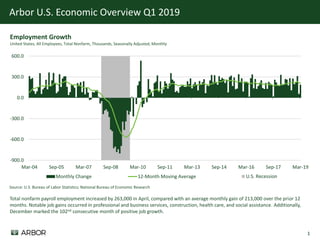
Employment Growth
United States, All Employees, Total Nonfarm, Thousands, Seasonally Adjusted, Monthly
Total nonfarm payroll employment increased by 263,000 in April, compared with an average monthly gain of 213,000 over the prior 12
months. Notable job gains occurred in professional and business services, construction, health care, and social assistance. Additionally,
December marked the 102nd consecutive month of positive job growth.
2
Arbor U.S. Economic Overview Q1 2019
Mining and
Logging
0.5%
Construction
4.9%
Manufacturing
8.5%
Trade,
Transportation,
and Utilities
18.3%
Information
1.9%
Financial
Activities
5.7%
Professional
and Business
Services
14.1%
Education and
Health Services
16.1%
Leisure and
Hospitality
11.0%
Other Services
3.9%
Government
15.2%
Source: U.S. Bureau of Labor Statistics
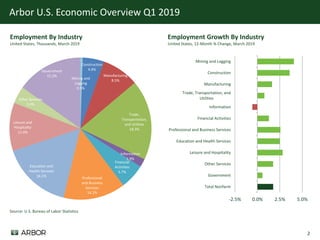
Employment By Industry
United States, Thousands, March 2019
Employment Growth By Industry
United States, 12-Month % Change, March 2019
Mining and Logging
Construction
Manufacturing
Trade, Transportation, and
Utilities
Information
Financial Activities
Professional and Business Services
Education and Health Services
Leisure and Hospitality
Other Services
Government
Total Nonfarm
-2.5% 0.0% 2.5% 5.0%
3
Arbor U.S. Economic Overview Q1 2019
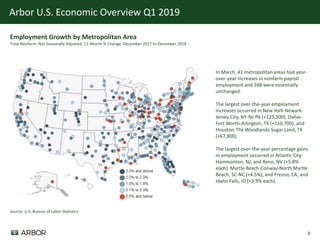
Employment Growth by Metropolitan Area
Total Nonfarm, Not Seasonally Adjusted, 12-Month % Change, December 2017 to December 2018
Source: U.S. Bureau of Labor Statistics
In March, 41 metropolitan areas had year-
over-year increases in nonfarm payroll
employment and 348 were essentially
unchanged.
The largest over-the-year employment
increases occurred in New York-Newark-
Jersey City, NY-NJ-PA (+123,300), Dallas-
Fort Worth-Arlington, TX (+110,700), and
Houston-The Woodlands-Sugar Land, TX
(+67,800).
The largest over-the-year percentage gains
in employment occurred in Atlantic City-
Hammonton, NJ, and Reno, NV (+5.8%
each), Myrtle Beach-Conway-North Myrtle
Beach, SC-NC (+4.5%), and Fresno, CA, and
Idaho Falls, ID (+3.9% each).
4
Arbor U.S. Economic Overview Q1 2019
U.S. Recession
0.0%
3.0%
6.0%
9.0%
12.0%
0
200
400
600
800
Mar-04 Sep-05 Mar-07 Sep-08 Mar-10 Sep-11 Mar-13 Sep-14 Mar-16 Sep-17 Mar-19
Initial Claims (Thousands) Unemployment Rate (%)
Source: U.S. Bureau of Labor Statistics; U.S. Employment and Training Administration; National Bureau of Economic Research
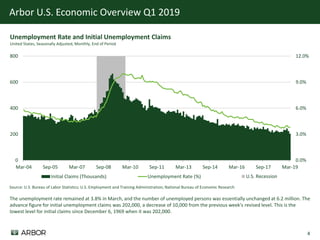
Unemployment Rate and Initial Unemployment Claims
United States, Seasonally Adjusted, Monthly, End of Period
The unemployment rate remained at 3.8% in March, and the number of unemployed persons was essentially unchanged at 6.2 million. The
advance figure for initial unemployment claims was 202,000, a decrease of 10,000 from the previous week's revised level. This is the
lowest level for initial claims since December 6, 1969 when it was 202,000.
5
Arbor U.S. Economic Overview Q1 2019
U.S. Recession
0.0
3.5
7.0
10.5
14.0
17.5
Mar-04 Sep-05 Mar-07 Sep-08 Mar-10 Sep-11 Mar-13 Sep-14 Mar-16 Sep-17 Mar-19
Unemployed Persons Job Openings
Source: U.S. Bureau of Labor Statistics; National Bureau of Economic Research
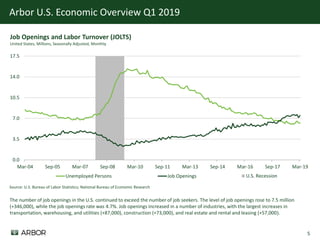
Job Openings and Labor Turnover (JOLTS)
United States, Millions, Seasonally Adjusted, Monthly
The number of job openings in the U.S. continued to exceed the number of job seekers. The level of job openings rose to 7.5 million
(+346,000), while the job openings rate was 4.7%. Job openings increased in a number of industries, with the largest increases in
transportation, warehousing, and utilities (+87,000), construction (+73,000), and real estate and rental and leasing (+57,000).
6
Arbor U.S. Economic Overview Q1 2019
U.S. Recession
-3.0%
-1.0%
1.0%
3.0%
5.0%
7.0%
Mar-05 Sep-06 Mar-08 Sep-09 Mar-11 Sep-12 Mar-14 Sep-15 Mar-17 Sep-18
CPI All Items Rent of Primary Residence
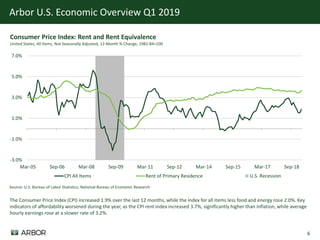
Consumer Price Index: Rent and Rent Equivalence
United States, All Items, Not Seasonally Adjusted, 12-Month % Change, 1982-84=100
The Consumer Price Index (CPI) increased 1.9% over the last 12 months, while the index for all items less food and energy rose 2.0%. Key
indicators of affordability worsened during the year, as the CPI rent index increased 3.7%, significantly higher than inflation, while average
hourly earnings rose at a slower rate of 3.2%.
Source: U.S. Bureau of Labor Statistics; National Bureau of Economic Research
7
Arbor U.S. Economic Overview Q1 2019
U.S. Recession
-10.0%
-5.0%
0.0%
5.0%
10.0%
1Q04 1Q05 1Q06 1Q07 1Q08 1Q09 1Q10 1Q11 1Q12 1Q13 1Q14 1Q15 1Q16 1Q17 1Q18 1Q19
Gross Domestic Product (%) 15-Year Average
Source: U.S. Bureau of Economic Analysis; National Bureau of Economic Research; Retrieved from FRED, Federal Reserve Bank of St. Louis
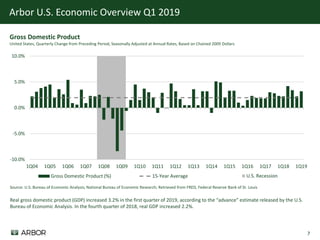
Gross Domestic Product
United States, Quarterly Change from Preceding Period, Seasonally Adjusted at Annual Rates, Based on Chained 2009 Dollars
Real gross domestic product (GDP) increased 3.2% in the first quarter of 2019, according to the “advance” estimate released by the U.S.
Bureau of Economic Analysis. In the fourth quarter of 2018, real GDP increased 2.2%.
8
Arbor U.S. Economic Overview Q1 2019
U.S. Recession
0.0
200.0
400.0
600.0
800.0
1,000.0
1954
1956
1958
1960
1962
1964
1966
1968
1970
1972
1974
1976
1978
1980
1982
1984
1986
1988
1990
1992
1994
1996
1998
2000
2002
2004
2006
2008
2010
2012
2014
2016
2018
Corporate Profits Compensation of Employees
Source: U.S. Bureau of Economic Analysis; National Bureau of Economic Research; Retrieved from FRED, Federal Reserve Bank of St. Louis
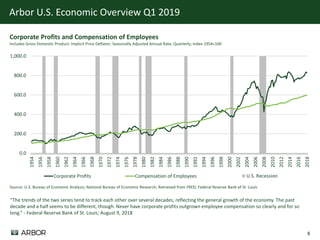
Corporate Profits and Compensation of Employees
Includes Gross Domestic Product: Implicit Price Deflator; Seasonally Adjusted Annual Rate; Quarterly; Index 1954=100
“The trends of the two series tend to track each other over several decades, reflecting the general growth of the economy. The past
decade and a half seems to be different, though. Never have corporate profits outgrown employee compensation so clearly and for so
long.” - Federal Reserve Bank of St. Louis; August 9, 2018
9
Arbor U.S. Economic Overview Q1 2019
U.S. Recession
-15.0%
-10.0%
-5.0%
0.0%
5.0%
10.0%
15.0%
Feb-09 Feb-10 Feb-11 Feb-12 Feb-13 Feb-14 Feb-15 Feb-16 Feb-17 Feb-18 Feb-19
Average Hourly Earnings S&P/Case-Shiller Home Price Index
Source: U.S. Bureau of Labor Statistics; S&P Dow Jones Indices; National Bureau of Economic Research; Retrieved from FRED, Federal Reserve Bank of St. Louis
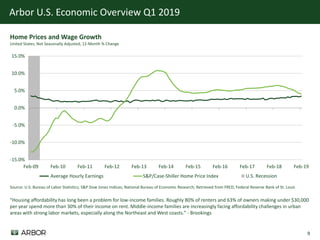
Home Prices and Wage Growth
United States, Not Seasonally Adjusted, 12-Month % Change
“Housing affordability has long been a problem for low-income families. Roughly 80% of renters and 63% of owners making under $30,000
per year spend more than 30% of their income on rent. Middle-income families are increasingly facing affordability challenges in urban
areas with strong labor markets, especially along the Northeast and West coasts.” - Brookings
10
Arbor U.S. Economic Overview Q1 2019
U.S. Recession
0.0%
2.0%
4.0%
6.0%
8.0%
10.0%
12.0%
60.0%
62.0%
64.0%
66.0%
68.0%
70.0%
1965
1966
1967
1968
1969
1970
1971
1972
1973
1974
1975
1976
1977
1978
1979
1980
1981
1982
1983
1984
1985
1986
1987
1988
1989
1990
1991
1992
1993
1994
1995
1996
1997
1998
1999
2000
2001
2002
2003
2004
2005
2006
2007
2008
2009
2010
2011
2012
2013
2014
2015
2016
2017
2018
1Q19
Homeownership Rate Homeowner Vacancy Rental Vacancy
Source: U.S. Bureau of the Census; National Bureau of Economic Research; Retrieved from FRED, Federal Reserve Bank of St. Louis
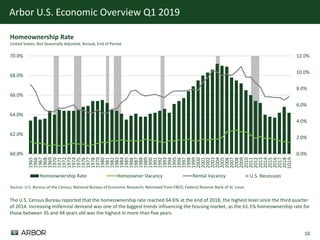
Homeownership Rate
United States, Not Seasonally Adjusted, Annual, End of Period
The U.S. Census Bureau reported that the homeownership rate reached 64.6% at the end of 2018, the highest level since the third quarter
of 2014. Increasing millennial demand was one of the biggest trends influencing the housing market, as the 61.1% homeownership rate for
those between 35 and 44 years old was the highest in more than five years.
11
Arbor U.S. Economic Overview Q1 2019
11
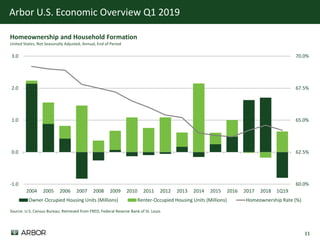
Homeownership and Household Formation
United States, Not Seasonally Adjusted, Annual, End of Period
Source: U.S. Census Bureau; Retrieved from FRED, Federal Reserve Bank of St. Louis
60.0%
62.5%
65.0%
67.5%
70.0%
-1.0
0.0
1.0
2.0
3.0
2004 2005 2006 2007 2008 2009 2010 2011 2012 2013 2014 2015 2016 2017 2018 1Q19
Thousands
Owner-Occupied Housing Units (Millions) Renter-Occupied Housing Units (Millions) Homeownership Rate (%)
12
Arbor U.S. Economic Overview Q1 2019
30.0%
42.0%
54.0%
66.0%
78.0%
90.0%
All Ages Under 35 years 35 to 44 years 45 to 54 years 55 to 64 years 65 years and over
Previous Peak (2003) Q1 2019
Source: U.S. Bureau of the Census
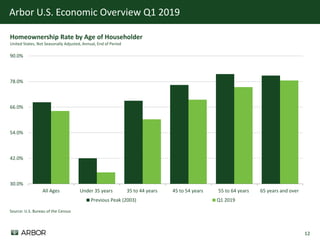
Homeownership Rate by Age of Householder
United States, Not Seasonally Adjusted, Annual, End of Period
13
Arbor U.S. Economic Overview Q1 2019
0
25
50
75
100
125
150
Apr-33to
Apr-37
Jul-38to
Jan-45
Nov-45to
Oct-48
Nov-49to
Jun-53
Jun-54to
Jul-57
May-58to
Mar-60
Mar-61to
Nov-69
Dec-70to
Oct-73
Apr-75to
Dec-79
Aug-80to
Jun-81
Dec-82to
Jun-90
Apr-91to
Feb-01
Dec-01to
Nov-07
Jul-09to
Current
Time Between Recessions (Months) Average
Source: National Bureau of Economic Research
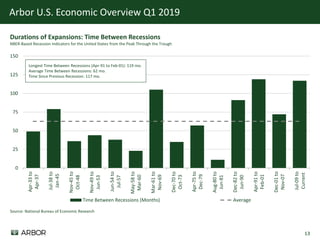
Durations of Expansions: Time Between Recessions
NBER-Based Recession Indicators for the United States from the Peak Through the Trough
Longest Time Between Recessions (Apr-91 to Feb-01): 119 mo.
Average Time Between Recessions: 62 mo.
Time Since Previous Recession: 117 mo.
14
Arbor U.S. Economic Overview Q1 2019
Source: Board of Governors of the Federal Reserve System; National Bureau of Economic Research; Retrieved from FRED, Federal Reserve Bank of St. Louis
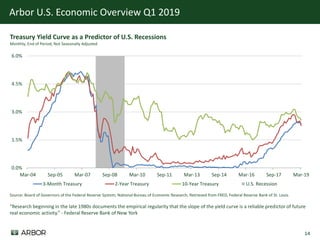
Treasury Yield Curve as a Predictor of U.S. Recessions
Monthly, End of Period, Not Seasonally Adjusted
“Research beginning in the late 1980s documents the empirical regularity that the slope of the yield curve is a reliable predictor of future
real economic activity.” - Federal Reserve Bank of New York
U.S. Recession
0.0%
1.5%
3.0%
4.5%
6.0%
Mar-04 Sep-05 Mar-07 Sep-08 Mar-10 Sep-11 Mar-13 Sep-14 Mar-16 Sep-17 Mar-19
3-Month Treasury 2-Year Treasury 10-Year Treasury
15
Arbor U.S. Economic Overview Q1 2019
0.0%
10.0%
20.0%
30.0%
40.0%
50.0%
Mar-05 Mar-10 Mar-15 Mar-20
Source: The Wall Street Journal Economic Forecasting Survey
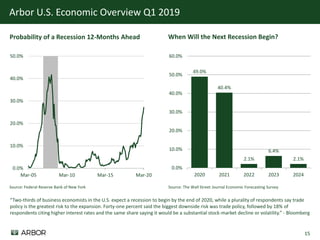
When Will the Next Recession Begin?
49.0%
40.4%
2.1%
6.4%
2.1%
0.0%
10.0%
20.0%
30.0%
40.0%
50.0%
60.0%
2020 2021 2022 2023 2024
Source: Federal Reserve Bank of New York
Probability of a Recession 12-Months Ahead
“Two-thirds of business economists in the U.S. expect a recession to begin by the end of 2020, while a plurality of respondents say trade
policy is the greatest risk to the expansion. Forty-one percent said the biggest downside risk was trade policy, followed by 18% of
respondents citing higher interest rates and the same share saying it would be a substantial stock-market decline or volatility.” - Bloomberg
16
Arbor U.S. Economic Overview Q1 2019
U.S. Recession
-4.0%
-2.0%
0.0%
2.0%
4.0%
1984 1989 1994 1999 2004 2009 2014 2019
Leading Index (%)
Source: Federal Reserve Bank of Philadelphia; National Bureau of Economic Research; Retrieved from FRED, Federal Reserve Bank of St. Louis
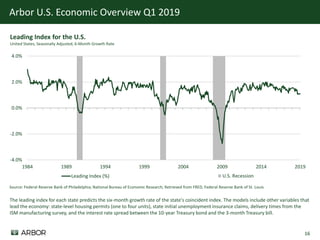
Leading Index for the U.S.
United States, Seasonally Adjusted, 6-Month Growth Rate
The leading index for each state predicts the six-month growth rate of the state's coincident index. The models include other variables that
lead the economy: state-level housing permits (one to four units), state initial unemployment insurance claims, delivery times from the
ISM manufacturing survey, and the interest rate spread between the 10-year Treasury bond and the 3-month Treasury bill.
17
Arbor U.S. Economic Overview Q1 2019
U.S. Recession
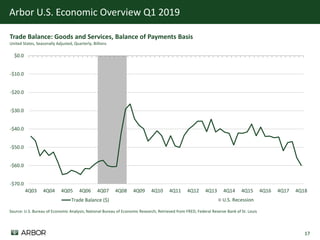
-$70.0
-$60.0
-$50.0
-$40.0
-$30.0
-$20.0
-$10.0
$0.0
4Q03 4Q04 4Q05 4Q06 4Q07 4Q08 4Q09 4Q10 4Q11 4Q12 4Q13 4Q14 4Q15 4Q16 4Q17 4Q18
Billions
Trade Balance ($)
Source: U.S. Bureau of Economic Analysis; National Bureau of Economic Research; Retrieved from FRED, Federal Reserve Bank of St. Louis
Trade Balance: Goods and Services, Balance of Payments Basis
United States, Seasonally Adjusted, Quarterly, Billions
ARBOR.COM • 1.800.ARBOR.10
About Us
Arbor Realty Trust, Inc. (NYSE:ABR) is a nationwide real estate investment trust and direct lender, providing loan
origination and servicing for multifamily, seniors housing, healthcare and other diverse commercial real estate assets.
Headquartered in Uniondale, New York, Arbor manages a multibillion-dollar servicing portfolio, specializing in
government-sponsored enterprise products. Arbor is a Fannie Mae DUS® lender and Freddie Mac Optigo Seller/Servicer.
Arbor’s product platform also includes CMBS, bridge, mezzanine and preferred equity loans. Rated by Standard and
Poor’s and Fitch Ratings, Arbor is committed to building on its reputation for service, quality and customized solutions
with an unparalleled dedication to providing our clients excellence over the entire life of a loan.
The research contained in this report should not be construed as a solicitation to and/or trade. All opinions, news,
research, analyses, prices or other information is provided as general market commentary and not as investment advice;
all information is subject to change. Arbor, its members, shareholders, employees, agents and representatives do not
warrant the completeness, accuracy or timeliness of the information supplied, and shall not be liable for any loss or
damages, consequential or otherwise, which may arise from the use or reliance on the content contained herein. Past
performance is not indicative of future performance.

Arbor U.S. Economic Overview Q1 2019

  • 1.
  • 2.
    1 Arbor U.S. EconomicOverview Q1 2019 U.S. Recession -900.0 -600.0 -300.0 0.0 300.0 600.0 Mar-04 Sep-05 Mar-07 Sep-08 Mar-10 Sep-11 Mar-13 Sep-14 Mar-16 Sep-17 Mar-19 Monthly Change 12-Month Moving Average Source: U.S. Bureau of Labor Statistics; National Bureau of Economic Research Employment Growth United States, All Employees, Total Nonfarm, Thousands, Seasonally Adjusted, Monthly Total nonfarm payroll employment increased by 263,000 in April, compared with an average monthly gain of 213,000 over the prior 12 months. Notable job gains occurred in professional and business services, construction, health care, and social assistance. Additionally, December marked the 102nd consecutive month of positive job growth.
  • 3.
    2 Arbor U.S. EconomicOverview Q1 2019 Mining and Logging 0.5% Construction 4.9% Manufacturing 8.5% Trade, Transportation, and Utilities 18.3% Information 1.9% Financial Activities 5.7% Professional and Business Services 14.1% Education and Health Services 16.1% Leisure and Hospitality 11.0% Other Services 3.9% Government 15.2% Source: U.S. Bureau of Labor Statistics Employment By Industry United States, Thousands, March 2019 Employment Growth By Industry United States, 12-Month % Change, March 2019 Mining and Logging Construction Manufacturing Trade, Transportation, and Utilities Information Financial Activities Professional and Business Services Education and Health Services Leisure and Hospitality Other Services Government Total Nonfarm -2.5% 0.0% 2.5% 5.0%
  • 4.
    3 Arbor U.S. EconomicOverview Q1 2019 Employment Growth by Metropolitan Area Total Nonfarm, Not Seasonally Adjusted, 12-Month % Change, December 2017 to December 2018 Source: U.S. Bureau of Labor Statistics In March, 41 metropolitan areas had year- over-year increases in nonfarm payroll employment and 348 were essentially unchanged. The largest over-the-year employment increases occurred in New York-Newark- Jersey City, NY-NJ-PA (+123,300), Dallas- Fort Worth-Arlington, TX (+110,700), and Houston-The Woodlands-Sugar Land, TX (+67,800). The largest over-the-year percentage gains in employment occurred in Atlantic City- Hammonton, NJ, and Reno, NV (+5.8% each), Myrtle Beach-Conway-North Myrtle Beach, SC-NC (+4.5%), and Fresno, CA, and Idaho Falls, ID (+3.9% each).
  • 5.
    4 Arbor U.S. EconomicOverview Q1 2019 U.S. Recession 0.0% 3.0% 6.0% 9.0% 12.0% 0 200 400 600 800 Mar-04 Sep-05 Mar-07 Sep-08 Mar-10 Sep-11 Mar-13 Sep-14 Mar-16 Sep-17 Mar-19 Initial Claims (Thousands) Unemployment Rate (%) Source: U.S. Bureau of Labor Statistics; U.S. Employment and Training Administration; National Bureau of Economic Research Unemployment Rate and Initial Unemployment Claims United States, Seasonally Adjusted, Monthly, End of Period The unemployment rate remained at 3.8% in March, and the number of unemployed persons was essentially unchanged at 6.2 million. The advance figure for initial unemployment claims was 202,000, a decrease of 10,000 from the previous week's revised level. This is the lowest level for initial claims since December 6, 1969 when it was 202,000.
  • 6.
    5 Arbor U.S. EconomicOverview Q1 2019 U.S. Recession 0.0 3.5 7.0 10.5 14.0 17.5 Mar-04 Sep-05 Mar-07 Sep-08 Mar-10 Sep-11 Mar-13 Sep-14 Mar-16 Sep-17 Mar-19 Unemployed Persons Job Openings Source: U.S. Bureau of Labor Statistics; National Bureau of Economic Research Job Openings and Labor Turnover (JOLTS) United States, Millions, Seasonally Adjusted, Monthly The number of job openings in the U.S. continued to exceed the number of job seekers. The level of job openings rose to 7.5 million (+346,000), while the job openings rate was 4.7%. Job openings increased in a number of industries, with the largest increases in transportation, warehousing, and utilities (+87,000), construction (+73,000), and real estate and rental and leasing (+57,000).
  • 7.
    6 Arbor U.S. EconomicOverview Q1 2019 U.S. Recession -3.0% -1.0% 1.0% 3.0% 5.0% 7.0% Mar-05 Sep-06 Mar-08 Sep-09 Mar-11 Sep-12 Mar-14 Sep-15 Mar-17 Sep-18 CPI All Items Rent of Primary Residence Consumer Price Index: Rent and Rent Equivalence United States, All Items, Not Seasonally Adjusted, 12-Month % Change, 1982-84=100 The Consumer Price Index (CPI) increased 1.9% over the last 12 months, while the index for all items less food and energy rose 2.0%. Key indicators of affordability worsened during the year, as the CPI rent index increased 3.7%, significantly higher than inflation, while average hourly earnings rose at a slower rate of 3.2%. Source: U.S. Bureau of Labor Statistics; National Bureau of Economic Research
  • 8.
    7 Arbor U.S. EconomicOverview Q1 2019 U.S. Recession -10.0% -5.0% 0.0% 5.0% 10.0% 1Q04 1Q05 1Q06 1Q07 1Q08 1Q09 1Q10 1Q11 1Q12 1Q13 1Q14 1Q15 1Q16 1Q17 1Q18 1Q19 Gross Domestic Product (%) 15-Year Average Source: U.S. Bureau of Economic Analysis; National Bureau of Economic Research; Retrieved from FRED, Federal Reserve Bank of St. Louis Gross Domestic Product United States, Quarterly Change from Preceding Period, Seasonally Adjusted at Annual Rates, Based on Chained 2009 Dollars Real gross domestic product (GDP) increased 3.2% in the first quarter of 2019, according to the “advance” estimate released by the U.S. Bureau of Economic Analysis. In the fourth quarter of 2018, real GDP increased 2.2%.
  • 9.
    8 Arbor U.S. EconomicOverview Q1 2019 U.S. Recession 0.0 200.0 400.0 600.0 800.0 1,000.0 1954 1956 1958 1960 1962 1964 1966 1968 1970 1972 1974 1976 1978 1980 1982 1984 1986 1988 1990 1992 1994 1996 1998 2000 2002 2004 2006 2008 2010 2012 2014 2016 2018 Corporate Profits Compensation of Employees Source: U.S. Bureau of Economic Analysis; National Bureau of Economic Research; Retrieved from FRED, Federal Reserve Bank of St. Louis Corporate Profits and Compensation of Employees Includes Gross Domestic Product: Implicit Price Deflator; Seasonally Adjusted Annual Rate; Quarterly; Index 1954=100 “The trends of the two series tend to track each other over several decades, reflecting the general growth of the economy. The past decade and a half seems to be different, though. Never have corporate profits outgrown employee compensation so clearly and for so long.” - Federal Reserve Bank of St. Louis; August 9, 2018
  • 10.
    9 Arbor U.S. EconomicOverview Q1 2019 U.S. Recession -15.0% -10.0% -5.0% 0.0% 5.0% 10.0% 15.0% Feb-09 Feb-10 Feb-11 Feb-12 Feb-13 Feb-14 Feb-15 Feb-16 Feb-17 Feb-18 Feb-19 Average Hourly Earnings S&P/Case-Shiller Home Price Index Source: U.S. Bureau of Labor Statistics; S&P Dow Jones Indices; National Bureau of Economic Research; Retrieved from FRED, Federal Reserve Bank of St. Louis Home Prices and Wage Growth United States, Not Seasonally Adjusted, 12-Month % Change “Housing affordability has long been a problem for low-income families. Roughly 80% of renters and 63% of owners making under $30,000 per year spend more than 30% of their income on rent. Middle-income families are increasingly facing affordability challenges in urban areas with strong labor markets, especially along the Northeast and West coasts.” - Brookings
  • 11.
    10 Arbor U.S. EconomicOverview Q1 2019 U.S. Recession 0.0% 2.0% 4.0% 6.0% 8.0% 10.0% 12.0% 60.0% 62.0% 64.0% 66.0% 68.0% 70.0% 1965 1966 1967 1968 1969 1970 1971 1972 1973 1974 1975 1976 1977 1978 1979 1980 1981 1982 1983 1984 1985 1986 1987 1988 1989 1990 1991 1992 1993 1994 1995 1996 1997 1998 1999 2000 2001 2002 2003 2004 2005 2006 2007 2008 2009 2010 2011 2012 2013 2014 2015 2016 2017 2018 1Q19 Homeownership Rate Homeowner Vacancy Rental Vacancy Source: U.S. Bureau of the Census; National Bureau of Economic Research; Retrieved from FRED, Federal Reserve Bank of St. Louis Homeownership Rate United States, Not Seasonally Adjusted, Annual, End of Period The U.S. Census Bureau reported that the homeownership rate reached 64.6% at the end of 2018, the highest level since the third quarter of 2014. Increasing millennial demand was one of the biggest trends influencing the housing market, as the 61.1% homeownership rate for those between 35 and 44 years old was the highest in more than five years.
  • 12.
    11 Arbor U.S. EconomicOverview Q1 2019 11 Homeownership and Household Formation United States, Not Seasonally Adjusted, Annual, End of Period Source: U.S. Census Bureau; Retrieved from FRED, Federal Reserve Bank of St. Louis 60.0% 62.5% 65.0% 67.5% 70.0% -1.0 0.0 1.0 2.0 3.0 2004 2005 2006 2007 2008 2009 2010 2011 2012 2013 2014 2015 2016 2017 2018 1Q19 Thousands Owner-Occupied Housing Units (Millions) Renter-Occupied Housing Units (Millions) Homeownership Rate (%)
  • 13.
    12 Arbor U.S. EconomicOverview Q1 2019 30.0% 42.0% 54.0% 66.0% 78.0% 90.0% All Ages Under 35 years 35 to 44 years 45 to 54 years 55 to 64 years 65 years and over Previous Peak (2003) Q1 2019 Source: U.S. Bureau of the Census Homeownership Rate by Age of Householder United States, Not Seasonally Adjusted, Annual, End of Period
  • 14.
    13 Arbor U.S. EconomicOverview Q1 2019 0 25 50 75 100 125 150 Apr-33to Apr-37 Jul-38to Jan-45 Nov-45to Oct-48 Nov-49to Jun-53 Jun-54to Jul-57 May-58to Mar-60 Mar-61to Nov-69 Dec-70to Oct-73 Apr-75to Dec-79 Aug-80to Jun-81 Dec-82to Jun-90 Apr-91to Feb-01 Dec-01to Nov-07 Jul-09to Current Time Between Recessions (Months) Average Source: National Bureau of Economic Research Durations of Expansions: Time Between Recessions NBER-Based Recession Indicators for the United States from the Peak Through the Trough Longest Time Between Recessions (Apr-91 to Feb-01): 119 mo. Average Time Between Recessions: 62 mo. Time Since Previous Recession: 117 mo.
  • 15.
    14 Arbor U.S. EconomicOverview Q1 2019 Source: Board of Governors of the Federal Reserve System; National Bureau of Economic Research; Retrieved from FRED, Federal Reserve Bank of St. Louis Treasury Yield Curve as a Predictor of U.S. Recessions Monthly, End of Period, Not Seasonally Adjusted “Research beginning in the late 1980s documents the empirical regularity that the slope of the yield curve is a reliable predictor of future real economic activity.” - Federal Reserve Bank of New York U.S. Recession 0.0% 1.5% 3.0% 4.5% 6.0% Mar-04 Sep-05 Mar-07 Sep-08 Mar-10 Sep-11 Mar-13 Sep-14 Mar-16 Sep-17 Mar-19 3-Month Treasury 2-Year Treasury 10-Year Treasury
  • 16.
    15 Arbor U.S. EconomicOverview Q1 2019 0.0% 10.0% 20.0% 30.0% 40.0% 50.0% Mar-05 Mar-10 Mar-15 Mar-20 Source: The Wall Street Journal Economic Forecasting Survey When Will the Next Recession Begin? 49.0% 40.4% 2.1% 6.4% 2.1% 0.0% 10.0% 20.0% 30.0% 40.0% 50.0% 60.0% 2020 2021 2022 2023 2024 Source: Federal Reserve Bank of New York Probability of a Recession 12-Months Ahead “Two-thirds of business economists in the U.S. expect a recession to begin by the end of 2020, while a plurality of respondents say trade policy is the greatest risk to the expansion. Forty-one percent said the biggest downside risk was trade policy, followed by 18% of respondents citing higher interest rates and the same share saying it would be a substantial stock-market decline or volatility.” - Bloomberg
  • 17.
    16 Arbor U.S. EconomicOverview Q1 2019 U.S. Recession -4.0% -2.0% 0.0% 2.0% 4.0% 1984 1989 1994 1999 2004 2009 2014 2019 Leading Index (%) Source: Federal Reserve Bank of Philadelphia; National Bureau of Economic Research; Retrieved from FRED, Federal Reserve Bank of St. Louis Leading Index for the U.S. United States, Seasonally Adjusted, 6-Month Growth Rate The leading index for each state predicts the six-month growth rate of the state's coincident index. The models include other variables that lead the economy: state-level housing permits (one to four units), state initial unemployment insurance claims, delivery times from the ISM manufacturing survey, and the interest rate spread between the 10-year Treasury bond and the 3-month Treasury bill.
  • 18.
    17 Arbor U.S. EconomicOverview Q1 2019 U.S. Recession -$70.0 -$60.0 -$50.0 -$40.0 -$30.0 -$20.0 -$10.0 $0.0 4Q03 4Q04 4Q05 4Q06 4Q07 4Q08 4Q09 4Q10 4Q11 4Q12 4Q13 4Q14 4Q15 4Q16 4Q17 4Q18 Billions Trade Balance ($) Source: U.S. Bureau of Economic Analysis; National Bureau of Economic Research; Retrieved from FRED, Federal Reserve Bank of St. Louis Trade Balance: Goods and Services, Balance of Payments Basis United States, Seasonally Adjusted, Quarterly, Billions
  • 19.
    ARBOR.COM • 1.800.ARBOR.10 AboutUs Arbor Realty Trust, Inc. (NYSE:ABR) is a nationwide real estate investment trust and direct lender, providing loan origination and servicing for multifamily, seniors housing, healthcare and other diverse commercial real estate assets. Headquartered in Uniondale, New York, Arbor manages a multibillion-dollar servicing portfolio, specializing in government-sponsored enterprise products. Arbor is a Fannie Mae DUS® lender and Freddie Mac Optigo Seller/Servicer. Arbor’s product platform also includes CMBS, bridge, mezzanine and preferred equity loans. Rated by Standard and Poor’s and Fitch Ratings, Arbor is committed to building on its reputation for service, quality and customized solutions with an unparalleled dedication to providing our clients excellence over the entire life of a loan. The research contained in this report should not be construed as a solicitation to and/or trade. All opinions, news, research, analyses, prices or other information is provided as general market commentary and not as investment advice; all information is subject to change. Arbor, its members, shareholders, employees, agents and representatives do not warrant the completeness, accuracy or timeliness of the information supplied, and shall not be liable for any loss or damages, consequential or otherwise, which may arise from the use or reliance on the content contained herein. Past performance is not indicative of future performance.