Small Multifamily
Q1 2020
1
Arbor Small Multifamily Report Q1 2020
14.7
35%
7.6
18%
13.7
33%
5.8
14%
Single-Family Rentals (1-Unit) Duplex-Quadruplex (2-4 Units)
Small Multifamily (5-49 Units) Large Multifamily (50+ Units)
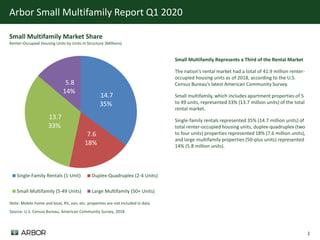
Small Multifamily Represents a Third of the Rental Market
The nation’s rental market had a total of 41.9 million renter-
occupied housing units as of 2018, according to the U.S.
Census Bureau’s latest American Community Survey.
Small multifamily, which includes apartment properties of 5
to 49 units, represented 33% (13.7 million units) of the total
rental market.
Single-family rentals represented 35% (14.7 million units) of
total renter-occupied housing units, duplex-quadruplex (two
to four units) properties represented 18% (7.6 million units),
and large multifamily properties (50-plus units) represented
14% (5.8 million units).
Small Multifamily Market Share
Renter-Occupied Housing Units by Units in Structure (Millions)
Source: U.S. Census Bureau, American Community Survey, 2018
Note: Mobile home and boat, RV, van, etc. properties are not included in data
2
Arbor Small Multifamily Report Q1 2020
Source: Arbor; Chandan Economics
Small Multifamily Origination Volume
United States, Multifamily, Billions
All data, unless otherwise stated, are based on Chandan Economics’ analysis of a limited pool of loans with original balances of $1 million to $7.5 million and loan-to-
value ratios above 50%.
$0.0
$13.0
$26.0
$39.0
$52.0
$65.0
2009 2010 2011 2012 2013 2014 2015 2016 2017 2018 2019 2020*
Total Volume Annualized Estimate
Year Volume
2010 $13.6
2011 $21.7
2012 $32.5
2013 $40.4
2014 $41.9
2015 $44.9
2016 $47.6
2017 $49.9
2018 $54.2
2019 $59.2
2020* $13.8
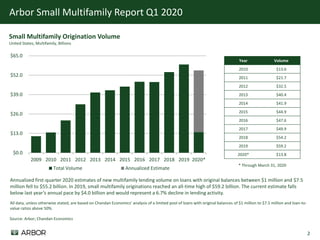
Annualized first-quarter 2020 estimates of new multifamily lending volume on loans with original balances between $1 million and $7.5
million fell to $55.2 billion. In 2019, small multifamily originations reached an all-time high of $59.2 billion. The current estimate falls
below last year’s annual pace by $4.0 billion and would represent a 6.7% decline in lending activity.
* Through March 31, 2020
3
Arbor Small Multifamily Report Q1 2020
Source: Arbor; Chandan Economics
Arbor Small Multifamily Price Index (ASMPI)
United States, Quarterly, Q2 2000 = 100.0
100.0
150.0
200.0
250.0
300.0
350.0
1Q05 1Q06 1Q07 1Q08 1Q09 1Q10 1Q11 1Q12 1Q13 1Q14 1Q15 1Q16 1Q17 1Q18 1Q19 1Q20
Arbor Small Multifamily Price Index (ASMPI)
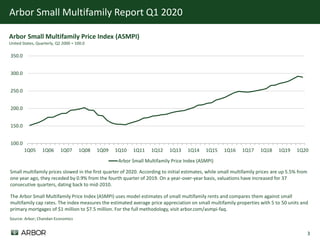
Small multifamily prices slowed in the first quarter of 2020. According to initial estimates, while small multifamily prices are up 5.5% from
one year ago, they receded by 0.9% from the fourth quarter of 2019. On a year-over-year basis, valuations have increased for 37
consecutive quarters, dating back to mid-2010.
The Arbor Small Multifamily Price Index (ASMPI) uses model estimates of small multifamily rents and compares them against small
multifamily cap rates. The index measures the estimated average price appreciation on small multifamily properties with 5 to 50 units and
primary mortgages of $1 million to $7.5 million. For the full methodology, visit arbor.com/asmpi-faq.
4
Arbor Small Multifamily Report Q1 2020
Source: Arbor; Chandan Economics
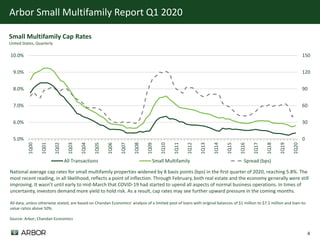
Small Multifamily Cap Rates
United States, Quarterly
National average cap rates for small multifamily properties widened by 8 basis points (bps) in the first quarter of 2020, reaching 5.8%. The
most recent reading, in all likelihood, reflects a point of inflection. Through February, both real estate and the economy generally were still
improving. It wasn’t until early to mid-March that COVID-19 had started to upend all aspects of normal business operations. In times of
uncertainty, investors demand more yield to hold risk. As a result, cap rates may see further upward pressure in the coming months.
0
30
60
90
120
150
5.0%
6.0%
7.0%
8.0%
9.0%
10.0%
1Q00
1Q01
1Q02
1Q03
1Q04
1Q05
1Q06
1Q07
1Q08
1Q09
1Q10
1Q11
1Q12
1Q13
1Q14
1Q15
1Q16
1Q17
1Q18
1Q19
1Q20
All Transactions Small Multifamily Spread (bps)
All data, unless otherwise stated, are based on Chandan Economics’ analysis of a limited pool of loans with original balances of $1 million to $7.5 million and loan-to-
value ratios above 50%.
5
Arbor Small Multifamily Report Q1 2020
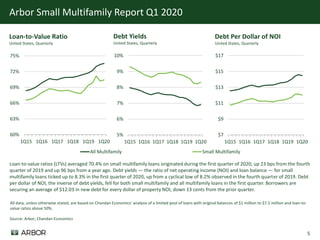
Debt Yields
United States, Quarterly
Loan-to-Value Ratio
United States, Quarterly
60%
63%
66%
69%
72%
75%
1Q15 1Q16 1Q17 1Q18 1Q19 1Q20
All Multifamily Small Multifamily
Debt Per Dollar of NOI
United States, Quarterly
Source: Arbor; Chandan Economics
Loan-to-value ratios (LTVs) averaged 70.4% on small multifamily loans originated during the first quarter of 2020, up 23 bps from the fourth
quarter of 2019 and up 96 bps from a year ago. Debt yields — the ratio of net operating income (NOI) and loan balance — for small
multifamily loans ticked up to 8.3% in the first quarter of 2020, up from a cyclical low of 8.2% observed in the fourth quarter of 2019. Debt
per dollar of NOI, the inverse of debt yields, fell for both small multifamily and all multifamily loans in the first quarter. Borrowers are
securing an average of $12.03 in new debt for every dollar of property NOI, down 13 cents from the prior quarter.
5%
6%
7%
8%
9%
10%
1Q15 1Q16 1Q17 1Q18 1Q19 1Q20
$7
$9
$11
$13
$15
$17
1Q15 1Q16 1Q17 1Q18 1Q19 1Q20
All data, unless otherwise stated, are based on Chandan Economics’ analysis of a limited pool of loans with original balances of $1 million to $7.5 million and loan-to-
value ratios above 50%.
6
Arbor Small Multifamily Report Q1 2020
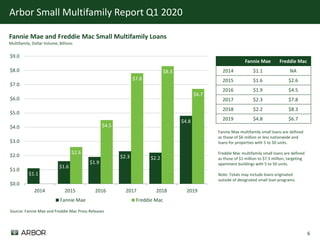
Fannie Mae and Freddie Mac Small Multifamily Loans
Multifamily, Dollar Volume, Billions
$1.1
$1.6
$1.9
$2.3 $2.2
$4.8
$2.6
$4.5
$7.8
$8.3
$6.7
$0.0
$1.0
$2.0
$3.0
$4.0
$5.0
$6.0
$7.0
$8.0
$9.0
2014 2015 2016 2017 2018 2019
Fannie Mae Freddie Mac
Source: Fannie Mae and Freddie Mac Press Releases
Fannie Mae Freddie Mac
2014 $1.1 NA
2015 $1.6 $2.6
2016 $1.9 $4.5
2017 $2.3 $7.8
2018 $2.2 $8.3
2019 $4.8 $6.7
Fannie Mae multifamily small loans are defined
as those of $6 million or less nationwide and
loans for properties with 5 to 50 units.
Freddie Mac multifamily small loans are defined
as those of $1 million to $7.5 million, targeting
apartment buildings with 5 to 50 units.
Note: Totals may include loans originated
outside of designated small loan programs.
7
Arbor Small Multifamily Report Q1 2020
Source: Arbor; Chandan Economics; Fannie Mae and Freddie Mac Press Releases
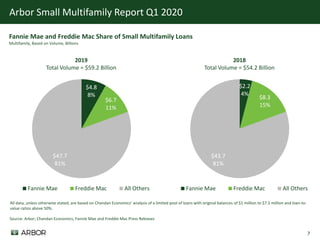
Fannie Mae and Freddie Mac Share of Small Multifamily Loans
Multifamily, Based on Volume, Billions
$4.8
8%
$6.7
11%
$47.7
81%
Fannie Mae Freddie Mac All Others
2019
Total Volume = $59.2 Billion
$2.2
4%
$8.3
15%
$43.7
81%
Fannie Mae Freddie Mac All Others
2018
Total Volume = $54.2 Billion
All data, unless otherwise stated, are based on Chandan Economics’ analysis of a limited pool of loans with original balances of $1 million to $7.5 million and loan-to-
value ratios above 50%.
8
Arbor Small Multifamily Report Q1 2020
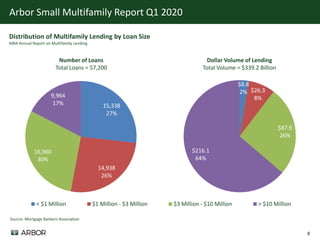
15,338
27%
14,938
26%
16,960
30%
9,964
17%
< $1 Million $1 Million - $3 Million $3 Million - $10 Million > $10 Million
Source: Mortgage Bankers Association
$8.8
2% $26.3
8%
$87.9
26%
$216.1
64%
Dollar Volume of Lending
Total Volume = $339.2 Billion
Distribution of Multifamily Lending by Loan Size
MBA Annual Report on Multifamily Lending
Number of Loans
Total Loans = 57,200
ARBOR.COM • 1.800.ARBOR.10
About Us
Arbor Realty Trust, Inc. (NYSE:ABR) is a nationwide real estate investment trust and direct lender, providing loan
origination and servicing for multifamily, single-family rental (SFR) portfolios, seniors housing, healthcare and other
diverse commercial real estate assets. Headquartered in Uniondale, New York, Arbor manages a multibillion-dollar
servicing portfolio, specializing in government-sponsored enterprise products. Arbor is a Fannie Mae DUS® lender and
Freddie Mac Optigo Seller/Servicer. Arbor’s product platform also includes CMBS, bridge, mezzanine and preferred
equity loans. Rated by Standard and Poor’s and Fitch Ratings, Arbor is committed to building on its reputation for
service, quality and customized solutions with an unparalleled dedication to providing our clients excellence over the
entire life of a loan.
The research contained in this report should not be construed as a solicitation to and/or trade. All opinions, news,
research, analyses, prices or other information is provided as general market commentary and not as investment advice;
all information is subject to change. Arbor, its members, shareholders, employees, agents and representatives do not
warrant the completeness, accuracy or timeliness of the information supplied, and shall not be liable for any loss or
damages, consequential or otherwise, which may arise from the use or reliance on the content contained herein. Past
performance is not indicative of future performance.

Arbor Small Multifamily Report Q1 2020

  • 1.
  • 2.
    1 Arbor Small MultifamilyReport Q1 2020 14.7 35% 7.6 18% 13.7 33% 5.8 14% Single-Family Rentals (1-Unit) Duplex-Quadruplex (2-4 Units) Small Multifamily (5-49 Units) Large Multifamily (50+ Units) Small Multifamily Represents a Third of the Rental Market The nation’s rental market had a total of 41.9 million renter- occupied housing units as of 2018, according to the U.S. Census Bureau’s latest American Community Survey. Small multifamily, which includes apartment properties of 5 to 49 units, represented 33% (13.7 million units) of the total rental market. Single-family rentals represented 35% (14.7 million units) of total renter-occupied housing units, duplex-quadruplex (two to four units) properties represented 18% (7.6 million units), and large multifamily properties (50-plus units) represented 14% (5.8 million units). Small Multifamily Market Share Renter-Occupied Housing Units by Units in Structure (Millions) Source: U.S. Census Bureau, American Community Survey, 2018 Note: Mobile home and boat, RV, van, etc. properties are not included in data
  • 3.
    2 Arbor Small MultifamilyReport Q1 2020 Source: Arbor; Chandan Economics Small Multifamily Origination Volume United States, Multifamily, Billions All data, unless otherwise stated, are based on Chandan Economics’ analysis of a limited pool of loans with original balances of $1 million to $7.5 million and loan-to- value ratios above 50%. $0.0 $13.0 $26.0 $39.0 $52.0 $65.0 2009 2010 2011 2012 2013 2014 2015 2016 2017 2018 2019 2020* Total Volume Annualized Estimate Year Volume 2010 $13.6 2011 $21.7 2012 $32.5 2013 $40.4 2014 $41.9 2015 $44.9 2016 $47.6 2017 $49.9 2018 $54.2 2019 $59.2 2020* $13.8 Annualized first-quarter 2020 estimates of new multifamily lending volume on loans with original balances between $1 million and $7.5 million fell to $55.2 billion. In 2019, small multifamily originations reached an all-time high of $59.2 billion. The current estimate falls below last year’s annual pace by $4.0 billion and would represent a 6.7% decline in lending activity. * Through March 31, 2020
  • 4.
    3 Arbor Small MultifamilyReport Q1 2020 Source: Arbor; Chandan Economics Arbor Small Multifamily Price Index (ASMPI) United States, Quarterly, Q2 2000 = 100.0 100.0 150.0 200.0 250.0 300.0 350.0 1Q05 1Q06 1Q07 1Q08 1Q09 1Q10 1Q11 1Q12 1Q13 1Q14 1Q15 1Q16 1Q17 1Q18 1Q19 1Q20 Arbor Small Multifamily Price Index (ASMPI) Small multifamily prices slowed in the first quarter of 2020. According to initial estimates, while small multifamily prices are up 5.5% from one year ago, they receded by 0.9% from the fourth quarter of 2019. On a year-over-year basis, valuations have increased for 37 consecutive quarters, dating back to mid-2010. The Arbor Small Multifamily Price Index (ASMPI) uses model estimates of small multifamily rents and compares them against small multifamily cap rates. The index measures the estimated average price appreciation on small multifamily properties with 5 to 50 units and primary mortgages of $1 million to $7.5 million. For the full methodology, visit arbor.com/asmpi-faq.
  • 5.
    4 Arbor Small MultifamilyReport Q1 2020 Source: Arbor; Chandan Economics Small Multifamily Cap Rates United States, Quarterly National average cap rates for small multifamily properties widened by 8 basis points (bps) in the first quarter of 2020, reaching 5.8%. The most recent reading, in all likelihood, reflects a point of inflection. Through February, both real estate and the economy generally were still improving. It wasn’t until early to mid-March that COVID-19 had started to upend all aspects of normal business operations. In times of uncertainty, investors demand more yield to hold risk. As a result, cap rates may see further upward pressure in the coming months. 0 30 60 90 120 150 5.0% 6.0% 7.0% 8.0% 9.0% 10.0% 1Q00 1Q01 1Q02 1Q03 1Q04 1Q05 1Q06 1Q07 1Q08 1Q09 1Q10 1Q11 1Q12 1Q13 1Q14 1Q15 1Q16 1Q17 1Q18 1Q19 1Q20 All Transactions Small Multifamily Spread (bps) All data, unless otherwise stated, are based on Chandan Economics’ analysis of a limited pool of loans with original balances of $1 million to $7.5 million and loan-to- value ratios above 50%.
  • 6.
    5 Arbor Small MultifamilyReport Q1 2020 Debt Yields United States, Quarterly Loan-to-Value Ratio United States, Quarterly 60% 63% 66% 69% 72% 75% 1Q15 1Q16 1Q17 1Q18 1Q19 1Q20 All Multifamily Small Multifamily Debt Per Dollar of NOI United States, Quarterly Source: Arbor; Chandan Economics Loan-to-value ratios (LTVs) averaged 70.4% on small multifamily loans originated during the first quarter of 2020, up 23 bps from the fourth quarter of 2019 and up 96 bps from a year ago. Debt yields — the ratio of net operating income (NOI) and loan balance — for small multifamily loans ticked up to 8.3% in the first quarter of 2020, up from a cyclical low of 8.2% observed in the fourth quarter of 2019. Debt per dollar of NOI, the inverse of debt yields, fell for both small multifamily and all multifamily loans in the first quarter. Borrowers are securing an average of $12.03 in new debt for every dollar of property NOI, down 13 cents from the prior quarter. 5% 6% 7% 8% 9% 10% 1Q15 1Q16 1Q17 1Q18 1Q19 1Q20 $7 $9 $11 $13 $15 $17 1Q15 1Q16 1Q17 1Q18 1Q19 1Q20 All data, unless otherwise stated, are based on Chandan Economics’ analysis of a limited pool of loans with original balances of $1 million to $7.5 million and loan-to- value ratios above 50%.
  • 7.
    6 Arbor Small MultifamilyReport Q1 2020 Fannie Mae and Freddie Mac Small Multifamily Loans Multifamily, Dollar Volume, Billions $1.1 $1.6 $1.9 $2.3 $2.2 $4.8 $2.6 $4.5 $7.8 $8.3 $6.7 $0.0 $1.0 $2.0 $3.0 $4.0 $5.0 $6.0 $7.0 $8.0 $9.0 2014 2015 2016 2017 2018 2019 Fannie Mae Freddie Mac Source: Fannie Mae and Freddie Mac Press Releases Fannie Mae Freddie Mac 2014 $1.1 NA 2015 $1.6 $2.6 2016 $1.9 $4.5 2017 $2.3 $7.8 2018 $2.2 $8.3 2019 $4.8 $6.7 Fannie Mae multifamily small loans are defined as those of $6 million or less nationwide and loans for properties with 5 to 50 units. Freddie Mac multifamily small loans are defined as those of $1 million to $7.5 million, targeting apartment buildings with 5 to 50 units. Note: Totals may include loans originated outside of designated small loan programs.
  • 8.
    7 Arbor Small MultifamilyReport Q1 2020 Source: Arbor; Chandan Economics; Fannie Mae and Freddie Mac Press Releases Fannie Mae and Freddie Mac Share of Small Multifamily Loans Multifamily, Based on Volume, Billions $4.8 8% $6.7 11% $47.7 81% Fannie Mae Freddie Mac All Others 2019 Total Volume = $59.2 Billion $2.2 4% $8.3 15% $43.7 81% Fannie Mae Freddie Mac All Others 2018 Total Volume = $54.2 Billion All data, unless otherwise stated, are based on Chandan Economics’ analysis of a limited pool of loans with original balances of $1 million to $7.5 million and loan-to- value ratios above 50%.
  • 9.
    8 Arbor Small MultifamilyReport Q1 2020 15,338 27% 14,938 26% 16,960 30% 9,964 17% < $1 Million $1 Million - $3 Million $3 Million - $10 Million > $10 Million Source: Mortgage Bankers Association $8.8 2% $26.3 8% $87.9 26% $216.1 64% Dollar Volume of Lending Total Volume = $339.2 Billion Distribution of Multifamily Lending by Loan Size MBA Annual Report on Multifamily Lending Number of Loans Total Loans = 57,200
  • 10.
    ARBOR.COM • 1.800.ARBOR.10 AboutUs Arbor Realty Trust, Inc. (NYSE:ABR) is a nationwide real estate investment trust and direct lender, providing loan origination and servicing for multifamily, single-family rental (SFR) portfolios, seniors housing, healthcare and other diverse commercial real estate assets. Headquartered in Uniondale, New York, Arbor manages a multibillion-dollar servicing portfolio, specializing in government-sponsored enterprise products. Arbor is a Fannie Mae DUS® lender and Freddie Mac Optigo Seller/Servicer. Arbor’s product platform also includes CMBS, bridge, mezzanine and preferred equity loans. Rated by Standard and Poor’s and Fitch Ratings, Arbor is committed to building on its reputation for service, quality and customized solutions with an unparalleled dedication to providing our clients excellence over the entire life of a loan. The research contained in this report should not be construed as a solicitation to and/or trade. All opinions, news, research, analyses, prices or other information is provided as general market commentary and not as investment advice; all information is subject to change. Arbor, its members, shareholders, employees, agents and representatives do not warrant the completeness, accuracy or timeliness of the information supplied, and shall not be liable for any loss or damages, consequential or otherwise, which may arise from the use or reliance on the content contained herein. Past performance is not indicative of future performance.