U.S. Economic Overview
Q2 2018
ARBOR.COM • 1.800.ARBOR.10
U.S. Economic Overview Q2 2018
ARBOR.COM • 1.800.ARBOR.10 1
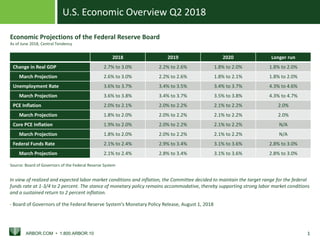
Economic Projections of the Federal Reserve Board
As of June 2018, Central Tendency
Source: Board of Governors of the Federal Reserve System
2018 2019 2020 Longer run
Change in Real GDP 2.7% to 3.0% 2.2% to 2.6% 1.8% to 2.0% 1.8% to 2.0%
March Projection 2.6% to 3.0% 2.2% to 2.6% 1.8% to 2.1% 1.8% to 2.0%
Unemployment Rate 3.6% to 3.7% 3.4% to 3.5% 3.4% to 3.7% 4.3% to 4.6%
March Projection 3.6% to 3.8% 3.4% to 3.7% 3.5% to 3.8% 4.3% to 4.7%
PCE Inflation 2.0% to 2.1% 2.0% to 2.2% 2.1% to 2.2% 2.0%
March Projection 1.8% to 2.0% 2.0% to 2.2% 2.1% to 2.2% 2.0%
Core PCE Inflation 1.9% to 2.0% 2.0% to 2.2% 2.1% to 2.2% N/A
March Projection 1.8% to 2.0% 2.0% to 2.2% 2.1% to 2.2% N/A
Federal Funds Rate 2.1% to 2.4% 2.9% to 3.4% 3.1% to 3.6% 2.8% to 3.0%
March Projection 2.1% to 2.4% 2.8% to 3.4% 3.1% to 3.6% 2.8% to 3.0%
In view of realized and expected labor market conditions and inflation, the Committee decided to maintain the target range for the federal
funds rate at 1-3/4 to 2 percent. The stance of monetary policy remains accommodative, thereby supporting strong labor market conditions
and a sustained return to 2 percent inflation.
- Board of Governors of the Federal Reserve System’s Monetary Policy Release, August 1, 2018
U.S. Economic Overview Q2 2018
ARBOR.COM • 1.800.ARBOR.10 2
U.S. Recession
-900.0
-600.0
-300.0
0.0
300.0
600.0
Jun-03 Dec-04 Jun-06 Dec-07 Jun-09 Dec-10 Jun-12 Dec-13 Jun-15 Dec-16 Jun-18
Monthly Change 12-Month Moving Average
Source: U.S. Bureau of Labor Statistics, National Bureau of Economic Research
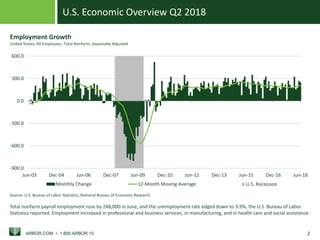
Employment Growth
United States, All Employees, Total Nonfarm, Seasonally Adjusted
Total nonfarm payroll employment rose by 248,000 in June, and the unemployment rate edged down to 3.9%, the U.S. Bureau of Labor
Statistics reported. Employment increased in professional and business services, in manufacturing, and in health care and social assistance.
U.S. Economic Overview Q2 2018
ARBOR.COM • 1.800.ARBOR.10 3
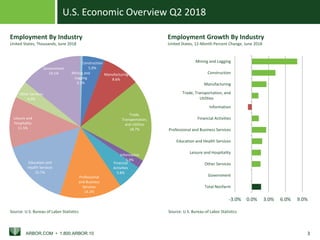
Mining and
Logging
0.5%
Construction
5.0%
Manufacturing
8.6%
Trade,
Transportation,
and Utilities
18.7%
Information
1.9%
Financial
Activities
5.8%
Professional
and Business
Services
14.2%
Education and
Health Services
15.7%
Leisure and
Hospitality
11.5%
Other Services
4.0%
Government
14.1%
Source: U.S. Bureau of Labor Statistics
Employment By Industry
United States, Thousands, June 2018
Employment Growth By Industry
United States, 12-Month Percent Change, June 2018
Mining and Logging
Construction
Manufacturing
Trade, Transportation, and
Utilities
Information
Financial Activities
Professional and Business Services
Education and Health Services
Leisure and Hospitality
Other Services
Government
Total Nonfarm
-3.0% 0.0% 3.0% 6.0% 9.0%
Source: U.S. Bureau of Labor Statistics
U.S. Economic Overview Q2 2018
ARBOR.COM • 1.800.ARBOR.10 4
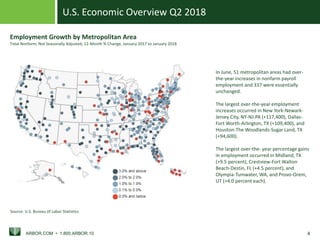
Employment Growth by Metropolitan Area
Total Nonfarm, Not Seasonally Adjusted, 12-Month % Change, January 2017 to January 2018
Source: U.S. Bureau of Labor Statistics
In June, 51 metropolitan areas had over-
the-year increases in nonfarm payroll
employment and 337 were essentially
unchanged.
The largest over-the-year employment
increases occurred in New York-Newark-
Jersey City, NY-NJ-PA (+117,400), Dallas-
Fort Worth-Arlington, TX (+109,400), and
Houston-The Woodlands-Sugar Land, TX
(+94,600).
The largest over-the- year percentage gains
in employment occurred in Midland, TX
(+9.5 percent), Crestview-Fort Walton
Beach-Destin, FL (+4.5 percent), and
Olympia-Tumwater, WA, and Provo-Orem,
UT (+4.0 percent each).
U.S. Economic Overview Q2 2018
ARBOR.COM • 1.800.ARBOR.10 5
U.S. Recession
-3.0%
-1.0%
1.0%
3.0%
5.0%
7.0%
Jun-03 Dec-04 Jun-06 Dec-07 Jun-09 Dec-10 Jun-12 Dec-13 Jun-15 Dec-16 Jun-18
Consumer Price Index (%) Federal Funds Inflation Target (%)
Source: U.S. Bureau of Labor Statistics, National Bureau of Economic Research
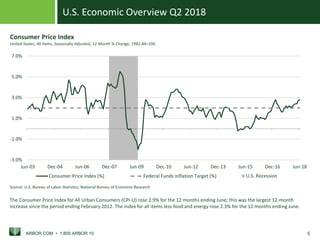
Consumer Price Index
United States, All Items, Seasonally Adjusted, 12-Month % Change, 1982-84=100
The Consumer Price Index for All Urban Consumers (CPI-U) rose 2.9% for the 12 months ending June; this was the largest 12-month
increase since the period ending February 2012. The index for all items less food and energy rose 2.3% for the 12 months ending June.
U.S. Economic Overview Q2 2018
ARBOR.COM • 1.800.ARBOR.10 6
U.S. Recession
-3.0%
-1.0%
1.0%
3.0%
5.0%
7.0%
Jun-03 Dec-04 Jun-06 Dec-07 Jun-09 Dec-10 Jun-12 Dec-13 Jun-15 Dec-16 Jun-18
CPI All Items Owners' Equivalent Rent of Residences Rent of Primary Residence
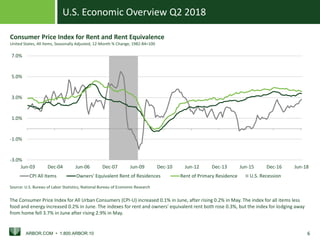
Consumer Price Index for Rent and Rent Equivalence
United States, All Items, Seasonally Adjusted, 12-Month % Change, 1982-84=100
The Consumer Price Index for All Urban Consumers (CPI-U) increased 0.1% in June, after rising 0.2% in May. The index for all items less
food and energy increased 0.2% in June. The indexes for rent and owners' equivalent rent both rose 0.3%, but the index for lodging away
from home fell 3.7% in June after rising 2.9% in May.
Source: U.S. Bureau of Labor Statistics, National Bureau of Economic Research
U.S. Economic Overview Q2 2018
ARBOR.COM • 1.800.ARBOR.10 7
U.S. Recession
0.0%
1.0%
2.0%
3.0%
4.0%
5.0%
Jun-07 Jun-08 Jun-09 Jun-10 Jun-11 Jun-12 Jun-13 Jun-14 Jun-15 Jun-16 Jun-17 Jun-18
Average Hourly Earnings
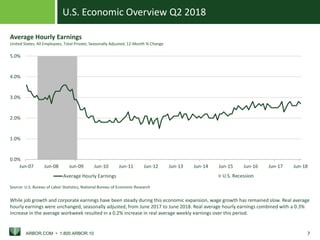
United States, All Employees, Total Private, Seasonally Adjusted, 12-Month % Change
While job growth and corporate earnings have been steady during this economic expansion, wage growth has remained slow. Real average
hourly earnings were unchanged, seasonally adjusted, from June 2017 to June 2018. Real average hourly earnings combined with a 0.3%
increase in the average workweek resulted in a 0.2% increase in real average weekly earnings over this period.
Source: U.S. Bureau of Labor Statistics, National Bureau of Economic Research
U.S. Economic Overview Q2 2018
ARBOR.COM • 1.800.ARBOR.10 8
U.S. Recession
-10.0%
-6.0%
-2.0%
2.0%
6.0%
10.0%
2Q03 2Q04 2Q05 2Q06 2Q07 2Q08 2Q09 2Q10 2Q11 2Q12 2Q13 2Q14 2Q15 2Q16 2Q17 2Q18
Gross Domestic Product (%) 15-Year Average
Source: U.S. Bureau of Economic Analysis, National Bureau of Economic Research, retrieved from FRED
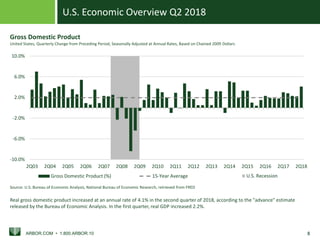
Gross Domestic Product
United States, Quarterly Change from Preceding Period, Seasonally Adjusted at Annual Rates, Based on Chained 2009 Dollars
Real gross domestic product increased at an annual rate of 4.1% in the second quarter of 2018, according to the "advance" estimate
released by the Bureau of Economic Analysis. In the first quarter, real GDP increased 2.2%.
U.S. Economic Overview Q2 2018
ARBOR.COM • 1.800.ARBOR.10 9
U.S. Recession
$0.0
$0.4
$0.8
$1.2
$1.6
$2.0
1Q03 1Q04 1Q05 1Q06 1Q07 1Q08 1Q09 1Q10 1Q11 1Q12 1Q13 1Q14 1Q15 1Q16 1Q17 1Q18
Corporate Profits (Trillions)
Source: U.S. Bureau of Economic Analysis, National Bureau of Economic Research, retrieved from FRED
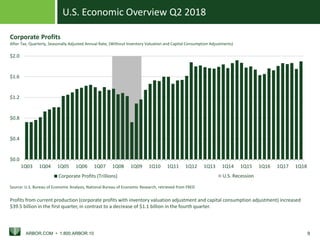
Corporate Profits
After Tax, Quarterly, Seasonally Adjusted Annual Rate, (Without Inventory Valuation and Capital Consumption Adjustments)
Profits from current production (corporate profits with inventory valuation adjustment and capital consumption adjustment) increased
$39.5 billion in the first quarter, in contrast to a decrease of $1.1 billion in the fourth quarter.
U.S. Economic Overview Q2 2018
ARBOR.COM • 1.800.ARBOR.10 10
0
25
50
75
100
125
150
Apr-33to
Apr-37
Jul-38to
Jan-45
Nov-45to
Oct-48
Nov-49to
Jun-53
Jun-54to
Jul-57
May-58to
Mar-60
Mar-61to
Nov-69
Dec-70to
Oct-73
Apr-75to
Dec-79
Aug-80to
Jun-81
Dec-82to
Jun-90
Apr-91to
Feb-01
Dec-01to
Nov-07
Jul-09to
Current
Time Between Recessions (Months) Average
Source: National Bureau of Economic Research
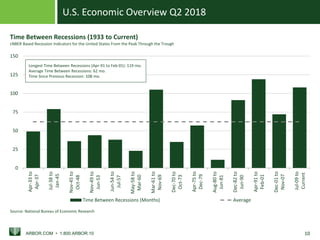
Time Between Recessions (1933 to Current)
cNBER Based Recession Indicators for the United States From the Peak Through the Trough
Longest Time Between Recessions (Apr-91 to Feb-01): 119 mo.
Average Time Between Recessions: 62 mo.
Time Since Previous Recession: 108 mo.
U.S. Economic Overview Q2 2018
ARBOR.COM • 1.800.ARBOR.10 11
U.S. Recession
0.0%
1.5%
3.0%
4.5%
6.0%
Jun-03 Dec-04 Jun-06 Dec-07 Jun-09 Dec-10 Jun-12 Dec-13 Jun-15 Dec-16 Jun-18
3-Month Treasury 2-Year Treasury 10-Year Treasury
Source: Board of Governors of the Federal Reserve System, National Bureau of Economic Research, retrieved from FRED
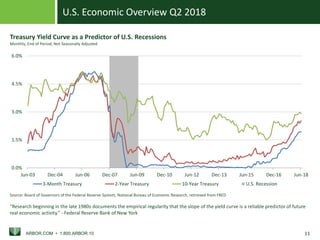
Treasury Yield Curve as a Predictor of U.S. Recessions
Monthly, End of Period, Not Seasonally Adjusted
“Research beginning in the late 1980s documents the empirical regularity that the slope of the yield curve is a reliable predictor of future
real economic activity.” - Federal Reserve Bank of New York
U.S. Economic Overview Q2 2018
ARBOR.COM • 1.800.ARBOR.10 12
U.S. Recession
60.0%
62.0%
64.0%
66.0%
68.0%
70.0%
1965
1966
1967
1968
1969
1970
1971
1972
1973
1974
1975
1976
1977
1978
1979
1980
1981
1982
1983
1984
1985
1986
1987
1988
1989
1990
1991
1992
1993
1994
1995
1996
1997
1998
1999
2000
2001
2002
2003
2004
2005
2006
2007
2008
2009
2010
2011
2012
2013
2014
2015
2016
2017
YTD18
Homeownership Rate (%)
Source: U.S. Bureau of the Census, National Bureau of Economic Research, retrieved from FRED
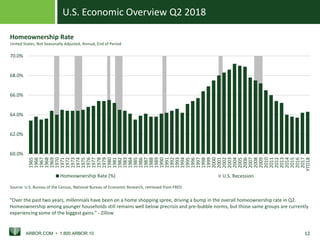
Homeownership Rate
United States, Not Seasonally Adjusted, Annual, End of Period
“Over the past two years, millennials have been on a home shopping spree, driving a bump in the overall homeownership rate in Q2.
Homeownership among younger households still remains well below precrisis and pre-bubble norms, but those same groups are currently
experiencing some of the biggest gains.” - Zillow
U.S. Economic Overview Q2 2018
ARBOR.COM • 1.800.ARBOR.10 1313
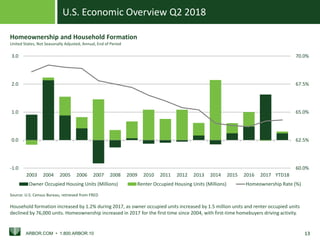
Homeownership and Household Formation
United States, Not Seasonally Adjusted, Annual, End of Period
Source: U.S. Census Bureau, retrieved from FRED
60.0%
62.5%
65.0%
67.5%
70.0%
-1.0
0.0
1.0
2.0
3.0
2003 2004 2005 2006 2007 2008 2009 2010 2011 2012 2013 2014 2015 2016 2017 YTD18
Thousands
Owner Occupied Housing Units (Millions) Renter Occupied Housing Units (Millions) Homeownership Rate (%)
Household formation increased by 1.2% during 2017, as owner occupied units increased by 1.5 million units and renter occupied units
declined by 76,000 units. Homeownership increased in 2017 for the first time since 2004, with first-time homebuyers driving activity.
U.S. Economic Overview Q2 2018
ARBOR.COM • 1.800.ARBOR.10 14
100.0
125.0
150.0
175.0
200.0
May-03 Nov-04 May-06 Nov-07 May-09 Nov-10 May-12 Nov-13 May-15 Nov-16 May-18
U.S. Recession S&P CoreLogic Case-Shiller U.S. National Home Price Index
Source: S&P Dow Jones Indices LLC, National Bureau of Economic Research, retrieved from FRED
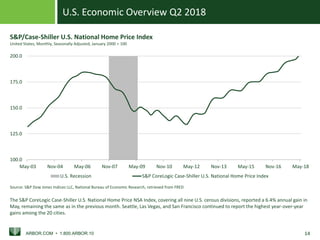
S&P/Case-Shiller U.S. National Home Price Index
United States, Monthly, Seasonally Adjusted, January 2000 = 100
The S&P CoreLogic Case-Shiller U.S. National Home Price NSA Index, covering all nine U.S. census divisions, reported a 6.4% annual gain in
May, remaining the same as in the previous month. Seattle, Las Vegas, and San Francisco continued to report the highest year-over-year
gains among the 20 cities.
U.S. Economic Overview Q2 2018
ARBOR.COM • 1.800.ARBOR.10 15
U.S. Recession
2.0%
3.2%
4.4%
5.6%
6.8%
8.0%
100.0
130.0
160.0
190.0
220.0
250.0
Jun-03 Dec-04 Jun-06 Dec-07 Jun-09 Dec-10 Jun-12 Dec-13 Jun-15 Dec-16 Jun-18
Housing Affordability Index 30-Year Fixed Rate Mortgage Average (%)
15
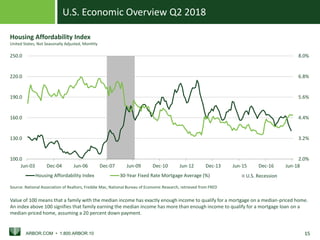
Housing Affordability Index
United States, Not Seasonally Adjusted, Monthly
Source: National Association of Realtors, Freddie Mac, National Bureau of Economic Research, retrieved from FRED
Value of 100 means that a family with the median income has exactly enough income to qualify for a mortgage on a median-priced home.
An index above 100 signifies that family earning the median income has more than enough income to qualify for a mortgage loan on a
median-priced home, assuming a 20 percent down payment.
U.S. Economic Overview Q2 2018
ARBOR.COM • 1.800.ARBOR.10 16
U.S. Recession
$0.0
$0.3
$0.6
$1.0
$1.3
$1.6
2Q06 2Q07 2Q08 2Q09 2Q10 2Q11 2Q12 2Q13 2Q14 2Q15 2Q16 2Q17 2Q18
Thousands
Student Loans Outstanding (Tillions)
Source: Board of Governors of the Federal Reserve System, National Bureau of Economic Research, retrieved from FRED
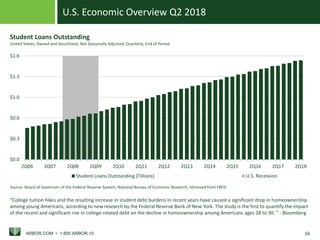
Student Loans Outstanding
United States, Owned and Securitized, Not Seasonally Adjusted, Quarterly, End of Period
“College tuition hikes and the resulting increase in student debt burdens in recent years have caused a significant drop in homeownership
among young Americans, according to new research by the Federal Reserve Bank of New York. The study is the first to quantify the impact
of the recent and significant rise in college-related debt on the decline in homeownership among Americans ages 28 to 30. ” - Bloomberg
ARBOR.COM • 1.800.ARBOR.10
About Us
Arbor Realty Trust, Inc. (NYSE:ABR) is a nationwide real estate investment trust and direct lender, providing loan
origination and servicing for multifamily, seniors housing, healthcare and other diverse commercial real estate assets.
Headquartered in Uniondale, New York, Arbor manages a multibillion-dollar servicing portfolio, specializing in Fannie
Mae, Freddie Mac and other government-sponsored enterprises, as well as CMBS, bridge, mezzanine and preferred
equity lending. Rated by Standard and Poor’s and Fitch Ratings, Arbor is committed to building on its reputation for
service, quality and flexibility and dedicated to providing our clients excellence over the entire life of a loan.
The research contained in this report should not be construed as a solicitation to and/or trade. All opinions, news,
research, analyses, prices or other information is provided as general market commentary and not as investment advice;
all information is subject to change. Arbor, its members, shareholders, employees, agents and representatives do not
warrant the completeness, accuracy or timeliness of the information supplied, and shall not be liable for any loss or
damages, consequential or otherwise, which may arise from the use or reliance on the content contained herein. Past
performance is not indicative of future performance.

Arbor US Economic Overview 2018 q2

  • 1.
    U.S. Economic Overview Q22018 ARBOR.COM • 1.800.ARBOR.10
  • 2.
    U.S. Economic OverviewQ2 2018 ARBOR.COM • 1.800.ARBOR.10 1 Economic Projections of the Federal Reserve Board As of June 2018, Central Tendency Source: Board of Governors of the Federal Reserve System 2018 2019 2020 Longer run Change in Real GDP 2.7% to 3.0% 2.2% to 2.6% 1.8% to 2.0% 1.8% to 2.0% March Projection 2.6% to 3.0% 2.2% to 2.6% 1.8% to 2.1% 1.8% to 2.0% Unemployment Rate 3.6% to 3.7% 3.4% to 3.5% 3.4% to 3.7% 4.3% to 4.6% March Projection 3.6% to 3.8% 3.4% to 3.7% 3.5% to 3.8% 4.3% to 4.7% PCE Inflation 2.0% to 2.1% 2.0% to 2.2% 2.1% to 2.2% 2.0% March Projection 1.8% to 2.0% 2.0% to 2.2% 2.1% to 2.2% 2.0% Core PCE Inflation 1.9% to 2.0% 2.0% to 2.2% 2.1% to 2.2% N/A March Projection 1.8% to 2.0% 2.0% to 2.2% 2.1% to 2.2% N/A Federal Funds Rate 2.1% to 2.4% 2.9% to 3.4% 3.1% to 3.6% 2.8% to 3.0% March Projection 2.1% to 2.4% 2.8% to 3.4% 3.1% to 3.6% 2.8% to 3.0% In view of realized and expected labor market conditions and inflation, the Committee decided to maintain the target range for the federal funds rate at 1-3/4 to 2 percent. The stance of monetary policy remains accommodative, thereby supporting strong labor market conditions and a sustained return to 2 percent inflation. - Board of Governors of the Federal Reserve System’s Monetary Policy Release, August 1, 2018
  • 3.
    U.S. Economic OverviewQ2 2018 ARBOR.COM • 1.800.ARBOR.10 2 U.S. Recession -900.0 -600.0 -300.0 0.0 300.0 600.0 Jun-03 Dec-04 Jun-06 Dec-07 Jun-09 Dec-10 Jun-12 Dec-13 Jun-15 Dec-16 Jun-18 Monthly Change 12-Month Moving Average Source: U.S. Bureau of Labor Statistics, National Bureau of Economic Research Employment Growth United States, All Employees, Total Nonfarm, Seasonally Adjusted Total nonfarm payroll employment rose by 248,000 in June, and the unemployment rate edged down to 3.9%, the U.S. Bureau of Labor Statistics reported. Employment increased in professional and business services, in manufacturing, and in health care and social assistance.
  • 4.
    U.S. Economic OverviewQ2 2018 ARBOR.COM • 1.800.ARBOR.10 3 Mining and Logging 0.5% Construction 5.0% Manufacturing 8.6% Trade, Transportation, and Utilities 18.7% Information 1.9% Financial Activities 5.8% Professional and Business Services 14.2% Education and Health Services 15.7% Leisure and Hospitality 11.5% Other Services 4.0% Government 14.1% Source: U.S. Bureau of Labor Statistics Employment By Industry United States, Thousands, June 2018 Employment Growth By Industry United States, 12-Month Percent Change, June 2018 Mining and Logging Construction Manufacturing Trade, Transportation, and Utilities Information Financial Activities Professional and Business Services Education and Health Services Leisure and Hospitality Other Services Government Total Nonfarm -3.0% 0.0% 3.0% 6.0% 9.0% Source: U.S. Bureau of Labor Statistics
  • 5.
    U.S. Economic OverviewQ2 2018 ARBOR.COM • 1.800.ARBOR.10 4 Employment Growth by Metropolitan Area Total Nonfarm, Not Seasonally Adjusted, 12-Month % Change, January 2017 to January 2018 Source: U.S. Bureau of Labor Statistics In June, 51 metropolitan areas had over- the-year increases in nonfarm payroll employment and 337 were essentially unchanged. The largest over-the-year employment increases occurred in New York-Newark- Jersey City, NY-NJ-PA (+117,400), Dallas- Fort Worth-Arlington, TX (+109,400), and Houston-The Woodlands-Sugar Land, TX (+94,600). The largest over-the- year percentage gains in employment occurred in Midland, TX (+9.5 percent), Crestview-Fort Walton Beach-Destin, FL (+4.5 percent), and Olympia-Tumwater, WA, and Provo-Orem, UT (+4.0 percent each).
  • 6.
    U.S. Economic OverviewQ2 2018 ARBOR.COM • 1.800.ARBOR.10 5 U.S. Recession -3.0% -1.0% 1.0% 3.0% 5.0% 7.0% Jun-03 Dec-04 Jun-06 Dec-07 Jun-09 Dec-10 Jun-12 Dec-13 Jun-15 Dec-16 Jun-18 Consumer Price Index (%) Federal Funds Inflation Target (%) Source: U.S. Bureau of Labor Statistics, National Bureau of Economic Research Consumer Price Index United States, All Items, Seasonally Adjusted, 12-Month % Change, 1982-84=100 The Consumer Price Index for All Urban Consumers (CPI-U) rose 2.9% for the 12 months ending June; this was the largest 12-month increase since the period ending February 2012. The index for all items less food and energy rose 2.3% for the 12 months ending June.
  • 7.
    U.S. Economic OverviewQ2 2018 ARBOR.COM • 1.800.ARBOR.10 6 U.S. Recession -3.0% -1.0% 1.0% 3.0% 5.0% 7.0% Jun-03 Dec-04 Jun-06 Dec-07 Jun-09 Dec-10 Jun-12 Dec-13 Jun-15 Dec-16 Jun-18 CPI All Items Owners' Equivalent Rent of Residences Rent of Primary Residence Consumer Price Index for Rent and Rent Equivalence United States, All Items, Seasonally Adjusted, 12-Month % Change, 1982-84=100 The Consumer Price Index for All Urban Consumers (CPI-U) increased 0.1% in June, after rising 0.2% in May. The index for all items less food and energy increased 0.2% in June. The indexes for rent and owners' equivalent rent both rose 0.3%, but the index for lodging away from home fell 3.7% in June after rising 2.9% in May. Source: U.S. Bureau of Labor Statistics, National Bureau of Economic Research
  • 8.
    U.S. Economic OverviewQ2 2018 ARBOR.COM • 1.800.ARBOR.10 7 U.S. Recession 0.0% 1.0% 2.0% 3.0% 4.0% 5.0% Jun-07 Jun-08 Jun-09 Jun-10 Jun-11 Jun-12 Jun-13 Jun-14 Jun-15 Jun-16 Jun-17 Jun-18 Average Hourly Earnings Average Hourly Earnings United States, All Employees, Total Private, Seasonally Adjusted, 12-Month % Change While job growth and corporate earnings have been steady during this economic expansion, wage growth has remained slow. Real average hourly earnings were unchanged, seasonally adjusted, from June 2017 to June 2018. Real average hourly earnings combined with a 0.3% increase in the average workweek resulted in a 0.2% increase in real average weekly earnings over this period. Source: U.S. Bureau of Labor Statistics, National Bureau of Economic Research
  • 9.
    U.S. Economic OverviewQ2 2018 ARBOR.COM • 1.800.ARBOR.10 8 U.S. Recession -10.0% -6.0% -2.0% 2.0% 6.0% 10.0% 2Q03 2Q04 2Q05 2Q06 2Q07 2Q08 2Q09 2Q10 2Q11 2Q12 2Q13 2Q14 2Q15 2Q16 2Q17 2Q18 Gross Domestic Product (%) 15-Year Average Source: U.S. Bureau of Economic Analysis, National Bureau of Economic Research, retrieved from FRED Gross Domestic Product United States, Quarterly Change from Preceding Period, Seasonally Adjusted at Annual Rates, Based on Chained 2009 Dollars Real gross domestic product increased at an annual rate of 4.1% in the second quarter of 2018, according to the "advance" estimate released by the Bureau of Economic Analysis. In the first quarter, real GDP increased 2.2%.
  • 10.
    U.S. Economic OverviewQ2 2018 ARBOR.COM • 1.800.ARBOR.10 9 U.S. Recession $0.0 $0.4 $0.8 $1.2 $1.6 $2.0 1Q03 1Q04 1Q05 1Q06 1Q07 1Q08 1Q09 1Q10 1Q11 1Q12 1Q13 1Q14 1Q15 1Q16 1Q17 1Q18 Corporate Profits (Trillions) Source: U.S. Bureau of Economic Analysis, National Bureau of Economic Research, retrieved from FRED Corporate Profits After Tax, Quarterly, Seasonally Adjusted Annual Rate, (Without Inventory Valuation and Capital Consumption Adjustments) Profits from current production (corporate profits with inventory valuation adjustment and capital consumption adjustment) increased $39.5 billion in the first quarter, in contrast to a decrease of $1.1 billion in the fourth quarter.
  • 11.
    U.S. Economic OverviewQ2 2018 ARBOR.COM • 1.800.ARBOR.10 10 0 25 50 75 100 125 150 Apr-33to Apr-37 Jul-38to Jan-45 Nov-45to Oct-48 Nov-49to Jun-53 Jun-54to Jul-57 May-58to Mar-60 Mar-61to Nov-69 Dec-70to Oct-73 Apr-75to Dec-79 Aug-80to Jun-81 Dec-82to Jun-90 Apr-91to Feb-01 Dec-01to Nov-07 Jul-09to Current Time Between Recessions (Months) Average Source: National Bureau of Economic Research Time Between Recessions (1933 to Current) cNBER Based Recession Indicators for the United States From the Peak Through the Trough Longest Time Between Recessions (Apr-91 to Feb-01): 119 mo. Average Time Between Recessions: 62 mo. Time Since Previous Recession: 108 mo.
  • 12.
    U.S. Economic OverviewQ2 2018 ARBOR.COM • 1.800.ARBOR.10 11 U.S. Recession 0.0% 1.5% 3.0% 4.5% 6.0% Jun-03 Dec-04 Jun-06 Dec-07 Jun-09 Dec-10 Jun-12 Dec-13 Jun-15 Dec-16 Jun-18 3-Month Treasury 2-Year Treasury 10-Year Treasury Source: Board of Governors of the Federal Reserve System, National Bureau of Economic Research, retrieved from FRED Treasury Yield Curve as a Predictor of U.S. Recessions Monthly, End of Period, Not Seasonally Adjusted “Research beginning in the late 1980s documents the empirical regularity that the slope of the yield curve is a reliable predictor of future real economic activity.” - Federal Reserve Bank of New York
  • 13.
    U.S. Economic OverviewQ2 2018 ARBOR.COM • 1.800.ARBOR.10 12 U.S. Recession 60.0% 62.0% 64.0% 66.0% 68.0% 70.0% 1965 1966 1967 1968 1969 1970 1971 1972 1973 1974 1975 1976 1977 1978 1979 1980 1981 1982 1983 1984 1985 1986 1987 1988 1989 1990 1991 1992 1993 1994 1995 1996 1997 1998 1999 2000 2001 2002 2003 2004 2005 2006 2007 2008 2009 2010 2011 2012 2013 2014 2015 2016 2017 YTD18 Homeownership Rate (%) Source: U.S. Bureau of the Census, National Bureau of Economic Research, retrieved from FRED Homeownership Rate United States, Not Seasonally Adjusted, Annual, End of Period “Over the past two years, millennials have been on a home shopping spree, driving a bump in the overall homeownership rate in Q2. Homeownership among younger households still remains well below precrisis and pre-bubble norms, but those same groups are currently experiencing some of the biggest gains.” - Zillow
  • 14.
    U.S. Economic OverviewQ2 2018 ARBOR.COM • 1.800.ARBOR.10 1313 Homeownership and Household Formation United States, Not Seasonally Adjusted, Annual, End of Period Source: U.S. Census Bureau, retrieved from FRED 60.0% 62.5% 65.0% 67.5% 70.0% -1.0 0.0 1.0 2.0 3.0 2003 2004 2005 2006 2007 2008 2009 2010 2011 2012 2013 2014 2015 2016 2017 YTD18 Thousands Owner Occupied Housing Units (Millions) Renter Occupied Housing Units (Millions) Homeownership Rate (%) Household formation increased by 1.2% during 2017, as owner occupied units increased by 1.5 million units and renter occupied units declined by 76,000 units. Homeownership increased in 2017 for the first time since 2004, with first-time homebuyers driving activity.
  • 15.
    U.S. Economic OverviewQ2 2018 ARBOR.COM • 1.800.ARBOR.10 14 100.0 125.0 150.0 175.0 200.0 May-03 Nov-04 May-06 Nov-07 May-09 Nov-10 May-12 Nov-13 May-15 Nov-16 May-18 U.S. Recession S&P CoreLogic Case-Shiller U.S. National Home Price Index Source: S&P Dow Jones Indices LLC, National Bureau of Economic Research, retrieved from FRED S&P/Case-Shiller U.S. National Home Price Index United States, Monthly, Seasonally Adjusted, January 2000 = 100 The S&P CoreLogic Case-Shiller U.S. National Home Price NSA Index, covering all nine U.S. census divisions, reported a 6.4% annual gain in May, remaining the same as in the previous month. Seattle, Las Vegas, and San Francisco continued to report the highest year-over-year gains among the 20 cities.
  • 16.
    U.S. Economic OverviewQ2 2018 ARBOR.COM • 1.800.ARBOR.10 15 U.S. Recession 2.0% 3.2% 4.4% 5.6% 6.8% 8.0% 100.0 130.0 160.0 190.0 220.0 250.0 Jun-03 Dec-04 Jun-06 Dec-07 Jun-09 Dec-10 Jun-12 Dec-13 Jun-15 Dec-16 Jun-18 Housing Affordability Index 30-Year Fixed Rate Mortgage Average (%) 15 Housing Affordability Index United States, Not Seasonally Adjusted, Monthly Source: National Association of Realtors, Freddie Mac, National Bureau of Economic Research, retrieved from FRED Value of 100 means that a family with the median income has exactly enough income to qualify for a mortgage on a median-priced home. An index above 100 signifies that family earning the median income has more than enough income to qualify for a mortgage loan on a median-priced home, assuming a 20 percent down payment.
  • 17.
    U.S. Economic OverviewQ2 2018 ARBOR.COM • 1.800.ARBOR.10 16 U.S. Recession $0.0 $0.3 $0.6 $1.0 $1.3 $1.6 2Q06 2Q07 2Q08 2Q09 2Q10 2Q11 2Q12 2Q13 2Q14 2Q15 2Q16 2Q17 2Q18 Thousands Student Loans Outstanding (Tillions) Source: Board of Governors of the Federal Reserve System, National Bureau of Economic Research, retrieved from FRED Student Loans Outstanding United States, Owned and Securitized, Not Seasonally Adjusted, Quarterly, End of Period “College tuition hikes and the resulting increase in student debt burdens in recent years have caused a significant drop in homeownership among young Americans, according to new research by the Federal Reserve Bank of New York. The study is the first to quantify the impact of the recent and significant rise in college-related debt on the decline in homeownership among Americans ages 28 to 30. ” - Bloomberg
  • 18.
    ARBOR.COM • 1.800.ARBOR.10 AboutUs Arbor Realty Trust, Inc. (NYSE:ABR) is a nationwide real estate investment trust and direct lender, providing loan origination and servicing for multifamily, seniors housing, healthcare and other diverse commercial real estate assets. Headquartered in Uniondale, New York, Arbor manages a multibillion-dollar servicing portfolio, specializing in Fannie Mae, Freddie Mac and other government-sponsored enterprises, as well as CMBS, bridge, mezzanine and preferred equity lending. Rated by Standard and Poor’s and Fitch Ratings, Arbor is committed to building on its reputation for service, quality and flexibility and dedicated to providing our clients excellence over the entire life of a loan. The research contained in this report should not be construed as a solicitation to and/or trade. All opinions, news, research, analyses, prices or other information is provided as general market commentary and not as investment advice; all information is subject to change. Arbor, its members, shareholders, employees, agents and representatives do not warrant the completeness, accuracy or timeliness of the information supplied, and shall not be liable for any loss or damages, consequential or otherwise, which may arise from the use or reliance on the content contained herein. Past performance is not indicative of future performance.