Arbitration
Submitted to:-
Er. Aman Ahlawat
Asst. Professor
Civil Engg.
DCRUST Murthal
Submitted by:-
Rahul Goyat
12001009039
4th year
Civil Engg.
1
Outline of Topics:
Introduction
Arbitral & non arbitral disputes
Duties of arbitrator
Benefits & drawbacks
Kinds of arbitration
Arbitration in india
Introduction
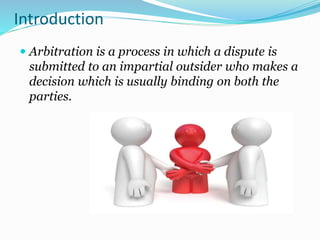
 Arbitration is a process in which a dispute is
submitted to an impartial outsider who makes a
decision which is usually binding on both the
parties.
Basics
 The arbitrator enforces his own point of
view on the contending parties and the
opinions of the participants are not given
any predominance.
 Arbitration is a judicial process
 The award of the arbitrator is binding
and rests on equity and justice, i.e., there
is no scope for compromise
5
Arbitral Disputes
Property
Insurance
Contract (including employment contracts)
Business / partnership disputes
Family disputes (except divorce matters)
Construction
Commercial recoveries
Non Arbitral Disputes
Matters of criminal nature
Disputes relating to matrimonial relations
Testamentary matters relating to the validity of a
will
Relating to trusts for public purposes of charitable
or religious nature
Insolvency matters
Matters relating to the guardianship of a minor or
lunatic.
Any execution proceedings .
DUTIES OF ARBITRATOR
 To administer oath to the parties and witness
appearing
 To act judicially and impartially
 To put necessary interrogatories to any party to
the dispute
 To determine by and to whom the costs of
reference and the award shall be paid
 To award interest
 To fix amount, mode and time of payment
8
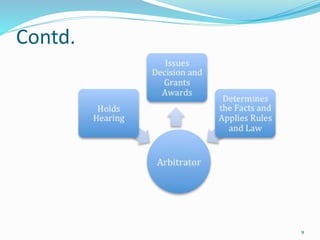
Contd.
9
Advantages of Arbitration
 Choice of decision maker with expertise
 Speed
 Lower-cost
 Flexible
 Confidentiality
 Less formal than court
 Preservation of business relationships
Disadvantages of Arbitration
 Limited recourse
 Uneven playing field
 Lack of transparency
 Cost: parties pay for arbitrator and agency
 Limited rights of appeal, fewer means to
challenge award
 Lack of formal discovery
Contd.
12
Main Types of Arbitration
1) VOLUNTARY ARBITRATION
2) COMPULSORY ARBITRATION
13
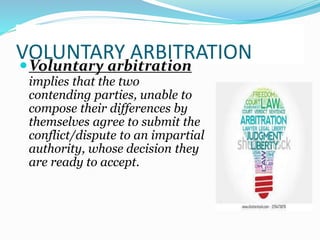
VOLUNTARY ARBITRATION
Voluntary arbitration
implies that the two
contending parties, unable to
compose their differences by
themselves agree to submit the
conflict/dispute to an impartial
authority, whose decision they
are ready to accept.
Essentials of voluntary arbitration
 The voluntary submission of dispute to an
arbitrator
 The subsequent attendance of witnesses and
investigations
 The enforcement of an award may not be
necessary and binding
 Voluntary arbitration may be specially needed
for disputes arising under agreements
/contracts
Compulsory Arbitration
Compulsory arbitration, is one where
the parties are required to accept arbitration
without any willingness on their part.
 When one of the parties to an industrial dispute feels
aggrieved by an act of the other, it may apply to the
appropriate government to refer the dispute to an
adjudication machinery.
Essentials of Compulsory Arbitration
 the country is passing through grave
economic crisis
 industries of strategic importance are
involved
 parties are ill balanced
 Compulsory arbitration leaves no scope for
strikes and lockouts; it deprives both the
parties of their very important and
fundamental rights.
Other Types of Arbitration
 Ad-hoc Arbitration
 Institutional Arbitration
 Statutory Arbitration
 Domestic or International Arbitration
 Foreign Arbitration
(1) Ad-hoc Arbitration:- When a dispute or
difference arises between the parties in course of
commercial transactions.This arbitration is agreed
to get justice for the balance of the un-settled part of
the dispute only.
(2) Institutional Arbitration: There is
prior agreement between the parties that in case of
future differences or disputes arising between the
parties during their commercial transactions, such
differences or disputes will be settled by arbitration
as per clause provide in the agreement.
19
(3) Statutory Arbitration: It is mandatory
arbitration which is imposed on the parties by operation
of law. In such a case the parties have no option as such
but to abide by the law of land.
(4) Domestic or International
Arbitration: Arbitration which occurs in India and
have all the parties within India is termed as Domestic
Arbitration. An Arbitration in which any party belongs to
other than India and the dispute is to be settled in India is
termed as International Arbitration.
(5) Foreign Arbitration: When arbitration
proceedings are conducted in a place outside India and
the Award is required to be enforced in India, it is termed
as Foreign Arbitration.
20
Arbitration in india
 Indian council of arbitration (1965)
 Abide Arbitration and Conciliation Act, 1996
 Comprehensive legal framework
 95% arbitration is of type ad-hoc
 India No. 2 in arbitration cases reaching Singapore
centre
 Mumbai to have India's first International Arbitration
Centre soon
21
THANK YOU
22

Arbitration & its types

  • 1.
    Arbitration Submitted to:- Er. AmanAhlawat Asst. Professor Civil Engg. DCRUST Murthal Submitted by:- Rahul Goyat 12001009039 4th year Civil Engg. 1
  • 2.
    Outline of Topics: Introduction Arbitral& non arbitral disputes Duties of arbitrator Benefits & drawbacks Kinds of arbitration Arbitration in india
  • 3.
    Introduction  Arbitration isa process in which a dispute is submitted to an impartial outsider who makes a decision which is usually binding on both the parties.
  • 4.
    Basics  The arbitratorenforces his own point of view on the contending parties and the opinions of the participants are not given any predominance.  Arbitration is a judicial process  The award of the arbitrator is binding and rests on equity and justice, i.e., there is no scope for compromise
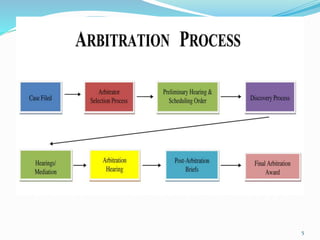
  • 5.
  • 6.
    Arbitral Disputes Property Insurance Contract (includingemployment contracts) Business / partnership disputes Family disputes (except divorce matters) Construction Commercial recoveries
  • 7.
    Non Arbitral Disputes Mattersof criminal nature Disputes relating to matrimonial relations Testamentary matters relating to the validity of a will Relating to trusts for public purposes of charitable or religious nature Insolvency matters Matters relating to the guardianship of a minor or lunatic. Any execution proceedings .
  • 8.
    DUTIES OF ARBITRATOR To administer oath to the parties and witness appearing  To act judicially and impartially  To put necessary interrogatories to any party to the dispute  To determine by and to whom the costs of reference and the award shall be paid  To award interest  To fix amount, mode and time of payment 8
  • 9.
  • 10.
    Advantages of Arbitration Choice of decision maker with expertise  Speed  Lower-cost  Flexible  Confidentiality  Less formal than court  Preservation of business relationships
  • 11.
    Disadvantages of Arbitration Limited recourse  Uneven playing field  Lack of transparency  Cost: parties pay for arbitrator and agency  Limited rights of appeal, fewer means to challenge award  Lack of formal discovery
  • 12.
  • 13.
    Main Types ofArbitration 1) VOLUNTARY ARBITRATION 2) COMPULSORY ARBITRATION 13
  • 14.
    VOLUNTARY ARBITRATION Voluntary arbitration impliesthat the two contending parties, unable to compose their differences by themselves agree to submit the conflict/dispute to an impartial authority, whose decision they are ready to accept.
  • 15.
    Essentials of voluntaryarbitration  The voluntary submission of dispute to an arbitrator  The subsequent attendance of witnesses and investigations  The enforcement of an award may not be necessary and binding  Voluntary arbitration may be specially needed for disputes arising under agreements /contracts
  • 16.
    Compulsory Arbitration Compulsory arbitration,is one where the parties are required to accept arbitration without any willingness on their part.  When one of the parties to an industrial dispute feels aggrieved by an act of the other, it may apply to the appropriate government to refer the dispute to an adjudication machinery.
  • 17.
    Essentials of CompulsoryArbitration  the country is passing through grave economic crisis  industries of strategic importance are involved  parties are ill balanced  Compulsory arbitration leaves no scope for strikes and lockouts; it deprives both the parties of their very important and fundamental rights.
  • 18.
    Other Types ofArbitration  Ad-hoc Arbitration  Institutional Arbitration  Statutory Arbitration  Domestic or International Arbitration  Foreign Arbitration
  • 19.
    (1) Ad-hoc Arbitration:-When a dispute or difference arises between the parties in course of commercial transactions.This arbitration is agreed to get justice for the balance of the un-settled part of the dispute only. (2) Institutional Arbitration: There is prior agreement between the parties that in case of future differences or disputes arising between the parties during their commercial transactions, such differences or disputes will be settled by arbitration as per clause provide in the agreement. 19
  • 20.
    (3) Statutory Arbitration:It is mandatory arbitration which is imposed on the parties by operation of law. In such a case the parties have no option as such but to abide by the law of land. (4) Domestic or International Arbitration: Arbitration which occurs in India and have all the parties within India is termed as Domestic Arbitration. An Arbitration in which any party belongs to other than India and the dispute is to be settled in India is termed as International Arbitration. (5) Foreign Arbitration: When arbitration proceedings are conducted in a place outside India and the Award is required to be enforced in India, it is termed as Foreign Arbitration. 20
  • 21.
    Arbitration in india Indian council of arbitration (1965)  Abide Arbitration and Conciliation Act, 1996  Comprehensive legal framework  95% arbitration is of type ad-hoc  India No. 2 in arbitration cases reaching Singapore centre  Mumbai to have India's first International Arbitration Centre soon 21
  • 22.