ARABIAN SEA
‫العرب‬ ‫بحر‬
o Arabian Sea is the northwestern part of
the Indian Ocean.
o It is bounded to the west by the Horn of
Africa and the Arabian Peninsula,
o To the north by Iran and Pakistan
o To the east by India,
o And to the south by the remainder of the
Indian Ocean.
o To the north the Gulf of Oman connects the
sea with the Persian Gulf via the Strait of
Hormuz.
o To the west the Gulf of Aden connects it
with the Red Sea via the Bab el-Mandeb
Strait.
FEATURES OF ARABIAN
SEA
• The Arabian Sea is named after the Arabian merchants who dominated
the sea from the 9th century to the late medieval period of history
• The depth of Arabian Sea exceeds 2,400km and maximum depth is 4,652m.
• The Arabian Sea has a monsoon climate. Minimum air temperatures of about 75
to 77 °F (24 to 25 °C) at the sea’s surface occur in the central Arabian Sea in
January and February, while temperatures higher than 82 °F (28 °C) occur in
both June and November.
• It has an important route of transportation within Pakistan and serve as base for
fishing industry in west coast.
• The biggest river flowing into the sea is the Indus River
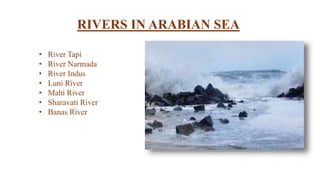
• River Tapi
• River Narmada
• River Indus
• Luni River
• Mahi River
• Sharavati River
• Banas River
RIVERS IN ARABIAN SEA
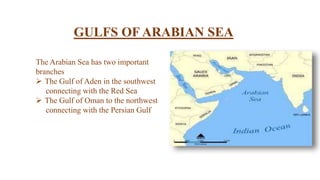
GULFS OF ARABIAN SEA
The Arabian Sea has two important
branches
 The Gulf of Aden in the southwest
connecting with the Red Sea
 The Gulf of Oman to the northwest
connecting with the Persian Gulf
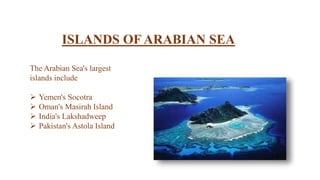
The Arabian Sea's largest
islands include
 Yemen's Socotra
 Oman's Masirah Island
 India's Lakshadweep
 Pakistan's Astola Island
ISLANDS OF ARABIAN SEA
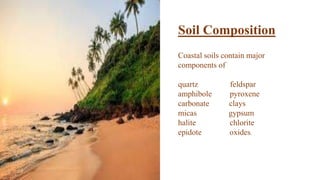
Coastal soils contain major
components of
quartz feldspar
amphibole pyroxene
carbonate clays
micas gypsum
halite chlorite
epidote oxides.
Soil Composition
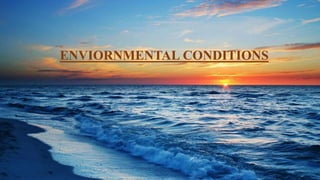
ENVIORNMENTAL CONDITIONS
 High-latitude geographical position
 The relative shallowness
 High evaporation
 Extreme environmental conditions
 Sea temperatures are markedly fluctuated between winter and summer
seasons (15 - 36°C)
 Salinity can exceed 43 psu and may reach 70-80 psu in tidal pools and
lagoons
 Marine organisms in the Arabian Gulf are living close to the limits of
their environmental tolerance
 Despite these harsh environmental conditions, the Arabian Gulf
supports a range of coastal and marine ecosystems such as mangrove
swamps, seagrass beds, coral reefs, and mud and sand flats.
 It provides valuable ecological and economic functions as they form
feeding and nursery grounds for a variety of commercially important
marine organisms.
 Most of these habitats are rich in varieties of fish, which are a major
source of food for people in the Arabian Gulf. Ecosystem benefits in
the Arabian Gulf are not limited to the direct consumptive value of
seafood.
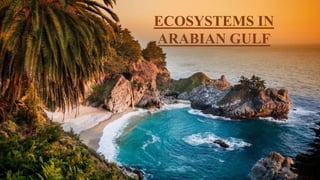
ECOSYSTEMS IN
ARABIAN GULF
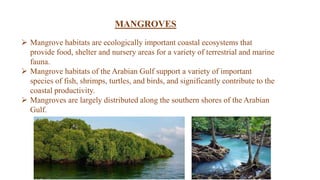
 Mangrove habitats are ecologically important coastal ecosystems that
provide food, shelter and nursery areas for a variety of terrestrial and marine
fauna.
 Mangrove habitats of the Arabian Gulf support a variety of important
species of fish, shrimps, turtles, and birds, and significantly contribute to the
coastal productivity.
 Mangroves are largely distributed along the southern shores of the Arabian
Gulf.
MANGROVES
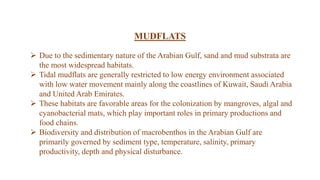
 Due to the sedimentary nature of the Arabian Gulf, sand and mud substrata are
the most widespread habitats.
 Tidal mudflats are generally restricted to low energy environment associated
with low water movement mainly along the coastlines of Kuwait, Saudi Arabia
and United Arab Emirates.
 These habitats are favorable areas for the colonization by mangroves, algal and
cyanobacterial mats, which play important roles in primary productions and
food chains.
 Biodiversity and distribution of macrobenthos in the Arabian Gulf are
primarily governed by sediment type, temperature, salinity, primary
productivity, depth and physical disturbance.
MUDFLATS
SEAGRASS BED
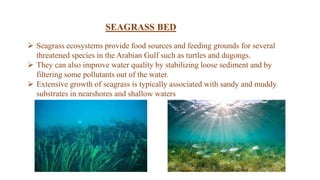
 Seagrass ecosystems provide food sources and feeding grounds for several
threatened species in the Arabian Gulf such as turtles and dugongs.
 They can also improve water quality by stabilizing loose sediment and by
filtering some pollutants out of the water.
 Extensive growth of seagrass is typically associated with sandy and muddy
substrates in nearshores and shallow waters
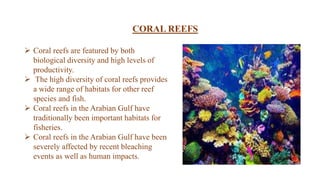
 Coral reefs are featured by both
biological diversity and high levels of
productivity.
 The high diversity of coral reefs provides
a wide range of habitats for other reef
species and fish.
 Coral reefs in the Arabian Gulf have
traditionally been important habitats for
fisheries.
 Coral reefs in the Arabian Gulf have been
severely affected by recent bleaching
events as well as human impacts.
CORAL REEFS
ENVIORNMENT STRESSORS
 Dredging and reclamation activities
 Degradation of coral reefs
 Sectors of oil refining and petrochemical industries
 Discharging wastewater
 Desalination effluents
 Sewage effluents
 Oil pollution
 Run off from phosphate mining
 Eutrophication
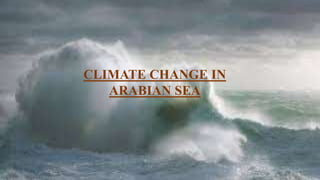
CLIMATE CHANGE IN
ARABIAN SEA
• Arabian Sea has been generating more than one cyclone every year, a
phenomenon scientists attribute to climate change.
• The surface temperature of Arabian Sea currently in the range of 30-31
degree Celsius, which is abnormally high.
• Arabian Sea used to be cool, but now it’s a warm pool—supporting more
intense cyclones.
• Tropical cyclones draw their energy from the warm waters—a reason why
they form over the warm pool regions where temperatures are above
28°C.
CONSERVATION AND
MANAGEMENT
 The Arabian Sea Whale Network (ASWN) aims to bring researchers and other
stakeholders together to collaborate on a regional level toward conservation of
whales in the Arabian Sea.
 Members in India, Iran, Oman and Pakistan are engaged in community outreach and
education programmes, working with fishermen and forming effective stranding
networks to free live stranded animals and collect data and precious biological
samples from stranded whales all over the country.
 MPA marine protected areas serve as important component for conservation of
Arabian Sea.
 Successful turtle conservation work to support initiatives for conserving globally
important populations of marine turtles and the endangered Arabian Sea humpback
whale.
 EWS-WWF is the leading independent environmental NGO in the Arabian region,
and the only one working on marine conservation at the federal level in the UAE
THANK YOU

Arabian sea

  • 1.
  • 2.
    o Arabian Seais the northwestern part of the Indian Ocean. o It is bounded to the west by the Horn of Africa and the Arabian Peninsula, o To the north by Iran and Pakistan o To the east by India, o And to the south by the remainder of the Indian Ocean. o To the north the Gulf of Oman connects the sea with the Persian Gulf via the Strait of Hormuz. o To the west the Gulf of Aden connects it with the Red Sea via the Bab el-Mandeb Strait.
  • 3.
  • 4.
    • The ArabianSea is named after the Arabian merchants who dominated the sea from the 9th century to the late medieval period of history • The depth of Arabian Sea exceeds 2,400km and maximum depth is 4,652m. • The Arabian Sea has a monsoon climate. Minimum air temperatures of about 75 to 77 °F (24 to 25 °C) at the sea’s surface occur in the central Arabian Sea in January and February, while temperatures higher than 82 °F (28 °C) occur in both June and November. • It has an important route of transportation within Pakistan and serve as base for fishing industry in west coast. • The biggest river flowing into the sea is the Indus River
  • 5.
    • River Tapi •River Narmada • River Indus • Luni River • Mahi River • Sharavati River • Banas River RIVERS IN ARABIAN SEA
  • 6.
    GULFS OF ARABIANSEA The Arabian Sea has two important branches  The Gulf of Aden in the southwest connecting with the Red Sea  The Gulf of Oman to the northwest connecting with the Persian Gulf
  • 7.
    The Arabian Sea'slargest islands include  Yemen's Socotra  Oman's Masirah Island  India's Lakshadweep  Pakistan's Astola Island ISLANDS OF ARABIAN SEA
  • 8.
    Coastal soils containmajor components of quartz feldspar amphibole pyroxene carbonate clays micas gypsum halite chlorite epidote oxides. Soil Composition
  • 9.
  • 10.
     High-latitude geographicalposition  The relative shallowness  High evaporation  Extreme environmental conditions  Sea temperatures are markedly fluctuated between winter and summer seasons (15 - 36°C)  Salinity can exceed 43 psu and may reach 70-80 psu in tidal pools and lagoons  Marine organisms in the Arabian Gulf are living close to the limits of their environmental tolerance
  • 11.
     Despite theseharsh environmental conditions, the Arabian Gulf supports a range of coastal and marine ecosystems such as mangrove swamps, seagrass beds, coral reefs, and mud and sand flats.  It provides valuable ecological and economic functions as they form feeding and nursery grounds for a variety of commercially important marine organisms.  Most of these habitats are rich in varieties of fish, which are a major source of food for people in the Arabian Gulf. Ecosystem benefits in the Arabian Gulf are not limited to the direct consumptive value of seafood.
  • 12.
  • 13.
     Mangrove habitatsare ecologically important coastal ecosystems that provide food, shelter and nursery areas for a variety of terrestrial and marine fauna.  Mangrove habitats of the Arabian Gulf support a variety of important species of fish, shrimps, turtles, and birds, and significantly contribute to the coastal productivity.  Mangroves are largely distributed along the southern shores of the Arabian Gulf. MANGROVES
  • 14.
     Due tothe sedimentary nature of the Arabian Gulf, sand and mud substrata are the most widespread habitats.  Tidal mudflats are generally restricted to low energy environment associated with low water movement mainly along the coastlines of Kuwait, Saudi Arabia and United Arab Emirates.  These habitats are favorable areas for the colonization by mangroves, algal and cyanobacterial mats, which play important roles in primary productions and food chains.  Biodiversity and distribution of macrobenthos in the Arabian Gulf are primarily governed by sediment type, temperature, salinity, primary productivity, depth and physical disturbance. MUDFLATS
  • 15.
    SEAGRASS BED  Seagrassecosystems provide food sources and feeding grounds for several threatened species in the Arabian Gulf such as turtles and dugongs.  They can also improve water quality by stabilizing loose sediment and by filtering some pollutants out of the water.  Extensive growth of seagrass is typically associated with sandy and muddy substrates in nearshores and shallow waters
  • 16.
     Coral reefsare featured by both biological diversity and high levels of productivity.  The high diversity of coral reefs provides a wide range of habitats for other reef species and fish.  Coral reefs in the Arabian Gulf have traditionally been important habitats for fisheries.  Coral reefs in the Arabian Gulf have been severely affected by recent bleaching events as well as human impacts. CORAL REEFS
  • 17.
  • 18.
     Dredging andreclamation activities  Degradation of coral reefs  Sectors of oil refining and petrochemical industries  Discharging wastewater  Desalination effluents  Sewage effluents  Oil pollution  Run off from phosphate mining  Eutrophication
  • 19.
  • 20.
    • Arabian Seahas been generating more than one cyclone every year, a phenomenon scientists attribute to climate change. • The surface temperature of Arabian Sea currently in the range of 30-31 degree Celsius, which is abnormally high. • Arabian Sea used to be cool, but now it’s a warm pool—supporting more intense cyclones. • Tropical cyclones draw their energy from the warm waters—a reason why they form over the warm pool regions where temperatures are above 28°C.
  • 21.
  • 22.
     The ArabianSea Whale Network (ASWN) aims to bring researchers and other stakeholders together to collaborate on a regional level toward conservation of whales in the Arabian Sea.  Members in India, Iran, Oman and Pakistan are engaged in community outreach and education programmes, working with fishermen and forming effective stranding networks to free live stranded animals and collect data and precious biological samples from stranded whales all over the country.  MPA marine protected areas serve as important component for conservation of Arabian Sea.  Successful turtle conservation work to support initiatives for conserving globally important populations of marine turtles and the endangered Arabian Sea humpback whale.  EWS-WWF is the leading independent environmental NGO in the Arabian region, and the only one working on marine conservation at the federal level in the UAE
  • 23.