Animated Science
2015
6 Forces in Equilibrium
3.4.1 Force, Energy and
Momentum
7407 / 7408 PHYSICS KS5
6.1 Vectors and Scalars
6.2 Balanced Forces
6.3 The Principles of Moments
6.4 More on Moments
6.5 Stability
6.6 Equilibrium Rules
Animated Science
2015
Interactive Links
Title What to do Site Type URL
Animated Science
2015
Introduction
This chapter guides students towards an understanding of the conditions for
static equilibrium of a body. They will learn to interpret and manipulate
vectors and to analyse three forces in equilibrium. They will work with
moments and centre of mass and apply the principle of moments. Finally,
they will practise solving problems involving objects in equilibrium by
considering both forces and moments. Opportunities for practical work
involve the measurement of forces and moments in equilibrium, and some of
the experiments require students to draw and interpret graphs and to discuss
errors and uncertainties. The principle mathematical techniques used in this
chapter are vector skills and trigonometry.
Prior knowledge
1. Students will need to build on their knowledge and skills, from Key Stage
4 Science and Mathematics, of:
2. changing the subject of an equation
3. vector quantities: quantities which have magnitude and direction
4. objects acted on by two equal and opposite forces are at rest or moving
at constant velocity.
Animated Science
2015
3.4.1.1 Scalars and vectors / 6.1& 6.2
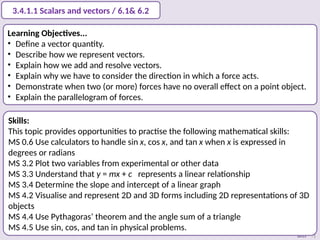
Learning Objectives...
• Define a vector quantity.
• Describe how we represent vectors.
• Explain how we add and resolve vectors.
• Explain why we have to consider the direction in which a force acts.
• Demonstrate when two (or more) forces have no overall effect on a point object.
• Explain the parallelogram of forces.
Skills:
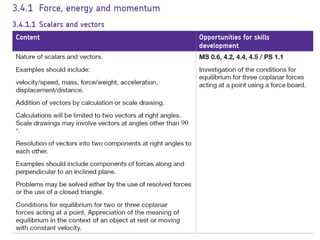
This topic provides opportunities to practise the following mathematical skills:
MS 0.6 Use calculators to handle sin x, cos x, and tan x when x is expressed in
degrees or radians
MS 3.2 Plot two variables from experimental or other data
MS 3.3 Understand that y = mx + c represents a linear relationship
MS 3.4 Determine the slope and intercept of a linear graph
MS 4.2 Visualise and represent 2D and 3D forms including 2D representations of 3D
objects
MS 4.4 Use Pythagoras’ theorem and the angle sum of a triangle
MS 4.5 Use sin, cos, and tan in physical problems.
Animated
Science
2018
Mr D Powell
2018
Animated Science
2018
6.1 Vectors and Scalars – what are they?
C
CHALLENGE
What is a vector or scalar quantity
and can I identify one?
How do we represent vectors/ Addition of
vectors using a scale diagram
Addition of two perpendicular vectors using a
calculator or resolving a vector into two
perpendicular components
What happens when you are over 90?
A
B
Animated Science
2015
A Definition.... M
Scalars Vectors
mass, temperature, time,
length, speed, energy
displacement, force, velocity,
acceleration, momentum
TASK: Make a note of each quantity, then look at
the units and give a reason why they have been
sorted as such..
Animated Science
2015
Displacement and velocity
A runner completes one lap of an athletics
track.
400m
What is her final displacement?
If she ends up exactly where she started, her
displacement from her starting position is zero.
What is her average velocity for the lap, and
how does it compare to her average speed?
What distance has she run?
Animated Science
2015
What did you decide?
Despite the trip moving at various speeds, because it ended
up at the starting point, the average velocity was zero.
This will always be true when the final displacement is zero.
Animated Science
2015
Vectors?
M
 On this racetrack a car covers 1.029 miles in distance by
covering a circuit in a lap. After 1 lap the car is back to
the start and has completed the lap at a constant speed
of 30 mph.
 However, when we think of the term “velocity” we
describe not just the speed but the direction. In this case
the “velocity” changes direction all the time. We call it a
vector quantity. This feature is important in helping us
describe the motion of objects clearly!
Animated Science
2015
Vector equations
An equation is a statement of complete equality. The left hand side must match the right
hand side in both quantity and units. In a vector equation, the vectors on both sides of
the equation must have equal magnitudes and directions.
Take Newton’s second law, for example:
force = mass × acceleration
Force and acceleration are both vectors, so their directions will be equal. Mass is a
scalar: it scales the right-hand side of the equation so that both quantities are equal.
Force is measured in newtons (N), mass in kilograms (kg), and acceleration in ms-2
.
The units on both sides must be equal, so 1 N = 1kgms-2
.
Animated Science
2015
Displacement vectors
Harry and Sally are exploring the desert. They need to reach an oasis, but choose to
take different routes.
 Harry travels due north, then due
east.
 Sally simply travels in a straight line to
the oasis.
When Harry met Sally at the oasis, they had travelled different distances. However,
because they both reached the same destination from the same starting point, their
overall displacements were the same.
N
Animated Science
2015
Vector notation
A scalar quantity is often represented by a lower case letter, e.g. speed, v. A vector
quantity can also be represented by a lower case letter, but it is written or printed in one
of the following formats to differentiate it from the scalar equivalent:
The value of a vector can be written in
magnitude and direction form:
e.g. v = (v, θ)
Or as a pair of values called
components:
e.g. a = (8, 6) or
x
y
8
6
8
6
a
Animated Science
2015
Vector addition
Displacement vectors can always be added ‘nose to tail’ to find a total or resultant
vector.
This can be done approximately by scale
drawing:
It can also be done by calculation, breaking each vector down into perpendicular
components first and then adding these together to find the components of the
resultant:
c + d =
2
3
-2
2
+ =
0
5
a
b
a + b 
10
7 x
y
Animated Science
2015
R = √ 32
+ 42
Calculating a resultant
When adding two perpendicular vectors, it is often necessary to calculate the exact
magnitude and direction of the resultant vector. This requires the use of Pythagoras’
theorem, and trigonometry.
For example, what is the resultant vector of a vertical displacement of 4 km and a
horizontal displacement of 3km?
direction:
= 5km
tan θ = 4/3
= 53°
θ = tan-1
(4/3)
= √ 25
magnitude:
R2
= 32
+ 42

R
4km
3km
Animated Science
2015
Just as it is possible to add two vectors together to get a resultant
vector, it is very often
useful to break a ‘diagonal’ vector
into its perpendicular
components.
Vector components
This makes it easier to
describe the motion of an
object, and to do any
relevant calculations.
vertical
component
horizontal
component
Animated Science
2015
Calculating components
A vector can be separated into perpendicular components given only its magnitude and
its angle from one of the component axes. This requires the use of trigonometry.
For example, what are the horizontal and vertical components of a vector with a magnitude
of 6ms-1
and a direction of 60° from the horizontal?
6ms-1
60°
x
y
cos60° = x / 6
x = 6 × cos60
= 3ms-1
sin60° = y / 6
y = 6 × sin60
= 5.2ms-1
Animated Science
2015
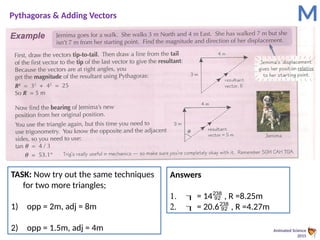
Pythagoras & Adding Vectors M
TASK: Now try out the same techniques
for two more triangles;
1) opp = 2m, adj = 8m
2) opp = 1.5m, adj = 4m
Answers
1.  = 14 , R =8.25m
2.  = 20.6 , R =4.27m
Animated Science
2015
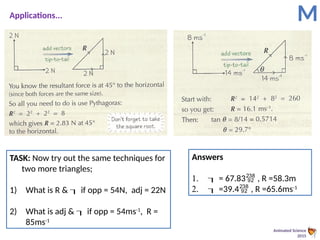
Applications... M
TASK: Now try out the same techniques for
two more triangles;
1) What is R &  if opp = 54N, adj = 22N
2) What is adj &  if opp = 54ms-1
, R =
85ms-1
Answers
1.  = 67.83 , R =58.3m
2.  =39.4 , R =65.6ms-1
Animated Science
2015
Splitting a vector into components...
T
TASK: Put on your maths brain and try and explain using trig why Vx is
related to cos and Vy is related to sin
Animated Science
2015
Resolving in a context....
TASK:
1) A bird is flying at a speed of 15ms-1
at an angle of
36 to the horizontal. What is its vertical speed.
2) A javelin is thrown at a resultant force of 100N at
a 45  angle. What are the horizontal and
vertical forces on it.
Answers
1. Vy =8.8ms-1
2. Vy =70.7N
Vx = 70.7N
Animated Science
2015
Questions to try on your own....
P
Answers
.....
Animated Science
2015
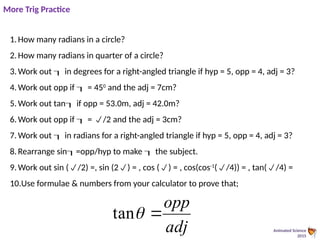
1.How many radians in a circle?
2.How many radians in quarter of a circle?
3.Work out  in degrees for a right-angled triangle if hyp = 5, opp = 4, adj = 3?
4.Work out opp if  = 450
and the adj = 7cm?
5.Work out tan if opp = 53.0m, adj = 42.0m?
6.Work out opp if  = /2 and the adj = 3cm?
7.Work out  in radians for a right-angled triangle if hyp = 5, opp = 4, adj = 3?
8.Rearrange sin=opp/hyp to make  the subject.
9.Work out sin (/2) =, sin (2) = , cos () = , cos(cos-1
(/4)) = , tan(/4) =
10.Use formulae & numbers from your calculator to prove that;
More Trig Practice
adj
opp


tan
Animated Science
2015
Vector Problems 1 Question 1
Both sides contribute as vectors so double it to If using only pythag
do simply 2 x 15N Sin20 = 10.26 = 10.3N
label upper part of triangle as a.
Hence a2
= (152
+152
-2x152
Cos140)0.5
= 28.19N, then half for
triangle. To 14.1N. Then pythag (152
-14.12
)0.5
= 5.12N
(x2) = 10.23N
a
c
b
Animated Science
2015
Vector Problems 1 Question 2
Animated Science
2015
Vector Problems 1 Question 3
3) A mass of 20.0kg is hung from the midpoint P of a wire. Calculate the
tension in each suspending wire in Newton’s. Assume g = 10ms-2
. (Hint
resolve…..)
Use the idea of point of equilibrium. The forces must balance vertical and
horizontal.
Weight balances the tension so for each wire
Use the 2T Cos70 = 200
T Cos70 = 100
T = 100 / Cos70
= 292.38N
Animated Science
2015
Vector Problems 1 Question 5/6
5) Magnitude = sqrt(35002
+ 2792
)
= 3511.1m = 3510m
Direction = tan-1
(279/3500)
= 4.557°
= 4.6° south from vertical
6) Vertical motion: 21 sin (43°) = 14.32 ms-1
Horizontal motion: 21 cos (43°) =15.358
ms-1
S = 3 x 15.358 ms-1
= 46.1 ms-1
3500km
0.279km
Animated Science
2015
Vector Problems 2 Question 2
Use the parallelogram method to resolve the
forces acting on this object placed. (Hint employ
both cosine & sine rule). (4 marks)
Animated Science
2015
Vector Problems 2 Question 2
Use the parallelogram method to find the resultant
acting on this object and angle. (Hint employ both
cosine & sine rule). (4 marks)
Animated Science
2015
Vector Problems 2 Question 3
3) Two forces of magnitude 10.0N and F
Newton’s produce a resultant of
magnitude 30.0N in the direction OA.
Find the direction and magnitude of F. (2
marks) (Hint use Pythagoras)
Animated Science
2015
Vector Problems 2 Question 4
The graph shows a part completed
vector diagram. You task is to find out
the vector R by mathematical analysis.
The vectors A & B are shown in both
coordinate and bearing formats.
Show working for both a
mathematical method (2 marks) and
drawn out scaled method. (2 marks)
Hint: this is not as hard as it might
initially look!
Animated Science
2015
Vector Problems 2 Question 4 - stage 1
Finding the components of vectors for vector addition involves forming a right
triangle from each vector and using the standard triangle trigonometry. The
vector sum can be found by combining these components and converting to
polar form.
Animated Science
2015
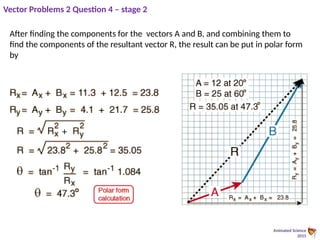
Vector Problems 2 Question 4 – stage 2
After finding the components for the vectors A and B, and combining them to
find the components of the resultant vector R, the result can be put in polar form
by
Animated Science
2015
Vector Problems 2 - Question 5
5a
N
5b
N
N
6) Forces of 60.0N and F
Newton’s act at point O. Find the
magnitude and direction of F if
the resultant force is of
magnitude 30.0N along OX (2
marks)
Animated Science
2015
Vector Problems 2 - Question 7
Forces of 60.0N and F Newton’s act at
point O.
Find the magnitude and direction of F if
the resultant force is of magnitude
30.0N along OX (2 marks)
SinC
c
SinA
a

c2
= a2
+ b2
- 2abCosC
Animated Science
2015
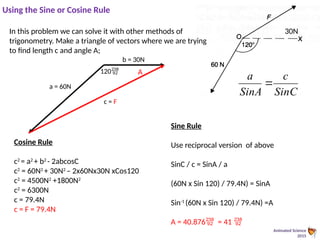
Using the Sine or Cosine Rule
30N
In this problem we can solve it with other methods of
trigonometry. Make a triangle of vectors where we are trying
to find length c and angle A;
120
c = F
b = 30N
a = 60N
A
Cosine Rule
c2
= a2
+ b2
- 2abcosC
c2
= 60N2
+ 30N2
– 2x60Nx30N xCos120
c2
= 4500N2
+1800N2
c2
= 6300N
c = 79.4N
c = F = 79.4N
Sine Rule
Use reciprocal version of above
SinC / c = SinA / a
(60N x Sin 120) / 79.4N) = SinA
Sin-1
(60N x Sin 120) / 79.4N) =A
A = 40.876 = 41 
SinC
c
SinA
a

Animated Science
2015
7) Simultaneous Equations (A*+)
If this problem is to be solved mathematically we must
establish two formulae. One in the vertical and one in the
horizontal; 30N
The key is knowing that the resultant force is 30N
at 0º.
Hence;
Resolving Horizontally;
30N = FCos + 60NCos(360-120)
30N = FCos + 60N x -0.5
30N = FCos - 30N
60N = FCos  Eq 1
Resolving Vertically;
0 = FSin + 60NSin(360-120)
0 = FSin + 60NSin(240)
0 = FSin + 60N x 3/2
0 = FSin -51.96N
51.96N = FSin Eq 2
So by dividing Eq 2 by Eq 1
FSin / FCos  = 51.95N / 60N
tan  = 0.866
 = 40.89
F = 60N / cos 
= 79.4N
Or
F = 51.96N / sin 
= 78.96N
Animated
Science
2018
Mr D Powell
2018
Animated Science
2018
6.2 Balanced Forces
C
CHALLENGE
Why do we have to consider the
direction in which a force acts?
Complete calculations when two (or
more) forces have no overall effect
on a point object?
What is the parallelogram
of forces?
Conduct a precise coplanar forces practical without help
A
B
Animated Science
2015
Why are the objects not moving... S
Animated Science
2015
Real Setup…
T F
w=mg

X Y
mg
F 

sin
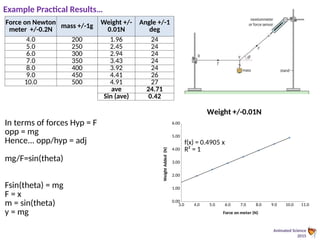
This simple experiment tests the idea that the vertical component of a
resultant force “F” can be balanced by vertical “mg” force.
So changing “mg” changes F and thus we can use the example as y = mx+c
Animated Science
2015
Example Practical Results…
3.0 4.0 5.0 6.0 7.0 8.0 9.0 10.0 11.0
0.00
1.00
2.00
3.00
4.00
5.00
6.00
f(x) = 0.4905 x
R² = 1
Weight +/-0.01N
Force on meter (N)
Weight
Added
(N)
Force on Newton
meter +/-0.2N mass +/-1g
Weight +/-
0.01N
Angle +/-1
deg
4.0 200 1.96 24
5.0 250 2.45 24
6.0 300 2.94 24
7.0 350 3.43 24
8.0 400 3.92 24
9.0 450 4.41 26
10.0 500 4.91 27
ave 24.71
Sin (ave) 0.42
In terms of forces Hyp = F
opp = mg
Hence... opp/hyp = adj
mg/F=sin(theta)
Fsin(theta) = mg
F = x
m = sin(theta)
y = mg
Animated Science
2015
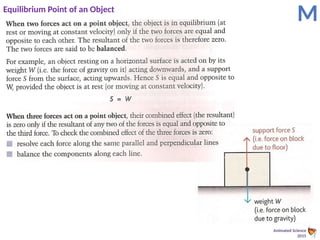
Equilibrium Point of an Object
M
Animated Science
2015
Example 1
M

W
T
F
Tcos
Tsin
Animated Science
2015
Example 1
M

W
T
F
Tcos
Tsin
Animated Science
2015
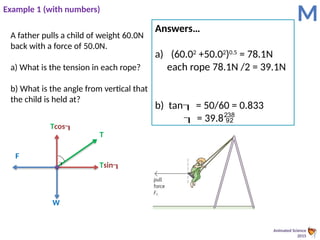
Example 1 (with numbers)
M
A father pulls a child of weight 60.0N
back with a force of 50.0N.
a) What is the tension in each rope?
b) What is the angle from vertical that
the child is held at?
Answers…
a) (60.02
+50.02
)0.5
= 78.1N
each rope 78.1N /2 = 39.1N
b) tan = 50/60 = 0.833
 = 39.8

W
T
F
Tcos
Tsin
Animated Science
2015
Inclined Plane Intro….
Animated Science
2015
Example 2
M
Hint: Draw your triangle 1,2,3….. W, S,
F to make a similar triangle
Animated Science
2015
Example 2 (with numbers)
M
A block of weight = 30.0N sits on a
slope and is held by frictional
forces of 10.0N
a) What is the support force?
b) What is the angle from vertical
that the slope is at?
Answers…
a) 10.02
+S2
= 30.02
(30.02
– 10.02
)½
= S =28.3N
b) tan = F/S = 10/28.3 = 0.353
= = 19.5
Hint: Draw your triangle 1,2,3….. W, S,
F to make a similar triangle
Animated Science
2015
Practical Extension...
M
 Assemble the equipment shown below. Use some weights of
different types and measure the angles shown.
 The basic system will adjust in angle to whatever masses you add.
 The tension in each string must equal the force exerted by W1 or W2.
This enables the problem to be solved by resolving
 Try it practically so get a range of angles & weights then prove the
equilibrium.
http://www.walter-fendt.de/html5/phde/equilibriumforces_de.htm
Animated Science
2015
Example 3
M
1 2
T2sin2
T1sin1
T
2
cos
2
T
1
cos
1
T2
T1
W
P
Animated Science
2015
Wires Example - Correct
Vertically
1.20N = T1
cos30+ T2
cos60
1.20N = 0.866T1
+ 0.5T2
Eq 1
Horizontally
T1
sin30 = T2
sin60
0.5T1
= 0.866T2
T1
= 1.732T2
Eq 2
Sub 2 into 1;
1.20N = 0.866T1
+ 0.5T2
1.20N = 0.866 x 1.732T2
+0.5T2
1.20N = 1.99T2
T2
= 0.60N
&
T1
= 1.732T2
T1
= 1.732 x 0.6N
T1
= 1.04N
So by turning it on its side we can use the same
formulae (which is confusing but correct)
Left side right side
Animated Science
2015
WRONG!
Vertically
1.20N = T1
sin30+ T2
sin60
1.20N = 0.5T1
+ 0.866T2
Eq 1
Horizontally
T1
cos30 = T2
cos60
0.866T1
= 0.5T2
T1
= 0.577T2
Eq 2
Sub 2 into 1;
1.20N = 0.866T1
+ 0.5T2
1.20N = 0.866 x 0.577T2
+0.5T2
1.20N = 1T2
T2
= 1.2N
&
T1
= 0.577T2
T1
= 0.577x1.2N
T1
= 0.69N
Animated Science
2015
Vertically
1.20N = T1
sin60+ T2
sin30
1.20N = 0.866T1
+ 0.5T2
Eq 1
Horizontally
T1
cos60 = T2
cos30
0.5T1
= 0.866T2
T1
= 1.732T2
Eq 2
Sub 2 into 1;
1.20N = 0.866T1
+ 0.5T2
1.20N = 0.866 x 1.732T2
+0.5T2
1.20N = 1.99T2
T2
= 0.60N
&
T1
= 1.732T2
T1
= 1.732 x 0.6N
T1
= 1.04N
If we take the outside angle instead of the inner angle
we can do this and use the triangle;
(90-)
Alternative Can do by using (90- ) as angle;
Animated Science
2015
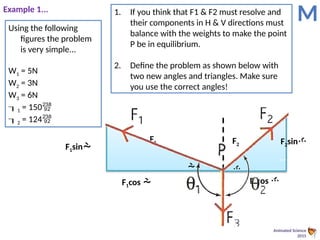
Example 1...
M
Using the following
figures the problem
is very simple...
W1 = 5N
W2 = 3N
W3 = 6N
1 = 150
2 = 124
F1 F2
F1sin
F1cos 
F2sin
F2cos 
 
1. If you think that F1 & F2 must resolve and
their components in H & V directions must
balance with the weights to make the point
P be in equilibrium.
2. Define the problem as shown below with
two new angles and triangles. Make sure
you use the correct angles!
Animated Science
2015
Example 1...
M
 Using the following figures the
problem is very simple...
W1 = 5N W2 = 3N W3 = 6N
1 = 150 2 = 124
=60  = 34 
F1 F2
F1sin
F1cos 
F2sin
F2cos 
 
5
.
2
5
.
2
cos
cos
0
6
67
.
1
33
.
4
sin
sin
0
2
1
3
3
2
1















F
F
H
F
W
F
F
V
Animated Science
2015
Plenary Question
P
A 2kg chicken rests on point C on
clothes line ACB as shown. What is
the minimum breaking strength of
the line to ensure the bird does
not break the line?
F1
F2
F1sin30
F1cos 30
F2sin45
F2cos45
30 45
N
F
F
N
F
F
N
F
F
V
40
2
20
2
2
2
20
45
sin
30
sin
0
2
1
2
1
2
1








3
2
2
2
2
3
45
cos
30
cos
0
2
1
2
1
2
1
F
F
F
F
F
F
H





Animated Science
2015
Plenary Question
P
A 2kg chicken rests as point C on clothes line ACB
as shown. What is the minimum breaking
strength of the line to ensure the bird does not
break the line?
N
F
F 40
2
2
1 

3
2
2
1 F
F 
N
F
N
F
F
N
F
F
F
F
N
F
F
68
.
12
732
.
2
64
.
34
2
40
3
3
40
2
3
2
3
2
40
2
2
2
2
2
2
2
1
2
1










N
N
F
F
F
35
.
10
3
2
68
.
12
3
2
1
2
1




F1=10.35N
F2= 12.68N
F1sin30
F1cos 30
F2sin45
F2cos45
30 45
So we have now worked out both the tensions in
the line that are there from the weight of the
chicken. This means that the line must be of a
strength equal or better than F2 = 12.68N
Animated Science
2015
Resolution of Forces – ICT Link Self Check
http://www.walter-fendt.de/ph14e/forceresol.htm
Animated Science
2015
Exam Question…
A cyclist rides along a road up an incline at a
steady speed of 9.0 m s–1
. The mass of the rider
and bicycle is 70kg and the bicycle travels 15 m
along the road for every 1.0 m gained in
height.
Neglect energy loss due to frictional forces.
Calculate the component of the weight of the
bicycle and the rider that acts along the incline.
(3 marks)
Downwards…
W = mg = 70kg x 9.81N/kg
= 686.7N (1)
But the component that acts
along the slope is…
F = mg sin 
F = 686.7N x sin 
F = 686.7N x opp/ hyp
F = 686.7N x 1/15 (1)
F = 45.78N
F = 46N (1)
v= 9.0 m s–1
m = 70kg 1m
15m
Animated Science
2015
9630-AQA-Physics
3.2 Moments, couple & torque
Sir Shakeel Mehmood
Animated Science
2015
3.4.1.2 / 6.3 The principle of moments; 6.4 More on moments; 6.5 Stability
Learning Objectives...
1. Describe the conditions under which a force produces a turning
effect.
2. Explain how the turning effect of a given force can be increased.
3. Explain what is required to balance a force that produces a turning
effect.
4. Explain why the centre of mass is an important idea.
5. Describe the support force on a pivoted body.
6. When a body in equilibrium is supported at two places, state how
much force is exerted on each support.
7. Explain what is meant by a couple.
8. Explain the difference between stable and unstable equilibrium.
9. Assess when a tilted object will topple over.
10. Explain why a vehicle is more stable when its centre of mass is lower.
ICT Links...
Substitution
http://app.mymaths.co.uk/205-resour
ce/substitution-2
Rearranging Equations
http://app.mymaths.co.uk/206-resour
ce/rearranging-1
Moments
http://app.mymaths.co.uk/892-resour
ce/moments
Real Life Applications
http://app.mymaths.co.uk/881-resour
ce/real-life-applications
Mathematical skills:
MS 0.1 Recognise and make use of appropriate units in calculations
MS 0.2 Recognise and use expressions in decimal and standard form
MS 1.1 Use an appropriate number of significant figures
MS 1.5 Identify uncertainties in measurements and use simple techniques to determine uncertainty when data
are combined by addition, subtraction, multiplication, division, and raising to powers
MS 3.2 Plot two variables from experimental or other data
MS 3.3 Understand that y = m x + c represents a linear relationship
MS 3.4 Determine the slope and intercept of a linear graph
MS 4.2 Visualise and represent 2D and 3D forms
MS 4.4 Use Pythagoras’ theorem and the angle sum of a triangle.
Animated
Science
2018
Mr D Powell
2018
Animated Science
2018
6.3 The Principle of
Moments
C
CHALLENGE
I know what conditions a force produce a
turning effect & How can the turning effect of a
given force be increased.
I can explain what is required to
balance a force that produces a
turning effect.
I can explain/ apply the context of
why is the centre of mass an
important idea?
I can weigh a ruler with moments only!
A
B
Animated Science
2015
Centres of mass and gravity
The centre of gravity of an object is a point where the entire weight of the object
seems to act.
An alternative definition is that the centre of mass or centre of gravity of an
object is the point through which a single force has no turning effect on the body.
In a uniform gravitational field the centre of mass is in the same place as the
centre of gravity.
The centre of mass of an object is a point where the entire mass of the object
seems to be concentrated.
Animated Science
2015
Equilibrium
A body persists in equilibrium if no net force or moment acts on it. Forces and
moments are balanced.
Newton’s first law states that a body persists in its state of rest or of uniform motion
unless acted upon by an external unbalanced force.
Bodies in equilibrium are therefore bodies that are at rest or moving at constant velocity
(uniform motion).
F1
F1
F2 F2
equilibrium
Animated Science
2015
The principle of moments
The principle of moments states that (for a body in equilibrium):
total clockwise
moments =
total anticlockwise
moments
4N 6N
5m d
4 × 5 = 6d
This principle can be used in calculations:
What is d?
20 = 6d
d = 20 / 6
d = 3.3m
Animated Science
2015
Human forearm
60N
20N
4cm
16cm
35cm
F
Taking moments about the elbow
joint:
4F = (16 × 20) + (35 × 60)
4F = 2420
F = 605N
The principle of moments can be used to
find out the force, F, that the biceps need to
apply to the forearm in order to carry a
certain weight. When the weight is held
static, the system is in equilibrium.
60N
schematic diagram
weight of arm = 20N
Animated Science
2015
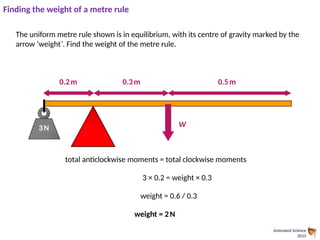
0.2m
3N
The uniform metre rule shown is in equilibrium, with its centre of gravity marked by the
arrow ‘weight’. Find the weight of the metre rule.
0.3m 0.5m
W
total anticlockwise moments = total clockwise moments
3 × 0.2 = weight × 0.3
weight = 0.6 / 0.3
weight = 2N
Finding the weight of a metre rule
Animated Science
2015
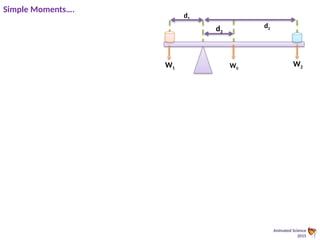
Simple Moments….
d1
d2
W0
W2
W1
d3
Animated Science
2015
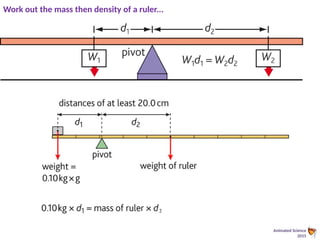
Work out the mass then density of a ruler...
Animated Science
2015
Example Results + errors!
For a wooden ruler a density is quoted at 750kgm-3
d1 = (0.2  0.001)m  0.5%
d2 = (0.2  0.001)m  0.5%
m = (96  1)g = (0.096  0.001)kg  0.1%
Thickness = (0.0061  0.00001)m  0.16%
Width = (0.00028  0.00001)m  0.04%
Length = (1  0.001)m  0.1%
m1x d1 = m2 x d2
Error in calculated mass = 1.1%
 = m/v
Value for our ruler density...
(562  8) kgm-3
So this must be a different
wood!
Animated
Science
2018
Mr D Powell
2018
Animated Science
2018
6.4 More on Moments –
Bridge Crane
SUCCEED
C
CHALLENGE
I can label/name the support forces on a
pivoted body?
When a body in equilibrium is supported at
two places, I can work out how much force is
exerted on each support?
I understand what is meant by a couple and
can apply it to problems?
I can work out two support and couple problems
without help for a bridge crane!
A
B
Animated Science
2015
Theory of Moments…
Animated Science
2015
Two Support Force Problems
D
d2
W0
Sx
d1
½d
d
Sy
Animated Science
2015
Theory of Moments…
Animated Science
2015
The torque of a couple
torque of a couple = force ×
perpendicular distance between
lines of action of the forces
A point P is chosen arbitrarily. Take moments
about P.
total moment = Fx + F(d – x)
= Fx + Fd – Fx
= Fd
There is a formula specifically for finding the torque of a couple.
d-x
x
d
F
F
p
Animated Science
2015
M
Couples Extras...
If two forces act about a hinge in opposite directions, there is an obvious turning
effect called a couple. The resulting linear force from a couple is zero.
The couple is given by the simple formula:
G = 2 Fs
This strange looking symbol, G, is “gamma”, a Greek capital letter ‘G’. Couples
are measured in Newton metres (Nm)
The turning effect is often called the torque. It is a common measurement made
on motors and engines, alongside the power. Racing engines may be quite
powerful but not have a large amount of torque. This is why it would not make
sense for a racing car to be hitched to a caravan, any more so than trying to win a
Formula 1 race in a 4 x 4.
Animated Science
2015
Practical Investigating the bridge crane
Aims
1. To use simple measurements of distance and to apply the principle of moments to a
model bridge crane.
2. To relate practical measurements to straight line graph theory.
3. To consider measurement errors and how to reduce them.
You require the following equipment:
4. two metre rulers
5. two spring balances calibrated in Newton's
6. a set square
7. slotted masses of weight that can be measured using a balance
8. thread
9. scissors
10. two stands and clamps
11. graph paper
Safety
Ensure the practical arrangement is stable and will not topple over.
Animated Science
2015
Setup Advice....
Ensure that the spring balances are vertical
and that the ruler is horizontal each time
before you make their measurements.
You may need to use a set square and a
second metre ruler to do this.
Use straight line graph theory and the general
equation;
y = mx + c
Theory....
Taking moments about the point where spring
balance S2 supports the bar gives:
S1D = Wd2 + 0.5W0D
S1 = (W/D) d2 + 0.5W0
Y = S1 , x = d2 , m = W/D c = 0.5Wo
D
Animated Science
2015
Setup Advice....
Ensure that the spring balances are
vertical and that the ruler is
horizontal each time before they
make their measurements.
You may need to use a set square
and a second metre ruler to do this.
Use straight line graph theory and
the general equation;
y = mx + c
It is recommended that you carry
out calculations in SI units in order
to avoid confusion.
Results
The weight W should be equal to the gradient of the line  D.
The weight W0
should be equal to 2  the y-intercept.
W = (6N +/- 1.8) N
Wo = (1.4 +/- 0.42)N
S1D = Wd2 + 0.5W0D
S1 = (W/D)d2+ 0.5W0
Y = S1 , x = d2 , m = W/D c = 0.5Wo
D
Animated Science
2015
Answers to Questions
1 (a) Use the second metre ruler to measure the vertical height (above the
bench) of the horizontal ruler at each end. Use the set square against the bench
(assumed horizontal) to check the second metre ruler is vertical. Adjust the clamps
holding the horizontal ruler if necessary and recheck it is horizontal. Use the set
square to check the spring balances are vertical.
(b) The spread of the points about the line of best fit gives an indication of
reliability. If the points are spread too much about the line of best fit, the results
unreliable and the measurements should be repeated.
2) (a) Ensuring the ruler is horizontal and the spring balances are vertical each
time the support forces S1
and S2
are to be measured. Precision of Newton meter.
(b) Repeat each measurement at least twice for each position of the weight
and calculate the mean value of each support force. Use more precise instrument
with better scale.
3) (a) The spring balance does not read zero when it is unloaded.
(b) The gradient would be the same. The y-intercept would be different.
Animated Science
2015
Couples and torques
A couple is a pair of forces acting on a body that are of equal magnitude and opposite
direction, acting parallel to one another, but not along the same line.
The torque of a couple is the rotation force or moment produced.
Forces acting in this way produce a turning force or moment.
F
F
The forces on this beam are a couple,
producing a moment or torque, which will
cause the beam to rotate.
d
Animated Science
2015
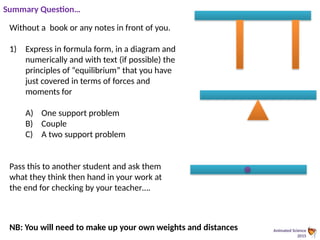
Summary Question…
Without a book or any notes in front of you.
1) Express in formula form, in a diagram and
numerically and with text (if possible) the
principles of “equilibrium” that you have
just covered in terms of forces and
moments for
A) One support problem
B) Couple
C) A two support problem
Pass this to another student and ask them
what they think then hand in your work at
the end for checking by your teacher….
NB: You will need to make up your own weights and distances
Animated Science
2015
6.4 Bridge Worked Example Q3….
NB: you can also
take moments from
0.5m in to be more
precise!
Animated
Science
2018
Mr D Powell
2018
Animated Science
2018
6.5 Stability – what is it?
C
CHALLENGE
I can explain what is the difference
between stable and unstable
equilibrium?
I can identify when a tilted object is going
to topple over and quote the
mathematics behind it?
I can mathematically prove why is a
vehicle more stable, the lower its centre
of mass is.
I can resolve for objects on a slope without help!
A
B

Animated Science
2015
What happens here?
W
b
d
F
Animated Science
2015
Equilibrium…
Stable Equilibrium – if an object is displaced it will return to that point
Unstable Equilibrium – if it is displaced slightly it will not return to that point
Toppling…
If centre of mass goes over the pivot point an object will topple…
Centre
of mass
W
b
d
F
W
b
d
F
W
b
d
F
Animated Science
2015
Moments
If we consider moments about the pivot
point….
d = perpendicular distance from line of action
of force
F = force applied
W = weight (acting through middle of base)
b = base of object
Clockwise Moment = Fd
Anticlockwise Moment = W* b/2
Hence we have three scenarios for the relation
of balance or unbalance…
1. Fd < Wb/2
2. Fd = Wb/2
3. Fd > Wb/2
NB: try it out and see
how it feels with a
block
Centre
of mass
W
b
d
F
Animated Science
2015
Moments
Imagine that this box had a base = 1.4m and
the force was applied at distance = 1.8m. The
weight of the box was 800N what is the force
needed to tilt the box to equilibrium?
This scenario means that…
Fd = Wb/2
F = Wb/2d
F = (800N * 1.4m) / (2* 1.8m)
F = 311N
W
b
d
F
Animated Science
2015

esolving Forces Parallel to Slope
F = W x sin 
esolving Perpendicular to Slope
S = Sx + Sy = W x cos 
hyp x sin  = opp
hyp x cos  = adj

Use page 109 Q3 for practice
Inclined Plane - Forces

NB: Sx Not equal to Sy due to position
Animated Science
2015
Example..
The lorry has a wheelbase of 1.8m and
centres of mass unloaded of 0.8m from
the ground. What is the maximum angle
it can drive at before toppling over….
d = 0.8m b/2 = 1.8m/2 = 0.9m
Hence opp/adj = tan 
tan-1
(0.9 / 0.8) = 48.3
Resolving on a Slope... (Harder A-B)
• When trying to work out the angle at
which a lorry will start to topple we
can use the idea of Resolving Forces
Parallel to Slope
• However, it is hard to see, so better to
rotate then turn into a balance
problem
Left = Right
Up = down
Now we can simply say that
Friction = Wsin  (opp) - Eq1
Sx + Sy = Wcos  (adj) - Eq 2
Now divide Eq1 by q2 to F/s = tan 


W
F = b/2 = 0.9m
d = 0.8
Page 103 Worked Example NB: Sy (if higher has lower force as higher)

Animated Science
2015
3.4.1.1/2 / 6.6 Equilibrium rules; 6.7 Statics calculations
Learning Objectives...
1. Addition of vectors by calculation or scale drawing.
2. Resolution of vectors into two components at right angles to each
other.
3. Conditions for equilibrium for two or three coplanar forces acting at a
point. Appreciation of the meaning of equilibrium in the context of an
object at rest.
3.4.1.2
4. Principle of moments.
5. Knowledge that the position of the centre of mass of uniform regular
solid is at its centre.
ICT Links...
Substitution
http://app.mymaths.co.uk/205-resour
ce/substitution-2
Rearranging Equations
http://app.mymaths.co.uk/206-resour
ce/rearranging-1
Pythagoras Theorem
http://app.mymaths.co.uk/300-resour
ce/pythagoras-theorem
Trigonometry – Missing Angles
http://app.mymaths.co.uk/321-resour
ce/trig-missing-angles
Trigonometry – Missing Sides
http://app.mymaths.co.uk/322-resour
ce/trig-missing-sides
Mathematical skills:
MS 0.6 Use calculators to handle sin x, cos x, and tan x when x is expressed in degrees or radians
MS 4.1 Use angles in regular 2D and 3D structures
MS 4.2 Visualise and represent 2D and 3D forms including 2D representations of 3D objects
MS 4.4 Use Pythagoras’ theorem and the angle sum of a triangle
MS 4.5 Use sin, cos, and tan in physical problems.
Animated
Science
2018
Mr D Powell
2018
Animated Science
2018
6.6 Equilibrium Rules
C
CHALLENGE
I can apply forces on an
object in equilibrium?
I can explain the turning effects of the forces?
I can apply these conditions to predict the
forces acting on a body in equilibrium?
I can apply my ideas to the Physics of Lifting p112
A
B

W
F
S


Animated Science
2015
Visuals…

W
F
S


Animated Science
2015
Scale Diagrams….
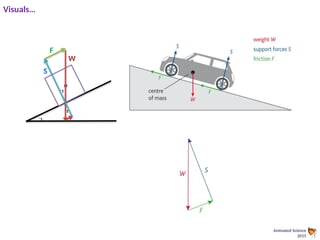
Another useful tool in AS is to draw a scale diagram with ruler and compass.
Then we can use the idea of a closed triangle to show equilibrium and resolve
an unknown force.
Just try it out with two vectors and an angle.
Then work out the third force by using simple trigonometry. The actual line
length should match your calculations
Animated Science
2015
Summary Questions….
a) Moments about “X” balance…..
200N x 0.5 = Wo x2m
Wo = 50N
b) Support Forces must match the
total weight down…
Sx = W0 + W = 50N + 200N = 250N
5m
0.5m
0.5m
W= 200N
W0= ?
Basic
Animated Science
2015
Summary Questions….
a) Moments about “X”
The moment is F x d = 1.2m x 1500N
= 1800Nm
b)
1.2m x 1500N = 1.0m x ?
1.2m x 1500N / 1m = 1800N
Hence, extra force is 1800N
(as applied from 1m away!) W= 1500N
Basic
Animated Science
2015
Summary Questions….
1. Split the problem into two triangles
working out the angle from vertical
for each
2. Label up sides with adj1 = adj2
Resolve Left = Right
T1sin40 = T2 sin 30
Resolve vertical direction….
2.8N = T1cos40 + T2cos30
Now solve with simultaneous equations
T1 = 1.493N = 1.5N
T 2 = 1.911N = 1.9N
40 30
opp1 opp2
hyp2
hyp1 adj
Medium Physics/ Harder Maths
1
2
T2sin2
T1sin1
T
2
cos
2
T
1
cos
1
T2
T1
W
Animated Science
2015
Summary Questions….
a) Weight acts down which makes it more
complex!
• But if you turn problem to flat then work out
the component of W acting in line with T to
balance…
• So green triangle you need to work out the
Hyp using  as same angle as slope
Angle of Beam to Horizontal
opp = sin x hyp -> Sin-1
(6m/10m) = 36.9
Up = Down (moments from “X”)
T x 10m = 10m/2 x 15,000N cos (36.9)
= 6000N
T
W = 15kN

W = 15kN
A*+ Harder Physics/
Harder Maths
NB: a simple method using similar
triangles. We know that W acts at 5m, so
6m/2 = 3m so the bottom length is 4m.
Hence moments…
Fd = 15,000 * 4m = 60,000Nm
Animated Science
2015
Summary Questions….
Angle slope = 36.9
b) Summing forces in the….
x direction on the base of the girder…
Sx (support force) = T*sin(36.9)
Sx = T*sin(36.9) = 6000*sin(36.9)
= 3602N = 3.6kN
Y-direction…
Sy + 6000*cos(36.87) = 15,000
Sy = 15000 - 6000*cos(36.9)
= 10202N = 10.2kN
Resolve Resultant for Support Force…
R = (3.6kN2
+ 10.2kN2
)½
= 10.8kN
T=6000N
3.6kN
10.2kN

Tsin
10.8kN
A*+ Harder Physics/
Harder Maths
Animated Science
2015
Vectors...
A boy runs 400 m due south and then 300 m due east. It takes him 6 minutes.
1. Calculate the total distance travelled by the boy.
2. Calculate the displacement of the boy.
3. Calculate the direction of the displacement.
4. Calculate his average speed.
5. Calculate his average velocity.
1. 400m + 300m = 700m
2. Sqrt((400m)2
+(300m)2
)= 500m (resultant)
3. Opp/adj =tan = tan-1
(300/400) = 37 SE or 143 to NE
4. d/t = s = 700m/(6x60)s = 1.9m/s
5. s/t = v = 500m/(6x60)s = 1.4m/s
400m
300m
Animated Science
2015
Resolving...
A box of mass 18 kg is at rest on a horizontal frictionless surface. A force of 4 N is
applied to the box at an angle of 26o
to the horizontal
1. Show that the horizontal component of this force is 3.6 N.
2. Calculate the acceleration of the box along the horizontal surface.
3. Calculate the horizontal distance travelled by the box in a time of 7 s.
FH = Rcos
FH = 4 x cos 26o
FH = 3.6 N
4 N
FH = 3.6 N
m = 18 kg
a = a
a = FH/m
a = 3.6/18
a = 0.2 ms-2
t = 7 s
a = 0.2 ms-2
u = 0 ms-1
s = s
s = ut + ½at2
s = (0 x 7) + (½ x 0.2 x 72
)
s = 0 + 4.9
s = 4.9 m
Animated Science
2015
Balanced Forces...
A crane on an oil-rig is used to raise a sunken buoy from the seabed. The weight
of the buoy is 4900 N and the buoyancy force (upthrust) acting on it is 1000 N.
When the buoy is being raised vertically at a constant speed, a force of 800 N
acts on it due to water resistance.
What is the size of the force which the vertical cable applies to the buoy?
weight of the buoy = 4900 N
upthrust = 1000 N
water resistance = 800 N
vertical force up = vertical force down
weight of the buoy + water resistance = upthrust + vertical force
vertical force = (weight of the buoy + water resistance) – upthrust
vertical force = (4900 + 800) – 1000
vertical force = 4700 N
Animated
Science
2018
Mr D Powell
2018
Animated Science
2018
6.7 Statics Calculations/ Practice
Questions
C
CHALLENGE
A
B
Animated Science
2015
Conditions for the Equilibrium of Three Non-Parallel Forces
If we say that an object is under the influence of forces which are in equilibrium, we
mean that the object is not accelerating - there is no net force acting. The object may
still be travelling - but at a constant velocity - but in most questions the object will be
stationary.
The following ideas will help you to solve problems that involve a body acted on by
three co-planar forces.
The lines of action of the three forces must all pass through the same point.
The principle of moments: the sum of all the clock-wise moments about any point must
have the same magnitude as the sum of all the anti-clockwise moments about the same
point.
The sum of all the forces acting vertically upwards must have the same magnitude as
the sum of all the forces acting vertically downwards
The sum of all the forces acting horizontally to the right must have the same magnitude
as the sum of all the forces acting horizontally to the left.
If you resolve all of the forces the 'ups' will equal the 'downs' and the 'rights' will equal
the 'lefts
Animated Science
2015
Quick Test what does each one represent...
1. A point on an object where the entire weight of the object seems to act. In a uniform
gravitational field, it is in the same place as the centre of mass.
2. A point on an object where the entire mass of the object seems to be concentrated. In a uniform
gravitational field, it is in the same place as the centre of gravity.
3. A pair of forces acting on a body that are of equal magnitude and opposite direction, acting
parallel to one another, but not along the same line.
4. The state a body is in if no net force or moment acts on the body.
5. The point about which a lever turns. Also called the pivot.
6. The turning effect of a force or forces. Can also be called the torque (symbol τ). It is calculated by
multiplying the force by the perpendicular distance between the pivot and the line of action of
the force. The units of moment are newton metres (Nm).
7. The point about which a lever turns. Also called the fulcrum.
8. The principle stating that the sum of the clockwise moments are equal to the sum of the
anticlockwise moments acting on a body.
9. The turning effect of a force or forces, given the symbol τ. Can also be called the moment. It is
calculated by multiplying the force by the perpendicular distance between the pivot and the line
of action of the force. The units of torque are newton metres (Nm).
10. The rotation force or moment produced by a couple. It can be calculated by multiplying the force
by the perpendicular distance between the lines of action of the forces. Its units are newton
metres (Nm).
11. The force created by the gravitational attraction on a mass. Its units are newtons (N).
Animated Science
2015
Quick Test Answers...
1. centre of gravity – A point on an object where the entire weight of the object
seems to act. In a uniform gravitational field, it is in the same place as the centre
of mass.
2. centre of mass – A point on an object where the entire mass of the object seems
to be concentrated. In a uniform gravitational field, it is in the same place as the
centre of gravity.
3. couple – A pair of forces acting on a body that are of equal magnitude and
opposite direction, acting parallel to one another, but not along the same line.
4. equilibrium – The state a body is in if no net force or moment acts on the body.
5. fulcrum – The point about which a lever turns. Also called the pivot.
6. moment – The turning effect of a force or forces. Can also be called the torque
(symbol τ). It is calculated by multiplying the force by the perpendicular distance
between the pivot and the line of action of the force. The units of moment are
newton metres (Nm).
7. pivot – The point about which a lever turns. Also called the fulcrum.
8. principle of moments – The principle stating that the sum of the clockwise
moments are equal to the sum of the anticlockwise moments acting on a body.
9. torque – The turning effect of a force or forces, given the symbol τ. Can also be
called the moment. It is calculated by multiplying the force by the perpendicular
distance between the pivot and the line of action of the force. The units of
torque are newton metres (Nm).
10. torque of a couple – The rotation force or moment produced by a couple. It can
be calculated by multiplying the force by the perpendicular distance between
the lines of action of the forces. Its units are newton metres (Nm).
11. weight – The force created by the gravitational attraction on a mass. Its units are
newtons (N).
Animated Science
2015
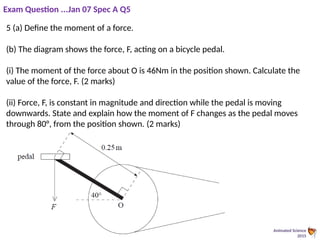
Exam Question ...Jan 07 Spec A Q5
5 (a) Define the moment of a force.
(b) The diagram shows the force, F, acting on a bicycle pedal.
(i) The moment of the force about O is 46Nm in the position shown. Calculate the
value of the force, F. (2 marks)
(ii) Force, F, is constant in magnitude and direction while the pedal is moving
downwards. State and explain how the moment of F changes as the pedal moves
through 80°, from the position shown. (2 marks)
Animated Science
2015
Exam Question ...Jan 07 Spec A Q5
5 (a) Define the moment of a force.
(b) The diagram shows the force, F, acting on a bicycle pedal.
(i) The moment of the force about O is 46Nm in the position shown. Calculate the
value of the force, F. (2 marks)
(ii) Force, F, is constant in magnitude and direction while the pedal is moving
downwards. State and explain how the moment of F changes as the pedal moves
through 80°, from the position shown. (2 marks)
Animated Science
2015
Exam Question ...Jan 07 Spec A Q5
5b)….
(i) The moment of the force about O is 46Nm in the position shown. Calculate the
value of the force, F. (2 marks)
(ii) Force, F, is constant in magnitude and direction while the pedal is moving
downwards. State and explain how the moment of F changes as the pedal moves
through 80°, from the position shown. (2 marks)
46Nm
240N

AQA Physics Forces in Equilibrium.pptx

  • 1.
    Animated Science 2015 6 Forcesin Equilibrium 3.4.1 Force, Energy and Momentum 7407 / 7408 PHYSICS KS5 6.1 Vectors and Scalars 6.2 Balanced Forces 6.3 The Principles of Moments 6.4 More on Moments 6.5 Stability 6.6 Equilibrium Rules
  • 4.
  • 5.
    Animated Science 2015 Introduction This chapterguides students towards an understanding of the conditions for static equilibrium of a body. They will learn to interpret and manipulate vectors and to analyse three forces in equilibrium. They will work with moments and centre of mass and apply the principle of moments. Finally, they will practise solving problems involving objects in equilibrium by considering both forces and moments. Opportunities for practical work involve the measurement of forces and moments in equilibrium, and some of the experiments require students to draw and interpret graphs and to discuss errors and uncertainties. The principle mathematical techniques used in this chapter are vector skills and trigonometry. Prior knowledge 1. Students will need to build on their knowledge and skills, from Key Stage 4 Science and Mathematics, of: 2. changing the subject of an equation 3. vector quantities: quantities which have magnitude and direction 4. objects acted on by two equal and opposite forces are at rest or moving at constant velocity.
  • 6.
    Animated Science 2015 3.4.1.1 Scalarsand vectors / 6.1& 6.2 Learning Objectives... • Define a vector quantity. • Describe how we represent vectors. • Explain how we add and resolve vectors. • Explain why we have to consider the direction in which a force acts. • Demonstrate when two (or more) forces have no overall effect on a point object. • Explain the parallelogram of forces. Skills: This topic provides opportunities to practise the following mathematical skills: MS 0.6 Use calculators to handle sin x, cos x, and tan x when x is expressed in degrees or radians MS 3.2 Plot two variables from experimental or other data MS 3.3 Understand that y = mx + c represents a linear relationship MS 3.4 Determine the slope and intercept of a linear graph MS 4.2 Visualise and represent 2D and 3D forms including 2D representations of 3D objects MS 4.4 Use Pythagoras’ theorem and the angle sum of a triangle MS 4.5 Use sin, cos, and tan in physical problems.
  • 7.
    Animated Science 2018 Mr D Powell 2018 AnimatedScience 2018 6.1 Vectors and Scalars – what are they? C CHALLENGE What is a vector or scalar quantity and can I identify one? How do we represent vectors/ Addition of vectors using a scale diagram Addition of two perpendicular vectors using a calculator or resolving a vector into two perpendicular components What happens when you are over 90? A B
  • 8.
    Animated Science 2015 A Definition....M Scalars Vectors mass, temperature, time, length, speed, energy displacement, force, velocity, acceleration, momentum TASK: Make a note of each quantity, then look at the units and give a reason why they have been sorted as such..
  • 9.
    Animated Science 2015 Displacement andvelocity A runner completes one lap of an athletics track. 400m What is her final displacement? If she ends up exactly where she started, her displacement from her starting position is zero. What is her average velocity for the lap, and how does it compare to her average speed? What distance has she run?
  • 10.
    Animated Science 2015 What didyou decide? Despite the trip moving at various speeds, because it ended up at the starting point, the average velocity was zero. This will always be true when the final displacement is zero.
  • 11.
    Animated Science 2015 Vectors? M  Onthis racetrack a car covers 1.029 miles in distance by covering a circuit in a lap. After 1 lap the car is back to the start and has completed the lap at a constant speed of 30 mph.  However, when we think of the term “velocity” we describe not just the speed but the direction. In this case the “velocity” changes direction all the time. We call it a vector quantity. This feature is important in helping us describe the motion of objects clearly!
  • 12.
    Animated Science 2015 Vector equations Anequation is a statement of complete equality. The left hand side must match the right hand side in both quantity and units. In a vector equation, the vectors on both sides of the equation must have equal magnitudes and directions. Take Newton’s second law, for example: force = mass × acceleration Force and acceleration are both vectors, so their directions will be equal. Mass is a scalar: it scales the right-hand side of the equation so that both quantities are equal. Force is measured in newtons (N), mass in kilograms (kg), and acceleration in ms-2 . The units on both sides must be equal, so 1 N = 1kgms-2 .
  • 13.
    Animated Science 2015 Displacement vectors Harryand Sally are exploring the desert. They need to reach an oasis, but choose to take different routes.  Harry travels due north, then due east.  Sally simply travels in a straight line to the oasis. When Harry met Sally at the oasis, they had travelled different distances. However, because they both reached the same destination from the same starting point, their overall displacements were the same. N
  • 14.
    Animated Science 2015 Vector notation Ascalar quantity is often represented by a lower case letter, e.g. speed, v. A vector quantity can also be represented by a lower case letter, but it is written or printed in one of the following formats to differentiate it from the scalar equivalent: The value of a vector can be written in magnitude and direction form: e.g. v = (v, θ) Or as a pair of values called components: e.g. a = (8, 6) or x y 8 6 8 6 a
  • 15.
    Animated Science 2015 Vector addition Displacementvectors can always be added ‘nose to tail’ to find a total or resultant vector. This can be done approximately by scale drawing: It can also be done by calculation, breaking each vector down into perpendicular components first and then adding these together to find the components of the resultant: c + d = 2 3 -2 2 + = 0 5 a b a + b  10 7 x y
  • 16.
    Animated Science 2015 R =√ 32 + 42 Calculating a resultant When adding two perpendicular vectors, it is often necessary to calculate the exact magnitude and direction of the resultant vector. This requires the use of Pythagoras’ theorem, and trigonometry. For example, what is the resultant vector of a vertical displacement of 4 km and a horizontal displacement of 3km? direction: = 5km tan θ = 4/3 = 53° θ = tan-1 (4/3) = √ 25 magnitude: R2 = 32 + 42  R 4km 3km
  • 17.
    Animated Science 2015 Just asit is possible to add two vectors together to get a resultant vector, it is very often useful to break a ‘diagonal’ vector into its perpendicular components. Vector components This makes it easier to describe the motion of an object, and to do any relevant calculations. vertical component horizontal component
  • 18.
    Animated Science 2015 Calculating components Avector can be separated into perpendicular components given only its magnitude and its angle from one of the component axes. This requires the use of trigonometry. For example, what are the horizontal and vertical components of a vector with a magnitude of 6ms-1 and a direction of 60° from the horizontal? 6ms-1 60° x y cos60° = x / 6 x = 6 × cos60 = 3ms-1 sin60° = y / 6 y = 6 × sin60 = 5.2ms-1
  • 19.
    Animated Science 2015 Pythagoras &Adding Vectors M TASK: Now try out the same techniques for two more triangles; 1) opp = 2m, adj = 8m 2) opp = 1.5m, adj = 4m Answers 1.  = 14 , R =8.25m 2.  = 20.6 , R =4.27m
  • 20.
    Animated Science 2015 Applications... M TASK:Now try out the same techniques for two more triangles; 1) What is R &  if opp = 54N, adj = 22N 2) What is adj &  if opp = 54ms-1 , R = 85ms-1 Answers 1.  = 67.83 , R =58.3m 2.  =39.4 , R =65.6ms-1
  • 21.
    Animated Science 2015 Splitting avector into components... T TASK: Put on your maths brain and try and explain using trig why Vx is related to cos and Vy is related to sin
  • 22.
    Animated Science 2015 Resolving ina context.... TASK: 1) A bird is flying at a speed of 15ms-1 at an angle of 36 to the horizontal. What is its vertical speed. 2) A javelin is thrown at a resultant force of 100N at a 45  angle. What are the horizontal and vertical forces on it. Answers 1. Vy =8.8ms-1 2. Vy =70.7N Vx = 70.7N
  • 23.
    Animated Science 2015 Questions totry on your own.... P Answers .....
  • 24.
    Animated Science 2015 1.How manyradians in a circle? 2.How many radians in quarter of a circle? 3.Work out  in degrees for a right-angled triangle if hyp = 5, opp = 4, adj = 3? 4.Work out opp if  = 450 and the adj = 7cm? 5.Work out tan if opp = 53.0m, adj = 42.0m? 6.Work out opp if  = /2 and the adj = 3cm? 7.Work out  in radians for a right-angled triangle if hyp = 5, opp = 4, adj = 3? 8.Rearrange sin=opp/hyp to make  the subject. 9.Work out sin (/2) =, sin (2) = , cos () = , cos(cos-1 (/4)) = , tan(/4) = 10.Use formulae & numbers from your calculator to prove that; More Trig Practice adj opp   tan
  • 25.
    Animated Science 2015 Vector Problems1 Question 1 Both sides contribute as vectors so double it to If using only pythag do simply 2 x 15N Sin20 = 10.26 = 10.3N label upper part of triangle as a. Hence a2 = (152 +152 -2x152 Cos140)0.5 = 28.19N, then half for triangle. To 14.1N. Then pythag (152 -14.12 )0.5 = 5.12N (x2) = 10.23N a c b
  • 26.
  • 27.
    Animated Science 2015 Vector Problems1 Question 3 3) A mass of 20.0kg is hung from the midpoint P of a wire. Calculate the tension in each suspending wire in Newton’s. Assume g = 10ms-2 . (Hint resolve…..) Use the idea of point of equilibrium. The forces must balance vertical and horizontal. Weight balances the tension so for each wire Use the 2T Cos70 = 200 T Cos70 = 100 T = 100 / Cos70 = 292.38N
  • 28.
    Animated Science 2015 Vector Problems1 Question 5/6 5) Magnitude = sqrt(35002 + 2792 ) = 3511.1m = 3510m Direction = tan-1 (279/3500) = 4.557° = 4.6° south from vertical 6) Vertical motion: 21 sin (43°) = 14.32 ms-1 Horizontal motion: 21 cos (43°) =15.358 ms-1 S = 3 x 15.358 ms-1 = 46.1 ms-1 3500km 0.279km
  • 29.
    Animated Science 2015 Vector Problems2 Question 2 Use the parallelogram method to resolve the forces acting on this object placed. (Hint employ both cosine & sine rule). (4 marks)
  • 30.
    Animated Science 2015 Vector Problems2 Question 2 Use the parallelogram method to find the resultant acting on this object and angle. (Hint employ both cosine & sine rule). (4 marks)
  • 31.
    Animated Science 2015 Vector Problems2 Question 3 3) Two forces of magnitude 10.0N and F Newton’s produce a resultant of magnitude 30.0N in the direction OA. Find the direction and magnitude of F. (2 marks) (Hint use Pythagoras)
  • 32.
    Animated Science 2015 Vector Problems2 Question 4 The graph shows a part completed vector diagram. You task is to find out the vector R by mathematical analysis. The vectors A & B are shown in both coordinate and bearing formats. Show working for both a mathematical method (2 marks) and drawn out scaled method. (2 marks) Hint: this is not as hard as it might initially look!
  • 33.
    Animated Science 2015 Vector Problems2 Question 4 - stage 1 Finding the components of vectors for vector addition involves forming a right triangle from each vector and using the standard triangle trigonometry. The vector sum can be found by combining these components and converting to polar form.
  • 34.
    Animated Science 2015 Vector Problems2 Question 4 – stage 2 After finding the components for the vectors A and B, and combining them to find the components of the resultant vector R, the result can be put in polar form by
  • 35.
  • 36.
  • 37.
  • 38.
    6) Forces of60.0N and F Newton’s act at point O. Find the magnitude and direction of F if the resultant force is of magnitude 30.0N along OX (2 marks)
  • 39.
    Animated Science 2015 Vector Problems2 - Question 7 Forces of 60.0N and F Newton’s act at point O. Find the magnitude and direction of F if the resultant force is of magnitude 30.0N along OX (2 marks) SinC c SinA a  c2 = a2 + b2 - 2abCosC
  • 40.
    Animated Science 2015 Using theSine or Cosine Rule 30N In this problem we can solve it with other methods of trigonometry. Make a triangle of vectors where we are trying to find length c and angle A; 120 c = F b = 30N a = 60N A Cosine Rule c2 = a2 + b2 - 2abcosC c2 = 60N2 + 30N2 – 2x60Nx30N xCos120 c2 = 4500N2 +1800N2 c2 = 6300N c = 79.4N c = F = 79.4N Sine Rule Use reciprocal version of above SinC / c = SinA / a (60N x Sin 120) / 79.4N) = SinA Sin-1 (60N x Sin 120) / 79.4N) =A A = 40.876 = 41  SinC c SinA a 
  • 41.
    Animated Science 2015 7) SimultaneousEquations (A*+) If this problem is to be solved mathematically we must establish two formulae. One in the vertical and one in the horizontal; 30N The key is knowing that the resultant force is 30N at 0º. Hence; Resolving Horizontally; 30N = FCos + 60NCos(360-120) 30N = FCos + 60N x -0.5 30N = FCos - 30N 60N = FCos  Eq 1 Resolving Vertically; 0 = FSin + 60NSin(360-120) 0 = FSin + 60NSin(240) 0 = FSin + 60N x 3/2 0 = FSin -51.96N 51.96N = FSin Eq 2 So by dividing Eq 2 by Eq 1 FSin / FCos  = 51.95N / 60N tan  = 0.866  = 40.89 F = 60N / cos  = 79.4N Or F = 51.96N / sin  = 78.96N
  • 42.
    Animated Science 2018 Mr D Powell 2018 AnimatedScience 2018 6.2 Balanced Forces C CHALLENGE Why do we have to consider the direction in which a force acts? Complete calculations when two (or more) forces have no overall effect on a point object? What is the parallelogram of forces? Conduct a precise coplanar forces practical without help A B
  • 43.
    Animated Science 2015 Why arethe objects not moving... S
  • 44.
    Animated Science 2015 Real Setup… TF w=mg  X Y mg F   sin This simple experiment tests the idea that the vertical component of a resultant force “F” can be balanced by vertical “mg” force. So changing “mg” changes F and thus we can use the example as y = mx+c
  • 45.
    Animated Science 2015 Example PracticalResults… 3.0 4.0 5.0 6.0 7.0 8.0 9.0 10.0 11.0 0.00 1.00 2.00 3.00 4.00 5.00 6.00 f(x) = 0.4905 x R² = 1 Weight +/-0.01N Force on meter (N) Weight Added (N) Force on Newton meter +/-0.2N mass +/-1g Weight +/- 0.01N Angle +/-1 deg 4.0 200 1.96 24 5.0 250 2.45 24 6.0 300 2.94 24 7.0 350 3.43 24 8.0 400 3.92 24 9.0 450 4.41 26 10.0 500 4.91 27 ave 24.71 Sin (ave) 0.42 In terms of forces Hyp = F opp = mg Hence... opp/hyp = adj mg/F=sin(theta) Fsin(theta) = mg F = x m = sin(theta) y = mg
  • 46.
  • 47.
  • 48.
  • 49.
    Animated Science 2015 Example 1(with numbers) M A father pulls a child of weight 60.0N back with a force of 50.0N. a) What is the tension in each rope? b) What is the angle from vertical that the child is held at? Answers… a) (60.02 +50.02 )0.5 = 78.1N each rope 78.1N /2 = 39.1N b) tan = 50/60 = 0.833  = 39.8  W T F Tcos Tsin
  • 50.
  • 51.
    Animated Science 2015 Example 2 M Hint:Draw your triangle 1,2,3….. W, S, F to make a similar triangle
  • 52.
    Animated Science 2015 Example 2(with numbers) M A block of weight = 30.0N sits on a slope and is held by frictional forces of 10.0N a) What is the support force? b) What is the angle from vertical that the slope is at? Answers… a) 10.02 +S2 = 30.02 (30.02 – 10.02 )½ = S =28.3N b) tan = F/S = 10/28.3 = 0.353 = = 19.5 Hint: Draw your triangle 1,2,3….. W, S, F to make a similar triangle
  • 53.
    Animated Science 2015 Practical Extension... M Assemble the equipment shown below. Use some weights of different types and measure the angles shown.  The basic system will adjust in angle to whatever masses you add.  The tension in each string must equal the force exerted by W1 or W2. This enables the problem to be solved by resolving  Try it practically so get a range of angles & weights then prove the equilibrium. http://www.walter-fendt.de/html5/phde/equilibriumforces_de.htm
  • 54.
    Animated Science 2015 Example 3 M 12 T2sin2 T1sin1 T 2 cos 2 T 1 cos 1 T2 T1 W P
  • 55.
    Animated Science 2015 Wires Example- Correct Vertically 1.20N = T1 cos30+ T2 cos60 1.20N = 0.866T1 + 0.5T2 Eq 1 Horizontally T1 sin30 = T2 sin60 0.5T1 = 0.866T2 T1 = 1.732T2 Eq 2 Sub 2 into 1; 1.20N = 0.866T1 + 0.5T2 1.20N = 0.866 x 1.732T2 +0.5T2 1.20N = 1.99T2 T2 = 0.60N & T1 = 1.732T2 T1 = 1.732 x 0.6N T1 = 1.04N So by turning it on its side we can use the same formulae (which is confusing but correct) Left side right side
  • 56.
    Animated Science 2015 WRONG! Vertically 1.20N =T1 sin30+ T2 sin60 1.20N = 0.5T1 + 0.866T2 Eq 1 Horizontally T1 cos30 = T2 cos60 0.866T1 = 0.5T2 T1 = 0.577T2 Eq 2 Sub 2 into 1; 1.20N = 0.866T1 + 0.5T2 1.20N = 0.866 x 0.577T2 +0.5T2 1.20N = 1T2 T2 = 1.2N & T1 = 0.577T2 T1 = 0.577x1.2N T1 = 0.69N
  • 57.
    Animated Science 2015 Vertically 1.20N =T1 sin60+ T2 sin30 1.20N = 0.866T1 + 0.5T2 Eq 1 Horizontally T1 cos60 = T2 cos30 0.5T1 = 0.866T2 T1 = 1.732T2 Eq 2 Sub 2 into 1; 1.20N = 0.866T1 + 0.5T2 1.20N = 0.866 x 1.732T2 +0.5T2 1.20N = 1.99T2 T2 = 0.60N & T1 = 1.732T2 T1 = 1.732 x 0.6N T1 = 1.04N If we take the outside angle instead of the inner angle we can do this and use the triangle; (90-) Alternative Can do by using (90- ) as angle;
  • 58.
    Animated Science 2015 Example 1... M Usingthe following figures the problem is very simple... W1 = 5N W2 = 3N W3 = 6N 1 = 150 2 = 124 F1 F2 F1sin F1cos  F2sin F2cos    1. If you think that F1 & F2 must resolve and their components in H & V directions must balance with the weights to make the point P be in equilibrium. 2. Define the problem as shown below with two new angles and triangles. Make sure you use the correct angles!
  • 59.
    Animated Science 2015 Example 1... M Using the following figures the problem is very simple... W1 = 5N W2 = 3N W3 = 6N 1 = 150 2 = 124 =60  = 34  F1 F2 F1sin F1cos  F2sin F2cos    5 . 2 5 . 2 cos cos 0 6 67 . 1 33 . 4 sin sin 0 2 1 3 3 2 1                F F H F W F F V
  • 60.
    Animated Science 2015 Plenary Question P A2kg chicken rests on point C on clothes line ACB as shown. What is the minimum breaking strength of the line to ensure the bird does not break the line? F1 F2 F1sin30 F1cos 30 F2sin45 F2cos45 30 45 N F F N F F N F F V 40 2 20 2 2 2 20 45 sin 30 sin 0 2 1 2 1 2 1         3 2 2 2 2 3 45 cos 30 cos 0 2 1 2 1 2 1 F F F F F F H     
  • 61.
    Animated Science 2015 Plenary Question P A2kg chicken rests as point C on clothes line ACB as shown. What is the minimum breaking strength of the line to ensure the bird does not break the line? N F F 40 2 2 1   3 2 2 1 F F  N F N F F N F F F F N F F 68 . 12 732 . 2 64 . 34 2 40 3 3 40 2 3 2 3 2 40 2 2 2 2 2 2 2 1 2 1           N N F F F 35 . 10 3 2 68 . 12 3 2 1 2 1     F1=10.35N F2= 12.68N F1sin30 F1cos 30 F2sin45 F2cos45 30 45 So we have now worked out both the tensions in the line that are there from the weight of the chicken. This means that the line must be of a strength equal or better than F2 = 12.68N
  • 62.
    Animated Science 2015 Resolution ofForces – ICT Link Self Check http://www.walter-fendt.de/ph14e/forceresol.htm
  • 63.
    Animated Science 2015 Exam Question… Acyclist rides along a road up an incline at a steady speed of 9.0 m s–1 . The mass of the rider and bicycle is 70kg and the bicycle travels 15 m along the road for every 1.0 m gained in height. Neglect energy loss due to frictional forces. Calculate the component of the weight of the bicycle and the rider that acts along the incline. (3 marks) Downwards… W = mg = 70kg x 9.81N/kg = 686.7N (1) But the component that acts along the slope is… F = mg sin  F = 686.7N x sin  F = 686.7N x opp/ hyp F = 686.7N x 1/15 (1) F = 45.78N F = 46N (1) v= 9.0 m s–1 m = 70kg 1m 15m
  • 64.
    Animated Science 2015 9630-AQA-Physics 3.2 Moments,couple & torque Sir Shakeel Mehmood
  • 66.
    Animated Science 2015 3.4.1.2 /6.3 The principle of moments; 6.4 More on moments; 6.5 Stability Learning Objectives... 1. Describe the conditions under which a force produces a turning effect. 2. Explain how the turning effect of a given force can be increased. 3. Explain what is required to balance a force that produces a turning effect. 4. Explain why the centre of mass is an important idea. 5. Describe the support force on a pivoted body. 6. When a body in equilibrium is supported at two places, state how much force is exerted on each support. 7. Explain what is meant by a couple. 8. Explain the difference between stable and unstable equilibrium. 9. Assess when a tilted object will topple over. 10. Explain why a vehicle is more stable when its centre of mass is lower. ICT Links... Substitution http://app.mymaths.co.uk/205-resour ce/substitution-2 Rearranging Equations http://app.mymaths.co.uk/206-resour ce/rearranging-1 Moments http://app.mymaths.co.uk/892-resour ce/moments Real Life Applications http://app.mymaths.co.uk/881-resour ce/real-life-applications Mathematical skills: MS 0.1 Recognise and make use of appropriate units in calculations MS 0.2 Recognise and use expressions in decimal and standard form MS 1.1 Use an appropriate number of significant figures MS 1.5 Identify uncertainties in measurements and use simple techniques to determine uncertainty when data are combined by addition, subtraction, multiplication, division, and raising to powers MS 3.2 Plot two variables from experimental or other data MS 3.3 Understand that y = m x + c represents a linear relationship MS 3.4 Determine the slope and intercept of a linear graph MS 4.2 Visualise and represent 2D and 3D forms MS 4.4 Use Pythagoras’ theorem and the angle sum of a triangle.
  • 67.
    Animated Science 2018 Mr D Powell 2018 AnimatedScience 2018 6.3 The Principle of Moments C CHALLENGE I know what conditions a force produce a turning effect & How can the turning effect of a given force be increased. I can explain what is required to balance a force that produces a turning effect. I can explain/ apply the context of why is the centre of mass an important idea? I can weigh a ruler with moments only! A B
  • 68.
    Animated Science 2015 Centres ofmass and gravity The centre of gravity of an object is a point where the entire weight of the object seems to act. An alternative definition is that the centre of mass or centre of gravity of an object is the point through which a single force has no turning effect on the body. In a uniform gravitational field the centre of mass is in the same place as the centre of gravity. The centre of mass of an object is a point where the entire mass of the object seems to be concentrated.
  • 69.
    Animated Science 2015 Equilibrium A bodypersists in equilibrium if no net force or moment acts on it. Forces and moments are balanced. Newton’s first law states that a body persists in its state of rest or of uniform motion unless acted upon by an external unbalanced force. Bodies in equilibrium are therefore bodies that are at rest or moving at constant velocity (uniform motion). F1 F1 F2 F2 equilibrium
  • 70.
    Animated Science 2015 The principleof moments The principle of moments states that (for a body in equilibrium): total clockwise moments = total anticlockwise moments 4N 6N 5m d 4 × 5 = 6d This principle can be used in calculations: What is d? 20 = 6d d = 20 / 6 d = 3.3m
  • 71.
    Animated Science 2015 Human forearm 60N 20N 4cm 16cm 35cm F Takingmoments about the elbow joint: 4F = (16 × 20) + (35 × 60) 4F = 2420 F = 605N The principle of moments can be used to find out the force, F, that the biceps need to apply to the forearm in order to carry a certain weight. When the weight is held static, the system is in equilibrium. 60N schematic diagram weight of arm = 20N
  • 72.
    Animated Science 2015 0.2m 3N The uniformmetre rule shown is in equilibrium, with its centre of gravity marked by the arrow ‘weight’. Find the weight of the metre rule. 0.3m 0.5m W total anticlockwise moments = total clockwise moments 3 × 0.2 = weight × 0.3 weight = 0.6 / 0.3 weight = 2N Finding the weight of a metre rule
  • 73.
  • 74.
    Animated Science 2015 Work outthe mass then density of a ruler...
  • 75.
    Animated Science 2015 Example Results+ errors! For a wooden ruler a density is quoted at 750kgm-3 d1 = (0.2  0.001)m  0.5% d2 = (0.2  0.001)m  0.5% m = (96  1)g = (0.096  0.001)kg  0.1% Thickness = (0.0061  0.00001)m  0.16% Width = (0.00028  0.00001)m  0.04% Length = (1  0.001)m  0.1% m1x d1 = m2 x d2 Error in calculated mass = 1.1%  = m/v Value for our ruler density... (562  8) kgm-3 So this must be a different wood!
  • 76.
    Animated Science 2018 Mr D Powell 2018 AnimatedScience 2018 6.4 More on Moments – Bridge Crane SUCCEED C CHALLENGE I can label/name the support forces on a pivoted body? When a body in equilibrium is supported at two places, I can work out how much force is exerted on each support? I understand what is meant by a couple and can apply it to problems? I can work out two support and couple problems without help for a bridge crane! A B
  • 77.
  • 78.
    Animated Science 2015 Two SupportForce Problems D d2 W0 Sx d1 ½d d Sy
  • 79.
  • 80.
    Animated Science 2015 The torqueof a couple torque of a couple = force × perpendicular distance between lines of action of the forces A point P is chosen arbitrarily. Take moments about P. total moment = Fx + F(d – x) = Fx + Fd – Fx = Fd There is a formula specifically for finding the torque of a couple. d-x x d F F p
  • 81.
    Animated Science 2015 M Couples Extras... Iftwo forces act about a hinge in opposite directions, there is an obvious turning effect called a couple. The resulting linear force from a couple is zero. The couple is given by the simple formula: G = 2 Fs This strange looking symbol, G, is “gamma”, a Greek capital letter ‘G’. Couples are measured in Newton metres (Nm) The turning effect is often called the torque. It is a common measurement made on motors and engines, alongside the power. Racing engines may be quite powerful but not have a large amount of torque. This is why it would not make sense for a racing car to be hitched to a caravan, any more so than trying to win a Formula 1 race in a 4 x 4.
  • 82.
    Animated Science 2015 Practical Investigatingthe bridge crane Aims 1. To use simple measurements of distance and to apply the principle of moments to a model bridge crane. 2. To relate practical measurements to straight line graph theory. 3. To consider measurement errors and how to reduce them. You require the following equipment: 4. two metre rulers 5. two spring balances calibrated in Newton's 6. a set square 7. slotted masses of weight that can be measured using a balance 8. thread 9. scissors 10. two stands and clamps 11. graph paper Safety Ensure the practical arrangement is stable and will not topple over.
  • 83.
    Animated Science 2015 Setup Advice.... Ensurethat the spring balances are vertical and that the ruler is horizontal each time before you make their measurements. You may need to use a set square and a second metre ruler to do this. Use straight line graph theory and the general equation; y = mx + c Theory.... Taking moments about the point where spring balance S2 supports the bar gives: S1D = Wd2 + 0.5W0D S1 = (W/D) d2 + 0.5W0 Y = S1 , x = d2 , m = W/D c = 0.5Wo D
  • 84.
    Animated Science 2015 Setup Advice.... Ensurethat the spring balances are vertical and that the ruler is horizontal each time before they make their measurements. You may need to use a set square and a second metre ruler to do this. Use straight line graph theory and the general equation; y = mx + c It is recommended that you carry out calculations in SI units in order to avoid confusion. Results The weight W should be equal to the gradient of the line  D. The weight W0 should be equal to 2  the y-intercept. W = (6N +/- 1.8) N Wo = (1.4 +/- 0.42)N S1D = Wd2 + 0.5W0D S1 = (W/D)d2+ 0.5W0 Y = S1 , x = d2 , m = W/D c = 0.5Wo D
  • 85.
    Animated Science 2015 Answers toQuestions 1 (a) Use the second metre ruler to measure the vertical height (above the bench) of the horizontal ruler at each end. Use the set square against the bench (assumed horizontal) to check the second metre ruler is vertical. Adjust the clamps holding the horizontal ruler if necessary and recheck it is horizontal. Use the set square to check the spring balances are vertical. (b) The spread of the points about the line of best fit gives an indication of reliability. If the points are spread too much about the line of best fit, the results unreliable and the measurements should be repeated. 2) (a) Ensuring the ruler is horizontal and the spring balances are vertical each time the support forces S1 and S2 are to be measured. Precision of Newton meter. (b) Repeat each measurement at least twice for each position of the weight and calculate the mean value of each support force. Use more precise instrument with better scale. 3) (a) The spring balance does not read zero when it is unloaded. (b) The gradient would be the same. The y-intercept would be different.
  • 86.
    Animated Science 2015 Couples andtorques A couple is a pair of forces acting on a body that are of equal magnitude and opposite direction, acting parallel to one another, but not along the same line. The torque of a couple is the rotation force or moment produced. Forces acting in this way produce a turning force or moment. F F The forces on this beam are a couple, producing a moment or torque, which will cause the beam to rotate. d
  • 87.
    Animated Science 2015 Summary Question… Withouta book or any notes in front of you. 1) Express in formula form, in a diagram and numerically and with text (if possible) the principles of “equilibrium” that you have just covered in terms of forces and moments for A) One support problem B) Couple C) A two support problem Pass this to another student and ask them what they think then hand in your work at the end for checking by your teacher…. NB: You will need to make up your own weights and distances
  • 88.
    Animated Science 2015 6.4 BridgeWorked Example Q3…. NB: you can also take moments from 0.5m in to be more precise!
  • 89.
    Animated Science 2018 Mr D Powell 2018 AnimatedScience 2018 6.5 Stability – what is it? C CHALLENGE I can explain what is the difference between stable and unstable equilibrium? I can identify when a tilted object is going to topple over and quote the mathematics behind it? I can mathematically prove why is a vehicle more stable, the lower its centre of mass is. I can resolve for objects on a slope without help! A B 
  • 90.
  • 91.
    Animated Science 2015 Equilibrium… Stable Equilibrium– if an object is displaced it will return to that point Unstable Equilibrium – if it is displaced slightly it will not return to that point Toppling… If centre of mass goes over the pivot point an object will topple… Centre of mass W b d F W b d F W b d F
  • 92.
    Animated Science 2015 Moments If weconsider moments about the pivot point…. d = perpendicular distance from line of action of force F = force applied W = weight (acting through middle of base) b = base of object Clockwise Moment = Fd Anticlockwise Moment = W* b/2 Hence we have three scenarios for the relation of balance or unbalance… 1. Fd < Wb/2 2. Fd = Wb/2 3. Fd > Wb/2 NB: try it out and see how it feels with a block Centre of mass W b d F
  • 93.
    Animated Science 2015 Moments Imagine thatthis box had a base = 1.4m and the force was applied at distance = 1.8m. The weight of the box was 800N what is the force needed to tilt the box to equilibrium? This scenario means that… Fd = Wb/2 F = Wb/2d F = (800N * 1.4m) / (2* 1.8m) F = 311N W b d F
  • 94.
    Animated Science 2015  esolving ForcesParallel to Slope F = W x sin  esolving Perpendicular to Slope S = Sx + Sy = W x cos  hyp x sin  = opp hyp x cos  = adj  Use page 109 Q3 for practice Inclined Plane - Forces  NB: Sx Not equal to Sy due to position
  • 95.
    Animated Science 2015 Example.. The lorryhas a wheelbase of 1.8m and centres of mass unloaded of 0.8m from the ground. What is the maximum angle it can drive at before toppling over…. d = 0.8m b/2 = 1.8m/2 = 0.9m Hence opp/adj = tan  tan-1 (0.9 / 0.8) = 48.3 Resolving on a Slope... (Harder A-B) • When trying to work out the angle at which a lorry will start to topple we can use the idea of Resolving Forces Parallel to Slope • However, it is hard to see, so better to rotate then turn into a balance problem Left = Right Up = down Now we can simply say that Friction = Wsin  (opp) - Eq1 Sx + Sy = Wcos  (adj) - Eq 2 Now divide Eq1 by q2 to F/s = tan    W F = b/2 = 0.9m d = 0.8 Page 103 Worked Example NB: Sy (if higher has lower force as higher) 
  • 96.
    Animated Science 2015 3.4.1.1/2 /6.6 Equilibrium rules; 6.7 Statics calculations Learning Objectives... 1. Addition of vectors by calculation or scale drawing. 2. Resolution of vectors into two components at right angles to each other. 3. Conditions for equilibrium for two or three coplanar forces acting at a point. Appreciation of the meaning of equilibrium in the context of an object at rest. 3.4.1.2 4. Principle of moments. 5. Knowledge that the position of the centre of mass of uniform regular solid is at its centre. ICT Links... Substitution http://app.mymaths.co.uk/205-resour ce/substitution-2 Rearranging Equations http://app.mymaths.co.uk/206-resour ce/rearranging-1 Pythagoras Theorem http://app.mymaths.co.uk/300-resour ce/pythagoras-theorem Trigonometry – Missing Angles http://app.mymaths.co.uk/321-resour ce/trig-missing-angles Trigonometry – Missing Sides http://app.mymaths.co.uk/322-resour ce/trig-missing-sides Mathematical skills: MS 0.6 Use calculators to handle sin x, cos x, and tan x when x is expressed in degrees or radians MS 4.1 Use angles in regular 2D and 3D structures MS 4.2 Visualise and represent 2D and 3D forms including 2D representations of 3D objects MS 4.4 Use Pythagoras’ theorem and the angle sum of a triangle MS 4.5 Use sin, cos, and tan in physical problems.
  • 97.
    Animated Science 2018 Mr D Powell 2018 AnimatedScience 2018 6.6 Equilibrium Rules C CHALLENGE I can apply forces on an object in equilibrium? I can explain the turning effects of the forces? I can apply these conditions to predict the forces acting on a body in equilibrium? I can apply my ideas to the Physics of Lifting p112 A B  W F S  
  • 98.
  • 99.
    Animated Science 2015 Scale Diagrams…. Anotheruseful tool in AS is to draw a scale diagram with ruler and compass. Then we can use the idea of a closed triangle to show equilibrium and resolve an unknown force. Just try it out with two vectors and an angle. Then work out the third force by using simple trigonometry. The actual line length should match your calculations
  • 100.
    Animated Science 2015 Summary Questions…. a)Moments about “X” balance….. 200N x 0.5 = Wo x2m Wo = 50N b) Support Forces must match the total weight down… Sx = W0 + W = 50N + 200N = 250N 5m 0.5m 0.5m W= 200N W0= ? Basic
  • 101.
    Animated Science 2015 Summary Questions…. a)Moments about “X” The moment is F x d = 1.2m x 1500N = 1800Nm b) 1.2m x 1500N = 1.0m x ? 1.2m x 1500N / 1m = 1800N Hence, extra force is 1800N (as applied from 1m away!) W= 1500N Basic
  • 102.
    Animated Science 2015 Summary Questions…. 1.Split the problem into two triangles working out the angle from vertical for each 2. Label up sides with adj1 = adj2 Resolve Left = Right T1sin40 = T2 sin 30 Resolve vertical direction…. 2.8N = T1cos40 + T2cos30 Now solve with simultaneous equations T1 = 1.493N = 1.5N T 2 = 1.911N = 1.9N 40 30 opp1 opp2 hyp2 hyp1 adj Medium Physics/ Harder Maths 1 2 T2sin2 T1sin1 T 2 cos 2 T 1 cos 1 T2 T1 W
  • 103.
    Animated Science 2015 Summary Questions…. a)Weight acts down which makes it more complex! • But if you turn problem to flat then work out the component of W acting in line with T to balance… • So green triangle you need to work out the Hyp using  as same angle as slope Angle of Beam to Horizontal opp = sin x hyp -> Sin-1 (6m/10m) = 36.9 Up = Down (moments from “X”) T x 10m = 10m/2 x 15,000N cos (36.9) = 6000N T W = 15kN  W = 15kN A*+ Harder Physics/ Harder Maths NB: a simple method using similar triangles. We know that W acts at 5m, so 6m/2 = 3m so the bottom length is 4m. Hence moments… Fd = 15,000 * 4m = 60,000Nm
  • 104.
    Animated Science 2015 Summary Questions…. Angleslope = 36.9 b) Summing forces in the…. x direction on the base of the girder… Sx (support force) = T*sin(36.9) Sx = T*sin(36.9) = 6000*sin(36.9) = 3602N = 3.6kN Y-direction… Sy + 6000*cos(36.87) = 15,000 Sy = 15000 - 6000*cos(36.9) = 10202N = 10.2kN Resolve Resultant for Support Force… R = (3.6kN2 + 10.2kN2 )½ = 10.8kN T=6000N 3.6kN 10.2kN  Tsin 10.8kN A*+ Harder Physics/ Harder Maths
  • 105.
    Animated Science 2015 Vectors... A boyruns 400 m due south and then 300 m due east. It takes him 6 minutes. 1. Calculate the total distance travelled by the boy. 2. Calculate the displacement of the boy. 3. Calculate the direction of the displacement. 4. Calculate his average speed. 5. Calculate his average velocity. 1. 400m + 300m = 700m 2. Sqrt((400m)2 +(300m)2 )= 500m (resultant) 3. Opp/adj =tan = tan-1 (300/400) = 37 SE or 143 to NE 4. d/t = s = 700m/(6x60)s = 1.9m/s 5. s/t = v = 500m/(6x60)s = 1.4m/s 400m 300m
  • 106.
    Animated Science 2015 Resolving... A boxof mass 18 kg is at rest on a horizontal frictionless surface. A force of 4 N is applied to the box at an angle of 26o to the horizontal 1. Show that the horizontal component of this force is 3.6 N. 2. Calculate the acceleration of the box along the horizontal surface. 3. Calculate the horizontal distance travelled by the box in a time of 7 s. FH = Rcos FH = 4 x cos 26o FH = 3.6 N 4 N FH = 3.6 N m = 18 kg a = a a = FH/m a = 3.6/18 a = 0.2 ms-2 t = 7 s a = 0.2 ms-2 u = 0 ms-1 s = s s = ut + ½at2 s = (0 x 7) + (½ x 0.2 x 72 ) s = 0 + 4.9 s = 4.9 m
  • 107.
    Animated Science 2015 Balanced Forces... Acrane on an oil-rig is used to raise a sunken buoy from the seabed. The weight of the buoy is 4900 N and the buoyancy force (upthrust) acting on it is 1000 N. When the buoy is being raised vertically at a constant speed, a force of 800 N acts on it due to water resistance. What is the size of the force which the vertical cable applies to the buoy? weight of the buoy = 4900 N upthrust = 1000 N water resistance = 800 N vertical force up = vertical force down weight of the buoy + water resistance = upthrust + vertical force vertical force = (weight of the buoy + water resistance) – upthrust vertical force = (4900 + 800) – 1000 vertical force = 4700 N
  • 108.
    Animated Science 2018 Mr D Powell 2018 AnimatedScience 2018 6.7 Statics Calculations/ Practice Questions C CHALLENGE A B
  • 109.
    Animated Science 2015 Conditions forthe Equilibrium of Three Non-Parallel Forces If we say that an object is under the influence of forces which are in equilibrium, we mean that the object is not accelerating - there is no net force acting. The object may still be travelling - but at a constant velocity - but in most questions the object will be stationary. The following ideas will help you to solve problems that involve a body acted on by three co-planar forces. The lines of action of the three forces must all pass through the same point. The principle of moments: the sum of all the clock-wise moments about any point must have the same magnitude as the sum of all the anti-clockwise moments about the same point. The sum of all the forces acting vertically upwards must have the same magnitude as the sum of all the forces acting vertically downwards The sum of all the forces acting horizontally to the right must have the same magnitude as the sum of all the forces acting horizontally to the left. If you resolve all of the forces the 'ups' will equal the 'downs' and the 'rights' will equal the 'lefts
  • 110.
    Animated Science 2015 Quick Testwhat does each one represent... 1. A point on an object where the entire weight of the object seems to act. In a uniform gravitational field, it is in the same place as the centre of mass. 2. A point on an object where the entire mass of the object seems to be concentrated. In a uniform gravitational field, it is in the same place as the centre of gravity. 3. A pair of forces acting on a body that are of equal magnitude and opposite direction, acting parallel to one another, but not along the same line. 4. The state a body is in if no net force or moment acts on the body. 5. The point about which a lever turns. Also called the pivot. 6. The turning effect of a force or forces. Can also be called the torque (symbol τ). It is calculated by multiplying the force by the perpendicular distance between the pivot and the line of action of the force. The units of moment are newton metres (Nm). 7. The point about which a lever turns. Also called the fulcrum. 8. The principle stating that the sum of the clockwise moments are equal to the sum of the anticlockwise moments acting on a body. 9. The turning effect of a force or forces, given the symbol τ. Can also be called the moment. It is calculated by multiplying the force by the perpendicular distance between the pivot and the line of action of the force. The units of torque are newton metres (Nm). 10. The rotation force or moment produced by a couple. It can be calculated by multiplying the force by the perpendicular distance between the lines of action of the forces. Its units are newton metres (Nm). 11. The force created by the gravitational attraction on a mass. Its units are newtons (N).
  • 111.
    Animated Science 2015 Quick TestAnswers... 1. centre of gravity – A point on an object where the entire weight of the object seems to act. In a uniform gravitational field, it is in the same place as the centre of mass. 2. centre of mass – A point on an object where the entire mass of the object seems to be concentrated. In a uniform gravitational field, it is in the same place as the centre of gravity. 3. couple – A pair of forces acting on a body that are of equal magnitude and opposite direction, acting parallel to one another, but not along the same line. 4. equilibrium – The state a body is in if no net force or moment acts on the body. 5. fulcrum – The point about which a lever turns. Also called the pivot. 6. moment – The turning effect of a force or forces. Can also be called the torque (symbol τ). It is calculated by multiplying the force by the perpendicular distance between the pivot and the line of action of the force. The units of moment are newton metres (Nm). 7. pivot – The point about which a lever turns. Also called the fulcrum. 8. principle of moments – The principle stating that the sum of the clockwise moments are equal to the sum of the anticlockwise moments acting on a body. 9. torque – The turning effect of a force or forces, given the symbol τ. Can also be called the moment. It is calculated by multiplying the force by the perpendicular distance between the pivot and the line of action of the force. The units of torque are newton metres (Nm). 10. torque of a couple – The rotation force or moment produced by a couple. It can be calculated by multiplying the force by the perpendicular distance between the lines of action of the forces. Its units are newton metres (Nm). 11. weight – The force created by the gravitational attraction on a mass. Its units are newtons (N).
  • 112.
    Animated Science 2015 Exam Question...Jan 07 Spec A Q5 5 (a) Define the moment of a force. (b) The diagram shows the force, F, acting on a bicycle pedal. (i) The moment of the force about O is 46Nm in the position shown. Calculate the value of the force, F. (2 marks) (ii) Force, F, is constant in magnitude and direction while the pedal is moving downwards. State and explain how the moment of F changes as the pedal moves through 80°, from the position shown. (2 marks)
  • 113.
    Animated Science 2015 Exam Question...Jan 07 Spec A Q5 5 (a) Define the moment of a force. (b) The diagram shows the force, F, acting on a bicycle pedal. (i) The moment of the force about O is 46Nm in the position shown. Calculate the value of the force, F. (2 marks) (ii) Force, F, is constant in magnitude and direction while the pedal is moving downwards. State and explain how the moment of F changes as the pedal moves through 80°, from the position shown. (2 marks)
  • 114.
    Animated Science 2015 Exam Question...Jan 07 Spec A Q5 5b)…. (i) The moment of the force about O is 46Nm in the position shown. Calculate the value of the force, F. (2 marks) (ii) Force, F, is constant in magnitude and direction while the pedal is moving downwards. State and explain how the moment of F changes as the pedal moves through 80°, from the position shown. (2 marks) 46Nm 240N

Editor's Notes

  • #9 Photo credit: © 2009 Jupiterimages Corporation Teacher notes Because the runner’s final displacement is zero, her average velocity (displacement/time) is also zero. This is clearly different from her average speed, which will have a positive value and no direction.
  • #16 Teacher notes Students may need to be reminded of the ‘SOHCAHTOA’ rule for finding the sides of a right-angled triangle: sinθ = opposite/hypotenuse cosθ = adjacent/hypotenuse tanθ = opposite/adjacent.
  • #68 Teacher notes It could be highlighted that the difference between the definitions is related to the difference between the definitions of mass and weight, which is an issue students should be familiar with.
  • #69 Teacher notes The diagram shows a uniform body. It is in equilibrium because both forces and moments acting on it are balanced. See the ‘Dynamics’ presentation for more information about Newton’s laws of motion.
  • #71 Teacher notes Students could be asked to calculate F from the two diagrams before being shown the calculation and answer.
  • #80 Teacher notes It could be emphasized that P stands for any point along the beam. The fact that x does not feature in the final equation for moment shows that it does not matter where P is placed.