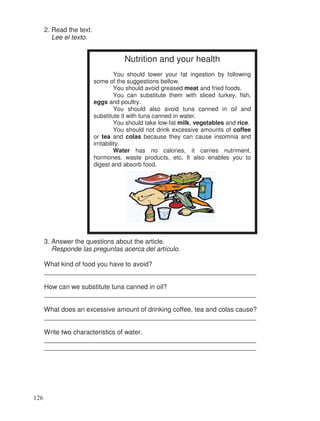
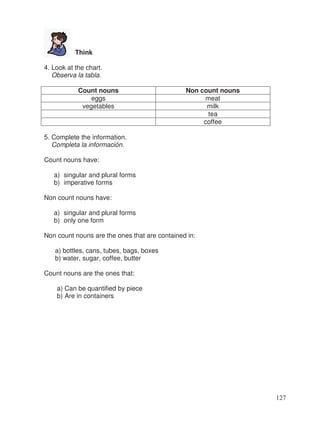
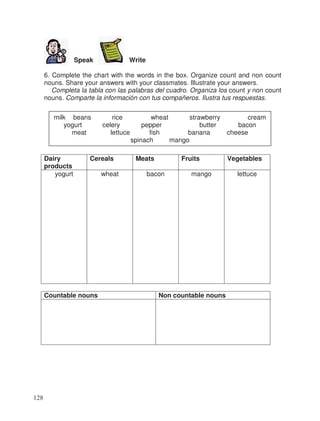
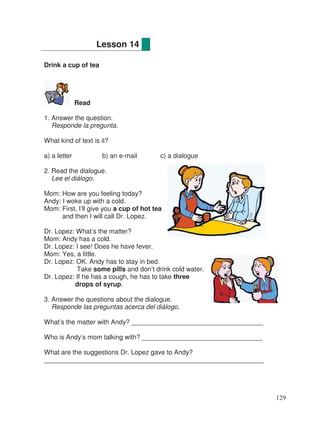
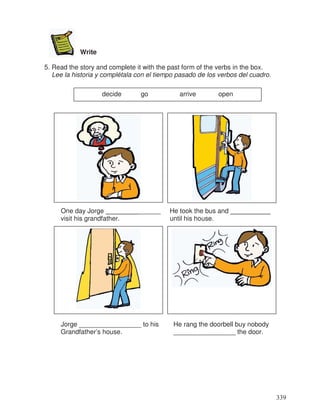
SUSTITUIR
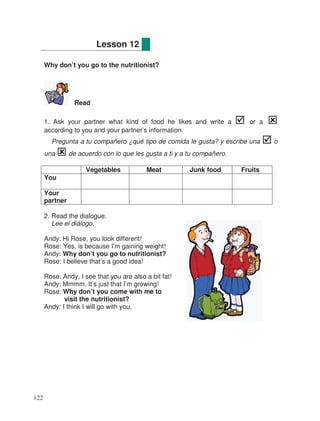
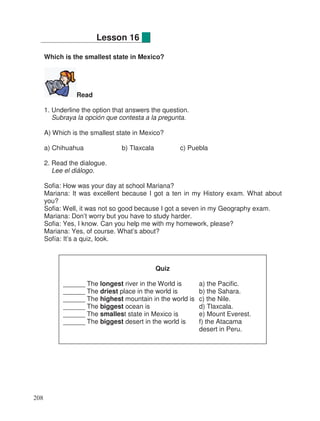
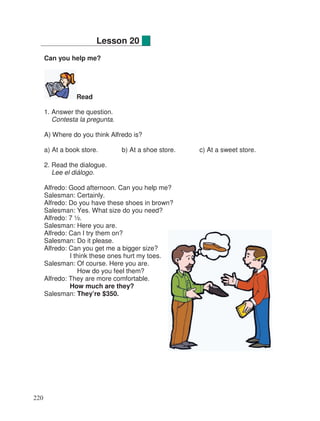
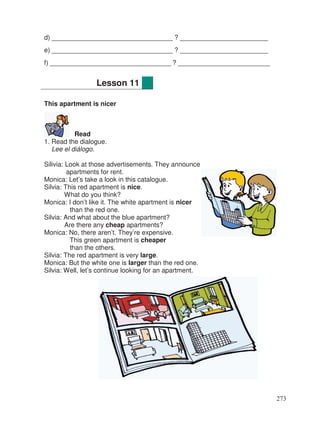
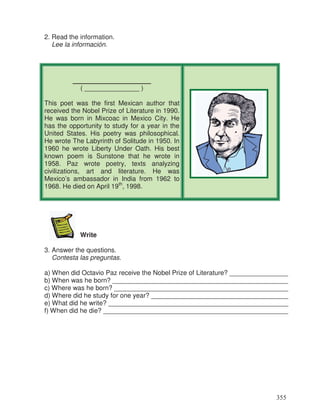
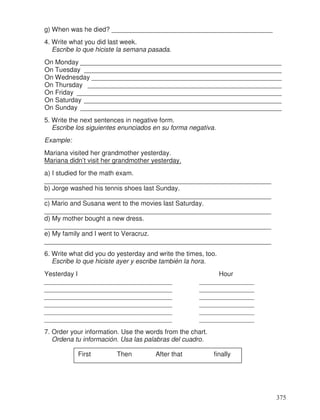
Inglés
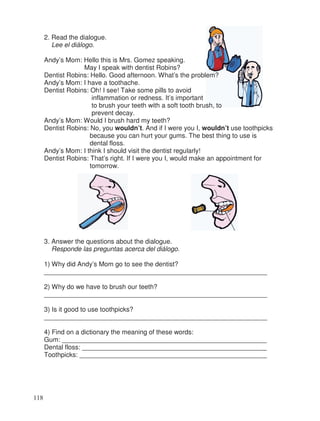
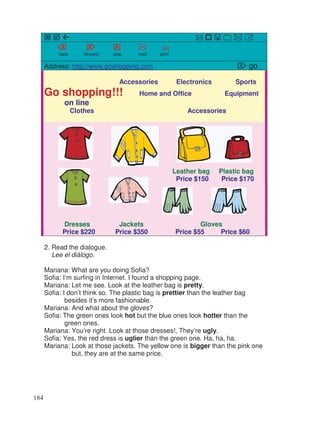
2do Grado
IIInglésII.ApuntesTELEsecundaria
Apuntes
TS-APUN-INGLES-2-PORT.indd 1 8/5/08 11:05:56
1er Grado
IIInglés
2do Grado
TS-APUN-INGLES-2.indd 1 26/2/08 16:03:31
Inglés II. Apuntes estuvo a cargo de la Dirección General de Materiales Educativos de la Subsecretaría
de Educación Básica.
Coordinación general
María Cristina Martínez Mercado
Elaboración de textos
Claudia Yvette Gómez Martínez
Jezabel Barrera Fuentes
Coordinación académica
Jorge Barbiere Mejía
Claudia Elín Garduño Néstor
Adriana Rojas Lima
Asesoría pedagógica
Karina Bustos Hernández
Alejandra Monserrat Castillo Robledo
Corrección de estilo
Estela Maldonado Chávez
Ilustración de portada e interiores
Marco Tulio Ángel Zárate
Formación y corrección
Dirección Editorial, dgme
Primera edición, 2008
Quinta reimpresión, 2012 (ciclo escolar 2013-2014)
D.R. © Secretaría de Educación Pública, 2008
Argentina 28, Centro,
06020, México, D.F.
ISBN 978-968-01-1677-5
Impreso en México
Distribución gratuita-Prohibida su venta
TS-APUN-INGLES-2-LEGAL-13-14.indd 2 06/09/12 15:49
Índice
7	 Presentation / Presentación
9	 Unit 1 / People and animals / Personas y animales
12	 Lesson 1	 Meeting  your new teacher
15	 Lesson 2	 This is your school principal
19	 Lesson 3	 What time do you have your English class?
23	 Lesson 4	 Roxane gets up at six o’clock
27	 Lesson 5	 My uncle is tall and thin
32	 Lesson 6	 What does your teacher look like?
35	 Lesson 7	 Can you drive a car?
37	 Lesson 8	 Elephants have big ears and black eyes
40	 Lesson 9	 Whales are very intelligent
42	 Lesson 10	 What is your mother like?
45	 Lesson 11	 I sometimes play soccer
48	 Lesson 12	 How often do you go to the movies?
51	 Lesson 13	 Do you know seahorses?
54	 Lesson 14	 Learn about koalas
57	 Lesson 15	 Do animals have routines?
60	 Lesson 16	 What can animals do?
64	 Lesson 17	 Have you heard about white lions?
67	 Lesson 18	 Animals that live in your community	
69	 Lesson 19	 My favorite athlete is Ana Guevara
72	 Lesson 20	 What animals do you like?	 	
74	 Lesson 21	 Create a gallery of famous people	 	
75	 Lesson 22	 Come to visit our gallery!
78	 Lesson 23	 Who is it?
81	 Lesson 24	 Review
91	 Unit 2 / Health and the body / Salud y el cuerpo
94	 Lesson 1	 My head, my arms and my legs
96	 Lesson 2	 Is she feeling Ok?
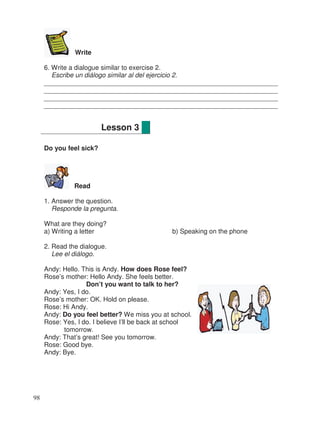
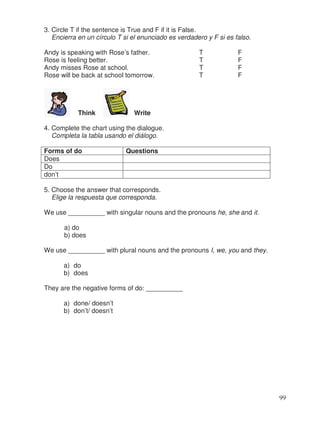
98	 Lesson 3	 Do you feel sick?
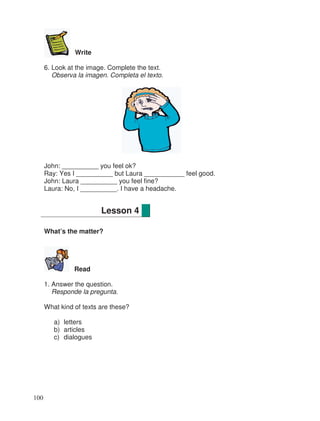
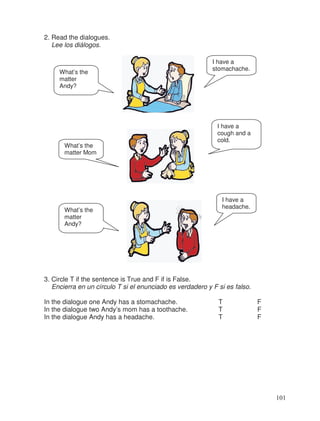
100	 Lesson 4	 What’s the matter?
104	 Lesson 5	 You should stay in bed
106	 Lesson 6	 You shouldn’t go to bed late
109	 Lesson 7	 Mini Check
112	 Lesson 8	 Take some pills
115	 Lesson 9	 I would go to the dentist
117	 Lesson 10	 I wouldn’t use toothpicks
120	 Lesson 11	 A visit to the dentist
122	 Lesson 12	 Why don’t you go to the nutritionist?
125	 Lesson 13	 You’d better change your eating habits
129	 Lesson 14	 Drink a cup of tea
Índice de INGLES 2o.indd 1 1/4/08 14:47:21
132	 Lesson 15	 I have mumps
135	 Lesson 16	 Mini Check
138	 Lesson 17	 Project: Drugs abuse and illegal drugs. Part one
139	 Lesson 18	 Project: Drugs abuse and illegal drugs. Part two
140	 Lesson 19	 Project: Drugs abuse and illegal drugs. Part three
141	 Lesson 20	 Project: Drugs abuse and illegal drugs. Part four
143	 Lesson 21	 Review
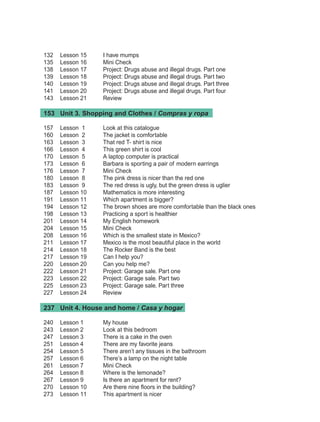
153	 Unit 3. Shopping and Clothes / Compras y ropa
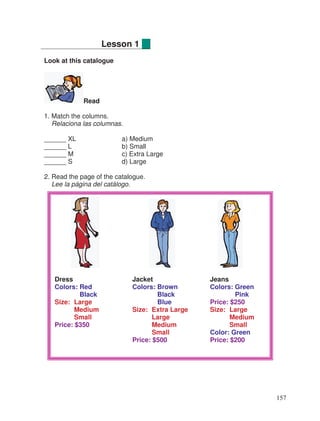
157	 Lesson  1	 Look at this catalogue
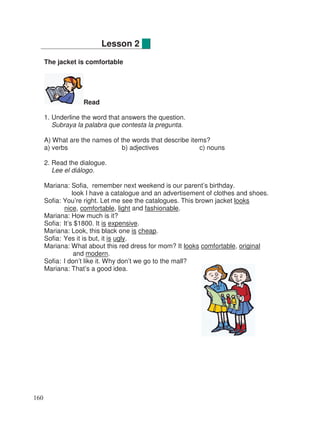
160	 Lesson  2	 The jacket is comfortable
163	 Lesson  3	 That red T- shirt is nice
166	 Lesson  4	 This green shirt is cool
170	 Lesson  5	 A laptop computer is practical
173	 Lesson  6	 Barbara is sporting a pair of modern earrings
176	 Lesson  7	 Mini Check
180	 Lesson  8	 The pink dress is nicer than the red one
183	 Lesson  9	 The red dress is ugly, but the green dress is uglier
187	 Lesson 10	 Mathematics is more interesting
191	 Lesson 11	 Which apartment is bigger?
194	 Lesson 12	 The brown shoes are more comfortable than the black ones
198	 Lesson 13	 Practicing a sport is healthier
201	 Lesson 14	 My English homework
204	 Lesson 15	 Mini Check
208	 Lesson 16	 Which is the smallest state in Mexico?
211	 Lesson 17	 Mexico is the most beautiful place in the world
214	 Lesson 18	 The Rocker Band is the best
217	 Lesson 19	 Can I help you?
220	 Lesson 20	 Can you help me?
222	 Lesson 21	 Project: Garage sale. Part one
223	 Lesson 22	 Project: Garage sale. Part two
225	 Lesson 23	 Project: Garage sale. Part three
227	 Lesson 24	 Review
237	 Unit 4. House and home / Casa y hogar
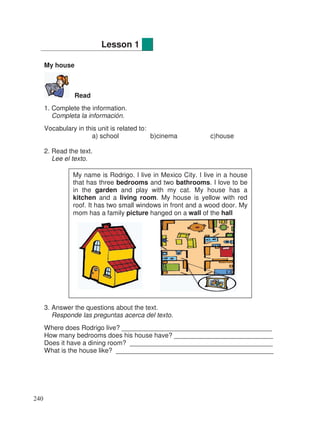
240	 Lesson 1	 My house
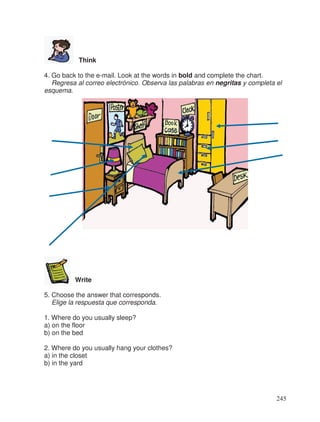
243	 Lesson 2	 Look at this bedroom
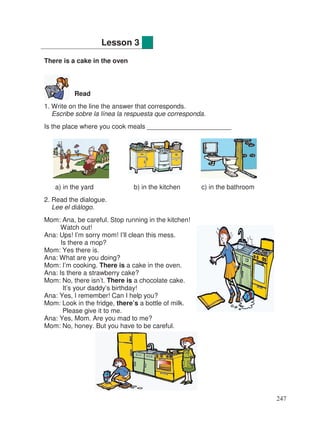
247	 Lesson 3	 There is a cake in the oven
251	 Lesson 4	 There are my favorite jeans
254	 Lesson 5	 There aren’t any tissues in the bathroom
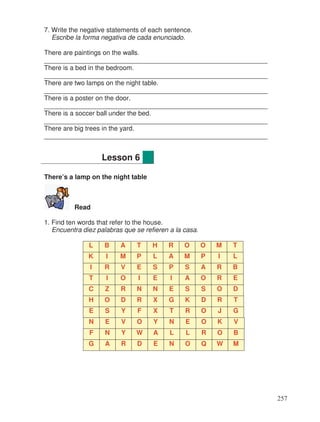
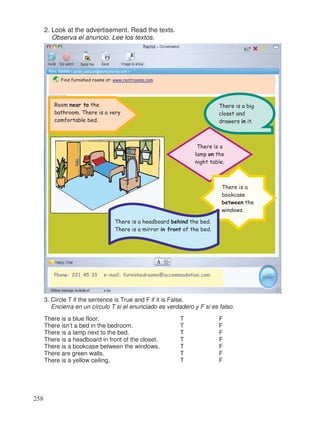
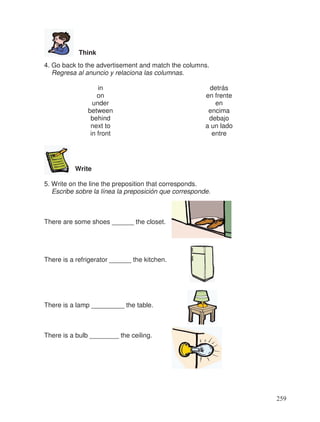
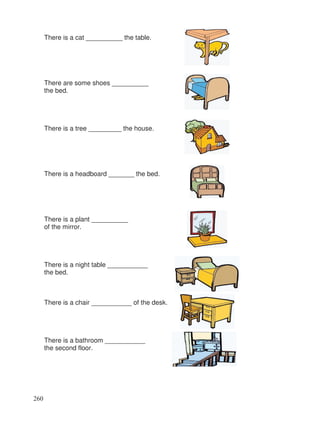
257	 Lesson 6	 There’s a lamp on the night table
261	 Lesson 7	 Mini Check
264	 Lesson 8	 Where is the lemonade?
267	 Lesson 9	 Is there an apartment for rent?
270	 Lesson 10	 Are there nine floors in the building?
273	 Lesson 11	 This apartment is nicer
Índice de INGLES 2o.indd 2 1/4/08 14:47:21
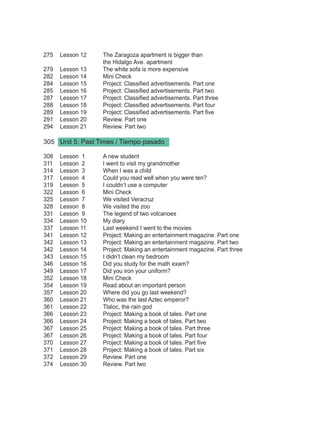
275	 Lesson 12	 The Zaragoza apartment is bigger than
	 	 	 	 	 the Hidalgo Ave. apartment
279	 Lesson 13	 The white sofa is more expensive
282	 Lesson 14	 Mini Check
284	 Lesson 15	 Project: Classified advertisements. Part one
285	 Lesson 16	 Project: Classified advertisements. Part two
287	 Lesson 17	 Project: Classified advertisements. Part three
288	 Lesson 18	 Project: Classified advertisements. Part four
289	 Lesson 19	 Project: Classified advertisements. Part five
291	 Lesson 20	 Review. Part one
294	 Lesson 21	 Review. Part two
305	 Unit 5. Past Times / Tiempo pasado
308	 Lesson  1	 A new student
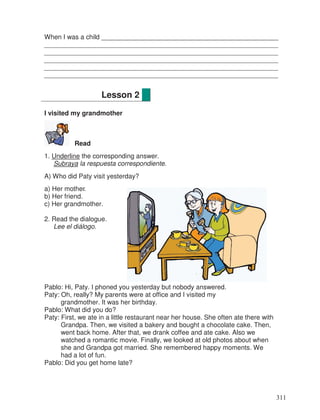
311	 Lesson  2	 I went to visit my grandmother
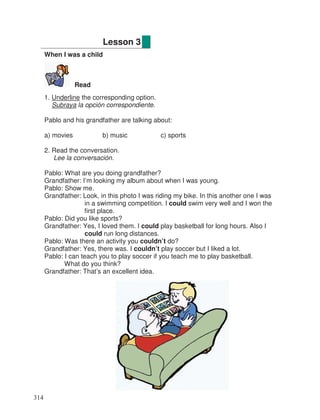
314	 Lesson  3	 When I was a child
317	 Lesson  4	 Could you read well when you were ten?
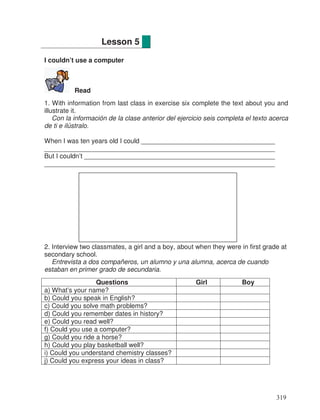
319	 Lesson  5	 I couldn’t use a computer
322	 Lesson  6	 Mini Check
325	 Lesson  7	 We visited Veracruz
328	 Lesson  8	 We visited the zoo
331	 Lesson  9	 The legend of two volcanoes
334	 Lesson 10	 My diary
337	 Lesson 11	 Last weekend I went to the movies
341	 Lesson 12	 Project: Making an entertainment magazine. Part one
342	 Lesson 13	 Project: Making an entertainment magazine. Part two
342	 Lesson 14	 Project: Making an entertainment magazine. Part three
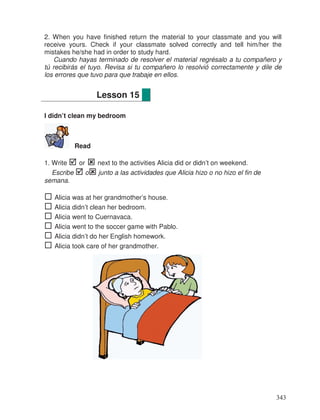
343	 Lesson 15	 I didn’t clean my bedroom
346	 Lesson 16	 Did you study for the math exam?
349	 Lesson 17	 Did you iron your uniform?
352	 Lesson 18	 Mini Check
354	 Lesson 19	 Read about an important person
357	 Lesson 20	 Where did you go last weekend?
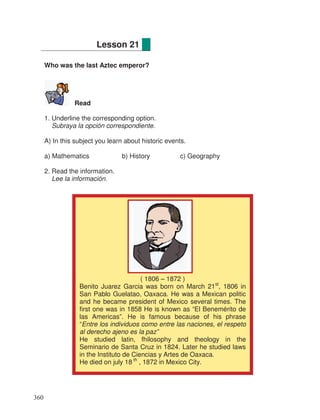
360	 Lesson 21	 Who was the last Aztec emperor?
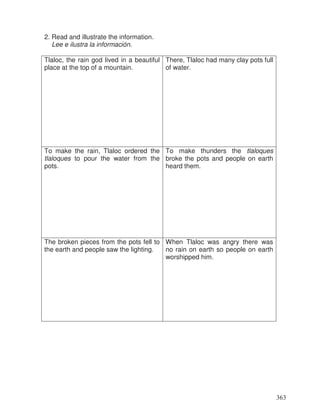
361	 Lesson 22	 Tlaloc, the rain god
366	 Lesson 23	 Project: Making a book of tales. Part one
366	 Lesson 24	 Project: Making a book of tales. Part two
367	 Lesson 25	 Project: Making a book of tales. Part three
367	 Lesson 26	 Project: Making a book of tales. Part four
370	 Lesson 27	 Project: Making a book of tales. Part five
371	 Lesson 28	 Project: Making a book of tales. Part six
372	 Lesson 29	 Review. Part one
374	 Lesson 30	 Review. Part two
Índice de INGLES 2o.indd 3 2/4/08 11:11:21
Presentación
La Secretaría de Educación Pública, comprometida con la comunidad de
telesecundaria —autoridades, docentes, alumnos, padres de familia—, se dio a
la tarea de fortalecer el modelo de enseñanza-aprendizaje de esta modalidad
educativa. Este modelo fortalecido ofrece materiales que apoyan de manera
significativa la comprensión y dominio de los contenidos de los planes de
estudio vigentes.
La serie de Apuntes Bimodales de Telesecundaria está desarrollada para que
maestros y alumnos compartan un mismo material a partir del trabajo de
proyectos, estudios de caso o resolución de situaciones problemáticas. Con
este objetivo se han desarrollado secuencias de aprendizaje que despiertan el
interés de los alumnos por la materia, promueven la interacción en el aula y
propician la colaboración y la participación reflexiva, además de que emplean
una evaluación que orienta las decisiones tanto del docente como del alumno y
establecen estrategias claras de vinculación con la comunidad.
Estos materiales, que la SEP pone ahora en manos de alumnos y maestros,
expone de manera objetiva los temas, conceptos, actitudes y procedimientos
necesarios para un mayor y mejor entendimiento de cada una de las materias
que comprende la serie.
El empleo de estos Apuntes Bimodales y las sugerencias que brinde la
comunidad de telesecundaria darán la pauta para el enriquecimiento y mejora
de cada una de las ediciones de esta obra que busca contribuir a una
educación equitativa y de calidad en el país.
SECRETARÍA DE EDUCACIÓN PÚBLICA
En los Apuntes de Inglés se utilizaron iconos que representan determinadas actividades. Los
incluimos a continuación para facilitar su identificación y uso.
Speak / Hablar
Think / Pensar
Play / Jugar
Write / Escribir
Read / Leer
People and animals/Personas y animales
IIInglés
TS-APUN-INGLES-2.indd 3 21/2/08 13:07:00
Unit 1
g
Unit 1
People and animals/Personas y animales
El propósito de esta unidad es capacitar a los estudiantes para que describan
gente y animales haciendo referencia a su apariencia física, habilidades, rutinas
y hábitos.
Lesson 1 Meeting your new teacher
Lesson 2 This is your school principal
Lesson 3 What time do you have your English class?
Lesson 4 Roxane gets up at six o’clock
Lesson 5 My uncle is tall and thin
Lesson 6 What does your teacher look like?
Lesson 7 Can you drive a car?
Lesson 8 Elephants have big ears and black eyes
Lesson 9 Whales are very intelligent
Lesson 10 What is your mother like?
Lesson 11 I sometimes play soccer
Lesson 12 How often do you go to the movies?
Lesson 13 Do you know seahorses?
Lesson 14 Learn about koalas
Lesson 15 Do animals have routines?
Lesson 16 What can animals do?
Lesson 17 Have you heard about white lions?
Lesson 18 Animals that live in your community
Lesson 19 My favorite athlete is Ana Guevara
Lesson 20 What animals do you like?
Lesson 21 Create a gallery of famous people
Lesson 22 Come to visit our gallery!
Lesson 23 Who is it?
Lesson 24 Review
24 sessions, 8 weeks / 24 sesiones, 8 semanas
Purpose/Propósito
Topics / Temas
11
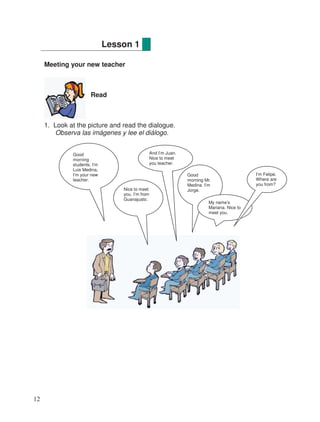
Meeting your new teacher
Read
1. Look at the picture and read the dialogue.
Observa las imágenes y lee el diálogo.
Lesson 1
Good
morning
students. I’m
Luis Medina,
I’m your new
teacher.
Nice to meet
you. I’m from
Guanajuato.
And I’m Juan.
Nice to meet
you teacher.
Good
morning Mr.
Medina. I’m
Jorge.
My name’s
Mariana. Nice to
meet you.
I’m Felipe.
Where are
you from?
12
Think
2. Write the missing sentences according to the dialogue.
Escribe las oraciones que faltan tomando en cuenta el diálogo.
a) _____________________________________________I’m Luis Medina.
b) What do you do? ____________________________________________
c) __________________________________________I’m from Guanajuato.
d) Nice to meet you.____________________________________________
Write
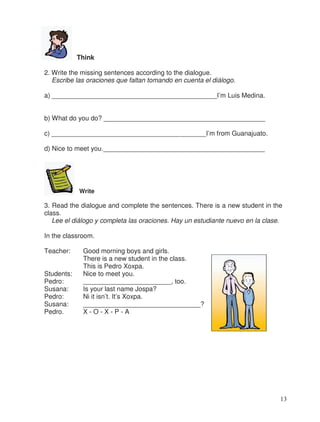
3. Read the dialogue and complete the sentences. There is a new student in the
class.
Lee el diálogo y completa las oraciones. Hay un estudiante nuevo en la clase.
In the classroom.
Teacher: Good morning boys and girls.
There is a new student in the class.
This is Pedro Xoxpa.
Students: Nice to meet you.
Pedro: ________________________, too.
Susana: Is your last name Jospa?
Pedro: Ni it isn’t. It’s Xoxpa.
Susana: ________________________________?
Pedro. X - O - X - P - A
13
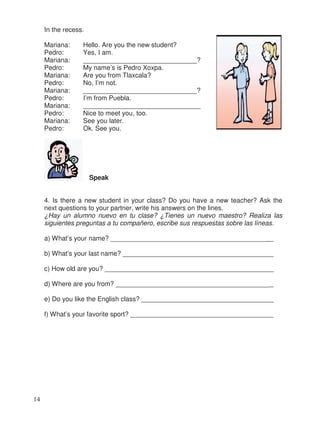
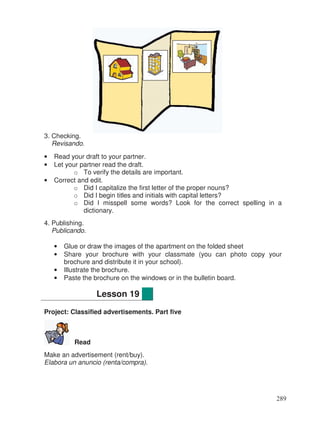
In the recess.
Mariana: Hello. Are you the new student?
Pedro: Yes, I am.
Mariana: _______________________________?
Pedro: My name’s is Pedro Xoxpa.
Mariana: Are you from Tlaxcala?
Pedro: No, I’m not.
Mariana: _______________________________?
Pedro: I’m from Puebla.
Mariana: ________________________________
Pedro: Nice to meet you, too.
Mariana: See you later.
Pedro: Ok. See you.
Speak
4. Is there a new student in your class? Do you have a new teacher? Ask the
next questions to your partner, write his answers on the lines.
¿Hay un alumno nuevo en tu clase? ¿Tienes un nuevo maestro? Realiza las
siguientes preguntas a tu compañero, escribe sus respuestas sobre las líneas.
a) What’s your name? ___________________________________________
b) What’s your last name? ________________________________________
c) How old are you? _____________________________________________
d) Where are you from? __________________________________________
e) Do you like the English class? ___________________________________
f) What’s your favorite sport? _______________________________________
14
_
_
_
_
_
_
_
Write
5. Use the information on exercise 4 to write a text and
Illustrate it.
Usa la información del ejercicio 4 para escribir un
texto e ilústralo.
__________________________________________
_______________________________________________
_______________________________________________
_______________________________________________
This is your school principal
Read
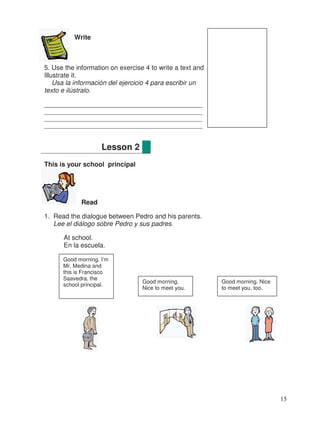
1. Read the dialogue between Pedro and his parents.
Lee el diálogo sobre Pedro y sus padres.
At school.
En la escuela.
Lesson 2
Good morning. I’m
Mr. Medina and
this is Francisco
Saavedra, the
school principal.
Good morning.
Nice to meet you.
Good morning. Nice
to meet you, too.
15
_
Think
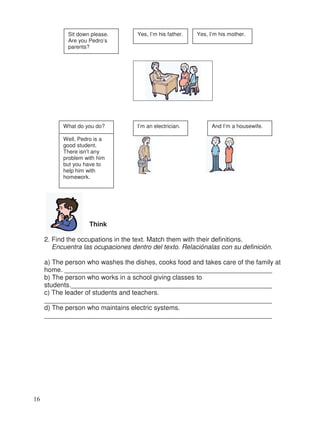
2. Find the occupations in the text. Match them with their definitions.
Encuentra las ocupaciones dentro del texto. Relaciónalas con su definición.
a) The person who washes the dishes, cooks food and takes care of the family at
home. ________________________________________________________
b) The person who works in a school giving classes to
students.______________________________________________________
c) The leader of students and teachers.
_____________________________________________________________
d) The person who maintains electric systems.
_____________________________________________________________
Sit down please.
Are you Pedro’s
parents?
Yes, I’m his father. Yes, I’m his mother.
What do you do? I’m an electrician. And I’m a housewife.
Well, Pedro is a
good student.
There isn’t any
problem with him
but you have to
help him with
homework.
16
_
_
_
_
Read
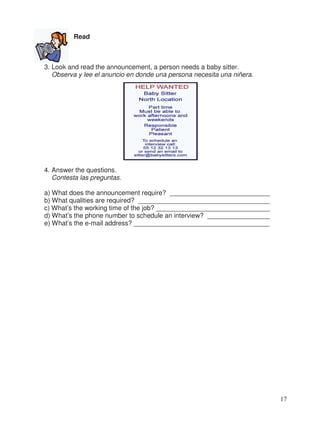
3. Look and read the announcement, a person needs a baby sitter.
Observa y lee el anuncio en donde una persona necesita una niñera.
4. Answer the questions.
Contesta las preguntas.
a) What does the announcement require? ___________________________
b) What qualities are required? ____________________________________
c) What’s the working time of the job? _______________________________
d) What’s the phone number to schedule an interview? _________________
e) What’s the e-mail address? _____________________________________
17
_
Write
5. Design an announcement offering a service (mechanic, carpenter, teacher,
electrician, doctor, etc.). Write your name, your occupation, a phone number or
address, your qualities, etc.
Diseña un anuncio ofreciendo un servicio (mecánico, carpintero, profesor,
electricista, doctor, etc.). Escribe tu nombre, ocupación, número telefónico o
dirección, tus cualidades, etc.
18
What time do you do have your English class?
Read
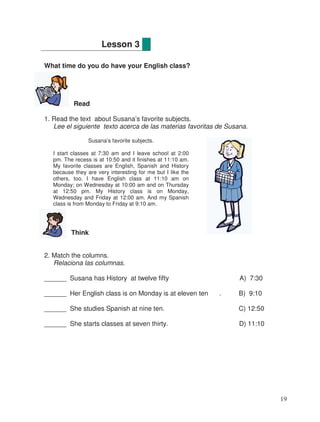
1. Read the text about Susana’s favorite subjects.
Lee el siguiente texto acerca de las materias favoritas de Susana.
Think
2. Match the columns.
Relaciona las columnas.
______ Susana has History at twelve fifty A) 7:30
______ Her English class is on Monday is at eleven ten . B) 9:10
______ She studies Spanish at nine ten. C) 12:50
______ She starts classes at seven thirty. D) 11:10
Lesson 3
Susana’s favorite subjects.
I start classes at 7:30 am and I leave school at 2:00
pm. The recess is at 10:50 and it finishes at 11:10 am.
My favorite classes are English, Spanish and History
because they are very interesting for me but I like the
others, too. I have English class at 11:10 am on
Monday; on Wednesday at 10:00 am and on Thursday
at 12:50 pm. My History class is on Monday,
Wednesday and Friday at 12:00 am. And my Spanish
class is from Monday to Friday at 9:10 am.
19
Write
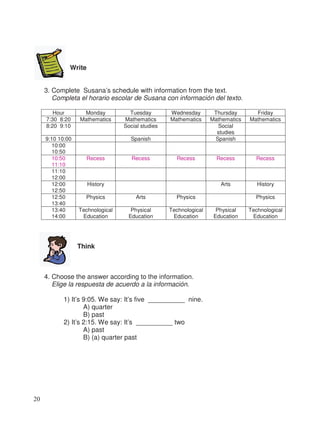
3. Complete Susana’s schedule with information from the text.
Completa el horario escolar de Susana con información del texto.
Hour Monday Tuesday Wednesday Thursday Friday
7:30 8:20 Mathematics Mathematics Mathematics Mathematics Mathematics
8:20 9:10 Social studies Social
studies
9:10 10:00 Spanish Spanish
10:00
10:50
10:50
11:10
Recess Recess Recess Recess Recess
11:10
12:00
12:00
12:50
History Arts History
12:50
13:40
Physics Arts Physics Physics
13:40
14:00
Technological
Education
Physical
Education
Technological
Education
Physical
Education
Technological
Education
Think
4. Choose the answer according to the information.
Elige la respuesta de acuerdo a la información.
1) It’s 9:05. We say: It’s five __________ nine.
A) quarter
B) past
2) It’s 2:15. We say: It’s __________ two
A) past
B) (a) quarter past
20
Read 1)
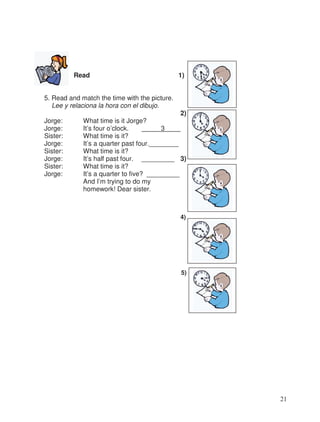
5. Read and match the time with the picture.
Lee y relaciona la hora con el dibujo.
2)
Jorge: What time is it Jorge?
Jorge: It’s four o’clock. 3
Sister: What time is it?
Jorge: It’s a quarter past four.________
Sister: What time is it?
Jorge: It’s half past four. _________ 3)
Sister: What time is it?
Jorge: It’s a quarter to five? _________
And I’m trying to do my
homework! Dear sister.
4)
5)
21
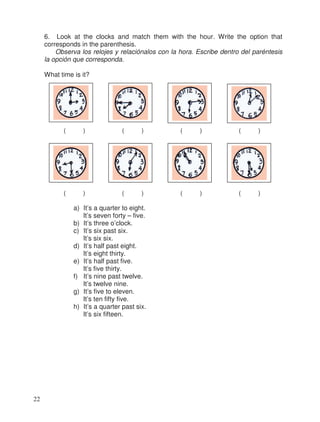
6. Look at the clocks and match them with the hour. Write the option that
corresponds in the parenthesis.
Observa los relojes y relaciónalos con la hora. Escribe dentro del paréntesis
la opción que corresponda.
What time is it?
( ) ( ) ( ) ( )
( ) ( ) ( ) ( )
a) It’s a quarter to eight.
It’s seven forty – five.
b) It’s three o’clock.
c) It’s six past six.
It’s six six.
d) It’s half past eight.
It’s eight thirty.
e) It’s half past five.
It’s five thirty.
f) It’s nine past twelve.
It’s twelve nine.
g) It’s five to eleven.
It’s ten fifty five.
h) It’s a quarter past six.
It’s six fifteen.
22
7. Answer the questions about yourself.
Contesta las siguientes preguntas sobre ti.
a) What time is it now? __________________________________________
b) What time is your English class? ________________________________
c) What time is your Mathematics class? ____________________________
d) What time is your Spanish class? ________________________________
Roxane gets up at six o’clock
Read
1. Read the text about Roxane.
Lee el texto acerca de Roxane.
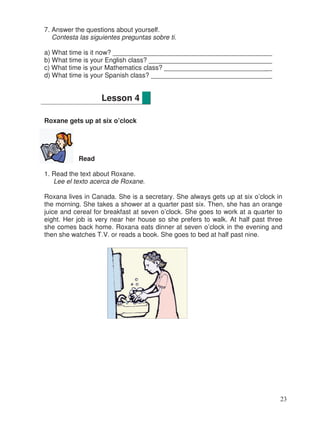
Roxana lives in Canada. She is a secretary. She always gets up at six o’clock in
the morning. She takes a shower at a quarter past six. Then, she has an orange
juice and cereal for breakfast at seven o’clock. She goes to work at a quarter to
eight. Her job is very near her house so she prefers to walk. At half past three
she comes back home. Roxana eats dinner at seven o’clock in the evening and
then she watches T.V. or reads a book. She goes to bed at half past nine.
Lesson 4
23
_
__
_
__
_
Think
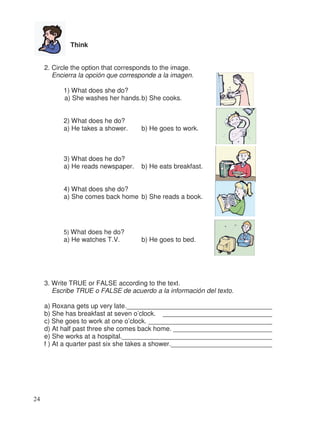
2. Circle the option that corresponds to the image.
Encierra la opción que corresponde a la imagen.
1) What does she do?
a) She washes her hands.b) She cooks.
2) What does he do?
a) He takes a shower. b) He goes to work.
3) What does he do?
a) He reads newspaper. b) He eats breakfast.
4) What does she do?
a) She comes back home b) She reads a book.
5) What does he do?
a) He watches T.V. b) He goes to bed.
3. Write TRUE or FALSE according to the text.
Escribe TRUE o FALSE de acuerdo a la información del texto.
a) Roxana gets up very late._______________________________________
b) She has breakfast at seven o’clock. _____________________________
c) She goes to work at one o’clock. _________________________________
d) At half past three she comes back home. __________________________
e) She works at a hospital.________________________________________
f ) At a quarter past six she takes a shower.___________________________
24
_
_
_
_
_
_
Read
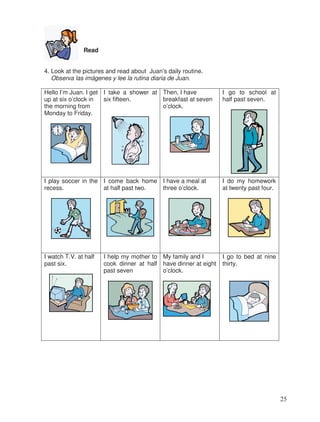
4. Look at the pictures and read about Juan’s daily routine.
Observa las imágenes y lee la rutina diaria de Juan.
Hello I’m Juan. I get
up at six o’clock in
the morning from
Monday to Friday.
I take a shower at
six fifteen.
Then, I have
breakfast at seven
o’clock.
I go to school at
half past seven.
I play soccer in the
recess.
I come back home
at half past two.
I have a meal at
three o’clock.
I do my homework
at twenty past four.
I watch T.V. at half
past six.
I help my mother to
cook dinner at half
past seven
My family and I
have dinner at eight
o’clock.
I go to bed at nine
thirty.
25
Write
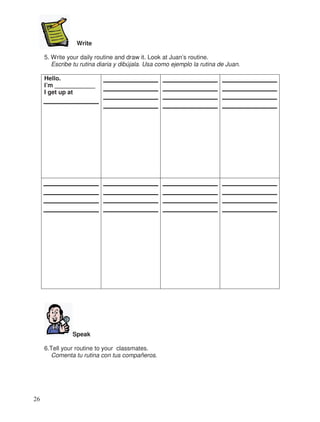
5. Write your daily routine and draw it. Look at Juan’s routine.
Escribe tu rutina diaria y dibújala. Usa como ejemplo la rutina de Juan.
Hello.
I’m ____________
I get up at
Speak
6.Tell your routine to your classmates.
Comenta tu rutina con tus compañeros.
26
My uncle is tall and thin
Read
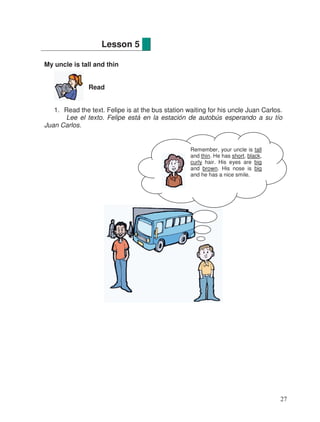
1. Read the text. Felipe is at the bus station waiting for his uncle Juan Carlos.
Lee el texto. Felipe está en la estación de autobús esperando a su tío
Juan Carlos.
Lesson 5
Remember, your uncle is tall
and thin. He has short, black,
curly hair. His eyes are big
and brown. His nose is big
and he has a nice smile.
27
Think
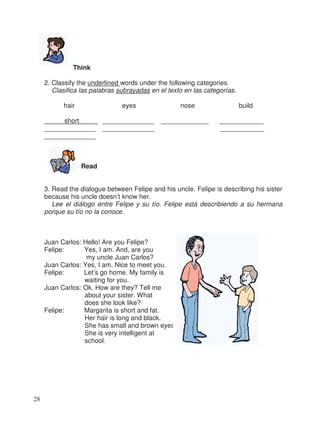
2. Classify the underlined words under the following categories.
Clasifica las palabras subrayadas en el texto en las categorías.
hair eyes nose build
short _ ______________ _____________ ____________
______________ ______________ ____________
______________
Read
3. Read the dialogue between Felipe and his uncle. Felipe is describing his sister
because his uncle doesn’t know her.
Lee el diálogo entre Felipe y su tío. Felipe está describiendo a su hermana
porque su tío no la conoce.
Juan Carlos: Hello! Are you Felipe?
Felipe: Yes, I am. And, are you
my uncle Juan Carlos?
Juan Carlos: Yes, I am. Nice to meet you.
Felipe: Let’s go home. My family is
waiting for you.
Juan Carlos: Ok. How are they? Tell me
about your sister. What
does she look like?
Felipe: Margarita is short and fat.
Her hair is long and black.
She has small and brown eyes.
She is very intelligent at
school.
28
Read Think
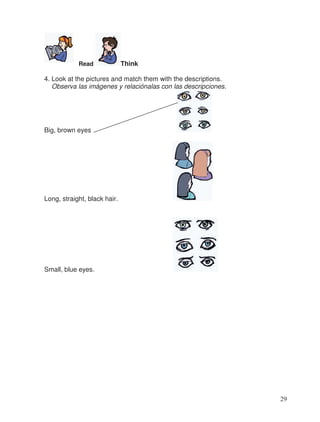
4. Look at the pictures and match them with the descriptions.
Observa las imágenes y relaciónalas con las descripciones.
Big, brown eyes
Long, straight, black hair.
Small, blue eyes.
29
Short, curly, blond hair.
5. Choose the option that corresponds to the description.
Elige la opción que corresponda a la descripción.
A B C
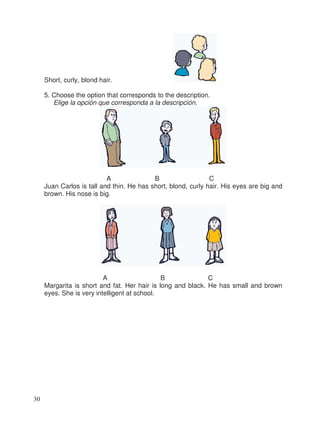
Juan Carlos is tall and thin. He has short, blond, curly hair. His eyes are big and
brown. His nose is big.
A B C
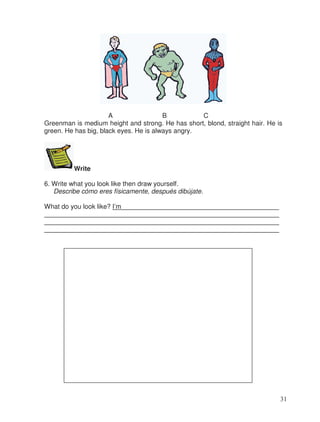
Margarita is short and fat. Her hair is long and black. He has small and brown
eyes. She is very intelligent at school.
30
A B C
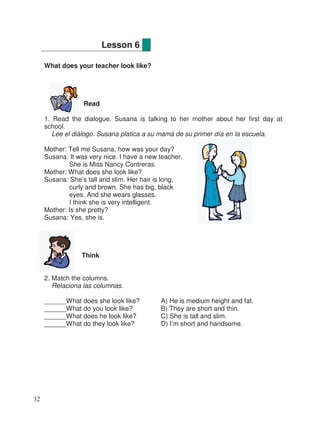
Greenman is medium height and strong. He has short, blond, straight hair. He is
green. He has big, black eyes. He is always angry.
Write
6. Write what you look like then draw yourself.
Describe cómo eres físicamente, después dibújate.
What do you look like? I’m___________________________________________
________________________________________________________________
________________________________________________________________
________________________________________________________________
31
What does your teacher look like?
Read
1. Read the dialogue. Susana is talking to her mother about her first day at
school.
Lee el diálogo. Susana platica a su mamá de su primer día en la escuela.
Mother: Tell me Susana, how was your day?
Susana: It was very nice. I have a new teacher.
She is Miss Nancy Contreras.
Mother: What does she look like?
Susana: She’s tall and slim. Her hair is long,
curly and brown. She has big, black
eyes. And she wears glasses.
I think she is very intelligent.
Mother: Is she pretty?
Susana: Yes, she is.
Think
2. Match the columns.
Relaciona las columnas.
______What does she look like? A) He is medium height and fat.
______What do you look like? B) They are short and thin.
______What does he look like? C) She is tall and slim.
______What do they look like? D) I’m short and handsome.
Lesson 6
32
3. Choose the answer that corresponds.
Elige la respuesta según corresponda.
1) We use does with ____________.
a) he, she, it b) we, you, they
2) We use do with ____________.
a) he, she, it b) we, you, they, I
Write
4. Answer the questions. Use the information from the text.
Contesta las preguntas. Usa la información del texto.
a) What’s the teacher’s name? ____________________________________
b) What’s the teacher’s last name? _________________________________
c) What does Nancy do? _________________________________________
d) What does she look like? _______________________________________
e) Is she pretty? ________________________________________________
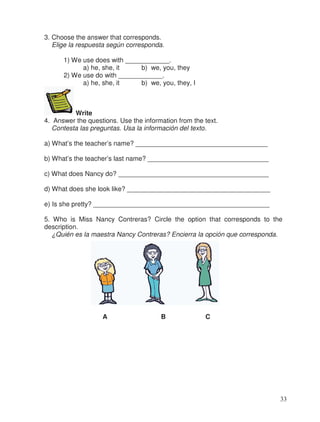
5. Who is Miss Nancy Contreras? Circle the option that corresponds to the
description.
¿Quién es la maestra Nancy Contreras? Encierra la opción que corresponda.
A B C
33
Speak
6. Ask your partner the following questions and make a drawing.
Pregunta a tu compañero las siguientes preguntas y elabora un dibujo.
a) What does your mother look like?
__________________________________________
__________________________________________
__________________________________________
b) What does your father look like?
______________________________________________
______________________________________________
______________________________________________
c) What does she/ he look like?
_______________________________________________
_______________________________________________
_______________________________________________
34
35
Can you drive a car?
Read
1. Look at the pictures and read the dialogues. Roberto is talking about what he
can or can’t do.
Observa las imágenes y lee los diálogos. Roberto está hablando sobre lo que
puede o no puede hacer.
Lesson 7
Yes, I
can
Can you play
the guitar?
No, I can’t.
And you?
Can you ride
a bicycle? Yes, I
can
Can you play
Basketball?
No, I can’t.
And you?
No, I can’t.
And you?
Yes, I
can
Can you climb
a tree?
Yes, I
can
No, I can’t.
And you?
No, I can’t.
And you?
Yes, I
can
Can you drive a car? Can you take me to
the hospital?
Yes, I
can
Think
2. Choose the answer that corresponds.
Elige la respuesta que corresponde.
1) What do we express with can?
a) ability b) inability
2) What do we express with can’t?
a) ability b) inability
3. Use the information from the text. Answer TRUE or FALSE.
Usa la información del texto para contestar TRUE si es verdadero o FALSE si
es falso.
a) Roberto can’t play the guitar. ________________________
b) Roberto can ride a bicycle. ________________________
c) He can’t climb a tree. ________________________
d) He can drive a car. ________________________
e) He can play basketball. ________________________
4. What things can you do? Put a check ( ) next to the activities you can do.
¿Qué cosas puedes hacer? Pon una ( ) junto a las actividades que puedes
realizar.
Yes, I can. No, I can’t.
a) Can you play the guitar? _________ ________
b) Can you swim? _________ ________
c) Can you spell your name? _________ ________
d) Can you sing a song in English? _________ ________
e) Can you ride a horse? _________ ________
f) Can you climb a tree? _________ ________
36
Speak Write
5. Use the questions to interview a classmate. Write the answers on the lines.
Entrevista a un compañero tomando en cuenta las preguntas anteriores.
Escribe las respuestas en las líneas.
a) Can you play the guitar? _____________________
b) Can you swim? _____________________
c) Can you spell your name? _____________________
d) Can you sing a song in English?____________________
e) Can you ride a horse? _____________________
f) Can you climb a tree? _____________________
Elephants have big ears and black eyes
Read
1. Read the text. Jorge Luis is at the zoo, he’s reading about elephants.
Lee el texto. Jorge Luis está en el zoológico, leyendo sobre los elefantes.
Lesson 8
Elephants are an endangered
species. There are approximately 610, 000
African elephants in the world today. They
live in the African Savannah. Elephants are
big and gray. They have long trunks. Their
ears are big. They are fat and heavy. They
weight 12, 000 kilograms. They live 60 years
approximately. They drink between 30 and
50 gallons of water a day. They are
intelligent animals.
37
_
_
_
_
_
_
Think
2. Circle the option that corresponds.
Encierra en un círculo la opción que corresponda.
1) The underlined words in the text are:
a) Verbs b) Adjectives
2) They are used to:
a) describe b) show actions
3. Correct the sentences according to the information from the text.
Corrige las oraciones de acuerdo a la información del texto.
e.g.
An elephant is small An elephant is big
a) An elephant is blue. ___________________________________
b) An elephant has a small trunk.___________________________________
c) An elephant is thin. ___________________________________
d) An elephant is light. ___________________________________
e) An elephant is small. ___________________________________
Read
4. Read the texts and circle the option that corresponds.
Lee los textos y encierra la letra de la opción que corresponda.
A) What am I?
I’m tall and strong. My eyes are big and brown. I have small ears. My legs are
long and I have very big feet. I can jump.
a) a giraffe b) a kangaroo c) an elephant
B) What am I?
I’m big and strong. My hair is short and black. My eyes are brown and my ears
are small. My arms are long and my hands are big. I love bananas.
a) a gorilla b) a cat c) a panther
38
C) What am I?
I’m very small. My eyes are small and black. My hair is gray. I have a long tail. I
love cheese.
a) a lion b) a dog c) a mouse
Play
5. Look at the pictures. Circle your favorite animal.
Observa las imágenes. Encierra tu animal favorito.
Dog cat turtle horse
Cow rabbit hummingbird eagle
6. Read the options. Put a check ( ) next to the adjective that describes your
favorite animal.
Lee las opciones. Pon ( ) junto a los adjetivos que describen a tu animal
favorito.
My favorite animal is a ______________________ because it is:
funny ________ clean ________
mysterious ________ dangerous ________
aggressive ________ intelligent ________
independent ________ beautiful ________
elegant ________ strong ________
39
7. Complete the text.
Completa el texto.
My favorite animal is a _______________ because it is _____________,
____________, _____________, _____________ and ____________.
Whales are very intelligent
Read
1. Read the text.
Lee el texto.
Whales live in all the oceans of the World. They swim in groups near the surface
of water because they need oxygen. Some whales eat fish and other whales are
vegetarian. They eat plankton. Gray whales live near the coast of Canada in the
summer when it is hot. In the fall, when the ocean is cold they migrate to the
coast of Baja California. They stay there during the winter and they return to
Canada in the spring. They are very intelligent marine animals.
Lesson 9
40
Think
2. Go back to the text. Underline the words that are similar in Spanish (cognates).
Then, write them on the lines.
Regresa al texto. Subraya las palabras que son similares en español
(cognados). Después, escríbelas sobre las líneas.
Oceans ___ _________________ _________________
_______________ _________________ _________________
_______________ _________________ _________________
_______________ _________________ _________________
All these words are cognates. They are words that are similar in Spanish but
the pronunciation is different.
Estas palabras se llaman cognados. Son palabras que son similares en
español pero su pronunciación es diferente.
Write
3. Write TRUE or FALSE. Use the information from the text.
Escribe TRUE si es verdadero o FALSE si es falso. Usa la información del
texto.
a) Whales live in oceans. _______________
b) Some whales eat fish. _______________
c) They don’t need oxygen. _______________
d) They migrate to Japan. _______________
e) Whales are very intelligent. _______________
f) In the spring whales return to Canada. _______________
41
g) Whales are very intelligent. _______________
h) They swim alone. _______________
i) Some whales eat plankton. _______________
j) The text is about blue whales. _______________
k) Whales are land animals. _______________
4. Answer the questions about the text.
Contesta las preguntas a cerca del texto.
a) What is the text about? _________________________________________
b) What do whales eat? __________________________________________
c) Where do whales live? _________________________________________
d) Write in English a short text about whales.__________________________
What is your mother like?
Read
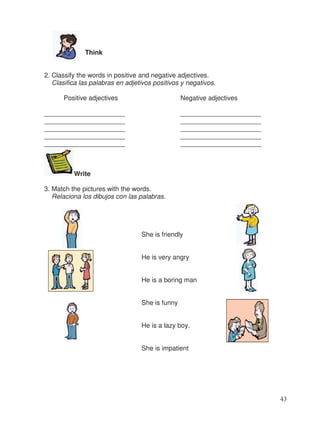
1. Read the dialogue.
Lee el diálogo.
Susana: Hello! How are you?
Martha: I’m fine and you?
Susana: I’m fine, too. Tell me,
what is your new teacher like?
Martha: Oh! He’s very patient, kind,
creative and intelligent.
Susana: That sounds great.
Martha: What about you?
Susana: Oh no! My teacher is bad-tempered,
impatient, rude and boring.
Martha: That is terrible.
Lesson 10
42
_
_
_
Think
2. Classify the words in positive and negative adjectives.
Clasifica las palabras en adjetivos positivos y negativos.
Positive adjectives Negative adjectives
______________________ ______________________
______________________ ______________________
______________________ ______________________
______________________ ______________________
______________________ ______________________
Write
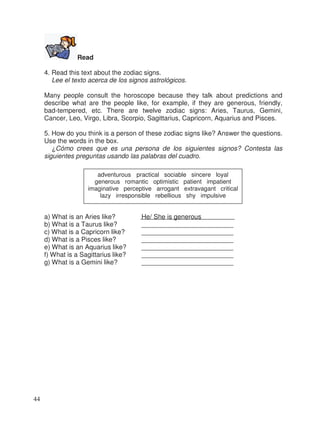
3. Match the pictures with the words.
Relaciona los dibujos con las palabras.
She is friendly
He is very angry
He is a boring man
She is funny
He is a lazy boy.
She is impatient
43
Read
4. Read this text about the zodiac signs.
Lee el texto acerca de los signos astrológicos.
Many people consult the horoscope because they talk about predictions and
describe what are the people like, for example, if they are generous, friendly,
bad-tempered, etc. There are twelve zodiac signs: Aries, Taurus, Gemini,
Cancer, Leo, Virgo, Libra, Scorpio, Sagittarius, Capricorn, Aquarius and Pisces.
5. How do you think is a person of these zodiac signs like? Answer the questions.
Use the words in the box.
¿Cómo crees que es una persona de los siguientes signos? Contesta las
siguientes preguntas usando las palabras del cuadro.
a) What is an Aries like? He/ She is generous
b) What is a Taurus like? _________________________
c) What is a Capricorn like? _________________________
d) What is a Pisces like? _________________________
e) What is an Aquarius like? _________________________
f) What is a Sagittarius like? _________________________
g) What is a Gemini like? _________________________
adventurous practical sociable sincere loyal
generous romantic optimistic patient impatient
imaginative perceptive arrogant extravagant critical
lazy irresponsible rebellious shy impulsive
44
Speak
6. Answer these questions about yourself.
Contesta las preguntas sobre ti.
a) What is your mother like? She is
b) What is your father like? __________________________________
c) What is your teacher like? __________________________________
d) What are you like? __________________________________
e) What is your sister or brother like? _______________________________
I sometimes play soccer
Read
1. Read the activities Rogelio does during the week and on weekends.
Lee sobre las actividades que Rogelio realiza en la semana y los fines de
semana.
During the week I go to school from Monday to Friday and I always get
up at six o’clock. I usually have meal at half past three then, I do my homework. I
often help my mother to wash the dishes. I sometimes practice karate with my
friends. On Saturday I never get up early. On Sunday I always play soccer with
my brothers and father.
Lesson 11
45
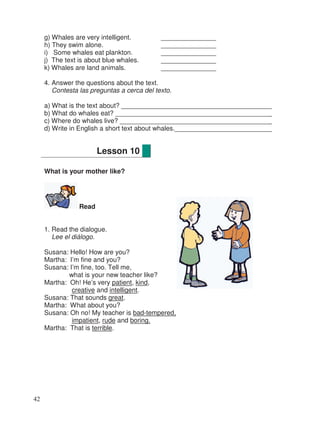
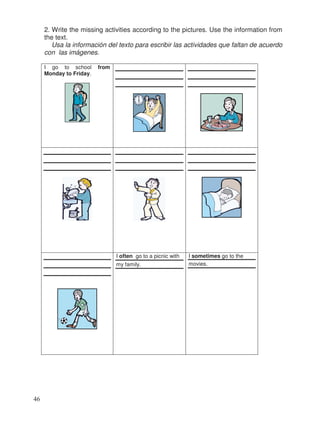
2. Write the missing activities according to the pictures. Use the information from
the text.
Usa la información del texto para escribir las actividades que faltan de acuerdo
con las imágenes.
I go to school from
Monday to Friday.
I often go to a picnic with
my family.
I sometimes go to the
movies.
46
Think
3. Complete the information.
Completa la información.
1) The words in bold from text 1 refers to:
a) action verbs
b) frequency adverbs
Write
4. Write a text about you and illustrate it.
Escribe un texto sobre ti e ilústralo.
_____________________
_____________________
_____________________
_____________________
_____________________
______________________
____________________
____________________
____________________
_____________________
_____________________
_____________________
______________________
______________________
______________________
_____________________
_____________________
_____________________
47
5. Answer the following questions with the words in the box.
Responde las siguientes preguntas con las palabras del cuadro.
e.g. How often do you go biking? I always go biking with my
brother.
1) How often do you play soccer?
_________________________________________________
2) How often do you go swimming?
_________________________________________________
3) How often do you ride a horse?
_________________________________________________
4) How often do you take a shower?
_________________________________________________
5) How often do you have sport classes?
_________________________________________________
How often do you go to the movies?
Read
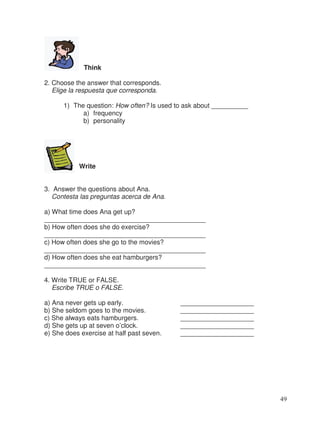
1. Read the interview to Ana Guevara about her routine.
Lee la entrevista sobre la rutina de Ana Guevara.
Reporter: Hello, Ana. How are you?
Ana: I’m fine, thanks.
Reporter. And, tell me. What time do you
get up?
Ana: I get up at seven o’clock in the
morning. Then, I do exercise.
Reporter: How often do you do
exercise?
Ana: I always go jogging at half past
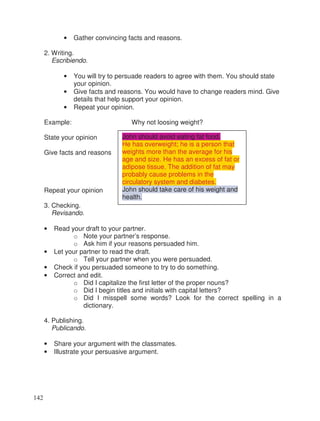
seven in the morning. In the afternoon
I go running at five o’clock.
Reporter: How often do you go to the movies?
Ana: I seldom go to the movies.
Reporter: How often do you eat hamburgers?
Ana: I never eat hamburgers.
Lesson 12
always
sometimes
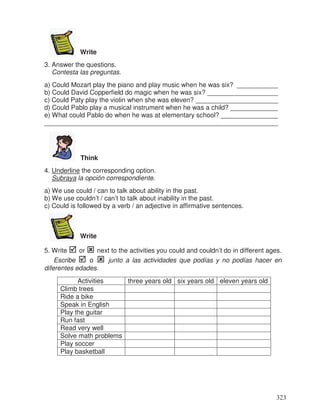
never
seldom
48
Think
2. Choose the answer that corresponds.
Elige la respuesta que corresponda.
1) The question: How often? Is used to ask about __________
a) frequency
b) personality
Write
3. Answer the questions about Ana.
Contesta las preguntas acerca de Ana.
a) What time does Ana get up?
____________________________________________
b) How often does she do exercise?
____________________________________________
c) How often does she go to the movies?
____________________________________________
d) How often does she eat hamburgers?
____________________________________________
4. Write TRUE or FALSE.
Escribe TRUE o FALSE.
a) Ana never gets up early. ____________________
b) She seldom goes to the movies. ____________________
c) She always eats hamburgers. ____________________
d) She gets up at seven o’clock. ____________________
e) She does exercise at half past seven. ____________________
49
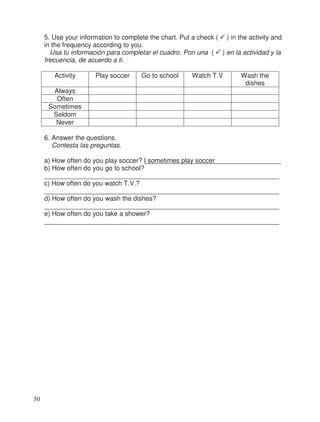
5. Use your information to complete the chart. Put a check ( ) in the activity and
in the frequency according to you.
Usa tu información para completar el cuadro. Pon una ( ) en la actividad y la
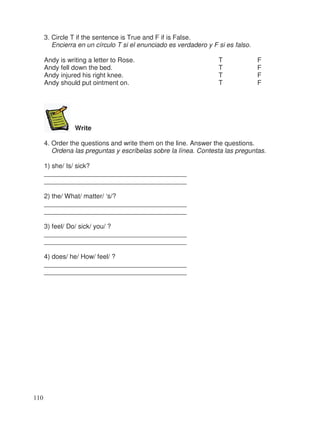
frecuencia, de acuerdo a ti.
Activity Play soccer Go to school Watch T.V Wash the
dishes
Always
Often
Sometimes
Seldom
Never
6. Answer the questions.
Contesta las preguntas.
a) How often do you play soccer? I sometimes play soccer
b) How often do you go to school?
________________________________________________________________
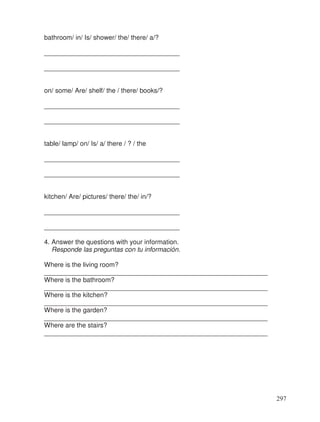
c) How often do you watch T.V.?
________________________________________________________________
d) How often do you wash the dishes?
________________________________________________________________
e) How often do you take a shower?
________________________________________________________________
50
Do you know seahorses?
Read
1. Read the article.
Lee el artículo.
Lesson 13
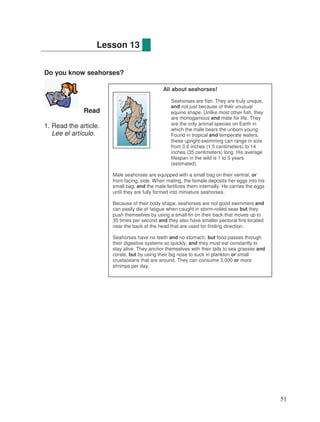
All about seahorses!
Seahorses are fish. They are truly unique,
and not just because of their unusual
equine shape. Unlike most other fish, they
are monogamous and mate for life. They
are the only animal species on Earth in
which the male bears the unborn young.
Found in tropical and temperate waters,
these upright-swimming can range in size
from 0.6 inches (1.5 centimeters) to 14
inches (35 centimeters) long. His average
lifespan in the wild is 1 to 5 years
(estimated).
Male seahorses are equipped with a small bag on their ventral, or
front-facing, side. When mating, the female deposits her eggs into his
small bag, and the male fertilizes them internally. He carries the eggs
until they are fully formed into miniature seahorses.
Because of their body shape, seahorses are not good swimmers and
can easily die of fatigue when caught in storm-roiled seas but they
push themselves by using a small fin on their back that moves up to
35 times per second and they also have smaller pectoral fins located
near the back of the head that are used for finding direction.
Seahorses have no teeth and no stomach, but food passes through
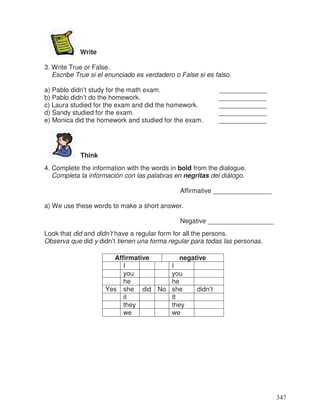
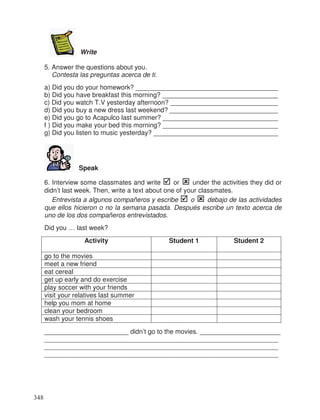
their digestive systems so quickly, and they must eat constantly to
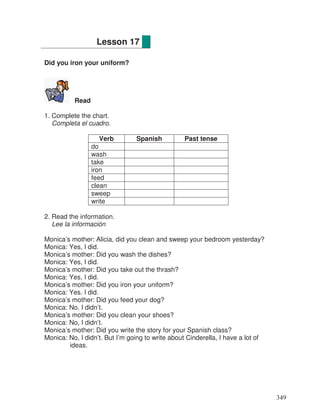
stay alive. They anchor themselves with their tails to sea grasses and
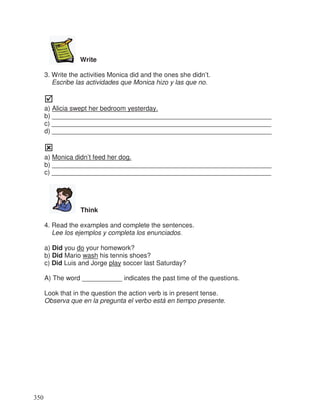
corals, but by using their big nose to suck in plankton or small
crustaceans that are around. They can consume 3,000 or more
shrimps per day.
51
2. Answer these questions according to the article of seahorses.
Responde las preguntas de acuerdo al artículo de los caballos de mar.
1) What type of specie are the seahorses? _____________________
2) What do seahorses eat? __________________________________
3) Where do they live?______________________________________
4) What do you find most impressing about seahorses?____________
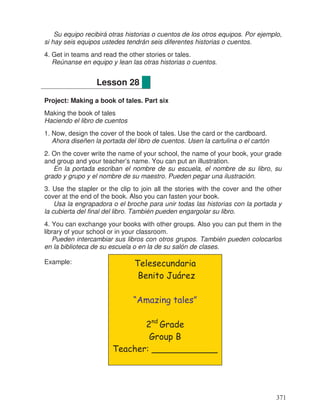
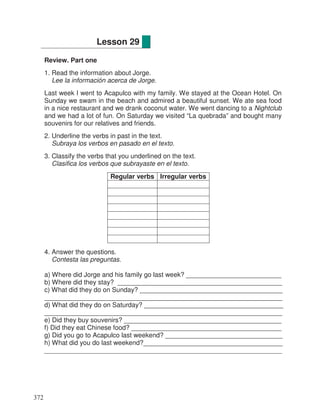
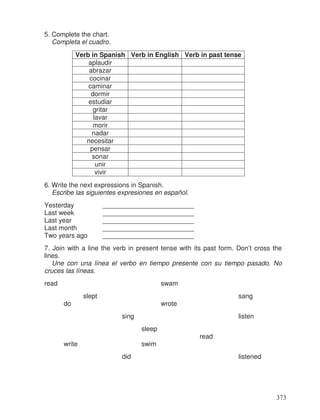
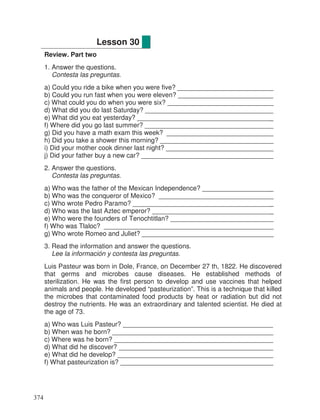
______________________________________________________
Think
3. Look at the bold words and answer these questions.
Fíjate en las palabras en negritas y contesta las siguientes preguntas.
1) When do we use and?
______________________________________________
2) When do we use but?
______________________________________________
3) When do we use or?
______________________________________________
Write
4. Circle the word that corresponds.
Encierra la palabra que corresponda.
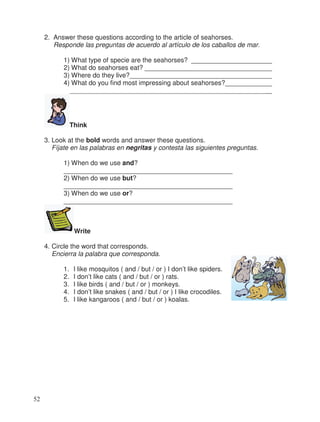
1. I like mosquitos ( and / but / or ) I don’t like spiders.
2. I don’t like cats ( and / but / or ) rats.
3. I like birds ( and / but / or ) monkeys.
4. I don’t like snakes ( and / but / or ) I like crocodiles.
5. I like kangaroos ( and / but / or ) koalas.
52
_
_
_
_
_
_
5. Write an article about an animal you like and know well. Use the words (and/
but/ or) to expand your text. Draw in the box the animal you are writing of.
Escribe un artículo de algún animal que te guste y que conozcas bien. Usa las
palabras (and/ but/ or) para extender tu texto. Dibuja en el cuadro el animal sobre
el que estás escribiendo.
Speak
6. Share information with 3 partners to learn more about other animals.
Comparte tu artículo con 3 de tus compañeros para que aprendas de otros
animales.
__________________________________
____________________________________
____________________________________
____________________________________
____________________________________
____________________________________________________________
____________________________________________________________
____________________________________________________________
____________________________________________________________
53
Learn about koalas
Read
1. Read this article.
Lee el siguiente artículo.
Lesson 14
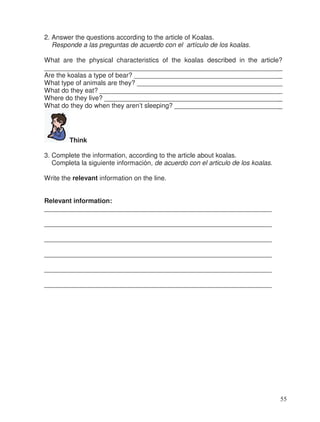
Learn more about koalas!
This animal is often called "koala bear," but this sweet
animal is not a bear at all; it is a marsupial, or pouched
mammal, it has a small bag to carry its babies. They are fat
and hairy, most of them are gray.
After birth, a female carries a single baby in its pouch for
about six months. When the baby koala grows, it rides on
its mother's back or stays in her stomach, accompanying
her everywhere until it is about a year old.
Koalas live in eastern Australia. They love eucalyptus trees.
In fact, they are always on these trees. During the day they
sleep up to 18 hours.
When not asleep a koala eats eucalyptus leaves, especially at night. Koalas do not
drink much water, they get it from the leaves. Each animal eats about two and a half
pounds (one kilogram) of leaves a day. They eat so many of these leaves that they
take on a unique odor from their oil.
Koalas need a lot of space—about 100 trees per animal, a pressing problem as
Australia's woodlands continue to reduce.
54
2. Answer the questions according to the article of Koalas.
Responde a las preguntas de acuerdo con el artículo de los koalas.
What are the physical characteristics of the koalas described in the article?
________________________________________________________________
Are the koalas a type of bear? ________________________________________
What type of animals are they? _______________________________________
What do they eat? _________________________________________________
Where do they live? ________________________________________________
What do they do when they aren’t sleeping? _____________________________
Think
3. Complete the information, according to the article about koalas.
Completa la siguiente información, de acuerdo con el articulo de los koalas.
Write the relevant information on the line.
Relevant information:
______________________________________________________________
______________________________________________________________
______________________________________________________________
______________________________________________________________
______________________________________________________________
______________________________________________________________
55
_
_
_
_
_
_
Write
4. Bring an animal article of a magazine or newspaper. Search and underline the
relevant information to edit an article.
Trae un artículo de cualquier periódico o revista que hable sobre animales
busca y subraya la información relevante para editar un artículo.
5. Write the information in the chart. Paste the image.
Escribe en el cuadro la información. Pega la imagen.
__________________________________
____________________________________
____________________________________
____________________________________
____________________________________
____________________________________________________________
____________________________________________________________
____________________________________________________________
____________________________________________________________
____________________________________________________________
____________________________________________________________
56
6. Make a poster. Put it around the windows to help students to identify the
specie, name, habitat, activity, what they eat and physical characteristics.
Elabora un póster. Pégalo en las ventanas para que los demás alumnos
puedan identificar las especies, el nombre, su hábitat, qué comen y sus
características físicas.
Do animals have routines?
Read
1. Read the following article.
Lee el siguiente artículo.
Lesson 15
Leopards, big cats!
Leopards are powerful and fierce big cats related to lions,
tigers, and jaguars. They live in Africa, Central Asia, India, and
China.
When they hunt large animals to eat, they always take the bodies
up to the trees, to keep them safe from hunters such as hyenas.
First they walk cautiously in the branches, where their spotted coats allow them to
camouflage with the leaves. Then they jump to attack. During this process they act always
silently and slowly. Finally they execute his prey. These nocturnal predators also hunt
antelopes, deers, and pigs by silent movements in the tall grass. When human settlements
are present, leopards often attack dogs and, occasionally, people.
Leopards are also good swimmers. In the water they sometimes eat fish or crabs. They
never eat grass or vegetables.
Female leopards always protect their babies. They always hide them and move them from
one safe location to the next until they can play and learn to hunt. The babies live with their
mothers for about two years.
Leopards are light colored with characteristic dark spots that are called rosettes, because
they look like the shape of a rose.
57
2. Answer these questions according to the article of leopards.
Responde las siguientes preguntas de acuerdo con el artículo de los
leopardos.
1) Are leopards cats?
_______________________________________________________
2) What do leopards eat in water?
_______________________________________________________
3) Do leopards occasionally attack people and dogs?
_______________________________________________________
4) What does the mother do to take care of her cubs?
_______________________________________________________
5) What’s the name of the spots leopards have?
________________________________________________________
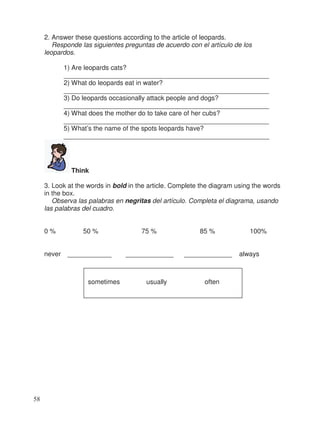
Think
3. Look at the words in bold in the article. Complete the diagram using the words
in the box.
Observa las palabras en negritas del artículo. Completa el diagrama, usando
las palabras del cuadro.
0 % 50 % 75 % 85 % 100%
never ____________ _____________ _____________ always
sometimes usually often
58
_
_
_
_
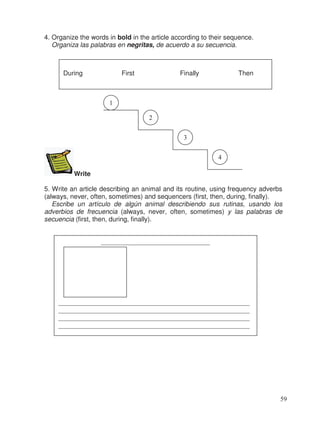
4. Organize the words in bold in the article according to their sequence.
Organiza las palabras en negritas, de acuerdo a su secuencia.
Write
5. Write an article describing an animal and its routine, using frequency adverbs
(always, never, often, sometimes) and sequencers (first, then, during, finally).
Escribe un artículo de algún animal describiendo sus rutinas, usando los
adverbios de frecuencia (always, never, often, sometimes) y las palabras de
secuencia (first, then, during, finally).
During First Finally Then
1
2
3
4
_________________________________
__________________________________________________________
__________________________________________________________
__________________________________________________________
__________________________________________________________
59
What can animals do?
Read
1. Read the following dialogue.
Lee el siguiente diálogo.
At school
En la escuela
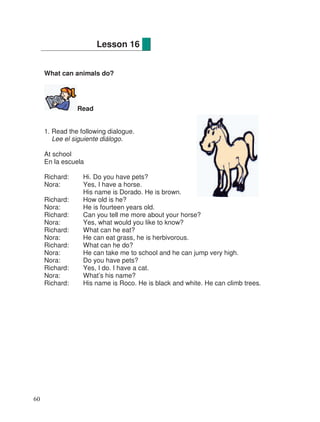
Richard: Hi. Do you have pets?
Nora: Yes, I have a horse.
His name is Dorado. He is brown.
Richard: How old is he?
Nora: He is fourteen years old.
Richard: Can you tell me more about your horse?
Nora: Yes, what would you like to know?
Richard: What can he eat?
Nora: He can eat grass, he is herbivorous.
Richard: What can he do?
Nora: He can take me to school and he can jump very high.
Nora: Do you have pets?
Richard: Yes, I do. I have a cat.
Nora: What’s his name?
Richard: His name is Roco. He is black and white. He can climb trees.
Lesson 16
60
2. Answer the following questions.
Contesta las siguientes preguntas.
1) What are Nora and Richard talking about?
__________________________________________________________
2) What can Dorado do?
__________________________________________________________
3) How old is Dorado?
__________________________________________________________
4) What’s the name of Richard’s cat?
__________________________________________________________
Think
3. Complete the information.
Completa la información.
A) We use can to show __________
a) time
b) ability
61
Write
4. Answer the following questions.
Responde las siguientes preguntas.
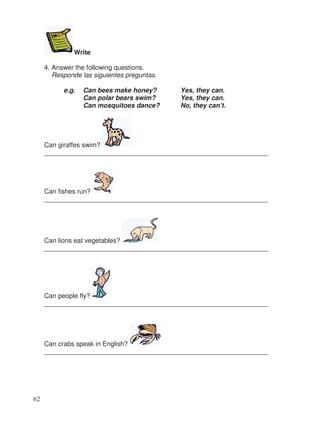
e.g. Can bees make honey? Yes, they can.
Can polar bears swim? Yes, they can.
Can mosquitoes dance? No, they can’t.
Can giraffes swim?
_____________________________________________________________
Can fishes run?
_____________________________________________________________
Can lions eat vegetables?
_____________________________________________________________
Can people fly?
_____________________________________________________________
Can crabs speak in English?
_____________________________________________________________
62
5. Write on the lines different abilities of 5 different animals you know. Use can.
Escribe sobre la línea diferentes habilidades de 5 diferentes animales que
conozcas. Usa can.
________________________________________________________________
________________________________________________________________
________________________________________________________________
________________________________________________________________
________________________________________________________________
Speak
6. Share the information of exercise 5 with your partners.
Comparte la información del ejercicio 5 con tus compañeros.
63
Have you heard about white lions?
Read
1. Read the article.
Lee el artículo.
Lesson 17
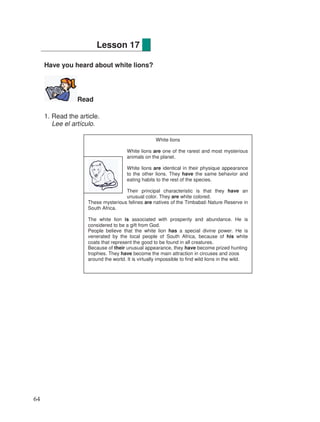
White lions
White lions are one of the rarest and most mysterious
animals on the planet.
White lions are identical in their physique appearance
to the other lions. They have the same behavior and
eating habits to the rest of the species.
Their principal characteristic is that they have an
unusual color. They are white colored.
These mysterious felines are natives of the Timbabati Nature Reserve in
South Africa.
The white lion is associated with prosperity and abundance. He is
considered to be a gift from God.
People believe that the white lion has a special divine power. He is
venerated by the local people of South Africa, because of his white
coats that represent the good to be found in all creatures.
Because of their unusual appearance, they have become prized hunting
trophies. They have become the main attraction in circuses and zoos
around the world. It is virtually impossible to find wild lions in the wild.
64
2. Answer the next questions.
Contesta las siguientes preguntas.
1) Have you ever heard about white lions?
____________________________________________________________
2) What’s the principal characteristic of these rare animals?
____________________________________________________________
3) Are the white lions associated with God?
____________________________________________________________
4) Where do they live?
____________________________________________________________
5) Are they carnivores?
____________________________________________________________
Think
3. Look at the words in bold in the text. Complete the information.
Observa las palabras en negritas en el texto. Completa la información.
We use _____ to show possession.
a) Their
b) They
We use the verb to _______ to show possession.
a) be
b) have
We use the verb to _______ in different forms: is, are, am.
a) go
b) be
65
Write
4. Complete the gapped text.
Completa los espacios del texto.
e.g. She has a bird. His name is Romeo. He is yellow and a professional
singer.
I have a cat. Her name _________ Kitty. ________ is black and ___________.
He _________ a dog. ________ name is Cat. He _________ brown and
______________.
She __________ a fish. His __________ is Cleto. He is blue.
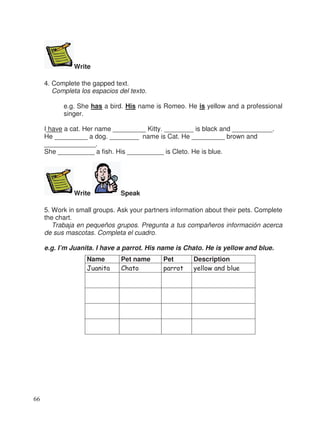
Write Speak
5. Work in small groups. Ask your partners information about their pets. Complete
the chart.
Trabaja en pequeños grupos. Pregunta a tus compañeros información acerca
de sus mascotas. Completa el cuadro.
e.g. I’m Juanita. I have a parrot. His name is Chato. He is yellow and blue.
Name Pet name Pet Description
Juanita Chato parrot yellow and blue
66
Animals that live in your community
Write Speak
1. Work in small groups. Choose an animal that lives in your community.
Trabajen en pequeños grupos. Elijan algún animal que habite en su
comunidad.
2. Draw the animal you have chosen.
Dibuja el animal que elegiste.
Lesson 18
67
Write
3. Write all the details about the animal:
Physical characteristics
Habits and routines
Appropriate care of the animal
Habitat
Escribe todos los detalles del animal:
Características físicas
Hábitos y rutinas
Cuidados apropiados para el animal
Hábitat
Physical
characteristics
Habits and
routines
Appropriate
care
Habitat
Speak Think
4. Organize the information you get and expose it to the class.
Organiza tu información y exponla ante la clase.
68
Extra activity
5. With the permission of the school, you may also setup a birdfeeder outside the
window of your classroom and watch the behavior of birds from your classroom.
Con el permiso de tu escuela, hagan un semillero de aves en la ventana de tu
salón de clases y observa el comportamiento de las aves que lo visiten.
My favorite athlete is Ana Guevara
Read
1. Read the next biography.
Lee la siguiente biografía.
.
Lesson 19
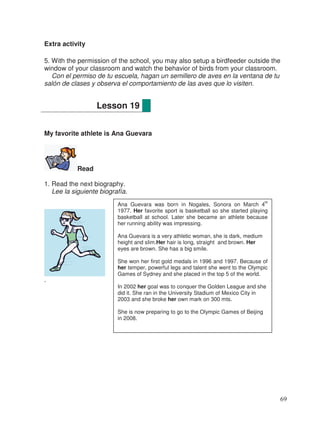
Ana Guevara was born in Nogales, Sonora on March 4
th
1977. Her favorite sport is basketball so she started playing
basketball at school. Later she became an athlete because
her running ability was impressing.
Ana Guevara is a very athletic woman, she is dark, medium
height and slim.Her hair is long, straight and brown. Her
eyes are brown. She has a big smile.
She won her first gold medals in 1996 and 1997. Because of
her temper, powerful legs and talent she went to the Olympic
Games of Sydney and she placed in the top 5 of the world.
In 2002 her goal was to conquer the Golden League and she
did it. She ran in the University Stadium of Mexico City in
2003 and she broke her own mark on 300 mts.
She is now preparing to go to the Olympic Games of Beijing
in 2008.
69
2. Answer the questions about Ana Guevara.
Responde las preguntas sobre Ana Guevara.
1) What does Ana look like?
_______________________________________________________
2) What does she do?
_______________________________________________________
3) When is her birthday?
_______________________________________________________
4) Where is she from?
_______________________________________________________
5) When did she start to win medals?
_______________________________________________________
Think
3. Choose the answer that corresponds.
Elige la respuesta que corresponda.
When you talk about other people you use:____________
a) he/ his, she/ her, it/ its
b) I/ my, me/ mine
We use adjectives to ___________ people.
a) describe
b) name
Write
4. Answer the following questions.
Responde las siguientes preguntas.
1) What does your mother look like?
__________________________________________________________
2) What does your father look like?
__________________________________________________________
3) What’s your favorite athlete?
__________________________________________________________
70
5. Describe a person you admire.
Describe a una persona que admires.
________________________________________________________________
________________________________________________________________
________________________________________________________________
________________________________________________________________
Speak
6. Work in pairs. Ask your partner about the person she/he admires.
Trabajen en parejas. Pregunta a tu pareja sobre la persona que él/ella admire.
71
What animals do you like?
Read
1. Read the next 3 articles.
Lee los siguientes 3 artículos.
Lesson 20
California Condor
Gymnogyps californianus: Vulture Culture
Look, up in the sky! (We mean WAY up, as in 15,000 feet!)
It's a bird, all right—the mighty California condor! And with all due
respect to that tall dude with yellow feathers on Sesame Street, this
high flyer holds the title of the largest bird in North America. Weighing
up to 25 pounds, he's got a wingspan of 9 1/2 feet and can glide for
hours at 55 mph without once beating his wings. If that sounds hard,
well...it is. It takes a year for young condors to sharpen their soaring
skills. The California condor is a vulture, a type of bird recognizable
by his big size and bald head. And like his vulture cousins, the
California condor chows down on carrion. That's the meat of dead
animals, such as cattle, sheep, deer and horses. It may sound gross
to you, but just think—he's part of nature's clean-up crew. And
besides, he always washes up after dinner by rubbing his head and
neck against grass, rocks and trees. No rinsing
needed!http://www.aspca.org/site/PageServer?pagename=kids_abcs
_californiacondor
Elephant: “Nose-Y” Neighbor
Loxodonta africana
Imagine if you had a machine that could prepare all your meals,
give you a shower, carry your backpack and provide sound
effects for a variety of social occasions.You may not be able to
find one in stores, but the African elephant is lucky enough to
carry one with him at all times. If you haven’t already guessed it,
we’re talking of the trunk—and this big guy is really kind of
attached to his! The African elephant’s trunk is actually an
extension of his upper lip and nose, and he uses it for drinking,
greeting friends, trumpeting, lifting and grasping. And like any
self-respecting nose, this one’s good for smelling, too. But most
importantly, the elephant uses his trunk to gather and bring food
to his mouth. And we don’t mean a berry here and a blade of
grass there. To keep his 13,000-pound self strong and healthy,
an African elephant needs to consume more than 300 pounds of
grass, shrubs, leaves and fruit a day. Pass the salad, please!
http://www.aspca.org/site/PageServer?pagename=kids_abcs_el
ephant
72
2. Choose the one you like the most.
Escoge el texto que más te gustó.
Write
3. Answer these questions about the article you chose.
Contesta las siguientes preguntas acerca del artículo que elegiste.
1) What kind of animal is it? ________________________________________
2) What’s its principal physical characteristic?__________________________
3) What does it eat?______________________________________________
4) Where does it live?_____________________________________________
5) Why did you choose this animal?__________________________________
6) Describe the animal. What is it like? _______________________________
7) What is it called? ______________________________________________
Panda
Ailuropoda melanoleuca: BamBOO!
Forget about getting a quick bite to eat! China's giant
panda devotes 12 hours of every day to eating! To get
all the nutrition he needs, he has to consume about 15
percent of his bodyweight daily. That comes out to
between 28 and 36 pounds of bamboo, his meal of
choice. Luckily, he has special chewing muscles and
broad, flat teeth for all that bamboo chomping.
He's got special markings, too. We may think pandas
are totally cute, but their black eyes and big, black
circles on their faces may look like 2 pairs of giant,
glaring, staring eyes to animals who try to invade their
territory.
For more information, and to see what a real live
panda is doing right now, at the San Diego Zoo.
http://www.aspca.org/site/PageServer?pagename=kids_abcs_panda
73
_
_
_
_
_
_
4. Organize the information you get and write a text about the animal you chose
on exercise 2. Use possesive pronouns (his, her, its).
Organiza la información que recaudaste y escribe un texto del animal que
escogiste en el ejercicio 2. Usa pronombres posesivos (his, her, its).
________________________________________________________________
________________________________________________________________
________________________________________________________________
________________________________________________________________
________________________________________________________________
________________________________________________________________
________________________________________________________________
________________________________________________________________
______________________________________________
Extra activity
5. Bring a magazine for the next class.
Trae una revista para la clase siguiente.
Create a gallery of famous people
Play
1. Open the magazine and choose 2 different artists.
Abre la revista que trajiste y escoge 2 diferentes artistas.
2. Cut the images that you have chosen.
Recorta las imágenes que hayas escogido.
Lesson 21
74
3. Paste the images you get on an empty sheet.
Pega las imágenes que cortaste en una hoja en blanco.
e.g.
4. Write a description of the artists you chose. Include name, place of birth, date
of birth, physical description, activities they do and abilities.
Escribe una descripción de los artistas que recortaste incluye datos como:
nombre, lugar de nacimiento, fecha de cumpleaños, descripción física,
actividades que desempeñan y habilidades.
5. Paste the posters on the windows, walls and board.
Pega los pósters que creaste en las ventanas, paredes y en el pizarrón.
Come to visit our gallery!
Play
1. Invite different people to your gallery. Tell other partners, your parents and
teachers.
Invita a diferentes personas a tu galería. Dile a otros compañeros, a tus papás
y a tus maestros.
Lesson 22
75
2. Look at the pictures of the artists and read their descriptions.
Observa las fotos de los artistas y lee sus descripciones.
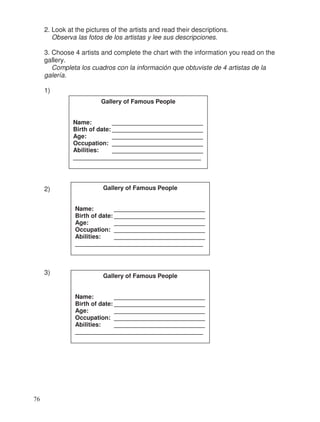
3. Choose 4 artists and complete the chart with the information you read on the
gallery.
Completa los cuadros con la información que obtuviste de 4 artistas de la
galería.
1)
2)
3)
Gallery of Famous People
Name: ___________________________
Birth of date: ___________________________
Age: ___________________________
Occupation: ___________________________
Abilities: ___________________________
______________________________________
Gallery of Famous People
Name: ___________________________
Birth of date: ___________________________
Age: ___________________________
Occupation: ___________________________
Abilities: ___________________________
______________________________________
Gallery of Famous People
Name: ___________________________
Birth of date: ___________________________
Age: ___________________________
Occupation: ___________________________
Abilities: ___________________________
______________________________________
76
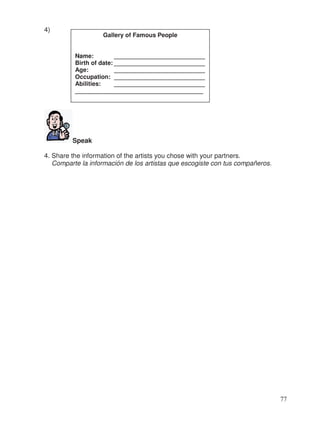
4)
Speak
4. Share the information of the artists you chose with your partners.
Comparte la información de los artistas que escogiste con tus compañeros.
Gallery of Famous People
Name: ___________________________
Birth of date: ___________________________
Age: ___________________________
Occupation: ___________________________
Abilities: ___________________________
______________________________________
77
Who is it?
Play
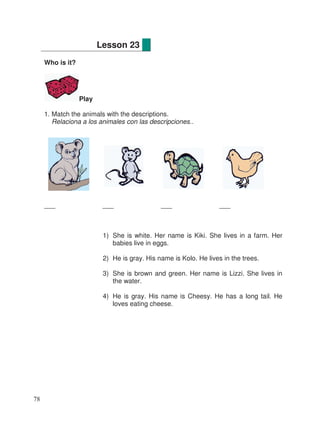
1. Match the animals with the descriptions.
Relaciona a los animales con las descripciones..
___ ___ ___ ___
1) She is white. Her name is Kiki. She lives in a farm. Her
babies live in eggs.
2) He is gray. His name is Kolo. He lives in the trees.
3) She is brown and green. Her name is Lizzi. She lives in
the water.
4) He is gray. His name is Cheesy. He has a long tail. He
loves eating cheese.
Lesson 23
78
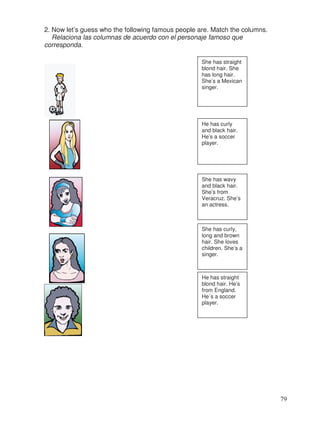
2. Now let’s guess who the following famous people are. Match the columns.
Relaciona las columnas de acuerdo con el personaje famoso que
corresponda.
She has straight
blond hair. She
has long hair.
She’s a Mexican
singer.
He has curly
and black hair.
He’s a soccer
player.
She has wavy
and black hair.
She’s from
Veracruz. She’s
an actress.
She has curly,
long and brown
hair. She loves
children. She’s a
singer.
He has straight
blond hair. He’s
from England.
He´s a soccer
player.
79
3. Choose the correct option.
Escoge la opción que corresponda.
Elephants are _________________. They have _____________ trunks.
(green / gray) (long / short)
Turtles are _________________. They have a ______________ shells.
(purple / green) (big / small)
Giraffes are _______________. They have _____________ necks.
(tall / short) (long / short)
A mouse is ________________. It has a __________________ tail.
(big / small) (long / short)
A whale is _________________. It is ___________________.
(gray / orange) ( small / big)
4. Draw the animal that the text describe.
Dibuja el animal que describe el texto.
It is big. It has big ears, small eyes and a long neck. It is fat and green. It has four
short legs. Its arms are long and its hands are black.
80
Review
Write
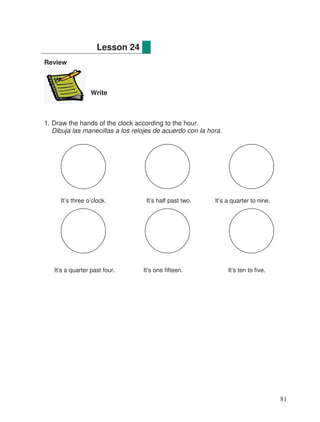
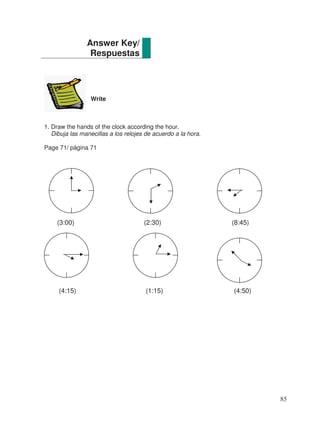
1. Draw the hands of the clock according to the hour.
Dibuja las manecillas a los relojes de acuerdo con la hora.
It’s three o’clock. It’s half past two. It’s a quarter to nine.
It’s a quarter past four. It’s one fifteen. It’s ten to five.
Lesson 24
81
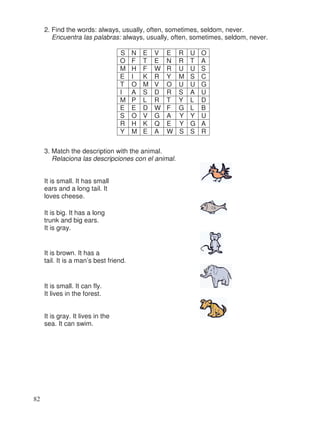
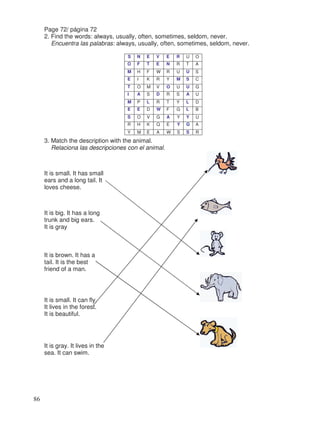
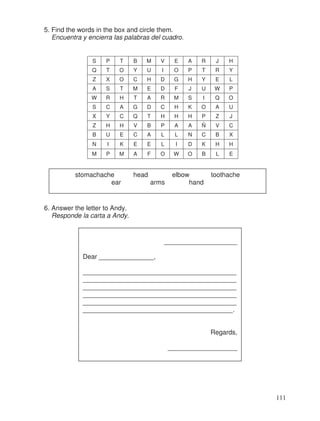
2. Find the words: always, usually, often, sometimes, seldom, never.
Encuentra las palabras: always, usually, often, sometimes, seldom, never.
3. Match the description with the animal.
Relaciona las descripciones con el animal.
It is small. It has small
ears and a long tail. It
loves cheese.
It is big. It has a long
trunk and big ears.
It is gray.
It is brown. It has a
tail. It is a man’s best friend.
It is small. It can fly.
It lives in the forest.
It is gray. It lives in the
sea. It can swim.
S N E V E R U O
O F T E N R T A
M H F W R U U S
E I K R Y M S C
T O M V O U U G
I A S D R S A U
M P L R T Y L D
E E D W F G L B
S O V G A Y Y U
R H K Q E Y G A
Y M E A W S S R
82
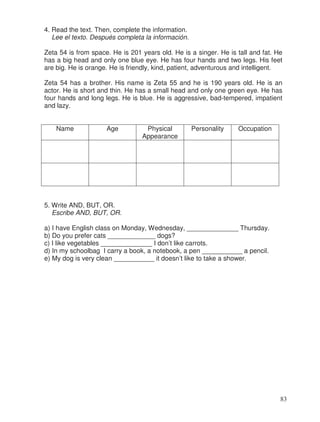
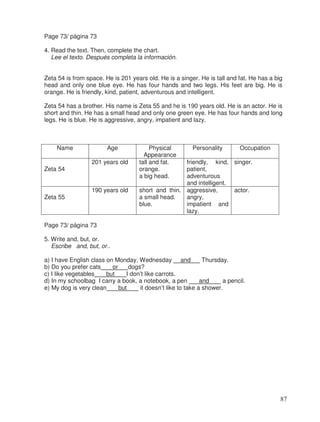
4. Read the text. Then, complete the information.
Lee el texto. Después completa la información.
Zeta 54 is from space. He is 201 years old. He is a singer. He is tall and fat. He
has a big head and only one blue eye. He has four hands and two legs. His feet
are big. He is orange. He is friendly, kind, patient, adventurous and intelligent.
Zeta 54 has a brother. His name is Zeta 55 and he is 190 years old. He is an
actor. He is short and thin. He has a small head and only one green eye. He has
four hands and long legs. He is blue. He is aggressive, bad-tempered, impatient
and lazy.
Name Age Physical
Appearance
Personality Occupation
5. Write AND, BUT, OR.
Escribe AND, BUT, OR.
a) I have English class on Monday, Wednesday, ______________ Thursday.
b) Do you prefer cats _____________ dogs?
c) I like vegetables ______________ I don’t like carrots.
d) In my schoolbag I carry a book, a notebook, a pen ___________ a pencil.
e) My dog is very clean ___________ it doesn’t like to take a shower.
83
6. Find the words and circle them. All of these words are related to you and your
relationship with your pet. Look them up in a dictionary and write their meanings.
Encuentra las palabras y enciérralas. Todas estas palabras están relacionadas
contigo y tu mascota. Búscalas en el diccionario y anota su significado.
ACCEPT COMPANIONSHIP INTERDEPENDENCE RESPECT
BUDDY CONFIDE RESPONSIBILITY LOVE
CARE ENJOY MUTUAL REST
COMFORT EXERCISE PLAY TRAIN
FRIEND COMMITMENT PROTECTION TRUST
I A S F E R A S P P L A Y R C
N C Y R B E S I C R E X E N O
T C N I A S N E S E T E V O M
E E A E R P I E L S B R L I P
R P E N C O M M I T M E N T A
D T J D O N K E R Z E S B C N
E R A B I S E T O F B P L E I
P U E D E I S P E R T E S T O
E Y D D U B T O E R A C T O N
N R I N N I D L E D I T S R S
D T F I S L O V E H R D U P H
E R N A U I G H T H O E R R I
N A O L A T R O F M O C T S P
C I C N E Y Z Z C L I R E N Y
E N J O Y G M U T U A L R E I
84
Write
1. Draw the hands of the clock according the hour.
Dibuja las manecillas a los relojes de acuerdo a la hora.
Page 71/ página 71
(3:00) (2:30) (8:45)
(4:15) (1:15) (4:50)
Answer Key/
Respuestas
85
Page 72/ página 72
2. Find the words: always, usually, often, sometimes, seldom, never.
Encuentra las palabras: always, usually, often, sometimes, seldom, never.
3. Match the description with the animal.
Relaciona las descripciones con el animal.
It is small. It has small
ears and a long tail. It
loves cheese.
It is big. It has a long
trunk and big ears.
It is gray
It is brown. It has a
tail. It is the best
friend of a man.
It is small. It can fly.
It lives in the forest.
It is beautiful.
It is gray. It lives in the
sea. It can swim.
S N E V E R U O
O F T E N R T A
M H F W R U U S
E I K R Y M S C
T O M V O U U G
I A S D R S A U
M P L R T Y L D
E E D W F G L B
S O V G A Y Y U
R H K Q E Y G A
Y M E A W S S R
86
Page 73/ página 73
4. Read the text. Then, complete the chart.
Lee el texto. Después completa la información.
Zeta 54 is from space. He is 201 years old. He is a singer. He is tall and fat. He has a big
head and only one blue eye. He has four hands and two legs. His feet are big. He is
orange. He is friendly, kind, patient, adventurous and intelligent.
Zeta 54 has a brother. His name is Zeta 55 and he is 190 years old. He is an actor. He is
short and thin. He has a small head and only one green eye. He has four hands and long
legs. He is blue. He is aggressive, angry, impatient and lazy.
Name Age Physical
Appearance
Personality Occupation
Zeta 54
201 years old tall and fat.
orange.
a big head.
friendly, kind,
patient,
adventurous
and intelligent.
singer.
Zeta 55
190 years old short and thin.
a small head.
blue.
aggressive,
angry,
impatient and
lazy.
actor.
Page 73/ página 73
5. Write and, but, or.
Escribe and, but, or..
a) I have English class on Monday, Wednesday and Thursday.
b) Do you prefer cats or dogs?
c) I like vegetables but I don’t like carrots.
d) In my schoolbag I carry a book, a notebook, a pen and a pencil.
e) My dog is very clean but it doesn’t like to take a shower.
87
Page 74/ página 74
6.-
I A S F E R A S P P L A Y R C
N C Y R B E S I C R E X E N O
T C N I A S N E S E T E V O M
E E A E R P I E L S B R L I P
R P E N C O M M I T M E N T A
D T J D O N K E R Z E S B C N
E R A B I S E T O F B P L E I
P U E D E I S P E R T E S T O
E Y D D U B T O E R A C T O N
N R I N N I D L E D I T S R S
D T F I S L O V E H R D U P H
E R N A U I G H T H O E R R I
N A O L A T R O F M O C T S P
C I C N E Y Z Z C L I R E N Y
E N J O Y G M U T U A L R E I
88
Materiales de apoyo
Temas Material sugerido
Puedes consultar estas páginas
a lo largo de toda la unidad 1.
• www.bbc.co.uk/teens
• www.afterschool.gov/kidsnteens2.html
• Programa sepAingles: Programa 9 “Spare
Time”
• www.animalplanet.org
• www.animaland.org
• www.kidsplanet.org
Bibliografía
Beare, N., Links 2 Teacher´s Guide, México, Macmillan, 2005.
Celorio, G., Smash! 2, Teacher´s Resource Book, México, Richmond Publishing,
1997.
Domínguez, E., et al., Connetions one. Student´s Book, México, Nuevo México,
2006.
Emilsson, E., et al., Dialogues. English 1, México, Fondo de Cultura Económica,
2002.
Enciclomedia, Inglés. Student Workbook, Nivel 1. Volumen 1. México, 2006.
Haines, P. et al., Crossroads. English 1. México, Oxford University Press, 2006.
Kirn, E., et al., A Communicative Grammar, México, McGraw Hill,1996.
Programas de Estudio. Educación básica. Secundaria. Lengua Extranjera Inglés,
México, SEP, 2006.
Salazar, J., English 1. México, Santillana, 2006.
Van der Werff,J., New Passport Student´s Book, México, Richmond Publishhing,
2006
89
Health and the body/Salud y el cuerpo
IIInglés
TS-APUN-INGLES-2.indd 4 21/2/08 13:07:00
Unit 2
Unit 2
Health and the body/Salud y el cuerpo
El propósito de esta unidad es capacitar a los estudiantes para que puedan dar
consejos y hacer sugerencias sobre la salud.
Lesson 1 My head, my arms and my legs
Lesson 2 Is she feeling OK?
Lesson 3 Do you feel sick?
Lesson 4 What’s the matter?
Lesson 5 You should stay in bed
Lesson 6 You shouldn’t go to bed late
Lesson 7 Mini Check
Lesson 8 Take some pills
Lesson 9 I would go to the dentist
Lesson 10 I wouldn’t use toothpicks
Lesson 11 A visit to the dentist
Lesson 12 Why don’t you go to the nutritionist?
Lesson 13 You’d better change your eating habits
Lesson 14 Drink a cup of tea
Lesson 15 I have mumps
Lesson 16 Mini Check
Lesson 17 Project: Drugs abuse and illegal drugs. Part one
Lesson 18 Project: Drugs abuse and illegal drugs. Part two
Lesson 19 Project: Drugs abuse and illegal drugs. Part three
Lesson 20 Project: Drugs abuse and illegal drugs. Part four
Lesson 21 Review
21 sessions, 7 weeks/ 21 sesiones, 7 semanas
Purpose/Propósito
Topics/Temas
93
My head, my arms and my legs
Read
1. Answer the question about the text.
Responde la pregunta acerca del texto.
What kind of text is it?
a) a letter b) an article c) an e-mail
2. Look at the picture and read the text.
Observa la imagen y lee el texto.
Andy’s mother is in her yoga class.
Yoga teacher: First, take a deep breath and relax. Lift your arms when you
breathe in and breathe out when you low your arms.
Mom: Do we have to keep our back straight?
Yoga teacher: Yes, you do. Then turn your head up and down.
Mom: That feels great!
Yoga teacher: Touch, with your hand fingers, your feet. Keep your back
straight.
Mom: Am I doing well?
Yoga teacher: Yes, you are. That’s a great job!
Lesson 1
94
3. Answer the questions about the text.
Responde las preguntas acerca del texto.
Where’s Andy’s mother? ________________________________________
What is the class about? ________________________________________
How is Andy’s mom doing? ______________________________________
Think
4. Write on the line the words in the box.
Escribe sobre la línea las palabras del cuadro.
Play
5. Play Simon Says.
Juega, Simón dice.
Example: Simon says: touch your nose.
head nose hands stomach legs
foot fingers shoulder knee
neck elbow mouth arms
95
Is she feeling OK?
Read
1. Look at the images. Order the letters to form a word.
Observa las imágenes. Ordena las letras para formar una palabra.
l/w/b/e/o u/l/o/r/e/d/s/h c/e/k/n
______________ _______________ _______________
2. Look at the picture and read the text.
Observa la imagen y lee el texto.
Andy: Hello. This is Andy speaking. May I speak with Rose?
Rose’s mother: Hello Andy. I’m sorry but Rose isn’t feeling ok!
Andy: Is she fine? She didn’t go to school today.
Rose’s mother: No, she isn’t fine!
Andy: Is she sick?
Rose’s mother: Yes, she has a cold.
Andy: Ups. Is she going to school tomorrow?
Rose’s mother: Well, it depends on how she is feeling tomorrow morning.
Andy: Thanks for your help. Hope Rose gets better. Good bye.
Rose’s mother: Thank you. Bye.
Lesson 2
96
3. Circle T if the sentence is True and F if it is False.
Encierra en un círculo T si el enunciado es verdadero y F si es falso.
Andy is speaking with Rose. T F
Rose was absent at school. T F
Rose isn’t sick. T F
Rose has a cold. T F
Think
4. Re-read the dialogue. Answer the question.
Relee el diálogo. Responde la pregunta.
What are the questions used to know if someone is feeling bad or well?
________________________________________________________________
________________________________________________________________
5. Match the columns.
Relaciona las columnas.
Cold
Sick
Fine
97
Write
6. Write a dialogue similar to exercise 2.
Escribe un diálogo similar al del ejercicio 2.
________________________________________________________________
________________________________________________________________
________________________________________________________________
________________________________________________________________
Do you feel sick?
Read
1. Answer the question.
Responde la pregunta.
What are they doing?
a) Writing a letter b) Speaking on the phone
2. Read the dialogue.
Lee el diálogo.
Andy: Hello. This is Andy. How does Rose feel?
Rose’s mother: Hello Andy. She feels better.
Don’t you want to talk to her?
Andy: Yes, I do.
Rose’s mother: OK. Hold on please.
Rose: Hi Andy.
Andy: Do you feel better? We miss you at school.
Rose: Yes, I do. I believe I’ll be back at school
tomorrow.
Andy: That’s great! See you tomorrow.
Rose: Good bye.
Andy: Bye.
Lesson 3
98
3. Circle T if the sentence is True and F if it is False.
Encierra en un círculo T si el enunciado es verdadero y F si es falso.
Andy is speaking with Rose’s father. T F
Rose is feeling better. T F
Andy misses Rose at school. T F
Rose will be back at school tomorrow. T F
Think Write
4. Complete the chart using the dialogue.
Completa la tabla usando el diálogo.
Forms of do Questions
Does
Do
don’t
5. Choose the answer that corresponds.
Elige la respuesta que corresponda.
We use __________ with singular nouns and the pronouns he, she and it.
a) do
b) does
We use __________ with plural nouns and the pronouns I, we, you and they.
a) do
b) does
They are the negative forms of do: __________
a) done/ doesn’t
b) don’t/ doesn’t
99
Write
6. Look at the image. Complete the text.
Observa la imagen. Completa el texto.
John: __________ you feel ok?
Ray: Yes I __________ but Laura ___________ feel good.
John: Laura __________ you feel fine?
Laura: No, I __________. I have a headache.
What’s the matter?
Read
1. Answer the question.
Responde la pregunta.
What kind of texts are these?
a) letters
b) articles
c) dialogues
Lesson 4
100
2. Read the dialogues.
Lee los diálogos.
3. Circle T if the sentence is True and F if is False.
Encierra en un círculo T si el enunciado es verdadero y F si es falso.
In the dialogue one Andy has a stomachache. T F
In the dialogue two Andy’s mom has a toothache. T F
In the dialogue Andy has a headache. T F
What’s the
matter
Andy?
I have a
stomachache.
What’s the
matter Mom
I have a
cough and a
cold.
What’s the
matter
Andy?
I have a
headache.
101
Think Write
4. Complete the chart using the words in the box. Look at the parts of the body.
Completa la tabla usando las palabras del cuadro. Observa las partes del
cuerpo.
To identify problems we ask:
_______________________________________
cold toothache stomachache
cough headache earache
102
Write
5. Write on the line people’s problems.
Escribe sobre la línea los problemas de las personas.
Example: She has fever.
__________________________
__________________________
__________________________
__________________________
__________________________
103
Speak Write
6. Work in pairs. Write a dialogue similar to exercise two and practice saying it
with your partner.
Trabaja en parejas. Escribe un diálogo similar al del ejercicio dos y practica
diciéndolo en voz alta con tu compañero.
________________________________________________________________
________________________________________________________________
________________________________________________________________
You should stay in bed
Read
1. Answer the questions. Order the words to form a word.
Responde las preguntas. Ordena las letras para formar una palabra.
What’s the problem?
a) a/e/h/d/h/c/a/e _____________________
b) r/e/f/e/v _____________________
c) o/t/s/m/a/c/h/e/a/c/h/ _____________________
2. Read the dialogue.
Lee el diálogo.
Andy: Good morning Mom.
Mom: Good morning Andy.
Andy: Are you OK?
Mom: No, I have a headache.
Andy: You should stay in bed.
Mom: But that’s impossible!
I have lots of things to do.
Andy: You should take a nap.
Mom: Yes, you are right.
Lesson 5
104
3. Answer the questions.
Responde las preguntas.
What’s the problem of Andy’s mother?
_____________________________________________________________
What’s Andy’s mom going to do?
_____________________________________________________________
Think
4. Choose the answer that corresponds.
Elige la respuesta que corresponde.
We use ______________ to give advice.
a) Should
b) Do
Write
5. Match the columns.
Relaciona las columnas.
1) I have a toothache. a) She should put on her sweater.
2) She has a headache. b) He should go to the doctor.
3) He has a stomachache. c) You should drink some water.
4) I’m thirsty. d) You should go to the dentist.
5) She is cold. e) She should take an aspirin.
Speak Write
6. Work in pairs. Write different situations. Give advices to the situations. Share
your information with your classmates.
Trabaja en parejas. Escriban diferentes situaciones. Den consejos para las
situaciones. Compartan la información con sus compañeros.
105
Example:
a) I want to loose weight.
b) You should stop eating chocolate and sweets.
a) __________________________________________________
b) __________________________________________________
a) __________________________________________________
b) __________________________________________________
a) __________________________________________________
b) __________________________________________________
a) __________________________________________________
b) __________________________________________________
You shouldn’t go to bed late
Read
1. Complete the information.
Completa la información.
Tom always goes to bed very late and he is always tired.
He ____________ go to bed earlier.
Lesson 6
106
2. Read the dialogue.
Lee el diálogo.
Mom: Andy, you shouldn’t watch too much T.V.
Andy: Mom, it’s my favorite cartoon!
Mom: You should do your homework.
Andy: Yes, I should.
Mom: Andy it’s late! You shouldn’t have to be awake up. Have you finished
your homework?
Andy: It’s almost done!
Mom: You should go to sleep now!
3. Circle T if the sentence is True and F if is False.
Encierra en un círculo T si el enunciado es verdadero y F si es falso.
Andy is watching T.V. T F
Andy’s mom is happy because Andy is watching T.V. T F
Andy has done his homework early. T F
It is late and Andy is doing his homework. T F
Think
4. Choose the answer that corresponds.
Elige la respuesta que corresponda.
It is the negative form of should.
a) Don’t
b) Shouldn’t
107
Write
5. Match the columns.
Relaciona las columnas.
1) You work too hard. a) She shouldn’t smoke.
2) She is fat. b) You shouldn’t work so hard.
3) He is grounded. c) She shouldn’t eat junk food.
4) I have a cold. d) You shouldn’t drink cold drinks
5) She has a cough. e) He shouldn’t behave so bad.
Speak Write
6. Work in pairs. Write different situations. Give advices to the situations. Share
your information with your classmates.
Trabaja en parejas. Escriban diferentes situaciones. Den consejos para las
situaciones. Compartan la información con sus compañeros.
a) __________________________________________________
b) __________________________________________________
a) __________________________________________________
b) __________________________________________________
a) __________________________________________________
b) __________________________________________________
a) __________________________________________________
b) __________________________________________________
108
Mini Check
Read
1. Answer the question.
Responde la pregunta.
What kind of text is it?
a) an e-mail
b) a letter
c) an article
2. Read the text.
Lee el texto.
Dear Rose,
I’m writing you to tell you that I fell down when I was walking down the street. I
injured my right knee. I went to the Doctor and he told me I should take care of
my knee. I should put some ointment on. I shouldn’t walk until it gets better. Are
you OK? How do you feel? Please write soon.
Regards,
Andy
Lesson 7
109
3. Circle T if the sentence is True and F if is False.
Encierra en un círculo T si el enunciado es verdadero y F si es falso.
Andy is writing a letter to Rose. T F
Andy fell down the bed. T F
Andy injured his right knee. T F
Andy should put ointment on. T F
Write
4. Order the questions and write them on the line. Answer the questions.
Ordena las preguntas y escríbelas sobre la línea. Contesta las preguntas.
1) she/ Is/ sick?
_______________________________________
_______________________________________
2) the/ What/ matter/ ‘s/?
_______________________________________
_______________________________________
3) feel/ Do/ sick/ you/ ?
_______________________________________
_______________________________________
4) does/ he/ How/ feel/ ?
_______________________________________
_______________________________________
110
5. Find the words in the box and circle them.
Encuentra y encierra las palabras del cuadro.
S P T B M V E A R J H
Q T O Y U I O P T R Y
Z X O C H D G H Y E L
A S T M E D F J U W P
W R H T A R M S I Q O
S C A G D C H K O A U
X Y C Q T H H H P Z J
Z H H V B P A A Ñ V C
B U E C A L L N C B X
N I K E E L I D K H H
M P M A F O W O B L E
6. Answer the letter to Andy.
Responde la carta a Andy.
stomachache head elbow toothache
ear arms hand
____________________
Dear _______________,
__________________________________________
__________________________________________
__________________________________________
__________________________________________
__________________________________________
_________________________________________.
Regards,
___________________
111
Take some pills
Read
1. Answer the question.
Responde la pregunta.
Who is the man that works at a hospital and takes care of people’s health? He is
a _____________.
a) mechanic
b) doctor
c) policeman
2. Read the dialogue.
Lee el diálogo.
Mom: How are you feeling today?
Andy: I woke up with a cold.
Mom: I think we should go to see Dr. Lopez.
Dr. Lopez: What’s the matter?
Mom: Andy has a cold.
Dr. Lopez: I see! You also have fever. OK, Andy you have to stay in bed for
two days, take some pills and don’t drink cold water.
Mom: You heard that, Andy. You have to stay in bed.
Lesson 8
112
3. Answer the questions.
Responde las preguntas.
Why did Andy go to the doctor?
___________________________________________________________
What did the doctor advice Andy?
___________________________________________________________
In your opinion, what should Andy do?
___________________________________________________________
Think
4. Go back to the text and complete the information.
Regresa al diálogo y completa la información.
Imperative form is used to give medical indications. For example:
Stay in bed, ________________, ______________________.
Write
5. Write on the line the medical instruction that refers to the problem.
Escribe sobre la línea la prescripción médica que se refiera al problema.
Stay in bed Take an aspirin Have a hot drink
_____________
_____________
I have a
headache.
113
Speak Write
6. Ask your classmates how they are feeling and give them medical instructions.
Complete the chart.
Pregunta a tus compañeros cómo se sienten y dales una prescripción médica.
Completa la tabla.
Name Problem Advice
Anne animal bite go to see a doctor
_____________
_____________
I have a cough.
_____________
_____________
I have a cold.
114
I would go to the dentist
Read
1. Answer the question.
Responde la pregunta.
Where are they?
a) at school b) at home
2. Read the dialogue.
Lee el diálogo.
Andy: Hi, Mom! How are you doing?
Mom: I have a toothache. It really hurts!
Andy: If I were you I would go to the dentist.
Mom: That’s a good idea.
Andy: Yes mom but if I were you, I would brush my teeth properly.
Mom: I know, Andy.
Lesson 9
115
3. Circle T if the sentence is True and F if is False.
Encierra en un círculo T si el enunciado es verdadero y F si es falso.
Andy has a toothache. T F
Andy’s mom is going to the dentist. T F
Andy doesn’t brush his teeth properly. T F
Think
4. Answer the questions.
Responde las preguntas.
Would is used to:
a) request
b) order
Write
5. Complete the information.
Completa la información.
Sara is tired.
If I were Sara, I __________________________________________
Leo has a cold.
If I were Leo, I __________________________________________
Tom is thirsty.
If I were Tom, I __________________________________________
Norma has a cough.
If I were Norma, I ________________________________________
116
_
__
_
__
_
Speak Write
6. Ask your classmates how they are feeling and give them medical instructions.
Complete the chart.
Pregunta a tus compañeros cómo se sienten y dales una prescripción médica.
Completa la tabla.
Name Problem Request
Anne animal bite If I were you first, I
would wash the bite with
soap and water
I wouldn’t use toothpicks
Read
1. Answer the question.
Responde la pregunta.
He is a man that takes care of our mouth health. He helps us when we have problems
with our teeth. He is a:
a) Nutritionist b) Carpenter c) Dentist
Lesson 10
117
2. Read the dialogue.
Lee el diálogo.
Andy’s Mom: Hello this is Mrs. Gomez speaking.
May I speak with dentist Robins?
Dentist Robins: Hello. Good afternoon. What’s the problem?
Andy’s Mom: I have a toothache.
Dentist Robins: Oh! I see! Take some pills to avoid
inflammation or redness. It’s important
to brush your teeth with a soft tooth brush, to
prevent decay.
Andy’s Mom: Would I brush hard my teeth?
Dentist Robins: No, you wouldn’t. And if I were you I, wouldn’t use toothpicks
because you can hurt your gums. The best thing to use is
dental floss.
Andy’s Mom: I think I should visit the dentist regularly!
Dentist Robins: That’s right. If I were you I, would make an appointment for
tomorrow.
3. Answer the questions about the dialogue.
Responde las preguntas acerca del diálogo.
1) Why did Andy’s Mom go to see the dentist?
_____________________________________________________________
2) Why do we have to brush our teeth?
_____________________________________________________________
3) Is it good to use toothpicks?
_____________________________________________________________
4) Find on a dictionary the meaning of these words:
Gum: ________________________________________________________
Dental floss: __________________________________________________
Toothpicks: ___________________________________________________
118
_
_
Think
4. Answer the questions.
Responde las preguntas.
Wouldn’t is used to:
a) request
b) order
Write
5. Complete the information.
Completa la información.
Laura has a stomachache.
If I were Laura, I ___________________________________________
Sophie is late for school.
If I were Sophie, I __________________________________________
Ralph is bored.
If I were Ralph, I ___________________________________________
Bob has a cold.
If I were Bob, I ____________________________________________
119
_
Speak Write
6. Work in pairs. Write a dialogue similar to exercise two. Practice saying it.
Trabaja en parejas. Escribe un diálogo similar al del ejercicio dos. Practica
diciéndolo en voz alta.
________________________________________________________________
________________________________________________________________
________________________________________________________________
________________________________________________________________
A visit to the dentist
Read
1. Order the words according to the image.
Ordena las palabras de acuerdo con la imagen.
a/c/e/m/h/i/c/n u/r/n/s/e /e/r/h/c/t/e/a
________________ _________________ ________________
Lesson 11
120
2. Read the dialogue.
Lee el diálogo.
Andy’s Mom: Finally I’m here!
Dentist Robins: Let me see your tooth.
Andy’s Mom: I believe it is probably decay.
Dentist Robins: You should consider
suggestions I told you yesterday.
Andy’s Mom: Are you checking all teeth?
Dentist Robins: Yes, I am. Just to prevent.
Think
3. Go back to the dialogue and look at the words in bold.
Regresa al diálogo y observa las palabras en negritas.
Some nouns have irregular plurals like:
a) tooth- teeth
b) foot-feet
4. Complete the chart.
Completa la tabla.
Singular forms Plural forms
tooth Teeth
foot
Write
5. Write a dialogue similar to exercise two using foot and feet.
Escribe un diálogo similar al del ejercicio dos usando foot y feet.
________________________________________________________________
________________________________________________________________
________________________________________________________________
________________________________________________________________
________________________________________________________________
.
121
Why don’t you go to the nutritionist?
Read
1. Ask your partner what kind of food he likes and write a or a
according to you and your partner’s information.
Pregunta a tu compañero ¿qué tipo de comida le gusta? y escribe una o
una de acuerdo con lo que les gusta a ti y a tu compañero.
Vegetables Meat Junk food Fruits
You
Your
partner
2. Read the dialogue.
Lee el diálogo.
Andy: Hi Rose, you look different!
Rose: Yes, is because I’m gaining weight!
Andy: Why don’t you go to nutritionist?
Rose: I believe that’s a good idea!
Rose: Andy, I see that you are also a bit fat!
Andy: Mmmm. It’s just that I’m growing!
Rose: Why don’t you come with me to
visit the nutritionist?
Andy: I think I will go with you.
Lesson 12
122
3. Circle T if the sentence is True and F if is False.
Encierra en un círculo T si el enunciado es verdadero y F si es falso.
Rose and Andy are at the hospital. T F
Rose is gaining weight. T F
Andy is going to visit the nutritionist. T F
Rose is going to visit the nutritionist. T F
Think
4. Answer the questions.
Responde las preguntas.
What is the question used in the dialogue to make suggestions?
_________________________________________________________
Write in Spanish the meaning of this question.
__________________________________________________________
Write
5. Choose the answers that correspond.
Elige las respuestas que correspondan.
1) I’m tired. 2) I have a headache.
a) go to bed a) take an aspirin
b) watch T.V. b) talk on the phone
c) take a nap c) relax
3) I’m thirsty. 4) I’m hungry.
a) drink a soda a) eat an apple
b) play soccer b) go to bed
c) drink a glass of water c) have a meal
123
Speak Write
6. Work in pairs. Use the problems in exercise five and have a dialogue with your
partner. Write the dialogue.
Trabaja en parejas. Usen las situaciones del ejercicio cinco y sostengan un
diálogo con su compañero. Escribe tu diálogo.
1) I’m tired.
2) I have a headache.
_______________________
_______________________
______________________
______________________
_______________________
_______________________
______________________
______________________
124
3) I’m thirsty.
4) I’m hungry.
You’d better change your eating habits
Read
1. Answer the question about the dialogue.
Responde la pregunta acerca del diálogo.
What kind of text is it?
a) a letter b) an article
Lesson 13
_______________________
_______________________
______________________
______________________
_______________________
_______________________
______________________
______________________
125
2. Read the text.
Lee el texto.
3. Answer the questions about the article.
Responde las preguntas acerca del artículo.
What kind of food you have to avoid?
__________________________________________________________
How can we substitute tuna canned in oil?
__________________________________________________________
What does an excessive amount of drinking coffee, tea and colas cause?
__________________________________________________________
Write two characteristics of water.
__________________________________________________________
__________________________________________________________
Nutrition and your health
You should lower your fat ingestion by following
some of the suggestions bellow.
You should avoid greased meat and fried foods.
You can substitute them with sliced turkey, fish,
eggs and poultry.
You should also avoid tuna canned in oil and
substitute it with tuna canned in water.
You should take low-fat milk, vegetables and rice.
You should not drink excessive amounts of coffee
or tea and colas because they can cause insomnia and
irritability.
Water has no calories, it carries nutriment,
hormones, waste products, etc. It also enables you to
digest and absorb food.
126
Think
4. Look at the chart.
Observa la tabla.
Count nouns Non count nouns
eggs meat
vegetables milk
tea
coffee
5. Complete the information.
Completa la información.
Count nouns have:
a) singular and plural forms
b) imperative forms
Non count nouns have:
a) singular and plural forms
b) only one form
Non count nouns are the ones that are contained in:
a) bottles, cans, tubes, bags, boxes
b) water, sugar, coffee, butter
Count nouns are the ones that:
a) Can be quantified by piece
b) Are in containers
127
Speak Write
6. Complete the chart with the words in the box. Organize count and non count
nouns. Share your answers with your classmates. Illustrate your answers.
Completa la tabla con las palabras del cuadro. Organiza los count y non count
nouns. Comparte la información con tus compañeros. Ilustra tus respuestas.
Dairy
products
Cereals Meats Fruits Vegetables
yogurt wheat bacon mango lettuce
Countable nouns Non countable nouns
milk beans rice wheat strawberry cream
yogurt celery pepper butter bacon
meat lettuce fish banana cheese
spinach mango
128
Drink a cup of tea
Read
1. Answer the question.
Responde la pregunta.
What kind of text is it?
a) a letter b) an e-mail c) a dialogue
2. Read the dialogue.
Lee el diálogo.
Mom: How are you feeling today?
Andy: I woke up with a cold.
Mom: First, I’ll give you a cup of hot tea
and then I will call Dr. Lopez.
Dr. Lopez: What’s the matter?
Mom: Andy has a cold.
Dr. Lopez: I see! Does he have fever.
Mom: Yes, a little.
Dr. Lopez: OK. Andy has to stay in bed.
Take some pills and don’t drink cold water.
Dr. Lopez: If he has a cough, he has to take three
drops of syrup.
3. Answer the questions about the dialogue.
Responde las preguntas acerca del diálogo.
What’s the matter with Andy? ____________________________________
Who is Andy’s mom talking with? _________________________________
What are the suggestions Dr. Lopez gave to Andy?
____________________________________________________________
Lesson 14
129
Think
4. Complete the chart.
Completa la tabla.
Expressions of quantity
a piece of
bread
a bowl of
soup
Some
a few
vegetables
a little
a glass of
water
a cup of
coffee
a grain of
rice
Write
5. Work with a partner. Take turns describing the images. Make sentences.
Trabaja con un compañero. Túrnense para describir las imágenes. Escribe
enunciados.
Example:
There is a bowl of vegetable soup.
There are some bananas.
130
1) Breakfast
____________________________________________________________
____________________________________________________________
2) Lunch
____________________________________________________________
____________________________________________________________
131
3) Dinner
____________________________________________________________
____________________________________________________________
I have mumps
Read
1. Find in the text the punctuation marks and circle them.
Encuentra en el texto los signos de puntuación y enciérralos en un círculo.
Example:
They are always having fun , so they are never sad .
Lesson 15
132
2. Read the text.
Lee el texto.
From: andygomez@cooltown.com
To: rose@meetme.com
Subject: Greetings from Mexico
Dear Rose,
I’m writing to tell you that I’m sick. I’m usually very healthy, but I have mumps.
My brothers, my parents and friends are taking care of me.
I’m most of the time in bed or watching T.V. in the sofa, because I can’t go to school
because it’s very contagious. I’m reading mystery books and tales until I get better,
but sometimes I get bored. When I’m not reading or watching T.V. I sleep.
Regards,
Andy
133
Think
3. Choose the answer that corresponds.
Elige la respuesta que corresponde.
_____ Because is used to show:
a) relationship
b) cause and effect
_____ connects similar ideas or adds information.
a) and
b) so
_____ means “by contrast”. It connects opposite ideas.
a) but
b) because
_____ expresses an alternative or choice.
a) and
b) or
Write
4. Complete the text use (“,”, “and”, “but”, “because”)
Completa el texto, usa (“,”, “and”, “but”, “because”)
I fell down when I was walking ___________ I didn’t notice that there was a big
hole. That’s why I broke my leg __________ my arm. I didn’t use to be aware
________ now I’m very careful. Look well _________ be careful when you are
walking _________ it’s very dangerous.
134
5. Answer the e-mail to Andy. Use (“,”, “and”, “but”, “because”)
Responde el correo electrónico. Usa (“,”, “and”, “but”, “because”)
From:
To:
Subject:
Dear __________________,
Regards,
__________________
Mini Check
Read
1. Complete the information.
Completa la información.
If I have a headache. What should I do?
______________________________________________________________
Lesson 16
135
2. Read the dialogue.
Lee el diálogo.
Doctor: So, tell me Andy how do you feel?
Andy: I’m feeling very bad, I have mumps.
Doctor: Do you have fever or headache?
Andy: No, I don’t. But I have a terrible sore throat!
Doctor: OK. You have a sore throat and
mumps but you don’t have fever or
headache. Rest in bed and drink plenty
liquids and some hot teas.
Why don’t you also take some vitamins?
Andy: So, when I get to my home I will drink a cup
of tea and a glass of lemonade.
Doctor: If I were you, I wouldn’t drink cold beverages.
3. Answer the questions about the dialogue.
Responde las preguntas acerca del diálogo.
What’s Andy’s problem?
_____________________________________________________
How is Andy feeling?
_____________________________________________________
What are the suggestions Doctor told Andy?
_____________________________________________________
What is Andy going to do, when he gets home?
_____________________________________________________
Think
4. Go back to the text. Complete the chart.
Regresa al texto. Completa la tabla.
Nouns Quantifiers Questions
136
Directions (imperatives) Requests
Speak Write
5. Work in pairs. Think about a problem and write a dialogue about it and give
suggestions and solutions. Practice saying the dialogue with your classmates.
Trabaja en parejas. Piensen acerca de un problema y escriban un diálogo, den
sugerencias y soluciones. Practiquen diciéndolo a sus compañeros.
________________________________________________________________
________________________________________________________________
________________________________________________________________
________________________________________________________________
________________________________________________________________
________________________________________________________________
________________________________________________________________
________________________________________________________________
________________________________________________________________
137
Project: Drugs abuse and illegal drugs. Part one
Read
1. A project work helps the students to build up their English vocabulary. It has all
the words the students use outside the classroom.
Un proyecto escolar sirve para que los estudiantes construyan su vocabulario
en inglés. Éste debe ayudar a recopilar palabras que se usan fuera del salón de
clases.
2. A project work is used to describe activities done in the classroom. The
students use their general knowledge and information to do something to present
it to the class.
Un proyecto es utilizado para describir actividades hechas dentro del salón de
clases en el cual se invita al estudiante a usar sus conocimientos e información
para hacer algo y presentarlo frente a la clase.
3. Look at the list of contents.
Observa la lista de contenidos.
• Brochures (folletos) Causes and effects of drugs use and
abuse
• Poster How to avoid drug use?
• Persuasive arguments Why don’t you make conscience
about drugs?
4. Work in pairs to look for information about one of the contents.
Trabaja en parejas para buscar información acerca de alguno de los temas.
5. Create something unique that communicates what you want to other people.
Creen algo único, algo que comunique lo que ustedes quieren a otras
personas.
Lesson 17
138
6. Each pair has different contents. Share what you have chosen with your
classmates not repeating.
Cada pareja tiene diferentes tipos de contenidos. Comparte con tus
compañeros los que elegiste para que no se repitan.
Project: Drugs abuse and illegal drugs. Part two
Read
Making brochures
Hacer folletos
1. Prewriting.
Antes de escribir.
• Choose a topic.
• Gather specific details.
2. Writing.
Escribiendo.
• Get a sheet of paper.
• Divide the sheet in three parts of the same size.
• Fold the sheet.
• Write specific details (example: cocaine- increases heartbeats. Produces a
feeling of euphoria and high energy).
• Mark with bold, underlined, etc. the important words.
• Illustrate your brochure.
Lesson 18
139
3. Checking.
Revisando.
• Read your draft to your partner.
• Let your partner read the draft.
o To verify the details that are important.
• Correct and edit.
o Did I capitalize the first letter of the proper nouns?
o Did I begin titles and initials with capital letters?
o Did I misspell some words? Look for the correct spelling in a
dictionary.
4. Publishing.
Publicando.
• Glue or draw the images of your subject on the folded sheet
• Share your brochure with your classmate (you can photo copy your
brochure and distribute it in your school).
• Paste the brochure on the windows or in the bulletin board.
Project: Drugs abuse and illegal drugs. Part three
Read
Making a poster
Hacer un poster
1. Prewriting.
Antes de escribir.
• Choose a topic.
• Find information.
Lesson 19
140
2. Writing.
Escribiendo.
• Write a draft.
• Write the most information; try to be brief and specific.
• Think about an illustration and make a layout of it.
3. Checking.
Revisando.
• Read your draft to your partner.
• Let your partner read the draft.
o To verify the information you include is important.
• Correct and edit.
o Did I capitalize the first letter of the proper nouns?
o Did I begin titles and initials with capital letters?
o Did I misspell some words? Look for the correct spelling in a
dictionary.
4. Publishing.
Publicando.
• Work in the playground.
• Get chalks of different colors.
• Mark on the floor the space you are going to use to make your poster.
• Write the information you get on the floor and draw the image.
Project: Drugs abuse and illegal drugs. Part four
Read
Persuasive arguments
Argumentos persuasivos
1. Prewriting.
Antes de escribir.
• Decide what you want to persuade people to do.
Lesson 20
141
• Gather convincing facts and reasons.
2. Writing.
Escribiendo.
• You will try to persuade readers to agree with them. You should state
your opinion.
• Give facts and reasons. You would have to change readers mind. Give
details that help support your opinion.
• Repeat your opinion.
Example: Why not loosing weight?
State your opinion
Give facts and reasons
Repeat your opinion
3. Checking.
Revisando.
• Read your draft to your partner.
o Note your partner’s response.
o Ask him if your reasons persuaded him.
• Let your partner to read the draft.
o Tell your partner when you were persuaded.
• Check if you persuaded someone to try to do something.
• Correct and edit.
o Did I capitalize the first letter of the proper nouns?
o Did I begin titles and initials with capital letters?
o Did I misspell some words? Look for the correct spelling in a
dictionary.
4. Publishing.
Publicando.
• Share your argument with the classmates.
• Illustrate your persuasive argument.
John should avoid eating fat food.
He has overweight; he is a person that
weights more than the average for his
age and size. He has an excess of fat or
adipose tissue. The addition of fat may
probably cause problems in the
circulatory system and diabetes.
John should take care of his weight and
health.
142
Review
Write
1. Complete the dialogue with the words in the box.
Completa el diálogo con las palabras del cuadro.
Marcus: What’s the ____________, Tania?
Tania: I have a headache, I’m not feeling Ok.
Marcus: ___________ get angry. ____________ don’t you take an aspirin?
Tania: Then what should I __________?
Marcus: You ___________ relax and take a breath.
Tania: That’s a ____________ idea. Thanks!
2. Choose the answer that corresponds. Write on the line what you shouldn’t do.
Elige la respuesta que corresponda. Escribe sobre la línea lo que no deberías
hacer.
1. Drowning
___ a) You should cover your nose
___ b) You should give artificial respiration.
_______________________________________________________
2. Broken bone
___ a) You should make the person vomit
___ b) You shouldn’t move the area
_______________________________________________________
Lesson 21
should don’t matter why
do good
143
3. Burns
___ a) You should put tomato on the burn.
___ b) You should put the burnt into running water.
_____________________________________________________
4. Poisoning
___ a) You should hold his head.
___ b) You should get the person to the doctor.
______________________________________________________
3. Draw the images according to the instruction. Write a sentence about it.
Dibuja las imágenes de acuerdo a la instrucción. Escribe un enunciado acerca
de ello.
a piece of cake
a bowl of cereal
some eggs
a few milk
a little sugar
a glass of juice
a cup of tea
144
4. Order the questions.
Ordena las preguntas.
1) I’m thirsty.
Why/ don’t/ you/ have/ a/ soda/?
__________________________________
2) I have a cold.
cup/ have/ Why/ you/ don’t/ a/ tea/ of/?
__________________________________
3) I’m hungry.
eat/ Why/ don’t/ an/ you/ apple/?
__________________________________
4) I have a cough.
Why/ of syrup / you/ take/ drop / a/?/don’t
__________________________________
5. Order the words to form a question or sentence. Match the columns.
Ordena las palabras para formar una pregunta o enunciado. Relaciona las
columnas.
1) shouldn’t/ go/ late/ bed/ to/ You ___ I have a cold.
2) go/ swimming/ you/ don’t/ Why ___ I have an earache
3) eat/ more/ should/ You/ vegetables ___ I’m thirsty
4) specialist/ you/ Why/ see/ don’t/ a ___ I have to wake up early.
5) don’t/ drink/ Why/ you/ lemonade ___ I have to loose weight
145
6. Ana is very sick. She has a stomachache. Write an e-mail giving her
suggestions.
Ana está muy enferma. Tiene dolor de estómago. Escríbele un correo
electrónico dándole sugerencias.
From:
To:
Subject:
Dear __________________,
Regards,
__________________
146
Lesson 7
Mini Check
Page/página 110
4.
1) Is she sick?
No, she isn’t sick.
2) What’s the matter?
He/ she has a headache, stomachache, etc.
3) Do you feel sick?
No, I don’t.
4) How does he feel?
He feels fine, sick, etc.
Page/página 111
5.
S P T B M V E A R J H
Q T O Y U I O P T R Y
Z X O C H D G H Y E L
A S T M E D F J U W P
W R H T A R M S I Q O
S C A G D C H K O A U
X Y C Q T H H H P Z J
Z H H V B P A A Ñ V C
B U E C A L L N C B X
N I K E E L I D K H H
M P M A F O W O B L E
Answer key/
Respuestas
147
Lesson 16
Mini Check
Pages/páginas 136-137
4.
Nouns Quantifiers Questions
Tea some How do you feel?
Liquids some Do you have fever or headache?
Lemonade plenty Why don’t you also take some
vitamins?
a glass of
a cup of
Directions (imperatives) Requests
Rest in bed and drink plenty of
liquids and some hot teas.
If I were you, I wouldn’t drink cold
beverages
148
Review
Page/página 143
1.
Marcus: What’s the matter, Tania?
Tania: I have a headache, I’m not feeling Ok.
Marcus: Don’t get angry. Why don’t you take an aspirin?
Tania: Then what should I do?
Marcus: You should relax and take a breath.
Tania: That’s a good idea. Thanks!
Pages/páginas 143-144
2.
1. Drowning
___ a) You should cover your nose
__x_ b) You should give artificial respiration.
You shouldn’t cover your nose.
2. Broken bone
___ a) You should make the person vomit
__x_ b) You shouldn’t move the area
You shouldn’t make the person vomit.
3. Burns
___ a) You should put tomato on the burn.
__x_ b) You should put the burn into running water.
You shouldn’t put tomato on the burn.
4. Poisoning
___ a) You should hold his head.
___ b) You should get the person to the doctor.
You shouldn’t hold his head.
149
Page/página 145
4.
1)
Why don’t you have a soda?
2)
Why don’t you have a cup of tea?
3)
Why don’t you eat an apple?
4)
Why don’t you take a drop of syrup?
5.
1) You shouldn’t go to bed late. 2 I have a cold.
2) Why don’t you go swimming? 4 I have an earache
3) You should eat more vegetables. 5 I’m thirsty
4) Why don’t you see a specialist? 1 I have to wake up early.
5) Why don’t you drink lemonade? 3 I have to loose weight
150
Materiales de apoyo
Temas Material sugerido
Puedes consultar estas páginas a
lo largo de toda la unidad 2.
• www.health.discovery.com
• Programa enciclomedia para
telesecundaria.
Bibliografía
Beare, N., Links 2 Teacher´s Guide, México, Macmillan, 2005.
Celorio, G., Smash! 2, Teacher´s Resource Book, México, Richmond Publishing,
1997.
Domínguez, E., et al., Connections one. Student´s Book, México, Nuevo México,
2006.
Kirn, E., et al., A Communicative Grammar, México, McGraw-Hill,1996.
Programas de Estudio. Educación básica. Secundaria. Lengua extranjera
Inglés, México, SEP, 2006.
Van der Werff,J., New Passport Student´s Book, México, Richmond Publishhing,
2006.
151
Shopping and Clothes/Compras y ropa
IIInglés
TS-APUN-INGLES-2.indd 5 21/2/08 13:07:01
Unit 3
Unit 3
Shopping and Clothes/
Compras y ropa
El propósito de esta unidad es capacitar a los estudiantes para participar en
conversaciones con las cuales comparen, compren o vendan una variedad de
artículos.
Lesson 1 Look at this catalogue
Lesson 2 The jacket is comfortable
Lesson 3 That red T-shirt is nice
Lesson 4 This green shirt is cool
Lesson 5 A laptop computer is practical
Lesson 6 Barbara is sporting a pair of modern earrings
Lesson 7 Mini Check
Lesson 8 The pink dress is nicer than the red one
Lesson 9 The red dress is ugly, but the green dress is
uglier
Lesson 10 Mathematics is more interesting
Lesson 11 Which apartment is bigger?
Lesson 12 The brown shoes are more comfortable than the
black ones
Lesson 13 Practicing a sport is healthier
Lesson 14 My English homework
Lesson 15 Mini Check
Purpose/Propósito
Topics/Temas
155
Lesson 16 Which is the smallest state in Mexico?
Lesson 17 Mexico is the most beautiful place in the world
Lesson 18 The Rocker Band is the best
Lesson 19 Can I help you?
Lesson 20 Can you help me?
Lesson 21 Project: Garage sale. Part one
Lesson 22 Project: Garage sale. Part two
Lesson 23 Project: Garage sale. Part three
Lesson 24 Review
24 sessions, 8 weeks / 24 sesiones, 8 semanas
156
Look at this catalogue
Read
1. Match the columns.
Relaciona las columnas.
______ XL a) Medium
______ L b) Small
______ M c) Extra Large
______ S d) Large
2. Read the page of the catalogue.
Lee la página del catálogo.
Lesson 1
Dress Jacket Jeans
Colors: Red Colors: Brown Colors: Green
Black Black Pink
Size: Large Blue Price: $250
Medium Size: Extra Large Size: Large
Small Large Medium
Price: $350 Medium Small
Small Color: Green
Price: $500 Price: $200
157
Write
3. Write True or False.
Escribe True (verdadero) o False (falso).
a) A medium dress is $350. _______________
b) The cheap jeans are in green. _______________
c) The white jeans are $200. _______________
d) There are black and red dresses. _______________
e) There is an expensive jacket. _______________
Think
4. Complete the chart with the words in bold from exercise 3. Complete the rule.
Completa el cuadro con las palabras en negritas del ejercicio 3. Completa la
regla.
Adjective Noun
Medium dress
a) In order to describe something first you write the ________________ followed
by the _______________.
Vocabulary
Cheap - barato
Expensive – caro
Reasonable – razonable
158
Write
5. Look the items and write the prices.
Observa los artículos y escribe los precios.
6. Work in pairs. Talk about the prices in exercise 5. Use the words in the
vocabulary chart.
Trabaja en parejas. Habla acerca de los precios en el ejercicio 5. Usa las
palabras del cuadro de vocabulario.
Example:
Student B
Student A
I think the
T-shirt is cheap.I think the cap is
expensive.
159
The jacket is comfortable
Read
1. Underline the word that answers the question.
Subraya la palabra que contesta la pregunta.
A) What are the names of the words that describe items?
a) verbs b) adjectives c) nouns
2. Read the dialogue.
Lee el diálogo.
Mariana: Sofia, remember next weekend is our parent’s birthday.
look I have a catalogue and an advertisement of clothes and shoes.
Sofia: You’re right. Let me see the catalogues. This brown jacket looks
nice, comfortable, light and fashionable.
Mariana: How much is it?
Sofia: It’s $1800. It is expensive.
Mariana: Look, this black one is cheap.
Sofia: Yes it is but, it is ugly.
Mariana: What about this red dress for mom? It looks comfortable, original
and modern.
Sofia: I don’t like it. Why don’t we go to the mall?
Mariana: That’s a good idea.
Lesson 2
160
Write
3. Complete the chart with information from the text.
Completa el cuadro con la información del texto.
4. Write True or False.
Escribe True (verdadero) o False (falso).
a) Sofia and Mariana are looking at a catalogue. _______________
b) The brown jacket is cheap. _______________
c) The black jacket is expensive. _______________
d) Sofia likes the red dress. _______________
e) Sofia and Mariana decided to go to a mall. _______________
Think
5. Complete the sentences. Use the information from the dialogue.
Completa las oraciones. Usa la información del diálogo.
a) This brown jacket _________ nice.
b) This black one ___________ cheap.
c) The red dress ___________ original.
d) The black jacket __________ugly.
Adjectives
_________________
_________________
_________________
_________________
_________________
_________________
_________________
_________________
_________________
_________________
161
Write
6. Look at the pictures and write an adjective that describes them.
Observa los dibujos y escribe un adjetivo que los describa.
Example:
$280 cool
red warm
Medium modern
_____________ _____________
_____________ _____________
_____________ _____________
_____________ _____________
_____________ _____________
_____________ _____________
_____________ _____________
_____________ _____________
_____________ _____________
162
7. Create a page of a catalogue using the information from exercise 6.
Crea una página de un catálogo usando la información del ejercicio 6.
That red T-shirt is nice
Read
1. Complete the sentence.
Completa el enunciado.
A) Mariana and Sofia are ____________________________.
a) at the museum b) at the park c) at the mall
Lesson 3
163
2. Read the dialogue.
Lee el diálogo.
Mariana: Well, we are at the mall. Let’s look for something for our parents.
Sofia: Can we buy something for us?
Mariana: No, we can’t. We just can look. That red t-shirt is nice.
Sofia: I don’t like it at all. What about this pink blouse?
Mariana: It’s beautiful. I like it. And what about those brown jeans?
Sofia: I don’t like them. I prefer these blue ones. They’re cool.
Mariana: I think you’re right. Now let’s go to the clothing store.
Write
3. Underline the option that corresponds.
Subraya la opción que corresponda.
A) Mariana and Sofia are looking for a gift for …
a) their parents b) their brother c) their teacher
B) Mariana thinks the pink blouse is…
a) awful b) beautiful c) fashionable
164
C) Sofia prefers the blue jeans because…
a) they’re comfortable b) they’re new c) they’re cool
D) Mariana and Sofia are…
a) sisters b) friends c) mother and daughter
Think
4. Complete the sentences with the underlined words in the dialogue.
Completa los enunciados con las palabras subrayadas en el diálogo.
a) We use ___________ to refer to a singular item near us and ______________
to refer to plural items near us.
b) We use ____________ to refer to a singular item at a distance from us and
_______________ to refer to plural items at a distance from us.
Write
5. Complete with this, that, these, those.
Completa con this, that, these, those.
a) ___________ red skirt is nice.
b) ___________ blue sweater is fashionable.
165
c) ___________ gloves are warm.
d) ___________ brown shoes are comfortable.
6. Work in pairs to complete the dialogue with information from exercise 5.
Trabaja en parejas para completar el diálogo con la información del ejercicio 5.
You: Do you like _____________ red skirt?
Classmate: ________________________.
You: And what about _____________ blue sweater?
Classmate: _______________________________.
You: What do you think about the gloves?
Classmate: I think ____________ gloves are ___________.
You: Do you think _____________ brown shoes are comfortable?
Classmate: ____________________________.
This green shirt is cool
Read
1. Write next to the clothes that are mentioned in the dialogue.
Escribe junto a las prendas que se mencionan en el diálogo.
Lesson 4
166
2. Read the dialogue.
Lee el diálogo.
Mariana: Let’s go to that store for men.
Sofia: O.K. Let’s go. It looks attractive.
Mariana: This green shirt is cool.
Sofia: Yes, it is. But, this blue shirt is more fashionable.
Mariana: You’re right. Also it is fresh and nice.
Sofia: It isn’t expensive so we can buy a tie too.
Mariana: What about this one?
Sofia: It is big and modern. I think he will like it.
Mariana: Well, we will take the blue shirt and the large tie.
167
Write
3. Correct the sentences according to the dialogue.
Corrige las oraciones de acuerdo con el diálogo.
a) The green shirt is cool.
_____________________________________________________
b) The blue shirt is warm and awful.
_____________________________________________________
c) Mariana and Sofia are buying some clothes for their mother.
_____________________________________________________
d) Mariana and Sofia will take the green shirt and the large belt.
_____________________________________________________
e) The store for men looks horrible.
_____________________________________________________
Think
4. Complete the chart with words in bold from the dialogue.
Completa el cuadro con las palabras en negritas del diálogo.
Synonyms
___________________ ____________________
___________________ ____________________
___________________ ____________________
168
Write
5. Match the synonyms with the meaning.
Relaciona los sinónimos con el significado.
______ Generous and good to other people
______ Someone or something attractive, beautiful.
______ Full of heat.
a) hot-warm
b) pretty-lovely
c) amicable-friendly
6. Choose an option and use your previous knowledge and the synonyms in
exercise 5 to describe it. Draw it.
Elige una opción, usa tus conocimientos previos y los sinónimos del ejercicio 5
para describirlo. Dibújalo.
a) a dog
b) a scarf
c) a girl
______________________________
______________________________
______________________________
______________________________
______________________________
______________________________
______________________________
______________________________
169
A laptop computer is practical
Read
1. Write next to the option that corresponds.
Escribe junto a la opción que corresponda.
A) The objects in the advertisement are…
a) school objects b) electrical appliances c) clothes
2. Read the text. Then, write on the lines the names of the items that are in the
box according to the images.
Lee el texto. Después, escribe sobre las líneas los nombres de los objetos que
están en el cuadro de acuerdo con las imágenes.
Sofia: Mariana look, a boy gave me this advertisement.
Mariana: What is bout it?
Sofia: It’s about electrical appliances.
Mariana: Let me see but we aren’t going to buy anything.
Lesson 5
Laptop computer Personal CD player
Typewriter Video cassette recorder
DVD player Personal cassette player
170
Write
3. Write True or False.
Escribe True (verdadero) o False (falso).
a) A laptop computer is practical. _____________
b) A DVD player is light. _____________
c) A personal CD player is modern. _____________
d) A video cassette recorder is obsolete. _____________
e) A typewriter is heavy. _____________
f) A personal cassette player is old. _____________
_________________ _________________ __________________
_________________ _________________ __________________
171
Think
4. Write the antonyms. Use the words in bold in exercise 3.
Escribe los antónimos. Usa las palabras en negritas del ejercicio 3.
Antonyms
______________ ______________
______________ ______________
______________ ______________
Write
5. Write the opposite of these adjectives. Use the words in the chart.
Escribe lo opuesto a estos adjetivos. Usa las palabras del cuadro.
a) pretty _______________
b) old _______________
c) cold _______________
d) expensive _______________
e) comfortable _______________
f) big _______________
6. Write sentences using the adjectives from exercise 5.
Escribe enunciados usando los adjetivos del ejercicio 5.
Example:
Barbara Mora isn’t ugly, she is pretty.
warm uncomfortable
small cheap
ugly new
172
a) __________________________________________________________
b) __________________________________________________________
c) __________________________________________________________
d) __________________________________________________________
e) __________________________________________________________
Barbara is sporting a pair of modern earrings
Read
1. Complete the sentence.
Completa el enunciado.
a) Mariana and Sofia are watching a___________________________.
2. Read the description.
Lee la descripción.
Sofía: Look over here, there is
a fashion show.
Mariana: You’re right. Let’s see.
Announcer: Welcome to our
fashion show. Here is Barbara.
She is wearing a yellow dress
and a pair of comfortable green
slippers. Also, she uses a pair
of fashionable pink gloves.
On her ears she is sporting a pair
of modern earrings. A pair of lovely
sunglasses are covering her eyes.
And also she is wearing a hat.
She looks pretty.
Lesson 6
173
Write
3. Answer the questions.
Contesta las preguntas.
a) What are Mariana and Sofía doing? _____________________________
b) What is Barbara wearing on her head? ___________________________
c) What color is the dress she is wearing? ___________________________
d) Is Barbara wearing a necklace? _________________________________
e) What is sporting in her ears? ___________________________________
Think
4. Read the expressions and complete the rule.
Lee las expresiones y completa la regla.
a) Comfortable slippers
b) Fashionable gloves
c) Modern earrings
d) Lovely sunglasses
Rule: The _____________ doesn’t have a plural form.
The plural form is in the __________________.
Write
5. Write the plural form. Use the adjective in the parenthesis.
Escribe la forma plural. Usa el adjetivo en el paréntesis.
174
Example:
One modern dress Three modern dresses
______________ _______________________
(long)
______________ _______________________
(warm)
______________ _______________________
(fashionable)
175
6. Use your previous knowledge to describe what Rich Martinez is wearing.
Usa tus conocimientos previos para describir lo que Rich Martínez está
vistiendo.
_________________________________
_________________________________
_________________________________
_________________________________
_________________________________
_________________________________
_________________________________
_________________________________
_________________________________
_________________________________
Mini Check
Read
1. Write the names under each picture.
Escribe los nombres debajo de cada dibujo.
__________ __________ __________ __________
Lesson 7
176
2. Read the text in order to know about Mariana and Sofia.
Lee el texto para que conozcas acerca de Mariana y Sofía.
Mariana and Sofia are excellent sisters. Mariana is fourteen years old and Sofia
is seventeen. Their mother’s name is Rocio Hernandez and their father’s name is
Alfredo Garcia. They are from Tlaxcala, a small and cold city but they live in
Mexico, a big and warm city. They think Mexico is a lovely city but Tlaxcala is a
pretty city too. Mariana and Sofia love shopping. They like fashionable
colourful clothes. Mariana likes fresh dresses and Sofia prefers cool jeans.
They also love interesting story books so they like reading. They are good
students at school.
Write
3. Read the sentences about Mariana and Sofia and write the corresponding
question or answer.
Lee los enunciados acerca de Mariana y Sofía y escribe la pregunta o
respuesta correspondiente.
a) _________________________________________________?
Mariana and Sofia are from Tlaxcala.
b) _________________________________________________?
They live in Mexico City.
c) What do Mariana and Sofia like?
___________________________________________________.
177
d) What’s their opinion about Mexico City?
___________________________________________________.
e) _________________________________________________?
Yes, they are good students at school.
Think
4. Complete the chart. Write all the adjectives from the text then, classify them
in the other columns.
Completa el cuadro. Escribe todos los adjetivos del texto, después,
clasifícalos en las demás columnas.
Adjectives Synonyms Antonyms Plural form
Write
5. Underline the option that corresponds to complete each sentence.
Subraya la opción que corresponda para completar cada enunciado.
A) This book is __________. I can’t stop reading it.
a) heavy b) interesting
178
B) These shoes are really _________. I wear them every day.
a) comfortable b) handsome
C) That necklace is _________. I love it.
a) awful b) beautiful
D) That television is to ________ !
a) short b) expensive
E) Those jeans are very ________. Let’s buy them.
a) cheap b) tall
6. Answer the questions.
Contesta las preguntas.
a) What do you think about this orange T-shirt? I think it’s ___________
________________________
________________________
________________________
________________________
b) What’s your opinion about these blue tennis shoes? I think they’re _____
________________________
________________________
________________________
________________________
179
c) What do you think about these jeans? I think __________________
________________________
________________________
________________________
________________________
The pink dress is nicer than the red one
Read
1. Underline the option that corresponds.
Subraya la opción que corresponda.
A) The advertisement announces ...
a) men clothes b) woman clothes c) children clothes
Lesson 8
FASHIONABLE AND MODERN WOMAN
CLOTHES
DRESSES SHOES
**EXCELLENT
PRICES $$$
SKIRTS BLOUSES
180
2. Read the dialogue.
Lee el diálogo.
Sofia: Look those advertisements. They announce woman clothes.
Mariana: Let’s go.
Sofia: This blue dress is nice. What do you think?
Mariana: I don’t like it. This green dress is nicer than the blue one.
Sofia: And what about these pink slippers? Are they cheap?
Mariana: No, they aren’t. They’re expensive. These white slippers are
cheaper than the pink ones.
Sofia: Can we buy a necklace?
Mariana: I think yes.
Sofia: This blue one is large.
Mariana: The pink one is larger than the blue one. Besides, it combines
with the dress.
Sofia: Well, we have the gifts for our parents. Let’s go for a walk around the mall.
Write
3. Answer the next questions.
Contesta las siguientes preguntas.
a) Which dress is nicer? _________________________________________
b) Are the pink slippers cheap? ____________________________________
c) Which slippers are expensive? __________________________________
d) Is the pink necklace larger than the blue one? ______________________
181
e) Where are Mariana and Sofia? __________________________________
Think
4. Complete the sentence.
Completa el enunciado.
Adjective + _________ = comparative form
Write
5. Complete with the comparative form.
Completa con la forma comparativa.
Example cold colder
a) small _____________________
b) cheap _____________________
c) old _____________________
d) new _____________________
e) nice _____________________
f) tall _____________________
g) short _____________________
h) warm _____________________
6. Use the comparative form to describe the next items and people.
Usa la forma comparativa para describir a los siguientes artículos y a las
personas.
Example:
Pepe is taller than Luis.
182
The red dress is ugly, but the green dress is uglier
Read
1. Answer the question.
Contesta la pregunta.
a) What’s the address of the web page? _____________________________
Lesson 9
183
back forward stop mail print
Address: http://www.goshopping.com go
Accessories Electronics Sports
Go shopping!!! Home and Office Equipment
on line
Clothes Accessories
Leather bag Plastic bag
Price $150 Price $170
Dresses Jackets Gloves
Price $220 Price $350 Price $55 Price $60
2. Read the dialogue.
Lee el diálogo.
Mariana: What are you doing Sofia?
Sofia: I’m surfing in Internet. I found a shopping page.
Mariana: Let me see. Look at the leather bag is pretty.
Sofia: I don’t think so. The plastic bag is prettier than the leather bag
besides it’s more fashionable.
Mariana: And what about the gloves?
Sofia: The green ones look hot but the blue ones look hotter than the
green ones.
Mariana: You’re right. Look at those dresses!, They’re ugly.
Sofia: Yes, the red dress is uglier than the green one. Ha, ha, ha.
Mariana: Look at those jackets. The yellow one is bigger than the pink one
but, they are at the same price.
184
Write
3. Write True or False.
Escribe True (verdadero) o False (falso).
a) The big leather bag is uglier than the plastic bag. ________
b) The green gloves are more expensive than the blue gloves. ________
c) The pink and yellow jackets are $350 ________
d) The red dress is prettier than the green one. ________
e) The leather bag is cheaper than the plastic bag. ________
f) The pink jacket is smaller than the yellow one. ________
Think
4. Go back to the dialogue. Complete the sentences with the words in bold.
Regresa al diálogo. Completa los enunciados con las palabras en negritas.
a) For adjectives of one syllable which end consonant – vowel – consonant, for
example: big - bigger, __________________, the final consonant is doubled and
______ is added.
b) For adjectives which end in –y, for example: ugly – uglier, we change the-y in
to an _____ and _______ is added.
185
Write
5. Write the comparative form of the adjectives.
Escribe la forma comparativa de los adjetivos.
a) fat ______________ f) healthy ______________
b) heavy ______________ g) short ______________
c) clean ______________ h) small ______________
d) dirty ______________ i) happy ______________
e) thin ______________ j) hot ______________
6. Look at the picture and describe the monsters using the comparative forms
used in exercise 5.
Observa el dibujo y describe a los monstruos usando las formas comparativas
usadas en el ejercicio 5.
________________________________________________________________
________________________________________________________________
________________________________________________________________
________________________________________________________________
________________________________________________________________
________________________________________________________________
186
Mathematics is more interesting
Read
1. Write the characteristics for each book. Use the words in bold.
Escribe las características de cada libro. Usa las palabras en negritas.
_____________________ _____________________
_____________________ _____________________
_____________________ _____________________
2. Read the dialogue.
Lee el diálogo.
Mariana: Look, there is a book selling. Let’s go.
Sofia: This English book is interesting.
Mariana: I prefer this Mathematics book; Mathematics is more interesting
than English.
Sofia: It can be but, Mathematics is more difficult than English.
Mariana: I think both are more complicated than other subjects.
Sofia: You’re right but I think English is easier than Math.
Mariana: Math is also easy.
Sofia: Are they cheap?
Mariana: The Mathematics book is newer but is cheaper than the English
book.
Sofia: Can we buy them?
Mariana: I don’t think so. We can buy just one of them.
Lesson 10
187
Sofia: Well, let’s buy the Mathematics book.
Mariana: Really? Thanks little sister. I love you.
Write
3. Complete the sentences.
Completa los enunciados.
a) Mariana prefers mathematics because it is _______________________ than
English.
b) Sofia thinks mathematics is _______________________ than English.
c) Mariana thinks both subjects are ______________________ than other
subjects.
d) Sofia decided to buy the mathematics book because it is ______________
the English book.
e) The Mathematics book is _________________ the English book so the
English book is older.
188
Think
4. Complete the chart.
Completa el cuadro.
Short adjectives
Adjective + er
Long adjectives
more + Adjective
Write
5. Classify the adjectives in the corresponding category.
Clasifica los adjetivos en la categoría correspondiente.
Short adjectives Comparative form
Long adjectives Comparative form
small expensive old practical warm
comfortable large strong intelligent
attractive important fat
189
6. Work in pairs. Use the comparative form to talk about next items and people.
Trabaja en parejas. Usa la forma comparativa para hablar acerca de los
siguientes artículos y personas.
Example:
Classmate: What’s your opinion about a bed and a sofa?
You: A bed is more comfortable to sleep than a sofa.
a)
Classmate: _________________________________________________?
You: _______________________________________________________.
b)
Classmate: _________________________________________________?
You: _______________________________________________________.
Mariana Sofia
190
c)
Classmate: _________________________________________________?
You: _______________________________________________________.
d)
Classmate: _________________________________________________?
You: _______________________________________________________.
Which apartment is bigger?
Read
1. Underline the corresponding word.
Subraya la opción correspondiente.
A) The advertisement comes from …
a) a magazine b) a book c) a newspaper
Lesson 11
191
2. Read the advertisement.
Lee el anuncio.
Write
3. Answer the questions.
Contesta las preguntas.
Example:
Which car is more recent? (c) is more recent
a) Which car is older? __________________________________________
b) Which encyclopaedia is more expensive? _________________________
c) Which apartment is bigger? ____________________________________
CLASSIFIEDS
BOOKS FOR SALE
$$$
CARS FOR SALE
$$$
APARTMENTS
$$$FOR RENT
(a) The fantastic
World Encyclopedia,
2005 edition. $750
Phone: 038-956-79
All week.
(c) Chavy U3 1995.
Red exterior,
excellent conditions.
Phone Luis 09-22-
10-01
(e) 27 Hidalgo
Avenue. 2 bdrm, 1
bth and a small
kitchen with a stove.
Call 21-45-67-90
(b) History of Mexico
Encyclopedia, 2003
edition. $1200. Call
390-00-12
(mornings only).
(d) Oldswagen
1978.
Blue exterior and
excellent conditions.
Collector’s dream.
Call 048-123-340
(f) Zaragoza Street.
4 bdrm, a garage, 2
bth. A big
kitchen.Excellent for
a big family. Call
112-39-84
192
d) Which car is for a collector? ____________________________________
e) Which encyclopaedia is cheaper? ________________________________
f) Which apartment is perfect for a small family? _______________________
Think
4. Write the abbreviations of the next words.
Escribe las abreviaturas de las siguientes palabras.
a) bedroom __________
b) bathroom __________
Write
5. Imagine that you want to sell something. Fill the form to include your item in
the classifieds section of a newspaper.
Imagina que quieres vender algo. Llena la forma para incluir tu artículo en la
sección de clasificados de un periódico.
The world newspaper
Application form
Name: ________________________________________
Addrees: ______________________________________
City: ________________ State: ____________________
Zip code: ____________ Phone number: ____________
Item for sell: ___________________________________
Characteristics: _________________________________
______________________________________________
______________________________________________
Paste the picture of the item or draw it.
193
6. Design your advertisement. Follow the example from exercise 2.
Diseña tu anuncio. Sigue el ejemplo del ejercicio 2.
The brown shoes are more comfortable than the black ones
Read
1. Complete the dialogue with one and ones.
Completa el diálogo con one y ones.
2. Read the dialogue and complete it.
Lee el diálogo y complétalo.
Mariana: Look over there, that’s our cousin Andrea.
Sofia: Hello Andrea. What a surprise!
Andrea: Yes it’s a nice surprise. Please, tell me is this red dress nicer than
the blue one?
Sofia: Yes, it is.
Andrea: Which jeans are more original, the brown ones or the green ones?
Mariana: The green ones are more original and cool.
Andrea: And what about those jackets?
Lesson 12
194
Mariana: The orange one is more fashionable than the brown ___________.
Andrea: And, are these tennis shoes more comfortable than those _______?
Sofia: Why don’t you try them on?
Andrea: You’re right. Well, thanks for your help.
Mariana and Sofia: You’re welcome. Bye.
Write
3. Write True or False.
Escribe True (verdadero) o False (falso).
a) The red dress is nicer than the blue one. ______________
b) The brown jeans are more original and cool. ______________
c) The orange jacket is more fashionable. ______________
d) Sofia, Mariana and Andrea are sisters. ______________
e) Andrea is going to try on a pair of tennis shoes. ______________
195
Think
4. Complete with the words in bold in the dialogue.
Completa con las palabras en negritas del diálogo.
Singular ___________
a) You use these words to substitute a noun
Plural ___________
Write
5. Complete the questions using the words in parentheses. Then answer them
using one or ones.
Completa las preguntas, usando las palabras en el paréntesis. Después
contéstalas usando one o ones.
Example:
(big)
Which is prettier? The big one.
a) (ugly)
_______________________________________? _____________________
Vocabulary
House - casa
Mouse - ratón
196
b) (small)
_______________________________________? _____________________
c) (expensive)
_______________________________________? _____________________
d) (attractive)
_______________________________________? _____________________
6. Complete the dialogue with words from the box.
Completa el diálogo con las palabras del cuadro.
Jorge: This ___________ is pretty, but it’s too ______________. This one is
cheaper and it’s prettier. I will buy it for my sister.
Laura: That’s a good idea. Oh, look at that ____________. It’s great. I love
that color.
Jorge: Which one? The blue __________ or the red one?
Laura: The blue one. I want it for my brother.
Jorge: That’s a good idea. Look at these brown ____________. They look
comfortable.
Laura: I don’t think so. The green ____________ look more comfortable.
expensive ones sandals
doll T-shirt one
197
Practicing a sport is healthier
Read
1. Complete the sentence with the corresponding words.
Completa el enunciado con las palabras correspondientes.
A) The article comes from _____________________________________.
a) a fashion magazine b) a sport magazine c) a comic magazine
2. Read the article.
Lee el artículo.
Practicing a sport healthier
A sport magazine conducted a survey of
people’s sports preferences. The results
were: 92% of the people interviewed think
that car racing is more exciting than any
other sport but it is more dangerous. 87%
think that soccer is more demanding and
more popular than basketball. 80% say
that baseball is funnier than golf. 70%
think that jogging is more enjoyable than
swimming so more people jog than swim.
But 100% say that practicing a sport or
doing exercise is healthier than smoking or
drinking.
Lesson 13
198
Write
3. Answer the questions.
Contesta las preguntas.
a) Is car racing more dangerous than other sports? ______________________
b) Which sport is more popular than basketball? ________________________
c) Which sport is funnier than golf? __________________________________
d) Doing exercise is healthier than smoking? __________________________
e) What sports are mentioned in the article? ___________________________
_______________________________________________________________
Think
4. Match the columns.
Relaciona las columnas.
________ and a) Indicates an alternative.
________ but b) Indicates an addition.
________ so c) Indicates a contrary idea.
________ or d) Indicates a result.
Write
5. Complete the sentences with the connectors and, but, so, or.
Completa los enunciados con los conectores and, but, so, or.
a) Mathematics __________ English are complicated subjects.
b) I don’t like pizza ________ I never eat it.
c) I love sports _________ I don’t like soccer.
d) Smoking __________ drinking are bad for health.
e) Mariana _________ Sofia are sisters.
199
_
_
_
_
6. Use some of the expressions and the connectors in the box to write about your
favorite sport. Draw it or paste a picture.
Usa algunas de las expresiones y los conectores del cuadro para escribir
acerca de tu deporte favorito. Dibújalo o pega una fotografía.
more attractive more exciting
easier good for health
more difficult a familiar sport
more relaxing very famous
tired I never practice it
My favorite sport is
___________________________________________________
___________________________________________________
___________________________________________________
___________________________________________________
___________________________________________________
___________________________________________________
___________________________________________________
___________________________________________________
___________________________________________________
___________________________________________________
200
My English homework
Read
1. Write the names according to the dialogue.
Escribe los nombres de acuerdo con el diálogo.
2. Read the dialogue.
Lee el diálogo.
Mariana: Sofia I want to show you a picture that my best friend sent me from
Veracruz. He and his family are living there.
Sofia: Did they move to Veracruz?
Mariana: Yes, they moved last week Look, this is Martha my best friend. She
is taller and younger than her brother Joaquin. He is shorter and
older than Martha. Martha’s father, Antonio, is taller and fatter than
his wife. Martha’s mother, Ana, is thinner and more attractive than
Martha’s sister, Rosa, but she is nicer than her mother. The family
has a big dog called Brown and a pretty cat called Caty. She is
prettier and more intelligent than the dog. Brown is uglier than
Caty.
Lesson 14
201
Write
3. Complete the sentences. Use the adjectives in parentheses.
Completa los enunciados. Usa los adjetivos del paréntesis.
a) Martha is _____________ (tall) than her brother but she is ____________
(short) ________________ than her father.
b) Antonio is ___________________ (fat) than Rosa.
c) Martha is ____________________ (young) than Joaquin.
d) The dog is ___________________ (intelligent) than the cat.
e) Rosa is _____________________ (friendly) than Ana.
Think
4. Write the opposite of the comparative forms. Use the words in bold in the
dialogue
Escribe lo opuesto de las formas comparativas. Usa las palabras en negritas
del diálogo.
Comparative form Opposite
______________ ______________
______________ ______________
______________ ______________
______________ ______________
202
Write
5. Make a list of the members of your family and write the appropriate adjectives
to describe them.
Haz una lista de los miembros de tu familia y escribe los adjetivos apropiados
para describirlos.
Name Adjectives
You
Mother
Father
Sister
Brother
6. Write a text about the members of your family using the information in exercise
5. Make a comparison and draw your family.
Escribe un texto acerca de los miembros de tu familia usando la información
en el ejercicio 5. Haz una comparación y dibuja a tu familia.
My family.
___________________________________________________
___________________________________________________
___________________________________________________
___________________________________________________
___________________________________________________
___________________________________________________
___________________________________________________
___________________________________________________
203
Mini Check
Read
1. Write the name and the last name of Mariana’s and Sofia’s parents.
Escribe el nombre y el apellido de los padres de Mariana y Sofía.
a) Mother ________________________________
b) Father ________________________________
2. Read the dialogue. Mariana and Sofia parents are looking for some clothes.
Lee el diálogo. Los padres de Mariana y Sofía están buscando algo de ropa.
Rocio: What would you like to buy Alfredo?
Alfredo: I want a T-shirt but I need a new pair of shoes too. And you?
Rocio: Well, I would like a new dress.
Alfredo: Let’s see in that store.
Rocio: I like the yellow dress, it is cheaper than the pink one. What do you
think?
Alfredo: The pink one is more fashionable. And you will look prettier.
Rocio: O.K. I will take the pink one. And you?
Alfredo: I will take the green T-shirt and the brown shoes.
Rocio: I think the black ones are more comfortable. Why don’t you try them
on?
Alfredo: You’re right. I will.
Lesson 15
204
Write
3. Compare the clothes. Use the adjectives in parentheses.
Compara las prendas. Usa los adjetivos en el paréntesis.
a) The blue T-shirt is ___________________________ than the green one.
(expensive)
b) The brown shoes are __________________ than the black ones.
(cheap)
c) The pink dress is ___________________________ than the yellow dress.
(attractive)
d) The black shoes are ________________________ than the brown shoes.
(comfortable)
e) The green T-shirt is ____________________than the blue one.
(big)
Think
4. Complete the sentences.
Completa los enunciados.
a) With adjectives of two or more syllables, we use ____________ +
________________ + ______________ to express superiority.
205
For example: expensive = more expensive than
b) With adjectives of one syllable, we use _______________ + _________ +
____________ to express superiority.
For example: cheap = cheaper than
big = ____________________
heavy = __________________
c) To substitute a noun you use ________ for singular and ________ for plural.
d) The connectors are ________ ________ ________ _________.
Write
5. Write the corresponding word under each book. After that, match the columns.
Escribe la palabra correspondiente debajo de cada libro. Posteriomente,
relaciona las columnas.
_________________ __________________ __________________
_________________ __________________ _________________
206
_____ You learn about the law of gravity. a) English
_____ You work in the laboratory. b) Biology
_____ It’s good for your body. c) Physics
_____ You study society, government and rights. d) Civics
_____ You learn to communicate in another language. e) History
_____ You work with numbers. f) Geography
_____ You learn about important events in the past. g) Mathematics
_____ You learn the countries and capitals. h) Chemistry
_____ You study the human body. i) Physical
Education
6. Write if you are agreeing with the sentences. After that, answer the
question.
Escribe si estás de acuerdo con los enunciados. Posteriormente contesta
la pregunta.
History is more interesting than Chemistry.
Mathematics is easier than Biology.
Civics is more important than Physical Education.
English is funnier than Physics.
In Geography you have to study harder than in Mathematics.
Physical Education is healthier than Chemistry.
Civics is more complicated than Chemistry.
a) What’s your favorite subject and why? _______________________________
________________________________________________________________
________________________________________________________________
________________________________________________________________
207
Which is the smallest state in Mexico?
Read
1. Underline the option that answers the question.
Subraya la opción que contesta a la pregunta.
A) Which is the smallest state in Mexico?
a) Chihuahua b) Tlaxcala c) Puebla
2. Read the dialogue.
Lee el diálogo.
Sofia: How was your day at school Mariana?
Mariana: It was excellent because I got a ten in my History exam. What about
you?
Sofia: Well, it was not so good because I got a seven in my Geography exam.
Mariana: Don’t worry but you have to study harder.
Sofia: Yes, I know. Can you help me with my homework, please?
Mariana: Yes, of course. What’s about?
Sofía: It’s a quiz, look.
Lesson 16
Quiz
______ The longest river in the World is a) the Pacific.
______ The driest place in the world is b) the Sahara.
______ The highest mountain in the world is c) the Nile.
______ The biggest ocean is d) Tlaxcala.
______ The smallest state in Mexico is e) Mount Everest.
______ The biggest desert in the world is f) the Atacama
desert in Peru.
208
Write
3. Write True or False.
Escribe True (verdadero) o False (falso)
a) Mount Everest is the highest mountain in the world. ____________
b) The Atlantic ocean is the biggest ocean in the world. ____________
c) Puebla is the smallest state in Mexico. ____________
d) The Atacama Desert is the driest desert in the world. ____________
e) The Nile is the largest river in the world. ____________
Think
4. Complete the sentence.
Completa el enunciado.
a) To construct the superlative form with short adjectives you add ________ at
the end of the adjectives. For example:
small – the smallest
long - _____________
high - _____________
b) When an adjective ends in –y it changes to ________. For example:
pretty – the prettiest
dry - ______________
heavy - ____________
c) For adjectives of one syllable which end consonant – vowel – consonant, the
final consonant is doubled. For example:
hot – the hottest
big - ______________
fat - ______________
d) Write the rule:
_________ + adjective + __________
209
Write
5. Write the superlative form of the adjectives.
Escribe la forma superlativa de los adjetivos.
a) pretty _____________ f) thin _____________
b) ugly _____________ g) easy _____________
c) old _____________ h) young _____________
d) cheap _____________ i) busy _____________
e) nice _____________ j) hot _____________
6. Work in pairs. Use the adjectives in exercise 5 to describe these places.
Trabaja en parejas. Usa los adjetivos del ejercicio 5 para describir estos
lugares.
Example:
Student A
Student B
Chapultepec zoo is the
biggest in Mexico City.
Yes, and it’s the cleanest.
210
Mexico is the most beautiful place in the world
Read
1. Underline the appropriate options.
Subraya las opciones apropiadas.
A) The text is about _______________________________.
a) different places in Mexico. b) an specific place in Mexico.
2. Read the text.
Lee el texto.
Rocio: Look Alfredo, I found an interesting article about Mexico.
Alfredo: That’s good. I’m going to read it. I need some ideas for our next vacation.
Lesson 17
Visit Mexico
If you visit Mexico you will find the most beautiful beaches in the
Caribbean and the biggest pre-colonial pyramids. Queretaro has the
longest Spanish aqueduct. In Guadalajara you can listen to the most
famous “mariachi” bands. If you travel to Sonora visit the largest
desert in Mexico. Near the Pacific coast you can admire the gray
whales. San Miguel de Allende, in Guanajuato, is the most colonial
place in Mexico.
Mexico has all this wonders and more!
211
Write
3. Answer the questions.
Contesta las preguntas.
a) Where can you find the most famous “mariachi” bands? ______________
b) Where is the largest desert in Mexico? ____________________________
c) Which is the most colonial place in Mexico? ________________________
d) Where are the most beautiful beaches in the Caribbean? _____________
e) Where can you admire the gray whales? __________________________
Think
4. Complete the sentence.
Completa el enunciado.
a) To construct the superlative form for long adjectives
we write :_______ _______ + long adjective.
For example:
I think the most interesting subject is History.
Write
5. Write the superlative form of the adjectives.
Escribe la forma superlativa de los adjetivos.
a) interesting _______________________
b) comfortable _______________________
c) modern _______________________
d) expensive _______________________
e) famous _______________________
f) exciting _______________________
212
Speak
6. Take a class survey about the places in your community. Draw one of them.
Haz una entrevista a tus compañeros acerca de los lugares en tu comunidad.
Dibuja uno de ellos.
Which place is
a) the most beautiful? ________________________________________
b) the most interesting? ________________________________________
c) the most expensive? ________________________________________
d) the most popular? ________________________________________
e) the most fantastic? ________________________________________
f) the most polluted? ________________________________________
_____________ is the most beautiful place in my community.
213
The Rocker Band is the best
Read
1. Match the words with the CD covers.
Relaciona las palabras con las portadas de los discos.
a) The Rocker Band. b) The Beto Ven Band. c) The Charro Band.
______ ______ ______
2. Read the dialogue.
Lee el diálogo.
Mariana: Sofia what are you listening?
Sofia: I’m listening to the Rocker Band.
Mariana: Really? I think they are a good crew but
Rebels Band is better.
Sofia: I don’t think so. The Rocker
Band is the best.
Mariana: Well, we aren’t going to
discuss O.K.
Sofia: You’re right. And, what do you
think about the Punk Band?
Mariana: They’re bad.
Sofia: I’m agreeing with you. They’re
worse than any other band.
Aren’t they?
Mariana: No, they aren’t.
Sofia: No?
Mariana: They’re the worst band in the world. Ha, ha, ha.
Lesson 18
214
Write
3. Underline the corresponding option.
Subraya la opción correspondiente.
A) Sofia is listening to the.
a) Rebels Band b) Charro Band c) Rocker Band
B) Mariana thinks the ______________ is better than the Rocker Band.
a) Rebels Band b) Beto Ven Band c) Punk Band
C) What band is worse than other bands?
a) The Rocker Band b) The Punk Band c) The Rebels Band
D) Sofia thinks the ____________ is the best.
a) Rocker Band b) Charro Band c) Punk Band
E) Mariana thinks the ___________ is bad.
a) Beto Ven Band b) Punk Band c) Rebels Band
Think
4. Complete the chart.
Completa el cuadro.
Adjective Comparative form Superlative form
Good
Bad
Note: Good and bad are irregular adjectives. They change their structure for the
comparative and superlative form.
215
Write
5. Complete the information.
Completa la información.
A) Write the names of three singers you like.
a) good ________________
b) better ________________
c) the best ________________
B) Write the names of three singers you don’t like.
a) bad ________________
b) worse ________________
c) the worst ________________
Speak
6. Work in pairs. Compare the singers.
Trabaja en parejas. Compara a los cantantes.
Student A
Student B
I think Alejandro
Hernández is the
worst singer.
What?
I think he is the best
singer in the world.
216
Can I help you?
Read
1. Match the columns.
Relaciona las columnas.
Small
Medium
Large
Extra Large
Size 7 ½
Lesson 19
217
2. Read the dialogue.
Lee el diálogo.
Salesman: Good morning. Can I help you?
Rocio: Yes, please. I’m looking for a dress.
Salesman: What size?
Rocio: Medium.
Salesman: What color?
Rocio: Blue.
Salesman: We have this one in blue.
Would you like to try it on?
Rocio: Yes, thank you. How much is it?
Salesman: It’s $320.
Rocio: I’ll take it.
Salesman: Anything else?
Rocio: No, that’s all. Thanks, bye.
Write
3. Write the questions for these answers.
Escribe las respuestas para estas preguntas.
a) ___________________________________? It’s $320.
b) ___________________________________? Medium, please.
c) ___________________________________? Yes, I’m looking for a dress.
d) ___________________________________? Blue.
e) ___________________________________? No, that’s all.
Think
4. Answer the questions.
Contesta las preguntas.
a) How do you ask for the price of an item? __________________________
b) How do you answer the question? ________________
Note: You use these expressions for singular.
218
Write
5. Write next to the expressions you use to buy clothes.
Escribe junto a las expresiones que usas para comprar ropa.
How much is it?
What’s your name?
Can I help you?
What size?
Who are you?
What color?
Would you like to try it on?
What’s your address?
6. Complete the speech bubbles with the missing sentences.
Completa las burbujas de diálogo con los enunciados que faltan.
medium
219
Can you help me?
Read
1. Answer the question.
Contesta la pregunta.
A) Where do you think Alfredo is?
a) At a book store. b) At a shoe store. c) At a sweet store.
2. Read the dialogue.
Lee el diálogo.
Alfredo: Good afternoon. Can you help me?
Salesman: Certainly.
Alfredo: Do you have these shoes in brown?
Salesman: Yes. What size do you need?
Alfredo: 7 ½.
Salesman: Here you are.
Alfredo: Can I try them on?
Salesman: Do it please.
Alfredo: Can you get me a bigger size?
I think these ones hurt my toes.
Salesman: Of course. Here you are.
How do you feel them?
Alfredo: They are more comfortable.
How much are they?
Salesman: They’re $350.
Lesson 20
220
Write
3. Write True or False.
Escribe True (verdadero) o False (falso).
a) Alfredo is Mariana’s and Sofia’s father. ______________
b) He is looking for a pair of boots. ______________
c) The shoes in 7 ½ are comfortable for him. ______________
d) The shoes are $350. ______________
e) Alfredo asked for a bigger size. ______________
Think
4. Answer the questions.
Contesta las preguntas.
a) For plural, how do you ask for the price of an item? __________________
b) How do you answer the question? _______________________
Write
5. Write the missing numbers to order the dialogue.
Escribe los números que faltan para ordenar el diálogo.
________ Susana: Large.
________ Salesman: Good morning. Can I help you?
________ Salesman: Would you like to try it on?
3 Salesman: What size?
________ Susana: How much is it?
________ Susana: Yes, please. I’m looking for a sweater.
________ Susana: No, thanks.
________ Susana: Yellow.
________ Salesman: It’s $240
________ Salesman: What color?
221
6. Write the dialogue in order and practice it with a classmate.
Escribe el diálogo en orden y practícalo con un compañero.
________________________________________________________________
________________________________________________________________
________________________________________________________________
________________________________________________________________
________________________________________________________________
________________________________________________________________
________________________________________________________________
________________________________________________________________
______________________________________________
Project: Garage sale. Part one
Read
1. A project work helps the students to build up their English vocabulary. It has to
collect all the words that they find outside the classroom.
Un proyecto de trabajo ayuda a que los estudiantes construyan su
vocabulario en inglés. Éste debe ayudar a recopilar palabras que se usan fuera
del salón de clases.
2. A project work is used to describe the activities done in the classroom which
asks the students to use their general knowledge and information to do
something and to find out information and to present it to others.
Un proyecto es utilizado para describir actividades hechas dentro del salón de
clases en el cuál se invita al estudiante a usar sus conocimientos e información
para hacer algo y presentarlo frente a la clase.
3. Work in pairs.
Trabaja en parejas.
Lesson 21
222
4. Look at the chart.
Observa la tabla.
What you need to make a garage sale?
Materials Steps
Something you have in your
house and you want to sell.
Construction paper
Colors
Scissors
Glue
Find something that is in good
conditions.
Make an advertisement.
Organize the garage sale.
5. Organize a garage sale; be creative to show what you want to communicate to
other people.
Organiza una venta de garaje sé creativo para que muestres lo que le quieres
comunicar a la gente.
6. Share the item you have chosen with your classmates for not repeating.
Comparte tu objeto con tus compañeros para que no se repitan.
Project: Garage sale. Part two
Read
Making an advertisement.
Elaborando un anuncio.
1. Prewriting.
Antes de escribir.
• Think about the design.
• Think about details
• Think of what you want to include in your advertisement.
Lesson 22
223
2. Writing.
Escribiendo.
• Write a draft.
• Write the most important information, try to be short and specific.
• Think about an illustration and make a layout of it.
Example:
3. Revising.
Revisando.
• Read your draft to your partner.
• Let your partner read the draft.
o To verify the information you include is important.
• Correct and edit.
o Did I capitalize the first letter of the proper nouns?
o Did I begin titles and initials with capital letters?
o Did I misspell some words? Look for the correct spelling in a
dictionary.
Wool Brown Coat
On sale just for TODAY
Made in Mexico
$ 49.99Never be
cold in
winter!!!
224
4. Publishing.
Publicando.
• Make enough copies so that everyone can have one.
Project: Garage sale. Part three
Read
Persuasive arguments.
Argumentos persuasivos.
1. Prewriting.
Antes de escribir.
• Decide how you are going to persuade people to buy what you are selling.
• Gather convincing facts and reasons.
2. Writing.
Escribiendo.
• You will have to try to persuade people to agree with you. You should state
your opinion.
• Give facts and reasons. You would have to change people’s mind. Give
details to help to support your opinion.
Repeat your opinion.
Example: Why don’t you buy this item?
Lesson 23
225
State your opinion
Give facts and reasons
Repeat your opinion
3. Revising.
Revisando.
• Read your draft to your partner.
o Note your partner’s response.
o Ask him if your reasons persuaded him.
• Let your partner to read the draft.
o Tell your partner when you
were persuaded.
• Check if you persuaded your customers
to buy your item.
• Correct and edit.
4. Publishing.
Publicando.
• Invite your classmates to your garage
sale.
• Share your argument in the garage sale.
• Complete the chart.
Things that the sales assistant says Things that the customer says
Can I help you? I’m looking for a coat.
You should avoid using old and shabby
clothes.
You are a very elegant person. You have
to prevent the hard winds of October and
the cold of December. Get this sale.
You should get this sale. Don’t wait more
time. Come and get it.
226
• Compare the items that are in the garage sale. Complete the chart.
Comparative form with -er Comparative form with more than
This coat is prettier than this
jacket
But the coat is more expensive than
the jacket.
Review
1. Find the adjectives from exercise 2.
Encuentra los adjetivos del ejercicio 2.
D I N T E R E S T I N G V S
R G O O D R U S E Y D G T A
T P O I J H Y V M N A N F S
P R E T T Y I E R F N U A H
H C A W B S C N O A G I S O
S O H T N R M P I T E N H R
U N T E A A R A E G R T I T
I E P T A M V R L W O E O T
A X F T Y P N N Y L U L N U
E R Y D A R S T B N S L A G
W T U S E N C D O U H I B L
V U O D T H F W M P R G L Y
T C O M F O R T A B L E E W
B M A S R T U C V A G N G B
Y R T N P O D T U D H T W U
O U A O R I G I N A L R U A
Lesson 24
227
2. Complete the information.
Completa la información.
Adjectives Comparative form Superlative form
Good ___________________ ____________________
Bad ___________________ ____________________
Pretty ___________________ ____________________
Small ___________________ ____________________
Fat ___________________ ____________________
Short ___________________ ____________________
Ugly ___________________ ____________________
Cheap ___________________ ____________________
Hot ___________________ ____________________
Interesting ___________________ ____________________
Fashionable ___________________ ____________________
Original ___________________ ____________________
Comfortable ___________________ ____________________
Expensive ___________________ ____________________
Dangerous ___________________ ____________________
Intelligent ___________________ ____________________
3. Order the expressions to write a dialogue.
Ordena las expresiones para escribir un diálogo.
Salesman: ____________________________________________________
Sarah: _______________________________________________________
Salesman: ____________________________________________________
Sarah: _______________________________________________________
Salesman: ____________________________________________________
Can I help you?
Would you like to try it on?
What color? Yes, please. I’m looking for a sweater.
Green.
It’s $290 What size?
Small
No, thanks. It’s for my sister.
How much is it?
228
Sarah: _______________________________________________________
Salesman: ____________________________________________________
Sarah: _______________________________________________________
Salesman: ____________________________________________________
4. Write each word from the box in the corresponding column.
Escribe cada palabra del cuadro en la columna correspondiente.
Comparative form -er Comparative form with more than
beautiful new short fat easy
large expensive exciting young complicated
difficult strong modern dangerous pretty
229
5. Look at the pictures and complete the crossword.
Observa los dibujos y completa el crucigrama.
4
2
1 5
3
3 4
5
1
2
Across Down
1. 1.
2. 2.
3. 3.
4. 4.
5. 5.
6. Complete the dialogue with one and ones.
Completa el diálogo con one y ones.
Mariana: Look at this skirt.
Sofia: It’s nice. What do you think about that red _________?
Mariana: It’s pretty.
Sofia: And look those jeans. Do you like ___________?
Mariana: Yes, they’re fashionable.
230
Lesson 7
Mini Check
Page/página 176
1.
Mariana Alfredo Rocio Sofia
Pages/páginas 177-178
3.
a) Where are Mariana and Sofia from?
b) Where do they live?
c) They like fashionable and colourful clothes.
d) Mexico is a lovely city.
e) Are they good students?
Page/página 178
4.
Adjectives Synonyms Antonyms Plural form
excellent cool small dresses
small fresh big jeans
cold lovely cold students
big pretty warm clothes
warm
pretty
fashionable
colourful
fresh
good
old
interesting
Pages/páginas 178-179
5.
A)
b) interesting
Answer Key/
Respuestas
231
B)
a) comfortable
C)
b) beautiful
D)
b) expensive
E)
a) cheap
Lesson 15
Mini Check
Page/página 204
1.
a) Mother Hernández
b) Father García
Page/página 205
3.
a) The blue T-shirt is more expensive than the green one.
b) The brown shoes are cheaper than the black ones.
c) The pink dress is more attractive than the yellow dress.
d) The black shoes are more comfortable than the brown shoes.
e) The green T-shirt is bigger than the blue one.
Pages/páginas 205-206
4.
a) With adjectives of two or more syllables, we use more + adjective + than to
express superiority.
b) With adjectives of one syllable, we use adjective + er + than to express
superiority.
big = bigger
heavy = heavier
c) To substitute a noun you use one for singular and ones for plural.
232
d) The connectors are and, but, or, so.
Page/página 207
5.
c
h
i
d
a
g
e
f
b
Review
Page/página 207
1.
D I N T E R E S T I N G V S
R G O O D R U S E Y D G T A
T P O I J H Y V M N A N F S
P R E T T Y I E R F N U A H
H C A W B S C N O A G I S O
S O H T N R M P I T E N H R
U N T E A A R A E G R T I T
I E P T A M V R L W O E O T
A X F T Y P N N Y L U L N U
E R Y D A R S T B N S L A G
W T U S E N C D O U H I B L
V U O D T R F W M P R G L Y
T C O M F O R T A B L E E W
B M A S R T U C V A G N G B
Y R T N P O D T U D H T W U
O U A O R I G I N A L R U A
Page/página 228
2.
Adjectives Comparative form Superlative form
Good better the best
Bad worse the worst
Pretty prettier the prettiest
233
Small smaller the smallest
Fat fatter the fattest
Short shorter the shortest
Ugly uglier the ugliest
Cheap cheaper the cheapest
Hot hotter the hottest
Interesting more interesting the most interesting
Fashionable more fashionable the most fashionable
Original more original the most original
Comfortable more comfortable the most comfortable
Expensive more expensive the most expensive
Dangerous more dangerous the most dangerous
Intelligent more intelligent the most intelligent
Pages/páginas 228-229
3.
Salesman: Can I help you?
Sarah: Yes, please. I’m looking for a sweater.
Salesman: What color?
Sarah: Green.
Salesman: What size?
Sarah: Small.
Salesman: Would you like to try it on?
Sarah: No, Thanks. It’s for my sister. How much is it?
Salesman: It’s $290.
Page/página 229
4.
Comparative form -er Comparative form with more than
new
short
fat
easy
large
young
strong
pretty
beautiful
expensive
exciting
complicated
difficult
modern
dangerous
234
Page/página 230
5.
4
S
2 C O A T
1 C 5
C 3 K J
3 P A N T S 4 S W E A T E R
P H A
2 O N
R 5 D R E S S
T T
1 S H O E S O
O
B
Page/página 230
6.
Mariana: Look at this skirt.
Sofia: It’s nice. What do you think about that red one?
Mariana: It’s pretty.
Sofia: And look those jeans. Do you like ones?
Mariana: Yes, they’re fashionable.
235
Materiales de apoyo
Temas Material sugerido
Si los estudiantes desean ingresar
a esta página para diseñar su
propia página web de manera
gratuita.
www.geocities.yahoo.com
Bibliografía
Beare, N., Links 2 Teacher´s Guide, México, Macmillan, 2005.
Celorio, G., Smash! 2, Teacher´s Resource Book, México, Richmond Publishing,
1997.
Domínguez, E. et al., Connections one. Student´s Book, México, Nuevo México,
2006.
Emilsson, E. et al., Dialogues. English 1, México, Fondo de Cultura Económica,
2002.
Kirn, E. et al., A Communicative Grammar, México, McGraw-Hill,1996.
Programas de Estudio. Educación básica. Secundaria. Lengua extranjera Inglés,
México, SEP, 2006.
Andrade, A. et. al., Checkmate 2, México, Macmillan, 2004.
Luna, M. et. al., Rally 3, Student’s book, México, Macmillan, 2002.
236
House and home/Casa y hogar
IIInglés
TS-APUN-INGLES-2.indd 6 21/2/08 13:07:01
Unit 4
g
Unit 4
House and home/Casa y hogar
El propósito de esta unidad es capacitar a los estudiantes a describir sus
hogares y aprender acerca de los de otras personas.
Lesson 1 My house
Lesson 2 Look at this bedroom
Lesson 3 There is a cake in the oven
Lesson 4 There are my favorite jeans
Lesson 5 There aren’t any tissues in the bathroom
Lesson 6 There’s a lamp on the night table
Lesson 7 Mini Check
Lesson 8 Where is the lemonade?
Lesson 9 Is there an apartment for rent?
Lesson 10 Are there nine floors in the building?
Lesson 11 This apartment is nicer
Lesson 12 The Zaragoza Ave. apartment is bigger than the Hidalgo
Ave. Apartment
Lesson 13 The white sofa is more expensive
Lesson 14 Mini Check
Lesson 15 Project: Classified advertisements. Part one
Lesson 16 Project: Classified advertisements. Part two
Lesson 17 Project: Classified advertisements. Part three
Lesson 18 Project: Classified advertisements. Part four
Lesson 19 Project: Classified advertisements. Part five
Lesson 20 Review. Part one
Lesson 21 Review. Part two
21 sessions, 7 weeks / 21 sesiones, 7 semanas
Purpose/Propósito
Topics/Temas
239
My house
Read
1. Complete the information.
Completa la información.
Vocabulary in this unit is related to:
a) school b)cinema c)house
2. Read the text.
Lee el texto.
3. Answer the questions about the text.
Responde las preguntas acerca del texto.
Where does Rodrigo live? _________________________________________
How many bedrooms does his house have? ___________________________
Does it have a dining room? _______________________________________
What is the house like? ___________________________________________
Lesson 1
My name is Rodrigo. I live in Mexico City. I live in a house
that has three bedrooms and two bathrooms. I love to be
in the garden and play with my cat. My house has a
kitchen and a living room. My house is yellow with red
roof. It has two small windows in front and a wood door. My
mom has a family picture hanged on a wall of the hall
240
Think
4. Look at the text. Choose the answer that corresponds.
Observa el texto. Elige la respuesta que corresponda.
Words in bold refers to:
a) parts of the house
b) parts of the body
Write
5. Order the letters to form a word that describes the image.
Ordena las letras para formar una palabra que describa la imagen.
rageag rodeomb
garage __ ____________________
tnehick invigl orom
_______________________ ___________________
241
rmabotoh
_______________________
6. Complete the information using the words in the box.
Completa la información usando las palabras del cuadro.
1. My grand father is sleeping in the ______________________.
2. She is brushing her teeth, she is in the _____________________.
3. He is watching T.V. in the ______________________.
4. My father is in the ______________________.
5. I’m playing in the ____________________.
6. Sara is doing her homework in the ______________________.
yard living room
bedroom dining room
kitchen bathroom
242
Speak Write
7. Write a text similar to exercise one. Share it with your classmates.
Escribe un texto similar al del ejercicio uno. Compártelo con tus compañeros.
What’s your house like?
My house is
________________________________________________________________
________________________________________________________________
________________________________________________________________
________________________________________________________________
________________________________________________________________
________________________________________________________________
Look at this bedroom
Read
1. Look at the images. Order the letters to form a word.
Observa las imágenes. Ordena las letras para formar una palabra.
ohues nehcikt rady
__________________ ___________________ ___________________
Lesson 2
243
2. Read the e-mail.
Lee el correo electrónico.
☺
From: emasalazar@londongirls.com
To: samgreen@happypeople.com
Subject: Hello!
Dear Sam,
I think you can be at this place during your stay here. So let me tell you more about the
room I believe it’s appropriate for you. It is located in Mexico city. It is very close to
school. There is a big closet for you to hang your clothes; there are many drawers in it.
There is a night table next to the bed and a lamp on it. There is a very comfortable bed
with a pillow and two cushions. There is a bathroom just for you. There are two
windows. There is a T.V. in front of the bed. There is a dresser with a big mirror.
Please let me know if you like this bedroom.
Write me soon.
Regards,
Ema Salazar
Write
3. Circle T if the sentence is True or F if it is False.
Encierra en un círculo T si el enunciado es verdadero o F si es falso.
Sam is sending an e-mail to Emma. T F
Sam wants a room to live in. T F
The room is in Mexico City. T F
There is a small closet. T F
There are many drawers in the closet. T F
There is a night table and a lamp. T F
There is an uncomfortable bed. T F
There isn’t a bathroom. T F
244
Think
4. Go back to the e-mail. Look at the words in bold and complete the chart.
Regresa al correo electrónico. Observa las palabras en negritas y completa el
esquema.
Write
5. Choose the answer that corresponds.
Elige la respuesta que corresponda.
1. Where do you usually sleep?
a) on the floor
b) on the bed
2. Where do you usually hang your clothes?
a) in the closet
b) in the yard
245
3. Where do you usually keep your clothes?
a) in the night table
b) in the drawers
4. Where do you usually do your homework?
a) on the bed
b) on the desk
5. Where do you usually put a lamp ?
a) in the closet
b) on the night table
Speak Write
6. Work in pairs. Write a description of your bedroom and draw it. Share it with
your partner. Ask him What’s his bedroom like?
Trabaja en parejas. Escribe una descripción de tu recámara y dibújala.
Compártelo con tu compañero. Pregúntale ¿cómo es su recámara?.
My bedroom
_____________________________________________________
_____________________________________________________
_____________________________________________________
_____________________________________________________
_____________________________________________________
_____________________________________________________
_____________________________________________________
246
There is a cake in the oven
Read
1. Write on the line the answer that corresponds.
Escribe sobre la línea la respuesta que corresponda.
Is the place where you cook meals _______________________
a) in the yard b) in the kitchen c) in the bathroom
2. Read the dialogue.
Lee el diálogo.
Mom: Ana, be careful. Stop running in the kitchen!
Watch out!
Ana: Ups! I’m sorry mom! I’ll clean this mess.
Is there a mop?
Mom: Yes there is.
Ana: What are you doing?
Mom: I’m cooking. There is a cake in the oven.
Ana: Is there a strawberry cake?
Mom: No, there isn’t. There is a chocolate cake.
It’s your daddy’s birthday!
Ana: Yes, I remember! Can I help you?
Mom: Look in the fridge, there’s a bottle of milk.
Please give it to me.
Ana: Yes, Mom. Are you mad to me?
Mom: No, honey. But you have to be careful.
Lesson 3
247
Write
3. Circle T (true) or F (false).
Encierra en un círculo T si el enunciado es verdadero o F si es falso.
Ana is running in the kitchen. T F
A bottle of milk fell down. T F
There is a cake in the fridge. T F
Ana’s mom is baking a strawberry cake. T F
There is a bottle of milk in the fridge. T F
There isn’t a mop in the kitchen. T F
Think
4. Go back to the dialogue. Choose the option that corresponds.
Regresa al diálogo. Elige la respuesta que corresponda.
There is, appears __________ the subject of a sentence.
a) after
b) before
There is, refers to ___________ forms.
a) plural
b) singular
There is, is usually followed by _____________ expressions.
a) place
b) time
It is the contraction of there is ___________.
a) there’s
b) there’re
248
Write
5. Look at the image. Write on the lines the number that corresponds.
Observa la imagen. Escribe sobre las líneas el número que corresponda.
___ mop 6 sink 13_ apron ___ pan
___ frying pan 16_ floor ___ stove ___ refrigerator
___toaster ___ oven ___ broom ___ garbage can
8 cabinet 10 freezer ___ faucet 3 burner
Write
6. Order the words to form a sentence.
Ordena las palabras para formar un enunciado.
on /garbage can/ is/ There/ a/ floor/.
There is a garbage can on the floor.
249
1. sink/ There/ next to/ refrigerator/ is/ a/ the.
_____________________________________________________________
2. is/ kitchen/ There/ stove/ in/ a/ the.
_____________________________________________________________
3. stove/ the/There/ between/ is/ refrigerator/ a/ and/ sink/ the.
_____________________________________________________________
4. turkey/ oven/ in/ is/ There/ a/ the.
_____________________________________________________________
5. egg/ an/ is/ frying/ pan/ There/ the/ in/.
_____________________________________________________________
7. Describe the objects that are in the picture. Use there is. Compare your
answers with a partner.
Describe los objetos que están en la imagen. Usa there is. Compara tus
respuestas con un compañero.
Example:
There is a stove in the kitchen.
There is a bed in the bedroom.
1. __________________________________________________________
2. __________________________________________________________
3. __________________________________________________________
4. __________________________________________________________
5. __________________________________________________________
6. __________________________________________________________
7. __________________________________________________________
8. __________________________________________________________
250
There are my favorite jeans
Read
1. Answer the question about the dialogue.
Responde la pregunta acerca del diálogo.
Where are they? _____________________
2. Read the dialogue.
Lee el diálogo.
Mom: Look at this mess! There is a disaster here.There are lots of clothes on
the floor. How an untidy place!
Ana: I’m looking for my green blouse!
Mom: How are you going to find it in this disorder? You need to clean this room.
There are your black shoes under your bed and there are two dirty
plates on the desk.
Ana: Look, there are my favorite jeans!
And look there are my glasses! But, they are broken!
Mom: Ana, you should better clean this out! You have to take care of
your own space. You should be careful with your possessions.
Lesson 4
251
Write
3. Answer the questions about the dialogue.
Responde las preguntas acerca del diálogo.
Why is Ana’s mom angry? ________________________________________
What is Ana looking for? _________________________________________
Where are the black shoes? ______________________________________
What’s the advice Ana’s mother gave her? ___________________________
_____________________________________________________________
Do you have your bedroom clean and tidy? __________________________
_____________________________________________________________
Think
4. Go back to the dialogue. Choose the option that corresponds.
Regresa al diálogo. Elige la respuesta que corresponda.
There are, appears __________ the subject of a sentence.
a) after
b) before
There are, refers to ___________ forms.
a) plural
b) singular
There are, is usually followed by _____________ expressions.
a) place
b) time
It is the contraction of there are ___________.
a) there’s
b) there’re
252
_
_
_
_
_
_
_
Write
5. Order the words to form a sentence.
Ordena las palabras para formar un enunciado.
on / are/ There/ three/ floor/ cans.
There are three cans on the floor.
1. apples/ There/ on/ refrigerator/ are/ two/ the/.
_____________________________________________________________
2. are/ kitchen/ There/ rats/ in/ the.
_____________________________________________________________
3. some/ the/There / are/ donnas/ on/ table.
_____________________________________________________________
4. days/ seven/ on/ are/ There/ week/ the.
_____________________________________________________________
5. eggs/ two/ are/ frying/ pan/ There/ the/ in/.
_____________________________________________________________
6. socks/ on/ laundry/ There/ the/ are/ some/.
_____________________________________________________________
6. Describe the things that are in this bedroom.
Describe las cosas que hay en esta recámara.
253
Example:
There are many drawers in the closet.
1. __________________________________________________
2. __________________________________________________
3. __________________________________________________
4. __________________________________________________
5. __________________________________________________
6. __________________________________________________
There aren’t any tissues in the bathroom
Read
1. Answer the question about the text.
Responde la pregunta acerca del texto.
What kind of text is it?
a) a letter
b) an e-mail
c) a dialogue
2. Read the dialogue.
Lee el diálogo.
Ana: I’m not feeling OK!
Mom: What’s the problem?
Ana: I have a cold. Are there any tissues?
Mom: There are in the bathroom.
Ana: There aren’t any tissues in the bathroom.
There isn’t a roll of toilet paper in the
bathroom either.
Mom: There is some toilet paper in my room.
Take some pills, there are in the
medicine cabinet.
Ana: There aren’t any pills in the medicine cabinet.
Mom: Look then in the drawers.
Ana: Yes, there are the pills!
Lesson 5
254
Write
3. Circle T if the sentence is True and F if it is False.
Encierra en un círculo T si el enunciado es verdadero y F si es falso.
Ana is in the kitchen. T F
Ana is sick. T F
There are no tissues in the bathroom. T F
There is no toilet paper in the bathroom. T F
Ana is looking for some pills in the medicine cabinet. T F
There are some pills in the shower. T F
Think
4. Go back to the dialogue. Choose the option that corresponds.
Regresa al diálogo. Elige la opción que corresponde.
Choose the negative statements:
a) there isn’t any/ there aren’t any
b) are there/ is there
Complete the chart.
There is no =
There are no =
To indicate inexistence of a thing we use:
There isn’t + ___________________ + singular article.
There aren’t + ___________________ + plural noun.
Write
5. Complete the chart. Use the words in the box.
Completa el esquema. Usa las palabras del cuadro.
toilet paper medicine cabinet shower
mirror towel sink bathtub
razor soap toilet faucet
hair dryer shower curtain sponge
tissues comb
255
___ toilet paper ___ mirror 8 razor ___ hair dryer
___ medicine
cabinet
5 towel ___ shower ___ soap
___ shower
curtain
___ tissues 16 comb 14 sponge
11 faucet 7 bathtub ___ sink 10 toilet
6. Complete the sentences. Use there isn’t / there aren’t.
Completa los enunciados. Usa there isn’t / there aren’t.
a) _______________ a door in this room.
b) _______________ any apples in the basket
c) _______________ any coffee in the cup.
d) _______________ a picture in the hall.
e) _______________ any towels in the bathroom.
f) _______________ any snow in spring.
256
7. Write the negative statements of each sentence.
Escribe la forma negativa de cada enunciado.
There are paintings on the walls.
_____________________________________________________________
There is a bed in the bedroom.
_____________________________________________________________
There are two lamps on the night table.
_____________________________________________________________
There is a poster on the door.
_____________________________________________________________
There is a soccer ball under the bed.
_____________________________________________________________
There are big trees in the yard.
_____________________________________________________________
There’s a lamp on the night table
Read
1. Find ten words that refer to the house.
Encuentra diez palabras que se refieren a la casa.
L B A T H R O O M T
K I M P L A M P I L
I R V E S P S A R B
T I O I E I A O R E
C Z R N N E S S O D
H O D R X G K D R T
E S Y F X T R O J G
N E V O Y N E O K V
F N Y W A L L R O B
G A R D E N O Q W M
Lesson 6
257
2. Look at the advertisement. Read the texts.
Observa el anuncio. Lee los textos.
3. Circle T if the sentence is True and F if it is False.
Encierra en un círculo T si el enunciado es verdadero y F si es falso.
There is a blue floor. T F
There isn’t a bed in the bedroom. T F
There is a lamp next to the bed. T F
There is a headboard in front of the closet. T F
There is a bookcase between the windows. T F
There are green walls. T F
There is a yellow ceiling. T F
Find furnished rooms at: www.rentrooms.com
☺
Phone: 221 45 33 e-mail: furnishedrooms@accommodation.com
There is a big
closet and
drawers in it.
There is a
lamp on the
night table.
Room near to the
bathroom. There is a very
comfortable bed.
There is a
bookcase
between the
windows.
There is a headboard behind the bed.
There is a mirror in front of the bed.
258
Think
4. Go back to the advertisement and match the columns.
Regresa al anuncio y relaciona las columnas.
in detrás
on en frente
under en
between encima
behind debajo
next to a un lado
in front entre
Write
5. Write on the line the preposition that corresponds.
Escribe sobre la línea la preposición que corresponde.
There are some shoes ______ the closet.
There is a refrigerator ______ the kitchen.
There is a lamp _________ the table.
There is a bulb ________ the ceiling.
259
There is a cat __________ the table.
There are some shoes __________
the bed.
There is a tree _________ the house.
There is a headboard _______ the bed.
There is a plant __________
of the mirror.
There is a night table ___________
the bed.
There is a chair ___________ of the desk.
There is a bathroom ___________
the second floor.
260
6. Describe the image. Use there is/ there are and the prepositions.
Describe la imagen. Usa there is/ there are y las preposiciones.
________________________________________________________________
________________________________________________________________
________________________________________________________________
________________________________________________________________
________________________________________________________________
________________________________________________________________
___________________________________________
Mini Check
Read
1. Answer the question about the text.
Responde la pregunta acerca del texto.
Where are they?
a) in the dining room
b) in the living room
Lesson 7
261
2. Read the text.
Lee el texto.
3. Circle T if the sentence is True and F if it is False.
Encierra en un círculo T si el enunciado es verdadero o F si es falso.
The text describes a bedroom. T F
There’s a sofa besides the door. T F
There’s a big table in front of the sofa. T F
There’s a bookcase next to the loveseat. T F
There’s an armchair next to the bookcase. T F
There are two windows next to the door. T F
There are houseplants hanged on the ceiling. T F
Think
4. Go back to the text. Complete the chart.
Regresa al texto. Completa la tabla.
Prepositions There (singular) There (plural) Negative
statements
I like my living room very much. There’s a green sofa next to
the door. In front of the sofa there is a small wood table.
There’s a blue and red rug under the table. There’s an
armchair between the bookcase and the loveseat. There are
some houseplants hanged on the ceiling. There aren’t any
windows. There is a hall near the living room that takes to
the kitchen.
262
Write
5. Complete the gapped text. Use the words in the box.
Completa los espacios del texto. Usa las palabras del cuadro.
In my bedroom, there is my _____________ in the corner of the room.
______________ some books in the shelf. There is a __________________ next
to the bed and there’s a _______________ on it. __________________ a chest
of drawers under the _______________. There’s an armchair _______________
the door. There’s a ________________ on the floor, _______________ the
closet and the bed.
6. Write a description of your favorite room. Draw it.
Escribe la descripción de tu cuarto favorito. Dibújalo.
My favorite room
bed lamp night table table rug
next to window there’s between
there are
263
Where is the lemonade?
Read
1. Answer the question?
Responde la pregunta.
Where are they? _____________________________________________
2. Read the dialogue.
Lee el diálogo.
Din don, din don
Leslie: Hi, dear!
Felipe: Hi, Les!
Leslie: Come in! Would you like some
lemonade? Let’s go to the kitchen.
Felipe: Where is the kitchen?
Leslie: It’s next to the garden. Follow me.
Felipe: Wow! How a beautiful house!
Leslie: Mom, where is the lemonade?
Mom: It is in the refrigerator.
Felipe: Where are the glasses?
Leslie: They are in the cupboard.
Felipe: Excuse me; may I go to the bathroom?
Leslie: Yes, of course!
Felipe: Where’s the bathroom?
Leslie: It’s next to the living room. It’s at the
end of the hall.
Lesson 8
264
3. Circle T if the sentence is True and F if it is False.
Encierra en un círculo T si el enunciado es verdadero o F si es falso.
Felipe visits Leslie’s house for the first time. T F
Leslie’s mom is in the kitchen. T F
There is some lemonade in the refrigerator. T F
The kitchen is on the garden. T F
The bathroom is at the end of the hall. T F
Think
4. Go back to the text. Choose the option that corresponds.
Regresa al texto. Elige la respuesta que corresponda.
We use where is/ are? to ask :
a) location
b) time
Which is the contraction of Where + is:
a) where’s
b) where’re
Which is the contraction of where + are:
a) where’s
b) where’re
Write
5. Write the question for each answer.
Escribe la pregunta para cada respuesta.
265
___________________________________________________________ ?
It’s on the table
___________________________________________________________ ?
They are in the refrigerator.
___________________________________________________________ ?
It’s in the cupboard.
___________________________________________________________ ?
They are on the table.
___________________________________________________________ ?
It’s in the refrigerator.
___________________________________________________________ ?
They are in the cupboard.
Speak Write
6. Work in pairs. Answer the questions with your information. Ask your partner
the same questions and write the answers on the lines.
Trabaja en parejas. Responde las preguntas con tu información. Haz a tu
compañero las mismas preguntas y escribe sobre las líneas las respuestas.
Questions You Your partner
Where’s your house?
Where is your bedroom?
Where are your clothes?
Where are your pets?
Where’s the bathroom?
Where’s the kitchen?
Where’s the food?
266
Is there an apartment for rent?
Read
1. Complete the text with your information.
Completa el texto con tu información.
My _______________ is the place where I sleep. There’s a ____________
behind the door. There’s a _________________ next to the bed. There’s a
______________ on the floor.
2. Read the dialogue.
Lee el dialogo.
Peter: Hi, Erika! How are you?
Erika: I need to find an apartment to rent
before the end of the month.
Peter: Why don’t you look at the newspaper
the Real State section.
Erika: Are there some apartments to rent?
Peter: Yes, there are. The Real State is a company
which sells or rents houses, apartments, etc.
Erika: That’s a good idea. I’m sure in the
Real State section I can find something.
Peter: Hey, look there are some!
Erika: Read me one please!
Peter: OK. “Furnished apartment near the
University. Two bedrooms, 1 bathroom,
dining room and kitchen”
Erika: Is there a living room?
Peter: No, there isn’t.
Lesson 9
For rent
9th floor. Furnished apartment near
the University. 2 bedrooms, 1
bathroom, dining room, kitchen.
$2,500 monthly. Las Americas. Call Mr.
Thompson: 91 23 456
267
3. Circle T if the sentence is True or F if it is False.
Encierra en un círculo T si el enunciado es verdadero o F si es falso.
Erika and Peter are in a cafeteria. T F
Peter is looking for an apartment to rent. T F
They are looking in the newspaper. T F
There are two bedrooms in the apartment. T F
There is a dining room in the apartment. T F
Think
4. Go back to the dialogue. Choose the answer that corresponds and complete
the information.
Regresa al texto. Elige la respuesta que corresponde y completa la
información.
To make questions with there is we:
a) invert the words there and is
b) use Wh- questions
We answer ________________________ affirmative form.
We answer ________________________ negative form.
Write
5. Order the words to form a question. Look at the images. Answer the questions.
Ordena las palabras para formar una pregunta. Observa las imágenes.
Respóndelas.
a) there/ a/ Is/ on/ roof/ the/ man/ ?
______________________________________
______________________________________
b) there/ picture/ on/ Is/ a/ the/ wall/?
_______________________________________
_______________________________________
268
c) there/ lamp/ on/ Is/ a/ the/ table/?
_______________________________________
_______________________________________
d) there/ some milk/ in/ Is/ the/ refrigerator/?
_______________________________________
_______________________________________
e) there/ sofa/ in/ Is/ a/ the/ bedroom/?
_______________________________________
_______________________________________
Speak Write
6. Work in pairs. Make different questions to your partner about his home, use is
there?
Trabaja en parejas. Haz diferentes preguntas a tu compañero acerca de su
hogar, usa is there?.
Example:
Is there a Studio? No, there isn’t.
a) _________________________________ ? ________________________
b) _________________________________ ? ________________________
c) _________________________________ ? ________________________
d) _________________________________ ? ________________________
e) _________________________________ ? ________________________
f) _________________________________ ? _________________________
269
Are there nine floors in the building?
Read
1. Complete the information. Use the dialogue.
Completa la información. Usa el diálogo.
2. Read the dialogue.
Lee el diálogo.
Laura: We need to find an apartment.
Felipe: Yes, honey! I’m looking for some in
the newspaper.
Laura: Are there some apartments available?
Felipe: Yes, there are. Look at this: “9TH
floor.
Unfurnished apartment near the Police
Station. 3 bedrooms, 2 bathrooms, dining
room, living room, kitchen.”
Laura: Let me call to have more information.
Laura: Good morning, it’s Laura Flores speaking.
May I speak with Mr. Perez?
Mr. Perez: Is Mr. Perez speaking. May I help you?
Laura: Yes, sir. I would like to know more about the
apartment you are renting. Are there any
furniture in the apartment?
Mr. Perez: No, there aren’t. It is unfurnished.
Laura: Are there elevators in the building?
Mr. Perez: No, there aren’t, there are stairs only.
Laura: Are there two complete bathrooms?
Mr. Perez: Yes, there are. If you want you can
come and see it by yourself.
Laura: That would be great!
Lesson 10
ClassAds
For rent
________ floor. ________________________
apartment near the _____________________
Station. 3 _____________, 2 bathrooms,
dining room, living room,
_________________. $4,500 monthly. For a
small family. Call Mr. Perez: 91 23 456
270
3. Circle T if the sentence is True and F if it is False.
Encierra en un círculo T si el enunciado es verdadero o F si es Falso.
Laura and Felipe want to rent a house. T F
Laura and Felipe are looking for an apartment
in the Classified Advertisements. T F
They are interested in one apartment. T F
Laura called Mr. Perez to know more about the apartment. T F
There are elevators in the building. T F
The apartment is unfurnished. T F
There are three bedrooms in the apartment. T F
There is a kitchen in the apartment. T F
Think
4. Go back to the dialogue. Choose the answer that corresponds and complete
the information.
Regresa al texto. Elige la respuesta que corresponde y completa la
información.
To make questions with there are we:
a) invert the words there and are
b) use Wh- questions
Are there is used with:
a) plural nouns
b) singular nouns
We answer ________________________ affirmative form.
We answer ________________________ negative form.
Write
5. Order the words to form a question. Look at the images. Answer the questions.
Ordena las palabras para formar una pregunta. Observa las imágenes.
Responde las preguntas.
a) there/ pictures/ on/ Are/ two/ the/ wall/?
_______________________________________
_______________________________________
271
b) there/ two/ in/ Are/ sofas/ the/ living room/?
_______________________________________
_______________________________________
c) there/ desks/ in/ Are/ three/ the/ room/?
_______________________________________
_______________________________________
d) there/ eggs/ in/ Are/ a lot/ of/ the/ basket/?
_______________________________________
_______________________________________
e) there/ one/ in/ Is/ towel/ the/ bathroom/?
_______________________________________
_______________________________________
Speak Write
6. Work in pairs. Make different questions to your partner about his home, use
is/are there?
Trabaja en parejas. Haz diferentes preguntas a tu compañero acerca de su
hogar, usa is/are there?
Example:
Are there 4 rooms in your house? Yes, there are.
a) _________________________________ ? _______________________
b) _________________________________ ? ________________________
c) _________________________________ ? ________________________
272
d) _________________________________ ? ________________________
e) _________________________________ ? ________________________
f) _________________________________ ? _________________________
This apartment is nicer
Read
1. Read the dialogue.
Lee el diálogo.
Silivia: Look at those advertisements. They announce
apartments for rent.
Monica: Let’s take a look in this catalogue.
Silvia: This red apartment is nice.
What do you think?
Monica: I don’t like it. The white apartment is nicer
than the red one.
Silvia: And what about the blue apartment?
Are there any cheap apartments?
Monica: No, there aren’t. They’re expensive.
This green apartment is cheaper
than the others.
Silvia: The red apartment is very large.
Monica: But the white one is larger than the red one.
Silvia: Well, let’s continue looking for an apartment.
Lesson 11
273
Write
2. Answer the questions about the dialogue.
Contesta las siguientes preguntas acerca del diálogo.
a) Which apartment is nicer? ______________________________________
b) Is there a cheap apartment? ____________________________________
c) Which apartment is expensive? __________________________________
d) Is the red apartment larger than the white one? _____________________
e) Are Monica and Silvia going to rent an apartment? ___________________
Think
3. Go back to the dialogue. Complete the information.
Regresa al diálogo. Completa el enunciado.
We use _____ ending to compare two or more objects.
a) –est
b) –er
Adjective + _________ = comparative form
Write
4. Complete with the comparative form.
Completa con la forma comparativa.
Example cold colder
a) small _____________________
b) cheap _____________________
c) old _____________________
d) new _____________________
e) nice _____________________
f) tall _____________________
g) short _____________________
274
5. Make different sentences comparing two objects of the house. Use the
adjectives.
Elabora diferentes enunciados comparando dos objetos de la casa. Usa los
adjetivos.
Example:
This house is not very nice. I prefer nicer houses.
a) small __________________________________________________
b) cheap __________________________________________________
c) old __________________________________________________
d) new __________________________________________________
e) neat __________________________________________________
f) light _______________________________________________________
The Zaragoza Ave. apartment is bigger than the Hidalgo Ave. apartment
Read
1. Answer the question.
Contesta la pregunta.
a) What’s the address of the web page? _____________________________
2. Read the dialogue.
Lee el diálogo.
Monica: What are you doing Silvia?
Silvia: I’m surfing in internet. I found a class ads page.
Monica: Let me see. Look the old house is pretty.
Silvia: I don’t think so. The modern house is prettier than the old house
Monica: And what about the apartments?
Silvia: They’re big.
Monica: Yes, the Zaragoza Ave. apartment is bigger than the Hidalgo Ave.
apartment.
Lesson 12
275
Write
3. Write True or False.
Escribe True si el enunciado es verdadero o False si es falso.
a) The old style house is bigger than the practical . ________
b) The practical house is more expensive than the old house. ________
c) The modern house isn’t new. ________
d) There are 3 bedrooms in the new house. ________
e) There is an oven in the kitchen of Zaragoza apartment ________
f ) There is a small kitchen in the Hidalgo Ave. apartment ________
ClassAds. All services!
☺
CLASSIFIEDS
HOUSE FOR RENT
$$$
HOUSE FOR SALE
$$$
APARTMENTS
$$$FOR RENT
(a) Fantastic old style
house. 4 rooms, 3
bathrooms, dining room,
living room. $7,500 monthly
Phone: 038-956-79
All the week.
(c) Modern house. 3
bedrooms, garden, living
room, dining room.
Excelent for a family
Phone Luis 09-22-10-01
(e) 27 Hidalgo Avenue. 2
bdrm, 1 bth and a small
kitchen with a stove.
Excellent conditions.
Call 21-45-67-90
(b) Practical house.
2bedrooms, dining room,
kitchen. $2000 monthly.
Call 390-00-12 (mornings
only).
(d) Big house. New. 3
bedrooms, 2 bathrooms,
kitchen. Fully facility.
Call 048-123-340
(f) Zaragoza Street. 4 bdrm,
a garage, 2 bth. A big
kitchen.Excellent for a big
family. Call 1123984
eeee //http//: www.classads.com
276
Think
4. Go back to the text. Choose the answer that corresponds.
Regresa al diálogo. Elige la respuesta que corresponde.
For adjectives of one syllable which end consonant – vowel – consonant, for
example: big - bigger, we:
a) add –er ending
b) double the consonant, add –er and ______ is added.
For adjectives which end in –y, for example: pretty – prettier, we:
a) change the –y to –i and add -er
b) double the consonant
Comparatives are used to compare two things. In sentences that compare we
use ______.
a) then
b) than
Write
5. Write the comparative form to the adjectives.
Escribe la forma comparativa de los adjetivos.
a) fat ______________ h) healthy ______________
b) heavy ______________ i) short ______________
c) clean ______________ j) small ______________
d) dirty ______________ k) happy ______________
e) thin ______________ l ) hot ______________
f) early ______________ m) easy ______________
g) big ______________ n) big ______________
6. Look at the images and write comparative sentences to describe them.
Observa las imágenes y escribe enunciados comparativos para describirlas.
277
(ugly)
1) ____________________________________________________________
(pretty)
2) ____________________________________________________________
(noisy)
3) ____________________________________________________________
(big)
4) ____________________________________________________________
(hot)
5) ____________________________________________________________
278
The white sofa is more expensive
Read
1. Complete the information.
Completa la información.
2. Read the dialogue.
Lee el diálogo.
Monica: I love this sofa!
Silvia: Which one, the white one or the green one?
Monica: The white sofa is more original than the green one.
Silvia: The white sofa is more original and cool.
Monica: And what about the orange sofa?
Silvia: The orange one is more fashionable than the black sofa.
Monica: But the black is more comfortable than the orange.
Silvia: Why don’t you try them?
Monica: You’re right. The black sofa is more comfortable!
Lesson 13
The Bright Sun newspaper.
Application form
Name: ________________________________________
Address: ______________________________________
City: ________________ State: ____________________
Zip code: ____________ Phone number: ____________
House/ apartment: ______________________________
For sell/ rent: ___________________________________
Characteristics: _________________________________
______________________________________________
279
Write
3. Write True or False.
Escribe True si el enunciado es verdadero o False si es falso.
Monica and Silvia are in a shopping mall. ______________
The white sofa is original. . ______________
The green sofa is ugly. ______________
The orange sofa is more fashionable. ______________
The black sofa is uncomfortable ______________
Monica and Silvia liked the black sofa. ______________
Think
4. Go back to the text. Look at the underlined words. Choose the answer that
corresponds.
Regresa al diálogo. Observa las palabras subrayadas. Elige la respuesta que
corresponde.
For adjectives of two or more syllables and that does not end in y, we:
c) add –er ending
d) use more before the adjective and ___________ is added.
Comparatives are used to compare two things. In sentences that compare we
use ______.
c) then
d) than
Write
5. Write the comparative form to the adjectives.
Escribe la forma comparativa de los adjetivos.
a) (expensive)
_____________________________________________________________
280
b) (attractive)
_____________________________________________________________
c) (modern)
_____________________________________________________________
d) (beautiful)
_____________________________________________________________
e) (interesting)
_____________________________________________________________
f) (comfortable)
_____________________________________________________________
Speak Write
6. Work in pairs. Use a newspaper. Find the classified advertisements section.
Compare different advertisements. Use more… than. Write your comparisons.
Share your answers with your partner.
Trabaja en parejas. Usa un periódico. Encuentra la sección de anuncios
clasificados. Compara los diferentes anuncios. Usa more... than. Escribe tus
comparaciones. Comparte tus respuestas con tu compañero.
_____________________________________________________________
_____________________________________________________________
_____________________________________________________________
_____________________________________________________________
_____________________________________________________________
_____________________________________________________________
281
Mini Check
Read
1. Complete the information.
Completa la información.
The ______________________ is where we can find classified advertisements.
2. Read the advertisement.
Lee el anuncio.
Lesson 14
Puebla Oaks
Property Management
4561 E. Main St., Columbia
AFFORDABLE COLUMBIA HOME…. $850
1 Bdrm, 1 bth, w/stove, water & trash paid, garage,
laundry room.
PET FRIENDLY W/HUGE YARD! … $1895
Refurnished, 3Bdrm, 2 bth, stove, 2 car garae
REMODELED APARTMENT ………... $1150
2 Bdrm, 1 bth, w/stove, laundry room, dshwshr
FURNISHED APARTMENT …….….. $1095
1 Bdrm, 1 bth w/ stove, near downtown, window
coverings
543 1852
For more listings visit:
www.pueblaoaks.com
282
Write
3. Answer the questions about the advertisement.
Responde las preguntas acerca del anuncio.
Is there a telephone number? Write it _______________________________
Is there a web page? Which one? __________________________________
Are there houses for rent? ________________________________________
Are there apartments for rent? _____________________________________
How many rooms does the Columbia house have? ____________________
Which one did you like most? _____________________________________
Think
4. Write the abbreviations to the following words.
Escribe las abreviaturas de las siguientes palabras.
a) bedroom __________
b) bathroom __________
c) dishwasher __________
Write
5. Complete the chart with true information about your classmates.
Completa la tabla con información de tus compañeros.
Name Lives in How many
rooms are in his
home?
Which is his
favorite room in
his home?
Is there a
place where
he wants to
live?
283
_
_
_
_
_
Project: Classified advertisements. Part one
Read
1. A project work helps the students to build up their English vocabulary. It has all
the words they can use outside the classroom.
Un proyecto de trabajo sirve para que los estudiantes construyan un vocabulario
en inglés. Éste debe ayudar a recopilar palabras que se usan fuera del salón de
clases.
2. A project work is used to describe activities done in the classroom. The students
use their general knowledge and information to do something and to present it to
the class.
Un proyecto es utilizado para describir actividades hechas dentro del salón de
clases, en el cual se invita al estudiante a usar sus conocimientos e información
para hacer algo y presentarlo frente a la clase.
3. Discuss with your classmates about the information you are going to include in
your brochures and advertisements.
Discute con tus compañeros acerca de la información que van a incluir en sus
trípticos y anuncios.
4. Work in pairs. Choose an animal you like.
Trabaja en parejas. Elige un animal que te guste.
5. Look at the table.
Observa la tabla.
• Catalogue (accommodation) Houses or apartments offered for
accommodation
• Brochure (rent/buy house) Houses or apartments offered for
rent or in sell
• Brochure (rent/buy apartment) Why don’t you stay in these houses
or apartments?
• Advertisement (rent/buy
houses and apartments)
Why don’t you buy/ rent these
houses or apartments?
6. Look at a newspaper the classified advertisements.
Observa en un periódico la sección de anuncios clasificados.
7. Gather information about houses and apartments you choose.
Recopila información acerca del animal que elegiste.
Lesson 15
284
8. Use your creativity. Imagine you are really going to rent or sell an apartment or
house.
Usa tu creatividad. Imagina que en realidad vas a rentar o vender un
departamento o una casa.
Project: Classified advertisements. Part two
Read
Make a catalogue (accommodation).
Elabora un catálogo (alojamiento).
1. Prewriting.
Antes de escribir.
• Gather specific details.
2. Writing.
Escribiendo.
• Get a sheet of paper or construction paper.
• Design a lay out.
• Organize your information.
• Complete the lay out with the information you gathered.
• Use persuasive arguments.
• Write the most information; try to be short and specific.
• Think about an illustration and make a lay out of it.
Lesson 16
285
Location
Parts of the
house
Size
Price
Characteristics
of
accommodation
Telephone
number
Web page
3. Checking.
Revisando.
• Read your draft to your partner.
• Let your partner read the draft.
o To verify the information you include is important.
• Correct and edit.
o Did I capitalize the first letter of the proper nouns?
o Did I begin titles and initials with capital letters?
o Did I misspell some words? Look for the correct spelling in a
dictionary.
4. Publishing.
Publicando.
• Get pens or pencils of different colors and construction paper.
• Make a picture of the house or apartment you are offering.
• Be creative when you illustrate your catalogue.
• Use different materials for example recyclable.
286
Project: Classified advertisements. Part three
Read
Make a brochure (rent/buy house).
Produciendo un tríptico (alojamiento).
1. Prewriting.
Antes de escribir.
• Gather specific details.
2. Writing.
Escribiendo.
• Get a sheet of paper.
• Divide the sheet in three parts of the same size.
• Fold the sheet.
• Write specific details (example: Comfortable- 1 bedroom, 1 bathroom).
• Mark with bold, underlined, etc. the important words.
• Illustrate your brochure.
Lesson 17
287
3. Checking.
Revisando.
• Read your draft to your partner.
• Let your partner read the draft.
o To verify the details are important.
• Correct and edit.
o Did I capitalize the first letter of the proper nouns?
o Did I begin titles and initials with capital letters?
o Did I misspell some words? Look for the correct spelling in a
dictionary.
4. Publishing.
Publicando.
• Glue or draw the images of the house on the folded sheet
• Share your brochure with your classmate (you can photo copy your
brochure and distribute it in your school).
• Illustrate the brochure.
• Paste the brochure on the windows or in the bulletin board.
Project: Classified advertisements. Part four
Read
Make a brochure (rent/buy apartments).
Produciendo un tríptico (alojamiento).
1. Prewriting.
Antes de escribir.
• Gather specific details.
2. Writing.
Escribiendo.
• Get a sheet of paper.
• Divide the sheet in three parts of the same size.
• Fold the sheet.
• Write specific details (example: Newly remodeled- with wood floors and very
modern style).
• Mark with bold, underlined, etc. the important words.
• Illustrate your brochure.
Lesson 18
288
3. Checking.
Revisando.
• Read your draft to your partner.
• Let your partner read the draft.
o To verify the details are important.
• Correct and edit.
o Did I capitalize the first letter of the proper nouns?
o Did I begin titles and initials with capital letters?
o Did I misspell some words? Look for the correct spelling in a
dictionary.
4. Publishing.
Publicando.
• Glue or draw the images of the apartment on the folded sheet
• Share your brochure with your classmate (you can photo copy your
brochure and distribute it in your school).
• Illustrate the brochure.
• Paste the brochure on the windows or in the bulletin board.
Project: Classified advertisements. Part five
Read
Make an advertisement (rent/buy).
Elabora un anuncio (renta/compra).
Lesson 19
289
1. Prewriting.
Antes de escribir.
• Gather specific details.
2. Writing.
Escribiendo.
• Get a sheet of paper or construction paper.
• Design a lay out.
• Complete the lay out with the information you gathered.
• Use persuasive arguments.
• Write the most information; try to be short and specific.
• Think about an illustration and make a lay out of it.
Location
Parts of the
house
Characteristics
of
accommodation
Telephone
number
Web page
3. Checking.
Revisando.
• Read your draft to your partner.
• Let your partner read the draft.
o To verify the information you include is important.
• Correct and edit.
o Did I capitalize the first letter of the proper nouns?
o Did I begin titles and initials with capital letters?
o Did I misspell some words? Look for the correct spelling in a
dictionary.
4. Publishing.
Publicando.
• Get pens or pencils of different colors and construction paper.
• Make a picture of the house or apartment you are offering.
• Be creative to illustrate your advertisement.
• Use different materials for example recyclable.
290
Review. Part one
Write
1. Choose the answer that corresponds.
Elige la respuesta que corresponda.
1. Where do you usually cook meals?
a) in the bathroom
b) in the kitchen
2. Where do you usually have dinner?
a) in the dining room
b) in the yard
3. Where do you usually keep your clothes?
a) in the living room
b) in the closet
4. Where do you usually take a shower?
a) in the bathroom
b) in the garage
5. Where do you usually watch T.V. and sit on the sofa?
a) in the living room
b) in the bedroom
6. Where do you usually water the grass and flowers?
a) in the garden
b) in the bedroom
7. Where do you usually keep your food fresh?
a) in the oven
b) in the refrigerator
8. Where do you usually sleep?
a) in the bedroom
b) in the bathroom
Lesson 20
291
2. Look at the images. Order the letters to form a word.
Observa las imágenes. Ordena las letras para formar una palabra.
1. deb ____ ____ ____
2. rodo ____ ____ ____ ____
3. lawl ____ ____ ____ ____
4. orof ____ ____ ____ ____
5. hatb ____ ____ ____ ____
6. wndiwo ____ ____ ____ ____ ____ ____
7. istsar ____ ____ ____ ____ ____ ____
8. cutpeir ____ ____ ____ ____ ____ ____ ____
292
3. Match the columns.
Relaciona las columnas
The car is in the house
You take a shower in the garage
You live in a garden
You sleep in the bathroom
People plant flowers in the bedroom
4. Order the words to form a sentence.
Ordena las palabras para formar una oración.
a) in/ the/ bedrooms/ two/ are/ There/ house/.
_____________________________________________________________
b) small / There/ kitchen/ is / a/.
_____________________________________________________________
c) sofa/ living/ in/ green/ is/ room/ a/ There/ the/.
_____________________________________________________________
d) many/ are/ drawers/ in/ closet/ the/ There/.
_____________________________________________________________
e) refrigerator/ the/ in/ water/ any/ There/ isn’t/.
_____________________________________________________________
f) books/There/ three/ on/ are/ shelf/ the/.
_____________________________________________________________
293
5. Use the sentences you did in exercise four and make negative statements.
Usa los enunciados que hiciste en el ejercicio cuatro y hazlos negativos.
a) ________________________________________________________
b) ________________________________________________________
c) ________________________________________________________
d) ________________________________________________________
e) ________________________________________________________
f) ________________________________________________________
Review. Part two
Write
1. Write on the lines the description of the pictures. Use there is/ there are.
Escribe sobre las líneas la descripción de las imágenes. Usa there is/ there
are.
1) Breakfast
____________________________________________________________
____________________________________________________________
____________________________________________________________
Lesson 21
294
2) Lunch
____________________________________________________________
____________________________________________________________
____________________________________________________________
3) Dinner
____________________________________________________________
____________________________________________________________
____________________________________________________________
295
2. Check the option that corresponds.
Pon una marca en la opción que corresponde.
TRUE FALSE
There is a rainbow behind the window.
There are three pictures on the wall.
There is a hot soup on the bed.
There isn’t a curtain in the window.
There is a chest next to the bed.
There are some flowers on the chest.
There is a boy in the bed.
3. Order the words to form a question. Answer the questions.
Ordena las palabras para formar una pregunta. Responde las preguntas.
kitchen/ there/ a/ Is/ bed/ in/ ?
Is there a bed in the kitchen?
No, there isn’t.
eggs/ the/ basket/ there/ some/ Are/ in/ ?
_____________________________________
_____________________________________
296
bathroom/ in/ Is/ shower/ the/ there/ a/?
_____________________________________
_____________________________________
on/ some/ Are/ shelf/ the / there/ books/?
_____________________________________
_____________________________________
table/ lamp/ on/ Is/ a/ there / ? / the
_____________________________________
_____________________________________
kitchen/ Are/ pictures/ there/ the/ in/?
_____________________________________
_____________________________________
4. Answer the questions with your information.
Responde las preguntas con tu información.
Where is the living room?
_____________________________________________________________
Where is the bathroom?
_____________________________________________________________
Where is the kitchen?
_____________________________________________________________
Where is the garden?
_____________________________________________________________
Where are the stairs?
_____________________________________________________________
297
5. Choose the answer that corresponds.
Elige la respuesta que corresponde.
big
a)biger b)bigger c)more big
expensive
a)expensiver b)expensiveer c)more expensive
tall
a)taller b)taler c)more tall
pretty
a)prettyer b)prettier c)more pretty
silly
a)sillyer b)sillier c)more silly
intelligent
a)intelligenter b)intelligentier c)more intelligent
good
a)gooder b)better c)more good
bad
a)badder b)worse c)more bad
slow
a)slower b)slowwer c)more slow
little
a)littler b)less c)more little
fast(adjective)
a)faster b)fastlier c)more fast
short
a)shorter b)shortier c)more short
happy
a)happyer b)happier c)more happy
beautiful
a)beautifuler b)beautifuller c)more beautiful
298
Lesson 7:
Mini Check
Page/ página 262
4.
Prepositions There (singular) There (plural) Negative
statements
Next to There’s x 3 There are There aren’t
In front of There is
Under
On
Near
Page/ página 263
5.
In my bedroom, there is my bed in the corner of the room. There are some books
on the shelf. There is a night table next to the bed and there’s a lamp on it.
There’s a chest of drawers under the window. There’s an armchair next to the
door. There’s a rug on the floor, between the closet and the bed.
Lesson 20:
Review. Part one
Page/ página 291
1. Where do you usually cook meals?
b) in the kitchen
2. Where do you usually have dinner?
a) in the dining room
3. Where do you usually keep your clothes?
b) in the closet
4. Where do you usually take a shower?
a) in the bathroom
5. Where do you usually watch T.V. and sit on the sofa?
a) in the living room
6. Where do you usually water the grass and flowers?
a) in the garden
7. Where do you usually keep your food fresh?
b) in the refrigerator
8. Where do you usually sleep?
a) in the bedroom
Answer key/
Respuestas
299
Pages / páginas 292-293
2.
1. bed
2. door
3. wall
4. roof
5. bath
6. window
7. stairs
8.picture
Page / página 293
3.
The car is in the house
You take a shower in the garage
You live in a garden
You sleep in the bathroom
People plant flowers in the bedroom
4.
in/ the/ bedrooms/ two/ are/ There/ house/.
There are two bedrooms.
small / There/ kitchen/ is / a/.
There is a small kitchen.
sofa/ living/ in/ green/ is/ room/ a/ There/ the/.
There is a green sofa in the living room.
many/ are/ drawers/ in/ closet/ the/ There/.
There are many drawers in the closet.
refrigerator/ the/ in/ water/ any/ There/ isn’t/.
There is any water in the refrigerator.
books/There/ three/ on/ are/ shelf/ the/.
There are three books on the shelf.
300
Page/ página 294
5.
a) There aren’t two bedrooms.
b) There isn’t a small kitchen.
c) There isn’t a green sofa in the living room.
d) There aren’t many drawers in the closet.
e) There isn’t any water in the refrigerator.
f) There aren’t three books on the shelf.
Review. Part two
Lesson 21
Pages / páginas 294-295
1.
1) Breakfast
There is a cup of coffee, there is a glass of juice, there are two eggs in the plate,
there are two pieces of bacon on the eggs.
There is a plate of cereal, there is a bottle of milk.
2) Lunch
There is a can of cola, there are some french fries, there is a hamburger, there is
a hot dog.
3) Dinner
There is a glass of water, there is a piece of bread, there are some vegetables on
the plate.
Page/ página 296
2.
TRUE FALSE
There is a rainbow behind the window. X
There are three pictures on the wall. X
There is a hot soup on the bed. X
There isn’t a curtain in the window. X
There is a chest next to the bed. X
There are some flowers on the chest. X
There is a boy in the bed. X
301
Pages / páginas 296-298
3.
eggs/ the/ basket/ there/ some/ Are/ in/ ?
Are there some eggs in the basket?
Yes, there are.
bathroom/ in/ Is/ shower/ the/ there/ a/?
Is there a shower in the bathroom?
Yes, there is.
on/ some/ Are/ shelf/ the/ there/ books/?
Are there pictures in the kitchen?
No, there aren’t.
table/ lamp/ on/ Is/ a/ there/? / there
Is there a lamp on the table?
Yes, there is.
kitchen/ Are/ pictures/ there/ the/ in / ?
Are there pictures in the kitchen?
No, there aren’t.
big b)bigger
expensive c)more expensive
tall a)taller
pretty b)prettier
intelligent c)more intelligent
good b)better
bad b)worse
slow c) slower
little b)less
fast(adjective) a)faster
short a)shorter
happy b)happier
beautiful c)more beautiful
302
Materiales de apoyo
Temas Material sugerido
Puedes consultar estas páginas a
lo largo de toda la unidad 2.
• www.health.discovery.com
• Programa enciclomedia para
telesecundaria.
Bibliografía
Beare, N., Links 2 Teacher´s Guide, México, Macmillan, 2005.
Celorio, G., Smash! 2, Teacher´s Resource Book, México, Richmond Publishing,
1997.
Domínguez, E., et al., Connections one. Student´s Book, México, Nuevo México,
2006.
Kirn, E., et al., A Communicative Grammar, México, McGraw-Hill,1996.
Programas de Estudio. Educación básica. Secundaria. Lengua extranjera
Inglés, México, SEP, 2006.
Van der Werff,J., New Passport Student´s Book, México, Richmond Publishhing,
2006.
303
Past time/Tiempo pasado
IIInglés
TS-APUN-INGLES-2.indd 7 21/2/08 13:07:01
Unit 5
Unit 5
Past times/tiempo pasado
El propósito de esta unidad es capacitar a los estudiantes para describir hechos
pasados en su vida y en la de otros.
Lesson 1 A new student
Lesson 2 I visited my grandmother
Lesson 3 When I was a child
Lesson 4 Could you read well when you were ten?
Lesson 5 I couldn’t use a computer
Lesson 6 Mini Check
Lesson 7 We visited Veracruz
Lesson 8 We visited the zoo
Lesson 9 The legend of two volcanoes
Lesson 10 My diary
Lesson 11 Last weekend I went to the movies
Lesson 12 Project: Making an entertainment magazine. Part one
Lesson 13 Project: Making an entertainment magazine. Part two
Lesson 14 Project: Making an entertainment magazine. Part three
Lesson 15 I didn’t clean my bedroom
Lesson 16 Did you study for the math exam?
Lesson 17 Did you iron your uniform?
Lesson 18 Mini Check
Lesson 19 Read about an important person
Lesson 20 Where did you go last weekend?
Lesson 21 Who was the last Aztec emperor?
Lesson 22 Tlaloc, the rain god
Lesson 23 Project: Making a book of tales. Part one
Lesson 24 Project: Making a book of tales. Part two
Lesson 25 Project: Making a book of tales. Part three
Lesson 26 Project: Making a book of tales. Part four
Lesson 27 Project: Making a book of tales. Part five
Lesson 28 Project: Making a book of tales. Part six
Lesson 29 Review
Lesson 30 Review
30 sessions, 10 weeks / 30 sesiones, 10 semanas
Purpose/Propósito
Topics / Temas
307
A new student
Read
1. Underline the corresponding answer.
Subraya la respuesta correspondiente.
A) Which is the capital of Michoacan?
a) Toluca b) Morelia c) Morelos
2. Read the information.
Lee la información.
Teacher: Boys and girls, this is Pablo your new classmate.
Students: Nice to meet you.
Teacher: Pablo, please introduce you.
Pablo: Hello I’m Pablo. I’m thirteen years old. I was studying at Secondary
Miguel Hidalgo in Michoacan. I lived there with my family but we moved
to Mexico City two weeks ago because my father got a new job. I liked
living in Michoacan because I had many friends. Here I have a friend
named Monica, I met her by internet. We wrote e-mails to me almost
everyday and she told me about your City.
Lesson 1
308
Write
3. Answer the questions.
Contesta las preguntas.
a) Where is Pablo from? _________________________________________
b) How old is he? _______________________________________________
c) What’s his friend’s name in Mexico City? __________________________
d) How did he meet her? _________________________________________
e) Where did Pablo study in Michoacan? ____________________________
Think
4. Complete the sentence with the corresponding expression.
Completa el enunciado con la expresión correspondiente.
A) Pablo is talking about ____________________________________.
a) present events b) future events c) past events
Write
5. Match the sentences with the illustrations.
Relaciona los enunciados con las ilustraciones.
When Pablo was six years old he:
a) studied at elementary school.
b) liked cartoons.
c) went to bed early.
d) learned to read and write.
e) drank a lot of milk.
__________
309
________ _________
________ _________
6. Write next to the activities you did when you were a child and complete the
text about when you were a child.
Escribe junto a las actividades que hacías cuando eras niño y completa el
texto acerca de cuando eras niño.
I played with dolls.
I liked candies a lot.
I played with cars.
I drank chocolate milk shakes.
my mother told me tales.
my father took me to school.
my favorite T.V program was the news.
I learned to speak English.
I had a pet.
I took French classes.
Vocabulary
Pet – mascota
Doll – muñeca
The news – las
noticias
Milk shake –
licuado, malteada
310
When I was a child ________________________________________________
________________________________________________________________
________________________________________________________________
________________________________________________________________
________________________________________________________________
________________________________________________________________
I visited my grandmother
Read
1. Underline the corresponding answer.
Subraya la respuesta correspondiente.
A) Who did Paty visit yesterday?
a) Her mother
b) Her friend.
c) Her grandmother.
2. Read the dialogue.
Lee el diálogo.
Pablo: Hi, Paty. I phoned you yesterday but nobody answered.
Paty: Oh, really? My parents were at office and I visited my
grandmother. It was her birthday.
Pablo: What did you do?
Paty: First, we ate in a little restaurant near her house. She often ate there with
Grandpa. Then, we visited a bakery and bought a chocolate cake. Then,
went back home. After that, we drank coffee and ate cake. Also we
watched a romantic movie. Finally, we looked at old photos about when
she and Grandpa got married. She remembered happy moments. We
had a lot of fun.
Pablo: Did you get home late?
Lesson 2
311
_
.
Paty: Yes, I did. My parents arrived to grandma’s home at nine and we still had
dinner, then we came back home two hours later.
Write
3. Answer the questions.
Contesta las preguntas.
a) What did Paty do yesterday? _____________________________________
b) What did Paty and her grandmother do first? ________________________
c) Write other activities that Paty and her grandmother did. _______________
d) What time did Paty and her parents come back home? ________________
e) What kind of movie did Paty and her grandmother watch? ______________
Think
4. Underline the corresponding answer.
Subraya la respuesta correspondiente.
This tense indicates actions or situations that started and finished at a certain
moment in the past.
a) present simple tense b) past simple tense c) future tense
Write
5. Match the sentence with the illustration.
Relaciona el enunciado con la ilustración.
a) Finally, Mike and his grandfather had dinner at a restaurant.
b) Mike got up at eight o’clock.
c) They went to the stadium to watch a soccer game.
d) After that, he went to his grandfather’s house.
e) Then, he had breakfast with his family.
f) First, he took a shower.
312
__________ __________
__________ __________
__________ ___________
6. Order the sentences to write the story.
Ordena las oraciones para escribir la historia.
__________________________________________________________________
__________________________________________________________________
__________________________________________________________________
__________________________________________________________________
__________________________________________________________________
__________________________________________________________________
____________________________________________________
313
When I was a child
Read
1. Underline the corresponding option.
Subraya la opción correspondiente.
Pablo and his grandfather are talking about:
a) movies b) music c) sports
2. Read the conversation.
Lee la conversación.
Pablo: What are you doing grandfather?
Grandfather: I’m looking my album about when I was young.
Pablo: Show me.
Grandfather: Look, in this photo I was riding my bike. In this another one I was
in a swimming competition. I could swim very well and I won the
first place.
Pablo: Did you like sports?
Grandfather: Yes, I loved them. I could play basketball for long hours. Also I
could run long distances.
Pablo: Was there an activity you couldn’t do?
Grandfather: Yes, there was. I couldn’t play soccer but I liked a lot.
Pablo: I can teach you to play soccer if you teach me to play basketball.
What do you think?
Grandfather: That’s an excellent idea.
Lesson 3
314
Write
3. Answer the questions.
Contesta las preguntas.
a) What is Pablo’s grandfather doing? ________________________________
b) Write the sports that Pablo’s grandfather practiced? ___________________
_______________________________________________________________
c) Which sport did Pablo’s grandfather win the first place in? _______________
d) What was the sport Pablo’s grandfather couldn’t play? _________________
e) What was Pablo’s idea to learn to play basketball? ____________________
_______________________________________________________________
Think
4. Complete the chart with words in bold in the dialogue.
Completa el cuadro con las palabras en negritas del diálogo.
a) This word indicates past ability and has a regular form for all persons.
Affirmative Negative
Write
5. Write on the line the letter that corresponds to each image.
Escribe sobre la línea la letra que corresponde a cada imagen.
a) When I was younger, I could run very fast.
b) She could jump the string when she was a child.
c) He couldn’t drive a car when he was fourteen.
d) She couldn’t speak English when she went to England for the first time.
e) Two years ago, the students couldn’t read an article in English.
315
__________ __________
__________ __________
__________
6. Write next to the activities you could and couldn’t do when you were a
child. Then write a paragraph.
Escribe junto a las actividades que podías y no podías hacer cuando eras
niño. Después escribe un párrafo.
You couldn’t swim.
You could run very fast.
You could read very well.
You couldn’t understand something in English.
You couldn’t speak in English.
You could play soccer very well.
316
When I was a child I could ___________________________________________
________________________________________________________________
________________________________________________________________
________________________________________________________________
Could you read well when you were ten?
Read
1. Choose the corresponding option and complete the sentence.
Elige la opción correspondiente y completa el enunciado.
A) The information in exercise two is __________________________.
a) an e-mail b) a biography c) a legend
2. Read the information.
Lee la información.
Pablo’s mother: Hi Pablo. How was your day at school?
Pablo: It was so interesting. I learned about Helen Keller.
Lesson 4
Helen Keller
Helen Keller was born in 1860 in Alabama, in the United States. Her
story is so interesting because she was a different woman. When she
was only 19 months old, she got very sick and she became blind and
deaf. She stopped talking because she couldn’t see or hear. Her
parents were worried so they looked for a teacher when Helen was
seven years old. Helen’s teacher was Anne Sullivan. She taught Helen
to speak using words and sign language. Helen learned so much with
her teacher. Helen gave many conferences and wrote books about her
life and experiences. Although she couldn’t see or hear she could
learn.
317
Write
3. Write True or False.
Escribe True si el enunciado es verdadero o False si es falso.
a) Helen Keller was 19 years when she got sick. _____________
b) Anne Sullivan was Helen’s mother. _____________
c) Helen Keller was from the United States. _____________
d) Helen couldn’t see or hear. _____________
e) Helen could communicate with a sign language. _____________
Think
4. Complete the answers with words in bold in the text.
Completa las respuestas con las palabras en negritas en el texto.
a) Could you read well when you were ten? Yes, I _____________
b) Could you solve math problems when you were four? No, I ______________
c) Could Helen see or hear when she was three? ___, she __________
d) Could Helen learn to speak using words and a sign language? ___________
Write
5. Read the text again and write the past tense of the verbs.
Lee el texto otra vez y escribe el tiempo pasado de los verbos.
a) can ______________ e) stop _______________
b) write ______________ f) teach _______________
c) get ______________ g) give _______________
d) become ______________ h) learn _______________
6. Answer the questions about you when you were ten years old.
Contesta las preguntas acerca de ti cuando tenías diez años.
a) Could you count to a hundred? _________________________
b) Could you solve math problems? _______________________
c) Could you remember dates in history? ___________________
d) Could you read well? ________________________________
e) Could you use a computer? ___________________________
f) Could you ride a horse? ______________________________
318
I couldn’t use a computer
Read
1. With information from last class in exercise six complete the text about you and
illustrate it.
Con la información de la clase anterior del ejercicio seis completa el texto acerca
de ti e ilústralo.
When I was ten years old I could ____________________________________
_______________________________________________________________
But I couldn’t ____________________________________________________
_______________________________________________________________
2. Interview two classmates, a girl and a boy, about when they were in first grade at
secondary school.
Entrevista a dos compañeros, un alumno y una alumna, acerca de cuando
estaban en primer grado de secundaria.
Questions Girl Boy
a) What’s your name?
b) Could you speak in English?
c) Could you solve math problems?
d) Could you remember dates in history?
e) Could you read well?
f) Could you use a computer?
g) Could you ride a horse?
h) Could you play basketball well?
i) Could you understand chemistry classes?
j) Could you express your ideas in class?
Lesson 5
319
_
_
Write
3. With the information write a text about her and him and illustrate it.
Con la información escribe un texto acerca de ella y él e ilústralo.
When __________________ was in first grade she could ___________________
_________________________________________________________________
_________________________________________________________________
___________________________________________________________ but she
couldn’t __________________________________________________________
_________________________________________________________________
_________________________________________________________________
_________________________________________________________________
When __________________ was in first grade he could ____________________
_________________________________________________________________
_________________________________________________________________
___________________________________________________________ but he
couldn’t __________________________________________________________
_________________________________________________________________
_________________________________________________________________
_________________________________________________________________
320
Think
4. Answer the questions.
Contesta las preguntas.
a) How do you ask for ability in past?_____________________________
b) How do you answer? ___________________ __________________
Write
5. Notice the difference. Write to the corresponding tense for each sentence.
Nota la diferencia. Escribe en el tiempo correspondiente para cada
enunciado.
Sentence Past tense Present tense
a) Juan couldn’t read fast when he was nine.
b) Maria can speak English.
c) I could solve math problems.
d) They can use the computer.
321
Mini Check
Read
1. Match the famous people with their abilities.
Relaciona a las personas famosas con sus habilidades.
________ She could compose poetry.
________ He could play the piano.
________ He could understand complicated scientific processes.
________ He could paint amazing murals.
a) Diego Rivera
b) Sor Juana Inés de la Cruz.
c) Wolfgang Amadeus Mozart
d) Albert Einstein.
2. Read the dialogue.
Lee el diálogo.
Paty: Pablo do you know that Mozart could play the piano and compose music
when he was six.
Pablo: Really? He was an intelligent boy.
Paty: Do you know David Copperfield?
Pablo: Yes, of course. I admire him. What about him?
Paty: Well, he could do magic when he was twelve. They were brilliant
students.
Pablo: And what about you Paty? Could you play a musical instrument when
you were six?
Paty: No, I couldn’t. But I could play the violin when I was eleven. And what
about you?
Pablo: Well, I couldn’t play a musical instrument but I could read very well
when I was at elementary school.
Lesson 6
322
Write
3. Answer the questions.
Contesta las preguntas.
a) Could Mozart play the piano and play music when he was six? ___________
b) Could David Copperfield do magic when he was six? ___________________
c) Could Paty play the violin when she was eleven? ______________________
d) Could Pablo play a musical instrument when he was a child? _____________
e) What could Pablo do when he was at elementary school? _______________
_______________________________________________________________
Think
4. Underline the corresponding option.
Subraya la opción correspondiente.
a) We use could / can to talk about ability in the past.
b) We use couldn’t / can’t to talk about inability in the past.
c) Could is followed by a verb / an adjective in affirmative sentences.
Write
5. Write or next to the activities you could and couldn’t do in different ages.
Escribe o junto a las actividades que podías y no podías hacer en
diferentes edades.
three years old six years old eleven years old
Climb trees
Ride a bike
Speak in English
Play the guitar
Run fast
Read very well
Solve math problems
Play soccer
Play basketball
323
_
_
_
_
_
Activities
6. Use the information to write about you in the different ages.
Usa la información para escribir acerca de ti en las diferentes edades.
Use could:
When I was three years old I could ______________________________________
__________________________________________________________________
__________________________________________________________________
When I was six years old I could _______________________________________
__________________________________________________________________
__________________________________________________________________
When I was eleven years old I could _____________________________________
__________________________________________________________________
__________________________________________________________________
Use couldn’t:
When I was three years I couldn’t _____________________________________
________________________________________________________________
________________________________________________________________
________________________________________________________________
When I was six years I couldn’t _______________________________________
________________________________________________________________
________________________________________________________________
________________________________________________________________
When I was eleven years I couldn’t ____________________________________
________________________________________________________________
________________________________________________________________
________________________________________________________________
324
_
__
__
__
__
__
__
___
__
__
__
__
__
We visited Veracruz
Read
1. Write the places Monica and her family visited in Veracruz.
Escribe los lugares que Mónica y su familia visitaron en Veracruz.
______________________________________________________________
2. Read the e-mail.
Lee el correo electrónico.
From: monicmar@cooltown.com
To: pablogm@meetme.com
Subject: Greetings from Veracruz
Dear Pablo,
I want to tell you I’m having a great time in Veracruz with my family. We
stayed at the Paradise Hotel. On Friday we went to San Juan de Ulua and
had dinner at the Parroquia. On Saturday we visited the beach and swam
all the day. In afternoon we watched a beautiful sunset and ate delicious sea
food. On Sunday we visited the aquarium, it was so interesting. I bought
some souvenirs for you. Also I took many photos that I will show you when
we come back to Mexico City.
Regards.
Monica
Write
3. Answer the questions.
Contesta las preguntas.
a) What’s Pablo’s e-mail address? ___________________________________
b) Who wrote the e-mail to Pablo? ___________________________________
c) What places did Monica and her family visited? _______________________
_______________________________________________________________
Lesson 7
325
d) Where do Monica and her family live? _______________________________
e) How many days did Monica and her family visit Veracruz? _______________
Think
4. Read the information and complete the chart with words in bold from the text.
Lee la información y completa el cuadro con las palabras en negritas del texto.
To form the past tense –ed is added at the end of the verb. There are two kinds of
verbs: regular verbs and irregular verbs. In regular verbs you just write ed, for
example: live – lived. For irregular verbs, they change the structure of the word for
example; buy – bought.
Para formar el tiempo pasado se agrega la terminación –ed a los verbos. Hay dos
diferentes tipos de verbos: verbos regulares y verbos irregulares. En los verbos
regulares sólo tienes que escribir –ed, por ejemplo: live - lived. Para los verbos
irregulares, cambia la estructura de la palabra por ejemplo: buy – bought.
Regular verbs Irregular verbs
For regular verbs there are some rules. When the word is only one syllable and
there is a consonant + vowel + consonant, duplicate the last consonant. Except
when the word ends in w, y. For example: clap – clapped, stop – stopped.
When the word ends with a y, change it to i and add ed; for example: study –
studied, carry – carried.
Para los verbos regulares hay algunas reglas. Cuando la palabra sólo es de una
sílaba y hay una consonante + una vocal + una consonante, duplica la última
consonante. Por ejemplo: clap – clapped, stop – stopped. Excepto cuando termina
en w, y.
Cuando la palabra termina con una y, cámbiala por i y agrega ed; por ejemplo:
study – studied, carry – carried.
326
Write
5. Complete the verb table. You can use the list of verbs at the end of the unit.
Completa la tabla de verbos. Puedes usar la lista de verbos que está al final de
la unidad.
Regular verbs Irregular verbs
Present Past Present Past
Work eat
Talk go
Visit have
answer sing
dance write
Love think
decide teach
arrive drive
return drink
6. Use the past tense of the verbs from the chart to write a text similar to exercise
two telling about a place you had visited.
Usa los verbos en pasado del cuadro para escribir un texto similar al del ejercicio
dos, hablando acerca de un lugar que hayas visitado.
From: __________________________________________
To: ____________________________________________
Subject: ________________________________________
Dear _____________________,
Regards.
_________________
327
We visited the zoo
Read
1. Underline the corresponding answer.
Subraya la respuesta correspondiente.
A) When did Pablo visit the zoo, the museum and go to the movies?
a) On Saturday and Sunday. b) On Friday and Saturday.
2. Read the information about what Pablo did last weekend.
Lee la información acerca de lo que Pablo hizo el fin de semana pasado.
Monica: Hi Pablo. How are you?
Pablo: Hello Monica. I read your e-mail. Did you enjoy your visit to Veracruz?
Monica: Yes I did. What did you do last weekend?
Pablo: Well, I was with my family, let me tell you. On Saturday we visited the
zoo. There we took a lot of photos. Then, we visited the Anthropology
Museum. On Sunday we went to the movies. We watched a horror
movie and we ate pop corns and drank sodas.
Write
3. Match the sentences with the illustrations.
Relaciona los enunciados con las ilustraciones.
a) On Saturday we visited the zoo.
b) There we took a lot of photos.
c) Then we visited the Anthropology Museum.
d) On Sunday we went to the movies.
e) We watched a horror movie.
f) We ate pop corns and drank sodas.
Lesson 8
328
Write
4. Answer the questions.
Contesta las preguntas.
a) What kind of movie did Pablo watch? _______________________________
b) What places did Pablo and his family visit on Saturday? ________________
c) What places did Pablo and his family visit on Sunday? _________________
d) What museum did they visit? _____________________________________
e) What did they eat when they went to the movies? _____________________
Last weekend I was with
my family. We began to
meet the city. We visited
some interesting places.
_________ _________
________ ________
329
Think
5. Look at the dialogue from exercise two and complete the questions.
Observa el diálogo del ejercicio dos y completa las preguntas.
This word indicates that is a question in past simple tense.
a) What _____________you do yesterday? I played soccer with my friends.
b) What _____________Monica visit on Sunday? She visited the aquarium.
c) What _____________Luis buy for her mother? He bought some roses.
Write
6. Read the options to write a story. Color the ones you chose.
Lee las opciones para escribir una historia. Colorea las que elegiste.
On Sunday I went…
to a birthday party. to the movies.
I took I saw
a chocolate cake. a gift. a horror movie. a romantic movie.
I met I ate
a boy. a girl. pop corns. a hot dog.
After that, I enjoyed
the party. the dancing. the movie. a soda.
330
7. Write and illustrate your story.
Escribe e ilustra tu historia.
On Saturday I went __________________________________________________
__________________________________________________________________
__________________________________________________________________
__________________________________________________________________
__________________________________________________________________
__________________________________________________________________
The legend of two volcanoes
Read
1. Underline the verbs in past simple tense in the text.
Subraya los verbos en tiempo pasado en el texto.
2. Read the information.
Lee la información.
Pablo’s grandfather: What are you doing Pablo?
Pablo: I’m packing because I’m going to camp near the volcanoes.
Lesson 9
331
Pablo’s grandfather: Do you know the legend of the two volcanoes?
Pablo: No, I don’t.
Pablo’s grandfather: Would you like to hear it?
Pablo: Yes, of course.
Pablo’s grandfather:
Write
3. Write True or False.
Escribe True si el enunciado es verdadero o False si es falso.
a) Iztaccihuatl was a warrior. . _____________
b) Popocatepetl was a prince. _____________
c) Iztaccihuatl loved Popocatepetl. _____________
d) Iztaccihuatl’s father disapproved Popocatepetl. _____________
e) Popocatepetl went to war. _____________
f) Popocatepetl returned and Iztaccihuatl was very happy. _____________
g) They were happily forever. _____________
h) They became two volcanoes. _____________
There was once a beautiful Aztec princess named
Iztaccihuatl. She met Popocatepetl who was an Aztec
warrior. He was very brave. He fell in love with
iztaccihuatl but his father disapproved of this and sent
Popocatepetl to war. The war was very long and he
couldn’t back soon, so Iaztaccihuatl thought that he
was died. Because of this she was very sad, got sick
and died. When Popocatepetl came back he was
desperate and took Iztaccihuatl up to the mountains.
He put her on the ground and guarded forever.
Iztaccihuatl and Popocatepetl became two volcanoes.
332
Think
4. Read the information and complete the sentences.
Lee la información y completa los enunciados.
I played soccer I bought a book.
You played soccer You bought a book.
He __________ soccer He __________ a book.
She _________ soccer She _________ a book.
They ________ soccer They ________ a book.
We __________soccer We _________ a book.
Write
5. Read the information.
Lee la información.
The Aztecs and Tenochtitlan.
Huitzilopochtli told Tenoch to look for an eagle perched on a cactus, growing from a
rock surrounded by water. They should build their city there. The Aztecs looked for
this place for many years.
Finally, they found the island on a lake where they built their city. They called their
city Tenochtitlan, around 1325. Tenochtitlan became in Mexico City.
One day long time ago, the god Huitzilopochtli told the leader of the Aztecs,
Tenoch, to go with his people to an island in the middle of a lake.
The past simple
tense has a
regular form for all
persons.
El tiempo pasado
simple tiene una
forma regular para
todas las
personas.
333
6. Order the information to write the story.
Ordena la información para escribir la historia.
The Aztecs and Tenochtitlan.
________________________________________________________________
________________________________________________________________
________________________________________________________________
________________________________________________________________
________________________________________________________________
________________________________________________________________
________________________________________________________________
________________________________________________________________
________________________________________________________________
________________________________________________________________
________________________________________________________________
________________________________________________________________
My diary
Read
1. Answer the question.
Contesta la pregunta.
a) What is Alicia doing? ___________________________________________
2. Read the information.
Lee la infomación.
Alicia’s mother: What are you doing Alicia?
Alicia: I’m writing in my diary.
Alicia’s mother: Did happen something interesting for you?
Alicia: Yes.
Lesson 10
334
Write
3. Answer the questions.
Contesta las preguntas.
a) Why is Alicia happy? ___________________________________________
b) When did she meet Pablo? ______________________________________
c) Who is Pablo? ________________________________________________
d) What happened with Pablo in the recess? __________________________
______________________________________________________________
e) Where did Pablo, Alicia and her friends go yesterday? _________________
______________________________________________________________
March, 25th.
Dear diary,
Last week I met a boy at school. He is a new student in
my classroom, his name is Pablo. He sat next to me and
asked me about the schedule and the teachers. In the
recess my classmates invited to him to play soccer.
Yesterday Pablo, some friends and I went to the movies.
Pablo told me he was there last weekend with his family.
We saw an action movie; it was fun. Then, we bought pop
corns and ate ice cream, they were delicious. We enjoyed
the movie and I could talk with Pablo about music, movies
and videogames. He liked all those things as me. He told
me I’m pretty and he invited to me to the premier of a
cartoon movie next weekend.
I’m so happy.
335
Think
4. Complete the sentence with information from the text.
Completa el enunciado con la información del texto.
These words are used to replace nouns._______________________________
Example:
I enjoyed the movie. It was fun.
Pablo and Monica are friends. They study at the same school.
Write
5. Write on the line the verb in past tense. Use the verbs in parenthesis.
Escribe sobre la línea el verbo en tiempo pasado. Usa los verbos en el
paréntesis.
a) Yesterday I _______________ my grandmother. (visit)
b) Last weekend Mario _____________ to Acapulco. (go)
c) This morning I _____________ cereal for breakfast. (have)
d) Three years ago Susana _____________ at elementary school. (study)
e) Last month I _____________ a pair of tennis shoes. (buy)
f) Yesterday afternoon I ____________ soccer with my friends. (play)
6. Write in Spanish the meaning of the following expressions.
Escribe en Español el significado de las siguientes expresiones.
a) This morning _________________________
b) Yesterday ayer
c) Last month _________________________
d) Last night anoche
e) Two years ago hace dos años
f) Five years ago _________________________
g) Three days ago _________________________
h) Last week _________________________
i) Last weekend el fin de semana pasado
j) Last Friday _________________________
k) Last year _________________________
336
7. Write some activities you did this morning, yesterday, last month, etc. Use the
expressions in exercise six.
Escribe algunas actividades que hiciste esta mañana, ayer, el mes pasado,
etcétera. Usa las expresiones del ejercicio seis.
________________________________________________________________
________________________________________________________________
________________________________________________________________
________________________________________________________________
________________________________________________________________
________________________________________________________________
__________________________________________________
8. Find the past simple tense of the following verbs in the search word.
Encuentra los siguientes verbos en tiempo pasado en la sopa de letras.
a) teach
b) run
c) write
d) work
e) read
f) sleep
g) swim
Last weekend I went to the movies
Read
1. Underline the corresponding answer.
Subraya la respuesta correspondiente.
A) The e-mail is to _________________________.
a) Monica b) Pablo c) Antonio
R E R T U O N T I
R A A X V T Y A S
T U N R T N S U W
U H U I W V L G A
O I W R O T E H M
G O P G R X P T A
Y W T T K D T Y E
R S R F E E T U D
W R E A D U F H C
M N R V P I I O H
Lesson 11
337
2. Read the information.
Lee la información.
.
From: pablogm@meetme.com
To: antonio@meetme.com
Subject: Greetings from Mexico
Hi Antonio!
How are you? I’m having a great time in Mexico. I have new friends but I
miss my friends there in Michoacan.
Two weekends ago my family and I decided start to meet the city. First, we
visited the zoo and the anthropology museum. Then, we went to the movies
and had a great time there.
Last weekend I went to the movies again but this time I went with my new
friends. I met a nice girl in my classroom, her name is Alicia. She is really
nice and intelligent. Also I met new teachers.
Greetings to your family. Send me back an e-mail.
Regards.
Pablo
Write
3. Answer the questions.
Contesta las preguntas.
a) Where does Antonio live? ______________________________________
b) Who wrote the e-mail? __________________________________________
c) Who did Pablo miss from Michoacan? ______________________________
d) Why did Pablo write an e-mail to Antonio? __________________________
______________________________________________________________
Think
4. Complete the sentences with information from the text.
Completa los enunciados con información del texto.
A) This word indicates contrast. _____________
B) These words indicate sequence. _______________, ________________.
338
_
_
_
_
Write
5. Read the story and complete it with the past form of the verbs in the box.
Lee la historia y complétala con el tiempo pasado de los verbos del cuadro.
One day Jorge _______________ He took the bus and ___________
visit his grandfather. until his house.
Jorge _________________ to his He rang the doorbell buy nobody
Grandfather’s house. _________________ the door.
decide go arrive open
339
6. Complete the story as you imagine. Use the past form of the verbs in the box
or other verbs that you choose.
Completa la historia como la imagines. Usa el tiempo pasado de los verbos
del cuadro u otros verbos que elijas.
_____________________________ ____________________________
_____________________________ ____________________________
_____________________________ ____________________________
_____________________________ ____________________________
_____________________________ ____________________________
_____________________________ ____________________________
_____________________________ ____________________________
_____________________________ ____________________________
shout break phone watch return
knock open is cook
340
Project: Making an entertainment magazine. Part one
Designing the games
Diseñando los juegos
1. Individually, in your notebook, design a search word, a puzzle, a verb fun,
complete the verb table and others games of your creation. Use verbs in present
and past tense.
Individualmente, en tu cuaderno, diseña una sopa de letras, un crucigrama,
tripas de gato, completa el cuadro, y otros juegos de tu creación. Usa verbos en
presente y pasado.
For example:
o In the search word you can write the verbs in present tense in a column
and in past tense inside the box.
o For the puzzle you can write the verbs in present tense in the cross and
down columns. So the students will complete the puzzle with the past
tense of the verbs.
o When you design the verb fun write verbs in present and past tense. Then
the students will join them with a line.
o Also you can design a table to complete it with the missing verbs. Include
a column for verbs in present and other for verbs in past.
o Use your imagination to design another games, always using verbs in
present and past time tense.
Por ejemplo:
o En la sopa de letras puedes escribir los verbos en tiempo presente en una
columna y en tiempo pasado dentro de las letras.
o Para el crucigrama puedes escribir los verbos en presente en la columna
de horizontales y verticales. Así los alumnos completarán el crucigrama
con el tiempo pasado de los verbos.
o Cuando diseñes las tripas de gato escribe verbos en presente y pasado.
Después los alumnos los unirán con una línea.
o También puedes diseñar una tabla para completarla con los verbos que
faltan. Incluye una columna de verbos en presente y otra de verbos en
pasado.
o Usa tu imaginación para diseñar otros juegos haciendo uso siempre de
verbos en tiempo presente y pasado.
Lesson 12
341
Project: Making an entertainment magazine. Part two
Checking the games
Revisando los juegos
1. In this class your teacher will check your job including the instructions and the
structure. Then you will correct the mistakes.
En esta clase tu maestro revisará tu trabajo incluyendo las instrucciones y la
estructura. Después corregirás los errores.
2. After you have corrected them, your teacher will check your job again.
Después de que los hayas corregido, tu maestro revisará tu trabajo otra vez hasta
que esté correcto.
3. At home rewrite your games in different colored sheets of paper. Use just one
sheet of paper for each game. Don’t forget write the instructions to each game and a
cover with personal information (your magazine’s name, student’s name, subject and
school).
En tu casa reescribe tus juegos en hojas de diferentes colores. Usa una hoja para
cada juego. No olvides escribir las instrucciones para cada juego y una portada con
tus datos (nombre de tu revista, nombre del alumno, materia y escuela)
4. Staple your colored sheets of paper or join them with a clip. For next class you will
work with this material.
Engrapa tus hojas de colores o únelas con un broche. Para la próxima clase
trabajarás con este material.
Project: Making an entertainment magazine. Part three
Exchanging the magazine
Intercambiando la revista de entretenimiento
1. In this class you will exchange your material with a classmate to solve it. With this
activity you will learn some verbs in present and past time in a fun way.
En esta clase intercambiarás tu material con un compañero para resolverlo. Con
esta actividad aprenderás algunos verbos en presente y pasado de una manera
divertida.
Lesson 13
Lesson 14 14
342
2. When you have finished return the material to your classmate and you will
receive yours. Check if your classmate solved correctly and tell him/her the
mistakes he/she had in order to study hard.
Cuando hayas terminado de resolver el material regrésalo a tu compañero y
tú recibirás el tuyo. Revisa si tu compañero lo resolvió correctamente y dile de
los errores que tuvo para que trabaje en ellos.
I didn’t clean my bedroom
Read
1. Write or next to the activities Alicia did or didn’t on weekend.
Escribe o junto a las actividades que Alicia hizo o no hizo el fin de
semana.
Alicia was at her grandmother’s house.
Alicia didn’t clean her bedroom.
Alicia went to Cuernavaca.
Alicia went to the soccer game with Pablo.
Alicia didn’t do her English homework.
Alicia took care of her grandmother.
Lesson 15
343
2. Read the conversation.
Lee la conversación.
Ring, ring
Alicia: Hello. Who’s calling?
Pablo: Hi Alicia. This is Pablo. I want to invite to you to a soccer game this
afternoon.
Alicia: I would like going but I can’t because I didn’t study for the math exam. I
didn’t wash my uniform, I didn’t do my English homework, I didn’t
clean my bedroom, I didn’t feed my dog and I didn’t read the article
from the newspaper for Spanish class.
Pablo: Why?
Alicia: Because I wasn’t at home. My family and I went to Cuernavaca because
my grandmother was sick. We took care of her.
Pablo: And how is she now?
Alicia: She is better but I’m not. I have to do a lot of things.
Write
3. Write True or False.
Escribe True si el enunciado es verdadero o False si es falso.
a) Pablo invited Alicia to the movies. _____________
b) Alicia accepted Pablo’s invitation. _____________
c) Alicia did her English homework. _____________
d) Alicia didn’t wash her uniform. _____________
e) Alicia took care of her grandfather. _____________
f ) Alicia’s grandmother was sick. _____________
g) Alicia wasn’t at home on weekend. _____________
Think
4. Write the corresponding word.
Escribe la palabra correspondiente.
a) This word is an auxiliary verb in negative statements. ______________
Look that after this word you have to write the verb in present tense. For
example:
Observa que después de esta palabra tienes que escribir el verbo en tiempo
presente. Por ejemplo:
Yesterday I didn’t go to the movies.
344
Mariana didn’t visit her friend.
Jorge didn’t eat a sandwich. He ate a hamburger.
Write
5. Complete the text with the corresponding form of the verbs in the box.
Completa el texto con la forma correspondiente de los verbos del cuadro.
When I was young I didn’t ____________ T.V. I
___________ books and _____________ to the
radio. I ___________ have a wash machine. I
____________ my clothes by hand. In my free time
I didn’t _________ to the cinemas because in my
town there weren’t one of them. I ____________ in
the river or I ____________ my friends and relatives.
6. Write or next to the activities that happened to you last week.
Escribe o junto a las actividades que te sucedieron la semana pasada.
You had a math exam.
The English teacher gave you a good grade.
You didn’t wash your tennis shoes.
Your parents didn’t give you permission to watch T.V yesterday.
You enjoyed school yesterday.
You met a new friend.
You took your dog for a walk.
Your friends went to a movie Wednesday afternoon.
You went to a party.
It was your birthday.
listen watch read wash
visit go do fish
345
7. Write a text with the information in exercise six.
Escribe un texto con la información del ejercicio seis.
For example:
Last week I had a math exam but the teacher didn’t give me a good grade.
Last week _______________________________________________________
________________________________________________________________
________________________________________________________________
________________________________________________________________
________________________________________________________________
________________________________________________________________
Did you study for the math exam?
Read
1. Write the next words in Spanish.
Escribe las siguientes palabras en español.
a) Mathematics __________________
b) Spanish __________________
c) English __________________
d) Biology __________________
2. Read the dialogue.
Lee el diálogo.
Pablo: Hi Sandy. Did you study for the math exam?
Sandy: No, I didn’t. I went to my swimming classes.
Pablo: And what about you Laura? Did you study?
Laura: Yes, I did. Also I did the homework.
Pablo: Did we have to do homework?
Laura: Yes, we had. Did you study and do the homework Pablo?
Pablo: I just studied for the exam but I forgot to do my homework.
Mario: And what about you Alicia?
Alicia: I didn’t study and I didn’t do my homework.
Mario: Don’t worry, you are an excellent student and you always get good
grades.
Lesson 16
346
_
Write
3. Write True or False.
Escribe True si el enunciado es verdadero o False si es falso.
a) Pablo didn’t study for the math exam. _____________
b) Pablo didn’t do the homework. _____________
c) Laura studied for the exam and did the homework. _____________
d) Sandy studied for the exam. _____________
e) Monica did the homework and studied for the exam. _____________
Think
4. Complete the information with the words in bold from the dialogue.
Completa la información con las palabras en negritas del diálogo.
Affirmative ________________
a) We use these words to make a short answer.
Negative __________________
Look that did and didn’t have a regular form for all the persons.
Observa que did y didn’t tienen una forma regular para todas las personas.
Affirmative negative
I I
you you
he he
Yes she did No she didn’t
it It
they they
we we
347
Write
5. Answer the questions about you.
Contesta las preguntas acerca de ti.
a) Did you do your homework? ______________________________________
b) Did you have breakfast this morning? _______________________________
c) Did you watch T.V yesterday afternoon? _____________________________
d) Did you buy a new dress last weekend? _____________________________
e) Did you go to Acapulco last summer? _______________________________
f ) Did you make your bed this morning? _______________________________
g) Did you listen to music yesterday? __________________________________
Speak
6. Interview some classmates and write or under the activities they did or
didn’t last week. Then, write a text about one of your classmates.
Entrevista a algunos compañeros y escribe o debajo de las actividades
que ellos hicieron o no la semana pasada. Después escribe un texto acerca de
uno de los dos compañeros entrevistados.
Did you … last week?
Activity Student 1 Student 2
go to the movies
meet a new friend
eat cereal
get up early and do exercise
play soccer with your friends
visit your relatives last summer
help you mom at home
clean your bedroom
wash your tennis shoes
_______________________ didn’t go to the movies. ______________________
________________________________________________________________
________________________________________________________________
________________________________________________________________
348
_
_
_
_
_
_
Did you iron your uniform?
Read
1. Complete the chart.
Completa el cuadro.
Verb Spanish Past tense
do
wash
take
iron
feed
clean
sweep
write
2. Read the information.
Lee la información
Monica’s mother: Alicia, did you clean and sweep your bedroom yesterday?
Monica: Yes, I did.
Monica’s mother: Did you wash the dishes?
Monica: Yes, I did.
Monica’s mother: Did you take out the thrash?
Monica: Yes, I did.
Monica’s mother: Did you iron your uniform?
Monica: Yes. I did.
Monica’s mother: Did you feed your dog?
Monica: No. I didn’t.
Monica’s mother: Did you clean your shoes?
Monica: No, I didn’t.
Monica’s mother: Did you write the story for your Spanish class?
Monica: No, I didn’t. But I’m going to write about Cinderella, I have a lot of
ideas.
Lesson 17
349
Write
3. Write the activities Monica did and the ones she didn’t.
Escribe las actividades que Monica hizo y las que no.
a) Alicia swept her bedroom yesterday.
b) ____________________________________________________________
c) ____________________________________________________________
d) ____________________________________________________________
a) Monica didn’t feed her dog.
b) ____________________________________________________________
c) ____________________________________________________________
Think
4. Read the examples and complete the sentences.
Lee los ejemplos y completa los enunciados.
a) Did you do your homework?
b) Did Mario wash his tennis shoes?
c) Did Luis and Jorge play soccer last Saturday?
A) The word ___________ indicates the past time of the questions.
Look that in the question the action verb is in present tense.
Observa que en la pregunta el verbo está en tiempo presente.
350
Write
5. Look at the illustration and complete the questions and answers about what
Nancy did last weekend.
Observa la ilustración y completa las preguntas y respuestas acerca de lo que
Nancy hizo el fin de semana pasado.
a) Did Nancy ______________ her uniform? Yes, ______________________.
b) ___________ she do her homework? __________________________
c) _______ _________ __________her shoes? __________________, did.
d) Did ________ __________the window? No, she _____________________.
6. Write about the activities you did last weekend and illustrate them.
Escribe acerca de las actividades que hiciste el fin de semana pasado e
ilústralas.
Last weekend I ______________________
__________________________________
__________________________________
__________________________________
__________________________________
__________________________________
__________________________________
__________________________________
351
Mini Check
Read
1. Underline the corresponding answer.
Subraya la respuesta correspondiente.
A) Who was Diego Rivera?
a) He was an actor. b) He was a singer. c) He was a painter.
2. Read the text.
Lee el texto.
Diego Rivera
(1866 – 1957)
Diego Rivera was born in Guanajuato on
December 8th
, 1866. When he was a child he
liked to draw pictures. He began to study art
at the San Carlos Academy in Mexico City
when he was ten years old. Later he went to
Europe and when he returned to Mexico he
had many revolutionary ideas. He painted the
famous murals in the National Palace and
other many works of art. Diego had three
wives, the last one was Frida Kahlo. He died
of cancer on November 25th
, 1957. We
remember him as one of Mexico’s greatest
muralists.
Lesson 18
352
Write
3. Write the missing information about Diego Rivera.
Escribe la información que falta acerca de Diego Rivera.
Name:
Date of birth:
Place of birth:
Date of died:
Studied in:
Painted:
Traveled to:
Last wife:
Think
4. Complete the chart with the past tense of the verbs.
Completa el cuadro con el tiempo pasado de los verbos.
clap write walk study
work drive carry stop
Regular verbs Irregular verbs Words of one syllable
Consonant + vowel + consonant
- y
Write
5. Think about a person who lived in the past and that you admire. Look for
information about him or her. Then, complete the information.
Piensa en una persona que admires y que vivió en el pasado. Busca
información acerca de él o ella. Después, completa la información.
a) Name: _________________________________________________________
b) Occupation: ____________________________________________________
c) Date of birth: ____________________________________________________
353
_
_
__
d) Place of birth: ___________________________________________________
e) Date of died: ____________________________________________________
f ) Nationality: _____________________________________________________
g) Why is she or he famous? _________________________________________
________________________________________________________________
h) Why do you admire him / her? ______________________________________
________________________________________________________________
6. Write a biography, use the information from exercise five and paste or draw a
picture.
Escribe una biografía, usa la información del ejercicio cinco y pega una
fotografía o dibújala.
________________
( _______________ )
_____________________________________
_____________________________________
_____________________________________
_____________________________________
_____________________________________
_____________________________________
_____________________________________
_____________________________________
_____________________________________
_____________________________________
_____________________________________
_____________________________________
_____________________________________
Read about an important person
Read
1. Write the missing information in the biography.
Escribe la información que falta en la biografía.
Lesson 19
354
_
_
_
_
_
_
2. Read the information.
Lee la información.
________________
( _______________ )
This poet was the first Mexican author that
received the Nobel Prize of Literature in 1990.
He was born in Mixcoac in Mexico City. He
has the opportunity to study for a year in the
United States. His poetry was philosophical.
He wrote The Labyrinth of Solitude in 1950. In
1960 he wrote Liberty Under Oath. His best
known poem is Sunstone that he wrote in
1958. Paz wrote poetry, texts analyzing
civilizations, art and literature. He was
Mexico’s ambassador in India from 1962 to
1968. He died on April 19th
, 1998.
Write
3. Answer the questions.
Contesta las preguntas.
a) When did Octavio Paz receive the Nobel Prize of Literature? ________________
b) When was he born? ________________________________________________
c) Where was he born? _______________________________________________
d) Where did he study for one year? _____________________________________
e) What did he write? _________________________________________________
f) When did he die? __________________________________________________
355
_
_
_
_
Think
4. Complete the chart.
Completa el cuadro.
You use these words to get specific
information.
Write
5. Answer the questions.
Contesta las preguntas.
a) What’s your name? _____________________________________________
b) Where were you born? __________________________________________
c) When were you born? ___________________________________________
d) What was your favorite T.V program when you were a child? _____________
_______________________________________________________________
e) Where did you study elementary school? ____________________________
6. Write your biography and paste your picture.
Escribe tu biografía y pega tu foto.
_______________________________________
( _________________ )
My name’s _____________________________.
I was born in ________________________ on
_______________________________________
_______________________________________
_______________________________________
_______________________________________
_______________________________________
_______________________________________
_______________________________________
_______________________________________
_______________________________________
_______________________________________
Wh – questions words
356
Where did you go last weekend?
Read
1. Answer the question.
Contesta la pregunta.
a) What’s the capital of the state of Morelos? __________________________
2. Read the information.
Lee la información.
Last weekend Laura and her family went to Morelos. They visited Cuernavaca.
They stayed at the Spring Hotel. On Saturday morning they visited the Cortes
Palace and the Cathedral. Then, they took a tour in a bus to know different
places. They ate traditional food and bought souvenirs. At night they went
downtown and had dinner at the Cafecito Restaurant. On Sunday, they got up
early and went to Tepoztlan. They walked up until the top of a hill named the
Tepozteco. They spent an hour to get to the top. They enjoyed a wonderful view
of the town. They thought Morelos has beautiful places to visit.
Write
3. Match the columns.
Relaciona las columnas.
________ What did Laura and her family do last weekend?
________ Where did they stay?
________ What did they visit on Saturday morning?
________ What did they buy?
________ Where did they have dinner?
________ How long did they spend to get to the top of the hill?
a) They visited the Cortes Palace.
b) They went to Morelos.
c) They spent one hour.
d) They stayed at Spring Hotel.
e) They had dinner at the Cafecito.
f) They bought souvenirs.
Lesson 20
357
Think
4. Read the sentences and write on the line the corresponding option.
Lee los enunciados y escribe sobre la línea la opción correspondiente.
a) What did you visit on vacation? I visited Veracruz.
b) Did you visit Veracruz on vacation? Yes, I did. / No, I didn’t.
A) These questions require a short answer. __________
B) These questions require a long answer. __________
Write
5. Read the text from exercise two again and answer the questions.
Lee el texto del ejercicio dos otra vez y contesta las preguntas.
a) Did Laura and her family visit Morelia? _______________________________
b) What place did they visit? _________________________________________
c) Did they eat Italian food? __________________________________________
d) What did they eat? _______________________________________________
e) Did Laura go to Morelos with Pablo? _________________________________
f) Who did Laura visit Cuernavaca with? _______________________________
6. Illustrate the text from exercise two as a story.
Ilustra el texto del ejercicio dos como una historia.
Last weekend Laura and her family
visited the Cortes Palace and the
Cathedral in Cuernavaca, Morelos.
358
_
_
_
_
359
Who was the last Aztec emperor?
Read
1. Underline the corresponding option.
Subraya la opción correspondiente.
A) In this subject you learn about historic events.
a) Mathematics b) History c) Geography
2. Read the information.
Lee la información.
Lesson 21
( 1806 – 1872 )
Benito Juarez Garcia was born on March 21st
, 1806 in
San Pablo Guelatao, Oaxaca. He was a Mexican politic
and he became president of Mexico several times. The
first one was in 1858 He is known as “El Benemérito de
las Americas”. He is famous because of his phrase
“Entre los individuos como entre las naciones, el respeto
al derecho ajeno es la paz”
He studied latin, fhilosophy and theology in the
Seminario de Santa Cruz in 1824. Later he studied laws
in the Instituto de Ciencias y Artes de Oaxaca.
He died on july 18 th
, 1872 in Mexico City.
360
Write
3. Answer the questions.
Contesta las preguntas.
a) Who was Benito Juarez Garcia? ____________________________________
b) When was he born? ______________________________________________
c) Where did he was born? __________________________________________
d) Where did he study law? __________________________________________
e) When did he die? ________________________________________________
f) Write his most famous phrase. ______________________________________
________________________________________________________________
________________________________________________________________
Think
4. Answer the question.
Contesta la pregunta.
a) This word is used to know the identity of a person. __________________
Write
5. Work in groups of four students and discuss about the next information.
Trabaja en grupos de cuatro alumnos y discute acerca de la siguiente
información.
a) The father of the Mexican Independence.
b) The last Aztec emperor.
c) The conqueror of Mexico.
d) The discoverer on America.
e) The president of Mexico during the oil expropriation.
f ) The first man to walk on the moon.
g) The writer of The Labyrinth of Solitude.
h)The inventor of the telephone.
i) The founder of Tenochtitlan.
361
_
_
_
_
_
_
6. Use the information from exercise five. Write questions with who and answer
them.
Usa la información del ejercicio cinco. Escribe preguntas con who y
contéstalas.
Example:
Who was the father of the Mexican Independence?
It was Miguel Hidalgo y Costilla.
Who were the founders of Tenochtitlan?
They were the Aztecs.
a) ____________________________________________________________?
______________________________________________________________
b) ____________________________________________________________?
______________________________________________________________
c) ____________________________________________________________?
______________________________________________________________
d) ____________________________________________________________?
______________________________________________________________
e) ____________________________________________________________?
______________________________________________________________
f) ____________________________________________________________?
______________________________________________________________
g) ____________________________________________________________?
_______________________________________________________________
Tlaloc, the rain god
Read
1. Answer the question.
Contesta la pregunta.
a) Who was Tlaloc? ______________________________________________
Lesson 22
362
2. Read and illustrate the information.
Lee e ilustra la información.
Tlaloc, the rain god lived in a beautiful
place at the top of a mountain.
There, Tlaloc had many clay pots full
of water.
To make the rain, Tlaloc ordered the
tlaloques to pour the water from the
pots.
To make thunders the tlaloques
broke the pots and people on earth
heard them.
The broken pieces from the pots fell to
the earth and people saw the lighting.
When Tlaloc was angry there was
no rain on earth so people on earth
worshipped him.
363
Write
3. Write True or False.
Escribe True si el enunciado es verdadero o False si es falso.
a) Tlaloc was the rain god. __________________
b) The tlaloques were his helpers. __________________
c) People didn’t worship Tlaloc. __________________
d) Tlaloc lived in the jungle. __________________
e) To make rain Tlaloc broke the pots. __________________
Think
4. Choose and write the corresponding words to complete the sentence.
Elige y escribe las palabras correspondientes para completar el enunciado.
We use past tense to talk about _____________________________________
______________________________________________________________
Write
5. Work in groups of four students and talk about a legend. Complete the
information.
Trabaja en grupos de cuatro alumnos y hablen acerca de una leyenda.
Completa la información.
a) Name of the legend: _____________________________________________
b) Where did the legend take place? __________________________________
c) Who were the main characters of the legend? _________________________
_______________________________________________________________
legends physical appearance likes stories
historic events personality tales
364
_
_
_
6. Now write the legend and illustrate it.
Ahora escribe la leyenda e ilústrala.
________________________________
________________________________________________________________
________________________________________________________________
________________________________________________________________
________________________________________________________________
________________________________________________________________
________________________________________________________________
________________________________________________________________
________________________________________________________________
________________________________________________________________
________________________________________________________________
365
Project: Making a book of tales. Part one
Discussing the topic
Discutiendo el tema
1. Work in teams of four students. Each team will discuss the topic and the title of
a story or tale. Give ideas about the characters, the situations, the time, etc. Your
story or tale can be funny tale, a romantic story, a horror story or a legend. Be
creative. Something important is that your story or tale most be written in past
time. Write your ideas in your notebook.
Reúnanse en equipos de cuatro alumnos. Cada equipo discutirá acerca del
tema y el título de su historia o cuento. Den ideas acerca de los personajes, las
situaciones, el tiempo, las ilustraciones, etcétera. Su historia o cuento puede ser
divertido, romántico, de terror o una leyenda. Sean creativos. Algo importante es
que su historia o cuento debe estar escrito en tiempo pasado. Escriban sus ideas
en su cuaderno.
2. After you finish discussing and writing the ideas, express your teacher what
you are going to present next class.
Después de que hayan terminado de discutir y escribir sus ideas, expresen a
su maestro lo que van a presentar en la próxima clase.
Project: Making a book of tales. Part two
Writing a draft
Escribiendo un borrador
1. Join to your teams. Write a draft of the story or tale. Remember that during this
unit you had read some histories, tales or legends, use them as an example to
write yours.
Únanse con sus equipos. Escribe un borrador de su historia o cuento.
Recuerden que durante esta unidad han leído algunas historias, cuentos o
leyendas, úsenlas como ejemplo para escribir la suya.
2. To write your story or tale you can use short sentences and think about the
illustration for each scene. Write between ten or fifteen sentences or scenes.
Para su historia o cuento pueden escribir oraciones cortas y pensar en la
ilustración para cada escena. Escriban entre diez o quince oraciones o escenas.
Lesson 23
Lesson 24
366
Example:
Sentence 1: Long time ago there was a beautiful princess who lived in a big
castle.
Sentence 2: Every day she visited her grandmother in a big cottage in the forest.
Project: Making a book of tales. Part three
Checking the story or tale
Revisando la historia o cuento
1. In this class your teacher will check your job and will mark the mistakes in
order to correct them.
Su maestro revisará su trabajo y señalará los errores para ser corregidos.
4. Work in teams to correct the mistakes and show again your job to your
teacher. Now you have a good job
Trabajen en equipo para corregir sus errores y muestren otra vez su trabajo a
su maestro. Ahora tienen un buen trabajo.
For homework you will bring the material you will need to write and illustrate your
story or tale (color sheets or white sheets of paper, the illustrations or pictures, a
pencil, scissors, colors, a pen, etcétera.).
De tarea traerán el material necesario para escribir e ilustrar su historia o cuento
(hojas de colores u hojas blancas, las ilustraciones o fotografías, un lápiz, tijeras,
colores, una pluma, etcétera.).
Project: Making a book of tales. Part four
Writing the story or tale
Escribiendo la historia o cuento
1. Work in teams to rewrite the story or tale using the material you brought to the
class. Take care of the cleanness of your job.
Trabajen en equipo para reescribir su historia o cuento usando el material que
trajeron para ello. Cuiden la limpieza de su trabajo.
2. Write the title of your story or tale and the first sentence; use a big and nice
letter. After that, draw or stick the illustration. Do the same with all the sentences
or scenes of your story or tale.
Lesson 25
Lesson 26
367
Escriban el título de su historia o cuento y la primera oración; usen una letra
grande y bonita. Después, dibujen o peguen la ilustración. Hagan lo mismo con
todas las oraciones o escenas de su historia o cuento.
3. Don’t forget to number each page of the story or tale and design the cover.
No olviden enumerar cada página de la historia o cuento y diseñar la portada.
Example:
“The princess“The princess“The princess“The princess
and the witch.”and the witch.”and the witch.”and the witch.”
Authors:Authors:Authors:Authors:
Benjamín Salazar Hernández.Benjamín Salazar Hernández.Benjamín Salazar Hernández.Benjamín Salazar Hernández.
Rosalía García Contreras.Rosalía García Contreras.Rosalía García Contreras.Rosalía García Contreras.
Edgar Morales Huerta.Edgar Morales Huerta.Edgar Morales Huerta.Edgar Morales Huerta.
Mariana Sánchez MarMariana Sánchez MarMariana Sánchez MarMariana Sánchez Martínez.tínez.tínez.tínez.
368
4. When you write the end of the story or tale write “The end”.
Cuando escriban el final de la historia o cuento escriban “The end”.
For homework you will bring copies of your story or tale for all the teams in your
class. Also you will need a piece of card or cardboard to make the covers of the
book of tales, some felt pens, illustrations, a stapler or a big clip.
De tarea traerán copias de su historia o cuento para cada equipo en tu clase.
También necesitarás un pliego de cartulina o cartón para hacer las pastas del
libro de cuentos, algunos marcadores, ilustraciones, una engrapadora o un
broche grande.
““““The princess and the witThe princess and the witThe princess and the witThe princess and the witch.”ch.”ch.”ch.”
Long time ago there was a beautiful princess named Alice whoLong time ago there was a beautiful princess named Alice whoLong time ago there was a beautiful princess named Alice whoLong time ago there was a beautiful princess named Alice who
lived in a big castlelived in a big castlelived in a big castlelived in a big castle....
1
369
Example:
Project: Making a book of tales. Part five
Exchanging the jobs
Intercambiando los trabajos
1. Each team will bring copies of its story or tale for the other teams.
Cada equipo traerá copias de su historia o cuento para los otros equipos.
2. Give your story or tale to each team.
Den su historia o cuento a cada equipo.
3. Your team will receive stories or tales from the other teams. For example, if
there are six teams you will have six different stories or tales.
Lesson 27
The prince and the princess bought a new castle in the middleThe prince and the princess bought a new castle in the middleThe prince and the princess bought a new castle in the middleThe prince and the princess bought a new castle in the middle
of the forest and they were happy forever.of the forest and they were happy forever.of the forest and they were happy forever.of the forest and they were happy forever.
The endThe endThe endThe end 15
370
Su equipo recibirá otras historias o cuentos de los otros equipos. Por ejemplo,
si hay seis equipos ustedes tendrán seis diferentes historias o cuentos.
4. Get in teams and read the other stories or tales.
Reúnanse en equipo y lean las otras historias o cuentos.
Project: Making a book of tales. Part six
Making the book of tales
Haciendo el libro de cuentos
1. Now, design the cover of the book of tales. Use the card or the cardboard.
Ahora diseñen la portada del libro de cuentos. Usen la cartulina o el cartón
2. On the cover write the name of your school, the name of your book, your grade
and group and your teacher’s name. You can put an illustration.
En la portada escriban el nombre de su escuela, el nombre de su libro, su
grado y grupo y el nombre de su maestro. Pueden pegar una ilustración.
3. Use the stapler or the clip to join all the stories with the cover and the other
cover at the end of the book. Also you can fasten your book.
Usa la engrapadora o el broche para unir todas las historias con la portada y
la cubierta del final del libro. También pueden engargolar su libro.
4. You can exchange your books with other groups. Also you can put them in the
library of your school or in your classroom.
Pueden intercambiar sus libros con otros grupos. También pueden colocarlos
en la biblioteca de su escuela o en la de su salón de clases.
Example:
Lesson 28
Telesecundaria
Benito Juárez
“Amazing tales”
2nd
Grade
Group B
Teacher: ____________
371
Review. Part one
1. Read the information about Jorge.
Lee la información acerca de Jorge.
Last week I went to Acapulco with my family. We stayed at the Ocean Hotel. On
Sunday we swam in the beach and admired a beautiful sunset. We ate sea food
in a nice restaurant and we drank coconut water. We went dancing to a Nightclub
and we had a lot of fun. On Saturday we visited “La quebrada” and bought many
souvenirs for our relatives and friends.
2. Underline the verbs in past in the text.
Subraya los verbos en pasado en el texto.
3. Classify the verbs that you underlined on the text.
Clasifica los verbos que subrayaste en el texto.
Regular verbs Irregular verbs
4. Answer the questions.
Contesta las preguntas.
a) Where did Jorge and his family go last week? __________________________
b) Where did they stay? _____________________________________________
c) What did they do on Sunday? _______________________________________
_________________________________________________________________
d) What did they do on Saturday? ______________________________________
_________________________________________________________________
e) Did they buy souvenirs? ___________________________________________
f) Did they eat Chinese food? _________________________________________
g) Did you go to Acapulco last weekend? ________________________________
h) What did you do last weekend?______________________________________
_________________________________________________________________
Lesson 29
372
5. Complete the chart.
Completa el cuadro.
Verb in Spanish Verb in English Verb in past tense
aplaudir
abrazar
cocinar
caminar
dormir
estudiar
gritar
lavar
morir
nadar
necesitar
pensar
sonar
unir
vivir
6. Write the next expressions in Spanish.
Escribe las siguientes expresiones en español.
Yesterday _________________________
Last week _________________________
Last year _________________________
Last month _________________________
Two years ago _________________________
7. Join with a line the verb in present tense with its past form. Don’t cross the
lines.
Une con una línea el verbo en tiempo presente con su tiempo pasado. No
cruces las líneas.
read swam
slept sang
do wrote
sing listen
sleep
read
write swim
did listened
373
Review. Part two
1. Answer the questions.
Contesta las preguntas.
a) Could you ride a bike when you were five? __________________________
b) Could you run fast when you were eleven? __________________________
c) What could you do when you were six? _____________________________
d) What did you do last Saturday? ___________________________________
e) What did you eat yesterday? _____________________________________
f) Where did you go last summer? ___________________________________
g) Did you have a math exam this week? _____________________________
h) Did you take a shower this morning? _______________________________
i) Did your mother cook dinner last night? _____________________________
j) Did your father buy a new car? ____________________________________
2. Answer the questions.
Contesta las preguntas.
a) Who was the father of the Mexican Independence? ___________________
b) Who was the conqueror of Mexico? _______________________________
c) Who wrote Pedro Paramo? ______________________________________
d) Who was the last Aztec emperor? _________________________________
e) Who were the founders of Tenochtitlan? ____________________________
f) Who was Tlaloc? ______________________________________________
g) Who wrote Romeo and Juliet? ____________________________________
3. Read the information and answer the questions.
Lee la información y contesta las preguntas.
Luis Pasteur was born in Dole, France, on December 27 th, 1822. He discovered
that germs and microbes cause diseases. He established methods of
sterilization. He was the first person to develop and use vaccines that helped
animals and people. He developed “pasteurization”. This is a technique that killed
the microbes that contaminated food products by heat or radiation but did not
destroy the nutrients. He was an extraordinary and talented scientist. He died at
the age of 73.
a) Who was Luis Pasteur? _________________________________________
b) When was he born? ____________________________________________
c) Where was he born? ___________________________________________
d) What did he discover? __________________________________________
e) What did he develop? __________________________________________
f) What pasteurization is? _________________________________________
Lesson 30
374
_
_
_
_
_
_
_
_
_
_
_
_
_
_
_
_
g) When was he died? ____________________________________________
4. Write what you did last week.
Escribe lo que hiciste la semana pasada.
On Monday _______________________________________________________
On Tuesday ______________________________________________________
On Wednesday ____________________________________________________
On Thursday _____________________________________________________
On Friday ________________________________________________________
On Saturday ______________________________________________________
On Sunday _______________________________________________________
5. Write the next sentences in negative form.
Escribe los siguientes enunciados en su forma negativa.
Example:
Mariana visited her grandmother yesterday.
Mariana didn’t visit her grandmother yesterday.
a) I studied for the math exam.
______________________________________________________________
b) Jorge washed his tennis shoes last Sunday.
______________________________________________________________
c) Mario and Susana went to the movies last Saturday.
______________________________________________________________
d) My mother bought a new dress.
______________________________________________________________
e) My family and I went to Veracruz.
______________________________________________________________
6. Write what did you do yesterday and write the times, too.
Escribe lo que hiciste ayer y escribe también la hora.
Yesterday I Hour
___________________________________ _______________
___________________________________ _______________
___________________________________ _______________
___________________________________ _______________
___________________________________ _______________
___________________________________ _______________
7. Order your information. Use the words from the chart.
Ordena tu información. Usa las palabras del cuadro.
First Then After that finally
375
a) First, at _____________________________________________________
b) ____________________________________________________________
c) ____________________________________________________________
d) ___________________________________________________________
Next there is a list of verbs that can help you in this unit.
A continuación hay una lista de verbos que te pueden ayudar en esta unidad.
List of verbs
(I) Irregular verbs
(R) Regular verbs
Verb in English Meaning Past
Answer ® Contestar Answered
Ask ® Preguntar Asked
Avoid ® Evitar Avoided
Be (am, is are) (I) Ser, estar Was, were
Become (I) Convertirse Became
Believe ® Creer Believed
Bring (I) Traer Brought
Build (I) Construir Built
Buy (I) Comprar Bought
Cause ® Causar Caused
Choose (I) Elegir Chose
Clap ® Aplaudir Clapped
Come (I) Venir Came
Decide ® Decidir Decided
Do (I) Hacer Did
Drink (I) Beber Drank
Drive (I) Conducir Drove
Eat (I) Comer Ate
Enjoy ® Disfrutar Enjoyed
Explain ® Explicar Explained
Feed (I) Alimentar Fed
Feel (I) Sentir Felt
Find (I) Encontrar Found
Fly (I) Volar Flew
Force ® Forzar Forced
Give (I) Dar Gave
Go (I) Ir Went
Grow (I) Crecer Grew
Have (I) Tener Had
Help (I) Ayudar Helped
Hope ® Esperar Hoped
Hurt (I) Lastimar Hurt
Imagine ® Imaginar Imagined
376
_
_
_
__
Improve ® Mejorar Improved
Know (I) Saber Knew
Learn ® Aprender Learned
Like ® Gustar Liked
Live ® Vivir Lived
Lose (I) Perder Lost
Make (I) Hacer Made
Meet (I) Conocer Met
Need ® Necesitar Needed
Open ® Abrir Opened
Place ® Colocar Placed
Prevent ® Prevenir Prevented
Read (I) Leer Read
Return ® Regresar Returned
Ride (I) Montar Rode
Run (I) Correr Ran
Say (I) Decir Said
See (I) Ver Saw
Sell (I) Vender Sold
Sing (I) Cantar Sang
Sleep (I) Dormir Slept
Study ® Estudiar Studied
Swim (I) Nadar Swam
Talk ® Hablar Talked
Teach (I) Enseñar Taught
Think (I) Pensar Thought
Tie ® Amarrar Tied
Understand (I) Entender Understood
Wake (I) Despertar Woke
Wear (I) Calzar, ponerse Wore
Win (I) Ganar Won
Work ® Trabajar Worked
Write (I) Escribir Wrote
377
Lesson 6
Mini Check
Page/página 322
1.
b
c
d
a
Page/página 323
3.
a) Yes, he could.
b) No, he couldn’t.
c) Yes, she could.
d) No, he couldn’t.
e) He could read very well.
Page/página 323
4.
a) could
b) couldn’t
c) verb
Lesson 18
Mini Check
Page/página 352
1.
c) He was a painter.
Page/página 353
3.
Name: Diego Rivera
Date of birth: December 8th
, 1866.
Place of birth: Guanajuato
Date of died: November 25th
, 1957
Studied at: San Carlos Academy
Painted: the famous murals in the National Palace
Traveled to: Europe
Last wife: Frida Kahlo
Answer key/
Respuestas
378
Page/página 353
4.
Regular verbs Irregular verbs Words of one syllable
Consonant +
vowel + consonant
- y
clap write clap – clapped carry -
carried
work drive stop – stopped study -
studied
walk
carry
stop
study
Lesson 29
Review
Page/página 372
2.
Last week I went to Acapulco with my family. We stayed at the Ocean Hotel. On
Sunday we swam in the beach and admired a beautiful sunset. We ate sea food
in a nice restaurant and we drank coconut water. We went dancing to a Nightclub
and we had a lot of fun. On Saturday we visited “La quebrada” and bought many
souvenirs for our relatives and friends.
Page/página 372
3.
Regular verbs Irregular verbs
stayed went
admired swam
visited ate
drank
went
got
bought
had
Page/Página 372
4.
a) They went to Acapulco.
b) They stayed at the Ocean Hotel.
c) They swam in the beach, admired the sunset, ate sea food and drank coconut
water.
d) They visited “La quebrada” and bought souvenirs.
e) Yes, they did.
f) No, they didn’t.
379
Page/página 373
5.
Verb in Spanish Verb in English Verb in past tense
aplaudir clap clapped
abrazar hug hugged
cocinar cook cooked
caminar walk walked
dormir sleep slept
estudiar study studied
gritar shout shouted
lavar wash washed
morir die died
nadar swim swam
necesitar need needed
pensar think though
soñar dream dreamt
unir join joined
vivir live lived
6.
Yesterday Ayer
Last week La semana pasada
Last year El año pasado
Last month El mes pasado
Two years ago Hace dos años
Lesson 30
Review. Part two
Page/Página 374
2.
a) Miguel Hidalgo was.
b) Hernan Cortes was.
c) Juan Rulfo.
d) Cuahutemoc was.
e) The Aztecs were.
f) The rain god.
g) William Shakespeare.
Pages/Páginas 374-375
3.
a) He was an extraordinary and talented scientist.
b) He was born on December 27 th, 1822.
c) He was born in Dole, France.
d) He discovered that germs and microbes cause diseases.
e) He developed “pasteurización”
f) It is a technique that killed the microbes that contaminated food products.
g) He died at the age of 73.
380
Page/Página 375
5.
a) I didn’t study for the math exam.
b) Jorge didn’t wash his tennis shoes last Sunday.
c) Mario and Susana didn’t go to the movies last Saturday.
d) My mother didn’t buy a new dress.
e) My family and I didn’t go to Veracruz.
381
Materiales de apoyo
Temas Material sugerido
Puedes consultar tu diccionario y la
lista de verbos incluida.
• Programa enciclomedia para
telesecundaria.
Bibliografía
Beare, N., Links 2 Teacher´s Guide, México, Macmillan, 2005.
Celorio, G., Smash! 2, Teacher´s Resource Book, México, Richmond Publishing,
1997.
Domínguez, E., et al., Connections one. Student´s Book, México, Nuevo México,
2006.
Kirn, E., et al., A Communicative Grammar, México, McGraw-Hill,1996.
Programas de Estudio. Educación básica. Secundaria. Lengua extranjera
Inglés, México, SEP, 2006.
Van der Werff,J., New Passport Student´s Book, México, Richmond Publishhing,
2006.
Luna, M., et al., rally on 2. Student’s book, México, Macmillan, 2007.
Emilsson, E., et al., Dialogues. English 2, México, Fondo de Cultura Económica,
2003.
Prieto, M. Winners two. Student book, México, McGraw-Hill, 2001.
382
LSue
Se imprimió por encargo de la Comisión Nacional de Libros de Texto Gratuitos,
TS-APUN-INGLES-2.indd 9 21/2/08 13:07:02
El tiraje fue de ejemplares.
Inglés II. ApUntEs
, el mes de de .
con domicilio en
en los talleres de

Apuntes ingles2 1314

  • 1.
  • 3.
  • 4.
    Inglés II. Apuntesestuvo a cargo de la Dirección General de Materiales Educativos de la Subsecretaría de Educación Básica. Coordinación general María Cristina Martínez Mercado Elaboración de textos Claudia Yvette Gómez Martínez Jezabel Barrera Fuentes Coordinación académica Jorge Barbiere Mejía Claudia Elín Garduño Néstor Adriana Rojas Lima Asesoría pedagógica Karina Bustos Hernández Alejandra Monserrat Castillo Robledo Corrección de estilo Estela Maldonado Chávez Ilustración de portada e interiores Marco Tulio Ángel Zárate Formación y corrección Dirección Editorial, dgme Primera edición, 2008 Quinta reimpresión, 2012 (ciclo escolar 2013-2014) D.R. © Secretaría de Educación Pública, 2008 Argentina 28, Centro, 06020, México, D.F. ISBN 978-968-01-1677-5 Impreso en México Distribución gratuita-Prohibida su venta TS-APUN-INGLES-2-LEGAL-13-14.indd 2 06/09/12 15:49
  • 5.
    Índice 7 Presentation /Presentación 9 Unit 1 / People and animals / Personas y animales 12 Lesson 1 Meeting your new teacher 15 Lesson 2 This is your school principal 19 Lesson 3 What time do you have your English class? 23 Lesson 4 Roxane gets up at six o’clock 27 Lesson 5 My uncle is tall and thin 32 Lesson 6 What does your teacher look like? 35 Lesson 7 Can you drive a car? 37 Lesson 8 Elephants have big ears and black eyes 40 Lesson 9 Whales are very intelligent 42 Lesson 10 What is your mother like? 45 Lesson 11 I sometimes play soccer 48 Lesson 12 How often do you go to the movies? 51 Lesson 13 Do you know seahorses? 54 Lesson 14 Learn about koalas 57 Lesson 15 Do animals have routines? 60 Lesson 16 What can animals do? 64 Lesson 17 Have you heard about white lions? 67 Lesson 18 Animals that live in your community 69 Lesson 19 My favorite athlete is Ana Guevara 72 Lesson 20 What animals do you like? 74 Lesson 21 Create a gallery of famous people 75 Lesson 22 Come to visit our gallery! 78 Lesson 23 Who is it? 81 Lesson 24 Review 91 Unit 2 / Health and the body / Salud y el cuerpo 94 Lesson 1 My head, my arms and my legs 96 Lesson 2 Is she feeling Ok? 98 Lesson 3 Do you feel sick? 100 Lesson 4 What’s the matter? 104 Lesson 5 You should stay in bed 106 Lesson 6 You shouldn’t go to bed late 109 Lesson 7 Mini Check 112 Lesson 8 Take some pills 115 Lesson 9 I would go to the dentist 117 Lesson 10 I wouldn’t use toothpicks 120 Lesson 11 A visit to the dentist 122 Lesson 12 Why don’t you go to the nutritionist? 125 Lesson 13 You’d better change your eating habits 129 Lesson 14 Drink a cup of tea Índice de INGLES 2o.indd 1 1/4/08 14:47:21
  • 6.
    132 Lesson 15 I have mumps 135 Lesson 16 Mini Check 138 Lesson 17 Project: Drugs abuse and illegal drugs. Part one 139 Lesson 18 Project: Drugs abuse and illegal drugs. Part two 140 Lesson 19 Project: Drugs abuse and illegal drugs. Part three 141 Lesson 20 Project: Drugs abuse and illegal drugs. Part four 143 Lesson 21 Review 153 Unit 3. Shopping and Clothes / Compras y ropa 157 Lesson 1 Look at this catalogue 160 Lesson 2 The jacket is comfortable 163 Lesson 3 That red T- shirt is nice 166 Lesson 4 This green shirt is cool 170 Lesson 5 A laptop computer is practical 173 Lesson 6 Barbara is sporting a pair of modern earrings 176 Lesson 7 Mini Check 180 Lesson 8 The pink dress is nicer than the red one 183 Lesson 9 The red dress is ugly, but the green dress is uglier 187 Lesson 10 Mathematics is more interesting 191 Lesson 11 Which apartment is bigger? 194 Lesson 12 The brown shoes are more comfortable than the black ones 198 Lesson 13 Practicing a sport is healthier 201 Lesson 14 My English homework 204 Lesson 15 Mini Check 208 Lesson 16 Which is the smallest state in Mexico? 211 Lesson 17 Mexico is the most beautiful place in the world 214 Lesson 18 The Rocker Band is the best 217 Lesson 19 Can I help you? 220 Lesson 20 Can you help me? 222 Lesson 21 Project: Garage sale. Part one 223 Lesson 22 Project: Garage sale. Part two 225 Lesson 23 Project: Garage sale. Part three 227 Lesson 24 Review 237 Unit 4. House and home / Casa y hogar 240 Lesson 1 My house 243 Lesson 2 Look at this bedroom 247 Lesson 3 There is a cake in the oven 251 Lesson 4 There are my favorite jeans 254 Lesson 5 There aren’t any tissues in the bathroom 257 Lesson 6 There’s a lamp on the night table 261 Lesson 7 Mini Check 264 Lesson 8 Where is the lemonade? 267 Lesson 9 Is there an apartment for rent? 270 Lesson 10 Are there nine floors in the building? 273 Lesson 11 This apartment is nicer Índice de INGLES 2o.indd 2 1/4/08 14:47:21
  • 7.
    275 Lesson 12 The Zaragoza apartment is bigger than the Hidalgo Ave. apartment 279 Lesson 13 The white sofa is more expensive 282 Lesson 14 Mini Check 284 Lesson 15 Project: Classified advertisements. Part one 285 Lesson 16 Project: Classified advertisements. Part two 287 Lesson 17 Project: Classified advertisements. Part three 288 Lesson 18 Project: Classified advertisements. Part four 289 Lesson 19 Project: Classified advertisements. Part five 291 Lesson 20 Review. Part one 294 Lesson 21 Review. Part two 305 Unit 5. Past Times / Tiempo pasado 308 Lesson 1 A new student 311 Lesson 2 I went to visit my grandmother 314 Lesson 3 When I was a child 317 Lesson 4 Could you read well when you were ten? 319 Lesson 5 I couldn’t use a computer 322 Lesson 6 Mini Check 325 Lesson 7 We visited Veracruz 328 Lesson 8 We visited the zoo 331 Lesson 9 The legend of two volcanoes 334 Lesson 10 My diary 337 Lesson 11 Last weekend I went to the movies 341 Lesson 12 Project: Making an entertainment magazine. Part one 342 Lesson 13 Project: Making an entertainment magazine. Part two 342 Lesson 14 Project: Making an entertainment magazine. Part three 343 Lesson 15 I didn’t clean my bedroom 346 Lesson 16 Did you study for the math exam? 349 Lesson 17 Did you iron your uniform? 352 Lesson 18 Mini Check 354 Lesson 19 Read about an important person 357 Lesson 20 Where did you go last weekend? 360 Lesson 21 Who was the last Aztec emperor? 361 Lesson 22 Tlaloc, the rain god 366 Lesson 23 Project: Making a book of tales. Part one 366 Lesson 24 Project: Making a book of tales. Part two 367 Lesson 25 Project: Making a book of tales. Part three 367 Lesson 26 Project: Making a book of tales. Part four 370 Lesson 27 Project: Making a book of tales. Part five 371 Lesson 28 Project: Making a book of tales. Part six 372 Lesson 29 Review. Part one 374 Lesson 30 Review. Part two Índice de INGLES 2o.indd 3 2/4/08 11:11:21
  • 9.
    Presentación La Secretaría deEducación Pública, comprometida con la comunidad de telesecundaria —autoridades, docentes, alumnos, padres de familia—, se dio a la tarea de fortalecer el modelo de enseñanza-aprendizaje de esta modalidad educativa. Este modelo fortalecido ofrece materiales que apoyan de manera significativa la comprensión y dominio de los contenidos de los planes de estudio vigentes. La serie de Apuntes Bimodales de Telesecundaria está desarrollada para que maestros y alumnos compartan un mismo material a partir del trabajo de proyectos, estudios de caso o resolución de situaciones problemáticas. Con este objetivo se han desarrollado secuencias de aprendizaje que despiertan el interés de los alumnos por la materia, promueven la interacción en el aula y propician la colaboración y la participación reflexiva, además de que emplean una evaluación que orienta las decisiones tanto del docente como del alumno y establecen estrategias claras de vinculación con la comunidad. Estos materiales, que la SEP pone ahora en manos de alumnos y maestros, expone de manera objetiva los temas, conceptos, actitudes y procedimientos necesarios para un mayor y mejor entendimiento de cada una de las materias que comprende la serie. El empleo de estos Apuntes Bimodales y las sugerencias que brinde la comunidad de telesecundaria darán la pauta para el enriquecimiento y mejora de cada una de las ediciones de esta obra que busca contribuir a una educación equitativa y de calidad en el país. SECRETARÍA DE EDUCACIÓN PÚBLICA
  • 10.
    En los Apuntesde Inglés se utilizaron iconos que representan determinadas actividades. Los incluimos a continuación para facilitar su identificación y uso. Speak / Hablar Think / Pensar Play / Jugar Write / Escribir Read / Leer
  • 11.
    People and animals/Personasy animales IIInglés TS-APUN-INGLES-2.indd 3 21/2/08 13:07:00 Unit 1
  • 12.
  • 13.
    Unit 1 People andanimals/Personas y animales El propósito de esta unidad es capacitar a los estudiantes para que describan gente y animales haciendo referencia a su apariencia física, habilidades, rutinas y hábitos. Lesson 1 Meeting your new teacher Lesson 2 This is your school principal Lesson 3 What time do you have your English class? Lesson 4 Roxane gets up at six o’clock Lesson 5 My uncle is tall and thin Lesson 6 What does your teacher look like? Lesson 7 Can you drive a car? Lesson 8 Elephants have big ears and black eyes Lesson 9 Whales are very intelligent Lesson 10 What is your mother like? Lesson 11 I sometimes play soccer Lesson 12 How often do you go to the movies? Lesson 13 Do you know seahorses? Lesson 14 Learn about koalas Lesson 15 Do animals have routines? Lesson 16 What can animals do? Lesson 17 Have you heard about white lions? Lesson 18 Animals that live in your community Lesson 19 My favorite athlete is Ana Guevara Lesson 20 What animals do you like? Lesson 21 Create a gallery of famous people Lesson 22 Come to visit our gallery! Lesson 23 Who is it? Lesson 24 Review 24 sessions, 8 weeks / 24 sesiones, 8 semanas Purpose/Propósito Topics / Temas 11
  • 14.
    Meeting your newteacher Read 1. Look at the picture and read the dialogue. Observa las imágenes y lee el diálogo. Lesson 1 Good morning students. I’m Luis Medina, I’m your new teacher. Nice to meet you. I’m from Guanajuato. And I’m Juan. Nice to meet you teacher. Good morning Mr. Medina. I’m Jorge. My name’s Mariana. Nice to meet you. I’m Felipe. Where are you from? 12
  • 15.
    Think 2. Write themissing sentences according to the dialogue. Escribe las oraciones que faltan tomando en cuenta el diálogo. a) _____________________________________________I’m Luis Medina. b) What do you do? ____________________________________________ c) __________________________________________I’m from Guanajuato. d) Nice to meet you.____________________________________________ Write 3. Read the dialogue and complete the sentences. There is a new student in the class. Lee el diálogo y completa las oraciones. Hay un estudiante nuevo en la clase. In the classroom. Teacher: Good morning boys and girls. There is a new student in the class. This is Pedro Xoxpa. Students: Nice to meet you. Pedro: ________________________, too. Susana: Is your last name Jospa? Pedro: Ni it isn’t. It’s Xoxpa. Susana: ________________________________? Pedro. X - O - X - P - A 13

  • 16.
    In the recess. Mariana:Hello. Are you the new student? Pedro: Yes, I am. Mariana: _______________________________? Pedro: My name’s is Pedro Xoxpa. Mariana: Are you from Tlaxcala? Pedro: No, I’m not. Mariana: _______________________________? Pedro: I’m from Puebla. Mariana: ________________________________ Pedro: Nice to meet you, too. Mariana: See you later. Pedro: Ok. See you. Speak 4. Is there a new student in your class? Do you have a new teacher? Ask the next questions to your partner, write his answers on the lines. ¿Hay un alumno nuevo en tu clase? ¿Tienes un nuevo maestro? Realiza las siguientes preguntas a tu compañero, escribe sus respuestas sobre las líneas. a) What’s your name? ___________________________________________ b) What’s your last name? ________________________________________ c) How old are you? _____________________________________________ d) Where are you from? __________________________________________ e) Do you like the English class? ___________________________________ f) What’s your favorite sport? _______________________________________ 14 _ _ _ _ _ _ _

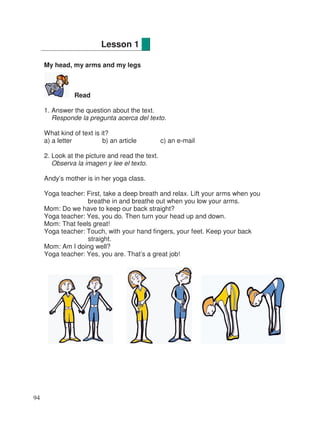
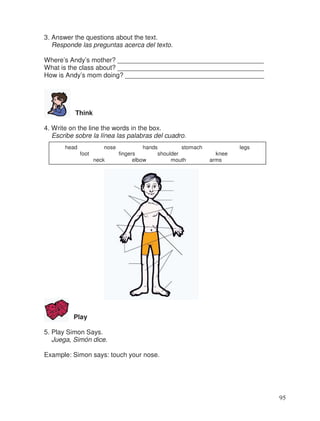
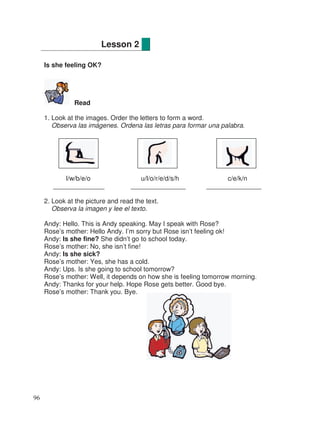
  • 17.
    Write 5. Use theinformation on exercise 4 to write a text and Illustrate it. Usa la información del ejercicio 4 para escribir un texto e ilústralo. __________________________________________ _______________________________________________ _______________________________________________ _______________________________________________ This is your school principal Read 1. Read the dialogue between Pedro and his parents. Lee el diálogo sobre Pedro y sus padres. At school. En la escuela. Lesson 2 Good morning. I’m Mr. Medina and this is Francisco Saavedra, the school principal. Good morning. Nice to meet you. Good morning. Nice to meet you, too. 15 _
  • 18.
    Think 2. Find theoccupations in the text. Match them with their definitions. Encuentra las ocupaciones dentro del texto. Relaciónalas con su definición. a) The person who washes the dishes, cooks food and takes care of the family at home. ________________________________________________________ b) The person who works in a school giving classes to students.______________________________________________________ c) The leader of students and teachers. _____________________________________________________________ d) The person who maintains electric systems. _____________________________________________________________ Sit down please. Are you Pedro’s parents? Yes, I’m his father. Yes, I’m his mother. What do you do? I’m an electrician. And I’m a housewife. Well, Pedro is a good student. There isn’t any problem with him but you have to help him with homework. 16 _ _ _ _
  • 19.
    Read 3. Look andread the announcement, a person needs a baby sitter. Observa y lee el anuncio en donde una persona necesita una niñera. 4. Answer the questions. Contesta las preguntas. a) What does the announcement require? ___________________________ b) What qualities are required? ____________________________________ c) What’s the working time of the job? _______________________________ d) What’s the phone number to schedule an interview? _________________ e) What’s the e-mail address? _____________________________________ 17 _
  • 20.
    Write 5. Design anannouncement offering a service (mechanic, carpenter, teacher, electrician, doctor, etc.). Write your name, your occupation, a phone number or address, your qualities, etc. Diseña un anuncio ofreciendo un servicio (mecánico, carpintero, profesor, electricista, doctor, etc.). Escribe tu nombre, ocupación, número telefónico o dirección, tus cualidades, etc. 18
  • 21.
    What time doyou do have your English class? Read 1. Read the text about Susana’s favorite subjects. Lee el siguiente texto acerca de las materias favoritas de Susana. Think 2. Match the columns. Relaciona las columnas. ______ Susana has History at twelve fifty A) 7:30 ______ Her English class is on Monday is at eleven ten . B) 9:10 ______ She studies Spanish at nine ten. C) 12:50 ______ She starts classes at seven thirty. D) 11:10 Lesson 3 Susana’s favorite subjects. I start classes at 7:30 am and I leave school at 2:00 pm. The recess is at 10:50 and it finishes at 11:10 am. My favorite classes are English, Spanish and History because they are very interesting for me but I like the others, too. I have English class at 11:10 am on Monday; on Wednesday at 10:00 am and on Thursday at 12:50 pm. My History class is on Monday, Wednesday and Friday at 12:00 am. And my Spanish class is from Monday to Friday at 9:10 am. 19
  • 22.
    Write 3. Complete Susana’sschedule with information from the text. Completa el horario escolar de Susana con información del texto. Hour Monday Tuesday Wednesday Thursday Friday 7:30 8:20 Mathematics Mathematics Mathematics Mathematics Mathematics 8:20 9:10 Social studies Social studies 9:10 10:00 Spanish Spanish 10:00 10:50 10:50 11:10 Recess Recess Recess Recess Recess 11:10 12:00 12:00 12:50 History Arts History 12:50 13:40 Physics Arts Physics Physics 13:40 14:00 Technological Education Physical Education Technological Education Physical Education Technological Education Think 4. Choose the answer according to the information. Elige la respuesta de acuerdo a la información. 1) It’s 9:05. We say: It’s five __________ nine. A) quarter B) past 2) It’s 2:15. We say: It’s __________ two A) past B) (a) quarter past 20
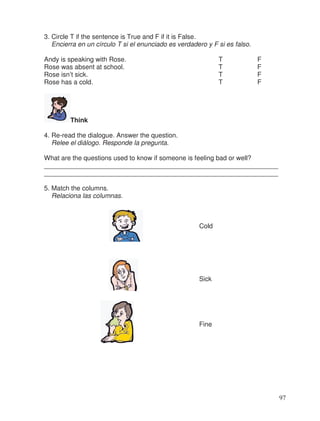
  • 23.
    Read 1) 5. Readand match the time with the picture. Lee y relaciona la hora con el dibujo. 2) Jorge: What time is it Jorge? Jorge: It’s four o’clock. 3 Sister: What time is it? Jorge: It’s a quarter past four.________ Sister: What time is it? Jorge: It’s half past four. _________ 3) Sister: What time is it? Jorge: It’s a quarter to five? _________ And I’m trying to do my homework! Dear sister. 4) 5) 21
  • 24.
    6. Look atthe clocks and match them with the hour. Write the option that corresponds in the parenthesis. Observa los relojes y relaciónalos con la hora. Escribe dentro del paréntesis la opción que corresponda. What time is it? ( ) ( ) ( ) ( ) ( ) ( ) ( ) ( ) a) It’s a quarter to eight. It’s seven forty – five. b) It’s three o’clock. c) It’s six past six. It’s six six. d) It’s half past eight. It’s eight thirty. e) It’s half past five. It’s five thirty. f) It’s nine past twelve. It’s twelve nine. g) It’s five to eleven. It’s ten fifty five. h) It’s a quarter past six. It’s six fifteen. 22
  • 25.
    7. Answer thequestions about yourself. Contesta las siguientes preguntas sobre ti. a) What time is it now? __________________________________________ b) What time is your English class? ________________________________ c) What time is your Mathematics class? ____________________________ d) What time is your Spanish class? ________________________________ Roxane gets up at six o’clock Read 1. Read the text about Roxane. Lee el texto acerca de Roxane. Roxana lives in Canada. She is a secretary. She always gets up at six o’clock in the morning. She takes a shower at a quarter past six. Then, she has an orange juice and cereal for breakfast at seven o’clock. She goes to work at a quarter to eight. Her job is very near her house so she prefers to walk. At half past three she comes back home. Roxana eats dinner at seven o’clock in the evening and then she watches T.V. or reads a book. She goes to bed at half past nine. Lesson 4 23 _ __ _ __ _
  • 26.
    Think 2. Circle theoption that corresponds to the image. Encierra la opción que corresponde a la imagen. 1) What does she do? a) She washes her hands.b) She cooks. 2) What does he do? a) He takes a shower. b) He goes to work. 3) What does he do? a) He reads newspaper. b) He eats breakfast. 4) What does she do? a) She comes back home b) She reads a book. 5) What does he do? a) He watches T.V. b) He goes to bed. 3. Write TRUE or FALSE according to the text. Escribe TRUE o FALSE de acuerdo a la información del texto. a) Roxana gets up very late._______________________________________ b) She has breakfast at seven o’clock. _____________________________ c) She goes to work at one o’clock. _________________________________ d) At half past three she comes back home. __________________________ e) She works at a hospital.________________________________________ f ) At a quarter past six she takes a shower.___________________________ 24 _ _ _ _ _ _
  • 27.
    Read 4. Look atthe pictures and read about Juan’s daily routine. Observa las imágenes y lee la rutina diaria de Juan. Hello I’m Juan. I get up at six o’clock in the morning from Monday to Friday. I take a shower at six fifteen. Then, I have breakfast at seven o’clock. I go to school at half past seven. I play soccer in the recess. I come back home at half past two. I have a meal at three o’clock. I do my homework at twenty past four. I watch T.V. at half past six. I help my mother to cook dinner at half past seven My family and I have dinner at eight o’clock. I go to bed at nine thirty. 25
  • 28.
    Write 5. Write yourdaily routine and draw it. Look at Juan’s routine. Escribe tu rutina diaria y dibújala. Usa como ejemplo la rutina de Juan. Hello. I’m ____________ I get up at Speak 6.Tell your routine to your classmates. Comenta tu rutina con tus compañeros. 26
  • 29.
    My uncle istall and thin Read 1. Read the text. Felipe is at the bus station waiting for his uncle Juan Carlos. Lee el texto. Felipe está en la estación de autobús esperando a su tío Juan Carlos. Lesson 5 Remember, your uncle is tall and thin. He has short, black, curly hair. His eyes are big and brown. His nose is big and he has a nice smile. 27
  • 30.
    Think 2. Classify theunderlined words under the following categories. Clasifica las palabras subrayadas en el texto en las categorías. hair eyes nose build short _ ______________ _____________ ____________ ______________ ______________ ____________ ______________ Read 3. Read the dialogue between Felipe and his uncle. Felipe is describing his sister because his uncle doesn’t know her. Lee el diálogo entre Felipe y su tío. Felipe está describiendo a su hermana porque su tío no la conoce. Juan Carlos: Hello! Are you Felipe? Felipe: Yes, I am. And, are you my uncle Juan Carlos? Juan Carlos: Yes, I am. Nice to meet you. Felipe: Let’s go home. My family is waiting for you. Juan Carlos: Ok. How are they? Tell me about your sister. What does she look like? Felipe: Margarita is short and fat. Her hair is long and black. She has small and brown eyes. She is very intelligent at school. 28
  • 31.
    Read Think 4. Lookat the pictures and match them with the descriptions. Observa las imágenes y relaciónalas con las descripciones. Big, brown eyes Long, straight, black hair. Small, blue eyes. 29
  • 32.
    Short, curly, blondhair. 5. Choose the option that corresponds to the description. Elige la opción que corresponda a la descripción. A B C Juan Carlos is tall and thin. He has short, blond, curly hair. His eyes are big and brown. His nose is big. A B C Margarita is short and fat. Her hair is long and black. He has small and brown eyes. She is very intelligent at school. 30
  • 33.
    A B C Greenmanis medium height and strong. He has short, blond, straight hair. He is green. He has big, black eyes. He is always angry. Write 6. Write what you look like then draw yourself. Describe cómo eres físicamente, después dibújate. What do you look like? I’m___________________________________________ ________________________________________________________________ ________________________________________________________________ ________________________________________________________________ 31
  • 34.
    What does yourteacher look like? Read 1. Read the dialogue. Susana is talking to her mother about her first day at school. Lee el diálogo. Susana platica a su mamá de su primer día en la escuela. Mother: Tell me Susana, how was your day? Susana: It was very nice. I have a new teacher. She is Miss Nancy Contreras. Mother: What does she look like? Susana: She’s tall and slim. Her hair is long, curly and brown. She has big, black eyes. And she wears glasses. I think she is very intelligent. Mother: Is she pretty? Susana: Yes, she is. Think 2. Match the columns. Relaciona las columnas. ______What does she look like? A) He is medium height and fat. ______What do you look like? B) They are short and thin. ______What does he look like? C) She is tall and slim. ______What do they look like? D) I’m short and handsome. Lesson 6 32
  • 35.
    3. Choose theanswer that corresponds. Elige la respuesta según corresponda. 1) We use does with ____________. a) he, she, it b) we, you, they 2) We use do with ____________. a) he, she, it b) we, you, they, I Write 4. Answer the questions. Use the information from the text. Contesta las preguntas. Usa la información del texto. a) What’s the teacher’s name? ____________________________________ b) What’s the teacher’s last name? _________________________________ c) What does Nancy do? _________________________________________ d) What does she look like? _______________________________________ e) Is she pretty? ________________________________________________ 5. Who is Miss Nancy Contreras? Circle the option that corresponds to the description. ¿Quién es la maestra Nancy Contreras? Encierra la opción que corresponda. A B C 33
  • 36.
    Speak 6. Ask yourpartner the following questions and make a drawing. Pregunta a tu compañero las siguientes preguntas y elabora un dibujo. a) What does your mother look like? __________________________________________ __________________________________________ __________________________________________ b) What does your father look like? ______________________________________________ ______________________________________________ ______________________________________________ c) What does she/ he look like? _______________________________________________ _______________________________________________ _______________________________________________ 34
  • 37.
    35 Can you drivea car? Read 1. Look at the pictures and read the dialogues. Roberto is talking about what he can or can’t do. Observa las imágenes y lee los diálogos. Roberto está hablando sobre lo que puede o no puede hacer. Lesson 7 Yes, I can Can you play the guitar? No, I can’t. And you? Can you ride a bicycle? Yes, I can Can you play Basketball? No, I can’t. And you? No, I can’t. And you? Yes, I can Can you climb a tree? Yes, I can No, I can’t. And you? No, I can’t. And you? Yes, I can Can you drive a car? Can you take me to the hospital? Yes, I can
  • 38.
    Think 2. Choose theanswer that corresponds. Elige la respuesta que corresponde. 1) What do we express with can? a) ability b) inability 2) What do we express with can’t? a) ability b) inability 3. Use the information from the text. Answer TRUE or FALSE. Usa la información del texto para contestar TRUE si es verdadero o FALSE si es falso. a) Roberto can’t play the guitar. ________________________ b) Roberto can ride a bicycle. ________________________ c) He can’t climb a tree. ________________________ d) He can drive a car. ________________________ e) He can play basketball. ________________________ 4. What things can you do? Put a check ( ) next to the activities you can do. ¿Qué cosas puedes hacer? Pon una ( ) junto a las actividades que puedes realizar. Yes, I can. No, I can’t. a) Can you play the guitar? _________ ________ b) Can you swim? _________ ________ c) Can you spell your name? _________ ________ d) Can you sing a song in English? _________ ________ e) Can you ride a horse? _________ ________ f) Can you climb a tree? _________ ________ 36
  • 39.
    Speak Write 5. Usethe questions to interview a classmate. Write the answers on the lines. Entrevista a un compañero tomando en cuenta las preguntas anteriores. Escribe las respuestas en las líneas. a) Can you play the guitar? _____________________ b) Can you swim? _____________________ c) Can you spell your name? _____________________ d) Can you sing a song in English?____________________ e) Can you ride a horse? _____________________ f) Can you climb a tree? _____________________ Elephants have big ears and black eyes Read 1. Read the text. Jorge Luis is at the zoo, he’s reading about elephants. Lee el texto. Jorge Luis está en el zoológico, leyendo sobre los elefantes. Lesson 8 Elephants are an endangered species. There are approximately 610, 000 African elephants in the world today. They live in the African Savannah. Elephants are big and gray. They have long trunks. Their ears are big. They are fat and heavy. They weight 12, 000 kilograms. They live 60 years approximately. They drink between 30 and 50 gallons of water a day. They are intelligent animals. 37 _ _ _ _ _ _
  • 40.
    Think 2. Circle theoption that corresponds. Encierra en un círculo la opción que corresponda. 1) The underlined words in the text are: a) Verbs b) Adjectives 2) They are used to: a) describe b) show actions 3. Correct the sentences according to the information from the text. Corrige las oraciones de acuerdo a la información del texto. e.g. An elephant is small An elephant is big a) An elephant is blue. ___________________________________ b) An elephant has a small trunk.___________________________________ c) An elephant is thin. ___________________________________ d) An elephant is light. ___________________________________ e) An elephant is small. ___________________________________ Read 4. Read the texts and circle the option that corresponds. Lee los textos y encierra la letra de la opción que corresponda. A) What am I? I’m tall and strong. My eyes are big and brown. I have small ears. My legs are long and I have very big feet. I can jump. a) a giraffe b) a kangaroo c) an elephant B) What am I? I’m big and strong. My hair is short and black. My eyes are brown and my ears are small. My arms are long and my hands are big. I love bananas. a) a gorilla b) a cat c) a panther 38
  • 41.
    C) What amI? I’m very small. My eyes are small and black. My hair is gray. I have a long tail. I love cheese. a) a lion b) a dog c) a mouse Play 5. Look at the pictures. Circle your favorite animal. Observa las imágenes. Encierra tu animal favorito. Dog cat turtle horse Cow rabbit hummingbird eagle 6. Read the options. Put a check ( ) next to the adjective that describes your favorite animal. Lee las opciones. Pon ( ) junto a los adjetivos que describen a tu animal favorito. My favorite animal is a ______________________ because it is: funny ________ clean ________ mysterious ________ dangerous ________ aggressive ________ intelligent ________ independent ________ beautiful ________ elegant ________ strong ________ 39
  • 42.
    7. Complete thetext. Completa el texto. My favorite animal is a _______________ because it is _____________, ____________, _____________, _____________ and ____________. Whales are very intelligent Read 1. Read the text. Lee el texto. Whales live in all the oceans of the World. They swim in groups near the surface of water because they need oxygen. Some whales eat fish and other whales are vegetarian. They eat plankton. Gray whales live near the coast of Canada in the summer when it is hot. In the fall, when the ocean is cold they migrate to the coast of Baja California. They stay there during the winter and they return to Canada in the spring. They are very intelligent marine animals. Lesson 9 40
  • 43.
    Think 2. Go backto the text. Underline the words that are similar in Spanish (cognates). Then, write them on the lines. Regresa al texto. Subraya las palabras que son similares en español (cognados). Después, escríbelas sobre las líneas. Oceans ___ _________________ _________________ _______________ _________________ _________________ _______________ _________________ _________________ _______________ _________________ _________________ All these words are cognates. They are words that are similar in Spanish but the pronunciation is different. Estas palabras se llaman cognados. Son palabras que son similares en español pero su pronunciación es diferente. Write 3. Write TRUE or FALSE. Use the information from the text. Escribe TRUE si es verdadero o FALSE si es falso. Usa la información del texto. a) Whales live in oceans. _______________ b) Some whales eat fish. _______________ c) They don’t need oxygen. _______________ d) They migrate to Japan. _______________ e) Whales are very intelligent. _______________ f) In the spring whales return to Canada. _______________ 41
  • 44.
    g) Whales arevery intelligent. _______________ h) They swim alone. _______________ i) Some whales eat plankton. _______________ j) The text is about blue whales. _______________ k) Whales are land animals. _______________ 4. Answer the questions about the text. Contesta las preguntas a cerca del texto. a) What is the text about? _________________________________________ b) What do whales eat? __________________________________________ c) Where do whales live? _________________________________________ d) Write in English a short text about whales.__________________________ What is your mother like? Read 1. Read the dialogue. Lee el diálogo. Susana: Hello! How are you? Martha: I’m fine and you? Susana: I’m fine, too. Tell me, what is your new teacher like? Martha: Oh! He’s very patient, kind, creative and intelligent. Susana: That sounds great. Martha: What about you? Susana: Oh no! My teacher is bad-tempered, impatient, rude and boring. Martha: That is terrible. Lesson 10 42 _ _ _
  • 45.
    Think 2. Classify thewords in positive and negative adjectives. Clasifica las palabras en adjetivos positivos y negativos. Positive adjectives Negative adjectives ______________________ ______________________ ______________________ ______________________ ______________________ ______________________ ______________________ ______________________ ______________________ ______________________ Write 3. Match the pictures with the words. Relaciona los dibujos con las palabras. She is friendly He is very angry He is a boring man She is funny He is a lazy boy. She is impatient 43
  • 46.
    Read 4. Read thistext about the zodiac signs. Lee el texto acerca de los signos astrológicos. Many people consult the horoscope because they talk about predictions and describe what are the people like, for example, if they are generous, friendly, bad-tempered, etc. There are twelve zodiac signs: Aries, Taurus, Gemini, Cancer, Leo, Virgo, Libra, Scorpio, Sagittarius, Capricorn, Aquarius and Pisces. 5. How do you think is a person of these zodiac signs like? Answer the questions. Use the words in the box. ¿Cómo crees que es una persona de los siguientes signos? Contesta las siguientes preguntas usando las palabras del cuadro. a) What is an Aries like? He/ She is generous b) What is a Taurus like? _________________________ c) What is a Capricorn like? _________________________ d) What is a Pisces like? _________________________ e) What is an Aquarius like? _________________________ f) What is a Sagittarius like? _________________________ g) What is a Gemini like? _________________________ adventurous practical sociable sincere loyal generous romantic optimistic patient impatient imaginative perceptive arrogant extravagant critical lazy irresponsible rebellious shy impulsive 44
  • 47.
    Speak 6. Answer thesequestions about yourself. Contesta las preguntas sobre ti. a) What is your mother like? She is b) What is your father like? __________________________________ c) What is your teacher like? __________________________________ d) What are you like? __________________________________ e) What is your sister or brother like? _______________________________ I sometimes play soccer Read 1. Read the activities Rogelio does during the week and on weekends. Lee sobre las actividades que Rogelio realiza en la semana y los fines de semana. During the week I go to school from Monday to Friday and I always get up at six o’clock. I usually have meal at half past three then, I do my homework. I often help my mother to wash the dishes. I sometimes practice karate with my friends. On Saturday I never get up early. On Sunday I always play soccer with my brothers and father. Lesson 11 45
  • 48.
    2. Write themissing activities according to the pictures. Use the information from the text. Usa la información del texto para escribir las actividades que faltan de acuerdo con las imágenes. I go to school from Monday to Friday. I often go to a picnic with my family. I sometimes go to the movies. 46
  • 49.
    Think 3. Complete theinformation. Completa la información. 1) The words in bold from text 1 refers to: a) action verbs b) frequency adverbs Write 4. Write a text about you and illustrate it. Escribe un texto sobre ti e ilústralo. _____________________ _____________________ _____________________ _____________________ _____________________ ______________________ ____________________ ____________________ ____________________ _____________________ _____________________ _____________________ ______________________ ______________________ ______________________ _____________________ _____________________ _____________________ 47
  • 50.
    5. Answer thefollowing questions with the words in the box. Responde las siguientes preguntas con las palabras del cuadro. e.g. How often do you go biking? I always go biking with my brother. 1) How often do you play soccer? _________________________________________________ 2) How often do you go swimming? _________________________________________________ 3) How often do you ride a horse? _________________________________________________ 4) How often do you take a shower? _________________________________________________ 5) How often do you have sport classes? _________________________________________________ How often do you go to the movies? Read 1. Read the interview to Ana Guevara about her routine. Lee la entrevista sobre la rutina de Ana Guevara. Reporter: Hello, Ana. How are you? Ana: I’m fine, thanks. Reporter. And, tell me. What time do you get up? Ana: I get up at seven o’clock in the morning. Then, I do exercise. Reporter: How often do you do exercise? Ana: I always go jogging at half past seven in the morning. In the afternoon I go running at five o’clock. Reporter: How often do you go to the movies? Ana: I seldom go to the movies. Reporter: How often do you eat hamburgers? Ana: I never eat hamburgers. Lesson 12 always sometimes never seldom 48
  • 51.
    Think 2. Choose theanswer that corresponds. Elige la respuesta que corresponda. 1) The question: How often? Is used to ask about __________ a) frequency b) personality Write 3. Answer the questions about Ana. Contesta las preguntas acerca de Ana. a) What time does Ana get up? ____________________________________________ b) How often does she do exercise? ____________________________________________ c) How often does she go to the movies? ____________________________________________ d) How often does she eat hamburgers? ____________________________________________ 4. Write TRUE or FALSE. Escribe TRUE o FALSE. a) Ana never gets up early. ____________________ b) She seldom goes to the movies. ____________________ c) She always eats hamburgers. ____________________ d) She gets up at seven o’clock. ____________________ e) She does exercise at half past seven. ____________________ 49
  • 52.
    5. Use yourinformation to complete the chart. Put a check ( ) in the activity and in the frequency according to you. Usa tu información para completar el cuadro. Pon una ( ) en la actividad y la frecuencia, de acuerdo a ti. Activity Play soccer Go to school Watch T.V Wash the dishes Always Often Sometimes Seldom Never 6. Answer the questions. Contesta las preguntas. a) How often do you play soccer? I sometimes play soccer b) How often do you go to school? ________________________________________________________________ c) How often do you watch T.V.? ________________________________________________________________ d) How often do you wash the dishes? ________________________________________________________________ e) How often do you take a shower? ________________________________________________________________ 50
  • 53.
    Do you knowseahorses? Read 1. Read the article. Lee el artículo. Lesson 13 All about seahorses! Seahorses are fish. They are truly unique, and not just because of their unusual equine shape. Unlike most other fish, they are monogamous and mate for life. They are the only animal species on Earth in which the male bears the unborn young. Found in tropical and temperate waters, these upright-swimming can range in size from 0.6 inches (1.5 centimeters) to 14 inches (35 centimeters) long. His average lifespan in the wild is 1 to 5 years (estimated). Male seahorses are equipped with a small bag on their ventral, or front-facing, side. When mating, the female deposits her eggs into his small bag, and the male fertilizes them internally. He carries the eggs until they are fully formed into miniature seahorses. Because of their body shape, seahorses are not good swimmers and can easily die of fatigue when caught in storm-roiled seas but they push themselves by using a small fin on their back that moves up to 35 times per second and they also have smaller pectoral fins located near the back of the head that are used for finding direction. Seahorses have no teeth and no stomach, but food passes through their digestive systems so quickly, and they must eat constantly to stay alive. They anchor themselves with their tails to sea grasses and corals, but by using their big nose to suck in plankton or small crustaceans that are around. They can consume 3,000 or more shrimps per day. 51
  • 54.
    2. Answer thesequestions according to the article of seahorses. Responde las preguntas de acuerdo al artículo de los caballos de mar. 1) What type of specie are the seahorses? _____________________ 2) What do seahorses eat? __________________________________ 3) Where do they live?______________________________________ 4) What do you find most impressing about seahorses?____________ ______________________________________________________ Think 3. Look at the bold words and answer these questions. Fíjate en las palabras en negritas y contesta las siguientes preguntas. 1) When do we use and? ______________________________________________ 2) When do we use but? ______________________________________________ 3) When do we use or? ______________________________________________ Write 4. Circle the word that corresponds. Encierra la palabra que corresponda. 1. I like mosquitos ( and / but / or ) I don’t like spiders. 2. I don’t like cats ( and / but / or ) rats. 3. I like birds ( and / but / or ) monkeys. 4. I don’t like snakes ( and / but / or ) I like crocodiles. 5. I like kangaroos ( and / but / or ) koalas. 52 _ _ _ _ _ _
  • 55.
    5. Write anarticle about an animal you like and know well. Use the words (and/ but/ or) to expand your text. Draw in the box the animal you are writing of. Escribe un artículo de algún animal que te guste y que conozcas bien. Usa las palabras (and/ but/ or) para extender tu texto. Dibuja en el cuadro el animal sobre el que estás escribiendo. Speak 6. Share information with 3 partners to learn more about other animals. Comparte tu artículo con 3 de tus compañeros para que aprendas de otros animales. __________________________________ ____________________________________ ____________________________________ ____________________________________ ____________________________________ ____________________________________________________________ ____________________________________________________________ ____________________________________________________________ ____________________________________________________________ 53
  • 56.
    Learn about koalas Read 1.Read this article. Lee el siguiente artículo. Lesson 14 Learn more about koalas! This animal is often called "koala bear," but this sweet animal is not a bear at all; it is a marsupial, or pouched mammal, it has a small bag to carry its babies. They are fat and hairy, most of them are gray. After birth, a female carries a single baby in its pouch for about six months. When the baby koala grows, it rides on its mother's back or stays in her stomach, accompanying her everywhere until it is about a year old. Koalas live in eastern Australia. They love eucalyptus trees. In fact, they are always on these trees. During the day they sleep up to 18 hours. When not asleep a koala eats eucalyptus leaves, especially at night. Koalas do not drink much water, they get it from the leaves. Each animal eats about two and a half pounds (one kilogram) of leaves a day. They eat so many of these leaves that they take on a unique odor from their oil. Koalas need a lot of space—about 100 trees per animal, a pressing problem as Australia's woodlands continue to reduce. 54
  • 57.
    2. Answer thequestions according to the article of Koalas. Responde a las preguntas de acuerdo con el artículo de los koalas. What are the physical characteristics of the koalas described in the article? ________________________________________________________________ Are the koalas a type of bear? ________________________________________ What type of animals are they? _______________________________________ What do they eat? _________________________________________________ Where do they live? ________________________________________________ What do they do when they aren’t sleeping? _____________________________ Think 3. Complete the information, according to the article about koalas. Completa la siguiente información, de acuerdo con el articulo de los koalas. Write the relevant information on the line. Relevant information: ______________________________________________________________ ______________________________________________________________ ______________________________________________________________ ______________________________________________________________ ______________________________________________________________ ______________________________________________________________ 55 _ _ _ _ _ _
  • 58.
    Write 4. Bring ananimal article of a magazine or newspaper. Search and underline the relevant information to edit an article. Trae un artículo de cualquier periódico o revista que hable sobre animales busca y subraya la información relevante para editar un artículo. 5. Write the information in the chart. Paste the image. Escribe en el cuadro la información. Pega la imagen. __________________________________ ____________________________________ ____________________________________ ____________________________________ ____________________________________ ____________________________________________________________ ____________________________________________________________ ____________________________________________________________ ____________________________________________________________ ____________________________________________________________ ____________________________________________________________ 56
  • 59.
    6. Make aposter. Put it around the windows to help students to identify the specie, name, habitat, activity, what they eat and physical characteristics. Elabora un póster. Pégalo en las ventanas para que los demás alumnos puedan identificar las especies, el nombre, su hábitat, qué comen y sus características físicas. Do animals have routines? Read 1. Read the following article. Lee el siguiente artículo. Lesson 15 Leopards, big cats! Leopards are powerful and fierce big cats related to lions, tigers, and jaguars. They live in Africa, Central Asia, India, and China. When they hunt large animals to eat, they always take the bodies up to the trees, to keep them safe from hunters such as hyenas. First they walk cautiously in the branches, where their spotted coats allow them to camouflage with the leaves. Then they jump to attack. During this process they act always silently and slowly. Finally they execute his prey. These nocturnal predators also hunt antelopes, deers, and pigs by silent movements in the tall grass. When human settlements are present, leopards often attack dogs and, occasionally, people. Leopards are also good swimmers. In the water they sometimes eat fish or crabs. They never eat grass or vegetables. Female leopards always protect their babies. They always hide them and move them from one safe location to the next until they can play and learn to hunt. The babies live with their mothers for about two years. Leopards are light colored with characteristic dark spots that are called rosettes, because they look like the shape of a rose. 57
  • 60.
    2. Answer thesequestions according to the article of leopards. Responde las siguientes preguntas de acuerdo con el artículo de los leopardos. 1) Are leopards cats? _______________________________________________________ 2) What do leopards eat in water? _______________________________________________________ 3) Do leopards occasionally attack people and dogs? _______________________________________________________ 4) What does the mother do to take care of her cubs? _______________________________________________________ 5) What’s the name of the spots leopards have? ________________________________________________________ Think 3. Look at the words in bold in the article. Complete the diagram using the words in the box. Observa las palabras en negritas del artículo. Completa el diagrama, usando las palabras del cuadro. 0 % 50 % 75 % 85 % 100% never ____________ _____________ _____________ always sometimes usually often 58 _ _ _ _
  • 61.
    4. Organize thewords in bold in the article according to their sequence. Organiza las palabras en negritas, de acuerdo a su secuencia. Write 5. Write an article describing an animal and its routine, using frequency adverbs (always, never, often, sometimes) and sequencers (first, then, during, finally). Escribe un artículo de algún animal describiendo sus rutinas, usando los adverbios de frecuencia (always, never, often, sometimes) y las palabras de secuencia (first, then, during, finally). During First Finally Then 1 2 3 4 _________________________________ __________________________________________________________ __________________________________________________________ __________________________________________________________ __________________________________________________________ 59
  • 62.
    What can animalsdo? Read 1. Read the following dialogue. Lee el siguiente diálogo. At school En la escuela Richard: Hi. Do you have pets? Nora: Yes, I have a horse. His name is Dorado. He is brown. Richard: How old is he? Nora: He is fourteen years old. Richard: Can you tell me more about your horse? Nora: Yes, what would you like to know? Richard: What can he eat? Nora: He can eat grass, he is herbivorous. Richard: What can he do? Nora: He can take me to school and he can jump very high. Nora: Do you have pets? Richard: Yes, I do. I have a cat. Nora: What’s his name? Richard: His name is Roco. He is black and white. He can climb trees. Lesson 16 60
  • 63.
    2. Answer thefollowing questions. Contesta las siguientes preguntas. 1) What are Nora and Richard talking about? __________________________________________________________ 2) What can Dorado do? __________________________________________________________ 3) How old is Dorado? __________________________________________________________ 4) What’s the name of Richard’s cat? __________________________________________________________ Think 3. Complete the information. Completa la información. A) We use can to show __________ a) time b) ability 61
  • 64.
    Write 4. Answer thefollowing questions. Responde las siguientes preguntas. e.g. Can bees make honey? Yes, they can. Can polar bears swim? Yes, they can. Can mosquitoes dance? No, they can’t. Can giraffes swim? _____________________________________________________________ Can fishes run? _____________________________________________________________ Can lions eat vegetables? _____________________________________________________________ Can people fly? _____________________________________________________________ Can crabs speak in English? _____________________________________________________________ 62
  • 65.
    5. Write onthe lines different abilities of 5 different animals you know. Use can. Escribe sobre la línea diferentes habilidades de 5 diferentes animales que conozcas. Usa can. ________________________________________________________________ ________________________________________________________________ ________________________________________________________________ ________________________________________________________________ ________________________________________________________________ Speak 6. Share the information of exercise 5 with your partners. Comparte la información del ejercicio 5 con tus compañeros. 63
  • 66.
    Have you heardabout white lions? Read 1. Read the article. Lee el artículo. Lesson 17 White lions White lions are one of the rarest and most mysterious animals on the planet. White lions are identical in their physique appearance to the other lions. They have the same behavior and eating habits to the rest of the species. Their principal characteristic is that they have an unusual color. They are white colored. These mysterious felines are natives of the Timbabati Nature Reserve in South Africa. The white lion is associated with prosperity and abundance. He is considered to be a gift from God. People believe that the white lion has a special divine power. He is venerated by the local people of South Africa, because of his white coats that represent the good to be found in all creatures. Because of their unusual appearance, they have become prized hunting trophies. They have become the main attraction in circuses and zoos around the world. It is virtually impossible to find wild lions in the wild. 64
  • 67.
    2. Answer thenext questions. Contesta las siguientes preguntas. 1) Have you ever heard about white lions? ____________________________________________________________ 2) What’s the principal characteristic of these rare animals? ____________________________________________________________ 3) Are the white lions associated with God? ____________________________________________________________ 4) Where do they live? ____________________________________________________________ 5) Are they carnivores? ____________________________________________________________ Think 3. Look at the words in bold in the text. Complete the information. Observa las palabras en negritas en el texto. Completa la información. We use _____ to show possession. a) Their b) They We use the verb to _______ to show possession. a) be b) have We use the verb to _______ in different forms: is, are, am. a) go b) be 65
  • 68.
    Write 4. Complete thegapped text. Completa los espacios del texto. e.g. She has a bird. His name is Romeo. He is yellow and a professional singer. I have a cat. Her name _________ Kitty. ________ is black and ___________. He _________ a dog. ________ name is Cat. He _________ brown and ______________. She __________ a fish. His __________ is Cleto. He is blue. Write Speak 5. Work in small groups. Ask your partners information about their pets. Complete the chart. Trabaja en pequeños grupos. Pregunta a tus compañeros información acerca de sus mascotas. Completa el cuadro. e.g. I’m Juanita. I have a parrot. His name is Chato. He is yellow and blue. Name Pet name Pet Description Juanita Chato parrot yellow and blue 66
  • 69.
    Animals that livein your community Write Speak 1. Work in small groups. Choose an animal that lives in your community. Trabajen en pequeños grupos. Elijan algún animal que habite en su comunidad. 2. Draw the animal you have chosen. Dibuja el animal que elegiste. Lesson 18 67
  • 70.
    Write 3. Write allthe details about the animal: Physical characteristics Habits and routines Appropriate care of the animal Habitat Escribe todos los detalles del animal: Características físicas Hábitos y rutinas Cuidados apropiados para el animal Hábitat Physical characteristics Habits and routines Appropriate care Habitat Speak Think 4. Organize the information you get and expose it to the class. Organiza tu información y exponla ante la clase. 68
  • 71.
    Extra activity 5. Withthe permission of the school, you may also setup a birdfeeder outside the window of your classroom and watch the behavior of birds from your classroom. Con el permiso de tu escuela, hagan un semillero de aves en la ventana de tu salón de clases y observa el comportamiento de las aves que lo visiten. My favorite athlete is Ana Guevara Read 1. Read the next biography. Lee la siguiente biografía. . Lesson 19 Ana Guevara was born in Nogales, Sonora on March 4 th 1977. Her favorite sport is basketball so she started playing basketball at school. Later she became an athlete because her running ability was impressing. Ana Guevara is a very athletic woman, she is dark, medium height and slim.Her hair is long, straight and brown. Her eyes are brown. She has a big smile. She won her first gold medals in 1996 and 1997. Because of her temper, powerful legs and talent she went to the Olympic Games of Sydney and she placed in the top 5 of the world. In 2002 her goal was to conquer the Golden League and she did it. She ran in the University Stadium of Mexico City in 2003 and she broke her own mark on 300 mts. She is now preparing to go to the Olympic Games of Beijing in 2008. 69
  • 72.
    2. Answer thequestions about Ana Guevara. Responde las preguntas sobre Ana Guevara. 1) What does Ana look like? _______________________________________________________ 2) What does she do? _______________________________________________________ 3) When is her birthday? _______________________________________________________ 4) Where is she from? _______________________________________________________ 5) When did she start to win medals? _______________________________________________________ Think 3. Choose the answer that corresponds. Elige la respuesta que corresponda. When you talk about other people you use:____________ a) he/ his, she/ her, it/ its b) I/ my, me/ mine We use adjectives to ___________ people. a) describe b) name Write 4. Answer the following questions. Responde las siguientes preguntas. 1) What does your mother look like? __________________________________________________________ 2) What does your father look like? __________________________________________________________ 3) What’s your favorite athlete? __________________________________________________________ 70
  • 73.
    5. Describe aperson you admire. Describe a una persona que admires. ________________________________________________________________ ________________________________________________________________ ________________________________________________________________ ________________________________________________________________ Speak 6. Work in pairs. Ask your partner about the person she/he admires. Trabajen en parejas. Pregunta a tu pareja sobre la persona que él/ella admire. 71
  • 74.
    What animals doyou like? Read 1. Read the next 3 articles. Lee los siguientes 3 artículos. Lesson 20 California Condor Gymnogyps californianus: Vulture Culture Look, up in the sky! (We mean WAY up, as in 15,000 feet!) It's a bird, all right—the mighty California condor! And with all due respect to that tall dude with yellow feathers on Sesame Street, this high flyer holds the title of the largest bird in North America. Weighing up to 25 pounds, he's got a wingspan of 9 1/2 feet and can glide for hours at 55 mph without once beating his wings. If that sounds hard, well...it is. It takes a year for young condors to sharpen their soaring skills. The California condor is a vulture, a type of bird recognizable by his big size and bald head. And like his vulture cousins, the California condor chows down on carrion. That's the meat of dead animals, such as cattle, sheep, deer and horses. It may sound gross to you, but just think—he's part of nature's clean-up crew. And besides, he always washes up after dinner by rubbing his head and neck against grass, rocks and trees. No rinsing needed!http://www.aspca.org/site/PageServer?pagename=kids_abcs _californiacondor Elephant: “Nose-Y” Neighbor Loxodonta africana Imagine if you had a machine that could prepare all your meals, give you a shower, carry your backpack and provide sound effects for a variety of social occasions.You may not be able to find one in stores, but the African elephant is lucky enough to carry one with him at all times. If you haven’t already guessed it, we’re talking of the trunk—and this big guy is really kind of attached to his! The African elephant’s trunk is actually an extension of his upper lip and nose, and he uses it for drinking, greeting friends, trumpeting, lifting and grasping. And like any self-respecting nose, this one’s good for smelling, too. But most importantly, the elephant uses his trunk to gather and bring food to his mouth. And we don’t mean a berry here and a blade of grass there. To keep his 13,000-pound self strong and healthy, an African elephant needs to consume more than 300 pounds of grass, shrubs, leaves and fruit a day. Pass the salad, please! http://www.aspca.org/site/PageServer?pagename=kids_abcs_el ephant 72
  • 75.
    2. Choose theone you like the most. Escoge el texto que más te gustó. Write 3. Answer these questions about the article you chose. Contesta las siguientes preguntas acerca del artículo que elegiste. 1) What kind of animal is it? ________________________________________ 2) What’s its principal physical characteristic?__________________________ 3) What does it eat?______________________________________________ 4) Where does it live?_____________________________________________ 5) Why did you choose this animal?__________________________________ 6) Describe the animal. What is it like? _______________________________ 7) What is it called? ______________________________________________ Panda Ailuropoda melanoleuca: BamBOO! Forget about getting a quick bite to eat! China's giant panda devotes 12 hours of every day to eating! To get all the nutrition he needs, he has to consume about 15 percent of his bodyweight daily. That comes out to between 28 and 36 pounds of bamboo, his meal of choice. Luckily, he has special chewing muscles and broad, flat teeth for all that bamboo chomping. He's got special markings, too. We may think pandas are totally cute, but their black eyes and big, black circles on their faces may look like 2 pairs of giant, glaring, staring eyes to animals who try to invade their territory. For more information, and to see what a real live panda is doing right now, at the San Diego Zoo. http://www.aspca.org/site/PageServer?pagename=kids_abcs_panda 73 _ _ _ _ _ _
  • 76.
    4. Organize theinformation you get and write a text about the animal you chose on exercise 2. Use possesive pronouns (his, her, its). Organiza la información que recaudaste y escribe un texto del animal que escogiste en el ejercicio 2. Usa pronombres posesivos (his, her, its). ________________________________________________________________ ________________________________________________________________ ________________________________________________________________ ________________________________________________________________ ________________________________________________________________ ________________________________________________________________ ________________________________________________________________ ________________________________________________________________ ______________________________________________ Extra activity 5. Bring a magazine for the next class. Trae una revista para la clase siguiente. Create a gallery of famous people Play 1. Open the magazine and choose 2 different artists. Abre la revista que trajiste y escoge 2 diferentes artistas. 2. Cut the images that you have chosen. Recorta las imágenes que hayas escogido. Lesson 21 74
  • 77.
    3. Paste theimages you get on an empty sheet. Pega las imágenes que cortaste en una hoja en blanco. e.g. 4. Write a description of the artists you chose. Include name, place of birth, date of birth, physical description, activities they do and abilities. Escribe una descripción de los artistas que recortaste incluye datos como: nombre, lugar de nacimiento, fecha de cumpleaños, descripción física, actividades que desempeñan y habilidades. 5. Paste the posters on the windows, walls and board. Pega los pósters que creaste en las ventanas, paredes y en el pizarrón. Come to visit our gallery! Play 1. Invite different people to your gallery. Tell other partners, your parents and teachers. Invita a diferentes personas a tu galería. Dile a otros compañeros, a tus papás y a tus maestros. Lesson 22 75
  • 78.
    2. Look atthe pictures of the artists and read their descriptions. Observa las fotos de los artistas y lee sus descripciones. 3. Choose 4 artists and complete the chart with the information you read on the gallery. Completa los cuadros con la información que obtuviste de 4 artistas de la galería. 1) 2) 3) Gallery of Famous People Name: ___________________________ Birth of date: ___________________________ Age: ___________________________ Occupation: ___________________________ Abilities: ___________________________ ______________________________________ Gallery of Famous People Name: ___________________________ Birth of date: ___________________________ Age: ___________________________ Occupation: ___________________________ Abilities: ___________________________ ______________________________________ Gallery of Famous People Name: ___________________________ Birth of date: ___________________________ Age: ___________________________ Occupation: ___________________________ Abilities: ___________________________ ______________________________________ 76
  • 79.
    4) Speak 4. Share theinformation of the artists you chose with your partners. Comparte la información de los artistas que escogiste con tus compañeros. Gallery of Famous People Name: ___________________________ Birth of date: ___________________________ Age: ___________________________ Occupation: ___________________________ Abilities: ___________________________ ______________________________________ 77
  • 80.
    Who is it? Play 1.Match the animals with the descriptions. Relaciona a los animales con las descripciones.. ___ ___ ___ ___ 1) She is white. Her name is Kiki. She lives in a farm. Her babies live in eggs. 2) He is gray. His name is Kolo. He lives in the trees. 3) She is brown and green. Her name is Lizzi. She lives in the water. 4) He is gray. His name is Cheesy. He has a long tail. He loves eating cheese. Lesson 23 78
  • 81.
    2. Now let’sguess who the following famous people are. Match the columns. Relaciona las columnas de acuerdo con el personaje famoso que corresponda. She has straight blond hair. She has long hair. She’s a Mexican singer. He has curly and black hair. He’s a soccer player. She has wavy and black hair. She’s from Veracruz. She’s an actress. She has curly, long and brown hair. She loves children. She’s a singer. He has straight blond hair. He’s from England. He´s a soccer player. 79
  • 82.
    3. Choose thecorrect option. Escoge la opción que corresponda. Elephants are _________________. They have _____________ trunks. (green / gray) (long / short) Turtles are _________________. They have a ______________ shells. (purple / green) (big / small) Giraffes are _______________. They have _____________ necks. (tall / short) (long / short) A mouse is ________________. It has a __________________ tail. (big / small) (long / short) A whale is _________________. It is ___________________. (gray / orange) ( small / big) 4. Draw the animal that the text describe. Dibuja el animal que describe el texto. It is big. It has big ears, small eyes and a long neck. It is fat and green. It has four short legs. Its arms are long and its hands are black. 80
  • 83.
    Review Write 1. Draw thehands of the clock according to the hour. Dibuja las manecillas a los relojes de acuerdo con la hora. It’s three o’clock. It’s half past two. It’s a quarter to nine. It’s a quarter past four. It’s one fifteen. It’s ten to five. Lesson 24 81
  • 84.
    2. Find thewords: always, usually, often, sometimes, seldom, never. Encuentra las palabras: always, usually, often, sometimes, seldom, never. 3. Match the description with the animal. Relaciona las descripciones con el animal. It is small. It has small ears and a long tail. It loves cheese. It is big. It has a long trunk and big ears. It is gray. It is brown. It has a tail. It is a man’s best friend. It is small. It can fly. It lives in the forest. It is gray. It lives in the sea. It can swim. S N E V E R U O O F T E N R T A M H F W R U U S E I K R Y M S C T O M V O U U G I A S D R S A U M P L R T Y L D E E D W F G L B S O V G A Y Y U R H K Q E Y G A Y M E A W S S R 82
  • 85.
    4. Read thetext. Then, complete the information. Lee el texto. Después completa la información. Zeta 54 is from space. He is 201 years old. He is a singer. He is tall and fat. He has a big head and only one blue eye. He has four hands and two legs. His feet are big. He is orange. He is friendly, kind, patient, adventurous and intelligent. Zeta 54 has a brother. His name is Zeta 55 and he is 190 years old. He is an actor. He is short and thin. He has a small head and only one green eye. He has four hands and long legs. He is blue. He is aggressive, bad-tempered, impatient and lazy. Name Age Physical Appearance Personality Occupation 5. Write AND, BUT, OR. Escribe AND, BUT, OR. a) I have English class on Monday, Wednesday, ______________ Thursday. b) Do you prefer cats _____________ dogs? c) I like vegetables ______________ I don’t like carrots. d) In my schoolbag I carry a book, a notebook, a pen ___________ a pencil. e) My dog is very clean ___________ it doesn’t like to take a shower. 83
  • 86.
    6. Find thewords and circle them. All of these words are related to you and your relationship with your pet. Look them up in a dictionary and write their meanings. Encuentra las palabras y enciérralas. Todas estas palabras están relacionadas contigo y tu mascota. Búscalas en el diccionario y anota su significado. ACCEPT COMPANIONSHIP INTERDEPENDENCE RESPECT BUDDY CONFIDE RESPONSIBILITY LOVE CARE ENJOY MUTUAL REST COMFORT EXERCISE PLAY TRAIN FRIEND COMMITMENT PROTECTION TRUST I A S F E R A S P P L A Y R C N C Y R B E S I C R E X E N O T C N I A S N E S E T E V O M E E A E R P I E L S B R L I P R P E N C O M M I T M E N T A D T J D O N K E R Z E S B C N E R A B I S E T O F B P L E I P U E D E I S P E R T E S T O E Y D D U B T O E R A C T O N N R I N N I D L E D I T S R S D T F I S L O V E H R D U P H E R N A U I G H T H O E R R I N A O L A T R O F M O C T S P C I C N E Y Z Z C L I R E N Y E N J O Y G M U T U A L R E I 84
  • 87.
    Write 1. Draw thehands of the clock according the hour. Dibuja las manecillas a los relojes de acuerdo a la hora. Page 71/ página 71 (3:00) (2:30) (8:45) (4:15) (1:15) (4:50) Answer Key/ Respuestas 85
  • 88.
    Page 72/ página72 2. Find the words: always, usually, often, sometimes, seldom, never. Encuentra las palabras: always, usually, often, sometimes, seldom, never. 3. Match the description with the animal. Relaciona las descripciones con el animal. It is small. It has small ears and a long tail. It loves cheese. It is big. It has a long trunk and big ears. It is gray It is brown. It has a tail. It is the best friend of a man. It is small. It can fly. It lives in the forest. It is beautiful. It is gray. It lives in the sea. It can swim. S N E V E R U O O F T E N R T A M H F W R U U S E I K R Y M S C T O M V O U U G I A S D R S A U M P L R T Y L D E E D W F G L B S O V G A Y Y U R H K Q E Y G A Y M E A W S S R 86
  • 89.
    Page 73/ página73 4. Read the text. Then, complete the chart. Lee el texto. Después completa la información. Zeta 54 is from space. He is 201 years old. He is a singer. He is tall and fat. He has a big head and only one blue eye. He has four hands and two legs. His feet are big. He is orange. He is friendly, kind, patient, adventurous and intelligent. Zeta 54 has a brother. His name is Zeta 55 and he is 190 years old. He is an actor. He is short and thin. He has a small head and only one green eye. He has four hands and long legs. He is blue. He is aggressive, angry, impatient and lazy. Name Age Physical Appearance Personality Occupation Zeta 54 201 years old tall and fat. orange. a big head. friendly, kind, patient, adventurous and intelligent. singer. Zeta 55 190 years old short and thin. a small head. blue. aggressive, angry, impatient and lazy. actor. Page 73/ página 73 5. Write and, but, or. Escribe and, but, or.. a) I have English class on Monday, Wednesday and Thursday. b) Do you prefer cats or dogs? c) I like vegetables but I don’t like carrots. d) In my schoolbag I carry a book, a notebook, a pen and a pencil. e) My dog is very clean but it doesn’t like to take a shower. 87
  • 90.
    Page 74/ página74 6.- I A S F E R A S P P L A Y R C N C Y R B E S I C R E X E N O T C N I A S N E S E T E V O M E E A E R P I E L S B R L I P R P E N C O M M I T M E N T A D T J D O N K E R Z E S B C N E R A B I S E T O F B P L E I P U E D E I S P E R T E S T O E Y D D U B T O E R A C T O N N R I N N I D L E D I T S R S D T F I S L O V E H R D U P H E R N A U I G H T H O E R R I N A O L A T R O F M O C T S P C I C N E Y Z Z C L I R E N Y E N J O Y G M U T U A L R E I 88
  • 91.
    Materiales de apoyo TemasMaterial sugerido Puedes consultar estas páginas a lo largo de toda la unidad 1. • www.bbc.co.uk/teens • www.afterschool.gov/kidsnteens2.html • Programa sepAingles: Programa 9 “Spare Time” • www.animalplanet.org • www.animaland.org • www.kidsplanet.org Bibliografía Beare, N., Links 2 Teacher´s Guide, México, Macmillan, 2005. Celorio, G., Smash! 2, Teacher´s Resource Book, México, Richmond Publishing, 1997. Domínguez, E., et al., Connetions one. Student´s Book, México, Nuevo México, 2006. Emilsson, E., et al., Dialogues. English 1, México, Fondo de Cultura Económica, 2002. Enciclomedia, Inglés. Student Workbook, Nivel 1. Volumen 1. México, 2006. Haines, P. et al., Crossroads. English 1. México, Oxford University Press, 2006. Kirn, E., et al., A Communicative Grammar, México, McGraw Hill,1996. Programas de Estudio. Educación básica. Secundaria. Lengua Extranjera Inglés, México, SEP, 2006. Salazar, J., English 1. México, Santillana, 2006. Van der Werff,J., New Passport Student´s Book, México, Richmond Publishhing, 2006 89
  • 93.
    Health and thebody/Salud y el cuerpo IIInglés TS-APUN-INGLES-2.indd 4 21/2/08 13:07:00 Unit 2
  • 95.
    Unit 2 Health andthe body/Salud y el cuerpo El propósito de esta unidad es capacitar a los estudiantes para que puedan dar consejos y hacer sugerencias sobre la salud. Lesson 1 My head, my arms and my legs Lesson 2 Is she feeling OK? Lesson 3 Do you feel sick? Lesson 4 What’s the matter? Lesson 5 You should stay in bed Lesson 6 You shouldn’t go to bed late Lesson 7 Mini Check Lesson 8 Take some pills Lesson 9 I would go to the dentist Lesson 10 I wouldn’t use toothpicks Lesson 11 A visit to the dentist Lesson 12 Why don’t you go to the nutritionist? Lesson 13 You’d better change your eating habits Lesson 14 Drink a cup of tea Lesson 15 I have mumps Lesson 16 Mini Check Lesson 17 Project: Drugs abuse and illegal drugs. Part one Lesson 18 Project: Drugs abuse and illegal drugs. Part two Lesson 19 Project: Drugs abuse and illegal drugs. Part three Lesson 20 Project: Drugs abuse and illegal drugs. Part four Lesson 21 Review 21 sessions, 7 weeks/ 21 sesiones, 7 semanas Purpose/Propósito Topics/Temas 93
  • 96.
    My head, myarms and my legs Read 1. Answer the question about the text. Responde la pregunta acerca del texto. What kind of text is it? a) a letter b) an article c) an e-mail 2. Look at the picture and read the text. Observa la imagen y lee el texto. Andy’s mother is in her yoga class. Yoga teacher: First, take a deep breath and relax. Lift your arms when you breathe in and breathe out when you low your arms. Mom: Do we have to keep our back straight? Yoga teacher: Yes, you do. Then turn your head up and down. Mom: That feels great! Yoga teacher: Touch, with your hand fingers, your feet. Keep your back straight. Mom: Am I doing well? Yoga teacher: Yes, you are. That’s a great job! Lesson 1 94
  • 97.
    3. Answer thequestions about the text. Responde las preguntas acerca del texto. Where’s Andy’s mother? ________________________________________ What is the class about? ________________________________________ How is Andy’s mom doing? ______________________________________ Think 4. Write on the line the words in the box. Escribe sobre la línea las palabras del cuadro. Play 5. Play Simon Says. Juega, Simón dice. Example: Simon says: touch your nose. head nose hands stomach legs foot fingers shoulder knee neck elbow mouth arms 95
  • 98.
    Is she feelingOK? Read 1. Look at the images. Order the letters to form a word. Observa las imágenes. Ordena las letras para formar una palabra. l/w/b/e/o u/l/o/r/e/d/s/h c/e/k/n ______________ _______________ _______________ 2. Look at the picture and read the text. Observa la imagen y lee el texto. Andy: Hello. This is Andy speaking. May I speak with Rose? Rose’s mother: Hello Andy. I’m sorry but Rose isn’t feeling ok! Andy: Is she fine? She didn’t go to school today. Rose’s mother: No, she isn’t fine! Andy: Is she sick? Rose’s mother: Yes, she has a cold. Andy: Ups. Is she going to school tomorrow? Rose’s mother: Well, it depends on how she is feeling tomorrow morning. Andy: Thanks for your help. Hope Rose gets better. Good bye. Rose’s mother: Thank you. Bye. Lesson 2 96
  • 99.
    3. Circle Tif the sentence is True and F if it is False. Encierra en un círculo T si el enunciado es verdadero y F si es falso. Andy is speaking with Rose. T F Rose was absent at school. T F Rose isn’t sick. T F Rose has a cold. T F Think 4. Re-read the dialogue. Answer the question. Relee el diálogo. Responde la pregunta. What are the questions used to know if someone is feeling bad or well? ________________________________________________________________ ________________________________________________________________ 5. Match the columns. Relaciona las columnas. Cold Sick Fine 97
  • 100.
    Write 6. Write adialogue similar to exercise 2. Escribe un diálogo similar al del ejercicio 2. ________________________________________________________________ ________________________________________________________________ ________________________________________________________________ ________________________________________________________________ Do you feel sick? Read 1. Answer the question. Responde la pregunta. What are they doing? a) Writing a letter b) Speaking on the phone 2. Read the dialogue. Lee el diálogo. Andy: Hello. This is Andy. How does Rose feel? Rose’s mother: Hello Andy. She feels better. Don’t you want to talk to her? Andy: Yes, I do. Rose’s mother: OK. Hold on please. Rose: Hi Andy. Andy: Do you feel better? We miss you at school. Rose: Yes, I do. I believe I’ll be back at school tomorrow. Andy: That’s great! See you tomorrow. Rose: Good bye. Andy: Bye. Lesson 3 98
  • 101.
    3. Circle Tif the sentence is True and F if it is False. Encierra en un círculo T si el enunciado es verdadero y F si es falso. Andy is speaking with Rose’s father. T F Rose is feeling better. T F Andy misses Rose at school. T F Rose will be back at school tomorrow. T F Think Write 4. Complete the chart using the dialogue. Completa la tabla usando el diálogo. Forms of do Questions Does Do don’t 5. Choose the answer that corresponds. Elige la respuesta que corresponda. We use __________ with singular nouns and the pronouns he, she and it. a) do b) does We use __________ with plural nouns and the pronouns I, we, you and they. a) do b) does They are the negative forms of do: __________ a) done/ doesn’t b) don’t/ doesn’t 99
  • 102.
    Write 6. Look atthe image. Complete the text. Observa la imagen. Completa el texto. John: __________ you feel ok? Ray: Yes I __________ but Laura ___________ feel good. John: Laura __________ you feel fine? Laura: No, I __________. I have a headache. What’s the matter? Read 1. Answer the question. Responde la pregunta. What kind of texts are these? a) letters b) articles c) dialogues Lesson 4 100
  • 103.
    2. Read thedialogues. Lee los diálogos. 3. Circle T if the sentence is True and F if is False. Encierra en un círculo T si el enunciado es verdadero y F si es falso. In the dialogue one Andy has a stomachache. T F In the dialogue two Andy’s mom has a toothache. T F In the dialogue Andy has a headache. T F What’s the matter Andy? I have a stomachache. What’s the matter Mom I have a cough and a cold. What’s the matter Andy? I have a headache. 101
  • 104.
    Think Write 4. Completethe chart using the words in the box. Look at the parts of the body. Completa la tabla usando las palabras del cuadro. Observa las partes del cuerpo. To identify problems we ask: _______________________________________ cold toothache stomachache cough headache earache 102
  • 105.
    Write 5. Write onthe line people’s problems. Escribe sobre la línea los problemas de las personas. Example: She has fever. __________________________ __________________________ __________________________ __________________________ __________________________ 103
  • 106.
    Speak Write 6. Workin pairs. Write a dialogue similar to exercise two and practice saying it with your partner. Trabaja en parejas. Escribe un diálogo similar al del ejercicio dos y practica diciéndolo en voz alta con tu compañero. ________________________________________________________________ ________________________________________________________________ ________________________________________________________________ You should stay in bed Read 1. Answer the questions. Order the words to form a word. Responde las preguntas. Ordena las letras para formar una palabra. What’s the problem? a) a/e/h/d/h/c/a/e _____________________ b) r/e/f/e/v _____________________ c) o/t/s/m/a/c/h/e/a/c/h/ _____________________ 2. Read the dialogue. Lee el diálogo. Andy: Good morning Mom. Mom: Good morning Andy. Andy: Are you OK? Mom: No, I have a headache. Andy: You should stay in bed. Mom: But that’s impossible! I have lots of things to do. Andy: You should take a nap. Mom: Yes, you are right. Lesson 5 104
  • 107.
    3. Answer thequestions. Responde las preguntas. What’s the problem of Andy’s mother? _____________________________________________________________ What’s Andy’s mom going to do? _____________________________________________________________ Think 4. Choose the answer that corresponds. Elige la respuesta que corresponde. We use ______________ to give advice. a) Should b) Do Write 5. Match the columns. Relaciona las columnas. 1) I have a toothache. a) She should put on her sweater. 2) She has a headache. b) He should go to the doctor. 3) He has a stomachache. c) You should drink some water. 4) I’m thirsty. d) You should go to the dentist. 5) She is cold. e) She should take an aspirin. Speak Write 6. Work in pairs. Write different situations. Give advices to the situations. Share your information with your classmates. Trabaja en parejas. Escriban diferentes situaciones. Den consejos para las situaciones. Compartan la información con sus compañeros. 105
  • 108.
    Example: a) I wantto loose weight. b) You should stop eating chocolate and sweets. a) __________________________________________________ b) __________________________________________________ a) __________________________________________________ b) __________________________________________________ a) __________________________________________________ b) __________________________________________________ a) __________________________________________________ b) __________________________________________________ You shouldn’t go to bed late Read 1. Complete the information. Completa la información. Tom always goes to bed very late and he is always tired. He ____________ go to bed earlier. Lesson 6 106
  • 109.
    2. Read thedialogue. Lee el diálogo. Mom: Andy, you shouldn’t watch too much T.V. Andy: Mom, it’s my favorite cartoon! Mom: You should do your homework. Andy: Yes, I should. Mom: Andy it’s late! You shouldn’t have to be awake up. Have you finished your homework? Andy: It’s almost done! Mom: You should go to sleep now! 3. Circle T if the sentence is True and F if is False. Encierra en un círculo T si el enunciado es verdadero y F si es falso. Andy is watching T.V. T F Andy’s mom is happy because Andy is watching T.V. T F Andy has done his homework early. T F It is late and Andy is doing his homework. T F Think 4. Choose the answer that corresponds. Elige la respuesta que corresponda. It is the negative form of should. a) Don’t b) Shouldn’t 107
  • 110.
    Write 5. Match thecolumns. Relaciona las columnas. 1) You work too hard. a) She shouldn’t smoke. 2) She is fat. b) You shouldn’t work so hard. 3) He is grounded. c) She shouldn’t eat junk food. 4) I have a cold. d) You shouldn’t drink cold drinks 5) She has a cough. e) He shouldn’t behave so bad. Speak Write 6. Work in pairs. Write different situations. Give advices to the situations. Share your information with your classmates. Trabaja en parejas. Escriban diferentes situaciones. Den consejos para las situaciones. Compartan la información con sus compañeros. a) __________________________________________________ b) __________________________________________________ a) __________________________________________________ b) __________________________________________________ a) __________________________________________________ b) __________________________________________________ a) __________________________________________________ b) __________________________________________________ 108
  • 111.
    Mini Check Read 1. Answerthe question. Responde la pregunta. What kind of text is it? a) an e-mail b) a letter c) an article 2. Read the text. Lee el texto. Dear Rose, I’m writing you to tell you that I fell down when I was walking down the street. I injured my right knee. I went to the Doctor and he told me I should take care of my knee. I should put some ointment on. I shouldn’t walk until it gets better. Are you OK? How do you feel? Please write soon. Regards, Andy Lesson 7 109
  • 112.
    3. Circle Tif the sentence is True and F if is False. Encierra en un círculo T si el enunciado es verdadero y F si es falso. Andy is writing a letter to Rose. T F Andy fell down the bed. T F Andy injured his right knee. T F Andy should put ointment on. T F Write 4. Order the questions and write them on the line. Answer the questions. Ordena las preguntas y escríbelas sobre la línea. Contesta las preguntas. 1) she/ Is/ sick? _______________________________________ _______________________________________ 2) the/ What/ matter/ ‘s/? _______________________________________ _______________________________________ 3) feel/ Do/ sick/ you/ ? _______________________________________ _______________________________________ 4) does/ he/ How/ feel/ ? _______________________________________ _______________________________________ 110
  • 113.
    5. Find thewords in the box and circle them. Encuentra y encierra las palabras del cuadro. S P T B M V E A R J H Q T O Y U I O P T R Y Z X O C H D G H Y E L A S T M E D F J U W P W R H T A R M S I Q O S C A G D C H K O A U X Y C Q T H H H P Z J Z H H V B P A A Ñ V C B U E C A L L N C B X N I K E E L I D K H H M P M A F O W O B L E 6. Answer the letter to Andy. Responde la carta a Andy. stomachache head elbow toothache ear arms hand ____________________ Dear _______________, __________________________________________ __________________________________________ __________________________________________ __________________________________________ __________________________________________ _________________________________________. Regards, ___________________ 111
  • 114.
    Take some pills Read 1.Answer the question. Responde la pregunta. Who is the man that works at a hospital and takes care of people’s health? He is a _____________. a) mechanic b) doctor c) policeman 2. Read the dialogue. Lee el diálogo. Mom: How are you feeling today? Andy: I woke up with a cold. Mom: I think we should go to see Dr. Lopez. Dr. Lopez: What’s the matter? Mom: Andy has a cold. Dr. Lopez: I see! You also have fever. OK, Andy you have to stay in bed for two days, take some pills and don’t drink cold water. Mom: You heard that, Andy. You have to stay in bed. Lesson 8 112
  • 115.
    3. Answer thequestions. Responde las preguntas. Why did Andy go to the doctor? ___________________________________________________________ What did the doctor advice Andy? ___________________________________________________________ In your opinion, what should Andy do? ___________________________________________________________ Think 4. Go back to the text and complete the information. Regresa al diálogo y completa la información. Imperative form is used to give medical indications. For example: Stay in bed, ________________, ______________________. Write 5. Write on the line the medical instruction that refers to the problem. Escribe sobre la línea la prescripción médica que se refiera al problema. Stay in bed Take an aspirin Have a hot drink _____________ _____________ I have a headache. 113
  • 116.
    Speak Write 6. Askyour classmates how they are feeling and give them medical instructions. Complete the chart. Pregunta a tus compañeros cómo se sienten y dales una prescripción médica. Completa la tabla. Name Problem Advice Anne animal bite go to see a doctor _____________ _____________ I have a cough. _____________ _____________ I have a cold. 114
  • 117.
    I would goto the dentist Read 1. Answer the question. Responde la pregunta. Where are they? a) at school b) at home 2. Read the dialogue. Lee el diálogo. Andy: Hi, Mom! How are you doing? Mom: I have a toothache. It really hurts! Andy: If I were you I would go to the dentist. Mom: That’s a good idea. Andy: Yes mom but if I were you, I would brush my teeth properly. Mom: I know, Andy. Lesson 9 115
  • 118.
    3. Circle Tif the sentence is True and F if is False. Encierra en un círculo T si el enunciado es verdadero y F si es falso. Andy has a toothache. T F Andy’s mom is going to the dentist. T F Andy doesn’t brush his teeth properly. T F Think 4. Answer the questions. Responde las preguntas. Would is used to: a) request b) order Write 5. Complete the information. Completa la información. Sara is tired. If I were Sara, I __________________________________________ Leo has a cold. If I were Leo, I __________________________________________ Tom is thirsty. If I were Tom, I __________________________________________ Norma has a cough. If I were Norma, I ________________________________________ 116 _ __ _ __ _
  • 119.
    Speak Write 6. Askyour classmates how they are feeling and give them medical instructions. Complete the chart. Pregunta a tus compañeros cómo se sienten y dales una prescripción médica. Completa la tabla. Name Problem Request Anne animal bite If I were you first, I would wash the bite with soap and water I wouldn’t use toothpicks Read 1. Answer the question. Responde la pregunta. He is a man that takes care of our mouth health. He helps us when we have problems with our teeth. He is a: a) Nutritionist b) Carpenter c) Dentist Lesson 10 117
  • 120.
    2. Read thedialogue. Lee el diálogo. Andy’s Mom: Hello this is Mrs. Gomez speaking. May I speak with dentist Robins? Dentist Robins: Hello. Good afternoon. What’s the problem? Andy’s Mom: I have a toothache. Dentist Robins: Oh! I see! Take some pills to avoid inflammation or redness. It’s important to brush your teeth with a soft tooth brush, to prevent decay. Andy’s Mom: Would I brush hard my teeth? Dentist Robins: No, you wouldn’t. And if I were you I, wouldn’t use toothpicks because you can hurt your gums. The best thing to use is dental floss. Andy’s Mom: I think I should visit the dentist regularly! Dentist Robins: That’s right. If I were you I, would make an appointment for tomorrow. 3. Answer the questions about the dialogue. Responde las preguntas acerca del diálogo. 1) Why did Andy’s Mom go to see the dentist? _____________________________________________________________ 2) Why do we have to brush our teeth? _____________________________________________________________ 3) Is it good to use toothpicks? _____________________________________________________________ 4) Find on a dictionary the meaning of these words: Gum: ________________________________________________________ Dental floss: __________________________________________________ Toothpicks: ___________________________________________________ 118 _ _
  • 121.
    Think 4. Answer thequestions. Responde las preguntas. Wouldn’t is used to: a) request b) order Write 5. Complete the information. Completa la información. Laura has a stomachache. If I were Laura, I ___________________________________________ Sophie is late for school. If I were Sophie, I __________________________________________ Ralph is bored. If I were Ralph, I ___________________________________________ Bob has a cold. If I were Bob, I ____________________________________________ 119 _
  • 122.
    Speak Write 6. Workin pairs. Write a dialogue similar to exercise two. Practice saying it. Trabaja en parejas. Escribe un diálogo similar al del ejercicio dos. Practica diciéndolo en voz alta. ________________________________________________________________ ________________________________________________________________ ________________________________________________________________ ________________________________________________________________ A visit to the dentist Read 1. Order the words according to the image. Ordena las palabras de acuerdo con la imagen. a/c/e/m/h/i/c/n u/r/n/s/e /e/r/h/c/t/e/a ________________ _________________ ________________ Lesson 11 120
  • 123.
    2. Read thedialogue. Lee el diálogo. Andy’s Mom: Finally I’m here! Dentist Robins: Let me see your tooth. Andy’s Mom: I believe it is probably decay. Dentist Robins: You should consider suggestions I told you yesterday. Andy’s Mom: Are you checking all teeth? Dentist Robins: Yes, I am. Just to prevent. Think 3. Go back to the dialogue and look at the words in bold. Regresa al diálogo y observa las palabras en negritas. Some nouns have irregular plurals like: a) tooth- teeth b) foot-feet 4. Complete the chart. Completa la tabla. Singular forms Plural forms tooth Teeth foot Write 5. Write a dialogue similar to exercise two using foot and feet. Escribe un diálogo similar al del ejercicio dos usando foot y feet. ________________________________________________________________ ________________________________________________________________ ________________________________________________________________ ________________________________________________________________ ________________________________________________________________ . 121
  • 124.
    Why don’t yougo to the nutritionist? Read 1. Ask your partner what kind of food he likes and write a or a according to you and your partner’s information. Pregunta a tu compañero ¿qué tipo de comida le gusta? y escribe una o una de acuerdo con lo que les gusta a ti y a tu compañero. Vegetables Meat Junk food Fruits You Your partner 2. Read the dialogue. Lee el diálogo. Andy: Hi Rose, you look different! Rose: Yes, is because I’m gaining weight! Andy: Why don’t you go to nutritionist? Rose: I believe that’s a good idea! Rose: Andy, I see that you are also a bit fat! Andy: Mmmm. It’s just that I’m growing! Rose: Why don’t you come with me to visit the nutritionist? Andy: I think I will go with you. Lesson 12 122
  • 125.
    3. Circle Tif the sentence is True and F if is False. Encierra en un círculo T si el enunciado es verdadero y F si es falso. Rose and Andy are at the hospital. T F Rose is gaining weight. T F Andy is going to visit the nutritionist. T F Rose is going to visit the nutritionist. T F Think 4. Answer the questions. Responde las preguntas. What is the question used in the dialogue to make suggestions? _________________________________________________________ Write in Spanish the meaning of this question. __________________________________________________________ Write 5. Choose the answers that correspond. Elige las respuestas que correspondan. 1) I’m tired. 2) I have a headache. a) go to bed a) take an aspirin b) watch T.V. b) talk on the phone c) take a nap c) relax 3) I’m thirsty. 4) I’m hungry. a) drink a soda a) eat an apple b) play soccer b) go to bed c) drink a glass of water c) have a meal 123
  • 126.
    Speak Write 6. Workin pairs. Use the problems in exercise five and have a dialogue with your partner. Write the dialogue. Trabaja en parejas. Usen las situaciones del ejercicio cinco y sostengan un diálogo con su compañero. Escribe tu diálogo. 1) I’m tired. 2) I have a headache. _______________________ _______________________ ______________________ ______________________ _______________________ _______________________ ______________________ ______________________ 124
  • 127.
    3) I’m thirsty. 4)I’m hungry. You’d better change your eating habits Read 1. Answer the question about the dialogue. Responde la pregunta acerca del diálogo. What kind of text is it? a) a letter b) an article Lesson 13 _______________________ _______________________ ______________________ ______________________ _______________________ _______________________ ______________________ ______________________ 125
  • 128.
    2. Read thetext. Lee el texto. 3. Answer the questions about the article. Responde las preguntas acerca del artículo. What kind of food you have to avoid? __________________________________________________________ How can we substitute tuna canned in oil? __________________________________________________________ What does an excessive amount of drinking coffee, tea and colas cause? __________________________________________________________ Write two characteristics of water. __________________________________________________________ __________________________________________________________ Nutrition and your health You should lower your fat ingestion by following some of the suggestions bellow. You should avoid greased meat and fried foods. You can substitute them with sliced turkey, fish, eggs and poultry. You should also avoid tuna canned in oil and substitute it with tuna canned in water. You should take low-fat milk, vegetables and rice. You should not drink excessive amounts of coffee or tea and colas because they can cause insomnia and irritability. Water has no calories, it carries nutriment, hormones, waste products, etc. It also enables you to digest and absorb food. 126
  • 129.
    Think 4. Look atthe chart. Observa la tabla. Count nouns Non count nouns eggs meat vegetables milk tea coffee 5. Complete the information. Completa la información. Count nouns have: a) singular and plural forms b) imperative forms Non count nouns have: a) singular and plural forms b) only one form Non count nouns are the ones that are contained in: a) bottles, cans, tubes, bags, boxes b) water, sugar, coffee, butter Count nouns are the ones that: a) Can be quantified by piece b) Are in containers 127
  • 130.
    Speak Write 6. Completethe chart with the words in the box. Organize count and non count nouns. Share your answers with your classmates. Illustrate your answers. Completa la tabla con las palabras del cuadro. Organiza los count y non count nouns. Comparte la información con tus compañeros. Ilustra tus respuestas. Dairy products Cereals Meats Fruits Vegetables yogurt wheat bacon mango lettuce Countable nouns Non countable nouns milk beans rice wheat strawberry cream yogurt celery pepper butter bacon meat lettuce fish banana cheese spinach mango 128
  • 131.
    Drink a cupof tea Read 1. Answer the question. Responde la pregunta. What kind of text is it? a) a letter b) an e-mail c) a dialogue 2. Read the dialogue. Lee el diálogo. Mom: How are you feeling today? Andy: I woke up with a cold. Mom: First, I’ll give you a cup of hot tea and then I will call Dr. Lopez. Dr. Lopez: What’s the matter? Mom: Andy has a cold. Dr. Lopez: I see! Does he have fever. Mom: Yes, a little. Dr. Lopez: OK. Andy has to stay in bed. Take some pills and don’t drink cold water. Dr. Lopez: If he has a cough, he has to take three drops of syrup. 3. Answer the questions about the dialogue. Responde las preguntas acerca del diálogo. What’s the matter with Andy? ____________________________________ Who is Andy’s mom talking with? _________________________________ What are the suggestions Dr. Lopez gave to Andy? ____________________________________________________________ Lesson 14 129
  • 132.
    Think 4. Complete thechart. Completa la tabla. Expressions of quantity a piece of bread a bowl of soup Some a few vegetables a little a glass of water a cup of coffee a grain of rice Write 5. Work with a partner. Take turns describing the images. Make sentences. Trabaja con un compañero. Túrnense para describir las imágenes. Escribe enunciados. Example: There is a bowl of vegetable soup. There are some bananas. 130
  • 133.
  • 134.
    3) Dinner ____________________________________________________________ ____________________________________________________________ I havemumps Read 1. Find in the text the punctuation marks and circle them. Encuentra en el texto los signos de puntuación y enciérralos en un círculo. Example: They are always having fun , so they are never sad . Lesson 15 132
  • 135.
    2. Read thetext. Lee el texto. From: andygomez@cooltown.com To: rose@meetme.com Subject: Greetings from Mexico Dear Rose, I’m writing to tell you that I’m sick. I’m usually very healthy, but I have mumps. My brothers, my parents and friends are taking care of me. I’m most of the time in bed or watching T.V. in the sofa, because I can’t go to school because it’s very contagious. I’m reading mystery books and tales until I get better, but sometimes I get bored. When I’m not reading or watching T.V. I sleep. Regards, Andy 133
  • 136.
    Think 3. Choose theanswer that corresponds. Elige la respuesta que corresponde. _____ Because is used to show: a) relationship b) cause and effect _____ connects similar ideas or adds information. a) and b) so _____ means “by contrast”. It connects opposite ideas. a) but b) because _____ expresses an alternative or choice. a) and b) or Write 4. Complete the text use (“,”, “and”, “but”, “because”) Completa el texto, usa (“,”, “and”, “but”, “because”) I fell down when I was walking ___________ I didn’t notice that there was a big hole. That’s why I broke my leg __________ my arm. I didn’t use to be aware ________ now I’m very careful. Look well _________ be careful when you are walking _________ it’s very dangerous. 134
  • 137.
    5. Answer thee-mail to Andy. Use (“,”, “and”, “but”, “because”) Responde el correo electrónico. Usa (“,”, “and”, “but”, “because”) From: To: Subject: Dear __________________, Regards, __________________ Mini Check Read 1. Complete the information. Completa la información. If I have a headache. What should I do? ______________________________________________________________ Lesson 16 135
  • 138.
    2. Read thedialogue. Lee el diálogo. Doctor: So, tell me Andy how do you feel? Andy: I’m feeling very bad, I have mumps. Doctor: Do you have fever or headache? Andy: No, I don’t. But I have a terrible sore throat! Doctor: OK. You have a sore throat and mumps but you don’t have fever or headache. Rest in bed and drink plenty liquids and some hot teas. Why don’t you also take some vitamins? Andy: So, when I get to my home I will drink a cup of tea and a glass of lemonade. Doctor: If I were you, I wouldn’t drink cold beverages. 3. Answer the questions about the dialogue. Responde las preguntas acerca del diálogo. What’s Andy’s problem? _____________________________________________________ How is Andy feeling? _____________________________________________________ What are the suggestions Doctor told Andy? _____________________________________________________ What is Andy going to do, when he gets home? _____________________________________________________ Think 4. Go back to the text. Complete the chart. Regresa al texto. Completa la tabla. Nouns Quantifiers Questions 136
  • 139.
    Directions (imperatives) Requests SpeakWrite 5. Work in pairs. Think about a problem and write a dialogue about it and give suggestions and solutions. Practice saying the dialogue with your classmates. Trabaja en parejas. Piensen acerca de un problema y escriban un diálogo, den sugerencias y soluciones. Practiquen diciéndolo a sus compañeros. ________________________________________________________________ ________________________________________________________________ ________________________________________________________________ ________________________________________________________________ ________________________________________________________________ ________________________________________________________________ ________________________________________________________________ ________________________________________________________________ ________________________________________________________________ 137
  • 140.
    Project: Drugs abuseand illegal drugs. Part one Read 1. A project work helps the students to build up their English vocabulary. It has all the words the students use outside the classroom. Un proyecto escolar sirve para que los estudiantes construyan su vocabulario en inglés. Éste debe ayudar a recopilar palabras que se usan fuera del salón de clases. 2. A project work is used to describe activities done in the classroom. The students use their general knowledge and information to do something to present it to the class. Un proyecto es utilizado para describir actividades hechas dentro del salón de clases en el cual se invita al estudiante a usar sus conocimientos e información para hacer algo y presentarlo frente a la clase. 3. Look at the list of contents. Observa la lista de contenidos. • Brochures (folletos) Causes and effects of drugs use and abuse • Poster How to avoid drug use? • Persuasive arguments Why don’t you make conscience about drugs? 4. Work in pairs to look for information about one of the contents. Trabaja en parejas para buscar información acerca de alguno de los temas. 5. Create something unique that communicates what you want to other people. Creen algo único, algo que comunique lo que ustedes quieren a otras personas. Lesson 17 138
  • 141.
    6. Each pairhas different contents. Share what you have chosen with your classmates not repeating. Cada pareja tiene diferentes tipos de contenidos. Comparte con tus compañeros los que elegiste para que no se repitan. Project: Drugs abuse and illegal drugs. Part two Read Making brochures Hacer folletos 1. Prewriting. Antes de escribir. • Choose a topic. • Gather specific details. 2. Writing. Escribiendo. • Get a sheet of paper. • Divide the sheet in three parts of the same size. • Fold the sheet. • Write specific details (example: cocaine- increases heartbeats. Produces a feeling of euphoria and high energy). • Mark with bold, underlined, etc. the important words. • Illustrate your brochure. Lesson 18 139
  • 142.
    3. Checking. Revisando. • Readyour draft to your partner. • Let your partner read the draft. o To verify the details that are important. • Correct and edit. o Did I capitalize the first letter of the proper nouns? o Did I begin titles and initials with capital letters? o Did I misspell some words? Look for the correct spelling in a dictionary. 4. Publishing. Publicando. • Glue or draw the images of your subject on the folded sheet • Share your brochure with your classmate (you can photo copy your brochure and distribute it in your school). • Paste the brochure on the windows or in the bulletin board. Project: Drugs abuse and illegal drugs. Part three Read Making a poster Hacer un poster 1. Prewriting. Antes de escribir. • Choose a topic. • Find information. Lesson 19 140
  • 143.
    2. Writing. Escribiendo. • Writea draft. • Write the most information; try to be brief and specific. • Think about an illustration and make a layout of it. 3. Checking. Revisando. • Read your draft to your partner. • Let your partner read the draft. o To verify the information you include is important. • Correct and edit. o Did I capitalize the first letter of the proper nouns? o Did I begin titles and initials with capital letters? o Did I misspell some words? Look for the correct spelling in a dictionary. 4. Publishing. Publicando. • Work in the playground. • Get chalks of different colors. • Mark on the floor the space you are going to use to make your poster. • Write the information you get on the floor and draw the image. Project: Drugs abuse and illegal drugs. Part four Read Persuasive arguments Argumentos persuasivos 1. Prewriting. Antes de escribir. • Decide what you want to persuade people to do. Lesson 20 141
  • 144.
    • Gather convincingfacts and reasons. 2. Writing. Escribiendo. • You will try to persuade readers to agree with them. You should state your opinion. • Give facts and reasons. You would have to change readers mind. Give details that help support your opinion. • Repeat your opinion. Example: Why not loosing weight? State your opinion Give facts and reasons Repeat your opinion 3. Checking. Revisando. • Read your draft to your partner. o Note your partner’s response. o Ask him if your reasons persuaded him. • Let your partner to read the draft. o Tell your partner when you were persuaded. • Check if you persuaded someone to try to do something. • Correct and edit. o Did I capitalize the first letter of the proper nouns? o Did I begin titles and initials with capital letters? o Did I misspell some words? Look for the correct spelling in a dictionary. 4. Publishing. Publicando. • Share your argument with the classmates. • Illustrate your persuasive argument. John should avoid eating fat food. He has overweight; he is a person that weights more than the average for his age and size. He has an excess of fat or adipose tissue. The addition of fat may probably cause problems in the circulatory system and diabetes. John should take care of his weight and health. 142
  • 145.
    Review Write 1. Complete thedialogue with the words in the box. Completa el diálogo con las palabras del cuadro. Marcus: What’s the ____________, Tania? Tania: I have a headache, I’m not feeling Ok. Marcus: ___________ get angry. ____________ don’t you take an aspirin? Tania: Then what should I __________? Marcus: You ___________ relax and take a breath. Tania: That’s a ____________ idea. Thanks! 2. Choose the answer that corresponds. Write on the line what you shouldn’t do. Elige la respuesta que corresponda. Escribe sobre la línea lo que no deberías hacer. 1. Drowning ___ a) You should cover your nose ___ b) You should give artificial respiration. _______________________________________________________ 2. Broken bone ___ a) You should make the person vomit ___ b) You shouldn’t move the area _______________________________________________________ Lesson 21 should don’t matter why do good 143
  • 146.
    3. Burns ___ a)You should put tomato on the burn. ___ b) You should put the burnt into running water. _____________________________________________________ 4. Poisoning ___ a) You should hold his head. ___ b) You should get the person to the doctor. ______________________________________________________ 3. Draw the images according to the instruction. Write a sentence about it. Dibuja las imágenes de acuerdo a la instrucción. Escribe un enunciado acerca de ello. a piece of cake a bowl of cereal some eggs a few milk a little sugar a glass of juice a cup of tea 144
  • 147.
    4. Order thequestions. Ordena las preguntas. 1) I’m thirsty. Why/ don’t/ you/ have/ a/ soda/? __________________________________ 2) I have a cold. cup/ have/ Why/ you/ don’t/ a/ tea/ of/? __________________________________ 3) I’m hungry. eat/ Why/ don’t/ an/ you/ apple/? __________________________________ 4) I have a cough. Why/ of syrup / you/ take/ drop / a/?/don’t __________________________________ 5. Order the words to form a question or sentence. Match the columns. Ordena las palabras para formar una pregunta o enunciado. Relaciona las columnas. 1) shouldn’t/ go/ late/ bed/ to/ You ___ I have a cold. 2) go/ swimming/ you/ don’t/ Why ___ I have an earache 3) eat/ more/ should/ You/ vegetables ___ I’m thirsty 4) specialist/ you/ Why/ see/ don’t/ a ___ I have to wake up early. 5) don’t/ drink/ Why/ you/ lemonade ___ I have to loose weight 145
  • 148.
    6. Ana isvery sick. She has a stomachache. Write an e-mail giving her suggestions. Ana está muy enferma. Tiene dolor de estómago. Escríbele un correo electrónico dándole sugerencias. From: To: Subject: Dear __________________, Regards, __________________ 146
  • 149.
    Lesson 7 Mini Check Page/página110 4. 1) Is she sick? No, she isn’t sick. 2) What’s the matter? He/ she has a headache, stomachache, etc. 3) Do you feel sick? No, I don’t. 4) How does he feel? He feels fine, sick, etc. Page/página 111 5. S P T B M V E A R J H Q T O Y U I O P T R Y Z X O C H D G H Y E L A S T M E D F J U W P W R H T A R M S I Q O S C A G D C H K O A U X Y C Q T H H H P Z J Z H H V B P A A Ñ V C B U E C A L L N C B X N I K E E L I D K H H M P M A F O W O B L E Answer key/ Respuestas 147
  • 150.
    Lesson 16 Mini Check Pages/páginas136-137 4. Nouns Quantifiers Questions Tea some How do you feel? Liquids some Do you have fever or headache? Lemonade plenty Why don’t you also take some vitamins? a glass of a cup of Directions (imperatives) Requests Rest in bed and drink plenty of liquids and some hot teas. If I were you, I wouldn’t drink cold beverages 148
  • 151.
    Review Page/página 143 1. Marcus: What’sthe matter, Tania? Tania: I have a headache, I’m not feeling Ok. Marcus: Don’t get angry. Why don’t you take an aspirin? Tania: Then what should I do? Marcus: You should relax and take a breath. Tania: That’s a good idea. Thanks! Pages/páginas 143-144 2. 1. Drowning ___ a) You should cover your nose __x_ b) You should give artificial respiration. You shouldn’t cover your nose. 2. Broken bone ___ a) You should make the person vomit __x_ b) You shouldn’t move the area You shouldn’t make the person vomit. 3. Burns ___ a) You should put tomato on the burn. __x_ b) You should put the burn into running water. You shouldn’t put tomato on the burn. 4. Poisoning ___ a) You should hold his head. ___ b) You should get the person to the doctor. You shouldn’t hold his head. 149
  • 152.
    Page/página 145 4. 1) Why don’tyou have a soda? 2) Why don’t you have a cup of tea? 3) Why don’t you eat an apple? 4) Why don’t you take a drop of syrup? 5. 1) You shouldn’t go to bed late. 2 I have a cold. 2) Why don’t you go swimming? 4 I have an earache 3) You should eat more vegetables. 5 I’m thirsty 4) Why don’t you see a specialist? 1 I have to wake up early. 5) Why don’t you drink lemonade? 3 I have to loose weight 150
  • 153.
    Materiales de apoyo TemasMaterial sugerido Puedes consultar estas páginas a lo largo de toda la unidad 2. • www.health.discovery.com • Programa enciclomedia para telesecundaria. Bibliografía Beare, N., Links 2 Teacher´s Guide, México, Macmillan, 2005. Celorio, G., Smash! 2, Teacher´s Resource Book, México, Richmond Publishing, 1997. Domínguez, E., et al., Connections one. Student´s Book, México, Nuevo México, 2006. Kirn, E., et al., A Communicative Grammar, México, McGraw-Hill,1996. Programas de Estudio. Educación básica. Secundaria. Lengua extranjera Inglés, México, SEP, 2006. Van der Werff,J., New Passport Student´s Book, México, Richmond Publishhing, 2006. 151
  • 155.
    Shopping and Clothes/Comprasy ropa IIInglés TS-APUN-INGLES-2.indd 5 21/2/08 13:07:01 Unit 3
  • 157.
    Unit 3 Shopping andClothes/ Compras y ropa El propósito de esta unidad es capacitar a los estudiantes para participar en conversaciones con las cuales comparen, compren o vendan una variedad de artículos. Lesson 1 Look at this catalogue Lesson 2 The jacket is comfortable Lesson 3 That red T-shirt is nice Lesson 4 This green shirt is cool Lesson 5 A laptop computer is practical Lesson 6 Barbara is sporting a pair of modern earrings Lesson 7 Mini Check Lesson 8 The pink dress is nicer than the red one Lesson 9 The red dress is ugly, but the green dress is uglier Lesson 10 Mathematics is more interesting Lesson 11 Which apartment is bigger? Lesson 12 The brown shoes are more comfortable than the black ones Lesson 13 Practicing a sport is healthier Lesson 14 My English homework Lesson 15 Mini Check Purpose/Propósito Topics/Temas 155
  • 158.
    Lesson 16 Whichis the smallest state in Mexico? Lesson 17 Mexico is the most beautiful place in the world Lesson 18 The Rocker Band is the best Lesson 19 Can I help you? Lesson 20 Can you help me? Lesson 21 Project: Garage sale. Part one Lesson 22 Project: Garage sale. Part two Lesson 23 Project: Garage sale. Part three Lesson 24 Review 24 sessions, 8 weeks / 24 sesiones, 8 semanas 156
  • 159.
    Look at thiscatalogue Read 1. Match the columns. Relaciona las columnas. ______ XL a) Medium ______ L b) Small ______ M c) Extra Large ______ S d) Large 2. Read the page of the catalogue. Lee la página del catálogo. Lesson 1 Dress Jacket Jeans Colors: Red Colors: Brown Colors: Green Black Black Pink Size: Large Blue Price: $250 Medium Size: Extra Large Size: Large Small Large Medium Price: $350 Medium Small Small Color: Green Price: $500 Price: $200 157
  • 160.
    Write 3. Write Trueor False. Escribe True (verdadero) o False (falso). a) A medium dress is $350. _______________ b) The cheap jeans are in green. _______________ c) The white jeans are $200. _______________ d) There are black and red dresses. _______________ e) There is an expensive jacket. _______________ Think 4. Complete the chart with the words in bold from exercise 3. Complete the rule. Completa el cuadro con las palabras en negritas del ejercicio 3. Completa la regla. Adjective Noun Medium dress a) In order to describe something first you write the ________________ followed by the _______________. Vocabulary Cheap - barato Expensive – caro Reasonable – razonable 158
  • 161.
    Write 5. Look theitems and write the prices. Observa los artículos y escribe los precios. 6. Work in pairs. Talk about the prices in exercise 5. Use the words in the vocabulary chart. Trabaja en parejas. Habla acerca de los precios en el ejercicio 5. Usa las palabras del cuadro de vocabulario. Example: Student B Student A I think the T-shirt is cheap.I think the cap is expensive. 159
  • 162.
    The jacket iscomfortable Read 1. Underline the word that answers the question. Subraya la palabra que contesta la pregunta. A) What are the names of the words that describe items? a) verbs b) adjectives c) nouns 2. Read the dialogue. Lee el diálogo. Mariana: Sofia, remember next weekend is our parent’s birthday. look I have a catalogue and an advertisement of clothes and shoes. Sofia: You’re right. Let me see the catalogues. This brown jacket looks nice, comfortable, light and fashionable. Mariana: How much is it? Sofia: It’s $1800. It is expensive. Mariana: Look, this black one is cheap. Sofia: Yes it is but, it is ugly. Mariana: What about this red dress for mom? It looks comfortable, original and modern. Sofia: I don’t like it. Why don’t we go to the mall? Mariana: That’s a good idea. Lesson 2 160
  • 163.
    Write 3. Complete thechart with information from the text. Completa el cuadro con la información del texto. 4. Write True or False. Escribe True (verdadero) o False (falso). a) Sofia and Mariana are looking at a catalogue. _______________ b) The brown jacket is cheap. _______________ c) The black jacket is expensive. _______________ d) Sofia likes the red dress. _______________ e) Sofia and Mariana decided to go to a mall. _______________ Think 5. Complete the sentences. Use the information from the dialogue. Completa las oraciones. Usa la información del diálogo. a) This brown jacket _________ nice. b) This black one ___________ cheap. c) The red dress ___________ original. d) The black jacket __________ugly. Adjectives _________________ _________________ _________________ _________________ _________________ _________________ _________________ _________________ _________________ _________________ 161
  • 164.
    Write 6. Look atthe pictures and write an adjective that describes them. Observa los dibujos y escribe un adjetivo que los describa. Example: $280 cool red warm Medium modern _____________ _____________ _____________ _____________ _____________ _____________ _____________ _____________ _____________ _____________ _____________ _____________ _____________ _____________ _____________ _____________ _____________ _____________ 162
  • 165.
    7. Create apage of a catalogue using the information from exercise 6. Crea una página de un catálogo usando la información del ejercicio 6. That red T-shirt is nice Read 1. Complete the sentence. Completa el enunciado. A) Mariana and Sofia are ____________________________. a) at the museum b) at the park c) at the mall Lesson 3 163
  • 166.
    2. Read thedialogue. Lee el diálogo. Mariana: Well, we are at the mall. Let’s look for something for our parents. Sofia: Can we buy something for us? Mariana: No, we can’t. We just can look. That red t-shirt is nice. Sofia: I don’t like it at all. What about this pink blouse? Mariana: It’s beautiful. I like it. And what about those brown jeans? Sofia: I don’t like them. I prefer these blue ones. They’re cool. Mariana: I think you’re right. Now let’s go to the clothing store. Write 3. Underline the option that corresponds. Subraya la opción que corresponda. A) Mariana and Sofia are looking for a gift for … a) their parents b) their brother c) their teacher B) Mariana thinks the pink blouse is… a) awful b) beautiful c) fashionable 164
  • 167.
    C) Sofia prefersthe blue jeans because… a) they’re comfortable b) they’re new c) they’re cool D) Mariana and Sofia are… a) sisters b) friends c) mother and daughter Think 4. Complete the sentences with the underlined words in the dialogue. Completa los enunciados con las palabras subrayadas en el diálogo. a) We use ___________ to refer to a singular item near us and ______________ to refer to plural items near us. b) We use ____________ to refer to a singular item at a distance from us and _______________ to refer to plural items at a distance from us. Write 5. Complete with this, that, these, those. Completa con this, that, these, those. a) ___________ red skirt is nice. b) ___________ blue sweater is fashionable. 165
  • 168.
    c) ___________ glovesare warm. d) ___________ brown shoes are comfortable. 6. Work in pairs to complete the dialogue with information from exercise 5. Trabaja en parejas para completar el diálogo con la información del ejercicio 5. You: Do you like _____________ red skirt? Classmate: ________________________. You: And what about _____________ blue sweater? Classmate: _______________________________. You: What do you think about the gloves? Classmate: I think ____________ gloves are ___________. You: Do you think _____________ brown shoes are comfortable? Classmate: ____________________________. This green shirt is cool Read 1. Write next to the clothes that are mentioned in the dialogue. Escribe junto a las prendas que se mencionan en el diálogo. Lesson 4 166
  • 169.
    2. Read thedialogue. Lee el diálogo. Mariana: Let’s go to that store for men. Sofia: O.K. Let’s go. It looks attractive. Mariana: This green shirt is cool. Sofia: Yes, it is. But, this blue shirt is more fashionable. Mariana: You’re right. Also it is fresh and nice. Sofia: It isn’t expensive so we can buy a tie too. Mariana: What about this one? Sofia: It is big and modern. I think he will like it. Mariana: Well, we will take the blue shirt and the large tie. 167
  • 170.
    Write 3. Correct thesentences according to the dialogue. Corrige las oraciones de acuerdo con el diálogo. a) The green shirt is cool. _____________________________________________________ b) The blue shirt is warm and awful. _____________________________________________________ c) Mariana and Sofia are buying some clothes for their mother. _____________________________________________________ d) Mariana and Sofia will take the green shirt and the large belt. _____________________________________________________ e) The store for men looks horrible. _____________________________________________________ Think 4. Complete the chart with words in bold from the dialogue. Completa el cuadro con las palabras en negritas del diálogo. Synonyms ___________________ ____________________ ___________________ ____________________ ___________________ ____________________ 168
  • 171.
    Write 5. Match thesynonyms with the meaning. Relaciona los sinónimos con el significado. ______ Generous and good to other people ______ Someone or something attractive, beautiful. ______ Full of heat. a) hot-warm b) pretty-lovely c) amicable-friendly 6. Choose an option and use your previous knowledge and the synonyms in exercise 5 to describe it. Draw it. Elige una opción, usa tus conocimientos previos y los sinónimos del ejercicio 5 para describirlo. Dibújalo. a) a dog b) a scarf c) a girl ______________________________ ______________________________ ______________________________ ______________________________ ______________________________ ______________________________ ______________________________ ______________________________ 169
  • 172.
    A laptop computeris practical Read 1. Write next to the option that corresponds. Escribe junto a la opción que corresponda. A) The objects in the advertisement are… a) school objects b) electrical appliances c) clothes 2. Read the text. Then, write on the lines the names of the items that are in the box according to the images. Lee el texto. Después, escribe sobre las líneas los nombres de los objetos que están en el cuadro de acuerdo con las imágenes. Sofia: Mariana look, a boy gave me this advertisement. Mariana: What is bout it? Sofia: It’s about electrical appliances. Mariana: Let me see but we aren’t going to buy anything. Lesson 5 Laptop computer Personal CD player Typewriter Video cassette recorder DVD player Personal cassette player 170
  • 173.
    Write 3. Write Trueor False. Escribe True (verdadero) o False (falso). a) A laptop computer is practical. _____________ b) A DVD player is light. _____________ c) A personal CD player is modern. _____________ d) A video cassette recorder is obsolete. _____________ e) A typewriter is heavy. _____________ f) A personal cassette player is old. _____________ _________________ _________________ __________________ _________________ _________________ __________________ 171
  • 174.
    Think 4. Write theantonyms. Use the words in bold in exercise 3. Escribe los antónimos. Usa las palabras en negritas del ejercicio 3. Antonyms ______________ ______________ ______________ ______________ ______________ ______________ Write 5. Write the opposite of these adjectives. Use the words in the chart. Escribe lo opuesto a estos adjetivos. Usa las palabras del cuadro. a) pretty _______________ b) old _______________ c) cold _______________ d) expensive _______________ e) comfortable _______________ f) big _______________ 6. Write sentences using the adjectives from exercise 5. Escribe enunciados usando los adjetivos del ejercicio 5. Example: Barbara Mora isn’t ugly, she is pretty. warm uncomfortable small cheap ugly new 172
  • 175.
    a) __________________________________________________________ b) __________________________________________________________ c)__________________________________________________________ d) __________________________________________________________ e) __________________________________________________________ Barbara is sporting a pair of modern earrings Read 1. Complete the sentence. Completa el enunciado. a) Mariana and Sofia are watching a___________________________. 2. Read the description. Lee la descripción. Sofía: Look over here, there is a fashion show. Mariana: You’re right. Let’s see. Announcer: Welcome to our fashion show. Here is Barbara. She is wearing a yellow dress and a pair of comfortable green slippers. Also, she uses a pair of fashionable pink gloves. On her ears she is sporting a pair of modern earrings. A pair of lovely sunglasses are covering her eyes. And also she is wearing a hat. She looks pretty. Lesson 6 173
  • 176.
    Write 3. Answer thequestions. Contesta las preguntas. a) What are Mariana and Sofía doing? _____________________________ b) What is Barbara wearing on her head? ___________________________ c) What color is the dress she is wearing? ___________________________ d) Is Barbara wearing a necklace? _________________________________ e) What is sporting in her ears? ___________________________________ Think 4. Read the expressions and complete the rule. Lee las expresiones y completa la regla. a) Comfortable slippers b) Fashionable gloves c) Modern earrings d) Lovely sunglasses Rule: The _____________ doesn’t have a plural form. The plural form is in the __________________. Write 5. Write the plural form. Use the adjective in the parenthesis. Escribe la forma plural. Usa el adjetivo en el paréntesis. 174
  • 177.
    Example: One modern dressThree modern dresses ______________ _______________________ (long) ______________ _______________________ (warm) ______________ _______________________ (fashionable) 175
  • 178.
    6. Use yourprevious knowledge to describe what Rich Martinez is wearing. Usa tus conocimientos previos para describir lo que Rich Martínez está vistiendo. _________________________________ _________________________________ _________________________________ _________________________________ _________________________________ _________________________________ _________________________________ _________________________________ _________________________________ _________________________________ Mini Check Read 1. Write the names under each picture. Escribe los nombres debajo de cada dibujo. __________ __________ __________ __________ Lesson 7 176
  • 179.
    2. Read thetext in order to know about Mariana and Sofia. Lee el texto para que conozcas acerca de Mariana y Sofía. Mariana and Sofia are excellent sisters. Mariana is fourteen years old and Sofia is seventeen. Their mother’s name is Rocio Hernandez and their father’s name is Alfredo Garcia. They are from Tlaxcala, a small and cold city but they live in Mexico, a big and warm city. They think Mexico is a lovely city but Tlaxcala is a pretty city too. Mariana and Sofia love shopping. They like fashionable colourful clothes. Mariana likes fresh dresses and Sofia prefers cool jeans. They also love interesting story books so they like reading. They are good students at school. Write 3. Read the sentences about Mariana and Sofia and write the corresponding question or answer. Lee los enunciados acerca de Mariana y Sofía y escribe la pregunta o respuesta correspondiente. a) _________________________________________________? Mariana and Sofia are from Tlaxcala. b) _________________________________________________? They live in Mexico City. c) What do Mariana and Sofia like? ___________________________________________________. 177
  • 180.
    d) What’s theiropinion about Mexico City? ___________________________________________________. e) _________________________________________________? Yes, they are good students at school. Think 4. Complete the chart. Write all the adjectives from the text then, classify them in the other columns. Completa el cuadro. Escribe todos los adjetivos del texto, después, clasifícalos en las demás columnas. Adjectives Synonyms Antonyms Plural form Write 5. Underline the option that corresponds to complete each sentence. Subraya la opción que corresponda para completar cada enunciado. A) This book is __________. I can’t stop reading it. a) heavy b) interesting 178
  • 181.
    B) These shoesare really _________. I wear them every day. a) comfortable b) handsome C) That necklace is _________. I love it. a) awful b) beautiful D) That television is to ________ ! a) short b) expensive E) Those jeans are very ________. Let’s buy them. a) cheap b) tall 6. Answer the questions. Contesta las preguntas. a) What do you think about this orange T-shirt? I think it’s ___________ ________________________ ________________________ ________________________ ________________________ b) What’s your opinion about these blue tennis shoes? I think they’re _____ ________________________ ________________________ ________________________ ________________________ 179
  • 182.
    c) What doyou think about these jeans? I think __________________ ________________________ ________________________ ________________________ ________________________ The pink dress is nicer than the red one Read 1. Underline the option that corresponds. Subraya la opción que corresponda. A) The advertisement announces ... a) men clothes b) woman clothes c) children clothes Lesson 8 FASHIONABLE AND MODERN WOMAN CLOTHES DRESSES SHOES **EXCELLENT PRICES $$$ SKIRTS BLOUSES 180
  • 183.
    2. Read thedialogue. Lee el diálogo. Sofia: Look those advertisements. They announce woman clothes. Mariana: Let’s go. Sofia: This blue dress is nice. What do you think? Mariana: I don’t like it. This green dress is nicer than the blue one. Sofia: And what about these pink slippers? Are they cheap? Mariana: No, they aren’t. They’re expensive. These white slippers are cheaper than the pink ones. Sofia: Can we buy a necklace? Mariana: I think yes. Sofia: This blue one is large. Mariana: The pink one is larger than the blue one. Besides, it combines with the dress. Sofia: Well, we have the gifts for our parents. Let’s go for a walk around the mall. Write 3. Answer the next questions. Contesta las siguientes preguntas. a) Which dress is nicer? _________________________________________ b) Are the pink slippers cheap? ____________________________________ c) Which slippers are expensive? __________________________________ d) Is the pink necklace larger than the blue one? ______________________ 181
  • 184.
    e) Where areMariana and Sofia? __________________________________ Think 4. Complete the sentence. Completa el enunciado. Adjective + _________ = comparative form Write 5. Complete with the comparative form. Completa con la forma comparativa. Example cold colder a) small _____________________ b) cheap _____________________ c) old _____________________ d) new _____________________ e) nice _____________________ f) tall _____________________ g) short _____________________ h) warm _____________________ 6. Use the comparative form to describe the next items and people. Usa la forma comparativa para describir a los siguientes artículos y a las personas. Example: Pepe is taller than Luis. 182
  • 185.
    The red dressis ugly, but the green dress is uglier Read 1. Answer the question. Contesta la pregunta. a) What’s the address of the web page? _____________________________ Lesson 9 183
  • 186.
    back forward stopmail print Address: http://www.goshopping.com go Accessories Electronics Sports Go shopping!!! Home and Office Equipment on line Clothes Accessories Leather bag Plastic bag Price $150 Price $170 Dresses Jackets Gloves Price $220 Price $350 Price $55 Price $60 2. Read the dialogue. Lee el diálogo. Mariana: What are you doing Sofia? Sofia: I’m surfing in Internet. I found a shopping page. Mariana: Let me see. Look at the leather bag is pretty. Sofia: I don’t think so. The plastic bag is prettier than the leather bag besides it’s more fashionable. Mariana: And what about the gloves? Sofia: The green ones look hot but the blue ones look hotter than the green ones. Mariana: You’re right. Look at those dresses!, They’re ugly. Sofia: Yes, the red dress is uglier than the green one. Ha, ha, ha. Mariana: Look at those jackets. The yellow one is bigger than the pink one but, they are at the same price. 184
  • 187.
    Write 3. Write Trueor False. Escribe True (verdadero) o False (falso). a) The big leather bag is uglier than the plastic bag. ________ b) The green gloves are more expensive than the blue gloves. ________ c) The pink and yellow jackets are $350 ________ d) The red dress is prettier than the green one. ________ e) The leather bag is cheaper than the plastic bag. ________ f) The pink jacket is smaller than the yellow one. ________ Think 4. Go back to the dialogue. Complete the sentences with the words in bold. Regresa al diálogo. Completa los enunciados con las palabras en negritas. a) For adjectives of one syllable which end consonant – vowel – consonant, for example: big - bigger, __________________, the final consonant is doubled and ______ is added. b) For adjectives which end in –y, for example: ugly – uglier, we change the-y in to an _____ and _______ is added. 185
  • 188.
    Write 5. Write thecomparative form of the adjectives. Escribe la forma comparativa de los adjetivos. a) fat ______________ f) healthy ______________ b) heavy ______________ g) short ______________ c) clean ______________ h) small ______________ d) dirty ______________ i) happy ______________ e) thin ______________ j) hot ______________ 6. Look at the picture and describe the monsters using the comparative forms used in exercise 5. Observa el dibujo y describe a los monstruos usando las formas comparativas usadas en el ejercicio 5. ________________________________________________________________ ________________________________________________________________ ________________________________________________________________ ________________________________________________________________ ________________________________________________________________ ________________________________________________________________ 186
  • 189.
    Mathematics is moreinteresting Read 1. Write the characteristics for each book. Use the words in bold. Escribe las características de cada libro. Usa las palabras en negritas. _____________________ _____________________ _____________________ _____________________ _____________________ _____________________ 2. Read the dialogue. Lee el diálogo. Mariana: Look, there is a book selling. Let’s go. Sofia: This English book is interesting. Mariana: I prefer this Mathematics book; Mathematics is more interesting than English. Sofia: It can be but, Mathematics is more difficult than English. Mariana: I think both are more complicated than other subjects. Sofia: You’re right but I think English is easier than Math. Mariana: Math is also easy. Sofia: Are they cheap? Mariana: The Mathematics book is newer but is cheaper than the English book. Sofia: Can we buy them? Mariana: I don’t think so. We can buy just one of them. Lesson 10 187
  • 190.
    Sofia: Well, let’sbuy the Mathematics book. Mariana: Really? Thanks little sister. I love you. Write 3. Complete the sentences. Completa los enunciados. a) Mariana prefers mathematics because it is _______________________ than English. b) Sofia thinks mathematics is _______________________ than English. c) Mariana thinks both subjects are ______________________ than other subjects. d) Sofia decided to buy the mathematics book because it is ______________ the English book. e) The Mathematics book is _________________ the English book so the English book is older. 188
  • 191.
    Think 4. Complete thechart. Completa el cuadro. Short adjectives Adjective + er Long adjectives more + Adjective Write 5. Classify the adjectives in the corresponding category. Clasifica los adjetivos en la categoría correspondiente. Short adjectives Comparative form Long adjectives Comparative form small expensive old practical warm comfortable large strong intelligent attractive important fat 189
  • 192.
    6. Work inpairs. Use the comparative form to talk about next items and people. Trabaja en parejas. Usa la forma comparativa para hablar acerca de los siguientes artículos y personas. Example: Classmate: What’s your opinion about a bed and a sofa? You: A bed is more comfortable to sleep than a sofa. a) Classmate: _________________________________________________? You: _______________________________________________________. b) Classmate: _________________________________________________? You: _______________________________________________________. Mariana Sofia 190
  • 193.
    c) Classmate: _________________________________________________? You: _______________________________________________________. d) Classmate:_________________________________________________? You: _______________________________________________________. Which apartment is bigger? Read 1. Underline the corresponding word. Subraya la opción correspondiente. A) The advertisement comes from … a) a magazine b) a book c) a newspaper Lesson 11 191
  • 194.
    2. Read theadvertisement. Lee el anuncio. Write 3. Answer the questions. Contesta las preguntas. Example: Which car is more recent? (c) is more recent a) Which car is older? __________________________________________ b) Which encyclopaedia is more expensive? _________________________ c) Which apartment is bigger? ____________________________________ CLASSIFIEDS BOOKS FOR SALE $$$ CARS FOR SALE $$$ APARTMENTS $$$FOR RENT (a) The fantastic World Encyclopedia, 2005 edition. $750 Phone: 038-956-79 All week. (c) Chavy U3 1995. Red exterior, excellent conditions. Phone Luis 09-22- 10-01 (e) 27 Hidalgo Avenue. 2 bdrm, 1 bth and a small kitchen with a stove. Call 21-45-67-90 (b) History of Mexico Encyclopedia, 2003 edition. $1200. Call 390-00-12 (mornings only). (d) Oldswagen 1978. Blue exterior and excellent conditions. Collector’s dream. Call 048-123-340 (f) Zaragoza Street. 4 bdrm, a garage, 2 bth. A big kitchen.Excellent for a big family. Call 112-39-84 192
  • 195.
    d) Which caris for a collector? ____________________________________ e) Which encyclopaedia is cheaper? ________________________________ f) Which apartment is perfect for a small family? _______________________ Think 4. Write the abbreviations of the next words. Escribe las abreviaturas de las siguientes palabras. a) bedroom __________ b) bathroom __________ Write 5. Imagine that you want to sell something. Fill the form to include your item in the classifieds section of a newspaper. Imagina que quieres vender algo. Llena la forma para incluir tu artículo en la sección de clasificados de un periódico. The world newspaper Application form Name: ________________________________________ Addrees: ______________________________________ City: ________________ State: ____________________ Zip code: ____________ Phone number: ____________ Item for sell: ___________________________________ Characteristics: _________________________________ ______________________________________________ ______________________________________________ Paste the picture of the item or draw it. 193
  • 196.
    6. Design youradvertisement. Follow the example from exercise 2. Diseña tu anuncio. Sigue el ejemplo del ejercicio 2. The brown shoes are more comfortable than the black ones Read 1. Complete the dialogue with one and ones. Completa el diálogo con one y ones. 2. Read the dialogue and complete it. Lee el diálogo y complétalo. Mariana: Look over there, that’s our cousin Andrea. Sofia: Hello Andrea. What a surprise! Andrea: Yes it’s a nice surprise. Please, tell me is this red dress nicer than the blue one? Sofia: Yes, it is. Andrea: Which jeans are more original, the brown ones or the green ones? Mariana: The green ones are more original and cool. Andrea: And what about those jackets? Lesson 12 194
  • 197.
    Mariana: The orangeone is more fashionable than the brown ___________. Andrea: And, are these tennis shoes more comfortable than those _______? Sofia: Why don’t you try them on? Andrea: You’re right. Well, thanks for your help. Mariana and Sofia: You’re welcome. Bye. Write 3. Write True or False. Escribe True (verdadero) o False (falso). a) The red dress is nicer than the blue one. ______________ b) The brown jeans are more original and cool. ______________ c) The orange jacket is more fashionable. ______________ d) Sofia, Mariana and Andrea are sisters. ______________ e) Andrea is going to try on a pair of tennis shoes. ______________ 195
  • 198.
    Think 4. Complete withthe words in bold in the dialogue. Completa con las palabras en negritas del diálogo. Singular ___________ a) You use these words to substitute a noun Plural ___________ Write 5. Complete the questions using the words in parentheses. Then answer them using one or ones. Completa las preguntas, usando las palabras en el paréntesis. Después contéstalas usando one o ones. Example: (big) Which is prettier? The big one. a) (ugly) _______________________________________? _____________________ Vocabulary House - casa Mouse - ratón 196
  • 199.
    b) (small) _______________________________________? _____________________ c)(expensive) _______________________________________? _____________________ d) (attractive) _______________________________________? _____________________ 6. Complete the dialogue with words from the box. Completa el diálogo con las palabras del cuadro. Jorge: This ___________ is pretty, but it’s too ______________. This one is cheaper and it’s prettier. I will buy it for my sister. Laura: That’s a good idea. Oh, look at that ____________. It’s great. I love that color. Jorge: Which one? The blue __________ or the red one? Laura: The blue one. I want it for my brother. Jorge: That’s a good idea. Look at these brown ____________. They look comfortable. Laura: I don’t think so. The green ____________ look more comfortable. expensive ones sandals doll T-shirt one 197
  • 200.
    Practicing a sportis healthier Read 1. Complete the sentence with the corresponding words. Completa el enunciado con las palabras correspondientes. A) The article comes from _____________________________________. a) a fashion magazine b) a sport magazine c) a comic magazine 2. Read the article. Lee el artículo. Practicing a sport healthier A sport magazine conducted a survey of people’s sports preferences. The results were: 92% of the people interviewed think that car racing is more exciting than any other sport but it is more dangerous. 87% think that soccer is more demanding and more popular than basketball. 80% say that baseball is funnier than golf. 70% think that jogging is more enjoyable than swimming so more people jog than swim. But 100% say that practicing a sport or doing exercise is healthier than smoking or drinking. Lesson 13 198
  • 201.
    Write 3. Answer thequestions. Contesta las preguntas. a) Is car racing more dangerous than other sports? ______________________ b) Which sport is more popular than basketball? ________________________ c) Which sport is funnier than golf? __________________________________ d) Doing exercise is healthier than smoking? __________________________ e) What sports are mentioned in the article? ___________________________ _______________________________________________________________ Think 4. Match the columns. Relaciona las columnas. ________ and a) Indicates an alternative. ________ but b) Indicates an addition. ________ so c) Indicates a contrary idea. ________ or d) Indicates a result. Write 5. Complete the sentences with the connectors and, but, so, or. Completa los enunciados con los conectores and, but, so, or. a) Mathematics __________ English are complicated subjects. b) I don’t like pizza ________ I never eat it. c) I love sports _________ I don’t like soccer. d) Smoking __________ drinking are bad for health. e) Mariana _________ Sofia are sisters. 199 _ _ _ _
  • 202.
    6. Use someof the expressions and the connectors in the box to write about your favorite sport. Draw it or paste a picture. Usa algunas de las expresiones y los conectores del cuadro para escribir acerca de tu deporte favorito. Dibújalo o pega una fotografía. more attractive more exciting easier good for health more difficult a familiar sport more relaxing very famous tired I never practice it My favorite sport is ___________________________________________________ ___________________________________________________ ___________________________________________________ ___________________________________________________ ___________________________________________________ ___________________________________________________ ___________________________________________________ ___________________________________________________ ___________________________________________________ ___________________________________________________ 200
  • 203.
    My English homework Read 1.Write the names according to the dialogue. Escribe los nombres de acuerdo con el diálogo. 2. Read the dialogue. Lee el diálogo. Mariana: Sofia I want to show you a picture that my best friend sent me from Veracruz. He and his family are living there. Sofia: Did they move to Veracruz? Mariana: Yes, they moved last week Look, this is Martha my best friend. She is taller and younger than her brother Joaquin. He is shorter and older than Martha. Martha’s father, Antonio, is taller and fatter than his wife. Martha’s mother, Ana, is thinner and more attractive than Martha’s sister, Rosa, but she is nicer than her mother. The family has a big dog called Brown and a pretty cat called Caty. She is prettier and more intelligent than the dog. Brown is uglier than Caty. Lesson 14 201
  • 204.
    Write 3. Complete thesentences. Use the adjectives in parentheses. Completa los enunciados. Usa los adjetivos del paréntesis. a) Martha is _____________ (tall) than her brother but she is ____________ (short) ________________ than her father. b) Antonio is ___________________ (fat) than Rosa. c) Martha is ____________________ (young) than Joaquin. d) The dog is ___________________ (intelligent) than the cat. e) Rosa is _____________________ (friendly) than Ana. Think 4. Write the opposite of the comparative forms. Use the words in bold in the dialogue Escribe lo opuesto de las formas comparativas. Usa las palabras en negritas del diálogo. Comparative form Opposite ______________ ______________ ______________ ______________ ______________ ______________ ______________ ______________ 202
  • 205.
    Write 5. Make alist of the members of your family and write the appropriate adjectives to describe them. Haz una lista de los miembros de tu familia y escribe los adjetivos apropiados para describirlos. Name Adjectives You Mother Father Sister Brother 6. Write a text about the members of your family using the information in exercise 5. Make a comparison and draw your family. Escribe un texto acerca de los miembros de tu familia usando la información en el ejercicio 5. Haz una comparación y dibuja a tu familia. My family. ___________________________________________________ ___________________________________________________ ___________________________________________________ ___________________________________________________ ___________________________________________________ ___________________________________________________ ___________________________________________________ ___________________________________________________ 203
  • 206.
    Mini Check Read 1. Writethe name and the last name of Mariana’s and Sofia’s parents. Escribe el nombre y el apellido de los padres de Mariana y Sofía. a) Mother ________________________________ b) Father ________________________________ 2. Read the dialogue. Mariana and Sofia parents are looking for some clothes. Lee el diálogo. Los padres de Mariana y Sofía están buscando algo de ropa. Rocio: What would you like to buy Alfredo? Alfredo: I want a T-shirt but I need a new pair of shoes too. And you? Rocio: Well, I would like a new dress. Alfredo: Let’s see in that store. Rocio: I like the yellow dress, it is cheaper than the pink one. What do you think? Alfredo: The pink one is more fashionable. And you will look prettier. Rocio: O.K. I will take the pink one. And you? Alfredo: I will take the green T-shirt and the brown shoes. Rocio: I think the black ones are more comfortable. Why don’t you try them on? Alfredo: You’re right. I will. Lesson 15 204
  • 207.
    Write 3. Compare theclothes. Use the adjectives in parentheses. Compara las prendas. Usa los adjetivos en el paréntesis. a) The blue T-shirt is ___________________________ than the green one. (expensive) b) The brown shoes are __________________ than the black ones. (cheap) c) The pink dress is ___________________________ than the yellow dress. (attractive) d) The black shoes are ________________________ than the brown shoes. (comfortable) e) The green T-shirt is ____________________than the blue one. (big) Think 4. Complete the sentences. Completa los enunciados. a) With adjectives of two or more syllables, we use ____________ + ________________ + ______________ to express superiority. 205
  • 208.
    For example: expensive= more expensive than b) With adjectives of one syllable, we use _______________ + _________ + ____________ to express superiority. For example: cheap = cheaper than big = ____________________ heavy = __________________ c) To substitute a noun you use ________ for singular and ________ for plural. d) The connectors are ________ ________ ________ _________. Write 5. Write the corresponding word under each book. After that, match the columns. Escribe la palabra correspondiente debajo de cada libro. Posteriomente, relaciona las columnas. _________________ __________________ __________________ _________________ __________________ _________________ 206
  • 209.
    _____ You learnabout the law of gravity. a) English _____ You work in the laboratory. b) Biology _____ It’s good for your body. c) Physics _____ You study society, government and rights. d) Civics _____ You learn to communicate in another language. e) History _____ You work with numbers. f) Geography _____ You learn about important events in the past. g) Mathematics _____ You learn the countries and capitals. h) Chemistry _____ You study the human body. i) Physical Education 6. Write if you are agreeing with the sentences. After that, answer the question. Escribe si estás de acuerdo con los enunciados. Posteriormente contesta la pregunta. History is more interesting than Chemistry. Mathematics is easier than Biology. Civics is more important than Physical Education. English is funnier than Physics. In Geography you have to study harder than in Mathematics. Physical Education is healthier than Chemistry. Civics is more complicated than Chemistry. a) What’s your favorite subject and why? _______________________________ ________________________________________________________________ ________________________________________________________________ ________________________________________________________________ 207
  • 210.
    Which is thesmallest state in Mexico? Read 1. Underline the option that answers the question. Subraya la opción que contesta a la pregunta. A) Which is the smallest state in Mexico? a) Chihuahua b) Tlaxcala c) Puebla 2. Read the dialogue. Lee el diálogo. Sofia: How was your day at school Mariana? Mariana: It was excellent because I got a ten in my History exam. What about you? Sofia: Well, it was not so good because I got a seven in my Geography exam. Mariana: Don’t worry but you have to study harder. Sofia: Yes, I know. Can you help me with my homework, please? Mariana: Yes, of course. What’s about? Sofía: It’s a quiz, look. Lesson 16 Quiz ______ The longest river in the World is a) the Pacific. ______ The driest place in the world is b) the Sahara. ______ The highest mountain in the world is c) the Nile. ______ The biggest ocean is d) Tlaxcala. ______ The smallest state in Mexico is e) Mount Everest. ______ The biggest desert in the world is f) the Atacama desert in Peru. 208
  • 211.
    Write 3. Write Trueor False. Escribe True (verdadero) o False (falso) a) Mount Everest is the highest mountain in the world. ____________ b) The Atlantic ocean is the biggest ocean in the world. ____________ c) Puebla is the smallest state in Mexico. ____________ d) The Atacama Desert is the driest desert in the world. ____________ e) The Nile is the largest river in the world. ____________ Think 4. Complete the sentence. Completa el enunciado. a) To construct the superlative form with short adjectives you add ________ at the end of the adjectives. For example: small – the smallest long - _____________ high - _____________ b) When an adjective ends in –y it changes to ________. For example: pretty – the prettiest dry - ______________ heavy - ____________ c) For adjectives of one syllable which end consonant – vowel – consonant, the final consonant is doubled. For example: hot – the hottest big - ______________ fat - ______________ d) Write the rule: _________ + adjective + __________ 209
  • 212.
    Write 5. Write thesuperlative form of the adjectives. Escribe la forma superlativa de los adjetivos. a) pretty _____________ f) thin _____________ b) ugly _____________ g) easy _____________ c) old _____________ h) young _____________ d) cheap _____________ i) busy _____________ e) nice _____________ j) hot _____________ 6. Work in pairs. Use the adjectives in exercise 5 to describe these places. Trabaja en parejas. Usa los adjetivos del ejercicio 5 para describir estos lugares. Example: Student A Student B Chapultepec zoo is the biggest in Mexico City. Yes, and it’s the cleanest. 210
  • 213.
    Mexico is themost beautiful place in the world Read 1. Underline the appropriate options. Subraya las opciones apropiadas. A) The text is about _______________________________. a) different places in Mexico. b) an specific place in Mexico. 2. Read the text. Lee el texto. Rocio: Look Alfredo, I found an interesting article about Mexico. Alfredo: That’s good. I’m going to read it. I need some ideas for our next vacation. Lesson 17 Visit Mexico If you visit Mexico you will find the most beautiful beaches in the Caribbean and the biggest pre-colonial pyramids. Queretaro has the longest Spanish aqueduct. In Guadalajara you can listen to the most famous “mariachi” bands. If you travel to Sonora visit the largest desert in Mexico. Near the Pacific coast you can admire the gray whales. San Miguel de Allende, in Guanajuato, is the most colonial place in Mexico. Mexico has all this wonders and more! 211
  • 214.
    Write 3. Answer thequestions. Contesta las preguntas. a) Where can you find the most famous “mariachi” bands? ______________ b) Where is the largest desert in Mexico? ____________________________ c) Which is the most colonial place in Mexico? ________________________ d) Where are the most beautiful beaches in the Caribbean? _____________ e) Where can you admire the gray whales? __________________________ Think 4. Complete the sentence. Completa el enunciado. a) To construct the superlative form for long adjectives we write :_______ _______ + long adjective. For example: I think the most interesting subject is History. Write 5. Write the superlative form of the adjectives. Escribe la forma superlativa de los adjetivos. a) interesting _______________________ b) comfortable _______________________ c) modern _______________________ d) expensive _______________________ e) famous _______________________ f) exciting _______________________ 212
  • 215.
    Speak 6. Take aclass survey about the places in your community. Draw one of them. Haz una entrevista a tus compañeros acerca de los lugares en tu comunidad. Dibuja uno de ellos. Which place is a) the most beautiful? ________________________________________ b) the most interesting? ________________________________________ c) the most expensive? ________________________________________ d) the most popular? ________________________________________ e) the most fantastic? ________________________________________ f) the most polluted? ________________________________________ _____________ is the most beautiful place in my community. 213
  • 216.
    The Rocker Bandis the best Read 1. Match the words with the CD covers. Relaciona las palabras con las portadas de los discos. a) The Rocker Band. b) The Beto Ven Band. c) The Charro Band. ______ ______ ______ 2. Read the dialogue. Lee el diálogo. Mariana: Sofia what are you listening? Sofia: I’m listening to the Rocker Band. Mariana: Really? I think they are a good crew but Rebels Band is better. Sofia: I don’t think so. The Rocker Band is the best. Mariana: Well, we aren’t going to discuss O.K. Sofia: You’re right. And, what do you think about the Punk Band? Mariana: They’re bad. Sofia: I’m agreeing with you. They’re worse than any other band. Aren’t they? Mariana: No, they aren’t. Sofia: No? Mariana: They’re the worst band in the world. Ha, ha, ha. Lesson 18 214
  • 217.
    Write 3. Underline thecorresponding option. Subraya la opción correspondiente. A) Sofia is listening to the. a) Rebels Band b) Charro Band c) Rocker Band B) Mariana thinks the ______________ is better than the Rocker Band. a) Rebels Band b) Beto Ven Band c) Punk Band C) What band is worse than other bands? a) The Rocker Band b) The Punk Band c) The Rebels Band D) Sofia thinks the ____________ is the best. a) Rocker Band b) Charro Band c) Punk Band E) Mariana thinks the ___________ is bad. a) Beto Ven Band b) Punk Band c) Rebels Band Think 4. Complete the chart. Completa el cuadro. Adjective Comparative form Superlative form Good Bad Note: Good and bad are irregular adjectives. They change their structure for the comparative and superlative form. 215
  • 218.
    Write 5. Complete theinformation. Completa la información. A) Write the names of three singers you like. a) good ________________ b) better ________________ c) the best ________________ B) Write the names of three singers you don’t like. a) bad ________________ b) worse ________________ c) the worst ________________ Speak 6. Work in pairs. Compare the singers. Trabaja en parejas. Compara a los cantantes. Student A Student B I think Alejandro Hernández is the worst singer. What? I think he is the best singer in the world. 216
  • 219.
    Can I helpyou? Read 1. Match the columns. Relaciona las columnas. Small Medium Large Extra Large Size 7 ½ Lesson 19 217
  • 220.
    2. Read thedialogue. Lee el diálogo. Salesman: Good morning. Can I help you? Rocio: Yes, please. I’m looking for a dress. Salesman: What size? Rocio: Medium. Salesman: What color? Rocio: Blue. Salesman: We have this one in blue. Would you like to try it on? Rocio: Yes, thank you. How much is it? Salesman: It’s $320. Rocio: I’ll take it. Salesman: Anything else? Rocio: No, that’s all. Thanks, bye. Write 3. Write the questions for these answers. Escribe las respuestas para estas preguntas. a) ___________________________________? It’s $320. b) ___________________________________? Medium, please. c) ___________________________________? Yes, I’m looking for a dress. d) ___________________________________? Blue. e) ___________________________________? No, that’s all. Think 4. Answer the questions. Contesta las preguntas. a) How do you ask for the price of an item? __________________________ b) How do you answer the question? ________________ Note: You use these expressions for singular. 218
  • 221.
    Write 5. Write nextto the expressions you use to buy clothes. Escribe junto a las expresiones que usas para comprar ropa. How much is it? What’s your name? Can I help you? What size? Who are you? What color? Would you like to try it on? What’s your address? 6. Complete the speech bubbles with the missing sentences. Completa las burbujas de diálogo con los enunciados que faltan. medium 219
  • 222.
    Can you helpme? Read 1. Answer the question. Contesta la pregunta. A) Where do you think Alfredo is? a) At a book store. b) At a shoe store. c) At a sweet store. 2. Read the dialogue. Lee el diálogo. Alfredo: Good afternoon. Can you help me? Salesman: Certainly. Alfredo: Do you have these shoes in brown? Salesman: Yes. What size do you need? Alfredo: 7 ½. Salesman: Here you are. Alfredo: Can I try them on? Salesman: Do it please. Alfredo: Can you get me a bigger size? I think these ones hurt my toes. Salesman: Of course. Here you are. How do you feel them? Alfredo: They are more comfortable. How much are they? Salesman: They’re $350. Lesson 20 220
  • 223.
    Write 3. Write Trueor False. Escribe True (verdadero) o False (falso). a) Alfredo is Mariana’s and Sofia’s father. ______________ b) He is looking for a pair of boots. ______________ c) The shoes in 7 ½ are comfortable for him. ______________ d) The shoes are $350. ______________ e) Alfredo asked for a bigger size. ______________ Think 4. Answer the questions. Contesta las preguntas. a) For plural, how do you ask for the price of an item? __________________ b) How do you answer the question? _______________________ Write 5. Write the missing numbers to order the dialogue. Escribe los números que faltan para ordenar el diálogo. ________ Susana: Large. ________ Salesman: Good morning. Can I help you? ________ Salesman: Would you like to try it on? 3 Salesman: What size? ________ Susana: How much is it? ________ Susana: Yes, please. I’m looking for a sweater. ________ Susana: No, thanks. ________ Susana: Yellow. ________ Salesman: It’s $240 ________ Salesman: What color? 221
  • 224.
    6. Write thedialogue in order and practice it with a classmate. Escribe el diálogo en orden y practícalo con un compañero. ________________________________________________________________ ________________________________________________________________ ________________________________________________________________ ________________________________________________________________ ________________________________________________________________ ________________________________________________________________ ________________________________________________________________ ________________________________________________________________ ______________________________________________ Project: Garage sale. Part one Read 1. A project work helps the students to build up their English vocabulary. It has to collect all the words that they find outside the classroom. Un proyecto de trabajo ayuda a que los estudiantes construyan su vocabulario en inglés. Éste debe ayudar a recopilar palabras que se usan fuera del salón de clases. 2. A project work is used to describe the activities done in the classroom which asks the students to use their general knowledge and information to do something and to find out information and to present it to others. Un proyecto es utilizado para describir actividades hechas dentro del salón de clases en el cuál se invita al estudiante a usar sus conocimientos e información para hacer algo y presentarlo frente a la clase. 3. Work in pairs. Trabaja en parejas. Lesson 21 222
  • 225.
    4. Look atthe chart. Observa la tabla. What you need to make a garage sale? Materials Steps Something you have in your house and you want to sell. Construction paper Colors Scissors Glue Find something that is in good conditions. Make an advertisement. Organize the garage sale. 5. Organize a garage sale; be creative to show what you want to communicate to other people. Organiza una venta de garaje sé creativo para que muestres lo que le quieres comunicar a la gente. 6. Share the item you have chosen with your classmates for not repeating. Comparte tu objeto con tus compañeros para que no se repitan. Project: Garage sale. Part two Read Making an advertisement. Elaborando un anuncio. 1. Prewriting. Antes de escribir. • Think about the design. • Think about details • Think of what you want to include in your advertisement. Lesson 22 223
  • 226.
    2. Writing. Escribiendo. • Writea draft. • Write the most important information, try to be short and specific. • Think about an illustration and make a layout of it. Example: 3. Revising. Revisando. • Read your draft to your partner. • Let your partner read the draft. o To verify the information you include is important. • Correct and edit. o Did I capitalize the first letter of the proper nouns? o Did I begin titles and initials with capital letters? o Did I misspell some words? Look for the correct spelling in a dictionary. Wool Brown Coat On sale just for TODAY Made in Mexico $ 49.99Never be cold in winter!!! 224
  • 227.
    4. Publishing. Publicando. • Makeenough copies so that everyone can have one. Project: Garage sale. Part three Read Persuasive arguments. Argumentos persuasivos. 1. Prewriting. Antes de escribir. • Decide how you are going to persuade people to buy what you are selling. • Gather convincing facts and reasons. 2. Writing. Escribiendo. • You will have to try to persuade people to agree with you. You should state your opinion. • Give facts and reasons. You would have to change people’s mind. Give details to help to support your opinion. Repeat your opinion. Example: Why don’t you buy this item? Lesson 23 225
  • 228.
    State your opinion Givefacts and reasons Repeat your opinion 3. Revising. Revisando. • Read your draft to your partner. o Note your partner’s response. o Ask him if your reasons persuaded him. • Let your partner to read the draft. o Tell your partner when you were persuaded. • Check if you persuaded your customers to buy your item. • Correct and edit. 4. Publishing. Publicando. • Invite your classmates to your garage sale. • Share your argument in the garage sale. • Complete the chart. Things that the sales assistant says Things that the customer says Can I help you? I’m looking for a coat. You should avoid using old and shabby clothes. You are a very elegant person. You have to prevent the hard winds of October and the cold of December. Get this sale. You should get this sale. Don’t wait more time. Come and get it. 226
  • 229.
    • Compare theitems that are in the garage sale. Complete the chart. Comparative form with -er Comparative form with more than This coat is prettier than this jacket But the coat is more expensive than the jacket. Review 1. Find the adjectives from exercise 2. Encuentra los adjetivos del ejercicio 2. D I N T E R E S T I N G V S R G O O D R U S E Y D G T A T P O I J H Y V M N A N F S P R E T T Y I E R F N U A H H C A W B S C N O A G I S O S O H T N R M P I T E N H R U N T E A A R A E G R T I T I E P T A M V R L W O E O T A X F T Y P N N Y L U L N U E R Y D A R S T B N S L A G W T U S E N C D O U H I B L V U O D T H F W M P R G L Y T C O M F O R T A B L E E W B M A S R T U C V A G N G B Y R T N P O D T U D H T W U O U A O R I G I N A L R U A Lesson 24 227
  • 230.
    2. Complete theinformation. Completa la información. Adjectives Comparative form Superlative form Good ___________________ ____________________ Bad ___________________ ____________________ Pretty ___________________ ____________________ Small ___________________ ____________________ Fat ___________________ ____________________ Short ___________________ ____________________ Ugly ___________________ ____________________ Cheap ___________________ ____________________ Hot ___________________ ____________________ Interesting ___________________ ____________________ Fashionable ___________________ ____________________ Original ___________________ ____________________ Comfortable ___________________ ____________________ Expensive ___________________ ____________________ Dangerous ___________________ ____________________ Intelligent ___________________ ____________________ 3. Order the expressions to write a dialogue. Ordena las expresiones para escribir un diálogo. Salesman: ____________________________________________________ Sarah: _______________________________________________________ Salesman: ____________________________________________________ Sarah: _______________________________________________________ Salesman: ____________________________________________________ Can I help you? Would you like to try it on? What color? Yes, please. I’m looking for a sweater. Green. It’s $290 What size? Small No, thanks. It’s for my sister. How much is it? 228
  • 231.
    Sarah: _______________________________________________________ Salesman: ____________________________________________________ Sarah:_______________________________________________________ Salesman: ____________________________________________________ 4. Write each word from the box in the corresponding column. Escribe cada palabra del cuadro en la columna correspondiente. Comparative form -er Comparative form with more than beautiful new short fat easy large expensive exciting young complicated difficult strong modern dangerous pretty 229
  • 232.
    5. Look atthe pictures and complete the crossword. Observa los dibujos y completa el crucigrama. 4 2 1 5 3 3 4 5 1 2 Across Down 1. 1. 2. 2. 3. 3. 4. 4. 5. 5. 6. Complete the dialogue with one and ones. Completa el diálogo con one y ones. Mariana: Look at this skirt. Sofia: It’s nice. What do you think about that red _________? Mariana: It’s pretty. Sofia: And look those jeans. Do you like ___________? Mariana: Yes, they’re fashionable. 230
  • 233.
    Lesson 7 Mini Check Page/página176 1. Mariana Alfredo Rocio Sofia Pages/páginas 177-178 3. a) Where are Mariana and Sofia from? b) Where do they live? c) They like fashionable and colourful clothes. d) Mexico is a lovely city. e) Are they good students? Page/página 178 4. Adjectives Synonyms Antonyms Plural form excellent cool small dresses small fresh big jeans cold lovely cold students big pretty warm clothes warm pretty fashionable colourful fresh good old interesting Pages/páginas 178-179 5. A) b) interesting Answer Key/ Respuestas 231
  • 234.
    B) a) comfortable C) b) beautiful D) b)expensive E) a) cheap Lesson 15 Mini Check Page/página 204 1. a) Mother Hernández b) Father García Page/página 205 3. a) The blue T-shirt is more expensive than the green one. b) The brown shoes are cheaper than the black ones. c) The pink dress is more attractive than the yellow dress. d) The black shoes are more comfortable than the brown shoes. e) The green T-shirt is bigger than the blue one. Pages/páginas 205-206 4. a) With adjectives of two or more syllables, we use more + adjective + than to express superiority. b) With adjectives of one syllable, we use adjective + er + than to express superiority. big = bigger heavy = heavier c) To substitute a noun you use one for singular and ones for plural. 232
  • 235.
    d) The connectorsare and, but, or, so. Page/página 207 5. c h i d a g e f b Review Page/página 207 1. D I N T E R E S T I N G V S R G O O D R U S E Y D G T A T P O I J H Y V M N A N F S P R E T T Y I E R F N U A H H C A W B S C N O A G I S O S O H T N R M P I T E N H R U N T E A A R A E G R T I T I E P T A M V R L W O E O T A X F T Y P N N Y L U L N U E R Y D A R S T B N S L A G W T U S E N C D O U H I B L V U O D T R F W M P R G L Y T C O M F O R T A B L E E W B M A S R T U C V A G N G B Y R T N P O D T U D H T W U O U A O R I G I N A L R U A Page/página 228 2. Adjectives Comparative form Superlative form Good better the best Bad worse the worst Pretty prettier the prettiest 233
  • 236.
    Small smaller thesmallest Fat fatter the fattest Short shorter the shortest Ugly uglier the ugliest Cheap cheaper the cheapest Hot hotter the hottest Interesting more interesting the most interesting Fashionable more fashionable the most fashionable Original more original the most original Comfortable more comfortable the most comfortable Expensive more expensive the most expensive Dangerous more dangerous the most dangerous Intelligent more intelligent the most intelligent Pages/páginas 228-229 3. Salesman: Can I help you? Sarah: Yes, please. I’m looking for a sweater. Salesman: What color? Sarah: Green. Salesman: What size? Sarah: Small. Salesman: Would you like to try it on? Sarah: No, Thanks. It’s for my sister. How much is it? Salesman: It’s $290. Page/página 229 4. Comparative form -er Comparative form with more than new short fat easy large young strong pretty beautiful expensive exciting complicated difficult modern dangerous 234
  • 237.
    Page/página 230 5. 4 S 2 CO A T 1 C 5 C 3 K J 3 P A N T S 4 S W E A T E R P H A 2 O N R 5 D R E S S T T 1 S H O E S O O B Page/página 230 6. Mariana: Look at this skirt. Sofia: It’s nice. What do you think about that red one? Mariana: It’s pretty. Sofia: And look those jeans. Do you like ones? Mariana: Yes, they’re fashionable. 235
  • 238.
    Materiales de apoyo TemasMaterial sugerido Si los estudiantes desean ingresar a esta página para diseñar su propia página web de manera gratuita. www.geocities.yahoo.com Bibliografía Beare, N., Links 2 Teacher´s Guide, México, Macmillan, 2005. Celorio, G., Smash! 2, Teacher´s Resource Book, México, Richmond Publishing, 1997. Domínguez, E. et al., Connections one. Student´s Book, México, Nuevo México, 2006. Emilsson, E. et al., Dialogues. English 1, México, Fondo de Cultura Económica, 2002. Kirn, E. et al., A Communicative Grammar, México, McGraw-Hill,1996. Programas de Estudio. Educación básica. Secundaria. Lengua extranjera Inglés, México, SEP, 2006. Andrade, A. et. al., Checkmate 2, México, Macmillan, 2004. Luna, M. et. al., Rally 3, Student’s book, México, Macmillan, 2002. 236
  • 239.
    House and home/Casay hogar IIInglés TS-APUN-INGLES-2.indd 6 21/2/08 13:07:01 Unit 4
  • 240.
  • 241.
    Unit 4 House andhome/Casa y hogar El propósito de esta unidad es capacitar a los estudiantes a describir sus hogares y aprender acerca de los de otras personas. Lesson 1 My house Lesson 2 Look at this bedroom Lesson 3 There is a cake in the oven Lesson 4 There are my favorite jeans Lesson 5 There aren’t any tissues in the bathroom Lesson 6 There’s a lamp on the night table Lesson 7 Mini Check Lesson 8 Where is the lemonade? Lesson 9 Is there an apartment for rent? Lesson 10 Are there nine floors in the building? Lesson 11 This apartment is nicer Lesson 12 The Zaragoza Ave. apartment is bigger than the Hidalgo Ave. Apartment Lesson 13 The white sofa is more expensive Lesson 14 Mini Check Lesson 15 Project: Classified advertisements. Part one Lesson 16 Project: Classified advertisements. Part two Lesson 17 Project: Classified advertisements. Part three Lesson 18 Project: Classified advertisements. Part four Lesson 19 Project: Classified advertisements. Part five Lesson 20 Review. Part one Lesson 21 Review. Part two 21 sessions, 7 weeks / 21 sesiones, 7 semanas Purpose/Propósito Topics/Temas 239
  • 242.
    My house Read 1. Completethe information. Completa la información. Vocabulary in this unit is related to: a) school b)cinema c)house 2. Read the text. Lee el texto. 3. Answer the questions about the text. Responde las preguntas acerca del texto. Where does Rodrigo live? _________________________________________ How many bedrooms does his house have? ___________________________ Does it have a dining room? _______________________________________ What is the house like? ___________________________________________ Lesson 1 My name is Rodrigo. I live in Mexico City. I live in a house that has three bedrooms and two bathrooms. I love to be in the garden and play with my cat. My house has a kitchen and a living room. My house is yellow with red roof. It has two small windows in front and a wood door. My mom has a family picture hanged on a wall of the hall 240
  • 243.
    Think 4. Look atthe text. Choose the answer that corresponds. Observa el texto. Elige la respuesta que corresponda. Words in bold refers to: a) parts of the house b) parts of the body Write 5. Order the letters to form a word that describes the image. Ordena las letras para formar una palabra que describa la imagen. rageag rodeomb garage __ ____________________ tnehick invigl orom _______________________ ___________________ 241
  • 244.
    rmabotoh _______________________ 6. Complete theinformation using the words in the box. Completa la información usando las palabras del cuadro. 1. My grand father is sleeping in the ______________________. 2. She is brushing her teeth, she is in the _____________________. 3. He is watching T.V. in the ______________________. 4. My father is in the ______________________. 5. I’m playing in the ____________________. 6. Sara is doing her homework in the ______________________. yard living room bedroom dining room kitchen bathroom 242
  • 245.
    Speak Write 7. Writea text similar to exercise one. Share it with your classmates. Escribe un texto similar al del ejercicio uno. Compártelo con tus compañeros. What’s your house like? My house is ________________________________________________________________ ________________________________________________________________ ________________________________________________________________ ________________________________________________________________ ________________________________________________________________ ________________________________________________________________ Look at this bedroom Read 1. Look at the images. Order the letters to form a word. Observa las imágenes. Ordena las letras para formar una palabra. ohues nehcikt rady __________________ ___________________ ___________________ Lesson 2 243
  • 246.
    2. Read thee-mail. Lee el correo electrónico. ☺ From: emasalazar@londongirls.com To: samgreen@happypeople.com Subject: Hello! Dear Sam, I think you can be at this place during your stay here. So let me tell you more about the room I believe it’s appropriate for you. It is located in Mexico city. It is very close to school. There is a big closet for you to hang your clothes; there are many drawers in it. There is a night table next to the bed and a lamp on it. There is a very comfortable bed with a pillow and two cushions. There is a bathroom just for you. There are two windows. There is a T.V. in front of the bed. There is a dresser with a big mirror. Please let me know if you like this bedroom. Write me soon. Regards, Ema Salazar Write 3. Circle T if the sentence is True or F if it is False. Encierra en un círculo T si el enunciado es verdadero o F si es falso. Sam is sending an e-mail to Emma. T F Sam wants a room to live in. T F The room is in Mexico City. T F There is a small closet. T F There are many drawers in the closet. T F There is a night table and a lamp. T F There is an uncomfortable bed. T F There isn’t a bathroom. T F 244
  • 247.
    Think 4. Go backto the e-mail. Look at the words in bold and complete the chart. Regresa al correo electrónico. Observa las palabras en negritas y completa el esquema. Write 5. Choose the answer that corresponds. Elige la respuesta que corresponda. 1. Where do you usually sleep? a) on the floor b) on the bed 2. Where do you usually hang your clothes? a) in the closet b) in the yard 245
  • 248.
    3. Where doyou usually keep your clothes? a) in the night table b) in the drawers 4. Where do you usually do your homework? a) on the bed b) on the desk 5. Where do you usually put a lamp ? a) in the closet b) on the night table Speak Write 6. Work in pairs. Write a description of your bedroom and draw it. Share it with your partner. Ask him What’s his bedroom like? Trabaja en parejas. Escribe una descripción de tu recámara y dibújala. Compártelo con tu compañero. Pregúntale ¿cómo es su recámara?. My bedroom _____________________________________________________ _____________________________________________________ _____________________________________________________ _____________________________________________________ _____________________________________________________ _____________________________________________________ _____________________________________________________ 246
  • 249.
    There is acake in the oven Read 1. Write on the line the answer that corresponds. Escribe sobre la línea la respuesta que corresponda. Is the place where you cook meals _______________________ a) in the yard b) in the kitchen c) in the bathroom 2. Read the dialogue. Lee el diálogo. Mom: Ana, be careful. Stop running in the kitchen! Watch out! Ana: Ups! I’m sorry mom! I’ll clean this mess. Is there a mop? Mom: Yes there is. Ana: What are you doing? Mom: I’m cooking. There is a cake in the oven. Ana: Is there a strawberry cake? Mom: No, there isn’t. There is a chocolate cake. It’s your daddy’s birthday! Ana: Yes, I remember! Can I help you? Mom: Look in the fridge, there’s a bottle of milk. Please give it to me. Ana: Yes, Mom. Are you mad to me? Mom: No, honey. But you have to be careful. Lesson 3 247
  • 250.
    Write 3. Circle T(true) or F (false). Encierra en un círculo T si el enunciado es verdadero o F si es falso. Ana is running in the kitchen. T F A bottle of milk fell down. T F There is a cake in the fridge. T F Ana’s mom is baking a strawberry cake. T F There is a bottle of milk in the fridge. T F There isn’t a mop in the kitchen. T F Think 4. Go back to the dialogue. Choose the option that corresponds. Regresa al diálogo. Elige la respuesta que corresponda. There is, appears __________ the subject of a sentence. a) after b) before There is, refers to ___________ forms. a) plural b) singular There is, is usually followed by _____________ expressions. a) place b) time It is the contraction of there is ___________. a) there’s b) there’re 248
  • 251.
    Write 5. Look atthe image. Write on the lines the number that corresponds. Observa la imagen. Escribe sobre las líneas el número que corresponda. ___ mop 6 sink 13_ apron ___ pan ___ frying pan 16_ floor ___ stove ___ refrigerator ___toaster ___ oven ___ broom ___ garbage can 8 cabinet 10 freezer ___ faucet 3 burner Write 6. Order the words to form a sentence. Ordena las palabras para formar un enunciado. on /garbage can/ is/ There/ a/ floor/. There is a garbage can on the floor. 249
  • 252.
    1. sink/ There/next to/ refrigerator/ is/ a/ the. _____________________________________________________________ 2. is/ kitchen/ There/ stove/ in/ a/ the. _____________________________________________________________ 3. stove/ the/There/ between/ is/ refrigerator/ a/ and/ sink/ the. _____________________________________________________________ 4. turkey/ oven/ in/ is/ There/ a/ the. _____________________________________________________________ 5. egg/ an/ is/ frying/ pan/ There/ the/ in/. _____________________________________________________________ 7. Describe the objects that are in the picture. Use there is. Compare your answers with a partner. Describe los objetos que están en la imagen. Usa there is. Compara tus respuestas con un compañero. Example: There is a stove in the kitchen. There is a bed in the bedroom. 1. __________________________________________________________ 2. __________________________________________________________ 3. __________________________________________________________ 4. __________________________________________________________ 5. __________________________________________________________ 6. __________________________________________________________ 7. __________________________________________________________ 8. __________________________________________________________ 250
  • 253.
    There are myfavorite jeans Read 1. Answer the question about the dialogue. Responde la pregunta acerca del diálogo. Where are they? _____________________ 2. Read the dialogue. Lee el diálogo. Mom: Look at this mess! There is a disaster here.There are lots of clothes on the floor. How an untidy place! Ana: I’m looking for my green blouse! Mom: How are you going to find it in this disorder? You need to clean this room. There are your black shoes under your bed and there are two dirty plates on the desk. Ana: Look, there are my favorite jeans! And look there are my glasses! But, they are broken! Mom: Ana, you should better clean this out! You have to take care of your own space. You should be careful with your possessions. Lesson 4 251
  • 254.
    Write 3. Answer thequestions about the dialogue. Responde las preguntas acerca del diálogo. Why is Ana’s mom angry? ________________________________________ What is Ana looking for? _________________________________________ Where are the black shoes? ______________________________________ What’s the advice Ana’s mother gave her? ___________________________ _____________________________________________________________ Do you have your bedroom clean and tidy? __________________________ _____________________________________________________________ Think 4. Go back to the dialogue. Choose the option that corresponds. Regresa al diálogo. Elige la respuesta que corresponda. There are, appears __________ the subject of a sentence. a) after b) before There are, refers to ___________ forms. a) plural b) singular There are, is usually followed by _____________ expressions. a) place b) time It is the contraction of there are ___________. a) there’s b) there’re 252 _ _ _ _ _ _ _
  • 255.
    Write 5. Order thewords to form a sentence. Ordena las palabras para formar un enunciado. on / are/ There/ three/ floor/ cans. There are three cans on the floor. 1. apples/ There/ on/ refrigerator/ are/ two/ the/. _____________________________________________________________ 2. are/ kitchen/ There/ rats/ in/ the. _____________________________________________________________ 3. some/ the/There / are/ donnas/ on/ table. _____________________________________________________________ 4. days/ seven/ on/ are/ There/ week/ the. _____________________________________________________________ 5. eggs/ two/ are/ frying/ pan/ There/ the/ in/. _____________________________________________________________ 6. socks/ on/ laundry/ There/ the/ are/ some/. _____________________________________________________________ 6. Describe the things that are in this bedroom. Describe las cosas que hay en esta recámara. 253
  • 256.
    Example: There are manydrawers in the closet. 1. __________________________________________________ 2. __________________________________________________ 3. __________________________________________________ 4. __________________________________________________ 5. __________________________________________________ 6. __________________________________________________ There aren’t any tissues in the bathroom Read 1. Answer the question about the text. Responde la pregunta acerca del texto. What kind of text is it? a) a letter b) an e-mail c) a dialogue 2. Read the dialogue. Lee el diálogo. Ana: I’m not feeling OK! Mom: What’s the problem? Ana: I have a cold. Are there any tissues? Mom: There are in the bathroom. Ana: There aren’t any tissues in the bathroom. There isn’t a roll of toilet paper in the bathroom either. Mom: There is some toilet paper in my room. Take some pills, there are in the medicine cabinet. Ana: There aren’t any pills in the medicine cabinet. Mom: Look then in the drawers. Ana: Yes, there are the pills! Lesson 5 254
  • 257.
    Write 3. Circle Tif the sentence is True and F if it is False. Encierra en un círculo T si el enunciado es verdadero y F si es falso. Ana is in the kitchen. T F Ana is sick. T F There are no tissues in the bathroom. T F There is no toilet paper in the bathroom. T F Ana is looking for some pills in the medicine cabinet. T F There are some pills in the shower. T F Think 4. Go back to the dialogue. Choose the option that corresponds. Regresa al diálogo. Elige la opción que corresponde. Choose the negative statements: a) there isn’t any/ there aren’t any b) are there/ is there Complete the chart. There is no = There are no = To indicate inexistence of a thing we use: There isn’t + ___________________ + singular article. There aren’t + ___________________ + plural noun. Write 5. Complete the chart. Use the words in the box. Completa el esquema. Usa las palabras del cuadro. toilet paper medicine cabinet shower mirror towel sink bathtub razor soap toilet faucet hair dryer shower curtain sponge tissues comb 255
  • 258.
    ___ toilet paper___ mirror 8 razor ___ hair dryer ___ medicine cabinet 5 towel ___ shower ___ soap ___ shower curtain ___ tissues 16 comb 14 sponge 11 faucet 7 bathtub ___ sink 10 toilet 6. Complete the sentences. Use there isn’t / there aren’t. Completa los enunciados. Usa there isn’t / there aren’t. a) _______________ a door in this room. b) _______________ any apples in the basket c) _______________ any coffee in the cup. d) _______________ a picture in the hall. e) _______________ any towels in the bathroom. f) _______________ any snow in spring. 256
  • 259.
    7. Write thenegative statements of each sentence. Escribe la forma negativa de cada enunciado. There are paintings on the walls. _____________________________________________________________ There is a bed in the bedroom. _____________________________________________________________ There are two lamps on the night table. _____________________________________________________________ There is a poster on the door. _____________________________________________________________ There is a soccer ball under the bed. _____________________________________________________________ There are big trees in the yard. _____________________________________________________________ There’s a lamp on the night table Read 1. Find ten words that refer to the house. Encuentra diez palabras que se refieren a la casa. L B A T H R O O M T K I M P L A M P I L I R V E S P S A R B T I O I E I A O R E C Z R N N E S S O D H O D R X G K D R T E S Y F X T R O J G N E V O Y N E O K V F N Y W A L L R O B G A R D E N O Q W M Lesson 6 257
  • 260.
    2. Look atthe advertisement. Read the texts. Observa el anuncio. Lee los textos. 3. Circle T if the sentence is True and F if it is False. Encierra en un círculo T si el enunciado es verdadero y F si es falso. There is a blue floor. T F There isn’t a bed in the bedroom. T F There is a lamp next to the bed. T F There is a headboard in front of the closet. T F There is a bookcase between the windows. T F There are green walls. T F There is a yellow ceiling. T F Find furnished rooms at: www.rentrooms.com ☺ Phone: 221 45 33 e-mail: furnishedrooms@accommodation.com There is a big closet and drawers in it. There is a lamp on the night table. Room near to the bathroom. There is a very comfortable bed. There is a bookcase between the windows. There is a headboard behind the bed. There is a mirror in front of the bed. 258
  • 261.
    Think 4. Go backto the advertisement and match the columns. Regresa al anuncio y relaciona las columnas. in detrás on en frente under en between encima behind debajo next to a un lado in front entre Write 5. Write on the line the preposition that corresponds. Escribe sobre la línea la preposición que corresponde. There are some shoes ______ the closet. There is a refrigerator ______ the kitchen. There is a lamp _________ the table. There is a bulb ________ the ceiling. 259
  • 262.
    There is acat __________ the table. There are some shoes __________ the bed. There is a tree _________ the house. There is a headboard _______ the bed. There is a plant __________ of the mirror. There is a night table ___________ the bed. There is a chair ___________ of the desk. There is a bathroom ___________ the second floor. 260
  • 263.
    6. Describe theimage. Use there is/ there are and the prepositions. Describe la imagen. Usa there is/ there are y las preposiciones. ________________________________________________________________ ________________________________________________________________ ________________________________________________________________ ________________________________________________________________ ________________________________________________________________ ________________________________________________________________ ___________________________________________ Mini Check Read 1. Answer the question about the text. Responde la pregunta acerca del texto. Where are they? a) in the dining room b) in the living room Lesson 7 261
  • 264.
    2. Read thetext. Lee el texto. 3. Circle T if the sentence is True and F if it is False. Encierra en un círculo T si el enunciado es verdadero o F si es falso. The text describes a bedroom. T F There’s a sofa besides the door. T F There’s a big table in front of the sofa. T F There’s a bookcase next to the loveseat. T F There’s an armchair next to the bookcase. T F There are two windows next to the door. T F There are houseplants hanged on the ceiling. T F Think 4. Go back to the text. Complete the chart. Regresa al texto. Completa la tabla. Prepositions There (singular) There (plural) Negative statements I like my living room very much. There’s a green sofa next to the door. In front of the sofa there is a small wood table. There’s a blue and red rug under the table. There’s an armchair between the bookcase and the loveseat. There are some houseplants hanged on the ceiling. There aren’t any windows. There is a hall near the living room that takes to the kitchen. 262
  • 265.
    Write 5. Complete thegapped text. Use the words in the box. Completa los espacios del texto. Usa las palabras del cuadro. In my bedroom, there is my _____________ in the corner of the room. ______________ some books in the shelf. There is a __________________ next to the bed and there’s a _______________ on it. __________________ a chest of drawers under the _______________. There’s an armchair _______________ the door. There’s a ________________ on the floor, _______________ the closet and the bed. 6. Write a description of your favorite room. Draw it. Escribe la descripción de tu cuarto favorito. Dibújalo. My favorite room bed lamp night table table rug next to window there’s between there are 263
  • 266.
    Where is thelemonade? Read 1. Answer the question? Responde la pregunta. Where are they? _____________________________________________ 2. Read the dialogue. Lee el diálogo. Din don, din don Leslie: Hi, dear! Felipe: Hi, Les! Leslie: Come in! Would you like some lemonade? Let’s go to the kitchen. Felipe: Where is the kitchen? Leslie: It’s next to the garden. Follow me. Felipe: Wow! How a beautiful house! Leslie: Mom, where is the lemonade? Mom: It is in the refrigerator. Felipe: Where are the glasses? Leslie: They are in the cupboard. Felipe: Excuse me; may I go to the bathroom? Leslie: Yes, of course! Felipe: Where’s the bathroom? Leslie: It’s next to the living room. It’s at the end of the hall. Lesson 8 264
  • 267.
    3. Circle Tif the sentence is True and F if it is False. Encierra en un círculo T si el enunciado es verdadero o F si es falso. Felipe visits Leslie’s house for the first time. T F Leslie’s mom is in the kitchen. T F There is some lemonade in the refrigerator. T F The kitchen is on the garden. T F The bathroom is at the end of the hall. T F Think 4. Go back to the text. Choose the option that corresponds. Regresa al texto. Elige la respuesta que corresponda. We use where is/ are? to ask : a) location b) time Which is the contraction of Where + is: a) where’s b) where’re Which is the contraction of where + are: a) where’s b) where’re Write 5. Write the question for each answer. Escribe la pregunta para cada respuesta. 265
  • 268.
    ___________________________________________________________ ? It’s onthe table ___________________________________________________________ ? They are in the refrigerator. ___________________________________________________________ ? It’s in the cupboard. ___________________________________________________________ ? They are on the table. ___________________________________________________________ ? It’s in the refrigerator. ___________________________________________________________ ? They are in the cupboard. Speak Write 6. Work in pairs. Answer the questions with your information. Ask your partner the same questions and write the answers on the lines. Trabaja en parejas. Responde las preguntas con tu información. Haz a tu compañero las mismas preguntas y escribe sobre las líneas las respuestas. Questions You Your partner Where’s your house? Where is your bedroom? Where are your clothes? Where are your pets? Where’s the bathroom? Where’s the kitchen? Where’s the food? 266
  • 269.
    Is there anapartment for rent? Read 1. Complete the text with your information. Completa el texto con tu información. My _______________ is the place where I sleep. There’s a ____________ behind the door. There’s a _________________ next to the bed. There’s a ______________ on the floor. 2. Read the dialogue. Lee el dialogo. Peter: Hi, Erika! How are you? Erika: I need to find an apartment to rent before the end of the month. Peter: Why don’t you look at the newspaper the Real State section. Erika: Are there some apartments to rent? Peter: Yes, there are. The Real State is a company which sells or rents houses, apartments, etc. Erika: That’s a good idea. I’m sure in the Real State section I can find something. Peter: Hey, look there are some! Erika: Read me one please! Peter: OK. “Furnished apartment near the University. Two bedrooms, 1 bathroom, dining room and kitchen” Erika: Is there a living room? Peter: No, there isn’t. Lesson 9 For rent 9th floor. Furnished apartment near the University. 2 bedrooms, 1 bathroom, dining room, kitchen. $2,500 monthly. Las Americas. Call Mr. Thompson: 91 23 456 267
  • 270.
    3. Circle Tif the sentence is True or F if it is False. Encierra en un círculo T si el enunciado es verdadero o F si es falso. Erika and Peter are in a cafeteria. T F Peter is looking for an apartment to rent. T F They are looking in the newspaper. T F There are two bedrooms in the apartment. T F There is a dining room in the apartment. T F Think 4. Go back to the dialogue. Choose the answer that corresponds and complete the information. Regresa al texto. Elige la respuesta que corresponde y completa la información. To make questions with there is we: a) invert the words there and is b) use Wh- questions We answer ________________________ affirmative form. We answer ________________________ negative form. Write 5. Order the words to form a question. Look at the images. Answer the questions. Ordena las palabras para formar una pregunta. Observa las imágenes. Respóndelas. a) there/ a/ Is/ on/ roof/ the/ man/ ? ______________________________________ ______________________________________ b) there/ picture/ on/ Is/ a/ the/ wall/? _______________________________________ _______________________________________ 268
  • 271.
    c) there/ lamp/on/ Is/ a/ the/ table/? _______________________________________ _______________________________________ d) there/ some milk/ in/ Is/ the/ refrigerator/? _______________________________________ _______________________________________ e) there/ sofa/ in/ Is/ a/ the/ bedroom/? _______________________________________ _______________________________________ Speak Write 6. Work in pairs. Make different questions to your partner about his home, use is there? Trabaja en parejas. Haz diferentes preguntas a tu compañero acerca de su hogar, usa is there?. Example: Is there a Studio? No, there isn’t. a) _________________________________ ? ________________________ b) _________________________________ ? ________________________ c) _________________________________ ? ________________________ d) _________________________________ ? ________________________ e) _________________________________ ? ________________________ f) _________________________________ ? _________________________ 269
  • 272.
    Are there ninefloors in the building? Read 1. Complete the information. Use the dialogue. Completa la información. Usa el diálogo. 2. Read the dialogue. Lee el diálogo. Laura: We need to find an apartment. Felipe: Yes, honey! I’m looking for some in the newspaper. Laura: Are there some apartments available? Felipe: Yes, there are. Look at this: “9TH floor. Unfurnished apartment near the Police Station. 3 bedrooms, 2 bathrooms, dining room, living room, kitchen.” Laura: Let me call to have more information. Laura: Good morning, it’s Laura Flores speaking. May I speak with Mr. Perez? Mr. Perez: Is Mr. Perez speaking. May I help you? Laura: Yes, sir. I would like to know more about the apartment you are renting. Are there any furniture in the apartment? Mr. Perez: No, there aren’t. It is unfurnished. Laura: Are there elevators in the building? Mr. Perez: No, there aren’t, there are stairs only. Laura: Are there two complete bathrooms? Mr. Perez: Yes, there are. If you want you can come and see it by yourself. Laura: That would be great! Lesson 10 ClassAds For rent ________ floor. ________________________ apartment near the _____________________ Station. 3 _____________, 2 bathrooms, dining room, living room, _________________. $4,500 monthly. For a small family. Call Mr. Perez: 91 23 456 270
  • 273.
    3. Circle Tif the sentence is True and F if it is False. Encierra en un círculo T si el enunciado es verdadero o F si es Falso. Laura and Felipe want to rent a house. T F Laura and Felipe are looking for an apartment in the Classified Advertisements. T F They are interested in one apartment. T F Laura called Mr. Perez to know more about the apartment. T F There are elevators in the building. T F The apartment is unfurnished. T F There are three bedrooms in the apartment. T F There is a kitchen in the apartment. T F Think 4. Go back to the dialogue. Choose the answer that corresponds and complete the information. Regresa al texto. Elige la respuesta que corresponde y completa la información. To make questions with there are we: a) invert the words there and are b) use Wh- questions Are there is used with: a) plural nouns b) singular nouns We answer ________________________ affirmative form. We answer ________________________ negative form. Write 5. Order the words to form a question. Look at the images. Answer the questions. Ordena las palabras para formar una pregunta. Observa las imágenes. Responde las preguntas. a) there/ pictures/ on/ Are/ two/ the/ wall/? _______________________________________ _______________________________________ 271
  • 274.
    b) there/ two/in/ Are/ sofas/ the/ living room/? _______________________________________ _______________________________________ c) there/ desks/ in/ Are/ three/ the/ room/? _______________________________________ _______________________________________ d) there/ eggs/ in/ Are/ a lot/ of/ the/ basket/? _______________________________________ _______________________________________ e) there/ one/ in/ Is/ towel/ the/ bathroom/? _______________________________________ _______________________________________ Speak Write 6. Work in pairs. Make different questions to your partner about his home, use is/are there? Trabaja en parejas. Haz diferentes preguntas a tu compañero acerca de su hogar, usa is/are there? Example: Are there 4 rooms in your house? Yes, there are. a) _________________________________ ? _______________________ b) _________________________________ ? ________________________ c) _________________________________ ? ________________________ 272
  • 275.
    d) _________________________________ ?________________________ e) _________________________________ ? ________________________ f) _________________________________ ? _________________________ This apartment is nicer Read 1. Read the dialogue. Lee el diálogo. Silivia: Look at those advertisements. They announce apartments for rent. Monica: Let’s take a look in this catalogue. Silvia: This red apartment is nice. What do you think? Monica: I don’t like it. The white apartment is nicer than the red one. Silvia: And what about the blue apartment? Are there any cheap apartments? Monica: No, there aren’t. They’re expensive. This green apartment is cheaper than the others. Silvia: The red apartment is very large. Monica: But the white one is larger than the red one. Silvia: Well, let’s continue looking for an apartment. Lesson 11 273
  • 276.
    Write 2. Answer thequestions about the dialogue. Contesta las siguientes preguntas acerca del diálogo. a) Which apartment is nicer? ______________________________________ b) Is there a cheap apartment? ____________________________________ c) Which apartment is expensive? __________________________________ d) Is the red apartment larger than the white one? _____________________ e) Are Monica and Silvia going to rent an apartment? ___________________ Think 3. Go back to the dialogue. Complete the information. Regresa al diálogo. Completa el enunciado. We use _____ ending to compare two or more objects. a) –est b) –er Adjective + _________ = comparative form Write 4. Complete with the comparative form. Completa con la forma comparativa. Example cold colder a) small _____________________ b) cheap _____________________ c) old _____________________ d) new _____________________ e) nice _____________________ f) tall _____________________ g) short _____________________ 274
  • 277.
    5. Make differentsentences comparing two objects of the house. Use the adjectives. Elabora diferentes enunciados comparando dos objetos de la casa. Usa los adjetivos. Example: This house is not very nice. I prefer nicer houses. a) small __________________________________________________ b) cheap __________________________________________________ c) old __________________________________________________ d) new __________________________________________________ e) neat __________________________________________________ f) light _______________________________________________________ The Zaragoza Ave. apartment is bigger than the Hidalgo Ave. apartment Read 1. Answer the question. Contesta la pregunta. a) What’s the address of the web page? _____________________________ 2. Read the dialogue. Lee el diálogo. Monica: What are you doing Silvia? Silvia: I’m surfing in internet. I found a class ads page. Monica: Let me see. Look the old house is pretty. Silvia: I don’t think so. The modern house is prettier than the old house Monica: And what about the apartments? Silvia: They’re big. Monica: Yes, the Zaragoza Ave. apartment is bigger than the Hidalgo Ave. apartment. Lesson 12 275
  • 278.
    Write 3. Write Trueor False. Escribe True si el enunciado es verdadero o False si es falso. a) The old style house is bigger than the practical . ________ b) The practical house is more expensive than the old house. ________ c) The modern house isn’t new. ________ d) There are 3 bedrooms in the new house. ________ e) There is an oven in the kitchen of Zaragoza apartment ________ f ) There is a small kitchen in the Hidalgo Ave. apartment ________ ClassAds. All services! ☺ CLASSIFIEDS HOUSE FOR RENT $$$ HOUSE FOR SALE $$$ APARTMENTS $$$FOR RENT (a) Fantastic old style house. 4 rooms, 3 bathrooms, dining room, living room. $7,500 monthly Phone: 038-956-79 All the week. (c) Modern house. 3 bedrooms, garden, living room, dining room. Excelent for a family Phone Luis 09-22-10-01 (e) 27 Hidalgo Avenue. 2 bdrm, 1 bth and a small kitchen with a stove. Excellent conditions. Call 21-45-67-90 (b) Practical house. 2bedrooms, dining room, kitchen. $2000 monthly. Call 390-00-12 (mornings only). (d) Big house. New. 3 bedrooms, 2 bathrooms, kitchen. Fully facility. Call 048-123-340 (f) Zaragoza Street. 4 bdrm, a garage, 2 bth. A big kitchen.Excellent for a big family. Call 1123984 eeee //http//: www.classads.com 276
  • 279.
    Think 4. Go backto the text. Choose the answer that corresponds. Regresa al diálogo. Elige la respuesta que corresponde. For adjectives of one syllable which end consonant – vowel – consonant, for example: big - bigger, we: a) add –er ending b) double the consonant, add –er and ______ is added. For adjectives which end in –y, for example: pretty – prettier, we: a) change the –y to –i and add -er b) double the consonant Comparatives are used to compare two things. In sentences that compare we use ______. a) then b) than Write 5. Write the comparative form to the adjectives. Escribe la forma comparativa de los adjetivos. a) fat ______________ h) healthy ______________ b) heavy ______________ i) short ______________ c) clean ______________ j) small ______________ d) dirty ______________ k) happy ______________ e) thin ______________ l ) hot ______________ f) early ______________ m) easy ______________ g) big ______________ n) big ______________ 6. Look at the images and write comparative sentences to describe them. Observa las imágenes y escribe enunciados comparativos para describirlas. 277
  • 280.
    (ugly) 1) ____________________________________________________________ (pretty) 2) ____________________________________________________________ (noisy) 3)____________________________________________________________ (big) 4) ____________________________________________________________ (hot) 5) ____________________________________________________________ 278
  • 281.
    The white sofais more expensive Read 1. Complete the information. Completa la información. 2. Read the dialogue. Lee el diálogo. Monica: I love this sofa! Silvia: Which one, the white one or the green one? Monica: The white sofa is more original than the green one. Silvia: The white sofa is more original and cool. Monica: And what about the orange sofa? Silvia: The orange one is more fashionable than the black sofa. Monica: But the black is more comfortable than the orange. Silvia: Why don’t you try them? Monica: You’re right. The black sofa is more comfortable! Lesson 13 The Bright Sun newspaper. Application form Name: ________________________________________ Address: ______________________________________ City: ________________ State: ____________________ Zip code: ____________ Phone number: ____________ House/ apartment: ______________________________ For sell/ rent: ___________________________________ Characteristics: _________________________________ ______________________________________________ 279
  • 282.
    Write 3. Write Trueor False. Escribe True si el enunciado es verdadero o False si es falso. Monica and Silvia are in a shopping mall. ______________ The white sofa is original. . ______________ The green sofa is ugly. ______________ The orange sofa is more fashionable. ______________ The black sofa is uncomfortable ______________ Monica and Silvia liked the black sofa. ______________ Think 4. Go back to the text. Look at the underlined words. Choose the answer that corresponds. Regresa al diálogo. Observa las palabras subrayadas. Elige la respuesta que corresponde. For adjectives of two or more syllables and that does not end in y, we: c) add –er ending d) use more before the adjective and ___________ is added. Comparatives are used to compare two things. In sentences that compare we use ______. c) then d) than Write 5. Write the comparative form to the adjectives. Escribe la forma comparativa de los adjetivos. a) (expensive) _____________________________________________________________ 280
  • 283.
    b) (attractive) _____________________________________________________________ c) (modern) _____________________________________________________________ d)(beautiful) _____________________________________________________________ e) (interesting) _____________________________________________________________ f) (comfortable) _____________________________________________________________ Speak Write 6. Work in pairs. Use a newspaper. Find the classified advertisements section. Compare different advertisements. Use more… than. Write your comparisons. Share your answers with your partner. Trabaja en parejas. Usa un periódico. Encuentra la sección de anuncios clasificados. Compara los diferentes anuncios. Usa more... than. Escribe tus comparaciones. Comparte tus respuestas con tu compañero. _____________________________________________________________ _____________________________________________________________ _____________________________________________________________ _____________________________________________________________ _____________________________________________________________ _____________________________________________________________ 281
  • 284.
    Mini Check Read 1. Completethe information. Completa la información. The ______________________ is where we can find classified advertisements. 2. Read the advertisement. Lee el anuncio. Lesson 14 Puebla Oaks Property Management 4561 E. Main St., Columbia AFFORDABLE COLUMBIA HOME…. $850 1 Bdrm, 1 bth, w/stove, water & trash paid, garage, laundry room. PET FRIENDLY W/HUGE YARD! … $1895 Refurnished, 3Bdrm, 2 bth, stove, 2 car garae REMODELED APARTMENT ………... $1150 2 Bdrm, 1 bth, w/stove, laundry room, dshwshr FURNISHED APARTMENT …….….. $1095 1 Bdrm, 1 bth w/ stove, near downtown, window coverings 543 1852 For more listings visit: www.pueblaoaks.com 282
  • 285.
    Write 3. Answer thequestions about the advertisement. Responde las preguntas acerca del anuncio. Is there a telephone number? Write it _______________________________ Is there a web page? Which one? __________________________________ Are there houses for rent? ________________________________________ Are there apartments for rent? _____________________________________ How many rooms does the Columbia house have? ____________________ Which one did you like most? _____________________________________ Think 4. Write the abbreviations to the following words. Escribe las abreviaturas de las siguientes palabras. a) bedroom __________ b) bathroom __________ c) dishwasher __________ Write 5. Complete the chart with true information about your classmates. Completa la tabla con información de tus compañeros. Name Lives in How many rooms are in his home? Which is his favorite room in his home? Is there a place where he wants to live? 283 _ _ _ _ _
  • 286.
    Project: Classified advertisements.Part one Read 1. A project work helps the students to build up their English vocabulary. It has all the words they can use outside the classroom. Un proyecto de trabajo sirve para que los estudiantes construyan un vocabulario en inglés. Éste debe ayudar a recopilar palabras que se usan fuera del salón de clases. 2. A project work is used to describe activities done in the classroom. The students use their general knowledge and information to do something and to present it to the class. Un proyecto es utilizado para describir actividades hechas dentro del salón de clases, en el cual se invita al estudiante a usar sus conocimientos e información para hacer algo y presentarlo frente a la clase. 3. Discuss with your classmates about the information you are going to include in your brochures and advertisements. Discute con tus compañeros acerca de la información que van a incluir en sus trípticos y anuncios. 4. Work in pairs. Choose an animal you like. Trabaja en parejas. Elige un animal que te guste. 5. Look at the table. Observa la tabla. • Catalogue (accommodation) Houses or apartments offered for accommodation • Brochure (rent/buy house) Houses or apartments offered for rent or in sell • Brochure (rent/buy apartment) Why don’t you stay in these houses or apartments? • Advertisement (rent/buy houses and apartments) Why don’t you buy/ rent these houses or apartments? 6. Look at a newspaper the classified advertisements. Observa en un periódico la sección de anuncios clasificados. 7. Gather information about houses and apartments you choose. Recopila información acerca del animal que elegiste. Lesson 15 284
  • 287.
    8. Use yourcreativity. Imagine you are really going to rent or sell an apartment or house. Usa tu creatividad. Imagina que en realidad vas a rentar o vender un departamento o una casa. Project: Classified advertisements. Part two Read Make a catalogue (accommodation). Elabora un catálogo (alojamiento). 1. Prewriting. Antes de escribir. • Gather specific details. 2. Writing. Escribiendo. • Get a sheet of paper or construction paper. • Design a lay out. • Organize your information. • Complete the lay out with the information you gathered. • Use persuasive arguments. • Write the most information; try to be short and specific. • Think about an illustration and make a lay out of it. Lesson 16 285
  • 288.
    Location Parts of the house Size Price Characteristics of accommodation Telephone number Webpage 3. Checking. Revisando. • Read your draft to your partner. • Let your partner read the draft. o To verify the information you include is important. • Correct and edit. o Did I capitalize the first letter of the proper nouns? o Did I begin titles and initials with capital letters? o Did I misspell some words? Look for the correct spelling in a dictionary. 4. Publishing. Publicando. • Get pens or pencils of different colors and construction paper. • Make a picture of the house or apartment you are offering. • Be creative when you illustrate your catalogue. • Use different materials for example recyclable. 286
  • 289.
    Project: Classified advertisements.Part three Read Make a brochure (rent/buy house). Produciendo un tríptico (alojamiento). 1. Prewriting. Antes de escribir. • Gather specific details. 2. Writing. Escribiendo. • Get a sheet of paper. • Divide the sheet in three parts of the same size. • Fold the sheet. • Write specific details (example: Comfortable- 1 bedroom, 1 bathroom). • Mark with bold, underlined, etc. the important words. • Illustrate your brochure. Lesson 17 287
  • 290.
    3. Checking. Revisando. • Readyour draft to your partner. • Let your partner read the draft. o To verify the details are important. • Correct and edit. o Did I capitalize the first letter of the proper nouns? o Did I begin titles and initials with capital letters? o Did I misspell some words? Look for the correct spelling in a dictionary. 4. Publishing. Publicando. • Glue or draw the images of the house on the folded sheet • Share your brochure with your classmate (you can photo copy your brochure and distribute it in your school). • Illustrate the brochure. • Paste the brochure on the windows or in the bulletin board. Project: Classified advertisements. Part four Read Make a brochure (rent/buy apartments). Produciendo un tríptico (alojamiento). 1. Prewriting. Antes de escribir. • Gather specific details. 2. Writing. Escribiendo. • Get a sheet of paper. • Divide the sheet in three parts of the same size. • Fold the sheet. • Write specific details (example: Newly remodeled- with wood floors and very modern style). • Mark with bold, underlined, etc. the important words. • Illustrate your brochure. Lesson 18 288
  • 291.
    3. Checking. Revisando. • Readyour draft to your partner. • Let your partner read the draft. o To verify the details are important. • Correct and edit. o Did I capitalize the first letter of the proper nouns? o Did I begin titles and initials with capital letters? o Did I misspell some words? Look for the correct spelling in a dictionary. 4. Publishing. Publicando. • Glue or draw the images of the apartment on the folded sheet • Share your brochure with your classmate (you can photo copy your brochure and distribute it in your school). • Illustrate the brochure. • Paste the brochure on the windows or in the bulletin board. Project: Classified advertisements. Part five Read Make an advertisement (rent/buy). Elabora un anuncio (renta/compra). Lesson 19 289
  • 292.
    1. Prewriting. Antes deescribir. • Gather specific details. 2. Writing. Escribiendo. • Get a sheet of paper or construction paper. • Design a lay out. • Complete the lay out with the information you gathered. • Use persuasive arguments. • Write the most information; try to be short and specific. • Think about an illustration and make a lay out of it. Location Parts of the house Characteristics of accommodation Telephone number Web page 3. Checking. Revisando. • Read your draft to your partner. • Let your partner read the draft. o To verify the information you include is important. • Correct and edit. o Did I capitalize the first letter of the proper nouns? o Did I begin titles and initials with capital letters? o Did I misspell some words? Look for the correct spelling in a dictionary. 4. Publishing. Publicando. • Get pens or pencils of different colors and construction paper. • Make a picture of the house or apartment you are offering. • Be creative to illustrate your advertisement. • Use different materials for example recyclable. 290
  • 293.
    Review. Part one Write 1.Choose the answer that corresponds. Elige la respuesta que corresponda. 1. Where do you usually cook meals? a) in the bathroom b) in the kitchen 2. Where do you usually have dinner? a) in the dining room b) in the yard 3. Where do you usually keep your clothes? a) in the living room b) in the closet 4. Where do you usually take a shower? a) in the bathroom b) in the garage 5. Where do you usually watch T.V. and sit on the sofa? a) in the living room b) in the bedroom 6. Where do you usually water the grass and flowers? a) in the garden b) in the bedroom 7. Where do you usually keep your food fresh? a) in the oven b) in the refrigerator 8. Where do you usually sleep? a) in the bedroom b) in the bathroom Lesson 20 291
  • 294.
    2. Look atthe images. Order the letters to form a word. Observa las imágenes. Ordena las letras para formar una palabra. 1. deb ____ ____ ____ 2. rodo ____ ____ ____ ____ 3. lawl ____ ____ ____ ____ 4. orof ____ ____ ____ ____ 5. hatb ____ ____ ____ ____ 6. wndiwo ____ ____ ____ ____ ____ ____ 7. istsar ____ ____ ____ ____ ____ ____ 8. cutpeir ____ ____ ____ ____ ____ ____ ____ 292
  • 295.
    3. Match thecolumns. Relaciona las columnas The car is in the house You take a shower in the garage You live in a garden You sleep in the bathroom People plant flowers in the bedroom 4. Order the words to form a sentence. Ordena las palabras para formar una oración. a) in/ the/ bedrooms/ two/ are/ There/ house/. _____________________________________________________________ b) small / There/ kitchen/ is / a/. _____________________________________________________________ c) sofa/ living/ in/ green/ is/ room/ a/ There/ the/. _____________________________________________________________ d) many/ are/ drawers/ in/ closet/ the/ There/. _____________________________________________________________ e) refrigerator/ the/ in/ water/ any/ There/ isn’t/. _____________________________________________________________ f) books/There/ three/ on/ are/ shelf/ the/. _____________________________________________________________ 293
  • 296.
    5. Use thesentences you did in exercise four and make negative statements. Usa los enunciados que hiciste en el ejercicio cuatro y hazlos negativos. a) ________________________________________________________ b) ________________________________________________________ c) ________________________________________________________ d) ________________________________________________________ e) ________________________________________________________ f) ________________________________________________________ Review. Part two Write 1. Write on the lines the description of the pictures. Use there is/ there are. Escribe sobre las líneas la descripción de las imágenes. Usa there is/ there are. 1) Breakfast ____________________________________________________________ ____________________________________________________________ ____________________________________________________________ Lesson 21 294
  • 297.
  • 298.
    2. Check theoption that corresponds. Pon una marca en la opción que corresponde. TRUE FALSE There is a rainbow behind the window. There are three pictures on the wall. There is a hot soup on the bed. There isn’t a curtain in the window. There is a chest next to the bed. There are some flowers on the chest. There is a boy in the bed. 3. Order the words to form a question. Answer the questions. Ordena las palabras para formar una pregunta. Responde las preguntas. kitchen/ there/ a/ Is/ bed/ in/ ? Is there a bed in the kitchen? No, there isn’t. eggs/ the/ basket/ there/ some/ Are/ in/ ? _____________________________________ _____________________________________ 296
  • 299.
    bathroom/ in/ Is/shower/ the/ there/ a/? _____________________________________ _____________________________________ on/ some/ Are/ shelf/ the / there/ books/? _____________________________________ _____________________________________ table/ lamp/ on/ Is/ a/ there / ? / the _____________________________________ _____________________________________ kitchen/ Are/ pictures/ there/ the/ in/? _____________________________________ _____________________________________ 4. Answer the questions with your information. Responde las preguntas con tu información. Where is the living room? _____________________________________________________________ Where is the bathroom? _____________________________________________________________ Where is the kitchen? _____________________________________________________________ Where is the garden? _____________________________________________________________ Where are the stairs? _____________________________________________________________ 297
  • 300.
    5. Choose theanswer that corresponds. Elige la respuesta que corresponde. big a)biger b)bigger c)more big expensive a)expensiver b)expensiveer c)more expensive tall a)taller b)taler c)more tall pretty a)prettyer b)prettier c)more pretty silly a)sillyer b)sillier c)more silly intelligent a)intelligenter b)intelligentier c)more intelligent good a)gooder b)better c)more good bad a)badder b)worse c)more bad slow a)slower b)slowwer c)more slow little a)littler b)less c)more little fast(adjective) a)faster b)fastlier c)more fast short a)shorter b)shortier c)more short happy a)happyer b)happier c)more happy beautiful a)beautifuler b)beautifuller c)more beautiful 298
  • 301.
    Lesson 7: Mini Check Page/página 262 4. Prepositions There (singular) There (plural) Negative statements Next to There’s x 3 There are There aren’t In front of There is Under On Near Page/ página 263 5. In my bedroom, there is my bed in the corner of the room. There are some books on the shelf. There is a night table next to the bed and there’s a lamp on it. There’s a chest of drawers under the window. There’s an armchair next to the door. There’s a rug on the floor, between the closet and the bed. Lesson 20: Review. Part one Page/ página 291 1. Where do you usually cook meals? b) in the kitchen 2. Where do you usually have dinner? a) in the dining room 3. Where do you usually keep your clothes? b) in the closet 4. Where do you usually take a shower? a) in the bathroom 5. Where do you usually watch T.V. and sit on the sofa? a) in the living room 6. Where do you usually water the grass and flowers? a) in the garden 7. Where do you usually keep your food fresh? b) in the refrigerator 8. Where do you usually sleep? a) in the bedroom Answer key/ Respuestas 299
  • 302.
    Pages / páginas292-293 2. 1. bed 2. door 3. wall 4. roof 5. bath 6. window 7. stairs 8.picture Page / página 293 3. The car is in the house You take a shower in the garage You live in a garden You sleep in the bathroom People plant flowers in the bedroom 4. in/ the/ bedrooms/ two/ are/ There/ house/. There are two bedrooms. small / There/ kitchen/ is / a/. There is a small kitchen. sofa/ living/ in/ green/ is/ room/ a/ There/ the/. There is a green sofa in the living room. many/ are/ drawers/ in/ closet/ the/ There/. There are many drawers in the closet. refrigerator/ the/ in/ water/ any/ There/ isn’t/. There is any water in the refrigerator. books/There/ three/ on/ are/ shelf/ the/. There are three books on the shelf. 300
  • 303.
    Page/ página 294 5. a)There aren’t two bedrooms. b) There isn’t a small kitchen. c) There isn’t a green sofa in the living room. d) There aren’t many drawers in the closet. e) There isn’t any water in the refrigerator. f) There aren’t three books on the shelf. Review. Part two Lesson 21 Pages / páginas 294-295 1. 1) Breakfast There is a cup of coffee, there is a glass of juice, there are two eggs in the plate, there are two pieces of bacon on the eggs. There is a plate of cereal, there is a bottle of milk. 2) Lunch There is a can of cola, there are some french fries, there is a hamburger, there is a hot dog. 3) Dinner There is a glass of water, there is a piece of bread, there are some vegetables on the plate. Page/ página 296 2. TRUE FALSE There is a rainbow behind the window. X There are three pictures on the wall. X There is a hot soup on the bed. X There isn’t a curtain in the window. X There is a chest next to the bed. X There are some flowers on the chest. X There is a boy in the bed. X 301
  • 304.
    Pages / páginas296-298 3. eggs/ the/ basket/ there/ some/ Are/ in/ ? Are there some eggs in the basket? Yes, there are. bathroom/ in/ Is/ shower/ the/ there/ a/? Is there a shower in the bathroom? Yes, there is. on/ some/ Are/ shelf/ the/ there/ books/? Are there pictures in the kitchen? No, there aren’t. table/ lamp/ on/ Is/ a/ there/? / there Is there a lamp on the table? Yes, there is. kitchen/ Are/ pictures/ there/ the/ in / ? Are there pictures in the kitchen? No, there aren’t. big b)bigger expensive c)more expensive tall a)taller pretty b)prettier intelligent c)more intelligent good b)better bad b)worse slow c) slower little b)less fast(adjective) a)faster short a)shorter happy b)happier beautiful c)more beautiful 302
  • 305.
    Materiales de apoyo TemasMaterial sugerido Puedes consultar estas páginas a lo largo de toda la unidad 2. • www.health.discovery.com • Programa enciclomedia para telesecundaria. Bibliografía Beare, N., Links 2 Teacher´s Guide, México, Macmillan, 2005. Celorio, G., Smash! 2, Teacher´s Resource Book, México, Richmond Publishing, 1997. Domínguez, E., et al., Connections one. Student´s Book, México, Nuevo México, 2006. Kirn, E., et al., A Communicative Grammar, México, McGraw-Hill,1996. Programas de Estudio. Educación básica. Secundaria. Lengua extranjera Inglés, México, SEP, 2006. Van der Werff,J., New Passport Student´s Book, México, Richmond Publishhing, 2006. 303
  • 307.
  • 309.
    Unit 5 Past times/tiempopasado El propósito de esta unidad es capacitar a los estudiantes para describir hechos pasados en su vida y en la de otros. Lesson 1 A new student Lesson 2 I visited my grandmother Lesson 3 When I was a child Lesson 4 Could you read well when you were ten? Lesson 5 I couldn’t use a computer Lesson 6 Mini Check Lesson 7 We visited Veracruz Lesson 8 We visited the zoo Lesson 9 The legend of two volcanoes Lesson 10 My diary Lesson 11 Last weekend I went to the movies Lesson 12 Project: Making an entertainment magazine. Part one Lesson 13 Project: Making an entertainment magazine. Part two Lesson 14 Project: Making an entertainment magazine. Part three Lesson 15 I didn’t clean my bedroom Lesson 16 Did you study for the math exam? Lesson 17 Did you iron your uniform? Lesson 18 Mini Check Lesson 19 Read about an important person Lesson 20 Where did you go last weekend? Lesson 21 Who was the last Aztec emperor? Lesson 22 Tlaloc, the rain god Lesson 23 Project: Making a book of tales. Part one Lesson 24 Project: Making a book of tales. Part two Lesson 25 Project: Making a book of tales. Part three Lesson 26 Project: Making a book of tales. Part four Lesson 27 Project: Making a book of tales. Part five Lesson 28 Project: Making a book of tales. Part six Lesson 29 Review Lesson 30 Review 30 sessions, 10 weeks / 30 sesiones, 10 semanas Purpose/Propósito Topics / Temas 307
  • 310.
    A new student Read 1.Underline the corresponding answer. Subraya la respuesta correspondiente. A) Which is the capital of Michoacan? a) Toluca b) Morelia c) Morelos 2. Read the information. Lee la información. Teacher: Boys and girls, this is Pablo your new classmate. Students: Nice to meet you. Teacher: Pablo, please introduce you. Pablo: Hello I’m Pablo. I’m thirteen years old. I was studying at Secondary Miguel Hidalgo in Michoacan. I lived there with my family but we moved to Mexico City two weeks ago because my father got a new job. I liked living in Michoacan because I had many friends. Here I have a friend named Monica, I met her by internet. We wrote e-mails to me almost everyday and she told me about your City. Lesson 1 308
  • 311.
    Write 3. Answer thequestions. Contesta las preguntas. a) Where is Pablo from? _________________________________________ b) How old is he? _______________________________________________ c) What’s his friend’s name in Mexico City? __________________________ d) How did he meet her? _________________________________________ e) Where did Pablo study in Michoacan? ____________________________ Think 4. Complete the sentence with the corresponding expression. Completa el enunciado con la expresión correspondiente. A) Pablo is talking about ____________________________________. a) present events b) future events c) past events Write 5. Match the sentences with the illustrations. Relaciona los enunciados con las ilustraciones. When Pablo was six years old he: a) studied at elementary school. b) liked cartoons. c) went to bed early. d) learned to read and write. e) drank a lot of milk. __________ 309
  • 312.
    ________ _________ ________ _________ 6.Write next to the activities you did when you were a child and complete the text about when you were a child. Escribe junto a las actividades que hacías cuando eras niño y completa el texto acerca de cuando eras niño. I played with dolls. I liked candies a lot. I played with cars. I drank chocolate milk shakes. my mother told me tales. my father took me to school. my favorite T.V program was the news. I learned to speak English. I had a pet. I took French classes. Vocabulary Pet – mascota Doll – muñeca The news – las noticias Milk shake – licuado, malteada 310
  • 313.
    When I wasa child ________________________________________________ ________________________________________________________________ ________________________________________________________________ ________________________________________________________________ ________________________________________________________________ ________________________________________________________________ I visited my grandmother Read 1. Underline the corresponding answer. Subraya la respuesta correspondiente. A) Who did Paty visit yesterday? a) Her mother b) Her friend. c) Her grandmother. 2. Read the dialogue. Lee el diálogo. Pablo: Hi, Paty. I phoned you yesterday but nobody answered. Paty: Oh, really? My parents were at office and I visited my grandmother. It was her birthday. Pablo: What did you do? Paty: First, we ate in a little restaurant near her house. She often ate there with Grandpa. Then, we visited a bakery and bought a chocolate cake. Then, went back home. After that, we drank coffee and ate cake. Also we watched a romantic movie. Finally, we looked at old photos about when she and Grandpa got married. She remembered happy moments. We had a lot of fun. Pablo: Did you get home late? Lesson 2 311 _ .
  • 314.
    Paty: Yes, Idid. My parents arrived to grandma’s home at nine and we still had dinner, then we came back home two hours later. Write 3. Answer the questions. Contesta las preguntas. a) What did Paty do yesterday? _____________________________________ b) What did Paty and her grandmother do first? ________________________ c) Write other activities that Paty and her grandmother did. _______________ d) What time did Paty and her parents come back home? ________________ e) What kind of movie did Paty and her grandmother watch? ______________ Think 4. Underline the corresponding answer. Subraya la respuesta correspondiente. This tense indicates actions or situations that started and finished at a certain moment in the past. a) present simple tense b) past simple tense c) future tense Write 5. Match the sentence with the illustration. Relaciona el enunciado con la ilustración. a) Finally, Mike and his grandfather had dinner at a restaurant. b) Mike got up at eight o’clock. c) They went to the stadium to watch a soccer game. d) After that, he went to his grandfather’s house. e) Then, he had breakfast with his family. f) First, he took a shower. 312
  • 315.
    __________ __________ __________ __________ _____________________ 6. Order the sentences to write the story. Ordena las oraciones para escribir la historia. __________________________________________________________________ __________________________________________________________________ __________________________________________________________________ __________________________________________________________________ __________________________________________________________________ __________________________________________________________________ ____________________________________________________ 313
  • 316.
    When I wasa child Read 1. Underline the corresponding option. Subraya la opción correspondiente. Pablo and his grandfather are talking about: a) movies b) music c) sports 2. Read the conversation. Lee la conversación. Pablo: What are you doing grandfather? Grandfather: I’m looking my album about when I was young. Pablo: Show me. Grandfather: Look, in this photo I was riding my bike. In this another one I was in a swimming competition. I could swim very well and I won the first place. Pablo: Did you like sports? Grandfather: Yes, I loved them. I could play basketball for long hours. Also I could run long distances. Pablo: Was there an activity you couldn’t do? Grandfather: Yes, there was. I couldn’t play soccer but I liked a lot. Pablo: I can teach you to play soccer if you teach me to play basketball. What do you think? Grandfather: That’s an excellent idea. Lesson 3 314
  • 317.
    Write 3. Answer thequestions. Contesta las preguntas. a) What is Pablo’s grandfather doing? ________________________________ b) Write the sports that Pablo’s grandfather practiced? ___________________ _______________________________________________________________ c) Which sport did Pablo’s grandfather win the first place in? _______________ d) What was the sport Pablo’s grandfather couldn’t play? _________________ e) What was Pablo’s idea to learn to play basketball? ____________________ _______________________________________________________________ Think 4. Complete the chart with words in bold in the dialogue. Completa el cuadro con las palabras en negritas del diálogo. a) This word indicates past ability and has a regular form for all persons. Affirmative Negative Write 5. Write on the line the letter that corresponds to each image. Escribe sobre la línea la letra que corresponde a cada imagen. a) When I was younger, I could run very fast. b) She could jump the string when she was a child. c) He couldn’t drive a car when he was fourteen. d) She couldn’t speak English when she went to England for the first time. e) Two years ago, the students couldn’t read an article in English. 315
  • 318.
    __________ __________ __________ __________ __________ 6.Write next to the activities you could and couldn’t do when you were a child. Then write a paragraph. Escribe junto a las actividades que podías y no podías hacer cuando eras niño. Después escribe un párrafo. You couldn’t swim. You could run very fast. You could read very well. You couldn’t understand something in English. You couldn’t speak in English. You could play soccer very well. 316
  • 319.
    When I wasa child I could ___________________________________________ ________________________________________________________________ ________________________________________________________________ ________________________________________________________________ Could you read well when you were ten? Read 1. Choose the corresponding option and complete the sentence. Elige la opción correspondiente y completa el enunciado. A) The information in exercise two is __________________________. a) an e-mail b) a biography c) a legend 2. Read the information. Lee la información. Pablo’s mother: Hi Pablo. How was your day at school? Pablo: It was so interesting. I learned about Helen Keller. Lesson 4 Helen Keller Helen Keller was born in 1860 in Alabama, in the United States. Her story is so interesting because she was a different woman. When she was only 19 months old, she got very sick and she became blind and deaf. She stopped talking because she couldn’t see or hear. Her parents were worried so they looked for a teacher when Helen was seven years old. Helen’s teacher was Anne Sullivan. She taught Helen to speak using words and sign language. Helen learned so much with her teacher. Helen gave many conferences and wrote books about her life and experiences. Although she couldn’t see or hear she could learn. 317
  • 320.
    Write 3. Write Trueor False. Escribe True si el enunciado es verdadero o False si es falso. a) Helen Keller was 19 years when she got sick. _____________ b) Anne Sullivan was Helen’s mother. _____________ c) Helen Keller was from the United States. _____________ d) Helen couldn’t see or hear. _____________ e) Helen could communicate with a sign language. _____________ Think 4. Complete the answers with words in bold in the text. Completa las respuestas con las palabras en negritas en el texto. a) Could you read well when you were ten? Yes, I _____________ b) Could you solve math problems when you were four? No, I ______________ c) Could Helen see or hear when she was three? ___, she __________ d) Could Helen learn to speak using words and a sign language? ___________ Write 5. Read the text again and write the past tense of the verbs. Lee el texto otra vez y escribe el tiempo pasado de los verbos. a) can ______________ e) stop _______________ b) write ______________ f) teach _______________ c) get ______________ g) give _______________ d) become ______________ h) learn _______________ 6. Answer the questions about you when you were ten years old. Contesta las preguntas acerca de ti cuando tenías diez años. a) Could you count to a hundred? _________________________ b) Could you solve math problems? _______________________ c) Could you remember dates in history? ___________________ d) Could you read well? ________________________________ e) Could you use a computer? ___________________________ f) Could you ride a horse? ______________________________ 318
  • 321.
    I couldn’t usea computer Read 1. With information from last class in exercise six complete the text about you and illustrate it. Con la información de la clase anterior del ejercicio seis completa el texto acerca de ti e ilústralo. When I was ten years old I could ____________________________________ _______________________________________________________________ But I couldn’t ____________________________________________________ _______________________________________________________________ 2. Interview two classmates, a girl and a boy, about when they were in first grade at secondary school. Entrevista a dos compañeros, un alumno y una alumna, acerca de cuando estaban en primer grado de secundaria. Questions Girl Boy a) What’s your name? b) Could you speak in English? c) Could you solve math problems? d) Could you remember dates in history? e) Could you read well? f) Could you use a computer? g) Could you ride a horse? h) Could you play basketball well? i) Could you understand chemistry classes? j) Could you express your ideas in class? Lesson 5 319 _ _
  • 322.
    Write 3. With theinformation write a text about her and him and illustrate it. Con la información escribe un texto acerca de ella y él e ilústralo. When __________________ was in first grade she could ___________________ _________________________________________________________________ _________________________________________________________________ ___________________________________________________________ but she couldn’t __________________________________________________________ _________________________________________________________________ _________________________________________________________________ _________________________________________________________________ When __________________ was in first grade he could ____________________ _________________________________________________________________ _________________________________________________________________ ___________________________________________________________ but he couldn’t __________________________________________________________ _________________________________________________________________ _________________________________________________________________ _________________________________________________________________ 320
  • 323.
    Think 4. Answer thequestions. Contesta las preguntas. a) How do you ask for ability in past?_____________________________ b) How do you answer? ___________________ __________________ Write 5. Notice the difference. Write to the corresponding tense for each sentence. Nota la diferencia. Escribe en el tiempo correspondiente para cada enunciado. Sentence Past tense Present tense a) Juan couldn’t read fast when he was nine. b) Maria can speak English. c) I could solve math problems. d) They can use the computer. 321
  • 324.
    Mini Check Read 1. Matchthe famous people with their abilities. Relaciona a las personas famosas con sus habilidades. ________ She could compose poetry. ________ He could play the piano. ________ He could understand complicated scientific processes. ________ He could paint amazing murals. a) Diego Rivera b) Sor Juana Inés de la Cruz. c) Wolfgang Amadeus Mozart d) Albert Einstein. 2. Read the dialogue. Lee el diálogo. Paty: Pablo do you know that Mozart could play the piano and compose music when he was six. Pablo: Really? He was an intelligent boy. Paty: Do you know David Copperfield? Pablo: Yes, of course. I admire him. What about him? Paty: Well, he could do magic when he was twelve. They were brilliant students. Pablo: And what about you Paty? Could you play a musical instrument when you were six? Paty: No, I couldn’t. But I could play the violin when I was eleven. And what about you? Pablo: Well, I couldn’t play a musical instrument but I could read very well when I was at elementary school. Lesson 6 322
  • 325.
    Write 3. Answer thequestions. Contesta las preguntas. a) Could Mozart play the piano and play music when he was six? ___________ b) Could David Copperfield do magic when he was six? ___________________ c) Could Paty play the violin when she was eleven? ______________________ d) Could Pablo play a musical instrument when he was a child? _____________ e) What could Pablo do when he was at elementary school? _______________ _______________________________________________________________ Think 4. Underline the corresponding option. Subraya la opción correspondiente. a) We use could / can to talk about ability in the past. b) We use couldn’t / can’t to talk about inability in the past. c) Could is followed by a verb / an adjective in affirmative sentences. Write 5. Write or next to the activities you could and couldn’t do in different ages. Escribe o junto a las actividades que podías y no podías hacer en diferentes edades. three years old six years old eleven years old Climb trees Ride a bike Speak in English Play the guitar Run fast Read very well Solve math problems Play soccer Play basketball 323 _ _ _ _ _ Activities
  • 326.
    6. Use theinformation to write about you in the different ages. Usa la información para escribir acerca de ti en las diferentes edades. Use could: When I was three years old I could ______________________________________ __________________________________________________________________ __________________________________________________________________ When I was six years old I could _______________________________________ __________________________________________________________________ __________________________________________________________________ When I was eleven years old I could _____________________________________ __________________________________________________________________ __________________________________________________________________ Use couldn’t: When I was three years I couldn’t _____________________________________ ________________________________________________________________ ________________________________________________________________ ________________________________________________________________ When I was six years I couldn’t _______________________________________ ________________________________________________________________ ________________________________________________________________ ________________________________________________________________ When I was eleven years I couldn’t ____________________________________ ________________________________________________________________ ________________________________________________________________ ________________________________________________________________ 324 _ __ __ __ __ __ __ ___ __ __ __ __ __
  • 327.
    We visited Veracruz Read 1.Write the places Monica and her family visited in Veracruz. Escribe los lugares que Mónica y su familia visitaron en Veracruz. ______________________________________________________________ 2. Read the e-mail. Lee el correo electrónico. From: monicmar@cooltown.com To: pablogm@meetme.com Subject: Greetings from Veracruz Dear Pablo, I want to tell you I’m having a great time in Veracruz with my family. We stayed at the Paradise Hotel. On Friday we went to San Juan de Ulua and had dinner at the Parroquia. On Saturday we visited the beach and swam all the day. In afternoon we watched a beautiful sunset and ate delicious sea food. On Sunday we visited the aquarium, it was so interesting. I bought some souvenirs for you. Also I took many photos that I will show you when we come back to Mexico City. Regards. Monica Write 3. Answer the questions. Contesta las preguntas. a) What’s Pablo’s e-mail address? ___________________________________ b) Who wrote the e-mail to Pablo? ___________________________________ c) What places did Monica and her family visited? _______________________ _______________________________________________________________ Lesson 7 325
  • 328.
    d) Where doMonica and her family live? _______________________________ e) How many days did Monica and her family visit Veracruz? _______________ Think 4. Read the information and complete the chart with words in bold from the text. Lee la información y completa el cuadro con las palabras en negritas del texto. To form the past tense –ed is added at the end of the verb. There are two kinds of verbs: regular verbs and irregular verbs. In regular verbs you just write ed, for example: live – lived. For irregular verbs, they change the structure of the word for example; buy – bought. Para formar el tiempo pasado se agrega la terminación –ed a los verbos. Hay dos diferentes tipos de verbos: verbos regulares y verbos irregulares. En los verbos regulares sólo tienes que escribir –ed, por ejemplo: live - lived. Para los verbos irregulares, cambia la estructura de la palabra por ejemplo: buy – bought. Regular verbs Irregular verbs For regular verbs there are some rules. When the word is only one syllable and there is a consonant + vowel + consonant, duplicate the last consonant. Except when the word ends in w, y. For example: clap – clapped, stop – stopped. When the word ends with a y, change it to i and add ed; for example: study – studied, carry – carried. Para los verbos regulares hay algunas reglas. Cuando la palabra sólo es de una sílaba y hay una consonante + una vocal + una consonante, duplica la última consonante. Por ejemplo: clap – clapped, stop – stopped. Excepto cuando termina en w, y. Cuando la palabra termina con una y, cámbiala por i y agrega ed; por ejemplo: study – studied, carry – carried. 326
  • 329.
    Write 5. Complete theverb table. You can use the list of verbs at the end of the unit. Completa la tabla de verbos. Puedes usar la lista de verbos que está al final de la unidad. Regular verbs Irregular verbs Present Past Present Past Work eat Talk go Visit have answer sing dance write Love think decide teach arrive drive return drink 6. Use the past tense of the verbs from the chart to write a text similar to exercise two telling about a place you had visited. Usa los verbos en pasado del cuadro para escribir un texto similar al del ejercicio dos, hablando acerca de un lugar que hayas visitado. From: __________________________________________ To: ____________________________________________ Subject: ________________________________________ Dear _____________________, Regards. _________________ 327
  • 330.
    We visited thezoo Read 1. Underline the corresponding answer. Subraya la respuesta correspondiente. A) When did Pablo visit the zoo, the museum and go to the movies? a) On Saturday and Sunday. b) On Friday and Saturday. 2. Read the information about what Pablo did last weekend. Lee la información acerca de lo que Pablo hizo el fin de semana pasado. Monica: Hi Pablo. How are you? Pablo: Hello Monica. I read your e-mail. Did you enjoy your visit to Veracruz? Monica: Yes I did. What did you do last weekend? Pablo: Well, I was with my family, let me tell you. On Saturday we visited the zoo. There we took a lot of photos. Then, we visited the Anthropology Museum. On Sunday we went to the movies. We watched a horror movie and we ate pop corns and drank sodas. Write 3. Match the sentences with the illustrations. Relaciona los enunciados con las ilustraciones. a) On Saturday we visited the zoo. b) There we took a lot of photos. c) Then we visited the Anthropology Museum. d) On Sunday we went to the movies. e) We watched a horror movie. f) We ate pop corns and drank sodas. Lesson 8 328
  • 331.
    Write 4. Answer thequestions. Contesta las preguntas. a) What kind of movie did Pablo watch? _______________________________ b) What places did Pablo and his family visit on Saturday? ________________ c) What places did Pablo and his family visit on Sunday? _________________ d) What museum did they visit? _____________________________________ e) What did they eat when they went to the movies? _____________________ Last weekend I was with my family. We began to meet the city. We visited some interesting places. _________ _________ ________ ________ 329
  • 332.
    Think 5. Look atthe dialogue from exercise two and complete the questions. Observa el diálogo del ejercicio dos y completa las preguntas. This word indicates that is a question in past simple tense. a) What _____________you do yesterday? I played soccer with my friends. b) What _____________Monica visit on Sunday? She visited the aquarium. c) What _____________Luis buy for her mother? He bought some roses. Write 6. Read the options to write a story. Color the ones you chose. Lee las opciones para escribir una historia. Colorea las que elegiste. On Sunday I went… to a birthday party. to the movies. I took I saw a chocolate cake. a gift. a horror movie. a romantic movie. I met I ate a boy. a girl. pop corns. a hot dog. After that, I enjoyed the party. the dancing. the movie. a soda. 330
  • 333.
    7. Write andillustrate your story. Escribe e ilustra tu historia. On Saturday I went __________________________________________________ __________________________________________________________________ __________________________________________________________________ __________________________________________________________________ __________________________________________________________________ __________________________________________________________________ The legend of two volcanoes Read 1. Underline the verbs in past simple tense in the text. Subraya los verbos en tiempo pasado en el texto. 2. Read the information. Lee la información. Pablo’s grandfather: What are you doing Pablo? Pablo: I’m packing because I’m going to camp near the volcanoes. Lesson 9 331
  • 334.
    Pablo’s grandfather: Doyou know the legend of the two volcanoes? Pablo: No, I don’t. Pablo’s grandfather: Would you like to hear it? Pablo: Yes, of course. Pablo’s grandfather: Write 3. Write True or False. Escribe True si el enunciado es verdadero o False si es falso. a) Iztaccihuatl was a warrior. . _____________ b) Popocatepetl was a prince. _____________ c) Iztaccihuatl loved Popocatepetl. _____________ d) Iztaccihuatl’s father disapproved Popocatepetl. _____________ e) Popocatepetl went to war. _____________ f) Popocatepetl returned and Iztaccihuatl was very happy. _____________ g) They were happily forever. _____________ h) They became two volcanoes. _____________ There was once a beautiful Aztec princess named Iztaccihuatl. She met Popocatepetl who was an Aztec warrior. He was very brave. He fell in love with iztaccihuatl but his father disapproved of this and sent Popocatepetl to war. The war was very long and he couldn’t back soon, so Iaztaccihuatl thought that he was died. Because of this she was very sad, got sick and died. When Popocatepetl came back he was desperate and took Iztaccihuatl up to the mountains. He put her on the ground and guarded forever. Iztaccihuatl and Popocatepetl became two volcanoes. 332
  • 335.
    Think 4. Read theinformation and complete the sentences. Lee la información y completa los enunciados. I played soccer I bought a book. You played soccer You bought a book. He __________ soccer He __________ a book. She _________ soccer She _________ a book. They ________ soccer They ________ a book. We __________soccer We _________ a book. Write 5. Read the information. Lee la información. The Aztecs and Tenochtitlan. Huitzilopochtli told Tenoch to look for an eagle perched on a cactus, growing from a rock surrounded by water. They should build their city there. The Aztecs looked for this place for many years. Finally, they found the island on a lake where they built their city. They called their city Tenochtitlan, around 1325. Tenochtitlan became in Mexico City. One day long time ago, the god Huitzilopochtli told the leader of the Aztecs, Tenoch, to go with his people to an island in the middle of a lake. The past simple tense has a regular form for all persons. El tiempo pasado simple tiene una forma regular para todas las personas. 333
  • 336.
    6. Order theinformation to write the story. Ordena la información para escribir la historia. The Aztecs and Tenochtitlan. ________________________________________________________________ ________________________________________________________________ ________________________________________________________________ ________________________________________________________________ ________________________________________________________________ ________________________________________________________________ ________________________________________________________________ ________________________________________________________________ ________________________________________________________________ ________________________________________________________________ ________________________________________________________________ ________________________________________________________________ My diary Read 1. Answer the question. Contesta la pregunta. a) What is Alicia doing? ___________________________________________ 2. Read the information. Lee la infomación. Alicia’s mother: What are you doing Alicia? Alicia: I’m writing in my diary. Alicia’s mother: Did happen something interesting for you? Alicia: Yes. Lesson 10 334
  • 337.
    Write 3. Answer thequestions. Contesta las preguntas. a) Why is Alicia happy? ___________________________________________ b) When did she meet Pablo? ______________________________________ c) Who is Pablo? ________________________________________________ d) What happened with Pablo in the recess? __________________________ ______________________________________________________________ e) Where did Pablo, Alicia and her friends go yesterday? _________________ ______________________________________________________________ March, 25th. Dear diary, Last week I met a boy at school. He is a new student in my classroom, his name is Pablo. He sat next to me and asked me about the schedule and the teachers. In the recess my classmates invited to him to play soccer. Yesterday Pablo, some friends and I went to the movies. Pablo told me he was there last weekend with his family. We saw an action movie; it was fun. Then, we bought pop corns and ate ice cream, they were delicious. We enjoyed the movie and I could talk with Pablo about music, movies and videogames. He liked all those things as me. He told me I’m pretty and he invited to me to the premier of a cartoon movie next weekend. I’m so happy. 335
  • 338.
    Think 4. Complete thesentence with information from the text. Completa el enunciado con la información del texto. These words are used to replace nouns._______________________________ Example: I enjoyed the movie. It was fun. Pablo and Monica are friends. They study at the same school. Write 5. Write on the line the verb in past tense. Use the verbs in parenthesis. Escribe sobre la línea el verbo en tiempo pasado. Usa los verbos en el paréntesis. a) Yesterday I _______________ my grandmother. (visit) b) Last weekend Mario _____________ to Acapulco. (go) c) This morning I _____________ cereal for breakfast. (have) d) Three years ago Susana _____________ at elementary school. (study) e) Last month I _____________ a pair of tennis shoes. (buy) f) Yesterday afternoon I ____________ soccer with my friends. (play) 6. Write in Spanish the meaning of the following expressions. Escribe en Español el significado de las siguientes expresiones. a) This morning _________________________ b) Yesterday ayer c) Last month _________________________ d) Last night anoche e) Two years ago hace dos años f) Five years ago _________________________ g) Three days ago _________________________ h) Last week _________________________ i) Last weekend el fin de semana pasado j) Last Friday _________________________ k) Last year _________________________ 336
  • 339.
    7. Write someactivities you did this morning, yesterday, last month, etc. Use the expressions in exercise six. Escribe algunas actividades que hiciste esta mañana, ayer, el mes pasado, etcétera. Usa las expresiones del ejercicio seis. ________________________________________________________________ ________________________________________________________________ ________________________________________________________________ ________________________________________________________________ ________________________________________________________________ ________________________________________________________________ __________________________________________________ 8. Find the past simple tense of the following verbs in the search word. Encuentra los siguientes verbos en tiempo pasado en la sopa de letras. a) teach b) run c) write d) work e) read f) sleep g) swim Last weekend I went to the movies Read 1. Underline the corresponding answer. Subraya la respuesta correspondiente. A) The e-mail is to _________________________. a) Monica b) Pablo c) Antonio R E R T U O N T I R A A X V T Y A S T U N R T N S U W U H U I W V L G A O I W R O T E H M G O P G R X P T A Y W T T K D T Y E R S R F E E T U D W R E A D U F H C M N R V P I I O H Lesson 11 337
  • 340.
    2. Read theinformation. Lee la información. . From: pablogm@meetme.com To: antonio@meetme.com Subject: Greetings from Mexico Hi Antonio! How are you? I’m having a great time in Mexico. I have new friends but I miss my friends there in Michoacan. Two weekends ago my family and I decided start to meet the city. First, we visited the zoo and the anthropology museum. Then, we went to the movies and had a great time there. Last weekend I went to the movies again but this time I went with my new friends. I met a nice girl in my classroom, her name is Alicia. She is really nice and intelligent. Also I met new teachers. Greetings to your family. Send me back an e-mail. Regards. Pablo Write 3. Answer the questions. Contesta las preguntas. a) Where does Antonio live? ______________________________________ b) Who wrote the e-mail? __________________________________________ c) Who did Pablo miss from Michoacan? ______________________________ d) Why did Pablo write an e-mail to Antonio? __________________________ ______________________________________________________________ Think 4. Complete the sentences with information from the text. Completa los enunciados con información del texto. A) This word indicates contrast. _____________ B) These words indicate sequence. _______________, ________________. 338 _ _ _ _
  • 341.
    Write 5. Read thestory and complete it with the past form of the verbs in the box. Lee la historia y complétala con el tiempo pasado de los verbos del cuadro. One day Jorge _______________ He took the bus and ___________ visit his grandfather. until his house. Jorge _________________ to his He rang the doorbell buy nobody Grandfather’s house. _________________ the door. decide go arrive open 339
  • 342.
    6. Complete thestory as you imagine. Use the past form of the verbs in the box or other verbs that you choose. Completa la historia como la imagines. Usa el tiempo pasado de los verbos del cuadro u otros verbos que elijas. _____________________________ ____________________________ _____________________________ ____________________________ _____________________________ ____________________________ _____________________________ ____________________________ _____________________________ ____________________________ _____________________________ ____________________________ _____________________________ ____________________________ _____________________________ ____________________________ shout break phone watch return knock open is cook 340
  • 343.
    Project: Making anentertainment magazine. Part one Designing the games Diseñando los juegos 1. Individually, in your notebook, design a search word, a puzzle, a verb fun, complete the verb table and others games of your creation. Use verbs in present and past tense. Individualmente, en tu cuaderno, diseña una sopa de letras, un crucigrama, tripas de gato, completa el cuadro, y otros juegos de tu creación. Usa verbos en presente y pasado. For example: o In the search word you can write the verbs in present tense in a column and in past tense inside the box. o For the puzzle you can write the verbs in present tense in the cross and down columns. So the students will complete the puzzle with the past tense of the verbs. o When you design the verb fun write verbs in present and past tense. Then the students will join them with a line. o Also you can design a table to complete it with the missing verbs. Include a column for verbs in present and other for verbs in past. o Use your imagination to design another games, always using verbs in present and past time tense. Por ejemplo: o En la sopa de letras puedes escribir los verbos en tiempo presente en una columna y en tiempo pasado dentro de las letras. o Para el crucigrama puedes escribir los verbos en presente en la columna de horizontales y verticales. Así los alumnos completarán el crucigrama con el tiempo pasado de los verbos. o Cuando diseñes las tripas de gato escribe verbos en presente y pasado. Después los alumnos los unirán con una línea. o También puedes diseñar una tabla para completarla con los verbos que faltan. Incluye una columna de verbos en presente y otra de verbos en pasado. o Usa tu imaginación para diseñar otros juegos haciendo uso siempre de verbos en tiempo presente y pasado. Lesson 12 341
  • 344.
    Project: Making anentertainment magazine. Part two Checking the games Revisando los juegos 1. In this class your teacher will check your job including the instructions and the structure. Then you will correct the mistakes. En esta clase tu maestro revisará tu trabajo incluyendo las instrucciones y la estructura. Después corregirás los errores. 2. After you have corrected them, your teacher will check your job again. Después de que los hayas corregido, tu maestro revisará tu trabajo otra vez hasta que esté correcto. 3. At home rewrite your games in different colored sheets of paper. Use just one sheet of paper for each game. Don’t forget write the instructions to each game and a cover with personal information (your magazine’s name, student’s name, subject and school). En tu casa reescribe tus juegos en hojas de diferentes colores. Usa una hoja para cada juego. No olvides escribir las instrucciones para cada juego y una portada con tus datos (nombre de tu revista, nombre del alumno, materia y escuela) 4. Staple your colored sheets of paper or join them with a clip. For next class you will work with this material. Engrapa tus hojas de colores o únelas con un broche. Para la próxima clase trabajarás con este material. Project: Making an entertainment magazine. Part three Exchanging the magazine Intercambiando la revista de entretenimiento 1. In this class you will exchange your material with a classmate to solve it. With this activity you will learn some verbs in present and past time in a fun way. En esta clase intercambiarás tu material con un compañero para resolverlo. Con esta actividad aprenderás algunos verbos en presente y pasado de una manera divertida. Lesson 13 Lesson 14 14 342
  • 345.
    2. When youhave finished return the material to your classmate and you will receive yours. Check if your classmate solved correctly and tell him/her the mistakes he/she had in order to study hard. Cuando hayas terminado de resolver el material regrésalo a tu compañero y tú recibirás el tuyo. Revisa si tu compañero lo resolvió correctamente y dile de los errores que tuvo para que trabaje en ellos. I didn’t clean my bedroom Read 1. Write or next to the activities Alicia did or didn’t on weekend. Escribe o junto a las actividades que Alicia hizo o no hizo el fin de semana. Alicia was at her grandmother’s house. Alicia didn’t clean her bedroom. Alicia went to Cuernavaca. Alicia went to the soccer game with Pablo. Alicia didn’t do her English homework. Alicia took care of her grandmother. Lesson 15 343
  • 346.
    2. Read theconversation. Lee la conversación. Ring, ring Alicia: Hello. Who’s calling? Pablo: Hi Alicia. This is Pablo. I want to invite to you to a soccer game this afternoon. Alicia: I would like going but I can’t because I didn’t study for the math exam. I didn’t wash my uniform, I didn’t do my English homework, I didn’t clean my bedroom, I didn’t feed my dog and I didn’t read the article from the newspaper for Spanish class. Pablo: Why? Alicia: Because I wasn’t at home. My family and I went to Cuernavaca because my grandmother was sick. We took care of her. Pablo: And how is she now? Alicia: She is better but I’m not. I have to do a lot of things. Write 3. Write True or False. Escribe True si el enunciado es verdadero o False si es falso. a) Pablo invited Alicia to the movies. _____________ b) Alicia accepted Pablo’s invitation. _____________ c) Alicia did her English homework. _____________ d) Alicia didn’t wash her uniform. _____________ e) Alicia took care of her grandfather. _____________ f ) Alicia’s grandmother was sick. _____________ g) Alicia wasn’t at home on weekend. _____________ Think 4. Write the corresponding word. Escribe la palabra correspondiente. a) This word is an auxiliary verb in negative statements. ______________ Look that after this word you have to write the verb in present tense. For example: Observa que después de esta palabra tienes que escribir el verbo en tiempo presente. Por ejemplo: Yesterday I didn’t go to the movies. 344
  • 347.
    Mariana didn’t visither friend. Jorge didn’t eat a sandwich. He ate a hamburger. Write 5. Complete the text with the corresponding form of the verbs in the box. Completa el texto con la forma correspondiente de los verbos del cuadro. When I was young I didn’t ____________ T.V. I ___________ books and _____________ to the radio. I ___________ have a wash machine. I ____________ my clothes by hand. In my free time I didn’t _________ to the cinemas because in my town there weren’t one of them. I ____________ in the river or I ____________ my friends and relatives. 6. Write or next to the activities that happened to you last week. Escribe o junto a las actividades que te sucedieron la semana pasada. You had a math exam. The English teacher gave you a good grade. You didn’t wash your tennis shoes. Your parents didn’t give you permission to watch T.V yesterday. You enjoyed school yesterday. You met a new friend. You took your dog for a walk. Your friends went to a movie Wednesday afternoon. You went to a party. It was your birthday. listen watch read wash visit go do fish 345
  • 348.
    7. Write atext with the information in exercise six. Escribe un texto con la información del ejercicio seis. For example: Last week I had a math exam but the teacher didn’t give me a good grade. Last week _______________________________________________________ ________________________________________________________________ ________________________________________________________________ ________________________________________________________________ ________________________________________________________________ ________________________________________________________________ Did you study for the math exam? Read 1. Write the next words in Spanish. Escribe las siguientes palabras en español. a) Mathematics __________________ b) Spanish __________________ c) English __________________ d) Biology __________________ 2. Read the dialogue. Lee el diálogo. Pablo: Hi Sandy. Did you study for the math exam? Sandy: No, I didn’t. I went to my swimming classes. Pablo: And what about you Laura? Did you study? Laura: Yes, I did. Also I did the homework. Pablo: Did we have to do homework? Laura: Yes, we had. Did you study and do the homework Pablo? Pablo: I just studied for the exam but I forgot to do my homework. Mario: And what about you Alicia? Alicia: I didn’t study and I didn’t do my homework. Mario: Don’t worry, you are an excellent student and you always get good grades. Lesson 16 346 _
  • 349.
    Write 3. Write Trueor False. Escribe True si el enunciado es verdadero o False si es falso. a) Pablo didn’t study for the math exam. _____________ b) Pablo didn’t do the homework. _____________ c) Laura studied for the exam and did the homework. _____________ d) Sandy studied for the exam. _____________ e) Monica did the homework and studied for the exam. _____________ Think 4. Complete the information with the words in bold from the dialogue. Completa la información con las palabras en negritas del diálogo. Affirmative ________________ a) We use these words to make a short answer. Negative __________________ Look that did and didn’t have a regular form for all the persons. Observa que did y didn’t tienen una forma regular para todas las personas. Affirmative negative I I you you he he Yes she did No she didn’t it It they they we we 347
  • 350.
    Write 5. Answer thequestions about you. Contesta las preguntas acerca de ti. a) Did you do your homework? ______________________________________ b) Did you have breakfast this morning? _______________________________ c) Did you watch T.V yesterday afternoon? _____________________________ d) Did you buy a new dress last weekend? _____________________________ e) Did you go to Acapulco last summer? _______________________________ f ) Did you make your bed this morning? _______________________________ g) Did you listen to music yesterday? __________________________________ Speak 6. Interview some classmates and write or under the activities they did or didn’t last week. Then, write a text about one of your classmates. Entrevista a algunos compañeros y escribe o debajo de las actividades que ellos hicieron o no la semana pasada. Después escribe un texto acerca de uno de los dos compañeros entrevistados. Did you … last week? Activity Student 1 Student 2 go to the movies meet a new friend eat cereal get up early and do exercise play soccer with your friends visit your relatives last summer help you mom at home clean your bedroom wash your tennis shoes _______________________ didn’t go to the movies. ______________________ ________________________________________________________________ ________________________________________________________________ ________________________________________________________________ 348 _ _ _ _ _ _
  • 351.
    Did you ironyour uniform? Read 1. Complete the chart. Completa el cuadro. Verb Spanish Past tense do wash take iron feed clean sweep write 2. Read the information. Lee la información Monica’s mother: Alicia, did you clean and sweep your bedroom yesterday? Monica: Yes, I did. Monica’s mother: Did you wash the dishes? Monica: Yes, I did. Monica’s mother: Did you take out the thrash? Monica: Yes, I did. Monica’s mother: Did you iron your uniform? Monica: Yes. I did. Monica’s mother: Did you feed your dog? Monica: No. I didn’t. Monica’s mother: Did you clean your shoes? Monica: No, I didn’t. Monica’s mother: Did you write the story for your Spanish class? Monica: No, I didn’t. But I’m going to write about Cinderella, I have a lot of ideas. Lesson 17 349
  • 352.
    Write 3. Write theactivities Monica did and the ones she didn’t. Escribe las actividades que Monica hizo y las que no. a) Alicia swept her bedroom yesterday. b) ____________________________________________________________ c) ____________________________________________________________ d) ____________________________________________________________ a) Monica didn’t feed her dog. b) ____________________________________________________________ c) ____________________________________________________________ Think 4. Read the examples and complete the sentences. Lee los ejemplos y completa los enunciados. a) Did you do your homework? b) Did Mario wash his tennis shoes? c) Did Luis and Jorge play soccer last Saturday? A) The word ___________ indicates the past time of the questions. Look that in the question the action verb is in present tense. Observa que en la pregunta el verbo está en tiempo presente. 350
  • 353.
    Write 5. Look atthe illustration and complete the questions and answers about what Nancy did last weekend. Observa la ilustración y completa las preguntas y respuestas acerca de lo que Nancy hizo el fin de semana pasado. a) Did Nancy ______________ her uniform? Yes, ______________________. b) ___________ she do her homework? __________________________ c) _______ _________ __________her shoes? __________________, did. d) Did ________ __________the window? No, she _____________________. 6. Write about the activities you did last weekend and illustrate them. Escribe acerca de las actividades que hiciste el fin de semana pasado e ilústralas. Last weekend I ______________________ __________________________________ __________________________________ __________________________________ __________________________________ __________________________________ __________________________________ __________________________________ 351
  • 354.
    Mini Check Read 1. Underlinethe corresponding answer. Subraya la respuesta correspondiente. A) Who was Diego Rivera? a) He was an actor. b) He was a singer. c) He was a painter. 2. Read the text. Lee el texto. Diego Rivera (1866 – 1957) Diego Rivera was born in Guanajuato on December 8th , 1866. When he was a child he liked to draw pictures. He began to study art at the San Carlos Academy in Mexico City when he was ten years old. Later he went to Europe and when he returned to Mexico he had many revolutionary ideas. He painted the famous murals in the National Palace and other many works of art. Diego had three wives, the last one was Frida Kahlo. He died of cancer on November 25th , 1957. We remember him as one of Mexico’s greatest muralists. Lesson 18 352
  • 355.
    Write 3. Write themissing information about Diego Rivera. Escribe la información que falta acerca de Diego Rivera. Name: Date of birth: Place of birth: Date of died: Studied in: Painted: Traveled to: Last wife: Think 4. Complete the chart with the past tense of the verbs. Completa el cuadro con el tiempo pasado de los verbos. clap write walk study work drive carry stop Regular verbs Irregular verbs Words of one syllable Consonant + vowel + consonant - y Write 5. Think about a person who lived in the past and that you admire. Look for information about him or her. Then, complete the information. Piensa en una persona que admires y que vivió en el pasado. Busca información acerca de él o ella. Después, completa la información. a) Name: _________________________________________________________ b) Occupation: ____________________________________________________ c) Date of birth: ____________________________________________________ 353 _ _ __
  • 356.
    d) Place ofbirth: ___________________________________________________ e) Date of died: ____________________________________________________ f ) Nationality: _____________________________________________________ g) Why is she or he famous? _________________________________________ ________________________________________________________________ h) Why do you admire him / her? ______________________________________ ________________________________________________________________ 6. Write a biography, use the information from exercise five and paste or draw a picture. Escribe una biografía, usa la información del ejercicio cinco y pega una fotografía o dibújala. ________________ ( _______________ ) _____________________________________ _____________________________________ _____________________________________ _____________________________________ _____________________________________ _____________________________________ _____________________________________ _____________________________________ _____________________________________ _____________________________________ _____________________________________ _____________________________________ _____________________________________ Read about an important person Read 1. Write the missing information in the biography. Escribe la información que falta en la biografía. Lesson 19 354 _ _ _ _ _ _
  • 357.
    2. Read theinformation. Lee la información. ________________ ( _______________ ) This poet was the first Mexican author that received the Nobel Prize of Literature in 1990. He was born in Mixcoac in Mexico City. He has the opportunity to study for a year in the United States. His poetry was philosophical. He wrote The Labyrinth of Solitude in 1950. In 1960 he wrote Liberty Under Oath. His best known poem is Sunstone that he wrote in 1958. Paz wrote poetry, texts analyzing civilizations, art and literature. He was Mexico’s ambassador in India from 1962 to 1968. He died on April 19th , 1998. Write 3. Answer the questions. Contesta las preguntas. a) When did Octavio Paz receive the Nobel Prize of Literature? ________________ b) When was he born? ________________________________________________ c) Where was he born? _______________________________________________ d) Where did he study for one year? _____________________________________ e) What did he write? _________________________________________________ f) When did he die? __________________________________________________ 355 _ _ _ _
  • 358.
    Think 4. Complete thechart. Completa el cuadro. You use these words to get specific information. Write 5. Answer the questions. Contesta las preguntas. a) What’s your name? _____________________________________________ b) Where were you born? __________________________________________ c) When were you born? ___________________________________________ d) What was your favorite T.V program when you were a child? _____________ _______________________________________________________________ e) Where did you study elementary school? ____________________________ 6. Write your biography and paste your picture. Escribe tu biografía y pega tu foto. _______________________________________ ( _________________ ) My name’s _____________________________. I was born in ________________________ on _______________________________________ _______________________________________ _______________________________________ _______________________________________ _______________________________________ _______________________________________ _______________________________________ _______________________________________ _______________________________________ _______________________________________ Wh – questions words 356
  • 359.
    Where did yougo last weekend? Read 1. Answer the question. Contesta la pregunta. a) What’s the capital of the state of Morelos? __________________________ 2. Read the information. Lee la información. Last weekend Laura and her family went to Morelos. They visited Cuernavaca. They stayed at the Spring Hotel. On Saturday morning they visited the Cortes Palace and the Cathedral. Then, they took a tour in a bus to know different places. They ate traditional food and bought souvenirs. At night they went downtown and had dinner at the Cafecito Restaurant. On Sunday, they got up early and went to Tepoztlan. They walked up until the top of a hill named the Tepozteco. They spent an hour to get to the top. They enjoyed a wonderful view of the town. They thought Morelos has beautiful places to visit. Write 3. Match the columns. Relaciona las columnas. ________ What did Laura and her family do last weekend? ________ Where did they stay? ________ What did they visit on Saturday morning? ________ What did they buy? ________ Where did they have dinner? ________ How long did they spend to get to the top of the hill? a) They visited the Cortes Palace. b) They went to Morelos. c) They spent one hour. d) They stayed at Spring Hotel. e) They had dinner at the Cafecito. f) They bought souvenirs. Lesson 20 357
  • 360.
    Think 4. Read thesentences and write on the line the corresponding option. Lee los enunciados y escribe sobre la línea la opción correspondiente. a) What did you visit on vacation? I visited Veracruz. b) Did you visit Veracruz on vacation? Yes, I did. / No, I didn’t. A) These questions require a short answer. __________ B) These questions require a long answer. __________ Write 5. Read the text from exercise two again and answer the questions. Lee el texto del ejercicio dos otra vez y contesta las preguntas. a) Did Laura and her family visit Morelia? _______________________________ b) What place did they visit? _________________________________________ c) Did they eat Italian food? __________________________________________ d) What did they eat? _______________________________________________ e) Did Laura go to Morelos with Pablo? _________________________________ f) Who did Laura visit Cuernavaca with? _______________________________ 6. Illustrate the text from exercise two as a story. Ilustra el texto del ejercicio dos como una historia. Last weekend Laura and her family visited the Cortes Palace and the Cathedral in Cuernavaca, Morelos. 358 _ _ _ _
  • 361.
  • 362.
    Who was thelast Aztec emperor? Read 1. Underline the corresponding option. Subraya la opción correspondiente. A) In this subject you learn about historic events. a) Mathematics b) History c) Geography 2. Read the information. Lee la información. Lesson 21 ( 1806 – 1872 ) Benito Juarez Garcia was born on March 21st , 1806 in San Pablo Guelatao, Oaxaca. He was a Mexican politic and he became president of Mexico several times. The first one was in 1858 He is known as “El Benemérito de las Americas”. He is famous because of his phrase “Entre los individuos como entre las naciones, el respeto al derecho ajeno es la paz” He studied latin, fhilosophy and theology in the Seminario de Santa Cruz in 1824. Later he studied laws in the Instituto de Ciencias y Artes de Oaxaca. He died on july 18 th , 1872 in Mexico City. 360
  • 363.
    Write 3. Answer thequestions. Contesta las preguntas. a) Who was Benito Juarez Garcia? ____________________________________ b) When was he born? ______________________________________________ c) Where did he was born? __________________________________________ d) Where did he study law? __________________________________________ e) When did he die? ________________________________________________ f) Write his most famous phrase. ______________________________________ ________________________________________________________________ ________________________________________________________________ Think 4. Answer the question. Contesta la pregunta. a) This word is used to know the identity of a person. __________________ Write 5. Work in groups of four students and discuss about the next information. Trabaja en grupos de cuatro alumnos y discute acerca de la siguiente información. a) The father of the Mexican Independence. b) The last Aztec emperor. c) The conqueror of Mexico. d) The discoverer on America. e) The president of Mexico during the oil expropriation. f ) The first man to walk on the moon. g) The writer of The Labyrinth of Solitude. h)The inventor of the telephone. i) The founder of Tenochtitlan. 361 _ _ _ _ _ _
  • 364.
    6. Use theinformation from exercise five. Write questions with who and answer them. Usa la información del ejercicio cinco. Escribe preguntas con who y contéstalas. Example: Who was the father of the Mexican Independence? It was Miguel Hidalgo y Costilla. Who were the founders of Tenochtitlan? They were the Aztecs. a) ____________________________________________________________? ______________________________________________________________ b) ____________________________________________________________? ______________________________________________________________ c) ____________________________________________________________? ______________________________________________________________ d) ____________________________________________________________? ______________________________________________________________ e) ____________________________________________________________? ______________________________________________________________ f) ____________________________________________________________? ______________________________________________________________ g) ____________________________________________________________? _______________________________________________________________ Tlaloc, the rain god Read 1. Answer the question. Contesta la pregunta. a) Who was Tlaloc? ______________________________________________ Lesson 22 362
  • 365.
    2. Read andillustrate the information. Lee e ilustra la información. Tlaloc, the rain god lived in a beautiful place at the top of a mountain. There, Tlaloc had many clay pots full of water. To make the rain, Tlaloc ordered the tlaloques to pour the water from the pots. To make thunders the tlaloques broke the pots and people on earth heard them. The broken pieces from the pots fell to the earth and people saw the lighting. When Tlaloc was angry there was no rain on earth so people on earth worshipped him. 363
  • 366.
    Write 3. Write Trueor False. Escribe True si el enunciado es verdadero o False si es falso. a) Tlaloc was the rain god. __________________ b) The tlaloques were his helpers. __________________ c) People didn’t worship Tlaloc. __________________ d) Tlaloc lived in the jungle. __________________ e) To make rain Tlaloc broke the pots. __________________ Think 4. Choose and write the corresponding words to complete the sentence. Elige y escribe las palabras correspondientes para completar el enunciado. We use past tense to talk about _____________________________________ ______________________________________________________________ Write 5. Work in groups of four students and talk about a legend. Complete the information. Trabaja en grupos de cuatro alumnos y hablen acerca de una leyenda. Completa la información. a) Name of the legend: _____________________________________________ b) Where did the legend take place? __________________________________ c) Who were the main characters of the legend? _________________________ _______________________________________________________________ legends physical appearance likes stories historic events personality tales 364 _ _ _
  • 367.
    6. Now writethe legend and illustrate it. Ahora escribe la leyenda e ilústrala. ________________________________ ________________________________________________________________ ________________________________________________________________ ________________________________________________________________ ________________________________________________________________ ________________________________________________________________ ________________________________________________________________ ________________________________________________________________ ________________________________________________________________ ________________________________________________________________ ________________________________________________________________ 365
  • 368.
    Project: Making abook of tales. Part one Discussing the topic Discutiendo el tema 1. Work in teams of four students. Each team will discuss the topic and the title of a story or tale. Give ideas about the characters, the situations, the time, etc. Your story or tale can be funny tale, a romantic story, a horror story or a legend. Be creative. Something important is that your story or tale most be written in past time. Write your ideas in your notebook. Reúnanse en equipos de cuatro alumnos. Cada equipo discutirá acerca del tema y el título de su historia o cuento. Den ideas acerca de los personajes, las situaciones, el tiempo, las ilustraciones, etcétera. Su historia o cuento puede ser divertido, romántico, de terror o una leyenda. Sean creativos. Algo importante es que su historia o cuento debe estar escrito en tiempo pasado. Escriban sus ideas en su cuaderno. 2. After you finish discussing and writing the ideas, express your teacher what you are going to present next class. Después de que hayan terminado de discutir y escribir sus ideas, expresen a su maestro lo que van a presentar en la próxima clase. Project: Making a book of tales. Part two Writing a draft Escribiendo un borrador 1. Join to your teams. Write a draft of the story or tale. Remember that during this unit you had read some histories, tales or legends, use them as an example to write yours. Únanse con sus equipos. Escribe un borrador de su historia o cuento. Recuerden que durante esta unidad han leído algunas historias, cuentos o leyendas, úsenlas como ejemplo para escribir la suya. 2. To write your story or tale you can use short sentences and think about the illustration for each scene. Write between ten or fifteen sentences or scenes. Para su historia o cuento pueden escribir oraciones cortas y pensar en la ilustración para cada escena. Escriban entre diez o quince oraciones o escenas. Lesson 23 Lesson 24 366
  • 369.
    Example: Sentence 1: Longtime ago there was a beautiful princess who lived in a big castle. Sentence 2: Every day she visited her grandmother in a big cottage in the forest. Project: Making a book of tales. Part three Checking the story or tale Revisando la historia o cuento 1. In this class your teacher will check your job and will mark the mistakes in order to correct them. Su maestro revisará su trabajo y señalará los errores para ser corregidos. 4. Work in teams to correct the mistakes and show again your job to your teacher. Now you have a good job Trabajen en equipo para corregir sus errores y muestren otra vez su trabajo a su maestro. Ahora tienen un buen trabajo. For homework you will bring the material you will need to write and illustrate your story or tale (color sheets or white sheets of paper, the illustrations or pictures, a pencil, scissors, colors, a pen, etcétera.). De tarea traerán el material necesario para escribir e ilustrar su historia o cuento (hojas de colores u hojas blancas, las ilustraciones o fotografías, un lápiz, tijeras, colores, una pluma, etcétera.). Project: Making a book of tales. Part four Writing the story or tale Escribiendo la historia o cuento 1. Work in teams to rewrite the story or tale using the material you brought to the class. Take care of the cleanness of your job. Trabajen en equipo para reescribir su historia o cuento usando el material que trajeron para ello. Cuiden la limpieza de su trabajo. 2. Write the title of your story or tale and the first sentence; use a big and nice letter. After that, draw or stick the illustration. Do the same with all the sentences or scenes of your story or tale. Lesson 25 Lesson 26 367
  • 370.
    Escriban el títulode su historia o cuento y la primera oración; usen una letra grande y bonita. Después, dibujen o peguen la ilustración. Hagan lo mismo con todas las oraciones o escenas de su historia o cuento. 3. Don’t forget to number each page of the story or tale and design the cover. No olviden enumerar cada página de la historia o cuento y diseñar la portada. Example: “The princess“The princess“The princess“The princess and the witch.”and the witch.”and the witch.”and the witch.” Authors:Authors:Authors:Authors: Benjamín Salazar Hernández.Benjamín Salazar Hernández.Benjamín Salazar Hernández.Benjamín Salazar Hernández. Rosalía García Contreras.Rosalía García Contreras.Rosalía García Contreras.Rosalía García Contreras. Edgar Morales Huerta.Edgar Morales Huerta.Edgar Morales Huerta.Edgar Morales Huerta. Mariana Sánchez MarMariana Sánchez MarMariana Sánchez MarMariana Sánchez Martínez.tínez.tínez.tínez. 368
  • 371.
    4. When youwrite the end of the story or tale write “The end”. Cuando escriban el final de la historia o cuento escriban “The end”. For homework you will bring copies of your story or tale for all the teams in your class. Also you will need a piece of card or cardboard to make the covers of the book of tales, some felt pens, illustrations, a stapler or a big clip. De tarea traerán copias de su historia o cuento para cada equipo en tu clase. También necesitarás un pliego de cartulina o cartón para hacer las pastas del libro de cuentos, algunos marcadores, ilustraciones, una engrapadora o un broche grande. ““““The princess and the witThe princess and the witThe princess and the witThe princess and the witch.”ch.”ch.”ch.” Long time ago there was a beautiful princess named Alice whoLong time ago there was a beautiful princess named Alice whoLong time ago there was a beautiful princess named Alice whoLong time ago there was a beautiful princess named Alice who lived in a big castlelived in a big castlelived in a big castlelived in a big castle.... 1 369
  • 372.
    Example: Project: Making abook of tales. Part five Exchanging the jobs Intercambiando los trabajos 1. Each team will bring copies of its story or tale for the other teams. Cada equipo traerá copias de su historia o cuento para los otros equipos. 2. Give your story or tale to each team. Den su historia o cuento a cada equipo. 3. Your team will receive stories or tales from the other teams. For example, if there are six teams you will have six different stories or tales. Lesson 27 The prince and the princess bought a new castle in the middleThe prince and the princess bought a new castle in the middleThe prince and the princess bought a new castle in the middleThe prince and the princess bought a new castle in the middle of the forest and they were happy forever.of the forest and they were happy forever.of the forest and they were happy forever.of the forest and they were happy forever. The endThe endThe endThe end 15 370
  • 373.
    Su equipo recibiráotras historias o cuentos de los otros equipos. Por ejemplo, si hay seis equipos ustedes tendrán seis diferentes historias o cuentos. 4. Get in teams and read the other stories or tales. Reúnanse en equipo y lean las otras historias o cuentos. Project: Making a book of tales. Part six Making the book of tales Haciendo el libro de cuentos 1. Now, design the cover of the book of tales. Use the card or the cardboard. Ahora diseñen la portada del libro de cuentos. Usen la cartulina o el cartón 2. On the cover write the name of your school, the name of your book, your grade and group and your teacher’s name. You can put an illustration. En la portada escriban el nombre de su escuela, el nombre de su libro, su grado y grupo y el nombre de su maestro. Pueden pegar una ilustración. 3. Use the stapler or the clip to join all the stories with the cover and the other cover at the end of the book. Also you can fasten your book. Usa la engrapadora o el broche para unir todas las historias con la portada y la cubierta del final del libro. También pueden engargolar su libro. 4. You can exchange your books with other groups. Also you can put them in the library of your school or in your classroom. Pueden intercambiar sus libros con otros grupos. También pueden colocarlos en la biblioteca de su escuela o en la de su salón de clases. Example: Lesson 28 Telesecundaria Benito Juárez “Amazing tales” 2nd Grade Group B Teacher: ____________ 371
  • 374.
    Review. Part one 1.Read the information about Jorge. Lee la información acerca de Jorge. Last week I went to Acapulco with my family. We stayed at the Ocean Hotel. On Sunday we swam in the beach and admired a beautiful sunset. We ate sea food in a nice restaurant and we drank coconut water. We went dancing to a Nightclub and we had a lot of fun. On Saturday we visited “La quebrada” and bought many souvenirs for our relatives and friends. 2. Underline the verbs in past in the text. Subraya los verbos en pasado en el texto. 3. Classify the verbs that you underlined on the text. Clasifica los verbos que subrayaste en el texto. Regular verbs Irregular verbs 4. Answer the questions. Contesta las preguntas. a) Where did Jorge and his family go last week? __________________________ b) Where did they stay? _____________________________________________ c) What did they do on Sunday? _______________________________________ _________________________________________________________________ d) What did they do on Saturday? ______________________________________ _________________________________________________________________ e) Did they buy souvenirs? ___________________________________________ f) Did they eat Chinese food? _________________________________________ g) Did you go to Acapulco last weekend? ________________________________ h) What did you do last weekend?______________________________________ _________________________________________________________________ Lesson 29 372
  • 375.
    5. Complete thechart. Completa el cuadro. Verb in Spanish Verb in English Verb in past tense aplaudir abrazar cocinar caminar dormir estudiar gritar lavar morir nadar necesitar pensar sonar unir vivir 6. Write the next expressions in Spanish. Escribe las siguientes expresiones en español. Yesterday _________________________ Last week _________________________ Last year _________________________ Last month _________________________ Two years ago _________________________ 7. Join with a line the verb in present tense with its past form. Don’t cross the lines. Une con una línea el verbo en tiempo presente con su tiempo pasado. No cruces las líneas. read swam slept sang do wrote sing listen sleep read write swim did listened 373
  • 376.
    Review. Part two 1.Answer the questions. Contesta las preguntas. a) Could you ride a bike when you were five? __________________________ b) Could you run fast when you were eleven? __________________________ c) What could you do when you were six? _____________________________ d) What did you do last Saturday? ___________________________________ e) What did you eat yesterday? _____________________________________ f) Where did you go last summer? ___________________________________ g) Did you have a math exam this week? _____________________________ h) Did you take a shower this morning? _______________________________ i) Did your mother cook dinner last night? _____________________________ j) Did your father buy a new car? ____________________________________ 2. Answer the questions. Contesta las preguntas. a) Who was the father of the Mexican Independence? ___________________ b) Who was the conqueror of Mexico? _______________________________ c) Who wrote Pedro Paramo? ______________________________________ d) Who was the last Aztec emperor? _________________________________ e) Who were the founders of Tenochtitlan? ____________________________ f) Who was Tlaloc? ______________________________________________ g) Who wrote Romeo and Juliet? ____________________________________ 3. Read the information and answer the questions. Lee la información y contesta las preguntas. Luis Pasteur was born in Dole, France, on December 27 th, 1822. He discovered that germs and microbes cause diseases. He established methods of sterilization. He was the first person to develop and use vaccines that helped animals and people. He developed “pasteurization”. This is a technique that killed the microbes that contaminated food products by heat or radiation but did not destroy the nutrients. He was an extraordinary and talented scientist. He died at the age of 73. a) Who was Luis Pasteur? _________________________________________ b) When was he born? ____________________________________________ c) Where was he born? ___________________________________________ d) What did he discover? __________________________________________ e) What did he develop? __________________________________________ f) What pasteurization is? _________________________________________ Lesson 30 374 _ _ _ _ _ _ _ _ _ _ _ _ _ _ _ _
  • 377.
    g) When washe died? ____________________________________________ 4. Write what you did last week. Escribe lo que hiciste la semana pasada. On Monday _______________________________________________________ On Tuesday ______________________________________________________ On Wednesday ____________________________________________________ On Thursday _____________________________________________________ On Friday ________________________________________________________ On Saturday ______________________________________________________ On Sunday _______________________________________________________ 5. Write the next sentences in negative form. Escribe los siguientes enunciados en su forma negativa. Example: Mariana visited her grandmother yesterday. Mariana didn’t visit her grandmother yesterday. a) I studied for the math exam. ______________________________________________________________ b) Jorge washed his tennis shoes last Sunday. ______________________________________________________________ c) Mario and Susana went to the movies last Saturday. ______________________________________________________________ d) My mother bought a new dress. ______________________________________________________________ e) My family and I went to Veracruz. ______________________________________________________________ 6. Write what did you do yesterday and write the times, too. Escribe lo que hiciste ayer y escribe también la hora. Yesterday I Hour ___________________________________ _______________ ___________________________________ _______________ ___________________________________ _______________ ___________________________________ _______________ ___________________________________ _______________ ___________________________________ _______________ 7. Order your information. Use the words from the chart. Ordena tu información. Usa las palabras del cuadro. First Then After that finally 375
  • 378.
    a) First, at_____________________________________________________ b) ____________________________________________________________ c) ____________________________________________________________ d) ___________________________________________________________ Next there is a list of verbs that can help you in this unit. A continuación hay una lista de verbos que te pueden ayudar en esta unidad. List of verbs (I) Irregular verbs (R) Regular verbs Verb in English Meaning Past Answer ® Contestar Answered Ask ® Preguntar Asked Avoid ® Evitar Avoided Be (am, is are) (I) Ser, estar Was, were Become (I) Convertirse Became Believe ® Creer Believed Bring (I) Traer Brought Build (I) Construir Built Buy (I) Comprar Bought Cause ® Causar Caused Choose (I) Elegir Chose Clap ® Aplaudir Clapped Come (I) Venir Came Decide ® Decidir Decided Do (I) Hacer Did Drink (I) Beber Drank Drive (I) Conducir Drove Eat (I) Comer Ate Enjoy ® Disfrutar Enjoyed Explain ® Explicar Explained Feed (I) Alimentar Fed Feel (I) Sentir Felt Find (I) Encontrar Found Fly (I) Volar Flew Force ® Forzar Forced Give (I) Dar Gave Go (I) Ir Went Grow (I) Crecer Grew Have (I) Tener Had Help (I) Ayudar Helped Hope ® Esperar Hoped Hurt (I) Lastimar Hurt Imagine ® Imaginar Imagined 376 _ _ _ __
  • 379.
    Improve ® MejorarImproved Know (I) Saber Knew Learn ® Aprender Learned Like ® Gustar Liked Live ® Vivir Lived Lose (I) Perder Lost Make (I) Hacer Made Meet (I) Conocer Met Need ® Necesitar Needed Open ® Abrir Opened Place ® Colocar Placed Prevent ® Prevenir Prevented Read (I) Leer Read Return ® Regresar Returned Ride (I) Montar Rode Run (I) Correr Ran Say (I) Decir Said See (I) Ver Saw Sell (I) Vender Sold Sing (I) Cantar Sang Sleep (I) Dormir Slept Study ® Estudiar Studied Swim (I) Nadar Swam Talk ® Hablar Talked Teach (I) Enseñar Taught Think (I) Pensar Thought Tie ® Amarrar Tied Understand (I) Entender Understood Wake (I) Despertar Woke Wear (I) Calzar, ponerse Wore Win (I) Ganar Won Work ® Trabajar Worked Write (I) Escribir Wrote 377
  • 380.
    Lesson 6 Mini Check Page/página322 1. b c d a Page/página 323 3. a) Yes, he could. b) No, he couldn’t. c) Yes, she could. d) No, he couldn’t. e) He could read very well. Page/página 323 4. a) could b) couldn’t c) verb Lesson 18 Mini Check Page/página 352 1. c) He was a painter. Page/página 353 3. Name: Diego Rivera Date of birth: December 8th , 1866. Place of birth: Guanajuato Date of died: November 25th , 1957 Studied at: San Carlos Academy Painted: the famous murals in the National Palace Traveled to: Europe Last wife: Frida Kahlo Answer key/ Respuestas 378
  • 381.
    Page/página 353 4. Regular verbsIrregular verbs Words of one syllable Consonant + vowel + consonant - y clap write clap – clapped carry - carried work drive stop – stopped study - studied walk carry stop study Lesson 29 Review Page/página 372 2. Last week I went to Acapulco with my family. We stayed at the Ocean Hotel. On Sunday we swam in the beach and admired a beautiful sunset. We ate sea food in a nice restaurant and we drank coconut water. We went dancing to a Nightclub and we had a lot of fun. On Saturday we visited “La quebrada” and bought many souvenirs for our relatives and friends. Page/página 372 3. Regular verbs Irregular verbs stayed went admired swam visited ate drank went got bought had Page/Página 372 4. a) They went to Acapulco. b) They stayed at the Ocean Hotel. c) They swam in the beach, admired the sunset, ate sea food and drank coconut water. d) They visited “La quebrada” and bought souvenirs. e) Yes, they did. f) No, they didn’t. 379
  • 382.
    Page/página 373 5. Verb inSpanish Verb in English Verb in past tense aplaudir clap clapped abrazar hug hugged cocinar cook cooked caminar walk walked dormir sleep slept estudiar study studied gritar shout shouted lavar wash washed morir die died nadar swim swam necesitar need needed pensar think though soñar dream dreamt unir join joined vivir live lived 6. Yesterday Ayer Last week La semana pasada Last year El año pasado Last month El mes pasado Two years ago Hace dos años Lesson 30 Review. Part two Page/Página 374 2. a) Miguel Hidalgo was. b) Hernan Cortes was. c) Juan Rulfo. d) Cuahutemoc was. e) The Aztecs were. f) The rain god. g) William Shakespeare. Pages/Páginas 374-375 3. a) He was an extraordinary and talented scientist. b) He was born on December 27 th, 1822. c) He was born in Dole, France. d) He discovered that germs and microbes cause diseases. e) He developed “pasteurización” f) It is a technique that killed the microbes that contaminated food products. g) He died at the age of 73. 380
  • 383.
    Page/Página 375 5. a) Ididn’t study for the math exam. b) Jorge didn’t wash his tennis shoes last Sunday. c) Mario and Susana didn’t go to the movies last Saturday. d) My mother didn’t buy a new dress. e) My family and I didn’t go to Veracruz. 381
  • 384.
    Materiales de apoyo TemasMaterial sugerido Puedes consultar tu diccionario y la lista de verbos incluida. • Programa enciclomedia para telesecundaria. Bibliografía Beare, N., Links 2 Teacher´s Guide, México, Macmillan, 2005. Celorio, G., Smash! 2, Teacher´s Resource Book, México, Richmond Publishing, 1997. Domínguez, E., et al., Connections one. Student´s Book, México, Nuevo México, 2006. Kirn, E., et al., A Communicative Grammar, México, McGraw-Hill,1996. Programas de Estudio. Educación básica. Secundaria. Lengua extranjera Inglés, México, SEP, 2006. Van der Werff,J., New Passport Student´s Book, México, Richmond Publishhing, 2006. Luna, M., et al., rally on 2. Student’s book, México, Macmillan, 2007. Emilsson, E., et al., Dialogues. English 2, México, Fondo de Cultura Económica, 2003. Prieto, M. Winners two. Student book, México, McGraw-Hill, 2001. 382
  • 386.
    LSue Se imprimió porencargo de la Comisión Nacional de Libros de Texto Gratuitos, TS-APUN-INGLES-2.indd 9 21/2/08 13:07:02 El tiraje fue de ejemplares. Inglés II. ApUntEs , el mes de de . con domicilio en en los talleres de