•Lessons are tightly focused on core concepts of grammar
•More than 80 practice exercises are included for ready
reinforcement
•A wealth of examples are provided on every topic
•Concise explanations are bolstered by extra grammar
tips and useful language notes
Beginning to intermediate students of all ages will greatly
benefit from a clear understanding of English grammar
basics. This is the ideal supplement to your language arts
program whether your students are native English speakers or
beginning English language learners. Skill-specific lessons
make it easy to locate and prescribe instant reinforcement
or intervention.
BASIC ENGLISH
GRAMMAR
BASIC ENGLISH
GRAMMAR
BASIC ENGLISH
GRAMMAR
BASIC ENGLISH
GRAMMAR
BASICENGLISHGRAMMARBook2
Book
2
Book
2
Book
2
Book
2
Howard Sargeant
Book
2
Copyright ©2007 by Saddleback Educational Publishing. All rights reserved. No part of this book
may be reproduced in any form or by any means, electronic or mechanical, including photocopying,
recording, or by any information storage and retrieval system, without the written permission of the
publisher.
ISBN 1-59905-203-2
Printed in the United States of America
13  12  11  10  09  08  07
Three Watson
Irvine, CA 92618-2767
Web site: www.sdlback.com
First published in the United States by Saddleback Educational Publishing, 3 Watson, Irvine,
CA 92618 by arrangement with Learners Publishing Pte Ltd, Singapore
Grammar is a very old field of study. Did you know that
the sentence was first divided into subject and verb by
Plato, the famed philosopher from ancient Greece? That
was about 2,400 years ago! Ever since then, students all
over the world have found it worthwhile to study the
structure of words and sentences. Why? Because skill in
speaking and writing is the hallmark of all educated
people.
Lesson by lesson, this book provides basic instruction
in the eight parts of speech—nouns, pronouns, verbs,
adjectives, adverbs, prepositions, conjunctions, and
interjections—as well as the standard patterns of English
sentences.
All students of English, be they native speakers or those
who are studying English as a second language, will
profit from the fundamental introduction and review of
grammar provided by SADDLEBACK'S BASIC ENGLISH
GRAMMAR 1 and 2. Helpful marginal notes throughout
the books have been provided to reinforce existing skills
and call attention to common problem areas.
We wish you every success in your pursuit of English
proficiency.
Note to the Student
from the Publisher
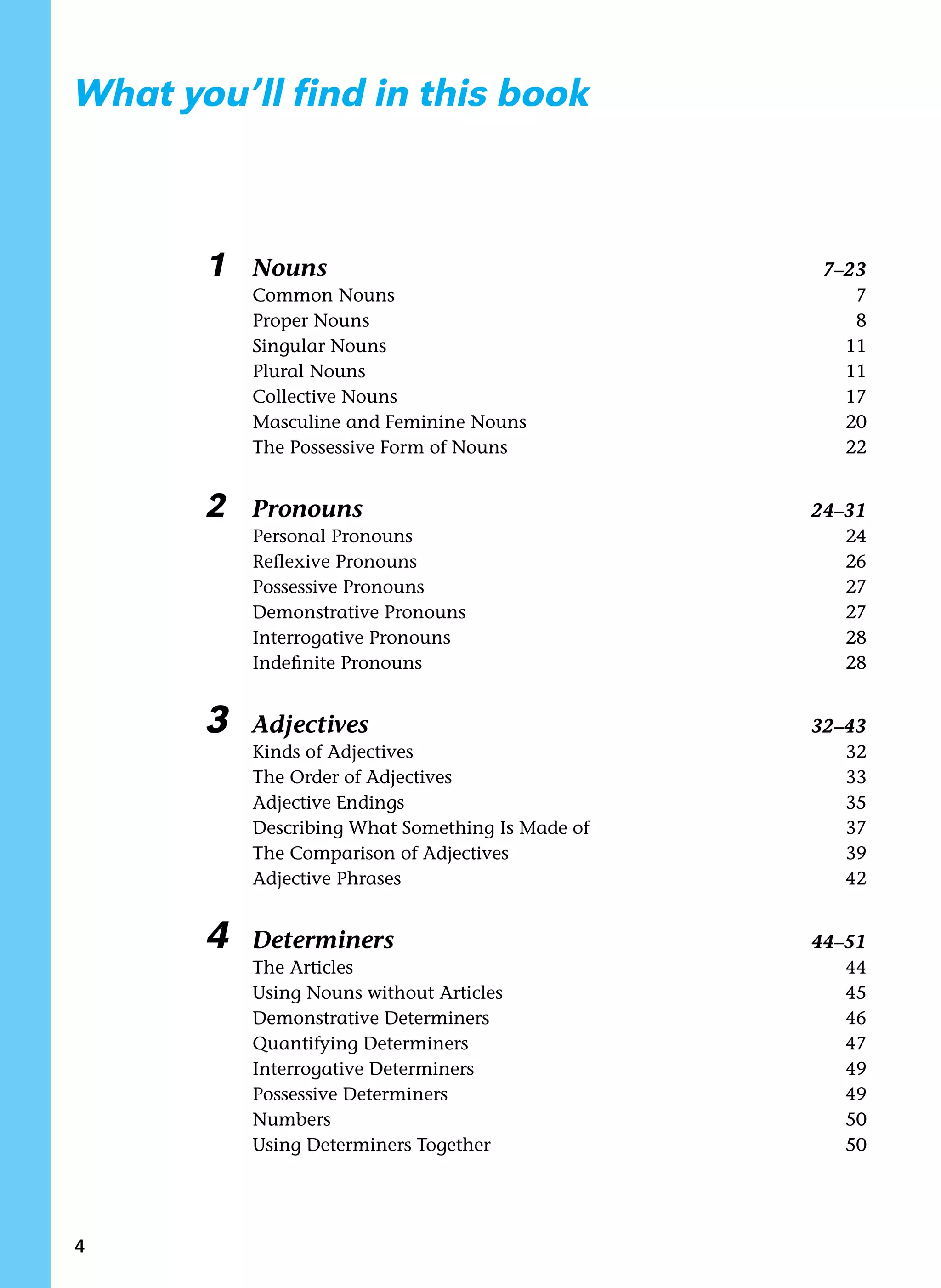
What you’ll find in this book
	
	
		1	 Nouns	 7–23
Common Nouns	 7
Proper Nouns	 8
Singular Nouns	 11
Plural Nouns	 11
Collective Nouns	 17
Masculine and Feminine Nouns	 20
The Possessive Form of Nouns	 22
		 2	 Pronouns	 24–31
Personal Pronouns	 24
Reflexive Pronouns	 26
Possessive Pronouns	 27
Demonstrative Pronouns	 27
Interrogative Pronouns	 28
Indefinite Pronouns	 28
		 3	 Adjectives	 32–43
Kinds of Adjectives	 32
The Order of Adjectives	 33
Adjective Endings	 35
Describing What Something Is Made of	 37
The Comparison of Adjectives	 39
Adjective Phrases	 42
		 4	 Determiners	 44–51
The Articles	 44
Using Nouns without Articles	 45
Demonstrative Determiners	 46
Quantifying Determiners	 47
Interrogative Determiners	 49
Possessive Determiners	 49
Numbers	 50
Using Determiners Together	 50
5	 Verbs and Tenses	 52–87
Subject and Verb Agreement	 52
Transitive and Intransitive Verbs	 55
The Simple Present Tense	 58
am, is and are	 59
there is and there are	 60
The Present Progressive Tense	 63
The Simple Past Tense	 65
was and were	 66
Irregular Verbs	 67
The Past Progressive Tense	 70
have, has and had	 71
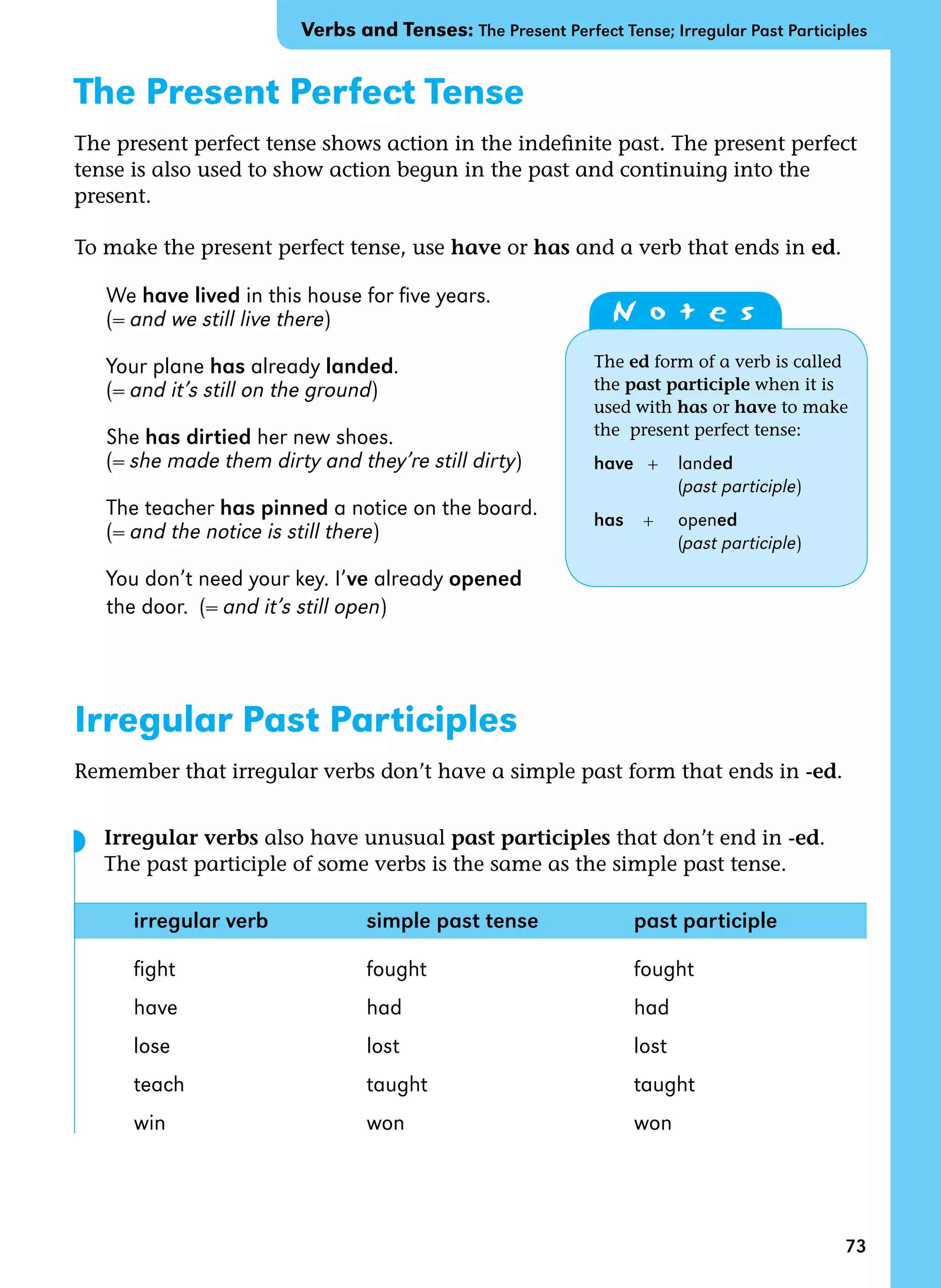
The Present Perfect Tense	 73
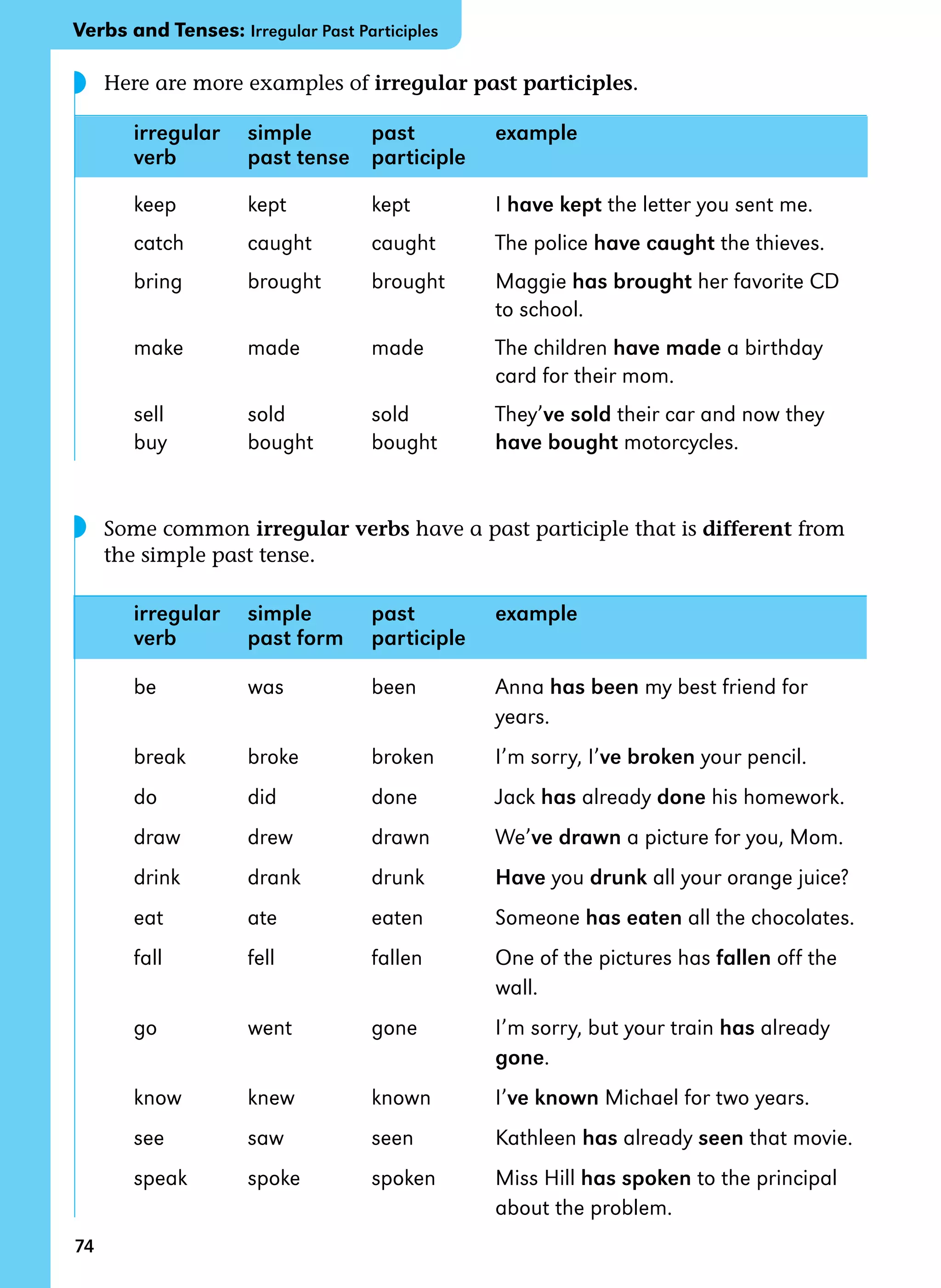
Irregular Past Participles	 73
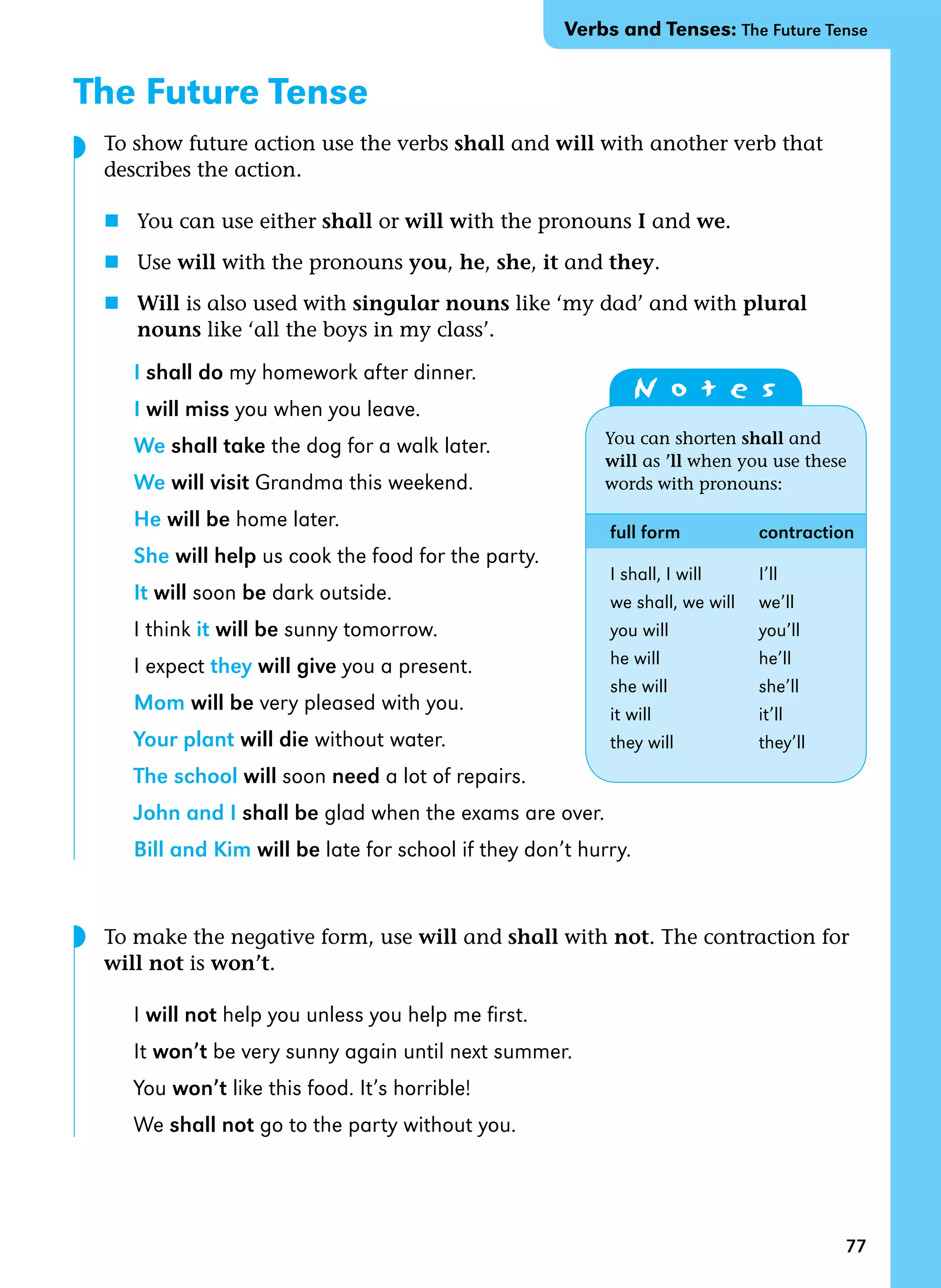
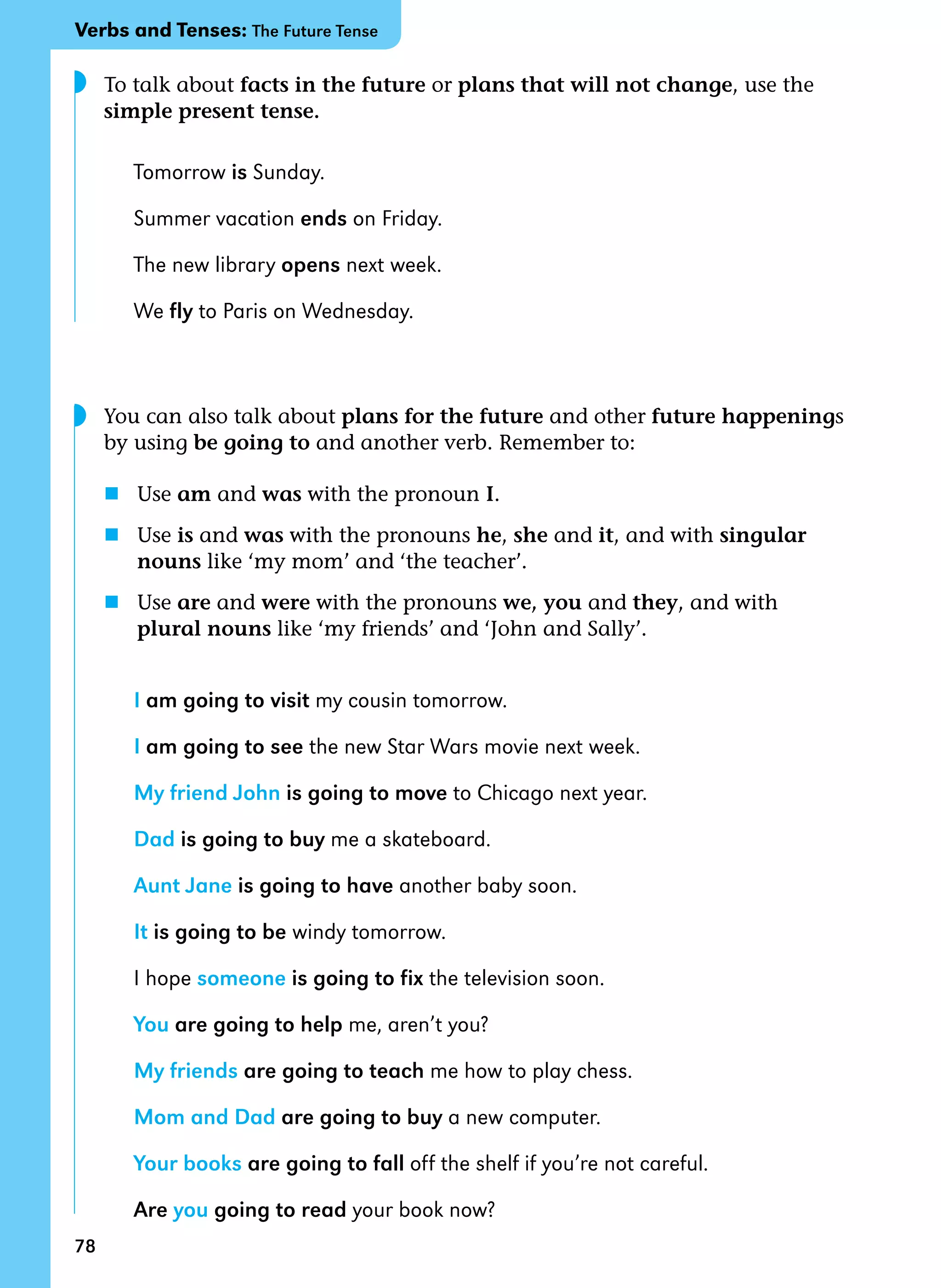
The Future Tense	 77
do, does and did	 80
The Infinitive	 83
The Imperative Form of Verbs	 84
Gerunds	 85
		6	 Auxiliary Verbs	 88–94
can and could	 88
will and would	 89
shall and should	 89
ought to	 90
must	 90
may and might	 90
Verb Phrases	 91
		7	 Adverbs and Adverb Phrases	 95–100
Adverbs of Manner	 95
Adverbs of Time	 96
Adverbs of Place	 96
Adverbs of Frequency	 97
Adverbs of Duration	 97
Adverbs of Emphasis	 98
		8	 Prepositions and Prepositional Phrases	 101–108
Preposition or Adverb?	 101
Prepositions of Place	 102
Prepositions of Time	 102
Prepositions of Direction	 103
Prepositions with Special Uses	 103
Prepositions with Adjectives, Verbs or Nouns	 105
9	 Conjunctions	 109–117
and, but and or	 109
Conjunctions Linking Phrases	 110
Conjunctions with Lists	 110
Conjunctions That Join Sentences	 111
Other Words for and	 111
Other Words for but	 112
Other Words for or	 112
Conjunctions of Time	 113
Conjunctions of Place	 113
Conjunctions of Reason	 114
Conjunctions of Purpose	 114
10	 Sentences	 118–133
Four Kinds of Sentence	 118
Sentences with Objects	 119
Verbs with Two Objects	 120
Verbs with No Object	 120
Simple Sentences	 123
Compound Sentences	 123
Conditional Sentences	 124
Positive and Negative Sentences	 124
Questions	 128
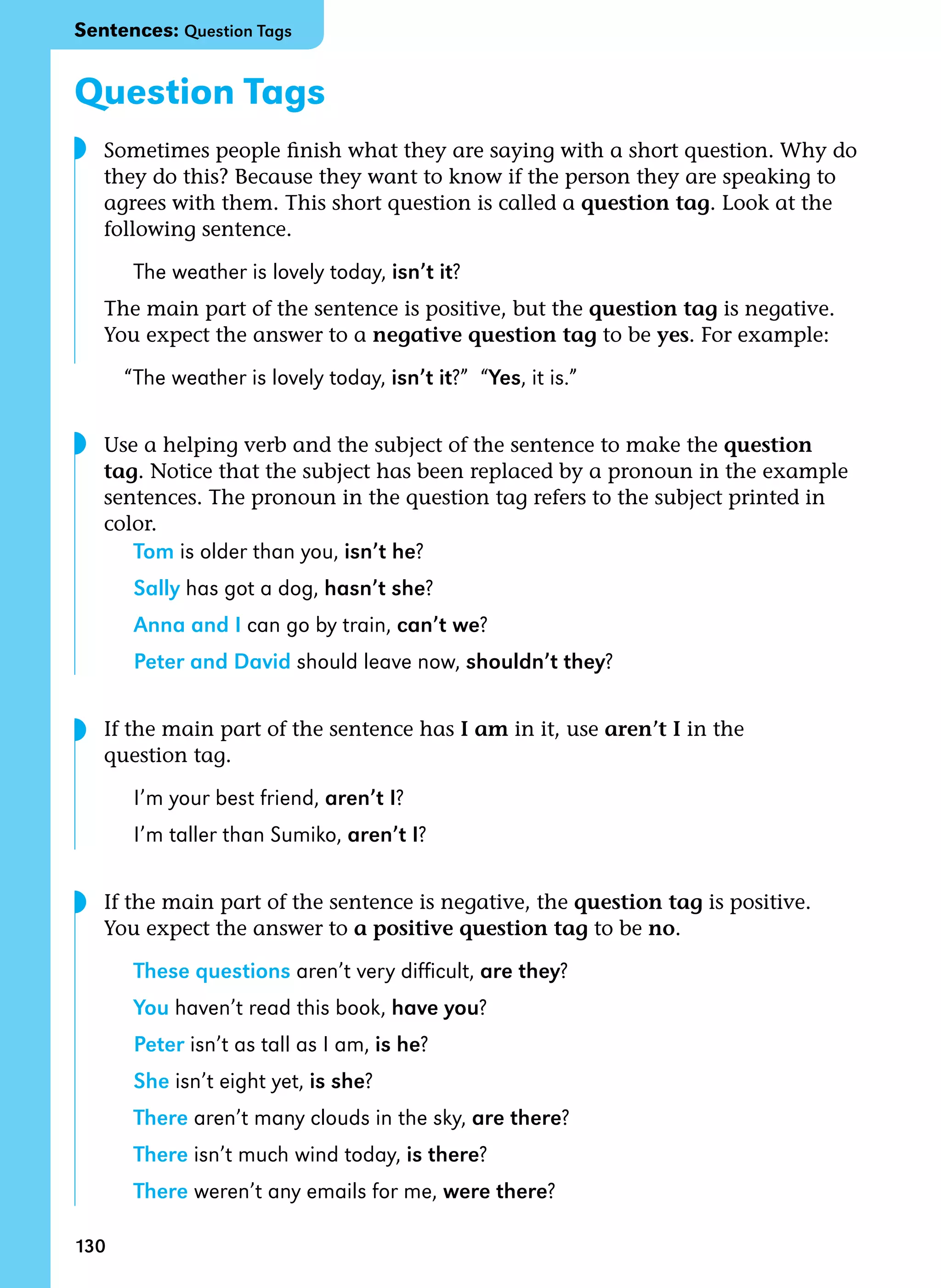
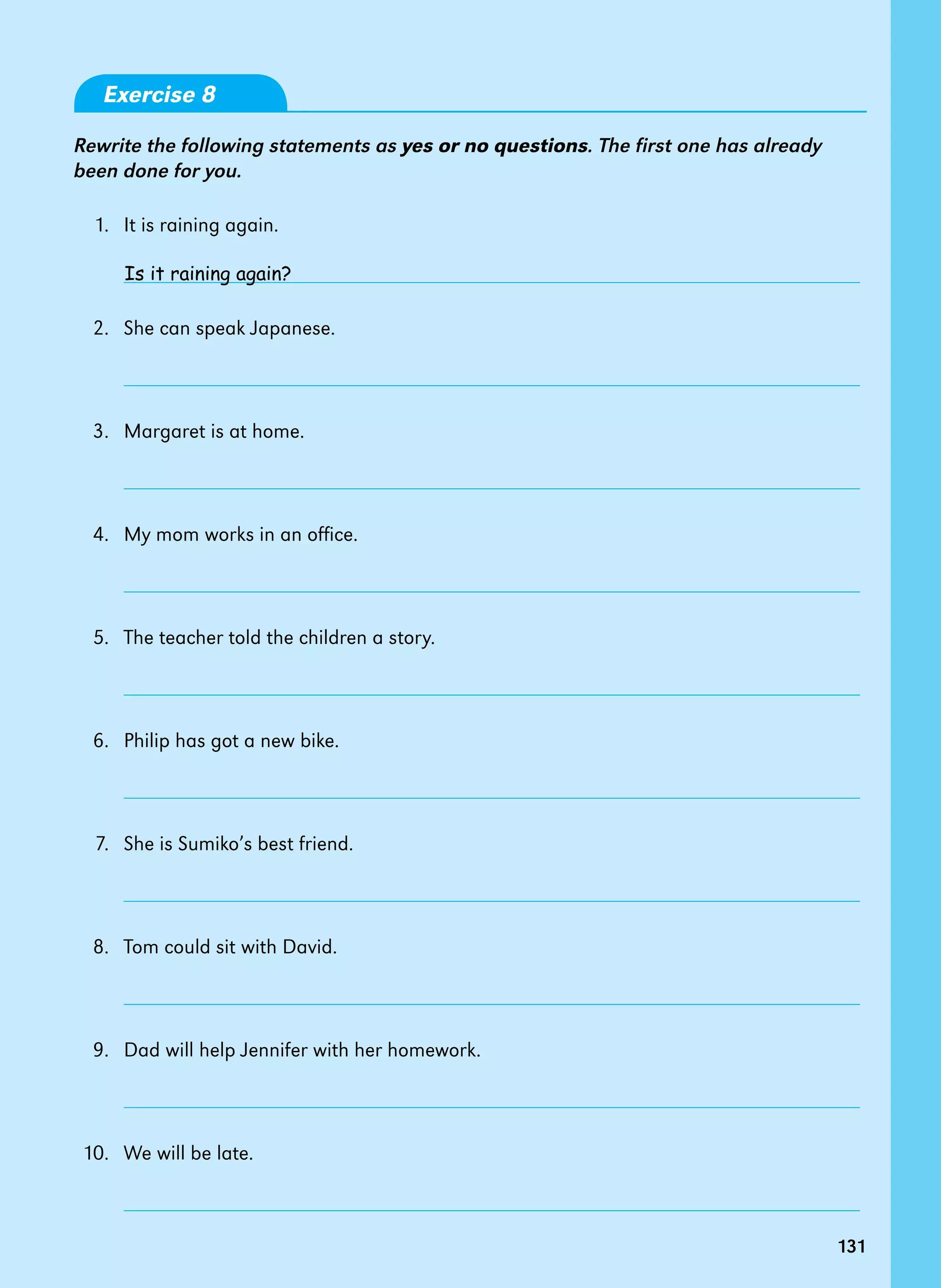
Question Tags	 130
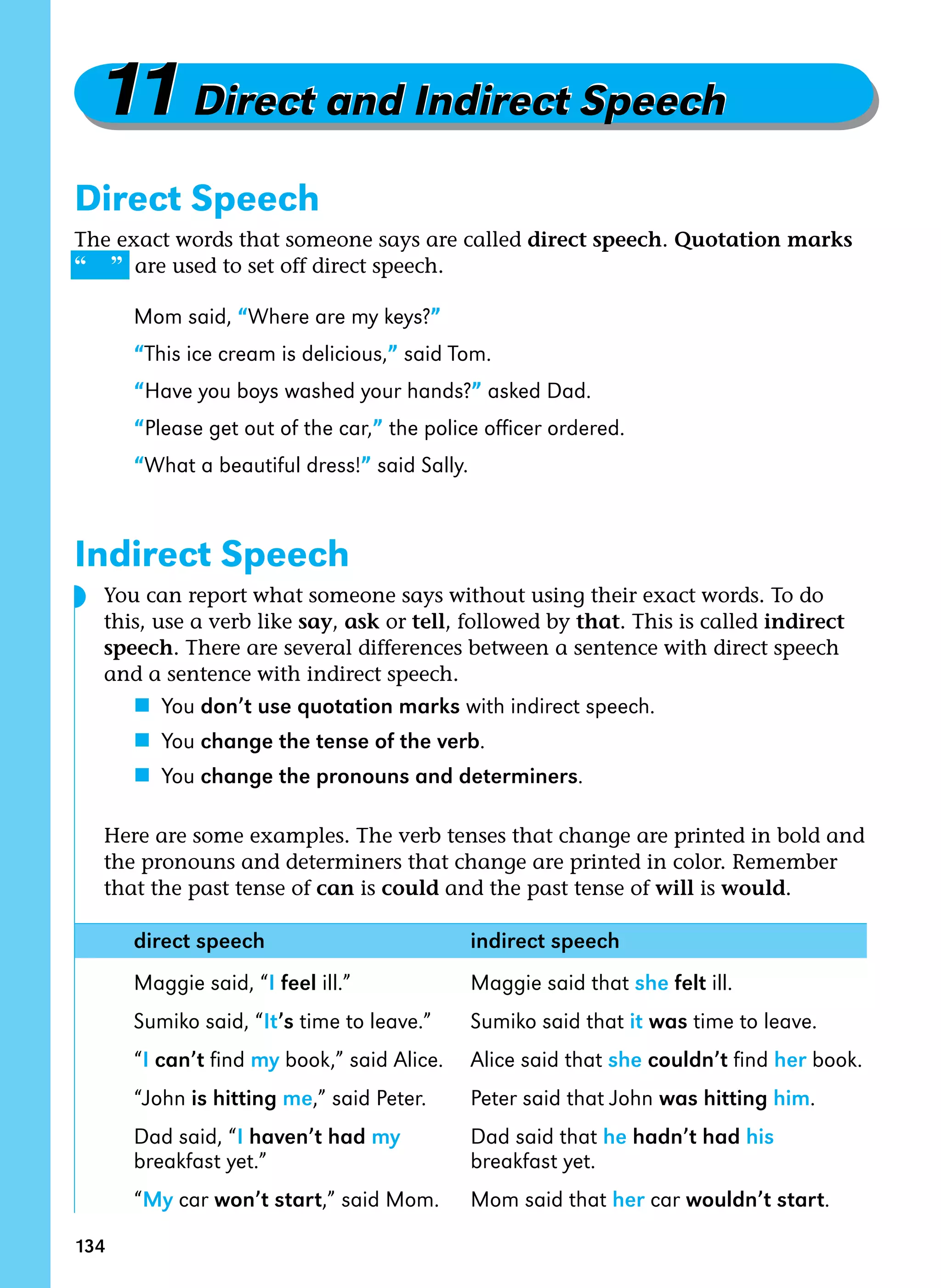
11	 Direct and Indirect Speech	 134–139
Direct Speech	 134
Indirect Speech	 134
Indirect Commands	 135
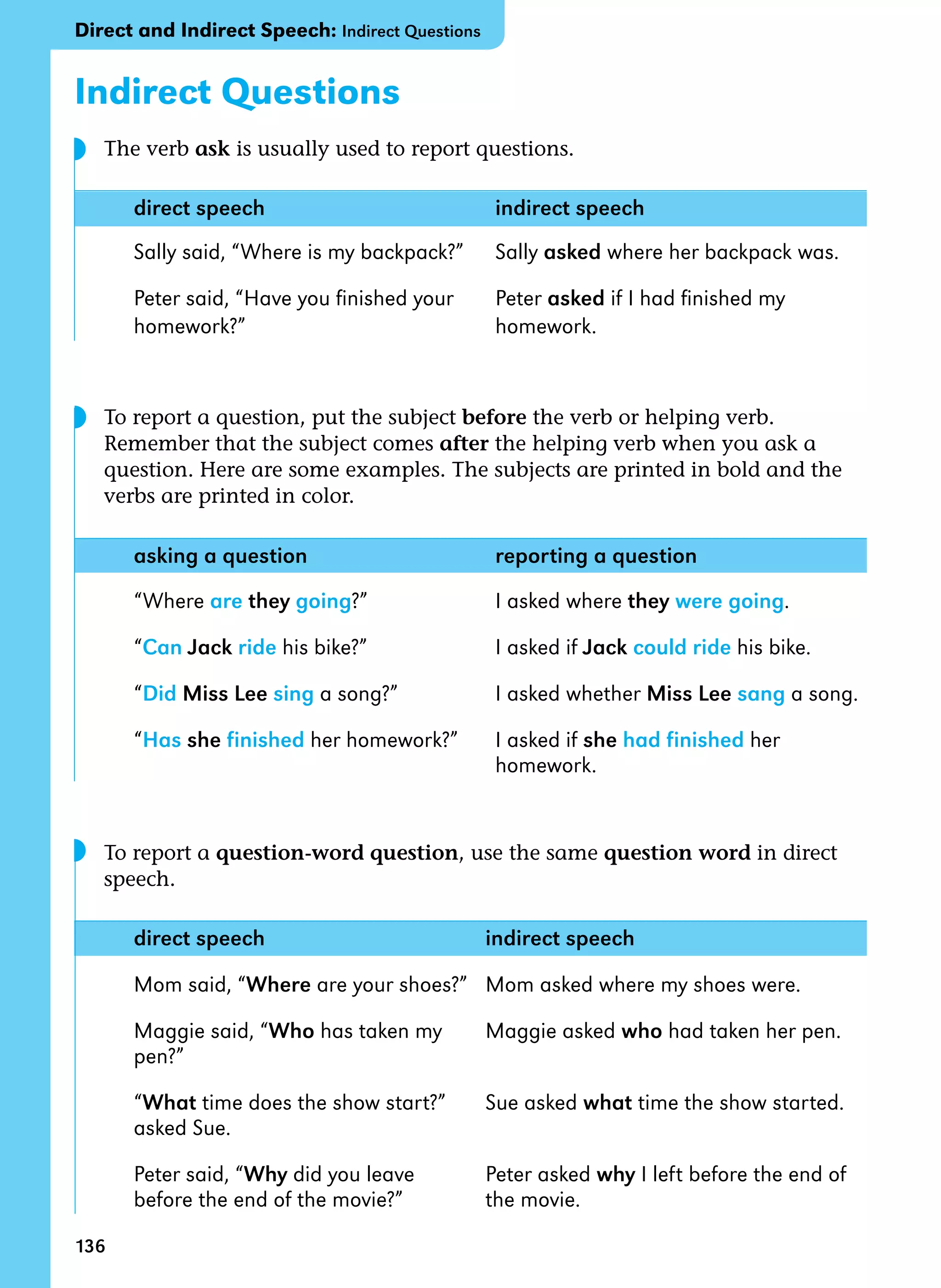
Indirect Questions	 136
12	 Punctuation	 140–148
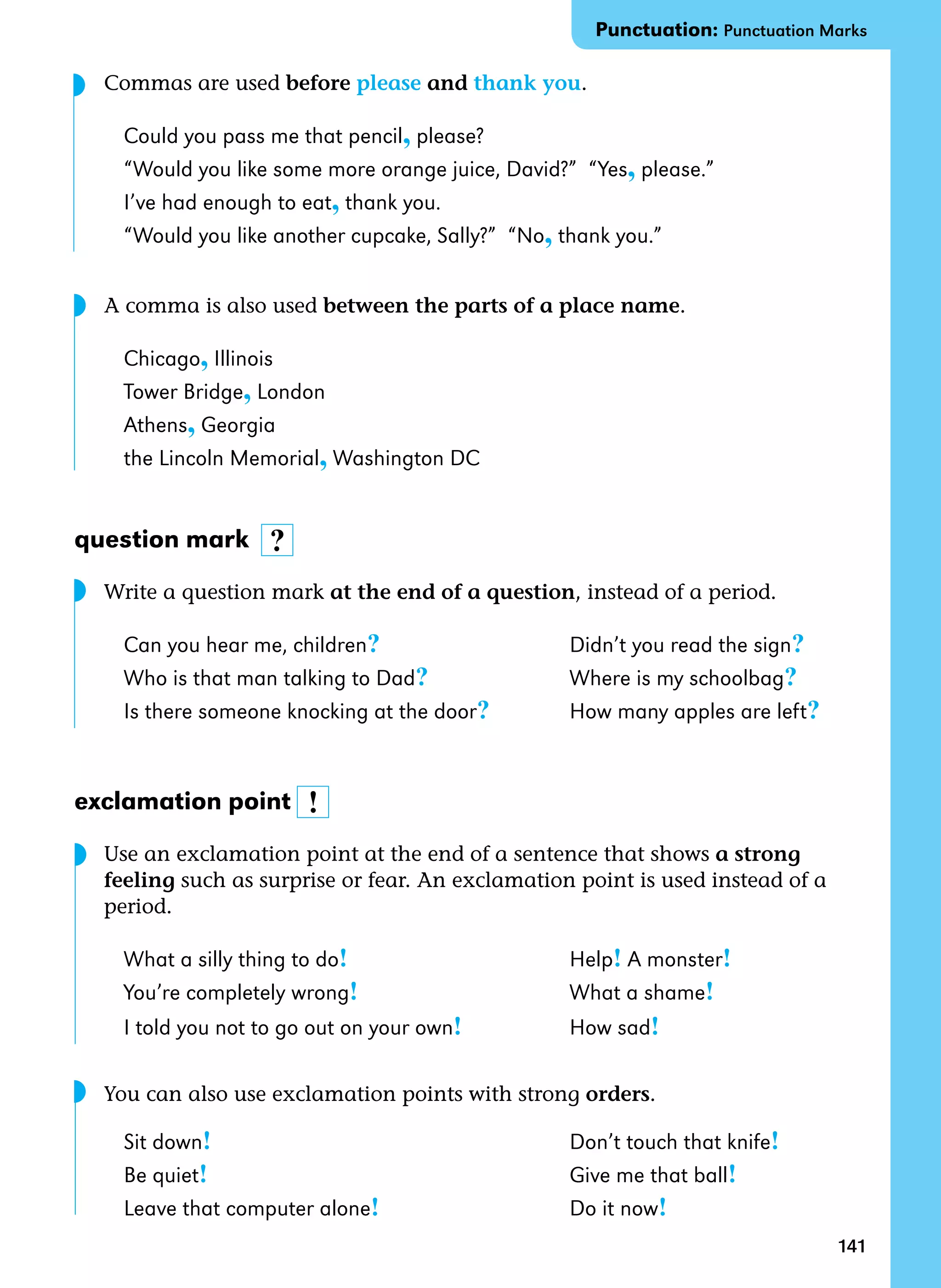
Punctuation Marks: period, comma, question mark, 	
	 exclamation point, apostrophe, quotation marks, colon	 140
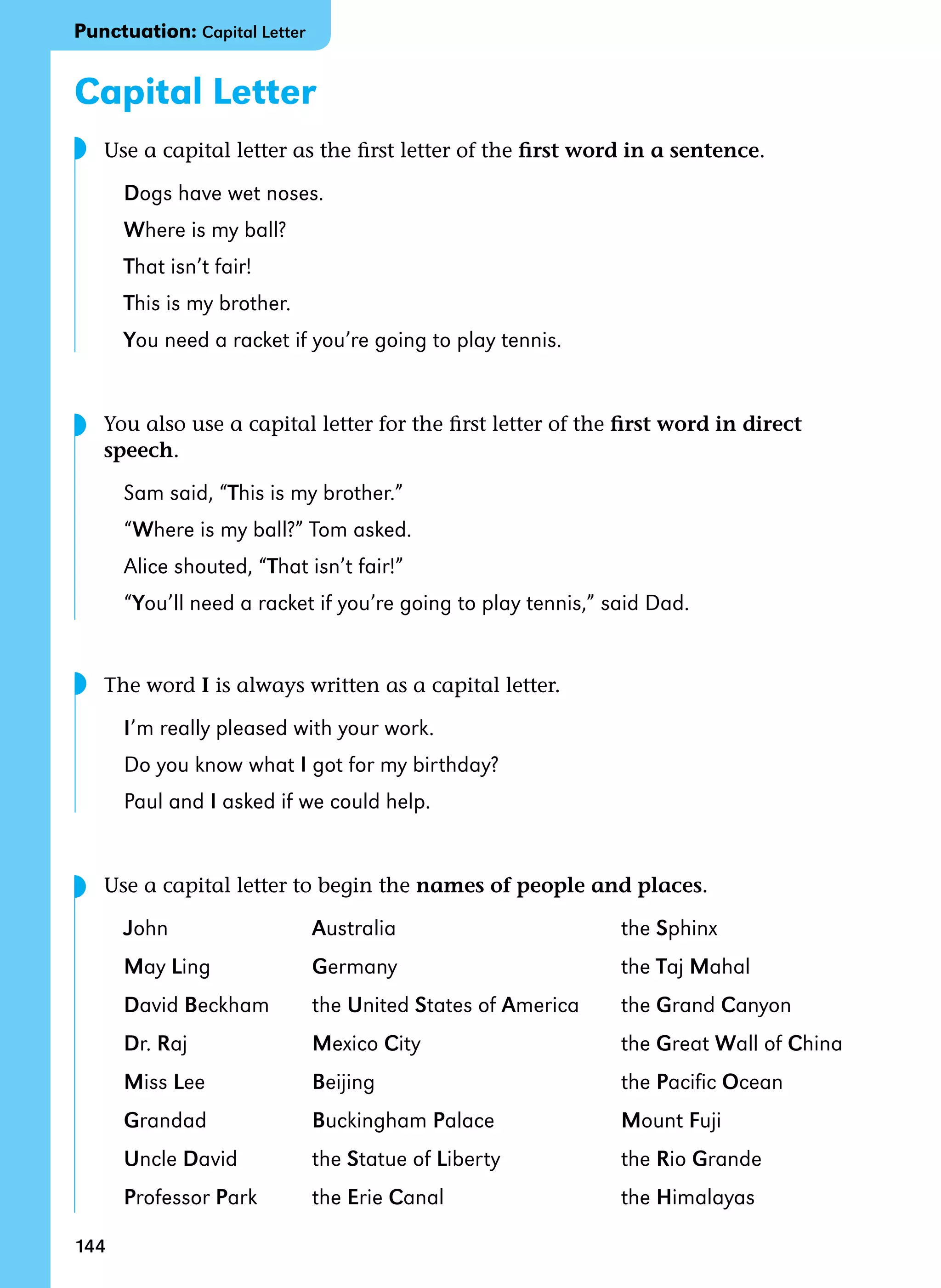
Capital Letter	 144
A List of Irregular Verbs	 149–152
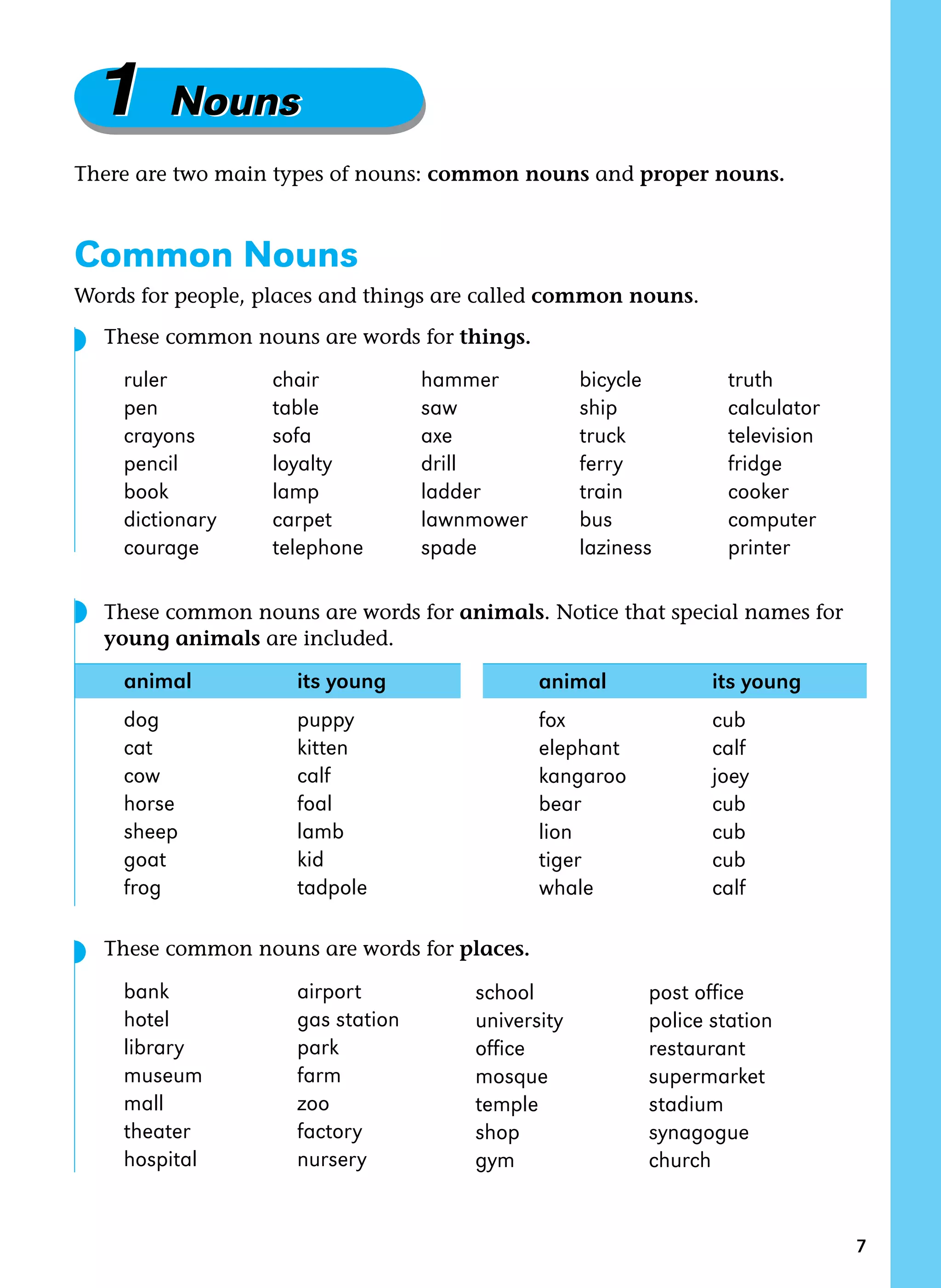
There are two main types of nouns: common nouns and proper nouns.
Common Nouns
Words for people, places and things are called common nouns.
	 These common nouns are words for things.
ruler	 chair	 hammer	 bicycle	 truth
pen	 table	 saw	 ship	 calculator
crayons	 sofa	 axe	 truck	 television
pencil	 loyalty	 drill	 ferry	 fridge
book	 lamp	 ladder	 train	 cooker
dictionary	 carpet	 lawnmower	 bus	 computer
courage	 telephone	 spade	 laziness	 printer
	 These common nouns are words for animals. Notice that special names for
young animals are included.
animal	 its young
dog	 puppy
cat	 kitten
cow	 calf
horse	 foal
sheep	 lamb
goat	 kid
frog	 tadpole
	 These common nouns are words for places.
bank	 airport
hotel	 gas station
library	 park
museum	 farm
mall	 zoo
theater	 factory
hospital	 nursery	
animal	 its young
fox	 cub
elephant	 calf
kangaroo	 joey
bear	 cub
lion	 cub
tiger	 cub
whale	 calf
school	 post office
university	 police station
office	 restaurant
mosque	 supermarket
temple	 stadium
shop	 synagogue
gym	 church
1	 Nouns1	 Nouns
◗
◗
◗
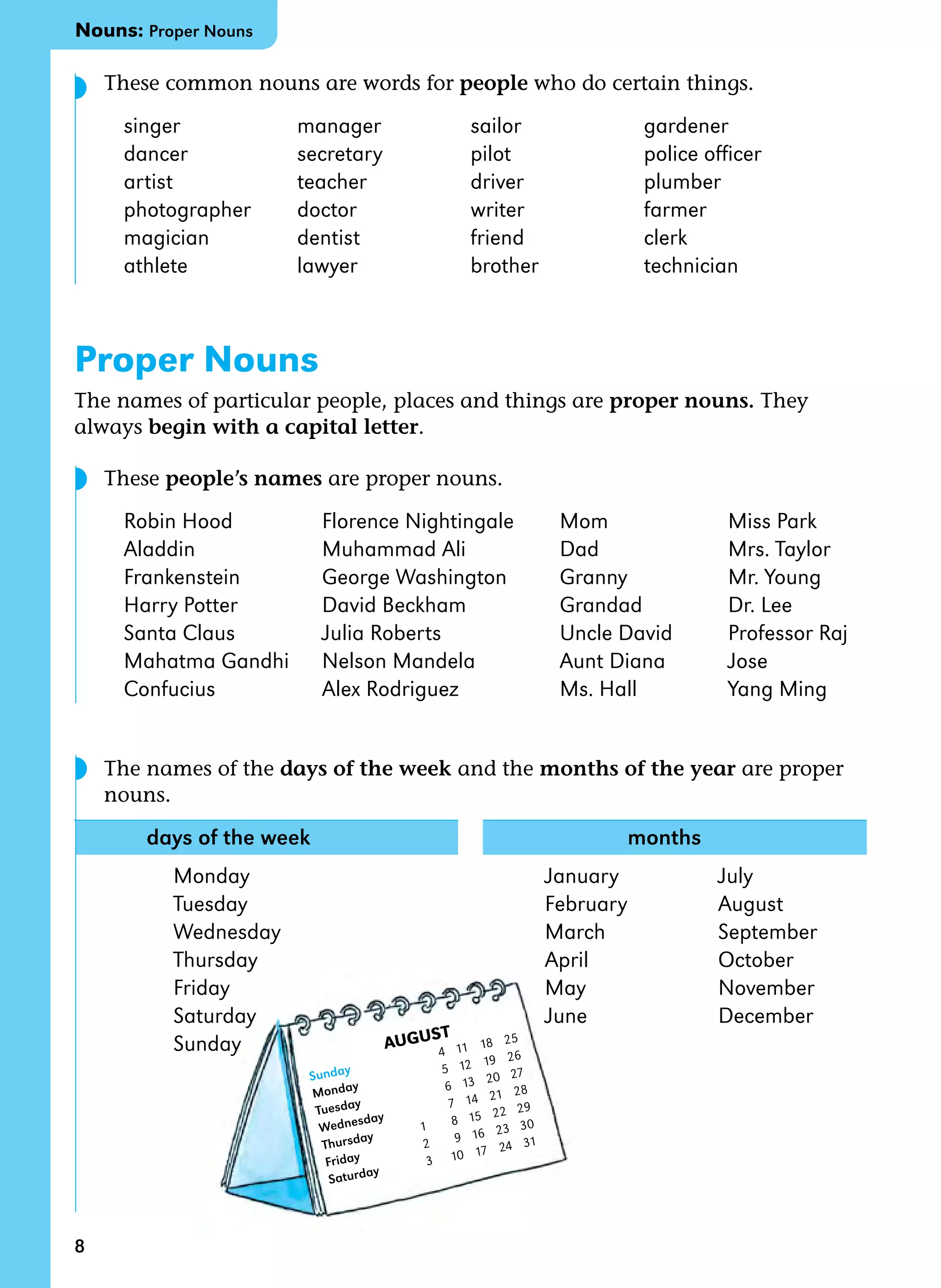
These common nouns are words for people who do certain things.
singer	 manager	 sailor	 gardener
dancer	 secretary	 pilot	 police officer
artist	 teacher	 driver	 plumber
photographer	 doctor	 writer	 farmer
magician	 dentist	 friend	 clerk
athlete	 lawyer	 brother	 technician
Proper Nouns
The names of particular people, places and things are proper nouns. They
always begin with a capital letter.
	 These people’s names are proper nouns.
Robin Hood	 Florence Nightingale	 Mom	 Miss Park
Aladdin	 Muhammad Ali	 Dad	 Mrs. Taylor
Frankenstein	 George Washington	 Granny	 Mr. Young
Harry Potter	 David Beckham	 Grandad	 Dr. Lee
Santa Claus	 Julia Roberts	 Uncle David	 Professor Raj
Mahatma Gandhi	 Nelson Mandela	 Aunt Diana	 Jose
Confucius	 Alex Rodriguez	 Ms. Hall	 Yang Ming
	 The names of the days of the week and the months of the year are proper
nouns.
    days of the week 	      months
	 Monday 	 January	 July	 	
	 Tuesday 	 February	 August	
	 Wednesday 	 March	 September
	 Thursday 	 April	 October
	 Friday 	 May	 November
	 Saturday 	 June	 December
	 Sunday 	
◗
◗
◗
Nouns: Proper Nouns
AUGUST
Sunday	 	 	 4	 11	 18	 25
Monday	 	 	 5	 12	 19	 26
Tuesday	 	 	 6	 13	 20	 27
Wednesday	 	 	 7	 14	 21	 28
Thursday	 	 1	 8	 15	 22	 29
Friday	
	 2	 9	 16	 23	 30
Saturday	 	 3	 10	 17	 24	 31
Nouns: Proper Nouns
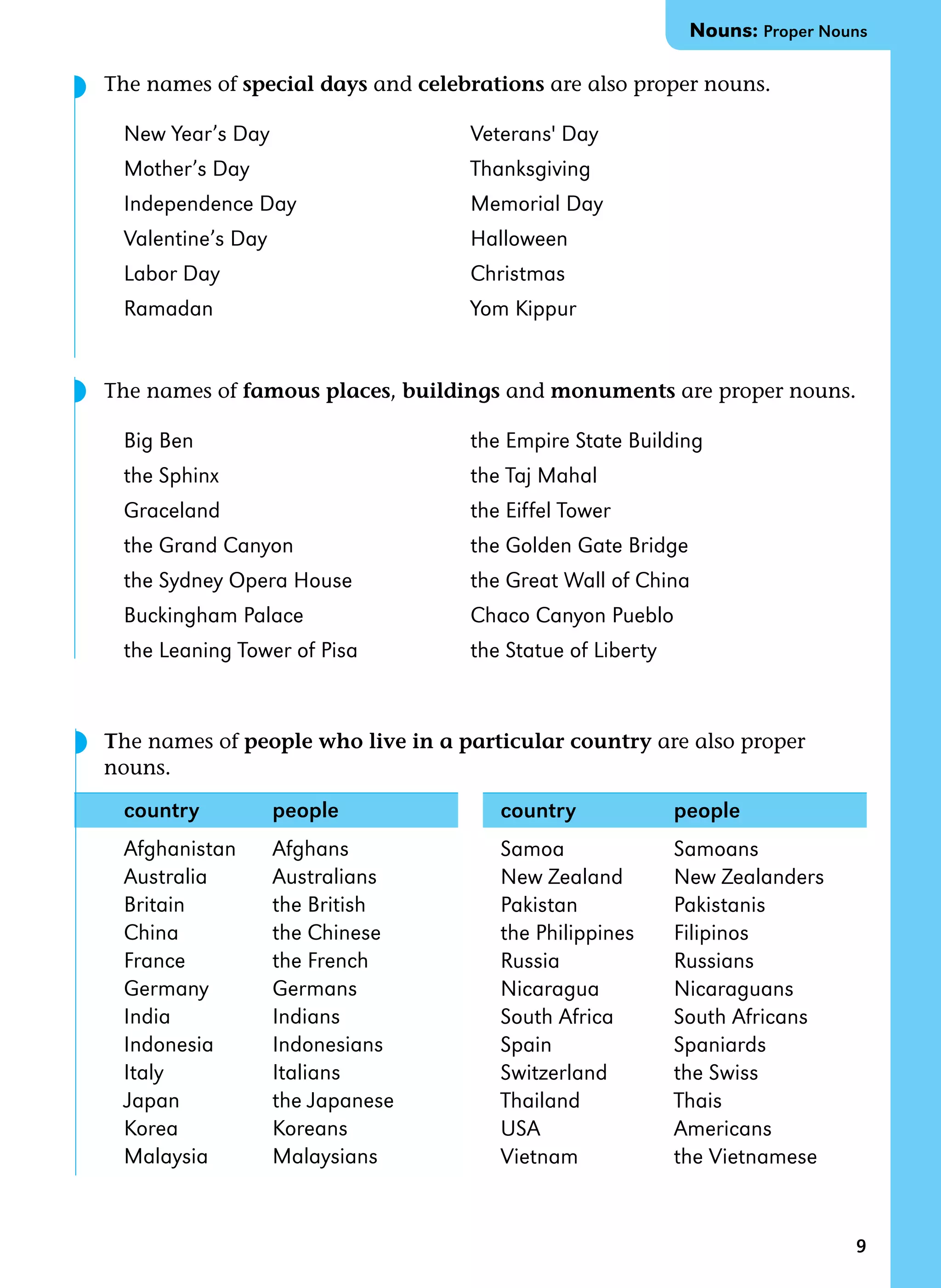
	 The names of special days and celebrations are also proper nouns.
New Year’s Day	 	 Veterans' Day
Mother’s Day	 	 Thanksgiving
Independence Day		 Memorial Day
Valentine’s Day	 	 Halloween
Labor Day	 	 Christmas
Ramadan	 	 Yom Kippur	
	 The names of famous places, buildings and monuments are proper nouns.
Big Ben	 the Empire State Building
the Sphinx	 the Taj Mahal
Graceland	 the Eiffel Tower
the Grand Canyon	 the Golden Gate Bridge
the Sydney Opera House	 the Great Wall of China
Buckingham Palace	 Chaco Canyon Pueblo
the Leaning Tower of Pisa	 the Statue of Liberty	
	 The names of people who live in a particular country are also proper
nouns.
country	 people	
Afghanistan	 Afghans
Australia	 Australians	
Britain	 the British
China	 the Chinese
France	 the French
Germany	 Germans
India	 Indians
Indonesia	 Indonesians
Italy	 Italians
Japan	 the Japanese
Korea	 Koreans
Malaysia	 Malaysians
◗
country	 people
Samoa	 Samoans
New Zealand	 New Zealanders
Pakistan	 Pakistanis
the Philippines	 Filipinos
Russia	 Russians
Nicaragua	 Nicaraguans
South Africa	 South Africans
Spain	 Spaniards
Switzerland	 the Swiss
Thailand	 Thais
USA 	 Americans
Vietnam	 the Vietnamese
◗
◗
10
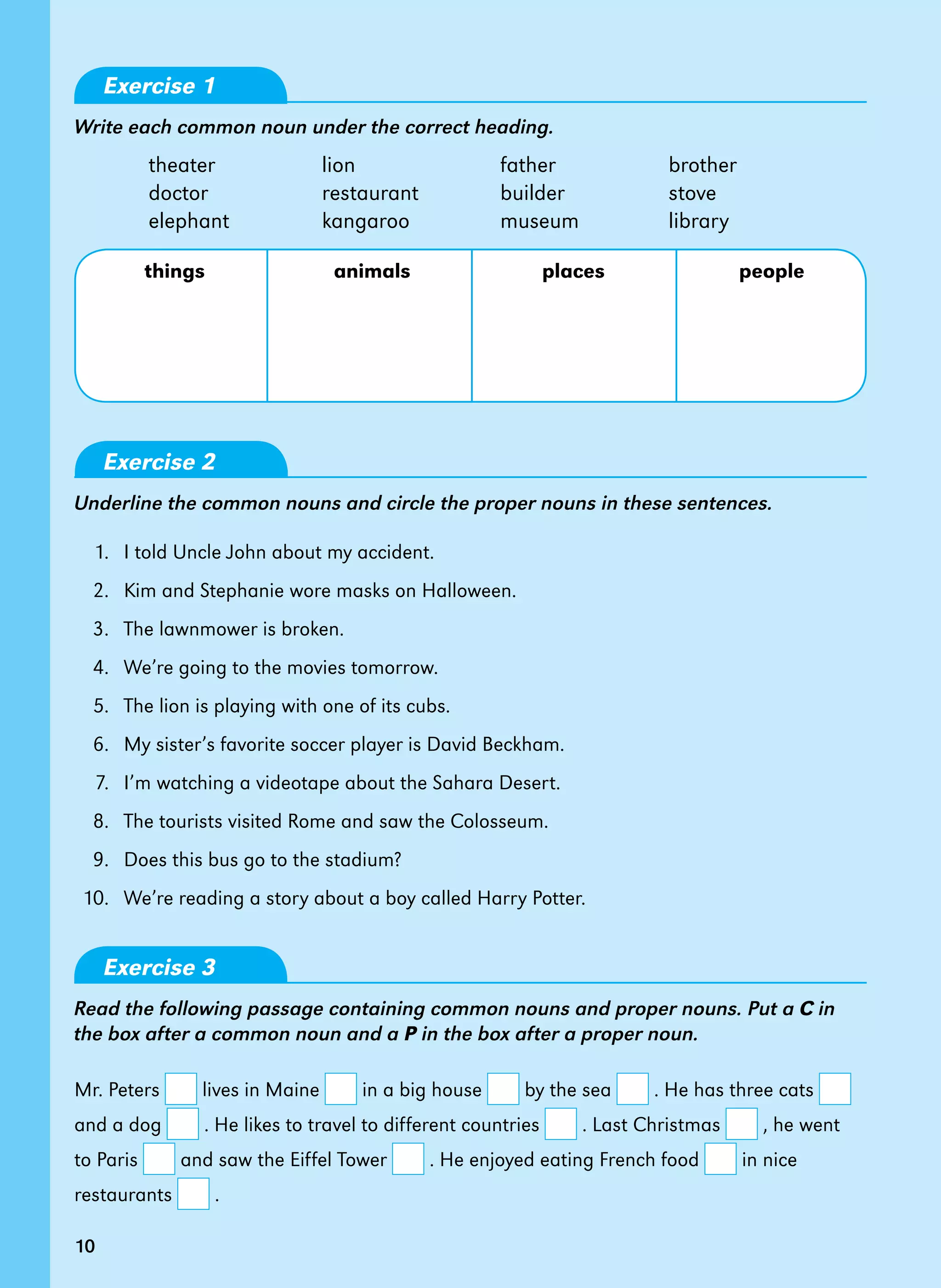
Exercise 1
Write each common noun under the correct heading.
	
theater	 lion	 father	 brother	
doctor	 restaurant	 builder	 stove	
elephant	 kangaroo	 museum	 library
	 things	 animals	 places	 people
	 	 	
Exercise 2
Underline the common nouns and circle the proper nouns in these sentences.
	 1.  	I told Uncle John about my accident.
	 2. 	 Kim and Stephanie wore masks on Halloween.
	 3. 	 The lawnmower is broken.
	 4. 	 We’re going to the movies tomorrow.
	 5. 	 The lion is playing with one of its cubs.
	 6. 	 My sister’s favorite soccer player is David Beckham.
	 7. 	 I’m watching a videotape about the Sahara Desert.
	 8. 	 The tourists visited Rome and saw the Colosseum.
	 9. 	 Does this bus go to the stadium?
	10. 	 We’re reading a story about a boy called Harry Potter.
Exercise 3
Read the following passage containing common nouns and proper nouns. Put a C in
the box after a common noun and a P in the box after a proper noun.
Mr. Peters lives in Maine in a big house by the sea . He has three cats 	
and a dog . He likes to travel to different countries . Last Christmas , he went
to Paris and saw the Eiffel Tower . He enjoyed eating French food in nice
restaurants .
10
11
Nouns: Singular Nouns; Plural Nouns
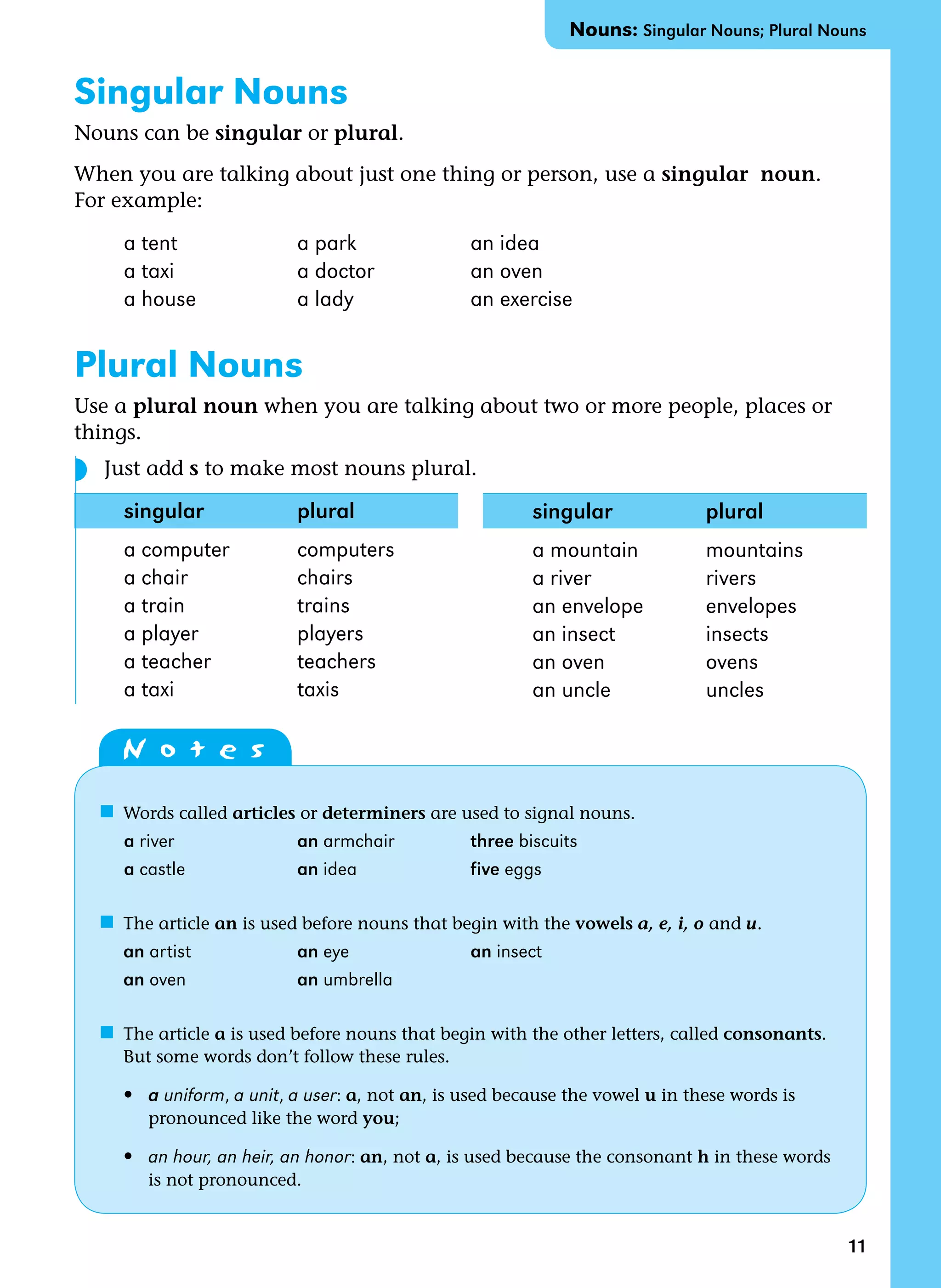
Singular Nouns
Nouns can be singular or plural.
When you are talking about just one thing or person, use a singular noun.
For example:
a tent	 a park	 an idea
a taxi	 a doctor	 an oven
a house	 a lady	 an exercise
Plural Nouns
Use a plural noun when you are talking about two or more people, places or
things.
	 Just add s to make most nouns plural.
singular 	 plural	
a computer	 computers
a chair	 chairs
a train	 trains
a player	 players
a teacher	 teachers
a taxi	 taxis
	 N o t e s
	
	 n	 Words called articles or determiners are used to signal nouns.
	 a river	 an armchair	 three biscuits
	 a castle	 an idea	 five eggs
	 n	 The article an is used before nouns that begin with the vowels a, e, i, o and u.
	 	 an artist	 an eye	 an insect
	 	 an oven	 an umbrella
	 n	 The article a is used before nouns that begin with the other letters, called consonants.
		 But some words don’t follow these rules.
	 	 • 	a uniform, a unit, a user: a, not an, is used because the vowel u in these words is
		 pronounced like the word you;
	
	 	 •	 an hour, an heir, an honor: an, not a, is used because the consonant h in these words 	
		 is not pronounced.
singular 	 plural
a mountain	 mountains
a river	 rivers
an envelope	 envelopes
an insect	 insects
an oven	 ovens
an uncle	 uncles
◗
12
singular 	 plural
sandwich	 sandwiches
witch	 witches
brush	 brushes
flash	 flashes
box	 boxes
fox	 foxes
singular 	 plural
day	 days
tray	 trays
runway	 runways
chimney	 chimneys
trolley	 trolleys
valley	 valleys
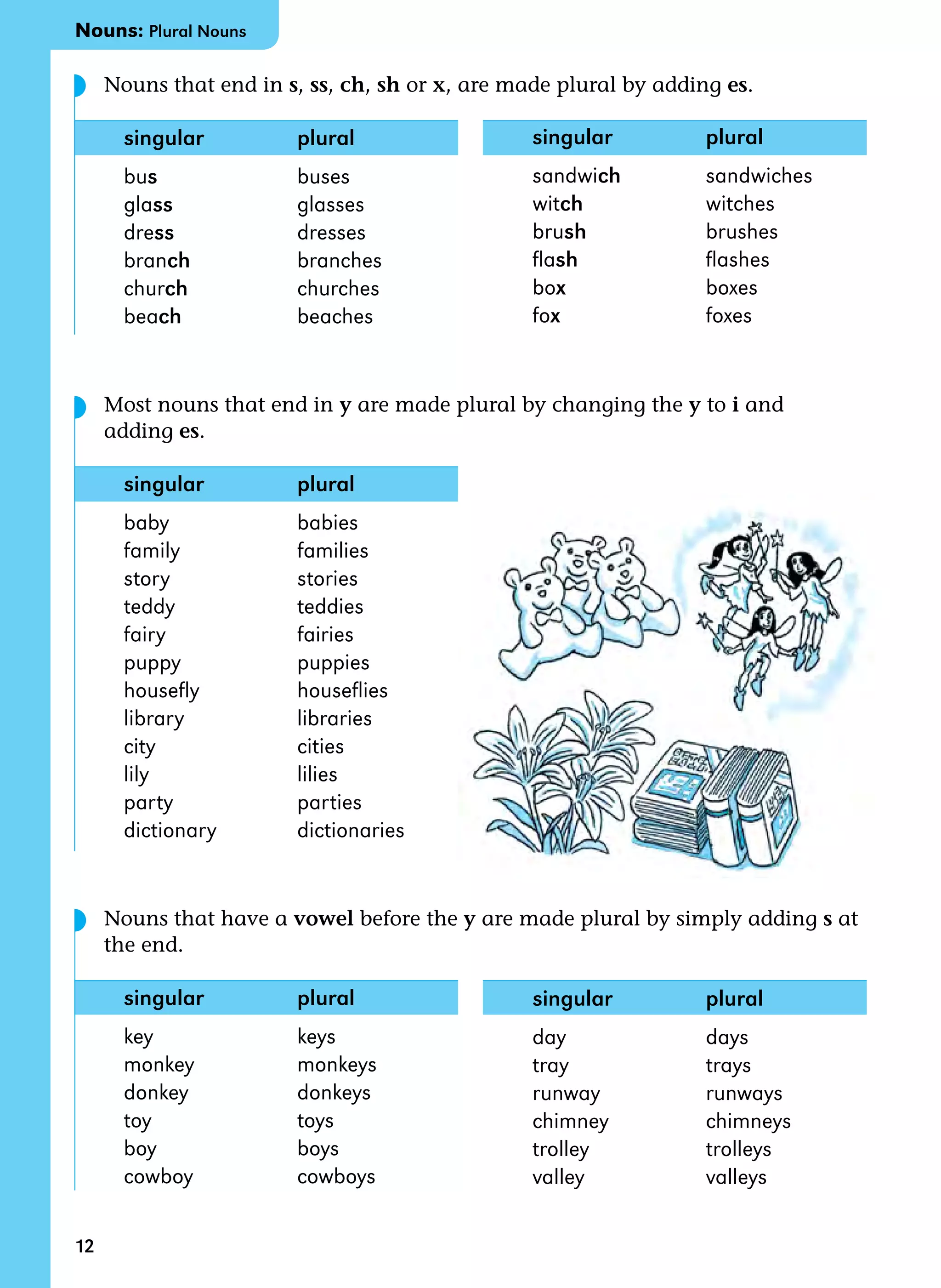
	 Nouns that end in s, ss, ch, sh or x, are made plural by adding es.
singular 	 plural	
bus	 buses
glass	 glasses
dress	 dresses
branch	 branches
church	 churches
beach	 beaches	
	 Most nouns that end in y are made plural by changing the y to i and
adding es.
singular 	 plural	
baby	 babies
family	 families
story	 stories
teddy	 teddies
fairy	 fairies
puppy	 puppies
housefly	 houseflies
library	 libraries
city	 cities
lily	 lilies
party 	 parties
dictionary	 dictionaries
	 Nouns that have a vowel before the y are made plural by simply adding s at
the end.
singular 	 plural	
key	 keys
monkey	 monkeys
donkey	 donkeys
toy	 toys
boy	 boys
cowboy	 cowboys
◗
◗
◗
Nouns: Plural Nouns
13
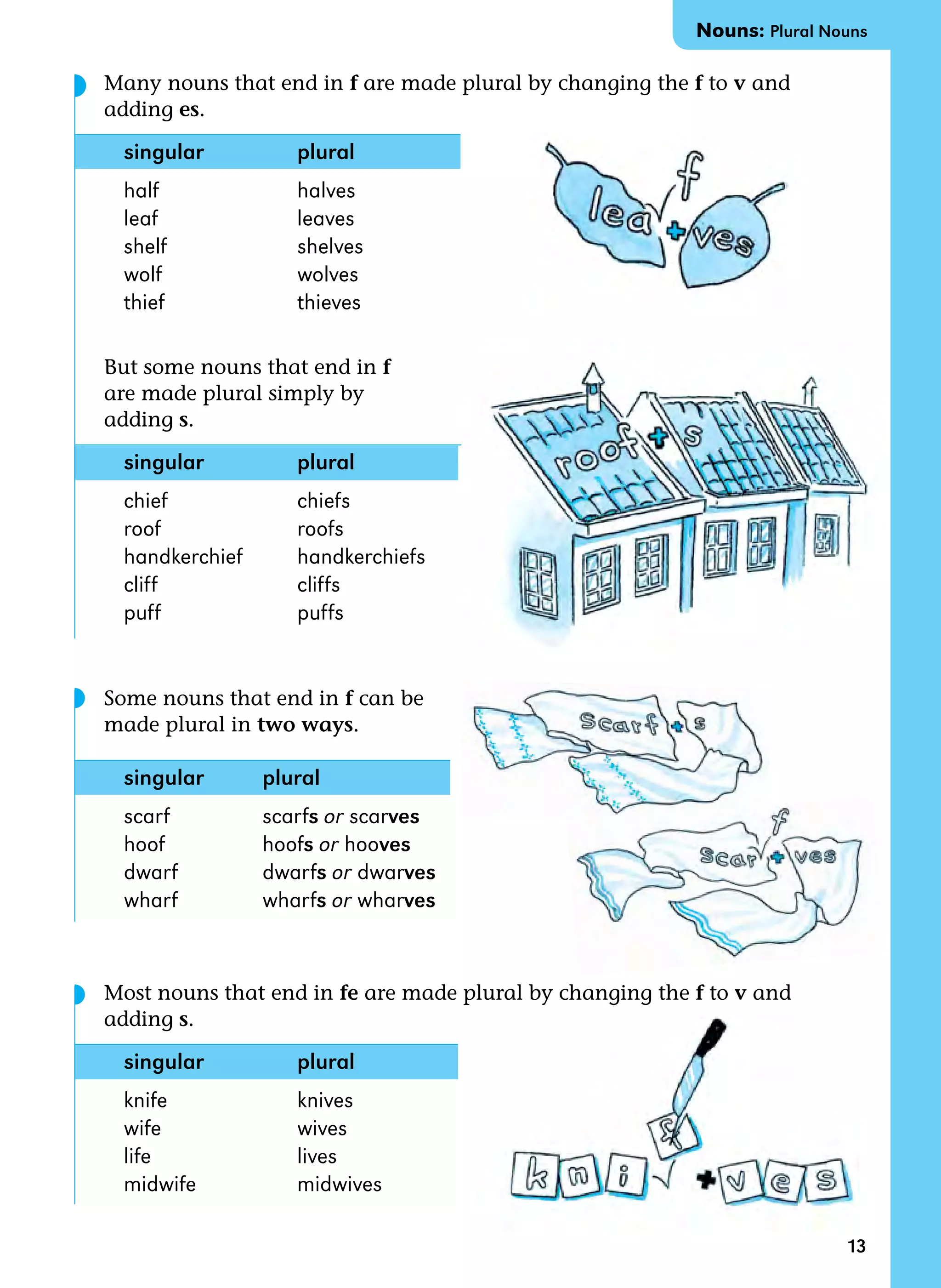
	 Many nouns that end in f are made plural by changing the f to v and
adding es.
singular 	 plural	
half	 halves
leaf	 leaves
shelf	 shelves
wolf	 wolves
thief	 thieves
	 But some nouns that end in f
are made plural simply by
adding s.
singular 	 plural	
chief	 chiefs
roof	 roofs
handkerchief	 handkerchiefs
cliff	 cliffs
puff	 puffs
	 Some nouns that end in f can be
made plural in two ways.
singular 	 plural	
scarf	 scarfs or scarves
hoof	 hoofs or hooves
dwarf	 dwarfs or dwarves
wharf	 wharfs or wharves	
	 Most nouns that end in fe are made plural by changing the f to v and
adding s.
singular 	 plural	
knife	 knives
wife	 wives
life	 lives
midwife	 midwives
◗
◗
◗
Nouns: Plural Nouns
14
	 Most nouns that end in o are made plural by adding s.
singular 	 plural	
video	 videos
hippo	 hippos
zoo	 zoos
kangaroo	 kangaroos
	 But other nouns that end in o are
made plural by adding es.
singular 	 plural	
tomato	 tomatoes
potato	 potatoes
hero	 heroes
	 Some nouns change spelling from the singular form to the plural.
singular 	 plural	
man	 men
woman	 women
child	 children
person	 people
mouse	 mice
tooth	 teeth
foot	 feet
goose	 geese
	 The plural form of some nouns is the same as the singular form.
singular 	 plural	
sheep	 sheep (not sheeps)
deer	 deer (not deers)
fish	 fish (not fishes)
aircraft	 aircraft (not aircrafts)
salmon	 salmon (not salmons)	
◗
◗
	 N o t e s
	 N o t e s
When you are talking about different
kinds of fish, the plural can be fishes,
for example:
  the various fishes of the Indian Ocean
◗
What's the plural of the kind
of mouse that you use with a
computer? The plural is either
mice or mouses.
Nouns: Plural Nouns
15
	 Some nouns are always plural.
trousers	 glasses
shorts	 spectacles
jeans	 goggles
pants	 scissors
tights	 binoculars
pajamas	 pliers
	 Some nouns are usually plural.
shoes	 chopsticks
sandals	 gloves
slippers	 clogs
boots	 socks
Exercise 4
Underline all the nouns in the following sentences. Are they common or proper nouns?
Put a checkmark in the correct box.
	 	 		 	 common nouns       proper nouns
	 1. 	 Do you like cheese?	 	 	
	 2. 	 They stood next to the Niagara Falls.	 	
	 3. 	 May I borrow your umbrella?	 	
	 4. 	 The ambulance was driving very fast.	 	
	 5. 	 Carl did not agree with them.	 	
	 6. 	 She loves to visit Disneyland. 	 	
	 7. 	 Would you like some more water?	 	
	 8. 	 The fog was very thick.	 	
	 9. 	 May I invite Tom to join us?	 	
	10. 	 My car is very old.	 	
	 N o t e s
✓
You can use a pair of with these
plural nouns. For example:
	 a pair of trousers
	 a pair of pants
	 a pair of glasses
	 a pair of scissors
	 a pair of chopsticks
	 a pair of sandals
	 a pair of gloves
Nouns: Plural Nouns
◗
15
16
Exercise 5
Read the following passage. Write S in the box after each singular noun and P in the
box after each plural noun.
Our teacher   is a very nice lady . She’s very kind to all the children   in the
class   and she tells us very funny stories . Yesterday, she told a story   about
the animals   on a farm . They all had a race . The pigs and sheep ran
faster than the ducks   and cows , but the heroes of the story   were the
mice . They were faster than all the other animals , even though they had the
shortest legs !    
Exercise 6
Read the following passage. Notice that the plural nouns are missing. Write the correct
plural form of the singular nouns in parentheses. The first one has been done for you.
Three (lady) in pink (dress) took their (baby) 	
for a walk in the zoo. They saw four (giraffe), three (hippo),
two (kangaroo) and an elephant. They walked for so long that their
(foot) became sore, so they sat down on a bench for a rest near some
(monkey). The (monkey) were playing with cardboard
(box) and throwing (stick) at each other. After a while, the
(lady) looked at their (watch) and decided it was time to go
home.
ladies
16
17
	 N o t e s
Collective Nouns
Words for groups of people, animals or things are called collective nouns.
	 Here are some collective nouns for groups of people.
a family	 a crew
a team	 a club
a community	 a committee
a choir	 a company
a band	 a gang
an orchestra	 the government
an audience	 the army
	 Collective nouns may be used with a singular verb or with a plural verb. If
the group is acting as a single unit, use a singular verb. If group members are
acting as individuals, use a plural
	 verb. For example:
The crowd was orderly.
	 or
The crowd were clapping, yelling	
and cheering.
	 Here are more collective nouns you can use for groups of people.
a crowd of shoppers	 a gang of thieves
a company of actors 	 a panel of judges
a class of schoolchildren	 a platoon of soldiers
	
	 Many groups of animals have their own special collective nouns.
a herd of cattle	 a pack of wolves	 a litter of puppies
a flock of birds	 a pride of lions	 a troop of monkeys
a drove of sheep	 a pod of dolphins	 a brood of chickens
a gaggle of geese	 a school of fish	 a swarm of bees
	
Always use a plural verb with the
collective nouns, people and the
police. For example:
Those people live (not lives) in Asia.
The police have caught (not has
caught) the thief.
◗
◗
◗
◗
Nouns: Collective Nouns
18
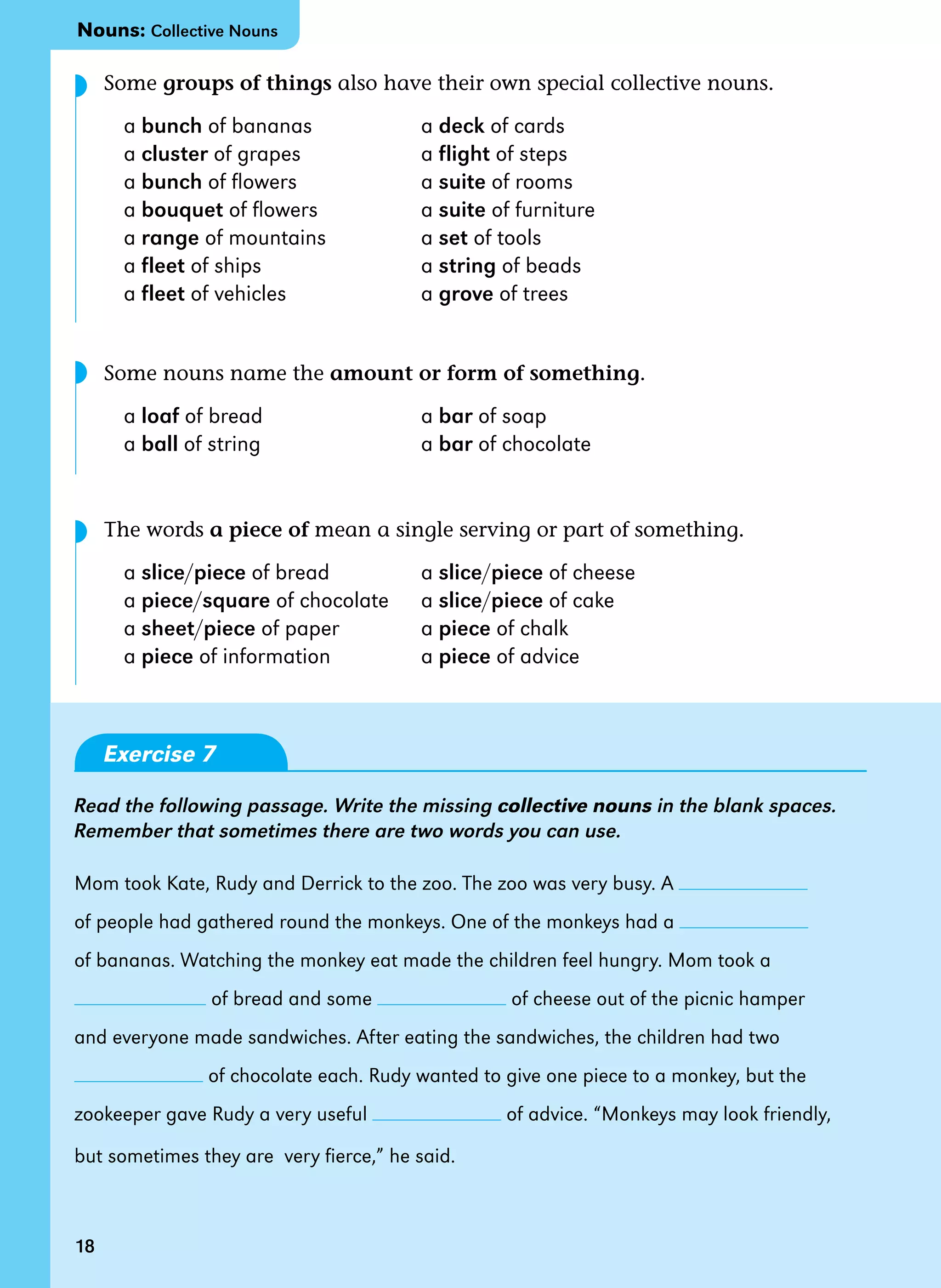
	 Some groups of things also have their own special collective nouns.
a bunch of bananas	 a deck of cards
a cluster of grapes	 a flight of steps
a bunch of flowers	 a suite of rooms
a bouquet of flowers	 a suite of furniture
a range of mountains	 a set of tools
a fleet of ships	 a string of beads
a fleet of vehicles	 a grove of trees
	 Some nouns name the amount or form of something.
a loaf of bread	 a bar of soap
a ball of string	 a bar of chocolate
	 The words a piece of mean a single serving or part of something.
a slice/piece of bread	 a slice/piece of cheese
a piece/square of chocolate	 a slice/piece of cake
a sheet/piece of paper	 a piece of chalk
a piece of information	 a piece of advice
Exercise 7
Read the following passage. Write the missing collective nouns in the blank spaces.
Remember that sometimes there are two words you can use.
Mom took Kate, Rudy and Derrick to the zoo. The zoo was very busy. A
of people had gathered round the monkeys. One of the monkeys had a
of bananas. Watching the monkey eat made the children feel hungry. Mom took a
of bread and some of cheese out of the picnic hamper
and everyone made sandwiches. After eating the sandwiches, the children had two
of chocolate each. Rudy wanted to give one piece to a monkey, but the
zookeeper gave Rudy a very useful of advice. “Monkeys may look friendly, 	
but sometimes they are  very fierce,” he said.
◗
◗
◗
18
Nouns: Collective Nouns
19
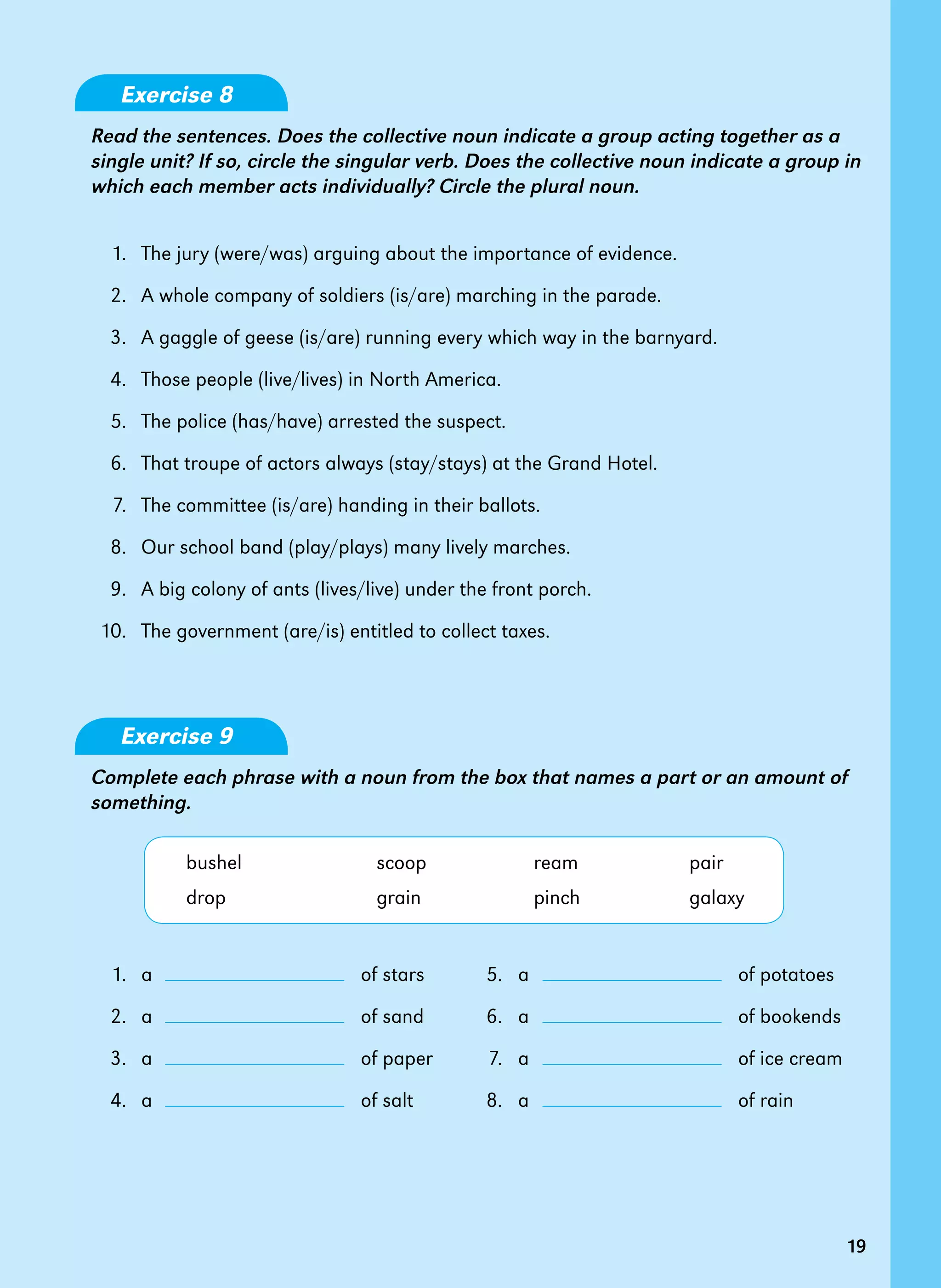
Exercise 8
Read the sentences. Does the collective noun indicate a group acting together as a
single unit? If so, circle the singular verb. Does the collective noun indicate a group in
which each member acts individually? Circle the plural noun.
	 1.	 The jury (were/was) arguing about the importance of evidence.
	 2.	 A whole company of soldiers (is/are) marching in the parade.
	 3.	 A gaggle of geese (is/are) running every which way in the barnyard.
	 4.	 Those people (live/lives) in North America.
	 5.	 The police (has/have) arrested the suspect.
	 6.	 That troupe of actors always (stay/stays) at the Grand Hotel.
	 7.	 The committee (is/are) handing in their ballots.
	 8.	 Our school band (play/plays) many lively marches.
	 9.	 A big colony of ants (lives/live) under the front porch.
	10.	 The government (are/is) entitled to collect taxes.
Exercise 9
Complete each phrase with a noun from the box that names a part or an amount of
something.
	 bushel	 scoop	 ream	 pair
	 drop	 grain	 pinch	 galaxy
	 1.	 a 	 	 of stars	 5.	 a 	 	 of potatoes
	 2.	 a 	 	 of sand	 6.	 a 	 	 of bookends
	 3.	 a 	 	 of paper	 7.	 a 	 	 of ice cream
	 4.	 a 	 	 of salt	 8.	 a 	 	 of rain
19
20
masculine	 feminine
nephew	 niece
king	 queen
prince	 princess
emperor	 empress
wizard	 witch
actor	 actress
policeman	 policewoman
waiter	 waitress
◗
◗
◗
Nouns: Masculine and Feminine Nouns
Masculine and Feminine Nouns
	 Masculine nouns are words for men, boys and male animals.
Feminine nouns are words for women, girls and female animals.
masculine	 feminine		
boy	 girl
man	 woman
father	 mother
son	 daughter
brother	 sister
husband	 wife
grandfather	 grandmother
uncle	 aunt
	 Many nouns are used for both males and females. They are called common
gender nouns.
teacher	 baby	 doctor	 scientist	 	
pupil	 parent	 astronaut	 president
child	 cousin	 dancer	 manager
	 With animals, there is one general word for the animal and special words
for the male and the female. Sometimes the word for the male animal is the
same as the general word. Sometimes the word for the female animal is the
same as the general word.
animal	 masculine	 feminine		
rabbit	 buck	 doe
horse	 stallion	 mare
sheep	 ram	 ewe
pig	 boar	 sow
chicken	 rooster	 hen
duck	 drake	 duck
cattle	 bull	 cow
goose	 gander	 goose
fox	 fox	 vixen
tiger	 tiger	 tigress
lion	 lion	 lioness
21
Exercise 10
Complete the crossword puzzle with the correct masculine or  feminine nouns.
	 A c r o s s
	 	 masculine	 feminine	
	 3. 	 bull	 	
	 5. 	 man	 	
	 6. 	 fox	 	
	 9. 	 	 princess
	10. 	 	 empress
	 12. 	 stallion	 	
	13.	 brother	
	14. 	 king	 	
	 15. 	 	 duck	
	16. 	 	 witch
	 D O W N
	 	 masculine	 feminine	
	 1. 	 	 actress
	 2. 	 waiter	
	 4. 	 husband	 	
	 7. 	 nephew	
	 8. 	 	 aunt	
	 11. 	 	 goose


	 	 1	 	 	 	 	 	 	 	 	 	 	 2
	 	 3	 	 	 	 4	 	 	 	 5	 	 	
	 	 	 	 	 6	 	 	 	 7	 	 	 	 	 	
	 	 	 	 8
	 9	 	 	 	 	 	 	 	 10
	 	 	 	 	 	 	 11	 	 	 	 	 	
	 	 	 	 	 	 12	 	 	 	 	 13	 	 	 	
	 14	 	 	 	 	 	 	 	 	 	 	 	 	 	
	 	 	 	 	 	 	 15
	 	 	 16	 	 	 	
21
22
◗
The Possessive Form of Nouns
Use the possessive form of a noun to show ownership.
	 To make the possessive form, put an apostrophe and an s ’s after a
singular noun.
This is my bed and that is Peter’s bed.
We all like Dad’s cooking.
It is my job to collect everybody’s plate after the meal.
The flies are buzzing around the horse’s tail.
This is Susan and Jenny’s room.
This is Tom’s hat and that is Tom’s father’s hat.
	 After plural nouns that don’t end in s, use an apostrophe and an s ’s to
make the possessive form.
The children’s room is always messy.
Some people’s houses are bigger than ours.
Rats’ tails are longer than mice’s tails.
Men’s voices are deeper than women’s voices.
	 N o t e s
■	 How do you make the possessive form when two names linked
by and are the owners? Put an ’s after the second name only. For
example:
	 Katy and Mike’s house is very big. (= the house that belongs to both
Katy and Mike)
	 Joe and Sarah’s dad works at the shoe factory. (= He is Joe’s dad and
he is also Sarah’s dad.)
■	 Sometimes two possessive forms with ’s appear together, one after
the other:
	 This is John’s brother’s ball. (= The ball belongs to John’s brother.)
	 Paul’s teacher’s house has a swimming pool. (= the house that
belongs to Paul’s teacher)
Nouns: The Possessive Form of Nouns
◗
23
	 N o t e s
◗
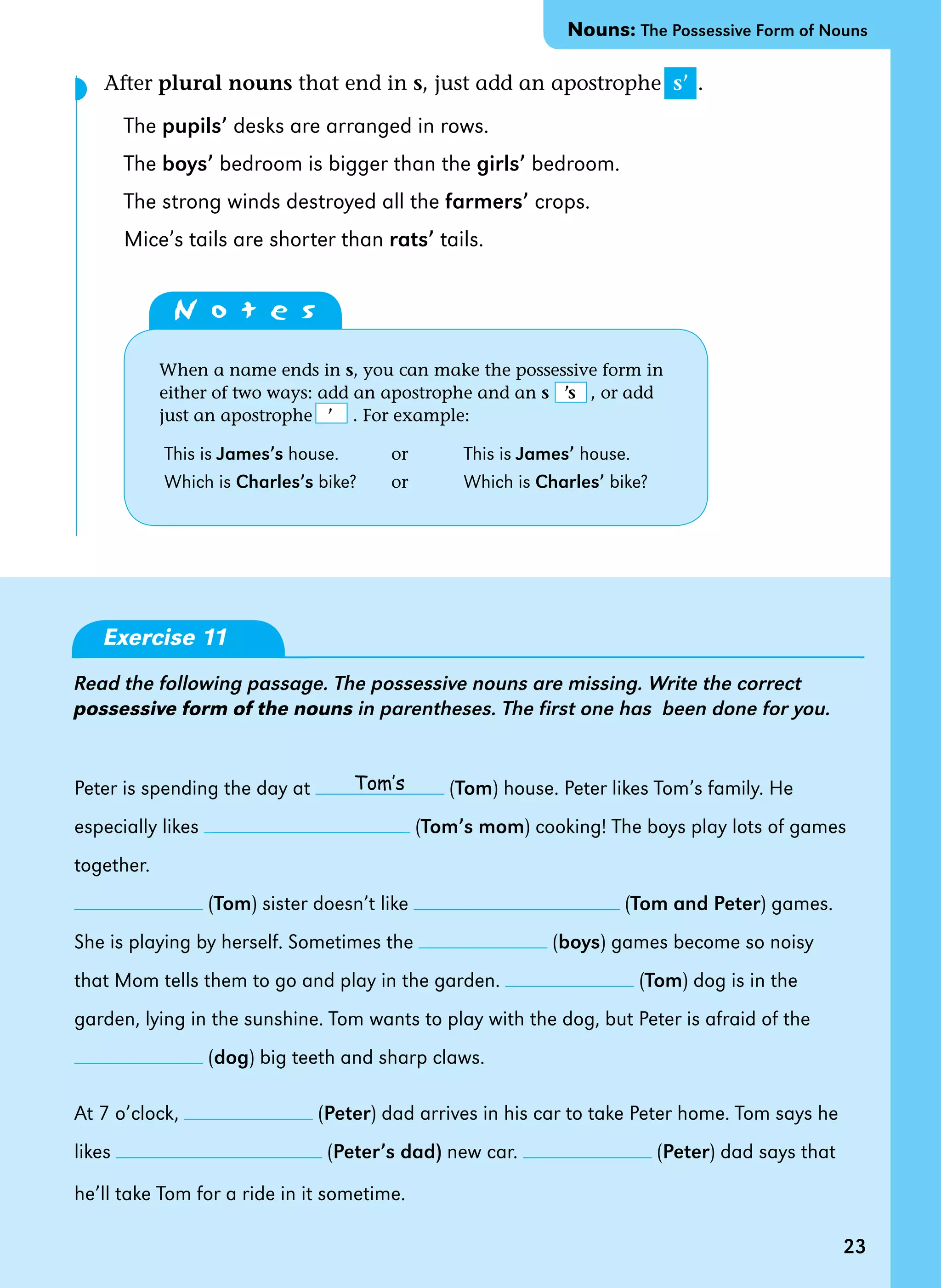
Tom’s
	 After plural nouns that end in s, just add an apostrophe s’ .
The pupils’ desks are arranged in rows.
The boys’ bedroom is bigger than the girls’ bedroom.
The strong winds destroyed all the farmers’ crops.
Mice’s tails are shorter than rats’ tails.
Exercise 11
Read the following passage. The possessive nouns are missing. Write the correct
possessive form of the nouns in parentheses. The first one has been done for you.
Peter is spending the day at (Tom) house. Peter likes Tom’s family. He
especially likes (Tom’s mom) cooking! The boys play lots of games
together.
(Tom) sister doesn’t like (Tom and Peter) games.
She is playing by herself. Sometimes the (boys) games become so noisy
that Mom tells them to go and play in the garden. (Tom) dog is in the
garden, lying in the sunshine. Tom wants to play with the dog, but Peter is afraid of the
(dog) big teeth and sharp claws.
At 7 o’clock, (Peter) dad arrives in his car to take Peter home. Tom says he
likes (Peter’s dad) new car. (Peter) dad says that
he’ll take Tom for a ride in it sometime.
When a name ends in s, you can make the possessive form in
either of two ways: add an apostrophe and an s ’s , or add
just an apostrophe ’ . For example:
This is James’s house.	 or	   This is James’ house.
Which is Charles’s bike?	 or	   Which is Charles’ bike?
23
Nouns: The Possessive Form of Nouns
24
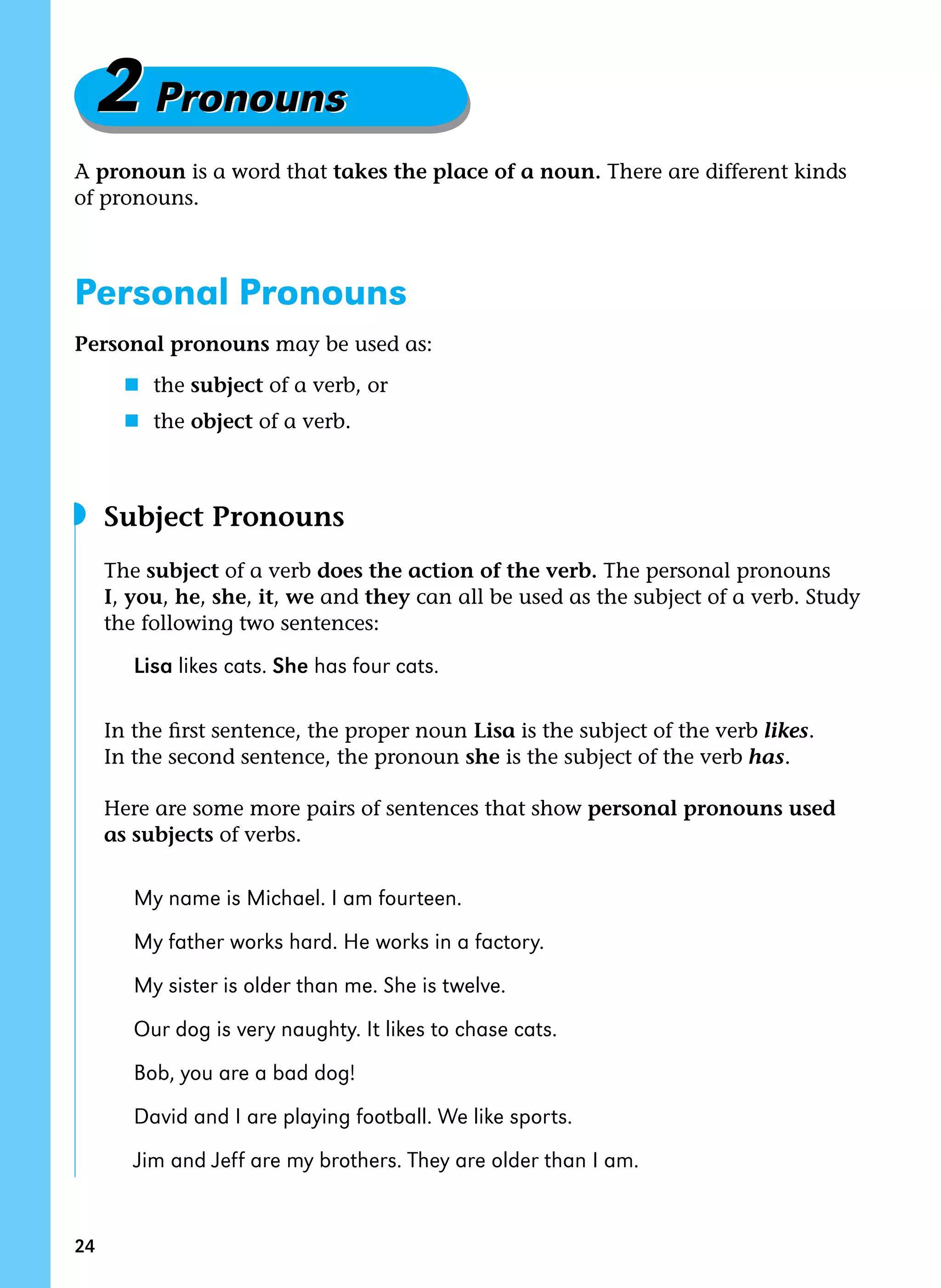
2Pronouns2Pronouns
A pronoun is a word that takes the place of a noun. There are different kinds
of pronouns.
Personal Pronouns
Personal pronouns may be used as:
	 n	the subject of a verb, or
	 n	the object of a verb.
Subject Pronouns
The subject of a verb does the action of the verb. The personal pronouns
I, you, he, she, it, we and they can all be used as the subject of a verb. Study
the following two sentences:
Lisa likes cats. She has four cats.
In the first sentence, the proper noun Lisa is the subject of the verb likes.
In the second sentence, the pronoun she is the subject of the verb has.
Here are some more pairs of sentences that show personal pronouns used
as subjects of verbs.
My name is Michael. I am fourteen.
My father works hard. He works in a factory.
My sister is older than me. She is twelve.
Our dog is very naughty. It likes to chase cats.
Bob, you are a bad dog!
David and I are playing football. We like sports.
Jim and Jeff are my brothers. They are older than I am.
◗
25
Object Pronouns
The object of a verb receives the action of the verb. The personal pronouns
me, you, him, her, it, us and them can all be used as the object of a verb.
Look at the following two sentences:
Lisa likes cats. She likes to stroke them.
In the first sentence, the noun cats is the object of the verb likes. In the
second sentence, the pronoun them is the object of the verb stroke.
Here are some more pairs of sentences that show personal pronouns
used as objects of verbs.
I’m doing my homework. Dad is helping me.
Goodbye, children! I’ll call you later.
Where is John? I need to speak to him.
Miss Garcia is very nice. All the children like her.
The car is very dirty. Mom is cleaning it.
Uncle Harry called Mary to ask her a question.
My chocolates are all gone. Someone has eaten them.
First Person, Second Person and Third Person
In grammar, the person who is speaking is called the first person. The one
spoken to is called the second person, and the one spoken about is called the
third person.
Here is a table to help you remember which pronouns to use.
	 subject	 object	
first person singular	 I	 me	
second person singular	 you	 you	
third person singular	 he	 him	
	 she	 her	
	 it	 it	
first person plural	 we	 us	
second person plural	 you	 you	
third person plural	 they	 them
◗
Pronouns: Personal Pronouns
26
Reflexive Pronouns
Reflexive pronouns are words that refer to the noun or pronoun that is
the subject of the verb. The words myself, yourself, himself, herself, itself,
ourselves, yourselves and themselves are reflexive pronouns.
My brother built this computer himself.
Be careful not to cut yourself with that knife.
John was looking at himself in the mirror.
Kate fell and hurt herself.
Our cat washes itself after every meal.
We baked the cake by ourselves.
Come in, everybody, and find yourselves a seat.
The children cleaned their room all by themselves.
Bears like to rub themselves against a tree.
The bird washed itself by splashing in a puddle.
The players train every day to keep themselves fit.
Have yourselves a good time.
Here is a table to help you remember which reflexive pronoun to use with
which personal pronoun.
singular personal  	 reflexive	 plural personal 	 reflexive
pronoun	 pronoun	 pronoun	 pronoun
I (subject pronoun)	 myself 	 we (subject pronoun)	 ourselves
me (object pronoun)	 myself	 us(object pronoun)	 ourselves
you (subject/object	 yourself	 you (subject/object	 yourselves
pronoun)		 pronoun)
he (subject pronoun)	 himself	 they (subject pronoun) 	 themselves
him (object pronoun)	 himself	 them (object pronoun)	 themselves
she (subject pronoun)	 herself
her (object pronoun)	 herself
it	 itself
Pronouns: Reflexive Pronouns
27
Possessive Pronouns
Possessive pronouns are used to talk about things that belong to people.
The words mine, yours, his, hers, ours and theirs are possessive pronouns.
This book is mine.
Have you lost yours, Tom?
This pen is mine and that one is his.
Sarah has lost her cat. Is this cat hers?
I can see our car, but where is yours?
We’ve had our lunch, but they haven’t had theirs.
Here is a table to help you remember which possessive pronoun to use with
which personal pronoun.
singular personal  	 possessive	 plural personal 	 possessive
pronoun	 pronoun	 pronoun	 pronoun
I, me	 mine	 we, us	 ours	
you	 yours	 you	 yours
he, him	 his	 they, them	 theirs	
she, her	 hers	
		
Demonstrative Pronouns
Demonstrative pronouns are used for pointing out things. The words this,
that, these and those are demonstrative pronouns.
This is my desk.	 These are my pets.
This is the Mings' house.	 These are sheep but those are goats.
That is my friend’s house.	 Those are horses.
That’s my mother’s car.
You’ll have to work harder than this.
We can do better than that.
It’s raining again. This is awful!
Who is that knocking at the door?
Hi, Kathleen. This is Michael.
	 N o t e s
n	Use this and these when you are 	
	 talking about things near you.
n	Use that and those when you are 	
	 talking about things farther away.
Pronouns: Possessive Pronouns; Demonstrative Pronouns
28
Interrogative Pronouns
Interrogative pronouns are used
to ask questions. The words who,
whose, what, which and whom are
interrogative pronouns.
Who used all my paper?
Who is Mom talking to?
Who are those people?
Whose pen is this?
Whose are these shoes?
What is your brother’s name?
What does Tom want?
What is the date today?
What do you want to be when
you grow up?
Which of these desks is yours?
Which do you prefer?
Which of your sisters is the tallest?
Whom did the President criticize?
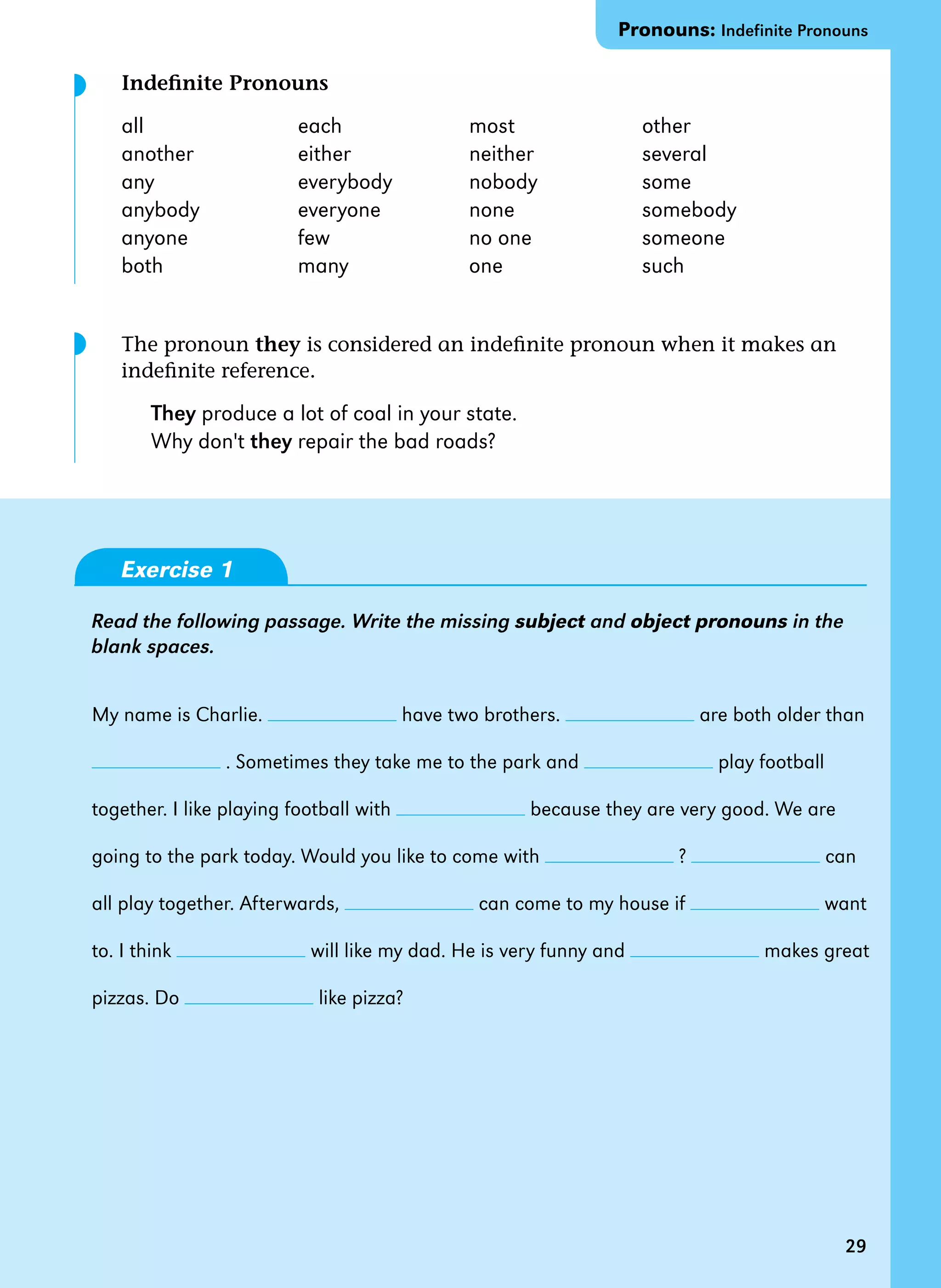
Inedefinite Pronouns
An indefinite pronoun does not refer directly to any other word. Most
indefinite pronouns express he idea of quantity.
Everybody is welcome at the meeting.
Many prefer their coffee with sugar.
Does anybody care for a cheese sandwich?
Few choose to live in the arid desert.
Pronouns: Interrogative Pronouns; Indefinite Pronouns
	 N o t e s
n	 In writing and formal speaking, you
	 can also use whom as the object of
	 verbs and prepositions. For example:
	
	 	 Whom did the president criticize?
	 	 Whom is the principal talking to?
		 or
		 To whom is the principal talking?
	 but you cannot use whom as the subject 	
	 of a verb. So you cannot say:
	 ✘ Whom came to the party last night?
	 You have to say:
	 ✔	 Who came to the party last night?
n	 Who can be used as the subject or the
	 object of a verb. For example:
	 	 Who broke the window? (as the subject)
	 	 Who are you inviting to your party?
	 	 (as the object)
n	 Who can be used as the object of a
	 preposition. For example:
	 	 Who is Mom talking to?
n	 You can also use whom as the object of
	 a preposition. For example:
		
	 	 Whom is Mom talking to?
	 If you put the preposition before the 		
	 interrogative pronoun, you must use
	 whom:
	 	 To whom is Mom talking?
◗
29
Indefinite Pronouns
all	 each	 most	 other
another	 either	 neither	 several
any	 everybody	 nobody	 some
anybody	 everyone	 none	 somebody
anyone	 few	 no one	 someone
both	 many	 one	 such	
	
The pronoun they is considered an indefinite pronoun when it makes an
indefinite reference.
They produce a lot of coal in your state.
Why don't they repair the bad roads?
Exercise 1
Read the following passage. Write the missing subject and object pronouns in the
blank spaces.
My name is Charlie. have two brothers. are both older than
. Sometimes they take me to the park and play football
together. I like playing football with because they are very good. We are
going to the park today. Would you like to come with ? can
all play together. Afterwards, can come to my house if want
to. I think will like my dad. He is very funny and makes great
pizzas. Do like pizza?
29
Pronouns: Indefinite Pronouns
◗
◗
30
Exercise 2
Some of the reflexive pronouns in the following sentences are used correctly, but some
are not. Put a checkmark in the box if the reflexive pronoun is correct. Put an x
in the box if it is not correct. Then write the correct reflexive pronoun in the blank space.
	 1. 	Sometimes I wash the dishes all by himself .
	 2.	 Dad had an accident. He cut herself with a knife.
	 3. 	Sally washes the car by herself .
	 4.	 Do you think the doctor can cure itself when he is ill?
	 5. 	The cat stays clean by licking itself .
	 6. 	Anna and May made the dinner all by herself .
	 7. 	Mom lets me walk to school by myself .
	 8. 	Can you dress themselves , boys and girls?
	 9. 	David can swim all by himself now.
	10. 	 This light is automatic. It switches itself on at night.
Exercise 3
Write a short sentence using each of the interrogative pronouns below.
Example: Who
Who
Whose
What
Which
Whom
30
Who is this man?
✓ ✗
3131
Exercise 4
Read the following passage. Write the missing demonstrative pronouns in the blank
spaces.
Henry and I went for a walk on the beach. “What’s over there?” I asked. “It
looks like broken glass,” said Henry. He gave me a bag. “Put it in ,” he said. I
put the broken glass into the bag. “We’d better put in the trash,” I said. He
took the bag from me. “You have to hold it like ,” said Henry, “so that you
don’t cut your hand.”
Exercise 5
Write the missing possessive pronouns in the blank spaces to complete the sentences.
	 1. 	I chose this seat first so it’s .
	 2. 	Can we borrow your coloring pens? We’ve lost .
	 3. 	We live in the city and they live in the countryside. Our house is smaller than
.
	 4. 	John, is this pencil ?
	 5. 	Sally is looking for her gloves. Are these gloves ?
	 6. 	Can Julie use your bike? is broken.
	 7. 	 Tom got the books mixed up. He thought mine was and his was
.
	
Exercise 6
Circle at least one indefinite pronoun in each sentence.
	 1. 	One never knows who might be listening.
	 2. 	Many are called but few are chosen.
	 3. 	I finished my cookie and asked for another.
	 4. 	Both were punished for the crime they commited.
	 5. 	Several applied for the job, but no one was hired.
32
◗
◗
◗
◗
3Adjectives3Adjectives
Adjectives describe nouns and pronouns. They give you more information about
people, places, and things.
Kinds of Adjectives
	 Some adjectives tell about the size of people or things.
a big house	 a long bridge	 tiny feet
a large army	 a high mountain	 big hands	
a huge ship	 a short man	 a short skirt
a tall building	 a thin boy	 long trousers
	 Some adjectives tell about the color of things.
a red carpet	 a gray suit	 a brown bear
a white swan	 an orange balloon	 green peppers	
a blue uniform	 a yellow ribbon	 black shoes	
	 Some adjectives tell what people or things are like by describing their
quality.
a beautiful woman	 a young soldier	 a flat surface	
a handsome boy	 an old uncle	 a hot drink
a poor family	 a kind lady	 a cold winter
a rich couple 	 a familiar voice	 a sunny day	
a strange place	 a deep pool	 cool weather
	 Some adjectives tell what things are made of. They refer to substances.
a plastic folder	 a stone wall	 a clay pot
a paper bag	 a metal box	 a glass door
a cotton shirt	 a silk dress	 a concrete road
a jade ring	 a wooden spoon	 a porcelain vase
33
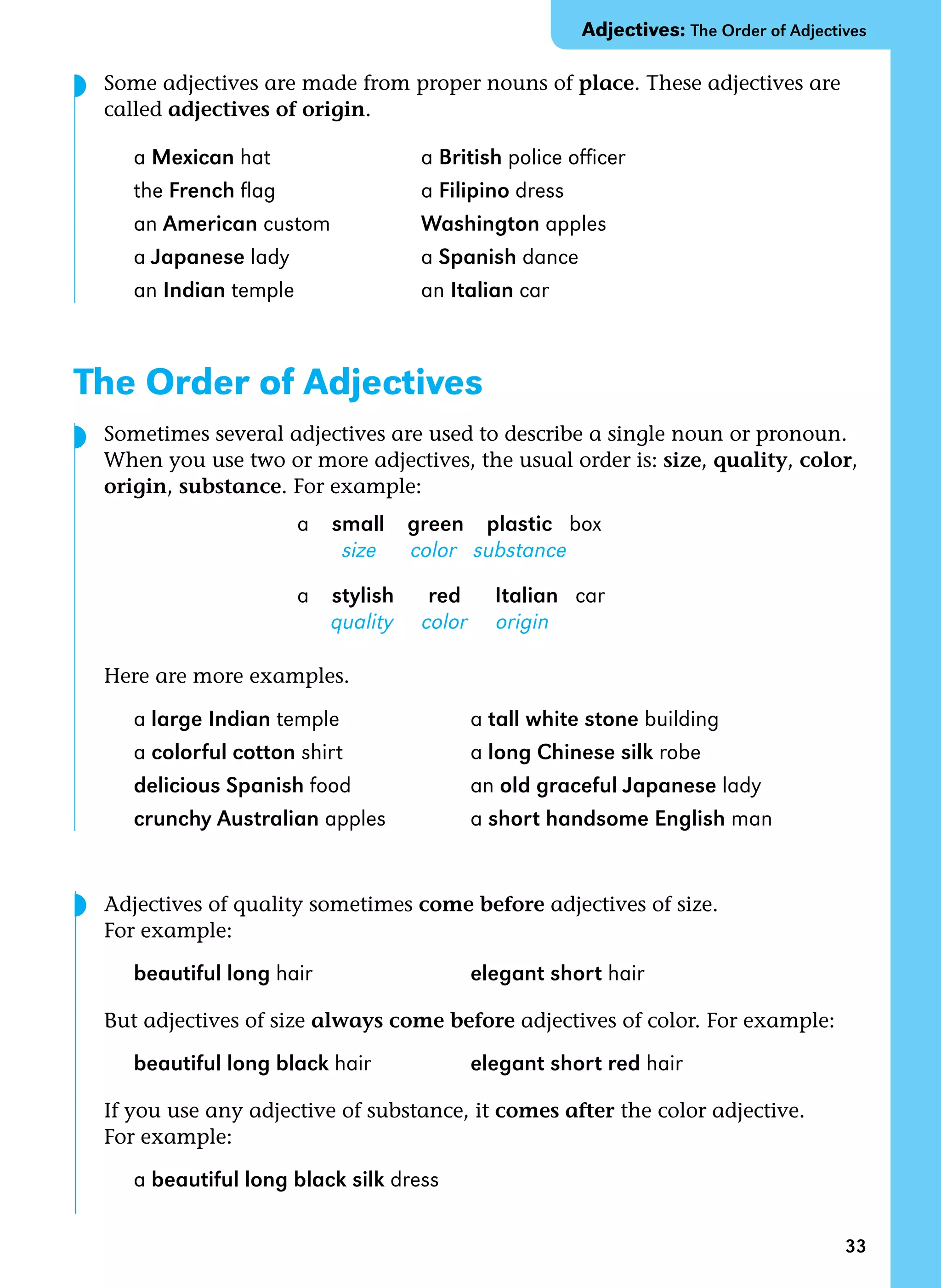
Some adjectives are made from proper nouns of place. These adjectives are
called adjectives of origin.
a Mexican hat	 a British police officer	
the French flag	 a Filipino dress	
an American custom	 Washington apples	
a Japanese lady	 a Spanish dance	
an Indian temple	 an Italian car
The Order of Adjectives
Sometimes several adjectives are used to describe a single noun or pronoun.
When you use two or more adjectives, the usual order is: size, quality, color,
origin, substance. For example:
	 a small green plastic box
	 size color substance
	 a stylish red Italian car
	 quality color origin
	 Here are more examples.
a large Indian temple	 a tall white stone building	
a colorful cotton shirt	 a long Chinese silk robe	
delicious Spanish food	 an old graceful Japanese lady 	
crunchy Australian apples	 a short handsome English man
	 Adjectives of quality sometimes come before adjectives of size.
For example:
beautiful long hair	 elegant short hair
	 But adjectives of size always come before adjectives of color. For example:
beautiful long black hair	 elegant short red hair	
If you use any adjective of substance, it comes after the color adjective.
For example:
a beautiful long black silk dress
Adjectives: The Order of Adjectives
◗
◗
◗
34
Exercise 1
Read the following passage and underline the adjectives. Write S above adjectives
of size, C above adjectives of color, Q above adjectives of quality and O above
adjectives of origin.
Sydney is a large Australian city with busy streets and expensive shops. In summer, it’s a very
hot place. People wear cool clothes and drink cool drinks. There are beautiful sandy beaches
where people can rest and look up at the wide blue sky. There are big parks for tourists to
visit. Japanese tourists like to sit and watch other people. British tourists take photographs of
the strange plants and colorful birds.
Exercise 2
The following passage contains a lot of adjectives. Some of the adjectives appear in the
wrong order. First underline the wrongly ordered adjectives. Then write them in their
correct order on the lines below the passage.
My friend Jeremy is a handsome tall boy. He always wears a white long T-shirt and a big red
cap. He carries a blue huge canvas bag to school. His favorite food is red crunchy apples
and he always has one in his bag. Our teacher is an English kind tall man called Mr. Clark.
He wears a blue smart suit and glasses with black plastic thick frames.
34
35
Adjective Endings
Adjectives have many different endings.
Some adjectives end in -ful. These adjectives describe noun or pronouns that
are full of something or have a lot of something.
a beautiful face	 a painful injury	 a careful student
a cheerful baby	 a joyful smile	 a helpful teacher
a powerful machine	 a wonderful time	 playful children
a skillful player	 a useful book	 colorful clothes
	
	 Some adjectives end in -ous.
a famous writer	 a courageous soldier	
a mountainous area	 an adventurous explorer	
a dangerous job	 a poisonous snake		
a humorous film	 a generous gift
mischievous children	 marvelous results
	
	
	 Some adjectives end in -y.
a messy room	 a noisy car	 dirty hands
a sleepy dog	 a cloudy sky	 thirsty children	
a muddy path	 a sunny day	 stormy weather
an easy test	 a lazy worker 	 juicy fruit
	
Some adjectives end in -less. These adjectives describe a person or thing that
does not have something.
a cloudless sky 	 a meaningless word
a sleeveless dress	 a fearless fighter
a careless driver	 homeless people
a joyless song	 seedless grapes
a useless tool	 harmless animals
Adjectives: Adjective Endings
◗
◗
◗
◗
36
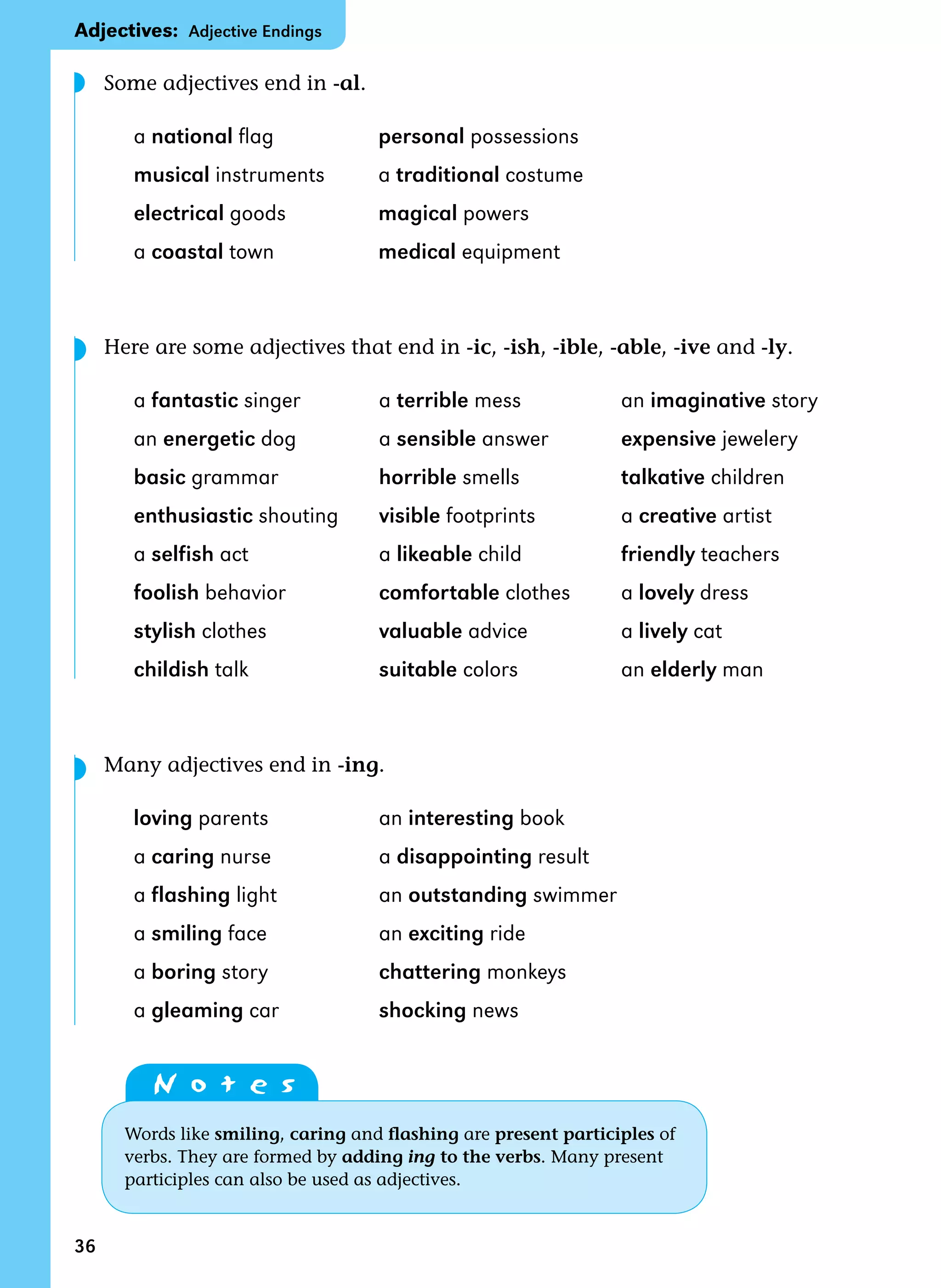
	 Some adjectives end in -al.
a national flag	 personal possessions
musical instruments	 a traditional costume
electrical goods	 magical powers
a coastal town	 medical equipment
	
	 Here are some adjectives that end in -ic, -ish, -ible, -able, -ive and -ly.
a fantastic singer	 a terrible mess	 an imaginative story
an energetic dog	 a sensible answer	 expensive jewelery
basic grammar	 horrible smells	 talkative children
enthusiastic shouting	 visible footprints	 a creative artist
a selfish act	 a likeable child	 friendly teachers
foolish behavior	 comfortable clothes	 a lovely dress
stylish clothes	 valuable advice	 a lively cat
childish talk	 suitable colors	 an elderly man
	
	 Many adjectives end in -ing.
loving parents	 an interesting book	
a caring nurse	 a disappointing result	
a flashing light	 an outstanding swimmer	
a smiling face	 an exciting ride	
a boring story	 chattering monkeys
a gleaming car	 shocking news
	 N o t e s
Words like smiling, caring and flashing are present participles of
verbs. They are formed by adding ing to the verbs. Many present
participles can also be used as adjectives.
◗
Adjectives: Adjective Endings
◗
◗
37
	 Many of adjectives end in ed.
a closed door	 satisfied customers
boiled eggs	 worried passengers
wasted time	 escaped prisoners
a painted wall	 excited students
reduced prices	 invited guests
Describing What Something Is Made Of
Some nouns can be used like adjectives. For example, if you have a chair that is
made of plastic, you can use the noun plastic as an adjective and say that the
chair is a plastic chair. If you have a watch that is made of gold, you can say it
is a gold watch.
But the nouns wood and wool can’t be used like this. To make adjectives of
these nouns you have to add en.
noun 	 adjective	 example
wood	 wooden	 a wooden door
wool	 woolen	 a woolen jumper
Describing What Something Is Like
There’s another way to make adjectives from nouns. Suppose you want to say
that something is like a certain material, although not made of it. To make
these adjectives, add -en to some nouns and -y to other nouns.
noun	 adjective	 example
gold	 golden	 a golden sunrise (= bright yellow like gold)
silk	 silky or silken	 silky skin (= as soft as silk)
lead	 leaden	 a leaden sky (= dark gray like the color of lead)
	 N o t e s
Words like closed,
wasted and escaped
are past participles
of verbs. Many past
participles can also be
used as adjectives.
Adjectives: Describing What Something Is Made Of
◗
38
care
interesting
Exercise 3
The following sentences contain adjectives made by adding endings to nouns. Write the
noun that each adjective comes from on the line after each sentence. The first one has
been done for you. Remember that some nouns must be changed slightly before the
ending is added.
	 1. 	She’s always making careless mistakes. 	
	 2. 	It was a very painful injury. 	
	 3. 	Witches and wizards have magical powers. 	
	 4. 	These oranges are very juicy. 	
	 5. 	Dogs are usually more energetic than cats. 	
	 6. 	Our neighbors are not very friendly. 	
	 7. 	She keeps her toys in a large wooden box. 	
	 8. 	Take off your muddy shoes before you come in. 	
	 9. 	May I borrow your pencil sharpener? Mine is useless. 	
	10. 	 What a beautiful dress! 	
Exercise 4
Fill in the blank spaces with adjectives made from the verbs in parentheses. Remember
that both present participles and past participles can be used as adjectives. Choose
the adjective that suits the sentence best. The first one has been done for you.
	 1. 	It wasn’t a very (interest) movie.
	 2. 	We could hear the (excite) fans screaming.
	 3. 	I hope the pupils don’t think that my classes are (bore).
	 4. 	My dad had a very (worry) look on his face.
	 5. 	Have the police found the (steal) car yet?
	 6. 	The supermarket sells lots of (freeze) food.
	 7. 	The players on the (win) team don’t look tired at all.
	 8. 	Some of the old houses had (break) windows.
38
39
The Comparison of Adjectives
	 The Comparative Form
	 To compare two people or things, use the comparative form of an
	 adjective. The comparative form is usually made by adding er to the
	 adjective.
adjective	 comparative form	 adjective	 comparative form
dark	 darker	 hard	 harder	
light	 lighter	 warm	 warmer	
high	 higher	 cold	 colder	
low	 lower	 fast	 faster	
old	 older	 slow	 slower
young	 younger
rich	 richer
poor	 poorer
tall	 taller
small	 smaller
soft	 softer
	 The Superlative Form
	 When you compare three or more people or things, use the superlative 	
	 form of an adjective. The superlative form is usually made by adding est to
	 the adjective.
adjective	 superlative form 	 adjective	 superlative form
dark	 darkest	 warm	 warmest
light	 lightest	 cold	 coldest
high	 highest	 fast	 fastest
low	 lowest	 slow	 slowest
old	 oldest
young	 youngest
rich	 richest
poor	 poorest
tall	 tallest
small	 smallest
soft	 softest
hard	 hardest
	 N o t e s
The word the is often used before the
superlative form. For example:
A bee is a small insect. A ladybird is smaller,
but an ant is the smallest.
	 N o t e s
The word than is often used to compare
two things or people. For example, you say:
Mr. Lee is taller than Philip.
A car is faster than a bike.
◗
◗
Adjectives: The Comparison of Adjectives
40
If the adjective ends in e, add r to form the comparative and st to form the
superlative.
adjective	 comparative	 superlative
nice	 nicer	 nicest
close	 closer	 closest
large	 larger	 largest
rude	 ruder	 rudest
safe	 safer	 safest
wide	 wider	 widest
Suppose the adjective is a short word that ends in a consonant and has a
single vowel in the middle. Just double the consonant and add er to make
the comparative and est to make the superlative.
adjective	 comparative	 superlative	
sad	 sadder	 saddest	
wet	 wetter	 wettest
slim	 slimmer	 slimmest	
thin	 thinner	 thinnest	
big	 bigger	 biggest
Suppose the adjective has two syllables and ends in y. Just change the y to i
and add er to make the comparative and add est to make the superlative.
adjective	 comparative	 superlative	 adjective	 comparative	 superlative
easy	 easier	 easiest	 heavy	 heavier	 heaviest
funny	 funnier	 funniest	 lovely	 lovelier	 loveliest
dirty	 dirtier	 dirtiest	 pretty	 prettier	 prettiest
noisy	 noisier	 noisiest	 tidy	 tidier	 tidiest
happy	 happier	 happiest	 friendly	 friendlier	 friendliest
naughty	 naughtier	 naughtiest	 tiny	 tinier	 tiniest
	
◗
◗
◗
Adjectives: The Comparison of Adjectives
41
Use more and most to compare most other two-syllable adjectives. You
will also use more and most with all adjectives that have more than two
syllables.
adjective	 comparative	 superlative
famous	 more famous	 most famous
precious	 more precious	 most precious
handsome	 more handsome	 most handsome
exciting	 more exciting	 most exciting
beautiful	 more beautiful	 most beautiful
expensive	 more expensive	 most expensive
comfortable	 more comfortable	 most comfortable
delicious	 more delicious	 most delicious
interesting	 more interesting	 most interesting
difficult	 more difficult	 most difficult
Irregular Comparative and Superlative Forms
A few adjectives don’t form their comparative and superlative forms in any 	
of the usual ways. The comparative and superlative forms of these adjectives
are different words, called irregular forms.
adjective	 comparative	 superlative
good	 better	 best
bad	 worse	 worst
little	 less	 least
many	 more	 most
far	 farther or further	 farthest or furthest
	 For example:
My painting is good, Melanie’s painting is better, but Andrew’s painting
is the best.
◗
Adjectives: The Comparison of Adjectives
◗
42
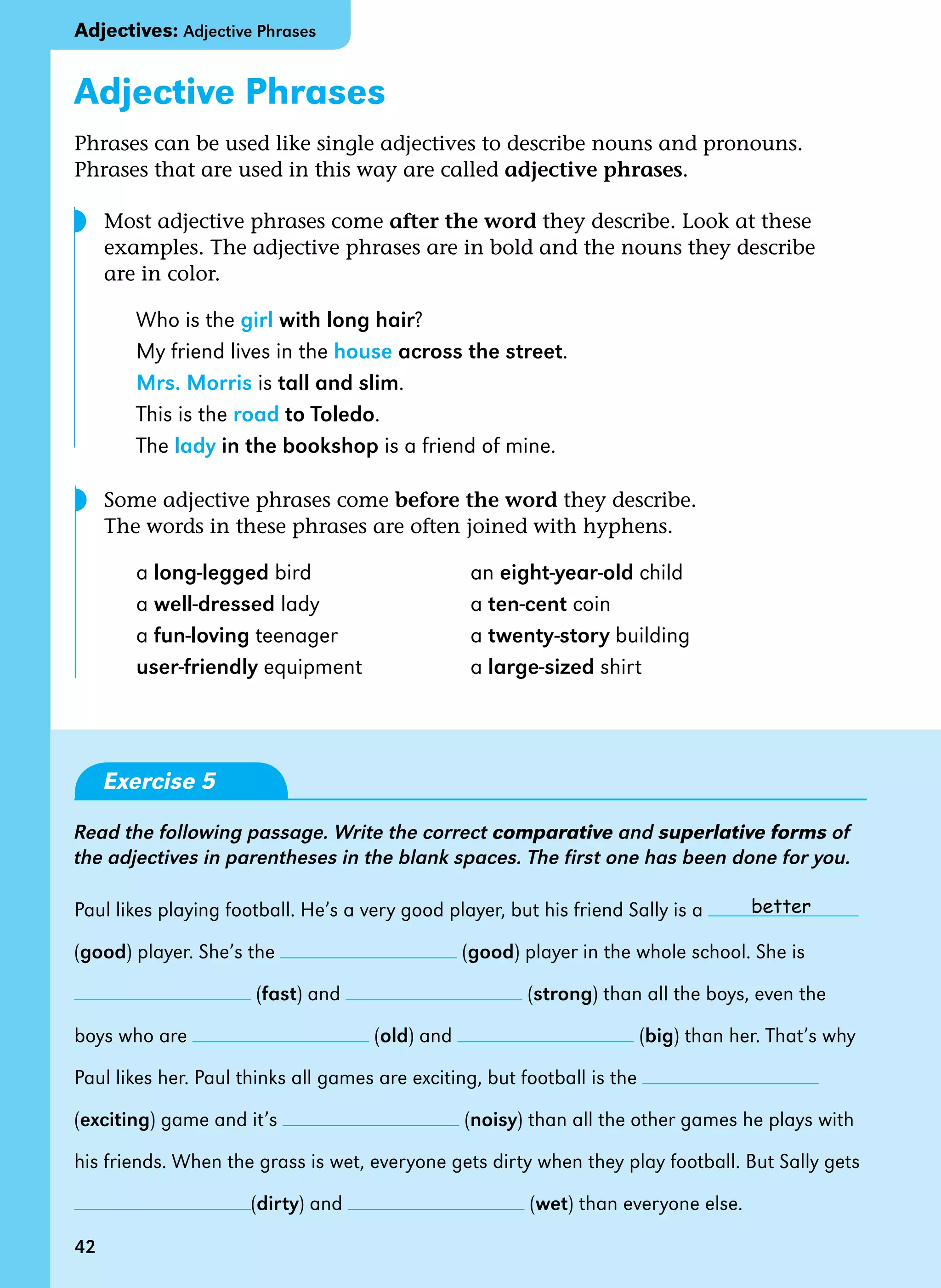
Adjective Phrases
Phrases can be used like single adjectives to describe nouns and pronouns.
Phrases that are used in this way are called adjective phrases.
	 Most adjective phrases come after the word they describe. Look at these 		
	 examples. The adjective phrases are in bold and the nouns they describe 		
	 are in color.
Who is the girl with long hair?
My friend lives in the house across the street.
Mrs. Morris is tall and slim.
This is the road to Toledo.
The lady in the bookshop is a friend of mine.
Some adjective phrases come before the word they describe.
The words in these phrases are often joined with hyphens.
a long-legged bird 	 an eight-year-old child
a well-dressed lady	 a ten-cent coin
a fun-loving teenager	 a twenty-story building
user-friendly equipment	 a large-sized shirt
Exercise 5
Read the following passage. Write the correct comparative and superlative forms of
the adjectives in parentheses in the blank spaces. The first one has been done for you.
Paul likes playing football. He’s a very good player, but his friend Sally is a
(good) player. She’s the (good) player in the whole school. She is
(fast) and (strong) than all the boys, even the
boys who are (old) and (big) than her. That’s why
Paul likes her. Paul thinks all games are exciting, but football is the
(exciting) game and it’s (noisy) than all the other games he plays with
his friends. When the grass is wet, everyone gets dirty when they play football. But Sally gets
(dirty) and (wet) than everyone else.
better
◗
42
Adjectives: Adjective Phrases
◗
4343
to Tokyo
small and brown
Exercise 6
Complete the following sentences. Write an adjective phrase that includes the
preposition in parentheses. The first one has been done for you.
	 1. 	Is this the train (to)?
	 2. 	They live in a big house (near).
	 3. 	Emilly's desk is (oppposite).
	 4. 	The bucket has a hole (in).
	 5. 	Who is the man (with)?
Exercise 4
Complete the following sentences. Write an adjective phrase, using the adjective in
parentheses and another adjective linked with and or but. The first one has been done
for you.
	 1. 	My dog is (small).
	 2. 	His sister's hair is (black).
	 3. 	Our teacher is (oppposite).
	 4. 	Tomorrow's weather will be (sunny).
	 5. 	The museum was (quiet).
44
	 N o t e s
n	 Some vowels have a consonant sound as well as vowel sound. Use the article a	
	 with nouns that begin with these vowels:
	 Is there a university in your town?
	 Does every child in the school wear a uniform?	
	 We are taking a European vacation this summer.
n	 Some words begin with a silent h. Use an with nouns that begin with a silent h:
	 We’ve been waiting here for an hour.
	 Meeting the president was an honor for all of us.
4 Determiners
◗
apple
umbrella
entrance
island
an
fox peach
museum lady
pencil
a
4 Determiners
Determiners, or noun signals, are special adjectives used before nouns.
There are different kinds of determiners.
The Articles
The words a, an and the are called the articles.
The words a and an are indefinite articles. They are used with singular  
nouns. Use a before nouns that begin with a consonant. Use an before
nouns that begin with a vowel.
John is reading a book.
Would you like a peach?
Is that a dog or a fox?
You’ll need a ruler and a pencil.
Is there also an entrance at the back of the building?
Have you ever seen an elephant?
I always take an apple to school.
Do you have an umbrella that I can borrow?
Would you like to live on an island?
45
	 The word the is called the definite article. Use the before a noun when you
are talking to someone who already knows which person or thing you mean.
Dad is sitting in the garden.
Who made the mess on the carpet?
Turn the television off now.
I’ll wait for you in the car.
The boys are upstairs and the girls are outside in the street.
Using Nouns without Articles
	 When you are talking about something in general, not a particular thing,  
use a noun without an article. You can also use plural nouns without an
article.
Frogs are my favorite animals.
Children like playing games.
Babies cry a lot.
Glasses are things that you wear to correct your eyesight.
Birds are animals that can fly.
People enjoy watching television.
	 Nouns that don't show quantity are normally used without a or an. The
article the, however, may be used with nouns that don't show quantity.
I like sunshine.
I sometimes have fruit for breakfast.
You’ve got dirt on your face.
A clock measures time.
Put sugar in your tea to make it sweet.
I need time to think of a new plan.
Would you pass me the salt, please.
Can I borrow the paint when you’ve finished?
◗
	 N o t e s
You often use the singular
nouns school, home, work,
church without an article:
We go to school by bus.	
Dad has already left home for 	
work.
They go to church on Sundays.
Determiners: Using Nouns without Articles
◗
◗
46
Demonstrative Determiners
The words this, that, these and those are also special pronouns called
determiners. They are used to point out which thing or person you mean. 	
They are called demonstrative determiners.
	 Use this and these to talk about things and people that are near you.
Use this with singular nouns.	
Who lives in this house?
This car belongs to my mom.
Does this key fit the lock?
This book is my favorite.
Who gave you this money?
This cheese tastes funny.
	
	 Use that and those to talk about things that are farther away from you.
Use that with singular nouns	
This chair is mine and that chair is 	 	
yours.	
	
That animal is making a funny 	 	
noise.	
	
Would you pass me that book, 	 	
please?	
	
Who is that man talking to Dad?	
	
How much is that dress? 	
	
Use those with plural nouns
I gave my sandwiches to those boys.
Those children go to a different
school.
These shoes are mine and those
shoes are yours.
These apples look fresh but those
apples look rotten.
Those people are from Africa.
◗
◗
Determiners: Demonstrative Determiners
Use these with plural nouns
These trousers are too short.
I don’t like these comics.
These biscuits don’t taste very good.
I bought these apples for lunch.
Is there an adult with these children?
47
Quantifying Determiners
Words such as many, much and several tell about quantity without giving an
exact number. They are called quantifying determiners.
	 Some quantifying determiners are used only with plural nouns. They are
few, a few, fewer, many, several and both.
Few people have been to the moon.	 We went to Europe many years ago.
A few children are absent today.	 Several friends went with me.
I have fewer CDs than you.	 Both brothers have dark hair.
	 Some quantifying determiners can be used with plural nouns and nouns
that show no exact number. They are all, half, some, enough, a lot of, lots
of, more, most, other and plenty of.  
All children seem to like chocolate.
We’ve eaten all the food in the refrigerator.
Half the balloons have burst already.
Jenny spends half her time watching television.
Some girls like to play football.
Can I have some water?
Do you have enough books to read?
I don’t have enough material to make a dress.
A lot of people like burgers.
There’s a lot of fruit in the bowl.
They went to a park with lots of animals in it.
You will gain weight if you eat lots of ice cream.
You’ve got more brothers than I have.
There’s more space in my room than yours.
Most teachers enjoy teaching.
Most lemonade contains sugar.
He likes playing with other children.
They had never tasted other food.
Plenty of my friends have seen the Harry Potter movies.
Drink plenty of water every day.
◗
◗
Determiners: Quantifying Determiners
48
	 Some determiners can be used only with nouns of no exact number. They
are little (meaning not much), a little (meaning some), much and less.
We have little time to play.
There’s a little rice left.
Does the teacher give you much homework?
I’ve got less ice cream than you.
	 Some quantifying determiners can only be used with singular nouns. They
are another, every and each.
I need another pencil.
He likes every child in the class.
Each house is painted a different color.
	 The quantifying determiners either and neither refer to two people or
things.
I don’t like either drink.
Neither sister has long hair.
	 Some quantifying determiners are used with singular, plural, or nouns of
no exact quantity. They are any, no, no other and the other.
Any dog will bite if it’s afraid.
Are there any good books in the library?
There wasn’t any space in the cupboard.
No child likes getting hurt.
There were no pencils in the drawer.
We’ve done no work today.
There is no other way of solving the problem.
She has no other friends.
We have no other food in the refrigerator.
Do you like this picture or the other picture?
The other boys laughed at him.
I like the other music better.
◗
◗
◗
◗
Determiners: Quantifying Determiners
49
Interrogative Determiners
The words what, which and whose are used before nouns to ask questions.
Interrogative determiners appear just before nouns.
What time is it?
Which boy is your brother?
Whose pen is this?
Possessive Determiners
The words my, your, his, her, its, our and their are used before nouns to show
ownership. They are called possessive determiners.
I gave my sandwich to John.
Is this your desk?
Alan crashed his bike into a wall.
Mrs. Park keeps her house very clean.
The dog was licking its paws.
There’s a snake in our garden.
Susan and Peter have invited me to their party.
This table will help you remember how to use possessive determiners.
singular personal 	 possessive	 plural personal 	 possessive
pronoun	 determiner	 pronoun	 determiner
I (subject pronoun)	 my	 we (subject pronoun)	 our
me (object pronoun)	 my	 us (object pronoun)	 our
you (subject/object pronoun)	your	 you (subject/object pronoun)	 your
he (subject pronoun)	 his	 they (subject pronoun)	 their
him (object pronoun)	 his	 them (object pronoun)	 their
she (subject pronoun)	 her
her (object pronoun)	 her
it (subject/object pronoun)	 its
	 N o t e s
The possessive determiner your can
be used when you are talking to one
person or more than one person:
I’m very angry with you, John. Your
behavior has been very bad today.
Jake and Josh, your dinner is ready.
Determiners: Interrogative Determiners; Possessive Determiners
50
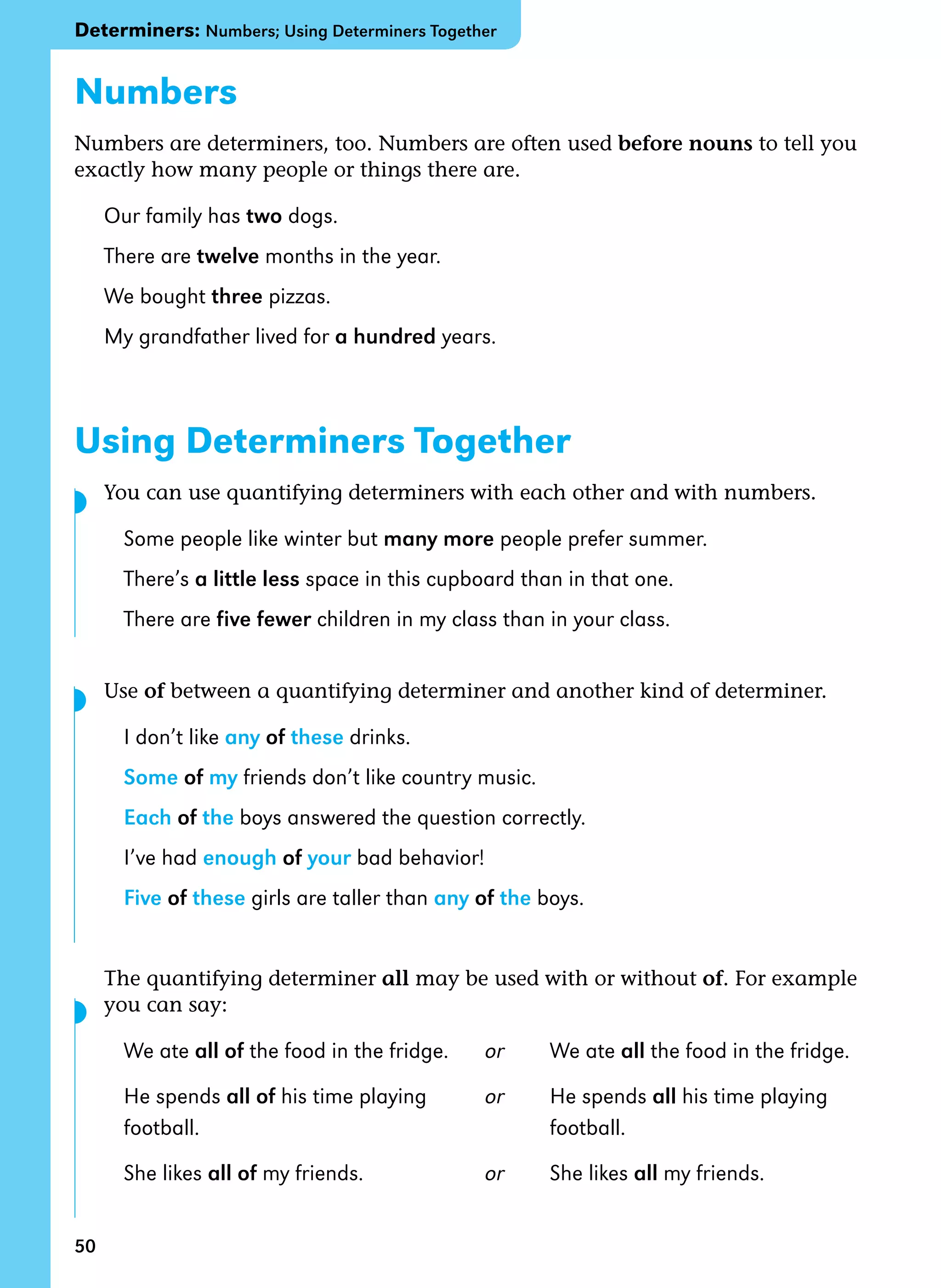
Numbers
Numbers are determiners, too. Numbers are often used before nouns to tell you
exactly how many people or things there are.
Our family has two dogs.
There are twelve months in the year.
We bought three pizzas.
My grandfather lived for a hundred years.
Using Determiners Together
	 You can use quantifying determiners with each other and with numbers.
Some people like winter but many more people prefer summer.
There’s a little less space in this cupboard than in that one.
There are five fewer children in my class than in your class.
	 Use of between a quantifying determiner and another kind of determiner.
I don’t like any of these drinks.
Some of my friends don’t like country music.
Each of the boys answered the question correctly.
I’ve had enough of your bad behavior!
Five of these girls are taller than any of the boys.
	 The quantifying determiner all may be used with or without of. For example
you can say:
We ate all of the food in the fridge.	 or	 We ate all the food in the fridge.
He spends all of his time playing 	 or	 He spends all his time playing
football.	 	 football.
She likes all of my friends. 	 or	 She likes all my friends.
Determiners: Numbers; Using Determiners Together
◗
◗
◗
51
Exercise 1
Read the following passage. Write the correct article in each blank space. If no article
is needed, leave the space blank. The first one has been done for you.
John lives in apartment with his mom, dad and sister Katy.
apartment has three bedrooms, kitchen, bathroom and
living room. John’s mom works in office and his dad stays
at home and looks after apartment. He spends much of
his time in kitchen, preparing meals. John and Katy help their dad with
housework. John likes using vacuum cleaner and Katy likes
to sweep floor. Dad gives John and Katy money when they help him. They
usually spend the money on computer games!   
Exercise 2
Notice the determiners in the following passage. What kind of determiners are they?
Put a D in the box after a demonstrative determiner, a Q after a quantifying determiner,
an I after an interrogative determiner, a P after a possessive determiner and an N after
a number.
Sally is my friend. We play together every day. I usually go to her house to play.
Her parents are very nice, but she has two brothers who sometimes spoil our
games. Last week, her brothers pulled my hair. Sally’s mom was very angry with
them. “Stop behaving in that rough way!” she shouted. I’m glad I don’t have any
brothers.  
51
an
52
5 Verbs and Tenses5 Verbs and Tenses
Most verbs describe actions, so they are called action verbs. Action verbs tell
what people or things are doing. Here are some common action verbs.
drink	 look	 jump	 swim	 fall	
eat	 shout	 walk	 throw	 climb
laugh	 run	 sit	 catch	 dance
	 	 	 	 	
Subject and Verb Agreement
When you use a verb, you have to say who or what is doing the action. This
‘who or what’ is the subject of the verb. The subject and the verb match each
other. You say that the subject and the verb agree when they match each other.
	 Use a singular verb if the subject is a singular noun. For example, the
subjects ‘my dad’ or ‘our school’, or any of the pronouns he, she or it, require
a singular verb. Most singular verbs end in s. Look at the subjects and their
verbs in these examples. The subjects are in bold and the verbs are in color.
He always drinks milk when he’s hot.
She eats bananas for breakfast.
Mom walks to work every day.
My sister dances like a professional dancer.
The baby falls when she tries to walk.
Our cat climbs the trees in our garden.
	 This form of the verb is called the third person singular. You use it when
the subject of the verb is not you or the person you are speaking to, but some
other person—a third person—or a thing.
	 Here are some more third person singular verbs that end in s.
plays	 sings	 shines	 rides	 smiles
draws	 paints	 blows	 thinks	 stops
reads	 rains	 travels	 talks	 starts
◗
53
	 The third person singular form of some verbs is made by adding es at the
end. Some examples are verbs that end in sh, ch, ss, x, zz and o.
brushes                   watches 	 kisses	 fixes
rushes 	 reaches	 misses	 mixes
polishes 	 teaches	 passes	 buzzes	
crashes 	 catches	 presses	 does	
washes 	 touches	 dresses	 goes
	
	 Here are some sentences with verbs in their third person singular form.
The subjects are in bold and the verbs are in color.
She always brushes her teeth at bedtime.
Dad polishes his shoes until they shine.
My brother watches television after school.	
Kim catches the ball with one hand.
Dad mixes flour and water when he makes bread. 	
The bee buzzes around the flowers.
My friend Sanjay goes to the same school as I do.
	
	 How do you make the third person singular form of most verbs that end in y?
Usually, you just change the y to an i and then add es.
carry	–	 carries 	 hurry	 – 	hurries	 copy	 –	 copies
cry  	 –  	cries	 fly 	 –	 flies	 marry 	–	 marries
study 	– 	studies	 worry	 –	 worries	 bully	 –	 bullies
A cat carries its kitten with its mouth.	
Mr. Chen hurries to work every morning.
The baby cries a lot at night.	
This plane flies to the island every day.
Alice tries hard at school.	
She copies all the questions in her notebook.
Verbs and Tenses: Subject and Verb Agreement
◗
◗
54
	 Some verbs that end in y have a vowel before the y. Just add an s at the end
of these words to make the third person singular form.
buy	 –	 buys	 say	 –	 says	 pray	 –	 prays
pay	 –	 pays	 annoy	 –	 annoys	 stay	 –	 stays
Mom buys bread at the supermarket.	
Mr. Carter pays all his bills with a credit card.
My friend says he has a salt-water aquarium.	
She annoys me with her silly jokes.
Anna stays with her aunt on weekends.
	 If the subject of a verb is a plural noun, such as “Mom and Dad” or “our
teachers”, use a plural verb. Do not add s, es or ies to plural verbs. Plural
verbs are also used with the pronouns I, we, you and they.
Mom and Dad love us.
My sisters listen to music a lot.
The stars shine brightly on a clear night.
Some people drink tea.
I like juicy hamburgers.
We learn interesting things at school.
You all know the words to this song, children.
They always walk home from school together.
	 Suppose the subject of a noun refers to a group of people. Depending on the
meaning of the sentence, you may use either a singular or a plural verb.
The audience was enjoying the play.
The audience have all gone home.
The class has thirty students.
The class are handing in their papers.
The band is performing until midnight.
The band were arguing among 	
themselves.
	 N o t e s
Words that refer to groups of people
or animals are called collective
nouns. Here are some more
examples:
crowd	 committee	 herd	
crew	 litter	 flock
Verbs and Tenses: Subject and Verb Agreement
◗
◗
◗
55
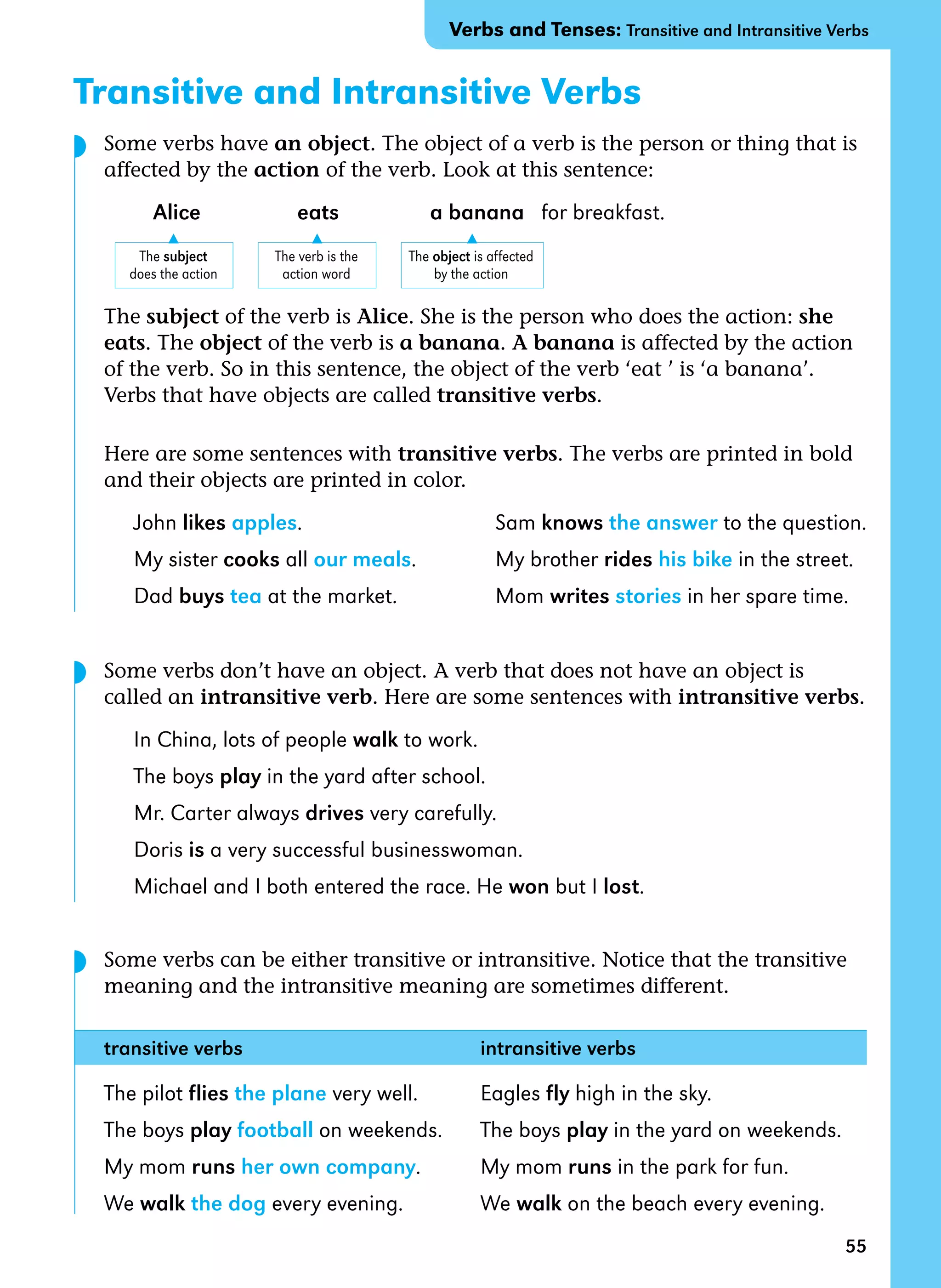
Transitive and Intransitive Verbs
	 Some verbs have an object. The object of a verb is the person or thing that is
affected by the action of the verb. Look at this sentence:
	 Alice eats 	 a banana   for breakfast.
	 The subject of the verb is Alice. She is the person who does the action: she
eats. The object of the verb is a banana. A banana is affected by the action
of the verb. So in this sentence, the object of the verb ‘eat ’ is ‘a banana’.
Verbs that have objects are called transitive verbs.
	 Here are some sentences with transitive verbs. The verbs are printed in bold
and their objects are printed in color.
John likes apples.	 Sam knows the answer to the question.
My sister cooks all our meals.	 My brother rides his bike in the street.
Dad buys tea at the market.	 Mom writes stories in her spare time.
	 Some verbs don’t have an object. A verb that does not have an object is
called an intransitive verb. Here are some sentences with intransitive verbs.
In China, lots of people walk to work.
The boys play in the yard after school.
Mr. Carter always drives very carefully.
Doris is a very successful businesswoman.
Michael and I both entered the race. He won but I lost.
	 Some verbs can be either transitive or intransitive. Notice that the transitive
meaning and the intransitive meaning are sometimes different.
	 transitive verbs		 intransitive verbs
The pilot flies the plane very well.	 Eagles fly high in the sky.
The boys play football on weekends.	 The boys play in the yard on weekends.  
My mom runs her own company.	 My mom runs in the park for fun.
We walk the dog every evening. 	 We walk on the beach every evening.
The verb is the 	
action word
The subject
does the action
The object is affected 	
by the action
▲ ▲ ▲
Verbs and Tenses: Transitive and Intransitive Verbs
◗
◗
◗
56
Exercise 1
Read the following sentences. Underline the verb in each sentence.
	 1.  	We live in an apartment on the boulevard.
	
	 2.  	Some children learn very fast.
	 3.  	We go for swimming lessons on Sunday.
	 4.  	I like my new bike.
	 5.  	Babies sometimes sleep during the day.
	 6.  	My dad buys a newspaper every morning.
	 7.  	These dolls belong to Kathleen.
	 8.  	I often walk to school with my dad.
	 9.  	My sister plays the piano very well.
	10.  	Sarah sometimes reads in bed at night.
Exercise 2
Fill in the blank spaces with the third person singular form of the verbs in parentheses.
Example:   Ali (look) sad today.
	 1.  	Sumiko (speak) English very well.
	 2.  	Mr. Kim (come) to school on his motorbike.
	 3.  	My neighbor’s dog (bark) very loudly.
	 4.  	My little brother always (brush) his teeth properly.
	 5.  	Dad is so tall that his head almost (touch) the ceiling.
	 6.  	Our dog (catch) the ball in its teeth.
	 7.  	Mom (mix) vinegar and oil to make salad dressing.
	 8.  	Sally   (try) not to disturb her brother when he’s reading.
	 9.  	Dad (buy) his newspaper from the store on the corner.
	10. 	 Her music (annoy) me when I’m doing my homework.
56
looks
57
chess
57
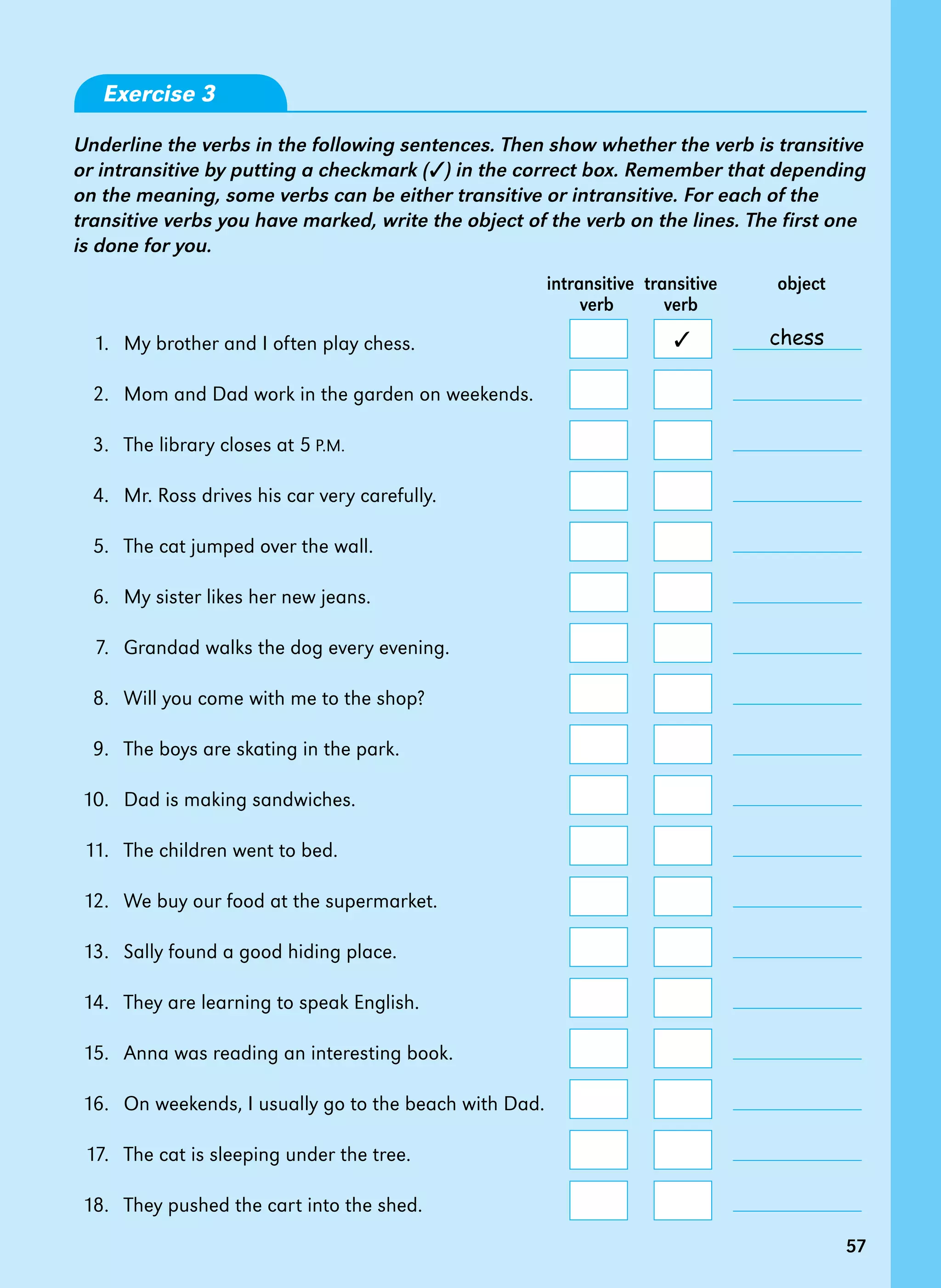
intransitive	 transitive	 object
	 verb	 verb
Exercise 3
Underline the verbs in the following sentences. Then show whether the verb is transitive
or intransitive by putting a checkmark (✓) in the correct box. Remember that depending
on the meaning, some verbs can be either transitive or intransitive. For each of the
transitive verbs you have marked, write the object of the verb on the lines. The first one
is done for you.
	
	 1.  	My brother and I often play chess.	 	 	 	
	 2.  	Mom and Dad work in the garden on weekends.	 	 		
	 3.  	The library closes at 5 P.M.	 	 		
	 4.  	Mr. Ross drives his car very carefully.	 	 		
	 5.  	The cat jumped over the wall.	 	 		
	 6.  	My sister likes her new jeans.	 	 	
	 7.  	Grandad walks the dog every evening.	 	 	
	 8. 	 Will you come with me to the shop?	 	 		
	 9.	 The boys are skating in the park. 	 	 	
	10.	 Dad is making sandwiches.	 	 	
	 11.	 The children went to bed.	 	 	
	 12.	 We buy our food at the supermarket.	 	 	
	13.	 Sally found a good hiding place.	 	 	
	14.	 They are learning to speak English.	 	 	
	 15.	 Anna was reading an interesting book.	 	 	
	16.	 On weekends, I usually go to the beach with Dad.	 	 	
	 17.	 The cat is sleeping under the tree.	 	 	
	18.	 They pushed the cart into the shed.	 	 	
✓
58
The Simple Present Tense
	 Verbs have forms called tenses that tell you when the action happens.
If the action happens regularly, sometimes or never, use the
simple present tense.
We always wash our hands before meals.
Joe sometimes lends me his bike.
Dad jogs in the park every day.
We often go to the movies on Satrurday.
Mr. Ross takes a train to work.
	 The simple present tense is also used to state facts.
The sun rises every morning.
Penguins live in the Antarctica.
Dogs love playing in water.
The earth goes around the sun.
Australia is an island.
	 Use the simple present tense to tell the events of a story that is happening
now.
I arrive at school. I see another girl crying. I ask her why she is sad.
She says she hasn’t got any friends to play with. I tell her that she 	
can play with me.
	 Use the simple present tense to talk about things that will happen in
the future.
My little sister starts school tomorrow.
The new supermarket opens this Friday.
Next week I go on holiday to Japan.
We fly to London on Sunday.
The train leaves in five minutes.
My family moves to a new house next month.
Verbs and Tenses: The Simple Present Tense
◗
◗
◗
◗
59
am, is and are
The words am, is and are are the simple present forms of the verb be.
n 	Use am with the pronoun I.
n 	Use is with singular nouns like ‘my dad’ and ‘the teacher’, and with the
pronouns he, she and it.
n	 Use are with plural nouns like ‘my parents’ and ‘Jenny and Mary’, and with
the pronouns we, you and they.
I am twelve.	 The children are asleep.
I am in the garden.	 Computers are very expensive.
My mom is very tired today.	 My brother and I are upstairs.
The teacher is tall.	 We are in our bedrooms.
She is also pretty.	 You are my best friend.
Our dog is black.	 You and David are my best friends.
Here is a table to help you remember how to use is, am and are.
	 singular	 plural
first person	 I am	 we are
second person	 you are	 you are
third person	 he is	 they are
	 she is	 they are
	 it is	 they are
Verbs and Tenses: am, is and are
	 N o t e s
There are short ways of saying and writing
am, is and are with pronouns. These short
forms are called contractions.
full form	 short form
I am	 I’m
you are	 you’re
he is	 he’s
she is	 she’s
it is	 it’s
we are	 we’re
they are	 they’re
You can use these contractions to replace
am, is and are when they are used
with not:
full form	 short form
I am not	 I’m not
he is not	 he isn’t
she is not	 she isn’t
it is not	 it isn’t
we are not	 we aren’t
you are not	 you aren’t
they are not	 they aren’t
60
there is and there are
Use there with is and are to say what exists or what you can have. Use there is
with singular nouns, and there are with plural nouns.
There is a tree in our garden.
There is a girl called Farah in my class.
There is fish for dinner.
There is nothing to do when it rains.
There’s a cat sitting on the bench.
There’s a boy in my class who can walk on his hands.
There are cows in the field.
There are some very big ships in the harbor today.
Exercise 4
Look at the pairs of subjects and verbs below. Then write a sentence using each subject
with the simple present form of the verb. Remember that you can also use the simple
present tense to talk about the future.
Example: Dad goes to work on his bike.
	 subject	 verb
	 1. 	 Dad	 go
	 2.  	My brother	 ride
	 3.  	The dog	 watch
	 4.  	The bus	 leave
	 5. 	 Tom and Sam	 buy           
	 6.  	We	 eat                    
	 7.  	Aunt Grace	 come
	 8.	 Our neighbor	 like
	 9.	 The boys	 start
	10. 	 My family	 travel
	 N o t e s
The contraction for
there is is there’s.
60
Verbs and Tenses: there is and there are
61
Exercise 5
Complete the following sentences by writing am, is or are in the blank spaces.
	 1.  	The weather beautiful today.
	 2.  	All the children on the playground.
	 3.  	Boys! You always late for class.
	 4.  	 you on the basketball team, too?
	 5.  	Nobody in my class   interested in football.
	 6.  	 this computer more expensive than that one?
	 7.  	Sally my best friend.
	 8.  	Mom and Dad downstairs watching television.
	 9.  	Paul and Henry   in the computer room.
	10. 	 The Eiffel Tower the tallest monument in Paris.
Exercise 6
Read the following passage. Fill in there’s, there are, there isn’t or there aren’t in the
blank spaces.
I like playing in our park because some great things to play on.
a big chute to slide on and a huge sandbox to play in.
also some swings. Dogs are not allowed in the park so no dogs to bother us.	
also a lot of space for us to run around. It sometimes gets hot because
many trees to give shade, but a fountain where we can drink
water. It’s the best place in the town for children. another place as good as
the park.
61
62
Exercise 7
Rewrite the following sentences using contractions. The first one has already been
done to help you.
	 1.	 It is another sunny day today.
	 	
	 2.  	This is my sister. She is five.		
	 			
	 3.  	I am not very interested in sports.	
	 	
	 4.  	She is not my best friend. You are my best friend.
	 	
	 5. 	 Cats are not as noisy as dogs.
	 		
	 6.  	We are busy doing our homework.
	 			
	 7. 	 She is busy cleaning the car in the garage.
	 			
	 8.  	Our teacher is not very tall.
	 			
	 9.  	My parents are not home from work yet.
	 		
	10. 	 My friend is not very good at math.
	 	
It’s another sunny day today.
62
63
The Present Progressive Tense
The present progressive tense is used to talk about things that are continuing
to happen.
	 Make the present progressive tense by using am, is or are with a verb that
ends in ing.
I am learning how to swim.
I am eating my lunch.
I am watching television.
She is reading a book.
Dad is baking a cake.
My sister is listening to music.
Uncle David is cleaning his car.
The dog is barking in the garden.
We are singing our favorite song.
My brother and I are playing a computer game.
The teachers are showing us a film.
They are bringing a television set into the classroom.
	 The present progressive tense is also used to talk about things that are
planned for the future.
I am going to the library tomorrow.
My sister is giving me her bike when she gets her new one.
We can’t go to the movies tomorrow because my mom is working.
We are having a barbecue on Sunday.
All my friends are coming to my party next week.
We’re taking my cousin to the zoo later today.
	 N o t e s
The ing form of a verb is called the
present participle. You use the present
participle with am, is or are to make
the present progressive tense.
am 	 + 	 watching
	 	 	 (present participle)
is 	 + 	 listening
      	 	 	 (present participle)
are 	 + 	 playing
	 	 	 (present participle)
Verbs and Tenses: The Present Progressive Tense
◗
◗
64
Exercise 8
Fill in the blank spaces with the present progressive tense of the verbs in parentheses.
Try to use contractions such as I’m, she’s and they’re where you can.
	 1.	 We (go) to the zoo tomorrow.
	 2.	 He (fix) my bike in the garage.
	 3.	 I (help) Mom in the kitchen.
	 4.  	My sister and I (watch) television in our bedroom.
	 5.  	The train (leave) in ten minutes.
	 6.  	They (come) with us to the museum.
	 7.  	We (paint) some pictures for Aunt Susan.
	 8.  	The boys and girls (dance) in the hall.
	 9.  	The cat (chase) some birds.
	10.  	My brother (tickle) me.
Exercise 9
Complete the following sentences with either 1) the simple present form of the verb,
or 2) the present progressive form of the verb.
	 1.  	The teacher always (give) us interesting project work.
	 2.  	The wind (blow) very strongly today.
	 3.  	I (like) chocolate ice cream.
	 4.  	Be quiet! We (try) to listen to the radio.
	 5.  	Let’s go inside now. It (begin) to rain.
	 6.  	Penguins (eat) fish.
	 7.  	Dad never (let) us play in the street when it’s dark.
	 8.  	The children (go) swimming every day.
	 9.  	We’re trying to catch the ball that (roll) down the hill.
	10. 	 My teacher (know) a lot about plants and animals.
64
65
The Simple Past Tense
	 Use the simple past tense to talk about things that happened in the past.
The simple past tense is usually made by adding ed to the verb.
I opened the door and looked inside.
The plane landed ten minutes ago.
My cousin visited us last summer.
We walked to school yesterday.
She laughed when I told her the joke.
	 If a verb ends in e, just add d to make the simple past tense.
Who closed all the windows?
We lived in that house when I was a baby.
She smiled when she saw me.
We raced each other on our bikes.
	 If a verb ends in y, change the y to i before adding ed.
I carried my mom’s shopping bag.
My brother cried when he fell off his bike.
We hurried to the station to catch the train.
Dad tried to help me with my homework.
	 With some short verbs that end in a consonant, 	
you must double the consonant before adding ed.
I climbed over the fence and ripped my shirt.
The stranger grabbed my arm.
The dog wagged its tail when it saw the biscuits.
He slammed the door and walked off angrily.
Verbs and Tenses: The Simple Past Tense
◗
◗
◗
◗
66
was and were
The words was and were are the simple past forms of the verb be.
n	 Was is the simple past form of am and is. Use was with singular nouns like
‘my dad’ and ‘the teacher’, and with the pronouns he, she and it.
n	 Were is the simple past form of are. Use were with plural nouns like ‘my
parents’ and ‘Jenny and Mary’, and with the pronouns we, you and they.
Ten years ago, I was only a baby.
When I was younger, I played with teddy bears.
My friend was ill yesterday.
Mom was angry when she saw the broken vase.
It was very wet on Monday.
It was six o’clock when we got home.
We were away on vacation last month.
John and I were in the garden.
You were nasty to me!
You and Sally were not at school yesterday.
Dinosaurs were prehistoric animals.
Those were my best jeans.
	 Here is a table to help you remember 	
how to use was and were.
	 singular	 plural
first person	 I was	 we were
second person	 you were	 you were
third person	 he was	 they were
	 she was	 they were
	 it was	 they were
	 N o t e s
You may use these contractions
when you are combining was and
were with not.	
full form	 short form
I was not	 I wasn’t
he was not	 he wasn’t
she was not	 she wasn’t
it was not	 it wasn’t
we were not	 we weren’t
you were not	 you weren’t
they were not	 they weren’t
Verbs and Tenses: was and were
67
Irregular Verbs
	 Many common verbs have unusual present and past tense forms. These are
called irregular verbs.
	 Remember that the simple past tense of most verbs is made by adding ed
at the end: look becomes looked. Notice that the simple past tense of these
common irregular verbs is quite different.
irregular verb	 simple past tense	 irregular verb	 simple past tense
break	 broke	 keep	 kept
bring	 brought	 kneel	 knelt
buy	 bought	 know	 knew
catch	 caught	 leave	 left
come	 came	 lose	 lost
do	 did	 meet	 met
fall	 fell	 ring	 rang
feed	 fed	 run	 ran
feel	 felt	 see	 saw
fly	 flew	 sell	 sold
get	 got	 sleep	 slept
go	 went	 speak	 spoke
have	 had	 write	 wrote
	 The simple past tense of other irregular verbs does not change at all.
verb	 simple past tense	 example
cost	 cost	 I bought a new CD. It cost twenty dollars.
cut	 cut	 My brother cut his finger this morning.
hit	 hit	 She hit the ball into a neighbor’s garden.
hurt	 hurt	 I hurt my leg when I jumped off the wall.
let	 let	 Mom opened the door and let us in.
put	 put	 The tea tasted horrible because I put too much 	
		 sugar in it.
read	 read	 Dad read us a story last night.
◗
Verbs and Tenses: Irregular Verbs
◗
68
Exercise 10
Write each past tense verb below under the correct heading.
laughed 	 lived 	 smiled 	 landed 	
cried 	 pinned 	 hurried 	 played 	
hopped 	 tried 	 grabbed 	 raced
	 verb + ed	 verb + d	 double the last letter + ed 	change y to i and add ed
Exercise 11
Complete the sentences with the simple past tense of the verbs in parentheses.
	 1.	 The boys (whisper) secrets to each other.
	 2.	 Uncle Ben (hurry) to catch his bus.
	 3.	 We (return) our books to the library.
	 4. 	She (kiss) the frog and it (change) into a prince.
	 5. 	Someone (tap) me on the shoulder.
	 6. 	The baby (cry) when we took her toy away.
	 7. 	John (pin) the badge onto his jacket.
	 8.	 Two doctors (rush) into the room.
	 9. 	This is the house that we (live) in when I was younger.
	10. 	 Grandad (lower) himself into the chair.
68
69
Exercise 12
Write was or were in the blank spaces in the following passage.
It a beautiful summer’s day and there n’t a cloud in the sky.
Mom, Dad and I all in the garden. Dad in the vegetable
garden planting some seeds and Mom and I busy with other jobs. The
sun hot and soon I feeling very tired. Mom and Dad
n’t tired at all. They went on working for a long time. I
glad when it time to go inside and have a drink.
Exercise 13
Draw a circle around the correct past tense verb in each sentence below.
	 1.	 I (losed / lost) my watch in the park.
	 2. 	David (hurt / hurted) his knee when he (falled / fell).
	 3. 	I kicked the ball hard and it (breaked / broke) a window.
	 4. 	My new shoes (cost / costed) a lot of money.
	 5. 	I (getted / got) this book from the library.
	 6. 	We had a garage where we (keeped / kept) our car.
	 7. 	Ali (shew / showed) me the cut on his knee.
	 8. 	The glass (falled / fell) off the table and (breaked / broke).
	 9. 	We (selled / sold) our old car and (buyed / bought) a new one.
	10.	 The bell (ringed / rang) and we all (goed / went) into school.
	 11.	 The dog (catched / caught) the ball in its mouth.
	 12.	 The man (kneeled / knelt) down to talk to the little boy.
	13.	 I (meeted / met) my friend in the park.
	14.	 Our cat (runned / ran) onto the road in front of a car.
	 15.	 Jane (writed / wrote) a letter to her best friend.
69
70
The Past Progressive Tense
	 Use the past progressive tense to talk about things that were happening in
the past and had not stopped happening. They were continuing.
	 To make the past progressive tense, use
was or were and a verb that ends in ing.
I was watching television.
Ben was finishing his homework.
She was putting her books into her schoolbag.
Jenny and I were tidying the classroom.
We were all dancing at the party.
You weren’t listening to the teacher.
Some boys were looking out of the window.
	 You can also use the past progressive tense to say what was happening
when something else happened.
Sam was doing his math homework when the phone rang.
Dad was cooking our dinner when I got home.
When I saw Joe, he was looking for his dog.
We were all enjoying the movie when the power went out.
What were they doing when the bell rang?
Exercise 14
Complete the sentences with the past progressive tense of the verbs in parentheses.
	 1.	 At the block party lots of people (dance) in the street.
	 2.	 I (sit) in my bedroom reading a book.
	 3.	 Someone (make) a very loud noise in the street.
	 4. 	Why you all (laugh) when I came in?
	 5. 	Mike and John (wash) their paintbrushes.
	 6.	 Sally (practice) the piano.
	 7. 	 I ran so fast that my heart (beat) really hard.
	 8. 	 Our neighbors (have) a barbecue.
	 N o t e s
The ing form of a verb is
called the present participle.
You use the present participles
with was or were to make the
past progressive tense:
was 	 + 	 cleaning
	 	 (present participle)
were 	+ 	 listening
	 	 (present participle)
70
◗
◗
Verbs and Tenses: The Past Progressive Tense
71
have, has and had
	 The verb have is used to say what people own or possess.
	 n	 Use have with the pronouns I, we, you and they, and with plural 		
	 nouns such as ‘my parents’ and ‘Tom and Susan’.
	 n	 Use has with the pronouns he, she and it, and with singular nouns	
	 such as ‘my dad’ and ‘the teacher’.
I have two brothers and one sister.
Monkeys have long tails.
My sister and I have a swing in our garden.
John has a big brother.
Sally has a pretty face.
An elephant has a long trunk. It also has big ears.
His brother has dark hair.
Our apartment has big windows.
	 Use have to talk about things that people do or get.
I can’t play football because I have a broken leg.
We have art lessons on Mondays.
You have a stain on your shirt.
They have the desks nearest the teacher.
Peter has a sore knee.
	 You also use have to talk about things that people eat.
We usually have lunch at school.
Mom and Dad sometimes have their breakfast in bed.
Jenny often has sandwiches for lunch.
She sometimes has cola to drink.
	 N o t e s
The words have and
has are the simple
present forms of the
verb have.
◗
◗
Verbs and Tenses: have, has and had
◗
72
	 Here is a table to help you remember how to use have and has.
	 singular	 plural
first person	 I have	 we have
second person	 you have	 you have
third person	 he has	 they have
	 she has	 they have
	 it has	 they have
	 The simple past tense form of have and has is had.
I had a big toy car when I was small.
It was sunny so we had lunch in the garden.
They had a wonderful holiday in Europe.
Sally and I had chicken for dinner.
The boys had a fight in the playground.
Dad had a sore back yesterday.
She had long hair when I saw her a year ago.
Our cat had three kittens last week.
	 Use had when you're talking about wishes.
I wish I had a new bike.
Kathleen wishes she had a big sister.
Dad wishes he had a bigger garage.
The boys wish they had more space to play football in.
	 You can make the negative with didn’t have.
I wish I didn’t have so much homework.
Jack wishes he didn’t have a broken leg.
Dad wishes he didn’t have to work on weekends.
Do you wish you didn’t have English classes today?
Verbs and Tenses: have, has and had
◗
◗
◗
◗
73
The Present Perfect Tense
The present perfect tense shows action in the indefinite past. The present perfect
tense is also used to show action begun in the past and continuing into the
present.
To make the present perfect tense, use have or has and a verb that ends in ed.
We have lived in this house for five years.
(= and we still live there)
Your plane has already landed.
(= and it’s still on the ground)
She has dirtied her new shoes.
(= she made them dirty and they’re still dirty)
The teacher has pinned a notice on the board.
(= and the notice is still there)
You don’t need your key. I’ve already opened
the door. (= and it’s still open)
Irregular Past Participles
Remember that irregular verbs don’t have a simple past form that ends in -ed.
	 Irregular verbs also have unusual past participles that don’t end in -ed.
The past participle of some verbs is the same as the simple past tense.
irregular verb 	 simple past tense 	 past participle 	
fight	 fought	 fought
have	 had	 had
lose	 lost	 lost	
teach	 taught	 taught
win	 won	 won
Verbs and Tenses: The Present Perfect Tense; Irregular Past Participles
◗
	 N o t e s
The ed form of a verb is called
the past participle when it is
used with has or have to make
the  present perfect tense:
have + 	landed
		 (past participle)
has 	+ 	 opened
		 (past participle)
74
◗
◗	 Here are more examples of irregular past participles.
irregular 	simple 	 past 	 example
verb	 past tense 	 participle
keep	 kept	 kept	 I have kept the letter you sent me.
catch	 caught	 caught	 The police have caught the thieves.
bring	 brought	 brought	 Maggie has brought her favorite CD 	
			 to school.
make	 made	 made	 The children have made a birthday 		
			 card for their mom.
sell	 sold	 sold	 They’ve sold their car and now they 	
buy	 bought	 bought	 have bought motorcycles.
	 Some common irregular verbs have a past participle that is different from
the simple past tense.
irregular 	 simple	 past	 example
verb	 past form 	 participle
	
be	 was	 been	 Anna has been my best friend for 		
			 years.
break	 broke	 broken	 I’m sorry, I’ve broken your pencil.
do	 did	 done	 Jack has already done his homework.
draw	 drew	 drawn	 We’ve drawn a picture for you, Mom.
drink	 drank	 drunk	 Have you drunk all your orange juice?
eat	 ate	 eaten	 Someone has eaten all the chocolates.
fall	 fell	 fallen	 One of the pictures has fallen off the 	
			 wall.
go	 went	 gone	 I’m sorry, but your train has already 	
			 gone.
know	 knew	 known	 I’ve known Michael for two years.
see	 saw	 seen	 Kathleen has already seen that movie.
speak	 spoke	 spoken	 Miss Hill has spoken to the principal 	
			 about the problem.
Verbs and Tenses: Irregular Past Participles
75
	 Some irregular verbs have a past participle that does not change at all.
irregular 	 past	 example
verb	 participle	
cut	 cut	 I’ve cut my finger and it’s bleeding badly.
hit	 hit	 The children next door have hit their ball into the 	
		 busy street.
cost	 cost	 This vacation has cost us hundreds of dollars already.
read	 read	 Dad hasn’t read my school report yet.
hurt	 hurt	 Can Anna sit down? She’s hurt her leg.
put	 put	 Have you put any sugar in my tea?
Exercise 15
Complete the following sentences with has or have.
	 1.	 My dog a long shiny coat.
	 2. 	Our teacher a very kind face.
	 3. 	You a lot of homework to do.
	 4. 	Sam and I desks near the front of the class.
	 5. 	Paul two brothers and a sister.
	 6. 	My friend Andy a big house.
	 7. 	Mice long tails.
	 8. 	Most dogs sharp teeth.
	 9. 	I more toys than my friend .
	10. 	 These flowers a strange smell.
75
◗
Verbs and Tenses: Irregular Past Participles
76
Exercise 16
Complete the sentence with the present perfect tense of the verbs in parentheses.
	 1.	 The children (make) the house very messy.
	 2. 	I (see) that actor in several movies.
	 3. 	The boys (drink) all the soda in the refrigerator.
	 4. 	Our dog (hurt) its leg.
	 5. 	One of the workmen (fall) off his ladder.
	 6. 	She’s sad because her friends (go) to the park without her.
	 7. 	Dad (have) a shower already.
	 8. 	I’ve been shouting so much that I (lose) my voice.
	 9. 	My sister’s boyfriend (buy) her a diamond ring.
	10. 	 Alan (do) this jigsaw puzzle so many times that he could do it with
his eyes shut.
Exercise 17
Draw a circle around the correct past participle in each sentence below.
	 1.	 Your child has (broke/broken) my window!
	 2.	 Have you (eaten/ate) all your dinner?
	 3. 	I have (known/knew) Sally since we were in kindergarden.
	 4. 	Michael has (drew/drawn) a picture for his grandad.
	 5. 	The new girl seems nice, but I haven’t (spoke/spoken) to her yet.
	 6. 	We’ve (drank/drunk) all the milk.
	 7. 	The ball has (went/gone) over the garden fence.
	 8. 	Has Tom (did/done) all his homework?
	 9. 	You have (been/was) late for school every day this week.
	10. 	 Help! I’ve (fell/fallen) down a hole!
76
77
The Future Tense
	 To show future action use the verbs shall and will with another verb that
describes the action.
	 n	 You can use either shall or will with the pronouns I and we.
	 n	 Use will with the pronouns you, he, she, it and they.
	 n	 Will is also used with singular nouns like ‘my dad’ and with plural 		
	 nouns like ‘all the boys in my class’.
I shall do my homework after dinner.
I will miss you when you leave.
We shall take the dog for a walk later.
We will visit Grandma this weekend.
He will be home later.
She will help us cook the food for the party.
It will soon be dark outside.
I think it will be sunny tomorrow.
I expect they will give you a present.
Mom will be very pleased with you.
Your plant will die without water.
The school will soon need a lot of repairs.
John and I shall be glad when the exams are over.
Bill and Kim will be late for school if they don’t hurry.
	
	 To make the negative form, use will and shall with not. The contraction for  
will not is won’t.
I will not help you unless you help me first.
It won’t be very sunny again until next summer.
You won’t like this food. It’s horrible!
We shall not go to the party without you.
	 N o t e s
You can shorten shall and
will as ’ll when you use these
words with pronouns:
full form	 contraction
I shall, I will	 I’ll
we shall, we will	 we’ll
you will	 you’ll
he will	 he’ll
she will	 she’ll
it will	 it’ll
they will	 they’ll
◗
Verbs and Tenses: The Future Tense
◗
78
	 To talk about facts in the future or plans that will not change, use the
simple present tense.
Tomorrow is Sunday.
Summer vacation ends on Friday.
The new library opens next week.
We fly to Paris on Wednesday.
	 You can also talk about plans for the future and other future happenings
by using be going to and another verb. Remember to:
	
	 n 	 Use am and was with the pronoun I.
	 n 	 Use is and was with the pronouns he, she and it, and with singular
	 nouns like ‘my mom’ and ‘the teacher’.
	 n 	 Use are and were with the pronouns we, you and they, and with 		
	 plural nouns like ‘my friends’ and ‘John and Sally’.
I am going to visit my cousin tomorrow.
I am going to see the new Star Wars movie next week.
My friend John is going to move to Chicago next year.
Dad is going to buy me a skateboard.
Aunt Jane is going to have another baby soon.
It is going to be windy tomorrow.
I hope someone is going to fix the television soon.
You are going to help me, aren’t you?
My friends are going to teach me how to play chess.
Mom and Dad are going to buy a new computer.
Your books are going to fall off the shelf if you’re not careful.
Are you going to read your book now?
Verbs and Tenses: The Future Tense
◗
◗
79
Exercise 18
Decide whether shall and will are used correctly in each sentence. Put a checkmark
in the box for a correct use and an x in the box for an incorrect use.
	 1. 	My dad will be home later.
	 2. 	I will never forget my days at school.
	 3. 	Tom and Kumar shall come with us.
	 4. 	The weather report says that it shall be sunny again tomorrow.
	
	 5. 	We will miss my cousins when they leave.
	
	 6. 	Raj and I shall feel happier when the exams are over.
	
	 7. 	It will be late when we arrive in London.
	
	 8. 	I shall stay awake all night and watch for Santa Claus.
	
	 9. 	My grandparents shall enjoy coming to our house for Christmas.	
	10. 	 The winter holidays shall give us all a good rest.
Exercise 19
Read the pairs of subjects and verbs below. Then write sentences about future events
using the correct form of be going to. For example, for the first sentence you could
write:
My friend Tom is going to sleep at my house tonight.
subject	 verb
	 1. 	My friend Tom	 sleep	
	 2.	 We	 ride	
	 3.	 The dog	 catch	
	 4. 	 Uncle Andy 	 come	
	 5. 	It	 rain	
	
	 6. 	 We	 eat	
	
	 7.	 Jamal and I	 have	
	 8. 	The teachers	 read	
	
✗✓
79
80
do, does and did
	 The verb do is used to talk about actions. The words do and does are the
simple present forms of the verb do.
	 n	 Use do with the pronouns I, we, you and they, and with plural 		
	 nouns such as ‘my parents’ and ‘Tom and Susan’.
	 n	 Use does with the pronouns he, she and it, and with singular nouns	
	 such as ‘my dad’ and ‘the teacher’.
I always do my homework after dinner.
I do drawings with colored pencils.
We do our shopping at the supermarket.
You do magic tricks very well.
They do their housework on the weekend.
Mom and Dad do the cooking together.
Jim and Alan always do well in math tests.
The artist does beautiful paintings.
She does very interesting work.
He does the washing and she does the cooking.
Julie always does her exercises before breakfast.
My friend Hannah does karate at a local gym.
The vacuum cleaner does a better job than the broom.
	 Here is a table to help you remember how to use do and does.
	 singular	 plural
first person	 I do	 we do
second person	 you do	 you do
third person	 he does	 they do
	 she does	 they do
	 it does	 they do
◗
Verbs and Tenses: do, does and did
81
full form	 short form
I/we did not	 I/we didn’t
you did not	 you didn’t
they did not	 they didn’t
he/she/it did not	 he/she/it didn’t
	 The simple past form of do is did.
I did my homework but forgot to take it to school.
Sally did her hair in front of the mirror.
The boys did very badly in their spelling test.
Paul and Roger did some magic tricks for us.
The children did the housework while their parents relaxed.
	
	 To make the negative form of verbs in the simple present tense, use do and
does with not.
I do not have any brothers or sisters.
We do not want any more bread, thank you.
My brother and I do not like football.
You see beautiful mountains in Scotland but you do not see much sunshine.
Mom does not buy our food at that supermarket.
Jenny does not eat lunch at school because she does not like the food.
My cat does not make as much noise as your dog.
	
	 The simple past tense of does not and do not is did not. The contraction is
didn’t.
Maggie did not have long hair when I first met her.
I got sunburned because I did not wear my hat.
The teacher didn’t give us any homework.
Mom and Dad didn’t buy me a cell phone for my birthday.
You didn’t take the dog for a walk last night.
	 N o t e s
Here are the contractions you can use when do, does and did are used with not.
full form	 short form
I/we do not	 I/we don’t
you do not	 you don’t
they do not	 they don’t
he/she/it does not	 he/she/it doesn’t
Verbs and Tenses: do, does and did
◗
◗
◗
82
Exercise 20
Complete the following sentences with do, does or did.
	 1. 	I always my homework in my room.
	 2. 	Mom and Dad usually the laundry together.
	 3. 	You the same math problems last week.
	 4. 	We always our shopping at the farmers' market.
	 5. 	The children their work quietly while the teacher looks at their
homework.
	 6. 	Uncle David magic tricks when he comes to visit.
	 7. 	Last night, Mom her exercises before bedtime.
	 8. 	Anna played the piano and Rachel a lively dance.
	 9. 	Kamal always well in math tests.
	10. 	 If John the cooking, will you the dishes?
Exercise 21
Complete the following sentences with the contractions don’t, doesn’t or didn’t.
	 1. 	Katy go to school on the bus.
	 2. 	I like chocolate ice cream.
	 3. 	If the weather improve, we’ll have the party indoors.
	 4. 	 worry about the mess. It does not matter.
	 5.	 I answer all the questions on the math test.
	 6. 	Mom and Dad work on weekends.
	 7. 	My sister and I visit Grandma last Sunday.
	 8. 	 My friend John finish his homework yesterday.
	 9.	 Our neighbors like dogs very much.
	10.	 Our teacher speak Japanese.
82
83
The Infinitive
The infinitive is the base form of a verb. It is often preceded by the word to.
	 Infinitives often appear after other verbs.
The rain began to fall.
Sally and I agreed to meet this afternoon.
I’ve arranged to see the doctor at 3 o’clock.
I hope to visit Disneyland someday.
I like to ride my bike in the street.
My parents have decided to buy a new car.
Paul is learning to swim.
I didn’t mean to upset you.
	 Some verbs have an object before the infinitive. In these examples the
objects are printed in color.
Simon asked me to help him.
The teacher told us not to run in the corridor.
Susie persuaded her friends to play on the team.
The manager allowed the staff to leave early.
	 Infinitives often appear after adjectives. In these examples the adjectives are
printed in color.
The boys were afraid to cross the busy road.
I’m very pleased to see you again.
This problem will be difficult to solve.
The shelf is too high to reach.
Don’t you think it’s rude to ignore the new girl in class?
The experiment was interesting to watch.
You’re welcome to come with me.
Verbs and Tenses: The Infinitive
◗
◗
◗
84
	 You can also use infinitives after some nouns and pronouns to say what
you are using something for.
Take a book to read.
I phoned for a taxi to take us to the airport.
Has everyone got something to drink?
I’ve got lots of nice clothes to wear.
Find a space on the floor to sit in.
	 Infinitives sometimes follow words like how, what, which and where.
My brother is learning how to cook.
I can’t decide which to choose—the ice cream or the pudding.
I don’t know what to say.
Sally can’t remember where to hang her coat.
	 Infinitives are also used after helping verbs such as will, can, should, may
and must. After these helping verbs use infinitives without the word to.
I can swim.
We think she will win the race.
You must try harder.
Do you think we should wait?
May I come in?
The Imperative Form of Verbs
	 When you give an order or command, use the base form of a verb, such as
give, read or come. This base form is called the imperative.
Open your books to page 25.
Stop and look before you cross the road.
Come to the front of the class.
Show me your homework.
Read the first sentence out loud.
Choose a partner and stand in a circle.
	 N o t e s
The helping verbs will, can,
should, may and must are called
auxiliary verbs.
Verbs and Tenses: The Infinitive; The Imperative Form of Verbs
◗
◗
◗
◗
85
	 Imperatives are very direct. To be more polite, you can use please before 	
the imperative.
Please show me your homework.
Please read the first sentence out loud.
Please come to the front of the class.
	
	 To make negative imperatives, use do not or don’t before the base form of
the verb.
Do not bring calculators into the exam room.
Please don’t change anything on my computer.
Gerunds
	 A gerund is the ing form of a verb used as a noun. Sometimes a gerund 	
is called a verbal noun because it comes from a verb.
Running is a good way to keep fit.
Susan is very good at drawing.
He loves dancing and singing.
Have you ever tried sailing?
I don’t like watching television.
We enjoyed visiting our grandparents.
	 Some gerunds can be used in front of other nouns, like adjectives.
a washing machine 	 = 	 a machine that does washing
a shopping bag	 = 	 a bag for carrying your purchases
walking boots	 = 	 boots you wear for walking in the countryside
gardening clothes	 = 	 clothes you wear for gardening
Verbs and Tenses: The Imperative Form of Verbs; Gerunds
	 N o t e s
Sometimes it is difficult to know
whether an ing word is a gerund
or a present participle. If you can
replace the ing word or its phrase
with the pronoun it, then the word 	
is a gerund. Look again at the
examples on the left. Try replacing
the words in bold with it.
◗
◗
◗
◗
86
Exercise 22
Look at the following half-sentences that contain adjectives. Complete each sentence
with an infinitive. For example, for the first sentence you could write:
	 	 I was too afraid to touch the spider.
	 1. 	I was too afraid .	
	 2. 	Mom and Dad are happy .	
	 3. 	She seemed very pleased .	
	 4. 	The book was very interesting .	
	 5. 	Is your hand small enough ?	
	 6. 	The dog looked too tired .	
	 7. 	The wall was impossible .	
	 8. 	The first question wasn’t easy .	
	 9. 	It was embarrassing .	
	10. 	 The sea was warm and wonderful .
Exercise 23
Decide whether or not each sentence uses the infinitive correctly. Mark a correct use
with a checkmark ¸ and an incorrect use with an x .
	 1. 	She likes play in the park.	
	 2. 	The sun was beginning to shine.	
	 3. 	I decided to help Dad with the dinner.	
	 4. 	Mom asked me close the window.	
	 5. 	The teacher warned me to be quiet.	
	 6. 	I didn’t know which tool use.	
	 7. 	We couldn’t decide how many cakes to buy.	
	 8. 	Can I to watch the TV, Mom?	
	 9. 	Do you think I should help him?	
	10. 	I think I shall to go home now.	
86
✗✓
87
Exercise 24
Study the following pairs of verbs and nouns. Then write a sentence using each pair
with the verb as an imperative. Try to use negatives in some of your sentences. For the
first pair, you could write:
Show him the picture. or Don’t show him the picture.
	 	 verb	 noun
	 1.	 show	 picture	
	 2.	 bring	 bike	
	 3.	 eat	 sandwiches	
	 4. 	 wash	 hands	
	 5. 	 listen	 parents	
	 6.	 wait	 name	
	 7. 	 sleep	 classroom	
	 8.	 make	 noise	
Exercise 25
Make a gerund from each verb below. Then write a sentence using that gerund. For
example, the gerund you can make from the first verb is cycling. You could write the
sentence:
	
She loves cycling in the countryside.
	 	 verb	 gerund
	
	 1. 	 cycle 	
	 2.	 paint	
	 3. 	 eat	
	 4.	 sleep	
	 5.	 watch	
	 6.	 bake	
	 7.	 fly	
	 8.	 cook	
cycling
87
88
6 Auxiliary Verbs6 Auxiliary Verbs
Auxiliary, or helping verbs, are used before infinitives to add a different
meaning. For example, you use auxiliary verbs to say:
n that someone is able to do something,
n that someone is allowed to do something, or
n that someone has to do something.
The hellping verbs are can, could, would, should, ought to, will, shall, may,
might and must.
can and could
	 Use can and could to say that
someone is able to do something.
She can draw really good pictures.
Philip can run faster than Matt.
Can you ride a bike?
Can you help me with my homework?
She could already read before she
started school.
Our teacher said we could go home early.
I ran as fast as I could.
Sarah could not come to the party because she was ill.
	 You may also use can and could to say that someone is allowed to do
something.
My mom says you can come to our house for dinner.
Dad says I can’t walk to school on my own.
You can’t go in there without a ticket.
Mom said I could have ice cream after my dinner.
The big sign on the gate said PRIVATE, so we couldn’t go in.
	 N o t e s
n	 Could is the simple past tense 		
	 form of can.
n	 When you put not after can, 		
	 write it as one word: cannot.
	 They cannot find their way home.
n 	The contraction of cannot is
	 can’t, and the contraction of
	 could not is couldn’t.
	 They can’t find their way home.	
	 I’m full. I can’t eat any more.	
	 Sarah couldn’t come to the party
	 because she was ill.
◗
◗
89
	 Can and could are also used for asking for information or help, for
offering something, and for suggesting something.
Can you tell me if this train goes to Topeka?
Could you show me where the accident happened?
Could you open that window, please?
You can borrow my pen, if you like.
Your sister could come with us, if she wanted to.
I could lend you my football.
We can go to the library instead.
You could ask your dad to help us.
John can borrow his brother’s skates.
will and would
	 Use will and would when you are asking someone to do something.
Will you please stop making that noise?
Would you pass me that book, please?
Please, will you close the door?
	 You can also use will and would to offer
something or to suggest something.
Will I hold this end of the rope?
Will I carry the bag for you?
Would you like another drink?
Which cake would you like?
	
shall and should
	 You can use shall and should to ask for advice, offer something and
suggest something.
Should I bring waterproof clothes?	 Shall I go by car, or will it be better to walk?
Should I phone the police?	 Shall I help you with that heavy bag?
Shall we go home now?	 You should try that new French restaurant.
◗
◗
◗
◗
Auxiliary Verbs: will and would; shall and should
	 N o t e s
The contraction of will
not is won’t and the
contraction of would not
is wouldn’t:
Won’t you stay and eat
with us?
Wouldn’t it be better to
wait?
90
ought to
You use ought to to make strong suggestions and talk about someone’s duty.
You look tired. You ought to go to bed early tonight.
I ought to get more physical exercise.
We ought to lock the door when we leave home.
You ought to turn off the computer when you’re not using it.
You ought to know how to spell your own name.
The teacher ought to make his classes more interesting.
must
Use must to talk about things that
you have to do.
I must mail this letter today.
You must speak louder. I can’t hear you.
Children must not play with matches.
Go to bed now. Oh, must I?
Why must I do my homework tonight?
may and might
	 Use may to ask if you are allowed to do something and to tell someone
that they are allowed to do something.
“May I go out to play now?” “Yes, you may.”
May I borrow your pen?
Please may I see your ticket?
John may leave now, but Sally may not.
May Kenny come with us to the movies?
	 Use may and might to talk about things that are possible or likely.
Take an umbrella. It might rain.
I may not have time to go swimming tonight.
We might go to the party later.
If you’re not careful, you may hurt yourself.
“Are you going to the concert?” “I don’t know. I might or I might not.”
	 N o t e s
n 	 Must keeps the same form in 		
	 the past tense.
n 	The contraction of must not is 	 	
	 mustn’t.
	 She mustn’t let the dog sleep on 		
	 her bed.
Auxiliary Verbs: ought to; must; may and might
◗
◗
91
Verb Phrases
A verb phrase consists of a verb and a preposition such as after, into and over.
The preposition gives the verb a special meaning.
Here are some sentences that contain phrasal verbs. Read the meanings in
parentheses.
Who looks after (= takes care of) the baby when your parents are at work?
Mike has blond hair and blue eyes. He takes after (= looks like) his mother.
Dad bumped into (= met by chance) an old friend at the station.
My sister is getting into (= is starting to be interested in) pop music.
Is your mom getting over (= recovering from) her illness?
Some health inspectors came to look over
(= inspect) the factory.
We hoped that the thieves wouldn’t get away with
(= escape punishment for) their crime.
I’m going to the store because we’ve run out of
rice (= used all our rice).
Exercise 1
Complete the sentences below by writing can or can’t on the blanks.
	 1. 	You borrow my book, if you want to.
	 2. 	Sam looked everywhere but he find his pencil.
	 3. 	Don’t help me. I do it by myself.
	 4. 	Sandy open the window. She’s not tall enough to reach it.
	 5. 	“Why John come out to play?” “Because he’s ill.”
	 6. 	This is a film for adults only. Children watch it.
	 7. 	 you help me with this heavy bag?
	 8. 	 They’ve lost the map and find their way back to the hotel.
Auxiliary Verbs: Verb Phrases
91
	 N o t e s
Some verb phrases
have three parts:
get away with
run out of
92
would be
92
Exercise 2
Complete the sentences using would or wouldn’t with a verb from the list below. The
first one has been done for you.
	 stop	 work	 help	 take	 like
	 wait	 buy	 be	 move	 enjoy
	 1. 	We hoped it sunny for our picnic.
	 2. 	I pushed the horse hard but it .
	 3.	 I asked Dad if he me some ice cream.
	 4. 	 you some more orange juice?
	 5. 	Sally switched on her computer but it .
	 6. 	Mom and Dad said they me to the zoo as a treat.
	 7. 	We sat in the house and wished the rain .
	 8. 	Uncle David said he me with my homework.
	 9. 	The man said he until the doctor was free.
	10. 	I knew you playing my new video game.
Exercise 3
Tell whether each sentence below uses may or may not correctly. Show a correct use
with a checkmark or an incorrect use with an x .
	 1. 	Andrew may not go out to play now because he has finished his homework.	
	 2. 	Take an umbrella. It may not rain.	
	 3. 	Please may we not watch television now?	
	 4. 	You may not hurt yourself with that sharp knife.	
	 5. 	I may come out to play later if I’m feeling better.	
	 6. 	They are late. The bus may not have broken down.	
	 7. 	“May I read the story you have written?” “Yes, you may not.”	
	 8. 	“May Andrew stay for dinner?” “Yes, he may.”	
✓ ✗
9393
should stop
Exercise 4
Complete the sentences using should or shouldn’t and a verb from the list below.
The first one has been done for you.
	 go	 eat	 stop	 believe	 think
	 wait	 try	 read	 let	 listen
	 1. 	They making all that noise. It’s disturbing people.
	 2. 	Mom says I more vegetables.
	 3. 	We everything we see on television.
	 4. 	You more about other people and less about yourself.
	 5. 	It’s getting late. I home now.
	 6. 	You your best.
	 7. 	You letters that are addressed to other people.
	 8. 	Parents their children go out after dark.
	 9. 	Students outside the door until the teacher tells them to come in.
	10. 	Children to the advice their parents give them.
Exercise 5
Now rewrite the sentences from Exercise 4 above, using ought to or ought not to.
	 1.	
		
	 2.	
		
	 3.	
		
	 4.	
		
	 5.
94
	 6.	
		
	 7.	
		
	 8.	
		
	 9.	
		
	10.	
		
Exercise 6
Complete the sentences using must or mustn’t with a verb from the list below. The first
one has been done for you.
	 go	 eat	 stop	 believe	 tell
	 steal	 be	 read	 park	 listen
	 1. 	You at the curb and look before you cross the street.
	 2. 	Children to the teacher if they want to learn.
	 3. 	You everything your friends tell you.
	 4. 	You the question carefully before you write the answer.
	 5. 	If you want to be healthy, you a lot of fruits and vegetables.
	 6. 	You out on your own at night.
	 7. 	We because it is wrong.
	 8. 	Drivers their cars in the middle of the road.
	 9. 	If you want people to be nice to you, you nasty to them.
	10. 	You always the truth.
must stop
94
95
7 Adverbs and Adverb Phrases7 Adverbs and Adverb Phrases
	 Adverbs are words that tell you more about verbs, adjectives and other
adverbs. Many adverbs end in ly. You make these 	
adverbs by adding ly to adjectives.
She writes neatly.
The traffic was moving slowly.
We waited patiently to see the doctor.
They waved goodbye sadly.
David sings beautifully.
The children walked quickly into the classroom.
	 Adverb phrases are groups of words that functions as single adverbs to
describe the action of the verb.
Are you sitting in a comfortable chair?
Mr. Dickson always dresses in fashionable clothes.
He draws cartoons like a real cartoonist.
The train arrived on time.
Adverbs of Manner
	 Some adverbs and adverb phrases describe the way people do things. 	
They answer the question “How?”
The girls answered all the questions correctly.
He was driving carelessly.
The plane landed safely.
Katy plays the piano skillfully.
Sam is behaving like a baby.
Please speak in a clear voice.
She writes in a very grown-up way.
You can buy fruit very cheaply in this shop.
They sell everything at very low prices.
David sings like a professional singer.
	 N o t e s
Some words that end in ly are
not adverbs. Some adjectives
end in ly too. For example:
Sam was feeling very lonely.
She was wearing a lovely dress.
It was a very lively party.
◗
◗
◗
96
Adverbs of Time
Some adverbs and adverb phrases answer the question “when?” They are called
adverbs of time.
I’m going to my new school tomorrow.
The train has already left.
We moved into our new house last week.
My big brother goes to college in the autumn.
Our favorite TV program starts at 6 o’clock.
It rained heavily last night.
We’re going on a trip in a few days’ time.
We’ll leave as soon as possible.
My shoes will be too small for me next year.
I haven’t seen Mom this morning. Is she working today?
Adverbs of Place
Some adverbs and adverb phrases answer the question “where?” They are
called adverbs of place.
It’s very sunny but cold outside.
The boys are playing upstairs.
That’s our ball there.
I couldn’t find my book anywhere.
They live in a house nearby.
The dog is in the garden.
Flowers like these grow in the park.
We’re going to New York City on our school trip.
My brother is studying at an English university.
They live on the northern side of the island.
Adverbs of Time and Place
97
The library is closed
today and tomorrow
(10  11 May). It
will be reopened
on 12 May.
Librarian
Adverbs of Frequency
Some adverbs and adverb phrases answer the question “how often?” They are
called adverbs of frequency.
Katy practices the piano regularly.
The children always go to school on the bus.
I’ll never make that mistake again.
Have you ever been to Japan?
We’ve been to Disneyland twice.
The shops are often very busy.
The newspaper is delivered daily.
We walk home from school every day.
I clean my bedroom every week.
Have you forgotten my name? I’ve told you three times already.
Dad polishes his shoes twice a week.
You should go to the dentist once every six months.
Adverbs of Duration
Some adverbs and adverb phrases answer the question “how long?” 	
They are called adverbs of duration.
The library is temporarily closed.
We’re staying in a hotel overnight.
The teacher left the classroom briefly.
The snow lasted for three days.
Mom was away a very long time.
Stand still for a moment while I comb your hair.
He talked to his girlfriend for over an hour.
We waited for ages for a bus.
I haven’t seen my cousins for two years.
We stayed up all night talking.
Adverbs of Frequency and Duration
98
Adverbs of Emphasis
We have seen that most adverbs describe verbs, but remember that some
adverbs also  describe adjectives or other adverbs. They are usually used to
add emphasis.
Here are some examples. The emphasizing adverbs are printed in bold.	
The adjectives or adverbs they describe are printed in color.
Anna can run really fast.
That’s a very good drawing.
My rice is too hot.
The film was just terrible.
Your excuses are completely unbelievable.
These old tools are totally useless.
She sings quite beautifully.
Exercise 1
Choose an adjective from the box and turn it into an adverb to complete the sentences
below. The first one has been done for you.
	 close	 firm	 bright	 neat	 careful
	 quick	 sad	 regular	 quiet	 clear
	 1. 	She writes very .
	 2. 	You have to talk when you’re in the library.
	 3. 	Carry the glass so you don’t drop it.
	 4. 	You should exercise if you want to stay fit.
	 5. 	“Goodbye. I’m going to miss you,” she said .
	 6. 	The sky was blue and the sun was shining .
	 7. 	If you follow us , you won’t get lost.
	 8. 	I can’t understand you. Please speak more .
	 9. 	Let’s walk so we get home before it starts to rain.
	10. 	 Attach the sign to the wall.
neatly
98
Adverbs: Adverbs of Emphasis
9999
Exercise 2
Are the bold words in the following sentences adverbs or adjectives? Write adverb or
adjective on the line after each sentence.
	 1. 	The teacher smiled kindly.	
	 2. 	She has a lovely smile. 	
	 3. 	The children in my class are very friendly. 	
	 4. 	John had no friends and felt very lonely. 	
	 5. 	It was raining, so they wisely decided to stay in. 	
	 6. 	My dad buys a daily newspaper. 	
	 7. 	Some snakes are deadly. 	
	 8. 	I’ve nearly finished my homework. 	
	 9. 	I shook hands politely with the head teacher. 	
	10. 	 They played some very lively games. 	
Exercise 3
Circle the verb in each sentence below. Then underline the adverb or adverb phrase
that describes the verb. What kind of adverb is it? Write M for manner, T for time, P for
place, F for frequency or D for duration in the box after each sentence. The first one has
been done for you.
	 1. 	Kent did his homework carelessly. 	 	
	 2. 	We start our vacation next week. 	 		
	 3. 	Farah read the poem in a very clear voice. 	
	 4. 	 The accident happened during the afternoon. 	
	 5. 	The man walked very slowly. 	
	 6. 	 My cousin arrived yesterday. 	
	 7. 	 I left my schoolbag in the car. 	
	 8.	 It stopped raining for a few minutes. 	
	 9.	 Dad goes jogging regularly. 	
	10. 	 We eat our meals in the dining room. 	
M
100
Exercise 4
Complete the sentences with an adverb or adverb phrase from the box. The kind of
adverb you will need is in parentheses after each sentence. The first one has been done
for you.
	 outside	 this morning 	 ever	 on the bus	 clearly
	 all day	 in old clothes	 for a week	 already	 every day
	
	 1.	 His face was dirty and he was dressed . (manner)
	 2. 	Have you been in a plane? (frequency)
	 3.	 She was so ill that she missed school . (duration)
	 4. 	I did some homework last night and finished it . (time)
	 5. 	We went to play. (place)
	 6. 	Dad takes the dog for a walk . (frequency)
	 7. 	Sally left her pencil case . (place)
	 8. 	Speak so everyone can hear you. (manner)
	 9. 	It was a fine day and the children played in the garden . (duration)
	10. 	 “Go and do your homework.” “I’ve done it.” (time)
in old clothes
100
101
8 Prepositions and Prepositional Phrases8 Prepositions and Prepositional Phrases
Prepositions are words that show a connection between other words. Most
prepositions are little words like at, in and on. Prepositional phrases are groups
of words, such as out of and on top of.
Preposition or Adverb?
Some words can be used either as prepositions or as adverbs. If the word is
followed by a noun or a pronoun, it is a preposition.
Look at these pairs of examples. In each of the sentences marked preposition,
there is a noun or pronoun after the preposition. This noun or pronoun is called
the object of the preposition. Notice that objects are printed in color.
She put her hand inside my bag.
It was raining, so they decided to stay inside.
His friends walked past him without speaking.
A car drove past at high speed.
John’s house is across the street.
They got into the boat and rowed across.
Water was running down the walls.
He tripped over his shoelaces and fell down.
▲▲
preposition noun
▲
adverb
▲▲
preposition noun
▲
adverb
▲▲
preposition noun
adverb
▲
▲
adverb
▲▲
preposition noun
102
Prepositions of Place
Some prepositions show where something happens. They are called
prepositions of place.
Sally was sitting under a tree.
There’s a wooden floor underneath the carpet.
Some geese flew over their house.
John and Sarah were hiding inside the wardrobe.
There was a tree beside the river.
I have a friend who lives in Wyoming.
A big truck parked in front of their car.
The cat jumped on top of the cupboard.
One girl sits in the middle of the playground and the others dance
round her.
Prepositions of Time
Some prepositions show when something happens. They are called prepositions
of time.
School starts at nine o’clock.
I brush my teeth in the morning and at night.
We’re going to the zoo on Saturday.
No, you can’t watch a video. It’s past your bedtime already.
I visited my grandparents during the summer.
You must finish the work by Friday.
I’ll do my homework before dinner.
“Mom, can you help me with my homework?” “Not now. You’ll have to wait
until this afternoon.”
Prepositions of Place and Time
103
Prepositions of Direction
Some prepositions show where something is going. They are called prepositions
of direction.
The boys chased after each other.
The football rolled down the hill.
A man was walking his dog along the riverbank.
The freeway goes right through the city.
We were travelling towards Miami.
A girl went past them on a bike.
This road leads away from the stadium.
They watched the train pull out of the station.
Prepositions with Special Uses
Many prepositions are used in other ways. Here are some of them.
	 of	 	
I bought a bag of rice and a quart of milk.
Would you like a glass of orange juice?
Kathleen is a member of the chess club.
I need three pieces of paper.
Most of the children in my class like school.
There are several ways of cooking meat.
	 for 	
I made this bookmark for Mom.
Is there room for me on this seat?
I’d like a new computer for Christmas.
We’re going downtown for a meeting.
What’s this bag for?
This word is too difficult for me to spell.
Prepositions of Direction and with Special Uses
104
	 with
He pounds nails in with a hammer.
Mix the flour with water.
She painted the picture with her new paints.
Would you like to come with us to the arcade?
I can do difficult problems with help from Mom.
Who is the man with the beard?
Michael came home with dirty hands.
Cross the busy street with care.
	
	 except and instead of
I like all kinds of food except pasta.
Everyone likes chocolate except Tom.
We go to school every day except Saturday and Sunday.
You should eat fruit instead of candy.
Dad is coming to the theater with us instead of Mom.
We could watch TV instead of reading our books.
	 like, as and than
The words like, as and than are used to compare things.
Kathleen looks like her dad.
Andrew smiles like his mother.
Peter sings like a professional singer.
Are these shoes the same as those?
Sue is nearly as tall as the teacher.
My backpack is bigger than John’s.
Dad is taller than all of us.
This painting is more beautiful than that one.
The neighborhood streets are less busy than downtown streets.
Prepositions with Special Uses
105
Prepositions with Adjectives, Verbs or Nouns
	 Prepositions are used with some adjectives. The adjectives in these examples
are printed in color.
Dad was angry with us.
We were afraid of the big dog.
She’s not very interested in sports.
John is very good at drawing.
	 Prepositions are used with some verbs. The verbs in these examples are
printed in color.
I’m looking for my pencil. Have you seen it?
Can you think of another word for ‘pleased’?
Does this book belong to you?
We’re listening to CDs.
I agree with you.
I lent my skateboard to Sue.
Tell me about the show you saw.
Cut the cake into five pieces.
They borrowed money from the bank.
	 Prepositions are used with some nouns. The nouns
in these examples are printed in color.
What’s the answer to this question?
Is there a reason for this delay?
What’s the matter with you?
Here’s an example of good behavior.
Congratulations on winning the competition!
Traffic can cause damage to the environment.
Mr. Lee is pleased with our work.
The teachers are always kind to us.
What’s wrong with the computer?
◗
◗
◗
106
Exercise 1
Underline the prepositions in the following sentences.
	 1. 	 There was a sign above the door.
	 2.	 The ball rolled under a car.
	 3. 	She put the letter in her pocket.
	 4. 	Sam hid behind the fence.
	 5. 	Tuesday comes after Monday.
	 6. 	Mr. Shin is from Korea.
	 7. 	The train went through the station without stopping.
	 8. 	I left the book on the table.
	 9. 	My favorite TV program starts at 6:00 o’clock.
	10. 	 There’s a path between the two houses.
Exercise 2
Complete the following sentences with the prepositions from the box. The type of
preposition you need is in parentheses. The first sentence has been done for you.
	 after	 under	 toward	 during	 on
	 in	 before	 at	 away from	 across
	 1. 	A cat was sitting the roof of my car. (place)
	 2. 	Some people were talking the movie. (time)
	 3. 	A man was coming us on his bike. (direction)
	 4. 	The party starts six o’clock. (time)
	 5. 	She put the book her bag. (place)
	 6. 	We walked the street to the park. (place)
	 7. 	I’ll be late for school! It’s nine o’clock already! (time)
	 8. 	She keeps her slippers her bed. (place)
	 9. 	We always wash our hands meals. (time)
	10. 	 She ran the dog because she was frightened. (direction)
on
106
107107
Exercise 3
Circle the preposition in each sentence. Then underline the noun or pronoun that is the
object of the preposition. The first one has been done for you.
	 1. 	There is a new bookstore across the street.
	 2. 	Which letter comes after D?
	 3. 	She found the missing ticket under the carpet.
	 4. 	We opened the cupboard and found nothing in it.
	 5. 	Mom keeps a family photograph on her desk.
	 6. 	Students mustn’t talk during the exam.
	 7. 	Our vacation starts on Friday.
	 8. 	You can play outside after lunch.
	 9. 	We ran inside the house when it started to rain.
	10. 	 A plane flew over their heads.
Exercise 4
Complete each sentence by using a preposition from the box.
	 of	 for	 with	 except	 instead of
	 1. 	We baked a cake Mom’s birthday.
	 2. 	All the boys went swimming Tom.
	 3. 	Can I come you to the beach?
	 4. 	Most the children in my class like computer games.
	 5. 	Stir the sauce a wooden spoon.
	 6. 	Would you like rice pasta?
	 7. 	How many pounds hamburger did you buy?
	 8. 	Dad is good at everything cooking.
	 9. 	Children, what would you like dinner?
	10. 	 Who’s the lady the long blonde hair?
108
Exercise 5
Read the following sentences. Then tell whether like, as and than are used correctly in
each sentence. Put a checkmark in the box for a correct use and put an x in the
box for an incorrect use. If the wrong preposition is used, write the correct preposition
on the line. The first one has been done for you.
	 1. 	John is nearly as tall than his dad. 	 	
	 2. 	Our house is smaller than David’s. 	 	
	 3. 	That car isn’t the same like this one.	 	
	 4. 	Sally plays tennis like a professional player.	 	
	 5. 	This video is longer than the one we watched last night.	 	
	 6. 	Whales look as dolphins but they’re much bigger.	 	
	 7. 	The wind sometimes sounds like a howling dog.	 	
	 8. 	This ring is more expensive as that one. 	 	
	 9. 	The sea was as calm as a swimming pool. 	 	
	10. 	 Mom is a few months younger than Dad. 	 	
✓ ✗
108
as✗
109
9Conjunctions9Conjunctions
Conjunctions are words used to link words, phrases or clauses.
Some common conjunctions are and, but and or.
and, but and or
	 Use and to link words that are similar.
We buy fruit and vegetables at the grocery store.
The president visited towns and cities across the country.
The house is warm and comfortable.
The weather was cold and windy.
There were several cars and trucks in the street.
	 Use but to link words that are different and do not normally go together.
He works quickly but neatly.
The teacher is firm but fair with the children.
The musicians are young but very talented.
The weather was sunny but cold.
Karate is tiring but fun.
We want a vacation that's interesting but relaxing.
Some animals are big but gentle.
	 Use or to talk about choices.
You can have a soda or lemonade.
Would you like pasta or rice?
Who is cooking the dinner, Mom or Dad?
Does the sauce taste sweet or sour?
Do we turn right or left?
Is your sister older or younger than you?
Should the children bring bikes or skateboards?
and
or
◗
◗
◗
110
	 The word or is often used with not and other negative words.
She does not like apple juice or orange juice.
I didn’t see or hear anything strange.
He can’t sing or dance.
They’ve never been to Europe or Asia.
Conjunctions Linking Phrases
Use the conjunctions and, but and or to link phrases. The phrases in these
examples are printed in color.
We like going shopping and visiting museums.
I tell my parents and my best friend all my secrets.
Some of my toys are dirty and a bit broken.
The car is very old but still very reliable.
The weather was very sunny but rather cold.
I’m older than Anna but younger than Jack.
Is it quicker to go by train or by car?
You could call it a thin book or a thick magazine.
She couldn’t decide whether to stay in bed or get up and take a shower.
Conjunctions with Lists
Use the conjunctions and and or with lists of words. Remember to put a comma
between the words. Then use and or or between the last two words.
We bought milk, eggs, cheese and butter.
My favorite teachers are Mr. Lee, Mrs. Carter and Mr. Park.
In the morning I get up, take a shower, eat breakfast and brush my teeth.
Kathleen didn’t have any paper, pens or pencils.
People travel to work by car, bus or train.
I haven’t eaten breakfast, lunch or dinner.
◗
Conjunctions: Linking Phrases; With Lists
111
Conjunctions That Join Sentences
Conjunctions are also used to join two sentences to make them one.
Here are some examples with and, but and or.
Mom is working in the garden. Dad is busy in the kitchen.
Mom is working in the garden and Dad is busy in the kitchen.
Sam is playing football. Eric is reading a book.
Sam is playing football and Eric is reading a book.
I switched on the TV. There were no interesting programs on.
I switched on the TV, but there were no interesting programs on.
Meera phoned her friend Anna. She wasn’t at home.
Meera phoned her friend Anna, but she wasn’t at home.
Would you like to go to the movies? Shall we go
for a burger?
Would you like to go to the movies or shall we
go for a burger?
Hurry up! You’ll be late for school.
Hurry up or you’ll be late for school!
Other Words for and
There are other words for and that also join two sentences.
Dad washed the car. He polished it.
Dad not only washed the car, but he also polished it.
Sally baked the cake. She decorated it.
Sally not only baked the cake, but she decorated it as well.
John did his homework. He cleaned his room.
John not only did his homework, but he cleaned his room, too.
They visited Sydney. They also visited Hong Kong and Tokyo.
They visited Sydney, as well as Hong Kong and Tokyo.
Sam ran faster than Kim. He ran faster than David too.
Sam ran faster than both Kim and David.
	 N o t e s
A long sentence with two
parts that are linked by
and, but or or is called a
compound sentence.
Conjunctions that Join Sentences; Other Words for and
112
Other Words Used for but
There are other words for but that also join sentences.
Grandpa is old but very fit.
Although Grandpa is old, he’s very fit.
The weather was sunny but cold.
Even though the weather was sunny, it was cold.
The bus is slower than the train but it’s cheaper.
While the bus is slower than the train, it’s cheaper.
This computer is very old but reliable.
Though this computer is very old, it is very reliable.
Other Words for or
There are other words for or that name choices or join two sentences.
The movie wasn’t funny. It wasn’t interesting.
The movie was neither funny nor interesting.
You can do your homework now. You can do your homework after dinner.
You can do your homework either now or after dinner.
We could walk. We could take a taxi.
We could walk, or else take a taxi.
Conjunctions: Other Words for but or or
113
Conjunctions of Time
The conjunctions before, after, since, until, when, while, as and as soon as
are used to say when something happens. They are called conjunctions of time.
Take the toy out of the box before you throw the box away.
Before you leave the house, be sure that you’ve got your backpack.
I usually do my homework after I have my dinner.
After I went to bed, I heard a strange noise downstairs.
We’ve moved to a new house since I last wrote to you.
Since the new teacher arrived, we all enjoy our work more.
You can’t watch TV until you’ve done your homework.
Until the rice is cooked, we can’t eat dinner.
I’ll call you when I get home.
When the wind blows, the branches on the tree bend.
Dad watches TV while he does his exercises.
While we’re waiting for the bus, let’s play a game.
People stand back as the train goes through the station.
As the president’s car goes past, everybody waves.
We went inside as soon as it started to rain.
As soon as you’ve finished your homework, let me see it.
Conjunctions of Place
The conjunctions where and wherever are used to talk about places.
They are called conjunctions of place.
Does anybody know where Mr. Carter lives?
Where the road is narrow, big trucks can’t get through.
The dog follows Andrew wherever he goes.
Wherever there are mountains, you will also find streams.
Conjunctions of Time and Place
114
Conjunctions of Reason
The conjunctions because, since, as and in case tell why someone does
something. They are called conjunctions of reason.
I sat down because I was feeling tired.
Because we arrived late, we missed the beginning of the play.
I took an apple since it was the only fruit in the bowl.
Since you have finished your homework, you can help me make dinner.
Mom switched off the TV as it was past my bedtime.
As you’re my best friend, I’ll lend you my new bike.
Take an umbrella in case it rains.
In case you forget the number, I’ve written it on this piece of paper.
Conjunctions of Purpose
The conjunctions so, so that and in order to tell what the purpose of something
is. They are called conjunctions of purpose.
The children are wearing hats so they won’t get sunburned.
John finished his homework before dinner so he could watch his favorite TV
program.
Let’s write down the address so we don’t forget it.
We left early so that we wouldn’t be late.
John took a map so that he wouldn’t get lost.
I hid the comics under the bed so that nobody could find them.
She goes jogging every morning in order to keep fit.
In order to get to sleep, he reads a really boring book at bedtime.
Dad painted the walls white in order to make the room look brighter.
114
Conjunctions of Reason and Purpose
115
Exercise 1
Complete the following sentences by adding and, but or or.
	 1. 	Mrs. Taylor is tall slim.
	 2. 	Learning geography is hard interesting.
	 3. 	I don’t like football soccer.
	 4. 	Do you pull the handle push it?
	 5. 	These tools are old still useful.
	 6. 	We visited lots of castles palaces in England.
	 7. 	The classes are quite difficult I’m doing well.
	 8. 	I didn’t know whether to turn left right.
Exercise 2
Complete the following sentences by adding commas and and or or. The first one has
been done for you.
	 1. 	You’ll need paper scissors glue.
		 .
	 2. 	I don’t enjoy football swimming homework.
		 .
	 3. 	Shall we play tennis read a book watch TV?
		 .
	 4.	 Do you want to sit next to Peter David Sam?
		 .
	 5. 	We visited India Japan South Korea on our trip.
		 .
	 6. 	Mr. Carter likes classical music pop music jazz.
		 .
	 7. 	No one likes people who are rude mean cruel.
		 .
	 8. 	 Dad has to make our breakfast help us get dressed take us to school.
		 .
115
You’ll need paper, scissors and glue.
116
Exercise 3
Choose the sentence from the box that goes with each sentence below. Join the two
sentences with and, but or or. The first one has been done for you.
You weren’t at home. 		 Put it in the fridge.
Draw a picture of your favorite animal. 	 We couldn’t find it.
Nobody answered. 		 Will he drop it?
Do you want to play at my house? 	 Is Nicole smarter?
It was closed. 		 She didn’t know the answer.
	 1. 	Shall I bring my computer games to your house?
		 .
	 2. 	We went to the supermarket.
		 .
	 3. 	Take this milk.
		 .
	 4. 	We looked everywhere for the key.
		 .
	 5. 	I phoned you this morning.
		 .
	 6. 	Jim asked the teacher.
		 .
	 7. 	Take a pencil.
		 .
	 8. 	Is Susan the smartest student in the class?
		 .
	 9. 	Do you think he’ll catch the ball?
		 .
	10. 	We knocked at the door.
		 .
Shall I bring my computer games to your house or do you want to play at my house?­­­­­
116
117117
Exercise 4
Complete each sentence with one of the sentence parts in the box. Underline the
conjunction in your sentence. The first one has been done for you.
in case the ground is muddy. 	 so you’re not tired in the morning.
as soon as you’ve done your homework.	 before you start to paint.
where I had spilled the juice.	 since I last saw my cousin.
so he could show it to his friends. 	 until it is soft enough to eat.
because it had started to rain. 	 while their dad cooked dinner.
	 1. 	The children went inside
		 .
	 2. 	He took his new toy to school
		 .
	 3. 	Put on your apron
		 .
	 4. 	The children played in the garden
		 .
	 5. 	Wear your boots
		 .
	 6. 	You can watch a video
		 .
	 7. 	There was a mark on the carpet
		 .
	 8. 	Cook the pasta
		 .
	 9. 	Go to bed early
		 .
	10. 	It’s been six months
		 .
The children went inside because it had started to rain.
118
10Sentences10Sentences
A sentence is a group of words that expresses a complete thought. Sentences
always have a subject and a verb.
	 subject	 verb
	 She 	 is working.	
	 He	 is reading.
	 The children	 are playing.
	 They	 are singing.
Four Kinds of Sentence
	 A declarative sentence makes a statement.
It is raining.
Tom likes football.
The school bell was ringing.
The children are playing with the dog.
Topeka is in Kansas.
	 An interrogative sentence asks a question.
Where are my keys?
Why is the sky blue?
Who is talking to the teacher?
Is this the way to the ice skating rink?
	 An exclamatory sentence makes a very
strong statement called an exclamation.
	 It shows a strong feeling such as surprise or
anger.
What a kind thing to do!
How beautiful she is!	
The silly boy!
	 N o t e s
An interrogative sentence
ends with a question mark
(?) instead of a period.
	 N o t e s
An exclamatory sentence
ends with an exclamation
point (!) instead of a
period.
◗
◗
◗
	 N o t e s
A declarative sentence ends
with a period.
119
	 An imperative sentence gives an order.
Ask Tom to come and see me.
Don’t tell me lies.
Please leave.
Go to your room!
Speak up!
Sentences with Objects
The subject of a sentence often does something to another person or thing.
The person or thing that receives the action of the subject is called the object
of the verb. Verbs that have objects are called transitive verbs.
Here are some sentences with transitive verbs.
	 subject	 transitive verb	 object
Dad	 is reading	 a book.
I	 am cooking	 dinner.
You 	 have broken	 my new toy.
Mom	 likes	 her new car.
She 	 has forgotten	 her backpack.
The dog	 licked	 my face.
Our ball	 hit	 a window.
They 	 visited	 the museum.
Anna	 is sewing	 a dress for her doll.
Uncle Ben	 sent	 a package to his friend.
Sentences: Sentences with Objects
	 N o t e s
An imperative sentence can
end with an exclamation
point (!) if the order is very
firm.
◗
120
Verbs with Two Objects
Some verbs have two objects. Look at the sentence below.
Sam  gave     Anna    a present.
	
The thing that Sam gives is ‘a present’, so a present is the direct object of the
verb. But there is another object: ‘Anna’. ‘Anna’ is the person that receives the
present, so Anna is the indirect object of the verb. Many verbs have both direct
and indirect objects. Here are some examples.
subject	 verb	 indirect object	 direct object
Dad	 is reading	 the children	 a story.
Grandma	 is baking	 me	 a cake.
A kind man	 showed	 us	 the way.
We	 have brought 	 you	 some new magazines to read.
Mr. Berg	 is teaching	 the children	 French.
Jack	 asked	 the teacher	 a question.
I	 am writing	 my friend	 a letter.
She 	 sent	 her cousin	 an email.
John 	 has found	 us	 a secret place to play.
Uncle Andy	 told	 them	 the good news.
Verbs with No Object
Some verbs don’t have an object. A verb that does not have an object is called
an intransitive verb. Here are some sentences with intransitive verbs.
Mr. Park usually walks to work.	 Anna talks a lot in class.
The sun is shining.	 It is snowing.
I don’t know.	 We have already eaten.
The man smiled.	 Dad always drives carefully.
Miss Lee always dresses very smartly.	 Can your little brother read?
Sentences: Verbs with Two Objects; Verbs with No Object
▲▲
indirect object        direct object
121
Exercise 1
Tell whether each sentence below is a declarative sentence, an interrogative
sentence, an exclamatory sentence or an imperative sentence.
The first one has been done for you.
	 1.  	The girls were playing volleyball.	
	 2.  	Where is my bike?	
	 3.  	What a lovely dog!	
	 4.  	It’s snowing again today.	
	 5.  	Please show me that pair of black shoes.	
	 6.  	Can Anna come out to play?	
	 7.  	Do your homework now.	
	 8.  	What time is it?	
	 9.  	Pass me the orange juice, please.	
	10.  	On weekends, I often go fishing with Dad.	
	 11.  	Can your little brother read? 	
	 12.  	Speak in a loud, clear voice.	
	13.  	That was a fantastic game! 	
	14.  	What fun this is! 	
	 15.  	Jamal really likes horses. 	
Exercise 2
Underline the verbs in these sentences. Then tell whether each verb is transitive or
intransitive. Put a checkmark in the correct box.
			 transitive verb	 intransitive verb
	 1.	 Dad is baking bread.	 	
	 2.  	We buy our food at the supermarket.	 	 	 	
	 3.  	We are learning Latin.	 	 	 	
	 4.  	Come with me now.	 	 	 	
	 5.  	The children went to bed.	 	 	 	
121
declarative sentence
122
I D
122
Exercise 3
Underline the objects in the following sentences. Write D for direct object or I for
indirect object above each one. The first one has been done for you.
	 1.  	Uncle Bill gave Michael some money.
	 2.  	Mom is baking us a chocolate cake for Christmas.
	 3.  	The children crossed the road safely.
	 4.  	Please pass me that pencil.
	 5.  	Henry sent Sam a letter from Japan.
	 6.  	I’ve forgotten your name.
	 7.  	She’s always giving her students advice.
	 8.  	We gave Dad a watch for his birthday.
Exercise 4
All the following sentences have verbs with direct objects. Rewrite each sentence,
adding an indirect object to it. For example, for the first sentence you could write:
	 	 Dad bought Mom some flowers.
	 1.  	Dad bought some flowers.
	 	
	 2.  	The teacher found an empty seat.
	 	
	 3.  	The police officer showed her badge.
	 	
	 4.  	Rudy sent a postcard.
	 	
	 5.  	Will you buy some bread at the supermarket ?
	 	
	 6.  	I’ll bring my stamp collection.
123
Simple Sentences
A clause is a group of words that contains one subject and one verb. A
sentence that consists of one clause is called a simple sentence. Here are some
examples. The subjects are printed in bold and the verbs are printed in color.
The girls are playing baseball.
Sally found a good hiding place.
I am eating my breakfast.
Tom is wearing his new shoes today.
Will you help me?
The sky was very cloudy.
I can hear the birds.
Everyone was happy.
Is it raining again?
Compound Sentences
A compound sentence contains two clauses joined by a conjunction such as
and, or, but or so. Look at these examples. The verbs in the clauses are printed
in color. Notice that there are two verbs, one on each side of the conjunction.
Some people are always happy and some people are always sad.
She opened the bag and took out a book.
Do you want coffee or would you prefer lemonade?
Is that a bird or is it a plane?
John is good at English but he’s not very good at math.
Michael wants to see Star Wars but his friends have already seen it.
Tom dropped his sandwich so I gave him mine.
It started to rain so we went inside.
Sentences: Simple Sentences; Compound Sentences
124
▲▲
Conditional Sentences
	 To talk about things that are possible, you often use if in a sentence.
A sentence with if is called a conditional sentence. Here is an example
of a conditional sentence with the if-clause printed in color.
If it rains tomorrow, we shall not go to the beach.
	 In the if-clause, use a verb in the simple present tense. In the main
clause, use shall or will and an infinitive. Here are some more examples.
The if-clauses are in color and the main clauses are in bold print.
If there’s no rice in the cupboard, we’ll buy some more.
If we don’t work hard, we’ll never learn.
If we leave now, we’ll arrive on time.
	 You may also put the main clause before the if-clause.
We’ll play indoors if it rains.
You’ll get sick if you don’t eat good food.
Sam will do well in his piano recital if he practices regularly.
Positive and Negative Sentences
	 A positive sentence tells you about something that exists or something that
is happening.
I like ice cream.
Michael is my brother.
The train leaves at five o’clock.
I’m feeling really tired.
She’s finished her homework.
Dad is in the kitchen.
There’s a cartoon on TV.
simple present                                     shall/will  +  infinitive
     tense verb
◗
◗
Sentences: Conditional Sentences; Positive and Negative Sentences
◗
125
	 A negative sentence contains the word not or another negative word.
Negative sentences tell you that something does not exist or is not
happening. Here are some examples. The negative words are printed in bold.
I’m not very good at math.
Tom isn’t as tall as Alan.
We didn’t hear you shout at us.
Meera hasn’t read the Harry Potter books.
People can’t see very well in the dark.
There’s nothing interesting on TV tonight.
We’ve never been to China or Japan.
Nobody knows my secret.
There are no coins in my pocket.
Exercise 5
Are the following sentences simple sentences or compound sentences? Put a
checkmark (✓ ) in the correct box. For each compound sentence you marked, write the
conjunction in the blank space next to it. The first one has been done for you.
	 		 simple	 compound	
	 sentence	 sentence
	 1.  	The sun is shining and the sky is blue. 	 	 	
	 2.  	Mom doesn’t like spiders. 	 	 	
	 3.  	Eat plenty of fruit and vegetables. 	 	 	
	 4.  	Would you like rice or do you prefer pasta? 	 	 	
	 5.  	Is your bag red or green? 	 	 	
	 6.  	Sam saw me and he waved. 	 	 	
	 7.  	Pass me the dictionary, please. 	 	 	
	 8.  	I’ve never been to Ohio or Indiana. 	 	 	
	 9.  	Our new teacher is a young man. 	 	 	
	10. 	 Switch off the light and go to sleep. 	 	 	
125
and✓
◗
Sentences: Positive and Negative Sentences
126
Exercise 6
Match the if-clauses in the box with the main clauses below. Write two sentences for
each pair of clauses. The first one has already been done for you.
if they get no water	 if you don’t write neatly
if we all work together	 if we don’t leave now
if you let me explain 	 if I need help
if you don’t want to see this movie	 if you work hard
	
	 1.  	you’ll do well in your exams
	 	
	 	
	 2.  	we’ll be late
	 	
	 	
	 3. 	 I won’t be able to read your story
	 	
	 	
	 4.  	we’ll choose a different movie
	 	
	 	
	 5.  	the plants will die
	 	
	 	
	 6.  	we’ll finish the job more quickly
	 	 	
	 	 	
If you work hard, you’ll do well in your exams.
You’ll do well in your exams if you work hard.
126
127
	 7.  	I’ll tell you what happened
	 	 	
	 	 	
	 8.		 I’ll ask Mom and Dad
	 	 	
	 	 	
Exercise 7
Rewrite the following sentences to make them negative. Use negative words such as
no, not and never. Use contractions in some of your sentences. The first one has been
done for you.
	 1.  	Children like chocolate.
	 2.  	John is my best friend.
	 3.  	I’ve got a new bike.
	 4.  	Everybody knows where I live.
	 5.  	There’s some food in the refrigerator.
	 6.  	I saw the boy throw the stone.
	 7.	 We want to go to the ballgame.
	 8.  	Sam always tells the truth.
Children don’t like chocolate.
127
128
◗
Questions
There are two kinds of questions: yes or no questions and question-word
questions.
	 yes or no questions
	 When you ask a yes or no question, you want the answer yes or the answer
no. Use the verbs be, have and do along with helping verbs such as can,
will and should when you ask these questions. Here are some examples of
yes or no questions, with answers.
Is this your seat?	 May I sit here?
Yes.	 Yes.
Can you ride a bike?	 Don’t you like pizza?
No.	 No.
Do you like swimming?	 Are we late?
Yes.	 No.
	 In questions, the helping verb comes before the subject. The other verb
comes after the subject. The verb be also comes before the subject when it is
an ordinary verb rather than a helping verb.
	 Here are some examples of statements and the questions you can make from
them. Notice that the helping verbs are printed in bold and the subjects are
in color.
               statement                                                 question
Dad is ill today.	 Is Dad ill today?
She has finished her homework.	 Has she finished her homework?
The cat doesn’t like noise.	 Doesn’t the cat like noise?
Michael can ride a bike.	 Can Michael ride a bike?
Sally could borrow your pencil.	 Could Sally borrow your pencil?
You may leave now. 	 May I leave now?
I think it will rain tomorrow.	 Do you think it will rain tomorrow?
I saw Tom at the football game.	 Did you see Tom at the football game?
Miss Lee sang a song.	 Did Miss Lee sing a song?
The computer needs to be repaired.	 Does the computer need to be repaired?
◗
Sentences: Questions
129
	 Question-word questions
	 Use the question words what, which, who (sometimes whom), whose,
when, where and how to ask for information. The verbs be, have and do,
and helping verbs such as can, will and should are also used in questions.
	 The helping verb comes before the subject, as it does in yes or no questions.
Here are some examples. Again, the helping verb is printed in bold and the
subject is printed in color.
What is your name?
What date is it today?
Which boy is your brother?
Which house do you live in?
Who is the boy next to Alan?
Who (or Whom) did he ask?
Whose book is this?
When can I come to visit you?
When does the spring vacation start?
Where is the pencil that I left on my desk?
Where do the birds go when they fly away in winter?
How can Grandma read without her glasses?
How does a plane stay in the sky?
	 Sometimes the wh-word itself is the subject of the sentence. In this case, don’t
use do to form questions.
Who wants to come with me?
What caused the accident?
Which is the fastest car?
I’ve got my coat. Whose is this?
◗
◗
Sentences: Question-word questions
130
Question Tags
	 Sometimes people finish what they are saying with a short question. Why do
they do this? Because they want to know if the person they are speaking to
agrees with them. This short question is called a question tag. Look at the
following sentence.
The weather is lovely today, isn’t it?
	 The main part of the sentence is positive, but the question tag is negative.
You expect the answer to a negative question tag to be yes. For example:
“The weather is lovely today, isn’t it?”  “Yes, it is.”
	
	 Use a helping verb and the subject of the sentence to make the question
tag. Notice that the subject has been replaced by a pronoun in the example
sentences. The pronoun in the question tag refers to the subject printed in
color.
Tom is older than you, isn’t he?
Sally has got a dog, hasn’t she?
Anna and I can go by train, can’t we?
Peter and David should leave now, shouldn’t they?
	
	 If the main part of the sentence has I am in it, use aren’t I in the
question tag.
I’m your best friend, aren’t I?
I’m taller than Sumiko, aren’t I?
	
	 If the main part of the sentence is negative, the question tag is positive.
You expect the answer to a positive question tag to be no.
These questions aren’t very difficult, are they?
You haven’t read this book, have you?
Peter isn’t as tall as I am, is he?
She isn’t eight yet, is she?
There aren’t many clouds in the sky, are there?
There isn’t much wind today, is there?
There weren’t any emails for me, were there?
◗
◗
◗
◗
Sentences: Question Tags
131
Exercise 8
Rewrite the following statements as yes or no questions. The first one has already
been done for you.
	 1.  	It is raining again.
	 	
	 2.  	She can speak Japanese.
	 	
	 3.  	Margaret is at home.
	 	
	 4.  	My mom works in an office.
	 	
	 5.  	The teacher told the children a story.
	 	
	 6.  	Philip has got a new bike.
	 	
	 7.  	She is Sumiko’s best friend.
	 	
	 8.  	Tom could sit with David.
	 	
	 9.  	Dad will help Jennifer with her homework.
	 	
	10. 	 We will be late.
	 	
Is it raining again?
131
132
Exercise 9
Choose one of the question words from the box to complete the sentences below.
You may use some of the words more than once. The first one has been done for you.
	 what	 who	 when	 why
	 which	 whose	 where	 how
	
		1.  	 are my keys?
		2.  	 is the tall boy at the back of the class?
		3.  	 time did they arrive?
		4.  	 is the problem?
		5.  	“ are we going to the zoo?”  “Tomorrow.”
		6.  	 do you know the answer?
		 7.  	 do the stars twinkle?
		8.  	 coat is this?
		9.  	 would you like for dinner?
		10. 	 did you open the door without a key?
	11. 	 is your favorite singer?
	12. 	 does this train leave?
	13. 	 bike is that over there?
	14. 	 cafe do you prefer?
	15. 	 can we find a restaurant?
Where
132
133
Exercise 10
Complete the following sentences by adding a question tag. Remember that a positive
sentence needs a negative question tag, and a negative sentence needs a positive
question tag. The first one has been done for you.
	 1.  	This is your house,   ?
	 2.  	That isn’t the right answer, ?
	 3.  	Your sister is very pretty, ?
	 4.  	Andrew can’t ride a bike, ?
	 5.  	You’ve already seen that movie, ?
	 6.  	I’m lucky to have a friend like Alice, ?
	 7.  	The tunnel was very dark, ?
	 8.  	They didn’t play very well, ?
	 9.  	We shouldn’t look at the answers first, ?
	10. 	 Aunt Sarah could come to our house for dinner, ?  
	 11.	 There was a bag in the car, ?
	 12.	 Sally hasn’t got a dog, ?
	13.	 We mustn’t be late, ?
	14.	 There is a post office nearby, ?
	 15.	 There were some people in the park, ?
	16.	 We can stay an extra day, ?
	 17.	 The journey won’t take long, ?
	18.	 I’m your best friend, ?
	19.	 Andrew and Susan are your neighbors, ?
	20.	 You didn’t see the dog in the garden, ?
isn’t it
133
134
11Direct and Indirect Speech11Direct and Indirect Speech
Direct Speech
The exact words that someone says are called direct speech. Quotation marks
“ ” are used to set off direct speech.
Mom said, “Where are my keys?”
“This ice cream is delicious,” said Tom.
“Have you boys washed your hands?” asked Dad.
“Please get out of the car,” the police officer ordered.
“What a beautiful dress!” said Sally.
Indirect Speech
	 You can report what someone says without using their exact words. To do
this, use a verb like say, ask or tell, followed by that. This is called indirect
speech. There are several differences between a sentence with direct speech
and a sentence with indirect speech.
n You don’t use quotation marks with indirect speech.
n You change the tense of the verb.
n You change the pronouns and determiners.
	 Here are some examples. The verb tenses that change are printed in bold and
the pronouns and determiners that change are printed in color. Remember
that the past tense of can is could and the past tense of will is would.
direct speech	 indirect speech
Maggie said, “I feel ill.”	 Maggie said that she felt ill.
Sumiko said, “It’s time to leave.”	 Sumiko said that it was time to leave.
“I can’t find my book,” said Alice.	 Alice said that she couldn’t find her book.
“John is hitting me,” said Peter. 	 Peter said that John was hitting him.
Dad said, “I haven’t had my 	 Dad said that he hadn’t had his 	
breakfast yet.” 	 breakfast yet.
“My car won’t start,” said Mom.	 Mom said that her car wouldn’t start.
◗
135
	 In indirect speech people often leave out the conjunction that.
Maggie said that she felt ill.
Sumiko said that it was time to leave.
Alice said that she couldn’t find her book.
Peter said that John was hitting him.
Dad said that he hadn’t had his breakfast yet.
	 When you are using indirect speech to report a statement that is still true
now, you don’t change the tense of the verb.
direct speech	 indirect speech
John said, “My mom doesn’t like 	 John said that his mom doesn’t like 	
fish.”	 fish.
“I live in a house by the sea,” said 	 Anna said that she lives in a house 	
Anna.	 by the sea.
Dad said, “Paris is a beautiful city.”	 Dad said Paris is a beautiful city.
Indirect Commands
	 Use verbs like order, tell and warn to report orders and instructions.
The construction to + verb or not to + verb may also be used.
	 	 direct speech	 indirect speech 	
The teacher said, “Stop running in	 The teacher ordered us to stop	
the corridor!”		 running in the corridor.
“Put your books away, children,” 	 Mr. Park told the children to put their
said Mr. Park.		 books away.
Dad said to David, “Please help me 	 Dad asked David to help him by
by washing the dishes.” 	 washing the dishes.
Jack said to Maggie, “Please 	 Jack begged Maggie not to tell
don’t tell anyone my secret!” 	 anyone his secret.
	
Miss Lee said to Alan, “Don’t be 	 Miss Lee warned Alan not to be
late again tomorrow.” 	 late again the next day.	
◗
Direct and Indirect Speech: Indirect Commands
◗
◗
136
Indirect Questions
	 The verb ask is usually used to report questions.
direct speech	 indirect speech
Sally said, “Where is my backpack?”	 Sally asked where her backpack was.
Peter said, “Have you finished your 	 Peter asked if I had finished my
homework?”	 homework.		 		
	 To report a question, put the subject before the verb or helping verb.
Remember that the subject comes after the helping verb when you ask a
question. Here are some examples. The subjects are printed in bold and the
verbs are printed in color.
asking a question	 reporting a question
“Where are they going?”	 I asked where they were going.
“Can Jack ride his bike?”	 I asked if Jack could ride his bike.
“Did Miss Lee sing a song?”	 I asked whether Miss Lee sang a song.
“Has she finished her homework?”	 I asked if she had finished her 		
	 homework.
	 To report a question-word question, use the same question word in direct
speech.
direct speech 	 indirect speech
Mom said, “Where are your shoes?”	 Mom asked where my shoes were.
Maggie said, “Who has taken my 	 Maggie asked who had taken her pen.
pen?”
“What time does the show start?” 	 Sue asked what time the show started.
asked Sue.
Peter said, “Why did you leave 	 Peter asked why I left before the end of
before the end of the movie?”	 the movie.
Direct and Indirect Speech: Indirect Questions
◗
◗
◗
137137
	 When you are reporting yes or no questions, use if or whether after the
verb.
direct speech 	 indirect speech
“Is it raining?” asked Tom.	 Tom asked if it was raining.
Alice said, “Can you help us?”	 Alice asked whether I could help them.
Dad said, “Is the train on time?” 	 Dad asked if the train was on time.
Exercise 1
Fill in the blank spaces with a verb in the correct tense. The first one has been done
for you.
direct speech	 indirect speech
	 1. 	“I am very tired,” said Dad.	 Dad said that he very tired.
	 2. 	“You look very handsome, Mike,” 	 Mom told Mike that he
said Mom.	 very handsome.
	 3. 	The teacher said, “Sam has not 	 The teacher said that Sam
made any mistakes.”	 not made any mistakes.
	 4. 	“I am losing my patience,” said 	 Mr. Carter said that he losing
Mr. Carter.	 his patience.
	 5. 	“You can come to my house for 	 Maggie told Jason that he
dinner,” Maggie told Jason.	 come to her house for dinner.
	 6. 	Dad said, “Hurry up or we will be 	 Dad told us to hurry up or we
late.”	 be late.
	 7. 	“The train is coming,” said Peter.	 Peter said that the train
			 coming.
	 8. 	“I have cleaned up my room,” said 	 Kathleen said that she cleaned
Kathleen.	 up her room.
	 9. 	The teacher said, “It is time to stop 	 The teacher said that it time
writing.”	 to stop writing.
	10. 	“I don’t want to watch TV,” said 	 John said that he want to
John. 	 watch TV.
Direct and Indirect Speech: Indirect Commands
was
◗
138
her
138
Exercise 2
Complete these indirect speech sentences with the correct pronoun or determiner.
The first one has been done for you.
direct speech	 indirect Speech	
	 1. 	“My head is aching,” said Sarah.	 Sarah said that head was
			 aching.
	 2. 	“I like your new bike,’ Dan told 	 Dan told me that he liked
me. 	 new bike.
	 3.	 Tom and Peter said, “We’ll give you 	 Tom and Peter said that they would give us
		 our seats.” 	 seats.
	 4. 	“You can borrow my book,” Michael 	 Michael said that I could borrow 	
said. 	 book.
	 5. 	“I haven’t brushed my teeth,” said 	 Paul said that he hadn’t brushed
		 Paul.	 teeth.
	 6. 	“You are late again,” Mr. Chen told 	 Mr. Chen said that was late
me.	 again.
	 7. 	“We have finished our homework,” 	 The boys said that they had finished
		 said the boys.	 homework.
	 8. 	Sue and Maggie said, “We want 	 Sue and Maggie said that
to watch football on TV.”	 wanted to watch football on TV.
	 9. 	“I don’t like your green hair,” said 	 Uncle David said that didn’t
Uncle David.	 like my green hair. 	
	10. 	 Dad said, “We’ll have to phone for a 	 Dad said that would have to
taxi.”	 phone for a taxi.
139
Exercise 3
Rewrite the following sentences as indirect questions or indirect commands. The first
one has been done for you.
	 1. 	“Are you feeling ill?” Mom asked.
	 2. 	“When will you finish the work?” Dad asked the plumber.
	 3. 	The teacher said, “Open your books, children.”
	 4. 	 “Turn the music down, Maggie,” said Mom.
	 5. 	“Please take your shoes off at the door, Tom,” said Uncle David.
	 6. 	“Have you read the Harry Potter books?” Michael asked.
	 7. 	Jenny said, “Would you like some more orange juice, Peter?”
	 8. 	“Don’t be rude to your teacher, children,” said the principal.
	 9. 	“Write your name at the top of the page, everyone,” said Miss Lee.
	10. 	“Does the ball belong to you boys?” the woman asked.
Mom asked if I was feeling ill.
139
140
12Punctuation12Punctuation
Punctuation Marks
Punctuation marks are signs such as periods, commas and question marks.
They are used in sentences to make the meaning clear.
period
	 Put a period at the end of a sentence.
Tim lent me his skateboard.
The children are playing in the garden.
The train arrived late.
It’s not a very sunny day.
comma
	 Put a comma between items in a list.
You need paper, scissors and glue.
She likes reading, swimming, playing basketball and going to the movies.
Tom, May Ling, Sue and Christopher all went shopping together.
	 Put a comma after yes and no.
“Do you like football?” “Yes, I like it very much.”
“Is this your house?” “Yes, it is.”
“Is it still snowing?” “No, it’s stopped.”
“Has Sarah had breakfast yet?” “No, she hasn’t.”
	 You also put a comma before or after the name of the person you are
speaking to.
Hello, Mr. Carter.
Miss Lee, can I borrow a pencil, please?
Goodbye, Andrew.
.
,
◗
◗
◗
◗
141
	 Commas are used before please and thank you.
Could you pass me that pencil, please?
“Would you like some more orange juice, David?” “Yes, please.”
I’ve had enough to eat, thank you.
“Would you like another cupcake, Sally?” “No, thank you.”
	 A comma is also used between the parts of a place name.
Chicago, Illinois
Tower Bridge, London
Athens, Georgia
the Lincoln Memorial, Washington DC
question mark
	 Write a question mark at the end of a question, instead of a period.
Can you hear me, children?	 Didn’t you read the sign?
Who is that man talking to Dad?	 Where is my schoolbag?	
Is there someone knocking at the door?	 How many apples are left?
exclamation point
	 Use an exclamation point at the end of a sentence that shows a strong
feeling such as surprise or fear. An exclamation point is used instead of a
period.
What a silly thing to do! 	 Help! A monster!
You’re completely wrong!	 What a shame!
I told you not to go out on your own!	 How sad!
	 You can also use exclamation points with strong orders.
Sit down!	 Don’t touch that knife!	
Be quiet!	 Give me that ball!
Leave that computer alone!	 Do it now!
!
?
Punctuation: Punctuation Marks
◗
◗
◗
◗
◗
142
	 Exclamation points are usually used after interjections.
	 People often use just one or two words to express a sudden feeling such as
fear, happiness, surprise or anger, or in greeting somebody. These short
expressions are called interjections. Here are some examples:
Hello! 	 Ouch!
Good morning! 	 Hurray!
Good night! 	 Help!
Well done! 	 Look out!
Oh dear! 	 Happy Birthday!
apostrophe
	 Use an apostrophe with s to show who something belongs to.
This is Michael’s room.	
This is my Dad’s desk.
Are you Kathleen’s mom?
This dog’s tail is very long.
The teacher collects everyone’s books at the end of the class.
Jack is going to his friend’s house for lunch.
	 You also use an apostrophe to show where one or more letters are missing
in a contraction.
I’m (= am) the boy who lives next door.	
She’s (= is) my best friend.
He’s (= has) been to Europe twice.
We’re (= are) going to the zoo today.
You’re (= are) my favorite uncle.	
I’d (= had) better go home now.	
You’ve (= have) got dirt on your new shoes.
He’ll (= will) lend you his bike.
’
Punctuation: Punctuation Marks
◗
◗
◗
143
quotation marks “  ”
	 Use quotation marks around the exact words that someone says. You put
the mark “ at the beginning of the words, and the mark ”   at the end.
	 Use a comma before the last quotation mark, to separate the words from the
rest of the sentence.
“This bike is mine,” said Susan.
“I would like some apple juice, please,” said the little boy.
“Let’s play computer games,” said James.
	 Suppose the exact words that someone says come after the rest of the
sentence. In this case put a period before the last quotation mark.
Dad said, “Come inside and have lunch.”
“John,” said Mom, “please turn your music down.”
	 Put question marks and exclamation points in the same place as periods,
before the last quotation mark.
“Is this the way to the station?” the man asked.
Sam said, “Can I borrow your pencil?”
“Don’t do that!” said Mom.
John said, “What a great movie!”
colon
	 When you are reading a playscript, notice the colon between the name of a
character and the words that they speak.
Jack: What have you got in the bag?
Maggie: My swimming suit.
Jack: When are you going swimming?
Maggie: This afternoon. Would you like to come?
:
Punctuation: Punctuation Marks
◗
◗
◗
144
Capital Letter
	 Use a capital letter as the first letter of the first word in a sentence.
Dogs have wet noses.
Where is my ball?
That isn’t fair!
This is my brother.
You need a racket if you’re going to play tennis.
	 You also use a capital letter for the first letter of the first word in direct
speech.
Sam said, “This is my brother.”
“Where is my ball?” Tom asked.
Alice shouted, “That isn’t fair!”
“You’ll need a racket if you’re going to play tennis,” said Dad.
	 The word I is always written as a capital letter.
I’m really pleased with your work.
Do you know what I got for my birthday?
Paul and I asked if we could help.
	 Use a capital letter to begin the names of people and places.
John	 Australia	 the Sphinx
May Ling	 Germany	 the Taj Mahal
David Beckham	 the United States of America	 the Grand Canyon
Dr. Raj	 Mexico City	 the Great Wall of China
Miss Lee	 Beijing	 the Pacific Ocean
Grandad	 Buckingham Palace	 Mount Fuji
Uncle David	 the Statue of Liberty	 the Rio Grande
Professor Park	 the Erie Canal	 the Himalayas
◗
◗
Punctuation: Capital Letter
◗
◗
145
	 You also use capital letters after the initials in someone’s name.
T.K. Lee	
J.K. Rowling	
J.R.R. Tolkien
M.C. Hammer
	 The days of the week and months of the year begin with a capital letter.
Monday	 January	 July
Tuesday	 February	 August
Wednesday	 March	 September
Thursday	 April	 October
Friday	 May	 November
Saturday	 June	 December
Sunday	
	 The names of holidays and special celebrations also begin with a capital
letter.
Valentine’s Day	 Veterans’ Day
Yom Kippur	 Halloween
Christmas	 Independence Day
Memorial Day	 Thanksgiving
	 Capital letters are also used in the titles of books, films and plays.
The Lady and the Tramp 	
Star Wars	
Harry Potter and the Sorcerer’s Stone	
The Adventures of Sherlock Holmes 	
Alice in Wonderland
The Sword in the Stone
Hamlet, Prince of Denmark	
Cats and Dogs
Universal World Atlas
Punctuation: Capital Letter
◗
◗
◗
◗
146
	 Nationalities and languages also begin with a capital letter.
Australian	 German
Indonesian	 Korean
Spanish	 French
Egyptian	 Russian
Hindu	 Japanese
South African	 Chinese
British	 English
Pakistani	 Cantonese
	 You also use a capital letter for the first letter in words and phrases that you
use for saying hello and goodbye.
◗
◗
[ ][ ]
[ ][ ]
[ ][ ]
Good morning.
Have a nice day.
Bye.
Hi.
See you later.
Take it easy.
Punctuation: Capital Letter
147
Exercise 1
Put the correct punctuation mark at the end of each sentence.
	 1. 	Sally is my sister’s friend	
	 2. 	What time is it	
	 3. 	Don’t speak to your mother like that	
	 4. 	Good morning Did you sleep well	
	 5. 	Oh dear Did he hurt himself 	
	
Exercise 2
Rewrite the following sentences by putting commas and apostrophes in the correct
places.
	 1. 	This food is delicious isnt it?
		
	 2. 	Hello David. Have you seen Toms new bike?
		
	 3. 	“Good morning children” said Miss Lee.
		
	 4. 	I cant speak French very well.
		
	 5. 	Excuse me Mr. Chen. Could you help me with this question please.
		
	 6.	 Sams mom bought rice eggs and flour.
		
	 7.	 Yes thank you. Ive had a lovely day.
		
	 8.	 Shes my big brothers girlfriend.
		
147
	 6. 	Mom asked if I had cleaned my room
	 7. 	Help I’m falling
	 8. 	Could you open a window, please
	 9. 	He’s very handsome, isn’t he
	10. 	 What a lovely day
148
Exercise 3
Put capital letters in the correct places as you rewrite these sentences.
	 1. 	have you seen mr. chen?
		
	 2. 	can I help with the cooking, mom?
		
	 3. 	we went to paris for a holiday.
		
	 4. 	“do you like my new car?” asked uncle david.
		
	 5. 	we visited new york and saw the statue of liberty.
		
	 6. 	my friend doesn’t speak english.
		
	 7. 	they spent christmas in london.
		
	 8. 	we went to the library on thursday.
		
	 9. 	were you born in june or july?
		
	10. 	have you read the lord of the rings by j.r.r. tolkien?
		
	 11. 	they’re going to italy next summer.
		
	 12. 	have a good day, mrs. park.
		
148
149
A List of Irregular VerbsA List of Irregular Verbs
Here is a table to remind you of the forms of irregular verbs.
Simple	 Third Person	 Present	 Simple	 Past
Present	 Singular	 Participle	 Past	 Participle
be	 am, is, are	 being	 was	 been
beat	 beats	 beating	 beat	 beaten
become	 becomes	 becoming	 became	 become
begin	 begins	 beginning	 began	 begun
bend	 bends	 bending	 bent 	 bent
bite	 bites	 biting	 bit	 bitten
blow	 blows	 blowing	 blew	 blown
break	 breaks	 breaking	 broke	 broken
bring	 brings	 bringing	 brought	 brought
build	 builds	 building	 built	 built
burn	 burns	 burning	 burned	 burned
burst	 bursts	 bursting	 burst	 burst
buy	 buys	 buying	 bought	 bought
catch	 catches	 catching	 caught	 caught
choose	 chooses	 choosing	 chose	 chosen
come	 comes	 coming	 came	 come
creep	 creeps	 creeping	 crept	 crept
cut	 cuts	 cutting	 cut	 cut
dig	 digs	 digging	 dug	 dug
do	 does	 doing	 did	 done
draw	 draws	 drawing	 drew	 drawn
150
Simple	 Third Person	 Present	 Simple	 Past
Present	 Singular	 Participle	 Past	 Participle
drink	 drinks	 drinking	 drank	 drunk
drive	 drives	 driving	 drove	 driven
eat	 eats	 eating	 ate	 eaten
fall	 falls	 falling	 fell	 fallen
feed	 feeds	 feeding	 fed	 fed
feel	 feels	 feeling	 felt	 felt
fight	 fights	 fighting	 fought	 fought
find	 finds	 finding	 found	 found
fly	 flies	 flying	 flew	 flown
forget	 forgets	 forgetting	 forgot	 forgotten
freeze	 freezes	 freezing	 froze	 frozen
get	 gets	 getting	 got	 got
give	 gives	 giving	 gave	 given
go	 goes	 going	 went	 gone
grow	 grows	 growing	 grew	 grown
have	 has	 having	 had	 had
hear	 hears	 hearing	 heard	 heard
hide	 hides	 hiding	 hid	 hidden
hit	 hits	 hitting	 hit	 hit
hold	 holds	 holding	 held	 held
hurt	 hurts	 hurting	 hurt	 hurt
keep	 keeps	 keeping	 kept	 kept
kneel	 kneels	 kneeling	 knelt	 knelt
know	 knows	 knowing	 knew	 known
lay	 lays	 laying	 laid	 laid
lead	 leads	 leading	 led	 led
151
Simple	 Third Person	 Present	 Simple	 Past
Present	 Singular	 Participle	 Past	 Participle
learn	 learns	 learning	 learned	 learned
leave	 leaves	 leaving	 left	 left
lend	 lends	 lending	 lent	 lent
let	 lets	 letting	 let	 let
lie	 lies	 lying	 lay	 lain
light	 lights	 lighting	 lit/lighted	 lit/lighted
lose	 loses	 losing	 lost	 lost
make	 makes	 making	 made	 made
meet	 meets	 meeting	 met	 met
pay	 pays	 paying	 paid	 paid
put	 puts	 putting	 put	 put
read	 reads	 reading	 read	 read
ride	 rides	 riding	 rode	 ridden
ring	 rings	 ringing	 rang	 rung
rise	 rises	 rising	 rose	 risen
run	 runs	 running	 ran	 run
say	 says	 saying	 said	 said
see	 sees	 seeing	 saw	 seen
sell	 sells	 selling	 sold	 sold
send	 sends	 sending	 sent	 sent
shake	 shakes	 shaking	 shook	 shaken
shine	 shines	 shining	 shone	 shone
shoot	 shoots	 shooting	 shot	 shot
show	 shows	 showing	 showed	 shown
shut	 shuts	 shutting	 shut	 shut
sing	 sings	 singing	 sang	 sung
152
Simple	 Third Person	 Present	 Simple	 Past
Present	 Singular	 Participle	 Past	 Participle
sink	 sinks	 sinking	 sank	 sunk
sit	 sits	 sitting	 sat	 sat
sleep	 sleeps	 sleeping	 slept	 slept
smell	 smells	 smelling	 smelled	 smelled
speak	 speaks	 speaking	 spoke	 spoken
spend	 spends	 spending	 spent	 spent
spread	 spreads	 spreading	 spread	 spread
steal	 steals	 stealing	 stole	 stolen
stick	 sticks	 sticking	 stuck	 stuck
sweep 	 sweeps	 sweeping	 swept	 swept
swell	 swells	 swelling	 swelled	 swollen
swim	 swims	 swimming	 swam	 swum
swing	 swings	 swinging	 swung	 swung
take	 takes	 taking	 took	 taken
teach	 teaches	 teaching	 taught	 taught
tear	 tears	 tearing	 tore	 torn
tell	 tells	 telling	 told	 told
think	 thinks	 thinking	 thought	 thought
throw	 throws	 throwing	 threw	 thrown
understand	 understands	 understanding	 understood	 understood
wake	 wakes	 waking	 woke	 woken
wear	 wears	 wearing	 wore	 worn
weep	 weeps	 weeping	 wept	 wept
win	 wins	 winning	 won 	 won	
write	 writes	 writing	 wrote	 written
•Lessons are tightly focused on core concepts of grammar
•More than 80 practice exercises are included for ready
reinforcement
•A wealth of examples are provided on every topic
•Concise explanations are bolstered by extra grammar
tips and useful language notes
Beginning to intermediate students of all ages will greatly
benefit from a clear understanding of English grammar
basics. This is the ideal supplement to your language arts
program whether your students are native English speakers or
beginning English language learners. Skill-specific lessons
make it easy to locate and prescribe instant reinforcement
or intervention.
BASIC ENGLISH
GRAMMAR
BASIC ENGLISH
GRAMMAR
BASIC ENGLISH
GRAMMAR
BASIC ENGLISH
GRAMMAR
BASICENGLISHGRAMMARBook2
Book
2
Book
2
Book
2
Book
2

Basic english grammar book 2

  • 1.
    •Lessons are tightlyfocused on core concepts of grammar •More than 80 practice exercises are included for ready reinforcement •A wealth of examples are provided on every topic •Concise explanations are bolstered by extra grammar tips and useful language notes Beginning to intermediate students of all ages will greatly benefit from a clear understanding of English grammar basics. This is the ideal supplement to your language arts program whether your students are native English speakers or beginning English language learners. Skill-specific lessons make it easy to locate and prescribe instant reinforcement or intervention. BASIC ENGLISH GRAMMAR BASIC ENGLISH GRAMMAR BASIC ENGLISH GRAMMAR BASIC ENGLISH GRAMMAR BASICENGLISHGRAMMARBook2 Book 2 Book 2 Book 2 Book 2
  • 2.
  • 3.
    Copyright ©2007 bySaddleback Educational Publishing. All rights reserved. No part of this book may be reproduced in any form or by any means, electronic or mechanical, including photocopying, recording, or by any information storage and retrieval system, without the written permission of the publisher. ISBN 1-59905-203-2 Printed in the United States of America 13  12  11  10  09  08  07 Three Watson Irvine, CA 92618-2767 Web site: www.sdlback.com First published in the United States by Saddleback Educational Publishing, 3 Watson, Irvine, CA 92618 by arrangement with Learners Publishing Pte Ltd, Singapore
  • 4.
    Grammar is avery old field of study. Did you know that the sentence was first divided into subject and verb by Plato, the famed philosopher from ancient Greece? That was about 2,400 years ago! Ever since then, students all over the world have found it worthwhile to study the structure of words and sentences. Why? Because skill in speaking and writing is the hallmark of all educated people. Lesson by lesson, this book provides basic instruction in the eight parts of speech—nouns, pronouns, verbs, adjectives, adverbs, prepositions, conjunctions, and interjections—as well as the standard patterns of English sentences. All students of English, be they native speakers or those who are studying English as a second language, will profit from the fundamental introduction and review of grammar provided by SADDLEBACK'S BASIC ENGLISH GRAMMAR 1 and 2. Helpful marginal notes throughout the books have been provided to reinforce existing skills and call attention to common problem areas. We wish you every success in your pursuit of English proficiency. Note to the Student from the Publisher
  • 5.
    What you’ll findin this book 1 Nouns 7–23 Common Nouns 7 Proper Nouns 8 Singular Nouns 11 Plural Nouns 11 Collective Nouns 17 Masculine and Feminine Nouns 20 The Possessive Form of Nouns 22 2 Pronouns 24–31 Personal Pronouns 24 Reflexive Pronouns 26 Possessive Pronouns 27 Demonstrative Pronouns 27 Interrogative Pronouns 28 Indefinite Pronouns 28 3 Adjectives 32–43 Kinds of Adjectives 32 The Order of Adjectives 33 Adjective Endings 35 Describing What Something Is Made of 37 The Comparison of Adjectives 39 Adjective Phrases 42 4 Determiners 44–51 The Articles 44 Using Nouns without Articles 45 Demonstrative Determiners 46 Quantifying Determiners 47 Interrogative Determiners 49 Possessive Determiners 49 Numbers 50 Using Determiners Together 50
  • 6.
    5 Verbs andTenses 52–87 Subject and Verb Agreement 52 Transitive and Intransitive Verbs 55 The Simple Present Tense 58 am, is and are 59 there is and there are 60 The Present Progressive Tense 63 The Simple Past Tense 65 was and were 66 Irregular Verbs 67 The Past Progressive Tense 70 have, has and had 71 The Present Perfect Tense 73 Irregular Past Participles 73 The Future Tense 77 do, does and did 80 The Infinitive 83 The Imperative Form of Verbs 84 Gerunds 85 6 Auxiliary Verbs 88–94 can and could 88 will and would 89 shall and should 89 ought to 90 must 90 may and might 90 Verb Phrases 91 7 Adverbs and Adverb Phrases 95–100 Adverbs of Manner 95 Adverbs of Time 96 Adverbs of Place 96 Adverbs of Frequency 97 Adverbs of Duration 97 Adverbs of Emphasis 98 8 Prepositions and Prepositional Phrases 101–108 Preposition or Adverb? 101 Prepositions of Place 102 Prepositions of Time 102 Prepositions of Direction 103 Prepositions with Special Uses 103 Prepositions with Adjectives, Verbs or Nouns 105
  • 7.
    9 Conjunctions 109–117 and,but and or 109 Conjunctions Linking Phrases 110 Conjunctions with Lists 110 Conjunctions That Join Sentences 111 Other Words for and 111 Other Words for but 112 Other Words for or 112 Conjunctions of Time 113 Conjunctions of Place 113 Conjunctions of Reason 114 Conjunctions of Purpose 114 10 Sentences 118–133 Four Kinds of Sentence 118 Sentences with Objects 119 Verbs with Two Objects 120 Verbs with No Object 120 Simple Sentences 123 Compound Sentences 123 Conditional Sentences 124 Positive and Negative Sentences 124 Questions 128 Question Tags 130 11 Direct and Indirect Speech 134–139 Direct Speech 134 Indirect Speech 134 Indirect Commands 135 Indirect Questions 136 12 Punctuation 140–148 Punctuation Marks: period, comma, question mark, exclamation point, apostrophe, quotation marks, colon 140 Capital Letter 144 A List of Irregular Verbs 149–152
  • 8.
    There are twomain types of nouns: common nouns and proper nouns. Common Nouns Words for people, places and things are called common nouns. These common nouns are words for things. ruler chair hammer bicycle truth pen table saw ship calculator crayons sofa axe truck television pencil loyalty drill ferry fridge book lamp ladder train cooker dictionary carpet lawnmower bus computer courage telephone spade laziness printer These common nouns are words for animals. Notice that special names for young animals are included. animal its young dog puppy cat kitten cow calf horse foal sheep lamb goat kid frog tadpole These common nouns are words for places. bank airport hotel gas station library park museum farm mall zoo theater factory hospital nursery animal its young fox cub elephant calf kangaroo joey bear cub lion cub tiger cub whale calf school post office university police station office restaurant mosque supermarket temple stadium shop synagogue gym church 1 Nouns1 Nouns ◗ ◗ ◗
  • 9.
    These common nounsare words for people who do certain things. singer manager sailor gardener dancer secretary pilot police officer artist teacher driver plumber photographer doctor writer farmer magician dentist friend clerk athlete lawyer brother technician Proper Nouns The names of particular people, places and things are proper nouns. They always begin with a capital letter. These people’s names are proper nouns. Robin Hood Florence Nightingale Mom Miss Park Aladdin Muhammad Ali Dad Mrs. Taylor Frankenstein George Washington Granny Mr. Young Harry Potter David Beckham Grandad Dr. Lee Santa Claus Julia Roberts Uncle David Professor Raj Mahatma Gandhi Nelson Mandela Aunt Diana Jose Confucius Alex Rodriguez Ms. Hall Yang Ming The names of the days of the week and the months of the year are proper nouns. days of the week months Monday January July Tuesday February August Wednesday March September Thursday April October Friday May November Saturday June December Sunday ◗ ◗ ◗ Nouns: Proper Nouns AUGUST Sunday 4 11 18 25 Monday 5 12 19 26 Tuesday 6 13 20 27 Wednesday 7 14 21 28 Thursday 1 8 15 22 29 Friday 2 9 16 23 30 Saturday 3 10 17 24 31
  • 10.
    Nouns: Proper Nouns The names of special days and celebrations are also proper nouns. New Year’s Day Veterans' Day Mother’s Day Thanksgiving Independence Day Memorial Day Valentine’s Day Halloween Labor Day Christmas Ramadan Yom Kippur The names of famous places, buildings and monuments are proper nouns. Big Ben the Empire State Building the Sphinx the Taj Mahal Graceland the Eiffel Tower the Grand Canyon the Golden Gate Bridge the Sydney Opera House the Great Wall of China Buckingham Palace Chaco Canyon Pueblo the Leaning Tower of Pisa the Statue of Liberty The names of people who live in a particular country are also proper nouns. country people Afghanistan Afghans Australia Australians Britain the British China the Chinese France the French Germany Germans India Indians Indonesia Indonesians Italy Italians Japan the Japanese Korea Koreans Malaysia Malaysians ◗ country people Samoa Samoans New Zealand New Zealanders Pakistan Pakistanis the Philippines Filipinos Russia Russians Nicaragua Nicaraguans South Africa South Africans Spain Spaniards Switzerland the Swiss Thailand Thais USA Americans Vietnam the Vietnamese ◗ ◗
  • 11.
    10 Exercise 1 Write eachcommon noun under the correct heading. theater lion father brother doctor restaurant builder stove elephant kangaroo museum library things animals places people Exercise 2 Underline the common nouns and circle the proper nouns in these sentences. 1. I told Uncle John about my accident. 2. Kim and Stephanie wore masks on Halloween. 3. The lawnmower is broken. 4. We’re going to the movies tomorrow. 5. The lion is playing with one of its cubs. 6. My sister’s favorite soccer player is David Beckham. 7. I’m watching a videotape about the Sahara Desert. 8. The tourists visited Rome and saw the Colosseum. 9. Does this bus go to the stadium? 10. We’re reading a story about a boy called Harry Potter. Exercise 3 Read the following passage containing common nouns and proper nouns. Put a C in the box after a common noun and a P in the box after a proper noun. Mr. Peters lives in Maine in a big house by the sea . He has three cats and a dog . He likes to travel to different countries . Last Christmas , he went to Paris and saw the Eiffel Tower . He enjoyed eating French food in nice restaurants . 10
  • 12.
    11 Nouns: Singular Nouns;Plural Nouns Singular Nouns Nouns can be singular or plural. When you are talking about just one thing or person, use a singular noun. For example: a tent a park an idea a taxi a doctor an oven a house a lady an exercise Plural Nouns Use a plural noun when you are talking about two or more people, places or things. Just add s to make most nouns plural. singular plural a computer computers a chair chairs a train trains a player players a teacher teachers a taxi taxis N o t e s n Words called articles or determiners are used to signal nouns. a river an armchair three biscuits a castle an idea five eggs n The article an is used before nouns that begin with the vowels a, e, i, o and u. an artist an eye an insect an oven an umbrella n The article a is used before nouns that begin with the other letters, called consonants. But some words don’t follow these rules. • a uniform, a unit, a user: a, not an, is used because the vowel u in these words is pronounced like the word you; • an hour, an heir, an honor: an, not a, is used because the consonant h in these words is not pronounced. singular plural a mountain mountains a river rivers an envelope envelopes an insect insects an oven ovens an uncle uncles ◗
  • 13.
    12 singular plural sandwich sandwiches witch witches brush brushes flash flashes box boxes fox foxes singular plural day days tray trays runway runways chimney chimneys trolley trolleys valley valleys Nouns that end in s, ss, ch, sh or x, are made plural by adding es. singular plural bus buses glass glasses dress dresses branch branches church churches beach beaches Most nouns that end in y are made plural by changing the y to i and adding es. singular plural baby babies family families story stories teddy teddies fairy fairies puppy puppies housefly houseflies library libraries city cities lily lilies party parties dictionary dictionaries Nouns that have a vowel before the y are made plural by simply adding s at the end. singular plural key keys monkey monkeys donkey donkeys toy toys boy boys cowboy cowboys ◗ ◗ ◗ Nouns: Plural Nouns
  • 14.
    13 Many nounsthat end in f are made plural by changing the f to v and adding es. singular plural half halves leaf leaves shelf shelves wolf wolves thief thieves But some nouns that end in f are made plural simply by adding s. singular plural chief chiefs roof roofs handkerchief handkerchiefs cliff cliffs puff puffs Some nouns that end in f can be made plural in two ways. singular plural scarf scarfs or scarves hoof hoofs or hooves dwarf dwarfs or dwarves wharf wharfs or wharves Most nouns that end in fe are made plural by changing the f to v and adding s. singular plural knife knives wife wives life lives midwife midwives ◗ ◗ ◗ Nouns: Plural Nouns
  • 15.
    14 Most nounsthat end in o are made plural by adding s. singular plural video videos hippo hippos zoo zoos kangaroo kangaroos But other nouns that end in o are made plural by adding es. singular plural tomato tomatoes potato potatoes hero heroes Some nouns change spelling from the singular form to the plural. singular plural man men woman women child children person people mouse mice tooth teeth foot feet goose geese The plural form of some nouns is the same as the singular form. singular plural sheep sheep (not sheeps) deer deer (not deers) fish fish (not fishes) aircraft aircraft (not aircrafts) salmon salmon (not salmons) ◗ ◗ N o t e s N o t e s When you are talking about different kinds of fish, the plural can be fishes, for example: the various fishes of the Indian Ocean ◗ What's the plural of the kind of mouse that you use with a computer? The plural is either mice or mouses. Nouns: Plural Nouns
  • 16.
    15 Some nounsare always plural. trousers glasses shorts spectacles jeans goggles pants scissors tights binoculars pajamas pliers Some nouns are usually plural. shoes chopsticks sandals gloves slippers clogs boots socks Exercise 4 Underline all the nouns in the following sentences. Are they common or proper nouns? Put a checkmark in the correct box. common nouns proper nouns 1. Do you like cheese? 2. They stood next to the Niagara Falls. 3. May I borrow your umbrella? 4. The ambulance was driving very fast. 5. Carl did not agree with them. 6. She loves to visit Disneyland. 7. Would you like some more water? 8. The fog was very thick. 9. May I invite Tom to join us? 10. My car is very old. N o t e s ✓ You can use a pair of with these plural nouns. For example: a pair of trousers a pair of pants a pair of glasses a pair of scissors a pair of chopsticks a pair of sandals a pair of gloves Nouns: Plural Nouns ◗ 15
  • 17.
    16 Exercise 5 Read thefollowing passage. Write S in the box after each singular noun and P in the box after each plural noun. Our teacher is a very nice lady . She’s very kind to all the children in the class and she tells us very funny stories . Yesterday, she told a story about the animals on a farm . They all had a race . The pigs and sheep ran faster than the ducks and cows , but the heroes of the story were the mice . They were faster than all the other animals , even though they had the shortest legs ! Exercise 6 Read the following passage. Notice that the plural nouns are missing. Write the correct plural form of the singular nouns in parentheses. The first one has been done for you. Three (lady) in pink (dress) took their (baby) for a walk in the zoo. They saw four (giraffe), three (hippo), two (kangaroo) and an elephant. They walked for so long that their (foot) became sore, so they sat down on a bench for a rest near some (monkey). The (monkey) were playing with cardboard (box) and throwing (stick) at each other. After a while, the (lady) looked at their (watch) and decided it was time to go home. ladies 16
  • 18.
    17 N ot e s Collective Nouns Words for groups of people, animals or things are called collective nouns. Here are some collective nouns for groups of people. a family a crew a team a club a community a committee a choir a company a band a gang an orchestra the government an audience the army Collective nouns may be used with a singular verb or with a plural verb. If the group is acting as a single unit, use a singular verb. If group members are acting as individuals, use a plural verb. For example: The crowd was orderly. or The crowd were clapping, yelling and cheering. Here are more collective nouns you can use for groups of people. a crowd of shoppers a gang of thieves a company of actors a panel of judges a class of schoolchildren a platoon of soldiers Many groups of animals have their own special collective nouns. a herd of cattle a pack of wolves a litter of puppies a flock of birds a pride of lions a troop of monkeys a drove of sheep a pod of dolphins a brood of chickens a gaggle of geese a school of fish a swarm of bees Always use a plural verb with the collective nouns, people and the police. For example: Those people live (not lives) in Asia. The police have caught (not has caught) the thief. ◗ ◗ ◗ ◗ Nouns: Collective Nouns
  • 19.
    18 Some groupsof things also have their own special collective nouns. a bunch of bananas a deck of cards a cluster of grapes a flight of steps a bunch of flowers a suite of rooms a bouquet of flowers a suite of furniture a range of mountains a set of tools a fleet of ships a string of beads a fleet of vehicles a grove of trees Some nouns name the amount or form of something. a loaf of bread a bar of soap a ball of string a bar of chocolate The words a piece of mean a single serving or part of something. a slice/piece of bread a slice/piece of cheese a piece/square of chocolate a slice/piece of cake a sheet/piece of paper a piece of chalk a piece of information a piece of advice Exercise 7 Read the following passage. Write the missing collective nouns in the blank spaces. Remember that sometimes there are two words you can use. Mom took Kate, Rudy and Derrick to the zoo. The zoo was very busy. A of people had gathered round the monkeys. One of the monkeys had a of bananas. Watching the monkey eat made the children feel hungry. Mom took a of bread and some of cheese out of the picnic hamper and everyone made sandwiches. After eating the sandwiches, the children had two of chocolate each. Rudy wanted to give one piece to a monkey, but the zookeeper gave Rudy a very useful of advice. “Monkeys may look friendly, but sometimes they are very fierce,” he said. ◗ ◗ ◗ 18 Nouns: Collective Nouns
  • 20.
    19 Exercise 8 Read thesentences. Does the collective noun indicate a group acting together as a single unit? If so, circle the singular verb. Does the collective noun indicate a group in which each member acts individually? Circle the plural noun. 1. The jury (were/was) arguing about the importance of evidence. 2. A whole company of soldiers (is/are) marching in the parade. 3. A gaggle of geese (is/are) running every which way in the barnyard. 4. Those people (live/lives) in North America. 5. The police (has/have) arrested the suspect. 6. That troupe of actors always (stay/stays) at the Grand Hotel. 7. The committee (is/are) handing in their ballots. 8. Our school band (play/plays) many lively marches. 9. A big colony of ants (lives/live) under the front porch. 10. The government (are/is) entitled to collect taxes. Exercise 9 Complete each phrase with a noun from the box that names a part or an amount of something. bushel scoop ream pair drop grain pinch galaxy 1. a of stars 5. a of potatoes 2. a of sand 6. a of bookends 3. a of paper 7. a of ice cream 4. a of salt 8. a of rain 19
  • 21.
    20 masculine feminine nephew niece king queen prince princess emperor empress wizard witch actor actress policeman policewoman waiter waitress ◗ ◗ ◗ Nouns: Masculine and Feminine Nouns Masculine and Feminine Nouns Masculine nouns are words for men, boys and male animals. Feminine nouns are words for women, girls and female animals. masculine feminine boy girl man woman father mother son daughter brother sister husband wife grandfather grandmother uncle aunt Many nouns are used for both males and females. They are called common gender nouns. teacher baby doctor scientist pupil parent astronaut president child cousin dancer manager With animals, there is one general word for the animal and special words for the male and the female. Sometimes the word for the male animal is the same as the general word. Sometimes the word for the female animal is the same as the general word. animal masculine feminine rabbit buck doe horse stallion mare sheep ram ewe pig boar sow chicken rooster hen duck drake duck cattle bull cow goose gander goose fox fox vixen tiger tiger tigress lion lion lioness
  • 22.
    21 Exercise 10 Complete thecrossword puzzle with the correct masculine or feminine nouns. A c r o s s masculine feminine 3. bull 5. man 6. fox 9. princess 10. empress 12. stallion 13. brother 14. king 15. duck 16. witch D O W N masculine feminine 1. actress 2. waiter 4. husband 7. nephew 8. aunt 11. goose 1 2 3 4 5 6 7 8 9 10 11 12 13 14 15 16 21
  • 23.
    22 ◗ The Possessive Formof Nouns Use the possessive form of a noun to show ownership. To make the possessive form, put an apostrophe and an s ’s after a singular noun. This is my bed and that is Peter’s bed. We all like Dad’s cooking. It is my job to collect everybody’s plate after the meal. The flies are buzzing around the horse’s tail. This is Susan and Jenny’s room. This is Tom’s hat and that is Tom’s father’s hat. After plural nouns that don’t end in s, use an apostrophe and an s ’s to make the possessive form. The children’s room is always messy. Some people’s houses are bigger than ours. Rats’ tails are longer than mice’s tails. Men’s voices are deeper than women’s voices. N o t e s ■ How do you make the possessive form when two names linked by and are the owners? Put an ’s after the second name only. For example: Katy and Mike’s house is very big. (= the house that belongs to both Katy and Mike) Joe and Sarah’s dad works at the shoe factory. (= He is Joe’s dad and he is also Sarah’s dad.) ■ Sometimes two possessive forms with ’s appear together, one after the other: This is John’s brother’s ball. (= The ball belongs to John’s brother.) Paul’s teacher’s house has a swimming pool. (= the house that belongs to Paul’s teacher) Nouns: The Possessive Form of Nouns ◗
  • 24.
    23 N ot e s ◗ Tom’s After plural nouns that end in s, just add an apostrophe s’ . The pupils’ desks are arranged in rows. The boys’ bedroom is bigger than the girls’ bedroom. The strong winds destroyed all the farmers’ crops. Mice’s tails are shorter than rats’ tails. Exercise 11 Read the following passage. The possessive nouns are missing. Write the correct possessive form of the nouns in parentheses. The first one has been done for you. Peter is spending the day at (Tom) house. Peter likes Tom’s family. He especially likes (Tom’s mom) cooking! The boys play lots of games together. (Tom) sister doesn’t like (Tom and Peter) games. She is playing by herself. Sometimes the (boys) games become so noisy that Mom tells them to go and play in the garden. (Tom) dog is in the garden, lying in the sunshine. Tom wants to play with the dog, but Peter is afraid of the (dog) big teeth and sharp claws. At 7 o’clock, (Peter) dad arrives in his car to take Peter home. Tom says he likes (Peter’s dad) new car. (Peter) dad says that he’ll take Tom for a ride in it sometime. When a name ends in s, you can make the possessive form in either of two ways: add an apostrophe and an s ’s , or add just an apostrophe ’ . For example: This is James’s house. or This is James’ house. Which is Charles’s bike? or Which is Charles’ bike? 23 Nouns: The Possessive Form of Nouns
  • 25.
    24 2Pronouns2Pronouns A pronoun isa word that takes the place of a noun. There are different kinds of pronouns. Personal Pronouns Personal pronouns may be used as: n the subject of a verb, or n the object of a verb. Subject Pronouns The subject of a verb does the action of the verb. The personal pronouns I, you, he, she, it, we and they can all be used as the subject of a verb. Study the following two sentences: Lisa likes cats. She has four cats. In the first sentence, the proper noun Lisa is the subject of the verb likes. In the second sentence, the pronoun she is the subject of the verb has. Here are some more pairs of sentences that show personal pronouns used as subjects of verbs. My name is Michael. I am fourteen. My father works hard. He works in a factory. My sister is older than me. She is twelve. Our dog is very naughty. It likes to chase cats. Bob, you are a bad dog! David and I are playing football. We like sports. Jim and Jeff are my brothers. They are older than I am. ◗
  • 26.
    25 Object Pronouns The objectof a verb receives the action of the verb. The personal pronouns me, you, him, her, it, us and them can all be used as the object of a verb. Look at the following two sentences: Lisa likes cats. She likes to stroke them. In the first sentence, the noun cats is the object of the verb likes. In the second sentence, the pronoun them is the object of the verb stroke. Here are some more pairs of sentences that show personal pronouns used as objects of verbs. I’m doing my homework. Dad is helping me. Goodbye, children! I’ll call you later. Where is John? I need to speak to him. Miss Garcia is very nice. All the children like her. The car is very dirty. Mom is cleaning it. Uncle Harry called Mary to ask her a question. My chocolates are all gone. Someone has eaten them. First Person, Second Person and Third Person In grammar, the person who is speaking is called the first person. The one spoken to is called the second person, and the one spoken about is called the third person. Here is a table to help you remember which pronouns to use. subject object first person singular I me second person singular you you third person singular he him she her it it first person plural we us second person plural you you third person plural they them ◗ Pronouns: Personal Pronouns
  • 27.
    26 Reflexive Pronouns Reflexive pronounsare words that refer to the noun or pronoun that is the subject of the verb. The words myself, yourself, himself, herself, itself, ourselves, yourselves and themselves are reflexive pronouns. My brother built this computer himself. Be careful not to cut yourself with that knife. John was looking at himself in the mirror. Kate fell and hurt herself. Our cat washes itself after every meal. We baked the cake by ourselves. Come in, everybody, and find yourselves a seat. The children cleaned their room all by themselves. Bears like to rub themselves against a tree. The bird washed itself by splashing in a puddle. The players train every day to keep themselves fit. Have yourselves a good time. Here is a table to help you remember which reflexive pronoun to use with which personal pronoun. singular personal reflexive plural personal reflexive pronoun pronoun pronoun pronoun I (subject pronoun) myself we (subject pronoun) ourselves me (object pronoun) myself us(object pronoun) ourselves you (subject/object yourself you (subject/object yourselves pronoun) pronoun) he (subject pronoun) himself they (subject pronoun) themselves him (object pronoun) himself them (object pronoun) themselves she (subject pronoun) herself her (object pronoun) herself it itself Pronouns: Reflexive Pronouns
  • 28.
    27 Possessive Pronouns Possessive pronounsare used to talk about things that belong to people. The words mine, yours, his, hers, ours and theirs are possessive pronouns. This book is mine. Have you lost yours, Tom? This pen is mine and that one is his. Sarah has lost her cat. Is this cat hers? I can see our car, but where is yours? We’ve had our lunch, but they haven’t had theirs. Here is a table to help you remember which possessive pronoun to use with which personal pronoun. singular personal possessive plural personal possessive pronoun pronoun pronoun pronoun I, me mine we, us ours you yours you yours he, him his they, them theirs she, her hers Demonstrative Pronouns Demonstrative pronouns are used for pointing out things. The words this, that, these and those are demonstrative pronouns. This is my desk. These are my pets. This is the Mings' house. These are sheep but those are goats. That is my friend’s house. Those are horses. That’s my mother’s car. You’ll have to work harder than this. We can do better than that. It’s raining again. This is awful! Who is that knocking at the door? Hi, Kathleen. This is Michael. N o t e s n Use this and these when you are talking about things near you. n Use that and those when you are talking about things farther away. Pronouns: Possessive Pronouns; Demonstrative Pronouns
  • 29.
    28 Interrogative Pronouns Interrogative pronounsare used to ask questions. The words who, whose, what, which and whom are interrogative pronouns. Who used all my paper? Who is Mom talking to? Who are those people? Whose pen is this? Whose are these shoes? What is your brother’s name? What does Tom want? What is the date today? What do you want to be when you grow up? Which of these desks is yours? Which do you prefer? Which of your sisters is the tallest? Whom did the President criticize? Inedefinite Pronouns An indefinite pronoun does not refer directly to any other word. Most indefinite pronouns express he idea of quantity. Everybody is welcome at the meeting. Many prefer their coffee with sugar. Does anybody care for a cheese sandwich? Few choose to live in the arid desert. Pronouns: Interrogative Pronouns; Indefinite Pronouns N o t e s n In writing and formal speaking, you can also use whom as the object of verbs and prepositions. For example: Whom did the president criticize? Whom is the principal talking to? or To whom is the principal talking? but you cannot use whom as the subject of a verb. So you cannot say: ✘ Whom came to the party last night? You have to say: ✔ Who came to the party last night? n Who can be used as the subject or the object of a verb. For example: Who broke the window? (as the subject) Who are you inviting to your party? (as the object) n Who can be used as the object of a preposition. For example: Who is Mom talking to? n You can also use whom as the object of a preposition. For example: Whom is Mom talking to? If you put the preposition before the interrogative pronoun, you must use whom: To whom is Mom talking? ◗
  • 30.
    29 Indefinite Pronouns all each most other another either neither several any everybody nobody some anybody everyone none somebody anyone few no one someone both many one such The pronoun they is considered an indefinite pronoun when it makes an indefinite reference. They produce a lot of coal in your state. Why don't they repair the bad roads? Exercise 1 Read the following passage. Write the missing subject and object pronouns in the blank spaces. My name is Charlie. have two brothers. are both older than . Sometimes they take me to the park and play football together. I like playing football with because they are very good. We are going to the park today. Would you like to come with ? can all play together. Afterwards, can come to my house if want to. I think will like my dad. He is very funny and makes great pizzas. Do like pizza? 29 Pronouns: Indefinite Pronouns ◗ ◗
  • 31.
    30 Exercise 2 Some ofthe reflexive pronouns in the following sentences are used correctly, but some are not. Put a checkmark in the box if the reflexive pronoun is correct. Put an x in the box if it is not correct. Then write the correct reflexive pronoun in the blank space. 1. Sometimes I wash the dishes all by himself . 2. Dad had an accident. He cut herself with a knife. 3. Sally washes the car by herself . 4. Do you think the doctor can cure itself when he is ill? 5. The cat stays clean by licking itself . 6. Anna and May made the dinner all by herself . 7. Mom lets me walk to school by myself . 8. Can you dress themselves , boys and girls? 9. David can swim all by himself now. 10. This light is automatic. It switches itself on at night. Exercise 3 Write a short sentence using each of the interrogative pronouns below. Example: Who Who Whose What Which Whom 30 Who is this man? ✓ ✗
  • 32.
    3131 Exercise 4 Read thefollowing passage. Write the missing demonstrative pronouns in the blank spaces. Henry and I went for a walk on the beach. “What’s over there?” I asked. “It looks like broken glass,” said Henry. He gave me a bag. “Put it in ,” he said. I put the broken glass into the bag. “We’d better put in the trash,” I said. He took the bag from me. “You have to hold it like ,” said Henry, “so that you don’t cut your hand.” Exercise 5 Write the missing possessive pronouns in the blank spaces to complete the sentences. 1. I chose this seat first so it’s . 2. Can we borrow your coloring pens? We’ve lost . 3. We live in the city and they live in the countryside. Our house is smaller than . 4. John, is this pencil ? 5. Sally is looking for her gloves. Are these gloves ? 6. Can Julie use your bike? is broken. 7. Tom got the books mixed up. He thought mine was and his was . Exercise 6 Circle at least one indefinite pronoun in each sentence. 1. One never knows who might be listening. 2. Many are called but few are chosen. 3. I finished my cookie and asked for another. 4. Both were punished for the crime they commited. 5. Several applied for the job, but no one was hired.
  • 33.
    32 ◗ ◗ ◗ ◗ 3Adjectives3Adjectives Adjectives describe nounsand pronouns. They give you more information about people, places, and things. Kinds of Adjectives Some adjectives tell about the size of people or things. a big house a long bridge tiny feet a large army a high mountain big hands a huge ship a short man a short skirt a tall building a thin boy long trousers Some adjectives tell about the color of things. a red carpet a gray suit a brown bear a white swan an orange balloon green peppers a blue uniform a yellow ribbon black shoes Some adjectives tell what people or things are like by describing their quality. a beautiful woman a young soldier a flat surface a handsome boy an old uncle a hot drink a poor family a kind lady a cold winter a rich couple a familiar voice a sunny day a strange place a deep pool cool weather Some adjectives tell what things are made of. They refer to substances. a plastic folder a stone wall a clay pot a paper bag a metal box a glass door a cotton shirt a silk dress a concrete road a jade ring a wooden spoon a porcelain vase
  • 34.
    33 Some adjectives aremade from proper nouns of place. These adjectives are called adjectives of origin. a Mexican hat a British police officer the French flag a Filipino dress an American custom Washington apples a Japanese lady a Spanish dance an Indian temple an Italian car The Order of Adjectives Sometimes several adjectives are used to describe a single noun or pronoun. When you use two or more adjectives, the usual order is: size, quality, color, origin, substance. For example: a small green plastic box size color substance a stylish red Italian car quality color origin Here are more examples. a large Indian temple a tall white stone building a colorful cotton shirt a long Chinese silk robe delicious Spanish food an old graceful Japanese lady crunchy Australian apples a short handsome English man Adjectives of quality sometimes come before adjectives of size. For example: beautiful long hair elegant short hair But adjectives of size always come before adjectives of color. For example: beautiful long black hair elegant short red hair If you use any adjective of substance, it comes after the color adjective. For example: a beautiful long black silk dress Adjectives: The Order of Adjectives ◗ ◗ ◗
  • 35.
    34 Exercise 1 Read thefollowing passage and underline the adjectives. Write S above adjectives of size, C above adjectives of color, Q above adjectives of quality and O above adjectives of origin. Sydney is a large Australian city with busy streets and expensive shops. In summer, it’s a very hot place. People wear cool clothes and drink cool drinks. There are beautiful sandy beaches where people can rest and look up at the wide blue sky. There are big parks for tourists to visit. Japanese tourists like to sit and watch other people. British tourists take photographs of the strange plants and colorful birds. Exercise 2 The following passage contains a lot of adjectives. Some of the adjectives appear in the wrong order. First underline the wrongly ordered adjectives. Then write them in their correct order on the lines below the passage. My friend Jeremy is a handsome tall boy. He always wears a white long T-shirt and a big red cap. He carries a blue huge canvas bag to school. His favorite food is red crunchy apples and he always has one in his bag. Our teacher is an English kind tall man called Mr. Clark. He wears a blue smart suit and glasses with black plastic thick frames. 34
  • 36.
    35 Adjective Endings Adjectives havemany different endings. Some adjectives end in -ful. These adjectives describe noun or pronouns that are full of something or have a lot of something. a beautiful face a painful injury a careful student a cheerful baby a joyful smile a helpful teacher a powerful machine a wonderful time playful children a skillful player a useful book colorful clothes Some adjectives end in -ous. a famous writer a courageous soldier a mountainous area an adventurous explorer a dangerous job a poisonous snake a humorous film a generous gift mischievous children marvelous results Some adjectives end in -y. a messy room a noisy car dirty hands a sleepy dog a cloudy sky thirsty children a muddy path a sunny day stormy weather an easy test a lazy worker juicy fruit Some adjectives end in -less. These adjectives describe a person or thing that does not have something. a cloudless sky a meaningless word a sleeveless dress a fearless fighter a careless driver homeless people a joyless song seedless grapes a useless tool harmless animals Adjectives: Adjective Endings ◗ ◗ ◗ ◗
  • 37.
    36 Some adjectivesend in -al. a national flag personal possessions musical instruments a traditional costume electrical goods magical powers a coastal town medical equipment Here are some adjectives that end in -ic, -ish, -ible, -able, -ive and -ly. a fantastic singer a terrible mess an imaginative story an energetic dog a sensible answer expensive jewelery basic grammar horrible smells talkative children enthusiastic shouting visible footprints a creative artist a selfish act a likeable child friendly teachers foolish behavior comfortable clothes a lovely dress stylish clothes valuable advice a lively cat childish talk suitable colors an elderly man Many adjectives end in -ing. loving parents an interesting book a caring nurse a disappointing result a flashing light an outstanding swimmer a smiling face an exciting ride a boring story chattering monkeys a gleaming car shocking news N o t e s Words like smiling, caring and flashing are present participles of verbs. They are formed by adding ing to the verbs. Many present participles can also be used as adjectives. ◗ Adjectives: Adjective Endings ◗ ◗
  • 38.
    37 Many ofadjectives end in ed. a closed door satisfied customers boiled eggs worried passengers wasted time escaped prisoners a painted wall excited students reduced prices invited guests Describing What Something Is Made Of Some nouns can be used like adjectives. For example, if you have a chair that is made of plastic, you can use the noun plastic as an adjective and say that the chair is a plastic chair. If you have a watch that is made of gold, you can say it is a gold watch. But the nouns wood and wool can’t be used like this. To make adjectives of these nouns you have to add en. noun adjective example wood wooden a wooden door wool woolen a woolen jumper Describing What Something Is Like There’s another way to make adjectives from nouns. Suppose you want to say that something is like a certain material, although not made of it. To make these adjectives, add -en to some nouns and -y to other nouns. noun adjective example gold golden a golden sunrise (= bright yellow like gold) silk silky or silken silky skin (= as soft as silk) lead leaden a leaden sky (= dark gray like the color of lead) N o t e s Words like closed, wasted and escaped are past participles of verbs. Many past participles can also be used as adjectives. Adjectives: Describing What Something Is Made Of ◗
  • 39.
    38 care interesting Exercise 3 The followingsentences contain adjectives made by adding endings to nouns. Write the noun that each adjective comes from on the line after each sentence. The first one has been done for you. Remember that some nouns must be changed slightly before the ending is added. 1. She’s always making careless mistakes. 2. It was a very painful injury. 3. Witches and wizards have magical powers. 4. These oranges are very juicy. 5. Dogs are usually more energetic than cats. 6. Our neighbors are not very friendly. 7. She keeps her toys in a large wooden box. 8. Take off your muddy shoes before you come in. 9. May I borrow your pencil sharpener? Mine is useless. 10. What a beautiful dress! Exercise 4 Fill in the blank spaces with adjectives made from the verbs in parentheses. Remember that both present participles and past participles can be used as adjectives. Choose the adjective that suits the sentence best. The first one has been done for you. 1. It wasn’t a very (interest) movie. 2. We could hear the (excite) fans screaming. 3. I hope the pupils don’t think that my classes are (bore). 4. My dad had a very (worry) look on his face. 5. Have the police found the (steal) car yet? 6. The supermarket sells lots of (freeze) food. 7. The players on the (win) team don’t look tired at all. 8. Some of the old houses had (break) windows. 38
  • 40.
    39 The Comparison ofAdjectives The Comparative Form To compare two people or things, use the comparative form of an adjective. The comparative form is usually made by adding er to the adjective. adjective comparative form adjective comparative form dark darker hard harder light lighter warm warmer high higher cold colder low lower fast faster old older slow slower young younger rich richer poor poorer tall taller small smaller soft softer The Superlative Form When you compare three or more people or things, use the superlative form of an adjective. The superlative form is usually made by adding est to the adjective. adjective superlative form adjective superlative form dark darkest warm warmest light lightest cold coldest high highest fast fastest low lowest slow slowest old oldest young youngest rich richest poor poorest tall tallest small smallest soft softest hard hardest N o t e s The word the is often used before the superlative form. For example: A bee is a small insect. A ladybird is smaller, but an ant is the smallest. N o t e s The word than is often used to compare two things or people. For example, you say: Mr. Lee is taller than Philip. A car is faster than a bike. ◗ ◗ Adjectives: The Comparison of Adjectives
  • 41.
    40 If the adjectiveends in e, add r to form the comparative and st to form the superlative. adjective comparative superlative nice nicer nicest close closer closest large larger largest rude ruder rudest safe safer safest wide wider widest Suppose the adjective is a short word that ends in a consonant and has a single vowel in the middle. Just double the consonant and add er to make the comparative and est to make the superlative. adjective comparative superlative sad sadder saddest wet wetter wettest slim slimmer slimmest thin thinner thinnest big bigger biggest Suppose the adjective has two syllables and ends in y. Just change the y to i and add er to make the comparative and add est to make the superlative. adjective comparative superlative adjective comparative superlative easy easier easiest heavy heavier heaviest funny funnier funniest lovely lovelier loveliest dirty dirtier dirtiest pretty prettier prettiest noisy noisier noisiest tidy tidier tidiest happy happier happiest friendly friendlier friendliest naughty naughtier naughtiest tiny tinier tiniest ◗ ◗ ◗ Adjectives: The Comparison of Adjectives
  • 42.
    41 Use more andmost to compare most other two-syllable adjectives. You will also use more and most with all adjectives that have more than two syllables. adjective comparative superlative famous more famous most famous precious more precious most precious handsome more handsome most handsome exciting more exciting most exciting beautiful more beautiful most beautiful expensive more expensive most expensive comfortable more comfortable most comfortable delicious more delicious most delicious interesting more interesting most interesting difficult more difficult most difficult Irregular Comparative and Superlative Forms A few adjectives don’t form their comparative and superlative forms in any of the usual ways. The comparative and superlative forms of these adjectives are different words, called irregular forms. adjective comparative superlative good better best bad worse worst little less least many more most far farther or further farthest or furthest For example: My painting is good, Melanie’s painting is better, but Andrew’s painting is the best. ◗ Adjectives: The Comparison of Adjectives ◗
  • 43.
    42 Adjective Phrases Phrases canbe used like single adjectives to describe nouns and pronouns. Phrases that are used in this way are called adjective phrases. Most adjective phrases come after the word they describe. Look at these examples. The adjective phrases are in bold and the nouns they describe are in color. Who is the girl with long hair? My friend lives in the house across the street. Mrs. Morris is tall and slim. This is the road to Toledo. The lady in the bookshop is a friend of mine. Some adjective phrases come before the word they describe. The words in these phrases are often joined with hyphens. a long-legged bird an eight-year-old child a well-dressed lady a ten-cent coin a fun-loving teenager a twenty-story building user-friendly equipment a large-sized shirt Exercise 5 Read the following passage. Write the correct comparative and superlative forms of the adjectives in parentheses in the blank spaces. The first one has been done for you. Paul likes playing football. He’s a very good player, but his friend Sally is a (good) player. She’s the (good) player in the whole school. She is (fast) and (strong) than all the boys, even the boys who are (old) and (big) than her. That’s why Paul likes her. Paul thinks all games are exciting, but football is the (exciting) game and it’s (noisy) than all the other games he plays with his friends. When the grass is wet, everyone gets dirty when they play football. But Sally gets (dirty) and (wet) than everyone else. better ◗ 42 Adjectives: Adjective Phrases ◗
  • 44.
    4343 to Tokyo small andbrown Exercise 6 Complete the following sentences. Write an adjective phrase that includes the preposition in parentheses. The first one has been done for you. 1. Is this the train (to)? 2. They live in a big house (near). 3. Emilly's desk is (oppposite). 4. The bucket has a hole (in). 5. Who is the man (with)? Exercise 4 Complete the following sentences. Write an adjective phrase, using the adjective in parentheses and another adjective linked with and or but. The first one has been done for you. 1. My dog is (small). 2. His sister's hair is (black). 3. Our teacher is (oppposite). 4. Tomorrow's weather will be (sunny). 5. The museum was (quiet).
  • 45.
    44 N ot e s n Some vowels have a consonant sound as well as vowel sound. Use the article a with nouns that begin with these vowels: Is there a university in your town? Does every child in the school wear a uniform? We are taking a European vacation this summer. n Some words begin with a silent h. Use an with nouns that begin with a silent h: We’ve been waiting here for an hour. Meeting the president was an honor for all of us. 4 Determiners ◗ apple umbrella entrance island an fox peach museum lady pencil a 4 Determiners Determiners, or noun signals, are special adjectives used before nouns. There are different kinds of determiners. The Articles The words a, an and the are called the articles. The words a and an are indefinite articles. They are used with singular nouns. Use a before nouns that begin with a consonant. Use an before nouns that begin with a vowel. John is reading a book. Would you like a peach? Is that a dog or a fox? You’ll need a ruler and a pencil. Is there also an entrance at the back of the building? Have you ever seen an elephant? I always take an apple to school. Do you have an umbrella that I can borrow? Would you like to live on an island?
  • 46.
    45 The wordthe is called the definite article. Use the before a noun when you are talking to someone who already knows which person or thing you mean. Dad is sitting in the garden. Who made the mess on the carpet? Turn the television off now. I’ll wait for you in the car. The boys are upstairs and the girls are outside in the street. Using Nouns without Articles When you are talking about something in general, not a particular thing, use a noun without an article. You can also use plural nouns without an article. Frogs are my favorite animals. Children like playing games. Babies cry a lot. Glasses are things that you wear to correct your eyesight. Birds are animals that can fly. People enjoy watching television. Nouns that don't show quantity are normally used without a or an. The article the, however, may be used with nouns that don't show quantity. I like sunshine. I sometimes have fruit for breakfast. You’ve got dirt on your face. A clock measures time. Put sugar in your tea to make it sweet. I need time to think of a new plan. Would you pass me the salt, please. Can I borrow the paint when you’ve finished? ◗ N o t e s You often use the singular nouns school, home, work, church without an article: We go to school by bus. Dad has already left home for work. They go to church on Sundays. Determiners: Using Nouns without Articles ◗ ◗
  • 47.
    46 Demonstrative Determiners The wordsthis, that, these and those are also special pronouns called determiners. They are used to point out which thing or person you mean. They are called demonstrative determiners. Use this and these to talk about things and people that are near you. Use this with singular nouns. Who lives in this house? This car belongs to my mom. Does this key fit the lock? This book is my favorite. Who gave you this money? This cheese tastes funny. Use that and those to talk about things that are farther away from you. Use that with singular nouns This chair is mine and that chair is yours. That animal is making a funny noise. Would you pass me that book, please? Who is that man talking to Dad? How much is that dress? Use those with plural nouns I gave my sandwiches to those boys. Those children go to a different school. These shoes are mine and those shoes are yours. These apples look fresh but those apples look rotten. Those people are from Africa. ◗ ◗ Determiners: Demonstrative Determiners Use these with plural nouns These trousers are too short. I don’t like these comics. These biscuits don’t taste very good. I bought these apples for lunch. Is there an adult with these children?
  • 48.
    47 Quantifying Determiners Words suchas many, much and several tell about quantity without giving an exact number. They are called quantifying determiners. Some quantifying determiners are used only with plural nouns. They are few, a few, fewer, many, several and both. Few people have been to the moon. We went to Europe many years ago. A few children are absent today. Several friends went with me. I have fewer CDs than you. Both brothers have dark hair. Some quantifying determiners can be used with plural nouns and nouns that show no exact number. They are all, half, some, enough, a lot of, lots of, more, most, other and plenty of. All children seem to like chocolate. We’ve eaten all the food in the refrigerator. Half the balloons have burst already. Jenny spends half her time watching television. Some girls like to play football. Can I have some water? Do you have enough books to read? I don’t have enough material to make a dress. A lot of people like burgers. There’s a lot of fruit in the bowl. They went to a park with lots of animals in it. You will gain weight if you eat lots of ice cream. You’ve got more brothers than I have. There’s more space in my room than yours. Most teachers enjoy teaching. Most lemonade contains sugar. He likes playing with other children. They had never tasted other food. Plenty of my friends have seen the Harry Potter movies. Drink plenty of water every day. ◗ ◗ Determiners: Quantifying Determiners
  • 49.
    48 Some determinerscan be used only with nouns of no exact number. They are little (meaning not much), a little (meaning some), much and less. We have little time to play. There’s a little rice left. Does the teacher give you much homework? I’ve got less ice cream than you. Some quantifying determiners can only be used with singular nouns. They are another, every and each. I need another pencil. He likes every child in the class. Each house is painted a different color. The quantifying determiners either and neither refer to two people or things. I don’t like either drink. Neither sister has long hair. Some quantifying determiners are used with singular, plural, or nouns of no exact quantity. They are any, no, no other and the other. Any dog will bite if it’s afraid. Are there any good books in the library? There wasn’t any space in the cupboard. No child likes getting hurt. There were no pencils in the drawer. We’ve done no work today. There is no other way of solving the problem. She has no other friends. We have no other food in the refrigerator. Do you like this picture or the other picture? The other boys laughed at him. I like the other music better. ◗ ◗ ◗ ◗ Determiners: Quantifying Determiners
  • 50.
    49 Interrogative Determiners The wordswhat, which and whose are used before nouns to ask questions. Interrogative determiners appear just before nouns. What time is it? Which boy is your brother? Whose pen is this? Possessive Determiners The words my, your, his, her, its, our and their are used before nouns to show ownership. They are called possessive determiners. I gave my sandwich to John. Is this your desk? Alan crashed his bike into a wall. Mrs. Park keeps her house very clean. The dog was licking its paws. There’s a snake in our garden. Susan and Peter have invited me to their party. This table will help you remember how to use possessive determiners. singular personal possessive plural personal possessive pronoun determiner pronoun determiner I (subject pronoun) my we (subject pronoun) our me (object pronoun) my us (object pronoun) our you (subject/object pronoun) your you (subject/object pronoun) your he (subject pronoun) his they (subject pronoun) their him (object pronoun) his them (object pronoun) their she (subject pronoun) her her (object pronoun) her it (subject/object pronoun) its N o t e s The possessive determiner your can be used when you are talking to one person or more than one person: I’m very angry with you, John. Your behavior has been very bad today. Jake and Josh, your dinner is ready. Determiners: Interrogative Determiners; Possessive Determiners
  • 51.
    50 Numbers Numbers are determiners,too. Numbers are often used before nouns to tell you exactly how many people or things there are. Our family has two dogs. There are twelve months in the year. We bought three pizzas. My grandfather lived for a hundred years. Using Determiners Together You can use quantifying determiners with each other and with numbers. Some people like winter but many more people prefer summer. There’s a little less space in this cupboard than in that one. There are five fewer children in my class than in your class. Use of between a quantifying determiner and another kind of determiner. I don’t like any of these drinks. Some of my friends don’t like country music. Each of the boys answered the question correctly. I’ve had enough of your bad behavior! Five of these girls are taller than any of the boys. The quantifying determiner all may be used with or without of. For example you can say: We ate all of the food in the fridge. or We ate all the food in the fridge. He spends all of his time playing or He spends all his time playing football. football. She likes all of my friends. or She likes all my friends. Determiners: Numbers; Using Determiners Together ◗ ◗ ◗
  • 52.
    51 Exercise 1 Read thefollowing passage. Write the correct article in each blank space. If no article is needed, leave the space blank. The first one has been done for you. John lives in apartment with his mom, dad and sister Katy. apartment has three bedrooms, kitchen, bathroom and living room. John’s mom works in office and his dad stays at home and looks after apartment. He spends much of his time in kitchen, preparing meals. John and Katy help their dad with housework. John likes using vacuum cleaner and Katy likes to sweep floor. Dad gives John and Katy money when they help him. They usually spend the money on computer games! Exercise 2 Notice the determiners in the following passage. What kind of determiners are they? Put a D in the box after a demonstrative determiner, a Q after a quantifying determiner, an I after an interrogative determiner, a P after a possessive determiner and an N after a number. Sally is my friend. We play together every day. I usually go to her house to play. Her parents are very nice, but she has two brothers who sometimes spoil our games. Last week, her brothers pulled my hair. Sally’s mom was very angry with them. “Stop behaving in that rough way!” she shouted. I’m glad I don’t have any brothers. 51 an
  • 53.
    52 5 Verbs andTenses5 Verbs and Tenses Most verbs describe actions, so they are called action verbs. Action verbs tell what people or things are doing. Here are some common action verbs. drink look jump swim fall eat shout walk throw climb laugh run sit catch dance Subject and Verb Agreement When you use a verb, you have to say who or what is doing the action. This ‘who or what’ is the subject of the verb. The subject and the verb match each other. You say that the subject and the verb agree when they match each other. Use a singular verb if the subject is a singular noun. For example, the subjects ‘my dad’ or ‘our school’, or any of the pronouns he, she or it, require a singular verb. Most singular verbs end in s. Look at the subjects and their verbs in these examples. The subjects are in bold and the verbs are in color. He always drinks milk when he’s hot. She eats bananas for breakfast. Mom walks to work every day. My sister dances like a professional dancer. The baby falls when she tries to walk. Our cat climbs the trees in our garden. This form of the verb is called the third person singular. You use it when the subject of the verb is not you or the person you are speaking to, but some other person—a third person—or a thing. Here are some more third person singular verbs that end in s. plays sings shines rides smiles draws paints blows thinks stops reads rains travels talks starts ◗
  • 54.
    53 The thirdperson singular form of some verbs is made by adding es at the end. Some examples are verbs that end in sh, ch, ss, x, zz and o. brushes watches kisses fixes rushes reaches misses mixes polishes teaches passes buzzes crashes catches presses does washes touches dresses goes Here are some sentences with verbs in their third person singular form. The subjects are in bold and the verbs are in color. She always brushes her teeth at bedtime. Dad polishes his shoes until they shine. My brother watches television after school. Kim catches the ball with one hand. Dad mixes flour and water when he makes bread. The bee buzzes around the flowers. My friend Sanjay goes to the same school as I do. How do you make the third person singular form of most verbs that end in y? Usually, you just change the y to an i and then add es. carry – carries hurry – hurries copy – copies cry – cries fly – flies marry – marries study – studies worry – worries bully – bullies A cat carries its kitten with its mouth. Mr. Chen hurries to work every morning. The baby cries a lot at night. This plane flies to the island every day. Alice tries hard at school. She copies all the questions in her notebook. Verbs and Tenses: Subject and Verb Agreement ◗ ◗
  • 55.
    54 Some verbsthat end in y have a vowel before the y. Just add an s at the end of these words to make the third person singular form. buy – buys say – says pray – prays pay – pays annoy – annoys stay – stays Mom buys bread at the supermarket. Mr. Carter pays all his bills with a credit card. My friend says he has a salt-water aquarium. She annoys me with her silly jokes. Anna stays with her aunt on weekends. If the subject of a verb is a plural noun, such as “Mom and Dad” or “our teachers”, use a plural verb. Do not add s, es or ies to plural verbs. Plural verbs are also used with the pronouns I, we, you and they. Mom and Dad love us. My sisters listen to music a lot. The stars shine brightly on a clear night. Some people drink tea. I like juicy hamburgers. We learn interesting things at school. You all know the words to this song, children. They always walk home from school together. Suppose the subject of a noun refers to a group of people. Depending on the meaning of the sentence, you may use either a singular or a plural verb. The audience was enjoying the play. The audience have all gone home. The class has thirty students. The class are handing in their papers. The band is performing until midnight. The band were arguing among themselves. N o t e s Words that refer to groups of people or animals are called collective nouns. Here are some more examples: crowd committee herd crew litter flock Verbs and Tenses: Subject and Verb Agreement ◗ ◗ ◗
  • 56.
    55 Transitive and IntransitiveVerbs Some verbs have an object. The object of a verb is the person or thing that is affected by the action of the verb. Look at this sentence: Alice eats a banana for breakfast. The subject of the verb is Alice. She is the person who does the action: she eats. The object of the verb is a banana. A banana is affected by the action of the verb. So in this sentence, the object of the verb ‘eat ’ is ‘a banana’. Verbs that have objects are called transitive verbs. Here are some sentences with transitive verbs. The verbs are printed in bold and their objects are printed in color. John likes apples. Sam knows the answer to the question. My sister cooks all our meals. My brother rides his bike in the street. Dad buys tea at the market. Mom writes stories in her spare time. Some verbs don’t have an object. A verb that does not have an object is called an intransitive verb. Here are some sentences with intransitive verbs. In China, lots of people walk to work. The boys play in the yard after school. Mr. Carter always drives very carefully. Doris is a very successful businesswoman. Michael and I both entered the race. He won but I lost. Some verbs can be either transitive or intransitive. Notice that the transitive meaning and the intransitive meaning are sometimes different. transitive verbs intransitive verbs The pilot flies the plane very well. Eagles fly high in the sky. The boys play football on weekends. The boys play in the yard on weekends. My mom runs her own company. My mom runs in the park for fun. We walk the dog every evening. We walk on the beach every evening. The verb is the action word The subject does the action The object is affected by the action ▲ ▲ ▲ Verbs and Tenses: Transitive and Intransitive Verbs ◗ ◗ ◗
  • 57.
    56 Exercise 1 Read thefollowing sentences. Underline the verb in each sentence. 1. We live in an apartment on the boulevard. 2. Some children learn very fast. 3. We go for swimming lessons on Sunday. 4. I like my new bike. 5. Babies sometimes sleep during the day. 6. My dad buys a newspaper every morning. 7. These dolls belong to Kathleen. 8. I often walk to school with my dad. 9. My sister plays the piano very well. 10. Sarah sometimes reads in bed at night. Exercise 2 Fill in the blank spaces with the third person singular form of the verbs in parentheses. Example: Ali (look) sad today. 1. Sumiko (speak) English very well. 2. Mr. Kim (come) to school on his motorbike. 3. My neighbor’s dog (bark) very loudly. 4. My little brother always (brush) his teeth properly. 5. Dad is so tall that his head almost (touch) the ceiling. 6. Our dog (catch) the ball in its teeth. 7. Mom (mix) vinegar and oil to make salad dressing. 8. Sally (try) not to disturb her brother when he’s reading. 9. Dad (buy) his newspaper from the store on the corner. 10. Her music (annoy) me when I’m doing my homework. 56 looks
  • 58.
    57 chess 57 intransitive transitive object verb verb Exercise 3 Underline the verbs in the following sentences. Then show whether the verb is transitive or intransitive by putting a checkmark (✓) in the correct box. Remember that depending on the meaning, some verbs can be either transitive or intransitive. For each of the transitive verbs you have marked, write the object of the verb on the lines. The first one is done for you. 1. My brother and I often play chess. 2. Mom and Dad work in the garden on weekends. 3. The library closes at 5 P.M. 4. Mr. Ross drives his car very carefully. 5. The cat jumped over the wall. 6. My sister likes her new jeans. 7. Grandad walks the dog every evening. 8. Will you come with me to the shop? 9. The boys are skating in the park. 10. Dad is making sandwiches. 11. The children went to bed. 12. We buy our food at the supermarket. 13. Sally found a good hiding place. 14. They are learning to speak English. 15. Anna was reading an interesting book. 16. On weekends, I usually go to the beach with Dad. 17. The cat is sleeping under the tree. 18. They pushed the cart into the shed. ✓
  • 59.
    58 The Simple PresentTense Verbs have forms called tenses that tell you when the action happens. If the action happens regularly, sometimes or never, use the simple present tense. We always wash our hands before meals. Joe sometimes lends me his bike. Dad jogs in the park every day. We often go to the movies on Satrurday. Mr. Ross takes a train to work. The simple present tense is also used to state facts. The sun rises every morning. Penguins live in the Antarctica. Dogs love playing in water. The earth goes around the sun. Australia is an island. Use the simple present tense to tell the events of a story that is happening now. I arrive at school. I see another girl crying. I ask her why she is sad. She says she hasn’t got any friends to play with. I tell her that she can play with me. Use the simple present tense to talk about things that will happen in the future. My little sister starts school tomorrow. The new supermarket opens this Friday. Next week I go on holiday to Japan. We fly to London on Sunday. The train leaves in five minutes. My family moves to a new house next month. Verbs and Tenses: The Simple Present Tense ◗ ◗ ◗ ◗
  • 60.
    59 am, is andare The words am, is and are are the simple present forms of the verb be. n Use am with the pronoun I. n Use is with singular nouns like ‘my dad’ and ‘the teacher’, and with the pronouns he, she and it. n Use are with plural nouns like ‘my parents’ and ‘Jenny and Mary’, and with the pronouns we, you and they. I am twelve. The children are asleep. I am in the garden. Computers are very expensive. My mom is very tired today. My brother and I are upstairs. The teacher is tall. We are in our bedrooms. She is also pretty. You are my best friend. Our dog is black. You and David are my best friends. Here is a table to help you remember how to use is, am and are. singular plural first person I am we are second person you are you are third person he is they are she is they are it is they are Verbs and Tenses: am, is and are N o t e s There are short ways of saying and writing am, is and are with pronouns. These short forms are called contractions. full form short form I am I’m you are you’re he is he’s she is she’s it is it’s we are we’re they are they’re You can use these contractions to replace am, is and are when they are used with not: full form short form I am not I’m not he is not he isn’t she is not she isn’t it is not it isn’t we are not we aren’t you are not you aren’t they are not they aren’t
  • 61.
    60 there is andthere are Use there with is and are to say what exists or what you can have. Use there is with singular nouns, and there are with plural nouns. There is a tree in our garden. There is a girl called Farah in my class. There is fish for dinner. There is nothing to do when it rains. There’s a cat sitting on the bench. There’s a boy in my class who can walk on his hands. There are cows in the field. There are some very big ships in the harbor today. Exercise 4 Look at the pairs of subjects and verbs below. Then write a sentence using each subject with the simple present form of the verb. Remember that you can also use the simple present tense to talk about the future. Example: Dad goes to work on his bike. subject verb 1. Dad go 2. My brother ride 3. The dog watch 4. The bus leave 5. Tom and Sam buy 6. We eat 7. Aunt Grace come 8. Our neighbor like 9. The boys start 10. My family travel N o t e s The contraction for there is is there’s. 60 Verbs and Tenses: there is and there are
  • 62.
    61 Exercise 5 Complete thefollowing sentences by writing am, is or are in the blank spaces. 1. The weather beautiful today. 2. All the children on the playground. 3. Boys! You always late for class. 4. you on the basketball team, too? 5. Nobody in my class interested in football. 6. this computer more expensive than that one? 7. Sally my best friend. 8. Mom and Dad downstairs watching television. 9. Paul and Henry in the computer room. 10. The Eiffel Tower the tallest monument in Paris. Exercise 6 Read the following passage. Fill in there’s, there are, there isn’t or there aren’t in the blank spaces. I like playing in our park because some great things to play on. a big chute to slide on and a huge sandbox to play in. also some swings. Dogs are not allowed in the park so no dogs to bother us. also a lot of space for us to run around. It sometimes gets hot because many trees to give shade, but a fountain where we can drink water. It’s the best place in the town for children. another place as good as the park. 61
  • 63.
    62 Exercise 7 Rewrite thefollowing sentences using contractions. The first one has already been done to help you. 1. It is another sunny day today. 2. This is my sister. She is five. 3. I am not very interested in sports. 4. She is not my best friend. You are my best friend. 5. Cats are not as noisy as dogs. 6. We are busy doing our homework. 7. She is busy cleaning the car in the garage. 8. Our teacher is not very tall. 9. My parents are not home from work yet. 10. My friend is not very good at math. It’s another sunny day today. 62
  • 64.
    63 The Present ProgressiveTense The present progressive tense is used to talk about things that are continuing to happen. Make the present progressive tense by using am, is or are with a verb that ends in ing. I am learning how to swim. I am eating my lunch. I am watching television. She is reading a book. Dad is baking a cake. My sister is listening to music. Uncle David is cleaning his car. The dog is barking in the garden. We are singing our favorite song. My brother and I are playing a computer game. The teachers are showing us a film. They are bringing a television set into the classroom. The present progressive tense is also used to talk about things that are planned for the future. I am going to the library tomorrow. My sister is giving me her bike when she gets her new one. We can’t go to the movies tomorrow because my mom is working. We are having a barbecue on Sunday. All my friends are coming to my party next week. We’re taking my cousin to the zoo later today. N o t e s The ing form of a verb is called the present participle. You use the present participle with am, is or are to make the present progressive tense. am + watching (present participle) is + listening (present participle) are + playing (present participle) Verbs and Tenses: The Present Progressive Tense ◗ ◗
  • 65.
    64 Exercise 8 Fill inthe blank spaces with the present progressive tense of the verbs in parentheses. Try to use contractions such as I’m, she’s and they’re where you can. 1. We (go) to the zoo tomorrow. 2. He (fix) my bike in the garage. 3. I (help) Mom in the kitchen. 4. My sister and I (watch) television in our bedroom. 5. The train (leave) in ten minutes. 6. They (come) with us to the museum. 7. We (paint) some pictures for Aunt Susan. 8. The boys and girls (dance) in the hall. 9. The cat (chase) some birds. 10. My brother (tickle) me. Exercise 9 Complete the following sentences with either 1) the simple present form of the verb, or 2) the present progressive form of the verb. 1. The teacher always (give) us interesting project work. 2. The wind (blow) very strongly today. 3. I (like) chocolate ice cream. 4. Be quiet! We (try) to listen to the radio. 5. Let’s go inside now. It (begin) to rain. 6. Penguins (eat) fish. 7. Dad never (let) us play in the street when it’s dark. 8. The children (go) swimming every day. 9. We’re trying to catch the ball that (roll) down the hill. 10. My teacher (know) a lot about plants and animals. 64
  • 66.
    65 The Simple PastTense Use the simple past tense to talk about things that happened in the past. The simple past tense is usually made by adding ed to the verb. I opened the door and looked inside. The plane landed ten minutes ago. My cousin visited us last summer. We walked to school yesterday. She laughed when I told her the joke. If a verb ends in e, just add d to make the simple past tense. Who closed all the windows? We lived in that house when I was a baby. She smiled when she saw me. We raced each other on our bikes. If a verb ends in y, change the y to i before adding ed. I carried my mom’s shopping bag. My brother cried when he fell off his bike. We hurried to the station to catch the train. Dad tried to help me with my homework. With some short verbs that end in a consonant, you must double the consonant before adding ed. I climbed over the fence and ripped my shirt. The stranger grabbed my arm. The dog wagged its tail when it saw the biscuits. He slammed the door and walked off angrily. Verbs and Tenses: The Simple Past Tense ◗ ◗ ◗ ◗
  • 67.
    66 was and were Thewords was and were are the simple past forms of the verb be. n Was is the simple past form of am and is. Use was with singular nouns like ‘my dad’ and ‘the teacher’, and with the pronouns he, she and it. n Were is the simple past form of are. Use were with plural nouns like ‘my parents’ and ‘Jenny and Mary’, and with the pronouns we, you and they. Ten years ago, I was only a baby. When I was younger, I played with teddy bears. My friend was ill yesterday. Mom was angry when she saw the broken vase. It was very wet on Monday. It was six o’clock when we got home. We were away on vacation last month. John and I were in the garden. You were nasty to me! You and Sally were not at school yesterday. Dinosaurs were prehistoric animals. Those were my best jeans. Here is a table to help you remember how to use was and were. singular plural first person I was we were second person you were you were third person he was they were she was they were it was they were N o t e s You may use these contractions when you are combining was and were with not. full form short form I was not I wasn’t he was not he wasn’t she was not she wasn’t it was not it wasn’t we were not we weren’t you were not you weren’t they were not they weren’t Verbs and Tenses: was and were
  • 68.
    67 Irregular Verbs Manycommon verbs have unusual present and past tense forms. These are called irregular verbs. Remember that the simple past tense of most verbs is made by adding ed at the end: look becomes looked. Notice that the simple past tense of these common irregular verbs is quite different. irregular verb simple past tense irregular verb simple past tense break broke keep kept bring brought kneel knelt buy bought know knew catch caught leave left come came lose lost do did meet met fall fell ring rang feed fed run ran feel felt see saw fly flew sell sold get got sleep slept go went speak spoke have had write wrote The simple past tense of other irregular verbs does not change at all. verb simple past tense example cost cost I bought a new CD. It cost twenty dollars. cut cut My brother cut his finger this morning. hit hit She hit the ball into a neighbor’s garden. hurt hurt I hurt my leg when I jumped off the wall. let let Mom opened the door and let us in. put put The tea tasted horrible because I put too much sugar in it. read read Dad read us a story last night. ◗ Verbs and Tenses: Irregular Verbs ◗
  • 69.
    68 Exercise 10 Write eachpast tense verb below under the correct heading. laughed lived smiled landed cried pinned hurried played hopped tried grabbed raced verb + ed verb + d double the last letter + ed change y to i and add ed Exercise 11 Complete the sentences with the simple past tense of the verbs in parentheses. 1. The boys (whisper) secrets to each other. 2. Uncle Ben (hurry) to catch his bus. 3. We (return) our books to the library. 4. She (kiss) the frog and it (change) into a prince. 5. Someone (tap) me on the shoulder. 6. The baby (cry) when we took her toy away. 7. John (pin) the badge onto his jacket. 8. Two doctors (rush) into the room. 9. This is the house that we (live) in when I was younger. 10. Grandad (lower) himself into the chair. 68
  • 70.
    69 Exercise 12 Write wasor were in the blank spaces in the following passage. It a beautiful summer’s day and there n’t a cloud in the sky. Mom, Dad and I all in the garden. Dad in the vegetable garden planting some seeds and Mom and I busy with other jobs. The sun hot and soon I feeling very tired. Mom and Dad n’t tired at all. They went on working for a long time. I glad when it time to go inside and have a drink. Exercise 13 Draw a circle around the correct past tense verb in each sentence below. 1. I (losed / lost) my watch in the park. 2. David (hurt / hurted) his knee when he (falled / fell). 3. I kicked the ball hard and it (breaked / broke) a window. 4. My new shoes (cost / costed) a lot of money. 5. I (getted / got) this book from the library. 6. We had a garage where we (keeped / kept) our car. 7. Ali (shew / showed) me the cut on his knee. 8. The glass (falled / fell) off the table and (breaked / broke). 9. We (selled / sold) our old car and (buyed / bought) a new one. 10. The bell (ringed / rang) and we all (goed / went) into school. 11. The dog (catched / caught) the ball in its mouth. 12. The man (kneeled / knelt) down to talk to the little boy. 13. I (meeted / met) my friend in the park. 14. Our cat (runned / ran) onto the road in front of a car. 15. Jane (writed / wrote) a letter to her best friend. 69
  • 71.
    70 The Past ProgressiveTense Use the past progressive tense to talk about things that were happening in the past and had not stopped happening. They were continuing. To make the past progressive tense, use was or were and a verb that ends in ing. I was watching television. Ben was finishing his homework. She was putting her books into her schoolbag. Jenny and I were tidying the classroom. We were all dancing at the party. You weren’t listening to the teacher. Some boys were looking out of the window. You can also use the past progressive tense to say what was happening when something else happened. Sam was doing his math homework when the phone rang. Dad was cooking our dinner when I got home. When I saw Joe, he was looking for his dog. We were all enjoying the movie when the power went out. What were they doing when the bell rang? Exercise 14 Complete the sentences with the past progressive tense of the verbs in parentheses. 1. At the block party lots of people (dance) in the street. 2. I (sit) in my bedroom reading a book. 3. Someone (make) a very loud noise in the street. 4. Why you all (laugh) when I came in? 5. Mike and John (wash) their paintbrushes. 6. Sally (practice) the piano. 7. I ran so fast that my heart (beat) really hard. 8. Our neighbors (have) a barbecue. N o t e s The ing form of a verb is called the present participle. You use the present participles with was or were to make the past progressive tense: was + cleaning (present participle) were + listening (present participle) 70 ◗ ◗ Verbs and Tenses: The Past Progressive Tense
  • 72.
    71 have, has andhad The verb have is used to say what people own or possess. n Use have with the pronouns I, we, you and they, and with plural nouns such as ‘my parents’ and ‘Tom and Susan’. n Use has with the pronouns he, she and it, and with singular nouns such as ‘my dad’ and ‘the teacher’. I have two brothers and one sister. Monkeys have long tails. My sister and I have a swing in our garden. John has a big brother. Sally has a pretty face. An elephant has a long trunk. It also has big ears. His brother has dark hair. Our apartment has big windows. Use have to talk about things that people do or get. I can’t play football because I have a broken leg. We have art lessons on Mondays. You have a stain on your shirt. They have the desks nearest the teacher. Peter has a sore knee. You also use have to talk about things that people eat. We usually have lunch at school. Mom and Dad sometimes have their breakfast in bed. Jenny often has sandwiches for lunch. She sometimes has cola to drink. N o t e s The words have and has are the simple present forms of the verb have. ◗ ◗ Verbs and Tenses: have, has and had ◗
  • 73.
    72 Here isa table to help you remember how to use have and has. singular plural first person I have we have second person you have you have third person he has they have she has they have it has they have The simple past tense form of have and has is had. I had a big toy car when I was small. It was sunny so we had lunch in the garden. They had a wonderful holiday in Europe. Sally and I had chicken for dinner. The boys had a fight in the playground. Dad had a sore back yesterday. She had long hair when I saw her a year ago. Our cat had three kittens last week. Use had when you're talking about wishes. I wish I had a new bike. Kathleen wishes she had a big sister. Dad wishes he had a bigger garage. The boys wish they had more space to play football in. You can make the negative with didn’t have. I wish I didn’t have so much homework. Jack wishes he didn’t have a broken leg. Dad wishes he didn’t have to work on weekends. Do you wish you didn’t have English classes today? Verbs and Tenses: have, has and had ◗ ◗ ◗ ◗
  • 74.
    73 The Present PerfectTense The present perfect tense shows action in the indefinite past. The present perfect tense is also used to show action begun in the past and continuing into the present. To make the present perfect tense, use have or has and a verb that ends in ed. We have lived in this house for five years. (= and we still live there) Your plane has already landed. (= and it’s still on the ground) She has dirtied her new shoes. (= she made them dirty and they’re still dirty) The teacher has pinned a notice on the board. (= and the notice is still there) You don’t need your key. I’ve already opened the door. (= and it’s still open) Irregular Past Participles Remember that irregular verbs don’t have a simple past form that ends in -ed. Irregular verbs also have unusual past participles that don’t end in -ed. The past participle of some verbs is the same as the simple past tense. irregular verb simple past tense past participle fight fought fought have had had lose lost lost teach taught taught win won won Verbs and Tenses: The Present Perfect Tense; Irregular Past Participles ◗ N o t e s The ed form of a verb is called the past participle when it is used with has or have to make the present perfect tense: have + landed (past participle) has + opened (past participle)
  • 75.
    74 ◗ ◗ Here aremore examples of irregular past participles. irregular simple past example verb past tense participle keep kept kept I have kept the letter you sent me. catch caught caught The police have caught the thieves. bring brought brought Maggie has brought her favorite CD to school. make made made The children have made a birthday card for their mom. sell sold sold They’ve sold their car and now they buy bought bought have bought motorcycles. Some common irregular verbs have a past participle that is different from the simple past tense. irregular simple past example verb past form participle be was been Anna has been my best friend for years. break broke broken I’m sorry, I’ve broken your pencil. do did done Jack has already done his homework. draw drew drawn We’ve drawn a picture for you, Mom. drink drank drunk Have you drunk all your orange juice? eat ate eaten Someone has eaten all the chocolates. fall fell fallen One of the pictures has fallen off the wall. go went gone I’m sorry, but your train has already gone. know knew known I’ve known Michael for two years. see saw seen Kathleen has already seen that movie. speak spoke spoken Miss Hill has spoken to the principal about the problem. Verbs and Tenses: Irregular Past Participles
  • 76.
    75 Some irregularverbs have a past participle that does not change at all. irregular past example verb participle cut cut I’ve cut my finger and it’s bleeding badly. hit hit The children next door have hit their ball into the busy street. cost cost This vacation has cost us hundreds of dollars already. read read Dad hasn’t read my school report yet. hurt hurt Can Anna sit down? She’s hurt her leg. put put Have you put any sugar in my tea? Exercise 15 Complete the following sentences with has or have. 1. My dog a long shiny coat. 2. Our teacher a very kind face. 3. You a lot of homework to do. 4. Sam and I desks near the front of the class. 5. Paul two brothers and a sister. 6. My friend Andy a big house. 7. Mice long tails. 8. Most dogs sharp teeth. 9. I more toys than my friend . 10. These flowers a strange smell. 75 ◗ Verbs and Tenses: Irregular Past Participles
  • 77.
    76 Exercise 16 Complete thesentence with the present perfect tense of the verbs in parentheses. 1. The children (make) the house very messy. 2. I (see) that actor in several movies. 3. The boys (drink) all the soda in the refrigerator. 4. Our dog (hurt) its leg. 5. One of the workmen (fall) off his ladder. 6. She’s sad because her friends (go) to the park without her. 7. Dad (have) a shower already. 8. I’ve been shouting so much that I (lose) my voice. 9. My sister’s boyfriend (buy) her a diamond ring. 10. Alan (do) this jigsaw puzzle so many times that he could do it with his eyes shut. Exercise 17 Draw a circle around the correct past participle in each sentence below. 1. Your child has (broke/broken) my window! 2. Have you (eaten/ate) all your dinner? 3. I have (known/knew) Sally since we were in kindergarden. 4. Michael has (drew/drawn) a picture for his grandad. 5. The new girl seems nice, but I haven’t (spoke/spoken) to her yet. 6. We’ve (drank/drunk) all the milk. 7. The ball has (went/gone) over the garden fence. 8. Has Tom (did/done) all his homework? 9. You have (been/was) late for school every day this week. 10. Help! I’ve (fell/fallen) down a hole! 76
  • 78.
    77 The Future Tense To show future action use the verbs shall and will with another verb that describes the action. n You can use either shall or will with the pronouns I and we. n Use will with the pronouns you, he, she, it and they. n Will is also used with singular nouns like ‘my dad’ and with plural nouns like ‘all the boys in my class’. I shall do my homework after dinner. I will miss you when you leave. We shall take the dog for a walk later. We will visit Grandma this weekend. He will be home later. She will help us cook the food for the party. It will soon be dark outside. I think it will be sunny tomorrow. I expect they will give you a present. Mom will be very pleased with you. Your plant will die without water. The school will soon need a lot of repairs. John and I shall be glad when the exams are over. Bill and Kim will be late for school if they don’t hurry. To make the negative form, use will and shall with not. The contraction for will not is won’t. I will not help you unless you help me first. It won’t be very sunny again until next summer. You won’t like this food. It’s horrible! We shall not go to the party without you. N o t e s You can shorten shall and will as ’ll when you use these words with pronouns: full form contraction I shall, I will I’ll we shall, we will we’ll you will you’ll he will he’ll she will she’ll it will it’ll they will they’ll ◗ Verbs and Tenses: The Future Tense ◗
  • 79.
    78 To talkabout facts in the future or plans that will not change, use the simple present tense. Tomorrow is Sunday. Summer vacation ends on Friday. The new library opens next week. We fly to Paris on Wednesday. You can also talk about plans for the future and other future happenings by using be going to and another verb. Remember to: n Use am and was with the pronoun I. n Use is and was with the pronouns he, she and it, and with singular nouns like ‘my mom’ and ‘the teacher’. n Use are and were with the pronouns we, you and they, and with plural nouns like ‘my friends’ and ‘John and Sally’. I am going to visit my cousin tomorrow. I am going to see the new Star Wars movie next week. My friend John is going to move to Chicago next year. Dad is going to buy me a skateboard. Aunt Jane is going to have another baby soon. It is going to be windy tomorrow. I hope someone is going to fix the television soon. You are going to help me, aren’t you? My friends are going to teach me how to play chess. Mom and Dad are going to buy a new computer. Your books are going to fall off the shelf if you’re not careful. Are you going to read your book now? Verbs and Tenses: The Future Tense ◗ ◗
  • 80.
    79 Exercise 18 Decide whethershall and will are used correctly in each sentence. Put a checkmark in the box for a correct use and an x in the box for an incorrect use. 1. My dad will be home later. 2. I will never forget my days at school. 3. Tom and Kumar shall come with us. 4. The weather report says that it shall be sunny again tomorrow. 5. We will miss my cousins when they leave. 6. Raj and I shall feel happier when the exams are over. 7. It will be late when we arrive in London. 8. I shall stay awake all night and watch for Santa Claus. 9. My grandparents shall enjoy coming to our house for Christmas. 10. The winter holidays shall give us all a good rest. Exercise 19 Read the pairs of subjects and verbs below. Then write sentences about future events using the correct form of be going to. For example, for the first sentence you could write: My friend Tom is going to sleep at my house tonight. subject verb 1. My friend Tom sleep 2. We ride 3. The dog catch 4. Uncle Andy come 5. It rain 6. We eat 7. Jamal and I have 8. The teachers read ✗✓ 79
  • 81.
    80 do, does anddid The verb do is used to talk about actions. The words do and does are the simple present forms of the verb do. n Use do with the pronouns I, we, you and they, and with plural nouns such as ‘my parents’ and ‘Tom and Susan’. n Use does with the pronouns he, she and it, and with singular nouns such as ‘my dad’ and ‘the teacher’. I always do my homework after dinner. I do drawings with colored pencils. We do our shopping at the supermarket. You do magic tricks very well. They do their housework on the weekend. Mom and Dad do the cooking together. Jim and Alan always do well in math tests. The artist does beautiful paintings. She does very interesting work. He does the washing and she does the cooking. Julie always does her exercises before breakfast. My friend Hannah does karate at a local gym. The vacuum cleaner does a better job than the broom. Here is a table to help you remember how to use do and does. singular plural first person I do we do second person you do you do third person he does they do she does they do it does they do ◗ Verbs and Tenses: do, does and did
  • 82.
    81 full form shortform I/we did not I/we didn’t you did not you didn’t they did not they didn’t he/she/it did not he/she/it didn’t The simple past form of do is did. I did my homework but forgot to take it to school. Sally did her hair in front of the mirror. The boys did very badly in their spelling test. Paul and Roger did some magic tricks for us. The children did the housework while their parents relaxed. To make the negative form of verbs in the simple present tense, use do and does with not. I do not have any brothers or sisters. We do not want any more bread, thank you. My brother and I do not like football. You see beautiful mountains in Scotland but you do not see much sunshine. Mom does not buy our food at that supermarket. Jenny does not eat lunch at school because she does not like the food. My cat does not make as much noise as your dog. The simple past tense of does not and do not is did not. The contraction is didn’t. Maggie did not have long hair when I first met her. I got sunburned because I did not wear my hat. The teacher didn’t give us any homework. Mom and Dad didn’t buy me a cell phone for my birthday. You didn’t take the dog for a walk last night. N o t e s Here are the contractions you can use when do, does and did are used with not. full form short form I/we do not I/we don’t you do not you don’t they do not they don’t he/she/it does not he/she/it doesn’t Verbs and Tenses: do, does and did ◗ ◗ ◗
  • 83.
    82 Exercise 20 Complete thefollowing sentences with do, does or did. 1. I always my homework in my room. 2. Mom and Dad usually the laundry together. 3. You the same math problems last week. 4. We always our shopping at the farmers' market. 5. The children their work quietly while the teacher looks at their homework. 6. Uncle David magic tricks when he comes to visit. 7. Last night, Mom her exercises before bedtime. 8. Anna played the piano and Rachel a lively dance. 9. Kamal always well in math tests. 10. If John the cooking, will you the dishes? Exercise 21 Complete the following sentences with the contractions don’t, doesn’t or didn’t. 1. Katy go to school on the bus. 2. I like chocolate ice cream. 3. If the weather improve, we’ll have the party indoors. 4. worry about the mess. It does not matter. 5. I answer all the questions on the math test. 6. Mom and Dad work on weekends. 7. My sister and I visit Grandma last Sunday. 8. My friend John finish his homework yesterday. 9. Our neighbors like dogs very much. 10. Our teacher speak Japanese. 82
  • 84.
    83 The Infinitive The infinitiveis the base form of a verb. It is often preceded by the word to. Infinitives often appear after other verbs. The rain began to fall. Sally and I agreed to meet this afternoon. I’ve arranged to see the doctor at 3 o’clock. I hope to visit Disneyland someday. I like to ride my bike in the street. My parents have decided to buy a new car. Paul is learning to swim. I didn’t mean to upset you. Some verbs have an object before the infinitive. In these examples the objects are printed in color. Simon asked me to help him. The teacher told us not to run in the corridor. Susie persuaded her friends to play on the team. The manager allowed the staff to leave early. Infinitives often appear after adjectives. In these examples the adjectives are printed in color. The boys were afraid to cross the busy road. I’m very pleased to see you again. This problem will be difficult to solve. The shelf is too high to reach. Don’t you think it’s rude to ignore the new girl in class? The experiment was interesting to watch. You’re welcome to come with me. Verbs and Tenses: The Infinitive ◗ ◗ ◗
  • 85.
    84 You canalso use infinitives after some nouns and pronouns to say what you are using something for. Take a book to read. I phoned for a taxi to take us to the airport. Has everyone got something to drink? I’ve got lots of nice clothes to wear. Find a space on the floor to sit in. Infinitives sometimes follow words like how, what, which and where. My brother is learning how to cook. I can’t decide which to choose—the ice cream or the pudding. I don’t know what to say. Sally can’t remember where to hang her coat. Infinitives are also used after helping verbs such as will, can, should, may and must. After these helping verbs use infinitives without the word to. I can swim. We think she will win the race. You must try harder. Do you think we should wait? May I come in? The Imperative Form of Verbs When you give an order or command, use the base form of a verb, such as give, read or come. This base form is called the imperative. Open your books to page 25. Stop and look before you cross the road. Come to the front of the class. Show me your homework. Read the first sentence out loud. Choose a partner and stand in a circle. N o t e s The helping verbs will, can, should, may and must are called auxiliary verbs. Verbs and Tenses: The Infinitive; The Imperative Form of Verbs ◗ ◗ ◗ ◗
  • 86.
    85 Imperatives arevery direct. To be more polite, you can use please before the imperative. Please show me your homework. Please read the first sentence out loud. Please come to the front of the class. To make negative imperatives, use do not or don’t before the base form of the verb. Do not bring calculators into the exam room. Please don’t change anything on my computer. Gerunds A gerund is the ing form of a verb used as a noun. Sometimes a gerund is called a verbal noun because it comes from a verb. Running is a good way to keep fit. Susan is very good at drawing. He loves dancing and singing. Have you ever tried sailing? I don’t like watching television. We enjoyed visiting our grandparents. Some gerunds can be used in front of other nouns, like adjectives. a washing machine = a machine that does washing a shopping bag = a bag for carrying your purchases walking boots = boots you wear for walking in the countryside gardening clothes = clothes you wear for gardening Verbs and Tenses: The Imperative Form of Verbs; Gerunds N o t e s Sometimes it is difficult to know whether an ing word is a gerund or a present participle. If you can replace the ing word or its phrase with the pronoun it, then the word is a gerund. Look again at the examples on the left. Try replacing the words in bold with it. ◗ ◗ ◗ ◗
  • 87.
    86 Exercise 22 Look atthe following half-sentences that contain adjectives. Complete each sentence with an infinitive. For example, for the first sentence you could write: I was too afraid to touch the spider. 1. I was too afraid . 2. Mom and Dad are happy . 3. She seemed very pleased . 4. The book was very interesting . 5. Is your hand small enough ? 6. The dog looked too tired . 7. The wall was impossible . 8. The first question wasn’t easy . 9. It was embarrassing . 10. The sea was warm and wonderful . Exercise 23 Decide whether or not each sentence uses the infinitive correctly. Mark a correct use with a checkmark ¸ and an incorrect use with an x . 1. She likes play in the park. 2. The sun was beginning to shine. 3. I decided to help Dad with the dinner. 4. Mom asked me close the window. 5. The teacher warned me to be quiet. 6. I didn’t know which tool use. 7. We couldn’t decide how many cakes to buy. 8. Can I to watch the TV, Mom? 9. Do you think I should help him? 10. I think I shall to go home now. 86 ✗✓
  • 88.
    87 Exercise 24 Study thefollowing pairs of verbs and nouns. Then write a sentence using each pair with the verb as an imperative. Try to use negatives in some of your sentences. For the first pair, you could write: Show him the picture. or Don’t show him the picture. verb noun 1. show picture 2. bring bike 3. eat sandwiches 4. wash hands 5. listen parents 6. wait name 7. sleep classroom 8. make noise Exercise 25 Make a gerund from each verb below. Then write a sentence using that gerund. For example, the gerund you can make from the first verb is cycling. You could write the sentence: She loves cycling in the countryside. verb gerund 1. cycle 2. paint 3. eat 4. sleep 5. watch 6. bake 7. fly 8. cook cycling 87
  • 89.
    88 6 Auxiliary Verbs6Auxiliary Verbs Auxiliary, or helping verbs, are used before infinitives to add a different meaning. For example, you use auxiliary verbs to say: n that someone is able to do something, n that someone is allowed to do something, or n that someone has to do something. The hellping verbs are can, could, would, should, ought to, will, shall, may, might and must. can and could Use can and could to say that someone is able to do something. She can draw really good pictures. Philip can run faster than Matt. Can you ride a bike? Can you help me with my homework? She could already read before she started school. Our teacher said we could go home early. I ran as fast as I could. Sarah could not come to the party because she was ill. You may also use can and could to say that someone is allowed to do something. My mom says you can come to our house for dinner. Dad says I can’t walk to school on my own. You can’t go in there without a ticket. Mom said I could have ice cream after my dinner. The big sign on the gate said PRIVATE, so we couldn’t go in. N o t e s n Could is the simple past tense form of can. n When you put not after can, write it as one word: cannot. They cannot find their way home. n The contraction of cannot is can’t, and the contraction of could not is couldn’t. They can’t find their way home. I’m full. I can’t eat any more. Sarah couldn’t come to the party because she was ill. ◗ ◗
  • 90.
    89 Can andcould are also used for asking for information or help, for offering something, and for suggesting something. Can you tell me if this train goes to Topeka? Could you show me where the accident happened? Could you open that window, please? You can borrow my pen, if you like. Your sister could come with us, if she wanted to. I could lend you my football. We can go to the library instead. You could ask your dad to help us. John can borrow his brother’s skates. will and would Use will and would when you are asking someone to do something. Will you please stop making that noise? Would you pass me that book, please? Please, will you close the door? You can also use will and would to offer something or to suggest something. Will I hold this end of the rope? Will I carry the bag for you? Would you like another drink? Which cake would you like? shall and should You can use shall and should to ask for advice, offer something and suggest something. Should I bring waterproof clothes? Shall I go by car, or will it be better to walk? Should I phone the police? Shall I help you with that heavy bag? Shall we go home now? You should try that new French restaurant. ◗ ◗ ◗ ◗ Auxiliary Verbs: will and would; shall and should N o t e s The contraction of will not is won’t and the contraction of would not is wouldn’t: Won’t you stay and eat with us? Wouldn’t it be better to wait?
  • 91.
    90 ought to You useought to to make strong suggestions and talk about someone’s duty. You look tired. You ought to go to bed early tonight. I ought to get more physical exercise. We ought to lock the door when we leave home. You ought to turn off the computer when you’re not using it. You ought to know how to spell your own name. The teacher ought to make his classes more interesting. must Use must to talk about things that you have to do. I must mail this letter today. You must speak louder. I can’t hear you. Children must not play with matches. Go to bed now. Oh, must I? Why must I do my homework tonight? may and might Use may to ask if you are allowed to do something and to tell someone that they are allowed to do something. “May I go out to play now?” “Yes, you may.” May I borrow your pen? Please may I see your ticket? John may leave now, but Sally may not. May Kenny come with us to the movies? Use may and might to talk about things that are possible or likely. Take an umbrella. It might rain. I may not have time to go swimming tonight. We might go to the party later. If you’re not careful, you may hurt yourself. “Are you going to the concert?” “I don’t know. I might or I might not.” N o t e s n Must keeps the same form in the past tense. n The contraction of must not is mustn’t. She mustn’t let the dog sleep on her bed. Auxiliary Verbs: ought to; must; may and might ◗ ◗
  • 92.
    91 Verb Phrases A verbphrase consists of a verb and a preposition such as after, into and over. The preposition gives the verb a special meaning. Here are some sentences that contain phrasal verbs. Read the meanings in parentheses. Who looks after (= takes care of) the baby when your parents are at work? Mike has blond hair and blue eyes. He takes after (= looks like) his mother. Dad bumped into (= met by chance) an old friend at the station. My sister is getting into (= is starting to be interested in) pop music. Is your mom getting over (= recovering from) her illness? Some health inspectors came to look over (= inspect) the factory. We hoped that the thieves wouldn’t get away with (= escape punishment for) their crime. I’m going to the store because we’ve run out of rice (= used all our rice). Exercise 1 Complete the sentences below by writing can or can’t on the blanks. 1. You borrow my book, if you want to. 2. Sam looked everywhere but he find his pencil. 3. Don’t help me. I do it by myself. 4. Sandy open the window. She’s not tall enough to reach it. 5. “Why John come out to play?” “Because he’s ill.” 6. This is a film for adults only. Children watch it. 7. you help me with this heavy bag? 8. They’ve lost the map and find their way back to the hotel. Auxiliary Verbs: Verb Phrases 91 N o t e s Some verb phrases have three parts: get away with run out of
  • 93.
    92 would be 92 Exercise 2 Completethe sentences using would or wouldn’t with a verb from the list below. The first one has been done for you. stop work help take like wait buy be move enjoy 1. We hoped it sunny for our picnic. 2. I pushed the horse hard but it . 3. I asked Dad if he me some ice cream. 4. you some more orange juice? 5. Sally switched on her computer but it . 6. Mom and Dad said they me to the zoo as a treat. 7. We sat in the house and wished the rain . 8. Uncle David said he me with my homework. 9. The man said he until the doctor was free. 10. I knew you playing my new video game. Exercise 3 Tell whether each sentence below uses may or may not correctly. Show a correct use with a checkmark or an incorrect use with an x . 1. Andrew may not go out to play now because he has finished his homework. 2. Take an umbrella. It may not rain. 3. Please may we not watch television now? 4. You may not hurt yourself with that sharp knife. 5. I may come out to play later if I’m feeling better. 6. They are late. The bus may not have broken down. 7. “May I read the story you have written?” “Yes, you may not.” 8. “May Andrew stay for dinner?” “Yes, he may.” ✓ ✗
  • 94.
    9393 should stop Exercise 4 Completethe sentences using should or shouldn’t and a verb from the list below. The first one has been done for you. go eat stop believe think wait try read let listen 1. They making all that noise. It’s disturbing people. 2. Mom says I more vegetables. 3. We everything we see on television. 4. You more about other people and less about yourself. 5. It’s getting late. I home now. 6. You your best. 7. You letters that are addressed to other people. 8. Parents their children go out after dark. 9. Students outside the door until the teacher tells them to come in. 10. Children to the advice their parents give them. Exercise 5 Now rewrite the sentences from Exercise 4 above, using ought to or ought not to. 1. 2. 3. 4. 5.
  • 95.
    94 6. 7. 8. 9. 10. Exercise 6 Complete the sentences using must or mustn’t with a verb from the list below. The first one has been done for you. go eat stop believe tell steal be read park listen 1. You at the curb and look before you cross the street. 2. Children to the teacher if they want to learn. 3. You everything your friends tell you. 4. You the question carefully before you write the answer. 5. If you want to be healthy, you a lot of fruits and vegetables. 6. You out on your own at night. 7. We because it is wrong. 8. Drivers their cars in the middle of the road. 9. If you want people to be nice to you, you nasty to them. 10. You always the truth. must stop 94
  • 96.
    95 7 Adverbs andAdverb Phrases7 Adverbs and Adverb Phrases Adverbs are words that tell you more about verbs, adjectives and other adverbs. Many adverbs end in ly. You make these adverbs by adding ly to adjectives. She writes neatly. The traffic was moving slowly. We waited patiently to see the doctor. They waved goodbye sadly. David sings beautifully. The children walked quickly into the classroom. Adverb phrases are groups of words that functions as single adverbs to describe the action of the verb. Are you sitting in a comfortable chair? Mr. Dickson always dresses in fashionable clothes. He draws cartoons like a real cartoonist. The train arrived on time. Adverbs of Manner Some adverbs and adverb phrases describe the way people do things. They answer the question “How?” The girls answered all the questions correctly. He was driving carelessly. The plane landed safely. Katy plays the piano skillfully. Sam is behaving like a baby. Please speak in a clear voice. She writes in a very grown-up way. You can buy fruit very cheaply in this shop. They sell everything at very low prices. David sings like a professional singer. N o t e s Some words that end in ly are not adverbs. Some adjectives end in ly too. For example: Sam was feeling very lonely. She was wearing a lovely dress. It was a very lively party. ◗ ◗ ◗
  • 97.
    96 Adverbs of Time Someadverbs and adverb phrases answer the question “when?” They are called adverbs of time. I’m going to my new school tomorrow. The train has already left. We moved into our new house last week. My big brother goes to college in the autumn. Our favorite TV program starts at 6 o’clock. It rained heavily last night. We’re going on a trip in a few days’ time. We’ll leave as soon as possible. My shoes will be too small for me next year. I haven’t seen Mom this morning. Is she working today? Adverbs of Place Some adverbs and adverb phrases answer the question “where?” They are called adverbs of place. It’s very sunny but cold outside. The boys are playing upstairs. That’s our ball there. I couldn’t find my book anywhere. They live in a house nearby. The dog is in the garden. Flowers like these grow in the park. We’re going to New York City on our school trip. My brother is studying at an English university. They live on the northern side of the island. Adverbs of Time and Place
  • 98.
    97 The library isclosed today and tomorrow (10 11 May). It will be reopened on 12 May. Librarian Adverbs of Frequency Some adverbs and adverb phrases answer the question “how often?” They are called adverbs of frequency. Katy practices the piano regularly. The children always go to school on the bus. I’ll never make that mistake again. Have you ever been to Japan? We’ve been to Disneyland twice. The shops are often very busy. The newspaper is delivered daily. We walk home from school every day. I clean my bedroom every week. Have you forgotten my name? I’ve told you three times already. Dad polishes his shoes twice a week. You should go to the dentist once every six months. Adverbs of Duration Some adverbs and adverb phrases answer the question “how long?” They are called adverbs of duration. The library is temporarily closed. We’re staying in a hotel overnight. The teacher left the classroom briefly. The snow lasted for three days. Mom was away a very long time. Stand still for a moment while I comb your hair. He talked to his girlfriend for over an hour. We waited for ages for a bus. I haven’t seen my cousins for two years. We stayed up all night talking. Adverbs of Frequency and Duration
  • 99.
    98 Adverbs of Emphasis Wehave seen that most adverbs describe verbs, but remember that some adverbs also describe adjectives or other adverbs. They are usually used to add emphasis. Here are some examples. The emphasizing adverbs are printed in bold. The adjectives or adverbs they describe are printed in color. Anna can run really fast. That’s a very good drawing. My rice is too hot. The film was just terrible. Your excuses are completely unbelievable. These old tools are totally useless. She sings quite beautifully. Exercise 1 Choose an adjective from the box and turn it into an adverb to complete the sentences below. The first one has been done for you. close firm bright neat careful quick sad regular quiet clear 1. She writes very . 2. You have to talk when you’re in the library. 3. Carry the glass so you don’t drop it. 4. You should exercise if you want to stay fit. 5. “Goodbye. I’m going to miss you,” she said . 6. The sky was blue and the sun was shining . 7. If you follow us , you won’t get lost. 8. I can’t understand you. Please speak more . 9. Let’s walk so we get home before it starts to rain. 10. Attach the sign to the wall. neatly 98 Adverbs: Adverbs of Emphasis
  • 100.
    9999 Exercise 2 Are thebold words in the following sentences adverbs or adjectives? Write adverb or adjective on the line after each sentence. 1. The teacher smiled kindly. 2. She has a lovely smile. 3. The children in my class are very friendly. 4. John had no friends and felt very lonely. 5. It was raining, so they wisely decided to stay in. 6. My dad buys a daily newspaper. 7. Some snakes are deadly. 8. I’ve nearly finished my homework. 9. I shook hands politely with the head teacher. 10. They played some very lively games. Exercise 3 Circle the verb in each sentence below. Then underline the adverb or adverb phrase that describes the verb. What kind of adverb is it? Write M for manner, T for time, P for place, F for frequency or D for duration in the box after each sentence. The first one has been done for you. 1. Kent did his homework carelessly. 2. We start our vacation next week. 3. Farah read the poem in a very clear voice. 4. The accident happened during the afternoon. 5. The man walked very slowly. 6. My cousin arrived yesterday. 7. I left my schoolbag in the car. 8. It stopped raining for a few minutes. 9. Dad goes jogging regularly. 10. We eat our meals in the dining room. M
  • 101.
    100 Exercise 4 Complete thesentences with an adverb or adverb phrase from the box. The kind of adverb you will need is in parentheses after each sentence. The first one has been done for you. outside this morning ever on the bus clearly all day in old clothes for a week already every day 1. His face was dirty and he was dressed . (manner) 2. Have you been in a plane? (frequency) 3. She was so ill that she missed school . (duration) 4. I did some homework last night and finished it . (time) 5. We went to play. (place) 6. Dad takes the dog for a walk . (frequency) 7. Sally left her pencil case . (place) 8. Speak so everyone can hear you. (manner) 9. It was a fine day and the children played in the garden . (duration) 10. “Go and do your homework.” “I’ve done it.” (time) in old clothes 100
  • 102.
    101 8 Prepositions andPrepositional Phrases8 Prepositions and Prepositional Phrases Prepositions are words that show a connection between other words. Most prepositions are little words like at, in and on. Prepositional phrases are groups of words, such as out of and on top of. Preposition or Adverb? Some words can be used either as prepositions or as adverbs. If the word is followed by a noun or a pronoun, it is a preposition. Look at these pairs of examples. In each of the sentences marked preposition, there is a noun or pronoun after the preposition. This noun or pronoun is called the object of the preposition. Notice that objects are printed in color. She put her hand inside my bag. It was raining, so they decided to stay inside. His friends walked past him without speaking. A car drove past at high speed. John’s house is across the street. They got into the boat and rowed across. Water was running down the walls. He tripped over his shoelaces and fell down. ▲▲ preposition noun ▲ adverb ▲▲ preposition noun ▲ adverb ▲▲ preposition noun adverb ▲ ▲ adverb ▲▲ preposition noun
  • 103.
    102 Prepositions of Place Someprepositions show where something happens. They are called prepositions of place. Sally was sitting under a tree. There’s a wooden floor underneath the carpet. Some geese flew over their house. John and Sarah were hiding inside the wardrobe. There was a tree beside the river. I have a friend who lives in Wyoming. A big truck parked in front of their car. The cat jumped on top of the cupboard. One girl sits in the middle of the playground and the others dance round her. Prepositions of Time Some prepositions show when something happens. They are called prepositions of time. School starts at nine o’clock. I brush my teeth in the morning and at night. We’re going to the zoo on Saturday. No, you can’t watch a video. It’s past your bedtime already. I visited my grandparents during the summer. You must finish the work by Friday. I’ll do my homework before dinner. “Mom, can you help me with my homework?” “Not now. You’ll have to wait until this afternoon.” Prepositions of Place and Time
  • 104.
    103 Prepositions of Direction Someprepositions show where something is going. They are called prepositions of direction. The boys chased after each other. The football rolled down the hill. A man was walking his dog along the riverbank. The freeway goes right through the city. We were travelling towards Miami. A girl went past them on a bike. This road leads away from the stadium. They watched the train pull out of the station. Prepositions with Special Uses Many prepositions are used in other ways. Here are some of them. of I bought a bag of rice and a quart of milk. Would you like a glass of orange juice? Kathleen is a member of the chess club. I need three pieces of paper. Most of the children in my class like school. There are several ways of cooking meat. for I made this bookmark for Mom. Is there room for me on this seat? I’d like a new computer for Christmas. We’re going downtown for a meeting. What’s this bag for? This word is too difficult for me to spell. Prepositions of Direction and with Special Uses
  • 105.
    104 with He poundsnails in with a hammer. Mix the flour with water. She painted the picture with her new paints. Would you like to come with us to the arcade? I can do difficult problems with help from Mom. Who is the man with the beard? Michael came home with dirty hands. Cross the busy street with care. except and instead of I like all kinds of food except pasta. Everyone likes chocolate except Tom. We go to school every day except Saturday and Sunday. You should eat fruit instead of candy. Dad is coming to the theater with us instead of Mom. We could watch TV instead of reading our books. like, as and than The words like, as and than are used to compare things. Kathleen looks like her dad. Andrew smiles like his mother. Peter sings like a professional singer. Are these shoes the same as those? Sue is nearly as tall as the teacher. My backpack is bigger than John’s. Dad is taller than all of us. This painting is more beautiful than that one. The neighborhood streets are less busy than downtown streets. Prepositions with Special Uses
  • 106.
    105 Prepositions with Adjectives,Verbs or Nouns Prepositions with Adjectives, Verbs or Nouns Prepositions are used with some adjectives. The adjectives in these examples are printed in color. Dad was angry with us. We were afraid of the big dog. She’s not very interested in sports. John is very good at drawing. Prepositions are used with some verbs. The verbs in these examples are printed in color. I’m looking for my pencil. Have you seen it? Can you think of another word for ‘pleased’? Does this book belong to you? We’re listening to CDs. I agree with you. I lent my skateboard to Sue. Tell me about the show you saw. Cut the cake into five pieces. They borrowed money from the bank. Prepositions are used with some nouns. The nouns in these examples are printed in color. What’s the answer to this question? Is there a reason for this delay? What’s the matter with you? Here’s an example of good behavior. Congratulations on winning the competition! Traffic can cause damage to the environment. Mr. Lee is pleased with our work. The teachers are always kind to us. What’s wrong with the computer? ◗ ◗ ◗
  • 107.
    106 Exercise 1 Underline theprepositions in the following sentences. 1. There was a sign above the door. 2. The ball rolled under a car. 3. She put the letter in her pocket. 4. Sam hid behind the fence. 5. Tuesday comes after Monday. 6. Mr. Shin is from Korea. 7. The train went through the station without stopping. 8. I left the book on the table. 9. My favorite TV program starts at 6:00 o’clock. 10. There’s a path between the two houses. Exercise 2 Complete the following sentences with the prepositions from the box. The type of preposition you need is in parentheses. The first sentence has been done for you. after under toward during on in before at away from across 1. A cat was sitting the roof of my car. (place) 2. Some people were talking the movie. (time) 3. A man was coming us on his bike. (direction) 4. The party starts six o’clock. (time) 5. She put the book her bag. (place) 6. We walked the street to the park. (place) 7. I’ll be late for school! It’s nine o’clock already! (time) 8. She keeps her slippers her bed. (place) 9. We always wash our hands meals. (time) 10. She ran the dog because she was frightened. (direction) on 106
  • 108.
    107107 Exercise 3 Circle thepreposition in each sentence. Then underline the noun or pronoun that is the object of the preposition. The first one has been done for you. 1. There is a new bookstore across the street. 2. Which letter comes after D? 3. She found the missing ticket under the carpet. 4. We opened the cupboard and found nothing in it. 5. Mom keeps a family photograph on her desk. 6. Students mustn’t talk during the exam. 7. Our vacation starts on Friday. 8. You can play outside after lunch. 9. We ran inside the house when it started to rain. 10. A plane flew over their heads. Exercise 4 Complete each sentence by using a preposition from the box. of for with except instead of 1. We baked a cake Mom’s birthday. 2. All the boys went swimming Tom. 3. Can I come you to the beach? 4. Most the children in my class like computer games. 5. Stir the sauce a wooden spoon. 6. Would you like rice pasta? 7. How many pounds hamburger did you buy? 8. Dad is good at everything cooking. 9. Children, what would you like dinner? 10. Who’s the lady the long blonde hair?
  • 109.
    108 Exercise 5 Read thefollowing sentences. Then tell whether like, as and than are used correctly in each sentence. Put a checkmark in the box for a correct use and put an x in the box for an incorrect use. If the wrong preposition is used, write the correct preposition on the line. The first one has been done for you. 1. John is nearly as tall than his dad. 2. Our house is smaller than David’s. 3. That car isn’t the same like this one. 4. Sally plays tennis like a professional player. 5. This video is longer than the one we watched last night. 6. Whales look as dolphins but they’re much bigger. 7. The wind sometimes sounds like a howling dog. 8. This ring is more expensive as that one. 9. The sea was as calm as a swimming pool. 10. Mom is a few months younger than Dad. ✓ ✗ 108 as✗
  • 110.
    109 9Conjunctions9Conjunctions Conjunctions are wordsused to link words, phrases or clauses. Some common conjunctions are and, but and or. and, but and or Use and to link words that are similar. We buy fruit and vegetables at the grocery store. The president visited towns and cities across the country. The house is warm and comfortable. The weather was cold and windy. There were several cars and trucks in the street. Use but to link words that are different and do not normally go together. He works quickly but neatly. The teacher is firm but fair with the children. The musicians are young but very talented. The weather was sunny but cold. Karate is tiring but fun. We want a vacation that's interesting but relaxing. Some animals are big but gentle. Use or to talk about choices. You can have a soda or lemonade. Would you like pasta or rice? Who is cooking the dinner, Mom or Dad? Does the sauce taste sweet or sour? Do we turn right or left? Is your sister older or younger than you? Should the children bring bikes or skateboards? and or ◗ ◗ ◗
  • 111.
    110 The wordor is often used with not and other negative words. She does not like apple juice or orange juice. I didn’t see or hear anything strange. He can’t sing or dance. They’ve never been to Europe or Asia. Conjunctions Linking Phrases Use the conjunctions and, but and or to link phrases. The phrases in these examples are printed in color. We like going shopping and visiting museums. I tell my parents and my best friend all my secrets. Some of my toys are dirty and a bit broken. The car is very old but still very reliable. The weather was very sunny but rather cold. I’m older than Anna but younger than Jack. Is it quicker to go by train or by car? You could call it a thin book or a thick magazine. She couldn’t decide whether to stay in bed or get up and take a shower. Conjunctions with Lists Use the conjunctions and and or with lists of words. Remember to put a comma between the words. Then use and or or between the last two words. We bought milk, eggs, cheese and butter. My favorite teachers are Mr. Lee, Mrs. Carter and Mr. Park. In the morning I get up, take a shower, eat breakfast and brush my teeth. Kathleen didn’t have any paper, pens or pencils. People travel to work by car, bus or train. I haven’t eaten breakfast, lunch or dinner. ◗ Conjunctions: Linking Phrases; With Lists
  • 112.
    111 Conjunctions That JoinSentences Conjunctions are also used to join two sentences to make them one. Here are some examples with and, but and or. Mom is working in the garden. Dad is busy in the kitchen. Mom is working in the garden and Dad is busy in the kitchen. Sam is playing football. Eric is reading a book. Sam is playing football and Eric is reading a book. I switched on the TV. There were no interesting programs on. I switched on the TV, but there were no interesting programs on. Meera phoned her friend Anna. She wasn’t at home. Meera phoned her friend Anna, but she wasn’t at home. Would you like to go to the movies? Shall we go for a burger? Would you like to go to the movies or shall we go for a burger? Hurry up! You’ll be late for school. Hurry up or you’ll be late for school! Other Words for and There are other words for and that also join two sentences. Dad washed the car. He polished it. Dad not only washed the car, but he also polished it. Sally baked the cake. She decorated it. Sally not only baked the cake, but she decorated it as well. John did his homework. He cleaned his room. John not only did his homework, but he cleaned his room, too. They visited Sydney. They also visited Hong Kong and Tokyo. They visited Sydney, as well as Hong Kong and Tokyo. Sam ran faster than Kim. He ran faster than David too. Sam ran faster than both Kim and David. N o t e s A long sentence with two parts that are linked by and, but or or is called a compound sentence. Conjunctions that Join Sentences; Other Words for and
  • 113.
    112 Other Words Usedfor but There are other words for but that also join sentences. Grandpa is old but very fit. Although Grandpa is old, he’s very fit. The weather was sunny but cold. Even though the weather was sunny, it was cold. The bus is slower than the train but it’s cheaper. While the bus is slower than the train, it’s cheaper. This computer is very old but reliable. Though this computer is very old, it is very reliable. Other Words for or There are other words for or that name choices or join two sentences. The movie wasn’t funny. It wasn’t interesting. The movie was neither funny nor interesting. You can do your homework now. You can do your homework after dinner. You can do your homework either now or after dinner. We could walk. We could take a taxi. We could walk, or else take a taxi. Conjunctions: Other Words for but or or
  • 114.
    113 Conjunctions of Time Theconjunctions before, after, since, until, when, while, as and as soon as are used to say when something happens. They are called conjunctions of time. Take the toy out of the box before you throw the box away. Before you leave the house, be sure that you’ve got your backpack. I usually do my homework after I have my dinner. After I went to bed, I heard a strange noise downstairs. We’ve moved to a new house since I last wrote to you. Since the new teacher arrived, we all enjoy our work more. You can’t watch TV until you’ve done your homework. Until the rice is cooked, we can’t eat dinner. I’ll call you when I get home. When the wind blows, the branches on the tree bend. Dad watches TV while he does his exercises. While we’re waiting for the bus, let’s play a game. People stand back as the train goes through the station. As the president’s car goes past, everybody waves. We went inside as soon as it started to rain. As soon as you’ve finished your homework, let me see it. Conjunctions of Place The conjunctions where and wherever are used to talk about places. They are called conjunctions of place. Does anybody know where Mr. Carter lives? Where the road is narrow, big trucks can’t get through. The dog follows Andrew wherever he goes. Wherever there are mountains, you will also find streams. Conjunctions of Time and Place
  • 115.
    114 Conjunctions of Reason Theconjunctions because, since, as and in case tell why someone does something. They are called conjunctions of reason. I sat down because I was feeling tired. Because we arrived late, we missed the beginning of the play. I took an apple since it was the only fruit in the bowl. Since you have finished your homework, you can help me make dinner. Mom switched off the TV as it was past my bedtime. As you’re my best friend, I’ll lend you my new bike. Take an umbrella in case it rains. In case you forget the number, I’ve written it on this piece of paper. Conjunctions of Purpose The conjunctions so, so that and in order to tell what the purpose of something is. They are called conjunctions of purpose. The children are wearing hats so they won’t get sunburned. John finished his homework before dinner so he could watch his favorite TV program. Let’s write down the address so we don’t forget it. We left early so that we wouldn’t be late. John took a map so that he wouldn’t get lost. I hid the comics under the bed so that nobody could find them. She goes jogging every morning in order to keep fit. In order to get to sleep, he reads a really boring book at bedtime. Dad painted the walls white in order to make the room look brighter. 114 Conjunctions of Reason and Purpose
  • 116.
    115 Exercise 1 Complete thefollowing sentences by adding and, but or or. 1. Mrs. Taylor is tall slim. 2. Learning geography is hard interesting. 3. I don’t like football soccer. 4. Do you pull the handle push it? 5. These tools are old still useful. 6. We visited lots of castles palaces in England. 7. The classes are quite difficult I’m doing well. 8. I didn’t know whether to turn left right. Exercise 2 Complete the following sentences by adding commas and and or or. The first one has been done for you. 1. You’ll need paper scissors glue. . 2. I don’t enjoy football swimming homework. . 3. Shall we play tennis read a book watch TV? . 4. Do you want to sit next to Peter David Sam? . 5. We visited India Japan South Korea on our trip. . 6. Mr. Carter likes classical music pop music jazz. . 7. No one likes people who are rude mean cruel. . 8. Dad has to make our breakfast help us get dressed take us to school. . 115 You’ll need paper, scissors and glue.
  • 117.
    116 Exercise 3 Choose thesentence from the box that goes with each sentence below. Join the two sentences with and, but or or. The first one has been done for you. You weren’t at home. Put it in the fridge. Draw a picture of your favorite animal. We couldn’t find it. Nobody answered. Will he drop it? Do you want to play at my house? Is Nicole smarter? It was closed. She didn’t know the answer. 1. Shall I bring my computer games to your house? . 2. We went to the supermarket. . 3. Take this milk. . 4. We looked everywhere for the key. . 5. I phoned you this morning. . 6. Jim asked the teacher. . 7. Take a pencil. . 8. Is Susan the smartest student in the class? . 9. Do you think he’ll catch the ball? . 10. We knocked at the door. . Shall I bring my computer games to your house or do you want to play at my house?­­­­­ 116
  • 118.
    117117 Exercise 4 Complete eachsentence with one of the sentence parts in the box. Underline the conjunction in your sentence. The first one has been done for you. in case the ground is muddy. so you’re not tired in the morning. as soon as you’ve done your homework. before you start to paint. where I had spilled the juice. since I last saw my cousin. so he could show it to his friends. until it is soft enough to eat. because it had started to rain. while their dad cooked dinner. 1. The children went inside . 2. He took his new toy to school . 3. Put on your apron . 4. The children played in the garden . 5. Wear your boots . 6. You can watch a video . 7. There was a mark on the carpet . 8. Cook the pasta . 9. Go to bed early . 10. It’s been six months . The children went inside because it had started to rain.
  • 119.
    118 10Sentences10Sentences A sentence isa group of words that expresses a complete thought. Sentences always have a subject and a verb. subject verb She is working. He is reading. The children are playing. They are singing. Four Kinds of Sentence A declarative sentence makes a statement. It is raining. Tom likes football. The school bell was ringing. The children are playing with the dog. Topeka is in Kansas. An interrogative sentence asks a question. Where are my keys? Why is the sky blue? Who is talking to the teacher? Is this the way to the ice skating rink? An exclamatory sentence makes a very strong statement called an exclamation. It shows a strong feeling such as surprise or anger. What a kind thing to do! How beautiful she is! The silly boy! N o t e s An interrogative sentence ends with a question mark (?) instead of a period. N o t e s An exclamatory sentence ends with an exclamation point (!) instead of a period. ◗ ◗ ◗ N o t e s A declarative sentence ends with a period.
  • 120.
    119 An imperativesentence gives an order. Ask Tom to come and see me. Don’t tell me lies. Please leave. Go to your room! Speak up! Sentences with Objects The subject of a sentence often does something to another person or thing. The person or thing that receives the action of the subject is called the object of the verb. Verbs that have objects are called transitive verbs. Here are some sentences with transitive verbs. subject transitive verb object Dad is reading a book. I am cooking dinner. You have broken my new toy. Mom likes her new car. She has forgotten her backpack. The dog licked my face. Our ball hit a window. They visited the museum. Anna is sewing a dress for her doll. Uncle Ben sent a package to his friend. Sentences: Sentences with Objects N o t e s An imperative sentence can end with an exclamation point (!) if the order is very firm. ◗
  • 121.
    120 Verbs with TwoObjects Some verbs have two objects. Look at the sentence below. Sam gave Anna a present. The thing that Sam gives is ‘a present’, so a present is the direct object of the verb. But there is another object: ‘Anna’. ‘Anna’ is the person that receives the present, so Anna is the indirect object of the verb. Many verbs have both direct and indirect objects. Here are some examples. subject verb indirect object direct object Dad is reading the children a story. Grandma is baking me a cake. A kind man showed us the way. We have brought you some new magazines to read. Mr. Berg is teaching the children French. Jack asked the teacher a question. I am writing my friend a letter. She sent her cousin an email. John has found us a secret place to play. Uncle Andy told them the good news. Verbs with No Object Some verbs don’t have an object. A verb that does not have an object is called an intransitive verb. Here are some sentences with intransitive verbs. Mr. Park usually walks to work. Anna talks a lot in class. The sun is shining. It is snowing. I don’t know. We have already eaten. The man smiled. Dad always drives carefully. Miss Lee always dresses very smartly. Can your little brother read? Sentences: Verbs with Two Objects; Verbs with No Object ▲▲ indirect object direct object
  • 122.
    121 Exercise 1 Tell whethereach sentence below is a declarative sentence, an interrogative sentence, an exclamatory sentence or an imperative sentence. The first one has been done for you. 1. The girls were playing volleyball. 2. Where is my bike? 3. What a lovely dog! 4. It’s snowing again today. 5. Please show me that pair of black shoes. 6. Can Anna come out to play? 7. Do your homework now. 8. What time is it? 9. Pass me the orange juice, please. 10. On weekends, I often go fishing with Dad. 11. Can your little brother read? 12. Speak in a loud, clear voice. 13. That was a fantastic game! 14. What fun this is! 15. Jamal really likes horses. Exercise 2 Underline the verbs in these sentences. Then tell whether each verb is transitive or intransitive. Put a checkmark in the correct box. transitive verb intransitive verb 1. Dad is baking bread. 2. We buy our food at the supermarket. 3. We are learning Latin. 4. Come with me now. 5. The children went to bed. 121 declarative sentence
  • 123.
    122 I D 122 Exercise 3 Underlinethe objects in the following sentences. Write D for direct object or I for indirect object above each one. The first one has been done for you. 1. Uncle Bill gave Michael some money. 2. Mom is baking us a chocolate cake for Christmas. 3. The children crossed the road safely. 4. Please pass me that pencil. 5. Henry sent Sam a letter from Japan. 6. I’ve forgotten your name. 7. She’s always giving her students advice. 8. We gave Dad a watch for his birthday. Exercise 4 All the following sentences have verbs with direct objects. Rewrite each sentence, adding an indirect object to it. For example, for the first sentence you could write: Dad bought Mom some flowers. 1. Dad bought some flowers. 2. The teacher found an empty seat. 3. The police officer showed her badge. 4. Rudy sent a postcard. 5. Will you buy some bread at the supermarket ? 6. I’ll bring my stamp collection.
  • 124.
    123 Simple Sentences A clauseis a group of words that contains one subject and one verb. A sentence that consists of one clause is called a simple sentence. Here are some examples. The subjects are printed in bold and the verbs are printed in color. The girls are playing baseball. Sally found a good hiding place. I am eating my breakfast. Tom is wearing his new shoes today. Will you help me? The sky was very cloudy. I can hear the birds. Everyone was happy. Is it raining again? Compound Sentences A compound sentence contains two clauses joined by a conjunction such as and, or, but or so. Look at these examples. The verbs in the clauses are printed in color. Notice that there are two verbs, one on each side of the conjunction. Some people are always happy and some people are always sad. She opened the bag and took out a book. Do you want coffee or would you prefer lemonade? Is that a bird or is it a plane? John is good at English but he’s not very good at math. Michael wants to see Star Wars but his friends have already seen it. Tom dropped his sandwich so I gave him mine. It started to rain so we went inside. Sentences: Simple Sentences; Compound Sentences
  • 125.
    124 ▲▲ Conditional Sentences Totalk about things that are possible, you often use if in a sentence. A sentence with if is called a conditional sentence. Here is an example of a conditional sentence with the if-clause printed in color. If it rains tomorrow, we shall not go to the beach. In the if-clause, use a verb in the simple present tense. In the main clause, use shall or will and an infinitive. Here are some more examples. The if-clauses are in color and the main clauses are in bold print. If there’s no rice in the cupboard, we’ll buy some more. If we don’t work hard, we’ll never learn. If we leave now, we’ll arrive on time. You may also put the main clause before the if-clause. We’ll play indoors if it rains. You’ll get sick if you don’t eat good food. Sam will do well in his piano recital if he practices regularly. Positive and Negative Sentences A positive sentence tells you about something that exists or something that is happening. I like ice cream. Michael is my brother. The train leaves at five o’clock. I’m feeling really tired. She’s finished her homework. Dad is in the kitchen. There’s a cartoon on TV. simple present shall/will + infinitive tense verb ◗ ◗ Sentences: Conditional Sentences; Positive and Negative Sentences ◗
  • 126.
    125 A negativesentence contains the word not or another negative word. Negative sentences tell you that something does not exist or is not happening. Here are some examples. The negative words are printed in bold. I’m not very good at math. Tom isn’t as tall as Alan. We didn’t hear you shout at us. Meera hasn’t read the Harry Potter books. People can’t see very well in the dark. There’s nothing interesting on TV tonight. We’ve never been to China or Japan. Nobody knows my secret. There are no coins in my pocket. Exercise 5 Are the following sentences simple sentences or compound sentences? Put a checkmark (✓ ) in the correct box. For each compound sentence you marked, write the conjunction in the blank space next to it. The first one has been done for you. simple compound sentence sentence 1. The sun is shining and the sky is blue. 2. Mom doesn’t like spiders. 3. Eat plenty of fruit and vegetables. 4. Would you like rice or do you prefer pasta? 5. Is your bag red or green? 6. Sam saw me and he waved. 7. Pass me the dictionary, please. 8. I’ve never been to Ohio or Indiana. 9. Our new teacher is a young man. 10. Switch off the light and go to sleep. 125 and✓ ◗ Sentences: Positive and Negative Sentences
  • 127.
    126 Exercise 6 Match theif-clauses in the box with the main clauses below. Write two sentences for each pair of clauses. The first one has already been done for you. if they get no water if you don’t write neatly if we all work together if we don’t leave now if you let me explain if I need help if you don’t want to see this movie if you work hard 1. you’ll do well in your exams 2. we’ll be late 3. I won’t be able to read your story 4. we’ll choose a different movie 5. the plants will die 6. we’ll finish the job more quickly If you work hard, you’ll do well in your exams. You’ll do well in your exams if you work hard. 126
  • 128.
    127 7. I’ll tell you what happened 8. I’ll ask Mom and Dad Exercise 7 Rewrite the following sentences to make them negative. Use negative words such as no, not and never. Use contractions in some of your sentences. The first one has been done for you. 1. Children like chocolate. 2. John is my best friend. 3. I’ve got a new bike. 4. Everybody knows where I live. 5. There’s some food in the refrigerator. 6. I saw the boy throw the stone. 7. We want to go to the ballgame. 8. Sam always tells the truth. Children don’t like chocolate. 127
  • 129.
    128 ◗ Questions There are twokinds of questions: yes or no questions and question-word questions. yes or no questions When you ask a yes or no question, you want the answer yes or the answer no. Use the verbs be, have and do along with helping verbs such as can, will and should when you ask these questions. Here are some examples of yes or no questions, with answers. Is this your seat? May I sit here? Yes. Yes. Can you ride a bike? Don’t you like pizza? No. No. Do you like swimming? Are we late? Yes. No. In questions, the helping verb comes before the subject. The other verb comes after the subject. The verb be also comes before the subject when it is an ordinary verb rather than a helping verb. Here are some examples of statements and the questions you can make from them. Notice that the helping verbs are printed in bold and the subjects are in color. statement question Dad is ill today. Is Dad ill today? She has finished her homework. Has she finished her homework? The cat doesn’t like noise. Doesn’t the cat like noise? Michael can ride a bike. Can Michael ride a bike? Sally could borrow your pencil. Could Sally borrow your pencil? You may leave now. May I leave now? I think it will rain tomorrow. Do you think it will rain tomorrow? I saw Tom at the football game. Did you see Tom at the football game? Miss Lee sang a song. Did Miss Lee sing a song? The computer needs to be repaired. Does the computer need to be repaired? ◗ Sentences: Questions
  • 130.
    129 Question-word questions Use the question words what, which, who (sometimes whom), whose, when, where and how to ask for information. The verbs be, have and do, and helping verbs such as can, will and should are also used in questions. The helping verb comes before the subject, as it does in yes or no questions. Here are some examples. Again, the helping verb is printed in bold and the subject is printed in color. What is your name? What date is it today? Which boy is your brother? Which house do you live in? Who is the boy next to Alan? Who (or Whom) did he ask? Whose book is this? When can I come to visit you? When does the spring vacation start? Where is the pencil that I left on my desk? Where do the birds go when they fly away in winter? How can Grandma read without her glasses? How does a plane stay in the sky? Sometimes the wh-word itself is the subject of the sentence. In this case, don’t use do to form questions. Who wants to come with me? What caused the accident? Which is the fastest car? I’ve got my coat. Whose is this? ◗ ◗ Sentences: Question-word questions
  • 131.
    130 Question Tags Sometimespeople finish what they are saying with a short question. Why do they do this? Because they want to know if the person they are speaking to agrees with them. This short question is called a question tag. Look at the following sentence. The weather is lovely today, isn’t it? The main part of the sentence is positive, but the question tag is negative. You expect the answer to a negative question tag to be yes. For example: “The weather is lovely today, isn’t it?” “Yes, it is.” Use a helping verb and the subject of the sentence to make the question tag. Notice that the subject has been replaced by a pronoun in the example sentences. The pronoun in the question tag refers to the subject printed in color. Tom is older than you, isn’t he? Sally has got a dog, hasn’t she? Anna and I can go by train, can’t we? Peter and David should leave now, shouldn’t they? If the main part of the sentence has I am in it, use aren’t I in the question tag. I’m your best friend, aren’t I? I’m taller than Sumiko, aren’t I? If the main part of the sentence is negative, the question tag is positive. You expect the answer to a positive question tag to be no. These questions aren’t very difficult, are they? You haven’t read this book, have you? Peter isn’t as tall as I am, is he? She isn’t eight yet, is she? There aren’t many clouds in the sky, are there? There isn’t much wind today, is there? There weren’t any emails for me, were there? ◗ ◗ ◗ ◗ Sentences: Question Tags
  • 132.
    131 Exercise 8 Rewrite thefollowing statements as yes or no questions. The first one has already been done for you. 1. It is raining again. 2. She can speak Japanese. 3. Margaret is at home. 4. My mom works in an office. 5. The teacher told the children a story. 6. Philip has got a new bike. 7. She is Sumiko’s best friend. 8. Tom could sit with David. 9. Dad will help Jennifer with her homework. 10. We will be late. Is it raining again? 131
  • 133.
    132 Exercise 9 Choose oneof the question words from the box to complete the sentences below. You may use some of the words more than once. The first one has been done for you. what who when why which whose where how 1. are my keys? 2. is the tall boy at the back of the class? 3. time did they arrive? 4. is the problem? 5. “ are we going to the zoo?” “Tomorrow.” 6. do you know the answer? 7. do the stars twinkle? 8. coat is this? 9. would you like for dinner? 10. did you open the door without a key? 11. is your favorite singer? 12. does this train leave? 13. bike is that over there? 14. cafe do you prefer? 15. can we find a restaurant? Where 132
  • 134.
    133 Exercise 10 Complete thefollowing sentences by adding a question tag. Remember that a positive sentence needs a negative question tag, and a negative sentence needs a positive question tag. The first one has been done for you. 1. This is your house, ? 2. That isn’t the right answer, ? 3. Your sister is very pretty, ? 4. Andrew can’t ride a bike, ? 5. You’ve already seen that movie, ? 6. I’m lucky to have a friend like Alice, ? 7. The tunnel was very dark, ? 8. They didn’t play very well, ? 9. We shouldn’t look at the answers first, ? 10. Aunt Sarah could come to our house for dinner, ? 11. There was a bag in the car, ? 12. Sally hasn’t got a dog, ? 13. We mustn’t be late, ? 14. There is a post office nearby, ? 15. There were some people in the park, ? 16. We can stay an extra day, ? 17. The journey won’t take long, ? 18. I’m your best friend, ? 19. Andrew and Susan are your neighbors, ? 20. You didn’t see the dog in the garden, ? isn’t it 133
  • 135.
    134 11Direct and IndirectSpeech11Direct and Indirect Speech Direct Speech The exact words that someone says are called direct speech. Quotation marks “ ” are used to set off direct speech. Mom said, “Where are my keys?” “This ice cream is delicious,” said Tom. “Have you boys washed your hands?” asked Dad. “Please get out of the car,” the police officer ordered. “What a beautiful dress!” said Sally. Indirect Speech You can report what someone says without using their exact words. To do this, use a verb like say, ask or tell, followed by that. This is called indirect speech. There are several differences between a sentence with direct speech and a sentence with indirect speech. n You don’t use quotation marks with indirect speech. n You change the tense of the verb. n You change the pronouns and determiners. Here are some examples. The verb tenses that change are printed in bold and the pronouns and determiners that change are printed in color. Remember that the past tense of can is could and the past tense of will is would. direct speech indirect speech Maggie said, “I feel ill.” Maggie said that she felt ill. Sumiko said, “It’s time to leave.” Sumiko said that it was time to leave. “I can’t find my book,” said Alice. Alice said that she couldn’t find her book. “John is hitting me,” said Peter. Peter said that John was hitting him. Dad said, “I haven’t had my Dad said that he hadn’t had his breakfast yet.” breakfast yet. “My car won’t start,” said Mom. Mom said that her car wouldn’t start. ◗
  • 136.
    135 In indirectspeech people often leave out the conjunction that. Maggie said that she felt ill. Sumiko said that it was time to leave. Alice said that she couldn’t find her book. Peter said that John was hitting him. Dad said that he hadn’t had his breakfast yet. When you are using indirect speech to report a statement that is still true now, you don’t change the tense of the verb. direct speech indirect speech John said, “My mom doesn’t like John said that his mom doesn’t like fish.” fish. “I live in a house by the sea,” said Anna said that she lives in a house Anna. by the sea. Dad said, “Paris is a beautiful city.” Dad said Paris is a beautiful city. Indirect Commands Use verbs like order, tell and warn to report orders and instructions. The construction to + verb or not to + verb may also be used. direct speech indirect speech The teacher said, “Stop running in The teacher ordered us to stop the corridor!” running in the corridor. “Put your books away, children,” Mr. Park told the children to put their said Mr. Park. books away. Dad said to David, “Please help me Dad asked David to help him by by washing the dishes.” washing the dishes. Jack said to Maggie, “Please Jack begged Maggie not to tell don’t tell anyone my secret!” anyone his secret. Miss Lee said to Alan, “Don’t be Miss Lee warned Alan not to be late again tomorrow.” late again the next day. ◗ Direct and Indirect Speech: Indirect Commands ◗ ◗
  • 137.
    136 Indirect Questions Theverb ask is usually used to report questions. direct speech indirect speech Sally said, “Where is my backpack?” Sally asked where her backpack was. Peter said, “Have you finished your Peter asked if I had finished my homework?” homework. To report a question, put the subject before the verb or helping verb. Remember that the subject comes after the helping verb when you ask a question. Here are some examples. The subjects are printed in bold and the verbs are printed in color. asking a question reporting a question “Where are they going?” I asked where they were going. “Can Jack ride his bike?” I asked if Jack could ride his bike. “Did Miss Lee sing a song?” I asked whether Miss Lee sang a song. “Has she finished her homework?” I asked if she had finished her homework. To report a question-word question, use the same question word in direct speech. direct speech indirect speech Mom said, “Where are your shoes?” Mom asked where my shoes were. Maggie said, “Who has taken my Maggie asked who had taken her pen. pen?” “What time does the show start?” Sue asked what time the show started. asked Sue. Peter said, “Why did you leave Peter asked why I left before the end of before the end of the movie?” the movie. Direct and Indirect Speech: Indirect Questions ◗ ◗ ◗
  • 138.
    137137 When youare reporting yes or no questions, use if or whether after the verb. direct speech indirect speech “Is it raining?” asked Tom. Tom asked if it was raining. Alice said, “Can you help us?” Alice asked whether I could help them. Dad said, “Is the train on time?” Dad asked if the train was on time. Exercise 1 Fill in the blank spaces with a verb in the correct tense. The first one has been done for you. direct speech indirect speech 1. “I am very tired,” said Dad. Dad said that he very tired. 2. “You look very handsome, Mike,” Mom told Mike that he said Mom. very handsome. 3. The teacher said, “Sam has not The teacher said that Sam made any mistakes.” not made any mistakes. 4. “I am losing my patience,” said Mr. Carter said that he losing Mr. Carter. his patience. 5. “You can come to my house for Maggie told Jason that he dinner,” Maggie told Jason. come to her house for dinner. 6. Dad said, “Hurry up or we will be Dad told us to hurry up or we late.” be late. 7. “The train is coming,” said Peter. Peter said that the train coming. 8. “I have cleaned up my room,” said Kathleen said that she cleaned Kathleen. up her room. 9. The teacher said, “It is time to stop The teacher said that it time writing.” to stop writing. 10. “I don’t want to watch TV,” said John said that he want to John. watch TV. Direct and Indirect Speech: Indirect Commands was ◗
  • 139.
    138 her 138 Exercise 2 Complete theseindirect speech sentences with the correct pronoun or determiner. The first one has been done for you. direct speech indirect Speech 1. “My head is aching,” said Sarah. Sarah said that head was aching. 2. “I like your new bike,’ Dan told Dan told me that he liked me. new bike. 3. Tom and Peter said, “We’ll give you Tom and Peter said that they would give us our seats.” seats. 4. “You can borrow my book,” Michael Michael said that I could borrow said. book. 5. “I haven’t brushed my teeth,” said Paul said that he hadn’t brushed Paul. teeth. 6. “You are late again,” Mr. Chen told Mr. Chen said that was late me. again. 7. “We have finished our homework,” The boys said that they had finished said the boys. homework. 8. Sue and Maggie said, “We want Sue and Maggie said that to watch football on TV.” wanted to watch football on TV. 9. “I don’t like your green hair,” said Uncle David said that didn’t Uncle David. like my green hair. 10. Dad said, “We’ll have to phone for a Dad said that would have to taxi.” phone for a taxi.
  • 140.
    139 Exercise 3 Rewrite thefollowing sentences as indirect questions or indirect commands. The first one has been done for you. 1. “Are you feeling ill?” Mom asked. 2. “When will you finish the work?” Dad asked the plumber. 3. The teacher said, “Open your books, children.” 4. “Turn the music down, Maggie,” said Mom. 5. “Please take your shoes off at the door, Tom,” said Uncle David. 6. “Have you read the Harry Potter books?” Michael asked. 7. Jenny said, “Would you like some more orange juice, Peter?” 8. “Don’t be rude to your teacher, children,” said the principal. 9. “Write your name at the top of the page, everyone,” said Miss Lee. 10. “Does the ball belong to you boys?” the woman asked. Mom asked if I was feeling ill. 139
  • 141.
    140 12Punctuation12Punctuation Punctuation Marks Punctuation marksare signs such as periods, commas and question marks. They are used in sentences to make the meaning clear. period Put a period at the end of a sentence. Tim lent me his skateboard. The children are playing in the garden. The train arrived late. It’s not a very sunny day. comma Put a comma between items in a list. You need paper, scissors and glue. She likes reading, swimming, playing basketball and going to the movies. Tom, May Ling, Sue and Christopher all went shopping together. Put a comma after yes and no. “Do you like football?” “Yes, I like it very much.” “Is this your house?” “Yes, it is.” “Is it still snowing?” “No, it’s stopped.” “Has Sarah had breakfast yet?” “No, she hasn’t.” You also put a comma before or after the name of the person you are speaking to. Hello, Mr. Carter. Miss Lee, can I borrow a pencil, please? Goodbye, Andrew. . , ◗ ◗ ◗ ◗
  • 142.
    141 Commas areused before please and thank you. Could you pass me that pencil, please? “Would you like some more orange juice, David?” “Yes, please.” I’ve had enough to eat, thank you. “Would you like another cupcake, Sally?” “No, thank you.” A comma is also used between the parts of a place name. Chicago, Illinois Tower Bridge, London Athens, Georgia the Lincoln Memorial, Washington DC question mark Write a question mark at the end of a question, instead of a period. Can you hear me, children? Didn’t you read the sign? Who is that man talking to Dad? Where is my schoolbag? Is there someone knocking at the door? How many apples are left? exclamation point Use an exclamation point at the end of a sentence that shows a strong feeling such as surprise or fear. An exclamation point is used instead of a period. What a silly thing to do! Help! A monster! You’re completely wrong! What a shame! I told you not to go out on your own! How sad! You can also use exclamation points with strong orders. Sit down! Don’t touch that knife! Be quiet! Give me that ball! Leave that computer alone! Do it now! ! ? Punctuation: Punctuation Marks ◗ ◗ ◗ ◗ ◗
  • 143.
    142 Exclamation pointsare usually used after interjections. People often use just one or two words to express a sudden feeling such as fear, happiness, surprise or anger, or in greeting somebody. These short expressions are called interjections. Here are some examples: Hello! Ouch! Good morning! Hurray! Good night! Help! Well done! Look out! Oh dear! Happy Birthday! apostrophe Use an apostrophe with s to show who something belongs to. This is Michael’s room. This is my Dad’s desk. Are you Kathleen’s mom? This dog’s tail is very long. The teacher collects everyone’s books at the end of the class. Jack is going to his friend’s house for lunch. You also use an apostrophe to show where one or more letters are missing in a contraction. I’m (= am) the boy who lives next door. She’s (= is) my best friend. He’s (= has) been to Europe twice. We’re (= are) going to the zoo today. You’re (= are) my favorite uncle. I’d (= had) better go home now. You’ve (= have) got dirt on your new shoes. He’ll (= will) lend you his bike. ’ Punctuation: Punctuation Marks ◗ ◗ ◗
  • 144.
    143 quotation marks “ ” Use quotation marks around the exact words that someone says. You put the mark “ at the beginning of the words, and the mark ” at the end. Use a comma before the last quotation mark, to separate the words from the rest of the sentence. “This bike is mine,” said Susan. “I would like some apple juice, please,” said the little boy. “Let’s play computer games,” said James. Suppose the exact words that someone says come after the rest of the sentence. In this case put a period before the last quotation mark. Dad said, “Come inside and have lunch.” “John,” said Mom, “please turn your music down.” Put question marks and exclamation points in the same place as periods, before the last quotation mark. “Is this the way to the station?” the man asked. Sam said, “Can I borrow your pencil?” “Don’t do that!” said Mom. John said, “What a great movie!” colon When you are reading a playscript, notice the colon between the name of a character and the words that they speak. Jack: What have you got in the bag? Maggie: My swimming suit. Jack: When are you going swimming? Maggie: This afternoon. Would you like to come? : Punctuation: Punctuation Marks ◗ ◗ ◗
  • 145.
    144 Capital Letter Usea capital letter as the first letter of the first word in a sentence. Dogs have wet noses. Where is my ball? That isn’t fair! This is my brother. You need a racket if you’re going to play tennis. You also use a capital letter for the first letter of the first word in direct speech. Sam said, “This is my brother.” “Where is my ball?” Tom asked. Alice shouted, “That isn’t fair!” “You’ll need a racket if you’re going to play tennis,” said Dad. The word I is always written as a capital letter. I’m really pleased with your work. Do you know what I got for my birthday? Paul and I asked if we could help. Use a capital letter to begin the names of people and places. John Australia the Sphinx May Ling Germany the Taj Mahal David Beckham the United States of America the Grand Canyon Dr. Raj Mexico City the Great Wall of China Miss Lee Beijing the Pacific Ocean Grandad Buckingham Palace Mount Fuji Uncle David the Statue of Liberty the Rio Grande Professor Park the Erie Canal the Himalayas ◗ ◗ Punctuation: Capital Letter ◗ ◗
  • 146.
    145 You alsouse capital letters after the initials in someone’s name. T.K. Lee J.K. Rowling J.R.R. Tolkien M.C. Hammer The days of the week and months of the year begin with a capital letter. Monday January July Tuesday February August Wednesday March September Thursday April October Friday May November Saturday June December Sunday The names of holidays and special celebrations also begin with a capital letter. Valentine’s Day Veterans’ Day Yom Kippur Halloween Christmas Independence Day Memorial Day Thanksgiving Capital letters are also used in the titles of books, films and plays. The Lady and the Tramp Star Wars Harry Potter and the Sorcerer’s Stone The Adventures of Sherlock Holmes Alice in Wonderland The Sword in the Stone Hamlet, Prince of Denmark Cats and Dogs Universal World Atlas Punctuation: Capital Letter ◗ ◗ ◗ ◗
  • 147.
    146 Nationalities andlanguages also begin with a capital letter. Australian German Indonesian Korean Spanish French Egyptian Russian Hindu Japanese South African Chinese British English Pakistani Cantonese You also use a capital letter for the first letter in words and phrases that you use for saying hello and goodbye. ◗ ◗ [ ][ ] [ ][ ] [ ][ ] Good morning. Have a nice day. Bye. Hi. See you later. Take it easy. Punctuation: Capital Letter
  • 148.
    147 Exercise 1 Put thecorrect punctuation mark at the end of each sentence. 1. Sally is my sister’s friend 2. What time is it 3. Don’t speak to your mother like that 4. Good morning Did you sleep well 5. Oh dear Did he hurt himself Exercise 2 Rewrite the following sentences by putting commas and apostrophes in the correct places. 1. This food is delicious isnt it? 2. Hello David. Have you seen Toms new bike? 3. “Good morning children” said Miss Lee. 4. I cant speak French very well. 5. Excuse me Mr. Chen. Could you help me with this question please. 6. Sams mom bought rice eggs and flour. 7. Yes thank you. Ive had a lovely day. 8. Shes my big brothers girlfriend. 147 6. Mom asked if I had cleaned my room 7. Help I’m falling 8. Could you open a window, please 9. He’s very handsome, isn’t he 10. What a lovely day
  • 149.
    148 Exercise 3 Put capitalletters in the correct places as you rewrite these sentences. 1. have you seen mr. chen? 2. can I help with the cooking, mom? 3. we went to paris for a holiday. 4. “do you like my new car?” asked uncle david. 5. we visited new york and saw the statue of liberty. 6. my friend doesn’t speak english. 7. they spent christmas in london. 8. we went to the library on thursday. 9. were you born in june or july? 10. have you read the lord of the rings by j.r.r. tolkien? 11. they’re going to italy next summer. 12. have a good day, mrs. park. 148
  • 150.
    149 A List ofIrregular VerbsA List of Irregular Verbs Here is a table to remind you of the forms of irregular verbs. Simple Third Person Present Simple Past Present Singular Participle Past Participle be am, is, are being was been beat beats beating beat beaten become becomes becoming became become begin begins beginning began begun bend bends bending bent bent bite bites biting bit bitten blow blows blowing blew blown break breaks breaking broke broken bring brings bringing brought brought build builds building built built burn burns burning burned burned burst bursts bursting burst burst buy buys buying bought bought catch catches catching caught caught choose chooses choosing chose chosen come comes coming came come creep creeps creeping crept crept cut cuts cutting cut cut dig digs digging dug dug do does doing did done draw draws drawing drew drawn
  • 151.
    150 Simple Third Person Present Simple Past Present Singular Participle Past Participle drink drinks drinking drank drunk drive drives driving drove driven eat eats eating ate eaten fall falls falling fell fallen feed feeds feeding fed fed feel feels feeling felt felt fight fights fighting fought fought find finds finding found found fly flies flying flew flown forget forgets forgetting forgot forgotten freeze freezes freezing froze frozen get gets getting got got give gives giving gave given go goes going went gone grow grows growing grew grown have has having had had hear hears hearing heard heard hide hides hiding hid hidden hit hits hitting hit hit hold holds holding held held hurt hurts hurting hurt hurt keep keeps keeping kept kept kneel kneels kneeling knelt knelt know knows knowing knew known lay lays laying laid laid lead leads leading led led
  • 152.
    151 Simple Third Person Present Simple Past Present Singular Participle Past Participle learn learns learning learned learned leave leaves leaving left left lend lends lending lent lent let lets letting let let lie lies lying lay lain light lights lighting lit/lighted lit/lighted lose loses losing lost lost make makes making made made meet meets meeting met met pay pays paying paid paid put puts putting put put read reads reading read read ride rides riding rode ridden ring rings ringing rang rung rise rises rising rose risen run runs running ran run say says saying said said see sees seeing saw seen sell sells selling sold sold send sends sending sent sent shake shakes shaking shook shaken shine shines shining shone shone shoot shoots shooting shot shot show shows showing showed shown shut shuts shutting shut shut sing sings singing sang sung
  • 153.
    152 Simple Third Person Present Simple Past Present Singular Participle Past Participle sink sinks sinking sank sunk sit sits sitting sat sat sleep sleeps sleeping slept slept smell smells smelling smelled smelled speak speaks speaking spoke spoken spend spends spending spent spent spread spreads spreading spread spread steal steals stealing stole stolen stick sticks sticking stuck stuck sweep sweeps sweeping swept swept swell swells swelling swelled swollen swim swims swimming swam swum swing swings swinging swung swung take takes taking took taken teach teaches teaching taught taught tear tears tearing tore torn tell tells telling told told think thinks thinking thought thought throw throws throwing threw thrown understand understands understanding understood understood wake wakes waking woke woken wear wears wearing wore worn weep weeps weeping wept wept win wins winning won won write writes writing wrote written
  • 154.
    •Lessons are tightlyfocused on core concepts of grammar •More than 80 practice exercises are included for ready reinforcement •A wealth of examples are provided on every topic •Concise explanations are bolstered by extra grammar tips and useful language notes Beginning to intermediate students of all ages will greatly benefit from a clear understanding of English grammar basics. This is the ideal supplement to your language arts program whether your students are native English speakers or beginning English language learners. Skill-specific lessons make it easy to locate and prescribe instant reinforcement or intervention. BASIC ENGLISH GRAMMAR BASIC ENGLISH GRAMMAR BASIC ENGLISH GRAMMAR BASIC ENGLISH GRAMMAR BASICENGLISHGRAMMARBook2 Book 2 Book 2 Book 2 Book 2