Н.Мира, И.Сайнгэрэл, Д.Сарнай
ENGLISH VI
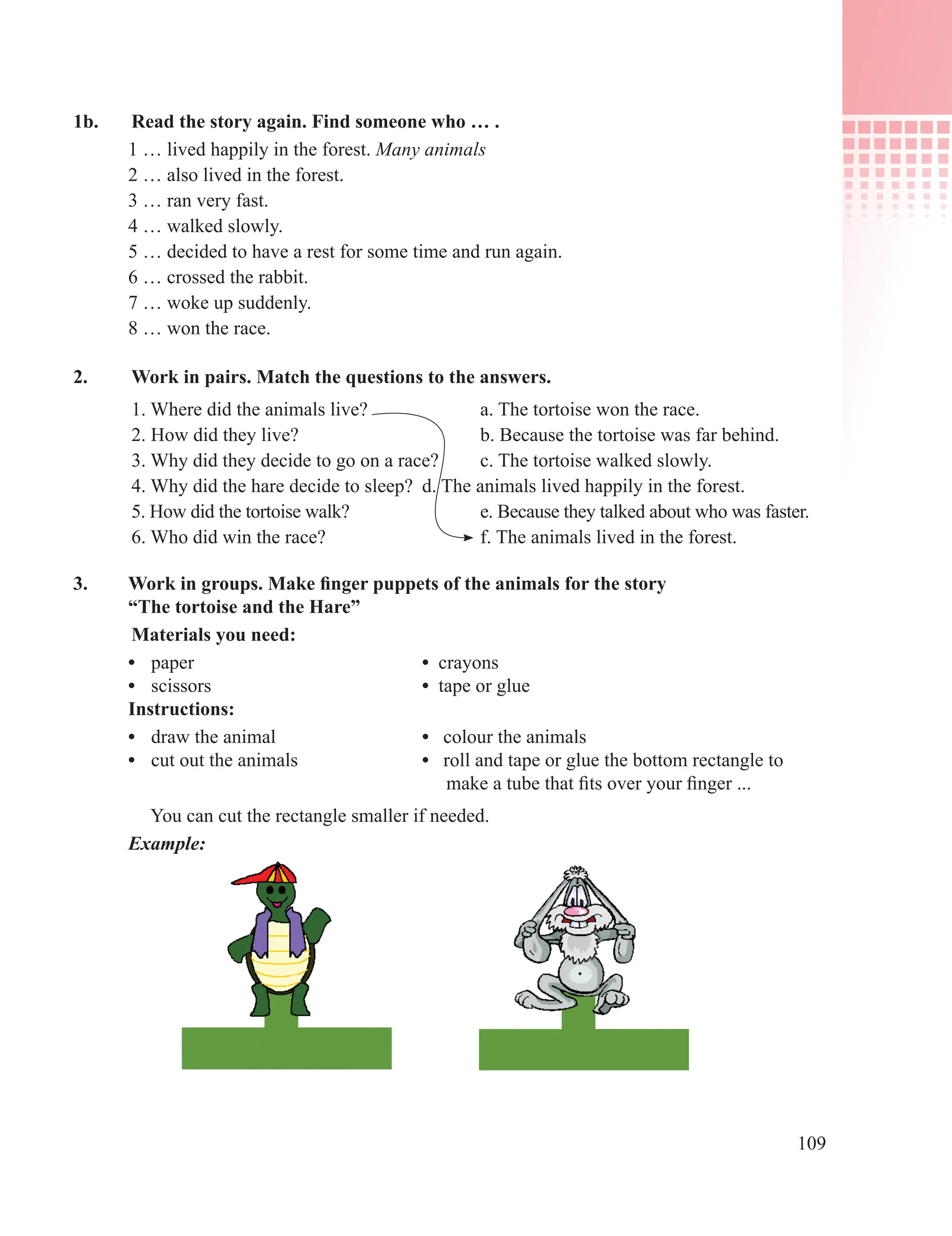
Åðºíõèé áîëîâñðîëûí 12 æèëèéí ñóðãóóëèéí
6 äóãааð аíãèéí ñóðаõ áè÷èã
Áîëîâñðîë, Сîёë, Øèíæëýõ Óõааí, Спîðтûí Яаìíû
çºâøººð뺺ð õýâëýâ.
Дºðºâ äýõ õýâëýë
СУРГУУЛИЙН НОМЫН САНД ОЛГОВ.
БОРЛУУЛАХЫГ ХОРИГЛОНО.
Улаанáааòар õîò
2019 îн
DDC
371.32
А-618
English VI: Åрºнõий áîлîâñрîлûн 12 æилийн ñóргóóлийн 6 дóгаар ангийн ñóраõ
áи÷иг. (Мира Н., áа áóñад; Рåд. Баянæаргал П., Оòгîнáааòар Х., - УБ.2015.-136 õ)
Аçèéí Хºãæëèéí Áаíкíû “Эäèéí çаñãèéí õүíäðýëèéí үеä áîëîâñðîëûí ÷аíаð,
õүðтýýìæèéã ñаéæðóóëаõ тºñºë”-èéí õүðýýíä õýâëүүëýâ.
Эíýõүү ñóðаõ áè÷èã íü “Ìîíãîë Óëñûí Çîõèîã÷èéí ýðõ áîëîí түүíä õаìааðаõ
ýðõèéí тóõаé” õóóëèаð õаìãааëаãäñаí áºãººä Áîëîâñðîë, Coёë, Øèíæëýõ Óõааí,
Спîðтûí Яаìíааñ áè÷ãýýð аâñаí çºâøººð뺺ñ áóñаä тîõèîëäîëä öаõèì áîëîí
õýâëýìýë õýëáýðýýð, áүтíýýð ýñõүë õýñýã÷ëýí õóâèëаõ, õýâëýõ, аëèâаа õýëáýðýýð
ìýäýýëëèéí ñаíä îðóóëаõûã õîðèãëîíî.
Сóраõ áи÷гийн òалаарõ алиâаа ñанал, õ¿ñэлòээ textbook@mecs.gov.mn õаягаар
ир¿¿лнэ ¿¿.
© Бîлîâñрîл, Сîёл, Øинæлэõ Уõаан, Спîрòûн Яаì
ISBN 978-99962-74-22-0
3
CONTENTS
CONTENT MAP …………………………………………………………………… 4
MODULE 1. ENGLISH TIME
UNIT ONE. BACK TO ENGLISH ……………………..……………………… 8
UNIT TWO. MY SCHOOL ………………………………...…………………… 19
UNIT THREE. LET’S COUNT …………………………………………………. 30
MODULE 2 ME AND MINE
UNIT FOUR. THAT’S MINE …………………………………....………….……. 41
UNIT FIVE. BODY …………………………………………....………………… 52
UNIT SIX. STORIES …………………………………………....………….….. 63
MODULE 3 EVERYDAY LIFE
UNIT SEVEN. DAYS ……………………………......………………......…………. 74
UNIT EIGHT. WHAT’S COOKING? ……………………………...…....…………. 85
MODULE 4 NATURE PROTECTION
UNIT NINE. WEATHER AND SEASONS ……………….....………...……….. 96
UNIT TEN. ENGLISH ENVIRONMENT ……………………………....……… 107
GRAMMAR REFERENCE ………………………………………………………… 118
DICTIONARY ………………………………………………………………………. 129
4
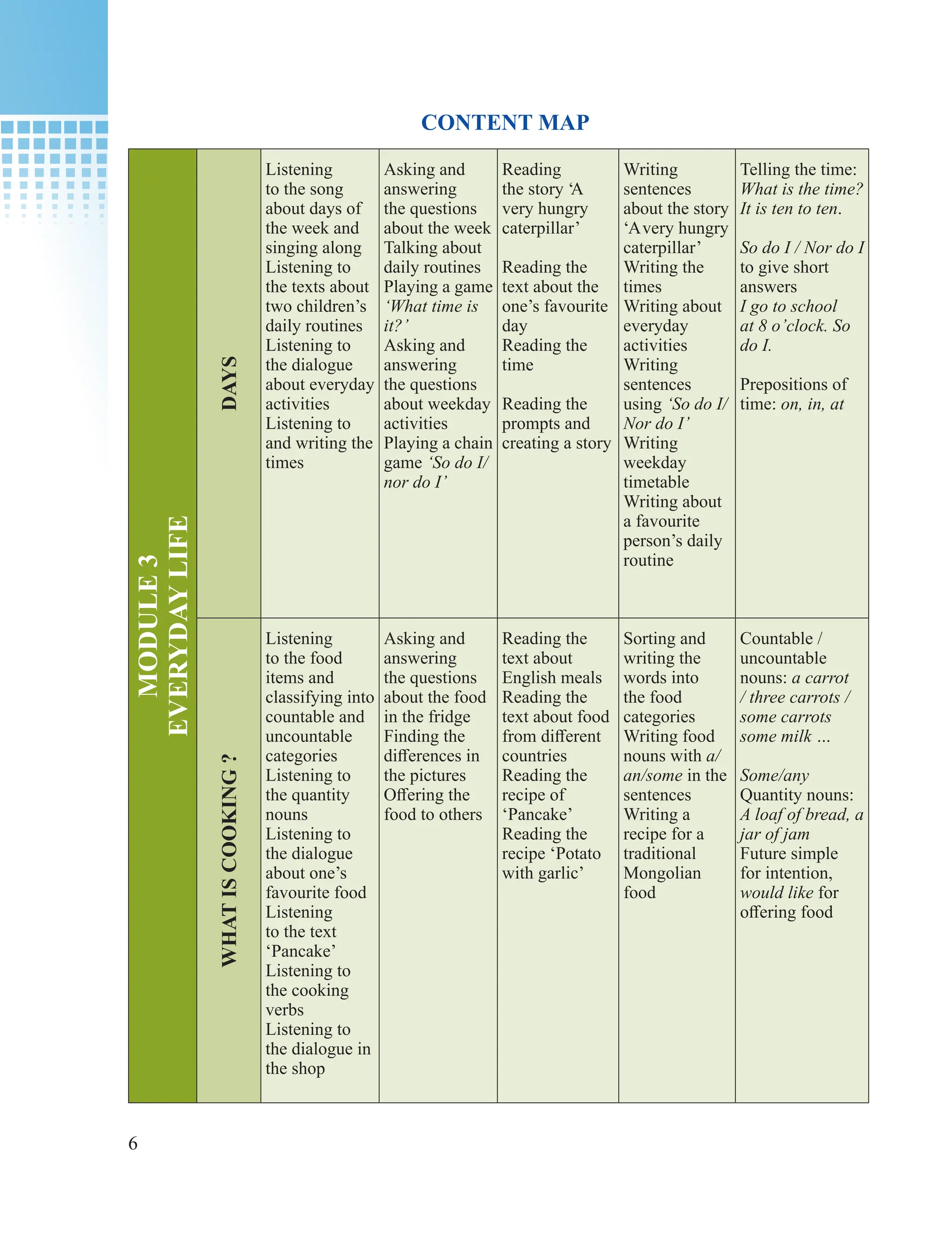
CONTENT MAP
UNITS LISTENING SPEAKING READING WRITING
USE OF
ENGLISH
MODULE
1
ENGLISH
TIME
BACK
TO
ENGLISH Listening and
singing along
the song
Listening to a
dialogue and
completing the
questions
Listening and
pointing at the
flags
Listening and
repeating the
countries,
nationalities
and languages
Playing a
spelling game,
a guessing
game
Asking and
answering
about yourself
and others
Interviewing
classmates
Asking and
answering
about the
countries,
nationalities
and languages
Reading the
email messages
about the
children
Reading and
completing a
puzzle
Reading the
text
Reading the
world map
Writing
the English
alphabet
Completing
the enrollment
form
Writing the
names of the
countries
Writing about
Takashi
Writing about
friends
Present simple of
to be
Present simple:
positive,
negative and
questions
Demonstrative
pronouns: this,
that, these, those
This is my book.
That is my friend
MY
SCHOOL
Listening
about friends’
school life
Listening to
and following
the instructions
Listening
about the
school subjects
Guessing game
Where am I?
a board game,
an instruction
game
Telling about
school subjects
Talking about
a school
timetable
Reading logos
of the school
rooms
Reading about
a friends’
school life
Reading the
instructions
on doing the
activities
Reading about
school subjects
Writing about
a school plan
Writing about
school rooms
and school
subjects
Writing own
school time
table.
Prepositions of
places: on, next
to, in front of,
near, between,
opposite
Present
continuous:
positive,
negative and
questions
Imperatives:
Stand up! Open
the book!
LET’S
COUNT
Listening to
the number
song
Listening
to the short
dialogues
about numbers
Listening to
the song about
the months of
the year
Telling
numbers 1-100
Talking about
the personal
information
using numbers
Playing games:
buzz, show me
pages
Talking about
birthdays
Chanting the
numbers
Reading about
the personal
information
using numbers
Reading math
problems
Reading about
the events and
months
Writing
numbers 1-100
Writing
and solving
problems
Writing the
months of the
year
Writing
the ordinal
numbers
Writing a
birthday
invitation
Numbers 1-100
Even and odd
numbers
One, three, five
Two, four, six …
Ordinal numbers
First, second …
Prepositions of
time in and on
There is/There
are to make short
statements and
descriptions
5
CONTENT MAP
MODULE
2
ME
AND
MINE
THAT’S
MINE
Listening to
the jobs
Listening to
the dialogue
about family
morning life
Listening to
the dialogue
about parents’
jobs
Listening
to the
information
and matching
belongings to
the jobs
Telling the
names of the
jobs
Playing a
guessing game
‘Are you
a/an …’
‘Whose is it?’
Making a job
survey by
asking others
Telling about
someone’s
daily life using
the frequency
adjectives
Reading about
job activities
Reading
about family
members’ jobs
Reading about
the people and
their jobs
Reading about
someone’s
personal life
Writing the
names of the
jobs
Writing
about family
members’ jobs
Writing about
people’s
belongings
Writing about
someone using
the prompts
Possessive ‘s’
Carlo’s hat
Adverbs of
frequency:
always, usually,
sometimes, often,
never
Possessive
adjectives: mine,
yours, hers …
BODY
Listening: the
parts of the
body
Listening to
the song and
singing along
Listening to
the animal
facts
Listening to
the dialogue
about favourite
animals
Naming the
parts of the
body
Describing the
aliens
Naming the
animals
Comparing the
animals
Reading a text
about favourite
pets
Reading
the animal
descriptions
Reading a
text about an
animal market
Reading a text
about a farm
Writing the
missing parts
of the body
Writing about
aliens
Writing the
facts about the
animals
Changing the
pictures into
the words
Comparative
adjectives: taller,
faster, stronger
Superlative
adjectives:
the tallest, the
fastest, the
strongest
Irregular plural:
man - men, tooth
- teeth
STORIES
Listening to
the texts about
a summer
holiday
Listening to
the story and
completing
with irregular
verbs
Listening to
the dialogue
about the
children’s
activities
Describing
details of
someone’s
summer
holiday
Acting out
the story
‘Nightingale’
Asking and
answering
about each
other’s past
actions
Reading the
texts about
a summer
holiday and
ordering the
activities
Reading the
story and
answering the
comprehension
questions
Reading
the story
‘Nightingale’
Writing
sentences
what they did
last week /
weekends
Creating own
story using
regular and
irregular verbs
Continuing the
story
Completing
the story using
adverbs
Past simple:
positive,
negative and
questions
Linkers: and,
but, or
Common –ly
adverbs to
describe actions:
sweetly, quickly,
slowly …
6
MODULE
3
EVERYDAY
LIFE
DAYS
Listening
to the song
about days of
the week and
singing along
Listening to
the texts about
two children’s
daily routines
Listening to
the dialogue
about everyday
activities
Listening to
and writing the
times
Asking and
answering
the questions
about the week
Talking about
daily routines
Playing a game
‘What time is
it?’
Asking and
answering
the questions
about weekday
activities
Playing a chain
game ‘So do I/
nor do I’
Reading
the story ‘А
very hungry
caterpillar’
Reading the
text about the
one’s favourite
day
Reading the
time
Reading the
prompts and
creating a story
Writing
sentences
about the story
‘Avery hungry
caterpillar’
Writing the
times
Writing about
everyday
activities
Writing
sentences
using ‘So do I/
Nor do I’
Writing
weekday
timetable
Writing about
a favourite
person’s daily
routine
Telling the time:
What is the time?
It is ten to ten.
So do I / Nor do I
to give short
answers
I go to school
at 8 o’clock. So
do I.
Prepositions of
time: on, in, at
WHAT
IS
COOKING
?
Listening
to the food
items and
classifying into
countable and
uncountable
categories
Listening to
the quantity
nouns
Listening to
the dialogue
about one’s
favourite food
Listening
to the text
‘Pancake’
Listening to
the cooking
verbs
Listening to
the dialogue in
the shop
Asking and
answering
the questions
about the food
in the fridge
Finding the
differences in
the pictures
Offering the
food to others
Reading the
text about
English meals
Reading the
text about food
from different
countries
Reading the
recipe of
‘Pancake’
Reading the
recipe ‘Potato
with garlic’
Sorting and
writing the
words into
the food
categories
Writing food
nouns with a/
an/some in the
sentences
Writing a
recipe for a
traditional
Mongolian
food
Countable /
uncountable
nouns: a carrot
/ three carrots /
some carrots
some milk …
Some/any
Quantity nouns:
A loaf of bread, a
jar of jam
Future simple
for intention,
would like for
offering food
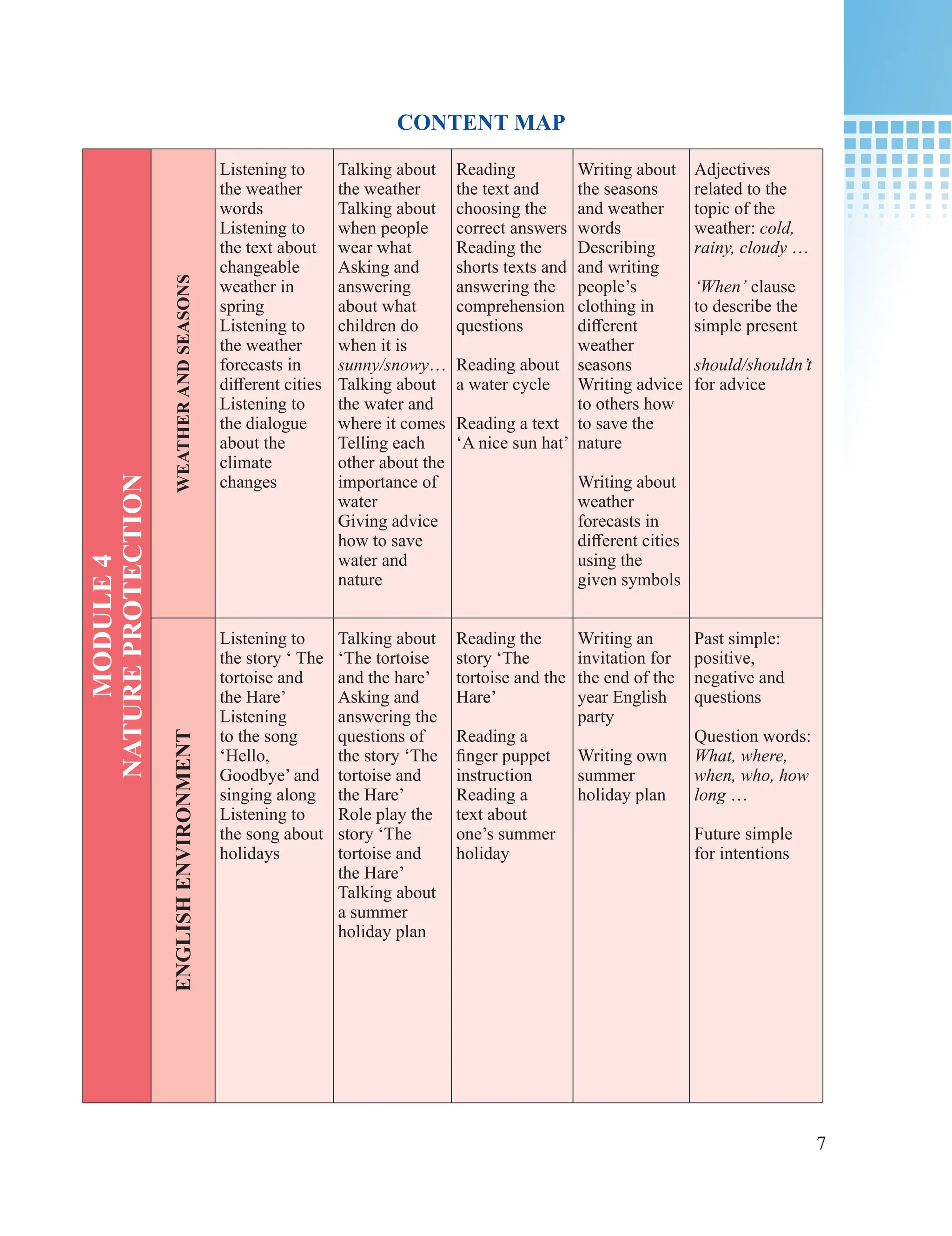
CONTENT MAP
7
MODULE
4
NATURE
PROTECTION
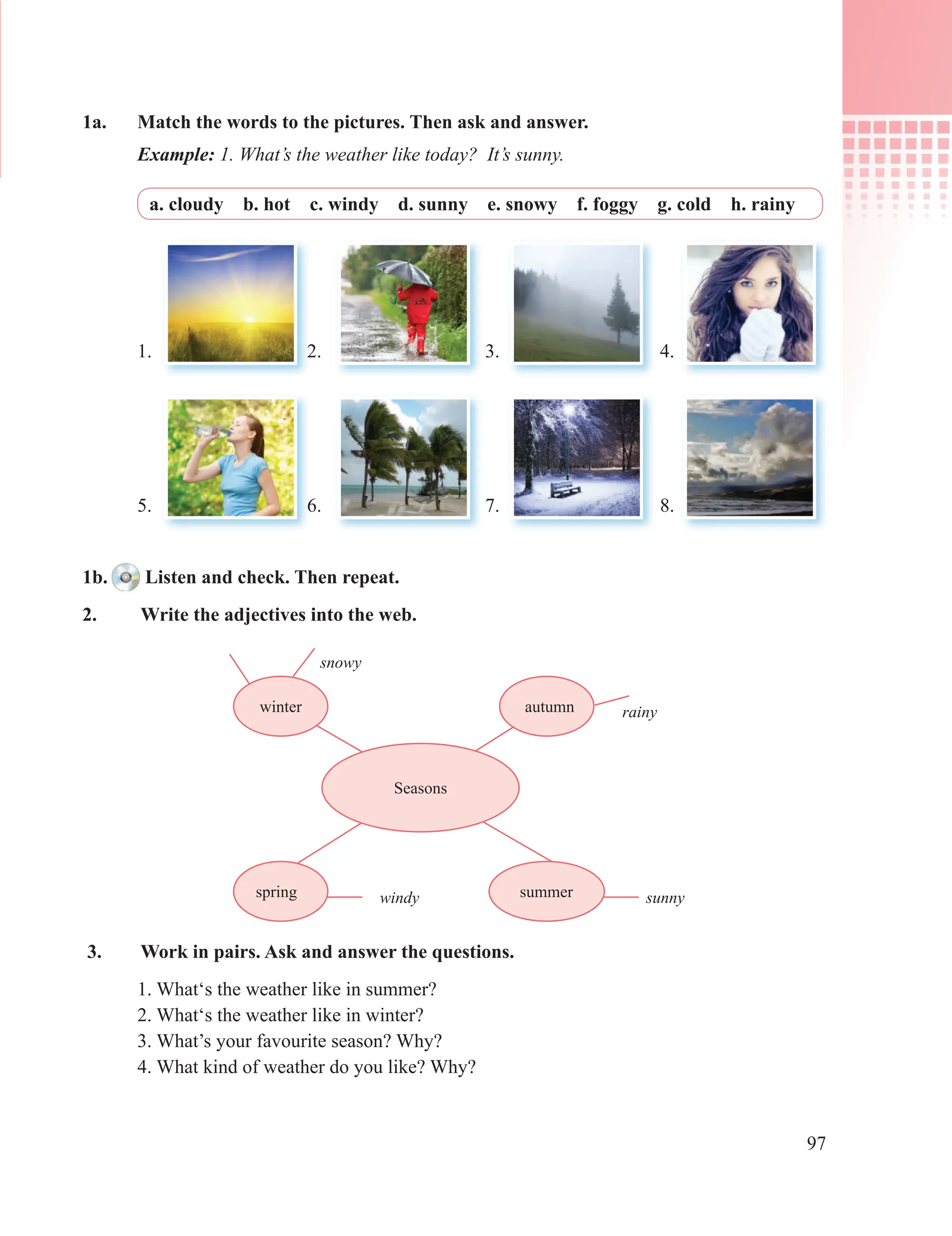
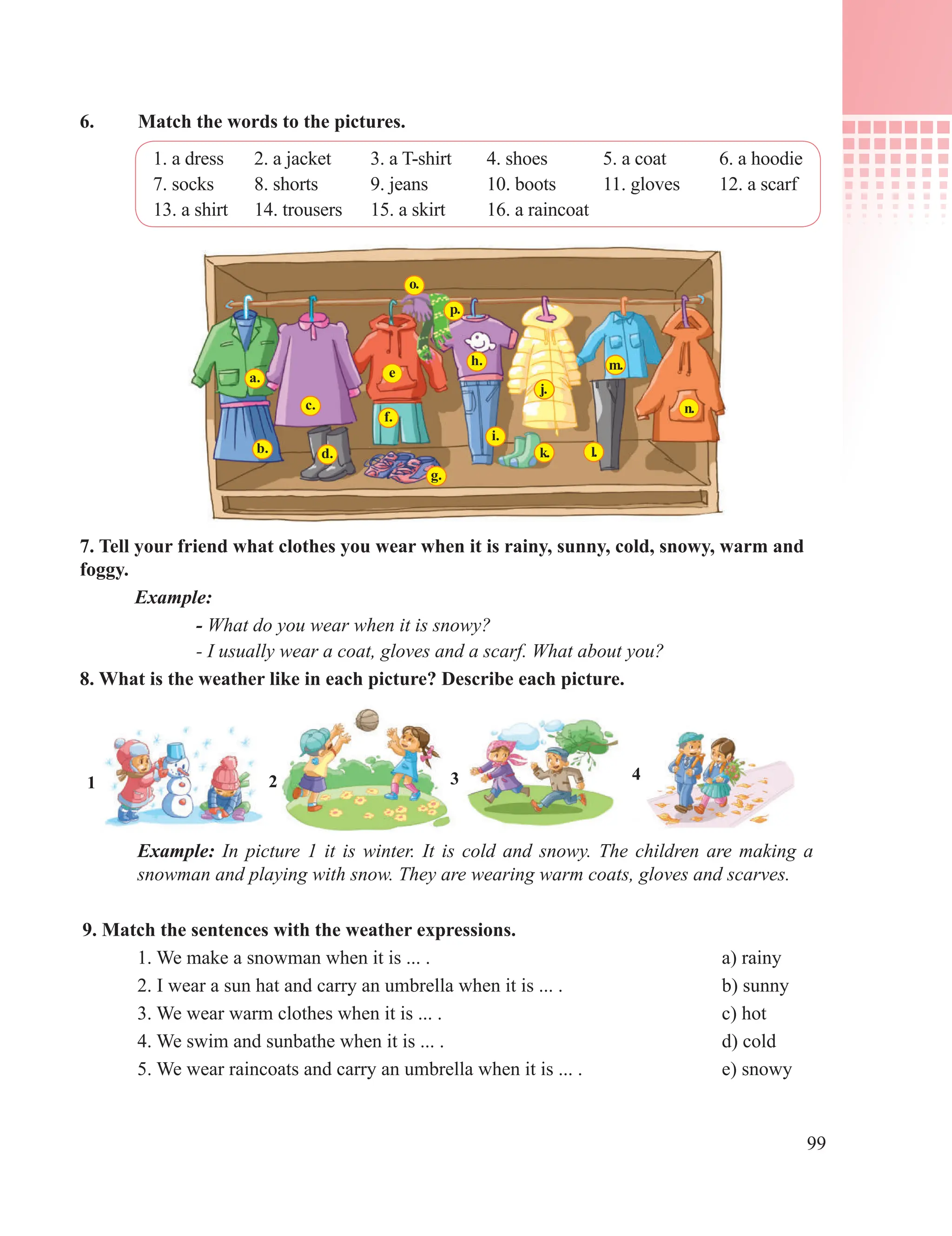
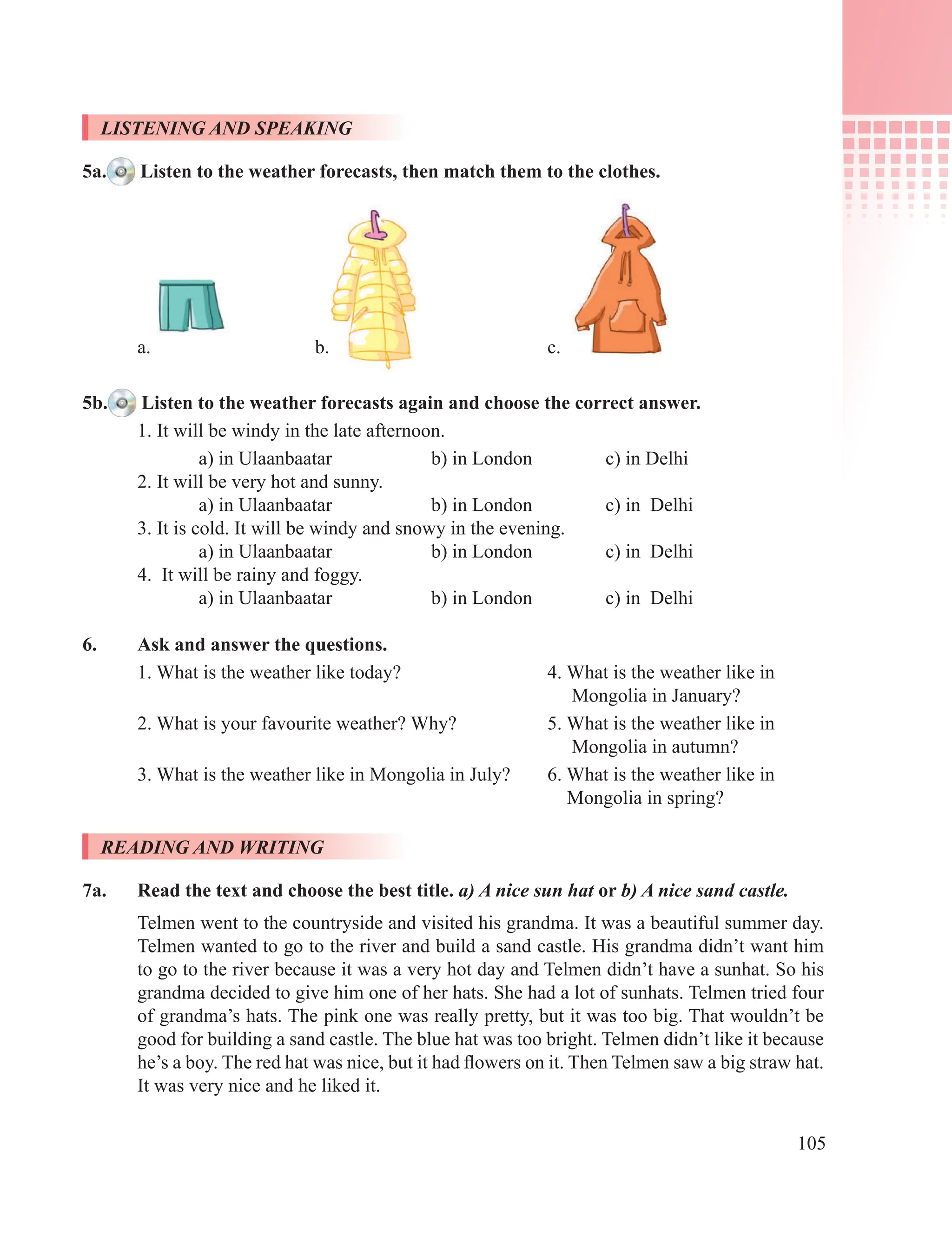
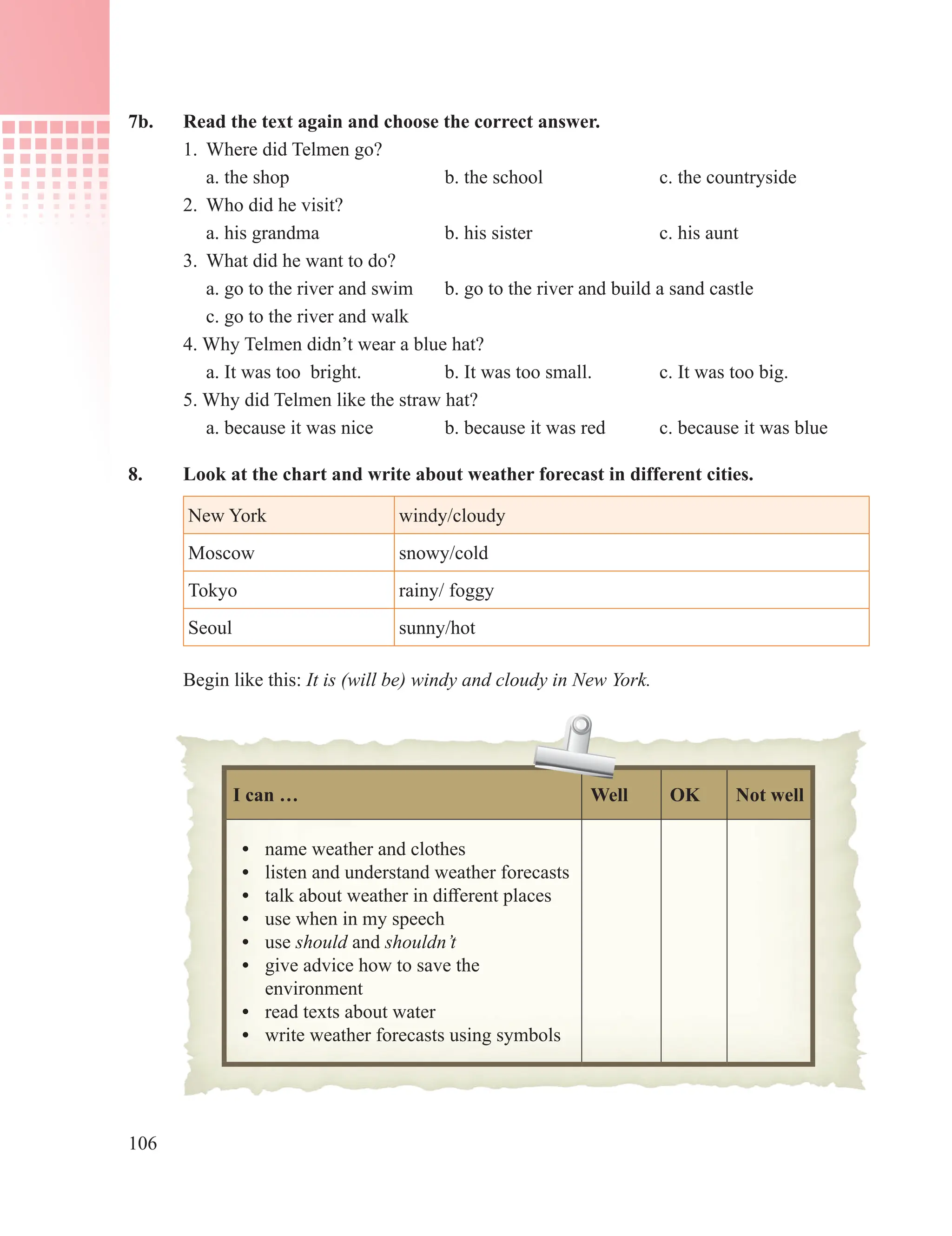
WEATHER
AND
SEASONS
Listening to
the weather
words
Listening to
the text about
changeable
weather in
spring
Listening to
the weather
forecasts in
different cities
Listening to
the dialogue
about the
climate
changes
Talking about
the weather
Talking about
when people
wear what
Asking and
answering
about what
children do
when it is
sunny/snowy…
Talking about
the water and
where it comes
Telling each
other about the
importance of
water
Giving advice
how to save
water and
nature
Reading
the text and
choosing the
correct answers
Reading the
shorts texts and
answering the
comprehension
questions
Reading about
a water cycle
Reading a text
‘A nice sun hat’
Writing about
the seasons
and weather
words
Describing
and writing
people’s
clothing in
different
weather
seasons
Writing advice
to others how
to save the
nature
Writing about
weather
forecasts in
different cities
using the
given symbols
Adjectives
related to the
topic of the
weather: cold,
rainy, cloudy …
‘When’ clause
to describe the
simple present
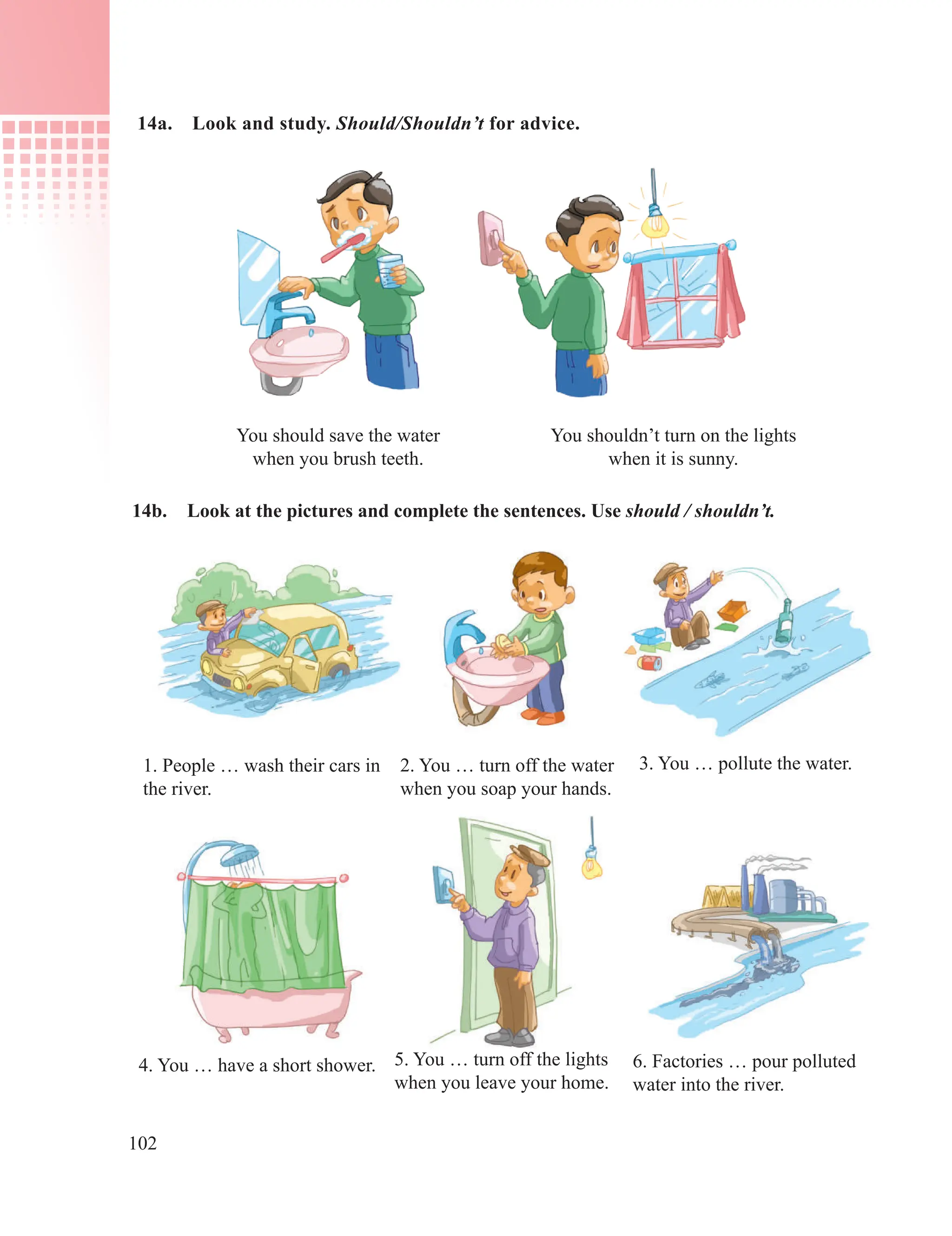
should/shouldn’t
for advice
ENGLISH
ENVIRONMENT
Listening to
the story ‘ The
tortoise and
the Hare’
Listening
to the song
‘Hello,
Goodbye’ and
singing along
Listening to
the song about
holidays
Talking about
‘The tortoise
and the hare’
Asking and
answering the
questions of
the story ‘The
tortoise and
the Hare’
Role play the
story ‘The
tortoise and
the Hare’
Talking about
a summer
holiday plan
Reading the
story ‘The
tortoise and the
Hare’
Reading a
finger puppet
instruction
Reading a
text about
one’s summer
holiday
Writing an
invitation for
the end of the
year English
party
Writing own
summer
holiday plan
Past simple:
positive,
negative and
questions
Question words:
What, where,
when, who, how
long …
Future simple
for intentions
CONTENT MAP
8
MODULE 1. ENGLISH TIME
UNIT 1. BACK TO ENGLISH
LEARNING OBJECTIVES
Listening
L1 Understand short, basic, supported classroom instructions
L2 Understand basic questions which ask for personal information
L5 Understand specific information from the dialogue about personal information
L8 Recognise the words of countries, nationalities and languages
Speaking
S2 Ask questions to find out personal information
S6 Use suitable words, phrases, and sentences for interview
Reading
R1 Recognise, identify and sound at the text level
Recognise the English alphabet in print
R7 Understand the meaning of simple short sentences
Writing
W6 Use upper and lower case letters accurately when writing English alphabet
W7 Spell familiar high-frequency words accurately during guided writing about friends
Use of English
UE5 Use who what and where, how many to ask questions
UE6 Use demonstrative pronouns this, these, that, those
UE9 Use common simple present forms to give personal information
9
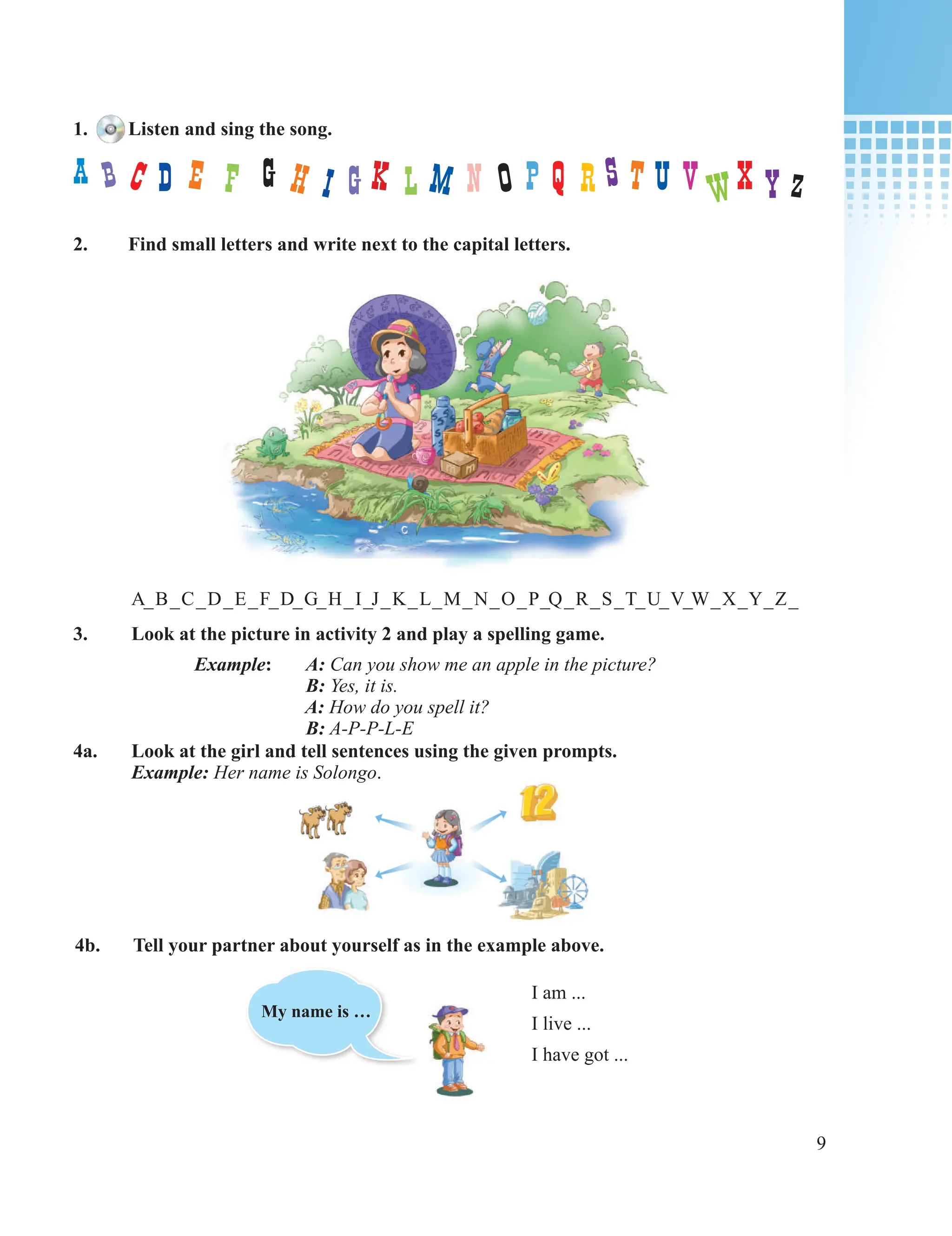
1. Listen and sing the song.
A B Y
C D E F G H I G K L M N O z
P Q R S T U V WX
2. Find small letters and write next to the capital letters.
A_B_C_D_E_F_D_G_H_I_J_K_L_M_N_O_P_Q_R_S_T_U_V_W_X_Y_Z_
3. Look at the picture in activity 2 and play a spelling game.
Example: A: Can you show me an apple in the picture?
B: Yes, it is.
A: How do you spell it?
B: A-P-P-L-E
4a. Look at the girl and tell sentences using the given prompts.
Example: Her name is Solongo.
4b. Tell your partner about yourself as in the example above.
I am ...
I live ...
I have got ...
My name is …
10
5a. Listen to the dialogue and complete the questions. Use the question words in the
box.
How What How many What Where
a. … is your name? d. … … people are there in your family?
b. … are you from? e. … is your phone number?
c. … old are you?
5b. Listen to the dialogue again and complete the enrolment form for Tamir.
First name:
City/Aimag:
Age:
Family members:
Phone number:
6. Complete the text with the information from the enrolment form.
His name … Tamir. He is … years old. He is from …. There … four people in his family.
His phone number is ….
7a. Look and study. Present simple: to be
I am Mongolian. He / She / is French.
You / We / They are German. It is a Japanese flag.
7b. Complete with am, is or are.
1. We … eleven years old. 4. They … my friends
2. He … from Mongolia. 5. Hello! I … Solongo.
3. She … my sister. 6. It … his car.
8a. Interview 3 of your classmates and complete the chart.
What is your
name?
Where are
you from?
How old
are you?
How many
people are there
in your family?
What is
your phone
number?
Student 1
Student 2
Student 3
11
8b. Report to the class about 3 students.
Example: His name is Badral. He is from Mongolia. He is …
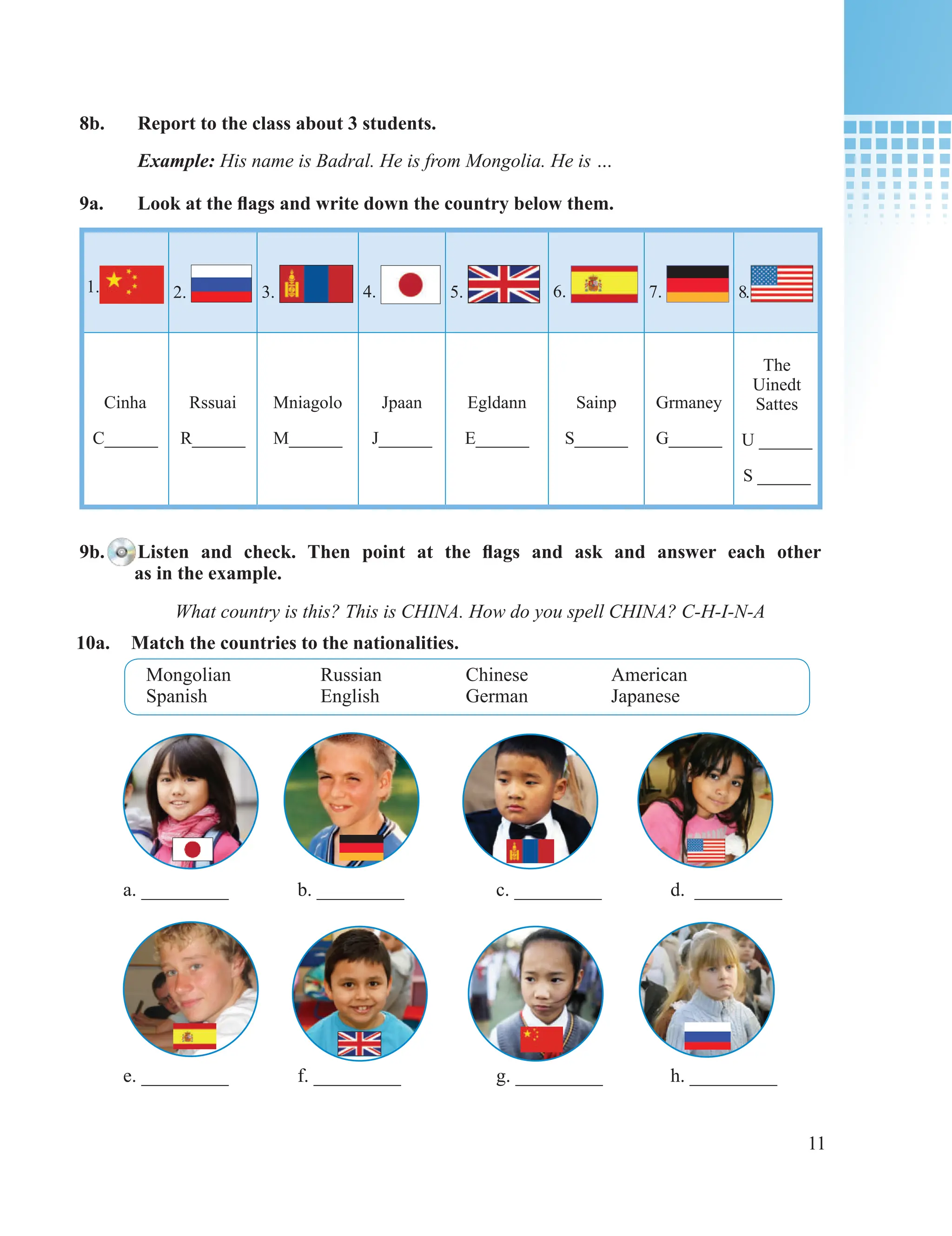
9a. Look at the flags and write down the country below them.
1. 2. 3. 4. 5. 6. 7. 8.
Cinha
C______
Rssuai
R______
Mniagolo
M______
Jpaan
J______
Egldann
E______
Sainp
S______
Grmaney
G______
The
Uinedt
Sattes
U ______
S ______
9b. Listen and check. Then point at the flags and ask and answer each other
as in the example.
a. _________ b. _________ c. _________ d. _________
e. _________ f. _________ g. _________ h. _________
10a. Match the countries to the nationalities.
What country is this? This is CHINA. How do you spell CHINA? C-H-I-N-A
Mongolian Russian Chinese American
Spanish English German Japanese
12
10b. Listen and check. Then repeat.
11. Complete the sentences with the countries or nationalities.
a. David Beckham was born in England. He’s …
b. Beyoncé Knowles is a famous … singer. She’s from America
c. Jet Li is from China. He’s … .
d. Haruma Miura is from ... . He is Japanese.
e. Masha lives in Russia. She is … .
12. Play a guessing game “Am I …?”
Example: Am I from Mongolia? No, you are not.
Am I Russian? Yes, you are.
13. Work in pairs on the map. Ask and point to the countries.
Example: Student A: Where is Russia?
Student B: It is Russia.
Student A: No, it is not. It is Spain.
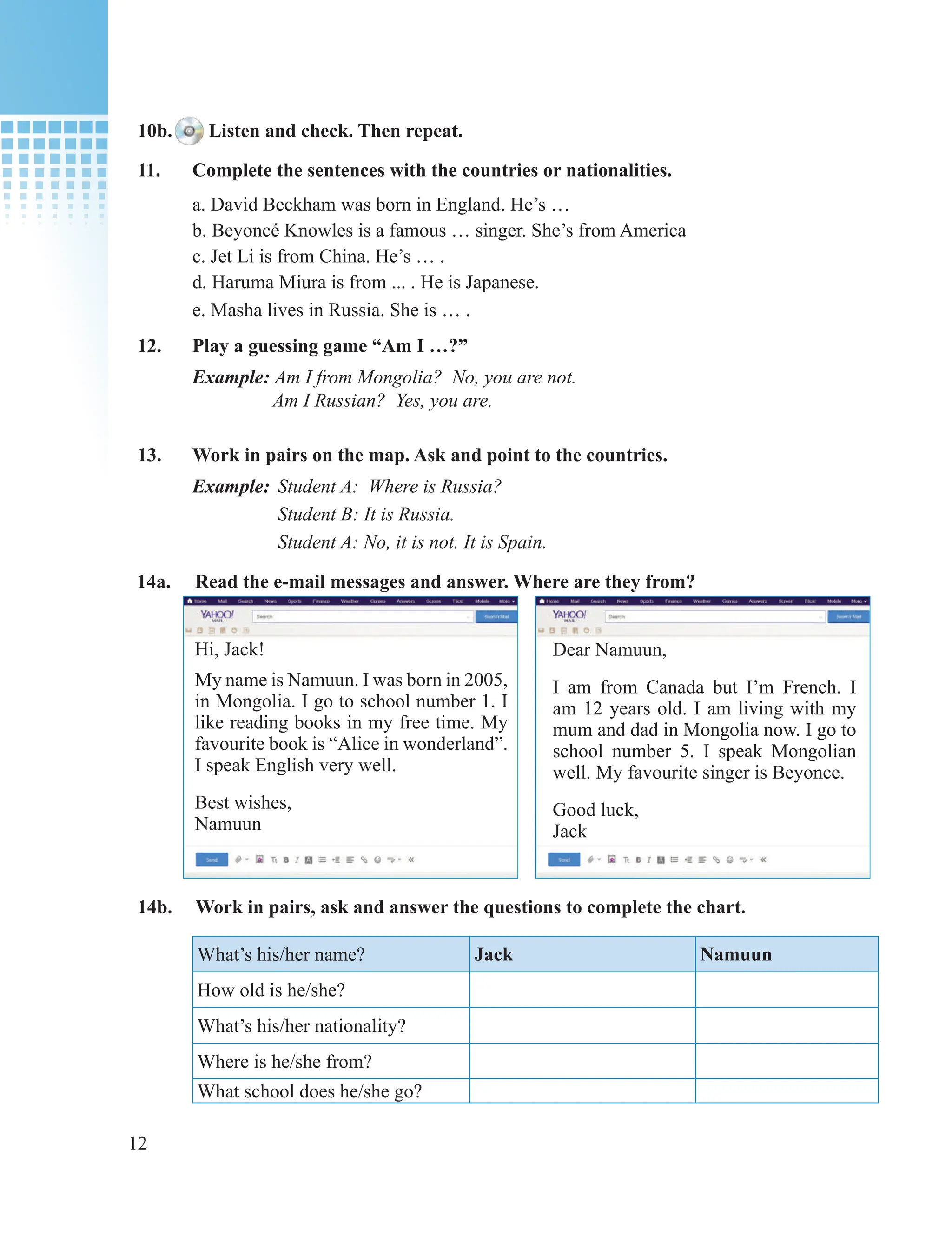
14b. Work in pairs, ask and answer the questions to complete the chart.
What’s his/her name? Jack Namuun
How old is he/she?
What’s his/her nationality?
Where is he/she from?
What school does he/she go?
14a. Read the e-mail messages and answer. Where are they from?
Hi, Jack!
My name is Namuun. I was born in 2005,
in Mongolia. I go to school number 1. I
like reading books in my free time. My
favourite book is “Alice in wonderland”.
I speak English very well.
Best wishes,
Namuun
Dear Namuun,
I am from Canada but I’m French. I
am 12 years old. I am living with my
mum and dad in Mongolia now. I go to
school number 5. I speak Mongolian
well. My favourite singer is Beyonce.
Good luck,
Jack
13
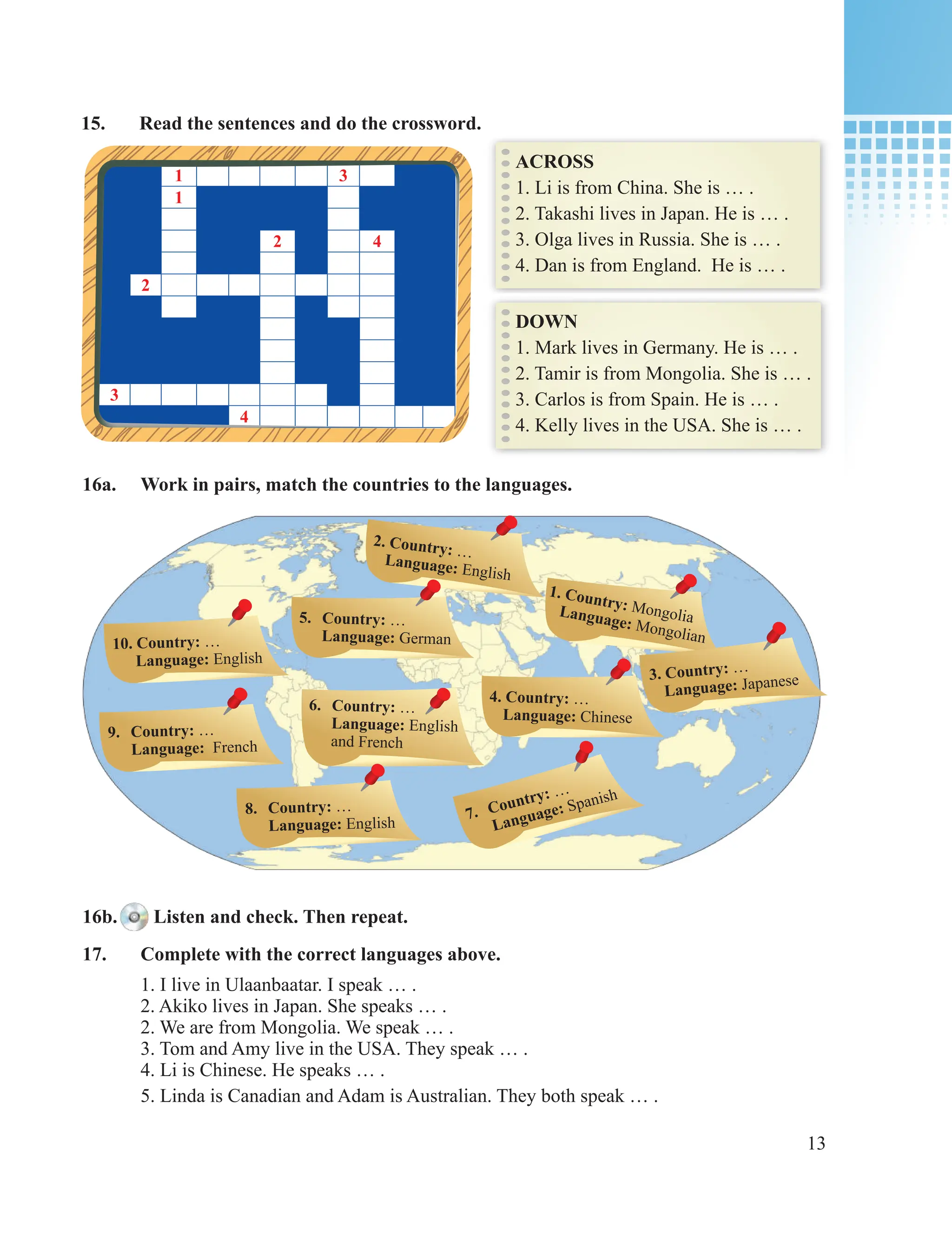
15. Read the sentences and do the crossword.
ACROSS
1. Li is from China. She is … .
2. Takashi lives in Japan. He is … .
3. Olga lives in Russia. She is … .
4. Dan is from England. He is … .
DOWN
1. Mark lives in Germany. He is … .
2. Tamir is from Mongolia. She is … .
3. Carlos is from Spain. He is … .
4. Kelly lives in the USA. She is … .
1 3
1
2 4
2
3
4
16a. Work in pairs, match the countries to the languages.
2. Country: …
Language: English
1. Country: Mongolia
Language: Mongolian
3. Country: …
Language: Japanese
4. Country: …
Language: Chinese
5. Country: …
Language: German
7. Country: …
Language: Spanish
6. Country: …
Language: English
and French
8. Country: …
Language: English
9. Country: …
Language: French
10. Country: …
Language: English
16b. Listen and check. Then repeat.
17. Complete with the correct languages above.
1. I live in Ulaanbaatar. I speak … .
2. Akiko lives in Japan. She speaks … .
2. We are from Mongolia. We speak … .
3. Tom and Amy live in the USA. They speak … .
4. Li is Chinese. He speaks … .
5. Linda is Canadian and Adam is Australian. They both speak … .
14
18a. Read the text and answer the question. Who speaks German?
My name is Carla. I am an American but I live in France. I speak English and French. My
friend Pedro speaks Spanish and lives in France, too. His sister Lily speaks German and
English. We are good friends.
18b. Read and decide true (T) or false (F).
1. Carla lives in the USA. T F
2. She speaks English and French. T F
3. Her friend Pedro is from France. T F
4. Lily speaks Spanish. T F
5. Carla and Lily are sisters. T F
19. In groups, discuss. What languages do people speak in different countries?
Example: In Canada people speak English and French.
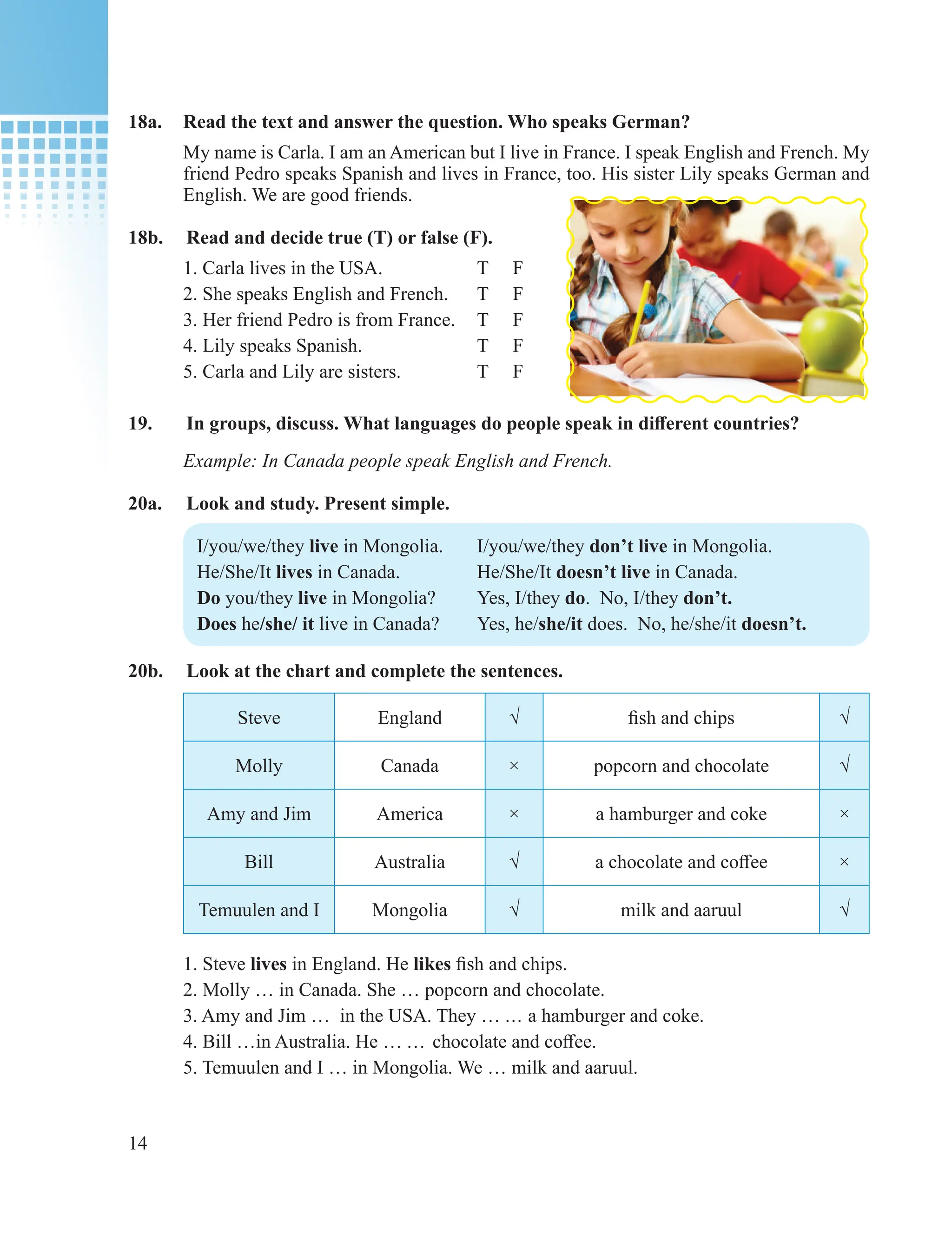
20a. Look and study. Present simple.
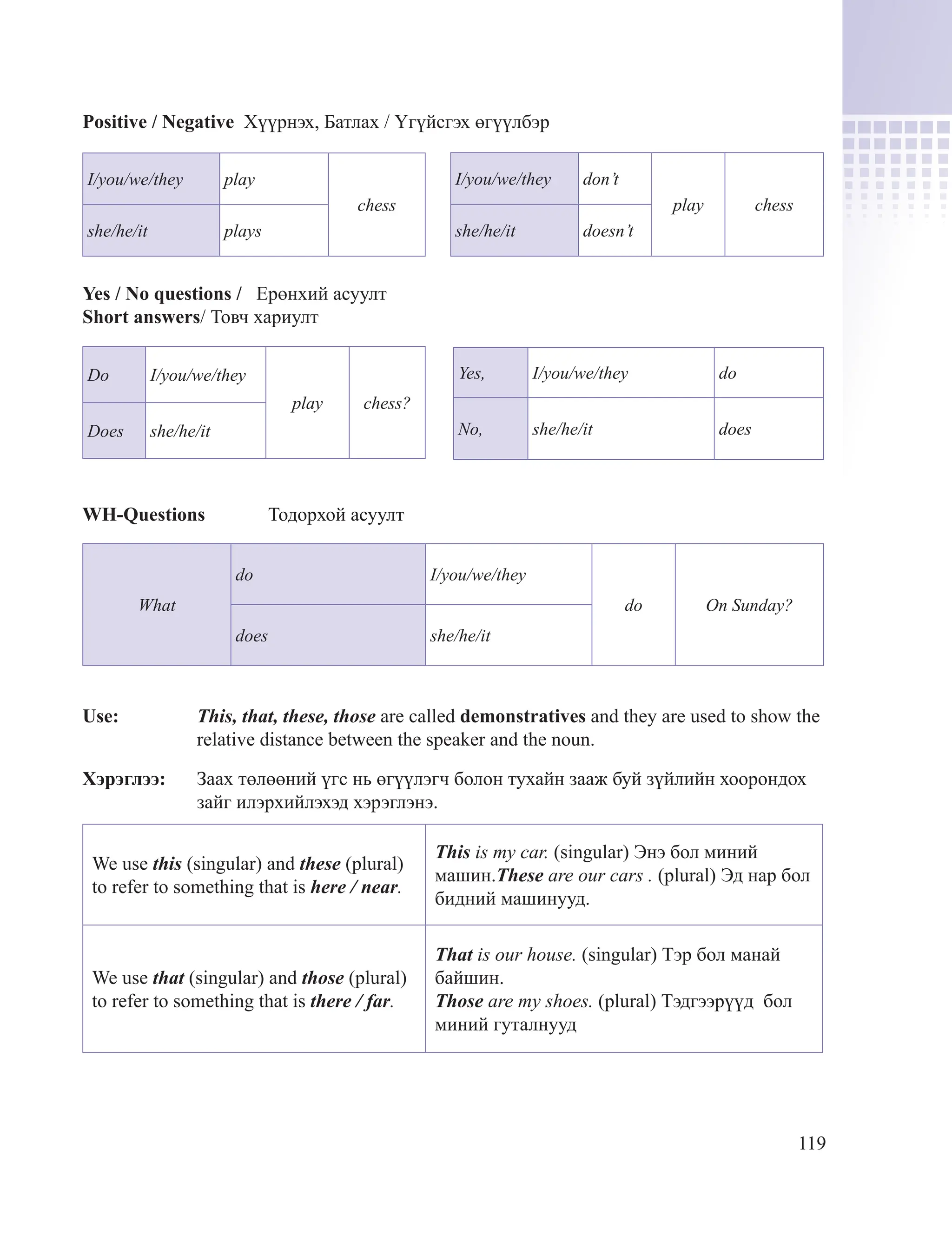
I/you/we/they live in Mongolia. I/you/we/they don’t live in Mongolia.
He/She/It lives in Canada. He/She/It doesn’t live in Canada.
Do you/they live in Mongolia? Yes, I/they do. No, I/they don’t.
Does he/she/ it live in Canada? Yes, he/she/it does. No, he/she/it doesn’t.
20b. Look at the chart and complete the sentences.
Steve England √ fish and chips √
Molly Canada × popcorn and chocolate √
Amy and Jim America × a hamburger and coke ×
Bill Australia √ a chocolate and coffee ×
Temuulen and I Mongolia √ milk and aaruul √
1. Steve lives in England. He likes fish and chips.
2. Molly … in Canada. She … popcorn and chocolate.
3. Amy and Jim … in the USA. They … ... a hamburger and coke.
4. Bill …in Australia. He … ... chocolate and coffee.
5. Temuulen and I … in Mongolia. We … milk and aaruul.
15
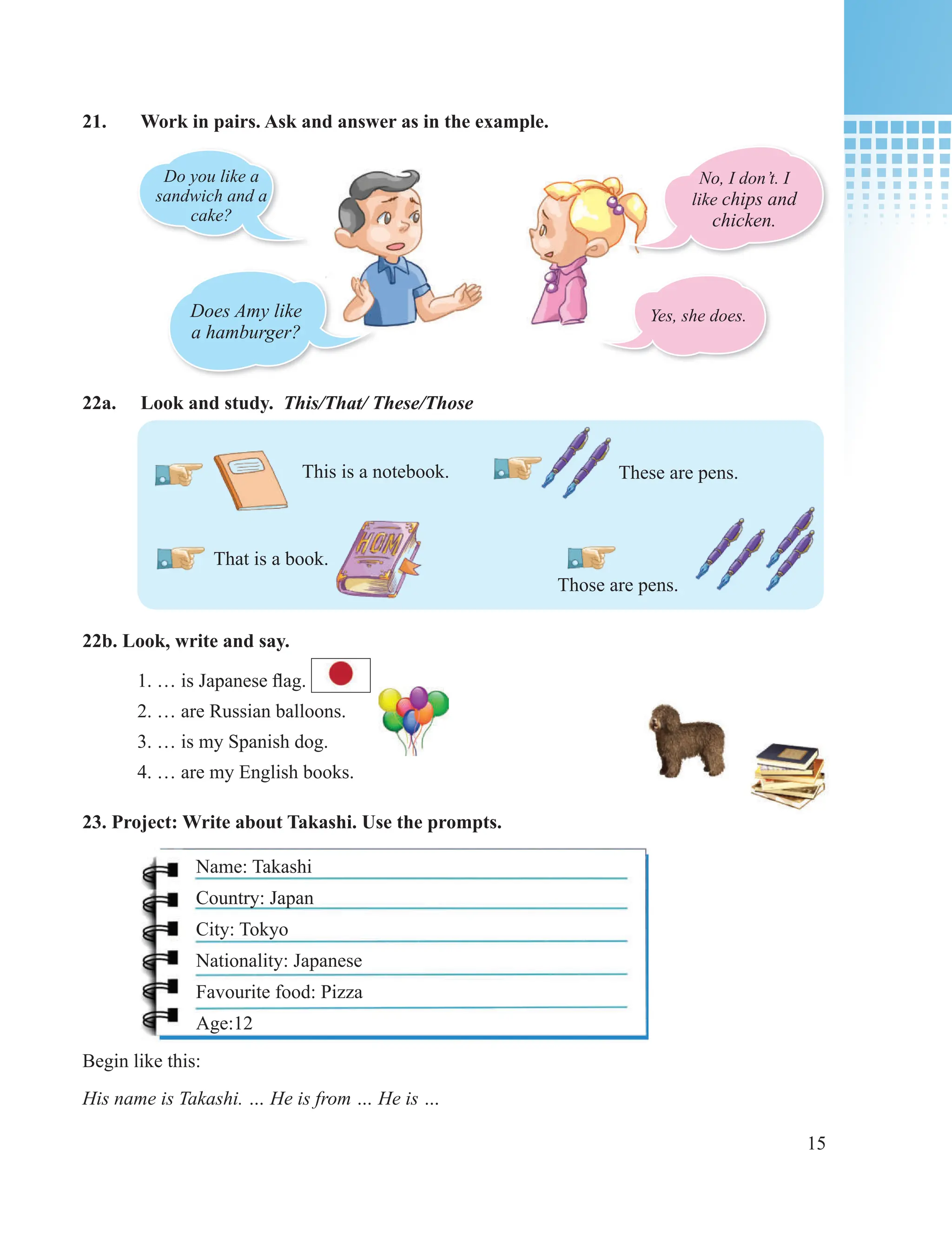
21. Work in pairs. Ask and answer as in the example.
Do you like a
sandwich and a
cake?
Does Amy like
a hamburger?
No, I don’t. I
like chips and
chicken.
Yes, she does.
22a. Look and study. This/That/ These/Those
This is a notebook.
Those are pens.
These are pens.
That is a book.
22b. Look, write and say.
1. … is Japanese flag.
2. … are Russian balloons.
3. … is my Spanish dog.
4. … are my English books.
23. Project: Write about Takashi. Use the prompts.
Name: Takashi
Country: Japan
City: Tokyo
Nationality: Japanese
Favourite food: Pizza
Age:12
Begin like this:
His name is Takashi. … He is from … He is …
16
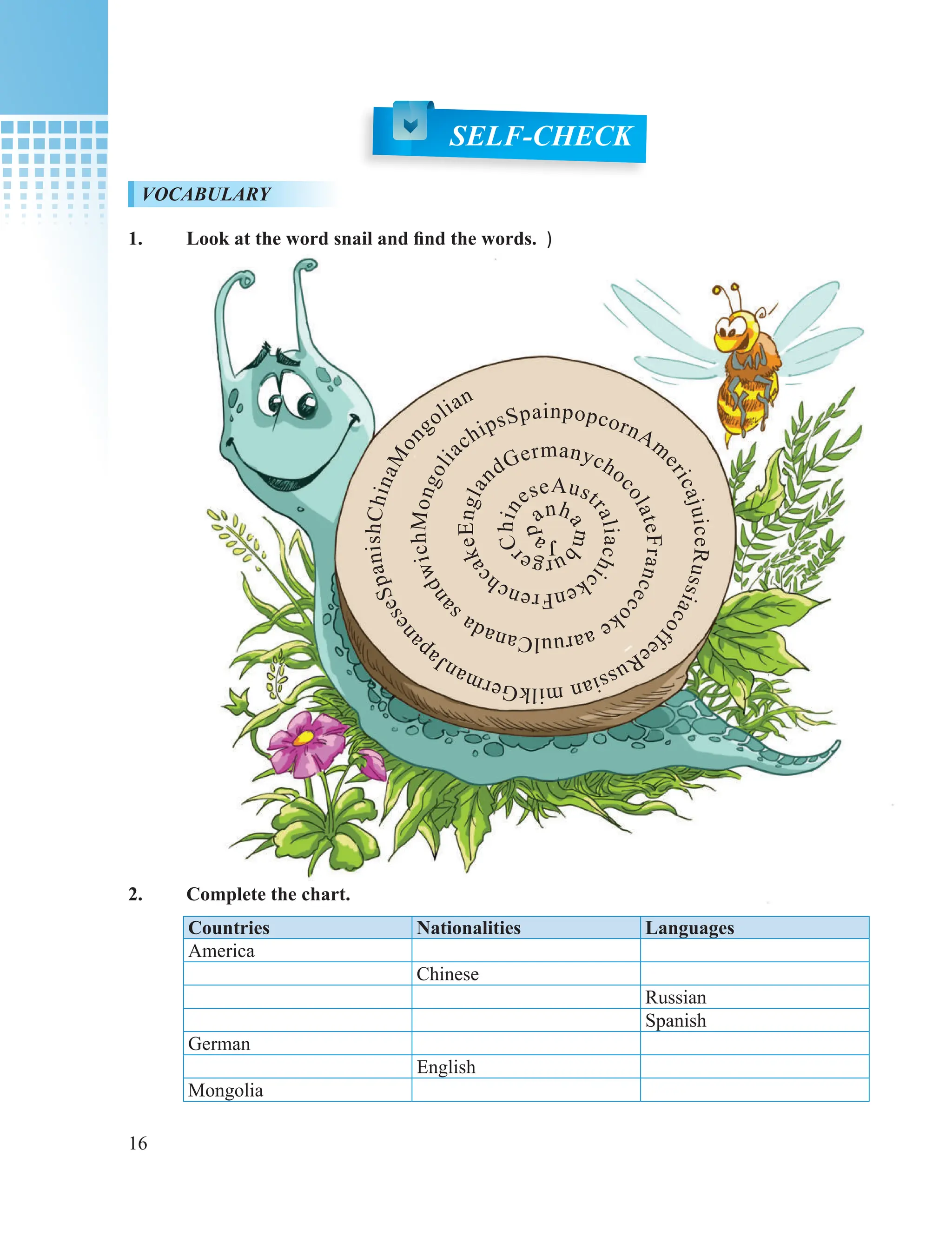
VOCABULARY
1. Look at the word snail and find the words. )
2. Complete the chart.
Countries Nationalities Languages
America
Chinese
Russian
Spanish
German
English
Mongolia
SELF-CHECK
J
a
p
anh
a
m
b
u
r
g
e
r
C
h
i
n
eseAust
r
a
l
i
a
c
h
i
c
k
e
n
F
r
e
n
c
h
c
a
k
e
E
n
g
l
andGermanycho
c
o
l
a
t
e
F
r
a
n
c
e
c
o
k
e
a
a
r
u
u
l
C
a
n
a
d
a
s
a
n
d
w
i
c
h
M
o
n
g
o
l
iachipsSpainpopcornAm
e
r
i
c
a
j
u
i
c
e
R
u
s
s
i
a
c
o
f
f
e
e
R
u
s
s
i
a
n
m
i
l
k
G
e
r
m
a
n
J
a
p
a
n
e
s
e
S
p
a
n
i
s
h
C
h
i
n
a
M
o
n
golian
17
USE OF ENGLISH
3. Choose the correct answer.
1. I … from Spain. I speak Spanish.
a. is b. are c. am
2. His name … Komi. He is Japanese.
a. is b. am c. are
3. Natasha and Sasha … in Russia.
a. live b. lives c. living
4. Jane lives in China. She … fish and chips.
a. like b. likes c. lives
5. How many people … there in your
family?
a. are b. is c. am
6. Look at these children. They … from
Australia.
a. am b. are c. is
4. Read and match.
1. What a. is Amy from?
2. Where b. old are you?
3. What c. people are there in your family?
4. How d. is your phone number?
5. What e. is your name?
6. How many f. is your favourite song?
LISTENING AND SPEAKING
5. Listen and choose.
1. Carlo speaks … .
a. French and English b. French and Spanish c. French and Mongolian
2. Susan lives in …, but she is … .
a. America, German b. America, Japanese c. Germany, American
3. Natasha likes … .
a. chicken and a hamburger b. a hamburger and fish c. chicken and chips
6. Ask and answer.
1. What is your name?
2. How do you spell it?
3. Where are you from?
4. What nationality are you?
5. What languages do you speak?
18
READING AND WRITING
7a. Read the text. Is it about a) an American student or b) a Mongolian student?
Hello! My name is Tsenguun. I’m twelve years old. I’m from Mongolia. I live in the
countryside. I have a big family. I have two sisters and two brothers. My mum and dad
have a lot of sheep and goats. I like milk and aaruul a lot.
7b. Read again and complete the chart.
Name:
Country:
Age:
Nationality:
Family:
Favourite food:
8. Read and write.
Tamir is in Japan. He has a new friend. Write about his friend.
This is Tamir’s friend. His name is …. He is … years old. His dad’s name is …. He
goes to school number …. He lives with his … and …. He speaks …. He likes …
and …
I can … Well OK Not well
• spell countries, nationalities and
languages
• introduce myself and others
• write about a favourite person
• talk about my favourite things
• ask and answer questions
Sam
John
19
UNIT 2. MY SCHOOL
LEARNING OBJECTIVES
Listening
L1 Understand and follow the classroom instructions
L3 Understand basic questions about friends’ school life
L4 Understand the main points of short talk about school subjects
L8 Recognise words that are spelled out for schools
Speaking
S6 Use suitable words, phrases, and sentences during playing game
S7 Take turns when speaking with others in short, basic exchanges about school subjects
Reading
R2 Read and follow logos of the school rooms
R4 Understand the main points of very short, simple texts about friends’ school life
R5 Understand some specific information of very short, simple texts about school subjects
R7 Understand the meaning of simple short sentences about a school timetables
Writing
W2 Write short sentences which give basic personal information
W7 Spell familiar high-frequency words accurately during guided writing activities for school
subjects
Use of English
UE10 Use common present continuous forms to talk about what is happening now
UE14 Use prepositions of places: between, in front of, near, next to, on, opposite
20
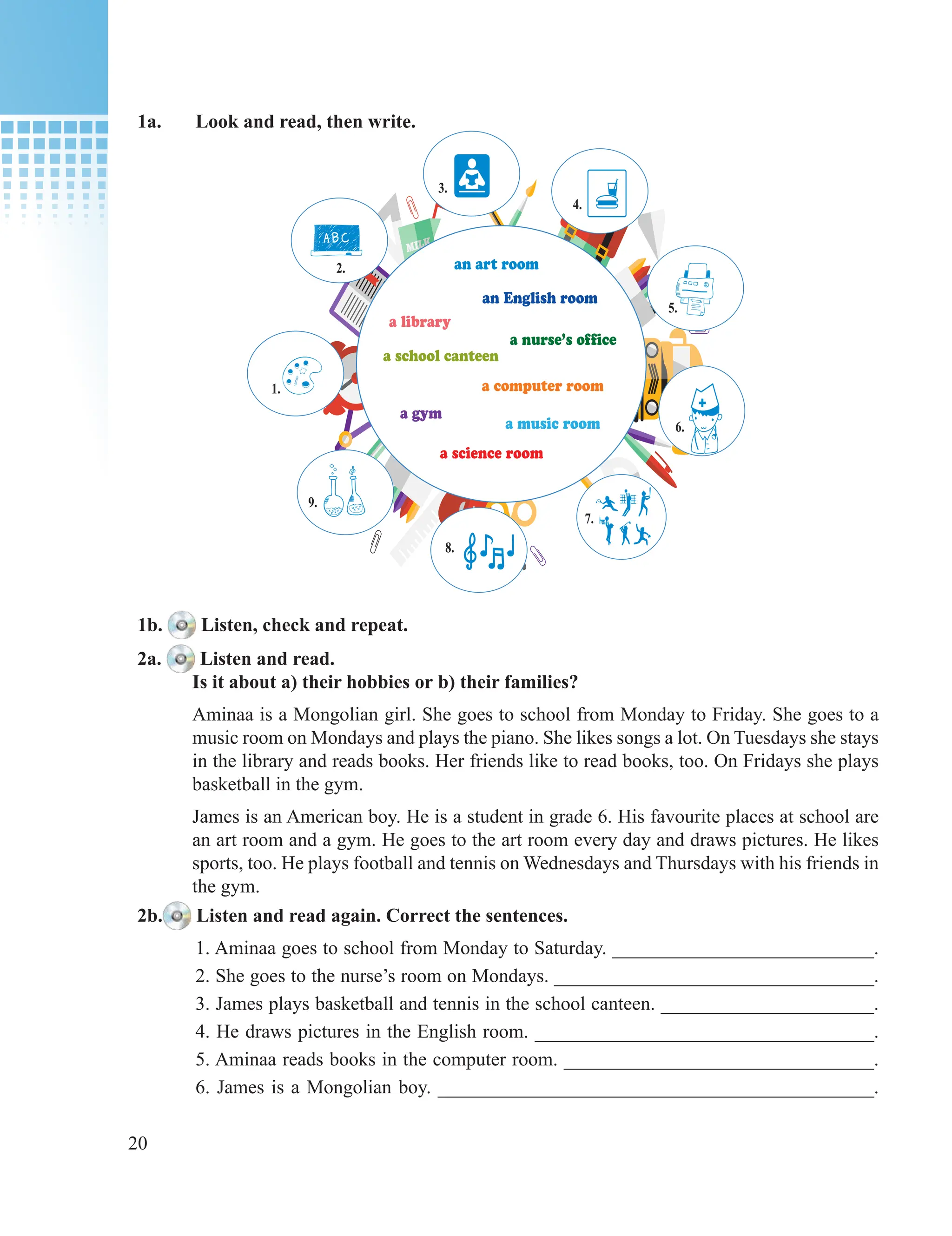
1a. Look and read, then write.
1b. Listen, check and repeat.
2a. Listen and read.
Is it about a) their hobbies or b) their families?
Aminaa is a Mongolian girl. She goes to school from Monday to Friday. She goes to a
music room on Mondays and plays the piano. She likes songs a lot. On Tuesdays she stays
in the library and reads books. Her friends like to read books, too. On Fridays she plays
basketball in the gym.
James is an American boy. He is a student in grade 6. His favourite places at school are
an art room and a gym. He goes to the art room every day and draws pictures. He likes
sports, too. He plays football and tennis on Wednesdays and Thursdays with his friends in
the gym.
an art room
an English room
a library
a school canteen
a computer room
a nurse’s office
a gym
a science room
a music room
5.
9.
6.
3.
4.
1.
2.
7.
8.
2b. Listen and read again. Correct the sentences.
1. Aminaa goes to school from Monday to Saturday. ___________________________.
2. She goes to the nurse’s room on Mondays. _________________________________.
3. James plays basketball and tennis in the school canteen. ______________________.
4. He draws pictures in the English room. ___________________________________.
5. Aminaa reads books in the computer room. ________________________________.
6. James is a Mongolian boy. _____________________________________________.
21
201
202
203
204
205
206
207
208
101
102
103
104
105
106
107
Basement First floor Second floor
between
near
opposite
in
front
of
next
to
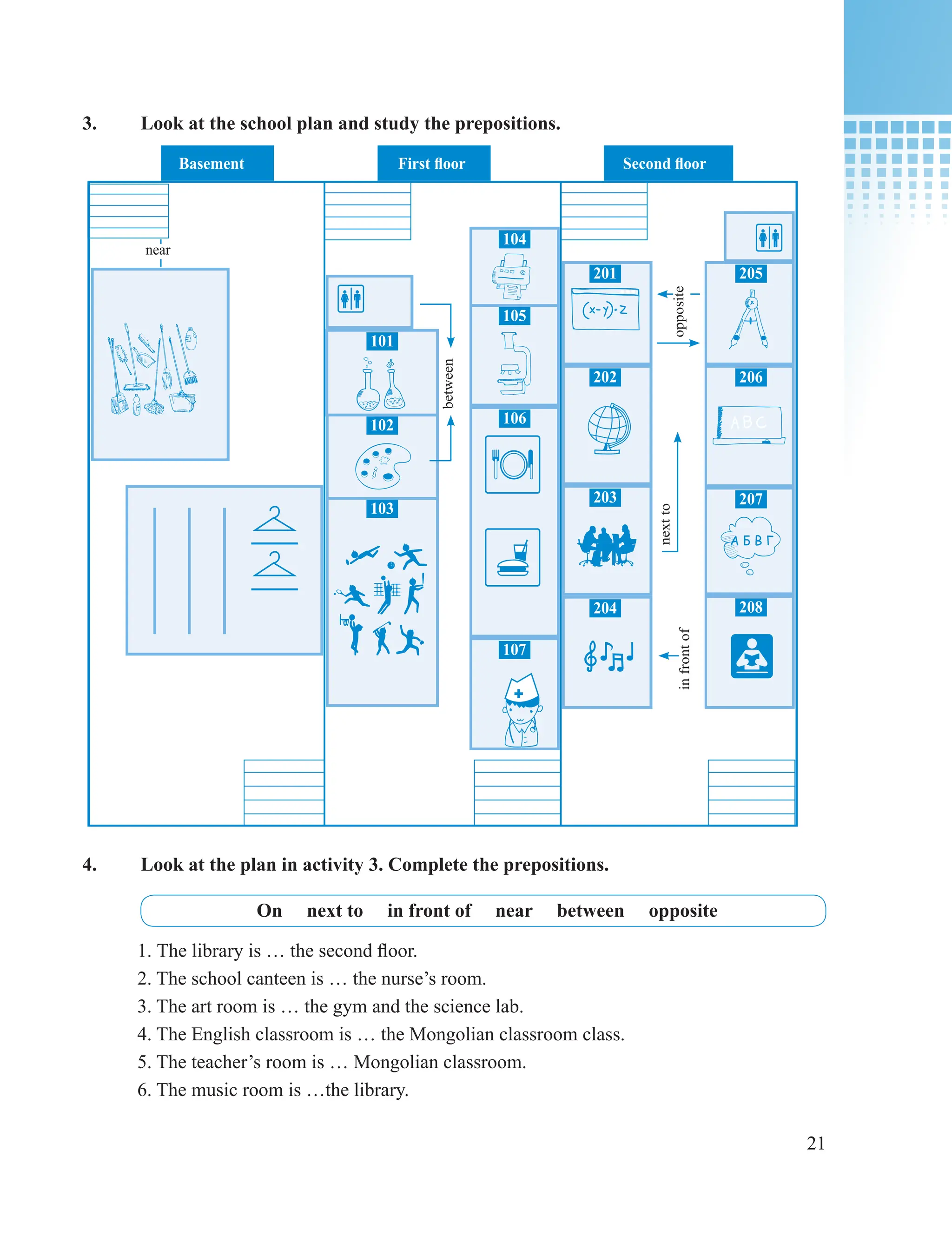
3. Look at the school plan and study the prepositions.
4. Look at the plan in activity 3. Complete the prepositions.
On next to in front of near between opposite
1. The library is … the second floor.
2. The school canteen is … the nurse’s room.
3. The art room is … the gym and the science lab.
4. The English classroom is … the Mongolian classroom class.
5. The teacher’s room is … Mongolian classroom.
6. The music room is …the library.
22
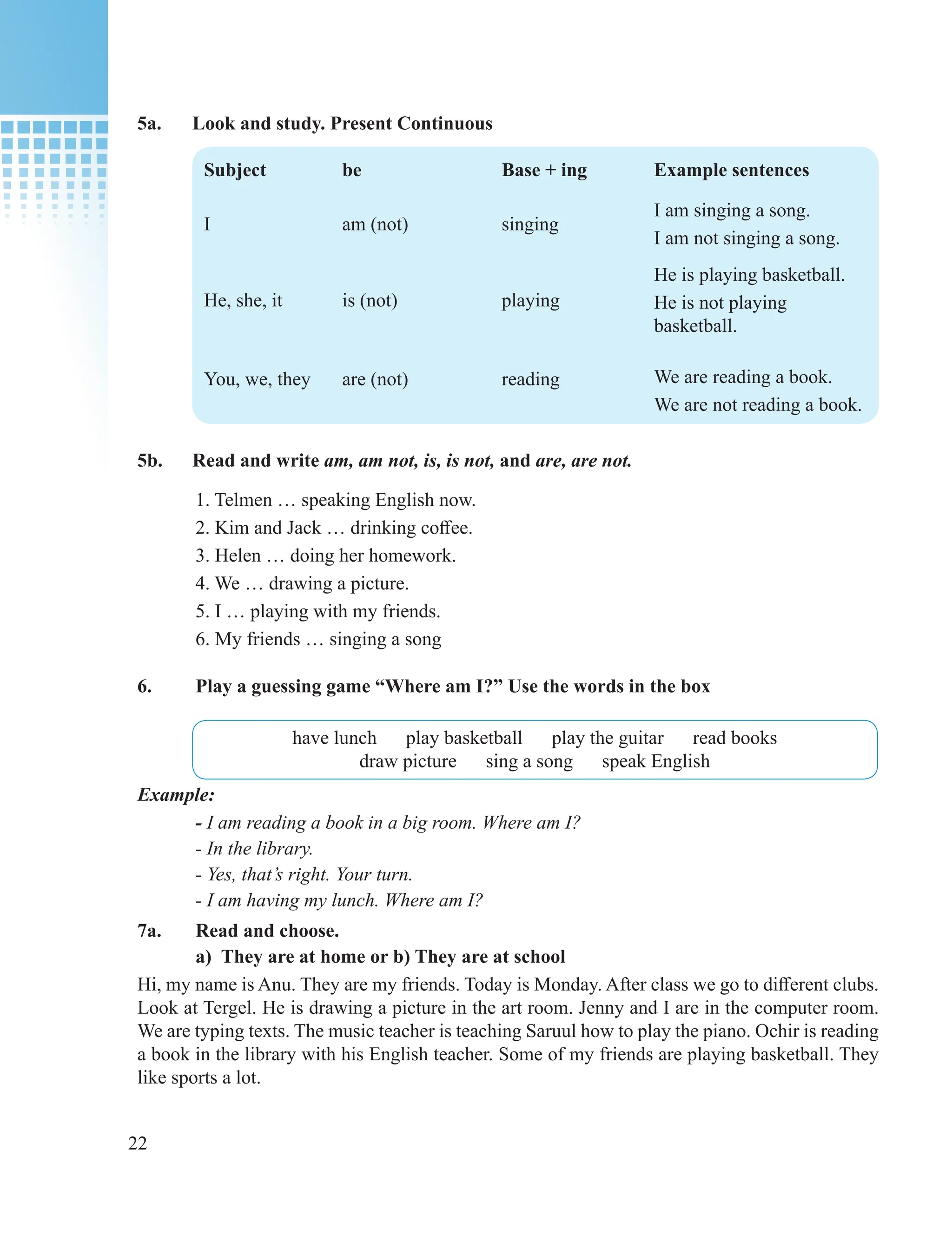
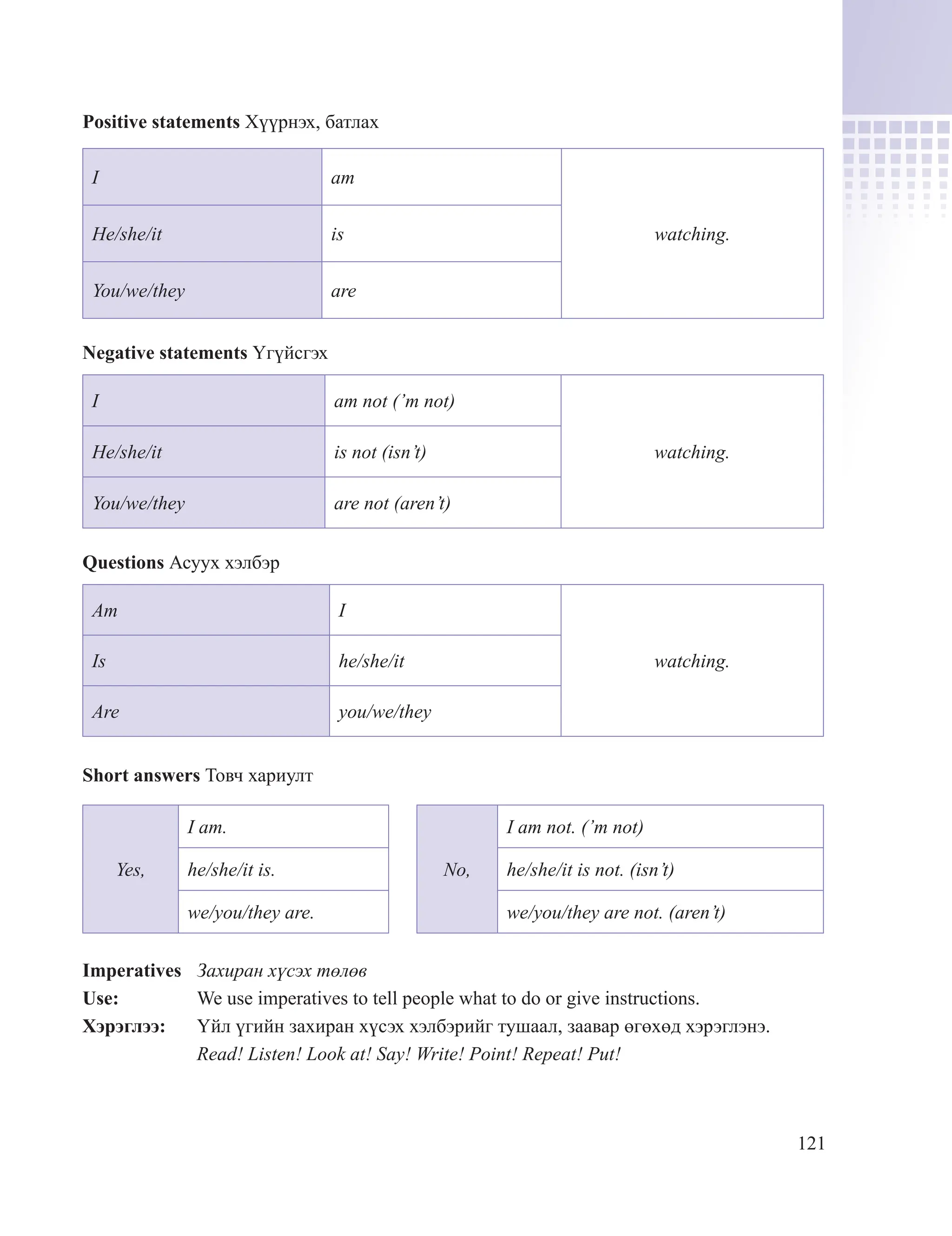
5a. Look and study. Present Continuous
Subject be Base + ing Example sentences
I am (not) singing
I am singing a song.
I am not singing a song.
He, she, it
You, we, they
is (not)
are (not)
playing
reading
He is playing basketball.
He is not playing
basketball.
We are reading a book.
We are not reading a book.
5b. Read and write am, am not, is, is not, and are, are not.
1. Telmen … speaking English now.
2. Kim and Jack … drinking coffee.
3. Helen … doing her homework.
4. We … drawing a picture.
5. I … playing with my friends.
6. My friends … singing a song
6. Play a guessing game “Where am I?” Use the words in the box
have lunch play basketball play the guitar read books
draw picture sing a song speak English
Example:
- I am reading a book in a big room. Where am I?
- In the library.
- Yes, that’s right. Your turn.
- I am having my lunch. Where am I?
7a. Read and choose.
а) They are at home or b) They are at school
Hi, my name is Anu. They are my friends. Today is Monday. After class we go to different clubs.
Look at Tergel. He is drawing a picture in the art room. Jenny and I are in the computer room.
We are typing texts. The music teacher is teaching Saruul how to play the piano. Ochir is reading
a book in the library with his English teacher. Some of my friends are playing basketball. They
like sports a lot.
23
7b. Read again and decide true (T) or false (F).
a. English teacher is in the library.
b. The music teacher is teaching the guitar.
c. Ochir is playing basketball in the gym.
d. After class students go to the clubs.
e. Today is Tuesday
8. Play a board game. Answer the questions.
Example: Where are you now? I am in the art room.
What are you doing? I am drawing a picture
9. Play an instruction game in groups. Listen to the instructions carefully and follow.
Example:
Student 1. Say “Hello” to the person near you
Student 2. Jump
Student 3. Touch your elbow
1 2 3 4
5
6
1
2
3
4
5
6
1
1
2
3
4
5
6
2
3
4 5
6
an art roo
m
a
n
u
rse’s offic
e
a school canteen
a
l
i
b
r
a
r
y
a
n
E
n
g
l
i
s
h
room
a
gym
Cross the
bridge to
space 3
Cross the
bridge to
space 6
Go home
to rest
Go back
1 space
Go back
3 spaces
Go back
3 spaces
Move
formard
2 spaces
BONUS
Roll again
BONUS
Roll again
BONUS
Roll again
BAD DAY
Go back to
space 4
BAD DAY
Go back to
space 2
BAD DAY
Go back to
space 1
STOP
Lose a turn
STOP
Lose a turn
STOP
Lose a turn
Move
forward
5 spaces
Move
forward
3 spaces
24
10a. Read and answer. Are they a) in the gym or b) in the class?
Hello! Everybody! Open your textbooks. Read the text. Write three sentences. Now put
the pens down. Listen to the teacher! Stand up! Sit down! Knock the desk once. Touch
your nose. Clap your hands.
10b. Read the text again and change the underlined words.
Example: Open the textbook!
Open the notebook!
1. Read the text! 4. Listen to the teacher!
2. Write three sentences! 5. Knock the desk!
3. Put the pens down! 6. Touch your nose!
11a. Look and study. Present Continuous.
Am I Yes, you are. / No, you are not.
Are you/we/they Yes, I am / you are/they are.
reading a book? No, I am not / you are not/they are not.
Is he/she/it Yes, he/she/it is. No, he/she/it is not.
What are you doing now? I am reading a book.
11b. Match the question words with the correct endings.
1. Are he swimming?
2. Is they playing games?
3. Where is she eating?
4. Who are you going?
5. What is smiling?
11c. Answer the questions in activity 11b.
12a. Listen and read. Is she talking about a) her school or b) her school subjects?
Hello! My name is Namuun. I go to school number 10. Today is Monday. I’m studying
geography at the moment. My friend Telmen is working on the world map. He is
pointing to the countries and my classmates are listening to him. Geography is fun. My
favourite subjects are history, science and physical education. My friend Telmen likes
math and literature. He is reading a literature book. Mongolian language, art, and health
education are interesting subjects too. We love our school.
25
12b. Listen and read again. Answer the questions.
1. What day is it?
2. What is Namuun doing?
3. Is Telmen working on the computer?
4. What’s Namuun’s favourite subject?
5. Is Telmen studying math now?
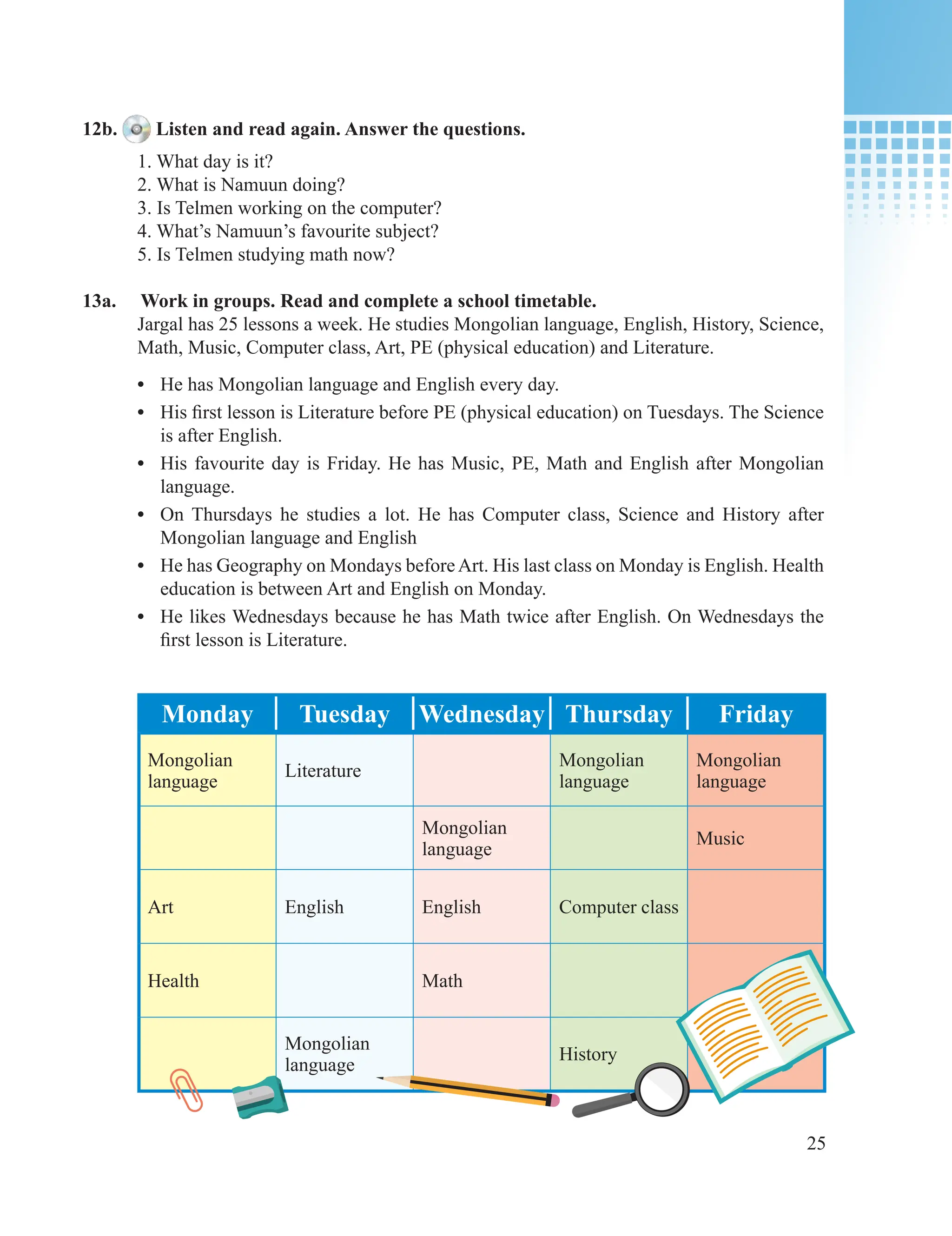
13a. Work in groups. Read and complete a school timetable.
Jargal has 25 lessons a week. He studies Mongolian language, English, History, Science,
Math, Music, Computer class, Art, PE (physical education) and Literature.
• He has Mongolian language and English every day.
• His first lesson is Literature before PE (physical education) on Tuesdays. The Science
is after English.
• His favourite day is Friday. He has Music, PE, Math and English after Mongolian
language.
• On Thursdays he studies a lot. He has Computer class, Science and History after
Mongolian language and English
• He has Geography on Mondays beforeArt. His last class on Monday is English. Health
education is between Art and English on Monday.
• He likes Wednesdays because he has Math twice after English. On Wednesdays the
first lesson is Literature.
Monday Tuesday Wednesday Thursday Friday
Mongolian
language
Literature
Mongolian
language
Mongolian
language
Mongolian
language
Music
Art English English Computer class
Health Math
Mongolian
language
History
26
13b. Look at the timetable and ask each other.
1. What is
Jargal’s
favourite
day?
2. When does he
study a lot?
3. How many
times does he
have English a
week?
4. What days
does he have
Science?
5. Does he
have Music on
Friday?
14. Create your school timetable. Then write in sentences.
Monday Tuesday Wednesday Thursday Friday
Begin like this:
I have got … lessons a week. I study … on Mondays … . My favourite day is … .
27
VOCABULARY
1. Match the school subject to the pictures.
2. Odd one out
1. between, art, next to, behind, near
2. a music room, a gym, a nurse’s room, behind, an art room
3. read, like, write, listen, point
4. Mongolian, English, Literature, Gym, Russian
5. Monday, Sunday, Tuesday, Wednesday, Thursday
SELF-CHECK
1. MATHEMATICS
2. HISTORY
3. SCIENCE
4. GEOGRAPHY
5. LITERATURE
6. MUSIC
7. PHYSICAL EDUCATION
8. ART
a.
b.
c.
d.
e.
f.
g.
h.
28
USE OF ENGLISH
3. Choose the correct answer.
1. Is / Are they playing tennis now?
2. We is / are having English now.
3. What is / are you doing in the art room?
4. My friends are / am reading books in the library.
5. What is / are they doing in the gym?
4. Put the words in the correct order.
1. are / We / a / book / reading.
2. Sarah / playing / Look! / the / is/ piano.
3. chairs / there / desk / the / under / are / two.
4. Listen! / Tsetseg / Chimeg / are / a / song / and / singing.
5. standing / in / Are / in front of / the / you / board?
6. TV / not / watching / am/ I.
7. room / between / The / music / the / is / room / science / and / library / the.
LISTENING AND SPEAKING
5a. Listen and say. Is it about a) a school or b) a classroom?
5b Listen again and circle the correct words.
1. Today is Tuesday / Monday.
2. They are in the art room / English room.
3. There are 3 books / notebooks on the desk.
4. The pen is on the / books / notebooks.
5. The ruler is next to / near the notebook.
6. Ask and answer.
1. What is your favourite subject?
2. How many subjects do you have a week?
3. Are there a library and gym at your school?
4. Are you studying in a science room now?
5. What do you do in the art room?
29
READING AND WRITING
7a. Read and answer. How many floors are there in Telmen’s school?
Hi, my name is Telmen. I am 13 years old and I go to school No 1. This is my school. We
have a school canteen, a gym and a computer room on the first floor. The computer room
is next to the art room. The English room is the opposite room 107 next to the gym. On
the second floor we have a large library between the nurse’s office and the science room.
My classroom is on the third floor between the history room and the music room.
7b. Read again and decide true (T) or false (F). Correct the false sentences.
1. He is a student at school No 2. T F
2. The English room is on the second floor. T F
3. The library is between the nurse’s office and the science room. T F
4. His classroom is near the art room. T F
5. They have a small library. T F
8. Write sentences using the pictures.
Begin like this: This is Masha. She has … lessons a week.
I can … Well OK Not well
• name subjects, classrooms
• use prepositions of places
• understand commands
• talk using the present continuous
• write my favourite subjects
30
UNIT 3. LET’S COUNT
LEARNING OBJECTIVES
Listening
L1 Understand and follow short, basic, supported classroom instructions
L5 Understand some specific information of short, supported dialogue about numbers
L9 Understand short songs about number and months of the year
Speaking
S1 Make basic statements which provide personal information
S2 Ask questions to find out personal information
S6 Use suitable words, phrases, and sentences during playing games
S7 Take turns when speaking with others in short, basic exchanges about birthdays
Reading
R1 Recognise, identify and sound at text level
Recognise the English alphabet in print
R2 Read and follow familiar instructions for classroom activities
R6 Understand the meaning of very short, simple texts about the events and months
R7 Understand the meaning of simple short sentences about math problems
Writing
W1 Plan, write and check short sentences about numbers
W4 Use joined-up handwriting in a written work
W8 Use a full stop and question mark, comma during guided writing of short, familiar
sentences
Use of English
UE2 Use numbers 1 – 100 to count
UE5 Use who what and where, how many to ask questions
UE11 Use there is / are to make short statements and descriptions
31
UNIT 3. LET’S COUNT
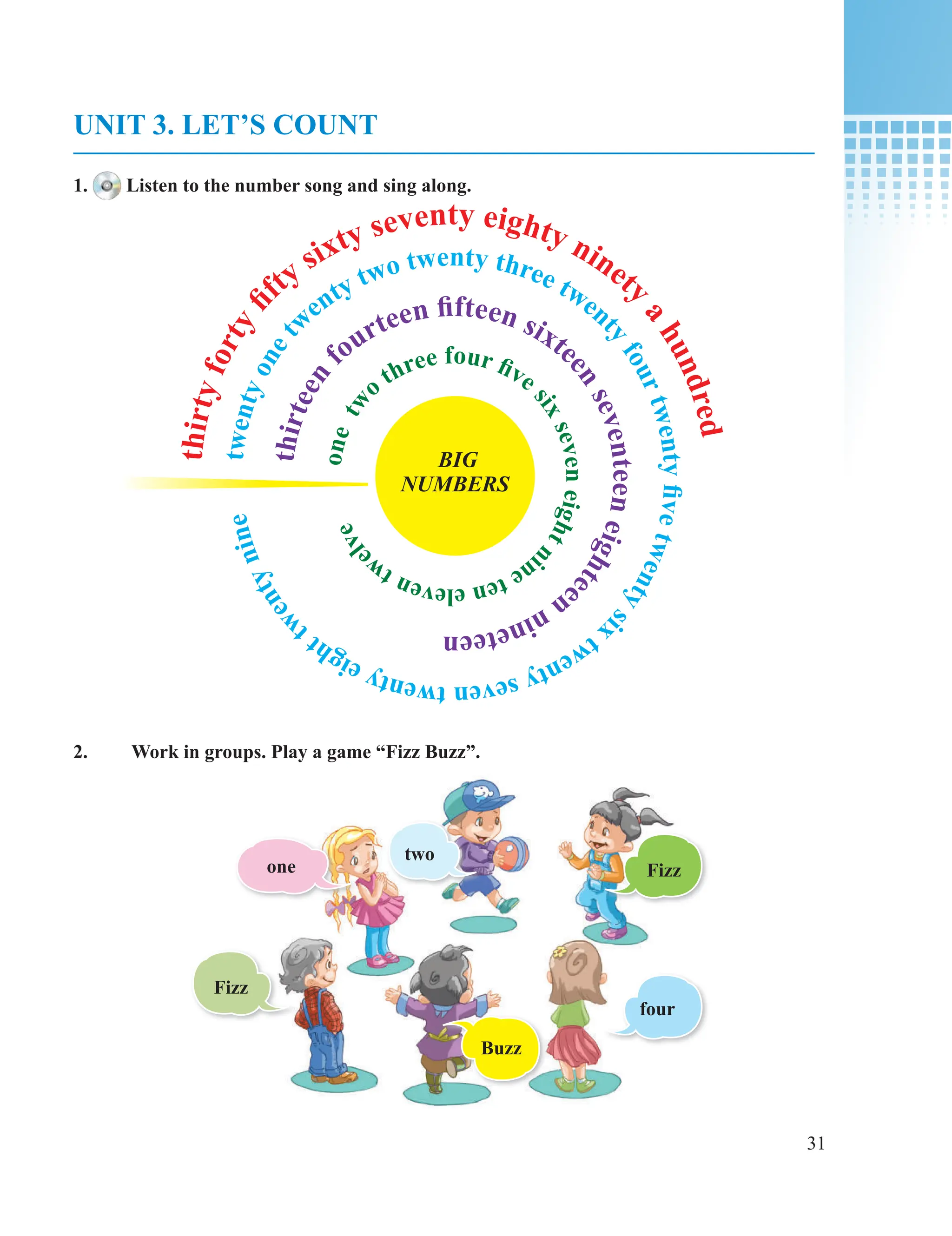
1. Listen to the number song and sing along.
2. Work in groups. Play a game “Fizz Buzz”.
t
h
i
r
t
e
e
n
fourteen ffteen sixte
e
n
s
e
v
e
n
t
e
e
n
e
i
g
h
t
e
e
n
n
i
n
e
t
e
e
n
o
n
e
t
w
o three four fve
s
i
x
s
e
v
e
n
e
i
g
h
t
n
i
n
e
t
e
n
e
l
e
v
e
n
t
w
e
l
v
e
BIG
NUMBERS
t
w
e
n
t
y
o
n
e
t
wenty two twenty three twen
t
y
f
o
u
r
t
w
e
n
t
y
f
v
e
t
w
e
n
t
y
s
i
x
t
w
e
n
t
y
s
e
v
e
n
t
w
e
n
t
y
e
i
g
h
t
t
w
e
n
t
y
n
i
n
e
t
h
i
r
t
y
f
o
r
t
y
f
fty sixty seventy eighty ninet
y
a
h
u
n
d
r
e
d
one
two
Fizz
Fizz
four
Buzz
32
3. Listen to the short dialogues and circle the numbers mentioned.
1) 3, 13, 23, 33, 43 2) 4, 14, 24, 34, 44
3) 1, 11, 21, 31, 41 4) 2, 12, 22, 32, 42
4a. Read and listen to the text. Is she a) a student or b) a teacher?
My name is Jargal. I’m from Mongolia. I’m 37 years old. I speak English, Chinese and
Russian. I work at school number 10 in Ulaanbaatar. I live with my family. I have got
two children. Telmen is 12 years old. Nomin is 9 years old. My address is 24 Sun Street.
We are happy family.
4b. Read and listen again. Choose the correct answers.
1. She is … years old.
a. thirty b. thirty seven c. thirteen
2. She speaks … languages.
a. three b. one c. nine
3. There are … children in her family.
a. two b. four c. five
4. Telmen is … years old.
a. twenty two b. eight c. twelve
5. Her address is … Sun street.
a. twenty four b. thirty four c. four
5. Play a game “Show me pages”.
Example:
A: Please, open your book to page nine.
B: Please, open your book to page ten.
Student A: (forty eight, seventeen, two, twenty one, thirty six, and fifty)
Student B: (fifteen, twenty three, five, thirteen, eighteen, and thirty eight)
6. Write the answers.
1. sixty + ten = seventy 5. thirty two – sixteen =
2. fifteen + ten = 6. fifty + fifty =
3. forty five – twenty five = 7. twenty one – eleven =
4. nineteen + eighteen = 8. seventy seven + three =
7a. Look and study. Even and odd numbers.
Even numbers: 2, 4, 6, 8, 10, 12, 14, 16, 18, 20, 22, 24, 26, 40, 60
Odd numbers: 1, 3, 5, 7, 9, 11, 13, 15, 17, 19, 21, 23, 25, 27, 31, 43
33
7b. Look and write numbers in the correct place.
14, 53, 29, 44, 67, 75, 84, 1, 7, 12, 88, 93, 35, 28, 9, 4, 15, 22, 41, 99, 82, 74, 66, 27, 33
Even numbers Odd numbers
8. Work in groups, solve the problems.
1. There are 26 green balls and 13 yellow balls on the floor. How many balls are there?
2. Mary has got 9 red apples and 6 green apples, and Pete has got 7 green apples and 8
red apples. How many green apples have they got?
3. Jane has got 38 pencils. She gives 5 pencils to her brother. How many pencils has Jane got?
4. There are 7 puppies in the doghouse. Suvdaa takes 3 puppies home. How many puppies
are there in the dog house?
5. Molly and Ariun are riding bikes with 2 friends. How many children are riding a bike?
9. Listen and complete the chart with the missing even and odd numbers. Then check.
Odd numbers 11 21 19 1
Even numbers 2 12 24 18
10. Work in pairs, do the puzzle.
1. What number do you get when you add an even number to an odd number?
2. What number do you get when you add an even number to an even number?
3. What number do you get when you add an odd number to an odd number?
11a. Look and study. Is there …? Are there …?
Is there a book on the desk? - Yes, there is / No, there isn’t.
Are there pens on the desk? - Yes, there are / No, there aren’t.
How many pencils are there? - There are eighteen pencils.
11b. Look at the chart and write sentences. These are Telmen’s school objects.
1 2 3 4 5 6 7 8 9 10 11 12 13 14 15 16 17 18
a pen
a pencil
a ruler
a book
a map
Example: There are eleven pens on the desk.
34
How many of each object do you see? Write the number in the box.
11c. Work in pairs. Look at the chart 11b. Ask and answer.
Example:
- Is there a pen? How many pens are there?
Yes, there is.Eleven
12a. Look at the picture of the classroom.
35
12b. Write the sentences.
Example: There are twenty pencils on the desk.
13a. Match the ordinal numbers to the months.
1. The first month of the year is April.
2. The second month of the year is August.
3. The third month of the year is March.
4. The fourth month of the year is January.
5. The fifth month of the year is September.
6. The sixth month of the year is November.
7. The seventh month of the year is October.
8. The eighth month of the year is December.
9. The ninth month of the year is February.
10. The tenth month of the year is July.
11. The eleventh month of the year is June.
12. The twelfth month of the year is May.
13b. Listen and check, then repeat.
14. Work in pairs. Ask and answer.
15. In groups of 3, do the chant and continue until 12. Present to the whole class.
Begin like this:
I am number 1, I am the first,
I am number 2, I am the second,
I am number 3, I am the third, …
What is the first
month of the
year?
January.
April
What is the
fourth month of
the year?
36
16a. Listen to the dialogue and answer the question. Who is talking to Kelly?
16b. Listen to the dialogue again and circle the correct answers.
1. What is the girl’s name? a. Carla b. Kelly c. Candy
2. How old is the girl today? a. two b. twenty c. twelve
3. When is Dan’s birthday? a. on the third of March b. on the third of May
c. on the fourth of March
4. What is the gift? a. Barbie b. Teddy Bear c. a CD
17a. Look and study. Prepositions in and on.
Telmen’s birthday is in December.
Telmen’s birthday is on the 31st
of December.
17b. Complete the dialogue with on and in
A: How old are you, Telmen?
B. I’m twelve.
A: And when is your birthday?
B: My birthday is … the third of May. How about you and Anu?
A: Well, my birthday is … the seventh of December, and Anu’s birthday is … July.
18. Listen to the song and sing along. Then answer the questions.
1. How many months are there in a year?
2. What is your favourite month? Why?
37
19. Work in pairs, ask and answer. When are these children’s birthdays?
Example: How old is Tom? He is 11. When is his birthday? - It’s on the 5th
of August.
20a. Do a birthday survey. Ask all your classmates.
Example: When is your birthday? - My birthday is on the seventh of December.
Name Birthday
1
2
3
4
5
20b. Write your friends’ birthdays and present to the class.
Example: My friend Ganaa’s birthday is on the tenth of May.
Tom 11
On the 5th
of August
Маnlai 12
In March
Cindy 10
On the 21st
of July
Tim 13
In January
Masha 8
On the 18th
of September
Ono 9
In July
38
SELF-CHECK
VOCABULARY
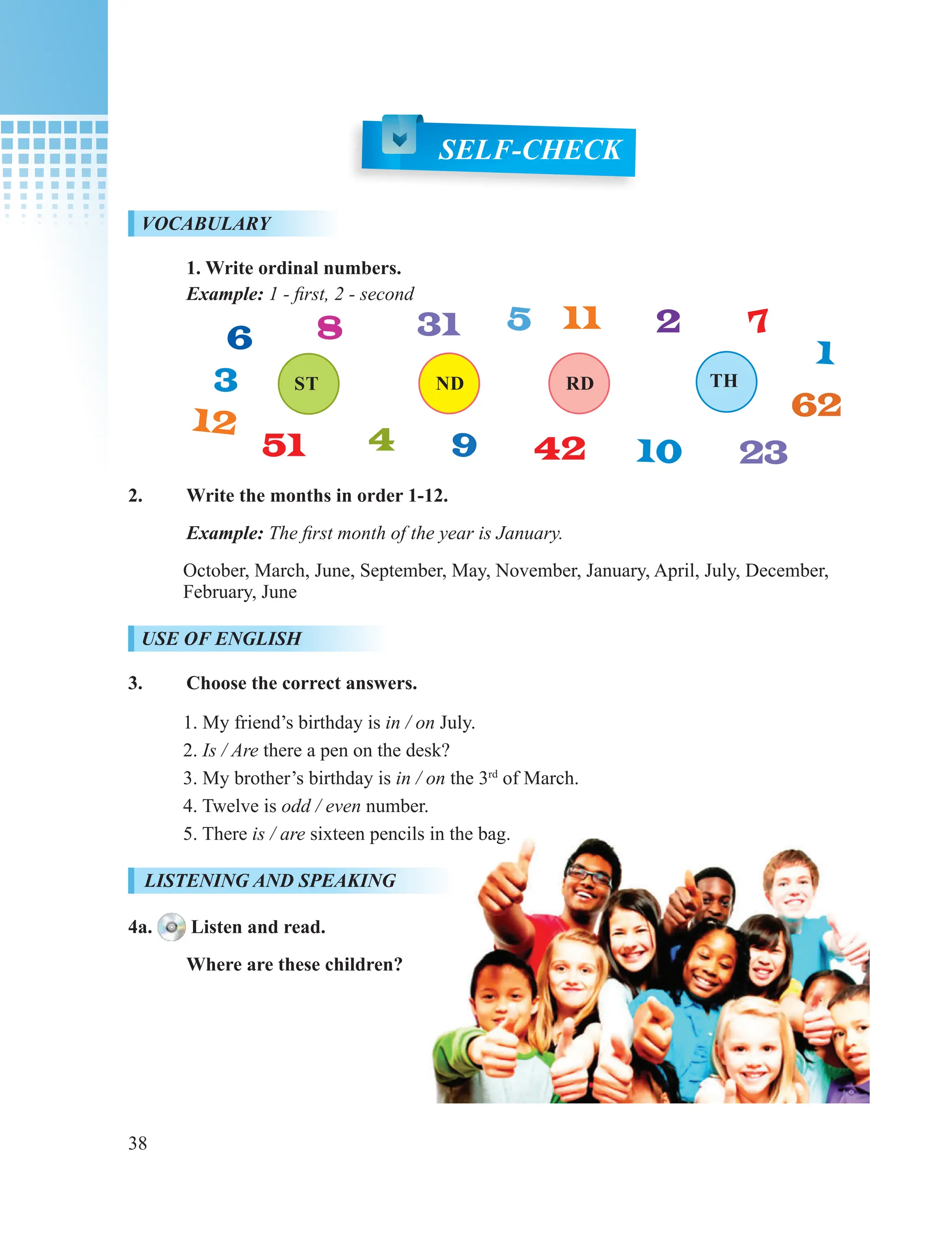
1. Write ordinal numbers.
Example: 1 - first, 2 - second
2. Write the months in order 1-12.
Example: The first month of the year is January.
October, March, June, September, May, November, January, April, July, December,
February, June
USE OF ENGLISH
3. Choose the correct answers.
1. My friend’s birthday is in / on July.
2. Is / Are there a pen on the desk?
3. My brother’s birthday is in / on the 3rd
of March.
4. Twelve is odd / even number.
5. There is / are sixteen pencils in the bag.
LISTENING AND SPEAKING
4a. Listen and read.
Where are these children?
ST
1
ND RD
2
TH
12
11
31
42
51 23
3
62
4
8 5
9
7
6
10
39
4b. Listen again and answer true (T) or false (F).
1. They are all from Mongolia. T F
2. They speak English well. T F
3. There are fifty students in their block. T F
4. Martin is on the eighth floor. T F
5. Margad is in the room number fourteen. T F
5. Ask and answer these questions.
1. When is your birthday?
2. When is your friend’s birthday?
3. How many boys and girls are there in your class?
4. Is November the second month of the year?
5. What is the date today?
READING AND WRITING
6a. Read the text and answer. Is it about a) months or b) Anu?
My name’sAnu. I go to school on the first of September.
My birthday is on the twelfth of October. My friend’s
birthday is in November. We celebrate Christmas in
December. January is a winter month. Tsagaan Sar is
usually in February. I give presents to my mum and
sister on the eighth of March. The children’s day is on
the first of June, and Naadam is on the eleventh of July.
My grandmother’s birthday is in August. These dates
are special for me.
6b. Read again and correct the sentences.
1. I go to school on the first of October.
2. We celebrate Christmas in January.
3. Tsagaan sar is on the eighth of March.
4. I give presents to my dad and grandfather.
5. Naadam is on the eleventh of June.
40
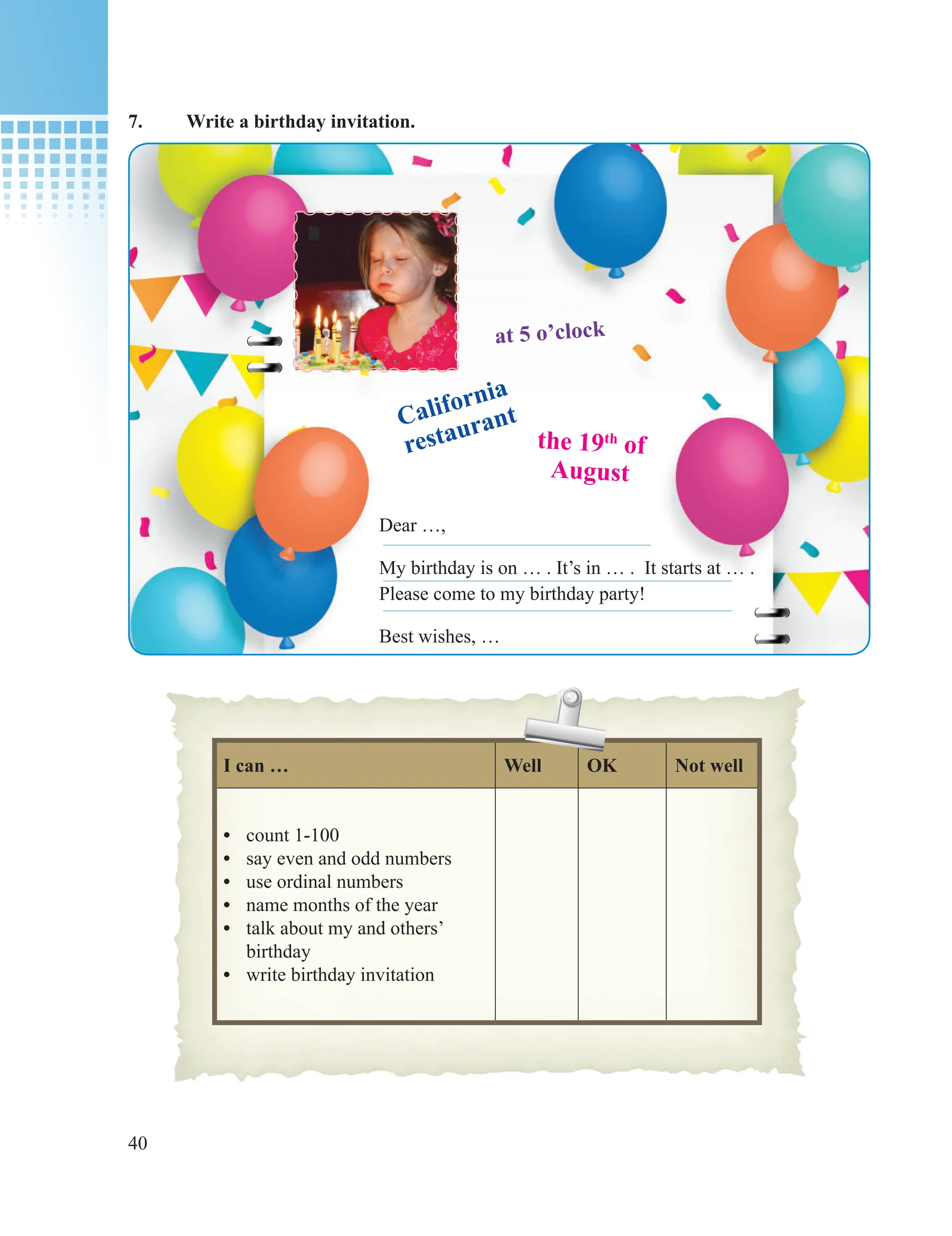
7. Write a birthday invitation.
I can … Well OK Not well
• count 1-100
• say even and odd numbers
• use ordinal numbers
• name months of the year
• talk about my and others’
birthday
• write birthday invitation
at 5 o’clock
California
restaurant
the 19th
of
August
Dear …,
My birthday is on … . It’s in … . It starts at … .
Please come to my birthday party!
Best wishes, …
41
MODULE 2. ME AND MINE
UNIT 4. THAT’S MINE
LEARNING OBJECTIVES
Listening
L5 Understand some specific information of short, supported dialogue about the jobs
L8 Recognise words that are spelled out on topics about parents’ jobs
Speaking
S1 Make basic statements which provide personal information
S2 Ask questions to find out personal information
S5 Give short, basic descriptions of people and their jobs at sentence level
S6 Use suitable words, phrases, and sentences during playing games
Reading
R4 Understand the main points of very short, simple texts about job activities
R5 Understand some specific information in very short, simple texts about people and their jobs
Writing
W1 Plan, write and check short sentences about family members’ jobs
W2 Write, short sentences which give basic personal information
W4 Use joined-up handwriting in a written work
Use of English
UE1 Use genitive ‘s/ s’ to name and label things
UE3 Use adjectives, including possessive adjectives, to give personal information
UE6 Use demonstrative pronouns this, these, that, those
UE7 Use possessive pronouns mine, yours to give basic personal information
UE9 Use common simple present forms, including short answer forms and contractions to give
personal information
42
1. Listen, look and repeat.
a firefighter a cook a pilot a doctor a policeman a builder
2. Read the sentences and write the jobs.
1. She helps sick people. She works in the hospital. She is … .
2. He travels a lot. He flies a plane. He wears a uniform. He is … .
3. He works in a school canteen. He cooks food. He is … .
4. She works outside. She controls cars in the street. She is … .
5. She wears a uniform. She fights fire. She is … .
6. He builds new houses and schools. He is … .
4. Look and study. Possessive ’s.
This is Carlo’s hat.
That is Naran’s ball.
These are Sam’s pens.
Those are Naran’s flags.
3. Work in pairs. Look, read and correct.
1. A cook builds houses.
No! A cook doesn’t build houses.
A cook cooks food.
2. A firefighter cooks food.
3. A pilot helps sick people.
Example:
4. A builder controls cars.
5. A doctor fights fire.
6. A policeman flies a plane.
43
5a. Listen to the people. Is it about their a) jobs or b) hobbies?
5b. Listen again and complete the sentences.
1. His name is … .
He is from … .
He is a … .
2. She is ... .
She is … .
She works in a … .
3. He is a German … .
He builds … and … .
4. She is from … .
She is a … .
She helps … people.
5. He is a … .
He controls … and
… in the street.
6. Her name is … .
She is from … .
She is a … .
5c. Listen again and match. Whose hat is this?
1. This is Carlo’s hat.
2. This is Sandra’s hat.
3. This is Henry’s hat.
4. This is Suvdaa’s hat.
5. This is Takashi’s hat.
6. This is Nina’s hat.
6. Play a guessing game. “Are you a …?”
a.
d.
f. c.
b.
e.
EXAMPLE:
- Hi! I live in the countryside. I ride horses. I have got sheep and goats.
- Are you a herder?
- Yes. I am. Your turn
44
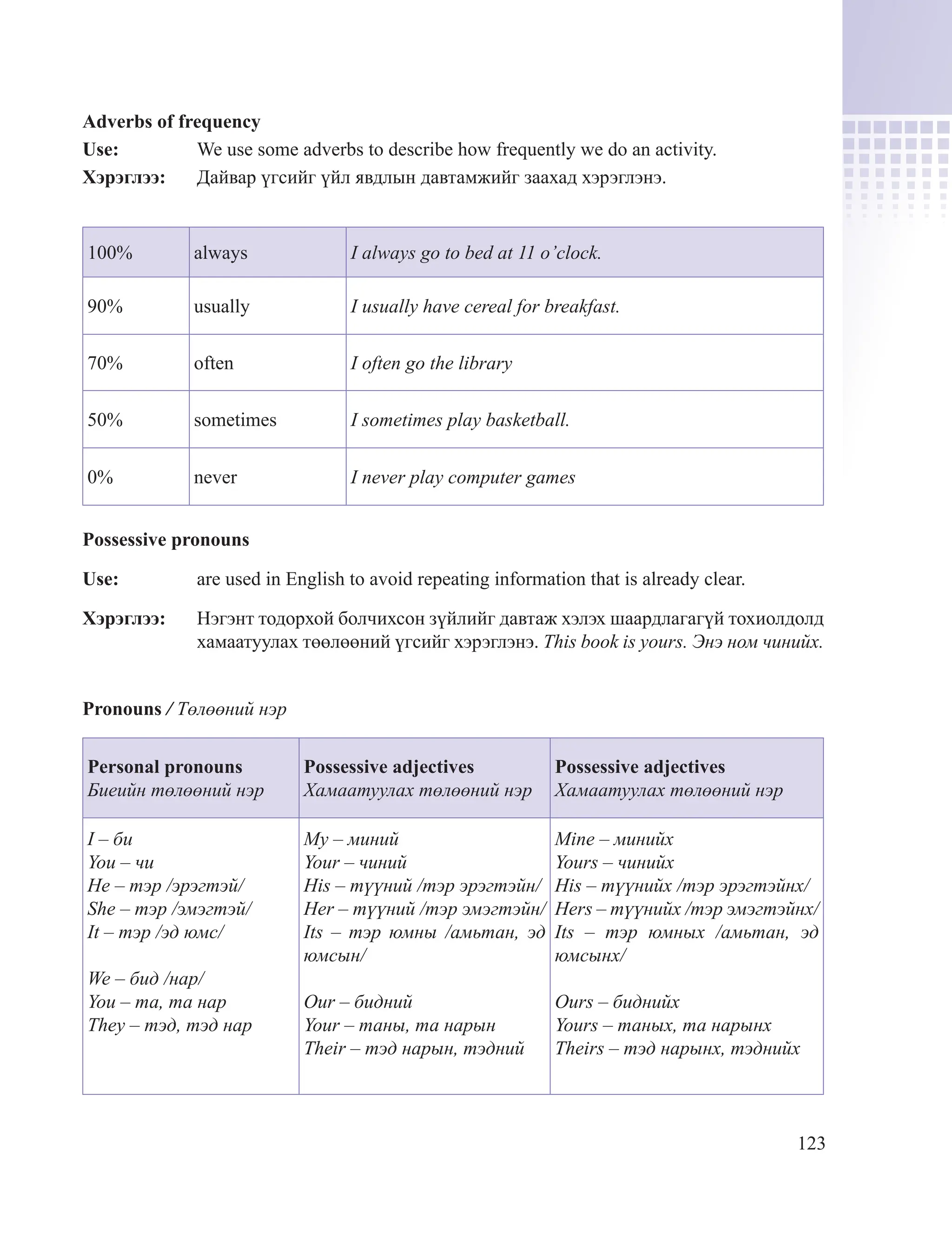
7a. Look and study. Adverbs of frequency
7b. Look and answer. How often does Carla …?
Example:
1. Carla always flies a plane.
0%
30%
50%
80%
100%
Never
Often
Sometimes
Usually
Always
I always
wear a
uniform.
She usually
reads books.
They
sometimes
play
basketball.
We often
go to the
shop.
He never plays
computer
games.
80%
30%
0%
100%
50%
45
8. Look at the pictures and write sentences.
Example: A herder usually rides a horse. Today he is riding a motorbike.
1. a/pilot/always/fly/plane/the Now/he/play/football
2. a/doctor/usually/help/people Today/she/read/book/a
3. a firefighter/always/ fight/fires Now/he/cook/ food/at home
4. a policeman/always/ control/cars/in/the/streets
Today/he/play/basketball in the gym
5. a/cook/always/cook/food Now/she/sit/and/talk/with/ children
6. he/usually/build/houses Today/he/swim/in/the/river
9a. Look and study. Possessive adjectives.
This is Nina’s hat. It’s her hat. The hat is hers.
These are Anu’s and my bags. They are our bags. These bags are ours.
9b. Match and write.
1. It’s my ball. a. It’s yours.
2. It’s their jacket. b. It’s ours.
3. It’s your dog. c. It’s mine.
4. It’s his cat. d. It’s hers.
5. It’s her flag. e. It’s theirs.
6. It’s our pencils. f. It’s his.
46
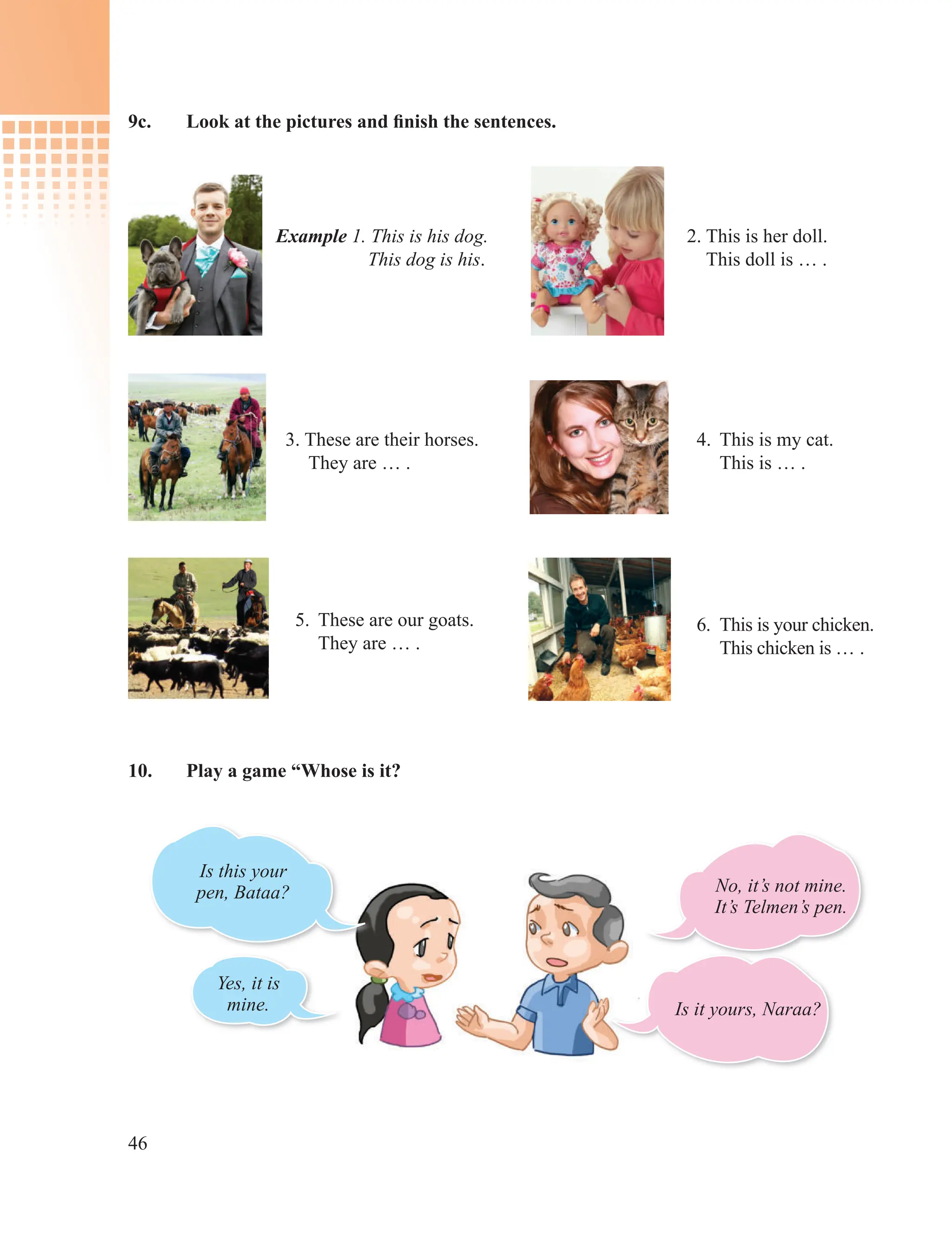
9c. Look at the pictures and finish the sentences.
Example 1. This is his dog.
This dog is his.
2. This is her doll.
This doll is … .
3. These are their horses.
They are … .
4. This is my cat.
This is … .
5. These are our goats.
They are … .
6. This is your chicken.
This chicken is … .
Yes, it is
mine. Is it yours, Naraa?
10. Play a game “Whose is it?
Is this your
pen, Bataa? No, it’s not mine.
It’s Telmen’s pen.
47
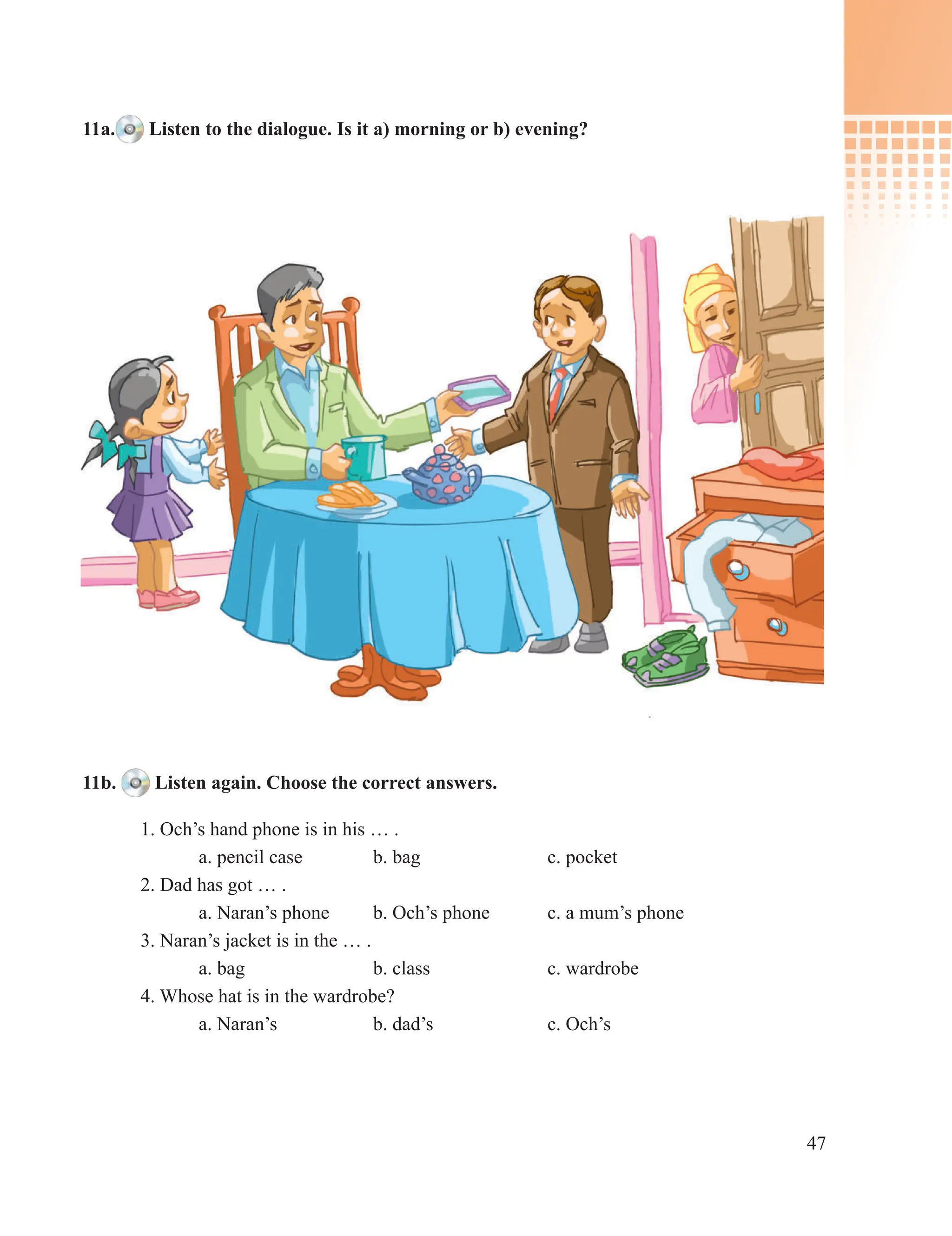
11a. Listen to the dialogue. Is it a) morning or b) evening?
11b. Listen again. Choose the correct answers.
1. Och’s hand phone is in his … .
a. pencil case b. bag с. pocket
2. Dad has got … .
a. Naran’s phone b. Och’s phone c. a mum’s phone
3. Naran’s jacket is in the … .
a. bag b. class c. wardrobe
4. Whose hat is in the wardrobe?
a. Naran’s b. dad’s c. Och’s
48
12a. Read the text and answer. Is it about a) her family or b) her friends?
Hi! I’m Uyanga. I live with my family in Ulaanbaatar. I have two brothers and a sister.
My father’s name is Tenuun. He works at the police station. He is a policeman. He likes
playing football and hockey. My mother is Maral. She works in the hospital. She helps
sick people. She loves wrestling because my grandfather is a wrestler. My big brother
is called Od, and he works at the fire station. He is a firefighter. He plays table tennis.
My brother Och is a pilot. He travels a lot. My sister’s name is Zulaa. She works in a
restaurant. She is a good cook. She plays bowling. I want to be a builder. I like building
nice houses. My favourite sports are basketball and volleyball.
12b. Read the text again. Write yes or no.
1. Uyanga wants to be a good cook.
2. Her father is a policeman and her mother is a policewoman.
3. Her grandfather is a wrestler, so her mother loves wrestling.
4. Her brothers are a pilot and a firefighter.
5. Uyanga lives with her grandparents.
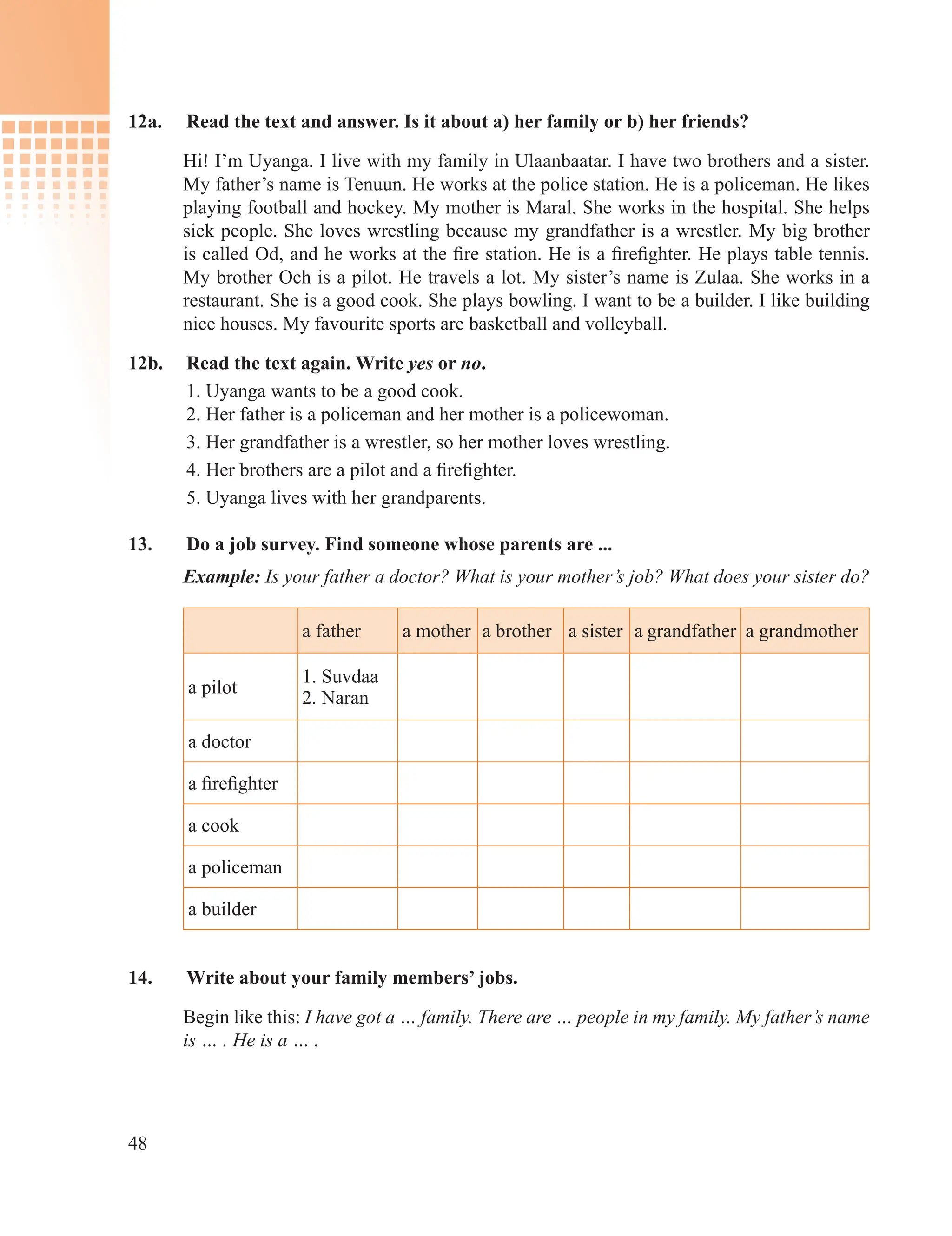
13. Do a job survey. Find someone whose parents are ...
Example: Is your father a doctor? What is your mother’s job? What does your sister do?
a father a mother a brother a sister a grandfather a grandmother
a pilot
1. Suvdaa
2. Naran
a doctor
a firefighter
a cook
a policeman
a builder
14. Write about your family members’ jobs.
Begin like this: I have got a … family. There are … people in my family. My father’s name
is … . He is a … .
49
SELF-CHECK
VOCABULARY
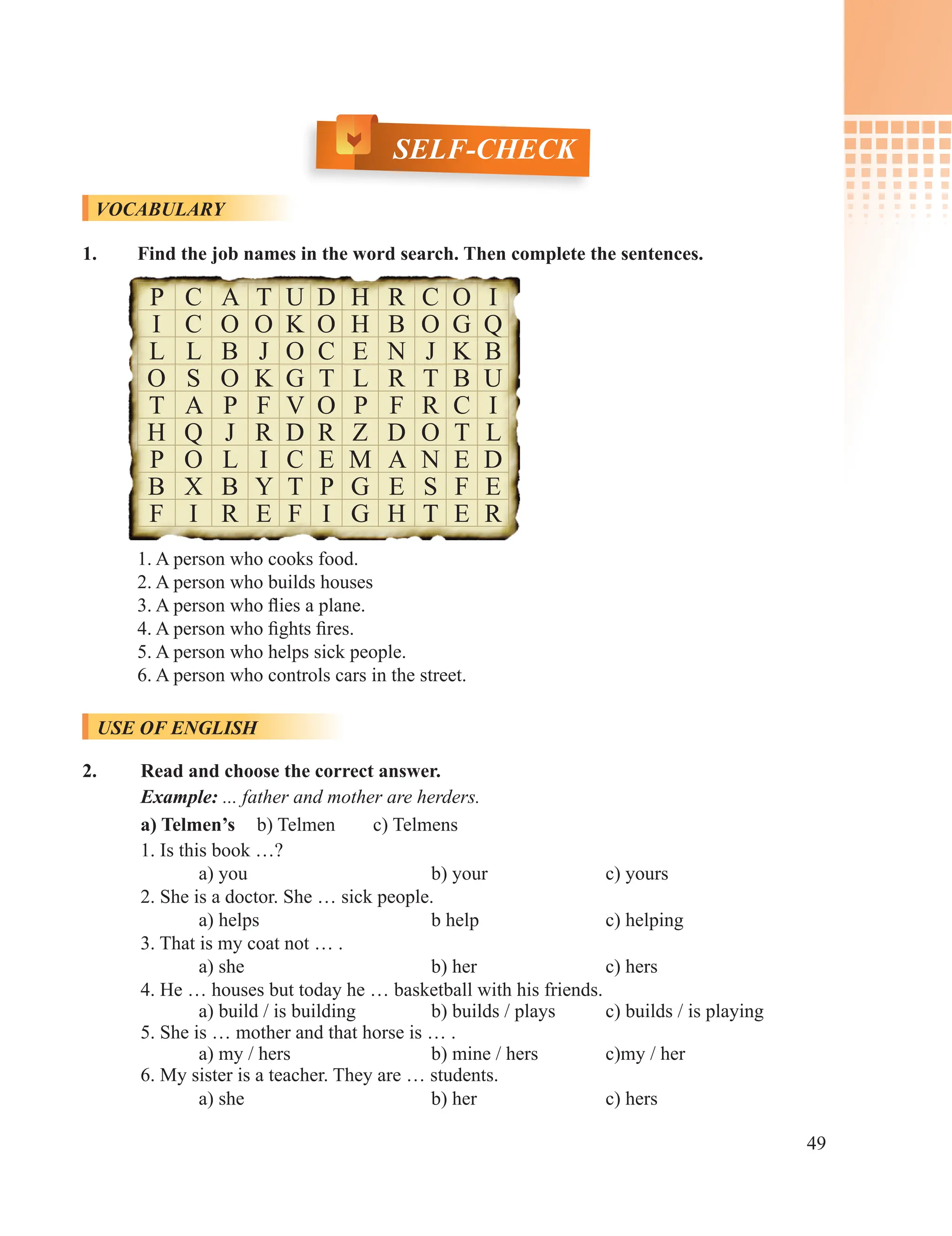
1. Find the job names in the word search. Then complete the sentences.
P C A T U D H R C O I
I C O O K O H B O G Q
L L B J O C E N J K B
O S O K G T L R T B U
T A P F V O P F R C I
H Q J R D R Z D O T L
P O L I C E M A N E D
B X B Y T P G E S F E
F I R E F I G H T E R
1. A person who cooks food.
2. A person who builds houses
3. A person who flies a plane.
4. A person who fights fires.
5. A person who helps sick people.
6. A person who controls cars in the street.
USE OF ENGLISH
2. Read and choose the correct answer.
Example: ... father and mother are herders.
a) Telmen’s b) Telmen c) Telmens
1. Is this book …?
a) you b) your c) yours
2. She is a doctor. She … sick people.
a) helps b help c) helping
3. That is my coat not … .
a) she b) her c) hers
4. He … houses but today he … basketball with his friends.
a) build / is building b) builds / plays c) builds / is playing
5. She is … mother and that horse is … .
a) my / hers b) mine / hers c)my / her
6. My sister is a teacher. They are … students.
a) she b) her c) hers
50
LISTENING AND SPEAKING
3a. Listen to the dialogue between Telmen and Namuun. Are they talking about a)
their favourite jobs or b) their parents?
3b. Listen to the dialogue again and choose.
1. Telmen’s favourite job is … .
a. a doctor b. a policemanc. a firefighter
2. Telmen’s mother is a … .
a. a cook b. a doctor c. a pilot
3. Namuun helps her … .
a. brother b. sister c. mother
4. Telmen’s mother helps … .
a. Namuun b. brother c. children
5. Namuun’s father works at … .
a. the hospital b. the street c. the school
4. Ask and answer.
1. What does your mother/father do?
2. What is your favourite job?
3. What do builders do?
4. Who controls cars in the streets?
5. Who helps sick people?
READING AND WRITING
5a. Read the texts and choose the best title.
a) People and their families or b) People and their jobs.
1. Bataa is a famous cook and he works on television. He teaches how to cook healthy
food. People like his “Healthy Food” programme.
2. Sanchir is a pilot. He always flies a plane to different countries. Also he is a good
basketball player. This is his hobby. He plays basketball with his team in his free time.
3. Tumen is a herder. He lives in the countryside. He has a lot of horses and sheep. His
hobby is horse racing so he has a lot of fast horses. His horses race during Naadam
every summer.
51
5b. Read the texts again and write the names.
Example: Someone who flies a plane. Sanchir
1. Someone who has got a lot of fast horses. …
2. Someone whose hobby is basketball. …
3. Someone who teaches how to cook healthy food. …
4. Someone who flies to different countries. …
5. Someone who lives in the countryside. …
6. Someone who works on television. …
7. Someone whose horses race during Naadam. …
8. Someone who is a famous cook. …
6. Read about James and write about him.
Name: James
Surname: Anthony
Country: Australia
City: Sydney
Job: Teacher
Age: 28
Family: his wife and son
Hobby: basketball and tennis
Begin like this: His name is James and his surname is Anthony. He is …
I can … Well OK Not well
• talk about jobs
• use possessive pronouns
• use genitive ‘s/s’
• describe different jobs
• write about other people’s jobs
• ask and answer questions
about jobs
52
UNIT 5. BODY
LEARNING OBJECTIVES
Listening
L5 Understand some specific information and detail of short dialogue about favourite animals
L8 Recognise words that are spelled out on topics about body
Speaking
S4 Use basic vocabulary for parts of the body
S6 Use suitable words, phrases, and sentences during short pair, group and whole class
exchanges
Reading
R3 Begin to read very short, simple, fiction and non-fiction texts about animals
R6 Understand the meaning of very short, simple texts about a farm
Writing
W1 Plan, write and check short facts about the animals
W4 Use joined-up handwriting in the missing parts of the body
W8 Use a full stop and question mark, comma during guided writing of short, familiar sentences
Use of English
UE1 Use singular nouns, plural nouns – including some common irregular plural forms
UE3 Use adjectives, including possessive adjectives, on familiar topics to give personal
information and to describe things
Use comparative and superlative adjectives
53
UNIT 5. BODY
1. Look and listen. Label parts of the body.
This is my head.
These are my ears.
These are my 1. …
This is my 2. ...
These are my cheeks.
This is my 3. ...
This is my mouth.
These are my 4. ...
This is my tongue.
This is my 5. ...
This is my 6. ...
These are my
shoulders.
These are my hands.
This is my 7. ...
This is my wrist.
These are my 8. ...
... This is my chest.
2. Listen to the song and write the missing words in your notebook.
This is my 9. ...
This is my thigh.
This is my 10 . ...
This is my 11 . ...
This is my ankle.
This is my 12 . ...
These are my 13. ...
These are my 14. ...
eyelashes a chest a neck ankles a chin lips a thigh
teeth cheeks elbows eyebrows
1. . . .
11. . . .
3. . . .
2. . . .
4. . . .
5. . . . 6. . . .
7. . . .
8. . . .
9. . . .
10. . . .
54
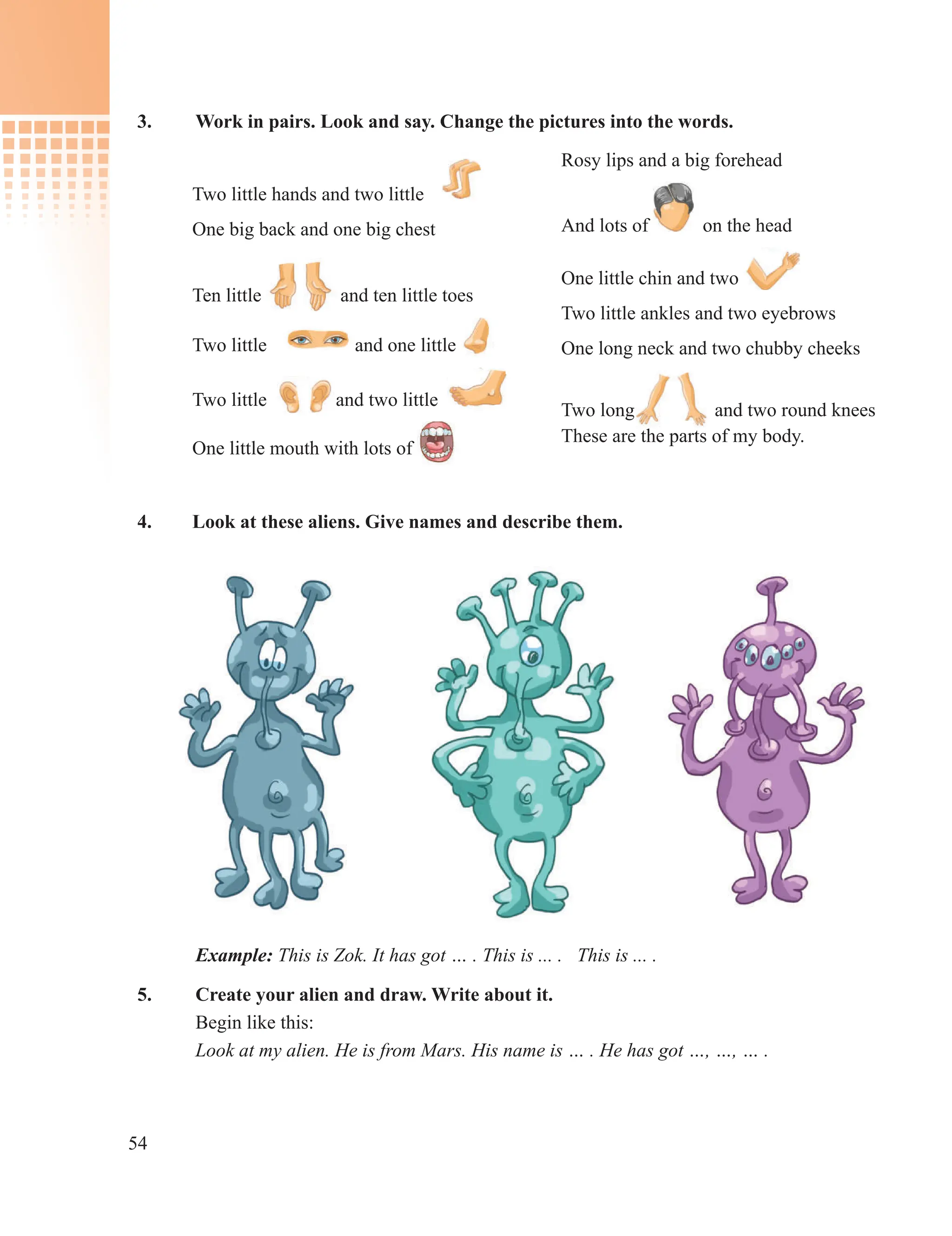
4. Look at these aliens. Give names and describe them.
Example: This is Zok. It has got … . This is ... . This is ... .
5. Create your alien and draw. Write about it.
Begin like this:
Look at my alien. He is from Mars. His name is … . He has got …, …, … .
Two little hands and two little
One big back and one big chest
Ten little and ten little toes
Two little and one little
Two little and two little
One little mouth with lots of
3. Work in pairs. Look and say. Change the pictures into the words.
Rosy lips and a big forehead
And lots of on the head
One little chin and two
Two little ankles and two eyebrows
One long neck and two chubby cheeks
Two long and two round knees
These are the parts of my body.
55
6. Look at Murat’s pets and learn the words.
7a. Look at Murat’s pets again and choose the correct words.
Murat lives in the countryside in Mongolia. He has got three pets. They are the horse, the
dog and the eagle. His horse has got a long/short tail. And it’s very fast/slow. It always
wins the horse race on Naadam days. He loves his eagle very much. His eagle has got a
sharp/weak beak. Also its claws are strong/weak. It hunts animals very well. The dog
is his friend. His dog’s paws are small/large. Its favourite food is meat and bones. Murat
loves his pets very much.
7b. Read again the text and find:
1. one name of the festival
2. two food names
3. the names of three animals
4. four parts of the animal body
5. five adjectives about animals
6. Look at Murat’s pets and learn the words.
7a. Look at Murat’s pets again and choose the correct words.
Murat lives in the countryside in Mongolia. He has got three pets. They are the horse, the
dog and the eagle. His horse has got a long/short tail. And it’s very fast/slow. It always
wins the horse race on Naadam days. He loves his eagle very much. His eagle has got a
sharp/weak beak. Also its claws are strong/weak. It hunts animals very well. The dog
is his friend. His dog’s paws are small/large. Its favourite food is meat and bones. Murat
loves his pets very much.
7b. Read again the text and find:
1. one name of the festival
2. two food names
3. the names of three animals
4. four parts of the animal body
5. five adjectives about animals
a tail
short long
a beak
claws
a wing
a paw
fast slow
sharp
strong weak
56
8a. Read, listen to the descriptions and match them to
the pictures.
a. This animal lives in the savannas of Africa. It has got a
long neck and a long tail. It is fast and tall. It eats grass
and leaves. What animal is it?
b. They are large animals. They have got a long yellow body
and big paws. They are strong and fast. They eat other
animals. They live in the jungle. What animals are they?
c. They live in the hot countries. They have got a long trunk,
big grey ears and a large body. They are slow, but strong.
They eat grass. What animals are they?
d. It has got a small head, long arms, short legs and a long tail. It’s
medium and brown. It usually lives in the jungle. It eats bananas
and nuts. What animal is it?
e. It lives in the forest. It sleeps during the winter and
likes honey and ants. It has got a large brown body,
short legs and big paws. It is a slow, but strong
animal. What animal is it?
f. This animal lives in the hole. It has got a small
yellow and black body and short legs. It eats grass. It
has got sharp teeth. What animal is it?
g. They live in the steppe and houses. They have got a small grey
body, a long tail and sharp teeth. They eat meat and seeds. Cats
like them. They can run fast. What animals are they?
h. It has got wings and a small head. It has got a sharp beak, small
claws and a long tail. It can fly. It is colourful.
It lives in the forest. It eats fruits and nuts.
What animal is it?
1 2
3
6
7
57
8b. Read the descriptions again and complete the chart.
Animal Giraffe Bear Marmot Parrot Tiger Mouse Monkey Elephant
Has got
a long
neck and a
long tail
Colour
black and
orange
Size
large and
tall
Lives in savanna
Eats
grass and
leaves
9a. Look and study. Comparative and superlative forms of adjectives.
long – longer – the longest Example:
heavy – heavier – the heaviest An elephant is heavier than a horse.
big – bigger – the biggest An elephant is the heaviest animal in the world.
9b. Look at the examples and write.
1. small – smaller – the smallest
2. tall … … 7. fat … …
3. short … … 8. thin … …
5. fast … … 9. noisy … …
6. strong … … 10. happy … …
10. Read about the animals in the exercise 8a and compare them.
1. A marmot is … (big) than a mouse.
2. A giraffe is … (tall) than a bear.
3. A tiger is … (fast) than an elephant.
58
4. A monkey is … (happy) than a parrot.
5. Mice are … (small) than marmots.
6. Elephants are … (heavy) than giraffes.
7. Tigers are … (strong) than bears.
8. A bear is … (big) than a marmot.
11. Circle the correct answer.
1. Which is the biggest? a. an elephant b. a horse c. a marmot
2. Which is the smallest? a. a parrot b. a mouse c. a giraffe
3. Which is the fastest? a. a tiger b. a bear c. a monkey
4. Which is the tallest? a. a giraffe b. a parrot c. a marmot
5. Which has the longest ears? a. a monkey b. a tiger c. an elephant
6. Which is the heaviest? a. a marmot b. a bear c. a mouse
7. Which is the noisiest a. a tiger b. a parrot c. a bear
8. Which is the strongest? a. a horse b. a giraffe c. a tiger
12. Mix and mingle. Ask and answer. Use the words in the box
a giraffe a parrot a marmot a dog an eagle a tiger a horse
a mouse a sheep a cat a camel
Which is bigger
a bear or a
monkey?
An elephant
A bear.
Which is the
biggest animal in
the world?
59
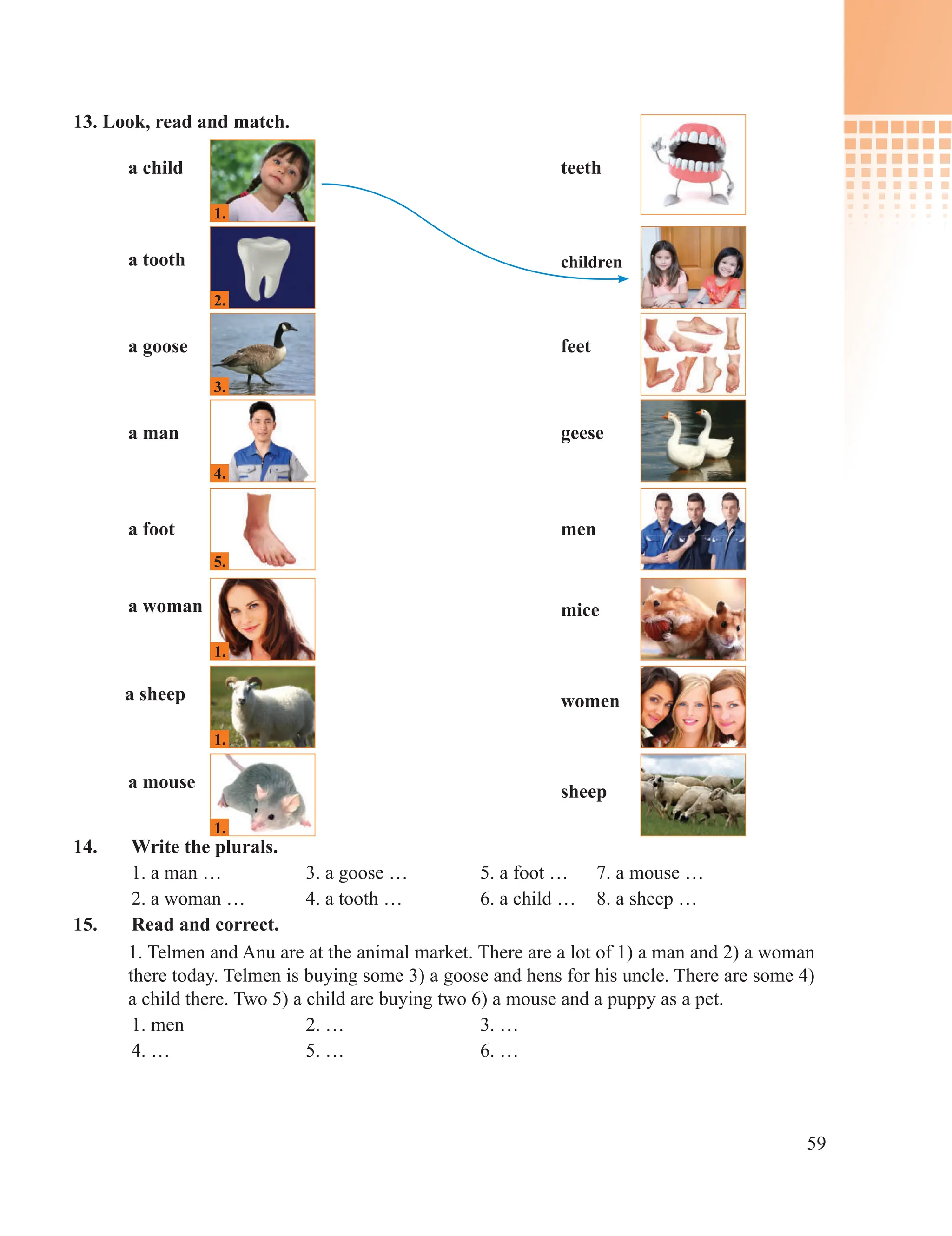
13. Look, read and match.
14. Write the plurals.
1. a man … 3. a goose … 5. a foot … 7. a mouse …
2. a woman … 4. a tooth … 6. a child … 8. a sheep …
15. Read and correct.
1. Telmen and Anu are at the animal market. There are a lot of 1) a man and 2) a woman
there today. Telmen is buying some 3) a goose and hens for his uncle. There are some 4)
a child there. Two 5) a child are buying two 6) a mouse and a puppy as a pet.
1. men 2. … 3. …
4. … 5. … 6. …
a child teeth
a woman
women
a sheep
sheep
a mouse
mice
a tooth
a goose feet
a man geese
a foot men
children
1.
1.
1.
1.
2.
3.
4.
5.
60
SELF-CHECK
VOCABULARY
1. Odd one out.
1. a nose, a head, a foot, a face, cheeks 4. fingers, a wrist, arms, a stomach, hands
2. eyes, ears, a chin, eyebrows, a neck 5. beaks, claws, paws, tails, parrots
3. a chest, legs, toes, ankles, knees 6. women, teeth, a foot, men, children
2. Decode the animal names.
1 2 3 4 5 6 7 8 9 10 11 12 13 14 15 16 17 18 19 20 21 22 23 24 25 26
a b c d e f g h i j k l m n o p q r s t u v w x y z
a. 10 9 18 1 6 6 5 b. 5 12 5 16 8 1 14 20 c. 16 1 18 18 15 d. 20 9 7 5 18
e. 13 15 14 11 5 25 f. 13 1 18 13 15 20 g. 5 1 7 12 5 h. 8 15 18 19 5
USE OF ENGLISH
3. Write in the correct form.
1. A giraffe is … (tall) than a horse.
2. Elephants are … (large) animals on the land.
3. A tiger is … (strong) wild animal in the forest.
4. Mice are … (small) than marmots.
5. A horse is … (fast) animal in Mongolia.
6. A parrot is … (noisy) than an eagle.
7. A cow is … (fat) animal on the farm.
4. Write the plural nouns.
1. a child _____________ 2. a foot _____________
3. a tooth ______________ 4. a mouse _________________
5. a man ______________ 6. a woman _________________
7. a goose ______________ 8. a sheep ___________________
61
LISTENING AND SPEAKING
5a. Listen to the dialogue and answer. Are they talking about a) their favourite pets or
b) their favourite animals?
5b. Listen to the dialogue again and answer the questions.
1. What is Anu’s favourite animal?
2. Why does she like it?
3. Who likes honey?
4. What is Jane’s favourite animal?
5. Are elephants the smallest animals in the world?
6. Work in pairs. Ask and answer.
1. What is your favourite animal?
2. Which is faster a tiger or a giraffe?
3. Which is the biggest animal in the world?
4. Have eagles got sharp beaks?
5. Do dogs eat grass and leaves?
READING AND WRITING
7a. Read the text. Choose the best title a) In the zoo or b) On the farm.
Hooray! Tomorrow is Saturday. I always go to my grandparents’ farm. They have got a
lot of sheep, goats, cows and horses. Also they have got many geese and pigs. I love one
goose called Grey. She has got a long beak and a long neck. Her claws are sharp. She runs
faster than others. The Grey’s favourite place is green land because she likes grass. She
gives eggs every day. She is a very good pet!
7b. Read the text again. Complete the sentences.
1. Today is … .
2. Telmen’s grandparents live on a … .
3. His favourite pet’s name is … .
4. Grey has got a … … and a … … .
5. She runs faster than other … .
6. Grey likes … .
62
8. Look at the picture and write a short description.
• Name
• Size
• Parts of the body
• Place to live
• Food
Begin like this: There are many animals in the zoo.
I can … Well OK Not well
• name parts of the body
• use adjectives for
descriptions
• use singular and irregular
plural nouns
• talk about animals
• use comparative and
superlative forms
• write descriptions about
scene pictures
63
UNIT 6. STORIES
LEARNING OBJECTIVES
Listening
L6 Use contextual clues to predict content and meaning in short, supported dialogue about the
children’s activities
L7 Understand short, supported narratives about a summer holiday
Speaking
S3 Describe details of someone’s summer holiday
S5 Give short, basic descriptions of people’s past action at sentence level
Reading
R4 Understand the main points of very short, simple texts about a summer holiday
R6 Understand the meaning of very short, simple story
Writing
W2 Write, short sentences what they did last week / weekends
W5 Link words or phrases using basic coordinating connectors when create own story
W7 Spell familiar high-frequency words accurately during guided writing activities
Use of English
UE9 Use common past simple forms [regular and irregular] to describe actions and narrate
simple events including short answer forms and contractions
UE12 Use common –ly adverbs to describe actions
UE16 Use conjunctions and or but to link words and phrases
UE17 Use when clauses to describe simple present and past actions on personal and familiar
topics
64
UNIT 6. STORIES
1a. Listen and read about Telmen’s holiday. Match the stories to the pictures
1. Last summer I visited my uncle’s home on my holiday. They live in the countryside.
On the first day I helped my uncle and looked after sheep and goats. In the evening
my uncle cooked khorkhog for us. After dinner we listened to our uncle’s interesting
stories.
2. The next day I played with my uncle’s children near the river. We stayed there all day
and loved our games. We watched our sand castles and enjoyed a lot. After our game
we washed our hands and walked home.
1b. Listen and read again. Put the sentences in the correct order.
__ Telmen played with his uncle’s children near the river.
__ He helped his uncle and looked after sheep and goats.
__ They watched their sand castles and enjoyed a lot.
__
1 He visited his uncle’s home on his holiday.
__ After their game they washed their hands and walked home.
__ In the evening his uncle cooked khorkhog for them.
__After dinner they listened to their uncle’s interesting stories.
2. Look and study. Past simple
(+) I/you/he/she/it/we/you/they visited. (- ) I/you/he/she/it/we/you/they didn’t visit.
(?) Did I/you/he/she/it/we/you/they visit?
Short answers: Yes, I/you/he/she/it/we/you/they did.
No, I/you/he/she/it/we/you/they didn’t.
(?) What did you do yesterday? I visited my grandparents.
a. b.
65
3. What did they do?
Example: Tom played basketball two days ago.
Telmen didn’t help his uncle yesterday.
Tom Play basketball two days ago √
Telmen Help his uncle yesterday ×
Maral Visit grandparents last winter √
Namuun Wash clothes last Monday ×
Ochir Cook pizza last week √
Jane Listen to music last night ×
John Watch TV yesterday √
Och Look after sheep and goats three days ago √
Enkhee Walk in the garden ×
Purev Stay in a ger √
Peter Live in the city ×
4. Mix and mingle. Ask and answer.
Example:
5. Match the verbs to their past forms.
1. bring - brought 5. ... - ... 9. ... - ... 13. ... - ...
2. ... - ... 6. ... - ... 10. ... - ... 14. ... - ...
3. ... - ... 7. ... - ... 11. ... - ...
4.. ... - ... 8. ... - ... 12. ... - ...
6. Write 5 things you did last week.
Example: I helped my mother.
Did you watch
TV last night?
Yes, I did.
No, I didn’t. I listened
to the music.
Did you?
hear see is
fly bring forget
feel sing go
become send
know have spend
was sang knew
sent went brought
forgot flew had spent
became heard
felt saw
66
7a. Read the letter and write the verbs in the correct form.
Dear Uncle Bat,
How are you? I hope you are fine. We are in London now. I am writing to tell you about
the great time we had (have) last weekend. We … (go) to see a football game on Saturday
evening. Manchester United … (play) against Liverpool. I really … (enjoy) it, but sadly
Liverpool didn’t win. You know, I am a big fan of it! On Sunday we … (spend) the day
looking around the city. We got lost because we … (not have) a map. It wasn’t a big
problem because we asked a policeman and he … (help) us. We … (visit) the Lowry
Museum. There were a lot of interesting paintings. In the evening we … (have) dinner in
a restaurant. The meal … (is) so nice.
Yours,
Anu
7b. Read the letter again and choose the correct picture.
1. Where is Anu now?
2. What did they do on Saturday?
3. What did they do first on Sunday?
4. Who helped them when they got lost?
a.
a.
a.
a.
b.
b.
b.
b.
c.
c.
c.
c.
67
8a. Listen, read and complete.
was sang knew sent went brought forgot flew became heard felt
a. Once upon a time, there 1) ... (be) a king. He lived in a
beautiful palace. Behind the palace there was a forest. A
nightingale lived there.
b. The nightingale 2) … (sing) so sweetly. One day the king
3) … (know) about the nightingale and 4) … (send) a man
to bring it to him.
c. The man 5) … (go) to the forest and saw the bird then he
6)… (bring) it.
d. At the palace the nightingale sang and the king loved him.
h. His sweet music brought happiness to everyone in the
palace forever.
e. But one day a Japanese king sent him a golden toy
nightingale. The king listened to the toy nightingale and 7)
... (forget) about the real nightingale.
f. So the real nightingale 8) … (feel) badly and 9) ... (fly) back
to the forest. Every night the king listened to the toy bird
singing. But one day it didn’t work.
g. The king was sad and 10) … (become) sick. The real
nightingale 11) … (hear) and came back to his palace again.
The king was so happy and lived happily.
68
8b. Read the text again and tick (√) the correct verbs.
listened became forgot flew
watched heard sang flew
went sent brought helped
felt helped sent washed
knew didn’t work forgot looked after
8c. Read the story again and answer the questions.
Example:
Where did the king live?
The king lived in a beautiful palace
1. Where did the nightingale live?
2. Why did the king send a man to the forest?
3. Did the king listen to the nightingale?
4. What did the Japanese king send to the king?
5. Why did the nightingale fly back to the forest?
6. Why did the nightingale come to the palace again?
9. Work in groups. Role play the “Nightingale” story.
10. Look and study. And / But / Or
• We went to the river and played games.
• We went to the river but we didn’t swim.
• Do you like tea or coffee?
69
11. Complete the sentences with or/and/but.
1. Telmen went to the countryside … helped his uncle.
2. Do you ride horses … camels?
3. He wanted to play basketball … he forgot his ball.
4. The children looked after sheep … goats.
5. They went to the gym … didn’t play.
6. Did you watch TV … read a book last night?
7. I visited my friends … went to the movie.
8. We wanted to buy new books … forgot the money at home.
12a. Listen to the dialogue between Bolor and James. Are they talking about a)
playing games or b) watching games on TV?
12b. Listen to the dialogue again and choose the best answer.
1. They are meeting … .
a. in the morning b. in the afternoon c. in the evening
2. Bolor wants to play … .
a. tennis b. basketball c. football
3. James forgot his … when he was in the classroom.
a. ball b. cards c. book
4. James learnt to play tennis when he was … years old.
a. seventeen b. seventy c. seven
5. Bolor learnt to play tennis when she was … years old.
a. one b. ten c. nine
13. Look and study. Adverbs
Sweet – sweetly Quick –quickly
Slow – slowly Loud – loudly
Careful – carefully Beautiful – beautifully
Quiet – quietly Careless – carelessly
He gave a sweet gift to the king. The king smiled sweetly.
The man had a slow horse. The man walked slowly to the forest.
My dad is a careful driver. He drives carefully.
70
14a. Read the story and write the missing adverbs.
It was a sunny summer day. Telmen walked … (slow) to his home. He came home and
opened the door … (quick). When he opened the door his mother smiled … (sweet) and
gave him a big box. Telmen looked at her mother … (quiet) and opened it … (careful).
What a surprise! He saw a small puppy in it and he shouted … (loud) “What a cute
puppy!” It was his birthday gift from his family.
14b. Read the story again. Put the pictures in the correct order.
1. __ 2. __ 3. __ 4. __ 5. __
15. Work in groups and create your own story. Then role play it.
Begin like this: It was a cold winter evening. Bold rode a horse and sang loudly.
What a cute
puppy!
a.
d.
b.
c.
e.
71
SELF-CHECK
VOCABULARY
1. Match the verbs to their past forms.
Example: watch – watched
2. Odd one out.
1. cook, wash, visit, enjoy, was 4. watched, loved, helped, heard, liked
2. forget, send, play, know, go 5. saw, felt, stayed, knew, sang
3. listened, brought, flew, sang, went
USE OF ENGLISH
3. Circle the correct word.
1. My friend John is a quiet / quietly boy.
2. My sister opened the box careful / carefully.
3. Bolor sang an English song very loud / loudly.
4. He closed the door quick / quickly and went out.
5. We walked slow / slowly to the road.
6. Telmen’s mother has sweet / sweetly smile.
play
walk
w
a
t
c
h
v
i
s
i
t
e
n
j
o
y
l
o
o
k
a
f
t
e
r
h
e
l
p
c
o
o
k
w
a
s
h
l
i
v
e
s
t
a
y
help
fly
bec
o
m
e
h
e
a
r
f
e
e
l
s
e
e
b
e
s
i
n
g
k
n
o
w
s
e
n
d
g
o
b
r
i
ng
forget
played, walked,
watched, visited, enjoyed,
looked after, helped,
cooked, washed, lived,
flew, became, heard, felt,
saw, was, sang, knew, sent,
went, brought, forgot
stayed, helped
72
4. Put the words in the correct order.
1. Aunt’s / played / the / children / near / river.
2. they / dog / came / when / their / brought / They.
3. felt / the / She / when / heard / happy / she / news
4. became / the / He / king / but / like / didn’t / he / it.
5. music / very / We / to / carefully / listened / and / sang / the.
6. sent / emails / They / to / other / each / last / summer.
5. Choose the correct word.
1. Do/Did you go to the circus yesterday?
2. Was/were she in the zoo two days ago?
3. We don’t/didn’t forget our homework yesterday.
4. They aren’t/ didn’t know the story.
5. Telmen didn’t/doesn’t watch TV last night.
6. What do/did you watch on TV last night?
LISTENING AND SPEAKING
6a. Listen to the dialogue between Telmen and Jane. Are they talking about a) their
hobbies or b) their holidays?
6b. Listen to the dialogue again. Find the false sentences and correct them.
1. Telmen went to the countryside with his friends.
2. Jane went to the children’s camp with her friends.
3. Telmen helped his uncle on his holiday.
4. Jane looked after goats and sheep in the countryside.
5. Jane liked the children’s camp.
6. Telmen didn’t like the countryside.
7. Talk to each other about your last summer holiday. Use the given questions.
1. Where did you go on your holiday?
2. What did you do there?
3. How long did you stay there?
4. Did you like your holiday?
5. Who did you go with?
6. Did you see/do interesting things on your holiday?
73
READING AND WRITING
8a. Read the paragraphs and put in the correct order.
a. _The wolf ran away suddenly. He was surprised. Then he saw his uncle and he knew
why the wolf ran away. Telmen was happy to see his uncle.
b. _Suddenly there was a strange noise and his sheep and goats went away with fear. He
walked quickly and looked around carefully. He didn’t know what happened.
c. _It was early in the morning. Telmen looked after sheep and goats. There was no
sound. Everything was quiet.
d. _Telmen felt unhappy. He called his uncle but he didn’t answer him. Suddenly he saw
a big wolf. What a scary animal! But Telmen was a brave boy. When he sang loudly,
sheep and goats came back to him.
8b. Read the story again. Answer the questions.
1. When did it happen?
2. What did Telmen do?
3. Why did the sheep and goats go away?
4. Did he feel scary?
5. Did his uncle answer his call?
6. Why did the wolf run away?
9. Read the beginning of the story, then continue it.
walked came didn’t see heard flew knew came played
Begin like this:
One day Jane walked to her friend’s house. When she came there she didn’t see anybody.
But she heard sweet singing voice ...
I can … Well OK Not well
• use regular and irregular verbs
• read stories
• use adverbs correctly
• talk about past actions
• use linkers and / or / but
• use when clause
• use what a / an + adjectives
• make up stories
74
MODULE 3. EVERYDAY LIFE
UNIT 7. DAYS
LEARNING OBJECTIVES
Listening
L3 Understand basic questions about daily routines
L5 Understand some specific information of the texts about two children’s daily routines
L6 Use contextual clues to predict content and meaning in short, dialogue about everyday activities
L7 Understand short, supported narratives about days of the week
Speaking
S1 Make basic statements about the week
S2 Ask questions to find out weekday activities
S3 Describe basic present and past actions on the topic
S4 Use basic vocabulary for a limited range of general and curricular topics
S5 Give short, basic descriptions of daily routine
S8 Relate very short, basic stories and events on the topic
Reading
R3 Begin to read with support very short, simple non-fiction story about hungry caterpillar
R4 Understand the main points of very short, simple texts about the one’s favourite day
R5 Understand some specific information and detail in very short, simple sentences about telling the
time
Writing
W2 Write, with support, short sentences which give basic personal information
W6 Use upper and lower case letters accurately when writing story
Use of English
UE5 Use what to tell the time
UE9 Use common simple present forms, including short answer forms
UE14 Use prepositions of time: on, in at to talk about days and times
UE17 Use So do I to give short answers
75
1. Work in pairs. Ask and answer. Then put the words in the correct order.
Example: A: What day is in the first picture?
B: It’s Monday. And what is the second one?
2. Listen to the song. Work in pairs, then answer the questions.
Example:
- How many days are there in a week?
- There are seven days in a week.
1. How many days are there in a week? 4. What day is your favourite day? Why?
2. How many days begin with S? 5. Which days are school days?
3. What days are weekend days?
N O Y M D A
Y S T R A A U
H T D U R S Y A
N D U A S Y
Y F I D R A
U D E T S A Y
E D W S N E Y A D
MONDAY TUESDAY WEDNESDAY THURSDAY
FRIDAY SATURDAY SUNDAY
1.
2.
3.
4.
5.
6.
7.
3a. Read the story and choose the best title. a) A very fast caterpillar b) A very
hungry caterpillar.
On a Sunday morning the warm sun
came out. Pop! - Out of the egg came
a tiny and a very hungry caterpillar.
He started to look for food. On
Monday he ate through one apple. But
he was still hungry. On Tuesday he ate
through two pears. But he was still
hungry. On Wednesday he ate through
three plums. But he was still hungry.
On Thursday he ate through four
strawberries. But he was still hungry.
On Friday he ate through five oranges.
But he was still hungry. On Saturday
he ate through six pineapples. But he
was still hungry. On Sunday he ate
through one piece of cake, one ice-cream, one lollipop and one watermelon. That night he
had a stomachache. The next day was Monday again. The caterpillar ate through one nice
green leaf after that he felt much better.
76
3b. Read the story again and put the pictures in the correct order. Then finish the
sentences.
a. On Monday … b. On … c. On …
d. On … e. On …
f. On … g. On …
77
4a. Match the pictures to the activities.
4b. Listen and check. Then repeat.
5. Work in pairs. Ask and answer what Telmen does each day.
Example: What does Telmen do on Monday? He meets his friends.
1. Monday / meet / friends. 5. Friday / clean / his home.
2. Tuesday / ride / a bike. 6. Saturday / go / the music club.
3. Wednesday / go / the library. 7. Sunday / watch / TV.
4. Thursday / do / sports.
a. get up b. go to school c. have a shower d. get
dressed e. have breakfast f. brush teeth g. go to bed
h. ride a bike i. do sports j. meet friends
7
9 1
3
6
2
8
5
4
10
78
6a. Look and study. Telling the time.
There are 5 minutes between each of the numbers on the clock. Count by fives to find
how many minutes after the hour.
Quarter = 15 minutes Half = 30 minutes
60
55
50
45
40
35
30
25
20
15
10
5
6b. Look, listen and practise. Then write the times.
1.
5.
2.
6.
3.
7.
4.
8.
What time is it?
Example: It’s twelve o’clock.
1. It is … . 5. It is … .
2. It is … . 6. It is … .
3. It is … . 7. It is … .
4. It is … . 8. It is … .
PAST
TO
79
7. Create your own clock. Play a game “What time is it?
8. Look at the pictures. Ask and answer.
Example: What time does Tsogt get up?
He gets up at half past seven.
9a. Listen and answer. Is it about a) daily routines or b) weekend activities?
9b. Listen again and tick.
Activities John Anu
1. lives in England
2. lives in Ulaanbaatar city
3. gets up at 6:00
4. gets dressed at 7:40
5. has breakfast at 7:00
6. rides a bikes after school
7. reads books in the school library
8. has lunch in the school canteen
What time is it?
It’s ten
past ten.
1. 2. 3. 4. 5. 6.
80
10. Write about your everyday activities. Use the given words.
Begin like this:
I get up at 7 o’clock then I have a shower. I have breakfast at…in the morning.
11a. Look and study. So do I and Nor do I
I watch TV at the weekends. - So do I.
I don’t watch TV on Monday. - Nor do I.
11b. Read the sentences and complete with so do I and nor do I.
1. I always get up at 6 o’clock. … .
2. I don’t go to school on Saturdays and Sundays. … .
3. I do sports at the weekends. … .
4. I visit my grandparents on Fridays. … .
5. I don’t watch TV everyday. … .
12. Work in groups of 5. Play a chain game using “so do I, nor do I”
13. Look at Telmen’s week day timetable and write.
Example: He goes to school from Monday to Friday.
GET UP
HAVE A SHOWER
GET DRESSED
HAVE BREAKFAST
BRUSH TEETH
GO TO BED
RIDE A BIKE
DO SPORTS
MEET FRIENDS
GO TO SCHOOL
I have a shower
at 7 o’clock
Nor do I. I meet my
friends on Tuesdays.
So do I. I don’t play
tennis on Monday.
81
go to
school
ride a
bike
play
basketball
go to the
library
clean home
meet
friends
play the
piano
Monday
Tuesday
Wednesday
Thursday
Friday
Saturday
Sunday
14a. Look and study. Prepositions on, in and at
In
the morning
At
the weekend
On
Saturday
the afternoon The 3rd of March
the evening ten o’clock
summer
October
2010
14b. Complete the sentences with the correct prepositions.
1. We start our school … 8 o’clock.
2. My brother rides a bike … Sundays.
3. I went to China … 2011 with my family.
4. Halloween is … October.
5. Anand’s birthday is … the 1st
of July.
6. They watch TV … the evenings.
7. She visits her grandparents … the weekends.
8. We go to the countryside … summer.
15. Who is your favourite person? Think and write about him/her.
His/her weekend
activities
Begin like this: His/Her name is …
Name: …
Job: …
Date of birth: …
Place of birth …
His/her weekday
activities
My favourite
person
82
SELF-CHECK
VOCABULARY
1. Look at the pictures and write the verbs.
2. Look at the pictures and make sentences.
Example: Telmen plays basketball on Tuesdays.
4. Naran &Bill / July 5. Rita / weekends 6. Pete / 8 o’clock
1. Telmen / Tuesdays 2. Anu / the afternoon 3. Jane & John/ winter
3. Write the times in numbers.
1. ten past three It’s 3:10 6. five to five It’s …
2. quarter to ten It’s … 7. twenty to eight It’s …
3. half past six It’s … 8. one o’clock It’s …
4. five o’clock It’s … 9. twenty five to one It’s …
5. fifteen past seven It’s … 10. one to one It’s …
b. … c. … d. … e. …
f. … g. … h. … i. … k. …
a. have a
shower
83
USE OF ENGLISH
4. Choose the correct word.
1. Bolor has lunch … twelve o’clock. a. on b. in c. at
2. I was born … 2005 in Mongolia. a. on b. in c. at
3. I don’t watch TV every day. - … . a. So do I b. Nor do I c. So am I
4. My birthday is … the 7th
of December. a. on b. in c. at
5. Naadam is … July. a. on b. in c. at
6. On Mondays Naran … meet friends. a. don’t b. doesn’t c. didn’t
7. What time ... Anu go to bed? a. do b. does c. is
5. Put the words in the correct order.
1. Albert / school /the /goes / afternoon / in / to.
2. is / aunt’s / May / My / on / birthday / second / twenty / of.
3. goes / Tuesday / the /club / Tsengel / to / piano / on.
4. do / get / you / When / up / in / the / morning?
5. Anu / does / What / go /time / school / to?
LISTENING AND SPEAKING
6a. Telmen is talking to his friend Kelly. Are they talking about a) their hobbies or b)
their everyday activities?
6b. Listen again and choose the correct answers.
1. On Mondays to Fridays … go to school.
a) Telmen b) Kelly c) Telmen & Kelly
2. On Mondays and Tuesdays … reads a book in the school library.
a) Telmen b) Kelly c) Telmen & Kelly
3. On Mondays and Tuesdays … goes home after school and helps mum.
a) Telmen b) Kelly c) Telmen & Kelly
4. … goes to the music club on Wednesdays.
a) Telmen b) Kelly c) Telmen & Kelly
5. … plays basketball on Wednesdays and Fridays.
a) Telmen b) Kelly c) Telmen & Kelly
6. At the weekends … visits the grandparents.
a) Telmen b) Kelly c) Telmen & Kelly
84
7. Answer the questions.
1. What do you do on weekdays?
2. What is your favourite day? Why?
3. What do you do after school on Monday?
4. Do you like weekends? Why?
READING AND WRITING
8a. Read and write the words. Is Bilegt’s favourite day a) a weekday or b) a weekend?
Biligt’s favourite day is Saturday. He gets up at eleven o’clock, has a shower and brushes
his teeth. Then he gets dressed and has breakfast with his family. After that he always
visits his grandparents and cleans their home. In the afternoon, he rides a bike with his
grandfather. And then in the evening he plays cards with his grandmother. He has a lot
of fun at grandparents’ home and he goes to bed at half past twelve. Saturdays are happy
days for Bilegt.
8b. Read the text again. Number the sentences in the text order.
a. _ Bilegt plays cards with his grandmother.
b. 1 He has a shower and brushes his teeth.
c. _ He goes to bed.
d. _ He gets dressed and has breakfast.
e. _ He visits his grandparents and cleans their home.
f. _ He rides a bike with his grandfather.
9. Write about your weekdays and weekends.
Begin like this: I get up at … on weekdays.
I can … Well OK Not well
• count 1-100
• say even and odd numbers
• use ordinal numbers
• name months of the year
• talk about my and others’
birthday
• write a birthday invitation
85
UNIT 8. WHAT’S COOKING?
LEARNING OBJECTIVES
Listening
L4 Understand the main points of short supported dialogue about someone’s favourite food
L6 Use contextual clues to predict content and meaning in short dialogue
Speaking
S1 Make basic statements which provide personal information
S5 Give short, basic descriptions of objects at sentence level
S7 Take turns when asking questions about the food with others in short, basic exchanges
Reading
R3 Begin to read with support very short simple fiction texts about English meals and food from
different countries with confidence
R7 Understand the meaning of simple short recipes of “Pancake” and “Potato with garlic”
Writing
W3 Write short familiar instructions with support for their peers with support
W7 Spell a growing number of familiar high-frequency words accurately during guided writing
activities
Use of English
UE1 Use countable and uncountable nouns
UE4 Use determiners a, the, some, any, this, these, that to refer to familiar objects
UE15 Use Would you like and Would you like to ... for inviting and using appropriate responses
Yes, please, and No, thanks
UE13 Use will to talk about future intention
86
1a. Look and learn countable and uncountable nouns.
1b. Put the words in the correct column.
Fruits Vegetables Drinks Meat Others
. . . . . . . . . . . . . . .
1c. Listen and check. Then repeat.
2a. Look and study. Some/Any
There is some milk in the glass. Are there any watermelons on the table?
There are some cabbages in the kitchen. There isn’t any milk in the glass.
Is there any mutton in the fridge? There aren’t any cabbages in the kitchen.
2b. Some or any?
1. Do we have … soup?
2. Is there ... cereal for breakfast?
3. There is … juice but there isn’t … milk.
4. Are there ... watermelons in this supermarket?
5. There are … pancakes in the kitchen.
6. Is there … bacon in the fridge.
7. There are … eggs and … onions on the table.
8. There aren’t … cherries, but there are … apples.
Countable Uncountable
an egg bread
a watermelon mutton
a pancake rice
a biscuit sugar
a cherry jam
a carrot milk
an onion soup
a pepper pasta
a cabbage cereal
a sausage bacon
87
3a. Look and study. Countable/Uncountable nouns
Countable nouns
One carrot two carrots some carrots
Uncountable nouns
3b. Write C for countable and U for uncountable nouns.
1. an egg - C 7. mutton - 13. biscuits -
2. rice - 8. a cherry - 14. a sausage -
3. jam - 9. an onion - 15. a bacon -
4. a pancake - 10. a cabbage - 16. soup -
5. pepper - 11. a carrot - 17. sugar -
6. bread - 12. pasta - 18. cereal -
4. Work in pairs. Ask and answer the questions about the food in the fridge.
cheese
some
jam
pasta
mutton
milk
rice
Example:
- Is there any bread in the fridge?
- Yes, there is some bread in the fridge.
- Are there any eggs in the fridge?
- Yes, there are some eggs in the fridge.
88
5a. Look and study. Quantity nouns.
5b. Listen and repeat
5c. Complete the words.
1. … of mutton 6. … of bread
2. … of tea 7. … of juice
3. … of jam 8. … of rice
4. … of water 9. … of bread
5. … of pasta 10. …of milk
6a. Read the text and choose the best title. a) English meals or b) English breakfast?
Breakfast
English people have breakfast between 7:00 and 9:00 am.Atraditional English breakfast:
eggs, bacon, a slice of sausages, a slice of fried bread, tomatoes, baked beans and a cup
of coffee. Nowadays English breakfast is a bowl of cereal, a slice of toast, orange juice
and a cup of coffee.
Lunch
English people have lunch between 12:00 and 1:30 pm. Many children at school and
some people at work have a “packed lunch”. This is a slice of sandwich, a packet of
crisps, some fruit and a glass of juice.
Dinner
English people have dinner between 6:00 and 8:00 pm. A typical English dinner is meat
and vegetables. Nowadays it is curry, a bowl of rice and a packet of pasta.
1. a loaf of
bread
2. a slice of
sausages
3. a glass of
juice
4. a cup of
tea
5. a bottle of
water
6. a bowl of
rice
7. a packet
of pasta
8. a carton
of milk
9. a kilo of
mutton
10. a jar of
jam
89
6b. Read the text again and complete the sentences. Use quantity nouns.
1. A traditional English breakfast: is a slice of sausages and a slice of fried bread.
2. English breakfast now is … cereal, …toast, … coffee.
3. English people take … sandwich, … crisps, … juice for lunch.
4. English dinner is: … rice, … pasta.
7. Work in pairs and find the differences in the pictures.
Example: A: Is there a glass of juice in picture 1?
B: Yes, there is. It’s next to the bowl of salad. Are there any eggs in picture 2?
A: No, there aren’t. There is a plate of eggs between the slices of bread
and a cup of coffee.
8a. Listen to the dialogue and answer. Are they talking about a) food or b ) their
favourites.
8b. Listen to the dialogue again and choose the correct answer.
1. Who is talking?
a) Mary and Enhee b) Mary and Enhjin c) Mary and Eddy
2. What nationality is Mary?
a) American b) English c) Australian
3. What’s Enhee’s favourite food?
a) Chinese food b) Korean food c) Mongolian food
4. What’s Mary’s favourite food?
a) buuz b) rice and pasta c) huushuur
5. What Mongolian food doesn’t Mary know?
a) horhog b) meat c) huushuur and buuz
6. Who is cooking horhog tonight?
a) Enhee’s mum b) Enhee’s uncle c) Enhee’s dad
9a. Look and study. Will Future intention.
I/you/he/she/it/we/they will have juice for breakfast.
I/you/he/she/it/we/they won’t (will not) have juice for breakfast.
90
9b. Choose will or won’t and complete the sentences.
1. I will/won’t drink some cold juice.
2. He will/won’t buy some potatoes. There aren’t any potatoes in his fridge.
3. They will/won’t cook today. They will/won’t eat out.
4. We will/won’t have a birthday cake tomorrow. It’s Bolor’s birthday.
5. She will/won’t buy a lot of sugar. It’s not healthy.
10a. Read the text and answer. Which of these have sugar?
1. Sushi is Japanese food. You can make sushi with rice and fish. You won’t cook them.
You will eat sushi with chopsticks.
2. A pizza and pasta are Italian food. You can use different kinds of pasta and sauces.
You will have spaghetti and macaroni for Italian traditional food.
3. A paella is Spanish. It’s yellow rice. You will cook it with chicken or seafood.
4. Americans’ favourite snack is biscuits. You will have biscuits with chocolate, fruit
or jam. They have sugar.
5. You can eat popcorn as a snack. People around the world ate popcorn 2000 years
ago. You will eat it at the cinema with salt or with sugar and butter. Popcorn seeds
make a loud noise.
6. People like pancakes. There are many types of pancakes. You will cook them easily.
Recipe and cooking are simple.
10b. Read the text again and match.
1. A pizza and pasta a. an American’s favourite snack
2. A paella b. Japanese traditional food
3. Biscuits c. Spanish food
4. Sushi d. Italian traditional food
5. Popcorns e. famous in the world
6. Pancakes f. easy to cook
11a. Look and study. Would like (offers)
Would you like some milk? = Would you like to have some milk?
Yes, I would.
No, I wouldn’t.
I would like some milk. = I’d like some milk.
91
11b. Listen to the dialogue. Are they talking about a) a pancake or b) a pancake and
it’s recipe?
11c. Listen to the dialogue again and circle the words which are in the dialogue.
1. milk pancakes. cheese, bread, a burger
2. a chocolate, peanuts, peas, butter, olives
3. oranges, vegetables, watermelons, honey, jam
4. coffee, oil, ice-cream, delicious, carrots
5. tomatoes, a recipe, salad, sandwiches, biscuits
12a. Look and learn the words.
1. peel 2. slice
3. grate 4. pour 5. mix
6. fry 7. roll 8. bake
COOKING
VERBS
12b. Listen and repeat.
92
13a. Look at the text. What is it? a) A recipe or b) A letter?
1. Put the eggs, sugar, flour,
and milk in the bowl.
2. Mix them well.
3. Heat the large pan.
4. Pour mixture ¼ cup at a
time.
5. Heat until golden then
turn it.
6. Serve with jam
INGREDIENTS
Makes for 4 people
Time: 10 minutes
2 tablespoons sugar
3 tablespoons flour
¾ cup milk
2 eggs
13b. Read the recipe again. Look and match.
1. a. salt
2. b. jam
3. c. a pan
4. d. flour
5. e. sugar
6. f. eggs
14. Choose one Mongolian food and write the recipe.
Begin like this:
Ingredients: meat, …
Instructions: 1. Cut the meat …
93
SELF-CHECK
VOCABULARY
1. Odd one out.
1. a slice of bread, a kilo of sugar, eggs, a cup of tea
2. rice, sugar, bread, pasta, pancakes
3. an apple, a pepper, jam, a biscuit, an egg
4. carrots, tomatoes, potatoes, bacon, onions
5. watermelon, cherries, juice, grapes, apples
2. Write the words.
1. ...
4. ...
2. ...
5. ...
3. ...
6. ...
USE OF ENGLISH
3. Write a/an or some.
1. __ cabbage 2. __ sugar 3. __ sausage 4. __ cookie
5. __ jam 6. __ mutton 7. __ pepper 8. __ egg
9. __ soup 10. __ watermelon 11. __ cereal 12. __ bacon
4. Put the words in the correct order.
1. My / is / favourite / vegetable / food / soup.
2. like / Would / sausages / you / some?
3. an / for / We / have / breakfast / won’t / egg.
4. of / like / rice / bowl / you / Would / a?
5. for / have / glass / burgers / orange / They / lunch / and / juice / will /a / some /of.
94
5. Some or any?
1. A: Are there 1) … peppers?
B: Yes, there are.
2. A: Is there 2) … mutton?
B: Yes, there is 3) … mutton in the fridge.
3. A: Have we got 4) … soup?
B: Yes, we have got but we need 5) … bread.
4. A: Would you like 6) … bacon?
B: No, thanks.
5. A: What food would you like to have for breakfast?
B: I’d love to have 7) … cereal and 8) … tea.
LISTENING AND SPEAKING
6a. Listen to the dialogue. Are they in a) the shop or b) in the restaurant?
6b Listen to the text again and answer the questions.
1. What did Emily buy first?
2. How much were they?
3. What did Emily buy next?
4. Are the fruits from America?
5. How many kilos did she buy?
7. Answer the questions.
1. What’s your favourite food?
2. What do Mongolians eat on special holidays?
3. What do you have for breakfast?
4. Do you like vegetables?
5. What’s your favourite drink?
READING AND WRITING
8a. Read the text. Is the text about a) a garlic and cheese potatoes and it’s recipe or b)
black pepper potatoes.
This is a great potato food. It’s easy to cook. You need some cream, black pepper, garlic
and good potatoes for baking. You can use cheese if you want. The garlic makes it
delicious.
95
Ingredients:
1.5 kg potatoes 4 cloves of garlic
500 ml cream black pepper
100 g cheese, grated
1. Peel and slice thinly all the potatoes using a sharp knife. Place them in a large bowl.
2. Add all the grated cheese, the cream, the garlic. Add black pepper.
3. Mix everything together well with a large spoon and then put it into a deep baking
dish. Put the cheese over the top.
4. Bake in a pre-heated oven at 175°C, for 1 hour. After 30 minutes, take the potatoes
out and gently press the potatoes down again to let the cream come up over the top.
The top of the potato dish will be crispy and brown and it will be ready to eat straight
away. There you go, simple and very tasty Oven Baked Creamy Garlic & Cheese
Potatoes. Yum!
8b. Read the text again. Answer the questions.
1. What food is it?
2. What are the ingredients?
3. What will we do first?
4. What will we do second?
5. What will we do third?
6. What will we do fourth?
7. What will we do last?
9. Create your own recipe for food.
Begin like this: Ingredients: …
I can … Well OK
Not
well
• name and write food names and cooking verbs
• listen to different dialogues about food
• read about food and work on the information
• talk about my favorite food
• ask and answer the questions about food
• use quantity nouns, will for intention and would
for offering
96
UNIT 9. WEATHER AND SEASONS
LEARNING OBJECTIVES
Listening
L3 Understand basic questions about weather
L5 Understand some specific information and detail of short, supported text about changeable
weather in spring
L7 Understand short, supported narratives about weather forecast in different cities.
L8 Recognise words that are spelled out on topics
Speaking
S1 Make basic statements which provide personal information
S4 Use basic vocabulary for water and where it comes
S6 Use suitable words, phrases, and sentences during short pair, group and whole
class exchanges when telling each other about importance of water
S8 Relate to give advice how to save water and nature
Reading
R1 Recognise, identify and sound the words at text level Recognise the English alphabet in
print
R4 Understand the main points of very short, simple texts about a water cycle
R6 Understand the meaning of very short, simple texts ‘A nice sun hat’
R7 Understand the meaning of simple short sentences on the text
R8 Use a simple picture dictionary with more infrequent support
Writing
W4 Use joined-up handwriting at the written work for weather forecast
W7 Spell high-frequency words accurately during guided writing activities
Use of English
UE3 Use adjectives, including possessive adjectives, on familiar topics to give personal
information and to describe things
UE13 Use should/ shouldn’t to give advice
UE17 Use when clauses to describe simple presen
MODULE 4. NATURE PROTECTION
97
1a. Match the words to the pictures. Then ask and answer.
Example: 1. What’s the weather like today? It’s sunny.
a. cloudy b. hot c. windy d. sunny e. snowy f. foggy g. cold h. rainy
1.
5.
2.
6.
3.
7.
4.
8.
1b. Listen and check. Then repeat.
2. Write the adjectives into the web.
Seasons
autumn rainy
winter
spring windy sunny
summer
snowy
3. Work in pairs. Ask and answer the questions.
1. What‘s the weather like in summer?
2. What‘s the weather like in winter?
3. What’s your favourite season? Why?
4. What kind of weather do you like? Why?
98
4a. Read and listen to the text. Is Anu talking about a) her holiday or b) the weather?
Last spring I went to the countryside on my holiday. My aunt and uncle have a lot of
sheep, goats and cows. I stayed there for a week. It was April. On the first day of my
holiday the morning was sunny and warm. I helped my aunt to feed the baby animals. In
the afternoon the weather became foggy and rainy. I played with my uncle’s children and
sang a song “Rain rain go away”. But soon it became snowy and cold. So we went into
the ger and played with anklebones. After three hours later the sun came back and it was
warm, but windy. It was so interesting for me because there were four seasons in a day.
4b. Read and listen to the text again and choose the correct answer.
1. Anu’s uncle and aunt live … .
a. in the city b. in Ulaanbaatar c. in the countryside
2. She stayed in the countryside for … .
a. a week b. two weeks c. a day
3. On the first day of her holiday in the morning the weather was … .
a. foggy and rainy b. snowy and cold c. sunny and warm
4. The children played with anklebones when the weather was … .
a. sunny and warm b. snowy and cold c. foggy and rainy
5. In the evening the weather was … .
a. sunny and warm b. warm but windy c. foggy and rainy
5a. Listen to the weather forecast in different cities. Write the weather words you
hear under the cities.
5b. Listen to the weather forecast again and answer the questions.
1. What will be the weather like in Ulaanbaatar?
2. What will be the weather like in Beijing?
3. What will be the weather like in New York?
4. What will be the weather like in Sydney?
5. What will be the weather like in London?
Ulaanbaatar Sydney New York Beijing London
99
6. Match the words to the pictures.
1. a dress 2. a jacket 3. a T-shirt 4. shoes 5. a coat 6. a hoodie
7. socks 8. shorts 9. jeans 10. boots 11. gloves 12. a scarf
13. a shirt 14. trousers 15. a skirt 16. a raincoat
7. Tell your friend what clothes you wear when it is rainy, sunny, cold, snowy, warm and
foggy.
Example:
- What do you wear when it is snowy?
- I usually wear a coat, gloves and a scarf. What about you?
8. What is the weather like in each picture? Describe each picture.
a.
b.
c.
d.
e
f.
g.
p.
o.
h.
i.
m.
l.
n.
k.
j.
1 2 3 4
Example: In picture 1 it is winter. It is cold and snowy. The children are making a
snowman and playing with snow. They are wearing warm coats, gloves and scarves.
9. Match the sentences with the weather expressions.
1. We make a snowman when it is ... . a) rainy
2. I wear a sun hat and carry an umbrella when it is ... . b) sunny
3. We wear warm clothes when it is ... . c) hot
4. We swim and sunbathe when it is ... . d) cold
5. We wear raincoats and carry an umbrella when it is ... . e) snowy
100
11a. Which text is an email, a note or a text message?
11b. Read again and decide true or false.
1. It is warm and sunny in Ulaanbaatar. T F
2. Amy is playing outside and making a snowman. T F
3. Misheel is in Ulaanbaatar now. T F
4. Misheel is inviting Naraa to Bali. T F
5. Dan is with his mum. T F
Hi, Amy! It is snowy
and cold in UB. We
are playing outside and
making a snowman.
Telmen
Naraa,
Bali is great! It’s warm and
sunny. I spend all day on the
beach. I swim and sunbathe
here a lot. Please come!
Love, Misheel
Dan,
It is rainy and foggy.
Wear your raincoat and
take your umbrella with
you when you go out!
Mum
A.
B.
C.
10. Mix and mingle. Ask and answer the following questions.
1. What do you do when it is sunny?
2. What do you do when it is snowy?
3. What do you do when it is rainy?
4. What do you do when it is hot?
5. What do you do when it is cold?
101
13a. Look at a diagram about where the water comes from.
13b. Match the words to their defnitions.
1. Evaporation a. is when water vapor in the air gets cold and changes
back into water, forming clouds.
2. Condensation: b. is when the sun heats up water in rivers or lakes
or the ocean and turns it into vapor or steam.
3. Precipitation c is when water falls back to the land as precipitation, it
falls back in the oceans, or rivers or it may end up on land.
4. Collection d. is when the clouds get heavy and water falls back to
the land in the form of rain or snow.
B
D
A
C
A - evaporation
B - condensation
C - precipitation
D - collection
12. Look at the pictures and answer. When do we use water?
Example: We use water when we wash our hands and face.
102
14b. Look at the pictures and complete the sentences. Use should / shouldn’t.
1. People … wash their cars in
the river.
2. You … turn off the water
when you soap your hands.
3. You … pollute the water.
4. You … have a short shower. 5. You … turn off the lights
when you leave your home.
6. Factories … pour polluted
water into the river.
You shouldn’t turn on the lights
when it is sunny.
You should save the water
when you brush teeth.
14a. Look and study. Should/Shouldn’t for advice.
103
15a. Look at the pictures and listen to the dialogue. Are they talking about
a) environmental changes or b) their favourite places?
Telmen: Anu, look at these pictures. Do you think these are the same places or different?
Anu: Well, let me see. I think these are the same places, but there are so many
changes. Why?
Telmen: 5 years ago there were a lot of trees and animals. But today there aren’t any
trees and animals because of people’s wrong action.
Anu: What a pity! I see a big clean river with a lot of fish in the first picture. But in
the second picture I see a polluted river with only 2 fish. What should we do
then?
Telmen : We should plant more trees again. We shouldn’t pollute the rivers. When there
are clean rivers and a lot of trees the animals will come back.
Anu: You are right! Let’s talk to our friends and parents! We should start soon!
15b . Listen to the dialogue again and answer the questions.
1. Why there aren’t any trees and animals in the second picture?
2. Can you describe the differences between the pictures?
3. What is Telmen’s advice for the second picture?
4. Who will they talk to?
2.
1.
104
SELF-CHECK
VOCABULARY
1. Odd one out.
1. rainy, snowy, weather, windy, cold
2. a skirt, socks, shorts, a sweater, hot
3. autumn, November, summer, winter, spring
4. make a snowman, swim in a river, carry an umbrella, wear a raincoat
2. Put the words in the correct box.
condensation, evaporation, collection, precipitation
USE OF ENGLISH
3. Put the words in the correct order.
1. is / I / sunny / wear / it / a / when / sunhat.
2. when / water / it / drink / People / a lot of/ is / hot.
3. do / wear / is / What / it / when / you / clothes / cold?
4. umbrellas / rains / We / when / it / carry / outside.
5. will / in / weather / tomorrow / What / be / like /the / Ulaanbaatar?
4. Choose the correct answer.
1. You should / shouldn’t wear warm clothes when it’s cold.
2. You should / shouldn’t waste water when you wash your face.
3. You should / shouldn’t turn off the computer when you finish work.
4. You should / shouldn’t pollute the river when you go for a picnic.
5. You should / shouldn’t wear a uniform at school.
105
LISTENING AND SPEAKING
5a. Listen to the weather forecasts, then match them to the clothes.
a. b. c.
5b. Listen to the weather forecasts again and choose the correct answer.
1. It will be windy in the late afternoon.
a) in Ulaanbaatar b) in London c) in Delhi
2. It will be very hot and sunny.
a) in Ulaanbaatar b) in London c) in Delhi
3. It is cold. It will be windy and snowy in the evening.
a) in Ulaanbaatar b) in London c) in Delhi
4. It will be rainy and foggy.
a) in Ulaanbaatar b) in London c) in Delhi
6. Ask and answer the questions.
1. What is the weather like today? 4. What is the weather like in
Mongolia in January?
2. What is your favourite weather? Why? 5. What is the weather like in
Mongolia in autumn?
3. What is the weather like in Mongolia in July? 6. What is the weather like in
Mongolia in spring?
READING AND WRITING
7a. Read the text and choose the best title. a) A nice sun hat or b) A nice sand castle.
Telmen went to the countryside and visited his grandma. It was a beautiful summer day.
Telmen wanted to go to the river and build a sand castle. His grandma didn’t want him
to go to the river because it was a very hot day and Telmen didn’t have a sunhat. So his
grandma decided to give him one of her hats. She had a lot of sunhats. Telmen tried four
of grandma’s hats. The pink one was really pretty, but it was too big. That wouldn’t be
good for building a sand castle. The blue hat was too bright. Telmen didn’t like it because
he’s a boy. The red hat was nice, but it had flowers on it. Then Telmen saw a big straw hat.
It was very nice and he liked it.
106
7b. Read the text again and choose the correct answer.
1. Where did Telmen go?
a. the shop b. the school c. the countryside
2. Who did he visit?
a. his grandma b. his sister c. his aunt
3. What did he want to do?
a. go to the river and swim b. go to the river and build a sand castle
c. go to the river and walk
4. Why Telmen didn’t wear a blue hat?
a. It was too bright. b. It was too small. c. It was too big.
5. Why did Telmen like the straw hat?
a. because it was nice b. because it was red c. because it was blue
8. Look at the chart and write about weather forecast in different cities.
New York windy/cloudy
Moscow snowy/cold
Tokyo rainy/ foggy
Seoul sunny/hot
Begin like this: It is (will be) windy and cloudy in New York.
I can … Well OK Not well
• name weather and clothes
• listen and understand weather forecasts
• talk about weather in different places
• use when in my speech
• use should and shouldn’t
• give advice how to save the
environment
• read texts about water
• write weather forecasts using symbols
107
UNIT 10. ENGLISH ENVIRONMENT
LEARNING OBJECTIVES
Listening
L3 Understand a limited range of unsupported basic questions about song
L5 Understand some specific information of song
L7 Understand short, supported narrative ‘The tortoise and the Hare’
L9 Understand short songs about holidays
Speaking
S1 Make basic statements which provide summer holiday plan
S6 Use suitable words, phrases, and sentences during short pair, group and whole class
exchanges
S8 Relate very short, basic stories and events on a topic
Reading
R1 Recognise, identify and sound of language at text level
Recognise the English alphabet in print
R2 Read and follow familiar instructions for classroom activities
R3 Begin to read with support very short, simple fiction texts with confidence and enjoyment
R6 Understand the meaning of very short, simple texts about one’s summer holiday
R8 Use a simple picture dictionary
Writing
W1 Plan, write and check short invitations for the end of the year English party
W6 Use upper and lower case letters accurately when writing names, places and short
sentences during guided writing activities
Use of English
UE5 Use who what and where, how many to ask questions on familiar topics
UE9 Use common past simple forms [regular and irregular] to describe actions and narrate
simple events including short answer forms and contractions
UE13 Use will to talk about future intention
108
UNIT 10. ENGLISH ENVIRONMENT
1a. Read and listen to the story.
What is the story about?
There was a beautiful forest. Many animals lived happily in the forest.
A tortoise and a hare also lived in the forest.
But one day they talked about who was faster. They decided to go on a race to find who
was better. Finally, they went on a race in front of all the animals.
As everyone knows, the hare ran very fast but the tortoise walked slowly. After sometime,
the hare looked back and the tortoise was far behind. The hare decided to have a rest for
some time and run again. The hare slept. The tortoise walked slowly and crossed the hare.
The hare woke up suddenly and saw that the tortoise was nearing the Finish line. The hare
started to run. But, the tortoise won the race. Moral of the hare and the tortoise story is
“Slow and steady wins the race”.
109
1b. Read the story again. Find someone who … .
1 … lived happily in the forest. Many animals
2 … also lived in the forest.
3 … ran very fast.
4 … walked slowly.
5 … decided to have a rest for some time and run again.
6 … crossed the rabbit.
7 … woke up suddenly.
8 … won the race.
2. Work in pairs. Match the questions to the answers.
1. Where did the animals live? a. The tortoise won the race.
2. How did they live? b. Because the tortoise was far behind.
3. Why did they decide to go on a race? c. The tortoise walked slowly.
4. Why did the hare decide to sleep? d. The animals lived happily in the forest.
5. How did the tortoise walk? e. Because they talked about who was faster.
6. Who did win the race? f. The animals lived in the forest.
3. Work in groups. Make finger puppets of the animals for the story
“The tortoise and the Hare”
Materials you need:
• paper • crayons
• scissors • tape or glue
Instructions:
• draw the animal • colour the animals
• cut out the animals • roll and tape or glue the bottom rectangle to
make a tube that fits over your finger ...
You can cut the rectangle smaller if needed.
Example:
110
4. Read and role play the story. Use your finger puppets.
The Tortoise and the Hare
Characters
Narrator 1
Narrator 2
Hare
Mouse
Frog
Snake
Horse
Tortoise
Cheering Team 1 (several students)
Cheering Team 2 (remaining students)
Narrator 1: One sunny day in the forest, Mouse, Frog, Snake, and Horse were sitting
around talking
Narrator 2: All of sudden, Hare ran up to them. He jogged in place as he spoke to the other
animals.
Hare: I feel like running a race. Who would like to race with me? How about you,
Mouse?
Mouse: No, not me. I can’t run along fast enough to beat you!
Hare: You are right. How about you, Frog?
Frog: No, not me. I can’t hop along fast enough to beat you!
Hare: You are right. How about you, Horse?
Horse: No, not me. I can’t gallop along fast enough to beat you!
Hare: You are right. How about you, Snake?
Snake: No, not me. I can’t ssssssslither along fast enough to beat you!
Hare: You are right. I am the fastest animal around! I have never been beaten in a race.
Narrator 1: At the moment, Tortoise came out. He was walking very slowly towards the
group.
Tortoise: I will race with you.
Narrator 2: The other animals stared at Tortoise. Then Hare laughed at him.
Hare: You? You must be joking! You are so slow!
Narrator 1: The other animals laughed too. How could Tortoise ever beat Hare?
Tortoise: I can beat you.
Hare: No, you can’t.
111
Tortoise: Yes, I can
Hare: No, you can’t.
Tortoise: Yes, I can
Hare: Well, I hate to see you make a fool of yourself, but Ok.
Tortoise: All right then. Let us begin.
Narrator 1: Tortoise and Hare stood up side by side.
Snake: Get ssssssset …
Narrator 2: Tortoise and Hare crouched down. They were ready to run!
Frog: Go!
Cheering Team 1: Go Tortoise!
Cheering Team 2: Go Hare!
Narrator 1: Tortoise started moving very slowly.
Narrator 2: Hare ran quickly, leaving Tortoise and the other animals behind. Horse
looked at Tortoise.
Horse: You must move a faster if you want to win.
Tortoise: This is as fast as I go. Step by step, step by step
Narrator 1: Hare was very fast ahead by now. He decided to take a little nap.
Hare: That Tortoise will never catch me up. When I wake up, I will win!
Narrator 2: Hare lay down and went to sleep.
Narrator 1: While Hare slept, Tortoise caught up with him. He moved slowly
past him.
Mouse: Hare!
Frog: Wake up!
Snake: Tortoissssssse isssssss beating you!
Narrator 1: Hare was sleepy. Finally he was awake.
Hare: Huh? What? What is going on?
Horse: Tortoise is ahead of you. Get going!
Hare: I have plenty of time! Please, let me nap!
Narrator 2: The other animals shrugged. Hare would not
listen to them.
Mouse: Fine. Rest then.
Snake: Let usssssss go catch up with Tortoissssssse.
Frog: Hop to it!
Horse: Giddy-yap!
112
Narrator 1: The animals ran to catch up with Tortoise. They watched as he crossed the
finish line.
Narrator 2: Mouse patted Tortoise on his back.
Mouse: Well done!
Frog: Great job!
Snake: Congratulationsssssss.
Horse: Good going!
Narrator 1: Meanwhile, Hare had woken up.
He looked at his watch and started off toward the
finish line.
Narrator 2: Hare was out of breath when he caught up to the
other animals. Then he saw that Tortoise had
won the race.
Hare spoke to tortoise.
Hare: How did you beat me?
Tortoise: Well, it is a little secret of mine.
Hare: Oh, come on. You can tell us.
Snake: Yesssssss, pleasssssss do.
Frog: What is the way?
Mouse: We want to know.
Horse: What is the secret?
Tortoise: I learned this lesson from wise old Grandfather
Tortoise: As you move from place to place, slow and steady
wins the race.
Hare: How about another try? One more race. I know I can
beat you this time.
Tortoise: Maybe tomorrow. Right now I must go to the pond.
A duck is waiting there for me. He wants to see who the
fastest swimmer is.
Mouse: May we come along?
Tortoise: Of course.
Narrator 1: All the animals followed Tortoise, even Hare.
Narrator 2: As they walked they chanted the lesson Tortoise had
just taught them.
All: As you move from place to place,
Slow and steady wins the race!
113
5a. Listen to the song “Hello, Goodbye” by Beatles. Write the missing words.
a. I don't know why you say goodbye b. You say goodbye and I say hello
c. (But I may mean no) d. You say why and I say I don't know
e. Do you say goodbye? f. Hela, goodbye hello
You say yes, I say no I don’t know why you say goodbye
You say stop and I say go, go, go I say hello
You say yes, I say no
You say stop and I say go, go, go
Oh, no
1. …
Hello, hello (x2)
2. …
I say hello
I say high, you say low
3. …
Oh, no
You say goodbye and I say hello
(Hello goodbye, hello goodbye) (x 2)
Hello, hello
(Hello goodbye)
I don’t know why you say goodbye
I say hello
Why, why, why, why, why, why
4. …
Goodbye, bye, bye, bye, bye
Oh, no
You say goodbye and I say hello
Hello, hello
I don’t know why you say goodbye
I say hello
Hello, hello
I don’t know why you say goodbye
I say hello
You say yes
(I say yes)
I say no
5. …
You say stop
(I can stay)
And I say go, go, go
(Til it’s time to go)
Oh, no
You say goodbye and I say hello
Hello, hello
I don’t know why you say goodbye
I say hello
Hello, hello
I say hello
Hello, hello
I don’t know why you say goodbye I say
hello
Hello
6. …
Hela, goodbye hello
Hela, heba helloa
5b. Listen to the song again and do the actions.
114
6a. Write an invitation for the End of Year English Party.
WELCOME TO THE END OF YEAR ENGLISH PARTY!
When:
MAY
6b. Write your invitation.
WELCOME TO THE END OF YEAR ENGLISH PARTY!
When: It will be on … What to wear: You should …
Where: In … What to do: You will …
What to bring: You should …
Where:
1 2 3 4 5 6 7
8 9 10 11 12 13 14
15 16 17 18 19 20 21
22 23 24 25 26 27 28
29 30 31
What to bring:
What to wear:
What to do:
115
SELF-CHECK
VOCABULARY
1. Odd one out.
1. France, Canada, Mongolia, Spain, American
2. Math, literature, Gym, Russian, English
3. March, Saturday, January, July, December
4. a firefighter, a cook, a policeman, build, a pilot
5. elbows, knees, eyes, a nose, legs
6. play, see, forget, sing, go
7. get up, brush teeth, stay, walk, visit
8. meat, rice, a carrot, coffee, honey
9. windy, rain, foggy, snowy, cold
10. fast, slow, large, sweetly, small
USE OF ENGLISH
2. Choose the correct answer.
1. I … from Spain. I speak Spanish.
a. is b. are c. am
2. Natasha and Boris … in Russia.
a. live b. lives c.living
3. My friend … reading a book in the
library.
a. am b. is c. are
4. We … reading interesting stories in
the classroom.
a. is b. are c. am
5. The elephants are the ... animals in
the jungle.
a. large b. larger c. largest
6. A tiger is … than a horse.
a. strong b. stronger c. strongest.
7. These cats aren’t Jane’s. They are … .
a. ours b. our c. her
8. Those are … dogs, not theirs.
a. ours b. our c. their
9. My brother is a … boy.
a. quietly b. quiet c. quieter
10. We … order a pizza tomorrow.
a. did b. will c. are
116
3. Match the questions to the answers.
1 e 2 3 4 5 6 7 8 9 10
1. What nationality are you? a. My favourite job is a teacher.
2. What are you doing in the library? b. I play tennis everyday.
3. Where did you go last summer? c. Today is sunny and warm.
4. What is your favourite job? d. Yes, I do. I like meat.
5. How often do you play tennis? e. I am Mongolian.
6. Which is bigger, a bear or a parrot? f. I go to school at eight on Tuesday.
7. Will you meet your friends tomorrow? g. Yes, I will.
8. What is the weather like today? h. I went to the countryside.
9. When do you go to school on Tuesday? i. I am reading a book.
10. Do you like meat or vegetables? j. A bear is bigger than a parrot.
LISTENING AND SPEAKING
4. Listen to the song and write the missing words.
a. a fair b. mountains c. a park d. a swimming pool e. a beach f. a zoo
Holidays! Holidays!
I want to go to the 1. ...
I want to go to the zoo
I want to go to the mountains
I want to go to the 2. ...
Holidays! Holidays!
I want to go to the 3. …
I want to go to the 4. …
Hooray!
I want to go to the swimming pool
I want to go to the beach
Holidays! Holidays!
I want to go to the 5. …
I want to go to the 6. …
I want to go to the park
I want to go to the fair
Holidays! Holidays!
5. Work in groups and talk about your summer holiday plan. Use the given questions.
1. When does your school finish?
2. Where do you want to go on holiday?
3. How long do you want to stay there?
4. What do you want to do there?
5. Who do you want to go with?
117
READING AND WRITING
6a. Read the text and choose the best title. a) My summer holiday or b) My summer
activities
Summer holidays are the longest of all the other holidays. I like summer holidays because
I have a lot of free time. I usually spend June in the countryside. My grandparents live
there. I help them to look after the sheep and goats. There is a river near my home. Every
day I swim and play with my friends. In July I go to the camp. We have a happy time at
the camp. Every day we play different games, listen to music, dance and go for a walk.
I spend August with my parents and friends. Sometimes I go for a picnic with my family
and I meet my friends. And it’s time to prepare for a new school year. I like summer and
my summer holidays.
6b. Read the text again and order the events according to the text.
1. I go for a picnic with my family. __
2. I have a lot of free time. __
1
3. Every day we play different games. __
4. I help them to look after the sheep and goats. __
5. Every day I swim and play with my friends. __
7. Write about your summer holiday. a) where b) how long c) what to do
Begin like this: I usually spend my holiday …
I can … Well OK Not well
• name all words in this book
• read and do exercises
• understand listening activities
• sing along the songs
• act out
• write a party invitation
118
GRAMMAR REFERENCE
Present simple: to be
Энгийн одоо цаг: байх, болох үйл үг
Use: We use to be forms to talk names, ages, classroom and other objects
Хэрэглээ: Нэр, насаа хэлэх, хичээлийн хэрэглэл бусад зүйлийг нэрлэхэд хэрэглэнэ.
Positive / Negative statements Хүүрнэх, Батлах / Үгүйсгэх өгүүлбэр
Хүүрнэх, батлах Үгүйсгэх
I am
a student.
10 years old.
Mongolian.
happy.
I am not/‘m not
a student.
10 years old.
Mongolian.
happy.
He/she/it is He/she/it is not/ isn’t
We/you/they are We/you/they are not/ aren’t
Question forms and answers Асуулт ба хариултын хэлбэр
Асуулт Хариулт
Am I
a student?
10 years old?
Mongolian?
happy?
Yes,
I am
No,
I ‘m not
Is he/she/it he/she/it is He/she/it isn’t
Are we/you/they we/you/they are We/you/they aren’t
Present simple Энгийн одоо цаг
Use: We use the present simple to talk about everyday routines.
Хэрэглээ: Энгийн одоо цагийг байнга эсвэл тодорхой хугацаанд давтагддаг үйлийг
илэрхийлэхэд хэрэглэнэ.
UNIT ONE BACK TO ENGLISH
119
Positive / Negative Хүүрнэх, Батлах / Үгүйсгэх өгүүлбэр
I/you/we/they play
chess
she/he/it plays
I/you/we/they don’t
play chess
she/he/it doesn’t
Yes / No questions / Ерөнхий асуулт
Short answers/ Товч хариулт
Yes, I/you/we/they do
No, she/he/it does
Do I/you/we/they
play chess?
Does she/he/it
WH-Questions Тодорхой асуулт
What
do I/you/we/they
do On Sunday?
does she/he/it
Use: This, that, these, those are called demonstratives and they are used to show the
relative distance between the speaker and the noun.
Хэрэглээ: Заах төлөөний үгс нь өгүүлэгч болон тухайн зааж буй зүйлийн хоорондох
зайг илэрхийлэхэд хэрэглэнэ.
We use this (singular) and these (plural)
to refer to something that is here / near.
This is my car. (singular) Энэ бол миний
машин.These are our cars . (plural) Эд нар бол
бидний машинууд.
We use that (singular) and those (plural)
to refer to something that is there / far.
That is our house. (singular) Тэр бол манай
байшин.
Those are my shoes. (plural) Тэдгээрүүд бол
миний гуталнууд
120
UNIT TWO MY SCHOOL
Prepositions Угтвар үг
Use: We use prepositions in, on, under, in front of and next to talk about positions of
people and things in places.
Хэрэглээ: Эдгээр угтварыг ямар нэг зүйлийн байршлыг тодорхойлоход хэрэглэнэ.
The ball is in the box. The ball is on the box.
The ball is under the box.
behind next to in front of
between
Present continuous Одоо үргэлжлэх цаг
Use: We use the present continuous to talk about actions happening at the moment of
speaking.
Хэрэглээ: Энэ цагийг тухайн хүн ярьж байх үед өрнөж байгаа үйлийг илэрхийлэхэд
хэрэглэнэ.
121
Positive statements Хүүрнэх, батлах
I am
watching.
He/she/it is
You/we/they are
Negative statements Үгүйсгэх
I am not (’m not)
watching.
He/she/it is not (isn’t)
You/we/they are not (aren’t)
Questions Асуух хэлбэр
Am I
watching.
Is he/she/it
Are you/we/they
Short answers Товч хариулт
No,
I am not. (’m not)
he/she/it is not. (isn’t)
we/you/they are not. (aren’t)
Yes,
I am.
he/she/it is.
we/you/they are.
Imperatives Захиран хүсэх төлөв
Use: We use imperatives to tell people what to do or give instructions.
Хэрэглээ: Үйл үгийн захиран хүсэх хэлбэрийг тушаал, заавар өгөхөд хэрэглэнэ.
Read! Listen! Look at! Say! Write! Point! Repeat! Put!
122
UNIT THREE LET’S COUNT
There is / There are
Use: We use There is / There are to talk about location of things.
Хэрэглээ: There is / There are нь аливаа эд юмс хаана оршин байгааг илэрхийлэхэд
хэрэглэгдэнэ.
Positive / Negative Хүүрнэх/
Үгүйсгэх
Questions /Асуулт Answers / Хариулт
There is (not) a boy here. Is there a boy here? Yes, there is / No, there isn’t.
There are (not) five pens. Are there five pens?
Yes, there are / No, there
aren’t.
Prepositions of time цаг хугацаа заасан угтвар үгс
Use: in/at/on with
Years / Seasons / Months / Parts of the
day
in
1992 / spring / June / the morning,
evening, afternoon
at night / 8 o’clock
Weekdays / dates / parts of the day on
on Sunday / on 1st
September / on Monday
afternoon
UNIT FOUR THAT’S MINE
Possessive ’s ’s – ийн, ын
Use: We use ’s to say who the things belong to.
My dad’s name is Baatar. My mum’s name is Bayarmaa. This is his book. His son’s
cat is small.
Хэрэглээ: Энэхүү нөхцөл нь аливаа зүйл хэн нэгнийх эсвэл хэн нэгэнд хамаатай байх
утга илэрхийлнэ.
123
Adverbs of frequency
Use: We use some adverbs to describe how frequently we do an activity.
Хэрэглээ: Дайвар үгсийг үйл явдлын давтамжийг заахад хэрэглэнэ.
100% always I always go to bed at 11 o’clock.
90% usually I usually have cereal for breakfast.
70% often I often go the library
50% sometimes I sometimes play basketball.
0% never I never play computer games
Possessive pronouns
Use: are used in English to avoid repeating information that is already clear.
Хэрэглээ: Нэгэнт тодорхой болчихсон зүйлийг давтаж хэлэх шаардлагагүй тохиолдолд
хамаатуулах төөлөөний үгсийг хэрэглэнэ. This book is yours. Энэ ном чинийх.
Pronouns / Төлөөний нэр
Personal pronouns
Биеийн төлөөний нэр
Possessive adjectives
Хамаатуулах төлөөний нэр
Possessive adjectives
Хамаатуулах төлөөний нэр
I – би
You – чи
He – тэр /эрэгтэй/
She – тэр /эмэгтэй/
It – тэр /эд юмс/
We – бид /нар/
You – та, та нар
They – тэд, тэд нар
My – миний
Your – чиний
His – түүний /тэр эрэгтэйн/
Her – түүний /тэр эмэгтэйн/
Its – тэр юмны /амьтан, эд
юмсын/
Our – бидний
Your – таны, та нарын
Their – тэд нарын, тэдний
Mine – минийх
Yours – чинийх
His – түүнийх /тэр эрэгтэйнх/
Hers – түүнийх /тэр эмэгтэйнх/
Its – тэр юмных /амьтан, эд
юмсынх/
Ours – биднийх
Yours – таных, та нарынх
Theirs – тэд нарынх, тэднийх
124
UNIT FIVE BODY
Comparisons and superlatives Хавсрал / тэмдэг нэрийн харьцуулалт
Use: We use comparative and superlative adjectives to compare things and people.
Хэрэглээ: Аливаа хүн, юмс, үзэгдлийг харьцуулах зорилгоор хавсрал нэрийн
харьцуулсан ба давуу зэргийг хэрэглэнэ.
Хавсрал нэр Харьцуулсан зэрэг Давуу зэрэг
Fast
Big
Tall
Faster
Bigger
Taller
Fastest
Biggest
Tallest
Funny Funnier Funniest
Singular / plural nouns Нэр үгийн ганц / олон тоо
a / олон тоо үүсгэхэд – s дагавар залгана. b/ - y -ies.
a dog two dogs
a chair two chairs
a boy two boys
a baby two babies
a family three families
b / Irregular plurals дүрмийн бус олон тооны хэлбэрүүд
a man two men
a woman two women
a child two children
a person two people
a foot two feet
a tooth two teeth
125
UNIT SIX STORIES
Past simple Өнгөрсөн цаг
Use: We use the past simple when we talk about actions happened at a particular time
in the past.
Хэрэглээ: Өнгөрсөн цагийг өнгөрсөнд тодорхой цагт болсон үйлийг илэрхийлэхэд
хэрэглэнэ.
Positive Negative Question form and short answers
I/You/He/She/We/You/They
watched TV last night.
I/You/He/She/We/You/
They
did not (didn’t) watch
TV last night.
Did you/he/she/we/they watch TV last
night?
- Yes, they did.
- No, they didn’t.
Use: We use adverbs to say how something happens or how something is done. We
usually form an adverb by adding –ly to the adjective.
Slow – slowly, quick – quickly, careful – carefully, happy - happily
Хэрэглээ: Дайвар үг нь болсон үйлийг хэрхэн яаж өрнөсөн болохыг илэрхийлнэ.
The children were playing happily. He walked slowly.
Linking words and, but, or Холбоос үг and, but, or
Use: We use linking words and, or to connect ideas.
Хэрэглээ:
and холбоос үг нь ба, бөгөөд, болон гэсэн утгатай. Хоёр хавсрал нэр, үйл үг, нэр
үгийн хооронд нь хэрэглэнэ. The sun came out again and we played outside.
or холбоос үг нь эсвэл гэсэн утгатайгаар асуултанд орно. Do you like basketball
or tennis?
but холбоос нь эсрэг утгатай санаануудыг илэрхийлнэ. I played outside but it was
cold.
UNIT SEVEN DAYS
So do I, Nor do I
Use: We use so + do + person when agreeing with a positive statement
We like English. So do I. I listen to the pop music. So do I.
Бид Англи хэлэнд дуртай. Би ч гэсэн.
Use: We use nor + do + person when agree with a negative statement.
I don’t play computer games. Nor do I. I don’t speak Russian. Nor do I.
Би компюьтер тоглоом тоглодоггүй. Би ч гэсэн.
126
UNIT EIGHT WHAT’S COOKING?
Future simple Энгийн ирээдүй цаг
Use: We use the future simple for future actions which may or may not happen.
Хэрэглээ: Энгийн ирээдүй цагийг ирээдүйд болж магадгүй үйлийг илэрхийлэхэд
хэрэглэнэ.
Positive Negative
Question form and short
answers
I/You/He/She/We/You/They
will play basketball.
I/You/He/She/We/You/They
will not (won’t) play
basketball.
Will you/he/she/we/they play
basketball?
- Yes, they will.
- No, they won’t.
Countable / Uncountable Nouns Тоологддог ба тоологддоггүй нэр үгс
Use: We put a / an before countable nouns in the singular. Uncountable nouns are
nouns which cannot be counted and they usually have no plural.
Хэрэглээ: Тоологддог нэр үгсийн өмнө a/an ялгац гишүүнийг хэрэглэнэ.
Тоологддоггүй нэр үгс нь тоолох боломжгүй үгс ба эдгээр үгсэд олон тоо
үүсгэдэггүй.
Countable nouns: a dog, a horse, a cup, an egg, an onion, a pen
Some / any
Use: We use some / any with uncountable nouns (tea, water, etc) and plural countable
nouns (books, trees, etc.). We use some in positive statements. We use any in
questions and not any in negations.
Хэрэглээ: Some/any -г тоологддоггүй нэр үгс (цай, ус г.м) болон олон тооны тоологддог
нэр үгс (ном, мод г.м) дээр ашигладаг. Some хүүрнэх, батлах өгүүлбэрт
хэрэглэгддэг бол асуух, үгүйсгэх хэлбэрт any ашиглана.
Do you have any friends in England?
Yes, I have some good friends there
No, I don’t have any friends there
Uncountable nouns: sugar, water, rice, tea, salt
Would (all forms) for offering
Use: Would is used in polite requests and offers. It often acts as a softer form of will.
Хэрэглээ: Эелдэгээр санал, хүсэлт тавихад хэрэглэдэг.
Would you like to some milk? Yes, I would. No, I wouldn’t.
127
UNIT MINE WEATHER AND SEASONS
Should / Shouldn’t
Use: We use should / shouldn’t to give advice.
Хэрэглээ: Should / shouldn’t нь зөвлөгөө өгөх үед ашиглагдана.
Positive Negative
I/You/He/She/We/You/They should save water.
I/You/He/She/We/You/They should not
(shouldn’t) pollute the water.
UNIT TEN ENGLISH ENVIRONMENT
Questions words
Questions words begin with a question word such as who, what, where, when,
how long, why etc.
Who – хэн Who’s that? That’s Nancy.
What – юу What do you do? I am an engineer.
Where – хаана/ хаашаа Where do you live? In Boston.
Why – яагаад Why do you get up early? Because I go to
school early.
When – хэзээ When do you go to work? At 7:00.
How long – хир удаан How long are you staying there? For a week.
How many – хэдэн How many books are there? Ten
128
Numbers
Тоо
Cardinal
numbers
Жинхэнэ тоо
Translation
Орчуулга
Ordinal numbers
Дэс тоо
Translation
Орчуулга
1 one нэг 1st
- first нэгдүгээр
2 two хоёр 2nd
- second хоёрдугаар
3 three гурав 3rd
– third гуравдугаар
4 four дөрөв 4th
– fourth дөрөвдүгээр
5 five тав 5th
– fifth тавдугаар
6 six зургаа 6th
– sixth зургаадугаар
7 seven долоо 7th
- seventh долоодугаар
8 eight найм 8th
– eighth наймдугаар
9 nine ес 9th
– ninth есдүгээр
10 ten арав 10th
– tenth аравдугаар
11 eleven арван нэг 11th
– eleventh арван нэгдүгээр
12 twelve арван хоёр 12th
– twelfth арван хоёрдугаар
13 thirteen арван гурав 13th
– thirteenth арван гуравдугаар
14 fourteen арван дөрөв 14th
– fourteenth арван дөрөвдүгээр
15 fifteen арван тав 15th
– fifteenth арван тавдугаар
16 sixteen арван зургаа 16th
– sixteenth арван зургаадугаар
17 seventeen арван долоо 17th
– seventeenth арван долоодугаар
18 eighteen арван найм 18th
– eighteenth арван наймдугаар
19 nineteen арван ес 19th
– nineteenth арван есдүгээр
20 twenty хорь 20th
– twentieth хорьдугаар
21 twenty one хорин нэг 21st
– twenty first хорин нэгдүгээр
22 twenty two хорин хоёр 22nd
– twenty second хорин хоёрдугаар
23 twenty three хорин гурав 23rd
– twenty third хорин гуравдугаар
24 twenty four хорин дөрөв 24th
– twenty fourth хорин дөрөвдүгээр
25 twenty five хорин тав 25th
– twenty fifth хорин тавдугаар
26 twenty six хорин зургаа 26th
– twenty sixth хорин зургаадугаар
27 twenty seven хорин долоо 27th
– twenty seventh хорин долоодугаар
28 twenty eight хорин найм 28th
– twenty eighth хорин наймдугаар
29 twenty nine хорин ес 29th
– twenty ninth хорин есдүгээр
30 thirty гуч 30th
– thirtieth гучдугаар
40 forty дөч 40th
– fortieth дөчдүгээр
50 fifty тавь 50th
– fiftieth тавьдугаар
60 sixty жар 60th
– sixtieth жардугаар
70 seventy дал 70th
– seventieth далдугаар
80 eighty ная 80th
– eightieth наядугаар
90 ninety ер 90th
– ninetieth ердүгээр
100 a hundred зуу 100th
- hundredth зуудугаар
NUMBERS
129
DICTIONARY
a slice of sausages – зүсэм хиам
a bottle of water – шил/сав ус
a bowl of rice – аяга будаа
a carton of milk – хайрцаг сүү
a cup of tea – аяга цай
a glass of juice – аяга жүүс
a jar of jam – шил жимсний чанамал
a kilo of mutton – кг хонины мах
a loaf of bread – бөөрөнхий талх
a packet of pasta – хайрцаг гоймон
address, n. – хаяг
advice, n. – зөвлөгөө
age, n. – нас
alien, n. – харь гарагийн хүн
always, adv. – үргэлж
American, adj. – Америк хүн
ankles, n. – хөлийн шагай
art room, n. – зургийн анги
Australian, adj. – Австрали хүн
autumn, n. – намар
bacon, n. – гахайн утсан мах
baked, adj. – жигнэсэн
beach, n. – наран шарлагын газар
beak, n. – шувууны хошуу
bear, n. – баавгай
because, conj. – яагаад гэвэл
become, v. – байх , болох
behind, prep. – ар талд / ард
between, prep. – дунд/хооронд
bike, n. - дугуй
birthday, n. – төрсөн өдөр
biscuits, n. – жигнэмэг
boots, n. – гутал
brave, adj. – зоригтой
bread, n. – талх
breakfast, n. – өглөөний цай
bright, adv. – тод өнгөтэй
bring, v. – авчрах
brush teeth, v. –шүдээ угаах
builder, n. – барилгачин
butter, n. – цөцгийн тос
buy, v. – худалдаж авах
cabbage, n. – байцаа
camel, n. – тэмээ
canteen, n. – гуанз
careful, adj. – болгоомжтой
careless, adj. – болгоомжгүй
carrot, n. – лууван
carry, v. – барьж явах
castle, n. – цайз
cat, n. – муур
130
catch, v. – барих
caterpillar, n. – жаран хөлт
cereal, n. – өглөөний хоол
change, n. – өөрчлөлт
cheeks, n. – хацар
cheese, n. – бяслаг
cherry, n. – интоор
chest, n. – цээж
child, n. – хүүхэд
chin, n. – эрүү
Chinese, n. – хятад
chips, n. – шарсан төмс
chopsticks, n. – хоолны савх
classroom, n. – анги
claws, n. – савар
clothes, n. – хувцас
cloudy, adj. – үүлэрхэг
cloves of garlic, n. – саримсны хумс
club, n. – дугуйлан
coat, n. – пальто/куртка
coffee, n. – кофе
cold, adj. – хүйтэн
collection, n. – цуглуулга/бөөгнөрөл
colourful, adj. – олон өнгийн/өнгөлөг
condensation, n. – өтгөрөлт
continue, v. – үргэлжлүүлэх
control, v. – хянах/зохицуулах
cook, n. – тогооч
cook , v. – хоол хийх
cookie, n. – боов/жигнэмэг
countable, adj. – тоологддог
country, n. – улс, орон
countryside, n. – хөдөө
cow, n. – үнээ
crayons, n. – будгийн харандаа
cream , n. – цөцгий
dance, n. – бүжиглэх
delicious, adj. – амттай
dialogue, n. – харилцан яриа
different, adj. – төрөл бүрийн
dinner, n. – оройн хоол
do sports, v. – дасгал хийх
doctor, n. – эмч
doll, n. – хүүхэлдэй
draw, v. – зурах
dress, n. – даашинз
drink, v. – уух
eagle, n. – бүргэд
easy, adj. – амархан
eat, v. – идэх
egg, n. – өндөг
elbow, n. – тохой
elephant, n. – заан
English, adj. – англи
enjoy, v. – таалагдах
enrolment form, n. – элсэх өргөдөл
environment, n. – хүрээлэн буй орчин
evaporation, n. – ууршилт/ширгэлт
even number, n. – тэгш тоо
eyebrows, n. – хөмсөг
eyelashes, n. – сормуус
131
fall, v. – унах, ойчих
famous, adj. – алдартай
farm, n. – ферм
fast, adj. – хурдан
fat, adj. – тарган/бүдүүн
favourite, adj. - дуртай
fear, n. – айдас
feel, v. – мэдрэх
fight, v. – тулалдах
finish, v. – дуусах
firefighter, n. – гал сөнөөгч
flag, n. – далбаа
floor, n. – давхар
flour, n. – гурил
fly, v. – нисэх
foggy, adj. – манантай
food, n. – хоол
forehead, n. – дух
forest, n. – ой мод
forget, v. – мартах
French, n. – Франц хүн
fridge, n. – хөргөгч
fried, adj. – шарсан
frog, n. – мэлхий
fruit, n. – жимс/ жимсгэнэ
fry, v. – шарах/хуурах
garlic, n. – саримс
Geography, n. – газарзүй
German, n. – герман хүн, герман хэл
get dressed, v. – хувцаслах
get up, v. – босох
giraffe, n. – анааш
give, v. – өгөх
gloves, n. – таван хурууны бээлий
glue, n. – цавуу
go, v. – явах
go for a picnic, v. – зугаалгаар явах
go for a walk, v. – алхах
go to bed, v. – орондоо орох/унтах
goat, n. – ямаа
goose, n. – галуу
grass, n. – зүлэг
grate, v. – үрэх
gym, n. – заал
hamburger, n. – гамбургер
hare, n. – туулай
have a rest, v. – амрах
have a shower, v. – шүршүүрт орох
have breakfast, v. – өглөөний цай уух
health, n. – эрүүл мэнд
healthy, adj. – эрүүл
hear, v. – сонсох
132
heat, v. – халаах
heavy, adj. – хүнд
help, v. – туслах
hen, n. – тахиа
herder, n. – малчин
hers, pron. – түүний (эм)
his, pron. – түүний (эр)
history, n. – түүх
hockey, n. – хокей
hole, n. – нүх
holiday, n. – амралт
horse, n. – морь
horse racing, n. – морины уралдаан
hot, adj. – халуун
hungry, adj. – өлссөн
ice cream, n. – зайрмаг
in front of, prep. – урд/өмнө
interesting, adj. – сонирхолтой
invitation, n. – урилга
invite, v. – урих
jacket, n. – хүрэм
jam, n. – жимсний чанамал
Japanese, n. – япон
jeans, n. – жийнс
job, n. – ажил
juice, n. – жүүс
jump, v. – үсрэх
king, n. – хаан
knock, v. – тогших
know, v. – мэдэх
language, n. – хэл
large, adj. – том
last night, n. – өчигдөр шөнө
leave home, v. – гэрээсээ гарч явах
leaves, n. – навчис
lesson, n. – хичээл
library, n. – номын сан
lights, n. – гэрэл
lion, n. – арслан
lips, n. – уруул
listen, v. – сонсох
literature, n. – уранзохиол
little, adj. – бяцхан
live, v. – амьдрах
long, adj. – урт
look after, v. – асрах, маллах
loud, adj. – чанга
lunch, n. – өдрийн хоол
make, v. – хийх
map, n. – газрын зураг
marmot, n. – тарвага
133
mathematics, n. – математик
meet friends, v. – найзуудтайгаа уулзах
milk, n. – сүү
mine, pron. – минийх
minute, n. – минут
mix, v. – холих, хутгах
Monday, n. – даваа гараг
Mongolian, n. – монгол хүн, монгол хэл
monkey, n. – сармагчин
mountain, n. – уул
mouse, n. – хулгана
music room, n. – хөгжмийн анги
mutton, n. – хонины мах
narrator, n. – өгүүлэгч
nationality, n. – үндэстэн
near, prep. – ойролцоо/ойр
neck, n. – хүзүү
never, adv. – хэзээ ч
next to, prep. – хажууд /зэргэлдээ
nightingale, n. – алтан гургалдай
noisy, adj. – дуу чимээтэй
nurse’s office, n. – эмчийн өрөө
nut, n. – самар
ocean, n. – далай
odd number, n. – сондгой тоо
often, adv. – байнга/үе үе
oil, n. – тос
olive, n. – чидун жимс
on, prep. – дээр
onion, n. – сонгино
opposite, prep. – эсрэг
order, v. – захиалах
ours, pron. – бидний
outside – гадаа
page, n. – хуудас
palace, n. - ордон
pan, n. – хайруулын таваг
pancake, n. – гамбир
parrot, n. – тоть
pasta, n. – гоймон
paws, n. – сарвуу
PE /physical education, n. – биеийн тамир
pea, n. – вандуй/буурцаг
peanuts, n. – самар
pear, n. – лийр
pepper, n. – чинжүү
person, n. – хүн
pet, n. – гэрийн тэжээмэл амьтан
piano, n. – төгөлдөр хуур
picture, n. – зураг
pig, n. – гахай
pilot, n. – нисэгч
pineapple, n. – хан боргоцой
plant, n. – ургамал
play, v. – тоглох
plum, n. – чавга
pocket, n. – халаас
policeman, n. – цагдаа
pollute , v. – бохирдуулах
popcorn, n. – эрдэнэ шиш
pour, v. – юүлэх
134
precipitation, n. – хур тунадас
prepare, v. – бэлтгэх
programme, n. – хөтөлбөр
puppy, n. – гөлөг
question, n. – асуулт
quick, adj. – хурдан
quiet, adj. – дуу чимээгүй
rabbit, n. – туулай
race, v. – уралдах
raincoat, n. – борооны цув
rainy, adj. – бороотой
recipe, n. – жор
repeat, v. – давтах
ride, v. – унах
ride a bike, v. – дугуй унах
river, n. – гол мөрөн
roll, v. – элдэх/ороох
run away, v. – зугатах
Russian, n. – орос хүн, орос хэл
salad, n. – салат
salt, n. – давс
sand, n. – элс
sandwich, n. – хачиртай талх
Saturday, n. – бямба гараг
sauce, n. – сүмс
sausage, n. – хиам
scarf, n. – ороолт
school subject, n. – хичээл
science room, n. – байгалийн ухааны анги
season, n. – улирал
see, v. – харах
seeds, n. – үр
sentence, n. – өгүүлбэр
serve, v. – үйлчлэх
sharp, adj. – хурц
sheep, n. – хонь
shirt, n. – сорочкон цамц
shoes, n. – ботинк
short, adj. – богино
shorts, n. – шорт
shout, v. – хашгирах
show, v. – үзүүлэх
simple, adj. – энгийн
sing along, v. – дагаж дуулах
skirt, n. – юбка
sleep, v. – унтах
slow, adj. – удаан
small, adj. – жижиг
smile, v. – инээмсэглэх
snack, n. – зууш
snail, n. – эмгэн хумс
snake, n. – могой
snowman, n. – цасан хүн
snowy, adj. – цастай
socks, n. – оймс
sometimes, adv. – хааяа
son, n. – хүү
song, n. – дуу
sound, n. – дуу чимээ
soup, n. – шөл
135
spaghetti, n. – шпагетти гоймон
Spanish, n. – испани хүн, испани хэл
speak, v. – ярих
spend, v. – цаг зарцуулах/өнгөрөөх
spring, n. – хавар
stand, v. – зогсох
stare, v. – ширтэх
stay, v. – үлдэх, байх
steam, n. – уур
steppe, n. – тал газар
stomachache, n. – ходоод/гэдэс өвдөх
story, n.– өгүүллэг/түүх/зохиол
strange, adj. – хачин сонин
strawberries, n. – гүзээлзгэнэ
strong, adj. – хүчтэй
study, v. – сурах
suddenly, adv. – гэнэт
sugar, n. – элсэн чихэр
summer, n. – зун
sunbathe, v. – наранд шарах
Sunday, n. – ням гараг
sun hat, n. – нарны малгай
sunny, adj. – нартай
sweater, n. – хоолойтой цамц
sweet, adj. – гоё, сайхан
swim, v. – сэлэх
swimming pool, n. – усан сан
tablespoon. n. – хоолны халбага
tail, n. – сүүл
talk, v. – ярилцах
tall, adj. – өндөр
tape, n. – скоч
teeth, n. – шүд
tell, n. – хэлэх
theirs, pron. – тэдний
thigh, n. – гуя
thin, n. – туранхай
Thursday, n. – пүрэв гараг
tiger, n. – бар
toast, n. – шарсан талх
today, n. – өнөөдөр
tongue, n. – хэл
touch, v. – хүрэх барилах
traditional, adj. – уламжлалт
trousers, n. – өмд
trunk, n. – зааны хушуу
t-shirt, n. – футболка
Tuesday, n. – мягмар гараг
turn off, v. – унтраах
turn on, v. – асаах
umbrella, n. – шүхэр
uncountable, adj. – тоологддоггүй
uniform, n. – дүрэмт хувцас
usually, adv. – ихэвчлэн
vapor, v. – усны уур
vegetable, n. – ногоо
visit, v. – зочлох, очих
voice, n. – дуу, хоолой
136
walk, v. – алхах
wardrobe, n. – хувцасны шкаф
warm, adj. – дулаан
wash, v. – угаах
watch, v. – үзэх
watermelon, n. – тарвас
weak, adj. – сул дорой
wear, v. – өмсөх
weather, n. – цаг агаар
Wednesday, n. – лхагва гараг
week, n.– долоо хоног
weekdays, n. – ажлын өдрүүд
weekend, n. – амралтын өдрүүд
where – хаана
wife, n. – эхнэр
win, v. – ялах
windy, adj. – салхитай
wings, n. – далавч
winter, n. – өвөл
work, v. – ажиллах
wrestler, n. – бөх
wrist, n. – бугуй
write, v. – бичих
X – ray, n. – рентген зураг
you, pron. – та, чи
yours, pron. – таны, чиний
zoo, n. – амьтны хүрээлэн

Англи хэл сурах бичиг 6 English for students

  • 1.
    Н.Мира, И.Сайнгэрэл, Д.Сарнай ENGLISHVI Åðºíõèé áîëîâñðîëûí 12 æèëèéí ñóðãóóëèéí 6 äóãааð аíãèéí ñóðаõ áè÷èã Áîëîâñðîë, Сîёë, Øèíæëýõ Óõааí, Спîðтûí Яаìíû çºâøººð뺺ð õýâëýâ. Дºðºâ äýõ õýâëýë СУРГУУЛИЙН НОМЫН САНД ОЛГОВ. БОРЛУУЛАХЫГ ХОРИГЛОНО. Улаанáааòар õîò 2019 îн
  • 2.
    DDC 371.32 А-618 English VI: Åрºнõийáîлîâñрîлûн 12 æилийн ñóргóóлийн 6 дóгаар ангийн ñóраõ áи÷иг. (Мира Н., áа áóñад; Рåд. Баянæаргал П., Оòгîнáааòар Х., - УБ.2015.-136 õ) Аçèéí Хºãæëèéí Áаíкíû “Эäèéí çаñãèéí õүíäðýëèéí үеä áîëîâñðîëûí ÷аíаð, õүðтýýìæèéã ñаéæðóóëаõ тºñºë”-èéí õүðýýíä õýâëүүëýâ. Эíýõүү ñóðаõ áè÷èã íü “Ìîíãîë Óëñûí Çîõèîã÷èéí ýðõ áîëîí түүíä õаìааðаõ ýðõèéí тóõаé” õóóëèаð õаìãааëаãäñаí áºãººä Áîëîâñðîë, Coёë, Øèíæëýõ Óõааí, Спîðтûí Яаìíааñ áè÷ãýýð аâñаí çºâøººð뺺ñ áóñаä тîõèîëäîëä öаõèì áîëîí õýâëýìýë õýëáýðýýð, áүтíýýð ýñõүë õýñýã÷ëýí õóâèëаõ, õýâëýõ, аëèâаа õýëáýðýýð ìýäýýëëèéí ñаíä îðóóëаõûã õîðèãëîíî. Сóраõ áи÷гийн òалаарõ алиâаа ñанал, õ¿ñэлòээ textbook@mecs.gov.mn õаягаар ир¿¿лнэ ¿¿. © Бîлîâñрîл, Сîёл, Øинæлэõ Уõаан, Спîрòûн Яаì ISBN 978-99962-74-22-0
  • 3.
    3 CONTENTS CONTENT MAP ……………………………………………………………………4 MODULE 1. ENGLISH TIME UNIT ONE. BACK TO ENGLISH ……………………..……………………… 8 UNIT TWO. MY SCHOOL ………………………………...…………………… 19 UNIT THREE. LET’S COUNT …………………………………………………. 30 MODULE 2 ME AND MINE UNIT FOUR. THAT’S MINE …………………………………....………….……. 41 UNIT FIVE. BODY …………………………………………....………………… 52 UNIT SIX. STORIES …………………………………………....………….….. 63 MODULE 3 EVERYDAY LIFE UNIT SEVEN. DAYS ……………………………......………………......…………. 74 UNIT EIGHT. WHAT’S COOKING? ……………………………...…....…………. 85 MODULE 4 NATURE PROTECTION UNIT NINE. WEATHER AND SEASONS ……………….....………...……….. 96 UNIT TEN. ENGLISH ENVIRONMENT ……………………………....……… 107 GRAMMAR REFERENCE ………………………………………………………… 118 DICTIONARY ………………………………………………………………………. 129
  • 4.
    4 CONTENT MAP UNITS LISTENINGSPEAKING READING WRITING USE OF ENGLISH MODULE 1 ENGLISH TIME BACK TO ENGLISH Listening and singing along the song Listening to a dialogue and completing the questions Listening and pointing at the flags Listening and repeating the countries, nationalities and languages Playing a spelling game, a guessing game Asking and answering about yourself and others Interviewing classmates Asking and answering about the countries, nationalities and languages Reading the email messages about the children Reading and completing a puzzle Reading the text Reading the world map Writing the English alphabet Completing the enrollment form Writing the names of the countries Writing about Takashi Writing about friends Present simple of to be Present simple: positive, negative and questions Demonstrative pronouns: this, that, these, those This is my book. That is my friend MY SCHOOL Listening about friends’ school life Listening to and following the instructions Listening about the school subjects Guessing game Where am I? a board game, an instruction game Telling about school subjects Talking about a school timetable Reading logos of the school rooms Reading about a friends’ school life Reading the instructions on doing the activities Reading about school subjects Writing about a school plan Writing about school rooms and school subjects Writing own school time table. Prepositions of places: on, next to, in front of, near, between, opposite Present continuous: positive, negative and questions Imperatives: Stand up! Open the book! LET’S COUNT Listening to the number song Listening to the short dialogues about numbers Listening to the song about the months of the year Telling numbers 1-100 Talking about the personal information using numbers Playing games: buzz, show me pages Talking about birthdays Chanting the numbers Reading about the personal information using numbers Reading math problems Reading about the events and months Writing numbers 1-100 Writing and solving problems Writing the months of the year Writing the ordinal numbers Writing a birthday invitation Numbers 1-100 Even and odd numbers One, three, five Two, four, six … Ordinal numbers First, second … Prepositions of time in and on There is/There are to make short statements and descriptions
  • 5.
    5 CONTENT MAP MODULE 2 ME AND MINE THAT’S MINE Listening to thejobs Listening to the dialogue about family morning life Listening to the dialogue about parents’ jobs Listening to the information and matching belongings to the jobs Telling the names of the jobs Playing a guessing game ‘Are you a/an …’ ‘Whose is it?’ Making a job survey by asking others Telling about someone’s daily life using the frequency adjectives Reading about job activities Reading about family members’ jobs Reading about the people and their jobs Reading about someone’s personal life Writing the names of the jobs Writing about family members’ jobs Writing about people’s belongings Writing about someone using the prompts Possessive ‘s’ Carlo’s hat Adverbs of frequency: always, usually, sometimes, often, never Possessive adjectives: mine, yours, hers … BODY Listening: the parts of the body Listening to the song and singing along Listening to the animal facts Listening to the dialogue about favourite animals Naming the parts of the body Describing the aliens Naming the animals Comparing the animals Reading a text about favourite pets Reading the animal descriptions Reading a text about an animal market Reading a text about a farm Writing the missing parts of the body Writing about aliens Writing the facts about the animals Changing the pictures into the words Comparative adjectives: taller, faster, stronger Superlative adjectives: the tallest, the fastest, the strongest Irregular plural: man - men, tooth - teeth STORIES Listening to the texts about a summer holiday Listening to the story and completing with irregular verbs Listening to the dialogue about the children’s activities Describing details of someone’s summer holiday Acting out the story ‘Nightingale’ Asking and answering about each other’s past actions Reading the texts about a summer holiday and ordering the activities Reading the story and answering the comprehension questions Reading the story ‘Nightingale’ Writing sentences what they did last week / weekends Creating own story using regular and irregular verbs Continuing the story Completing the story using adverbs Past simple: positive, negative and questions Linkers: and, but, or Common –ly adverbs to describe actions: sweetly, quickly, slowly …
  • 6.
    6 MODULE 3 EVERYDAY LIFE DAYS Listening to the song aboutdays of the week and singing along Listening to the texts about two children’s daily routines Listening to the dialogue about everyday activities Listening to and writing the times Asking and answering the questions about the week Talking about daily routines Playing a game ‘What time is it?’ Asking and answering the questions about weekday activities Playing a chain game ‘So do I/ nor do I’ Reading the story ‘А very hungry caterpillar’ Reading the text about the one’s favourite day Reading the time Reading the prompts and creating a story Writing sentences about the story ‘Avery hungry caterpillar’ Writing the times Writing about everyday activities Writing sentences using ‘So do I/ Nor do I’ Writing weekday timetable Writing about a favourite person’s daily routine Telling the time: What is the time? It is ten to ten. So do I / Nor do I to give short answers I go to school at 8 o’clock. So do I. Prepositions of time: on, in, at WHAT IS COOKING ? Listening to the food items and classifying into countable and uncountable categories Listening to the quantity nouns Listening to the dialogue about one’s favourite food Listening to the text ‘Pancake’ Listening to the cooking verbs Listening to the dialogue in the shop Asking and answering the questions about the food in the fridge Finding the differences in the pictures Offering the food to others Reading the text about English meals Reading the text about food from different countries Reading the recipe of ‘Pancake’ Reading the recipe ‘Potato with garlic’ Sorting and writing the words into the food categories Writing food nouns with a/ an/some in the sentences Writing a recipe for a traditional Mongolian food Countable / uncountable nouns: a carrot / three carrots / some carrots some milk … Some/any Quantity nouns: A loaf of bread, a jar of jam Future simple for intention, would like for offering food CONTENT MAP
  • 7.
    7 MODULE 4 NATURE PROTECTION WEATHER AND SEASONS Listening to the weather words Listeningto the text about changeable weather in spring Listening to the weather forecasts in different cities Listening to the dialogue about the climate changes Talking about the weather Talking about when people wear what Asking and answering about what children do when it is sunny/snowy… Talking about the water and where it comes Telling each other about the importance of water Giving advice how to save water and nature Reading the text and choosing the correct answers Reading the shorts texts and answering the comprehension questions Reading about a water cycle Reading a text ‘A nice sun hat’ Writing about the seasons and weather words Describing and writing people’s clothing in different weather seasons Writing advice to others how to save the nature Writing about weather forecasts in different cities using the given symbols Adjectives related to the topic of the weather: cold, rainy, cloudy … ‘When’ clause to describe the simple present should/shouldn’t for advice ENGLISH ENVIRONMENT Listening to the story ‘ The tortoise and the Hare’ Listening to the song ‘Hello, Goodbye’ and singing along Listening to the song about holidays Talking about ‘The tortoise and the hare’ Asking and answering the questions of the story ‘The tortoise and the Hare’ Role play the story ‘The tortoise and the Hare’ Talking about a summer holiday plan Reading the story ‘The tortoise and the Hare’ Reading a finger puppet instruction Reading a text about one’s summer holiday Writing an invitation for the end of the year English party Writing own summer holiday plan Past simple: positive, negative and questions Question words: What, where, when, who, how long … Future simple for intentions CONTENT MAP
  • 8.
    8 MODULE 1. ENGLISHTIME UNIT 1. BACK TO ENGLISH LEARNING OBJECTIVES Listening L1 Understand short, basic, supported classroom instructions L2 Understand basic questions which ask for personal information L5 Understand specific information from the dialogue about personal information L8 Recognise the words of countries, nationalities and languages Speaking S2 Ask questions to find out personal information S6 Use suitable words, phrases, and sentences for interview Reading R1 Recognise, identify and sound at the text level Recognise the English alphabet in print R7 Understand the meaning of simple short sentences Writing W6 Use upper and lower case letters accurately when writing English alphabet W7 Spell familiar high-frequency words accurately during guided writing about friends Use of English UE5 Use who what and where, how many to ask questions UE6 Use demonstrative pronouns this, these, that, those UE9 Use common simple present forms to give personal information
  • 9.
    9 1. Listen andsing the song. A B Y C D E F G H I G K L M N O z P Q R S T U V WX 2. Find small letters and write next to the capital letters. A_B_C_D_E_F_D_G_H_I_J_K_L_M_N_O_P_Q_R_S_T_U_V_W_X_Y_Z_ 3. Look at the picture in activity 2 and play a spelling game. Example: A: Can you show me an apple in the picture? B: Yes, it is. A: How do you spell it? B: A-P-P-L-E 4a. Look at the girl and tell sentences using the given prompts. Example: Her name is Solongo. 4b. Tell your partner about yourself as in the example above. I am ... I live ... I have got ... My name is …
  • 10.
    10 5a. Listen tothe dialogue and complete the questions. Use the question words in the box. How What How many What Where a. … is your name? d. … … people are there in your family? b. … are you from? e. … is your phone number? c. … old are you? 5b. Listen to the dialogue again and complete the enrolment form for Tamir. First name: City/Aimag: Age: Family members: Phone number: 6. Complete the text with the information from the enrolment form. His name … Tamir. He is … years old. He is from …. There … four people in his family. His phone number is …. 7a. Look and study. Present simple: to be I am Mongolian. He / She / is French. You / We / They are German. It is a Japanese flag. 7b. Complete with am, is or are. 1. We … eleven years old. 4. They … my friends 2. He … from Mongolia. 5. Hello! I … Solongo. 3. She … my sister. 6. It … his car. 8a. Interview 3 of your classmates and complete the chart. What is your name? Where are you from? How old are you? How many people are there in your family? What is your phone number? Student 1 Student 2 Student 3
  • 11.
    11 8b. Report tothe class about 3 students. Example: His name is Badral. He is from Mongolia. He is … 9a. Look at the flags and write down the country below them. 1. 2. 3. 4. 5. 6. 7. 8. Cinha C______ Rssuai R______ Mniagolo M______ Jpaan J______ Egldann E______ Sainp S______ Grmaney G______ The Uinedt Sattes U ______ S ______ 9b. Listen and check. Then point at the flags and ask and answer each other as in the example. a. _________ b. _________ c. _________ d. _________ e. _________ f. _________ g. _________ h. _________ 10a. Match the countries to the nationalities. What country is this? This is CHINA. How do you spell CHINA? C-H-I-N-A Mongolian Russian Chinese American Spanish English German Japanese
  • 12.
    12 10b. Listen andcheck. Then repeat. 11. Complete the sentences with the countries or nationalities. a. David Beckham was born in England. He’s … b. Beyoncé Knowles is a famous … singer. She’s from America c. Jet Li is from China. He’s … . d. Haruma Miura is from ... . He is Japanese. e. Masha lives in Russia. She is … . 12. Play a guessing game “Am I …?” Example: Am I from Mongolia? No, you are not. Am I Russian? Yes, you are. 13. Work in pairs on the map. Ask and point to the countries. Example: Student A: Where is Russia? Student B: It is Russia. Student A: No, it is not. It is Spain. 14b. Work in pairs, ask and answer the questions to complete the chart. What’s his/her name? Jack Namuun How old is he/she? What’s his/her nationality? Where is he/she from? What school does he/she go? 14a. Read the e-mail messages and answer. Where are they from? Hi, Jack! My name is Namuun. I was born in 2005, in Mongolia. I go to school number 1. I like reading books in my free time. My favourite book is “Alice in wonderland”. I speak English very well. Best wishes, Namuun Dear Namuun, I am from Canada but I’m French. I am 12 years old. I am living with my mum and dad in Mongolia now. I go to school number 5. I speak Mongolian well. My favourite singer is Beyonce. Good luck, Jack
  • 13.
    13 15. Read thesentences and do the crossword. ACROSS 1. Li is from China. She is … . 2. Takashi lives in Japan. He is … . 3. Olga lives in Russia. She is … . 4. Dan is from England. He is … . DOWN 1. Mark lives in Germany. He is … . 2. Tamir is from Mongolia. She is … . 3. Carlos is from Spain. He is … . 4. Kelly lives in the USA. She is … . 1 3 1 2 4 2 3 4 16a. Work in pairs, match the countries to the languages. 2. Country: … Language: English 1. Country: Mongolia Language: Mongolian 3. Country: … Language: Japanese 4. Country: … Language: Chinese 5. Country: … Language: German 7. Country: … Language: Spanish 6. Country: … Language: English and French 8. Country: … Language: English 9. Country: … Language: French 10. Country: … Language: English 16b. Listen and check. Then repeat. 17. Complete with the correct languages above. 1. I live in Ulaanbaatar. I speak … . 2. Akiko lives in Japan. She speaks … . 2. We are from Mongolia. We speak … . 3. Tom and Amy live in the USA. They speak … . 4. Li is Chinese. He speaks … . 5. Linda is Canadian and Adam is Australian. They both speak … .
  • 14.
    14 18a. Read thetext and answer the question. Who speaks German? My name is Carla. I am an American but I live in France. I speak English and French. My friend Pedro speaks Spanish and lives in France, too. His sister Lily speaks German and English. We are good friends. 18b. Read and decide true (T) or false (F). 1. Carla lives in the USA. T F 2. She speaks English and French. T F 3. Her friend Pedro is from France. T F 4. Lily speaks Spanish. T F 5. Carla and Lily are sisters. T F 19. In groups, discuss. What languages do people speak in different countries? Example: In Canada people speak English and French. 20a. Look and study. Present simple. I/you/we/they live in Mongolia. I/you/we/they don’t live in Mongolia. He/She/It lives in Canada. He/She/It doesn’t live in Canada. Do you/they live in Mongolia? Yes, I/they do. No, I/they don’t. Does he/she/ it live in Canada? Yes, he/she/it does. No, he/she/it doesn’t. 20b. Look at the chart and complete the sentences. Steve England √ fish and chips √ Molly Canada × popcorn and chocolate √ Amy and Jim America × a hamburger and coke × Bill Australia √ a chocolate and coffee × Temuulen and I Mongolia √ milk and aaruul √ 1. Steve lives in England. He likes fish and chips. 2. Molly … in Canada. She … popcorn and chocolate. 3. Amy and Jim … in the USA. They … ... a hamburger and coke. 4. Bill …in Australia. He … ... chocolate and coffee. 5. Temuulen and I … in Mongolia. We … milk and aaruul.
  • 15.
    15 21. Work inpairs. Ask and answer as in the example. Do you like a sandwich and a cake? Does Amy like a hamburger? No, I don’t. I like chips and chicken. Yes, she does. 22a. Look and study. This/That/ These/Those This is a notebook. Those are pens. These are pens. That is a book. 22b. Look, write and say. 1. … is Japanese flag. 2. … are Russian balloons. 3. … is my Spanish dog. 4. … are my English books. 23. Project: Write about Takashi. Use the prompts. Name: Takashi Country: Japan City: Tokyo Nationality: Japanese Favourite food: Pizza Age:12 Begin like this: His name is Takashi. … He is from … He is …
  • 16.
    16 VOCABULARY 1. Look atthe word snail and find the words. ) 2. Complete the chart. Countries Nationalities Languages America Chinese Russian Spanish German English Mongolia SELF-CHECK J a p anh a m b u r g e r C h i n eseAust r a l i a c h i c k e n F r e n c h c a k e E n g l andGermanycho c o l a t e F r a n c e c o k e a a r u u l C a n a d a s a n d w i c h M o n g o l iachipsSpainpopcornAm e r i c a j u i c e R u s s i a c o f f e e R u s s i a n m i l k G e r m a n J a p a n e s e S p a n i s h C h i n a M o n golian
  • 17.
    17 USE OF ENGLISH 3.Choose the correct answer. 1. I … from Spain. I speak Spanish. a. is b. are c. am 2. His name … Komi. He is Japanese. a. is b. am c. are 3. Natasha and Sasha … in Russia. a. live b. lives c. living 4. Jane lives in China. She … fish and chips. a. like b. likes c. lives 5. How many people … there in your family? a. are b. is c. am 6. Look at these children. They … from Australia. a. am b. are c. is 4. Read and match. 1. What a. is Amy from? 2. Where b. old are you? 3. What c. people are there in your family? 4. How d. is your phone number? 5. What e. is your name? 6. How many f. is your favourite song? LISTENING AND SPEAKING 5. Listen and choose. 1. Carlo speaks … . a. French and English b. French and Spanish c. French and Mongolian 2. Susan lives in …, but she is … . a. America, German b. America, Japanese c. Germany, American 3. Natasha likes … . a. chicken and a hamburger b. a hamburger and fish c. chicken and chips 6. Ask and answer. 1. What is your name? 2. How do you spell it? 3. Where are you from? 4. What nationality are you? 5. What languages do you speak?
  • 18.
    18 READING AND WRITING 7a.Read the text. Is it about a) an American student or b) a Mongolian student? Hello! My name is Tsenguun. I’m twelve years old. I’m from Mongolia. I live in the countryside. I have a big family. I have two sisters and two brothers. My mum and dad have a lot of sheep and goats. I like milk and aaruul a lot. 7b. Read again and complete the chart. Name: Country: Age: Nationality: Family: Favourite food: 8. Read and write. Tamir is in Japan. He has a new friend. Write about his friend. This is Tamir’s friend. His name is …. He is … years old. His dad’s name is …. He goes to school number …. He lives with his … and …. He speaks …. He likes … and … I can … Well OK Not well • spell countries, nationalities and languages • introduce myself and others • write about a favourite person • talk about my favourite things • ask and answer questions Sam John
  • 19.
    19 UNIT 2. MYSCHOOL LEARNING OBJECTIVES Listening L1 Understand and follow the classroom instructions L3 Understand basic questions about friends’ school life L4 Understand the main points of short talk about school subjects L8 Recognise words that are spelled out for schools Speaking S6 Use suitable words, phrases, and sentences during playing game S7 Take turns when speaking with others in short, basic exchanges about school subjects Reading R2 Read and follow logos of the school rooms R4 Understand the main points of very short, simple texts about friends’ school life R5 Understand some specific information of very short, simple texts about school subjects R7 Understand the meaning of simple short sentences about a school timetables Writing W2 Write short sentences which give basic personal information W7 Spell familiar high-frequency words accurately during guided writing activities for school subjects Use of English UE10 Use common present continuous forms to talk about what is happening now UE14 Use prepositions of places: between, in front of, near, next to, on, opposite
  • 20.
    20 1a. Look andread, then write. 1b. Listen, check and repeat. 2a. Listen and read. Is it about a) their hobbies or b) their families? Aminaa is a Mongolian girl. She goes to school from Monday to Friday. She goes to a music room on Mondays and plays the piano. She likes songs a lot. On Tuesdays she stays in the library and reads books. Her friends like to read books, too. On Fridays she plays basketball in the gym. James is an American boy. He is a student in grade 6. His favourite places at school are an art room and a gym. He goes to the art room every day and draws pictures. He likes sports, too. He plays football and tennis on Wednesdays and Thursdays with his friends in the gym. an art room an English room a library a school canteen a computer room a nurse’s office a gym a science room a music room 5. 9. 6. 3. 4. 1. 2. 7. 8. 2b. Listen and read again. Correct the sentences. 1. Aminaa goes to school from Monday to Saturday. ___________________________. 2. She goes to the nurse’s room on Mondays. _________________________________. 3. James plays basketball and tennis in the school canteen. ______________________. 4. He draws pictures in the English room. ___________________________________. 5. Aminaa reads books in the computer room. ________________________________. 6. James is a Mongolian boy. _____________________________________________.
  • 21.
    21 201 202 203 204 205 206 207 208 101 102 103 104 105 106 107 Basement First floorSecond floor between near opposite in front of next to 3. Look at the school plan and study the prepositions. 4. Look at the plan in activity 3. Complete the prepositions. On next to in front of near between opposite 1. The library is … the second floor. 2. The school canteen is … the nurse’s room. 3. The art room is … the gym and the science lab. 4. The English classroom is … the Mongolian classroom class. 5. The teacher’s room is … Mongolian classroom. 6. The music room is …the library.
  • 22.
    22 5a. Look andstudy. Present Continuous Subject be Base + ing Example sentences I am (not) singing I am singing a song. I am not singing a song. He, she, it You, we, they is (not) are (not) playing reading He is playing basketball. He is not playing basketball. We are reading a book. We are not reading a book. 5b. Read and write am, am not, is, is not, and are, are not. 1. Telmen … speaking English now. 2. Kim and Jack … drinking coffee. 3. Helen … doing her homework. 4. We … drawing a picture. 5. I … playing with my friends. 6. My friends … singing a song 6. Play a guessing game “Where am I?” Use the words in the box have lunch play basketball play the guitar read books draw picture sing a song speak English Example: - I am reading a book in a big room. Where am I? - In the library. - Yes, that’s right. Your turn. - I am having my lunch. Where am I? 7a. Read and choose. а) They are at home or b) They are at school Hi, my name is Anu. They are my friends. Today is Monday. After class we go to different clubs. Look at Tergel. He is drawing a picture in the art room. Jenny and I are in the computer room. We are typing texts. The music teacher is teaching Saruul how to play the piano. Ochir is reading a book in the library with his English teacher. Some of my friends are playing basketball. They like sports a lot.
  • 23.
    23 7b. Read againand decide true (T) or false (F). a. English teacher is in the library. b. The music teacher is teaching the guitar. c. Ochir is playing basketball in the gym. d. After class students go to the clubs. e. Today is Tuesday 8. Play a board game. Answer the questions. Example: Where are you now? I am in the art room. What are you doing? I am drawing a picture 9. Play an instruction game in groups. Listen to the instructions carefully and follow. Example: Student 1. Say “Hello” to the person near you Student 2. Jump Student 3. Touch your elbow 1 2 3 4 5 6 1 2 3 4 5 6 1 1 2 3 4 5 6 2 3 4 5 6 an art roo m a n u rse’s offic e a school canteen a l i b r a r y a n E n g l i s h room a gym Cross the bridge to space 3 Cross the bridge to space 6 Go home to rest Go back 1 space Go back 3 spaces Go back 3 spaces Move formard 2 spaces BONUS Roll again BONUS Roll again BONUS Roll again BAD DAY Go back to space 4 BAD DAY Go back to space 2 BAD DAY Go back to space 1 STOP Lose a turn STOP Lose a turn STOP Lose a turn Move forward 5 spaces Move forward 3 spaces
  • 24.
    24 10a. Read andanswer. Are they a) in the gym or b) in the class? Hello! Everybody! Open your textbooks. Read the text. Write three sentences. Now put the pens down. Listen to the teacher! Stand up! Sit down! Knock the desk once. Touch your nose. Clap your hands. 10b. Read the text again and change the underlined words. Example: Open the textbook! Open the notebook! 1. Read the text! 4. Listen to the teacher! 2. Write three sentences! 5. Knock the desk! 3. Put the pens down! 6. Touch your nose! 11a. Look and study. Present Continuous. Am I Yes, you are. / No, you are not. Are you/we/they Yes, I am / you are/they are. reading a book? No, I am not / you are not/they are not. Is he/she/it Yes, he/she/it is. No, he/she/it is not. What are you doing now? I am reading a book. 11b. Match the question words with the correct endings. 1. Are he swimming? 2. Is they playing games? 3. Where is she eating? 4. Who are you going? 5. What is smiling? 11c. Answer the questions in activity 11b. 12a. Listen and read. Is she talking about a) her school or b) her school subjects? Hello! My name is Namuun. I go to school number 10. Today is Monday. I’m studying geography at the moment. My friend Telmen is working on the world map. He is pointing to the countries and my classmates are listening to him. Geography is fun. My favourite subjects are history, science and physical education. My friend Telmen likes math and literature. He is reading a literature book. Mongolian language, art, and health education are interesting subjects too. We love our school.
  • 25.
    25 12b. Listen andread again. Answer the questions. 1. What day is it? 2. What is Namuun doing? 3. Is Telmen working on the computer? 4. What’s Namuun’s favourite subject? 5. Is Telmen studying math now? 13a. Work in groups. Read and complete a school timetable. Jargal has 25 lessons a week. He studies Mongolian language, English, History, Science, Math, Music, Computer class, Art, PE (physical education) and Literature. • He has Mongolian language and English every day. • His first lesson is Literature before PE (physical education) on Tuesdays. The Science is after English. • His favourite day is Friday. He has Music, PE, Math and English after Mongolian language. • On Thursdays he studies a lot. He has Computer class, Science and History after Mongolian language and English • He has Geography on Mondays beforeArt. His last class on Monday is English. Health education is between Art and English on Monday. • He likes Wednesdays because he has Math twice after English. On Wednesdays the first lesson is Literature. Monday Tuesday Wednesday Thursday Friday Mongolian language Literature Mongolian language Mongolian language Mongolian language Music Art English English Computer class Health Math Mongolian language History
  • 26.
    26 13b. Look atthe timetable and ask each other. 1. What is Jargal’s favourite day? 2. When does he study a lot? 3. How many times does he have English a week? 4. What days does he have Science? 5. Does he have Music on Friday? 14. Create your school timetable. Then write in sentences. Monday Tuesday Wednesday Thursday Friday Begin like this: I have got … lessons a week. I study … on Mondays … . My favourite day is … .
  • 27.
    27 VOCABULARY 1. Match theschool subject to the pictures. 2. Odd one out 1. between, art, next to, behind, near 2. a music room, a gym, a nurse’s room, behind, an art room 3. read, like, write, listen, point 4. Mongolian, English, Literature, Gym, Russian 5. Monday, Sunday, Tuesday, Wednesday, Thursday SELF-CHECK 1. MATHEMATICS 2. HISTORY 3. SCIENCE 4. GEOGRAPHY 5. LITERATURE 6. MUSIC 7. PHYSICAL EDUCATION 8. ART a. b. c. d. e. f. g. h.
  • 28.
    28 USE OF ENGLISH 3.Choose the correct answer. 1. Is / Are they playing tennis now? 2. We is / are having English now. 3. What is / are you doing in the art room? 4. My friends are / am reading books in the library. 5. What is / are they doing in the gym? 4. Put the words in the correct order. 1. are / We / a / book / reading. 2. Sarah / playing / Look! / the / is/ piano. 3. chairs / there / desk / the / under / are / two. 4. Listen! / Tsetseg / Chimeg / are / a / song / and / singing. 5. standing / in / Are / in front of / the / you / board? 6. TV / not / watching / am/ I. 7. room / between / The / music / the / is / room / science / and / library / the. LISTENING AND SPEAKING 5a. Listen and say. Is it about a) a school or b) a classroom? 5b Listen again and circle the correct words. 1. Today is Tuesday / Monday. 2. They are in the art room / English room. 3. There are 3 books / notebooks on the desk. 4. The pen is on the / books / notebooks. 5. The ruler is next to / near the notebook. 6. Ask and answer. 1. What is your favourite subject? 2. How many subjects do you have a week? 3. Are there a library and gym at your school? 4. Are you studying in a science room now? 5. What do you do in the art room?
  • 29.
    29 READING AND WRITING 7a.Read and answer. How many floors are there in Telmen’s school? Hi, my name is Telmen. I am 13 years old and I go to school No 1. This is my school. We have a school canteen, a gym and a computer room on the first floor. The computer room is next to the art room. The English room is the opposite room 107 next to the gym. On the second floor we have a large library between the nurse’s office and the science room. My classroom is on the third floor between the history room and the music room. 7b. Read again and decide true (T) or false (F). Correct the false sentences. 1. He is a student at school No 2. T F 2. The English room is on the second floor. T F 3. The library is between the nurse’s office and the science room. T F 4. His classroom is near the art room. T F 5. They have a small library. T F 8. Write sentences using the pictures. Begin like this: This is Masha. She has … lessons a week. I can … Well OK Not well • name subjects, classrooms • use prepositions of places • understand commands • talk using the present continuous • write my favourite subjects
  • 30.
    30 UNIT 3. LET’SCOUNT LEARNING OBJECTIVES Listening L1 Understand and follow short, basic, supported classroom instructions L5 Understand some specific information of short, supported dialogue about numbers L9 Understand short songs about number and months of the year Speaking S1 Make basic statements which provide personal information S2 Ask questions to find out personal information S6 Use suitable words, phrases, and sentences during playing games S7 Take turns when speaking with others in short, basic exchanges about birthdays Reading R1 Recognise, identify and sound at text level Recognise the English alphabet in print R2 Read and follow familiar instructions for classroom activities R6 Understand the meaning of very short, simple texts about the events and months R7 Understand the meaning of simple short sentences about math problems Writing W1 Plan, write and check short sentences about numbers W4 Use joined-up handwriting in a written work W8 Use a full stop and question mark, comma during guided writing of short, familiar sentences Use of English UE2 Use numbers 1 – 100 to count UE5 Use who what and where, how many to ask questions UE11 Use there is / are to make short statements and descriptions
  • 31.
    31 UNIT 3. LET’SCOUNT 1. Listen to the number song and sing along. 2. Work in groups. Play a game “Fizz Buzz”. t h i r t e e n fourteen ffteen sixte e n s e v e n t e e n e i g h t e e n n i n e t e e n o n e t w o three four fve s i x s e v e n e i g h t n i n e t e n e l e v e n t w e l v e BIG NUMBERS t w e n t y o n e t wenty two twenty three twen t y f o u r t w e n t y f v e t w e n t y s i x t w e n t y s e v e n t w e n t y e i g h t t w e n t y n i n e t h i r t y f o r t y f fty sixty seventy eighty ninet y a h u n d r e d one two Fizz Fizz four Buzz
  • 32.
    32 3. Listen tothe short dialogues and circle the numbers mentioned. 1) 3, 13, 23, 33, 43 2) 4, 14, 24, 34, 44 3) 1, 11, 21, 31, 41 4) 2, 12, 22, 32, 42 4a. Read and listen to the text. Is she a) a student or b) a teacher? My name is Jargal. I’m from Mongolia. I’m 37 years old. I speak English, Chinese and Russian. I work at school number 10 in Ulaanbaatar. I live with my family. I have got two children. Telmen is 12 years old. Nomin is 9 years old. My address is 24 Sun Street. We are happy family. 4b. Read and listen again. Choose the correct answers. 1. She is … years old. a. thirty b. thirty seven c. thirteen 2. She speaks … languages. a. three b. one c. nine 3. There are … children in her family. a. two b. four c. five 4. Telmen is … years old. a. twenty two b. eight c. twelve 5. Her address is … Sun street. a. twenty four b. thirty four c. four 5. Play a game “Show me pages”. Example: A: Please, open your book to page nine. B: Please, open your book to page ten. Student A: (forty eight, seventeen, two, twenty one, thirty six, and fifty) Student B: (fifteen, twenty three, five, thirteen, eighteen, and thirty eight) 6. Write the answers. 1. sixty + ten = seventy 5. thirty two – sixteen = 2. fifteen + ten = 6. fifty + fifty = 3. forty five – twenty five = 7. twenty one – eleven = 4. nineteen + eighteen = 8. seventy seven + three = 7a. Look and study. Even and odd numbers. Even numbers: 2, 4, 6, 8, 10, 12, 14, 16, 18, 20, 22, 24, 26, 40, 60 Odd numbers: 1, 3, 5, 7, 9, 11, 13, 15, 17, 19, 21, 23, 25, 27, 31, 43
  • 33.
    33 7b. Look andwrite numbers in the correct place. 14, 53, 29, 44, 67, 75, 84, 1, 7, 12, 88, 93, 35, 28, 9, 4, 15, 22, 41, 99, 82, 74, 66, 27, 33 Even numbers Odd numbers 8. Work in groups, solve the problems. 1. There are 26 green balls and 13 yellow balls on the floor. How many balls are there? 2. Mary has got 9 red apples and 6 green apples, and Pete has got 7 green apples and 8 red apples. How many green apples have they got? 3. Jane has got 38 pencils. She gives 5 pencils to her brother. How many pencils has Jane got? 4. There are 7 puppies in the doghouse. Suvdaa takes 3 puppies home. How many puppies are there in the dog house? 5. Molly and Ariun are riding bikes with 2 friends. How many children are riding a bike? 9. Listen and complete the chart with the missing even and odd numbers. Then check. Odd numbers 11 21 19 1 Even numbers 2 12 24 18 10. Work in pairs, do the puzzle. 1. What number do you get when you add an even number to an odd number? 2. What number do you get when you add an even number to an even number? 3. What number do you get when you add an odd number to an odd number? 11a. Look and study. Is there …? Are there …? Is there a book on the desk? - Yes, there is / No, there isn’t. Are there pens on the desk? - Yes, there are / No, there aren’t. How many pencils are there? - There are eighteen pencils. 11b. Look at the chart and write sentences. These are Telmen’s school objects. 1 2 3 4 5 6 7 8 9 10 11 12 13 14 15 16 17 18 a pen a pencil a ruler a book a map Example: There are eleven pens on the desk.
  • 34.
    34 How many ofeach object do you see? Write the number in the box. 11c. Work in pairs. Look at the chart 11b. Ask and answer. Example: - Is there a pen? How many pens are there? Yes, there is.Eleven 12a. Look at the picture of the classroom.
  • 35.
    35 12b. Write thesentences. Example: There are twenty pencils on the desk. 13a. Match the ordinal numbers to the months. 1. The first month of the year is April. 2. The second month of the year is August. 3. The third month of the year is March. 4. The fourth month of the year is January. 5. The fifth month of the year is September. 6. The sixth month of the year is November. 7. The seventh month of the year is October. 8. The eighth month of the year is December. 9. The ninth month of the year is February. 10. The tenth month of the year is July. 11. The eleventh month of the year is June. 12. The twelfth month of the year is May. 13b. Listen and check, then repeat. 14. Work in pairs. Ask and answer. 15. In groups of 3, do the chant and continue until 12. Present to the whole class. Begin like this: I am number 1, I am the first, I am number 2, I am the second, I am number 3, I am the third, … What is the first month of the year? January. April What is the fourth month of the year?
  • 36.
    36 16a. Listen tothe dialogue and answer the question. Who is talking to Kelly? 16b. Listen to the dialogue again and circle the correct answers. 1. What is the girl’s name? a. Carla b. Kelly c. Candy 2. How old is the girl today? a. two b. twenty c. twelve 3. When is Dan’s birthday? a. on the third of March b. on the third of May c. on the fourth of March 4. What is the gift? a. Barbie b. Teddy Bear c. a CD 17a. Look and study. Prepositions in and on. Telmen’s birthday is in December. Telmen’s birthday is on the 31st of December. 17b. Complete the dialogue with on and in A: How old are you, Telmen? B. I’m twelve. A: And when is your birthday? B: My birthday is … the third of May. How about you and Anu? A: Well, my birthday is … the seventh of December, and Anu’s birthday is … July. 18. Listen to the song and sing along. Then answer the questions. 1. How many months are there in a year? 2. What is your favourite month? Why?
  • 37.
    37 19. Work inpairs, ask and answer. When are these children’s birthdays? Example: How old is Tom? He is 11. When is his birthday? - It’s on the 5th of August. 20a. Do a birthday survey. Ask all your classmates. Example: When is your birthday? - My birthday is on the seventh of December. Name Birthday 1 2 3 4 5 20b. Write your friends’ birthdays and present to the class. Example: My friend Ganaa’s birthday is on the tenth of May. Tom 11 On the 5th of August Маnlai 12 In March Cindy 10 On the 21st of July Tim 13 In January Masha 8 On the 18th of September Ono 9 In July
  • 38.
    38 SELF-CHECK VOCABULARY 1. Write ordinalnumbers. Example: 1 - first, 2 - second 2. Write the months in order 1-12. Example: The first month of the year is January. October, March, June, September, May, November, January, April, July, December, February, June USE OF ENGLISH 3. Choose the correct answers. 1. My friend’s birthday is in / on July. 2. Is / Are there a pen on the desk? 3. My brother’s birthday is in / on the 3rd of March. 4. Twelve is odd / even number. 5. There is / are sixteen pencils in the bag. LISTENING AND SPEAKING 4a. Listen and read. Where are these children? ST 1 ND RD 2 TH 12 11 31 42 51 23 3 62 4 8 5 9 7 6 10
  • 39.
    39 4b. Listen againand answer true (T) or false (F). 1. They are all from Mongolia. T F 2. They speak English well. T F 3. There are fifty students in their block. T F 4. Martin is on the eighth floor. T F 5. Margad is in the room number fourteen. T F 5. Ask and answer these questions. 1. When is your birthday? 2. When is your friend’s birthday? 3. How many boys and girls are there in your class? 4. Is November the second month of the year? 5. What is the date today? READING AND WRITING 6a. Read the text and answer. Is it about a) months or b) Anu? My name’sAnu. I go to school on the first of September. My birthday is on the twelfth of October. My friend’s birthday is in November. We celebrate Christmas in December. January is a winter month. Tsagaan Sar is usually in February. I give presents to my mum and sister on the eighth of March. The children’s day is on the first of June, and Naadam is on the eleventh of July. My grandmother’s birthday is in August. These dates are special for me. 6b. Read again and correct the sentences. 1. I go to school on the first of October. 2. We celebrate Christmas in January. 3. Tsagaan sar is on the eighth of March. 4. I give presents to my dad and grandfather. 5. Naadam is on the eleventh of June.
  • 40.
    40 7. Write abirthday invitation. I can … Well OK Not well • count 1-100 • say even and odd numbers • use ordinal numbers • name months of the year • talk about my and others’ birthday • write birthday invitation at 5 o’clock California restaurant the 19th of August Dear …, My birthday is on … . It’s in … . It starts at … . Please come to my birthday party! Best wishes, …
  • 41.
    41 MODULE 2. MEAND MINE UNIT 4. THAT’S MINE LEARNING OBJECTIVES Listening L5 Understand some specific information of short, supported dialogue about the jobs L8 Recognise words that are spelled out on topics about parents’ jobs Speaking S1 Make basic statements which provide personal information S2 Ask questions to find out personal information S5 Give short, basic descriptions of people and their jobs at sentence level S6 Use suitable words, phrases, and sentences during playing games Reading R4 Understand the main points of very short, simple texts about job activities R5 Understand some specific information in very short, simple texts about people and their jobs Writing W1 Plan, write and check short sentences about family members’ jobs W2 Write, short sentences which give basic personal information W4 Use joined-up handwriting in a written work Use of English UE1 Use genitive ‘s/ s’ to name and label things UE3 Use adjectives, including possessive adjectives, to give personal information UE6 Use demonstrative pronouns this, these, that, those UE7 Use possessive pronouns mine, yours to give basic personal information UE9 Use common simple present forms, including short answer forms and contractions to give personal information
  • 42.
    42 1. Listen, lookand repeat. a firefighter a cook a pilot a doctor a policeman a builder 2. Read the sentences and write the jobs. 1. She helps sick people. She works in the hospital. She is … . 2. He travels a lot. He flies a plane. He wears a uniform. He is … . 3. He works in a school canteen. He cooks food. He is … . 4. She works outside. She controls cars in the street. She is … . 5. She wears a uniform. She fights fire. She is … . 6. He builds new houses and schools. He is … . 4. Look and study. Possessive ’s. This is Carlo’s hat. That is Naran’s ball. These are Sam’s pens. Those are Naran’s flags. 3. Work in pairs. Look, read and correct. 1. A cook builds houses. No! A cook doesn’t build houses. A cook cooks food. 2. A firefighter cooks food. 3. A pilot helps sick people. Example: 4. A builder controls cars. 5. A doctor fights fire. 6. A policeman flies a plane.
  • 43.
    43 5a. Listen tothe people. Is it about their a) jobs or b) hobbies? 5b. Listen again and complete the sentences. 1. His name is … . He is from … . He is a … . 2. She is ... . She is … . She works in a … . 3. He is a German … . He builds … and … . 4. She is from … . She is a … . She helps … people. 5. He is a … . He controls … and … in the street. 6. Her name is … . She is from … . She is a … . 5c. Listen again and match. Whose hat is this? 1. This is Carlo’s hat. 2. This is Sandra’s hat. 3. This is Henry’s hat. 4. This is Suvdaa’s hat. 5. This is Takashi’s hat. 6. This is Nina’s hat. 6. Play a guessing game. “Are you a …?” a. d. f. c. b. e. EXAMPLE: - Hi! I live in the countryside. I ride horses. I have got sheep and goats. - Are you a herder? - Yes. I am. Your turn
  • 44.
    44 7a. Look andstudy. Adverbs of frequency 7b. Look and answer. How often does Carla …? Example: 1. Carla always flies a plane. 0% 30% 50% 80% 100% Never Often Sometimes Usually Always I always wear a uniform. She usually reads books. They sometimes play basketball. We often go to the shop. He never plays computer games. 80% 30% 0% 100% 50%
  • 45.
    45 8. Look atthe pictures and write sentences. Example: A herder usually rides a horse. Today he is riding a motorbike. 1. a/pilot/always/fly/plane/the Now/he/play/football 2. a/doctor/usually/help/people Today/she/read/book/a 3. a firefighter/always/ fight/fires Now/he/cook/ food/at home 4. a policeman/always/ control/cars/in/the/streets Today/he/play/basketball in the gym 5. a/cook/always/cook/food Now/she/sit/and/talk/with/ children 6. he/usually/build/houses Today/he/swim/in/the/river 9a. Look and study. Possessive adjectives. This is Nina’s hat. It’s her hat. The hat is hers. These are Anu’s and my bags. They are our bags. These bags are ours. 9b. Match and write. 1. It’s my ball. a. It’s yours. 2. It’s their jacket. b. It’s ours. 3. It’s your dog. c. It’s mine. 4. It’s his cat. d. It’s hers. 5. It’s her flag. e. It’s theirs. 6. It’s our pencils. f. It’s his.
  • 46.
    46 9c. Look atthe pictures and finish the sentences. Example 1. This is his dog. This dog is his. 2. This is her doll. This doll is … . 3. These are their horses. They are … . 4. This is my cat. This is … . 5. These are our goats. They are … . 6. This is your chicken. This chicken is … . Yes, it is mine. Is it yours, Naraa? 10. Play a game “Whose is it? Is this your pen, Bataa? No, it’s not mine. It’s Telmen’s pen.
  • 47.
    47 11a. Listen tothe dialogue. Is it a) morning or b) evening? 11b. Listen again. Choose the correct answers. 1. Och’s hand phone is in his … . a. pencil case b. bag с. pocket 2. Dad has got … . a. Naran’s phone b. Och’s phone c. a mum’s phone 3. Naran’s jacket is in the … . a. bag b. class c. wardrobe 4. Whose hat is in the wardrobe? a. Naran’s b. dad’s c. Och’s
  • 48.
    48 12a. Read thetext and answer. Is it about a) her family or b) her friends? Hi! I’m Uyanga. I live with my family in Ulaanbaatar. I have two brothers and a sister. My father’s name is Tenuun. He works at the police station. He is a policeman. He likes playing football and hockey. My mother is Maral. She works in the hospital. She helps sick people. She loves wrestling because my grandfather is a wrestler. My big brother is called Od, and he works at the fire station. He is a firefighter. He plays table tennis. My brother Och is a pilot. He travels a lot. My sister’s name is Zulaa. She works in a restaurant. She is a good cook. She plays bowling. I want to be a builder. I like building nice houses. My favourite sports are basketball and volleyball. 12b. Read the text again. Write yes or no. 1. Uyanga wants to be a good cook. 2. Her father is a policeman and her mother is a policewoman. 3. Her grandfather is a wrestler, so her mother loves wrestling. 4. Her brothers are a pilot and a firefighter. 5. Uyanga lives with her grandparents. 13. Do a job survey. Find someone whose parents are ... Example: Is your father a doctor? What is your mother’s job? What does your sister do? a father a mother a brother a sister a grandfather a grandmother a pilot 1. Suvdaa 2. Naran a doctor a firefighter a cook a policeman a builder 14. Write about your family members’ jobs. Begin like this: I have got a … family. There are … people in my family. My father’s name is … . He is a … .
  • 49.
    49 SELF-CHECK VOCABULARY 1. Find thejob names in the word search. Then complete the sentences. P C A T U D H R C O I I C O O K O H B O G Q L L B J O C E N J K B O S O K G T L R T B U T A P F V O P F R C I H Q J R D R Z D O T L P O L I C E M A N E D B X B Y T P G E S F E F I R E F I G H T E R 1. A person who cooks food. 2. A person who builds houses 3. A person who flies a plane. 4. A person who fights fires. 5. A person who helps sick people. 6. A person who controls cars in the street. USE OF ENGLISH 2. Read and choose the correct answer. Example: ... father and mother are herders. a) Telmen’s b) Telmen c) Telmens 1. Is this book …? a) you b) your c) yours 2. She is a doctor. She … sick people. a) helps b help c) helping 3. That is my coat not … . a) she b) her c) hers 4. He … houses but today he … basketball with his friends. a) build / is building b) builds / plays c) builds / is playing 5. She is … mother and that horse is … . a) my / hers b) mine / hers c)my / her 6. My sister is a teacher. They are … students. a) she b) her c) hers
  • 50.
    50 LISTENING AND SPEAKING 3a.Listen to the dialogue between Telmen and Namuun. Are they talking about a) their favourite jobs or b) their parents? 3b. Listen to the dialogue again and choose. 1. Telmen’s favourite job is … . a. a doctor b. a policemanc. a firefighter 2. Telmen’s mother is a … . a. a cook b. a doctor c. a pilot 3. Namuun helps her … . a. brother b. sister c. mother 4. Telmen’s mother helps … . a. Namuun b. brother c. children 5. Namuun’s father works at … . a. the hospital b. the street c. the school 4. Ask and answer. 1. What does your mother/father do? 2. What is your favourite job? 3. What do builders do? 4. Who controls cars in the streets? 5. Who helps sick people? READING AND WRITING 5a. Read the texts and choose the best title. a) People and their families or b) People and their jobs. 1. Bataa is a famous cook and he works on television. He teaches how to cook healthy food. People like his “Healthy Food” programme. 2. Sanchir is a pilot. He always flies a plane to different countries. Also he is a good basketball player. This is his hobby. He plays basketball with his team in his free time. 3. Tumen is a herder. He lives in the countryside. He has a lot of horses and sheep. His hobby is horse racing so he has a lot of fast horses. His horses race during Naadam every summer.
  • 51.
    51 5b. Read thetexts again and write the names. Example: Someone who flies a plane. Sanchir 1. Someone who has got a lot of fast horses. … 2. Someone whose hobby is basketball. … 3. Someone who teaches how to cook healthy food. … 4. Someone who flies to different countries. … 5. Someone who lives in the countryside. … 6. Someone who works on television. … 7. Someone whose horses race during Naadam. … 8. Someone who is a famous cook. … 6. Read about James and write about him. Name: James Surname: Anthony Country: Australia City: Sydney Job: Teacher Age: 28 Family: his wife and son Hobby: basketball and tennis Begin like this: His name is James and his surname is Anthony. He is … I can … Well OK Not well • talk about jobs • use possessive pronouns • use genitive ‘s/s’ • describe different jobs • write about other people’s jobs • ask and answer questions about jobs
  • 52.
    52 UNIT 5. BODY LEARNINGOBJECTIVES Listening L5 Understand some specific information and detail of short dialogue about favourite animals L8 Recognise words that are spelled out on topics about body Speaking S4 Use basic vocabulary for parts of the body S6 Use suitable words, phrases, and sentences during short pair, group and whole class exchanges Reading R3 Begin to read very short, simple, fiction and non-fiction texts about animals R6 Understand the meaning of very short, simple texts about a farm Writing W1 Plan, write and check short facts about the animals W4 Use joined-up handwriting in the missing parts of the body W8 Use a full stop and question mark, comma during guided writing of short, familiar sentences Use of English UE1 Use singular nouns, plural nouns – including some common irregular plural forms UE3 Use adjectives, including possessive adjectives, on familiar topics to give personal information and to describe things Use comparative and superlative adjectives
  • 53.
    53 UNIT 5. BODY 1.Look and listen. Label parts of the body. This is my head. These are my ears. These are my 1. … This is my 2. ... These are my cheeks. This is my 3. ... This is my mouth. These are my 4. ... This is my tongue. This is my 5. ... This is my 6. ... These are my shoulders. These are my hands. This is my 7. ... This is my wrist. These are my 8. ... ... This is my chest. 2. Listen to the song and write the missing words in your notebook. This is my 9. ... This is my thigh. This is my 10 . ... This is my 11 . ... This is my ankle. This is my 12 . ... These are my 13. ... These are my 14. ... eyelashes a chest a neck ankles a chin lips a thigh teeth cheeks elbows eyebrows 1. . . . 11. . . . 3. . . . 2. . . . 4. . . . 5. . . . 6. . . . 7. . . . 8. . . . 9. . . . 10. . . .
  • 54.
    54 4. Look atthese aliens. Give names and describe them. Example: This is Zok. It has got … . This is ... . This is ... . 5. Create your alien and draw. Write about it. Begin like this: Look at my alien. He is from Mars. His name is … . He has got …, …, … . Two little hands and two little One big back and one big chest Ten little and ten little toes Two little and one little Two little and two little One little mouth with lots of 3. Work in pairs. Look and say. Change the pictures into the words. Rosy lips and a big forehead And lots of on the head One little chin and two Two little ankles and two eyebrows One long neck and two chubby cheeks Two long and two round knees These are the parts of my body.
  • 55.
    55 6. Look atMurat’s pets and learn the words. 7a. Look at Murat’s pets again and choose the correct words. Murat lives in the countryside in Mongolia. He has got three pets. They are the horse, the dog and the eagle. His horse has got a long/short tail. And it’s very fast/slow. It always wins the horse race on Naadam days. He loves his eagle very much. His eagle has got a sharp/weak beak. Also its claws are strong/weak. It hunts animals very well. The dog is his friend. His dog’s paws are small/large. Its favourite food is meat and bones. Murat loves his pets very much. 7b. Read again the text and find: 1. one name of the festival 2. two food names 3. the names of three animals 4. four parts of the animal body 5. five adjectives about animals 6. Look at Murat’s pets and learn the words. 7a. Look at Murat’s pets again and choose the correct words. Murat lives in the countryside in Mongolia. He has got three pets. They are the horse, the dog and the eagle. His horse has got a long/short tail. And it’s very fast/slow. It always wins the horse race on Naadam days. He loves his eagle very much. His eagle has got a sharp/weak beak. Also its claws are strong/weak. It hunts animals very well. The dog is his friend. His dog’s paws are small/large. Its favourite food is meat and bones. Murat loves his pets very much. 7b. Read again the text and find: 1. one name of the festival 2. two food names 3. the names of three animals 4. four parts of the animal body 5. five adjectives about animals a tail short long a beak claws a wing a paw fast slow sharp strong weak
  • 56.
    56 8a. Read, listento the descriptions and match them to the pictures. a. This animal lives in the savannas of Africa. It has got a long neck and a long tail. It is fast and tall. It eats grass and leaves. What animal is it? b. They are large animals. They have got a long yellow body and big paws. They are strong and fast. They eat other animals. They live in the jungle. What animals are they? c. They live in the hot countries. They have got a long trunk, big grey ears and a large body. They are slow, but strong. They eat grass. What animals are they? d. It has got a small head, long arms, short legs and a long tail. It’s medium and brown. It usually lives in the jungle. It eats bananas and nuts. What animal is it? e. It lives in the forest. It sleeps during the winter and likes honey and ants. It has got a large brown body, short legs and big paws. It is a slow, but strong animal. What animal is it? f. This animal lives in the hole. It has got a small yellow and black body and short legs. It eats grass. It has got sharp teeth. What animal is it? g. They live in the steppe and houses. They have got a small grey body, a long tail and sharp teeth. They eat meat and seeds. Cats like them. They can run fast. What animals are they? h. It has got wings and a small head. It has got a sharp beak, small claws and a long tail. It can fly. It is colourful. It lives in the forest. It eats fruits and nuts. What animal is it? 1 2 3 6 7
  • 57.
    57 8b. Read thedescriptions again and complete the chart. Animal Giraffe Bear Marmot Parrot Tiger Mouse Monkey Elephant Has got a long neck and a long tail Colour black and orange Size large and tall Lives in savanna Eats grass and leaves 9a. Look and study. Comparative and superlative forms of adjectives. long – longer – the longest Example: heavy – heavier – the heaviest An elephant is heavier than a horse. big – bigger – the biggest An elephant is the heaviest animal in the world. 9b. Look at the examples and write. 1. small – smaller – the smallest 2. tall … … 7. fat … … 3. short … … 8. thin … … 5. fast … … 9. noisy … … 6. strong … … 10. happy … … 10. Read about the animals in the exercise 8a and compare them. 1. A marmot is … (big) than a mouse. 2. A giraffe is … (tall) than a bear. 3. A tiger is … (fast) than an elephant.
  • 58.
    58 4. A monkeyis … (happy) than a parrot. 5. Mice are … (small) than marmots. 6. Elephants are … (heavy) than giraffes. 7. Tigers are … (strong) than bears. 8. A bear is … (big) than a marmot. 11. Circle the correct answer. 1. Which is the biggest? a. an elephant b. a horse c. a marmot 2. Which is the smallest? a. a parrot b. a mouse c. a giraffe 3. Which is the fastest? a. a tiger b. a bear c. a monkey 4. Which is the tallest? a. a giraffe b. a parrot c. a marmot 5. Which has the longest ears? a. a monkey b. a tiger c. an elephant 6. Which is the heaviest? a. a marmot b. a bear c. a mouse 7. Which is the noisiest a. a tiger b. a parrot c. a bear 8. Which is the strongest? a. a horse b. a giraffe c. a tiger 12. Mix and mingle. Ask and answer. Use the words in the box a giraffe a parrot a marmot a dog an eagle a tiger a horse a mouse a sheep a cat a camel Which is bigger a bear or a monkey? An elephant A bear. Which is the biggest animal in the world?
  • 59.
    59 13. Look, readand match. 14. Write the plurals. 1. a man … 3. a goose … 5. a foot … 7. a mouse … 2. a woman … 4. a tooth … 6. a child … 8. a sheep … 15. Read and correct. 1. Telmen and Anu are at the animal market. There are a lot of 1) a man and 2) a woman there today. Telmen is buying some 3) a goose and hens for his uncle. There are some 4) a child there. Two 5) a child are buying two 6) a mouse and a puppy as a pet. 1. men 2. … 3. … 4. … 5. … 6. … a child teeth a woman women a sheep sheep a mouse mice a tooth a goose feet a man geese a foot men children 1. 1. 1. 1. 2. 3. 4. 5.
  • 60.
    60 SELF-CHECK VOCABULARY 1. Odd oneout. 1. a nose, a head, a foot, a face, cheeks 4. fingers, a wrist, arms, a stomach, hands 2. eyes, ears, a chin, eyebrows, a neck 5. beaks, claws, paws, tails, parrots 3. a chest, legs, toes, ankles, knees 6. women, teeth, a foot, men, children 2. Decode the animal names. 1 2 3 4 5 6 7 8 9 10 11 12 13 14 15 16 17 18 19 20 21 22 23 24 25 26 a b c d e f g h i j k l m n o p q r s t u v w x y z a. 10 9 18 1 6 6 5 b. 5 12 5 16 8 1 14 20 c. 16 1 18 18 15 d. 20 9 7 5 18 e. 13 15 14 11 5 25 f. 13 1 18 13 15 20 g. 5 1 7 12 5 h. 8 15 18 19 5 USE OF ENGLISH 3. Write in the correct form. 1. A giraffe is … (tall) than a horse. 2. Elephants are … (large) animals on the land. 3. A tiger is … (strong) wild animal in the forest. 4. Mice are … (small) than marmots. 5. A horse is … (fast) animal in Mongolia. 6. A parrot is … (noisy) than an eagle. 7. A cow is … (fat) animal on the farm. 4. Write the plural nouns. 1. a child _____________ 2. a foot _____________ 3. a tooth ______________ 4. a mouse _________________ 5. a man ______________ 6. a woman _________________ 7. a goose ______________ 8. a sheep ___________________
  • 61.
    61 LISTENING AND SPEAKING 5a.Listen to the dialogue and answer. Are they talking about a) their favourite pets or b) their favourite animals? 5b. Listen to the dialogue again and answer the questions. 1. What is Anu’s favourite animal? 2. Why does she like it? 3. Who likes honey? 4. What is Jane’s favourite animal? 5. Are elephants the smallest animals in the world? 6. Work in pairs. Ask and answer. 1. What is your favourite animal? 2. Which is faster a tiger or a giraffe? 3. Which is the biggest animal in the world? 4. Have eagles got sharp beaks? 5. Do dogs eat grass and leaves? READING AND WRITING 7a. Read the text. Choose the best title a) In the zoo or b) On the farm. Hooray! Tomorrow is Saturday. I always go to my grandparents’ farm. They have got a lot of sheep, goats, cows and horses. Also they have got many geese and pigs. I love one goose called Grey. She has got a long beak and a long neck. Her claws are sharp. She runs faster than others. The Grey’s favourite place is green land because she likes grass. She gives eggs every day. She is a very good pet! 7b. Read the text again. Complete the sentences. 1. Today is … . 2. Telmen’s grandparents live on a … . 3. His favourite pet’s name is … . 4. Grey has got a … … and a … … . 5. She runs faster than other … . 6. Grey likes … .
  • 62.
    62 8. Look atthe picture and write a short description. • Name • Size • Parts of the body • Place to live • Food Begin like this: There are many animals in the zoo. I can … Well OK Not well • name parts of the body • use adjectives for descriptions • use singular and irregular plural nouns • talk about animals • use comparative and superlative forms • write descriptions about scene pictures
  • 63.
    63 UNIT 6. STORIES LEARNINGOBJECTIVES Listening L6 Use contextual clues to predict content and meaning in short, supported dialogue about the children’s activities L7 Understand short, supported narratives about a summer holiday Speaking S3 Describe details of someone’s summer holiday S5 Give short, basic descriptions of people’s past action at sentence level Reading R4 Understand the main points of very short, simple texts about a summer holiday R6 Understand the meaning of very short, simple story Writing W2 Write, short sentences what they did last week / weekends W5 Link words or phrases using basic coordinating connectors when create own story W7 Spell familiar high-frequency words accurately during guided writing activities Use of English UE9 Use common past simple forms [regular and irregular] to describe actions and narrate simple events including short answer forms and contractions UE12 Use common –ly adverbs to describe actions UE16 Use conjunctions and or but to link words and phrases UE17 Use when clauses to describe simple present and past actions on personal and familiar topics
  • 64.
    64 UNIT 6. STORIES 1a.Listen and read about Telmen’s holiday. Match the stories to the pictures 1. Last summer I visited my uncle’s home on my holiday. They live in the countryside. On the first day I helped my uncle and looked after sheep and goats. In the evening my uncle cooked khorkhog for us. After dinner we listened to our uncle’s interesting stories. 2. The next day I played with my uncle’s children near the river. We stayed there all day and loved our games. We watched our sand castles and enjoyed a lot. After our game we washed our hands and walked home. 1b. Listen and read again. Put the sentences in the correct order. __ Telmen played with his uncle’s children near the river. __ He helped his uncle and looked after sheep and goats. __ They watched their sand castles and enjoyed a lot. __ 1 He visited his uncle’s home on his holiday. __ After their game they washed their hands and walked home. __ In the evening his uncle cooked khorkhog for them. __After dinner they listened to their uncle’s interesting stories. 2. Look and study. Past simple (+) I/you/he/she/it/we/you/they visited. (- ) I/you/he/she/it/we/you/they didn’t visit. (?) Did I/you/he/she/it/we/you/they visit? Short answers: Yes, I/you/he/she/it/we/you/they did. No, I/you/he/she/it/we/you/they didn’t. (?) What did you do yesterday? I visited my grandparents. a. b.
  • 65.
    65 3. What didthey do? Example: Tom played basketball two days ago. Telmen didn’t help his uncle yesterday. Tom Play basketball two days ago √ Telmen Help his uncle yesterday × Maral Visit grandparents last winter √ Namuun Wash clothes last Monday × Ochir Cook pizza last week √ Jane Listen to music last night × John Watch TV yesterday √ Och Look after sheep and goats three days ago √ Enkhee Walk in the garden × Purev Stay in a ger √ Peter Live in the city × 4. Mix and mingle. Ask and answer. Example: 5. Match the verbs to their past forms. 1. bring - brought 5. ... - ... 9. ... - ... 13. ... - ... 2. ... - ... 6. ... - ... 10. ... - ... 14. ... - ... 3. ... - ... 7. ... - ... 11. ... - ... 4.. ... - ... 8. ... - ... 12. ... - ... 6. Write 5 things you did last week. Example: I helped my mother. Did you watch TV last night? Yes, I did. No, I didn’t. I listened to the music. Did you? hear see is fly bring forget feel sing go become send know have spend was sang knew sent went brought forgot flew had spent became heard felt saw
  • 66.
    66 7a. Read theletter and write the verbs in the correct form. Dear Uncle Bat, How are you? I hope you are fine. We are in London now. I am writing to tell you about the great time we had (have) last weekend. We … (go) to see a football game on Saturday evening. Manchester United … (play) against Liverpool. I really … (enjoy) it, but sadly Liverpool didn’t win. You know, I am a big fan of it! On Sunday we … (spend) the day looking around the city. We got lost because we … (not have) a map. It wasn’t a big problem because we asked a policeman and he … (help) us. We … (visit) the Lowry Museum. There were a lot of interesting paintings. In the evening we … (have) dinner in a restaurant. The meal … (is) so nice. Yours, Anu 7b. Read the letter again and choose the correct picture. 1. Where is Anu now? 2. What did they do on Saturday? 3. What did they do first on Sunday? 4. Who helped them when they got lost? a. a. a. a. b. b. b. b. c. c. c. c.
  • 67.
    67 8a. Listen, readand complete. was sang knew sent went brought forgot flew became heard felt a. Once upon a time, there 1) ... (be) a king. He lived in a beautiful palace. Behind the palace there was a forest. A nightingale lived there. b. The nightingale 2) … (sing) so sweetly. One day the king 3) … (know) about the nightingale and 4) … (send) a man to bring it to him. c. The man 5) … (go) to the forest and saw the bird then he 6)… (bring) it. d. At the palace the nightingale sang and the king loved him. h. His sweet music brought happiness to everyone in the palace forever. e. But one day a Japanese king sent him a golden toy nightingale. The king listened to the toy nightingale and 7) ... (forget) about the real nightingale. f. So the real nightingale 8) … (feel) badly and 9) ... (fly) back to the forest. Every night the king listened to the toy bird singing. But one day it didn’t work. g. The king was sad and 10) … (become) sick. The real nightingale 11) … (hear) and came back to his palace again. The king was so happy and lived happily.
  • 68.
    68 8b. Read thetext again and tick (√) the correct verbs. listened became forgot flew watched heard sang flew went sent brought helped felt helped sent washed knew didn’t work forgot looked after 8c. Read the story again and answer the questions. Example: Where did the king live? The king lived in a beautiful palace 1. Where did the nightingale live? 2. Why did the king send a man to the forest? 3. Did the king listen to the nightingale? 4. What did the Japanese king send to the king? 5. Why did the nightingale fly back to the forest? 6. Why did the nightingale come to the palace again? 9. Work in groups. Role play the “Nightingale” story. 10. Look and study. And / But / Or • We went to the river and played games. • We went to the river but we didn’t swim. • Do you like tea or coffee?
  • 69.
    69 11. Complete thesentences with or/and/but. 1. Telmen went to the countryside … helped his uncle. 2. Do you ride horses … camels? 3. He wanted to play basketball … he forgot his ball. 4. The children looked after sheep … goats. 5. They went to the gym … didn’t play. 6. Did you watch TV … read a book last night? 7. I visited my friends … went to the movie. 8. We wanted to buy new books … forgot the money at home. 12a. Listen to the dialogue between Bolor and James. Are they talking about a) playing games or b) watching games on TV? 12b. Listen to the dialogue again and choose the best answer. 1. They are meeting … . a. in the morning b. in the afternoon c. in the evening 2. Bolor wants to play … . a. tennis b. basketball c. football 3. James forgot his … when he was in the classroom. a. ball b. cards c. book 4. James learnt to play tennis when he was … years old. a. seventeen b. seventy c. seven 5. Bolor learnt to play tennis when she was … years old. a. one b. ten c. nine 13. Look and study. Adverbs Sweet – sweetly Quick –quickly Slow – slowly Loud – loudly Careful – carefully Beautiful – beautifully Quiet – quietly Careless – carelessly He gave a sweet gift to the king. The king smiled sweetly. The man had a slow horse. The man walked slowly to the forest. My dad is a careful driver. He drives carefully.
  • 70.
    70 14a. Read thestory and write the missing adverbs. It was a sunny summer day. Telmen walked … (slow) to his home. He came home and opened the door … (quick). When he opened the door his mother smiled … (sweet) and gave him a big box. Telmen looked at her mother … (quiet) and opened it … (careful). What a surprise! He saw a small puppy in it and he shouted … (loud) “What a cute puppy!” It was his birthday gift from his family. 14b. Read the story again. Put the pictures in the correct order. 1. __ 2. __ 3. __ 4. __ 5. __ 15. Work in groups and create your own story. Then role play it. Begin like this: It was a cold winter evening. Bold rode a horse and sang loudly. What a cute puppy! a. d. b. c. e.
  • 71.
    71 SELF-CHECK VOCABULARY 1. Match theverbs to their past forms. Example: watch – watched 2. Odd one out. 1. cook, wash, visit, enjoy, was 4. watched, loved, helped, heard, liked 2. forget, send, play, know, go 5. saw, felt, stayed, knew, sang 3. listened, brought, flew, sang, went USE OF ENGLISH 3. Circle the correct word. 1. My friend John is a quiet / quietly boy. 2. My sister opened the box careful / carefully. 3. Bolor sang an English song very loud / loudly. 4. He closed the door quick / quickly and went out. 5. We walked slow / slowly to the road. 6. Telmen’s mother has sweet / sweetly smile. play walk w a t c h v i s i t e n j o y l o o k a f t e r h e l p c o o k w a s h l i v e s t a y help fly bec o m e h e a r f e e l s e e b e s i n g k n o w s e n d g o b r i ng forget played, walked, watched, visited, enjoyed, looked after, helped, cooked, washed, lived, flew, became, heard, felt, saw, was, sang, knew, sent, went, brought, forgot stayed, helped
  • 72.
    72 4. Put thewords in the correct order. 1. Aunt’s / played / the / children / near / river. 2. they / dog / came / when / their / brought / They. 3. felt / the / She / when / heard / happy / she / news 4. became / the / He / king / but / like / didn’t / he / it. 5. music / very / We / to / carefully / listened / and / sang / the. 6. sent / emails / They / to / other / each / last / summer. 5. Choose the correct word. 1. Do/Did you go to the circus yesterday? 2. Was/were she in the zoo two days ago? 3. We don’t/didn’t forget our homework yesterday. 4. They aren’t/ didn’t know the story. 5. Telmen didn’t/doesn’t watch TV last night. 6. What do/did you watch on TV last night? LISTENING AND SPEAKING 6a. Listen to the dialogue between Telmen and Jane. Are they talking about a) their hobbies or b) their holidays? 6b. Listen to the dialogue again. Find the false sentences and correct them. 1. Telmen went to the countryside with his friends. 2. Jane went to the children’s camp with her friends. 3. Telmen helped his uncle on his holiday. 4. Jane looked after goats and sheep in the countryside. 5. Jane liked the children’s camp. 6. Telmen didn’t like the countryside. 7. Talk to each other about your last summer holiday. Use the given questions. 1. Where did you go on your holiday? 2. What did you do there? 3. How long did you stay there? 4. Did you like your holiday? 5. Who did you go with? 6. Did you see/do interesting things on your holiday?
  • 73.
    73 READING AND WRITING 8a.Read the paragraphs and put in the correct order. a. _The wolf ran away suddenly. He was surprised. Then he saw his uncle and he knew why the wolf ran away. Telmen was happy to see his uncle. b. _Suddenly there was a strange noise and his sheep and goats went away with fear. He walked quickly and looked around carefully. He didn’t know what happened. c. _It was early in the morning. Telmen looked after sheep and goats. There was no sound. Everything was quiet. d. _Telmen felt unhappy. He called his uncle but he didn’t answer him. Suddenly he saw a big wolf. What a scary animal! But Telmen was a brave boy. When he sang loudly, sheep and goats came back to him. 8b. Read the story again. Answer the questions. 1. When did it happen? 2. What did Telmen do? 3. Why did the sheep and goats go away? 4. Did he feel scary? 5. Did his uncle answer his call? 6. Why did the wolf run away? 9. Read the beginning of the story, then continue it. walked came didn’t see heard flew knew came played Begin like this: One day Jane walked to her friend’s house. When she came there she didn’t see anybody. But she heard sweet singing voice ... I can … Well OK Not well • use regular and irregular verbs • read stories • use adverbs correctly • talk about past actions • use linkers and / or / but • use when clause • use what a / an + adjectives • make up stories
  • 74.
    74 MODULE 3. EVERYDAYLIFE UNIT 7. DAYS LEARNING OBJECTIVES Listening L3 Understand basic questions about daily routines L5 Understand some specific information of the texts about two children’s daily routines L6 Use contextual clues to predict content and meaning in short, dialogue about everyday activities L7 Understand short, supported narratives about days of the week Speaking S1 Make basic statements about the week S2 Ask questions to find out weekday activities S3 Describe basic present and past actions on the topic S4 Use basic vocabulary for a limited range of general and curricular topics S5 Give short, basic descriptions of daily routine S8 Relate very short, basic stories and events on the topic Reading R3 Begin to read with support very short, simple non-fiction story about hungry caterpillar R4 Understand the main points of very short, simple texts about the one’s favourite day R5 Understand some specific information and detail in very short, simple sentences about telling the time Writing W2 Write, with support, short sentences which give basic personal information W6 Use upper and lower case letters accurately when writing story Use of English UE5 Use what to tell the time UE9 Use common simple present forms, including short answer forms UE14 Use prepositions of time: on, in at to talk about days and times UE17 Use So do I to give short answers
  • 75.
    75 1. Work inpairs. Ask and answer. Then put the words in the correct order. Example: A: What day is in the first picture? B: It’s Monday. And what is the second one? 2. Listen to the song. Work in pairs, then answer the questions. Example: - How many days are there in a week? - There are seven days in a week. 1. How many days are there in a week? 4. What day is your favourite day? Why? 2. How many days begin with S? 5. Which days are school days? 3. What days are weekend days? N O Y M D A Y S T R A A U H T D U R S Y A N D U A S Y Y F I D R A U D E T S A Y E D W S N E Y A D MONDAY TUESDAY WEDNESDAY THURSDAY FRIDAY SATURDAY SUNDAY 1. 2. 3. 4. 5. 6. 7. 3a. Read the story and choose the best title. a) A very fast caterpillar b) A very hungry caterpillar. On a Sunday morning the warm sun came out. Pop! - Out of the egg came a tiny and a very hungry caterpillar. He started to look for food. On Monday he ate through one apple. But he was still hungry. On Tuesday he ate through two pears. But he was still hungry. On Wednesday he ate through three plums. But he was still hungry. On Thursday he ate through four strawberries. But he was still hungry. On Friday he ate through five oranges. But he was still hungry. On Saturday he ate through six pineapples. But he was still hungry. On Sunday he ate through one piece of cake, one ice-cream, one lollipop and one watermelon. That night he had a stomachache. The next day was Monday again. The caterpillar ate through one nice green leaf after that he felt much better.
  • 76.
    76 3b. Read thestory again and put the pictures in the correct order. Then finish the sentences. a. On Monday … b. On … c. On … d. On … e. On … f. On … g. On …
  • 77.
    77 4a. Match thepictures to the activities. 4b. Listen and check. Then repeat. 5. Work in pairs. Ask and answer what Telmen does each day. Example: What does Telmen do on Monday? He meets his friends. 1. Monday / meet / friends. 5. Friday / clean / his home. 2. Tuesday / ride / a bike. 6. Saturday / go / the music club. 3. Wednesday / go / the library. 7. Sunday / watch / TV. 4. Thursday / do / sports. a. get up b. go to school c. have a shower d. get dressed e. have breakfast f. brush teeth g. go to bed h. ride a bike i. do sports j. meet friends 7 9 1 3 6 2 8 5 4 10
  • 78.
    78 6a. Look andstudy. Telling the time. There are 5 minutes between each of the numbers on the clock. Count by fives to find how many minutes after the hour. Quarter = 15 minutes Half = 30 minutes 60 55 50 45 40 35 30 25 20 15 10 5 6b. Look, listen and practise. Then write the times. 1. 5. 2. 6. 3. 7. 4. 8. What time is it? Example: It’s twelve o’clock. 1. It is … . 5. It is … . 2. It is … . 6. It is … . 3. It is … . 7. It is … . 4. It is … . 8. It is … . PAST TO
  • 79.
    79 7. Create yourown clock. Play a game “What time is it? 8. Look at the pictures. Ask and answer. Example: What time does Tsogt get up? He gets up at half past seven. 9a. Listen and answer. Is it about a) daily routines or b) weekend activities? 9b. Listen again and tick. Activities John Anu 1. lives in England 2. lives in Ulaanbaatar city 3. gets up at 6:00 4. gets dressed at 7:40 5. has breakfast at 7:00 6. rides a bikes after school 7. reads books in the school library 8. has lunch in the school canteen What time is it? It’s ten past ten. 1. 2. 3. 4. 5. 6.
  • 80.
    80 10. Write aboutyour everyday activities. Use the given words. Begin like this: I get up at 7 o’clock then I have a shower. I have breakfast at…in the morning. 11a. Look and study. So do I and Nor do I I watch TV at the weekends. - So do I. I don’t watch TV on Monday. - Nor do I. 11b. Read the sentences and complete with so do I and nor do I. 1. I always get up at 6 o’clock. … . 2. I don’t go to school on Saturdays and Sundays. … . 3. I do sports at the weekends. … . 4. I visit my grandparents on Fridays. … . 5. I don’t watch TV everyday. … . 12. Work in groups of 5. Play a chain game using “so do I, nor do I” 13. Look at Telmen’s week day timetable and write. Example: He goes to school from Monday to Friday. GET UP HAVE A SHOWER GET DRESSED HAVE BREAKFAST BRUSH TEETH GO TO BED RIDE A BIKE DO SPORTS MEET FRIENDS GO TO SCHOOL I have a shower at 7 o’clock Nor do I. I meet my friends on Tuesdays. So do I. I don’t play tennis on Monday.
  • 81.
    81 go to school ride a bike play basketball goto the library clean home meet friends play the piano Monday Tuesday Wednesday Thursday Friday Saturday Sunday 14a. Look and study. Prepositions on, in and at In the morning At the weekend On Saturday the afternoon The 3rd of March the evening ten o’clock summer October 2010 14b. Complete the sentences with the correct prepositions. 1. We start our school … 8 o’clock. 2. My brother rides a bike … Sundays. 3. I went to China … 2011 with my family. 4. Halloween is … October. 5. Anand’s birthday is … the 1st of July. 6. They watch TV … the evenings. 7. She visits her grandparents … the weekends. 8. We go to the countryside … summer. 15. Who is your favourite person? Think and write about him/her. His/her weekend activities Begin like this: His/Her name is … Name: … Job: … Date of birth: … Place of birth … His/her weekday activities My favourite person
  • 82.
    82 SELF-CHECK VOCABULARY 1. Look atthe pictures and write the verbs. 2. Look at the pictures and make sentences. Example: Telmen plays basketball on Tuesdays. 4. Naran &Bill / July 5. Rita / weekends 6. Pete / 8 o’clock 1. Telmen / Tuesdays 2. Anu / the afternoon 3. Jane & John/ winter 3. Write the times in numbers. 1. ten past three It’s 3:10 6. five to five It’s … 2. quarter to ten It’s … 7. twenty to eight It’s … 3. half past six It’s … 8. one o’clock It’s … 4. five o’clock It’s … 9. twenty five to one It’s … 5. fifteen past seven It’s … 10. one to one It’s … b. … c. … d. … e. … f. … g. … h. … i. … k. … a. have a shower
  • 83.
    83 USE OF ENGLISH 4.Choose the correct word. 1. Bolor has lunch … twelve o’clock. a. on b. in c. at 2. I was born … 2005 in Mongolia. a. on b. in c. at 3. I don’t watch TV every day. - … . a. So do I b. Nor do I c. So am I 4. My birthday is … the 7th of December. a. on b. in c. at 5. Naadam is … July. a. on b. in c. at 6. On Mondays Naran … meet friends. a. don’t b. doesn’t c. didn’t 7. What time ... Anu go to bed? a. do b. does c. is 5. Put the words in the correct order. 1. Albert / school /the /goes / afternoon / in / to. 2. is / aunt’s / May / My / on / birthday / second / twenty / of. 3. goes / Tuesday / the /club / Tsengel / to / piano / on. 4. do / get / you / When / up / in / the / morning? 5. Anu / does / What / go /time / school / to? LISTENING AND SPEAKING 6a. Telmen is talking to his friend Kelly. Are they talking about a) their hobbies or b) their everyday activities? 6b. Listen again and choose the correct answers. 1. On Mondays to Fridays … go to school. a) Telmen b) Kelly c) Telmen & Kelly 2. On Mondays and Tuesdays … reads a book in the school library. a) Telmen b) Kelly c) Telmen & Kelly 3. On Mondays and Tuesdays … goes home after school and helps mum. a) Telmen b) Kelly c) Telmen & Kelly 4. … goes to the music club on Wednesdays. a) Telmen b) Kelly c) Telmen & Kelly 5. … plays basketball on Wednesdays and Fridays. a) Telmen b) Kelly c) Telmen & Kelly 6. At the weekends … visits the grandparents. a) Telmen b) Kelly c) Telmen & Kelly
  • 84.
    84 7. Answer thequestions. 1. What do you do on weekdays? 2. What is your favourite day? Why? 3. What do you do after school on Monday? 4. Do you like weekends? Why? READING AND WRITING 8a. Read and write the words. Is Bilegt’s favourite day a) a weekday or b) a weekend? Biligt’s favourite day is Saturday. He gets up at eleven o’clock, has a shower and brushes his teeth. Then he gets dressed and has breakfast with his family. After that he always visits his grandparents and cleans their home. In the afternoon, he rides a bike with his grandfather. And then in the evening he plays cards with his grandmother. He has a lot of fun at grandparents’ home and he goes to bed at half past twelve. Saturdays are happy days for Bilegt. 8b. Read the text again. Number the sentences in the text order. a. _ Bilegt plays cards with his grandmother. b. 1 He has a shower and brushes his teeth. c. _ He goes to bed. d. _ He gets dressed and has breakfast. e. _ He visits his grandparents and cleans their home. f. _ He rides a bike with his grandfather. 9. Write about your weekdays and weekends. Begin like this: I get up at … on weekdays. I can … Well OK Not well • count 1-100 • say even and odd numbers • use ordinal numbers • name months of the year • talk about my and others’ birthday • write a birthday invitation
  • 85.
    85 UNIT 8. WHAT’SCOOKING? LEARNING OBJECTIVES Listening L4 Understand the main points of short supported dialogue about someone’s favourite food L6 Use contextual clues to predict content and meaning in short dialogue Speaking S1 Make basic statements which provide personal information S5 Give short, basic descriptions of objects at sentence level S7 Take turns when asking questions about the food with others in short, basic exchanges Reading R3 Begin to read with support very short simple fiction texts about English meals and food from different countries with confidence R7 Understand the meaning of simple short recipes of “Pancake” and “Potato with garlic” Writing W3 Write short familiar instructions with support for their peers with support W7 Spell a growing number of familiar high-frequency words accurately during guided writing activities Use of English UE1 Use countable and uncountable nouns UE4 Use determiners a, the, some, any, this, these, that to refer to familiar objects UE15 Use Would you like and Would you like to ... for inviting and using appropriate responses Yes, please, and No, thanks UE13 Use will to talk about future intention
  • 86.
    86 1a. Look andlearn countable and uncountable nouns. 1b. Put the words in the correct column. Fruits Vegetables Drinks Meat Others . . . . . . . . . . . . . . . 1c. Listen and check. Then repeat. 2a. Look and study. Some/Any There is some milk in the glass. Are there any watermelons on the table? There are some cabbages in the kitchen. There isn’t any milk in the glass. Is there any mutton in the fridge? There aren’t any cabbages in the kitchen. 2b. Some or any? 1. Do we have … soup? 2. Is there ... cereal for breakfast? 3. There is … juice but there isn’t … milk. 4. Are there ... watermelons in this supermarket? 5. There are … pancakes in the kitchen. 6. Is there … bacon in the fridge. 7. There are … eggs and … onions on the table. 8. There aren’t … cherries, but there are … apples. Countable Uncountable an egg bread a watermelon mutton a pancake rice a biscuit sugar a cherry jam a carrot milk an onion soup a pepper pasta a cabbage cereal a sausage bacon
  • 87.
    87 3a. Look andstudy. Countable/Uncountable nouns Countable nouns One carrot two carrots some carrots Uncountable nouns 3b. Write C for countable and U for uncountable nouns. 1. an egg - C 7. mutton - 13. biscuits - 2. rice - 8. a cherry - 14. a sausage - 3. jam - 9. an onion - 15. a bacon - 4. a pancake - 10. a cabbage - 16. soup - 5. pepper - 11. a carrot - 17. sugar - 6. bread - 12. pasta - 18. cereal - 4. Work in pairs. Ask and answer the questions about the food in the fridge. cheese some jam pasta mutton milk rice Example: - Is there any bread in the fridge? - Yes, there is some bread in the fridge. - Are there any eggs in the fridge? - Yes, there are some eggs in the fridge.
  • 88.
    88 5a. Look andstudy. Quantity nouns. 5b. Listen and repeat 5c. Complete the words. 1. … of mutton 6. … of bread 2. … of tea 7. … of juice 3. … of jam 8. … of rice 4. … of water 9. … of bread 5. … of pasta 10. …of milk 6a. Read the text and choose the best title. a) English meals or b) English breakfast? Breakfast English people have breakfast between 7:00 and 9:00 am.Atraditional English breakfast: eggs, bacon, a slice of sausages, a slice of fried bread, tomatoes, baked beans and a cup of coffee. Nowadays English breakfast is a bowl of cereal, a slice of toast, orange juice and a cup of coffee. Lunch English people have lunch between 12:00 and 1:30 pm. Many children at school and some people at work have a “packed lunch”. This is a slice of sandwich, a packet of crisps, some fruit and a glass of juice. Dinner English people have dinner between 6:00 and 8:00 pm. A typical English dinner is meat and vegetables. Nowadays it is curry, a bowl of rice and a packet of pasta. 1. a loaf of bread 2. a slice of sausages 3. a glass of juice 4. a cup of tea 5. a bottle of water 6. a bowl of rice 7. a packet of pasta 8. a carton of milk 9. a kilo of mutton 10. a jar of jam
  • 89.
    89 6b. Read thetext again and complete the sentences. Use quantity nouns. 1. A traditional English breakfast: is a slice of sausages and a slice of fried bread. 2. English breakfast now is … cereal, …toast, … coffee. 3. English people take … sandwich, … crisps, … juice for lunch. 4. English dinner is: … rice, … pasta. 7. Work in pairs and find the differences in the pictures. Example: A: Is there a glass of juice in picture 1? B: Yes, there is. It’s next to the bowl of salad. Are there any eggs in picture 2? A: No, there aren’t. There is a plate of eggs between the slices of bread and a cup of coffee. 8a. Listen to the dialogue and answer. Are they talking about a) food or b ) their favourites. 8b. Listen to the dialogue again and choose the correct answer. 1. Who is talking? a) Mary and Enhee b) Mary and Enhjin c) Mary and Eddy 2. What nationality is Mary? a) American b) English c) Australian 3. What’s Enhee’s favourite food? a) Chinese food b) Korean food c) Mongolian food 4. What’s Mary’s favourite food? a) buuz b) rice and pasta c) huushuur 5. What Mongolian food doesn’t Mary know? a) horhog b) meat c) huushuur and buuz 6. Who is cooking horhog tonight? a) Enhee’s mum b) Enhee’s uncle c) Enhee’s dad 9a. Look and study. Will Future intention. I/you/he/she/it/we/they will have juice for breakfast. I/you/he/she/it/we/they won’t (will not) have juice for breakfast.
  • 90.
    90 9b. Choose willor won’t and complete the sentences. 1. I will/won’t drink some cold juice. 2. He will/won’t buy some potatoes. There aren’t any potatoes in his fridge. 3. They will/won’t cook today. They will/won’t eat out. 4. We will/won’t have a birthday cake tomorrow. It’s Bolor’s birthday. 5. She will/won’t buy a lot of sugar. It’s not healthy. 10a. Read the text and answer. Which of these have sugar? 1. Sushi is Japanese food. You can make sushi with rice and fish. You won’t cook them. You will eat sushi with chopsticks. 2. A pizza and pasta are Italian food. You can use different kinds of pasta and sauces. You will have spaghetti and macaroni for Italian traditional food. 3. A paella is Spanish. It’s yellow rice. You will cook it with chicken or seafood. 4. Americans’ favourite snack is biscuits. You will have biscuits with chocolate, fruit or jam. They have sugar. 5. You can eat popcorn as a snack. People around the world ate popcorn 2000 years ago. You will eat it at the cinema with salt or with sugar and butter. Popcorn seeds make a loud noise. 6. People like pancakes. There are many types of pancakes. You will cook them easily. Recipe and cooking are simple. 10b. Read the text again and match. 1. A pizza and pasta a. an American’s favourite snack 2. A paella b. Japanese traditional food 3. Biscuits c. Spanish food 4. Sushi d. Italian traditional food 5. Popcorns e. famous in the world 6. Pancakes f. easy to cook 11a. Look and study. Would like (offers) Would you like some milk? = Would you like to have some milk? Yes, I would. No, I wouldn’t. I would like some milk. = I’d like some milk.
  • 91.
    91 11b. Listen tothe dialogue. Are they talking about a) a pancake or b) a pancake and it’s recipe? 11c. Listen to the dialogue again and circle the words which are in the dialogue. 1. milk pancakes. cheese, bread, a burger 2. a chocolate, peanuts, peas, butter, olives 3. oranges, vegetables, watermelons, honey, jam 4. coffee, oil, ice-cream, delicious, carrots 5. tomatoes, a recipe, salad, sandwiches, biscuits 12a. Look and learn the words. 1. peel 2. slice 3. grate 4. pour 5. mix 6. fry 7. roll 8. bake COOKING VERBS 12b. Listen and repeat.
  • 92.
    92 13a. Look atthe text. What is it? a) A recipe or b) A letter? 1. Put the eggs, sugar, flour, and milk in the bowl. 2. Mix them well. 3. Heat the large pan. 4. Pour mixture ¼ cup at a time. 5. Heat until golden then turn it. 6. Serve with jam INGREDIENTS Makes for 4 people Time: 10 minutes 2 tablespoons sugar 3 tablespoons flour ¾ cup milk 2 eggs 13b. Read the recipe again. Look and match. 1. a. salt 2. b. jam 3. c. a pan 4. d. flour 5. e. sugar 6. f. eggs 14. Choose one Mongolian food and write the recipe. Begin like this: Ingredients: meat, … Instructions: 1. Cut the meat …
  • 93.
    93 SELF-CHECK VOCABULARY 1. Odd oneout. 1. a slice of bread, a kilo of sugar, eggs, a cup of tea 2. rice, sugar, bread, pasta, pancakes 3. an apple, a pepper, jam, a biscuit, an egg 4. carrots, tomatoes, potatoes, bacon, onions 5. watermelon, cherries, juice, grapes, apples 2. Write the words. 1. ... 4. ... 2. ... 5. ... 3. ... 6. ... USE OF ENGLISH 3. Write a/an or some. 1. __ cabbage 2. __ sugar 3. __ sausage 4. __ cookie 5. __ jam 6. __ mutton 7. __ pepper 8. __ egg 9. __ soup 10. __ watermelon 11. __ cereal 12. __ bacon 4. Put the words in the correct order. 1. My / is / favourite / vegetable / food / soup. 2. like / Would / sausages / you / some? 3. an / for / We / have / breakfast / won’t / egg. 4. of / like / rice / bowl / you / Would / a? 5. for / have / glass / burgers / orange / They / lunch / and / juice / will /a / some /of.
  • 94.
    94 5. Some orany? 1. A: Are there 1) … peppers? B: Yes, there are. 2. A: Is there 2) … mutton? B: Yes, there is 3) … mutton in the fridge. 3. A: Have we got 4) … soup? B: Yes, we have got but we need 5) … bread. 4. A: Would you like 6) … bacon? B: No, thanks. 5. A: What food would you like to have for breakfast? B: I’d love to have 7) … cereal and 8) … tea. LISTENING AND SPEAKING 6a. Listen to the dialogue. Are they in a) the shop or b) in the restaurant? 6b Listen to the text again and answer the questions. 1. What did Emily buy first? 2. How much were they? 3. What did Emily buy next? 4. Are the fruits from America? 5. How many kilos did she buy? 7. Answer the questions. 1. What’s your favourite food? 2. What do Mongolians eat on special holidays? 3. What do you have for breakfast? 4. Do you like vegetables? 5. What’s your favourite drink? READING AND WRITING 8a. Read the text. Is the text about a) a garlic and cheese potatoes and it’s recipe or b) black pepper potatoes. This is a great potato food. It’s easy to cook. You need some cream, black pepper, garlic and good potatoes for baking. You can use cheese if you want. The garlic makes it delicious.
  • 95.
    95 Ingredients: 1.5 kg potatoes4 cloves of garlic 500 ml cream black pepper 100 g cheese, grated 1. Peel and slice thinly all the potatoes using a sharp knife. Place them in a large bowl. 2. Add all the grated cheese, the cream, the garlic. Add black pepper. 3. Mix everything together well with a large spoon and then put it into a deep baking dish. Put the cheese over the top. 4. Bake in a pre-heated oven at 175°C, for 1 hour. After 30 minutes, take the potatoes out and gently press the potatoes down again to let the cream come up over the top. The top of the potato dish will be crispy and brown and it will be ready to eat straight away. There you go, simple and very tasty Oven Baked Creamy Garlic & Cheese Potatoes. Yum! 8b. Read the text again. Answer the questions. 1. What food is it? 2. What are the ingredients? 3. What will we do first? 4. What will we do second? 5. What will we do third? 6. What will we do fourth? 7. What will we do last? 9. Create your own recipe for food. Begin like this: Ingredients: … I can … Well OK Not well • name and write food names and cooking verbs • listen to different dialogues about food • read about food and work on the information • talk about my favorite food • ask and answer the questions about food • use quantity nouns, will for intention and would for offering
  • 96.
    96 UNIT 9. WEATHERAND SEASONS LEARNING OBJECTIVES Listening L3 Understand basic questions about weather L5 Understand some specific information and detail of short, supported text about changeable weather in spring L7 Understand short, supported narratives about weather forecast in different cities. L8 Recognise words that are spelled out on topics Speaking S1 Make basic statements which provide personal information S4 Use basic vocabulary for water and where it comes S6 Use suitable words, phrases, and sentences during short pair, group and whole class exchanges when telling each other about importance of water S8 Relate to give advice how to save water and nature Reading R1 Recognise, identify and sound the words at text level Recognise the English alphabet in print R4 Understand the main points of very short, simple texts about a water cycle R6 Understand the meaning of very short, simple texts ‘A nice sun hat’ R7 Understand the meaning of simple short sentences on the text R8 Use a simple picture dictionary with more infrequent support Writing W4 Use joined-up handwriting at the written work for weather forecast W7 Spell high-frequency words accurately during guided writing activities Use of English UE3 Use adjectives, including possessive adjectives, on familiar topics to give personal information and to describe things UE13 Use should/ shouldn’t to give advice UE17 Use when clauses to describe simple presen MODULE 4. NATURE PROTECTION
  • 97.
    97 1a. Match thewords to the pictures. Then ask and answer. Example: 1. What’s the weather like today? It’s sunny. a. cloudy b. hot c. windy d. sunny e. snowy f. foggy g. cold h. rainy 1. 5. 2. 6. 3. 7. 4. 8. 1b. Listen and check. Then repeat. 2. Write the adjectives into the web. Seasons autumn rainy winter spring windy sunny summer snowy 3. Work in pairs. Ask and answer the questions. 1. What‘s the weather like in summer? 2. What‘s the weather like in winter? 3. What’s your favourite season? Why? 4. What kind of weather do you like? Why?
  • 98.
    98 4a. Read andlisten to the text. Is Anu talking about a) her holiday or b) the weather? Last spring I went to the countryside on my holiday. My aunt and uncle have a lot of sheep, goats and cows. I stayed there for a week. It was April. On the first day of my holiday the morning was sunny and warm. I helped my aunt to feed the baby animals. In the afternoon the weather became foggy and rainy. I played with my uncle’s children and sang a song “Rain rain go away”. But soon it became snowy and cold. So we went into the ger and played with anklebones. After three hours later the sun came back and it was warm, but windy. It was so interesting for me because there were four seasons in a day. 4b. Read and listen to the text again and choose the correct answer. 1. Anu’s uncle and aunt live … . a. in the city b. in Ulaanbaatar c. in the countryside 2. She stayed in the countryside for … . a. a week b. two weeks c. a day 3. On the first day of her holiday in the morning the weather was … . a. foggy and rainy b. snowy and cold c. sunny and warm 4. The children played with anklebones when the weather was … . a. sunny and warm b. snowy and cold c. foggy and rainy 5. In the evening the weather was … . a. sunny and warm b. warm but windy c. foggy and rainy 5a. Listen to the weather forecast in different cities. Write the weather words you hear under the cities. 5b. Listen to the weather forecast again and answer the questions. 1. What will be the weather like in Ulaanbaatar? 2. What will be the weather like in Beijing? 3. What will be the weather like in New York? 4. What will be the weather like in Sydney? 5. What will be the weather like in London? Ulaanbaatar Sydney New York Beijing London
  • 99.
    99 6. Match thewords to the pictures. 1. a dress 2. a jacket 3. a T-shirt 4. shoes 5. a coat 6. a hoodie 7. socks 8. shorts 9. jeans 10. boots 11. gloves 12. a scarf 13. a shirt 14. trousers 15. a skirt 16. a raincoat 7. Tell your friend what clothes you wear when it is rainy, sunny, cold, snowy, warm and foggy. Example: - What do you wear when it is snowy? - I usually wear a coat, gloves and a scarf. What about you? 8. What is the weather like in each picture? Describe each picture. a. b. c. d. e f. g. p. o. h. i. m. l. n. k. j. 1 2 3 4 Example: In picture 1 it is winter. It is cold and snowy. The children are making a snowman and playing with snow. They are wearing warm coats, gloves and scarves. 9. Match the sentences with the weather expressions. 1. We make a snowman when it is ... . a) rainy 2. I wear a sun hat and carry an umbrella when it is ... . b) sunny 3. We wear warm clothes when it is ... . c) hot 4. We swim and sunbathe when it is ... . d) cold 5. We wear raincoats and carry an umbrella when it is ... . e) snowy
  • 100.
    100 11a. Which textis an email, a note or a text message? 11b. Read again and decide true or false. 1. It is warm and sunny in Ulaanbaatar. T F 2. Amy is playing outside and making a snowman. T F 3. Misheel is in Ulaanbaatar now. T F 4. Misheel is inviting Naraa to Bali. T F 5. Dan is with his mum. T F Hi, Amy! It is snowy and cold in UB. We are playing outside and making a snowman. Telmen Naraa, Bali is great! It’s warm and sunny. I spend all day on the beach. I swim and sunbathe here a lot. Please come! Love, Misheel Dan, It is rainy and foggy. Wear your raincoat and take your umbrella with you when you go out! Mum A. B. C. 10. Mix and mingle. Ask and answer the following questions. 1. What do you do when it is sunny? 2. What do you do when it is snowy? 3. What do you do when it is rainy? 4. What do you do when it is hot? 5. What do you do when it is cold?
  • 101.
    101 13a. Look ata diagram about where the water comes from. 13b. Match the words to their defnitions. 1. Evaporation a. is when water vapor in the air gets cold and changes back into water, forming clouds. 2. Condensation: b. is when the sun heats up water in rivers or lakes or the ocean and turns it into vapor or steam. 3. Precipitation c is when water falls back to the land as precipitation, it falls back in the oceans, or rivers or it may end up on land. 4. Collection d. is when the clouds get heavy and water falls back to the land in the form of rain or snow. B D A C A - evaporation B - condensation C - precipitation D - collection 12. Look at the pictures and answer. When do we use water? Example: We use water when we wash our hands and face.
  • 102.
    102 14b. Look atthe pictures and complete the sentences. Use should / shouldn’t. 1. People … wash their cars in the river. 2. You … turn off the water when you soap your hands. 3. You … pollute the water. 4. You … have a short shower. 5. You … turn off the lights when you leave your home. 6. Factories … pour polluted water into the river. You shouldn’t turn on the lights when it is sunny. You should save the water when you brush teeth. 14a. Look and study. Should/Shouldn’t for advice.
  • 103.
    103 15a. Look atthe pictures and listen to the dialogue. Are they talking about a) environmental changes or b) their favourite places? Telmen: Anu, look at these pictures. Do you think these are the same places or different? Anu: Well, let me see. I think these are the same places, but there are so many changes. Why? Telmen: 5 years ago there were a lot of trees and animals. But today there aren’t any trees and animals because of people’s wrong action. Anu: What a pity! I see a big clean river with a lot of fish in the first picture. But in the second picture I see a polluted river with only 2 fish. What should we do then? Telmen : We should plant more trees again. We shouldn’t pollute the rivers. When there are clean rivers and a lot of trees the animals will come back. Anu: You are right! Let’s talk to our friends and parents! We should start soon! 15b . Listen to the dialogue again and answer the questions. 1. Why there aren’t any trees and animals in the second picture? 2. Can you describe the differences between the pictures? 3. What is Telmen’s advice for the second picture? 4. Who will they talk to? 2. 1.
  • 104.
    104 SELF-CHECK VOCABULARY 1. Odd oneout. 1. rainy, snowy, weather, windy, cold 2. a skirt, socks, shorts, a sweater, hot 3. autumn, November, summer, winter, spring 4. make a snowman, swim in a river, carry an umbrella, wear a raincoat 2. Put the words in the correct box. condensation, evaporation, collection, precipitation USE OF ENGLISH 3. Put the words in the correct order. 1. is / I / sunny / wear / it / a / when / sunhat. 2. when / water / it / drink / People / a lot of/ is / hot. 3. do / wear / is / What / it / when / you / clothes / cold? 4. umbrellas / rains / We / when / it / carry / outside. 5. will / in / weather / tomorrow / What / be / like /the / Ulaanbaatar? 4. Choose the correct answer. 1. You should / shouldn’t wear warm clothes when it’s cold. 2. You should / shouldn’t waste water when you wash your face. 3. You should / shouldn’t turn off the computer when you finish work. 4. You should / shouldn’t pollute the river when you go for a picnic. 5. You should / shouldn’t wear a uniform at school.
  • 105.
    105 LISTENING AND SPEAKING 5a.Listen to the weather forecasts, then match them to the clothes. a. b. c. 5b. Listen to the weather forecasts again and choose the correct answer. 1. It will be windy in the late afternoon. a) in Ulaanbaatar b) in London c) in Delhi 2. It will be very hot and sunny. a) in Ulaanbaatar b) in London c) in Delhi 3. It is cold. It will be windy and snowy in the evening. a) in Ulaanbaatar b) in London c) in Delhi 4. It will be rainy and foggy. a) in Ulaanbaatar b) in London c) in Delhi 6. Ask and answer the questions. 1. What is the weather like today? 4. What is the weather like in Mongolia in January? 2. What is your favourite weather? Why? 5. What is the weather like in Mongolia in autumn? 3. What is the weather like in Mongolia in July? 6. What is the weather like in Mongolia in spring? READING AND WRITING 7a. Read the text and choose the best title. a) A nice sun hat or b) A nice sand castle. Telmen went to the countryside and visited his grandma. It was a beautiful summer day. Telmen wanted to go to the river and build a sand castle. His grandma didn’t want him to go to the river because it was a very hot day and Telmen didn’t have a sunhat. So his grandma decided to give him one of her hats. She had a lot of sunhats. Telmen tried four of grandma’s hats. The pink one was really pretty, but it was too big. That wouldn’t be good for building a sand castle. The blue hat was too bright. Telmen didn’t like it because he’s a boy. The red hat was nice, but it had flowers on it. Then Telmen saw a big straw hat. It was very nice and he liked it.
  • 106.
    106 7b. Read thetext again and choose the correct answer. 1. Where did Telmen go? a. the shop b. the school c. the countryside 2. Who did he visit? a. his grandma b. his sister c. his aunt 3. What did he want to do? a. go to the river and swim b. go to the river and build a sand castle c. go to the river and walk 4. Why Telmen didn’t wear a blue hat? a. It was too bright. b. It was too small. c. It was too big. 5. Why did Telmen like the straw hat? a. because it was nice b. because it was red c. because it was blue 8. Look at the chart and write about weather forecast in different cities. New York windy/cloudy Moscow snowy/cold Tokyo rainy/ foggy Seoul sunny/hot Begin like this: It is (will be) windy and cloudy in New York. I can … Well OK Not well • name weather and clothes • listen and understand weather forecasts • talk about weather in different places • use when in my speech • use should and shouldn’t • give advice how to save the environment • read texts about water • write weather forecasts using symbols
  • 107.
    107 UNIT 10. ENGLISHENVIRONMENT LEARNING OBJECTIVES Listening L3 Understand a limited range of unsupported basic questions about song L5 Understand some specific information of song L7 Understand short, supported narrative ‘The tortoise and the Hare’ L9 Understand short songs about holidays Speaking S1 Make basic statements which provide summer holiday plan S6 Use suitable words, phrases, and sentences during short pair, group and whole class exchanges S8 Relate very short, basic stories and events on a topic Reading R1 Recognise, identify and sound of language at text level Recognise the English alphabet in print R2 Read and follow familiar instructions for classroom activities R3 Begin to read with support very short, simple fiction texts with confidence and enjoyment R6 Understand the meaning of very short, simple texts about one’s summer holiday R8 Use a simple picture dictionary Writing W1 Plan, write and check short invitations for the end of the year English party W6 Use upper and lower case letters accurately when writing names, places and short sentences during guided writing activities Use of English UE5 Use who what and where, how many to ask questions on familiar topics UE9 Use common past simple forms [regular and irregular] to describe actions and narrate simple events including short answer forms and contractions UE13 Use will to talk about future intention
  • 108.
    108 UNIT 10. ENGLISHENVIRONMENT 1a. Read and listen to the story. What is the story about? There was a beautiful forest. Many animals lived happily in the forest. A tortoise and a hare also lived in the forest. But one day they talked about who was faster. They decided to go on a race to find who was better. Finally, they went on a race in front of all the animals. As everyone knows, the hare ran very fast but the tortoise walked slowly. After sometime, the hare looked back and the tortoise was far behind. The hare decided to have a rest for some time and run again. The hare slept. The tortoise walked slowly and crossed the hare. The hare woke up suddenly and saw that the tortoise was nearing the Finish line. The hare started to run. But, the tortoise won the race. Moral of the hare and the tortoise story is “Slow and steady wins the race”.
  • 109.
    109 1b. Read thestory again. Find someone who … . 1 … lived happily in the forest. Many animals 2 … also lived in the forest. 3 … ran very fast. 4 … walked slowly. 5 … decided to have a rest for some time and run again. 6 … crossed the rabbit. 7 … woke up suddenly. 8 … won the race. 2. Work in pairs. Match the questions to the answers. 1. Where did the animals live? a. The tortoise won the race. 2. How did they live? b. Because the tortoise was far behind. 3. Why did they decide to go on a race? c. The tortoise walked slowly. 4. Why did the hare decide to sleep? d. The animals lived happily in the forest. 5. How did the tortoise walk? e. Because they talked about who was faster. 6. Who did win the race? f. The animals lived in the forest. 3. Work in groups. Make finger puppets of the animals for the story “The tortoise and the Hare” Materials you need: • paper • crayons • scissors • tape or glue Instructions: • draw the animal • colour the animals • cut out the animals • roll and tape or glue the bottom rectangle to make a tube that fits over your finger ... You can cut the rectangle smaller if needed. Example:
  • 110.
    110 4. Read androle play the story. Use your finger puppets. The Tortoise and the Hare Characters Narrator 1 Narrator 2 Hare Mouse Frog Snake Horse Tortoise Cheering Team 1 (several students) Cheering Team 2 (remaining students) Narrator 1: One sunny day in the forest, Mouse, Frog, Snake, and Horse were sitting around talking Narrator 2: All of sudden, Hare ran up to them. He jogged in place as he spoke to the other animals. Hare: I feel like running a race. Who would like to race with me? How about you, Mouse? Mouse: No, not me. I can’t run along fast enough to beat you! Hare: You are right. How about you, Frog? Frog: No, not me. I can’t hop along fast enough to beat you! Hare: You are right. How about you, Horse? Horse: No, not me. I can’t gallop along fast enough to beat you! Hare: You are right. How about you, Snake? Snake: No, not me. I can’t ssssssslither along fast enough to beat you! Hare: You are right. I am the fastest animal around! I have never been beaten in a race. Narrator 1: At the moment, Tortoise came out. He was walking very slowly towards the group. Tortoise: I will race with you. Narrator 2: The other animals stared at Tortoise. Then Hare laughed at him. Hare: You? You must be joking! You are so slow! Narrator 1: The other animals laughed too. How could Tortoise ever beat Hare? Tortoise: I can beat you. Hare: No, you can’t.
  • 111.
    111 Tortoise: Yes, Ican Hare: No, you can’t. Tortoise: Yes, I can Hare: Well, I hate to see you make a fool of yourself, but Ok. Tortoise: All right then. Let us begin. Narrator 1: Tortoise and Hare stood up side by side. Snake: Get ssssssset … Narrator 2: Tortoise and Hare crouched down. They were ready to run! Frog: Go! Cheering Team 1: Go Tortoise! Cheering Team 2: Go Hare! Narrator 1: Tortoise started moving very slowly. Narrator 2: Hare ran quickly, leaving Tortoise and the other animals behind. Horse looked at Tortoise. Horse: You must move a faster if you want to win. Tortoise: This is as fast as I go. Step by step, step by step Narrator 1: Hare was very fast ahead by now. He decided to take a little nap. Hare: That Tortoise will never catch me up. When I wake up, I will win! Narrator 2: Hare lay down and went to sleep. Narrator 1: While Hare slept, Tortoise caught up with him. He moved slowly past him. Mouse: Hare! Frog: Wake up! Snake: Tortoissssssse isssssss beating you! Narrator 1: Hare was sleepy. Finally he was awake. Hare: Huh? What? What is going on? Horse: Tortoise is ahead of you. Get going! Hare: I have plenty of time! Please, let me nap! Narrator 2: The other animals shrugged. Hare would not listen to them. Mouse: Fine. Rest then. Snake: Let usssssss go catch up with Tortoissssssse. Frog: Hop to it! Horse: Giddy-yap!
  • 112.
    112 Narrator 1: Theanimals ran to catch up with Tortoise. They watched as he crossed the finish line. Narrator 2: Mouse patted Tortoise on his back. Mouse: Well done! Frog: Great job! Snake: Congratulationsssssss. Horse: Good going! Narrator 1: Meanwhile, Hare had woken up. He looked at his watch and started off toward the finish line. Narrator 2: Hare was out of breath when he caught up to the other animals. Then he saw that Tortoise had won the race. Hare spoke to tortoise. Hare: How did you beat me? Tortoise: Well, it is a little secret of mine. Hare: Oh, come on. You can tell us. Snake: Yesssssss, pleasssssss do. Frog: What is the way? Mouse: We want to know. Horse: What is the secret? Tortoise: I learned this lesson from wise old Grandfather Tortoise: As you move from place to place, slow and steady wins the race. Hare: How about another try? One more race. I know I can beat you this time. Tortoise: Maybe tomorrow. Right now I must go to the pond. A duck is waiting there for me. He wants to see who the fastest swimmer is. Mouse: May we come along? Tortoise: Of course. Narrator 1: All the animals followed Tortoise, even Hare. Narrator 2: As they walked they chanted the lesson Tortoise had just taught them. All: As you move from place to place, Slow and steady wins the race!
  • 113.
    113 5a. Listen tothe song “Hello, Goodbye” by Beatles. Write the missing words. a. I don't know why you say goodbye b. You say goodbye and I say hello c. (But I may mean no) d. You say why and I say I don't know e. Do you say goodbye? f. Hela, goodbye hello You say yes, I say no I don’t know why you say goodbye You say stop and I say go, go, go I say hello You say yes, I say no You say stop and I say go, go, go Oh, no 1. … Hello, hello (x2) 2. … I say hello I say high, you say low 3. … Oh, no You say goodbye and I say hello (Hello goodbye, hello goodbye) (x 2) Hello, hello (Hello goodbye) I don’t know why you say goodbye I say hello Why, why, why, why, why, why 4. … Goodbye, bye, bye, bye, bye Oh, no You say goodbye and I say hello Hello, hello I don’t know why you say goodbye I say hello Hello, hello I don’t know why you say goodbye I say hello You say yes (I say yes) I say no 5. … You say stop (I can stay) And I say go, go, go (Til it’s time to go) Oh, no You say goodbye and I say hello Hello, hello I don’t know why you say goodbye I say hello Hello, hello I say hello Hello, hello I don’t know why you say goodbye I say hello Hello 6. … Hela, goodbye hello Hela, heba helloa 5b. Listen to the song again and do the actions.
  • 114.
    114 6a. Write aninvitation for the End of Year English Party. WELCOME TO THE END OF YEAR ENGLISH PARTY! When: MAY 6b. Write your invitation. WELCOME TO THE END OF YEAR ENGLISH PARTY! When: It will be on … What to wear: You should … Where: In … What to do: You will … What to bring: You should … Where: 1 2 3 4 5 6 7 8 9 10 11 12 13 14 15 16 17 18 19 20 21 22 23 24 25 26 27 28 29 30 31 What to bring: What to wear: What to do:
  • 115.
    115 SELF-CHECK VOCABULARY 1. Odd oneout. 1. France, Canada, Mongolia, Spain, American 2. Math, literature, Gym, Russian, English 3. March, Saturday, January, July, December 4. a firefighter, a cook, a policeman, build, a pilot 5. elbows, knees, eyes, a nose, legs 6. play, see, forget, sing, go 7. get up, brush teeth, stay, walk, visit 8. meat, rice, a carrot, coffee, honey 9. windy, rain, foggy, snowy, cold 10. fast, slow, large, sweetly, small USE OF ENGLISH 2. Choose the correct answer. 1. I … from Spain. I speak Spanish. a. is b. are c. am 2. Natasha and Boris … in Russia. a. live b. lives c.living 3. My friend … reading a book in the library. a. am b. is c. are 4. We … reading interesting stories in the classroom. a. is b. are c. am 5. The elephants are the ... animals in the jungle. a. large b. larger c. largest 6. A tiger is … than a horse. a. strong b. stronger c. strongest. 7. These cats aren’t Jane’s. They are … . a. ours b. our c. her 8. Those are … dogs, not theirs. a. ours b. our c. their 9. My brother is a … boy. a. quietly b. quiet c. quieter 10. We … order a pizza tomorrow. a. did b. will c. are
  • 116.
    116 3. Match thequestions to the answers. 1 e 2 3 4 5 6 7 8 9 10 1. What nationality are you? a. My favourite job is a teacher. 2. What are you doing in the library? b. I play tennis everyday. 3. Where did you go last summer? c. Today is sunny and warm. 4. What is your favourite job? d. Yes, I do. I like meat. 5. How often do you play tennis? e. I am Mongolian. 6. Which is bigger, a bear or a parrot? f. I go to school at eight on Tuesday. 7. Will you meet your friends tomorrow? g. Yes, I will. 8. What is the weather like today? h. I went to the countryside. 9. When do you go to school on Tuesday? i. I am reading a book. 10. Do you like meat or vegetables? j. A bear is bigger than a parrot. LISTENING AND SPEAKING 4. Listen to the song and write the missing words. a. a fair b. mountains c. a park d. a swimming pool e. a beach f. a zoo Holidays! Holidays! I want to go to the 1. ... I want to go to the zoo I want to go to the mountains I want to go to the 2. ... Holidays! Holidays! I want to go to the 3. … I want to go to the 4. … Hooray! I want to go to the swimming pool I want to go to the beach Holidays! Holidays! I want to go to the 5. … I want to go to the 6. … I want to go to the park I want to go to the fair Holidays! Holidays! 5. Work in groups and talk about your summer holiday plan. Use the given questions. 1. When does your school finish? 2. Where do you want to go on holiday? 3. How long do you want to stay there? 4. What do you want to do there? 5. Who do you want to go with?
  • 117.
    117 READING AND WRITING 6a.Read the text and choose the best title. a) My summer holiday or b) My summer activities Summer holidays are the longest of all the other holidays. I like summer holidays because I have a lot of free time. I usually spend June in the countryside. My grandparents live there. I help them to look after the sheep and goats. There is a river near my home. Every day I swim and play with my friends. In July I go to the camp. We have a happy time at the camp. Every day we play different games, listen to music, dance and go for a walk. I spend August with my parents and friends. Sometimes I go for a picnic with my family and I meet my friends. And it’s time to prepare for a new school year. I like summer and my summer holidays. 6b. Read the text again and order the events according to the text. 1. I go for a picnic with my family. __ 2. I have a lot of free time. __ 1 3. Every day we play different games. __ 4. I help them to look after the sheep and goats. __ 5. Every day I swim and play with my friends. __ 7. Write about your summer holiday. a) where b) how long c) what to do Begin like this: I usually spend my holiday … I can … Well OK Not well • name all words in this book • read and do exercises • understand listening activities • sing along the songs • act out • write a party invitation
  • 118.
    118 GRAMMAR REFERENCE Present simple:to be Энгийн одоо цаг: байх, болох үйл үг Use: We use to be forms to talk names, ages, classroom and other objects Хэрэглээ: Нэр, насаа хэлэх, хичээлийн хэрэглэл бусад зүйлийг нэрлэхэд хэрэглэнэ. Positive / Negative statements Хүүрнэх, Батлах / Үгүйсгэх өгүүлбэр Хүүрнэх, батлах Үгүйсгэх I am a student. 10 years old. Mongolian. happy. I am not/‘m not a student. 10 years old. Mongolian. happy. He/she/it is He/she/it is not/ isn’t We/you/they are We/you/they are not/ aren’t Question forms and answers Асуулт ба хариултын хэлбэр Асуулт Хариулт Am I a student? 10 years old? Mongolian? happy? Yes, I am No, I ‘m not Is he/she/it he/she/it is He/she/it isn’t Are we/you/they we/you/they are We/you/they aren’t Present simple Энгийн одоо цаг Use: We use the present simple to talk about everyday routines. Хэрэглээ: Энгийн одоо цагийг байнга эсвэл тодорхой хугацаанд давтагддаг үйлийг илэрхийлэхэд хэрэглэнэ. UNIT ONE BACK TO ENGLISH
  • 119.
    119 Positive / NegativeХүүрнэх, Батлах / Үгүйсгэх өгүүлбэр I/you/we/they play chess she/he/it plays I/you/we/they don’t play chess she/he/it doesn’t Yes / No questions / Ерөнхий асуулт Short answers/ Товч хариулт Yes, I/you/we/they do No, she/he/it does Do I/you/we/they play chess? Does she/he/it WH-Questions Тодорхой асуулт What do I/you/we/they do On Sunday? does she/he/it Use: This, that, these, those are called demonstratives and they are used to show the relative distance between the speaker and the noun. Хэрэглээ: Заах төлөөний үгс нь өгүүлэгч болон тухайн зааж буй зүйлийн хоорондох зайг илэрхийлэхэд хэрэглэнэ. We use this (singular) and these (plural) to refer to something that is here / near. This is my car. (singular) Энэ бол миний машин.These are our cars . (plural) Эд нар бол бидний машинууд. We use that (singular) and those (plural) to refer to something that is there / far. That is our house. (singular) Тэр бол манай байшин. Those are my shoes. (plural) Тэдгээрүүд бол миний гуталнууд
  • 120.
    120 UNIT TWO MYSCHOOL Prepositions Угтвар үг Use: We use prepositions in, on, under, in front of and next to talk about positions of people and things in places. Хэрэглээ: Эдгээр угтварыг ямар нэг зүйлийн байршлыг тодорхойлоход хэрэглэнэ. The ball is in the box. The ball is on the box. The ball is under the box. behind next to in front of between Present continuous Одоо үргэлжлэх цаг Use: We use the present continuous to talk about actions happening at the moment of speaking. Хэрэглээ: Энэ цагийг тухайн хүн ярьж байх үед өрнөж байгаа үйлийг илэрхийлэхэд хэрэглэнэ.
  • 121.
    121 Positive statements Хүүрнэх,батлах I am watching. He/she/it is You/we/they are Negative statements Үгүйсгэх I am not (’m not) watching. He/she/it is not (isn’t) You/we/they are not (aren’t) Questions Асуух хэлбэр Am I watching. Is he/she/it Are you/we/they Short answers Товч хариулт No, I am not. (’m not) he/she/it is not. (isn’t) we/you/they are not. (aren’t) Yes, I am. he/she/it is. we/you/they are. Imperatives Захиран хүсэх төлөв Use: We use imperatives to tell people what to do or give instructions. Хэрэглээ: Үйл үгийн захиран хүсэх хэлбэрийг тушаал, заавар өгөхөд хэрэглэнэ. Read! Listen! Look at! Say! Write! Point! Repeat! Put!
  • 122.
    122 UNIT THREE LET’SCOUNT There is / There are Use: We use There is / There are to talk about location of things. Хэрэглээ: There is / There are нь аливаа эд юмс хаана оршин байгааг илэрхийлэхэд хэрэглэгдэнэ. Positive / Negative Хүүрнэх/ Үгүйсгэх Questions /Асуулт Answers / Хариулт There is (not) a boy here. Is there a boy here? Yes, there is / No, there isn’t. There are (not) five pens. Are there five pens? Yes, there are / No, there aren’t. Prepositions of time цаг хугацаа заасан угтвар үгс Use: in/at/on with Years / Seasons / Months / Parts of the day in 1992 / spring / June / the morning, evening, afternoon at night / 8 o’clock Weekdays / dates / parts of the day on on Sunday / on 1st September / on Monday afternoon UNIT FOUR THAT’S MINE Possessive ’s ’s – ийн, ын Use: We use ’s to say who the things belong to. My dad’s name is Baatar. My mum’s name is Bayarmaa. This is his book. His son’s cat is small. Хэрэглээ: Энэхүү нөхцөл нь аливаа зүйл хэн нэгнийх эсвэл хэн нэгэнд хамаатай байх утга илэрхийлнэ.
  • 123.
    123 Adverbs of frequency Use:We use some adverbs to describe how frequently we do an activity. Хэрэглээ: Дайвар үгсийг үйл явдлын давтамжийг заахад хэрэглэнэ. 100% always I always go to bed at 11 o’clock. 90% usually I usually have cereal for breakfast. 70% often I often go the library 50% sometimes I sometimes play basketball. 0% never I never play computer games Possessive pronouns Use: are used in English to avoid repeating information that is already clear. Хэрэглээ: Нэгэнт тодорхой болчихсон зүйлийг давтаж хэлэх шаардлагагүй тохиолдолд хамаатуулах төөлөөний үгсийг хэрэглэнэ. This book is yours. Энэ ном чинийх. Pronouns / Төлөөний нэр Personal pronouns Биеийн төлөөний нэр Possessive adjectives Хамаатуулах төлөөний нэр Possessive adjectives Хамаатуулах төлөөний нэр I – би You – чи He – тэр /эрэгтэй/ She – тэр /эмэгтэй/ It – тэр /эд юмс/ We – бид /нар/ You – та, та нар They – тэд, тэд нар My – миний Your – чиний His – түүний /тэр эрэгтэйн/ Her – түүний /тэр эмэгтэйн/ Its – тэр юмны /амьтан, эд юмсын/ Our – бидний Your – таны, та нарын Their – тэд нарын, тэдний Mine – минийх Yours – чинийх His – түүнийх /тэр эрэгтэйнх/ Hers – түүнийх /тэр эмэгтэйнх/ Its – тэр юмных /амьтан, эд юмсынх/ Ours – биднийх Yours – таных, та нарынх Theirs – тэд нарынх, тэднийх
  • 124.
    124 UNIT FIVE BODY Comparisonsand superlatives Хавсрал / тэмдэг нэрийн харьцуулалт Use: We use comparative and superlative adjectives to compare things and people. Хэрэглээ: Аливаа хүн, юмс, үзэгдлийг харьцуулах зорилгоор хавсрал нэрийн харьцуулсан ба давуу зэргийг хэрэглэнэ. Хавсрал нэр Харьцуулсан зэрэг Давуу зэрэг Fast Big Tall Faster Bigger Taller Fastest Biggest Tallest Funny Funnier Funniest Singular / plural nouns Нэр үгийн ганц / олон тоо a / олон тоо үүсгэхэд – s дагавар залгана. b/ - y -ies. a dog two dogs a chair two chairs a boy two boys a baby two babies a family three families b / Irregular plurals дүрмийн бус олон тооны хэлбэрүүд a man two men a woman two women a child two children a person two people a foot two feet a tooth two teeth
  • 125.
    125 UNIT SIX STORIES Pastsimple Өнгөрсөн цаг Use: We use the past simple when we talk about actions happened at a particular time in the past. Хэрэглээ: Өнгөрсөн цагийг өнгөрсөнд тодорхой цагт болсон үйлийг илэрхийлэхэд хэрэглэнэ. Positive Negative Question form and short answers I/You/He/She/We/You/They watched TV last night. I/You/He/She/We/You/ They did not (didn’t) watch TV last night. Did you/he/she/we/they watch TV last night? - Yes, they did. - No, they didn’t. Use: We use adverbs to say how something happens or how something is done. We usually form an adverb by adding –ly to the adjective. Slow – slowly, quick – quickly, careful – carefully, happy - happily Хэрэглээ: Дайвар үг нь болсон үйлийг хэрхэн яаж өрнөсөн болохыг илэрхийлнэ. The children were playing happily. He walked slowly. Linking words and, but, or Холбоос үг and, but, or Use: We use linking words and, or to connect ideas. Хэрэглээ: and холбоос үг нь ба, бөгөөд, болон гэсэн утгатай. Хоёр хавсрал нэр, үйл үг, нэр үгийн хооронд нь хэрэглэнэ. The sun came out again and we played outside. or холбоос үг нь эсвэл гэсэн утгатайгаар асуултанд орно. Do you like basketball or tennis? but холбоос нь эсрэг утгатай санаануудыг илэрхийлнэ. I played outside but it was cold. UNIT SEVEN DAYS So do I, Nor do I Use: We use so + do + person when agreeing with a positive statement We like English. So do I. I listen to the pop music. So do I. Бид Англи хэлэнд дуртай. Би ч гэсэн. Use: We use nor + do + person when agree with a negative statement. I don’t play computer games. Nor do I. I don’t speak Russian. Nor do I. Би компюьтер тоглоом тоглодоггүй. Би ч гэсэн.
  • 126.
    126 UNIT EIGHT WHAT’SCOOKING? Future simple Энгийн ирээдүй цаг Use: We use the future simple for future actions which may or may not happen. Хэрэглээ: Энгийн ирээдүй цагийг ирээдүйд болж магадгүй үйлийг илэрхийлэхэд хэрэглэнэ. Positive Negative Question form and short answers I/You/He/She/We/You/They will play basketball. I/You/He/She/We/You/They will not (won’t) play basketball. Will you/he/she/we/they play basketball? - Yes, they will. - No, they won’t. Countable / Uncountable Nouns Тоологддог ба тоологддоггүй нэр үгс Use: We put a / an before countable nouns in the singular. Uncountable nouns are nouns which cannot be counted and they usually have no plural. Хэрэглээ: Тоологддог нэр үгсийн өмнө a/an ялгац гишүүнийг хэрэглэнэ. Тоологддоггүй нэр үгс нь тоолох боломжгүй үгс ба эдгээр үгсэд олон тоо үүсгэдэггүй. Countable nouns: a dog, a horse, a cup, an egg, an onion, a pen Some / any Use: We use some / any with uncountable nouns (tea, water, etc) and plural countable nouns (books, trees, etc.). We use some in positive statements. We use any in questions and not any in negations. Хэрэглээ: Some/any -г тоологддоггүй нэр үгс (цай, ус г.м) болон олон тооны тоологддог нэр үгс (ном, мод г.м) дээр ашигладаг. Some хүүрнэх, батлах өгүүлбэрт хэрэглэгддэг бол асуух, үгүйсгэх хэлбэрт any ашиглана. Do you have any friends in England? Yes, I have some good friends there No, I don’t have any friends there Uncountable nouns: sugar, water, rice, tea, salt Would (all forms) for offering Use: Would is used in polite requests and offers. It often acts as a softer form of will. Хэрэглээ: Эелдэгээр санал, хүсэлт тавихад хэрэглэдэг. Would you like to some milk? Yes, I would. No, I wouldn’t.
  • 127.
    127 UNIT MINE WEATHERAND SEASONS Should / Shouldn’t Use: We use should / shouldn’t to give advice. Хэрэглээ: Should / shouldn’t нь зөвлөгөө өгөх үед ашиглагдана. Positive Negative I/You/He/She/We/You/They should save water. I/You/He/She/We/You/They should not (shouldn’t) pollute the water. UNIT TEN ENGLISH ENVIRONMENT Questions words Questions words begin with a question word such as who, what, where, when, how long, why etc. Who – хэн Who’s that? That’s Nancy. What – юу What do you do? I am an engineer. Where – хаана/ хаашаа Where do you live? In Boston. Why – яагаад Why do you get up early? Because I go to school early. When – хэзээ When do you go to work? At 7:00. How long – хир удаан How long are you staying there? For a week. How many – хэдэн How many books are there? Ten
  • 128.
    128 Numbers Тоо Cardinal numbers Жинхэнэ тоо Translation Орчуулга Ordinal numbers Дэстоо Translation Орчуулга 1 one нэг 1st - first нэгдүгээр 2 two хоёр 2nd - second хоёрдугаар 3 three гурав 3rd – third гуравдугаар 4 four дөрөв 4th – fourth дөрөвдүгээр 5 five тав 5th – fifth тавдугаар 6 six зургаа 6th – sixth зургаадугаар 7 seven долоо 7th - seventh долоодугаар 8 eight найм 8th – eighth наймдугаар 9 nine ес 9th – ninth есдүгээр 10 ten арав 10th – tenth аравдугаар 11 eleven арван нэг 11th – eleventh арван нэгдүгээр 12 twelve арван хоёр 12th – twelfth арван хоёрдугаар 13 thirteen арван гурав 13th – thirteenth арван гуравдугаар 14 fourteen арван дөрөв 14th – fourteenth арван дөрөвдүгээр 15 fifteen арван тав 15th – fifteenth арван тавдугаар 16 sixteen арван зургаа 16th – sixteenth арван зургаадугаар 17 seventeen арван долоо 17th – seventeenth арван долоодугаар 18 eighteen арван найм 18th – eighteenth арван наймдугаар 19 nineteen арван ес 19th – nineteenth арван есдүгээр 20 twenty хорь 20th – twentieth хорьдугаар 21 twenty one хорин нэг 21st – twenty first хорин нэгдүгээр 22 twenty two хорин хоёр 22nd – twenty second хорин хоёрдугаар 23 twenty three хорин гурав 23rd – twenty third хорин гуравдугаар 24 twenty four хорин дөрөв 24th – twenty fourth хорин дөрөвдүгээр 25 twenty five хорин тав 25th – twenty fifth хорин тавдугаар 26 twenty six хорин зургаа 26th – twenty sixth хорин зургаадугаар 27 twenty seven хорин долоо 27th – twenty seventh хорин долоодугаар 28 twenty eight хорин найм 28th – twenty eighth хорин наймдугаар 29 twenty nine хорин ес 29th – twenty ninth хорин есдүгээр 30 thirty гуч 30th – thirtieth гучдугаар 40 forty дөч 40th – fortieth дөчдүгээр 50 fifty тавь 50th – fiftieth тавьдугаар 60 sixty жар 60th – sixtieth жардугаар 70 seventy дал 70th – seventieth далдугаар 80 eighty ная 80th – eightieth наядугаар 90 ninety ер 90th – ninetieth ердүгээр 100 a hundred зуу 100th - hundredth зуудугаар NUMBERS
  • 129.
    129 DICTIONARY a slice ofsausages – зүсэм хиам a bottle of water – шил/сав ус a bowl of rice – аяга будаа a carton of milk – хайрцаг сүү a cup of tea – аяга цай a glass of juice – аяга жүүс a jar of jam – шил жимсний чанамал a kilo of mutton – кг хонины мах a loaf of bread – бөөрөнхий талх a packet of pasta – хайрцаг гоймон address, n. – хаяг advice, n. – зөвлөгөө age, n. – нас alien, n. – харь гарагийн хүн always, adv. – үргэлж American, adj. – Америк хүн ankles, n. – хөлийн шагай art room, n. – зургийн анги Australian, adj. – Австрали хүн autumn, n. – намар bacon, n. – гахайн утсан мах baked, adj. – жигнэсэн beach, n. – наран шарлагын газар beak, n. – шувууны хошуу bear, n. – баавгай because, conj. – яагаад гэвэл become, v. – байх , болох behind, prep. – ар талд / ард between, prep. – дунд/хооронд bike, n. - дугуй birthday, n. – төрсөн өдөр biscuits, n. – жигнэмэг boots, n. – гутал brave, adj. – зоригтой bread, n. – талх breakfast, n. – өглөөний цай bright, adv. – тод өнгөтэй bring, v. – авчрах brush teeth, v. –шүдээ угаах builder, n. – барилгачин butter, n. – цөцгийн тос buy, v. – худалдаж авах cabbage, n. – байцаа camel, n. – тэмээ canteen, n. – гуанз careful, adj. – болгоомжтой careless, adj. – болгоомжгүй carrot, n. – лууван carry, v. – барьж явах castle, n. – цайз cat, n. – муур
  • 130.
    130 catch, v. –барих caterpillar, n. – жаран хөлт cereal, n. – өглөөний хоол change, n. – өөрчлөлт cheeks, n. – хацар cheese, n. – бяслаг cherry, n. – интоор chest, n. – цээж child, n. – хүүхэд chin, n. – эрүү Chinese, n. – хятад chips, n. – шарсан төмс chopsticks, n. – хоолны савх classroom, n. – анги claws, n. – савар clothes, n. – хувцас cloudy, adj. – үүлэрхэг cloves of garlic, n. – саримсны хумс club, n. – дугуйлан coat, n. – пальто/куртка coffee, n. – кофе cold, adj. – хүйтэн collection, n. – цуглуулга/бөөгнөрөл colourful, adj. – олон өнгийн/өнгөлөг condensation, n. – өтгөрөлт continue, v. – үргэлжлүүлэх control, v. – хянах/зохицуулах cook, n. – тогооч cook , v. – хоол хийх cookie, n. – боов/жигнэмэг countable, adj. – тоологддог country, n. – улс, орон countryside, n. – хөдөө cow, n. – үнээ crayons, n. – будгийн харандаа cream , n. – цөцгий dance, n. – бүжиглэх delicious, adj. – амттай dialogue, n. – харилцан яриа different, adj. – төрөл бүрийн dinner, n. – оройн хоол do sports, v. – дасгал хийх doctor, n. – эмч doll, n. – хүүхэлдэй draw, v. – зурах dress, n. – даашинз drink, v. – уух eagle, n. – бүргэд easy, adj. – амархан eat, v. – идэх egg, n. – өндөг elbow, n. – тохой elephant, n. – заан English, adj. – англи enjoy, v. – таалагдах enrolment form, n. – элсэх өргөдөл environment, n. – хүрээлэн буй орчин evaporation, n. – ууршилт/ширгэлт even number, n. – тэгш тоо eyebrows, n. – хөмсөг eyelashes, n. – сормуус
  • 131.
    131 fall, v. –унах, ойчих famous, adj. – алдартай farm, n. – ферм fast, adj. – хурдан fat, adj. – тарган/бүдүүн favourite, adj. - дуртай fear, n. – айдас feel, v. – мэдрэх fight, v. – тулалдах finish, v. – дуусах firefighter, n. – гал сөнөөгч flag, n. – далбаа floor, n. – давхар flour, n. – гурил fly, v. – нисэх foggy, adj. – манантай food, n. – хоол forehead, n. – дух forest, n. – ой мод forget, v. – мартах French, n. – Франц хүн fridge, n. – хөргөгч fried, adj. – шарсан frog, n. – мэлхий fruit, n. – жимс/ жимсгэнэ fry, v. – шарах/хуурах garlic, n. – саримс Geography, n. – газарзүй German, n. – герман хүн, герман хэл get dressed, v. – хувцаслах get up, v. – босох giraffe, n. – анааш give, v. – өгөх gloves, n. – таван хурууны бээлий glue, n. – цавуу go, v. – явах go for a picnic, v. – зугаалгаар явах go for a walk, v. – алхах go to bed, v. – орондоо орох/унтах goat, n. – ямаа goose, n. – галуу grass, n. – зүлэг grate, v. – үрэх gym, n. – заал hamburger, n. – гамбургер hare, n. – туулай have a rest, v. – амрах have a shower, v. – шүршүүрт орох have breakfast, v. – өглөөний цай уух health, n. – эрүүл мэнд healthy, adj. – эрүүл hear, v. – сонсох
  • 132.
    132 heat, v. –халаах heavy, adj. – хүнд help, v. – туслах hen, n. – тахиа herder, n. – малчин hers, pron. – түүний (эм) his, pron. – түүний (эр) history, n. – түүх hockey, n. – хокей hole, n. – нүх holiday, n. – амралт horse, n. – морь horse racing, n. – морины уралдаан hot, adj. – халуун hungry, adj. – өлссөн ice cream, n. – зайрмаг in front of, prep. – урд/өмнө interesting, adj. – сонирхолтой invitation, n. – урилга invite, v. – урих jacket, n. – хүрэм jam, n. – жимсний чанамал Japanese, n. – япон jeans, n. – жийнс job, n. – ажил juice, n. – жүүс jump, v. – үсрэх king, n. – хаан knock, v. – тогших know, v. – мэдэх language, n. – хэл large, adj. – том last night, n. – өчигдөр шөнө leave home, v. – гэрээсээ гарч явах leaves, n. – навчис lesson, n. – хичээл library, n. – номын сан lights, n. – гэрэл lion, n. – арслан lips, n. – уруул listen, v. – сонсох literature, n. – уранзохиол little, adj. – бяцхан live, v. – амьдрах long, adj. – урт look after, v. – асрах, маллах loud, adj. – чанга lunch, n. – өдрийн хоол make, v. – хийх map, n. – газрын зураг marmot, n. – тарвага
  • 133.
    133 mathematics, n. –математик meet friends, v. – найзуудтайгаа уулзах milk, n. – сүү mine, pron. – минийх minute, n. – минут mix, v. – холих, хутгах Monday, n. – даваа гараг Mongolian, n. – монгол хүн, монгол хэл monkey, n. – сармагчин mountain, n. – уул mouse, n. – хулгана music room, n. – хөгжмийн анги mutton, n. – хонины мах narrator, n. – өгүүлэгч nationality, n. – үндэстэн near, prep. – ойролцоо/ойр neck, n. – хүзүү never, adv. – хэзээ ч next to, prep. – хажууд /зэргэлдээ nightingale, n. – алтан гургалдай noisy, adj. – дуу чимээтэй nurse’s office, n. – эмчийн өрөө nut, n. – самар ocean, n. – далай odd number, n. – сондгой тоо often, adv. – байнга/үе үе oil, n. – тос olive, n. – чидун жимс on, prep. – дээр onion, n. – сонгино opposite, prep. – эсрэг order, v. – захиалах ours, pron. – бидний outside – гадаа page, n. – хуудас palace, n. - ордон pan, n. – хайруулын таваг pancake, n. – гамбир parrot, n. – тоть pasta, n. – гоймон paws, n. – сарвуу PE /physical education, n. – биеийн тамир pea, n. – вандуй/буурцаг peanuts, n. – самар pear, n. – лийр pepper, n. – чинжүү person, n. – хүн pet, n. – гэрийн тэжээмэл амьтан piano, n. – төгөлдөр хуур picture, n. – зураг pig, n. – гахай pilot, n. – нисэгч pineapple, n. – хан боргоцой plant, n. – ургамал play, v. – тоглох plum, n. – чавга pocket, n. – халаас policeman, n. – цагдаа pollute , v. – бохирдуулах popcorn, n. – эрдэнэ шиш pour, v. – юүлэх
  • 134.
    134 precipitation, n. –хур тунадас prepare, v. – бэлтгэх programme, n. – хөтөлбөр puppy, n. – гөлөг question, n. – асуулт quick, adj. – хурдан quiet, adj. – дуу чимээгүй rabbit, n. – туулай race, v. – уралдах raincoat, n. – борооны цув rainy, adj. – бороотой recipe, n. – жор repeat, v. – давтах ride, v. – унах ride a bike, v. – дугуй унах river, n. – гол мөрөн roll, v. – элдэх/ороох run away, v. – зугатах Russian, n. – орос хүн, орос хэл salad, n. – салат salt, n. – давс sand, n. – элс sandwich, n. – хачиртай талх Saturday, n. – бямба гараг sauce, n. – сүмс sausage, n. – хиам scarf, n. – ороолт school subject, n. – хичээл science room, n. – байгалийн ухааны анги season, n. – улирал see, v. – харах seeds, n. – үр sentence, n. – өгүүлбэр serve, v. – үйлчлэх sharp, adj. – хурц sheep, n. – хонь shirt, n. – сорочкон цамц shoes, n. – ботинк short, adj. – богино shorts, n. – шорт shout, v. – хашгирах show, v. – үзүүлэх simple, adj. – энгийн sing along, v. – дагаж дуулах skirt, n. – юбка sleep, v. – унтах slow, adj. – удаан small, adj. – жижиг smile, v. – инээмсэглэх snack, n. – зууш snail, n. – эмгэн хумс snake, n. – могой snowman, n. – цасан хүн snowy, adj. – цастай socks, n. – оймс sometimes, adv. – хааяа son, n. – хүү song, n. – дуу sound, n. – дуу чимээ soup, n. – шөл
  • 135.
    135 spaghetti, n. –шпагетти гоймон Spanish, n. – испани хүн, испани хэл speak, v. – ярих spend, v. – цаг зарцуулах/өнгөрөөх spring, n. – хавар stand, v. – зогсох stare, v. – ширтэх stay, v. – үлдэх, байх steam, n. – уур steppe, n. – тал газар stomachache, n. – ходоод/гэдэс өвдөх story, n.– өгүүллэг/түүх/зохиол strange, adj. – хачин сонин strawberries, n. – гүзээлзгэнэ strong, adj. – хүчтэй study, v. – сурах suddenly, adv. – гэнэт sugar, n. – элсэн чихэр summer, n. – зун sunbathe, v. – наранд шарах Sunday, n. – ням гараг sun hat, n. – нарны малгай sunny, adj. – нартай sweater, n. – хоолойтой цамц sweet, adj. – гоё, сайхан swim, v. – сэлэх swimming pool, n. – усан сан tablespoon. n. – хоолны халбага tail, n. – сүүл talk, v. – ярилцах tall, adj. – өндөр tape, n. – скоч teeth, n. – шүд tell, n. – хэлэх theirs, pron. – тэдний thigh, n. – гуя thin, n. – туранхай Thursday, n. – пүрэв гараг tiger, n. – бар toast, n. – шарсан талх today, n. – өнөөдөр tongue, n. – хэл touch, v. – хүрэх барилах traditional, adj. – уламжлалт trousers, n. – өмд trunk, n. – зааны хушуу t-shirt, n. – футболка Tuesday, n. – мягмар гараг turn off, v. – унтраах turn on, v. – асаах umbrella, n. – шүхэр uncountable, adj. – тоологддоггүй uniform, n. – дүрэмт хувцас usually, adv. – ихэвчлэн vapor, v. – усны уур vegetable, n. – ногоо visit, v. – зочлох, очих voice, n. – дуу, хоолой
  • 136.
    136 walk, v. –алхах wardrobe, n. – хувцасны шкаф warm, adj. – дулаан wash, v. – угаах watch, v. – үзэх watermelon, n. – тарвас weak, adj. – сул дорой wear, v. – өмсөх weather, n. – цаг агаар Wednesday, n. – лхагва гараг week, n.– долоо хоног weekdays, n. – ажлын өдрүүд weekend, n. – амралтын өдрүүд where – хаана wife, n. – эхнэр win, v. – ялах windy, adj. – салхитай wings, n. – далавч winter, n. – өвөл work, v. – ажиллах wrestler, n. – бөх wrist, n. – бугуй write, v. – бичих X – ray, n. – рентген зураг you, pron. – та, чи yours, pron. – таны, чиний zoo, n. – амьтны хүрээлэн