1
PRECALCULUS I
Dr. Claude S. Moore
Danville Community College
Mathematical Modeling
•Direct, inverse, joint variations;
Least squares regression
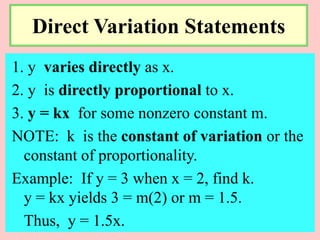
1. y varies directly as x.
2. y is directly proportional to x.
3. y = kx for some nonzero constant m.
NOTE: k is the constant of variation or the
constant of proportionality.
Example: If y = 3 when x = 2, find k.
y = kx yields 3 = m(2) or m = 1.5.
Thus, y = 1.5x.
Direct Variation Statements
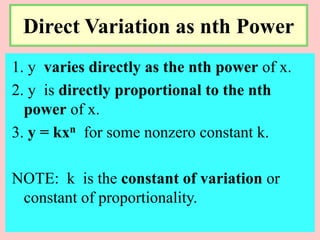
1. y varies directly as the nth power of x.
2. y is directly proportional to the nth
power of x.
3. y = kxn for some nonzero constant k.
NOTE: k is the constant of variation or
constant of proportionality.
Direct Variation as nth Power
1. y varies inversely as x.
2. y is inversely proportional to x.
3. y = k / x for some nonzero constant k.
NOTE: k is the constant of variation or the
constant of proportionality.
Example: If y = 3 when x = 2, find k.
y = k / x yields 3 = k / 2 or k = 6.
Thus, y = 6 / x.
Inverse Variation Statements
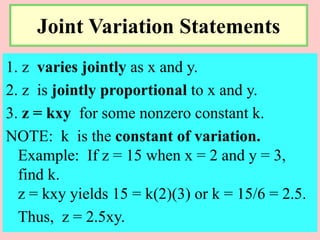
1. z varies jointly as x and y.
2. z is jointly proportional to x and y.
3. z = kxy for some nonzero constant k.
NOTE: k is the constant of variation.
Example: If z = 15 when x = 2 and y = 3,
find k.
z = kxy yields 15 = k(2)(3) or k = 15/6 = 2.5.
Thus, z = 2.5xy.
Joint Variation Statements
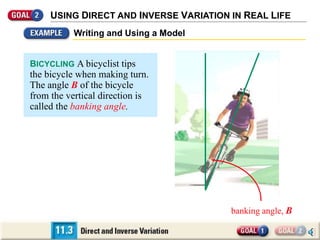
BICYCLING A bicyclist tips
the bicycle when making turn.
The angle B of the bicycle
from the vertical direction is
called the banking angle.
USING DIRECT AND INVERSE VARIATION IN REAL LIFE
Writing and Using a Model
banking angle, B
Writing and Using a Model
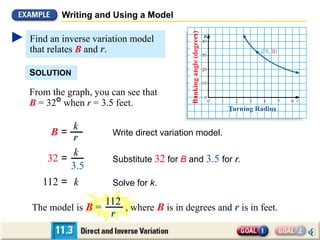
From the graph, you can see that
B = 32° when r = 3.5 feet.
B =
k
r
32 =
k
3.5
112 = k
SOLUTION
Turning Radius
Banking
angle
(degrees)
Write direct variation model.
Substitute 32 for B and 3.5 for r.
Solve for k.
Find an inverse variation model
that relates B and r.
The model is B = , where B is in degrees and r is in feet.
112
r
Writing and Using a Model
SOLUTION
Use the model to find the banking
angle for a turning radius of 5 feet.
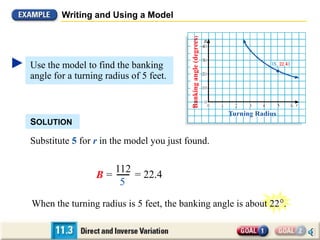
Substitute 5 for r in the model you just found.
B =
112
5
= 22.4
Turning Radius
Banking
angle
(degrees
)
When the turning radius is 5 feet, the banking angle is about 22°.

1.10_mathematical_modeling_and_variation_wo_regression.ppt

  • 1.
    1 PRECALCULUS I Dr. ClaudeS. Moore Danville Community College Mathematical Modeling •Direct, inverse, joint variations; Least squares regression
  • 2.
    1. y variesdirectly as x. 2. y is directly proportional to x. 3. y = kx for some nonzero constant m. NOTE: k is the constant of variation or the constant of proportionality. Example: If y = 3 when x = 2, find k. y = kx yields 3 = m(2) or m = 1.5. Thus, y = 1.5x. Direct Variation Statements
  • 3.
    1. y variesdirectly as the nth power of x. 2. y is directly proportional to the nth power of x. 3. y = kxn for some nonzero constant k. NOTE: k is the constant of variation or constant of proportionality. Direct Variation as nth Power
  • 4.
    1. y variesinversely as x. 2. y is inversely proportional to x. 3. y = k / x for some nonzero constant k. NOTE: k is the constant of variation or the constant of proportionality. Example: If y = 3 when x = 2, find k. y = k / x yields 3 = k / 2 or k = 6. Thus, y = 6 / x. Inverse Variation Statements
  • 5.
    1. z variesjointly as x and y. 2. z is jointly proportional to x and y. 3. z = kxy for some nonzero constant k. NOTE: k is the constant of variation. Example: If z = 15 when x = 2 and y = 3, find k. z = kxy yields 15 = k(2)(3) or k = 15/6 = 2.5. Thus, z = 2.5xy. Joint Variation Statements
  • 6.
    BICYCLING A bicyclisttips the bicycle when making turn. The angle B of the bicycle from the vertical direction is called the banking angle. USING DIRECT AND INVERSE VARIATION IN REAL LIFE Writing and Using a Model banking angle, B
  • 7.
    Writing and Usinga Model From the graph, you can see that B = 32° when r = 3.5 feet. B = k r 32 = k 3.5 112 = k SOLUTION Turning Radius Banking angle (degrees) Write direct variation model. Substitute 32 for B and 3.5 for r. Solve for k. Find an inverse variation model that relates B and r. The model is B = , where B is in degrees and r is in feet. 112 r
  • 8.
    Writing and Usinga Model SOLUTION Use the model to find the banking angle for a turning radius of 5 feet. Substitute 5 for r in the model you just found. B = 112 5 = 22.4 Turning Radius Banking angle (degrees ) When the turning radius is 5 feet, the banking angle is about 22°.