PREVENTION:
STERILIZATION/CLEAN THEATRE
MOH MALAWI POLICY
Dr Chisale Mhango, FRCOG
November, 2013
Infection Control Philosophy
The aim of ICP is to eliminate the infection
as quickly as possible and to ensure that
patients, staff, equipment and floors are not
a source of infection because
• Contamination of the operating theatre is a
major cause of nosocomial infection.
• Good hygiene practice in hospitals and in
operating theatres is mandatory to minimise
nosocomial postoperative infections.
Infection Control Philosophy
Layout of theatre
The path a patient negotiates through an operating
department is shaped by its design and layout of
the physical plant, which should be determined by
infection control requirements to ensure the safety
of both patients and service providers.
• Layout of rooms, equipment with operating materials,
cleaning and disinfection of surfaces, of anaesthetic
devices as well as of surgical instruments are critical in
infection prevention and control.
• It is important to keep strict guidelines on theatre IPC
Guidelines for IPC practices in the OT.
Written guidelines for IPC practices in OT should including:
1. Storage of sterile and high-level disinfected instruments
2. Housekeeping, including schedule and procedures for:
• Cleaning before procedures
• Cleaning after each procedures
• Final cleaning at the end of the day
3. Patient’s skin preparation
4. Use of Personal Protective Equipment (PPE)
5. Safety practices for handling, passing and disposing of
sharp instruments
6. Linen management
7. Waste management
The traffic flow and activity patterns for the transition
zone.
•Traffic is limited to authorized
personnel only
•Personnel enter in personal clothes
and exit into a semi-restricted or
restricted area with proper attire (clean
scrub suit)
•Personnel enter operating rooms
through changing areas (room)
The traffic flow and activity patterns for the semi-
restricted area
• Traffic is limited to patients and authorized
personnel
• Must have a closed storage space (closed
cabinets or closed room) for sterile and
high level disinfected supplies
• Personnel are required to wear surgical
attire including head cover
• Personnel are required to wear clean
closed shoes that will protect their feet from
fluids and dropped items
The flow of supplies, instruments, linen and
equipment to avoid cross-contamination.
• Used and soiled supplies, instruments and
equipment are transported in closed
containers to outside of the restricted area
after use without crossing with sterile, clean
items
• Soiled linen and waste are transported in
closed or covered carts, containers or
plastic bags to outside of the restricted area
without crossing with sterile, clean items
Safe environment of physical plant and storage
space in restricted area of the OT
All the floors in the operating room (s) should be:
• Hard
• Seamless
• Easy to clean
• Without drains
• All the walls in the operating room (s) are free of fissures, or crevices
• All the ceilings in the operating room (s) are seamless and easy to
clean
• There is one or more scrub sink areas with running water with
elbow/foot taps for surgical scrubbing outside of the operating room (s)
• There is an area to store sterile and/or high-level disinfected supplies,
instruments and equipment with:
• Limited access to the storage area
• Closed cabinets/ or Shelves
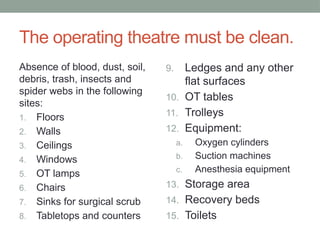
The operating theatre must be clean.
Absence of blood, dust, soil,
debris, trash, insects and
spider webs in the following
sites:
1. Floors
2. Walls
3. Ceilings
4. Windows
5. OT lamps
6. Chairs
7. Sinks for surgical scrub
8. Tabletops and counters
9. Ledges and any other
flat surfaces
10. OT tables
11. Trolleys
12. Equipment:
a. Oxygen cylinders
b. Suction machines
c. Anesthesia equipment
13. Storage area
14. Recovery beds
15. Toilets
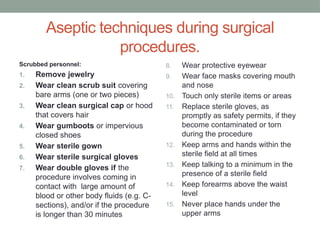
Aseptic techniques during surgical
procedures.
Scrubbed personnel:
1. Remove jewelry
2. Wear clean scrub suit covering
bare arms (one or two pieces)
3. Wear clean surgical cap or hood
that covers hair
4. Wear gumboots or impervious
closed shoes
5. Wear sterile gown
6. Wear sterile surgical gloves
7. Wear double gloves if the
procedure involves coming in
contact with large amount of
blood or other body fluids (e.g. C-
sections), and/or if the procedure
is longer than 30 minutes
8. Wear protective eyewear
9. Wear face masks covering mouth
and nose
10. Touch only sterile items or areas
11. Replace sterile gloves, as
promptly as safety permits, if they
become contaminated or torn
during the procedure
12. Keep arms and hands within the
sterile field at all times
13. Keep talking to a minimum in the
presence of a sterile field
14. Keep forearms above the waist
level
15. Never place hands under the
upper arms
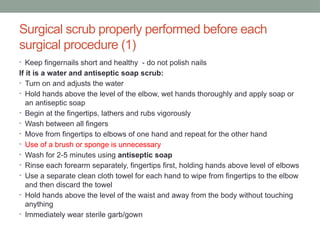
Surgical scrub properly performed before each
surgical procedure (1)
• Keep fingernails short and healthy - do not polish nails
If it is a water and antiseptic soap scrub:
• Turn on and adjusts the water
• Hold hands above the level of the elbow, wet hands thoroughly and apply soap or
an antiseptic soap
• Begin at the fingertips, lathers and rubs vigorously
• Wash between all fingers
• Move from fingertips to elbows of one hand and repeat for the other hand
• Use of a brush or sponge is unnecessary
• Wash for 2-5 minutes using antiseptic soap
• Rinse each forearm separately, fingertips first, holding hands above level of elbows
• Use a separate clean cloth towel for each hand to wipe from fingertips to the elbow
and then discard the towel
• Hold hands above the level of the waist and away from the body without touching
anything
• Immediately wear sterile garb/gown
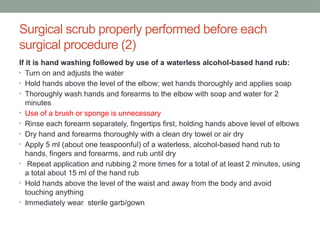
Surgical scrub properly performed before each
surgical procedure (2)
If it is hand washing followed by use of a waterless alcohol-based hand rub:
• Turn on and adjusts the water
• Hold hands above the level of the elbow; wet hands thoroughly and applies soap
• Thoroughly wash hands and forearms to the elbow with soap and water for 2
minutes
• Use of a brush or sponge is unnecessary
• Rinse each forearm separately, fingertips first, holding hands above level of elbows
• Dry hand and forearms thoroughly with a clean dry towel or air dry
• Apply 5 ml (about one teaspoonful) of a waterless, alcohol-based hand rub to
hands, fingers and forearms, and rub until dry
• Repeat application and rubbing 2 more times for a total of at least 2 minutes, using
a total about 15 ml of the hand rub
• Hold hands above the level of the waist and away from the body and avoid
touching anything
• Immediately wear sterile garb/gown
The operating room is set up properly before each
surgical procedure.
Tables, Mayo stands and ring stands are:
• Organized side by side
• In an area that is away from the traffic flow
• At least 46 cm from walls, cabinets and other non-sterile surfaces
• A clean sheet is placed on the OT bed
• A clean leak-proof container for soiled linen is placed away from sterile
items
• Puncture-resistant containers to dispose off sharps are placed away
from the sterile items
• A leak-proof plastic bag is placed in each container for waste disposal
• Clean plastic containers with fresh 0.5% chlorine solution are placed in
the OT room
• Supplies that are checked and ready to open are placed on the tables
• Mayo stand and other non-sterile surfaces are covered with sterile
barrier materials if they are to be used during the procedure
Non-scrubbed personnel follow the aseptic
techniques during surgical procedures.
Non-scrubbed personnel (runners):
• Remove rings, watches, and bracelets and other jewelry
• Wear long sleeved clean scrub suit
• Wear clean surgical cap or hood that covers hair
• Wear clean closed shoes that will provide protection from
fluids and dropped items
• Wear masks covering mouth and nose, when open sterile
items and equipment are present
• Stay at the periphery of the OT, keeping a distance away
from sterile areas
Patient’s skin is properly prepped before surgical
procedures to prevent infections
• Patient wears a clean gown and is covered with clean linen
• Hair is not shaved around the operative site
• If hair must be cut, it is trimmed close to the skin surface with scissors immediately
before surgery in an area outside of the OT room
• If visibly soiled, the operative area is cleaned with soap and water, and
dried before applying an antiseptic
• Sterile gloves are worn for the prepping procedure
• Patient’s skin is thoroughly cleaned from the operative site outward for
several centimeters in a circular motion
• If prepping contaminated areas (e.g., abdominal-perineal or abdominal-
vaginal areas), 2 separate prepping procedures are done using different
prep trays, solutions and gloves; the contaminated area is done first,
covered with a sterile towel, and then the other area is prepped
• Antiseptic is not allowed to pool underneath the patient’s body
• Antiseptic is allowed to dry before beginning the procedure
Sterile field must remains sterile during surgical
procedures.
• Sterile fluids, equipment and supplies are opened and
delivered to the sterile surface without contacting the edges
of the wrapper or container
• Non-scrubbed personnel open wrapped supplies by the
wrapper flap farthest away from them first, and then the
nearest wrapper flap last
• Sterile items are presented to the scrub person or placed
securely on the sterile field
• Solutions are poured slowly into the container held by the
scrub person or placed near to the table edge
• Sterile pick up forceps are pre-packed and used to open
wraps or to pick up gauze or sterile supplies or instruments
for one patient only
Controlled traffic flow during surgical procedures.
•Doors to the OT room are kept closed
during the entire procedures, except
during movement of personnel,
patients, supplies and equipment
•The number of personnel entering the
OT room during the surgical procedure
is limited to those necessary to
perform the procedure
Instruments, linen and waste are properly
disposed after surgical procedures to avoid
injuries and cross-contamination.
• Personnel wear gloves when handling soiled instruments, linen and waste
• All waste (e.g. gauze, cotton wool, dressing, etc.) are disposed of in a leak proof
container with leak proof plastic bag
• Instruments are placed in a 0.5% chlorine solution for 10 minutes for
decontamination
• When using regular needles and syringes these are flushed three times with 0.5%
chlorine solution and immediately disposed of in a puncture-resistant container,
without removing, recapping or breaking the needle
• All blades and other disposable sharps are disposed of in a puncture-resistant
container
• Soiled linen is placed in a leak proof container
• Sterile gloves are removed, after being immersed in a 0.5% chlorine solution, and
placed in a leak proof container
• Hand hygiene is performed after removing gloves:
• Wash hands with running water and soap for 10–15 seconds and dry with an
individual clean towel, paper towel or allows hands to air-dry
The OT rooms must be properly cleaned after each
procedure.
• Housekeeping personnel wear utility gloves and other personal protective equipment
during cleaning
• All waste is collected and removed from the room in closed leak proof containers
• Soiled linen is removed in closed leak-proof containers
• Blood and body fluid spills are mopped with 0.5% chlorine solution, and then cleaned with
detergent and water
• All horizontal surfaces that have come in immediate contact with a patient or body fluids
are cleaned with a disinfectant cleaning solution
• The OT bed is cleaned, and all surfaces and mattress pads are wiped with a disinfectant-
soaked, lint-free cloth
• The center of the OT room surrounding the bed is cleaned with a disinfectant cleaning
solution (if visibly soiled)
i.e. Two buckets are used:
• One with the disinfectant cleaning solution
• One with clean water for rinsing
After the room is cleaned, hand hygiene is performed after removing gloves:
• Wash hands with running water and soap for 10–15 seconds and dry with an individual
clean towel, paper towel or allows hands to air-dry
A disinfectant cleaning solution must be prepared
properly.
Cleaning solution is prepared as
follows:
•A 0.5% chlorine solution is prepared
•Detergent without an acid, ammonia or
ammonium is added to the 0.5%
chlorine solution until a mild soapy
cleaning solution is made.
The cleaning equipment must be decontaminated,
cleaned and dried before reuse or storage.
Mops, buckets, brushes and cleaning cloths
are:
• Decontaminated by soaking for 10 minutes
in 0.5% chlorine solution or other approved
disinfectant
• Washed in detergent and water
• Rinsed in clean water
• Dried completely before reuse or storage
Collection of medical waste must be
performed properly to prevent injuries and
contamination.
•Medical waste (e.g. cotton wool,
gauze, etc) must be placed in a
washable container with a leak-proof
plastic bag
•Containers are closed and collected
when ¾ full or daily if not ¾ full
Flow and activity patterns in the CSSD
designed to avoid cross-contamination.
• Traffic is limited to authorized personnel only
• Personnel are required to wear surgical attire including head cover
• Receiving/clean-up area separated with a physical barrier (wall and/or door) from
the processing area
• The receiving/clean-up area must have:
• A receiving counter
• At least one sink with running water
• A counter for instruments to dry
A clean work area for wrapping/packing with:
• A large work table
• Shelves for holding clean package
• At least an autoclave and/or a dry heat oven
• Storage area for clean supplies, instruments and equipment with:
• Shelves for storing clean equipment
• Office desk for record keeping
• Store for sterile and/or high-level disinfected supplies, instruments and
equipment with:
• Limited access to the storage area
• Closed cabinets/ or shelves
CSSD cleanness
Absence of blood, dust,
soil, debris, trash,
insects and spider webs
in the following CSSD
sites:
1. Floors
2. Walls
3. Ceilings
4. Windows
4. Chairs
5. Sinks for clean-up
6. Tabletops and
counters
7. Ledges and any
other flat surfaces
8. Trolleys
9. Storage area
10. Toilets and
bathrooms
Decontamination of instruments and other
articles after use and before cleaning.
Surgical instruments must be processed according to standardised and validated
methods
Liquid chlorine:
• if using JIK (3.5%), 1 part bleach for 6 parts water, or
• If using a concentration of 5%, 1 part bleach to 9 parts water, or
Powder chlorine:
• if using Calcium hypochlorite (35%), 14 grams bleach powder for 1 liter water, or
• if using Calcium hypochlorite (70%), 7 grams bleach powder for 1 liter water
A new chlorine solution is prepared at the beginning of each day or sooner if
needed
• Clean containers with fresh 0.5% chlorine solution are used for each surgical
procedure
• Instruments and other items are soaked in the 0.5% chlorine solution for 10
minutes
• After 10 minutes, instruments and other items are removed from the chlorine
solution; washed in soapy water then rinsed in clean water.
Steps of cleaning instruments and
recommendations:
Staff
• Wears:
• Utility gloves
• Mask and eyewear protection or face shield
• Plastic apron
• Head cover
• Gumboots or enclosed shoes
• Utilizes:
• Soft brush
• Detergent (liquid or powder)
• Scrubs instruments and other items under the surface of water, completely removing all blood and other
foreign matter
• Disassembles instruments and other items with multiple parts and cleans in the grooves, teeth and joints with
a brush
• Rinses
• rinses instruments and other items thoroughly with clean water
• Allows instruments and other items to air-dry, or dries with a clean towel
• Washes hands after removing gloves:
• Washes hands with running water and soap for 10–15 seconds and dry with an individual clean towel, paper
towel or allows hands to air-dry, or
• Rubs hands with 3–5 ml of an alcohol-based solution until the hands are dry (if hands are not visibly soiled)
The process of loading the sterilizer.
• If using steam sterilization (autoclave):
• Ensure space (around 7-8 cm) between the packages and the walls
• Packs (linen) must rest on their edge, in loose contact with each other
• Bottles, solid metal and glass containers with dry materials are placed on their
sides with lids held loosely in place
• Canisters, utensils and treatment trays (if a solid tray) are on their sides
• Instrument trays (mesh or perforated bottom only) are placed flat on shelves
• Maximum dimensions and weight of packs are: 30 x 30 x 50 cm or 5 kg
• There is sufficient space between packs to allow steam circulation
• Solutions are sterilized in a separated load
AND/OR
• If using dry-heat sterilization:
• Ensure space (around 7-8 cm) between the packages and the walls
• Must have enough space between packs and containers (sterilizer is not overloaded)
Packaging process of items to be sterilized.
• The instruments should be clean and dry
• If packaging items to for steam sterilization (autoclave):
• Cloth items should laundered, dried and have no holes
• All jointed instruments must be in opened or in unlocked position
• All instruments must be disassembled
• The types of materials used for wrapping:
• Cloth wraps, muslin or cotton: double wrapping using two double-thickness wraps (4 layers
in all). [Canvas or other waterproof material is never used for wrapping]
• Packages should be a bit loose to allow steam penetration
AND/OR
• If packaging items to be sterilized through dry-heat:
• The types of materials used:
• Cloth wraps, muslin: double wrapping using two double-thickness wraps (4 layers in all), or
• Metal drum
The sterilization process
Standard conditions to be followed:
• If steam sterilization (autoclave):
• 20 minutes for unwrapped items or 30 minutes for wrapped items at 121 ºC
(250 ºF) in a gravity-displacement sterilizer, and/or
• 4 minutes at 132 ºC (270 ºF), in a pre-vacuum sterilizer, and/or
• Other depending on the type of item, whether it is wrapped or unwrapped and
the type of sterilizer (according to the manufacturer’s instructions)
AND/OR
• If dry-heat sterilization:
• 170 ºC (340 ºF) for 1 hour after achieving the desired temperature (total cycle
between 2–2.5 hours), and/or
• 160 ºC (320 ºF) for 2 hours after achieving the desired temperature (total
cycle between 3–3.5 hours)
The process of unloading the sterilizer
If using steam sterilization (autoclave):
• Door is open 12–14 cm after the sterilizing cycle has been completed, and the chamber pressure gauge
reaches “0”
• 30 minutes are allowed before unloading the sterilizer, for pack and instruments to dry (not applicable
if drying cycle is used)
• Packages must be dry before unloading
• If a loading cart is used, the cart is removed from the sterilizer and placed away from open window or fan
until it is cool
• If no cart is used, packs are laid out on a surface padded with paper or fabric, away from open windows
or a fan until they are cool
• Unnecessary handling of the packs is avoided
• When packs have cooled to room temperature, they are dispensed or placed into a sterile storage area
If using dry-heat sterilization:
• Packs/containers must be laid out on a surface padded with paper or fabric, away from open windows or
a fan until they are cool
• Packs/containers cool to room temperature before handling
• Unnecessary handling of the packs/containers is avoided
• When packs/containers have cooled to room temperature, they are dispensed or placed into a sterile
storage area
Maintenance routine for sterilizers.
• Steam sterilization (autoclave):
• Chamber is cooled before any procedure is undertaken (cleaning or loading)
• Outlet screen is removed and cleaned with detergent and a brush under running water
• Chamber is cleaned daily using a soft cloth [Abrasive cleanser or steel wool is avoided to
clean the autoclave]
• All doors or lid gaskets are cleaned with a lint-free cloth and defects are checked
• Defective gaskets are replaced, if necessary
• Shelves, basket or cart that hold packs are cleaned with a soft cloth with detergent and
water
AND/OR
• Dry-heat sterilization:
• The oven is cleaned daily using a soft cloth, detergent and water
• Every two weeks (observe or check in the records):
• The temperature gauge is checked every two weeks by placing a thermometer in the
oven and comparing the reading with the one in the gauge
Storage process for sterile items.
Observe if:
• Clean supplies are stored separated from the sterile items
• Unwrapped items are used immediately
• Sterile packs have sterilization and expiration dates
• There is a rotation and an inventory system to control the
use of sterile items
• The packs are free of tears, dampness, dust and gross oil
• The sterile packs are reprocessed if not used after 14
days
Monitor system for the effectiveness of the
sterilization.
• Steam sterilization (autoclave):
• There is a manual or automatic recording chart with time, temperature and pressure for
each load
• The chart or log is completed and reviewed after each load
AND/OR
• Dry-heat sterilization:
• Must have a manual or automatic recording chart with time and temperature for each load
• The chart or log should be completed and reviewed after each load
• Correcting sterilization failure: If monitoring indicated a failure in
sterilization, the following corrective measures were taken and registered:
• Equipment should be checked immediately to make sure it has been used correctly
• If the correct use of the unit has been documented and monitoring still indicates a failure,
the use of the unit is discontinued and the unit is serviced
• Any instrument or other item that has been processed in the unit is reprocessed properly
The End

Prevention: Sterilization/Clean Theatre MOH policy

  • 1.
    PREVENTION: STERILIZATION/CLEAN THEATRE MOH MALAWIPOLICY Dr Chisale Mhango, FRCOG November, 2013
  • 2.
    Infection Control Philosophy Theaim of ICP is to eliminate the infection as quickly as possible and to ensure that patients, staff, equipment and floors are not a source of infection because • Contamination of the operating theatre is a major cause of nosocomial infection. • Good hygiene practice in hospitals and in operating theatres is mandatory to minimise nosocomial postoperative infections.
  • 3.
    Infection Control Philosophy Layoutof theatre The path a patient negotiates through an operating department is shaped by its design and layout of the physical plant, which should be determined by infection control requirements to ensure the safety of both patients and service providers. • Layout of rooms, equipment with operating materials, cleaning and disinfection of surfaces, of anaesthetic devices as well as of surgical instruments are critical in infection prevention and control. • It is important to keep strict guidelines on theatre IPC
  • 4.
    Guidelines for IPCpractices in the OT. Written guidelines for IPC practices in OT should including: 1. Storage of sterile and high-level disinfected instruments 2. Housekeeping, including schedule and procedures for: • Cleaning before procedures • Cleaning after each procedures • Final cleaning at the end of the day 3. Patient’s skin preparation 4. Use of Personal Protective Equipment (PPE) 5. Safety practices for handling, passing and disposing of sharp instruments 6. Linen management 7. Waste management
  • 5.
    The traffic flowand activity patterns for the transition zone. •Traffic is limited to authorized personnel only •Personnel enter in personal clothes and exit into a semi-restricted or restricted area with proper attire (clean scrub suit) •Personnel enter operating rooms through changing areas (room)
  • 6.
    The traffic flowand activity patterns for the semi- restricted area • Traffic is limited to patients and authorized personnel • Must have a closed storage space (closed cabinets or closed room) for sterile and high level disinfected supplies • Personnel are required to wear surgical attire including head cover • Personnel are required to wear clean closed shoes that will protect their feet from fluids and dropped items
  • 7.
    The flow ofsupplies, instruments, linen and equipment to avoid cross-contamination. • Used and soiled supplies, instruments and equipment are transported in closed containers to outside of the restricted area after use without crossing with sterile, clean items • Soiled linen and waste are transported in closed or covered carts, containers or plastic bags to outside of the restricted area without crossing with sterile, clean items
  • 8.
    Safe environment ofphysical plant and storage space in restricted area of the OT All the floors in the operating room (s) should be: • Hard • Seamless • Easy to clean • Without drains • All the walls in the operating room (s) are free of fissures, or crevices • All the ceilings in the operating room (s) are seamless and easy to clean • There is one or more scrub sink areas with running water with elbow/foot taps for surgical scrubbing outside of the operating room (s) • There is an area to store sterile and/or high-level disinfected supplies, instruments and equipment with: • Limited access to the storage area • Closed cabinets/ or Shelves
  • 9.
    The operating theatremust be clean. Absence of blood, dust, soil, debris, trash, insects and spider webs in the following sites: 1. Floors 2. Walls 3. Ceilings 4. Windows 5. OT lamps 6. Chairs 7. Sinks for surgical scrub 8. Tabletops and counters 9. Ledges and any other flat surfaces 10. OT tables 11. Trolleys 12. Equipment: a. Oxygen cylinders b. Suction machines c. Anesthesia equipment 13. Storage area 14. Recovery beds 15. Toilets
  • 10.
    Aseptic techniques duringsurgical procedures. Scrubbed personnel: 1. Remove jewelry 2. Wear clean scrub suit covering bare arms (one or two pieces) 3. Wear clean surgical cap or hood that covers hair 4. Wear gumboots or impervious closed shoes 5. Wear sterile gown 6. Wear sterile surgical gloves 7. Wear double gloves if the procedure involves coming in contact with large amount of blood or other body fluids (e.g. C- sections), and/or if the procedure is longer than 30 minutes 8. Wear protective eyewear 9. Wear face masks covering mouth and nose 10. Touch only sterile items or areas 11. Replace sterile gloves, as promptly as safety permits, if they become contaminated or torn during the procedure 12. Keep arms and hands within the sterile field at all times 13. Keep talking to a minimum in the presence of a sterile field 14. Keep forearms above the waist level 15. Never place hands under the upper arms
  • 11.
    Surgical scrub properlyperformed before each surgical procedure (1) • Keep fingernails short and healthy - do not polish nails If it is a water and antiseptic soap scrub: • Turn on and adjusts the water • Hold hands above the level of the elbow, wet hands thoroughly and apply soap or an antiseptic soap • Begin at the fingertips, lathers and rubs vigorously • Wash between all fingers • Move from fingertips to elbows of one hand and repeat for the other hand • Use of a brush or sponge is unnecessary • Wash for 2-5 minutes using antiseptic soap • Rinse each forearm separately, fingertips first, holding hands above level of elbows • Use a separate clean cloth towel for each hand to wipe from fingertips to the elbow and then discard the towel • Hold hands above the level of the waist and away from the body without touching anything • Immediately wear sterile garb/gown
  • 12.
    Surgical scrub properlyperformed before each surgical procedure (2) If it is hand washing followed by use of a waterless alcohol-based hand rub: • Turn on and adjusts the water • Hold hands above the level of the elbow; wet hands thoroughly and applies soap • Thoroughly wash hands and forearms to the elbow with soap and water for 2 minutes • Use of a brush or sponge is unnecessary • Rinse each forearm separately, fingertips first, holding hands above level of elbows • Dry hand and forearms thoroughly with a clean dry towel or air dry • Apply 5 ml (about one teaspoonful) of a waterless, alcohol-based hand rub to hands, fingers and forearms, and rub until dry • Repeat application and rubbing 2 more times for a total of at least 2 minutes, using a total about 15 ml of the hand rub • Hold hands above the level of the waist and away from the body and avoid touching anything • Immediately wear sterile garb/gown
  • 13.
    The operating roomis set up properly before each surgical procedure. Tables, Mayo stands and ring stands are: • Organized side by side • In an area that is away from the traffic flow • At least 46 cm from walls, cabinets and other non-sterile surfaces • A clean sheet is placed on the OT bed • A clean leak-proof container for soiled linen is placed away from sterile items • Puncture-resistant containers to dispose off sharps are placed away from the sterile items • A leak-proof plastic bag is placed in each container for waste disposal • Clean plastic containers with fresh 0.5% chlorine solution are placed in the OT room • Supplies that are checked and ready to open are placed on the tables • Mayo stand and other non-sterile surfaces are covered with sterile barrier materials if they are to be used during the procedure
  • 14.
    Non-scrubbed personnel followthe aseptic techniques during surgical procedures. Non-scrubbed personnel (runners): • Remove rings, watches, and bracelets and other jewelry • Wear long sleeved clean scrub suit • Wear clean surgical cap or hood that covers hair • Wear clean closed shoes that will provide protection from fluids and dropped items • Wear masks covering mouth and nose, when open sterile items and equipment are present • Stay at the periphery of the OT, keeping a distance away from sterile areas
  • 15.
    Patient’s skin isproperly prepped before surgical procedures to prevent infections • Patient wears a clean gown and is covered with clean linen • Hair is not shaved around the operative site • If hair must be cut, it is trimmed close to the skin surface with scissors immediately before surgery in an area outside of the OT room • If visibly soiled, the operative area is cleaned with soap and water, and dried before applying an antiseptic • Sterile gloves are worn for the prepping procedure • Patient’s skin is thoroughly cleaned from the operative site outward for several centimeters in a circular motion • If prepping contaminated areas (e.g., abdominal-perineal or abdominal- vaginal areas), 2 separate prepping procedures are done using different prep trays, solutions and gloves; the contaminated area is done first, covered with a sterile towel, and then the other area is prepped • Antiseptic is not allowed to pool underneath the patient’s body • Antiseptic is allowed to dry before beginning the procedure
  • 16.
    Sterile field mustremains sterile during surgical procedures. • Sterile fluids, equipment and supplies are opened and delivered to the sterile surface without contacting the edges of the wrapper or container • Non-scrubbed personnel open wrapped supplies by the wrapper flap farthest away from them first, and then the nearest wrapper flap last • Sterile items are presented to the scrub person or placed securely on the sterile field • Solutions are poured slowly into the container held by the scrub person or placed near to the table edge • Sterile pick up forceps are pre-packed and used to open wraps or to pick up gauze or sterile supplies or instruments for one patient only
  • 17.
    Controlled traffic flowduring surgical procedures. •Doors to the OT room are kept closed during the entire procedures, except during movement of personnel, patients, supplies and equipment •The number of personnel entering the OT room during the surgical procedure is limited to those necessary to perform the procedure
  • 18.
    Instruments, linen andwaste are properly disposed after surgical procedures to avoid injuries and cross-contamination. • Personnel wear gloves when handling soiled instruments, linen and waste • All waste (e.g. gauze, cotton wool, dressing, etc.) are disposed of in a leak proof container with leak proof plastic bag • Instruments are placed in a 0.5% chlorine solution for 10 minutes for decontamination • When using regular needles and syringes these are flushed three times with 0.5% chlorine solution and immediately disposed of in a puncture-resistant container, without removing, recapping or breaking the needle • All blades and other disposable sharps are disposed of in a puncture-resistant container • Soiled linen is placed in a leak proof container • Sterile gloves are removed, after being immersed in a 0.5% chlorine solution, and placed in a leak proof container • Hand hygiene is performed after removing gloves: • Wash hands with running water and soap for 10–15 seconds and dry with an individual clean towel, paper towel or allows hands to air-dry
  • 19.
    The OT roomsmust be properly cleaned after each procedure. • Housekeeping personnel wear utility gloves and other personal protective equipment during cleaning • All waste is collected and removed from the room in closed leak proof containers • Soiled linen is removed in closed leak-proof containers • Blood and body fluid spills are mopped with 0.5% chlorine solution, and then cleaned with detergent and water • All horizontal surfaces that have come in immediate contact with a patient or body fluids are cleaned with a disinfectant cleaning solution • The OT bed is cleaned, and all surfaces and mattress pads are wiped with a disinfectant- soaked, lint-free cloth • The center of the OT room surrounding the bed is cleaned with a disinfectant cleaning solution (if visibly soiled) i.e. Two buckets are used: • One with the disinfectant cleaning solution • One with clean water for rinsing After the room is cleaned, hand hygiene is performed after removing gloves: • Wash hands with running water and soap for 10–15 seconds and dry with an individual clean towel, paper towel or allows hands to air-dry
  • 20.
    A disinfectant cleaningsolution must be prepared properly. Cleaning solution is prepared as follows: •A 0.5% chlorine solution is prepared •Detergent without an acid, ammonia or ammonium is added to the 0.5% chlorine solution until a mild soapy cleaning solution is made.
  • 21.
    The cleaning equipmentmust be decontaminated, cleaned and dried before reuse or storage. Mops, buckets, brushes and cleaning cloths are: • Decontaminated by soaking for 10 minutes in 0.5% chlorine solution or other approved disinfectant • Washed in detergent and water • Rinsed in clean water • Dried completely before reuse or storage
  • 22.
    Collection of medicalwaste must be performed properly to prevent injuries and contamination. •Medical waste (e.g. cotton wool, gauze, etc) must be placed in a washable container with a leak-proof plastic bag •Containers are closed and collected when ¾ full or daily if not ¾ full
  • 23.
    Flow and activitypatterns in the CSSD designed to avoid cross-contamination. • Traffic is limited to authorized personnel only • Personnel are required to wear surgical attire including head cover • Receiving/clean-up area separated with a physical barrier (wall and/or door) from the processing area • The receiving/clean-up area must have: • A receiving counter • At least one sink with running water • A counter for instruments to dry A clean work area for wrapping/packing with: • A large work table • Shelves for holding clean package • At least an autoclave and/or a dry heat oven • Storage area for clean supplies, instruments and equipment with: • Shelves for storing clean equipment • Office desk for record keeping • Store for sterile and/or high-level disinfected supplies, instruments and equipment with: • Limited access to the storage area • Closed cabinets/ or shelves
  • 24.
    CSSD cleanness Absence ofblood, dust, soil, debris, trash, insects and spider webs in the following CSSD sites: 1. Floors 2. Walls 3. Ceilings 4. Windows 4. Chairs 5. Sinks for clean-up 6. Tabletops and counters 7. Ledges and any other flat surfaces 8. Trolleys 9. Storage area 10. Toilets and bathrooms
  • 25.
    Decontamination of instrumentsand other articles after use and before cleaning. Surgical instruments must be processed according to standardised and validated methods Liquid chlorine: • if using JIK (3.5%), 1 part bleach for 6 parts water, or • If using a concentration of 5%, 1 part bleach to 9 parts water, or Powder chlorine: • if using Calcium hypochlorite (35%), 14 grams bleach powder for 1 liter water, or • if using Calcium hypochlorite (70%), 7 grams bleach powder for 1 liter water A new chlorine solution is prepared at the beginning of each day or sooner if needed • Clean containers with fresh 0.5% chlorine solution are used for each surgical procedure • Instruments and other items are soaked in the 0.5% chlorine solution for 10 minutes • After 10 minutes, instruments and other items are removed from the chlorine solution; washed in soapy water then rinsed in clean water.
  • 26.
    Steps of cleaninginstruments and recommendations: Staff • Wears: • Utility gloves • Mask and eyewear protection or face shield • Plastic apron • Head cover • Gumboots or enclosed shoes • Utilizes: • Soft brush • Detergent (liquid or powder) • Scrubs instruments and other items under the surface of water, completely removing all blood and other foreign matter • Disassembles instruments and other items with multiple parts and cleans in the grooves, teeth and joints with a brush • Rinses • rinses instruments and other items thoroughly with clean water • Allows instruments and other items to air-dry, or dries with a clean towel • Washes hands after removing gloves: • Washes hands with running water and soap for 10–15 seconds and dry with an individual clean towel, paper towel or allows hands to air-dry, or • Rubs hands with 3–5 ml of an alcohol-based solution until the hands are dry (if hands are not visibly soiled)
  • 27.
    The process ofloading the sterilizer. • If using steam sterilization (autoclave): • Ensure space (around 7-8 cm) between the packages and the walls • Packs (linen) must rest on their edge, in loose contact with each other • Bottles, solid metal and glass containers with dry materials are placed on their sides with lids held loosely in place • Canisters, utensils and treatment trays (if a solid tray) are on their sides • Instrument trays (mesh or perforated bottom only) are placed flat on shelves • Maximum dimensions and weight of packs are: 30 x 30 x 50 cm or 5 kg • There is sufficient space between packs to allow steam circulation • Solutions are sterilized in a separated load AND/OR • If using dry-heat sterilization: • Ensure space (around 7-8 cm) between the packages and the walls • Must have enough space between packs and containers (sterilizer is not overloaded)
  • 28.
    Packaging process ofitems to be sterilized. • The instruments should be clean and dry • If packaging items to for steam sterilization (autoclave): • Cloth items should laundered, dried and have no holes • All jointed instruments must be in opened or in unlocked position • All instruments must be disassembled • The types of materials used for wrapping: • Cloth wraps, muslin or cotton: double wrapping using two double-thickness wraps (4 layers in all). [Canvas or other waterproof material is never used for wrapping] • Packages should be a bit loose to allow steam penetration AND/OR • If packaging items to be sterilized through dry-heat: • The types of materials used: • Cloth wraps, muslin: double wrapping using two double-thickness wraps (4 layers in all), or • Metal drum
  • 29.
    The sterilization process Standardconditions to be followed: • If steam sterilization (autoclave): • 20 minutes for unwrapped items or 30 minutes for wrapped items at 121 ºC (250 ºF) in a gravity-displacement sterilizer, and/or • 4 minutes at 132 ºC (270 ºF), in a pre-vacuum sterilizer, and/or • Other depending on the type of item, whether it is wrapped or unwrapped and the type of sterilizer (according to the manufacturer’s instructions) AND/OR • If dry-heat sterilization: • 170 ºC (340 ºF) for 1 hour after achieving the desired temperature (total cycle between 2–2.5 hours), and/or • 160 ºC (320 ºF) for 2 hours after achieving the desired temperature (total cycle between 3–3.5 hours)
  • 30.
    The process ofunloading the sterilizer If using steam sterilization (autoclave): • Door is open 12–14 cm after the sterilizing cycle has been completed, and the chamber pressure gauge reaches “0” • 30 minutes are allowed before unloading the sterilizer, for pack and instruments to dry (not applicable if drying cycle is used) • Packages must be dry before unloading • If a loading cart is used, the cart is removed from the sterilizer and placed away from open window or fan until it is cool • If no cart is used, packs are laid out on a surface padded with paper or fabric, away from open windows or a fan until they are cool • Unnecessary handling of the packs is avoided • When packs have cooled to room temperature, they are dispensed or placed into a sterile storage area If using dry-heat sterilization: • Packs/containers must be laid out on a surface padded with paper or fabric, away from open windows or a fan until they are cool • Packs/containers cool to room temperature before handling • Unnecessary handling of the packs/containers is avoided • When packs/containers have cooled to room temperature, they are dispensed or placed into a sterile storage area
  • 31.
    Maintenance routine forsterilizers. • Steam sterilization (autoclave): • Chamber is cooled before any procedure is undertaken (cleaning or loading) • Outlet screen is removed and cleaned with detergent and a brush under running water • Chamber is cleaned daily using a soft cloth [Abrasive cleanser or steel wool is avoided to clean the autoclave] • All doors or lid gaskets are cleaned with a lint-free cloth and defects are checked • Defective gaskets are replaced, if necessary • Shelves, basket or cart that hold packs are cleaned with a soft cloth with detergent and water AND/OR • Dry-heat sterilization: • The oven is cleaned daily using a soft cloth, detergent and water • Every two weeks (observe or check in the records): • The temperature gauge is checked every two weeks by placing a thermometer in the oven and comparing the reading with the one in the gauge
  • 32.
    Storage process forsterile items. Observe if: • Clean supplies are stored separated from the sterile items • Unwrapped items are used immediately • Sterile packs have sterilization and expiration dates • There is a rotation and an inventory system to control the use of sterile items • The packs are free of tears, dampness, dust and gross oil • The sterile packs are reprocessed if not used after 14 days
  • 33.
    Monitor system forthe effectiveness of the sterilization. • Steam sterilization (autoclave): • There is a manual or automatic recording chart with time, temperature and pressure for each load • The chart or log is completed and reviewed after each load AND/OR • Dry-heat sterilization: • Must have a manual or automatic recording chart with time and temperature for each load • The chart or log should be completed and reviewed after each load • Correcting sterilization failure: If monitoring indicated a failure in sterilization, the following corrective measures were taken and registered: • Equipment should be checked immediately to make sure it has been used correctly • If the correct use of the unit has been documented and monitoring still indicates a failure, the use of the unit is discontinued and the unit is serviced • Any instrument or other item that has been processed in the unit is reprocessed properly
  • 34.