Objectives
• Learn about the four stages of team development
• Learn the importance of teamwork to improvement
• Recognise the factors to consider when creating a
team
• Learn how to support quality improvement as a
leader
Question?
• Think about a time when you were involved in
a really effective team?
• What was this team?
• What were your team goals, aims, targets?
• What made it a good team?
3
Defining a Team
‘A small number of people with complementary
skills who are committed to a common purpose,
performance goals, and approach for which they
are mutually accountable’.
* The Wisdom Of Teams, Katzenbach and Douglas, Harvard Business School Press, 1993.
Effective Team-Building
• Effective team-building takes time
• There must be frequent and prolonged contact
• Team members come together around a specific
goal or project
• Effective teams go through four stages of team
development
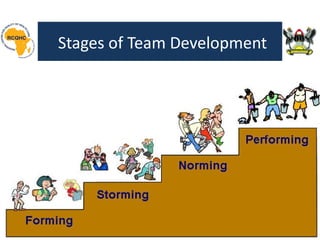
Stages of Team Development
Forming
• Definition: Stage 1 teams are generally new teams that
are learning how to work together
• Characteristics of stage 1 teams: Members tend to be
tentative and polite and to have little conflict
• Critical skills and activities: Stage 1 teams need to
identify their purpose, develop group norms, identify
group processes, define roles, build relationships and
trust
• Role of facilitator/leader: Stage 1 teams usually need a
strong leader who can help the team go through its
forming activities
Storming
• Definition: Teams have moved past the early forming
stages; now encountering some disagreements and/or
conflict. Teams need to find effective ways to handle
conflict before they can move on to stage 3
• Group characteristics: Teams tend to exhibit increased
conflict, less conformity and power struggling
• Critical skills and activities: Teams need to learn how to
resolve conflict; clarify their roles, power, and structure;
and build consensus through re-visiting purpose
• Role of leader(s): Stage 2 teams need leaders and other
team members who are willing to identify issues and
resolve conflict.
Norming
• Definition: Teams have successfully moved out of the
storming stage and are ready to move to a higher level of
communication and problem-solving
• Group characteristics: Teams demonstrate an improved
ability to complete tasks, solve problems, resolve conflict
• Critical skills and activities: Teams need to learn to engage
in more sophisticated problem-solving and decision-
making, continue the use of effective strategies for conflict
resolution and take greater levels of responsibility
• Role of leader(s): In stage 3, leaders become less directive,
team members feel empowered, and multiple leaders
emerge
Performing
• Definition: Teams are at highest level of performance and can
process their strengths and weaknesses while accomplishing goals
• Group characteristics: Team takes a flexible approach to roles and
structures depending on the task at hand. The team is able to
evaluate its effectiveness and views conflict as an opportunity.
Stage 4 teams tend to be energetic, creative, and fun!
• Critical skills and activities: Teams need to hold high expectations
for their performance. They often use sub-groups as well as the
large group for decision-making and task completion. Teams also
recognize the need to ensure that all members are in agreement
with the role and purpose of sub-groups
• Role of Leader: In a stage 4 team, it’s often difficult to identify the
leader, because everyone is sharing in leadership.
Why is Teamwork Important for
Improvement?
• Healthcare processes consist of inter-dependent steps that
are executed by different people
• Quality faults often occur in the hand-over between
people
• Given the opportunity, staff can often identify problems
and generate ideas to resolve them
• Participation improves ideas, increases buy-in, and reduces
resistance to change
• Accomplishing things together increases the confidence of
each team member, which empowers organizations.
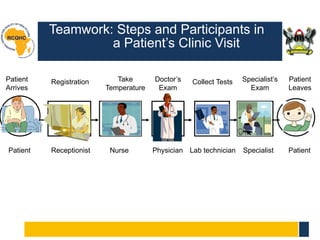
Patient Receptionist Nurse Physician Lab technician Specialist Patient
Teamwork: Steps and Participants in
a Patient’s Clinic Visit
Patient
arrives
Patient
leaves
Registration
Take
temperature
Doctor’s
Exam
Collect
Tests
Specialist’s
Exam
Patient
Arrives
Registration Take
Temperature
Doctor’s
Exam
Collect Tests Specialist’s
Exam
Patient
Leaves
What Issues Need to be Considered
When Selecting Team Members?
• Relevance to the problem.
• Individual interest to participate
• Support (from institution, politically, etc.)
• The Roles (at individual or institutional level) need
to be defined
• Mandate (and conflicts or interests)
• History (reputation)
12
13
What is Likely to Happen if we Don’t Adequately
Involve the QI team ?
1. Limited buy-in and support for the
interventions
2. Likely to have opposition to the process
3. Lukewarm participation in the
implementation of the solution
4. ……..
What Issues are Likely to be Key to Most
Team Members?
• How much does it cost?
• How shall the process affect our job security/ego?
• Optimistic/Pessimistic of any improvement (given
experience and context?)
• Vested interest in good/poor performance?
• Competition? (who gets the credit?)
14
Exercise
Develop your own Improvement Team
1) Identify a QI issue; develop your aim statement,
consider the process that you want to improve.
2) Think of those responsible for each step in that
process. A representative of each function should be
on your improvement team.
3) Think about who else would be important to include
on your improvement team, such as: management,
practitioners, patients or groups representing
patients, or other people involved in the system of
care.
In your groups discuss the QI team you have formed
Team Roles and Responsibility
• Team Member: People who share their knowledge,
experience, and expertise while working to accomplish
team goals
• Improvement Team Leaders: People who orchestrate team
activities, maintain team records and serve as
communication link
• Coaches: People with improvement, data-analysis and
team-building skills who teach and support Team Leaders
and Team members
• Leader: Individual managers who identify needed
improvements, and review and support the work of teams
The Leader: At District and/or
National levels
• Maintains overall responsibility, authority, and accountability
• Selects and defines quality improvement project
• Determines resources
• Selects Coach, Team Leader and Team Members
• Reviews progress for the team when necessary
• Ensures stakeholders have appropriate involvement in the
project and project reviews
• Ensures changes made by the team are monitored and
implements changes that the team is not authorized to make
• Feeds data and lessons learned into system for future
improvements
Leader Responsibilities Before
the Project
• Select and define project
• Make team charter clear
• Select the Coach
• Select the Team Leader
• Select Team Members
• Provide resources
Leader Responsibilities During
the Project
• Orient the team
• Represent team interests to the rest of the
organization
• Review team progress
Leader Responsibilities After the
Project
• Communicate the team’s results
• Ensure that changes made by the team are
integrated into daily work
• Thank and celebrate the project’s conclusion
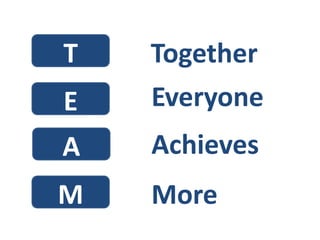
T Together
A
E
M
Everyone
Achieves
More

Approaches to workplace quality improvement.pptx

  • 1.
    Objectives • Learn aboutthe four stages of team development • Learn the importance of teamwork to improvement • Recognise the factors to consider when creating a team • Learn how to support quality improvement as a leader
  • 2.
    Question? • Think abouta time when you were involved in a really effective team? • What was this team? • What were your team goals, aims, targets? • What made it a good team?
  • 3.
    3 Defining a Team ‘Asmall number of people with complementary skills who are committed to a common purpose, performance goals, and approach for which they are mutually accountable’. * The Wisdom Of Teams, Katzenbach and Douglas, Harvard Business School Press, 1993.
  • 4.
    Effective Team-Building • Effectiveteam-building takes time • There must be frequent and prolonged contact • Team members come together around a specific goal or project • Effective teams go through four stages of team development
  • 5.
    Stages of TeamDevelopment
  • 6.
    Forming • Definition: Stage1 teams are generally new teams that are learning how to work together • Characteristics of stage 1 teams: Members tend to be tentative and polite and to have little conflict • Critical skills and activities: Stage 1 teams need to identify their purpose, develop group norms, identify group processes, define roles, build relationships and trust • Role of facilitator/leader: Stage 1 teams usually need a strong leader who can help the team go through its forming activities
  • 7.
    Storming • Definition: Teamshave moved past the early forming stages; now encountering some disagreements and/or conflict. Teams need to find effective ways to handle conflict before they can move on to stage 3 • Group characteristics: Teams tend to exhibit increased conflict, less conformity and power struggling • Critical skills and activities: Teams need to learn how to resolve conflict; clarify their roles, power, and structure; and build consensus through re-visiting purpose • Role of leader(s): Stage 2 teams need leaders and other team members who are willing to identify issues and resolve conflict.
  • 8.
    Norming • Definition: Teamshave successfully moved out of the storming stage and are ready to move to a higher level of communication and problem-solving • Group characteristics: Teams demonstrate an improved ability to complete tasks, solve problems, resolve conflict • Critical skills and activities: Teams need to learn to engage in more sophisticated problem-solving and decision- making, continue the use of effective strategies for conflict resolution and take greater levels of responsibility • Role of leader(s): In stage 3, leaders become less directive, team members feel empowered, and multiple leaders emerge
  • 9.
    Performing • Definition: Teamsare at highest level of performance and can process their strengths and weaknesses while accomplishing goals • Group characteristics: Team takes a flexible approach to roles and structures depending on the task at hand. The team is able to evaluate its effectiveness and views conflict as an opportunity. Stage 4 teams tend to be energetic, creative, and fun! • Critical skills and activities: Teams need to hold high expectations for their performance. They often use sub-groups as well as the large group for decision-making and task completion. Teams also recognize the need to ensure that all members are in agreement with the role and purpose of sub-groups • Role of Leader: In a stage 4 team, it’s often difficult to identify the leader, because everyone is sharing in leadership.
  • 10.
    Why is TeamworkImportant for Improvement? • Healthcare processes consist of inter-dependent steps that are executed by different people • Quality faults often occur in the hand-over between people • Given the opportunity, staff can often identify problems and generate ideas to resolve them • Participation improves ideas, increases buy-in, and reduces resistance to change • Accomplishing things together increases the confidence of each team member, which empowers organizations.
  • 11.
    Patient Receptionist NursePhysician Lab technician Specialist Patient Teamwork: Steps and Participants in a Patient’s Clinic Visit Patient arrives Patient leaves Registration Take temperature Doctor’s Exam Collect Tests Specialist’s Exam Patient Arrives Registration Take Temperature Doctor’s Exam Collect Tests Specialist’s Exam Patient Leaves
  • 12.
    What Issues Needto be Considered When Selecting Team Members? • Relevance to the problem. • Individual interest to participate • Support (from institution, politically, etc.) • The Roles (at individual or institutional level) need to be defined • Mandate (and conflicts or interests) • History (reputation) 12
  • 13.
    13 What is Likelyto Happen if we Don’t Adequately Involve the QI team ? 1. Limited buy-in and support for the interventions 2. Likely to have opposition to the process 3. Lukewarm participation in the implementation of the solution 4. ……..
  • 14.
    What Issues areLikely to be Key to Most Team Members? • How much does it cost? • How shall the process affect our job security/ego? • Optimistic/Pessimistic of any improvement (given experience and context?) • Vested interest in good/poor performance? • Competition? (who gets the credit?) 14
  • 15.
    Exercise Develop your ownImprovement Team 1) Identify a QI issue; develop your aim statement, consider the process that you want to improve. 2) Think of those responsible for each step in that process. A representative of each function should be on your improvement team. 3) Think about who else would be important to include on your improvement team, such as: management, practitioners, patients or groups representing patients, or other people involved in the system of care. In your groups discuss the QI team you have formed
  • 16.
    Team Roles andResponsibility • Team Member: People who share their knowledge, experience, and expertise while working to accomplish team goals • Improvement Team Leaders: People who orchestrate team activities, maintain team records and serve as communication link • Coaches: People with improvement, data-analysis and team-building skills who teach and support Team Leaders and Team members • Leader: Individual managers who identify needed improvements, and review and support the work of teams
  • 17.
    The Leader: AtDistrict and/or National levels • Maintains overall responsibility, authority, and accountability • Selects and defines quality improvement project • Determines resources • Selects Coach, Team Leader and Team Members • Reviews progress for the team when necessary • Ensures stakeholders have appropriate involvement in the project and project reviews • Ensures changes made by the team are monitored and implements changes that the team is not authorized to make • Feeds data and lessons learned into system for future improvements
  • 18.
    Leader Responsibilities Before theProject • Select and define project • Make team charter clear • Select the Coach • Select the Team Leader • Select Team Members • Provide resources
  • 19.
    Leader Responsibilities During theProject • Orient the team • Represent team interests to the rest of the organization • Review team progress
  • 20.
    Leader Responsibilities Afterthe Project • Communicate the team’s results • Ensure that changes made by the team are integrated into daily work • Thank and celebrate the project’s conclusion
  • 21.

Editor's Notes

  • #5 1977, Tuckman, jointly with Mary Ann Jensen, added a fifth stage to the 4 stages: adjourning,[1] that involves completing the task and breaking up the team (in some texts referred to as Mourning).
  • #10 Further: Because processes involve different people who are responsible for different parts of the whole process, improvement often involves clarifying roles and responsibilities and incorporating insights and needs of clients into healthcare. Involvement of people who work on different parts of the process, including representatives from each function helps reveal the errors that occur during hand offs. And often the ideas that come from staff and other key stakeholders are more appropriate than ideas that can come from above.
  • #11 When you get started, you will need to think about your process in order to decide who needs to be on your team. However, you need to work with the assembled team to be able to fully understand the process. As a result, in the real world, building the team can become an iterative process where you realize after you fully analyze your system that you forgot to include someone important on your team.