The Curriculum
Apprentice Driving Inst. Test
REMINDER
15 Questions from this Unit!
These could look like:
1. By the end of this unit, students will be knowledgeable about what
to do in a traffic collision.
A. Unit 2
B. Unit 4
C. Unit 6
D. Unit 8
Non-Unit Questions in Curriculum Portion
Or, the question may sound like a COMAR question.
However, the answer to that question is most likely BOTH in COMAR and in the Preface of the Teacher’s
Guide to the MD Driver’s Education Curriculum.
Example:
Can a student miss the first day of class and continue with the rest of the course?
A. Yes provided they make-up all missed instruction.
B. No, Students must be present the first day of class.
C. No, Students must be present the first day of class and parents must be offered to attend a parent
orientation.
D. Yes, students and parents can miss the first day get notes/Make-Up work from other students from
other students.
In our first example?
Collisions are in Unit 8!
In the second example?
C. No, Students must be present the
first day of class and parents must be
offered to attend a parent orientation.
Answers to Example Questions
Which Unit is Which?
Most of the questions however, will be about which unit contains what objective
from the course or, which unit covers a certain portion of the material.
This guide will cover:
Units & Objectives First
& then,
What’s in that preface?
The Objectives
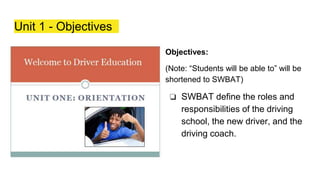
Unit 1 - Objectives
Objectives:
(Note: “Students will be able to” will be
shortened to SWBAT)
❏ SWBAT define the roles and
responsibilities of the driving
school, the new driver, and the
driving coach.
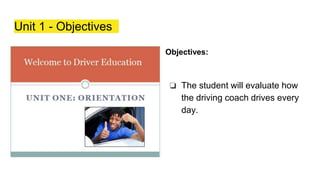
Unit 1 - Objectives
Objectives:
❏ The student will evaluate how
the driving coach drives every
day.
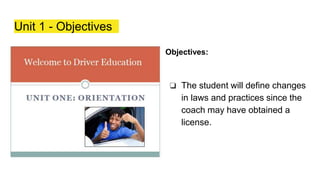
Unit 1 - Objectives
Objectives:
❏ The student will define changes
in laws and practices since the
coach may have obtained a
license.
Unit 1 - Objectives
Objectives:
❏ The student will define the
Graduated Licensing System
(GLS) and why it is important.
Unit 1 - Orientation: Objectives
Objectives:
❏ The student and the coach will
determine how to be a
supportive driving coach for the
new driver.
What does this mean for Unit 1?
Unit 1 is an introduction to the driving school rules and procedures.
Parent Orientation must be held and parents should be encouraged to attend, however, it is NOT
MANDATORY they do so.
Graduated Licensing is the name of the process where new driver’s first receive a Learner’s
Permit, then a Provisional (or a synonym might be Probationary) License, then a Full License.
Giving them more freedom and less restrictions as they move through each licensing phase.
We also cover where the GOOD truly exists in the collaboration between professional driving
instruction and home instruction by family members of the new drivers. Where the folks at home
spend much more time with the student driver and be (hopefully) incredibly supportive, they may
not have the most up-to-date facts and knowledge about current rules/laws or best practices for
coaching their new driver.
Other items in Unit 1
School rules/procedures
Introductions
Syllabus of what’s covered in the classroom
portion,
Overview of how the Behind-the-Wheel
portion of class works,
How each phase of Graduated Licensing
works (How old must you be for each
licensing phase? What testing is required?)
Restrictions on the Learner’s Permit and
Provisional License
What to expect for the Learner’s Permit
knowledge test
What to expect for the MVA Road Test for
the Provisional License
Differences/qualifications between Driving
Coaches (usually a parent/guardian), a
Maryland Professional Driving Instructor,
and a MVA Road Test Examiner
Quiz for students and parents on rules that
may have changed since their coach got
their license
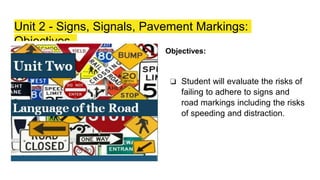
Unit 2 - Signs, Signals, Pavement Markings:
Objectives
Objectives:
❏ SWBAT describe the laws for
sharing the road safely with
emergency vehicles, school
buses, pedestrians,
motorcycles, and bicycles.
Unit 2 - Signs, Signals, Pavement Markings:
Objectives
Objectives:
❏ SWBAT define the concept of
the Highway Transportation
System and evaluate what
impact that concept has on
safe driving.
Unit 2 - Signs, Signals, Pavement Markings:
Objectives
Objectives:
❏ SWBAT describe the function of
signs, signals, and lane
markings and the potential
consequences of not following
those markings.
Unit 2 - Signs, Signals, Pavement Markings:
Objectives
Objectives:
❏ Students will evaluate how traffic
control devices impact safety
including right-of-way and risk, and
the impact of failing to obey the laws
pertaining to traffic control devices.
Unit 2 - Signs, Signals, Pavement Markings:
Objectives
Objectives:
❏ Student will evaluate the risks of
failing to adhere to signs and
road markings including the risks
of speeding and distraction.
What does this mean for Unit 2?
The Highway transportation system (roads, drivers, vehicles. We’re all in this
together!
Categories of signs: Regulatory (rules), Warning (hazards ahead), and Guide
(Directions)
BIG section explaining MPH Signs and the dangers of speeding
Traffic Signals (Flashing, Arrows, Solid)
Pavement Markings (Dashed, Dotted, Solid, White, Yellow, Special such as
School Pedestrian Crossings.
Unit 3 - Getting Started (Meet “Mr. Car”)
Objectives:
❏ SWBAT locate and describe the
significance and appropriate use
of vehicle equipment using the
owner’s manual when necessary.
Unit 3 - Getting Started (Meet “Mr. Car”
Objectives:
❏ SWBAT list the necessary steps
to safely enter a vehicle and
prepare to drive.
Unit 3 - Getting Started (Meet “Mr. Car”)
Objectives:
❏ SWBAT explain the
importance of consistently
using all of a vehicle’s safety
equipment.
What does this mean for Unit 3?
Pre-entry Checks:
Checking before we get in the car for pets, people, property, damage, fluid
leaks, tires, broken glass, etc).
Starting tasks: Lock Doors, adjust seat/steering wheel, mirrors, headrests,
seatbelts, etc
New way to set the mirrors! ENHANCED MIRROR SETTINGS versus
TRADITIONAL MIRROR SETTINGS
Stresses using all of the vehicles safety equipment.
Seatbelts
Airbags
Head Restraints
What does this mean for Unit 3?
Location and function of various vehicle controls (from cruise control to
windshield wipers
Dashboard warning lights and they’re meaning/colors
Function of the parking brake (Should use every time we park, may not stop you
in an emergency depending!)
Unit 4 - Moving the Car (Defensive Driving)
Objectives:
❏ SWBAT list the steps necessary
to turn the vehicle on and off
safely and evaluate why each of
those steps is important.
Unit 4 - Moving the Car (Defensive Driving)
Objectives:
❏ SWBAT describe the steps
necessary to move the vehicle
forward and in reverse.
Unit 4 - Moving the Car (Defensive Driving)
Objectives:
❏ SWBAT describe how to
maintain speed and control
during acceleration and
deceleration.
Unit 4 - Moving the Car (Defensive Driving)
Objectives:
❏ SWBAT describe how to stop
the vehicle.
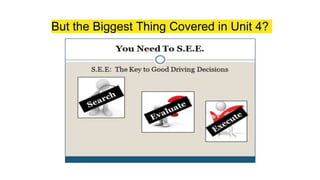
But the Biggest Thing Covered in Unit 4?
S.E.E.
Driving involves Visual, Cognitive, and Physical (Motor Skills).
S. Search means to actively scan and identify factors that could create
increased risk;
E. Evaluate means to consider potential problems arising from the
interaction of those factors;
and
E. Execute refers to the physical motor skills used to prevent or avoid
the resulting hazards.
What else in Unit 4?
Why it’s called a “parking brake” (and not the emergency brake)- should be used
every time you park your car.
Push to start versus key ignition - turning on vehicle accessories (ACC) and
start up
Why you can’t let your car idle on public property in Maryland (It’s illegal!)
Calculating following distance using the seconds rule (3 to 4 seconds)
Space management and predicting the actions of other users
Types of steering (push/pull/slide versus hand-over-hand)
Backing up, Stopping, Securing the vehicle
Communicating with other drivers as a part of Execute
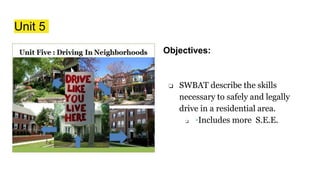
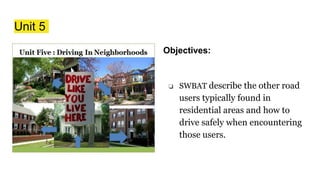
Unit 5
Objectives:
❏ SWBAT describe the skills
necessary to safely and legally
drive in a residential area.
❏ ◦Includes more S.E.E.
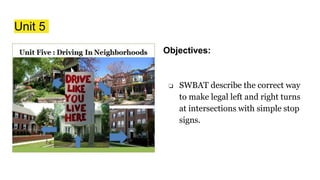
Unit 5
Objectives:
❏ SWBAT describe the correct way
to make legal left and right turns
at intersections with simple stop
signs.
Unit 5
Objectives:
❏ SWBAT describe the other road
users typically found in
residential areas and how to
drive safely when encountering
those users.
What does this mean for Unit 5?
Operating safely around school buses and in school zones
Cyclists (both kids, adults and competitive cyclists)
Pedestrians
Executing Right and Left turns safely
Roundabouts (i.e. traffic circles)
Backing out of a driveway
Potholes
Speed Bumps
Simple Parking Maneuvers (Perpendicular and Angled)
Turning your car around safely (i.e. turnabouts)
Unit 6
Objectives:
❏ SWBAT describe the skills necessary
to safely and legally drive on urban,
suburban, and rural roads.
❏ And of course MORE S.E.E.
Unit 6
Objectives:
❏ SWBAT evaluate the inherent risks
of these types of roads and
determine how distraction will
impact those risks.
Unit 6
Objectives:
❏ SWBAT describe the types of
vehicles typically found on urban,
suburban, and rural roads and what
laws apply to those vehicles
including railroad safety.
What does this mean for Unit 6?
Discussion of navigating mixed-used roads
(i.e. downtown areas)
More on pedestrian safety
Responding to Emergency Vehicles (i.e. Move
Over Law)
One Way Streets
The dangers of larger intersections with traffic
lights, and how to navigate them safely
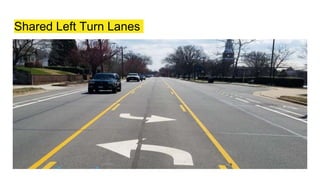
Shared Left Turn Lanes (see Photo on next
slide)
Parallel Parking
Approaching yield signs
Right of way rules
Dangers posed by Deer and
animals
Passing on a two lane road
Navigating hills/curves
Trains
Shared Left Turn Lanes
Unit 7
Objectives:
❏ SWBAT describe the skills necessary
to safely and legally drive on
expressways.
Unit 7
Objectives:
❏ SWBAT —
describe the types of
vehicles and road conditions
typically found on expressways and
what laws apply.
What does this mean for Unit 7?
Safely entering/exiting expressways
Features of expressways (such as medians,
rumble strips)
S.E.E. (Following distance, defensive driving)
Reminders about emergency vehicles and
construction zones
The role of speed in collisions on expressways
and shattering myths (i.e. there is NO fast lane
in law!)
Weave Lanes (See following slides)
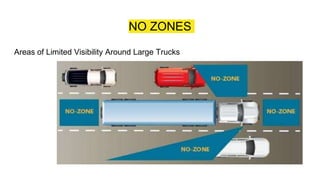
Sharing the road with
motorcycles and tractor trailers
(NO ZONES- see following
slides)
Changing Lanes
Tunnels, Bridges and Toll
Plazas
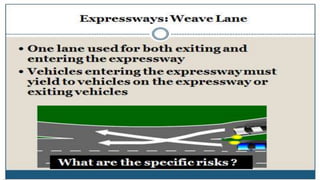
Weave Lanes
NO ZONES
Areas of Limited Visibility Around Large Trucks
Unit 8
Objectives:
❏ SWBAT identify the various adverse
conditions he/she/they will be likely
to encounter and define the
appropriate measures to take to
drive safely in those conditions.
Unit 8
Objectives:
❏ SWBAT evaluate the risks in various
adverse weather conditions.
Unit 8
Objectives:
❏ SWBAT list his/her responsibilities
in a collision and what the
consequences are for failing to
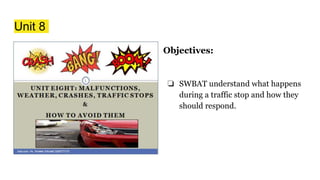
complete those responsibilities.
Unit 8
Objectives:
❏ SWBAT understand what happens
during a traffic stop and how they
should respond.
What does this mean for Unit 8?
Review of dashboard warning lights
Various types of mechanical malfunctions
discussed and what to do about them.
(Tire Failure, Brake Failure, Accelerator
Failure, Engine Overheats, Engine Power
Failure, Car Fires)
Properly checking tires for tread and air
Various weather conditions - Slow Down!
Leave Space!
Fog, Snow, Wind, Rain, Ice
Hydroplaning and skidding
discussed
Night Driving
Crashes and choosing the
correct option from worst case
scenarios (better to hit a tree
than strike another moving car
head on!)
Driver’s responsibilities after a
collision
Hit and Runs discussed
Traffic stops
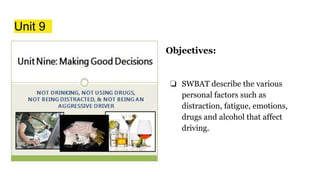
Unit 9
Objectives:
❏ SWBAT describe the various
personal factors such as
distraction, fatigue, emotions,
drugs and alcohol that affect
driving.
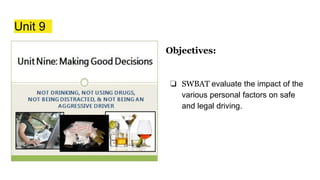
Unit 9
Objectives:
❏ SWBAT evaluate the impact of the
various personal factors on safe
and legal driving.
Unit 9
Objectives:
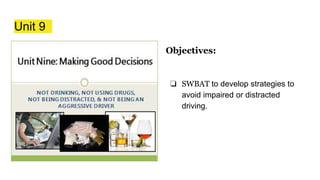
❏ SWBAT to develop strategies to
avoid impaired or distracted
driving.
Unit 9
Objectives:
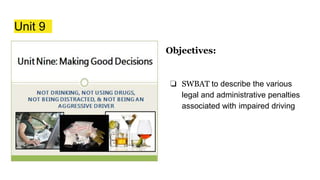
❏ SWBAT to describe the various
legal and administrative penalties
associated with impaired driving
What does this mean for Unit 9?
Discussion of alcohol and drug use and how it
affects driving (vision, motor skills, judgement
and reasoning)
Emphasis on DON’T DRIVE whatever you
choose to do
Discussion of implied consent and open
containers (see following slides)
What happens at criminal court for DUI/DWI
And at the MVA administrative court hearing
concerning your license
Specific mention of marijuana
and opioid use
Aggressive Driving
Fatigue and its effects on
driving
Distractions
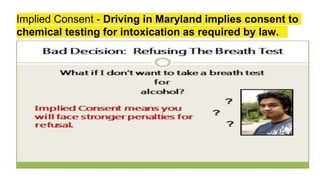
Implied Consent - Driving in Maryland implies consent to
chemical testing for intoxication as required by law.
REVIEW!!!!!
Several Test Questions May Come up about when do you do the review for
the Final EXAM!!!
Answer is: ON DAY 9,
After Unit 9 is Completed!
Unit 10
Objectives:
❏ SWBAT describe how to legally
register and maintain registration of
a vehicle in Maryland.
❏ ¡Including VEIP
❏ ¡Insurance
❏ ¡Tags and Title responsibilities
Unit 10
Objectives:
❏ SWBAT describe the next steps for
them in the Graduated Licensing
process.
Unit 10
Objectives:
❏ Students will complete the final
exam.
Maryland Driver Education Curriculum
Preface
Contents
❏ Introduction and Purpose
❏ Revisions to the Curriculum
❏ General Information about Classroom and Behind the Wheel Classes
❏ Curriculum Materials and Structure (Structure = COMAR reminders!)
Introduction and Purpose
Traffic crashes remain the leading cause of death for people between the ages of
13 and 20.
“To insure the safety of new drivers and Maryland roads, the Maryland Graduated
Licensing System (GLS) Law mandates that all new drivers, regardless of age
complete a course in driver’s education that consists of a minimum of 30 hours of
classroom instruction and a minimum of six hours of behind-the-wheel instruction
before receiving their first noncommercial driver’s license.”
Introduction and Purpose
The Maryland Graduated Licensing System Law mandates that ALL new drivers
(REGARDLESS of AGE!) in Maryland are required to complete a course in driver
education that consists of 30 hours of classroom and 6 hours of behind-the-wheel.
Of Note: The state legislature created our GLS laws. The Motor Vehicle
Administration is in charge of the creation of the course, supervision of drivers
education schools and all other forms of course management/student completion.
Good to Know
Each state gets to set their own driving laws pertaining to courses, permits,
intermediate licenses, etc. Because this varies state to state, some states will not
accept a Maryland learner’s permit and vice versa.
For example?
A DC learner’s permit will not be recognized as valid in Maryland and vice versa.
The District of Columbia will actually not let a new driver obtain a learner’s permit
till the age of 16! Maryland’s learner’s permit can be obtained at 15 years and 9
months.
Introduction and Purpose
In addition to the driver’s education class, all new drivers are required to complete the practice
hours assigned to them with a supervising driver.
This Supervising driving must be over the age of 21 and have held a license for at least 3 years.
All practice hours should be recorded in the New Driver and Coach Practice Guide.
These hours are in addition to the 6 hours of behind-the-wheel instruction in the driver’s education
course.
Introduction and Purpose
States also that many revisions have happened to this course since its inception.
The latest revisions came with heavy discussion and input from the Maryland
Highway Safety Office, R. Adams Crowley Shock Trauma Unit, ADTSEA
(American Driver & Traffic Safety Administration) and NHTSA (National Highway
Traffic Safety Administration).
Members of senior management from MDOT/MVA also contributed.
Revisions to the Curriculum
● Intended to be ongoing, and update as legislative processes/laws are changed.
● Mirrors that of the New Driver and Coach Practice Guide
● With last revision, all textbooks have been replaced with the Student Workbook.
Instructors and all driving schools must make sure that every student
has a copy of the Student Workbook.
Emphasis has drastically changed from previous editions of the curriculum.
Previous interactions focused on acquiring basic, factual knowledge.
Revised curriculum focuses more on attitude and cooperation, as well as
understanding why drivers do the things they do.
Avoiding speeding, distractions and the use of seatbelts, also rounds out a
greater emphasis on safe driving.
General Information About Classroom and Behind The
Wheel Classes
Rules Listed Here:
● Each student MUST begin the classroom instruction with Unit 1, which cannot
be missed and made up later.
● If a student is absent from any classroom session, except Unit 1, the student
must make up that specific section
● If a student misses more than 12 hours of classroom instruction, the student
must retake ALL of the classroom instruction, starting with Unit 1.
● Students can make-up 12 hours of classroom instruction however in later
sessions.
Coaches/Parent/Guaridan Involvement - Orientation
Coaches, parents, guardians, and/or mentors MUST be invited and should
be strongly encouraged to attend Unit 1.
Parents or guardians should also be invited and encouraged to attend other
classroom sessions and in-car lessons in addition to the parent orientation
(part of Unit 1, but can be offered online also).
General Information About Classroom and Behind The
Wheel Classes
Rules Listed Here:
● Each student MUST begin the classroom instruction with Unit 1, which cannot
be missed and made up later.
● If a student is absent from any classroom session, except Unit 1, the student
must make up that specific section
● If a student misses more than 12 hours of classroom instruction, the student
must retake ALL of the classroom instruction, starting with Unit 1.
● Students can make-up 12 hours of classroom instruction however in later
sessions.
General Information About Classroom and Behind The
Wheel Classes
Rules Listed Here:
● Each Unit is 3 hours long and is designed to follow sequentially and to
support the Rookie and Coach Practice Guide.
Additional information about the teaching of the curriculum and regulations
pertaining to it can be found in COMAR.
Reminder
The six hours of behind the wheel lesson are designed to coordinate with the
New Driver and Coach Practice Guide and the updated curriculum. Schools and
driver education instructors should ensure coaches know and understand that the
six hours of behind-the-wheel instruction are designed to compliment and refine
the 60 hours of practice new drivers are required to complete, not to substitute for
them.
Coaches should know that the most effective use of the behind-the-wheel
lessons is to coordinate with the behind-the-wheel instructors to develop any skill
learned during the six hours of in-car instruction.
These skills can be further refined during home practice times.
Contents! Curriculum Materials and Structure
● Units 1-10, Classroom Instruction
● Teaching Guide
● Powerpoint Presentation
● Videos
● Student Workbook (Factsheets, Worksheets, Video Worksheets
● Behind-the-Wheel Instruction
● Final Examinations
● Instruction in Spanish
● Instruction in a language other than English or Spanish
Curriculum Materials and Structure
The Maryland Driver Education Curriculum and In-Car Curriculum guide is
divided into ten units of classroom instruction (30 hours total) and, six- one
hour units of in-car instruction.
Schools however, can format this as either:
six one-hour blocks
Or 4 blocks, consisting o minute blocks
OR
Three two-hour sessions (Greg’s preferred method)
The course was initially designed for students to start practice time with coaches and initial in-cars before
completing the classroom portion of driver’s education, however, for various reasons relating to school
and family schedules, that is not always feasible.
Curriculum Materials and Structure
IN-CAR
If a student receives an unsatisfactory score on the last drive a one-hour
revaluation is required. This should be focused on the skills they did
poorly on or were not able to complete.
Unsatisfactory scores on the first 4 hours of driving do not have to be
made-up.
Curriculum Materials and Structure
Updated Authorized Materials:
Workbook attached to the curriculum contains: factsheets, worksheets and video
worksheets. These are specifically designed to support the updated curriculum.
Every student must have his/her own copy of the workbook. The workbook
cannot be shared and cannot be reused. For MVA purposes it replaces
textbooks previously used.
However, any textbooks currently in use can still be used but do not replace
the student workbook.
Curriculum Materials and Structure
Units 1-10, Classroom Instruction:
Each unit is designed to be three hours long with a review and a unit quiz at the end of
each unit.
There is a review for the final exam at the end of Unit 9! (Probable test question!)
The curriculum starts with being acquainted with Maryland’s Graduated Licensing laws
and getting familiar with the vehicle and goes through steps until it concludes with a
unit on making good decisions when driving by avoiding drugs and alcohol.
Curriculum Materials and Structure
Unit 10:
Unit 10 is a brief unit that explains how some of the fundamentals of owning a
vehicle. This includes: insurance, registration, titles, and VEIP. There is no quiz at
the end of Unit 10.
Day 10, however, allows for time to complete the final exam and any additional
paperwork.
Teaching Guide
The “Teaching Guide,” contains a step-by-step guide for the curriculum.
It includes and illustration of each slide and a list of all talking points, exercises,
and additional materials for each slide of the classroom presentation.
It has a list of all terminal objectives for each unit so an instructor should know
what each student should have accomplished or should know by the end of each
unit.
Power Point Presentation
A Powerpoint presentation is provided with the curriculum and supports each unit.
Relevant video segments are embedded in the presentation and play
automatically upon click-through.
At the bottom of each slide are notes, talking points and suggested exercises.
Most of the exercises are supported by a worksheet in the Student Workbook.
There are also many animations in most slides.
It is imperative that instructors practice using the curriculum before using it in front
of the class.

Apprentice Test Curriculum Portion

  • 1.
  • 2.
    REMINDER 15 Questions fromthis Unit! These could look like: 1. By the end of this unit, students will be knowledgeable about what to do in a traffic collision. A. Unit 2 B. Unit 4 C. Unit 6 D. Unit 8
  • 3.
    Non-Unit Questions inCurriculum Portion Or, the question may sound like a COMAR question. However, the answer to that question is most likely BOTH in COMAR and in the Preface of the Teacher’s Guide to the MD Driver’s Education Curriculum. Example: Can a student miss the first day of class and continue with the rest of the course? A. Yes provided they make-up all missed instruction. B. No, Students must be present the first day of class. C. No, Students must be present the first day of class and parents must be offered to attend a parent orientation. D. Yes, students and parents can miss the first day get notes/Make-Up work from other students from other students.
  • 4.
    In our firstexample? Collisions are in Unit 8! In the second example? C. No, Students must be present the first day of class and parents must be offered to attend a parent orientation. Answers to Example Questions
  • 5.
    Which Unit isWhich? Most of the questions however, will be about which unit contains what objective from the course or, which unit covers a certain portion of the material. This guide will cover: Units & Objectives First & then, What’s in that preface?
  • 6.
  • 7.
    Unit 1 -Objectives Objectives: (Note: “Students will be able to” will be shortened to SWBAT) ❏ SWBAT define the roles and responsibilities of the driving school, the new driver, and the driving coach.
  • 8.
    Unit 1 -Objectives Objectives: ❏ The student will evaluate how the driving coach drives every day.
  • 9.
    Unit 1 -Objectives Objectives: ❏ The student will define changes in laws and practices since the coach may have obtained a license.
  • 10.
    Unit 1 -Objectives Objectives: ❏ The student will define the Graduated Licensing System (GLS) and why it is important.
  • 11.
    Unit 1 -Orientation: Objectives Objectives: ❏ The student and the coach will determine how to be a supportive driving coach for the new driver.
  • 12.
    What does thismean for Unit 1? Unit 1 is an introduction to the driving school rules and procedures. Parent Orientation must be held and parents should be encouraged to attend, however, it is NOT MANDATORY they do so. Graduated Licensing is the name of the process where new driver’s first receive a Learner’s Permit, then a Provisional (or a synonym might be Probationary) License, then a Full License. Giving them more freedom and less restrictions as they move through each licensing phase. We also cover where the GOOD truly exists in the collaboration between professional driving instruction and home instruction by family members of the new drivers. Where the folks at home spend much more time with the student driver and be (hopefully) incredibly supportive, they may not have the most up-to-date facts and knowledge about current rules/laws or best practices for coaching their new driver.
  • 13.
    Other items inUnit 1 School rules/procedures Introductions Syllabus of what’s covered in the classroom portion, Overview of how the Behind-the-Wheel portion of class works, How each phase of Graduated Licensing works (How old must you be for each licensing phase? What testing is required?) Restrictions on the Learner’s Permit and Provisional License What to expect for the Learner’s Permit knowledge test What to expect for the MVA Road Test for the Provisional License Differences/qualifications between Driving Coaches (usually a parent/guardian), a Maryland Professional Driving Instructor, and a MVA Road Test Examiner Quiz for students and parents on rules that may have changed since their coach got their license
  • 14.
    Unit 2 -Signs, Signals, Pavement Markings: Objectives Objectives: ❏ SWBAT describe the laws for sharing the road safely with emergency vehicles, school buses, pedestrians, motorcycles, and bicycles.
  • 15.
    Unit 2 -Signs, Signals, Pavement Markings: Objectives Objectives: ❏ SWBAT define the concept of the Highway Transportation System and evaluate what impact that concept has on safe driving.
  • 16.
    Unit 2 -Signs, Signals, Pavement Markings: Objectives Objectives: ❏ SWBAT describe the function of signs, signals, and lane markings and the potential consequences of not following those markings.
  • 17.
    Unit 2 -Signs, Signals, Pavement Markings: Objectives Objectives: ❏ Students will evaluate how traffic control devices impact safety including right-of-way and risk, and the impact of failing to obey the laws pertaining to traffic control devices.
  • 18.
    Unit 2 -Signs, Signals, Pavement Markings: Objectives Objectives: ❏ Student will evaluate the risks of failing to adhere to signs and road markings including the risks of speeding and distraction.
  • 19.
    What does thismean for Unit 2? The Highway transportation system (roads, drivers, vehicles. We’re all in this together! Categories of signs: Regulatory (rules), Warning (hazards ahead), and Guide (Directions) BIG section explaining MPH Signs and the dangers of speeding Traffic Signals (Flashing, Arrows, Solid) Pavement Markings (Dashed, Dotted, Solid, White, Yellow, Special such as School Pedestrian Crossings.
  • 20.
    Unit 3 -Getting Started (Meet “Mr. Car”) Objectives: ❏ SWBAT locate and describe the significance and appropriate use of vehicle equipment using the owner’s manual when necessary.
  • 21.
    Unit 3 -Getting Started (Meet “Mr. Car” Objectives: ❏ SWBAT list the necessary steps to safely enter a vehicle and prepare to drive.
  • 22.
    Unit 3 -Getting Started (Meet “Mr. Car”) Objectives: ❏ SWBAT explain the importance of consistently using all of a vehicle’s safety equipment.
  • 23.
    What does thismean for Unit 3? Pre-entry Checks: Checking before we get in the car for pets, people, property, damage, fluid leaks, tires, broken glass, etc). Starting tasks: Lock Doors, adjust seat/steering wheel, mirrors, headrests, seatbelts, etc New way to set the mirrors! ENHANCED MIRROR SETTINGS versus TRADITIONAL MIRROR SETTINGS Stresses using all of the vehicles safety equipment. Seatbelts Airbags Head Restraints
  • 24.
    What does thismean for Unit 3? Location and function of various vehicle controls (from cruise control to windshield wipers Dashboard warning lights and they’re meaning/colors Function of the parking brake (Should use every time we park, may not stop you in an emergency depending!)
  • 25.
    Unit 4 -Moving the Car (Defensive Driving) Objectives: ❏ SWBAT list the steps necessary to turn the vehicle on and off safely and evaluate why each of those steps is important.
  • 26.
    Unit 4 -Moving the Car (Defensive Driving) Objectives: ❏ SWBAT describe the steps necessary to move the vehicle forward and in reverse.
  • 27.
    Unit 4 -Moving the Car (Defensive Driving) Objectives: ❏ SWBAT describe how to maintain speed and control during acceleration and deceleration.
  • 28.
    Unit 4 -Moving the Car (Defensive Driving) Objectives: ❏ SWBAT describe how to stop the vehicle.
  • 29.
    But the BiggestThing Covered in Unit 4?
  • 30.
    S.E.E. Driving involves Visual,Cognitive, and Physical (Motor Skills). S. Search means to actively scan and identify factors that could create increased risk; E. Evaluate means to consider potential problems arising from the interaction of those factors; and E. Execute refers to the physical motor skills used to prevent or avoid the resulting hazards.
  • 31.
    What else inUnit 4? Why it’s called a “parking brake” (and not the emergency brake)- should be used every time you park your car. Push to start versus key ignition - turning on vehicle accessories (ACC) and start up Why you can’t let your car idle on public property in Maryland (It’s illegal!) Calculating following distance using the seconds rule (3 to 4 seconds) Space management and predicting the actions of other users Types of steering (push/pull/slide versus hand-over-hand) Backing up, Stopping, Securing the vehicle Communicating with other drivers as a part of Execute
  • 32.
    Unit 5 Objectives: ❏ SWBATdescribe the skills necessary to safely and legally drive in a residential area. ❏ ◦Includes more S.E.E.
  • 33.
    Unit 5 Objectives: ❏ SWBATdescribe the correct way to make legal left and right turns at intersections with simple stop signs.
  • 34.
    Unit 5 Objectives: ❏ SWBATdescribe the other road users typically found in residential areas and how to drive safely when encountering those users.
  • 35.
    What does thismean for Unit 5? Operating safely around school buses and in school zones Cyclists (both kids, adults and competitive cyclists) Pedestrians Executing Right and Left turns safely Roundabouts (i.e. traffic circles) Backing out of a driveway Potholes Speed Bumps Simple Parking Maneuvers (Perpendicular and Angled) Turning your car around safely (i.e. turnabouts)
  • 36.
    Unit 6 Objectives: ❏ SWBATdescribe the skills necessary to safely and legally drive on urban, suburban, and rural roads. ❏ And of course MORE S.E.E.
  • 37.
    Unit 6 Objectives: ❏ SWBATevaluate the inherent risks of these types of roads and determine how distraction will impact those risks.
  • 38.
    Unit 6 Objectives: ❏ SWBATdescribe the types of vehicles typically found on urban, suburban, and rural roads and what laws apply to those vehicles including railroad safety.
  • 39.
    What does thismean for Unit 6? Discussion of navigating mixed-used roads (i.e. downtown areas) More on pedestrian safety Responding to Emergency Vehicles (i.e. Move Over Law) One Way Streets The dangers of larger intersections with traffic lights, and how to navigate them safely Shared Left Turn Lanes (see Photo on next slide) Parallel Parking Approaching yield signs Right of way rules Dangers posed by Deer and animals Passing on a two lane road Navigating hills/curves Trains
  • 40.
  • 41.
    Unit 7 Objectives: ❏ SWBATdescribe the skills necessary to safely and legally drive on expressways.
  • 42.
    Unit 7 Objectives: ❏ SWBAT— describe the types of vehicles and road conditions typically found on expressways and what laws apply.
  • 43.
    What does thismean for Unit 7? Safely entering/exiting expressways Features of expressways (such as medians, rumble strips) S.E.E. (Following distance, defensive driving) Reminders about emergency vehicles and construction zones The role of speed in collisions on expressways and shattering myths (i.e. there is NO fast lane in law!) Weave Lanes (See following slides) Sharing the road with motorcycles and tractor trailers (NO ZONES- see following slides) Changing Lanes Tunnels, Bridges and Toll Plazas
  • 44.
  • 45.
    NO ZONES Areas ofLimited Visibility Around Large Trucks
  • 46.
    Unit 8 Objectives: ❏ SWBATidentify the various adverse conditions he/she/they will be likely to encounter and define the appropriate measures to take to drive safely in those conditions.
  • 47.
    Unit 8 Objectives: ❏ SWBATevaluate the risks in various adverse weather conditions.
  • 48.
    Unit 8 Objectives: ❏ SWBATlist his/her responsibilities in a collision and what the consequences are for failing to complete those responsibilities.
  • 49.
    Unit 8 Objectives: ❏ SWBATunderstand what happens during a traffic stop and how they should respond.
  • 50.
    What does thismean for Unit 8? Review of dashboard warning lights Various types of mechanical malfunctions discussed and what to do about them. (Tire Failure, Brake Failure, Accelerator Failure, Engine Overheats, Engine Power Failure, Car Fires) Properly checking tires for tread and air Various weather conditions - Slow Down! Leave Space! Fog, Snow, Wind, Rain, Ice Hydroplaning and skidding discussed Night Driving Crashes and choosing the correct option from worst case scenarios (better to hit a tree than strike another moving car head on!) Driver’s responsibilities after a collision Hit and Runs discussed Traffic stops
  • 51.
    Unit 9 Objectives: ❏ SWBATdescribe the various personal factors such as distraction, fatigue, emotions, drugs and alcohol that affect driving.
  • 52.
    Unit 9 Objectives: ❏ SWBATevaluate the impact of the various personal factors on safe and legal driving.
  • 53.
    Unit 9 Objectives: ❏ SWBATto develop strategies to avoid impaired or distracted driving.
  • 54.
    Unit 9 Objectives: ❏ SWBATto describe the various legal and administrative penalties associated with impaired driving
  • 55.
    What does thismean for Unit 9? Discussion of alcohol and drug use and how it affects driving (vision, motor skills, judgement and reasoning) Emphasis on DON’T DRIVE whatever you choose to do Discussion of implied consent and open containers (see following slides) What happens at criminal court for DUI/DWI And at the MVA administrative court hearing concerning your license Specific mention of marijuana and opioid use Aggressive Driving Fatigue and its effects on driving Distractions
  • 56.
    Implied Consent -Driving in Maryland implies consent to chemical testing for intoxication as required by law.
  • 57.
    REVIEW!!!!! Several Test QuestionsMay Come up about when do you do the review for the Final EXAM!!! Answer is: ON DAY 9, After Unit 9 is Completed!
  • 58.
    Unit 10 Objectives: ❏ SWBATdescribe how to legally register and maintain registration of a vehicle in Maryland. ❏ ¡Including VEIP ❏ ¡Insurance ❏ ¡Tags and Title responsibilities
  • 59.
    Unit 10 Objectives: ❏ SWBATdescribe the next steps for them in the Graduated Licensing process.
  • 60.
    Unit 10 Objectives: ❏ Studentswill complete the final exam.
  • 61.
    Maryland Driver EducationCurriculum Preface
  • 62.
    Contents ❏ Introduction andPurpose ❏ Revisions to the Curriculum ❏ General Information about Classroom and Behind the Wheel Classes ❏ Curriculum Materials and Structure (Structure = COMAR reminders!)
  • 63.
    Introduction and Purpose Trafficcrashes remain the leading cause of death for people between the ages of 13 and 20. “To insure the safety of new drivers and Maryland roads, the Maryland Graduated Licensing System (GLS) Law mandates that all new drivers, regardless of age complete a course in driver’s education that consists of a minimum of 30 hours of classroom instruction and a minimum of six hours of behind-the-wheel instruction before receiving their first noncommercial driver’s license.”
  • 64.
    Introduction and Purpose TheMaryland Graduated Licensing System Law mandates that ALL new drivers (REGARDLESS of AGE!) in Maryland are required to complete a course in driver education that consists of 30 hours of classroom and 6 hours of behind-the-wheel. Of Note: The state legislature created our GLS laws. The Motor Vehicle Administration is in charge of the creation of the course, supervision of drivers education schools and all other forms of course management/student completion.
  • 65.
    Good to Know Eachstate gets to set their own driving laws pertaining to courses, permits, intermediate licenses, etc. Because this varies state to state, some states will not accept a Maryland learner’s permit and vice versa. For example? A DC learner’s permit will not be recognized as valid in Maryland and vice versa. The District of Columbia will actually not let a new driver obtain a learner’s permit till the age of 16! Maryland’s learner’s permit can be obtained at 15 years and 9 months.
  • 66.
    Introduction and Purpose Inaddition to the driver’s education class, all new drivers are required to complete the practice hours assigned to them with a supervising driver. This Supervising driving must be over the age of 21 and have held a license for at least 3 years. All practice hours should be recorded in the New Driver and Coach Practice Guide. These hours are in addition to the 6 hours of behind-the-wheel instruction in the driver’s education course.
  • 67.
    Introduction and Purpose Statesalso that many revisions have happened to this course since its inception. The latest revisions came with heavy discussion and input from the Maryland Highway Safety Office, R. Adams Crowley Shock Trauma Unit, ADTSEA (American Driver & Traffic Safety Administration) and NHTSA (National Highway Traffic Safety Administration). Members of senior management from MDOT/MVA also contributed.
  • 68.
    Revisions to theCurriculum ● Intended to be ongoing, and update as legislative processes/laws are changed. ● Mirrors that of the New Driver and Coach Practice Guide ● With last revision, all textbooks have been replaced with the Student Workbook. Instructors and all driving schools must make sure that every student has a copy of the Student Workbook. Emphasis has drastically changed from previous editions of the curriculum. Previous interactions focused on acquiring basic, factual knowledge. Revised curriculum focuses more on attitude and cooperation, as well as understanding why drivers do the things they do. Avoiding speeding, distractions and the use of seatbelts, also rounds out a greater emphasis on safe driving.
  • 69.
    General Information AboutClassroom and Behind The Wheel Classes Rules Listed Here: ● Each student MUST begin the classroom instruction with Unit 1, which cannot be missed and made up later. ● If a student is absent from any classroom session, except Unit 1, the student must make up that specific section ● If a student misses more than 12 hours of classroom instruction, the student must retake ALL of the classroom instruction, starting with Unit 1. ● Students can make-up 12 hours of classroom instruction however in later sessions.
  • 70.
    Coaches/Parent/Guaridan Involvement -Orientation Coaches, parents, guardians, and/or mentors MUST be invited and should be strongly encouraged to attend Unit 1. Parents or guardians should also be invited and encouraged to attend other classroom sessions and in-car lessons in addition to the parent orientation (part of Unit 1, but can be offered online also).
  • 71.
    General Information AboutClassroom and Behind The Wheel Classes Rules Listed Here: ● Each student MUST begin the classroom instruction with Unit 1, which cannot be missed and made up later. ● If a student is absent from any classroom session, except Unit 1, the student must make up that specific section ● If a student misses more than 12 hours of classroom instruction, the student must retake ALL of the classroom instruction, starting with Unit 1. ● Students can make-up 12 hours of classroom instruction however in later sessions.
  • 72.
    General Information AboutClassroom and Behind The Wheel Classes Rules Listed Here: ● Each Unit is 3 hours long and is designed to follow sequentially and to support the Rookie and Coach Practice Guide. Additional information about the teaching of the curriculum and regulations pertaining to it can be found in COMAR.
  • 73.
    Reminder The six hoursof behind the wheel lesson are designed to coordinate with the New Driver and Coach Practice Guide and the updated curriculum. Schools and driver education instructors should ensure coaches know and understand that the six hours of behind-the-wheel instruction are designed to compliment and refine the 60 hours of practice new drivers are required to complete, not to substitute for them. Coaches should know that the most effective use of the behind-the-wheel lessons is to coordinate with the behind-the-wheel instructors to develop any skill learned during the six hours of in-car instruction. These skills can be further refined during home practice times.
  • 74.
    Contents! Curriculum Materialsand Structure ● Units 1-10, Classroom Instruction ● Teaching Guide ● Powerpoint Presentation ● Videos ● Student Workbook (Factsheets, Worksheets, Video Worksheets ● Behind-the-Wheel Instruction ● Final Examinations ● Instruction in Spanish ● Instruction in a language other than English or Spanish
  • 75.
    Curriculum Materials andStructure The Maryland Driver Education Curriculum and In-Car Curriculum guide is divided into ten units of classroom instruction (30 hours total) and, six- one hour units of in-car instruction. Schools however, can format this as either: six one-hour blocks Or 4 blocks, consisting o minute blocks OR Three two-hour sessions (Greg’s preferred method) The course was initially designed for students to start practice time with coaches and initial in-cars before completing the classroom portion of driver’s education, however, for various reasons relating to school and family schedules, that is not always feasible.
  • 76.
    Curriculum Materials andStructure IN-CAR If a student receives an unsatisfactory score on the last drive a one-hour revaluation is required. This should be focused on the skills they did poorly on or were not able to complete. Unsatisfactory scores on the first 4 hours of driving do not have to be made-up.
  • 77.
    Curriculum Materials andStructure Updated Authorized Materials: Workbook attached to the curriculum contains: factsheets, worksheets and video worksheets. These are specifically designed to support the updated curriculum. Every student must have his/her own copy of the workbook. The workbook cannot be shared and cannot be reused. For MVA purposes it replaces textbooks previously used. However, any textbooks currently in use can still be used but do not replace the student workbook.
  • 78.
    Curriculum Materials andStructure Units 1-10, Classroom Instruction: Each unit is designed to be three hours long with a review and a unit quiz at the end of each unit. There is a review for the final exam at the end of Unit 9! (Probable test question!) The curriculum starts with being acquainted with Maryland’s Graduated Licensing laws and getting familiar with the vehicle and goes through steps until it concludes with a unit on making good decisions when driving by avoiding drugs and alcohol.
  • 79.
    Curriculum Materials andStructure Unit 10: Unit 10 is a brief unit that explains how some of the fundamentals of owning a vehicle. This includes: insurance, registration, titles, and VEIP. There is no quiz at the end of Unit 10. Day 10, however, allows for time to complete the final exam and any additional paperwork.
  • 80.
    Teaching Guide The “TeachingGuide,” contains a step-by-step guide for the curriculum. It includes and illustration of each slide and a list of all talking points, exercises, and additional materials for each slide of the classroom presentation. It has a list of all terminal objectives for each unit so an instructor should know what each student should have accomplished or should know by the end of each unit.
  • 81.
    Power Point Presentation APowerpoint presentation is provided with the curriculum and supports each unit. Relevant video segments are embedded in the presentation and play automatically upon click-through. At the bottom of each slide are notes, talking points and suggested exercises. Most of the exercises are supported by a worksheet in the Student Workbook. There are also many animations in most slides. It is imperative that instructors practice using the curriculum before using it in front of the class.