Higher Education Alignment to Support Initiatives of the
                 Energy Efficiency and Conservation Strategy (EECS) – CERT Report

The Consortium for Education, Research & Technology (CERT) has been retained by Gulf Geoexchange
and Consulting Services, Inc. in partnership with the City of Shreveport and serves on the Project Team in
three key roles to support the Energy Efficiency and Conservation Strategy (EECS):
    • Identify and align the combined resources of 12 higher education member institutions across
        North Louisiana to focus on research and development, workforce development and
        K-12/community outreach;
    • Serve a “link and leverage” role to others across existing silos—education, government,
        nonprofits, businesses, funding sources and others—who can help with the process (e.g.
        baseline, reporting, GIS); and
    • Help inform the work group, creating common knowledge base (e.g., best practices, analyses) to
        explore new educational models to use in the process.
As part of the Project Team, CERT will help manage the networks, identify funding and track initiatives.

Higher education resources. CERT Chancellors/Presidents (or their designees) for the past year have
committed to learning the Strategic Doing process and to aligning their resources on multiple, innovative
initiatives or projects. CERT has surveyed member institutions to identify current “energy systems”
research projects, grants, and members of college faculties who have expertise and new technologies to
contribute in one or more of the six EECS focus areas:
      • Building Energy Efficiency
      • Clean & Renewable Energy Sources
      • Reduction of Waste & Pollution
      • Transportation & Land Use Alternatives
      • Green Workforce/ Business Incentives
      • Energy Education/ Outreach

Database. CERT is constructing a database of both academic and research and development resources
of the 12 member institutions across the region. Examples include a Louisiana Tech University research
project, “Nanoparticle Incorporated Heterogeneous Catalyst System for Biodiesel Production” and an
LSU-Shreveport Institute of Human Services & Public Policy that can assist the Project Team in designing
metrics and indicators.

“Green Jobs” framework. CERT will convene a work group of higher education and k-12 educators to
develop a plan framework for green jobs. CERT surveyed the U.S. Department of Labor February 2009
report, “Greening of the World of Work: Implications for O*NET-SOC and New and Emerging
Occupations.” DOL urges moving beyond simply applying a broad label such as “green jobs,” to identify
the “greening of occupations” in three categories, and project increased demand:
    • Green increased demand occupations—an increase in the employment demand for an existing
         occupations
    • Green enhanced skills occupations—a significant change to the work and worker requirements
         of an existing occupation; i.e., tasks, skills, knowledge and credentials have been altered, and
    • Green new and emerging (N&E) occupations—impact is sufficient to create the need for
         unique work and worker requirements; the new occupation could be entirely novel or “born” from
         an existing occupation.

Through a multi-stage research and screening process that included a review of existing literature,
identification and compiling of job titles, review and sorting of job titles, and clustering of job titles into 12
sector occupational sectors, the National Center for O*NET Development identified 64 “green increased
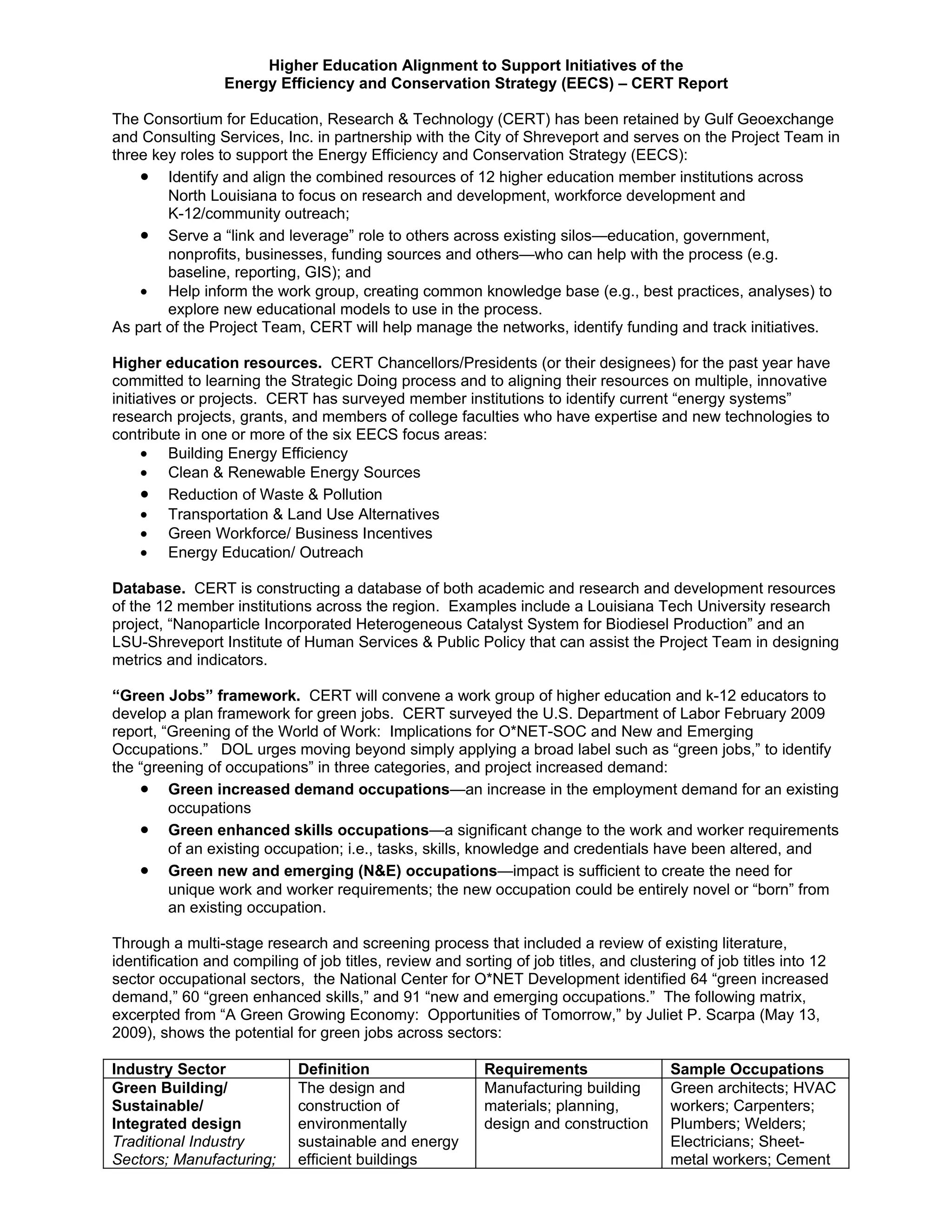
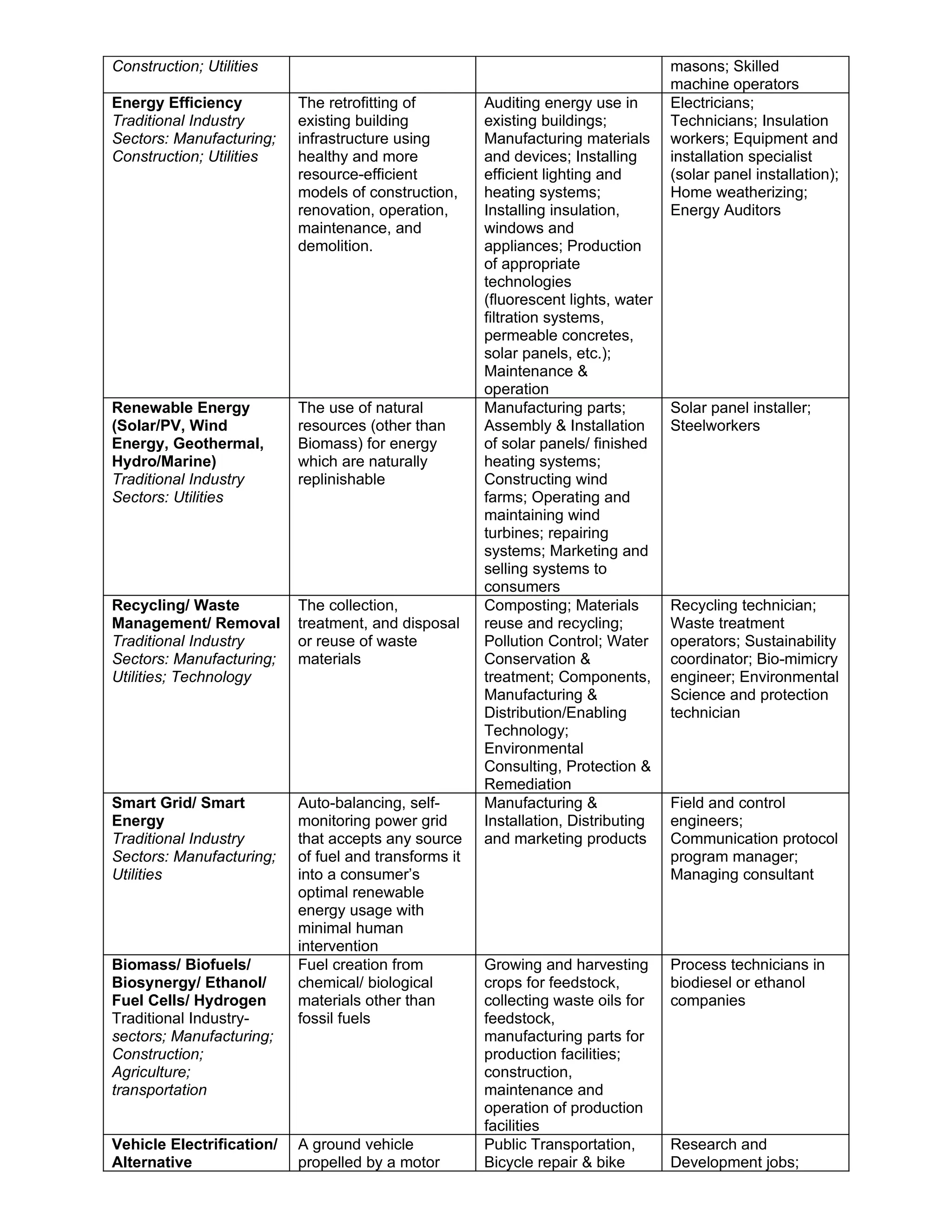
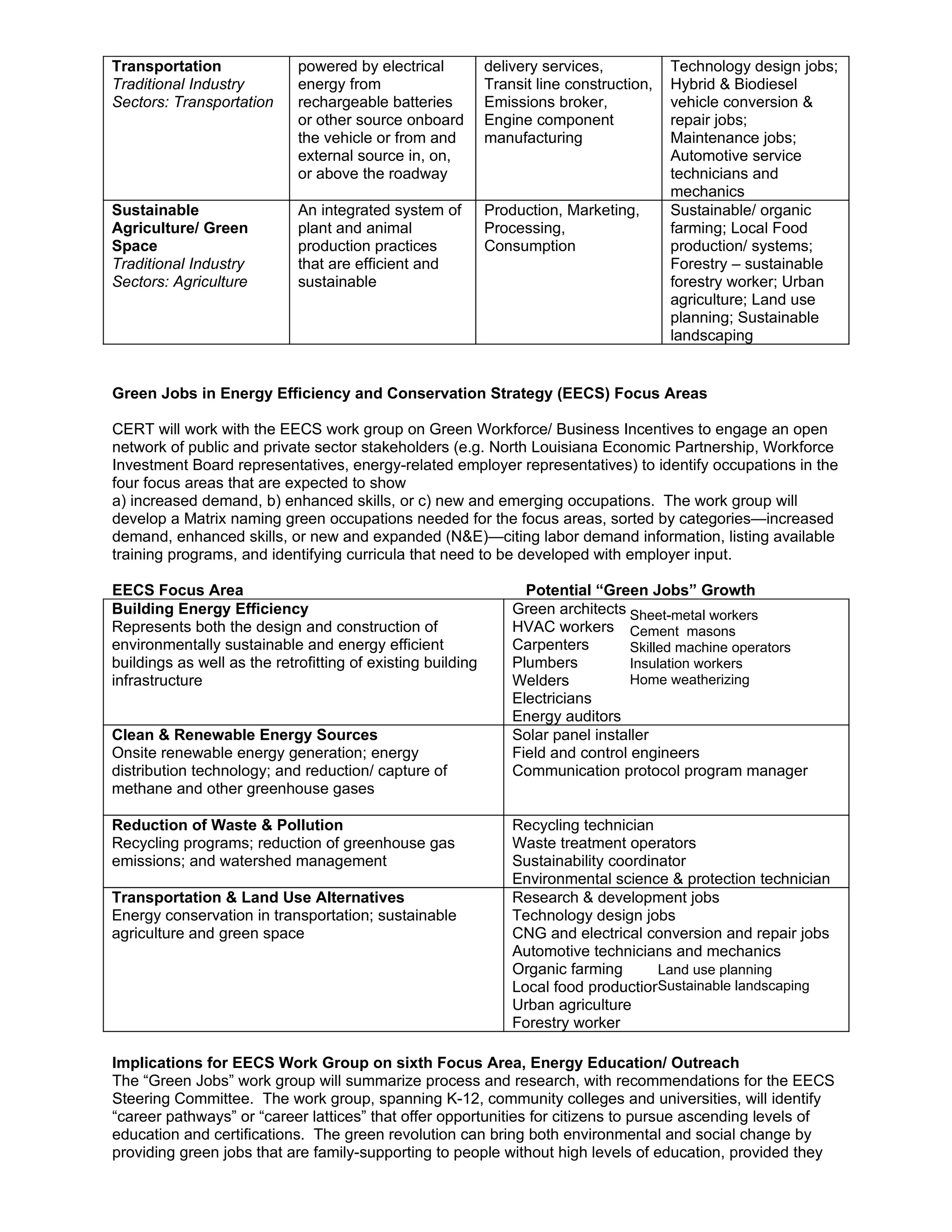
demand,” 60 “green enhanced skills,” and 91 “new and emerging occupations.” The following matrix,
excerpted from “A Green Growing Economy: Opportunities of Tomorrow,” by Juliet P. Scarpa (May 13,
2009), shows the potential for green jobs across sectors:

Industry Sector              Definition                    Requirements                 Sample Occupations
Green Building/              The design and                Manufacturing building       Green architects; HVAC
Sustainable/                 construction of               materials; planning,         workers; Carpenters;
Integrated design            environmentally               design and construction      Plumbers; Welders;
Traditional Industry         sustainable and energy                                     Electricians; Sheet-
Sectors; Manufacturing;      efficient buildings                                        metal workers; Cement
Construction; Utilities                                                             masons; Skilled
                                                                                    machine operators
Energy Efficiency          The retrofitting of         Auditing energy use in       Electricians;
Traditional Industry       existing building           existing buildings;          Technicians; Insulation
Sectors: Manufacturing;    infrastructure using        Manufacturing materials      workers; Equipment and
Construction; Utilities    healthy and more            and devices; Installing      installation specialist
                           resource-efficient          efficient lighting and       (solar panel installation);
                           models of construction,     heating systems;             Home weatherizing;
                           renovation, operation,      Installing insulation,       Energy Auditors
                           maintenance, and            windows and
                           demolition.                 appliances; Production
                                                       of appropriate
                                                       technologies
                                                       (fluorescent lights, water
                                                       filtration systems,
                                                       permeable concretes,
                                                       solar panels, etc.);
                                                       Maintenance &
                                                       operation
Renewable Energy           The use of natural          Manufacturing parts;         Solar panel installer;
(Solar/PV, Wind            resources (other than       Assembly & Installation      Steelworkers
Energy, Geothermal,        Biomass) for energy         of solar panels/ finished
Hydro/Marine)              which are naturally         heating systems;
Traditional Industry       replinishable               Constructing wind
Sectors: Utilities                                     farms; Operating and
                                                       maintaining wind
                                                       turbines; repairing
                                                       systems; Marketing and
                                                       selling systems to
                                                       consumers
Recycling/ Waste           The collection,             Composting; Materials        Recycling technician;
Management/ Removal        treatment, and disposal     reuse and recycling;         Waste treatment
Traditional Industry       or reuse of waste           Pollution Control; Water     operators; Sustainability
Sectors: Manufacturing;    materials                   Conservation &               coordinator; Bio-mimicry
Utilities; Technology                                  treatment; Components,       engineer; Environmental
                                                       Manufacturing &              Science and protection
                                                       Distribution/Enabling        technician
                                                       Technology;
                                                       Environmental
                                                       Consulting, Protection &
                                                       Remediation
Smart Grid/ Smart          Auto-balancing, self-       Manufacturing &              Field and control
Energy                     monitoring power grid       Installation, Distributing   engineers;
Traditional Industry       that accepts any source     and marketing products       Communication protocol
Sectors: Manufacturing;    of fuel and transforms it                                program manager;
Utilities                  into a consumer’s                                        Managing consultant
                           optimal renewable
                           energy usage with
                           minimal human
                           intervention
Biomass/ Biofuels/         Fuel creation from          Growing and harvesting       Process technicians in
Biosynergy/ Ethanol/       chemical/ biological        crops for feedstock,         biodiesel or ethanol
Fuel Cells/ Hydrogen       materials other than        collecting waste oils for    companies
Traditional Industry-      fossil fuels                feedstock,
sectors; Manufacturing;                                manufacturing parts for
Construction;                                          production facilities;
Agriculture;                                           construction,
transportation                                         maintenance and
                                                       operation of production
                                                       facilities
Vehicle Electrification/   A ground vehicle            Public Transportation,       Research and
Alternative                propelled by a motor        Bicycle repair & bike        Development jobs;
Transportation               powered by electrical           delivery services,           Technology design jobs;
Traditional Industry         energy from                     Transit line construction,   Hybrid & Biodiesel
Sectors: Transportation      rechargeable batteries          Emissions broker,            vehicle conversion &
                             or other source onboard         Engine component             repair jobs;
                             the vehicle or from and         manufacturing                Maintenance jobs;
                             external source in, on,                                      Automotive service
                             or above the roadway                                         technicians and
                                                                                          mechanics
Sustainable                  An integrated system of         Production, Marketing,       Sustainable/ organic
Agriculture/ Green           plant and animal                Processing,                  farming; Local Food
Space                        production practices            Consumption                  production/ systems;
Traditional Industry         that are efficient and                                       Forestry – sustainable
Sectors: Agriculture         sustainable                                                  forestry worker; Urban
                                                                                          agriculture; Land use
                                                                                          planning; Sustainable
                                                                                          landscaping


Green Jobs in Energy Efficiency and Conservation Strategy (EECS) Focus Areas

CERT will work with the EECS work group on Green Workforce/ Business Incentives to engage an open
network of public and private sector stakeholders (e.g. North Louisiana Economic Partnership, Workforce
Investment Board representatives, energy-related employer representatives) to identify occupations in the
four focus areas that are expected to show
a) increased demand, b) enhanced skills, or c) new and emerging occupations. The work group will
develop a Matrix naming green occupations needed for the focus areas, sorted by categories—increased
demand, enhanced skills, or new and expanded (N&E)—citing labor demand information, listing available
training programs, and identifying curricula that need to be developed with employer input.

EECS Focus Area                                                    Potential “Green Jobs” Growth
Building Energy Efficiency                                       Green architects Sheet-metal workers
Represents both the design and construction of                   HVAC workers Cement masons
environmentally sustainable and energy efficient                 Carpenters        Skilled machine operators
buildings as well as the retrofitting of existing building       Plumbers          Insulation workers
infrastructure                                                   Welders           Home weatherizing
                                                                 Electricians
                                                                 Energy auditors
Clean & Renewable Energy Sources                                 Solar panel installer
Onsite renewable energy generation; energy                       Field and control engineers
distribution technology; and reduction/ capture of               Communication protocol program manager
methane and other greenhouse gases

Reduction of Waste & Pollution                                   Recycling technician
Recycling programs; reduction of greenhouse gas                  Waste treatment operators
emissions; and watershed management                              Sustainability coordinator
                                                                 Environmental science & protection technician
Transportation & Land Use Alternatives                           Research & development jobs
Energy conservation in transportation; sustainable               Technology design jobs
agriculture and green space                                      CNG and electrical conversion and repair jobs
                                                                 Automotive technicians and mechanics
                                                                 Organic farming       Land use planning
                                                                 Local food productionSustainable landscaping
                                                                 Urban agriculture
                                                                 Forestry worker

Implications for EECS Work Group on sixth Focus Area, Energy Education/ Outreach
The “Green Jobs” work group will summarize process and research, with recommendations for the EECS
Steering Committee. The work group, spanning K-12, community colleges and universities, will identify
“career pathways” or “career lattices” that offer opportunities for citizens to pursue ascending levels of
education and certifications. The green revolution can bring both environmental and social change by
providing green jobs that are family-supporting to people without high levels of education, provided they
seek additional training. Historically, community colleges have moved the working poor to middle-skills
jobs with sustaining wages; Bossier Parish Community College, Louisiana Technical College, and
Southern University at Shreveport address that need.

Potential funding opportunities. CERT has developed a summary sheet and is researching federal
and other funding opportunities that EECS can leverage for identified energy efficiency and conservation
projects. Of the funding opportunities reviewed, fewer than one-third require cost sharing, though all
programs award points for leveraging other grants and private sector partners, for example, a Retrofit
Ramp-up program rewards partnering with banks, local utilities, appliance retailers, and construction
firms. Funding agencies and programs include Housing & Urban Development, Department of
Commerce, Department of Energy, Department of Health and Human Services, Department of
Agriculture, Department of Homeland Security, National Science Foundation, Department of the Interior,
Department of Education, and Department of Transportation. Building energy audits, tax credits, and
weatherization, particularly for low-income, are encouraged, and innovation is rewarded across a wide
variety of market sectors. (See samples in the Appendix.)

Public/ private partnerships. CERT will identify and align strategic partners to support EECS working
groups. For example, CERT currently works with Community Renewal International (CRI) in connecting
Louisiana higher education to companies like Storer Equipment, Trane, Hubbell Building Automation and
CISCO to deploy new energy conserving technologies for the design and construction of the national
Center for Community Renewal.

Energy education/ outreach. Although CERT will be convening higher education and K-12 for
collaborative efforts around green workforce and curricula, the EECS Steering Committee stipulates that
every project selected and funded should incorporate strategies and funds for marketing energy
education to citizens. On member states, “Think of ourselves and build policies that encourage us to
think of ourselves as energy producers and consumers, energy entrepreneurs.” Another urged creating
energy-related projects that serve neighborhoods and diversion programs for unemployed,
underemployed, prison labor and at-risk youth. CERT was asked to serve as the “key hub for
collaboration” around projects that educate citizens about energy. For example, CERT is partnering with
EnCana Energy, Bossier Parish Community College and Southern University at Shreveport to conduct
four, one-week Energy Venture Camps in summer 2010 for Bossier and Caddo 14- and 15-year olds.
Some members of the EECS Steering Committee and Project Team also serve on the Shreveport/Caddo
Master Plan work groups, and will seek to build on the values identified by Shreveport citizens. CERT will
identify portions of the Master Plan that contribute to EECS initiatives to improve Shreveport’s energy
independence.

Eecs Cert Report

  • 1.
    Higher Education Alignmentto Support Initiatives of the Energy Efficiency and Conservation Strategy (EECS) – CERT Report The Consortium for Education, Research & Technology (CERT) has been retained by Gulf Geoexchange and Consulting Services, Inc. in partnership with the City of Shreveport and serves on the Project Team in three key roles to support the Energy Efficiency and Conservation Strategy (EECS): • Identify and align the combined resources of 12 higher education member institutions across North Louisiana to focus on research and development, workforce development and K-12/community outreach; • Serve a “link and leverage” role to others across existing silos—education, government, nonprofits, businesses, funding sources and others—who can help with the process (e.g. baseline, reporting, GIS); and • Help inform the work group, creating common knowledge base (e.g., best practices, analyses) to explore new educational models to use in the process. As part of the Project Team, CERT will help manage the networks, identify funding and track initiatives. Higher education resources. CERT Chancellors/Presidents (or their designees) for the past year have committed to learning the Strategic Doing process and to aligning their resources on multiple, innovative initiatives or projects. CERT has surveyed member institutions to identify current “energy systems” research projects, grants, and members of college faculties who have expertise and new technologies to contribute in one or more of the six EECS focus areas: • Building Energy Efficiency • Clean & Renewable Energy Sources • Reduction of Waste & Pollution • Transportation & Land Use Alternatives • Green Workforce/ Business Incentives • Energy Education/ Outreach Database. CERT is constructing a database of both academic and research and development resources of the 12 member institutions across the region. Examples include a Louisiana Tech University research project, “Nanoparticle Incorporated Heterogeneous Catalyst System for Biodiesel Production” and an LSU-Shreveport Institute of Human Services & Public Policy that can assist the Project Team in designing metrics and indicators. “Green Jobs” framework. CERT will convene a work group of higher education and k-12 educators to develop a plan framework for green jobs. CERT surveyed the U.S. Department of Labor February 2009 report, “Greening of the World of Work: Implications for O*NET-SOC and New and Emerging Occupations.” DOL urges moving beyond simply applying a broad label such as “green jobs,” to identify the “greening of occupations” in three categories, and project increased demand: • Green increased demand occupations—an increase in the employment demand for an existing occupations • Green enhanced skills occupations—a significant change to the work and worker requirements of an existing occupation; i.e., tasks, skills, knowledge and credentials have been altered, and • Green new and emerging (N&E) occupations—impact is sufficient to create the need for unique work and worker requirements; the new occupation could be entirely novel or “born” from an existing occupation. Through a multi-stage research and screening process that included a review of existing literature, identification and compiling of job titles, review and sorting of job titles, and clustering of job titles into 12 sector occupational sectors, the National Center for O*NET Development identified 64 “green increased demand,” 60 “green enhanced skills,” and 91 “new and emerging occupations.” The following matrix, excerpted from “A Green Growing Economy: Opportunities of Tomorrow,” by Juliet P. Scarpa (May 13, 2009), shows the potential for green jobs across sectors: Industry Sector Definition Requirements Sample Occupations Green Building/ The design and Manufacturing building Green architects; HVAC Sustainable/ construction of materials; planning, workers; Carpenters; Integrated design environmentally design and construction Plumbers; Welders; Traditional Industry sustainable and energy Electricians; Sheet- Sectors; Manufacturing; efficient buildings metal workers; Cement
  • 2.
    Construction; Utilities masons; Skilled machine operators Energy Efficiency The retrofitting of Auditing energy use in Electricians; Traditional Industry existing building existing buildings; Technicians; Insulation Sectors: Manufacturing; infrastructure using Manufacturing materials workers; Equipment and Construction; Utilities healthy and more and devices; Installing installation specialist resource-efficient efficient lighting and (solar panel installation); models of construction, heating systems; Home weatherizing; renovation, operation, Installing insulation, Energy Auditors maintenance, and windows and demolition. appliances; Production of appropriate technologies (fluorescent lights, water filtration systems, permeable concretes, solar panels, etc.); Maintenance & operation Renewable Energy The use of natural Manufacturing parts; Solar panel installer; (Solar/PV, Wind resources (other than Assembly & Installation Steelworkers Energy, Geothermal, Biomass) for energy of solar panels/ finished Hydro/Marine) which are naturally heating systems; Traditional Industry replinishable Constructing wind Sectors: Utilities farms; Operating and maintaining wind turbines; repairing systems; Marketing and selling systems to consumers Recycling/ Waste The collection, Composting; Materials Recycling technician; Management/ Removal treatment, and disposal reuse and recycling; Waste treatment Traditional Industry or reuse of waste Pollution Control; Water operators; Sustainability Sectors: Manufacturing; materials Conservation & coordinator; Bio-mimicry Utilities; Technology treatment; Components, engineer; Environmental Manufacturing & Science and protection Distribution/Enabling technician Technology; Environmental Consulting, Protection & Remediation Smart Grid/ Smart Auto-balancing, self- Manufacturing & Field and control Energy monitoring power grid Installation, Distributing engineers; Traditional Industry that accepts any source and marketing products Communication protocol Sectors: Manufacturing; of fuel and transforms it program manager; Utilities into a consumer’s Managing consultant optimal renewable energy usage with minimal human intervention Biomass/ Biofuels/ Fuel creation from Growing and harvesting Process technicians in Biosynergy/ Ethanol/ chemical/ biological crops for feedstock, biodiesel or ethanol Fuel Cells/ Hydrogen materials other than collecting waste oils for companies Traditional Industry- fossil fuels feedstock, sectors; Manufacturing; manufacturing parts for Construction; production facilities; Agriculture; construction, transportation maintenance and operation of production facilities Vehicle Electrification/ A ground vehicle Public Transportation, Research and Alternative propelled by a motor Bicycle repair & bike Development jobs;
  • 3.
    Transportation powered by electrical delivery services, Technology design jobs; Traditional Industry energy from Transit line construction, Hybrid & Biodiesel Sectors: Transportation rechargeable batteries Emissions broker, vehicle conversion & or other source onboard Engine component repair jobs; the vehicle or from and manufacturing Maintenance jobs; external source in, on, Automotive service or above the roadway technicians and mechanics Sustainable An integrated system of Production, Marketing, Sustainable/ organic Agriculture/ Green plant and animal Processing, farming; Local Food Space production practices Consumption production/ systems; Traditional Industry that are efficient and Forestry – sustainable Sectors: Agriculture sustainable forestry worker; Urban agriculture; Land use planning; Sustainable landscaping Green Jobs in Energy Efficiency and Conservation Strategy (EECS) Focus Areas CERT will work with the EECS work group on Green Workforce/ Business Incentives to engage an open network of public and private sector stakeholders (e.g. North Louisiana Economic Partnership, Workforce Investment Board representatives, energy-related employer representatives) to identify occupations in the four focus areas that are expected to show a) increased demand, b) enhanced skills, or c) new and emerging occupations. The work group will develop a Matrix naming green occupations needed for the focus areas, sorted by categories—increased demand, enhanced skills, or new and expanded (N&E)—citing labor demand information, listing available training programs, and identifying curricula that need to be developed with employer input. EECS Focus Area Potential “Green Jobs” Growth Building Energy Efficiency Green architects Sheet-metal workers Represents both the design and construction of HVAC workers Cement masons environmentally sustainable and energy efficient Carpenters Skilled machine operators buildings as well as the retrofitting of existing building Plumbers Insulation workers infrastructure Welders Home weatherizing Electricians Energy auditors Clean & Renewable Energy Sources Solar panel installer Onsite renewable energy generation; energy Field and control engineers distribution technology; and reduction/ capture of Communication protocol program manager methane and other greenhouse gases Reduction of Waste & Pollution Recycling technician Recycling programs; reduction of greenhouse gas Waste treatment operators emissions; and watershed management Sustainability coordinator Environmental science & protection technician Transportation & Land Use Alternatives Research & development jobs Energy conservation in transportation; sustainable Technology design jobs agriculture and green space CNG and electrical conversion and repair jobs Automotive technicians and mechanics Organic farming Land use planning Local food productionSustainable landscaping Urban agriculture Forestry worker Implications for EECS Work Group on sixth Focus Area, Energy Education/ Outreach The “Green Jobs” work group will summarize process and research, with recommendations for the EECS Steering Committee. The work group, spanning K-12, community colleges and universities, will identify “career pathways” or “career lattices” that offer opportunities for citizens to pursue ascending levels of education and certifications. The green revolution can bring both environmental and social change by providing green jobs that are family-supporting to people without high levels of education, provided they
  • 4.
    seek additional training.Historically, community colleges have moved the working poor to middle-skills jobs with sustaining wages; Bossier Parish Community College, Louisiana Technical College, and Southern University at Shreveport address that need. Potential funding opportunities. CERT has developed a summary sheet and is researching federal and other funding opportunities that EECS can leverage for identified energy efficiency and conservation projects. Of the funding opportunities reviewed, fewer than one-third require cost sharing, though all programs award points for leveraging other grants and private sector partners, for example, a Retrofit Ramp-up program rewards partnering with banks, local utilities, appliance retailers, and construction firms. Funding agencies and programs include Housing & Urban Development, Department of Commerce, Department of Energy, Department of Health and Human Services, Department of Agriculture, Department of Homeland Security, National Science Foundation, Department of the Interior, Department of Education, and Department of Transportation. Building energy audits, tax credits, and weatherization, particularly for low-income, are encouraged, and innovation is rewarded across a wide variety of market sectors. (See samples in the Appendix.) Public/ private partnerships. CERT will identify and align strategic partners to support EECS working groups. For example, CERT currently works with Community Renewal International (CRI) in connecting Louisiana higher education to companies like Storer Equipment, Trane, Hubbell Building Automation and CISCO to deploy new energy conserving technologies for the design and construction of the national Center for Community Renewal. Energy education/ outreach. Although CERT will be convening higher education and K-12 for collaborative efforts around green workforce and curricula, the EECS Steering Committee stipulates that every project selected and funded should incorporate strategies and funds for marketing energy education to citizens. On member states, “Think of ourselves and build policies that encourage us to think of ourselves as energy producers and consumers, energy entrepreneurs.” Another urged creating energy-related projects that serve neighborhoods and diversion programs for unemployed, underemployed, prison labor and at-risk youth. CERT was asked to serve as the “key hub for collaboration” around projects that educate citizens about energy. For example, CERT is partnering with EnCana Energy, Bossier Parish Community College and Southern University at Shreveport to conduct four, one-week Energy Venture Camps in summer 2010 for Bossier and Caddo 14- and 15-year olds. Some members of the EECS Steering Committee and Project Team also serve on the Shreveport/Caddo Master Plan work groups, and will seek to build on the values identified by Shreveport citizens. CERT will identify portions of the Master Plan that contribute to EECS initiatives to improve Shreveport’s energy independence.