Application Management in the Cloud era
AgendaApplication management disciplineIndustry trendsApplication management challengesWhat is changing?VMware approach – Active application managementQ&A
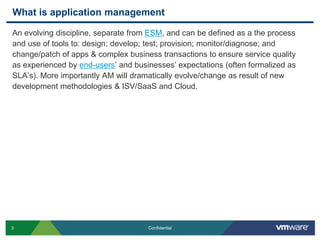
What is application managementAn evolving discipline, separate from ESM, and can be defined as a the process and use of tools to: design; develop; test; provision; monitor/diagnose; and change/patch of apps & complex business transactions to ensure service quality as experienced by end-users’ and businesses’ expectations (often formalized as SLA’s). More importantly AM will dramatically evolve/change as result of new development methodologies & ISV/SaaS and Cloud.
Industry Trends
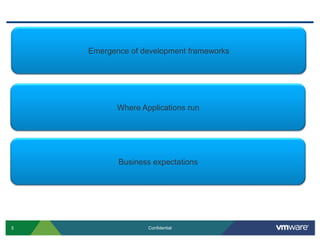
Emergence of development frameworksWhere Applications runBusiness expectations
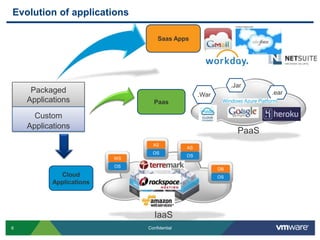
Evolution of applicationsSaas Apps.JarPackaged Applications.War.earPaasCustomApplicationsPaaSWSASDBASOSOSOSOSCloud ApplicationsIaaS
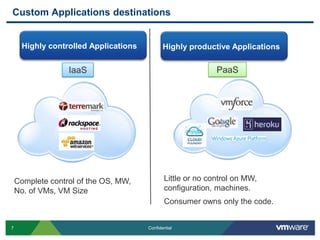
Custom Applications destinationsHighly controlled ApplicationsHighly productive ApplicationsPaaSIaaSComplete control of the OS, MW, No. of VMs, VM SizeLittle or no control on MW, configuration, machines.Consumer owns only the code.
Modern Application ChallengesBusiness challengesConstantly finding new and  innovative ideas to monetize core competence
Ability to turn those ideas around and get them to market  quickly is absolutely keyIT Operations challengesHow to enable all these rapid changes without loosing control?
How can I control cost of running our applications?
How can I meet the service level and compliancy requirement?
Control proliferation of  Developer  challengesHow can I get new features rapidly taken through the dev-build-test-stage-deploy cycle?
I do not want to manage my infrastructure scalability for my application
I need Framework and development tools to increase & simplify my app development and increase  productivity 8
What is changing
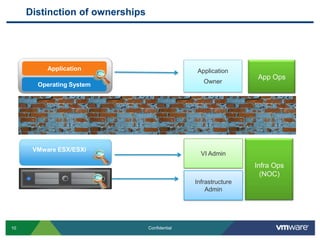
Distinction of ownershipsApplicationOwnerApp OpsApplicationOperating SystemVI AdminInfra Ops (NOC)VMware ESX/ESXiInfrastructure Admin
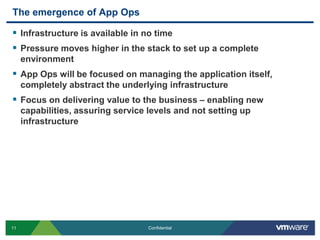
The emergence of App OpsInfrastructure is available in no timePressure moves higher in the stack to set up a complete environmentApp Ops will be focused on managing the application itself, completely abstract the underlying infrastructureFocus on delivering value to the business – enabling new capabilities, assuring service levels and not setting up infrastructure
Active application management
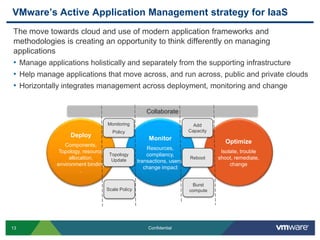
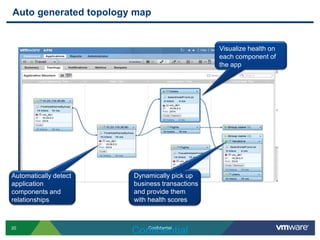
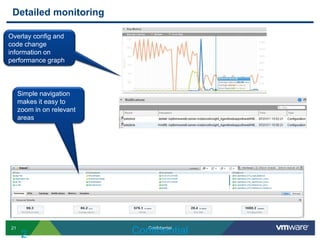
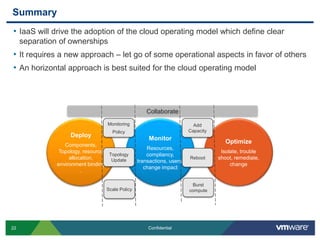
VMware’s Active Application Management strategy for IaaSThe move towards cloud and use of modern application frameworks and methodologies is creating an opportunity to think differently on managing applicationsManage applications holistically and separately from the supporting infrastructureHelp manage applications that move across, and run across, public and private cloudsHorizontally integrates management across deployment, monitoring and changeCollaborateMonitoringPolicyAdd CapacityOptimizeIsolate, trouble shoot, remediate, changeDeployComponents, Topology, resource allocation, environment binding .MonitorResources, compliancy, transactions, users, change impactTopology UpdateRebootBurst computeScale Policy
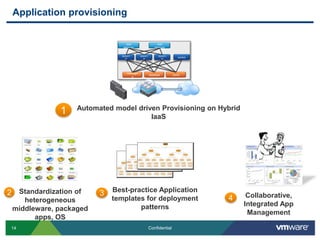
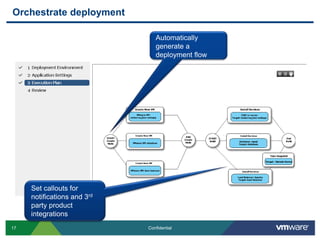
Application provisioningload balancerload balancerappserverappserverappserverworkerAutomated model driven Provisioning on Hybrid IaaS1cachedatabasemessagingBest-practice Application templates for deployment patternsStandardization of heterogeneous middleware, packaged apps, OS23Collaborative, Integrated App Management4
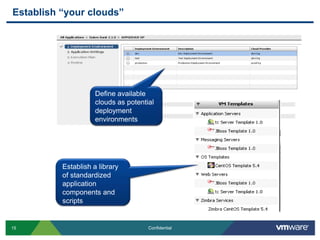
Establish “your clouds”Define available clouds as potential deployment environmentsEstablish a library of standardized application components and scripts
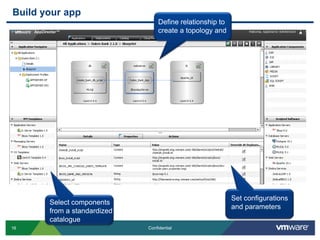
Build your appDefine relationship to create a topology andSet configurations and parametersSelect components from a standardized catalogue

Application management for hybrid cloud

  • 1.
  • 2.
    AgendaApplication management disciplineIndustrytrendsApplication management challengesWhat is changing?VMware approach – Active application managementQ&A
  • 3.
    What is applicationmanagementAn evolving discipline, separate from ESM, and can be defined as a the process and use of tools to: design; develop; test; provision; monitor/diagnose; and change/patch of apps & complex business transactions to ensure service quality as experienced by end-users’ and businesses’ expectations (often formalized as SLA’s). More importantly AM will dramatically evolve/change as result of new development methodologies & ISV/SaaS and Cloud.
  • 4.
  • 5.
    Emergence of developmentframeworksWhere Applications runBusiness expectations
  • 6.
    Evolution of applicationsSaasApps.JarPackaged Applications.War.earPaasCustomApplicationsPaaSWSASDBASOSOSOSOSCloud ApplicationsIaaS
  • 7.
    Custom Applications destinationsHighlycontrolled ApplicationsHighly productive ApplicationsPaaSIaaSComplete control of the OS, MW, No. of VMs, VM SizeLittle or no control on MW, configuration, machines.Consumer owns only the code.
  • 8.
    Modern Application ChallengesBusinesschallengesConstantly finding new and innovative ideas to monetize core competence
  • 9.
    Ability to turnthose ideas around and get them to market quickly is absolutely keyIT Operations challengesHow to enable all these rapid changes without loosing control?
  • 10.
    How can Icontrol cost of running our applications?
  • 11.
    How can Imeet the service level and compliancy requirement?
  • 12.
    Control proliferation of Developer challengesHow can I get new features rapidly taken through the dev-build-test-stage-deploy cycle?
  • 13.
    I do notwant to manage my infrastructure scalability for my application
  • 14.
    I need Frameworkand development tools to increase & simplify my app development and increase productivity 8
  • 15.
  • 16.
    Distinction of ownershipsApplicationOwnerAppOpsApplicationOperating SystemVI AdminInfra Ops (NOC)VMware ESX/ESXiInfrastructure Admin
  • 17.
    The emergence ofApp OpsInfrastructure is available in no timePressure moves higher in the stack to set up a complete environmentApp Ops will be focused on managing the application itself, completely abstract the underlying infrastructureFocus on delivering value to the business – enabling new capabilities, assuring service levels and not setting up infrastructure
  • 18.
  • 19.
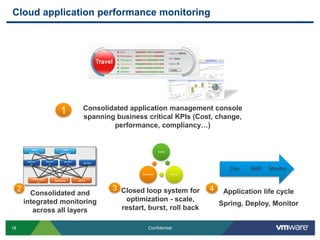
    VMware’s Active ApplicationManagement strategy for IaaSThe move towards cloud and use of modern application frameworks and methodologies is creating an opportunity to think differently on managing applicationsManage applications holistically and separately from the supporting infrastructureHelp manage applications that move across, and run across, public and private cloudsHorizontally integrates management across deployment, monitoring and changeCollaborateMonitoringPolicyAdd CapacityOptimizeIsolate, trouble shoot, remediate, changeDeployComponents, Topology, resource allocation, environment binding .MonitorResources, compliancy, transactions, users, change impactTopology UpdateRebootBurst computeScale Policy
  • 20.
    Application provisioningload balancerloadbalancerappserverappserverappserverworkerAutomated model driven Provisioning on Hybrid IaaS1cachedatabasemessagingBest-practice Application templates for deployment patternsStandardization of heterogeneous middleware, packaged apps, OS23Collaborative, Integrated App Management4
  • 21.
    Establish “your clouds”Defineavailable clouds as potential deployment environmentsEstablish a library of standardized application components and scripts
  • 22.
    Build your appDefinerelationship to create a topology andSet configurations and parametersSelect components from a standardized catalogue

Editor's Notes

  • #9 CIO and Company ExecutivesWe constantly need to find new and innovative ways to monetize our core competencies. Ideas for new features are coming through all the time, and for us to be able to turn those features around and get them to market quickly is absolutely keyCan you help make my company more competitive?Can you help make my company more profitable?Can you help remove risk from my IT strategy?Web and IT OperationsOur application infrastructure is not scaling with demand. Can you help?I need to reduce the cost of running all of these applications. Can you help?DevelopersThe business is asking us to get applications to market faster. Can you help?We need to deliver business data faster on every new project. Can you help?We need to build modern applications like people use at home. Can you help?
  • #11 As applications get virtualized and pushed into a cloud (Private or public) there is a very clear separation between the infrastructure management paradigm and the application management one – they are no more intertwined.The infrastructure managers are provider of compute platform for the VMs running on them and should not care what is in that VM.The Application owners do not care where physically or on which HW their applications are runningThere is however the need to provide visibility to both sides of the wall as to what is happening on the other side: Application owners need to know the platform is indeed providing adequately to the demand of the application (Compute power, I/O, disk latency etc..) in a clear aggregated matter. The Infrastructure owner will need to know the Application is running well if they conduct change to the platform
  • #14 The separation of Application and Infrastructure (Cloud provider / cloud consumer model)By moving to an horizontal approach, customers will able to gain a lot more control on the Application and adapt it to the business needs (Scale & Remediation)The motivation of the separation and focus on the Application layer as a complete operational stack it to allow the Application owners and developers achieve better agility, more flexibility, control and performance and ultimately migrate maintanance cost to innovation
  • #23 The separation of Application and Infrastructure (Cloud provider / cloud consumer model)By moving to an horizontal approach, customers will able to gain a lot more control on the Application and adapt it to the business needs (Scale & Remediation)The motivation of the separation and focus on the Application layer as a complete operational stack it to allow the Application owners and developers achieve better agility, more flexibility, control and performance and ultimately migrate maintanance cost to innovation