APPLICATION LETTER
By
Marsono, S.Pd
Kompetensi Dasar
 3.2 Membedakan fungsi sosial, struktur teks, dan unsur kebahasaan beberapa
teks khusus dalam bentuk surat lamaran kerja, dengan memberi dan meminta
informasi terkait jati diri, latar belakang pendidikan/pengalaman kerja, sesuai
dengan konteks penggunaannya
 4.2 Surat lamaran kerja
 4.2.1 Menangkap makna secara kontekstual terkait fungsi sosial, struktur teks,
dan unsur kebahasaan teks khusus dalam bentuk surat lamaran kerja, yang
memberikan informasi antara lain jati diri, latar belakang
pendidikan/pengalaman kerja
 4.2.2 Menyusun teks khusus surat lamaran kerja, yang memberikan informasi
antara lain jati diri, latar belakang pendidikan/pengalaman kerja, dengan
memperhatikan fungsi sosial, struktur teks, dan unsur kebahasaan, secara benar
dan sesuai konteks
Tujuan Pembelajaran
 Menirukan guru membacakan beberapa surat lamaran dengan ucapan, dan tekanan
kata yang benar.
 Mengaitkan kualifikasi dengan pekerjaan yang dilamar, dan membahas kesesuaiannya
 Mengidentifikasi perbedann dan persamaan kalimat-kalimat pembuka, pernyataan
kualifikasi, dan bagian-bagian lainnya
 Membuat setiap bagian surat lamaran kerja disesuaikan dengan persyaratan yang tertera
di iklan lowongan kerja
 Menangkap makna secara kontekstual terkait fungsi sosial, struktur teks, dan unsur
kebahasaan teks khusus dalam bentuk surat lamaran kerja, yang memberikan informasi
antara lain jati diri, latar belakang pendidikan/pengalaman kerja
 Menyusun teks khusus surat lamaran kerja, yang memberikan informasi antara lain jati diri,
latar belakang pendidikan/pengalaman kerja, dengan memperhatikan fungsi sosial,
struktur teks, dan unsur kebahasaan, secara benar dan sesuai konteks
Formal Letters – Beginning and
Ending
• There are two ways to begin a formal
letter:
• Dear Sir/Madam (when you don’t know the name)
• Dear Mr Smith (name of person)
• If you begin your letter, ‘Dear Sir/Madam
you must end it, ‘Yours faithfully,’
• If you begin your letter ‘Dear Mr Smith,’
you must end it, ‘Yours sincerely,’
• These are the rules of formal letters in
English – there are no exceptions!
Formal Language
• Formal letters use formal language.
• What does this mean?
• No contractions (don’t/can’t/I’ll etc).
• No informal expressions (Why don’t we…/Did you
know that…/Write soon!/Love…/What’s up?/I’d love to!).
• No informal punctuation (!/…/( )/ - ).
• No phrasal verbs (pick up/look up/get over/turn on
etc.)
Formal Language
• Use formal linking words to make our
writing more cohesive: (Moreover/Furthermore/
Therefore)
• Use modal verbs in formal expressions:
(could/would/should)
• Use formal adjectives instead of informal
adjectives: (‘pleasant’ not ‘nice’/’pleased’ not
‘happy’/’enjoyable’ not ‘fun’ – and definitely not ‘funny’!)
• Use polite language (I would be interested in/ I
hope that you will consider my application / I look forward to
hearing from you soon).
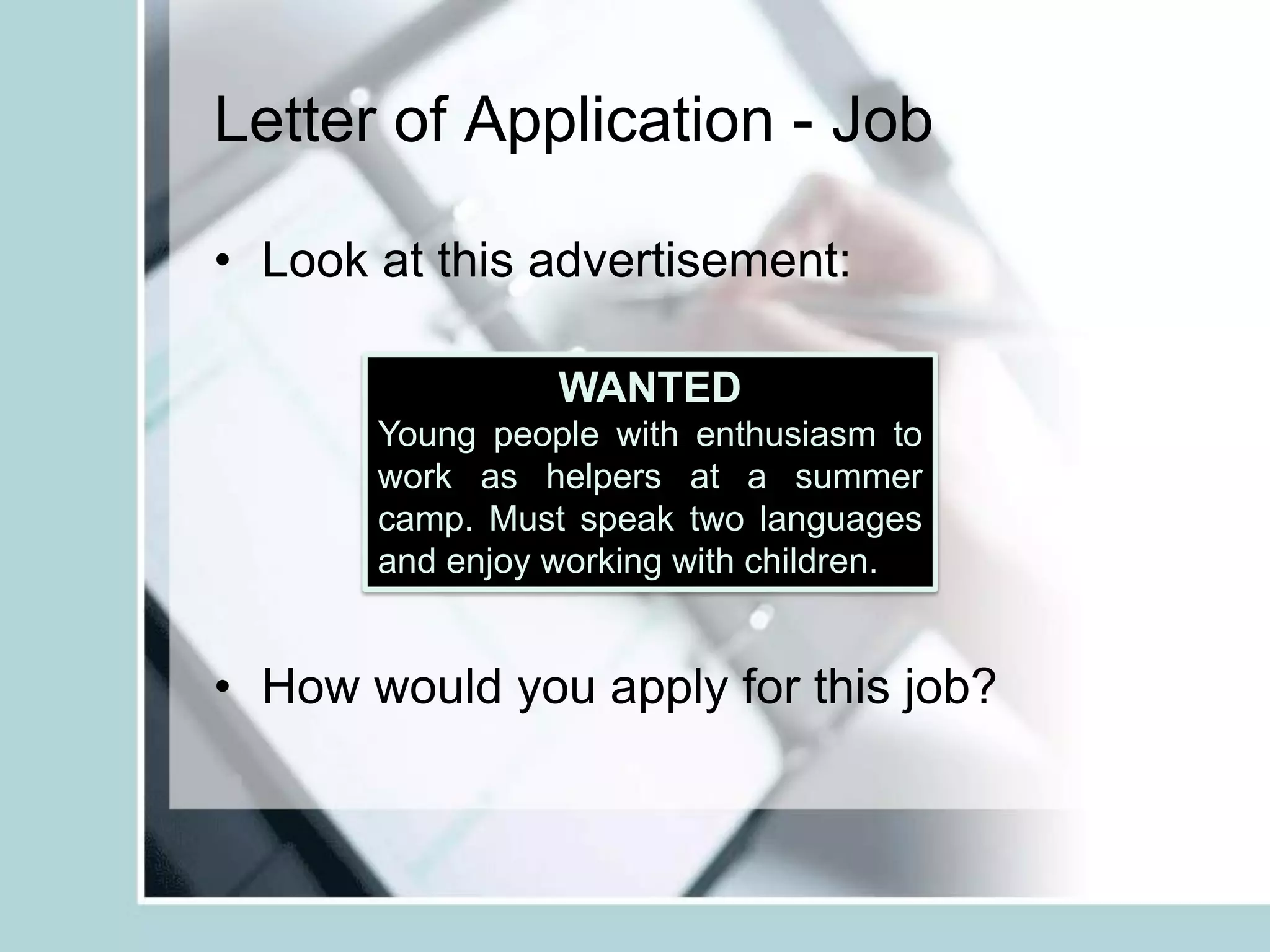
Letter of Application - Job
• Look at this advertisement:
• How would you apply for this job?
WANTED
Young people with enthusiasm to
work as helpers at a summer
camp. Must speak two languages
and enjoy working with children.
First Paragraph
• Say why you are writing.
• Say what job you are applying for.
• Say where/when you saw it advertised (you
can invent this).
WANTED
Young people with enthusiasm to
work as helpers at a summer
camp. Must speak two languages
and enjoy working with children.
First Paragraph
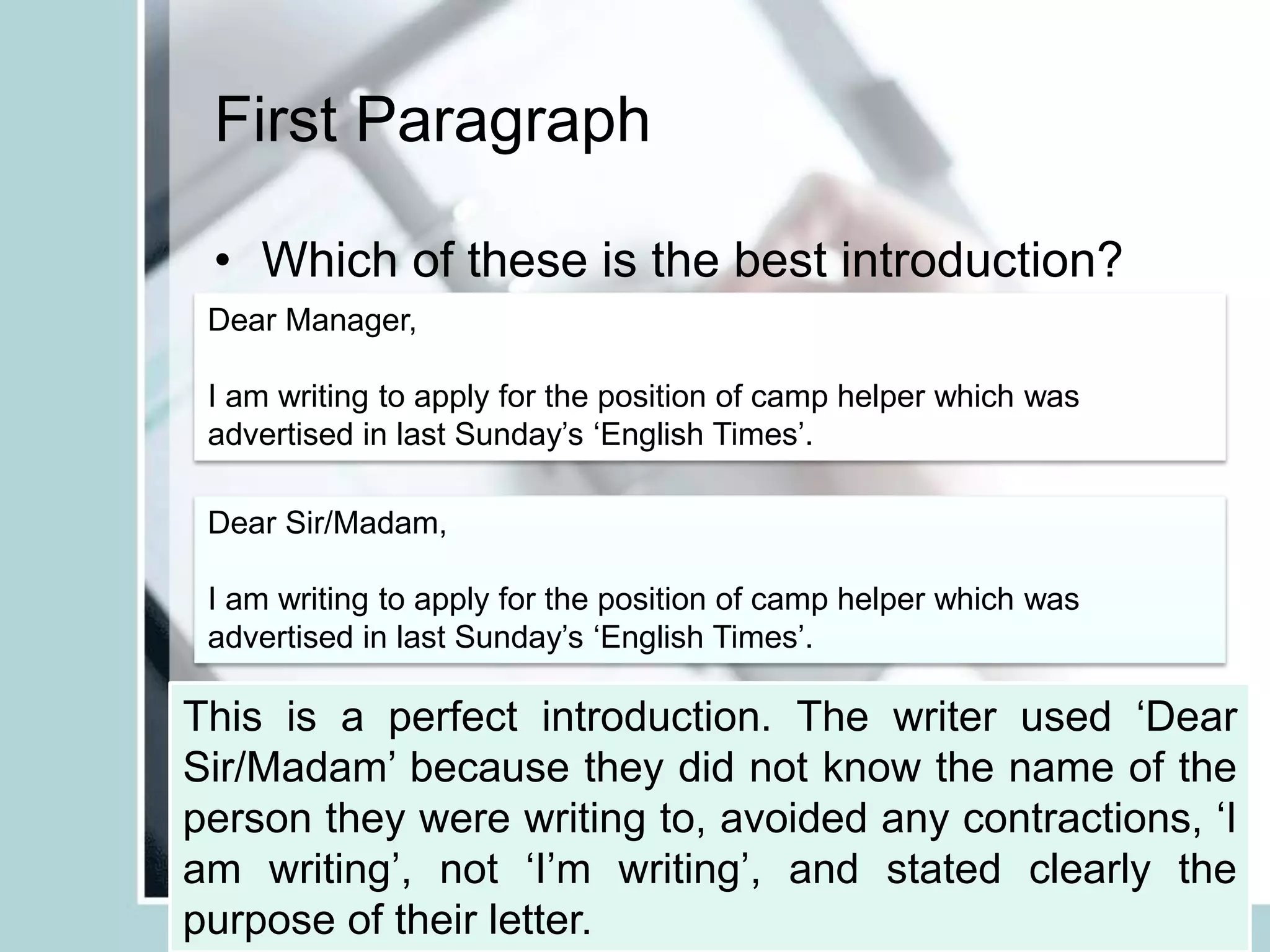
Dear Sir/Madam,
I am writing to apply for the position of camp helper which was
advertised in last Sunday’s ‘English Times’.
• Which of these is the best introduction?
Dear Manager,
I am writing to apply for the position of camp helper which was
advertised in last Sunday’s ‘English Times’.
Dear Sir/Madam,
I’m writing to apply for the job at your camp which I saw in ‘English
Times’ the other day.
This is a perfect introduction. The writer used ‘Dear
Sir/Madam’ because they did not know the name of the
person they were writing to, avoided any contractions, ‘I
am writing’, not ‘I’m writing’, and stated clearly the
purpose of their letter.
First Paragraph
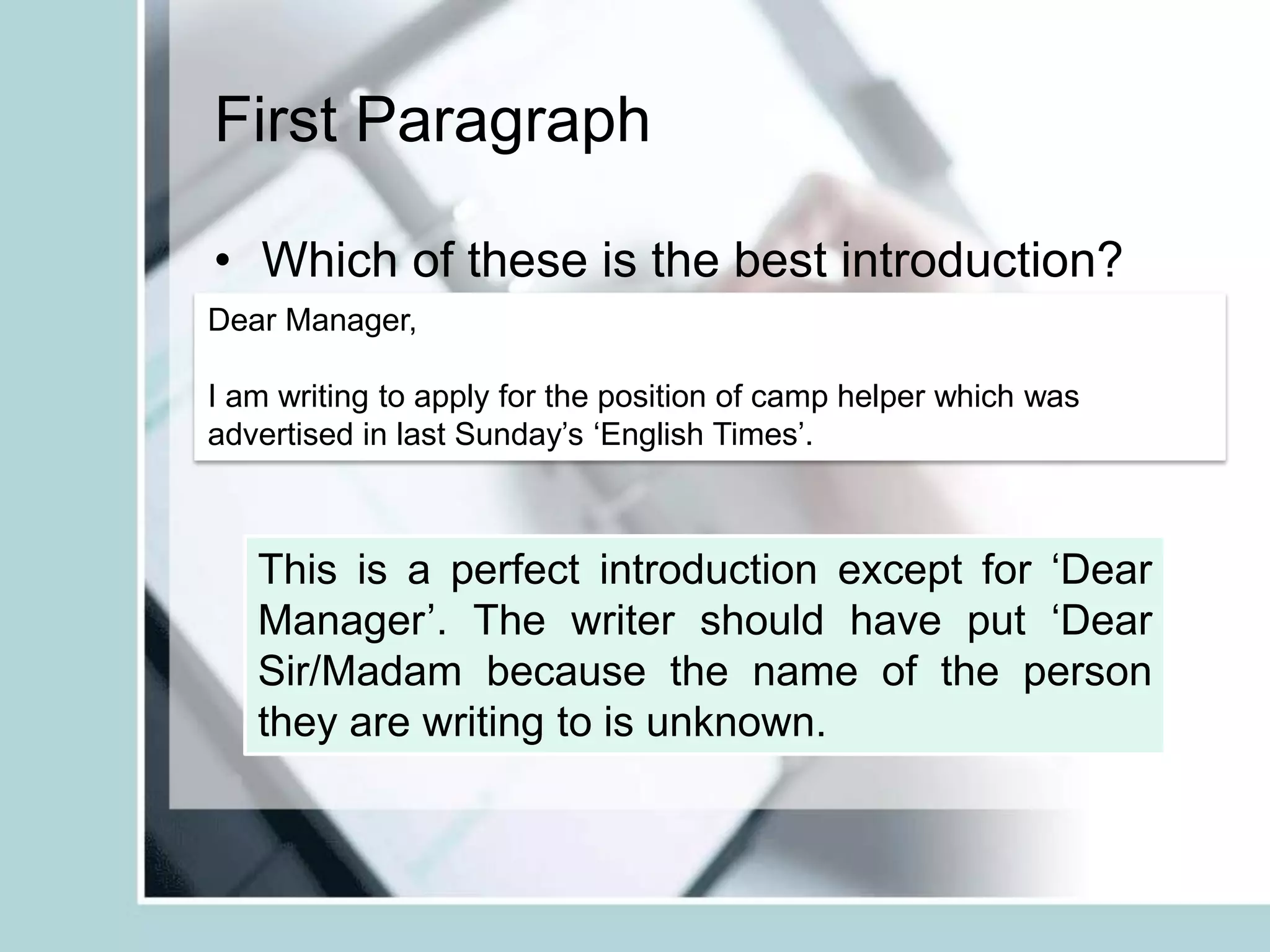
• Which of these is the best introduction?
Dear Manager,
I am writing to apply for the position of camp helper which was
advertised in last Sunday’s ‘English Times’.
This is a perfect introduction except for ‘Dear
Manager’. The writer should have put ‘Dear
Sir/Madam because the name of the person
they are writing to is unknown.
First Paragraph
• Which of these is the best introduction?
Dear Sir/Madam,
I’m writing to apply for the job at your camp which I saw in ‘English
Times’ the other day.
This writer has started correctly, ‘Dear
Sir/Madam’, but their introduction is too
informal. You should try to avoid directly
addressing the person you are writing to, ‘your
camp’, and expressions like ‘the other day’ are
very informal.
Second Paragraph
• Introduce yourself.
• Say what qualities you have which make
you suitable for the job.
• Give details of your qualifications and
previous experience.
• Make sure you include any details that
are mentioned in the advertisement!
WANTED
Young people with enthusiasm to
work as helpers at a summer
camp. Must speak two languages
and enjoy working with children.
1
2
3
Which of these is the best answer?
I am a positive and enthusiastic person and I have always enjoyed working
with children. I have been volunteering at a local camp for the past two
years which has been both challenging and rewarding. I am currently
completing my final year of secondary education and will be starting
university in September. In addition to my native Spanish, I have been
studying English for seven years and have reached a high level.
I’m cheerful and enthusiastic and I love working with children. I’ve
volunteered at a local camp for the past two years which was very funny.
I’ve nearly finished school and am off to university in September. I speak
Spanish and English pretty well.
I am positive, enthusiastic and have experience working with children. I will
finish secondary school and go to university in September. I am a native
Spanish speaker and I also speak English.
This is a good answer. The writer uses appropriate
formal language and addresses key points from the
advertisement – experience of working with children,
two languages, personality details.
Which of these is the best answer?
I’m cheerful and enthusiastic and I love working with children. I’ve
volunteered at a local camp for the past two years which was very funny.
I’ve nearly finished school and am off to university in September. I speak
Spanish and English pretty well.
This answer addresses all the points from the
advertisement but it is too informal. Also, ‘funny’ is used
incorrectly!
Which of these is the best answer?
I am positive, enthusiastic and have experience working with children. I will
finish secondary school and go to university in September. I am a native
Spanish speaker and I also speak English.
This answer does not give enough detail – the writer
doesn’t say anything about where they got experience
working with children and how they feel about it. The
language is reasonably formal but there are no formal
linking words which would make it more cohesive.
Third Paragraph
• Say why you are applying.
• Say why the company should consider
you.
• Sell yourself!
WANTED
Young people with enthusiasm to
work as helpers at a summer
camp. Must speak two languages
and enjoy working with children.
Which of these is the best answer?
I would welcome the opportunity to work in a summer camp where I would
be able to practise my English. Furthermore, I have been working with
children for some time and hope to pursue a career in education. Therefore
I believe that a position as a camp helper would be a valuable experience
I would be interested in the summer camp position because it would help
me achieve my goal of becoming a teacher. I could practise my English.
I’d like to work in a summer camp because I love kids and want to be a
teacher. I think that the camp helper job will help a lot with this.
This is a good answer. The writer uses appropriate
formal language and gives good reasons for wanting
the job. Formal linking words give the answer cohesion
and it is a suitable length.
Which of these is the best answer?
I would be interested in the summer camp position because it would help
me achieve my goal of becoming a teacher. I could practise my English.
This answer does not give enough detail and although
the language is reasonably formal there are no formal
linking words which would make it more cohesive.
Which of these is the best answer?
I’d like to work in a summer camp because I love kids and want to be a
teacher. I think that the camp helper job will help a lot with this.
This answer is too informal and doesn’t give much
information.
Concluding the letter
• There are certain fixed expressions we use
when concluding formal letters of application.
• We make a general statement about how we
hope our application will be considered.
• We thank the person we are writing to for
their time.
• We tell them that we look forward to hearing
from them.
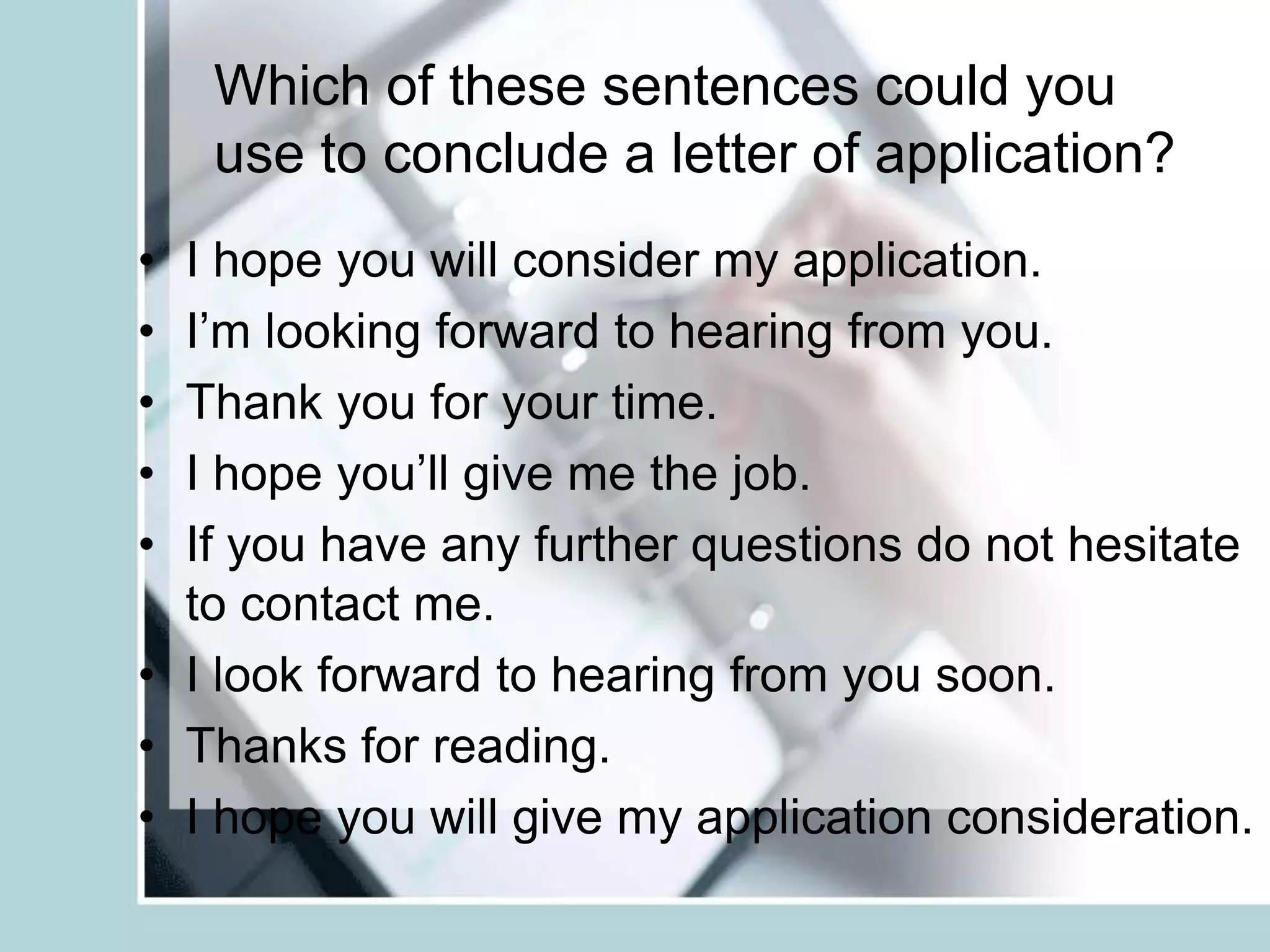
Which of these sentences could you
use to conclude a letter of application?
• I hope you will consider my application.
• I’m looking forward to hearing from you.
• Thank you for your time.
• I hope you’ll give me the job.
• If you have any further questions do not hesitate
to contact me.
• I look forward to hearing from you soon.
• Thanks for reading.
• I hope you will give my application consideration.
Which of these sentences could you
use to conclude a letter of application?
• I hope you will consider my application.
• Thank you for your time.
• If you have any further questions do not hesitate
to contact me.
• I look forward to hearing from you soon.
• I hope you will give my application consideration.
Look at this complete letter:
Dear Sir/Madam,
I am writing to apply for the position of camp helper which was advertised
in last Sunday’s ‘English Times’.
I am a positive and enthusiastic person and I have always enjoyed working
with children. I have been volunteering at a local camp for the past two
years which has been both challenging and rewarding. I am currently
completing my final year of secondary education and will be starting
university in September. In addition to my native Spanish, I have been
studying English for seven years and have reached a high level.
I would welcome the opportunity to work in a summer camp where I would
be able to practise my English. Furthermore, I have been working with
children for some time and hope to pursue a career in education. Therefore
I believe that a position as a camp helper would be a valuable experience
Thank you for your time. I hope you will consider my application.
I look forward to hearing from you soon.
Yours faithfully,
HOMEWORK
• Look at this advertisement.
• Write a letter of application applying for the job.
• Write 100-125 words.
WANTED
Waiter/waitress to work part-time in
restaurant.
Must speak English and one other
language.
Thank You

Application letter

  • 1.
  • 2.
    Kompetensi Dasar  3.2Membedakan fungsi sosial, struktur teks, dan unsur kebahasaan beberapa teks khusus dalam bentuk surat lamaran kerja, dengan memberi dan meminta informasi terkait jati diri, latar belakang pendidikan/pengalaman kerja, sesuai dengan konteks penggunaannya  4.2 Surat lamaran kerja  4.2.1 Menangkap makna secara kontekstual terkait fungsi sosial, struktur teks, dan unsur kebahasaan teks khusus dalam bentuk surat lamaran kerja, yang memberikan informasi antara lain jati diri, latar belakang pendidikan/pengalaman kerja  4.2.2 Menyusun teks khusus surat lamaran kerja, yang memberikan informasi antara lain jati diri, latar belakang pendidikan/pengalaman kerja, dengan memperhatikan fungsi sosial, struktur teks, dan unsur kebahasaan, secara benar dan sesuai konteks
  • 3.
    Tujuan Pembelajaran  Menirukanguru membacakan beberapa surat lamaran dengan ucapan, dan tekanan kata yang benar.  Mengaitkan kualifikasi dengan pekerjaan yang dilamar, dan membahas kesesuaiannya  Mengidentifikasi perbedann dan persamaan kalimat-kalimat pembuka, pernyataan kualifikasi, dan bagian-bagian lainnya  Membuat setiap bagian surat lamaran kerja disesuaikan dengan persyaratan yang tertera di iklan lowongan kerja  Menangkap makna secara kontekstual terkait fungsi sosial, struktur teks, dan unsur kebahasaan teks khusus dalam bentuk surat lamaran kerja, yang memberikan informasi antara lain jati diri, latar belakang pendidikan/pengalaman kerja  Menyusun teks khusus surat lamaran kerja, yang memberikan informasi antara lain jati diri, latar belakang pendidikan/pengalaman kerja, dengan memperhatikan fungsi sosial, struktur teks, dan unsur kebahasaan, secara benar dan sesuai konteks
  • 4.
    Formal Letters –Beginning and Ending • There are two ways to begin a formal letter: • Dear Sir/Madam (when you don’t know the name) • Dear Mr Smith (name of person) • If you begin your letter, ‘Dear Sir/Madam you must end it, ‘Yours faithfully,’ • If you begin your letter ‘Dear Mr Smith,’ you must end it, ‘Yours sincerely,’ • These are the rules of formal letters in English – there are no exceptions!
  • 5.
    Formal Language • Formalletters use formal language. • What does this mean? • No contractions (don’t/can’t/I’ll etc). • No informal expressions (Why don’t we…/Did you know that…/Write soon!/Love…/What’s up?/I’d love to!). • No informal punctuation (!/…/( )/ - ). • No phrasal verbs (pick up/look up/get over/turn on etc.)
  • 6.
    Formal Language • Useformal linking words to make our writing more cohesive: (Moreover/Furthermore/ Therefore) • Use modal verbs in formal expressions: (could/would/should) • Use formal adjectives instead of informal adjectives: (‘pleasant’ not ‘nice’/’pleased’ not ‘happy’/’enjoyable’ not ‘fun’ – and definitely not ‘funny’!) • Use polite language (I would be interested in/ I hope that you will consider my application / I look forward to hearing from you soon).
  • 7.
    Letter of Application- Job • Look at this advertisement: • How would you apply for this job? WANTED Young people with enthusiasm to work as helpers at a summer camp. Must speak two languages and enjoy working with children.
  • 8.
    First Paragraph • Saywhy you are writing. • Say what job you are applying for. • Say where/when you saw it advertised (you can invent this). WANTED Young people with enthusiasm to work as helpers at a summer camp. Must speak two languages and enjoy working with children.
  • 9.
    First Paragraph Dear Sir/Madam, Iam writing to apply for the position of camp helper which was advertised in last Sunday’s ‘English Times’. • Which of these is the best introduction? Dear Manager, I am writing to apply for the position of camp helper which was advertised in last Sunday’s ‘English Times’. Dear Sir/Madam, I’m writing to apply for the job at your camp which I saw in ‘English Times’ the other day. This is a perfect introduction. The writer used ‘Dear Sir/Madam’ because they did not know the name of the person they were writing to, avoided any contractions, ‘I am writing’, not ‘I’m writing’, and stated clearly the purpose of their letter.
  • 10.
    First Paragraph • Whichof these is the best introduction? Dear Manager, I am writing to apply for the position of camp helper which was advertised in last Sunday’s ‘English Times’. This is a perfect introduction except for ‘Dear Manager’. The writer should have put ‘Dear Sir/Madam because the name of the person they are writing to is unknown.
  • 11.
    First Paragraph • Whichof these is the best introduction? Dear Sir/Madam, I’m writing to apply for the job at your camp which I saw in ‘English Times’ the other day. This writer has started correctly, ‘Dear Sir/Madam’, but their introduction is too informal. You should try to avoid directly addressing the person you are writing to, ‘your camp’, and expressions like ‘the other day’ are very informal.
  • 12.
    Second Paragraph • Introduceyourself. • Say what qualities you have which make you suitable for the job. • Give details of your qualifications and previous experience. • Make sure you include any details that are mentioned in the advertisement! WANTED Young people with enthusiasm to work as helpers at a summer camp. Must speak two languages and enjoy working with children. 1 2 3
  • 13.
    Which of theseis the best answer? I am a positive and enthusiastic person and I have always enjoyed working with children. I have been volunteering at a local camp for the past two years which has been both challenging and rewarding. I am currently completing my final year of secondary education and will be starting university in September. In addition to my native Spanish, I have been studying English for seven years and have reached a high level. I’m cheerful and enthusiastic and I love working with children. I’ve volunteered at a local camp for the past two years which was very funny. I’ve nearly finished school and am off to university in September. I speak Spanish and English pretty well. I am positive, enthusiastic and have experience working with children. I will finish secondary school and go to university in September. I am a native Spanish speaker and I also speak English. This is a good answer. The writer uses appropriate formal language and addresses key points from the advertisement – experience of working with children, two languages, personality details.
  • 14.
    Which of theseis the best answer? I’m cheerful and enthusiastic and I love working with children. I’ve volunteered at a local camp for the past two years which was very funny. I’ve nearly finished school and am off to university in September. I speak Spanish and English pretty well. This answer addresses all the points from the advertisement but it is too informal. Also, ‘funny’ is used incorrectly!
  • 15.
    Which of theseis the best answer? I am positive, enthusiastic and have experience working with children. I will finish secondary school and go to university in September. I am a native Spanish speaker and I also speak English. This answer does not give enough detail – the writer doesn’t say anything about where they got experience working with children and how they feel about it. The language is reasonably formal but there are no formal linking words which would make it more cohesive.
  • 16.
    Third Paragraph • Saywhy you are applying. • Say why the company should consider you. • Sell yourself! WANTED Young people with enthusiasm to work as helpers at a summer camp. Must speak two languages and enjoy working with children.
  • 17.
    Which of theseis the best answer? I would welcome the opportunity to work in a summer camp where I would be able to practise my English. Furthermore, I have been working with children for some time and hope to pursue a career in education. Therefore I believe that a position as a camp helper would be a valuable experience I would be interested in the summer camp position because it would help me achieve my goal of becoming a teacher. I could practise my English. I’d like to work in a summer camp because I love kids and want to be a teacher. I think that the camp helper job will help a lot with this. This is a good answer. The writer uses appropriate formal language and gives good reasons for wanting the job. Formal linking words give the answer cohesion and it is a suitable length.
  • 18.
    Which of theseis the best answer? I would be interested in the summer camp position because it would help me achieve my goal of becoming a teacher. I could practise my English. This answer does not give enough detail and although the language is reasonably formal there are no formal linking words which would make it more cohesive.
  • 19.
    Which of theseis the best answer? I’d like to work in a summer camp because I love kids and want to be a teacher. I think that the camp helper job will help a lot with this. This answer is too informal and doesn’t give much information.
  • 20.
    Concluding the letter •There are certain fixed expressions we use when concluding formal letters of application. • We make a general statement about how we hope our application will be considered. • We thank the person we are writing to for their time. • We tell them that we look forward to hearing from them.
  • 21.
    Which of thesesentences could you use to conclude a letter of application? • I hope you will consider my application. • I’m looking forward to hearing from you. • Thank you for your time. • I hope you’ll give me the job. • If you have any further questions do not hesitate to contact me. • I look forward to hearing from you soon. • Thanks for reading. • I hope you will give my application consideration.
  • 22.
    Which of thesesentences could you use to conclude a letter of application? • I hope you will consider my application. • Thank you for your time. • If you have any further questions do not hesitate to contact me. • I look forward to hearing from you soon. • I hope you will give my application consideration.
  • 23.
    Look at thiscomplete letter: Dear Sir/Madam, I am writing to apply for the position of camp helper which was advertised in last Sunday’s ‘English Times’. I am a positive and enthusiastic person and I have always enjoyed working with children. I have been volunteering at a local camp for the past two years which has been both challenging and rewarding. I am currently completing my final year of secondary education and will be starting university in September. In addition to my native Spanish, I have been studying English for seven years and have reached a high level. I would welcome the opportunity to work in a summer camp where I would be able to practise my English. Furthermore, I have been working with children for some time and hope to pursue a career in education. Therefore I believe that a position as a camp helper would be a valuable experience Thank you for your time. I hope you will consider my application. I look forward to hearing from you soon. Yours faithfully,
  • 24.
    HOMEWORK • Look atthis advertisement. • Write a letter of application applying for the job. • Write 100-125 words. WANTED Waiter/waitress to work part-time in restaurant. Must speak English and one other language.
  • 25.