1
APNIC Update
Adam Gosling
ARIN 37
Tuesday, 19 April 2016
APNIC’s Vision
A global, open, stable and secure
Internet that serves the entire Asia
Pacific community
2
APNIC Activities
3
Serving
Cooperating
Supporting
Serving the Region
Serving
Cooperating
Supporting
4
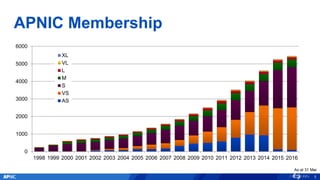
APNIC Membership
0
1000
2000
3000
4000
5000
6000
1998 1999 2000 2001 2002 2003 2004 2005 2006 2007 2008 2009 2010 2011 2012 2013 2014 2015 2016
XL
VL
L
M
S
VS
AS
5
As at 31 Mar
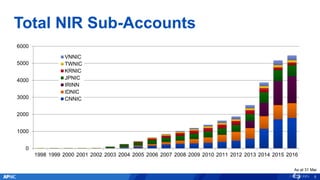
Total NIR Sub-Accounts
0
1000
2000
3000
4000
5000
6000
1998 1999 2000 2001 2002 2003 2004 2005 2006 2007 2008 2009 2010 2011 2012 2013 2014 2015 2016
VNNIC
TWNIC
KRNIC
JPNIC
IRINN
IDNIC
CNNIC
6
As at 31 Mar
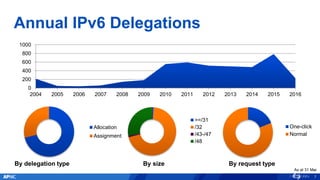
Annual IPv6 Delegations
7
By delegation type
>=/31
/32
/43-/47
/48
By size By request type
As at 31 Mar
Allocation
Assignment
One-click
Normal
0
200
400
600
800
1000
2004 2005 2006 2007 2008 2009 2010 2011 2012 2013 2014 2015 2016
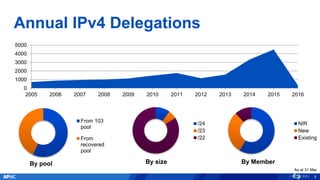
Annual IPv4 Delegations
0
1000
2000
3000
4000
5000
2005 2006 2007 2008 2009 2010 2011 2012 2013 2014 2015 2016
8
From 103
pool
From
recovered
pool
/24
/23
/22
NIR
New
Existing
By pool By size By Member
As at 31 Mar
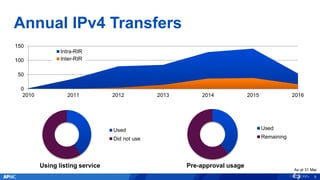
Annual IPv4 Transfers
9
Used
Did not use
Using listing service
Used
Remaining
Pre-approval usage
As at 31 Mar
0
50
100
150
2010 2011 2012 2013 2014 2015 2016
Intra-RIR
Inter-RIR
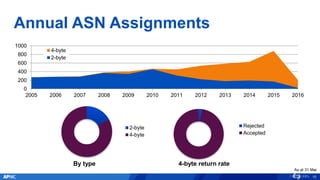
Annual ASN Assignments
10
2-byte
4-byte
By type
Rejected
Accepted
4-byte return rate
As at 31 Mar
0
200
400
600
800
1000
2005 2006 2007 2008 2009 2010 2011 2012 2013 2014 2015 2016
4-byte
2-byte
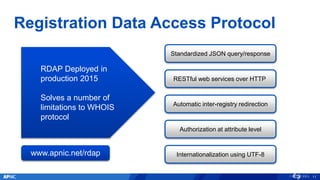
Registration Data Access Protocol
11
Standardized JSON query/response
RESTful web services over HTTP
Automatic inter-registry redirection
Authorization at attribute level
Internationalization using UTF-8
RDAP Deployed in
production 2015
Solves a number of
limitations to WHOIS
protocol
www.apnic.net/rdap
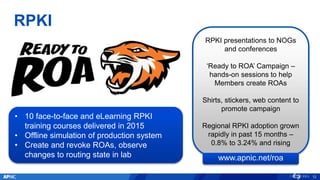
RPKI
RPKI presentations to NOGs
and conferences
‘Ready to ROA’ Campaign –
hands-on sessions to help
Members create ROAs
Shirts, stickers, web content to
promote campaign
Regional RPKI adoption grown
rapidly in past 15 months –
0.8% to 3.24% and rising
www.apnic.net/roa
• 10 face-to-face and eLearning RPKI
training courses delivered in 2015
• Offline simulation of production system
• Create and revoke ROAs, observe
changes to routing state in lab
12
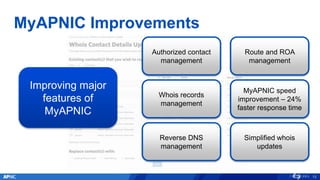
MyAPNIC Improvements
13
Improving major
features of
MyAPNIC
Authorized contact
management
Whois records
management
Reverse DNS
management
Route and ROA
management
MyAPNIC speed
improvement – 24%
faster response time
Simplified whois
updates
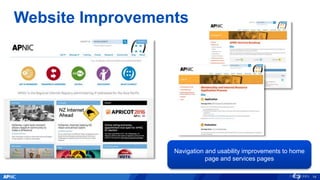
Website Improvements
14
Navigation and usability improvements to home
page and services pages
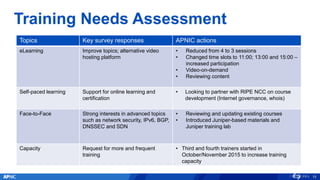
Training Needs Assessment
Topics Key survey responses APNIC actions
eLearning Improve topics; alternative video
hosting platform
• Reduced from 4 to 3 sessions
• Changed time slots to 11:00; 13:00 and 15:00 –
increased participation
• Video-on-demand
• Reviewing content
Self-paced learning Support for online learning and
certification
• Looking to partner with RIPE NCC on course
development (Internet governance, whois)
Face-to-Face Strong interests in advanced topics
such as network security, IPv6, BGP,
DNSSEC and SDN
• Reviewing and updating existing courses
• Introduced Juniper-based materials and
Juniper training lab
Capacity Request for more and frequent
training
• Third and fourth trainers started in
October/November 2015 to increase training
capacity
15
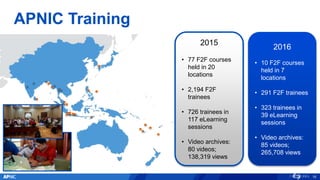
APNIC Training
16
2015
• 77 F2F courses
held in 20
locations
• 2,194 F2F
trainees
• 726 trainees in
117 eLearning
sessions
• Video archives:
80 videos;
138,319 views
2016
• 10 F2F courses
held in 7
locations
• 291 F2F trainees
• 323 trainees in
39 eLearning
sessions
• Video archives:
85 videos;
265,708 views
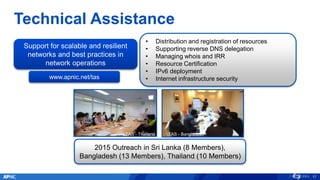
Technical Assistance
2015 Outreach in Sri Lanka (8 Members),
Bangladesh (13 Members), Thailand (10 Members)
TAS - Thailand TAS - Bangladesh
Support for scalable and resilient
networks and best practices in
network operations
• Distribution and registration of resources
• Supporting reverse DNS delegation
• Managing whois and IRR
• Resource Certification
• IPv6 deployment
• Internet infrastructure securitywww.apnic.net/tas
17
Supporting the Region
Serving
Cooperating
Supporting
18
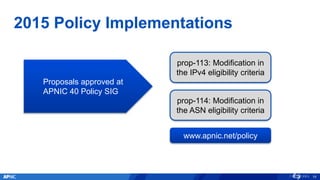
2015 Policy Implementations
19
Proposals approved at
APNIC 40 Policy SIG
prop-113: Modification in
the IPv4 eligibility criteria
prop-114: Modification in
the ASN eligibility criteria
www.apnic.net/policy
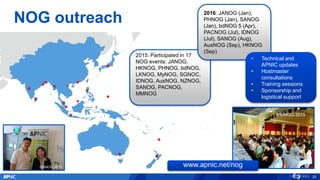
NOG outreach
BTNOG 1 SANOG 24
MMNOG
SGNOG 2015
20
MMNOG 2015
www.apnic.net/nog
2015: Participated in 17
NOG events: JANOG,
HKNOG, PHNOG, bdNOG,
LKNOG, MyNOG, SGNOC,
IDNOG, AusNOG, NZNOG,
SANOG, PACNOG,
MMNOG
2016: JANOG (Jan),
PHNOG (Jan), SANOG
(Jan), bdNOG 5 (Apr),
PACNOG (Jul), IDNOG
(Jul), SANOG (Aug),
AusNOG (Sep), HKNOG
(Sep)
• Technical and
APNIC updates
• Hostmaster
consultations
• Training sessions
• Sponsorship and
logistical support
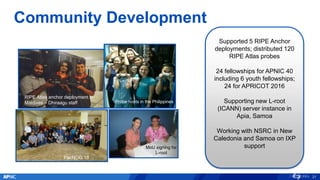
RIPE Atlas anchor deployment in
Maldives – Dhiraagu staff
Community Development
Supported 5 RIPE Anchor
deployments; distributed 120
RIPE Atlas probes
24 fellowships for APNIC 40
including 6 youth fellowships;
24 for APRICOT 2016
Supporting new L-root
(ICANN) server instance in
Apia, Samoa
Working with NSRC in New
Caledonia and Samoa on IXP
support
SANOG
Probe hosts in the Philippines
MoU signing for
L-root
21
PacNOG 18
ITU/APNIC IPv6
workshop
ITU/APNIC IPv6
workshop
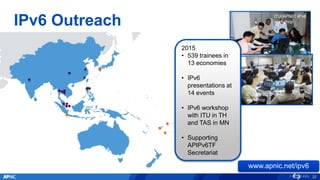
IPv6 Outreach
APNIC/ITU IPv6
Workshop, Bangkok
www.apnic.net/ipv6
22
2015
• 539 trainees in
13 economies
• IPv6
presentations at
14 events
• IPv6 workshop
with ITU in TH
and TAS in MN
• Supporting
APIPv6TF
Secretariat
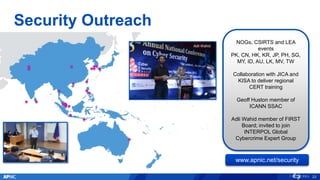
Security Outreach
Craig Ng
NOGs, CSIRTS and LEA
events
PK, CN, HK, KR, JP, PH, SG,
MY, ID, AU, LK, MV, TW
Collaboration with JICA and
KISA to deliver regional
CERT training
Geoff Huston member of
ICANN SSAC
Adli Wahid member of FIRST
Board; invited to join
INTERPOL Global
Cybercrime Expert Group
23
www.apnic.net/security
Adli Wahid
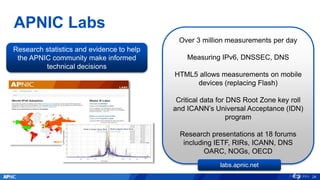
APNIC Labs
Over 3 million measurements per day
Measuring IPv6, DNSSEC, DNS
HTML5 allows measurements on mobile
devices (replacing Flash)
Critical data for DNS Root Zone key roll
and ICANN’s Universal Acceptance (IDN)
program
Research presentations at 18 forums
including IETF, RIRs, ICANN, DNS
OARC, NOGs, OECD
Research statistics and evidence to help
the APNIC community make informed
technical decisions
24
labs.apnic.net
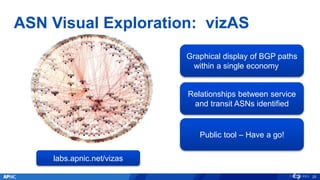
ASN Visual Exploration: vizAS
Graphical display of BGP paths
within a single economy
Relationships between service
and transit ASNs identified
Public tool – Have a go!
labs.apnic.net/vizas
25
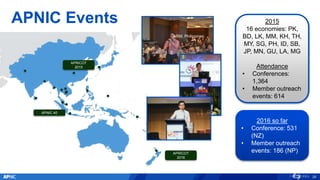
APNIC Events 2015
16 economies: PK,
BD, LK, MM, KH, TH,
MY, SG, PH, ID, SB,
JP, MN, GU, LA, MG
Attendance
• Conferences:
1,364
• Member outreach
events: 614
ARM, Philippines
26
APNIC 40
APRICOT
2015
APNIC 40
APRICOT
2016
2016 so far
• Conference: 531
(NZ)
• Member outreach
events: 186 (NP)
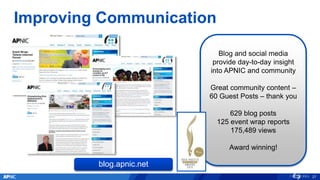
Improving Communication
27
blog.apnic.net
Blog and social media
provide day-to-day insight
into APNIC and community
Great community content –
60 Guest Posts – thank you
629 blog posts
125 event wrap reports
175,489 views
Award winning!
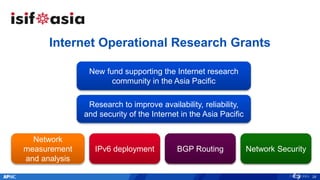
Internet Operational Research Grants
New fund supporting the Internet research
community in the Asia Pacific
Research to improve availability, reliability,
and security of the Internet in the Asia Pacific
Network
measurement
and analysis
IPv6 deployment BGP Routing Network Security
28
29
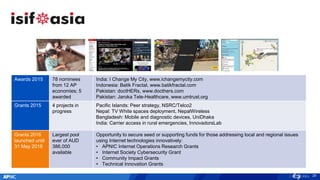
Awards 2015 78 nominees
from 12 AP
economies; 5
awarded
India: I Change My City, www.ichangemycity.com
Indonesia: Batik Fractal, www.batikfractal.com
Pakistan: doctHERs, www.docthers.com
Pakistan: Jaroka Tele-Healthcare, www.umtrust.org
Grants 2015 4 projects in
progress
Pacific Islands: Peer strategy, NSRC/Telco2
Nepal: TV White spaces deployment, NepalWireless
Bangladesh: Mobile and diagnostic devices, UniDhaka
India: Carrier access in rural emergencies, InnovadorsLab
Grants 2016
launched until
31 May 2016
Largest pool
ever of AUD
386,000
available
Opportunity to secure seed or supporting funds for those addressing local and regional issues
using Internet technologies innovatively:
• APNIC Internet Operations Research Grants
• Internet Society Cybersecurity Grant
• Community Impact Grants
• Technical Innovation Grants
Collaborating Globally
Serving
Cooperating
Supporting
30
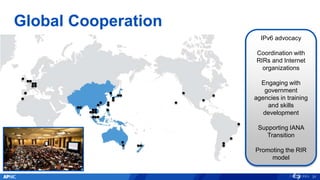
Global Cooperation
IPv6 advocacy
Coordination with
RIRs and Internet
organizations
Engaging with
government
agencies in training
and skills
development
Supporting IANA
Transition
Promoting the RIR
model
31
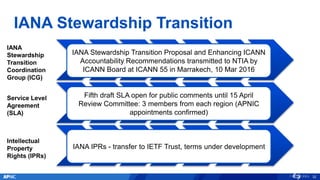
IANA Stewardship Transition
32
IANA Stewardship Transition Proposal and Enhancing ICANN
Accountability Recommendations transmitted to NTIA by
ICANN Board at ICANN 55 in Marrakech, 10 Mar 2016
Fifth draft SLA open for public comments until 15 April
Review Committee: 3 members from each region (APNIC
appointments confirmed)
IANA IPRs - transfer to IETF Trust, terms under development
IANA
Stewardship
Transition
Coordination
Group (ICG)
Service Level
Agreement
(SLA)
Intellectual
Property
Rights (IPRs)
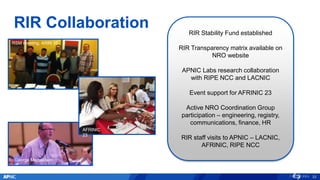
RIR Collaboration
RSM meeting, ARIN 35
George Michaelson
RIR Stability Fund established
RIR Transparency matrix available on
NRO website
APNIC Labs research collaboration
with RIPE NCC and LACNIC
Event support for AFRINIC 23
Active NRO Coordination Group
participation – engineering, registry,
communications, finance, HR
RIR staff visits to APNIC – LACNIC,
AFRINIC, RIPE NCC
33
AFRINIC
23
Coming next
34
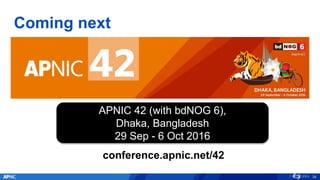
APNIC 42 (with bdNOG 6),
Dhaka, Bangladesh
29 Sep - 6 Oct 2016
conference.apnic.net/42
Coming later
• APRICOT 2017, Ho Chi Minh City, Vietnam
– 20 February to 3 March 2017
• APNIC 44, Taichung, Taiwan
– 7 to 14 September 2017
35
Coming soon: APNIC Survey 2016
36
We want your views on
APNIC!
Survey open July –
more details soon
Stay in touch!
37
blog.apnic.net
apnic.net/social
38
THANK YOU

APNIC Update: ARIN 37

  • 1.
    1 APNIC Update Adam Gosling ARIN37 Tuesday, 19 April 2016
  • 2.
    APNIC’s Vision A global,open, stable and secure Internet that serves the entire Asia Pacific community 2
  • 3.
  • 4.
  • 5.
    APNIC Membership 0 1000 2000 3000 4000 5000 6000 1998 19992000 2001 2002 2003 2004 2005 2006 2007 2008 2009 2010 2011 2012 2013 2014 2015 2016 XL VL L M S VS AS 5 As at 31 Mar
  • 6.
    Total NIR Sub-Accounts 0 1000 2000 3000 4000 5000 6000 19981999 2000 2001 2002 2003 2004 2005 2006 2007 2008 2009 2010 2011 2012 2013 2014 2015 2016 VNNIC TWNIC KRNIC JPNIC IRINN IDNIC CNNIC 6 As at 31 Mar
  • 7.
    Annual IPv6 Delegations 7 Bydelegation type >=/31 /32 /43-/47 /48 By size By request type As at 31 Mar Allocation Assignment One-click Normal 0 200 400 600 800 1000 2004 2005 2006 2007 2008 2009 2010 2011 2012 2013 2014 2015 2016
  • 8.
    Annual IPv4 Delegations 0 1000 2000 3000 4000 5000 20052006 2007 2008 2009 2010 2011 2012 2013 2014 2015 2016 8 From 103 pool From recovered pool /24 /23 /22 NIR New Existing By pool By size By Member As at 31 Mar
  • 9.
    Annual IPv4 Transfers 9 Used Didnot use Using listing service Used Remaining Pre-approval usage As at 31 Mar 0 50 100 150 2010 2011 2012 2013 2014 2015 2016 Intra-RIR Inter-RIR
  • 10.
    Annual ASN Assignments 10 2-byte 4-byte Bytype Rejected Accepted 4-byte return rate As at 31 Mar 0 200 400 600 800 1000 2005 2006 2007 2008 2009 2010 2011 2012 2013 2014 2015 2016 4-byte 2-byte
  • 11.
    Registration Data AccessProtocol 11 Standardized JSON query/response RESTful web services over HTTP Automatic inter-registry redirection Authorization at attribute level Internationalization using UTF-8 RDAP Deployed in production 2015 Solves a number of limitations to WHOIS protocol www.apnic.net/rdap
  • 12.
    RPKI RPKI presentations toNOGs and conferences ‘Ready to ROA’ Campaign – hands-on sessions to help Members create ROAs Shirts, stickers, web content to promote campaign Regional RPKI adoption grown rapidly in past 15 months – 0.8% to 3.24% and rising www.apnic.net/roa • 10 face-to-face and eLearning RPKI training courses delivered in 2015 • Offline simulation of production system • Create and revoke ROAs, observe changes to routing state in lab 12
  • 13.
    MyAPNIC Improvements 13 Improving major featuresof MyAPNIC Authorized contact management Whois records management Reverse DNS management Route and ROA management MyAPNIC speed improvement – 24% faster response time Simplified whois updates
  • 14.
    Website Improvements 14 Navigation andusability improvements to home page and services pages
  • 15.
    Training Needs Assessment TopicsKey survey responses APNIC actions eLearning Improve topics; alternative video hosting platform • Reduced from 4 to 3 sessions • Changed time slots to 11:00; 13:00 and 15:00 – increased participation • Video-on-demand • Reviewing content Self-paced learning Support for online learning and certification • Looking to partner with RIPE NCC on course development (Internet governance, whois) Face-to-Face Strong interests in advanced topics such as network security, IPv6, BGP, DNSSEC and SDN • Reviewing and updating existing courses • Introduced Juniper-based materials and Juniper training lab Capacity Request for more and frequent training • Third and fourth trainers started in October/November 2015 to increase training capacity 15
  • 16.
    APNIC Training 16 2015 • 77F2F courses held in 20 locations • 2,194 F2F trainees • 726 trainees in 117 eLearning sessions • Video archives: 80 videos; 138,319 views 2016 • 10 F2F courses held in 7 locations • 291 F2F trainees • 323 trainees in 39 eLearning sessions • Video archives: 85 videos; 265,708 views
  • 17.
    Technical Assistance 2015 Outreachin Sri Lanka (8 Members), Bangladesh (13 Members), Thailand (10 Members) TAS - Thailand TAS - Bangladesh Support for scalable and resilient networks and best practices in network operations • Distribution and registration of resources • Supporting reverse DNS delegation • Managing whois and IRR • Resource Certification • IPv6 deployment • Internet infrastructure securitywww.apnic.net/tas 17
  • 18.
  • 19.
    2015 Policy Implementations 19 Proposalsapproved at APNIC 40 Policy SIG prop-113: Modification in the IPv4 eligibility criteria prop-114: Modification in the ASN eligibility criteria www.apnic.net/policy
  • 20.
    NOG outreach BTNOG 1SANOG 24 MMNOG SGNOG 2015 20 MMNOG 2015 www.apnic.net/nog 2015: Participated in 17 NOG events: JANOG, HKNOG, PHNOG, bdNOG, LKNOG, MyNOG, SGNOC, IDNOG, AusNOG, NZNOG, SANOG, PACNOG, MMNOG 2016: JANOG (Jan), PHNOG (Jan), SANOG (Jan), bdNOG 5 (Apr), PACNOG (Jul), IDNOG (Jul), SANOG (Aug), AusNOG (Sep), HKNOG (Sep) • Technical and APNIC updates • Hostmaster consultations • Training sessions • Sponsorship and logistical support
  • 21.
    RIPE Atlas anchordeployment in Maldives – Dhiraagu staff Community Development Supported 5 RIPE Anchor deployments; distributed 120 RIPE Atlas probes 24 fellowships for APNIC 40 including 6 youth fellowships; 24 for APRICOT 2016 Supporting new L-root (ICANN) server instance in Apia, Samoa Working with NSRC in New Caledonia and Samoa on IXP support SANOG Probe hosts in the Philippines MoU signing for L-root 21 PacNOG 18
  • 22.
    ITU/APNIC IPv6 workshop ITU/APNIC IPv6 workshop IPv6Outreach APNIC/ITU IPv6 Workshop, Bangkok www.apnic.net/ipv6 22 2015 • 539 trainees in 13 economies • IPv6 presentations at 14 events • IPv6 workshop with ITU in TH and TAS in MN • Supporting APIPv6TF Secretariat
  • 23.
    Security Outreach Craig Ng NOGs,CSIRTS and LEA events PK, CN, HK, KR, JP, PH, SG, MY, ID, AU, LK, MV, TW Collaboration with JICA and KISA to deliver regional CERT training Geoff Huston member of ICANN SSAC Adli Wahid member of FIRST Board; invited to join INTERPOL Global Cybercrime Expert Group 23 www.apnic.net/security Adli Wahid
  • 24.
    APNIC Labs Over 3million measurements per day Measuring IPv6, DNSSEC, DNS HTML5 allows measurements on mobile devices (replacing Flash) Critical data for DNS Root Zone key roll and ICANN’s Universal Acceptance (IDN) program Research presentations at 18 forums including IETF, RIRs, ICANN, DNS OARC, NOGs, OECD Research statistics and evidence to help the APNIC community make informed technical decisions 24 labs.apnic.net
  • 25.
    ASN Visual Exploration:vizAS Graphical display of BGP paths within a single economy Relationships between service and transit ASNs identified Public tool – Have a go! labs.apnic.net/vizas 25
  • 26.
    APNIC Events 2015 16economies: PK, BD, LK, MM, KH, TH, MY, SG, PH, ID, SB, JP, MN, GU, LA, MG Attendance • Conferences: 1,364 • Member outreach events: 614 ARM, Philippines 26 APNIC 40 APRICOT 2015 APNIC 40 APRICOT 2016 2016 so far • Conference: 531 (NZ) • Member outreach events: 186 (NP)
  • 27.
    Improving Communication 27 blog.apnic.net Blog andsocial media provide day-to-day insight into APNIC and community Great community content – 60 Guest Posts – thank you 629 blog posts 125 event wrap reports 175,489 views Award winning!
  • 28.
    Internet Operational ResearchGrants New fund supporting the Internet research community in the Asia Pacific Research to improve availability, reliability, and security of the Internet in the Asia Pacific Network measurement and analysis IPv6 deployment BGP Routing Network Security 28
  • 29.
    29 Awards 2015 78nominees from 12 AP economies; 5 awarded India: I Change My City, www.ichangemycity.com Indonesia: Batik Fractal, www.batikfractal.com Pakistan: doctHERs, www.docthers.com Pakistan: Jaroka Tele-Healthcare, www.umtrust.org Grants 2015 4 projects in progress Pacific Islands: Peer strategy, NSRC/Telco2 Nepal: TV White spaces deployment, NepalWireless Bangladesh: Mobile and diagnostic devices, UniDhaka India: Carrier access in rural emergencies, InnovadorsLab Grants 2016 launched until 31 May 2016 Largest pool ever of AUD 386,000 available Opportunity to secure seed or supporting funds for those addressing local and regional issues using Internet technologies innovatively: • APNIC Internet Operations Research Grants • Internet Society Cybersecurity Grant • Community Impact Grants • Technical Innovation Grants
  • 30.
  • 31.
    Global Cooperation IPv6 advocacy Coordinationwith RIRs and Internet organizations Engaging with government agencies in training and skills development Supporting IANA Transition Promoting the RIR model 31
  • 32.
    IANA Stewardship Transition 32 IANAStewardship Transition Proposal and Enhancing ICANN Accountability Recommendations transmitted to NTIA by ICANN Board at ICANN 55 in Marrakech, 10 Mar 2016 Fifth draft SLA open for public comments until 15 April Review Committee: 3 members from each region (APNIC appointments confirmed) IANA IPRs - transfer to IETF Trust, terms under development IANA Stewardship Transition Coordination Group (ICG) Service Level Agreement (SLA) Intellectual Property Rights (IPRs)
  • 33.
    RIR Collaboration RSM meeting,ARIN 35 George Michaelson RIR Stability Fund established RIR Transparency matrix available on NRO website APNIC Labs research collaboration with RIPE NCC and LACNIC Event support for AFRINIC 23 Active NRO Coordination Group participation – engineering, registry, communications, finance, HR RIR staff visits to APNIC – LACNIC, AFRINIC, RIPE NCC 33 AFRINIC 23
  • 34.
    Coming next 34 APNIC 42(with bdNOG 6), Dhaka, Bangladesh 29 Sep - 6 Oct 2016 conference.apnic.net/42
  • 35.
    Coming later • APRICOT2017, Ho Chi Minh City, Vietnam – 20 February to 3 March 2017 • APNIC 44, Taichung, Taiwan – 7 to 14 September 2017 35
  • 36.
    Coming soon: APNICSurvey 2016 36 We want your views on APNIC! Survey open July – more details soon
  • 37.
  • 38.

Editor's Notes

  • #4  Reflects APNIC’s vision of a “global, open, stable and secure Internet that serves the entire Asia Pacific community: Serving APNIC Members Supporting Internet development in the AP region Cooperating with the Internet community
  • #6  The total membership figure for 2015 is 5,268. So far in 2016, APNIC has 5,448 Members, and increase of 3.3% from the 2015 figure.
  • #8 Since Jan 2015, the delegation rate for IPv6 has been quite stable, and we can see that the majority of delegations have been a /32 (70%) which is the default allocation size for providers, followed by /48s which is the default assignment size for end-sites. Most came from normal allocations, instead of one-click. So far in 2016, we have delegated 228 blocks of IPv6.
  • #9 Up until v4 exhaustion in the AP region, delegation requests were steady. Following exhaustion, numbers decreased, but with the advent of the recovered pool, there was a marked increase in IPv4 requests in 2014 as a result of the availability of address space from the recovered pool. IPv4 delegations increased 158% in 2014 compared to 2013. In 2015, allocations have been steady. 43% of requests have come from the recovered pool and 57% from the last /8 pool. Unsurprisingly, the majority of the v4 delegations are /22s, which is the maximum allowed by the policy. In 2015, APNIC has made 1958 delegations from 103/8 and 2540 delegations from the recovered pool.
  • #10 IPv4 Transfers remain steady as well, however, we are starting to see some transfers from ARIN to NIR members. 40% of Members are utilising the listing service in 2015. 61% of pre-approvals remaining indicates we still have many Members who are looking for sources to transfer from. As of 1 October transfers are now available with the RIPE NCC region.
  • #11 From Jan 2010, APNIC ceased to make any distinction between two-byte and four-byte when assigning AS Numbers as a result of a policy change, which illustrates the 2010 figures where only 10 4-byte delegations were made. It is good to note that the return rate for 4-byte is very low (2%), which illustrates acceptance of 4-byte ASN in the region. Overall, 83% of ASNs are 4-byte. 4-byte uptake has been quite good in the region with 710 delegations in 2015, compared to 171 2-byte delegations.
  • #12 Registration Data Access Protocol (RDAP) service was fully up to date with specifications in May 2015. Solves a number of limitation to the WHOIS protocol, for example: Standardizes the query format, so clients only need to learn one way to ask a registry about its data.  I Standardizes the response format, so clients only need to learn how to parse a response once.   It uses common technologies to deliver service, so tool developers can leverage existing libraries and frameworks.   It supports redirection, so querying APNIC for an ARIN address will redirect to ARIN’s service, and vice-versa.   And it supports internationalization, so data is no longer presented in a random character set, but instead always in UTF-8.
  • #14 MyAPNIC improvements planned for 2016. Simplified updates include: View and replace your whois contacts Bulk update your whois contacts View all objects associated in your account Reverse DNS management: Single page to manage your reverse DNS delegations Integrated reverser domain verification tool Route and ROA management Create your route and ROA objects in one go Automated notification to AS number custodians Manage conflicts between your route and ROA objects
  • #15 Planning to focus on updating IPv6 pages this year
  • #16 APNIC held its first Training survey earlier in 2015. We received 249 responses from 37 economies. We can draw the following conclusions: APNIC training is mostly perceived as being of good quality and out neutrality is considered import Our Member consider hands-on training as being the most valuable form of training eLearning has mixed support, and there appears to be declining interest. The topics need to be revised and improved, and eLearning as a whole requires better promotion. The eLearning video library is currently hosted on YouTube, which is blocked in some economies. Alternative hosting platforms should be investigated. There is reasonable support for the introduction of self-paced online learning, especially if these leads towards some sort of certification. It is considered important for reaching out to more trainees, although it should not replace existing face-to-face methods of delivery. Advanced topics such as Network Security, IPv6, BGP, DNSSEC, ISP/IX Design, MPLS, Incident Handling and Response and OSPF/IS-IS elicit by far the most interest. There is much lower interest in core APNIC topics such MyAPNIC, Whois Database and RPKI. There is also significant interest in SDN, which may be worth considering developing due to its implications for building networks in future. The most popular locations for training are overwhelmingly those where APNIC has received little or no requests for training. This would imply that APNIC could be more proactive in organizing its own training in these preferred locations, rather than being reactive to requests originating from particular economies for local training. There appears to be overwhelming support for delivering training in English, although Cambodia, China, Laos, Myanmar, Taiwan and Vietnam expressed preference for training in their local languages. There is also some limited interest in Bengali, Bahasa Indonesian, Thai, Hindi, Malay and Cantonese. There is a slight preference for APNIC training to be undertaken by APNIC staff, although APNIC accredited trainers also appear acceptable. The NIRs tend to support the training-the-trainers concept. APNIC training fees are set at, or slightly below the level that people are able and prepared to pay. There is a lot of a interest in APNIC developing examination based certification. There is some limited interest in obtaining accreditation for its courses. There is some support for a fee paying technical assistance program. Expected future demand for training is difficult to quantify, but more and frequent training is widely requested. Demand for training may reasonably be expected to grow in line with APNIC membership, although eLearning has decreased in popularity. There also appears to be demand to develop training-the-trainers and self-paced online learning programs.


  • #17 APNIC training aims to deliver vital skills to network operators across the entire region to help grow the Internet. eLearning webinars have changed slightly, reduced from 4 to 3 sessions each Wednesday from April 2015. There’s nearly as many participants in the first 7.5 months as whole of 2014. Core APNIC topics are also being professionally recorded and edited for YouTube channel. Reviewing and updating existing materials. Introduced Juniper-based material and Juniper training lab
  • #18 TAS is a new initiative to support APNIC member’s efforts to deploy and maintain scalable and resilient networks and best practices in network operations Technical assistance is offered to network operators that need help to tackle projects such as IPv6 deployment. It is provided on a cost recovery basis.
  • #20 Changes to the request criteria for the delegation of IPv4 addresses and Autonomous System Numbers (ASNs) will make it easier for end-user organizations to prepare for multihoming without having to establish interconnect agreements before applying.
  • #21 We have provided sponsorship for 13 NOG events. In 2015, we have supported and participated at: JANOG 35, Shizuoka, Japan 13-14 Jan SANOG 25, Kandy Sri Lanka 16-21 Jan NZNOG 2015, Rotorua New Zealand, 26-30 Jan THNOG, Bangkok, 9 March 2015 HKNOG 2015, Hong Kong, 17 April bdNOG 3, Dhaka, Bangladesh 18 May IDNOG 12 June PHNOG – 16 June PacNOG 17 – 13-17 July SANOG 26, 3-11 August MyNOG 5, 17-20 August SGNOG 4, 18-21 August AusNOG 2015, 27-28 August HKNOG 2, 14 September BdNOG 4, 10-15 November MMNOG, 21-22 November PacNOG 18, 30 November – 4 December
  • #22  We provided 15 fellowships for APRICOT 2015; 24 for APNIC 40, including 5 youth fellowships. Fellows are given financial assistance on travel, accommodation and daily expenses. Thanks to Google and APIA for their generous contributions to the fellowships. Providing support for IXP and root severs deployment Samoa IXP deployment Final stage: Waiting for fiber connections Collaboration with NSRC and APNIC L-root (ICANN) server in Samoa Final process of procuring a server with APNIC’s financial support
  • #23 We remain committed to promoting IPv6 and helping increase its adoption. As part of TAS outreach we collaborated with the ITU on a five-day IPv6 Infrastructure security workshop in Bangkok – 50 participants from 12 economies in the AP region. Also provided ITU Country Direct assistance on IPv6 in Ulaanbaatar, with a 3-day IPv6 infrastructure security workshop and ITU engineering assistance at 3 organizations – 50 participants from 22 organizations, with great encouragement from the Mongolian regulator. Plan to update IPv6 web pages on the APNIC website this year.
  • #24 Security specialist Adli Wahid, is working with different teams within APNIC as well as building relationship with potential and new partners that APNIC can leverage. Adli was recently elected as a board member of the Forum of Incident and Security Response Teams Build capability through training, providing content on security at APNIC and LEA training Participation in NOGs, inter-governmental forums, CERTS etc. We take that knowledge and share it with Members to raise awareness Highlighting relevant initiatives to Members to improve security such as IRT objects in whois, RPKI, and SAVE (BCP 38)
  • #26 New tool, based on CAIDA’s core visualization tool; examines how ASNs interact in an economy by mapping globally visible routes in the BGP routing table. Can be used to demonstrate how the BGP routing table can be used as a data source to visualize Internet infrastructure in an economy, by mapping transit paths of Autonomous System Numbers (ASNs) delegated to that economy.
  • #27 In addition to the two major conferences hosted each year by APNIC, a number of smaller events are held around the region. These include APNIC Regional Meetings, which act as an additional forum for Members to meet with their peers in their community and from neighbouring economies to share their Internet resource management experiences, and get the latest updates on APNIC's activities, and Member Gathering events, which allows APNIC staff to meet up with Members, answer questions related to their IPv4 and IPv6 addresses, membership, and provide confidential hostmaster consultations. ARMs in 2015 were held in: Bangkok, Thailand 9 Mar Manila, Philippines, 15 June Ulaanbaatar, Mongolia 19 October Guam, 30 November Vientiane, Lao PDR 9 December
  • #29 The AUD 60,000 fund aims to provide support for independent research community on Internet operations, infrastructure and related protocols for the benefit of the community. The awardees will be announced this year.
  • #30 A new round of ISIF grants opened on Wednesday – research, security, community impact, innovation. Go to the isif.asia website to learn more and apply.
  • #32 Our key global coordination activities during this period are: Providing IPv6 advocacy throughout the region We continue to work closely with I* organization to ensure smooth technical coordination that is critical to the Internet operation We continue to encourage governments to focus on capacity building, particularly on human resources Internet related training and skill development We represent the Internet number registry position, based on our own community consultation, at the IANA stewardship transition process We continue to promote the value of multi-stakeholder model in developing the Internet Continuing to engage and collaborate with intergovernmental and governmental organizations PTC 15, Hawaii ICG Meeting, Singapore ICANN 52, Singapore Hague Global Conference on Cyberspace, Kuala Lumpur; The Netherlands APTLD, Fukuoka Mobile World Congress, Barcelona IETF 92, Dallas PCTA, Manila USO Broadband Asia Pacific Forum, Bangkok APEC Telmin 10, KL NetMundial Initiative’s Coordination Council Meeting, San Francisco OECD, Paris Interpol World Day, Singapore PITA 19 I* CEO Meeting, London ITU WSIS Forum, Geneva TWNIC OPM ISCR, Seoul Pacific ICT Ministerial Meeting/ APT PFRP, Tonga ICG Meeting, Buenos Aires ICANN 53, Buenos Aires NetMundia Coordination Council Meeting, Sao Paulo NetHui, Auckland Taiwan Internet Infrastructure Seminar, Taipei ITU Regional Development Forum, Bangkok SATRC 16, New Delhi IGF 2015, João Pessoa Government Bilateral, Myanmar IRINN OPM, New Delhi ITU/OTT, Phnom Penh WSIS+10 Review, New York WIC Wuzhen Summit, 2015, Wuzhen IDNIC OPM, Jakarta NRO provided support for the IGF 2015 and developed a joint IPv6 best practice guide which was released during the event. Paul Wilson invited to join the World Internet Conference High Level Advisory Council that will provide advice on future WIC events.
  • #34 Senior R&D scientist, George Michaelson spent several months in residency with both the RIPE NCC and LACNIC R&D teams to collaborate on research projects. We had visits from RIR CEOs, LACNIC’s Oscar Robles, and AFRINIC’s Alan Barrett .