Is Obstructive Sleep Apnea
Affecting Your Daily Life?
Is Obstructive Sleep Apnea Affecting Your Daily Life?
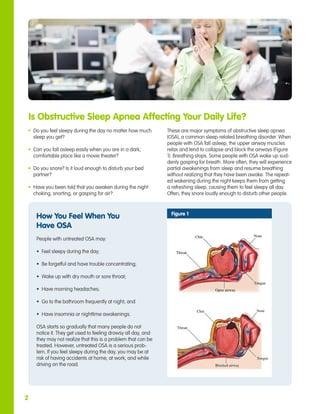
•	 Do you feel sleepy during the day no matter how much 	      These are major symptoms of obstructive sleep apnea
	 sleep you get?                                               (OSA), a common sleep-related breathing disorder. When
                                                               people with OSA fall asleep, the upper airway muscles
•	 Can you fall asleep easily when you are in a dark, 	        relax and tend to collapse and block the airways (Figure
	 comfortable place like a movie theater?                      1). Breathing stops. Some people with OSA wake up sud-
                                                               denly gasping for breath. More often, they will experience
•	 Do you snore? Is it loud enough to disturb your bed 	       partial awakenings from sleep and resume breathing
	 partner?                                                     without realizing that they have been awake. The repeat-
                                                               ed wakening during the night keeps them from getting
•	 Have you been told that you awaken during the night 	       a refreshing sleep, causing them to feel sleepy all day.
	 choking, snorting, or gasping for air?                       Often, they snore loudly enough to disturb other people.


                                                                Figure 1
     How You Feel When You
     Have OSA
     People with untreated OSA may:

     •	 Feel sleepy during the day;

     •	 Be forgetful and have trouble concentrating;

     •	 Wake up with dry mouth or sore throat;

     •	 Have morning headaches;

     •	 Go to the bathroom frequently at night; and

     •	 Have insomnia or nighttime awakenings.

     OSA starts so gradually that many people do not
     notice it. They get used to feeling drowsy all day, and
     they may not realize that this is a problem that can be
     treated. However, untreated OSA is a serious prob-
     lem. If you feel sleepy during the day, you may be at
     risk of having accidents at home, at work, and while
     driving on the road.


2
OSA and Your Health
Untreated OSA can affect your health. People with
untreated OSA are more likely to:

•	 Be obese or gain weight;

•	 Develop diabetes;

•	 Have high blood pressure, heart disease, and 	       	
	 stroke; and

•	 Get depressed, anxious, and irritable.


Talk to Your Doctor About OSA
If you think that you might have OSA, ask your doctor
about it. Effective treatment is usually available, and it
may help you in 1 or more of the following ways:

•	 You will wake up in the morning feeling refreshed.

•	 You will not feel sleepy during the day.                      What You Can Expect From
•	 You will be more productive at home and on the job.
                                                                 Your Doctor
                                                                 Your doctor will probably ask you questions about
•	 You will think more clearly when you are well rested.
                                                                 your sleep habits. Your doctor may ask you to
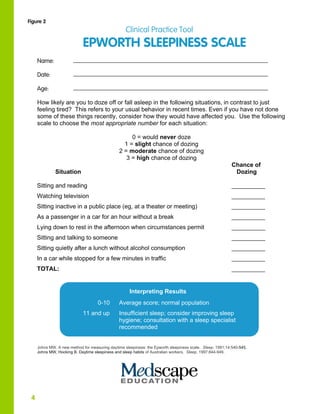
•	 You will not bother people with your snoring.                 complete an Epworth Sleepiness Scale (Figure 2)
                                                                 to determine how sleepy you are, or have you
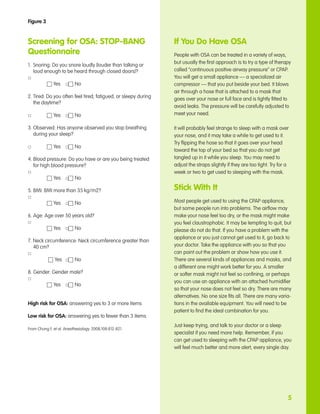
•	 With proper sleep, you are less likely to have car            complete the STOP-BANG Questionnaire (Figure 3)
	 accidents.                                                     to see if you are at high or low risk for OSA.

•	 You will be less likely to develop the medical conditions 	
                                                                 Your doctor will also consider other possible
	 related to OSA.
                                                                 causes of your sleepiness. For example, you might
•	 If you are already overweight or if you have high blood 	     be taking a medication that makes you sleepy.
	 pressure, heart disease, or depression, treating your 	        If your doctor thinks that you may have OSA, you
	 OSA may help with these conditions.                            may be referred to a sleep specialist or for an
                                                                 overnight study at a sleep laboratory.
•	 You will save money on healthcare.

•	 Best of all, treating your OSA could help you live longer 	   At the sleep laboratory, technicians will paste elec-
	 and better.                                                    trodes (small metal discs) to your body so that they
                                                                 can monitor what happens while you sleep. They
                                                                 will be able to monitor your brain wave activity,
                                                                 heart rate, oxygen levels, and leg movements and
                                                                 see if you stop breathing during the night. All that
                                                                 you must do is sleep.


                                                                                                                         3
Figure 2
                                                   Clinical Practice Tool
                             EPWORTH SLEEPINESS SCALE
     Name:

     Date:

     Age:

     How likely are you to doze off or fall asleep in the following situations, in contrast to just
     feeling tired? This refers to your usual behavior in recent times. Even if you have not done
     some of these things recently, consider how they would have affected you. Use the following
     scale to choose the most appropriate number for each situation:

                                                     0 = would never doze
                                                  1 = slight chance of dozing
                                                2 = moderate chance of dozing
                                                   3 = high chance of dozing
                                                                                                           Chance of
              Situation                                                                                     Dozing

     Sitting and reading                                                                                   __________
     Watching television                                                                                   __________
     Sitting inactive in a public place (eg, at a theater or meeting)                                      __________
     As a passenger in a car for an hour without a break                                                   __________
     Lying down to rest in the afternoon when circumstances permit                                         __________
     Sitting and talking to someone                                                                        __________
     Sitting quietly after a lunch without alcohol consumption                                             __________
     In a car while stopped for a few minutes in traffic                                                   __________
     TOTAL:                                                                                                __________


                                                     Interpreting Results
                                    0-10        Average score; normal population
                             11 and up          Insufficient sleep; consider improving sleep
                                                hygiene; consultation with a sleep specialist
                                                recommended


     Johns MW. A new method for measuring daytime sleepiness: the Epworth sleepiness scale. Sleep. 1991;14:540-545.
     Johns MW, Hocking B. Daytime sleepiness and sleep habits of Australian workers. Sleep. 1997;844-949.


 4
Figure 3


Screening for OSA: STOP-BANG                                      If You Do Have OSA
Questionnaire                                                     People with OSA can be treated in a variety of ways,
                                                                  but usually the first approach is to try a type of therapy
1. 	Snoring: Do you snore loudly (louder than talking or 	
	 loud enough to be heard through closed doors)?                  called “continuous positive airway pressure” or CPAP.
□                                                                 You will get a small appliance — a specialized air
	 	 	     h Yes 	 □ h No                                          compressor — that you put beside your bed. It blows
                                                                  air through a hose that is attached to a mask that
2.	Tired: Do you often feel tired, fatigued, or sleepy during 	   goes over your nose or full face and is tightly fitted to
	 the daytime?
                                                                  avoid leaks. The pressure will be carefully adjusted to
□		 	      h Yes 	 □ h No                                         meet your need.

3. Observed: Has anyone observed you stop breathing 	             It will probably feel strange to sleep with a mask over
	 during your sleep?                                              your nose, and it may take a while to get used to it.
                                                                  Try flipping the hose so that it goes over your head
□		 	      h Yes 	 □ h No
                                                                  toward the top of your bed so that you do not get
4. Blood pressure: Do you have or are you being treated 	         tangled up in it while you sleep. You may need to
	 for high blood pressure?                                        adjust the straps slightly if they are too tight. Try for a
□                                                                 week or two to get used to sleeping with the mask.
	 	 	    h Yes 	 □ h No

5. BMI: BMI more than 35 kg/m2?                                   Stick With It
□
	 	 	    h Yes 	 □ h No                                           Most people get used to using the CPAP appliance,
                                                                  but some people run into problems. The airflow may
6. Age: Age over 50 years old?                                    make your nose feel too dry, or the mask might make
□                                                                 you feel claustrophobic. It may be tempting to quit, but
	 	 	    h Yes 	 □ h No                                           please do not do that. If you have a problem with the
                                                                  appliance or you just cannot get used to it, go back to
7. Neck circumference: Neck circumference greater than 	
	 40 cm?                                                          your doctor. Take the appliance with you so that you
□                                                                 can point out the problem or show how you use it.
	 	 	     h Yes 	 □ h No                                          There are several kinds of appliances and masks, and
                                                                  a different one might work better for you. A smaller
8. Gender: Gender male?                                           or softer mask might not feel so confining, or perhaps
□
                                                                  you can use an appliance with an attached humidifier
	 	 	   h Yes 	 □ h No
                                                                  so that your nose does not feel so dry. There are many
                                                                  alternatives. No one size fits all. There are many varia-
High risk for OSA: answering yes to 3 or more items               tions in the available equipment. You will need to be
                                                                  patient to find the ideal combination for you.
Low risk for OSA: answering yes to fewer than 3 items
                                                                  Just keep trying, and talk to your doctor or a sleep
From Chung F, et al. Anesthesiology. 2008;108:812-821.
                                                                  specialist if you need more help. Remember, if you
                                                                  can get used to sleeping with the CPAP appliance, you
                                                                  will feel much better and more alert, every single day.


                                                                                                                            5
Resources
    American Academy of Sleep Medicine. Available at:
    www.aasm.org Accessed July 20, 2011.

    American Sleep Apnea Association. Available at: www.
    sleepapnea.org Accessed July 20, 2011.

    National Sleep Foundation. Available at:
    www.sleepfoundation.org Accessed July 20, 2011.

    Doghramji PP. Recognition of obstructive sleep apnea
    and associated excessive sleepiness in primary care. J
    Fam Pract. 2008;57(suppl):S17-S23.

    Epstein LJ, Kristo D, Strollo PJ Jr, et al; Adult Obstructive
    Sleep Apnea Task Force of the American Academy of
    Sleep Medicine. Clinical guideline for the evaluation,
    management and long-term care of obstructive sleep
    apnea in adults. J Clin Sleep Med. 2009;5:263-276.

    Grover M, Mookadam M, Armas D, et al. Identifying pa-
    tients at risk for obstructive sleep apnea in a primary care
    practice. J Am Board Fam Med. 2011;24:152-160.

    Hirshkowitz M. The clinical consequences of obstructive
    sleep apnea and associated excessive sleepiness. J Fam
    Pract. 2008;57(suppl):S9-16.

    Kushida CA, Littner MR, Hirshkowitz M, et al; American
    Academy of Sleep Medicine. Practice parameters for the
    use of continuous and bilevel positive airway pressure
    devices to treat adult patients with sleep-related breath-
    ing disorders. Sleep. 2006;29:375-380.

    Lieberman JA 3rd. Obstructive sleep apnea (OSA) and
    excessive sleepiness associated with OSA: recognition in
    the primary care setting. Postgrad Med. 2009;121:33-41.

    McDaid C, Durée KH, Griffin SC, et al. A systematic review
    of continuous positive airway pressure for obstructive
    sleep apnoea-hypopnoea syndrome. Sleep Med Rev.
    2009;13:427-436.

    Mold JW, Quattlebaum C, Schinnerer E, Boeckman L, Orr
    W, Hollabaugh K. Identification by primary care clinicians
    of patients with obstructive sleep apnea: a practice-
    based research network (PBRN) study. J Am Board Fam
    Med. 2011;24:138-145.

    Pagel JF. The burden of obstructive sleep apnea
    and associated excessive sleepiness. J Fam Pract.
    2008;57(suppl):S3-8.

    Rosenberg R, Doghramji P. Optimal treatment of obstruc-
    tive sleep apnea and excessive sleepiness. Adv Ther.
    2009;26:295-312. Epub 2009 Apr 3.
6
 Apneia do Sono

Apneia do Sono

  • 1.
    Is Obstructive SleepApnea Affecting Your Daily Life?
  • 2.
    Is Obstructive SleepApnea Affecting Your Daily Life? • Do you feel sleepy during the day no matter how much These are major symptoms of obstructive sleep apnea sleep you get? (OSA), a common sleep-related breathing disorder. When people with OSA fall asleep, the upper airway muscles • Can you fall asleep easily when you are in a dark, relax and tend to collapse and block the airways (Figure comfortable place like a movie theater? 1). Breathing stops. Some people with OSA wake up sud- denly gasping for breath. More often, they will experience • Do you snore? Is it loud enough to disturb your bed partial awakenings from sleep and resume breathing partner? without realizing that they have been awake. The repeat- ed wakening during the night keeps them from getting • Have you been told that you awaken during the night a refreshing sleep, causing them to feel sleepy all day. choking, snorting, or gasping for air? Often, they snore loudly enough to disturb other people. Figure 1 How You Feel When You Have OSA People with untreated OSA may: • Feel sleepy during the day; • Be forgetful and have trouble concentrating; • Wake up with dry mouth or sore throat; • Have morning headaches; • Go to the bathroom frequently at night; and • Have insomnia or nighttime awakenings. OSA starts so gradually that many people do not notice it. They get used to feeling drowsy all day, and they may not realize that this is a problem that can be treated. However, untreated OSA is a serious prob- lem. If you feel sleepy during the day, you may be at risk of having accidents at home, at work, and while driving on the road. 2
  • 3.
    OSA and YourHealth Untreated OSA can affect your health. People with untreated OSA are more likely to: • Be obese or gain weight; • Develop diabetes; • Have high blood pressure, heart disease, and stroke; and • Get depressed, anxious, and irritable. Talk to Your Doctor About OSA If you think that you might have OSA, ask your doctor about it. Effective treatment is usually available, and it may help you in 1 or more of the following ways: • You will wake up in the morning feeling refreshed. • You will not feel sleepy during the day. What You Can Expect From • You will be more productive at home and on the job. Your Doctor Your doctor will probably ask you questions about • You will think more clearly when you are well rested. your sleep habits. Your doctor may ask you to • You will not bother people with your snoring. complete an Epworth Sleepiness Scale (Figure 2) to determine how sleepy you are, or have you • With proper sleep, you are less likely to have car complete the STOP-BANG Questionnaire (Figure 3) accidents. to see if you are at high or low risk for OSA. • You will be less likely to develop the medical conditions Your doctor will also consider other possible related to OSA. causes of your sleepiness. For example, you might • If you are already overweight or if you have high blood be taking a medication that makes you sleepy. pressure, heart disease, or depression, treating your If your doctor thinks that you may have OSA, you OSA may help with these conditions. may be referred to a sleep specialist or for an overnight study at a sleep laboratory. • You will save money on healthcare. • Best of all, treating your OSA could help you live longer At the sleep laboratory, technicians will paste elec- and better. trodes (small metal discs) to your body so that they can monitor what happens while you sleep. They will be able to monitor your brain wave activity, heart rate, oxygen levels, and leg movements and see if you stop breathing during the night. All that you must do is sleep. 3
  • 4.
    Figure 2 Clinical Practice Tool EPWORTH SLEEPINESS SCALE Name: Date: Age: How likely are you to doze off or fall asleep in the following situations, in contrast to just feeling tired? This refers to your usual behavior in recent times. Even if you have not done some of these things recently, consider how they would have affected you. Use the following scale to choose the most appropriate number for each situation: 0 = would never doze 1 = slight chance of dozing 2 = moderate chance of dozing 3 = high chance of dozing Chance of Situation Dozing Sitting and reading __________ Watching television __________ Sitting inactive in a public place (eg, at a theater or meeting) __________ As a passenger in a car for an hour without a break __________ Lying down to rest in the afternoon when circumstances permit __________ Sitting and talking to someone __________ Sitting quietly after a lunch without alcohol consumption __________ In a car while stopped for a few minutes in traffic __________ TOTAL: __________ Interpreting Results 0-10 Average score; normal population 11 and up Insufficient sleep; consider improving sleep hygiene; consultation with a sleep specialist recommended Johns MW. A new method for measuring daytime sleepiness: the Epworth sleepiness scale. Sleep. 1991;14:540-545. Johns MW, Hocking B. Daytime sleepiness and sleep habits of Australian workers. Sleep. 1997;844-949. 4
  • 5.
    Figure 3 Screening forOSA: STOP-BANG If You Do Have OSA Questionnaire People with OSA can be treated in a variety of ways, but usually the first approach is to try a type of therapy 1. Snoring: Do you snore loudly (louder than talking or loud enough to be heard through closed doors)? called “continuous positive airway pressure” or CPAP. □ You will get a small appliance — a specialized air h Yes □ h No compressor — that you put beside your bed. It blows air through a hose that is attached to a mask that 2. Tired: Do you often feel tired, fatigued, or sleepy during goes over your nose or full face and is tightly fitted to the daytime? avoid leaks. The pressure will be carefully adjusted to □ h Yes □ h No meet your need. 3. Observed: Has anyone observed you stop breathing It will probably feel strange to sleep with a mask over during your sleep? your nose, and it may take a while to get used to it. Try flipping the hose so that it goes over your head □ h Yes □ h No toward the top of your bed so that you do not get 4. Blood pressure: Do you have or are you being treated tangled up in it while you sleep. You may need to for high blood pressure? adjust the straps slightly if they are too tight. Try for a □ week or two to get used to sleeping with the mask. h Yes □ h No 5. BMI: BMI more than 35 kg/m2? Stick With It □ h Yes □ h No Most people get used to using the CPAP appliance, but some people run into problems. The airflow may 6. Age: Age over 50 years old? make your nose feel too dry, or the mask might make □ you feel claustrophobic. It may be tempting to quit, but h Yes □ h No please do not do that. If you have a problem with the appliance or you just cannot get used to it, go back to 7. Neck circumference: Neck circumference greater than 40 cm? your doctor. Take the appliance with you so that you □ can point out the problem or show how you use it. h Yes □ h No There are several kinds of appliances and masks, and a different one might work better for you. A smaller 8. Gender: Gender male? or softer mask might not feel so confining, or perhaps □ you can use an appliance with an attached humidifier h Yes □ h No so that your nose does not feel so dry. There are many alternatives. No one size fits all. There are many varia- High risk for OSA: answering yes to 3 or more items tions in the available equipment. You will need to be patient to find the ideal combination for you. Low risk for OSA: answering yes to fewer than 3 items Just keep trying, and talk to your doctor or a sleep From Chung F, et al. Anesthesiology. 2008;108:812-821. specialist if you need more help. Remember, if you can get used to sleeping with the CPAP appliance, you will feel much better and more alert, every single day. 5
  • 6.
    Resources American Academy of Sleep Medicine. Available at: www.aasm.org Accessed July 20, 2011. American Sleep Apnea Association. Available at: www. sleepapnea.org Accessed July 20, 2011. National Sleep Foundation. Available at: www.sleepfoundation.org Accessed July 20, 2011. Doghramji PP. Recognition of obstructive sleep apnea and associated excessive sleepiness in primary care. J Fam Pract. 2008;57(suppl):S17-S23. Epstein LJ, Kristo D, Strollo PJ Jr, et al; Adult Obstructive Sleep Apnea Task Force of the American Academy of Sleep Medicine. Clinical guideline for the evaluation, management and long-term care of obstructive sleep apnea in adults. J Clin Sleep Med. 2009;5:263-276. Grover M, Mookadam M, Armas D, et al. Identifying pa- tients at risk for obstructive sleep apnea in a primary care practice. J Am Board Fam Med. 2011;24:152-160. Hirshkowitz M. The clinical consequences of obstructive sleep apnea and associated excessive sleepiness. J Fam Pract. 2008;57(suppl):S9-16. Kushida CA, Littner MR, Hirshkowitz M, et al; American Academy of Sleep Medicine. Practice parameters for the use of continuous and bilevel positive airway pressure devices to treat adult patients with sleep-related breath- ing disorders. Sleep. 2006;29:375-380. Lieberman JA 3rd. Obstructive sleep apnea (OSA) and excessive sleepiness associated with OSA: recognition in the primary care setting. Postgrad Med. 2009;121:33-41. McDaid C, Durée KH, Griffin SC, et al. A systematic review of continuous positive airway pressure for obstructive sleep apnoea-hypopnoea syndrome. Sleep Med Rev. 2009;13:427-436. Mold JW, Quattlebaum C, Schinnerer E, Boeckman L, Orr W, Hollabaugh K. Identification by primary care clinicians of patients with obstructive sleep apnea: a practice- based research network (PBRN) study. J Am Board Fam Med. 2011;24:138-145. Pagel JF. The burden of obstructive sleep apnea and associated excessive sleepiness. J Fam Pract. 2008;57(suppl):S3-8. Rosenberg R, Doghramji P. Optimal treatment of obstruc- tive sleep apnea and excessive sleepiness. Adv Ther. 2009;26:295-312. Epub 2009 Apr 3. 6