APIS WITH BOUNDED
CONTEXTS
Modelling APIs with Domain-Driven Design
José Haro Peralta
Consultant and instructor
Founder of microapis.io
API World Conference
28 Oct – 3 Nov 2022
@microapisio
@JoseHaroPeralta
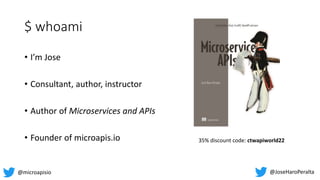
$ whoami
• I’m Jose
• Consultant, author, instructor
• Author of Microservices and APIs
• Founder of microapis.io
@JoseHaroPeralta
@microapisio
35% discount code: ctwapiworld22
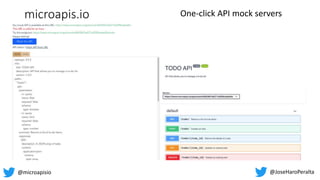
microapis.io
39% discount code: ctwapi21
One-click API mock servers
@JoseHaroPeralta
@microapisio
Connect with me!
 Twitter: @JoseHaroPeralta
 GitHub: @abunuwas
 Medium: @joseharoperalta /@python-geek
 LinkedIn: https://www.linkedin.com/in/jose-haro-peralta/
Agenda
 Complexity of creating good API design
 More in particular, good REST API design
 How domain-driven design helps to design better APIs
 Special case of data-driven applications
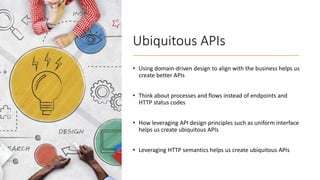
Ubiquitous APIs
• Using domain-driven design to align with the business helps us
create better APIs
• Think about processes and flows instead of endpoints and
HTTP status codes
• How leveraging API design principles such as uniform interface
helps us create ubiquitous APIs
• Leveraging HTTP semantics helps us create ubiquitous APIs
Reality is more complex than textbook cases
• Many projects start out as an experiment and/or PoC and then there’s pressure to
build the production application quickly (the business case often depends on the
speed of delivery)
• In reality, we often figure out what we’re doing on the go (the domain and the
subdomains become clear as we progress in our work)
• The business often lacks terminology to refer to their own processes and flows and to
their own “entities”
• Data-driven applications are notoriously hard to model (everything is “data”)
APIs for data-driven applications anti-patterns
• API conceived as data gateways
• Lack of API design and validation
• Lacking notion of operations
• Oversimplification through CRUD (CRUDified APIs)
• God models
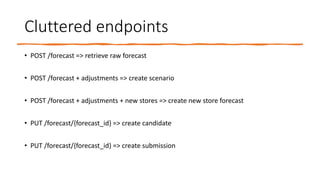
• Cluttered endpoints
• Lacking HTTP semantics
• Breaking uniform interface
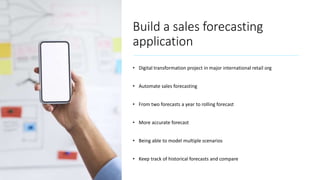
Build a sales forecasting
application
• Digital transformation project in major international retail org
• Automate sales forecasting
• From two forecasts a year to rolling forecast
• More accurate forecast
• Being able to model multiple scenarios
• Keep track of historical forecasts and compare
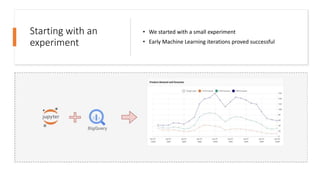
Starting with an
experiment
• We started with a small experiment
• Early Machine Learning iterations proved successful
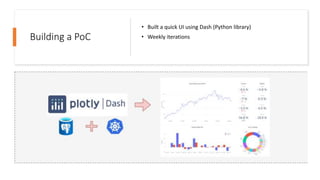
Building a PoC
• Built a quick UI using Dash (Python library)
• Weekly iterations
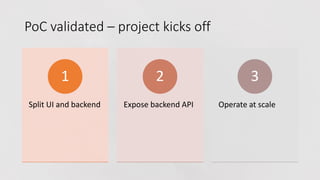
PoC validated – project kicks off
Split UI and backend
1
Expose backend API
2
Operate at scale
3
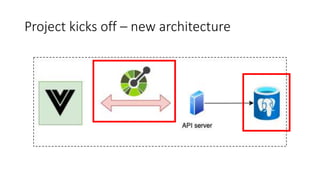
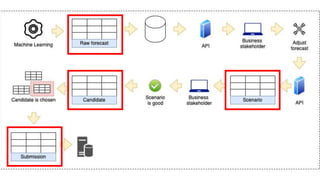
Project kicks off – new architecture
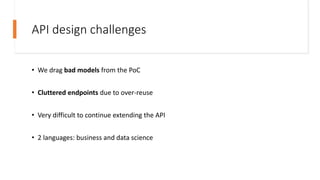
API design challenges
• It becomes clear that the business lacks terminology to refer to their own processes
and flows, and to their “entities”
• Different countries use different processes and flows
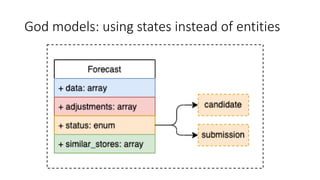
• We think of states instead of different entities and we have a “God model”
API design challenges
• We drag bad models from the PoC
• Cluttered endpoints due to over-reuse
• Very difficult to continue extending the API
• 2 languages: business and data science
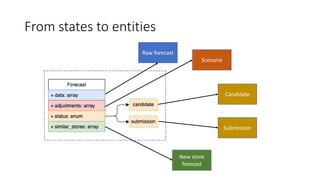
God models: using states instead of entities
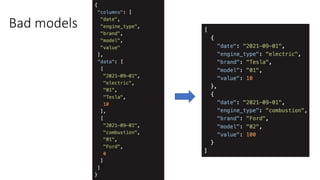
Bad models
Cluttered endpoints
• POST /forecast => retrieve raw forecast
• POST /forecast + adjustments => create scenario
• POST /forecast + adjustments + new stores => create new store forecast
• PUT /forecast/{forecast_id} => create candidate
• PUT /forecast/{forecast_id} => create submission
From states to entities
Raw forecast
Scenario
Candidate
Submission
New store
forecast
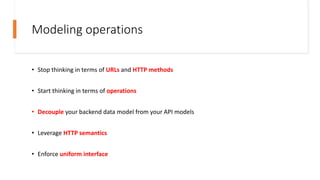
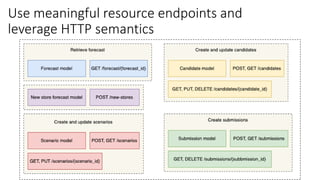
Modeling operations
• Stop thinking in terms of URLs and HTTP methods
• Start thinking in terms of operations
• Decouple your backend data model from your API models
• Leverage HTTP semantics
• Enforce uniform interface
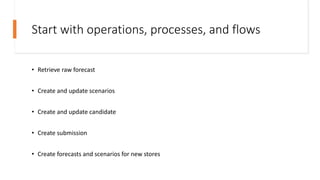
Start with operations, processes, and flows
• Retrieve raw forecast
• Create and update scenarios
• Create and update candidate
• Create submission
• Create forecasts and scenarios for new stores
Use meaningful resource endpoints and
leverage HTTP semantics
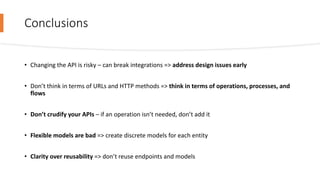
Conclusions
• Changing the API is risky – can break integrations => address design issues early
• Don’t think in terms of URLs and HTTP methods => think in terms of operations, processes, and
flows
• Don’t crudify your APIs – if an operation isn’t needed, don’t add it
• Flexible models are bad => create discrete models for each entity
• Clarity over reusability => don’t reuse endpoints and models
Thanks for listening!
Twitter: @JoseHaroPeralta
GitHub: @abunuwas
Medium: @joseharoperalta /@python-geek
LinkedIn: https://www.linkedin.com/in/jose-haro-peralta/
35% discount code: ctwapiworld22
ADDITIONAL READINGS
• Microservice APIs by J. Haro (mng.bz/nz48)
• “Building and deploying reliable APIs with FastAPI” by J. Haro
(https://www.twitch.tv/videos/1088283640)
• Documentation-driven development for APIs by J. Haro
(https://link.medium.com/m2A3rOxUfib)
• “Developing API clients doesn’t need to be a pain” by J. Haro
(https://link.medium.com/0B9vt7DUfib)
• “How bad models ruin an API” by J. Haro (https://microapis.io/blog/how-bad-models-
ruin-an-api)
• “API-first development maturity framework” by J. Haro (https://microapis.io/blog/api-
development-maturity)
ADDITIONAL READINGS
• “Design patterns for modern web APIs” by D. Luecke
(https://blog.feathersjs.com/design-patterns-for-modern-web-apis-1f046635215)
• The design of web APIs by A Lauret (https://www.manning.com/books/the-design-of-
web-apis)
• Designing APIs with Swagger and OpenAPI by J. S. Ponelat and L. L. Rosenstock
(https://www.manning.com/books/designing-apis-with-swagger-and-openapi)
• API Design Patterns by JJ Geewax (https://www.manning.com/books/api-design-
patterns)
• Principle of Web API Design by J. Higginbotham
(https://www.pearson.com/store/p/principles-of-web-api-design-delivering-value-
with-apis-and-microservices/P200000007278/9780137355631)

APIs with Bounded Contexts: Modelling Apis with Domain-Driven Design

  • 1.
    APIS WITH BOUNDED CONTEXTS ModellingAPIs with Domain-Driven Design José Haro Peralta Consultant and instructor Founder of microapis.io API World Conference 28 Oct – 3 Nov 2022 @microapisio @JoseHaroPeralta
  • 2.
    $ whoami • I’mJose • Consultant, author, instructor • Author of Microservices and APIs • Founder of microapis.io @JoseHaroPeralta @microapisio 35% discount code: ctwapiworld22
  • 3.
    microapis.io 39% discount code:ctwapi21 One-click API mock servers @JoseHaroPeralta @microapisio
  • 4.
    Connect with me! Twitter: @JoseHaroPeralta  GitHub: @abunuwas  Medium: @joseharoperalta /@python-geek  LinkedIn: https://www.linkedin.com/in/jose-haro-peralta/
  • 5.
    Agenda  Complexity ofcreating good API design  More in particular, good REST API design  How domain-driven design helps to design better APIs  Special case of data-driven applications
  • 6.
    Ubiquitous APIs • Usingdomain-driven design to align with the business helps us create better APIs • Think about processes and flows instead of endpoints and HTTP status codes • How leveraging API design principles such as uniform interface helps us create ubiquitous APIs • Leveraging HTTP semantics helps us create ubiquitous APIs
  • 7.
    Reality is morecomplex than textbook cases • Many projects start out as an experiment and/or PoC and then there’s pressure to build the production application quickly (the business case often depends on the speed of delivery) • In reality, we often figure out what we’re doing on the go (the domain and the subdomains become clear as we progress in our work) • The business often lacks terminology to refer to their own processes and flows and to their own “entities” • Data-driven applications are notoriously hard to model (everything is “data”)
  • 8.
    APIs for data-drivenapplications anti-patterns • API conceived as data gateways • Lack of API design and validation • Lacking notion of operations • Oversimplification through CRUD (CRUDified APIs) • God models • Cluttered endpoints • Lacking HTTP semantics • Breaking uniform interface
  • 9.
    Build a salesforecasting application • Digital transformation project in major international retail org • Automate sales forecasting • From two forecasts a year to rolling forecast • More accurate forecast • Being able to model multiple scenarios • Keep track of historical forecasts and compare
  • 10.
    Starting with an experiment •We started with a small experiment • Early Machine Learning iterations proved successful
  • 11.
    Building a PoC •Built a quick UI using Dash (Python library) • Weekly iterations
  • 12.
    PoC validated –project kicks off Split UI and backend 1 Expose backend API 2 Operate at scale 3
  • 13.
    Project kicks off– new architecture
  • 14.
    API design challenges •It becomes clear that the business lacks terminology to refer to their own processes and flows, and to their “entities” • Different countries use different processes and flows • We think of states instead of different entities and we have a “God model”
  • 15.
    API design challenges •We drag bad models from the PoC • Cluttered endpoints due to over-reuse • Very difficult to continue extending the API • 2 languages: business and data science
  • 17.
    God models: usingstates instead of entities
  • 18.
  • 19.
    Cluttered endpoints • POST/forecast => retrieve raw forecast • POST /forecast + adjustments => create scenario • POST /forecast + adjustments + new stores => create new store forecast • PUT /forecast/{forecast_id} => create candidate • PUT /forecast/{forecast_id} => create submission
  • 20.
    From states toentities Raw forecast Scenario Candidate Submission New store forecast
  • 21.
    Modeling operations • Stopthinking in terms of URLs and HTTP methods • Start thinking in terms of operations • Decouple your backend data model from your API models • Leverage HTTP semantics • Enforce uniform interface
  • 22.
    Start with operations,processes, and flows • Retrieve raw forecast • Create and update scenarios • Create and update candidate • Create submission • Create forecasts and scenarios for new stores
  • 23.
    Use meaningful resourceendpoints and leverage HTTP semantics
  • 24.
    Conclusions • Changing theAPI is risky – can break integrations => address design issues early • Don’t think in terms of URLs and HTTP methods => think in terms of operations, processes, and flows • Don’t crudify your APIs – if an operation isn’t needed, don’t add it • Flexible models are bad => create discrete models for each entity • Clarity over reusability => don’t reuse endpoints and models
  • 25.
    Thanks for listening! Twitter:@JoseHaroPeralta GitHub: @abunuwas Medium: @joseharoperalta /@python-geek LinkedIn: https://www.linkedin.com/in/jose-haro-peralta/ 35% discount code: ctwapiworld22
  • 26.
    ADDITIONAL READINGS • MicroserviceAPIs by J. Haro (mng.bz/nz48) • “Building and deploying reliable APIs with FastAPI” by J. Haro (https://www.twitch.tv/videos/1088283640) • Documentation-driven development for APIs by J. Haro (https://link.medium.com/m2A3rOxUfib) • “Developing API clients doesn’t need to be a pain” by J. Haro (https://link.medium.com/0B9vt7DUfib) • “How bad models ruin an API” by J. Haro (https://microapis.io/blog/how-bad-models- ruin-an-api) • “API-first development maturity framework” by J. Haro (https://microapis.io/blog/api- development-maturity)
  • 27.
    ADDITIONAL READINGS • “Designpatterns for modern web APIs” by D. Luecke (https://blog.feathersjs.com/design-patterns-for-modern-web-apis-1f046635215) • The design of web APIs by A Lauret (https://www.manning.com/books/the-design-of- web-apis) • Designing APIs with Swagger and OpenAPI by J. S. Ponelat and L. L. Rosenstock (https://www.manning.com/books/designing-apis-with-swagger-and-openapi) • API Design Patterns by JJ Geewax (https://www.manning.com/books/api-design- patterns) • Principle of Web API Design by J. Higginbotham (https://www.pearson.com/store/p/principles-of-web-api-design-delivering-value- with-apis-and-microservices/P200000007278/9780137355631)