



API design
best practice
Luca Ferrari
EMEA Solution Architect - Red Hat
Meetup objective
It is:
- A cheat sheet on API design
- A starting point for further investigation
- My first meetup as speaker
It is not:
- An explanation of the details of Swagger
- Revolutionary perspective on APIs
- The answer to all your questions about APIs (there
is a networking session for this)
2
Agenda
➔ API life & death
➔ API design phase
➔ API design principles
➔ OAS effect
➔ The blacksmith tools
➔ A tool chain
3
The (obvious) importance of Web APIs
01 Modern and powerful web browser.
02 The rise of minicomputers (also known as smartphone) and appification
03 The real world adoption of IoT device (Hey Google?)
Mashups:
https://wheelof.com/lunch/?zip=barcelona&query=lunch&radius=5
04 Simplification of protocols (HTTP rules)
05 New business models
the quality of a company’s API design provides a view into how the business truly values developers.
4
Lifecycle
5
One view
6
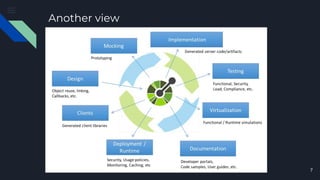
Another view
7
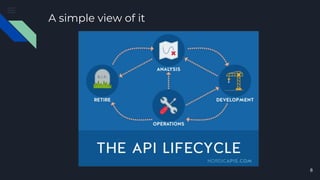
A simple view of it
8
A simple view of it
9
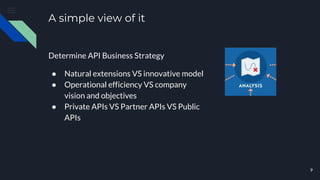
Determine API Business Strategy
● Natural extensions VS innovative model
● Operational efficiency VS company
vision and objectives
● Private APIs VS Partner APIs VS Public
APIs
A simple view of it
10
Prepare and Construct
technical requirements and development
plans:
● What operations
● How is it managed
● Which methods and protocols
● How big (now and then)
● Is it secure enough
● Is it usable enough
● Human VS Machine usability
A simple view of it
11
Promoting the Public API:
● Hackathons
● Documentation
● Omni-channel support
● Public events
● DX vs UX vs UI
Fix and Re-Fix:
● Analytics
● Users feedback
● Forums
● Documented and informed changes
● Fix →Feedback →Re-Fix
A simple view of it
12
Versioning & Deprecation
● limited usage
● lack of support
● lack of participation
● negative business effects
● privacy and security concern
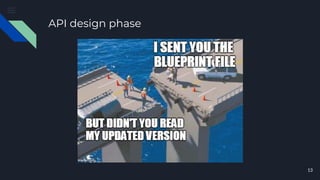
API design phase
13
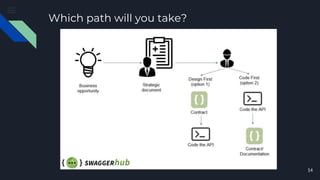
Which path will you take?
14
Which path will you take?
15
Design First approach:
● designing the API’s contract first
● new approach
● use of API description formats
Code First approach:
● traditional approach
● development of code happening after business requirements
● generating the documentation from the code
Which path will you take?
16
Design First advantages:
❏ better DX
❏ consistent design
❏ high re-usage
❏ business critical
❏ omni-channel
❏ better communication
Code First advantages:
❏ internal usage
❏ fast prototyping
❏ more automated
❏ agility (in the sense of fast,
wrong, retry)
API Design microscope
17
Service Description
Service Name
Domain Knowledge
Team-members
Organization
Schema of data
Repository
Assertions
Scenarios
OpenAPI
README
Tags
Definition
API Design microscope
18
Base Path
Path(s)
Verb(s)
Parameters
Headers
Body
Beyond Verbs With
Actions
Media Types
Status Codes
Filtering*
Pagination*
Sorting*
Response(s)
Errors
Design
API Design microscope
19
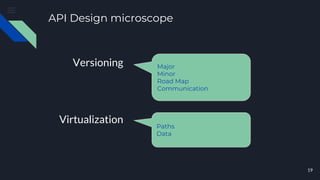
Major
Minor
Road Map
Communication
Versioning
Paths
Data
Virtualization
API Design microscope
20
Scenarios
Saved Requests
Responses
Playback
Results Archive
Reporting
Testing
API Design microscope
21
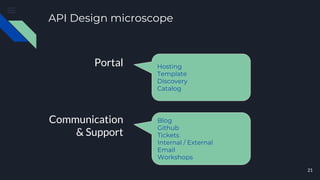
Hosting
Template
Discovery
Catalog
Portal
Blog
Github
Tickets
Internal / External
Email
Workshops
Communication
& Support
Design principles
22
1. API as a Product
23
➔ Designate API from the beginning as separate project
➔ Even if it is just for internal usage
➔ Adopt the same action mandated for other products:
● Dedicated communication
● API product management
● API product lifecycle
● API product KPI
● API product sponsoring
2. PoV of the Developer
24
Provider: Organization structure design flaw
Developer: The APIs are inconsistent, duplicated and full of
holes
Provider: Database structure design flaw
Developer: I don’t care about the data source structure or
technology, as long as you provide it reliably and consistently
3. { ‘Document’: ‘document’ }
25
What makes for a great documentation:
1. Format:
a. Easy to read
b. Well designed
c. Easy to update
d. Easy to access
2. Completeness:
a. Remember it is a contract
b. Various levels of experience and situations
3. Interactive:
a. OpenAPI
4. Learning curve
26
Make it easy:
1. Easy to access examples with data
2. Limited mandatory fields
3. Use hypermedia links to suggest actions
4. Offer one way to accomplish common scenarios
5. EXTRA POINTS: provide API based workflows (recipes)
and monitor usage
5. consistent, consistent, consistent
27
Predictability here is a good sign:
1. Consistent naming and convention
2. Consistent camel case
3. Consistent resource URLs
4. Consistent payload format
5. Consistent errors format
6. Wait for it … Security !
28
You don’t want to make the news (here, here) , security should
never be an afterthought:
1. Authentication (AuthN):
a. Basic Auth
b. API key
c. OAuth2
2. Authorization (AuthZ)
3. Data Leakage Protection
4. TLS is your friend
5. OWASP:
https://www.owasp.org/index.php/REST_Security_Cheat_S
heet
7. Guided examples
29
Going beyond Read and Write:
1. Time To First Hello World
2. OnBoarding Total Effort
3. Workflow examples
4. Production ready guidelines
8. EXTRA POINTS: little developer help
30
HTTP client libraries:
1. Right set of programming languages
2. Updated automatically
3. Updated frequently
4. Well explained
Some great examples
31
Adidas:
https://adidas.gitbook.io/api-guidelines/general-guidelines/gen
eral-guidelines
Zalando:
https://opensource.zalando.com/restful-api-guidelines/index.h
tml#principles
OAS effect
32
API specs formats
33
OAS or Swagger: WADL:
Bottom up construction W3C spec
Most popular Complex
Language agnostic
YAML or JSON Slate:
Minimal adoption
RAML:
More readable API Blueprint:
Less strict Markdown based
YAML Low adoption
Opinionated Can’t handle complex
API specs formats
34
OAS or Swagger: WADL:
Bottom up construction W3C spec
Most popular Complex
Language agnostic
YAML or JSON Slate:
Minimal adoption
RAML:
More readable API Blueprint:
Less strict Markdown based
YAML Low adoption
Opinionated Can’t handle complex
OAS v3.0
35
OAS v3.0
36
SERVERS:
● have multiple URLs are now allowed
● they can be used anywhere (even in PATH)
● PATH templates are now allowed
COMPONENTS:
● most of object are defined as components
● componentization (REST principle)
responses (existing) parameters (existing) examples (new)
requestBodies (new) headers (new) links (new) callbacks (new)
schemas (updated) securitySchemes (updated)
OAS v3.0
37
requestBody:
● added cookie parameter
● you can add an example (or array of examples)
● it now supports different media types
response:
● added wildcard response codes
callbacks:
● webhooks support
OAS v3.0
38
links:
● hypermedia support
● next action
● pagination support
SECURITY:
● multiple flows allowed
● OpenID Connect support
OAS v3.0 - links
39
The Link object represents a possible design-time link for a response. The
presence of a link does not guarantee the caller's ability to successfully
invoke it, rather it provides a known relationship and traversal mechanism
between responses and other operations.
Clients follow all links at their discretion. Neither permissions, nor the
capability to make a successful call to that link, is guaranteed solely by the
existence of a relationship.
OAS v3.0 - links (example)
40
https://gist.githubusercontent.com/lucamaf/c8c865077586b6291a
133f816ecc799f/raw/7d6254a8b154ef12ae03e5eb7a3717c81bb1
cade/gistfile1.txt
OAS v3.0 - callbacks
41
A map of possible out-of band callbacks related to the parent operation.
Each value in the map is a Path Item Object that describes a set of
requests that may be initiated by the API provider and the expected
responses. The key used to identify the callback object is an expression,
that identifies a URL to use for the callback operation.
OAS v3.0 - callbacks (example)
42
https://gist.githubusercontent.com/lucamaf/d210ae9b04358c3236
78aa5fbaf167a4/raw/323561a45cb156abf632409906da1fcac2e36
083/gistfile1.txt
Time for your opinion!
43
https://www.menti.com/
The tools
44
Stoplight
45
● Visual editor
● Integrated mock server
● Collaborative design
● Free Plan
● Non Open Source
Stoplight - DEMO
46
https://next.stoplight.io/
Restlet
47
● Visual editor
● Mocking possible
● Collaboration
● Generate server and client SDKs
● Free plan
● Partly open source
Restlet - DEMO
48
https://studio.restlet.com/
Apicurio
49
● Visual editor
● Generate API scaffolding
● Collaboration (real time)
● Support for OAS3
● Full Open Source
Apicurio - DEMO
50
https://studio.apicur.io/
51
Test page
Time for your opinion!
52
https://www.menti.com/
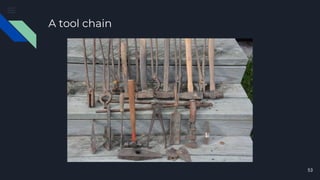
A tool chain
53
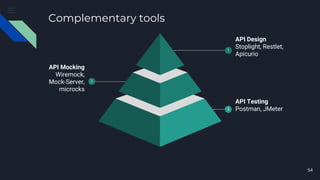
Complementary tools
54
API Testing
Postman, JMeter3
API Mocking
Wiremock,
Mock-Server,
microcks
2
API Design
Stoplight, Restlet,
Apicurio
1
Acknowledgements
55
Adidas ProgrammableWeb Design great web APIs
NordicAPIs APIHandyman Zalando
Stoplight swaggerhub
Restlet apievangelist
Apicurio apis-guru (github)
Thank you for your time !
Let’s hear feedbacks
https://www.menti.com/
56

Api design best practice

  • 1.
    API design best practice LucaFerrari EMEA Solution Architect - Red Hat
  • 2.
    Meetup objective It is: -A cheat sheet on API design - A starting point for further investigation - My first meetup as speaker It is not: - An explanation of the details of Swagger - Revolutionary perspective on APIs - The answer to all your questions about APIs (there is a networking session for this) 2
  • 3.
    Agenda ➔ API life& death ➔ API design phase ➔ API design principles ➔ OAS effect ➔ The blacksmith tools ➔ A tool chain 3
  • 4.
    The (obvious) importanceof Web APIs 01 Modern and powerful web browser. 02 The rise of minicomputers (also known as smartphone) and appification 03 The real world adoption of IoT device (Hey Google?) Mashups: https://wheelof.com/lunch/?zip=barcelona&query=lunch&radius=5 04 Simplification of protocols (HTTP rules) 05 New business models the quality of a company’s API design provides a view into how the business truly values developers. 4
  • 5.
  • 6.
  • 7.
  • 8.
  • 9.
    A simple viewof it 9 Determine API Business Strategy ● Natural extensions VS innovative model ● Operational efficiency VS company vision and objectives ● Private APIs VS Partner APIs VS Public APIs
  • 10.
    A simple viewof it 10 Prepare and Construct technical requirements and development plans: ● What operations ● How is it managed ● Which methods and protocols ● How big (now and then) ● Is it secure enough ● Is it usable enough ● Human VS Machine usability
  • 11.
    A simple viewof it 11 Promoting the Public API: ● Hackathons ● Documentation ● Omni-channel support ● Public events ● DX vs UX vs UI Fix and Re-Fix: ● Analytics ● Users feedback ● Forums ● Documented and informed changes ● Fix →Feedback →Re-Fix
  • 12.
    A simple viewof it 12 Versioning & Deprecation ● limited usage ● lack of support ● lack of participation ● negative business effects ● privacy and security concern
  • 13.
  • 14.
    Which path willyou take? 14
  • 15.
    Which path willyou take? 15 Design First approach: ● designing the API’s contract first ● new approach ● use of API description formats Code First approach: ● traditional approach ● development of code happening after business requirements ● generating the documentation from the code
  • 16.
    Which path willyou take? 16 Design First advantages: ❏ better DX ❏ consistent design ❏ high re-usage ❏ business critical ❏ omni-channel ❏ better communication Code First advantages: ❏ internal usage ❏ fast prototyping ❏ more automated ❏ agility (in the sense of fast, wrong, retry)
  • 17.
    API Design microscope 17 ServiceDescription Service Name Domain Knowledge Team-members Organization Schema of data Repository Assertions Scenarios OpenAPI README Tags Definition
  • 18.
    API Design microscope 18 BasePath Path(s) Verb(s) Parameters Headers Body Beyond Verbs With Actions Media Types Status Codes Filtering* Pagination* Sorting* Response(s) Errors Design
  • 19.
    API Design microscope 19 Major Minor RoadMap Communication Versioning Paths Data Virtualization
  • 20.
    API Design microscope 20 Scenarios SavedRequests Responses Playback Results Archive Reporting Testing
  • 21.
  • 22.
  • 23.
    1. API asa Product 23 ➔ Designate API from the beginning as separate project ➔ Even if it is just for internal usage ➔ Adopt the same action mandated for other products: ● Dedicated communication ● API product management ● API product lifecycle ● API product KPI ● API product sponsoring
  • 24.
    2. PoV ofthe Developer 24 Provider: Organization structure design flaw Developer: The APIs are inconsistent, duplicated and full of holes Provider: Database structure design flaw Developer: I don’t care about the data source structure or technology, as long as you provide it reliably and consistently
  • 25.
    3. { ‘Document’:‘document’ } 25 What makes for a great documentation: 1. Format: a. Easy to read b. Well designed c. Easy to update d. Easy to access 2. Completeness: a. Remember it is a contract b. Various levels of experience and situations 3. Interactive: a. OpenAPI
  • 26.
    4. Learning curve 26 Makeit easy: 1. Easy to access examples with data 2. Limited mandatory fields 3. Use hypermedia links to suggest actions 4. Offer one way to accomplish common scenarios 5. EXTRA POINTS: provide API based workflows (recipes) and monitor usage
  • 27.
    5. consistent, consistent,consistent 27 Predictability here is a good sign: 1. Consistent naming and convention 2. Consistent camel case 3. Consistent resource URLs 4. Consistent payload format 5. Consistent errors format
  • 28.
    6. Wait forit … Security ! 28 You don’t want to make the news (here, here) , security should never be an afterthought: 1. Authentication (AuthN): a. Basic Auth b. API key c. OAuth2 2. Authorization (AuthZ) 3. Data Leakage Protection 4. TLS is your friend 5. OWASP: https://www.owasp.org/index.php/REST_Security_Cheat_S heet
  • 29.
    7. Guided examples 29 Goingbeyond Read and Write: 1. Time To First Hello World 2. OnBoarding Total Effort 3. Workflow examples 4. Production ready guidelines
  • 30.
    8. EXTRA POINTS:little developer help 30 HTTP client libraries: 1. Right set of programming languages 2. Updated automatically 3. Updated frequently 4. Well explained
  • 31.
  • 32.
  • 33.
    API specs formats 33 OASor Swagger: WADL: Bottom up construction W3C spec Most popular Complex Language agnostic YAML or JSON Slate: Minimal adoption RAML: More readable API Blueprint: Less strict Markdown based YAML Low adoption Opinionated Can’t handle complex
  • 34.
    API specs formats 34 OASor Swagger: WADL: Bottom up construction W3C spec Most popular Complex Language agnostic YAML or JSON Slate: Minimal adoption RAML: More readable API Blueprint: Less strict Markdown based YAML Low adoption Opinionated Can’t handle complex
  • 35.
  • 36.
    OAS v3.0 36 SERVERS: ● havemultiple URLs are now allowed ● they can be used anywhere (even in PATH) ● PATH templates are now allowed COMPONENTS: ● most of object are defined as components ● componentization (REST principle) responses (existing) parameters (existing) examples (new) requestBodies (new) headers (new) links (new) callbacks (new) schemas (updated) securitySchemes (updated)
  • 37.
    OAS v3.0 37 requestBody: ● addedcookie parameter ● you can add an example (or array of examples) ● it now supports different media types response: ● added wildcard response codes callbacks: ● webhooks support
  • 38.
    OAS v3.0 38 links: ● hypermediasupport ● next action ● pagination support SECURITY: ● multiple flows allowed ● OpenID Connect support
  • 39.
    OAS v3.0 -links 39 The Link object represents a possible design-time link for a response. The presence of a link does not guarantee the caller's ability to successfully invoke it, rather it provides a known relationship and traversal mechanism between responses and other operations. Clients follow all links at their discretion. Neither permissions, nor the capability to make a successful call to that link, is guaranteed solely by the existence of a relationship.
  • 40.
    OAS v3.0 -links (example) 40 https://gist.githubusercontent.com/lucamaf/c8c865077586b6291a 133f816ecc799f/raw/7d6254a8b154ef12ae03e5eb7a3717c81bb1 cade/gistfile1.txt
  • 41.
    OAS v3.0 -callbacks 41 A map of possible out-of band callbacks related to the parent operation. Each value in the map is a Path Item Object that describes a set of requests that may be initiated by the API provider and the expected responses. The key used to identify the callback object is an expression, that identifies a URL to use for the callback operation.
  • 42.
    OAS v3.0 -callbacks (example) 42 https://gist.githubusercontent.com/lucamaf/d210ae9b04358c3236 78aa5fbaf167a4/raw/323561a45cb156abf632409906da1fcac2e36 083/gistfile1.txt
  • 43.
    Time for youropinion! 43 https://www.menti.com/
  • 44.
  • 45.
    Stoplight 45 ● Visual editor ●Integrated mock server ● Collaborative design ● Free Plan ● Non Open Source
  • 46.
  • 47.
    Restlet 47 ● Visual editor ●Mocking possible ● Collaboration ● Generate server and client SDKs ● Free plan ● Partly open source
  • 48.
  • 49.
    Apicurio 49 ● Visual editor ●Generate API scaffolding ● Collaboration (real time) ● Support for OAS3 ● Full Open Source
  • 50.
  • 51.
  • 52.
    Time for youropinion! 52 https://www.menti.com/
  • 53.
  • 54.
    Complementary tools 54 API Testing Postman,JMeter3 API Mocking Wiremock, Mock-Server, microcks 2 API Design Stoplight, Restlet, Apicurio 1
  • 55.
    Acknowledgements 55 Adidas ProgrammableWeb Designgreat web APIs NordicAPIs APIHandyman Zalando Stoplight swaggerhub Restlet apievangelist Apicurio apis-guru (github)
  • 56.
    Thank you foryour time ! Let’s hear feedbacks https://www.menti.com/ 56