Software Development Done Right
TUTORIAL
Designing a resource model for a Public API
Tom Höfte, IT Architect, Xebia
Marco van der Linden, IT Architect, Xebia
O’Reilly Software Architecture Conference
New York – February 26th , 2018
#OreillySACON
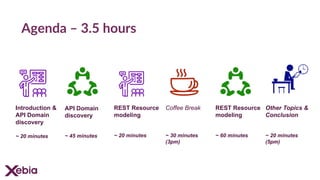
Agenda – 3.5 hours
Introduction &
API Domain
discovery
~ 20 minutes
API Domain
discovery
~ 45 minutes
REST Resource
modeling
~ 20 minutes
REST Resource
modeling
~ 60 minutes
Coffee Break
~ 30 minutes
(3pm)
Other Topics &
Conclusion
~ 20 minutes
(5pm)
Software Development Done Right
Part 0 – Introduction
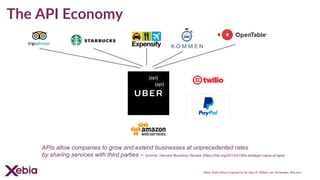
The API Economy
APIs allow companies to grow and extend businesses at unprecedented rates
by sharing services with third parties – source: Harvard Business Review (https://hbr.org/2015/01/the-strategic-value-of-apis)
{api}
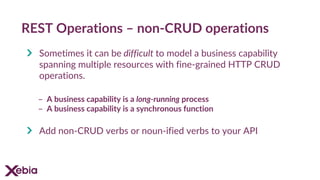
{api}
Note: Slide picture inspired by an idea of Willem van Schieveen, Bol.com
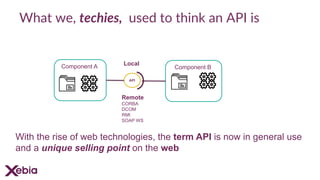
What we, techies, used to think an API is
With the rise of web technologies, the term API is now in general use
and a unique selling point on the web
Component A Component B
API
Remote
CORBA
DCOM
RMI
SOAP WS
Local
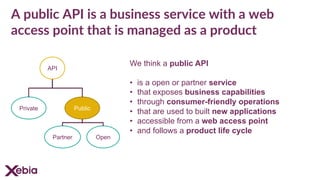
A public API is a business service with a web
access point that is managed as a product
We think a public API
• is a open or partner service
• that exposes business capabilities
• through consumer-friendly operations
• that are used to built new applications
• accessible from a web access point
• and follows a product life cycle
API
Private Public
OpenPartner
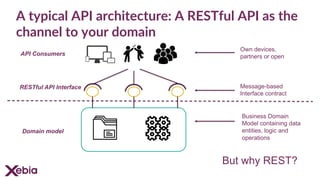
A typical API architecture: A RESTful API as the
channel to your domain
But why REST?
Business Domain
Model containing data
entities, logic and
operations
Domain model
Message-based
Interface contract
RESTful API Interface
API Consumers
Own devices,
partners or open
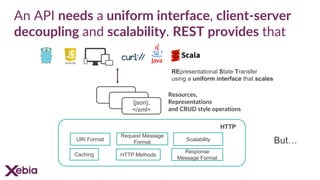
An API needs a uniform interface, client-server
decoupling and scalability. REST provides that
{json},
</xml>
Resources,
Representations
and CRUD style operations
HTTP
Caching
URI Format
Request Message
Format
Response
Message Format
HTTP Methods
Scalability
REpresentational State Transfer
using a uniform interface that scales
But…
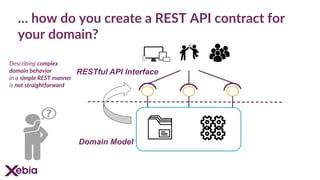
… how do you create a REST API contract for
your domain?
Domain Model
RESTful API Interface
Describing complex
domain behavior
in a simple REST manner
is not straightforward
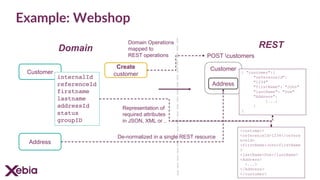
Example: Webshop
Customer
Domain REST
Address
Customer
Address
internalId
referenceId
firstname
lastname
addressId
status
groupID
De-normalized in a single REST resource
Create
customer
POST customers
Domain Operations
mapped to
REST operations
{ "customer":{
"referenceId":
"1234"
"firstName": "John"
"lastName": "Doe"
"Address":
{...}
}
}
Representation of
required attributes
in JSON, XML or ..
<customer>
<referenceId>1234</refere
nceId>
<firstName>John<firstName
>
<lastName>Doe</lastName>
<Address>
<...>
</Address>
</customer>
So, resources are the core of a RESTful API…
Resource modeling is therefore a key activity to…
• Map your domain operations to REST operations
• Map your domain data entities to REST resource
representations
…in order create an API that is user-friendly, extensible and
maintainable
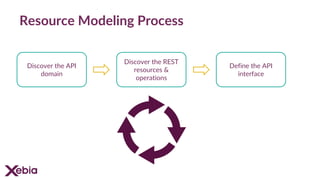
Resource Modeling Process
Discover the API
domain
Discover the REST
resources &
operations
Define the API
interface
Software Development Done Right
Part 1 – Discover the API
domain
Goal
Practice how to discover API domain entities, relations and
operations that you need in your API
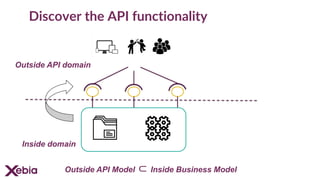
Discover the API functionality
Inside domain
Outside API domain
Outside API Model ⊂ Inside Business Model
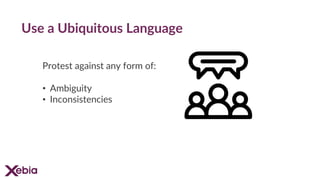
Use a Ubiquitous Language
Protest against any form of:
• Ambiguity
• Inconsistencies
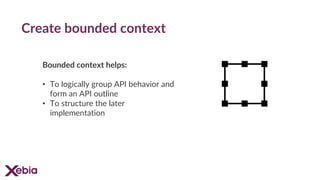
Create bounded context
Bounded context helps:
• To logically group API behavior and
form an API outline
• To structure the later
implementation
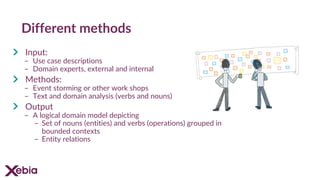
Different methods
Input:
- Use case descriptions
- Domain experts, external and internal
Methods:
- Event storming or other work shops
- Text and domain analysis (verbs and nouns)
Output
- A logical domain model depicting
- Set of nouns (entities) and verbs (operations) grouped in
bounded contexts
- Entity relations
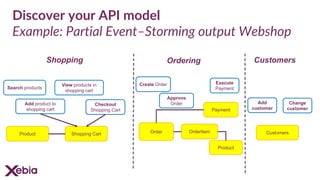
Discover your API model
Example: Partial Event–Storming output Webshop
CustomersProduct Shopping Cart Order
Search products
Execute
Payment
Checkout
Shopping Cart
View products in
shopping cart
Add product to
shopping cart Payment
Create Order
Approve
Order
Shopping Ordering Customers
Add
customer
Change
customer
OrderItem
Product
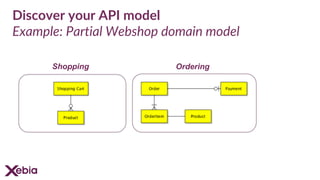
Discover your API model
Example: Partial Webshop domain model
Shopping Ordering
Exercise 1: Discover the API Domain
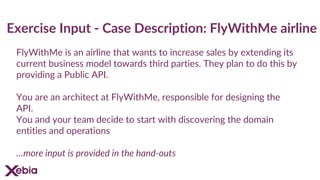
Exercise Input - Case Description: FlyWithMe airline
FlyWithMe is an airline that wants to increase sales by extending its
current business model towards third parties. They plan to do this by
providing a Public API.
You are an architect at FlyWithMe, responsible for designing the
API.
You and your team decide to start with discovering the domain
entities and operations
…more input is provided in the hand-outs
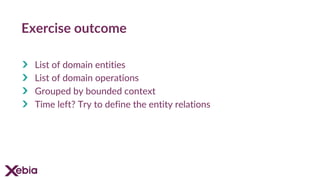
Exercise outcome
List of domain entities
List of domain operations
Grouped by bounded context
Time left? Try to define the entity relations
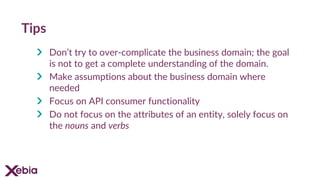
Tips
Don’t try to over-complicate the business domain; the goal
is not to get a complete understanding of the domain.
Make assumptions about the business domain where
needed
Focus on API consumer functionality
Do not focus on the attributes of an entity, solely focus on
the nouns and verbs
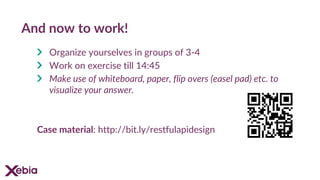
And now to work!
Organize yourselves in groups of 3-4
Work on exercise till 14:45
Make use of whiteboard, paper, flip overs (easel pad) etc. to
visualize your answer.
Case material: http://bit.ly/restfulapidesign
Retro time
What went well?
What was difficult?
Software Development Done Right
Part 2 – REST resource
modeling
Goal
Learn how to map domain entities and operations to REST
resources and operations
Learn about API documentation options
Practice by modelling basic use cases from the case study
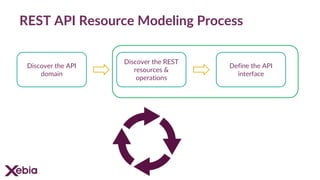
REST API Resource Modeling Process
Discover the API
domain
Discover the REST
resources &
operations
Define the API
interface
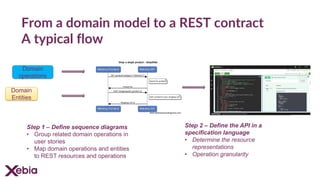
From a domain model to a REST contract
A typical flow
Domain
Entities
Domain
operations
Step 2 – Define the API in a
specification language
• Determine the resource
representations
• Operation granularity
Step 1 – Define sequence diagrams
• Group related domain operations in
user stories
• Map domain operations and entities
to REST resources and operations
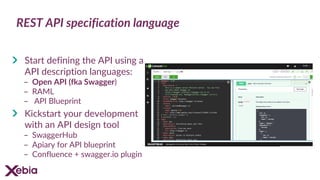
REST API specification language
Start defining the API using a
API description languages:
- Open API (fka Swagger)
- RAML
- API Blueprint
Kickstart your development
with an API design tool
- SwaggerHub
- Apiary for API blueprint
- Confluence + swagger.io plugin
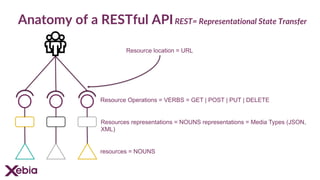
Anatomy of a RESTful APIREST= Representational State Transfer
Resource Operations = VERBS = GET | POST | PUT | DELETE
Resources representations = NOUNS representations = Media Types (JSON,
XML)
resources = NOUNS
Resource location = URL
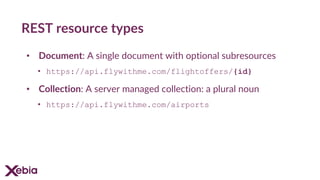
REST resource types
• Document: A single document with optional subresources
• https://api.flywithme.com/flightoffers/{id}
• Collection: A server managed collection: a plural noun
• https://api.flywithme.com/airports
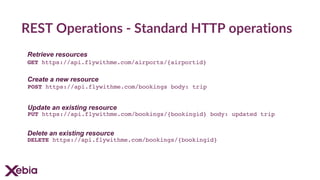
REST Operations - Standard HTTP operations
GET https://api.flywithme.com/airports/{airportid}
Retrieve resources
POST https://api.flywithme.com/bookings body: trip
Create a new resource
PUT https://api.flywithme.com/bookings/{bookingid} body: updated trip
Update an existing resource
DELETE https://api.flywithme.com/bookings/{bookingid}
Delete an existing resource
REST Operations – non-CRUD operations
Sometimes it can be difficult to model a business capability
spanning multiple resources with fine-grained HTTP CRUD
operations.
- A business capability is a long-running process
- A business capability is a synchronous function
Add non-CRUD verbs or noun-ified verbs to your API
REST Operations – non-CRUD Verbs
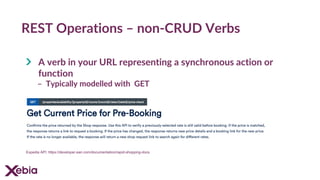
A verb in your URL representing a synchronous action or
function
- Typically modelled with GET
Expedia API: https://developer.ean.com/documentation/rapid-shopping-docs
REST Operations – Noun-ified verbs
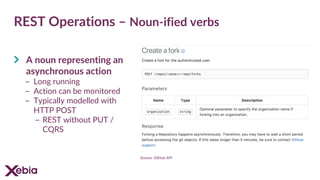
A noun representing an
asynchronous action
- Long running
- Action can be monitored
- Typically modelled with
HTTP POST
- REST without PUT /
CQRS
Source: GitHub API
REST Operations – Fine-grained HTTP CRUD
operations or course-grained non-CRUD operations?
It depends:
• CRUD should be your first option
• Use Non-CRUD verbs for synchronous operations for which non-
CRUD becomes clumsy
• Use noun-ified verbs for long running actions or events that must be
monitored
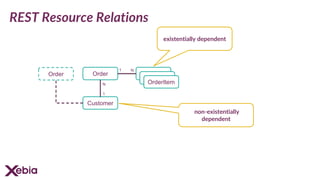
REST Resource Relations
Order
Customer
existentially dependent
non-existentially
dependent
OrderItem
OrderItem
OrderItem
1 N
Order
N
1
REST Resource Relations - Modeling
Resource modeling options:
• Linked Resources
{
orderId: 1
...
customerId: 1
...
}
• Embedded resources
{
id: 1
...
orderItems:
[
{
id: 1
product: "X"
.. }
]
}
Path modeling rules:
• existentially dependent
orders{orderid}orderitems{orderitemid}
• non-existentially dependent
customers{customerid}
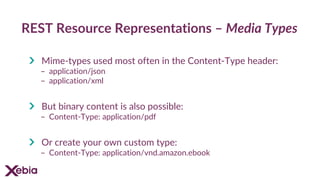
REST Resource Representations – Media Types
Mime-types used most often in the Content-Type header:
- application/json
- application/xml
But binary content is also possible:
- Content-Type: application/pdf
Or create your own custom type:
- Content-Type: application/vnd.amazon.ebook
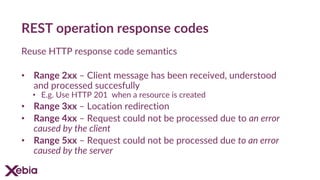
REST operation response codes
Reuse HTTP response code semantics
• Range 2xx – Client message has been received, understood
and processed succesfully
• E.g. Use HTTP 201 when a resource is created
• Range 3xx – Location redirection
• Range 4xx – Request could not be processed due to an error
caused by the client
• Range 5xx – Request could not be processed due to an error
caused by the server
Exercise 2: Discover REST resources
and operations
Exercise input
Take the output of exercise 1 and …
- Take your team result
- Or take our example result
Look at the 2 user stories (*) and define a RESTful API by
- Creating a sequence flow diagram
- A Swagger file specification
(*) User stories will be provided in the exercise
Exercise outcome
For each of the 2 user stories:
Sequence flow diagrams highlighting the REST operations
and resources
An initial swagger file specifying the REST operations and
resources needed to implemented the user stories
And now to work!
Work on the exercise till 16:30
Make use of
- https://www.websequencediagrams.com
- https://editor.swagger.io
- https://swagger.io/specification/
Case material: http://bit.ly/restfulapidesign
Coffee Break
Running out of material, but not out of time ?
You can add the following features:
Notify partner websites with flight updates
Update bookings
Retro time
What went well?
What was difficult?
Software Development Done Right
Part 3 – Other Important
Topics
Hypermedia
• HATEOAS (Hypermedia as the Engine of
Application State) – Richardson Maturity Model
– Level 3
• Self describing, discoverable API
• Changes do not break the contract
• Some frameworks / standardisation efforts:
• Hypertext Application Language – HAL
• Structured Interface for Representing
Entities – SIREN
• JSON-LD and Hydra
• JSON-API
{ "flightOfferSearch": 1
"offset": 0
[
"flightoffer": 1,
"id": 2
"accommodations",
"links": [
{
"href": "1/services",
"rel": "services",
"type" : "GET"
},
{
"href": "1/optionalAccommodations",
"rel": "optionalAccommodations",
"type" : "GET"
}
]
]
"links": [
{
"href": "1/flightoffers/next"
"rel": nextOffset
"type": "GET"
}
]
}
Possible resource
operations defined
in the response
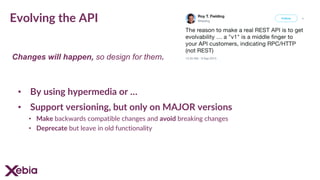
Evolving the API
• By using hypermedia or …
• Support versioning, but only on MAJOR versions
• Make backwards compatible changes and avoid breaking changes
• Deprecate but leave in old functionality
Changes will happen, so design for them.
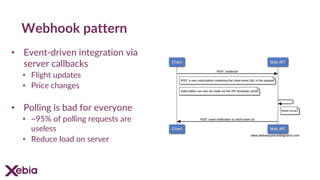
Webhook pattern
• Event-driven integration via
server callbacks
• Flight updates
• Price changes
• Polling is bad for everyone
• ~95% of polling requests are
useless
• Reduce load on server
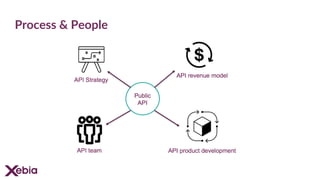
Process & People
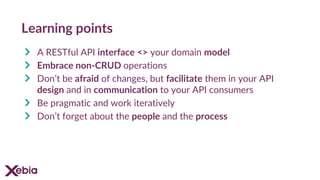
What have we learned?
Learning points
A RESTful API interface <> your domain model
Embrace non-CRUD operations
Don’t be afraid of changes, but facilitate them in your API
design and in communication to your API consumers
Be pragmatic and work iteratively
Don’t forget about the people and the process
Software Development Done Right
TUTORIAL
Thank you for attending!
Tom Höfte, IT Architect, Xebia, thofte@xebia.com
Marco van der Linden, IT Architect, Xebia, mvanderlinden@xebia.com
#OreillySACON

O reilly sacon2018nyc - restful api design - master - v1.0

  • 1.
    Software Development DoneRight TUTORIAL Designing a resource model for a Public API Tom Höfte, IT Architect, Xebia Marco van der Linden, IT Architect, Xebia O’Reilly Software Architecture Conference New York – February 26th , 2018 #OreillySACON
  • 2.
    Agenda – 3.5hours Introduction & API Domain discovery ~ 20 minutes API Domain discovery ~ 45 minutes REST Resource modeling ~ 20 minutes REST Resource modeling ~ 60 minutes Coffee Break ~ 30 minutes (3pm) Other Topics & Conclusion ~ 20 minutes (5pm)
  • 3.
    Software Development DoneRight Part 0 – Introduction
  • 4.
    The API Economy APIsallow companies to grow and extend businesses at unprecedented rates by sharing services with third parties – source: Harvard Business Review (https://hbr.org/2015/01/the-strategic-value-of-apis) {api} {api} Note: Slide picture inspired by an idea of Willem van Schieveen, Bol.com
  • 5.
    What we, techies,used to think an API is With the rise of web technologies, the term API is now in general use and a unique selling point on the web Component A Component B API Remote CORBA DCOM RMI SOAP WS Local
  • 6.
    A public APIis a business service with a web access point that is managed as a product We think a public API • is a open or partner service • that exposes business capabilities • through consumer-friendly operations • that are used to built new applications • accessible from a web access point • and follows a product life cycle API Private Public OpenPartner
  • 7.
    A typical APIarchitecture: A RESTful API as the channel to your domain But why REST? Business Domain Model containing data entities, logic and operations Domain model Message-based Interface contract RESTful API Interface API Consumers Own devices, partners or open
  • 8.
    An API needsa uniform interface, client-server decoupling and scalability. REST provides that {json}, </xml> Resources, Representations and CRUD style operations HTTP Caching URI Format Request Message Format Response Message Format HTTP Methods Scalability REpresentational State Transfer using a uniform interface that scales But…
  • 9.
    … how doyou create a REST API contract for your domain? Domain Model RESTful API Interface Describing complex domain behavior in a simple REST manner is not straightforward
  • 10.
    Example: Webshop Customer Domain REST Address Customer Address internalId referenceId firstname lastname addressId status groupID De-normalizedin a single REST resource Create customer POST customers Domain Operations mapped to REST operations { "customer":{ "referenceId": "1234" "firstName": "John" "lastName": "Doe" "Address": {...} } } Representation of required attributes in JSON, XML or .. <customer> <referenceId>1234</refere nceId> <firstName>John<firstName > <lastName>Doe</lastName> <Address> <...> </Address> </customer>
  • 11.
    So, resources arethe core of a RESTful API… Resource modeling is therefore a key activity to… • Map your domain operations to REST operations • Map your domain data entities to REST resource representations …in order create an API that is user-friendly, extensible and maintainable
  • 12.
    Resource Modeling Process Discoverthe API domain Discover the REST resources & operations Define the API interface
  • 13.
    Software Development DoneRight Part 1 – Discover the API domain
  • 14.
    Goal Practice how todiscover API domain entities, relations and operations that you need in your API
  • 15.
    Discover the APIfunctionality Inside domain Outside API domain Outside API Model ⊂ Inside Business Model
  • 16.
    Use a UbiquitousLanguage Protest against any form of: • Ambiguity • Inconsistencies
  • 17.
    Create bounded context Boundedcontext helps: • To logically group API behavior and form an API outline • To structure the later implementation
  • 18.
    Different methods Input: - Usecase descriptions - Domain experts, external and internal Methods: - Event storming or other work shops - Text and domain analysis (verbs and nouns) Output - A logical domain model depicting - Set of nouns (entities) and verbs (operations) grouped in bounded contexts - Entity relations
  • 19.
    Discover your APImodel Example: Partial Event–Storming output Webshop CustomersProduct Shopping Cart Order Search products Execute Payment Checkout Shopping Cart View products in shopping cart Add product to shopping cart Payment Create Order Approve Order Shopping Ordering Customers Add customer Change customer OrderItem Product
  • 20.
    Discover your APImodel Example: Partial Webshop domain model Shopping Ordering
  • 21.
    Exercise 1: Discoverthe API Domain
  • 22.
    Exercise Input -Case Description: FlyWithMe airline FlyWithMe is an airline that wants to increase sales by extending its current business model towards third parties. They plan to do this by providing a Public API. You are an architect at FlyWithMe, responsible for designing the API. You and your team decide to start with discovering the domain entities and operations …more input is provided in the hand-outs
  • 23.
    Exercise outcome List ofdomain entities List of domain operations Grouped by bounded context Time left? Try to define the entity relations
  • 24.
    Tips Don’t try toover-complicate the business domain; the goal is not to get a complete understanding of the domain. Make assumptions about the business domain where needed Focus on API consumer functionality Do not focus on the attributes of an entity, solely focus on the nouns and verbs
  • 25.
    And now towork! Organize yourselves in groups of 3-4 Work on exercise till 14:45 Make use of whiteboard, paper, flip overs (easel pad) etc. to visualize your answer. Case material: http://bit.ly/restfulapidesign
  • 26.
    Retro time What wentwell? What was difficult?
  • 27.
    Software Development DoneRight Part 2 – REST resource modeling
  • 28.
    Goal Learn how tomap domain entities and operations to REST resources and operations Learn about API documentation options Practice by modelling basic use cases from the case study
  • 29.
    REST API ResourceModeling Process Discover the API domain Discover the REST resources & operations Define the API interface
  • 30.
    From a domainmodel to a REST contract A typical flow Domain Entities Domain operations Step 2 – Define the API in a specification language • Determine the resource representations • Operation granularity Step 1 – Define sequence diagrams • Group related domain operations in user stories • Map domain operations and entities to REST resources and operations
  • 31.
    REST API specificationlanguage Start defining the API using a API description languages: - Open API (fka Swagger) - RAML - API Blueprint Kickstart your development with an API design tool - SwaggerHub - Apiary for API blueprint - Confluence + swagger.io plugin
  • 32.
    Anatomy of aRESTful APIREST= Representational State Transfer Resource Operations = VERBS = GET | POST | PUT | DELETE Resources representations = NOUNS representations = Media Types (JSON, XML) resources = NOUNS Resource location = URL
  • 33.
    REST resource types •Document: A single document with optional subresources • https://api.flywithme.com/flightoffers/{id} • Collection: A server managed collection: a plural noun • https://api.flywithme.com/airports
  • 34.
    REST Operations -Standard HTTP operations GET https://api.flywithme.com/airports/{airportid} Retrieve resources POST https://api.flywithme.com/bookings body: trip Create a new resource PUT https://api.flywithme.com/bookings/{bookingid} body: updated trip Update an existing resource DELETE https://api.flywithme.com/bookings/{bookingid} Delete an existing resource
  • 35.
    REST Operations –non-CRUD operations Sometimes it can be difficult to model a business capability spanning multiple resources with fine-grained HTTP CRUD operations. - A business capability is a long-running process - A business capability is a synchronous function Add non-CRUD verbs or noun-ified verbs to your API
  • 36.
    REST Operations –non-CRUD Verbs A verb in your URL representing a synchronous action or function - Typically modelled with GET Expedia API: https://developer.ean.com/documentation/rapid-shopping-docs
  • 37.
    REST Operations –Noun-ified verbs A noun representing an asynchronous action - Long running - Action can be monitored - Typically modelled with HTTP POST - REST without PUT / CQRS Source: GitHub API
  • 38.
    REST Operations –Fine-grained HTTP CRUD operations or course-grained non-CRUD operations? It depends: • CRUD should be your first option • Use Non-CRUD verbs for synchronous operations for which non- CRUD becomes clumsy • Use noun-ified verbs for long running actions or events that must be monitored
  • 39.
    REST Resource Relations Order Customer existentiallydependent non-existentially dependent OrderItem OrderItem OrderItem 1 N Order N 1
  • 40.
    REST Resource Relations- Modeling Resource modeling options: • Linked Resources { orderId: 1 ... customerId: 1 ... } • Embedded resources { id: 1 ... orderItems: [ { id: 1 product: "X" .. } ] } Path modeling rules: • existentially dependent orders{orderid}orderitems{orderitemid} • non-existentially dependent customers{customerid}
  • 41.
    REST Resource Representations– Media Types Mime-types used most often in the Content-Type header: - application/json - application/xml But binary content is also possible: - Content-Type: application/pdf Or create your own custom type: - Content-Type: application/vnd.amazon.ebook
  • 42.
    REST operation responsecodes Reuse HTTP response code semantics • Range 2xx – Client message has been received, understood and processed succesfully • E.g. Use HTTP 201 when a resource is created • Range 3xx – Location redirection • Range 4xx – Request could not be processed due to an error caused by the client • Range 5xx – Request could not be processed due to an error caused by the server
  • 43.
    Exercise 2: DiscoverREST resources and operations
  • 44.
    Exercise input Take theoutput of exercise 1 and … - Take your team result - Or take our example result Look at the 2 user stories (*) and define a RESTful API by - Creating a sequence flow diagram - A Swagger file specification (*) User stories will be provided in the exercise
  • 45.
    Exercise outcome For eachof the 2 user stories: Sequence flow diagrams highlighting the REST operations and resources An initial swagger file specifying the REST operations and resources needed to implemented the user stories
  • 46.
    And now towork! Work on the exercise till 16:30 Make use of - https://www.websequencediagrams.com - https://editor.swagger.io - https://swagger.io/specification/ Case material: http://bit.ly/restfulapidesign
  • 47.
  • 48.
    Running out ofmaterial, but not out of time ? You can add the following features: Notify partner websites with flight updates Update bookings
  • 49.
    Retro time What wentwell? What was difficult?
  • 50.
    Software Development DoneRight Part 3 – Other Important Topics
  • 51.
    Hypermedia • HATEOAS (Hypermediaas the Engine of Application State) – Richardson Maturity Model – Level 3 • Self describing, discoverable API • Changes do not break the contract • Some frameworks / standardisation efforts: • Hypertext Application Language – HAL • Structured Interface for Representing Entities – SIREN • JSON-LD and Hydra • JSON-API { "flightOfferSearch": 1 "offset": 0 [ "flightoffer": 1, "id": 2 "accommodations", "links": [ { "href": "1/services", "rel": "services", "type" : "GET" }, { "href": "1/optionalAccommodations", "rel": "optionalAccommodations", "type" : "GET" } ] ] "links": [ { "href": "1/flightoffers/next" "rel": nextOffset "type": "GET" } ] } Possible resource operations defined in the response
  • 52.
    Evolving the API •By using hypermedia or … • Support versioning, but only on MAJOR versions • Make backwards compatible changes and avoid breaking changes • Deprecate but leave in old functionality Changes will happen, so design for them.
  • 53.
    Webhook pattern • Event-drivenintegration via server callbacks • Flight updates • Price changes • Polling is bad for everyone • ~95% of polling requests are useless • Reduce load on server
  • 54.
  • 55.
    What have welearned?
  • 56.
    Learning points A RESTfulAPI interface <> your domain model Embrace non-CRUD operations Don’t be afraid of changes, but facilitate them in your API design and in communication to your API consumers Be pragmatic and work iteratively Don’t forget about the people and the process
  • 57.
    Software Development DoneRight TUTORIAL Thank you for attending! Tom Höfte, IT Architect, Xebia, thofte@xebia.com Marco van der Linden, IT Architect, Xebia, mvanderlinden@xebia.com #OreillySACON