API strategy a beginners guide
1
API’S…?
2
Most	people	are	talking	about	API’s,	of	all	types,	are	crea9ng	business	models	to	exploit	
them	(or	are	trying)	and	are	looking	to	generate	a	significant	amount	of	revenue	
through	them.		
Its	probably	important	at	this	point	to	differen9ate	internet	facing	API’s	and	public	API’s.	
The	API’s	that	are	aErac9ng	a	lot	of	press	and	corporate	aEen9on	are	publicly	facing	
API’s	that	3rd	party	developers	&	organisa9ons	consume,	and	create	new	business	
opportuni9es	and	or	new	products	etc	using	your	API.	
These	business	opportuni9es	do	not	necessarily	need	to	have	a	$	value.	There	are	a	large	
number	where	there	is	no	revenue	generated	-	but	these	API’s	do	extend	an	
organisa9on’s	reach	or	footprint.		
Having	a	successful	developer	/	api	portal	is	considered	a	reasonable	measure	of	an	
organisa9ons	technical	maturity	and	this	can	help	aEract	tech	talent.
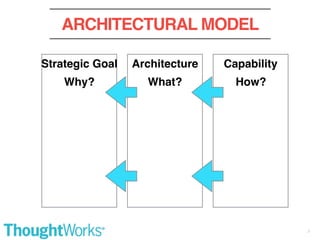
ARCHITECTURAL MODEL
3
Strategic Goal Architecture Capability
Why? What? How?
WHY
4
WHY
5
Everything	starts	with	Why,	or	at	least	should	start	with	Why!	
A	few	ques9ons	to	help	you	understand	the	Why	of	pushing	an	API	
into	the	public	domain	could	be…	
Why	would	a	developer	want	to	consume	my	API…?	
Why	am	i	developing	this	API…?	
Why	am	i	going	to	the	effort	of	‘pushing’	this	API	into	the	public	
domain…?
WHY
6
This	Capital	One	blog	that	has	some	great	thoughts	about	the	‘why’	
of	API’s	
hEp://www.capitalone.io/blog/inside-out-taking-your-api-public/	
It	also	has	a	reference	to	Simon	Sinek’s	talk	on	the	‘Why’	of	why	
organisa9ons	and	people	are	successful.		
If	you	cant	answer	the	Why…then	pause…	and	work	out	the	Why!
WHAT
7
GOOD
8
• Why understood
• Well documented
• Clear instructions on how to invoke
• Description of what the developer can expect with examples
• Readonly to start with is better
• Not tightly coupled to back end systems
• Application Performance Monitoring tool to monitor and visualise
traffic
NOT SO GOOD
9
• API Logic in Vendor products
• API’s that are both internal and public
• Can be difficult to segregate traffic during production incident for
those just starting on their public API journey
• API’s with only 1 or 2 consumers
• Poor documentation
ARCHITECTURAL PATTERNS
10
HOW
11
WHATS THE MOST IMPORTANT THING?
12
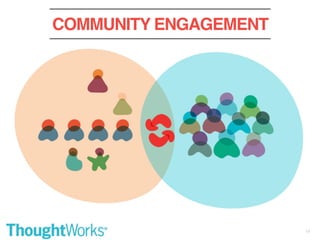
COMMUNITY ENGAGEMENT
13
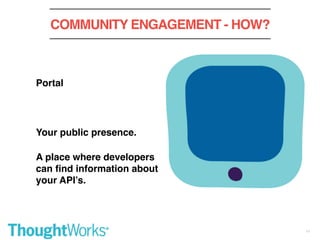
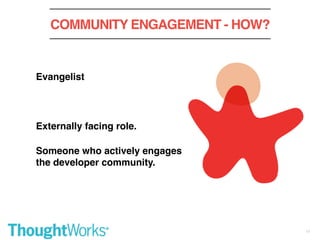
COMMUNITY ENGAGEMENT - HOW?
14
Portal
Your public presence.
A place where developers
can find information about
your API’s.
COMMUNITY ENGAGEMENT - HOW?
15
Evangelist
Externally facing role.
Someone who actively engages
the developer community.
COMMUNITY ENGAGEMENT - HOW?
16
Status
A page that publishes
the state of your API
e.g. Active, Degraded,
Not Active.
Typically a subset of the
portal.
COMMUNITY ENGAGEMENT - HOW?
17
Forum
An online community
to discuss your API’s.
Allows all
conversations to be
public.
A search resource for
developers.
COMMUNITY ENGAGEMENT - HOW?
18
Blog
Whats happening in your
API world…
What worked well and
what didn’t?
What do have coming
next?
SOME GOOD EXAMPLES TO LOOK AT
19
Capital	One	
hEps://developer.capitalone.com/products/	
BBVA	
hEps://www.bbvaapimarket.com/web/api_market/	
Telstra	
hEps://dev.telstra.com/	
TwiEer	
hEps://dev.twiEer.com/rest/public
AN EXAMPLE TEAM
20
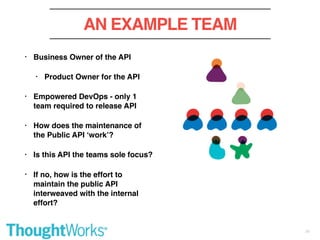
• Business Owner of the API
• Product Owner for the API
• Empowered DevOps - only 1
team required to release API
• How does the maintenance of
the Public API ‘work’?
• Is this API the teams sole focus?
• If no, how is the effort to
maintain the public API
interweaved with the internal
effort?
BUDGET / FUNDING
21
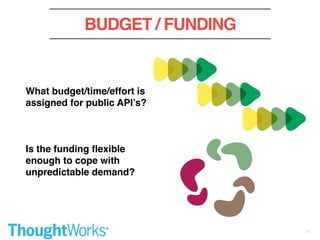
What budget/time/effort is
assigned for public API’s?
Is the funding flexible
enough to cope with
unpredictable demand?
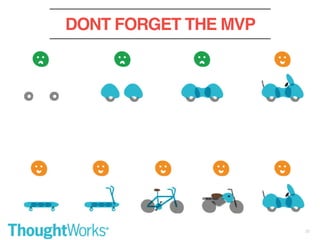
DONT FORGET THE MVP
22
GOTCHA’S
23
• Trying to short cut the maturity scale
• Slow is ok
• Dont be tempted to go ‘early’
• Not listening to your community - always have an open
channel and someone ‘listening’
• Good internal does not necessarily equal a good
external API
• Vendor lockin
andy.mcquarrie@thoughtworks.com
@andymcquarrie
24

Api strategy a beginners guide