Security Guidelines for
Providing and Consuming APIs @faisaly
FaisalYahya
Faisal Yahya – Cloud Security Alliance –
Chairman Indonesia Chapter 1
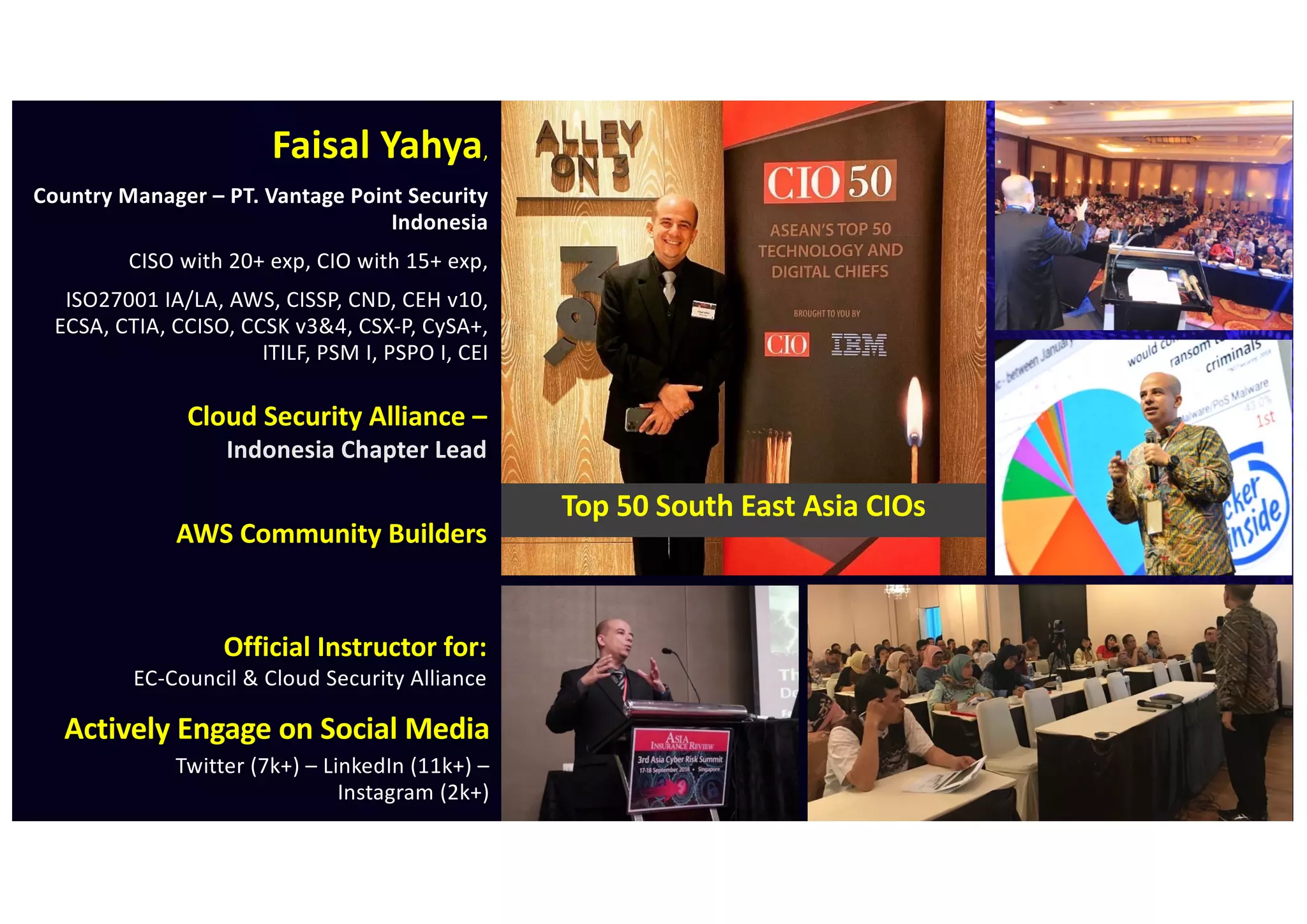
Faisal Yahya,
Country Manager – PT. Vantage Point Security
Indonesia
CISO with 20+ exp, CIO with 15+ exp,
ISO27001 IA/LA, AWS, CISSP, CND, CEH v10,
ECSA, CTIA, CCISO, CCSK v3&4, CSX-P, CySA+,
ITILF, PSM I, PSPO I, CEI
Official Instructor for:
EC-Council & Cloud Security Alliance
Top 50 South East Asia CIOs
Actively Engage on Social Media
Twitter (7k+) – LinkedIn (11k+) –
Instagram (2k+)
AWS Community Builders
Cloud Security Alliance –
Indonesia Chapter Lead
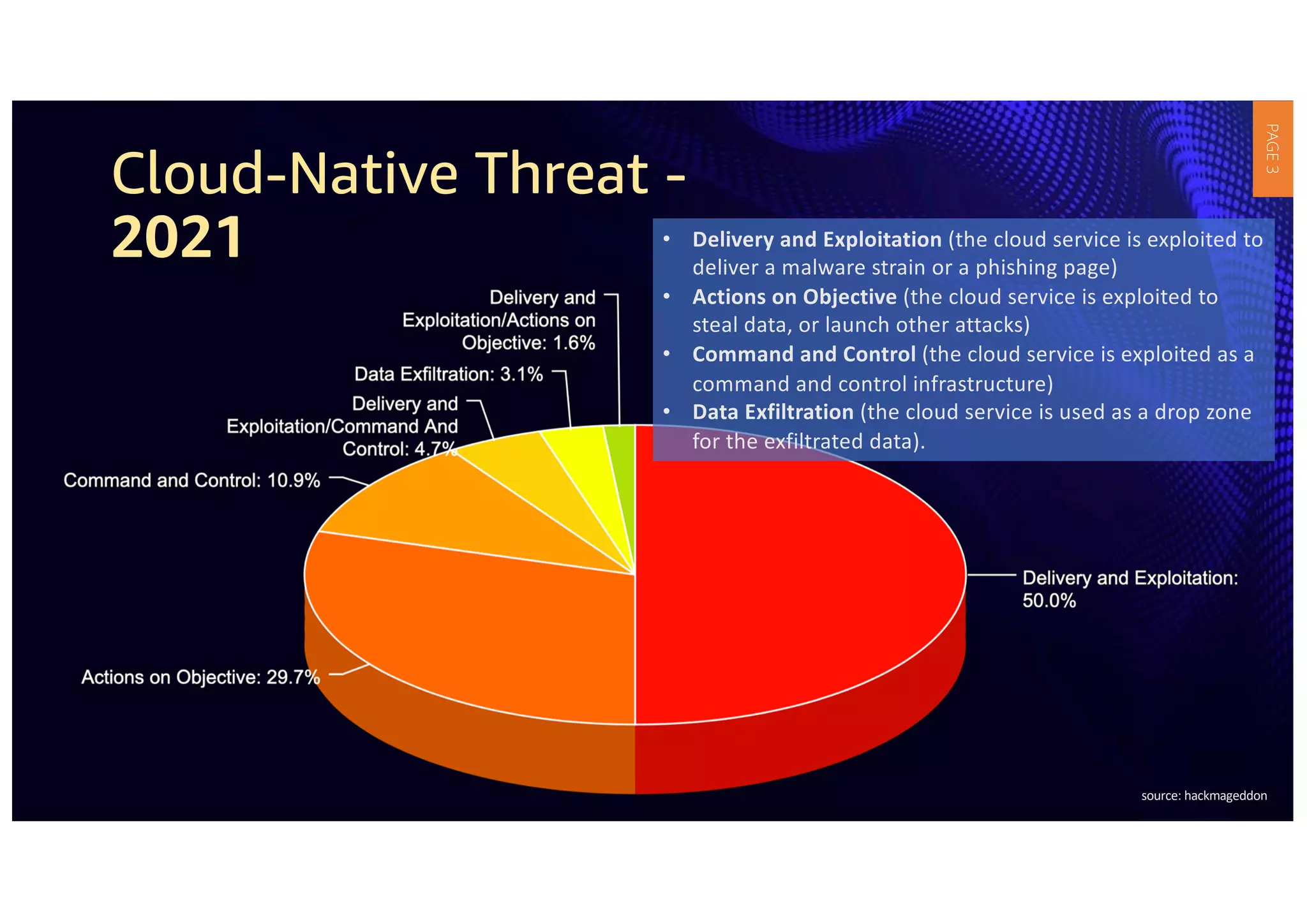
Cloud-Native Threat -
2021
source: hackmageddon
• Delivery and Exploitation (the cloud service is exploited to
deliver a malware strain or a phishing page)
• Actions on Objective (the cloud service is exploited to
steal data, or launch other attacks)
• Command and Control (the cloud service is exploited as a
command and control infrastructure)
• Data Exfiltration (the cloud service is used as a drop zone
for the exfiltrated data).
PAGE
3
API & DevOps
New Paradigm
• Organizations have become more reliant on software
development, confirming the oft-repeated old saying
that "all organizations currently are software
companies.”
• The DevOps new paradigm facilitated not only a
business-side digital transformation. Digital
transformation also altered the processes and
activities associated with software deployment and
development.
• Gartner reports an increase in client inquiries about
API security, noting a 30% year-over-year increase in
client inquiries. By 2022, it predicts, API abuse will be
the most common attack vector for enterprise web
application breaches.
PAGE
4
Security As a Service as
Emerging Needs
If you work in an Agile environment, I believe you need
a continuous monitoring and security analysis system
that is integrated into your DevOps process. This
system should be able to quickly identify security issues
and provide clear guidance and even auto-remediation
functions to resolve them.
The only way to harmoniously build security into the
development pipeline is by providing security as a
service model.
The traditional security layering model just simply no
longer work.
PAGE
5
Related Facts
• Application Programming Interface security models have
fallen behind the requirements of a non-perimeter world.
(Forrester)
• The most frequently reported API security incident in 2020
was the discovery of a vulnerability in a production API.
Organizations must complement their build and deploy
security practices with runtime security. (Salt Security)
• According to the company's customer data, the average
number of API attacks per customer per month increased
from 50 in June to nearly 80 in December. While the
average monthly volume of API calls increased by 51%, the
percentage of malicious traffic increased by 211% during
the study period. (Michelle McLean, 2021)
PAGE
6
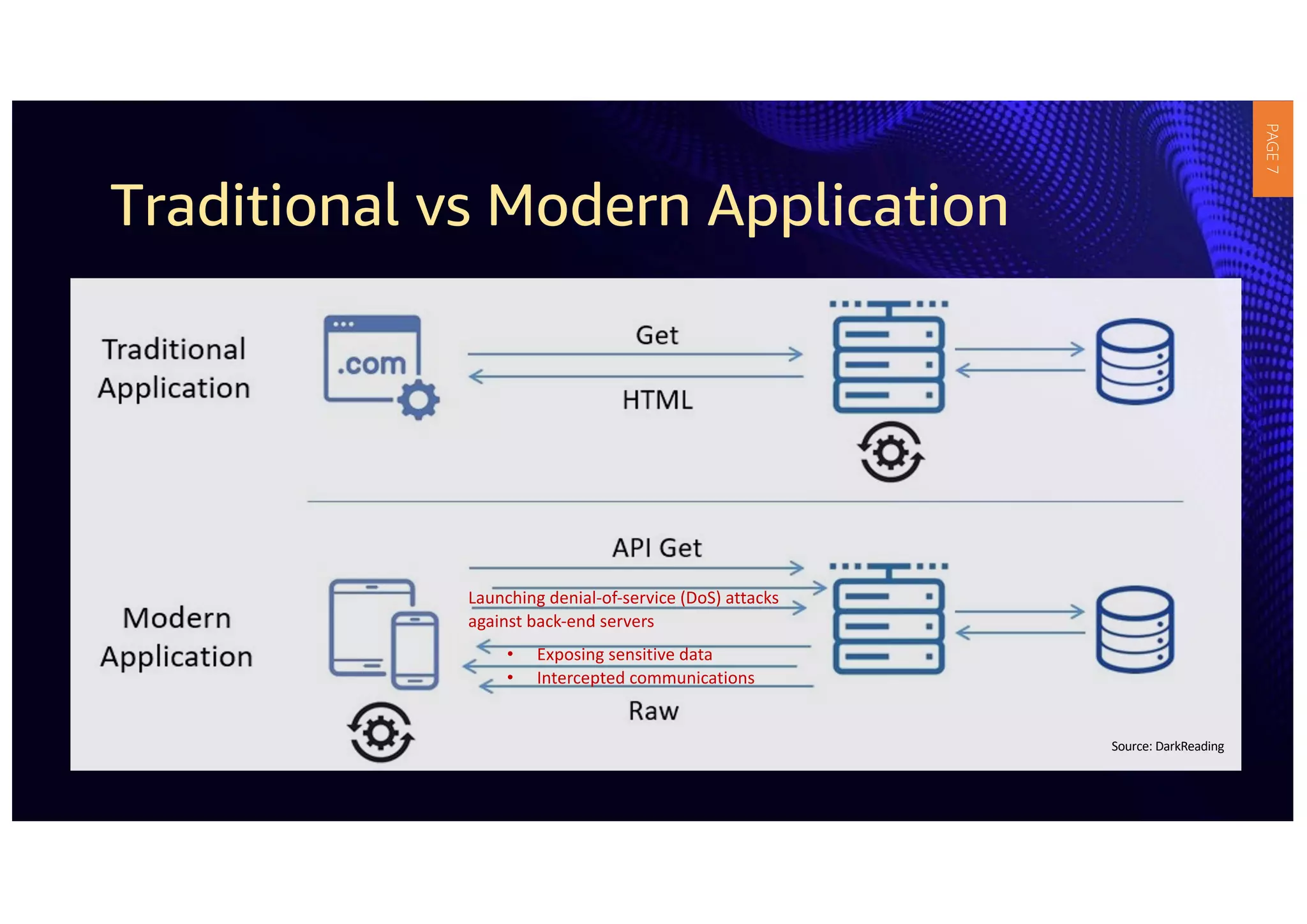
Traditional vs Modern Application
Source: DarkReading
• Exposing sensitive data
• Intercepted communications
Launching denial-of-service (DoS) attacks
against back-end servers
PAGE
7
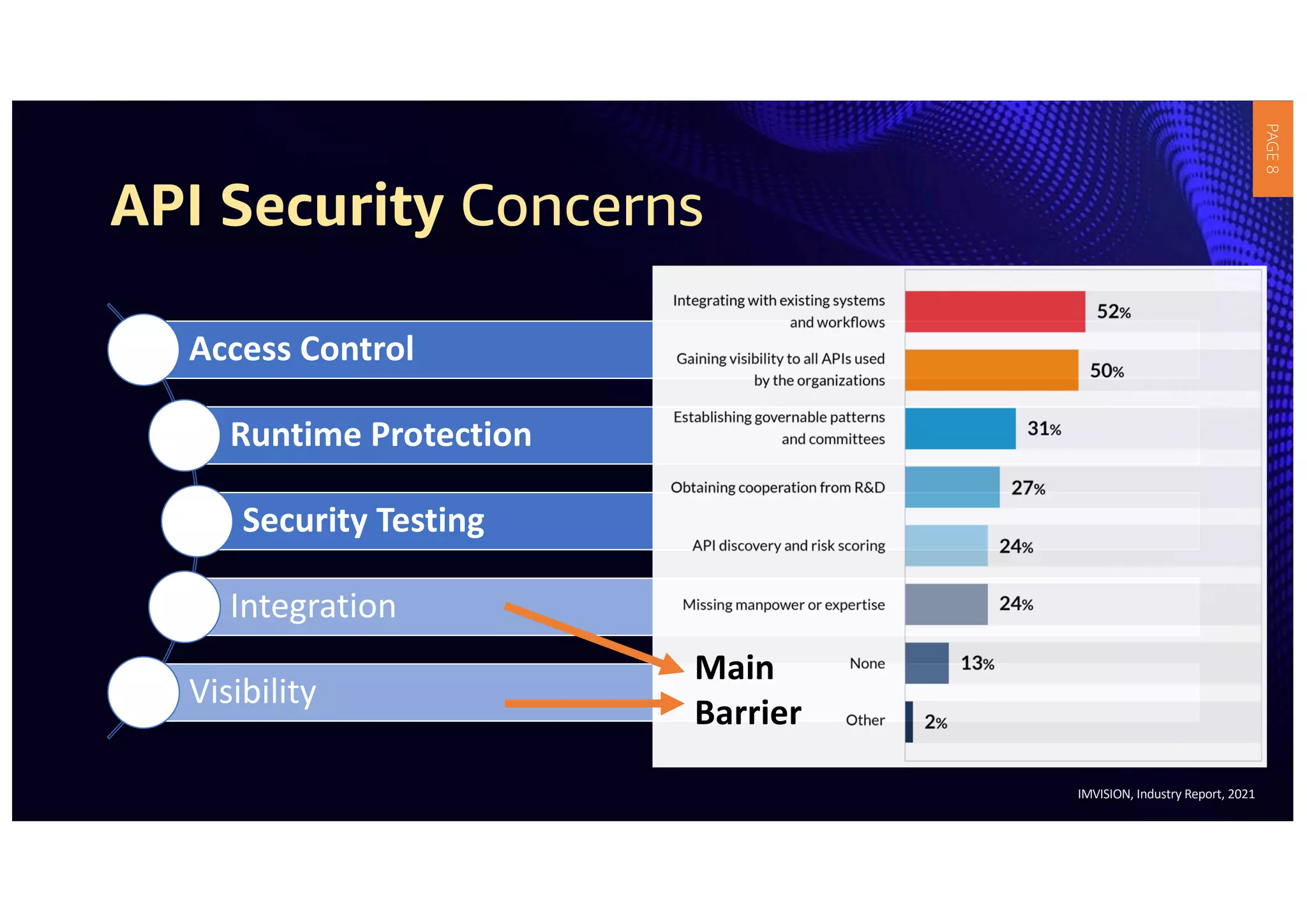
API Security Concerns
Access Control
Runtime Protection
Security Testing
Integration
Visibility
Main
Barrier
IMVISION, Industry Report, 2021
PAGE
8
OWASP API Security
• API1:2019 Broken Object Level Authorization
• API2:2019 Broken User Authentication
• API3:2019 Excessive Data Exposure
• API4:2019 Lack of Resources & Rate Limiting
• API5:2019 Broken Function Level Authorization
• API6:2019 Mass Assignment
• API7:2019 Security Misconfiguration
• API8:2019 Injection
• API9:2019 Improper Assets Management
• API10:2019 Insufficient Logging & Monitoring
PAGE
9
CSA Research Paper
Important: Use this document if the answer to any of
these questions is YES:
• Does the new service/system require long-term
integration with the company’s internal systems?
• Does the new service/system require exchange of data
with a third party?
• Will the APIs be exposed to external parties, including
the public (i.e., open APIs)?
These guidelines are also highly recommended for non-
public APIs (i.e., APIs are used internally or only exposed to
restricted parties, such as in a B2B environment).
PAGE
10
CSA Research Paper
Section 1: API Risk Evaluation
Section 2: Ingress API Connectivity
Section 3: Mapping OWASP Top Ten to Ingress API
Connectivity
Target:
1. Platform
2. Service Owner
3. Security team
4. DevOps
PAGE
11
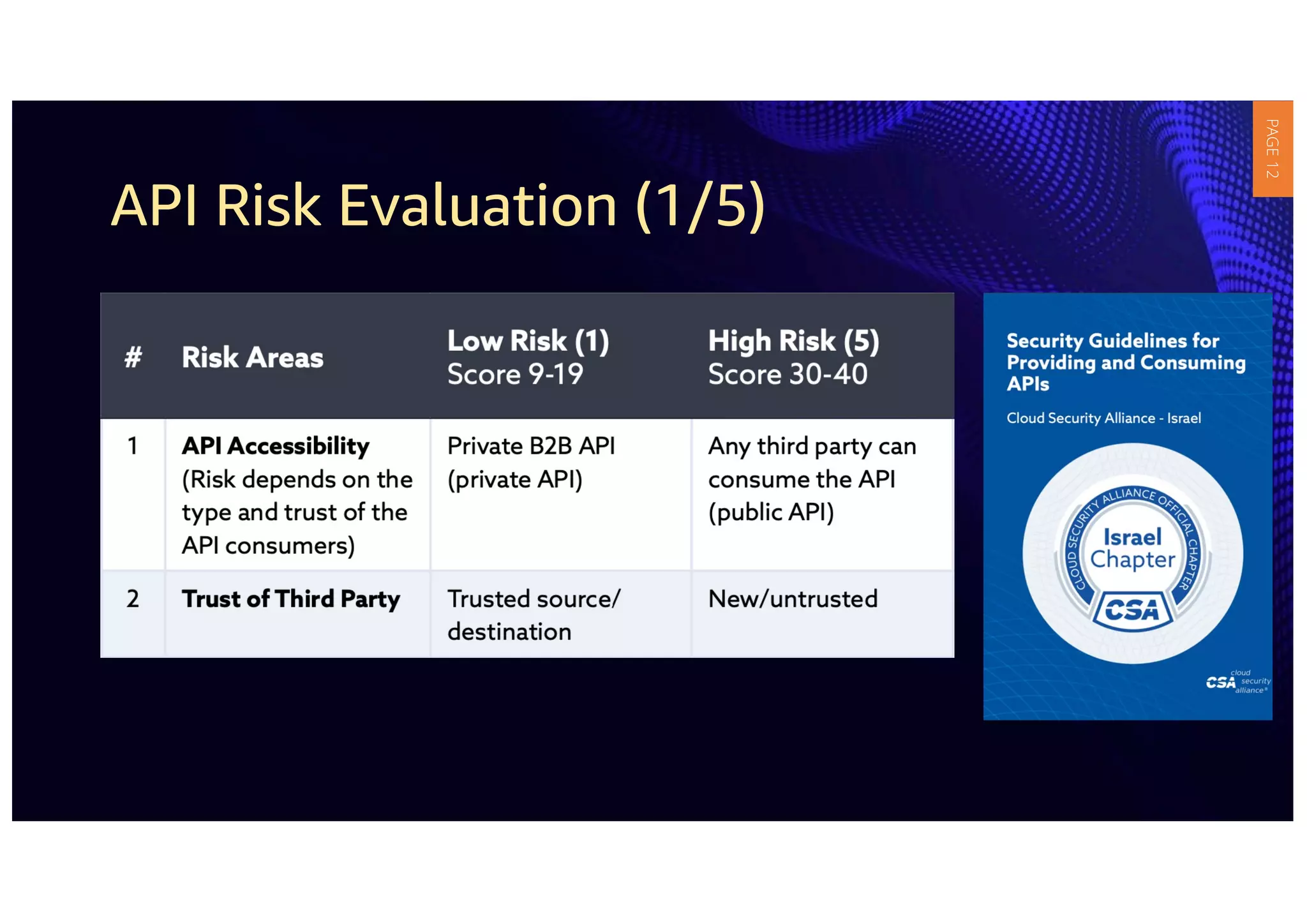
API Risk Evaluation (1/5)
PAGE
12
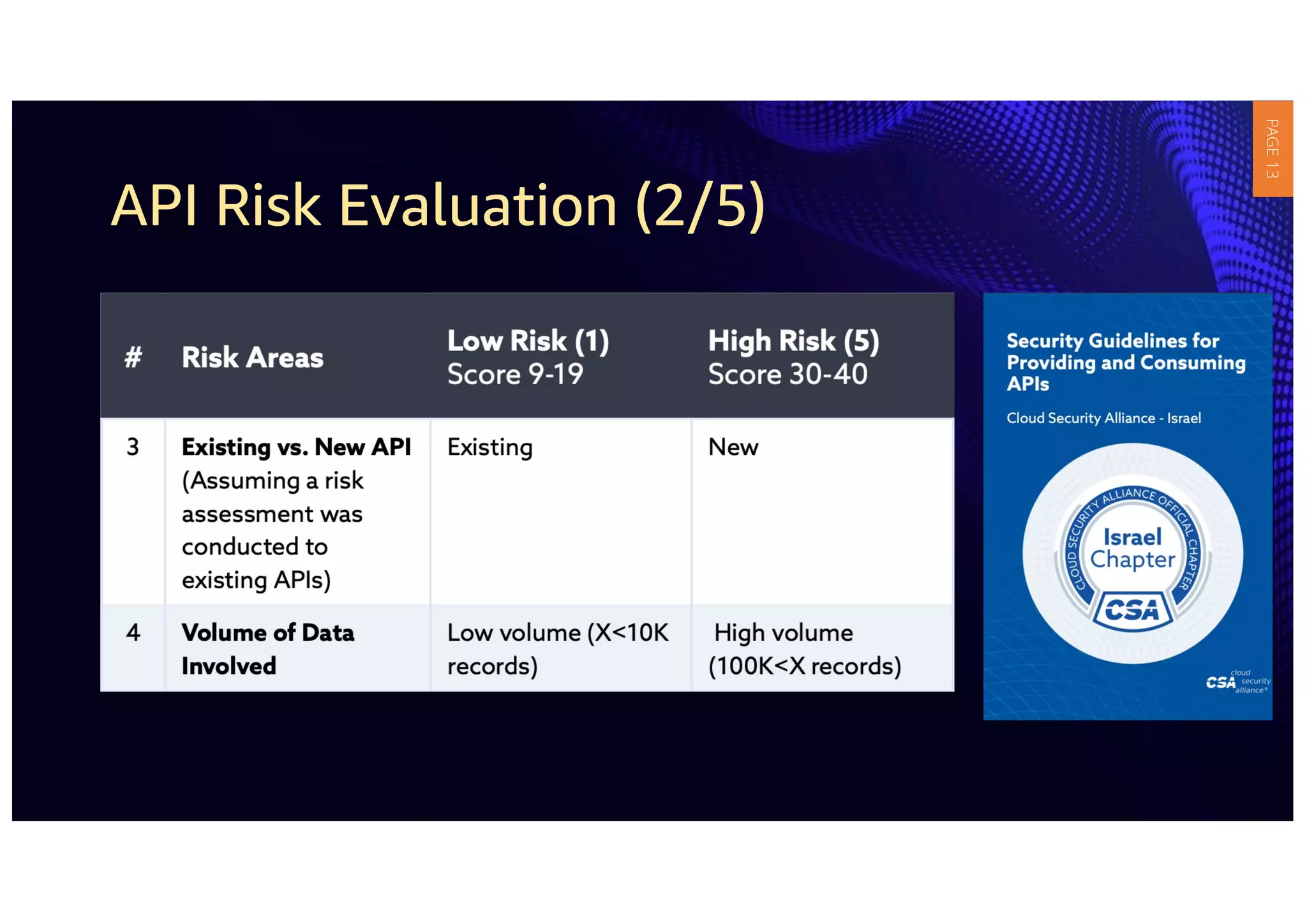
API Risk Evaluation (2/5)
PAGE
13
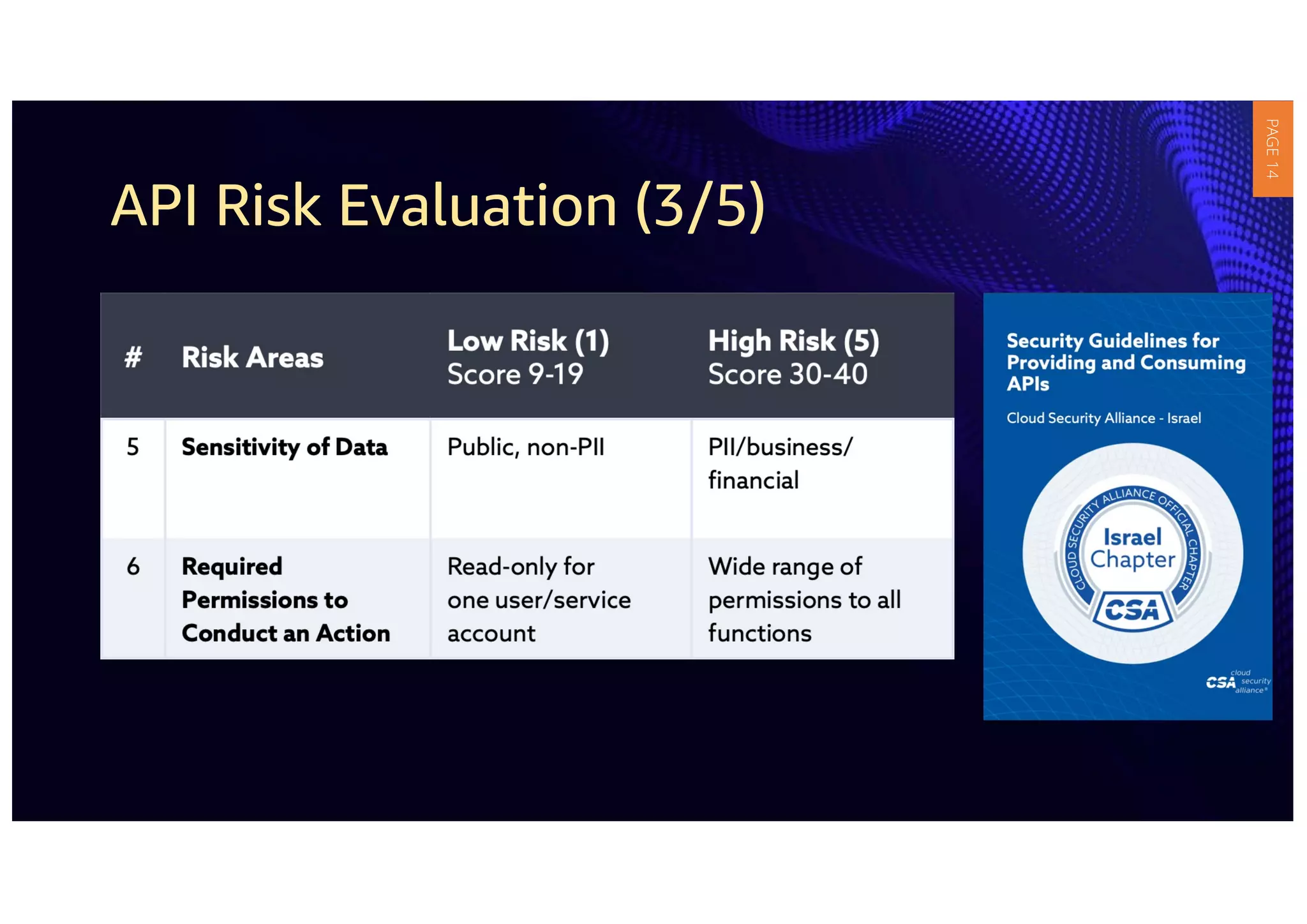
API Risk Evaluation (3/5)
PAGE
14
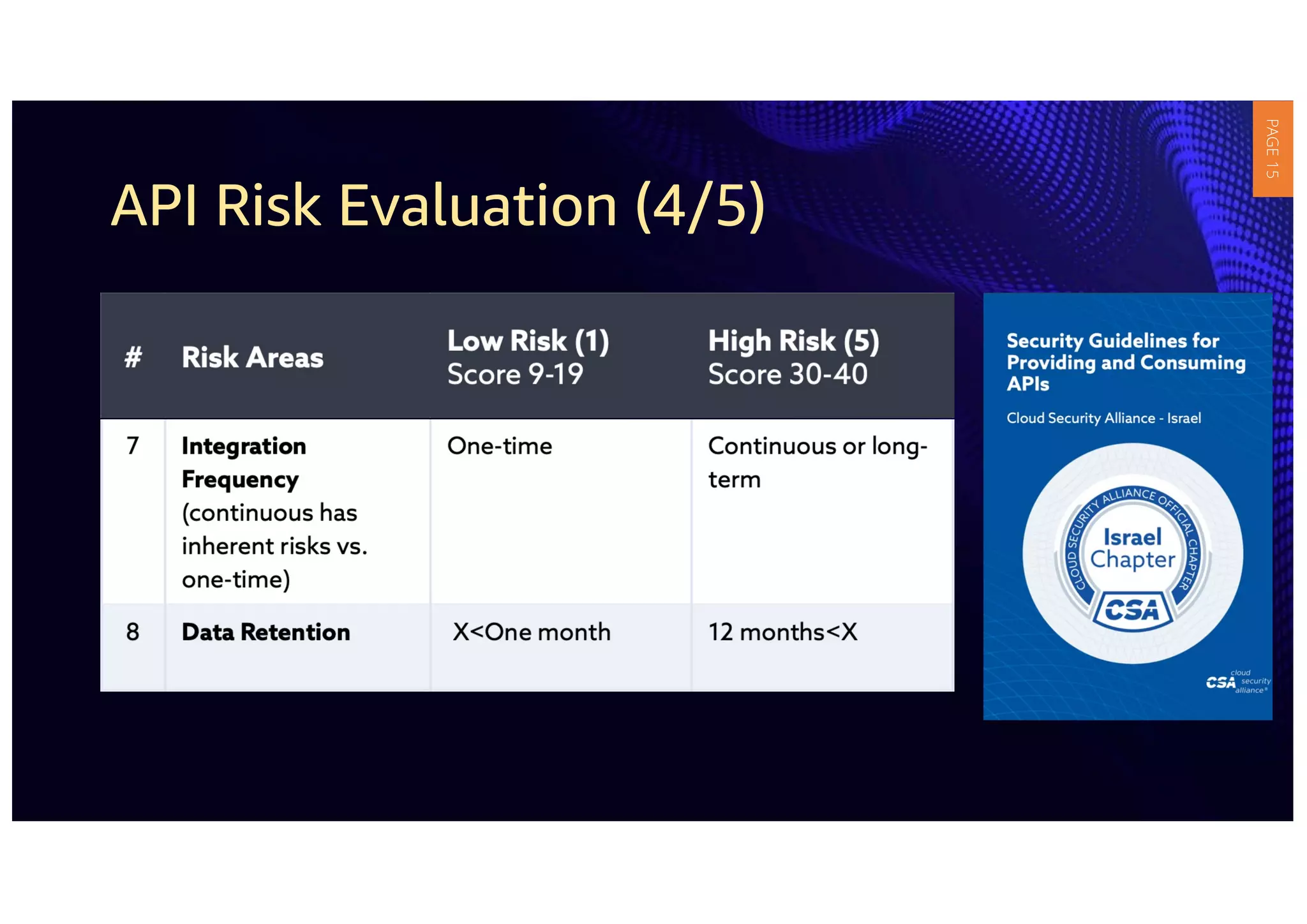
API Risk Evaluation (4/5)
PAGE
15
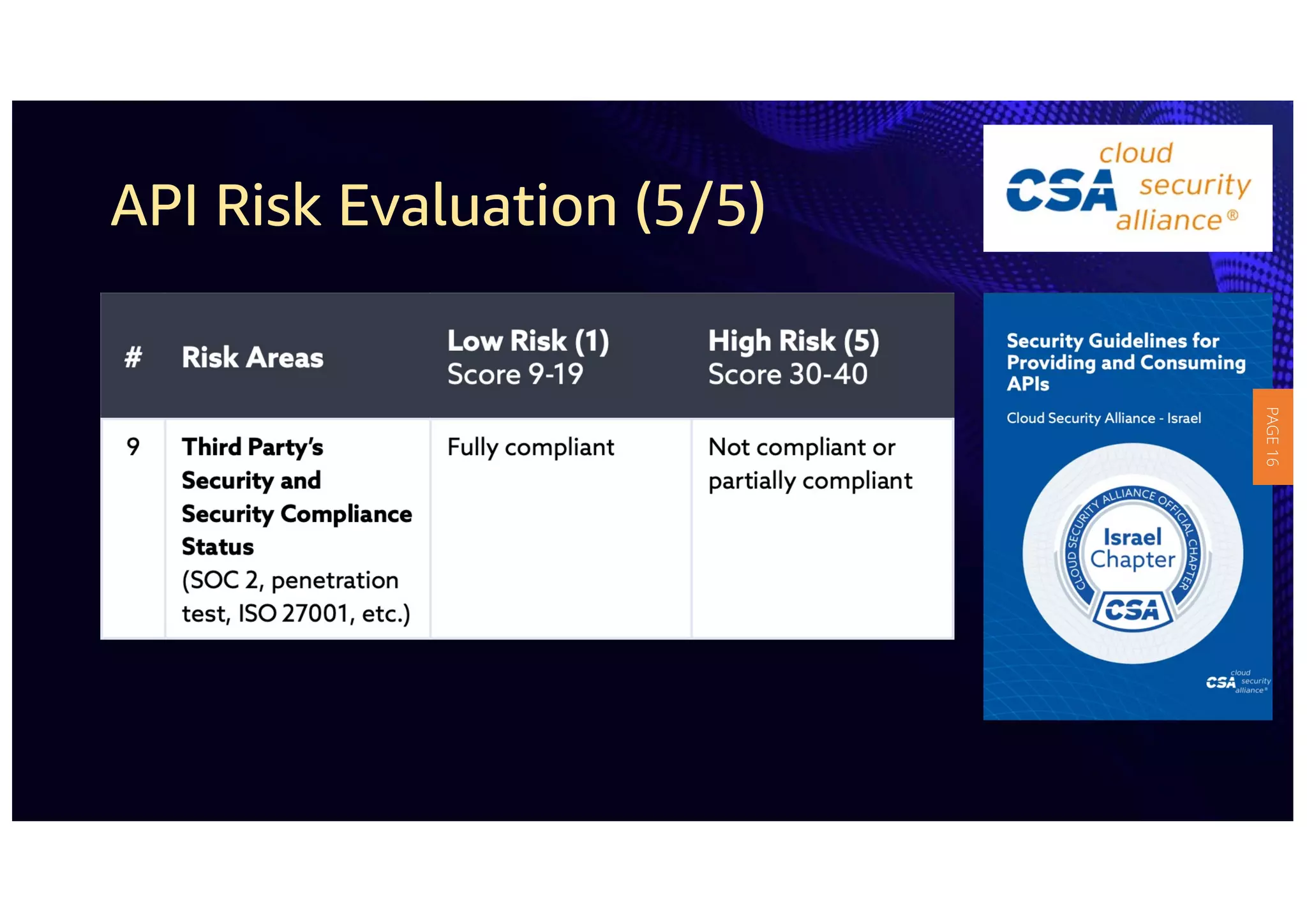
API Risk Evaluation (5/5)
PAGE
16
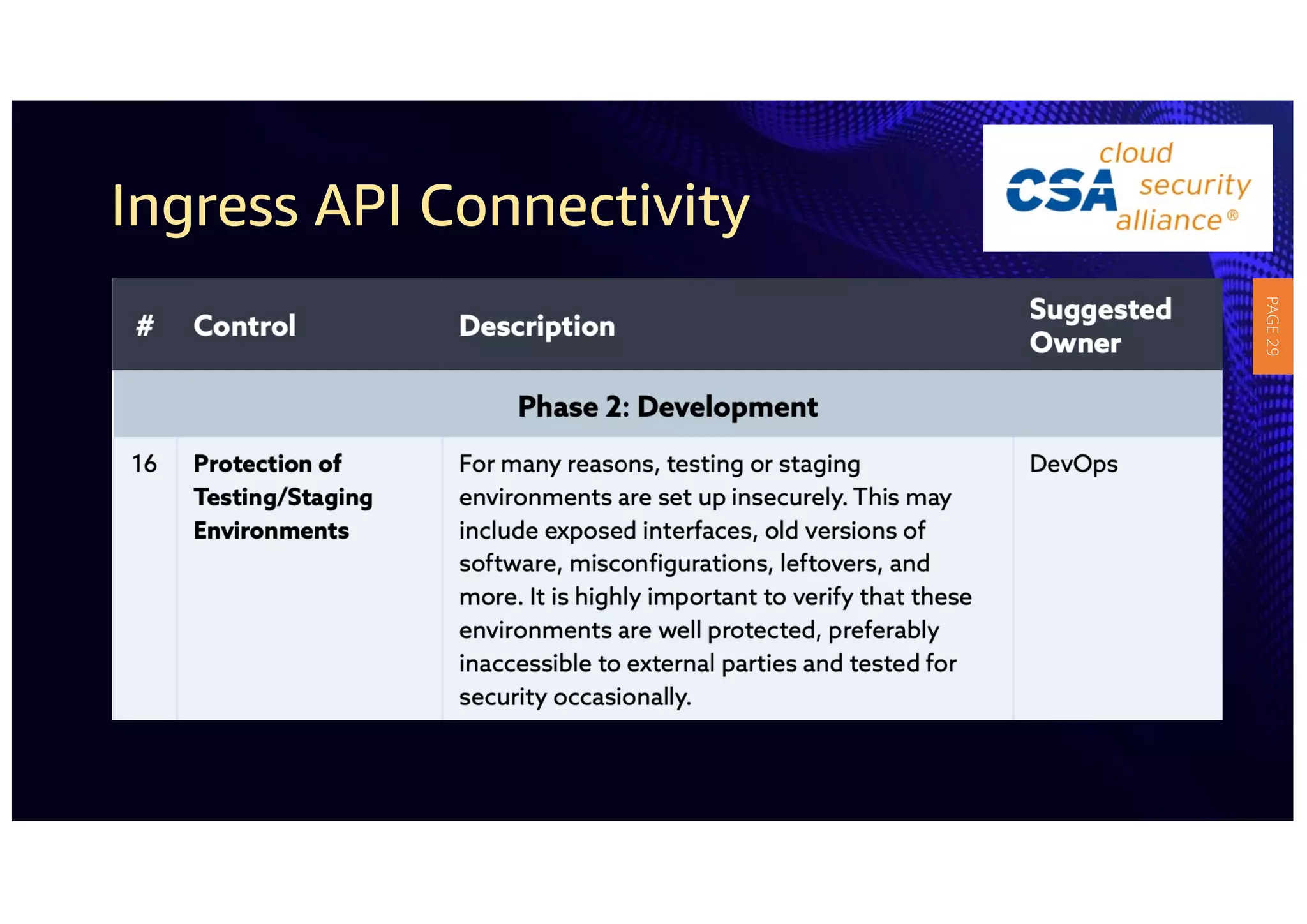
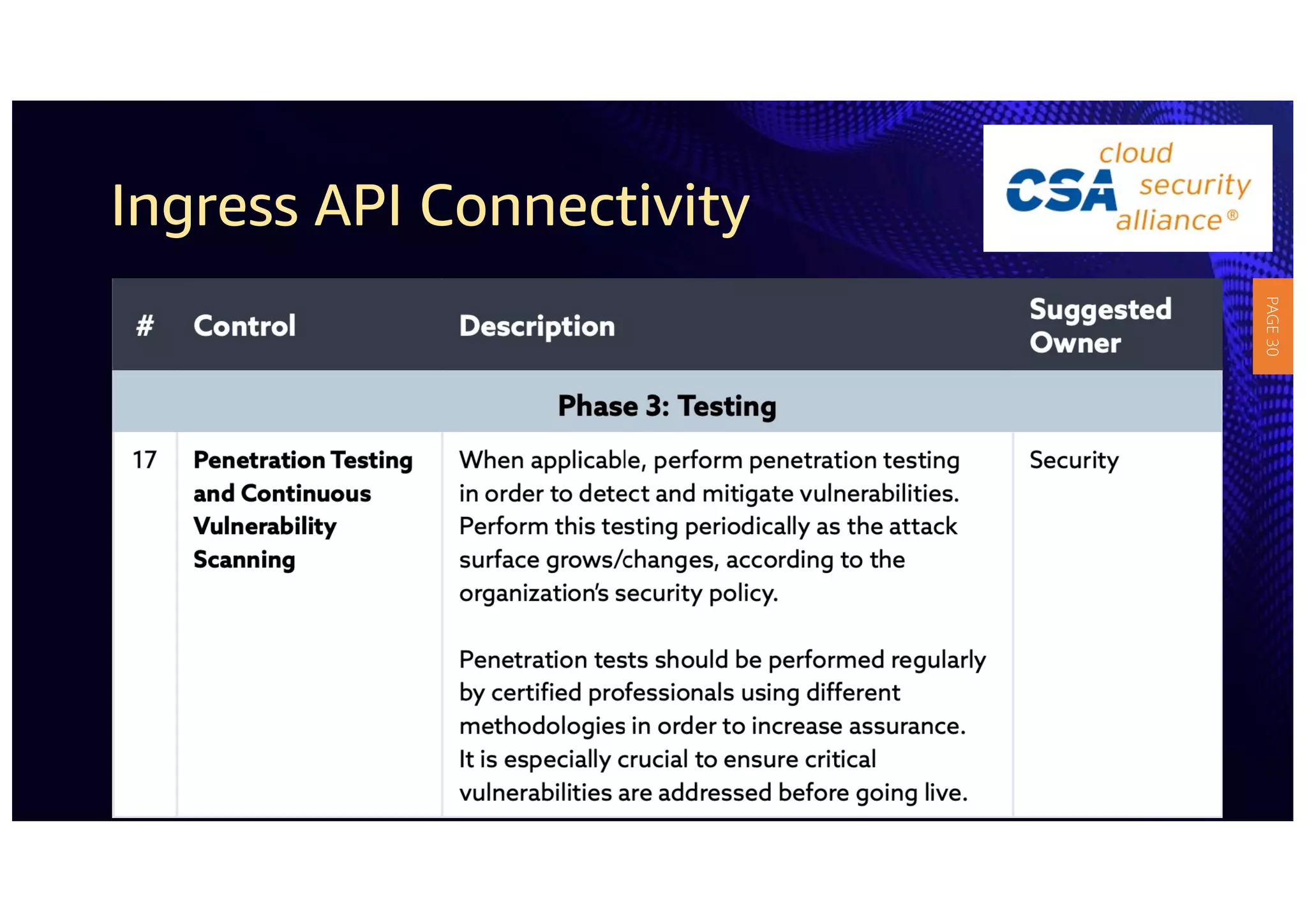
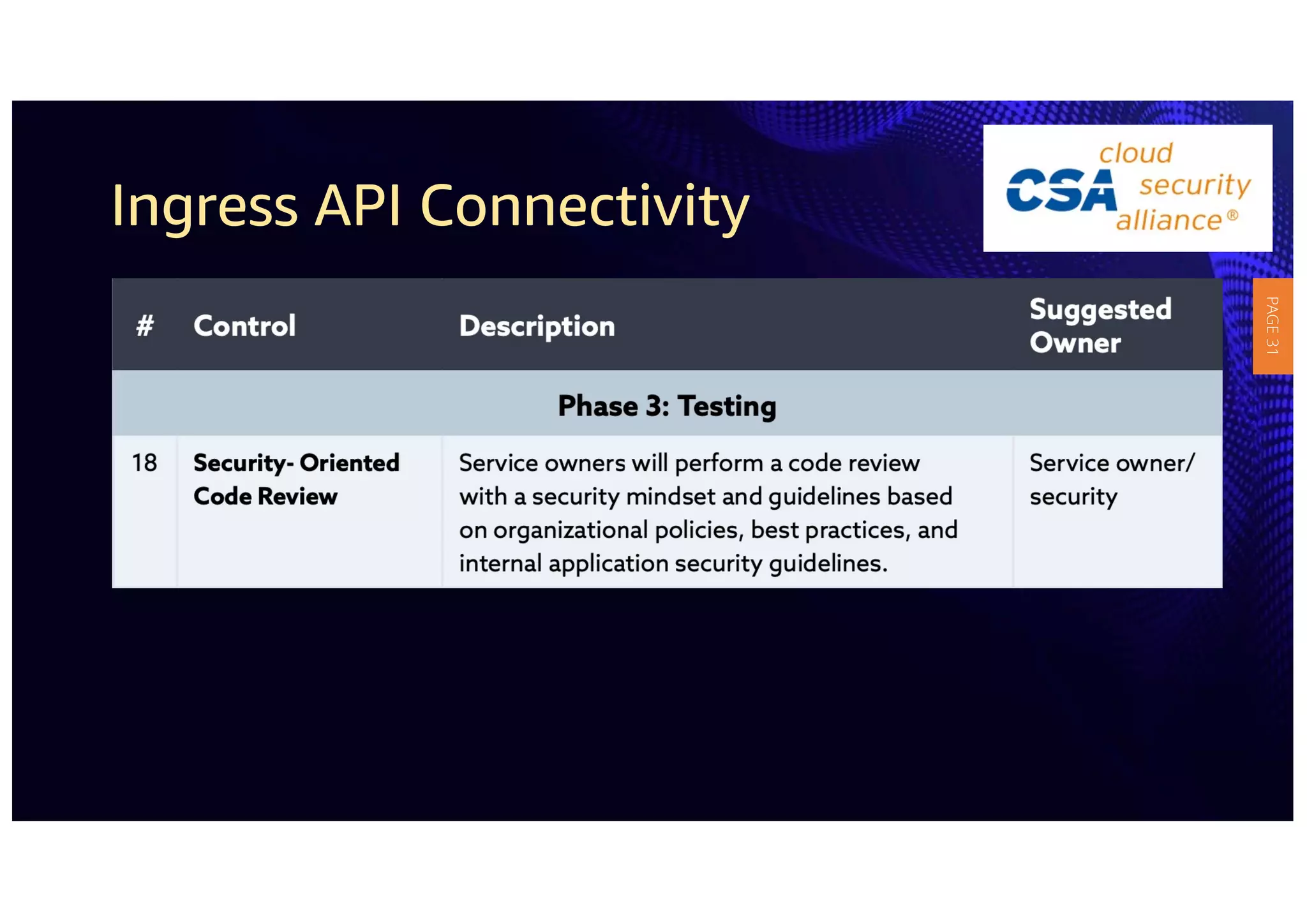
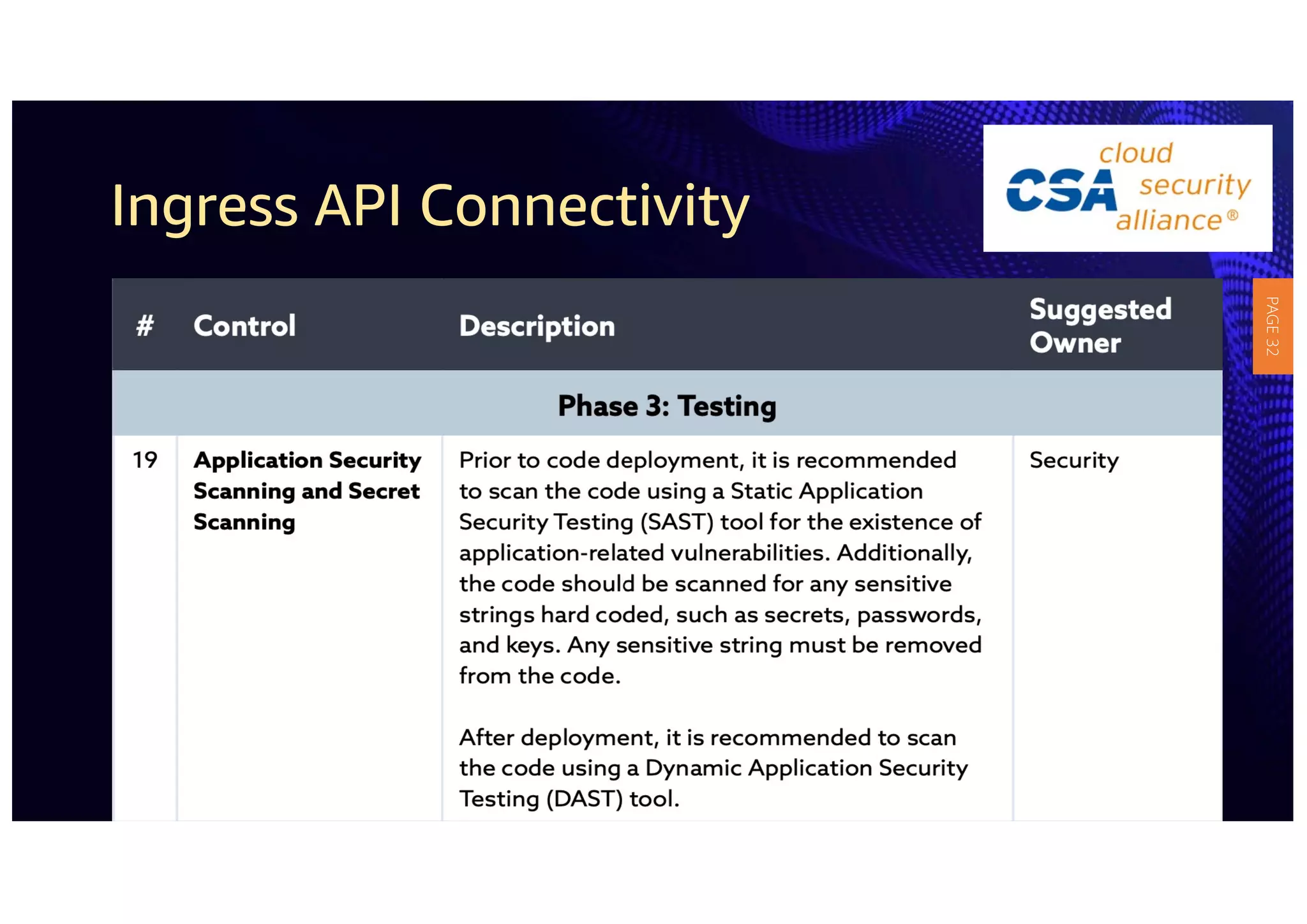
Ingress API Connectivity
• Phase 1: Design
• Phase 2: Development
• Phase 3: Testing
• Phase 4: Implementation
• Phase 5: Logging and
Monitoring
PAGE
17
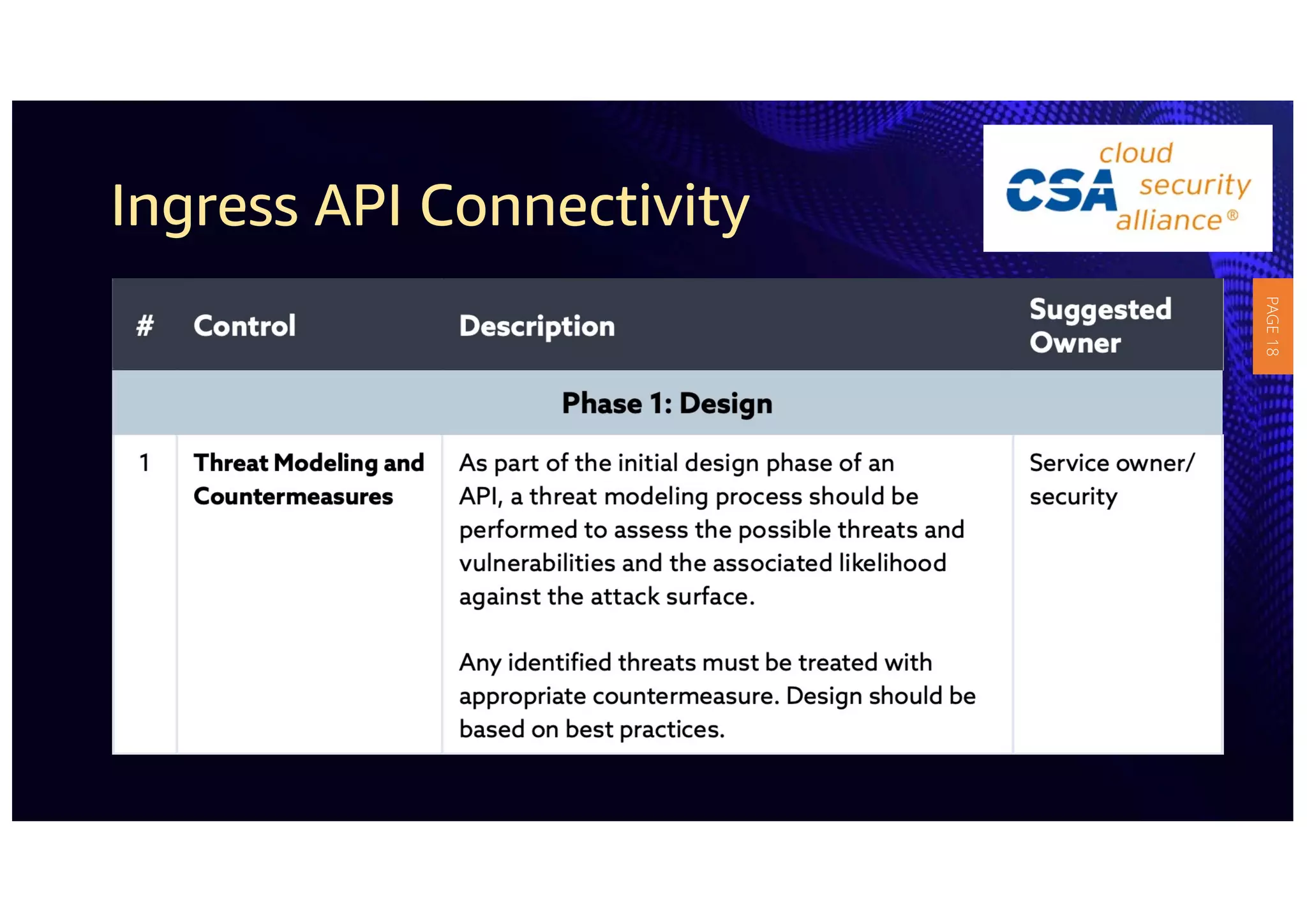
Ingress API Connectivity
PAGE
18
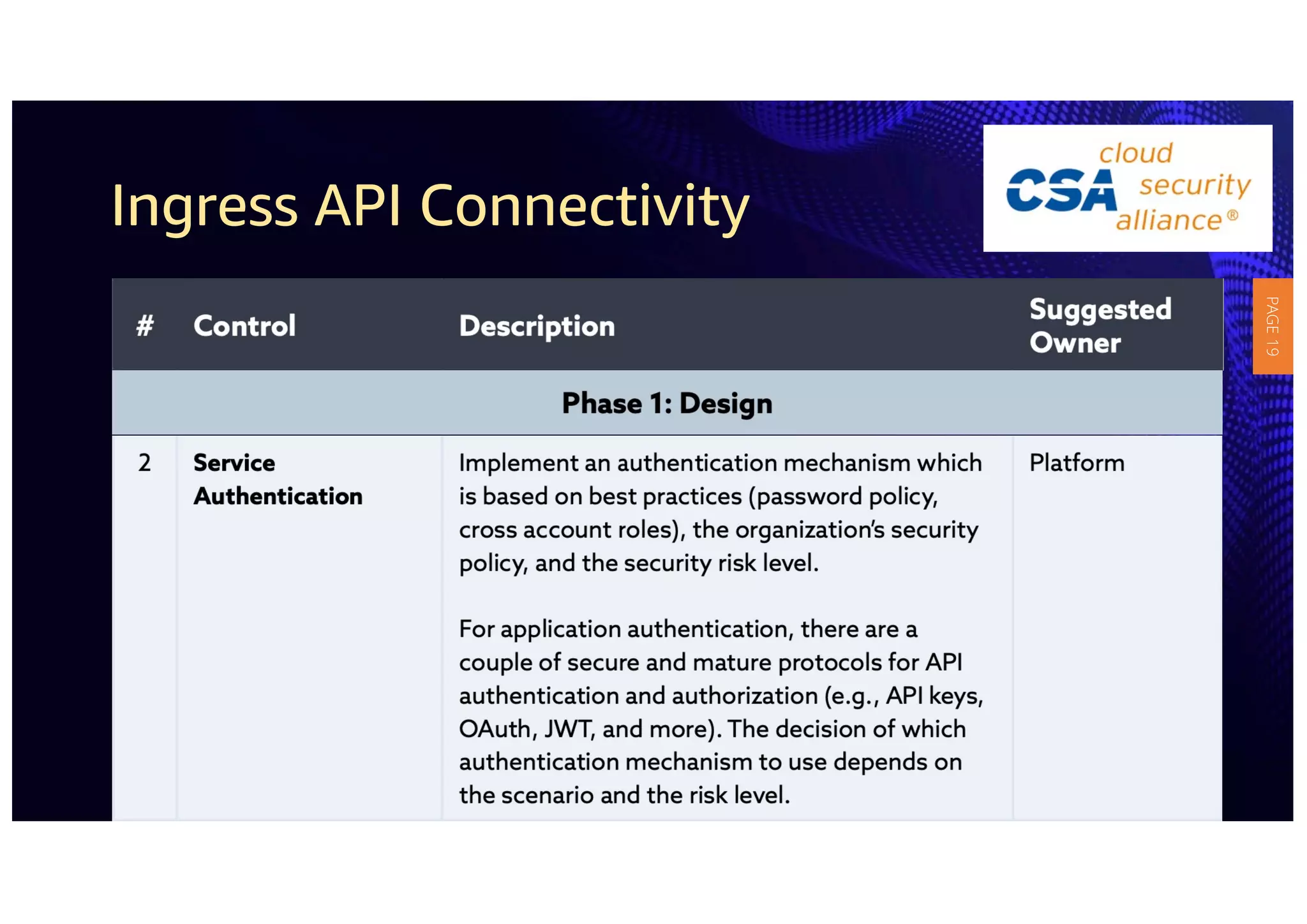
Ingress API Connectivity
PAGE
19
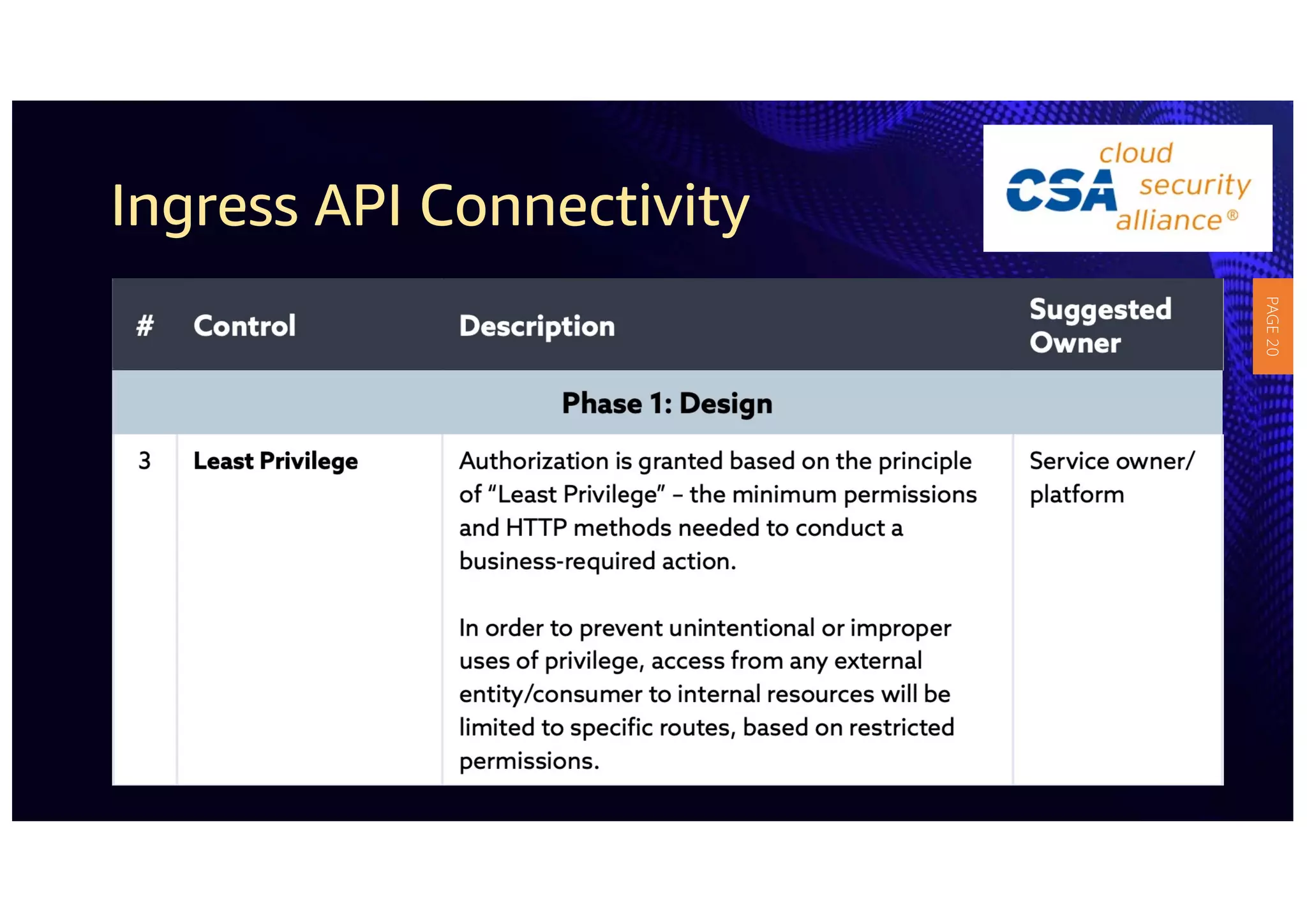
Ingress API Connectivity
PAGE
20
Ingress API Connectivity
PAGE
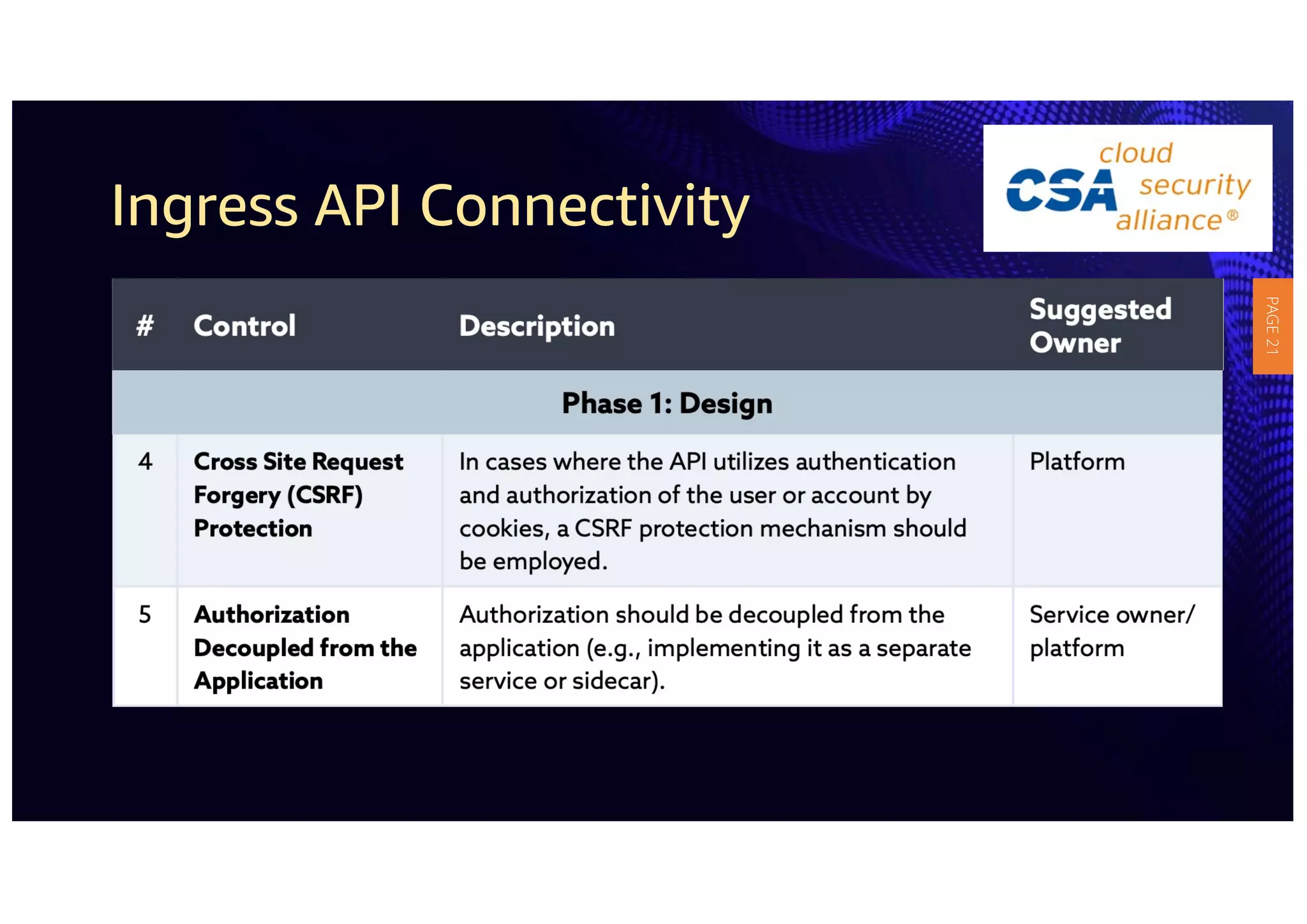
21
Ingress API Connectivity
PAGE
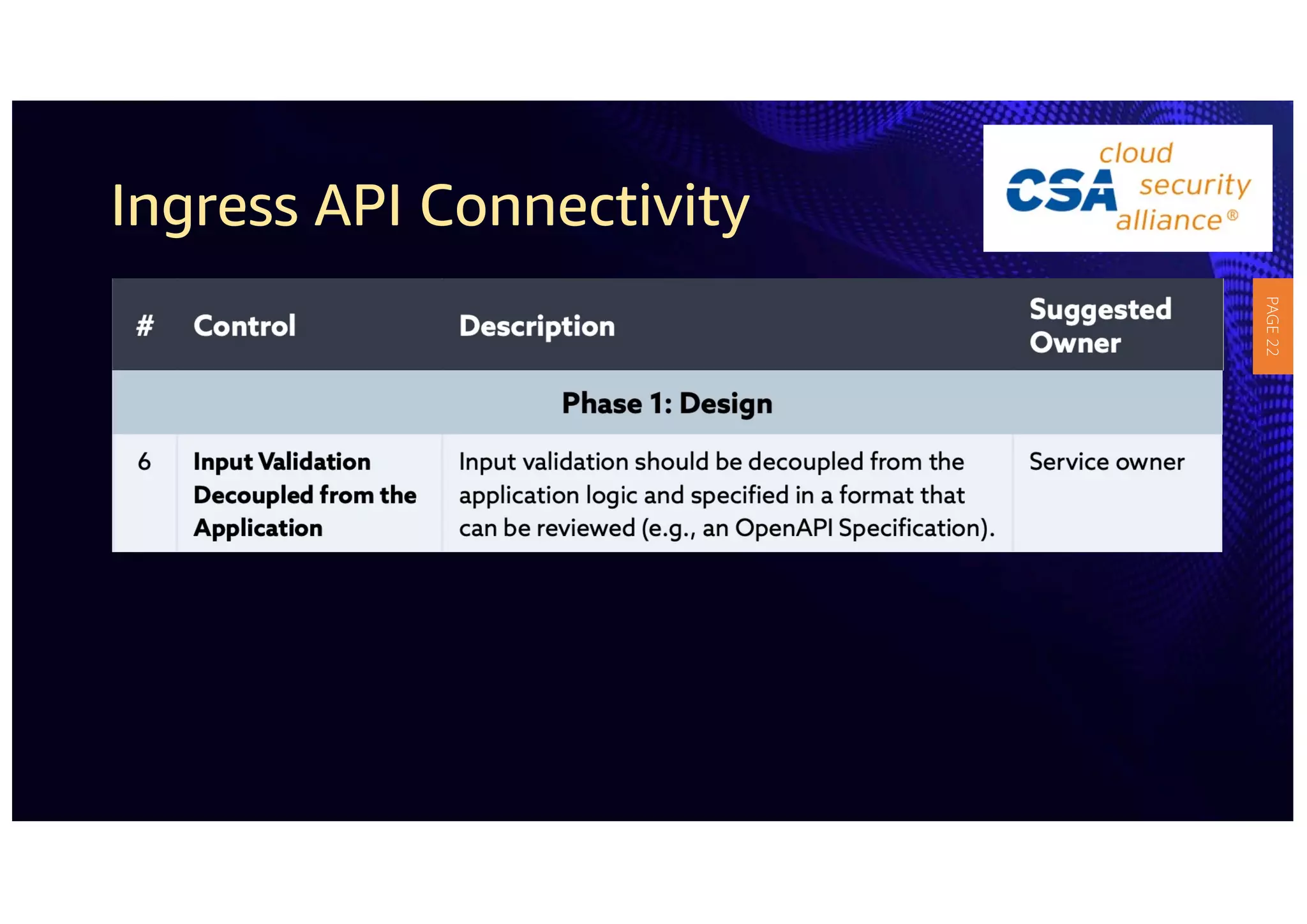
22
Ingress API Connectivity
PAGE
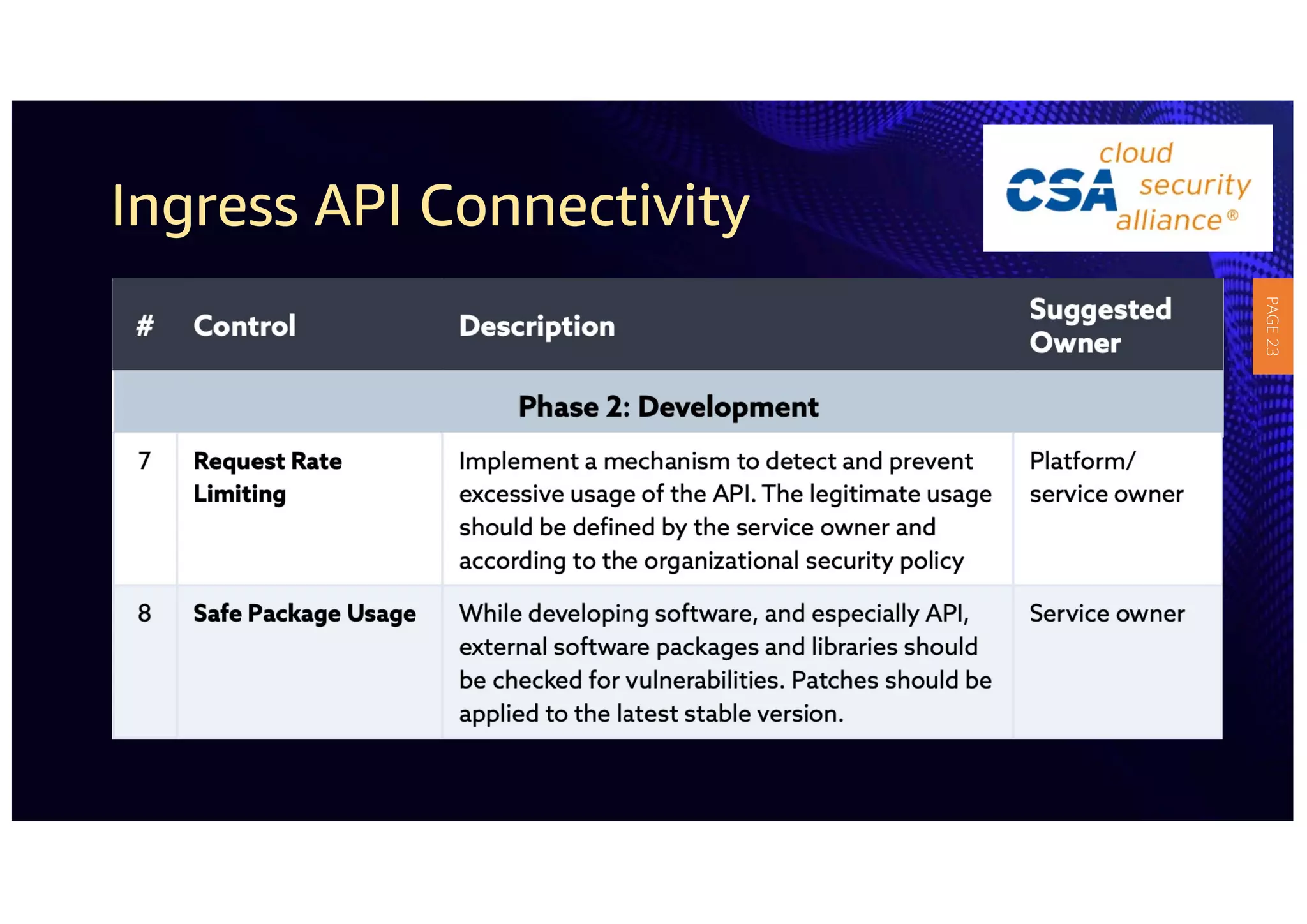
23
Ingress API Connectivity
PAGE
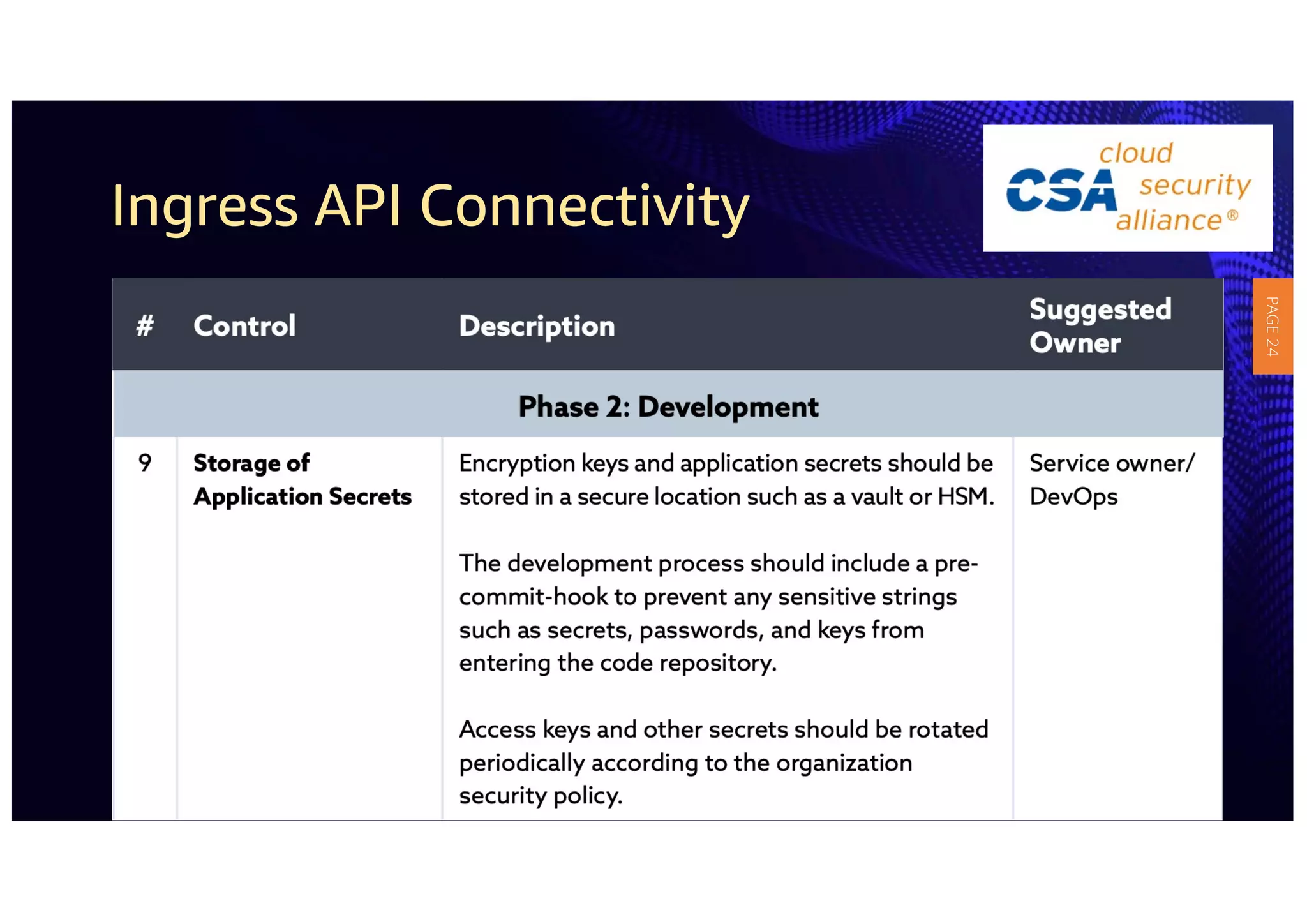
24
Ingress API Connectivity
PAGE
25
Ingress API Connectivity
PAGE
26
Ingress API Connectivity
PAGE
27
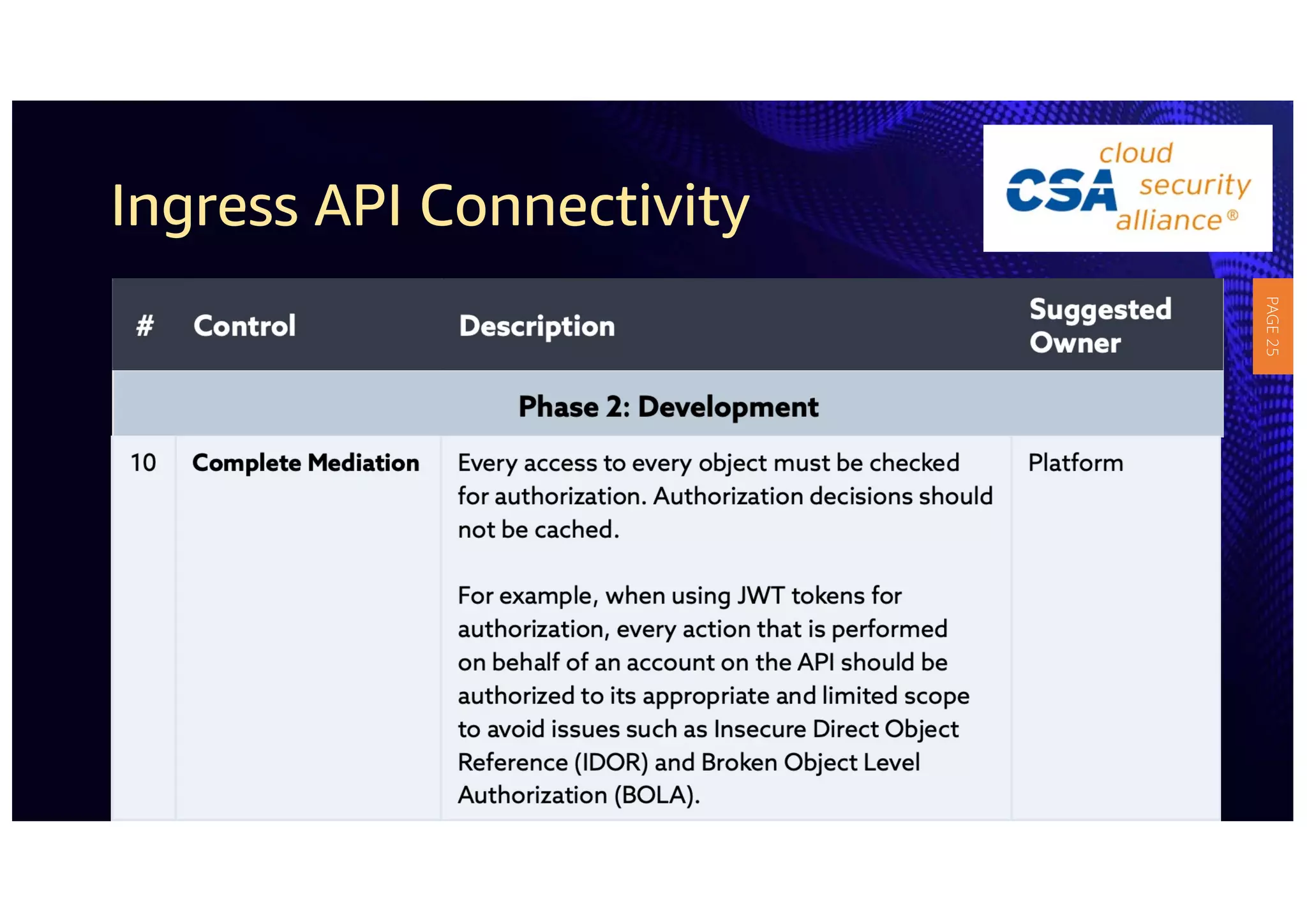
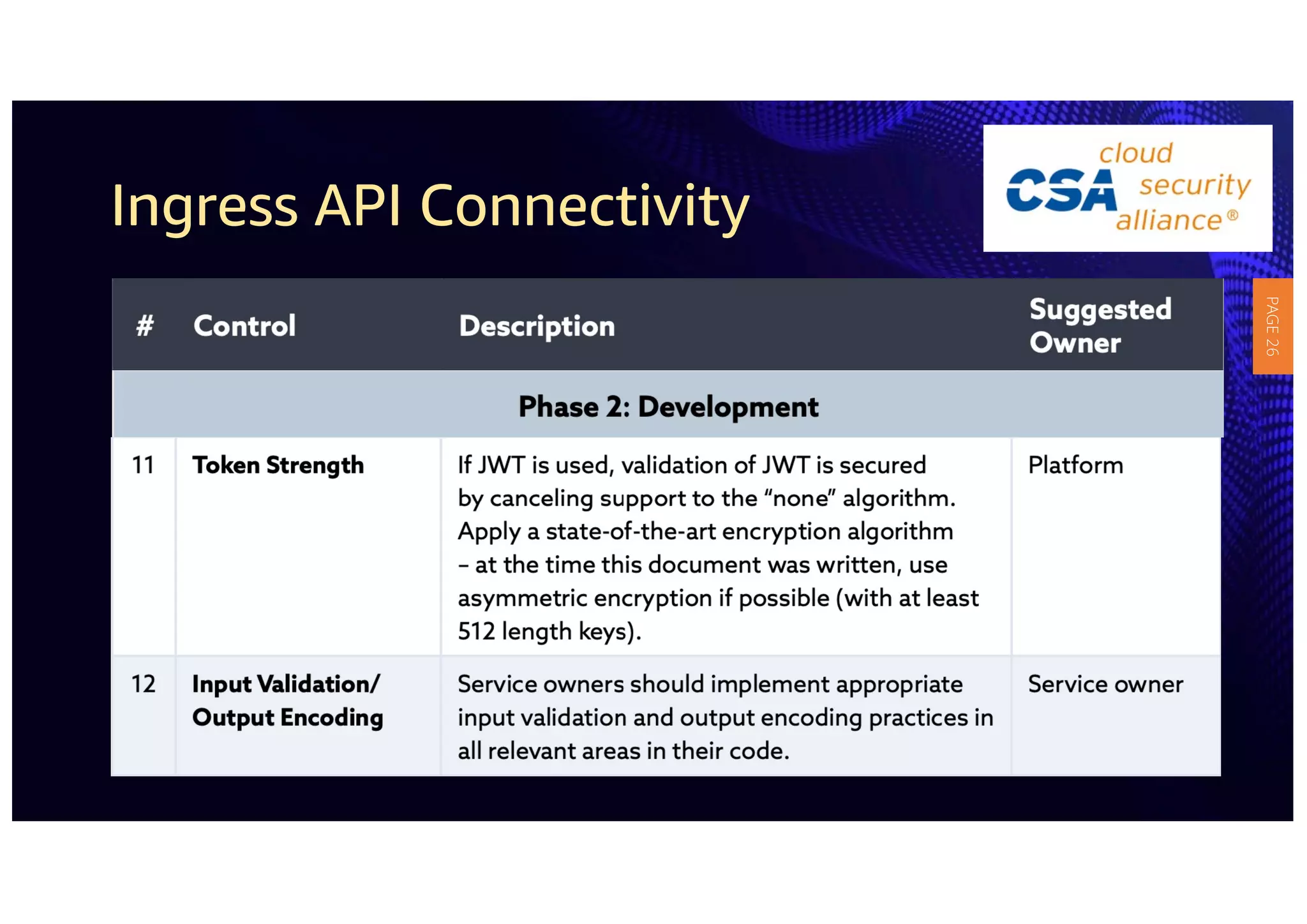
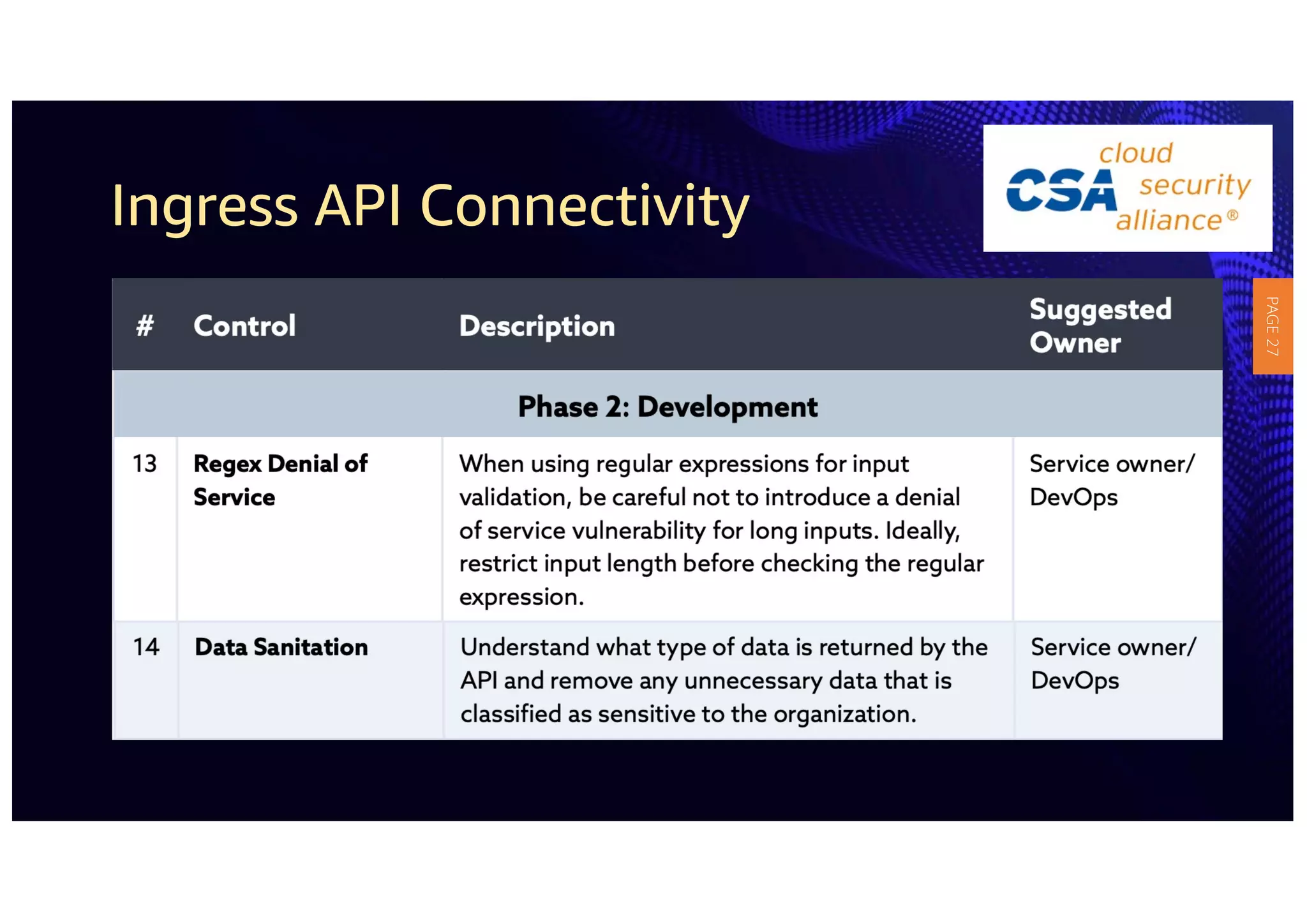
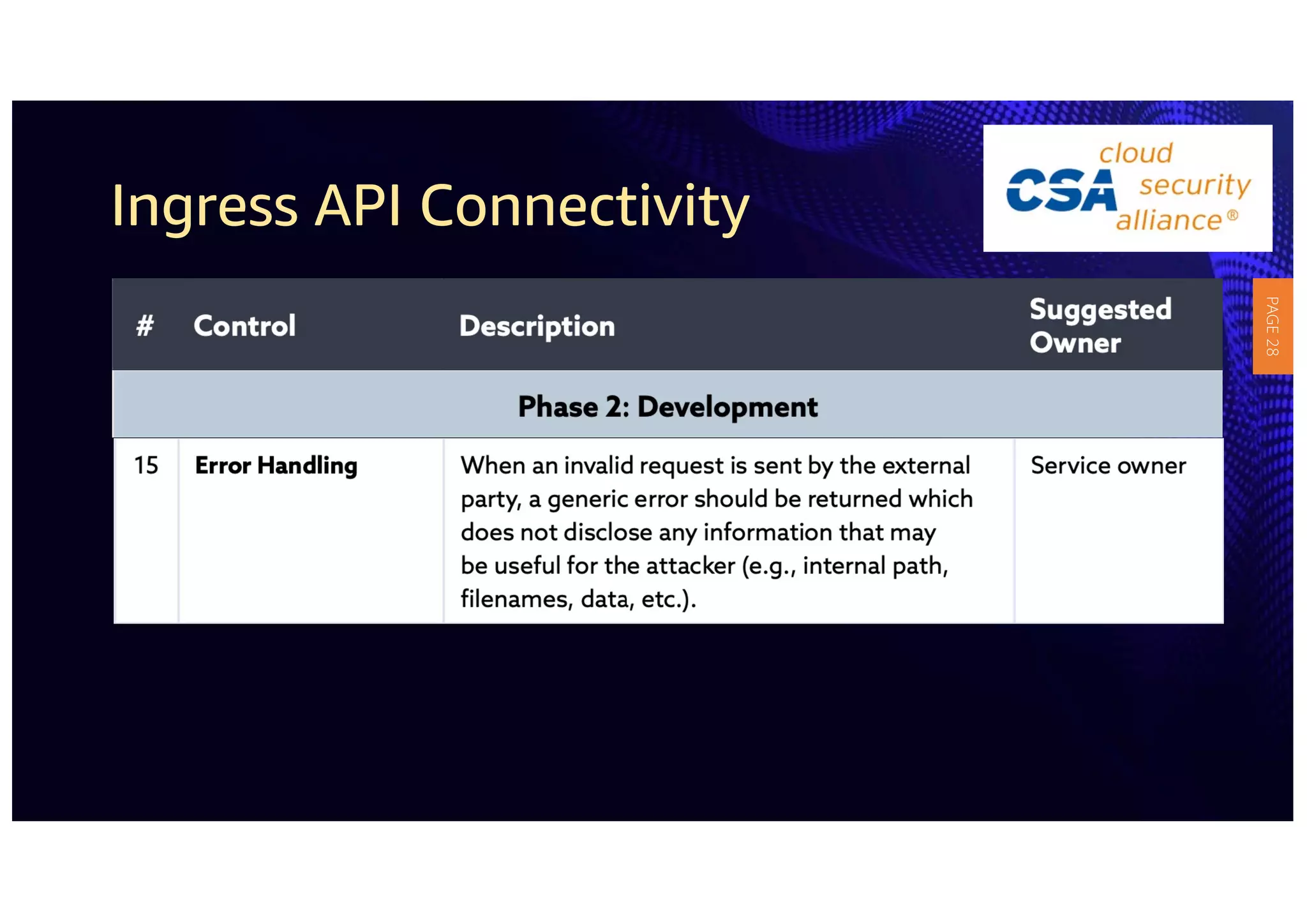
Ingress API Connectivity
PAGE
28
Ingress API Connectivity
PAGE
29
Ingress API Connectivity
PAGE
30
Ingress API Connectivity
PAGE
31
Ingress API Connectivity
PAGE
32
Ingress API Connectivity
PAGE
33
Ingress API Connectivity
PAGE
34
Ingress API Connectivity
PAGE
35
Ingress API Connectivity
PAGE
36
Ingress API Connectivity
PAGE
37
Ingress API Connectivity
PAGE
38
Ingress API Connectivity
PAGE
39
Ingress API Connectivity
PAGE
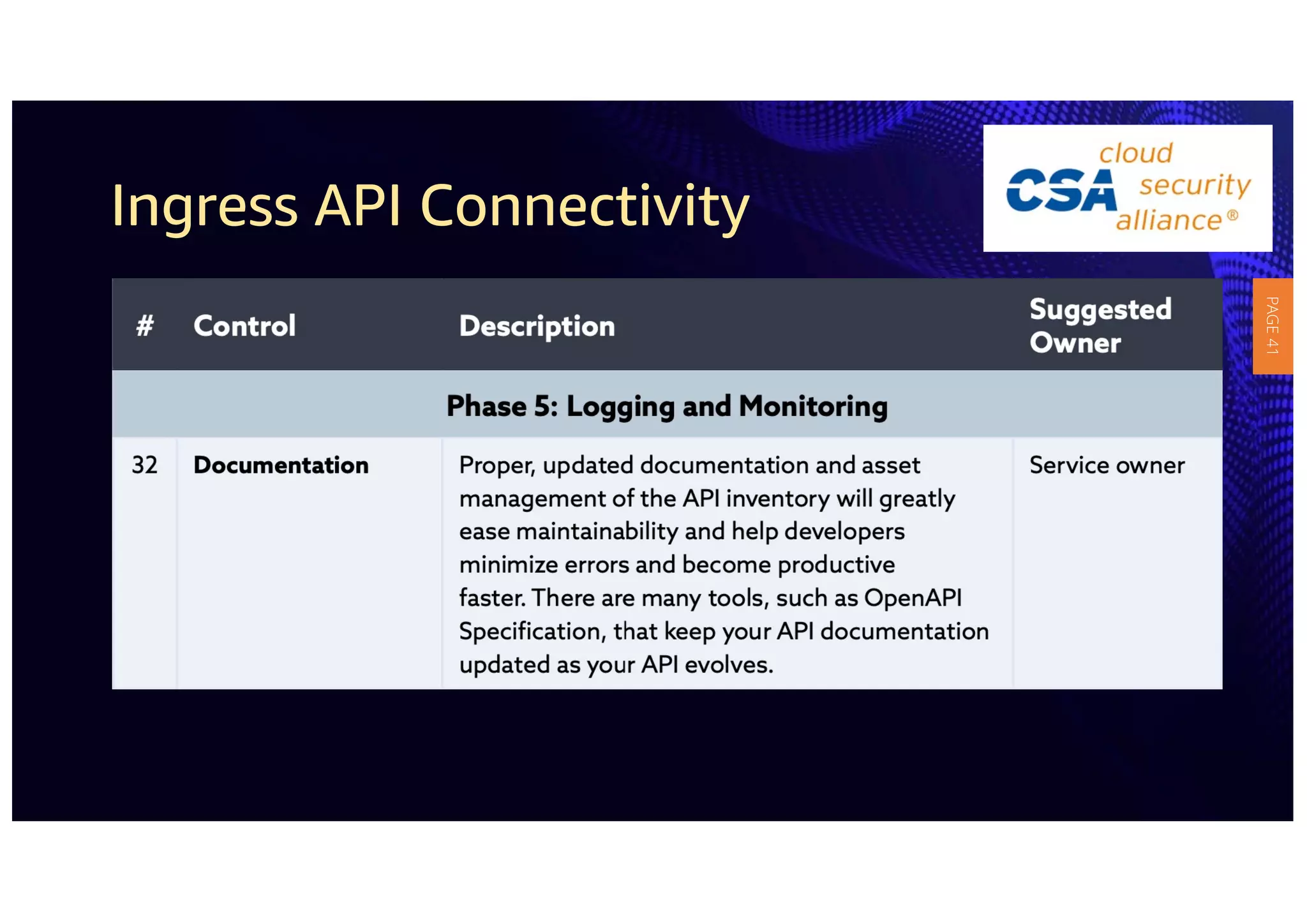
40
Ingress API Connectivity
PAGE
41
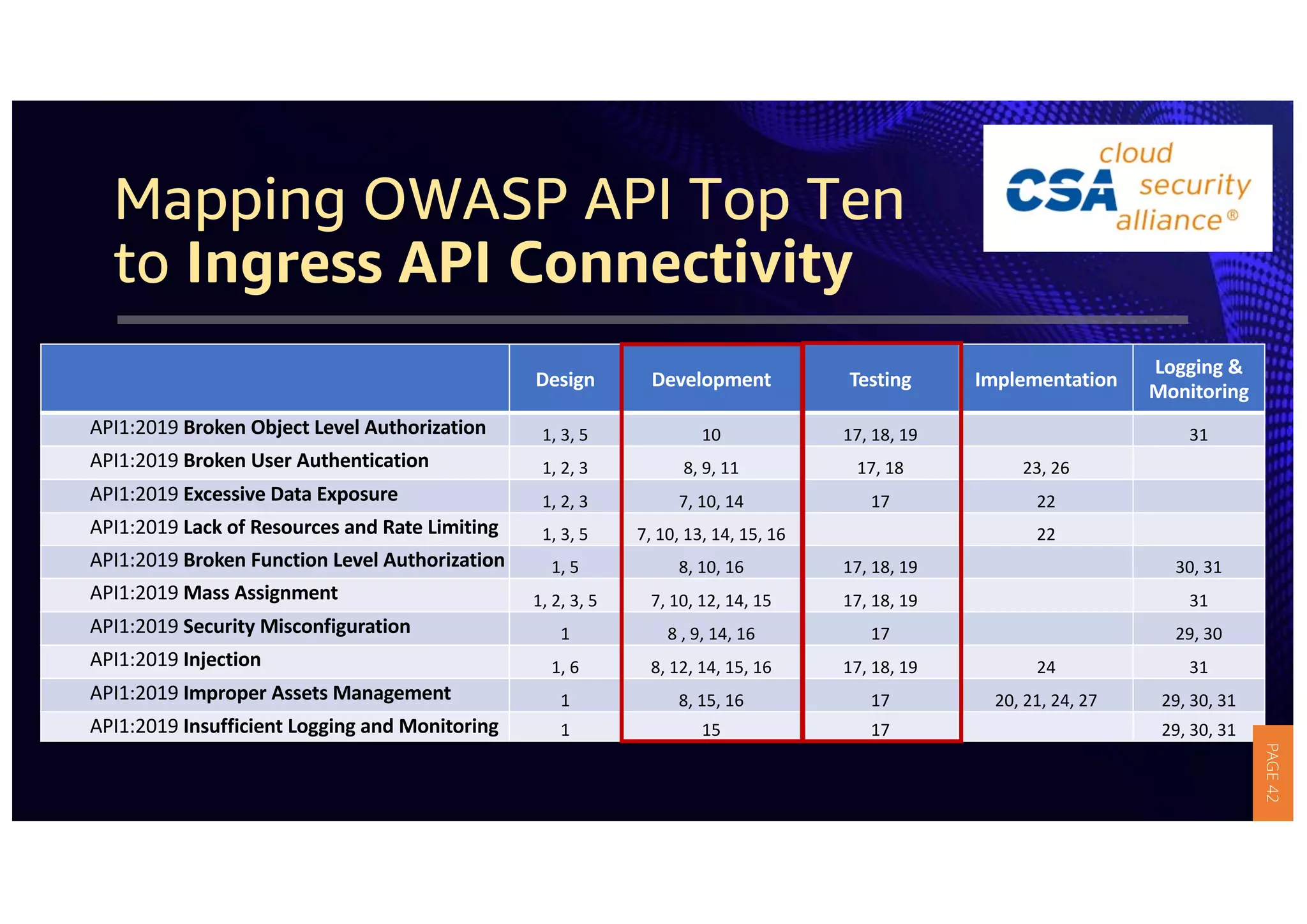
Mapping OWASP API Top Ten
to Ingress API Connectivity
Design Development Testing Implementation
Logging &
Monitoring
API1:2019 Broken Object Level Authorization 1, 3, 5 10 17, 18, 19 31
API1:2019 Broken User Authentication 1, 2, 3 8, 9, 11 17, 18 23, 26
API1:2019 Excessive Data Exposure 1, 2, 3 7, 10, 14 17 22
API1:2019 Lack of Resources and Rate Limiting 1, 3, 5 7, 10, 13, 14, 15, 16 22
API1:2019 Broken Function Level Authorization 1, 5 8, 10, 16 17, 18, 19 30, 31
API1:2019 Mass Assignment 1, 2, 3, 5 7, 10, 12, 14, 15 17, 18, 19 31
API1:2019 Security Misconfiguration 1 8 , 9, 14, 16 17 29, 30
API1:2019 Injection 1, 6 8, 12, 14, 15, 16 17, 18, 19 24 31
API1:2019 Improper Assets Management 1 8, 15, 16 17 20, 21, 24, 27 29, 30, 31
API1:2019 Insufficient Logging and Monitoring 1 15 17 29, 30, 31
PAGE
42
Wrap Up
APIs, particularly for mobile and Internet of
Things (IoT) devices, have arguably become the
preferred method for developing modern
applications. The majority of organizations have
already implemented measures to defend
against well-known attacks such as cross-site
scripting, injection, and distributed denial-of-
service. Regardless of the number of APIs your
organization chooses to make publicly available,
your ultimate goal should be to establish robust
API security policies.
PAGE
43

API Security Webinar : Security Guidelines for Providing and Consuming APIs

  • 1.
    Security Guidelines for Providingand Consuming APIs @faisaly FaisalYahya Faisal Yahya – Cloud Security Alliance – Chairman Indonesia Chapter 1
  • 2.
    Faisal Yahya, Country Manager– PT. Vantage Point Security Indonesia CISO with 20+ exp, CIO with 15+ exp, ISO27001 IA/LA, AWS, CISSP, CND, CEH v10, ECSA, CTIA, CCISO, CCSK v3&4, CSX-P, CySA+, ITILF, PSM I, PSPO I, CEI Official Instructor for: EC-Council & Cloud Security Alliance Top 50 South East Asia CIOs Actively Engage on Social Media Twitter (7k+) – LinkedIn (11k+) – Instagram (2k+) AWS Community Builders Cloud Security Alliance – Indonesia Chapter Lead
  • 3.
    Cloud-Native Threat - 2021 source:hackmageddon • Delivery and Exploitation (the cloud service is exploited to deliver a malware strain or a phishing page) • Actions on Objective (the cloud service is exploited to steal data, or launch other attacks) • Command and Control (the cloud service is exploited as a command and control infrastructure) • Data Exfiltration (the cloud service is used as a drop zone for the exfiltrated data). PAGE 3
  • 4.
    API & DevOps NewParadigm • Organizations have become more reliant on software development, confirming the oft-repeated old saying that "all organizations currently are software companies.” • The DevOps new paradigm facilitated not only a business-side digital transformation. Digital transformation also altered the processes and activities associated with software deployment and development. • Gartner reports an increase in client inquiries about API security, noting a 30% year-over-year increase in client inquiries. By 2022, it predicts, API abuse will be the most common attack vector for enterprise web application breaches. PAGE 4
  • 5.
    Security As aService as Emerging Needs If you work in an Agile environment, I believe you need a continuous monitoring and security analysis system that is integrated into your DevOps process. This system should be able to quickly identify security issues and provide clear guidance and even auto-remediation functions to resolve them. The only way to harmoniously build security into the development pipeline is by providing security as a service model. The traditional security layering model just simply no longer work. PAGE 5
  • 6.
    Related Facts • ApplicationProgramming Interface security models have fallen behind the requirements of a non-perimeter world. (Forrester) • The most frequently reported API security incident in 2020 was the discovery of a vulnerability in a production API. Organizations must complement their build and deploy security practices with runtime security. (Salt Security) • According to the company's customer data, the average number of API attacks per customer per month increased from 50 in June to nearly 80 in December. While the average monthly volume of API calls increased by 51%, the percentage of malicious traffic increased by 211% during the study period. (Michelle McLean, 2021) PAGE 6
  • 7.
    Traditional vs ModernApplication Source: DarkReading • Exposing sensitive data • Intercepted communications Launching denial-of-service (DoS) attacks against back-end servers PAGE 7
  • 8.
    API Security Concerns AccessControl Runtime Protection Security Testing Integration Visibility Main Barrier IMVISION, Industry Report, 2021 PAGE 8
  • 9.
    OWASP API Security •API1:2019 Broken Object Level Authorization • API2:2019 Broken User Authentication • API3:2019 Excessive Data Exposure • API4:2019 Lack of Resources & Rate Limiting • API5:2019 Broken Function Level Authorization • API6:2019 Mass Assignment • API7:2019 Security Misconfiguration • API8:2019 Injection • API9:2019 Improper Assets Management • API10:2019 Insufficient Logging & Monitoring PAGE 9
  • 10.
    CSA Research Paper Important:Use this document if the answer to any of these questions is YES: • Does the new service/system require long-term integration with the company’s internal systems? • Does the new service/system require exchange of data with a third party? • Will the APIs be exposed to external parties, including the public (i.e., open APIs)? These guidelines are also highly recommended for non- public APIs (i.e., APIs are used internally or only exposed to restricted parties, such as in a B2B environment). PAGE 10
  • 11.
    CSA Research Paper Section1: API Risk Evaluation Section 2: Ingress API Connectivity Section 3: Mapping OWASP Top Ten to Ingress API Connectivity Target: 1. Platform 2. Service Owner 3. Security team 4. DevOps PAGE 11
  • 12.
    API Risk Evaluation(1/5) PAGE 12
  • 13.
    API Risk Evaluation(2/5) PAGE 13
  • 14.
    API Risk Evaluation(3/5) PAGE 14
  • 15.
    API Risk Evaluation(4/5) PAGE 15
  • 16.
    API Risk Evaluation(5/5) PAGE 16
  • 17.
    Ingress API Connectivity •Phase 1: Design • Phase 2: Development • Phase 3: Testing • Phase 4: Implementation • Phase 5: Logging and Monitoring PAGE 17
  • 18.
  • 19.
  • 20.
  • 21.
  • 22.
  • 23.
  • 24.
  • 25.
  • 26.
  • 27.
  • 28.
  • 29.
  • 30.
  • 31.
  • 32.
  • 33.
  • 34.
  • 35.
  • 36.
  • 37.
  • 38.
  • 39.
  • 40.
  • 41.
  • 42.
    Mapping OWASP APITop Ten to Ingress API Connectivity Design Development Testing Implementation Logging & Monitoring API1:2019 Broken Object Level Authorization 1, 3, 5 10 17, 18, 19 31 API1:2019 Broken User Authentication 1, 2, 3 8, 9, 11 17, 18 23, 26 API1:2019 Excessive Data Exposure 1, 2, 3 7, 10, 14 17 22 API1:2019 Lack of Resources and Rate Limiting 1, 3, 5 7, 10, 13, 14, 15, 16 22 API1:2019 Broken Function Level Authorization 1, 5 8, 10, 16 17, 18, 19 30, 31 API1:2019 Mass Assignment 1, 2, 3, 5 7, 10, 12, 14, 15 17, 18, 19 31 API1:2019 Security Misconfiguration 1 8 , 9, 14, 16 17 29, 30 API1:2019 Injection 1, 6 8, 12, 14, 15, 16 17, 18, 19 24 31 API1:2019 Improper Assets Management 1 8, 15, 16 17 20, 21, 24, 27 29, 30, 31 API1:2019 Insufficient Logging and Monitoring 1 15 17 29, 30, 31 PAGE 42
  • 43.
    Wrap Up APIs, particularlyfor mobile and Internet of Things (IoT) devices, have arguably become the preferred method for developing modern applications. The majority of organizations have already implemented measures to defend against well-known attacks such as cross-site scripting, injection, and distributed denial-of- service. Regardless of the number of APIs your organization chooses to make publicly available, your ultimate goal should be to establish robust API security policies. PAGE 43