API Security Best Practices:
Key Considerations for API Protection
Feeling exposed? Learn how you can rise above unseen threats.
API Security Best Practices: Key Considerations for API Protection 2
Introduction
Application Programming Interfaces, or APIs, were developed to streamline the
way digital ecosystems communicate and interact with each other. At their core,
APIs abstract the complexity of connecting multiple disparate systems. This allows
developers to integrate third-party content or services quickly and easily into
their applications, automate mundane tasks, and increase convenience for online
shopping, one-stop travel planning, and other digital miracles.
In our increasingly connected world, APIs have evolved from vehicles that allow
developers to quickly implement new functionality without re-inventing the wheel
to become the essential fabric of the digital economy. As modern applications
constantly evolve, they increasingly depend on third-party APIs to provide the bridge
to modernization. APIs now serve as the cornerstone for more complete, convenient,
and powerful digital experiences.
The emphasis on APIs as a fundamental building block for app development has
resulted in a cascade of infrastructure and deployment scenarios and, in particular,
has dramatically decentralized architecture. However, the growing reliance on APIs
has also greatly expanded the risk surface for compromise, abuse, and fraud that
existing security tools struggle to detect and mitigate.
2
API Security Best Practices: Key Considerations for API Protection 3
Legacy Three-Tier Web Stack
Modern Distributed
App
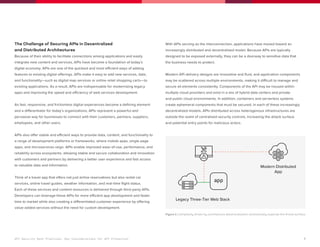
Figure 1: Complexity driven by architecture decentralization dramatically expands the threat surface.
The Challenge of Securing APIs in Decentralized
and Distributed Architectures
Because of their ability to facilitate connections among applications and easily
integrate new content and services, APIs have become a foundation of today’s
digital economy. APIs are one of the quickest and most efficient ways of adding
features to existing digital offerings. APIs make it easy to add new services, data,
and functionality—such as digital map services or online retail shopping carts—to
existing applications. As a result, APIs are indispensable for modernizing legacy
apps and improving the speed and efficiency of web services development.
As fast, responsive, and frictionless digital experiences become a defining element
and a differentiator for today’s organizations, APIs represent a powerful and
pervasive way for businesses to connect with their customers, partners, suppliers,
employees, and other users.
APIs also offer stable and efficient ways to provide data, content, and functionality to
a range of development platforms or frameworks, where mobile apps, single page
apps, and microservices reign. APIs enable improved ease-of-use, performance, and
reliability across ecosystems, allowing stable and secure collaboration and innovation
with customers and partners by delivering a better user experience and fast access
to valuable data and information.
Think of a travel app that offers not just airline reservations but also rental car
services, online travel guides, weather information, and real-time flight status.
Each of these services and content resources is delivered through third-party APIs.
Developers can leverage these APIs for more efficient app development and faster
time to market while also creating a differentiated customer experience by offering
value-added services without the need for custom development.
With APIs serving as the interconnection, applications have moved toward an
increasingly distributed and decentralized model. Because APIs are typically
designed to be exposed externally, they can be a doorway to sensitive data that
the business needs to protect.
Modern API delivery designs are innovative and fluid, and application components
may be scattered across multiple environments, making it difficult to manage and
secure all elements consistently. Components of the API may be housed within
multiple cloud providers and exist in a mix of hybrid data centers and private
and public cloud environments. In addition, containers and serverless systems
create ephemeral components that must be secured. In each of these increasingly
decentralized models, APIs distributed across heterogenous infrastructures are
outside the realm of centralized security controls, increasing the attack surface
and potential entry points for malicious actors.
API Security Best Practices: Key Considerations for API Protection 4
4
APIs are indispensable for
modernizing legacy apps and
improving the speed and efficiency
of web services development.
API Security Best Practices: Key Considerations for API Protection
API Security Best Practices: Key Considerations for API Protection 5
app
Brute force, injects, etc.
Attacker
Data
USERNAME
API
Brute force, injects, etc.
Attacker
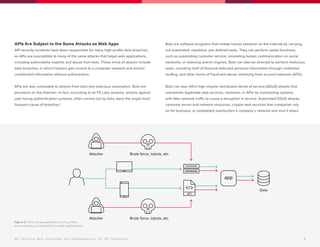
APIs Are Subject to the Same Attacks as Web Apps
API security incidents have been responsible for many high-profile data breaches,
as APIs are susceptible to many of the same attacks that target web applications,
including vulnerability exploits and abuse from bots. These kinds of attacks include
data breaches, in which hackers gain access to a computer network and extract
confidential information without authorization.
APIs are also vulnerable to attacks from bots and malicious automation. Bots are
pervasive on the Internet—in fact, according to an F5 Labs analysis, attacks against
user-facing authentication surfaces, often carried out by bots, were the single most
frequent cause of breaches.1
Bots are software programs that imitate human behavior on the Internet by carrying
out automated, repetitive, pre-defined tasks. They can perform useful functions,
such as automating customer service, simulating human communication on social
networks, or indexing search engines. Bots can also be directed to perform malicious
tasks, including theft of financial data and personal information through credential
stuffing, and other forms of fraud and abuse stemming from account takeover (ATO).
Bots can also inflict high-volume distributed denial of service (DDoS) attacks that
overwhelm legitimate web services, networks, or APIs by overloading systems
with fake network traffic to cause a disruption in service. Automated DDoS attacks
consume server and network resources, cripple web services that companies rely
on for business, or completely overburden a company’s network and shut it down.
API Security Best Practices: Key Considerations for API Protection 5
Figure 2: APIs are susceptible to many of the
same security vulnerabilities as web applications.
API Security Best Practices: Key Considerations for API Protection 6
Therefore, risk management leaders need to be concerned with bot-driven attacks
that lead to compromise and data breach as well as those that impact uptime and
reliability, for both legacy web apps and modern API fabrics.
Existing Security Controls May Not Protect APIs
Traditional security controls, such as basic web app firewalls (WAFs) and security
information and event management (SIEM) systems, are not sufficient to identify and
prevent attacks on APIs, in part because of the high amount of machine-to-machine,
or API-to-API traffic. Attacks and breaches can appear like normal app behavior
on the surface, but behind the scenes APIs can be exploited and abused, allowing
attackers to elude detection until it’s too late.
East-west API traffic—network communications between servers and applications
within the data center—often bypasses centralized controls. This is unlike north-
south network traffic, which refers to client-server communications that enter and
exit the perimeter of the data center and are typically protected by various types of
firewalls, intrusion detection systems, DDoS mitigation devices, and other layered
protections at the data center entrance. However, with flows of east-west traffic, there
is no single-point-of-detection to monitor for malicious activity, even though large
organizations may have massive volumes of east-west traffic flowing between data
centers and multiple private and public clouds.
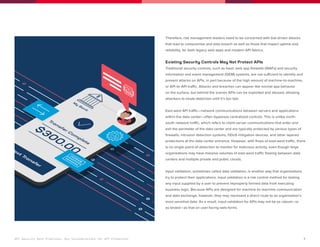
Input validation, sometimes called data validation, is another way that organizations
try to protect their applications. Input validation is a risk control method for testing
any input supplied by a user to prevent improperly formed data from executing
business logic. Because APIs are designed for machine-to-machine communication
and data exchange, however, they may represent a direct route to an organization’s
most sensitive data. As a result, input validation for APIs may not be as robust—or
as tested—as that on user-facing web forms.
M
y
B
a
n
k
Transfer Com
plete
$
3
0
0
.
0
0
N
e
x
t
T
r
a
n
s
f
e
r
API Security Best Practices: Key Considerations for API Protection 7
7
Input validation is a risk control method
for testing any input supplied by a user
to prevent improperly formed data from
executing business logic.
API Security Best Practices: Key Considerations for API Protection
API Security Best Practices: Key Considerations for API Protection 8
Multi-cloud architectures, and those that use multiple data centers, can complicate
API security and contribute to API sprawl, which occurs when APIs become widely
distributed without a comprehensive governance strategy. Such architectures are
difficult to secure, in part because they lack predictable and trusted observability
across environments. Inconsistent API attack detection and policy enforcement—
common in many such architectures due to the complexity of maintaining application
deployments that span multiple clouds and data centers—can create unknown risk
and dangerous security gaps.
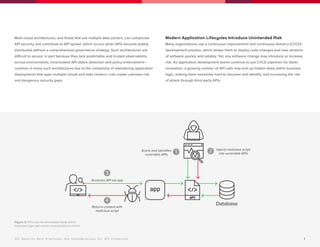
Database
Accesses API via app
Scans and identifies
vunerable APIs
Injects malicious script
into vunerable APIs
Returns content with
malicious script
Modern Application Lifecycles Introduce Unintended Risk
Many organizations use a continuous improvement and continuous delivery (CI/CD)
development process, which allows them to deploy code changes and new versions
of software quickly and reliably. Yet, any software change may introduce or increase
risk. As application development teams continue to use CI/CD pipelines for faster
innovation, a growing number of API calls may end up hidden deep within business
logic, making them extremely hard to discover and identify, and increasing the risk
of attack through third-party APIs.
8
API Security Best Practices: Key Considerations for API Protection
Figure 3: APIs can be embedded deep within
business logic yet remain susceptible to attack.
API Security Best Practices: Key Considerations for API Protection 9
Using third-party APIs can save an organization a lot of time, simplifying the
development process and providing easy access to features and services created
by other companies. Yet, while organizations can control the APIs they develop,
using third-party APIs can provide an open window to their house and give
cybercriminals easy access to their data and applications. Seemingly innocuous
functionality, such as an open-source logging library, can be the source of critical
weaknesses and vulnerabilities.2
When developers deploy public APIs, such as those
made available through open-source libraries, they often bypass established security
processes and procedures.
Today, organizations face a continuously changing risk landscape, with new threat
vectors emerging all the time. A good example is third-party aggregators, like the
companies that offer consumers and merchants alternative payment options or other
financial services. Third-party aggregators provide services that consumers and
merchants value, but they also introduce a new level of risk that could compromise
a consumer’s personal information, leading to fraud or identity theft, and expose a
merchant’s system to possible attack.
When it comes to security, CI/CD pipelines are also a mixed blessing for many
organizations. As companies continue to accelerate their development and
deployment cycles through the use of automated CI/CD pipelines, many have
security policies that still use manual processes for the discovery and assessment of
software components. That approach is impractical at best, and it may increase an
organization’s risk. Meanwhile, reactive security—waiting to act until a threat arises
within a system—can impede the software development and release cycle, and slow
time to market. As a result, many organizations sacrifice security in favor of speed,
which amplifies their risk of attack.
9
API Security Best Practices: Key Considerations for API Protection 10
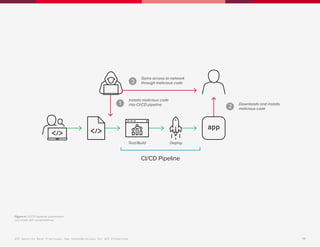
Installs malicious code
into CI/CD pipeline
Deploy
Downloads and installs
malicious code
Gains access to network
through malicious code
Test/Build
CI/CD Pipeline
10
API Security Best Practices: Key Considerations for API Protection
Figure 4: CI/CD pipeline automation
can mask API vulnerabilities.
API Security Best Practices: Key Considerations for API Protection 11
APIs Introduce More Risk by Default
APIs are the foundation of many modern applications and a key component of
innovation and digital transformation at multiple levels. They can enable disparate
systems to work together seamlessly, speed time to market, and enhance customer
experiences by giving developers easy access to third-party features, functionality,
and services. At the same time, APIs inevitably introduce new, hard-to-manage risks
by opening multiple windows into an organization’s house.
Still, the use of APIs continues to skyrocket – the number of APIs is projected to
reach a billion by 2031 – and the attack surface keeps expanding.3
As organizations
continue to use APIs to innovate and modernize their app portfolios, they also
increase the number of endpoints and parameters, and raise the risk of attack.
Fundamentally, APIs provide more information for attackers to glean during
reconnaissance. The availability and information contained within APIs can provide
insight into system internals, which can help hackers create targeted attacks. This
is especially true with open-source vulnerabilities like log4j2, where attackers
immediately started scanning the Internet for vulnerable hosts as soon as an exploit
kit was published. The complexity of software supply chains, and the difficulty of
evaluating their risks, underscores the need for more alignment across application
and security teams.4
API Security Best Practices: Key Considerations for API Protection 12
12
API Security Best Practices: Key Considerations for API Protection
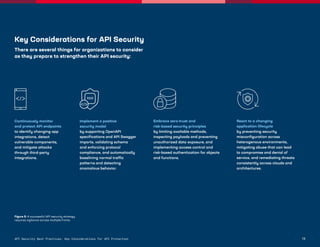
Figure 5: A successful API security strategy
requires vigilance across multiple fronts.
Key Considerations for API Security
There are several things for organizations to consider
as they prepare to strengthen their API security:
Continuously monitor
and protect API endpoints
to identify changing app
integrations, detect
vulnerable components,
and mitigate attacks
through third-party
integrations.
Implement a positive
security model
by supporting OpenAPI
specifications and API Swagger
imports, validating schema
and enforcing protocol
compliance, and automatically
baselining normal traffic
patterns and detecting
anomalous behavior.
Embrace zero-trust and
risk-based security principles
by limiting available methods,
inspecting payloads and preventing
unauthorized data exposure, and
implementing access control and
risk-based authentication for objects
and functions.
React to a changing
application lifecycle
by preventing security
misconfiguration across
heterogenous environments,
mitigating abuse that can lead
to compromise and denial of
service, and remediating threats
consistently across clouds and
architectures.
API Security Best Practices: Key Considerations for API Protection 13
The Bottom Line
APIs are pivotal to digital business yet are inherently more difficult to secure as
compared to legacy architectures with more predictable use cases, such as custom
three-tier web stacks in the data center. APIs facilitate a decentralized and distributed
architecture with endless opportunities for third-party integration that fundamentally
changes the calculus for security and risk teams.
The New
Digital
Economy
Edge Cloud
Data center
Figure 5: APIs are central to today’s decentralized, distributed computing infrastructures.
API Security Best Practices: Key Considerations for API Protection
API Security Best Practices: Key Considerations for API Protection 14
1
Sander Vinberg and Raymond Pompon, “2022 Application Protection Report: In Expectation of Exfiltration,” F5
Labs (February 15, 2022) https://www.f5.com/labs/articles/threat-intelligence/2022-application-protection-report-in-
expectation-of-exfiltration
2
Andrew van der Stock, Brian Glas, Neil Smithline, Torsten Gigler, “The OWASP Top 10 for 2021: A New Wave
of Risk,” OWASP (September 24, 2021) https://www.f5.com/services/resources/infographics/owasp-top-10-2021-
infographic
3
Rajesh Narayanan and Mike Wiley, “Continuous API Sprawl: Challenges and Opportunities in an API-Driven
Economy,” (2021) https://www.f5.com/pdf/reports/f5-office-of-the-cto-report-continuous-api-sprawl.pdf
4
Sander Vinberg, “Log4Shell: Rebooting (The Same Old) Security Principles In its Wake,” F5 Labs (December 17,
2021) https://www.f5.com/labs/articles/cisotociso/log4shell-rebooting-the-same-old-security-principles-in-its-wake
Appendix
API Security Best Practices:
Key Considerations for API Protection
Feeling exposed? Learn how you can rise above unseen threats.
US Headquarters: 801 5th Ave, Seattle, WA 98104 | 888-882-4447 // Americas: info@f5.com // Asia-Pacific: apacinfo@f5.com // Europe/Middle East/Africa: emeainfo@f5.com // Japan: f5j-info@f5.com
©2022 F5 Networks, Inc. All rights reserved. F5, F5 Networks, and the F5 logo are trademarks of F5 Networks, Inc. in the U.S. and in certain other countries. Other F5 trademarks are identified at f5.com.
Any other products, services, or company names referenced herein may be trademarks of the irrespective owners with no endorsement or affiliation, expressed or implied, claimed by F5. EBOOK-SDE-843760607
F5’s portfolio of automation, security, performance, and insight capabilities empowers
our customers to create, secure, and operate adaptive applications that reduce costs,
improve operations, and better protect users.
Find out more at f5.com/solutions/api-security
SECURE. SIMPLIFY. INNOVATE.

F5-API-Security-Best-Practices.pdf

  • 1.
    API Security BestPractices: Key Considerations for API Protection Feeling exposed? Learn how you can rise above unseen threats.
  • 2.
    API Security BestPractices: Key Considerations for API Protection 2 Introduction Application Programming Interfaces, or APIs, were developed to streamline the way digital ecosystems communicate and interact with each other. At their core, APIs abstract the complexity of connecting multiple disparate systems. This allows developers to integrate third-party content or services quickly and easily into their applications, automate mundane tasks, and increase convenience for online shopping, one-stop travel planning, and other digital miracles. In our increasingly connected world, APIs have evolved from vehicles that allow developers to quickly implement new functionality without re-inventing the wheel to become the essential fabric of the digital economy. As modern applications constantly evolve, they increasingly depend on third-party APIs to provide the bridge to modernization. APIs now serve as the cornerstone for more complete, convenient, and powerful digital experiences. The emphasis on APIs as a fundamental building block for app development has resulted in a cascade of infrastructure and deployment scenarios and, in particular, has dramatically decentralized architecture. However, the growing reliance on APIs has also greatly expanded the risk surface for compromise, abuse, and fraud that existing security tools struggle to detect and mitigate. 2
  • 3.
    API Security BestPractices: Key Considerations for API Protection 3 Legacy Three-Tier Web Stack Modern Distributed App Figure 1: Complexity driven by architecture decentralization dramatically expands the threat surface. The Challenge of Securing APIs in Decentralized and Distributed Architectures Because of their ability to facilitate connections among applications and easily integrate new content and services, APIs have become a foundation of today’s digital economy. APIs are one of the quickest and most efficient ways of adding features to existing digital offerings. APIs make it easy to add new services, data, and functionality—such as digital map services or online retail shopping carts—to existing applications. As a result, APIs are indispensable for modernizing legacy apps and improving the speed and efficiency of web services development. As fast, responsive, and frictionless digital experiences become a defining element and a differentiator for today’s organizations, APIs represent a powerful and pervasive way for businesses to connect with their customers, partners, suppliers, employees, and other users. APIs also offer stable and efficient ways to provide data, content, and functionality to a range of development platforms or frameworks, where mobile apps, single page apps, and microservices reign. APIs enable improved ease-of-use, performance, and reliability across ecosystems, allowing stable and secure collaboration and innovation with customers and partners by delivering a better user experience and fast access to valuable data and information. Think of a travel app that offers not just airline reservations but also rental car services, online travel guides, weather information, and real-time flight status. Each of these services and content resources is delivered through third-party APIs. Developers can leverage these APIs for more efficient app development and faster time to market while also creating a differentiated customer experience by offering value-added services without the need for custom development. With APIs serving as the interconnection, applications have moved toward an increasingly distributed and decentralized model. Because APIs are typically designed to be exposed externally, they can be a doorway to sensitive data that the business needs to protect. Modern API delivery designs are innovative and fluid, and application components may be scattered across multiple environments, making it difficult to manage and secure all elements consistently. Components of the API may be housed within multiple cloud providers and exist in a mix of hybrid data centers and private and public cloud environments. In addition, containers and serverless systems create ephemeral components that must be secured. In each of these increasingly decentralized models, APIs distributed across heterogenous infrastructures are outside the realm of centralized security controls, increasing the attack surface and potential entry points for malicious actors.
  • 4.
    API Security BestPractices: Key Considerations for API Protection 4 4 APIs are indispensable for modernizing legacy apps and improving the speed and efficiency of web services development. API Security Best Practices: Key Considerations for API Protection
  • 5.
    API Security BestPractices: Key Considerations for API Protection 5 app Brute force, injects, etc. Attacker Data USERNAME API Brute force, injects, etc. Attacker APIs Are Subject to the Same Attacks as Web Apps API security incidents have been responsible for many high-profile data breaches, as APIs are susceptible to many of the same attacks that target web applications, including vulnerability exploits and abuse from bots. These kinds of attacks include data breaches, in which hackers gain access to a computer network and extract confidential information without authorization. APIs are also vulnerable to attacks from bots and malicious automation. Bots are pervasive on the Internet—in fact, according to an F5 Labs analysis, attacks against user-facing authentication surfaces, often carried out by bots, were the single most frequent cause of breaches.1 Bots are software programs that imitate human behavior on the Internet by carrying out automated, repetitive, pre-defined tasks. They can perform useful functions, such as automating customer service, simulating human communication on social networks, or indexing search engines. Bots can also be directed to perform malicious tasks, including theft of financial data and personal information through credential stuffing, and other forms of fraud and abuse stemming from account takeover (ATO). Bots can also inflict high-volume distributed denial of service (DDoS) attacks that overwhelm legitimate web services, networks, or APIs by overloading systems with fake network traffic to cause a disruption in service. Automated DDoS attacks consume server and network resources, cripple web services that companies rely on for business, or completely overburden a company’s network and shut it down. API Security Best Practices: Key Considerations for API Protection 5 Figure 2: APIs are susceptible to many of the same security vulnerabilities as web applications.
  • 6.
    API Security BestPractices: Key Considerations for API Protection 6 Therefore, risk management leaders need to be concerned with bot-driven attacks that lead to compromise and data breach as well as those that impact uptime and reliability, for both legacy web apps and modern API fabrics. Existing Security Controls May Not Protect APIs Traditional security controls, such as basic web app firewalls (WAFs) and security information and event management (SIEM) systems, are not sufficient to identify and prevent attacks on APIs, in part because of the high amount of machine-to-machine, or API-to-API traffic. Attacks and breaches can appear like normal app behavior on the surface, but behind the scenes APIs can be exploited and abused, allowing attackers to elude detection until it’s too late. East-west API traffic—network communications between servers and applications within the data center—often bypasses centralized controls. This is unlike north- south network traffic, which refers to client-server communications that enter and exit the perimeter of the data center and are typically protected by various types of firewalls, intrusion detection systems, DDoS mitigation devices, and other layered protections at the data center entrance. However, with flows of east-west traffic, there is no single-point-of-detection to monitor for malicious activity, even though large organizations may have massive volumes of east-west traffic flowing between data centers and multiple private and public clouds. Input validation, sometimes called data validation, is another way that organizations try to protect their applications. Input validation is a risk control method for testing any input supplied by a user to prevent improperly formed data from executing business logic. Because APIs are designed for machine-to-machine communication and data exchange, however, they may represent a direct route to an organization’s most sensitive data. As a result, input validation for APIs may not be as robust—or as tested—as that on user-facing web forms. M y B a n k Transfer Com plete $ 3 0 0 . 0 0 N e x t T r a n s f e r
  • 7.
    API Security BestPractices: Key Considerations for API Protection 7 7 Input validation is a risk control method for testing any input supplied by a user to prevent improperly formed data from executing business logic. API Security Best Practices: Key Considerations for API Protection
  • 8.
    API Security BestPractices: Key Considerations for API Protection 8 Multi-cloud architectures, and those that use multiple data centers, can complicate API security and contribute to API sprawl, which occurs when APIs become widely distributed without a comprehensive governance strategy. Such architectures are difficult to secure, in part because they lack predictable and trusted observability across environments. Inconsistent API attack detection and policy enforcement— common in many such architectures due to the complexity of maintaining application deployments that span multiple clouds and data centers—can create unknown risk and dangerous security gaps. Database Accesses API via app Scans and identifies vunerable APIs Injects malicious script into vunerable APIs Returns content with malicious script Modern Application Lifecycles Introduce Unintended Risk Many organizations use a continuous improvement and continuous delivery (CI/CD) development process, which allows them to deploy code changes and new versions of software quickly and reliably. Yet, any software change may introduce or increase risk. As application development teams continue to use CI/CD pipelines for faster innovation, a growing number of API calls may end up hidden deep within business logic, making them extremely hard to discover and identify, and increasing the risk of attack through third-party APIs. 8 API Security Best Practices: Key Considerations for API Protection Figure 3: APIs can be embedded deep within business logic yet remain susceptible to attack.
  • 9.
    API Security BestPractices: Key Considerations for API Protection 9 Using third-party APIs can save an organization a lot of time, simplifying the development process and providing easy access to features and services created by other companies. Yet, while organizations can control the APIs they develop, using third-party APIs can provide an open window to their house and give cybercriminals easy access to their data and applications. Seemingly innocuous functionality, such as an open-source logging library, can be the source of critical weaknesses and vulnerabilities.2 When developers deploy public APIs, such as those made available through open-source libraries, they often bypass established security processes and procedures. Today, organizations face a continuously changing risk landscape, with new threat vectors emerging all the time. A good example is third-party aggregators, like the companies that offer consumers and merchants alternative payment options or other financial services. Third-party aggregators provide services that consumers and merchants value, but they also introduce a new level of risk that could compromise a consumer’s personal information, leading to fraud or identity theft, and expose a merchant’s system to possible attack. When it comes to security, CI/CD pipelines are also a mixed blessing for many organizations. As companies continue to accelerate their development and deployment cycles through the use of automated CI/CD pipelines, many have security policies that still use manual processes for the discovery and assessment of software components. That approach is impractical at best, and it may increase an organization’s risk. Meanwhile, reactive security—waiting to act until a threat arises within a system—can impede the software development and release cycle, and slow time to market. As a result, many organizations sacrifice security in favor of speed, which amplifies their risk of attack. 9
  • 10.
    API Security BestPractices: Key Considerations for API Protection 10 Installs malicious code into CI/CD pipeline Deploy Downloads and installs malicious code Gains access to network through malicious code Test/Build CI/CD Pipeline 10 API Security Best Practices: Key Considerations for API Protection Figure 4: CI/CD pipeline automation can mask API vulnerabilities.
  • 11.
    API Security BestPractices: Key Considerations for API Protection 11 APIs Introduce More Risk by Default APIs are the foundation of many modern applications and a key component of innovation and digital transformation at multiple levels. They can enable disparate systems to work together seamlessly, speed time to market, and enhance customer experiences by giving developers easy access to third-party features, functionality, and services. At the same time, APIs inevitably introduce new, hard-to-manage risks by opening multiple windows into an organization’s house. Still, the use of APIs continues to skyrocket – the number of APIs is projected to reach a billion by 2031 – and the attack surface keeps expanding.3 As organizations continue to use APIs to innovate and modernize their app portfolios, they also increase the number of endpoints and parameters, and raise the risk of attack. Fundamentally, APIs provide more information for attackers to glean during reconnaissance. The availability and information contained within APIs can provide insight into system internals, which can help hackers create targeted attacks. This is especially true with open-source vulnerabilities like log4j2, where attackers immediately started scanning the Internet for vulnerable hosts as soon as an exploit kit was published. The complexity of software supply chains, and the difficulty of evaluating their risks, underscores the need for more alignment across application and security teams.4
  • 12.
    API Security BestPractices: Key Considerations for API Protection 12 12 API Security Best Practices: Key Considerations for API Protection Figure 5: A successful API security strategy requires vigilance across multiple fronts. Key Considerations for API Security There are several things for organizations to consider as they prepare to strengthen their API security: Continuously monitor and protect API endpoints to identify changing app integrations, detect vulnerable components, and mitigate attacks through third-party integrations. Implement a positive security model by supporting OpenAPI specifications and API Swagger imports, validating schema and enforcing protocol compliance, and automatically baselining normal traffic patterns and detecting anomalous behavior. Embrace zero-trust and risk-based security principles by limiting available methods, inspecting payloads and preventing unauthorized data exposure, and implementing access control and risk-based authentication for objects and functions. React to a changing application lifecycle by preventing security misconfiguration across heterogenous environments, mitigating abuse that can lead to compromise and denial of service, and remediating threats consistently across clouds and architectures.
  • 13.
    API Security BestPractices: Key Considerations for API Protection 13 The Bottom Line APIs are pivotal to digital business yet are inherently more difficult to secure as compared to legacy architectures with more predictable use cases, such as custom three-tier web stacks in the data center. APIs facilitate a decentralized and distributed architecture with endless opportunities for third-party integration that fundamentally changes the calculus for security and risk teams. The New Digital Economy Edge Cloud Data center Figure 5: APIs are central to today’s decentralized, distributed computing infrastructures. API Security Best Practices: Key Considerations for API Protection
  • 14.
    API Security BestPractices: Key Considerations for API Protection 14 1 Sander Vinberg and Raymond Pompon, “2022 Application Protection Report: In Expectation of Exfiltration,” F5 Labs (February 15, 2022) https://www.f5.com/labs/articles/threat-intelligence/2022-application-protection-report-in- expectation-of-exfiltration 2 Andrew van der Stock, Brian Glas, Neil Smithline, Torsten Gigler, “The OWASP Top 10 for 2021: A New Wave of Risk,” OWASP (September 24, 2021) https://www.f5.com/services/resources/infographics/owasp-top-10-2021- infographic 3 Rajesh Narayanan and Mike Wiley, “Continuous API Sprawl: Challenges and Opportunities in an API-Driven Economy,” (2021) https://www.f5.com/pdf/reports/f5-office-of-the-cto-report-continuous-api-sprawl.pdf 4 Sander Vinberg, “Log4Shell: Rebooting (The Same Old) Security Principles In its Wake,” F5 Labs (December 17, 2021) https://www.f5.com/labs/articles/cisotociso/log4shell-rebooting-the-same-old-security-principles-in-its-wake Appendix
  • 15.
    API Security BestPractices: Key Considerations for API Protection Feeling exposed? Learn how you can rise above unseen threats. US Headquarters: 801 5th Ave, Seattle, WA 98104 | 888-882-4447 // Americas: info@f5.com // Asia-Pacific: apacinfo@f5.com // Europe/Middle East/Africa: emeainfo@f5.com // Japan: f5j-info@f5.com ©2022 F5 Networks, Inc. All rights reserved. F5, F5 Networks, and the F5 logo are trademarks of F5 Networks, Inc. in the U.S. and in certain other countries. Other F5 trademarks are identified at f5.com. Any other products, services, or company names referenced herein may be trademarks of the irrespective owners with no endorsement or affiliation, expressed or implied, claimed by F5. EBOOK-SDE-843760607 F5’s portfolio of automation, security, performance, and insight capabilities empowers our customers to create, secure, and operate adaptive applications that reduce costs, improve operations, and better protect users. Find out more at f5.com/solutions/api-security SECURE. SIMPLIFY. INNOVATE.