
© 2019 IBM Corporation
API Monetization –
It Does Not Mean What You Think It Means…
It Is Far More
Alan Glickenhouse
glick@us.ibm.com
@ARGlick
API Business Strategist
IBM
Profile:
© 2019 IBM Corporation
Alan Glickenhouse - Digital Transformation and API Business Strategist
• Assist businesses with their strategy for Digital Transformation and the API Economy - all industries, all geographies, and
of all sizes.
• Share insights and best practices through:
• 1:1 workshops
• Conferences
• Author:
• Digital Business / Digital Transformation - 12
• API Economy / API Management Basics - 16
• Business and Value - 20
• Strategy, Governance, and Best Practices - 32
• Architecture, Technology, and IBM API Connect - 21
• Industry Standards and Use cases - 39
Today we will cover a few from this
category
Agenda
•Definition
•Where is the Value?
•How Does the Money Flow?
•Monetization Models and Examples
•Closing Thoughts / Getting Started
Based on initial work by John Musser – Founder and CEO API Science
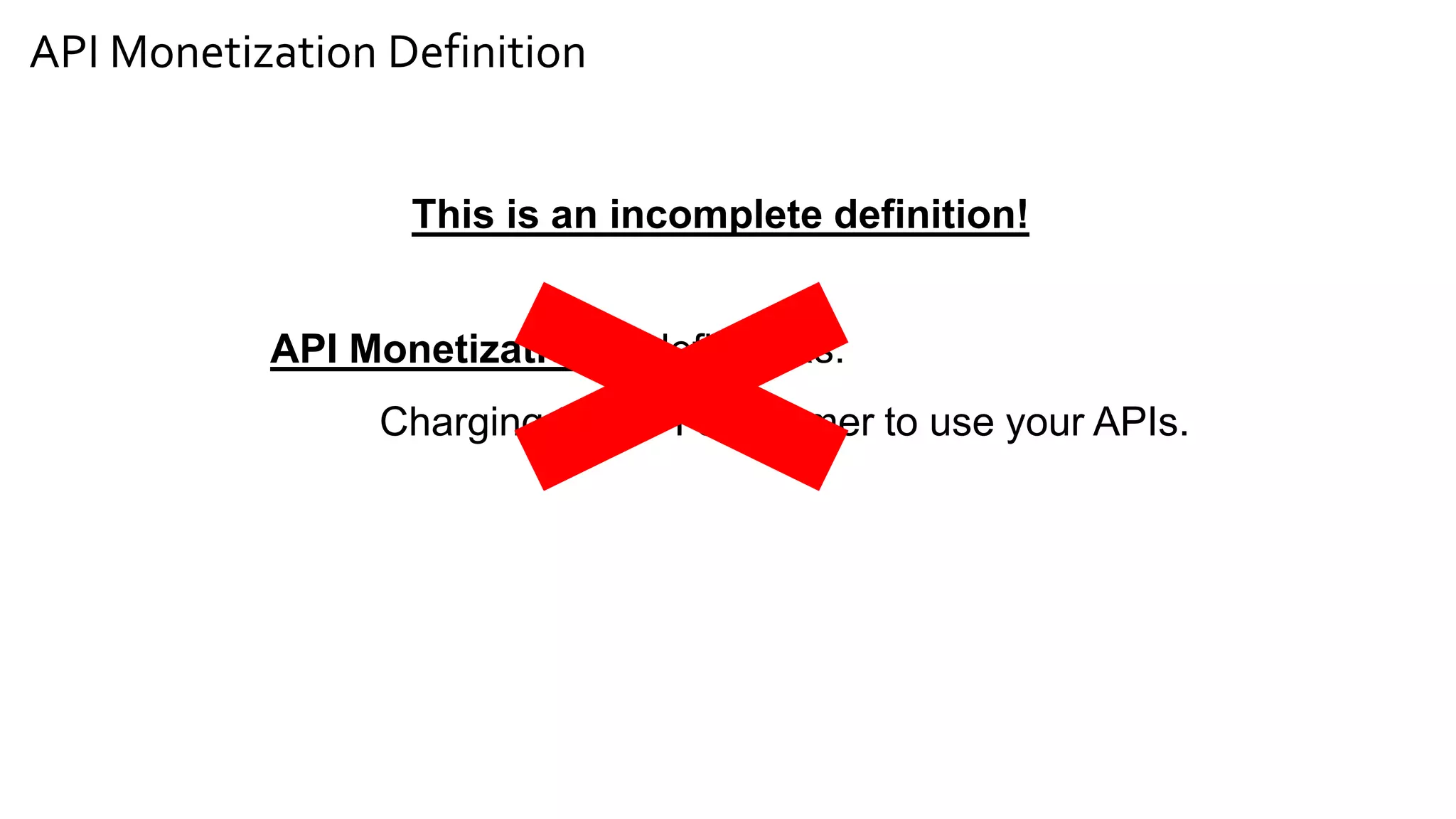
API Monetization Definition
API Monetization is defined as:
Charging the API consumer to use your APIs.
This is an incomplete definition!
API Monetization Definition
API Monetization is defined as:
Driving revenue through the use of APIs
Blog - API Monetization – What Does It Really Mean?
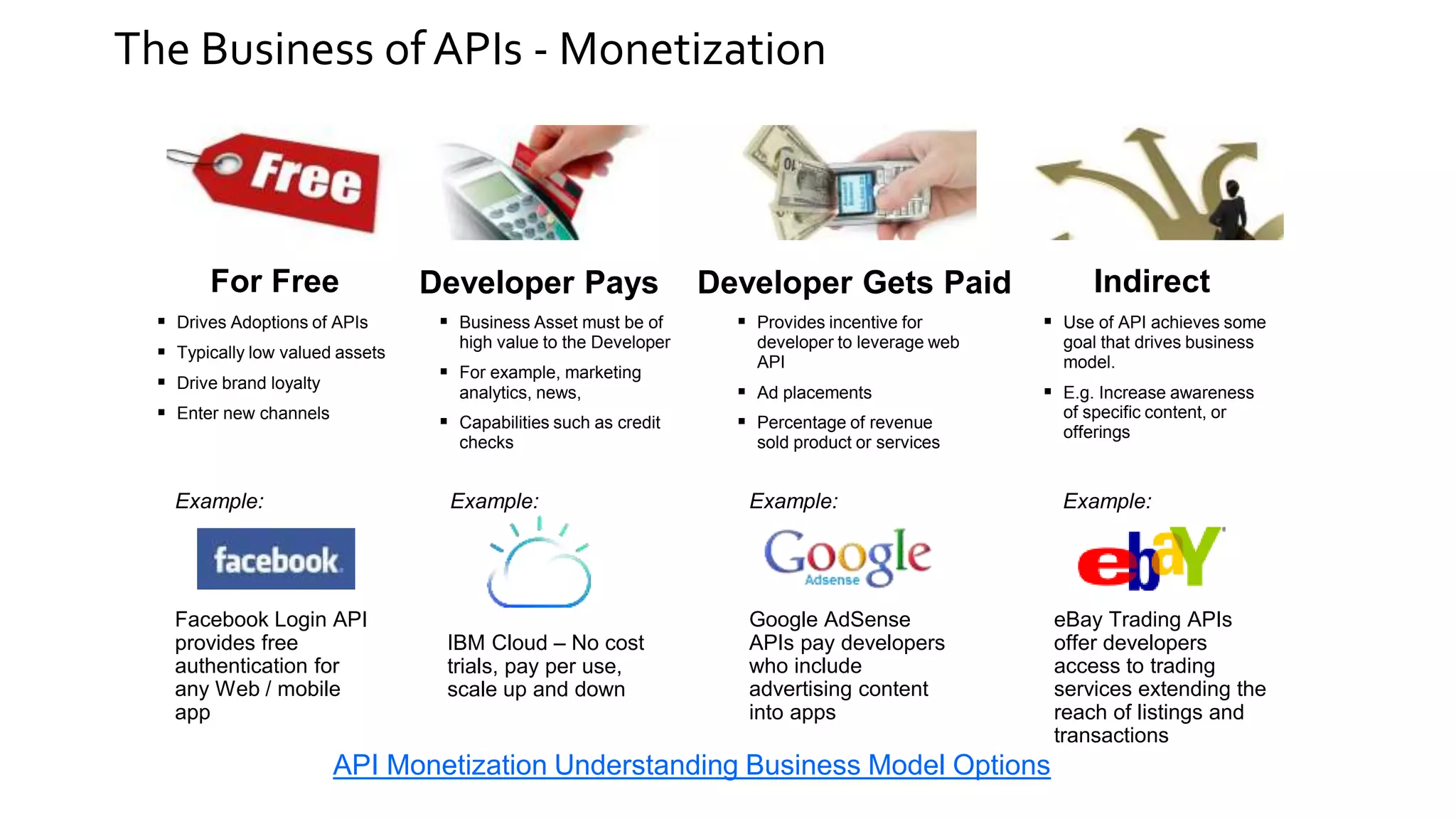
 Drives Adoptions of APIs
 Typically low valued assets
 Drive brand loyalty
 Enter new channels
For Free
Facebook Login API
provides free
authentication for
any Web / mobile
app
Example:
Developer Pays
 Business Asset must be of
high value to the Developer
 For example, marketing
analytics, news,
 Capabilities such as credit
checks
Example:
Developer Gets Paid
 Provides incentive for
developer to leverage web
API
 Ad placements
 Percentage of revenue
sold product or services
Google AdSense
APIs pay developers
who include
advertising content
into apps
Example:
Indirect
 Use of API achieves some
goal that drives business
model.
 E.g. Increase awareness
of specific content, or
offerings
eBay Trading APIs
offer developers
access to trading
services extending the
reach of listings and
transactions
Example:
The Business ofAPIs - Monetization
API Monetization Understanding Business Model Options
IBM Cloud – No cost
trials, pay per use,
scale up and down
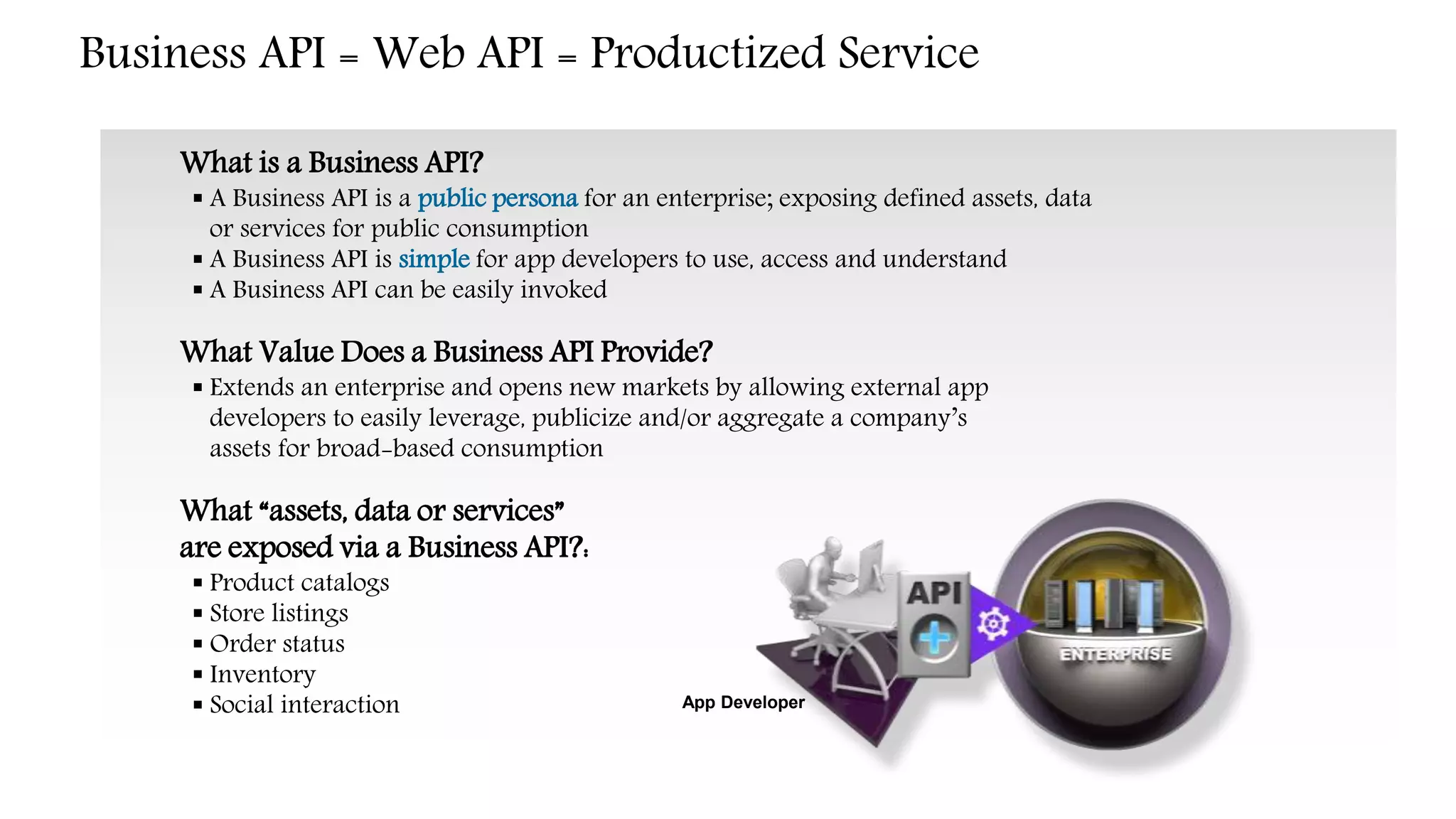
What is a Business API?
 A Business API is a public persona for an enterprise; exposing defined assets, data
or services for public consumption
 A Business API is simple for app developers to use, access and understand
 A Business API can be easily invoked
What Value Does a Business API Provide?
 Extends an enterprise and opens new markets by allowing external app
developers to easily leverage, publicize and/or aggregate a company’s
assets for broad-based consumption
What “assets, data or services”
are exposed via a Business API?:
 Product catalogs
 Store listings
 Order status
 Inventory
 Social interaction
Business API = Web API = Productized Service
App Developer
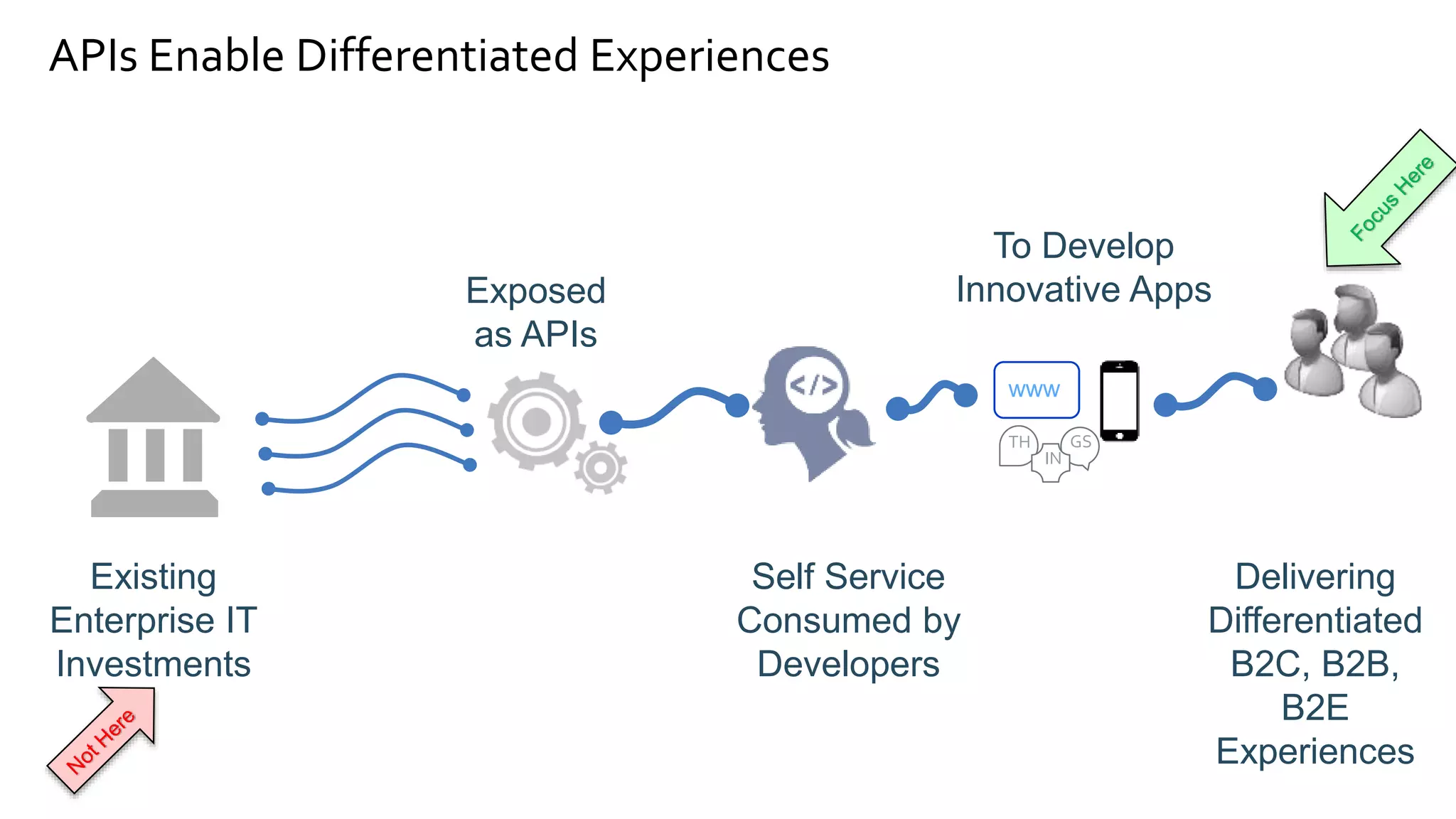
Existing
Enterprise IT
Investments
Exposed
as APIs
Self Service
Consumed by
Developers
To Develop
Innovative Apps
Delivering
Differentiated
B2C, B2B,
B2E
Experiences
APIs Enable Differentiated Experiences
TH GS
IN
www
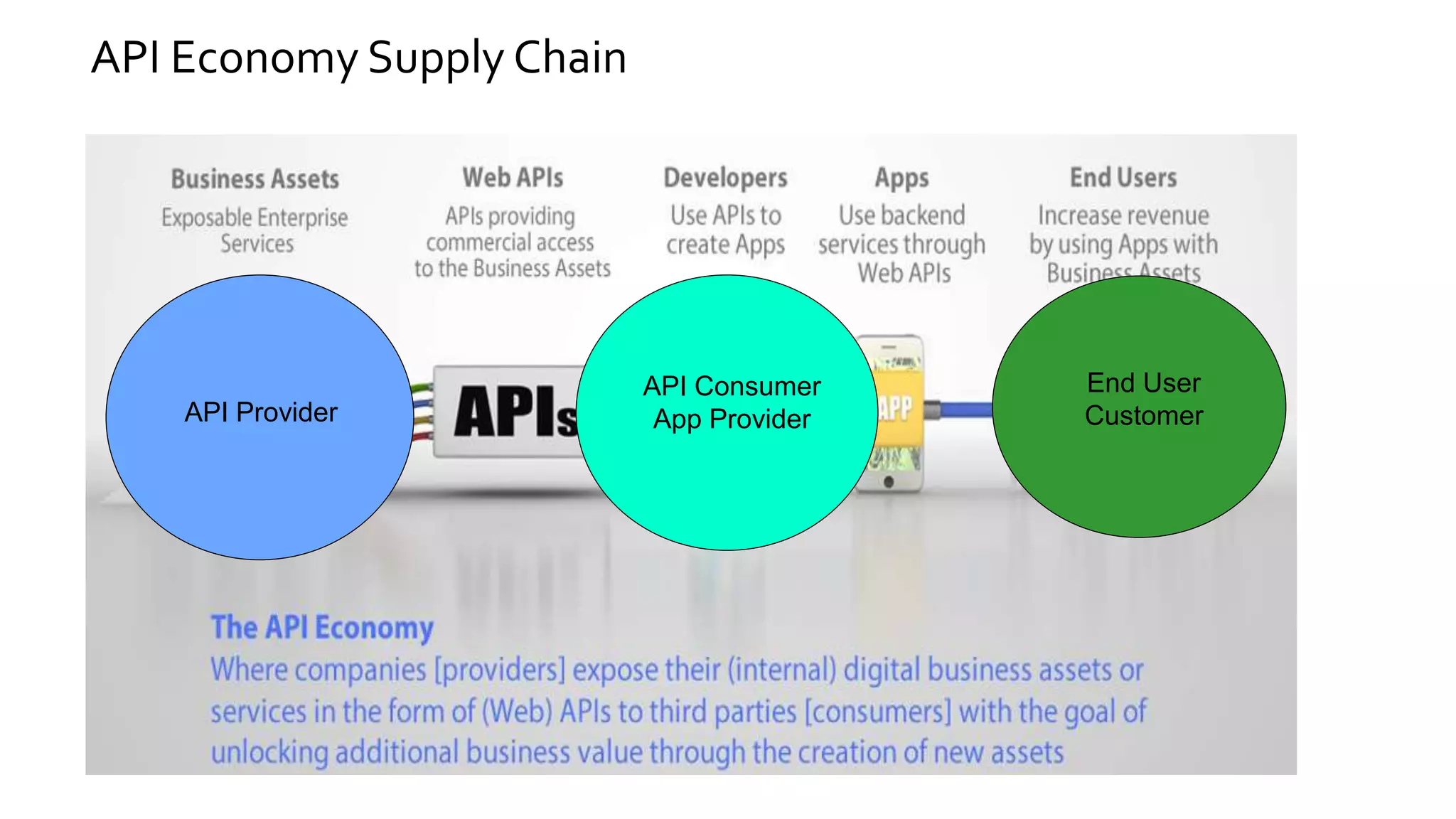
API Economy Supply Chain
API Provider
API Consumer
App Provider
End User
Customer
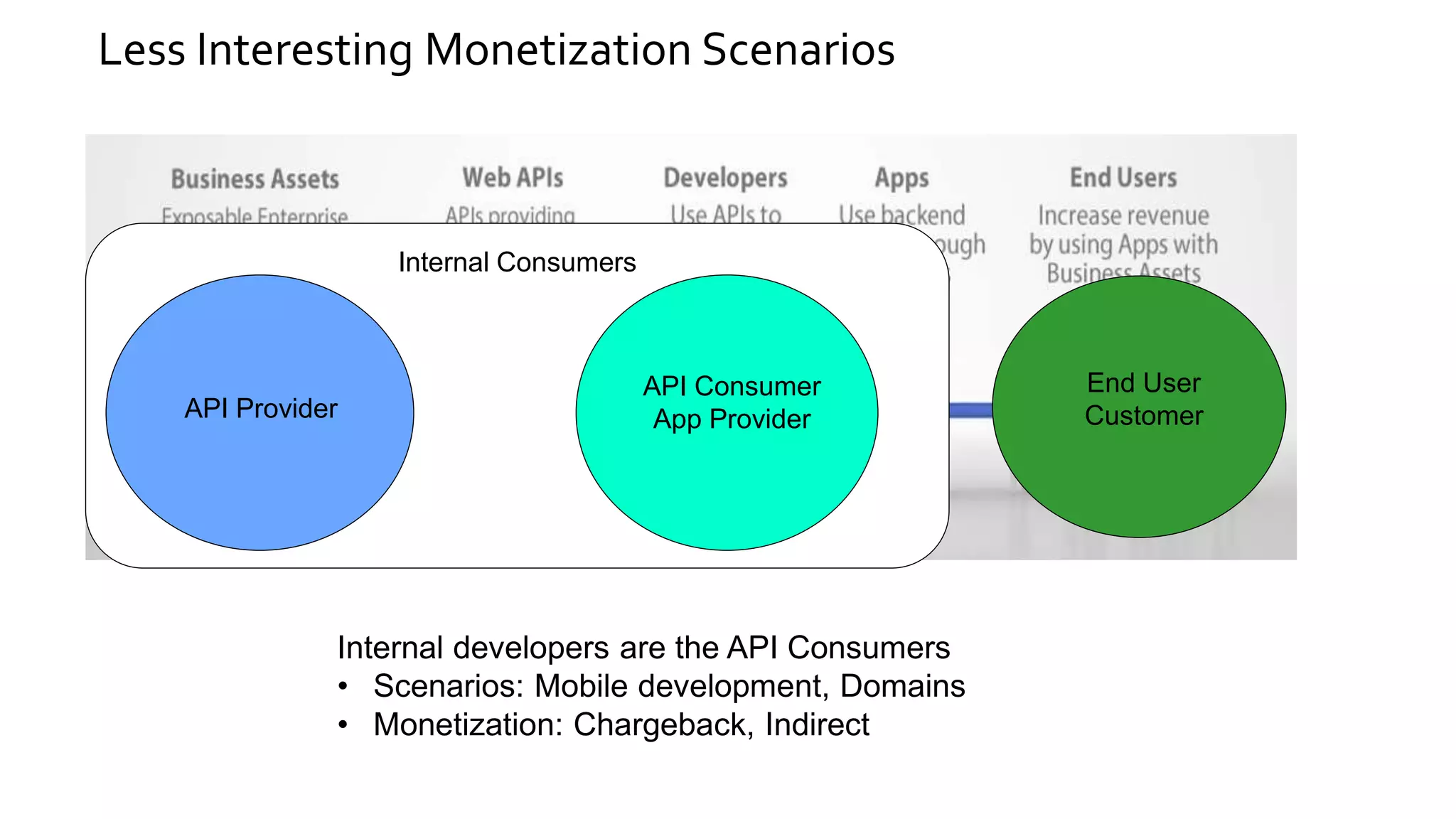
Internal Consumers
Less Interesting Monetization Scenarios
Internal developers are the API Consumers
• Scenarios: Mobile development, Domains
• Monetization: Chargeback, Indirect
API Provider
API Consumer
App Provider
End User
Customer
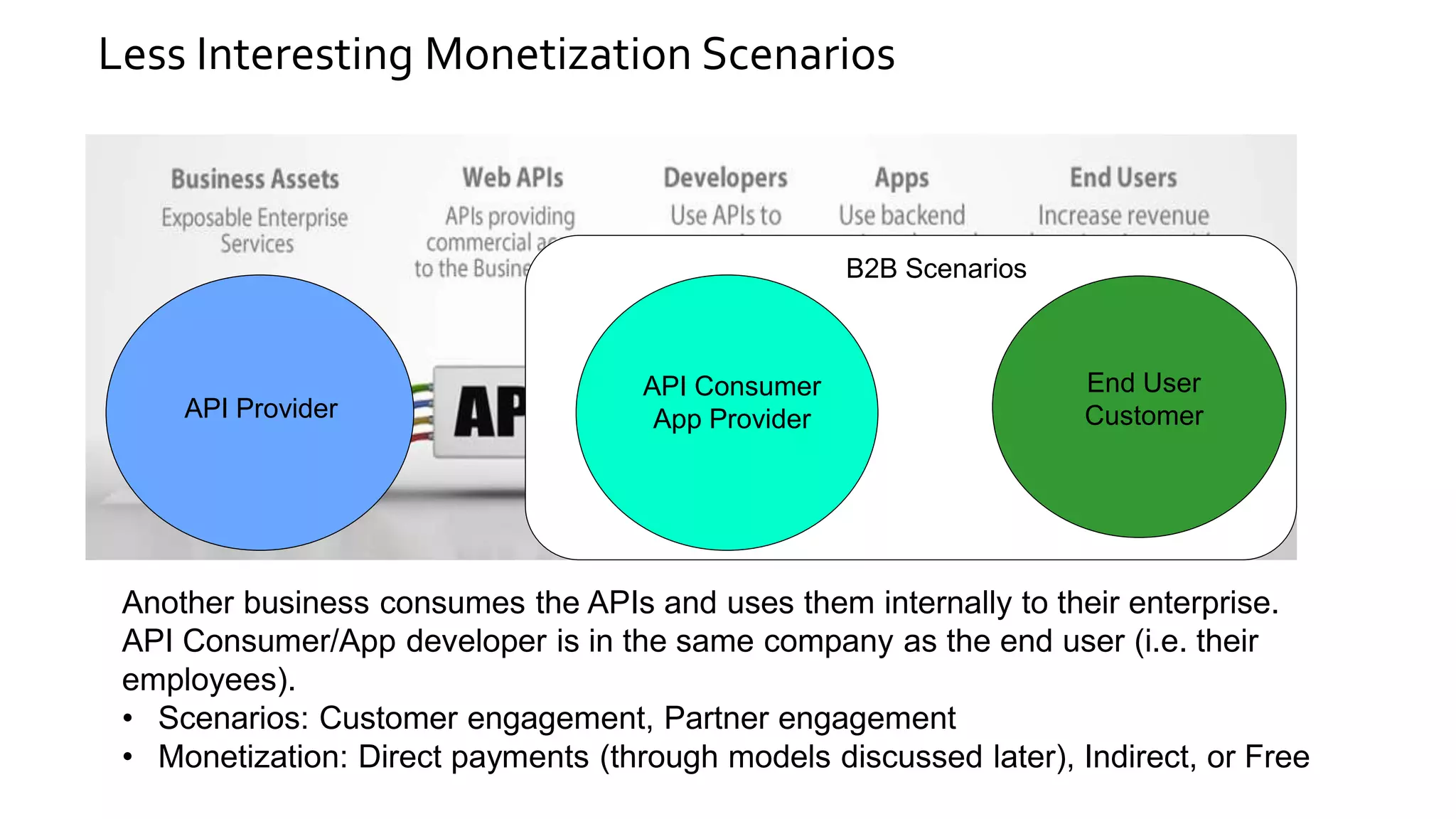
Less Interesting Monetization Scenarios
Another business consumes the APIs and uses them internally to their enterprise.
API Consumer/App developer is in the same company as the end user (i.e. their
employees).
• Scenarios: Customer engagement, Partner engagement
• Monetization: Direct payments (through models discussed later), Indirect, or Free
API Provider
B2B Scenarios
API Consumer
App Provider
End User
Customer
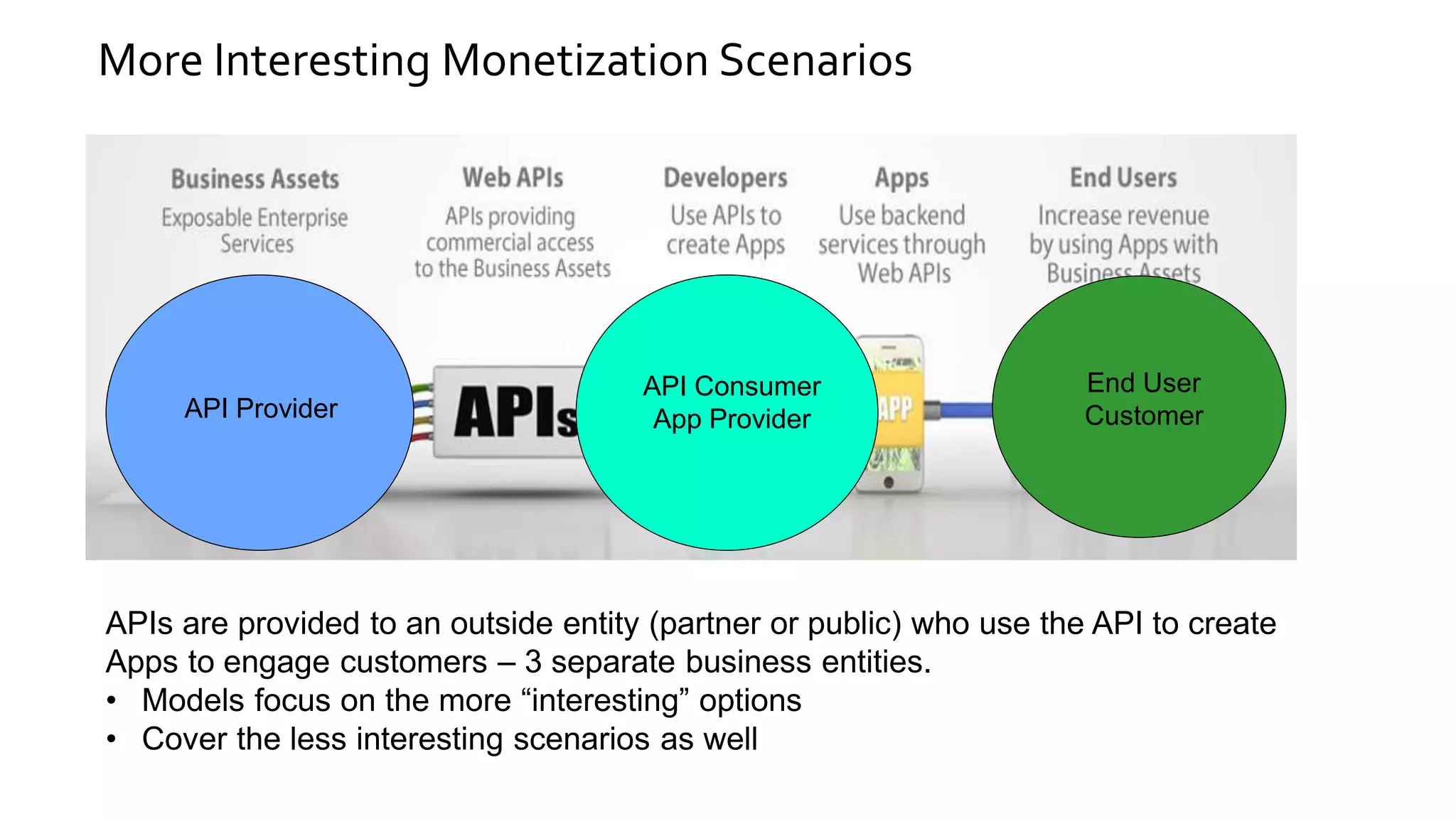
More Interesting Monetization Scenarios
APIs are provided to an outside entity (partner or public) who use the API to create
Apps to engage customers – 3 separate business entities.
• Models focus on the more “interesting” options
• Cover the less interesting scenarios as well
API Provider
API Consumer
App Provider
End User
Customer
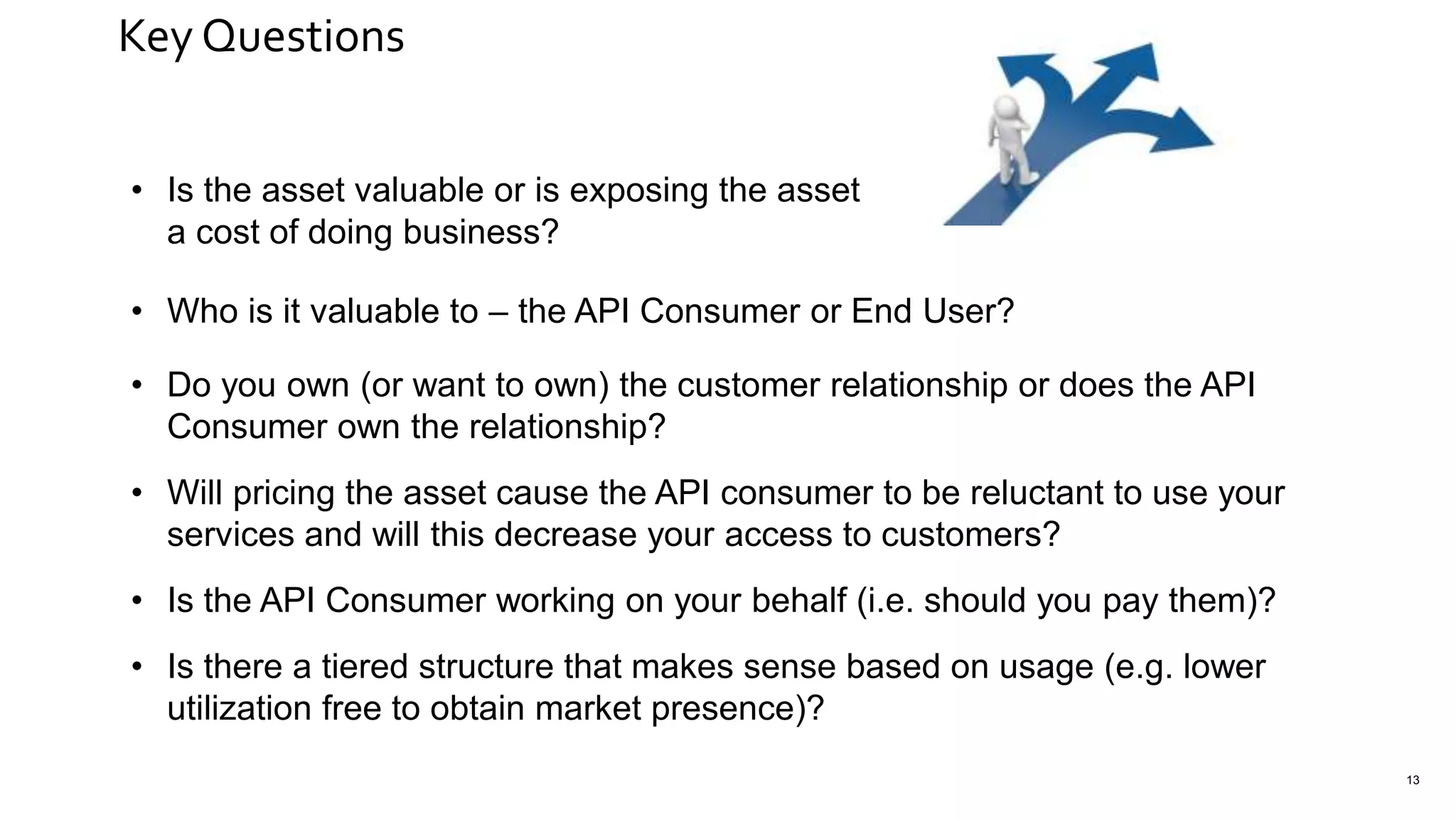
Key Questions
13
• Is the asset valuable or is exposing the asset
a cost of doing business?
• Who is it valuable to – the API Consumer or End User?
• Do you own (or want to own) the customer relationship or does the API
Consumer own the relationship?
• Will pricing the asset cause the API consumer to be reluctant to use your
services and will this decrease your access to customers?
• Is the API Consumer working on your behalf (i.e. should you pay them)?
• Is there a tiered structure that makes sense based on usage (e.g. lower
utilization free to obtain market presence)?
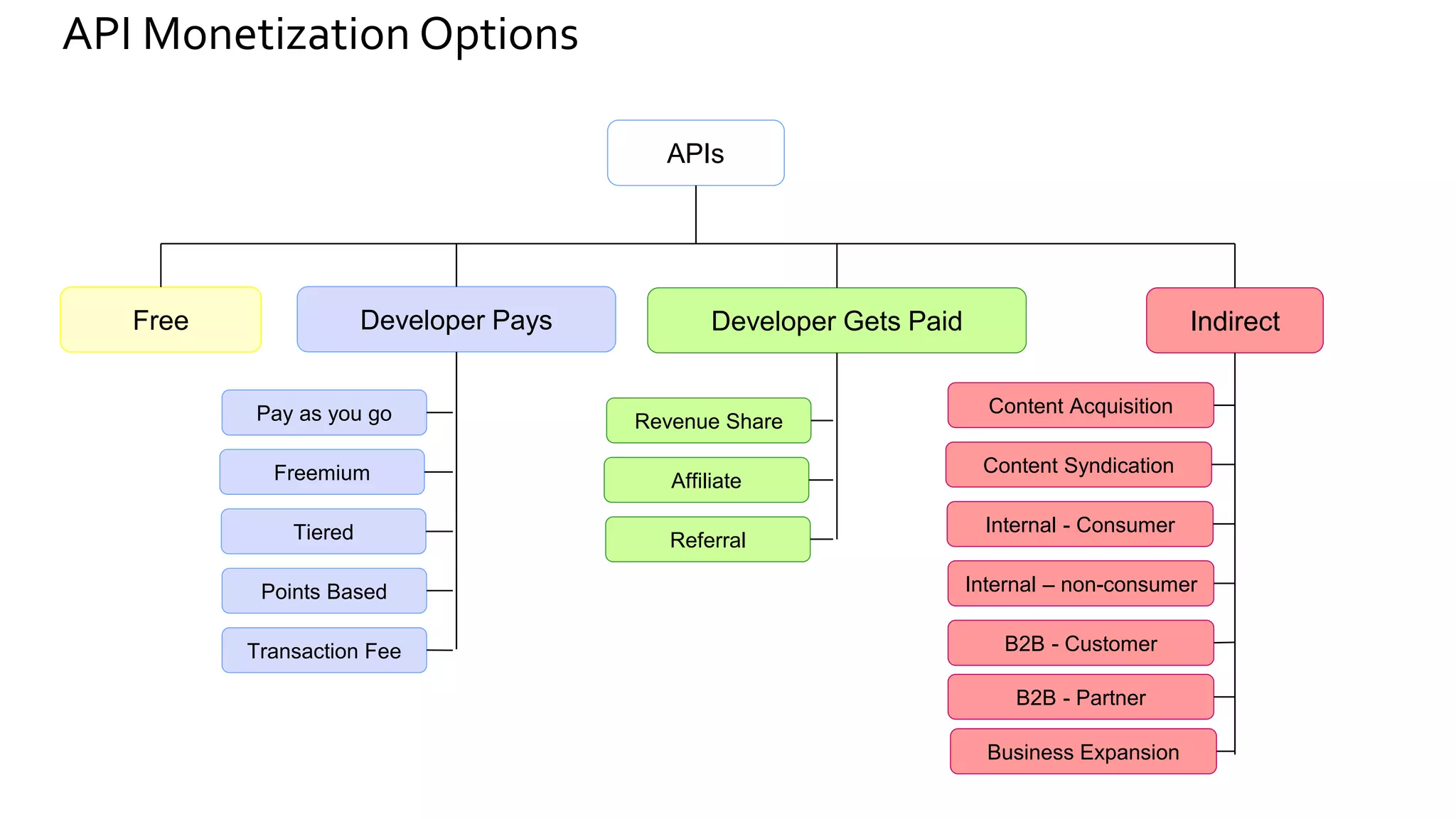
API Monetization Options
APIs
Developer Pays Developer Gets PaidFree Indirect
Pay as you go
Freemium
Tiered
Points Based
Transaction Fee
Revenue Share
Affiliate
Referral
Content Acquisition
Content Syndication
Internal - Consumer
Internal – non-consumer
B2B - Customer
B2B - Partner
Business Expansion
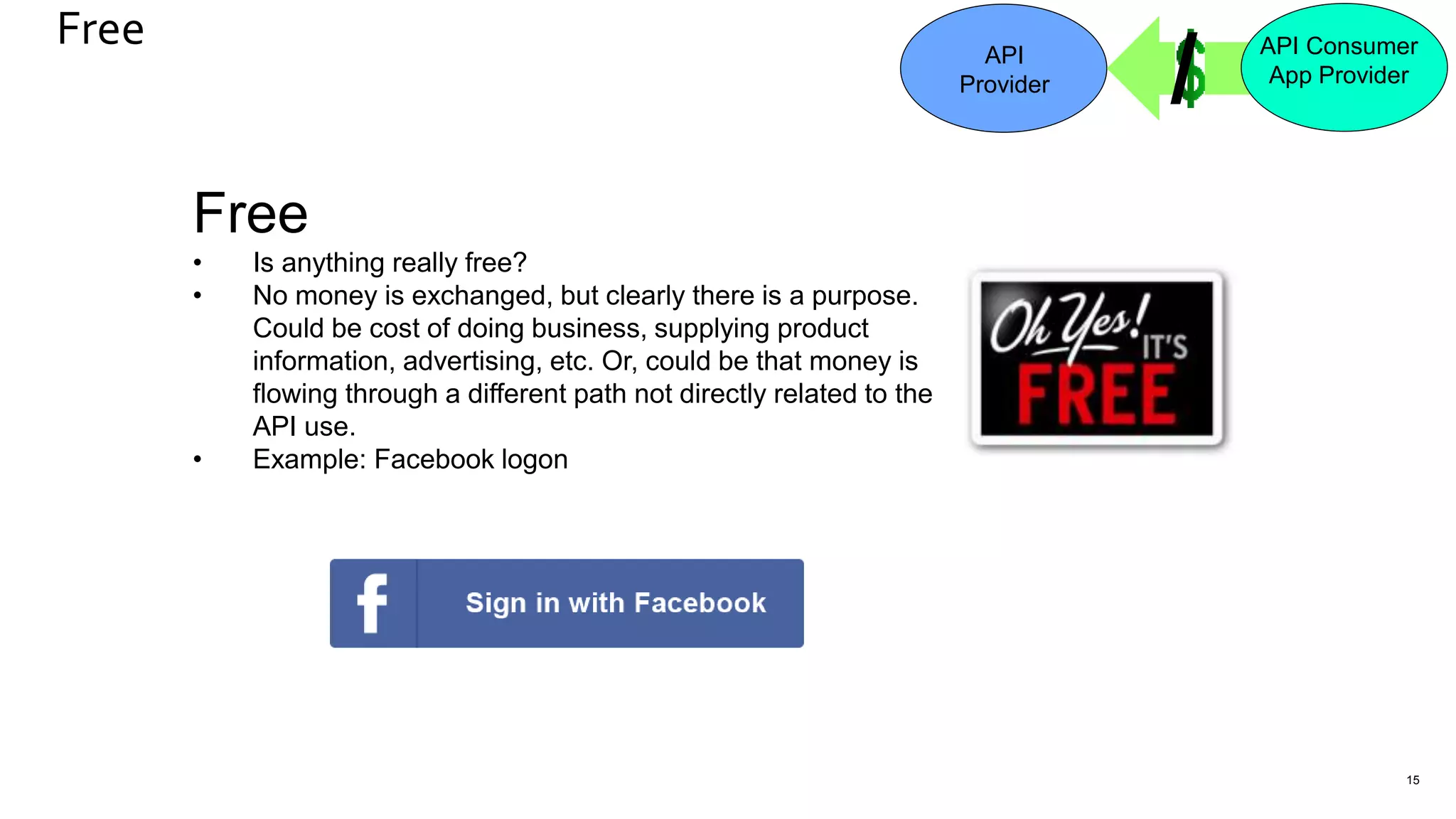
Free
15
Free
• Is anything really free?
• No money is exchanged, but clearly there is a purpose.
Could be cost of doing business, supplying product
information, advertising, etc. Or, could be that money is
flowing through a different path not directly related to the
API use.
• Example: Facebook logon
API
Provider
API Consumer
App Provider
/
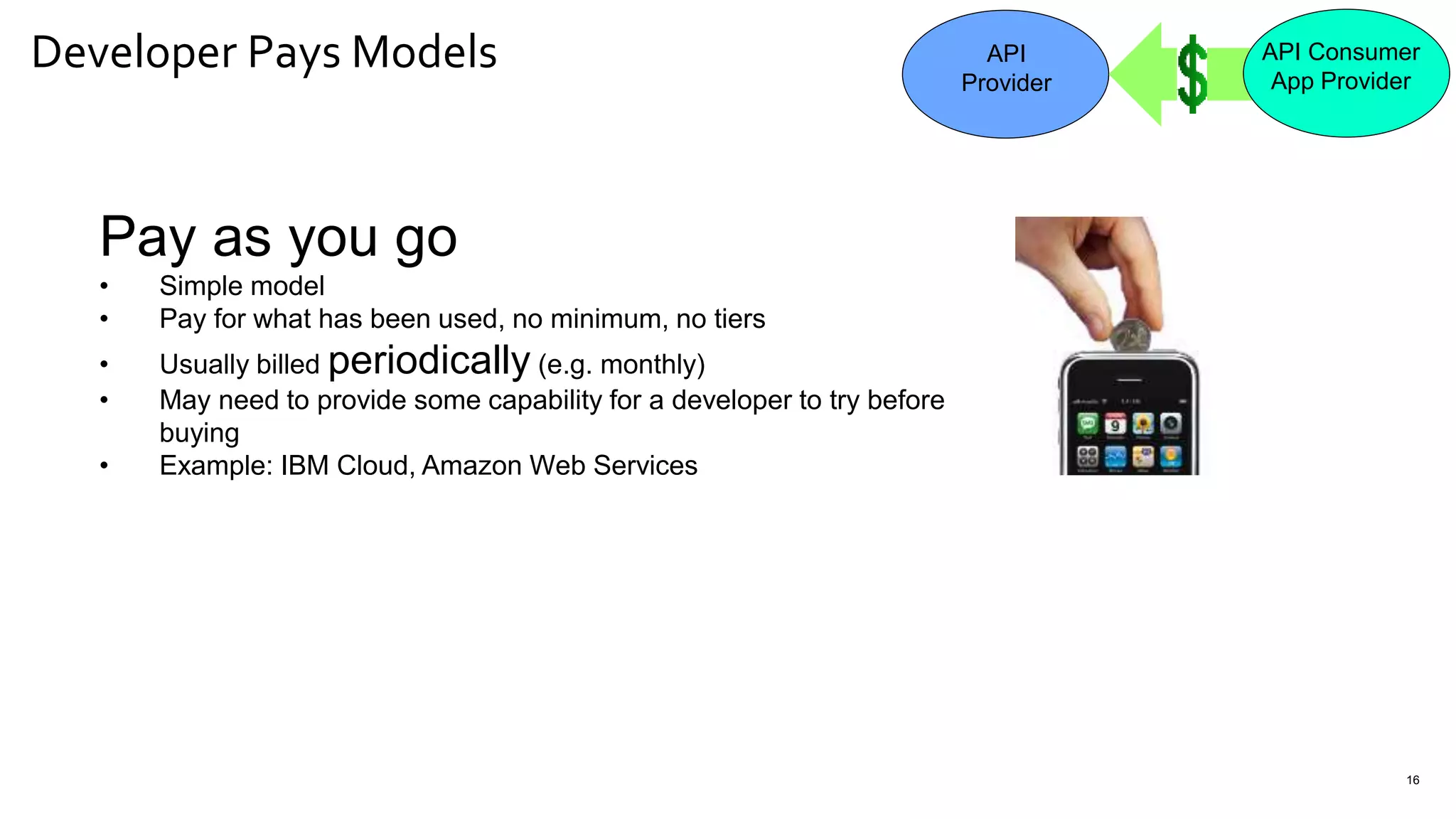
Developer Pays Models
16
Pay as you go
• Simple model
• Pay for what has been used, no minimum, no tiers
• Usually billed periodically (e.g. monthly)
• May need to provide some capability for a developer to try before
buying
• Example: IBM Cloud, Amazon Web Services
API
Provider
API Consumer
App Provider
Developer Pays Models
17
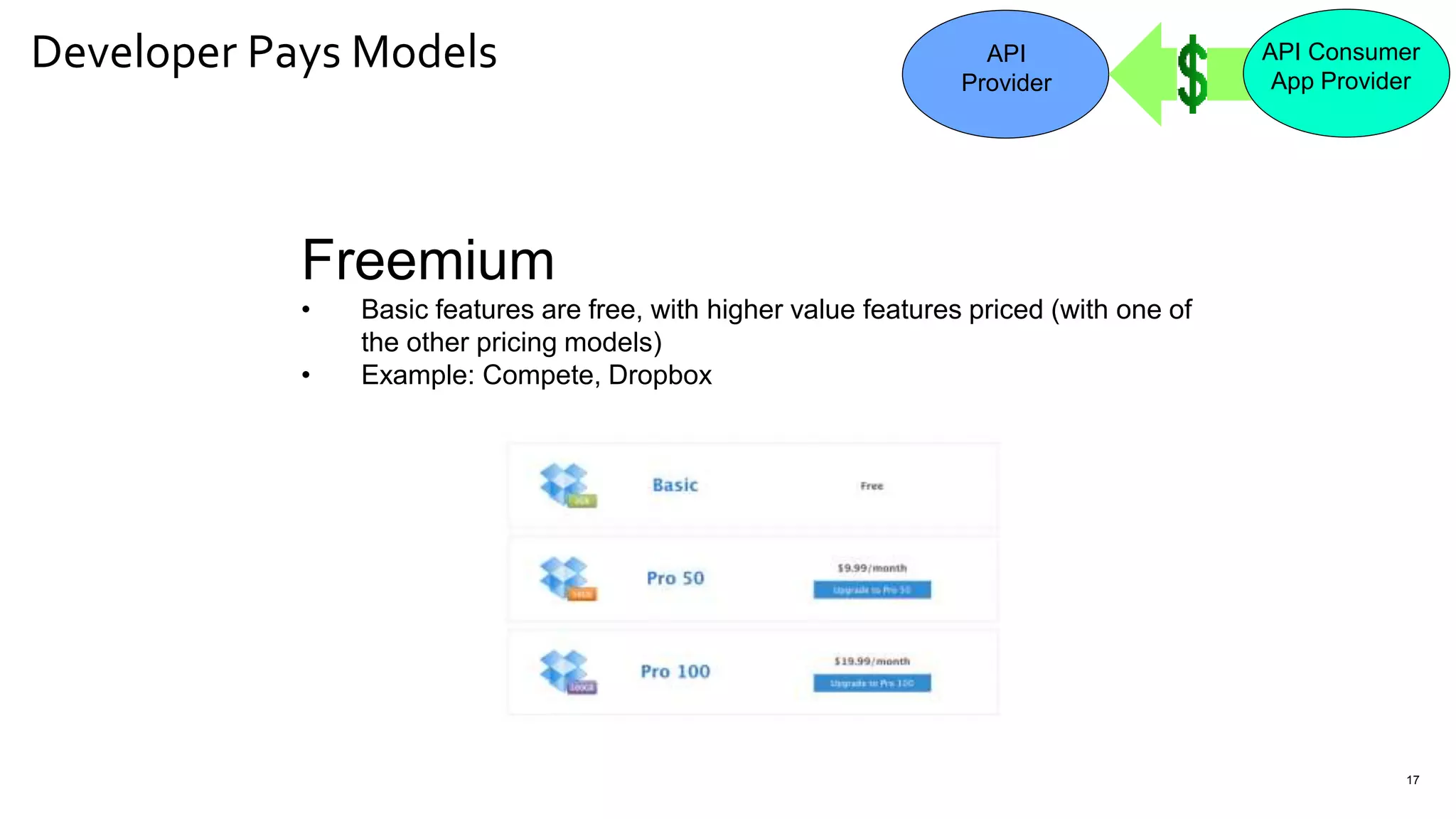
Freemium
• Basic features are free, with higher value features priced (with one of
the other pricing models)
• Example: Compete, Dropbox
API
Provider
API Consumer
App Provider
Developer Pays Models
18
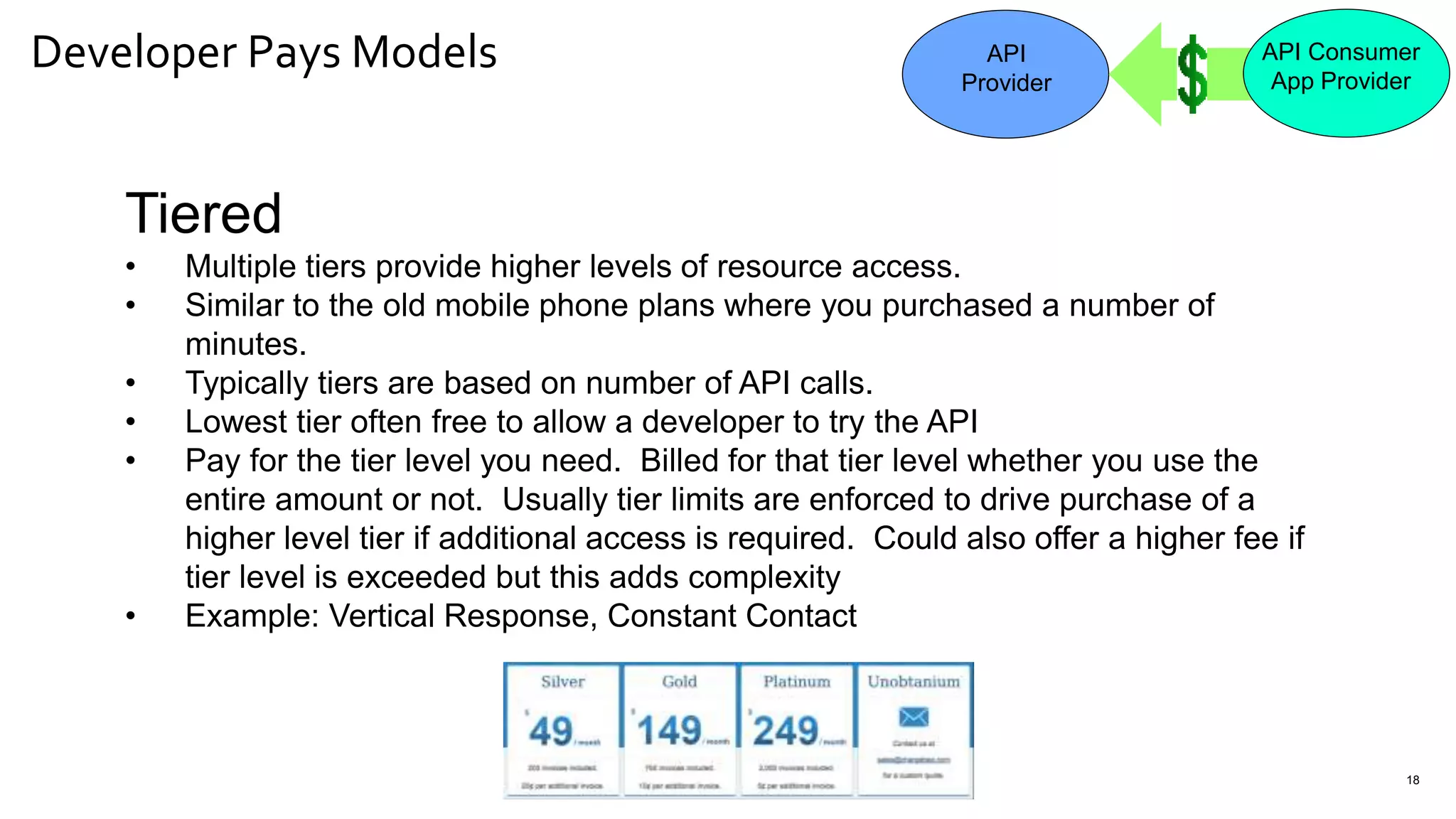
Tiered
• Multiple tiers provide higher levels of resource access.
• Similar to the old mobile phone plans where you purchased a number of
minutes.
• Typically tiers are based on number of API calls.
• Lowest tier often free to allow a developer to try the API
• Pay for the tier level you need. Billed for that tier level whether you use the
entire amount or not. Usually tier limits are enforced to drive purchase of a
higher level tier if additional access is required. Could also offer a higher fee if
tier level is exceeded but this adds complexity
• Example: Vertical Response, Constant Contact
API
Provider
API Consumer
App Provider
Developer Pays Models
19
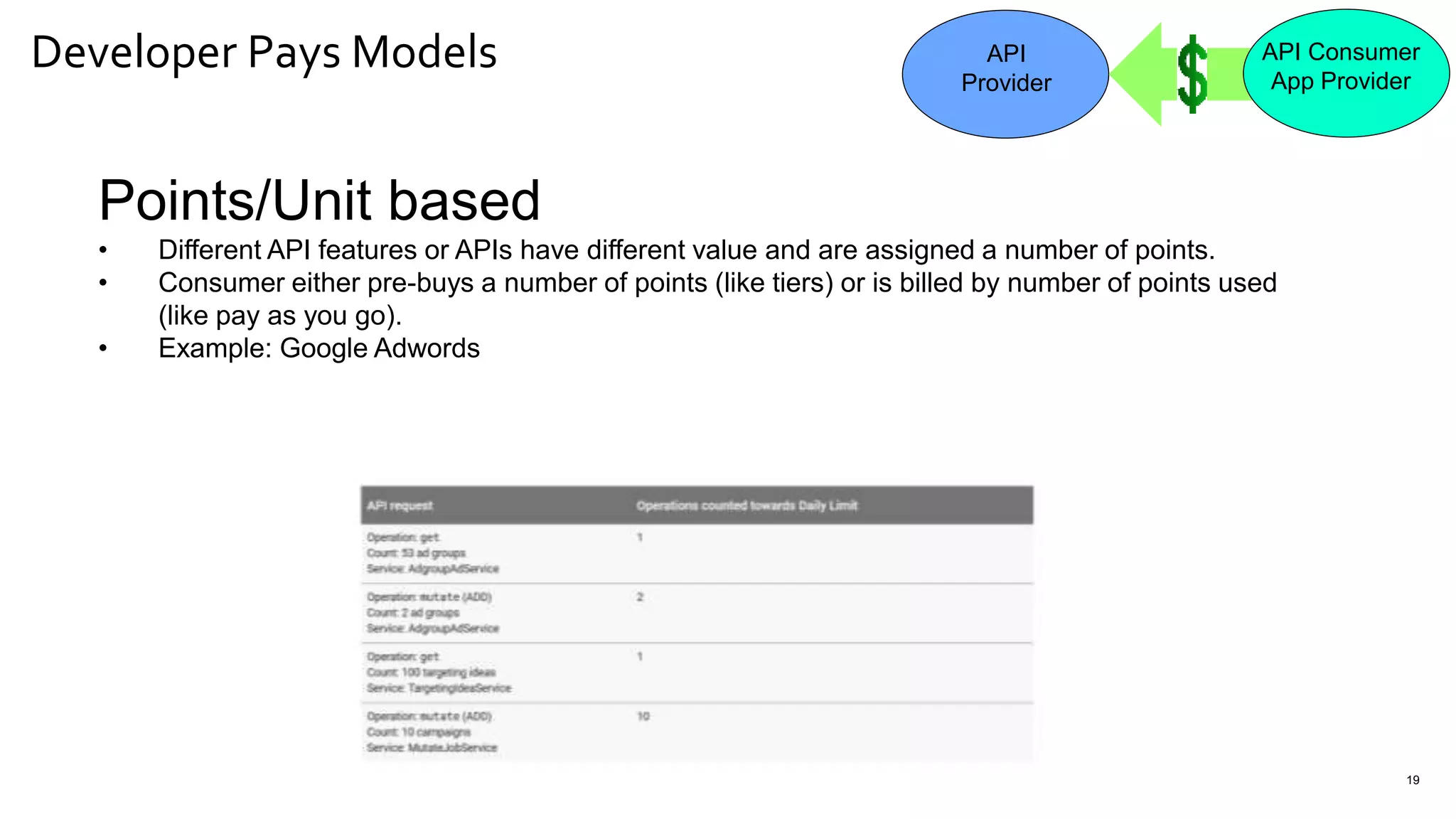
Points/Unit based
• Different API features or APIs have different value and are assigned a number of points.
• Consumer either pre-buys a number of points (like tiers) or is billed by number of points used
(like pay as you go).
• Example: Google Adwords
API
Provider
API Consumer
App Provider
Developer Pays Models
20
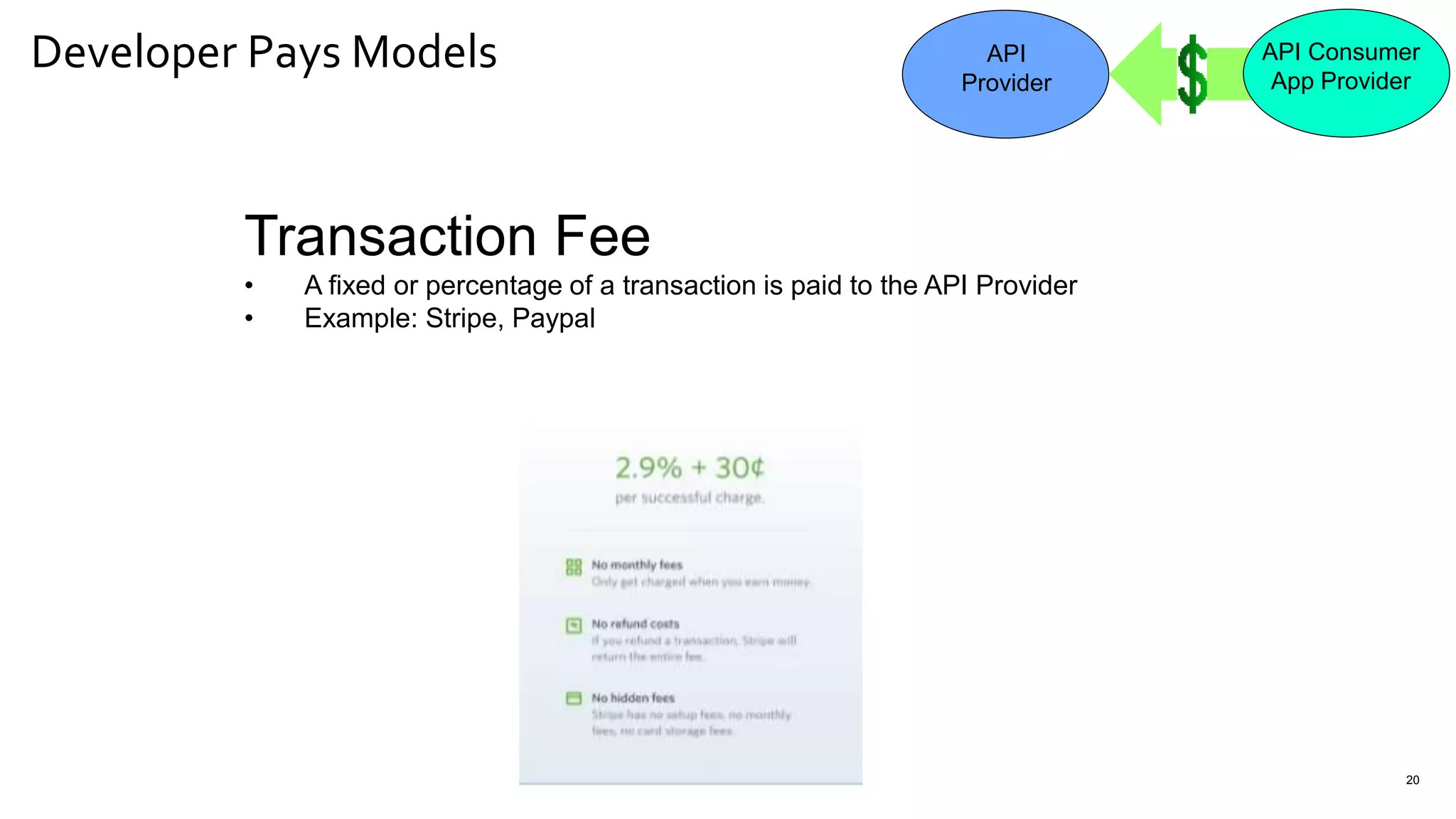
Transaction Fee
• A fixed or percentage of a transaction is paid to the API Provider
• Example: Stripe, Paypal
API
Provider
API Consumer
App Provider
Developer Gets Paid Models
21
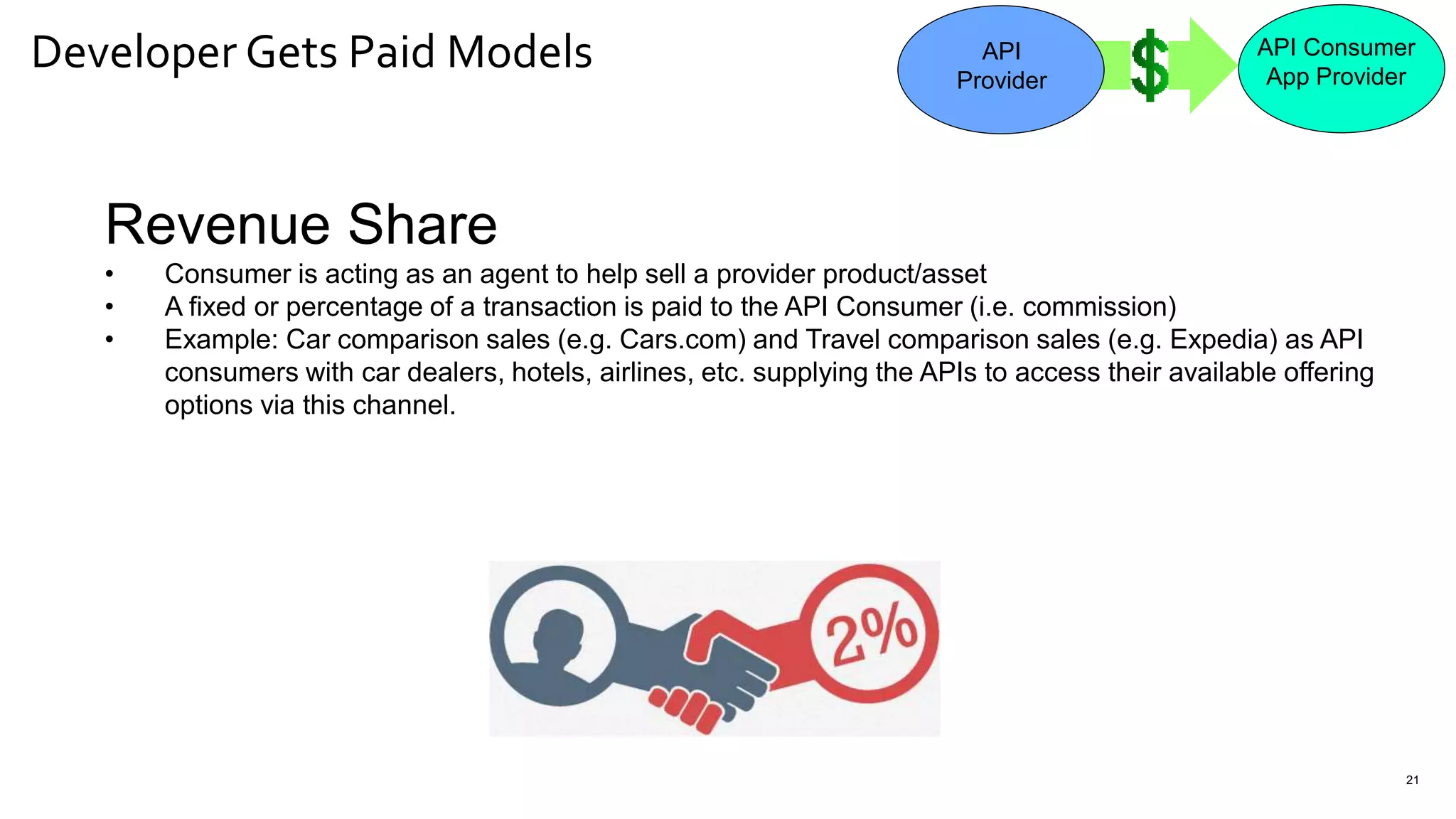
Revenue Share
• Consumer is acting as an agent to help sell a provider product/asset
• A fixed or percentage of a transaction is paid to the API Consumer (i.e. commission)
• Example: Car comparison sales (e.g. Cars.com) and Travel comparison sales (e.g. Expedia) as API
consumers with car dealers, hotels, airlines, etc. supplying the APIs to access their available offering
options via this channel.
API
Provider
API Consumer
App Provider
Developer Gets Paid Models
22
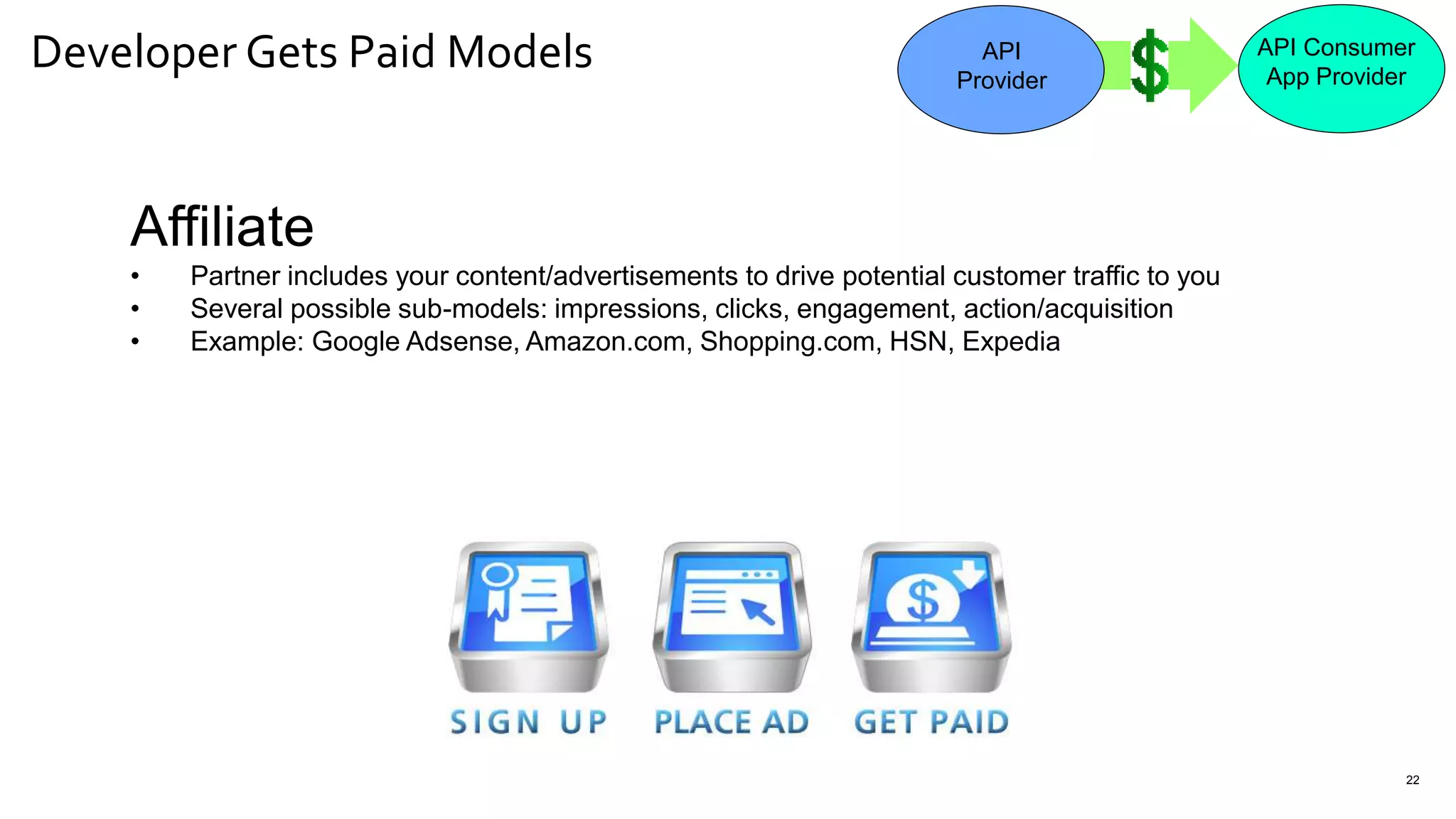
Affiliate
• Partner includes your content/advertisements to drive potential customer traffic to you
• Several possible sub-models: impressions, clicks, engagement, action/acquisition
• Example: Google Adsense, Amazon.com, Shopping.com, HSN, Expedia
API
Provider
API Consumer
App Provider
Developer Gets Paid Models
23
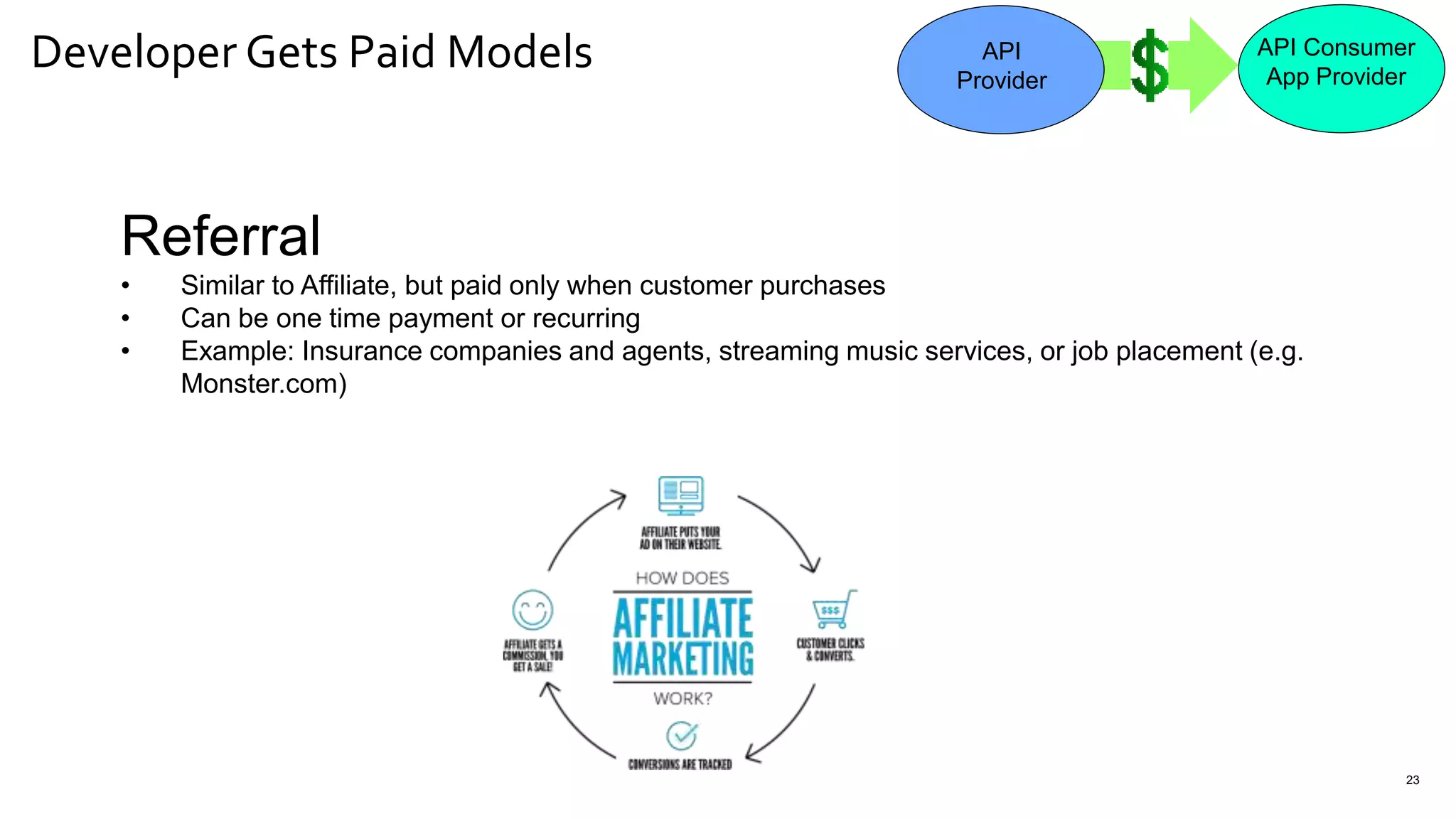
Referral
• Similar to Affiliate, but paid only when customer purchases
• Can be one time payment or recurring
• Example: Insurance companies and agents, streaming music services, or job placement (e.g.
Monster.com)
API
Provider
API Consumer
App Provider
Indirect Models
24
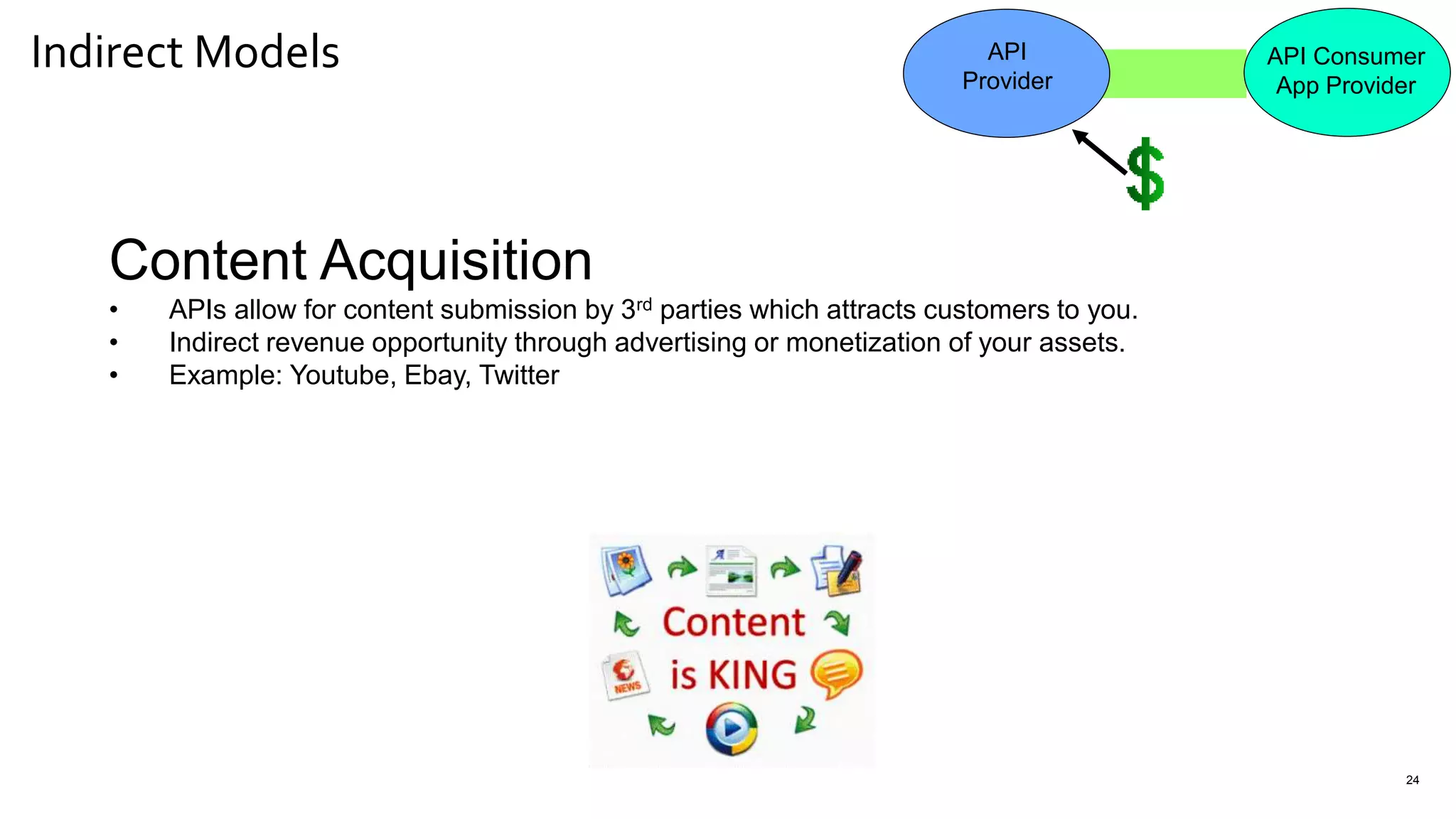
Content Acquisition
• APIs allow for content submission by 3rd parties which attracts customers to you.
• Indirect revenue opportunity through advertising or monetization of your assets.
• Example: Youtube, Ebay, Twitter
API
Provider
API Consumer
App Provider
Indirect Models
25
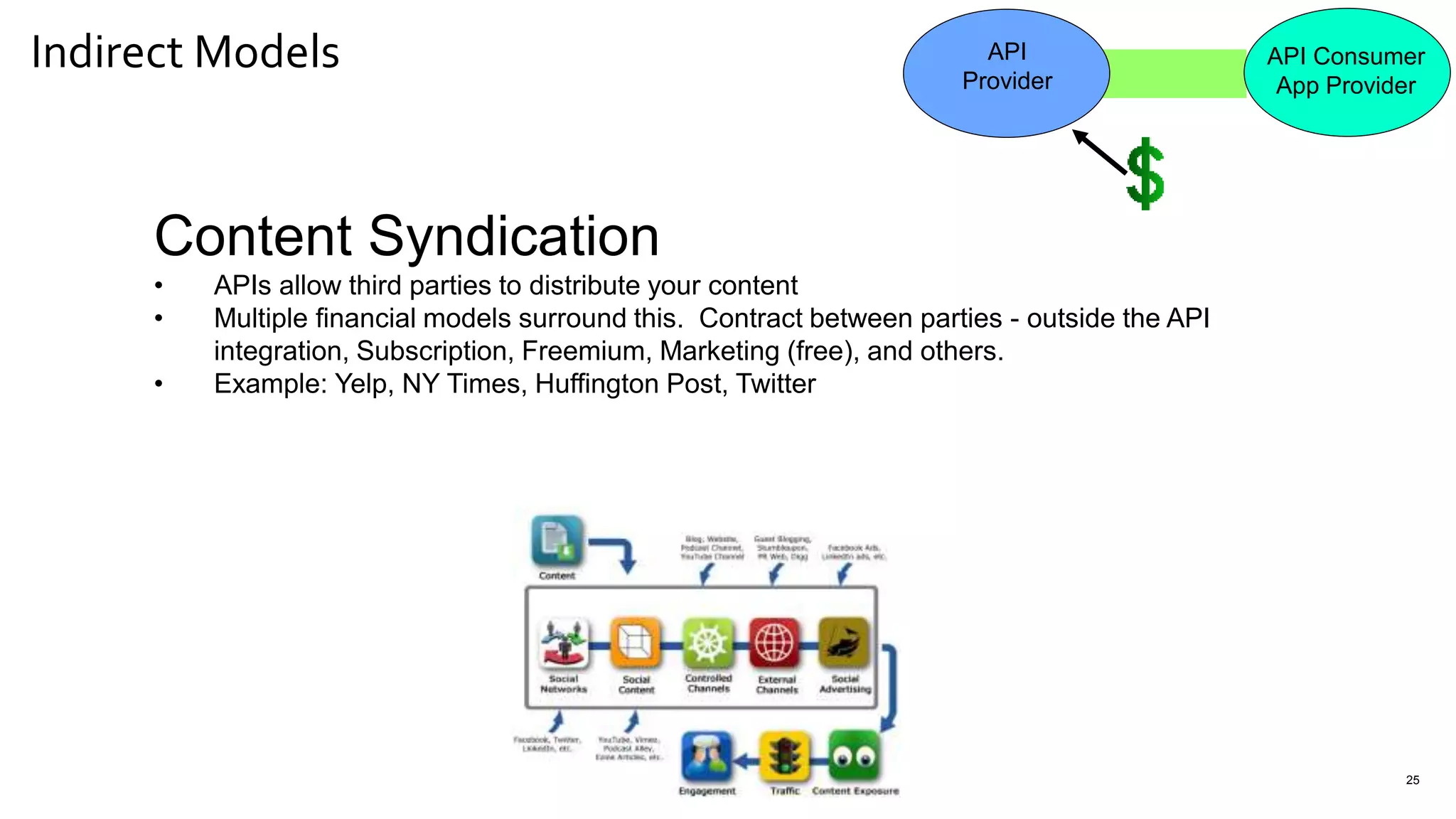
Content Syndication
• APIs allow third parties to distribute your content
• Multiple financial models surround this. Contract between parties - outside the API
integration, Subscription, Freemium, Marketing (free), and others.
• Example: Yelp, NY Times, Huffington Post, Twitter
API
Provider
API Consumer
App Provider
Indirect Models
26
Internal Use – Consumer Facing
• APIs are used by your employees to build customer facing capability and drive sales through
customer engagement
• Typical scenarios – Mobile Apps, Web Commerce sites, Devices
• Possible chargeback billing/accounting
• Example: Twitter, Netflix, many others
API
Provider
API Consumer
App Provider
Indirect Models
27
Internal Use – Non-Consumer Facing
• APIs are used internally to assist in productivity / cost savings, time to market, meeting regulatory
requirements, strategy/architecture, managing domains (cross-geography or cross-Lines of Business)
• Typical scenarios – Simplified secure access to systems of record, manage asset use.
• Possible chargeback billing/accounting
• Example: Cross-LoB sharing, many other
API
Provider
API Consumer
App Provider
Indirect Models
28
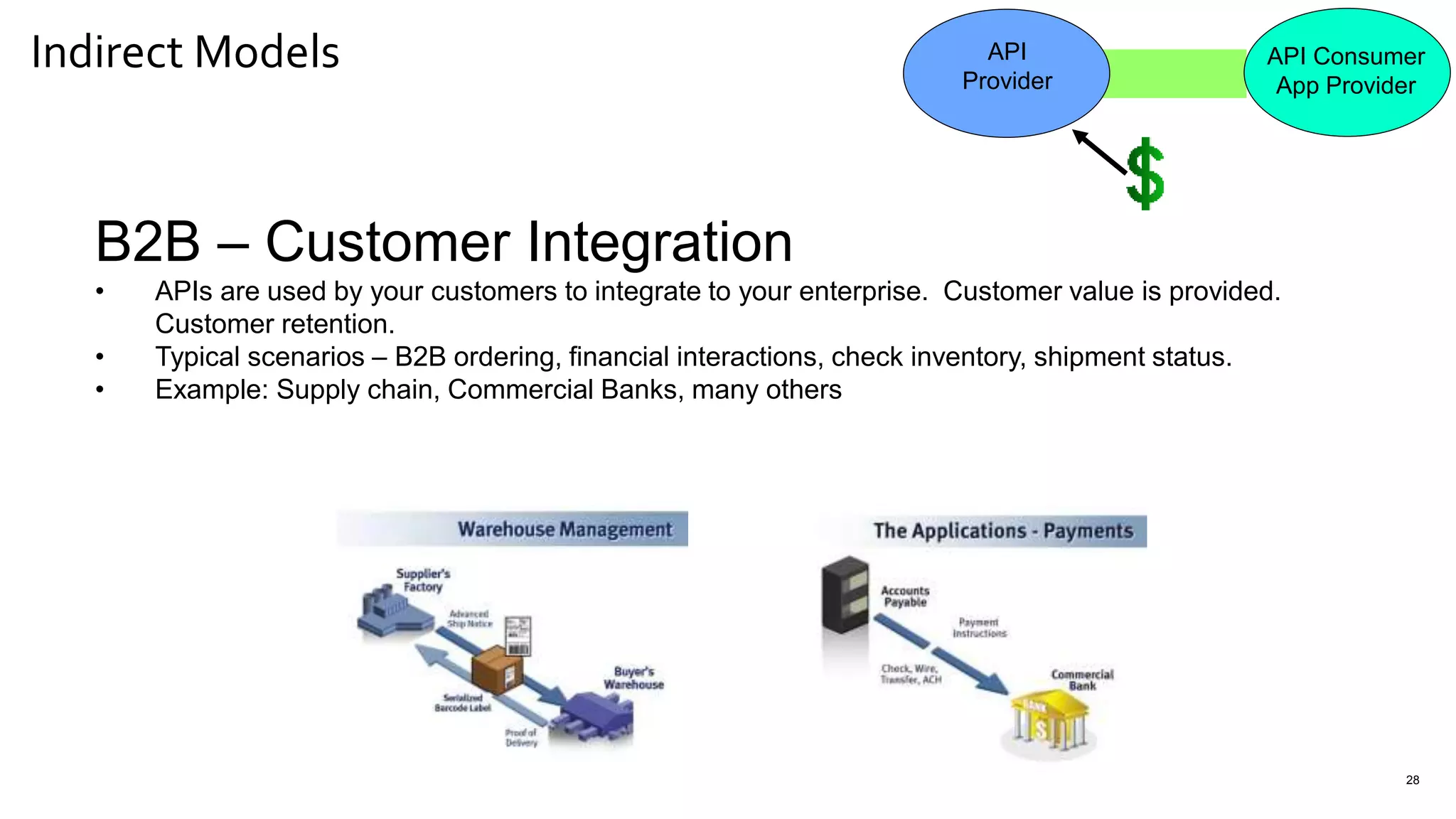
B2B – Customer Integration
• APIs are used by your customers to integrate to your enterprise. Customer value is provided.
Customer retention.
• Typical scenarios – B2B ordering, financial interactions, check inventory, shipment status.
• Example: Supply chain, Commercial Banks, many others
API
Provider
API Consumer
App Provider
Indirect Models
29
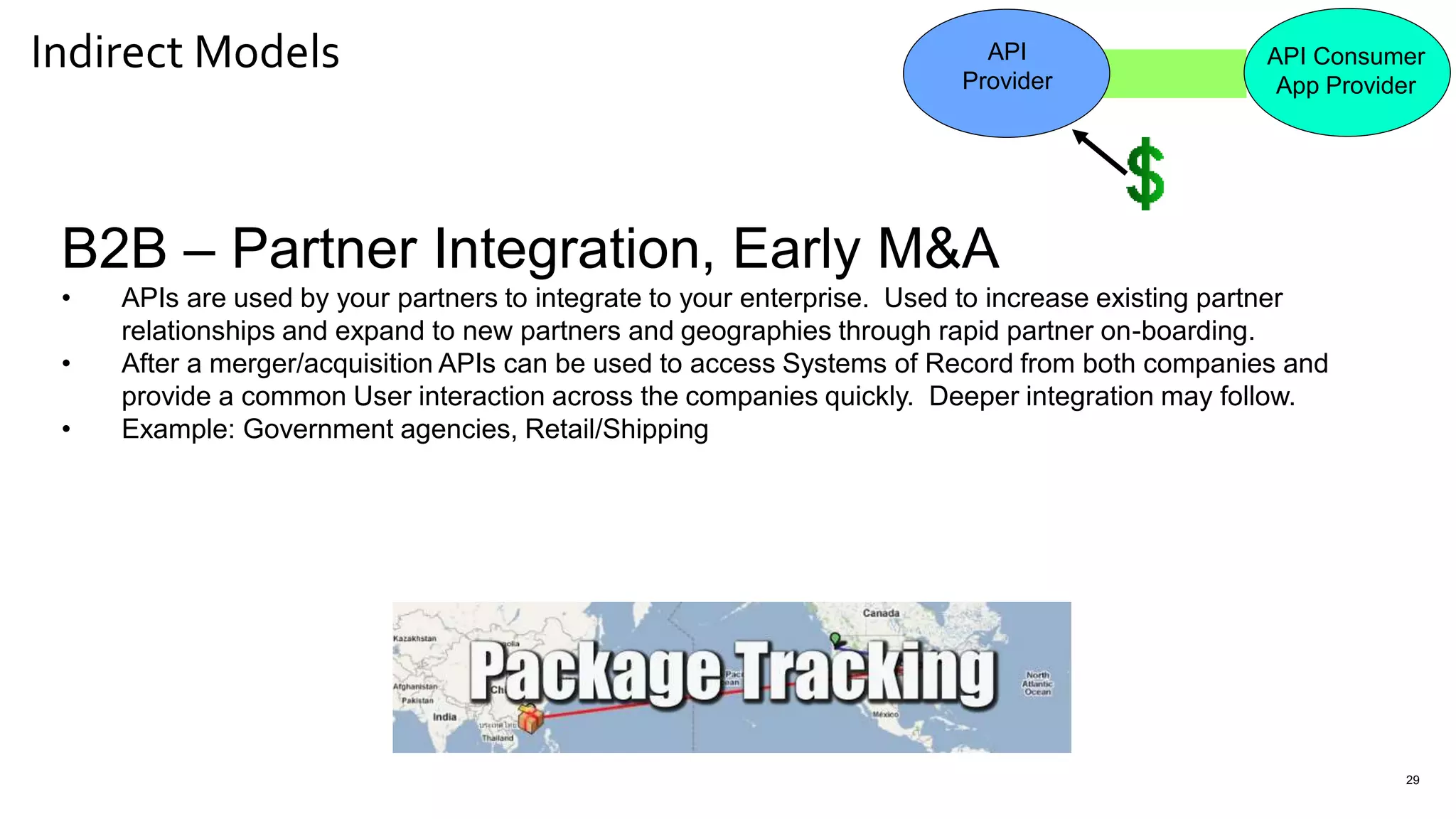
B2B – Partner Integration, Early M&A
• APIs are used by your partners to integrate to your enterprise. Used to increase existing partner
relationships and expand to new partners and geographies through rapid partner on-boarding.
• After a merger/acquisition APIs can be used to access Systems of Record from both companies and
provide a common User interaction across the companies quickly. Deeper integration may follow.
• Example: Government agencies, Retail/Shipping
API
Provider
API Consumer
App Provider
Indirect Models
30
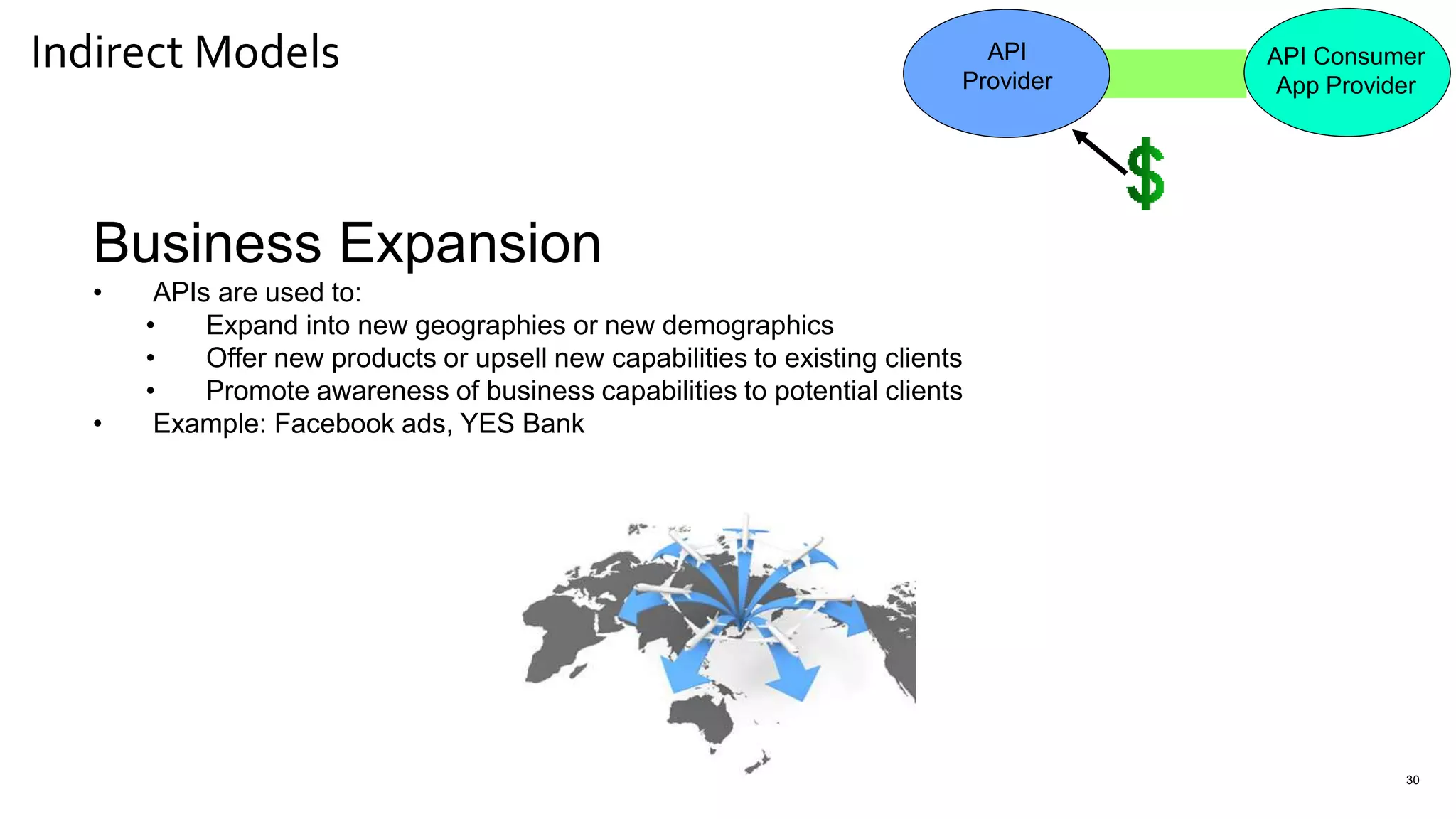
Business Expansion
• APIs are used to:
• Expand into new geographies or new demographics
• Offer new products or upsell new capabilities to existing clients
• Promote awareness of business capabilities to potential clients
• Example: Facebook ads, YES Bank
API
Provider
API Consumer
App Provider
IsThat All?
• On-boarding/set-up charges
• Additional billing factors: payload size, value, response
codes
• Credit/Debit
• International Currency
• Taxes
• PCI Compliance
• Invoicing/Billing
• Refunds
• Audit
• Profile Management
A FewThoughts
• Monetization is very attractive to the business. If you have a valuable asset
and you have worked through the value chain – Monetize it!
• Don’t be penny wise and pound foolish! If you will earn
more through customer acquisition than charging for
an API call, then Indirect can be the better option.
• Beware complex pricing – if you are difficult to understand/deal with, API
consumers will go elsewhere.
• Different APIs may need different pricing or pricing might vary by audience.
• Developers will always need some way to try your API and test their code
before paying. Free usage levels or Sandbox methods should be provided.
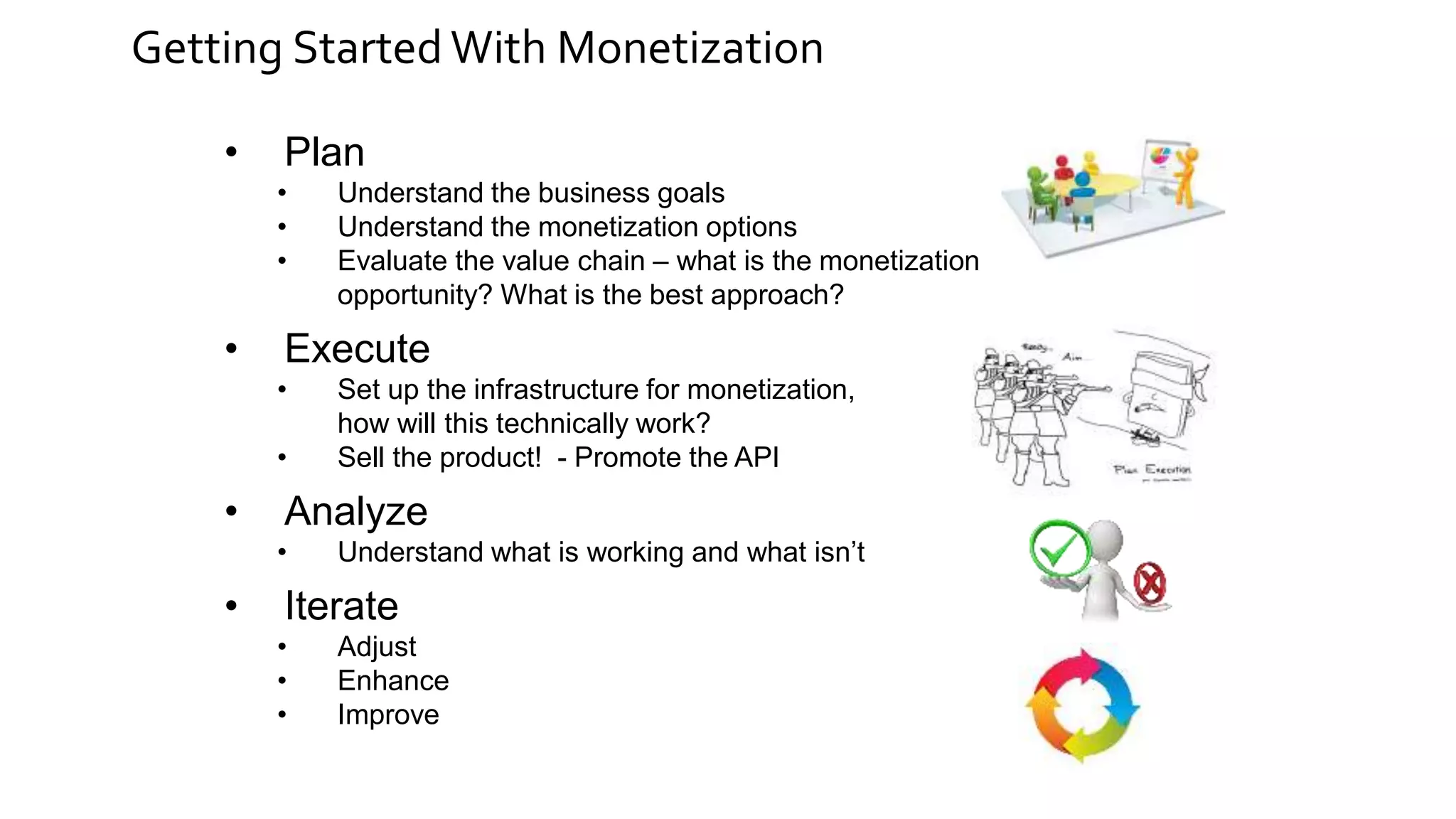
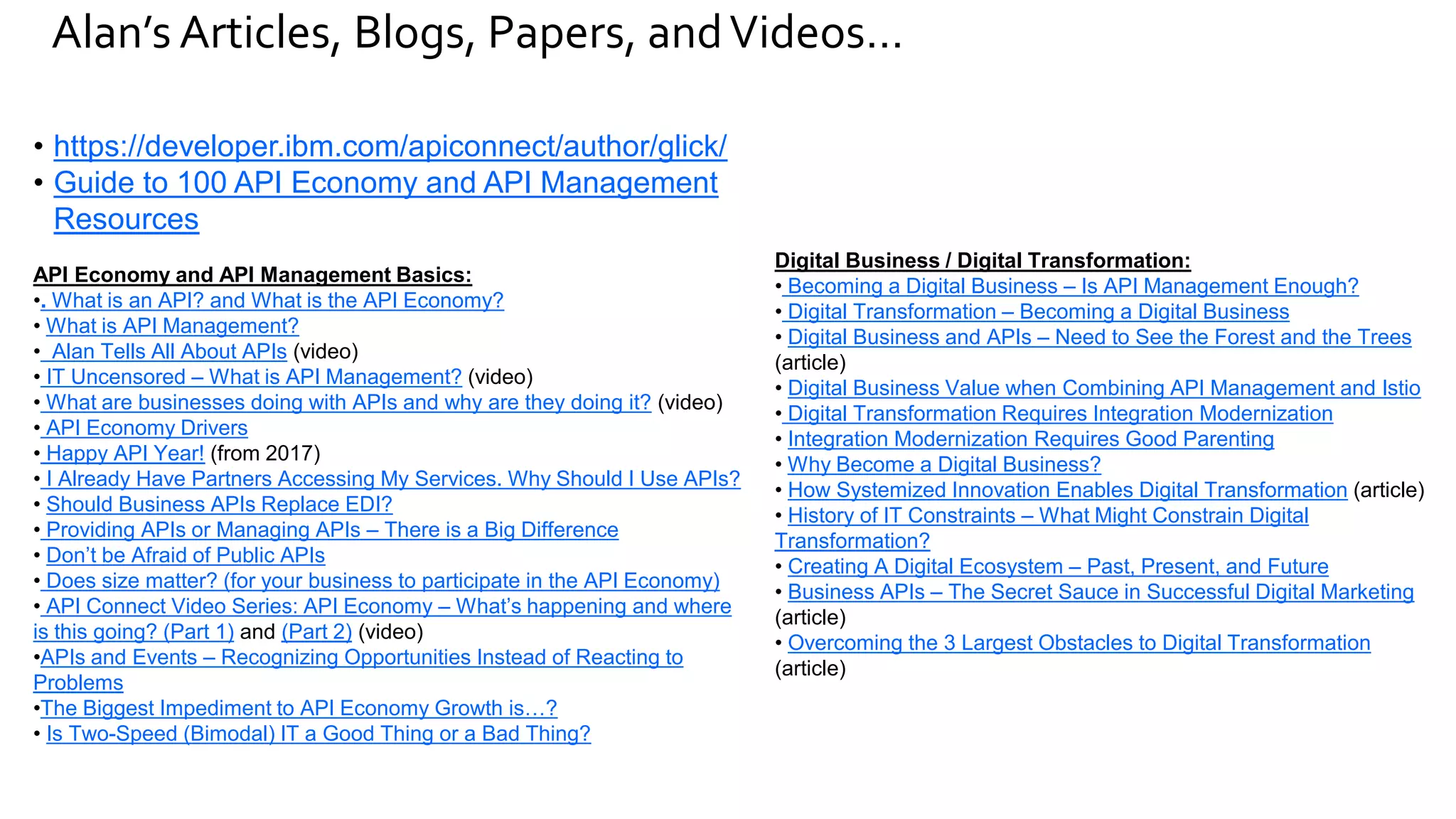
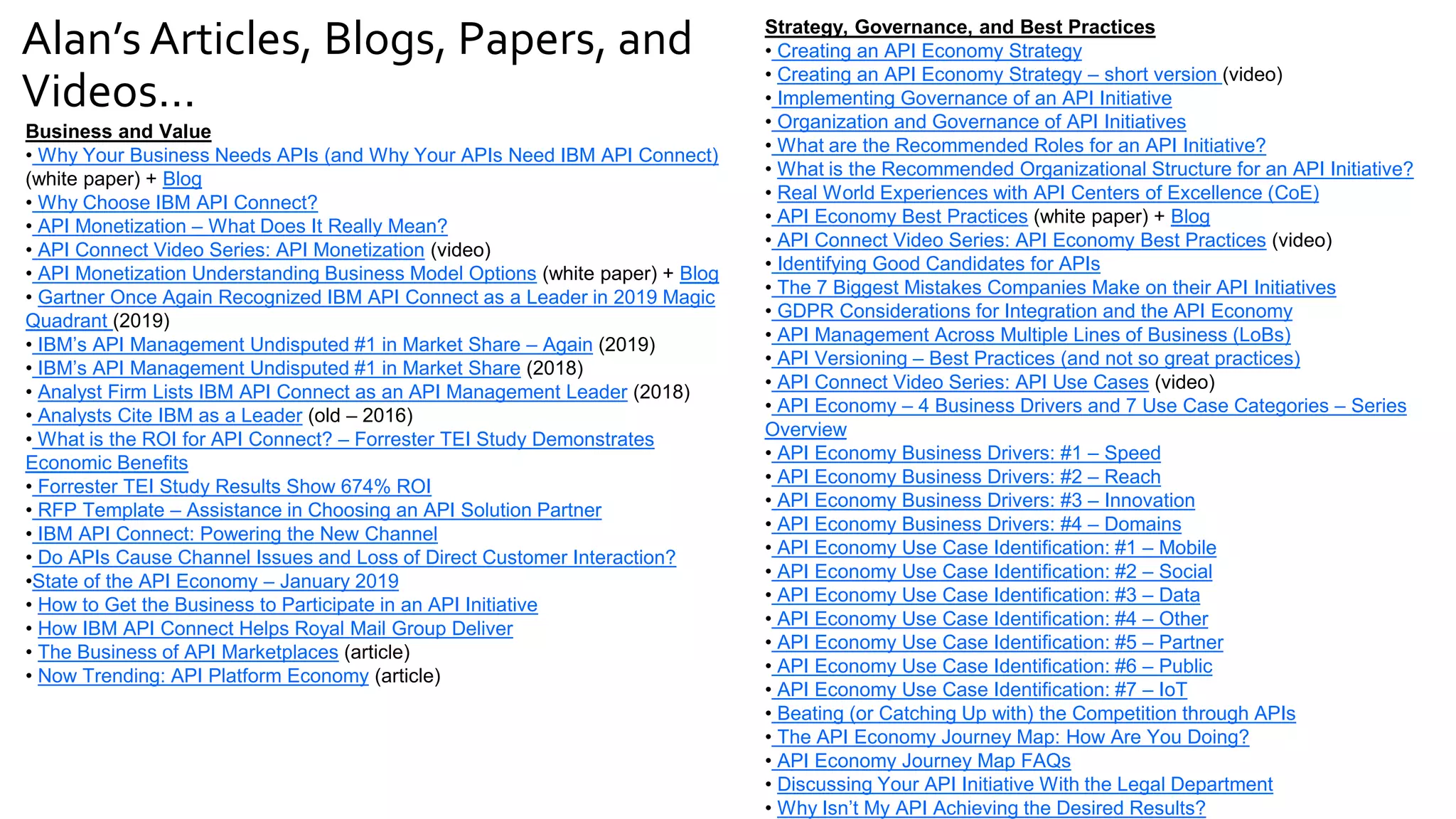
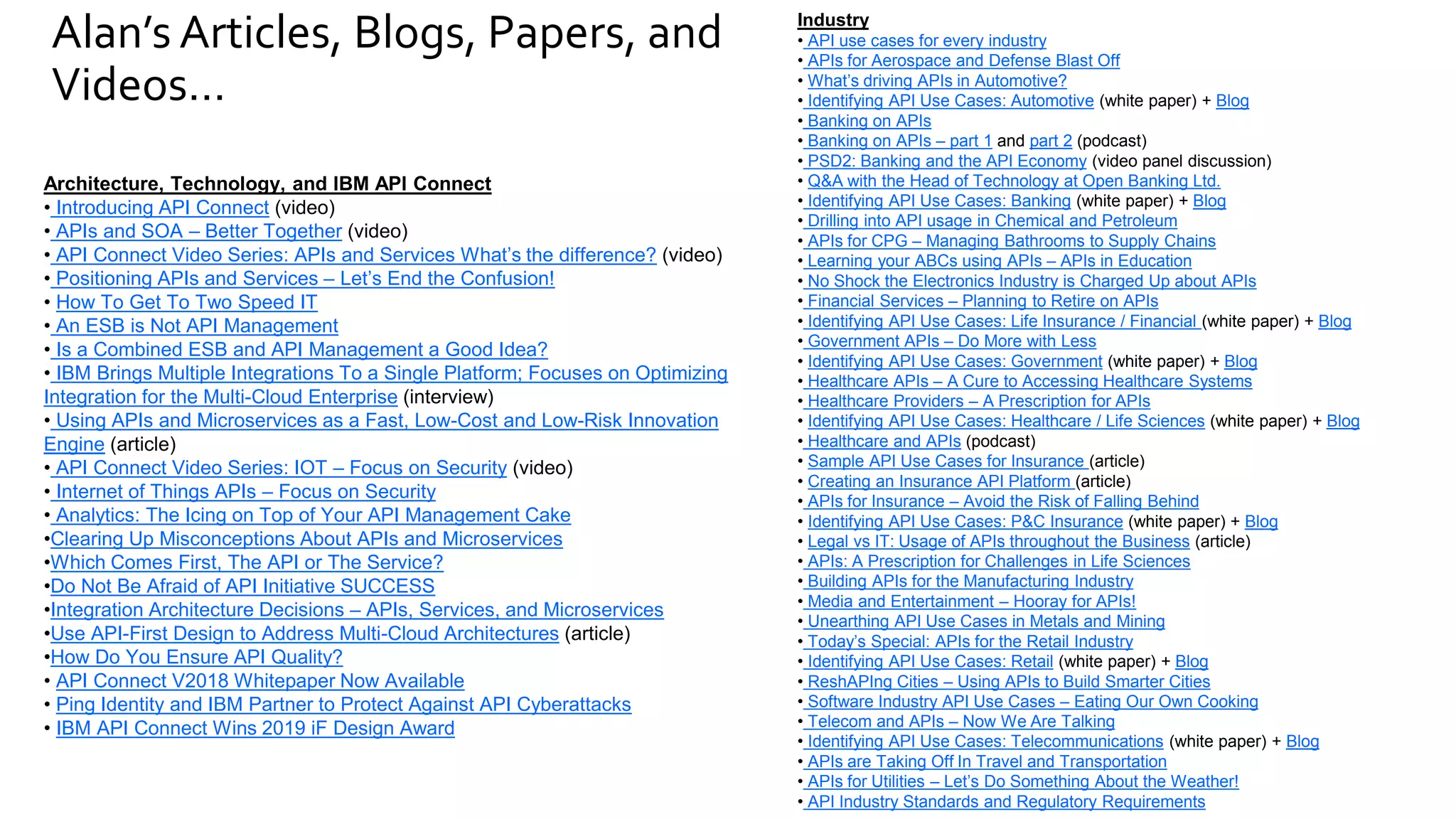
Getting Started With Monetization
• Plan
• Understand the business goals
• Understand the monetization options
• Evaluate the value chain – what is the monetization
opportunity? What is the best approach?
• Execute
• Set up the infrastructure for monetization,
how will this technically work?
• Sell the product! - Promote the API
• Analyze
• Understand what is working and what isn’t
• Iterate
• Adjust
• Enhance
• Improve
Additional Resources
© 2018 IBM Corporation
Alan’s Articles, Blogs, Papers, andVideos…
• https://developer.ibm.com/apiconnect/author/glick/
• Guide to 100 API Economy and API Management
Resources
API Economy and API Management Basics:
•. What is an API? and What is the API Economy?
• What is API Management?
• Alan Tells All About APIs (video)
• IT Uncensored – What is API Management? (video)
• What are businesses doing with APIs and why are they doing it? (video)
• API Economy Drivers
• Happy API Year! (from 2017)
• I Already Have Partners Accessing My Services. Why Should I Use APIs?
• Should Business APIs Replace EDI?
• Providing APIs or Managing APIs – There is a Big Difference
• Don’t be Afraid of Public APIs
• Does size matter? (for your business to participate in the API Economy)
• API Connect Video Series: API Economy – What’s happening and where
is this going? (Part 1) and (Part 2) (video)
•APIs and Events – Recognizing Opportunities Instead of Reacting to
Problems
•The Biggest Impediment to API Economy Growth is…?
• Is Two-Speed (Bimodal) IT a Good Thing or a Bad Thing?
Digital Business / Digital Transformation:
• Becoming a Digital Business – Is API Management Enough?
• Digital Transformation – Becoming a Digital Business
• Digital Business and APIs – Need to See the Forest and the Trees
(article)
• Digital Business Value when Combining API Management and Istio
• Digital Transformation Requires Integration Modernization
• Integration Modernization Requires Good Parenting
• Why Become a Digital Business?
• How Systemized Innovation Enables Digital Transformation (article)
• History of IT Constraints – What Might Constrain Digital
Transformation?
• Creating A Digital Ecosystem – Past, Present, and Future
• Business APIs – The Secret Sauce in Successful Digital Marketing
(article)
• Overcoming the 3 Largest Obstacles to Digital Transformation
(article)
Alan’s Articles, Blogs, Papers, and
Videos…
Business and Value
• Why Your Business Needs APIs (and Why Your APIs Need IBM API Connect)
(white paper) + Blog
• Why Choose IBM API Connect?
• API Monetization – What Does It Really Mean?
• API Connect Video Series: API Monetization (video)
• API Monetization Understanding Business Model Options (white paper) + Blog
• Gartner Once Again Recognized IBM API Connect as a Leader in 2019 Magic
Quadrant (2019)
• IBM’s API Management Undisputed #1 in Market Share – Again (2019)
• IBM’s API Management Undisputed #1 in Market Share (2018)
• Analyst Firm Lists IBM API Connect as an API Management Leader (2018)
• Analysts Cite IBM as a Leader (old – 2016)
• What is the ROI for API Connect? – Forrester TEI Study Demonstrates
Economic Benefits
• Forrester TEI Study Results Show 674% ROI
• RFP Template – Assistance in Choosing an API Solution Partner
• IBM API Connect: Powering the New Channel
• Do APIs Cause Channel Issues and Loss of Direct Customer Interaction?
•State of the API Economy – January 2019
• How to Get the Business to Participate in an API Initiative
• How IBM API Connect Helps Royal Mail Group Deliver
• The Business of API Marketplaces (article)
• Now Trending: API Platform Economy (article)
Strategy, Governance, and Best Practices
• Creating an API Economy Strategy
• Creating an API Economy Strategy – short version (video)
• Implementing Governance of an API Initiative
• Organization and Governance of API Initiatives
• What are the Recommended Roles for an API Initiative?
• What is the Recommended Organizational Structure for an API Initiative?
• Real World Experiences with API Centers of Excellence (CoE)
• API Economy Best Practices (white paper) + Blog
• API Connect Video Series: API Economy Best Practices (video)
• Identifying Good Candidates for APIs
• The 7 Biggest Mistakes Companies Make on their API Initiatives
• GDPR Considerations for Integration and the API Economy
• API Management Across Multiple Lines of Business (LoBs)
• API Versioning – Best Practices (and not so great practices)
• API Connect Video Series: API Use Cases (video)
• API Economy – 4 Business Drivers and 7 Use Case Categories – Series
Overview
• API Economy Business Drivers: #1 – Speed
• API Economy Business Drivers: #2 – Reach
• API Economy Business Drivers: #3 – Innovation
• API Economy Business Drivers: #4 – Domains
• API Economy Use Case Identification: #1 – Mobile
• API Economy Use Case Identification: #2 – Social
• API Economy Use Case Identification: #3 – Data
• API Economy Use Case Identification: #4 – Other
• API Economy Use Case Identification: #5 – Partner
• API Economy Use Case Identification: #6 – Public
• API Economy Use Case Identification: #7 – IoT
• Beating (or Catching Up with) the Competition through APIs
• The API Economy Journey Map: How Are You Doing?
• API Economy Journey Map FAQs
• Discussing Your API Initiative With the Legal Department
• Why Isn’t My API Achieving the Desired Results?
Alan’s Articles, Blogs, Papers, and
Videos…
Industry
• API use cases for every industry
• APIs for Aerospace and Defense Blast Off
• What’s driving APIs in Automotive?
• Identifying API Use Cases: Automotive (white paper) + Blog
• Banking on APIs
• Banking on APIs – part 1 and part 2 (podcast)
• PSD2: Banking and the API Economy (video panel discussion)
• Q&A with the Head of Technology at Open Banking Ltd.
• Identifying API Use Cases: Banking (white paper) + Blog
• Drilling into API usage in Chemical and Petroleum
• APIs for CPG – Managing Bathrooms to Supply Chains
• Learning your ABCs using APIs – APIs in Education
• No Shock the Electronics Industry is Charged Up about APIs
• Financial Services – Planning to Retire on APIs
• Identifying API Use Cases: Life Insurance / Financial (white paper) + Blog
• Government APIs – Do More with Less
• Identifying API Use Cases: Government (white paper) + Blog
• Healthcare APIs – A Cure to Accessing Healthcare Systems
• Healthcare Providers – A Prescription for APIs
• Identifying API Use Cases: Healthcare / Life Sciences (white paper) + Blog
• Healthcare and APIs (podcast)
• Sample API Use Cases for Insurance (article)
• Creating an Insurance API Platform (article)
• APIs for Insurance – Avoid the Risk of Falling Behind
• Identifying API Use Cases: P&C Insurance (white paper) + Blog
• Legal vs IT: Usage of APIs throughout the Business (article)
• APIs: A Prescription for Challenges in Life Sciences
• Building APIs for the Manufacturing Industry
• Media and Entertainment – Hooray for APIs!
• Unearthing API Use Cases in Metals and Mining
• Today’s Special: APIs for the Retail Industry
• Identifying API Use Cases: Retail (white paper) + Blog
• ReshAPIng Cities – Using APIs to Build Smarter Cities
• Software Industry API Use Cases – Eating Our Own Cooking
• Telecom and APIs – Now We Are Talking
• Identifying API Use Cases: Telecommunications (white paper) + Blog
• APIs are Taking Off In Travel and Transportation
• APIs for Utilities – Let’s Do Something About the Weather!
• API Industry Standards and Regulatory Requirements
Architecture, Technology, and IBM API Connect
• Introducing API Connect (video)
• APIs and SOA – Better Together (video)
• API Connect Video Series: APIs and Services What’s the difference? (video)
• Positioning APIs and Services – Let’s End the Confusion!
• How To Get To Two Speed IT
• An ESB is Not API Management
• Is a Combined ESB and API Management a Good Idea?
• IBM Brings Multiple Integrations To a Single Platform; Focuses on Optimizing
Integration for the Multi-Cloud Enterprise (interview)
• Using APIs and Microservices as a Fast, Low-Cost and Low-Risk Innovation
Engine (article)
• API Connect Video Series: IOT – Focus on Security (video)
• Internet of Things APIs – Focus on Security
• Analytics: The Icing on Top of Your API Management Cake
•Clearing Up Misconceptions About APIs and Microservices
•Which Comes First, The API or The Service?
•Do Not Be Afraid of API Initiative SUCCESS
•Integration Architecture Decisions – APIs, Services, and Microservices
•Use API-First Design to Address Multi-Cloud Architectures (article)
•How Do You Ensure API Quality?
• API Connect V2018 Whitepaper Now Available
• Ping Identity and IBM Partner to Protect Against API Cyberattacks
• IBM API Connect Wins 2019 iF Design Award

API Monetization – It Does Not Mean What You Think It Means. It Is Far More

  • 1.
    © 2019 IBMCorporation API Monetization – It Does Not Mean What You Think It Means… It Is Far More Alan Glickenhouse glick@us.ibm.com @ARGlick API Business Strategist IBM
  • 2.
    Profile: © 2019 IBMCorporation Alan Glickenhouse - Digital Transformation and API Business Strategist • Assist businesses with their strategy for Digital Transformation and the API Economy - all industries, all geographies, and of all sizes. • Share insights and best practices through: • 1:1 workshops • Conferences • Author: • Digital Business / Digital Transformation - 12 • API Economy / API Management Basics - 16 • Business and Value - 20 • Strategy, Governance, and Best Practices - 32 • Architecture, Technology, and IBM API Connect - 21 • Industry Standards and Use cases - 39 Today we will cover a few from this category
  • 3.
    Agenda •Definition •Where is theValue? •How Does the Money Flow? •Monetization Models and Examples •Closing Thoughts / Getting Started Based on initial work by John Musser – Founder and CEO API Science
  • 4.
    API Monetization Definition APIMonetization is defined as: Charging the API consumer to use your APIs. This is an incomplete definition!
  • 5.
    API Monetization Definition APIMonetization is defined as: Driving revenue through the use of APIs Blog - API Monetization – What Does It Really Mean?
  • 6.
     Drives Adoptionsof APIs  Typically low valued assets  Drive brand loyalty  Enter new channels For Free Facebook Login API provides free authentication for any Web / mobile app Example: Developer Pays  Business Asset must be of high value to the Developer  For example, marketing analytics, news,  Capabilities such as credit checks Example: Developer Gets Paid  Provides incentive for developer to leverage web API  Ad placements  Percentage of revenue sold product or services Google AdSense APIs pay developers who include advertising content into apps Example: Indirect  Use of API achieves some goal that drives business model.  E.g. Increase awareness of specific content, or offerings eBay Trading APIs offer developers access to trading services extending the reach of listings and transactions Example: The Business ofAPIs - Monetization API Monetization Understanding Business Model Options IBM Cloud – No cost trials, pay per use, scale up and down
  • 7.
    What is aBusiness API?  A Business API is a public persona for an enterprise; exposing defined assets, data or services for public consumption  A Business API is simple for app developers to use, access and understand  A Business API can be easily invoked What Value Does a Business API Provide?  Extends an enterprise and opens new markets by allowing external app developers to easily leverage, publicize and/or aggregate a company’s assets for broad-based consumption What “assets, data or services” are exposed via a Business API?:  Product catalogs  Store listings  Order status  Inventory  Social interaction Business API = Web API = Productized Service App Developer
  • 8.
    Existing Enterprise IT Investments Exposed as APIs SelfService Consumed by Developers To Develop Innovative Apps Delivering Differentiated B2C, B2B, B2E Experiences APIs Enable Differentiated Experiences TH GS IN www
  • 9.
    API Economy SupplyChain API Provider API Consumer App Provider End User Customer
  • 10.
    Internal Consumers Less InterestingMonetization Scenarios Internal developers are the API Consumers • Scenarios: Mobile development, Domains • Monetization: Chargeback, Indirect API Provider API Consumer App Provider End User Customer
  • 11.
    Less Interesting MonetizationScenarios Another business consumes the APIs and uses them internally to their enterprise. API Consumer/App developer is in the same company as the end user (i.e. their employees). • Scenarios: Customer engagement, Partner engagement • Monetization: Direct payments (through models discussed later), Indirect, or Free API Provider B2B Scenarios API Consumer App Provider End User Customer
  • 12.
    More Interesting MonetizationScenarios APIs are provided to an outside entity (partner or public) who use the API to create Apps to engage customers – 3 separate business entities. • Models focus on the more “interesting” options • Cover the less interesting scenarios as well API Provider API Consumer App Provider End User Customer
  • 13.
    Key Questions 13 • Isthe asset valuable or is exposing the asset a cost of doing business? • Who is it valuable to – the API Consumer or End User? • Do you own (or want to own) the customer relationship or does the API Consumer own the relationship? • Will pricing the asset cause the API consumer to be reluctant to use your services and will this decrease your access to customers? • Is the API Consumer working on your behalf (i.e. should you pay them)? • Is there a tiered structure that makes sense based on usage (e.g. lower utilization free to obtain market presence)?
  • 14.
    API Monetization Options APIs DeveloperPays Developer Gets PaidFree Indirect Pay as you go Freemium Tiered Points Based Transaction Fee Revenue Share Affiliate Referral Content Acquisition Content Syndication Internal - Consumer Internal – non-consumer B2B - Customer B2B - Partner Business Expansion
  • 15.
    Free 15 Free • Is anythingreally free? • No money is exchanged, but clearly there is a purpose. Could be cost of doing business, supplying product information, advertising, etc. Or, could be that money is flowing through a different path not directly related to the API use. • Example: Facebook logon API Provider API Consumer App Provider /
  • 16.
    Developer Pays Models 16 Payas you go • Simple model • Pay for what has been used, no minimum, no tiers • Usually billed periodically (e.g. monthly) • May need to provide some capability for a developer to try before buying • Example: IBM Cloud, Amazon Web Services API Provider API Consumer App Provider
  • 17.
    Developer Pays Models 17 Freemium •Basic features are free, with higher value features priced (with one of the other pricing models) • Example: Compete, Dropbox API Provider API Consumer App Provider
  • 18.
    Developer Pays Models 18 Tiered •Multiple tiers provide higher levels of resource access. • Similar to the old mobile phone plans where you purchased a number of minutes. • Typically tiers are based on number of API calls. • Lowest tier often free to allow a developer to try the API • Pay for the tier level you need. Billed for that tier level whether you use the entire amount or not. Usually tier limits are enforced to drive purchase of a higher level tier if additional access is required. Could also offer a higher fee if tier level is exceeded but this adds complexity • Example: Vertical Response, Constant Contact API Provider API Consumer App Provider
  • 19.
    Developer Pays Models 19 Points/Unitbased • Different API features or APIs have different value and are assigned a number of points. • Consumer either pre-buys a number of points (like tiers) or is billed by number of points used (like pay as you go). • Example: Google Adwords API Provider API Consumer App Provider
  • 20.
    Developer Pays Models 20 TransactionFee • A fixed or percentage of a transaction is paid to the API Provider • Example: Stripe, Paypal API Provider API Consumer App Provider
  • 21.
    Developer Gets PaidModels 21 Revenue Share • Consumer is acting as an agent to help sell a provider product/asset • A fixed or percentage of a transaction is paid to the API Consumer (i.e. commission) • Example: Car comparison sales (e.g. Cars.com) and Travel comparison sales (e.g. Expedia) as API consumers with car dealers, hotels, airlines, etc. supplying the APIs to access their available offering options via this channel. API Provider API Consumer App Provider
  • 22.
    Developer Gets PaidModels 22 Affiliate • Partner includes your content/advertisements to drive potential customer traffic to you • Several possible sub-models: impressions, clicks, engagement, action/acquisition • Example: Google Adsense, Amazon.com, Shopping.com, HSN, Expedia API Provider API Consumer App Provider
  • 23.
    Developer Gets PaidModels 23 Referral • Similar to Affiliate, but paid only when customer purchases • Can be one time payment or recurring • Example: Insurance companies and agents, streaming music services, or job placement (e.g. Monster.com) API Provider API Consumer App Provider
  • 24.
    Indirect Models 24 Content Acquisition •APIs allow for content submission by 3rd parties which attracts customers to you. • Indirect revenue opportunity through advertising or monetization of your assets. • Example: Youtube, Ebay, Twitter API Provider API Consumer App Provider
  • 25.
    Indirect Models 25 Content Syndication •APIs allow third parties to distribute your content • Multiple financial models surround this. Contract between parties - outside the API integration, Subscription, Freemium, Marketing (free), and others. • Example: Yelp, NY Times, Huffington Post, Twitter API Provider API Consumer App Provider
  • 26.
    Indirect Models 26 Internal Use– Consumer Facing • APIs are used by your employees to build customer facing capability and drive sales through customer engagement • Typical scenarios – Mobile Apps, Web Commerce sites, Devices • Possible chargeback billing/accounting • Example: Twitter, Netflix, many others API Provider API Consumer App Provider
  • 27.
    Indirect Models 27 Internal Use– Non-Consumer Facing • APIs are used internally to assist in productivity / cost savings, time to market, meeting regulatory requirements, strategy/architecture, managing domains (cross-geography or cross-Lines of Business) • Typical scenarios – Simplified secure access to systems of record, manage asset use. • Possible chargeback billing/accounting • Example: Cross-LoB sharing, many other API Provider API Consumer App Provider
  • 28.
    Indirect Models 28 B2B –Customer Integration • APIs are used by your customers to integrate to your enterprise. Customer value is provided. Customer retention. • Typical scenarios – B2B ordering, financial interactions, check inventory, shipment status. • Example: Supply chain, Commercial Banks, many others API Provider API Consumer App Provider
  • 29.
    Indirect Models 29 B2B –Partner Integration, Early M&A • APIs are used by your partners to integrate to your enterprise. Used to increase existing partner relationships and expand to new partners and geographies through rapid partner on-boarding. • After a merger/acquisition APIs can be used to access Systems of Record from both companies and provide a common User interaction across the companies quickly. Deeper integration may follow. • Example: Government agencies, Retail/Shipping API Provider API Consumer App Provider
  • 30.
    Indirect Models 30 Business Expansion •APIs are used to: • Expand into new geographies or new demographics • Offer new products or upsell new capabilities to existing clients • Promote awareness of business capabilities to potential clients • Example: Facebook ads, YES Bank API Provider API Consumer App Provider
  • 31.
    IsThat All? • On-boarding/set-upcharges • Additional billing factors: payload size, value, response codes • Credit/Debit • International Currency • Taxes • PCI Compliance • Invoicing/Billing • Refunds • Audit • Profile Management
  • 32.
    A FewThoughts • Monetizationis very attractive to the business. If you have a valuable asset and you have worked through the value chain – Monetize it! • Don’t be penny wise and pound foolish! If you will earn more through customer acquisition than charging for an API call, then Indirect can be the better option. • Beware complex pricing – if you are difficult to understand/deal with, API consumers will go elsewhere. • Different APIs may need different pricing or pricing might vary by audience. • Developers will always need some way to try your API and test their code before paying. Free usage levels or Sandbox methods should be provided.
  • 33.
    Getting Started WithMonetization • Plan • Understand the business goals • Understand the monetization options • Evaluate the value chain – what is the monetization opportunity? What is the best approach? • Execute • Set up the infrastructure for monetization, how will this technically work? • Sell the product! - Promote the API • Analyze • Understand what is working and what isn’t • Iterate • Adjust • Enhance • Improve
  • 34.
  • 35.
    Alan’s Articles, Blogs,Papers, andVideos… • https://developer.ibm.com/apiconnect/author/glick/ • Guide to 100 API Economy and API Management Resources API Economy and API Management Basics: •. What is an API? and What is the API Economy? • What is API Management? • Alan Tells All About APIs (video) • IT Uncensored – What is API Management? (video) • What are businesses doing with APIs and why are they doing it? (video) • API Economy Drivers • Happy API Year! (from 2017) • I Already Have Partners Accessing My Services. Why Should I Use APIs? • Should Business APIs Replace EDI? • Providing APIs or Managing APIs – There is a Big Difference • Don’t be Afraid of Public APIs • Does size matter? (for your business to participate in the API Economy) • API Connect Video Series: API Economy – What’s happening and where is this going? (Part 1) and (Part 2) (video) •APIs and Events – Recognizing Opportunities Instead of Reacting to Problems •The Biggest Impediment to API Economy Growth is…? • Is Two-Speed (Bimodal) IT a Good Thing or a Bad Thing? Digital Business / Digital Transformation: • Becoming a Digital Business – Is API Management Enough? • Digital Transformation – Becoming a Digital Business • Digital Business and APIs – Need to See the Forest and the Trees (article) • Digital Business Value when Combining API Management and Istio • Digital Transformation Requires Integration Modernization • Integration Modernization Requires Good Parenting • Why Become a Digital Business? • How Systemized Innovation Enables Digital Transformation (article) • History of IT Constraints – What Might Constrain Digital Transformation? • Creating A Digital Ecosystem – Past, Present, and Future • Business APIs – The Secret Sauce in Successful Digital Marketing (article) • Overcoming the 3 Largest Obstacles to Digital Transformation (article)
  • 36.
    Alan’s Articles, Blogs,Papers, and Videos… Business and Value • Why Your Business Needs APIs (and Why Your APIs Need IBM API Connect) (white paper) + Blog • Why Choose IBM API Connect? • API Monetization – What Does It Really Mean? • API Connect Video Series: API Monetization (video) • API Monetization Understanding Business Model Options (white paper) + Blog • Gartner Once Again Recognized IBM API Connect as a Leader in 2019 Magic Quadrant (2019) • IBM’s API Management Undisputed #1 in Market Share – Again (2019) • IBM’s API Management Undisputed #1 in Market Share (2018) • Analyst Firm Lists IBM API Connect as an API Management Leader (2018) • Analysts Cite IBM as a Leader (old – 2016) • What is the ROI for API Connect? – Forrester TEI Study Demonstrates Economic Benefits • Forrester TEI Study Results Show 674% ROI • RFP Template – Assistance in Choosing an API Solution Partner • IBM API Connect: Powering the New Channel • Do APIs Cause Channel Issues and Loss of Direct Customer Interaction? •State of the API Economy – January 2019 • How to Get the Business to Participate in an API Initiative • How IBM API Connect Helps Royal Mail Group Deliver • The Business of API Marketplaces (article) • Now Trending: API Platform Economy (article) Strategy, Governance, and Best Practices • Creating an API Economy Strategy • Creating an API Economy Strategy – short version (video) • Implementing Governance of an API Initiative • Organization and Governance of API Initiatives • What are the Recommended Roles for an API Initiative? • What is the Recommended Organizational Structure for an API Initiative? • Real World Experiences with API Centers of Excellence (CoE) • API Economy Best Practices (white paper) + Blog • API Connect Video Series: API Economy Best Practices (video) • Identifying Good Candidates for APIs • The 7 Biggest Mistakes Companies Make on their API Initiatives • GDPR Considerations for Integration and the API Economy • API Management Across Multiple Lines of Business (LoBs) • API Versioning – Best Practices (and not so great practices) • API Connect Video Series: API Use Cases (video) • API Economy – 4 Business Drivers and 7 Use Case Categories – Series Overview • API Economy Business Drivers: #1 – Speed • API Economy Business Drivers: #2 – Reach • API Economy Business Drivers: #3 – Innovation • API Economy Business Drivers: #4 – Domains • API Economy Use Case Identification: #1 – Mobile • API Economy Use Case Identification: #2 – Social • API Economy Use Case Identification: #3 – Data • API Economy Use Case Identification: #4 – Other • API Economy Use Case Identification: #5 – Partner • API Economy Use Case Identification: #6 – Public • API Economy Use Case Identification: #7 – IoT • Beating (or Catching Up with) the Competition through APIs • The API Economy Journey Map: How Are You Doing? • API Economy Journey Map FAQs • Discussing Your API Initiative With the Legal Department • Why Isn’t My API Achieving the Desired Results?
  • 37.
    Alan’s Articles, Blogs,Papers, and Videos… Industry • API use cases for every industry • APIs for Aerospace and Defense Blast Off • What’s driving APIs in Automotive? • Identifying API Use Cases: Automotive (white paper) + Blog • Banking on APIs • Banking on APIs – part 1 and part 2 (podcast) • PSD2: Banking and the API Economy (video panel discussion) • Q&A with the Head of Technology at Open Banking Ltd. • Identifying API Use Cases: Banking (white paper) + Blog • Drilling into API usage in Chemical and Petroleum • APIs for CPG – Managing Bathrooms to Supply Chains • Learning your ABCs using APIs – APIs in Education • No Shock the Electronics Industry is Charged Up about APIs • Financial Services – Planning to Retire on APIs • Identifying API Use Cases: Life Insurance / Financial (white paper) + Blog • Government APIs – Do More with Less • Identifying API Use Cases: Government (white paper) + Blog • Healthcare APIs – A Cure to Accessing Healthcare Systems • Healthcare Providers – A Prescription for APIs • Identifying API Use Cases: Healthcare / Life Sciences (white paper) + Blog • Healthcare and APIs (podcast) • Sample API Use Cases for Insurance (article) • Creating an Insurance API Platform (article) • APIs for Insurance – Avoid the Risk of Falling Behind • Identifying API Use Cases: P&C Insurance (white paper) + Blog • Legal vs IT: Usage of APIs throughout the Business (article) • APIs: A Prescription for Challenges in Life Sciences • Building APIs for the Manufacturing Industry • Media and Entertainment – Hooray for APIs! • Unearthing API Use Cases in Metals and Mining • Today’s Special: APIs for the Retail Industry • Identifying API Use Cases: Retail (white paper) + Blog • ReshAPIng Cities – Using APIs to Build Smarter Cities • Software Industry API Use Cases – Eating Our Own Cooking • Telecom and APIs – Now We Are Talking • Identifying API Use Cases: Telecommunications (white paper) + Blog • APIs are Taking Off In Travel and Transportation • APIs for Utilities – Let’s Do Something About the Weather! • API Industry Standards and Regulatory Requirements Architecture, Technology, and IBM API Connect • Introducing API Connect (video) • APIs and SOA – Better Together (video) • API Connect Video Series: APIs and Services What’s the difference? (video) • Positioning APIs and Services – Let’s End the Confusion! • How To Get To Two Speed IT • An ESB is Not API Management • Is a Combined ESB and API Management a Good Idea? • IBM Brings Multiple Integrations To a Single Platform; Focuses on Optimizing Integration for the Multi-Cloud Enterprise (interview) • Using APIs and Microservices as a Fast, Low-Cost and Low-Risk Innovation Engine (article) • API Connect Video Series: IOT – Focus on Security (video) • Internet of Things APIs – Focus on Security • Analytics: The Icing on Top of Your API Management Cake •Clearing Up Misconceptions About APIs and Microservices •Which Comes First, The API or The Service? •Do Not Be Afraid of API Initiative SUCCESS •Integration Architecture Decisions – APIs, Services, and Microservices •Use API-First Design to Address Multi-Cloud Architectures (article) •How Do You Ensure API Quality? • API Connect V2018 Whitepaper Now Available • Ping Identity and IBM Partner to Protect Against API Cyberattacks • IBM API Connect Wins 2019 iF Design Award

Editor's Notes

  • #9 Leading organizations are undergoing a digital transformation to accelerate innovation, unlock new markets and drive new revenue that is revolutionizing every interaction. These enterprises are making their business services and data available through APIs to various types of developers - internal, partner and third party. These APIs are then consumed by developers to build Mobile, Web, Internet of Things, Business Partner, and Internal LoB applications for end users to use. This supply demand relationship creates this Economy of API Providers and API Consumers.