Crafting an API Strategy with an
API Marketplace
Shiroshica Kulatilake
What we will discuss
• API management and why it is a mandatory
• API marketplaces and its benefits
• Components of building an API marketplace
• Promoting the use of API marketplaces
• Some real world scenarios
• Beyond API marketplaces
Revisit API Management
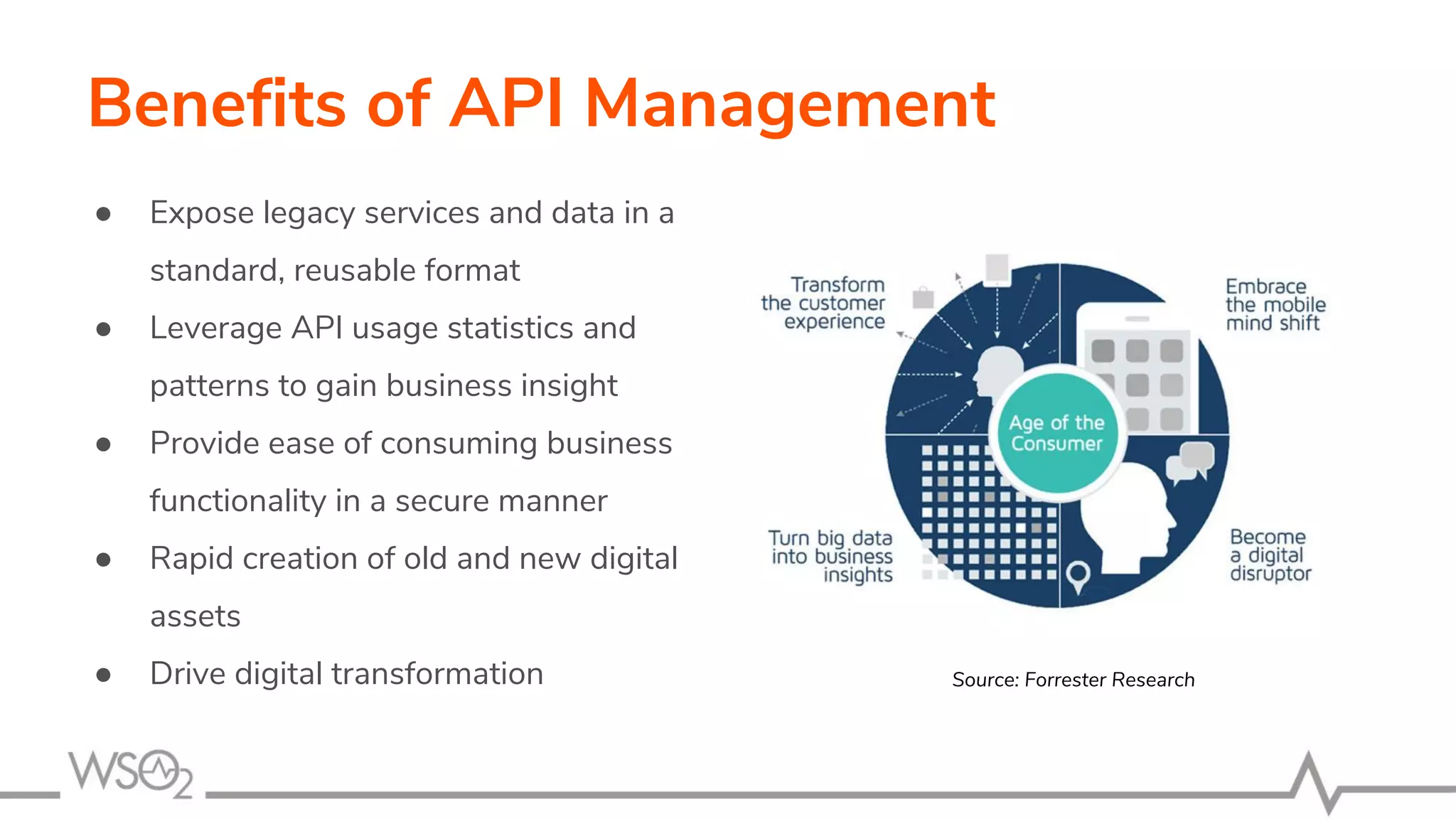
Benefits of API Management
● Expose legacy services and data in a
standard, reusable format
● Leverage API usage statistics and
patterns to gain business insight
● Provide ease of consuming business
functionality in a secure manner
● Rapid creation of old and new digital
assets
● Drive digital transformation Source: Forrester Research
API Marketplace
A Platform is a Central,
Single Level Space which
can be accessed by many to
satisfy needs.
Emergence of Platforms
• Platforms have become proven business models
– E.g. Amazon, Uber, Youtube, etc.
• Value creation is at a flatter structure
– Platform users create and consume
• The platform itself is a technology creation
– Focused on providing value for the stakeholders
• Stakeholders can be external as well as internal
– Employees, partners, customers, and even competitors
• New revenue models are discovered
A Marketplace is a
Specialized Platform which
connects Producers and
Consumers
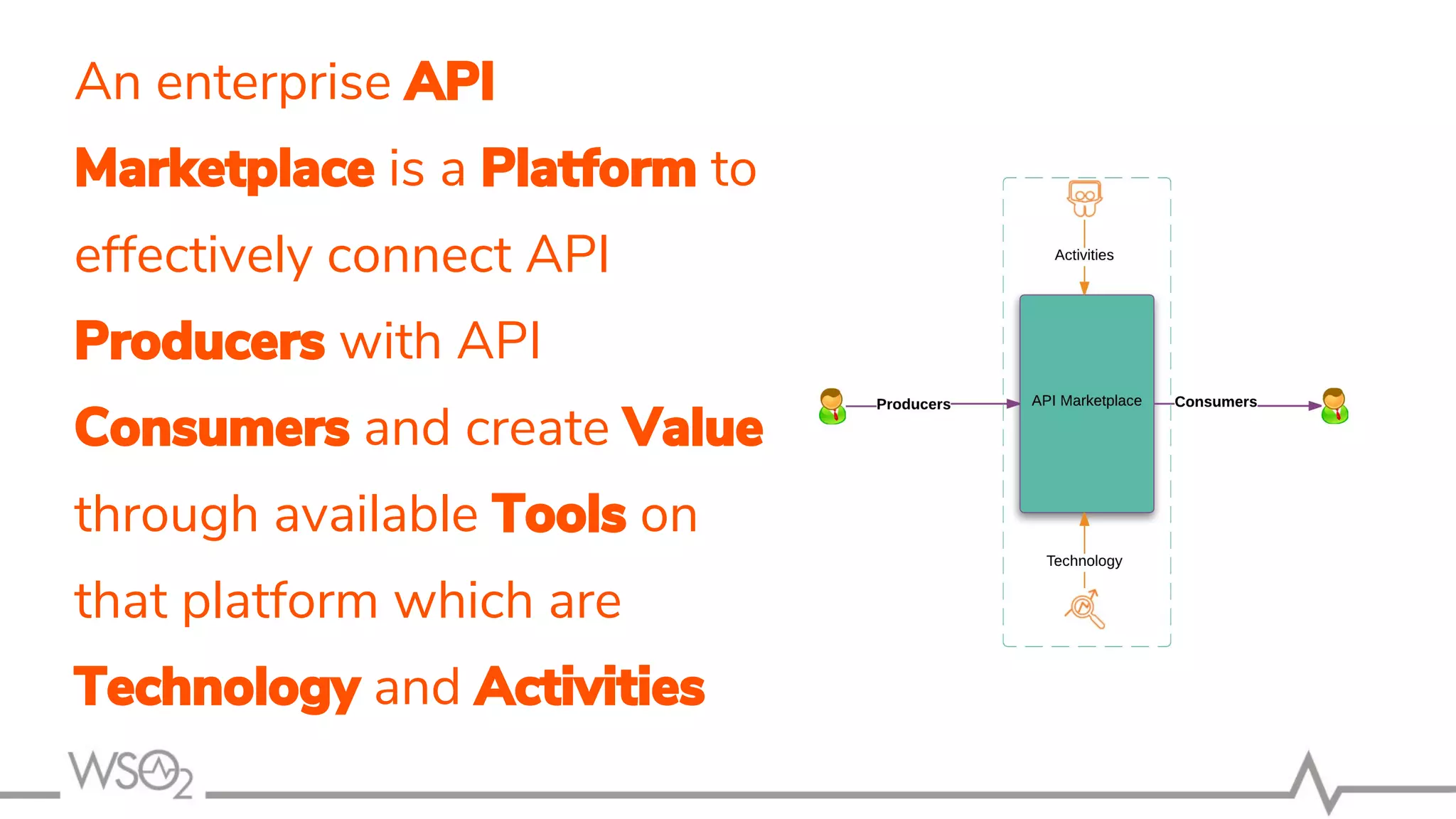
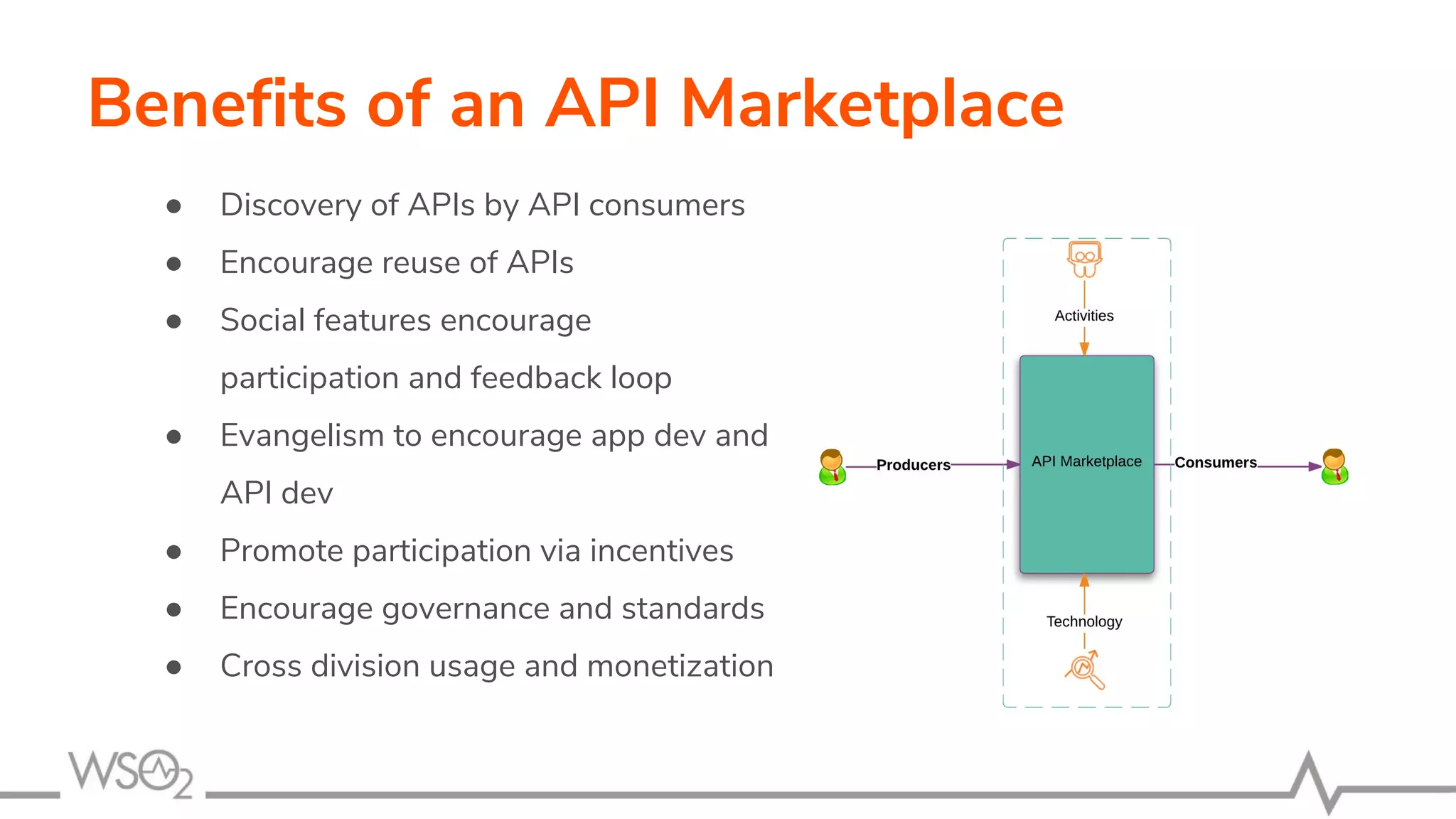
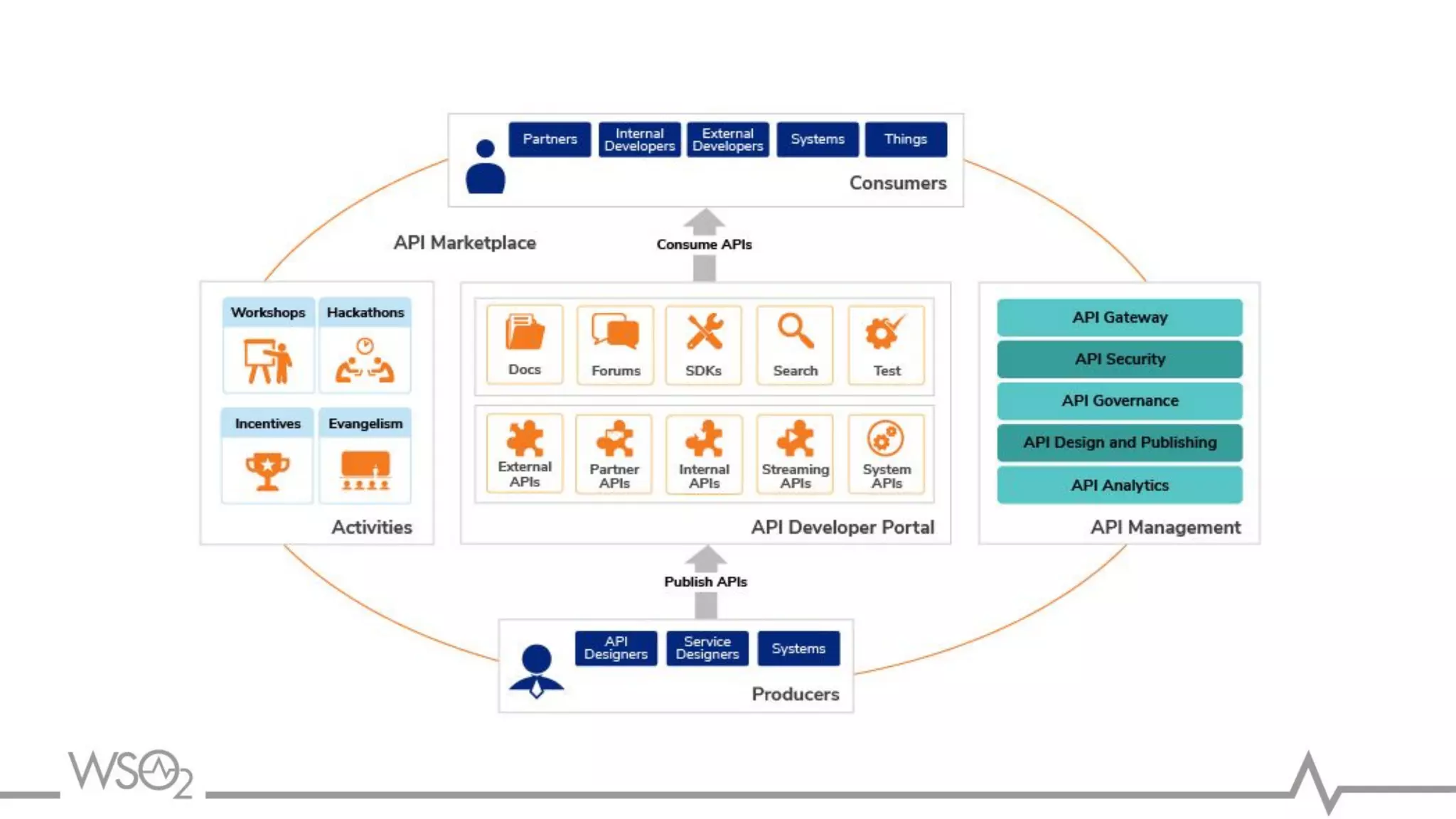
An enterprise API
Marketplace is a Platform to
effectively connect API
Producers with API
Consumers and create Value
through available Tools on
that platform which are
Technology and Activities
Benefits of an API Marketplace
● Discovery of APIs by API consumers
● Encourage reuse of APIs
● Social features encourage
participation and feedback loop
● Evangelism to encourage app dev and
API dev
● Promote participation via incentives
● Encourage governance and standards
● Cross division usage and monetization
Strategy - Step 1:
Define Your API Strategy
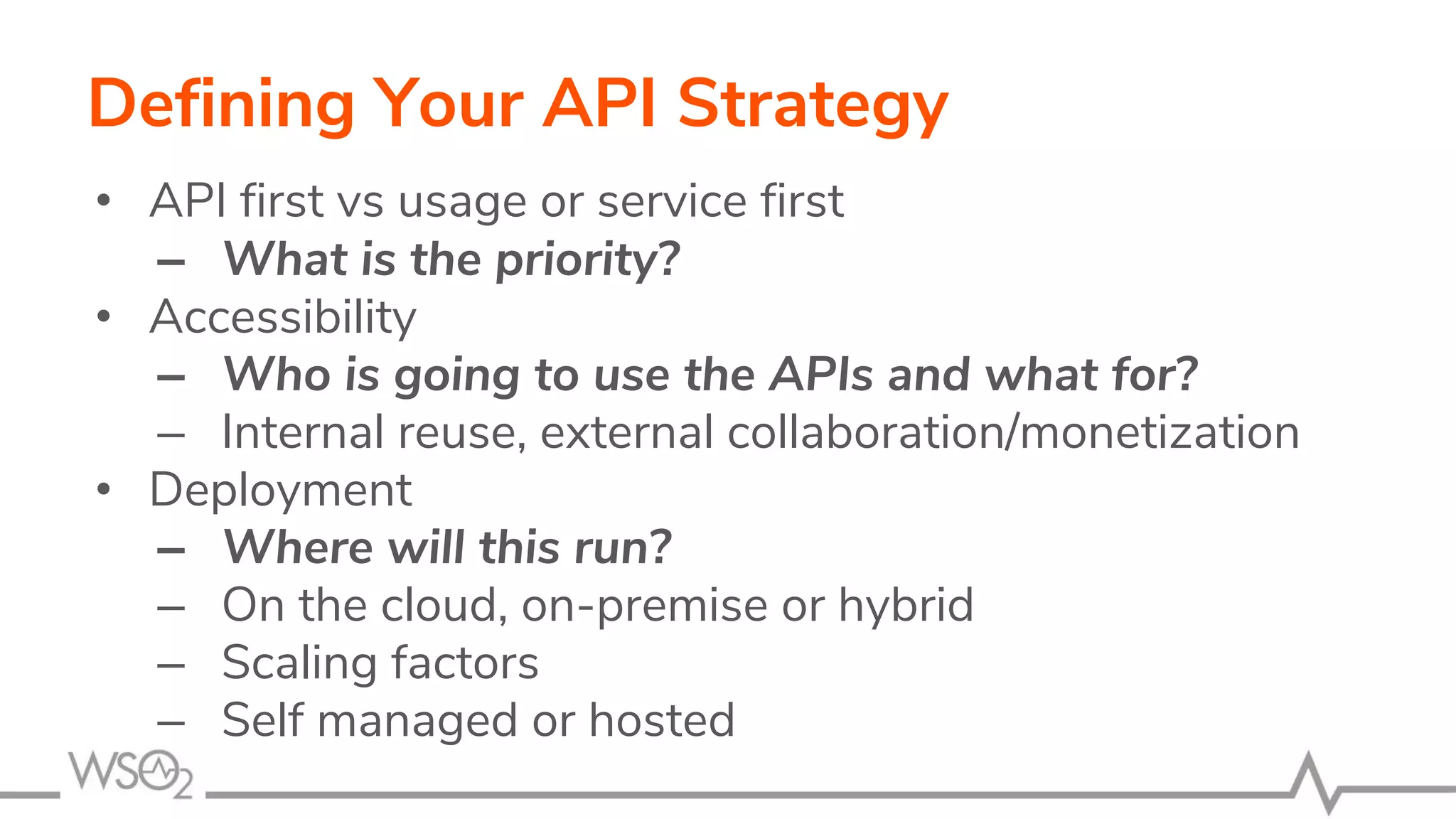
Defining Your API Strategy
• API first vs usage or service first
– What is the priority?
• Accessibility
– Who is going to use the APIs and what for?
– Internal reuse, external collaboration/monetization
• Deployment
– Where will this run?
– On the cloud, on-premise or hybrid
– Scaling factors
– Self managed or hosted
Components of Building a
Marketplace
Strategy - Step 2:
Identify Your API Technology
Strategy
Identifying Your API Technology
Strategy
• Which components are most important?
– Developer portal, security
• What type of security is needed based on accessibility?
– Ability to federate into multiple security providers
• What type of extensibility is needed?
– Is there any complex pre-processing needed?
• Who is the best technology provider?
Producers - Publisher: Creating APIs
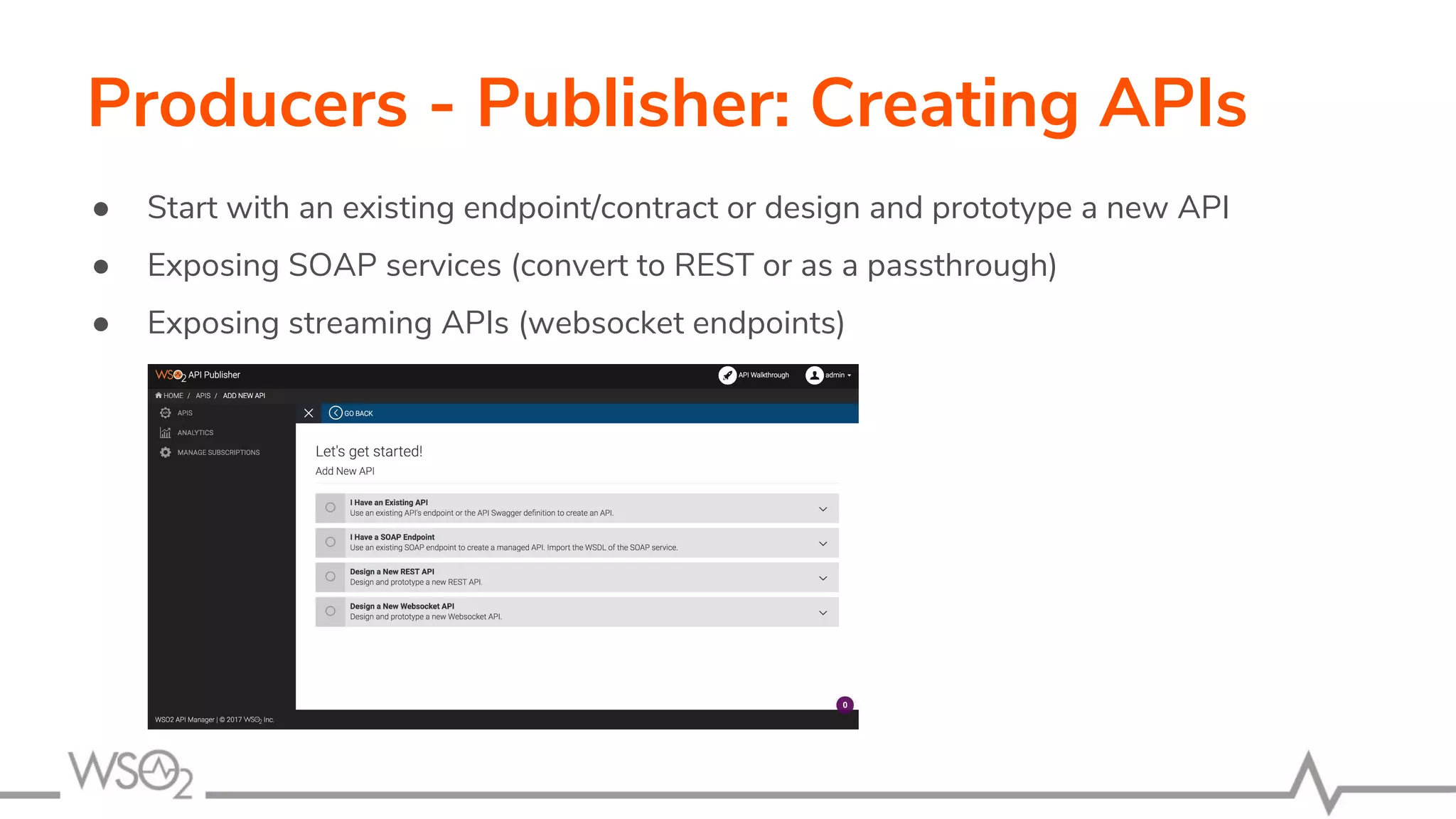
● Start with an existing endpoint/contract or design and prototype a new API
● Exposing SOAP services (convert to REST or as a passthrough)
● Exposing streaming APIs (websocket endpoints)
Producers - Publisher: Creating APIs
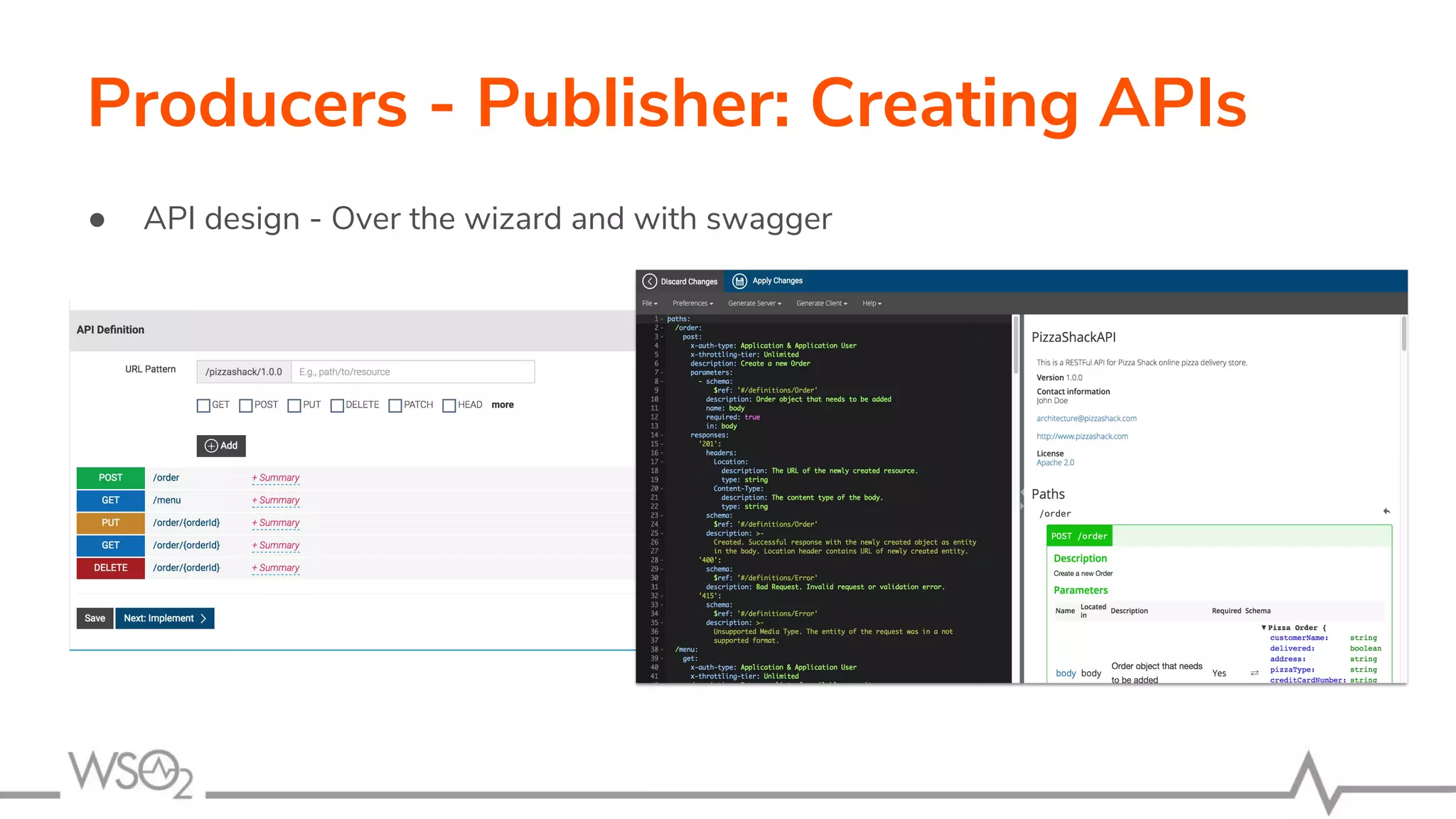
● API design - Over the wizard and with swagger
Producers - Publisher: Creating APIs
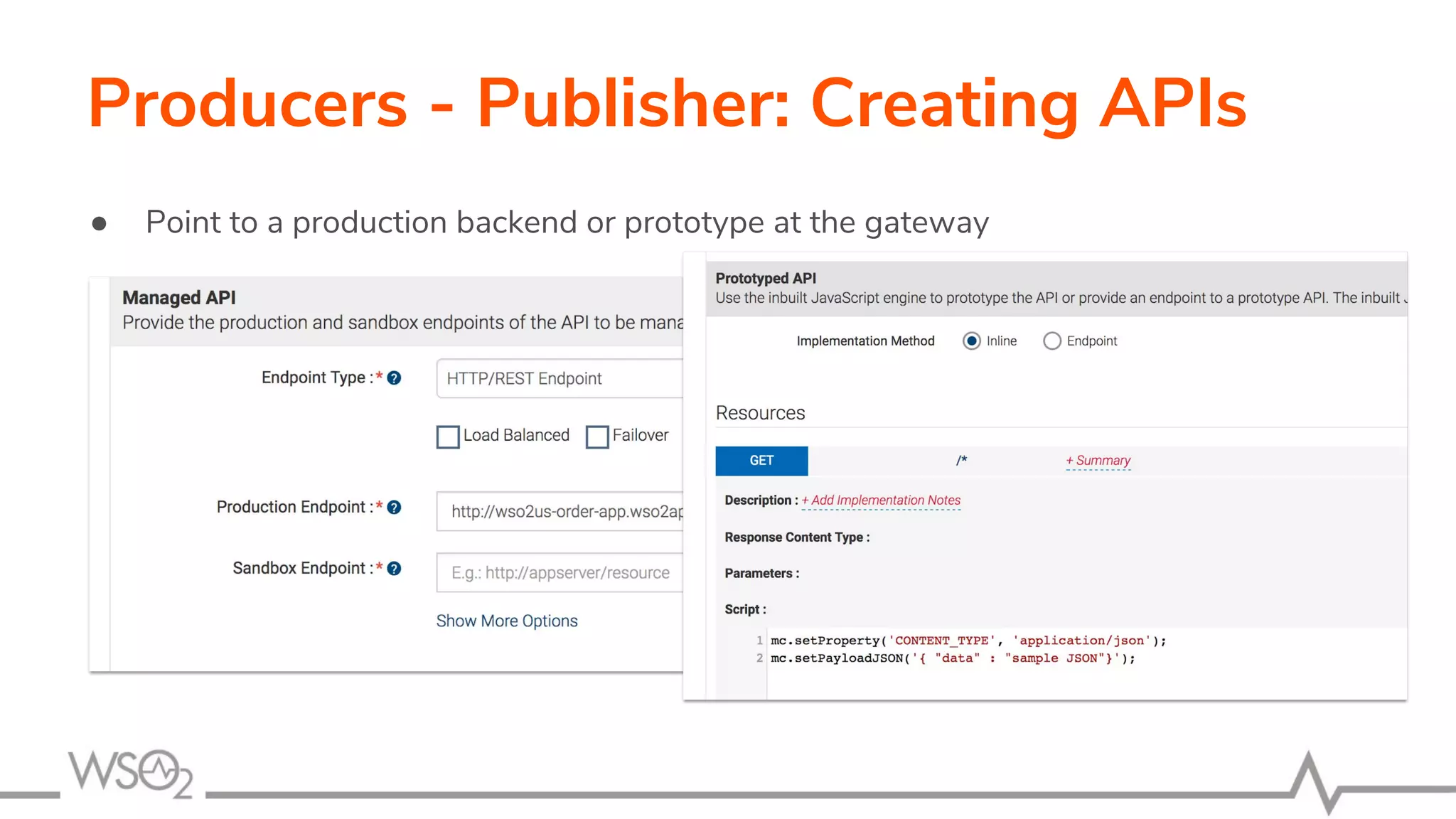
● Point to a production backend or prototype at the gateway
Producers - Publisher: Governance
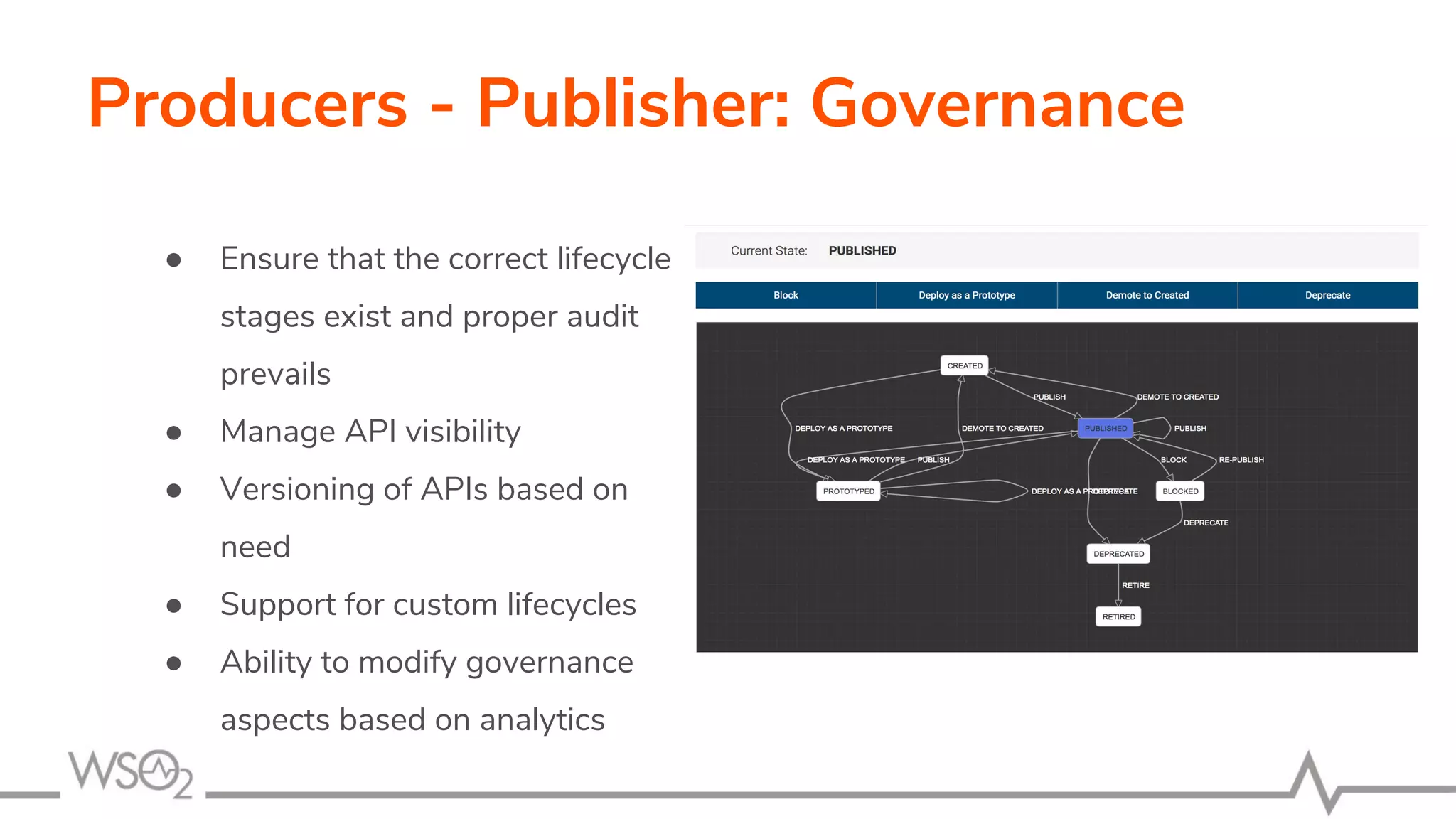
● Ensure that the correct lifecycle
stages exist and proper audit
prevails
● Manage API visibility
● Versioning of APIs based on
need
● Support for custom lifecycles
● Ability to modify governance
aspects based on analytics
Consumers - Developer Portal
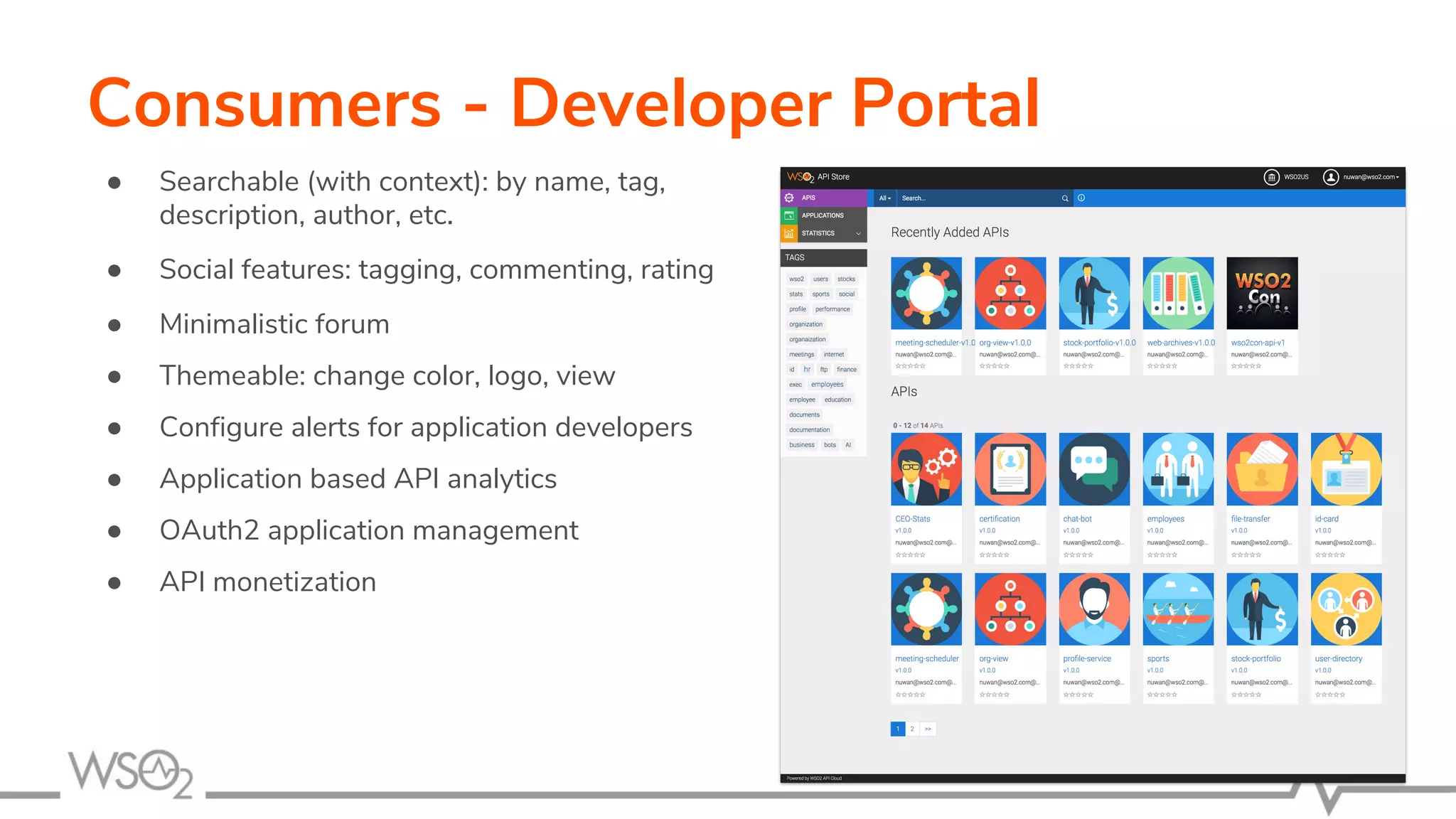
● Searchable (with context): by name, tag,
description, author, etc.
● Social features: tagging, commenting, rating
● Minimalistic forum
● Themeable: change color, logo, view
● Configure alerts for application developers
● Application based API analytics
● OAuth2 application management
● API monetization
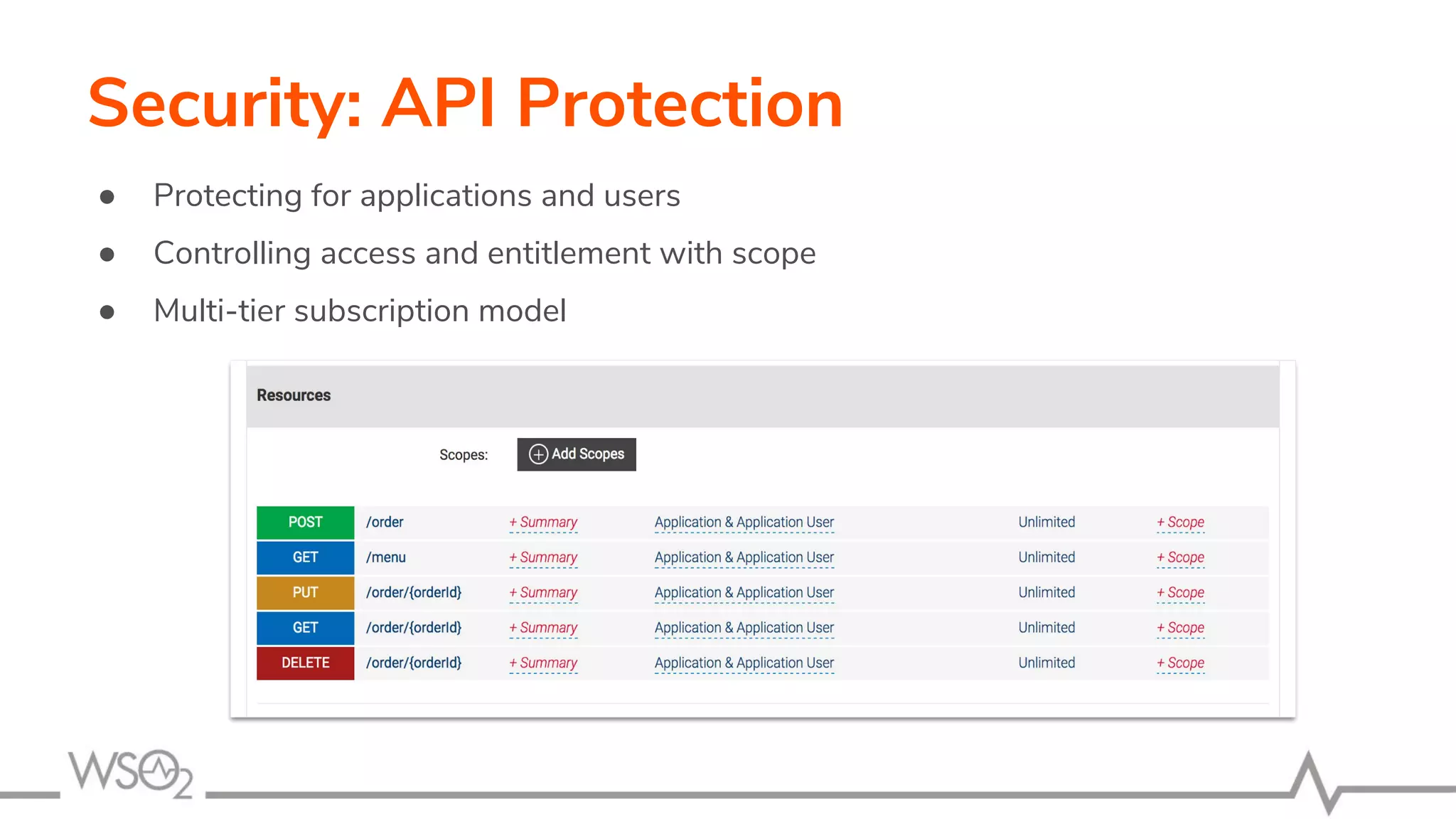
Security: API Protection
● Protecting for applications and users
● Controlling access and entitlement with scope
● Multi-tier subscription model
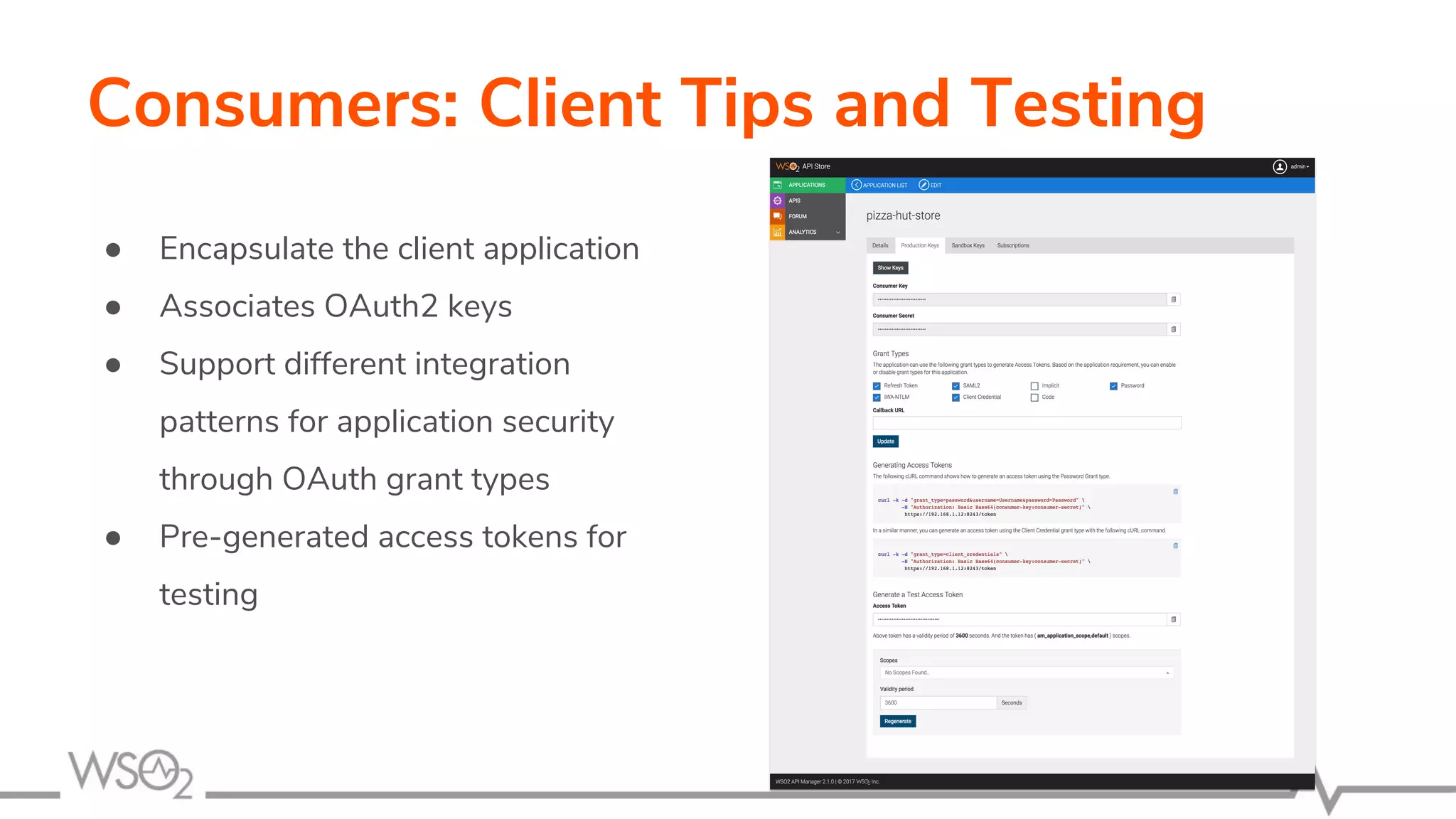
Consumers: Client Tips and Testing
● Encapsulate the client application
● Associates OAuth2 keys
● Support different integration
patterns for application security
through OAuth grant types
● Pre-generated access tokens for
testing
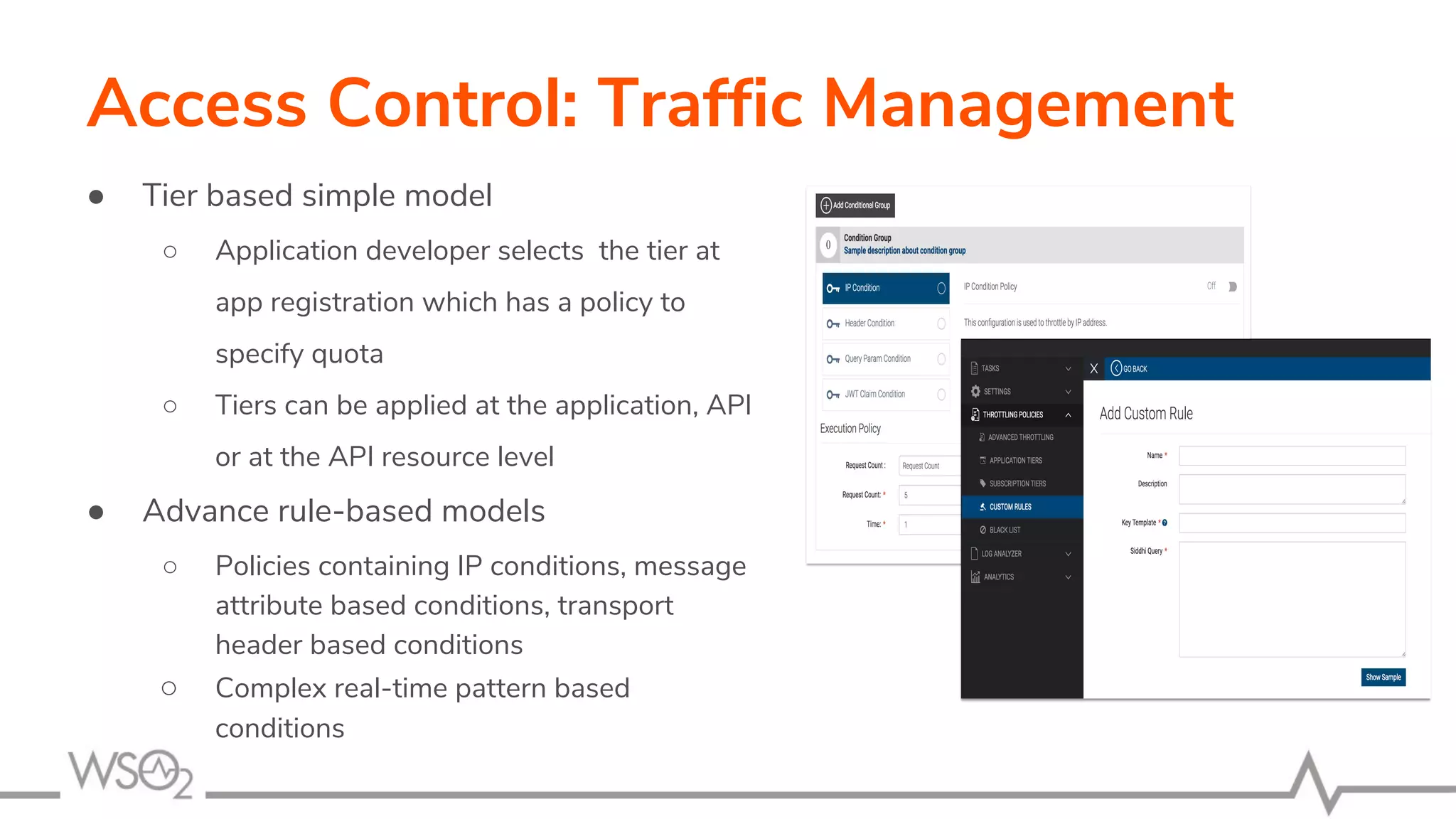
Access Control: Traffic Management
● Tier based simple model
○ Application developer selects the tier at
app registration which has a policy to
specify quota
○ Tiers can be applied at the application, API
or at the API resource level
● Advance rule-based models
○ Policies containing IP conditions, message
attribute based conditions, transport
header based conditions
○ Complex real-time pattern based
conditions
Strategy - Step 3:
Identify Activities to Promote
Usage
Engage and Evangelize
• Stakeholders are the key
• Ensure API developers publish more APIs
– Enable producers to create APIs and group them as
needed
– Provide social ratings and tools for documenting usage
• Ensure application developers consume more APIs
– Organize hackathons, workshops and tutorials
– Provide code snippets for consumption
– Lunch n’ Learn sessions, webinars
Promote Use Through Incentives
• Financial incentives and gamifications
• Leaderboards showcasing top consumers, most
consumed APIs, highest throughput APIs,
highlighted developer and more
• Identify KPIs for incentives
Strategy - Step 4:
Analyze Data Collected
Analyze API Usage
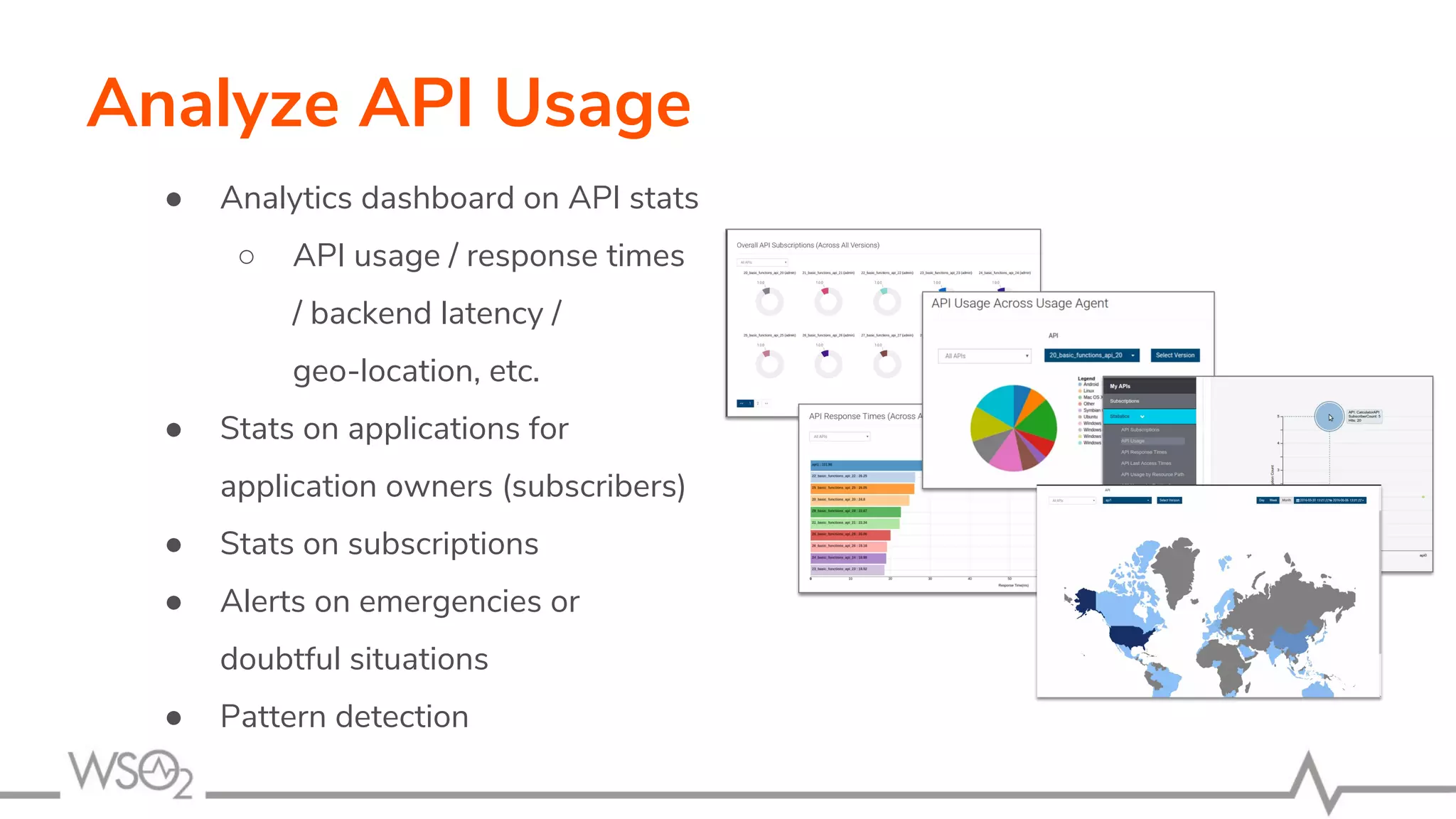
● Analytics dashboard on API stats
○ API usage / response times
/ backend latency /
geo-location, etc.
● Stats on applications for
application owners (subscribers)
● Stats on subscriptions
● Alerts on emergencies or
doubtful situations
● Pattern detection
Strategy - Step 5:
Identify Monetization and
Cross Business Revenue
Opportunities
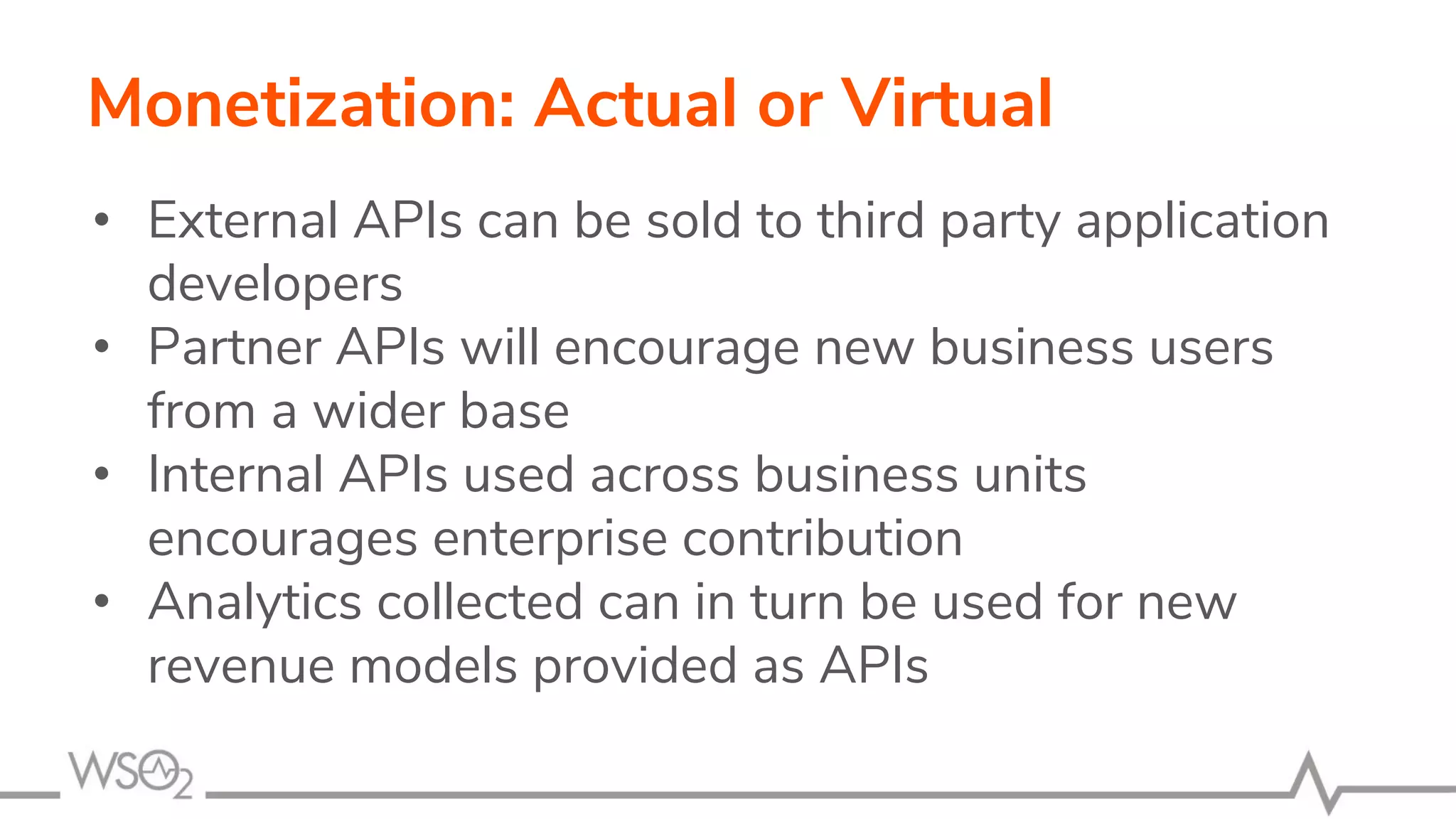
Monetization: Actual or Virtual
• External APIs can be sold to third party application
developers
• Partner APIs will encourage new business users
from a wider base
• Internal APIs used across business units
encourages enterprise contribution
• Analytics collected can in turn be used for new
revenue models provided as APIs
Strategy - Step 6:
Govern, Manage, and Evolve
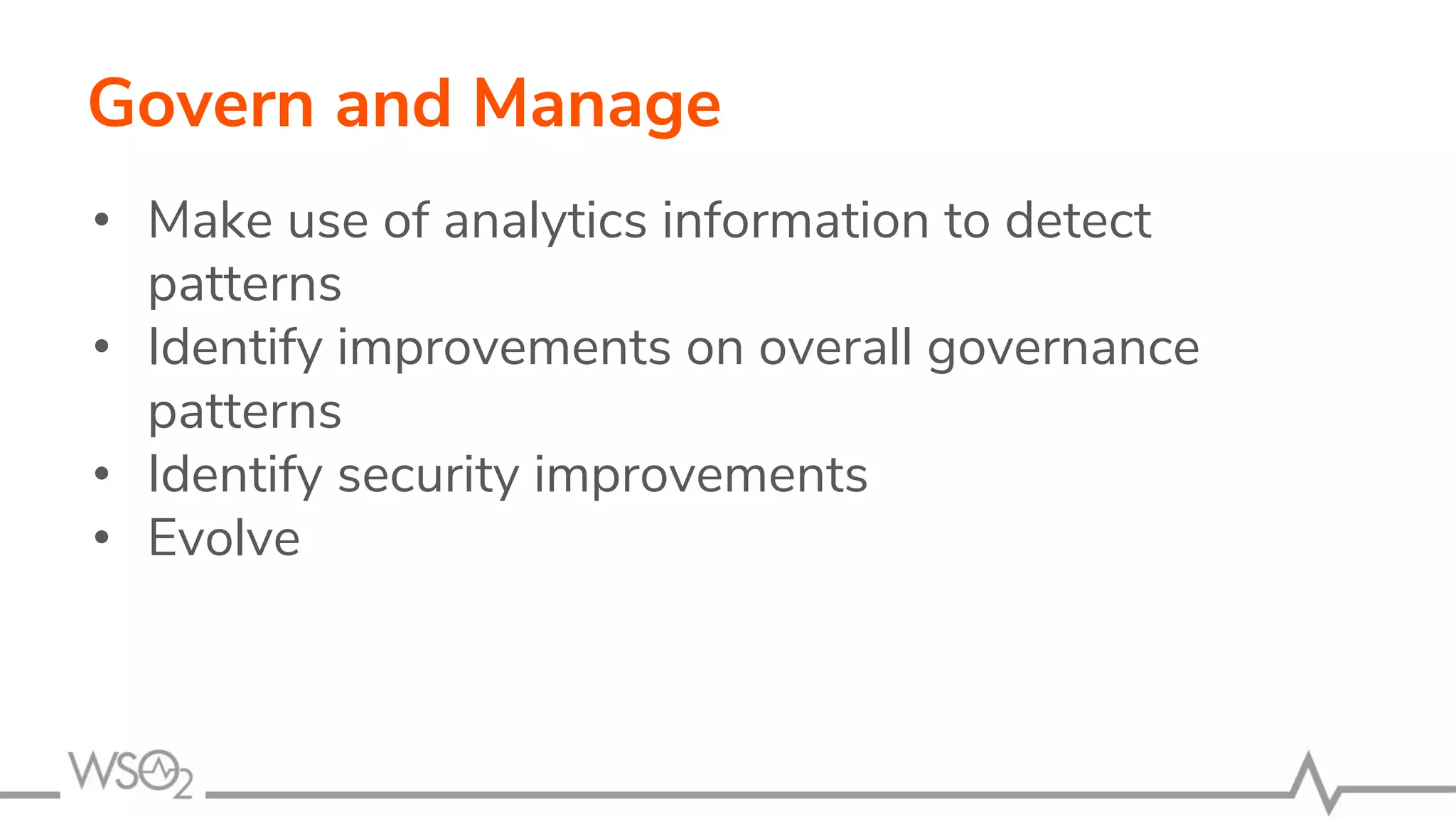
Govern and Manage
• Make use of analytics information to detect
patterns
• Identify improvements on overall governance
patterns
• Identify security improvements
• Evolve
Real World Scenarios
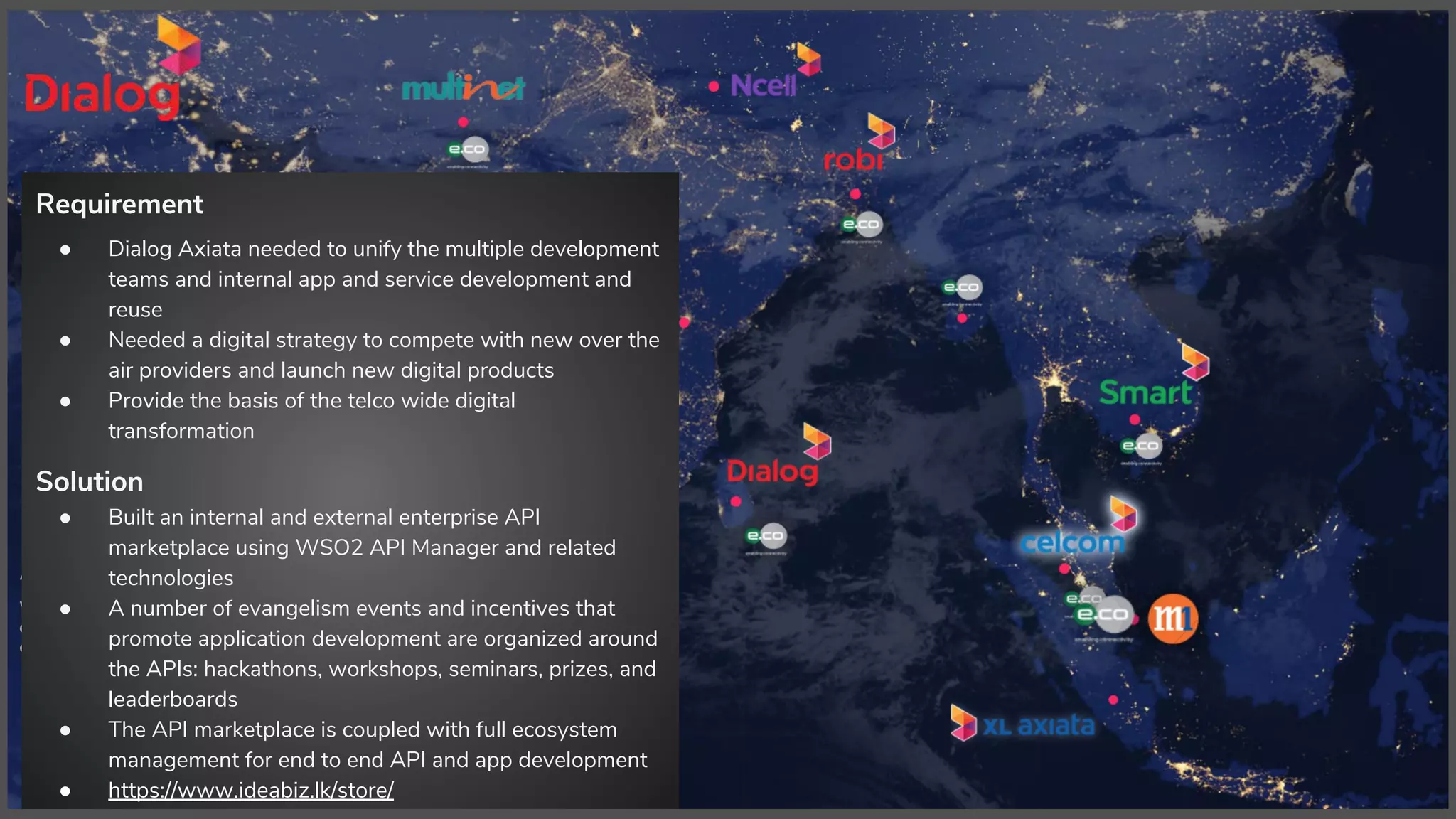
Requirement
● Dialog Axiata needed to unify the multiple development
teams and internal app and service development and
reuse
● Needed a digital strategy to compete with new over the
air providers and launch new digital products
● Provide the basis of the telco wide digital
transformation
Solution
● Built an internal and external enterprise API
marketplace using WSO2 API Manager and related
technologies
● A number of evangelism events and incentives that
promote application development are organized around
the APIs: hackathons, workshops, seminars, prizes, and
leaderboards
● The API marketplace is coupled with full ecosystem
management for end to end API and app development
● https://www.ideabiz.lk/store/
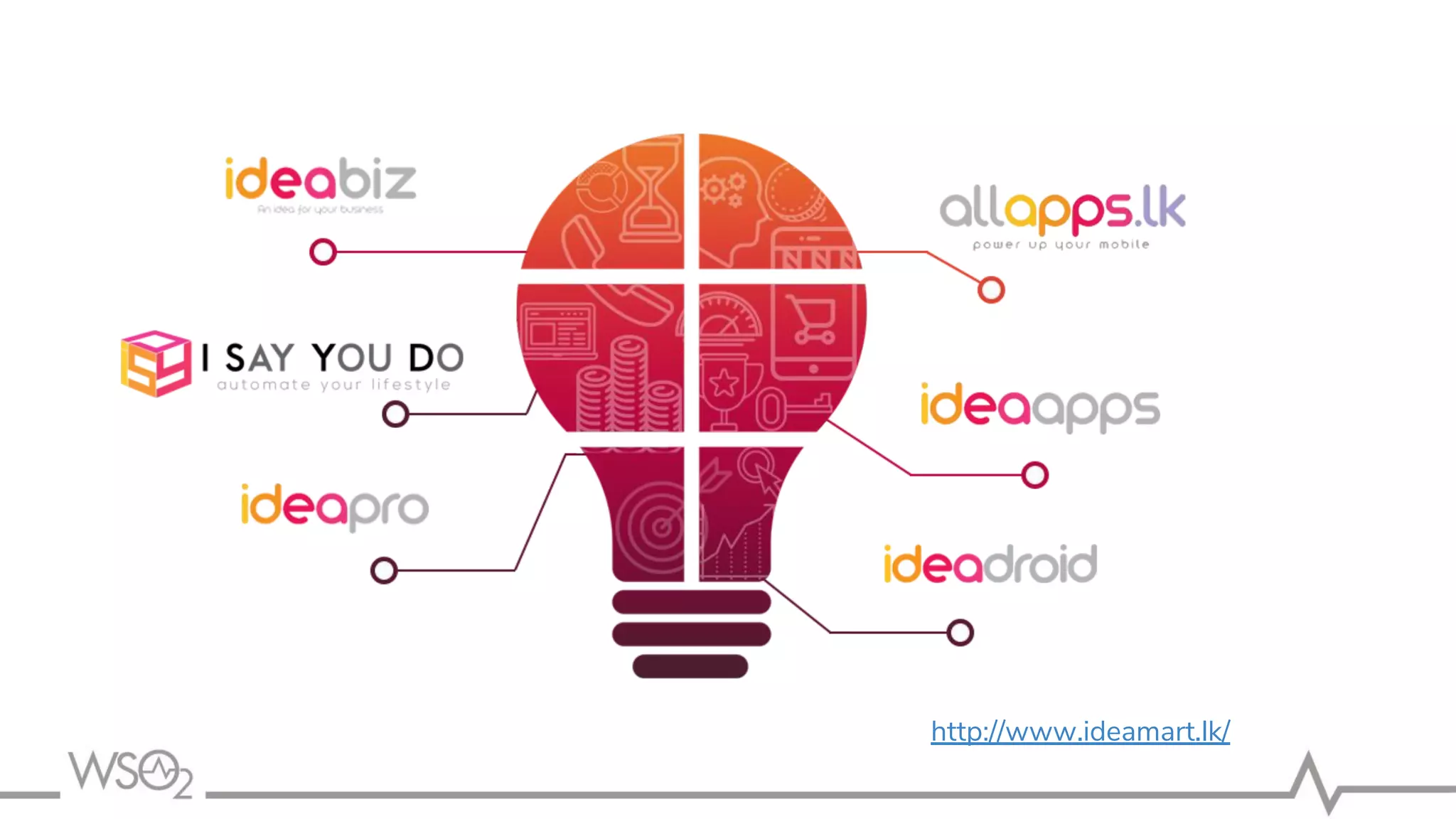
http://www.ideamart.lk/
38
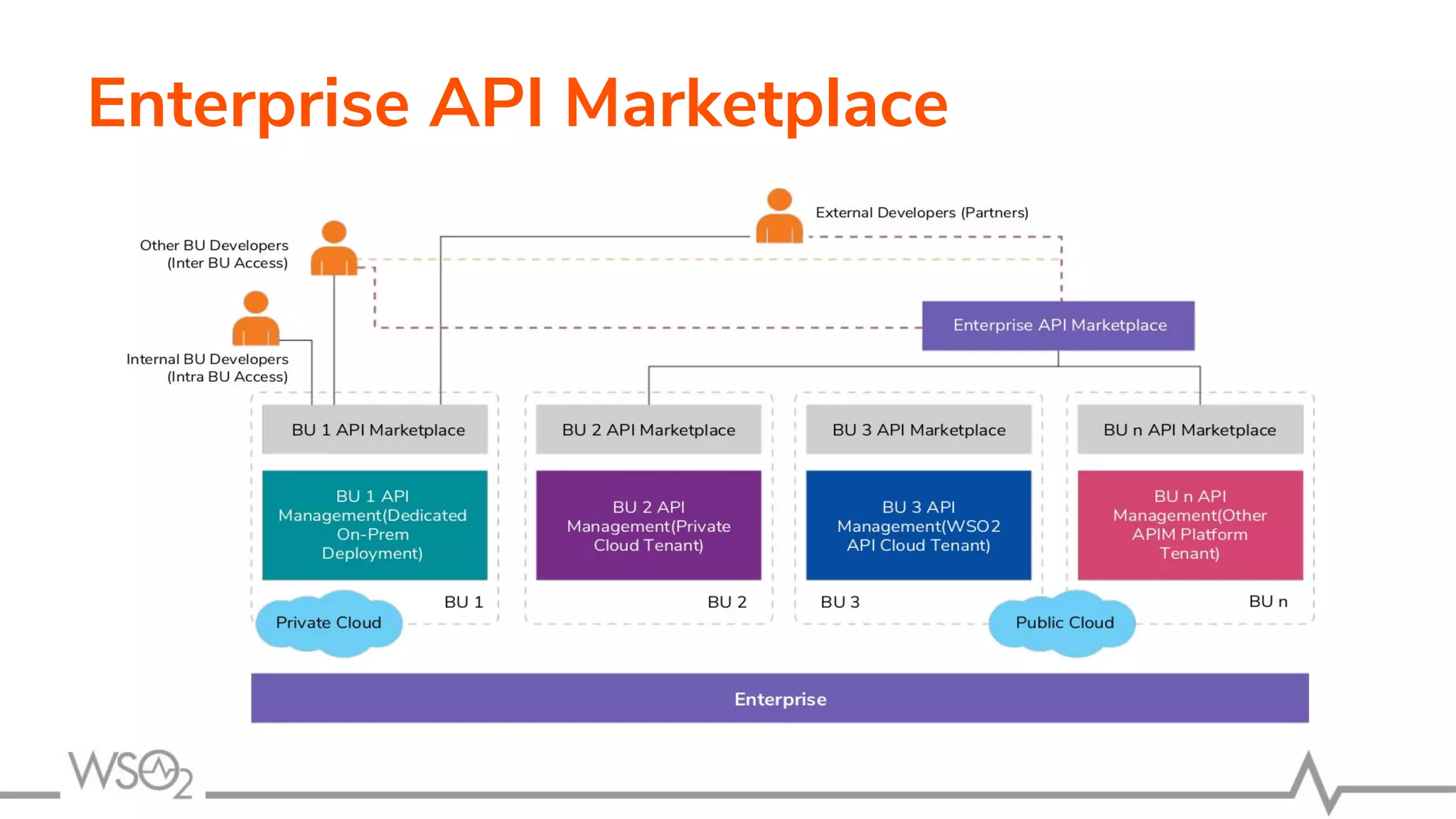
Enterprise API Marketplace
Beyond API Marketplaces
Application Marketplaces
• A successful API marketplace implies the need for an
application marketplace
• Connect application producers and consumers over an
application store
• Provide typical marketplace capabilities such as
– Discovery
– Social rating
– Try-it trials
Ecosystem Management
• An application marketplace requires an
ecosystem
• Security provisioning for application users
• Single sign-on (SSO) across multiple applications
• Analytics and governance over usage
• Application proxies
In Summary
Steps in Crafting a Marketplace Driven
API Strategy
1. Define the organization’s desired API strategy
2. Identify the API technology strategy to use
3. Work on activities to promote usage
4. Analyze API usage to draw insight
5. Use monetization channels identified through the
marketplace to improve
6. Govern, manage and evolve
THANK YOU
wso2.com

Crafting an API Strategy with an API Marketplace

  • 1.
    Crafting an APIStrategy with an API Marketplace Shiroshica Kulatilake
  • 2.
    What we willdiscuss • API management and why it is a mandatory • API marketplaces and its benefits • Components of building an API marketplace • Promoting the use of API marketplaces • Some real world scenarios • Beyond API marketplaces
  • 3.
  • 5.
    Benefits of APIManagement ● Expose legacy services and data in a standard, reusable format ● Leverage API usage statistics and patterns to gain business insight ● Provide ease of consuming business functionality in a secure manner ● Rapid creation of old and new digital assets ● Drive digital transformation Source: Forrester Research
  • 6.
  • 7.
    A Platform isa Central, Single Level Space which can be accessed by many to satisfy needs.
  • 8.
    Emergence of Platforms •Platforms have become proven business models – E.g. Amazon, Uber, Youtube, etc. • Value creation is at a flatter structure – Platform users create and consume • The platform itself is a technology creation – Focused on providing value for the stakeholders • Stakeholders can be external as well as internal – Employees, partners, customers, and even competitors • New revenue models are discovered
  • 9.
    A Marketplace isa Specialized Platform which connects Producers and Consumers
  • 10.
    An enterprise API Marketplaceis a Platform to effectively connect API Producers with API Consumers and create Value through available Tools on that platform which are Technology and Activities
  • 11.
    Benefits of anAPI Marketplace ● Discovery of APIs by API consumers ● Encourage reuse of APIs ● Social features encourage participation and feedback loop ● Evangelism to encourage app dev and API dev ● Promote participation via incentives ● Encourage governance and standards ● Cross division usage and monetization
  • 12.
    Strategy - Step1: Define Your API Strategy
  • 13.
    Defining Your APIStrategy • API first vs usage or service first – What is the priority? • Accessibility – Who is going to use the APIs and what for? – Internal reuse, external collaboration/monetization • Deployment – Where will this run? – On the cloud, on-premise or hybrid – Scaling factors – Self managed or hosted
  • 14.
  • 16.
    Strategy - Step2: Identify Your API Technology Strategy
  • 17.
    Identifying Your APITechnology Strategy • Which components are most important? – Developer portal, security • What type of security is needed based on accessibility? – Ability to federate into multiple security providers • What type of extensibility is needed? – Is there any complex pre-processing needed? • Who is the best technology provider?
  • 18.
    Producers - Publisher:Creating APIs ● Start with an existing endpoint/contract or design and prototype a new API ● Exposing SOAP services (convert to REST or as a passthrough) ● Exposing streaming APIs (websocket endpoints)
  • 19.
    Producers - Publisher:Creating APIs ● API design - Over the wizard and with swagger
  • 20.
    Producers - Publisher:Creating APIs ● Point to a production backend or prototype at the gateway
  • 21.
    Producers - Publisher:Governance ● Ensure that the correct lifecycle stages exist and proper audit prevails ● Manage API visibility ● Versioning of APIs based on need ● Support for custom lifecycles ● Ability to modify governance aspects based on analytics
  • 22.
    Consumers - DeveloperPortal ● Searchable (with context): by name, tag, description, author, etc. ● Social features: tagging, commenting, rating ● Minimalistic forum ● Themeable: change color, logo, view ● Configure alerts for application developers ● Application based API analytics ● OAuth2 application management ● API monetization
  • 23.
    Security: API Protection ●Protecting for applications and users ● Controlling access and entitlement with scope ● Multi-tier subscription model
  • 24.
    Consumers: Client Tipsand Testing ● Encapsulate the client application ● Associates OAuth2 keys ● Support different integration patterns for application security through OAuth grant types ● Pre-generated access tokens for testing
  • 25.
    Access Control: TrafficManagement ● Tier based simple model ○ Application developer selects the tier at app registration which has a policy to specify quota ○ Tiers can be applied at the application, API or at the API resource level ● Advance rule-based models ○ Policies containing IP conditions, message attribute based conditions, transport header based conditions ○ Complex real-time pattern based conditions
  • 26.
    Strategy - Step3: Identify Activities to Promote Usage
  • 27.
    Engage and Evangelize •Stakeholders are the key • Ensure API developers publish more APIs – Enable producers to create APIs and group them as needed – Provide social ratings and tools for documenting usage • Ensure application developers consume more APIs – Organize hackathons, workshops and tutorials – Provide code snippets for consumption – Lunch n’ Learn sessions, webinars
  • 28.
    Promote Use ThroughIncentives • Financial incentives and gamifications • Leaderboards showcasing top consumers, most consumed APIs, highest throughput APIs, highlighted developer and more • Identify KPIs for incentives
  • 29.
    Strategy - Step4: Analyze Data Collected
  • 30.
    Analyze API Usage ●Analytics dashboard on API stats ○ API usage / response times / backend latency / geo-location, etc. ● Stats on applications for application owners (subscribers) ● Stats on subscriptions ● Alerts on emergencies or doubtful situations ● Pattern detection
  • 31.
    Strategy - Step5: Identify Monetization and Cross Business Revenue Opportunities
  • 32.
    Monetization: Actual orVirtual • External APIs can be sold to third party application developers • Partner APIs will encourage new business users from a wider base • Internal APIs used across business units encourages enterprise contribution • Analytics collected can in turn be used for new revenue models provided as APIs
  • 33.
    Strategy - Step6: Govern, Manage, and Evolve
  • 34.
    Govern and Manage •Make use of analytics information to detect patterns • Identify improvements on overall governance patterns • Identify security improvements • Evolve
  • 35.
  • 36.
    Requirement ● Dialog Axiataneeded to unify the multiple development teams and internal app and service development and reuse ● Needed a digital strategy to compete with new over the air providers and launch new digital products ● Provide the basis of the telco wide digital transformation Solution ● Built an internal and external enterprise API marketplace using WSO2 API Manager and related technologies ● A number of evangelism events and incentives that promote application development are organized around the APIs: hackathons, workshops, seminars, prizes, and leaderboards ● The API marketplace is coupled with full ecosystem management for end to end API and app development ● https://www.ideabiz.lk/store/
  • 37.
  • 38.
  • 39.
  • 40.
  • 41.
    Application Marketplaces • Asuccessful API marketplace implies the need for an application marketplace • Connect application producers and consumers over an application store • Provide typical marketplace capabilities such as – Discovery – Social rating – Try-it trials
  • 42.
    Ecosystem Management • Anapplication marketplace requires an ecosystem • Security provisioning for application users • Single sign-on (SSO) across multiple applications • Analytics and governance over usage • Application proxies
  • 43.
  • 44.
    Steps in Craftinga Marketplace Driven API Strategy 1. Define the organization’s desired API strategy 2. Identify the API technology strategy to use 3. Work on activities to promote usage 4. Analyze API usage to draw insight 5. Use monetization channels identified through the marketplace to improve 6. Govern, manage and evolve
  • 45.