



Introduction to
Apigee
Presenter Name: Shivam Roy
Lack of etiquette and manners is a huge turn off.
KnolX Etiquettes
 Punctuality
Join the session 5 minutes prior to the session start time. We start on
time and conclude on time!
 Feedback
Make sure to submit a constructive feedback for all sessions as it is very
helpful for the presenter.
 Silent Mode
Keep your mobile devices in silent mode, feel free to move out of session
in case you need to attend an urgent call.
 Avoid Disturbance
Avoid unwanted chit chat during the session.
1. What is an API Gateway?
2. What is Apigee?
3. Why APIs matter?
4. Key feature of Apigee.
5. Use cases
6. Benefits of Apigee.
7. Basic terminology of Apigee.
8. Getting started with Apigee.
9. Demo
What is an API Gateway
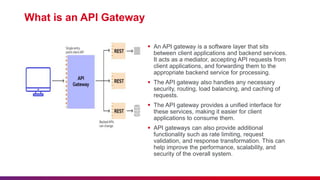
 An API gateway is a software layer that sits
between client applications and backend services.
It acts as a mediator, accepting API requests from
client applications, and forwarding them to the
appropriate backend service for processing.
 The API gateway also handles any necessary
security, routing, load balancing, and caching of
requests.
 The API gateway provides a unified interface for
these services, making it easier for client
applications to consume them.
 API gateways can also provide additional
functionality such as rate limiting, request
validation, and response transformation. This can
help improve the performance, scalability, and
security of the overall system.
What is an Apigee
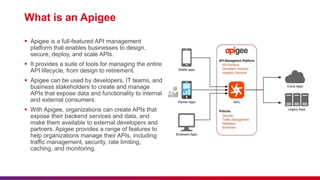
 Apigee is a full-featured API management
platform that enables businesses to design,
secure, deploy, and scale APIs.
 It provides a suite of tools for managing the entire
API lifecycle, from design to retirement.
 Apigee can be used by developers, IT teams, and
business stakeholders to create and manage
APIs that expose data and functionality to internal
and external consumers.
 With Apigee, organizations can create APIs that
expose their backend services and data, and
make them available to external developers and
partners. Apigee provides a range of features to
help organizations manage their APIs, including
traffic management, security, rate limiting,
caching, and monitoring.
Why APIs matter?
 APIs (Application Programming Interfaces) enable seamless communication between different
software systems.
 Facilitates integration, innovation, and collaboration.
 Critical for modern businesses to stay competitive.
o Rapid Development
o Adaptability
o Enhanced user experience
Key features
 API Design
 API Security
 API Lifecycle Management
 Analytics
 Developer Portal
 Integration
Some of the key features includes:
Use cases
 Digital Transformation
 Legacy System Integration
 Partner Ecosystems
Some of the use cases of Apigee are:
Benefits
 Accelerated Time-to-Market
o Rapid API development and deployment.
o Streamlined processes for faster innovation.
 Improved Developer Productivity
o Simplified API design and development workflows.
o Collaboration tools enhance communication among development teams.
 Enhanced Security and Compliance
o Robust security features ensure data protection.
o Compliance with industry regulations.
Basic terminology of Apigee
 API Proxy
 Environment
 Organization
 Policy
 Revision
 API Product
 Developer Portal
Getting started with Apigee
 Create and manage API proxies
 Create and manage API products
 Manage developers
 Monitor API traffic
 Configure analytics
In Apigee, the user interface (UI) is a web-based graphical interface that provides a range
of tools and features for managing and monitoring APIs. The UI can be accessed through a
web browser and provides a user-friendly way to configure and manage API proxies, API
products, developers, and other aspects of the Apigee platform.
Here are some common tasks that you can perform using the Apigee UI:
Demo
Introduction to Apigee Presentation.pptx

Introduction to Apigee Presentation.pptx

  • 1.
  • 2.
    Lack of etiquetteand manners is a huge turn off. KnolX Etiquettes  Punctuality Join the session 5 minutes prior to the session start time. We start on time and conclude on time!  Feedback Make sure to submit a constructive feedback for all sessions as it is very helpful for the presenter.  Silent Mode Keep your mobile devices in silent mode, feel free to move out of session in case you need to attend an urgent call.  Avoid Disturbance Avoid unwanted chit chat during the session.
  • 3.
    1. What isan API Gateway? 2. What is Apigee? 3. Why APIs matter? 4. Key feature of Apigee. 5. Use cases 6. Benefits of Apigee. 7. Basic terminology of Apigee. 8. Getting started with Apigee. 9. Demo
  • 5.
    What is anAPI Gateway  An API gateway is a software layer that sits between client applications and backend services. It acts as a mediator, accepting API requests from client applications, and forwarding them to the appropriate backend service for processing.  The API gateway also handles any necessary security, routing, load balancing, and caching of requests.  The API gateway provides a unified interface for these services, making it easier for client applications to consume them.  API gateways can also provide additional functionality such as rate limiting, request validation, and response transformation. This can help improve the performance, scalability, and security of the overall system.
  • 6.
    What is anApigee  Apigee is a full-featured API management platform that enables businesses to design, secure, deploy, and scale APIs.  It provides a suite of tools for managing the entire API lifecycle, from design to retirement.  Apigee can be used by developers, IT teams, and business stakeholders to create and manage APIs that expose data and functionality to internal and external consumers.  With Apigee, organizations can create APIs that expose their backend services and data, and make them available to external developers and partners. Apigee provides a range of features to help organizations manage their APIs, including traffic management, security, rate limiting, caching, and monitoring.
  • 7.
    Why APIs matter? APIs (Application Programming Interfaces) enable seamless communication between different software systems.  Facilitates integration, innovation, and collaboration.  Critical for modern businesses to stay competitive. o Rapid Development o Adaptability o Enhanced user experience
  • 8.
    Key features  APIDesign  API Security  API Lifecycle Management  Analytics  Developer Portal  Integration Some of the key features includes:
  • 9.
    Use cases  DigitalTransformation  Legacy System Integration  Partner Ecosystems Some of the use cases of Apigee are:
  • 10.
    Benefits  Accelerated Time-to-Market oRapid API development and deployment. o Streamlined processes for faster innovation.  Improved Developer Productivity o Simplified API design and development workflows. o Collaboration tools enhance communication among development teams.  Enhanced Security and Compliance o Robust security features ensure data protection. o Compliance with industry regulations.
  • 11.
    Basic terminology ofApigee  API Proxy  Environment  Organization  Policy  Revision  API Product  Developer Portal
  • 12.
    Getting started withApigee  Create and manage API proxies  Create and manage API products  Manage developers  Monitor API traffic  Configure analytics In Apigee, the user interface (UI) is a web-based graphical interface that provides a range of tools and features for managing and monitoring APIs. The UI can be accessed through a web browser and provides a user-friendly way to configure and manage API proxies, API products, developers, and other aspects of the Apigee platform. Here are some common tasks that you can perform using the Apigee UI:
  • 13.