API 571 Damage Mechanisms
GENERAL MECHANICAL
AND METALLUGICAL
FAILURE MECHANISMS
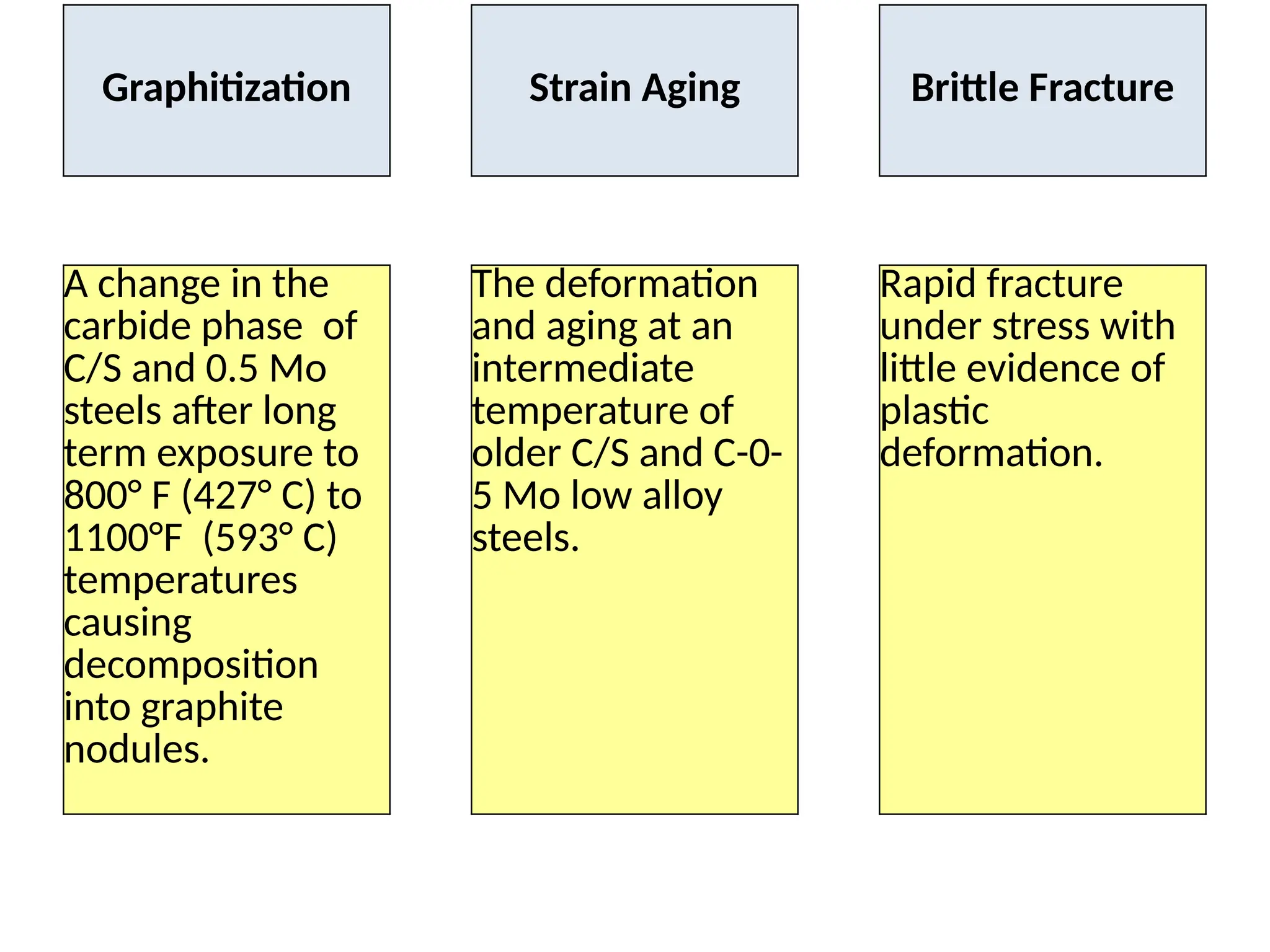
Graphitization Strain Aging Brittle Fracture
A change in the
carbide phase of
C/S and 0.5 Mo
steels after long
term exposure to
800° F (427° C) to
1100°F (593° C)
temperatures
causing
decomposition
into graphite
nodules.
The deformation
and aging at an
intermediate
temperature of
older C/S and C-0-
5 Mo low alloy
steels.
Rapid fracture
under stress with
little evidence of
plastic
deformation.
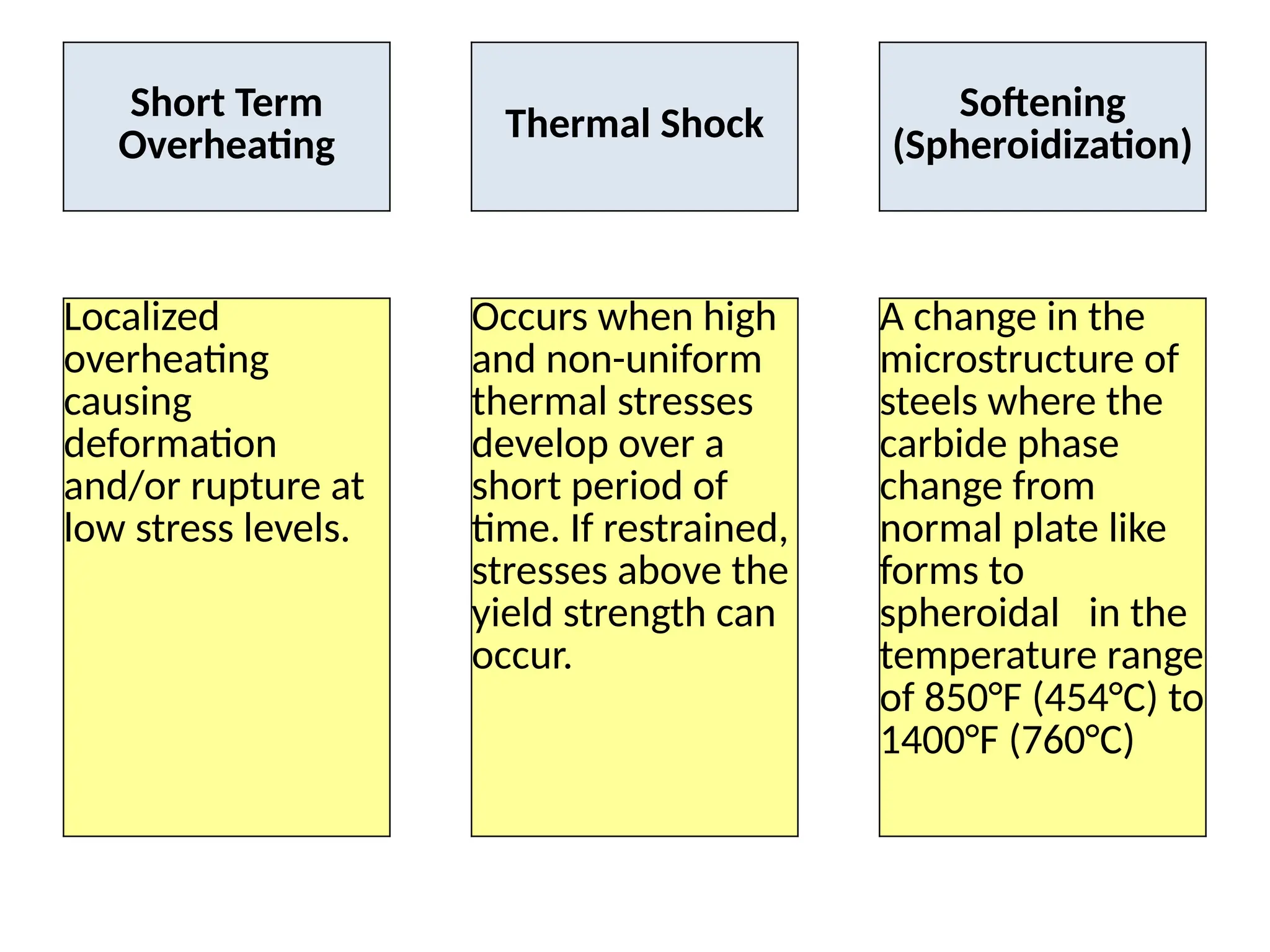
Short Term
Overheating Thermal Shock
Softening
(Spheroidization)
Localized
overheating
causing
deformation
and/or rupture at
low stress levels.
Occurs when high
and non-uniform
thermal stresses
develop over a
short period of
time. If restrained,
stresses above the
yield strength can
occur.
A change in the
microstructure of
steels where the
carbide phase
change from
normal plate like
forms to
spheroidal in the
temperature range
of 850°F (454°C) to
1400°F (760°C)
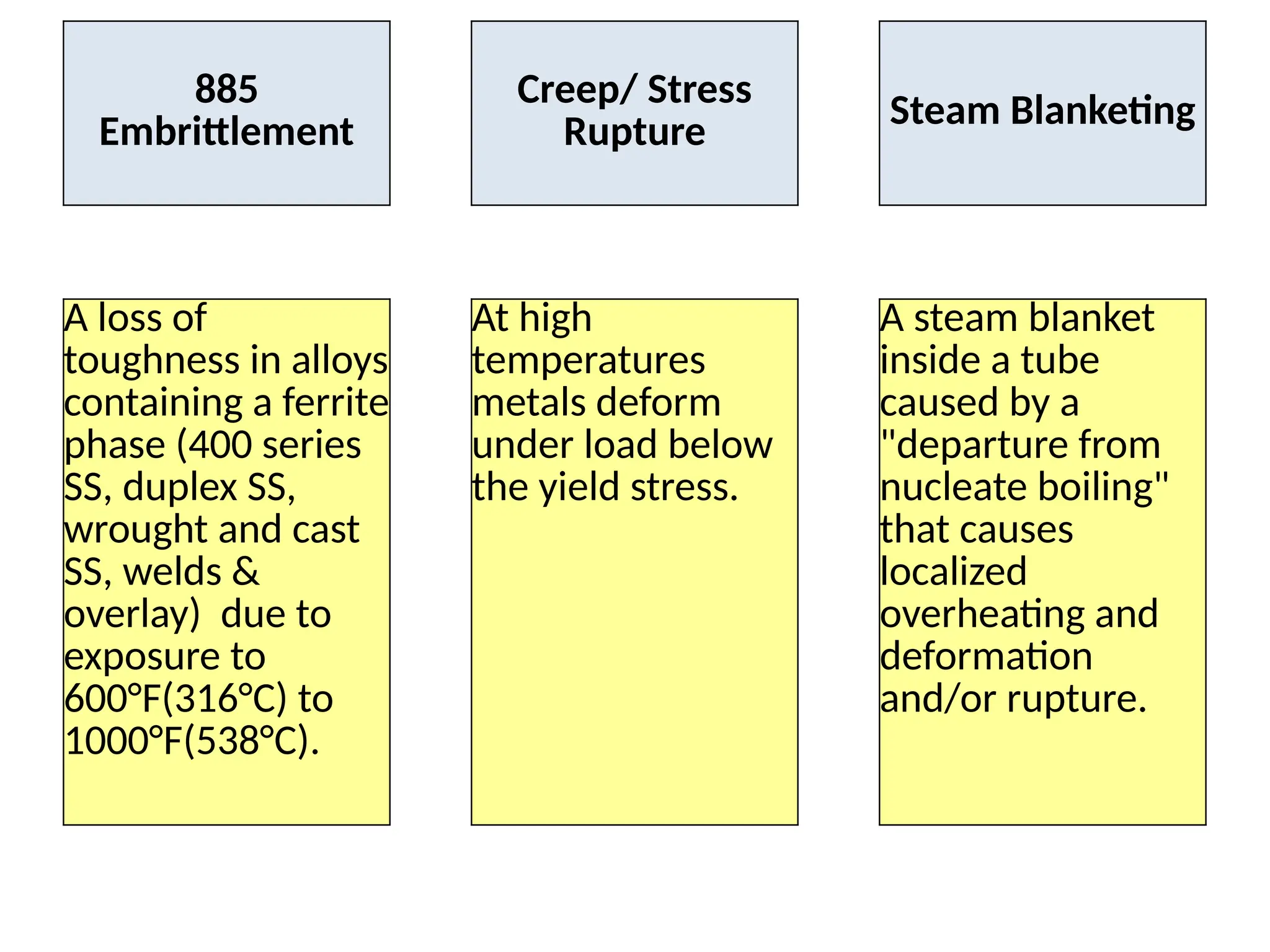
885
Embrittlement
Creep/ Stress
Rupture Steam Blanketing
A loss of
toughness in alloys
containing a ferrite
phase (400 series
SS, duplex SS,
wrought and cast
SS, welds &
overlay) due to
exposure to
600°F(316°C) to
1000°F(538°C).
At high
temperatures
metals deform
under load below
the yield stress.
A steam blanket
inside a tube
caused by a
"departure from
nucleate boiling"
that causes
localized
overheating and
deformation
and/or rupture.
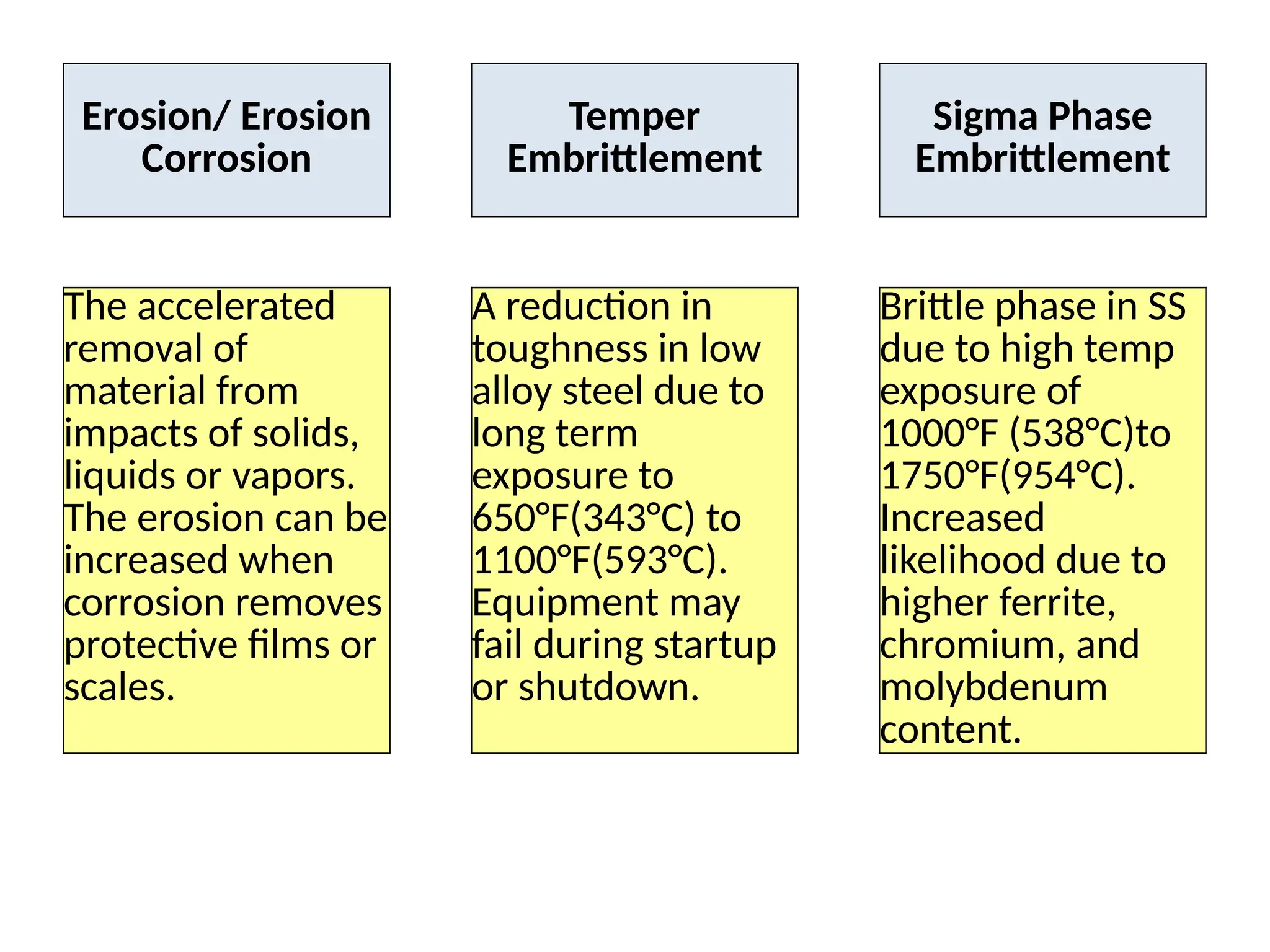
Erosion/ Erosion
Corrosion
Temper
Embrittlement
Sigma Phase
Embrittlement
The accelerated
removal of
material from
impacts of solids,
liquids or vapors.
The erosion can be
increased when
corrosion removes
protective films or
scales.
A reduction in
toughness in low
alloy steel due to
long term
exposure to
650°F(343°C) to
1100°F(593°C).
Equipment may
fail during startup
or shutdown.
Brittle phase in SS
due to high temp
exposure of
1000°F (538°C)to
1750°F(954°C).
Increased
likelihood due to
higher ferrite,
chromium, and
molybdenum
content.
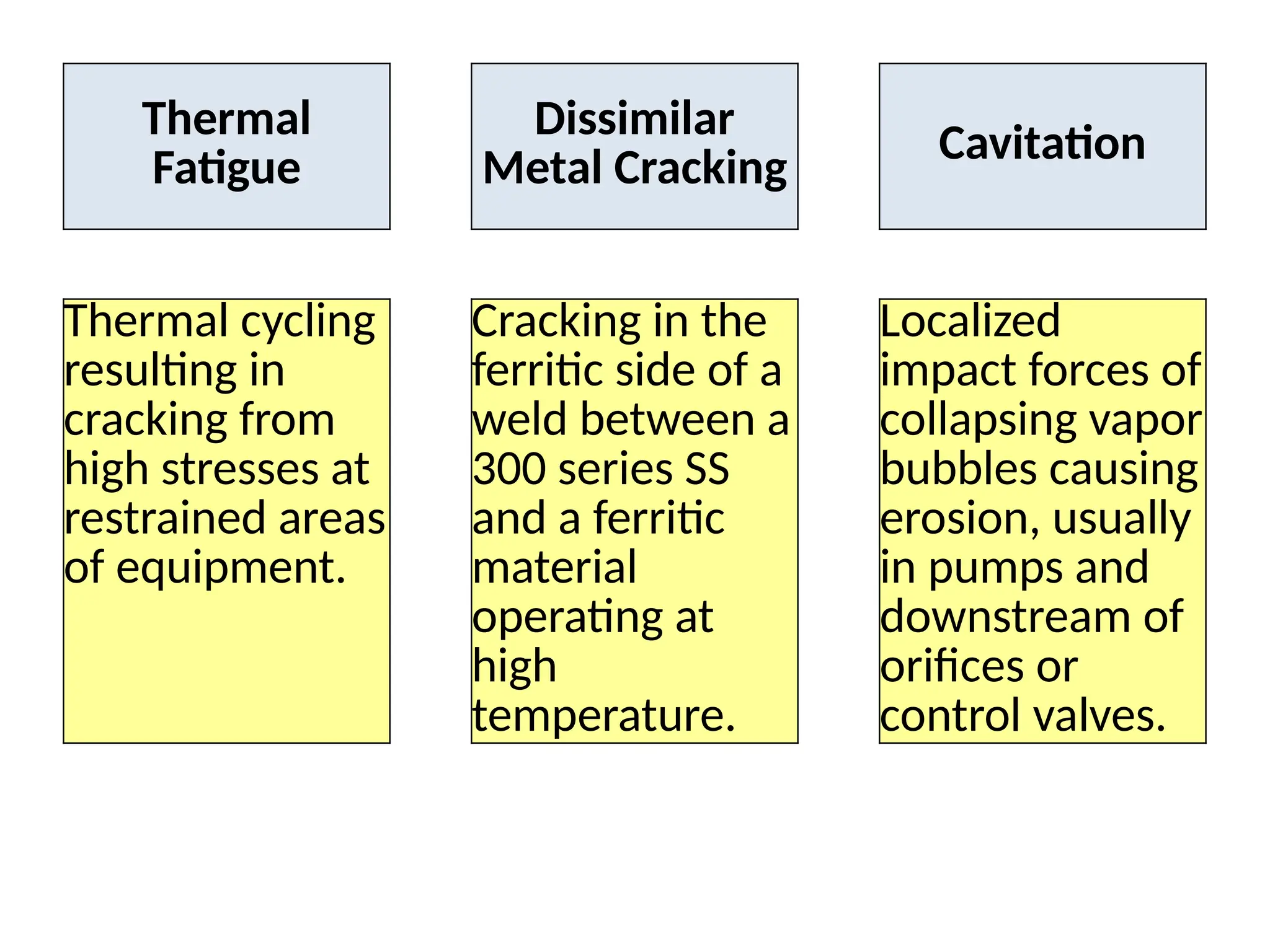
Thermal
Fatigue
Dissimilar
Metal Cracking
Cavitation
Thermal cycling
resulting in
cracking from
high stresses at
restrained areas
of equipment.
Cracking in the
ferritic side of a
weld between a
300 series SS
and a ferritic
material
operating at
high
temperature.
Localized
impact forces of
collapsing vapor
bubbles causing
erosion, usually
in pumps and
downstream of
orifices or
control valves.
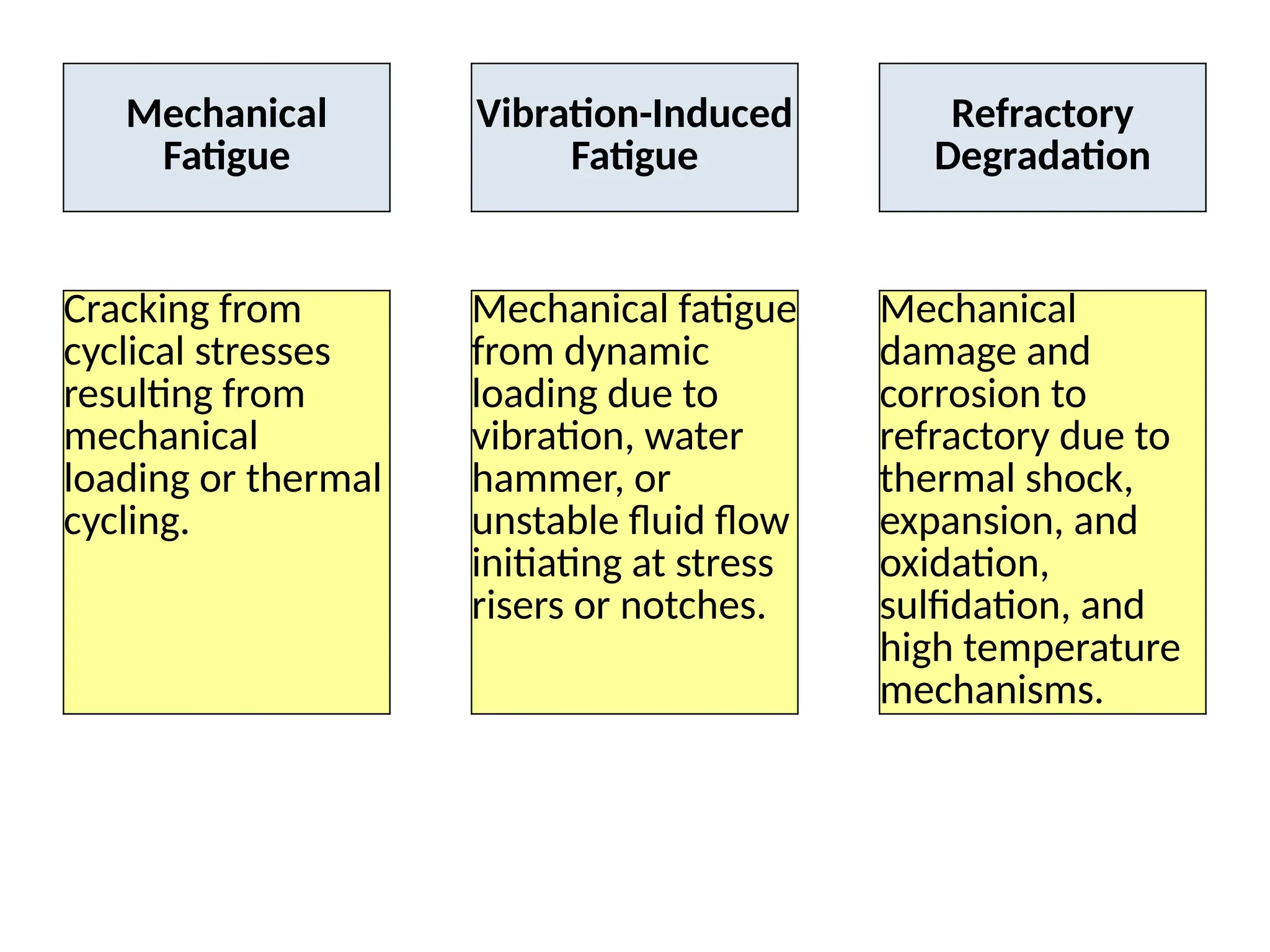
Mechanical
Fatigue
Vibration-Induced
Fatigue
Refractory
Degradation
Cracking from
cyclical stresses
resulting from
mechanical
loading or thermal
cycling.
Mechanical fatigue
from dynamic
loading due to
vibration, water
hammer, or
unstable fluid flow
initiating at stress
risers or notches.
Mechanical
damage and
corrosion to
refractory due to
thermal shock,
expansion, and
oxidation,
sulfidation, and
high temperature
mechanisms.
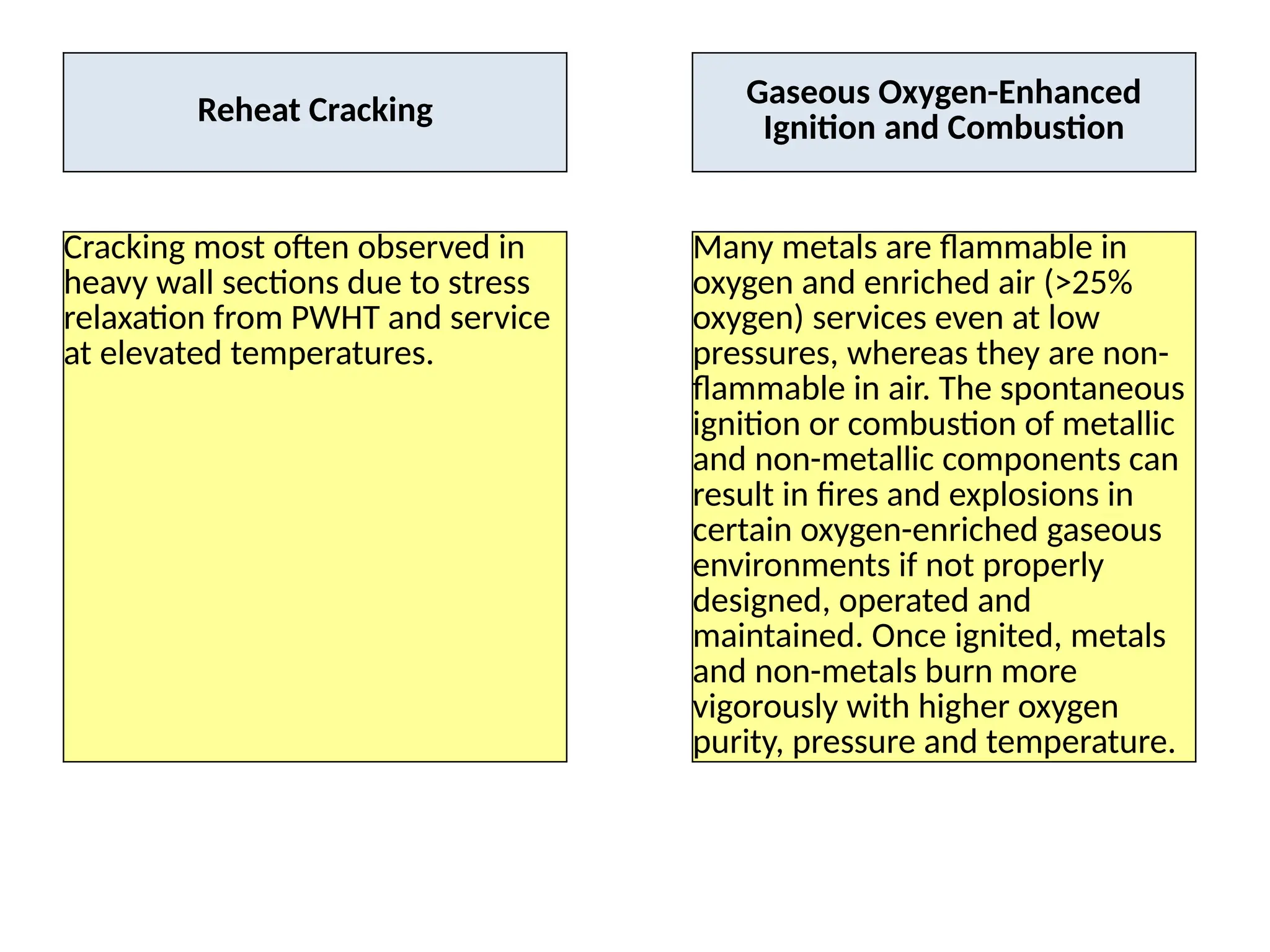
Reheat Cracking
Gaseous Oxygen-Enhanced
Ignition and Combustion
Cracking most often observed in
heavy wall sections due to stress
relaxation from PWHT and service
at elevated temperatures.
Many metals are flammable in
oxygen and enriched air (>25%
oxygen) services even at low
pressures, whereas they are non-
flammable in air. The spontaneous
ignition or combustion of metallic
and non-metallic components can
result in fires and explosions in
certain oxygen-enriched gaseous
environments if not properly
designed, operated and
maintained. Once ignited, metals
and non-metals burn more
vigorously with higher oxygen
purity, pressure and temperature.
API 571 Damage Mechanisms
UNIFORM OR
LOCALIZED LOSS OF
THICKNESS
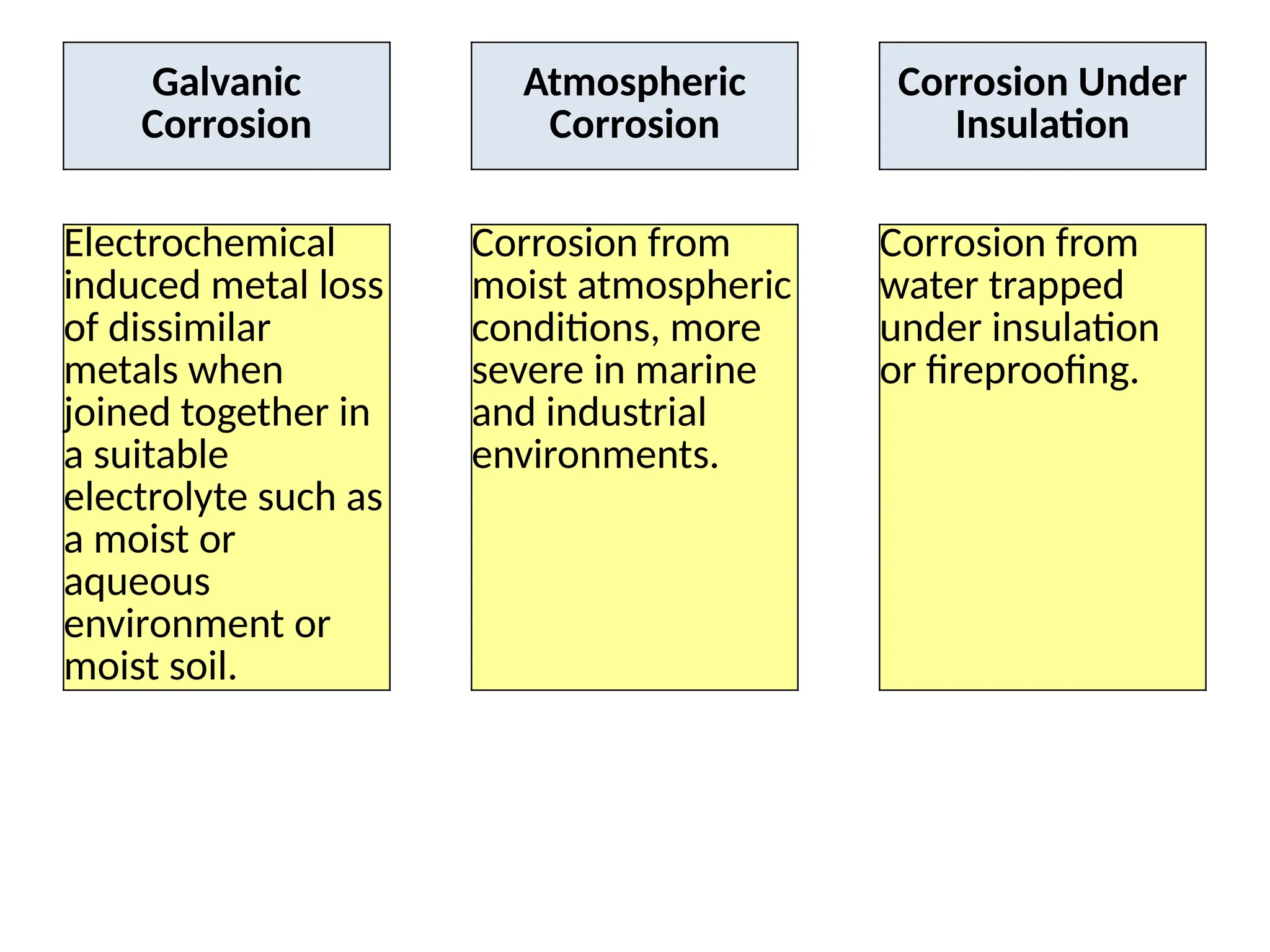
Galvanic
Corrosion
Atmospheric
Corrosion
Corrosion Under
Insulation
Electrochemical
induced metal loss
of dissimilar
metals when
joined together in
a suitable
electrolyte such as
a moist or
aqueous
environment or
moist soil.
Corrosion from
moist atmospheric
conditions, more
severe in marine
and industrial
environments.
Corrosion from
water trapped
under insulation
or fireproofing.
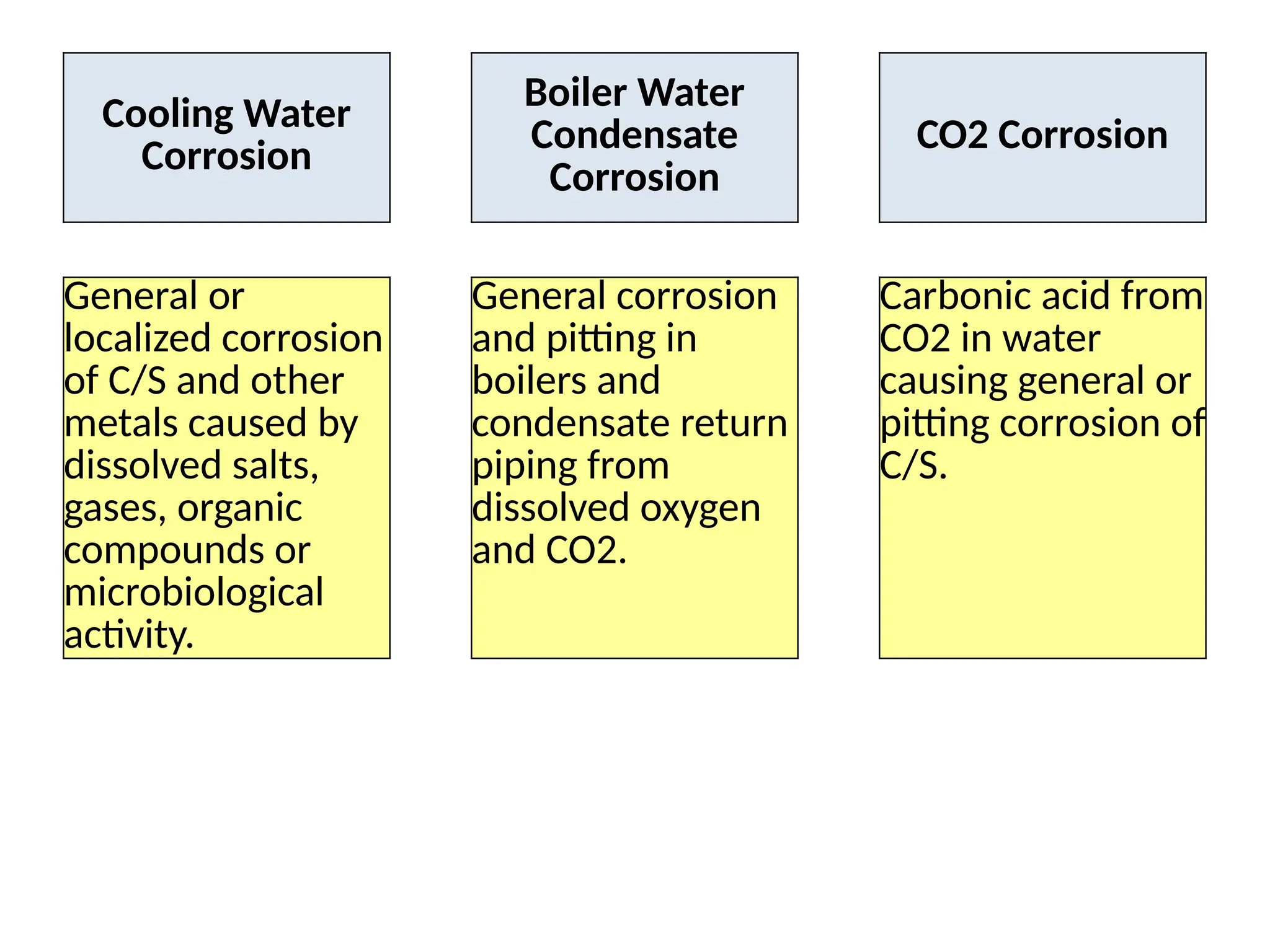
Cooling Water
Corrosion
Boiler Water
Condensate
Corrosion
CO2 Corrosion
General or
localized corrosion
of C/S and other
metals caused by
dissolved salts,
gases, organic
compounds or
microbiological
activity.
General corrosion
and pitting in
boilers and
condensate return
piping from
dissolved oxygen
and CO2.
Carbonic acid from
CO2 in water
causing general or
pitting corrosion of
C/S.
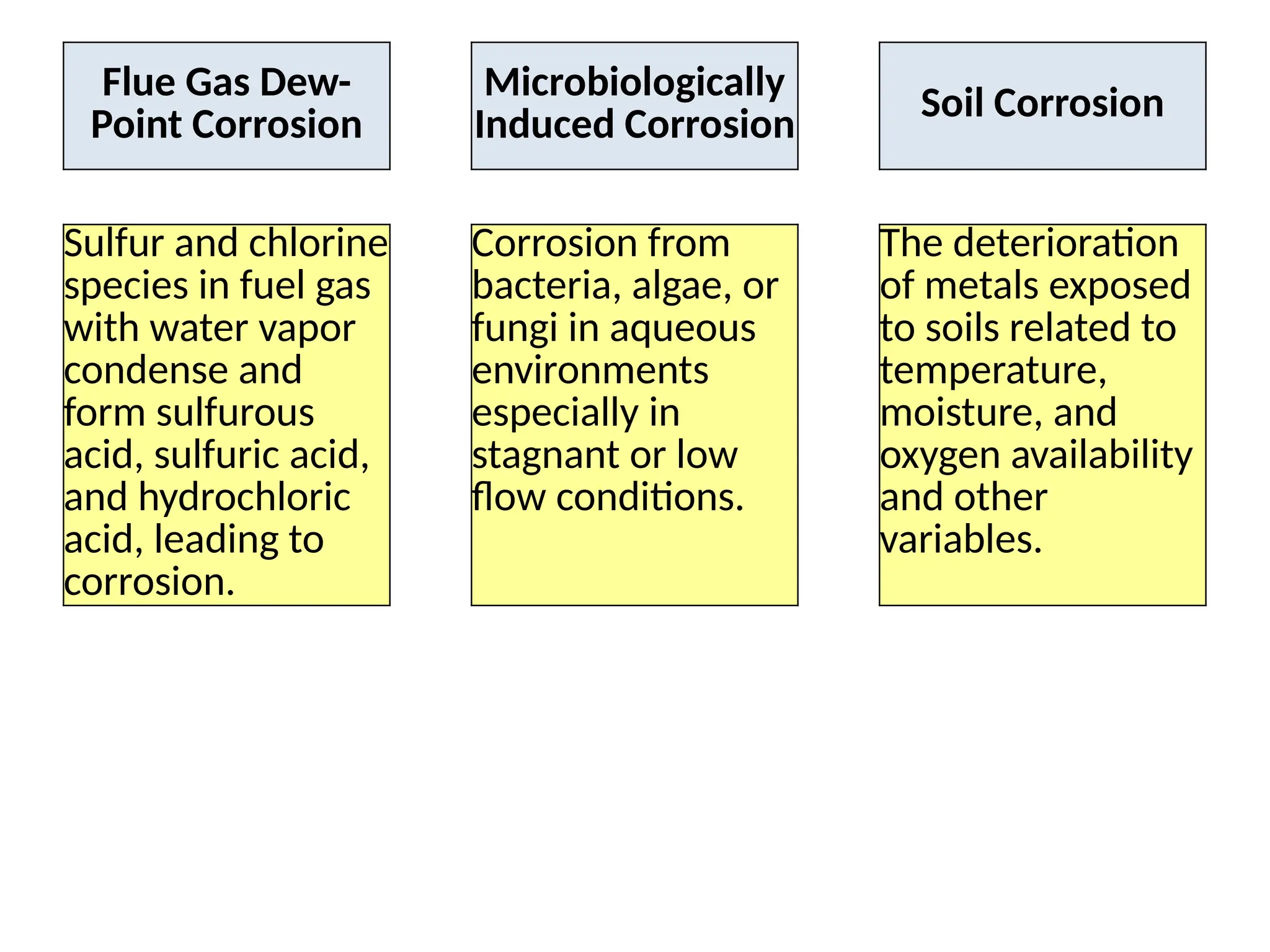
Flue Gas Dew-
Point Corrosion
Microbiologically
Induced Corrosion
Soil Corrosion
Sulfur and chlorine
species in fuel gas
with water vapor
condense and
form sulfurous
acid, sulfuric acid,
and hydrochloric
acid, leading to
corrosion.
Corrosion from
bacteria, algae, or
fungi in aqueous
environments
especially in
stagnant or low
flow conditions.
The deterioration
of metals exposed
to soils related to
temperature,
moisture, and
oxygen availability
and other
variables.
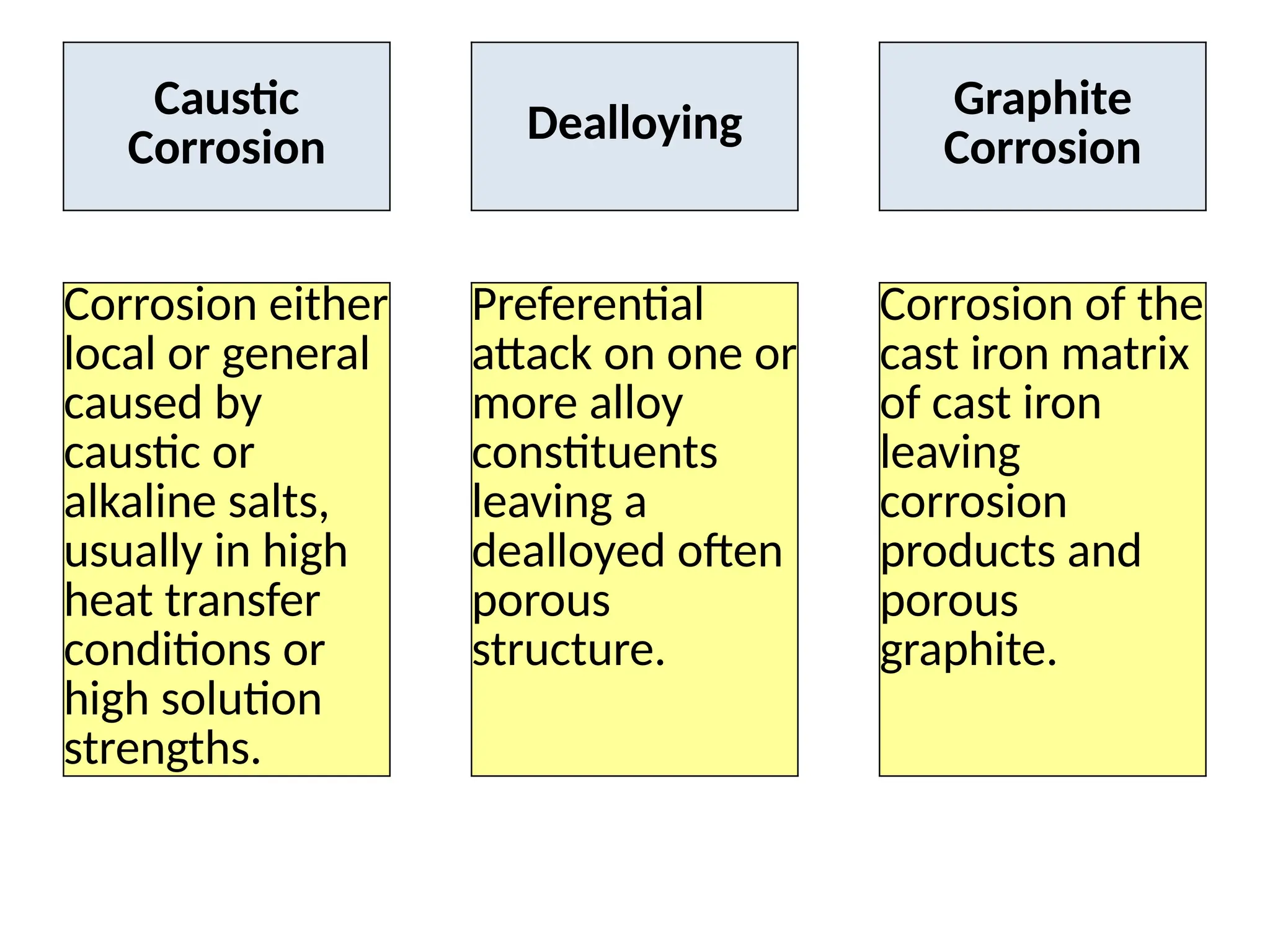
Caustic
Corrosion Dealloying Graphite
Corrosion
Corrosion either
local or general
caused by
caustic or
alkaline salts,
usually in high
heat transfer
conditions or
high solution
strengths.
Preferential
attack on one or
more alloy
constituents
leaving a
dealloyed often
porous
structure.
Corrosion of the
cast iron matrix
of cast iron
leaving
corrosion
products and
porous
graphite.
HIGH TEMPERATURE
CORROSION 200°C (400°F)
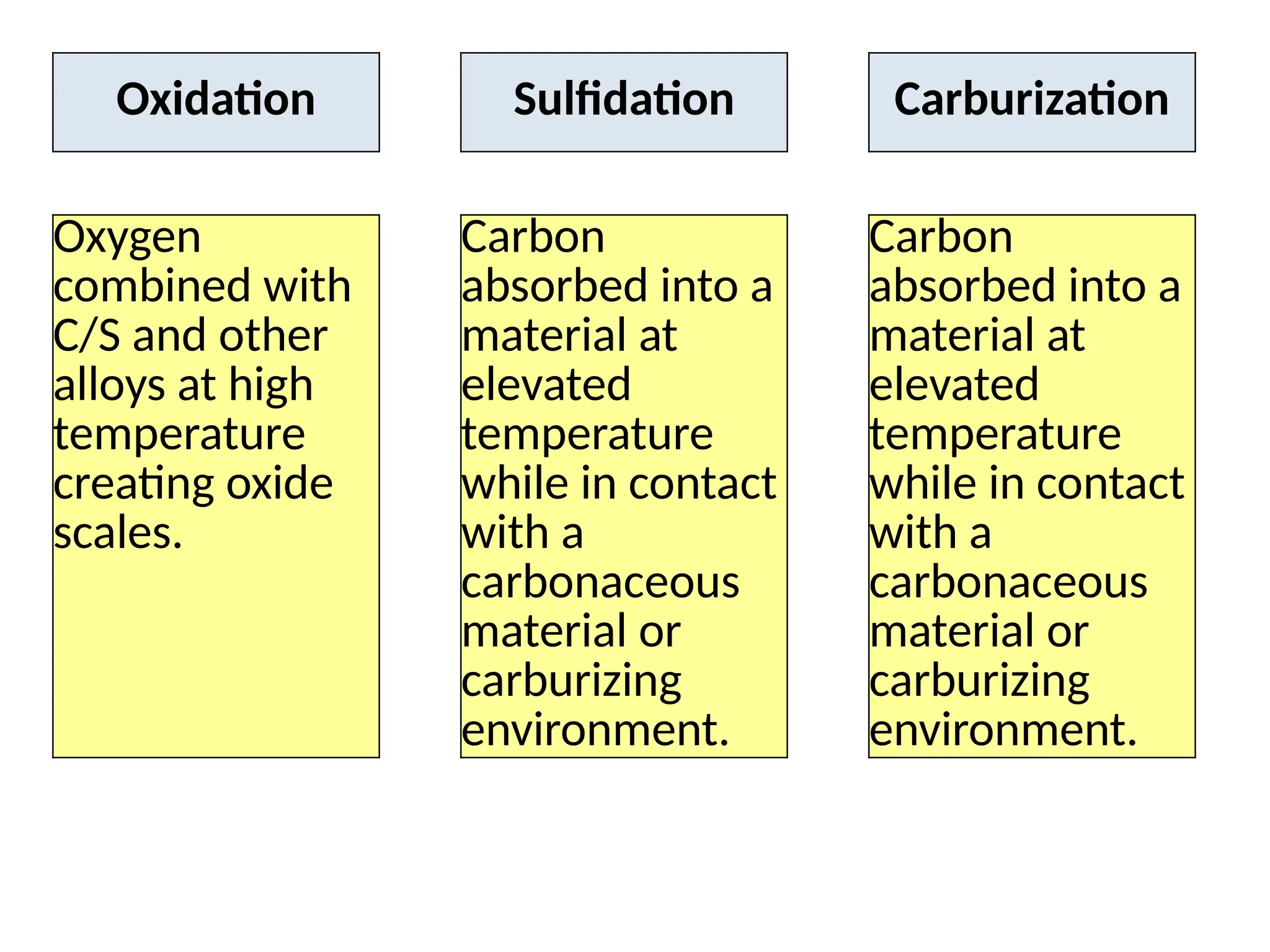
Oxidation Sulfidation Carburization
Oxygen
combined with
C/S and other
alloys at high
temperature
creating oxide
scales.
Carbon
absorbed into a
material at
elevated
temperature
while in contact
with a
carbonaceous
material or
carburizing
environment.
Carbon
absorbed into a
material at
elevated
temperature
while in contact
with a
carbonaceous
material or
carburizing
environment.
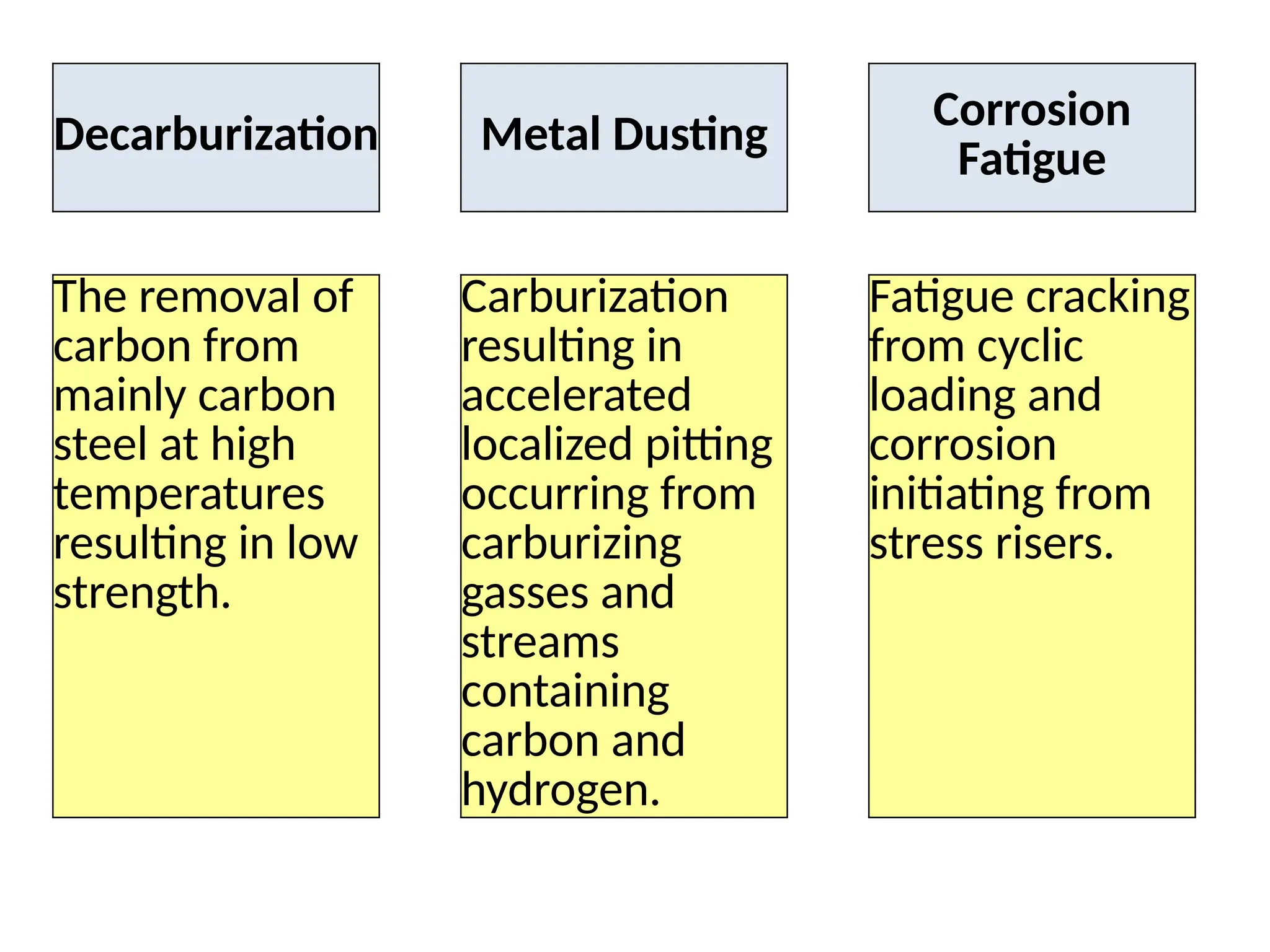
Decarburization Metal Dusting Corrosion
Fatigue
The removal of
carbon from
mainly carbon
steel at high
temperatures
resulting in low
strength.
Carburization
resulting in
accelerated
localized pitting
occurring from
carburizing
gasses and
streams
containing
carbon and
hydrogen.
Fatigue cracking
from cyclic
loading and
corrosion
initiating from
stress risers.
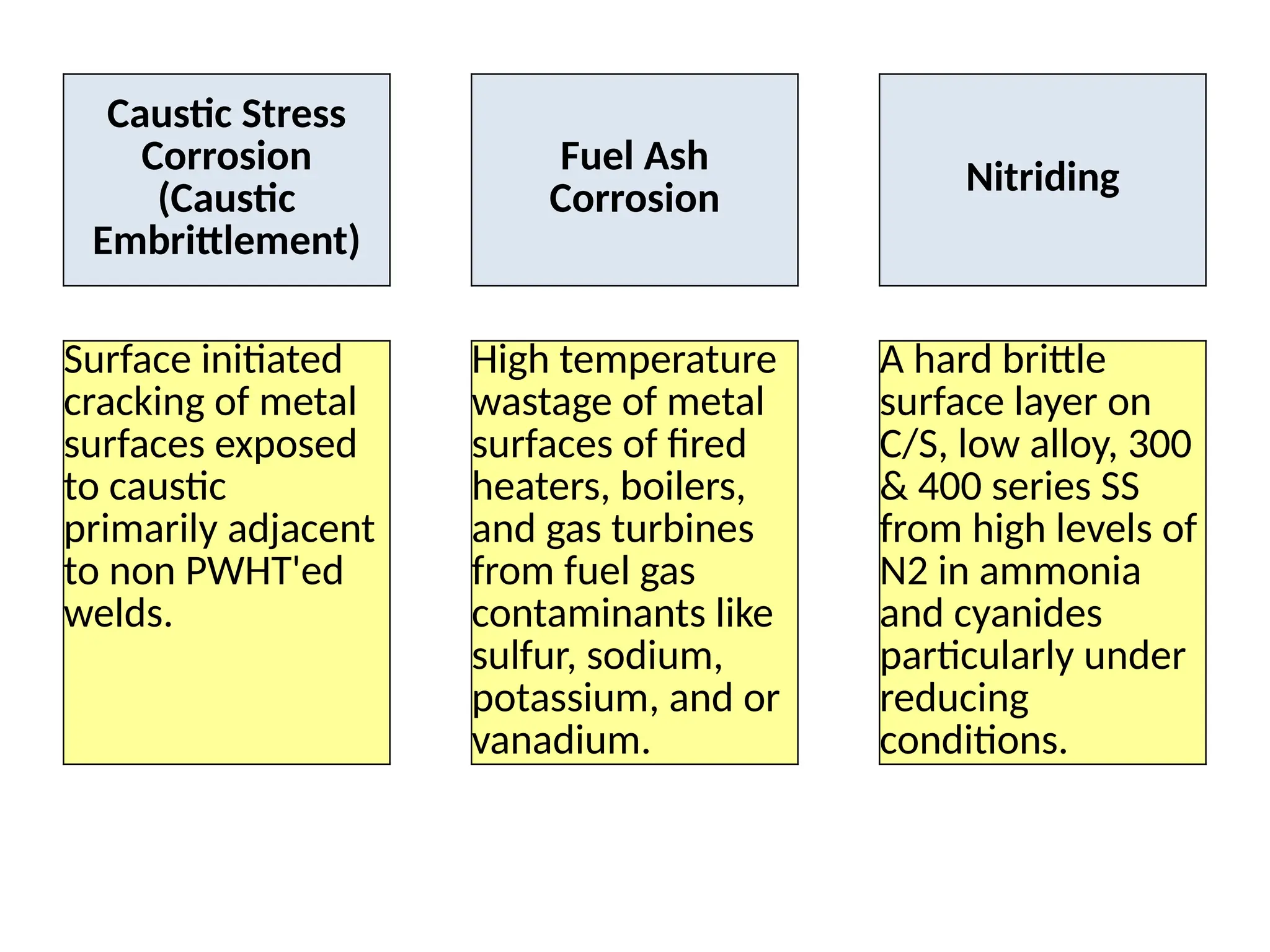
Caustic Stress
Corrosion
(Caustic
Embrittlement)
Fuel Ash
Corrosion Nitriding
Surface initiated
cracking of metal
surfaces exposed
to caustic
primarily adjacent
to non PWHT'ed
welds.
High temperature
wastage of metal
surfaces of fired
heaters, boilers,
and gas turbines
from fuel gas
contaminants like
sulfur, sodium,
potassium, and or
vanadium.
A hard brittle
surface layer on
C/S, low alloy, 300
& 400 series SS
from high levels of
N2 in ammonia
and cyanides
particularly under
reducing
conditions.
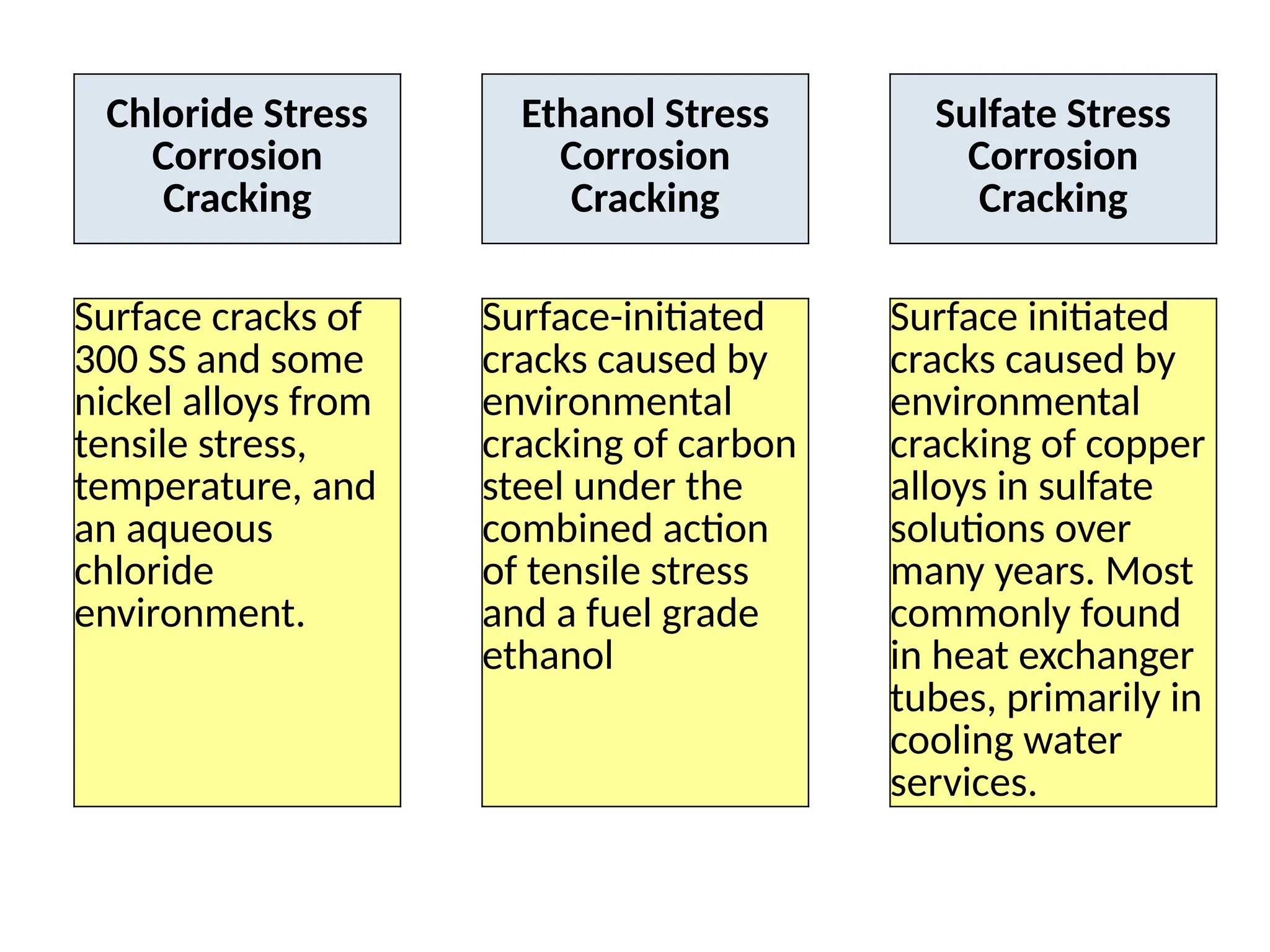
Chloride Stress
Corrosion
Cracking
Ethanol Stress
Corrosion
Cracking
Sulfate Stress
Corrosion
Cracking
Surface cracks of
300 SS and some
nickel alloys from
tensile stress,
temperature, and
an aqueous
chloride
environment.
Surface-initiated
cracks caused by
environmental
cracking of carbon
steel under the
combined action
of tensile stress
and a fuel grade
ethanol
Surface initiated
cracks caused by
environmental
cracking of copper
alloys in sulfate
solutions over
many years. Most
commonly found
in heat exchanger
tubes, primarily in
cooling water
services.
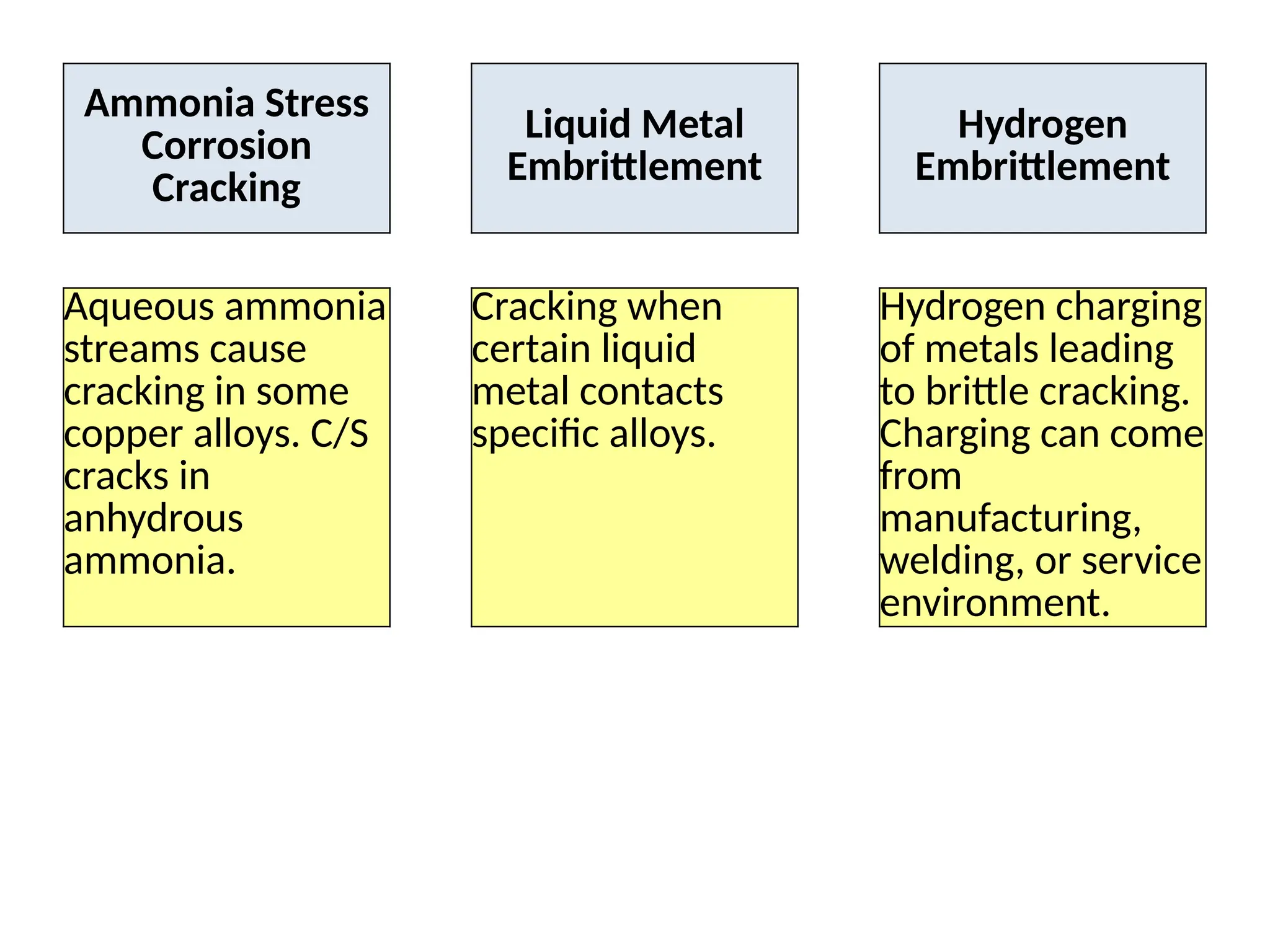
Ammonia Stress
Corrosion
Cracking
Liquid Metal
Embrittlement
Hydrogen
Embrittlement
Aqueous ammonia
streams cause
cracking in some
copper alloys. C/S
cracks in
anhydrous
ammonia.
Cracking when
certain liquid
metal contacts
specific alloys.
Hydrogen charging
of metals leading
to brittle cracking.
Charging can come
from
manufacturing,
welding, or service
environment.
REFINING INDUSTRY UNIFORM
OR LOCALIZED LOSS ON
THICKNESS PHENOMENA
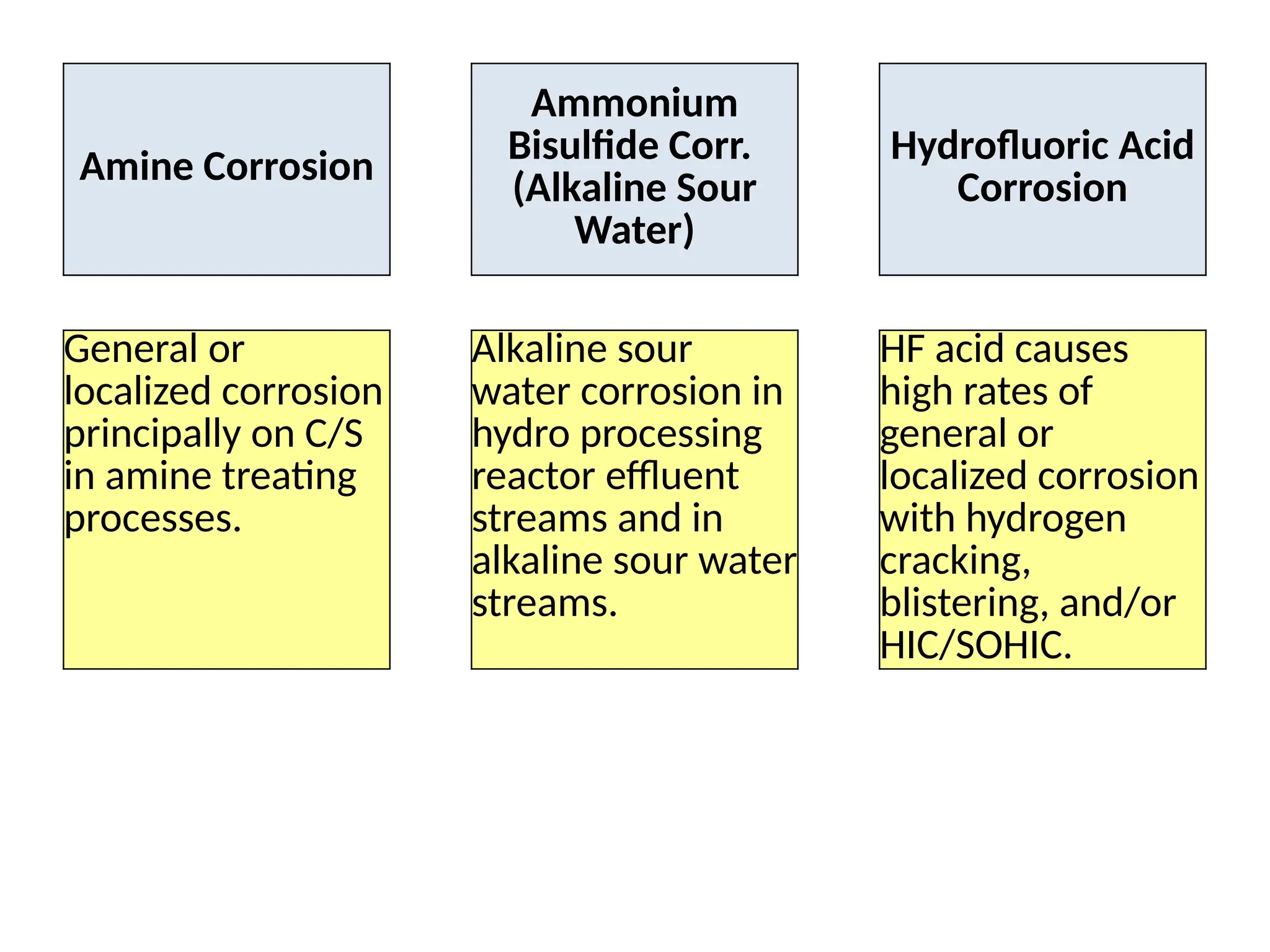
Amine Corrosion
Ammonium
Bisulfide Corr.
(Alkaline Sour
Water)
Hydrofluoric Acid
Corrosion
General or
localized corrosion
principally on C/S
in amine treating
processes.
Alkaline sour
water corrosion in
hydro processing
reactor effluent
streams and in
alkaline sour water
streams.
HF acid causes
high rates of
general or
localized corrosion
with hydrogen
cracking,
blistering, and/or
HIC/SOHIC.
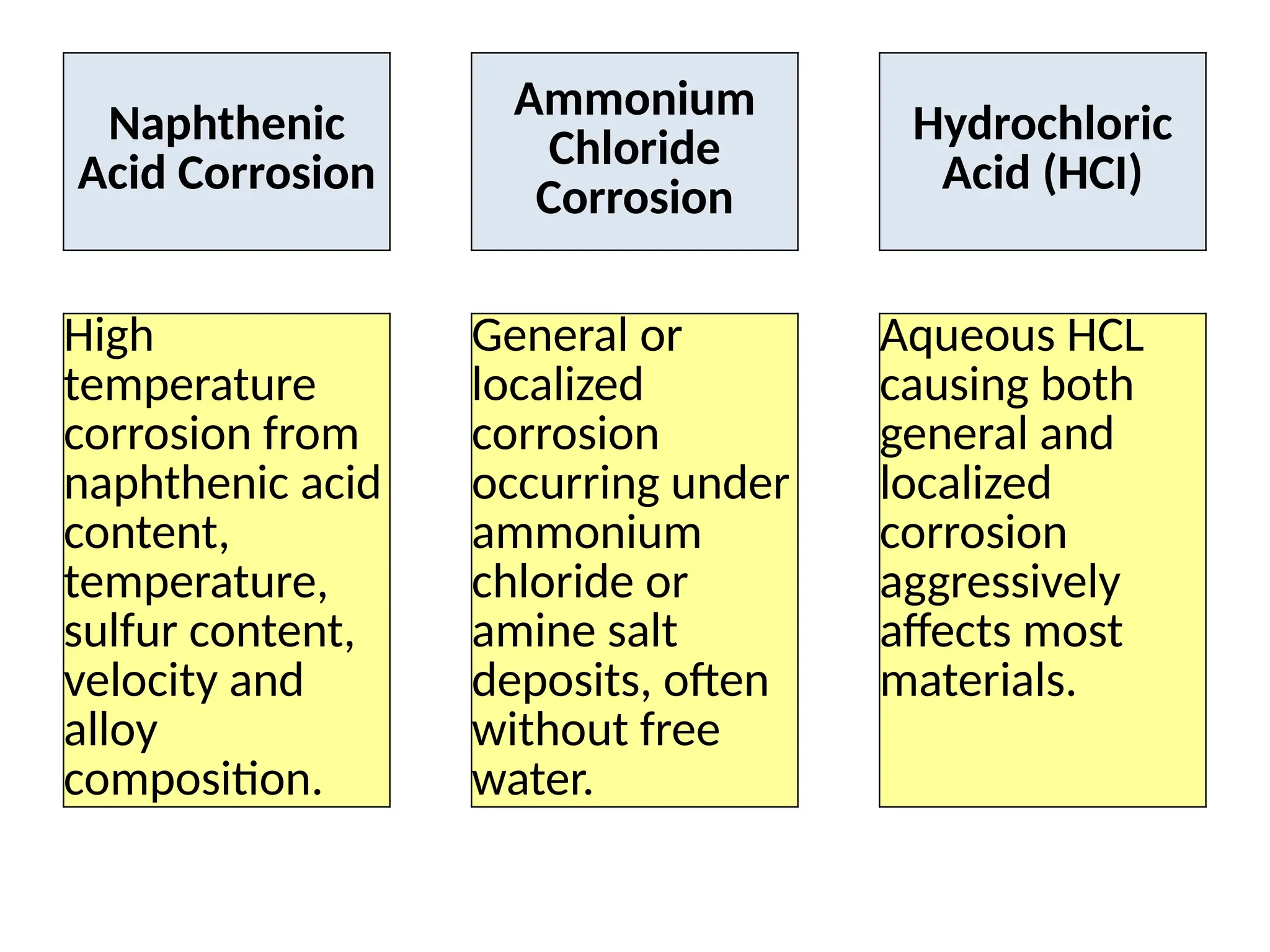
Naphthenic
Acid Corrosion
Ammonium
Chloride
Corrosion
Hydrochloric
Acid (HCI)
High
temperature
corrosion from
naphthenic acid
content,
temperature,
sulfur content,
velocity and
alloy
composition.
General or
localized
corrosion
occurring under
ammonium
chloride or
amine salt
deposits, often
without free
water.
Aqueous HCL
causing both
general and
localized
corrosion
aggressively
affects most
materials.
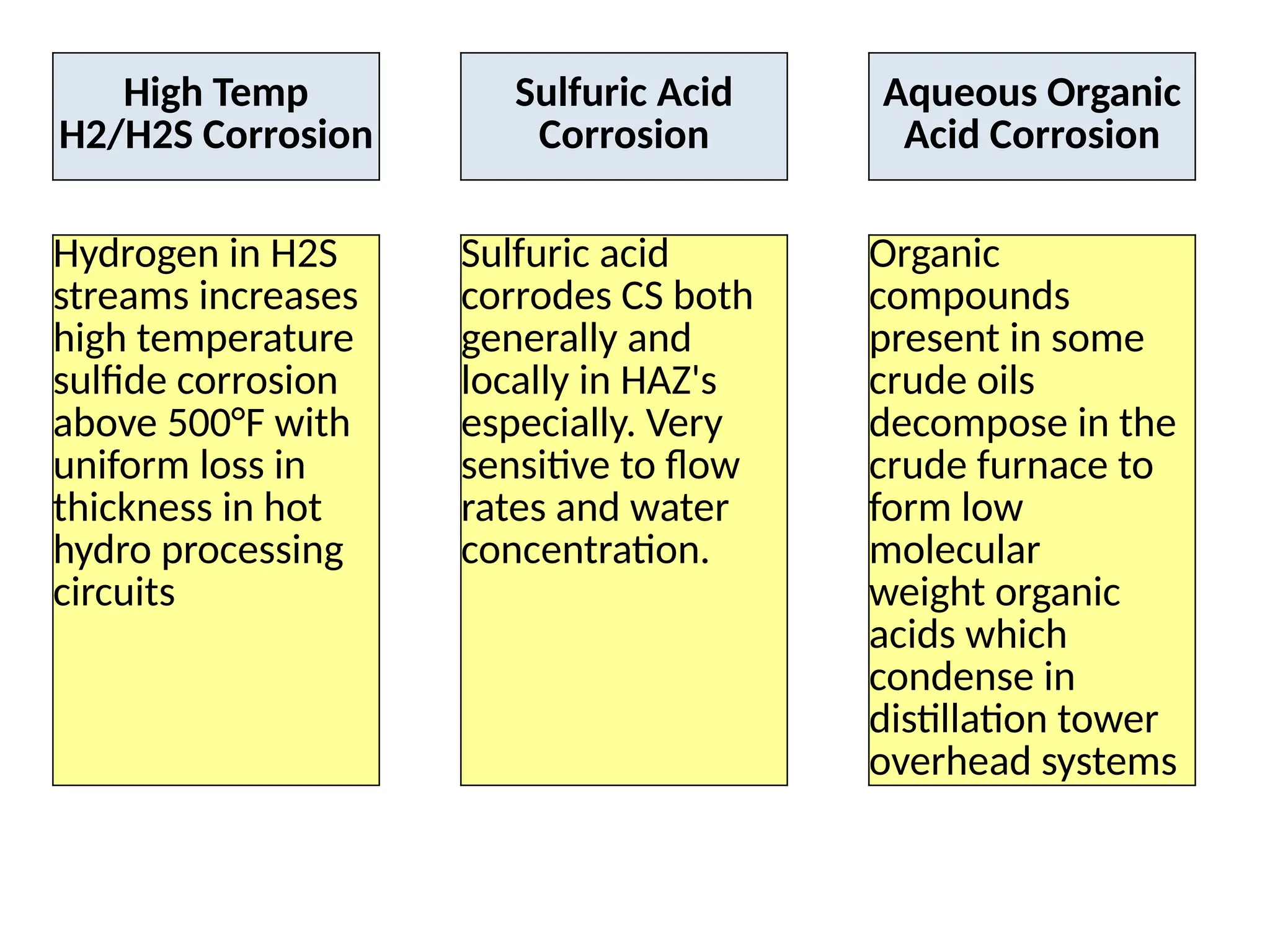
High Temp
H2/H2S Corrosion
Sulfuric Acid
Corrosion
Aqueous Organic
Acid Corrosion
Hydrogen in H2S
streams increases
high temperature
sulfide corrosion
above 500°F with
uniform loss in
thickness in hot
hydro processing
circuits
Sulfuric acid
corrodes CS both
generally and
locally in HAZ's
especially. Very
sensitive to flow
rates and water
concentration.
Organic
compounds
present in some
crude oils
decompose in the
crude furnace to
form low
molecular
weight organic
acids which
condense in
distillation tower
overhead systems
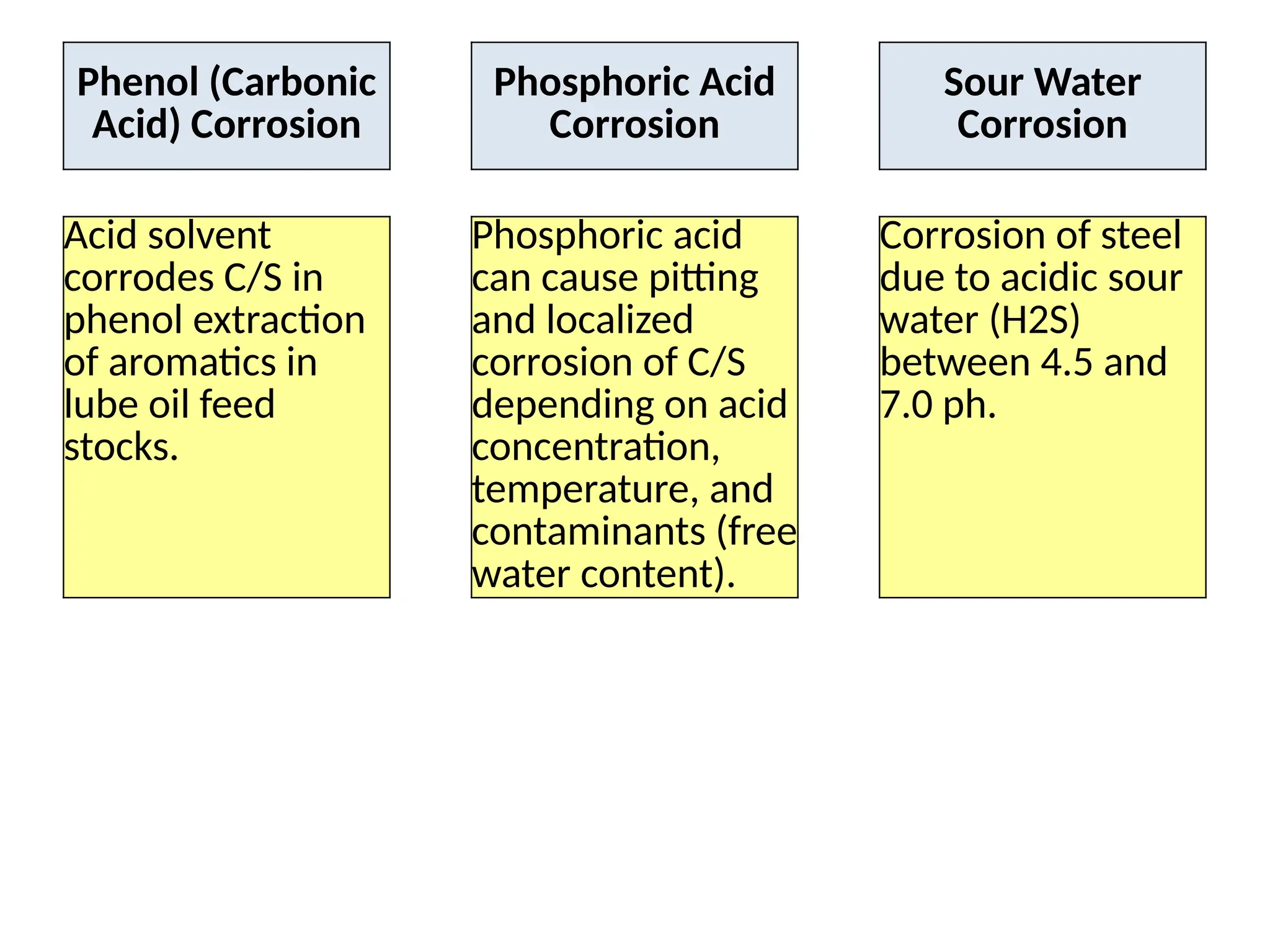
Phenol (Carbonic
Acid) Corrosion
Phosphoric Acid
Corrosion
Sour Water
Corrosion
Acid solvent
corrodes C/S in
phenol extraction
of aromatics in
lube oil feed
stocks.
Phosphoric acid
can cause pitting
and localized
corrosion of C/S
depending on acid
concentration,
temperature, and
contaminants (free
water content).
Corrosion of steel
due to acidic sour
water (H2S)
between 4.5 and
7.0 ph.
Environment-Assisted Cracking
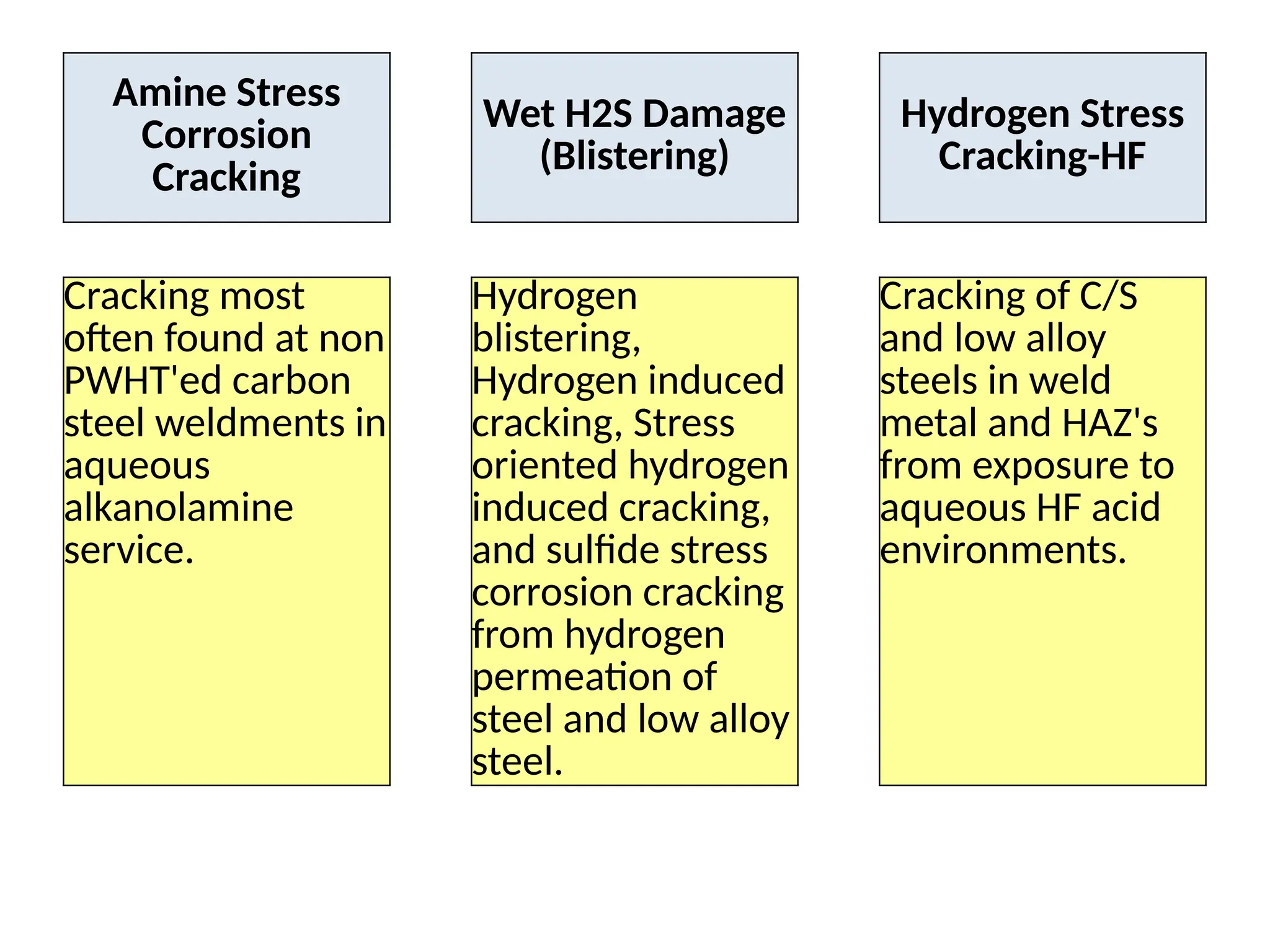
Amine Stress
Corrosion
Cracking
Wet H2S Damage
(Blistering)
Hydrogen Stress
Cracking-HF
Cracking most
often found at non
PWHT'ed carbon
steel weldments in
aqueous
alkanolamine
service.
Hydrogen
blistering,
Hydrogen induced
cracking, Stress
oriented hydrogen
induced cracking,
and sulfide stress
corrosion cracking
from hydrogen
permeation of
steel and low alloy
steel.
Cracking of C/S
and low alloy
steels in weld
metal and HAZ's
from exposure to
aqueous HF acid
environments.
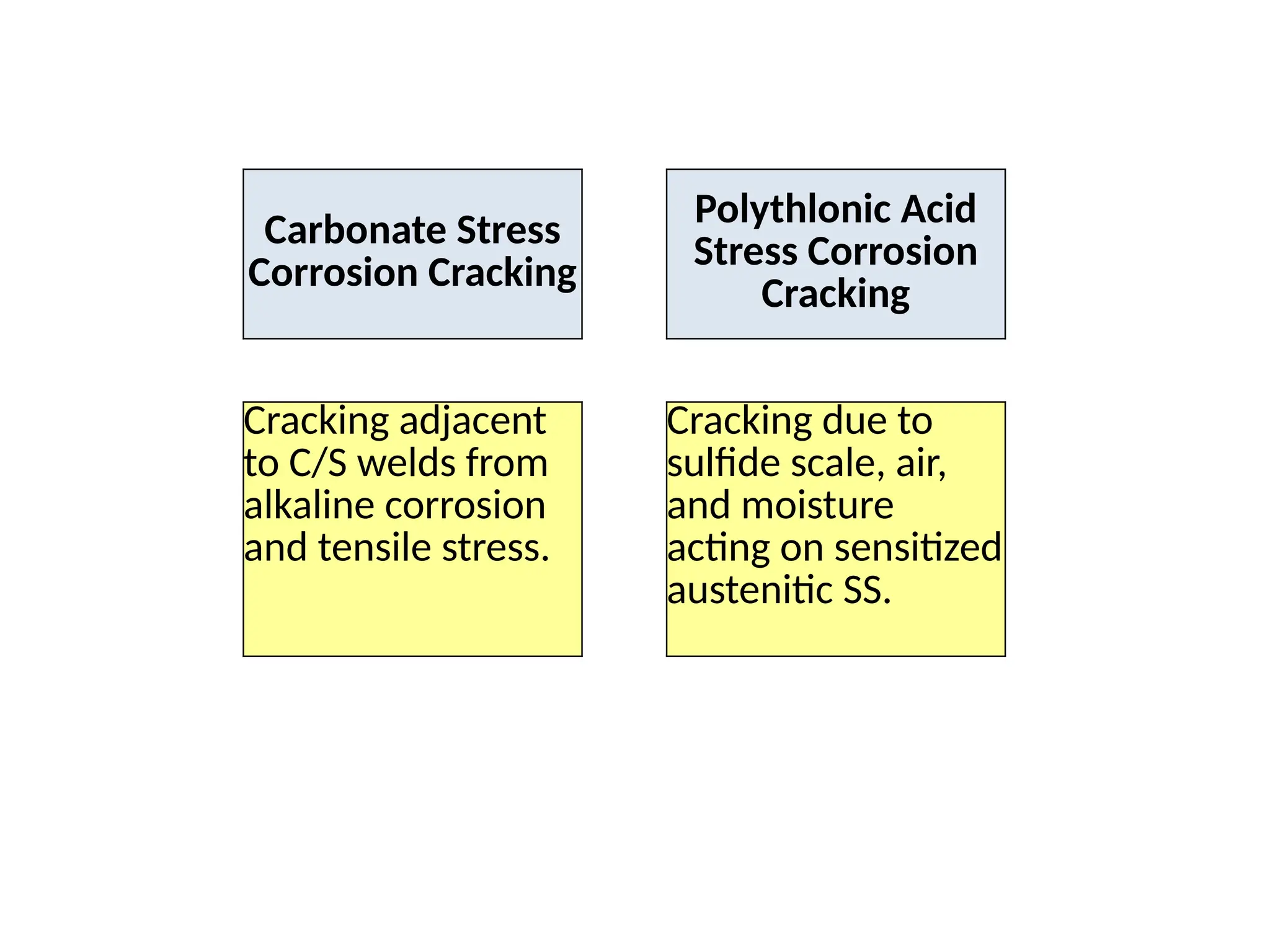
Carbonate Stress
Corrosion Cracking
Polythlonic Acid
Stress Corrosion
Cracking
Cracking adjacent
to C/S welds from
alkaline corrosion
and tensile stress.
Cracking due to
sulfide scale, air,
and moisture
acting on sensitized
austenitic SS.
Other Damage Mechanisms
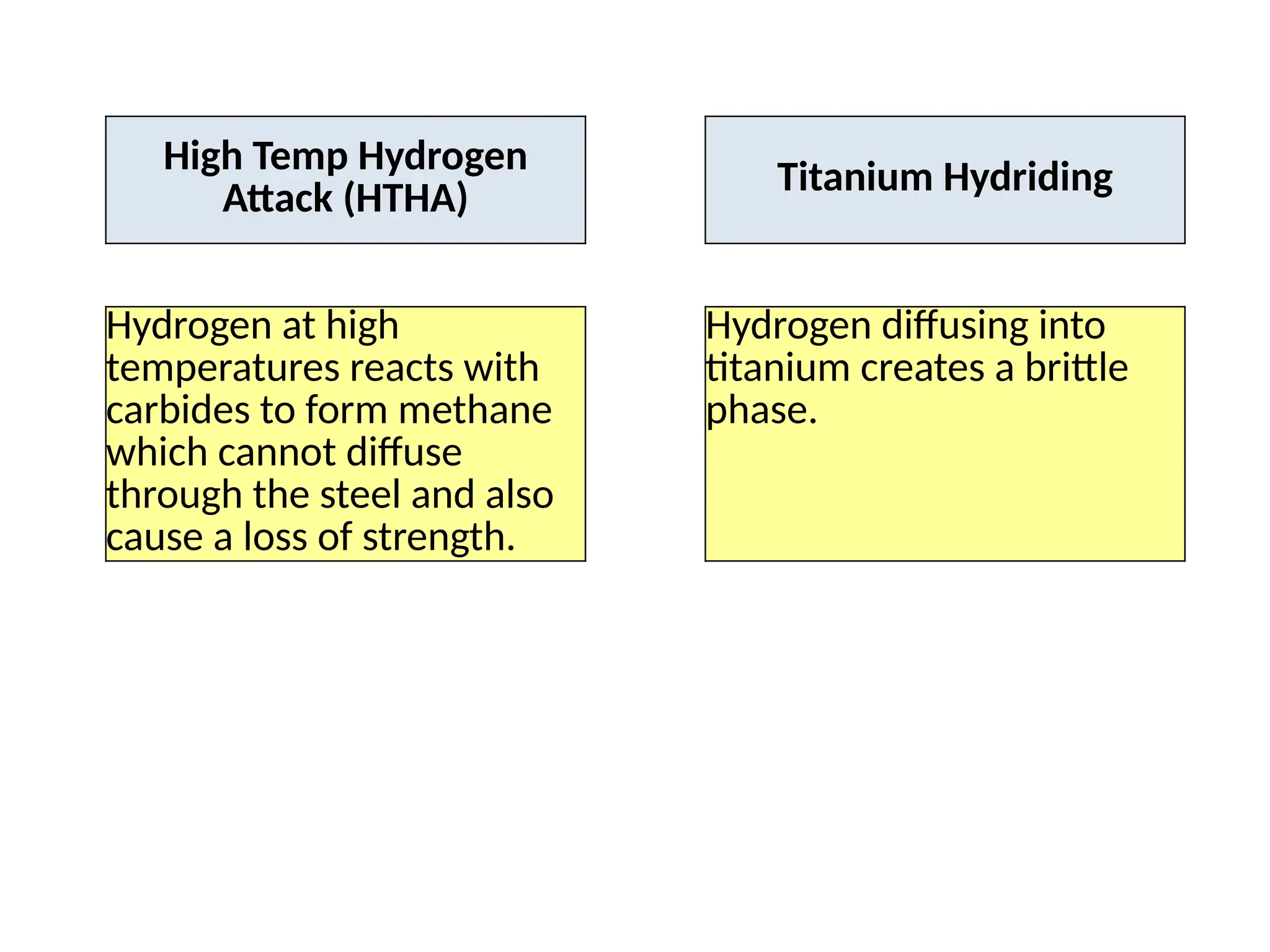
High Temp Hydrogen
Attack (HTHA) Titanium Hydriding
Hydrogen at high
temperatures reacts with
carbides to form methane
which cannot diffuse
through the steel and also
cause a loss of strength.
Hydrogen diffusing into
titanium creates a brittle
phase.

API 571 Damage Mechanisms general mechanical and metallurgical failure

  • 1.
    API 571 DamageMechanisms GENERAL MECHANICAL AND METALLUGICAL FAILURE MECHANISMS
  • 2.
    Graphitization Strain AgingBrittle Fracture A change in the carbide phase of C/S and 0.5 Mo steels after long term exposure to 800° F (427° C) to 1100°F (593° C) temperatures causing decomposition into graphite nodules. The deformation and aging at an intermediate temperature of older C/S and C-0- 5 Mo low alloy steels. Rapid fracture under stress with little evidence of plastic deformation.
  • 3.
    Short Term Overheating ThermalShock Softening (Spheroidization) Localized overheating causing deformation and/or rupture at low stress levels. Occurs when high and non-uniform thermal stresses develop over a short period of time. If restrained, stresses above the yield strength can occur. A change in the microstructure of steels where the carbide phase change from normal plate like forms to spheroidal in the temperature range of 850°F (454°C) to 1400°F (760°C)
  • 4.
    885 Embrittlement Creep/ Stress Rupture SteamBlanketing A loss of toughness in alloys containing a ferrite phase (400 series SS, duplex SS, wrought and cast SS, welds & overlay) due to exposure to 600°F(316°C) to 1000°F(538°C). At high temperatures metals deform under load below the yield stress. A steam blanket inside a tube caused by a "departure from nucleate boiling" that causes localized overheating and deformation and/or rupture.
  • 5.
    Erosion/ Erosion Corrosion Temper Embrittlement Sigma Phase Embrittlement Theaccelerated removal of material from impacts of solids, liquids or vapors. The erosion can be increased when corrosion removes protective films or scales. A reduction in toughness in low alloy steel due to long term exposure to 650°F(343°C) to 1100°F(593°C). Equipment may fail during startup or shutdown. Brittle phase in SS due to high temp exposure of 1000°F (538°C)to 1750°F(954°C). Increased likelihood due to higher ferrite, chromium, and molybdenum content.
  • 6.
    Thermal Fatigue Dissimilar Metal Cracking Cavitation Thermal cycling resultingin cracking from high stresses at restrained areas of equipment. Cracking in the ferritic side of a weld between a 300 series SS and a ferritic material operating at high temperature. Localized impact forces of collapsing vapor bubbles causing erosion, usually in pumps and downstream of orifices or control valves.
  • 7.
    Mechanical Fatigue Vibration-Induced Fatigue Refractory Degradation Cracking from cyclical stresses resultingfrom mechanical loading or thermal cycling. Mechanical fatigue from dynamic loading due to vibration, water hammer, or unstable fluid flow initiating at stress risers or notches. Mechanical damage and corrosion to refractory due to thermal shock, expansion, and oxidation, sulfidation, and high temperature mechanisms.
  • 8.
    Reheat Cracking Gaseous Oxygen-Enhanced Ignitionand Combustion Cracking most often observed in heavy wall sections due to stress relaxation from PWHT and service at elevated temperatures. Many metals are flammable in oxygen and enriched air (>25% oxygen) services even at low pressures, whereas they are non- flammable in air. The spontaneous ignition or combustion of metallic and non-metallic components can result in fires and explosions in certain oxygen-enriched gaseous environments if not properly designed, operated and maintained. Once ignited, metals and non-metals burn more vigorously with higher oxygen purity, pressure and temperature.
  • 9.
    API 571 DamageMechanisms UNIFORM OR LOCALIZED LOSS OF THICKNESS
  • 10.
    Galvanic Corrosion Atmospheric Corrosion Corrosion Under Insulation Electrochemical induced metalloss of dissimilar metals when joined together in a suitable electrolyte such as a moist or aqueous environment or moist soil. Corrosion from moist atmospheric conditions, more severe in marine and industrial environments. Corrosion from water trapped under insulation or fireproofing.
  • 11.
    Cooling Water Corrosion Boiler Water Condensate Corrosion CO2Corrosion General or localized corrosion of C/S and other metals caused by dissolved salts, gases, organic compounds or microbiological activity. General corrosion and pitting in boilers and condensate return piping from dissolved oxygen and CO2. Carbonic acid from CO2 in water causing general or pitting corrosion of C/S.
  • 12.
    Flue Gas Dew- PointCorrosion Microbiologically Induced Corrosion Soil Corrosion Sulfur and chlorine species in fuel gas with water vapor condense and form sulfurous acid, sulfuric acid, and hydrochloric acid, leading to corrosion. Corrosion from bacteria, algae, or fungi in aqueous environments especially in stagnant or low flow conditions. The deterioration of metals exposed to soils related to temperature, moisture, and oxygen availability and other variables.
  • 13.
    Caustic Corrosion Dealloying Graphite Corrosion Corrosioneither local or general caused by caustic or alkaline salts, usually in high heat transfer conditions or high solution strengths. Preferential attack on one or more alloy constituents leaving a dealloyed often porous structure. Corrosion of the cast iron matrix of cast iron leaving corrosion products and porous graphite.
  • 14.
  • 15.
    Oxidation Sulfidation Carburization Oxygen combinedwith C/S and other alloys at high temperature creating oxide scales. Carbon absorbed into a material at elevated temperature while in contact with a carbonaceous material or carburizing environment. Carbon absorbed into a material at elevated temperature while in contact with a carbonaceous material or carburizing environment.
  • 16.
    Decarburization Metal DustingCorrosion Fatigue The removal of carbon from mainly carbon steel at high temperatures resulting in low strength. Carburization resulting in accelerated localized pitting occurring from carburizing gasses and streams containing carbon and hydrogen. Fatigue cracking from cyclic loading and corrosion initiating from stress risers.
  • 17.
    Caustic Stress Corrosion (Caustic Embrittlement) Fuel Ash CorrosionNitriding Surface initiated cracking of metal surfaces exposed to caustic primarily adjacent to non PWHT'ed welds. High temperature wastage of metal surfaces of fired heaters, boilers, and gas turbines from fuel gas contaminants like sulfur, sodium, potassium, and or vanadium. A hard brittle surface layer on C/S, low alloy, 300 & 400 series SS from high levels of N2 in ammonia and cyanides particularly under reducing conditions.
  • 18.
    Chloride Stress Corrosion Cracking Ethanol Stress Corrosion Cracking SulfateStress Corrosion Cracking Surface cracks of 300 SS and some nickel alloys from tensile stress, temperature, and an aqueous chloride environment. Surface-initiated cracks caused by environmental cracking of carbon steel under the combined action of tensile stress and a fuel grade ethanol Surface initiated cracks caused by environmental cracking of copper alloys in sulfate solutions over many years. Most commonly found in heat exchanger tubes, primarily in cooling water services.
  • 19.
    Ammonia Stress Corrosion Cracking Liquid Metal Embrittlement Hydrogen Embrittlement Aqueousammonia streams cause cracking in some copper alloys. C/S cracks in anhydrous ammonia. Cracking when certain liquid metal contacts specific alloys. Hydrogen charging of metals leading to brittle cracking. Charging can come from manufacturing, welding, or service environment.
  • 20.
    REFINING INDUSTRY UNIFORM ORLOCALIZED LOSS ON THICKNESS PHENOMENA
  • 21.
    Amine Corrosion Ammonium Bisulfide Corr. (AlkalineSour Water) Hydrofluoric Acid Corrosion General or localized corrosion principally on C/S in amine treating processes. Alkaline sour water corrosion in hydro processing reactor effluent streams and in alkaline sour water streams. HF acid causes high rates of general or localized corrosion with hydrogen cracking, blistering, and/or HIC/SOHIC.
  • 22.
    Naphthenic Acid Corrosion Ammonium Chloride Corrosion Hydrochloric Acid (HCI) High temperature corrosionfrom naphthenic acid content, temperature, sulfur content, velocity and alloy composition. General or localized corrosion occurring under ammonium chloride or amine salt deposits, often without free water. Aqueous HCL causing both general and localized corrosion aggressively affects most materials.
  • 23.
    High Temp H2/H2S Corrosion SulfuricAcid Corrosion Aqueous Organic Acid Corrosion Hydrogen in H2S streams increases high temperature sulfide corrosion above 500°F with uniform loss in thickness in hot hydro processing circuits Sulfuric acid corrodes CS both generally and locally in HAZ's especially. Very sensitive to flow rates and water concentration. Organic compounds present in some crude oils decompose in the crude furnace to form low molecular weight organic acids which condense in distillation tower overhead systems
  • 24.
    Phenol (Carbonic Acid) Corrosion PhosphoricAcid Corrosion Sour Water Corrosion Acid solvent corrodes C/S in phenol extraction of aromatics in lube oil feed stocks. Phosphoric acid can cause pitting and localized corrosion of C/S depending on acid concentration, temperature, and contaminants (free water content). Corrosion of steel due to acidic sour water (H2S) between 4.5 and 7.0 ph.
  • 25.
  • 26.
    Amine Stress Corrosion Cracking Wet H2SDamage (Blistering) Hydrogen Stress Cracking-HF Cracking most often found at non PWHT'ed carbon steel weldments in aqueous alkanolamine service. Hydrogen blistering, Hydrogen induced cracking, Stress oriented hydrogen induced cracking, and sulfide stress corrosion cracking from hydrogen permeation of steel and low alloy steel. Cracking of C/S and low alloy steels in weld metal and HAZ's from exposure to aqueous HF acid environments.
  • 27.
    Carbonate Stress Corrosion Cracking PolythlonicAcid Stress Corrosion Cracking Cracking adjacent to C/S welds from alkaline corrosion and tensile stress. Cracking due to sulfide scale, air, and moisture acting on sensitized austenitic SS.
  • 28.
  • 29.
    High Temp Hydrogen Attack(HTHA) Titanium Hydriding Hydrogen at high temperatures reacts with carbides to form methane which cannot diffuse through the steel and also cause a loss of strength. Hydrogen diffusing into titanium creates a brittle phase.