What Is Apache Singa AI ?
● It's a machine learning system
● Open source Apache 2.0 license
● It supports distributed processing
● It supports a wide range of hardware
● It scales well, for instance as it's GPU cluster grows
● By using computational graphs it optimizes
– Training speed / memory footprint
● It offers a simple software stack and Python interface
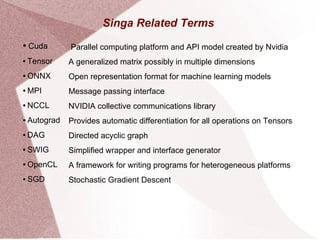
Singa Related Terms
● Cuda
● Tensor
● ONNX
● MPI
● NCCL
● Autograd
● DAG
● SWIG
● OpenCL
● SGD
Parallel computing platform and API model created by Nvidia
A generalized matrix possibly in multiple dimensions
Open representation format for machine learning models
Message passing interface
NVIDIA collective communications library
Provides automatic differentiation for all operations on Tensors
Directed acyclic graph
Simplified wrapper and interface generator
A framework for writing programs for heterogeneous platforms
Stochastic Gradient Descent
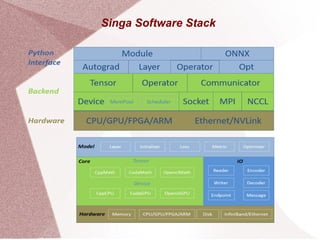
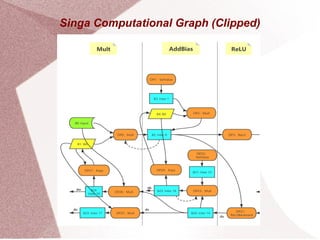
Singa Software Stack
● Divided into two levels
● Python interface provides
– Data structures
– Algorithms for machine learning models
● Backend
– Data structures for deep learning models
– Hardware abstractions for scheduling/executing operations
– Communication components for distributed training
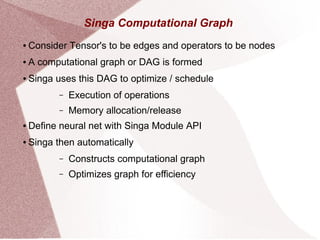
Singa Computational Graph (Clipped)
Singa Computational Graph
● Consider Tensor's to be edges and operators to be nodes
● A computational graph or DAG is formed
● Singa uses this DAG to optimize / schedule
– Execution of operations
– Memory allocation/release
● Define neural net with Singa Module API
● Singa then automatically
– Constructs computational graph
– Optimizes graph for efficiency
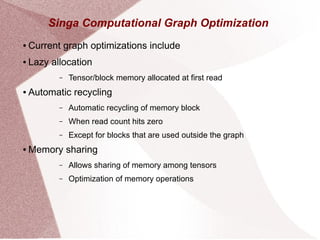
Singa Computational Graph Optimization
● Current graph optimizations include
● Lazy allocation
– Tensor/block memory allocated at first read
● Automatic recycling
– Automatic recycling of memory block
– When read count hits zero
– Except for blocks that are used outside the graph
● Memory sharing
– Allows sharing of memory among tensors
– Optimization of memory operations
Singa Device
● Device abstract represents a hardware device
– Has memory and computing units
– Schedules all tensor operations
● Singa has three Device implementations
– CudaGPU for a Nvidia GPU card - runs Cuda code
– CppCPU for a CPU - runs Cpp code
– OpenclGPU for a GPU card - runs OpenCL code
Singa Distributed Training
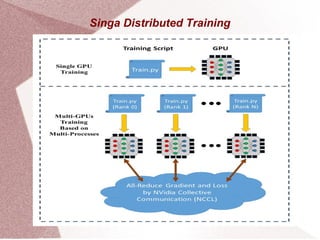
● Data parallel training across multiple GPUs
● Each process/worker runs GPU based training
● Each process has an individual communication rank
● Training data partitioned among the workers
● Model is replicated on every worker, In each iteration
– Workers read a mini-batch of data from its partition
– Run the BackPropagation algorithm to compute the gradients
– Which are averaged via all-reduce (provided by NCCL)
– For weight update following SGD algorithms
Singa Distributed Training – All Reduce
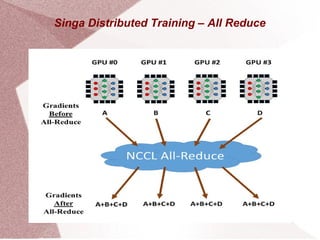
● NCCL all-reduce takes the training gradients from each GPU
● Averages all the ranked gradients to produce
● An averaged result which should match if
● All training carried out on a single GPU
● It should be noted that this type of distributed learning
– Scales well and reduces processing time
– But does not appear to be GPU failure tolerant
– Does not provide GPU anonymity
– i.e. We have to decide how many GPU's we use
– It is not a sub system like Mesos
– Distributing anonymous tasks to workers
Available Books
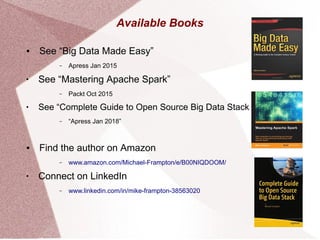
● See “Big Data Made Easy”
– Apress Jan 2015
●
See “Mastering Apache Spark”
– Packt Oct 2015
●
See “Complete Guide to Open Source Big Data Stack
– “Apress Jan 2018”
● Find the author on Amazon
– www.amazon.com/Michael-Frampton/e/B00NIQDOOM/
●
Connect on LinkedIn
– www.linkedin.com/in/mike-frampton-38563020
Connect
● Feel free to connect on LinkedIn
– www.linkedin.com/in/mike-frampton-38563020
● See my open source blog at
– open-source-systems.blogspot.com/
● I am always interested in
– New technology
– Opportunities
– Technology based issues
– Big data integration

Apache Singa AI

  • 1.
    What Is ApacheSinga AI ? ● It's a machine learning system ● Open source Apache 2.0 license ● It supports distributed processing ● It supports a wide range of hardware ● It scales well, for instance as it's GPU cluster grows ● By using computational graphs it optimizes – Training speed / memory footprint ● It offers a simple software stack and Python interface
  • 2.
    Singa Related Terms ●Cuda ● Tensor ● ONNX ● MPI ● NCCL ● Autograd ● DAG ● SWIG ● OpenCL ● SGD Parallel computing platform and API model created by Nvidia A generalized matrix possibly in multiple dimensions Open representation format for machine learning models Message passing interface NVIDIA collective communications library Provides automatic differentiation for all operations on Tensors Directed acyclic graph Simplified wrapper and interface generator A framework for writing programs for heterogeneous platforms Stochastic Gradient Descent
  • 3.
  • 4.
    Singa Software Stack ●Divided into two levels ● Python interface provides – Data structures – Algorithms for machine learning models ● Backend – Data structures for deep learning models – Hardware abstractions for scheduling/executing operations – Communication components for distributed training
  • 5.
  • 6.
    Singa Computational Graph ●Consider Tensor's to be edges and operators to be nodes ● A computational graph or DAG is formed ● Singa uses this DAG to optimize / schedule – Execution of operations – Memory allocation/release ● Define neural net with Singa Module API ● Singa then automatically – Constructs computational graph – Optimizes graph for efficiency
  • 7.
    Singa Computational GraphOptimization ● Current graph optimizations include ● Lazy allocation – Tensor/block memory allocated at first read ● Automatic recycling – Automatic recycling of memory block – When read count hits zero – Except for blocks that are used outside the graph ● Memory sharing – Allows sharing of memory among tensors – Optimization of memory operations
  • 8.
    Singa Device ● Deviceabstract represents a hardware device – Has memory and computing units – Schedules all tensor operations ● Singa has three Device implementations – CudaGPU for a Nvidia GPU card - runs Cuda code – CppCPU for a CPU - runs Cpp code – OpenclGPU for a GPU card - runs OpenCL code
  • 9.
  • 10.
    Singa Distributed Training ●Data parallel training across multiple GPUs ● Each process/worker runs GPU based training ● Each process has an individual communication rank ● Training data partitioned among the workers ● Model is replicated on every worker, In each iteration – Workers read a mini-batch of data from its partition – Run the BackPropagation algorithm to compute the gradients – Which are averaged via all-reduce (provided by NCCL) – For weight update following SGD algorithms
  • 11.
  • 12.
    Singa Distributed Training– All Reduce ● NCCL all-reduce takes the training gradients from each GPU ● Averages all the ranked gradients to produce ● An averaged result which should match if ● All training carried out on a single GPU ● It should be noted that this type of distributed learning – Scales well and reduces processing time – But does not appear to be GPU failure tolerant – Does not provide GPU anonymity – i.e. We have to decide how many GPU's we use – It is not a sub system like Mesos – Distributing anonymous tasks to workers
  • 13.
    Available Books ● See“Big Data Made Easy” – Apress Jan 2015 ● See “Mastering Apache Spark” – Packt Oct 2015 ● See “Complete Guide to Open Source Big Data Stack – “Apress Jan 2018” ● Find the author on Amazon – www.amazon.com/Michael-Frampton/e/B00NIQDOOM/ ● Connect on LinkedIn – www.linkedin.com/in/mike-frampton-38563020
  • 14.
    Connect ● Feel freeto connect on LinkedIn – www.linkedin.com/in/mike-frampton-38563020 ● See my open source blog at – open-source-systems.blogspot.com/ ● I am always interested in – New technology – Opportunities – Technology based issues – Big data integration