Simplifying	
  Distributed	
  Systems	


Shahnawaz	
  Saifi,	
  @shahsaifi	
  
h:p://www.linkedin.com/in/shahsaifi	
  	
  
June’2015
Outline	
  
•  Introduc)on	
  
•  Architecture	
  
•  How	
  to	
  use	
  Helix	
  
•  Helix	
  usage	
  	
  
•  Q	
  &	
  A	
  
2	
  
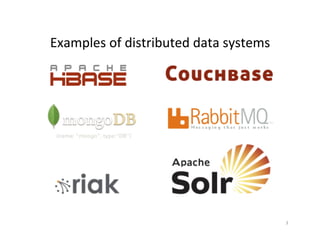
Examples	
  of	
  distributed	
  data	
  systems	
  	
  
3	
  
Lifecycle	
  
Single	
  	
  
Node	
  
MulM	
  
node	
  
•  ParMMoning	
  
•  Discovery	
  
•  Co-­‐locaMon	


Fault	
  
tolerance	
  
•  ReplicaMon	
  
•  Fault	
  detecMon	
  
•  Recovery	
  
Cluster	
  
Expansion	
  
•  Thro:le	
  data	
  movement	
  
•  Re-­‐distribuMon	
  
4	
  
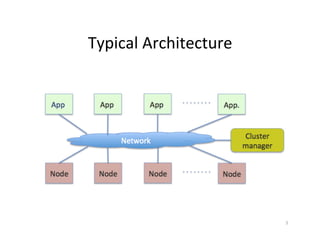
Typical	
  Architecture	
  
5	
  
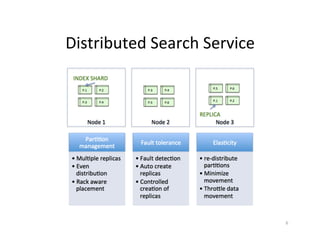
Distributed	
  Search	
  Service	
  
6	
  
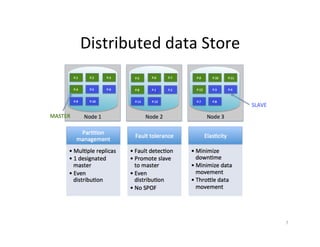
Distributed	
  data	
  Store	
  
7	
  
Message	
  consumer	
  group	
  	
  
•  Similar	
  to	
  Message	
  groups	
  in	
  AcMveMQ	
  
–	
  	
  guaranteed	
  ordering	
  of	
  the	
  processing	
  of	
  related	
  messages	


  across	
  a	
  single	
  queue	
  	
  
–	
  	
  load	
  balancing	
  of	
  the	
  processing	
  of	
  messages	
  across	
  mulMple	


  consumers	
  	
  
–	
  	
  high	
  availability	
  /	
  auto-­‐failover	
  to	
  other	
  consumers	
  if	
  a	
  JVM	


  goes	
  down	
  	
  
•  Applicable	
  to	
  many	
  messaging	
  pub/sub	
  systems	
  like	
  ka]a,	
  	
  
rabbitmq	
  etc	
  	
  
8	
  
Message	
  consumer	
  group	
  
9	
  
We	
  need	
  high	
  level	
  primiMves.	
  	
  
ApplicaMon	
  
Zookeeper	
  
•  Filesystem	
  
•  Lock	
  
•  Ephemeral	
  	
  
Zookeeper	
  provides	
  low	
  level	
  primiMves.	
  	
  
ApplicaMon	
  
Framework	
  
Consensus	
  
System	
  
•  Node	
  
•  ParMMon	
  
•  Replica	
  
•  State	
  
•  TransiMon	
  
10	
  
11	
  
Outline	
  
•  IntroducMon	
  
•  Architecture	
  
•  How	
  to	
  use	
  Helix	
  
•  Helix	
  usage	
  	
  
12	
  
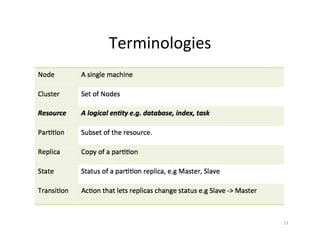
Terminologies	
  
13	
  
Core	
  concept	
  	
  
14	
  
Helix	
  soluMon	
  
15	
  
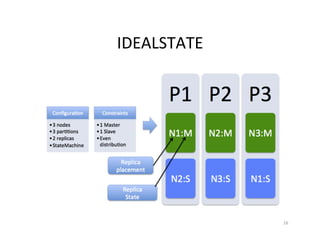
IDEALSTATE	
  
16	
  
CURRENT	
  STATE	
  
17	
  
EXTERNAL	
  VIEW	
  
18	
  
Helix	
  Based	
  System	
  Roles	
  	
  
19	
  
Logical	
  deployment	
  
20	
  
Outline	
  
•  IntroducMon	
  
•  Architecture	
  
•  How	
  to	
  use	
  Helix	
  
•  Helix	
  usage	
  	
  
21	
  
Helix	
  based	
  soluMon	
  
1.  Define	


2.  Configure	


3.  Run	
  
22	
  
Step	
  1,	
  Define:	
  State	
  model	
  definiMon	
  	
  
•  States	
  
–	
  All	
  possible	
  states	
  	
  
–	
  Priority	
  	
  
•  TransiMons	
  
–	
  Legal	
  transiMons	


  –	
  Priority	
  	
  
•  Applicable	
  to	
  each	
  	
  
parMMon	
  of	
  a	
  resource	
  	
  
•  e.g.	
  MasterSlave	
  
ConMnued…	
  	
  
23	
  
Define:	
  State	
  model	
  
Builder = new StateModelDefinition.Builder(“MASTERSLAVE”);
//Add states and their rank to indicate priority.
builder.addState(MASTER, 1);
builder.addState(SLAVE, 2);
builder.addState(OFFLINE);
//Set the initial state when the node starts
builder.initialState(OFFLINE);
//Add transitions between the states.
builder.addTransition(OFFLINE, SLAVE);
builder.addTransition(SLAVE, OFFLINE);
builder.addTransition(SLAVE, MASTER);
builder.addTransition(MASTER, SLAVE);
ConMnued…	
  	
  
24	
  
Define:	
  constraints	
  
State	
   Transi)on	
  
ParMMon	
   Y	
   Y	
  
Resource	
   -­‐	
   Y	
  
Node	
   Y	
   Y	
  
Cluster	
   -­‐	
   Y	
  
State	
   Transi)on	
  
ParMMon	
   M=1,S=2	
   -­‐	
  
ConMnued…	
  	
  
25	
  
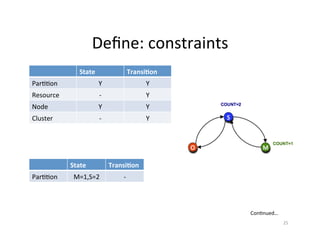
Define:	
  constraints	
  
// static constraint
builder.upperBound(MASTER, 1);
// dynamic constraint
builder.dynamicUpperBound(SLAVE, “R”);
// Unconstrained
builder.upperBound(OFFLINE, -1);
ConMnued…	
  	
  
26	
  
Define:	
  parMcipant	
  plug-­‐in	
  code	
  	
  
27	
  
Step	
  2:	
  configure	
  
28	
  
Zookeeper	
  view	
  
29	
  
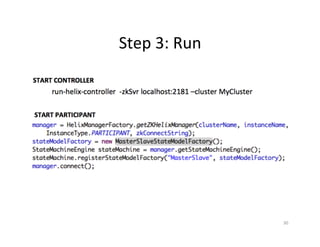
Step	
  3:	
  Run	
  
30	
  
zookeeper	
  view	
  
31	
  
Znode	
  content	
  
32	
  
Spectator	
  Plug-­‐in	
  code	
  
33	
  
Helix	
  ExecuMon	
  modes	
  
34	
  
IDEALSTATE	
  
35	
  
ExecuMon	
  modes	
  
•  Who	
  controls	
  what	
  
36	
  
Auto	
  rebalance	
  v/s	
  Auto	
  
37	
  
In	
  acMon	
  
38	
  
Custom	
  mode:	
  example	
  
39	
  
Custom	
  mode:	
  handling	
  failure	
  
•  Custom	
  code	
  invoker	
  	
  
–  Code	
  that	
  lives	
  on	
  all	
  nodes,	
  but	
  acMve	
  in	
  one	
  place	
  	
  
–  Invoked	
  when	
  node	
  joins/leaves	
  the	
  cluster	
  	
  
–  Computes	
  new	
  idealstate	
  	
  
–  Helix	
  controller	
  fires	
  the	
  transiMon	
  without	
  viola)ng	
  constraints	
  	
  
Helix	
  usage	
  at	
  LinkedIn	
  
Primary	
  
DB	


Data	
  Change	
  Events	
  
Standardi
zaMon	
  
Standardi
zaMon	
  
Standardi
zaMon	
  
Standardi
zaMon	
  
Standardi
zaMon	
  
Search	
  
Index	
  
Standardi
zaMon	
  
Standardi
zaMon	
  
Graph	
  
Index	
  
Standardi
zaMon	
  
Standardi
zaMon	
  
Read	
  
Replicas	
  
Updates	
  
Databus	
  
Espresso	
  
41	
  
Summary	
  
•  Helix:	
  A	
  Generic	
  framework	
  for	
  building	
  
distributed	
  systems	
  	
  
•  Modifying/enhancing	
  system	
  behavior	
  is	
  easy	
  –	
  
AbstracMon	
  and	
  modularity	
  is	
  key	
  	
  
•  Simple	
  programming	
  model:	
  declaraMve	
  state	
  
machine	
  	
  
42	
  
website	
   h:p://helix.apache.org	
  
codeRepo	
   h:p://github.com/apache/helix	
  
user	
   user@helix.apache.org	
  
dev	
   dev@helix.apache.org	
  
twi:er	
   @apachehelix,	
  @shahsaifi	
  
Apache Helix DevOps & LSPE-IN Meetup

Apache Helix DevOps & LSPE-IN Meetup

  • 1.
    Simplifying  Distributed  Systems       Shahnawaz  Saifi,  @shahsaifi   h:p://www.linkedin.com/in/shahsaifi     June’2015
  • 2.
    Outline   •  Introduc)on   •  Architecture   •  How  to  use  Helix   •  Helix  usage     •  Q  &  A   2  
  • 3.
    Examples  of  distributed  data  systems     3  
  • 4.
    Lifecycle   Single     Node   MulM   node   •  ParMMoning   •  Discovery   •  Co-­‐locaMon     Fault   tolerance   •  ReplicaMon   •  Fault  detecMon   •  Recovery   Cluster   Expansion   •  Thro:le  data  movement   •  Re-­‐distribuMon   4  
  • 5.
  • 6.
  • 7.
  • 8.
    Message  consumer  group     •  Similar  to  Message  groups  in  AcMveMQ   –    guaranteed  ordering  of  the  processing  of  related  messages            across  a  single  queue     –    load  balancing  of  the  processing  of  messages  across  mulMple            consumers     –    high  availability  /  auto-­‐failover  to  other  consumers  if  a  JVM            goes  down     •  Applicable  to  many  messaging  pub/sub  systems  like  ka]a,     rabbitmq  etc     8  
  • 9.
  • 10.
    We  need  high  level  primiMves.     ApplicaMon   Zookeeper   •  Filesystem   •  Lock   •  Ephemeral     Zookeeper  provides  low  level  primiMves.     ApplicaMon   Framework   Consensus   System   •  Node   •  ParMMon   •  Replica   •  State   •  TransiMon   10  
  • 11.
  • 12.
    Outline   •  IntroducMon   •  Architecture   •  How  to  use  Helix   •  Helix  usage     12  
  • 13.
  • 14.
  • 15.
  • 16.
  • 17.
  • 18.
  • 19.
    Helix  Based  System  Roles     19  
  • 20.
  • 21.
    Outline   •  IntroducMon   •  Architecture   •  How  to  use  Helix   •  Helix  usage     21  
  • 22.
    Helix  based  soluMon   1.  Define     2.  Configure     3.  Run   22  
  • 23.
    Step  1,  Define:  State  model  definiMon     •  States   –  All  possible  states     –  Priority     •  TransiMons   –  Legal  transiMons            –  Priority     •  Applicable  to  each     parMMon  of  a  resource     •  e.g.  MasterSlave   ConMnued…     23  
  • 24.
    Define:  State  model   Builder = new StateModelDefinition.Builder(“MASTERSLAVE”); //Add states and their rank to indicate priority. builder.addState(MASTER, 1); builder.addState(SLAVE, 2); builder.addState(OFFLINE); //Set the initial state when the node starts builder.initialState(OFFLINE); //Add transitions between the states. builder.addTransition(OFFLINE, SLAVE); builder.addTransition(SLAVE, OFFLINE); builder.addTransition(SLAVE, MASTER); builder.addTransition(MASTER, SLAVE); ConMnued…     24  
  • 25.
    Define:  constraints   State   Transi)on   ParMMon   Y   Y   Resource   -­‐   Y   Node   Y   Y   Cluster   -­‐   Y   State   Transi)on   ParMMon   M=1,S=2   -­‐   ConMnued…     25  
  • 26.
    Define:  constraints   //static constraint builder.upperBound(MASTER, 1); // dynamic constraint builder.dynamicUpperBound(SLAVE, “R”); // Unconstrained builder.upperBound(OFFLINE, -1); ConMnued…     26  
  • 27.
  • 28.
  • 29.
  • 30.
  • 31.
  • 32.
  • 33.
  • 34.
  • 35.
  • 36.
    ExecuMon  modes   • Who  controls  what   36  
  • 37.
    Auto  rebalance  v/s  Auto   37  
  • 38.
  • 39.
  • 40.
    Custom  mode:  handling  failure   •  Custom  code  invoker     –  Code  that  lives  on  all  nodes,  but  acMve  in  one  place     –  Invoked  when  node  joins/leaves  the  cluster     –  Computes  new  idealstate     –  Helix  controller  fires  the  transiMon  without  viola)ng  constraints    
  • 41.
    Helix  usage  at  LinkedIn   Primary   DB     Data  Change  Events   Standardi zaMon   Standardi zaMon   Standardi zaMon   Standardi zaMon   Standardi zaMon   Search   Index   Standardi zaMon   Standardi zaMon   Graph   Index   Standardi zaMon   Standardi zaMon   Read   Replicas   Updates   Databus   Espresso   41  
  • 42.
    Summary   •  Helix:  A  Generic  framework  for  building   distributed  systems     •  Modifying/enhancing  system  behavior  is  easy  –   AbstracMon  and  modularity  is  key     •  Simple  programming  model:  declaraMve  state   machine     42  
  • 43.
    website   h:p://helix.apache.org   codeRepo   h:p://github.com/apache/helix   user   user@helix.apache.org   dev   dev@helix.apache.org   twi:er   @apachehelix,  @shahsaifi