The War of 1812 ranks as one of America’s worst-fought wars. The supreme lesson of
the conflict was the folly of leading a divided and apathetic people into war. But
Americans came out of the war with a renewed sense of nationhood.
It was an election year as the War
of 1812 commenced.

In a very closely contested race,
James Madison defeated his
Federalist opponent, Dewitt Clinton.


             Dewitt Clinton
ON to CANADA over LAND and LAKES
On the eve of the War of 1812, the regular army was ill-trained, ill-disciplined, and widely
scattered. It was supplemented with unreliable militia, and the leadership was semi-
senile. The offensive strategy against Canada was especially poor conceived. The
American objective should have been Montreal.


The Americans frittered away their strength in the 3-pronged invasion. The trio of
invading forces were all beaten back by the determined British and Canadians.
Americans would soon be grimly defending their own soil against the invading British.
When several American land invasions of Canada were hurled back, Americans looked for
success on water. Man for man and ship for ship, the American navy did much better
than the army. The American frigates, notably the Constitution, had thicker sides,
heavier firepower, and larger crews.


In comparison to British ships, American ships on the whole were more skillfully handled,
had better gunners, and were manned by non-press-gang crews.
Control of the Great Lakes was vital, and an energetic American naval officer, Oliver
Hazard Perry, managed to build a fleet of ships on the shore of Lake Erie. When he
captured a British fleet in a furious engagement on the lake, he reported to his superiors,
“We have met the enemy and they are ours.”
Perry’s victory forced the British to withdraw from Detroit and Fort Madden, where Gen.
Harrison defeated them at the Battle of the Thames in 1813.
In mid-1814 Napoleon’s army was destroyed and he was sent into exile. America’s
diversionary power in Europe was now eliminated and the U.S. would have to fight the
British alone. Europe’s distresses, for once, failed the Americans.


                                           In 1814, the British prepared for a crushing
                                           blow into New York. The British were forced
                                           to use Lake Champlain to bring supplies.

                                           The invaders were met by a weaker American
                                           fleet, commanded by the 30 year old Thomas
                                           Macdonough. In a bloody battle fought near
                                           Plattsburgh in 1814, Macdonough snatched
                                           victory from the jaws of defeat.

                                           The American victory was momentous: The
                                           invading British were forced to retreat,
                                           saving New York and preventing the British
                                           from splitting the country.
WASHINGTON BURNED and NEW ORLEANS
                     DEFENDED
A second formidable British force landed in the Chesapeake Bay in Aug. 1814 and advanced on
Washington. The invaders entered the capital and set fire to most of the public buildings, including
the White House and the Capitol.


                                                                                   Dolly Madison
But while Washington burned, the Americans at Baltimore held firm. The British
bombarded Ft. McHenry but could not capture the city. Francis Scott Key, watching the
bombardment, was inspired to write the “Star Spangled Banner.”
A third British blow of 1814, aimed at New Orleans menaced the entire Mississippi
Valley. Andrew Jackson, fresh from defeating the southwest Indians, was placed in
command of the American force. The overconfident British, numbering 8,000 battle-
hardened veterans, blundered badly. The attackers suffered the most devastating
defeat of the entire war.

News of the victory made Jackson a national hero. The victory hardly mattered when
word arrived that a peace treaty had been signed two weeks earlier.


    Gen. Andrew Jackson
THE TREATY of GHENT
On paper, the British won more major engagements and moved around at will, but they
    would not win the war:

     1. There was too much territory for the British to conquer
     2. Overconfident commanders made critical tactical mistakes
     3. The American navy and privateers won a number of battles

THE TREATY OF GHENT
1.  Alexander I of Russia offered to mediate the end of the war in 1812 – why?
    a. 5 Americans journeyed to Ghent, Belgium in 1814


                                                        The talks stalemated over outrageous
                                                        British demands. What prompted the
                                                        British to compromise?

                                                        The Treaty of Ghent was signed Dec.
                                                        25, 1814. Explain the key provisions.
                                                        Which side won/lost?

                                                        * The treaty reflected the fighting
                                                        stalemate.
FEDERALIST GRIEVANCES and the
                   HARTFORD CONVENTION
Defiant New England remained a problem. It prospered during the conflict, owing
largely to illicit trade with the enemy in Canada. As the war dragged on, New England
extremists became more vocal. A small minority of them proposed secession from the
Union, or at least a separate peace with Britain.


                                     Ugly rumors were rampant alleging “Blue Light”
                                     Federalists aiding the British with their blockade.
The most spectacular manifestation of Federalist discontent was the Hartford
Convention. Which states were involved? And, what was the goal of the convention?


In truth, the Hartford Convention was less radical than the alarmists supposed. What were its
demands? Their demands were presented in Washington as the war was ending – their complaints
seemed treasonous. The Hartford resolutions were the death dirge of the Federalist party.
THE SECOND WAR for AMERICAN
                        INDEPENDENCE
If the war was globally unimportant, it had huge consequences for the U.S.:

1. The Republic had shown that it could resist what it regarded as injustices
             a. Nation and diplomats enjoyed unprecedented respect (2nd war for independence)
          2. A new nation was welded in the furnace of armed conflict
          3. War heroes emerged (Jackson & Harrison)
          4. Manufacturing prospered and became more self-reliant

Turning their backs on the Old World, Americans faced resolutely toward the untamed
West – and toward the task of building their democracy.
NASCENT NATIONALISM
“America may not have fought the war as one nation, but it emerged as one nation.”
What is nationalism? Provide examples of this new nationalism. Do we exhibit
nationalism today?
“THE AMERICAN SYSTEM”
Nationalism manifested itself in manufacturing. Explain the purpose and significance of
the Tariff of 1816. Describe North-South sectional crosscurrents (Calhoun v.
Webster). And explain Henry Clay’s proposed American System of 1824.
THE PANIC of 1819 and the
                        CURSE of HARD TIMES

The Era of Good Feelings comes to an end with the economically paralyzing panic of 1819.
What were the characteristics of this downturn?

It was the first national financial panic since President Washington took office.
Identify the biggest factor creating the crisis.Which section was especially hard
hit?

Describe the backlashes in the political and social world.
GROWING PAINS of the WEST
Nine frontier states had joined the original thirteen between 1791 and 1819. With an
eye to preserving the North-South sectional balance, most of these commonwealths had
been admitted alternately, free or slave. Why the explosive expansion?
Not potent enough to make its voice
heard, it was forced to ally itself with
other sections.
SLAVERY and the SECTIONAL BALANCE
Sectional tensions were highlighted in 1819 when the Missouri Territory sought
admission as a slave state. The territory contained sufficient population to warrant
statehood, but the House of Representatives stymied statehood plans by passing the
Tallmadge Amendment. What did the amendment stipulate? And, why did
southerners see this defeated amendment as an ominous threat?
THE UNEASY MISSOURI COMPROMISE
Deadlock in Washington was broken by a bundle of 3 compromises brokered by Henry Clay (1820-
1821). This compromise was politically evenhanded – what was gained and yielded on both sides?


The Missouri Compromise lasted 34 years and it preserved a shaky Union.
Despite the Union-saving compromise, some of the Founding Fathers saw this crisis as an
ominous omen.
                                                      Explain how the Missouri dispute
                                                      was a setback to nationalism and
                                                      a tremendous stimulus to
                                                      sectionalism.

                                                      Despite the critics, why was the
                                                      compromise invaluable?
SHARING OREGON and ACQUIRING FLORIDA
The Monroe Administration negotiated the much-underrated Treaty of 1818 with Britain.
This pact permitted Americans to share the coveted Newfoundland fisheries with their
Canadian neighbors,
and ….
…. it also fixed the vague northern limits of Louisiana along the 49th parallel from the
Lake of the Woods to the Rocky Mts. The treaty further provided for a 10 year joint
occupation of the untamed Oregon Territory, without a surrender of the rights or claims
of either America or Britain.
Why did the U.S. want Florida so badly? And why was Spain equally determined to
cling to it? The Madison Admin. encouraged American settlers living under Spanish rule
to rebel in West Florida, but the War of 1812 interrupted claims to Florida.

In 1819 the Monroe Admin. commissioned Andrew Jackson to move into E. Florida to
crush the “Indian Menace” that Spain admittedly could not control (Spain was pre-
occupied with Latin American revolutions).

                                             Jackson scores military victories and he
                                             executes 2 British nationals accused of
                                             aiding the Indians. Britain & Spain are
                                             outraged.

                                             A great debate ensues in Washington on
                                             what to do with Florida and Jackson. Adams
                                             is the only cabinet member to support
                                             Jackson and he orders the Spanish to
                                             control the Indians or cede.

                                             Their defeat highlighted their weaknesses,
                                             so they decided to negotiate.
THE ADAMS-ONIS TREATY (1819)

The U.S. gained E. Florida and new boundaries were set. Spain gave up claims to Oregon.
The U.S. gave up claims to Texas. And, the U.S. agreed to cover $5 million in American
claims against Spain (the U.S. did not purchase Florida for $5 million, technically).
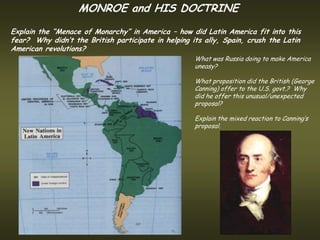
MONROE and HIS DOCTRINE
Explain the “Menace of Monarchy” in America – how did Latin America fit into this
fear? Why didn’t the British participate in helping its ally, Spain, crush the Latin
American revolutions?
                                                     What was Russia doing to make America
                                                     uneasy?

                                                     What proposition did the British (George
                                                     Canning) offer to the U.S. govt.? Why
                                                     did he offer this unusual/unexpected
                                                     proposal?

                                                     Explain the mixed reaction to Canning’s
                                                     proposal.
The Monroe Doctrine:What were its two basic features? What was public reaction to
it in the U.S.? Could we enforce it? How did Britain and other monarchies react?


                                               In retrospect, what was the real
                                               significance of the Monroe Doctrine?

                                               Was the doctrine really concerned
                                               with Latin America?
The Russo-American Treaty of 1824 fixed the Russian southern-most border at the
line of 54 degrees and 40 minutes – the present southern tip of the Alaskan panhandle.
JEFFERSONIAN AGE QUIZZES


http://www.historyteacher.net/USProjects/USQuizzes/JeffersonAge1.htm
http://www.historyteacher.net/USProjects/USQuizzes/JeffersonAge2.htm
http://www.historyteacher.net/USProjects/USQuizzes/JeffersonAge3.htm

A.p. ch 12 p.p

  • 2.
    The War of1812 ranks as one of America’s worst-fought wars. The supreme lesson of the conflict was the folly of leading a divided and apathetic people into war. But Americans came out of the war with a renewed sense of nationhood.
  • 3.
    It was anelection year as the War of 1812 commenced. In a very closely contested race, James Madison defeated his Federalist opponent, Dewitt Clinton. Dewitt Clinton
  • 4.
    ON to CANADAover LAND and LAKES On the eve of the War of 1812, the regular army was ill-trained, ill-disciplined, and widely scattered. It was supplemented with unreliable militia, and the leadership was semi- senile. The offensive strategy against Canada was especially poor conceived. The American objective should have been Montreal. The Americans frittered away their strength in the 3-pronged invasion. The trio of invading forces were all beaten back by the determined British and Canadians. Americans would soon be grimly defending their own soil against the invading British.
  • 5.
    When several Americanland invasions of Canada were hurled back, Americans looked for success on water. Man for man and ship for ship, the American navy did much better than the army. The American frigates, notably the Constitution, had thicker sides, heavier firepower, and larger crews. In comparison to British ships, American ships on the whole were more skillfully handled, had better gunners, and were manned by non-press-gang crews.
  • 7.
    Control of theGreat Lakes was vital, and an energetic American naval officer, Oliver Hazard Perry, managed to build a fleet of ships on the shore of Lake Erie. When he captured a British fleet in a furious engagement on the lake, he reported to his superiors, “We have met the enemy and they are ours.”
  • 8.
    Perry’s victory forcedthe British to withdraw from Detroit and Fort Madden, where Gen. Harrison defeated them at the Battle of the Thames in 1813.
  • 9.
    In mid-1814 Napoleon’sarmy was destroyed and he was sent into exile. America’s diversionary power in Europe was now eliminated and the U.S. would have to fight the British alone. Europe’s distresses, for once, failed the Americans. In 1814, the British prepared for a crushing blow into New York. The British were forced to use Lake Champlain to bring supplies. The invaders were met by a weaker American fleet, commanded by the 30 year old Thomas Macdonough. In a bloody battle fought near Plattsburgh in 1814, Macdonough snatched victory from the jaws of defeat. The American victory was momentous: The invading British were forced to retreat, saving New York and preventing the British from splitting the country.
  • 11.
    WASHINGTON BURNED andNEW ORLEANS DEFENDED A second formidable British force landed in the Chesapeake Bay in Aug. 1814 and advanced on Washington. The invaders entered the capital and set fire to most of the public buildings, including the White House and the Capitol. Dolly Madison
  • 12.
    But while Washingtonburned, the Americans at Baltimore held firm. The British bombarded Ft. McHenry but could not capture the city. Francis Scott Key, watching the bombardment, was inspired to write the “Star Spangled Banner.”
  • 15.
    A third Britishblow of 1814, aimed at New Orleans menaced the entire Mississippi Valley. Andrew Jackson, fresh from defeating the southwest Indians, was placed in command of the American force. The overconfident British, numbering 8,000 battle- hardened veterans, blundered badly. The attackers suffered the most devastating defeat of the entire war. News of the victory made Jackson a national hero. The victory hardly mattered when word arrived that a peace treaty had been signed two weeks earlier. Gen. Andrew Jackson
  • 17.
    THE TREATY ofGHENT On paper, the British won more major engagements and moved around at will, but they would not win the war: 1. There was too much territory for the British to conquer 2. Overconfident commanders made critical tactical mistakes 3. The American navy and privateers won a number of battles THE TREATY OF GHENT 1. Alexander I of Russia offered to mediate the end of the war in 1812 – why? a. 5 Americans journeyed to Ghent, Belgium in 1814 The talks stalemated over outrageous British demands. What prompted the British to compromise? The Treaty of Ghent was signed Dec. 25, 1814. Explain the key provisions. Which side won/lost? * The treaty reflected the fighting stalemate.
  • 18.
    FEDERALIST GRIEVANCES andthe HARTFORD CONVENTION Defiant New England remained a problem. It prospered during the conflict, owing largely to illicit trade with the enemy in Canada. As the war dragged on, New England extremists became more vocal. A small minority of them proposed secession from the Union, or at least a separate peace with Britain. Ugly rumors were rampant alleging “Blue Light” Federalists aiding the British with their blockade.
  • 19.
    The most spectacularmanifestation of Federalist discontent was the Hartford Convention. Which states were involved? And, what was the goal of the convention? In truth, the Hartford Convention was less radical than the alarmists supposed. What were its demands? Their demands were presented in Washington as the war was ending – their complaints seemed treasonous. The Hartford resolutions were the death dirge of the Federalist party.
  • 21.
    THE SECOND WARfor AMERICAN INDEPENDENCE If the war was globally unimportant, it had huge consequences for the U.S.: 1. The Republic had shown that it could resist what it regarded as injustices a. Nation and diplomats enjoyed unprecedented respect (2nd war for independence) 2. A new nation was welded in the furnace of armed conflict 3. War heroes emerged (Jackson & Harrison) 4. Manufacturing prospered and became more self-reliant Turning their backs on the Old World, Americans faced resolutely toward the untamed West – and toward the task of building their democracy.
  • 23.
    NASCENT NATIONALISM “America maynot have fought the war as one nation, but it emerged as one nation.” What is nationalism? Provide examples of this new nationalism. Do we exhibit nationalism today?
  • 24.
    “THE AMERICAN SYSTEM” Nationalismmanifested itself in manufacturing. Explain the purpose and significance of the Tariff of 1816. Describe North-South sectional crosscurrents (Calhoun v. Webster). And explain Henry Clay’s proposed American System of 1824.
  • 26.
    THE PANIC of1819 and the CURSE of HARD TIMES The Era of Good Feelings comes to an end with the economically paralyzing panic of 1819. What were the characteristics of this downturn? It was the first national financial panic since President Washington took office. Identify the biggest factor creating the crisis.Which section was especially hard hit? Describe the backlashes in the political and social world.
  • 27.
    GROWING PAINS ofthe WEST Nine frontier states had joined the original thirteen between 1791 and 1819. With an eye to preserving the North-South sectional balance, most of these commonwealths had been admitted alternately, free or slave. Why the explosive expansion?
  • 28.
    Not potent enoughto make its voice heard, it was forced to ally itself with other sections.
  • 29.
    SLAVERY and theSECTIONAL BALANCE Sectional tensions were highlighted in 1819 when the Missouri Territory sought admission as a slave state. The territory contained sufficient population to warrant statehood, but the House of Representatives stymied statehood plans by passing the Tallmadge Amendment. What did the amendment stipulate? And, why did southerners see this defeated amendment as an ominous threat?
  • 30.
    THE UNEASY MISSOURICOMPROMISE Deadlock in Washington was broken by a bundle of 3 compromises brokered by Henry Clay (1820- 1821). This compromise was politically evenhanded – what was gained and yielded on both sides? The Missouri Compromise lasted 34 years and it preserved a shaky Union.
  • 31.
    Despite the Union-savingcompromise, some of the Founding Fathers saw this crisis as an ominous omen. Explain how the Missouri dispute was a setback to nationalism and a tremendous stimulus to sectionalism. Despite the critics, why was the compromise invaluable?
  • 34.
    SHARING OREGON andACQUIRING FLORIDA The Monroe Administration negotiated the much-underrated Treaty of 1818 with Britain. This pact permitted Americans to share the coveted Newfoundland fisheries with their Canadian neighbors, and ….
  • 35.
    …. it alsofixed the vague northern limits of Louisiana along the 49th parallel from the Lake of the Woods to the Rocky Mts. The treaty further provided for a 10 year joint occupation of the untamed Oregon Territory, without a surrender of the rights or claims of either America or Britain.
  • 36.
    Why did theU.S. want Florida so badly? And why was Spain equally determined to cling to it? The Madison Admin. encouraged American settlers living under Spanish rule to rebel in West Florida, but the War of 1812 interrupted claims to Florida. In 1819 the Monroe Admin. commissioned Andrew Jackson to move into E. Florida to crush the “Indian Menace” that Spain admittedly could not control (Spain was pre- occupied with Latin American revolutions). Jackson scores military victories and he executes 2 British nationals accused of aiding the Indians. Britain & Spain are outraged. A great debate ensues in Washington on what to do with Florida and Jackson. Adams is the only cabinet member to support Jackson and he orders the Spanish to control the Indians or cede. Their defeat highlighted their weaknesses, so they decided to negotiate.
  • 37.
    THE ADAMS-ONIS TREATY(1819) The U.S. gained E. Florida and new boundaries were set. Spain gave up claims to Oregon. The U.S. gave up claims to Texas. And, the U.S. agreed to cover $5 million in American claims against Spain (the U.S. did not purchase Florida for $5 million, technically).
  • 38.
    MONROE and HISDOCTRINE Explain the “Menace of Monarchy” in America – how did Latin America fit into this fear? Why didn’t the British participate in helping its ally, Spain, crush the Latin American revolutions? What was Russia doing to make America uneasy? What proposition did the British (George Canning) offer to the U.S. govt.? Why did he offer this unusual/unexpected proposal? Explain the mixed reaction to Canning’s proposal.
  • 39.
    The Monroe Doctrine:Whatwere its two basic features? What was public reaction to it in the U.S.? Could we enforce it? How did Britain and other monarchies react? In retrospect, what was the real significance of the Monroe Doctrine? Was the doctrine really concerned with Latin America?
  • 40.
    The Russo-American Treatyof 1824 fixed the Russian southern-most border at the line of 54 degrees and 40 minutes – the present southern tip of the Alaskan panhandle.
  • 41.