2nd
presentation
By: Rafiq ullah
Title
ACO based AODV Method for Detection and
Recovery of Misbehaving Node in MANET
Authors: M. Sumathi & Dr. M.Gunasekaran
“Sumathi, M., and M. Gunasekaran. "ACO based AODV Method for
Detection and Recovery of Misbehaving Nodes." Global Journal of
Computer Science and Technology (2018).”
Contents
• Introduction
• Related work
• Review of Literature
• Proposed work
• Algorithm
• Results
• Conclusion
Introduction
Wireless communication nowadays surrounds us
in many colors and flavors, each with its specific
frequency band, coverage, and variety of
applications.
The authors mentioned 4 categories of MANET
1. Routing in Ad Hoc Networks
2. Attacks on Ad Hoc Networks
3. Security Model and Attributes
4. Security of Ad-Hoc Networks
Introduction
1. Security Model and Attributes
• Includes Confidentiality, Authentication,
Availability, Integrity, Non-Repudiation, fact of
discovery, Isolation, and location etc.
2. Security of Ad-Hoc Networks
Security vulnerabilities in ad-hoc networks are:
 Limited computational capabilities:
 Limited power supply:
 Challenging key management:
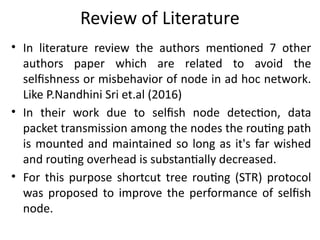
Review of Literature
• In literature review the authors mentioned 7 other
authors paper which are related to avoid the
selfishness or misbehavior of node in ad hoc network.
Like P.Nandhini Sri et.al (2016)
• In their work due to selfish node detection, data
packet transmission among the nodes the routing path
is mounted and maintained so long as it's far wished
and routing overhead is substantially decreased.
• For this purpose shortcut tree routing (STR) protocol
was proposed to improve the performance of selfish
node.
Problem Statement
• The author have focused on the problem of
detecting misbehaving links instead of
misbehaving nodes using 2ACK scheme.
• In the next-hop link, a misbehaving sender or a
misbehaving receiver has a similar adverse effect
on the data packet. It will not be forwarded
further. The result is that this link will be tagged.
Proposed Work
• The proposed system is used to detect the
misbehavior routing using 2ACK and
• Additionally take a look at the confidentiality of
the data message in MANETs.
• At the destination, a hash code can be
generated and in comparison with the sender’s
hash code to test the confidentiality of the
message.
Proposed Work
Algorithm of the proposed work
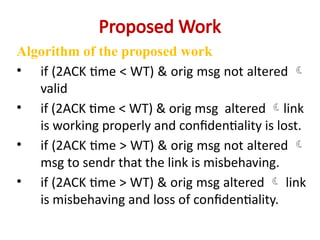
• if (2ACK time < WT) & orig msg not altered 
valid
• if (2ACK time < WT) & orig msg altered link
is working properly and confidentiality is lost.
• if (2ACK time > WT) & orig msg not altered 
msg to sendr that the link is misbehaving.
• if (2ACK time > WT) & orig msg altered  link
is misbehaving and loss of confidentiality.
Nomenclature
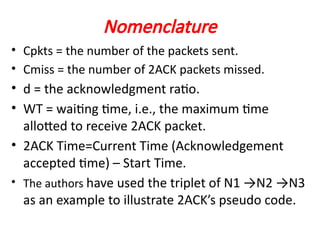
• Cpkts = the number of the packets sent.
• Cmiss = the number of 2ACK packets missed.
• d = the acknowledgment ratio.
• WT = waiting time, i.e., the maximum time
allotted to receive 2ACK packet.
• 2ACK Time=Current Time (Acknowledgement
accepted time) – Start Time.
• The authors have used the triplet of N1 →N2 →N3
as an example to illustrate 2ACK’s pseudo code.
Algorithm: Module 1
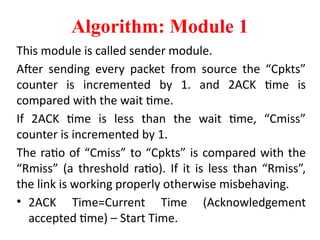
This module is called sender module.
After sending every packet from source the “Cpkts”
counter is incremented by 1. and 2ACK time is
compared with the wait time.
If 2ACK time is less than the wait time, “Cmiss”
counter is incremented by 1.
The ratio of “Cmiss” to “Cpkts” is compared with the
“Rmiss” (a threshold ratio). If it is less than “Rmiss”,
the link is working properly otherwise misbehaving.
• 2ACK Time=Current Time (Acknowledgement
accepted time) – Start Time.
Algorithm: Module 2
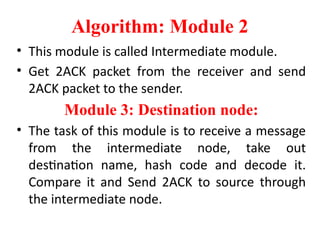
• This module is called Intermediate module.
• Get 2ACK packet from the receiver and send
2ACK packet to the sender.
Module 3: Destination node:
• The task of this module is to receive a message
from the intermediate node, take out
destination name, hash code and decode it.
Compare it and Send 2ACK to source through
the intermediate node.
Algorithm:
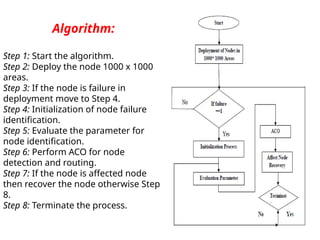
Step 1: Start the algorithm.
Step 2: Deploy the node 1000 x 1000
areas.
Step 3: If the node is failure in
deployment move to Step 4.
Step 4: Initialization of node failure
identification.
Step 5: Evaluate the parameter for
node identification.
Step 6: Perform ACO for node
detection and routing.
Step 7: If the node is affected node
then recover the node otherwise Step
8.
Step 8: Terminate the process.
Results
Conclusion
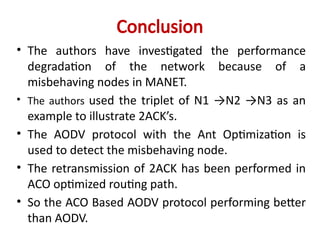
• The authors have investigated the performance
degradation of the network because of a
misbehaving nodes in MANET.
• The authors used the triplet of N1 →N2 →N3 as an
example to illustrate 2ACK’s.
• The AODV protocol with the Ant Optimization is
used to detect the misbehaving node.
• The retransmission of 2ACK has been performed in
ACO optimized routing path.
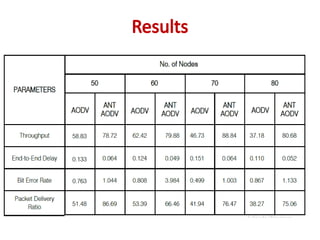
• So the ACO Based AODV protocol performing better
than AODV.
Mohajerani, Abdolreza, and Davood Gharavian. "An ant colony optimization
based routing algorithm for extending network lifetime in wireless sensor
networks." Wireless Networks 22, no. 8 (2016): 2637-2647.
An ant colony optimization based
routing algorithm for extending
network lifetime in wireless sensor
networks
Abdolreza Mohajerani
Davood Gharavian
Faculty of Electrical Engineering, Shahid Beheshti
University, Tehran, Iran
Springer Science+Business Media New York 2016
Contents
• Introduction
• Related work
• Review of Literature
• Proposed work
• Algorithm
• Results
• Conclusion
Introduction
• A wireless sensor network (WSN) typically
consists of tens to hundreds or thousands of
relatively small nodes, each equipped with a
sensing device.
• Now a days wireless sensors are getting smaller,
cheaper, and more powerful.
• Due to the fast development of the
microprocessor, sensor and transceiver, there is
great applications foreground about WSNs.
Introduction
• limited energy is the key issue in the influence
of WSNs performance.
• Most of the routing algorithms for sensor
networks require location information for
sensor nodes.
• ACO algorithm has been successfully applied
to solve some routing problems in WSN to
minimizing energy cost.
literature review
• In literature review the authors mentioned
more than 20 other authors paper which were
related to ACO algorithm for finding route.
• The techniques were used for minimizing the
energy cost and extend the network life time
in WSN.
Problem statement
• The authors used two energy parameters in its
competency function.
• The first competency function captures the
remaining energy levels of neighborhood nodes
in next-hop selection process, while
• While the second one focuses on the consumed
amount of energy in each neighborhood node.
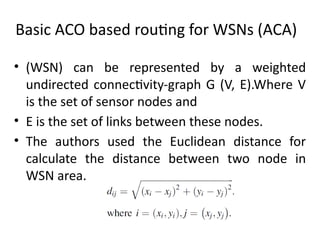
Basic ACO based routing for WSNs (ACA)
• (WSN) can be represented by a weighted
undirected connectivity-graph G (V, E).Where V
is the set of sensor nodes and
• E is the set of links between these nodes.
• The authors used the Euclidean distance for
calculate the distance between two node in
WSN area.
An ant colony optimization based routing
algorithm for extends network lifetime in
wireless sensor networks (LTAWSN)
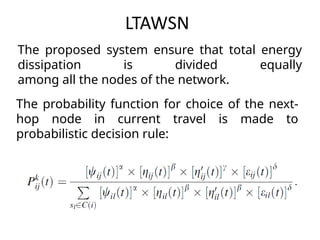
The proposed system ensure that total energy
dissipation is divided equally
among all the nodes of the network.
The probability function for choice of the next-
hop node in current travel is made to
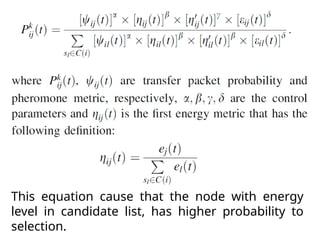
probabilistic decision rule:
LTAWSN
This equation cause that the node with energy
level in candidate list, has higher probability to
selection.
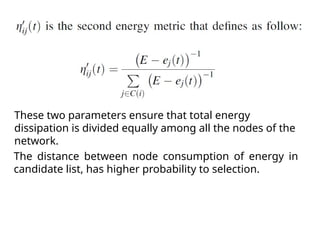
The distance between node consumption of energy in
candidate list, has higher probability to selection.
These two parameters ensure that total energy
dissipation is divided equally among all the nodes of the
network.
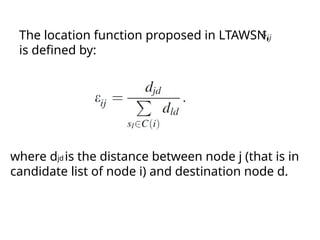
where djd is the distance between node j (that is in
candidate list of node i) and destination node d.
The location function proposed in LTAWSN,
is defined by:
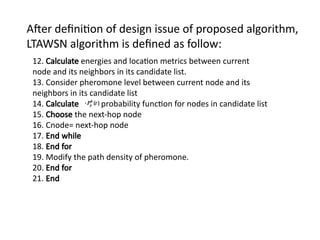
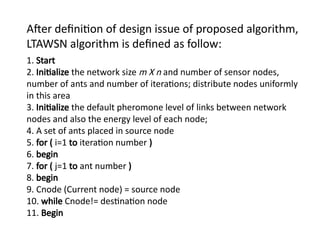
After definition of design issue of proposed algorithm,
LTAWSN algorithm is defined as follow:
1. Start
2. Initialize the network size m X n and number of sensor nodes,
number of ants and number of iterations; distribute nodes uniformly
in this area
3. Initialize the default pheromone level of links between network
nodes and also the energy level of each node;
4. A set of ants placed in source node
5. for ( i=1 to iteration number )
6. begin
7. for ( j=1 to ant number )
8. begin
9. Cnode (Current node) = source node
10. while Cnode!= destination node
11. Begin
After definition of design issue of proposed algorithm,
LTAWSN algorithm is defined as follow:
12. Calculate energies and location metrics between current
node and its neighbors in its candidate list.
13. Consider pheromone level between current node and its
neighbors in its candidate list
14. Calculate probability function for nodes in candidate list
15. Choose the next-hop node
16. Cnode= next-hop node
17. End while
18. End for
19. Modify the path density of pheromone.
20. End for
21. End
Conclusion
The authors proposed a new ACO based routing
algorithm that use spatial parameters in its
competency function.
The new pheromone update operator was
designed to integrate energy consumption and
hops into routing choice.
In the proposed scheme it was ensure that total
energy dissipation is divided equally among all
the nodes in the network.

AODV research paper presentation for phd level classes

  • 1.
  • 2.
    Title ACO based AODVMethod for Detection and Recovery of Misbehaving Node in MANET Authors: M. Sumathi & Dr. M.Gunasekaran “Sumathi, M., and M. Gunasekaran. "ACO based AODV Method for Detection and Recovery of Misbehaving Nodes." Global Journal of Computer Science and Technology (2018).”
  • 3.
    Contents • Introduction • Relatedwork • Review of Literature • Proposed work • Algorithm • Results • Conclusion
  • 4.
    Introduction Wireless communication nowadayssurrounds us in many colors and flavors, each with its specific frequency band, coverage, and variety of applications. The authors mentioned 4 categories of MANET 1. Routing in Ad Hoc Networks 2. Attacks on Ad Hoc Networks 3. Security Model and Attributes 4. Security of Ad-Hoc Networks
  • 5.
    Introduction 1. Security Modeland Attributes • Includes Confidentiality, Authentication, Availability, Integrity, Non-Repudiation, fact of discovery, Isolation, and location etc. 2. Security of Ad-Hoc Networks Security vulnerabilities in ad-hoc networks are:  Limited computational capabilities:  Limited power supply:  Challenging key management:
  • 6.
    Review of Literature •In literature review the authors mentioned 7 other authors paper which are related to avoid the selfishness or misbehavior of node in ad hoc network. Like P.Nandhini Sri et.al (2016) • In their work due to selfish node detection, data packet transmission among the nodes the routing path is mounted and maintained so long as it's far wished and routing overhead is substantially decreased. • For this purpose shortcut tree routing (STR) protocol was proposed to improve the performance of selfish node.
  • 7.
    Problem Statement • Theauthor have focused on the problem of detecting misbehaving links instead of misbehaving nodes using 2ACK scheme. • In the next-hop link, a misbehaving sender or a misbehaving receiver has a similar adverse effect on the data packet. It will not be forwarded further. The result is that this link will be tagged.
  • 8.
    Proposed Work • Theproposed system is used to detect the misbehavior routing using 2ACK and • Additionally take a look at the confidentiality of the data message in MANETs. • At the destination, a hash code can be generated and in comparison with the sender’s hash code to test the confidentiality of the message.
  • 9.
    Proposed Work Algorithm ofthe proposed work • if (2ACK time < WT) & orig msg not altered  valid • if (2ACK time < WT) & orig msg altered link is working properly and confidentiality is lost. • if (2ACK time > WT) & orig msg not altered  msg to sendr that the link is misbehaving. • if (2ACK time > WT) & orig msg altered  link is misbehaving and loss of confidentiality.
  • 10.
    Nomenclature • Cpkts =the number of the packets sent. • Cmiss = the number of 2ACK packets missed. • d = the acknowledgment ratio. • WT = waiting time, i.e., the maximum time allotted to receive 2ACK packet. • 2ACK Time=Current Time (Acknowledgement accepted time) – Start Time. • The authors have used the triplet of N1 →N2 →N3 as an example to illustrate 2ACK’s pseudo code.
  • 11.
    Algorithm: Module 1 Thismodule is called sender module. After sending every packet from source the “Cpkts” counter is incremented by 1. and 2ACK time is compared with the wait time. If 2ACK time is less than the wait time, “Cmiss” counter is incremented by 1. The ratio of “Cmiss” to “Cpkts” is compared with the “Rmiss” (a threshold ratio). If it is less than “Rmiss”, the link is working properly otherwise misbehaving. • 2ACK Time=Current Time (Acknowledgement accepted time) – Start Time.
  • 12.
    Algorithm: Module 2 •This module is called Intermediate module. • Get 2ACK packet from the receiver and send 2ACK packet to the sender. Module 3: Destination node: • The task of this module is to receive a message from the intermediate node, take out destination name, hash code and decode it. Compare it and Send 2ACK to source through the intermediate node.
  • 13.
    Algorithm: Step 1: Startthe algorithm. Step 2: Deploy the node 1000 x 1000 areas. Step 3: If the node is failure in deployment move to Step 4. Step 4: Initialization of node failure identification. Step 5: Evaluate the parameter for node identification. Step 6: Perform ACO for node detection and routing. Step 7: If the node is affected node then recover the node otherwise Step 8. Step 8: Terminate the process.
  • 14.
  • 15.
    Conclusion • The authorshave investigated the performance degradation of the network because of a misbehaving nodes in MANET. • The authors used the triplet of N1 →N2 →N3 as an example to illustrate 2ACK’s. • The AODV protocol with the Ant Optimization is used to detect the misbehaving node. • The retransmission of 2ACK has been performed in ACO optimized routing path. • So the ACO Based AODV protocol performing better than AODV.
  • 16.
    Mohajerani, Abdolreza, andDavood Gharavian. "An ant colony optimization based routing algorithm for extending network lifetime in wireless sensor networks." Wireless Networks 22, no. 8 (2016): 2637-2647. An ant colony optimization based routing algorithm for extending network lifetime in wireless sensor networks Abdolreza Mohajerani Davood Gharavian Faculty of Electrical Engineering, Shahid Beheshti University, Tehran, Iran Springer Science+Business Media New York 2016
  • 17.
    Contents • Introduction • Relatedwork • Review of Literature • Proposed work • Algorithm • Results • Conclusion
  • 18.
    Introduction • A wirelesssensor network (WSN) typically consists of tens to hundreds or thousands of relatively small nodes, each equipped with a sensing device. • Now a days wireless sensors are getting smaller, cheaper, and more powerful. • Due to the fast development of the microprocessor, sensor and transceiver, there is great applications foreground about WSNs.
  • 19.
    Introduction • limited energyis the key issue in the influence of WSNs performance. • Most of the routing algorithms for sensor networks require location information for sensor nodes. • ACO algorithm has been successfully applied to solve some routing problems in WSN to minimizing energy cost.
  • 20.
    literature review • Inliterature review the authors mentioned more than 20 other authors paper which were related to ACO algorithm for finding route. • The techniques were used for minimizing the energy cost and extend the network life time in WSN.
  • 21.
    Problem statement • Theauthors used two energy parameters in its competency function. • The first competency function captures the remaining energy levels of neighborhood nodes in next-hop selection process, while • While the second one focuses on the consumed amount of energy in each neighborhood node.
  • 22.
    Basic ACO basedrouting for WSNs (ACA) • (WSN) can be represented by a weighted undirected connectivity-graph G (V, E).Where V is the set of sensor nodes and • E is the set of links between these nodes. • The authors used the Euclidean distance for calculate the distance between two node in WSN area.
  • 23.
    An ant colonyoptimization based routing algorithm for extends network lifetime in wireless sensor networks (LTAWSN)
  • 24.
    The proposed systemensure that total energy dissipation is divided equally among all the nodes of the network. The probability function for choice of the next- hop node in current travel is made to probabilistic decision rule: LTAWSN
  • 25.
    This equation causethat the node with energy level in candidate list, has higher probability to selection.
  • 26.
    The distance betweennode consumption of energy in candidate list, has higher probability to selection. These two parameters ensure that total energy dissipation is divided equally among all the nodes of the network.
  • 27.
    where djd isthe distance between node j (that is in candidate list of node i) and destination node d. The location function proposed in LTAWSN, is defined by:
  • 28.
    After definition ofdesign issue of proposed algorithm, LTAWSN algorithm is defined as follow: 1. Start 2. Initialize the network size m X n and number of sensor nodes, number of ants and number of iterations; distribute nodes uniformly in this area 3. Initialize the default pheromone level of links between network nodes and also the energy level of each node; 4. A set of ants placed in source node 5. for ( i=1 to iteration number ) 6. begin 7. for ( j=1 to ant number ) 8. begin 9. Cnode (Current node) = source node 10. while Cnode!= destination node 11. Begin
  • 29.
    After definition ofdesign issue of proposed algorithm, LTAWSN algorithm is defined as follow: 12. Calculate energies and location metrics between current node and its neighbors in its candidate list. 13. Consider pheromone level between current node and its neighbors in its candidate list 14. Calculate probability function for nodes in candidate list 15. Choose the next-hop node 16. Cnode= next-hop node 17. End while 18. End for 19. Modify the path density of pheromone. 20. End for 21. End
  • 30.
    Conclusion The authors proposeda new ACO based routing algorithm that use spatial parameters in its competency function. The new pheromone update operator was designed to integrate energy consumption and hops into routing choice. In the proposed scheme it was ensure that total energy dissipation is divided equally among all the nodes in the network.