Contents
Introduction.
Classificationof data in IWSN.
QoS routing algorithm for IWSNs.
Proposed Work
Received Signal Strength Indicator (RSSI)
Exponentially Weighted Moving Average (EWMA)
Design of QoS routing algorithm
Conclusion.
4.
Classification of datain IWSN.
There are 3 types of classification of IWSN.
(1) Environment sensing.
(2) Condition monitoring.
(3) Process automation.
5.
Classification of datain IWSN.
i: Environment sensing.
It cover the problems of air, water (together
with waster water) pollution, etc.
ii: Condition monitoring:
The applications of condition monitoring
generally covers the problems of structure and
human condition monitoring and the machine
condition monitoring including possible
factory automation.
6.
Classification of datain IWSN.
iii: Process automation
The applications of process automation
provide the users with the information
regarding the resources for the production
and service provision, including the
materials, current stock and supply process
and building automation.
7.
QoS routing algorithmfor IWSNs.
The authors take three aspects of QoS
routing algorithm for IWSNs i.e. reliability,
timeliness, and energy consumption.
The first two aspects are measured by
calculating the two parameters.
Reliability: The reliability parameter is used to
measured the quality of the link to transmit
packets.
8.
Proposed Work.
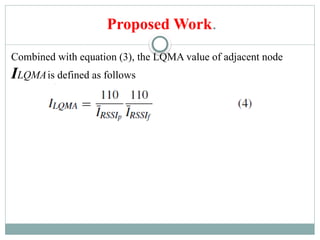
Inthis study, the authors proposed a Link
Quality Measure Algorithm (LQMA) to
estimate the quality of link.
In LQMA, the Received Signal Strength
Indicator (RSSI) value and the
Exponentially Weighted Moving Average
(EWMA) algorithm is introduced.
9.
Proposed Work.
TheRSSI value is used to obtain the
communication characteristics (statistical
average value) of the link, and.
The EWMA algorithm is to estimate the link
quality.
10.
Proposed Work.
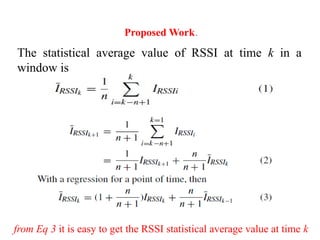
The statisticalaverage value of RSSI at time k in a
window is
from Eq 3 it is easy to get the RSSI statistical average value at time k
Timeliness
Timeliness is determinedby the transmission rate. When
considering the requirement of timeliness, the node with
a high transmission rate has priority for selection as a
routing forwarding node.
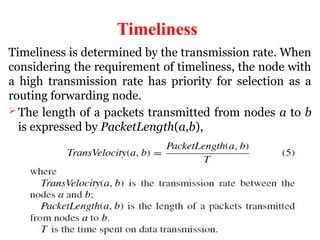
The length of a packets transmitted from nodes a to b
is expressed by PacketLength(a,b),
13.
Timeliness
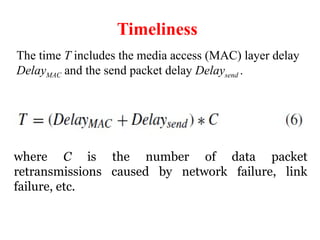
where C isthe number of data packet
retransmissions caused by network failure, link
failure, etc.
The time T includes the media access (MAC) layer delay
DelayMAC and the send packet delay Delaysend .
14.
DESIGN OF QoSROUTING ALGORITHM
Based on reliability and timeliness
requirement, an energy efficient and QoS aware
routing algorithm named EEQA is proposed.
This algorithm is focused on a variety of
application data with different level of priority
types.
Nodes can depend different data of level to
select different next-hop nodes to meet
different QoS requirements.
15.
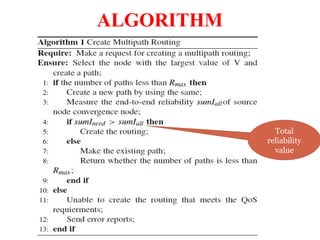
DESIGN OF QoSROUTING ALGORITHM
1. The first phase is initialization process.
2. Data classification is the second phase.
3. Selecting candidate forwarding node is the
third phase.
4. The last phase is multi-priority routing.
Points
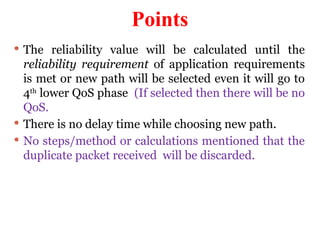
The reliabilityvalue will be calculated until the
reliability requirement of application requirements
is met or new path will be selected even it will go to
4th
lower QoS phase (If selected then there will be no
QoS.
There is no delay time while choosing new path.
No steps/method or calculations mentioned that the
duplicate packet received will be discarded.
18.
Points
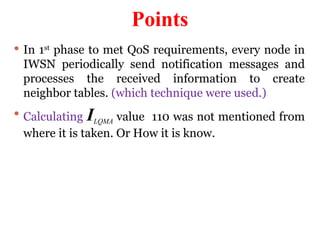
In 1st
phaseto met QoS requirements, every node in
IWSN periodically send notification messages and
processes the received information to create
neighbor tables. (which technique were used.)
Calculating ILQMA value 110 was not mentioned from
where it is taken. Or How it is know.