



















Anxiety “an Individual Difference in SLA”
Presented To: Venerable  Prof.Dr.Mamuna Ghani The Chairperson Department of English,  The Islamia University  Bahawalpur.
Presented By: Muhammad Asif Khan Saqib Aftab Hamza Niaz & Sajid Shaikh
Anxiety Introduction During the last 3 decades, researchers extensively studied the role of emotional variables in a Second/Foreign Language  Learning/ Teaching
Variables Temperament , Aptitude, Personality, Age, Sex, Motivation, Creativity, Self esteem, Learner’s Belief &  Anxiety
Researchers Scovel 1978,  Schumman 1975,1998, Ely 1986 Horwitz & Cope 1986  Krashan 1985,  MacIntyre & Gardner 1991,1992,1994 Young 1999 Arnold & Brown 1999 Spielmann & Rodnofsky 2001 Dewaelee 2002 Chamorro-Permuzic & Furnham 2003 & Dornyei, Zoltan 2005
Definition 1. “Anxiety is a stage of apprehension a vague fear  that is only indirectly associated with its  object……… it is generated through the arousal of  the limbic system, the primitive, subcortal “chassis”  of the cerebrum, which plays an important, indirect  role in many kinds of human enterprises, including  communication”.  Scovel (1978:134)
2.“language anxiety is the feeling of tension and  apprehension specifically associated with second  language contexts, including speaking, listening and  learning.”  Macintyre & Gardner (1994:284)
3. “Negative predicator of achievement is anxiety.”  Gliksman
Why such high rates of anxiety? • Difficulties with emotion regulation • Changes in routine • Changes in expectations • Apprehension in social situations • Fear of future change • Poor understanding of occurrences in Surroundings-Change
What is Stress? •  The most commonly accepted definition of stress (mainly attributed to Richard S Lazarus) is that  stress is a condition or feeling experienced when a person perceives that “demands exceed the personal and social resources the individual is able to mobilize.” • Fight and flight response
Negative Consequences of Anxiety • Anxious, jumpy and irritable • Reduces ability to work effectively • Intense focus on threat reduces ability to make judgments by drawing information from many sources • More accident prone • Long term health risks both psychological and physical • Few situations in day to day life where this is useful •  Needs to be kept under control
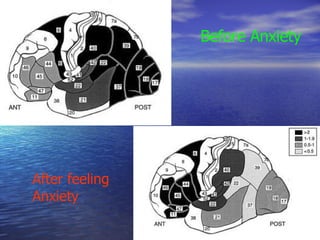
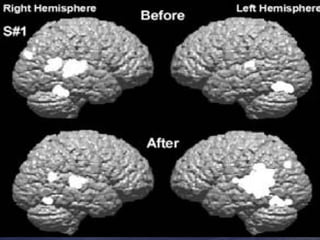
Before Anxiety After feeling Anxiety
 
Anxiety in Asperger Syndrome • Children, adolescents and adults with AS experience high levels of anxiety • Studies have found that children with AS experience levels of anxiety more similar to children with diagnosed anxiety disorders than to non-anxious children (Kim et al., 2000; Sofronoff & Russell ,2005)
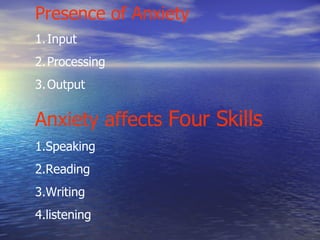
Presence of Anxiety Input Processing Output Anxiety affects  Four Skills 1.Speaking 2.Reading 3.Writing 4.listening
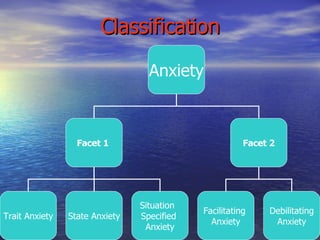
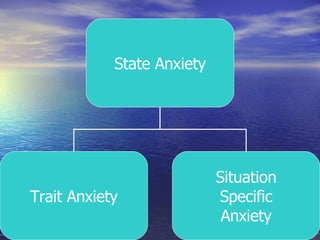
Classification Anxiety Facet 1  Facet 2 Facilitating  Anxiety Debilitating Anxiety Trait Anxiety State Anxiety Situation  Specified  Anxiety
Types of Anxiety 1. Trait Anxiety “a more permanent predisposition to be anxious. It  is related to learner’s Personality.”   (Scovel, p. 137). 2. State Anxiety “apprehension that is experienced at a particular  moment in time as a response to a definite  situation”  (Spielberger 1983) 3. Situation Specific Anxiety “the anxiety which is aroused by a specific type of  situation or event such as Public Speaking,  Examination or class participation.”
State Anxiety Trait Anxiety Situation Specific  Anxiety
Facilitating  vs  debilitating anxiety “ Facilitating anxiety  motivates the learner to ‘fight’ the new learning task; it gears the learner emotionally for approval behavior.  Example:- Student work hard and Passes the  exam.
Debilitating Anxiety motivates the learner to ‘flee’ the new learning task; it stimulates the individual emotionally to adopt avoidance behavior” -- Scovel, T. (1978). The effect of affect on foreign language learning; A review of the anxiety research.  Language Learning, 28 , 129–142, p. 139. It causes the learner to ‘flee’ the learning task. Example:- run away from exams.
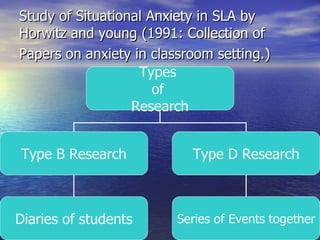
Study of Situational Anxiety in SLA by Horwitz and young (1991: Collection of Papers on anxiety in classroom setting.)   Types  of  Research Type B Research Type D Research Series of Events together Diaries of students
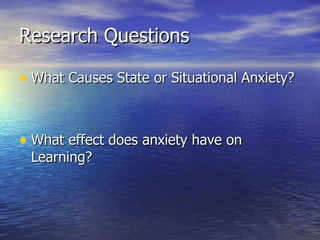
Research Questions What Causes State or Situational Anxiety? What effect does anxiety have on Learning?
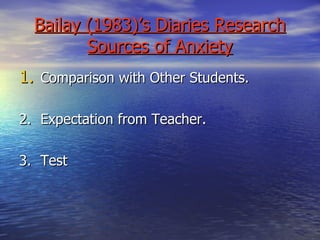
Bailay (1983)’s Diaries Research Sources of Anxiety Comparison with Other Students.  2. Expectation from Teacher. 3. Test
Teacher’s threatening Questions Monique, a student’s Diary “ I was quite frightened when asked questions again I don't know why; the teacher does not frighten me, but my mind is blocked when I am asked questions. I fear lest I give the wrong answer and will discourage the teacher as well as be the laughing stock of the class may be. Anyway, I felt really stupid and helpless in class” (Ellis 1989a:257)
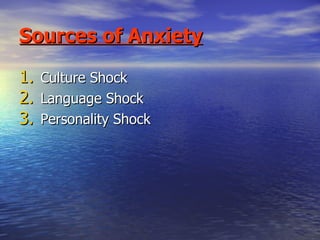
Sources of Anxiety   Culture Shock Language Shock Personality Shock
1. Culture Shock Learner can also experience anxiety as a result of fear in target Culture. ”Culture Shock”
2. Language Shock While learning a second/ new language, learner feels anxiety.
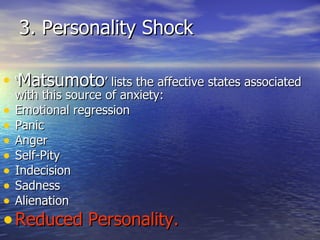
3. Personality Shock ‘ Matsumoto ’ lists the affective states associated with this source of anxiety: Emotional regression Panic Anger Self-Pity Indecision Sadness Alienation Reduced Personality.
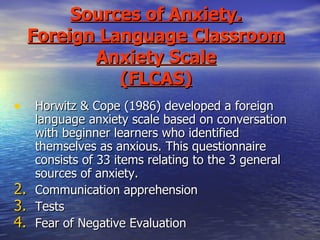
Sources of Anxiety. Foreign Language Classroom Anxiety Scale (FLCAS) Horwitz & Cope (1986) developed a foreign language anxiety scale based on conversation with beginner learners who identified themselves as anxious. This questionnaire consists of 33 items relating to the 3 general sources of anxiety. Communication apprehension Tests Fear of Negative Evaluation
A Student’s Comments “I tremble when I know I am going to be called on in language class. I keep thing that other students are better at language then I am . I get nervous when I don't understand every word the language teacher says”
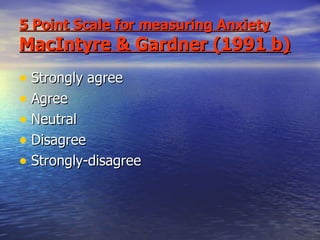
5 Point Scale for measuring Anxiety MacIntyre & Gardner (1991 b) Strongly agree Agree Neutral Disagree Strongly-disagree
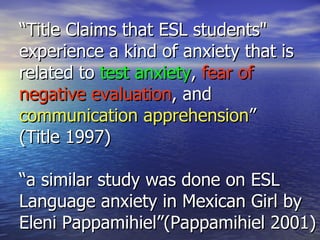
“ Title Claims that ESL students" experience a kind of anxiety that is related to  test anxiety ,  fear of negative evaluation , and  communication apprehension ” (Title 1997) “a similar study was done on ESL Language anxiety in Mexican Girl by Eleni Pappamihiel”(Pappamihiel 2001)
Many of the Studies showed that learner with low anxiety learns better. “the student who feels at ease in the classroom and likes the teacher may seek out more intakes by volunteering----- and may be more accepting of the teacher as a source of input.” (Krashen 1981:23)
MacIntyre & Gardner Anxiety Language Anxiety is a  Kind of Anxiety
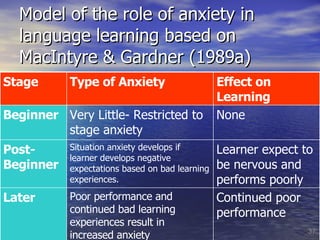
Model of the role of anxiety in language learning based on MacIntyre & Gardner (1989a) Continued poor performance Poor performance and continued bad learning experiences result in increased anxiety Later Learner expect to be nervous and performs poorly Situation anxiety develops if learner develops negative expectations based on bad learning experiences. Post-Beginner None Very Little- Restricted to stage anxiety Beginner Effect on Learning Type of Anxiety Stage
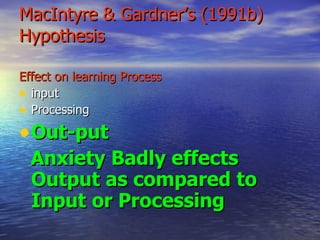
MacIntyre & Gardner’s (1991b) Hypothesis Effect on learning Process   input Processing Out-put Anxiety Badly effects Output as compared to Input or Processing
Interaction among Anxiety and other individual differences Interaction between level of anxiety and IQ level.  “ Higher states of anxiety facilitate learning at upper levels of intelligence, whereas they are associated with poorer performance at lower IQ levels” (Scovel, p. 136).
Individual Differences in SLA:  Affective Domain  Anxiety is one of many affective factors that may influence SLA.  Other affective factors include: self-esteem risk taking sensitivity to rejection empathy motivation
Individual Differences in SLA:  Methods / Affect One dominant methodology for SLA studies of the affective domain; Elkhafaifi is no exception: Correlation research
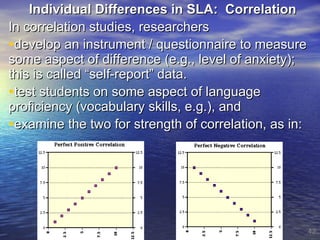
Individual Differences in SLA:  Correlation In correlation studies, researchers develop an instrument / questionnaire to measure some aspect of difference (e.g., level of anxiety); this is called “self-report” data. test students on some aspect of language proficiency (vocabulary skills, e.g.), and examine the two for strength of correlation, as in:
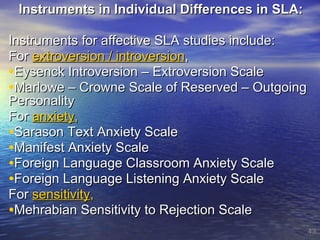
Instruments in Individual Differences in SLA:  Instruments for affective SLA studies include: For  extroversion / introversion , Eysenck Introversion – Extroversion Scale Marlowe – Crowne Scale of Reserved – Outgoing Personality For  anxiety , Sarason Text Anxiety Scale Manifest Anxiety Scale Foreign Language Classroom Anxiety Scale Foreign Language Listening Anxiety Scale For  sensitivity , Mehrabian Sensitivity to Rejection Scale
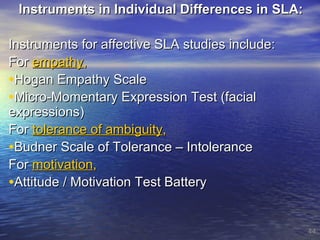
Instruments in Individual Differences in SLA:  Instruments for affective SLA studies include: For  empathy , Hogan Empathy Scale Micro-Momentary Expression Test (facial expressions) For  tolerance of ambiguity , Budner Scale of Tolerance – Intolerance For  motivation , Attitude / Motivation Test Battery
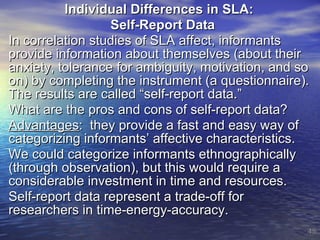
Individual Differences in SLA:  Self-Report Data In correlation studies of SLA affect, informants provide information about themselves (about their anxiety, tolerance for ambiguity, motivation, and so on) by completing the instrument (a questionnaire).  The results are called “self-report data.” What are the pros and cons of self-report data? Advantages :  they provide a fast and easy way of categorizing informants’ affective characteristics. We could categorize informants ethnographically (through observation), but this would require a considerable investment in time and resources. Self-report data represent a trade-off for researchers in time-energy-accuracy.
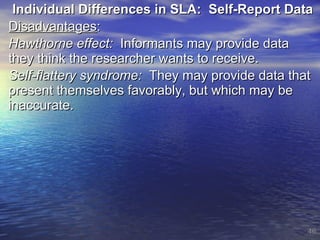
Individual Differences in SLA:  Self-Report Data Disadvantages :  Hawthorne effect:   Informants may provide data they think the researcher wants to receive. Self-flattery syndrome:   They may provide data that present themselves favorably, but which may be inaccurate.
Individual Differences in SLA:  Correlation Self-report data are then correlated with some measure of SLA success (test scores, typically), so that researchers can draw conclusions about the relationship between affect (extroversion, self-esteem, anxiety, and so on) and success in SLA. Remember what correlation is not: Causation Correlation simply shows a relationship between two things, not that one causes the other.  With that in mind, what is wrong with this statement? “The majority of studies support the view that anxiety contributes to poor performance, not the reverse” (Elkhafaifi, p. 208).
Alpha & Omega Anxiety is one of the main  Blocking Factor  in the Process of  Effective  Language Learning.
Latest Works On Anxiety Sonstroem & Bernardo Macintyre 2002 Chamorro-Premuzic and Furnham 2003a Dewaele 2002 Horwitz 2001 Young 1999 Scovel 2001 Rodrigues and Abreu 2003 Spielmann & Rannofsky 2001 A practical guide to creating a low-anxiety classroom atmosphere . Larsen Freeman 2000
Now,  Mr. Hamza Niaz  Would share   “ Role of Parents in Anxiety”
Role of Parents in Anxiety “ the best predicator of how a child will cope with stress is how the parents cope.” (Stolberg, 2002)
“ If a stressed mother slams the door and throws down her keys, she is teaching her child one way to relieve her stress……if she goes out for a jog, meditates or practices yoga, she is teaching other ways.”  (Stolberg, 2002)
Parents are Role Model for Children.
The Parents should not quarrel in front of children. Because it is a big cause of anxiety in children and may also enhance anxiety already present in children.
It has been  observed that performance of the children in the class is  deeply affected by the disturbed  home environment.
I would like to invite  Mr. Saqib Aftab  to continue.
Horwitz et al (1991) Educational anxiety is different form other anxieties. Anxiety badly affects SLA
Teacher’s Role in Class-Room Anxiety 1. State of equilibrium in Class. 2. Positive Thinking towards Students 3. Encouragement 4. Overlook Student’s mistakes 5. Stress free environment.
Remedies of Anxiety Stress relieving exercises Yoga exercises Breathing exercises
I would like to invite  Mr. Muhammad Asif Khan   to Continue.
Let’s  Recapitulate
Questions
What is anxiety?
Ans. Stress or Tension
Q.2. What are the Types of  Anxiety?
Ans.  Trait Anxiety  State Anxiety Situation Specific  Anxiety.
Q. 3. what is Trait Anxiety?
Ans.  Permanent Anxiety in  your Personality.
Q. 4. What is State Anxiety?
Ans.  Which is   experienced at a  particular moment in time as a  response to a definite  situation
Q. 5. What is Situation Specific  Anxiety?
Ans.  “the anxiety which is aroused by a specific  type of situation or event such as Public Speaking, Examination or class participation.”
Thank you

Anxiety Combine

  • 1.
  • 2.
    Anxiety “an IndividualDifference in SLA”
  • 3.
    Presented To: Venerable Prof.Dr.Mamuna Ghani The Chairperson Department of English, The Islamia University Bahawalpur.
  • 4.
    Presented By: MuhammadAsif Khan Saqib Aftab Hamza Niaz & Sajid Shaikh
  • 5.
    Anxiety Introduction Duringthe last 3 decades, researchers extensively studied the role of emotional variables in a Second/Foreign Language Learning/ Teaching
  • 6.
    Variables Temperament ,Aptitude, Personality, Age, Sex, Motivation, Creativity, Self esteem, Learner’s Belief & Anxiety
  • 7.
    Researchers Scovel 1978, Schumman 1975,1998, Ely 1986 Horwitz & Cope 1986 Krashan 1985, MacIntyre & Gardner 1991,1992,1994 Young 1999 Arnold & Brown 1999 Spielmann & Rodnofsky 2001 Dewaelee 2002 Chamorro-Permuzic & Furnham 2003 & Dornyei, Zoltan 2005
  • 8.
    Definition 1. “Anxietyis a stage of apprehension a vague fear that is only indirectly associated with its object……… it is generated through the arousal of the limbic system, the primitive, subcortal “chassis” of the cerebrum, which plays an important, indirect role in many kinds of human enterprises, including communication”. Scovel (1978:134)
  • 9.
    2.“language anxiety isthe feeling of tension and apprehension specifically associated with second language contexts, including speaking, listening and learning.” Macintyre & Gardner (1994:284)
  • 10.
    3. “Negative predicatorof achievement is anxiety.” Gliksman
  • 11.
    Why such highrates of anxiety? • Difficulties with emotion regulation • Changes in routine • Changes in expectations • Apprehension in social situations • Fear of future change • Poor understanding of occurrences in Surroundings-Change
  • 12.
    What is Stress?• The most commonly accepted definition of stress (mainly attributed to Richard S Lazarus) is that stress is a condition or feeling experienced when a person perceives that “demands exceed the personal and social resources the individual is able to mobilize.” • Fight and flight response
  • 13.
    Negative Consequences ofAnxiety • Anxious, jumpy and irritable • Reduces ability to work effectively • Intense focus on threat reduces ability to make judgments by drawing information from many sources • More accident prone • Long term health risks both psychological and physical • Few situations in day to day life where this is useful • Needs to be kept under control
  • 14.
    Before Anxiety Afterfeeling Anxiety
  • 15.
  • 16.
    Anxiety in AspergerSyndrome • Children, adolescents and adults with AS experience high levels of anxiety • Studies have found that children with AS experience levels of anxiety more similar to children with diagnosed anxiety disorders than to non-anxious children (Kim et al., 2000; Sofronoff & Russell ,2005)
  • 17.
    Presence of AnxietyInput Processing Output Anxiety affects Four Skills 1.Speaking 2.Reading 3.Writing 4.listening
  • 18.
    Classification Anxiety Facet1 Facet 2 Facilitating Anxiety Debilitating Anxiety Trait Anxiety State Anxiety Situation Specified Anxiety
  • 19.
    Types of Anxiety1. Trait Anxiety “a more permanent predisposition to be anxious. It is related to learner’s Personality.” (Scovel, p. 137). 2. State Anxiety “apprehension that is experienced at a particular moment in time as a response to a definite situation” (Spielberger 1983) 3. Situation Specific Anxiety “the anxiety which is aroused by a specific type of situation or event such as Public Speaking, Examination or class participation.”
  • 20.
    State Anxiety TraitAnxiety Situation Specific Anxiety
  • 21.
    Facilitating vs debilitating anxiety “ Facilitating anxiety motivates the learner to ‘fight’ the new learning task; it gears the learner emotionally for approval behavior. Example:- Student work hard and Passes the exam.
  • 22.
    Debilitating Anxiety motivatesthe learner to ‘flee’ the new learning task; it stimulates the individual emotionally to adopt avoidance behavior” -- Scovel, T. (1978). The effect of affect on foreign language learning; A review of the anxiety research. Language Learning, 28 , 129–142, p. 139. It causes the learner to ‘flee’ the learning task. Example:- run away from exams.
  • 23.
    Study of SituationalAnxiety in SLA by Horwitz and young (1991: Collection of Papers on anxiety in classroom setting.) Types of Research Type B Research Type D Research Series of Events together Diaries of students
  • 24.
    Research Questions WhatCauses State or Situational Anxiety? What effect does anxiety have on Learning?
  • 25.
    Bailay (1983)’s DiariesResearch Sources of Anxiety Comparison with Other Students. 2. Expectation from Teacher. 3. Test
  • 26.
    Teacher’s threatening QuestionsMonique, a student’s Diary “ I was quite frightened when asked questions again I don't know why; the teacher does not frighten me, but my mind is blocked when I am asked questions. I fear lest I give the wrong answer and will discourage the teacher as well as be the laughing stock of the class may be. Anyway, I felt really stupid and helpless in class” (Ellis 1989a:257)
  • 27.
    Sources of Anxiety Culture Shock Language Shock Personality Shock
  • 28.
    1. Culture ShockLearner can also experience anxiety as a result of fear in target Culture. ”Culture Shock”
  • 29.
    2. Language ShockWhile learning a second/ new language, learner feels anxiety.
  • 30.
    3. Personality Shock‘ Matsumoto ’ lists the affective states associated with this source of anxiety: Emotional regression Panic Anger Self-Pity Indecision Sadness Alienation Reduced Personality.
  • 31.
    Sources of Anxiety.Foreign Language Classroom Anxiety Scale (FLCAS) Horwitz & Cope (1986) developed a foreign language anxiety scale based on conversation with beginner learners who identified themselves as anxious. This questionnaire consists of 33 items relating to the 3 general sources of anxiety. Communication apprehension Tests Fear of Negative Evaluation
  • 32.
    A Student’s Comments“I tremble when I know I am going to be called on in language class. I keep thing that other students are better at language then I am . I get nervous when I don't understand every word the language teacher says”
  • 33.
    5 Point Scalefor measuring Anxiety MacIntyre & Gardner (1991 b) Strongly agree Agree Neutral Disagree Strongly-disagree
  • 34.
    “ Title Claimsthat ESL students" experience a kind of anxiety that is related to test anxiety , fear of negative evaluation , and communication apprehension ” (Title 1997) “a similar study was done on ESL Language anxiety in Mexican Girl by Eleni Pappamihiel”(Pappamihiel 2001)
  • 35.
    Many of theStudies showed that learner with low anxiety learns better. “the student who feels at ease in the classroom and likes the teacher may seek out more intakes by volunteering----- and may be more accepting of the teacher as a source of input.” (Krashen 1981:23)
  • 36.
    MacIntyre & GardnerAnxiety Language Anxiety is a Kind of Anxiety
  • 37.
    Model of therole of anxiety in language learning based on MacIntyre & Gardner (1989a) Continued poor performance Poor performance and continued bad learning experiences result in increased anxiety Later Learner expect to be nervous and performs poorly Situation anxiety develops if learner develops negative expectations based on bad learning experiences. Post-Beginner None Very Little- Restricted to stage anxiety Beginner Effect on Learning Type of Anxiety Stage
  • 38.
    MacIntyre & Gardner’s(1991b) Hypothesis Effect on learning Process input Processing Out-put Anxiety Badly effects Output as compared to Input or Processing
  • 39.
    Interaction among Anxietyand other individual differences Interaction between level of anxiety and IQ level. “ Higher states of anxiety facilitate learning at upper levels of intelligence, whereas they are associated with poorer performance at lower IQ levels” (Scovel, p. 136).
  • 40.
    Individual Differences inSLA: Affective Domain Anxiety is one of many affective factors that may influence SLA. Other affective factors include: self-esteem risk taking sensitivity to rejection empathy motivation
  • 41.
    Individual Differences inSLA: Methods / Affect One dominant methodology for SLA studies of the affective domain; Elkhafaifi is no exception: Correlation research
  • 42.
    Individual Differences inSLA: Correlation In correlation studies, researchers develop an instrument / questionnaire to measure some aspect of difference (e.g., level of anxiety); this is called “self-report” data. test students on some aspect of language proficiency (vocabulary skills, e.g.), and examine the two for strength of correlation, as in:
  • 43.
    Instruments in IndividualDifferences in SLA: Instruments for affective SLA studies include: For extroversion / introversion , Eysenck Introversion – Extroversion Scale Marlowe – Crowne Scale of Reserved – Outgoing Personality For anxiety , Sarason Text Anxiety Scale Manifest Anxiety Scale Foreign Language Classroom Anxiety Scale Foreign Language Listening Anxiety Scale For sensitivity , Mehrabian Sensitivity to Rejection Scale
  • 44.
    Instruments in IndividualDifferences in SLA: Instruments for affective SLA studies include: For empathy , Hogan Empathy Scale Micro-Momentary Expression Test (facial expressions) For tolerance of ambiguity , Budner Scale of Tolerance – Intolerance For motivation , Attitude / Motivation Test Battery
  • 45.
    Individual Differences inSLA: Self-Report Data In correlation studies of SLA affect, informants provide information about themselves (about their anxiety, tolerance for ambiguity, motivation, and so on) by completing the instrument (a questionnaire). The results are called “self-report data.” What are the pros and cons of self-report data? Advantages : they provide a fast and easy way of categorizing informants’ affective characteristics. We could categorize informants ethnographically (through observation), but this would require a considerable investment in time and resources. Self-report data represent a trade-off for researchers in time-energy-accuracy.
  • 46.
    Individual Differences inSLA: Self-Report Data Disadvantages : Hawthorne effect: Informants may provide data they think the researcher wants to receive. Self-flattery syndrome: They may provide data that present themselves favorably, but which may be inaccurate.
  • 47.
    Individual Differences inSLA: Correlation Self-report data are then correlated with some measure of SLA success (test scores, typically), so that researchers can draw conclusions about the relationship between affect (extroversion, self-esteem, anxiety, and so on) and success in SLA. Remember what correlation is not: Causation Correlation simply shows a relationship between two things, not that one causes the other. With that in mind, what is wrong with this statement? “The majority of studies support the view that anxiety contributes to poor performance, not the reverse” (Elkhafaifi, p. 208).
  • 48.
    Alpha & OmegaAnxiety is one of the main Blocking Factor in the Process of Effective Language Learning.
  • 49.
    Latest Works OnAnxiety Sonstroem & Bernardo Macintyre 2002 Chamorro-Premuzic and Furnham 2003a Dewaele 2002 Horwitz 2001 Young 1999 Scovel 2001 Rodrigues and Abreu 2003 Spielmann & Rannofsky 2001 A practical guide to creating a low-anxiety classroom atmosphere . Larsen Freeman 2000
  • 50.
    Now, Mr.Hamza Niaz Would share “ Role of Parents in Anxiety”
  • 51.
    Role of Parentsin Anxiety “ the best predicator of how a child will cope with stress is how the parents cope.” (Stolberg, 2002)
  • 52.
    “ If astressed mother slams the door and throws down her keys, she is teaching her child one way to relieve her stress……if she goes out for a jog, meditates or practices yoga, she is teaching other ways.” (Stolberg, 2002)
  • 53.
    Parents are RoleModel for Children.
  • 54.
    The Parents shouldnot quarrel in front of children. Because it is a big cause of anxiety in children and may also enhance anxiety already present in children.
  • 55.
    It has been observed that performance of the children in the class is deeply affected by the disturbed home environment.
  • 56.
    I would liketo invite Mr. Saqib Aftab to continue.
  • 57.
    Horwitz et al(1991) Educational anxiety is different form other anxieties. Anxiety badly affects SLA
  • 58.
    Teacher’s Role inClass-Room Anxiety 1. State of equilibrium in Class. 2. Positive Thinking towards Students 3. Encouragement 4. Overlook Student’s mistakes 5. Stress free environment.
  • 59.
    Remedies of AnxietyStress relieving exercises Yoga exercises Breathing exercises
  • 60.
    I would liketo invite Mr. Muhammad Asif Khan to Continue.
  • 61.
  • 62.
  • 63.
  • 64.
  • 65.
    Q.2. What arethe Types of Anxiety?
  • 66.
    Ans. TraitAnxiety State Anxiety Situation Specific Anxiety.
  • 67.
    Q. 3. whatis Trait Anxiety?
  • 68.
    Ans. PermanentAnxiety in your Personality.
  • 69.
    Q. 4. Whatis State Anxiety?
  • 70.
    Ans. Whichis experienced at a particular moment in time as a response to a definite situation
  • 71.
    Q. 5. Whatis Situation Specific Anxiety?
  • 72.
    Ans. “theanxiety which is aroused by a specific type of situation or event such as Public Speaking, Examination or class participation.”
  • 73.