THE COYOTE 
by: Anwar Arshad
INTRODUCTION 
Today you will learn about the coyote. 
There are lots of interesting facts about 
coyote that make them fascinating 
animals. This presentation is just a glimpse 
into their wonderful world!
NAME 
•The name of my animal is the Coyote. 
Another name for the coyote is Canis 
Latrans.
SPECIES 
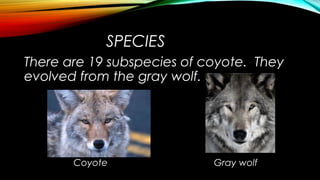
There are 19 subspecies of coyote. They 
evolved from the gray wolf. 
Coyote Gray wolf
CLASSIFICATION 
•The coyote is a mammal and is 
considered a carnivore.
ANATOMY 
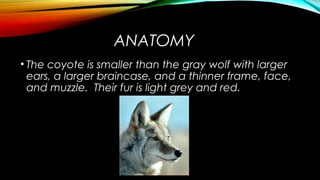
• The coyote is smaller than the gray wolf with larger 
ears, a larger braincase, and a thinner frame, face, 
and muzzle. Their fur is light grey and red.
LOCOMOTION 
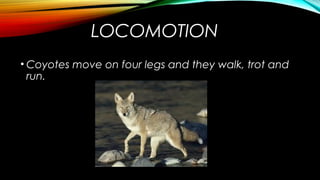
• Coyotes move on four legs and they walk, trot and 
run.
DIET 
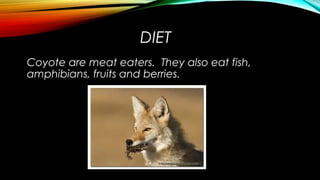
Coyote are meat eaters. They also eat fish, 
amphibians, fruits and berries.
HABITAT 
Coyotes live in North America and roam 
the plains ,forests ,mountains and deserts of 
Canda , The United States, Mexico and 
Central America. They like to live in brush 
covered slopes, steep banks, hollow logs, 
and rock ledges.
RANGE 
•The home range size of the male 
coyote is 20-42 km and for the 
females it is 8-10 km.
ADAPTATIONS 
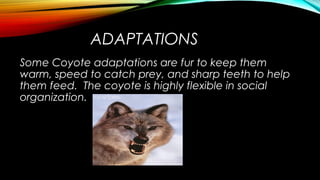
Some Coyote adaptations are fur to keep them 
warm, speed to catch prey, and sharp teeth to help 
them feed. The coyote is highly flexible in social 
organization.
LIFE CYCLE 
•Coyote can live up to ten years in 
the wild and up to 18 years in 
captivity.
REPRODUCTION 
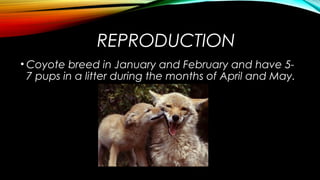
• Coyote breed in January and February and have 5- 
7 pups in a litter during the months of April and May.
BEHAVIOR AND 
COMMUNICATION 
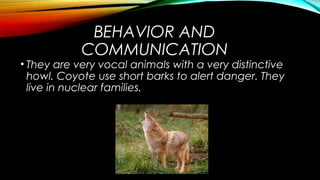
• They are very vocal animals with a very distinctive 
howl. Coyote use short barks to alert danger. They 
live in nuclear families.
ENEMIES 
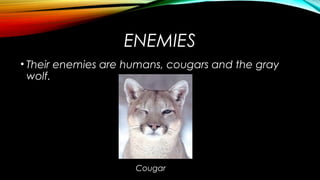
• Their enemies are humans, cougars and the gray 
wolf. 
Cougar
SURVIVAL STATUS 
•The coyote is not endangered 
because it is highly adaptable.
The End
REFERENCES 
• 1. LiveScience: Coyote Facts; by Alina Bradford, August 5, 2014 
• 2. Coyote from Wikipedia: The Free Encyclopedia; September 26, 2014 
• 3. Ecology and Behavior of the Coyote (Canis latrans). Gier, H. T. 1974. In M. 
W. Fox, ed., The Wild Canids: Their Systematics, Behavioral Ecology, and 
Evolution: 247-262. New York: Van Nostrand Reinhold. 
• 4. Coyote Communication. Philip N. Lehner. 1978. In: M. Bekoff, (ed.), 
Coyotes: Biology, Behavior, and Management: 127-162. Academic Press, 
New York. 
• 5. Coyote: National Geographic Society; 1996-2014

Anwar presentation

  • 1.
    THE COYOTE by:Anwar Arshad
  • 2.
    INTRODUCTION Today youwill learn about the coyote. There are lots of interesting facts about coyote that make them fascinating animals. This presentation is just a glimpse into their wonderful world!
  • 3.
    NAME •The nameof my animal is the Coyote. Another name for the coyote is Canis Latrans.
  • 4.
    SPECIES There are19 subspecies of coyote. They evolved from the gray wolf. Coyote Gray wolf
  • 5.
    CLASSIFICATION •The coyoteis a mammal and is considered a carnivore.
  • 6.
    ANATOMY • Thecoyote is smaller than the gray wolf with larger ears, a larger braincase, and a thinner frame, face, and muzzle. Their fur is light grey and red.
  • 7.
    LOCOMOTION • Coyotesmove on four legs and they walk, trot and run.
  • 8.
    DIET Coyote aremeat eaters. They also eat fish, amphibians, fruits and berries.
  • 9.
    HABITAT Coyotes livein North America and roam the plains ,forests ,mountains and deserts of Canda , The United States, Mexico and Central America. They like to live in brush covered slopes, steep banks, hollow logs, and rock ledges.
  • 10.
    RANGE •The homerange size of the male coyote is 20-42 km and for the females it is 8-10 km.
  • 11.
    ADAPTATIONS Some Coyoteadaptations are fur to keep them warm, speed to catch prey, and sharp teeth to help them feed. The coyote is highly flexible in social organization.
  • 12.
    LIFE CYCLE •Coyotecan live up to ten years in the wild and up to 18 years in captivity.
  • 13.
    REPRODUCTION • Coyotebreed in January and February and have 5- 7 pups in a litter during the months of April and May.
  • 14.
    BEHAVIOR AND COMMUNICATION • They are very vocal animals with a very distinctive howl. Coyote use short barks to alert danger. They live in nuclear families.
  • 15.
    ENEMIES • Theirenemies are humans, cougars and the gray wolf. Cougar
  • 16.
    SURVIVAL STATUS •Thecoyote is not endangered because it is highly adaptable.
  • 17.
  • 18.
    REFERENCES • 1.LiveScience: Coyote Facts; by Alina Bradford, August 5, 2014 • 2. Coyote from Wikipedia: The Free Encyclopedia; September 26, 2014 • 3. Ecology and Behavior of the Coyote (Canis latrans). Gier, H. T. 1974. In M. W. Fox, ed., The Wild Canids: Their Systematics, Behavioral Ecology, and Evolution: 247-262. New York: Van Nostrand Reinhold. • 4. Coyote Communication. Philip N. Lehner. 1978. In: M. Bekoff, (ed.), Coyotes: Biology, Behavior, and Management: 127-162. Academic Press, New York. • 5. Coyote: National Geographic Society; 1996-2014