ANTIPSYCHOTIC
DRUGS
Supervisor :
Mrs. Sonia Sharma
HOD (Psychiatric
Nursing). Presenter:
Parul Prasher
MSC(N) 2nd yr
Introduction
• Antipsychotic drugs (also called
Neuroleptics or Major tranquilizers) are
used primarily to treat schizophrenia (a
biologic illness), but they are also effective in
other psychotic states, including manic states
with psychotic symptoms such as grandiosity,
paranoia, and hallucinations, and delusions.
DEFINITION
• The antipsychotic drugs are broadly defined as
the drugs, which are used to treat the
psychiatric disorders.
• The drugs are also called Neuroleptic agents
as they reduce the agitation (a state of
anxiety) and disturbed behaviour associated
with delusion and hallucinations
Psychiatric illnesses which are treated
with these drugs
• COGNITIVE DISORDERS
DELIRIUM DEMENTIA
Paranoid State
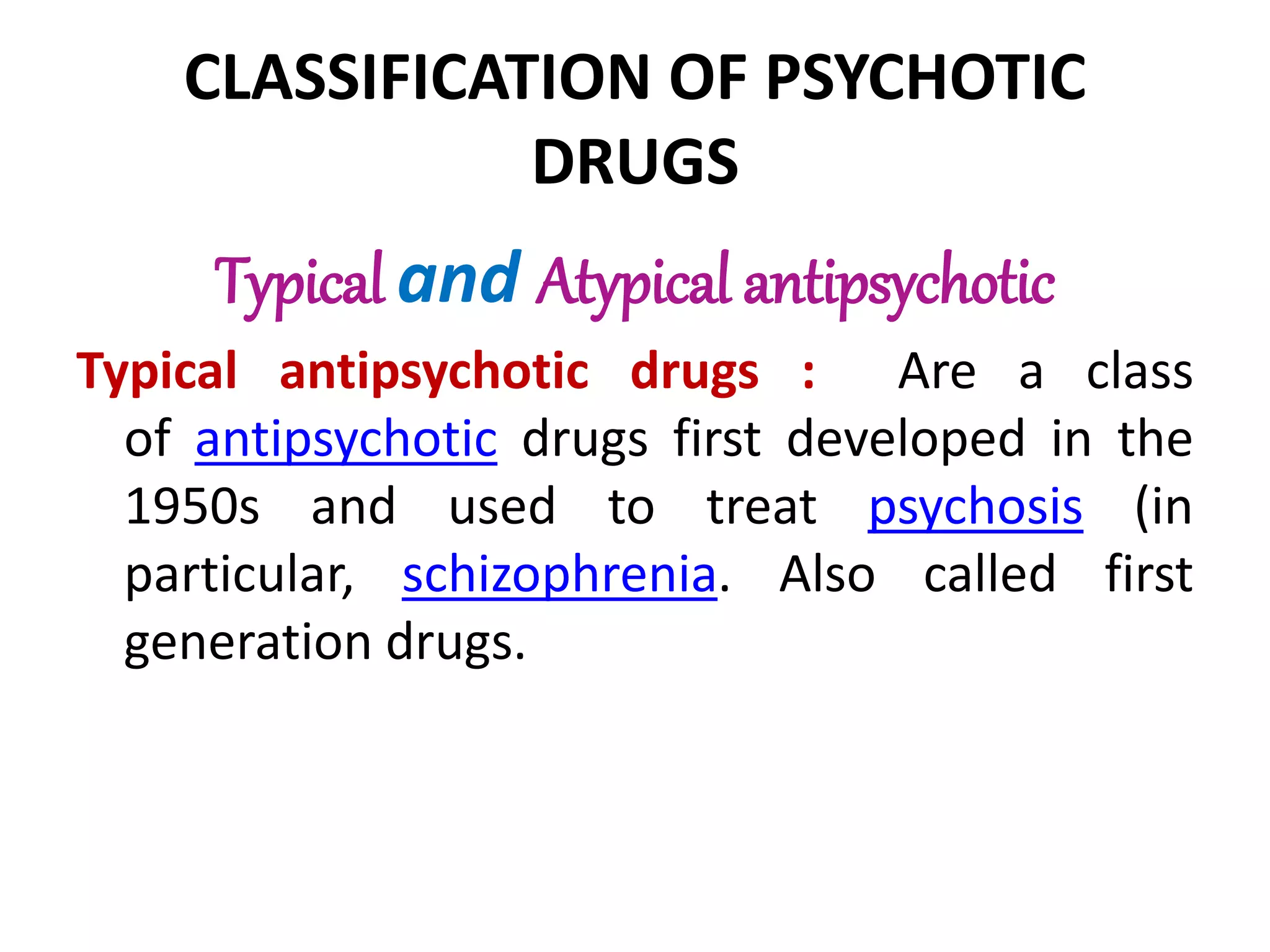
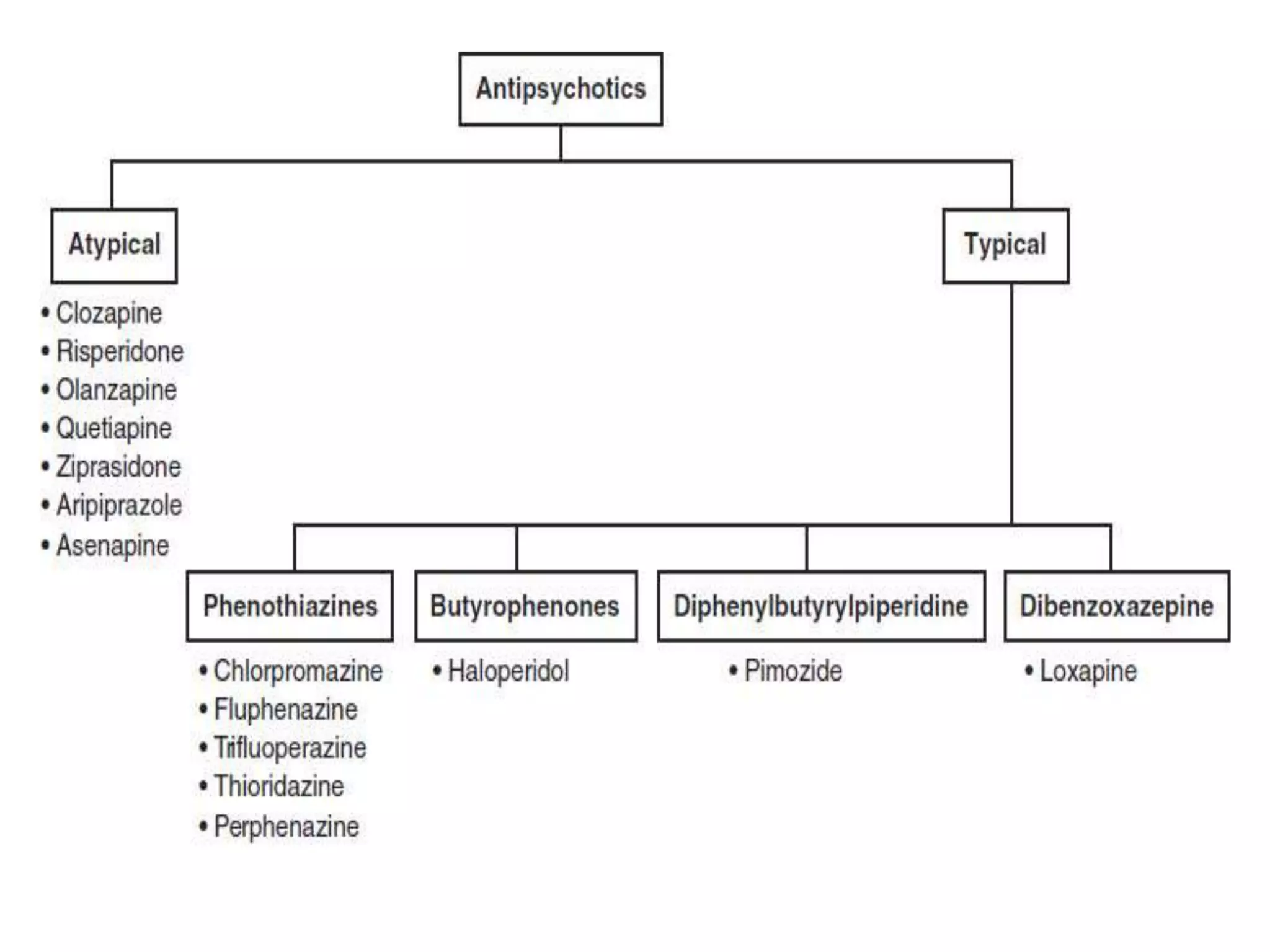
CLASSIFICATION OF PSYCHOTIC
DRUGS
Typical and Atypical antipsychotic
Typical antipsychotic drugs : Are a class
of antipsychotic drugs first developed in the
1950s and used to treat psychosis (in
particular, schizophrenia. Also called first
generation drugs.
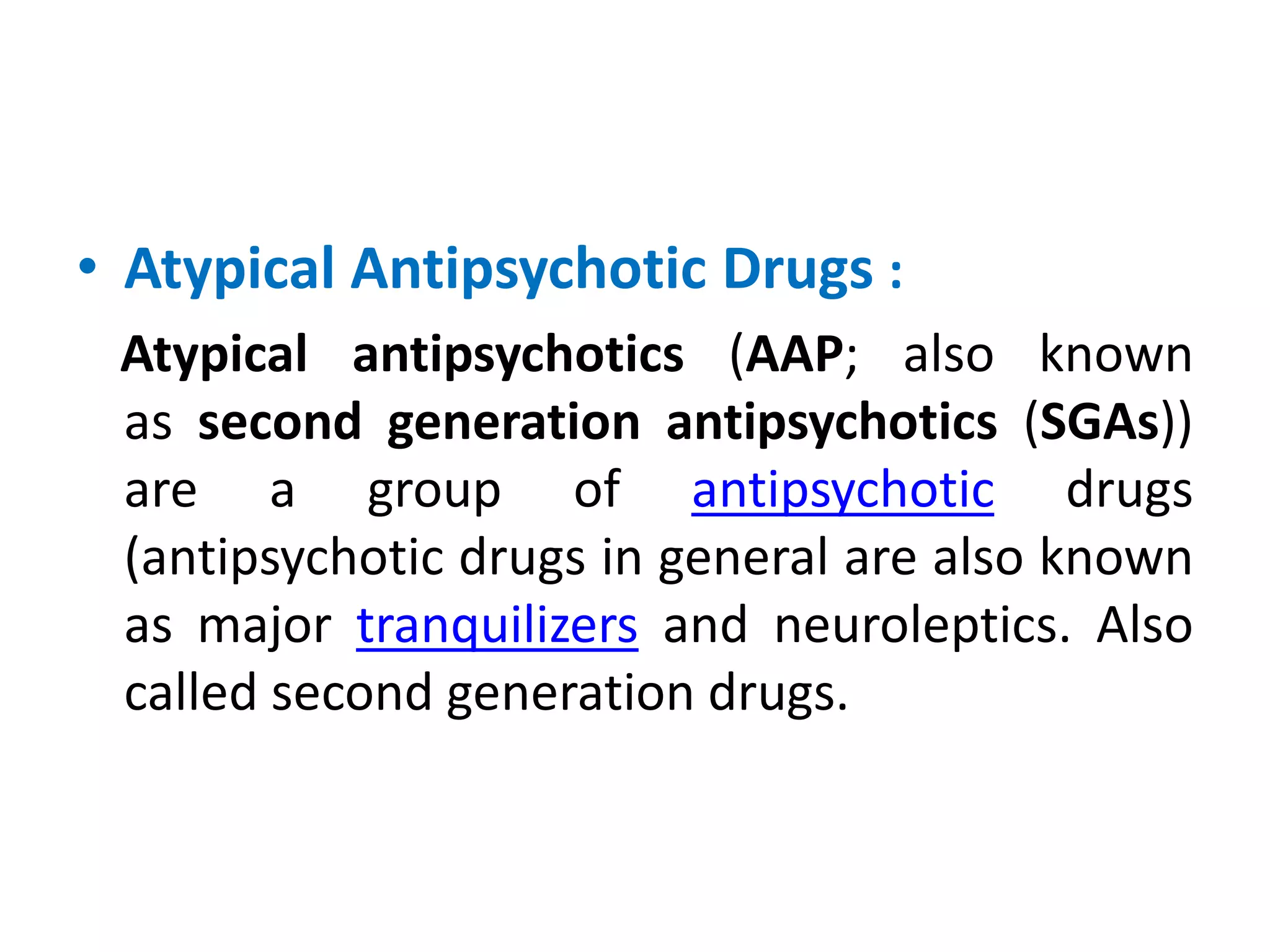
• Atypical Antipsychotic Drugs :
Atypical antipsychotics (AAP; also known
as second generation antipsychotics (SGAs))
are a group of antipsychotic drugs
(antipsychotic drugs in general are also known
as major tranquilizers and neuroleptics. Also
called second generation drugs.
PHARMACODYNAMICS
• WHAT DO ALL ANTIPSYCHOTIC
HAVE COMMON ?
They reduce Dopaminegic
neurotransmission.
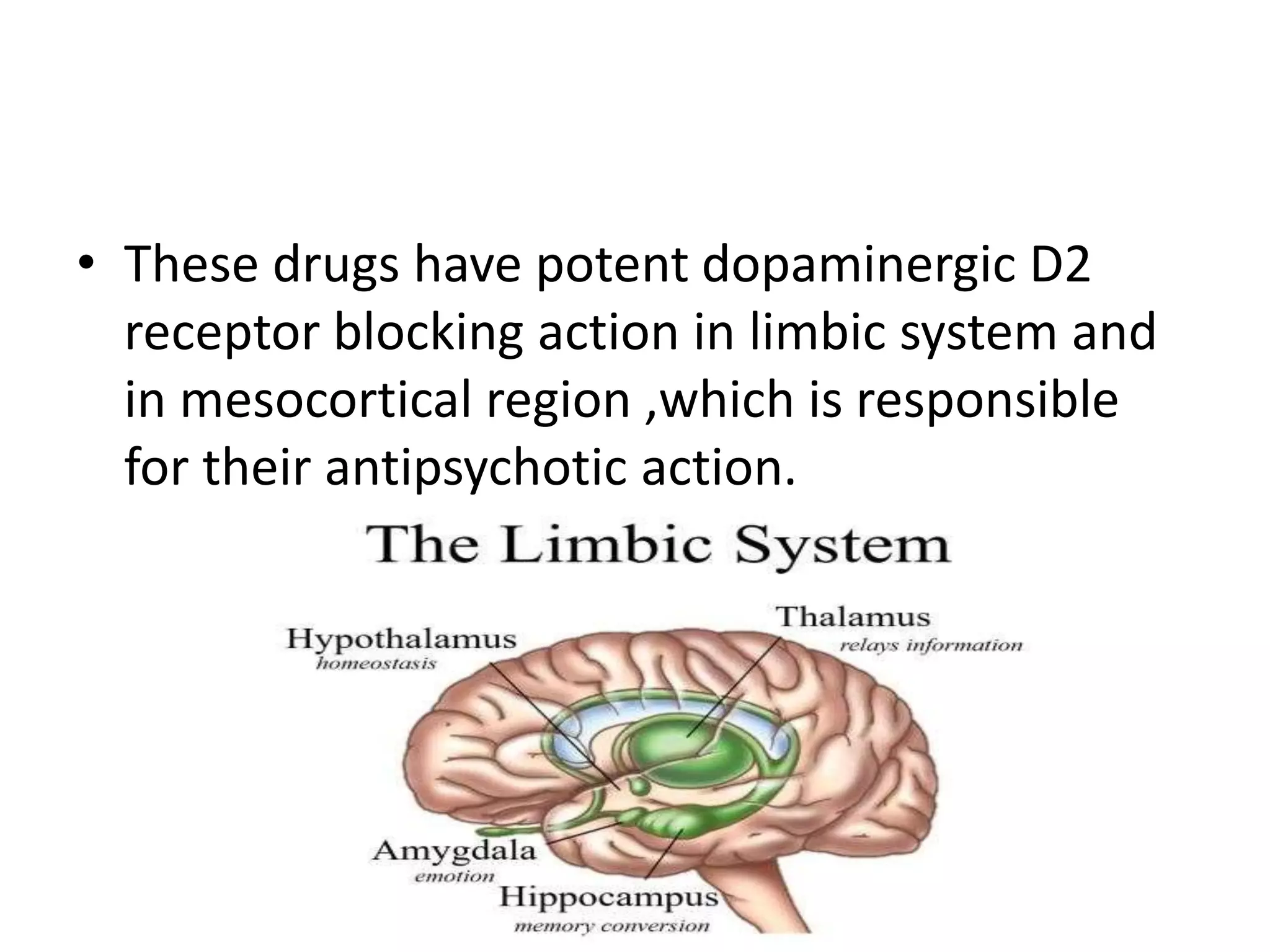
• These drugs have potent dopaminergic D2
receptor blocking action in limbic system and
in mesocortical region ,which is responsible
for their antipsychotic action.
PHARMACOKINETICS
Erratically absorbed from GIT
Whereas ,IM and IV doses produce consistent
effects
Widely distributed in the tissues and often
accumulate after repeated administration
These drugs crosses the BBB ( also cross
the placental barrier and also enter the
breast milk)
They are metabolized in the liver and excreted
through the bile and urine with in 18-30 hrs.
Points to remember :
• Excretion remains continued for months even
after discontinuation of drugs due to
cumulative effects.
• Dose adjustment is according to age as
metabolism is faster in children and slow in
elderly .
• Patient should be informed regarding long
duration of treatment.
INDICATIONS
Contraindications
• CNS Depression.
• Bone Marrow Depression.
• Hypotension.
• Parkinsonism.
• Hepatic Dysfunction.
• Glaucoma.
SIDE EFFECTS
NURSES ROLE IN ADMINISTERING THE
ANTIPSYCHOTIC DRUGS
• Client is instructed not to abruptly stand to
prevent fall due to orthostatic hypotension.
• Check vital signs before and after medication.
• Client is instructed to take sips of water
frequently for avoiding of dry mouth;
application of glycerine is also recommended.
• Increased intake of fluid and high fiber diet is
recommended to avoid constipation.
• Educate the client not to drive after taking
medication. f. Educate the client to wear full
sleeves and eye gears while going out in sun
to avoid photosensitivity
• Educate the client not to drive after taking
medication.
• Educate the client to wear full sleeves and eye
gears while going out in sun to avoid
photosensitivity
NURSING DIAGNOSIS
• Risk of injury related to Central nervous system
effects
 Provide different comfort measures to the client like
positioning of legs and arms.
 Provide safety measures to client to minimize the
injuries like raising side rails, adequate lighting
 Adequate and continuous monitoring of client after
the drug is given to the client.
 Educate the client and family members regarding
side-effects of drug for better understanding and
cooperation
• Impaired physical activity related to extra
pyramidal effect
 Provide the safe environment to the client like
removing of harmful or injurious objects in
environment.
 Report the doctor if there are excess tremors.
 Assist the client in performing the activities so that
client gets minimal stresses out.
 Make client to sit comfortably till the motor
restlessness gets relieved.
• Risk of activity intolerance related to
sedation, weakness (side-effects)
 Minimize the excess exhaustion of the client and
provide adequate rest.
 Help the client to perform minor activities if any.
Educate client and family not to operate any
dangerous equipment’s.
Bibliography
• . Davidson M, Kahn RS, Stern RG, et al. Treatment with
clozapine and its effect on plasma homovanillic acid and
norepinephrine concentrations in schizophrenia. Psychiatry
Res 1993;46: 151–163.(online book store)
• Gupta BM, Har K, Avinash K. Dementia research in India: A
scientometric analysis of research output during 2002-11. Ann
Libr Inf Stud 2011;59:280-8.
• https://www.google.com/search?q=pharmacokinetics+of+anti
psychotic+drugs+flow+chart&source=lnms&sa=X&ved=0ahUK
EwjqxOez37njAhV27XMBHYcLDTAQ_AUICygA&biw=1366&bih
=566&dpr=1
Antipsychotic Drugs ppt.pptx

Antipsychotic Drugs ppt.pptx

  • 1.
    ANTIPSYCHOTIC DRUGS Supervisor : Mrs. SoniaSharma HOD (Psychiatric Nursing). Presenter: Parul Prasher MSC(N) 2nd yr
  • 2.
    Introduction • Antipsychotic drugs(also called Neuroleptics or Major tranquilizers) are used primarily to treat schizophrenia (a biologic illness), but they are also effective in other psychotic states, including manic states with psychotic symptoms such as grandiosity, paranoia, and hallucinations, and delusions.
  • 3.
    DEFINITION • The antipsychoticdrugs are broadly defined as the drugs, which are used to treat the psychiatric disorders. • The drugs are also called Neuroleptic agents as they reduce the agitation (a state of anxiety) and disturbed behaviour associated with delusion and hallucinations
  • 4.
    Psychiatric illnesses whichare treated with these drugs • COGNITIVE DISORDERS DELIRIUM DEMENTIA
  • 6.
  • 8.
    CLASSIFICATION OF PSYCHOTIC DRUGS Typicaland Atypical antipsychotic Typical antipsychotic drugs : Are a class of antipsychotic drugs first developed in the 1950s and used to treat psychosis (in particular, schizophrenia. Also called first generation drugs.
  • 9.
    • Atypical AntipsychoticDrugs : Atypical antipsychotics (AAP; also known as second generation antipsychotics (SGAs)) are a group of antipsychotic drugs (antipsychotic drugs in general are also known as major tranquilizers and neuroleptics. Also called second generation drugs.
  • 12.
    PHARMACODYNAMICS • WHAT DOALL ANTIPSYCHOTIC HAVE COMMON ? They reduce Dopaminegic neurotransmission.
  • 14.
    • These drugshave potent dopaminergic D2 receptor blocking action in limbic system and in mesocortical region ,which is responsible for their antipsychotic action.
  • 15.
    PHARMACOKINETICS Erratically absorbed fromGIT Whereas ,IM and IV doses produce consistent effects Widely distributed in the tissues and often accumulate after repeated administration
  • 16.
    These drugs crossesthe BBB ( also cross the placental barrier and also enter the breast milk) They are metabolized in the liver and excreted through the bile and urine with in 18-30 hrs.
  • 17.
    Points to remember: • Excretion remains continued for months even after discontinuation of drugs due to cumulative effects. • Dose adjustment is according to age as metabolism is faster in children and slow in elderly . • Patient should be informed regarding long duration of treatment.
  • 18.
  • 19.
    Contraindications • CNS Depression. •Bone Marrow Depression. • Hypotension. • Parkinsonism. • Hepatic Dysfunction. • Glaucoma.
  • 20.
  • 21.
    NURSES ROLE INADMINISTERING THE ANTIPSYCHOTIC DRUGS • Client is instructed not to abruptly stand to prevent fall due to orthostatic hypotension. • Check vital signs before and after medication. • Client is instructed to take sips of water frequently for avoiding of dry mouth; application of glycerine is also recommended. • Increased intake of fluid and high fiber diet is recommended to avoid constipation.
  • 22.
    • Educate theclient not to drive after taking medication. f. Educate the client to wear full sleeves and eye gears while going out in sun to avoid photosensitivity • Educate the client not to drive after taking medication. • Educate the client to wear full sleeves and eye gears while going out in sun to avoid photosensitivity
  • 23.
    NURSING DIAGNOSIS • Riskof injury related to Central nervous system effects  Provide different comfort measures to the client like positioning of legs and arms.  Provide safety measures to client to minimize the injuries like raising side rails, adequate lighting  Adequate and continuous monitoring of client after the drug is given to the client.  Educate the client and family members regarding side-effects of drug for better understanding and cooperation
  • 24.
    • Impaired physicalactivity related to extra pyramidal effect  Provide the safe environment to the client like removing of harmful or injurious objects in environment.  Report the doctor if there are excess tremors.  Assist the client in performing the activities so that client gets minimal stresses out.  Make client to sit comfortably till the motor restlessness gets relieved.
  • 25.
    • Risk ofactivity intolerance related to sedation, weakness (side-effects)  Minimize the excess exhaustion of the client and provide adequate rest.  Help the client to perform minor activities if any. Educate client and family not to operate any dangerous equipment’s.
  • 28.
    Bibliography • . DavidsonM, Kahn RS, Stern RG, et al. Treatment with clozapine and its effect on plasma homovanillic acid and norepinephrine concentrations in schizophrenia. Psychiatry Res 1993;46: 151–163.(online book store) • Gupta BM, Har K, Avinash K. Dementia research in India: A scientometric analysis of research output during 2002-11. Ann Libr Inf Stud 2011;59:280-8. • https://www.google.com/search?q=pharmacokinetics+of+anti psychotic+drugs+flow+chart&source=lnms&sa=X&ved=0ahUK EwjqxOez37njAhV27XMBHYcLDTAQ_AUICygA&biw=1366&bih =566&dpr=1