EXPERIMENTAL MEDICINE
EVALUATION
OF
ANTIDEPRESSANTS
Merlin Dinesh
M. Sc. CREM
CARE
CONTENTS
 Depression
 Antidepressant drugs
 Preclinical Screening of Antidepressant drugs
 In-vivo screening models
 In-vitro screening models
DEPRESSION
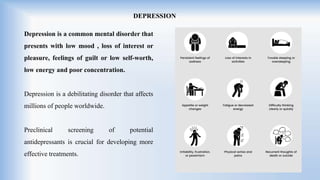
Depression is a common mental disorder that
presents with low mood , loss of interest or
pleasure, feelings of guilt or low self-worth,
low energy and poor concentration.
Depression is a debilitating disorder that affects
millions of people worldwide.
Preclinical screening of potential
antidepressants is crucial for developing more
effective treatments.
ANTI DEPRESSANT DRUGS
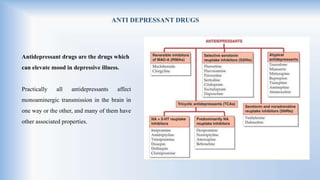
Antidepressant drugs are the drugs which
can elevate mood in depressive illness.
Practically all antidepressants affect
monoaminergic transmission in the brain in
one way or the other, and many of them have
other associated properties.
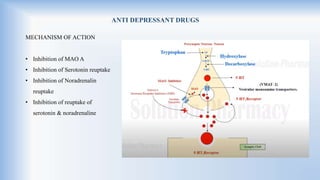
MECHANISM OF ACTION
• Inhibition of MAO A
• Inhibition of Serotonin reuptake
• Inhibition of Noradrenalin
reuptake
• Inhibition of reuptake of
serotonin & noradrenaline
ANTI DEPRESSANT DRUGS
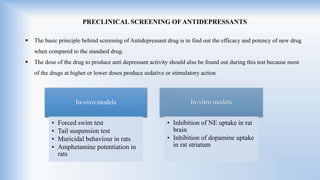
PRECLINICAL SCREENING OFANTIDEPRESSANTS
 The basic principle behind screening of Antidepressant drug is to find out the efficacy and potency of new drug
when compared to the standard drug.
 The dose of the drug to produce anti depressant activity should also be found out during this test because most
of the drugs at higher or lower doses produce sedative or stimulatory action
In-vivo models
• Forced swim test
• Tail suspension test
• Muricidal behaviour in rats
• Amphetamine potentiation in
rats
In-vitro models
• Inhibition of NE uptake in rat
brain
• Inhibition of dopamine uptake
in rat striatum
IN-VIVO MODELS
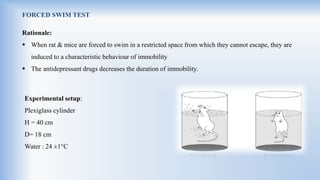
FORCED SWIM TEST
Rationale:
 When rat & mice are forced to swim in a restricted space from which they cannot escape, they are
induced to a characteristic behaviour of immobility
 The antidepressant drugs decreases the duration of immobility.
Experimental setup:
Plexiglass cylinder
H = 40 cm
D= 18 cm
Water : 24 ±1°C
Evaluation:
Duration of immobility in test and standard are compared.
Procedure:
• Adult male rats are forced to swim inside Plexiglass cylinder for 15 minutes
• Animals remain hyperactive at the initial stage.
• After 2-3 minutes, Become immobile.
• The total duration of immobility is measured
• Rats are removed, allowed to dry in a heated enclosure (32C)and then returned to
home cages
• After 24 hr., animal is again placed in the cylinder for a 5 minute test
• Test drug & std. drug are administered 1 hr prior to testing.
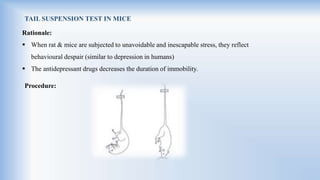
TAIL SUSPENSION TEST IN MICE
Rationale:
 When rat & mice are subjected to unavoidable and inescapable stress, they reflect
behavioural despair (similar to depression in humans)
 The antidepressant drugs decreases the duration of immobility.
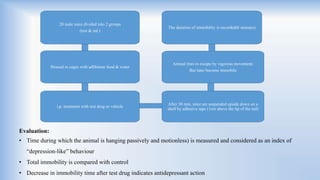
Procedure:
Evaluation:
• Time during which the animal is hanging passively and motionless) is measured and considered as an index of
“depression-like” behaviour
• Total immobility is compared with control
• Decrease in immobility time after test drug indicates antidepressant action
20 male mice divided into 2 groups
(test & std.)
Housed in cages with adlibitum food & water
i.p. treatment with test drug or vehicle
After 30 min, mice are suspended upside down on a
shelf by adhesive tape (1cm above the tip of the tail)
Animal tries to escape by vigorous movement;
But later become immobile
The duration of immobility is recorded(6 minutes)
LEARNED HELPLESSNESS IN RATS
Rationale:
Animals exposed to inescapable and unavoidable electric
shock in one situation later fail to escape shock in a different
situation even when escape is possible.
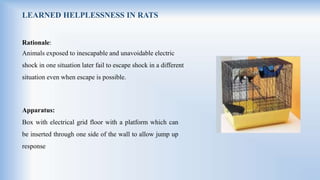
Apparatus:
Box with electrical grid floor with a platform which can
be inserted through one side of the wall to allow jump up
response
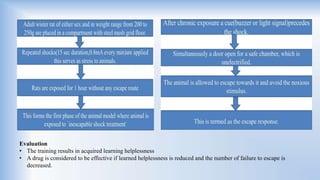
Evaluation
• The training results in acquired learning helplessness
• A drug is considered to be effective if learned helplessness is reduced and the number of failure to escape is
decreased.
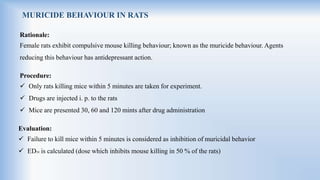
MURICIDE BEHAVIOUR IN RATS
Rationale:
Female rats exhibit compulsive mouse killing behaviour; known as the muricide behaviour. Agents
reducing this behaviour has antidepressant action.
Procedure:
 Only rats killing mice within 5 minutes are taken for experiment.
 Drugs are injected i. p. to the rats
 Mice are presented 30, 60 and 120 mints after drug administration
Evaluation:
 Failure to kill mice within 5 minutes is considered as inhibition of muricidal behavior
 ED50 is calculated (dose which inhibits mouse killing in 50 % of the rats)
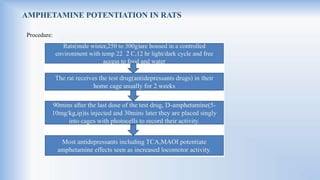
AMPHETAMINE POTENTIATION IN RATS
Procedure:
IN-VITRO MODELS
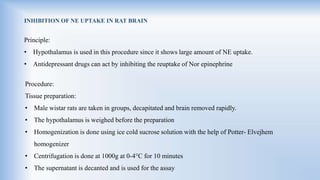
INHIBITION OF NE UPTAKE IN RAT BRAIN
Principle:
• Hypothalamus is used in this procedure since it shows large amount of NE uptake.
• Antidepressant drugs can act by inhibiting the reuptake of Nor epinephrine
Procedure:
Tissue preparation:
• Male wistar rats are taken in groups, decapitated and brain removed rapidly.
• The hypothalamus is weighed before the preparation
• Homogenization is done using ice cold sucrose solution with the help of Potter- Elvejhem
homogenizer
• Centrifugation is done at 1000g at 0-4°C for 10 minutes
• The supernatant is decanted and is used for the assay
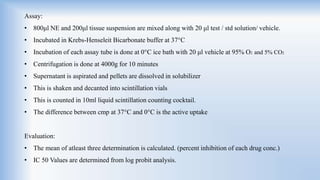
Assay:
• 800μl NE and 200μl tissue suspension are mixed along with 20 μl test / std solution/ vehicle.
• Incubated in Krebs-Henseleit Bicarbonate buffer at 37°C
• Incubation of each assay tube is done at 0°C ice bath with 20 μl vehicle at 95% O2 and 5% CO2
• Centrifugation is done at 4000g for 10 minutes
• Supernatant is aspirated and pellets are dissolved in solubilizer
• This is shaken and decanted into scintillation vials
• This is counted in 10ml liquid scintillation counting cocktail.
• The difference between cmp at 37°C and 0°C is the active uptake
Evaluation:
• The mean of atleast three determination is calculated. (percent inhibition of each drug conc.)
• IC 50 Values are determined from log probit analysis.
INHIBITION OF DOPAMINE UPTAKE IN RAT STRIATUM
Principle:
Dopamine has sodium dependent transport of high affinity in various tissue preparation
Antidepressants inhibit the uptake of dopamine
Procedure:
Tissue preparation:
• Male wistar rats are taken in groups
• They were decapitated and the brain should be removed rapidly.
• The corpora striata is weighed before the preparation is made.
• Homogenization is done using ice cold sucrose solution with the help of Potter- Elvejhem homogenizer
• Centrifugation is done at 1000g at 0-4°C for 10 minutes
• The supernatant is decanted and is used for the assay
Assay:
• 900μl 55.5Nm Dopamine and 100μl tissue suspension are mixed along with 20 μl test / std
solution in vehicle.
• Incubated in Krebs-Henseleit Bicarbonate buffer at 37°C
• Incubation of each assay tube is done at 0°C ice bath with 20 μl vehicle at 95% O2 and 5% CO2
• Centrifugation is done at 4000g for 10 minutes
• Supernatant is aspirated and pellets are dissolved in solubilizer (1:4 ratio of Triton & 50%
ethanol)
• This is shaken and decanted into scintillation vials
• This is counted in 10ml liquid scintillation counting cocktail.
• The difference between cmp at 37°C and 0°C is the active uptake
Evaluation:
• The mean of atleast three determination is calculated. (percent inhibition of each drug conc.)
• IC 50 Values are determined from log probit analysis.
REFERENCE
 https://iacuc.ucsf.edu/sites/g/files/tkssra751/f/wysiwyg/STD%20PROCEDURE%20-%20Behavior%20-
%20Tail%20Suspension.pdf
 https://www.slideshare.net/VMMCSJH/screening-of-antidepressant
 https://www.slideshare.net/KomalSingh301/screening-models-of-antidepressants-drugs?from_search=0
Thank You!

Evaluation of antidepressants.pptx

  • 1.
  • 2.
    CONTENTS  Depression  Antidepressantdrugs  Preclinical Screening of Antidepressant drugs  In-vivo screening models  In-vitro screening models
  • 3.
    DEPRESSION Depression is acommon mental disorder that presents with low mood , loss of interest or pleasure, feelings of guilt or low self-worth, low energy and poor concentration. Depression is a debilitating disorder that affects millions of people worldwide. Preclinical screening of potential antidepressants is crucial for developing more effective treatments.
  • 4.
    ANTI DEPRESSANT DRUGS Antidepressantdrugs are the drugs which can elevate mood in depressive illness. Practically all antidepressants affect monoaminergic transmission in the brain in one way or the other, and many of them have other associated properties.
  • 5.
    MECHANISM OF ACTION •Inhibition of MAO A • Inhibition of Serotonin reuptake • Inhibition of Noradrenalin reuptake • Inhibition of reuptake of serotonin & noradrenaline ANTI DEPRESSANT DRUGS
  • 6.
    PRECLINICAL SCREENING OFANTIDEPRESSANTS The basic principle behind screening of Antidepressant drug is to find out the efficacy and potency of new drug when compared to the standard drug.  The dose of the drug to produce anti depressant activity should also be found out during this test because most of the drugs at higher or lower doses produce sedative or stimulatory action In-vivo models • Forced swim test • Tail suspension test • Muricidal behaviour in rats • Amphetamine potentiation in rats In-vitro models • Inhibition of NE uptake in rat brain • Inhibition of dopamine uptake in rat striatum
  • 7.
  • 8.
    FORCED SWIM TEST Rationale: When rat & mice are forced to swim in a restricted space from which they cannot escape, they are induced to a characteristic behaviour of immobility  The antidepressant drugs decreases the duration of immobility. Experimental setup: Plexiglass cylinder H = 40 cm D= 18 cm Water : 24 ±1°C
  • 9.
    Evaluation: Duration of immobilityin test and standard are compared. Procedure: • Adult male rats are forced to swim inside Plexiglass cylinder for 15 minutes • Animals remain hyperactive at the initial stage. • After 2-3 minutes, Become immobile. • The total duration of immobility is measured • Rats are removed, allowed to dry in a heated enclosure (32C)and then returned to home cages • After 24 hr., animal is again placed in the cylinder for a 5 minute test • Test drug & std. drug are administered 1 hr prior to testing.
  • 10.
    TAIL SUSPENSION TESTIN MICE Rationale:  When rat & mice are subjected to unavoidable and inescapable stress, they reflect behavioural despair (similar to depression in humans)  The antidepressant drugs decreases the duration of immobility. Procedure:
  • 11.
    Evaluation: • Time duringwhich the animal is hanging passively and motionless) is measured and considered as an index of “depression-like” behaviour • Total immobility is compared with control • Decrease in immobility time after test drug indicates antidepressant action 20 male mice divided into 2 groups (test & std.) Housed in cages with adlibitum food & water i.p. treatment with test drug or vehicle After 30 min, mice are suspended upside down on a shelf by adhesive tape (1cm above the tip of the tail) Animal tries to escape by vigorous movement; But later become immobile The duration of immobility is recorded(6 minutes)
  • 12.
    LEARNED HELPLESSNESS INRATS Rationale: Animals exposed to inescapable and unavoidable electric shock in one situation later fail to escape shock in a different situation even when escape is possible. Apparatus: Box with electrical grid floor with a platform which can be inserted through one side of the wall to allow jump up response
  • 13.
    Evaluation • The trainingresults in acquired learning helplessness • A drug is considered to be effective if learned helplessness is reduced and the number of failure to escape is decreased.
  • 14.
    MURICIDE BEHAVIOUR INRATS Rationale: Female rats exhibit compulsive mouse killing behaviour; known as the muricide behaviour. Agents reducing this behaviour has antidepressant action. Procedure:  Only rats killing mice within 5 minutes are taken for experiment.  Drugs are injected i. p. to the rats  Mice are presented 30, 60 and 120 mints after drug administration Evaluation:  Failure to kill mice within 5 minutes is considered as inhibition of muricidal behavior  ED50 is calculated (dose which inhibits mouse killing in 50 % of the rats)
  • 15.
  • 16.
  • 17.
    INHIBITION OF NEUPTAKE IN RAT BRAIN Principle: • Hypothalamus is used in this procedure since it shows large amount of NE uptake. • Antidepressant drugs can act by inhibiting the reuptake of Nor epinephrine Procedure: Tissue preparation: • Male wistar rats are taken in groups, decapitated and brain removed rapidly. • The hypothalamus is weighed before the preparation • Homogenization is done using ice cold sucrose solution with the help of Potter- Elvejhem homogenizer • Centrifugation is done at 1000g at 0-4°C for 10 minutes • The supernatant is decanted and is used for the assay
  • 18.
    Assay: • 800μl NEand 200μl tissue suspension are mixed along with 20 μl test / std solution/ vehicle. • Incubated in Krebs-Henseleit Bicarbonate buffer at 37°C • Incubation of each assay tube is done at 0°C ice bath with 20 μl vehicle at 95% O2 and 5% CO2 • Centrifugation is done at 4000g for 10 minutes • Supernatant is aspirated and pellets are dissolved in solubilizer • This is shaken and decanted into scintillation vials • This is counted in 10ml liquid scintillation counting cocktail. • The difference between cmp at 37°C and 0°C is the active uptake Evaluation: • The mean of atleast three determination is calculated. (percent inhibition of each drug conc.) • IC 50 Values are determined from log probit analysis.
  • 19.
    INHIBITION OF DOPAMINEUPTAKE IN RAT STRIATUM Principle: Dopamine has sodium dependent transport of high affinity in various tissue preparation Antidepressants inhibit the uptake of dopamine Procedure: Tissue preparation: • Male wistar rats are taken in groups • They were decapitated and the brain should be removed rapidly. • The corpora striata is weighed before the preparation is made. • Homogenization is done using ice cold sucrose solution with the help of Potter- Elvejhem homogenizer • Centrifugation is done at 1000g at 0-4°C for 10 minutes • The supernatant is decanted and is used for the assay
  • 20.
    Assay: • 900μl 55.5NmDopamine and 100μl tissue suspension are mixed along with 20 μl test / std solution in vehicle. • Incubated in Krebs-Henseleit Bicarbonate buffer at 37°C • Incubation of each assay tube is done at 0°C ice bath with 20 μl vehicle at 95% O2 and 5% CO2 • Centrifugation is done at 4000g for 10 minutes • Supernatant is aspirated and pellets are dissolved in solubilizer (1:4 ratio of Triton & 50% ethanol) • This is shaken and decanted into scintillation vials • This is counted in 10ml liquid scintillation counting cocktail. • The difference between cmp at 37°C and 0°C is the active uptake Evaluation: • The mean of atleast three determination is calculated. (percent inhibition of each drug conc.) • IC 50 Values are determined from log probit analysis.
  • 21.
  • 22.