ANTHROPOLOGY
PRESENTED TO:
SIR IBRAHIM MEHMOOD
SALEHA AAMER
F2016101009
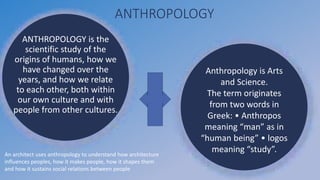
ANTHROPOLOGY
ANTHROPOLOGY is the
scientific study of the
origins of humans, how we
have changed over the
years, and how we relate
to each other, both within
our own culture and with
people from other cultures.
Anthropology is Arts
and Science.
The term originates
from two words in
Greek: • Anthropos
meaning “man” as in
“human being” • logos
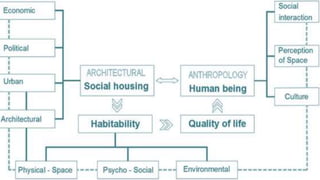
meaning “study”.An architect uses anthropology to understand how architecture
influences peoples, how it makes people, how it shapes them
and how it sustains social relations between people
IMPORTANCE OF ANTHROPOLOGY
Anthropologists explore
human evolution, reconstruct
societies and civilizations of
the past, and analyze the
cultures and languages of
modern peoples. ... In
the anthropology major,
students learn about human
difference in all its biological,
historical, cultural and
linguistic complications
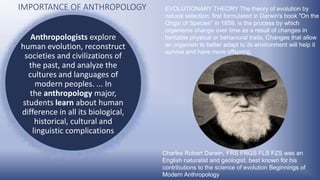
EVOLUTIONARY THEORY The theory of evolution by
natural selection, first formulated in Darwin's book "On the
Origin of Species" in 1859, is the process by which
organisms change over time as a result of changes in
heritable physical or behavioral traits. Changes that allow
an organism to better adapt to its environment will help it
survive and have more offspring.
Charles Robert Darwin, FRS FRGS FLS FZS was an
English naturalist and geologist, best known for his
contributions to the science of evolution Beginnings of
Modern Anthropology
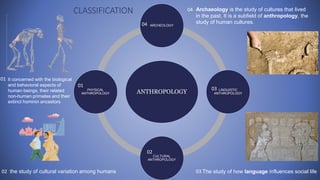
CLASSIFICATION
ANTHROPOLOGY
ARCHEOLOGY
LINGUISTIC
ANTHROPOLOGY
CULTURAL
ANTHROPOLOGY
PHYSICAL
ANTHROPOLOGY
It concerned with the biological
and behavioral aspects of
human beings, their related
non-human primates and their
extinct hominin ancestors
the study of cultural variation among humans The study of how language influences social life
Archaeology is the study of cultures that lived
in the past. It is a subfield of anthropology, the
study of human cultures.
01
01
02
02
03
04
04
03
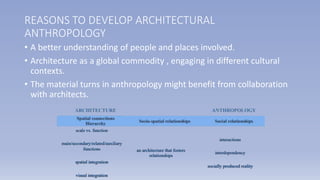
• A better understanding of people and places involved.
• Architecture as a global commodity , engaging in different cultural
contexts.
• The material turns in anthropology might benefit from collaboration
with architects.
REASONS TO DEVELOP ARCHITECTURAL
ANTHROPOLOGY
Anthropology

Anthropology

  • 1.
    ANTHROPOLOGY PRESENTED TO: SIR IBRAHIMMEHMOOD SALEHA AAMER F2016101009
  • 2.
    ANTHROPOLOGY ANTHROPOLOGY is the scientificstudy of the origins of humans, how we have changed over the years, and how we relate to each other, both within our own culture and with people from other cultures. Anthropology is Arts and Science. The term originates from two words in Greek: • Anthropos meaning “man” as in “human being” • logos meaning “study”.An architect uses anthropology to understand how architecture influences peoples, how it makes people, how it shapes them and how it sustains social relations between people
  • 3.
    IMPORTANCE OF ANTHROPOLOGY Anthropologistsexplore human evolution, reconstruct societies and civilizations of the past, and analyze the cultures and languages of modern peoples. ... In the anthropology major, students learn about human difference in all its biological, historical, cultural and linguistic complications EVOLUTIONARY THEORY The theory of evolution by natural selection, first formulated in Darwin's book "On the Origin of Species" in 1859, is the process by which organisms change over time as a result of changes in heritable physical or behavioral traits. Changes that allow an organism to better adapt to its environment will help it survive and have more offspring. Charles Robert Darwin, FRS FRGS FLS FZS was an English naturalist and geologist, best known for his contributions to the science of evolution Beginnings of Modern Anthropology
  • 4.
    CLASSIFICATION ANTHROPOLOGY ARCHEOLOGY LINGUISTIC ANTHROPOLOGY CULTURAL ANTHROPOLOGY PHYSICAL ANTHROPOLOGY It concerned withthe biological and behavioral aspects of human beings, their related non-human primates and their extinct hominin ancestors the study of cultural variation among humans The study of how language influences social life Archaeology is the study of cultures that lived in the past. It is a subfield of anthropology, the study of human cultures. 01 01 02 02 03 04 04 03
  • 5.
    • A betterunderstanding of people and places involved. • Architecture as a global commodity , engaging in different cultural contexts. • The material turns in anthropology might benefit from collaboration with architects. REASONS TO DEVELOP ARCHITECTURAL ANTHROPOLOGY