Anthropological Concepts of Space (Design Theory).pdf
1.
Prepared by SauravShrestha
LECTURE 12 & 13
CHAPTER FIVE : ANTHROPOLOGICAL CONCEPTS OF SPACE
2.
C H AP T E R 5
Proxemics : Personal Space Zones & Cultural Differences 5.01
Territoriality in Architecture 5.02
..……………………………………………………………………………..
Lefebvre’s Triad : Conceived, Perceived & Lived Space 5.03
Embodied, Sacred, Profane and Public 5.04
………………………………………………………………………………
Case Studies on Social and Cultural Influence 5.05
3.
“ Space isnot just space, it is a cultural construct ”
Edward T. Hall
4.
PROXEMICS: PERSONAL SPACE& CULTURAL DIFFERENCES 5.1.1
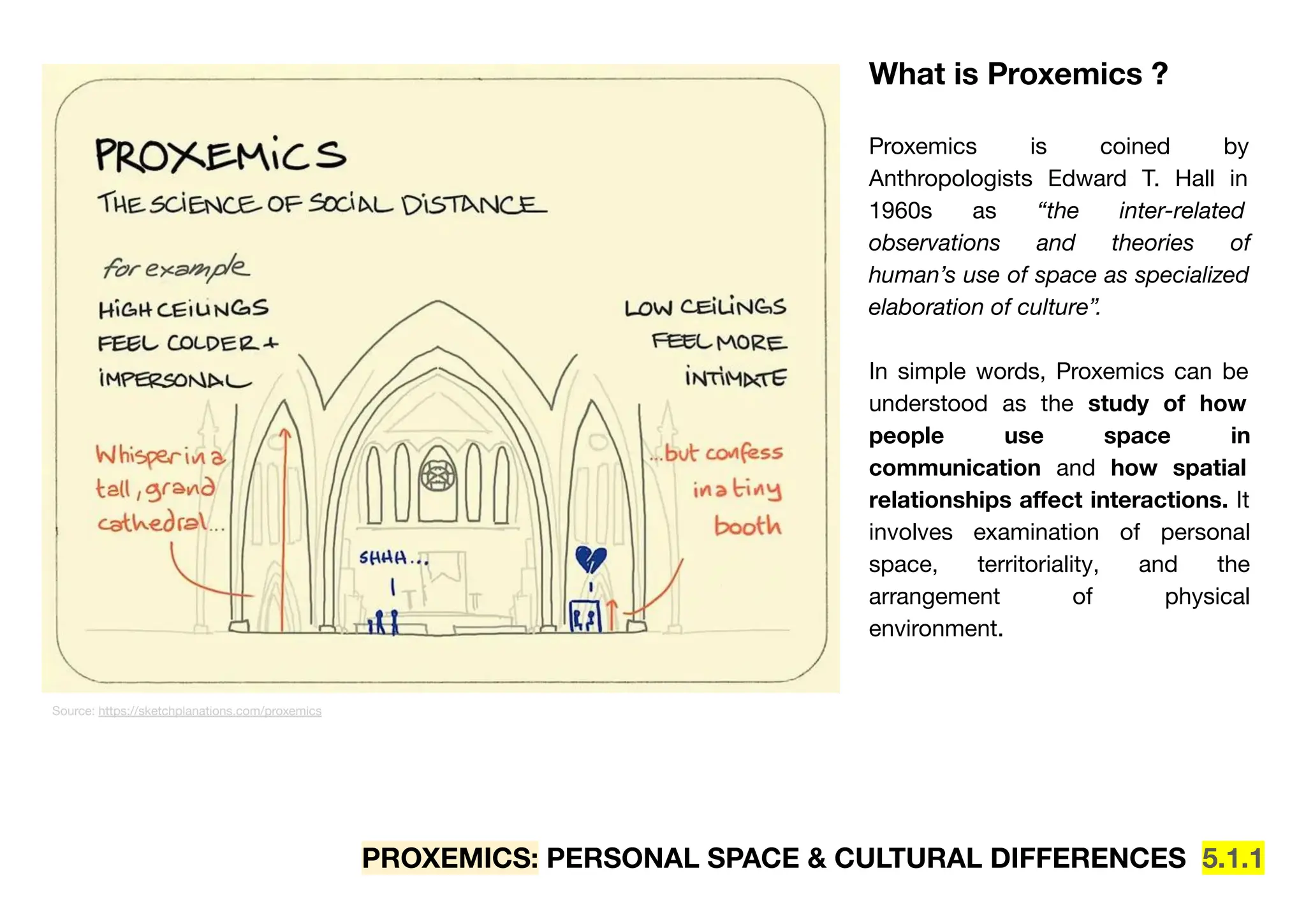
What is Proxemics ?
Proxemics is coined by
Anthropologists Edward T. Hall in
1960s as “the inter-related
observations and theories of
human’s use of space as specialized
elaboration of culture”.
In simple words, Proxemics can be
understood as the study of how
people use space in
communication and how spatial
relationships affect interactions. It
involves examination of personal
space, territoriality, and the
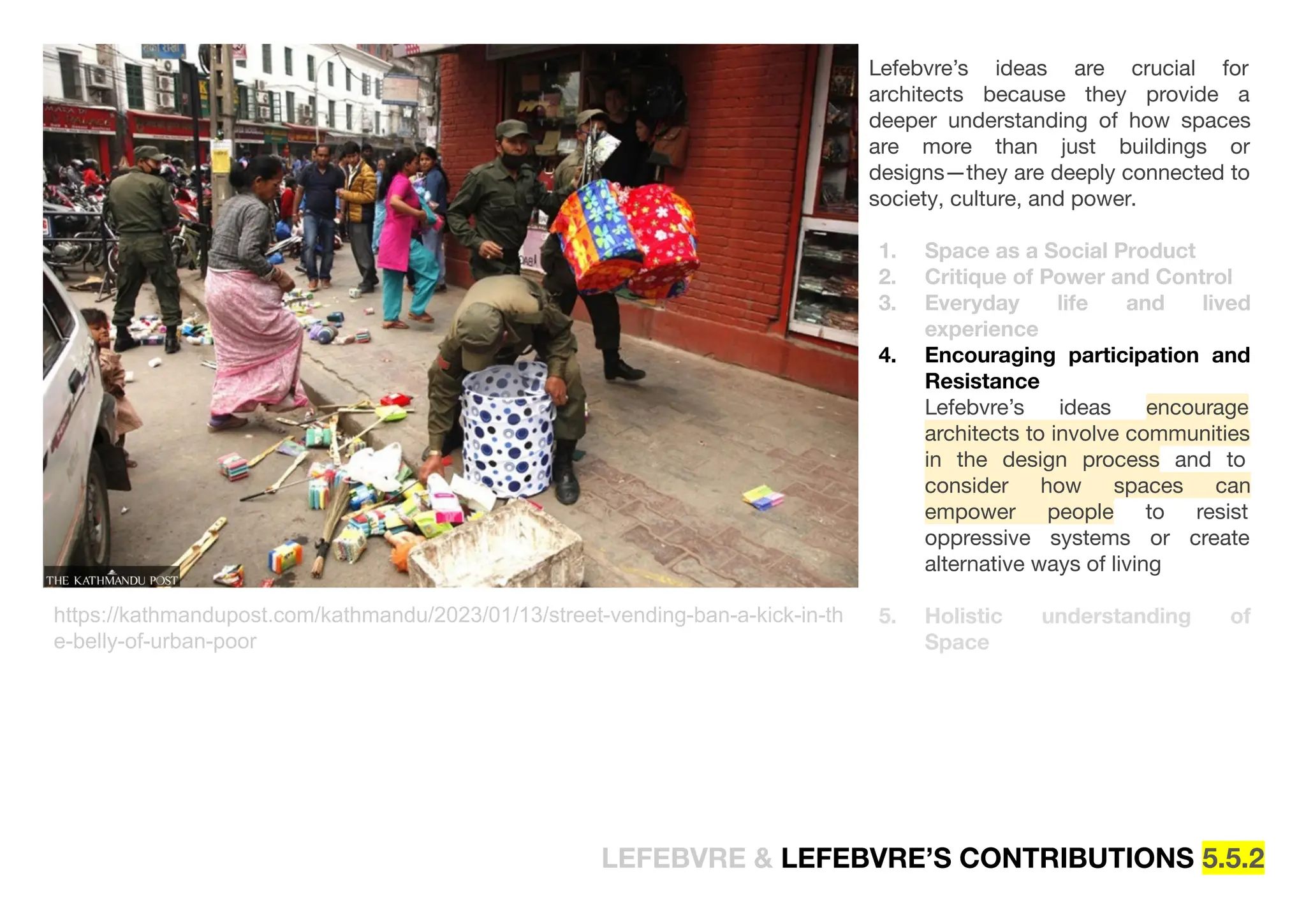
arrangement of physical
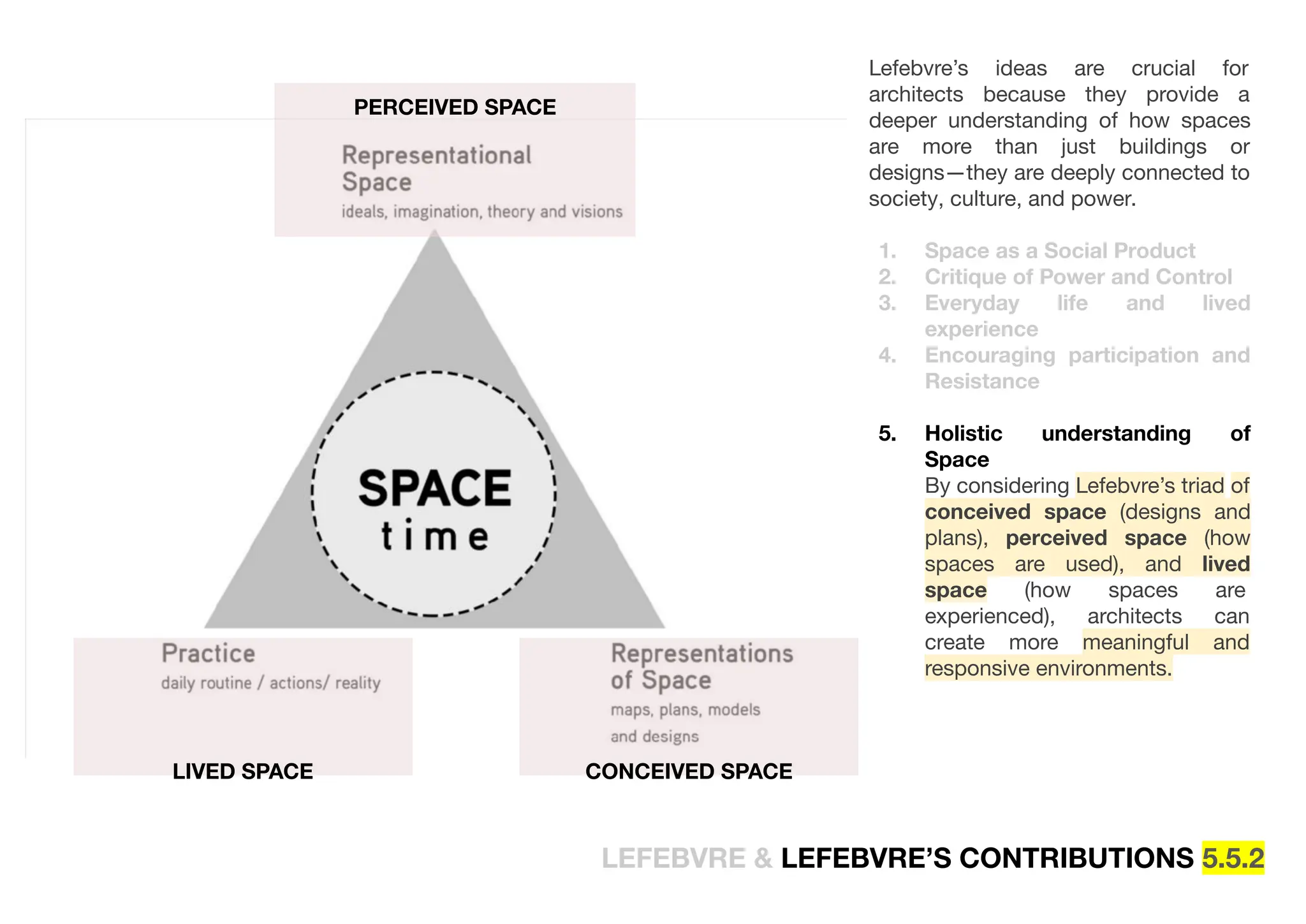
environment.
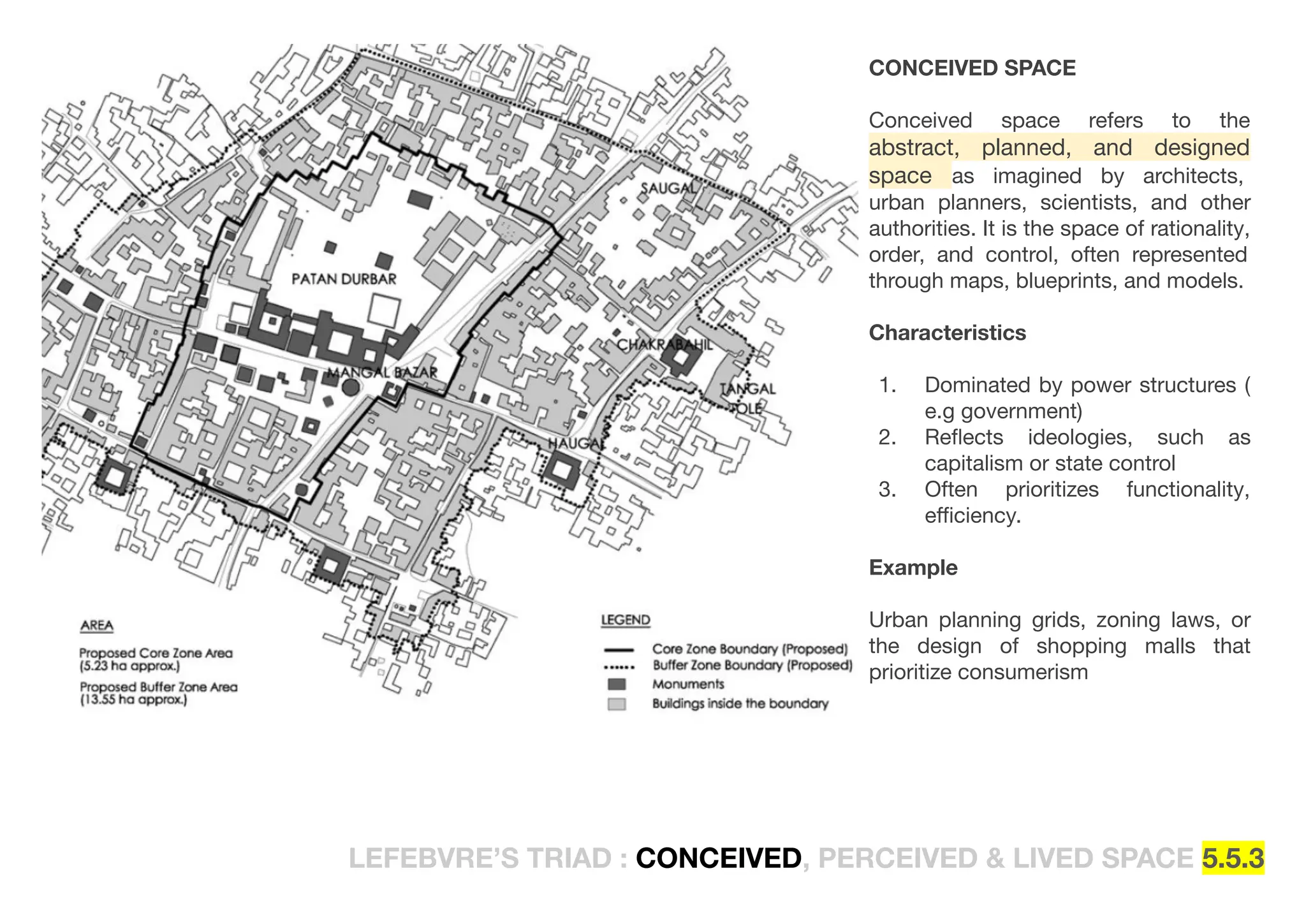
Source: https://sketchplanations.com/proxemics
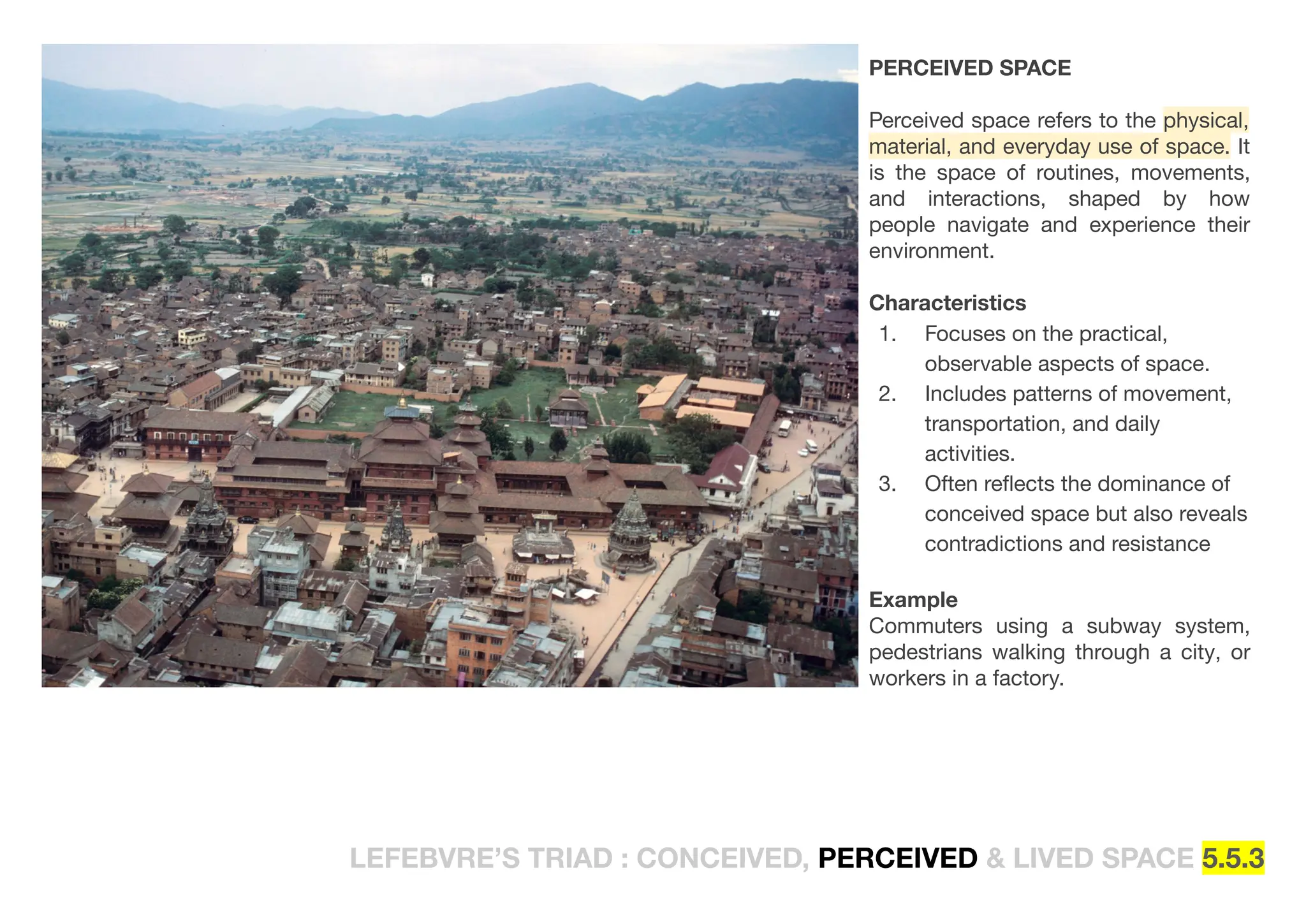
5.
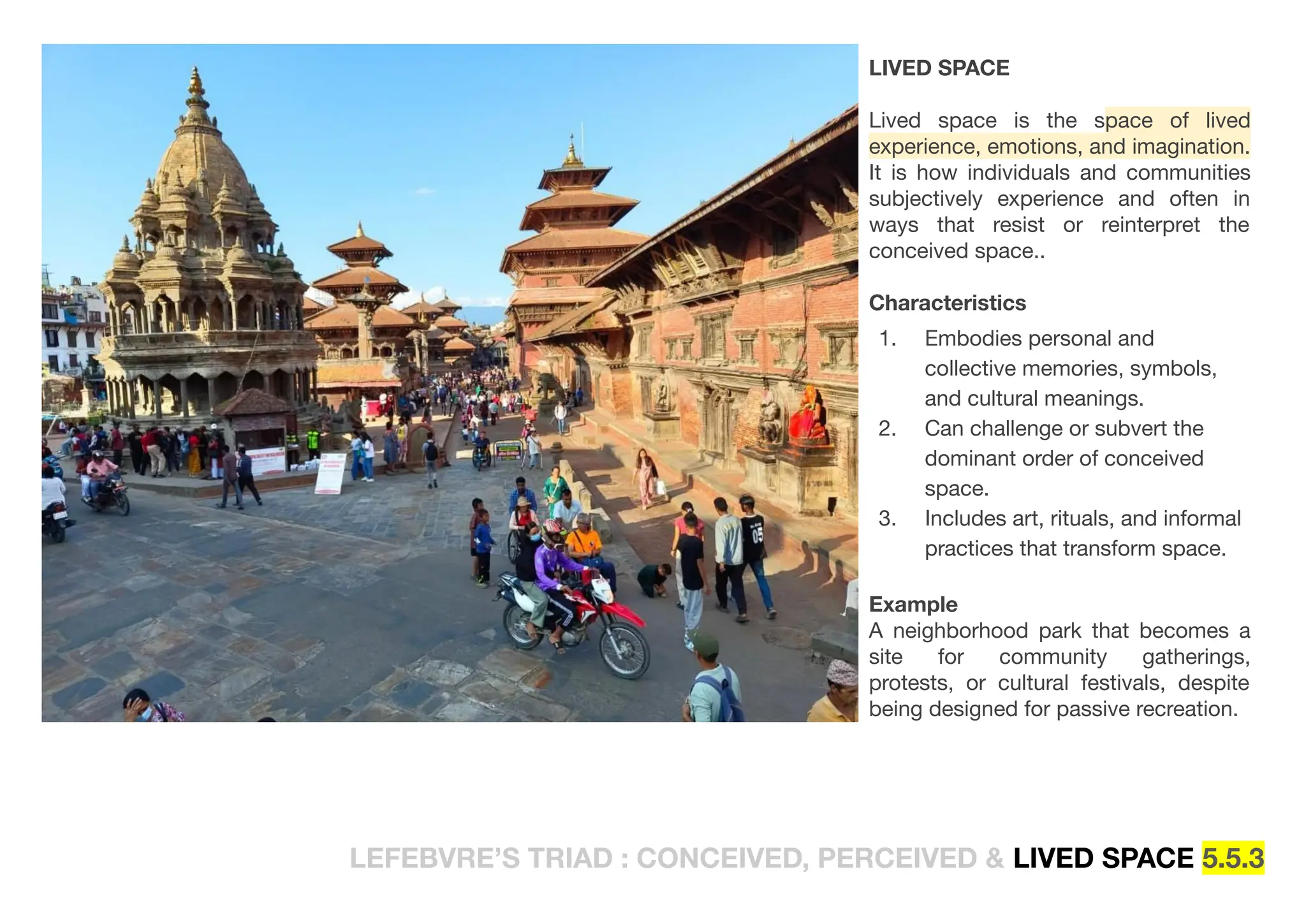
PROXEMICS: PERSONAL SPACE& CULTURAL DIFFERENCES 5.1.2
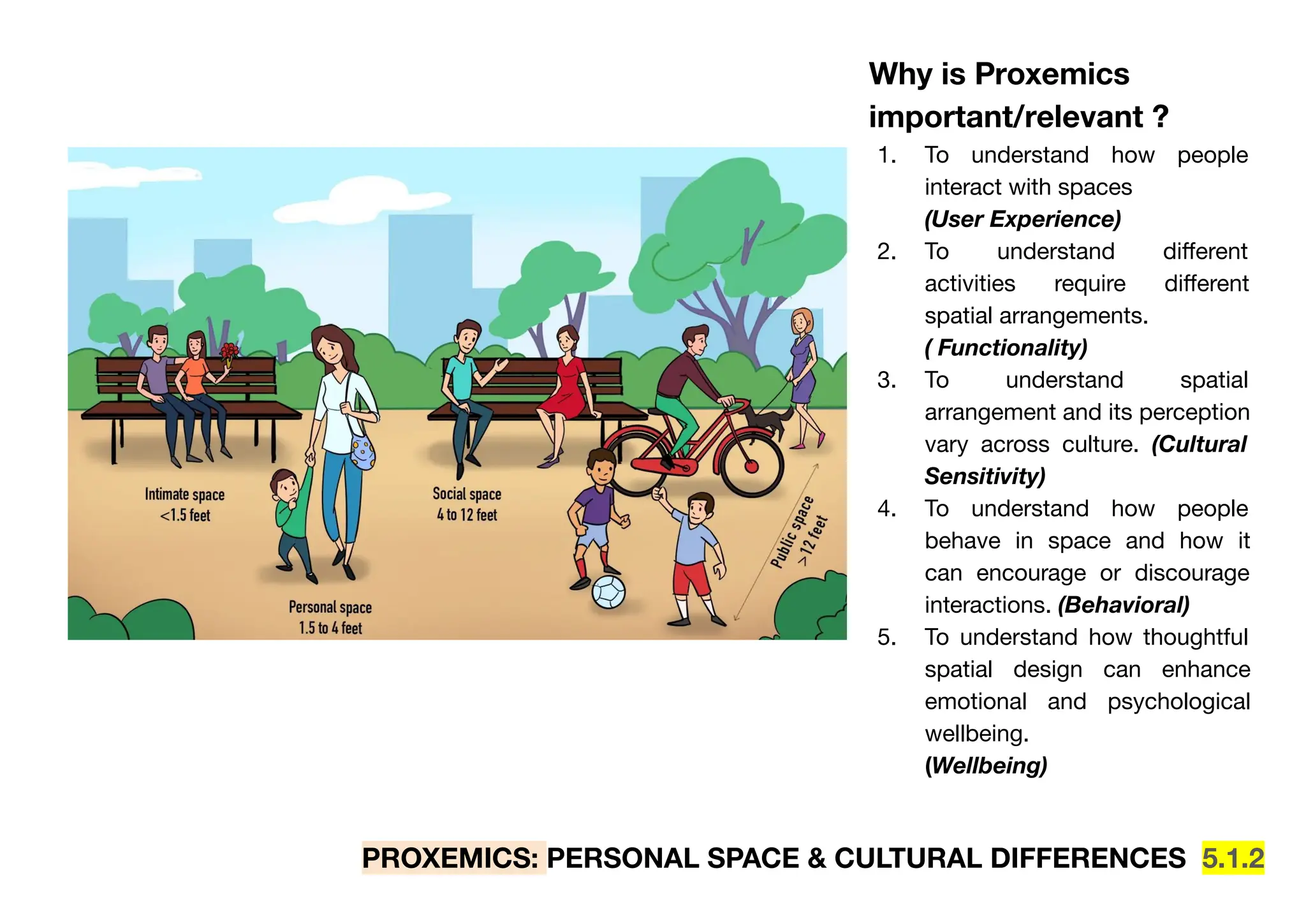
Why is Proxemics
important/relevant ?
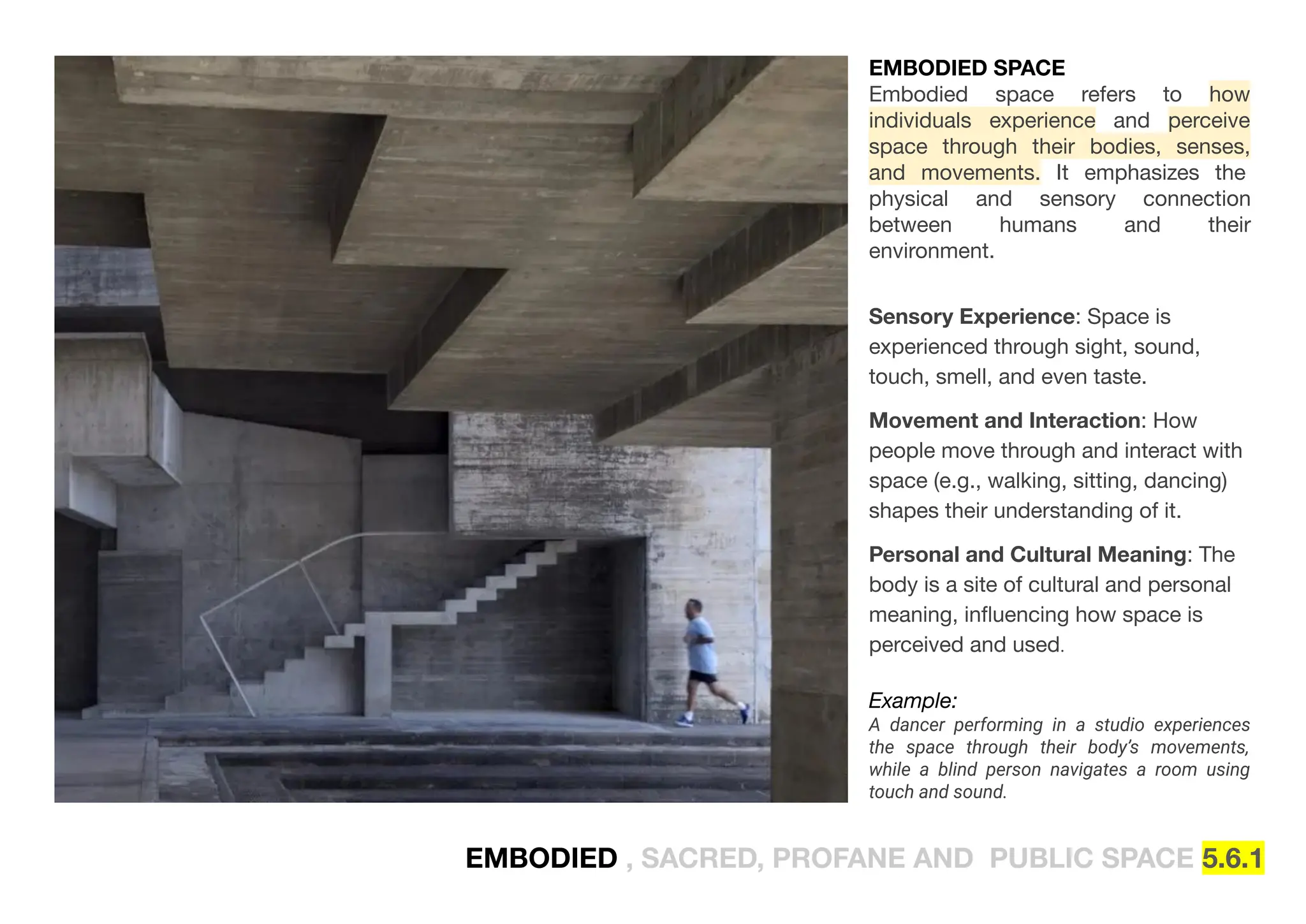
1. To understand how people
interact with spaces
(User Experience)
2. To understand different
activities require different
spatial arrangements.
( Functionality)
3. To understand spatial
arrangement and its perception
vary across culture. (Cultural
Sensitivity)
4. To understand how people
behave in space and how it
can encourage or discourage
interactions. (Behavioral)
5. To understand how thoughtful
spatial design can enhance
emotional and psychological
wellbeing.
(Wellbeing)
6.
PROXEMICS: PERSONAL SPACE& CULTURAL DIFFERENCES 5.1.3
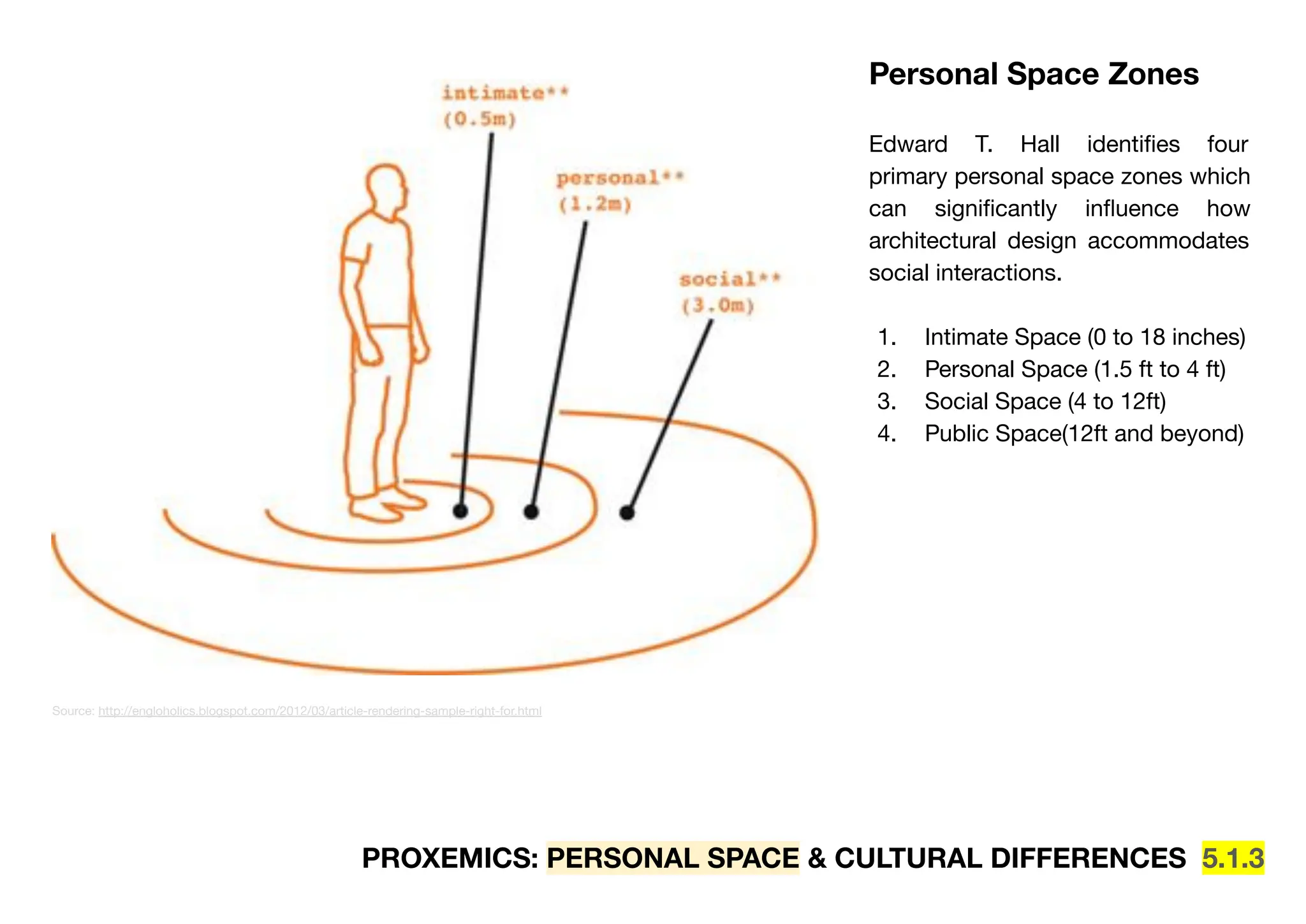
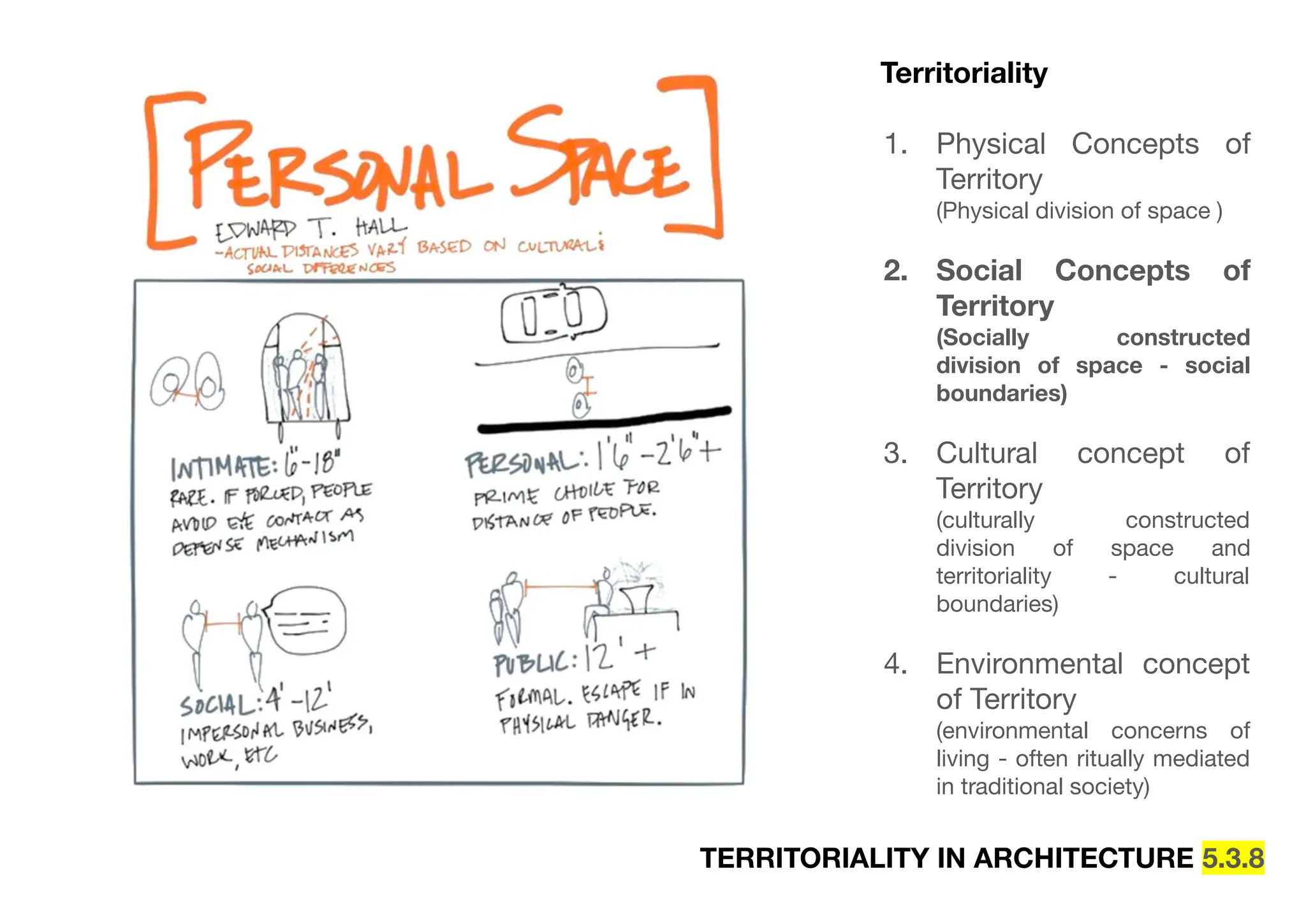
Personal Space Zones
Edward T. Hall identifies four
primary personal space zones which
can significantly influence how
architectural design accommodates
social interactions.
1. Intimate Space (0 to 18 inches)
2. Personal Space (1.5 ft to 4 ft)
3. Social Space (4 to 12ft)
4. Public Space(12ft and beyond)
Source: http://engloholics.blogspot.com/2012/03/article-rendering-sample-right-for.html
7.
PROXEMICS: PERSONAL SPACE& CULTURAL DIFFERENCES 5.1.4
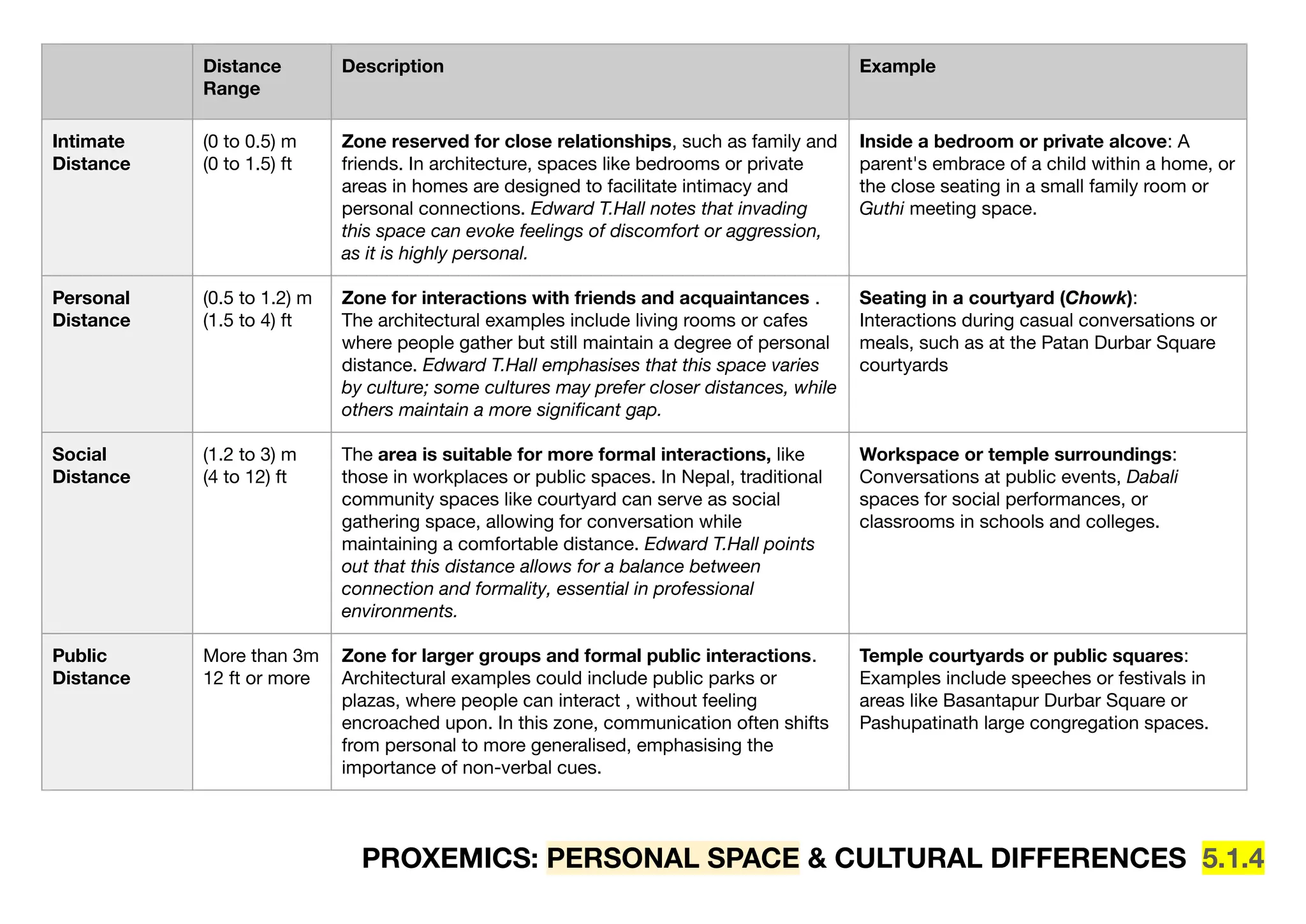
Distance
Range
Description Example
Intimate
Distance
(0 to 0.5) m
(0 to 1.5) ft
Zone reserved for close relationships, such as family and
friends. In architecture, spaces like bedrooms or private
areas in homes are designed to facilitate intimacy and
personal connections. Edward T.Hall notes that invading
this space can evoke feelings of discomfort or aggression,
as it is highly personal.
Inside a bedroom or private alcove: A
parent's embrace of a child within a home, or
the close seating in a small family room or
Guthi meeting space.
Personal
Distance
(0.5 to 1.2) m
(1.5 to 4) ft
Zone for interactions with friends and acquaintances .
The architectural examples include living rooms or cafes
where people gather but still maintain a degree of personal
distance. Edward T.Hall emphasises that this space varies
by culture; some cultures may prefer closer distances, while
others maintain a more significant gap.
Seating in a courtyard (Chowk):
Interactions during casual conversations or
meals, such as at the Patan Durbar Square
courtyards
Social
Distance
(1.2 to 3) m
(4 to 12) ft
The area is suitable for more formal interactions, like
those in workplaces or public spaces. In Nepal, traditional
community spaces like courtyard can serve as social
gathering space, allowing for conversation while
maintaining a comfortable distance. Edward T.Hall points
out that this distance allows for a balance between
connection and formality, essential in professional
environments.
Workspace or temple surroundings:
Conversations at public events, Dabali
spaces for social performances, or
classrooms in schools and colleges.
Public
Distance
More than 3m
12 ft or more
Zone for larger groups and formal public interactions.
Architectural examples could include public parks or
plazas, where people can interact , without feeling
encroached upon. In this zone, communication often shifts
from personal to more generalised, emphasising the
importance of non-verbal cues.
Temple courtyards or public squares:
Examples include speeches or festivals in
areas like Basantapur Durbar Square or
Pashupatinath large congregation spaces.
8.
PROXEMICS: PERSONAL SPACE& CULTURAL DIFFERENCES 5.1.4
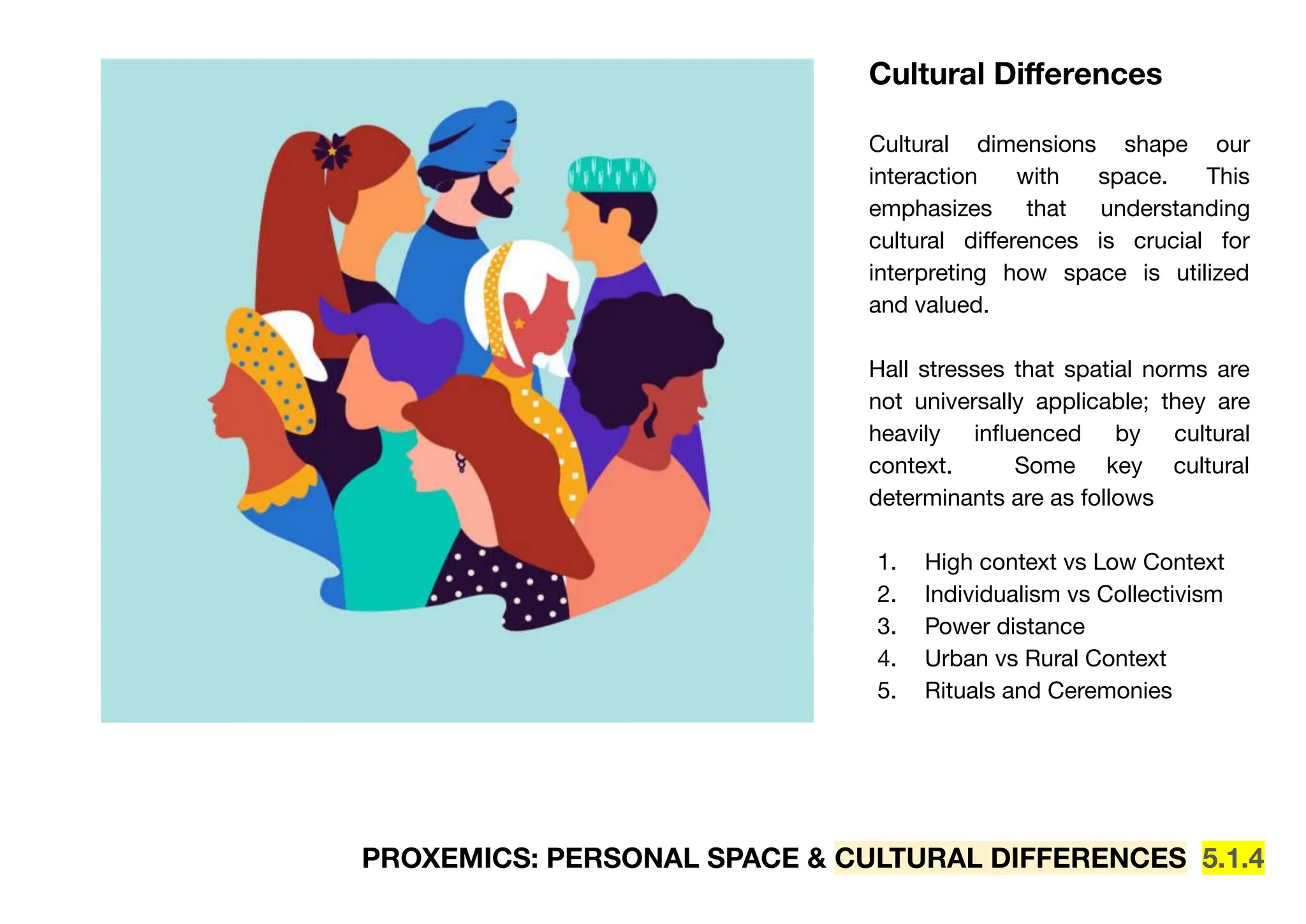
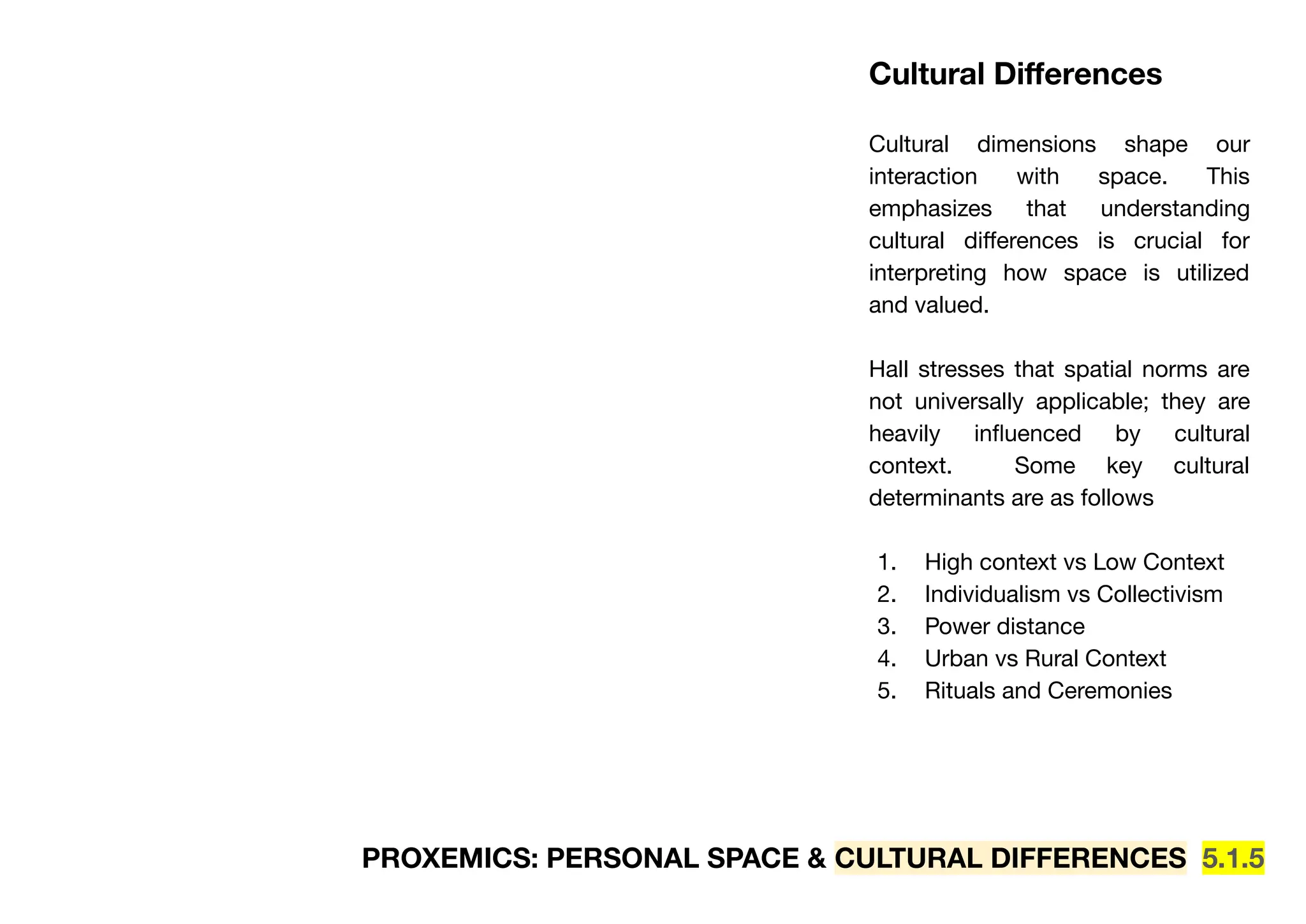
Cultural Differences
Cultural dimensions shape our
interaction with space. This
emphasizes that understanding
cultural differences is crucial for
interpreting how space is utilized
and valued.
Hall stresses that spatial norms are
not universally applicable; they are
heavily influenced by cultural
context. Some key cultural
determinants are as follows
1. High context vs Low Context
2. Individualism vs Collectivism
3. Power distance
4. Urban vs Rural Context
5. Rituals and Ceremonies
9.
PROXEMICS: PERSONAL SPACE& CULTURAL DIFFERENCES 5.1.5
Cultural Differences
Cultural dimensions shape our
interaction with space. This
emphasizes that understanding
cultural differences is crucial for
interpreting how space is utilized
and valued.
Hall stresses that spatial norms are
not universally applicable; they are
heavily influenced by cultural
context. Some key cultural
determinants are as follows
1. High context vs Low Context
2. Individualism vs Collectivism
3. Power distance
4. Urban vs Rural Context
5. Rituals and Ceremonies
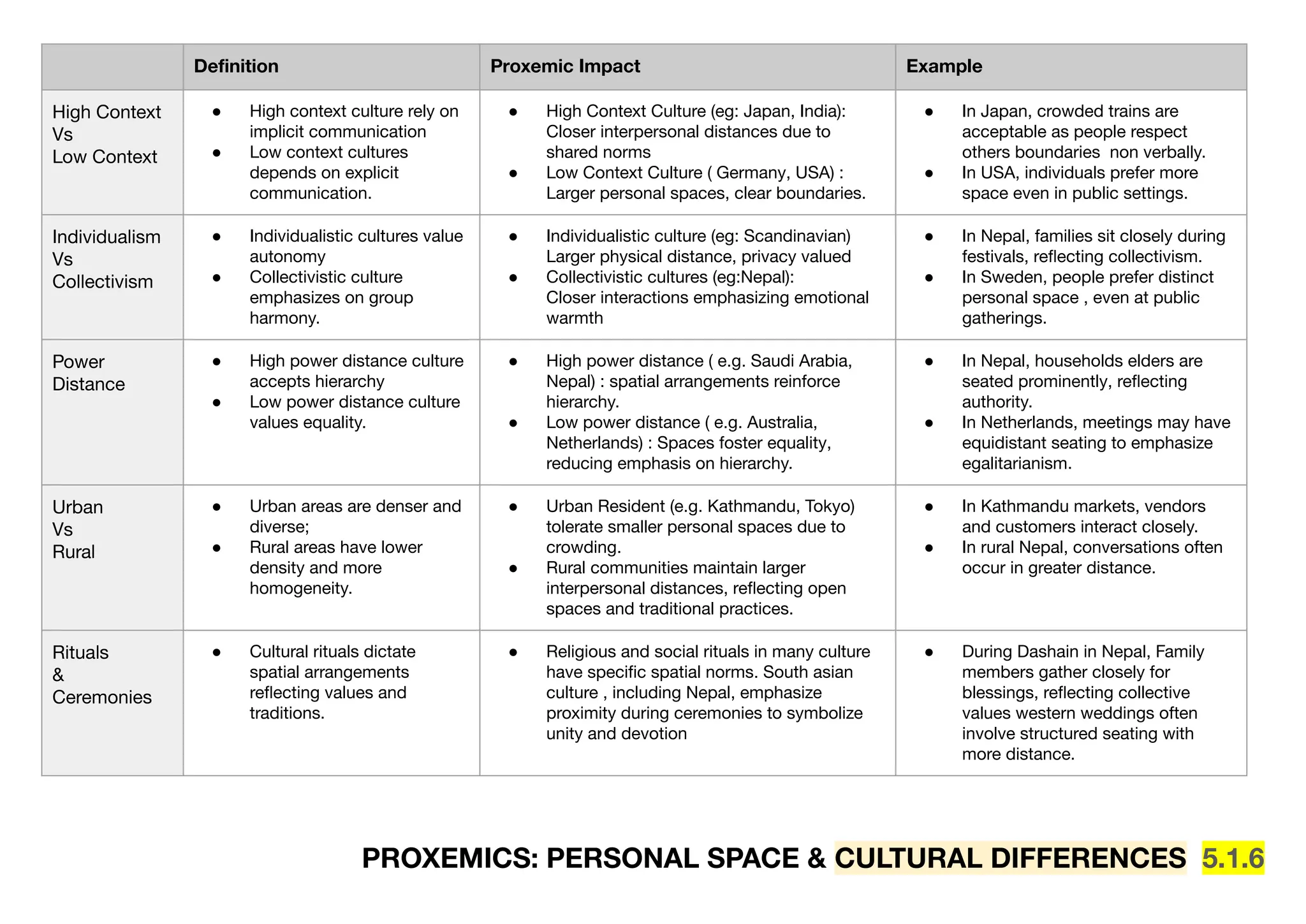
10.
Definition Proxemic ImpactExample
High Context
Vs
Low Context
● High context culture rely on
implicit communication
● Low context cultures
depends on explicit
communication.
● High Context Culture (eg: Japan, India):
Closer interpersonal distances due to
shared norms
● Low Context Culture ( Germany, USA) :
Larger personal spaces, clear boundaries.
● In Japan, crowded trains are
acceptable as people respect
others boundaries non verbally.
● In USA, individuals prefer more
space even in public settings.
Individualism
Vs
Collectivism
● Individualistic cultures value
autonomy
● Collectivistic culture
emphasizes on group
harmony.
● Individualistic culture (eg: Scandinavian)
Larger physical distance, privacy valued
● Collectivistic cultures (eg:Nepal):
Closer interactions emphasizing emotional
warmth
● In Nepal, families sit closely during
festivals, reflecting collectivism.
● In Sweden, people prefer distinct
personal space , even at public
gatherings.
Power
Distance
● High power distance culture
accepts hierarchy
● Low power distance culture
values equality.
● High power distance ( e.g. Saudi Arabia,
Nepal) : spatial arrangements reinforce
hierarchy.
● Low power distance ( e.g. Australia,
Netherlands) : Spaces foster equality,
reducing emphasis on hierarchy.
● In Nepal, households elders are
seated prominently, reflecting
authority.
● In Netherlands, meetings may have
equidistant seating to emphasize
egalitarianism.
Urban
Vs
Rural
● Urban areas are denser and
diverse;
● Rural areas have lower
density and more
homogeneity.
● Urban Resident (e.g. Kathmandu, Tokyo)
tolerate smaller personal spaces due to
crowding.
● Rural communities maintain larger
interpersonal distances, reflecting open
spaces and traditional practices.
● In Kathmandu markets, vendors
and customers interact closely.
● In rural Nepal, conversations often
occur in greater distance.
Rituals
&
Ceremonies
● Cultural rituals dictate
spatial arrangements
reflecting values and
traditions.
● Religious and social rituals in many culture
have specific spatial norms. South asian
culture , including Nepal, emphasize
proximity during ceremonies to symbolize
unity and devotion
● During Dashain in Nepal, Family
members gather closely for
blessings, reflecting collective
values western weddings often
involve structured seating with
more distance.
PROXEMICS: PERSONAL SPACE & CULTURAL DIFFERENCES 5.1.6
11.
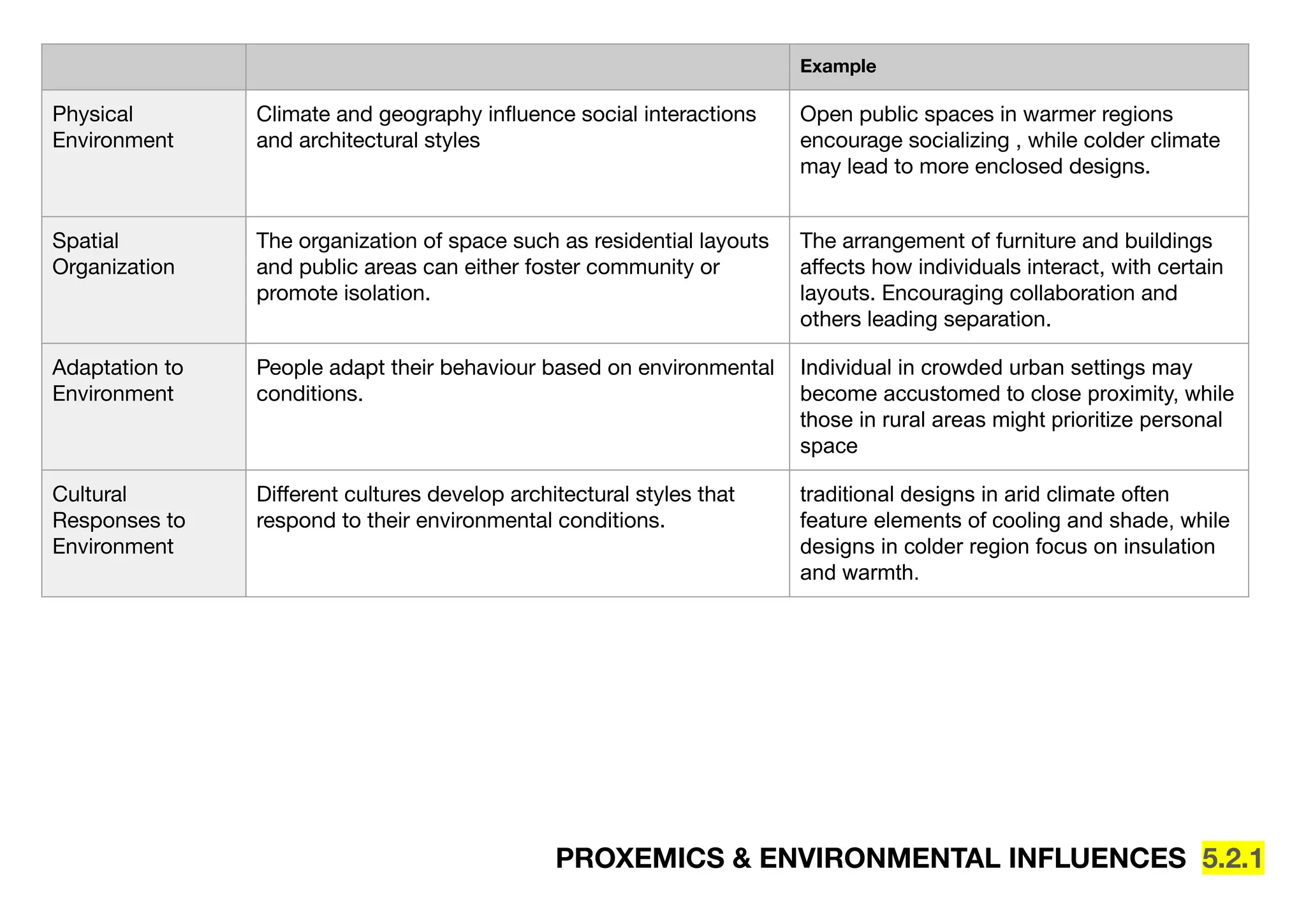
PROXEMICS & ENVIRONMENTALINFLUENCES 5.2.1
Example
Physical
Environment
Climate and geography influence social interactions
and architectural styles
Open public spaces in warmer regions
encourage socializing , while colder climate
may lead to more enclosed designs.
Spatial
Organization
The organization of space such as residential layouts
and public areas can either foster community or
promote isolation.
The arrangement of furniture and buildings
affects how individuals interact, with certain
layouts. Encouraging collaboration and
others leading separation.
Adaptation to
Environment
People adapt their behaviour based on environmental
conditions.
Individual in crowded urban settings may
become accustomed to close proximity, while
those in rural areas might prioritize personal
space
Cultural
Responses to
Environment
Different cultures develop architectural styles that
respond to their environmental conditions.
traditional designs in arid climate often
feature elements of cooling and shade, while
designs in colder region focus on insulation
and warmth.
12.
“Each organism ,no matter how simple or complex , has around it a sacred
bubble of space, a bit of mobile territoriality which only a few other organisms
are allowed to penetrate and then only for short periods of time.”
Edward T. Hall
13.
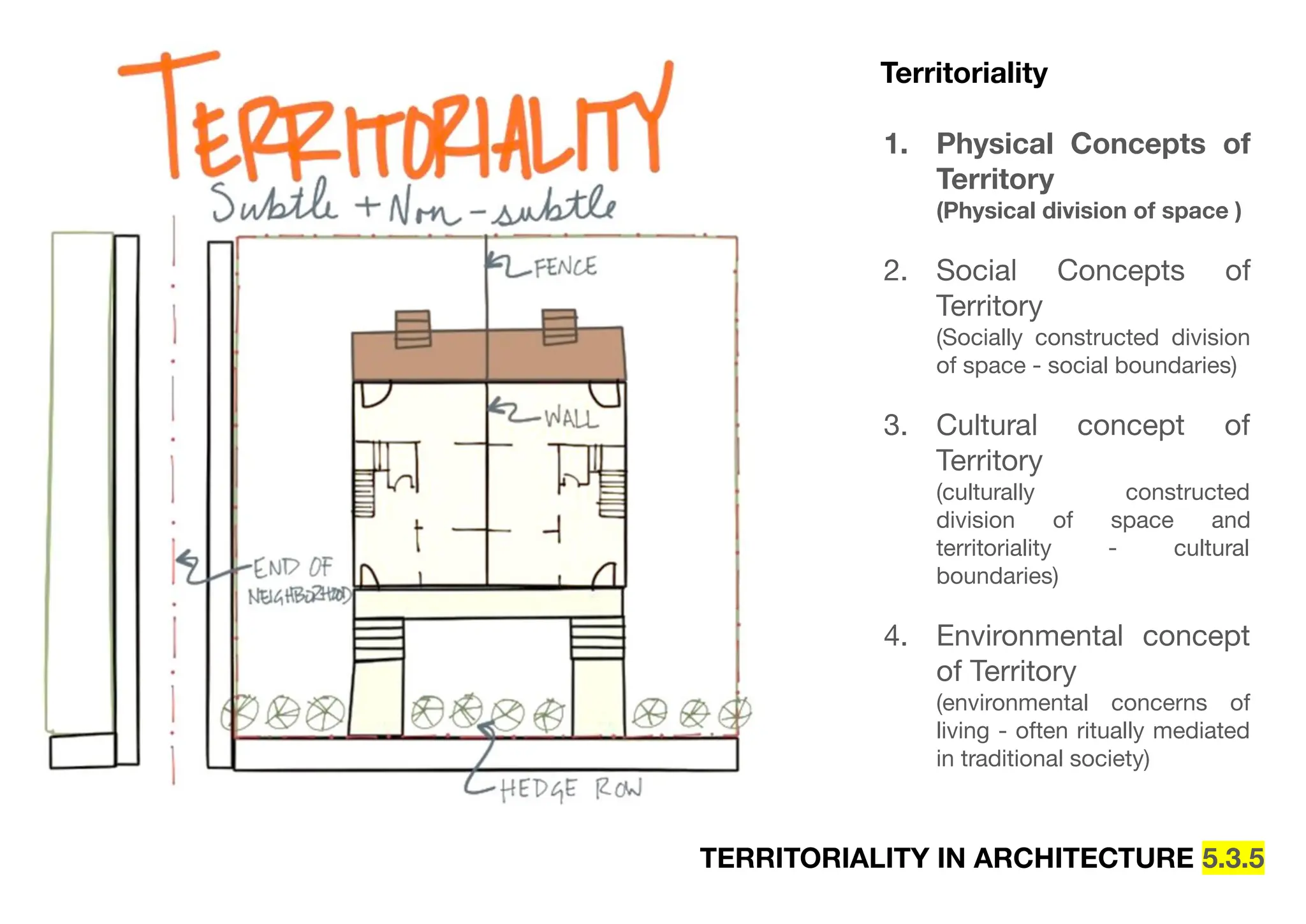
TERRITORIALITY IN ARCHITECTURE5.3.1
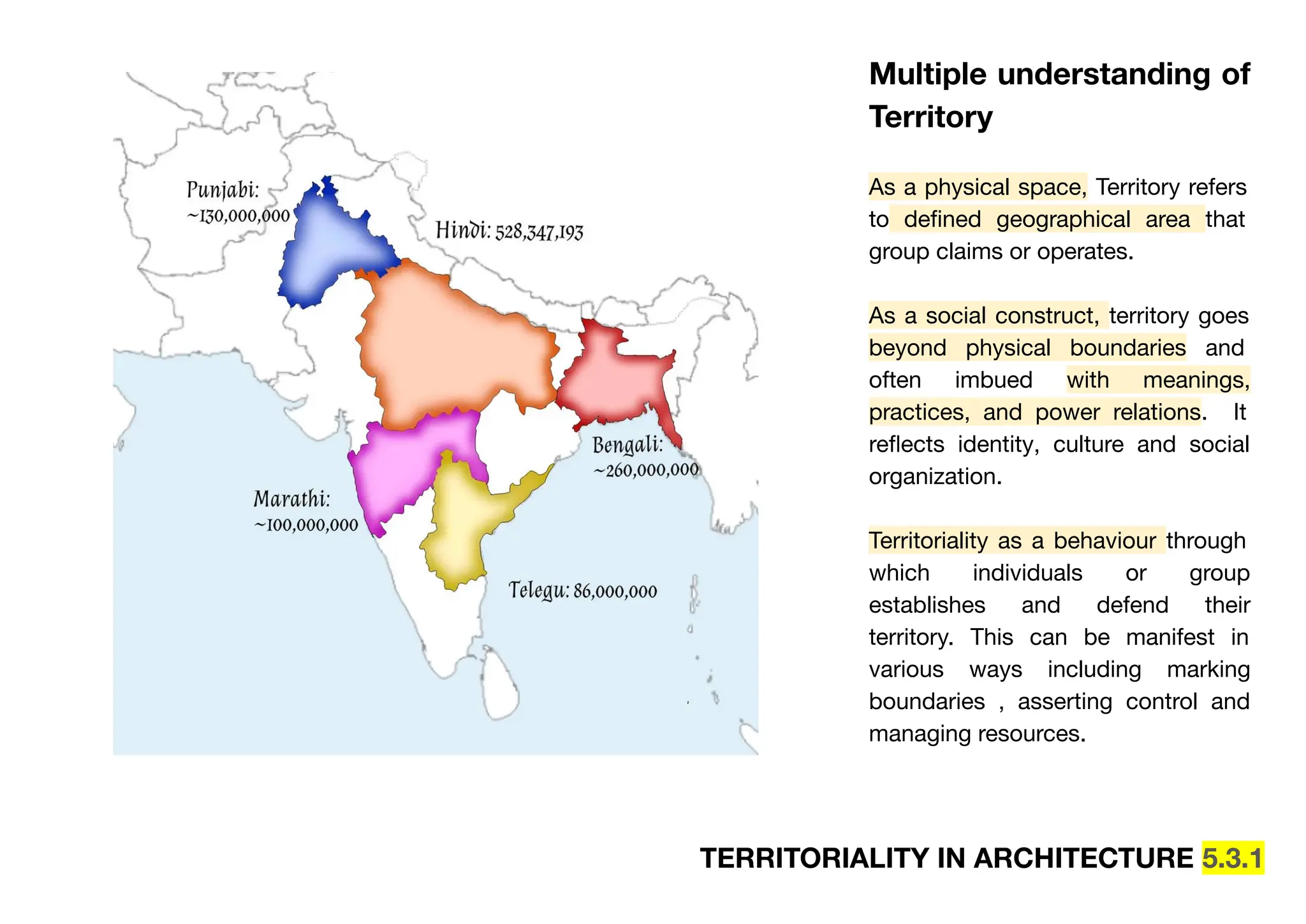
Multiple understanding of
Territory
As a physical space, Territory refers
to defined geographical area that
group claims or operates.
As a social construct, territory goes
beyond physical boundaries and
often imbued with meanings,
practices, and power relations. It
reflects identity, culture and social
organization.
Territoriality as a behaviour through
which individuals or group
establishes and defend their
territory. This can be manifest in
various ways including marking
boundaries , asserting control and
managing resources.
14.
TERRITORIALITY IN ARCHITECTURE5.3.2
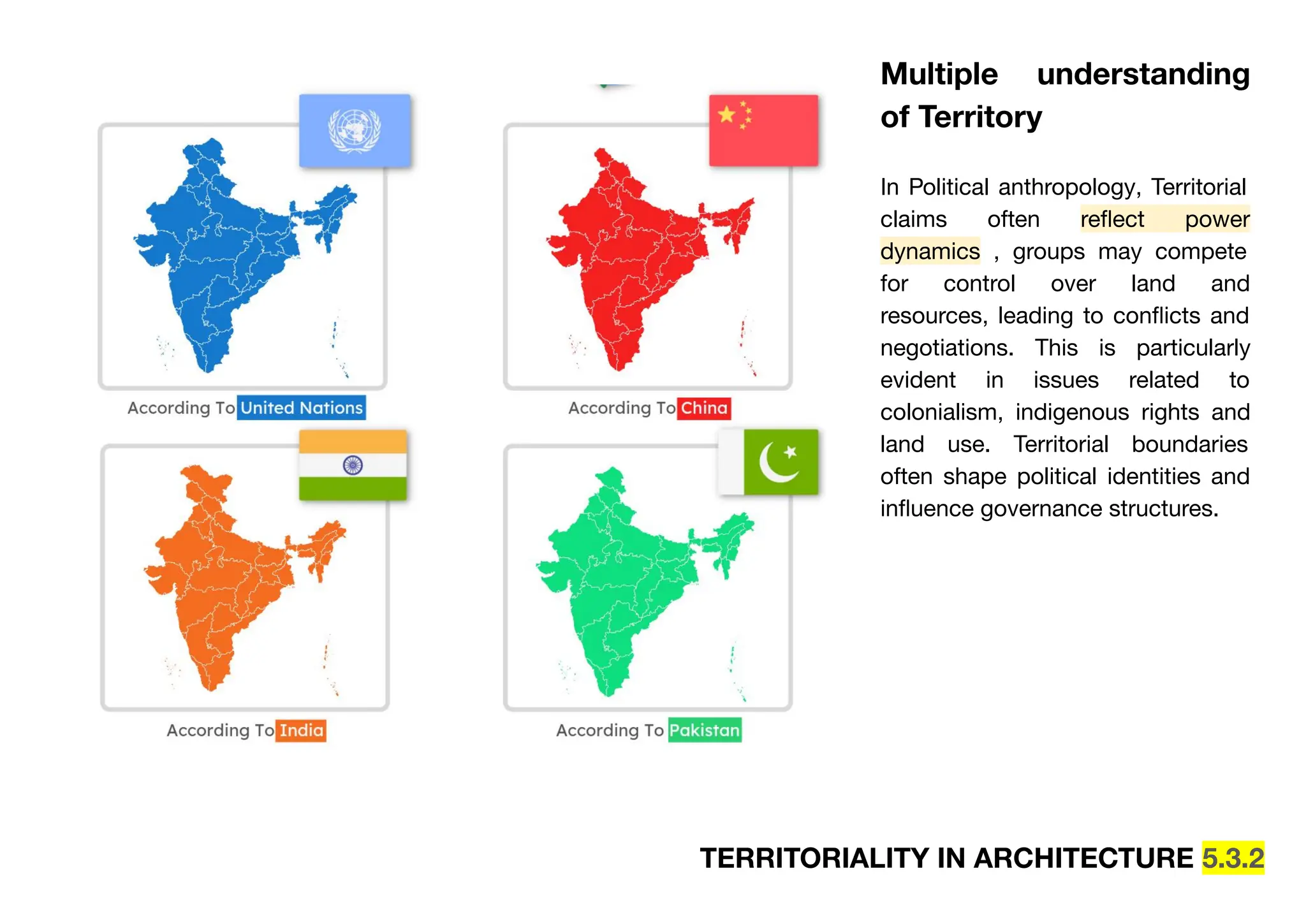
Multiple understanding
of Territory
In Political anthropology, Territorial
claims often reflect power
dynamics , groups may compete
for control over land and
resources, leading to conflicts and
negotiations. This is particularly
evident in issues related to
colonialism, indigenous rights and
land use. Territorial boundaries
often shape political identities and
influence governance structures.
15.
TERRITORIALITY IN ARCHITECTURE5.3.3
Territoriality
Territoriality refers to the behavioral
and psychological tendency of
individuals and groups to claim and
defend physical spaces or areas as
their own. This concept
encompasses how people
establish boundaries , control
access to certain spaces and
create a sense of ownership and
belonging.
Territoriality can manifest in various
forms, such as personal spaces,
community areas and public
environments.
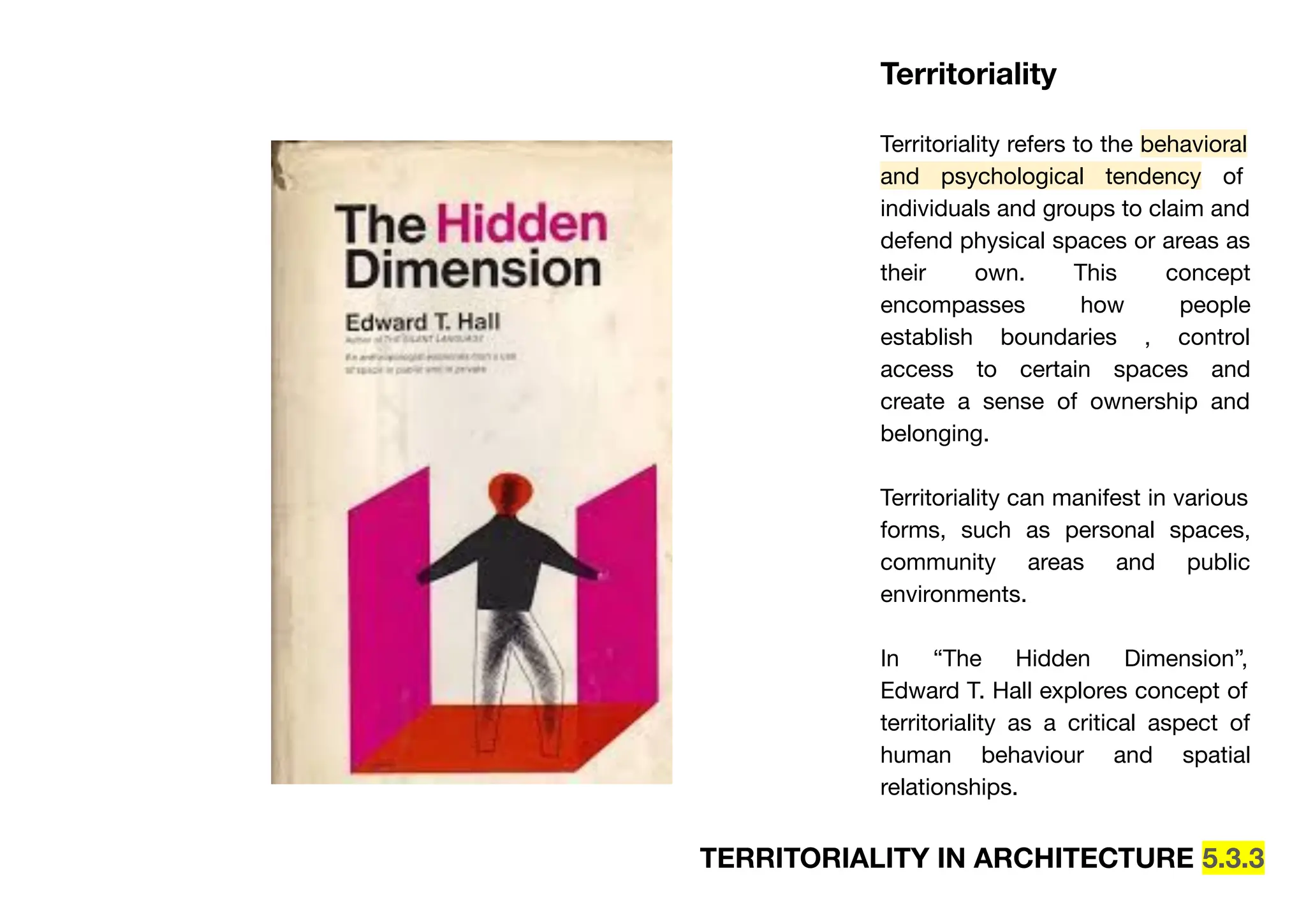
In “The Hidden Dimension”,
Edward T. Hall explores concept of
territoriality as a critical aspect of
human behaviour and spatial
relationships.
16.
TERRITORIALITY IN ARCHITECTURE5.3.4
Territoriality
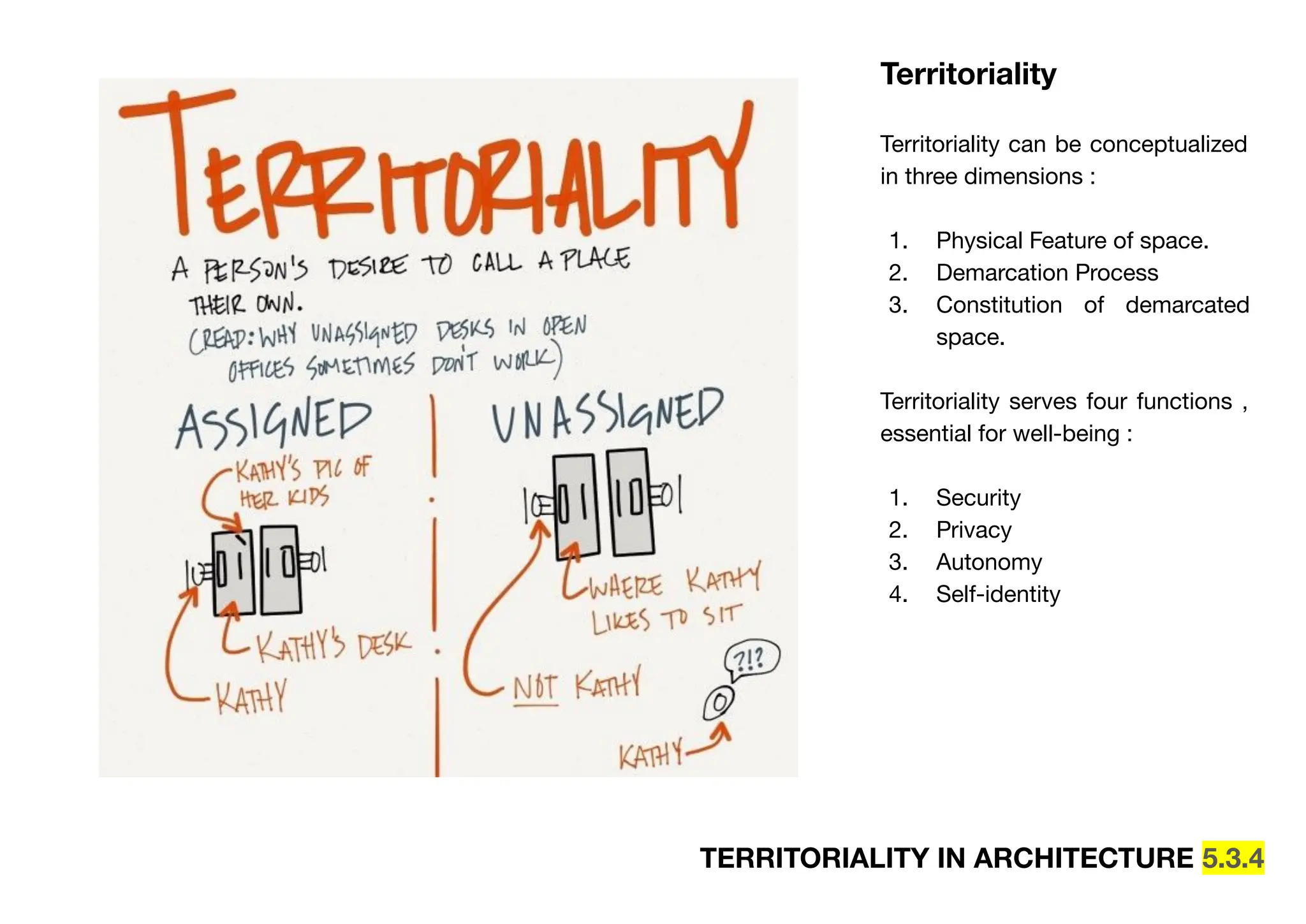
Territoriality can be conceptualized
in three dimensions :
1. Physical Feature of space.
2. Demarcation Process
3. Constitution of demarcated
space.
Territoriality serves four functions ,
essential for well-being :
1. Security
2. Privacy
3. Autonomy
4. Self-identity
17.
TERRITORIALITY IN ARCHITECTURE5.3.5
Territoriality
1. Physical Concepts of
Territory
(Physical division of space )
2. Social Concepts of
Territory
(Socially constructed division
of space - social boundaries)
3. Cultural concept of
Territory
(culturally constructed
division of space and
territoriality - cultural
boundaries)
4. Environmental concept
of Territory
(environmental concerns of
living - often ritually mediated
in traditional society)
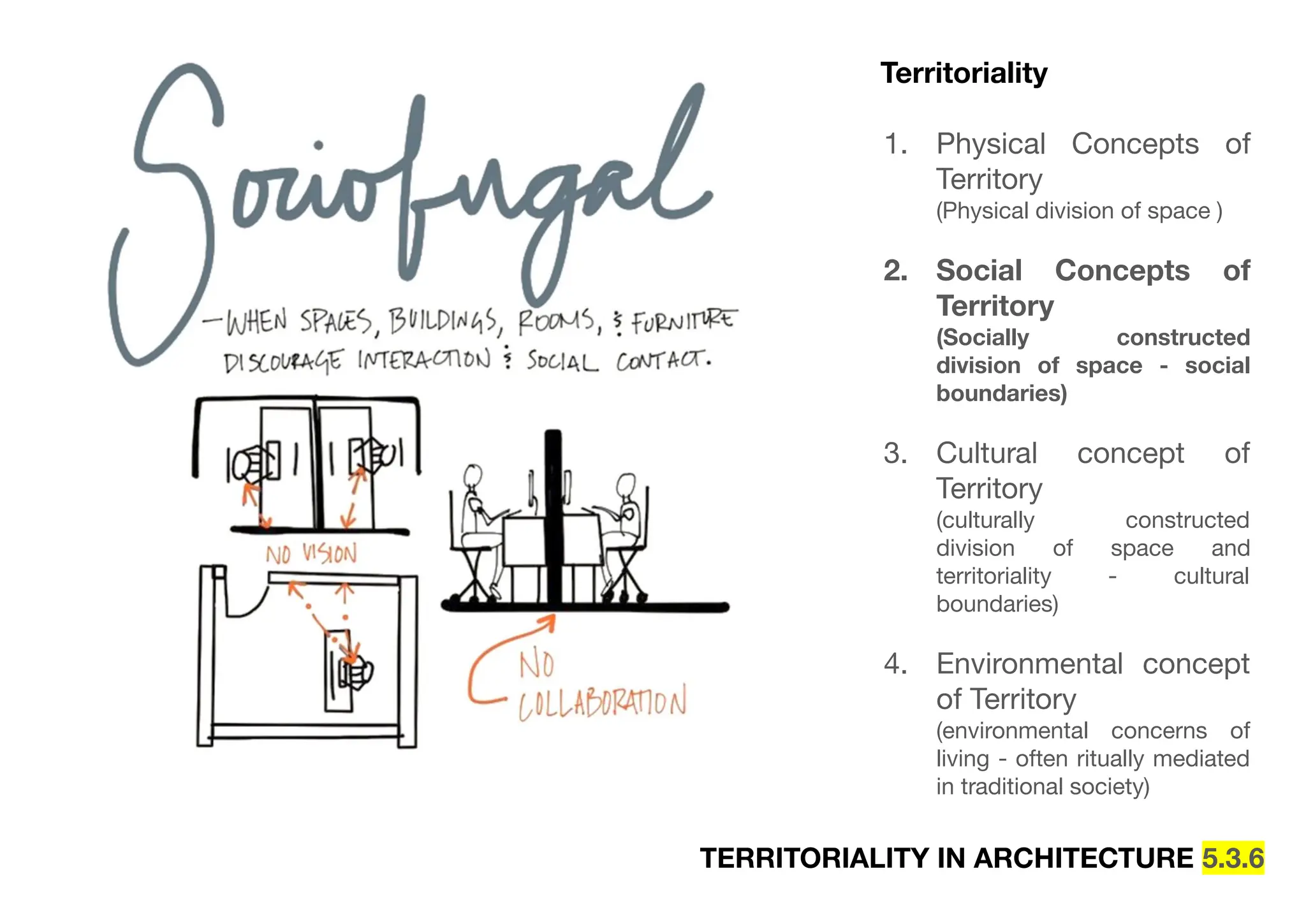
18.
TERRITORIALITY IN ARCHITECTURE5.3.6
Territoriality
1. Physical Concepts of
Territory
(Physical division of space )
2. Social Concepts of
Territory
(Socially constructed
division of space - social
boundaries)
3. Cultural concept of
Territory
(culturally constructed
division of space and
territoriality - cultural
boundaries)
4. Environmental concept
of Territory
(environmental concerns of
living - often ritually mediated
in traditional society)
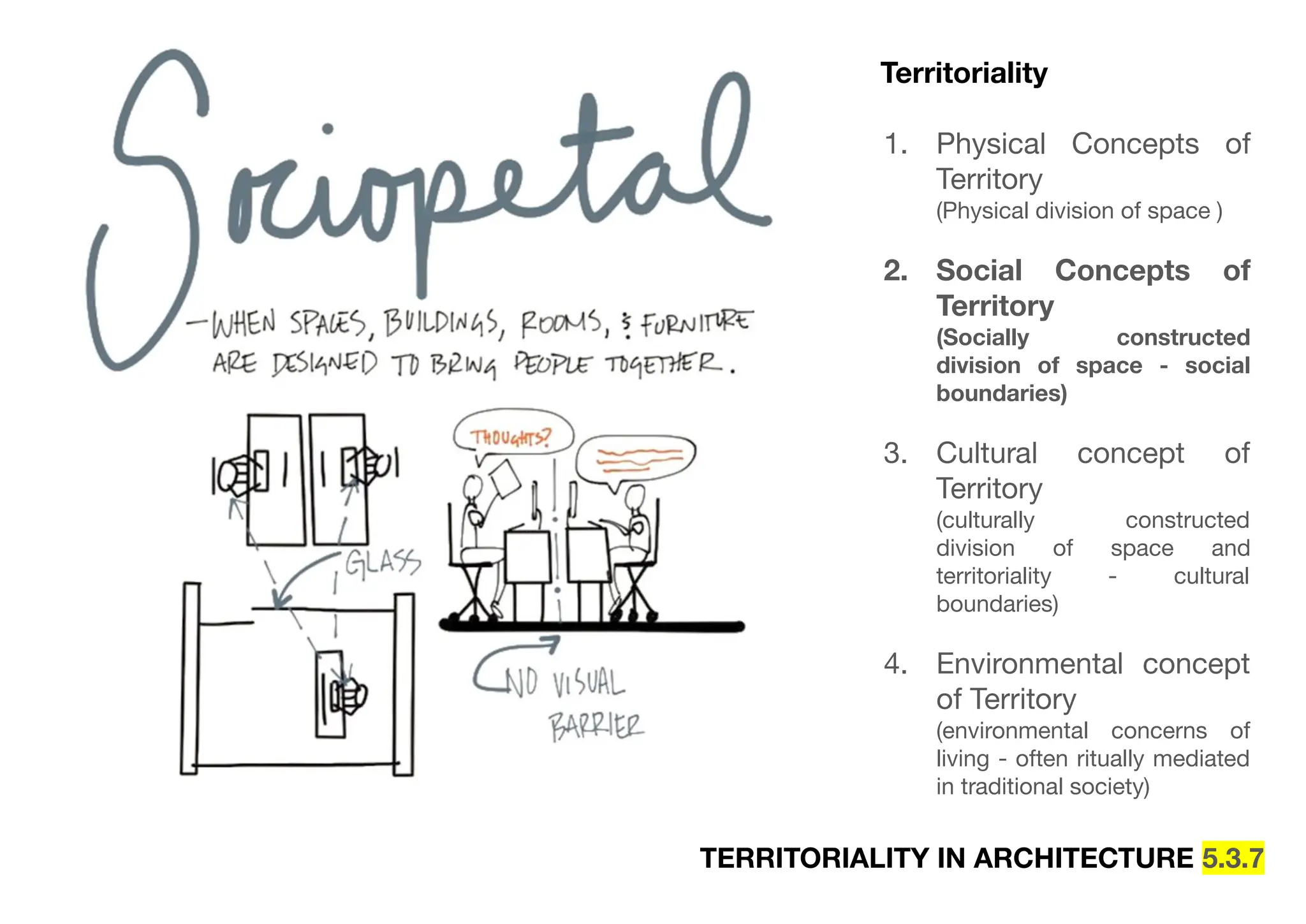
19.
TERRITORIALITY IN ARCHITECTURE5.3.7
Territoriality
1. Physical Concepts of
Territory
(Physical division of space )
2. Social Concepts of
Territory
(Socially constructed
division of space - social
boundaries)
3. Cultural concept of
Territory
(culturally constructed
division of space and
territoriality - cultural
boundaries)
4. Environmental concept
of Territory
(environmental concerns of
living - often ritually mediated
in traditional society)
20.
TERRITORIALITY IN ARCHITECTURE5.3.8
Territoriality
1. Physical Concepts of
Territory
(Physical division of space )
2. Social Concepts of
Territory
(Socially constructed
division of space - social
boundaries)
3. Cultural concept of
Territory
(culturally constructed
division of space and
territoriality - cultural
boundaries)
4. Environmental concept
of Territory
(environmental concerns of
living - often ritually mediated
in traditional society)
21.
TERRITORIALITY IN ARCHITECTURE5.3.9
Territoriality
1. Physical Concepts of
Territory
(Physical division of space )
2. Social Concepts of
Territory
(Socially constructed division
of space - social boundaries)
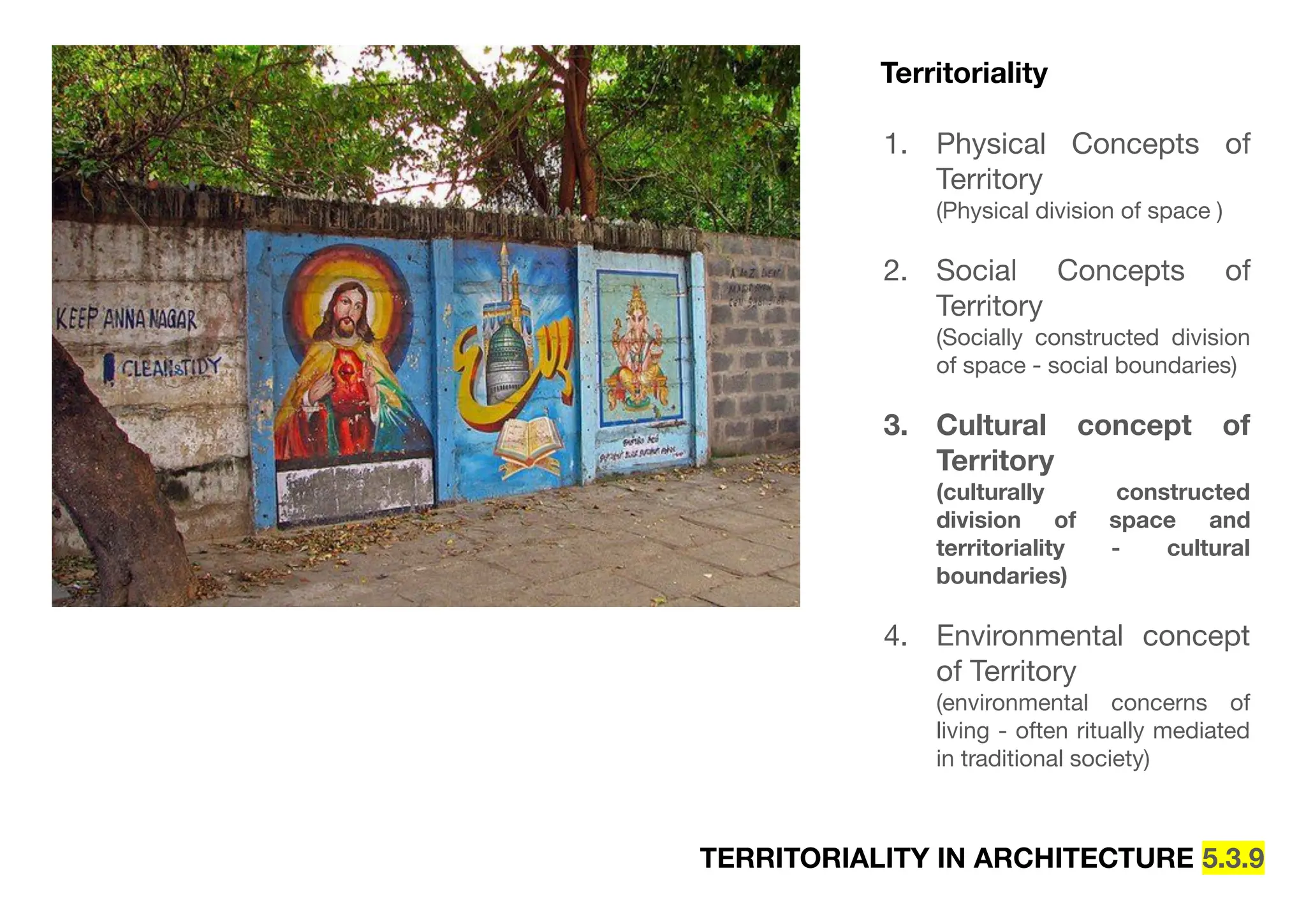
3. Cultural concept of
Territory
(culturally constructed
division of space and
territoriality - cultural
boundaries)
4. Environmental concept
of Territory
(environmental concerns of
living - often ritually mediated
in traditional society)
22.
TERRITORIALITY IN ARCHITECTURE5.3.10
Territoriality
1. Physical Concepts of
Territory
(Physical division of space )
2. Social Concepts of
Territory
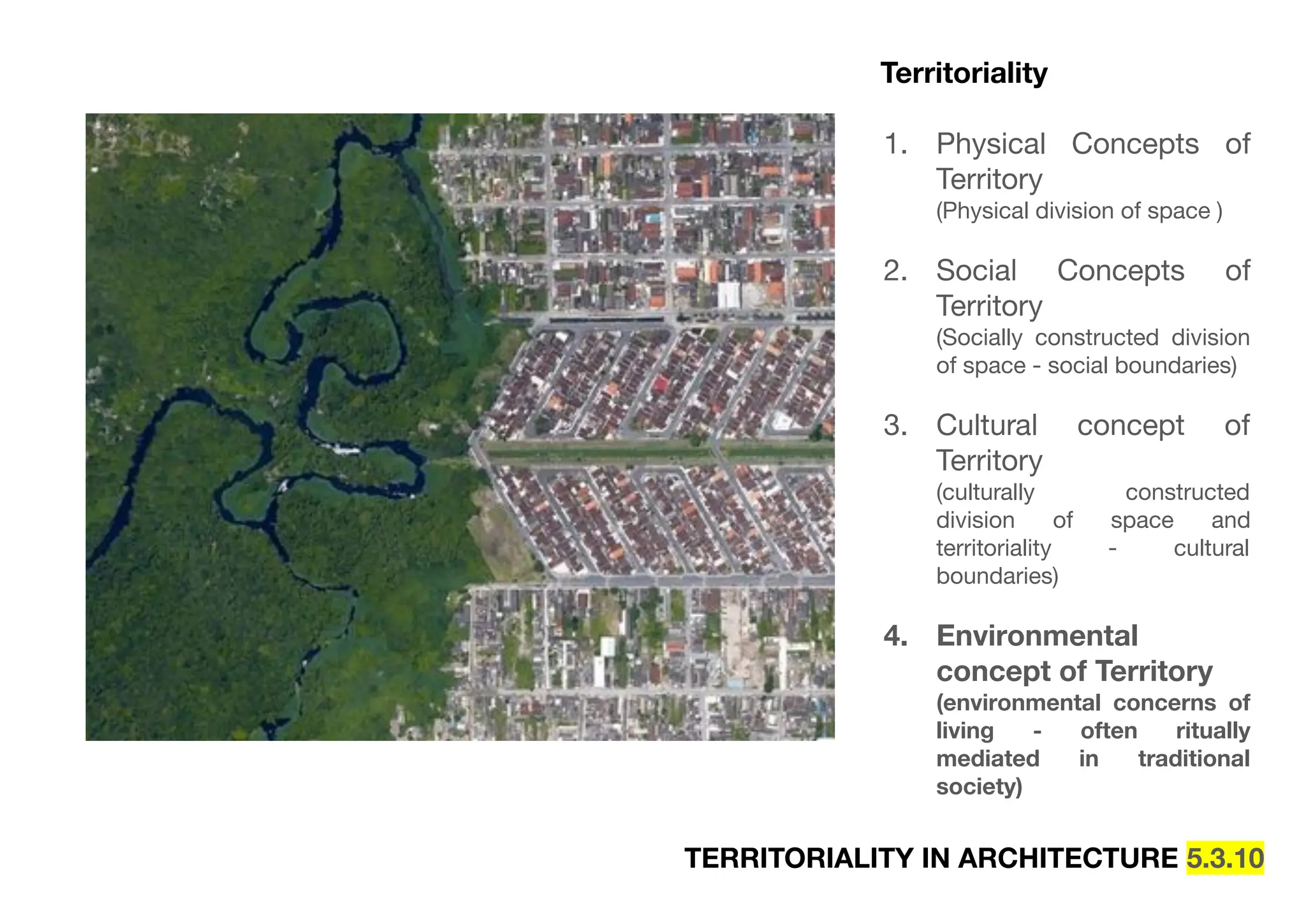
(Socially constructed division
of space - social boundaries)
3. Cultural concept of
Territory
(culturally constructed
division of space and
territoriality - cultural
boundaries)
4. Environmental
concept of Territory
(environmental concerns of
living - often ritually
mediated in traditional
society)
23.
TERRITORIALITY IN ARCHITECTURE: PRIMARY,SECONDARY & TERTIARY 5.4.0
Territoriality
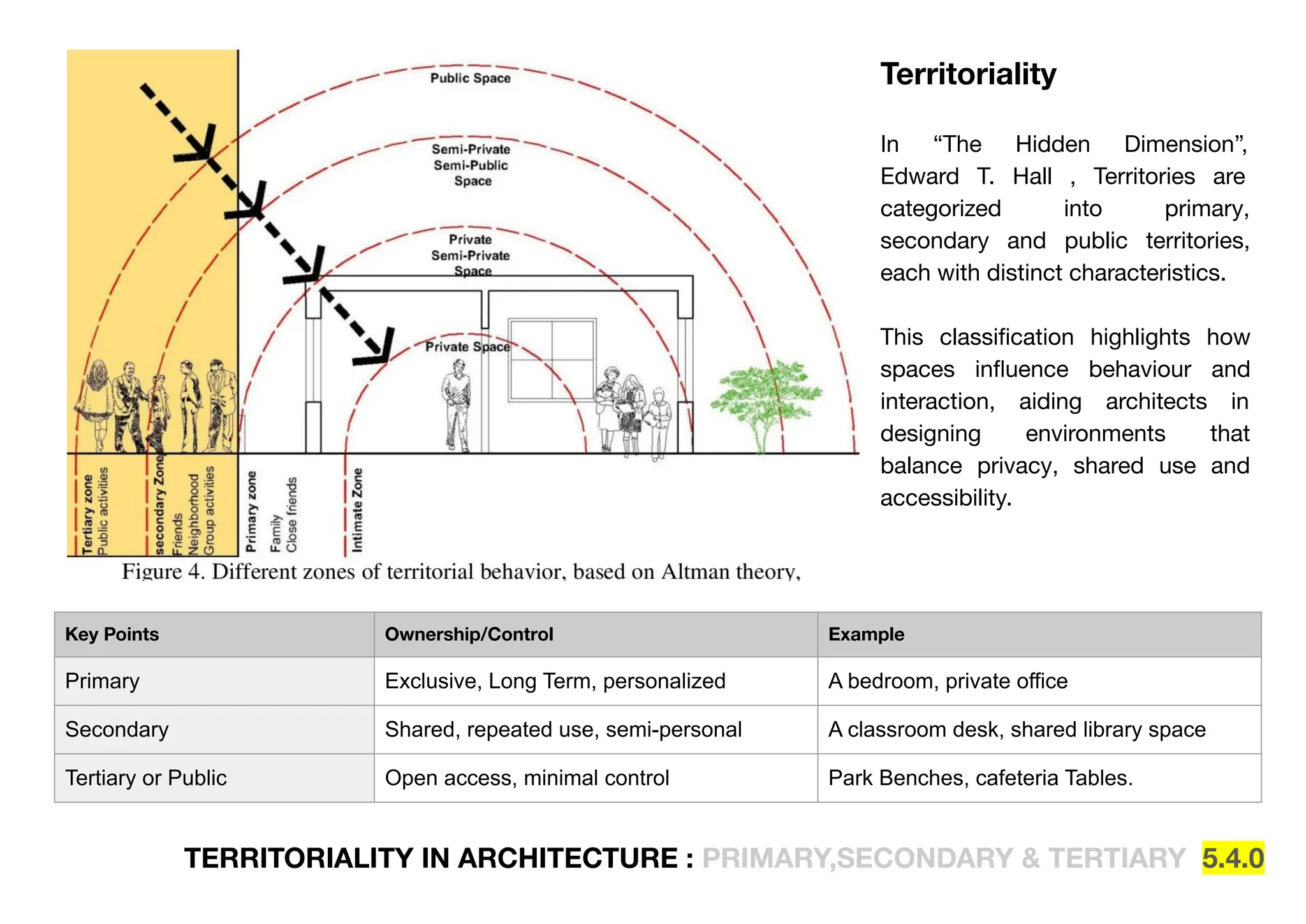
In “The Hidden Dimension”,
Edward T. Hall , Territories are
categorized into primary,
secondary and public territories,
each with distinct characteristics.
This classification highlights how
spaces influence behaviour and
interaction, aiding architects in
designing environments that
balance privacy, shared use and
accessibility.
Key Points Ownership/Control Example
Primary Exclusive, Long Term, personalized A bedroom, private office
Secondary Shared, repeated use, semi-personal A classroom desk, shared library space
Tertiary or Public Open access, minimal control Park Benches, cafeteria Tables.
24.
TERRITORIALITY IN ARCHITECTURE: PRIMARY,SECONDARY & TERTIARY 5.4.1
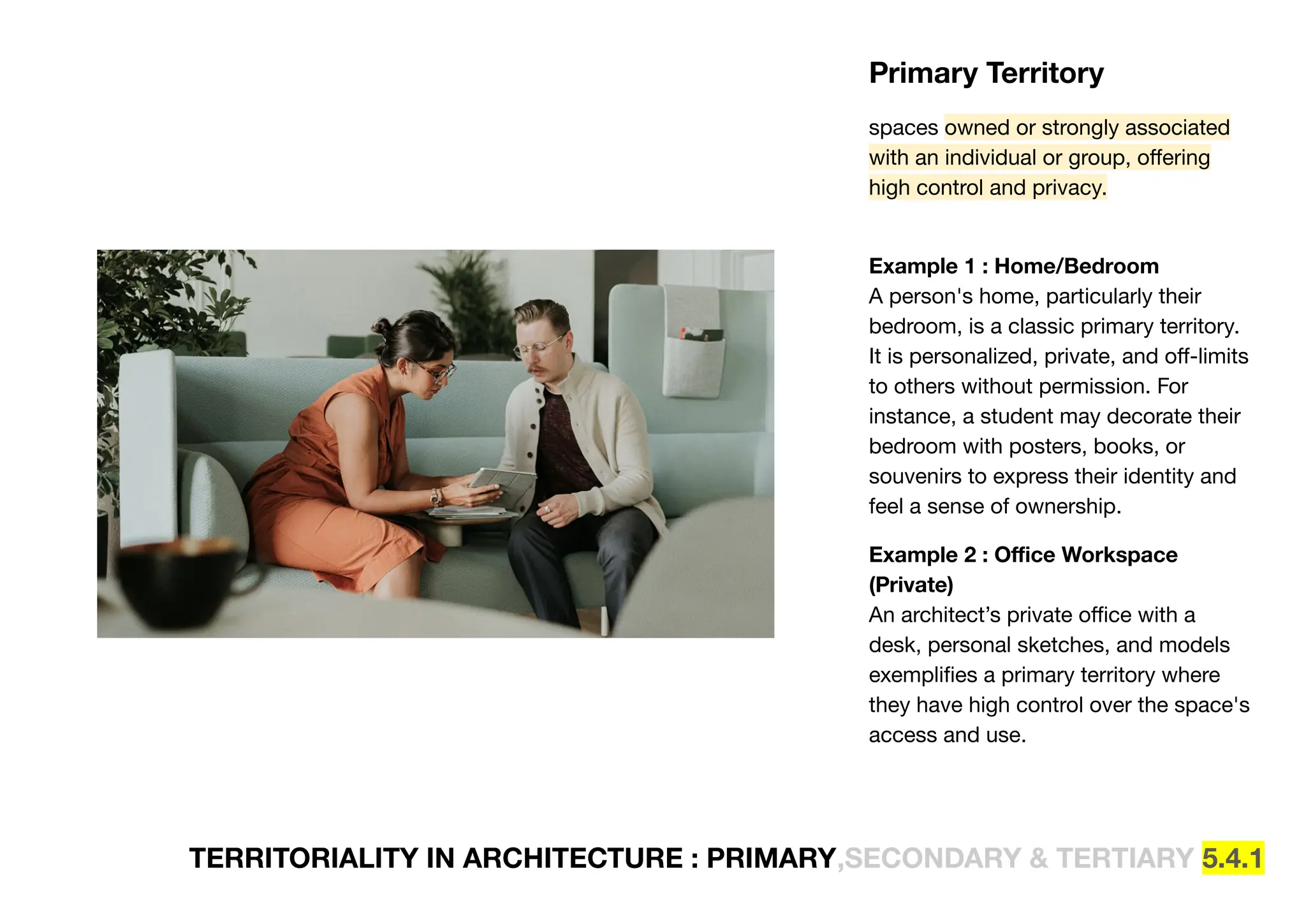
Primary Territory
spaces owned or strongly associated
with an individual or group, offering
high control and privacy.
Example 1 : Home/Bedroom
A person's home, particularly their
bedroom, is a classic primary territory.
It is personalized, private, and off-limits
to others without permission. For
instance, a student may decorate their
bedroom with posters, books, or
souvenirs to express their identity and
feel a sense of ownership.
Example 2 : Office Workspace
(Private)
An architect’s private office with a
desk, personal sketches, and models
exemplifies a primary territory where
they have high control over the space's
access and use.
25.
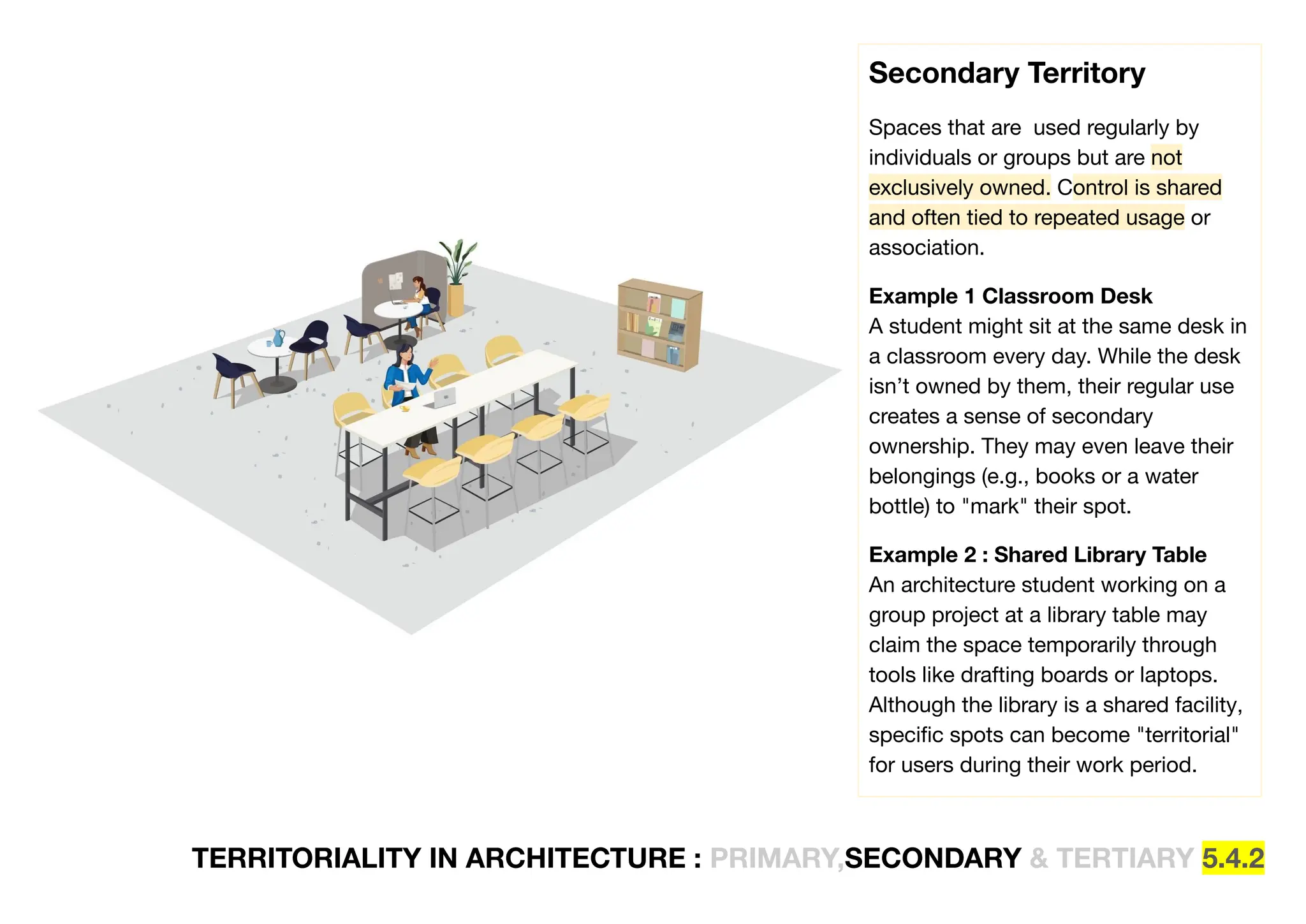
TERRITORIALITY IN ARCHITECTURE: PRIMARY,SECONDARY & TERTIARY 5.4.2
Secondary Territory
Spaces that are used regularly by
individuals or groups but are not
exclusively owned. Control is shared
and often tied to repeated usage or
association.
Example 1 Classroom Desk
A student might sit at the same desk in
a classroom every day. While the desk
isn’t owned by them, their regular use
creates a sense of secondary
ownership. They may even leave their
belongings (e.g., books or a water
bottle) to "mark" their spot.
Example 2 : Shared Library Table
An architecture student working on a
group project at a library table may
claim the space temporarily through
tools like drafting boards or laptops.
Although the library is a shared facility,
specific spots can become "territorial"
for users during their work period.
26.
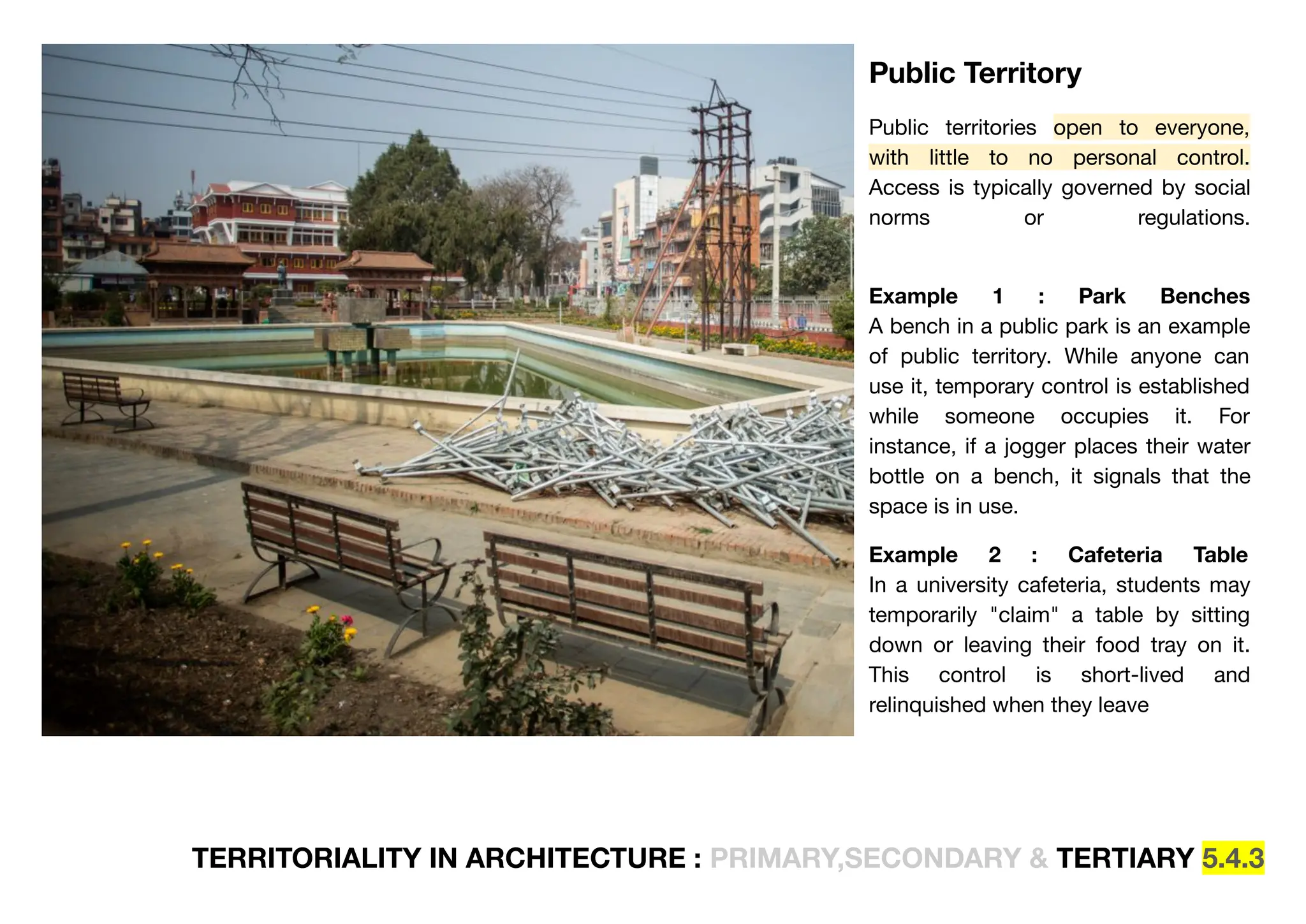
TERRITORIALITY IN ARCHITECTURE: PRIMARY,SECONDARY & TERTIARY 5.4.3
Public Territory
Public territories open to everyone,
with little to no personal control.
Access is typically governed by social
norms or regulations.
Example 1 : Park Benches
A bench in a public park is an example
of public territory. While anyone can
use it, temporary control is established
while someone occupies it. For
instance, if a jogger places their water
bottle on a bench, it signals that the
space is in use.
Example 2 : Cafeteria Table
In a university cafeteria, students may
temporarily "claim" a table by sitting
down or leaving their food tray on it.
This control is short-lived and
relinquished when they leave
27.
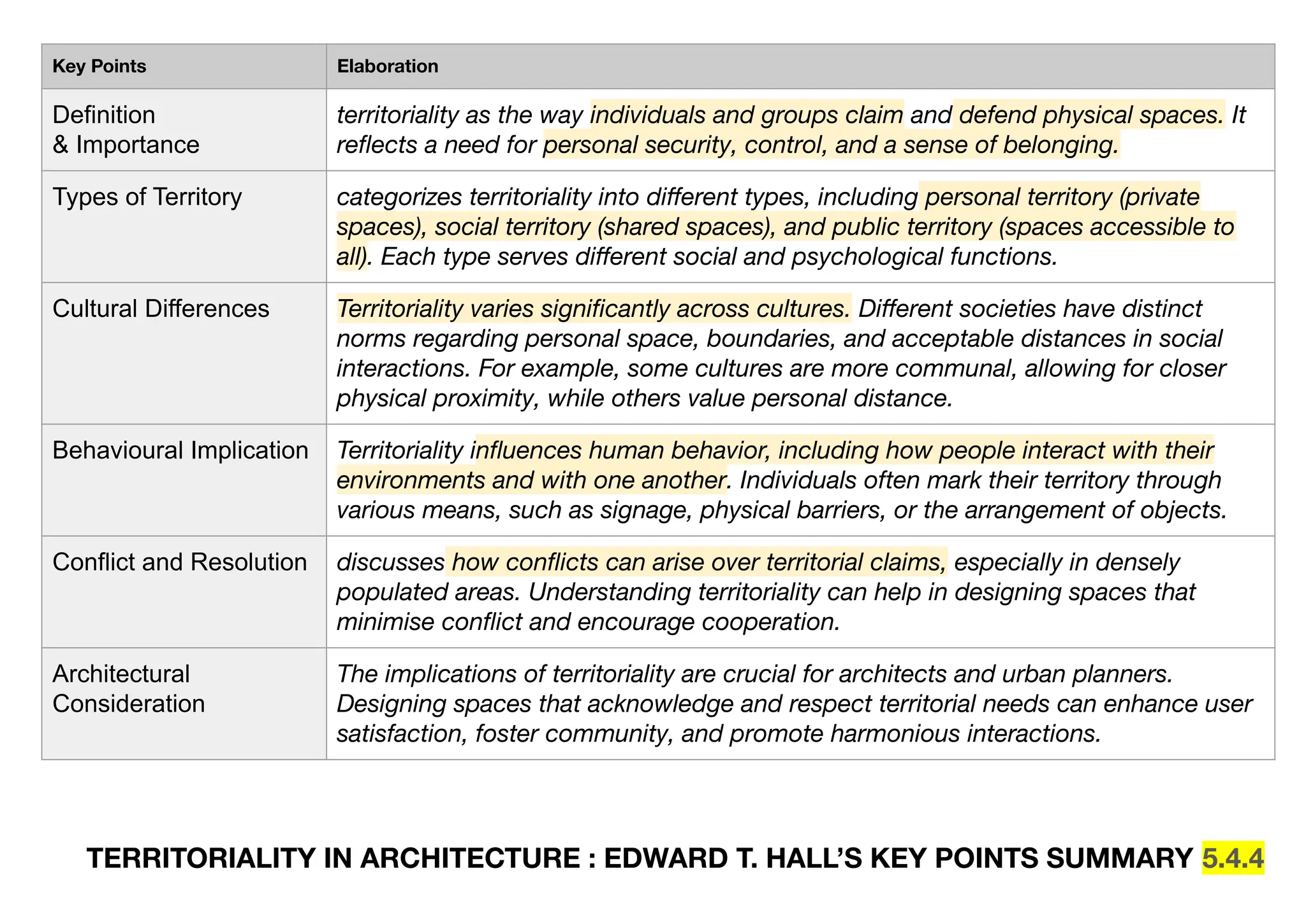
TERRITORIALITY IN ARCHITECTURE: EDWARD T. HALL’S KEY POINTS SUMMARY 5.4.4
Key Points Elaboration
Definition
& Importance
territoriality as the way individuals and groups claim and defend physical spaces. It
reflects a need for personal security, control, and a sense of belonging.
Types of Territory categorizes territoriality into different types, including personal territory (private
spaces), social territory (shared spaces), and public territory (spaces accessible to
all). Each type serves different social and psychological functions.
Cultural Differences Territoriality varies significantly across cultures. Different societies have distinct
norms regarding personal space, boundaries, and acceptable distances in social
interactions. For example, some cultures are more communal, allowing for closer
physical proximity, while others value personal distance.
Behavioural Implication Territoriality influences human behavior, including how people interact with their
environments and with one another. Individuals often mark their territory through
various means, such as signage, physical barriers, or the arrangement of objects.
Conflict and Resolution discusses how conflicts can arise over territorial claims, especially in densely
populated areas. Understanding territoriality can help in designing spaces that
minimise conflict and encourage cooperation.
Architectural
Consideration
The implications of territoriality are crucial for architects and urban planners.
Designing spaces that acknowledge and respect territorial needs can enhance user
satisfaction, foster community, and promote harmonious interactions.
28.
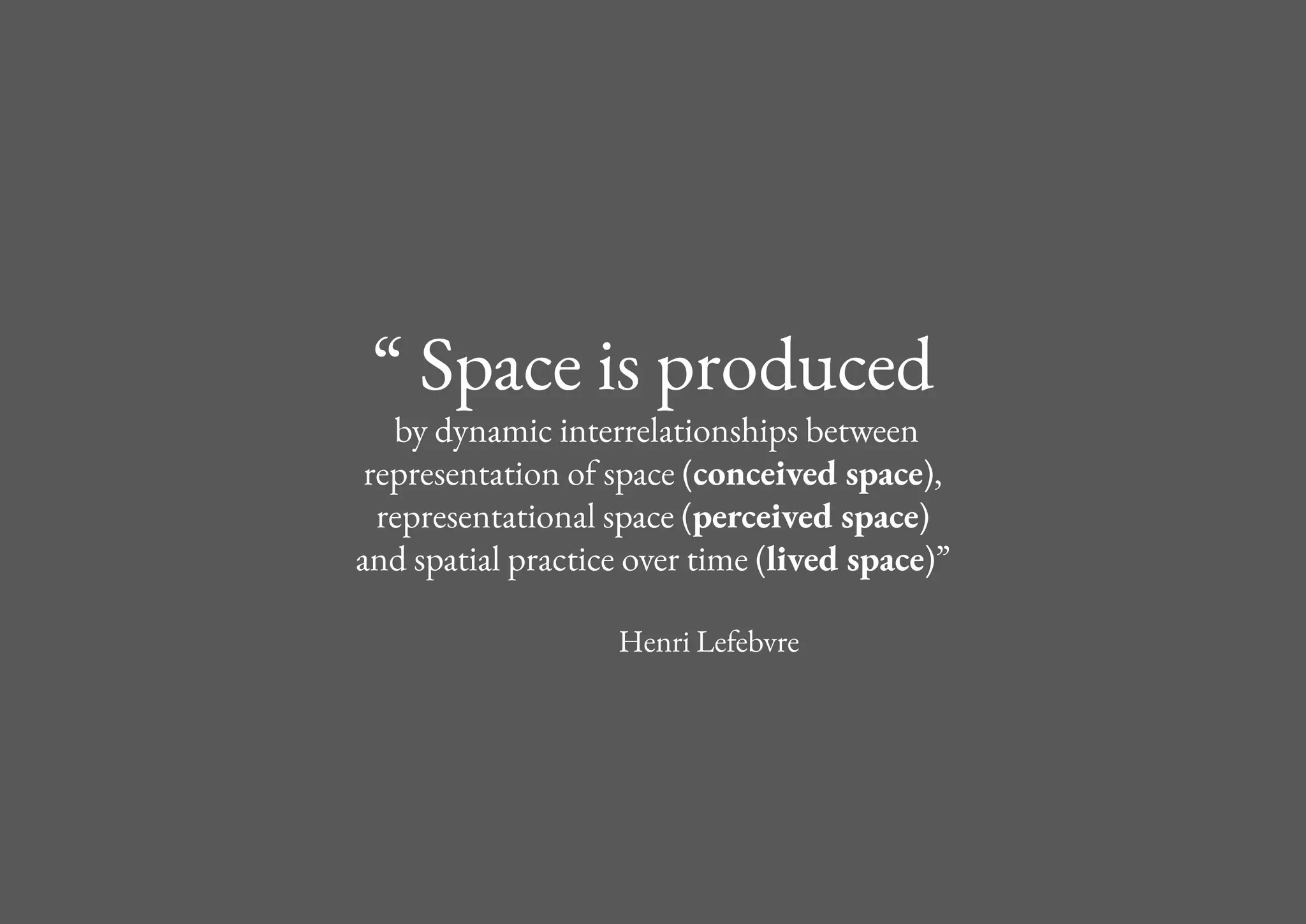
“ Space isproduced
by dynamic interrelationships between
representation of space (conceived space),
representational space (perceived space)
and spatial practice over time (lived space)”
Henri Lefebvre
29.
LEFEBVRE & LEFEBVRE’SCONTRIBUTIONS 5.5.1
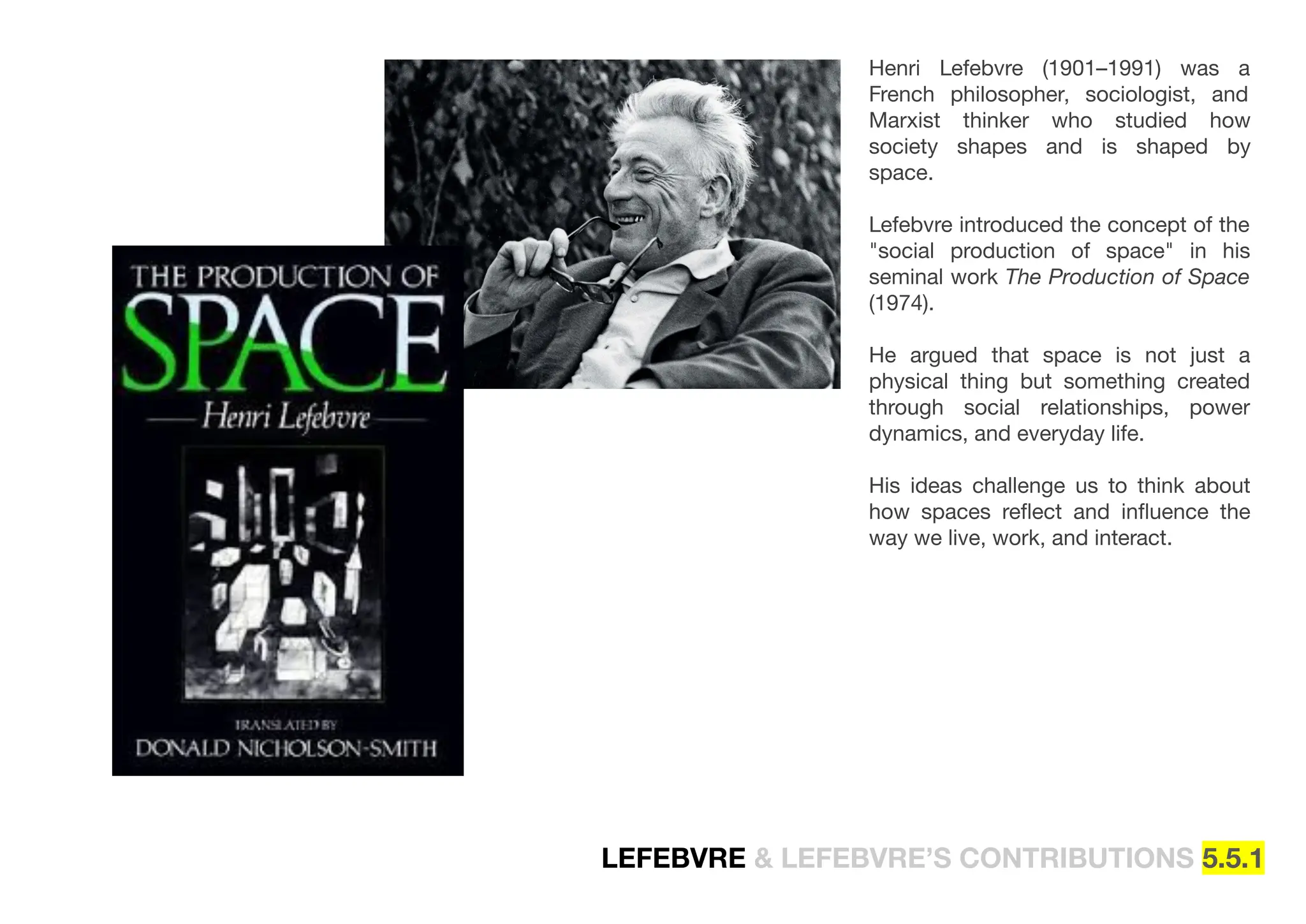
Henri Lefebvre (1901–1991) was a
French philosopher, sociologist, and
Marxist thinker who studied how
society shapes and is shaped by
space.
Lefebvre introduced the concept of the
"social production of space" in his
seminal work The Production of Space
(1974).
He argued that space is not just a
physical thing but something created
through social relationships, power
dynamics, and everyday life.
His ideas challenge us to think about
how spaces reflect and influence the
way we live, work, and interact.
30.
Lefebvre’s ideas arecrucial for
architects because they provide a
deeper understanding of how spaces
are more than just buildings or
designs—they are deeply connected to
society, culture, and power.
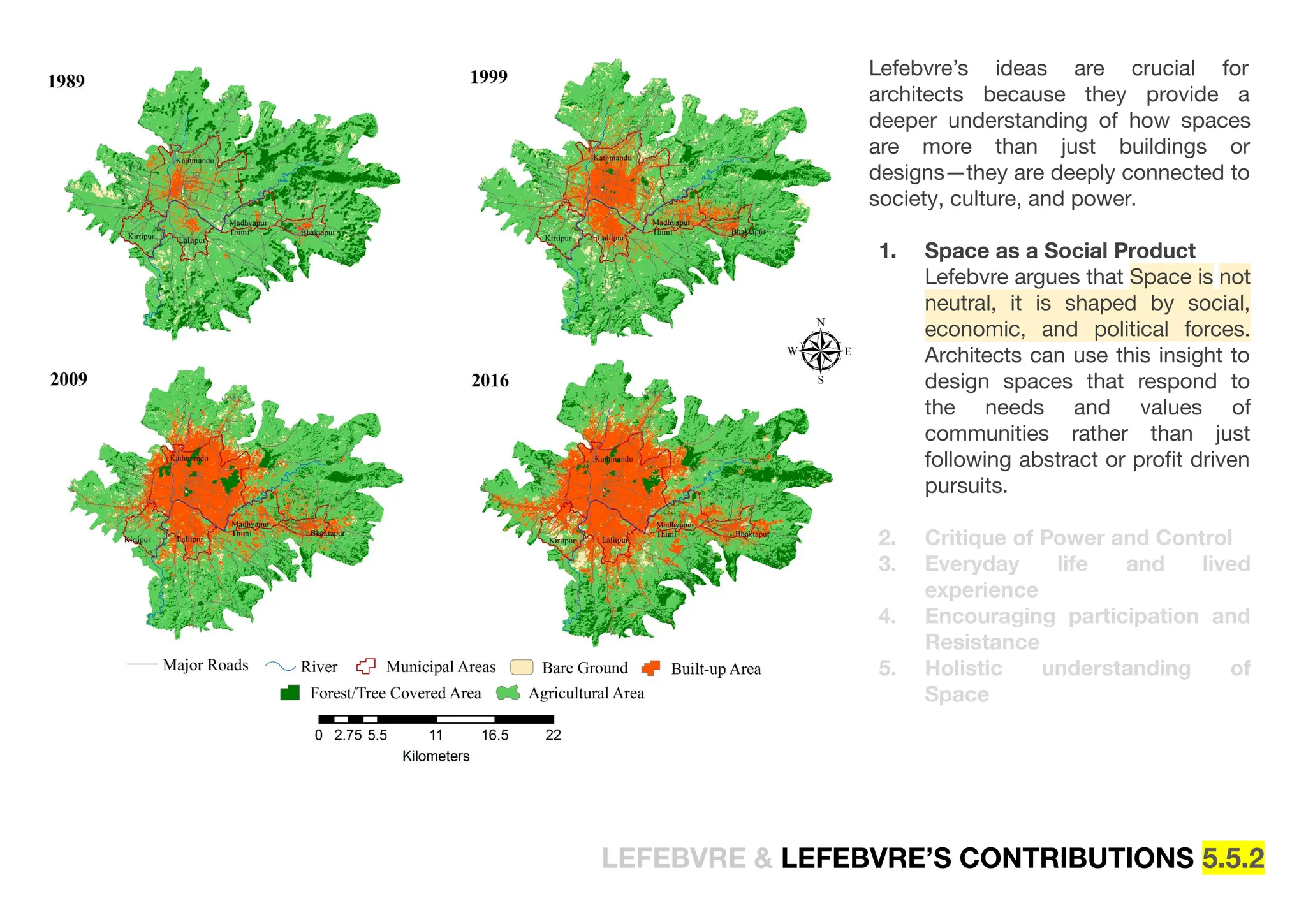
1. Space as a Social Product
Lefebvre argues that Space is not
neutral, it is shaped by social,
economic, and political forces.
Architects can use this insight to
design spaces that respond to
the needs and values of
communities rather than just
following abstract or profit driven
pursuits.
2. Critique of Power and Control
3. Everyday life and lived
experience
4. Encouraging participation and
Resistance
5. Holistic understanding of
Space
LEFEBVRE & LEFEBVRE’S CONTRIBUTIONS 5.5.2
31.
Lefebvre’s ideas arecrucial for
architects because they provide a
deeper understanding of how spaces
are more than just buildings or
designs—they are deeply connected to
society, culture, and power.
1. Space as a Social Product
2. Critique of Power and Control
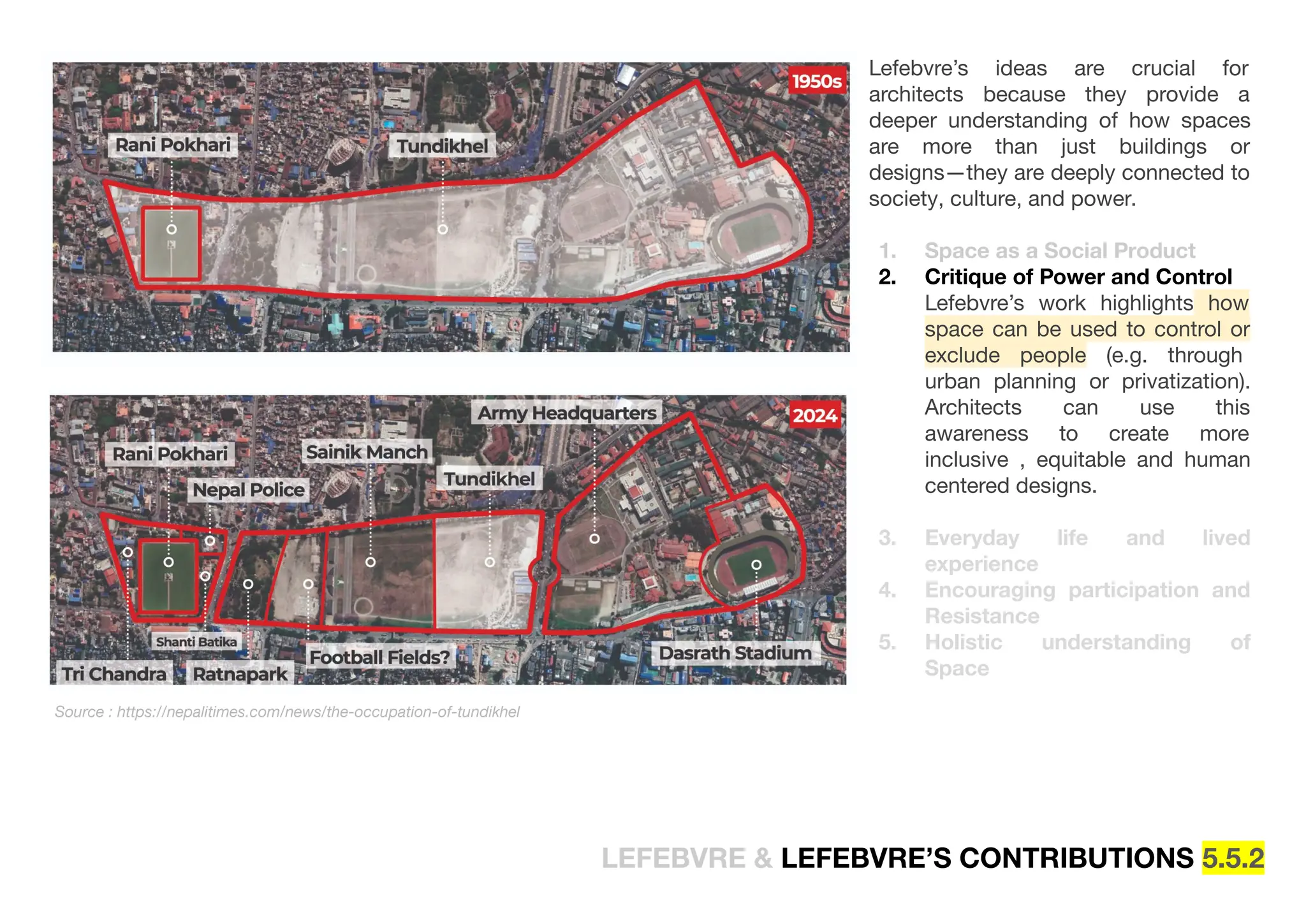
Lefebvre’s work highlights how
space can be used to control or
exclude people (e.g. through
urban planning or privatization).
Architects can use this
awareness to create more
inclusive , equitable and human
centered designs.
3. Everyday life and lived
experience
4. Encouraging participation and
Resistance
5. Holistic understanding of
Space
Source : https://nepalitimes.com/news/the-occupation-of-tundikhel
LEFEBVRE & LEFEBVRE’S CONTRIBUTIONS 5.5.2
32.
Lefebvre’s ideas arecrucial for
architects because they provide a
deeper understanding of how spaces
are more than just buildings or
designs—they are deeply connected to
society, culture, and power.
1. Space as a Social Product
2. Critique of Power and Control
3. Everyday life and lived
experience
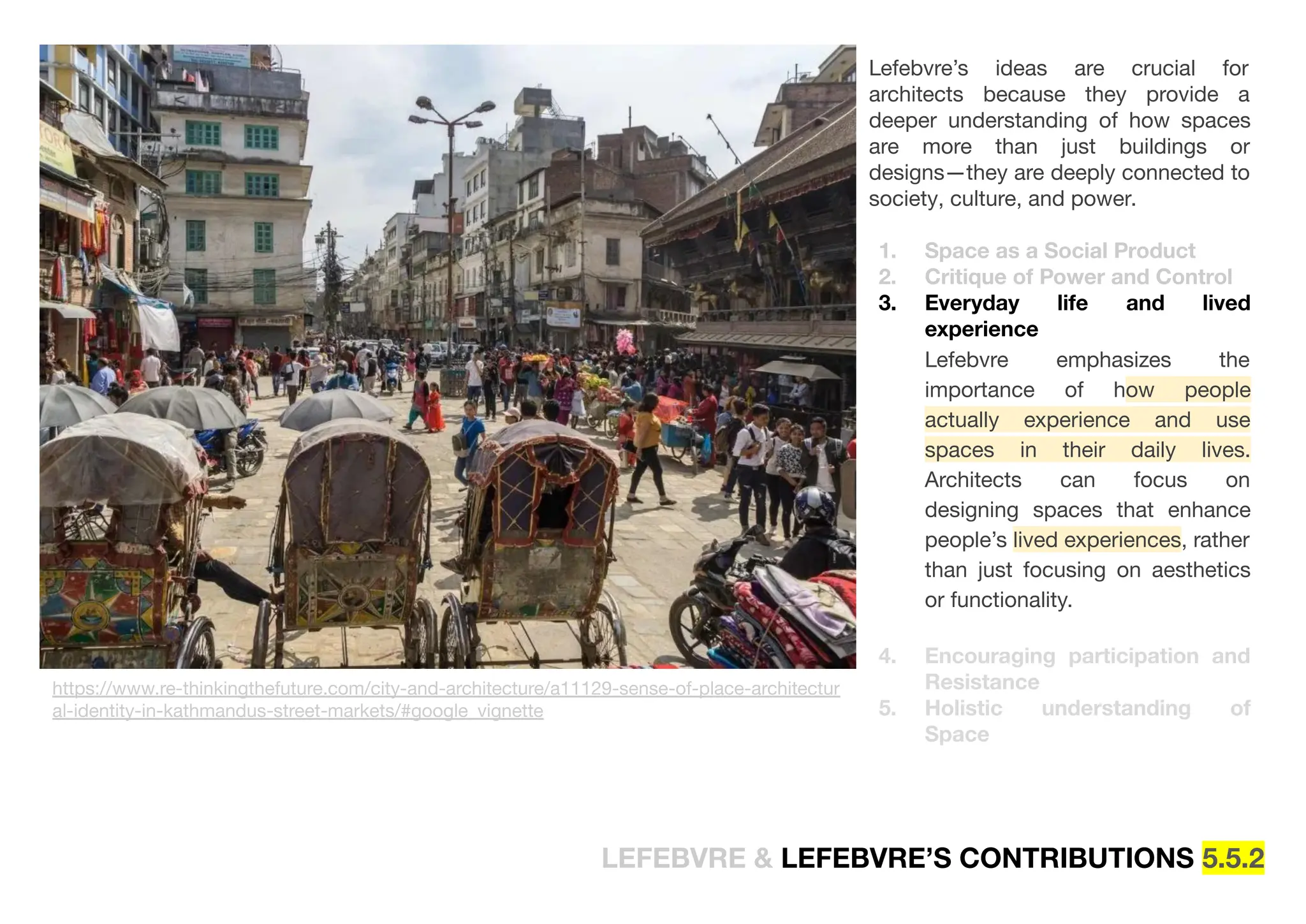
Lefebvre emphasizes the
importance of how people
actually experience and use
spaces in their daily lives.
Architects can focus on
designing spaces that enhance
people’s lived experiences, rather
than just focusing on aesthetics
or functionality.
4. Encouraging participation and
Resistance
5. Holistic understanding of
Space
https://www.re-thinkingthefuture.com/city-and-architecture/a11129-sense-of-place-architectur
al-identity-in-kathmandus-street-markets/#google_vignette
LEFEBVRE & LEFEBVRE’S CONTRIBUTIONS 5.5.2
33.
Lefebvre’s ideas arecrucial for
architects because they provide a
deeper understanding of how spaces
are more than just buildings or
designs—they are deeply connected to
society, culture, and power.
1. Space as a Social Product
2. Critique of Power and Control
3. Everyday life and lived
experience
4. Encouraging participation and
Resistance
Lefebvre’s ideas encourage
architects to involve communities
in the design process and to
consider how spaces can
empower people to resist
oppressive systems or create
alternative ways of living
5. Holistic understanding of
Space
https://kathmandupost.com/kathmandu/2023/01/13/street-vending-ban-a-kick-in-th
e-belly-of-urban-poor
LEFEBVRE & LEFEBVRE’S CONTRIBUTIONS 5.5.2
34.
Lefebvre’s ideas arecrucial for
architects because they provide a
deeper understanding of how spaces
are more than just buildings or
designs—they are deeply connected to
society, culture, and power.
1. Space as a Social Product
2. Critique of Power and Control
3. Everyday life and lived
experience
4. Encouraging participation and
Resistance
5. Holistic understanding of
Space
By considering Lefebvre’s triad of
conceived space (designs and
plans), perceived space (how
spaces are used), and lived
space (how spaces are
experienced), architects can
create more meaningful and
responsive environments.
LIVED SPACE CONCEIVED SPACE
PERCEIVED SPACE
LEFEBVRE & LEFEBVRE’S CONTRIBUTIONS 5.5.2
PERCEIVED
SPACE
LIVED SPACE
35.
LEFEBVRE’S TRIAD :CONCEIVED, PERCEIVED & LIVED SPACE 5.5.3
CONCEIVED SPACE
Conceived space refers to the
abstract, planned, and designed
space as imagined by architects,
urban planners, scientists, and other
authorities. It is the space of rationality,
order, and control, often represented
through maps, blueprints, and models.
Characteristics
1. Dominated by power structures (
e.g government)
2. Reflects ideologies, such as
capitalism or state control
3. Often prioritizes functionality,
efficiency.
Example
Urban planning grids, zoning laws, or
the design of shopping malls that
prioritize consumerism
36.
LEFEBVRE’S TRIAD :CONCEIVED, PERCEIVED & LIVED SPACE 5.5.3
PERCEIVED SPACE
Perceived space refers to the physical,
material, and everyday use of space. It
is the space of routines, movements,
and interactions, shaped by how
people navigate and experience their
environment.
Characteristics
1. Focuses on the practical,
observable aspects of space.
2. Includes patterns of movement,
transportation, and daily
activities.
3. Often reflects the dominance of
conceived space but also reveals
contradictions and resistance
Example
Commuters using a subway system,
pedestrians walking through a city, or
workers in a factory.
37.
LEFEBVRE’S TRIAD :CONCEIVED, PERCEIVED & LIVED SPACE 5.5.3
LIVED SPACE
Lived space is the space of lived
experience, emotions, and imagination.
It is how individuals and communities
subjectively experience and often in
ways that resist or reinterpret the
conceived space..
Characteristics
1. Embodies personal and
collective memories, symbols,
and cultural meanings.
2. Can challenge or subvert the
dominant order of conceived
space.
3. Includes art, rituals, and informal
practices that transform space.
Example
A neighborhood park that becomes a
site for community gatherings,
protests, or cultural festivals, despite
being designed for passive recreation.
EMBODIED , SACRED,PROFANE AND PUBLIC SPACE : BACKGROUND 5.6.1
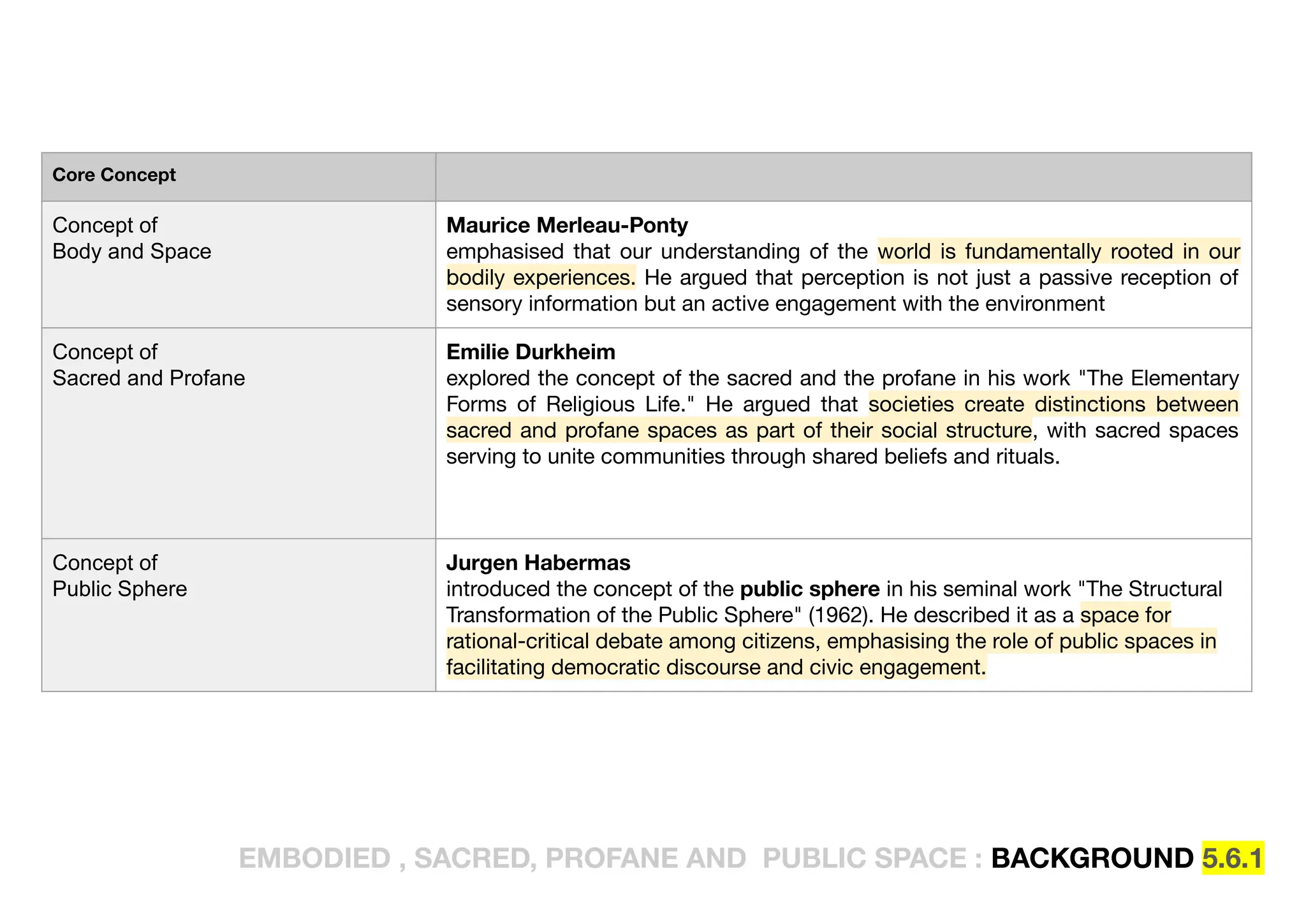
Core Concept
Concept of
Body and Space
Maurice Merleau-Ponty
emphasised that our understanding of the world is fundamentally rooted in our
bodily experiences. He argued that perception is not just a passive reception of
sensory information but an active engagement with the environment
Concept of
Sacred and Profane
Emilie Durkheim
explored the concept of the sacred and the profane in his work "The Elementary
Forms of Religious Life." He argued that societies create distinctions between
sacred and profane spaces as part of their social structure, with sacred spaces
serving to unite communities through shared beliefs and rituals.
Concept of
Public Sphere
Jurgen Habermas
introduced the concept of the public sphere in his seminal work "The Structural
Transformation of the Public Sphere" (1962). He described it as a space for
rational-critical debate among citizens, emphasising the role of public spaces in
facilitating democratic discourse and civic engagement.
40.
EMBODIED , SACRED,PROFANE AND PUBLIC SPACE 5.6.1
EMBODIED SPACE
Embodied space refers to how
individuals experience and perceive
space through their bodies, senses,
and movements. It emphasizes the
physical and sensory connection
between humans and their
environment.
Sensory Experience: Space is
experienced through sight, sound,
touch, smell, and even taste.
Movement and Interaction: How
people move through and interact with
space (e.g., walking, sitting, dancing)
shapes their understanding of it.
Personal and Cultural Meaning: The
body is a site of cultural and personal
meaning, influencing how space is
perceived and used.
Example:
A dancer performing in a studio experiences
the space through their body’s movements,
while a blind person navigates a room using
touch and sound.
41.
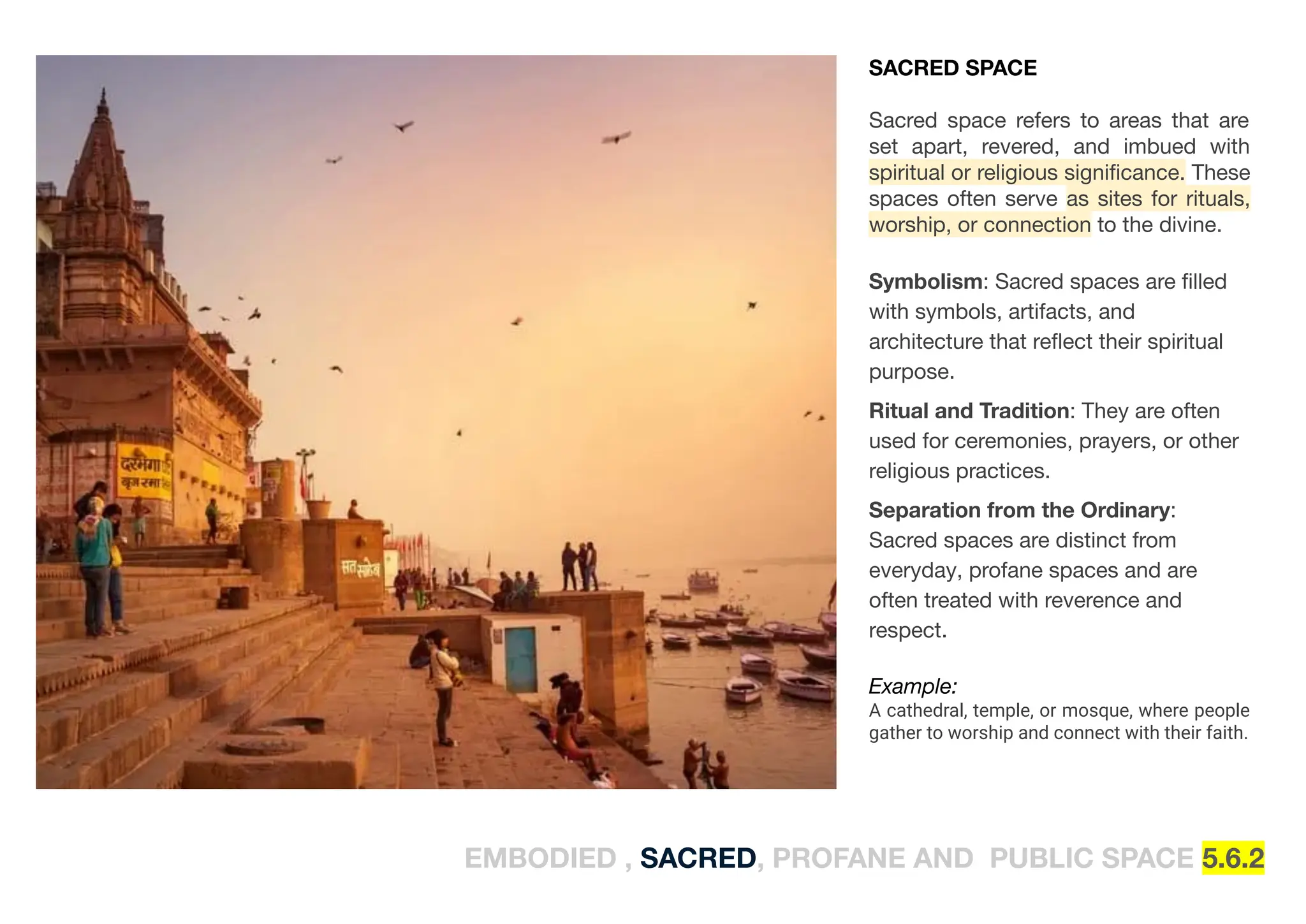
EMBODIED , SACRED,PROFANE AND PUBLIC SPACE 5.6.2
SACRED SPACE
Sacred space refers to areas that are
set apart, revered, and imbued with
spiritual or religious significance. These
spaces often serve as sites for rituals,
worship, or connection to the divine.
Symbolism: Sacred spaces are filled
with symbols, artifacts, and
architecture that reflect their spiritual
purpose.
Ritual and Tradition: They are often
used for ceremonies, prayers, or other
religious practices.
Separation from the Ordinary:
Sacred spaces are distinct from
everyday, profane spaces and are
often treated with reverence and
respect.
Example:
A cathedral, temple, or mosque, where people
gather to worship and connect with their faith.
42.
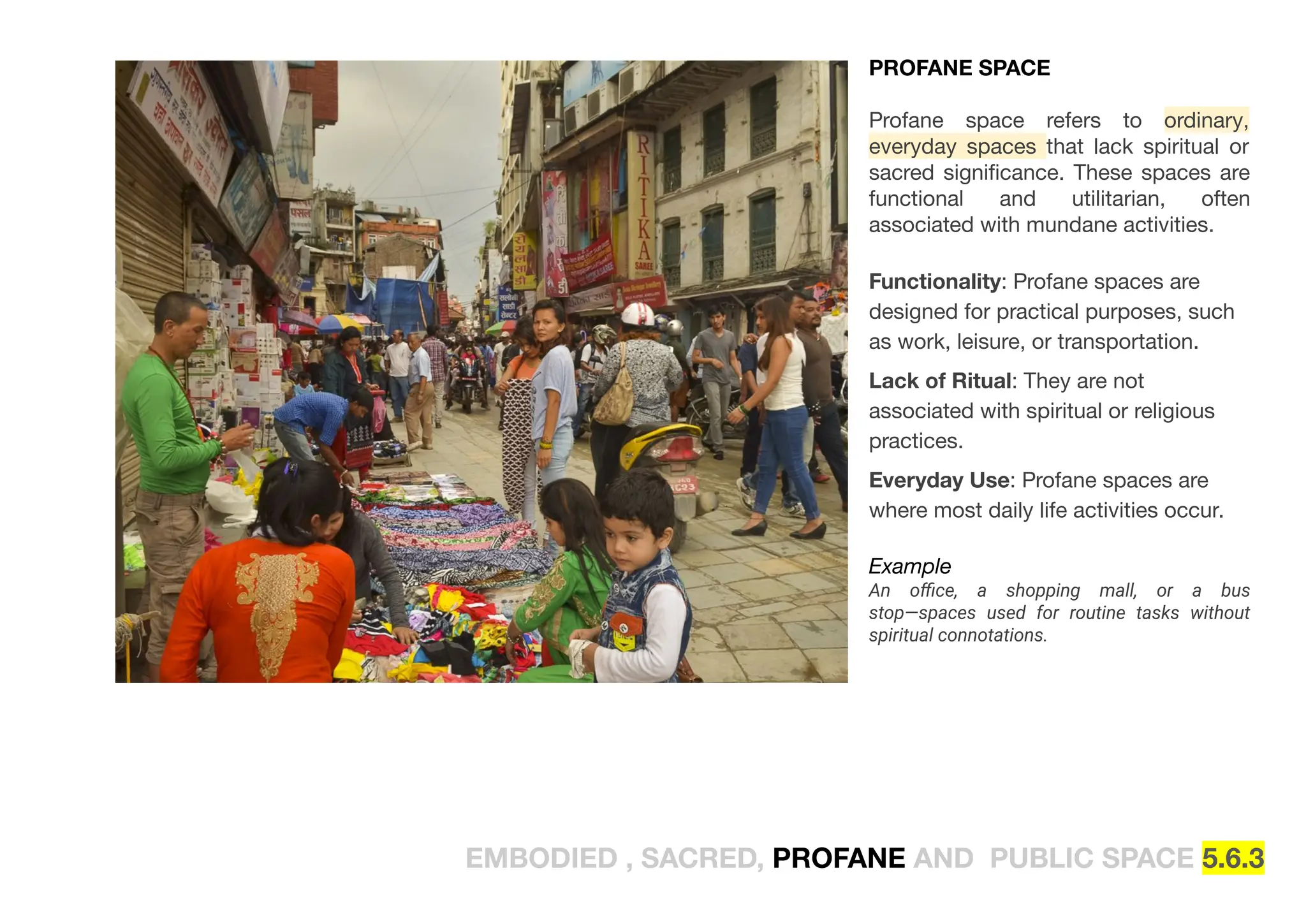
EMBODIED , SACRED,PROFANE AND PUBLIC SPACE 5.6.3
PROFANE SPACE
Profane space refers to ordinary,
everyday spaces that lack spiritual or
sacred significance. These spaces are
functional and utilitarian, often
associated with mundane activities.
Functionality: Profane spaces are
designed for practical purposes, such
as work, leisure, or transportation.
Lack of Ritual: They are not
associated with spiritual or religious
practices.
Everyday Use: Profane spaces are
where most daily life activities occur.
Example
An office, a shopping mall, or a bus
stop—spaces used for routine tasks without
spiritual connotations.
43.
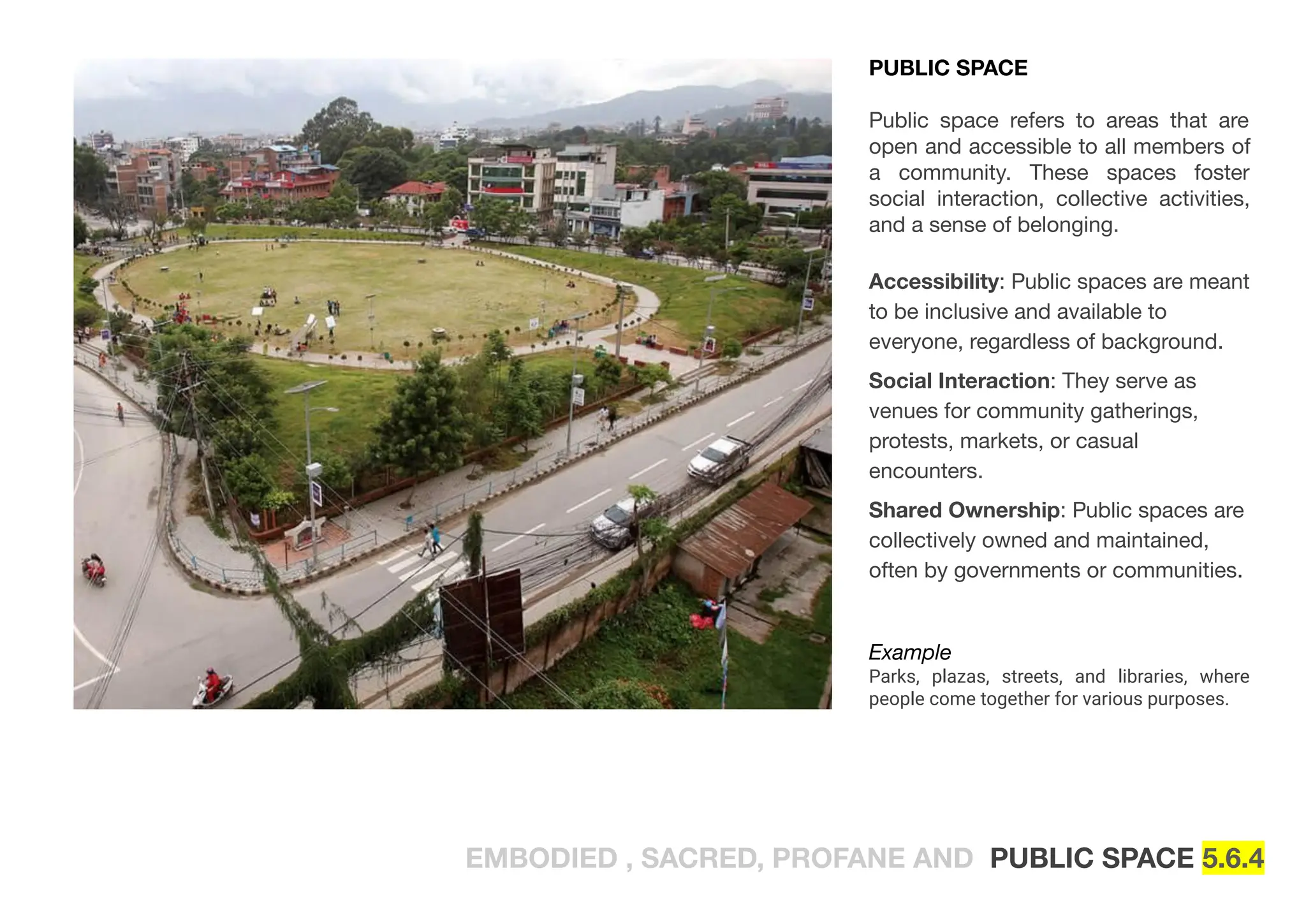
EMBODIED , SACRED,PROFANE AND PUBLIC SPACE 5.6.4
PUBLIC SPACE
Public space refers to areas that are
open and accessible to all members of
a community. These spaces foster
social interaction, collective activities,
and a sense of belonging.
Accessibility: Public spaces are meant
to be inclusive and available to
everyone, regardless of background.
Social Interaction: They serve as
venues for community gatherings,
protests, markets, or casual
encounters.
Shared Ownership: Public spaces are
collectively owned and maintained,
often by governments or communities.
Example
Parks, plazas, streets, and libraries, where
people come together for various purposes.
44.
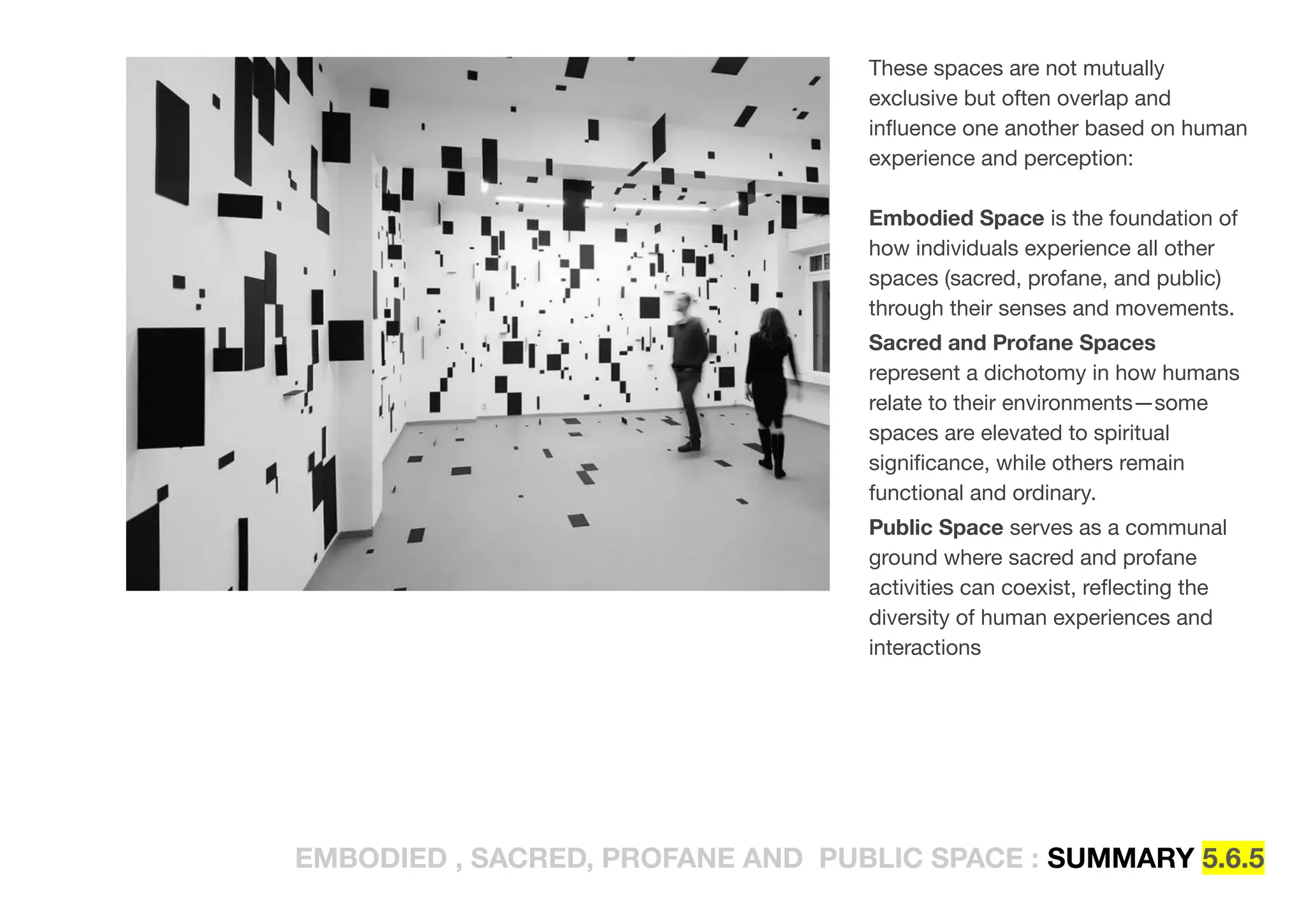
EMBODIED , SACRED,PROFANE AND PUBLIC SPACE : SUMMARY 5.6.5
These spaces are not mutually
exclusive but often overlap and
influence one another based on human
experience and perception:
Embodied Space is the foundation of
how individuals experience all other
spaces (sacred, profane, and public)
through their senses and movements.
Sacred and Profane Spaces
represent a dichotomy in how humans
relate to their environments—some
spaces are elevated to spiritual
significance, while others remain
functional and ordinary.
Public Space serves as a communal
ground where sacred and profane
activities can coexist, reflecting the
diversity of human experiences and
interactions
45.
EMBODIED , SACRED,PROFANE AND PUBLIC SPACE : SIGNIFICANCE 5.6.5
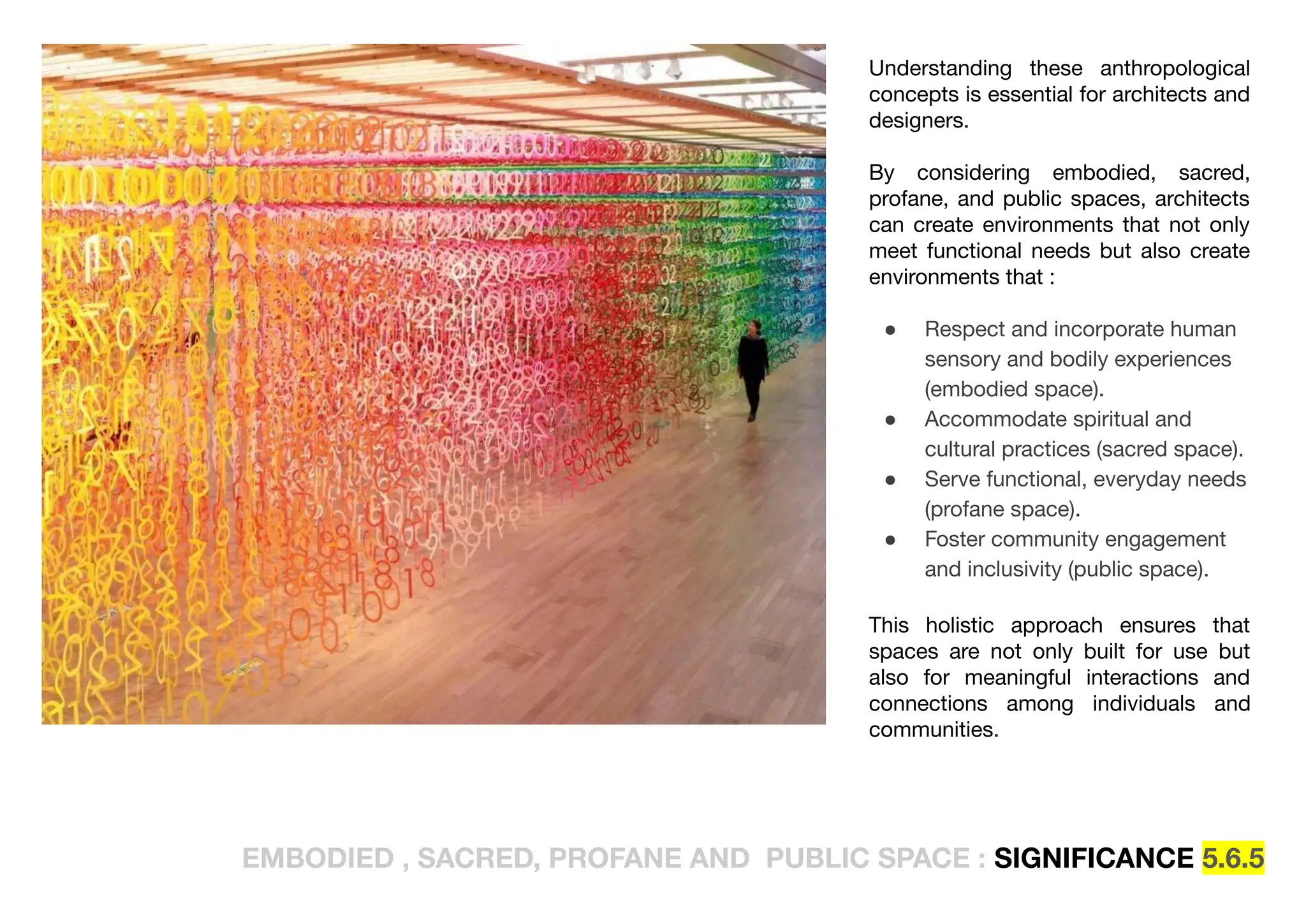
Understanding these anthropological
concepts is essential for architects and
designers.
By considering embodied, sacred,
profane, and public spaces, architects
can create environments that not only
meet functional needs but also create
environments that :
● Respect and incorporate human
sensory and bodily experiences
(embodied space).
● Accommodate spiritual and
cultural practices (sacred space).
● Serve functional, everyday needs
(profane space).
● Foster community engagement
and inclusivity (public space).
This holistic approach ensures that
spaces are not only built for use but
also for meaningful interactions and
connections among individuals and
communities.
Case Study 1( Personal Space Zones & Cultural Differences)
Examine how personal space varies across culture and its implication for social
interactions.
Literature Review: Investigate existing literature on personal space and
proxemics, focusing on cultural contexts in Nepal. Look into studies about the
diverse ethnic groups, such as Newars, Gurkhas, and Tharus.
Field Research: Select multiple locations (urban areas like Kathmandu and rural
areas). Observe interactions in different contexts (markets, homes, temples).
Data Collection: Use observational methods to note how people maintain
personal space in various social interactions. Conduct interviews or surveys to
gather subjective experiences regarding personal space.
Analysis: Compare findings across different cultural groups, analyzing how local
customs, traditions, and social norms influence personal space dynamics.
Presentation: Create visual aids (e.g., charts or diagrams) to illustrate personal
space zones in various cultural settings, discussing implications for design in
public spaces in Nepal.
CASE STUDY 1 _ PERSONAL SPACE ZONES & CULTURAL DIFFERENCES 5.7.1
48.
Case Study 2( Territoriality in Architectural Design)
Explore how territoriality is expressed in architectural design and urban planning.
Literature Review: Research theories on territoriality, focusing on how they apply
in a Nepali context. Investigate traditional architecture and contemporary urban
design.
Site Analysis: Choose specific neighborhoods in urban areas (e.g., Kathmandu)
and rural villages. Document spatial layouts, boundaries, and communal areas.
Interviews: Engage with architects, urban planners, and local residents to
understand their perspectives on territoriality in design.
Comparative Study: Analyze how traditional houses (e.g., patan houses) reflect
territorial claims compared to modern apartment complexes.
Presentation: Use photographs and maps to illustrate territorial designs,
discussing how they influence community interaction and social organization.
CASE STUDY 2 _ TERRITORALITY IN ARCHITECTURE DESIGN 5.7.1
49.
Case Study 3( Lefebvre’s Triad of Space)
Investigate how space is produced based on reading on Lefebvre’s triad of space
Literature Review: Explore the relationship between politics, economics and
architecture in Nepal. Focus on how power shape or influence design of built
environment.
Field Research: Choose specific neighborhoods in urban areas (e.g., Kathmandu)
Document spatial layouts, boundaries, and communal areas .
Interviews: Engage with architects, urban planners, and local residents to
understand their perspectives on how they perceive space, how they conceive
space and how they experience space
Comparative Analysis: Compare differences between conceived, perceived and
lived space.
Presentation: Create a visual documentation (photos, sketches) and a discussion
on the interplay between culture, environment, and architecture in Nepal.
CASE STUDY 3 _ CULTURAL AND ENVIRONMENTAL INFLUENCE 5.7.1
50.
Case Study 4( Embodied, Sacred, Profane and Public Spaces)
Identify and analyze different types of spaces within a specific community or urban
environment.
Literature Review: Research definitions and characteristics of embodied, sacred,
profane, and public spaces, particularly in the Nepali context.
Site Selection: Choose a specific location, such as Kathmandu or a rural
community, for observation and analysis.
Field Observation: Visit the site to document different types of spaces. Observe
how people interact in each space (e.g., temples for sacred space, market squares
for public space).
Interviews: Talk to community members about their experiences and perceptions
of these spaces, gathering narratives about their significance.
Analysis: Analyze the findings, discussing how these spaces interact, their cultural
meanings, and implications for architectural design and urban planning.
Presentation: Use maps, photographs, and personal accounts to illustrate the
diversity of spaces and their roles in the community.
CASE STUDY 4 _ EMBODIED, SACRED, PROFANE AND PUBLIC SPACE 5.7.1


![Non-Verbal Communication - Space [Presentation]](https://cdn.slidesharecdn.com/ss_thumbnails/non-verbalcommunication-spacepresentation-110502033020-phpapp01-thumbnail.jpg?width=640&height=640&fit=bounds)


