Presented By
Abida Akhter
Rollno 17304001
1
 Introduction
 MANETS
 Challenges in MANET
 Swarn intelligence
 Routing algorithms
 Anthocnet
REACTIVE ROUTE SETUP
PROACTIVE ROUTE MAINTENANCE
STOCHASTIC DATA FORWARDING
LINK FAILURES
Advantages
2
 In COMPUTER SCIENCE and OPERATION
RESEARCH, the anthoc net is a probabilistic technique
for solving computational problems which can be
reduced to finding good paths through graphs.
 This algorithm is a member of the ant colony algorithms
family, in swarm intelligence methods, and it constitutes
some metaheuristic optimizations.
 There are various algorithms, that are member of the ant
colony optimizations algorithms, aiming to search for an
optimal path in a graph, based on the behaviour of ants
seeking a path between their colony and a source of food.
3
 The original idea has since diversified to solve a wider
class of numerical problems, and as a result, several
problems have emerged, drawing on various aspects of
the behavior of ants.
4
 Mobile Ad-Hoc Networks (MANETS) - Mobile implies
that the inter connecting nodes are not fixed to be
remain at one place, rather they can move from one
place to the other. Ad-Hoc implies that the network
does not depend on any pre-existing infrastructure such
as routers.
One of the most important performance parameter in ad-
hoc networks is minimizing the total transmission energy
in the path and extending the battery life of the nodes
5
6
Every device acts as a router
 Dynamic topology:
Due to mobility of nodes the topology of network of network is
continuously changing and the paths that were efficient initially can
become inefficient or even in feasible
 Unidirectional Links:
since all the nodes serve as routers to each other so data packets are
forwarded in one direction from mode to mode in multi hop fashion
 Power Constraints:
One of the most important challenge in MANET is minimizing the
total transmission energy in the path and extending the battery life
of the nodes
7
8
 Can explore vast areas without global view of the
ground.
 Can find the food and bring it back to the nest.
 Will converge to the shortest path.
 Communication using pheromones.
 Explored area is marked with pheromone.
 Other ants find explored path by sensing pheromones.
9
 Almost blind.
 Incapable of achieving complex tasks alone.
Rely on the phenomena of swarm intelligence for
survival.
 Capable of establishing shortest-route paths from their
colony to feeding sources and back.
 Use stigmergic communication via pheromone trails
10
 Collective system capable of accomplishing difficult
tasks in dynamic and varied environments without any
external guidance or control and with no central
coordination.
 Achieving a collective performance which could not
normally be achieved by an individual acting alone.
 Constituting a natural model particularly suited to
distributed problem solving
11
12
 Proactive protocols:
Table Driven
Each Node Knows Network Topology
 Reactive protocols
On Demand Routing
 Hybrid protocols:
Combinaton of both proactive and reactive
13
 Anthoc network studies artificial systems that take
inspiration from the behaviour of real ant colonies and
which are used to solve discrete optimization problems.
 For wired networks a number of successful ant based
routing algorithms exist such as ABC and ANT etc
 Anthoc network is a hybrid multipath algorithm which
offers alternative routing offers in case of link failure
robustness and load balancing.
 Works on the concept of swarm intelligence
 Developed by di caro.
14
15
 Reactive path setup
 Stochastic data routing
 Proactive path maintenance and exploration
 Handling of link failures
Each node has two table:
 Pheromone Table:
Helps us in routing decisions .
 Regular Pheromone rij
d
Virtual Pheromone wij
d
Average Hop Count hij
d
 Neighbour Table:
Helps in identifying neighbours of a node
16
 Occurs when path from source to destination is
unknown
17
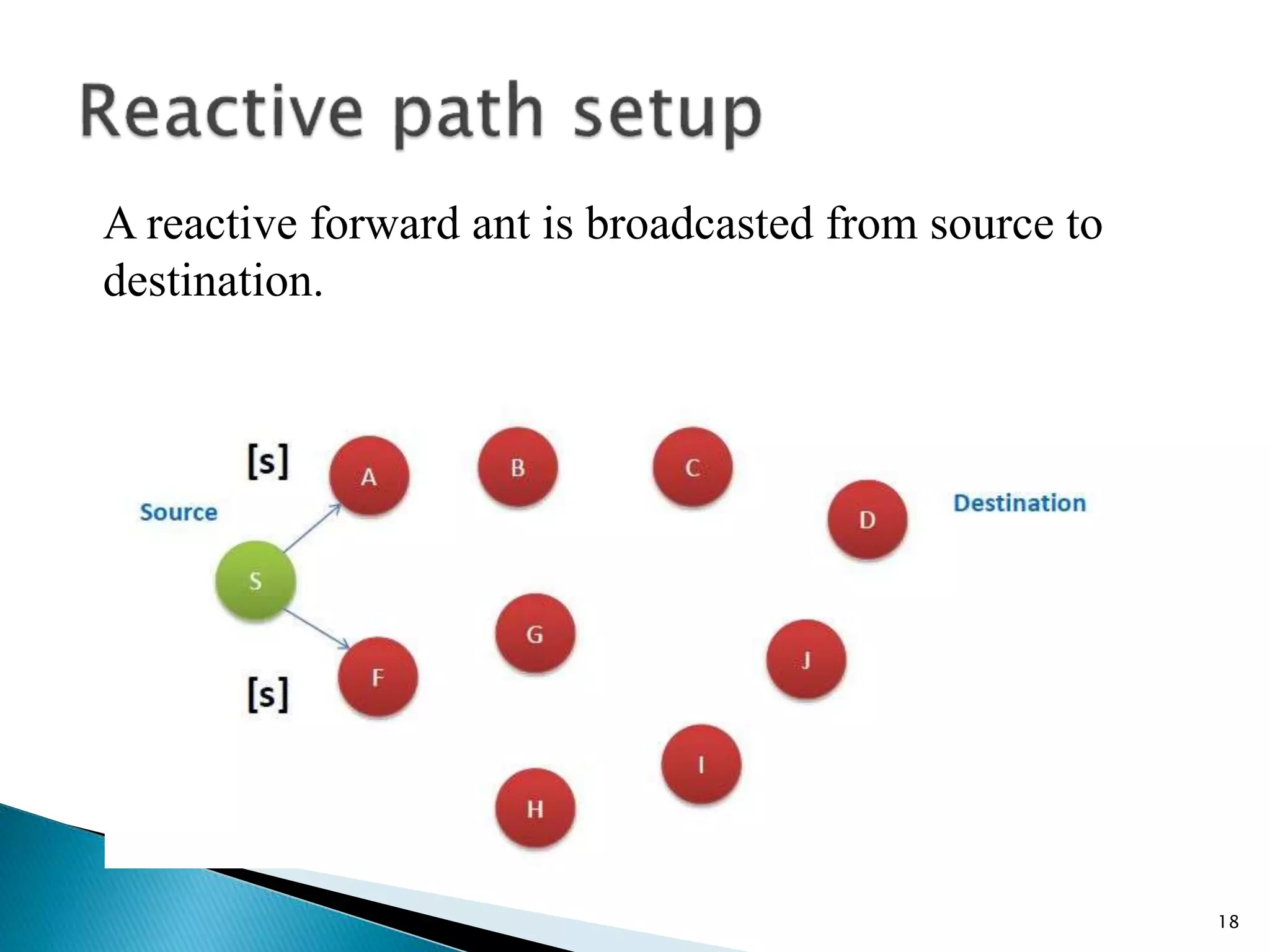
A reactive forward ant is broadcasted from source to
destination.
18
 Intermediate node unicasts or broadcasts ant packet to
neighbours depending on whether it knows the route to
destination or not.
19
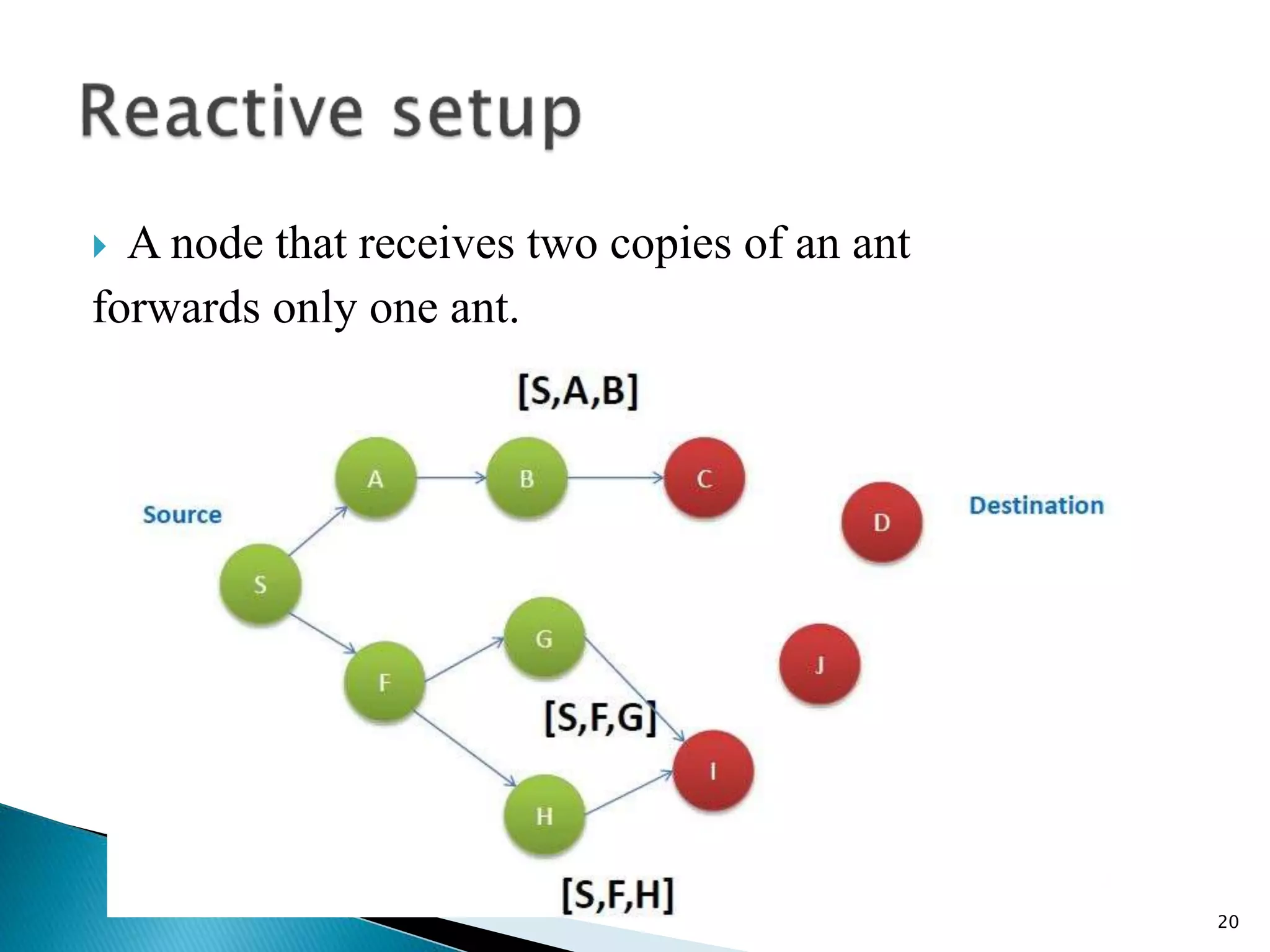
 A node that receives two copies of an ant
forwards only one ant.
20
 This method of working is called flooding.
21
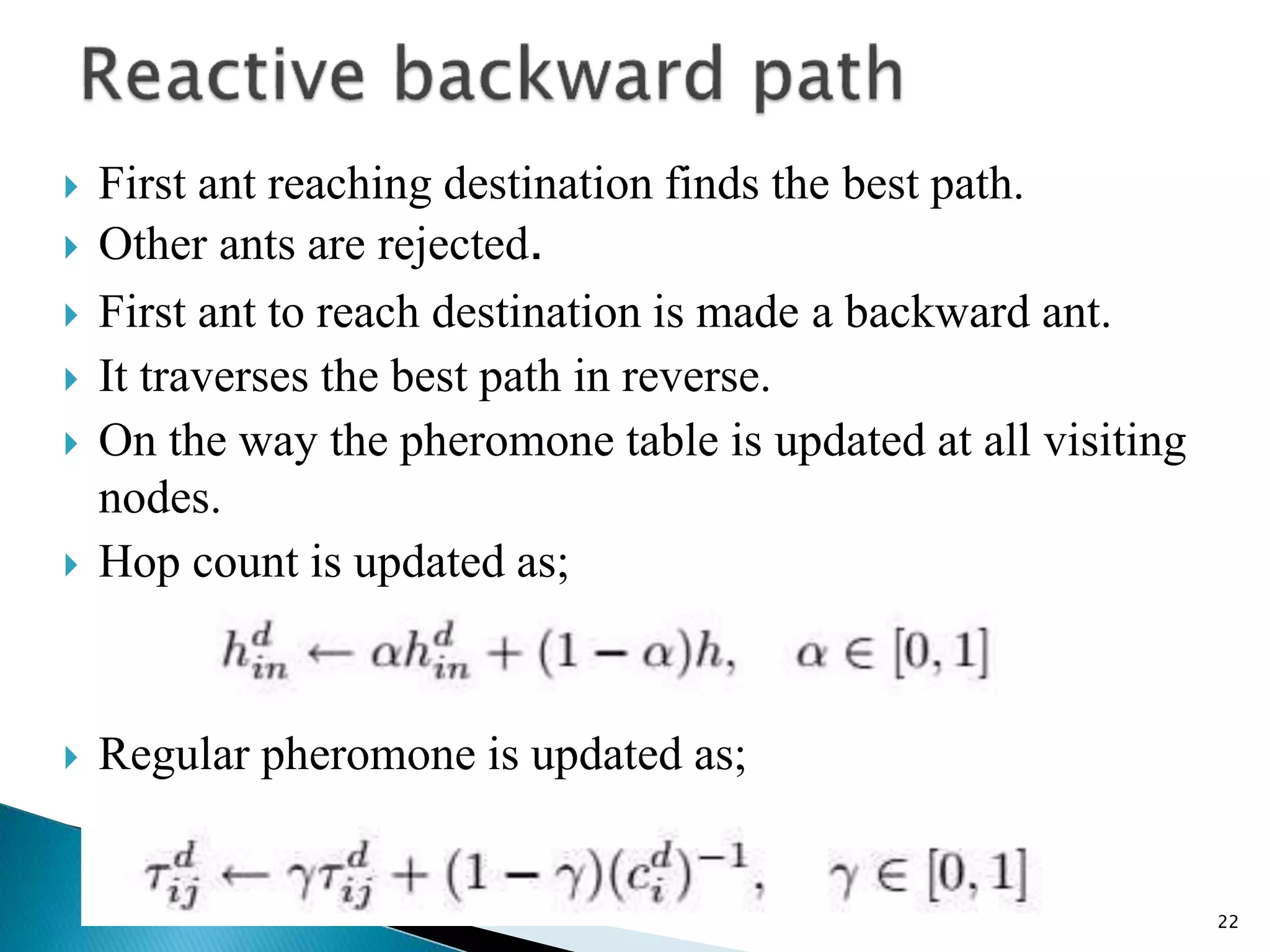
 First ant reaching destination finds the best path.
 Other ants are rejected.
 First ant to reach destination is made a backward ant.
 It traverses the best path in reverse.
 On the way the pheromone table is updated at all visiting
nodes.
 Hop count is updated as;
 Regular pheromone is updated as;
22
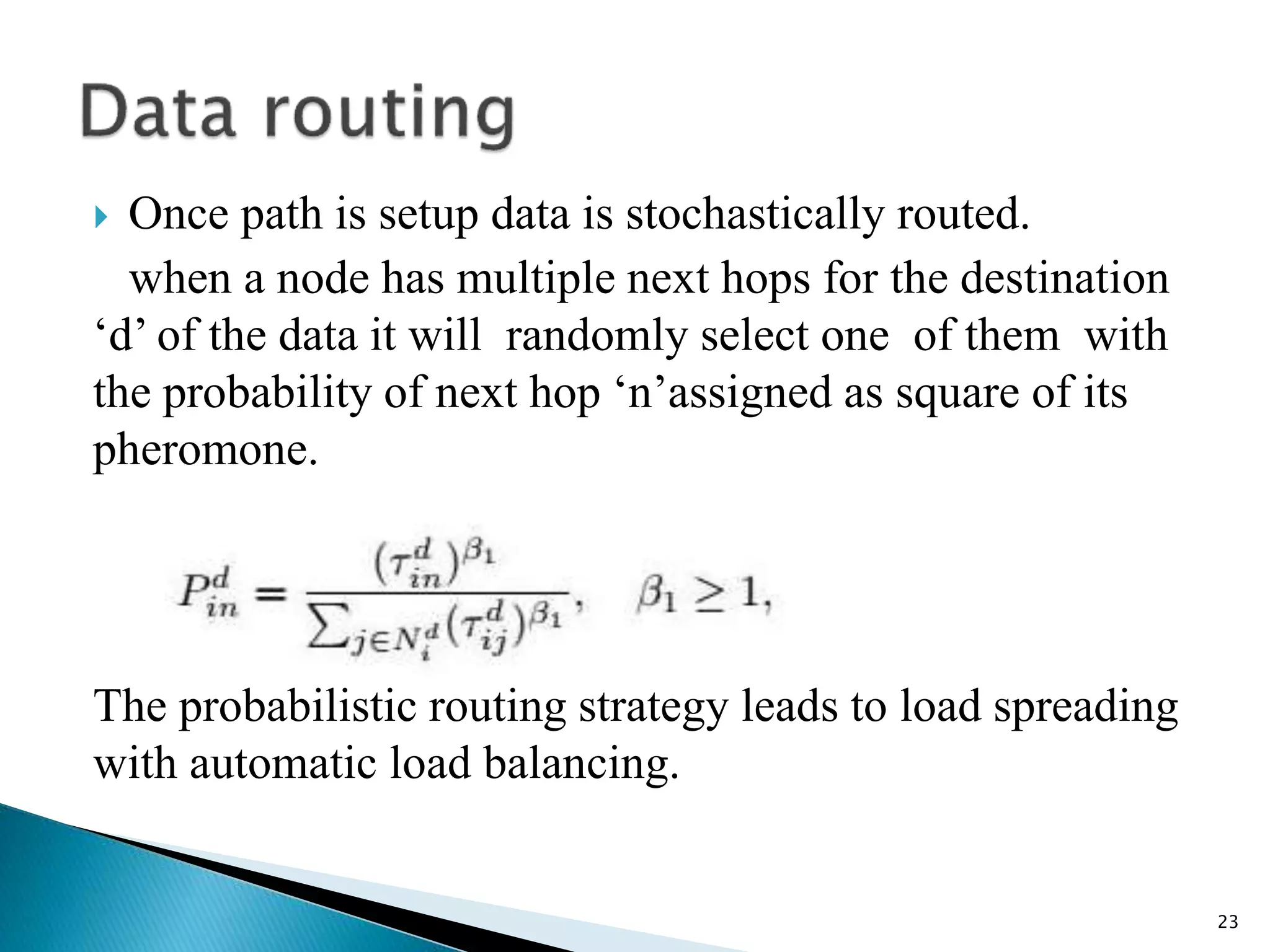
 Once path is setup data is stochastically routed.
when a node has multiple next hops for the destination
‘d’ of the data it will randomly select one of them with
the probability of next hop ‘n’assigned as square of its
pheromone.
The probabilistic routing strategy leads to load spreading
with automatic load balancing.
23
 While the session is active proactive ant agents explore
to find additional paths.
 They follow the pheromone value in the same way as
the data so that the path is sampled more evenly .
 Proactive ants like forward ants update table when it
becomes a backward ant.
24
 Nodes can detect link failures when unicast transmission occurs.
When a link fails and If the node has other next hop alternatives to
the same destination, this loss is not so important, and the node will
just update its routing table and send a notification of the update to
its neighbours.
 On the other hand, if the destination was regularly used for data
transmission, and it was the node's only alternative for this
destination, the loss is important and the node should try to repair the
path.
 This is the strategy followed in AntHocNet, with the restriction that
a node only repairs the path if the link loss was discovered with a
failed data packet transmission.
25
 Automatic load Balancing.
 Higher Delivery ratio.
 Robust , Adaptive and scalable
26
 [1] The internet engineering task force mobile ad-hoc networking
page(MANET). Available from:
http://www.ietf.org/html.charters/
 manet-charter.html.
 [2] Microsoft Mesh Networks. Available from: http://research.
 microsoft.com/mesh/.
 [3] ANTHOCNET, Available from
http://www.idsia.ch/~frederick
 /anthocnet/anthocnet.html
 [4] B. Baran and R. Sosa. A new approach for AntNet routing. In
 Proceedings of the 9th International Conference on Computer
 Communications Networks, Las Vegas, USA, 2000.
27
thank you
28

ANTHOCNET HYBRID ROUTING ALGORITHM FOR MANET USING SWARM TECHNOLOGY

  • 1.
  • 2.
     Introduction  MANETS Challenges in MANET  Swarn intelligence  Routing algorithms  Anthocnet REACTIVE ROUTE SETUP PROACTIVE ROUTE MAINTENANCE STOCHASTIC DATA FORWARDING LINK FAILURES Advantages 2
  • 3.
     In COMPUTERSCIENCE and OPERATION RESEARCH, the anthoc net is a probabilistic technique for solving computational problems which can be reduced to finding good paths through graphs.  This algorithm is a member of the ant colony algorithms family, in swarm intelligence methods, and it constitutes some metaheuristic optimizations.  There are various algorithms, that are member of the ant colony optimizations algorithms, aiming to search for an optimal path in a graph, based on the behaviour of ants seeking a path between their colony and a source of food. 3
  • 4.
     The originalidea has since diversified to solve a wider class of numerical problems, and as a result, several problems have emerged, drawing on various aspects of the behavior of ants. 4
  • 5.
     Mobile Ad-HocNetworks (MANETS) - Mobile implies that the inter connecting nodes are not fixed to be remain at one place, rather they can move from one place to the other. Ad-Hoc implies that the network does not depend on any pre-existing infrastructure such as routers. One of the most important performance parameter in ad- hoc networks is minimizing the total transmission energy in the path and extending the battery life of the nodes 5
  • 6.
  • 7.
     Dynamic topology: Dueto mobility of nodes the topology of network of network is continuously changing and the paths that were efficient initially can become inefficient or even in feasible  Unidirectional Links: since all the nodes serve as routers to each other so data packets are forwarded in one direction from mode to mode in multi hop fashion  Power Constraints: One of the most important challenge in MANET is minimizing the total transmission energy in the path and extending the battery life of the nodes 7
  • 8.
  • 9.
     Can explorevast areas without global view of the ground.  Can find the food and bring it back to the nest.  Will converge to the shortest path.  Communication using pheromones.  Explored area is marked with pheromone.  Other ants find explored path by sensing pheromones. 9
  • 10.
     Almost blind. Incapable of achieving complex tasks alone. Rely on the phenomena of swarm intelligence for survival.  Capable of establishing shortest-route paths from their colony to feeding sources and back.  Use stigmergic communication via pheromone trails 10
  • 11.
     Collective systemcapable of accomplishing difficult tasks in dynamic and varied environments without any external guidance or control and with no central coordination.  Achieving a collective performance which could not normally be achieved by an individual acting alone.  Constituting a natural model particularly suited to distributed problem solving 11
  • 12.
  • 13.
     Proactive protocols: TableDriven Each Node Knows Network Topology  Reactive protocols On Demand Routing  Hybrid protocols: Combinaton of both proactive and reactive 13
  • 14.
     Anthoc networkstudies artificial systems that take inspiration from the behaviour of real ant colonies and which are used to solve discrete optimization problems.  For wired networks a number of successful ant based routing algorithms exist such as ABC and ANT etc  Anthoc network is a hybrid multipath algorithm which offers alternative routing offers in case of link failure robustness and load balancing.  Works on the concept of swarm intelligence  Developed by di caro. 14
  • 15.
    15  Reactive pathsetup  Stochastic data routing  Proactive path maintenance and exploration  Handling of link failures
  • 16.
    Each node hastwo table:  Pheromone Table: Helps us in routing decisions .  Regular Pheromone rij d Virtual Pheromone wij d Average Hop Count hij d  Neighbour Table: Helps in identifying neighbours of a node 16
  • 17.
     Occurs whenpath from source to destination is unknown 17
  • 18.
    A reactive forwardant is broadcasted from source to destination. 18
  • 19.
     Intermediate nodeunicasts or broadcasts ant packet to neighbours depending on whether it knows the route to destination or not. 19
  • 20.
     A nodethat receives two copies of an ant forwards only one ant. 20
  • 21.
     This methodof working is called flooding. 21
  • 22.
     First antreaching destination finds the best path.  Other ants are rejected.  First ant to reach destination is made a backward ant.  It traverses the best path in reverse.  On the way the pheromone table is updated at all visiting nodes.  Hop count is updated as;  Regular pheromone is updated as; 22
  • 23.
     Once pathis setup data is stochastically routed. when a node has multiple next hops for the destination ‘d’ of the data it will randomly select one of them with the probability of next hop ‘n’assigned as square of its pheromone. The probabilistic routing strategy leads to load spreading with automatic load balancing. 23
  • 24.
     While thesession is active proactive ant agents explore to find additional paths.  They follow the pheromone value in the same way as the data so that the path is sampled more evenly .  Proactive ants like forward ants update table when it becomes a backward ant. 24
  • 25.
     Nodes candetect link failures when unicast transmission occurs. When a link fails and If the node has other next hop alternatives to the same destination, this loss is not so important, and the node will just update its routing table and send a notification of the update to its neighbours.  On the other hand, if the destination was regularly used for data transmission, and it was the node's only alternative for this destination, the loss is important and the node should try to repair the path.  This is the strategy followed in AntHocNet, with the restriction that a node only repairs the path if the link loss was discovered with a failed data packet transmission. 25
  • 26.
     Automatic loadBalancing.  Higher Delivery ratio.  Robust , Adaptive and scalable 26
  • 27.
     [1] Theinternet engineering task force mobile ad-hoc networking page(MANET). Available from: http://www.ietf.org/html.charters/  manet-charter.html.  [2] Microsoft Mesh Networks. Available from: http://research.  microsoft.com/mesh/.  [3] ANTHOCNET, Available from http://www.idsia.ch/~frederick  /anthocnet/anthocnet.html  [4] B. Baran and R. Sosa. A new approach for AntNet routing. In  Proceedings of the 9th International Conference on Computer  Communications Networks, Las Vegas, USA, 2000. 27
  • 28.