Nervous System[NS]
Peripheral Nerves [31SN & 12CN]
Perpheral Nervous System [PNS]
SoNS & ANS
Autonomic ganglia
Pre- & post-ganglionic neurons
Autonomic Nervous System [ANS]
Subdivisions of the ANS
a. Sympathetic division: (Thoracolumbar)
b. Parasympathetic division: (Craniosacral)
Relationship b/n SNS & PSNS
The enteric nervous system [ENS]
Adrenergic & Cholinergic nerve
fibers
Neurotransmitters of the ANS
ANS receptors [receptors in the ANS]
Pharmacology of the ANS
2
Learning objective
Somatic nervous system 🡆SoNS
Autonomic nervous system 🡆ANS
Sympathetic nervous system 🡆SNS
Parasympathetic nervous system 🡆PSNS
Enteric nervous system 🡆 ENS
5
1.Organization of theNervous System [NS]…
Somatic nervous system 🡆SoNS
Autonomic nervous system 🡆ANS
Sympathetic nervous system 🡆SNS
Parasympathetic nervous system 🡆PSNS
Enteric nervous system 🡆 ENS
6.
Organization of theNervous System [NS]
1. Central Nervous System🡆CNS
The brain + the spinal cord
The center of integration & control
2. Peripheral Nervous System 🡆PNS
The NS outside of the brain & spinal cord
Consists of:
31 pairs of Spinal nerves
12 pairs of Cranial nerves
Carry info to & from the spinal cord
1.Organization of the Nervous System [NS]…
6
7.
Types of PeripheralNerves
1. Based on Origin
Cranial & Spinal nerves
2. Based on signal transmission
Afferent, efferent, mixed nerves
3. Based on control
Autonomic & somatic
4. Based on functions
General & special nerves
7
2.Peripheral Nerves
8.
Cranial nerves
12 pairsof cranial nerves [CN]🡆designated by Roman number [I-XII]
Carry signal to & from the brain
Emerge mainly from parts of CNS above SC🡆 called Brain stem
Supply structures in the🡆
Head, neck, & viscera (thorax & abdomen)
Can be,
Sensory (I, II, VIII): olfactory, optic & vestibulocochlear nerves
Motor (III, IV, VI, XI, XII): oculomotor, trochlear, abducens, accessory & hypoglossal nerves
Mixed (V, VII, IX, X): trigeminal, facial, glossopharyngeal & vagus
8
9.
2.Peripheral Nerves…
12 pairsof cranial nerves [CN]
A. Afferent [sensory]
1. Olfactory🡆sense of smell
2. Optic 🡆 sense of vision
3. Auditory [Vestibulocochlear=acoustic] 🡆 sense of equilibrium (balance) & hearing
B. Mixed nerves
1. Trigeminal 🡆
2. Facial 🡆
3. Glossopharyngeal 🡆
4. Vagus 🡆
C. Efferent [motor]
1. Trochlear 🡆
2. Abducens 🡆
3. Occulomotor 🡆 motor to intrinsic & extrinsic muscles of the eyes
4. Spinal accessory 🡆 motor to soft palate, pharynx & larynx &
neck 9
10.
mov’t]
10
12 pairs ofcranial nerves
I
2.Peripheral Nerves…
No 12 cranial nerves Nerve type Function [control of]
I
[chewing]
[Facial sensation]
Muscles of facial expression, taste
r
taste
,Swallowing
nerve Throat, neck & upper back
muscles
[Spinal accessory]
II
III
IV
V
VI
VII
VIII
IX
X
XI
XII
12 pairs of CN🡆 designated by the Roman numbers (I-
11.
Cranial nerves [CN]
CranialNerves Mediate 5 Special Senses:
Smell, Vision, Hearing, Taste, Equilibrium
1. Smell: CN-I (Olfactory)
2. Vision: CN- II (Optic)
3. Hearing: CN-VIII (Cochlear division)
4. Equilibrium: CN-VIII (vestibular division)
5. Taste: CNs -VII, IX (Facial, Glossopharyngeal)
3 Nerves Are Concerned With Eyeball Movements
6. Oculomotor (III): superior rectus, medial rectus, inferior rectus, inferior
oblique
7. Trochlear (IV): superior oblique
8. Abducens (VI): lateral rectus
11
12.
4 of theCNs Carry Parasympathetic Fibers
1. Oculomotor (III): innervates iris constrictor (causes pupil constriction);
also controls ciliary muscle (focuses the lens)
2. Facial (VII) & Glossopharyngeal (IX): stimulate salivary glands to secrete
3. Vagus (X): the major nerve of the parasympathetic system: goes to
most visceral organs (heart, lungs, kidneys, liver, stomach, intestines)
Several of the Nerves Innervate Skeletal Muscles
1. The Facial nerve (VII): controls muscles of facial expression
2. The Spinal accessory (XI): stimulates the trapezius & sternocleidomastoid
muscles
3. Chewing muscles (masseter, temporalis): are innervated by the Trigeminal (V)
4. The Hypoglossal (XII): moves the tongue
Cranial nerves [CN]
12
13.
Damage to CranialNerves Causes Many Medical Problems
1.Anosmia (loss of smell): Olfactory nerve damage
2.Bell's Palsy: paralysis of the muscles of facial expression on one side.
-Caused by inflammation of the Facial nerve.
3.Tic douloureux: severe facial pain caused by inflammation of the
trigeminal
nerve.
4.Blindness: caused by damage to optic nerve.
Cranial nerves [CN]
13
14.
31 pairs ofspinal nerves
All contain afferent & efferent
a. 8 cervical nerves [Ns]
b. 12 thoracic Ns
c. 5 lumbar Ns
d. 5 sacral Ns
e. 1 coccygeal Ns
A. Afferent
Relay message to CNS by long axon
Afferent neurons are 1st order neurons
B. Efferent
Carry signals from CNS to muscles & glands
More complicated than the afferent division [2nd order]
2.Peripheral Nerves…
31 pairs of spinal nerves
Spinal nerves🡆Supply structures in the limbs, trunk & neck
-All branches contain both motor & sensory fibers.
15.
15
3.Perpheral Nervous System[PNS]
PNS further divided into:
Somatic nervous system 🡆SoNS
Voluntary
Somatic nerve fibers conduct impulses from the CNS to skeletal
muscles
Autonomic nervous system 🡆ANS
Involuntary
Autonomic nerve fibers conducts impulses from the CNS to smooth muscle,
cardiac muscle, & glands.
16.
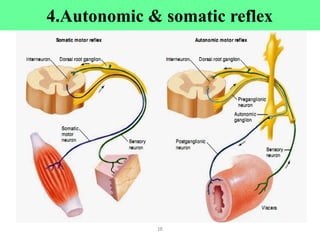
4.Comparison of SoNS&
ANS
16
Structurally the SoNS includes:
Somatic sensory neurons
Integrating centers in the CNS (Cortex)
Somatic motor neuron [1] to skeletal muscles only
Structurally the ANS includes:
Autonomic sensory neurons
Integrating centers in the CNS
Autonomic motor neurons [2] to smooth muscle, cardiac muscle &
glands
Autonomic Vs somatic motor nerve fiber
17.
17
SoNS [Voluntary]
Controlsor innervates
Voluntary activities such as
Contraction of the skeletal muscle.
Nerve fibres are originated from
The anterior horn of the Grey matter of the spinal cord [SC]
The motor nerve contains
Single [1], long, thick & well-myelinated
axon.
The NT is always Ach &
The receptor is always Nicotinic Receptor
Receptor: cholinergic (nicotinic)
Has 1 neuron b/n CNS & effector organ
ANS [Involuntary]
Controls involuntary activities such as
CVS, GIT, glands [smooth, cardiac muscle ]
Nerve fibres are originated from
The lateral horn of the Grey matter of SC
The NT is either Ach or NE &
The receptors are adrenergic Or cholinergic
Autonomic fibres contain 2 neurons
Pre-& post-ganglionic neurons &
They connected by synapse b/n CNS & effector organs
4.Comparison of SoNS Vs
ANS…
Preganglionic neurons are a set of nerve fibers of the ANS that connect the CNS to the ganglia
Postganglionic neurons are a set of nerve fibers that present in the ANS which connects the ganglion to the effector
organ
Summary of PSNS,SNS & SoNS innervations
4.Comparison of SoNS &
ANS…
No Postganglionic
NN [N2]
NM [N1]
21.
5.Autonomic ganglia
Ganglion[pl 🡆 ganglia]
A collection of cell bodies outside the
CNS.
Nucleus [pl🡆nuclei]
A collection of cell bodies within the CNS.
Function of ganglia:
Relay [Transmit] stations
Expansion Or as,
Distribution centers.
3 Types of the autonomic ganglia
22.
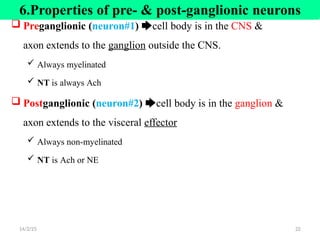
Preganglionic (neuron#1)🡆cell body is in the CNS &
axon extends to the ganglion outside the CNS.
Always myelinated
NT is always Ach
Postganglionic (neuron#2) 🡆cell body is in the ganglion &
axon extends to the visceral effector
Always non-myelinated
NT is Ach or NE
14/2/25 22
4.ANS
6.Properties of pre- & post-ganglionic neurons
23.
23
6.Properties of pre-& post-ganglionic neurons…
All preganglionic neurons are cholinergic neurons.
They secrete Ach & are excitatory
Sympathetic post-ganglionic neurons are adrenergic with few
exceptions
They secrete NE & are either excitatory or inhibitory
But sweat glands are cholinergic
Parasympathetic post-ganglionic neurons are cholinergic.
They secrete Ach & are either excitatory or inhibitory.
The ANS is subdivided in to 2 separate divisions 🡆the SNS & PSNS.
These 2 divisions differ in their origin, fiber length, axon terminal branches, function [actions on the effectors] , the NTs they discharge & their
24.
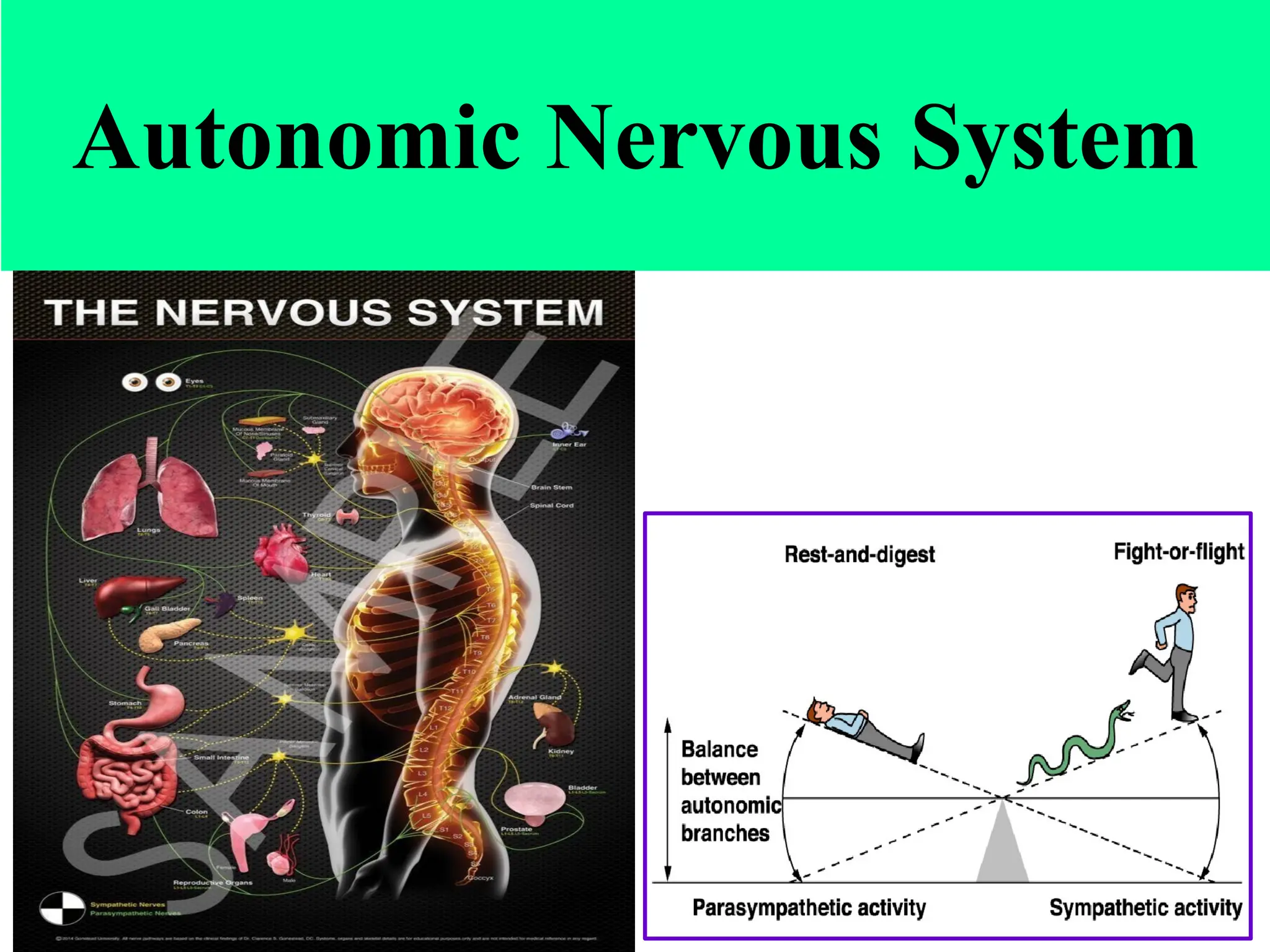
7.Autonomic Nervous System[ANS]
ANS🡆regulates involuntary physiologic processes.
The effectors that respond to autonomic regulation include
Cardiac muscle (the heart), smooth muscles, & glands.
These effectors are part of the visceral organs (organs within the body cavities) & of blood vessels.
The ANS pathway from the CNS to the effector always involves
2 neurons synapse in an autonomic ganglion
Autonomic ganglia are located in the head, neck, & abdomen
ANS divided into:
Sympathetic Nervous System [“Fight or Flight”]
Parasympathetic Nervous System [“Rest & Digest”]
However, there are often Dual innervations
24
25.
Dual innervation
Meaning🡆innervationby both PSNS & SNS
Most body structures receive dual innervations
Purpose: For better control
“fight/flight” response of SNS is very helpful
E.g. When encountering snarling dog Or need to escape from a burning
building.
When emergency is over, PSNS needs time to help body relax & recover.
Eruction of penis or clitoris Vs Ejaculation [gentalia]
The following structures do not receive dual innervation:
The sweat glands
Adrenal medulla, some blood vessels & Skin pilo erectors
7.Autonomic Nervous System [ANS]…
25
26.
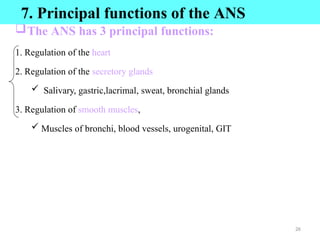
The ANS has3 principal functions:
1. Regulation of the heart
2. Regulation of the secretory glands
Salivary, gastric,lacrimal, sweat, bronchial glands
3. Regulation of smooth muscles,
Muscles of bronchi, blood vessels, urogenital, GIT
7. Principal functions of the ANS
26
27.
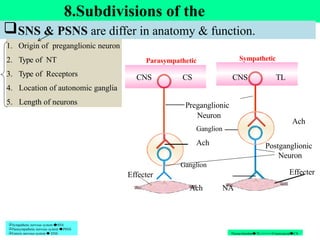
8.Subdivisions of the
ANS
SympatheticDivision [Thoracolumbar out flow]
Thoracolumbar division
Fight-or-flight [ “E” division (Exercise, excitement, emergency & embarrassment]
Parasympathetic Division [Craniosacral]
Craniosacral division
Rest-&-digest [“D” division (Digestion, defecation, & diuresis or micturition]
These divisions are anatomically & functionally distinct
27
Sympathetic division Parasympathetic
Originated from Thoraco-lumbar region (T1-L2) Cranio-sacral region (Brain stem + S2-S4)
Length of fibers:
-Preganglionic
-Postganglionic
Shorter Longer
Longer Shorter
Axon branches Highly branched (influence many organs) Few branches (influence few organs)
28.
28
8.Subdivisions of theANS…
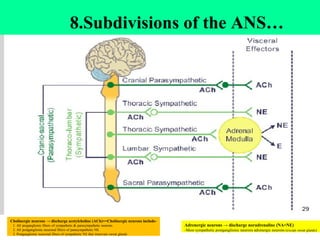
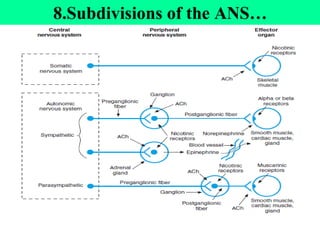
Cholinergic neurons → discharge acetylcholine (ACh)==Cholinergic neurons include-
1. All preganglionic fibers of sympathetic & parasympathetic neurons.
2. All postganglionic neuronal fibers of parasympathetic NS.
3. Postganglionic neuronal fibers of sympathetic NS that innervate sweat glands
Adrenergic neurons → discharge noradrenaline (NA=NE)
-Most sympathetic postganglionic neurons adrenergic neurons (except sweat glands)
1. Origin ofpreganglionic neuron
2. Type of NT
3. Type of Receptors
4. Location of autonomic ganglia
5. Length of neurons
Effecter
Effecter
Divisions of the
ANS
Sympathetic
Parasympathetic
CNS CS CNS TL
Ganglion
Ach NA
Preganglionic
Neuron
Ganglion
Ach
Ach
Postganglionic
Neuron
8.Subdivisions of the
ANS…
Thoracolumbar🡆TL======Craniosacral🡆CS
SNS & PSNS are differ in anatomy & function.
Sympathetic nervous system 🡆SNS
Parasympathetic nervous system 🡆PSNS
Enteric nervous system 🡆 ENS
31.
31
8.1.Sympathetic Division: (Thoracolumbarout
flow)
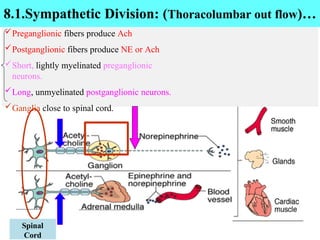
Originates in lateral horns of T1-T12 & L1-L2 [T1-L2] region of spinal cord
Components of the Sympathetic neurons,
Cell bodies of preganglionic motor neurons are located in spinal cord
Preganglionic axons synapse in ganglia🡆ganglia are located near the spinal cord
& far away from the organs being innervated
Contains short preganglionic neurons which are cholinergic🡆 synapse with
Long postganglionic neurons which are adrenergic (most) & cholinergic
(some).
Sweat gland
32.
Preganglionic fibers produceAch
Postganglionic fibers produce NE or Ach
Short, lightly myelinated preganglionic
neurons.
Long, unmyelinated postganglionic neurons.
Ganglia close to spinal cord.
Spinal
Cord
8.1.Sympathetic Division: (Thoracolumbar out flow)…
33.
8.1.Major Functions ofthe SNS
SNS 🡆for fight or flight response [Initiation]
🠙metabolic rate [🡑rate of cellular metabolism throughout the body]
🠙cardiac output ,SV & 🡑ABP &🡑heart rate & dilates pupil [ For far vision]
Is excitatory to almost all body parts except for the GIT [Inhibits GIT activities]
It 🠗GIT motility or secretion & at sphincters it causes constriction [closes sphincters]
Sweat glands: produce secretions [🡑sweating]
🡑blood flow to active muscles concurrent with 🠗blood flow to organs such as the GIT &
the kidneys.
Diverts blood from skin & GIT to skeletal muscles & towards vital organs [cardiac muscle, liver & adipose
tissue]
Dilates bronchioles🡆β2🡆 [Relaxation of smooth muscles of bronchioles]
Salivary glands: produce viscous fluid
🠙alertness [prepares the body to deal with emergencies]
33
34.
🡑blood glucoseconcentration [glycogen to glucose]
🡑glycolysis in the liver & muscle🡆 🡑ATP
🡑muscle strength & 🡑mental activity
Coronary vessels: Vasodilation (β2)🡆🡆🡆BUT PSNS
Vasoconstriction.
Kidney vessels: Vasoconstriction 🡆↓RBF = ↓Urine output
🡑Ejaculation
The sum of these effects permits a person to perform far more
strenuous physical activity [emergency]
8.1.SNS Often Responds by Mass Discharge
Characteristic features of SNS:
Shunting of blood away from the skin & visceral into skeletal muscles.
Dilation of the bronchi to improve oxygenation
Dilation of the pupil [mydriasis]
Mobilization of stored energy (energy expenditure).
8.1.Major Functions of the SNS…
RBF=renal blood flow
34
35.
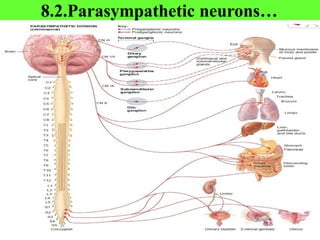
8.2.Parasympathetic Division: (Craniosacral)
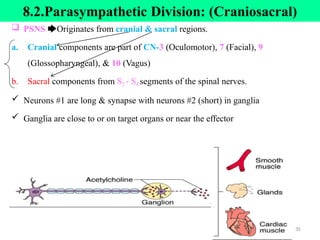
PSNS 🡆Originates from cranial & sacral regions.
a. Cranial components are part of CN-3 (Oculomotor), 7 (Facial), 9
(Glossopharyngeal), & 10 (Vagus)
b. Sacral components from S2 - S4 segments of the spinal nerves.
Neurons #1 are long & synapse with neurons #2 (short) in ganglia
Ganglia are close to or on target organs or near the effector
35
36.
8.2.Parasympathetic neurons…
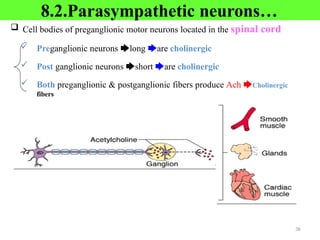
Cellbodies of preganglionic motor neurons located in the spinal cord
Preganglionic neurons 🡆long 🡆are cholinergic
Post ganglionic neurons 🡆short 🡆are cholinergic
Both preganglionic & postganglionic fibers produce Ach 🡆Cholinergic
fibers
36
8.2.Functions of PSNS
PSNS 🡆for conservation of energy, is anabolic [rest & digest]
Has inhibitory effect on almost all body tissues except in the GIT.
Has excitatory effects on the GIT.
⭡GIT motility [🠙emptying of the bowel]↑GI tract smooth muscles contraction
Slowing heart & constricts bronchioles
Salivary glands: produces watery fluid
Constriction of the pupil [focusing of the eye for near vision]🡆myosis
⭡gastric, lacrimal,nasal, pancreatic secretion & 🠙Emptying of the bladder
Relaxes sphincters of GI tract
Causes vasodilation & responsible for erection of penis & clitoris
Sweat glands: normal
38
🡑salivation, urination [micturition], digestion & defecation 🡆🠗[HR, diameter of airways & diameter of
pupil].
Most body structures receive dual innervations for better
control
10.The enteric nervoussystem [ENS]
ANS has an extrinsic & an intrinsic component on the GIT.
1. Extrinsic
SNS & PSNS innervation of GI tract
2. Intrinsic
Called Enteric Nervous System [ENS] 🡆directly controls the GIT.
Contained within wall of GI tract
Communicates with Extrinsic component
Called the little brain because it can operate with great deal of independence
ENS is described as also a 2nd brain.
It embedded in the lining of the GIT & can operate independently of the brain & the
spinal cord.
Found in lining of esophagus, stomach, intestine, pancreas, & gall bladder
It monitors or controls local GI blood flow, GI mucosal secretion & mucosal transport ,
stretch of GIT walls, hormone level in the blood, GIT motility.
42
43.
11.Cholinergic nerve
fibers
TheSNS & the PSNS nerve fibers secrete synaptic transmitter subs,
Acetylcholine [Ach] or norepinephrine [NE]
Those fibers that secrete Ach are said to be cholinergic nerve fibers.
All preganglionic neurons are cholinergic in both the SNS & the PSNS.
Almost all of the postganglionic neurons of the PSNS are also
cholinergic.
PSNS
43
44.
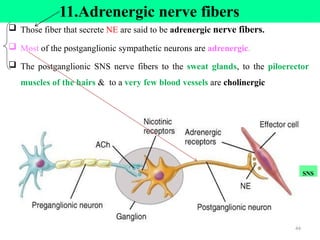
Those fiberthat secrete NE are said to be adrenergic nerve fibers.
Most of the postganglionic sympathetic neurons are adrenergic.
The postganglionic SNS nerve fibers to the sweat glands, to the piloerector
muscles of the hairs & to a very few blood vessels are cholinergic
11.Adrenergic nerve fibers
SNS
44
45.
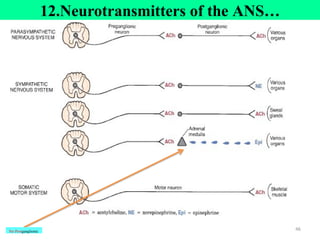
12.Neurotransmitters of theANS
NTs are released:
At synapses b/n neurons
B/n preganglionic & postganglionic.
To autonomic effectors
Smooth muscle, cardiac muscle, &
glands.
Both pre- & postganglionic neurons in the PSNS release Ach & are called Cholinergic.
All preganglionic axon & a few postganglionic neurons in the SNS are also Cholinergic.
Most of the postganglionic neurons of the SNS release NE & are called Adrenergic.
2 NTs are used in the ANS.
• ACh & NE [E]
• Neurons secreting Ach are cholinergic & NE are adrenergic
PSNS
SNS
1. Cholinergic receptors🡆 Give responses to
Ach
a. Nicotinic receptors [N] 🡆🡆🡆 NN &
NM
b. Muscarinic receptors [M]🡆🡆🡆M1-
M5
Thus Ach activates these 2 receptors called muscarinic & nicotinic
receptors.
2. Adrenergic receptors🡆Give responses to NE & E.
a. Alpha receptors
Alpha1 🡆[Vasoconstriction]
Alpha2 🡆As NFM ,relaxes smooth musclevasodilate
b. Beta receptors
Beta1 [🠙HR & contractility]
Beta2 Bronchodilation
Beta3for Lipolysis
NE excites mainly alpha receptors but excites the beta receptors to a lesser extent as well.
E excites both types of receptors approximately equally.
13.ANS Receptors [Receptors in the
ANS]
2 basic categories of receptors
1.Cholinergic receptors
2.Adrenergic receptors
2 principal receptors of Ach
NN [N2] =
NM [N1]=at NMJ
48.
14/2/25 48
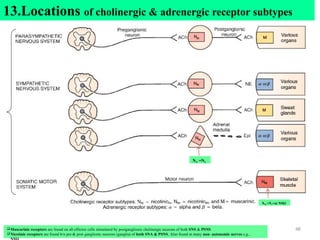
13.Locations ofcholinergic & adrenergic receptor subtypes
Muscarinic receptors are found on all effector cells stimulated by postganglionic cholinergic neurons of both SNS & PSNS
Nicotinic receptors are found b/n pre-& post ganglionic neurons (ganglia) of both SNA & PSNS. Also found at many non- autonomic nerves e.g.,
NN =N2
NM =N1=at NMJ
49.
Par
49
Summary
NervousSystem [NS]
Peripheral Nerves [31SN & 12 CN]
Perpheral Nervous System [PNS]
SoNS & ANS
Autonomic ganglia
Pre- & post-ganglionic neurons
Autonomic Nervous System [ANS]
Subdivisions of the ANS
Sympathetic division: (Thoracolumbar)
Parasympathetic division: (Craniosacral)
Relationship b/n SNS & PSNS
The enteric nervous system [ENS
Adrenergic & Cholinergic nerve fibers
NTs of the ANS
ANS receptors [receptors in the ANS]

![ Nervous System [NS]
Peripheral Nerves [31SN & 12CN]
Perpheral Nervous System [PNS]
SoNS & ANS
Autonomic ganglia
Pre- & post-ganglionic neurons
Autonomic Nervous System [ANS]
Subdivisions of the ANS
a. Sympathetic division: (Thoracolumbar)
b. Parasympathetic division: (Craniosacral)
Relationship b/n SNS & PSNS
The enteric nervous system [ENS]
Adrenergic & Cholinergic nerve
fibers
Neurotransmitters of the ANS
ANS receptors [receptors in the ANS]
Pharmacology of the ANS
2
Learning objective
Somatic nervous system 🡆SoNS
Autonomic nervous system 🡆ANS
Sympathetic nervous system 🡆SNS
Parasympathetic nervous system 🡆PSNS
Enteric nervous system 🡆 ENS](https://image.slidesharecdn.com/unit4-250405064926-c540b085-260119154156-c39e0633/85/unit4-250405064926-c540b085-pptx-Peripheral-Nervous-system-2-320.jpg)
![14/2/25
1.Organization of the Nervous System [NS]
Superficial stimuli
3](https://image.slidesharecdn.com/unit4-250405064926-c540b085-260119154156-c39e0633/85/unit4-250405064926-c540b085-pptx-Peripheral-Nervous-system-3-320.jpg)
![4
1.Organization of the Nervous System [NS]…](https://image.slidesharecdn.com/unit4-250405064926-c540b085-260119154156-c39e0633/85/unit4-250405064926-c540b085-pptx-Peripheral-Nervous-system-4-320.jpg)
![5
1.Organization of the Nervous System [NS]…
Somatic nervous system 🡆SoNS
Autonomic nervous system 🡆ANS
Sympathetic nervous system 🡆SNS
Parasympathetic nervous system 🡆PSNS
Enteric nervous system 🡆 ENS](https://image.slidesharecdn.com/unit4-250405064926-c540b085-260119154156-c39e0633/85/unit4-250405064926-c540b085-pptx-Peripheral-Nervous-system-5-320.jpg)
![Organization of the Nervous System [NS]
1. Central Nervous System🡆CNS
The brain + the spinal cord
The center of integration & control
2. Peripheral Nervous System 🡆PNS
The NS outside of the brain & spinal cord
Consists of:
31 pairs of Spinal nerves
12 pairs of Cranial nerves
Carry info to & from the spinal cord
1.Organization of the Nervous System [NS]…
6](https://image.slidesharecdn.com/unit4-250405064926-c540b085-260119154156-c39e0633/85/unit4-250405064926-c540b085-pptx-Peripheral-Nervous-system-6-320.jpg)
![Cranial nerves
12 pairs of cranial nerves [CN]🡆designated by Roman number [I-XII]
Carry signal to & from the brain
Emerge mainly from parts of CNS above SC🡆 called Brain stem
Supply structures in the🡆
Head, neck, & viscera (thorax & abdomen)
Can be,
Sensory (I, II, VIII): olfactory, optic & vestibulocochlear nerves
Motor (III, IV, VI, XI, XII): oculomotor, trochlear, abducens, accessory & hypoglossal nerves
Mixed (V, VII, IX, X): trigeminal, facial, glossopharyngeal & vagus
8](https://image.slidesharecdn.com/unit4-250405064926-c540b085-260119154156-c39e0633/85/unit4-250405064926-c540b085-pptx-Peripheral-Nervous-system-8-320.jpg)
![2.Peripheral Nerves…
12 pairs of cranial nerves [CN]
A. Afferent [sensory]
1. Olfactory🡆sense of smell
2. Optic 🡆 sense of vision
3. Auditory [Vestibulocochlear=acoustic] 🡆 sense of equilibrium (balance) & hearing
B. Mixed nerves
1. Trigeminal 🡆
2. Facial 🡆
3. Glossopharyngeal 🡆
4. Vagus 🡆
C. Efferent [motor]
1. Trochlear 🡆
2. Abducens 🡆
3. Occulomotor 🡆 motor to intrinsic & extrinsic muscles of the eyes
4. Spinal accessory 🡆 motor to soft palate, pharynx & larynx &
neck 9](https://image.slidesharecdn.com/unit4-250405064926-c540b085-260119154156-c39e0633/85/unit4-250405064926-c540b085-pptx-Peripheral-Nervous-system-9-320.jpg)
![mov’t]
10
12 pairs of cranial nerves
I
2.Peripheral Nerves…
No 12 cranial nerves Nerve type Function [control of]
I
[chewing]
[Facial sensation]
Muscles of facial expression, taste
r
taste
,Swallowing
nerve Throat, neck & upper back
muscles
[Spinal accessory]
II
III
IV
V
VI
VII
VIII
IX
X
XI
XII
12 pairs of CN🡆 designated by the Roman numbers (I-](https://image.slidesharecdn.com/unit4-250405064926-c540b085-260119154156-c39e0633/85/unit4-250405064926-c540b085-pptx-Peripheral-Nervous-system-10-320.jpg)
![Cranial nerves [CN]
Cranial Nerves Mediate 5 Special Senses:
Smell, Vision, Hearing, Taste, Equilibrium
1. Smell: CN-I (Olfactory)
2. Vision: CN- II (Optic)
3. Hearing: CN-VIII (Cochlear division)
4. Equilibrium: CN-VIII (vestibular division)
5. Taste: CNs -VII, IX (Facial, Glossopharyngeal)
3 Nerves Are Concerned With Eyeball Movements
6. Oculomotor (III): superior rectus, medial rectus, inferior rectus, inferior
oblique
7. Trochlear (IV): superior oblique
8. Abducens (VI): lateral rectus
11](https://image.slidesharecdn.com/unit4-250405064926-c540b085-260119154156-c39e0633/85/unit4-250405064926-c540b085-pptx-Peripheral-Nervous-system-11-320.jpg)
![4 of the CNs Carry Parasympathetic Fibers
1. Oculomotor (III): innervates iris constrictor (causes pupil constriction);
also controls ciliary muscle (focuses the lens)
2. Facial (VII) & Glossopharyngeal (IX): stimulate salivary glands to secrete
3. Vagus (X): the major nerve of the parasympathetic system: goes to
most visceral organs (heart, lungs, kidneys, liver, stomach, intestines)
Several of the Nerves Innervate Skeletal Muscles
1. The Facial nerve (VII): controls muscles of facial expression
2. The Spinal accessory (XI): stimulates the trapezius & sternocleidomastoid
muscles
3. Chewing muscles (masseter, temporalis): are innervated by the Trigeminal (V)
4. The Hypoglossal (XII): moves the tongue
Cranial nerves [CN]
12](https://image.slidesharecdn.com/unit4-250405064926-c540b085-260119154156-c39e0633/85/unit4-250405064926-c540b085-pptx-Peripheral-Nervous-system-12-320.jpg)
![Damage to Cranial Nerves Causes Many Medical Problems
1.Anosmia (loss of smell): Olfactory nerve damage
2.Bell's Palsy: paralysis of the muscles of facial expression on one side.
-Caused by inflammation of the Facial nerve.
3.Tic douloureux: severe facial pain caused by inflammation of the
trigeminal
nerve.
4.Blindness: caused by damage to optic nerve.
Cranial nerves [CN]
13](https://image.slidesharecdn.com/unit4-250405064926-c540b085-260119154156-c39e0633/85/unit4-250405064926-c540b085-pptx-Peripheral-Nervous-system-13-320.jpg)
![31 pairs of spinal nerves
All contain afferent & efferent
a. 8 cervical nerves [Ns]
b. 12 thoracic Ns
c. 5 lumbar Ns
d. 5 sacral Ns
e. 1 coccygeal Ns
A. Afferent
Relay message to CNS by long axon
Afferent neurons are 1st order neurons
B. Efferent
Carry signals from CNS to muscles & glands
More complicated than the afferent division [2nd order]
2.Peripheral Nerves…
31 pairs of spinal nerves
Spinal nerves🡆Supply structures in the limbs, trunk & neck
-All branches contain both motor & sensory fibers.](https://image.slidesharecdn.com/unit4-250405064926-c540b085-260119154156-c39e0633/85/unit4-250405064926-c540b085-pptx-Peripheral-Nervous-system-14-320.jpg)
![15
3.Perpheral Nervous System [PNS]
PNS further divided into:
Somatic nervous system 🡆SoNS
Voluntary
Somatic nerve fibers conduct impulses from the CNS to skeletal
muscles
Autonomic nervous system 🡆ANS
Involuntary
Autonomic nerve fibers conducts impulses from the CNS to smooth muscle,
cardiac muscle, & glands.](https://image.slidesharecdn.com/unit4-250405064926-c540b085-260119154156-c39e0633/85/unit4-250405064926-c540b085-pptx-Peripheral-Nervous-system-15-320.jpg)
![4.Comparison of SoNS &
ANS
16
Structurally the SoNS includes:
Somatic sensory neurons
Integrating centers in the CNS (Cortex)
Somatic motor neuron [1] to skeletal muscles only
Structurally the ANS includes:
Autonomic sensory neurons
Integrating centers in the CNS
Autonomic motor neurons [2] to smooth muscle, cardiac muscle &
glands
Autonomic Vs somatic motor nerve fiber](https://image.slidesharecdn.com/unit4-250405064926-c540b085-260119154156-c39e0633/85/unit4-250405064926-c540b085-pptx-Peripheral-Nervous-system-16-320.jpg)
![17
SoNS [Voluntary]
Controls or innervates
Voluntary activities such as
Contraction of the skeletal muscle.
Nerve fibres are originated from
The anterior horn of the Grey matter of the spinal cord [SC]
The motor nerve contains
Single [1], long, thick & well-myelinated
axon.
The NT is always Ach &
The receptor is always Nicotinic Receptor
Receptor: cholinergic (nicotinic)
Has 1 neuron b/n CNS & effector organ
ANS [Involuntary]
Controls involuntary activities such as
CVS, GIT, glands [smooth, cardiac muscle ]
Nerve fibres are originated from
The lateral horn of the Grey matter of SC
The NT is either Ach or NE &
The receptors are adrenergic Or cholinergic
Autonomic fibres contain 2 neurons
Pre-& post-ganglionic neurons &
They connected by synapse b/n CNS & effector organs
4.Comparison of SoNS Vs
ANS…
Preganglionic neurons are a set of nerve fibers of the ANS that connect the CNS to the ganglia
Postganglionic neurons are a set of nerve fibers that present in the ANS which connects the ganglion to the effector
organ](https://image.slidesharecdn.com/unit4-250405064926-c540b085-260119154156-c39e0633/85/unit4-250405064926-c540b085-pptx-Peripheral-Nervous-system-17-320.jpg)
![19
4.Comparison of SoNS &
ANS…
Smooth muscle [in GIT,blood vessels] & glands & cardiac muscle](https://image.slidesharecdn.com/unit4-250405064926-c540b085-260119154156-c39e0633/85/unit4-250405064926-c540b085-pptx-Peripheral-Nervous-system-19-320.jpg)
![Summary of PSNS, SNS & SoNS innervations
4.Comparison of SoNS &
ANS…
No Postganglionic
NN [N2]
NM [N1]](https://image.slidesharecdn.com/unit4-250405064926-c540b085-260119154156-c39e0633/85/unit4-250405064926-c540b085-pptx-Peripheral-Nervous-system-20-320.jpg)
![5.Autonomic ganglia
Ganglion [pl 🡆 ganglia]
A collection of cell bodies outside the
CNS.
Nucleus [pl🡆nuclei]
A collection of cell bodies within the CNS.
Function of ganglia:
Relay [Transmit] stations
Expansion Or as,
Distribution centers.
3 Types of the autonomic ganglia](https://image.slidesharecdn.com/unit4-250405064926-c540b085-260119154156-c39e0633/85/unit4-250405064926-c540b085-pptx-Peripheral-Nervous-system-21-320.jpg)
![23
6.Properties of pre- & post-ganglionic neurons…
All preganglionic neurons are cholinergic neurons.
They secrete Ach & are excitatory
Sympathetic post-ganglionic neurons are adrenergic with few
exceptions
They secrete NE & are either excitatory or inhibitory
But sweat glands are cholinergic
Parasympathetic post-ganglionic neurons are cholinergic.
They secrete Ach & are either excitatory or inhibitory.
The ANS is subdivided in to 2 separate divisions 🡆the SNS & PSNS.
These 2 divisions differ in their origin, fiber length, axon terminal branches, function [actions on the effectors] , the NTs they discharge & their](https://image.slidesharecdn.com/unit4-250405064926-c540b085-260119154156-c39e0633/85/unit4-250405064926-c540b085-pptx-Peripheral-Nervous-system-23-320.jpg)
![7.Autonomic Nervous System [ANS]
ANS🡆regulates involuntary physiologic processes.
The effectors that respond to autonomic regulation include
Cardiac muscle (the heart), smooth muscles, & glands.
These effectors are part of the visceral organs (organs within the body cavities) & of blood vessels.
The ANS pathway from the CNS to the effector always involves
2 neurons synapse in an autonomic ganglion
Autonomic ganglia are located in the head, neck, & abdomen
ANS divided into:
Sympathetic Nervous System [“Fight or Flight”]
Parasympathetic Nervous System [“Rest & Digest”]
However, there are often Dual innervations
24](https://image.slidesharecdn.com/unit4-250405064926-c540b085-260119154156-c39e0633/85/unit4-250405064926-c540b085-pptx-Peripheral-Nervous-system-24-320.jpg)
![Dual innervation
Meaning🡆innervation by both PSNS & SNS
Most body structures receive dual innervations
Purpose: For better control
“fight/flight” response of SNS is very helpful
E.g. When encountering snarling dog Or need to escape from a burning
building.
When emergency is over, PSNS needs time to help body relax & recover.
Eruction of penis or clitoris Vs Ejaculation [gentalia]
The following structures do not receive dual innervation:
The sweat glands
Adrenal medulla, some blood vessels & Skin pilo erectors
7.Autonomic Nervous System [ANS]…
25](https://image.slidesharecdn.com/unit4-250405064926-c540b085-260119154156-c39e0633/85/unit4-250405064926-c540b085-pptx-Peripheral-Nervous-system-25-320.jpg)
![8.Subdivisions of the
ANS
Sympathetic Division [Thoracolumbar out flow]
Thoracolumbar division
Fight-or-flight [ “E” division (Exercise, excitement, emergency & embarrassment]
Parasympathetic Division [Craniosacral]
Craniosacral division
Rest-&-digest [“D” division (Digestion, defecation, & diuresis or micturition]
These divisions are anatomically & functionally distinct
27
Sympathetic division Parasympathetic
Originated from Thoraco-lumbar region (T1-L2) Cranio-sacral region (Brain stem + S2-S4)
Length of fibers:
-Preganglionic
-Postganglionic
Shorter Longer
Longer Shorter
Axon branches Highly branched (influence many organs) Few branches (influence few organs)](https://image.slidesharecdn.com/unit4-250405064926-c540b085-260119154156-c39e0633/85/unit4-250405064926-c540b085-pptx-Peripheral-Nervous-system-27-320.jpg)
![31
8.1.Sympathetic Division: (Thoracolumbar out
flow)
Originates in lateral horns of T1-T12 & L1-L2 [T1-L2] region of spinal cord
Components of the Sympathetic neurons,
Cell bodies of preganglionic motor neurons are located in spinal cord
Preganglionic axons synapse in ganglia🡆ganglia are located near the spinal cord
& far away from the organs being innervated
Contains short preganglionic neurons which are cholinergic🡆 synapse with
Long postganglionic neurons which are adrenergic (most) & cholinergic
(some).
Sweat gland](https://image.slidesharecdn.com/unit4-250405064926-c540b085-260119154156-c39e0633/85/unit4-250405064926-c540b085-pptx-Peripheral-Nervous-system-31-320.jpg)
![8.1.Major Functions of the SNS
SNS 🡆for fight or flight response [Initiation]
🠙metabolic rate [🡑rate of cellular metabolism throughout the body]
🠙cardiac output ,SV & 🡑ABP &🡑heart rate & dilates pupil [ For far vision]
Is excitatory to almost all body parts except for the GIT [Inhibits GIT activities]
It 🠗GIT motility or secretion & at sphincters it causes constriction [closes sphincters]
Sweat glands: produce secretions [🡑sweating]
🡑blood flow to active muscles concurrent with 🠗blood flow to organs such as the GIT &
the kidneys.
Diverts blood from skin & GIT to skeletal muscles & towards vital organs [cardiac muscle, liver & adipose
tissue]
Dilates bronchioles🡆β2🡆 [Relaxation of smooth muscles of bronchioles]
Salivary glands: produce viscous fluid
🠙alertness [prepares the body to deal with emergencies]
33](https://image.slidesharecdn.com/unit4-250405064926-c540b085-260119154156-c39e0633/85/unit4-250405064926-c540b085-pptx-Peripheral-Nervous-system-33-320.jpg)
![ 🡑blood glucose concentration [glycogen to glucose]
🡑glycolysis in the liver & muscle🡆 🡑ATP
🡑muscle strength & 🡑mental activity
Coronary vessels: Vasodilation (β2)🡆🡆🡆BUT PSNS
Vasoconstriction.
Kidney vessels: Vasoconstriction 🡆↓RBF = ↓Urine output
🡑Ejaculation
The sum of these effects permits a person to perform far more
strenuous physical activity [emergency]
8.1.SNS Often Responds by Mass Discharge
Characteristic features of SNS:
Shunting of blood away from the skin & visceral into skeletal muscles.
Dilation of the bronchi to improve oxygenation
Dilation of the pupil [mydriasis]
Mobilization of stored energy (energy expenditure).
8.1.Major Functions of the SNS…
RBF=renal blood flow
34](https://image.slidesharecdn.com/unit4-250405064926-c540b085-260119154156-c39e0633/85/unit4-250405064926-c540b085-pptx-Peripheral-Nervous-system-34-320.jpg)
![8.2.Functions of PSNS
PSNS 🡆for conservation of energy, is anabolic [rest & digest]
Has inhibitory effect on almost all body tissues except in the GIT.
Has excitatory effects on the GIT.
⭡GIT motility [🠙emptying of the bowel]↑GI tract smooth muscles contraction
Slowing heart & constricts bronchioles
Salivary glands: produces watery fluid
Constriction of the pupil [focusing of the eye for near vision]🡆myosis
⭡gastric, lacrimal,nasal, pancreatic secretion & 🠙Emptying of the bladder
Relaxes sphincters of GI tract
Causes vasodilation & responsible for erection of penis & clitoris
Sweat glands: normal
38
🡑salivation, urination [micturition], digestion & defecation 🡆🠗[HR, diameter of airways & diameter of
pupil].
Most body structures receive dual innervations for better
control](https://image.slidesharecdn.com/unit4-250405064926-c540b085-260119154156-c39e0633/85/unit4-250405064926-c540b085-pptx-Peripheral-Nervous-system-38-320.jpg)
![39
9.Effects of Autonomic innervation [PNS &
SNS]
Sympathetic ganglia](https://image.slidesharecdn.com/unit4-250405064926-c540b085-260119154156-c39e0633/85/unit4-250405064926-c540b085-pptx-Peripheral-Nervous-system-39-320.jpg)
![ANS physiol
24
9.Effects of Autonomic innervation [PNS & SNS]](https://image.slidesharecdn.com/unit4-250405064926-c540b085-260119154156-c39e0633/85/unit4-250405064926-c540b085-pptx-Peripheral-Nervous-system-40-320.jpg)
![9.Effects of Autonomic innervation [PNS & SNS]
41](https://image.slidesharecdn.com/unit4-250405064926-c540b085-260119154156-c39e0633/85/unit4-250405064926-c540b085-pptx-Peripheral-Nervous-system-41-320.jpg)
![10.The enteric nervous system [ENS]
ANS has an extrinsic & an intrinsic component on the GIT.
1. Extrinsic
SNS & PSNS innervation of GI tract
2. Intrinsic
Called Enteric Nervous System [ENS] 🡆directly controls the GIT.
Contained within wall of GI tract
Communicates with Extrinsic component
Called the little brain because it can operate with great deal of independence
ENS is described as also a 2nd brain.
It embedded in the lining of the GIT & can operate independently of the brain & the
spinal cord.
Found in lining of esophagus, stomach, intestine, pancreas, & gall bladder
It monitors or controls local GI blood flow, GI mucosal secretion & mucosal transport ,
stretch of GIT walls, hormone level in the blood, GIT motility.
42](https://image.slidesharecdn.com/unit4-250405064926-c540b085-260119154156-c39e0633/85/unit4-250405064926-c540b085-pptx-Peripheral-Nervous-system-42-320.jpg)
![11.Cholinergic nerve
fibers
The SNS & the PSNS nerve fibers secrete synaptic transmitter subs,
Acetylcholine [Ach] or norepinephrine [NE]
Those fibers that secrete Ach are said to be cholinergic nerve fibers.
All preganglionic neurons are cholinergic in both the SNS & the PSNS.
Almost all of the postganglionic neurons of the PSNS are also
cholinergic.
PSNS
43](https://image.slidesharecdn.com/unit4-250405064926-c540b085-260119154156-c39e0633/85/unit4-250405064926-c540b085-pptx-Peripheral-Nervous-system-43-320.jpg)
![12.Neurotransmitters of the ANS
NTs are released:
At synapses b/n neurons
B/n preganglionic & postganglionic.
To autonomic effectors
Smooth muscle, cardiac muscle, &
glands.
Both pre- & postganglionic neurons in the PSNS release Ach & are called Cholinergic.
All preganglionic axon & a few postganglionic neurons in the SNS are also Cholinergic.
Most of the postganglionic neurons of the SNS release NE & are called Adrenergic.
2 NTs are used in the ANS.
• ACh & NE [E]
• Neurons secreting Ach are cholinergic & NE are adrenergic
PSNS
SNS](https://image.slidesharecdn.com/unit4-250405064926-c540b085-260119154156-c39e0633/85/unit4-250405064926-c540b085-pptx-Peripheral-Nervous-system-45-320.jpg)
![1. Cholinergic receptors 🡆 Give responses to
Ach
a. Nicotinic receptors [N] 🡆🡆🡆 NN &
NM
b. Muscarinic receptors [M]🡆🡆🡆M1-
M5
Thus Ach activates these 2 receptors called muscarinic & nicotinic
receptors.
2. Adrenergic receptors🡆Give responses to NE & E.
a. Alpha receptors
Alpha1 🡆[Vasoconstriction]
Alpha2 🡆As NFM ,relaxes smooth musclevasodilate
b. Beta receptors
Beta1 [🠙HR & contractility]
Beta2 Bronchodilation
Beta3for Lipolysis
NE excites mainly alpha receptors but excites the beta receptors to a lesser extent as well.
E excites both types of receptors approximately equally.
13.ANS Receptors [Receptors in the
ANS]
2 basic categories of receptors
1.Cholinergic receptors
2.Adrenergic receptors
2 principal receptors of Ach
NN [N2] =
NM [N1]=at NMJ](https://image.slidesharecdn.com/unit4-250405064926-c540b085-260119154156-c39e0633/85/unit4-250405064926-c540b085-pptx-Peripheral-Nervous-system-47-320.jpg)
![ Par
49
Summary
Nervous System [NS]
Peripheral Nerves [31SN & 12 CN]
Perpheral Nervous System [PNS]
SoNS & ANS
Autonomic ganglia
Pre- & post-ganglionic neurons
Autonomic Nervous System [ANS]
Subdivisions of the ANS
Sympathetic division: (Thoracolumbar)
Parasympathetic division: (Craniosacral)
Relationship b/n SNS & PSNS
The enteric nervous system [ENS
Adrenergic & Cholinergic nerve fibers
NTs of the ANS
ANS receptors [receptors in the ANS]](https://image.slidesharecdn.com/unit4-250405064926-c540b085-260119154156-c39e0633/85/unit4-250405064926-c540b085-pptx-Peripheral-Nervous-system-49-320.jpg)