YEAR ENDED 30 APRIL 2015
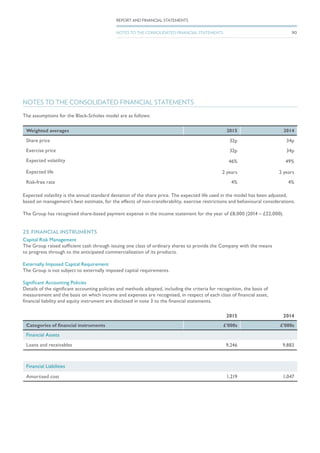
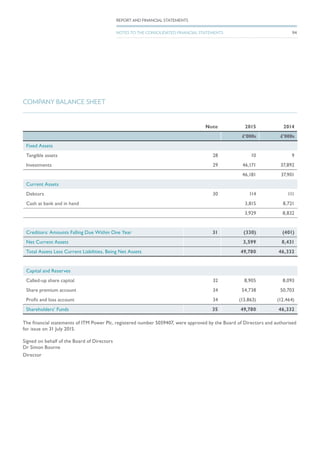
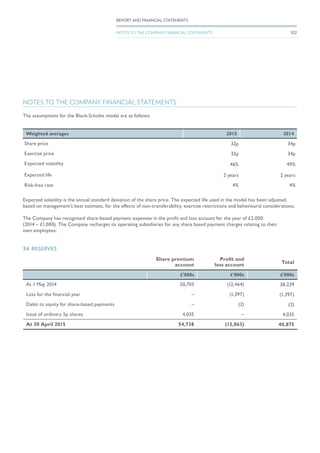
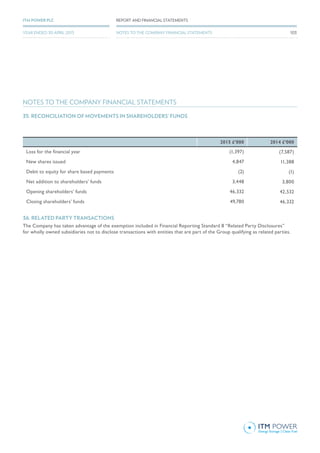
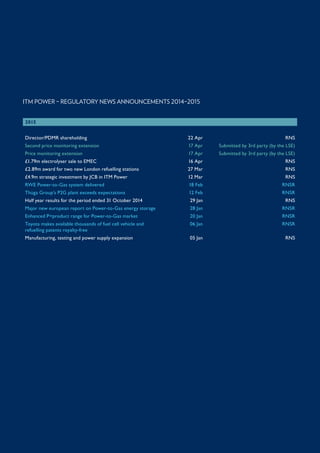
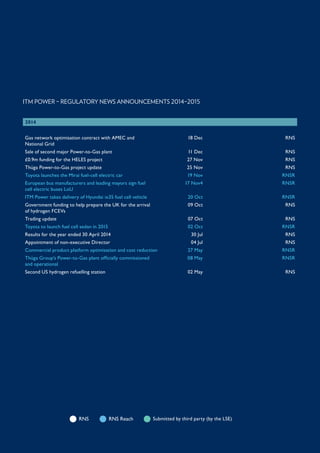
REPORT AND FINANCIAL STATEMENTS
150
013
ITM Power Hydrogen Station HFuel with Hyundai ix35 Fuel Cell vehicle
at Cowes Yacht Haven.
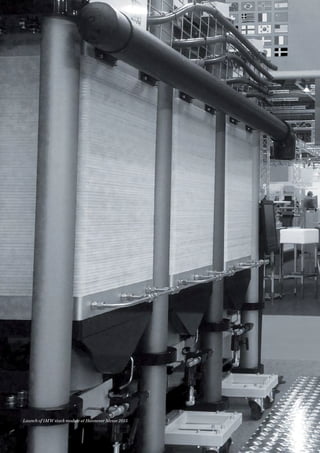
Launch of 1MW stack module at Hannover Messe 2015
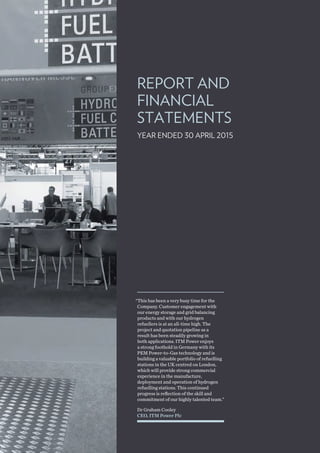
REPORT AND
FINANCIAL
STATEMENTS
YEAR ENDED 30 APRIL 2015
Dr Graham Cooley
CEO, ITM Power Plc
“This has been a very busy time for the
Company. Customer engagement with
our energy storage and grid balancing
products and with our hydrogen
refuellers is at an all-time high. The
project and quotation pipeline as a
result has been steadily growing in
both applications. ITM Power enjoys
a strong foothold in Germany with its
PEM Power-to-Gas technology and is
building a valuable portfolio of refuelling
stations in the UK centred on London,
which will provide strong commercial
experience in the manufacture,
deployment and operation of hydrogen
refuelling stations. This continued
progress is reflection of the skill and
commitment of our highly talented team.”
In a world in which fossil fuel energy
is becoming ever more scarce and
expensive and countries are struggling to
meet their carbon reduction obligations,
hydrogen solutions have finally reached
the top of energy agendas.
ITM Power manufactures integrated
hydrogen energy solutions that are
rapid response and high pressure that
meet the requirements for grid
balancing and energy storage services,
and for the production of clean fuel
for transport, renewable heat and
chemicals. The international demand
for these solutions is increasing.
•	 Energy storage provision has started
to become a mandatory requirement
in areas of the world such as
California; it is recognised as
an essential prerequisite for
renewable energy deployment
•	 Grid balancing and rapid response
demand-side services are crucial for
the integration of high proportions
of renewable energy supply on the
electricity grid
•	 Auto OEMs are rolling out Fuel Cell
Electric Vehicles (FCEVs) that require
a high purity hydrogen fuel. Hyundai
and Toyota have now commenced
production with Honda to follow in
2016. Hydrogen fuel cell cars are now
being sold. Global hydrogen refuelling
station infrastructure programmes
are underway
•	 Air quality regulations are stimulating
the need for hydrogen as a clean fuel
for clean transport emissions, in city
regions around the world
•	 Energy security and fuel security
has risen to the top of the geo-
political agenda
•	 Price volatility of fossil fuels is driving
an industrial substitution to more
sustainable chemical processes
SHAPING A
RENEWABLE
HYDROGEN
FUTURE
TABLE OF
CONTENTS
5 Shaping a Renewable Hydrogen Future
8 Officers and Professional Advisors
9 Highlights
10 Board of Directors
12 Strategic Review
16 Review of the Business
25 Corporate and Social Responsibility
26 JCB Investment
28 Energy Storage
38 Clean Fuel
48 Financial Statements
50 Directors’ Report
54 Corporate Governance Report
58 Directors’ Responsibility Statement
59 Independent Auditor Report
61 Consolidated Income Statement
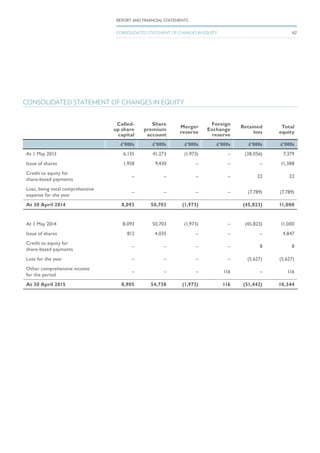
62 Consolidated Statement of Changes in Equity
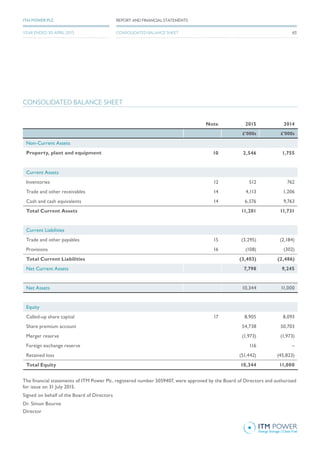
63 Consolidated Balance Sheet
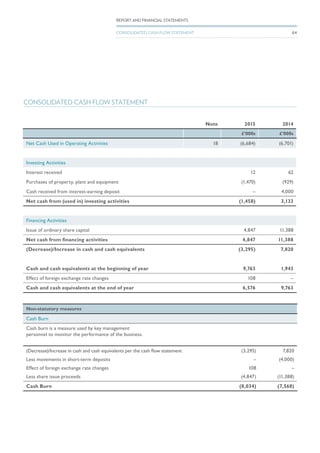
64 Consolidated Cash Flow Statement
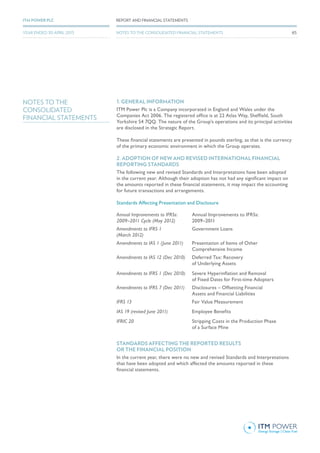
65 Notes to the Consolidated Financial Statements
101 Notes to the Company Financial Statements
6
REPORT AND FINANCIAL STATEMENTS
TABLE OF CONTENTS
5
38
16 28
12
26
76
DIRECTORS
Dr S Bourne
Dr G Cooley
Lord R Freeman
P Hargreaves
Prof. R Putnam
Sir R Bone
R Pendlebury
REGISTRARS
Capita IRG Plc
The Registry
34 Beckenham Road
Beckenham
BR3 4TU
SECRETARY
A C Allen
REGISTERED OFFICE
22 Atlas Way
Sheffield
S4 7QQ
NOMINATED ADVISOR
AND BROKER
Zeus Capital Limited
23 Berkley Square
London
W1J 6HE
BANKERS
National Westminster Bank Plc
Stamford Branch
52 High Street
Stamford
Lincolnshire
PE9 2BD
SOLICITORS
Burges Salmon LLP
One Glass Wharf
Bristol
BS2 0ZX
AUDITOR
Deloitte LLP
1 City Square
Park Row
Leeds
LS1 2AL
PRESS AND INVESTOR ENQUIRIES
Tavistock Communications Ltd
131 Finsbury Pavement
London
EC2A 1NT
OFFICERS AND
PROFESSIONAL ADVISORS
ABOUT US ITM Power Plc manufactures integrated hydrogen energy solutions, which are
rapid response and high pressure that meet the requirements for grid balancing
and energy storage services, and for the production of clean fuel for transport,
renewable heat and chemicals. ITM Power Plc was admitted to the AIM market
of the London Stock Exchange in 2004 and raised its initial funding of £10m gross
in its IPO. Further funding rounds of £28.5m in 2006, £5.4m in 2012, £2m in 2013
and £10m in 2014 have been completed. The Company received £4.9m as a
strategic investment from JCB in March 2015. The Company currently has
£10.46m of projects under contract or in the final stages of negotiation.
8
REPORT AND FINANCIAL STATEMENTS
OFFICERS AND PROFESSIONAL ADVISORS
•	 Increased hydrogen output per stack by 50%
•	 Stack cost reduction of 26%
•	 Laboratory measured cell degradation reduced by 20%
•	 Launched 1MW stack skid, to extend product reach to multi-MW applications
•	 Thüga Power-to-Gas project update “exceeded expectations”
•	 A further £1.98m of products under contract secured since year end (2014: £1.33m)
•	 £0.363m of contracts in final stages of negotiation (2014: £2.78m)
•	 £4.86m new funds raised from a strategic investment by JCB
•	 £10.10m of projects under contract at year end (2014: £5.14m)
•	 £0.90m funding for the Hydrogen Enabled Local Energy Systems (HELES)
project, from Innovate UK
•	 Sale of second major Power-to-Gas Plant to RWE, for an amount of €779k
•	 Manufacturing, testing and 1MW power supply expansion
•	 £1.70m Award for two refuelling stations with a major global fuel retailer
•	 £2.89m Award for two new London refuelling stations and upgrades
•	 £1.79m Electrolyser sales order from the European Marine Energy Centre (EMEC)
•	 Achieved planning permission for two HyFive stations
COMMERCIAL
PROGRESS
IN YEAR
KEY FINANCIAL
RESULTS FOR
THE YEAR
ENDED 30
APRIL 2015
CORPORATE
DEVELOPMENT
POST YEAR END
COMMERCIAL
PROGRESS
SINCE
YEAR END
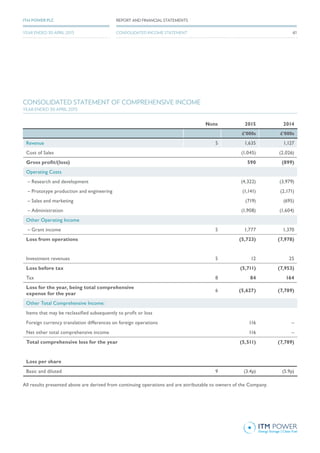
•	 Total Revenue & Grant Funding of £5.061m (2014: £3.077m) up 64%, comprising:
•	 Revenue - £1.635m (2014: £1.127m) up 45%
•	 Grant income - £1.777m (2014: £1.370m) up 30%
•	 Grants receivable for capital projects - £1.649m (2014: £0.580), up 63%
•	 Increase in property, plant and equipment to £2.546m from £1.755m, up 45%
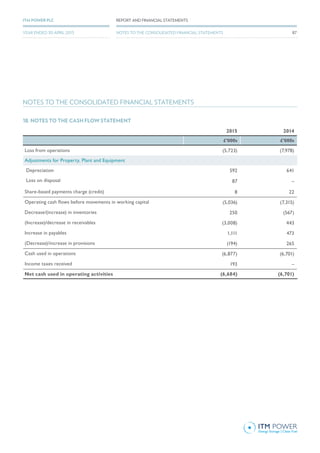
•	 Loss from operations £5.723m (2014: £7.978m), down 28%
•	 Cash burn*, £8.034m (2014: £7.568m), up 6%
•	 Cash balance £6.576m (2014: £9.763m), down 33%
*Cash burn is a non-statutory measure and is defined on page 24
•	 Robert Pendlebury joins the Board as a Non-Executive Director
HIGHLIGHTS
TECHNICAL
ACHIEVEMENTS
9
REPORT AND FINANCIAL STATEMENTSITM POWER PLC
HIGHLIGHTSYEAR ENDED 30 APRIL 2015
BOARD OF DIRECTORS
Dr G Cooley
Chief Executive Officer
(Age 51)
Graham joined ITM Power on 29 June

2009 as Chief Executive Officer. Before

joining, Graham was CEO of Sensortec
and Universal Sensors, founding CEO
of Metalysis Ltd, (a spin-out of Cambridge
University), and founding CEO of Antenova
Ltd. Graham spent 11 years in the power
industry developing conducting polymers,
fuel cells, batteries and energy
storage technologies.
He was Business Development Manager
for National Power Plc and International
Power Plc and developed the Regenesys
energy storage technology, which was
acquired by RWE from Innogy. He has
a degree in Physics, a PhD in Materials
technology and an MBA.
Prof R Putnam
Non-Executive Chairman
(Age 69)
Roger Putnam, the former Chairman of
Ford of Britain and President of the Society
of Motor Manufacturers and Traders, was
a member of the Government’s Energy
Review Partnership.
The Partnership reported to the
Chancellor on the country’s future energy
strategy. He was also Chairman of the
DTI’s Retail Motor Strategy Group and
a member of the Department for
Business, Enterprise and Regulatory
Reform (DBERR)’s Automotive Innovation
and Strategy Team. Other Directorships
include: Chairman of Suila Ltd, Non-
Executive Director of Halcyon Days Ltd
and Trustee of the Jaguar Trust. He is
also a Visiting Professor of Automotive
Studies at the City of London University.
Roger’s distinguished career in the
automotive industry began at Lotus Plc.
In 1982 he joined Jaguar Cars Ltd as
Director, Global Marketing and UK Sales
Operations. In 1985 Roger was appointed
to the Board of Jaguar as Director, Sales
and Marketing, a role he retained until
he was appointed Chairman of Ford of
Britain in 2002.
Dr S Bourne
Chief Technology Officer
(Age 40)
Simon Bourne joined ITM Power in 2002 as a Technical Manager and has been one
of the leading scientists involved in the development of ITM Power’s suite of patented
membrane materials.
Before joining ITM Power, Simon was a project engineer with Sonatest Plc and a
researcher with the Ministry of Defence. Simon has a BSc Hons in Materials Science
from UMIST and a PhD from Cranfield University.
10
REPORT AND FINANCIAL STATEMENTS
BOARD OF DIRECTORS
Peter Hargreaves
Non-Executive Director
(Age 68)
Peter joined the Board of ITM Power in
February 2004 as a Non-Executive Director.
After qualifying as a chartered accountant,
he was employed by KPMG, Unisys, and
Whitbread and Company Limited.
In 1981 he founded the national investment
brokerage Hargreaves Lansdown Plc, which
was successfully floated on the London Stock
Exchange in May 2007 and now has a market
value in excess of £2.5 billion.
Peter remains an Executive Director
of Hargreaves Lansdown Plc.
Sir Roger Bone
Non-Executive Director
(Age 71)
Sir Roger Bone is the President of Boeing UK,
Non-Executive Director of F&C Investment
Trust Plc, Non-Executive Director and trustee
of the National Centre for Universities and
Business and a Prime Minister’s honorary
UKTI Ambassador for British Business.
Previously he has been Ambassador to Brazil
and Sweden and Assistant Under Secretary of
State in the Foreign and Commonwealth Office.
Sir Roger is a graduate of Oxford University,
and a former Visiting Fellow at Harvard
University. He is also a Trustee of the Royal
United Services Institute.
Robert Pendlebury
Non-Executive Director
(Age 73)
Bob has worked in senior management positions in
both Ford Motor Company and JCB. Joining JCB in 1991,
he became their Engineering and Research Director.
He remains a consultant to JCB, Associate Engineering
Director to the JCB Academy and a Visiting Professor
to Loughborough University. He is a Mechanical Engineering
graduate of Leeds University, Chartered Engineer and
Fellow of the Institution of Mechanical Engineers.
Lord Roger Freeman
Non-Executive Director
(Age 73)
Lord Freeman joined ITM Power
in October 2010 as a Non-Executive
Director. Lord Freeman is a
member of the House of Lords
and is currently Chairman of the
Advisory Board of Pricewaterhouse
Coopers (UK).
During a distinguished political
career, Lord Freeman was the
Conservative MP for Kettering
from 1983 to 1997, served as the
Parliamentary Secretary for the
Departments of Health and Armed
Forces, and as Minister of State
for Public Transport and Defence
Procurement. He concluded his
political career as a Cabinet Minister
in the government of John Major.
He became a Life Peer in 1997.
Lord Freeman is a graduate of
Balliol College and a Chartered
Accountant. He was a Partner
and Managing Director with Lehman
Brothers in New York and London
(1972 to 1985), specialising in
cross-border mergers and
acquisitions. Other Directorships
include: Chemring Group Plc,
Big DNA Ltd and Parity Group Plc.
11
REPORT AND FINANCIAL STATEMENTSITM POWER PLC
YEAR ENDED 30 APRIL 2015 BOARD OF DIRECTORS
STRATEGIC
REVIEW
Prof R Putnam
Non-Executive Chairman,
ITM Power Plc
“ITM Power are now in a position where
we can focus on delivering its leading
refuelling and energy storage products
to more and more customers around
the world, and this is in no small part
down to the dedication of the staff
over the last year.”
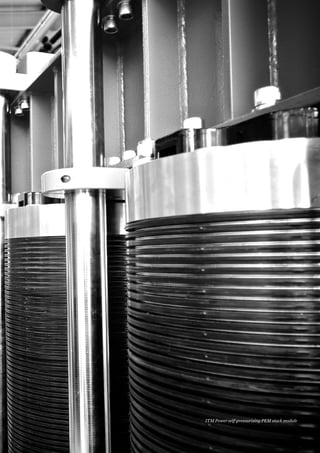
ITM Power self-pressurising PEM stack module
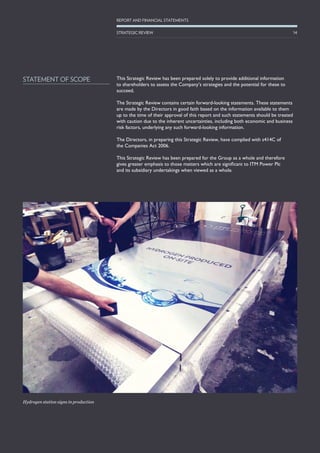
Hydrogen station signs in production
This Strategic Review has been prepared solely to provide additional information
to shareholders to assess the Company’s strategies and the potential for these to
succeed.
The Strategic Review contains certain forward-looking statements. These statements
are made by the Directors in good faith based on the information available to them
up to the time of their approval of this report and such statements should be treated
with caution due to the inherent uncertainties, including both economic and business
risk factors, underlying any such forward-looking information.
The Directors, in preparing this Strategic Review, have complied with s414C of
the Companies Act 2006.
This Strategic Review has been prepared for the Group as a whole and therefore
gives greater emphasis to those matters which are significant to ITM Power Plc
and its subsidiary undertakings when viewed as a whole.
STATEMENT OF SCOPE
14
REPORT AND FINANCIAL STATEMENTS
STRATEGIC REVIEW
SUMMARY
ITM Power designs and manufactures
integrated hydrogen energy systems for
energy storage and clean fuel production.
The Company has a suite of product
platforms based on Proton Exchange
Membrane (PEM) technology tailored
to the requirements of its target markets.
Of particular importance is the ability
to respond rapidly and to generate
hydrogen at a pressure, flow rate and
purity appropriate to its application.
The overarching principle is the capacity
to take excess energy from the power
network, convert it into hydrogen and
deliver it either into a vehicle as a clean
fuel or the natural gas network as part
of a Power-to-Gas energy storage scheme.
ITM Power has developed innovative
products, which utilise its technology
and know-how to meet the growing
demand for clean fuel and energy
storage. The Company’s business
model is centered on growth of sales.
The Power-to-Gas model is a commercial
proposition which offers utility companies
energy storage options of a scale and
duration relevant to the challenges
presented by growing deployment
of renewable power generation.
The equipment provides grid balancing
services which consumes excess energy
in the power network converting it
to hydrogen for injection into the gas
network. There are structured payments
for both grid balancing services and supply
of hydrogen which helps decarbonize the
gas network. ITM enjoys a unique position
having supplied the world’s first PEM
Power-to-Gas electrolyser in 2013 and
which continues to inject hydrogen into
the German gas distribution network.
ITM has supplied a second PEM
Power-to-Gas system to RWE in
the year.
The refuelling model is one that
incorporates the work of national
hydrogen infrastructure initiatives
to support the growth of hydrogen
as a transport fuel, both for use in
cars and buses initially, and with further
transport applications in the future.
Automotive OEM’s have invested billions
of pounds developing fuel cell electric
vehicles and their roll-out is underway,
led by Hyundai and closely followed by
Toyota. ITM Power has won contracts
to supply on-site hydrogen generation
equipment for refueling in both the UK
and California. In the year ITM has
achieved awards for two new hydrogen
refueling stations in London plus upgrades
to a further four. Opportunities for ITM
Power continue to develop in California
where it has been legislated that 33% of
all dispensed hydrogen fuel is required to
be from renewable sources. ITM Power
is also an active participant of hydrogen
mobility initiatives in the UK, France
and California.
A developing tertiary application area
for the technology is the production
of renewable chemicals such as fertiliser
through use of renewable energy to
decarbonise the generation process and
provide routes for its use in remote area.
Collaborative work in this field has begun
and an electrolyser system for such a
programme will be delivered during 2015.
At the heart of all of these applications
is an ITM electrolyser system.
GRANT FUNDING
ITM Power utilises funding from grant
bodies to contribute towards
technological advancement in support
of product improvement and cost
reduction. Such funding can also support
the build, deployment and operation of
pilot projects. The funding received from
the Innovate UK (formerly the Technology
Strategy Board) and EU has enabled an
acceleration of development to drive the
Company’s innovative technology into
these rapidly growing markets.
GLOBAL MARKETS
Markets for water electrolysis as a
hydrogen infrastructure solution continue
to develop in the UK, as showcased by
the Island Hydrogen, and HyFive projects
together with the UK H2
Mobility initiative
supported by the Office of Low Emission
Vehicles. Similar initiatives are also
underway in France, Denmark, Germany,
Japan and the US. The market for
Power-to-Gas is led by Germany
where ITM Power have sold the first
two systems to inject hydrogen into
the German distribution network. The
opportunities continue to grow rapidly
in Germany while spreading to other
regions, for example California where
energy storage is now mandated.
ITM has a model of locating agents in
key territories to position ITM Power
as a world leading developer and supplier
of electrolyser products. Initial market
opportunities often begin with
collaborative projects with blue chip
companies before leading to sales and
maintenance contracts of established,
CE marked units. ITM Power has five
business development personnel ‘in the
field’, and has also established a strong
after sales support team. Business
development effort is focused in areas
where markets are more advanced.
ITM Power has subsidiaries in Germany,
California and Denmark which serve
to generate local knowledge and
partnerships, grow operation and after
sales support, increase opportunities
for state grant funding, and provide
opportunities to operate within the
local currency.
PROFITABILITY
ITM Power sees its route to product and
maintenance sales and profitability through
the increasing deployment of its products
in the key Power-to-Gas energy storage
and clean fuel sectors. The Company is
well represented in these commercial
sectors and territories where market
growth is now accelerating. The
Company has an established product
platform which continues to benefit
from ongoing cost reduction activities
and technology improvements.
15
REPORT AND FINANCIAL STATEMENTSITM POWER PLC
STRATEGIC REVIEWYEAR ENDED 30 APRIL 2015
BUSINESS MODEL
REVIEW OF
THE BUSINESS
Dr Simon Bourne
CTO, ITM Power Plc
“ITM Power has matured from a
Company developing bespoke systems
to one with standard product platforms.
This shift has accelerated deployment
in target markets and territories while
promoting plant simplification and cost
reduction. Coupled with the knowledge
and experience gained in permitting
hydrogen systems in both Europe and
the US, ITM Power is an organisation
that has overcome the significant barriers
to market entry and is open for business.
I am proud to be a part of the team.”
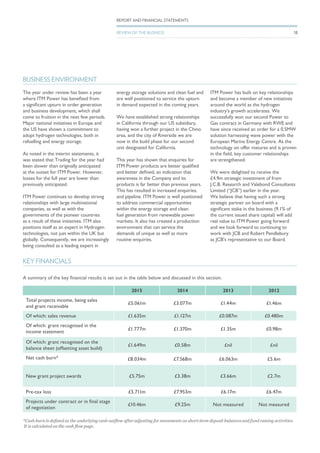
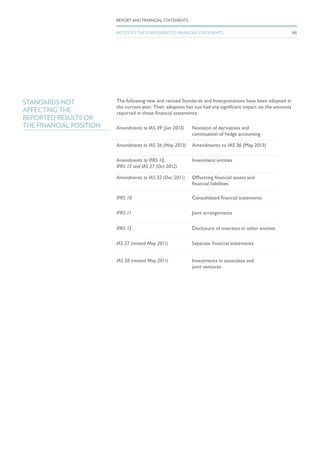
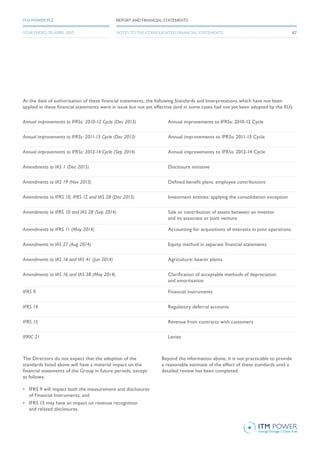
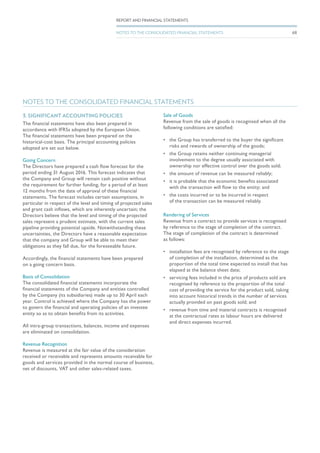
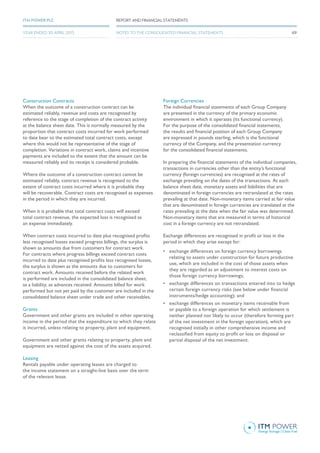
2015 2014 2013 2012
Total projects income, being sales
and grant receivable
£5.061m £3.077m £1.44m £1.46m
Of which: sales revenue £1.635m £1.127m £0.087m £0.480m
Of which: grant recognised in the
income statement
£1.777m £1.370m £1.35m £0.98m
Of which: grant recognised on the
balance sheet (offsetting asset build)
£1.649m £0.58m £nil £nil
Net cash burn* £8.034m £7.568m £6.063m £5.6m
New grant project awards £5.75m £3.38m £3.66m £2.7m
Pre-tax loss £5.711m £7.953m £6.17m £6.47m
Projects under contract or in final stage
of negotiation
£10.46m £9.25m Not measured Not measured
KEY FINANCIALS
*Cash burn is defined as the underlying cash outflow after adjusting for movements on short-term deposit balances and fund raising activities. 	
It is calculated on the cash flow page.
The year under review has been a year
where ITM Power has benefited from
a significant upturn in order generation
and business development, which shall
come to fruition in the next few periods.
Major national initiatives in Europe and
the US have shown a commitment to
adopt hydrogen technologies, both in
refuelling and energy storage.
As noted in the interim statements, it
was stated that Trading for the year had
been slower than originally anticipated
at the outset for ITM Power. However,
losses for the full year are lower than
previously anticipated.
ITM Power continues to develop strong
relationships with large multinational
companies, as well as with the
governments of the pioneer countries
as a result of these initiatives. ITM also
positions itself as an expert in Hydrogen
technologies, not just within the UK but
globally. Consequently, we are increasingly
being consulted as a leading expert in
energy storage solutions and clean fuel and
are well positioned to service the upturn
in demand expected in the coming years.
We have established strong relationships
in California through our US subsidiary,
having won a further project in the Chino
area, and the city of Riverside we are
now in the build phase for our second
unit designated for California.
This year has shown that enquiries for
ITM Power products are better qualified
and better defined, an indication that
awareness in the Company and its
products is far better than previous years.
This has resulted in increased enquiries,
and pipeline. ITM Power is well positioned
to address commercial opportunities
within the energy storage and clean
fuel generation from renewable power
markets. It also has created a production
environment that can service the
demands of unique as well as more
routine enquiries.
ITM Power has built on key relationships
and become a member of new initiatives
around the world as the hydrogen
industry’s growth accelerates. We
successfully won our second Power to
Gas contract in Germany with RWE and
have since received an order for a 0.5MW
solution harnessing wave power with the
European Marine Energy Centre. As the
technology on offer matures and is proven
in the field, key customer relationships
are strengthened.
We were delighted to receive the
£4.9m strategic investment of from
J.C.B. Research and Valebond Consultants
Limited (“JCB”) earlier in the year.
We believe that having such a strong
strategic partner on board with a
significant stake in the business (9.1% of
the current issued share capital) will add
real value to ITM Power going forward
and we look forward to continuing to
work with JCB and Robert Pendlebury
as JCB’s representative to our Board.
BUSINESS ENVIRONMENT
A summary of the key financial results is set out in the table below and discussed in this section.
REPORT AND FINANCIAL STATEMENTS
REVIEW OF THE BUSINESS 18
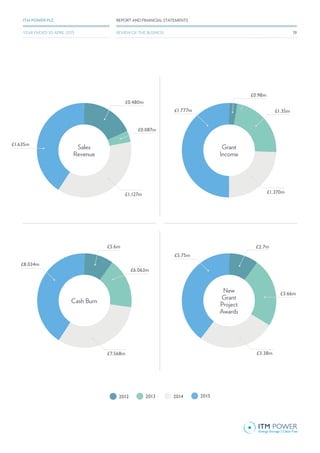
20152013 20142012
£0.480m
£6.063m
£7.568m
£8.034m
£1.35m
£3.66m
£2.7m
£3.38m
£5.75m
£0.98m
£1.370m
£1.777m
£1.635m
£0.087m
Sales
Revenue
Cash Burn
£1.127m
£5.6m
Grant
Income
New
Grant
Project
Awards
REPORT AND FINANCIAL STATEMENTSITM POWER PLC
REVIEW OF THE BUSINESSYEAR ENDED 30 APRIL 2015 19
ITM Power electrolyser for the M1 Wind Hydrogen fuel station
is delivered to the Advanced Manufacturing Park.
FINANCIAL PERFORMANCE
The pre-tax loss for the year under review
decreased to £5.711m (2014: £7.953m)
and net cash burn before fund raise
increased to £8.034m (2014: £7.568m).
The decrease in loss in the year being
reported can be attributed to three major
factors: the refinement of development
activities to ensure that core work is
supported where possible; the increase
in sales revenue and at profitable margins;
and the write back of some of the
provisions in the prior year that were not
realised in the current year. The cash burn
has increased as a result of some timing
differences, with the increase in
components held being the other driver
for this. Management expects to be able
to reduce cash burn in the financial year
ending April 2016, as a result of timings
of the receipts of various projects and
increased sales traction in the future with
better commercial terms. ITM Power also
continues to develop supplier relationships
to establish better payment terms for the
Company but new relationships tend to
require shorter terms as the relationship
is built.
Revenue has increased as the Company
gains traction in the growing hydrogen
market, but is also representative of
servicing a growing pipeline. The Company
has experienced the greatest growth in
sales through German Power-to-Gas and
Californian Refuelling system sales. The
revenue in the UK has been from smaller
units as a more cautious approach is
taken to committing to the technology.
In California and Germany, the
development of renewable energy as a
mandated technology has led hydrogen
generation such as that supplied by ITM
Power to be more widely investigated
with adoption gathering pace.
There will be an element of non-recurring
engineering costs in every first-of-kind
build, as the Company enters new
geographical markets and industries.
The electrolyser system supplied to
RWE represented a refinement in the
step change in technology, being the
first deployment of the Company’s
large product platform and its first
Power-to-Gas installation.
Total collaborative project funding
recognised in the period was £3.426m
of which £1.777m is recognised on the
income statement (2014: £1.950m, of
which £1.370m was recognised on the
income statement). This increase in asset
builds supported through project funding
has allowed ITM Power to develop a suite
of hydrogen generation equipment that
it will own and operate as part of the
collaborative projects, allowing data
and knowhow to be incorporated
into new generations of electrolysers.
COMMENTARY ON THE
YEAR’S REVENUE
The sales order book at the year end
stood at £1.98m (2014: £0.80m). This
increase is representative of the pipeline
a year ago being heavily biased towards
funded projects but also reflects a growing
sales pipeline as orders for larger units
are being received, namely in this instance
the EMEC sales order for 0.5MW
of electrolysis.
The value of projects under contract at
the time of the report stood at £10.10m.
Projects under contract represents the
value of contracted Revenue and Grant
Funding yet to be recognised by ITM
Power in the future, and the Board find
this a more accurate reflection of the
increase in activity the Company has
experienced in the year.
Projects under contract is seen as a
more definitive measure of growth, as
ITM Power develops some collaborative
contracts as ways to manufacture assets
whilst retaining ownership and providing
an income stream through sales of
hydrogen. Examples of this are the
OLEV infrastructure development and
HyFive projects which have a period of
operation as part of the project (48 and
36 months respectively).
Whilst projects under contract continue
to accelerate ITM Power’s growth and
products in the market, the Board is
aware of the continued potential for
revenue volatility (as experienced in 2013)
as projects grow in size and complexity.
Revenue volatility will continue to
decrease as the business matures and
grows, and as ITM Power realises
opportunities in large markets.
FINANCIAL POSITION
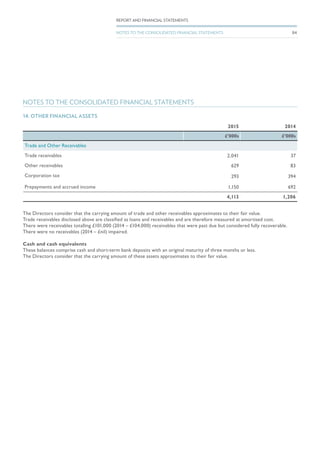
At year end, ITM Power had £6.576m
(2014: £9.763m) of funds in the bank,
and trade and other receivables of
£4.113m (2014: £1.206m), which
predominantly relate to grant income
debtors. Recognising the need to be
lean with working capital, ITM Power
structures quotes to include upfront
payment with orders so that working
capital is not impacted adversely by
increased activity.
ITM Power has seen an increase in fixed
assets to £2.546m from £1.755m in the
prior year as the Company engages in
projects that create assets for the
future. This is a policy that will continue,
especially with the completion of the
Island Hydrogen and HyFive projects.
OUTLOOK
It has been a very busy year for the
Company with customer engagement
reaching an all-time high. ITM Power
are now in a position where it can focus
on delivering its leading refuelling and
energy storage products to more and
more customers around the world,
and the Board look forward to reporting
progress as contracts are awarded.
One of the key development strategies
for ITM Power has been, and will continue
to be growth supported through external
funding. This is particularly important
whilst the markets for ITM Power, and
especially refuelling products develop.
Therefore the Company expects a greater
proportion of income from external
funding than previously forecast.
REPORT AND FINANCIAL STATEMENTSITM POWER PLC
REVIEW OF THE BUSINESSYEAR ENDED 30 APRIL 2015 21
Product development, and in particular upscaling of product offering,
will be achieved through securing and utilising project funding. This
serves the dual purpose of reducing cash outflow and creating strong
key partnerships within industry.
Short-term cash flow is aided by ITM Power quoting for sales with
upfront payments which reduces reliance on working capital. Cash
outflow is minimised through working with support from partners
on the development of technology whilst we are continuing to build
a contract pipeline. Historically, it has taken two years for potential
customers to move through a learning curve and to reach the point
of purchasing equipment, and it is with this in mind that we are
creating a larger pipeline.
ITM Power is now firmly focused on large scale solutions. The current
strategy is to use the existing, operational Thüga project as a reference
plant for Power-to-Gas sales.
Using the same initial platform, the Company will also be able to show
demonstrable success in the near future of hydrogen refuelling, using
the Island Hydrogen and HyFive stations, which will be used as
reference plants for refuelling stations.
In the medium-term, the national mobility programmes, in which
ITM Power has positioned itself as a key partner for refuelling
through electrolysis, will drive initial refuelling station sales.
STRATEGIES
OBJECTIVES
ITM Power has immediate objectives in terms of product development
and in particular scale-up of our proven electrolysis equipment.
This will allow penetration of larger markets, and is a direct response
to market demand from sales enquiries and trade fairs and events.
Cash flow remains a key measure for the Board, with the other key
objective for ITM Power being the achievement of a positive cash
flow in the shortest possible time.
STRATEGIES
FOR ACHIEVING
OUR OBJECTIVES
STRATEGY AND OBJECTIVES
22
REPORT AND FINANCIAL STATEMENTS
REVIEW OF THE BUSINESS
2015
Under ContractUnder Contract
2014
DeployedDeployed
20152014
Test Hours Completed
1,110,000750,000 Change
Up 48%
84%
Stack Efficiency*
80% Change
Up 4%
3800
3400
3000
2600
2200
1600
1200
2014 2016201520132012
HYDROGEN PRODUCTION CAPACITY UNDER CONTRACT IN KW
CumulativeCapacity(kg/24hr)
*The efficiency of an electrolyser stack is a measure of the electrical energy input against the chemical energy content
of the hydrogen produced.
NON-FINANCIAL KEY PERFORMANCE INDICATORS
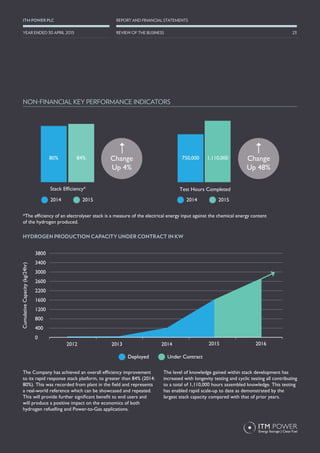
The Company has achieved an overall efficiency improvement
to its rapid response stack platform, to greater than 84% (2014:
80%). This was recorded from plant in the field and represents
a real-world reference which can be showcased and repeated.
This will provide further significant benefit to end users and
will produce a positive impact on the economics of both
hydrogen refuelling and Power-to-Gas applications.
The level of knowledge gained within stack development has
increased with longevity testing and cyclic testing all contributing
to a total of 1,110,000 hours assembled knowledge. This testing
has enabled rapid scale-up to date as demonstrated by the
largest stack capacity compared with that of prior years.
800
400
0
23
REPORT AND FINANCIAL STATEMENTSITM POWER PLC
REVIEW OF THE BUSINESSYEAR ENDED 30 APRIL 2015
COMMERCIAL RISK
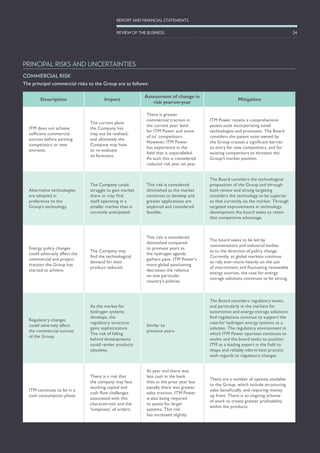
The principal commercial risks to the Group are as follows:
Description Impact
Assessment of change in
risk year-on-year
Mitigation
ITM does not achieve
sufficient commercial
success before existing
competitors or new
entrants.
The current plans
the Company has
may not be realised,
and ultimately the
Company may have
to re-evaluate
its forecasts.
There is greater
commercial traction in
the current year, both
for ITM Power and some
of its’ competitors.
However, ITM Power
has experience in the
field that is unparalleled.
As such this is considered
reduced risk year on year.
ITM Power retains a comprehensive
patent suite incorporating novel
technologies and processes. The Board
considers the patent suite owned by
the Group creates a significant barrier
to entry for new competitors, and for
existing competitors to threaten the
Group’s market position.
Alternative technologies
are adopted in
preference to the
Group’s technology.
The Company could
struggle to gain market
share or may find
itself operating in a
smaller market than is
currently anticipated.
This risk is considered
diminished as the market
continues to develop and
greater applications are
explored and considered
feasible.
The Board considers the technological
proposition of the Group and through
both review and strong targeting
considers the technology to be superior
to that currently on the market. Through
targeted improvements in technology
development the board seeks to retain
that competitive advantage.
Energy policy changes
could adversely affect the
commercial and project
traction the Group has
started to achieve.
The Company may
find the technological
demand for their
product reduced.
This risk is considered
diminished compared
to previous years as
the hydrogen agenda
gathers pace. ITM Power’s
more global positioning
decreases the reliance
on one particular
country’s policies.
The board seeks to be led by
commentators and industrial bodies
as to the direction of policy change.
Currently, as global markets continue
to rely ever-more-heavily on the use
of intermittent and fluctuating renewable
energy sources, the case for energy
storage solutions continues to be strong.
Regulatory changes
could adversely affect
the commercial success
of the Group.
As the market for
hydrogen systems
develops, the
regulatory structure
gains sophistication.
The risk of falling
behind developments
could render products
obsolete.
Similar to
previous years.
The Board considers regulatory issues,
and particularly in the markets for
automotive and energy storage solutions
find regulations continue to support the
case for hydrogen energy systems as a
solution. The regulatory environment in
which ITM Power operates continues to
evolve and the board seeks to position
ITM as a leading expert in the field to
shape and reliably inform best practice
with regards to regulatory changes.
ITM continues to be in a
cash consumption phase.
There is a risk that
the company may face
working capital and
cash flow challenges
associated with this
characteristic and the
‘lumpiness’ of orders.
At year end there was
less cash in the bank
than in the prior year but
equally there was greater
sales traction. ITM Power
is also being required
to quote for larger
systems. This risk
has increased slightly.
There are a number of options available
to the Group, which include structuring
sales beneficially, and requiring money
up front. There is an ongoing scheme
of work to create greater profitability
within the products.
PRINCIPAL RISKS AND UNCERTAINTIES
24
REPORT AND FINANCIAL STATEMENTS
REVIEW OF THE BUSINESS
Approved by the Board and signed
on its behalf by:
Dr Simon Bourne
Director
Date: 31 July 2015
The Board of Directors meet regularly to
review specific and general risks that face
the Company and strives to position the
Group and Company in a way that any
risks can be minimised and met, should
the need arise.
HEALTH, SAFETY AND THE
ENVIRONMENT
ITM Power’s products are designed
to reduce the carbon footprint of
our customers’ energy generation and
distribution processes and, in particular,
enhance the utilisation of sources of
renewable energy that would otherwise
be wasted.
We have engaged in a collaborative
project to build a pilot unit for fertiliser
production from renewable energy
which will decarbonise fertiliser
production which is responsible for
a material proportion of global
greenhouse gas emissions.
In our production processes we adhere
to the highest standards of accreditation
and have held ISO 14001 Environmental
accreditation since 2009. We have also
held BS OHSAS 18001 Health and Safety
accreditation since 2009.
SOCIAL AND COMMUNITY
RESPONSIBILITIES
The Group encourages recycling and
a care for the environment in which we
operate. We attempt to recycle as much
equipment as possible, either by reselling
research equipment for which we no
longer have use or by donating used
computers to schools and other projects.
GOING CONCERN
The Directors have prepared a cash
flow forecast for the period ending
31 August 2016. This forecast indicates
that the Company and Group will remain
cash positive without the requirement
for further funding, for a period of
at least 12 months from the date of
approval of these financial statements.
The forecast includes certain
assumptions, in particular in respect
of the level and timing of projected
sales and grant cash inflows, which
are inherently uncertain; the Directors
believe that the level and timing of the
projected sales represent a prudent
estimate, with the current sales
pipeline providing potential upside.
Notwithstanding these uncertainties,
the Directors have a reasonable
expectation that the company and group
will be able to meet their obligations as
they fall due, for the foreseeable future.
Accordingly, the financial statements have
been prepared on a going concern basis.
CORPORATE SOCIAL
RESPONSIBILITY
25
REPORT AND FINANCIAL STATEMENTSITM POWER PLC
REVIEW OF THE BUSINESSYEAR ENDED 30 APRIL 2015
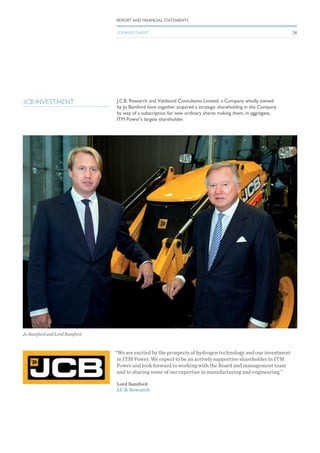
JCB INVESTMENT J.C.B. Research and Valebond Consultants Limited, a Company wholly owned
by Jo Bamford have together acquired a strategic shareholding in the Company
by way of a subscription for new ordinary shares making them, in aggregate,
ITM Power’s largest shareholder.
“We are excited by the prospects of hydrogen technology and our investment
in ITM Power. We expect to be an actively supportive shareholder in ITM
Power and look forward to working with the Board and management team
and to sharing some of our expertise in manufacturing and engineering.”
Lord Bamford
J.C.B. Research
Jo Bamford and Lord Bamford
REPORT AND FINANCIAL STATEMENTS
JCB INVESTMENT 26
27
REPORT AND FINANCIAL STATEMENTSITM POWER PLC
SECTION TITLEYEAR ENDED 30 APRIL 2015
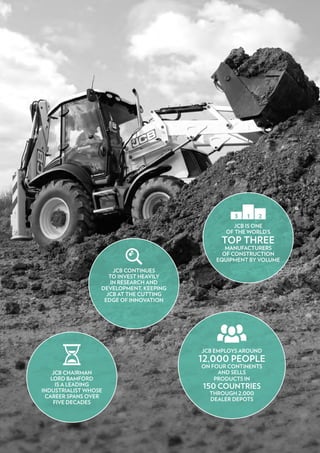
JCB CHAIRMAN
LORD BAMFORD
IS A LEADING
INDUSTRIALIST WHOSE
CAREER SPANS OVER
FIVE DECADES
JCB CONTINUES
TO INVEST HEAVILY
IN RESEARCH AND
DEVELOPMENT, KEEPING
JCB AT THE CUTTING
EDGE OF INNOVATION
JCB IS ONE
OF THE WORLD’S
TOP THREE
MANUFACTURERS
OF CONSTRUCTION
EQUIPMENT BY VOLUME
JCB EMPLOYS AROUND
12,000 PEOPLE
ON FOUR CONTINENTS
AND SELLS
PRODUCTS IN
150 COUNTRIES
THROUGH 2,000
DEALER DEPOTS
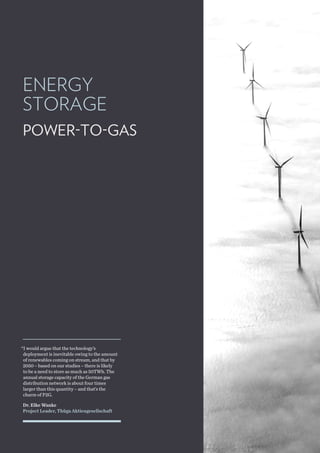
ENERGY
STORAGE
POWER-TO-GAS
Dr. Elke Wanke
Project Leader, Thüga Aktiengesellschaft
“I would argue that the technology’s
deployment is inevitable owing to the amount
of renewables coming on stream, and that by
2050 – based on our studies – there is likely
to be a need to store as much as 50TWh. The
annual storage capacity of the German gas
distribution network is about four times
larger than this quantity – and that’s the
charm of P2G.
In March 2015 the Fuel Cell and
Hydrogen Joint Undertaking (FCHJU),
supported by the European Commission,
and 32 commercial companies including
ITM Power, published a report on the
findings of a study exploring a deeper
understanding of the role and
commercial viability of energy
storage in enabling increasing
levels of intermittent renewable
power generation.
It highlighted that the share of
Renewable Energy Sources (RES) in
the European electric power generation
mix is expected to grow considerably,
constituting a significant contribution
to the European Commission’s
challenging targets to reduce greenhouse
gas emissions. The share of RES
production in electricity demand
should reach about 36% by 2020,
45-60% by 2030 and over 80% in 2050.
COMMERCIALISATION
OF ENERGY STORAGE
IN EUROPE REPORT
30
REPORT AND FINANCIAL STATEMENTS
ENERGY STORAGE
Following a year’s successful operation
in the field, the Thüga Group provided
an update on the project stating that
ITM’s electrolyser has exceeded
expectations. Of particular note was
system response time and efficiency
which was independently measured
to be over 70% with a peak of 77%.
The system has continued to be
exposed to a series of stress tests,
the results of which are fed back to
the thirteen project partners, combining
knowledge and experience regarding
the practicalities of Power-to-Gas.
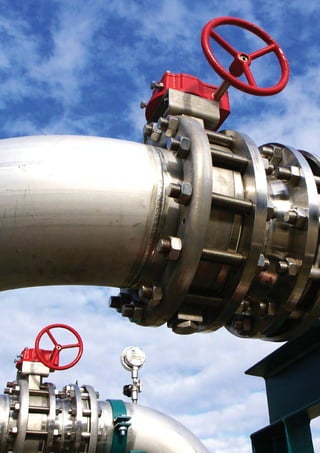
The ITM Power HGas system is
controlled by the grid operator acting
as a transducer between power and
gas. It is turned on when there is an
excess of renewable wind power on
the electricity grid to generate hydrogen
through PEM electrolysis which is put
straight into the natural gas network.
This model creates the perfect
solution for balancing the grid against
intermittent renewable energy.
The unit was the first plant to inject
electrolytic generated hydrogen into
the German gas distribution network.
The second plant to inject hydrogen
into the German gas distribution
network was also supplied by ITM
Power, purchased by RWE after a
competitive tender process. The
operational data generated has put
ITM in a strong and unique position
to engage further in this key territory
for Power-to-Gas energy storage.
Given the high volumes of energy
that must be stored, Power-to-Gas
technology holds great significance.
According to a Thüga analysis, storage
requirements in Germany could be
as high as 17 terawatt hours (TWh)
by 2020, and reach 50TWh by 2050.
The municipal gas distribution network
can easily absorb these quantities.
“We want to integrate the plant so that
it autonomously compensates for the
differences between renewable energy
generation and power consumption.
“Energy storage, and thus by extension
Power-to-Gas technology, is key to the
success of the Energiewende. For its
development, we in Germany in the long-
term need a sustainable market model –
as has for example been presented by
the Thüga Group – and one that
guarantees the economic operation
of energy storage.
“Our gas distribution network could thus
be the battery of the future.”
Michael Riechel
Member of the Board of Thüga AG
THÜGA GROUP’S
POWER-TO-GAS UPDATE
32
REPORT AND FINANCIAL STATEMENTS
ENERGY STORAGE
Tarek Al-Wazir, Hessian Minister of Economics, Energy, at the commissioning of the
Power-to-Gas demonstration plant at the site of Mainova AG in Frankfurt.
“The development of storage technologies is one of the main challenges for the energy
transition (Energiewende), if the integration of wind and solar power is to succeed.
The companies involved in this innovative project are making a significant contribution.
Tarek Al- Wazir
Hessian Minister of Economics
ITM Power electrolyser arrives on RWE Deutschland site in Ibbenbüren
In December 2014 ITM Power won a competitive tender for the
supply of a rapid response Power-to-Gas PEM electrolyser system
issued by RWE. Due to increased productivity, and as a result
of product standardisation, delivery timescales were significantly
reduced and ITM Power achieved assembly, factory acceptance
testing and delivery in less than ten weeks from receiving the order.
This is the third rapid response Power-
to-Gas energy storage system installed
by ITM Power in Germany. It is the first
second-generation unit and represents
another reference site for ITM Power’s
world leading technology.
The second-generation unit is using
a higher current density, permitting
higher hydrogen output per stack.
The system efficiency is also increased
by simplification of the balance of plant.
The system incorporates the very first
deployment of the new AEG advanced
power conversion electronics, the
benefits of which include: ultra-high
power factor, rapid response time
and higher efficiency over full
operating range.
RWE will be injecting hydrogen into
the gas network as part of their
Power-to-Gas installation and
evaluating the very fast electrolyser
system response and exploring its
exploitation in grid balancing.
.
“The delivery of this second-generation electrolyser unit within ten weeks has
been enabled by an ongoing production run of standard electrolyser systems.
It is testimony to the great working relationship which has been developed
between ITM Power and RWE and we are delighted to be integrating the best
technology available.”
Phil Doran, MD
ITM Power GmbH
ITM POWER SUCCESSFULLY
DELIVERED THE RAPID RESPONSE
POWER-TO-GAS PEM ELECTROLYSER
SYSTEM IN FEBRUARY 2015 SOLD
TO RWE DEUTSCHLAND AG WITHIN
10 WEEKS FROM RECEIVING
THE ORDER.
PROJECT
35
REPORT AND FINANCIAL STATEMENTSITM POWER PLC
YEAR ENDED 30 APRIL 2015 35
REPORT AND FINANCIAL STATEMENTSITM POWER PLC
YEAR ENDED 30 APRIL 2015 ENERGY STORAGE
36
REPORT AND FINANCIAL STATEMENTS
SECTION TITLE 36
REPORT AND FINANCIAL STATEMENTS
ENERGY STORAGE
OpenHydro’s tidal turbine at a European Marine Energy Centre (EMEC) tidal test site. Photographer Mike Brookes-Roper
Energy Storage for European Marine Energy Centre (EMEC)
tidal test site.
In April 2015 ITM Power won a
competitive tender to supply an
integrated hydrogen system for
use at the European Marine Energy
Centre (EMEC) tidal test site on
Eday, Orkney, Scotland. The
system’s principal component
is a 0.5MW polymer electrolyte
membrane (PEM) electrolyser with
integrated compression and up to
500kg of storage.
The 0.5MW electrolyser will be used
to absorb excess power generated
by the tidal turbines testing at EMEC.
The hydrogen gas generated will be
compressed and stored, with some
of the gas being used in (an optional)
hydrogen fuel cell to provide backup
power to critical EMEC systems.
The remainder of the hydrogen gas
will be used off-site by a project being
developed separately which plans to
absorb output of a local community
wind turbine operated by Eday
Renewable Energy Ltd.
The electrolyser will be packaged in
a standard 20 and 10 ISO container
and is summarised below:
•	 Hydrogen generation capacity
up to 220kg/24hours
•	 Self-pressurisation up to 20bar
•	 Rapid response
•	 Hydrogen purity satisfying ISO 14687
•	 CE compliant
“We are really excited about the deployment of ITM Power’s PEM electrolyser
system on Eday. This is an innovative way to tackle the shortcomings of the
local grid which is holding back marine energy in Orkney. It will allow us to
not only pilot the production of hydrogen fuel from tidal energy, but will allow
surplus renewable energy on the island to be used without having to rely upon
the inadequate grid. We really see this as the moment we begin to break away
from the shackles of a 20th Century cable architecture.”
Neil Kermode
Managing Director, EMEC
PROJECT
37
REPORT AND FINANCIAL STATEMENTSITM POWER PLC
YEAR ENDED 30 APRIL 2015 37
REPORT AND FINANCIAL STATEMENTSITM POWER PLC
YEAR ENDED 30 APRIL 2015 ENERGY STORAGE
The first Hyundai ix35 fuel cell vehicles arrive in the UK
CLEAN FUEL
Takeshi Uchiyamada
Chairman of Toyota
“We are so focused on hydrogen
because at its most simplistic oxygen
and hydrogen makes water and power.
The fuel cell vehicle is a social and
economic game changer. Gasoline
(petrol) has been the primary fuel of
the first hundred years. Hydrogen will
be the primary fuel game of the next
hundred years. Our primary task is to
provide our customers with fuel-cell
cars at an affordable price.”
HYDROGEN FUEL
ITM Power is active in projects which
support the roll-out of hydrogen
powered vehicles and refuelling stations.
The EU funded Hydrogen for Innovative
Vehicles (HyFive) project includes 15
partners who will deploy 110 FCEVs
manufactured by five global automotive
companies across three European cluster
locations. ITM Power is providing three
hydrogen refuelling stations to London
for deployment summer 2015. Each will
include both on-site electrolyser systems
and 700bar refuelling capacity.
A further activity has been the UK
H2
Mobilty project, of which ITM Power
was a founder member. The project
envisages 65 stations being deployed in
the UK by 2020. Financial support for
this was recently announced by OLEV
with £7.5m total funding – £2m available
for FCEV, £2m for HRS upgrades and
£3.5m for new HRS. ITM Power looks
forward to working with partners from
the fuel cell vehicle manufacturers and
local, national and European funding
partners in the coming years to deploy
further stations and achieving the
agreed 2020 goal.
In October 2014 the UK Government
announced that they would commit
£11m to industry to prepare the UK
for the roll-out of hydrogen fuel cell
electric vehicles. The investment will
see an initial 15 hydrogen stations by
the end of 2015 and includes £2 million
of funding for the public sector to
purchase the hydrogen vehicles. This
was a further step in funding for rolling
out the initial national hydrogen network
of 65 stations which have been identified
by UK H2
Mobility.
A focus has also been placed on
establishing a network of hydrogen
stations and commercialising a number
of fuel cell buses. In November 2014 the
Fuel Cell Hydrogen Joint Undertaking
(FCHJU) launched an initiative which
was signed by manufacturers and bus
operators from major European cities,
including London, which will aim to
deploy a total volume of 500-1,000 fuel
cell buses into Europe by 2020.
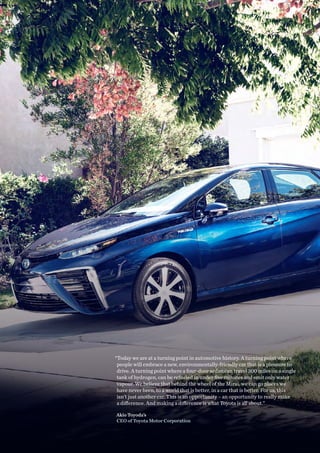
Toyota launched their fuel cell electric
vehicle (FCEV), the Mirai in November
2014 and sales started in Japan a month
later on 15th December. This saw 1,500
orders secured in the first month, tripling
initial projections of 400 vehicles. The
production of the vehicle will be scaled
up to meet demand and the Mirai will
be on sale in Europe later in 2015,
with first deliveries to the UK
expected in September.
Meanwhile the first Hyundai ix35 FCEVs,
funded under the HyFive London Cluster,
are now deployed in the UK with further
roll-out expected as the infrastructure
provision develops.
HYDROGEN FUEL
40
REPORT AND FINANCIAL STATEMENTS
CLEAN FUEL
“Today we are at a turning point in automotive history. A turning point where
people will embrace a new, environmentally-friendly car that is a pleasure to
drive. A turning point where a four-door sedan can travel 300 miles on a single
tank of hydrogen, can be refueled in under five minutes and emit only water
vapour. We believe that behind the wheel of the Mirai, we can go places we
have never been, to a world that is better, in a car that is better. For us, this
isn’t just another car. This is an opportunity – an opportunity to really make
a difference. And making a difference is what Toyota is all about.”
Akio Toyoda’s
CEO of Toyota Motor Corporation
In March 2015 ITM Power was awarded
a total of £2.89m by the Hydrogen
Refuelling Stations (HRS) Infrastructure
Grants Scheme, run by the Office of Low
Emission Vehicles (OLEV). The award
is to build two new HRS in London,
sited with strategic partners and for
the upgrading of four existing ITM Power
refuelling stations.
One of the new stations will be built
on the forecourt of a major global
fuel retailer. ITM Power has signed a
Memorandum of Understanding (MoU)
with the retailer to build initially up to
three HRS in London and will be seeking
funding support for at least one more
station. The MoU also allows for further
development of the collaboration in the
UK. ITM Power will be working closely
with OEM FCEV providers to determine
the best locations for the further station.
The upgrades included the three in
London under development as part
of the HyFive project and one in
Rotherham, just off the M1 at Junction
33. The latter will be upgraded from
350 to 700bar refuelling capability.
This strategic refuelling location will
allow FCEV users to travel between
London and the North of England.
By the beginning of 2016 ITM Power
will own and operate six hydrogen
fuel stations in the UK, mainly
centred around London.
SITING COLLABORATION
WITH MAJOR GLOBAL
FUEL RETAILER AND MORE
STATIONS FOR LONDON
42
REPORT AND FINANCIAL STATEMENTS
CLEAN FUEL
43
REPORT AND FINANCIAL STATEMENTSITM POWER PLC
CLEAN FUELYEAR ENDED 30 APRIL 2015
ITM Power HFuel refuelling the Hyundai ix35 fuel cell vehicle
44
REPORT AND FINANCIAL STATEMENTS
CLEAN FUEL
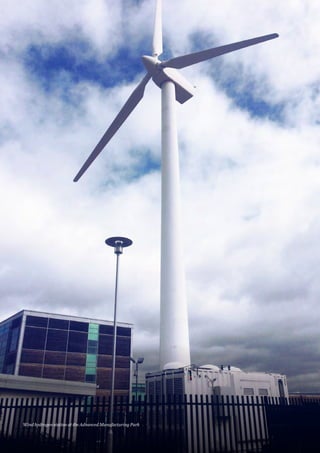
Wind hydrogen station at the Advanced Manufacturing Park
ITM Power’s first commercial scale
(80kg/day) refueller, sited less than two
miles from Junction 33 on the M1 has
been delivered to site and is undergoing
commissioning. The station is located
at The Advanced Manufacturing Park
in Rotherham and is due to open for
350bar refuelling in August 2015. The
electrolyser is coupled to a 225kW wind
turbine and takes the excess electricity
from this turbine to generate hydrogen
gas. This is then used to refuel vehicles in
around 3-5 minutes.
The electrolyser build programme went
to schedule and the system achieved a CE
mark and successfully completed Factory
Acceptance Testing. The measured
system efficiency of the electrolyser
system is <55kWh/kg (>71%) which
surpasses the target set by the Fuel Cell
and Hydrogen Joint Undertaking (FCH
JU) for 2017.
This project represents the first
deployment in the UK of the Company’s
standardised HGas180 platform, capable
of generating 80kg of hydrogen per day.
The first such unit was deployed for a
Power-to-Gas application in Germany,
operated by RWE. Three identical
units are now finalising construction
for deployment in London as part
of the HyFive project and this forms
the template for further hydrogen
refuelling systems.
The station was co-funded by Innovate
UK and will be upgraded to 700bar
refuelling under the OLEV HRS upgrade
scheme. This strategic refuelling location
will allow FCEV users to travel between
London and the North of England and
will be open to the public for fuel cell
electric vehicles.
To mark the opening of the
Hydrogen Fuel Station at the Advanced
Manufacturing Park a launch event has
been planned for 17th September 2015.
This event will give local businesses,
fleet managers and potential end-users
the chance to visit the station and learn
more about ITM Power’s electrolysis
and refuelling technologies.
WIND HYDROGEN FUEL
STATION AT THE ADVANCED
MANUFACTURING PARK
OPENING OF M1
HYDROGEN FUEL STATION
45
REPORT AND FINANCIAL STATEMENTSITM POWER PLC
CLEAN FUELYEAR ENDED 30 APRIL 2015
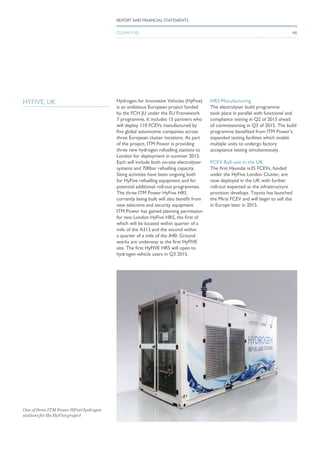
HYFIVE, UK Hydrogen for Innovative Vehicles (HyFive)
is an ambitious European project funded
by the FCH JU under the EU Framework
7 programme. It includes 15 partners who
will deploy 110 FCEVs manufactured by
five global automotive companies across
three European cluster locations. As part
of the project, ITM Power is providing
three new hydrogen refuelling stations to
London for deployment in summer 2015.
Each will include both on-site electrolyser
systems and 700bar refuelling capacity.
Siting activities have been ongoing both
for HyFive refuelling equipment and for
potential additional roll-out programmes.
The three ITM Power HyFive HRS
currently being built will also benefit from
new telecoms and security equipment.
ITM Power has gained planning permission
for two London HyFive HRS, the first of
which will be located within quarter of a
mile of the A313 and the second within
a quarter of a mile of the A40. Ground
works are underway at the first HyFIVE
site. The first HyFIVE HRS will open to
hydrogen vehicle users in Q3 2015.
HRS Manufacturing
The electrolyser build programme
took place in parallel with functional and
compliance testing in Q2 of 2015 ahead
of commissioning in Q3 of 2015. The build
programme benefited from ITM Power’s
expanded testing facilities which enable
multiple units to undergo factory
acceptance testing simultaneously.
FCEV Roll-out in the UK
The first Hyundai ix35 FCEVs, funded
under the HyFive London Cluster, are
now deployed in the UK with further
roll-out expected as the infrastructure
provision develops. Toyota has launched
the Mirai FCEV and will begin to sell this
in Europe later in 2015.
REPORT AND FINANCIAL STATEMENTS
CLEAN FUEL
One of three ITM Power HFuel hydrogen
stations for the HyFive project
46
ITM POWER RECEIVED ONE
OF THE FIRST HYUNDAI Ix35
FUEL CELL VEHICLES
TO ARRIVE IN THE UK
The vehicles being rolled-out are a result
of the pioneering £31m Hydrogen For
Innovative Vehicles (HyFive) project
funded by the FCH JU under the EU
Framework 7 program. The project which
brings together vehicle manufactures,
commercial hydrogen fuel suppliers and
government departments aims to make
hydrogen vehicles a viable and
environmentally-friendly choice
for motorists across Europe.
HyFive will see a total of 110 hydrogen
fuel cell vehicles rolled out to various
European locations including Bolzano,
Copenhagen, Innsbruck, Munich, Stuttgart
and London. These vehicles will be
supported by clusters of hydrogen
refuelling stations, twelve of which
are already in existence, and a further
six to be deployed.
“Making the first UK customer deliveries of hydrogen-powered cars is
a huge landmark for the industry. Hyundai is the first Company in the
world to start series-production of a fuel cell vehicle and is committed
to rolling-out this technology in line with government plans to grow
the refuelling infrastructure.”
Tony Whitehorn
President and CEO, Hyundai Motor UK
REPORT AND FINANCIAL STATEMENTSITM POWER PLC
CLEAN FUELYEAR ENDED 30 APRIL 2015
ITM Power Charles Purkess with Hyundai
ix35 fuel cell vehicle one of the first to own
a FCV in UK
47
YEAR ENDED 30 APRIL 2015
FINANCIAL STATEMENTS
15
DIRECTORS’ REPORT
The Directors present their annual report on the affairs of ITM Power Plc and its subsidiaries (“the Group”), together with
the financial statements and auditor’s report, for the year ended 30 April 2015.
RESEARCH AND DEVELOPMENT
During the year the Group incurred research and development related costs of £4.322m (2014 – £3.979m).
DIVIDENDS
The Directors do not recommend a dividend payment for the year (2014 – £nil).
CAPITAL STRUCTURE
Details of the Group’s capital structure are provided in notes 17 and 23 to the financial statements.
DIRECTORS
The following Directors served throughout the year and subsequently, unless stated otherwise:
Dr S Bourne
Sir R Bone
Dr G Cooley
Lord R Freeman
P Hargreaves
R Pendlebury (appointed 4th June 2015)
R Putnam
50
REPORT AND FINANCIAL STATEMENTS
DIRECTORS’ REPORT
DIRECTORS’ REPORT
Ordinary shares of 5p
each at 30 April 2015
Ordinary shares of 5p
each at 30 April 2014
Dr S Bourne 326,830 326,830
Dr G Cooley 377,923 377,923
Lord R Freeman 5,000 5,000
Mr P Hargreaves 14,908,643 14,908,643
Sir R Bone 67,000 –
Prof R Putnam 27,129 27,129
R Pendlebury 10,300 –
The Directors who served during the year and their interests in the shares of ITM Power Plc (including those of their spouse
or civil partner and children under the age of 18) were as follows.
(Continued overleaf)
51
REPORT AND FINANCIAL STATEMENTSITM POWER PLC
YEAR ENDED 30 APRIL 2015 DIRECTORS’ REPORT
DIRECTORS’ REPORT
Name of holder
Percentage of voting rights
and issued share capital
Number of
ordinary shares
Allianz Global Investors 8.9% 15,833,397
Mr P Hargreaves 8.4% 14,908,643*
JCB Research 7.2% 12,853,127
Majedie Asset Management 5.6% 10,008,148
D J Highgate 5.3% 9,443,144
J A Lloyd 3.9% 7,020,110
Herald Investment Management 3.2% 5,618,510
J A D Wreford 2.1% 3,731,363
Valebond Consultants Ltd 1.9% 3,333,333
* of this total 3,439,000 are held by a discretionary trust on behalf of the shareholder.
DIRECTORS’ INDEMNITIES
The Company has made qualifying third party indemnity
provisions for the benefit of its Directors, which were made
during a preceding year and remain in force at the date of
this report.
SUPPLIER PAYMENT POLICY
The Group’s policy is to settle terms of payment with suppliers
when agreeing the terms of each transaction, ensure that
suppliers are made aware of the terms of payment and abide
by the terms of payment. Trade creditors of the Group at
30 April 2015 were equivalent to 44 (2013 - 52) days’
purchases, based on the average daily amount invoiced
by suppliers during the year.
CHARITABLE AND POLITICAL CONTRIBUTIONS
During the year, the Group made no charitable or political
donations (2014 – £nil).
SUBSTANTIAL SHAREHOLDINGS
On 30 June 2015 the Company had been notified, in accordance
with chapter 5 of the Disclosure and Transparency Rules, of the
following voting rights as a shareholder of the Company.
REPORT AND FINANCIAL STATEMENTS
DIRECTORS’ REPORT 52
DIRECTORS’ REPORT
DISABLED EMPLOYEES
Applications for employment by disabled persons are always fully considered, bearing in mind the aptitudes of the applicant
concerned. In the event of members of staff becoming disabled every effort is made to ensure that their employment with the
Group continues and that appropriate training is arranged. It is the policy of the Group that the training, career development
and promotion of disabled persons should, as far as possible, be identical to that of other employees.
EMPLOYEE CONSULTATION
The Group places considerable value on the involvement of its employees and has continued to keep them informed on matters
affecting them as employees and on the various factors affecting the performance of the Group. This is achieved through formal
and informal meetings, the Company magazine and a special edition for employees of the annual financial statements. Employee
representatives are consulted regularly on a wide range of matters affecting their current and future interests.
KEY EMPLOYMENT POLICIES
We have consistently sought to recruit and retain the best employees in our sector and this has contributed to the advancement
and successes of the products we manufacture. We also recognise the importance of employee retention and we offer our staff
benefits including childcare vouchers and a cycle purchase scheme as well as formal training relevant to the employee’s role.
We believe this maintains high levels of employee satisfaction and motivation. In addition to on-the-job training, nine employees
were working towards a formal qualification in the past year.
FINANCIAL RISK MANAGEMENT OBJECTIVES AND POLICIES
These are given in note 23 to the financial statements.
AUDITOR
Each of the persons who is a Director at the date of approval of this annual report confirms that:
•	 so far as the Director is aware, there is no relevant audit information of which the Company’s auditor is unaware; and
•	 the Director has taken all the steps that he ought to have taken as a Director to make himself aware of any relevant audit
information and to establish that the Company’s auditor is aware of that information.
This confirmation is given and should be interpreted in accordance with the provisions of s418 of the Companies Act 2006.
Deloitte LLP have expressed their willingness to continue in office as auditor and a resolution to reappoint them as auditor
will be proposed at the forthcoming Annual General Meeting.
Approved by the Board and signed on its behalf by:
Dr. Simon Bourne
Director
Date: 31 July 2015
REPORT AND FINANCIAL STATEMENTSITM POWER PLC
DIRECTORS’ REPORTYEAR ENDED 30 APRIL 2015 53
CORPORATE GOVERNANCE REPORT
PRINCIPLES OF CORPORATE GOVERNANCE
ITM Power Plc (the “Company”) is committed to high standards of Corporate Governance. The Board is accountable to
the Company’s shareholders for good governance in its management of the affairs of the Group. The Directors acknowledge
the importance of the principles of corporate governance contained in the UK Corporate Governance Code Combined Code.
As an AIM quoted Company, ITM Power is not obliged to comply with the full requirements of the Combined Code. However
the Board intends to comply with its main provisions as far as reasonably practicable having regard to the size of the Group.
The Board recognises the importance to shareholders of Corporate Governance disclosure, and to this end the Company has
developed a set of disclosures that it feels are consistent with the Group’s size and the constitution of the Board. The Board
intend to continue to develop these disclosures as the Group grows.
The Directors intend to comply with Rule 21 of the AIM Rules relating to Directors’ dealings as applicable to AIM companies
and will also take all reasonable steps to ensure compliance by the Group’s applicable employees.
THE BOARD
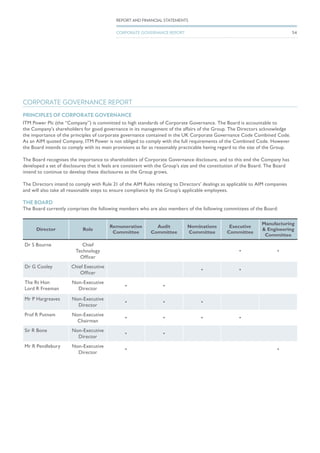
The Board currently comprises the following members who are also members of the following committees of the Board:
Director Role
Remuneration
Committee
Audit
Committee
Nominations
Committee
Executive
Committee
Manufacturing
& Engineering
Committee
Dr S Bourne Chief
Technology
Officer
• •
Dr G Cooley Chief Executive
Officer
• •
The Rt Hon
Lord R Freeman
Non-Executive
Director
• •
Mr P Hargreaves Non-Executive
Director
• • •
Prof R Putnam Non-Executive
Chairman
• • • •
Sir R Bone Non-Executive
Director
• •
Mr R Pendlebury Non-Executive
Director
• •
54
REPORT AND FINANCIAL STATEMENTS
CORPORATE GOVERNANCE REPORT
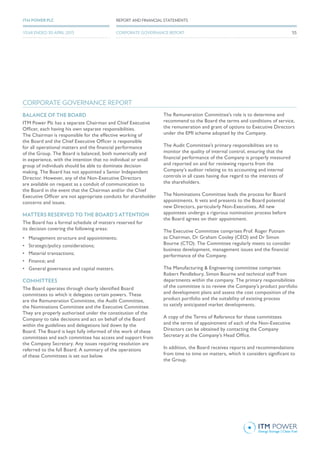
BALANCE OF THE BOARD
ITM Power Plc has a separate Chairman and Chief Executive
Officer, each having his own separate responsibilities.
The Chairman is responsible for the effective working of
the Board and the Chief Executive Officer is responsible
for all operational matters and the financial performance
of the Group. The Board is balanced, both numerically and
in experience, with the intention that no individual or small
group of individuals should be able to dominate decision
making. The Board has not appointed a Senior Independent
Director. However, any of the Non-Executive Directors
are available on request as a conduit of communication to
the Board in the event that the Chairman and/or the Chief
Executive Officer are not appropriate conduits for shareholder
concerns and issues.
MATTERS RESERVED TO THE BOARD’S ATTENTION
The Board has a formal schedule of matters reserved for
its decision covering the following areas:
•	 Management structure and appointments;
•	 Strategic/policy considerations;
•	 Material transactions;
•	 Finance; and
•	 General governance and capital matters.
COMMITTEES
The Board operates through clearly identified Board
committees to which it delegates certain powers. These
are the Remuneration Committee, the Audit Committee,
the Nominations Committee and the Executive Committee.
They are properly authorised under the constitution of the
Company to take decisions and act on behalf of the Board
within the guidelines and delegations laid down by the
Board. The Board is kept fully informed of the work of these
committees and each committee has access and support from
the Company Secretary. Any issues requiring resolution are
referred to the full Board. A summary of the operations
of these Committees is set out below.
The Remuneration Committee’s role is to determine and
recommend to the Board the terms and conditions of service,
the remuneration and grant of options to Executive Directors
under the EMI scheme adopted by the Company.
The Audit Committee’s primary responsibilities are to
monitor the quality of internal control, ensuring that the
financial performance of the Company is properly measured
and reported on and for reviewing reports from the
Company’s auditor relating to its accounting and internal
controls in all cases having due regard to the interests of
the shareholders.
The Nominations Committee leads the process for Board
appointments. It vets and presents to the Board potential
new Directors, particularly Non-Executives. All new
appointees undergo a rigorous nomination process before
the Board agrees on their appointment.
The Executive Committee comprises Prof. Roger Putnam
as Chairman, Dr Graham Cooley (CEO) and Dr Simon
Bourne (CTO). The Committee regularly meets to consider
business development, management issues and the financial
performance of the Company.
The Manufacturing & Engineering committee comprises
Robert Pendlebury, Simon Bourne and technical staff from
departments within the company. The primary responsibilities
of the committee is to review the Company’s product portfolio
and development plans and assess the cost composition of the
product portfolio and the suitability of existing process
to satisfy anticipated market developments.
A copy of the Terms of Reference for these committees
and the terms of appointment of each of the Non-Executive
Directors can be obtained by contacting the Company
Secretary at the Company’s Head Office.
In addition, the Board receives reports and recommendations
from time to time on matters, which it considers significant to
the Group. 
CORPORATE GOVERNANCE REPORT
55
REPORT AND FINANCIAL STATEMENTSITM POWER PLC
YEAR ENDED 30 APRIL 2015 CORPORATE GOVERNANCE REPORT
CORPORATE GOVERNANCE REPORT
BOARD MEETINGS
The Board scheduled four regular meetings in the year ended 30th April 2015 and three additional meetings were convened
when required. The table below shows the attendance of Directors at regular Board meetings and at meetings of the
Committees during the year.
The Board is supplied in a timely manner with information in a form and of a quality appropriate to enable it to discharge
its duties.
Board Meetings Remuneration Committee Audit Committee
No. of meetings held 4 1 2
Non-Executive Directors
The Rt Hon
Lord R Freeman
3
1 2
Mr P Hargreaves 2
Prof R Putnam (Chairman) 4 1 2
Sir R Bone 4 1 2
Mr R Pendlebury 0
Executive Directors
Dr S Bourne 4
Dr G Cooley 4 1
BOARD PERFORMANCE APPRAISAL
With the full support of the Board, the Chairman leads an evaluation of the performance of the Board and its Committees
on a yearly basis. The last review concluded that the Board and its Committee are currently effective and each Director
continues to demonstrate commitment to their role.
RE-ELECTION OF DIRECTORS
New Directors are subject to election at the first Annual General Meeting of the Company following their appointment. In addition,
all Directors who have been in office for three years or more since their election or last re-election are required to submit
themselves for re-election at the Annual General Meeting of the Company. At each Annual General Meeting of the Company
all those Non-Executive Directors who have been in office for nine years or more since the date on which they were originally
elected as a Non-Executive Director of the Company are required to retire from office, but may stand for re-appointment.
BOARD INDEPENDENCE
The Board recognises that Peter Hargreave’s shareholding is a factor which, under the UK Corporate Governance Code, may
appear to impair his independence. However, the Board considers all the Non-Executive Directors to be independent in character
and judgement. The Non-Executive Directors have provided excellent independent advice and challenge throughout the year.
In concluding that all its Non-Executive Directors are independent, the Company considered, inter-alia, the fact that all of the
Non-Executive Directors are Directors of other corporations and are not reliant on any shares or share options they hold in,
or income they receive from, ITM Power Plc.
56
REPORT AND FINANCIAL STATEMENTS
CORPORATE GOVERNANCE REPORT
INTERNAL CONTROL AND RISK MANAGEMENT
The Board is responsible for the Group’s system of internal control. Such a system
can only be designed to manage rather than eliminate the risk of failure to achieve
business objectives and can provide only reasonable, and not absolute, assurance
against material misstatement or loss. Whilst it would not be practical for the Group,
given its size, to maintain a dedicated Internal Audit function these internal controls
are reviewed periodically to check that they are operating as planned. The Group
also has in place processes to deal with the identification, assessment and
management of major business risks and reviews these processes as required.
RELATIONS WITH SHAREHOLDERS
The Company values the views of shareholders and recognises their interests
in the Group’s strategy and performance.
Overall responsibility for ensuring that there is effective communication with
investors and that the Board understands the views of major shareholders rests
with the Chief Executive Officer, who makes himself available to meet shareholders
for this purpose. Press coverage packs and analyst notes are made available to
the Board at each regular Board meeting. The Chief Executive Officer is often
accompanied at investor presentations by either the Chairman or the Chief Financial
Officer. Shareholder communication is mainly co-ordinated by the company’s
Corporate Communications Consultants, Tavistock Communications Limited.
ITM Power is committed to maintaining a good dialogue with shareholders through
proactively organising meetings and presentations with fund managers, retail brokers
and analysts, as well as responding to a wide range of enquiries. The Company also
recognises the importance of communicating appropriately any significant company
developments, this is done via the Stock Exchange Regulatory News Service that
can be accessed through the Company’s new website.
The Company reports to shareholders twice a year. The report and accounts
are available on the Company’s website: www.itm-power.com. All shareholders
are encouraged to attend the Company’s Annual General Meeting, at which the
Chairman gives an account of the progress of the business over the year and
provides the opportunity for shareholders to ask questions. The Board attends
the meeting and is available to answer questions from shareholders present.
In all communications and events, care is taken to ensure that no price sensitive
information is released and that any price sensitive information is released to all
shareholders at the same time in accordance with AIM Rules.
AUDITOR INDEPENDENCE
The Group and Company seek to ensure the independence of its Auditor by limiting
the non-audit work it performs. The Group and Company uses a range of advisors
to give specialist advice in relevant areas.
CORPORATE
GOVERNANCE REPORT
57
REPORT AND FINANCIAL STATEMENTSITM POWER PLC
YEAR ENDED 30 APRIL 2015 CORPORATE GOVERNANCE REPORT
DIRECTORS’
RESPONSIBILITIES
STATEMENT
The Directors are responsible for preparing the Annual Report and the financial
statements applicable law and regulations.
Company law requires the Directors to prepare financial statements for each
financial year. Under that law the Directors are required to prepare the Group
financial statements in accordance with International Financial Reporting Standards
(IFRSs) as adopted by the European Union, and have elected to prepare the parent
Company financial statements in accordance with United Kingdom Generally
Accepted Accounting Practice (United Kingdom Accounting Standards and applicable
law). Under Company law the Directors must not approve the accounts unless they
are satisfied that they give a true and fair view of the state of affairs of the Company
and of the profit or loss of the Company for that period.
In preparing the parent Company financial statements, the Directors are required to:
•	 select suitable accounting policies and then apply them consistently;
•	 make judgments and accounting estimates that are reasonable and prudent;
•	 state whether applicable UK Accounting Standards have been followed, subject
to any material departures disclosed and explained in the financial statements; and
•	 prepare the financial statements on the going-concern basis, unless it is
inappropriate to presume that the Company will continue in business.
In preparing the Group financial statements, International Accounting Standard 1
requires that Directors:
•	 properly select and apply accounting policies;
•	 present information, including accounting policies, in a manner that provides
relevant, reliable, comparable and understandable information;
•	 provide additional disclosures when compliance with the specific requirements
in IFRSs is insufficient to enable users to understand the impact of particular
transactions, other events and conditions on the entity’s financial position and
financial performance; and
•	 make an assessment of the Company’s ability to continue as a going-concern.
The Directors are responsible for keeping adequate accounting records that are
sufficient to show and explain the Company’s transactions, and disclose with
reasonable accuracy at any time the financial position of the Company, also ensures
that the financial statements comply with the Companies Act 2006. They are also
responsible for safeguarding the assets of the Company and taking reasonable steps
for the prevention and detection of fraud and other irregularities.
The Directors are responsible for the maintenance and integrity of the corporate
and financial information included on the Company’s website. Legislation in the
United Kingdom governing the preparation and dissemination of financial statements
may differ from legislation in other jurisdictions.
Dr Simon Bourne
Chief Technology Officer
By order of the Board
58
REPORT AND FINANCIAL STATEMENTS
DIRECTORS’ RESPONSIBILITIES STATEMENT
Matthew Hughes BSc (Hons) ACA
(Senior Statutory Auditor)
For and on behalf of
Deloitte LLP
Chartered Accountants
and Statutory Auditor
Leeds, United Kingdom
Date: 31 July 2015
INDEPENDENT AUDITOR
REPORT TO THE MEMBERS
OF ITM POWER PLC
We have audited the financial statements of ITM Power Plc for the year ended
30th April 2015 which comprise the Consolidated Statement of Comprehensive
Income, the Consolidated and Company Balance Sheets, the Consolidated
Statement of Changes in Equity, the Consolidated Cash Flow Statement and the
related notes 1 to 36. The financial reporting framework that has been applied
in the preparation of the Group financial statements is applicable law and
International Financial Reporting Standards (IFRSs) as adopted by the European
Union. The financial reporting framework that has been applied in the preparation
of the parent Company financial statements is applicable law and United Kingdom
Accounting Standards (United Kingdom Generally Accepted Accounting Practice).
This report is made solely to the Company’s members, as a body, in accordance
with Chapter three of Part 16 of the Companies Act 2006. Our audit work has
been undertaken so that we might state to the Company’s members those matters
we are required to state to them in an auditor’s report and for no other purpose.
To the fullest extent permitted by law, we do not accept or assume responsibility
to anyone other than the Company and the Company’s members as a body, for
our audit work, for this report, or for the opinions we have formed.
RESPECTIVE RESPONSIBILITIES OF DIRECTORS AND AUDITOR
As explained more fully in the Directors’ Responsibilities Statement, the
Directors are responsible for the preparation of the financial statements and
for being satisfied that they give a true and fair view. Our responsibility is to audit
and express an opinion on the financial statements in accordance with applicable
law and International Standards on Auditing (UK and Ireland). Those standards
require us to comply with the Auditing Practices Board’s (APB’s) Ethical
Standards for Auditors.
SCOPE OF THE AUDIT OF THE FINANCIAL STATEMENTS
An audit involves obtaining evidence about the amounts and disclosures in the
financial statements sufficient to give reasonable assurance that the financial
statements are free from material misstatement, whether caused by fraud or error.
This includes an assessment of: whether the accounting policies are appropriate to
the Group’s and the Parent Company’s circumstances and have been consistently
applied and adequately disclosed; the reasonableness of significant accounting
estimates made by the Directors; and the overall presentation of the financial
statements. In addition, we read all the financial and non-financial information in
the annual report to identify material inconsistencies with the audited financial
statements and to identify any information that is apparently materially incorrect
based on, or materially inconsistent with, the knowledge acquired by us in the
course of performing the audit. If we become aware of any apparent material
misstatements or inconsistencies we consider the implications for our report.
59
REPORT AND FINANCIAL STATEMENTSITM POWER PLC
YEAR ENDED 30 APRIL 2015 INDEPENDENT AUDITOR’S REPORT TO THE MEMBERS OF ITM POWER PLC
INDEPENDENT AUDITOR
REPORT TO THE MEMBERS
OF ITM POWER PLC (Contd.)
OPINION ON FINANCIAL STATEMENTS
In our opinion:
•	 the financial statements give a true and fair view of the state of the Group’s affairs
and of the Parent Company’s affairs as at 30 April 2015 and of the Group’s loss
for the year then ended;
•	 the Group’s financial statements have been properly prepared in accordance
with IFRSs as adopted by the European Union;
•	 the Parent Company’s financial statements have been properly prepared in
accordance with United Kingdom Generally Accepted Accounting Practice; and
•	 the financial statements have been prepared in accordance with the requirements
of the Companies Act 2006.
OPINION ON OTHER MATTERS PRESCRIBED BY THE COMPANIES ACT 2006
In our opinion the information given in the Directors’ Report for the financial year for
which the financial statements are prepared is consistent with the financial statements.
MATTERS ON WHICH WE ARE REQUIRED TO REPORT BY EXCEPTION
We have nothing to report in respect of the following matters where the Companies
Act 2006 requires us to report to you if, in our opinion:
•	 adequate accounting records have not been kept, or returns adequate for
our audit have not been received from branches not visited by us; or
•	 the parent Company financial statements are not in agreement with the
accounting records and returns; or
•	 certain disclosures of Directors’ remuneration specified by law are not made; or
•	 we have not received all the information and explanations we require for our audit.
60
REPORT AND FINANCIAL STATEMENTS
INDEPENDENT AUDITOR’S REPORT TO THE MEMBERS OF ITM POWER PLC
CONSOLIDATED STATEMENT OF COMPREHENSIVE INCOME
YEAR ENDED 30 APRIL 2015
Note 2015 2014
£’000s £’000s
Revenue 5 1,635 1,127
Cost of Sales (1,045) (2,026)
Gross profit/(loss) 590 (899)
Operating Costs
– Research and development (4,322) (3,979)
– Prototype production and engineering (1,141) (2,171)
– Sales and marketing (719) (695)
– Administration (1,908) (1,604)
Other Operating Income
– Grant income 5 1,777 1,370
Loss from operations (5,723) (7,978)
Investment revenues 5 12 25
Loss before tax (5,711) (7,953)
Tax	 8 84 164
Loss for the year, being total comprehensive
expense for the year
6 (5,627) (7,789)
Other Total Comprehensive Income:
Items that may be reclassified subsequently to profit or loss
Foreign currency translation differences on foreign operations 116 –
Net other total comprehensive income 116 –
Total comprehensive loss for the year (5,511) (7,789)
Loss per share
Basic and diluted	 9 (3.4p) (5.9p)
All results presented above are derived from continuing operations and are attributable to owners of the Company.
61
REPORT AND FINANCIAL STATEMENTSITM POWER PLC
YEAR ENDED 30 APRIL 2015 CONSOLIDATED INCOME STATEMENT
CONSOLIDATED STATEMENT OF CHANGES IN EQUITY
Called-
up share
capital
Share
premium
account
Merger
reserve
Foreign
Exchange
reserve
Retained
loss
Total
equity
£’000s £’000s £’000s £’000s £’000s £’000s
At 1 May 2013 6,135 41,273 (1,973) – (38,056) 7,379
Issue of shares 1,958 9,430 – – – 11,388
Credit to equity for
share-based payments
– – – – 22 22
Loss, being total comprehensive
expense for the year
– – – – (7,789) (7,789)
At 30 April 2014 8,093 50,703 (1,973) (45,823) 11,000
At 1 May 2014 8,093 50,703 (1,973) – (45,823) 11,000
Issue of shares 812 4,035 – – – 4,847
Credit to equity for
share-based payments
– – – – 8 8
Loss for the year – – – – (5,627) (5,627)
Other comprehensive income
for the period
– – – 116 – 116
At 30 April 2015 8,905 54,738 (1,973) 116 (51,442) 10,344
62
REPORT AND FINANCIAL STATEMENTS
CONSOLIDATED STATEMENT OF CHANGES IN EQUITY
CONSOLIDATED BALANCE SHEET
Note 2015 2014
£’000s £’000s
Non-Current Assets
Property, plant and equipment 10 2,546 1,755
Current Assets
Inventories 12 512 762
Trade and other receivables 14 4,113 1,206
Cash and cash equivalents 14 6,576 9,763
Total Current Assets 11,201 11,731
Current Liabilities
Trade and other payables 15 (3,295) (2,184)
Provisions 16 (108) (302)
Total Current Liabilities (3,403) (2,486)
Net Current Assets 7,798 9,245
Net Assets 10,344 11,000
Equity
Called-up share capital 17 8,905 8,093
Share premium account 54,738 50,703
Merger reserve (1,973) (1,973)
Foreign exchange reserve 116 –
Retained loss (51,442) (45,823)
Total Equity 10,344 11,000
The financial statements of ITM Power Plc, registered number 5059407, were approved by the Board of Directors and authorised
for issue on 31 July 2015.
Signed on behalf of the Board of Directors
Dr. Simon Bourne
Director
63
REPORT AND FINANCIAL STATEMENTSITM POWER PLC
YEAR ENDED 30 APRIL 2015 CONSOLIDATED BALANCE SHEET
CONSOLIDATED CASH FLOW STATEMENT
Note 2015 2014
£’000s £’000s
Net Cash Used in Operating Activities 18 (6,684) (6,701)
Investing Activities
Interest received 12 62
Purchases of property, plant and equipment (1,470) (929)
Cash received from interest-earning deposit – 4,000
Net cash from (used in) investing activities (1,458) 3,133
Financing Activities
Issue of ordinary share capital 4,847 11,388
Net cash from financing activities 4,847 11,388
(Decrease)/Increase in cash and cash equivalents (3,295) 7,820
Cash and cash equivalents at the beginning of year 9,763 1,943
Effect of foreign exchange rate changes 108 –
Cash and cash equivalents at the end of year 6,576 9,763
Non-statutory measures
Cash Burn
Cash burn is a measure used by key management
personnel to monitor the performance of the business.
(Decrease)/Increase in cash and cash equivalents per the cash flow statement
Less movements in short-term deposits
Effect of foreign exchange rate changes
Less share issue proceeds
(3,295)
–
108
(4,847)
7,820
(4,000)
–
(11,388)
Cash Burn (8,034) (7,568)
64
REPORT AND FINANCIAL STATEMENTS
CONSOLIDATED CASH FLOW STATEMENT
NOTES TO THE
CONSOLIDATED
FINANCIAL STATEMENTS
1. GENERAL INFORMATION
ITM Power Plc is a Company incorporated in England and Wales under the
Companies Act 2006. The registered office is at 22 Atlas Way, Sheffield, South
Yorkshire S4 7QQ. The nature of the Group’s operations and its principal activities
are disclosed in the Strategic Report.
These financial statements are presented in pounds sterling, as that is the currency
of the primary economic environment in which the Group operates.
2. ADOPTION OF NEW AND REVISED INTERNATIONAL FINANCIAL
REPORTING STANDARDS
The following new and revised Standards and Interpretations have been adopted
in the current year. Although their adoption has not had any significant impact on
the amounts reported in these financial statements, it may impact the accounting
for future transactions and arrangements.
Standards Affecting Presentation and Disclosure
Annual Improvements to IFRSs:
2009–2011 Cycle (May 2012)
Annual Improvements to IFRSs:
2009–2011
Amendments to IFRS 1
(March 2012)
Government Loans
Amendments to IAS 1 (June 2011) Presentation of Items of Other
Comprehensive Income
Amendments to IAS 12 (Dec 2010) Deferred Tax: Recovery
of Underlying Assets
Amendments to IFRS 1 (Dec 2010) Severe Hyperinflation and Removal
of Fixed Dates for First-time Adopters
Amendments to IFRS 7 (Dec 2011) Disclosures – Offsetting Financial
Assets and Financial Liabilities
IFRS 13 Fair Value Measurement
IAS 19 (revised June 2011) Employee Benefits
IFRIC 20 Stripping Costs in the Production Phase
of a Surface Mine
STANDARDS AFFECTING THE REPORTED RESULTS
OR THE FINANCIAL POSITION
In the current year, there were no new and revised Standards and Interpretations
that have been adopted and which affected the amounts reported in these
financial statements.
65
REPORT AND FINANCIAL STATEMENTSITM POWER PLC
YEAR ENDED 30 APRIL 2015 NOTES TO THE CONSOLIDATED FINANCIAL STATEMENTS
The following new and revised Standards and Interpretations have been adopted in
the current year. Their adoption has not had any significant impact on the amounts
reported in these financial statements.
Amendments to IAS 39 (Jun 2013) Novation of derivatives and
continuation of hedge accounting
Amendments to IAS 36 (May 2013) Amendments to IAS 36 (May 2013)	
Amendments to IFRS 10,
IFRS 12 and IAS 27 (Oct 2012)
Investment entities
Amendments to IAS 32 (Dec 2011) Offsetting financial assets and
financial liabilities
IFRS 10 Consolidated financial statements
IFRS 11 Joint arrangements
IFRS 12 Disclosure of interests in other entities
IAS 27 (revised May 2011) Separate financial statements
IAS 28 (revised May 2011) Investments in associates and
joint ventures
STANDARDS NOT
AFFECTING THE
REPORTED RESULTS OR
THE FINANCIAL POSITION
66
REPORT AND FINANCIAL STATEMENTS
NOTES TO THE CONSOLIDATED FINANCIAL STATEMENTS
At the date of authorisation of these financial statements, the following Standards and Interpretations which have not been
applied in these financial statements were in issue but not yet effective (and in some cases had not yet been adopted by the EU):
Annual improvements to IFRSs: 2010-12 Cycle (Dec 2013) Annual improvements to IFRSs: 2010-12 Cycle
Annual improvements to IFRSs: 2011-13 Cycle (Dec 2013) Annual improvements to IFRSs: 2011-13 Cycle
Annual improvements to IFRSs: 2012-14 Cycle (Sep 2014) Annual improvements to IFRSs: 2012-14 Cycle
Amendments to IAS 1 (Dec 2015) Disclosure initiative
Amendments to IAS 19 (Nov 2013) Defined benefit plans: employee contributions
Amendments to IFRS 10, IFRS 12 and IAS 28 (Dec 2015) Investment entities: applying the consolidation exception
Amendments to IFRS 10 and IAS 28 (Sep 2014) Sale or contribution of assets between an investor
and its associate or joint venture
Amendments to IFRS 11 (May 2014) Accounting for acquisitions of interests in joint operations
Amendments to IAS 27 (Aug 2014) Equity method in separate financial statements
Amendments to IAS 16 and IAS 41 (Jun 2014) Agriculture: bearer plants
Amendments to IAS 16 and IAS 38 (May 2014) Clarification of acceptable methods of depreciation
and amortisation
IFRS 9 Financial instruments
IFRS 14 Regulatory deferral accounts
IFRS 15 Revenue from contracts with customers
IFRIC 21 Levies
The Directors do not expect that the adoption of the
standards listed above will have a material impact on the
financial statements of the Group in future periods, except
as follows:
•	 IFRS 9 will impact both the measurement and disclosures
of Financial Instruments; and
•	 IFRS 15 may have an impact on revenue recognition
and related disclosures.
Beyond the information above, it is not practicable to provide
a reasonable estimate of the effect of these standards until a
detailed review has been completed.
67
REPORT AND FINANCIAL STATEMENTSITM POWER PLC
YEAR ENDED 30 APRIL 2015 NOTES TO THE CONSOLIDATED FINANCIAL STATEMENTS
3. SIGNIFICANT ACCOUNTING POLICIES
The financial statements have also been prepared in
accordance with IFRSs adopted by the European Union.
The financial statements have been prepared on the
historical-cost basis. The principal accounting policies
adopted are set out below.
Going Concern
The Directors have prepared a cash flow forecast for the
period ending 31 August 2016. This forecast indicates that
the Company and Group will remain cash positive without
the requirement for further funding, for a period of at least
12 months from the date of approval of these financial
statements. The forecast includes certain assumptions, in
particular in respect of the level and timing of projected sales
and grant cash inflows, which are inherently uncertain; the
Directors believe that the level and timing of the projected
sales represent a prudent estimate, with the current sales
pipeline providing potential upside. Notwithstanding these
uncertainties, the Directors have a reasonable expectation
that the company and Group will be able to meet their
obligations as they fall due, for the foreseeable future.
Accordingly, the financial statements have been prepared
on a going concern basis.
Basis of Consolidation
The consolidated financial statements incorporate the
financial statements of the Company and entities controlled
by the Company (its subsidiaries) made up to 30 April each
year. Control is achieved where the Company has the power
to govern the financial and operating policies of an investee
entity so as to obtain benefits from its activities.
All intra-group transactions, balances, income and expenses
are eliminated on consolidation.
Revenue Recognition
Revenue is measured at the fair value of the consideration
received or receivable and represents amounts receivable for
goods and services provided in the normal course of business,
net of discounts, VAT and other sales-related taxes.
Sale of Goods
Revenue from the sale of goods is recognised when all the
following conditions are satisfied:
•	 the Group has transferred to the buyer the significant
risks and rewards of ownership of the goods;
•	 the Group retains neither continuing managerial
involvement to the degree usually associated with
ownership nor effective control over the goods sold;
•	 the amount of revenue can be measured reliably;
•	 it is probable that the economic benefits associated
with the transaction will flow to the entity; and
•	 the costs incurred or to be incurred in respect
of the transaction can be measured reliably.
Rendering of Services
Revenue from a contract to provide services is recognised
by reference to the stage of completion of the contract.
The stage of completion of the contract is determined
as follows:
•	 installation fees are recognised by reference to the stage
of completion of the installation, determined as the
proportion of the total time expected to install that has
elapsed at the balance sheet date;
•	 servicing fees included in the price of products sold are
recognised by reference to the proportion of the total
cost of providing the service for the product sold, taking
into account historical trends in the number of services
actually provided on past goods sold; and
•	 revenue from time and material contracts is recognised
at the contractual rates as labour hours are delivered
and direct expenses incurred.
NOTES TO THE CONSOLIDATED FINANCIAL STATEMENTS
68
REPORT AND FINANCIAL STATEMENTS
NOTES TO THE CONSOLIDATED FINANCIAL STATEMENTS
Construction Contracts
When the outcome of a construction contract can be
estimated reliably, revenue and costs are recognised by
reference to the stage of completion of the contract activity
at the balance sheet date. This is normally measured by the
proportion that contract costs incurred for work performed
to date bear to the estimated total contract costs, except
where this would not be representative of the stage of
completion. Variations in contract work, claims and incentive
payments are included to the extent that the amount can be
measured reliably and its receipt is considered probable.
Where the outcome of a construction contract cannot be
estimated reliably, contract revenue is recognised to the
extent of contract costs incurred where it is probable they
will be recoverable. Contract costs are recognised as expenses
in the period in which they are incurred.
When it is probable that total contract costs will exceed
total contract revenue, the expected loss is recognised as
an expense immediately.
When contract costs incurred to date plus recognised profits
less recognised losses exceed progress billings, the surplus is
shown as amounts due from customers for contract work.
For contracts where progress billings exceed contract costs
incurred to date plus recognised profits less recognised losses,
the surplus is shown as the amounts due to customers for
contract work. Amounts received before the related work
is performed are included in the consolidated balance sheet,
as a liability, as advances received. Amounts billed for work
performed but not yet paid by the customer are included in the
consolidated balance sheet under trade and other receivables.
Grants
Government and other grants are included in other operating
income in the period that the expenditure to which they relate
is incurred, unless relating to property, plant and equipment.
Government and other grants relating to property, plant and
equipment are netted against the cost of the assets acquired.
Leasing
Rentals payable under operating leases are charged to
the income statement on a straight-line basis over the term
of the relevant lease.
Foreign Currencies
The individual financial statements of each Group Company
are presented in the currency of the primary economic
environment in which it operates (its functional currency).
For the purpose of the consolidated financial statements,
the results and financial position of each Group Company
are expressed in pounds sterling, which is the functional
currency of the Company, and the presentation currency
for the consolidated financial statements.
In preparing the financial statements of the individual companies,
transactions in currencies other than the entity’s functional
currency (foreign currencies) are recognised at the rates of
exchange prevailing on the dates of the transactions. At each
balance sheet date, monetary assets and liabilities that are
denominated in foreign currencies are retranslated at the rates
prevailing at that date. Non-monetary items carried at fair value
that are denominated in foreign currencies are translated at the
rates prevailing at the date when the fair value was determined.
Non-monetary items that are measured in terms of historical
cost in a foreign currency are not retranslated.
Exchange differences are recognised in profit or loss in the
period in which they arise except for:
•	 exchange differences on foreign currency borrowings
relating to assets under construction for future productive
use, which are included in the cost of those assets when
they are regarded as an adjustment to interest costs on
those foreign currency borrowings;
•	 exchange differences on transactions entered into to hedge
certain foreign currency risks (see below under financial
instruments/hedge accounting); and
•	 exchange differences on monetary items receivable from
or payable to a foreign operation for which settlement is
neither planned nor likely to occur (therefore forming part
of the net investment in the foreign operation), which are
recognised initially in other comprehensive income and
reclassified from equity to profit or loss on disposal or
partial disposal of the net investment.
69
REPORT AND FINANCIAL STATEMENTSITM POWER PLC
YEAR ENDED 30 APRIL 2015 NOTES TO THE CONSOLIDATED FINANCIAL STATEMENTS
For the purpose of presenting consolidated financial
statements, the assets and liabilities of the Group’s foreign
operations are translated at exchange rates prevailing on the
balance sheet date. Income and expense items are translated
at the average exchange rates for the period, unless exchange
rates fluctuate significantly during that period, in which case
the exchange rates at the date of transactions are used.
Exchange differences arising, if any, are recognised in other
comprehensive income and accumulated in equity
(attributed to non-controlling interests as appropriate).
Loss from Operations
Loss from operations is stated before investment income
and finance costs.
Taxation
The tax expense represents the sum of the tax currently
payable and deferred tax.
The tax currently payable is based on taxable profit for the year.
Taxable profit differs from net profit as reported in the income
statement because it excludes items of income or expense that
are taxable or deductible in other years and it further excludes
items that are never taxable or deductible. The Group’s liability
for current tax is calculated using tax rates that have been
enacted or substantively enacted by the balance sheet date.
Research and development tax credits are recognised on an
accruals basis.
Deferred tax is the tax expected to be payable or recoverable
on differences between the carrying amounts of assets and
liabilities in the financial statements and the corresponding
tax bases used in the computation of taxable profit, and is
accounted for using the balance sheet liability method. Deferred
tax liabilities are generally recognised for all taxable temporary
differences and deferred tax assets are recognised to the
extent that it is probable that taxable profits will be available
against which deductible temporary differences can be utilised.
Such assets and liabilities are not recognised if the temporary
difference arises from goodwill or from the initial recognition
(other than in a business combination) of other assets and
liabilities in a transaction that affects neither the tax profit
nor the accounting profit.
Deferred tax liabilities are recognised for taxable temporary
differences arising on investments in subsidiaries and associates,
and interests in joint ventures, except where the Group is able
to control the reversal of the temporary difference and it is
probable that the temporary difference will not reverse in the
foreseeable future.
The carrying amount of deferred tax assets is reviewed at each
balance sheet date and reduced to the extent that it is no longer
probable that sufficient taxable profits will be available to allow
all or part of the asset to be recovered.
Deferred tax is calculated at the tax rates that are expected
to apply in the period when the liability is settled or the asset
is realised. Deferred tax is charged or credited in the income
statement, except when it relates to items charged or credited
directly to equity, in which case the deferred tax is also dealt
with in equity.
Deferred tax assets and liabilities are offset when there is a
legally enforceable right to set off current tax assets against
current tax liabilities, and when they relate to income taxes
levied by the same taxation authority, and the Group intends
to settle its current tax assets and liabilities on a net basis.
70
REPORT AND FINANCIAL STATEMENTS
NOTES TO THE CONSOLIDATED FINANCIAL STATEMENTS
Property, Plant and Equipment
Leasehold improvements, laboratory and test equipment,
production plant and equipment, computer equipment and
office furniture and fittings are stated at cost less accumulated
depreciation and any recognised impairment loss.
Depreciation is charged so as to write off the cost of assets,
other than land and properties under construction, over their
estimated useful lives, using the straight-line method, on the
following basis:
Leasehold improvements 4 years or the remainder
of the lease term, if shorter
Laboratory and test equipment 4 to 6 years
Production plant and equipment 4 years
Computer equipment 3 years
Office furniture and fittings 4 years
Motor vehicles 3 years
The gain or loss arising on the disposal or retirement
of an asset is determined as the difference between
the sales proceeds and the carrying amount of the asset
and is recognised in income.
Assets in the course of construction are carried at cost, less
any recognised impairment loss. Depreciation of these assets,
on the same basis as other property assets, commences when
the assets are ready for their intended use.
Internally Generated Intangible Assets –
Research and Development Expenditure
Expenditure on research activities is recognised
as an expense in the period in which it is incurred.
An internally generated intangible asset arising from the
Group’s product development is recognised only if all of
the following conditions are met:
•	 an asset is created that can be identified (such as
software and new processes);
•	 it is probable that the asset created will generate
future economic benefits;
•	 the development cost of the asset can be measured
reliably; and
•	 the product from which the asset arises meets the
Group’s criteria for technical feasibility.
Internally generated intangible assets are amortised
on a straight-line basis over their useful lives. Where
no internally generated intangible asset can be recognised,
development expenditure is recognised as an expense
in the period in which it is incurred.
71
REPORT AND FINANCIAL STATEMENTSITM POWER PLC
YEAR ENDED 30 APRIL 2015 NOTES TO THE CONSOLIDATED FINANCIAL STATEMENTS
NOTES TO THE CONSOLIDATED FINANCIAL STATEMENTS
Impairment of Tangible and Intangible Assets
At each balance sheet date, the Group reviews the carrying
amounts of its tangible and intangible assets to determine
whether there is any indication that those assets have
suffered an impairment loss. If any such indication exists,
the recoverable amount of the asset is estimated in order
to determine the extent of the impairment loss (if any).
Where the asset does not generate cash flows that are
independent from other assets, the Group estimates the
recoverable amount of the cash-generating unit to which
the asset belongs.
An intangible asset with an indefinite useful life is tested
for impairment annually and whenever there is an indication
that the asset may be impaired.
Recoverable amount is the higher of fair value less costs to
sell and value in use. In assessing value in use, the estimated
future cash flows are discounted to their present value using
a pre-tax discount rate that reflects current market
assessments of the time value of money and the risks
specific to the asset for which the estimates of future
cash flows have not been adjusted. If the recoverable
amount of an asset (or cash-generating unit) is estimated
to be less than its carrying amount, the carrying amount
of the asset (cash-generating unit) is reduced to its recoverable
amount. An impairment loss is recognised as an expense
immediately, unless the relevant asset is carried at a revalued
amount, in which case the impairment loss is treated as a
revaluation decrease.
Where an impairment loss subsequently reverses, the carrying
amount of the asset (cash-generating unit) is increased to
the revised estimate of its recoverable amount, but so that
the increased carrying amount does not exceed the carrying
amount that would have been determined had no impairment
loss been recognised for the asset (cash-generating unit) in
prior years. A reversal of an impairment loss is recognised
as income immediately, unless the relevant asset is carried
at a revalued amount, in which case the reversal of the
impairment loss is treated as a revaluation increase.
Inventories
Inventories are stated at the lower of cost and net realisable
value. Cost comprises direct materials and, where applicable,
direct labour costs and those overheads that have been
incurred in bringing the inventories to their present location
and condition. Cost is calculated using the “first in first out”
(FIFO) method.
Net realisable value represents the estimated selling price
less all estimated costs of completion and costs to be
incurred in marketing, selling and distribution.
Financial Instruments
Financial assets and financial liabilities are recognised on the
Group’s balance sheet when the Group becomes a party to
the contractual provisions of the instrument.
72
REPORT AND FINANCIAL STATEMENTS
NOTES TO THE CONSOLIDATED FINANCIAL STATEMENTS
Trade and Other Receivables
Trade and other receivables that have fixed or determinable
payments that are not quoted in an active market are classified
as receivables. Receivables are measured at amortised cost
using the effective interest method, less any impairment.
Interest income is recognised by applying the effective interest
rate, except for short-term receivables when the recognition
of interest would be immaterial.
Trade receivables do not carry any interest and are stated
at their nominal value. Appropriate allowances for estimated
irrecoverable amounts are recognised in profit or loss when
there is objective evidence that the asset is impaired.
Impairment of Financial Assets
Financial assets are assessed for indicators of impairment
at each balance sheet date. Financial assets are impaired
where there is objective evidence that, as a result of one
or more events that occurred after the initial recognition
of the financial asset, the estimated future cash flows
of the investment have been impacted.
Investments – Short-term Deposits
Short-term deposit investments comprise short-term, highly
liquid investments that are readily convertible to a known
amount of cash and are subject to an insignificant risk of
change in value.
Cash and Cash Equivalents
Cash and cash equivalents comprise cash-in-hand and
on-demand deposits, and other short-term highly liquid
investments that are readily convertible to a known amount of
cash and are subject to an insignificant risk of change in value.
Financial Liabilities and Equity
Financial liabilities and equity instruments are classified
according to the substance of the contractual arrangements
entered into. An equity instrument is any contract that
evidences a residual interest in the assets of the Group
after deducting all of its liabilities.
Trade Payables
Trade payables are not interest bearing and are stated
at their nominal value.
Equity Instruments
Equity instruments issued by the Company are recorded
at the proceeds received, net of direct issue costs.
Provisions
Provisions are recognised when the Group has a present
obligation as a result of a past event, and it is probable that the
Group will be required to settle that obligation. Provisions are
measured at the Directors’ best estimate of the expenditure
required to settle the obligation at the balance sheet date, and
are discounted to present value where the effect is material.
Share-based Payments
The Group has applied the requirements of IFRS 2 Share-based
Payments. In accordance with the transitional provisions, IFRS
2 has been applied to all grants of equity instruments after
7 November 2002 that were unvested as of 1 May 2006,
which was the Group’s date of transition to IFRS.
The Group issues equity-settled, share-based payments to
certain employees. Equity-settled, share-based payments
are measured at fair value at the date of grant. The fair value
determined at the grant date of the equity-settled, share-based
payments is expensed on a straight-line basis over the vesting
period, based on the Group’s estimate of shares that will
eventually vest. Fair value is measured using a Black-Scholes
options pricing model.
Pension Costs
The Group operates a defined-contribution pension scheme.
The amount charged to the income statement in respect
of pension costs is the contributions actually payable in the
year. Differences between the contributions actually payable
and those paid are shown as accruals or prepayments in the
consolidated balance sheet.
The Group as Lessor
Rental income from operating leases is recognised on a
straight-line basis over the term of the relevant lease. Initial
direct costs incurred in negotiating and arranging an operating
lease are added to the carrying amount of the leased asset and
recognised on a straight-line basis over the lease term.
Warranties
Provisions for the expected cost of warranty obligations under
local sale of goods legislation are recognised at the date of sale
of the relevant products, and the Directors’ best estimate of
the expenditure required to settle the Group’s obligation.
NOTES TO THE CONSOLIDATED FINANCIAL STATEMENTS
73
REPORT AND FINANCIAL STATEMENTSITM POWER PLC
YEAR ENDED 30 APRIL 2015 NOTES TO THE CONSOLIDATED FINANCIAL STATEMENTS
NOTES TO THE CONSOLIDATED FINANCIAL STATEMENTS
4. CRITICAL ACCOUNTING JUDGEMENTS AND KEY
SOURCES OF ESTIMATION UNCERTAINTY
In the application of the Group’s accounting policies, which
are described in note 3, the Directors are required to make
judgements, estimates and assumptions about the carrying
amounts of assets and liabilities that are not readily apparent
from other sources. The estimates and associated assumptions
are based on historical experience and other factors that
are considered to be relevant. Actual results may differ from
these estimates.
The estimates and underlying assumptions are reviewed
on an on-going basis. Revisions to accounting estimates are
recognised in the period in which the estimate is revised if
the revision affects only that period, or in the period of the
revision and future periods if the revision affects both current
and future periods.
Critical Judgements in Applying the Group’s Accounting Policies
The following are the critical judgements, apart from those
involving estimations (which are dealt with separately below),
that the Directors have made in the process of applying the
Group’s accounting policies and that have the most significant
effect on the amounts recognised in the financial statements.
Going Concern
The Directors are required to assess whether it is appropriate
to prepare the financial statements on a going-concern basis.
Their assessment of the going-concern basis is set out in note 3.
Capitalisation of development costs
As described in note 3, the Group capitalises development
costs which meet certain recognition criteria, in accordance
with IAS 38 ‘Intangible assets’. In making its judgement,
management has considered the detailed criteria for
recognition and concluded that none of the development
costs in the current year met the criteria for capitalisation.
Key Sources of Estimation Uncertainty
For construction contracts in progress at the year end,
the directors are required to assess the costs to complete,
in order to estimate the percentage of completion which,
in turn, determines the amount of revenue to be recognised.
The actual costs may differ to the estimated costs and any
adjustments arising will be made in future periods.
5. REVENUE, OTHER OPERATING INCOME AND
INVESTMENT INCOME
The Group adopted IFRS 8 Operating Segments with effect
from 1 May 2009. IFRS 8 requires operating segments to be
identified on the basis of internal reports about components
of the Group that are regularly reviewed by the Chief
Operating Decision Maker to allocate resources to the
segments and to assess their performance.
ITM Power Plc is organised internally to report to the Group’s
Chief Operating Decision Maker, the Chief Executive Officer,
on the financial and operational performance of the Group
as a whole. The Group’s Chief Operating Decision Maker
is ultimately responsible for entity-wide resource allocation
decisions and evaluates the performance of the Group on
a Group-wide basis, and any elements within it on a
combination of information from the executives in charge
of the Group and Group financial information.
As a consequence of the above factors the Group has one
operating and reportable segment in accordance with IFRS 8
Operating Segments.
Revenues are generated in the United Kingdom, the United
States and Germany. In each of the geographical locations
the company has subsidiary trading companies. The United
Kingdom is the Group’s country of domicile and all non-
current assets were domiciled in the United Kingdom.
Included in revenue are the following amounts, which each
accounted for more than 10% of total revenue;
•	 Customer A	 £878,000
•	 Customer B	 £569,000
74
REPORT AND FINANCIAL STATEMENTS
NOTES TO THE CONSOLIDATED FINANCIAL STATEMENTS
2015 2014
£’000s £’000s
Continuing Operations
Revenue from construction contracts 1,539 1,079
Lease of goods – 28
Consulting income 51 20
Maintenance contracts 32 –
Other 13 –
Revenue in the Consolidated Income Statement 1,635 1,127
Grant income 1,777 1,370
Investment income 12 25
3,424 2,522
Revenues from Major Products and Services
The Group’s revenues from its major products and services were as follows:
Geographic Analysis of Revenue
A geographic analysis of the Group’s revenue is set out below:
2015 2014
£’000s £’000s
Continuing Operations
Electrolyser platform sales 1,571 1,102
Consultancy 51 20
Other 13 5
Consolidated revenue (excluding investment revenue) 1,635 1,127
2015 2014
£’000s £’000s
United Kingdom 261 234
Rest of Europe 678 695
North America 696 122
Other – 76
1,635 1,127
An analysis of the Group’s revenue is as follows:
75
REPORT AND FINANCIAL STATEMENTSITM POWER PLC
YEAR ENDED 30 APRIL 2015 NOTES TO THE CONSOLIDATED FINANCIAL STATEMENTS
6. LOSS FOR THE YEAR
2015 2014
£’000s £’000s
Loss For The Year Has Been Arrived at After Charging (Crediting)
Net foreign exchange losses 86 56
Depreciation of property, plant and equipment 592 641
Loss on disposal of property, plant and equipment 87 –
Rentals Under Operating Leases
Land and buildings 154 154
Government grants receivable (1,777) (1,370)
Staff costs (see note 7) 3,714 3,675
Cost of inventories recognised as an expense 262 270
The Following Amounts Payable to the Group’s Auditor Have Been Charged Within the Loss Before Tax
Fees payable to the Company’s auditor for
– The audit of the Company’s annual accounts 24 71
– The audit of the Company’s subsidiaries pursuant to legislation 24 –
Total audit fees 48 71
Other services pursuant to legislation
– Interim review work 22 22
– Tax services 10 10
Total non-audit fees 32 32
NOTES TO THE CONSOLIDATED FINANCIAL STATEMENTS
76
REPORT AND FINANCIAL STATEMENTS
NOTES TO THE CONSOLIDATED FINANCIAL STATEMENTS
7. INFORMATION REGARDING DIRECTORS AND EMPLOYEES
Name of
Director
Fees/Basic
salary
Benefits
in kind
Annual
bonuses
Pension
contributions
2015 2014
£’000s £’000s £’000s £’000s £’000s £’000s
Executive
Dr S Bourne 124 – 28 6 158 151
Dr G Cooley 176 – 114 28 318 303
Non-Executive
P Hargreaves 45 – – – 45 45
Prof R Putnam 132 – – – 132 128
Lord Freeman 35 – – – 35 35
R Bone 38 – – – 38 –
Aggregate
emoluments
550 – 142 34 726 662
77
REPORT AND FINANCIAL STATEMENTSITM POWER PLC
YEAR ENDED 30 APRIL 2015 NOTES TO THE CONSOLIDATED FINANCIAL STATEMENTS
Details of options for Directors who served during the year are as follows:
Name of
Director
Scheme 1 May 2014 Granted
30 April
2015
Exercise
price £’000
Date
from which
exercisable
Expiry
date
Dr S Bourne EMI 200,000 02/02/2010 200,000 18p 02/02/2013 02/02/2020
Dr S Bourne EMI 123,596 24/01/2011 123,596 67p 24/01/2011 23/01/2021
Dr S Bourne Unapproved 276,404 24/01/2011 276,404 67p 24/01/2011 23/01/2021
Dr S Bourne Unapproved 100,000 01/08/2012 100,000 50p 06/08/2014 05/08/2024
Dr S Bourne Unapproved – 06/08/2014 250,000 26p 01/08/2012 31/07/2022
Dr G Cooley Unapproved 200,000 29/06/2009 200,000 18p 29/06/2012 29/06/2019
Dr G Cooley Unapproved 360,000 02/02/2010 360,000 18p 02/02/2013 02/02/2020
Dr G Cooley EMI 640,000 02/02/2010 640,000 18p 02/02/2013 02/02/2020
Dr G Cooley Unapproved 800,000 24/01/2011 800,000 67p 24/01/2011 23/01/2021
Dr G Cooley Unapproved 250,000 19/07/2012 250,000 50p 19/07/2012 18/07/2022
Dr G Cooley Unapproved – 06/08/2014 750,000 26p 06/08/2014 05/08/2024
Prof. R Putnam Unapproved 50,000 23/11/2009 50,000 20p 23/11/2010 23/11/2019
Prof. R Putnam Unapproved 100,000 24/01/2011 100,000 67p 24/01/2011 23/01/2021
Lord R Freeman Unapproved 50,000 08/08/2011 50,000 31p 08/08/2012 07/08/2021
On 29 January 2010 the Group introduced a new EMI and Unapproved Share Option Scheme to be applied to all subsequent
issues of share options. Under the scheme rules the exercise price is deemed to be the mid-market price of shares on the
London Stock Exchange AIM market at the close of trading on the day before the grant of the share options. Share options vest
in three equal instalments on the first, second and third anniversaries of the grant and are exercisable up to the tenth anniversary
of the grant.
There were no LTIP awards granted or vested in the year for Directors.
NOTES TO THE CONSOLIDATED FINANCIAL STATEMENTS
78
REPORT AND FINANCIAL STATEMENTS
NOTES TO THE CONSOLIDATED FINANCIAL STATEMENTS
Directors’ Emoluments 2015 2014
£’000s £’000s
Aggregate emoluments 692 628
Money purchase pension contributions 34 34
726 662
Two Directors were members of money purchase schemes during the year (2014 – 2).
Remuneration of the highest paid Director
Aggregate emoluments 290 275
Money purchase pension contributions 28 28
318 303
Average number of persons employed Number Number
– Research and development 49 45
– Prototype production and engineering 4 4
– Sales and marketing 4 4
– Administration 15 16
72 69
Staff costs during the year (including Directors) £’000s £’000s
Wages and salaries 3,205 3,167
Social security costs 356 358
Other pension costs 153 150
3,714 3,675
As at 30 April 2015 pension contributions of £nil (2014 – £49,000) due in respect of the current year had not been paid over to
the scheme.
79
REPORT AND FINANCIAL STATEMENTSITM POWER PLC
YEAR ENDED 30 APRIL 2015 NOTES TO THE CONSOLIDATED FINANCIAL STATEMENTS
8. TAX
2015 2014
£’000s £’000s
UK Corporation Tax
UK Corporation tax credits for the year (84) (201)
Adjustments in respect of previous periods – 37
(84) (164)
The differences between the total current tax shown above and the amount calculated by applying the blended rate of
UK corporation tax to the loss before tax is as follows:
£’000s £’000s
Loss before tax (5,711) (7,953)
Tax on loss at blended standard UK corporation tax rate of 20.9%
(2014 – 21.9%)
(1,199) (1,741)
Factors Affecting Credit for the Year
Expenses not deductible for tax purposes 19 10
Depreciation in excess of capital allowances 124 164
Short-term timing differences (6) (6)
Research and development enhanced relief 84 185
Research and development tax credit (84) (201)
Unrelieved tax losses carried forward 978 1,388
Adjustments in respect of previous periods – 37
Tax credit for the year (84) (164)
NOTES TO THE CONSOLIDATED FINANCIAL STATEMENTS
80
REPORT AND FINANCIAL STATEMENTS
NOTES TO THE CONSOLIDATED FINANCIAL STATEMENTS
Factors Affecting Future Tax Charges
The Company has tax losses available to carry forward against future taxable profits, subject to agreement with the HM Revenue
& Customs.
A net deferred tax asset of £10.654m (2014 – £9.512m) has not been recognised as there is insufficient evidence that the asset
would be recoverable in the foreseeable future. The net unrecognised deferred tax asset comprises a deferred tax asset of
£8.592m (2014 – £7.851m) in respect of accumulated tax losses, £2.062m (2014 - £1.768m) in respect of decelerated capital
allowances and £nil (2014 – £nil) in respect of general provisions. The unrecognised deferred tax asset would be recoverable
to the extent that the Company generates sufficient taxable profits in the future.
In recent years the UK Government has steadily reduced the rate of UK corporation tax, with the latest rates substantively
enacted in July 2013 now standing at 21% with effect from 1 April 2014 and 20% with effect from 1 April 2015. The closing
deferred tax assets and liabilities have been calculated at 20% in accordance with the rates enacted at the balance sheet date.
In the Budget on 8 July 2015, the UK Government proposed, amongst other things, to further reduce the main rate of UK
corporation tax to 19% with effect from 1 April 2017 and to 18% with effect from 1 April 2020. Existing temporary differences
on which deferred tax has been provided may therefore unwind in periods subject to these reduced rates. These rate changes
are to be included in the Finance Bill 2015 but this has not yet been substantively enacted.
9. LOSS PER SHARE
The calculation of the basic and diluted earnings per share is based on the following data:
2015 2014
£’000 £’000
Loss
Loss for the purposes of basic and diluted loss per share being net loss
attributable to owners of the Company
(5,627) (7,789)
Number of Shares
Weighted average number of ordinary shares for the purposes of basic
and diluted earnings per share
163,213,408 132,489,013
The loss per ordinary share and diluted loss per share are equal because share options are only included in the calculation
of diluted earnings per share if their issue would decrease the net profit per share or increase the net loss per share.
81
REPORT AND FINANCIAL STATEMENTSITM POWER PLC
YEAR ENDED 30 APRIL 2015 NOTES TO THE CONSOLIDATED FINANCIAL STATEMENTS
NOTES TO THE CONSOLIDATED FINANCIAL STATEMENTS
10. PROPERTY, PLANT AND EQUIPMENT
Production
plant and
equipment
Laboratory
and test
equipment
Computer
equipment
Office
furniture
and
fittings
Leasehold
improvements
Assets in the
course of
construction
Total
£’000s £’000s £’000s £’000s £’000s £’000s £’000s
Cost
At 1 May 2013 1,852 1,300 503 200 1,315 – 5,170
Additions 288 50 53 1 – 537 929
Disposals (4) – (122) – – – (126)
At 1 May 2014 2,136 1,350 434 201 1,315 537 5,973
Additions 79 25 11 – 95 1,260 1,470
Disposals (592) (115) (10) – – – (717)
At 30 April
2015
1,623 1,260 435 201 1,410 1,797 6,726
Depreciation
At 1 May 2013 996 800 463 172 1,276 – 3,707
Disposals (8) – (122) – – – (130)
Charge for
the year
390 175 32 18 26 – 641
At 1 May 2014 1,249 975 373 190 1,302 – 4,218
Disposals (512) (108) (10) – – – (630)
Charge for
the year
383 150 31 6 22 – 592
At 30 April
2015
1,249 1,017 394 196 1,324 – 4,180
Net Book Value
At 30 April
2015
374 243 41 5 86 1,797 2,546
At 30 April 2014 758 375 61 11 13 537 1,755
At 30 April 2013 856 500 40 28 39 – 1,463
* All non-current assets are located in the United Kingdom
82
REPORT AND FINANCIAL STATEMENTS
NOTES TO THE CONSOLIDATED FINANCIAL STATEMENTS
11. SUBSIDIARIES
A list of the significant investments in subsidiaries, including the name, country of incorporation and proportion of ownership
interest is given in note 28 to the Company’s separate financial statements.
12. INVENTORIES
2015 2014
£’000s £’000s
Work in progress 512 762
13. CONSTRUCTION CONTRACTS
2015 2014
£’000s £’000s
Contracts in progress at the balance sheet date:
Amounts due from contract customers included in trade
and other receivables
1,044 150
Amounts due to contract customers included in trade
and other payables
– –
1,044 150
Contract costs incurred plus recognised profits less recognised
losses to date
1,539 1,079
Less: progress billings (2,409) (410)
(870) 669
At 30 April 2015, retentions held by customers for contract work amounted to £1,382k (2014: £Nil). 	
Advances received from customers for contract work amounted to £248k (2014: £Nil).
At 30 April 2015, no amounts (2014: £Nil) included in trade and other receivables and arising from construction contracts
are due for settlement after more than 12 months.
83
REPORT AND FINANCIAL STATEMENTSITM POWER PLC
YEAR ENDED 30 APRIL 2015 NOTES TO THE CONSOLIDATED FINANCIAL STATEMENTS
NOTES TO THE CONSOLIDATED FINANCIAL STATEMENTS
14. OTHER FINANCIAL ASSETS
2015 2014
£’000s £’000s
Trade and Other Receivables
Trade receivables 2,041 37
Other receivables 629 83
Corporation tax 293 394
Prepayments and accrued income 1,150 692
4,113 1,206
The Directors consider that the carrying amount of trade and other receivables approximates to their fair value.
Trade receivables disclosed above are classified as loans and receivables and are therefore measured at amortised cost.
There were receivables totalling £101,000 (2014 – £104,000) receivables that were past due but considered fully recoverable.
There were no receivables (2014 – £nil) impaired.
Cash and cash equivalents
These balances comprise cash and short-term bank deposits with an original maturity of three months or less.
The Directors consider that the carrying amount of these assets approximates to their fair value.
84
REPORT AND FINANCIAL STATEMENTS
NOTES TO THE CONSOLIDATED FINANCIAL STATEMENTS
15. OTHER FINANCIAL LIABILITIES
2015 2014
£’000s £’000s
Trade and Other Payables
Trade payables 1,168 935
Other taxation and social security 51 112
Accruals and deferred income 2,076 1,137
3,295 2,184
Trade and other payables principally comprise of amounts outstanding from trade purchases and ongoing costs.
The average credit period taken is 44 days (2014 – 52 days).
The Directors consider that the carrying amount of trade and other payables approximates to their fair value.
16. PROVISIONS
£’000s £’000s
Contract Provision – 180
Warranty provision 108 122
108 302
85
REPORT AND FINANCIAL STATEMENTSITM POWER PLC
YEAR ENDED 30 APRIL 2015 NOTES TO THE CONSOLIDATED FINANCIAL STATEMENTS
17. CALLED UP SHARE CAPITAL AND RESERVES
2015 2014
£’000s £’000s
Trade and Other Payables
Called up, allotted and fully paid:
178,100,996 (2014 – 161,864,536) ordinary shares of 5p each 8,905 8,093
During the year the Company issued 16,236,460 ordinary shares of 5p each for a consideration of £4,868,000.
Expenses in relation to the share issues, amounting to £21,000, were recognised in the share premium account.
The merger reserve arose on the acquisition of ITM Power (Research) Ltd in 2004.
Contract Provision Warranty Provision Total Provision
£’000s £’000s £’000s
At May 2014 180 122 302
Additional provision in the year – 108 108
Utilisation of provision – (57) (57)
Release of unused provision (180) (65) (245)
At 30 April 2015 – 108 108
The warranty provision represents management’s best estimate of the Group’s liability under 12-month warranties granted
on products.
The contract provision in 2014 represented the estimated future net realisable value of stock held at year end.
NOTES TO THE CONSOLIDATED FINANCIAL STATEMENTS
86
REPORT AND FINANCIAL STATEMENTS
NOTES TO THE CONSOLIDATED FINANCIAL STATEMENTS
18. NOTES TO THE CASH FLOW STATEMENT
2015 2014
£’000s £’000s
Loss from operations (5,723) (7,978)
Adjustments for Property, Plant and Equipment
Depreciation 592 641
Loss on disposal 87 –
Share-based payments charge (credit) 8 22
Operating cash flows before movements in working capital (5,036) (7,315)
Decrease/(increase) in inventories 250 (567)
(Increase)/decrease in receivables (3,008) 443
Increase in payables 1,111 473
(Decrease)/increase in provisions (194) 265
Cash used in operations (6,877) (6,701)
Income taxes received 193 –
Net cash used in operating activities (6,684) (6,701)
NOTES TO THE CONSOLIDATED FINANCIAL STATEMENTS
87
REPORT AND FINANCIAL STATEMENTSITM POWER PLC
YEAR ENDED 30 APRIL 2015 NOTES TO THE CONSOLIDATED FINANCIAL STATEMENTS
20. CAPITAL COMMITMENTS
The Group had no capital commitments at the balance sheet date (2014 – £nil).
21. OPERATING LEASE COMMITMENTS
At the balance sheet date, the Group had outstanding commitments for future minimum lease payments under non-cancellable
operating leases, which fall due as follows:
Land and Buildings
2015 2014
£’000s £’000s
Expiry Date
Within one year 115 154
Between two and five years 75 190
190 344
Operating lease payments represent rentals payable by the Group for certain of its office and laboratory properties.
Leases are negotiated for an average of 5 years and rentals are fixed for an average of 4 years.
NOTES TO THE CONSOLIDATED FINANCIAL STATEMENTS
19. CONTINGENT LIABILITIES
Subsequent to the year end, ITM Power Inc. has, as the result of a past event, a possibility of incurring an economic outflow
as a result of ongoing negotiations regarding the delivery of a unit to a site in California. At this stage, the directors do not
consider it probable that there will be an economic outflow; furthermore, the amount of any possible outflow cannot be
accurately estimated at the present time, as it will be dependent on the outcome of future negotiations, which are not
wholly within the control of the entity.
In the prior years, ITM Power (Research) Ltd, a wholly owned subsidiary of the Company, was originally awarded a grant for
novel materials and processes for alcohol based fuel cells, and was receivable based on 69% of eligible costs incurred between
April 2003 and August 2005 and deliverable milestones during that period. However, in the event that the Group generates
income or sale proceeds from the use of prototypes developed from the grant project, 69% of those proceeds would be used
to refund the grant until the grant is repaid in full. The maximum potential refund at 30 April 2015 would be the cumulative
amount received to date of £469,000 (2014 – £469,000) in the event that sufficient revenues are generated from the prototypes
developed under the grant agreement.
88
REPORT AND FINANCIAL STATEMENTS
NOTES TO THE CONSOLIDATED FINANCIAL STATEMENTS
22. SHARED-BASED PAYMENTS
Equity-settled share option scheme
The Group operates a number of share option schemes to provide employees and third parties with the opportunity to acquire
a proprietary interest in the Company as an incentive to attract and retain their services as follows:
•	 Enterprise Management Incentive (EMI) options;
•	 Non-EMI or ‘unapproved’ options in lieu of payment for services; and
•	 Options under HM Revenue and Customs is approved Save As You Earn scheme.
2015 2014
Number Weighted
average
exercise price
Number Weighted
average
exercise price
Outstanding at the beginning of the year 4,787,614 40p 5,492,256 40p
Granted during the year 1,000,000 26p – –
Exercised during the year (50,000) 24p (63,336) 24p
Expired during the year – – (641,306) 44p
Outstanding at the end of the year 5,737,614 32p 4,787,614 40p
Exercisable at the end of the year 5,737,614 32p 4,787,614 40p
All of the Company’s share option plans were issued after 7 November 2002. In accordance with IFRS 2, only those options
that had not fully vested by 1 May 2006, being the Group’s date of transition to IFRS, were included in the calculations.
The weighted average share price at the date of exercise for share options exercised during the period was 24p. The options
outstanding at 30 April 2015 had a weighted average exercise price of 32p, and a weighted average remaining contractual life
of 2 years.
89
REPORT AND FINANCIAL STATEMENTSITM POWER PLC
YEAR ENDED 30 APRIL 2015 NOTES TO THE CONSOLIDATED FINANCIAL STATEMENTS
The assumptions for the Black-Scholes model are as follows:
Weighted averages 2015 2014
Share price 32p 34p
Exercise price 32p 34p
Expected volatility 46% 49%
Expected life 2 years 2 years
Risk-free rate 4% 4%
Expected volatility is the annual standard deviation of the share price. The expected life used in the model has been adjusted,
based on management’s best estimate, for the effects of non-transferability, exercise restrictions and behavioural considerations.
The Group has recognised share-based payment expense in the income statement for the year of £8,000 (2014 – £22,000).
23. FINANCIAL INSTRUMENTS
Capital Risk Management
The Group raised sufficient cash through issuing one class of ordinary shares to provide the Company with the means
to progress through to the anticipated commercialisation of its products.
Externally Imposed Capital Requirement
The Group is not subject to externally imposed capital requirements.
Significant Accounting Policies
Details of the significant accounting policies and methods adopted, including the criteria for recognition, the basis of
measurement and the basis on which income and expenses are recognised, in respect of each class of financial asset,
financial liability and equity instrument are disclosed in note 3 to the financial statements.
2015 2014
Categories of financial instruments £’000s £’000s
Financial Assets
Loans and receivables 9,246 9,883
Financial Liabilities
Amortised cost 1,219 1,047
NOTES TO THE CONSOLIDATED FINANCIAL STATEMENTS
90
REPORT AND FINANCIAL STATEMENTS
NOTES TO THE CONSOLIDATED FINANCIAL STATEMENTS
Fair Value of Financial Measurements
As at 30 April 2015, the Group had no financial instruments that were measured
at fair value through profit or loss (2014 – £nil). The carrying value of all financial
instruments at 30 April 2015 and 30 April 2014 approximated to their fair value.
Accordingly, no fair value hierarchy table has been presented.
Financial Risk Management Objectives and Policies
The Group’s finance function monitors and manages the financial risks relating to the
operations of the Group. The Group’s activities expose it primarily to the financial
risks of changes in interest rates.
The Group seeks to minimise the effects of these risks. The Group’s policies
approved by the Board of Directors provide written principles on interest rate risk
and the investment of excess liquidity. Compliance with policies and exposure limits
is reviewed on a continuous basis. The Group does not currently enter into or trade
financial instruments, including derivative financial instruments.
The treasury activities are reported quarterly to the Group’s Board.
Credit Risk Management
Credit risk refers to the risk that a counter party will default on its contractual
obligations resulting in financial loss to the Group. The Group has adopted a policy
of only dealing with creditworthy counterparties. The credit risk of liquid funds
(cash, cash equivalents and short-term deposits) is limited because the
counterparties are banks with high credit-ratings assigned by international
credit-rating agencies.
Liquidity and Interest Risk Management
The Group is exposed to the interest rate risks associated with its holdings of
cash and cash equivalents and short-term deposits. The Group invests its excess
cash in fixed interest short-term deposits with maturity profiles up to one year.
Ultimate responsibility for liquidity risk management rests with the Board of
Directors, which regularly monitors the Group’s short, medium and long-term
funding, and liquidity management requirements. The Group manages liquidity risk
by maintaining adequate reserves and banking facilities by continuously monitoring
forecast and actual cash flows and matching the maturity profiles of financial assets
and liabilities.
NOTES TO THE
CONSOLIDATED
FINANCIAL STATEMENTS
91
REPORT AND FINANCIAL STATEMENTSITM POWER PLC
YEAR ENDED 30 APRIL 2015 NOTES TO THE CONSOLIDATED FINANCIAL STATEMENTS
Foreign Currency Risk Management
The Group does not hedge its exposure of foreign investments held in foreign currencies. The monetary assets and liabilities
of the Group are only held in the functional currencies of the Group.
The table below shows the Group’s currency exposure. Such exposure comprises the monetary assets and monetary liabilities
that are not denominated in the functional currency of the operating unit involved. The Group’s exposure to currency risk
predominately arises on borrowings denominated in currencies other than the functional currency of the operating unit
excluding interCompany balances. At 30 April 2015, these exposures were as follows:
Liabilities Assets
2015
£’000
2014
£’000
2015
£’000
2014
£’000
EURO 401 147 809 471
USD 801 15 1,154 149
SEK 9 – – –
1,211 162 1,963 620
Foreign Currency Sensitivity Analysis
The table below assumes an increase/decrease of 10% change of the Euro to Pound Sterling exchange rate and a decrease/
increase of 10% change of the US Dollar to Pound Sterling exchange rate. The sensitivity analysis is based on the subsidiaries’
profit or loss for the year and the net assets or net liabilities held at the balance sheet date, excluding interCompany balances
and intangible assets held at the date of acquisition of the Group by ITM Power Plc.
EURO impact USD impact
2015
£’000
2014
£’000
2015
£’000
2014
£’000
Profit or loss 39 31(i) 30 13(ii)
(i) This is mainly attributable to the exposure outstanding on Euro to Pound Sterling receivables and payables in the Group
at the balance sheet date.
(ii) This is mainly attributable to the exposure to outstanding US Dollars to Pound Sterling receivables and payables at the balance
sheet date.
92
REPORT AND FINANCIAL STATEMENTS
NOTES TO THE CONSOLIDATED FINANCIAL STATEMENTS
If interest rates had been 1% higher/lower and all other variables had remained
constant, loss for the year would have decreased/increased by £25,000
(2014 – £52,000).
The Group’s financial liabilities consist of trade and other payables as shown on
the balance sheet. No interest is paid on these balances and all amounts are due
within 3 months.
Fair Value of Financial Instruments
Carrying amounts of financial instruments are a reasonable approximation of the
fair values of those instruments.
24. TRANSACTIONS WITH RELATED PARTIES
Transactions between the Company and its subsidiaries, which are related
parties, have been eliminated on consolidation and are not disclosed in this note.
The remuneration of the Directors, who are the key management personnel
of the Group, is shown in note 7.
25. CONTROLLING PARTY
As at the date of these accounts neither the Directors together or any individual
shareholder owned more than 50% of the issued share capital of the Company
and hence, in the opinion of the Directors, there is no controlling party at this date.
NOTES TO THE
CONSOLIDATED
FINANCIAL STATEMENTS
93
REPORT AND FINANCIAL STATEMENTSITM POWER PLC
YEAR ENDED 30 APRIL 2015 NOTES TO THE CONSOLIDATED FINANCIAL STATEMENTS
COMPANY BALANCE SHEET
Note 2015 2014
£’000s £’000s
Fixed Assets
Tangible assets 28 10 9
Investments 29 46,171 37,892
46,181 37,901
Current Assets
Debtors 30 114 111
Cash at bank and in hand 3,815 8,721
3,929 8,832
Creditors: Amounts Falling Due Within One Year 31 (330) (401)
Net Current Assets 3,599 8,431
Total Assets Less Current Liabilities, Being Net Assets 49,780 46,332
Capital and Reserves
Called-up share capital 32 8,905 8,093
Share premium account 34 54,738 50,703
Profit and loss account 34 (13,863) (12,464)
Shareholders’ Funds 35 49,780 46,332
The financial statements of ITM Power Plc, registered number 5059407, were approved by the Board of Directors and authorised
for issue on 31 July 2015.
Signed on behalf of the Board of Directors
Dr Simon Bourne
Director
94
REPORT AND FINANCIAL STATEMENTS
NOTES TO THE CONSOLIDATED FINANCIAL STATEMENTS
NOTES TO THE COMPANY
FINANCIAL STATEMENTS
26. SIGNIFICANT ACCOUNTING POLICIES
The separate financial statements are prepared in accordance with applicable
United Kingdom accounting standards. The particular accounting policies adopted
are described below.
Accounting Convention
The financial statements are prepared under the historical cost convention.
Tangible Fixed Assets
Leasehold improvements, fixtures and equipment are stated at cost less accumulated
depreciation and any recognised impairment loss.
Depreciation is charged so as to write off the cost, over their estimated useful lives,
using the straight-line method, on the following bases:
Leasehold improvements 4 years or the remainder of the lease
term, if shorter
Computer equipment 3 years
Office furniture and fittings 4 years
The gain or loss arising on the disposal or retirement of an asset is determined
as the difference between the sales proceeds and the carrying amount of the asset
and is recognised in income.
Impairment of Tangible and Intangible Assets
At each balance sheet date, the Company reviews the carrying amounts of its
tangible assets to determine whether there is any indication that those assets have
suffered an impairment loss. If any such indication exists, the recoverable amount
of the asset is estimated in order to determine the extent of the impairment loss
(if any). Where the asset does not generate cash flows that are independent from
other assets, the Company estimates the recoverable amount of the cash-generating
unit to which the asset belongs.
Recoverable amount is the higher of fair value less costs to sell and value in use.
In assessing value in use, the estimated future cash flows are discounted to their
present value using a pre-tax discount rate that reflects current market assessments
of the time value of money and the risks specific to the asset for which the estimates
of future cash flows have not been adjusted.
95
REPORT AND FINANCIAL STATEMENTSITM POWER PLC
YEAR ENDED 30 APRIL 2015 COMPANY BALANCE SHEET
NOTES TO THE COMPANY
FINANCIAL STATEMENTS
If the recoverable amount of an asset (or cash-generating unit) is estimated to be less
than its carrying amount, the carrying amount of the asset (cash-generating unit) is
reduced to its recoverable amount. An impairment loss is recognised as an expense
immediately, unless the relevant asset is carried at a revalued amount, in which case
the impairment loss is treated as a revaluation decrease.
Where an impairment loss subsequently reverses, the carrying amount of the asset
(cash-generating unit) is increased to the revised estimate of its recoverable amount,
but so that the increased carrying amount does not exceed the carrying amount that
would have been determined had no impairment loss been recognised for the asset
(cash-generating unit) in prior years. A reversal of an impairment loss is recognised
as income immediately, unless the relevant asset is carried at a revalued amount,
in which case the reversal of the impairment loss is treated as a revaluation increase.
96
REPORT AND FINANCIAL STATEMENTS
NOTES TO THE COMPANY FINANCIAL STATEMENTS
NOTES TO THE COMPANY
FINANCIAL STATEMENTS
Investments
These are stated at cost less a provision for any permanent impairment in value.
Taxation
Current tax is provided at amounts expected to be paid or recovered, using the
tax rates and laws that have been enacted or substantively enacted by the balance
sheet date.
Deferred tax is provided in full on timing differences, which result in an obligation
at the balance sheet date to pay more tax, or a right to pay less tax, at a future
date, at rates expected to apply when they crystallise based on current tax
rates and law.Timing differences arise from the inclusion of items of income
and expenditure in taxation computations in periods different from those in
which they are included in financial statements. Deferred tax assets are recognised
to the extent that it is regarded as more likely than not that they will be recovered.
Deferred tax assets and liabilities are not discounted.
Share Option Charges
The Company has applied the requirements of FRS 20 ‘Share-based Payment’
and UITF 44 ‘Group and Treasury transactions’. In accordance with the transitional
provisions, FRS 20 has been applied to all grants of equity instruments after
7th November 2002 that were unvested as of 1st January 2006.
The Company issues equity-settled share-based payments to certain employees.
Equity-settled share-based payments are measured at fair value (excluding the
effect of non market-based vesting conditions) at the date of grant.The fair value
determined at the date of grant of the equity-settled share-based payments is
expensed on a straight-line basis over the vesting period, based on the Company’s
estimate of shares that will eventually vest and adjusted for the effect of non
market-based vesting conditions.
Fair value is measured by use of the Black-Scholes option pricing model.
The expected life used in the model has been adjusted, based on management’s
best estimate, for the effects of non-transferability, exercise restrictions,
and behavioural considerations.
Pension Costs
The Company operates a defined contribution pension scheme.The amount charged
to the profit and loss account in respect of pension costs is the contributions actually
payable in the year. Differences between contributions payable and contributions
actually paid are shown as either accruals or prepayments in the balance sheet.
27. LOSS ATTRIBUTABLE TO ITM POWER PLC
The loss for the financial year dealt with in the financial statements of the parent
Company, ITM Power Plc, was £1.397m (2014 – loss of £7.587m).As permitted
by Section 408 of the Companies Act 2006, no separate profit and loss account
is presented in respect of the parent Company.
The auditor’s remuneration for audit and other services is disclosed in note 6 to
the consolidated financial statements.
97
REPORT AND FINANCIAL STATEMENTSITM POWER PLC
YEAR ENDED 30 APRIL 2015 NOTES TO THE COMPANY FINANCIAL STATEMENTS
28. TANGIBLE FIXED ASSETS
Computer
equipment
Office
furniture
and fittings
Leasehold
improvements
Total
£’000s £’000s £’000s £’000s
Cost
At 1 May 2014 164 12 10 186
Additions 5 – – 5
Disposals (9) – – (9)
At 30 April 2015 160 12 10 182
Deprecation
At 1 May 2014 155 12 10 177
Charge for the year 4 – – 4
Disposals (9) – – (9)
At 30 April 2015 150 12 10 172
Net Book Value
At 30 April 2015 10 – – 10
At 30 April 2014 9 – – 9
NOTES TO THE COMPANY FINANCIAL STATEMENTS
98
REPORT AND FINANCIAL STATEMENTS
NOTES TO THE COMPANY FINANCIAL STATEMENTS
29. INVESTMENTS
Loans to
subsidiary
undertakings
Shares in
subsidiary
undertakings
Total
£’000s £’000s £’000s
Net Book Value
At 1 May 2014 40,199 3,593 43,792
Additions 8,279 – 8,279
At 30 April 2015 48,478 3,593 52,071
Provisions for Impairment
At 1 May 2014 and 30 April 2015 5,900 – 5,900
Net Book Value
At 30 April 2015 42,578 3,593 46,171
At 30 April 2014 34,299 3,593 37,892
The Company holds 100% of the ordinary share capital of ITM Power (Research) Limited, a Company which is incorporated
in England and Wales and its principal activity is the research and development of scientific and engineering projects.
The Company also holds 100% of the ordinary share capital of ITM Power (Trading) Limited, a Company which is incorporated
in England and Wales and its principal activity is the development and manufacturing of prototype products.
The Company also holds 100% of the ordinary share of ITM Power GmbH, a Company which is incorporated in Germany
and its principal activity is that of the sale of electrolysis equipment and hydrogen storage solutions.
The Company also holds 100% of the ordinary share of ITM Power Inc, a Company which is incorporated in California
and its principal activity is that of the sale of electrolysis equipment and hydrogen storage solutions.
The Company also holds 100% of the ordinary share of ITM Power ApS, a Company which is incorporated in Denmark
and its principal activity is that of the sale of electrolysis equipment and hydrogen storage solutions.
99
REPORT AND FINANCIAL STATEMENTSITM POWER PLC
YEAR ENDED 30 APRIL 2015 NOTES TO THE COMPANY FINANCIAL STATEMENTS
31. CREDITORS: AMOUNTS FALLING DUE WITHIN ONE YEAR
2015 2014
£’000s £’000s
Trade creditors 82 84
Payroll creditors 15 23
Other creditors – 6
Accruals and deferred income 233 288
330 401
32. CALLED UP SHARE CAPITAL
2015 2014
£’000s £’000s
Called-up, allotted and fully paid:
178,100,996 (2014 - 161,864,536) ordinary shares of 5p each
8,905 8,093
During the year the Company issued 16,236,460 ordinary shares of 5p each for a consideration of £4,868,000.
Expenses in relation to the share issues, amounting to £21,000, were recognised in the share premium account.
NOTES TO THE COMPANY FINANCIAL STATEMENTS
30. DEBTORS: AMOUNTS FALLING DUE WITHIN ONE YEAR
2015 2014
£’000s £’000s
Trade debtors – 10
Other debtors 16 20
Prepayments 98 81
114 111
100
REPORT AND FINANCIAL STATEMENTS
NOTES TO THE COMPANY FINANCIAL STATEMENTS
33. SHARE-BASED PAYMENTS
Equity-Settled Share Option Scheme
The Company operates a number of share option schemes to provide employees and third parties with the opportunity
to acquire a proprietary interest in the Company as an incentive to attract and retain their services as follows:
•	 Enterprise Management Incentive (EMI) options;
•	 Non-EMI or ‘unapproved’ options as payment in lieu of services;
•	 Options under HM Revenue and Customs’ approved Save As You Earn scheme.
2015 2014
Number
Weighted
average
exercise price
Number
Weighted
average
exercise price
Outstanding at the beginning of the year 4,787,614 40p 5,492,256 40p
Granted during the year 1,000,000 26p – –
Exercised during the year (50,000) 24p (63,336) 24p
Expired during the year – – (641,306) 44p
Outstanding at the end of the year 5,737,614 32p 4,787,614 40p
Exercisable at the end of the year 5,737,614 32p 4,787,614 40p
All of the Company’s share option plans were issued after 7 November 2002. In accordance with FRS 20, only those options
that had not fully vested by 1 May 2006 were included in the calculations.
The options unvested by 1 May 2006 and outstanding as at 30 April 2015 had a weighted average remaining contractual life
of less than one year (2014 – less than one year).
On 29 January 2010 the Group introduced a new EMI and Unapproved Share Option Scheme to be applied to all subsequent
issues of share options. Under the scheme rules the exercise price is deemed to be the mid-market price of shares on the
London Stock Exchange AIM market at the close of trading on the day before the grant of the share options. Share options
vest in three equal instalments on the first, second and third anniversaries of the grant and are exercisable up to the tenth
anniversary of the grant.
The weighted average share price at the date of exercise for share options exercised during the period was 24p. The options
outstanding at 30 April 2015 had a weighted average exercise price of 32p, and a weighted average remaining contractual life
of 2 years.
101
REPORT AND FINANCIAL STATEMENTSITM POWER PLC
YEAR ENDED 30 APRIL 2015 NOTES TO THE COMPANY FINANCIAL STATEMENTS
The assumptions for the Black-Scholes model are as follows:
Weighted averages 2015 2014
Share price 32p 34p
Exercise price 32p 34p
Expected volatility 46% 49%
Expected life 2 years 2 years
Risk-free rate 4% 4%
Expected volatility is the annual standard deviation of the share price. The expected life used in the model has been adjusted,
based on management’s best estimate, for the effects of non-transferability, exercise restrictions and behavioural considerations.
The Company has recognised share-based payment expenses in the profit and loss account for the year of £2,000
(2014 – £1,000). The Company recharges its operating subsidiaries for any share based payment charges relating to their
own employees.
34. RESERVES
Share premium
account
Profit and
loss account
Total
£’000s £’000s £’000s
At 1 May 2014 50,703 (12,464) 38,239
Loss for the financial year – (1,397) (1,397)
Debit to equity for share-based payments – (2) (2)
Issue of ordinary 5p shares 4,035 – 4,035
At 30 April 2015 54,738 (13,863) 40,875
NOTES TO THE COMPANY FINANCIAL STATEMENTS
102
REPORT AND FINANCIAL STATEMENTS
NOTES TO THE COMPANY FINANCIAL STATEMENTS
35. RECONCILIATION OF MOVEMENTS IN SHAREHOLDERS’ FUNDS
2015 £’000 2014 £’000
Loss for the financial year (1,397) (7,587)
New shares issued 4,847 11,388
Debit to equity for share based payments (2) (1)
Net addition to shareholders’ funds 3,448 3,800
Opening shareholders’ funds 46,332 42,532
Closing shareholders’ funds 49,780 46,332
36. RELATED PARTY TRANSACTIONS
The Company has taken advantage of the exemption included in Financial Reporting Standard 8 “Related Party Disclosures”
for wholly owned subsidiaries not to disclose transactions with entities that are part of the Group qualifying as related parties.
NOTES TO THE COMPANY FINANCIAL STATEMENTS
103
REPORT AND FINANCIAL STATEMENTSITM POWER PLC
NOTES TO THE COMPANY FINANCIAL STATEMENTSYEAR ENDED 30 APRIL 2015
ITM POWER – REGULATORY NEWS ANNOUNCEMENTS 2014–2015
2015
Director/PDMR shareholding 22 Apr RNS
Second price monitoring extension 17 Apr Submitted by 3rd party (by the LSE)
Price monitoring extension 17 Apr Submitted by 3rd party (by the LSE)
£1.79m electrolyser sale to EMEC 16 Apr RNS
£2.89m award for two new London refuelling stations 27 Mar RNS
£4.9m strategic investment by JCB in ITM Power 12 Mar RNS
RWE Power-to-Gas system delivered 18 Feb RNSR
Thüga Group’s P2G plant exceeds expectations 12 Feb RNSR
Half year results for the period ended 31 October 2014 29 Jan RNS
Major new european report on Power-to-Gas energy storage 28 Jan RNSR
Enhanced P=product range for Power-to-Gas market 20 Jan RNSR
Toyota makes available thousands of fuel cell vehicle and
refuelling patents royalty-free
06 Jan RNSR
Manufacturing, testing and power supply expansion 05 Jan RNS
ITM POWER – REGULATORY NEWS ANNOUNCEMENTS 2014–2015
2014
Gas network optimisation contract with AMEC and
National Grid
18 Dec RNS
Sale of second major Power-to-Gas plant 11 Dec RNS
£0.9m funding for the HELES project 27 Nov RNS
Thüga Power-to-Gas project update 25 Nov RNS
Toyota launches the Mirai fuel-cell electric car 19 Nov RNSR
European bus manufacturers and leading mayors sign fuel
cell electric buses LoU
17 Nov4 RNSR
ITM Power takes delivery of Hyundai ix35 fuel cell vehicle 20 Oct RNSR
Government funding to help prepare the UK for the arrival
of hydrogen FCEVs
09 Oct RNS
Trading update 07 Oct RNS
Toyota to launch fuel cell sedan in 2015 02 Oct RNSR
Results for the year ended 30 April 2014 30 Jul RNS
Appointment of non-executive Director 04 Jul RNS
Commercial product platform optimisation and cost reduction 27 May RNSR
Thüga Group’s Power-to-Gas plant officially commissioned
and operational
08 May RNSR
Second US hydrogen refuelling station 02 May RNS
RNS ReachRNS Submitted by third party (by the LSE)
ITM Power Plc
22 Atlas Way
Sheffield
S4 7QQ
T:	 +44 (0) 114 244 5111
W:	www.itm-power.com
produced by • divacreative.com • Printed on paper from sustainable forests • 0000
• divacreative.com • Printed on paper from sustainable forests • 0000designed by

Annual_Report_2015

  • 1.
    YEAR ENDED 30APRIL 2015 REPORT AND FINANCIAL STATEMENTS 150 013
  • 2.
    ITM Power HydrogenStation HFuel with Hyundai ix35 Fuel Cell vehicle at Cowes Yacht Haven. Launch of 1MW stack module at Hannover Messe 2015
  • 3.
    REPORT AND FINANCIAL STATEMENTS YEAR ENDED30 APRIL 2015 Dr Graham Cooley CEO, ITM Power Plc “This has been a very busy time for the Company. Customer engagement with our energy storage and grid balancing products and with our hydrogen refuellers is at an all-time high. The project and quotation pipeline as a result has been steadily growing in both applications. ITM Power enjoys a strong foothold in Germany with its PEM Power-to-Gas technology and is building a valuable portfolio of refuelling stations in the UK centred on London, which will provide strong commercial experience in the manufacture, deployment and operation of hydrogen refuelling stations. This continued progress is reflection of the skill and commitment of our highly talented team.”
  • 5.
    In a worldin which fossil fuel energy is becoming ever more scarce and expensive and countries are struggling to meet their carbon reduction obligations, hydrogen solutions have finally reached the top of energy agendas. ITM Power manufactures integrated hydrogen energy solutions that are rapid response and high pressure that meet the requirements for grid balancing and energy storage services, and for the production of clean fuel for transport, renewable heat and chemicals. The international demand for these solutions is increasing. • Energy storage provision has started to become a mandatory requirement in areas of the world such as California; it is recognised as an essential prerequisite for renewable energy deployment • Grid balancing and rapid response demand-side services are crucial for the integration of high proportions of renewable energy supply on the electricity grid • Auto OEMs are rolling out Fuel Cell Electric Vehicles (FCEVs) that require a high purity hydrogen fuel. Hyundai and Toyota have now commenced production with Honda to follow in 2016. Hydrogen fuel cell cars are now being sold. Global hydrogen refuelling station infrastructure programmes are underway • Air quality regulations are stimulating the need for hydrogen as a clean fuel for clean transport emissions, in city regions around the world • Energy security and fuel security has risen to the top of the geo- political agenda • Price volatility of fossil fuels is driving an industrial substitution to more sustainable chemical processes SHAPING A RENEWABLE HYDROGEN FUTURE
  • 6.
    TABLE OF CONTENTS 5 Shapinga Renewable Hydrogen Future 8 Officers and Professional Advisors 9 Highlights 10 Board of Directors 12 Strategic Review 16 Review of the Business 25 Corporate and Social Responsibility 26 JCB Investment 28 Energy Storage 38 Clean Fuel 48 Financial Statements 50 Directors’ Report 54 Corporate Governance Report 58 Directors’ Responsibility Statement 59 Independent Auditor Report 61 Consolidated Income Statement 62 Consolidated Statement of Changes in Equity 63 Consolidated Balance Sheet 64 Consolidated Cash Flow Statement 65 Notes to the Consolidated Financial Statements 101 Notes to the Company Financial Statements 6 REPORT AND FINANCIAL STATEMENTS TABLE OF CONTENTS
  • 7.
  • 8.
    DIRECTORS Dr S Bourne DrG Cooley Lord R Freeman P Hargreaves Prof. R Putnam Sir R Bone R Pendlebury REGISTRARS Capita IRG Plc The Registry 34 Beckenham Road Beckenham BR3 4TU SECRETARY A C Allen REGISTERED OFFICE 22 Atlas Way Sheffield S4 7QQ NOMINATED ADVISOR AND BROKER Zeus Capital Limited 23 Berkley Square London W1J 6HE BANKERS National Westminster Bank Plc Stamford Branch 52 High Street Stamford Lincolnshire PE9 2BD SOLICITORS Burges Salmon LLP One Glass Wharf Bristol BS2 0ZX AUDITOR Deloitte LLP 1 City Square Park Row Leeds LS1 2AL PRESS AND INVESTOR ENQUIRIES Tavistock Communications Ltd 131 Finsbury Pavement London EC2A 1NT OFFICERS AND PROFESSIONAL ADVISORS ABOUT US ITM Power Plc manufactures integrated hydrogen energy solutions, which are rapid response and high pressure that meet the requirements for grid balancing and energy storage services, and for the production of clean fuel for transport, renewable heat and chemicals. ITM Power Plc was admitted to the AIM market of the London Stock Exchange in 2004 and raised its initial funding of £10m gross in its IPO. Further funding rounds of £28.5m in 2006, £5.4m in 2012, £2m in 2013 and £10m in 2014 have been completed. The Company received £4.9m as a strategic investment from JCB in March 2015. The Company currently has £10.46m of projects under contract or in the final stages of negotiation. 8 REPORT AND FINANCIAL STATEMENTS OFFICERS AND PROFESSIONAL ADVISORS
  • 9.
    • Increased hydrogenoutput per stack by 50% • Stack cost reduction of 26% • Laboratory measured cell degradation reduced by 20% • Launched 1MW stack skid, to extend product reach to multi-MW applications • Thüga Power-to-Gas project update “exceeded expectations” • A further £1.98m of products under contract secured since year end (2014: £1.33m) • £0.363m of contracts in final stages of negotiation (2014: £2.78m) • £4.86m new funds raised from a strategic investment by JCB • £10.10m of projects under contract at year end (2014: £5.14m) • £0.90m funding for the Hydrogen Enabled Local Energy Systems (HELES) project, from Innovate UK • Sale of second major Power-to-Gas Plant to RWE, for an amount of €779k • Manufacturing, testing and 1MW power supply expansion • £1.70m Award for two refuelling stations with a major global fuel retailer • £2.89m Award for two new London refuelling stations and upgrades • £1.79m Electrolyser sales order from the European Marine Energy Centre (EMEC) • Achieved planning permission for two HyFive stations COMMERCIAL PROGRESS IN YEAR KEY FINANCIAL RESULTS FOR THE YEAR ENDED 30 APRIL 2015 CORPORATE DEVELOPMENT POST YEAR END COMMERCIAL PROGRESS SINCE YEAR END • Total Revenue & Grant Funding of £5.061m (2014: £3.077m) up 64%, comprising: • Revenue - £1.635m (2014: £1.127m) up 45% • Grant income - £1.777m (2014: £1.370m) up 30% • Grants receivable for capital projects - £1.649m (2014: £0.580), up 63% • Increase in property, plant and equipment to £2.546m from £1.755m, up 45% • Loss from operations £5.723m (2014: £7.978m), down 28% • Cash burn*, £8.034m (2014: £7.568m), up 6% • Cash balance £6.576m (2014: £9.763m), down 33% *Cash burn is a non-statutory measure and is defined on page 24 • Robert Pendlebury joins the Board as a Non-Executive Director HIGHLIGHTS TECHNICAL ACHIEVEMENTS 9 REPORT AND FINANCIAL STATEMENTSITM POWER PLC HIGHLIGHTSYEAR ENDED 30 APRIL 2015
  • 10.
    BOARD OF DIRECTORS DrG Cooley Chief Executive Officer (Age 51) Graham joined ITM Power on 29 June 2009 as Chief Executive Officer. Before joining, Graham was CEO of Sensortec and Universal Sensors, founding CEO of Metalysis Ltd, (a spin-out of Cambridge University), and founding CEO of Antenova Ltd. Graham spent 11 years in the power industry developing conducting polymers, fuel cells, batteries and energy storage technologies. He was Business Development Manager for National Power Plc and International Power Plc and developed the Regenesys energy storage technology, which was acquired by RWE from Innogy. He has a degree in Physics, a PhD in Materials technology and an MBA. Prof R Putnam Non-Executive Chairman (Age 69) Roger Putnam, the former Chairman of Ford of Britain and President of the Society of Motor Manufacturers and Traders, was a member of the Government’s Energy Review Partnership. The Partnership reported to the Chancellor on the country’s future energy strategy. He was also Chairman of the DTI’s Retail Motor Strategy Group and a member of the Department for Business, Enterprise and Regulatory Reform (DBERR)’s Automotive Innovation and Strategy Team. Other Directorships include: Chairman of Suila Ltd, Non- Executive Director of Halcyon Days Ltd and Trustee of the Jaguar Trust. He is also a Visiting Professor of Automotive Studies at the City of London University. Roger’s distinguished career in the automotive industry began at Lotus Plc. In 1982 he joined Jaguar Cars Ltd as Director, Global Marketing and UK Sales Operations. In 1985 Roger was appointed to the Board of Jaguar as Director, Sales and Marketing, a role he retained until he was appointed Chairman of Ford of Britain in 2002. Dr S Bourne Chief Technology Officer (Age 40) Simon Bourne joined ITM Power in 2002 as a Technical Manager and has been one of the leading scientists involved in the development of ITM Power’s suite of patented membrane materials. Before joining ITM Power, Simon was a project engineer with Sonatest Plc and a researcher with the Ministry of Defence. Simon has a BSc Hons in Materials Science from UMIST and a PhD from Cranfield University. 10 REPORT AND FINANCIAL STATEMENTS BOARD OF DIRECTORS
  • 11.
    Peter Hargreaves Non-Executive Director (Age68) Peter joined the Board of ITM Power in February 2004 as a Non-Executive Director. After qualifying as a chartered accountant, he was employed by KPMG, Unisys, and Whitbread and Company Limited. In 1981 he founded the national investment brokerage Hargreaves Lansdown Plc, which was successfully floated on the London Stock Exchange in May 2007 and now has a market value in excess of £2.5 billion. Peter remains an Executive Director of Hargreaves Lansdown Plc. Sir Roger Bone Non-Executive Director (Age 71) Sir Roger Bone is the President of Boeing UK, Non-Executive Director of F&C Investment Trust Plc, Non-Executive Director and trustee of the National Centre for Universities and Business and a Prime Minister’s honorary UKTI Ambassador for British Business. Previously he has been Ambassador to Brazil and Sweden and Assistant Under Secretary of State in the Foreign and Commonwealth Office. Sir Roger is a graduate of Oxford University, and a former Visiting Fellow at Harvard University. He is also a Trustee of the Royal United Services Institute. Robert Pendlebury Non-Executive Director (Age 73) Bob has worked in senior management positions in both Ford Motor Company and JCB. Joining JCB in 1991, he became their Engineering and Research Director. He remains a consultant to JCB, Associate Engineering Director to the JCB Academy and a Visiting Professor to Loughborough University. He is a Mechanical Engineering graduate of Leeds University, Chartered Engineer and Fellow of the Institution of Mechanical Engineers. Lord Roger Freeman Non-Executive Director (Age 73) Lord Freeman joined ITM Power in October 2010 as a Non-Executive Director. Lord Freeman is a member of the House of Lords and is currently Chairman of the Advisory Board of Pricewaterhouse Coopers (UK). During a distinguished political career, Lord Freeman was the Conservative MP for Kettering from 1983 to 1997, served as the Parliamentary Secretary for the Departments of Health and Armed Forces, and as Minister of State for Public Transport and Defence Procurement. He concluded his political career as a Cabinet Minister in the government of John Major. He became a Life Peer in 1997. Lord Freeman is a graduate of Balliol College and a Chartered Accountant. He was a Partner and Managing Director with Lehman Brothers in New York and London (1972 to 1985), specialising in cross-border mergers and acquisitions. Other Directorships include: Chemring Group Plc, Big DNA Ltd and Parity Group Plc. 11 REPORT AND FINANCIAL STATEMENTSITM POWER PLC YEAR ENDED 30 APRIL 2015 BOARD OF DIRECTORS
  • 12.
    STRATEGIC REVIEW Prof R Putnam Non-ExecutiveChairman, ITM Power Plc “ITM Power are now in a position where we can focus on delivering its leading refuelling and energy storage products to more and more customers around the world, and this is in no small part down to the dedication of the staff over the last year.”
  • 13.
  • 14.
    Hydrogen station signsin production This Strategic Review has been prepared solely to provide additional information to shareholders to assess the Company’s strategies and the potential for these to succeed. The Strategic Review contains certain forward-looking statements. These statements are made by the Directors in good faith based on the information available to them up to the time of their approval of this report and such statements should be treated with caution due to the inherent uncertainties, including both economic and business risk factors, underlying any such forward-looking information. The Directors, in preparing this Strategic Review, have complied with s414C of the Companies Act 2006. This Strategic Review has been prepared for the Group as a whole and therefore gives greater emphasis to those matters which are significant to ITM Power Plc and its subsidiary undertakings when viewed as a whole. STATEMENT OF SCOPE 14 REPORT AND FINANCIAL STATEMENTS STRATEGIC REVIEW
  • 15.
    SUMMARY ITM Power designsand manufactures integrated hydrogen energy systems for energy storage and clean fuel production. The Company has a suite of product platforms based on Proton Exchange Membrane (PEM) technology tailored to the requirements of its target markets. Of particular importance is the ability to respond rapidly and to generate hydrogen at a pressure, flow rate and purity appropriate to its application. The overarching principle is the capacity to take excess energy from the power network, convert it into hydrogen and deliver it either into a vehicle as a clean fuel or the natural gas network as part of a Power-to-Gas energy storage scheme. ITM Power has developed innovative products, which utilise its technology and know-how to meet the growing demand for clean fuel and energy storage. The Company’s business model is centered on growth of sales. The Power-to-Gas model is a commercial proposition which offers utility companies energy storage options of a scale and duration relevant to the challenges presented by growing deployment of renewable power generation. The equipment provides grid balancing services which consumes excess energy in the power network converting it to hydrogen for injection into the gas network. There are structured payments for both grid balancing services and supply of hydrogen which helps decarbonize the gas network. ITM enjoys a unique position having supplied the world’s first PEM Power-to-Gas electrolyser in 2013 and which continues to inject hydrogen into the German gas distribution network. ITM has supplied a second PEM Power-to-Gas system to RWE in the year. The refuelling model is one that incorporates the work of national hydrogen infrastructure initiatives to support the growth of hydrogen as a transport fuel, both for use in cars and buses initially, and with further transport applications in the future. Automotive OEM’s have invested billions of pounds developing fuel cell electric vehicles and their roll-out is underway, led by Hyundai and closely followed by Toyota. ITM Power has won contracts to supply on-site hydrogen generation equipment for refueling in both the UK and California. In the year ITM has achieved awards for two new hydrogen refueling stations in London plus upgrades to a further four. Opportunities for ITM Power continue to develop in California where it has been legislated that 33% of all dispensed hydrogen fuel is required to be from renewable sources. ITM Power is also an active participant of hydrogen mobility initiatives in the UK, France and California. A developing tertiary application area for the technology is the production of renewable chemicals such as fertiliser through use of renewable energy to decarbonise the generation process and provide routes for its use in remote area. Collaborative work in this field has begun and an electrolyser system for such a programme will be delivered during 2015. At the heart of all of these applications is an ITM electrolyser system. GRANT FUNDING ITM Power utilises funding from grant bodies to contribute towards technological advancement in support of product improvement and cost reduction. Such funding can also support the build, deployment and operation of pilot projects. The funding received from the Innovate UK (formerly the Technology Strategy Board) and EU has enabled an acceleration of development to drive the Company’s innovative technology into these rapidly growing markets. GLOBAL MARKETS Markets for water electrolysis as a hydrogen infrastructure solution continue to develop in the UK, as showcased by the Island Hydrogen, and HyFive projects together with the UK H2 Mobility initiative supported by the Office of Low Emission Vehicles. Similar initiatives are also underway in France, Denmark, Germany, Japan and the US. The market for Power-to-Gas is led by Germany where ITM Power have sold the first two systems to inject hydrogen into the German distribution network. The opportunities continue to grow rapidly in Germany while spreading to other regions, for example California where energy storage is now mandated. ITM has a model of locating agents in key territories to position ITM Power as a world leading developer and supplier of electrolyser products. Initial market opportunities often begin with collaborative projects with blue chip companies before leading to sales and maintenance contracts of established, CE marked units. ITM Power has five business development personnel ‘in the field’, and has also established a strong after sales support team. Business development effort is focused in areas where markets are more advanced. ITM Power has subsidiaries in Germany, California and Denmark which serve to generate local knowledge and partnerships, grow operation and after sales support, increase opportunities for state grant funding, and provide opportunities to operate within the local currency. PROFITABILITY ITM Power sees its route to product and maintenance sales and profitability through the increasing deployment of its products in the key Power-to-Gas energy storage and clean fuel sectors. The Company is well represented in these commercial sectors and territories where market growth is now accelerating. The Company has an established product platform which continues to benefit from ongoing cost reduction activities and technology improvements. 15 REPORT AND FINANCIAL STATEMENTSITM POWER PLC STRATEGIC REVIEWYEAR ENDED 30 APRIL 2015 BUSINESS MODEL
  • 17.
    REVIEW OF THE BUSINESS DrSimon Bourne CTO, ITM Power Plc “ITM Power has matured from a Company developing bespoke systems to one with standard product platforms. This shift has accelerated deployment in target markets and territories while promoting plant simplification and cost reduction. Coupled with the knowledge and experience gained in permitting hydrogen systems in both Europe and the US, ITM Power is an organisation that has overcome the significant barriers to market entry and is open for business. I am proud to be a part of the team.”
  • 18.
    2015 2014 20132012 Total projects income, being sales and grant receivable £5.061m £3.077m £1.44m £1.46m Of which: sales revenue £1.635m £1.127m £0.087m £0.480m Of which: grant recognised in the income statement £1.777m £1.370m £1.35m £0.98m Of which: grant recognised on the balance sheet (offsetting asset build) £1.649m £0.58m £nil £nil Net cash burn* £8.034m £7.568m £6.063m £5.6m New grant project awards £5.75m £3.38m £3.66m £2.7m Pre-tax loss £5.711m £7.953m £6.17m £6.47m Projects under contract or in final stage of negotiation £10.46m £9.25m Not measured Not measured KEY FINANCIALS *Cash burn is defined as the underlying cash outflow after adjusting for movements on short-term deposit balances and fund raising activities. It is calculated on the cash flow page. The year under review has been a year where ITM Power has benefited from a significant upturn in order generation and business development, which shall come to fruition in the next few periods. Major national initiatives in Europe and the US have shown a commitment to adopt hydrogen technologies, both in refuelling and energy storage. As noted in the interim statements, it was stated that Trading for the year had been slower than originally anticipated at the outset for ITM Power. However, losses for the full year are lower than previously anticipated. ITM Power continues to develop strong relationships with large multinational companies, as well as with the governments of the pioneer countries as a result of these initiatives. ITM also positions itself as an expert in Hydrogen technologies, not just within the UK but globally. Consequently, we are increasingly being consulted as a leading expert in energy storage solutions and clean fuel and are well positioned to service the upturn in demand expected in the coming years. We have established strong relationships in California through our US subsidiary, having won a further project in the Chino area, and the city of Riverside we are now in the build phase for our second unit designated for California. This year has shown that enquiries for ITM Power products are better qualified and better defined, an indication that awareness in the Company and its products is far better than previous years. This has resulted in increased enquiries, and pipeline. ITM Power is well positioned to address commercial opportunities within the energy storage and clean fuel generation from renewable power markets. It also has created a production environment that can service the demands of unique as well as more routine enquiries. ITM Power has built on key relationships and become a member of new initiatives around the world as the hydrogen industry’s growth accelerates. We successfully won our second Power to Gas contract in Germany with RWE and have since received an order for a 0.5MW solution harnessing wave power with the European Marine Energy Centre. As the technology on offer matures and is proven in the field, key customer relationships are strengthened. We were delighted to receive the £4.9m strategic investment of from J.C.B. Research and Valebond Consultants Limited (“JCB”) earlier in the year. We believe that having such a strong strategic partner on board with a significant stake in the business (9.1% of the current issued share capital) will add real value to ITM Power going forward and we look forward to continuing to work with JCB and Robert Pendlebury as JCB’s representative to our Board. BUSINESS ENVIRONMENT A summary of the key financial results is set out in the table below and discussed in this section. REPORT AND FINANCIAL STATEMENTS REVIEW OF THE BUSINESS 18
  • 19.
  • 20.
    ITM Power electrolyserfor the M1 Wind Hydrogen fuel station is delivered to the Advanced Manufacturing Park.
  • 21.
    FINANCIAL PERFORMANCE The pre-taxloss for the year under review decreased to £5.711m (2014: £7.953m) and net cash burn before fund raise increased to £8.034m (2014: £7.568m). The decrease in loss in the year being reported can be attributed to three major factors: the refinement of development activities to ensure that core work is supported where possible; the increase in sales revenue and at profitable margins; and the write back of some of the provisions in the prior year that were not realised in the current year. The cash burn has increased as a result of some timing differences, with the increase in components held being the other driver for this. Management expects to be able to reduce cash burn in the financial year ending April 2016, as a result of timings of the receipts of various projects and increased sales traction in the future with better commercial terms. ITM Power also continues to develop supplier relationships to establish better payment terms for the Company but new relationships tend to require shorter terms as the relationship is built. Revenue has increased as the Company gains traction in the growing hydrogen market, but is also representative of servicing a growing pipeline. The Company has experienced the greatest growth in sales through German Power-to-Gas and Californian Refuelling system sales. The revenue in the UK has been from smaller units as a more cautious approach is taken to committing to the technology. In California and Germany, the development of renewable energy as a mandated technology has led hydrogen generation such as that supplied by ITM Power to be more widely investigated with adoption gathering pace. There will be an element of non-recurring engineering costs in every first-of-kind build, as the Company enters new geographical markets and industries. The electrolyser system supplied to RWE represented a refinement in the step change in technology, being the first deployment of the Company’s large product platform and its first Power-to-Gas installation. Total collaborative project funding recognised in the period was £3.426m of which £1.777m is recognised on the income statement (2014: £1.950m, of which £1.370m was recognised on the income statement). This increase in asset builds supported through project funding has allowed ITM Power to develop a suite of hydrogen generation equipment that it will own and operate as part of the collaborative projects, allowing data and knowhow to be incorporated into new generations of electrolysers. COMMENTARY ON THE YEAR’S REVENUE The sales order book at the year end stood at £1.98m (2014: £0.80m). This increase is representative of the pipeline a year ago being heavily biased towards funded projects but also reflects a growing sales pipeline as orders for larger units are being received, namely in this instance the EMEC sales order for 0.5MW of electrolysis. The value of projects under contract at the time of the report stood at £10.10m. Projects under contract represents the value of contracted Revenue and Grant Funding yet to be recognised by ITM Power in the future, and the Board find this a more accurate reflection of the increase in activity the Company has experienced in the year. Projects under contract is seen as a more definitive measure of growth, as ITM Power develops some collaborative contracts as ways to manufacture assets whilst retaining ownership and providing an income stream through sales of hydrogen. Examples of this are the OLEV infrastructure development and HyFive projects which have a period of operation as part of the project (48 and 36 months respectively). Whilst projects under contract continue to accelerate ITM Power’s growth and products in the market, the Board is aware of the continued potential for revenue volatility (as experienced in 2013) as projects grow in size and complexity. Revenue volatility will continue to decrease as the business matures and grows, and as ITM Power realises opportunities in large markets. FINANCIAL POSITION At year end, ITM Power had £6.576m (2014: £9.763m) of funds in the bank, and trade and other receivables of £4.113m (2014: £1.206m), which predominantly relate to grant income debtors. Recognising the need to be lean with working capital, ITM Power structures quotes to include upfront payment with orders so that working capital is not impacted adversely by increased activity. ITM Power has seen an increase in fixed assets to £2.546m from £1.755m in the prior year as the Company engages in projects that create assets for the future. This is a policy that will continue, especially with the completion of the Island Hydrogen and HyFive projects. OUTLOOK It has been a very busy year for the Company with customer engagement reaching an all-time high. ITM Power are now in a position where it can focus on delivering its leading refuelling and energy storage products to more and more customers around the world, and the Board look forward to reporting progress as contracts are awarded. One of the key development strategies for ITM Power has been, and will continue to be growth supported through external funding. This is particularly important whilst the markets for ITM Power, and especially refuelling products develop. Therefore the Company expects a greater proportion of income from external funding than previously forecast. REPORT AND FINANCIAL STATEMENTSITM POWER PLC REVIEW OF THE BUSINESSYEAR ENDED 30 APRIL 2015 21
  • 22.
    Product development, andin particular upscaling of product offering, will be achieved through securing and utilising project funding. This serves the dual purpose of reducing cash outflow and creating strong key partnerships within industry. Short-term cash flow is aided by ITM Power quoting for sales with upfront payments which reduces reliance on working capital. Cash outflow is minimised through working with support from partners on the development of technology whilst we are continuing to build a contract pipeline. Historically, it has taken two years for potential customers to move through a learning curve and to reach the point of purchasing equipment, and it is with this in mind that we are creating a larger pipeline. ITM Power is now firmly focused on large scale solutions. The current strategy is to use the existing, operational Thüga project as a reference plant for Power-to-Gas sales. Using the same initial platform, the Company will also be able to show demonstrable success in the near future of hydrogen refuelling, using the Island Hydrogen and HyFive stations, which will be used as reference plants for refuelling stations. In the medium-term, the national mobility programmes, in which ITM Power has positioned itself as a key partner for refuelling through electrolysis, will drive initial refuelling station sales. STRATEGIES OBJECTIVES ITM Power has immediate objectives in terms of product development and in particular scale-up of our proven electrolysis equipment. This will allow penetration of larger markets, and is a direct response to market demand from sales enquiries and trade fairs and events. Cash flow remains a key measure for the Board, with the other key objective for ITM Power being the achievement of a positive cash flow in the shortest possible time. STRATEGIES FOR ACHIEVING OUR OBJECTIVES STRATEGY AND OBJECTIVES 22 REPORT AND FINANCIAL STATEMENTS REVIEW OF THE BUSINESS
  • 23.
    2015 Under ContractUnder Contract 2014 DeployedDeployed 20152014 TestHours Completed 1,110,000750,000 Change Up 48% 84% Stack Efficiency* 80% Change Up 4% 3800 3400 3000 2600 2200 1600 1200 2014 2016201520132012 HYDROGEN PRODUCTION CAPACITY UNDER CONTRACT IN KW CumulativeCapacity(kg/24hr) *The efficiency of an electrolyser stack is a measure of the electrical energy input against the chemical energy content of the hydrogen produced. NON-FINANCIAL KEY PERFORMANCE INDICATORS The Company has achieved an overall efficiency improvement to its rapid response stack platform, to greater than 84% (2014: 80%). This was recorded from plant in the field and represents a real-world reference which can be showcased and repeated. This will provide further significant benefit to end users and will produce a positive impact on the economics of both hydrogen refuelling and Power-to-Gas applications. The level of knowledge gained within stack development has increased with longevity testing and cyclic testing all contributing to a total of 1,110,000 hours assembled knowledge. This testing has enabled rapid scale-up to date as demonstrated by the largest stack capacity compared with that of prior years. 800 400 0 23 REPORT AND FINANCIAL STATEMENTSITM POWER PLC REVIEW OF THE BUSINESSYEAR ENDED 30 APRIL 2015
  • 24.
    COMMERCIAL RISK The principalcommercial risks to the Group are as follows: Description Impact Assessment of change in risk year-on-year Mitigation ITM does not achieve sufficient commercial success before existing competitors or new entrants. The current plans the Company has may not be realised, and ultimately the Company may have to re-evaluate its forecasts. There is greater commercial traction in the current year, both for ITM Power and some of its’ competitors. However, ITM Power has experience in the field that is unparalleled. As such this is considered reduced risk year on year. ITM Power retains a comprehensive patent suite incorporating novel technologies and processes. The Board considers the patent suite owned by the Group creates a significant barrier to entry for new competitors, and for existing competitors to threaten the Group’s market position. Alternative technologies are adopted in preference to the Group’s technology. The Company could struggle to gain market share or may find itself operating in a smaller market than is currently anticipated. This risk is considered diminished as the market continues to develop and greater applications are explored and considered feasible. The Board considers the technological proposition of the Group and through both review and strong targeting considers the technology to be superior to that currently on the market. Through targeted improvements in technology development the board seeks to retain that competitive advantage. Energy policy changes could adversely affect the commercial and project traction the Group has started to achieve. The Company may find the technological demand for their product reduced. This risk is considered diminished compared to previous years as the hydrogen agenda gathers pace. ITM Power’s more global positioning decreases the reliance on one particular country’s policies. The board seeks to be led by commentators and industrial bodies as to the direction of policy change. Currently, as global markets continue to rely ever-more-heavily on the use of intermittent and fluctuating renewable energy sources, the case for energy storage solutions continues to be strong. Regulatory changes could adversely affect the commercial success of the Group. As the market for hydrogen systems develops, the regulatory structure gains sophistication. The risk of falling behind developments could render products obsolete. Similar to previous years. The Board considers regulatory issues, and particularly in the markets for automotive and energy storage solutions find regulations continue to support the case for hydrogen energy systems as a solution. The regulatory environment in which ITM Power operates continues to evolve and the board seeks to position ITM as a leading expert in the field to shape and reliably inform best practice with regards to regulatory changes. ITM continues to be in a cash consumption phase. There is a risk that the company may face working capital and cash flow challenges associated with this characteristic and the ‘lumpiness’ of orders. At year end there was less cash in the bank than in the prior year but equally there was greater sales traction. ITM Power is also being required to quote for larger systems. This risk has increased slightly. There are a number of options available to the Group, which include structuring sales beneficially, and requiring money up front. There is an ongoing scheme of work to create greater profitability within the products. PRINCIPAL RISKS AND UNCERTAINTIES 24 REPORT AND FINANCIAL STATEMENTS REVIEW OF THE BUSINESS
  • 25.
    Approved by theBoard and signed on its behalf by: Dr Simon Bourne Director Date: 31 July 2015 The Board of Directors meet regularly to review specific and general risks that face the Company and strives to position the Group and Company in a way that any risks can be minimised and met, should the need arise. HEALTH, SAFETY AND THE ENVIRONMENT ITM Power’s products are designed to reduce the carbon footprint of our customers’ energy generation and distribution processes and, in particular, enhance the utilisation of sources of renewable energy that would otherwise be wasted. We have engaged in a collaborative project to build a pilot unit for fertiliser production from renewable energy which will decarbonise fertiliser production which is responsible for a material proportion of global greenhouse gas emissions. In our production processes we adhere to the highest standards of accreditation and have held ISO 14001 Environmental accreditation since 2009. We have also held BS OHSAS 18001 Health and Safety accreditation since 2009. SOCIAL AND COMMUNITY RESPONSIBILITIES The Group encourages recycling and a care for the environment in which we operate. We attempt to recycle as much equipment as possible, either by reselling research equipment for which we no longer have use or by donating used computers to schools and other projects. GOING CONCERN The Directors have prepared a cash flow forecast for the period ending 31 August 2016. This forecast indicates that the Company and Group will remain cash positive without the requirement for further funding, for a period of at least 12 months from the date of approval of these financial statements. The forecast includes certain assumptions, in particular in respect of the level and timing of projected sales and grant cash inflows, which are inherently uncertain; the Directors believe that the level and timing of the projected sales represent a prudent estimate, with the current sales pipeline providing potential upside. Notwithstanding these uncertainties, the Directors have a reasonable expectation that the company and group will be able to meet their obligations as they fall due, for the foreseeable future. Accordingly, the financial statements have been prepared on a going concern basis. CORPORATE SOCIAL RESPONSIBILITY 25 REPORT AND FINANCIAL STATEMENTSITM POWER PLC REVIEW OF THE BUSINESSYEAR ENDED 30 APRIL 2015
  • 26.
    JCB INVESTMENT J.C.B.Research and Valebond Consultants Limited, a Company wholly owned by Jo Bamford have together acquired a strategic shareholding in the Company by way of a subscription for new ordinary shares making them, in aggregate, ITM Power’s largest shareholder. “We are excited by the prospects of hydrogen technology and our investment in ITM Power. We expect to be an actively supportive shareholder in ITM Power and look forward to working with the Board and management team and to sharing some of our expertise in manufacturing and engineering.” Lord Bamford J.C.B. Research Jo Bamford and Lord Bamford REPORT AND FINANCIAL STATEMENTS JCB INVESTMENT 26
  • 27.
    27 REPORT AND FINANCIALSTATEMENTSITM POWER PLC SECTION TITLEYEAR ENDED 30 APRIL 2015 JCB CHAIRMAN LORD BAMFORD IS A LEADING INDUSTRIALIST WHOSE CAREER SPANS OVER FIVE DECADES JCB CONTINUES TO INVEST HEAVILY IN RESEARCH AND DEVELOPMENT, KEEPING JCB AT THE CUTTING EDGE OF INNOVATION JCB IS ONE OF THE WORLD’S TOP THREE MANUFACTURERS OF CONSTRUCTION EQUIPMENT BY VOLUME JCB EMPLOYS AROUND 12,000 PEOPLE ON FOUR CONTINENTS AND SELLS PRODUCTS IN 150 COUNTRIES THROUGH 2,000 DEALER DEPOTS
  • 28.
    ENERGY STORAGE POWER-TO-GAS Dr. Elke Wanke ProjectLeader, Thüga Aktiengesellschaft “I would argue that the technology’s deployment is inevitable owing to the amount of renewables coming on stream, and that by 2050 – based on our studies – there is likely to be a need to store as much as 50TWh. The annual storage capacity of the German gas distribution network is about four times larger than this quantity – and that’s the charm of P2G.
  • 30.
    In March 2015the Fuel Cell and Hydrogen Joint Undertaking (FCHJU), supported by the European Commission, and 32 commercial companies including ITM Power, published a report on the findings of a study exploring a deeper understanding of the role and commercial viability of energy storage in enabling increasing levels of intermittent renewable power generation. It highlighted that the share of Renewable Energy Sources (RES) in the European electric power generation mix is expected to grow considerably, constituting a significant contribution to the European Commission’s challenging targets to reduce greenhouse gas emissions. The share of RES production in electricity demand should reach about 36% by 2020, 45-60% by 2030 and over 80% in 2050. COMMERCIALISATION OF ENERGY STORAGE IN EUROPE REPORT 30 REPORT AND FINANCIAL STATEMENTS ENERGY STORAGE
  • 32.
    Following a year’ssuccessful operation in the field, the Thüga Group provided an update on the project stating that ITM’s electrolyser has exceeded expectations. Of particular note was system response time and efficiency which was independently measured to be over 70% with a peak of 77%. The system has continued to be exposed to a series of stress tests, the results of which are fed back to the thirteen project partners, combining knowledge and experience regarding the practicalities of Power-to-Gas. The ITM Power HGas system is controlled by the grid operator acting as a transducer between power and gas. It is turned on when there is an excess of renewable wind power on the electricity grid to generate hydrogen through PEM electrolysis which is put straight into the natural gas network. This model creates the perfect solution for balancing the grid against intermittent renewable energy. The unit was the first plant to inject electrolytic generated hydrogen into the German gas distribution network. The second plant to inject hydrogen into the German gas distribution network was also supplied by ITM Power, purchased by RWE after a competitive tender process. The operational data generated has put ITM in a strong and unique position to engage further in this key territory for Power-to-Gas energy storage. Given the high volumes of energy that must be stored, Power-to-Gas technology holds great significance. According to a Thüga analysis, storage requirements in Germany could be as high as 17 terawatt hours (TWh) by 2020, and reach 50TWh by 2050. The municipal gas distribution network can easily absorb these quantities. “We want to integrate the plant so that it autonomously compensates for the differences between renewable energy generation and power consumption. “Energy storage, and thus by extension Power-to-Gas technology, is key to the success of the Energiewende. For its development, we in Germany in the long- term need a sustainable market model – as has for example been presented by the Thüga Group – and one that guarantees the economic operation of energy storage. “Our gas distribution network could thus be the battery of the future.” Michael Riechel Member of the Board of Thüga AG THÜGA GROUP’S POWER-TO-GAS UPDATE 32 REPORT AND FINANCIAL STATEMENTS ENERGY STORAGE
  • 33.
    Tarek Al-Wazir, HessianMinister of Economics, Energy, at the commissioning of the Power-to-Gas demonstration plant at the site of Mainova AG in Frankfurt. “The development of storage technologies is one of the main challenges for the energy transition (Energiewende), if the integration of wind and solar power is to succeed. The companies involved in this innovative project are making a significant contribution. Tarek Al- Wazir Hessian Minister of Economics
  • 34.
    ITM Power electrolyserarrives on RWE Deutschland site in Ibbenbüren
  • 35.
    In December 2014ITM Power won a competitive tender for the supply of a rapid response Power-to-Gas PEM electrolyser system issued by RWE. Due to increased productivity, and as a result of product standardisation, delivery timescales were significantly reduced and ITM Power achieved assembly, factory acceptance testing and delivery in less than ten weeks from receiving the order. This is the third rapid response Power- to-Gas energy storage system installed by ITM Power in Germany. It is the first second-generation unit and represents another reference site for ITM Power’s world leading technology. The second-generation unit is using a higher current density, permitting higher hydrogen output per stack. The system efficiency is also increased by simplification of the balance of plant. The system incorporates the very first deployment of the new AEG advanced power conversion electronics, the benefits of which include: ultra-high power factor, rapid response time and higher efficiency over full operating range. RWE will be injecting hydrogen into the gas network as part of their Power-to-Gas installation and evaluating the very fast electrolyser system response and exploring its exploitation in grid balancing. . “The delivery of this second-generation electrolyser unit within ten weeks has been enabled by an ongoing production run of standard electrolyser systems. It is testimony to the great working relationship which has been developed between ITM Power and RWE and we are delighted to be integrating the best technology available.” Phil Doran, MD ITM Power GmbH ITM POWER SUCCESSFULLY DELIVERED THE RAPID RESPONSE POWER-TO-GAS PEM ELECTROLYSER SYSTEM IN FEBRUARY 2015 SOLD TO RWE DEUTSCHLAND AG WITHIN 10 WEEKS FROM RECEIVING THE ORDER. PROJECT 35 REPORT AND FINANCIAL STATEMENTSITM POWER PLC YEAR ENDED 30 APRIL 2015 35 REPORT AND FINANCIAL STATEMENTSITM POWER PLC YEAR ENDED 30 APRIL 2015 ENERGY STORAGE
  • 36.
    36 REPORT AND FINANCIALSTATEMENTS SECTION TITLE 36 REPORT AND FINANCIAL STATEMENTS ENERGY STORAGE OpenHydro’s tidal turbine at a European Marine Energy Centre (EMEC) tidal test site. Photographer Mike Brookes-Roper
  • 37.
    Energy Storage forEuropean Marine Energy Centre (EMEC) tidal test site. In April 2015 ITM Power won a competitive tender to supply an integrated hydrogen system for use at the European Marine Energy Centre (EMEC) tidal test site on Eday, Orkney, Scotland. The system’s principal component is a 0.5MW polymer electrolyte membrane (PEM) electrolyser with integrated compression and up to 500kg of storage. The 0.5MW electrolyser will be used to absorb excess power generated by the tidal turbines testing at EMEC. The hydrogen gas generated will be compressed and stored, with some of the gas being used in (an optional) hydrogen fuel cell to provide backup power to critical EMEC systems. The remainder of the hydrogen gas will be used off-site by a project being developed separately which plans to absorb output of a local community wind turbine operated by Eday Renewable Energy Ltd. The electrolyser will be packaged in a standard 20 and 10 ISO container and is summarised below: • Hydrogen generation capacity up to 220kg/24hours • Self-pressurisation up to 20bar • Rapid response • Hydrogen purity satisfying ISO 14687 • CE compliant “We are really excited about the deployment of ITM Power’s PEM electrolyser system on Eday. This is an innovative way to tackle the shortcomings of the local grid which is holding back marine energy in Orkney. It will allow us to not only pilot the production of hydrogen fuel from tidal energy, but will allow surplus renewable energy on the island to be used without having to rely upon the inadequate grid. We really see this as the moment we begin to break away from the shackles of a 20th Century cable architecture.” Neil Kermode Managing Director, EMEC PROJECT 37 REPORT AND FINANCIAL STATEMENTSITM POWER PLC YEAR ENDED 30 APRIL 2015 37 REPORT AND FINANCIAL STATEMENTSITM POWER PLC YEAR ENDED 30 APRIL 2015 ENERGY STORAGE
  • 38.
    The first Hyundaiix35 fuel cell vehicles arrive in the UK
  • 39.
    CLEAN FUEL Takeshi Uchiyamada Chairmanof Toyota “We are so focused on hydrogen because at its most simplistic oxygen and hydrogen makes water and power. The fuel cell vehicle is a social and economic game changer. Gasoline (petrol) has been the primary fuel of the first hundred years. Hydrogen will be the primary fuel game of the next hundred years. Our primary task is to provide our customers with fuel-cell cars at an affordable price.” HYDROGEN FUEL
  • 40.
    ITM Power isactive in projects which support the roll-out of hydrogen powered vehicles and refuelling stations. The EU funded Hydrogen for Innovative Vehicles (HyFive) project includes 15 partners who will deploy 110 FCEVs manufactured by five global automotive companies across three European cluster locations. ITM Power is providing three hydrogen refuelling stations to London for deployment summer 2015. Each will include both on-site electrolyser systems and 700bar refuelling capacity. A further activity has been the UK H2 Mobilty project, of which ITM Power was a founder member. The project envisages 65 stations being deployed in the UK by 2020. Financial support for this was recently announced by OLEV with £7.5m total funding – £2m available for FCEV, £2m for HRS upgrades and £3.5m for new HRS. ITM Power looks forward to working with partners from the fuel cell vehicle manufacturers and local, national and European funding partners in the coming years to deploy further stations and achieving the agreed 2020 goal. In October 2014 the UK Government announced that they would commit £11m to industry to prepare the UK for the roll-out of hydrogen fuel cell electric vehicles. The investment will see an initial 15 hydrogen stations by the end of 2015 and includes £2 million of funding for the public sector to purchase the hydrogen vehicles. This was a further step in funding for rolling out the initial national hydrogen network of 65 stations which have been identified by UK H2 Mobility. A focus has also been placed on establishing a network of hydrogen stations and commercialising a number of fuel cell buses. In November 2014 the Fuel Cell Hydrogen Joint Undertaking (FCHJU) launched an initiative which was signed by manufacturers and bus operators from major European cities, including London, which will aim to deploy a total volume of 500-1,000 fuel cell buses into Europe by 2020. Toyota launched their fuel cell electric vehicle (FCEV), the Mirai in November 2014 and sales started in Japan a month later on 15th December. This saw 1,500 orders secured in the first month, tripling initial projections of 400 vehicles. The production of the vehicle will be scaled up to meet demand and the Mirai will be on sale in Europe later in 2015, with first deliveries to the UK expected in September. Meanwhile the first Hyundai ix35 FCEVs, funded under the HyFive London Cluster, are now deployed in the UK with further roll-out expected as the infrastructure provision develops. HYDROGEN FUEL 40 REPORT AND FINANCIAL STATEMENTS CLEAN FUEL
  • 41.
    “Today we areat a turning point in automotive history. A turning point where people will embrace a new, environmentally-friendly car that is a pleasure to drive. A turning point where a four-door sedan can travel 300 miles on a single tank of hydrogen, can be refueled in under five minutes and emit only water vapour. We believe that behind the wheel of the Mirai, we can go places we have never been, to a world that is better, in a car that is better. For us, this isn’t just another car. This is an opportunity – an opportunity to really make a difference. And making a difference is what Toyota is all about.” Akio Toyoda’s CEO of Toyota Motor Corporation
  • 42.
    In March 2015ITM Power was awarded a total of £2.89m by the Hydrogen Refuelling Stations (HRS) Infrastructure Grants Scheme, run by the Office of Low Emission Vehicles (OLEV). The award is to build two new HRS in London, sited with strategic partners and for the upgrading of four existing ITM Power refuelling stations. One of the new stations will be built on the forecourt of a major global fuel retailer. ITM Power has signed a Memorandum of Understanding (MoU) with the retailer to build initially up to three HRS in London and will be seeking funding support for at least one more station. The MoU also allows for further development of the collaboration in the UK. ITM Power will be working closely with OEM FCEV providers to determine the best locations for the further station. The upgrades included the three in London under development as part of the HyFive project and one in Rotherham, just off the M1 at Junction 33. The latter will be upgraded from 350 to 700bar refuelling capability. This strategic refuelling location will allow FCEV users to travel between London and the North of England. By the beginning of 2016 ITM Power will own and operate six hydrogen fuel stations in the UK, mainly centred around London. SITING COLLABORATION WITH MAJOR GLOBAL FUEL RETAILER AND MORE STATIONS FOR LONDON 42 REPORT AND FINANCIAL STATEMENTS CLEAN FUEL
  • 43.
    43 REPORT AND FINANCIALSTATEMENTSITM POWER PLC CLEAN FUELYEAR ENDED 30 APRIL 2015 ITM Power HFuel refuelling the Hyundai ix35 fuel cell vehicle
  • 44.
    44 REPORT AND FINANCIALSTATEMENTS CLEAN FUEL Wind hydrogen station at the Advanced Manufacturing Park
  • 45.
    ITM Power’s firstcommercial scale (80kg/day) refueller, sited less than two miles from Junction 33 on the M1 has been delivered to site and is undergoing commissioning. The station is located at The Advanced Manufacturing Park in Rotherham and is due to open for 350bar refuelling in August 2015. The electrolyser is coupled to a 225kW wind turbine and takes the excess electricity from this turbine to generate hydrogen gas. This is then used to refuel vehicles in around 3-5 minutes. The electrolyser build programme went to schedule and the system achieved a CE mark and successfully completed Factory Acceptance Testing. The measured system efficiency of the electrolyser system is <55kWh/kg (>71%) which surpasses the target set by the Fuel Cell and Hydrogen Joint Undertaking (FCH JU) for 2017. This project represents the first deployment in the UK of the Company’s standardised HGas180 platform, capable of generating 80kg of hydrogen per day. The first such unit was deployed for a Power-to-Gas application in Germany, operated by RWE. Three identical units are now finalising construction for deployment in London as part of the HyFive project and this forms the template for further hydrogen refuelling systems. The station was co-funded by Innovate UK and will be upgraded to 700bar refuelling under the OLEV HRS upgrade scheme. This strategic refuelling location will allow FCEV users to travel between London and the North of England and will be open to the public for fuel cell electric vehicles. To mark the opening of the Hydrogen Fuel Station at the Advanced Manufacturing Park a launch event has been planned for 17th September 2015. This event will give local businesses, fleet managers and potential end-users the chance to visit the station and learn more about ITM Power’s electrolysis and refuelling technologies. WIND HYDROGEN FUEL STATION AT THE ADVANCED MANUFACTURING PARK OPENING OF M1 HYDROGEN FUEL STATION 45 REPORT AND FINANCIAL STATEMENTSITM POWER PLC CLEAN FUELYEAR ENDED 30 APRIL 2015
  • 46.
    HYFIVE, UK Hydrogenfor Innovative Vehicles (HyFive) is an ambitious European project funded by the FCH JU under the EU Framework 7 programme. It includes 15 partners who will deploy 110 FCEVs manufactured by five global automotive companies across three European cluster locations. As part of the project, ITM Power is providing three new hydrogen refuelling stations to London for deployment in summer 2015. Each will include both on-site electrolyser systems and 700bar refuelling capacity. Siting activities have been ongoing both for HyFive refuelling equipment and for potential additional roll-out programmes. The three ITM Power HyFive HRS currently being built will also benefit from new telecoms and security equipment. ITM Power has gained planning permission for two London HyFive HRS, the first of which will be located within quarter of a mile of the A313 and the second within a quarter of a mile of the A40. Ground works are underway at the first HyFIVE site. The first HyFIVE HRS will open to hydrogen vehicle users in Q3 2015. HRS Manufacturing The electrolyser build programme took place in parallel with functional and compliance testing in Q2 of 2015 ahead of commissioning in Q3 of 2015. The build programme benefited from ITM Power’s expanded testing facilities which enable multiple units to undergo factory acceptance testing simultaneously. FCEV Roll-out in the UK The first Hyundai ix35 FCEVs, funded under the HyFive London Cluster, are now deployed in the UK with further roll-out expected as the infrastructure provision develops. Toyota has launched the Mirai FCEV and will begin to sell this in Europe later in 2015. REPORT AND FINANCIAL STATEMENTS CLEAN FUEL One of three ITM Power HFuel hydrogen stations for the HyFive project 46
  • 47.
    ITM POWER RECEIVEDONE OF THE FIRST HYUNDAI Ix35 FUEL CELL VEHICLES TO ARRIVE IN THE UK The vehicles being rolled-out are a result of the pioneering £31m Hydrogen For Innovative Vehicles (HyFive) project funded by the FCH JU under the EU Framework 7 program. The project which brings together vehicle manufactures, commercial hydrogen fuel suppliers and government departments aims to make hydrogen vehicles a viable and environmentally-friendly choice for motorists across Europe. HyFive will see a total of 110 hydrogen fuel cell vehicles rolled out to various European locations including Bolzano, Copenhagen, Innsbruck, Munich, Stuttgart and London. These vehicles will be supported by clusters of hydrogen refuelling stations, twelve of which are already in existence, and a further six to be deployed. “Making the first UK customer deliveries of hydrogen-powered cars is a huge landmark for the industry. Hyundai is the first Company in the world to start series-production of a fuel cell vehicle and is committed to rolling-out this technology in line with government plans to grow the refuelling infrastructure.” Tony Whitehorn President and CEO, Hyundai Motor UK REPORT AND FINANCIAL STATEMENTSITM POWER PLC CLEAN FUELYEAR ENDED 30 APRIL 2015 ITM Power Charles Purkess with Hyundai ix35 fuel cell vehicle one of the first to own a FCV in UK 47
  • 49.
    YEAR ENDED 30APRIL 2015 FINANCIAL STATEMENTS 15
  • 50.
    DIRECTORS’ REPORT The Directorspresent their annual report on the affairs of ITM Power Plc and its subsidiaries (“the Group”), together with the financial statements and auditor’s report, for the year ended 30 April 2015. RESEARCH AND DEVELOPMENT During the year the Group incurred research and development related costs of £4.322m (2014 – £3.979m). DIVIDENDS The Directors do not recommend a dividend payment for the year (2014 – £nil). CAPITAL STRUCTURE Details of the Group’s capital structure are provided in notes 17 and 23 to the financial statements. DIRECTORS The following Directors served throughout the year and subsequently, unless stated otherwise: Dr S Bourne Sir R Bone Dr G Cooley Lord R Freeman P Hargreaves R Pendlebury (appointed 4th June 2015) R Putnam 50 REPORT AND FINANCIAL STATEMENTS DIRECTORS’ REPORT
  • 51.
    DIRECTORS’ REPORT Ordinary sharesof 5p each at 30 April 2015 Ordinary shares of 5p each at 30 April 2014 Dr S Bourne 326,830 326,830 Dr G Cooley 377,923 377,923 Lord R Freeman 5,000 5,000 Mr P Hargreaves 14,908,643 14,908,643 Sir R Bone 67,000 – Prof R Putnam 27,129 27,129 R Pendlebury 10,300 – The Directors who served during the year and their interests in the shares of ITM Power Plc (including those of their spouse or civil partner and children under the age of 18) were as follows. (Continued overleaf) 51 REPORT AND FINANCIAL STATEMENTSITM POWER PLC YEAR ENDED 30 APRIL 2015 DIRECTORS’ REPORT
  • 52.
    DIRECTORS’ REPORT Name ofholder Percentage of voting rights and issued share capital Number of ordinary shares Allianz Global Investors 8.9% 15,833,397 Mr P Hargreaves 8.4% 14,908,643* JCB Research 7.2% 12,853,127 Majedie Asset Management 5.6% 10,008,148 D J Highgate 5.3% 9,443,144 J A Lloyd 3.9% 7,020,110 Herald Investment Management 3.2% 5,618,510 J A D Wreford 2.1% 3,731,363 Valebond Consultants Ltd 1.9% 3,333,333 * of this total 3,439,000 are held by a discretionary trust on behalf of the shareholder. DIRECTORS’ INDEMNITIES The Company has made qualifying third party indemnity provisions for the benefit of its Directors, which were made during a preceding year and remain in force at the date of this report. SUPPLIER PAYMENT POLICY The Group’s policy is to settle terms of payment with suppliers when agreeing the terms of each transaction, ensure that suppliers are made aware of the terms of payment and abide by the terms of payment. Trade creditors of the Group at 30 April 2015 were equivalent to 44 (2013 - 52) days’ purchases, based on the average daily amount invoiced by suppliers during the year. CHARITABLE AND POLITICAL CONTRIBUTIONS During the year, the Group made no charitable or political donations (2014 – £nil). SUBSTANTIAL SHAREHOLDINGS On 30 June 2015 the Company had been notified, in accordance with chapter 5 of the Disclosure and Transparency Rules, of the following voting rights as a shareholder of the Company. REPORT AND FINANCIAL STATEMENTS DIRECTORS’ REPORT 52
  • 53.
    DIRECTORS’ REPORT DISABLED EMPLOYEES Applicationsfor employment by disabled persons are always fully considered, bearing in mind the aptitudes of the applicant concerned. In the event of members of staff becoming disabled every effort is made to ensure that their employment with the Group continues and that appropriate training is arranged. It is the policy of the Group that the training, career development and promotion of disabled persons should, as far as possible, be identical to that of other employees. EMPLOYEE CONSULTATION The Group places considerable value on the involvement of its employees and has continued to keep them informed on matters affecting them as employees and on the various factors affecting the performance of the Group. This is achieved through formal and informal meetings, the Company magazine and a special edition for employees of the annual financial statements. Employee representatives are consulted regularly on a wide range of matters affecting their current and future interests. KEY EMPLOYMENT POLICIES We have consistently sought to recruit and retain the best employees in our sector and this has contributed to the advancement and successes of the products we manufacture. We also recognise the importance of employee retention and we offer our staff benefits including childcare vouchers and a cycle purchase scheme as well as formal training relevant to the employee’s role. We believe this maintains high levels of employee satisfaction and motivation. In addition to on-the-job training, nine employees were working towards a formal qualification in the past year. FINANCIAL RISK MANAGEMENT OBJECTIVES AND POLICIES These are given in note 23 to the financial statements. AUDITOR Each of the persons who is a Director at the date of approval of this annual report confirms that: • so far as the Director is aware, there is no relevant audit information of which the Company’s auditor is unaware; and • the Director has taken all the steps that he ought to have taken as a Director to make himself aware of any relevant audit information and to establish that the Company’s auditor is aware of that information. This confirmation is given and should be interpreted in accordance with the provisions of s418 of the Companies Act 2006. Deloitte LLP have expressed their willingness to continue in office as auditor and a resolution to reappoint them as auditor will be proposed at the forthcoming Annual General Meeting. Approved by the Board and signed on its behalf by: Dr. Simon Bourne Director Date: 31 July 2015 REPORT AND FINANCIAL STATEMENTSITM POWER PLC DIRECTORS’ REPORTYEAR ENDED 30 APRIL 2015 53
  • 54.
    CORPORATE GOVERNANCE REPORT PRINCIPLESOF CORPORATE GOVERNANCE ITM Power Plc (the “Company”) is committed to high standards of Corporate Governance. The Board is accountable to the Company’s shareholders for good governance in its management of the affairs of the Group. The Directors acknowledge the importance of the principles of corporate governance contained in the UK Corporate Governance Code Combined Code. As an AIM quoted Company, ITM Power is not obliged to comply with the full requirements of the Combined Code. However the Board intends to comply with its main provisions as far as reasonably practicable having regard to the size of the Group. The Board recognises the importance to shareholders of Corporate Governance disclosure, and to this end the Company has developed a set of disclosures that it feels are consistent with the Group’s size and the constitution of the Board. The Board intend to continue to develop these disclosures as the Group grows. The Directors intend to comply with Rule 21 of the AIM Rules relating to Directors’ dealings as applicable to AIM companies and will also take all reasonable steps to ensure compliance by the Group’s applicable employees. THE BOARD The Board currently comprises the following members who are also members of the following committees of the Board: Director Role Remuneration Committee Audit Committee Nominations Committee Executive Committee Manufacturing & Engineering Committee Dr S Bourne Chief Technology Officer • • Dr G Cooley Chief Executive Officer • • The Rt Hon Lord R Freeman Non-Executive Director • • Mr P Hargreaves Non-Executive Director • • • Prof R Putnam Non-Executive Chairman • • • • Sir R Bone Non-Executive Director • • Mr R Pendlebury Non-Executive Director • • 54 REPORT AND FINANCIAL STATEMENTS CORPORATE GOVERNANCE REPORT
  • 55.
    BALANCE OF THEBOARD ITM Power Plc has a separate Chairman and Chief Executive Officer, each having his own separate responsibilities. The Chairman is responsible for the effective working of the Board and the Chief Executive Officer is responsible for all operational matters and the financial performance of the Group. The Board is balanced, both numerically and in experience, with the intention that no individual or small group of individuals should be able to dominate decision making. The Board has not appointed a Senior Independent Director. However, any of the Non-Executive Directors are available on request as a conduit of communication to the Board in the event that the Chairman and/or the Chief Executive Officer are not appropriate conduits for shareholder concerns and issues. MATTERS RESERVED TO THE BOARD’S ATTENTION The Board has a formal schedule of matters reserved for its decision covering the following areas: • Management structure and appointments; • Strategic/policy considerations; • Material transactions; • Finance; and • General governance and capital matters. COMMITTEES The Board operates through clearly identified Board committees to which it delegates certain powers. These are the Remuneration Committee, the Audit Committee, the Nominations Committee and the Executive Committee. They are properly authorised under the constitution of the Company to take decisions and act on behalf of the Board within the guidelines and delegations laid down by the Board. The Board is kept fully informed of the work of these committees and each committee has access and support from the Company Secretary. Any issues requiring resolution are referred to the full Board. A summary of the operations of these Committees is set out below. The Remuneration Committee’s role is to determine and recommend to the Board the terms and conditions of service, the remuneration and grant of options to Executive Directors under the EMI scheme adopted by the Company. The Audit Committee’s primary responsibilities are to monitor the quality of internal control, ensuring that the financial performance of the Company is properly measured and reported on and for reviewing reports from the Company’s auditor relating to its accounting and internal controls in all cases having due regard to the interests of the shareholders. The Nominations Committee leads the process for Board appointments. It vets and presents to the Board potential new Directors, particularly Non-Executives. All new appointees undergo a rigorous nomination process before the Board agrees on their appointment. The Executive Committee comprises Prof. Roger Putnam as Chairman, Dr Graham Cooley (CEO) and Dr Simon Bourne (CTO). The Committee regularly meets to consider business development, management issues and the financial performance of the Company. The Manufacturing & Engineering committee comprises Robert Pendlebury, Simon Bourne and technical staff from departments within the company. The primary responsibilities of the committee is to review the Company’s product portfolio and development plans and assess the cost composition of the product portfolio and the suitability of existing process to satisfy anticipated market developments. A copy of the Terms of Reference for these committees and the terms of appointment of each of the Non-Executive Directors can be obtained by contacting the Company Secretary at the Company’s Head Office. In addition, the Board receives reports and recommendations from time to time on matters, which it considers significant to the Group.  CORPORATE GOVERNANCE REPORT 55 REPORT AND FINANCIAL STATEMENTSITM POWER PLC YEAR ENDED 30 APRIL 2015 CORPORATE GOVERNANCE REPORT
  • 56.
    CORPORATE GOVERNANCE REPORT BOARDMEETINGS The Board scheduled four regular meetings in the year ended 30th April 2015 and three additional meetings were convened when required. The table below shows the attendance of Directors at regular Board meetings and at meetings of the Committees during the year. The Board is supplied in a timely manner with information in a form and of a quality appropriate to enable it to discharge its duties. Board Meetings Remuneration Committee Audit Committee No. of meetings held 4 1 2 Non-Executive Directors The Rt Hon Lord R Freeman 3 1 2 Mr P Hargreaves 2 Prof R Putnam (Chairman) 4 1 2 Sir R Bone 4 1 2 Mr R Pendlebury 0 Executive Directors Dr S Bourne 4 Dr G Cooley 4 1 BOARD PERFORMANCE APPRAISAL With the full support of the Board, the Chairman leads an evaluation of the performance of the Board and its Committees on a yearly basis. The last review concluded that the Board and its Committee are currently effective and each Director continues to demonstrate commitment to their role. RE-ELECTION OF DIRECTORS New Directors are subject to election at the first Annual General Meeting of the Company following their appointment. In addition, all Directors who have been in office for three years or more since their election or last re-election are required to submit themselves for re-election at the Annual General Meeting of the Company. At each Annual General Meeting of the Company all those Non-Executive Directors who have been in office for nine years or more since the date on which they were originally elected as a Non-Executive Director of the Company are required to retire from office, but may stand for re-appointment. BOARD INDEPENDENCE The Board recognises that Peter Hargreave’s shareholding is a factor which, under the UK Corporate Governance Code, may appear to impair his independence. However, the Board considers all the Non-Executive Directors to be independent in character and judgement. The Non-Executive Directors have provided excellent independent advice and challenge throughout the year. In concluding that all its Non-Executive Directors are independent, the Company considered, inter-alia, the fact that all of the Non-Executive Directors are Directors of other corporations and are not reliant on any shares or share options they hold in, or income they receive from, ITM Power Plc. 56 REPORT AND FINANCIAL STATEMENTS CORPORATE GOVERNANCE REPORT
  • 57.
    INTERNAL CONTROL ANDRISK MANAGEMENT The Board is responsible for the Group’s system of internal control. Such a system can only be designed to manage rather than eliminate the risk of failure to achieve business objectives and can provide only reasonable, and not absolute, assurance against material misstatement or loss. Whilst it would not be practical for the Group, given its size, to maintain a dedicated Internal Audit function these internal controls are reviewed periodically to check that they are operating as planned. The Group also has in place processes to deal with the identification, assessment and management of major business risks and reviews these processes as required. RELATIONS WITH SHAREHOLDERS The Company values the views of shareholders and recognises their interests in the Group’s strategy and performance. Overall responsibility for ensuring that there is effective communication with investors and that the Board understands the views of major shareholders rests with the Chief Executive Officer, who makes himself available to meet shareholders for this purpose. Press coverage packs and analyst notes are made available to the Board at each regular Board meeting. The Chief Executive Officer is often accompanied at investor presentations by either the Chairman or the Chief Financial Officer. Shareholder communication is mainly co-ordinated by the company’s Corporate Communications Consultants, Tavistock Communications Limited. ITM Power is committed to maintaining a good dialogue with shareholders through proactively organising meetings and presentations with fund managers, retail brokers and analysts, as well as responding to a wide range of enquiries. The Company also recognises the importance of communicating appropriately any significant company developments, this is done via the Stock Exchange Regulatory News Service that can be accessed through the Company’s new website. The Company reports to shareholders twice a year. The report and accounts are available on the Company’s website: www.itm-power.com. All shareholders are encouraged to attend the Company’s Annual General Meeting, at which the Chairman gives an account of the progress of the business over the year and provides the opportunity for shareholders to ask questions. The Board attends the meeting and is available to answer questions from shareholders present. In all communications and events, care is taken to ensure that no price sensitive information is released and that any price sensitive information is released to all shareholders at the same time in accordance with AIM Rules. AUDITOR INDEPENDENCE The Group and Company seek to ensure the independence of its Auditor by limiting the non-audit work it performs. The Group and Company uses a range of advisors to give specialist advice in relevant areas. CORPORATE GOVERNANCE REPORT 57 REPORT AND FINANCIAL STATEMENTSITM POWER PLC YEAR ENDED 30 APRIL 2015 CORPORATE GOVERNANCE REPORT
  • 58.
    DIRECTORS’ RESPONSIBILITIES STATEMENT The Directors areresponsible for preparing the Annual Report and the financial statements applicable law and regulations. Company law requires the Directors to prepare financial statements for each financial year. Under that law the Directors are required to prepare the Group financial statements in accordance with International Financial Reporting Standards (IFRSs) as adopted by the European Union, and have elected to prepare the parent Company financial statements in accordance with United Kingdom Generally Accepted Accounting Practice (United Kingdom Accounting Standards and applicable law). Under Company law the Directors must not approve the accounts unless they are satisfied that they give a true and fair view of the state of affairs of the Company and of the profit or loss of the Company for that period. In preparing the parent Company financial statements, the Directors are required to: • select suitable accounting policies and then apply them consistently; • make judgments and accounting estimates that are reasonable and prudent; • state whether applicable UK Accounting Standards have been followed, subject to any material departures disclosed and explained in the financial statements; and • prepare the financial statements on the going-concern basis, unless it is inappropriate to presume that the Company will continue in business. In preparing the Group financial statements, International Accounting Standard 1 requires that Directors: • properly select and apply accounting policies; • present information, including accounting policies, in a manner that provides relevant, reliable, comparable and understandable information; • provide additional disclosures when compliance with the specific requirements in IFRSs is insufficient to enable users to understand the impact of particular transactions, other events and conditions on the entity’s financial position and financial performance; and • make an assessment of the Company’s ability to continue as a going-concern. The Directors are responsible for keeping adequate accounting records that are sufficient to show and explain the Company’s transactions, and disclose with reasonable accuracy at any time the financial position of the Company, also ensures that the financial statements comply with the Companies Act 2006. They are also responsible for safeguarding the assets of the Company and taking reasonable steps for the prevention and detection of fraud and other irregularities. The Directors are responsible for the maintenance and integrity of the corporate and financial information included on the Company’s website. Legislation in the United Kingdom governing the preparation and dissemination of financial statements may differ from legislation in other jurisdictions. Dr Simon Bourne Chief Technology Officer By order of the Board 58 REPORT AND FINANCIAL STATEMENTS DIRECTORS’ RESPONSIBILITIES STATEMENT
  • 59.
    Matthew Hughes BSc(Hons) ACA (Senior Statutory Auditor) For and on behalf of Deloitte LLP Chartered Accountants and Statutory Auditor Leeds, United Kingdom Date: 31 July 2015 INDEPENDENT AUDITOR REPORT TO THE MEMBERS OF ITM POWER PLC We have audited the financial statements of ITM Power Plc for the year ended 30th April 2015 which comprise the Consolidated Statement of Comprehensive Income, the Consolidated and Company Balance Sheets, the Consolidated Statement of Changes in Equity, the Consolidated Cash Flow Statement and the related notes 1 to 36. The financial reporting framework that has been applied in the preparation of the Group financial statements is applicable law and International Financial Reporting Standards (IFRSs) as adopted by the European Union. The financial reporting framework that has been applied in the preparation of the parent Company financial statements is applicable law and United Kingdom Accounting Standards (United Kingdom Generally Accepted Accounting Practice). This report is made solely to the Company’s members, as a body, in accordance with Chapter three of Part 16 of the Companies Act 2006. Our audit work has been undertaken so that we might state to the Company’s members those matters we are required to state to them in an auditor’s report and for no other purpose. To the fullest extent permitted by law, we do not accept or assume responsibility to anyone other than the Company and the Company’s members as a body, for our audit work, for this report, or for the opinions we have formed. RESPECTIVE RESPONSIBILITIES OF DIRECTORS AND AUDITOR As explained more fully in the Directors’ Responsibilities Statement, the Directors are responsible for the preparation of the financial statements and for being satisfied that they give a true and fair view. Our responsibility is to audit and express an opinion on the financial statements in accordance with applicable law and International Standards on Auditing (UK and Ireland). Those standards require us to comply with the Auditing Practices Board’s (APB’s) Ethical Standards for Auditors. SCOPE OF THE AUDIT OF THE FINANCIAL STATEMENTS An audit involves obtaining evidence about the amounts and disclosures in the financial statements sufficient to give reasonable assurance that the financial statements are free from material misstatement, whether caused by fraud or error. This includes an assessment of: whether the accounting policies are appropriate to the Group’s and the Parent Company’s circumstances and have been consistently applied and adequately disclosed; the reasonableness of significant accounting estimates made by the Directors; and the overall presentation of the financial statements. In addition, we read all the financial and non-financial information in the annual report to identify material inconsistencies with the audited financial statements and to identify any information that is apparently materially incorrect based on, or materially inconsistent with, the knowledge acquired by us in the course of performing the audit. If we become aware of any apparent material misstatements or inconsistencies we consider the implications for our report. 59 REPORT AND FINANCIAL STATEMENTSITM POWER PLC YEAR ENDED 30 APRIL 2015 INDEPENDENT AUDITOR’S REPORT TO THE MEMBERS OF ITM POWER PLC
  • 60.
    INDEPENDENT AUDITOR REPORT TOTHE MEMBERS OF ITM POWER PLC (Contd.) OPINION ON FINANCIAL STATEMENTS In our opinion: • the financial statements give a true and fair view of the state of the Group’s affairs and of the Parent Company’s affairs as at 30 April 2015 and of the Group’s loss for the year then ended; • the Group’s financial statements have been properly prepared in accordance with IFRSs as adopted by the European Union; • the Parent Company’s financial statements have been properly prepared in accordance with United Kingdom Generally Accepted Accounting Practice; and • the financial statements have been prepared in accordance with the requirements of the Companies Act 2006. OPINION ON OTHER MATTERS PRESCRIBED BY THE COMPANIES ACT 2006 In our opinion the information given in the Directors’ Report for the financial year for which the financial statements are prepared is consistent with the financial statements. MATTERS ON WHICH WE ARE REQUIRED TO REPORT BY EXCEPTION We have nothing to report in respect of the following matters where the Companies Act 2006 requires us to report to you if, in our opinion: • adequate accounting records have not been kept, or returns adequate for our audit have not been received from branches not visited by us; or • the parent Company financial statements are not in agreement with the accounting records and returns; or • certain disclosures of Directors’ remuneration specified by law are not made; or • we have not received all the information and explanations we require for our audit. 60 REPORT AND FINANCIAL STATEMENTS INDEPENDENT AUDITOR’S REPORT TO THE MEMBERS OF ITM POWER PLC
  • 61.
    CONSOLIDATED STATEMENT OFCOMPREHENSIVE INCOME YEAR ENDED 30 APRIL 2015 Note 2015 2014 £’000s £’000s Revenue 5 1,635 1,127 Cost of Sales (1,045) (2,026) Gross profit/(loss) 590 (899) Operating Costs – Research and development (4,322) (3,979) – Prototype production and engineering (1,141) (2,171) – Sales and marketing (719) (695) – Administration (1,908) (1,604) Other Operating Income – Grant income 5 1,777 1,370 Loss from operations (5,723) (7,978) Investment revenues 5 12 25 Loss before tax (5,711) (7,953) Tax 8 84 164 Loss for the year, being total comprehensive expense for the year 6 (5,627) (7,789) Other Total Comprehensive Income: Items that may be reclassified subsequently to profit or loss Foreign currency translation differences on foreign operations 116 – Net other total comprehensive income 116 – Total comprehensive loss for the year (5,511) (7,789) Loss per share Basic and diluted 9 (3.4p) (5.9p) All results presented above are derived from continuing operations and are attributable to owners of the Company. 61 REPORT AND FINANCIAL STATEMENTSITM POWER PLC YEAR ENDED 30 APRIL 2015 CONSOLIDATED INCOME STATEMENT
  • 62.
    CONSOLIDATED STATEMENT OFCHANGES IN EQUITY Called- up share capital Share premium account Merger reserve Foreign Exchange reserve Retained loss Total equity £’000s £’000s £’000s £’000s £’000s £’000s At 1 May 2013 6,135 41,273 (1,973) – (38,056) 7,379 Issue of shares 1,958 9,430 – – – 11,388 Credit to equity for share-based payments – – – – 22 22 Loss, being total comprehensive expense for the year – – – – (7,789) (7,789) At 30 April 2014 8,093 50,703 (1,973) (45,823) 11,000 At 1 May 2014 8,093 50,703 (1,973) – (45,823) 11,000 Issue of shares 812 4,035 – – – 4,847 Credit to equity for share-based payments – – – – 8 8 Loss for the year – – – – (5,627) (5,627) Other comprehensive income for the period – – – 116 – 116 At 30 April 2015 8,905 54,738 (1,973) 116 (51,442) 10,344 62 REPORT AND FINANCIAL STATEMENTS CONSOLIDATED STATEMENT OF CHANGES IN EQUITY
  • 63.
    CONSOLIDATED BALANCE SHEET Note2015 2014 £’000s £’000s Non-Current Assets Property, plant and equipment 10 2,546 1,755 Current Assets Inventories 12 512 762 Trade and other receivables 14 4,113 1,206 Cash and cash equivalents 14 6,576 9,763 Total Current Assets 11,201 11,731 Current Liabilities Trade and other payables 15 (3,295) (2,184) Provisions 16 (108) (302) Total Current Liabilities (3,403) (2,486) Net Current Assets 7,798 9,245 Net Assets 10,344 11,000 Equity Called-up share capital 17 8,905 8,093 Share premium account 54,738 50,703 Merger reserve (1,973) (1,973) Foreign exchange reserve 116 – Retained loss (51,442) (45,823) Total Equity 10,344 11,000 The financial statements of ITM Power Plc, registered number 5059407, were approved by the Board of Directors and authorised for issue on 31 July 2015. Signed on behalf of the Board of Directors Dr. Simon Bourne Director 63 REPORT AND FINANCIAL STATEMENTSITM POWER PLC YEAR ENDED 30 APRIL 2015 CONSOLIDATED BALANCE SHEET
  • 64.
    CONSOLIDATED CASH FLOWSTATEMENT Note 2015 2014 £’000s £’000s Net Cash Used in Operating Activities 18 (6,684) (6,701) Investing Activities Interest received 12 62 Purchases of property, plant and equipment (1,470) (929) Cash received from interest-earning deposit – 4,000 Net cash from (used in) investing activities (1,458) 3,133 Financing Activities Issue of ordinary share capital 4,847 11,388 Net cash from financing activities 4,847 11,388 (Decrease)/Increase in cash and cash equivalents (3,295) 7,820 Cash and cash equivalents at the beginning of year 9,763 1,943 Effect of foreign exchange rate changes 108 – Cash and cash equivalents at the end of year 6,576 9,763 Non-statutory measures Cash Burn Cash burn is a measure used by key management personnel to monitor the performance of the business. (Decrease)/Increase in cash and cash equivalents per the cash flow statement Less movements in short-term deposits Effect of foreign exchange rate changes Less share issue proceeds (3,295) – 108 (4,847) 7,820 (4,000) – (11,388) Cash Burn (8,034) (7,568) 64 REPORT AND FINANCIAL STATEMENTS CONSOLIDATED CASH FLOW STATEMENT
  • 65.
    NOTES TO THE CONSOLIDATED FINANCIALSTATEMENTS 1. GENERAL INFORMATION ITM Power Plc is a Company incorporated in England and Wales under the Companies Act 2006. The registered office is at 22 Atlas Way, Sheffield, South Yorkshire S4 7QQ. The nature of the Group’s operations and its principal activities are disclosed in the Strategic Report. These financial statements are presented in pounds sterling, as that is the currency of the primary economic environment in which the Group operates. 2. ADOPTION OF NEW AND REVISED INTERNATIONAL FINANCIAL REPORTING STANDARDS The following new and revised Standards and Interpretations have been adopted in the current year. Although their adoption has not had any significant impact on the amounts reported in these financial statements, it may impact the accounting for future transactions and arrangements. Standards Affecting Presentation and Disclosure Annual Improvements to IFRSs: 2009–2011 Cycle (May 2012) Annual Improvements to IFRSs: 2009–2011 Amendments to IFRS 1 (March 2012) Government Loans Amendments to IAS 1 (June 2011) Presentation of Items of Other Comprehensive Income Amendments to IAS 12 (Dec 2010) Deferred Tax: Recovery of Underlying Assets Amendments to IFRS 1 (Dec 2010) Severe Hyperinflation and Removal of Fixed Dates for First-time Adopters Amendments to IFRS 7 (Dec 2011) Disclosures – Offsetting Financial Assets and Financial Liabilities IFRS 13 Fair Value Measurement IAS 19 (revised June 2011) Employee Benefits IFRIC 20 Stripping Costs in the Production Phase of a Surface Mine STANDARDS AFFECTING THE REPORTED RESULTS OR THE FINANCIAL POSITION In the current year, there were no new and revised Standards and Interpretations that have been adopted and which affected the amounts reported in these financial statements. 65 REPORT AND FINANCIAL STATEMENTSITM POWER PLC YEAR ENDED 30 APRIL 2015 NOTES TO THE CONSOLIDATED FINANCIAL STATEMENTS
  • 66.
    The following newand revised Standards and Interpretations have been adopted in the current year. Their adoption has not had any significant impact on the amounts reported in these financial statements. Amendments to IAS 39 (Jun 2013) Novation of derivatives and continuation of hedge accounting Amendments to IAS 36 (May 2013) Amendments to IAS 36 (May 2013) Amendments to IFRS 10, IFRS 12 and IAS 27 (Oct 2012) Investment entities Amendments to IAS 32 (Dec 2011) Offsetting financial assets and financial liabilities IFRS 10 Consolidated financial statements IFRS 11 Joint arrangements IFRS 12 Disclosure of interests in other entities IAS 27 (revised May 2011) Separate financial statements IAS 28 (revised May 2011) Investments in associates and joint ventures STANDARDS NOT AFFECTING THE REPORTED RESULTS OR THE FINANCIAL POSITION 66 REPORT AND FINANCIAL STATEMENTS NOTES TO THE CONSOLIDATED FINANCIAL STATEMENTS
  • 67.
    At the dateof authorisation of these financial statements, the following Standards and Interpretations which have not been applied in these financial statements were in issue but not yet effective (and in some cases had not yet been adopted by the EU): Annual improvements to IFRSs: 2010-12 Cycle (Dec 2013) Annual improvements to IFRSs: 2010-12 Cycle Annual improvements to IFRSs: 2011-13 Cycle (Dec 2013) Annual improvements to IFRSs: 2011-13 Cycle Annual improvements to IFRSs: 2012-14 Cycle (Sep 2014) Annual improvements to IFRSs: 2012-14 Cycle Amendments to IAS 1 (Dec 2015) Disclosure initiative Amendments to IAS 19 (Nov 2013) Defined benefit plans: employee contributions Amendments to IFRS 10, IFRS 12 and IAS 28 (Dec 2015) Investment entities: applying the consolidation exception Amendments to IFRS 10 and IAS 28 (Sep 2014) Sale or contribution of assets between an investor and its associate or joint venture Amendments to IFRS 11 (May 2014) Accounting for acquisitions of interests in joint operations Amendments to IAS 27 (Aug 2014) Equity method in separate financial statements Amendments to IAS 16 and IAS 41 (Jun 2014) Agriculture: bearer plants Amendments to IAS 16 and IAS 38 (May 2014) Clarification of acceptable methods of depreciation and amortisation IFRS 9 Financial instruments IFRS 14 Regulatory deferral accounts IFRS 15 Revenue from contracts with customers IFRIC 21 Levies The Directors do not expect that the adoption of the standards listed above will have a material impact on the financial statements of the Group in future periods, except as follows: • IFRS 9 will impact both the measurement and disclosures of Financial Instruments; and • IFRS 15 may have an impact on revenue recognition and related disclosures. Beyond the information above, it is not practicable to provide a reasonable estimate of the effect of these standards until a detailed review has been completed. 67 REPORT AND FINANCIAL STATEMENTSITM POWER PLC YEAR ENDED 30 APRIL 2015 NOTES TO THE CONSOLIDATED FINANCIAL STATEMENTS
  • 68.
    3. SIGNIFICANT ACCOUNTINGPOLICIES The financial statements have also been prepared in accordance with IFRSs adopted by the European Union. The financial statements have been prepared on the historical-cost basis. The principal accounting policies adopted are set out below. Going Concern The Directors have prepared a cash flow forecast for the period ending 31 August 2016. This forecast indicates that the Company and Group will remain cash positive without the requirement for further funding, for a period of at least 12 months from the date of approval of these financial statements. The forecast includes certain assumptions, in particular in respect of the level and timing of projected sales and grant cash inflows, which are inherently uncertain; the Directors believe that the level and timing of the projected sales represent a prudent estimate, with the current sales pipeline providing potential upside. Notwithstanding these uncertainties, the Directors have a reasonable expectation that the company and Group will be able to meet their obligations as they fall due, for the foreseeable future. Accordingly, the financial statements have been prepared on a going concern basis. Basis of Consolidation The consolidated financial statements incorporate the financial statements of the Company and entities controlled by the Company (its subsidiaries) made up to 30 April each year. Control is achieved where the Company has the power to govern the financial and operating policies of an investee entity so as to obtain benefits from its activities. All intra-group transactions, balances, income and expenses are eliminated on consolidation. Revenue Recognition Revenue is measured at the fair value of the consideration received or receivable and represents amounts receivable for goods and services provided in the normal course of business, net of discounts, VAT and other sales-related taxes. Sale of Goods Revenue from the sale of goods is recognised when all the following conditions are satisfied: • the Group has transferred to the buyer the significant risks and rewards of ownership of the goods; • the Group retains neither continuing managerial involvement to the degree usually associated with ownership nor effective control over the goods sold; • the amount of revenue can be measured reliably; • it is probable that the economic benefits associated with the transaction will flow to the entity; and • the costs incurred or to be incurred in respect of the transaction can be measured reliably. Rendering of Services Revenue from a contract to provide services is recognised by reference to the stage of completion of the contract. The stage of completion of the contract is determined as follows: • installation fees are recognised by reference to the stage of completion of the installation, determined as the proportion of the total time expected to install that has elapsed at the balance sheet date; • servicing fees included in the price of products sold are recognised by reference to the proportion of the total cost of providing the service for the product sold, taking into account historical trends in the number of services actually provided on past goods sold; and • revenue from time and material contracts is recognised at the contractual rates as labour hours are delivered and direct expenses incurred. NOTES TO THE CONSOLIDATED FINANCIAL STATEMENTS 68 REPORT AND FINANCIAL STATEMENTS NOTES TO THE CONSOLIDATED FINANCIAL STATEMENTS
  • 69.
    Construction Contracts When theoutcome of a construction contract can be estimated reliably, revenue and costs are recognised by reference to the stage of completion of the contract activity at the balance sheet date. This is normally measured by the proportion that contract costs incurred for work performed to date bear to the estimated total contract costs, except where this would not be representative of the stage of completion. Variations in contract work, claims and incentive payments are included to the extent that the amount can be measured reliably and its receipt is considered probable. Where the outcome of a construction contract cannot be estimated reliably, contract revenue is recognised to the extent of contract costs incurred where it is probable they will be recoverable. Contract costs are recognised as expenses in the period in which they are incurred. When it is probable that total contract costs will exceed total contract revenue, the expected loss is recognised as an expense immediately. When contract costs incurred to date plus recognised profits less recognised losses exceed progress billings, the surplus is shown as amounts due from customers for contract work. For contracts where progress billings exceed contract costs incurred to date plus recognised profits less recognised losses, the surplus is shown as the amounts due to customers for contract work. Amounts received before the related work is performed are included in the consolidated balance sheet, as a liability, as advances received. Amounts billed for work performed but not yet paid by the customer are included in the consolidated balance sheet under trade and other receivables. Grants Government and other grants are included in other operating income in the period that the expenditure to which they relate is incurred, unless relating to property, plant and equipment. Government and other grants relating to property, plant and equipment are netted against the cost of the assets acquired. Leasing Rentals payable under operating leases are charged to the income statement on a straight-line basis over the term of the relevant lease. Foreign Currencies The individual financial statements of each Group Company are presented in the currency of the primary economic environment in which it operates (its functional currency). For the purpose of the consolidated financial statements, the results and financial position of each Group Company are expressed in pounds sterling, which is the functional currency of the Company, and the presentation currency for the consolidated financial statements. In preparing the financial statements of the individual companies, transactions in currencies other than the entity’s functional currency (foreign currencies) are recognised at the rates of exchange prevailing on the dates of the transactions. At each balance sheet date, monetary assets and liabilities that are denominated in foreign currencies are retranslated at the rates prevailing at that date. Non-monetary items carried at fair value that are denominated in foreign currencies are translated at the rates prevailing at the date when the fair value was determined. Non-monetary items that are measured in terms of historical cost in a foreign currency are not retranslated. Exchange differences are recognised in profit or loss in the period in which they arise except for: • exchange differences on foreign currency borrowings relating to assets under construction for future productive use, which are included in the cost of those assets when they are regarded as an adjustment to interest costs on those foreign currency borrowings; • exchange differences on transactions entered into to hedge certain foreign currency risks (see below under financial instruments/hedge accounting); and • exchange differences on monetary items receivable from or payable to a foreign operation for which settlement is neither planned nor likely to occur (therefore forming part of the net investment in the foreign operation), which are recognised initially in other comprehensive income and reclassified from equity to profit or loss on disposal or partial disposal of the net investment. 69 REPORT AND FINANCIAL STATEMENTSITM POWER PLC YEAR ENDED 30 APRIL 2015 NOTES TO THE CONSOLIDATED FINANCIAL STATEMENTS
  • 70.
    For the purposeof presenting consolidated financial statements, the assets and liabilities of the Group’s foreign operations are translated at exchange rates prevailing on the balance sheet date. Income and expense items are translated at the average exchange rates for the period, unless exchange rates fluctuate significantly during that period, in which case the exchange rates at the date of transactions are used. Exchange differences arising, if any, are recognised in other comprehensive income and accumulated in equity (attributed to non-controlling interests as appropriate). Loss from Operations Loss from operations is stated before investment income and finance costs. Taxation The tax expense represents the sum of the tax currently payable and deferred tax. The tax currently payable is based on taxable profit for the year. Taxable profit differs from net profit as reported in the income statement because it excludes items of income or expense that are taxable or deductible in other years and it further excludes items that are never taxable or deductible. The Group’s liability for current tax is calculated using tax rates that have been enacted or substantively enacted by the balance sheet date. Research and development tax credits are recognised on an accruals basis. Deferred tax is the tax expected to be payable or recoverable on differences between the carrying amounts of assets and liabilities in the financial statements and the corresponding tax bases used in the computation of taxable profit, and is accounted for using the balance sheet liability method. Deferred tax liabilities are generally recognised for all taxable temporary differences and deferred tax assets are recognised to the extent that it is probable that taxable profits will be available against which deductible temporary differences can be utilised. Such assets and liabilities are not recognised if the temporary difference arises from goodwill or from the initial recognition (other than in a business combination) of other assets and liabilities in a transaction that affects neither the tax profit nor the accounting profit. Deferred tax liabilities are recognised for taxable temporary differences arising on investments in subsidiaries and associates, and interests in joint ventures, except where the Group is able to control the reversal of the temporary difference and it is probable that the temporary difference will not reverse in the foreseeable future. The carrying amount of deferred tax assets is reviewed at each balance sheet date and reduced to the extent that it is no longer probable that sufficient taxable profits will be available to allow all or part of the asset to be recovered. Deferred tax is calculated at the tax rates that are expected to apply in the period when the liability is settled or the asset is realised. Deferred tax is charged or credited in the income statement, except when it relates to items charged or credited directly to equity, in which case the deferred tax is also dealt with in equity. Deferred tax assets and liabilities are offset when there is a legally enforceable right to set off current tax assets against current tax liabilities, and when they relate to income taxes levied by the same taxation authority, and the Group intends to settle its current tax assets and liabilities on a net basis. 70 REPORT AND FINANCIAL STATEMENTS NOTES TO THE CONSOLIDATED FINANCIAL STATEMENTS
  • 71.
    NOTES TO THECONSOLIDATED FINANCIAL STATEMENTS Property, Plant and Equipment Leasehold improvements, laboratory and test equipment, production plant and equipment, computer equipment and office furniture and fittings are stated at cost less accumulated depreciation and any recognised impairment loss. Depreciation is charged so as to write off the cost of assets, other than land and properties under construction, over their estimated useful lives, using the straight-line method, on the following basis: Leasehold improvements 4 years or the remainder of the lease term, if shorter Laboratory and test equipment 4 to 6 years Production plant and equipment 4 years Computer equipment 3 years Office furniture and fittings 4 years Motor vehicles 3 years The gain or loss arising on the disposal or retirement of an asset is determined as the difference between the sales proceeds and the carrying amount of the asset and is recognised in income. Assets in the course of construction are carried at cost, less any recognised impairment loss. Depreciation of these assets, on the same basis as other property assets, commences when the assets are ready for their intended use. Internally Generated Intangible Assets – Research and Development Expenditure Expenditure on research activities is recognised as an expense in the period in which it is incurred. An internally generated intangible asset arising from the Group’s product development is recognised only if all of the following conditions are met: • an asset is created that can be identified (such as software and new processes); • it is probable that the asset created will generate future economic benefits; • the development cost of the asset can be measured reliably; and • the product from which the asset arises meets the Group’s criteria for technical feasibility. Internally generated intangible assets are amortised on a straight-line basis over their useful lives. Where no internally generated intangible asset can be recognised, development expenditure is recognised as an expense in the period in which it is incurred. 71 REPORT AND FINANCIAL STATEMENTSITM POWER PLC YEAR ENDED 30 APRIL 2015 NOTES TO THE CONSOLIDATED FINANCIAL STATEMENTS
  • 72.
    NOTES TO THECONSOLIDATED FINANCIAL STATEMENTS Impairment of Tangible and Intangible Assets At each balance sheet date, the Group reviews the carrying amounts of its tangible and intangible assets to determine whether there is any indication that those assets have suffered an impairment loss. If any such indication exists, the recoverable amount of the asset is estimated in order to determine the extent of the impairment loss (if any). Where the asset does not generate cash flows that are independent from other assets, the Group estimates the recoverable amount of the cash-generating unit to which the asset belongs. An intangible asset with an indefinite useful life is tested for impairment annually and whenever there is an indication that the asset may be impaired. Recoverable amount is the higher of fair value less costs to sell and value in use. In assessing value in use, the estimated future cash flows are discounted to their present value using a pre-tax discount rate that reflects current market assessments of the time value of money and the risks specific to the asset for which the estimates of future cash flows have not been adjusted. If the recoverable amount of an asset (or cash-generating unit) is estimated to be less than its carrying amount, the carrying amount of the asset (cash-generating unit) is reduced to its recoverable amount. An impairment loss is recognised as an expense immediately, unless the relevant asset is carried at a revalued amount, in which case the impairment loss is treated as a revaluation decrease. Where an impairment loss subsequently reverses, the carrying amount of the asset (cash-generating unit) is increased to the revised estimate of its recoverable amount, but so that the increased carrying amount does not exceed the carrying amount that would have been determined had no impairment loss been recognised for the asset (cash-generating unit) in prior years. A reversal of an impairment loss is recognised as income immediately, unless the relevant asset is carried at a revalued amount, in which case the reversal of the impairment loss is treated as a revaluation increase. Inventories Inventories are stated at the lower of cost and net realisable value. Cost comprises direct materials and, where applicable, direct labour costs and those overheads that have been incurred in bringing the inventories to their present location and condition. Cost is calculated using the “first in first out” (FIFO) method. Net realisable value represents the estimated selling price less all estimated costs of completion and costs to be incurred in marketing, selling and distribution. Financial Instruments Financial assets and financial liabilities are recognised on the Group’s balance sheet when the Group becomes a party to the contractual provisions of the instrument. 72 REPORT AND FINANCIAL STATEMENTS NOTES TO THE CONSOLIDATED FINANCIAL STATEMENTS
  • 73.
    Trade and OtherReceivables Trade and other receivables that have fixed or determinable payments that are not quoted in an active market are classified as receivables. Receivables are measured at amortised cost using the effective interest method, less any impairment. Interest income is recognised by applying the effective interest rate, except for short-term receivables when the recognition of interest would be immaterial. Trade receivables do not carry any interest and are stated at their nominal value. Appropriate allowances for estimated irrecoverable amounts are recognised in profit or loss when there is objective evidence that the asset is impaired. Impairment of Financial Assets Financial assets are assessed for indicators of impairment at each balance sheet date. Financial assets are impaired where there is objective evidence that, as a result of one or more events that occurred after the initial recognition of the financial asset, the estimated future cash flows of the investment have been impacted. Investments – Short-term Deposits Short-term deposit investments comprise short-term, highly liquid investments that are readily convertible to a known amount of cash and are subject to an insignificant risk of change in value. Cash and Cash Equivalents Cash and cash equivalents comprise cash-in-hand and on-demand deposits, and other short-term highly liquid investments that are readily convertible to a known amount of cash and are subject to an insignificant risk of change in value. Financial Liabilities and Equity Financial liabilities and equity instruments are classified according to the substance of the contractual arrangements entered into. An equity instrument is any contract that evidences a residual interest in the assets of the Group after deducting all of its liabilities. Trade Payables Trade payables are not interest bearing and are stated at their nominal value. Equity Instruments Equity instruments issued by the Company are recorded at the proceeds received, net of direct issue costs. Provisions Provisions are recognised when the Group has a present obligation as a result of a past event, and it is probable that the Group will be required to settle that obligation. Provisions are measured at the Directors’ best estimate of the expenditure required to settle the obligation at the balance sheet date, and are discounted to present value where the effect is material. Share-based Payments The Group has applied the requirements of IFRS 2 Share-based Payments. In accordance with the transitional provisions, IFRS 2 has been applied to all grants of equity instruments after 7 November 2002 that were unvested as of 1 May 2006, which was the Group’s date of transition to IFRS. The Group issues equity-settled, share-based payments to certain employees. Equity-settled, share-based payments are measured at fair value at the date of grant. The fair value determined at the grant date of the equity-settled, share-based payments is expensed on a straight-line basis over the vesting period, based on the Group’s estimate of shares that will eventually vest. Fair value is measured using a Black-Scholes options pricing model. Pension Costs The Group operates a defined-contribution pension scheme. The amount charged to the income statement in respect of pension costs is the contributions actually payable in the year. Differences between the contributions actually payable and those paid are shown as accruals or prepayments in the consolidated balance sheet. The Group as Lessor Rental income from operating leases is recognised on a straight-line basis over the term of the relevant lease. Initial direct costs incurred in negotiating and arranging an operating lease are added to the carrying amount of the leased asset and recognised on a straight-line basis over the lease term. Warranties Provisions for the expected cost of warranty obligations under local sale of goods legislation are recognised at the date of sale of the relevant products, and the Directors’ best estimate of the expenditure required to settle the Group’s obligation. NOTES TO THE CONSOLIDATED FINANCIAL STATEMENTS 73 REPORT AND FINANCIAL STATEMENTSITM POWER PLC YEAR ENDED 30 APRIL 2015 NOTES TO THE CONSOLIDATED FINANCIAL STATEMENTS
  • 74.
    NOTES TO THECONSOLIDATED FINANCIAL STATEMENTS 4. CRITICAL ACCOUNTING JUDGEMENTS AND KEY SOURCES OF ESTIMATION UNCERTAINTY In the application of the Group’s accounting policies, which are described in note 3, the Directors are required to make judgements, estimates and assumptions about the carrying amounts of assets and liabilities that are not readily apparent from other sources. The estimates and associated assumptions are based on historical experience and other factors that are considered to be relevant. Actual results may differ from these estimates. The estimates and underlying assumptions are reviewed on an on-going basis. Revisions to accounting estimates are recognised in the period in which the estimate is revised if the revision affects only that period, or in the period of the revision and future periods if the revision affects both current and future periods. Critical Judgements in Applying the Group’s Accounting Policies The following are the critical judgements, apart from those involving estimations (which are dealt with separately below), that the Directors have made in the process of applying the Group’s accounting policies and that have the most significant effect on the amounts recognised in the financial statements. Going Concern The Directors are required to assess whether it is appropriate to prepare the financial statements on a going-concern basis. Their assessment of the going-concern basis is set out in note 3. Capitalisation of development costs As described in note 3, the Group capitalises development costs which meet certain recognition criteria, in accordance with IAS 38 ‘Intangible assets’. In making its judgement, management has considered the detailed criteria for recognition and concluded that none of the development costs in the current year met the criteria for capitalisation. Key Sources of Estimation Uncertainty For construction contracts in progress at the year end, the directors are required to assess the costs to complete, in order to estimate the percentage of completion which, in turn, determines the amount of revenue to be recognised. The actual costs may differ to the estimated costs and any adjustments arising will be made in future periods. 5. REVENUE, OTHER OPERATING INCOME AND INVESTMENT INCOME The Group adopted IFRS 8 Operating Segments with effect from 1 May 2009. IFRS 8 requires operating segments to be identified on the basis of internal reports about components of the Group that are regularly reviewed by the Chief Operating Decision Maker to allocate resources to the segments and to assess their performance. ITM Power Plc is organised internally to report to the Group’s Chief Operating Decision Maker, the Chief Executive Officer, on the financial and operational performance of the Group as a whole. The Group’s Chief Operating Decision Maker is ultimately responsible for entity-wide resource allocation decisions and evaluates the performance of the Group on a Group-wide basis, and any elements within it on a combination of information from the executives in charge of the Group and Group financial information. As a consequence of the above factors the Group has one operating and reportable segment in accordance with IFRS 8 Operating Segments. Revenues are generated in the United Kingdom, the United States and Germany. In each of the geographical locations the company has subsidiary trading companies. The United Kingdom is the Group’s country of domicile and all non- current assets were domiciled in the United Kingdom. Included in revenue are the following amounts, which each accounted for more than 10% of total revenue; • Customer A £878,000 • Customer B £569,000 74 REPORT AND FINANCIAL STATEMENTS NOTES TO THE CONSOLIDATED FINANCIAL STATEMENTS
  • 75.
    2015 2014 £’000s £’000s ContinuingOperations Revenue from construction contracts 1,539 1,079 Lease of goods – 28 Consulting income 51 20 Maintenance contracts 32 – Other 13 – Revenue in the Consolidated Income Statement 1,635 1,127 Grant income 1,777 1,370 Investment income 12 25 3,424 2,522 Revenues from Major Products and Services The Group’s revenues from its major products and services were as follows: Geographic Analysis of Revenue A geographic analysis of the Group’s revenue is set out below: 2015 2014 £’000s £’000s Continuing Operations Electrolyser platform sales 1,571 1,102 Consultancy 51 20 Other 13 5 Consolidated revenue (excluding investment revenue) 1,635 1,127 2015 2014 £’000s £’000s United Kingdom 261 234 Rest of Europe 678 695 North America 696 122 Other – 76 1,635 1,127 An analysis of the Group’s revenue is as follows: 75 REPORT AND FINANCIAL STATEMENTSITM POWER PLC YEAR ENDED 30 APRIL 2015 NOTES TO THE CONSOLIDATED FINANCIAL STATEMENTS
  • 76.
    6. LOSS FORTHE YEAR 2015 2014 £’000s £’000s Loss For The Year Has Been Arrived at After Charging (Crediting) Net foreign exchange losses 86 56 Depreciation of property, plant and equipment 592 641 Loss on disposal of property, plant and equipment 87 – Rentals Under Operating Leases Land and buildings 154 154 Government grants receivable (1,777) (1,370) Staff costs (see note 7) 3,714 3,675 Cost of inventories recognised as an expense 262 270 The Following Amounts Payable to the Group’s Auditor Have Been Charged Within the Loss Before Tax Fees payable to the Company’s auditor for – The audit of the Company’s annual accounts 24 71 – The audit of the Company’s subsidiaries pursuant to legislation 24 – Total audit fees 48 71 Other services pursuant to legislation – Interim review work 22 22 – Tax services 10 10 Total non-audit fees 32 32 NOTES TO THE CONSOLIDATED FINANCIAL STATEMENTS 76 REPORT AND FINANCIAL STATEMENTS NOTES TO THE CONSOLIDATED FINANCIAL STATEMENTS
  • 77.
    NOTES TO THECONSOLIDATED FINANCIAL STATEMENTS 7. INFORMATION REGARDING DIRECTORS AND EMPLOYEES Name of Director Fees/Basic salary Benefits in kind Annual bonuses Pension contributions 2015 2014 £’000s £’000s £’000s £’000s £’000s £’000s Executive Dr S Bourne 124 – 28 6 158 151 Dr G Cooley 176 – 114 28 318 303 Non-Executive P Hargreaves 45 – – – 45 45 Prof R Putnam 132 – – – 132 128 Lord Freeman 35 – – – 35 35 R Bone 38 – – – 38 – Aggregate emoluments 550 – 142 34 726 662 77 REPORT AND FINANCIAL STATEMENTSITM POWER PLC YEAR ENDED 30 APRIL 2015 NOTES TO THE CONSOLIDATED FINANCIAL STATEMENTS
  • 78.
    Details of optionsfor Directors who served during the year are as follows: Name of Director Scheme 1 May 2014 Granted 30 April 2015 Exercise price £’000 Date from which exercisable Expiry date Dr S Bourne EMI 200,000 02/02/2010 200,000 18p 02/02/2013 02/02/2020 Dr S Bourne EMI 123,596 24/01/2011 123,596 67p 24/01/2011 23/01/2021 Dr S Bourne Unapproved 276,404 24/01/2011 276,404 67p 24/01/2011 23/01/2021 Dr S Bourne Unapproved 100,000 01/08/2012 100,000 50p 06/08/2014 05/08/2024 Dr S Bourne Unapproved – 06/08/2014 250,000 26p 01/08/2012 31/07/2022 Dr G Cooley Unapproved 200,000 29/06/2009 200,000 18p 29/06/2012 29/06/2019 Dr G Cooley Unapproved 360,000 02/02/2010 360,000 18p 02/02/2013 02/02/2020 Dr G Cooley EMI 640,000 02/02/2010 640,000 18p 02/02/2013 02/02/2020 Dr G Cooley Unapproved 800,000 24/01/2011 800,000 67p 24/01/2011 23/01/2021 Dr G Cooley Unapproved 250,000 19/07/2012 250,000 50p 19/07/2012 18/07/2022 Dr G Cooley Unapproved – 06/08/2014 750,000 26p 06/08/2014 05/08/2024 Prof. R Putnam Unapproved 50,000 23/11/2009 50,000 20p 23/11/2010 23/11/2019 Prof. R Putnam Unapproved 100,000 24/01/2011 100,000 67p 24/01/2011 23/01/2021 Lord R Freeman Unapproved 50,000 08/08/2011 50,000 31p 08/08/2012 07/08/2021 On 29 January 2010 the Group introduced a new EMI and Unapproved Share Option Scheme to be applied to all subsequent issues of share options. Under the scheme rules the exercise price is deemed to be the mid-market price of shares on the London Stock Exchange AIM market at the close of trading on the day before the grant of the share options. Share options vest in three equal instalments on the first, second and third anniversaries of the grant and are exercisable up to the tenth anniversary of the grant. There were no LTIP awards granted or vested in the year for Directors. NOTES TO THE CONSOLIDATED FINANCIAL STATEMENTS 78 REPORT AND FINANCIAL STATEMENTS NOTES TO THE CONSOLIDATED FINANCIAL STATEMENTS
  • 79.
    NOTES TO THECONSOLIDATED FINANCIAL STATEMENTS Directors’ Emoluments 2015 2014 £’000s £’000s Aggregate emoluments 692 628 Money purchase pension contributions 34 34 726 662 Two Directors were members of money purchase schemes during the year (2014 – 2). Remuneration of the highest paid Director Aggregate emoluments 290 275 Money purchase pension contributions 28 28 318 303 Average number of persons employed Number Number – Research and development 49 45 – Prototype production and engineering 4 4 – Sales and marketing 4 4 – Administration 15 16 72 69 Staff costs during the year (including Directors) £’000s £’000s Wages and salaries 3,205 3,167 Social security costs 356 358 Other pension costs 153 150 3,714 3,675 As at 30 April 2015 pension contributions of £nil (2014 – £49,000) due in respect of the current year had not been paid over to the scheme. 79 REPORT AND FINANCIAL STATEMENTSITM POWER PLC YEAR ENDED 30 APRIL 2015 NOTES TO THE CONSOLIDATED FINANCIAL STATEMENTS
  • 80.
    8. TAX 2015 2014 £’000s£’000s UK Corporation Tax UK Corporation tax credits for the year (84) (201) Adjustments in respect of previous periods – 37 (84) (164) The differences between the total current tax shown above and the amount calculated by applying the blended rate of UK corporation tax to the loss before tax is as follows: £’000s £’000s Loss before tax (5,711) (7,953) Tax on loss at blended standard UK corporation tax rate of 20.9% (2014 – 21.9%) (1,199) (1,741) Factors Affecting Credit for the Year Expenses not deductible for tax purposes 19 10 Depreciation in excess of capital allowances 124 164 Short-term timing differences (6) (6) Research and development enhanced relief 84 185 Research and development tax credit (84) (201) Unrelieved tax losses carried forward 978 1,388 Adjustments in respect of previous periods – 37 Tax credit for the year (84) (164) NOTES TO THE CONSOLIDATED FINANCIAL STATEMENTS 80 REPORT AND FINANCIAL STATEMENTS NOTES TO THE CONSOLIDATED FINANCIAL STATEMENTS
  • 81.
    NOTES TO THECONSOLIDATED FINANCIAL STATEMENTS Factors Affecting Future Tax Charges The Company has tax losses available to carry forward against future taxable profits, subject to agreement with the HM Revenue & Customs. A net deferred tax asset of £10.654m (2014 – £9.512m) has not been recognised as there is insufficient evidence that the asset would be recoverable in the foreseeable future. The net unrecognised deferred tax asset comprises a deferred tax asset of £8.592m (2014 – £7.851m) in respect of accumulated tax losses, £2.062m (2014 - £1.768m) in respect of decelerated capital allowances and £nil (2014 – £nil) in respect of general provisions. The unrecognised deferred tax asset would be recoverable to the extent that the Company generates sufficient taxable profits in the future. In recent years the UK Government has steadily reduced the rate of UK corporation tax, with the latest rates substantively enacted in July 2013 now standing at 21% with effect from 1 April 2014 and 20% with effect from 1 April 2015. The closing deferred tax assets and liabilities have been calculated at 20% in accordance with the rates enacted at the balance sheet date. In the Budget on 8 July 2015, the UK Government proposed, amongst other things, to further reduce the main rate of UK corporation tax to 19% with effect from 1 April 2017 and to 18% with effect from 1 April 2020. Existing temporary differences on which deferred tax has been provided may therefore unwind in periods subject to these reduced rates. These rate changes are to be included in the Finance Bill 2015 but this has not yet been substantively enacted. 9. LOSS PER SHARE The calculation of the basic and diluted earnings per share is based on the following data: 2015 2014 £’000 £’000 Loss Loss for the purposes of basic and diluted loss per share being net loss attributable to owners of the Company (5,627) (7,789) Number of Shares Weighted average number of ordinary shares for the purposes of basic and diluted earnings per share 163,213,408 132,489,013 The loss per ordinary share and diluted loss per share are equal because share options are only included in the calculation of diluted earnings per share if their issue would decrease the net profit per share or increase the net loss per share. 81 REPORT AND FINANCIAL STATEMENTSITM POWER PLC YEAR ENDED 30 APRIL 2015 NOTES TO THE CONSOLIDATED FINANCIAL STATEMENTS
  • 82.
    NOTES TO THECONSOLIDATED FINANCIAL STATEMENTS 10. PROPERTY, PLANT AND EQUIPMENT Production plant and equipment Laboratory and test equipment Computer equipment Office furniture and fittings Leasehold improvements Assets in the course of construction Total £’000s £’000s £’000s £’000s £’000s £’000s £’000s Cost At 1 May 2013 1,852 1,300 503 200 1,315 – 5,170 Additions 288 50 53 1 – 537 929 Disposals (4) – (122) – – – (126) At 1 May 2014 2,136 1,350 434 201 1,315 537 5,973 Additions 79 25 11 – 95 1,260 1,470 Disposals (592) (115) (10) – – – (717) At 30 April 2015 1,623 1,260 435 201 1,410 1,797 6,726 Depreciation At 1 May 2013 996 800 463 172 1,276 – 3,707 Disposals (8) – (122) – – – (130) Charge for the year 390 175 32 18 26 – 641 At 1 May 2014 1,249 975 373 190 1,302 – 4,218 Disposals (512) (108) (10) – – – (630) Charge for the year 383 150 31 6 22 – 592 At 30 April 2015 1,249 1,017 394 196 1,324 – 4,180 Net Book Value At 30 April 2015 374 243 41 5 86 1,797 2,546 At 30 April 2014 758 375 61 11 13 537 1,755 At 30 April 2013 856 500 40 28 39 – 1,463 * All non-current assets are located in the United Kingdom 82 REPORT AND FINANCIAL STATEMENTS NOTES TO THE CONSOLIDATED FINANCIAL STATEMENTS
  • 83.
    NOTES TO THECONSOLIDATED FINANCIAL STATEMENTS 11. SUBSIDIARIES A list of the significant investments in subsidiaries, including the name, country of incorporation and proportion of ownership interest is given in note 28 to the Company’s separate financial statements. 12. INVENTORIES 2015 2014 £’000s £’000s Work in progress 512 762 13. CONSTRUCTION CONTRACTS 2015 2014 £’000s £’000s Contracts in progress at the balance sheet date: Amounts due from contract customers included in trade and other receivables 1,044 150 Amounts due to contract customers included in trade and other payables – – 1,044 150 Contract costs incurred plus recognised profits less recognised losses to date 1,539 1,079 Less: progress billings (2,409) (410) (870) 669 At 30 April 2015, retentions held by customers for contract work amounted to £1,382k (2014: £Nil). Advances received from customers for contract work amounted to £248k (2014: £Nil). At 30 April 2015, no amounts (2014: £Nil) included in trade and other receivables and arising from construction contracts are due for settlement after more than 12 months. 83 REPORT AND FINANCIAL STATEMENTSITM POWER PLC YEAR ENDED 30 APRIL 2015 NOTES TO THE CONSOLIDATED FINANCIAL STATEMENTS
  • 84.
    NOTES TO THECONSOLIDATED FINANCIAL STATEMENTS 14. OTHER FINANCIAL ASSETS 2015 2014 £’000s £’000s Trade and Other Receivables Trade receivables 2,041 37 Other receivables 629 83 Corporation tax 293 394 Prepayments and accrued income 1,150 692 4,113 1,206 The Directors consider that the carrying amount of trade and other receivables approximates to their fair value. Trade receivables disclosed above are classified as loans and receivables and are therefore measured at amortised cost. There were receivables totalling £101,000 (2014 – £104,000) receivables that were past due but considered fully recoverable. There were no receivables (2014 – £nil) impaired. Cash and cash equivalents These balances comprise cash and short-term bank deposits with an original maturity of three months or less. The Directors consider that the carrying amount of these assets approximates to their fair value. 84 REPORT AND FINANCIAL STATEMENTS NOTES TO THE CONSOLIDATED FINANCIAL STATEMENTS
  • 85.
    NOTES TO THECONSOLIDATED FINANCIAL STATEMENTS 15. OTHER FINANCIAL LIABILITIES 2015 2014 £’000s £’000s Trade and Other Payables Trade payables 1,168 935 Other taxation and social security 51 112 Accruals and deferred income 2,076 1,137 3,295 2,184 Trade and other payables principally comprise of amounts outstanding from trade purchases and ongoing costs. The average credit period taken is 44 days (2014 – 52 days). The Directors consider that the carrying amount of trade and other payables approximates to their fair value. 16. PROVISIONS £’000s £’000s Contract Provision – 180 Warranty provision 108 122 108 302 85 REPORT AND FINANCIAL STATEMENTSITM POWER PLC YEAR ENDED 30 APRIL 2015 NOTES TO THE CONSOLIDATED FINANCIAL STATEMENTS
  • 86.
    17. CALLED UPSHARE CAPITAL AND RESERVES 2015 2014 £’000s £’000s Trade and Other Payables Called up, allotted and fully paid: 178,100,996 (2014 – 161,864,536) ordinary shares of 5p each 8,905 8,093 During the year the Company issued 16,236,460 ordinary shares of 5p each for a consideration of £4,868,000. Expenses in relation to the share issues, amounting to £21,000, were recognised in the share premium account. The merger reserve arose on the acquisition of ITM Power (Research) Ltd in 2004. Contract Provision Warranty Provision Total Provision £’000s £’000s £’000s At May 2014 180 122 302 Additional provision in the year – 108 108 Utilisation of provision – (57) (57) Release of unused provision (180) (65) (245) At 30 April 2015 – 108 108 The warranty provision represents management’s best estimate of the Group’s liability under 12-month warranties granted on products. The contract provision in 2014 represented the estimated future net realisable value of stock held at year end. NOTES TO THE CONSOLIDATED FINANCIAL STATEMENTS 86 REPORT AND FINANCIAL STATEMENTS NOTES TO THE CONSOLIDATED FINANCIAL STATEMENTS
  • 87.
    18. NOTES TOTHE CASH FLOW STATEMENT 2015 2014 £’000s £’000s Loss from operations (5,723) (7,978) Adjustments for Property, Plant and Equipment Depreciation 592 641 Loss on disposal 87 – Share-based payments charge (credit) 8 22 Operating cash flows before movements in working capital (5,036) (7,315) Decrease/(increase) in inventories 250 (567) (Increase)/decrease in receivables (3,008) 443 Increase in payables 1,111 473 (Decrease)/increase in provisions (194) 265 Cash used in operations (6,877) (6,701) Income taxes received 193 – Net cash used in operating activities (6,684) (6,701) NOTES TO THE CONSOLIDATED FINANCIAL STATEMENTS 87 REPORT AND FINANCIAL STATEMENTSITM POWER PLC YEAR ENDED 30 APRIL 2015 NOTES TO THE CONSOLIDATED FINANCIAL STATEMENTS
  • 88.
    20. CAPITAL COMMITMENTS TheGroup had no capital commitments at the balance sheet date (2014 – £nil). 21. OPERATING LEASE COMMITMENTS At the balance sheet date, the Group had outstanding commitments for future minimum lease payments under non-cancellable operating leases, which fall due as follows: Land and Buildings 2015 2014 £’000s £’000s Expiry Date Within one year 115 154 Between two and five years 75 190 190 344 Operating lease payments represent rentals payable by the Group for certain of its office and laboratory properties. Leases are negotiated for an average of 5 years and rentals are fixed for an average of 4 years. NOTES TO THE CONSOLIDATED FINANCIAL STATEMENTS 19. CONTINGENT LIABILITIES Subsequent to the year end, ITM Power Inc. has, as the result of a past event, a possibility of incurring an economic outflow as a result of ongoing negotiations regarding the delivery of a unit to a site in California. At this stage, the directors do not consider it probable that there will be an economic outflow; furthermore, the amount of any possible outflow cannot be accurately estimated at the present time, as it will be dependent on the outcome of future negotiations, which are not wholly within the control of the entity. In the prior years, ITM Power (Research) Ltd, a wholly owned subsidiary of the Company, was originally awarded a grant for novel materials and processes for alcohol based fuel cells, and was receivable based on 69% of eligible costs incurred between April 2003 and August 2005 and deliverable milestones during that period. However, in the event that the Group generates income or sale proceeds from the use of prototypes developed from the grant project, 69% of those proceeds would be used to refund the grant until the grant is repaid in full. The maximum potential refund at 30 April 2015 would be the cumulative amount received to date of £469,000 (2014 – £469,000) in the event that sufficient revenues are generated from the prototypes developed under the grant agreement. 88 REPORT AND FINANCIAL STATEMENTS NOTES TO THE CONSOLIDATED FINANCIAL STATEMENTS
  • 89.
    NOTES TO THECONSOLIDATED FINANCIAL STATEMENTS 22. SHARED-BASED PAYMENTS Equity-settled share option scheme The Group operates a number of share option schemes to provide employees and third parties with the opportunity to acquire a proprietary interest in the Company as an incentive to attract and retain their services as follows: • Enterprise Management Incentive (EMI) options; • Non-EMI or ‘unapproved’ options in lieu of payment for services; and • Options under HM Revenue and Customs is approved Save As You Earn scheme. 2015 2014 Number Weighted average exercise price Number Weighted average exercise price Outstanding at the beginning of the year 4,787,614 40p 5,492,256 40p Granted during the year 1,000,000 26p – – Exercised during the year (50,000) 24p (63,336) 24p Expired during the year – – (641,306) 44p Outstanding at the end of the year 5,737,614 32p 4,787,614 40p Exercisable at the end of the year 5,737,614 32p 4,787,614 40p All of the Company’s share option plans were issued after 7 November 2002. In accordance with IFRS 2, only those options that had not fully vested by 1 May 2006, being the Group’s date of transition to IFRS, were included in the calculations. The weighted average share price at the date of exercise for share options exercised during the period was 24p. The options outstanding at 30 April 2015 had a weighted average exercise price of 32p, and a weighted average remaining contractual life of 2 years. 89 REPORT AND FINANCIAL STATEMENTSITM POWER PLC YEAR ENDED 30 APRIL 2015 NOTES TO THE CONSOLIDATED FINANCIAL STATEMENTS
  • 90.
    The assumptions forthe Black-Scholes model are as follows: Weighted averages 2015 2014 Share price 32p 34p Exercise price 32p 34p Expected volatility 46% 49% Expected life 2 years 2 years Risk-free rate 4% 4% Expected volatility is the annual standard deviation of the share price. The expected life used in the model has been adjusted, based on management’s best estimate, for the effects of non-transferability, exercise restrictions and behavioural considerations. The Group has recognised share-based payment expense in the income statement for the year of £8,000 (2014 – £22,000). 23. FINANCIAL INSTRUMENTS Capital Risk Management The Group raised sufficient cash through issuing one class of ordinary shares to provide the Company with the means to progress through to the anticipated commercialisation of its products. Externally Imposed Capital Requirement The Group is not subject to externally imposed capital requirements. Significant Accounting Policies Details of the significant accounting policies and methods adopted, including the criteria for recognition, the basis of measurement and the basis on which income and expenses are recognised, in respect of each class of financial asset, financial liability and equity instrument are disclosed in note 3 to the financial statements. 2015 2014 Categories of financial instruments £’000s £’000s Financial Assets Loans and receivables 9,246 9,883 Financial Liabilities Amortised cost 1,219 1,047 NOTES TO THE CONSOLIDATED FINANCIAL STATEMENTS 90 REPORT AND FINANCIAL STATEMENTS NOTES TO THE CONSOLIDATED FINANCIAL STATEMENTS
  • 91.
    Fair Value ofFinancial Measurements As at 30 April 2015, the Group had no financial instruments that were measured at fair value through profit or loss (2014 – £nil). The carrying value of all financial instruments at 30 April 2015 and 30 April 2014 approximated to their fair value. Accordingly, no fair value hierarchy table has been presented. Financial Risk Management Objectives and Policies The Group’s finance function monitors and manages the financial risks relating to the operations of the Group. The Group’s activities expose it primarily to the financial risks of changes in interest rates. The Group seeks to minimise the effects of these risks. The Group’s policies approved by the Board of Directors provide written principles on interest rate risk and the investment of excess liquidity. Compliance with policies and exposure limits is reviewed on a continuous basis. The Group does not currently enter into or trade financial instruments, including derivative financial instruments. The treasury activities are reported quarterly to the Group’s Board. Credit Risk Management Credit risk refers to the risk that a counter party will default on its contractual obligations resulting in financial loss to the Group. The Group has adopted a policy of only dealing with creditworthy counterparties. The credit risk of liquid funds (cash, cash equivalents and short-term deposits) is limited because the counterparties are banks with high credit-ratings assigned by international credit-rating agencies. Liquidity and Interest Risk Management The Group is exposed to the interest rate risks associated with its holdings of cash and cash equivalents and short-term deposits. The Group invests its excess cash in fixed interest short-term deposits with maturity profiles up to one year. Ultimate responsibility for liquidity risk management rests with the Board of Directors, which regularly monitors the Group’s short, medium and long-term funding, and liquidity management requirements. The Group manages liquidity risk by maintaining adequate reserves and banking facilities by continuously monitoring forecast and actual cash flows and matching the maturity profiles of financial assets and liabilities. NOTES TO THE CONSOLIDATED FINANCIAL STATEMENTS 91 REPORT AND FINANCIAL STATEMENTSITM POWER PLC YEAR ENDED 30 APRIL 2015 NOTES TO THE CONSOLIDATED FINANCIAL STATEMENTS
  • 92.
    Foreign Currency RiskManagement The Group does not hedge its exposure of foreign investments held in foreign currencies. The monetary assets and liabilities of the Group are only held in the functional currencies of the Group. The table below shows the Group’s currency exposure. Such exposure comprises the monetary assets and monetary liabilities that are not denominated in the functional currency of the operating unit involved. The Group’s exposure to currency risk predominately arises on borrowings denominated in currencies other than the functional currency of the operating unit excluding interCompany balances. At 30 April 2015, these exposures were as follows: Liabilities Assets 2015 £’000 2014 £’000 2015 £’000 2014 £’000 EURO 401 147 809 471 USD 801 15 1,154 149 SEK 9 – – – 1,211 162 1,963 620 Foreign Currency Sensitivity Analysis The table below assumes an increase/decrease of 10% change of the Euro to Pound Sterling exchange rate and a decrease/ increase of 10% change of the US Dollar to Pound Sterling exchange rate. The sensitivity analysis is based on the subsidiaries’ profit or loss for the year and the net assets or net liabilities held at the balance sheet date, excluding interCompany balances and intangible assets held at the date of acquisition of the Group by ITM Power Plc. EURO impact USD impact 2015 £’000 2014 £’000 2015 £’000 2014 £’000 Profit or loss 39 31(i) 30 13(ii) (i) This is mainly attributable to the exposure outstanding on Euro to Pound Sterling receivables and payables in the Group at the balance sheet date. (ii) This is mainly attributable to the exposure to outstanding US Dollars to Pound Sterling receivables and payables at the balance sheet date. 92 REPORT AND FINANCIAL STATEMENTS NOTES TO THE CONSOLIDATED FINANCIAL STATEMENTS
  • 93.
    If interest rateshad been 1% higher/lower and all other variables had remained constant, loss for the year would have decreased/increased by £25,000 (2014 – £52,000). The Group’s financial liabilities consist of trade and other payables as shown on the balance sheet. No interest is paid on these balances and all amounts are due within 3 months. Fair Value of Financial Instruments Carrying amounts of financial instruments are a reasonable approximation of the fair values of those instruments. 24. TRANSACTIONS WITH RELATED PARTIES Transactions between the Company and its subsidiaries, which are related parties, have been eliminated on consolidation and are not disclosed in this note. The remuneration of the Directors, who are the key management personnel of the Group, is shown in note 7. 25. CONTROLLING PARTY As at the date of these accounts neither the Directors together or any individual shareholder owned more than 50% of the issued share capital of the Company and hence, in the opinion of the Directors, there is no controlling party at this date. NOTES TO THE CONSOLIDATED FINANCIAL STATEMENTS 93 REPORT AND FINANCIAL STATEMENTSITM POWER PLC YEAR ENDED 30 APRIL 2015 NOTES TO THE CONSOLIDATED FINANCIAL STATEMENTS
  • 94.
    COMPANY BALANCE SHEET Note2015 2014 £’000s £’000s Fixed Assets Tangible assets 28 10 9 Investments 29 46,171 37,892 46,181 37,901 Current Assets Debtors 30 114 111 Cash at bank and in hand 3,815 8,721 3,929 8,832 Creditors: Amounts Falling Due Within One Year 31 (330) (401) Net Current Assets 3,599 8,431 Total Assets Less Current Liabilities, Being Net Assets 49,780 46,332 Capital and Reserves Called-up share capital 32 8,905 8,093 Share premium account 34 54,738 50,703 Profit and loss account 34 (13,863) (12,464) Shareholders’ Funds 35 49,780 46,332 The financial statements of ITM Power Plc, registered number 5059407, were approved by the Board of Directors and authorised for issue on 31 July 2015. Signed on behalf of the Board of Directors Dr Simon Bourne Director 94 REPORT AND FINANCIAL STATEMENTS NOTES TO THE CONSOLIDATED FINANCIAL STATEMENTS
  • 95.
    NOTES TO THECOMPANY FINANCIAL STATEMENTS 26. SIGNIFICANT ACCOUNTING POLICIES The separate financial statements are prepared in accordance with applicable United Kingdom accounting standards. The particular accounting policies adopted are described below. Accounting Convention The financial statements are prepared under the historical cost convention. Tangible Fixed Assets Leasehold improvements, fixtures and equipment are stated at cost less accumulated depreciation and any recognised impairment loss. Depreciation is charged so as to write off the cost, over their estimated useful lives, using the straight-line method, on the following bases: Leasehold improvements 4 years or the remainder of the lease term, if shorter Computer equipment 3 years Office furniture and fittings 4 years The gain or loss arising on the disposal or retirement of an asset is determined as the difference between the sales proceeds and the carrying amount of the asset and is recognised in income. Impairment of Tangible and Intangible Assets At each balance sheet date, the Company reviews the carrying amounts of its tangible assets to determine whether there is any indication that those assets have suffered an impairment loss. If any such indication exists, the recoverable amount of the asset is estimated in order to determine the extent of the impairment loss (if any). Where the asset does not generate cash flows that are independent from other assets, the Company estimates the recoverable amount of the cash-generating unit to which the asset belongs. Recoverable amount is the higher of fair value less costs to sell and value in use. In assessing value in use, the estimated future cash flows are discounted to their present value using a pre-tax discount rate that reflects current market assessments of the time value of money and the risks specific to the asset for which the estimates of future cash flows have not been adjusted. 95 REPORT AND FINANCIAL STATEMENTSITM POWER PLC YEAR ENDED 30 APRIL 2015 COMPANY BALANCE SHEET
  • 96.
    NOTES TO THECOMPANY FINANCIAL STATEMENTS If the recoverable amount of an asset (or cash-generating unit) is estimated to be less than its carrying amount, the carrying amount of the asset (cash-generating unit) is reduced to its recoverable amount. An impairment loss is recognised as an expense immediately, unless the relevant asset is carried at a revalued amount, in which case the impairment loss is treated as a revaluation decrease. Where an impairment loss subsequently reverses, the carrying amount of the asset (cash-generating unit) is increased to the revised estimate of its recoverable amount, but so that the increased carrying amount does not exceed the carrying amount that would have been determined had no impairment loss been recognised for the asset (cash-generating unit) in prior years. A reversal of an impairment loss is recognised as income immediately, unless the relevant asset is carried at a revalued amount, in which case the reversal of the impairment loss is treated as a revaluation increase. 96 REPORT AND FINANCIAL STATEMENTS NOTES TO THE COMPANY FINANCIAL STATEMENTS
  • 97.
    NOTES TO THECOMPANY FINANCIAL STATEMENTS Investments These are stated at cost less a provision for any permanent impairment in value. Taxation Current tax is provided at amounts expected to be paid or recovered, using the tax rates and laws that have been enacted or substantively enacted by the balance sheet date. Deferred tax is provided in full on timing differences, which result in an obligation at the balance sheet date to pay more tax, or a right to pay less tax, at a future date, at rates expected to apply when they crystallise based on current tax rates and law.Timing differences arise from the inclusion of items of income and expenditure in taxation computations in periods different from those in which they are included in financial statements. Deferred tax assets are recognised to the extent that it is regarded as more likely than not that they will be recovered. Deferred tax assets and liabilities are not discounted. Share Option Charges The Company has applied the requirements of FRS 20 ‘Share-based Payment’ and UITF 44 ‘Group and Treasury transactions’. In accordance with the transitional provisions, FRS 20 has been applied to all grants of equity instruments after 7th November 2002 that were unvested as of 1st January 2006. The Company issues equity-settled share-based payments to certain employees. Equity-settled share-based payments are measured at fair value (excluding the effect of non market-based vesting conditions) at the date of grant.The fair value determined at the date of grant of the equity-settled share-based payments is expensed on a straight-line basis over the vesting period, based on the Company’s estimate of shares that will eventually vest and adjusted for the effect of non market-based vesting conditions. Fair value is measured by use of the Black-Scholes option pricing model. The expected life used in the model has been adjusted, based on management’s best estimate, for the effects of non-transferability, exercise restrictions, and behavioural considerations. Pension Costs The Company operates a defined contribution pension scheme.The amount charged to the profit and loss account in respect of pension costs is the contributions actually payable in the year. Differences between contributions payable and contributions actually paid are shown as either accruals or prepayments in the balance sheet. 27. LOSS ATTRIBUTABLE TO ITM POWER PLC The loss for the financial year dealt with in the financial statements of the parent Company, ITM Power Plc, was £1.397m (2014 – loss of £7.587m).As permitted by Section 408 of the Companies Act 2006, no separate profit and loss account is presented in respect of the parent Company. The auditor’s remuneration for audit and other services is disclosed in note 6 to the consolidated financial statements. 97 REPORT AND FINANCIAL STATEMENTSITM POWER PLC YEAR ENDED 30 APRIL 2015 NOTES TO THE COMPANY FINANCIAL STATEMENTS
  • 98.
    28. TANGIBLE FIXEDASSETS Computer equipment Office furniture and fittings Leasehold improvements Total £’000s £’000s £’000s £’000s Cost At 1 May 2014 164 12 10 186 Additions 5 – – 5 Disposals (9) – – (9) At 30 April 2015 160 12 10 182 Deprecation At 1 May 2014 155 12 10 177 Charge for the year 4 – – 4 Disposals (9) – – (9) At 30 April 2015 150 12 10 172 Net Book Value At 30 April 2015 10 – – 10 At 30 April 2014 9 – – 9 NOTES TO THE COMPANY FINANCIAL STATEMENTS 98 REPORT AND FINANCIAL STATEMENTS NOTES TO THE COMPANY FINANCIAL STATEMENTS
  • 99.
    NOTES TO THECOMPANY FINANCIAL STATEMENTS 29. INVESTMENTS Loans to subsidiary undertakings Shares in subsidiary undertakings Total £’000s £’000s £’000s Net Book Value At 1 May 2014 40,199 3,593 43,792 Additions 8,279 – 8,279 At 30 April 2015 48,478 3,593 52,071 Provisions for Impairment At 1 May 2014 and 30 April 2015 5,900 – 5,900 Net Book Value At 30 April 2015 42,578 3,593 46,171 At 30 April 2014 34,299 3,593 37,892 The Company holds 100% of the ordinary share capital of ITM Power (Research) Limited, a Company which is incorporated in England and Wales and its principal activity is the research and development of scientific and engineering projects. The Company also holds 100% of the ordinary share capital of ITM Power (Trading) Limited, a Company which is incorporated in England and Wales and its principal activity is the development and manufacturing of prototype products. The Company also holds 100% of the ordinary share of ITM Power GmbH, a Company which is incorporated in Germany and its principal activity is that of the sale of electrolysis equipment and hydrogen storage solutions. The Company also holds 100% of the ordinary share of ITM Power Inc, a Company which is incorporated in California and its principal activity is that of the sale of electrolysis equipment and hydrogen storage solutions. The Company also holds 100% of the ordinary share of ITM Power ApS, a Company which is incorporated in Denmark and its principal activity is that of the sale of electrolysis equipment and hydrogen storage solutions. 99 REPORT AND FINANCIAL STATEMENTSITM POWER PLC YEAR ENDED 30 APRIL 2015 NOTES TO THE COMPANY FINANCIAL STATEMENTS
  • 100.
    31. CREDITORS: AMOUNTSFALLING DUE WITHIN ONE YEAR 2015 2014 £’000s £’000s Trade creditors 82 84 Payroll creditors 15 23 Other creditors – 6 Accruals and deferred income 233 288 330 401 32. CALLED UP SHARE CAPITAL 2015 2014 £’000s £’000s Called-up, allotted and fully paid: 178,100,996 (2014 - 161,864,536) ordinary shares of 5p each 8,905 8,093 During the year the Company issued 16,236,460 ordinary shares of 5p each for a consideration of £4,868,000. Expenses in relation to the share issues, amounting to £21,000, were recognised in the share premium account. NOTES TO THE COMPANY FINANCIAL STATEMENTS 30. DEBTORS: AMOUNTS FALLING DUE WITHIN ONE YEAR 2015 2014 £’000s £’000s Trade debtors – 10 Other debtors 16 20 Prepayments 98 81 114 111 100 REPORT AND FINANCIAL STATEMENTS NOTES TO THE COMPANY FINANCIAL STATEMENTS
  • 101.
    NOTES TO THECOMPANY FINANCIAL STATEMENTS 33. SHARE-BASED PAYMENTS Equity-Settled Share Option Scheme The Company operates a number of share option schemes to provide employees and third parties with the opportunity to acquire a proprietary interest in the Company as an incentive to attract and retain their services as follows: • Enterprise Management Incentive (EMI) options; • Non-EMI or ‘unapproved’ options as payment in lieu of services; • Options under HM Revenue and Customs’ approved Save As You Earn scheme. 2015 2014 Number Weighted average exercise price Number Weighted average exercise price Outstanding at the beginning of the year 4,787,614 40p 5,492,256 40p Granted during the year 1,000,000 26p – – Exercised during the year (50,000) 24p (63,336) 24p Expired during the year – – (641,306) 44p Outstanding at the end of the year 5,737,614 32p 4,787,614 40p Exercisable at the end of the year 5,737,614 32p 4,787,614 40p All of the Company’s share option plans were issued after 7 November 2002. In accordance with FRS 20, only those options that had not fully vested by 1 May 2006 were included in the calculations. The options unvested by 1 May 2006 and outstanding as at 30 April 2015 had a weighted average remaining contractual life of less than one year (2014 – less than one year). On 29 January 2010 the Group introduced a new EMI and Unapproved Share Option Scheme to be applied to all subsequent issues of share options. Under the scheme rules the exercise price is deemed to be the mid-market price of shares on the London Stock Exchange AIM market at the close of trading on the day before the grant of the share options. Share options vest in three equal instalments on the first, second and third anniversaries of the grant and are exercisable up to the tenth anniversary of the grant. The weighted average share price at the date of exercise for share options exercised during the period was 24p. The options outstanding at 30 April 2015 had a weighted average exercise price of 32p, and a weighted average remaining contractual life of 2 years. 101 REPORT AND FINANCIAL STATEMENTSITM POWER PLC YEAR ENDED 30 APRIL 2015 NOTES TO THE COMPANY FINANCIAL STATEMENTS
  • 102.
    The assumptions forthe Black-Scholes model are as follows: Weighted averages 2015 2014 Share price 32p 34p Exercise price 32p 34p Expected volatility 46% 49% Expected life 2 years 2 years Risk-free rate 4% 4% Expected volatility is the annual standard deviation of the share price. The expected life used in the model has been adjusted, based on management’s best estimate, for the effects of non-transferability, exercise restrictions and behavioural considerations. The Company has recognised share-based payment expenses in the profit and loss account for the year of £2,000 (2014 – £1,000). The Company recharges its operating subsidiaries for any share based payment charges relating to their own employees. 34. RESERVES Share premium account Profit and loss account Total £’000s £’000s £’000s At 1 May 2014 50,703 (12,464) 38,239 Loss for the financial year – (1,397) (1,397) Debit to equity for share-based payments – (2) (2) Issue of ordinary 5p shares 4,035 – 4,035 At 30 April 2015 54,738 (13,863) 40,875 NOTES TO THE COMPANY FINANCIAL STATEMENTS 102 REPORT AND FINANCIAL STATEMENTS NOTES TO THE COMPANY FINANCIAL STATEMENTS
  • 103.
    35. RECONCILIATION OFMOVEMENTS IN SHAREHOLDERS’ FUNDS 2015 £’000 2014 £’000 Loss for the financial year (1,397) (7,587) New shares issued 4,847 11,388 Debit to equity for share based payments (2) (1) Net addition to shareholders’ funds 3,448 3,800 Opening shareholders’ funds 46,332 42,532 Closing shareholders’ funds 49,780 46,332 36. RELATED PARTY TRANSACTIONS The Company has taken advantage of the exemption included in Financial Reporting Standard 8 “Related Party Disclosures” for wholly owned subsidiaries not to disclose transactions with entities that are part of the Group qualifying as related parties. NOTES TO THE COMPANY FINANCIAL STATEMENTS 103 REPORT AND FINANCIAL STATEMENTSITM POWER PLC NOTES TO THE COMPANY FINANCIAL STATEMENTSYEAR ENDED 30 APRIL 2015
  • 104.
    ITM POWER –REGULATORY NEWS ANNOUNCEMENTS 2014–2015 2015 Director/PDMR shareholding 22 Apr RNS Second price monitoring extension 17 Apr Submitted by 3rd party (by the LSE) Price monitoring extension 17 Apr Submitted by 3rd party (by the LSE) £1.79m electrolyser sale to EMEC 16 Apr RNS £2.89m award for two new London refuelling stations 27 Mar RNS £4.9m strategic investment by JCB in ITM Power 12 Mar RNS RWE Power-to-Gas system delivered 18 Feb RNSR Thüga Group’s P2G plant exceeds expectations 12 Feb RNSR Half year results for the period ended 31 October 2014 29 Jan RNS Major new european report on Power-to-Gas energy storage 28 Jan RNSR Enhanced P=product range for Power-to-Gas market 20 Jan RNSR Toyota makes available thousands of fuel cell vehicle and refuelling patents royalty-free 06 Jan RNSR Manufacturing, testing and power supply expansion 05 Jan RNS
  • 105.
    ITM POWER –REGULATORY NEWS ANNOUNCEMENTS 2014–2015 2014 Gas network optimisation contract with AMEC and National Grid 18 Dec RNS Sale of second major Power-to-Gas plant 11 Dec RNS £0.9m funding for the HELES project 27 Nov RNS Thüga Power-to-Gas project update 25 Nov RNS Toyota launches the Mirai fuel-cell electric car 19 Nov RNSR European bus manufacturers and leading mayors sign fuel cell electric buses LoU 17 Nov4 RNSR ITM Power takes delivery of Hyundai ix35 fuel cell vehicle 20 Oct RNSR Government funding to help prepare the UK for the arrival of hydrogen FCEVs 09 Oct RNS Trading update 07 Oct RNS Toyota to launch fuel cell sedan in 2015 02 Oct RNSR Results for the year ended 30 April 2014 30 Jul RNS Appointment of non-executive Director 04 Jul RNS Commercial product platform optimisation and cost reduction 27 May RNSR Thüga Group’s Power-to-Gas plant officially commissioned and operational 08 May RNSR Second US hydrogen refuelling station 02 May RNS RNS ReachRNS Submitted by third party (by the LSE)
  • 106.
    ITM Power Plc 22Atlas Way Sheffield S4 7QQ T: +44 (0) 114 244 5111 W: www.itm-power.com produced by • divacreative.com • Printed on paper from sustainable forests • 0000 • divacreative.com • Printed on paper from sustainable forests • 0000designed by