PANITIA MATEMATIK

                                               SMK BUKIT JELUTONG SHAH ALAM

                                                  ANNUAL LESSON PLAN 2012

                                                           FORM FIVE


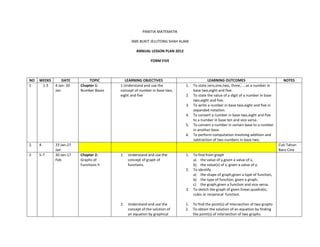
NO   WEEKS       DATE        TOPIC         LEARNING OBJECTIVES                            LEARNING OUTCOMES                             NOTES
1     1-3    4 Jan- 20   Chapter 1:     1.Understand and use the            1.   To state zero,one,two, three,…..as a number in
             Jan         Number Bases   concept of number in base two,           base two,eight and five.
                                        eight and five                      2.   To state the value of a digit of a number in base
                                                                                 two,eight and five.
                                                                            3.   To write a number in base two,eight and five in
                                                                                 expanded notation.
                                                                            4.   To convert a number in base two,eight and five
                                                                                 to a number in base ten and vice versa.
                                                                            5.   To convert a number in certain base to a number
                                                                                 in another base.
                                                                            6.   To perform computation involving addition and
                                                                                 subtraction of two numbers in base two.
2.   4       23 Jan-27                                                                                                                Cuti Tahun
             Jan                                                                                                                      Baru Cina
3    5-7     30 Jan-17   Chapter 2:     1.   Understand and use the         1.   To find from graph
             Feb         Graphs of           concept of graph of                 a) the value of y,given a value of x,
                         Functions II        functions.                          b) the value(s) of x, given a value of y.
                                                                            2.   To identify
                                                                                 a) the shape of graph,given a type of function,
                                                                                 b) the type of function, given a graph,
                                                                                 c) the graph,given a function and vice versa.
                                                                            3.   To sketch the graph of given linear,quadratic,
                                                                                 cubic or reciprocal function.

                                        2.   Understand and use the         1.   To find the point(s) of intersection of two graphs
                                             concept of the solution of     2.   To obtain the solution of an equation by finding
                                             an equation by graphical            the point(s) of intersection of two graphs.
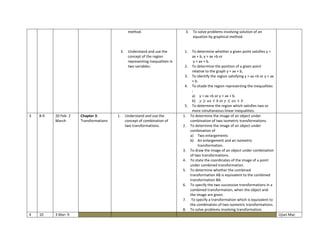
method.                         3.    To solve problems involving solution of an
                                                                                     equation by graphical method.


                                         3.    Understand and use the          1.    To determine whether a given point satisfies y =
                                               concept of the region                 ax + b, y > ax +b or
                                               representing inequalities in           y < ax + b.
                                               two variables.                  2.    To determine the position of a given point
                                                                                     relative to the graph y = ax + b,
                                                                               3.    To identify the region satisfying y > ax +b or y < ax
                                                                                     + b.
                                                                               4.    To shade the region representing the inequalities
                                                                                     :
                                                                                     a) y > ax +b or y < ax + b.
                                                                                     b)                or
                                                                               5.    To determine the region which satisfies two or
                                                                                     more simultaneous linear inequalities.
3   8-9   20 Feb- 2   Chapter 3:        1.    Understand and use the          1.    To determine the image of an object under
          March       Transformations         concept of combination of             combination of two isometric transformations.
                                              two transformations.            2.    To determine the image of an object under
                                                                                    combination of
                                                                                    a) Two enlargements
                                                                                    b) An enlargement and an isometric
                                                                                         transformation.
                                                                              3.    To draw the image of an object under combination
                                                                                    of two transformations.
                                                                              4.    To state the coordinates of the image of a point
                                                                                    under combined transformation.
                                                                              5.    To determine whether the combined
                                                                                    transformation AB is equivalent to the combined
                                                                                    transformation BA.
                                                                              6.    To specify the two successive transformations in a
                                                                                    combined transformation, when the object and
                                                                                    the image are given.
                                                                              7.     To specify a transformation which is equivalent to
                                                                                    the combination of two isometric transformations.
                                                                              8.    To solve problems involving transformation.
4   10    3 Mar- 9                                                                                                                           Ujian Mac
March
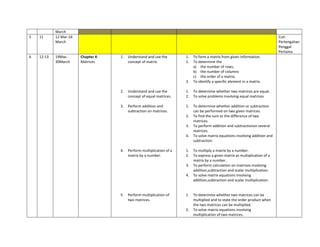
5   11      12 Mar-16                                                                                                           Cuti
            March                                                                                                               Pertengahan
                                                                                                                                Penggal
                                                                                                                                Pertama
6   12-13   19Mac-      Chapter 4:   1.   Understand and use the        1.   To form a matrix from given information.
            30March     Matrices          concept of matrix.            2.   To determine the
                                                                             a) the number of rows,
                                                                             b) the number of columns
                                                                             c) the order of a matrix.
                                                                        3.   To identify a specific element in a matrix.

                                     2.   Understand and use the        1.   To determine whether two matrices are equal.
                                          concept of equal matrices.    2.   To solve problems involving equal matrices

                                     3.   Perform addition and          1.   To determine whether addition or subtraction
                                          subtraction on matrices.           can be performed on two given matrices.
                                                                        2.   To find the sum or the difference of two
                                                                             matrices.
                                                                        3.   To perform addition and subtractionon several
                                                                             matrices.
                                                                        4.   To solve matrix equations involving addition and
                                                                             subtraction.

                                     4.   Perform multiplication of a   1.   To multiply a matrix by a number.
                                          matrix by a number.           2.   To express a given matrix as multiplication of a
                                                                             matrix by a number.
                                                                        3.   To perform calculation on matrices involving
                                                                             addition,subtraction and scalar multiplication.
                                                                        4.   To solve matrix equations involving
                                                                             addition,subtraction and scalar multiplication.


                                     5.   Perform multiplication of     1.   To determine whether two matrices can be
                                          two matrices.                      multiplied and to state the order product when
                                                                             the two matrices can be multiplied.
                                                                        2.   To solve matrix equations involving
                                                                             multiplication of two matrices.
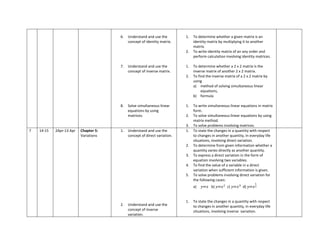
6.   Understand and use the         1.   To determine whether a given matrix is an
                                            concept of identity matrix.         identity matrix by multiplying it to another
                                                                                matrix.
                                                                           2.   To write identity matrix of an any order and
                                                                                perform calculation involving identity matrices.

                                       7.   Understand and use the         1.   To determine whether a 2 x 2 matrix is the
                                            concept of inverse matrix.          inverse matrix of another 2 x 2 matrix.
                                                                           2.   To find the inverse matrix of a 2 x 2 matrix by
                                                                                using
                                                                                a) method of solving simultaneous linear
                                                                                     equations,
                                                                                b) formula

                                       8.   Solve simultaneous linear      1.   To write simultaneous linear equations in matrix
                                            equations by using                  form.
                                            matrices.                      2.   To solve simultaneous linear equations by using
                                                                                matrix method.
                                                                           3.   To solve problems involving matrices.
7   14-15   2Apr-13 Apr   Chapter 5:   1.   Understand and use the         1.   To state the changes in a quantity with respect
                          Variations        concept of direct variation.        to changes in another quantity, in everyday life
                                                                                situations, involving direct variation.
                                                                           2.   To determine from given information whether a
                                                                                quantity varies directly as another quantity.
                                                                           3.   To express a direct variation in the form of
                                                                                equation involving two variables.
                                                                           4.   To find the value of a variable in a direct
                                                                                variation when sufficient information is given.
                                                                           5.   To solve problems involving direct variation for
                                                                                the following cases:
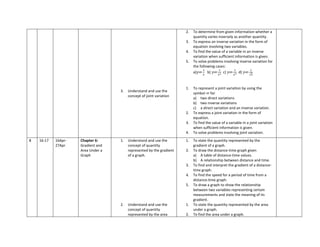
                                                                                a)         b)        c)        d)


                                                                           1.   To state the changes in a quantity with respect
                                       2.   Understand and use the              to changes in another quantity, in everyday life
                                            concept of inverse                  situations, involving inverse variation.
                                            variation.
2.   To determine from given information whether a
                                                                            quantity varies inversely as another quantity.
                                                                       3.   To express an inverse variation in the form of
                                                                            equation involving two variables.
                                                                       4.   To find the value of a variable in an inverse
                                                                            variation when sufficient information is given.
                                                                       5.   To solve problems involving inverse variation for
                                                                            the following cases:
                                                                            a)       b)        c)        d)


                                                                       1.   To represent a joint variation by using the
                                    3.   Understand and use the
                                                                            symbol for
                                         concept of joint variation
                                                                            a) two direct variations
                                                                            b) two inverse variations
                                                                            c) a direct variation and an inverse variation.
                                                                       2.   To express a joint variation in the form of
                                                                            equation.
                                                                       3.   To find the value of a variable in a joint variation
                                                                            when sufficient information is given.
                                                                       4.   To solve problems involving joint variation.
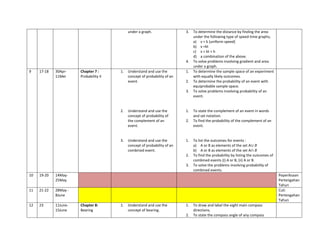
8   16-17   16Apr-   Chapter 6:     1.   Understand and use the        1.   To state the quantity represented by the
            27Apr    Gradient and        concept of quantity                gradient of a graph.
                     Area Under a        represented by the gradient   2.   To draw the distance-time graph given
                     Graph               of a graph.                        a) A table of distance-time values.
                                                                            b) A relationship between distance and time.
                                                                       3.   To find and interpret the gradient of a distance-
                                                                            time graph.
                                                                       4.   To find the speed for a period of time from a
                                                                            distance-time graph.
                                                                       5.   To draw a graph to show the relationship
                                                                            between two variables representing certain
                                                                            measurements and state the meaning of its
                                                                            gradient.
                                    2.   Understand and use the        1.   To state the quantity represented by the area
                                         concept of quantity                under a graph.
                                         represented by the area       2.   To find the area under a graph.
under a graph.                 3.   To determine the distance by finding the area
                                                                                 under the following type of speed-time graphs;
                                                                                 a) v = k (uniform speed)
                                                                                 b) v =kt
                                                                                 c) v = kt + h
                                                                                 d) a combination of the above.
                                                                            4.   To solve problems involving gradient and area
                                                                                 under a graph.
9    17-18   30Apr-    Chapter 7 :      1.   Understand and use the         1.   To determine the sample space of an experiment
             11Mei     Probability II        concept of probability of an        with equally likely outcomes.
                                             event.                         2.   To determine the probability of an event with
                                                                                 equiprobable sample space.
                                                                            3.   To solve problems involving probability of an
                                                                                 event.


                                        2.   Understand and use the         1.   To state the complement of an event in words
                                             concept of probability of           and set notation.
                                             the complement of an           2.   To find the probability of the complement of an
                                             event.                              event.


                                        3.   Understand and use the         1.   To list the outcomes for events :
                                             concept of probability of an        a) A or B as elements of the set A
                                             combined event.                     b) A or B as elements of the set A
                                                                            2.   To find the probability by listing the outcomes of
                                                                                 combined events (i) A or B, (ii) A or B.
                                                                            3.   To solve the problems involving probability of
                                                                                 combined events.
10   19-20   14May-                                                                                                                   Peperiksaan
             25May                                                                                                                    Pertengahan
                                                                                                                                      Tahun
11   21-22   28May -                                                                                                                  Cuti
             8June                                                                                                                    Pertengahan
                                                                                                                                      Tahun
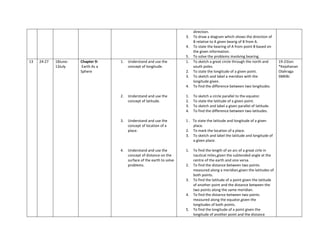
12   23      11June-   Chapter 8:       1.   Understand and use the         1.   To draw and label the eight main compass
             15June    Bearing               concept of bearing.                 directions.
                                                                            2.   To state the compass angle of any compass
direction.
                                                                         3.   To draw a diagram which shows the direction of
                                                                              B relative to A given bearig of B from A.
                                                                         4.   To state the bearing of A from point B based on
                                                                              the given information.
                                                                         5.   To solve the problems involving bearing.
13   24-27   18June-   Chapter 9:   1.   Understand and use the          1.   To sketch a great circle through the north and       19-23Jun
             13July    Earth As a        concept of longitude.                south poles.                                         *Kejohanan
                       Sphere                                            2.   To state the longitude of a given point.             Olahraga
                                                                         3.   To sketch and label a meridian with the              SMKBJ
                                                                              longitude given.
                                                                         4.   To find the difference between two longitudes.

                                    2.   Understand and use the          1.   To sketch a circle parallel to the equator.
                                         concept of latitude.            2.   To state the latitude of a given point.
                                                                         3.   To sketch and label a given parallel of latitude.
                                                                         4.   To find the difference between two latitudes.

                                    3.   Understand and use the          1 . To state the latitude and longitude of a given
                                         concept of location of a            place.
                                         place.                          2. To mark the location of a place.
                                                                         3. To sketch and label the latitude and longitude of
                                                                             a given place.

                                    4.   Understand and use the          1.   To find the length of an arc of a great cirle in
                                         concept of distance on the           nautical miles,given the subtended angle at the
                                         surface of the earth to solve        centre of the earth and vice versa.
                                         problems.                       2.   To find the distance between two points
                                                                              measured along a meridian,given the latitudes of
                                                                              both points.
                                                                         3.   To find the latitude of a point given the latitude
                                                                              of another point and the distance between the
                                                                              two points along the same meridian.
                                                                         4.   To find the distance between two points
                                                                              measured along the equator,given the
                                                                              longitudes of both points.
                                                                         5.   To find the longitude of a point given the
                                                                              longitude of another point and the distance
between the two points along the equator.
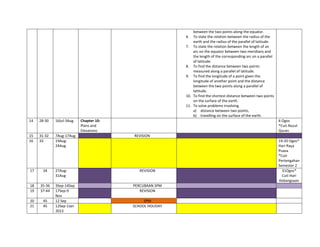
                                                         6.  To state the relation between the radius of the
                                                             earth and the radius of the parallel of latitude.
                                                         7. To state the relation between the length of an
                                                             arc on the equator between two meridians and
                                                             the length of the corresponding arc on a parallel
                                                             of latitude.
                                                         8. To find the distance between two points
                                                             measured along a parallel of latitude.
                                                         9. To find the longitude of a point given the
                                                             longitude of another point and the distance
                                                             between the two points along a parallel of
                                                             latitude.
                                                         10. To find the shortest distance between two points
                                                             on the surface of the earth.
                                                         11. To solve problems involving
                                                             a) distance between two points,
                                                             b) travelling on the surface of the earth.
14   28-30   16Jul-3Aug   Chapter 10:                                                                            6 Ogos
                          Plans and                                                                              *Cuti Nuzul
                          Elevations                                                                             Quran
15   31-32   7Aug-17Aug                 REVISION
16   33      19Aug-                                                                                              19-20 Ogos*
             24Aug                                                                                               Hari Raya
                                                                                                                 Puasa
                                                                                                                 *Cuti
                                                                                                                 Pertengahan
                                                                                                                 Semester 2
17     34    27Aug-                        REVISION                                                                31Ogos*
             31Aug                                                                                                 Cuti Hari
                                                                                                                 Kebangsaan
18   35-36   3Sep-14Sep                 PERCUBAAN SPM
19   37-44   17Sep-9                       REVISION
             Nov
20     45    12 Sep                          SPM
21     45    12Sep-1Jan                 SCHOOL HOLIDAY
             2013
Annual lesson plan 2012

Annual lesson plan 2012

  • 1.
    PANITIA MATEMATIK SMK BUKIT JELUTONG SHAH ALAM ANNUAL LESSON PLAN 2012 FORM FIVE NO WEEKS DATE TOPIC LEARNING OBJECTIVES LEARNING OUTCOMES NOTES 1 1-3 4 Jan- 20 Chapter 1: 1.Understand and use the 1. To state zero,one,two, three,…..as a number in Jan Number Bases concept of number in base two, base two,eight and five. eight and five 2. To state the value of a digit of a number in base two,eight and five. 3. To write a number in base two,eight and five in expanded notation. 4. To convert a number in base two,eight and five to a number in base ten and vice versa. 5. To convert a number in certain base to a number in another base. 6. To perform computation involving addition and subtraction of two numbers in base two. 2. 4 23 Jan-27 Cuti Tahun Jan Baru Cina 3 5-7 30 Jan-17 Chapter 2: 1. Understand and use the 1. To find from graph Feb Graphs of concept of graph of a) the value of y,given a value of x, Functions II functions. b) the value(s) of x, given a value of y. 2. To identify a) the shape of graph,given a type of function, b) the type of function, given a graph, c) the graph,given a function and vice versa. 3. To sketch the graph of given linear,quadratic, cubic or reciprocal function. 2. Understand and use the 1. To find the point(s) of intersection of two graphs concept of the solution of 2. To obtain the solution of an equation by finding an equation by graphical the point(s) of intersection of two graphs.
  • 2.
    method. 3. To solve problems involving solution of an equation by graphical method. 3. Understand and use the 1. To determine whether a given point satisfies y = concept of the region ax + b, y > ax +b or representing inequalities in y < ax + b. two variables. 2. To determine the position of a given point relative to the graph y = ax + b, 3. To identify the region satisfying y > ax +b or y < ax + b. 4. To shade the region representing the inequalities : a) y > ax +b or y < ax + b. b) or 5. To determine the region which satisfies two or more simultaneous linear inequalities. 3 8-9 20 Feb- 2 Chapter 3: 1. Understand and use the 1. To determine the image of an object under March Transformations concept of combination of combination of two isometric transformations. two transformations. 2. To determine the image of an object under combination of a) Two enlargements b) An enlargement and an isometric transformation. 3. To draw the image of an object under combination of two transformations. 4. To state the coordinates of the image of a point under combined transformation. 5. To determine whether the combined transformation AB is equivalent to the combined transformation BA. 6. To specify the two successive transformations in a combined transformation, when the object and the image are given. 7. To specify a transformation which is equivalent to the combination of two isometric transformations. 8. To solve problems involving transformation. 4 10 3 Mar- 9 Ujian Mac
  • 3.
    March 5 11 12 Mar-16 Cuti March Pertengahan Penggal Pertama 6 12-13 19Mac- Chapter 4: 1. Understand and use the 1. To form a matrix from given information. 30March Matrices concept of matrix. 2. To determine the a) the number of rows, b) the number of columns c) the order of a matrix. 3. To identify a specific element in a matrix. 2. Understand and use the 1. To determine whether two matrices are equal. concept of equal matrices. 2. To solve problems involving equal matrices 3. Perform addition and 1. To determine whether addition or subtraction subtraction on matrices. can be performed on two given matrices. 2. To find the sum or the difference of two matrices. 3. To perform addition and subtractionon several matrices. 4. To solve matrix equations involving addition and subtraction. 4. Perform multiplication of a 1. To multiply a matrix by a number. matrix by a number. 2. To express a given matrix as multiplication of a matrix by a number. 3. To perform calculation on matrices involving addition,subtraction and scalar multiplication. 4. To solve matrix equations involving addition,subtraction and scalar multiplication. 5. Perform multiplication of 1. To determine whether two matrices can be two matrices. multiplied and to state the order product when the two matrices can be multiplied. 2. To solve matrix equations involving multiplication of two matrices.
  • 4.
    6. Understand and use the 1. To determine whether a given matrix is an concept of identity matrix. identity matrix by multiplying it to another matrix. 2. To write identity matrix of an any order and perform calculation involving identity matrices. 7. Understand and use the 1. To determine whether a 2 x 2 matrix is the concept of inverse matrix. inverse matrix of another 2 x 2 matrix. 2. To find the inverse matrix of a 2 x 2 matrix by using a) method of solving simultaneous linear equations, b) formula 8. Solve simultaneous linear 1. To write simultaneous linear equations in matrix equations by using form. matrices. 2. To solve simultaneous linear equations by using matrix method. 3. To solve problems involving matrices. 7 14-15 2Apr-13 Apr Chapter 5: 1. Understand and use the 1. To state the changes in a quantity with respect Variations concept of direct variation. to changes in another quantity, in everyday life situations, involving direct variation. 2. To determine from given information whether a quantity varies directly as another quantity. 3. To express a direct variation in the form of equation involving two variables. 4. To find the value of a variable in a direct variation when sufficient information is given. 5. To solve problems involving direct variation for the following cases: a) b) c) d) 1. To state the changes in a quantity with respect 2. Understand and use the to changes in another quantity, in everyday life concept of inverse situations, involving inverse variation. variation.
  • 5.
    2. To determine from given information whether a quantity varies inversely as another quantity. 3. To express an inverse variation in the form of equation involving two variables. 4. To find the value of a variable in an inverse variation when sufficient information is given. 5. To solve problems involving inverse variation for the following cases: a) b) c) d) 1. To represent a joint variation by using the 3. Understand and use the symbol for concept of joint variation a) two direct variations b) two inverse variations c) a direct variation and an inverse variation. 2. To express a joint variation in the form of equation. 3. To find the value of a variable in a joint variation when sufficient information is given. 4. To solve problems involving joint variation. 8 16-17 16Apr- Chapter 6: 1. Understand and use the 1. To state the quantity represented by the 27Apr Gradient and concept of quantity gradient of a graph. Area Under a represented by the gradient 2. To draw the distance-time graph given Graph of a graph. a) A table of distance-time values. b) A relationship between distance and time. 3. To find and interpret the gradient of a distance- time graph. 4. To find the speed for a period of time from a distance-time graph. 5. To draw a graph to show the relationship between two variables representing certain measurements and state the meaning of its gradient. 2. Understand and use the 1. To state the quantity represented by the area concept of quantity under a graph. represented by the area 2. To find the area under a graph.
  • 6.
    under a graph. 3. To determine the distance by finding the area under the following type of speed-time graphs; a) v = k (uniform speed) b) v =kt c) v = kt + h d) a combination of the above. 4. To solve problems involving gradient and area under a graph. 9 17-18 30Apr- Chapter 7 : 1. Understand and use the 1. To determine the sample space of an experiment 11Mei Probability II concept of probability of an with equally likely outcomes. event. 2. To determine the probability of an event with equiprobable sample space. 3. To solve problems involving probability of an event. 2. Understand and use the 1. To state the complement of an event in words concept of probability of and set notation. the complement of an 2. To find the probability of the complement of an event. event. 3. Understand and use the 1. To list the outcomes for events : concept of probability of an a) A or B as elements of the set A combined event. b) A or B as elements of the set A 2. To find the probability by listing the outcomes of combined events (i) A or B, (ii) A or B. 3. To solve the problems involving probability of combined events. 10 19-20 14May- Peperiksaan 25May Pertengahan Tahun 11 21-22 28May - Cuti 8June Pertengahan Tahun 12 23 11June- Chapter 8: 1. Understand and use the 1. To draw and label the eight main compass 15June Bearing concept of bearing. directions. 2. To state the compass angle of any compass
  • 7.
    direction. 3. To draw a diagram which shows the direction of B relative to A given bearig of B from A. 4. To state the bearing of A from point B based on the given information. 5. To solve the problems involving bearing. 13 24-27 18June- Chapter 9: 1. Understand and use the 1. To sketch a great circle through the north and 19-23Jun 13July Earth As a concept of longitude. south poles. *Kejohanan Sphere 2. To state the longitude of a given point. Olahraga 3. To sketch and label a meridian with the SMKBJ longitude given. 4. To find the difference between two longitudes. 2. Understand and use the 1. To sketch a circle parallel to the equator. concept of latitude. 2. To state the latitude of a given point. 3. To sketch and label a given parallel of latitude. 4. To find the difference between two latitudes. 3. Understand and use the 1 . To state the latitude and longitude of a given concept of location of a place. place. 2. To mark the location of a place. 3. To sketch and label the latitude and longitude of a given place. 4. Understand and use the 1. To find the length of an arc of a great cirle in concept of distance on the nautical miles,given the subtended angle at the surface of the earth to solve centre of the earth and vice versa. problems. 2. To find the distance between two points measured along a meridian,given the latitudes of both points. 3. To find the latitude of a point given the latitude of another point and the distance between the two points along the same meridian. 4. To find the distance between two points measured along the equator,given the longitudes of both points. 5. To find the longitude of a point given the longitude of another point and the distance
  • 8.
    between the twopoints along the equator. 6. To state the relation between the radius of the earth and the radius of the parallel of latitude. 7. To state the relation between the length of an arc on the equator between two meridians and the length of the corresponding arc on a parallel of latitude. 8. To find the distance between two points measured along a parallel of latitude. 9. To find the longitude of a point given the longitude of another point and the distance between the two points along a parallel of latitude. 10. To find the shortest distance between two points on the surface of the earth. 11. To solve problems involving a) distance between two points, b) travelling on the surface of the earth. 14 28-30 16Jul-3Aug Chapter 10: 6 Ogos Plans and *Cuti Nuzul Elevations Quran 15 31-32 7Aug-17Aug REVISION 16 33 19Aug- 19-20 Ogos* 24Aug Hari Raya Puasa *Cuti Pertengahan Semester 2 17 34 27Aug- REVISION 31Ogos* 31Aug Cuti Hari Kebangsaan 18 35-36 3Sep-14Sep PERCUBAAN SPM 19 37-44 17Sep-9 REVISION Nov 20 45 12 Sep SPM 21 45 12Sep-1Jan SCHOOL HOLIDAY 2013