Annual Audit Preparation
Presented by
Christy Cubbage and Catherine Jay
Topics
1. What is an audit?
2. Does my organization need an audit?
3. How do I prepare for an audit?
4. Best practices and tools for a successful audit
What is an Audit?
An independent audit is an examination of the financial records,
accounts, business transactions, accounting practices, and internal
controls of a charitable nonprofit by an "independent" auditor.
"Independent" refers to the fact that the auditor/CPA is not an
employee of the nonprofit but instead is retained through a
contract for services, and hence is "independent."
The auditor is auditing a full set of financial reports prepared by the
Organization, they are not preparing the reports as part of the
process
Audit Testing
1. Analytical Procedures
2. Control Testing
3. Substantive Testing
The Audit Report
Opinion
• Qualified vs. Unqualified
Basis for opinion
Management Responsibility
Auditor Responsibility
The Management Letter
Communicating Internal Control Matters Identified in
an Audit
Deficiency in Internal control
• Design versus Operation
Material Weakness
• Reasonably possible versus probable
Significant Deficiency
Based on magnitude, likelihood, and mitigating
controls
Do I Need an Audit?
Not all charitable nonprofits are required to conduct an independent audit. Circumstances
that may trigger the requirement for an independent audit include:
• Federal, state, and local governments may request a copy of the organization's audited
financial statements.
• Nonprofits that expend $750,000 or more in federal funds in a year are subject to
special audit requirements.
• Some contracts with state and local governments to provide services in the community
may require the nonprofit to conduct an independent audit.
• Many state laws require that charitable nonprofits submit a copy of their audited
financial statements when they register with the state for charitable
solicitation/fundraising purposes.
• Funders may request that a nonprofit submit a copy of the nonprofit’s most recent
audited financial statements in conjunction with submitting a grant proposal.
• Some banks may require a nonprofit to have an audit as a condition of receiving a loan.
If a charitable nonprofit is small and has not conducted an audit due to the cost, the
nonprofit should not be shy about asking the funder if a more affordable method of
evaluating the nonprofit's financial positions would be acceptable, such as a review of
certified financial statements.
Preparing for an Audit
There is a lot your nonprofit can do to prepare for the audit that will
result in a smooth audit for your staff and for the auditors.
The engagement letter (or Request for Proposal) can be considered
a roadmap of what to expect during the audit. It will usually include
the following basic terms:
• A description of services to be performed
• What the organization's staff will be responsible for
• The fees charged for the audit and related work
• Start date and completion date for the audit
Preparing for an Audit
1. Communications:
• Strategic plan
• New programs
• Key management turnover
• Federal and state grants
• Investments
• Lawsuits
2. Documents:
• Bylaw changes
• Board meeting minutes
• Leases
• Grant agreements and budgets
• Fundraising material
• Special event P&L
There are a number of documents your nonprofit can gather in
advance that will save time and money and result in less
distraction for your staff during the audit.
Preparing for an Audit
3. Document Internal Controls
• Focus on major transaction cycles
• Origin of the transaction, steps in the process
and who does them
• What could go wrong? What prevents it from
going wrong? Who monitors the process?
• Format can be a matrix, flowchart, or narrative,
whichever works best for you and the auditor
Preparing for an Audit
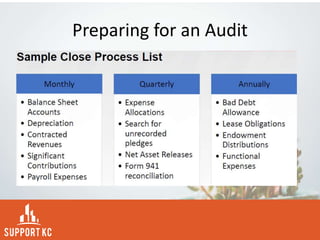
4. Monthly/Quarterly/Annual Close
• Roll forward prior year audit schedules each
month
• Gather 3rd party reports and statements
• Document unusual transactions
Preparing for an Audit
5. Review Prior Year Audit
Preparing for an Audit
6. Review Estimates
• Depreciation and amortization
• Prepaid expenses
• Investment values
• In-kind revenue and expense
7. Work with the auditor
• Make a plan
• Fieldwork dates, interim and final deadlines
• Assign ownership to the tasks
• Communicate any changes to the plan
• Allow time for internal review
Best Practices and Tools
1. Create an Audit Folder at the beginning of the Year
• Gather copies of documents during the year
• Send to auditors at planning meeting
2. Treat the Internal Control worksheet as a living
document
• Employee turnover/position alignment
• New software affect on internal controls
Best Practices and Tools
3. Document Performance of Internal Controls
• Audit trails recorded by software
• Documentation of review
4. Communicate throughout the year
• Ask questions as they come up
• Learn together
Best Practices and Tools
5. Build the audit plan around the PBC list
• PBC = prepared by client
• Refer to prior year list until you receive the
current year list
• Organize files the way the list has them
6. Plan staff time for pulling audit selections
Best Practices and Tools
7. Be familiar with any new software
• Reports
• Audit trails
8. Audit yourself
• Quarterly review of balance sheet items
• Documentation and procedures
• Fraud risk assessment
Best Practices and Tools
9. Utilize Support Kansas City
• Include SKC as part of the process
• Meeting with Auditor before field work begins
• Audit Debrief
10.Be Aware of Accounting Standards
• Revenue Recognition
• Leases
• In-Kind
Thank You!
Christy Cubbage
christyc@supportkc.org
Catherine Jay catherinej@supportkc.org

Annual Audit Prep Slide Presentation.pptx

  • 1.
    Annual Audit Preparation Presentedby Christy Cubbage and Catherine Jay
  • 2.
    Topics 1. What isan audit? 2. Does my organization need an audit? 3. How do I prepare for an audit? 4. Best practices and tools for a successful audit
  • 3.
    What is anAudit? An independent audit is an examination of the financial records, accounts, business transactions, accounting practices, and internal controls of a charitable nonprofit by an "independent" auditor. "Independent" refers to the fact that the auditor/CPA is not an employee of the nonprofit but instead is retained through a contract for services, and hence is "independent." The auditor is auditing a full set of financial reports prepared by the Organization, they are not preparing the reports as part of the process
  • 4.
    Audit Testing 1. AnalyticalProcedures 2. Control Testing 3. Substantive Testing
  • 5.
    The Audit Report Opinion •Qualified vs. Unqualified Basis for opinion Management Responsibility Auditor Responsibility
  • 6.
    The Management Letter CommunicatingInternal Control Matters Identified in an Audit Deficiency in Internal control • Design versus Operation Material Weakness • Reasonably possible versus probable Significant Deficiency Based on magnitude, likelihood, and mitigating controls
  • 7.
    Do I Needan Audit? Not all charitable nonprofits are required to conduct an independent audit. Circumstances that may trigger the requirement for an independent audit include: • Federal, state, and local governments may request a copy of the organization's audited financial statements. • Nonprofits that expend $750,000 or more in federal funds in a year are subject to special audit requirements. • Some contracts with state and local governments to provide services in the community may require the nonprofit to conduct an independent audit. • Many state laws require that charitable nonprofits submit a copy of their audited financial statements when they register with the state for charitable solicitation/fundraising purposes. • Funders may request that a nonprofit submit a copy of the nonprofit’s most recent audited financial statements in conjunction with submitting a grant proposal. • Some banks may require a nonprofit to have an audit as a condition of receiving a loan. If a charitable nonprofit is small and has not conducted an audit due to the cost, the nonprofit should not be shy about asking the funder if a more affordable method of evaluating the nonprofit's financial positions would be acceptable, such as a review of certified financial statements.
  • 8.
    Preparing for anAudit There is a lot your nonprofit can do to prepare for the audit that will result in a smooth audit for your staff and for the auditors. The engagement letter (or Request for Proposal) can be considered a roadmap of what to expect during the audit. It will usually include the following basic terms: • A description of services to be performed • What the organization's staff will be responsible for • The fees charged for the audit and related work • Start date and completion date for the audit
  • 9.
    Preparing for anAudit 1. Communications: • Strategic plan • New programs • Key management turnover • Federal and state grants • Investments • Lawsuits 2. Documents: • Bylaw changes • Board meeting minutes • Leases • Grant agreements and budgets • Fundraising material • Special event P&L There are a number of documents your nonprofit can gather in advance that will save time and money and result in less distraction for your staff during the audit.
  • 10.
    Preparing for anAudit 3. Document Internal Controls • Focus on major transaction cycles • Origin of the transaction, steps in the process and who does them • What could go wrong? What prevents it from going wrong? Who monitors the process? • Format can be a matrix, flowchart, or narrative, whichever works best for you and the auditor
  • 11.
    Preparing for anAudit 4. Monthly/Quarterly/Annual Close • Roll forward prior year audit schedules each month • Gather 3rd party reports and statements • Document unusual transactions
  • 12.
    Preparing for anAudit 5. Review Prior Year Audit
  • 13.
  • 14.
    Preparing for anAudit 6. Review Estimates • Depreciation and amortization • Prepaid expenses • Investment values • In-kind revenue and expense 7. Work with the auditor • Make a plan • Fieldwork dates, interim and final deadlines • Assign ownership to the tasks • Communicate any changes to the plan • Allow time for internal review
  • 15.
    Best Practices andTools 1. Create an Audit Folder at the beginning of the Year • Gather copies of documents during the year • Send to auditors at planning meeting 2. Treat the Internal Control worksheet as a living document • Employee turnover/position alignment • New software affect on internal controls
  • 16.
    Best Practices andTools 3. Document Performance of Internal Controls • Audit trails recorded by software • Documentation of review 4. Communicate throughout the year • Ask questions as they come up • Learn together
  • 17.
    Best Practices andTools 5. Build the audit plan around the PBC list • PBC = prepared by client • Refer to prior year list until you receive the current year list • Organize files the way the list has them 6. Plan staff time for pulling audit selections
  • 18.
    Best Practices andTools 7. Be familiar with any new software • Reports • Audit trails 8. Audit yourself • Quarterly review of balance sheet items • Documentation and procedures • Fraud risk assessment
  • 19.
    Best Practices andTools 9. Utilize Support Kansas City • Include SKC as part of the process • Meeting with Auditor before field work begins • Audit Debrief 10.Be Aware of Accounting Standards • Revenue Recognition • Leases • In-Kind
  • 20.