Non-profit Financial
  Fundamentals
  Essentials to a Healthy Non-profit
Welcome


• Introductions

• Your take-a-ways…
  –
    For your organization
  –
    For you personally
Financial Management’s
Primary Role:

To control and direct the
 resources of an organization in
 support of the mission and
 goals.
Our Objectives ……

• Provide an overview of the elements for sound
  financial management.

• Understand the fundamentals of financial
  management, why they are important, and how to
  implement them.

• Understand the tools necessary to manage grants
  and financial resources.

• Complete a self evaluation action plan that will
  improve your organizations grant readiness and
  improve your financial management capacity.
Financial Management
Elements
•   Strong Budget Process

•   Timely Management Reports

•   Strong Internal Controls

•   Consistent Documentation

•   Self Assessment & Capacity Development
    Plan.
Financial Management Benefits

• Provides a financial plan to support
  achievement of goals.
• Promotes proactive decisions, not reactive
  ones.
• Establishes trust and confidence in donors
  and grantors.
• Provides a means to access more resources.

• Ensures integrity in the stewardship of the
  resources you have.
Illustrations & Examples

• Structural steel in a building…
• Engineering on Star Trek…
•
•
•
•
What characteristics are
critical to making a successful …

•   Farmer ……
•   Coach ……
•   Parent ……
•   Teacher ……
•   Grocer ……
The Faithful Fruitful Farmer
Let’s start with a story….


  Food & Warmth Inc.
Food & Warmth Inc.

• Read the Case:
  –
   What are the issues / problems
   you observe ?

 –
  What are the requirements to
  earn the grant ?
Element #1: Strong Budget
Process


A budget is the foundation for all
 financial management.
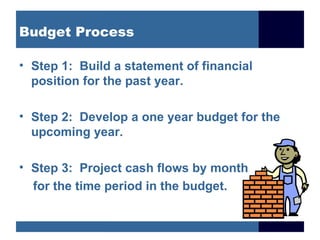
Budget Process

• Step 1: Build a statement of financial
  position for the past year.

• Step 2: Develop a one year budget for the
  upcoming year.

• Step 3: Project cash flows by month
  for the time period in the budget.
Budget Process Building Blocks

• Chart of Accounts & Accounting System

• Track Revenue by Source of Income

• Track Expenses by Administration, Fund Raising
  and Program.

• Track Revenue and Expenses by Grant & In-Kind
  Giving

• Project Cash Flow
Chart of Accounts

Simply stated the chart of accounts
  allows you to categorize all financial
  transactions. It is the foundational
  building block for financial information
  and reports.
Example Chart of Accounts

•   What are the elements / categories you see
    in this example chart of accounts?

•   What is missing from this chart of
    accounts? What accounts do you use in
    your own organization?

•   How would this chart of accounts be useful
    in your role as the Food & Warmth Financial
    Manager?
Review Food & Warmth Inc.


•   Review the Budget Table. Does it provide
    for everything you need to satisfy the grant
    requirements?

•   What is still missing?

•   How does it compare to your own
    organizations budget?
Anticipate Your Cash Needs


Project cash flows by month for the time
 period reflected in the budget.
Budget Process Skills

• You can categorize and track different sources of revenue by
  program/department.

• You can separate out your administrative costs, fund raising
  costs, and program costs.

• You can report at least one past year of historical revenue and
  expenses.

• You can track grant specific revenue and expenses for the
  portion funded by the grantor and the part funded by your
  organization.

• You can forecast net cash flow by month.
Self Evaluation Check List:
#1: Strong Budget Process
• Review #s 1-17
Element # 2 Timely Management
Reports:
Reports provide the opportunity to focus
• on the right things,

•   demonstrate faithful stewardship,

•   provide valuable information that guides
    and supports decision making in achieving
    the mission of your organization.
Management Reports Building
Blocks
• Timely: Ensure all deadlines are met.
• Accurate: Use accounting data that has been
  reviewed.
• Complete: Contain all pertinent information relating
  to the reporting period.
• Identify costs by year and budget category.
• Account for each grant separately.
• Distinguish administrative, fund raising,
  and program costs.
• Track program outcomes and indicators.
Suggested Monthly Reports

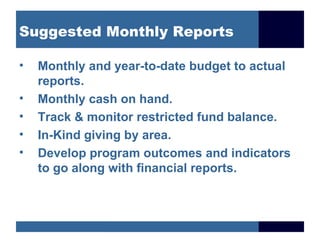
•   Monthly and year-to-date budget to actual
    reports.
•   Monthly cash on hand.
•   Track & monitor restricted fund balance.
•   In-Kind giving by area.
•   Develop program outcomes and indicators
    to go along with financial reports.
Develop Reporting Skills

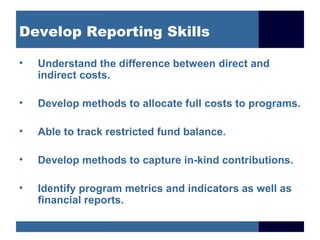
•   Understand the difference between direct and
    indirect costs.

•   Develop methods to allocate full costs to programs.

•   Able to track restricted fund balance.

•   Develop methods to capture in-kind contributions.

•   Identify program metrics and indicators as well as
    financial reports.
Indirect Cost Exercise

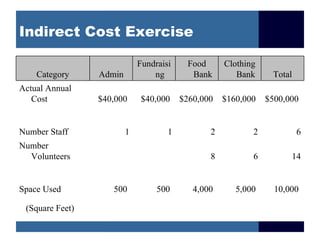
                             Fundraisi    Food      Clothing
    Category     Admin           ng        Bank        Bank     Total
Actual Annual
   Cost          $40,000      $40,000    $260,000   $160,000   $500,000


Number Staff             1           1          2          2            6
Number
  Volunteers                                    8          6         14


Space Used          500           500       4,000      5,000     10,000

 (Square Feet)
Food & Clothing Inc. Example

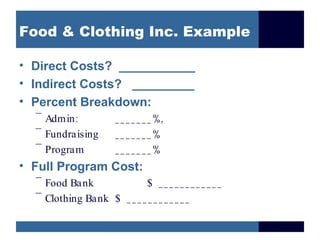
• Direct Costs? ___________
• Indirect Costs? _________
• Percent Breakdown:
  –
    Admin :        _ _ _ _ _ _ _ %,
  –
    Fundraising    _______%
  –
    Program        _______%
• Full Program Cost:
  –
    Food Bank              $ ____________
  –
    Clothing Bank $ _ _ _ _ _ _ _ _ _ _ _ _
Self Evaluation Check List:
#2: Timely Management Reports

• Review #s 18-22
Element #3: Strong Internal
Controls
The purpose of internal controls is to:

• Ensure expenditures are spent only upon
  proper authorization of management, for
  valid business purposes

• Ensure all disbursements are properly
  recorded.
“Opportunity facilitates Temptation”

• Appropriate internal controls will protect
  your organization and your people.

• Given opportunity:
  –
    even an honest individual will be tempted .
  –
    an honest individual in great need is at great risk of
    compromising their values .
  –
    a dishonest individual will award you with responsibility
    for their fraudulent behavior.
Internal Control Building Blocks

1.   Board Approved Budget
2.   Establish authority and process limits.
3.   Cash management.
4.   Segregation of duties.
5.   Restricted fund management.
6.   Establish performance standards.
7.   Three bid requirement.
1. Budget ; 2. Authority

•   Board Approved Budget: The Board reviews and
    approves the annual budget .

2. Established authority limits: Identify who is
     authorized to spend money and at what limit . Areas to
     set limits include the following:
    –
        Determine who is a signer on each bank account .
    –
        Set signature authority limits :
       • For example: Checks over $5,000 require two signatures.
       • Program Director can authorize spending up to $500 without
         Executive Director approval.
3. Cash Management

• Two count cash at all times

• Petty Cash account documentation
  and reconciliation.

• Target the number of days cash to
  have on hand.
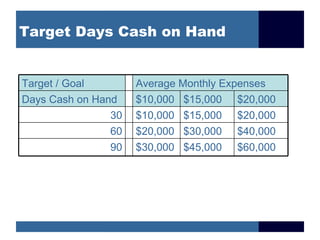
Target Days Cash on Hand


Target / Goal        Average Monthly Expenses
Days Cash on Hand    $10,000 $15,000 $20,000
                30   $10,000 $15,000 $20,000
                60   $20,000 $30,000 $40,000
                90   $30,000 $45,000 $60,000
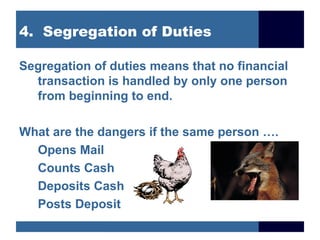
4. Segregation of Duties

Segregation of duties means that no financial
  transaction is handled by only one person
  from beginning to end.

What are the dangers if the same person ….
  Opens Mail
  Counts Cash
  Deposits Cash
  Posts Deposit
Design Segregation of Duties

• For your own organization fill out the Actual
  segregation of duties worksheet.

• Exchange your sheet with someone else and
  talk through how you could increase
  segregation of duties.

• Use the “Revised Segregation of Duties” to
  make any recommended changes. Think
  about non financial donated items as well.
5. Restricted Fund Management

Money which has been restricted by the donor
 for a specific use.

For example: Buying a new building or starting
  a new program, should only be used for the
  purpose for which it has been given.
Restricted Funds

• Receipt of grant funds usually is
  accompanied by a contract which spells out
  how the funds can be used.

• Develop a method to review the status of
  restricted funds on a monthly basis.
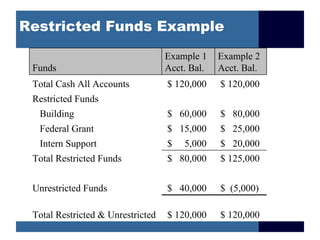
Restricted Funds Example
                                   Example 1    Example 2
 Funds                             Acct. Bal.   Acct. Bal.
 Total Cash All Accounts           $ 120,000    $ 120,000
 Restricted Funds
  Building                         $ 60,000     $ 80,000
  Federal Grant                    $ 15,000     $ 25,000
  Intern Support                   $   5,000    $ 20,000
 Total Restricted Funds            $ 80,000     $ 125,000


 Unrestricted Funds                $ 40,000     $ (5,000)

 Total Restricted & Unrestricted   $ 120,000    $ 120,000
1. Establish Performance
   Standards
Establish goals for timeliness and accuracy.
•   Bill and reimbursement payment.
•   Deposits: Daily, no cash overnight.
•   Receipts.
•   Filing.
•   Account reconciliation monthly.
•   Treasurer review monthly;
    –
        Cash on hand
    –
        Restricted fund balances
    –
        Bank account reconciliations
7. Three Bid Requirement

Some grants require you to get three bids on
 purchases over a certain threshold. $500 is a
 common threshold. For example, purchase
 of a computer or lap top with software would
 require you to solicit three bids before
 purchase. Documentation of the bids would
 need to be saved.

See example “Procurement Form”
Building Your Capacity

• Take the time to formalize your internal
  controls in the form of board approved
  policies and procedures.

• Plan to review your policies and revise them
  as needed at least annually.

• If you don’t start…it won’t get done.
Self Evaluation Check List:
#3: Strong Internal Controls

• Review #s 23-35
Element #4: Consistent Documentation:
Financial & Program Activity

Documentation demonstrates stewardship and
  accountability in your organization relative
  the financial transactions.

It is being faithful in the daily “little” things that
     will prepare you for the trust donors and
     grantors will give you for greater resources.
Documentation Building Blocks:


•   Donations:
•   Expenses:
•   Bank Reconciliation
•   In-kind contributions.
•   Time sheets
•   Sign-In sheets
Principles of Documentation

•   Date
•   Signature
•   Sign in Sheet
•   Purpose
•   Originals filed
•   Use a three ring binder
Review of Example Forms

•   Request for Reimbursement
•   Request for Expenditure
•   Debit Card Expenditure
•   Electronic Funds Expenditure
•   Bank Transfer Authorization
•   Time Sheet
•   Volunteer Time Sheet
Building Your Capacity

Develop the forms and process that will
 provide an efficient and accurate audit trail.
Self Evaluation Check List:
#4: Consistent Accurate Documentation

• Review #s 36-42
Element #5: Self Assessment
& Capacity Development Plan.
• The key improving is to determine
  what you need to work on, and get
  busy.

• Set your goals to incrementally
  improve.
Self Assessment & Capacity
Building Blocks
• Complete a self evaluation & take action.

• Develop the areas that will make you ready
  for grants.

• Complete an outside audit.
Key Elements for Grant
Readiness
•   Chart of accounts and accounting software that
    supports segmentation and reporting of revenue
    and expenses by grant.

•   Internal controls that ensure grant funds are
    expended according to the grant.

•   Capacity to add the additional work not only for
    grant program implementation, but in the
    accounting and administrative areas.

•   Develop a clear idea of what you need resources
    for.
Fundamental Financial Elements

•   Strong Budget Process

•   Timely Management Reports

•   Strong Internal Controls

•   Consistent Documentation

•   Self Assessment & Capacity Development
    Plan.
“Daily” “Faithful” & “Fruitful”

Final CCF RFP

  • 1.
    Non-profit Financial Fundamentals Essentials to a Healthy Non-profit
  • 2.
    Welcome • Introductions • Yourtake-a-ways… – For your organization – For you personally
  • 3.
    Financial Management’s Primary Role: Tocontrol and direct the resources of an organization in support of the mission and goals.
  • 4.
    Our Objectives …… •Provide an overview of the elements for sound financial management. • Understand the fundamentals of financial management, why they are important, and how to implement them. • Understand the tools necessary to manage grants and financial resources. • Complete a self evaluation action plan that will improve your organizations grant readiness and improve your financial management capacity.
  • 5.
    Financial Management Elements • Strong Budget Process • Timely Management Reports • Strong Internal Controls • Consistent Documentation • Self Assessment & Capacity Development Plan.
  • 6.
    Financial Management Benefits •Provides a financial plan to support achievement of goals. • Promotes proactive decisions, not reactive ones. • Establishes trust and confidence in donors and grantors. • Provides a means to access more resources. • Ensures integrity in the stewardship of the resources you have.
  • 7.
    Illustrations & Examples •Structural steel in a building… • Engineering on Star Trek… • • • •
  • 8.
    What characteristics are criticalto making a successful … • Farmer …… • Coach …… • Parent …… • Teacher …… • Grocer ……
  • 9.
  • 10.
    Let’s start witha story…. Food & Warmth Inc.
  • 11.
    Food & WarmthInc. • Read the Case: – What are the issues / problems you observe ? – What are the requirements to earn the grant ?
  • 12.
    Element #1: StrongBudget Process A budget is the foundation for all financial management.
  • 13.
    Budget Process • Step1: Build a statement of financial position for the past year. • Step 2: Develop a one year budget for the upcoming year. • Step 3: Project cash flows by month for the time period in the budget.
  • 14.
    Budget Process BuildingBlocks • Chart of Accounts & Accounting System • Track Revenue by Source of Income • Track Expenses by Administration, Fund Raising and Program. • Track Revenue and Expenses by Grant & In-Kind Giving • Project Cash Flow
  • 15.
    Chart of Accounts Simplystated the chart of accounts allows you to categorize all financial transactions. It is the foundational building block for financial information and reports.
  • 16.
    Example Chart ofAccounts • What are the elements / categories you see in this example chart of accounts? • What is missing from this chart of accounts? What accounts do you use in your own organization? • How would this chart of accounts be useful in your role as the Food & Warmth Financial Manager?
  • 17.
    Review Food &Warmth Inc. • Review the Budget Table. Does it provide for everything you need to satisfy the grant requirements? • What is still missing? • How does it compare to your own organizations budget?
  • 18.
    Anticipate Your CashNeeds Project cash flows by month for the time period reflected in the budget.
  • 19.
    Budget Process Skills •You can categorize and track different sources of revenue by program/department. • You can separate out your administrative costs, fund raising costs, and program costs. • You can report at least one past year of historical revenue and expenses. • You can track grant specific revenue and expenses for the portion funded by the grantor and the part funded by your organization. • You can forecast net cash flow by month.
  • 20.
    Self Evaluation CheckList: #1: Strong Budget Process • Review #s 1-17
  • 21.
    Element # 2Timely Management Reports: Reports provide the opportunity to focus • on the right things, • demonstrate faithful stewardship, • provide valuable information that guides and supports decision making in achieving the mission of your organization.
  • 22.
    Management Reports Building Blocks •Timely: Ensure all deadlines are met. • Accurate: Use accounting data that has been reviewed. • Complete: Contain all pertinent information relating to the reporting period. • Identify costs by year and budget category. • Account for each grant separately. • Distinguish administrative, fund raising, and program costs. • Track program outcomes and indicators.
  • 23.
    Suggested Monthly Reports • Monthly and year-to-date budget to actual reports. • Monthly cash on hand. • Track & monitor restricted fund balance. • In-Kind giving by area. • Develop program outcomes and indicators to go along with financial reports.
  • 24.
    Develop Reporting Skills • Understand the difference between direct and indirect costs. • Develop methods to allocate full costs to programs. • Able to track restricted fund balance. • Develop methods to capture in-kind contributions. • Identify program metrics and indicators as well as financial reports.
  • 25.
    Indirect Cost Exercise Fundraisi Food Clothing Category Admin ng Bank Bank Total Actual Annual Cost $40,000 $40,000 $260,000 $160,000 $500,000 Number Staff 1 1 2 2 6 Number Volunteers 8 6 14 Space Used 500 500 4,000 5,000 10,000 (Square Feet)
  • 26.
    Food & ClothingInc. Example • Direct Costs? ___________ • Indirect Costs? _________ • Percent Breakdown: – Admin : _ _ _ _ _ _ _ %, – Fundraising _______% – Program _______% • Full Program Cost: – Food Bank $ ____________ – Clothing Bank $ _ _ _ _ _ _ _ _ _ _ _ _
  • 27.
    Self Evaluation CheckList: #2: Timely Management Reports • Review #s 18-22
  • 28.
    Element #3: StrongInternal Controls The purpose of internal controls is to: • Ensure expenditures are spent only upon proper authorization of management, for valid business purposes • Ensure all disbursements are properly recorded.
  • 29.
    “Opportunity facilitates Temptation” •Appropriate internal controls will protect your organization and your people. • Given opportunity: – even an honest individual will be tempted . – an honest individual in great need is at great risk of compromising their values . – a dishonest individual will award you with responsibility for their fraudulent behavior.
  • 30.
    Internal Control BuildingBlocks 1. Board Approved Budget 2. Establish authority and process limits. 3. Cash management. 4. Segregation of duties. 5. Restricted fund management. 6. Establish performance standards. 7. Three bid requirement.
  • 31.
    1. Budget ;2. Authority • Board Approved Budget: The Board reviews and approves the annual budget . 2. Established authority limits: Identify who is authorized to spend money and at what limit . Areas to set limits include the following: – Determine who is a signer on each bank account . – Set signature authority limits : • For example: Checks over $5,000 require two signatures. • Program Director can authorize spending up to $500 without Executive Director approval.
  • 32.
    3. Cash Management •Two count cash at all times • Petty Cash account documentation and reconciliation. • Target the number of days cash to have on hand.
  • 33.
    Target Days Cashon Hand Target / Goal Average Monthly Expenses Days Cash on Hand $10,000 $15,000 $20,000 30 $10,000 $15,000 $20,000 60 $20,000 $30,000 $40,000 90 $30,000 $45,000 $60,000
  • 34.
    4. Segregation ofDuties Segregation of duties means that no financial transaction is handled by only one person from beginning to end. What are the dangers if the same person …. Opens Mail Counts Cash Deposits Cash Posts Deposit
  • 35.
    Design Segregation ofDuties • For your own organization fill out the Actual segregation of duties worksheet. • Exchange your sheet with someone else and talk through how you could increase segregation of duties. • Use the “Revised Segregation of Duties” to make any recommended changes. Think about non financial donated items as well.
  • 36.
    5. Restricted FundManagement Money which has been restricted by the donor for a specific use. For example: Buying a new building or starting a new program, should only be used for the purpose for which it has been given.
  • 37.
    Restricted Funds • Receiptof grant funds usually is accompanied by a contract which spells out how the funds can be used. • Develop a method to review the status of restricted funds on a monthly basis.
  • 38.
    Restricted Funds Example Example 1 Example 2 Funds Acct. Bal. Acct. Bal. Total Cash All Accounts $ 120,000 $ 120,000 Restricted Funds Building $ 60,000 $ 80,000 Federal Grant $ 15,000 $ 25,000 Intern Support $ 5,000 $ 20,000 Total Restricted Funds $ 80,000 $ 125,000 Unrestricted Funds $ 40,000 $ (5,000) Total Restricted & Unrestricted $ 120,000 $ 120,000
  • 39.
    1. Establish Performance Standards Establish goals for timeliness and accuracy. • Bill and reimbursement payment. • Deposits: Daily, no cash overnight. • Receipts. • Filing. • Account reconciliation monthly. • Treasurer review monthly; – Cash on hand – Restricted fund balances – Bank account reconciliations
  • 40.
    7. Three BidRequirement Some grants require you to get three bids on purchases over a certain threshold. $500 is a common threshold. For example, purchase of a computer or lap top with software would require you to solicit three bids before purchase. Documentation of the bids would need to be saved. See example “Procurement Form”
  • 41.
    Building Your Capacity •Take the time to formalize your internal controls in the form of board approved policies and procedures. • Plan to review your policies and revise them as needed at least annually. • If you don’t start…it won’t get done.
  • 42.
    Self Evaluation CheckList: #3: Strong Internal Controls • Review #s 23-35
  • 43.
    Element #4: ConsistentDocumentation: Financial & Program Activity Documentation demonstrates stewardship and accountability in your organization relative the financial transactions. It is being faithful in the daily “little” things that will prepare you for the trust donors and grantors will give you for greater resources.
  • 44.
    Documentation Building Blocks: • Donations: • Expenses: • Bank Reconciliation • In-kind contributions. • Time sheets • Sign-In sheets
  • 45.
    Principles of Documentation • Date • Signature • Sign in Sheet • Purpose • Originals filed • Use a three ring binder
  • 46.
    Review of ExampleForms • Request for Reimbursement • Request for Expenditure • Debit Card Expenditure • Electronic Funds Expenditure • Bank Transfer Authorization • Time Sheet • Volunteer Time Sheet
  • 47.
    Building Your Capacity Developthe forms and process that will provide an efficient and accurate audit trail.
  • 48.
    Self Evaluation CheckList: #4: Consistent Accurate Documentation • Review #s 36-42
  • 49.
    Element #5: SelfAssessment & Capacity Development Plan. • The key improving is to determine what you need to work on, and get busy. • Set your goals to incrementally improve.
  • 50.
    Self Assessment &Capacity Building Blocks • Complete a self evaluation & take action. • Develop the areas that will make you ready for grants. • Complete an outside audit.
  • 51.
    Key Elements forGrant Readiness • Chart of accounts and accounting software that supports segmentation and reporting of revenue and expenses by grant. • Internal controls that ensure grant funds are expended according to the grant. • Capacity to add the additional work not only for grant program implementation, but in the accounting and administrative areas. • Develop a clear idea of what you need resources for.
  • 52.
    Fundamental Financial Elements • Strong Budget Process • Timely Management Reports • Strong Internal Controls • Consistent Documentation • Self Assessment & Capacity Development Plan.
  • 53.