Animal Reproduction
Animal Reproduction
Hormones
 Male
 Testosterone- critical for sperm development
 Female
 Estrogen- critical for follicle development
 Progesterone- sustains pregnancy and inhibits new follicle
development
 Relaxin- causes ligaments around birth canal to relax
 Oxytocin- causes milk letdown
Male Reproductive System
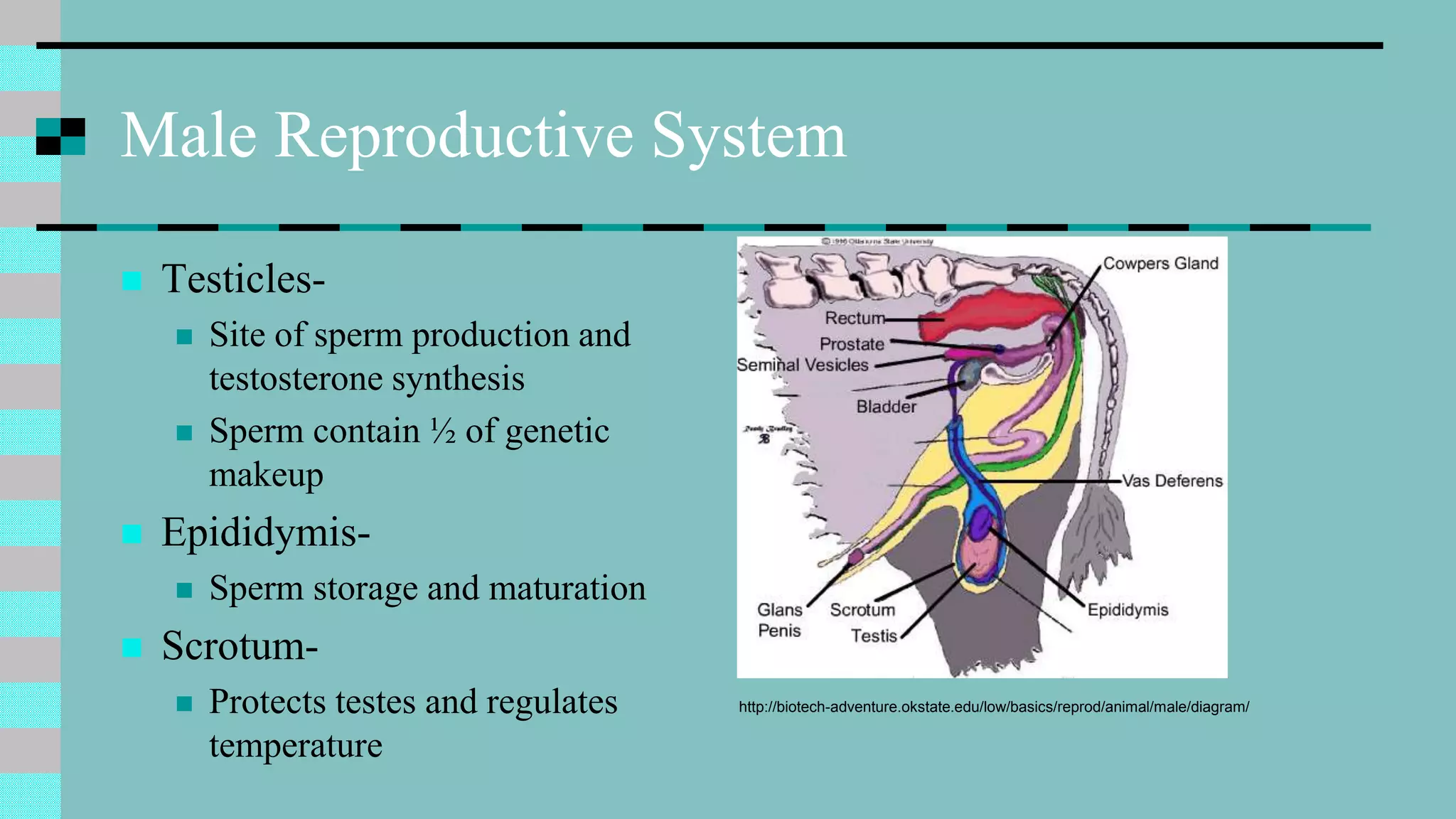
 Testicles-
 Site of sperm production and
testosterone synthesis
 Sperm contain ½ of genetic
makeup
 Epididymis-
 Sperm storage and maturation
 Scrotum-
 Protects testes and regulates
temperature
http://biotech-adventure.okstate.edu/low/basics/reprod/animal/male/diagram/
Male Reproductive System
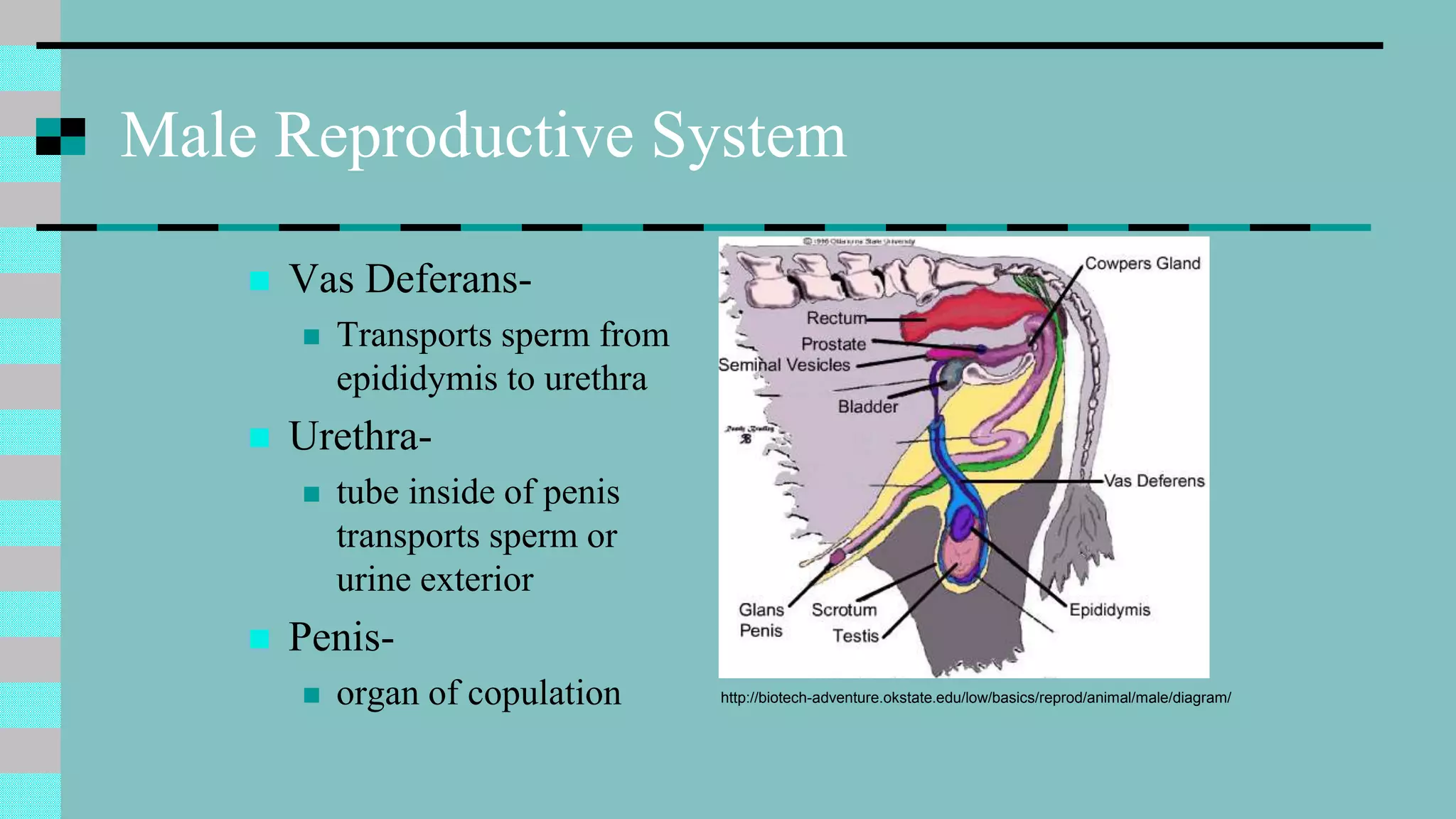
 Vas Deferans-
 Transports sperm from
epididymis to urethra
 Urethra-
 tube inside of penis
transports sperm or
urine exterior
 Penis-
 organ of copulation http://biotech-adventure.okstate.edu/low/basics/reprod/animal/male/diagram/
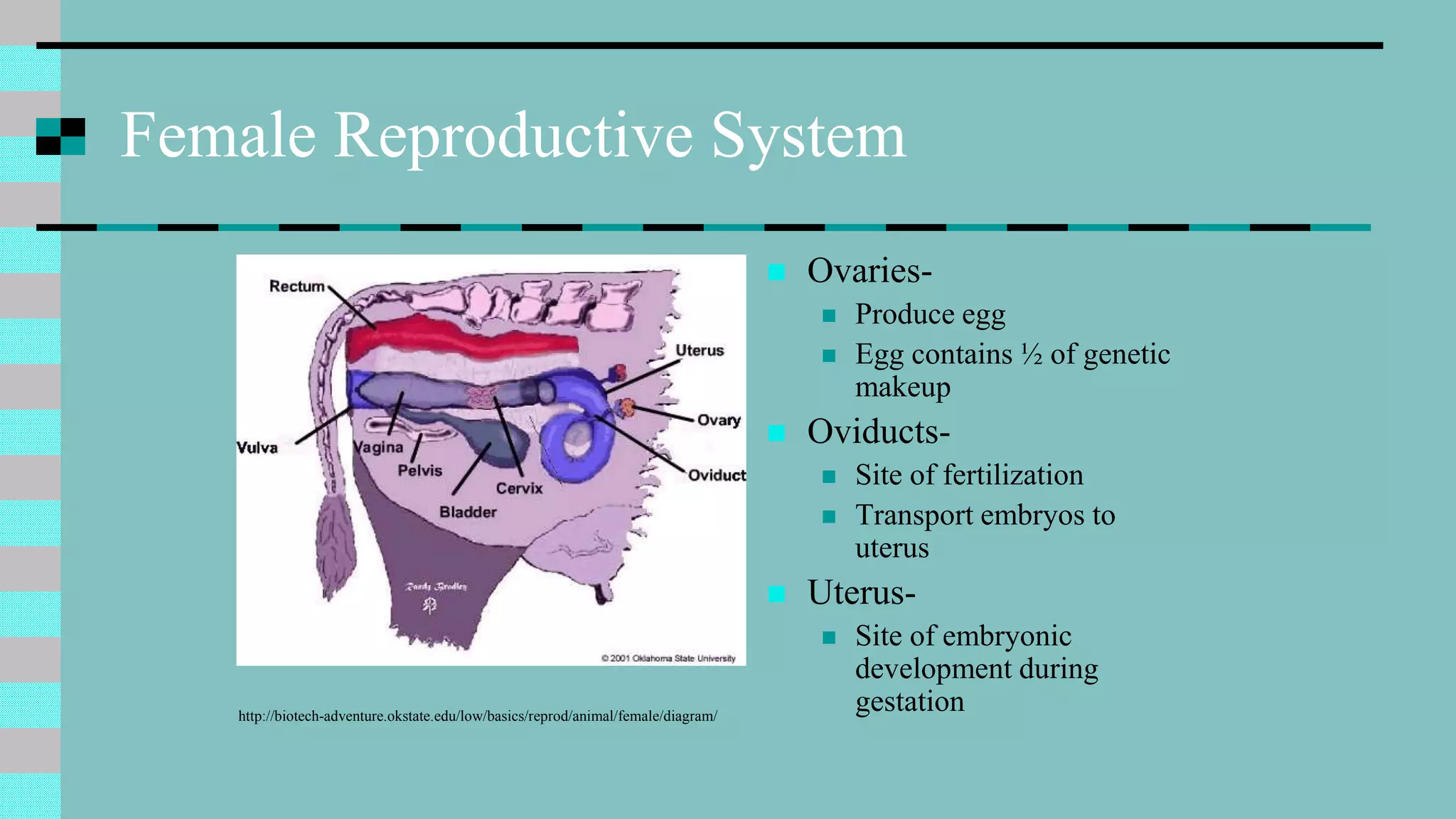
Female Reproductive System
http://biotech-adventure.okstate.edu/low/basics/reprod/animal/female/diagram/
 Ovaries-
 Produce egg
 Egg contains ½ of genetic
makeup
 Oviducts-
 Site of fertilization
 Transport embryos to
uterus
 Uterus-
 Site of embryonic
development during
gestation
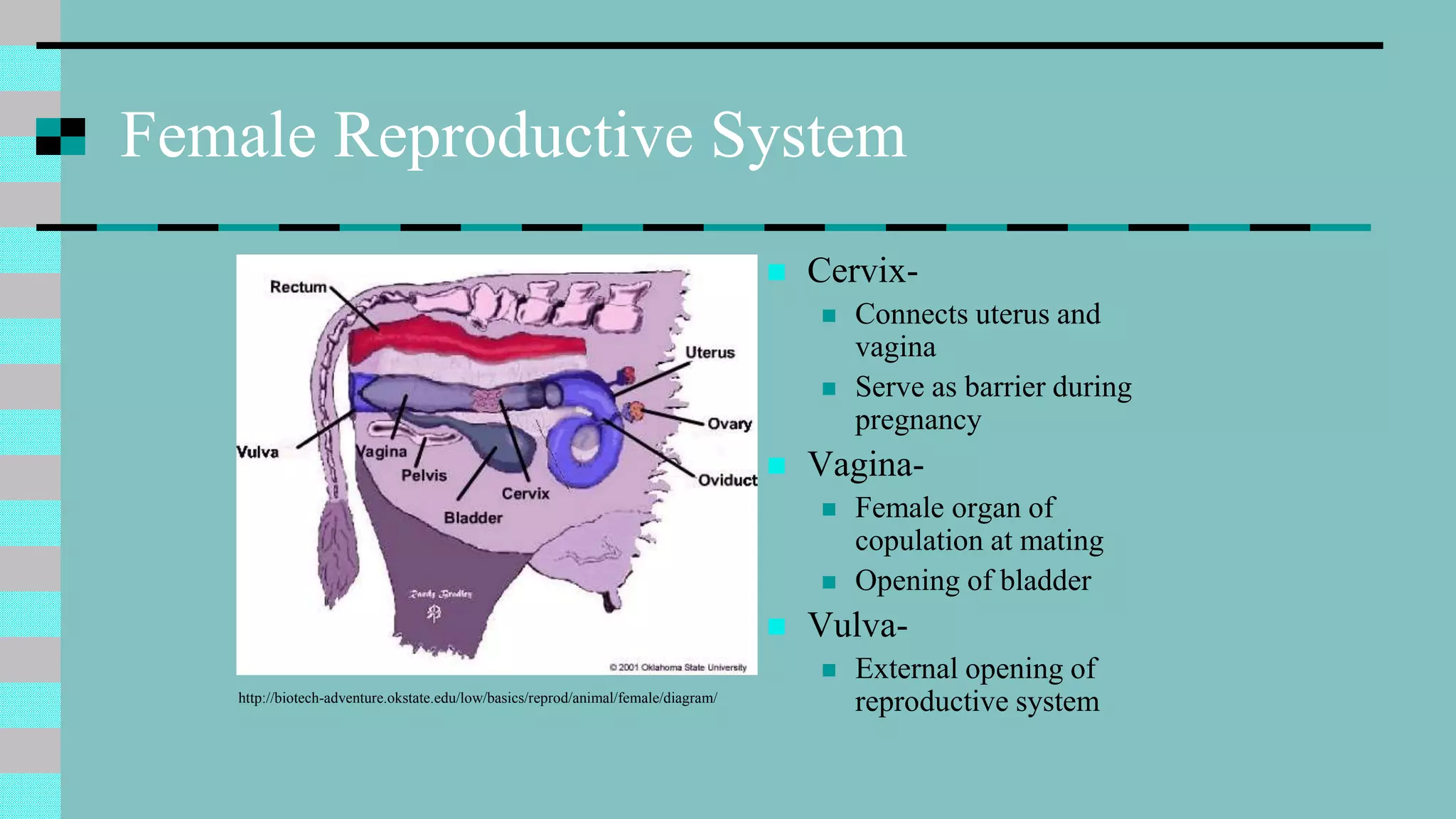
Female Reproductive System
http://biotech-adventure.okstate.edu/low/basics/reprod/animal/female/diagram/
 Cervix-
 Connects uterus and
vagina
 Serve as barrier during
pregnancy
 Vagina-
 Female organ of
copulation at mating
 Opening of bladder
 Vulva-
 External opening of
reproductive system
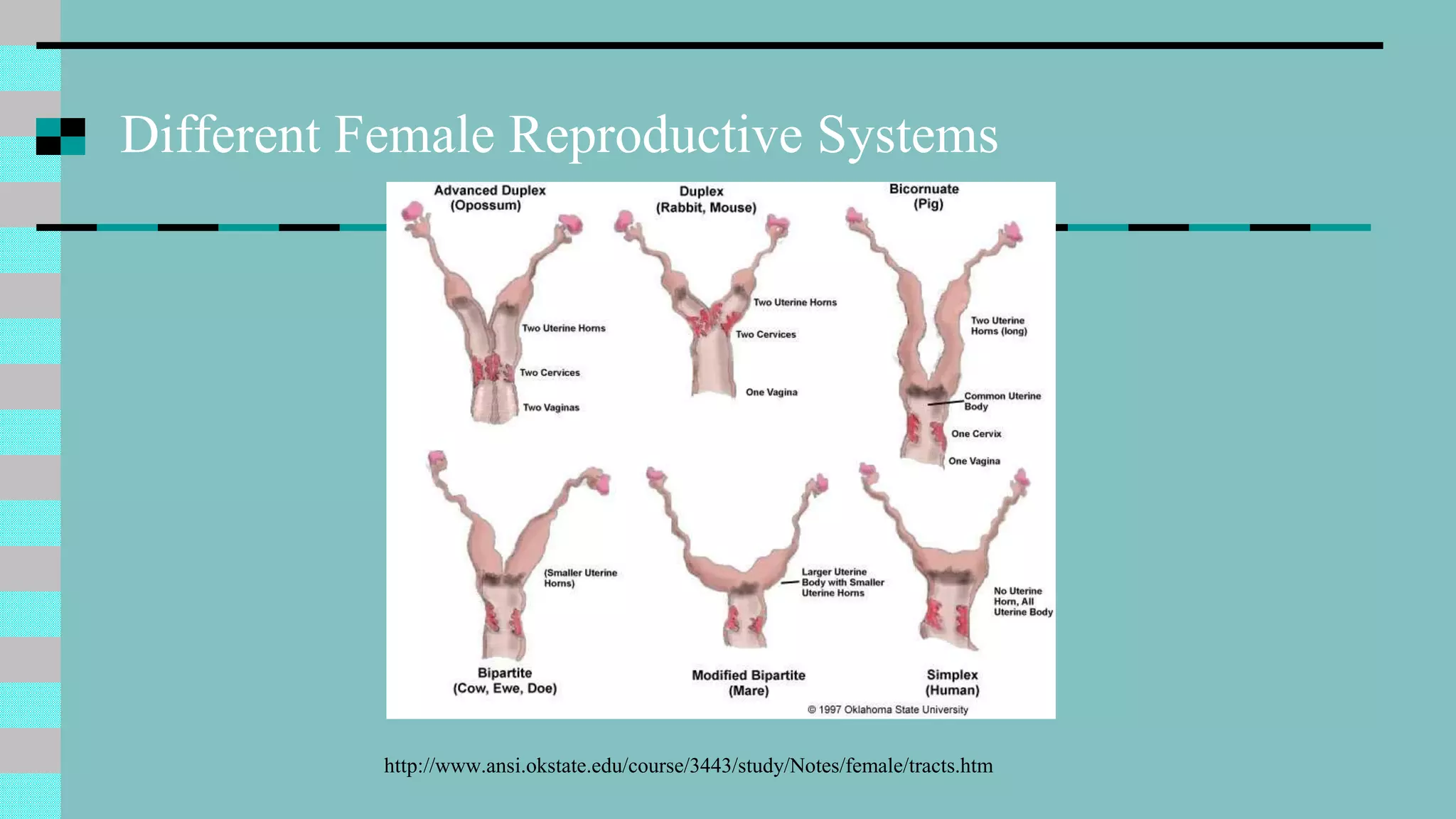
Different Female Reproductive Systems
http://www.ansi.okstate.edu/course/3443/study/Notes/female/tracts.htm
Events of Reproduction
 Puberty- Age at which reproductive organs become
functional
 Female- Reproduction process occurs within
 Estrous cycle- Repetitive cycle occurring when
pregnancy does not
 Estrus- “Heat” or receptivity to mating
 Fertilization- Egg & Sperm unite
 Only real male contribution is the sperm
 Gestation- Length of time of pregnancy
 Parturition- Act of giving birth
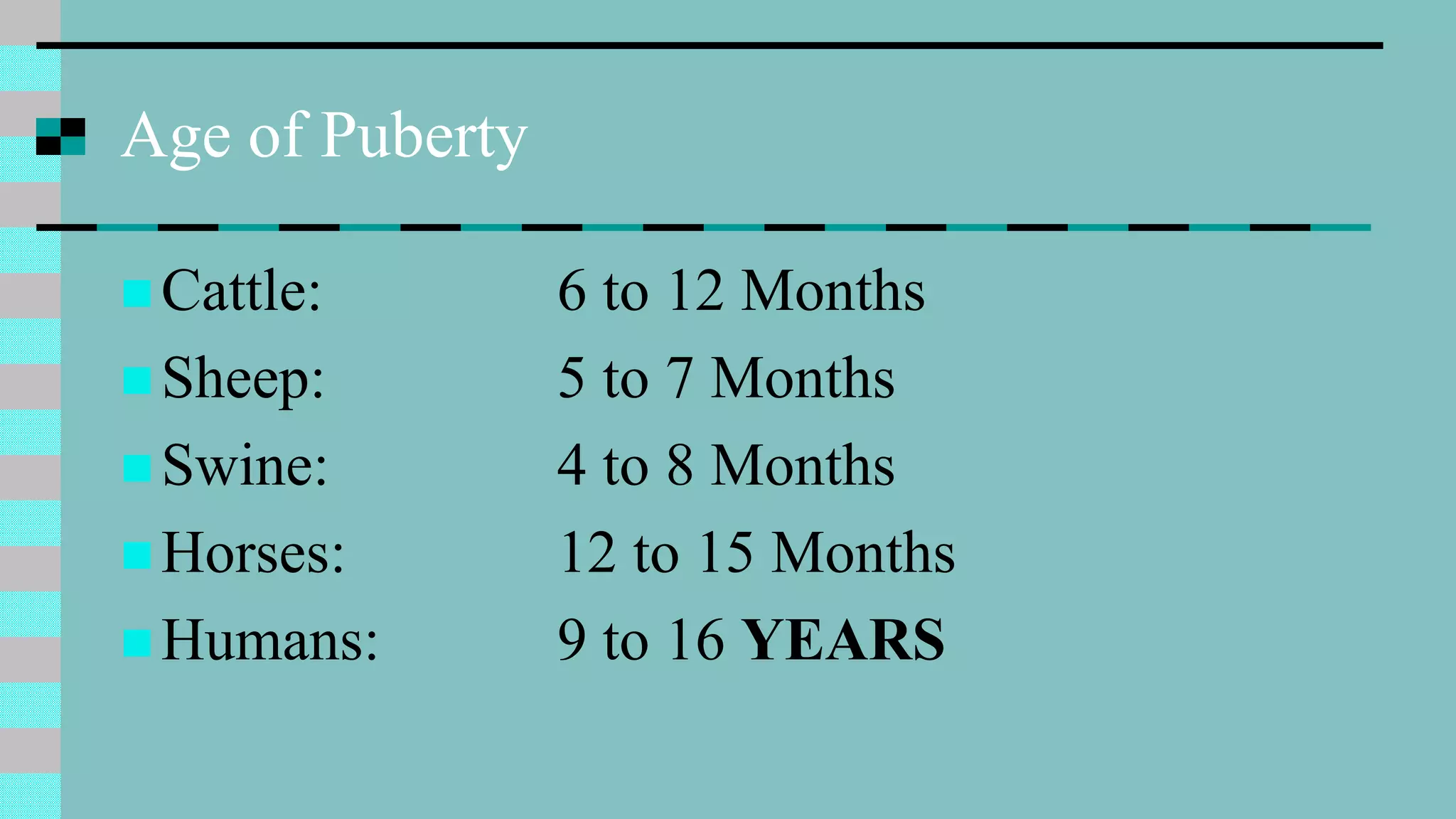
Age of Puberty
 Cattle: 6 to 12 Months
 Sheep: 5 to 7 Months
 Swine: 4 to 8 Months
 Horses: 12 to 15 Months
 Humans: 9 to 16 YEARS
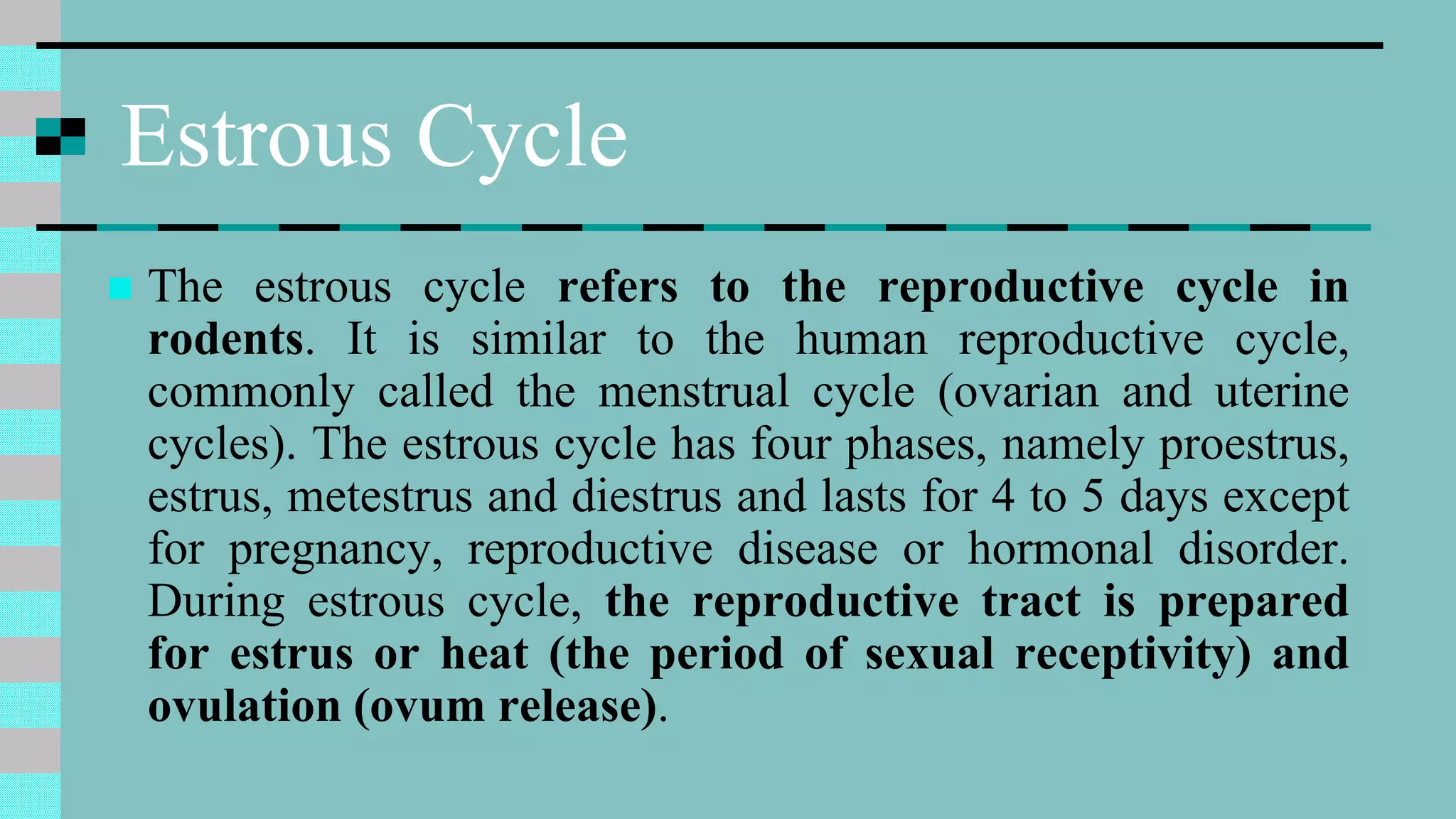
Estrous Cycle
 The estrous cycle refers to the reproductive cycle in
rodents. It is similar to the human reproductive cycle,
commonly called the menstrual cycle (ovarian and uterine
cycles). The estrous cycle has four phases, namely proestrus,
estrus, metestrus and diestrus and lasts for 4 to 5 days except
for pregnancy, reproductive disease or hormonal disorder.
During estrous cycle, the reproductive tract is prepared
for estrus or heat (the period of sexual receptivity) and
ovulation (ovum release).
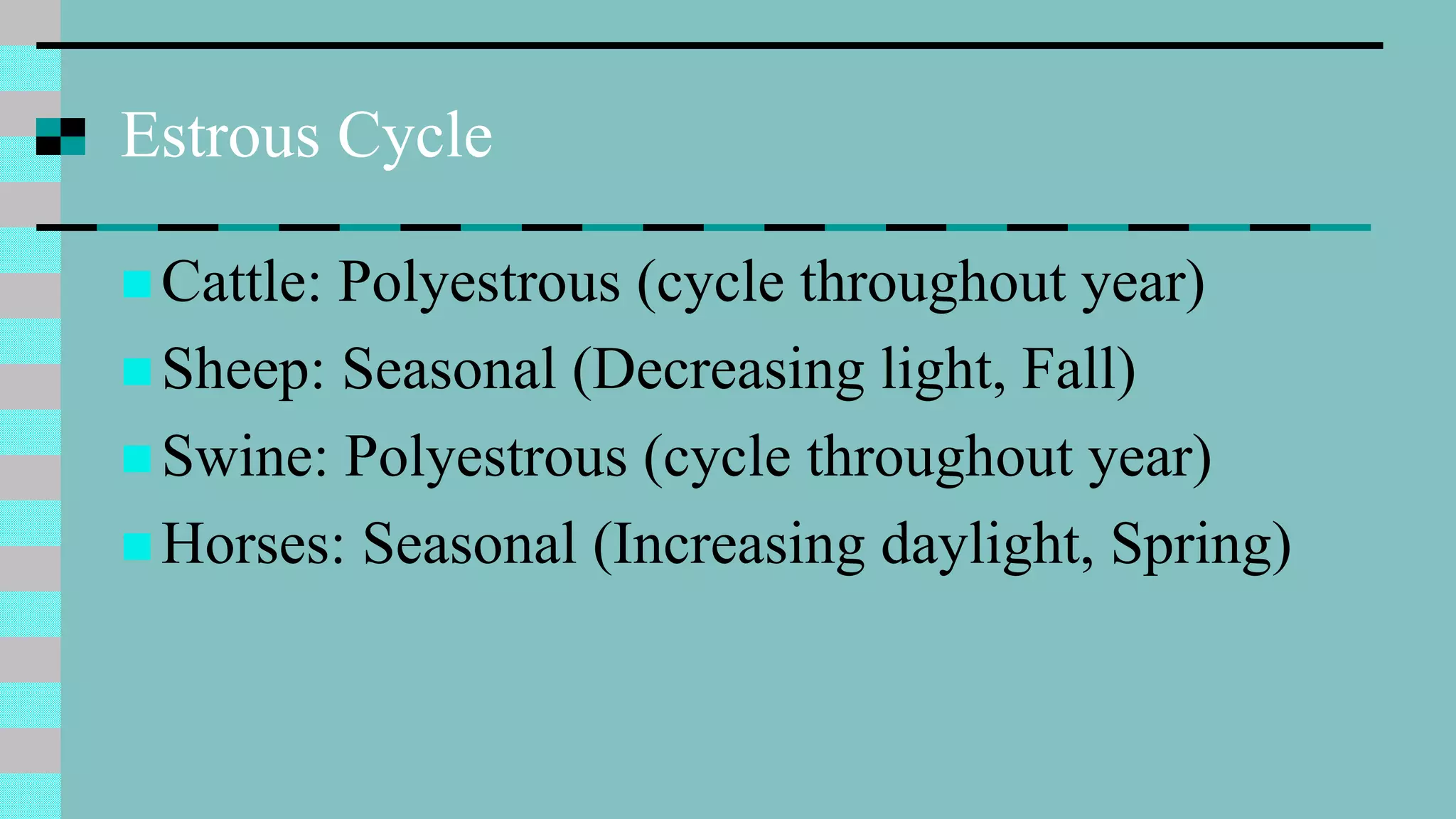
Estrous Cycle
 Cattle: Polyestrous (cycle throughout year)
 Sheep: Seasonal (Decreasing light, Fall)
 Swine: Polyestrous (cycle throughout year)
 Horses: Seasonal (Increasing daylight, Spring)
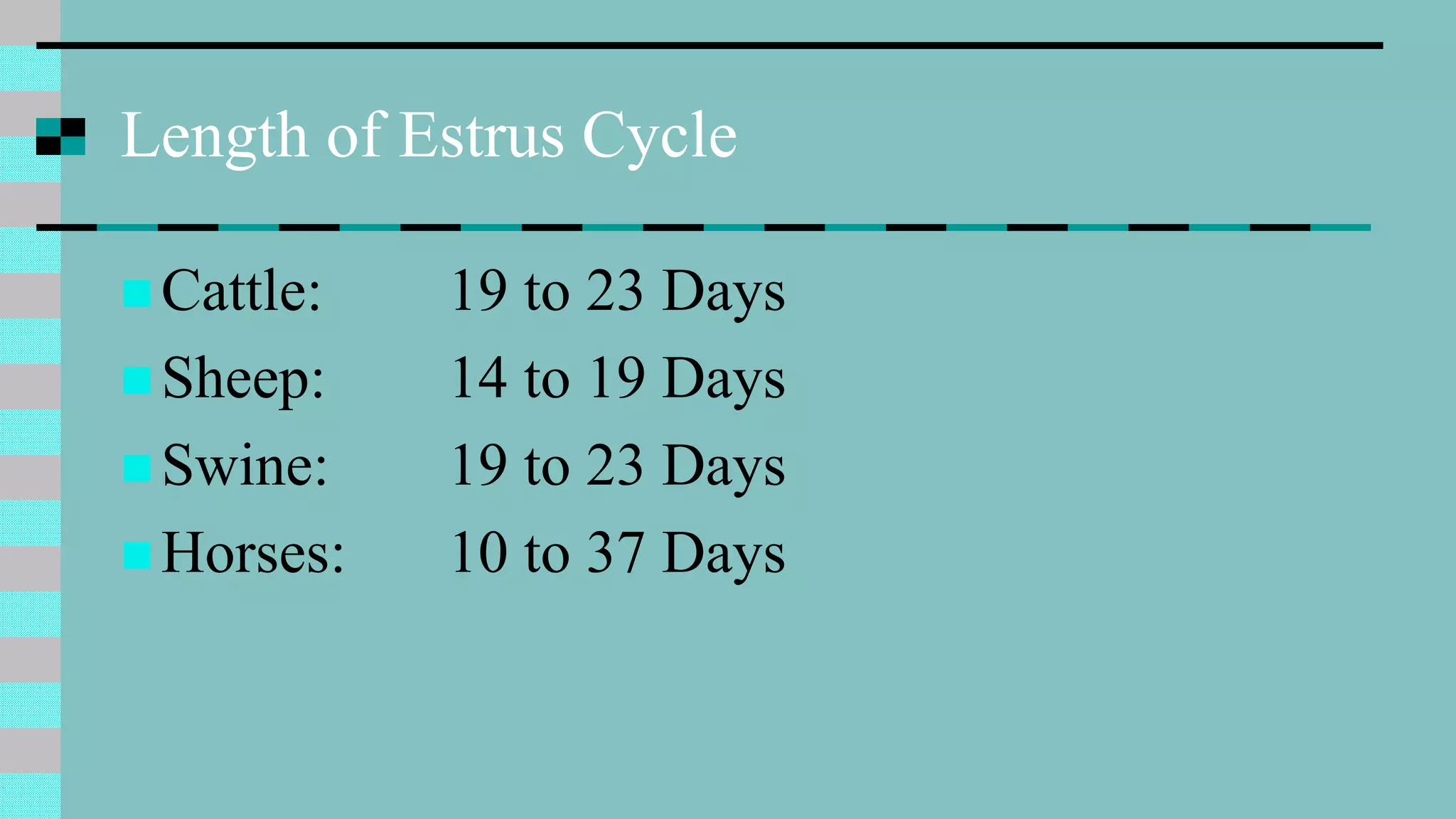
Length of Estrus Cycle
 Cattle: 19 to 23 Days
 Sheep: 14 to 19 Days
 Swine: 19 to 23 Days
 Horses: 10 to 37 Days
Duration of Estrus Cycle
 Cattle: 12 to 18 Hours
 Sheep: 24 to 36 Hours
 Swine: 48 to 72 Hours
 Horses: 3 to 8 Days
Signs of Estrus
 Swollen vulva
 Mucous discharge
 Restless behavior
 Female receptivity to male
http://www.goodecattle.com/spot.htm
Specific Signs of Estrus
 Cattle: Visually active mounting
 Sheep: Few external signs
 Swine: Brace with pressure to back, vocal grunting
 Horses: Tease with Stallion and will go nose to nose
Gestation Length
 Cattle: 283-285 Days
 Sheep: 147 Days
 Swine: 114 Days(3months 3weeks 3days)
 Horses: 336 Days
Partition Names in Species
 Cattle: Calving
 Sheep: Lambing
 Swine: Farrowing
 Horses: Foaling
Signs of Parturition
 Distended abdomen
 Mammary development & milk secretion
 Swollen vulva and relaxed pelvic ligaments
 Mucous discharge
 Relentlessness and separation from group
 Labor and Contractions
Signs of Parturition
 Appearance of placental
membrane
 Expulsion of fetus
 Expulsion of placental
membrane
 Bonding behavior of offspring
and mother (will vary between
species)
http://www.ansc.purdue.edu/dairy/4-H/amdairy.htm
Male Transfer of Sperm
 Two different ways
 Let the male and female naturally engage.
 Male seeks out female in Estrus
 All controlled by male and female interaction
 Artificial Insemination (AI)
 Human transfers semen past female cervix
 Human is in control of male product and female interaction
 No contact between male and female
Artificial Insemination (AI) Pros
 Conception rate is high
 Extends use of superior males
 One ejaculate can fertilize many females
 Reduce incidence of venereal diseases
 Individual straw per female
 Improves record keeping and mgt.
 Know exactly who the father is
 Can accelerate genetic improvements
Artificial Insemination (AI) Cons
 Need to know Estrus Cycle of animal
 Cost intensive
 Pay for someone to AI animals
AI Use in Farm Animals
 Dairy Cattle: widely used
 Beef Cattle: limited use (herds hard to monitor)
 Sheep: limited use (need to use microscope)
 Swine: intermediate use
 Horses: restricted by breed associations
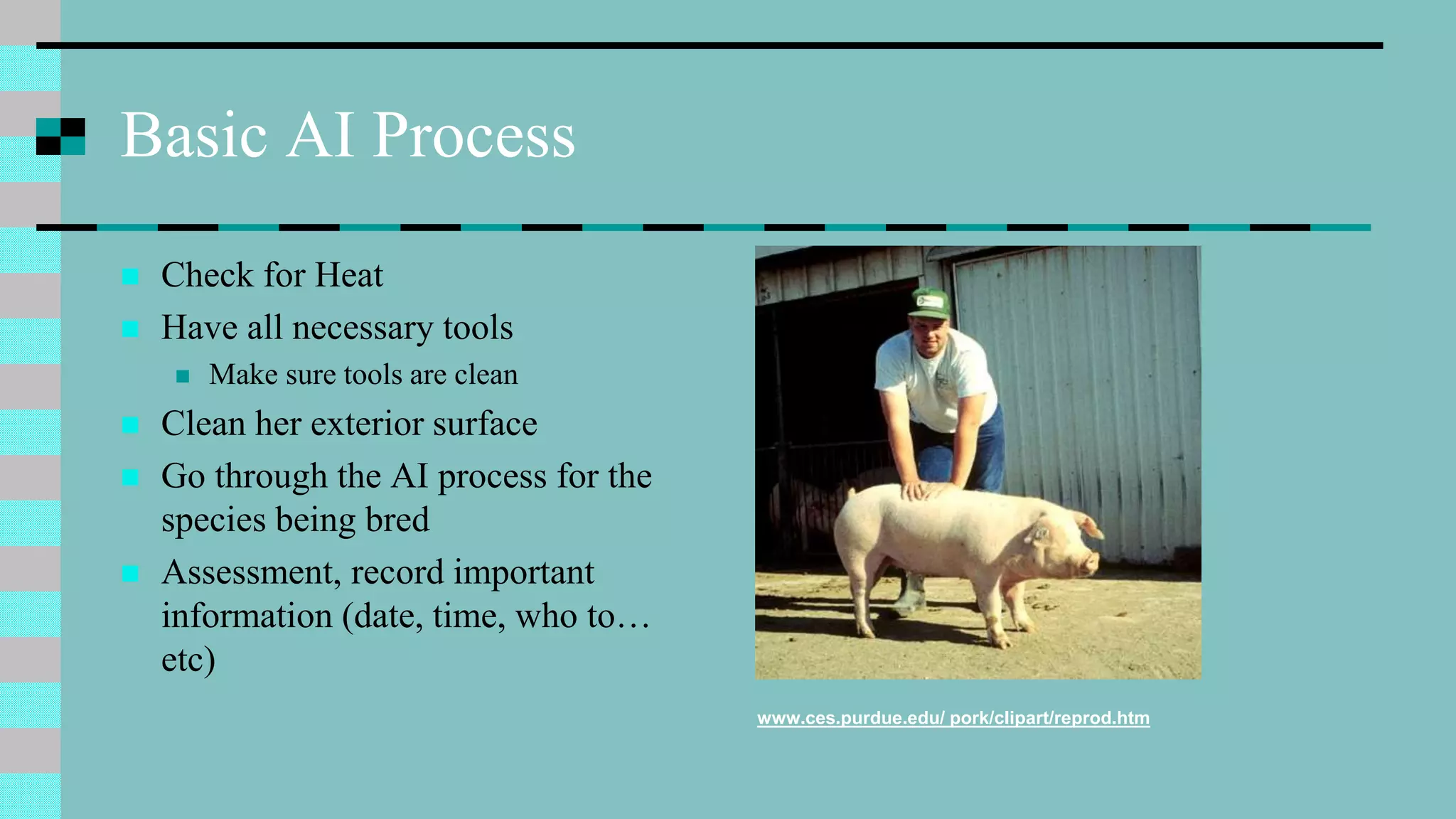
Basic AI Process
 Check for Heat
 Have all necessary tools
 Make sure tools are clean
 Clean her exterior surface
 Go through the AI process for the
species being bred
 Assessment, record important
information (date, time, who to…
etc)
www.ces.purdue.edu/ pork/clipart/reprod.htm
How Animals Differ
 Cattle: Follow cervix through anus, guiding the pipette
 Sheep: Use microscope to guide pipette
 Swine: Out of body guiding of pipette
 Horses: Restricted by breed
Swine AI Process
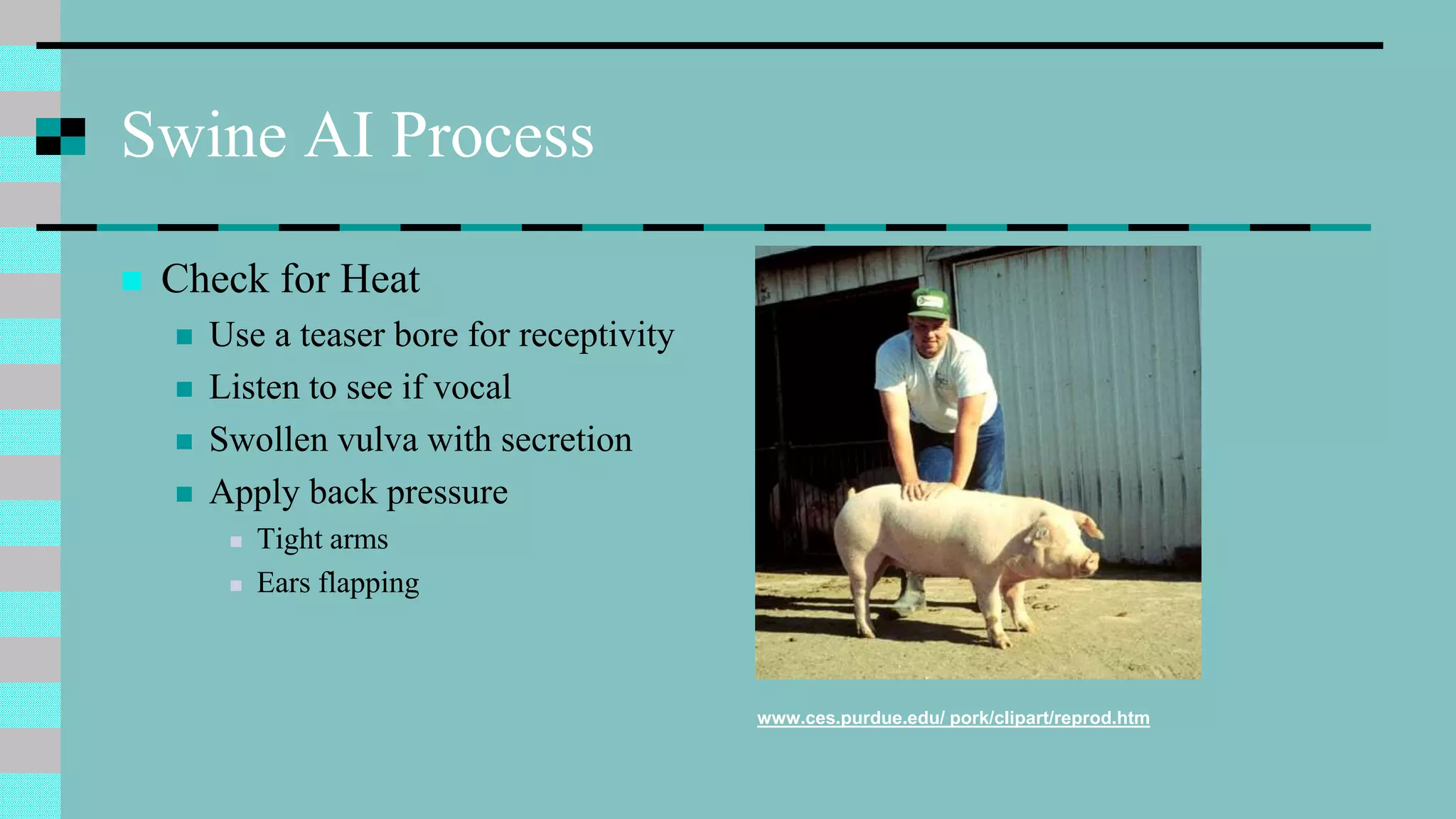
 Check for Heat
 Use a teaser bore for receptivity
 Listen to see if vocal
 Swollen vulva with secretion
 Apply back pressure
 Tight arms
 Ears flapping
www.ces.purdue.edu/ pork/clipart/reprod.htm
Swine AI Process
 Have all necessary tools
 Catheter/pipette
 Lube
 Semen
 Baby wipes
 Make sure tools are clean
http://www.ansc.purdue.edu/swine/porkpage/repro/sow2.htm
Swine AI Process
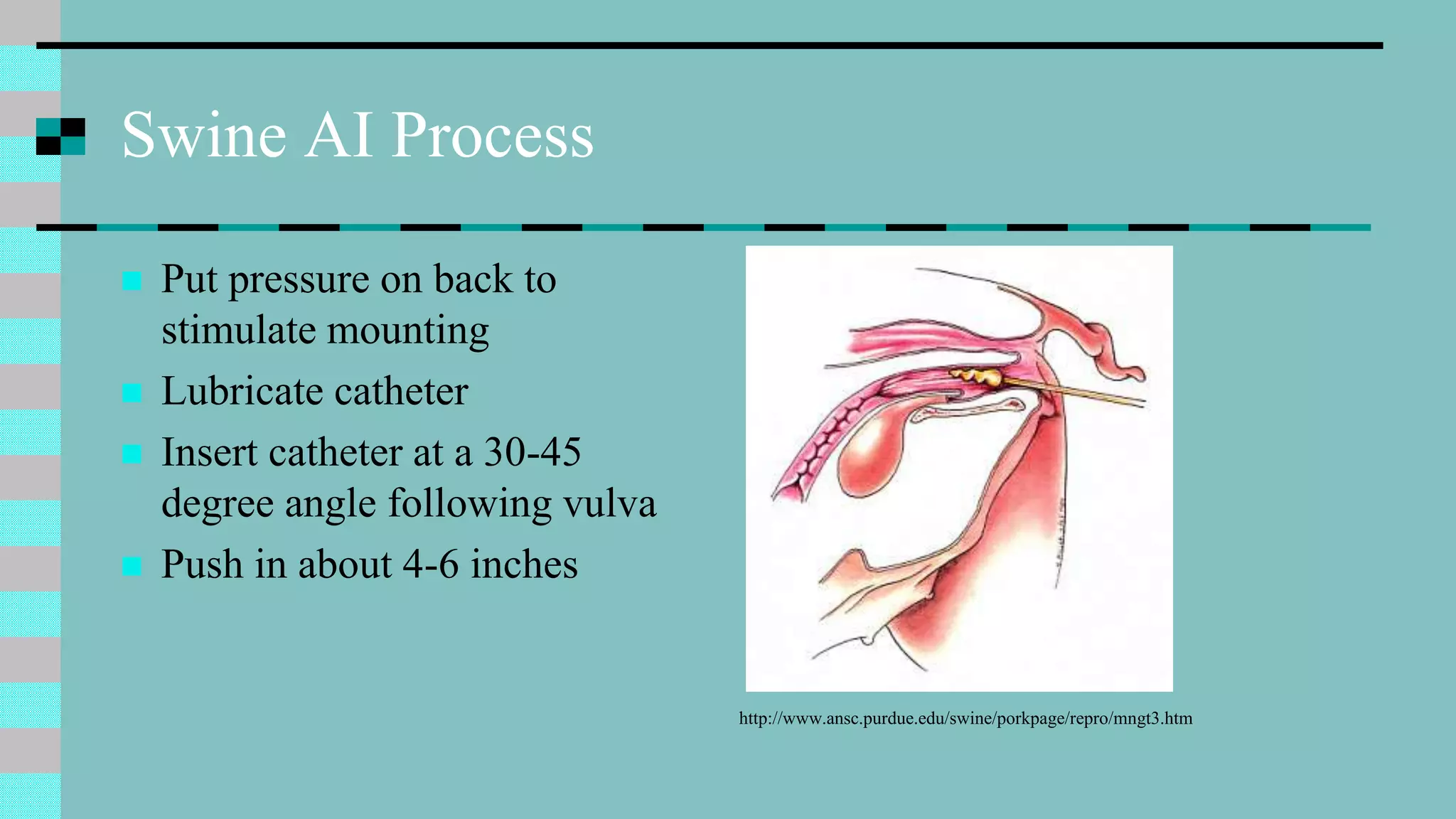
 Put pressure on back to
stimulate mounting
 Lubricate catheter
 Insert catheter at a 30-45
degree angle following vulva
 Push in about 4-6 inches
http://www.ansc.purdue.edu/swine/porkpage/repro/mngt3.htm
Swine AI Process
 Move catheter to horizontal position
and gently move forward until
resistance is felt
 Rotate counterclockwise once you
have hit resistance
 Feel for pressure from cervix (see if
holds pipette)
 Will pulsate up and down
http://www.ansc.purdue.edu/swine/porkpage/repro/mngt3.htm
Swine AI Process
 Connect semen onto catheter
 Give small squeeze to initiate flow
of semen
 Should suck in herself
 DO NOT RUSH
 After semen is gone give a five
count
 Rotate catheter clockwise and gently
pull out
http://www.ansc.purdue.edu/swine/porkpage/repro/mngt3.htm
Assessment AI Process
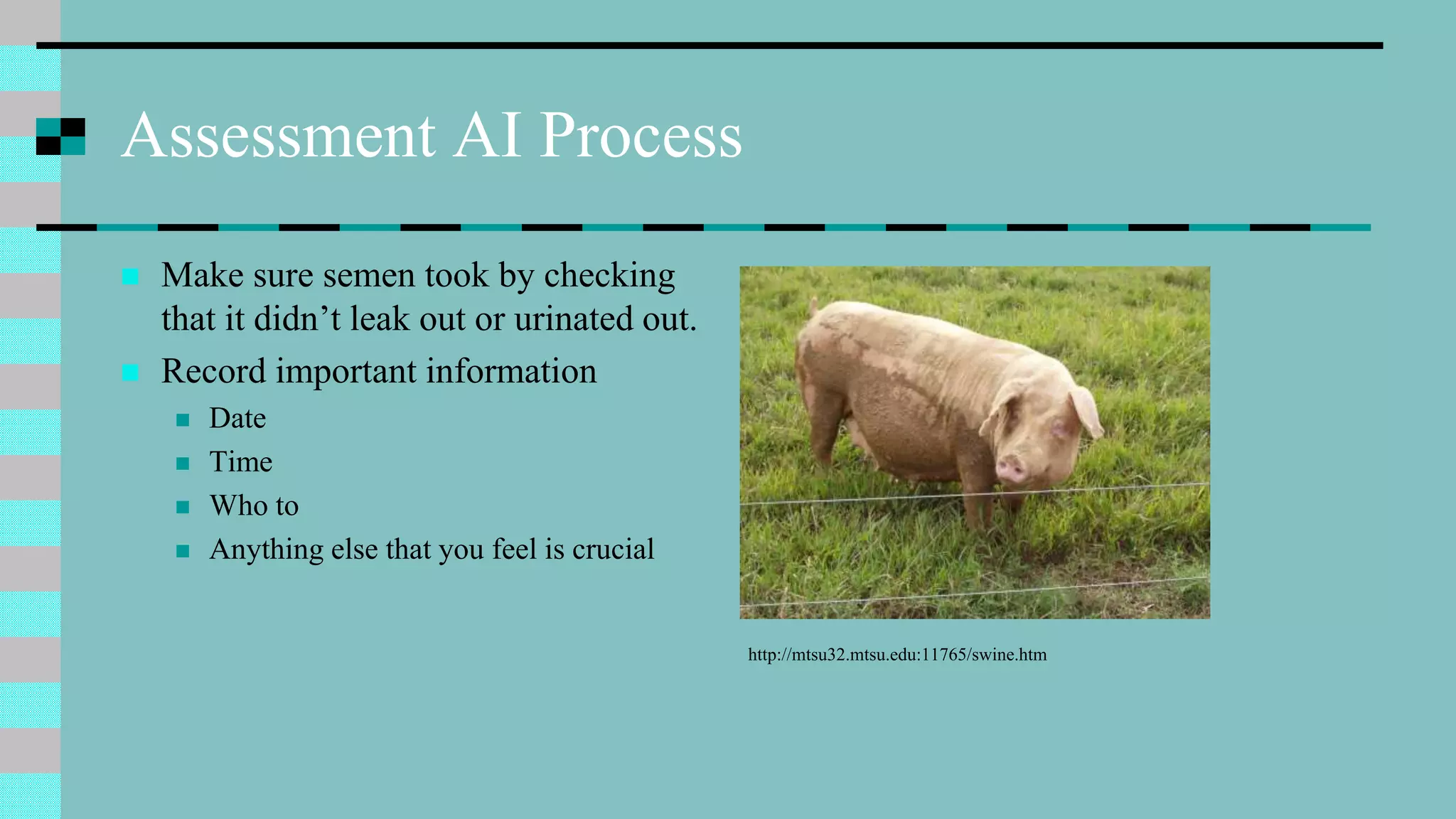
 Make sure semen took by checking
that it didn’t leak out or urinated out.
 Record important information
 Date
 Time
 Who to
 Anything else that you feel is crucial
http://mtsu32.mtsu.edu:11765/swine.htm

Animal_Reproduction.ppt

  • 1.
  • 2.
  • 3.
    Hormones  Male  Testosterone-critical for sperm development  Female  Estrogen- critical for follicle development  Progesterone- sustains pregnancy and inhibits new follicle development  Relaxin- causes ligaments around birth canal to relax  Oxytocin- causes milk letdown
  • 4.
    Male Reproductive System Testicles-  Site of sperm production and testosterone synthesis  Sperm contain ½ of genetic makeup  Epididymis-  Sperm storage and maturation  Scrotum-  Protects testes and regulates temperature http://biotech-adventure.okstate.edu/low/basics/reprod/animal/male/diagram/
  • 5.
    Male Reproductive System Vas Deferans-  Transports sperm from epididymis to urethra  Urethra-  tube inside of penis transports sperm or urine exterior  Penis-  organ of copulation http://biotech-adventure.okstate.edu/low/basics/reprod/animal/male/diagram/
  • 6.
    Female Reproductive System http://biotech-adventure.okstate.edu/low/basics/reprod/animal/female/diagram/ Ovaries-  Produce egg  Egg contains ½ of genetic makeup  Oviducts-  Site of fertilization  Transport embryos to uterus  Uterus-  Site of embryonic development during gestation
  • 7.
    Female Reproductive System http://biotech-adventure.okstate.edu/low/basics/reprod/animal/female/diagram/ Cervix-  Connects uterus and vagina  Serve as barrier during pregnancy  Vagina-  Female organ of copulation at mating  Opening of bladder  Vulva-  External opening of reproductive system
  • 8.
    Different Female ReproductiveSystems http://www.ansi.okstate.edu/course/3443/study/Notes/female/tracts.htm
  • 9.
    Events of Reproduction Puberty- Age at which reproductive organs become functional  Female- Reproduction process occurs within  Estrous cycle- Repetitive cycle occurring when pregnancy does not  Estrus- “Heat” or receptivity to mating  Fertilization- Egg & Sperm unite  Only real male contribution is the sperm  Gestation- Length of time of pregnancy  Parturition- Act of giving birth
  • 10.
    Age of Puberty Cattle: 6 to 12 Months  Sheep: 5 to 7 Months  Swine: 4 to 8 Months  Horses: 12 to 15 Months  Humans: 9 to 16 YEARS
  • 11.
    Estrous Cycle  Theestrous cycle refers to the reproductive cycle in rodents. It is similar to the human reproductive cycle, commonly called the menstrual cycle (ovarian and uterine cycles). The estrous cycle has four phases, namely proestrus, estrus, metestrus and diestrus and lasts for 4 to 5 days except for pregnancy, reproductive disease or hormonal disorder. During estrous cycle, the reproductive tract is prepared for estrus or heat (the period of sexual receptivity) and ovulation (ovum release).
  • 12.
    Estrous Cycle  Cattle:Polyestrous (cycle throughout year)  Sheep: Seasonal (Decreasing light, Fall)  Swine: Polyestrous (cycle throughout year)  Horses: Seasonal (Increasing daylight, Spring)
  • 13.
    Length of EstrusCycle  Cattle: 19 to 23 Days  Sheep: 14 to 19 Days  Swine: 19 to 23 Days  Horses: 10 to 37 Days
  • 14.
    Duration of EstrusCycle  Cattle: 12 to 18 Hours  Sheep: 24 to 36 Hours  Swine: 48 to 72 Hours  Horses: 3 to 8 Days
  • 15.
    Signs of Estrus Swollen vulva  Mucous discharge  Restless behavior  Female receptivity to male http://www.goodecattle.com/spot.htm
  • 16.
    Specific Signs ofEstrus  Cattle: Visually active mounting  Sheep: Few external signs  Swine: Brace with pressure to back, vocal grunting  Horses: Tease with Stallion and will go nose to nose
  • 17.
    Gestation Length  Cattle:283-285 Days  Sheep: 147 Days  Swine: 114 Days(3months 3weeks 3days)  Horses: 336 Days
  • 18.
    Partition Names inSpecies  Cattle: Calving  Sheep: Lambing  Swine: Farrowing  Horses: Foaling
  • 19.
    Signs of Parturition Distended abdomen  Mammary development & milk secretion  Swollen vulva and relaxed pelvic ligaments  Mucous discharge  Relentlessness and separation from group  Labor and Contractions
  • 20.
    Signs of Parturition Appearance of placental membrane  Expulsion of fetus  Expulsion of placental membrane  Bonding behavior of offspring and mother (will vary between species) http://www.ansc.purdue.edu/dairy/4-H/amdairy.htm
  • 21.
    Male Transfer ofSperm  Two different ways  Let the male and female naturally engage.  Male seeks out female in Estrus  All controlled by male and female interaction  Artificial Insemination (AI)  Human transfers semen past female cervix  Human is in control of male product and female interaction  No contact between male and female
  • 22.
    Artificial Insemination (AI)Pros  Conception rate is high  Extends use of superior males  One ejaculate can fertilize many females  Reduce incidence of venereal diseases  Individual straw per female  Improves record keeping and mgt.  Know exactly who the father is  Can accelerate genetic improvements
  • 23.
    Artificial Insemination (AI)Cons  Need to know Estrus Cycle of animal  Cost intensive  Pay for someone to AI animals
  • 24.
    AI Use inFarm Animals  Dairy Cattle: widely used  Beef Cattle: limited use (herds hard to monitor)  Sheep: limited use (need to use microscope)  Swine: intermediate use  Horses: restricted by breed associations
  • 25.
    Basic AI Process Check for Heat  Have all necessary tools  Make sure tools are clean  Clean her exterior surface  Go through the AI process for the species being bred  Assessment, record important information (date, time, who to… etc) www.ces.purdue.edu/ pork/clipart/reprod.htm
  • 26.
    How Animals Differ Cattle: Follow cervix through anus, guiding the pipette  Sheep: Use microscope to guide pipette  Swine: Out of body guiding of pipette  Horses: Restricted by breed
  • 27.
    Swine AI Process Check for Heat  Use a teaser bore for receptivity  Listen to see if vocal  Swollen vulva with secretion  Apply back pressure  Tight arms  Ears flapping www.ces.purdue.edu/ pork/clipart/reprod.htm
  • 28.
    Swine AI Process Have all necessary tools  Catheter/pipette  Lube  Semen  Baby wipes  Make sure tools are clean http://www.ansc.purdue.edu/swine/porkpage/repro/sow2.htm
  • 29.
    Swine AI Process Put pressure on back to stimulate mounting  Lubricate catheter  Insert catheter at a 30-45 degree angle following vulva  Push in about 4-6 inches http://www.ansc.purdue.edu/swine/porkpage/repro/mngt3.htm
  • 30.
    Swine AI Process Move catheter to horizontal position and gently move forward until resistance is felt  Rotate counterclockwise once you have hit resistance  Feel for pressure from cervix (see if holds pipette)  Will pulsate up and down http://www.ansc.purdue.edu/swine/porkpage/repro/mngt3.htm
  • 31.
    Swine AI Process Connect semen onto catheter  Give small squeeze to initiate flow of semen  Should suck in herself  DO NOT RUSH  After semen is gone give a five count  Rotate catheter clockwise and gently pull out http://www.ansc.purdue.edu/swine/porkpage/repro/mngt3.htm
  • 32.
    Assessment AI Process Make sure semen took by checking that it didn’t leak out or urinated out.  Record important information  Date  Time  Who to  Anything else that you feel is crucial http://mtsu32.mtsu.edu:11765/swine.htm