INFERTILITY AND STERILITY
INTRODUCTORY LECTURE
FOR
7TH SEMESTER STUDENTS
Prof. H. Mas’ud Hariadi, PhD., MPhil., drh
Department of Veterinary Reproduction
FACULTY of VETERINARY MEDICINE
AIRLANGGA UNIVERSITY
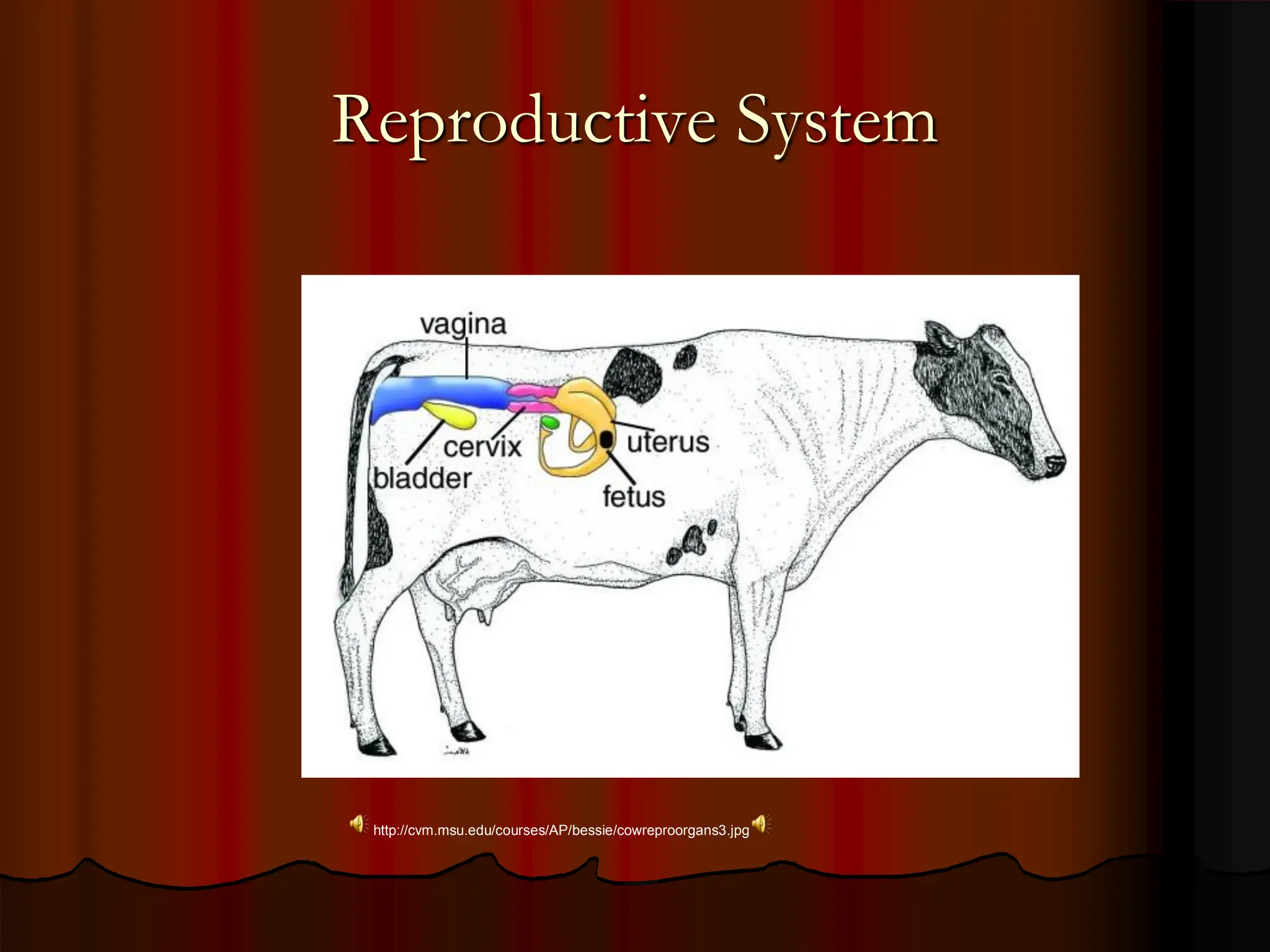
Reproductive System
http://cvm.msu.edu/courses/AP/bessie/cowreproorgans3.jpg
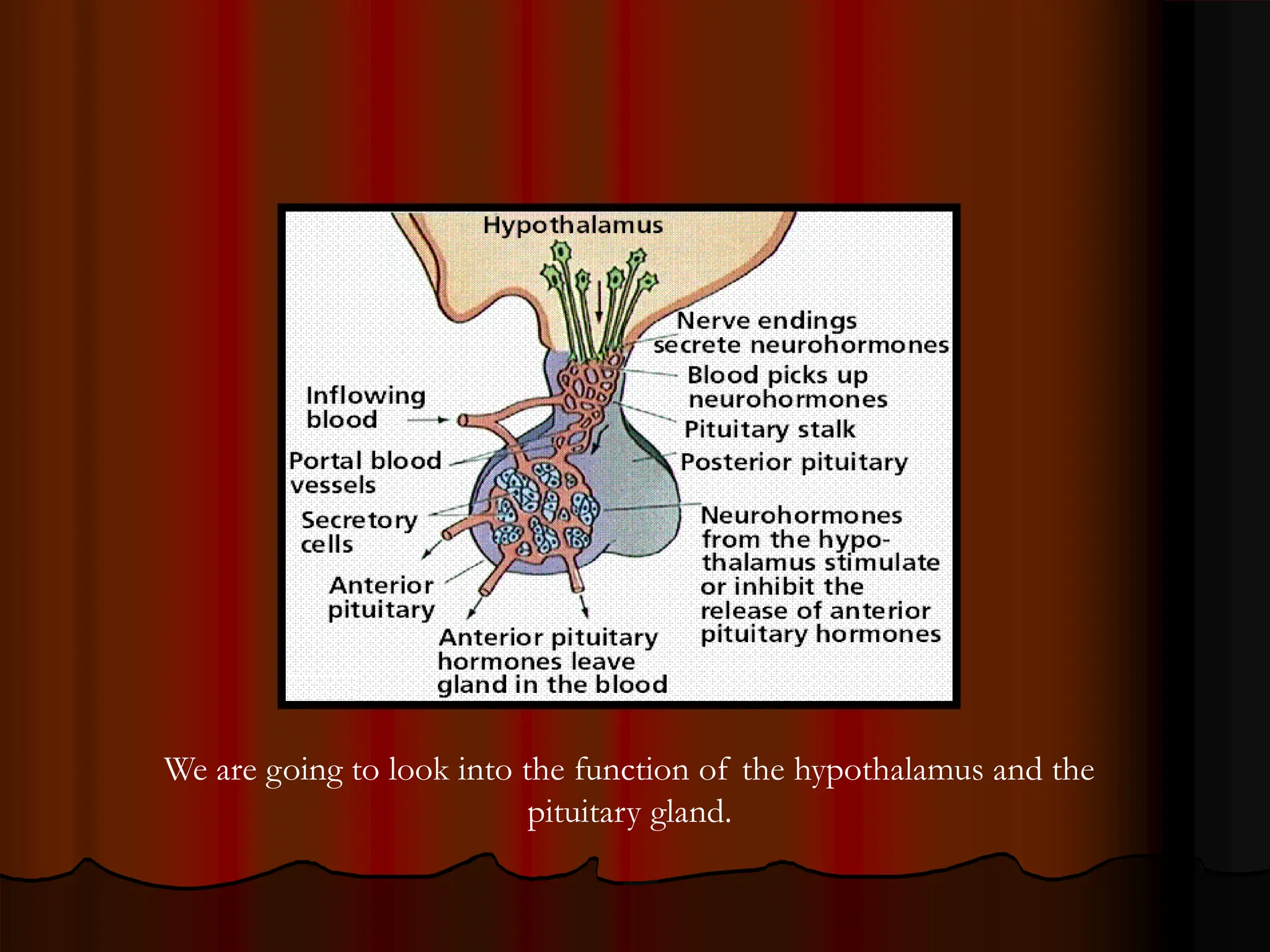
We are going to look into the function of the hypothalamus and the
pituitary gland.
Two essential organs of reproduction are located within the head of the animal.
The hypothalamus controls:
Body temperature, and the drive to eat and drink are just a few functions.
It sends and receives neural signals through the nervous system and hormonal
messages through the endocrine system.
The pituitary gland, sits at the base of the brain.
The pituitary is divided into two regions: the anterior and posterior pituitaries.
The female reproductive organs consist of the ovary, uterus, cervix, vagina and
vulva. Female reproductive tracts of various farm animals are similar to the cow,
but differ primarily in the shape of the uterus and cervix.
http://www.ca.uky.edu/agripedia/Classes/ASC106/media/FEMALE.GIF
Ovaries
 The ovary, is
responsible for two
basic functions:
 Production of the
female egg or ovum.
 Production of two
primary reproductive
hormones, estrogen and
progesterone.
http://www.ansi.okstate.edu/course/3443/study/AnatomyFemale/bovine/sld015.htm
The oviduct begins as a funnel-shaped tube that engulfs the ovary. When ovulation
occurs, the ovum is picked up by the infundibulum and channeled into the
oviduct (also known as the Fallopian tube), where fertilization takes place if
sperm are present.
 The uterus of the cow is bipartite, while the uterine horns are relatively long
and well developed.
 The fertilized embryo moves from the oviduct into the uterine horn, where
fetal development begins. The fetus grows within a layer of membranes called
the placenta, where it is nourished.
ianrpubs.unl.edu/ beef/g537.htm
Uterus
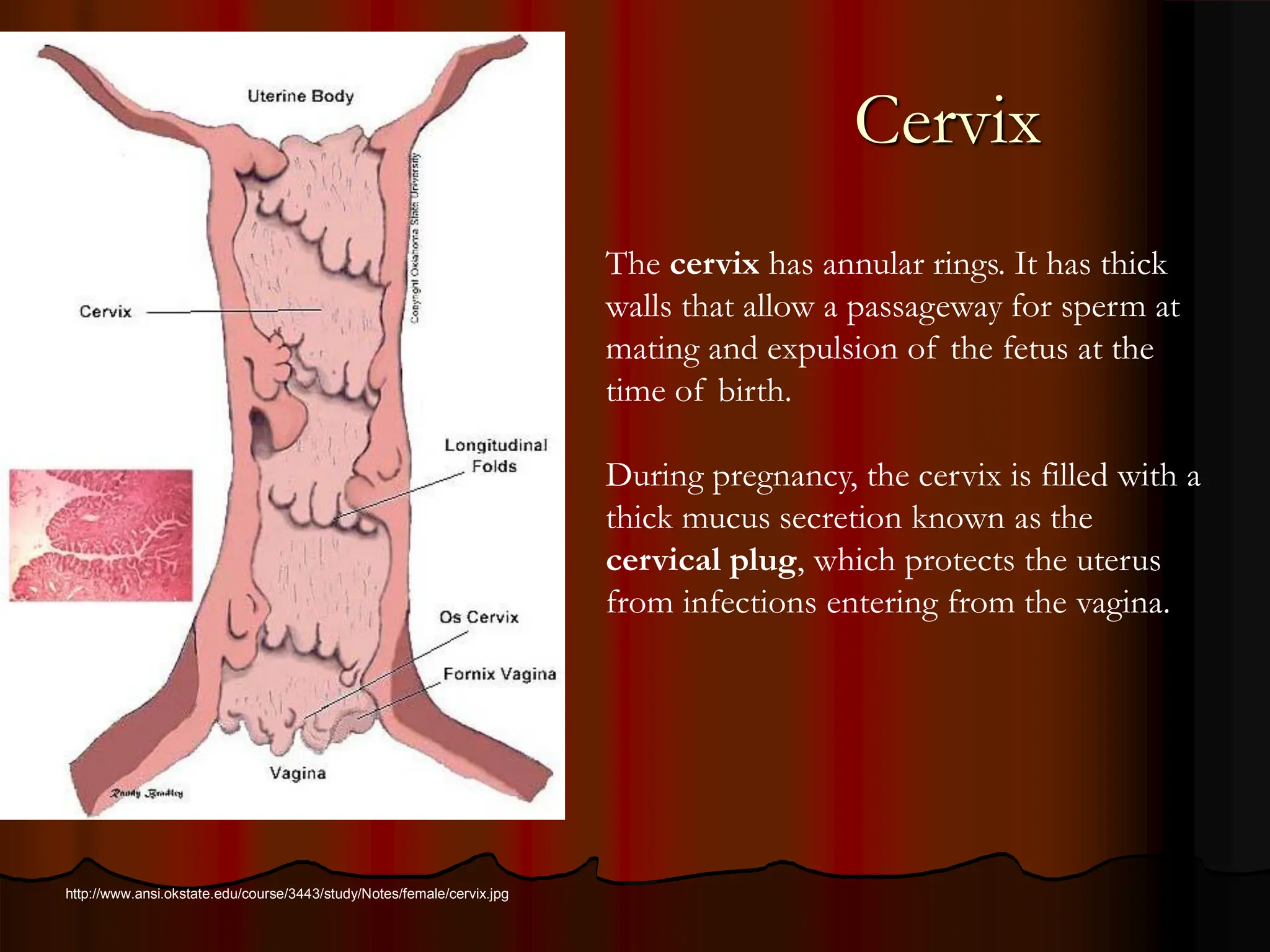
Cervix
The cervix has annular rings. It has thick
walls that allow a passageway for sperm at
mating and expulsion of the fetus at the
time of birth.
During pregnancy, the cervix is filled with a
thick mucus secretion known as the
cervical plug, which protects the uterus
from infections entering from the vagina.
http://www.ansi.okstate.edu/course/3443/study/Notes/female/cervix.jpg
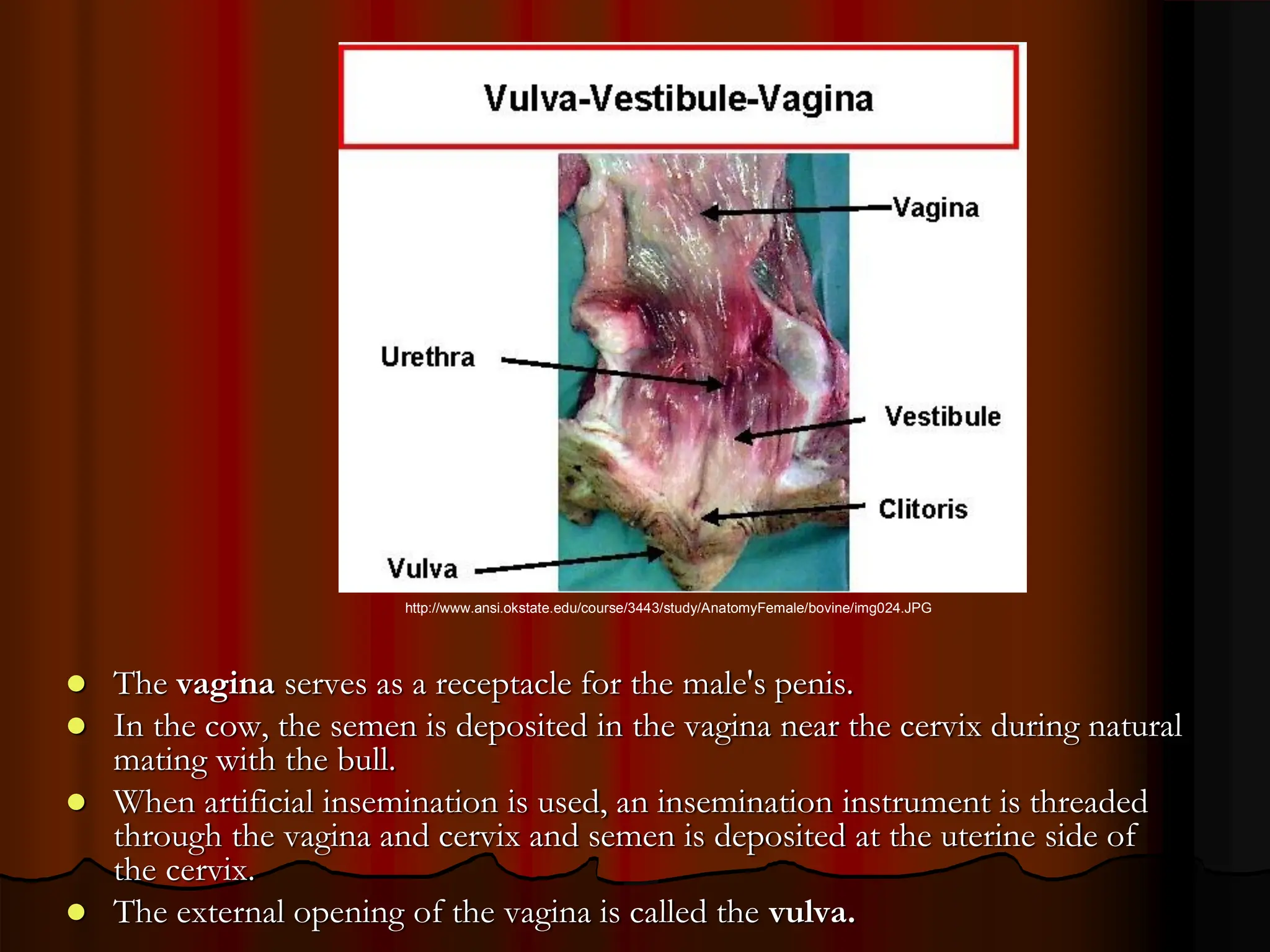
 The vagina serves as a receptacle for the male's penis.
 In the cow, the semen is deposited in the vagina near the cervix during natural
mating with the bull.
 When artificial insemination is used, an insemination instrument is threaded
through the vagina and cervix and semen is deposited at the uterine side of
the cervix.
 The external opening of the vagina is called the vulva.
http://www.ansi.okstate.edu/course/3443/study/AnatomyFemale/bovine/img024.JPG
Estrous Cycle
 The ovarian changes
during a typical 21-day
estrous cycle in which
pregnancy does not
occur.
 The development and
regression of the
corpus luteum and of
the follicles are
continuous processes
http://www.cahe.nmsu.edu/pubs/_b/b-212.pdf
This cycle of egg development in
cattle is called the estrous cycle.
The cow is a non seasonal
polyestrous species. Which means a
cow can have multiple estrous cycles
throughout the year.
Two prominent structures are
present within the ovary, the follicle
and corpora lutea.
http://www.aces.edu/pubs/docs/A/ANR-1027/
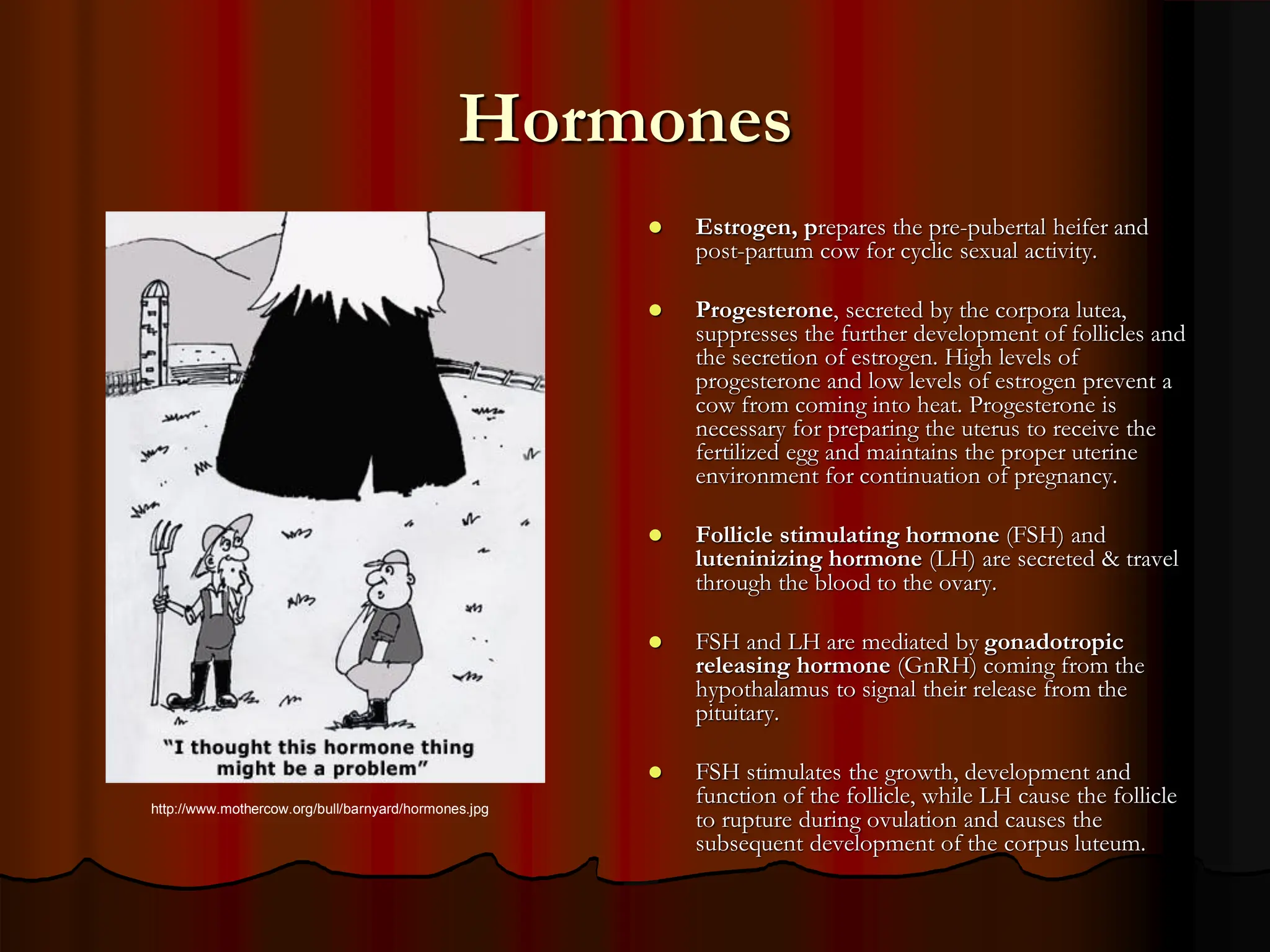
Hormones
 Estrogen, prepares the pre-pubertal heifer and
post-partum cow for cyclic sexual activity.
 Progesterone, secreted by the corpora lutea,
suppresses the further development of follicles and
the secretion of estrogen. High levels of
progesterone and low levels of estrogen prevent a
cow from coming into heat. Progesterone is
necessary for preparing the uterus to receive the
fertilized egg and maintains the proper uterine
environment for continuation of pregnancy.
 Follicle stimulating hormone (FSH) and
luteninizing hormone (LH) are secreted & travel
through the blood to the ovary.
 FSH and LH are mediated by gonadotropic
releasing hormone (GnRH) coming from the
hypothalamus to signal their release from the
pituitary.
 FSH stimulates the growth, development and
function of the follicle, while LH cause the follicle
to rupture during ovulation and causes the
subsequent development of the corpus luteum.
http://www.mothercow.org/bull/barnyard/hormones.jpg
Placenta
 Classification is based on:
 The gross shape of the
placenta and the distribution
of contact sites between fetal
membranes and
endometrium.
 The number of layers of
tissue between maternal and
fetal vascular systems.
http://arbl.cvmbs.colostate.edu/hbooks/pathphys/reprod/placenta/plac_types.jpg
 A cow has a cotyledonary
placenta.
 Cotyledonary: Multiple, discrete
areas of attachment called
cotyledons are formed by
interaction of patches of
allantochorion with endometrium.
The fetal portions of this type of
placenta are called cotyledons, the
maternal contact sites (caruncles),
and the cotyledon-caruncle complex
a placentome. This type of
placentation is observed in
ruminants.
http://www.uoguelph.ca/zoology/devobio/splab9/sld012.gif
An Overview of Infertility and Sterility
STERIL
External factors
Internal or
INFERTIL External
Factors
External Factors
NORMAL
FACTORS INFLUENCING INFERTILITY AND
STERILITY OF ANIMALS
 ENDOCRINOLOGICAL DISORDERS/DISTURBANCES
 MISMANAGEMENT
 REPRODUCTIVE DISEASES
 ANATOMICAL DEFECT
 ENVIRONMENTAL DEFECT
ENDOCRINOLOGICAL DISORDERS
REPRODUCTIVE HORMONES
• HYPOTHALAMUS : GnRH
• ANTERIOR HYPOPHYSIS /ANTERIOR PITUITARY : FSH AND LH
• OVARIUM : ESTROGEN dan PROGESTERONE
• UTERUS : PROSTAGLANDIN
• PLACENTA : ESTROGEN AND PROGESTERONE
INFERTILITY /STERILITY DUE TO THE
ENDOCRINOLOGICAL DISORDERS
 OVARIAN ATROPHY
 OVARIAN HYPOFUNCTION
 CYSTIC OVARIAN DISEASES : FOLLICULAR CYST,
LUTEAL CYST,
CYSTIC CORPORA LUTEA
LUTEINIZED FOLLICLES
 PERSISTENT CORPUS LUTEUM
MISMANAGEMENT
IMPAIRED REPRODUCTION THROUGH BAD HUSBANDRIY
PRACTICES MIGHT INCLUDE :
o FAILURE TO PREVENT , DIAGNOSE, TREAT AND CONTROL INFECTIOUS
DISEASES
o USE ANIMALS WHICH TRANSMIT DISEASES
o MATING/INSEMINATION TOO EARLY OR TOO LATE
o INBREEDING
o NVO (No Visible Oestrus), ANOESTRUS
o NUTRITIONAL DEFICIENCY
o STRESS
REPRODUCTIVE DISEASES
AGENTS (MICRO ORGANISMS) :
 BACTERIA
 VIRUSES
 FUNGI
 PROTOZOA
 MICOPLASMA
ANATOMICAL DEFECTS
CAUSED BY FACTORS :
 GENETICS
 CONGENITAL
 ACQUIRED
ENVIRONMENTAL DEFECT
THIS INCLUDES :
 HOT
 STUFFY
 OVER CROWDED
 DIRTY
 MUDDY
 HUMID
 NOISY
 WINDY
REPRODUCTIVE EFFICIENCY
REPRODUCTIVE INDICES
 SERVICE PER CONCEPTION (S/C)
 CONCEPTION RATE (CR)
 CALVING RATE (CaR)
 CALVING INTERVAL (CI)
 DAY OPEN (DO)
 SERVICE PERIOD (SP)
Service per Conception
(S/C)
 Service per Conception (S/C) : the number of
mating or insemination or the number of straws
inseminated in a herd until pregnant. The ideal
rate is 65 – 70 %
Conception Rate
(CR)
Conception Rate (CR) : the number of
pregnant cows after first insemination.
The ideal rate is 65%.
Calving Rate
(CaR)
 Calving rate : the number of calving after
first insemination. The ideal rate is 65%.
Calving Interval
(CI)
 Calving interval : time interval between each
calving. The ideal time is one year.
Day Open
(DO)
 Day open (DO) : the period of time from
calving until first oestrus revealed. The
ideal time is between 21 and 42 days.
Service Period
(SP)
 Service period (SP) : the period of time
between calving and the next pregnant.
The ideal time is 3 months.
THE END
THANK YOU VERY MUCH
FOR YOUR ATTENTION

4.1. KULIAH KEMAJIRAN INTRODUCTION.pdf

  • 1.
    INFERTILITY AND STERILITY INTRODUCTORYLECTURE FOR 7TH SEMESTER STUDENTS Prof. H. Mas’ud Hariadi, PhD., MPhil., drh Department of Veterinary Reproduction FACULTY of VETERINARY MEDICINE AIRLANGGA UNIVERSITY
  • 2.
  • 3.
    We are goingto look into the function of the hypothalamus and the pituitary gland.
  • 4.
    Two essential organsof reproduction are located within the head of the animal. The hypothalamus controls: Body temperature, and the drive to eat and drink are just a few functions. It sends and receives neural signals through the nervous system and hormonal messages through the endocrine system. The pituitary gland, sits at the base of the brain. The pituitary is divided into two regions: the anterior and posterior pituitaries.
  • 5.
    The female reproductiveorgans consist of the ovary, uterus, cervix, vagina and vulva. Female reproductive tracts of various farm animals are similar to the cow, but differ primarily in the shape of the uterus and cervix. http://www.ca.uky.edu/agripedia/Classes/ASC106/media/FEMALE.GIF
  • 6.
    Ovaries  The ovary,is responsible for two basic functions:  Production of the female egg or ovum.  Production of two primary reproductive hormones, estrogen and progesterone.
  • 7.
    http://www.ansi.okstate.edu/course/3443/study/AnatomyFemale/bovine/sld015.htm The oviduct beginsas a funnel-shaped tube that engulfs the ovary. When ovulation occurs, the ovum is picked up by the infundibulum and channeled into the oviduct (also known as the Fallopian tube), where fertilization takes place if sperm are present.
  • 8.
     The uterusof the cow is bipartite, while the uterine horns are relatively long and well developed.  The fertilized embryo moves from the oviduct into the uterine horn, where fetal development begins. The fetus grows within a layer of membranes called the placenta, where it is nourished. ianrpubs.unl.edu/ beef/g537.htm Uterus
  • 9.
    Cervix The cervix hasannular rings. It has thick walls that allow a passageway for sperm at mating and expulsion of the fetus at the time of birth. During pregnancy, the cervix is filled with a thick mucus secretion known as the cervical plug, which protects the uterus from infections entering from the vagina. http://www.ansi.okstate.edu/course/3443/study/Notes/female/cervix.jpg
  • 10.
     The vaginaserves as a receptacle for the male's penis.  In the cow, the semen is deposited in the vagina near the cervix during natural mating with the bull.  When artificial insemination is used, an insemination instrument is threaded through the vagina and cervix and semen is deposited at the uterine side of the cervix.  The external opening of the vagina is called the vulva. http://www.ansi.okstate.edu/course/3443/study/AnatomyFemale/bovine/img024.JPG
  • 11.
    Estrous Cycle  Theovarian changes during a typical 21-day estrous cycle in which pregnancy does not occur.  The development and regression of the corpus luteum and of the follicles are continuous processes http://www.cahe.nmsu.edu/pubs/_b/b-212.pdf
  • 12.
    This cycle ofegg development in cattle is called the estrous cycle. The cow is a non seasonal polyestrous species. Which means a cow can have multiple estrous cycles throughout the year. Two prominent structures are present within the ovary, the follicle and corpora lutea. http://www.aces.edu/pubs/docs/A/ANR-1027/
  • 13.
    Hormones  Estrogen, preparesthe pre-pubertal heifer and post-partum cow for cyclic sexual activity.  Progesterone, secreted by the corpora lutea, suppresses the further development of follicles and the secretion of estrogen. High levels of progesterone and low levels of estrogen prevent a cow from coming into heat. Progesterone is necessary for preparing the uterus to receive the fertilized egg and maintains the proper uterine environment for continuation of pregnancy.  Follicle stimulating hormone (FSH) and luteninizing hormone (LH) are secreted & travel through the blood to the ovary.  FSH and LH are mediated by gonadotropic releasing hormone (GnRH) coming from the hypothalamus to signal their release from the pituitary.  FSH stimulates the growth, development and function of the follicle, while LH cause the follicle to rupture during ovulation and causes the subsequent development of the corpus luteum. http://www.mothercow.org/bull/barnyard/hormones.jpg
  • 14.
    Placenta  Classification isbased on:  The gross shape of the placenta and the distribution of contact sites between fetal membranes and endometrium.  The number of layers of tissue between maternal and fetal vascular systems. http://arbl.cvmbs.colostate.edu/hbooks/pathphys/reprod/placenta/plac_types.jpg
  • 15.
     A cowhas a cotyledonary placenta.  Cotyledonary: Multiple, discrete areas of attachment called cotyledons are formed by interaction of patches of allantochorion with endometrium. The fetal portions of this type of placenta are called cotyledons, the maternal contact sites (caruncles), and the cotyledon-caruncle complex a placentome. This type of placentation is observed in ruminants. http://www.uoguelph.ca/zoology/devobio/splab9/sld012.gif
  • 16.
    An Overview ofInfertility and Sterility STERIL External factors Internal or INFERTIL External Factors External Factors NORMAL
  • 17.
    FACTORS INFLUENCING INFERTILITYAND STERILITY OF ANIMALS  ENDOCRINOLOGICAL DISORDERS/DISTURBANCES  MISMANAGEMENT  REPRODUCTIVE DISEASES  ANATOMICAL DEFECT  ENVIRONMENTAL DEFECT
  • 18.
    ENDOCRINOLOGICAL DISORDERS REPRODUCTIVE HORMONES •HYPOTHALAMUS : GnRH • ANTERIOR HYPOPHYSIS /ANTERIOR PITUITARY : FSH AND LH • OVARIUM : ESTROGEN dan PROGESTERONE • UTERUS : PROSTAGLANDIN • PLACENTA : ESTROGEN AND PROGESTERONE
  • 19.
    INFERTILITY /STERILITY DUETO THE ENDOCRINOLOGICAL DISORDERS  OVARIAN ATROPHY  OVARIAN HYPOFUNCTION  CYSTIC OVARIAN DISEASES : FOLLICULAR CYST, LUTEAL CYST, CYSTIC CORPORA LUTEA LUTEINIZED FOLLICLES  PERSISTENT CORPUS LUTEUM
  • 20.
    MISMANAGEMENT IMPAIRED REPRODUCTION THROUGHBAD HUSBANDRIY PRACTICES MIGHT INCLUDE : o FAILURE TO PREVENT , DIAGNOSE, TREAT AND CONTROL INFECTIOUS DISEASES o USE ANIMALS WHICH TRANSMIT DISEASES o MATING/INSEMINATION TOO EARLY OR TOO LATE o INBREEDING o NVO (No Visible Oestrus), ANOESTRUS o NUTRITIONAL DEFICIENCY o STRESS
  • 21.
    REPRODUCTIVE DISEASES AGENTS (MICROORGANISMS) :  BACTERIA  VIRUSES  FUNGI  PROTOZOA  MICOPLASMA
  • 22.
    ANATOMICAL DEFECTS CAUSED BYFACTORS :  GENETICS  CONGENITAL  ACQUIRED
  • 23.
    ENVIRONMENTAL DEFECT THIS INCLUDES:  HOT  STUFFY  OVER CROWDED  DIRTY  MUDDY  HUMID  NOISY  WINDY
  • 24.
    REPRODUCTIVE EFFICIENCY REPRODUCTIVE INDICES SERVICE PER CONCEPTION (S/C)  CONCEPTION RATE (CR)  CALVING RATE (CaR)  CALVING INTERVAL (CI)  DAY OPEN (DO)  SERVICE PERIOD (SP)
  • 25.
    Service per Conception (S/C) Service per Conception (S/C) : the number of mating or insemination or the number of straws inseminated in a herd until pregnant. The ideal rate is 65 – 70 %
  • 26.
    Conception Rate (CR) Conception Rate(CR) : the number of pregnant cows after first insemination. The ideal rate is 65%.
  • 27.
    Calving Rate (CaR)  Calvingrate : the number of calving after first insemination. The ideal rate is 65%.
  • 28.
    Calving Interval (CI)  Calvinginterval : time interval between each calving. The ideal time is one year.
  • 29.
    Day Open (DO)  Dayopen (DO) : the period of time from calving until first oestrus revealed. The ideal time is between 21 and 42 days.
  • 30.
    Service Period (SP)  Serviceperiod (SP) : the period of time between calving and the next pregnant. The ideal time is 3 months.
  • 31.
    THE END THANK YOUVERY MUCH FOR YOUR ATTENTION