Animal Breed Classification and Prediction Using
Convolutional Neural Network Primates as a Case
Study
Sujatha Kamepalli
Department of Information Technology
VFSTR Deemed to be University
Guntur, India
sujatha101012@gmail.com
Venkata Krishna Kishore Kolli
Department of Information Technology
VFSTR Deemed to be University
Guntur, India
kishorekvk_1@yahoo.com
Srinivasa Rao Bandaru
Department of Management Studies
VFSTR Deemed to be University
Guntur, India
drbsraoprofessormmt10672@gmail.com
Abstract—Primates are very significant in various
environment functions as well as in human evolution, cultures,
and many religions in society. Out of more than 500 primate
species over 60% of primate species are extinct because of
various reasons such as hunting, habitat loss human activities,
etc. It is our responsibility to safeguard the primate breeds
once again introducing primates into their natural
surroundings. In this paper, a deep Convolutional Neural
Network was trained to classify various primate breeds and
predict the breed of a particular test image. 10 monkey species
dataset from the Kaggle data science community was used.
This dataset consists of 10 breeds of primates labeled n0 to n9.
The model was trained with different epochs, works with an
accuracy of 0.8050 on the training set and 0.7353 on the
validation set with epochs 20. The trained model predicted the
primate breeds accurately. These predictions are very helpful
in identifying various primate breeds and protecting and
safeguarding those breeds from extinction. In future this
research can be extended to automate the process for
identifying the primate breeds by embedding the process into
IoT.
Keywords—Convolution Neural Network, Deep Learning,
Primate Classification, Animal Breeds, Extinction of Animal
Species.
I. INTRODUCTION
In addition to humans, animals, plants and marine species
have their own significance in maintaining the ecological
balance on this earth. Each category of animals, plants, and
other living beings has a significant number of species. Every
life form on this planet has an exceptional spot in the natural
way of life that adds to the environment in its own unique
manner. But, unfortunately, today, a significant number of
animals and birds are getting endangered. Coming to
primates, more than 500 species are present and which are
unnervingly similar to human beings. [1] Nonhuman
primates are of central importance to tropical biodiversity
and to various climate capacities, cycles, and administrations.
These primate species are playing a vital role in human
evolution, livelihoods, cultures, and many religions in
society. But, over 60% of primate species are undermined
with eradication mostly because of human activities, habitat
loss, hunting, environmental changes, illegal trades,
agricultural expansion in this 21st century, and illness. This
eradication emergency makes compelling preservation
activities essential. There are various conceivable
preservation activities for primates, similar to anti-poaching
patrols, relocating animals, publicizing protection issues, and
once again introducing primates into their natural
surroundings.
With the rapid improvement in human culture, human
eradication of the common natural environment is increasing,
causing numerous species in the world to become terminated.
It is necessary to take numerous actions to safeguard the
endangered species [14]. Day by day technology is
enhancing more and more, all those technological
innovations can be implemented in protecting the
environment and also in safeguarding the extricated species.
The “camera traps” [10] are widely espoused in the field of
environment protection, by this one can get large amounts of
images related to wild animals which can be processed to
identify the exact species (breeds). Also, animal recognition
algorithms can also be embedded into the live cameras to
identify the correct breeds of various animals by that the
officials can take different protection measures. So, the
researchers can use various machine learning [2][3], deep
learning, and IoT-based models to identify the endangered
species by breed classification and prediction.
With deep learning, one can make a framework to
perform grouping all alone [11]. Deep learning is a sort of
artificial intelligence that allows the model to perform
arrangement straightforwardly from the training source like
images, text, or sound. This requires the development of a
Deep Neural Network (DNN).
While image classification and prediction are utilized
practically in all viewpoints, their utilization isn't completely
refined in specific fields. One such field is the classification
and prediction of animal breeds. The Automatic
characterization of animal pictures is an inexplicable issue
because of the features in animal images [12]. Deep learning
can help in such situations. It gives a wide scope of
algorithms with which the entire process of image
classification and prediction can be improved and automated
[13]. In this paper, Convolutional Neural Network was used
to classify and predict the primate breed classification on the
10 monkey species dataset.
The rest of the paper is organized in different sections,
which are shown below. In section 2, the main objectives of
this research were defined. Later in section 3, the state-of-
the-art models used in animal breed classification were
explored. Further in section 4, the proposed flow of the work
was discussed, also the CNN model was explained. In section
5, the results obtained by implementing the CNN model on
the 10 monkey spices dataset were presented.
2021
Fourth
International
Conference
on
Electrical,
Computer
and
Communication
Technologies
(ICECCT)
|
978-1-6654-1480-7/21/$31.00
©2021
IEEE
|
DOI:
10.1109/ICECCT52121.2021.9616928
d licensed use limited to: Vignan's Foundation for Science Technology & Research (Deemed to be University). Downloaded on November 30,2021 at 02:31:03 UTC from IEEE Xplore. Restrictio
Finally, in section 6, the research done in this paper was
concluded and the future directions were explored.
II. OBJECTIVES
The main objectives of this research are
 Studying the importance of primates in social life
and causes of animal species extinction in wild
animals.
 Studying the state of the art models used in the
animal breed classification and prediction.
 Understanding the various primate breeds from the
10 monkey species dataset.
 Training convolutional neural network for primate
breed classification and prediction.
 Predicting the primate breed using the trained model
on the test images.
III. LITERATURE SURVEY
In this paper the authors proposed a novel convolutional
neural network to provide a trade-off between model size and
object recognition accuracy. They named the proposed model
as bilateral convolutional neural network. The developed
model includes two components [4].
1. Feature extraction module
2. Classification module
This method combines two sub networks together by that
its learning ability is increased. The sub-network 1 is used to
sense the position of the object, and sub-network 2 is used to
extract the features of the object. The model was
implemented on AWA image dataset contains 37322 images
of six categories. The compared the results with various
unilateral networks and concluded that the proposed method
works with an accuracy 8506. In this paper the authors
provide a model based on deep convolutional neural
networks to detect the objects from an image and also to
classify those objects into different classes. They studied
various research papers on object detection, recognition and
classification. They used various datasets of animals which
contains animal images in the scenes. The proposed model
was implemented on 12000 images, with 9600 as training
images and 2400 as validation images. By the
experimentation the authors concluded that the model works
with an accuracy of 97.5 with the best number of epochs 50
[5]. In this paper authors proposed an IoT based acoustic
classification system using convolution neural network. In
this they used the audio clips of various animals and based on
those they classified the animal species [6]. In this paper the
authors proposed a multi SVM classifier to classify animals.
First, they implemented clustering method to segment the
images and then the images are classified by extracting the
features using multi SVM classifier. The authors used the
custom dataset of 700 images belongs to 7 different classes.
The model was implemented in three stages. In the first stage
the image was pre-processed, in the second stage the pre-
processed images were segmented using k-means clustering
and finally in the third stage the classification model was
implemented [7]. In this paper the authors proposed a new
CNN architecture called PrimNet for recognizing the wild
primates. The authors evaluated various state of the art
models used for human face recognition. They developed a
mobile app that helps the animal lovers to identify various
species of primates and safe guard them [8]. In this paper the
authors proposed a multi part convolutional neural network
to classify the animals. This model is used for both generic
classification as well as fine grained classification [9].
Fig. 1. Visualization of Fine-Grained VS Generic Classification
The multipart classification model works on both object
localization as well as part selection. The model classifies
new classes of unlabeled images too. The authors
implemented the proposed model on Oxford IIIT pet dataset
of 35992 images with 27 classes. The authors concluded that
the model works with an efficiency of 99.95.
IV. PRIMATE BREED CLASSIFICATION
The following diagram depicts the flow chart of the
proposed methodology to predict primate breed prediction.
The image dataset was collected from the Kaggle data
science community. Pre-processing of image data was done
by resizing and rescaling the images. The image dataset was
split into training and test. CNN model was trained on the
training data and primate breed prediction was done on the
test data.
Fig. 2. Flowchart of Proposed Methodology
A. Convolutional Neural Network
Convolutional neural network algorithm is a multilayer
perceptron used to process the image data. It is a precise deep
learning framework contains mainly three layers input layer,
output layer and hidden layers.
d licensed use limited to: Vignan's Foundation for Science Technology & Research (Deemed to be University). Downloaded on November 30,2021 at 02:31:03 UTC from IEEE Xplore. Restrictio
Fig. 3. Block Diagram of CNN Model
The CNN algorithm includes 2 processes:
1. Convolution process
2. Sampling process
The two processes in CNN can be shown with the
following diagram.
Fig. 4. Process of CNN Model
Convolution process uses trainable filters fx, on 3D
image results in different feature maps, ads the bias bx, at
the end all of the feature maps are put together as the final
output of the convolution layer Cx.
Fig. 5. Convolution Process
Coming to sampling process, it uses a weighing
function Wx+1 and a bias bx+1 and an activation function to
produce n time feature map Sx+1. The following diagram
depicts the proposed CNN architecture with convolution
layers and max pooling layers for primate classification and
prediction.
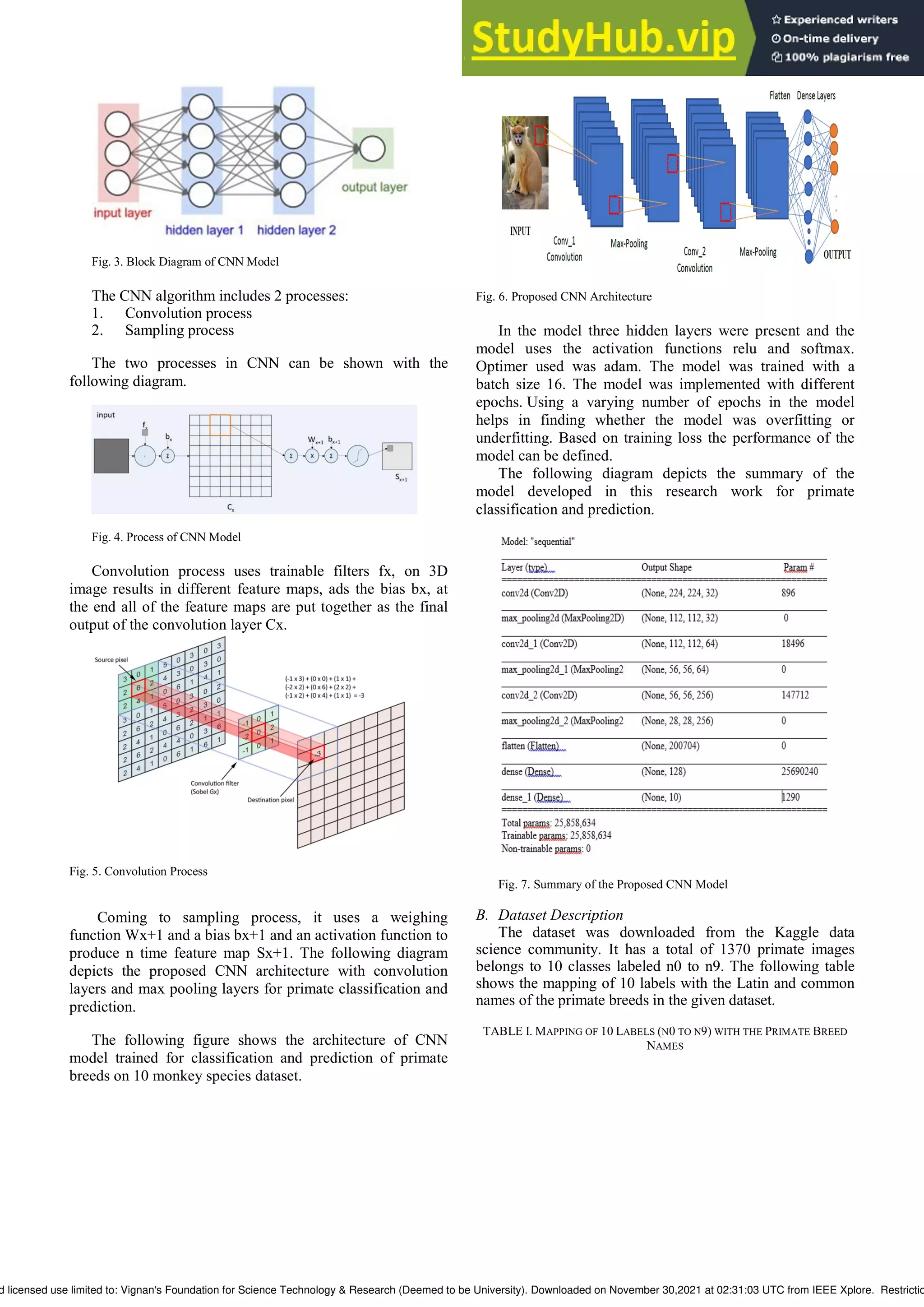
The following figure shows the architecture of CNN
model trained for classification and prediction of primate
breeds on 10 monkey species dataset.
Fig. 6. Proposed CNN Architecture
In the model three hidden layers were present and the
model uses the activation functions relu and softmax.
Optimer used was adam. The model was trained with a
batch size 16. The model was implemented with different
epochs. Using a varying number of epochs in the model
helps in finding whether the model was overfitting or
underfitting. Based on training loss the performance of the
model can be defined.
The following diagram depicts the summary of the
model developed in this research work for primate
classification and prediction.
Fig. 7. Summary of the Proposed CNN Model
B. Dataset Description
The dataset was downloaded from the Kaggle data
science community. It has a total of 1370 primate images
belongs to 10 classes labeled n0 to n9. The following table
shows the mapping of 10 labels with the Latin and common
names of the primate breeds in the given dataset.
TABLE I. MAPPING OF 10 LABELS (N0 TO N9) WITH THE PRIMATE BREED
NAMES
d licensed use limited to: Vignan's Foundation for Science Technology & Research (Deemed to be University). Downloaded on November 30,2021 at 02:31:03 UTC from IEEE Xplore. Restrictio
The following image depicts the sample images of 10
monkey breeds from the 10 monkey breed dataset.
Fig. 8. Illustration of Described Different Primate Breeds in the Training Set
The dataset is divided into training and validation data
sets, 1098 images of all 10 breeds into training set and 272
images of all 10 breeds into validation set.
The following image shows the code snippet of accessing
training images and test images from the 10 monkey species
dataset.
Fig. 9. Code Snippet of Accessing Training and Test Dataset Images
C. Experimentation
The experiments were carried out in a GPU-based laptop
with Intel(R) Core (TM) i7-5740U CPU @ 2.20GHz
processor and 8GB RAM and 1 TB hard disk. The Jupiter
notebook from anaconda prompt was used for implementing
the python code.
The following figure illustrates the code snippets of
CNN architecture implemented for primate breed prediction.
Fig. 10. Code Snippet of CNN Architecture Implemented
D. Results and Discussions
In this section the results obtained from the
implementation of CNN model were discussed in detail. The
following table shows the accuracy measure on both training
and validation sets with different epochs.
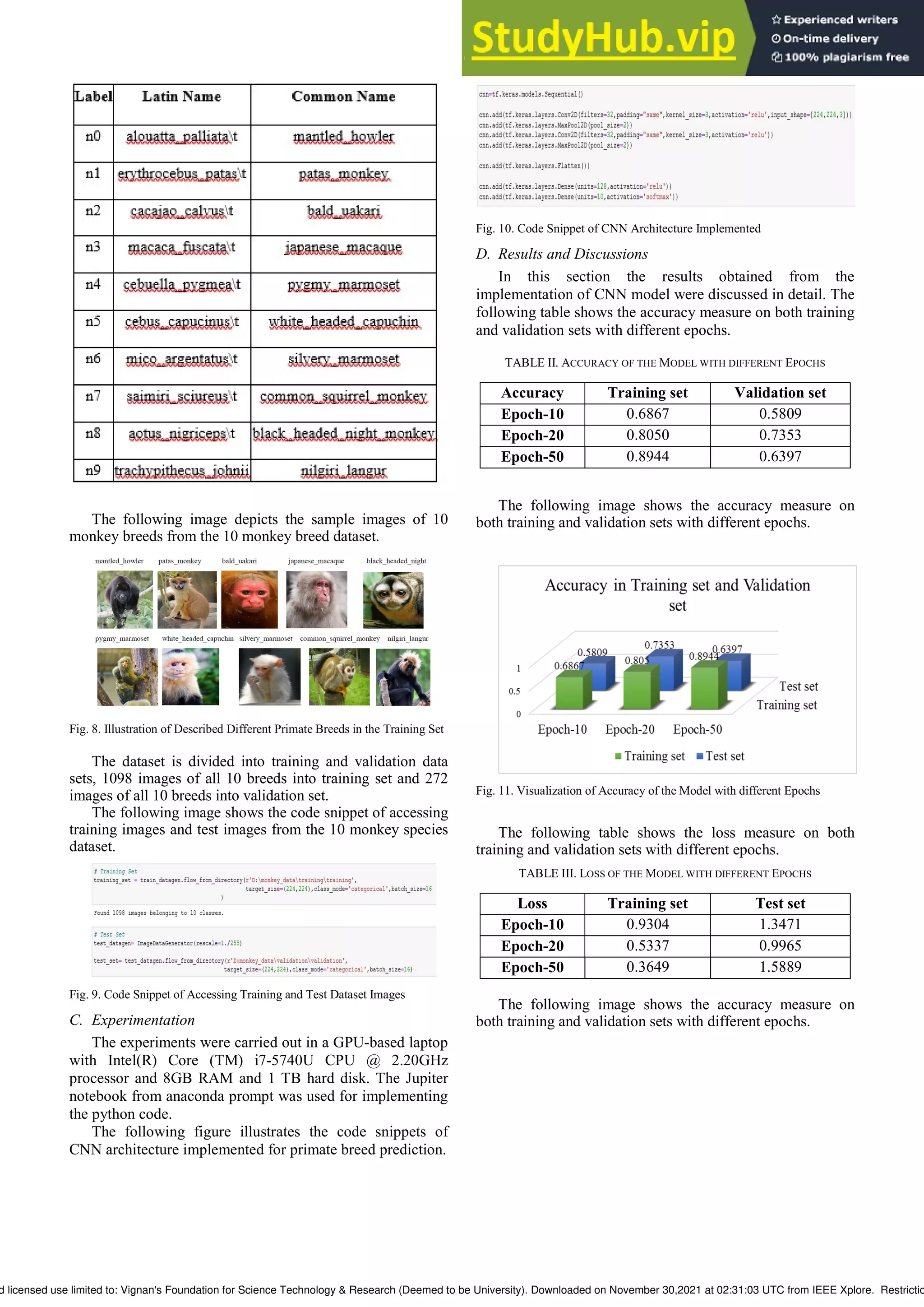
TABLE II. ACCURACY OF THE MODEL WITH DIFFERENT EPOCHS
Accuracy Training set Validation set
Epoch-10 0.6867 0.5809
Epoch-20 0.8050 0.7353
Epoch-50 0.8944 0.6397
The following image shows the accuracy measure on
both training and validation sets with different epochs.
Fig. 11. Visualization of Accuracy of the Model with different Epochs
The following table shows the loss measure on both
training and validation sets with different epochs.
TABLE III. LOSS OF THE MODEL WITH DIFFERENT EPOCHS
Loss Training set Test set
Epoch-10 0.9304 1.3471
Epoch-20 0.5337 0.9965
Epoch-50 0.3649 1.5889
The following image shows the accuracy measure on
both training and validation sets with different epochs.
d licensed use limited to: Vignan's Foundation for Science Technology & Research (Deemed to be University). Downloaded on November 30,2021 at 02:31:03 UTC from IEEE Xplore. Restrictio
Fig. 12. Loss of Accuracy of the Model with different Epochs
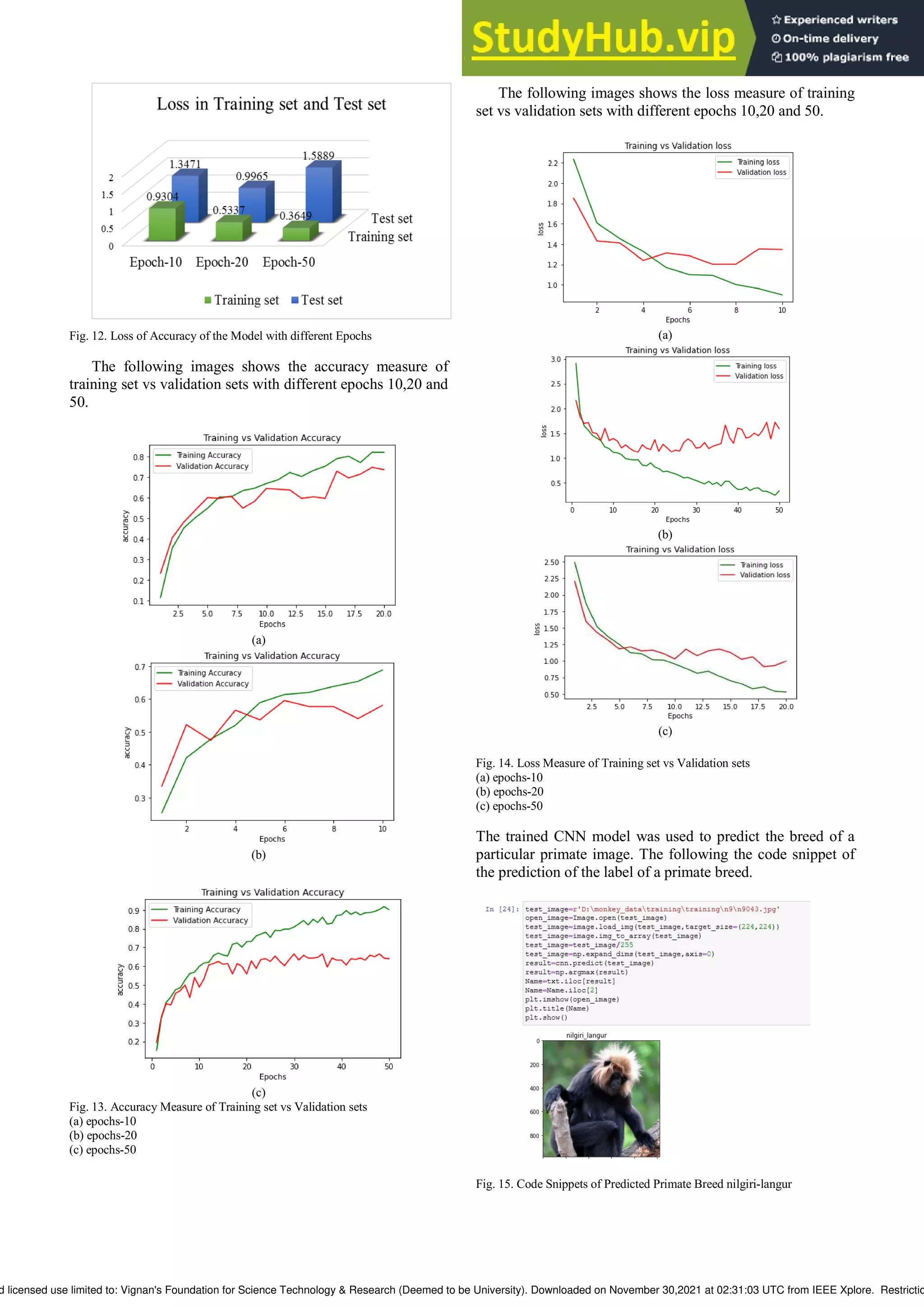
The following images shows the accuracy measure of
training set vs validation sets with different epochs 10,20 and
50.
(a)
(b)
(c)
Fig. 13. Accuracy Measure of Training set vs Validation sets
(a) epochs-10
(b) epochs-20
(c) epochs-50
The following images shows the loss measure of training
set vs validation sets with different epochs 10,20 and 50.
(a)
(b)
(c)
Fig. 14. Loss Measure of Training set vs Validation sets
(a) epochs-10
(b) epochs-20
(c) epochs-50
The trained CNN model was used to predict the breed of a
particular primate image. The following the code snippet of
the prediction of the label of a primate breed.
Fig. 15. Code Snippets of Predicted Primate Breed nilgiri-langur
d licensed use limited to: Vignan's Foundation for Science Technology & Research (Deemed to be University). Downloaded on November 30,2021 at 02:31:03 UTC from IEEE Xplore. Restrictio
The model was tested by taking test images from
the training set as well as the validation set. The model
predicted the correct breed of the particular selected image.
The following are the sample test images and their predicted
labels.
Fig. 16. Code Snippets of Predicted Primate Breed mantled_howler
(a) (b)
Fig.17. Sample Predicted Primate Breeds
(a). Japanese_macaque
(b). black_headed_night_monkey
From the results obtained it is clear that the model trained
with an accuracy of 0.8050 on the training set and 0.7353 on
the validation set with the epochs 20. The trained model
predicted the primate breeds accurately. These predictions
are very helpful in identifying various primate breeds and
protecting and safeguarding those breeds from extinction.
The model may work pretty well in real-world scenarios also.
In the case of still images, the models' accuracy is more than
80%. In the case of live streaming of videos, the model can
identify various expressions and can do better prediction with
high accuracy.
Get the video stream from the CC camera. Detect faces of
various animals. Classify primates from other animals. Use
some pre-processing techniques to reduce the size of images
and some transformation techniques to transform the features
into required format. Then, the features are passed to our pre-
trained Neural Network. Get the predictions back from our
Neural Network, if the predicted primate breed is extricated
breed then we can provide a safe place to safe that breed.
V. CONCLUSION AND FUTURE SCOPE
Primates plays a vital role in the livelihood and various
cultures in the society. Because of some human activities and
with other causes the primate breeds are extricated. This
research helps in predicting the primate breeds based on
facial parameters using a Convolutional Neural Network.
The model was implemented on the 10 monkey species
dataset obtained from the Kaggle data science community.
The results show that the model works with an accuracy
above 80% on training data and above 70% on validation
data. Prediction of primate breed was done by selecting the
images from both the training set and validation set
randomly. This model helps to identify various primate
breeds and to protect and safeguard those breeds from
extinction. In the future, the model can be enhanced to
improve the accuracy of the model in classifying and
predicting the primate breeds. Also, the model can be used
on the enhanced dataset that consists of more primate breed
classes. In the future, the model can also be embedded into
IoT in order to automate the process if captures any
extricated primate breed.
REFERENCES
[1] A. Estrada et al., “Impending extinction crisis of the world’s primates:
Why primates matter,” Sci. Adv., vol. 3, no. 1, pp. 1–16, 2017, doi:
10.1126/sciadv.1600946.
[2] K. Sujatha and B. Srinivasa Rao, “Recent Applications of Machine
Learning : A Survey,” Int. J. Innov. Technol. Explor. Eng., vol. 8, no.
6, pp. 263–267, 2019, doi: Retrieval Number: F10510486C219
/19©BEIESP.
[3] K. Sujatha, K. V. K. Kishore, and B. S. Rao, “Performance of
Machine Learning Algorithms in Red Wine Quality Classification
based on Chemical Compositions,” Indian J. Ecol., vol. 47, no. 11, pp.
176–180, 2020.
[4] B. Jiang, W. Huang, W. Tu, and C. Yang, “An Animal Classification
based on Light Convolutional Network Neural Network,” in
Proceedings - 2019 International Conference on Intelligent
Computing and Its Emerging Applications, ICEA 2019, 2019, pp. 45–
50, doi: 10.1109/ICEA.2019.8858309.
[5] N. K. El Abbadi and E. M. T. A. Alsaadi, “An Automated Vertebrate
Animals Classification Using Deep Convolution Neural Networks,” in
Proceedings of the 2020 International Conference on Computer
Science and Software Engineering, CSASE 2020, 2020, pp. 72–77,
doi: 10.1109/CSASE48920.2020.9142070.
[6] L. G. C. Vithakshana and W. G. D. M. Samankula, “IoT based animal
classification system using convolutional neural network,” in
Proceedings - International Research Conference on Smart Computing
and Systems Engineering, SCSE 2020, 2020, vol. SC-14, pp. 90–95,
doi: 10.1109/SCSE49731.2020.9313018.
[7] D. Nanditha and N. Manohar, “Classification of Animals Using Toy
Images,” in Proceedings of the International Conference on Intelligent
Computing and Control Systems, ICICCS 2020, 2020, no. Iciccs, pp.
680–684, doi: 10.1109/ICICCS48265.2020.9121074.
[8] D. Deb et al., “Face recognition: Primates in the wild,” arXiv, pp. 1–
10, 2018.
[9] S. Divya Meena and L. Agilandeeswari, “An Efficient Framework for
Animal Breeds Classification Using Semi-Supervised Learning and
Multi-Part Convolutional Neural Network (MP-CNN),” IEEE Access,
vol. 7, pp. 151783–151802, 2019, doi:
10.1109/ACCESS.2019.2947717.
[10] A. Swanson, M. Kosmala, C. Lintott, R. Simpson, A. Smith, and C.
Packer (. 2015), “Snapshot Serengeti, high-frequency annotated
camera trap images of 40 mammalian species in an African savanna,”
Scientific Data, vol. 2, pp. 150026, Jun. 2015.
[11] A. Ahmeda, H.Yousifa, R. Kaysb, and Z. Hea (2019), ‘‘Semantic
region of interest and species classification in the deep neural network
feature domain,’’ Ecological Inform., vol. 52, Jul. 2019, pp. 57–68.
d licensed use limited to: Vignan's Foundation for Science Technology & Research (Deemed to be University). Downloaded on November 30,2021 at 02:31:03 UTC from IEEE Xplore. Restrictio
[12] B. Kong, J. Supan˘ci˘c, D. Ramanan, and C. C. Fowlkes (2019),
‘‘Cross-domain image matching with deep feature maps,’’ Int. J.
Comput. Visions, vol. 127, no. 365, pp. 1–13, Jan. 2019.
[13] M. Zhanyu, Y. Ding, S. Wen, J. Xie, Y. Jin, Z. Si, and H. Wang
(2019), ‘‘Shoe- print image retrieval with multi-part weighted CNN,’’
IEEE Access. vol. 7, pp. 59728–59736, 2019.
[14] J. A. Veech (2006), “A comparison of landscapes occupied by
increasing and decreasing populations of grassland birds,”
Conservation Biology, vol. 20, pp. 1422-1432, May. 2006.
d licensed use limited to: Vignan's Foundation for Science Technology & Research (Deemed to be University). Downloaded on November 30,2021 at 02:31:03 UTC from IEEE Xplore. Restrictio

Animal Breed Classification And Prediction Using Convolutional Neural Network Primates As A Case Study

  • 1.
    Animal Breed Classificationand Prediction Using Convolutional Neural Network Primates as a Case Study Sujatha Kamepalli Department of Information Technology VFSTR Deemed to be University Guntur, India sujatha101012@gmail.com Venkata Krishna Kishore Kolli Department of Information Technology VFSTR Deemed to be University Guntur, India kishorekvk_1@yahoo.com Srinivasa Rao Bandaru Department of Management Studies VFSTR Deemed to be University Guntur, India drbsraoprofessormmt10672@gmail.com Abstract—Primates are very significant in various environment functions as well as in human evolution, cultures, and many religions in society. Out of more than 500 primate species over 60% of primate species are extinct because of various reasons such as hunting, habitat loss human activities, etc. It is our responsibility to safeguard the primate breeds once again introducing primates into their natural surroundings. In this paper, a deep Convolutional Neural Network was trained to classify various primate breeds and predict the breed of a particular test image. 10 monkey species dataset from the Kaggle data science community was used. This dataset consists of 10 breeds of primates labeled n0 to n9. The model was trained with different epochs, works with an accuracy of 0.8050 on the training set and 0.7353 on the validation set with epochs 20. The trained model predicted the primate breeds accurately. These predictions are very helpful in identifying various primate breeds and protecting and safeguarding those breeds from extinction. In future this research can be extended to automate the process for identifying the primate breeds by embedding the process into IoT. Keywords—Convolution Neural Network, Deep Learning, Primate Classification, Animal Breeds, Extinction of Animal Species. I. INTRODUCTION In addition to humans, animals, plants and marine species have their own significance in maintaining the ecological balance on this earth. Each category of animals, plants, and other living beings has a significant number of species. Every life form on this planet has an exceptional spot in the natural way of life that adds to the environment in its own unique manner. But, unfortunately, today, a significant number of animals and birds are getting endangered. Coming to primates, more than 500 species are present and which are unnervingly similar to human beings. [1] Nonhuman primates are of central importance to tropical biodiversity and to various climate capacities, cycles, and administrations. These primate species are playing a vital role in human evolution, livelihoods, cultures, and many religions in society. But, over 60% of primate species are undermined with eradication mostly because of human activities, habitat loss, hunting, environmental changes, illegal trades, agricultural expansion in this 21st century, and illness. This eradication emergency makes compelling preservation activities essential. There are various conceivable preservation activities for primates, similar to anti-poaching patrols, relocating animals, publicizing protection issues, and once again introducing primates into their natural surroundings. With the rapid improvement in human culture, human eradication of the common natural environment is increasing, causing numerous species in the world to become terminated. It is necessary to take numerous actions to safeguard the endangered species [14]. Day by day technology is enhancing more and more, all those technological innovations can be implemented in protecting the environment and also in safeguarding the extricated species. The “camera traps” [10] are widely espoused in the field of environment protection, by this one can get large amounts of images related to wild animals which can be processed to identify the exact species (breeds). Also, animal recognition algorithms can also be embedded into the live cameras to identify the correct breeds of various animals by that the officials can take different protection measures. So, the researchers can use various machine learning [2][3], deep learning, and IoT-based models to identify the endangered species by breed classification and prediction. With deep learning, one can make a framework to perform grouping all alone [11]. Deep learning is a sort of artificial intelligence that allows the model to perform arrangement straightforwardly from the training source like images, text, or sound. This requires the development of a Deep Neural Network (DNN). While image classification and prediction are utilized practically in all viewpoints, their utilization isn't completely refined in specific fields. One such field is the classification and prediction of animal breeds. The Automatic characterization of animal pictures is an inexplicable issue because of the features in animal images [12]. Deep learning can help in such situations. It gives a wide scope of algorithms with which the entire process of image classification and prediction can be improved and automated [13]. In this paper, Convolutional Neural Network was used to classify and predict the primate breed classification on the 10 monkey species dataset. The rest of the paper is organized in different sections, which are shown below. In section 2, the main objectives of this research were defined. Later in section 3, the state-of- the-art models used in animal breed classification were explored. Further in section 4, the proposed flow of the work was discussed, also the CNN model was explained. In section 5, the results obtained by implementing the CNN model on the 10 monkey spices dataset were presented. 2021 Fourth International Conference on Electrical, Computer and Communication Technologies (ICECCT) | 978-1-6654-1480-7/21/$31.00 ©2021 IEEE | DOI: 10.1109/ICECCT52121.2021.9616928 d licensed use limited to: Vignan's Foundation for Science Technology & Research (Deemed to be University). Downloaded on November 30,2021 at 02:31:03 UTC from IEEE Xplore. Restrictio
  • 2.
    Finally, in section6, the research done in this paper was concluded and the future directions were explored. II. OBJECTIVES The main objectives of this research are  Studying the importance of primates in social life and causes of animal species extinction in wild animals.  Studying the state of the art models used in the animal breed classification and prediction.  Understanding the various primate breeds from the 10 monkey species dataset.  Training convolutional neural network for primate breed classification and prediction.  Predicting the primate breed using the trained model on the test images. III. LITERATURE SURVEY In this paper the authors proposed a novel convolutional neural network to provide a trade-off between model size and object recognition accuracy. They named the proposed model as bilateral convolutional neural network. The developed model includes two components [4]. 1. Feature extraction module 2. Classification module This method combines two sub networks together by that its learning ability is increased. The sub-network 1 is used to sense the position of the object, and sub-network 2 is used to extract the features of the object. The model was implemented on AWA image dataset contains 37322 images of six categories. The compared the results with various unilateral networks and concluded that the proposed method works with an accuracy 8506. In this paper the authors provide a model based on deep convolutional neural networks to detect the objects from an image and also to classify those objects into different classes. They studied various research papers on object detection, recognition and classification. They used various datasets of animals which contains animal images in the scenes. The proposed model was implemented on 12000 images, with 9600 as training images and 2400 as validation images. By the experimentation the authors concluded that the model works with an accuracy of 97.5 with the best number of epochs 50 [5]. In this paper authors proposed an IoT based acoustic classification system using convolution neural network. In this they used the audio clips of various animals and based on those they classified the animal species [6]. In this paper the authors proposed a multi SVM classifier to classify animals. First, they implemented clustering method to segment the images and then the images are classified by extracting the features using multi SVM classifier. The authors used the custom dataset of 700 images belongs to 7 different classes. The model was implemented in three stages. In the first stage the image was pre-processed, in the second stage the pre- processed images were segmented using k-means clustering and finally in the third stage the classification model was implemented [7]. In this paper the authors proposed a new CNN architecture called PrimNet for recognizing the wild primates. The authors evaluated various state of the art models used for human face recognition. They developed a mobile app that helps the animal lovers to identify various species of primates and safe guard them [8]. In this paper the authors proposed a multi part convolutional neural network to classify the animals. This model is used for both generic classification as well as fine grained classification [9]. Fig. 1. Visualization of Fine-Grained VS Generic Classification The multipart classification model works on both object localization as well as part selection. The model classifies new classes of unlabeled images too. The authors implemented the proposed model on Oxford IIIT pet dataset of 35992 images with 27 classes. The authors concluded that the model works with an efficiency of 99.95. IV. PRIMATE BREED CLASSIFICATION The following diagram depicts the flow chart of the proposed methodology to predict primate breed prediction. The image dataset was collected from the Kaggle data science community. Pre-processing of image data was done by resizing and rescaling the images. The image dataset was split into training and test. CNN model was trained on the training data and primate breed prediction was done on the test data. Fig. 2. Flowchart of Proposed Methodology A. Convolutional Neural Network Convolutional neural network algorithm is a multilayer perceptron used to process the image data. It is a precise deep learning framework contains mainly three layers input layer, output layer and hidden layers. d licensed use limited to: Vignan's Foundation for Science Technology & Research (Deemed to be University). Downloaded on November 30,2021 at 02:31:03 UTC from IEEE Xplore. Restrictio
  • 3.
    Fig. 3. BlockDiagram of CNN Model The CNN algorithm includes 2 processes: 1. Convolution process 2. Sampling process The two processes in CNN can be shown with the following diagram. Fig. 4. Process of CNN Model Convolution process uses trainable filters fx, on 3D image results in different feature maps, ads the bias bx, at the end all of the feature maps are put together as the final output of the convolution layer Cx. Fig. 5. Convolution Process Coming to sampling process, it uses a weighing function Wx+1 and a bias bx+1 and an activation function to produce n time feature map Sx+1. The following diagram depicts the proposed CNN architecture with convolution layers and max pooling layers for primate classification and prediction. The following figure shows the architecture of CNN model trained for classification and prediction of primate breeds on 10 monkey species dataset. Fig. 6. Proposed CNN Architecture In the model three hidden layers were present and the model uses the activation functions relu and softmax. Optimer used was adam. The model was trained with a batch size 16. The model was implemented with different epochs. Using a varying number of epochs in the model helps in finding whether the model was overfitting or underfitting. Based on training loss the performance of the model can be defined. The following diagram depicts the summary of the model developed in this research work for primate classification and prediction. Fig. 7. Summary of the Proposed CNN Model B. Dataset Description The dataset was downloaded from the Kaggle data science community. It has a total of 1370 primate images belongs to 10 classes labeled n0 to n9. The following table shows the mapping of 10 labels with the Latin and common names of the primate breeds in the given dataset. TABLE I. MAPPING OF 10 LABELS (N0 TO N9) WITH THE PRIMATE BREED NAMES d licensed use limited to: Vignan's Foundation for Science Technology & Research (Deemed to be University). Downloaded on November 30,2021 at 02:31:03 UTC from IEEE Xplore. Restrictio
  • 4.
    The following imagedepicts the sample images of 10 monkey breeds from the 10 monkey breed dataset. Fig. 8. Illustration of Described Different Primate Breeds in the Training Set The dataset is divided into training and validation data sets, 1098 images of all 10 breeds into training set and 272 images of all 10 breeds into validation set. The following image shows the code snippet of accessing training images and test images from the 10 monkey species dataset. Fig. 9. Code Snippet of Accessing Training and Test Dataset Images C. Experimentation The experiments were carried out in a GPU-based laptop with Intel(R) Core (TM) i7-5740U CPU @ 2.20GHz processor and 8GB RAM and 1 TB hard disk. The Jupiter notebook from anaconda prompt was used for implementing the python code. The following figure illustrates the code snippets of CNN architecture implemented for primate breed prediction. Fig. 10. Code Snippet of CNN Architecture Implemented D. Results and Discussions In this section the results obtained from the implementation of CNN model were discussed in detail. The following table shows the accuracy measure on both training and validation sets with different epochs. TABLE II. ACCURACY OF THE MODEL WITH DIFFERENT EPOCHS Accuracy Training set Validation set Epoch-10 0.6867 0.5809 Epoch-20 0.8050 0.7353 Epoch-50 0.8944 0.6397 The following image shows the accuracy measure on both training and validation sets with different epochs. Fig. 11. Visualization of Accuracy of the Model with different Epochs The following table shows the loss measure on both training and validation sets with different epochs. TABLE III. LOSS OF THE MODEL WITH DIFFERENT EPOCHS Loss Training set Test set Epoch-10 0.9304 1.3471 Epoch-20 0.5337 0.9965 Epoch-50 0.3649 1.5889 The following image shows the accuracy measure on both training and validation sets with different epochs. d licensed use limited to: Vignan's Foundation for Science Technology & Research (Deemed to be University). Downloaded on November 30,2021 at 02:31:03 UTC from IEEE Xplore. Restrictio
  • 5.
    Fig. 12. Lossof Accuracy of the Model with different Epochs The following images shows the accuracy measure of training set vs validation sets with different epochs 10,20 and 50. (a) (b) (c) Fig. 13. Accuracy Measure of Training set vs Validation sets (a) epochs-10 (b) epochs-20 (c) epochs-50 The following images shows the loss measure of training set vs validation sets with different epochs 10,20 and 50. (a) (b) (c) Fig. 14. Loss Measure of Training set vs Validation sets (a) epochs-10 (b) epochs-20 (c) epochs-50 The trained CNN model was used to predict the breed of a particular primate image. The following the code snippet of the prediction of the label of a primate breed. Fig. 15. Code Snippets of Predicted Primate Breed nilgiri-langur d licensed use limited to: Vignan's Foundation for Science Technology & Research (Deemed to be University). Downloaded on November 30,2021 at 02:31:03 UTC from IEEE Xplore. Restrictio
  • 6.
    The model wastested by taking test images from the training set as well as the validation set. The model predicted the correct breed of the particular selected image. The following are the sample test images and their predicted labels. Fig. 16. Code Snippets of Predicted Primate Breed mantled_howler (a) (b) Fig.17. Sample Predicted Primate Breeds (a). Japanese_macaque (b). black_headed_night_monkey From the results obtained it is clear that the model trained with an accuracy of 0.8050 on the training set and 0.7353 on the validation set with the epochs 20. The trained model predicted the primate breeds accurately. These predictions are very helpful in identifying various primate breeds and protecting and safeguarding those breeds from extinction. The model may work pretty well in real-world scenarios also. In the case of still images, the models' accuracy is more than 80%. In the case of live streaming of videos, the model can identify various expressions and can do better prediction with high accuracy. Get the video stream from the CC camera. Detect faces of various animals. Classify primates from other animals. Use some pre-processing techniques to reduce the size of images and some transformation techniques to transform the features into required format. Then, the features are passed to our pre- trained Neural Network. Get the predictions back from our Neural Network, if the predicted primate breed is extricated breed then we can provide a safe place to safe that breed. V. CONCLUSION AND FUTURE SCOPE Primates plays a vital role in the livelihood and various cultures in the society. Because of some human activities and with other causes the primate breeds are extricated. This research helps in predicting the primate breeds based on facial parameters using a Convolutional Neural Network. The model was implemented on the 10 monkey species dataset obtained from the Kaggle data science community. The results show that the model works with an accuracy above 80% on training data and above 70% on validation data. Prediction of primate breed was done by selecting the images from both the training set and validation set randomly. This model helps to identify various primate breeds and to protect and safeguard those breeds from extinction. In the future, the model can be enhanced to improve the accuracy of the model in classifying and predicting the primate breeds. Also, the model can be used on the enhanced dataset that consists of more primate breed classes. In the future, the model can also be embedded into IoT in order to automate the process if captures any extricated primate breed. REFERENCES [1] A. Estrada et al., “Impending extinction crisis of the world’s primates: Why primates matter,” Sci. Adv., vol. 3, no. 1, pp. 1–16, 2017, doi: 10.1126/sciadv.1600946. [2] K. Sujatha and B. Srinivasa Rao, “Recent Applications of Machine Learning : A Survey,” Int. J. Innov. Technol. Explor. Eng., vol. 8, no. 6, pp. 263–267, 2019, doi: Retrieval Number: F10510486C219 /19©BEIESP. [3] K. Sujatha, K. V. K. Kishore, and B. S. Rao, “Performance of Machine Learning Algorithms in Red Wine Quality Classification based on Chemical Compositions,” Indian J. Ecol., vol. 47, no. 11, pp. 176–180, 2020. [4] B. Jiang, W. Huang, W. Tu, and C. Yang, “An Animal Classification based on Light Convolutional Network Neural Network,” in Proceedings - 2019 International Conference on Intelligent Computing and Its Emerging Applications, ICEA 2019, 2019, pp. 45– 50, doi: 10.1109/ICEA.2019.8858309. [5] N. K. El Abbadi and E. M. T. A. Alsaadi, “An Automated Vertebrate Animals Classification Using Deep Convolution Neural Networks,” in Proceedings of the 2020 International Conference on Computer Science and Software Engineering, CSASE 2020, 2020, pp. 72–77, doi: 10.1109/CSASE48920.2020.9142070. [6] L. G. C. Vithakshana and W. G. D. M. Samankula, “IoT based animal classification system using convolutional neural network,” in Proceedings - International Research Conference on Smart Computing and Systems Engineering, SCSE 2020, 2020, vol. SC-14, pp. 90–95, doi: 10.1109/SCSE49731.2020.9313018. [7] D. Nanditha and N. Manohar, “Classification of Animals Using Toy Images,” in Proceedings of the International Conference on Intelligent Computing and Control Systems, ICICCS 2020, 2020, no. Iciccs, pp. 680–684, doi: 10.1109/ICICCS48265.2020.9121074. [8] D. Deb et al., “Face recognition: Primates in the wild,” arXiv, pp. 1– 10, 2018. [9] S. Divya Meena and L. Agilandeeswari, “An Efficient Framework for Animal Breeds Classification Using Semi-Supervised Learning and Multi-Part Convolutional Neural Network (MP-CNN),” IEEE Access, vol. 7, pp. 151783–151802, 2019, doi: 10.1109/ACCESS.2019.2947717. [10] A. Swanson, M. Kosmala, C. Lintott, R. Simpson, A. Smith, and C. Packer (. 2015), “Snapshot Serengeti, high-frequency annotated camera trap images of 40 mammalian species in an African savanna,” Scientific Data, vol. 2, pp. 150026, Jun. 2015. [11] A. Ahmeda, H.Yousifa, R. Kaysb, and Z. Hea (2019), ‘‘Semantic region of interest and species classification in the deep neural network feature domain,’’ Ecological Inform., vol. 52, Jul. 2019, pp. 57–68. d licensed use limited to: Vignan's Foundation for Science Technology & Research (Deemed to be University). Downloaded on November 30,2021 at 02:31:03 UTC from IEEE Xplore. Restrictio
  • 7.
    [12] B. Kong,J. Supan˘ci˘c, D. Ramanan, and C. C. Fowlkes (2019), ‘‘Cross-domain image matching with deep feature maps,’’ Int. J. Comput. Visions, vol. 127, no. 365, pp. 1–13, Jan. 2019. [13] M. Zhanyu, Y. Ding, S. Wen, J. Xie, Y. Jin, Z. Si, and H. Wang (2019), ‘‘Shoe- print image retrieval with multi-part weighted CNN,’’ IEEE Access. vol. 7, pp. 59728–59736, 2019. [14] J. A. Veech (2006), “A comparison of landscapes occupied by increasing and decreasing populations of grassland birds,” Conservation Biology, vol. 20, pp. 1422-1432, May. 2006. d licensed use limited to: Vignan's Foundation for Science Technology & Research (Deemed to be University). Downloaded on November 30,2021 at 02:31:03 UTC from IEEE Xplore. Restrictio